WO2015036044A1 - Cationic lipid vehicles for delivery of tlr7 agonists for specific targeting of human cd14+ monocytes in whole blood - Google Patents
Cationic lipid vehicles for delivery of tlr7 agonists for specific targeting of human cd14+ monocytes in whole blood Download PDFInfo
- Publication number
- WO2015036044A1 WO2015036044A1 PCT/EP2013/069065 EP2013069065W WO2015036044A1 WO 2015036044 A1 WO2015036044 A1 WO 2015036044A1 EP 2013069065 W EP2013069065 W EP 2013069065W WO 2015036044 A1 WO2015036044 A1 WO 2015036044A1
- Authority
- WO
- WIPO (PCT)
- Prior art keywords
- alkyl
- substituted
- lipid vehicle
- lipid
- vehicle according
- Prior art date
- Legal status (The legal status is an assumption and is not a legal conclusion. Google has not performed a legal analysis and makes no representation as to the accuracy of the status listed.)
- Ceased
Links
- 0 C*c1c[n]nc1 Chemical compound C*c1c[n]nc1 0.000 description 1
- RIKMMFOAQPJVMX-UHFFFAOYSA-N Cc1c[nH]nc1 Chemical compound Cc1c[nH]nc1 RIKMMFOAQPJVMX-UHFFFAOYSA-N 0.000 description 1
Classifications
-
- A—HUMAN NECESSITIES
- A61—MEDICAL OR VETERINARY SCIENCE; HYGIENE
- A61K—PREPARATIONS FOR MEDICAL, DENTAL OR TOILETRY PURPOSES
- A61K9/00—Medicinal preparations characterised by special physical form
- A61K9/10—Dispersions; Emulsions
- A61K9/127—Synthetic bilayered vehicles, e.g. liposomes or liposomes with cholesterol as the only non-phosphatidyl surfactant
- A61K9/1271—Non-conventional liposomes, e.g. PEGylated liposomes or liposomes coated or grafted with polymers
- A61K9/1272—Non-conventional liposomes, e.g. PEGylated liposomes or liposomes coated or grafted with polymers comprising non-phosphatidyl surfactants as bilayer-forming substances, e.g. cationic lipids or non-phosphatidyl liposomes coated or grafted with polymers
-
- A—HUMAN NECESSITIES
- A61—MEDICAL OR VETERINARY SCIENCE; HYGIENE
- A61K—PREPARATIONS FOR MEDICAL, DENTAL OR TOILETRY PURPOSES
- A61K47/00—Medicinal preparations characterised by the non-active ingredients used, e.g. carriers or inert additives; Targeting or modifying agents chemically bound to the active ingredient
- A61K47/50—Medicinal preparations characterised by the non-active ingredients used, e.g. carriers or inert additives; Targeting or modifying agents chemically bound to the active ingredient the non-active ingredient being chemically bound to the active ingredient, e.g. polymer-drug conjugates
- A61K47/69—Medicinal preparations characterised by the non-active ingredients used, e.g. carriers or inert additives; Targeting or modifying agents chemically bound to the active ingredient the non-active ingredient being chemically bound to the active ingredient, e.g. polymer-drug conjugates the conjugate being characterised by physical or galenical forms, e.g. emulsion, particle, inclusion complex, stent or kit
- A61K47/6905—Medicinal preparations characterised by the non-active ingredients used, e.g. carriers or inert additives; Targeting or modifying agents chemically bound to the active ingredient the non-active ingredient being chemically bound to the active ingredient, e.g. polymer-drug conjugates the conjugate being characterised by physical or galenical forms, e.g. emulsion, particle, inclusion complex, stent or kit the form being a colloid or an emulsion
- A61K47/6911—Medicinal preparations characterised by the non-active ingredients used, e.g. carriers or inert additives; Targeting or modifying agents chemically bound to the active ingredient the non-active ingredient being chemically bound to the active ingredient, e.g. polymer-drug conjugates the conjugate being characterised by physical or galenical forms, e.g. emulsion, particle, inclusion complex, stent or kit the form being a colloid or an emulsion the form being a liposome
-
- A—HUMAN NECESSITIES
- A61—MEDICAL OR VETERINARY SCIENCE; HYGIENE
- A61P—SPECIFIC THERAPEUTIC ACTIVITY OF CHEMICAL COMPOUNDS OR MEDICINAL PREPARATIONS
- A61P31/00—Antiinfectives, i.e. antibiotics, antiseptics, chemotherapeutics
- A61P31/12—Antivirals
- A61P31/14—Antivirals for RNA viruses
- A61P31/16—Antivirals for RNA viruses for influenza or rhinoviruses
-
- A—HUMAN NECESSITIES
- A61—MEDICAL OR VETERINARY SCIENCE; HYGIENE
- A61P—SPECIFIC THERAPEUTIC ACTIVITY OF CHEMICAL COMPOUNDS OR MEDICINAL PREPARATIONS
- A61P31/00—Antiinfectives, i.e. antibiotics, antiseptics, chemotherapeutics
- A61P31/12—Antivirals
- A61P31/14—Antivirals for RNA viruses
- A61P31/18—Antivirals for RNA viruses for HIV
-
- A—HUMAN NECESSITIES
- A61—MEDICAL OR VETERINARY SCIENCE; HYGIENE
- A61P—SPECIFIC THERAPEUTIC ACTIVITY OF CHEMICAL COMPOUNDS OR MEDICINAL PREPARATIONS
- A61P35/00—Antineoplastic agents
-
- A—HUMAN NECESSITIES
- A61—MEDICAL OR VETERINARY SCIENCE; HYGIENE
- A61P—SPECIFIC THERAPEUTIC ACTIVITY OF CHEMICAL COMPOUNDS OR MEDICINAL PREPARATIONS
- A61P37/00—Drugs for immunological or allergic disorders
- A61P37/08—Antiallergic agents
Definitions
- the present invention relates to specific delivery of synthetic TLR7 agonists to monocytes using cationic lipid vehicles as delivery systems of at least one active ingredient. More particularly, the present invention relates to a lipid vehicle comprising lipids and at least one active ingredient, wherein at least one of the lipids is a positively charged lipid; said lipid vehicle exhibiting a net positive charge at physiological conditions, to a lipid-based pharmaceutical composition comprising said lipid vehicle and their use in monocytic associated prophylaxis, treatment or amelioration.
- Lipid vehicles are based on lipids with amphiphlic character that self-associate in water into various types of aggregates. Examples of such aggregates are, but not limited to, micelles, liposomes, cubosomes, worm-like micelles.
- the sizes of pharmaceutically interesting lipid vehicles are typically from 1 nm to 2000 nm.
- Lipid vehicles are considered to have great potential as drug delivery systems for several reasons; i) various types of drugs can be delivered; hydrophilic drugs can be loaded into the aqueous compartment or hydrophobic drugs can be anchored in the membrane, ii) the therapeutic efficacy is enhanced by targeting specific tissues resulting in increased bioavailability of the delivered drug, and iii) the side effects are significantly reduced, since only diseased tissues are exposed to the administered drugs.
- lipid vehicles have been studied extensively for the past decades in an attempt to develop novel formulations to treat e.g. cancer (1,2,3) and inflammation (4,5), but also to target specific tissues such as the brain, mitochondria, the ocular surface, and derma.
- the MPS consists of monocytes in the blood, their precursor cells in the bone marrow and tissue macrophages. Monocytes differentiate from hematopoietic stem cells in the bone marrow from where they are released into the blood. They can circulate for several days, before they as a result of pro-inflammatory, metabolic or immune stimuli leave the vasculature, migrate into the tissues and differentiate into macrophages or dendritic cells.
- Tissue macrophages especially found in the liver, spleen, and lymphatic system has high phagocytic activity and contributes to clearance of apoptotic cells, but also administrated liposomes.
- Monocytes in the blood also play an important role in elimination of pathogens and apoptotic host cells by phagocytosis.
- the phagocytic ability of cells of the MPS can be turned to an advantage by targeting the cells in the blood that normally are responsible for unwanted take up of the administered lipid vehicle formulations; the monocytes.
- Monocytes are the first cells to be recruited to the site of inflammation or infection, making monocytes important components of the first line of defense as well as in regulation of disease.
- Monocytes, macrophage and dendritic cells serve three main functions in the immune system; phagocytosis, antigen presentation and cytokine production. They play a central role in acute and chronic inflammation since they maintain the inflammatory condition by secretion of pro-inflammatory cytokines such as TNF-a, IL- ⁇ and IL-6.
- Anti-inflammatory drugs given systemically have adverse side effects + localizes in healthy tissues or are rapidly excreted, a problem that can be circumvented by use of specific drug delivery systems. Therefore, targeted delivery to monocytes is of great importance.
- Karathanasis et al. (6) have studied the uptake of a liposome formulation containing a specific positively charged peptide called GGP. They found, that they could target neutrophils and monocytes selectively, but also that it depended on the sequence of the peptide and not the positive charge, since a non targeting control peptide with same positive charge did not enhance uptake of liposomes. The charge of liposomes has however been reported to have significant effect on the cellular uptake of liposomes.
- Lee et a/. (7) investigated the interaction of neutral vs. negatively charged liposomes on human monocytic cell linescultured in medium in presence of Fetal calf serum as suspension or adherent cells in vitro.
- Cationic peptides have been reported to be toxic to cells, but this effect can be circumvented by addition of co-lipids or co-polymers in the liposome formulation.
- US 6,120,799 discloses angiogenic endothelial cells selectively targeted with lipid/DNA complexes or cationic liposomes.
- US2010/0068212 Al relates to a method for targeting pathogenic monocytes.
- US2002/0155609A1 discloses a monocyte-specific particulate delivery vehicle.
- US2007/0292494A1 discloses carbohydrate-derivatized liposomes for targeting cellular carbohydrate recognition domains of CTL/CTLD lectins to deliver an active agent
- HIV intracellularly to a reservoir cell that is infected with or susceptible to infection with an infectious agent, such as HIV.
- US 2005/0142114 Al relates to targeted lipid-drug formulations for delivery of drugs to myeloid and lymphoid immune cells.
- US 2009/0232731 discloses cationic liposomal preparations for the treatment of rheumatoid arthritis.
- WO 2007/134819 Al discoses the use of cationic liposomal preparations for the treatment or diagnosis of rheumatoid arthritis or related disorders.
- WO 2011/098578 A2 discloses a liposome for intra-ocular administration allowing sustained or delayed release of an active pharmaceutical ingredient.
- Positively charged liposomes may exhibit cytotoxic activity ( Lv J Control Release. 2006 Aug 10; 114(l) : 100-9, and C. Kelly et al., J Drug Deliv. 2011 :article ID 727241).
- Cationic liposomes are used for delivery of nucleic acids in e.g. gene delivery technologies or oligo nucleotide based knock out technologies (14). If a lipid vehicle based drug delivery system is to be used for immune modulation the formulation must be taken up by monocytes, but not by other cell populations in the blood.
- the present invention provides a lipid vehicle formulation that is taken up selectively by monocytes in fresh whole blood.
- the selective targeting of monocytes is used to deliver TLR7 agonists selectively to monocytes to provide a biological response in mammals by providing a immune response.
- PAMPs pathogen associated molecular patterns
- PAMPs include peptidoglycans, lipotechoic acids from gram- positive cell walls, the sugar mannose (which is common in microbial carbohydrates but rare in humans), bacterial DNA, double-stranded RNA from viruses, and glucans from fungal cell walls.
- PAMPs generally meet certain criteria that include (a) their expression by microbes but not their mammalian hosts, (b) conservation of structure across the wide range of pathogens, and (c) the capacity to stimulate innate immunity.
- Toll-like Receptors (TLRs) have been found to play a central role in the detection of PAMPs and in the early response to microbial infections (see Underhill et al., Curr. Opin. Immunol., 14: 103 (2002)).
- TLR7 Ten mammalian TLRs and a number of their agonists have been identified. For example, guanine and uridine-rich single-stranded RNA has been identified as a natural ligand for TLR7 (Diebold et al., Science, 303: 1529 (2004)). In addition, several low molecular weight activators of TLR7 have been identified, including imidazoquinolines, and purine-like molecules (Hemmi et al., Nat. Immunol. , 3: 191 (2002); Lee et al., Proc. Natl. Acad. Sci. USA. 180: 6646 (2003); Lee et al., Nat. Cell Biol.. 8: 1327 (2006)).
- TLR7 and TLR8 9-benzyl-8-hydroxy-2-(2-methoxyethoxy) adenine
- R-848 resiquimod
- TLR7 and TLR8 are found predominantly on the internal faces of endosomes in dendritic cells (DCs) and B lymphocytes (in humans; mouse macrophages express TLR7 and TLR9).
- DCs dendritic cells
- B lymphocytes in humans; mouse macrophages express TLR7 and TLR9.
- TLR7 and 8 are found in human blood monocytes (see Hornung et al., L
- lipid vehicle with a specific net positive charge at physiological conditions are able to target monocytes selectively when incubated in fresh whole blood.
- the invention concerns a vehicle for monocyte targeting comprising lipids and a synthetic TLR7 agonist beeing at least one of the active ingredients, wherein at least one of the lipids is a positively charged lipid; said lipid vehicle exhibiting a net positive charge at physiological conditions.
- lipid vehicles are, but not limited to, micelles, liposomes, cubosomes, worm-like micelles.
- the synthetic TLR7 agonist is a molecule linked via a stable covalent bond to a lipid macromolecule (a conjugate), i.e., the conjugate does not act as a prodrug, making it suitable for formulation as a component in a lipid vehicle.
- the conjugates may include lipid macromolecules directly linked to a synthetic TLR7 agonist or linked via a linker to the TLR7 agonist, for instance, linked via an amino group, a carboxy group or a succinamide group.
- the conjugates of the invention are broad-spectrum, long-lasting, and non-toxic synthetic immunostimulatory agents, which are useful for activating the immune system of a mammal, e.g., a human, in vivo by stimulating the activity of TLR7.
- the lipid vehicles of the invention optimize the immune response while limiting undesirable systemic side effects associated with unconjugated TLR7 agonists.
- the invention provides methods of augmenting an immune response, e.g., an immune response to a specific antigen, or inducing a general immune response (in the absence of a specific antigen).
- the lipid vehicle acts as an adjuvant and so is associated with a specific not a general immune response.
- the lipid vehicle acts as a general immune stimulator.
- the method includes administering to a mammal in need thereof an amount of an antigen and a lipid vehicle of the invention effective to prevent, inhibit or treat disorders, including but not limited to microbial infections, cancer, bladder conditions or skin conditions.
- Non-limiting examples of antigens useful in the invention include but are not limited to isolated proteins or peptides, e.g., dipeptides or tripeptides, and the like; carbohydrates (polysaccharides), nucleotides such as, for example, PNA, RNA and DNA, and the like; cells, lipids, microbes, for example, viruses, bacteria, fungi, and the like.
- the antigens can include inactivated whole organisms or microbes, or sub-components thereof and the like.
- the immune response to the administration of the antigen and the lipid vehicle is enhanced relative to the administration of the antigen (in the absence of the lipid vehicle) or a corresponding unconjugated TLR7 agonist, or a combination thereof.
- a mammal is administered a composition comprising the antigen and the lipid vehicle.
- the composition is locally administered, e.g., dermal or intranasal
- composition is systemically administered.
- antigen and lipid vehicle are formulated separately and
- Positively charged lipid vehicles exhibit a superior association with and retention to monocytes either by cell-membrane association, phagocytosis or endocytosis. These mechanisms may be induced by the complement system which is active in fresh human blood, but which is inactivated during storage or freezing of blood, plasma and serum.
- the invention concerns a lipid vehicle comprising lipids and at least one active ingredient, wherein at least one of the lipids has a net positive charge; said lipid vehicle exhibiting a net positive charge at physiological conditions; and wherein the at least one active ingredient is a compound selected from any one of Formula (I), Formula (II), Formula (III), and Formula (IV) :
- X 1 is -0-, -S-, or -NR C -;
- R 1 is hydrogen, (Ci-Cio)alkyl, substituted (Ci-Cio)alkyl, C 5 _i 0 aryl, or substituted C 5 . i 0 aryl, C 5 -gheterocyclic, substituted C 5 -gheterocyclic;
- R c is hydrogen, Ci-i 0 alkyl, or substituted Ci-i 0 alkyl; or R c and R 1 taken together with the nitrogen to which they are attached form a heterocyclic ring or a substituted heterocycli ring;
- each R 2 is independently -OH, (Ci-C 5 )alkyl, substituted (Ci-C 5 )alkyl, (Ci-C 5 )alkoxy, substituted (Ci-C 5 )alkoxy, -C(0)-(Ci-C 5 )alkyl (alkanoyl), substituted -C(0)-(Ci-C 5 )alkyl, - C(0)-(C 5 -Cio)aryl (aroyl), substituted -C(O)-(C 5 -Ci 0 )aryl, -C(0)OH
- each R a and R b is independently hydrogen, (Ci-C 6 )alkyl, substituted (Ci-C 6 )alkyl, (C 3 -C 8 )cycloalkyl, substituted (C 3 -C 8 )cycloalkyl, (Ci-C 6 )alkoxy, substituted (Ci-C 6 )alkoxy, (Ci-C 5 )alkanoyl, substituted (Ci-C 5 )alkanoyl, aryl, aryl(Ci-C 5 )alkyl, Het, Het (Ci-C 5 )alkyl, or (Ci-C 6 )alkoxycarbonyl;
- substituents on any alkyl, aryl or heterocyclic groups are hydroxy, Ci_ 5 alkyl, hydroxyCi- 6 alkylene, Ci- 6 alkoxy, C 3 - 5 cycloalkyl, Ci- 5 alkoxyCi- 5 alkylene, amino, cyano, halo, or aryl;
- n 0, 1, 2, 3 or 4;
- X 2 is a bond or a linking group
- R 3 is a phospholipid comprising one or two carboxylic esters
- X 3 is -N- or -CH-
- R 4 is -CH 2 - or -CH(R 2 )-;
- k is 0 or 1;
- X 4 is -0-, -S-, -NH-, -N(R d )-, -CH 2 -, or -CH(R 2 )-;
- each R d is independently -OH, (Ci-C 6 )alkyl, substituted (Ci-C 6 )alkyl, (Ci-C 6 )alkoxy, substituted (Ci-C 5 )alkoxy, -C(0)-(Ci-C 5 )alkyl (alkanoyl), substituted -C(0)-(Ci-C 5 )alkyl, - C(0)-(C 5 -Cio)aryl (aroyl), substituted -C(O)-(C 5 -Ci 0 )aryl, -C(0)0(Ci-C 5 )alkyl
- the ring system of formula (II) in some embodiments according to the present invention is a piperidin ring with one heteroatom being an N atom and with the N-atom of the piperidin ring adjacent to X 2 .
- the invention concerns a lipid vehicle delivery system for targeting monocytes in fresh blood, said system providing delivery to and release of at least one active ingredient to the targeted monocyte, said a vehicle system comprising:
- lipids comprising : at least one lipid with a net positive charge
- X 1 is -0-, -S-, or -NR C -;
- R 1 is hydrogen, (Ci-Cio)alkyl, substituted (Ci-Cio)alkyl, C 6 -ioaryl, or substituted C 6 - i 0 aryl, C 5 -gheterocyclic, substituted C 5 -gheterocyclic;
- R c is hydrogen, Ci_i 0 alkyl, or substituted Ci_i 0 alkyl; or R c and R 1 taken together with the nitrogen to which they are attached form a heterocyclic ring or a substituted heterocyclic ring;
- each R 2 is independently -OH, (Ci-C 6 )alkyl, substituted (Ci-C 6 )alkyl, (Ci-C 6 )alkoxy, substituted (Ci-C 5 )alkoxy, -C(0)-(Ci-C 5 )alkyl (alkanoyl), substituted -C(0)-(Ci-C 5 )alkyl, - C(0)-(C 5 -Cio)aryl (aroyl), substituted -C(O)-(C 5 -Ci 0 )aryl, -C(0)OH
- each R a and R b is independently hydrogen, (Ci-C 6 )alkyl, substituted (Ci-C 6 )alkyl, (C 3 -C 8 )cycloalkyl, substituted (C 3 -C 8 )cycloalkyl, (Ci-C 6 )alkoxy, substituted (Ci-C 6 )alkoxy, (Ci-C 6 )alkanoyl, substituted (Ci-C 6 )alkanoyl, aryl, aryl(Ci-C 6 )alkyl, Het, Het (Ci-C 6 )alkyl, or (Ci-C 6 )alkoxycarbonyl; wherein the substituents on any alkyl, aryl or heterocyclic groups are hydroxy, CV 5 alkyl, hydroxyCi- 6 alkylene, Ci- 6 alkoxy, C 3 - 5 cycloalkyl, Ci- 5 alkoxyCi- 5 alkylene, amino,
- n 0, 1, 2, 3 or 4;
- X 2 is a bond or a linking group
- R 3 is a phospholipid comprising one or two carboxylic esters
- X 3 is -N- or -CH-
- R 4 is -CH 2 - or -CH(R 2 )-;
- k 0 or 1
- X 4 is -0-, -S-, -NH-, -N(R d )-, -CH 2 -, or -CH(R 2 )-;
- each R d is independently -OH, (Ci-C 6 )alkyl, substituted (Ci-C 6 )alkyl, (Ci-C 6 )alkoxy, substituted (Ci-C 5 )alkoxy, -C(0)-(Ci-C 5 )alkyl (alkanoyl), substituted -C(0)-(Ci-C 5 )alkyl, - C(0)-(C 5 -Cio)aryl (aroyl), substituted -C(O)-(C 5 -Ci 0 )aryl, -C(0)0(Ci-C 5 )alkyl
- the lipid vehicle could for example be a liposome, said liposome comprising at least part of said at least one active ingredient; said liposome exhibiting a net positive charge at physiological conditions.
- the invention concerns a pharmaceutical formulation comprising a lipid vehicle, said lipid vehicle comprising at least part of said at least one active ingredient, and at least part of said lipid vehicle are lipid vehicles according to the first aspect of the invention.
- lipid vehicle comprising at least part of said at least one active ingredient
- at least part of said lipid vehicle are lipid vehicles according to the first aspect of the invention.
- the invention concerns a lipid vehicle according to the first aspect of the invention, a lipid vehicle delivery system according to the second aspect of the invention or a pharmaceutical formulation according to the third aspect of the invention for use as a pharmaceutical.
- the lipid vehicle, the lipid vehicle delivery system or the pharmaceutical formulation according to the invention may be used as a pharmaceutical for the prophylaxis, treatment or amelioration of a number of conditions as disclosed in more detail below.
- Another aspect of the invention is the lipid vehicle, the lipid vehicle delivery system or the pharmaceutical formulation according to for use in a monocytic associated prophylaxis, treatment or amelioration.
- the invention concerns a use of the lipid vehicle according to the first aspect of the invention, the lipid vehicle delivery system according to the second aspect of the invention or the pharmaceutical formulation according to the third aspect of the invention for the preparation of a medicament for use in a monocytic associated prophylaxis, treatment or amelioration.
- the invention concerns a method for in vitro activation/inhibition of monocytes, comprising the steps: i) Providing fresh blood from a mammal in need thereof; ii) Administering a lipid vehicle according to the first aspect, the lipid
- the invention concerns a method for in vivo activation/inhibition of monocytes in a mammal, comprising the step of administering a lipid vehicle according to the first aspect of the invention, a lipid vehicle delivery system according to the second aspect or a pharmaceutical composition according to the third aspect of the invention to said mammal in an amount sufficient to activate/inhibit said monocytes.
- the invention concerns a method for in vivo activation/inhibition of monocytes in a mammal, comprising the steps: i) Providing fresh blood from a mammal in need thereof; Administering a lipipd vehicle according to the first aspect of the
- lipid vehicle delivery system according to the second aspect or a pharmaceutical formulation according to the third aspect of the invention to said fresh blood;
- the invention concerns a method for prophylactic or therapeutic treatment or amelioration of cancer, an infectious disease, or allergy, the method comprising administering to a subject in need thereof an effective amount of a lipid vehicle according to the first aspect of the invention, a lipid vehicle delivery system according to the second aspect or a pharmaceutical composition according to the third aspect of the invention.
- Fig. 1 Overview of liposomes, liposome size and surface charge.
- A List of liposomes composed of l-palmitoyl-2-oleoyl-sn-glycero-3-phosphocholine (POPC), l-palmitoyl-2-oleoyl- sn-glycero-3-phosphoglycerol (POPG) and 1,2- dioleoyl -sn-glycero-3-phosphoethanolamine- N-[methoxy(polyethylene glycol)-2000] (DOPE-PEG2000). Ratio of each component in the liposomes is shown.
- B Liposome surface charge expressed in mV.
- C Liposome size measured in nanometer (nm). Liposome compositions for B and C refer to the numbers from figure 1A.
- Fig. 2 Uptake of liposome formulations containing POPC (formulation 3 and 4) with or without addition of negative (POPG, formulation 1 and 2) or positive (DOTAP, formulation 5 and 8) lipids.
- A Antibodies used as markers for five different cell populations in whole blood samples; CD14 (monocytic marker), CD15 (granulocytic marker), CD3 (T-lymphocytic marker), CD19 (B-lymphocytic marker), and CD56 (NK cell marker).
- B FACS analysis of the uptake of six different liposome formulations containing RhB (compositions 1-4, 8 and 5, respectively, in Fig.
- POPC POPG 90: 10
- POPC POPG: DOPE-PEG2000 90: 5: 5
- POPC POPC: DOTAP: DOPE-PEG2000 90: 5: 5
- POPC DOTAP 90: 10
- POPC DOTAP: DOPE-PEG2000
- Fig. 3 Uptake of liposome formulation 3 (A) and 8 (B) after 0, 5, 15 and 60 min incubation are shown. Data are expressed as percentages of cells positive for RhB shown as mean ⁇ SD. Each group is analyzed by one-way ANOVA (**** P ⁇ 0.0001). (C) Representative graphs showing gating of positive cells in the 5 cell populations.
- Fig. 4 Uptake of liposome formulation 3 (A) and 8 (B) containing RhB (Fig. 1A) at a concentration of 0, 50, 250, and 500mM. Data are expressed as percentages of cells positive for RhB shown as mean ⁇ SD. Each group is analyzed by one-way ANOVA (**** P ⁇ 0.0001). (C) Representative graphs showing gating of positive cells in the 5 cell populations.
- Fig. 5 The effect of positive charge on uptake in the different cell populations was analyzed.
- B Representative graphs showing gating of positive cells in the 5 cell populations.
- Fig. 6 Uptake of liposome formulation 3 (A) and 8 (B) containing RhB (Fig. 1A) after 0, 2h and 4h incubation of the blood at 37C with rotation are shown. Data are expressed as percentages of cells positive for RhB shown as mean ⁇ SD. Each group is analyzed by oneway ANOVA. When two values are compared a two-tailed t-test is used (* P ⁇ 0.05, *** P ⁇ 0.001, **** P ⁇ 0.0001). (C) Representative graphs showing gating of positive cells in the 5 cell populations.
- Fig. 7 Liposome cytotoxicity was measured on the human monocytic cell line THP-1 using liposomes containing 0- 50% DOTAP (composition 3 and 6-12 in Fig. 1A). Four different concentrations of liposome were used : 5, 50, 250 and 500 ⁇ .
- A FACS analysis of uptake of liposomes in THP-1 cells after 60 min incubation.
- B Liposomes were incubated with cells for 60 min before washing with cell media. After 24 h annexin V binding to the cells was measured by FACS. Staurosporine is used as positive control for apoptosis.
- C C
- Fig. 8 Two examples of TLR7 agonists that have been investigated and that have structural properties suitable for formulation in liposomes, A) TMX-201 (2-(4-((6-amino-2-(2- methoxyethoxy)-8-oxo-7H-purin-9(8H)-yl)methyl)benzamido)ethyl 2,3-bis(oleoyloxy)propyl phosphate ) and B) TMX-202 (2-(4-((6-amino-2-(2-methoxyethoxy)-8-oxo-7H-purin-9(8H)- yl)methyl)benzamido)ethyl 2,3-bis(dodecyloxy)propyl phosphate ).
- Fig. 9 Overview of liposomes prepared according to the described in examples and used for studying the targeting and activation of monocytes in human whole blood. Shown are the molar ratios of each liposome and associated zeta potential for each formulation measured in mV.
- Lipids used were l-palmitoyl-2-oleoyl-sn-glycero-3-phosphocholine (POPC), cholesterol (Choi), dimethyldioctadecylammonium bromide (DDAB), l,2-dioctadecanoyl-3- trimethylammonium-propane (DOTAP) and TMX-201 and TMX-202.
- Fig. 10 Cationic liposomes target CD14 + monocytes efficiently in human whole blood.
- Liposomes prepared and shown in figure 9 were incubated with human whole blood and CD14+ monocytes were analysed for rhodamine content. Data are expressed as percentages of CD14 + monocytes positive for RhB shown as mean + SD of single measurements from four separate donors (open bars) . The filled bars show the amount of liposome associated with monocytes, expressed as Mean Fluorescence Intensity (MFI).
- MFI Mean Fluorescence Intensity
- Fig. 11 Cationic liposomes preferentially target CD14 + monocytes over leukocytes and granulocytes.
- Liposomes prepared and shown in figure 9 and 10 were incubated with human whole blood and different immune cell subsets were analysed for RhB association and expressed as percentage of this specific cell subset being positive for RhB. The analyses were based on the following markers: black bars represent monocytes (CD14 + ), grey bars represent lymphocytes CD3 (T-lymphocytic marker), CD19 (B-lymphocytic marker), and CD56 (NK cell marker), and finally white bars represent granulocytes (CD15 + ). Data are expressed as mean + SD of single measurements from four separate donors.
- TMX-201 and TMX-202 containing liposomes are able to target and activate monocytes when incubated in whole blood.
- Whole fresh human blood was drawn and immediately incubated with control reagents and liposomes.
- the samples were incubated for 60 min at 37° C with rotation and subsequently distributed into 96 well plates with the addition of 20 % RPMI medium, and incubated for 24 h to allow the targeted monocytes to respond towards the treatment. All TMX-containing samples were treated with concentrations in the range between 0.1-1.0 and 10 ug/ml.
- Free TMX-201 showed secretion of IL-6 to 2000 pg/ml in the highest concentration, but not at lower concentrations.
- TMX-201 with POPC liposomes were not able to induce IL-6 secretion, whereas TMX-201 liposomes with DOTAP or DDAB induced IL-6 to similar levels, but also at lower concentrations (1.0 ug/ml).
- Free TMX-202 showed secretion of IL-6 at approximately 200 pg/ml in the highest concentration, but not at lower concentrations.
- TMX-202 with POPC liposomes showed similar IL-6 secretion, whereas TMX-202 liposomes with DOTAP or DDAB induced very high IL-6 secretion, both at the highest doses of 10 ug/ml, but also at the lower and middle doses, with the free TMX-202 and the POPC formulated TMX-202 being unable to induce IL-6.
- SD is shown for measurements from three separate donors.
- Fig. 13 TMX-201 and TMX-202 containing liposomes combined with cationic lipids are able to target and activate monocytes to induce secretion of IL-12p40 when targeted in whole blood. Experimental procedures were as in figure 10.
- Free TMX-201 showed a dose-dependent secretion of IL-12p40.
- TMX-201 with POPC liposomes were not able to induce IL-12p40 secretion, whereas TMX-201 liposomes with DOTAP or DDAB induced higher IL-12p40 amounts.
- Free TMX-202 showed low secretion of IL-12p40 at approximately 200 pg/ml in the highest concentration.
- TMX-202 with POPC liposomes showed similar low IL-12p40 secretion, whereas TMX-202 liposomes with DOTAP or DDAB dose-dependently induced very high IL- 12p40 secretion. SD of measurements from three separate donors.
- Fig. 14 Table showing potent TMX-liposomes suitable for testing in a mammal as general immunotherapy against cancer in a non-antigen specific manner, or combined with an antigen.
- Lipids used were l-palmitoyl-2-oleoyl-sn-glycero-3-phosphocholine (POPC), cholesterol (Choi), dimethyldioctadecylammonium bromide (DDAB), l,2-dioctadecanoyl-3- trimethylammonium-propane (DOTAP) and TMX-202.
- POPC l-palmitoyl-2-oleoyl-sn-glycero-3-phosphocholine
- DDAB dimethyldioctadecylammonium bromide
- DOTAP l,2-dioctadecanoyl-3- trimethylammonium-propane
- DOTAP TMX-202.
- Fig. 16 (A) As a measure of toxicity towards the treatment, total survival days were counted for each group of mice treated as outlined in example 18. For all groups, 10 mice were used per group and sacrificed at day 23 unless toxicity caused earlier death or sacrifice due to toxicity. Only one mouse in group 3 died at day 13. (B) Body weight change was monitored during the study, and no significant change between the groups was noticed.
- a "lipid vehicle” in the present application and claims denotes an artificial prepared vesicle made of at least one type of lipid that self-associates into an aggregate in water.
- examples of such vesicles are, but not limited to, liposome, micelle, cubosomes, worm-like micelles.
- a “liposome” in the present application and claims denotes an artificial prepared vesicle made of at least one lipid bilayer.
- the liposomes according to the invention adheres to monocytes in freshly drawn blood to an extent which is at least 1.5 times larger than the adherence to granulocytes, T-lymphocytes, B-lymphocytes and/or NK cells in freshly drawn blood, preferably at least 2 times, such as at least 3 times, more preferably at least 4 times, such as at least 5 times larger than the adherence to granulocytes, T-lymphocytes, B-lymphocytes and/or NK cells in freshly drawn blood .
- freshly drawn blood in the present context means that the blood in question has been drawn from a mammal within no more than 60 minutes, such as no more than 30 minutes, preferably no more than 15 minutes, no more than 10 minutes, such as no more than 5 minutes.
- zeta potential in the present context describes the electric potential at the location of the slipping plane of a colloidal particle in solution versus a point in the bulk fluid away from the interface.
- relative zeta potential in the present context for a liposome X is defined as (zeta potential of X minus zeta potential of liposome 6 of fig. 1 (5% DOTAP)) divided by (difference between zeta potential of liposome 11 of fig. 1 (20% DOTAP) minus zeta potential of liposome 6 of fig. 1 (5% DOTAP))x 100; measured in 10% sucrose buffer under the same conditions as disclosed in detail in ex. 2.
- immunological means capable of inducing an immunological response.
- lipids with a net positive charge and "cationic lipid” as used in the present context covers lipids that have one or more positively charged atoms in its chemical structure where the overall net charge of the lipid is positive, said lipids are molecules with a hydrophobic part and a hydrophilic part such as an amphiphile, said, but not limited to, phospholipids, ceramides, sterols, lipopeptides.
- a “substantial amount” of a substance in a composition is an amount which provides for a technical effect exhibited by the substance to a degree which provides for a technical effect in terms of the present invention .
- compositions are indicated as comprising “substantially no” of a particular substance, this means that the composition is allowed to include insignificant amounts of the substance, as long as these amounts do not have any technical impact on the other ingredients in the composition and does not in itself "make a difference” - or put in other words, “substantially no” and “essentially no” means that e.g. trace amounts or effects may be present as long as they do not have an overall technical influence.
- amino acid as used herein, comprises the residues of the natural amino acids
- D or L form e.g., Ala, Arg, Asn, Asp, Cys, Glu, Gin, Gly, His, Hyl, Hyp, He, Leu, Lys, Met, Phe, Pro, Ser, Thr, Trp, Tyr, and Val
- unnatural amino acids e.g ., phosphoserine, phosphothreonine, phosphotyrosine, hydroxyproline, gamma-carboxyglutamate; hippuric acid, octahydroindole-2-carboxylic acid, statine, l,2,3,4,-tetrahydroisoquinoline-3-carboxylic acid, penicillamine, ornithine, citruline, -methyl-alanine, para-benzoylphenylalanine, phenylglycine, propargylglycine, sarcosine, and tert-butylglycine) .
- the term also comprises natural and unnatural amino acids bearing a conventional amino protecting group (e.g ., acetyl or benzyloxycarbonyl), as well as natural and unnatural amino acids protected at the carboxy terminus (e.g., as a (Ci-C 6 )alkyl, phenyl or benzyl ester or amide; or as an - methylbenzyl amide) .
- a conventional amino protecting group e.g acetyl or benzyloxycarbonyl
- natural and unnatural amino acids protected at the carboxy terminus e.g., as a (Ci-C 6 )alkyl, phenyl or benzyl ester or amide; or as an - methylbenzyl amide
- suitable amino and carboxy protecting groups are known to those skilled in the art (see for example, T.W. Greene, Protecting Groups In Organic
- an amino acid can be linked to the remainder of a compound of formula I through the carboxy terminus, the amino terminus, or through any other convenient point of attachment, such as, for example, through the sulfur of cysteine.
- TLR agonist refers to a molecule that binds to a TLR.
- Synthetic TLR agonists are chemical compounds that are designed to bind to a TLR and activate the receptor.
- nucleic acid refers to DNA, RNA, single-stranded, double- stranded, or more highly aggregated hybridization motifs, and any chemical modifications thereof. Modifications include, but are not limited to, those providing chemical groups that incorporate additional charge, polarizability, hydrogen bonding, electrostatic interaction, and fluxionality to the nucleic acid ligand bases or to the nucleic acid ligand as a whole.
- Such modifications include, but are not limited to, peptide nucleic acids (PNAs), phosphodiester group modifications (e.g., phosphorothioates, methylphosphonates), 2'-position sugar modifications, 5-position pyrimidine modifications, 7-position purine modifications, 8-position purine modifications, 9-position purine modifications, modifications at exocyclic amines, substitution of 4-thiouridine, substitution of 5-bromo or 5-iodo-uracil; backbone
- PNAs peptide nucleic acids
- phosphodiester group modifications e.g., phosphorothioates, methylphosphonates
- 2'-position sugar modifications e.g., 2-position sugar modifications, 5-position pyrimidine modifications, 7-position purine modifications, 8-position purine modifications, 9-position purine modifications, modifications at exocyclic amines, substitution of 4-thiouridine, substitution of 5-bromo or 5-iodo-uracil; backbone
- nucleic acids can also include non-natural bases, such as, for example, nitroindole. Modifications can also include 3' and 5' modifications such as capping with a BHQ, a fluorophore or another moiety.
- a compound of the formula (I) or a salt thereof may exhibit the phenomenon of tautomerism whereby two chemical compounds that are capable of facile interconversion by exchanging a hydrogen atom between two atoms, to either of which it forms a covalent bond. Since the tautomeric compounds exist in mobile equilibrium with each other they may be regarded as different isomeric forms of the same compound. It is to be understood that the formula drawings within this specification can represent only one of the possible tautomeric forms. However, it is also to be understood that the invention encompasses any tautomeric form, and is not to be limited merely to any one tautomeric form utilized within the formula drawings.
- Such tautomerism can also occur with substituted pyrazoles such as 3-methyl, 5-methyl, or 3,5-dimethylpyrazoles, and the like.
- Another example of tautomerism is amido-imido (lactam-lactim when cyclic) tautomerism, such as is seen in heterocyclic compounds bearing a ring oxygen atom adjacent to a ring nitrogen atom.
- the equilibrium is an example of tautomerism. Accordingly, a structure depicted herein as one tautomer is intended to also include the other tautomer.
- An embodiment of the invention is a lipid vehicle exhibiting a net positive charge at physiological conditions at which said lipid vehicle preferentially adheres to monocytes in freshly drawn blood when compared to adherence to granulocytes, T-lymphocytes, B- lymphocytes and/or NK cells in freshly drawn blood. Thereby a selective targeting and association with monocytes present in the blood or tissue is allowed.
- An embodiment of the invention is a lipid vehicle such as, but not limited to, a liposome having a relative zeta potential of between 15 and 85%.
- a lipid vehicle such as, but not limited to, a liposome according to the invention, at a relative zeta potential in the range 15-85% selectively adheres to monocytes.
- An embodiment of the invention is a lipid vehicle such as, but not limited to a liposome, wherein said lipid vehilce suitable for intravenous administration.
- An embodiment of the invention is a lipid vehicle such as, but not limited to, a liposome having a relative zeta potential of between 20 and 80%.
- An embodiment of the invention is a lipid vehicle such as, but not limited to, a liposome having a relative zeta potential of between 25 and 75%.
- the relative zeta potential is in the range 20-80%, even more particularly in the range 25-75%. Within these ranges the selectivity for monocytes compared to other blood components such as granulocytes, T-lymphocytes, B-lymphocytes and/or NK cells is even more pronounced.
- An embodiment of the invention is a lipid vehicle such as, but not limited to, a liposome, wherein at least part of the lipids are selected from the group consisting of phospholipids, sterols and sterol derivatives.
- a particular embodiment of the invention is a lipid vehicle such as, but not limited to, a liposome, wherein the lipid comprises or constitutes a member selected from the group consisting of phosphatidylcholine (PC), phosphatidylethanolamine (PE), phosphatidylserine (PS), phosphatidylglycerol (PG), phosphatidylinositol (PI), phosphatidic acid (PA), DPG (bisphosphatidyl glycerol), PEOH (phosphatidyl alcohol), cholesterol, ergosterol and lanosterol.
- PC phosphatidylcholine
- PE phosphatidylethanolamine
- PS phosphatidylserine
- PG phosphatidylglycerol
- PI phosphatidylinositol
- PA phosphatidic acid
- DPG bisphosphatidyl glycerol
- PEOH phosphatidyl alcohol
- cholesterol
- An embodiment of the invention is a lipid vehicle such as, but not limited to, a liposome, wherein the phosphatidylcholines are selected from the group consisting of 1,2-dioleoyl- phosphatidylcholine, 1,2-dipalmitoyl-phosphatidylcholine, 1,2-dimyristoyl- phosphatidylcholine, 1,2-distearoyl-phosphatidylcholine, l-oleoyl-2-palmitoyl- phosphatidylcholine, l-oleoyl-2-stearoyl-phosphatidylcholine, l-palmitoyl-2-oleoyl- phosphatidylcholine and l-stearoyl-2-oleoyl-phosphatidylcholine.
- the phosphatidylcholines are selected from the group consisting of 1,2-dioleoyl- phosphatidylcholine, 1,2-dipalmit
- An embodiment of the invention is a lipid vehicle such as, but not limited to, a liposome, wherein the phosphatidylcholines are selected from the group consisting of 1,2-dioleoyl- phosphatidylcholine, 1,2-dipalmitoyl-phosphatidylcholine, 1,2-dimyristoyl- phosphatidylcholine, 1,2-distearoyl-phosphatidylcholine, and l-palmitoyl-2-oleoyl- phosphatidylcholine.
- a particular embodiment of the invention is a lipid vehicle such as, but not limited to, a liposome, wherein the lipid comprises 1,2-dioleoyl-phosphatidylcholine.
- a lipid vehicle such as, but not limited to, a liposome, wherein the phosphatidylethanolamines are selected from the group consisting of 1,2- dioleoyl-phosphatidylethanolamine, 1,2-dipalmitoyl-phosphatidylethanolamine, 1,2- dimyristoyl-phosphatidylethanolamine, 1,2-distearoyl-phosphatidylethanolamine, l-oleoyl-2- palmitoyl-phosphatidylethanolamine, l-oleoyl-2-stearoyl-phosphatidylethanolamine, 1- palmitoyl-2-oleoyl-phosphatidylethanolamine, l-stearoyl-2-oleoyl-phosphatidylethanolamine and N
- phosphatidylethanolamine PE
- phosphatidylserine PS
- phosphatidylcholine PC
- phosphatidylinositol PI
- phosphatidic acid PA
- DPG bisphosphatidyl glycerol
- PEOH phosphatidyl alcohol
- cholesterol phosphatidylcholines such as 1,2-dioleoyl- phosphatidylcholine, 1,2-dipalmitoyl-phosphatidylcholine, 1,2-dimyristoyl- phosphatidylcholine, 1,2-distearoyl-phosphatidylcholine, l-oleoyl-2-palmitoyl- phosphatidylcholine, l-oleoyl-2-stearoyl-phosphatidylcholine, l-palmitoyl-2-oleoyl- phosphatidylcholine and l-stearoyl-2-oleoyl-phosphat
- phosphatidylserines such as 1,2-dioleoyl-phosphatidylserine, 1,2-dipalmitoyl- phosphatidylserine, 1,2-dimyristoyl-phosphatidylserine, 1,2-distearoyl-phosphatidylserine, 1- oleoyl-2-palmitoyl-phosphatidylserine, l-oleoyl-2-stearoyl-phosphatidylserine, l-palmitoyl-2- oleoyl-phosphatidylserine and l-stearoyl-2-oleoyl-phosphatidylserine; phosphatidylglycerols such as 1,2-dioleoyl-phosphatidylglycerol, 1,2-dipalmitoyl-phosphatidylglycerol, 1,2- dimyristoyl-phosphatidylglycerol, 1,
- arachidonic fatty acids arachidonic fatty acids; lauric fatty acids; myristic fatty acids; lauroieic fatty acids; physeteric fatty acids; myristoleic fatty acids; palmitoleic fatty acids; petroselinic fatty acids; oleic fatty acids; isolauric fatty acids; isomyristic fatty acids; isostearic fatty acids; sterol and sterol derivatives such as cholesterol, cholesterol hemisuccinate, cholesterol sulphate, and cholesteryl-(4-trimethylammonio)-butanoate, ergosterol, lanosterol; polyoxyethylene fatty acids esters and polyoxyethylene fatty acids alcohols; polyoxyethylene fatty acids alcohol ethers; polyoxyethylated sorbitan fatty acid esters, glycerol polyethylene glycol oxy-stearate; glycerol polyethylene glycol ricinoleate; ethoxylated soybean ste
- An embodiment of the invention is a lipid vehicle such as, but not limited to, a liposome, wherein at least part of the lipids is a cationic lipid. It has thus been found that liposomes having a net positive charge adhere preferentially to monocytes compared to adherence to granulocytes, T-lymphocytes, B-lymphocytes and/or NK cells.
- An embodiment of the invention is a lipid vehicle such as, but not limited to, a liposome, wherein the cationic lipids are selected from the group consisting of stearylamine (SA), lauryltrimethylammonium bromide; cetyltrimethyl-ammonium bromide, myristyl
- SA stearylamine
- lauryltrimethylammonium bromide cetyltrimethyl-ammonium bromide
- myristyl stearylamine
- a particular embodiment of the invention is a liposome, wherein the cationic lipids are selected from the group consisting of stearylamine (SA), l,2-dioctadecanoyl-3- trimethylammonium-propane (DOTAP) and l,2-di-(9Z-octadecenoyl)-3-dimethylammonium- propane (DODAP), preferably l,2-dioctadecanoyl-3-trimethylammonium-propane (DOTAP).
- SA stearylamine
- DOTAP l,2-dioctadecanoyl-3- trimethylammonium-propane
- DODAP l,2-di-(9Z-octadecenoyl)-3-dimethylammonium- propane
- DOTAP l,2-dioctadecanoyl-3-trimethylammonium-propane
- Preferred cationic lipids are DOTAP and DOTAP derivatives. Additional examples of cationic lipids and lipid components may be found in or made according to US 4,804,539.
- An embodiment of the invention is a liposome, wherein at least part of the lipids is a cationic lipopeptide selected from the group consisting of a lipid polyarginine conjugate, a lipid TAT conjugate, a lipid polylysine conjugate, or a cationic liposaccharide or lipopolysaccharide such as a lipid chitosan conjugate.
- a cationic lipopeptide selected from the group consisting of a lipid polyarginine conjugate, a lipid TAT conjugate, a lipid polylysine conjugate, or a cationic liposaccharide or lipopolysaccharide such as a lipid chitosan conjugate.
- An embodiment of the invention is a lipid vehicle such as, but not limited to, a liposome, wherein the lipid vehicle comprise 0.5-50%, preferably 1-20%, such as 5-20, such as 10- 20% (mol/mol) cationic lipids.
- An embodiment of the invention is a lipid vehicle such as, but not limited to, a liposome, which, when relevant, contains alkyl chains of the lipids that are C8-C24, preferably C10- C22, more preferred C12-C20, preferably C14-C18, most preferred C16-C18 saturated chains or unsaturated chains, preferably saturated chains.
- An embodiment of the invention is a lipid vehicle such as, but not limited to, a liposome, wherein at least one liposome is a Large Unilamellar Vesicle (LUV).
- LUV Large Unilamellar Vesicle
- One preferred embodiment of the in invention is a liposome in the form of Large Unilamellar Vesicles (LUV), meaning that LUVs are preferred components of a pharmaceutical composition comprising liposomes of the invention.
- LUV Large Unilamellar Vesicles
- An embodiment of the invention is a lipid vehicle such as, but not limited to, a liposome, wherein the lipid vehicles have a diameter of 40-2000 nm, preferably 80-1000 nm, more preferred 100-500 nm, preferred 50-200 nm, more preferred 100-150 nm, preferably 100- 400 nm.
- the lipid vehicle such as, but not limited to, a liposome of the invention includes a TLR7 agonist of formula (I) as active ingredient, and may further compise one or more active ingredients.
- the invention provides a method to prevent, inhibit or treat a microbial or viral infection, or a malign or benign tumor or allergy in a mammal.
- the methods include administering to a mammal in need thereof an effective amount of a a lipid vehicle comprising an amount of a compound of selected from any one of Formula (I), Formula (II), Formula (III), and Formula (IV) :
- X 1 is -0-, -S-, or -NR C -;
- R 1 is hydrogen, (Ci-Cio)alkyl, substituted (Ci-Cio)alkyl, C 6 -ioaryl, or substituted C 6 -ioaryl, C 5 . gheterocyclic, substituted C 5 . 9 heterocyclic;
- R c is hydrogen, Ci_i 0 alkyl, or substituted Ci_i 0 alkyl; or R c and R 1 taken together with the nitrogen to which they are attached form a heterocyclic ring or a substituted heterocyclic ring; each R 2 is independently -OH, (Ci-C 6 )alkyl, substituted (Ci-C 6 )alkyl, (Ci-C 6 )alkoxy, substituted (Ci-C 5 )alkoxy, -C(0)-(Ci-C 5 )alkyl (alkanoyi), substituted -C(0)-(Ci-C 5 )alkyl, - C(0)-(C 5 -Cio)aryl (aroyl), substituted -C(O)-(C 5 -Ci 0 )aryl, -C(0)OH (carboxyl), -C(0)0(Ci-C 6 )alkyl (alkoxycarbonyl), substituted -C(0)0(C
- X 2 is a bond or a linking group
- R 3 is a phospholipid comprising one or two carboxylic esters
- X 3 is -N- or -CH-
- R 4 is -CH 2 - or -CH(R 2 )-;
- k 0 or 1
- X 4 is -0-, -S-, -NH-, -N(R d )-, -CH 2 -, or -CH(R 2 )-;
- each R d is independently -OH, (Ci-C 6 )alkyl, substituted (Ci-C 6 )alkyl, (Ci-C 6 )alkoxy, substituted (Ci-C 5 )alkoxy, -C(0)-(Ci-C 5 )alkyl (alkanoyi), substituted -C(0)-(Ci-C 5 )alkyl, - C(0)-(C 5 -Cio)aryl (aroyl), substituted -C(O)-(C 5 -Ci 0 )aryl, -C(0)0(Ci-C 5 )alkyl
- composition further comprises an antigen.
- composition having an antigen is administered concurrently, prior to or subsequent to administration of the composition having a compound of formula (I).
- R 3 can comprise a group of formula wherein R 11 and R 12 are each independently a hydrogen, an alkoxycarbonyl, a carbamoyl, an alkyl, or an alkanoyl group, R 13 is a negative charge or a hydrogen, and m is 1 to 8, wherein a wavy line indicates a position of bonding, wherein an absolute configuration at the carbon atom bearing OR 12 is (R), (S), or any mixture thereof.
- m can be 1, providing a
- R 11 and R 12 can each be (C 8 -C 2 o)alkanoyl or (C 8 -C 2 o)alkyl groups.
- the R 11 and R 12 of phospholipid of R 3 can comprise two (C 8 -C 20 )alkanoyl or (C 8 -C 20 )alkyl groups with one, two, three or four sites of unsaturation, epoxidation, hydroxylation, or a combination thereof.
- the R 11 and R 12 of phospholipid of R 3 can comprise two (C 8 -C 20 )alkanoyl or (C 8 -C 20 )alkyl groups that are the same or different. More specifically, each(C 8 -C 20 )alkanoyl or (C 8 -C 20 )alkyl groups can be fully saturated or have one unsaturation.
- X 2 can be a bond or a chain having one to about 10 atoms in a chain wherein the atoms of the chain are selected from the group consisting of carbon, nitrogen, sulfur, and oxygen, wherein any carbon atom can be substituted with oxo, and wherein any sulfur atom can be substituted with one or two oxo groups.
- the chain can be interspersed with one or more cycloalkyl, aryl, heterocyclyl, or heteroaryl rings.
- X 2 can be C(O), or can be any of
- R 3 can be l,2-dioleoyl-sn-glycero-3-phospho ethanolamine (DOPE) .
- DOPE dioleoyl-sn-glycero-3-phospho ethanolamine
- R 3 can be l,2-dioleoyl-sn-glycero-3-phospho ethanolamine and X 2 can be C(O) .
- X can be oxygen
- X 1 can be sulfur, or can be -NR C - where R c is hydrogen, Ci_ 5 alkyl or substituted Ci_ 5 alkyl, where the alkyl substituents are hydroxy, C 3 - 6 cycloalkyl, Ci- 6 alkoxy, amino, cyano, or aryl . More specifically, X 1 can be -NH-.
- R 1 and R c taken together can form a heterocyclic ring or a substituted heterocyclic ring . More specifically, R 1 and R c taken together can form a substituted or unsubstituted morpholino, piperidino, pyrrolidino, or piperazino ring .
- R can be a C1-C10 alkyl substituted with Cl-6 alkoxy.
- R 1 can be hydrogen, Ci_ 4 alkyl, or substituted Ci_ 4 alkyl . More specifically, R 1 can be hydrogen, methyl, ethyl, propyl, butyl, hydroxyCi- 4 alkylene, or Ci- 4 alkoxyCi- 4 alkylene. Even more specifically, R 1 can be hydrogen, methyl, ethyl, methoxyethyl, or ethoxyethyl .
- R 2 can be absent, or R 2 can be halogen or Ci_ 4 alkyl .
- R 2 can be chloro, bromo, methyl, or ethyl, or R 2 is absent.
- X 1 can be O
- R 1 can be Ci_ 4 alkoxy-ethyl
- n can be 1
- R 2 can be hydrogen
- X 2 can be carbonyl
- R 3 can be 1,2-dioleoylphosphatidyl ethanolamine (DOPE) .
- DOPE 1,2-dioleoylphosphatidyl ethanolamine
- the compound of Formula (I) can be:
- the "linker" phenyl is substituted by a piperidin ring system of formula (II) preferably with a piperidin ring with one heteroatom being an N atom and accordingly with the N-atom of the piperidin ring adjacent to X 2 .
- the microbe is a bacteria, or, the antigen can comprise bacterial spores.
- the amount is effective to prevent infection.
- the mammal can be a human.
- the pharmaceutical formulation can be intravenously administered.
- the pharmaceutical formulation can be intranasally administered, or can be dermally administered.
- the pharmaceutical formulation can be subcutaneously
- An embodiment of the invention is a liposome, wherein said at least one active ingredient is an immuno stimulating compound, which is a ligand for TLR7 selected from the group consisting of TMX-201 (2-(4-((6-amino-2-(2-methoxyethoxy)-8-oxo-7H-purin-9(8H)- yl)methyl)benzamido)ethyl 2,3-bis(oleoyloxy)propyl phosphate ) and TMX-202 (2-(4-((6- amino-2-(2-methoxyethoxy)-8-oxo-7H-purin-9(8H)-yl)methyl)benzamido)ethyl 2,3- bis(dodecyloxy)propyl phosphate ).
- suitable agonists against TLR7 are TMX-201 or TMX- 202 with structures as outlined in figure 8.
- An embodiment of the invention is a lipid vehicle such as, but not limited to, a liposome, further comprising at least one antigen as active ingredient.
- the antigen is administered concurrently with the lipid vehicle according to the first aspect, the lipid vehicle delivery system according to the second aspect or the pharmaceutical formulation according to the third aspect according to the invention.
- the antigen is administered before or after the lipid vehicle according to the first aspect, the lipid vehicle delivery system according to the second aspect or the pharmaceutical formulation according to the third aspect according to the invention.
- An embodiment of the invention is a lipid vehicle such as, but not limited to, a liposome, wherein said at least one antigen is selected from the group consisting of a cancer antigen, a microbial antigen, an allergen, or an environmental antigen.
- a lipid vehicle such as, but not limited to, a liposome
- said at least one antigen is selected from the group consisting of a cancer antigen, a microbial antigen, an allergen, or an environmental antigen.
- positively charged lipid vehicles such as but not limited to, positively charged liposomes will likely be phagocytosed by the monocyte, and the drug delivered by the lipid vehicle will be released inside the monocyte, allowing the drug to exert its intracellular function.
- immune stimulating compounds like e.g. agonists towards intracellular receptors like pattern recognition receptors (PRRs), these molecules will be released once inside the cell, and activate the relevant receptor, which may result in immune stimulatory monocytes.
- PRRs pattern recognition receptors
- the preferred lipid vehicle such as, but not limited to, a liposomes for specific monocyte targeting show a zeta potential between 0-60 mV, 20-50 mV, 23-45 mV, 33-42, 31-41 mV, 32-38 mV when measured on a ZetaPALS zeta potential analyzer (Brookhaven Instruments Coorporation, Holtsville, NY) in a buffer consisting of 300 mM glucose, 10 mM HEPES, 1 mM CaCI 2 in MilliQ water, pH 7.4.
- the preferred liposome for specific monocyte targeting is tested using the following test system :
- Fresh whole human blood is drawn from healthy donors using BD vacutainers (Cat# 366450) with EDTA as anticoagulant.
- a volume of 10 ⁇ _ liposome (5 mM) is added to a volume of 190 ⁇ _ (final 250 ⁇ ) fresh blood in 1.5 mL eppendorf tubes and incubated at 37C with gentle rotation for 60 minutes.
- Red blood cells are lysed in 4 mL BD Pharm lysis buffer in the dark at room temperature for 15 minutes in BD serum Vacutainers (Cat#367614), centrifuged at 200g for 5 min and resuspended in 1 mL Pharm lysis buffer.
- Cells are resuspended in 150 ⁇ FACS buffer, before being subjected to flow cytometric analysis, which can be carried out on a BD FACSArray bioanalyzer.
- the cellular uptake of liposomes is determined based on the fluorescence of DOPE-rhodamine B (RhB) incorporated into the liposomal membrane.
- RhB DOPE-rhodamine B
- the total amount of liposome associated with cells is estimated using excitation at 532 nm and emission at 564-606 nm.
- Liposomal uptake in different cell populations in peripheral blood is analyzed based on the following markers: CD14 (monocytic marker), CD15 (granulocytic marker), CD3 (T-lymphocytic marker), CD19 (B-lymphocytic marker), and CD56 (natural killer cell marker).
- Data can be analyzed by BD FACSDiva Software v5.0.2. Unstained cells are used as negative controls, and cells with fluorescence higher than the control cells were considered positive. The same gate was used to analyze all cell populations in each experiment.
- the antigen may be without limitation a cancer antigen, a viral antigen, a microbial antigen, an allergen, or an environmental antigen.
- the antigen may by peptide, lipid, or carbohydrate in nature, but it is no so limited.
- a cancer antigen is an antigen that is expressed preferentially by cancer cells (i.e., it is expressed at higher levels in cancer cells than on non-cancer cells) and in som instances it is expressed solely by cancer cells.
- the cancer antigen may be expressed within a cancer cell or on the surface of the cancer cell.
- the cancer antigen may be MART- 1/Melan- A, gplOO, adenosine deaminase-binding protein (ADAbp), FAP, cyclophilin b, colorectal associated antigen (CRC) 0017-1A/GA733, carcinoembryonic antigen (CEA), CAP-1, CAP-2, etv6, AML 1, prostate specific antigen (PSA), PSA-1, PSA-2, PSA-3, prostate-specific membrange antigen (PSMA), T cell receptor/CD3-zeta chain, and MAGE-A1, MAGE-A2, MAGE- A3, MAGE-A4, MAGE-A5, MAGE-A6, MAGE-A7, MAGE-A8, MAGE-A9, MAGE-A10, MAGE-A11, MAGE-A12, MAGE-Xp2, (MAGE-B2), MAGE-Xp3 (MAGE-B3), MAGE-Xp4 (MAGE-B4), MAGE-
- ganglioside human papilloma virus proteins, Smad family of tumor antigens, Imp-1, P1A, EBV-encoded nuclear antigen (EBNA)-l, brain glycogen phosporylase, SSX-1, SSA-2 (HOM- MEL-40), SSX-1, SSX-4, SSX-5, SCP-1 and CT-7, CD20, and c-erbB-2.
- EBNA EBV-encoded nuclear antigen
- glioma E- cadherin:a-catenin, ⁇ -catenin, ⁇ -catenin, pl20ctn
- bladder cancer p21ras
- biliary cancer p21ras
- breast cancer MUC family; HER2/neu; e-erbB2
- cervical carcinoma p53; p21ras
- colon carcinoma p21ras; HER2/neu; c-erbB-2; MUC family
- gastric cancer HER2/neu; c- erbB-2; ga733 glycoprotein
- hepatocellular cancer melanoma (pl5 protein, gp75, oncofetal antigen , GM2 and GD2 gangliosides)
- myeloma MUC family, p21ras
- Microbial antigens are antigens derived from microbial species such as without limitation bacterial, viral fungal, parasitic and mycobacterial species.
- microbial antigens include bacterial antigens, viral antigens, fungal antigens, parasitic antigens, and mycobacterial antigens. Examples of bacterial, viral, fungal, parasitic and mycobacterial species are provided herein.
- the microbial antigen may be part of a microbial species or it may be the entire microbe.
- the bacterial antigen is derived from a bacterial species selected from the consisting of E.
- coli Staphylococcal, Chlamydia, Streptococcal, Pseudomonas, Clostridium difficile, Legionella, Pnetanococcus.
- Haemophilus Klebsiella, Enterobacter, Citrobacter, Neisseria, Meningococcus B, Shigella, Salmonella, Listeria, Pasteurella, Streptobacillus, Spirillum, Treponema, Actinomyces, Borrelia,
- the viral antigen is derived from a viral species selected from the gruop consisting og HIV, Coronavirus, Herpes simples virus 1, Herpes simplex virus 2, cytomegalovirus, Dengue virus, Ebola virus, hepatitis A virus, hepatitis B virus, hepatitis C virus, hepatitis E virus, human papilloma virus, human Metapneumoniavirus, Epstein Barr virus, rotavirus, adenovirus, influenza virus (universal, HlNl v, H7N1, H9N2), Pneumococcus, Para influenza virus, respiratory syncytial virus (RSV), varicella-zoster virus, small pox, monkey pox, West Nile virus and SARS.
- a viral species selected from the gruop consisting og HIV, Coronavirus, Herpes simples virus 1, Herpes simplex virus 2, cytomegalovirus, Dengue virus, Ebola virus, hepatitis A virus
- the fungal antigen is derived from a fungal species that causes an infection selected from the group consisting of candidiasis, ringworm, histoplasmosis, blastomycosis, paracoccidioidomycosis, cryptococcosis, aspergillosis, chromomycosis, mycetoma infections, pseudallescheriasis, and tinea versicolor infection.
- the parasitic antigen is derived from a parasite species selected from the group consisting of amebiasis, trypanosome cruzi, Fasciolia, Leishmania,
- the mycobacterial antigen may be derived from a mycobacterial species such as M.
- tuberculosis and M. leprae but not so limited.
- the invention provides the following conjugates
- X 1 -0-, -S-, or -NR C -, wherein R c hydrogen, Ci-i 0 alkyl, or Ci-i 0 alkyl substituted by C 3 -6 cycloalkyl, or R c and R 1 taken together with the nitrogen atom can form a heterocyclic ring or a substituted heterocyclic ring, wherein the substituents are hydroxy, Ci_ 5 alkyl, hydroxy C
- each R a and R b is independently hydrogen, (Ci_ 5 )alkyl, (C 3 -C 8 )cycloalky, (Ci_ 5 6)alkoxy, halo(Ci_ 5 )alkyl, (C 3 -C 8 )cycloalkyl(Ci.
- n 0, 1, 2, 3, or 4; or a tautomer thereof; or a pharmaceutically acceptable salt thereof.
- X 1 is -0-, -S-, or -NR C -;
- R 1 is hydrogen, (Ci-Cio)alkyl, substituted (Ci-Cio)alkyl, C 6 -ioaryl, or substituted C 6 i 0 aryl, C 5 . 9 heterocyclic, substituted C 5 . 9 heterocyclic;
- R c is hydrogen, Ci-i 0 alkyl, or substituted Ci_i 0 alkyl; or R c and R 1 taken together with the nitrogen to which they are attached form a heterocyclic ring or a substituted heterocyclic ring;
- each R 2 is independently -OH, (Ci-C 6 )alkyl, substituted (Ci-C 6 )alkyl, (Ci-C 6 )alkoxy, substituted (Ci-C 5 )alkoxy, -C(0)-(Ci-C 5 )alkyl (alkanoyl), substituted -C(0)-(Ci-C 5 )alkyl, - C(0)-(C 5 -Cio)aryl (aroyl), substituted -C(O)-(C 5 -Ci 0 )aryl, -C(0)OH
- each R a and R b is independently hydrogen, (Ci-C 6 )alkyl, substituted (Ci-C 6 )alkyl, (C 3 -C 8 )cycloalkyl, substituted (C 3 -C 8 )cycloalkyl, (Ci-C 6 )alkoxy, substituted (Ci-C 6 )alkoxy,
- (Ci-C 6 )alkanoyl substituted (Ci-C 6 )alkanoyl, aryl, aryl(Ci-C 6 )alkyl, Het, Het (Ci-C 6 )alkyl, or (Ci-C 6 )alkoxycarbonyl;
- substituents on any alkyl, aryl or heterocyclic groups are hydroxy, CV 5 alkyl, hydroxyCi- 6 alkylene, Ci- 6 alkoxy, C 3 - 5 cycloalkyl, Ci- 5 alkoxyCi- 5 alkylene, amino, cyano, halo, or aryl;
- n 0, 1, 2, 3 or 4;
- X 2 is a bond or a linking group
- R 3 is a phospholipid comprising one or two carboxylic esters
- X 3 is -N- or -CH-;
- R 4 is -CH 2 - or -CH(R 2 )-;
- k O or l
- X 4 is -0-, -S-, -NH-, -N(R d )-, -CH 2 -, or -CH(R 2 )-;
- each R d is independently -OH, (Ci-C 6 )alkyl, substituted (Ci-C 6 )alkyl, (Ci-C 6 )alkoxy, substituted (Ci-C 5 )alkoxy, -C(0)-(Ci-C 5 )alkyl (alkanoyl), substituted -C(0)-(Ci-C 5 )alkyl, - C(0)-(C 5 -Cio)aryl (aroyl), substituted -C(O)-(C 5 -Ci 0 )aryl, -C(0)0(Ci-C 5 )alkyl
- salts are organic acid addition salts formed with acids which form a physiological acceptable anion, for example, tosylate, methanesulfonate, acetate, citrate, malonate, tartarate, succinate, benzoate, ascorbate, a-ketoglutarate, and a-glycerophosphate.
- Suitable inorganic salts may also be formed, including hydrochloride, sulfate, nitrate, bicarbonate, and carbonate salts.
- Acceptable salts may be obtained using standard procedures well known in the art, for example by reacting a sufficiently basic compound such as an amine with a suitable acid affording a physiologically acceptable anion.
- a sufficiently basic compound such as an amine
- a suitable acid affording a physiologically acceptable anion.
- Alkali metal (for example, sodium, potassium or lithium) or alkaline earth metal (for example calcium) salts of carboxylic acids can also be made.
- Alkyl includes straight or branched Ci_i 0 alkyl groups, e.g ., methyl, ethyl, propyl, butyl, pentyl, isopropyl, isobutyl, 1-methylpropyl, 3-methylbutyl, hexyl, and the like.
- Lower alkyl includes straight or branched Ci- 6 alkyl groups, e.g., methyl, ethyl, propyl, 1-methylethyl, butyl, 1-methylpropyl, 2-methylpropyl, 1,1-dimethylethyl, pentyl, 1- methylbutyl, 2-methylbutyl, 3-methylbutyl, 1,1-dimethylpropyl, 1,2-dimethylpropyl, 2,2- dimethylpropyl, and the like.
- Ci- 6 alkyl groups e.g., methyl, ethyl, propyl, 1-methylethyl, butyl, 1-methylpropyl, 2-methylpropyl, 1,1-dimethylethyl, pentyl, 1- methylbutyl, 2-methylbutyl, 3-methylbutyl, 1,1-dimethylpropyl, 1,2-dimethylpropyl, 2,2- dimethylpropyl, and the like.
- alkylene refers to a divalent straight or branched hydrocarbon chain (e.g ., ethylene: -CH 2 -CH 2 -) .
- Cycloalkyl includes groups such as, cyclopropyl, cyclopentyl, cyclohexyl, cycloheptyl, and the like, and alkyl-substituted C 3 . 7 cycloalkyl group, preferably straight or branched Ci- 6 alkyl group such as methyl, ethyl, propyl, butyl or pentyl, and C 5 . 7 cycloalkyl group such as, cyclopentyl or cyclohexyl, and the like.
- Lower alkoxy includes Ci_ 5 alkoxy groups, such as methoxy, ethoxy or propoxy, and the like.
- Lower alkanoyl includes Ci- 6 alkanoyl groups, such as formyl, acetyl, propanoyl, butanoyl, pentanoyl or hexanoyl, and the like.
- C7-11 aroyl includes groups such as benzoyl or naphthoyl ;
- Lower alkoxycarbonyl includes C2-7 alkoxycarbonyl groups, such as methoxycarbonyl, ethoxycarbonyl or propoxycarbonyl, and the like.
- Lower alkylamino group means amino group substituted by Ci_ 5 alkyl group, such as, methylamino, ethylamino, propylamino, butylamino, and the like.
- Di(lower alkyl)amino group means amino group substituted by the same or different and Ci-6 alkyl group (e.g ., dimethylamino, diethylamino, ethylmethylamino) .
- Lower alkylcarbamoyl group means carbamoyl group substituted by Ci- 6 alkyl group (e.g., methylcarbamoyl, ethylcarbamoyl, propylcarbamoyl, butylcarbamoyl) .
- Di(lower alkyl)carbamoyl group means carbamoyl group substituted by the same or different and Ci- 6 alkyl group (e.g ., dimethylcarbamoyl, diethylcarbamoyl,
- Halogen atom means halogen atom such as fluorine atom, chlorine atom, bromine atom or iodine atom.
- Aryl refers to a C 6- io monocyclic or fused cyclic aryl group, such as phenyl, indenyl, or naphthyl, and the like.
- Heterocyclic or heterocycle refers to monocyclic saturated heterocyclic groups, or unsaturated monocyclic or fused heterocyclic group containing at least one heteroatom, e.g., 0-3 nitrogen atoms NR C , 0-1 oxygen atom (-0-), and 0-1 sulfur atom (-S-).
- saturated monocyclic heterocyclic group includes 5 or 6 membered saturated heterocyclic group, such as tetrahydrofuranyl, pyrrolidinyl, morpholinyl, piperidyl, piperazinyl or pyrazolidinyl.
- Non-limiting examples of unsaturated monocyclic heterocyclic group includes 5 or 6 membered unsaturated heterocyclic group, such as furyl, pyrrolyl, pyrazolyl, imidazolyl, thiazolyl, thienyl, pyridyl or pyrimidinyl.
- Non-limiting examples of unsaturated fused heterocyclic groups includes unsaturated bicyclic heterocyclic group, such as indolyl, isoindolyl, quinolyl, benzothizolyl, chromanyl, benzofuranyl, and the like.
- a Het group can be a saturated heterocyclic group or an unsaturated heterocyclic group, such as a heteroaryl group.
- heterocyclic rings include 5 or 6 membered saturated heterocyclic rings, such as 1-pyrrolidinyl, 4-morpholinyl, 1-piperidyl, 1-piperazinyl or 1-pyrazolidinyl, 5 or 6 membered unsaturated heterocyclic rings such as 1-imidazolyl , and the like.
- the alkyl, aryl, heterocyclic groups of R 1 can be optionally substituted with one or more substituents, wherein the substituents are the same or different, and include lower alkyl; cycloalkyl, hydroxyl; hydroxy Ci- 6 alkylene , such as hydroxymethyl, 2-hydroxyethyl or 3-hydroxypropyl; lower alkoxy; Ci- 6 alkoxy Ci- 6 alkyl , such as 2-methoxyethyl, 2-ethoxyethyl or 3-methoxypropyl; amino; alkylamino; dialkyl amino; cyano; nitro; acyl; carboxyl; lower alkoxycarbonyl; halogen; mercapto; Ci_ 5 alkylthio, such as, methylthio, ethylthio, propylthio or butylthio; substituted Ci_ 5 alkylthio, such as methoxyethylthio, methylthioethylthio, hydroxy
- the alkyl, aryl, heterocyclic groups of R 2 can be optionally substituted with one or more substituents, wherein the substituents are the same or different, and include hydroxyl; Ci-6 alkoxy , such as methoxy, ethoxy or propoxy; carboxyl ; C 2 . 7 alkoxycarbonyl, such as methoxycarbonyl, ethoxycarbonyl or propoxycarbonyl) and halogen.
- the alkyl, aryl, heterocyclic groups of R c can be optionally substituted with one or more substituents, wherein the substituents are the same or different, and include C 3 -6 cycloalkyl; hydroxyl ; Ci- 6 alkoxy; amino; cyano; aryl ; substituted aryl, such as 4- hydroxyphenyl, 4-methoxyphenyl, 4-chlorophenyl or 3,4-dichlorophenyl ; nitro and halogen.
- heterocyclic ring formed together with R c and R 1 and the nitrogen atom to which they are attached can be optionally substituted with one or more substituents, wherein the
- substituents are the same or different, and include Ci- 6 alkyl; hydroxy Ci- 6 alkylene; Ci- 6 alkoxy Ci- 6 alkylene; hydroxyl; Ci- 6 alkoxy; and cyano.
- a specific value for X 1 is a sulfur atom, an oxygen atom or -NR C -.
- Another specific X 1 is a sulfur atom .
- Another specific X 1 is an oxygen atom .
- Another specific X 1 is -NR C -.
- Another specific X 1 is -NH-.
- R c is hydrogen, Ci -4 alkyl or substituted Ci -4 alkyl .
- R 1 and R c taken together is when they form a heterocyclic ring or a substituted heterocyclic ring .
- R 1 and R c taken together is substituted or unsubstituted morpholino, piperidino, pyrrolidino, or piperazino ring
- R 1 is hydrogen, d- 4 alkyl, or substituted Ci- 4 alkyl .
- R 1 is 2-hydroxyethyl, 3-hydroxypropyl, 4-hydroxybutyl, 2- aminoethyl, 3-aminopropyl, 4-aminobutyl, methoxymethyl, 2-methoxyethyl, 3- methoxypropyl, ethoxymethyl, 2-ethoxyethyl, methylthiomethyl, 2-methylthioethyl, 3- methylthiopropyl, 2-fluoroethyl, 3-fluoropropyl, 2,2,2-trifluoroethyl, cyanomethyl, 2- cyanoethyl, 3-cyanopropyl, methoxycarbonylmethyl, 2-methoxycarbonylethyl, 3- methoxycarbonylpropyl, benzyl, phenethyl, 4-pyridylmethyl, cyclohexylmethyl, 2- thienylmethyl, 4-methoxyphenylmethyl, 4-hydroxyphenylmethyl, 4-fluorophenylmethyl, or 4- chlorophen
- R 1 is hydrogen, CH 3 -, CH 3 -CH 2 -, CH3CH2CH2-, hydroxyCi- 4 alkylene, or
- Ci_ 4 alkoxyCi- 4 alkylene
- R 1 is hydrogen, CH 3 -, CH 3 -CH 2 -, CH 3 -0-CH 2 CH 2 - or CH 3 -CH 2 - 0-CH 2 CH 2 -.
- R 2 is halogen or Ci_ 4 alkyl .
- R 2 is chloro, bromo, CH 3 -, or CH 3 -CH 2 -.
- Specific substituents for substitution on the alkyl, aryl or heterocyclic groups are hydroxy, Ci- 6 alkyl, hydroxyCi- 6 alkylene, Ci- 6 alkoxy, Ci- 5 alkoxyCi- 5 alkylene, C 3 . 5 cycloalkyl, amino, cyano, halogen, or aryl.
- a specific value for X 2 is a bond or a chain having up to about 24 atoms; wherein the atoms are selected from the group consisting of carbon, nitrogen, sulfur, non-peroxide oxygen, and phosphorous. Any carbon atom can bear an oxo group, and any sulfur atom can bear one or two oxo groups.
- the chain can be interspersed with one or more cycloalkyl, aryl, heterocyclyl, or heteroaryl rings.
- X 2 is a bond or a chain having from about 4 to about 12 atoms.
- X 2 is a bond or a chain having from about 6 to about 9 atoms.
- X 2 is a carbonyl (C(O)) group.
- X 2 include -(Y) y -, -(Y) y -C(0)N-(Z) z -, -(CH 2 ) y -C(0)N- (CH 2 )z-, -(Y) y -NC(0)-(Z) z -, -(CH 2 )y-NC(0)-(CH 2 )z-, where each y (subscript) and z (subscript) independently is 0 to 20 and each Y and Z independently is C1-C10 alkyl, substituted C1-C10 alkyl, C1-C10 alkoxy, substituted C1-C10 alkoxy, C3-C9 cycloalkyl, substituted C3-C9 cycloalkyl, C5-C10 aryl, substituted C5-C10 aryl, C5-C9 heterocyclic, substituted C5-C9 heterocyclic, C1-C6 alkanoyi, Het, Het
- a linker sometimes is a -C(Y')(Z')-C(Y")(Z")- linker, where each Y', Y", Z' and Z" independently is hydrogen C1-C10 alkyl, substituted C1-C10 alkyl, C1-C10 alkoxy, substituted C1-C10 alkoxy, C3-C9 cycloalkyl, substituted C3-C9 cycloalkyl, C5-C10 aryl, substituted C5-C10 aryl, C5-C9 heterocyclic, substituted C5-C9 heterocyclic, C1-C6 alkanoyi, Het, Het C1-C6 alkyl, or C1-C6 alkoxycarbonyl, wherein the substituents on the alkyl, cycloalkyl, alkanoyi, alkcoxycarbonyl, Het, aryl or heterocyclic groups are hydroxyl, C1-C10 alkyl,
- a specific antigen includes an amino acid, a carbohydrate, a peptide, a protein, a nucleic acid, a lipid, a body substance, or a cell such as a microbe.
- a specific peptide has from 2 to about 20 amino acid residues.
- Another specific peptide has from 10 to about 20 amino acid residues.
- a specific antigen includes a carbohydrate.
- a specific antigen is a microbe.
- a specific microbe is a virus, bacteria, or fungi.
- Specific bacteria are Bacillus anthracis, Listeria monocytogenes, Francisella tularensis, Salmonella, or Staphylococcus.
- Specific Salmonella are S. typhimurium or S. enteritidis.
- Specific Staphylococcus include S. aureus.
- RNA viruses including RSV and influenza virus
- a product of the RNA virus or a DNA virus, including herpes virus.
- a specific DNA virus is hepatitis B virus.
- the invention includes lipid vehicles of the invention that include a TLR7 agonist phospholipid conjugate of the invention optionally in combination with other active agents that may or may not be antigens, e.g., ribavirin, mizoribine, and mycophenolate mofetil.
- active agents e.g., ribavirin, mizoribine, and mycophenolate mofetil.
- compositions of the invention are known and are disclosed in U.S. published patent application No. 20050004144.
- the lipid vehicles of the present invention are useful as constituents of a pharmaceutical formulation of the invention. Any form of such formulation which is suitable for intravenous administration to a mammal is contemplated.
- the pharmaceutical formulation according to the invention is preferably in the form of a solution, dispersion, suspension, lyophilisate, or frozen form.
- EXAMPLE 1 Liposome preparation Unilamellar fully hydrated liposomes were made from mixtures of l-palmitoyl-2-oleoyl-sn- glycero-3-phosphocholine (POPC), l-palmitoyl-2-oleoyl-sn-glycero-3-phosphoglycerol (POPG), l,2-dioleoyl-3-trimethylammonium-propane (DOTAP) and l,2-dioleoyl-sn-glycero-3- phosphoethanolamine-N-[methoxy(polyethylene glycol)-2000] (DOPE-PEG2000).
- POPC l-palmitoyl-2-oleoyl-sn- glycero-3-phosphocholine
- POPG l-palmitoyl-2-oleoyl-sn-glycero-3-phosphoglycerol
- DOTAP l,2-dioleoyl
- a fluorescence marker to measure presence of liposomes in biological systems 0.5% 1,2- dioleoyl-sn-glycero-3-phosphoethanolamine-N-rhodamine (DOPE-RhB) was mixed with the lipids as a tracer.
- DOPE-RhB 1,2- dioleoyl-sn-glycero-3-phosphoethanolamine-N-rhodamine
- the molar ratios of each lipid in the liposomes are outlined in Fig. 1A. All lipids were all obtained from Avanti Polar lipids. Briefly, appropriate weighed amounts of POPC, POPG, DOTAP and DOPE-PEG2000 were dissolved in chloroform. The solvent was removed by a gentle stream of N 2 and the lipid films were dried overnight under low pressure to remove trace amounts of solvent.
- the multilamellar vesicles were extruded ten times through two stacked 100 nm pore size polycarbonate filters as described by Mayer et al., Biochim. Biophys. Acta, 858, 161-168.
- EXAMPLE 2 EXAMPLE 2
- Liposomes prepared as outlined in Fig. 1A were prepared with the attempt to design liposomes with ability to be recognized and taken up by monocytes but not other cells in the blood.
- the liposomes were prepared as described in example 1, and their size measured in nanometer (nm) by dynamic light scattering on a ZetaPALS zeta potential analyzer from Brookhaven Instruments in a buffer consisting of 300 mM glucose, 10 mM HEPES, 1 mM CaCI 2 in MilliQ water, pH 7.4.
- the liposomes showed sizes between 110 + 20 nm in diameter (Figure IB).
- the surface charge (Zeta potential) of the liposomes was measured in mV and showed surface charge dependent on lipid composition (figure 1C).
- High content of the neutral lipid POPC (100 molar percent) in the liposome showed neutral charge (figure 1C, composition 3).
- Liposome targeting to monocytes dependent on liposome composition The cellular uptake of modified POPC liposome formulations was determined based on fluorescence of RhB incorporated into the liposomal membrane. The total amount of liposome associated with cells (indicated as 'uptake' and include cell membrane bound liposomes and liposomes already internalized) was estimated using excitation at 532 nm and emission at 564-606 nm. Liposomal uptake in five different cell populations in whole blood was analyzed. The following markers were used to distinguish the different populations: CD14 (monocytic marker), CD15 (granulocytic marker), CD3 (T-lymphocytic marker), CD19 (B-lymphocytic marker), and CD56 (natural killer cell marker).
- BD Vacutainer containing ethylenediaminetetraacetic acid (EDTA, 366450). Briefly, 10 ⁇ liposome preparations (formulation 1-5 and 8 in fig. 1A) were added to 200 ⁇ fresh whole blood in 1.5 ml eppendorf tubes. Samples were incubated for 1 h at 37°C with rotation. Red blood cells (RBC) were lysed in 4 ml BD Pharm lysis buffer in the dark at room temperature (RT) for 15 min in BD serum Vacutainer (367614), centrifuged at 200 g for 5 min, and resuspended in 1 ml Pharm lysis buffer.
- RT room temperature
- EXAMPLE 5 Liposome targeting to monocytes dependent on liposome charge properties The effect of positive charge on the cellular uptake was tested using liposome formulations containing 0-50 mol% DOTAP (Fig. 5A).
- Whole blood was obtained from healthy volunteers as described in example 3. Briefly, 10 ⁇ liposome preparations (formulation 3 and 6-12 in fig. 1A) were added to 200 ⁇ fresh whole blood in 1.5 ml eppendorf tubes. Samples were incubated for 1 h at 37°C with rotation. Red blood cells (RBC) were lysed and cells were prepared for FACS analysis as described in example 3. Data was analyzed by BD FACSDiva Software v5.0.2.
- Unstained cells were used as negative control, and cells with fluorescence higher than the control cells were considered positive.
- the same gate was used to analyze all cell populations (Fig 5). Liposomes consisting of POPC and those containing 5 mol% DOTAP were almost not taken up by cells (cells positive for RhB ⁇ 5%). Liposomes containing 7.5- 12.5 mol% DOTAP were taken up in CD14 positive monocytes in a higher degree than the other cell populations (p ⁇ 0.0001). When 15 mol% DOTAP was incorporated into the membrane more CD19 positive B-lymphocytes started to take up the formulation.
- CD14 cells were positive for RhB than both CD19 cells (p ⁇ 0.001) and the other three cell populations (p ⁇ 0.0001) .
- DOTAP the same amount of CD19 cells were positive for RhB as CD14 cells, whereas significantly less CD3, CD15 and CD56 positive cells were positive for RhB.
- DOTAP 85-100% of all cell populations had taken up liposomes. This indicates that the optimal DOTAP contend in order to specific target CD14 positive monocytes in the blood lies between 7.5-12.5 mol% DOTAP.
- Cytotoxic activity of cationic liposomes on the monocytic cell line THP1 A toxicity assay was performed to examine the potential cytotoxic effect of the cationic liposomes (Fig. 7). Liposome cytotoxicity was measured on the human monocytic cell line THP-1 using the formulations from figure 5A (composition 3 + 6, 8, 10, 11, 12 in Fig. 1A). Liposome preparations (10 ⁇ ) were added to 200 ⁇ cell suspension (10 5 cells/ml) in 1.5 ml eppendorf tubes. The cells were incubated with different concentrations (0, 5, 50, 250 and 500 ⁇ ) of liposomes for 1 h at 37°C with rotation before washing twice with fresh media.
- THP-1 cells The uptake by THP-1 cells was immediately analyzed by FACS (Fig. 7A). After 24h incubation in fresh media induced apoptosis were measured by analyzing annexin V binding to the cells. Annexin V has specific affinity for phosphatidyleserine that soon after induction of apoptosis is translocated from the inner leaflet of the plasmamambrane to the cell surface
- Liposome induced cytotoxicity was assessed based on the ability of the cells to convert a tetrazolium reagent, 2,3-bis (2-methoxy-4-nitro-5-sulfophenyl)-5-[(phenylamino)carbonyl]- 2H-tetrazolium hydroxide (XTT), into a water-soluble formazan product.
- Liposome preparations (10 ⁇ ) were added to 200 ⁇ cell suspension (10 5 cells/ml) in 1.5 ml eppendorf tubes. Samples were incubated for lh at 37°C with rotation. 105 cells were seeded/well in 100 ⁇ culture medium on a 96-well microtitre plate and incubated for 24h at 37°C.
- XTT labelling mixture (20 ⁇ ) was added and cells were further incubated for 4h.
- the absorbance of the samples was measured at 450 nm subtracted the absorbance at 690 nm as recommended by the manufacturer using an Infinite 200 microplate reader (Tecan,
- RhB labeled liposomes composed of POPC (100) (negative control) and POPC: DOTAP (90: 10) with inclusion of 0,2-0,5 mol % DOPE-rhodamine B and/or tritium labeled POPC (1-2 mol %) are injected into the tail vein of a rodent (e.g. rat or rabbit). After 5 min, 15 min and lh, blood samples are drawn, RBCs are lysed and the uptake of liposomes in the different cell populations are analyzed by FACS by detection of rhodamine B, as described in example 3.
- a rodent e.g. rat or rabbit
- a monocyte targeting liposome is prepared using e.g. POPC and DOTAP (90: 10), with addition of the TLR7 agonist TMX-201 or TMX-202.
- the compounds are formulated together with POPC and DOTAP and dried to a lipid film.
- This film is hydrated in a buffer suitable for intravenous administration, e.g. saline and glucose.
- the TMX-liposomes are administered intravenously to a cancer patient suffering from e.g. osteosarcoma, prostate cancer, leukemia, lymphoma or melanoma within a one-two week interval.
- Monocytes are known to largely migrate to the tumor environment, and are therefore suitable for enhancing the anti-tumor immune response under the right conditions.
- a known phenomenon for tumor development is the production of immune suppressing substances like cytokines and regulatory T-cells, which may be difficult for the intact immune system to overcome. Therefore, the peripheral monocytes that phagocytose the TMX-liposomes are stimulated to boost the immune response, and may show better resistance and overcome the immune tolerance inducing milieu associated with the cancer and tumor area, thereby allowing the TMX-liposome targeted monocytes to stimulate an anti-cancer immune response.
- an antigen specific immune response liposomes are prepared as in example 9, however, the buffer used for hydration of the liposome contains the cancer associated antigen of interest (passive loading).
- the antigen may also be actively loaded using a method suitable for this.
- the antigen may be e.g. a MAGE antigen for treatment of melanoma, PSA for treatment of prostate cancer or a third antigen.
- the antigen together with TMX-201 or TMX-202, are administered intravenously to a cancer patient corresponding to the loaded antigen.
- the liposomes are administered to the same patient for a number of times to boost an antigen specific response, preferably with 1-2 weeks interval.
- Vaccine for preventing infectious disease e.g. influenza virus
- antigen specific immunostimulatory liposomes e.g. influenza virus
- liposomes are prepared using e.g. POPC, DOTAP and TMX-202 (80: 14: 6). Liposomes are prepared as in example 10, however, the buffer used for hydration of the liposome contains an antigen for the influenza virus (passive loading), or loaded actively using a suitable gradient.
- the antigen together with TMX-202 formulated in liposomes are administered intravenously to a human that wish to reduce the risk of a future influenza infection.
- the liposomes are administered to the same patient for a number of times to boost an antigen specific response, preferably with 2-3 weeks interval. This vaccine may also be used for subcutaneous or intramuscular administration.' EXAMPLE 12
- Unilamellar fully hyd rated liposomes were made from mixtures of l-palmitoyl-2-oleoyl-sn- glycero-3-phosphocholine (POPC), cholesterol, l,2-dioleoyl-3-trimethylammonium-propane (DOTAP) or dimethyldioctadecylammonium bromide (DDAB) with either TMX-201
- POPC l-palmitoyl-2-oleoyl-sn- glycero-3-phosphocholine
- DOTAP l,2-dioleoyl-3-trimethylammonium-propane
- DDAB dimethyldioctadecylammonium bromide
- TMX-201 and TMX-202 are outlined in figures 8A and 8B.
- As a fluorescence marker to measure the presence of liposomes in biological systems 0.5% l,2-dioleoyl-sn-glycero-3- phosphoethanolamine-N-rhodamine (DOPE-RhB) was mixed with the lipids as a tracer.
- DOPE-RhB 0.5% l,2-dioleoyl-sn-glycero-3- phosphoethanolamine-N-rhodamine
- the molar ratios, lipid concentration, zeta potentials, lipid and TMX 201/202 concentrations are as outlined in figure 14. All lipids were obtained from Avanti Polar lipids. Briefly, appropriate weighed amounts of POPC, DDAB, DOTAP and TMX-201 or TMX-202 were dissolved in chloroform .
- the cellular uptake of modified POPC liposome formulations with DOTAP, DDAB, TMX-201 and TMX-202 (figure 9) were determined based on fluorescence of RhB incorporated into the liposomal membrane (figure 10) .
- the total amount of liposome associated with cells was estimated using excitation at 532 nm and emission at 564-606 nm .
- Liposomal uptake in CD14 + cells (monocytes) was analysed in whole blood assays. Whole blood was obtained from healthy volunteers by standard methods in BD Vacutainer containing anticoagulant.
- Liposomes with 10-15 % DOTAP or DDAB showed very efficient monocyte targeting with 90-100 % of the monocytes positive for rhodamine as sign of positive liposome uptake (open bars). Uptake of liposomes was between 90-100 % and was not influenced by content of cholesterol, incorporation of DOTAP or DDAB. Neither was the targeting efficiency dependent on the presence of TMX-201 or TMX-202. In the same experimental setting, the mean fluorescence value was determined as a measure of the amount of liposome taken up by the monocytes (filled bars, right axis).
- TMX-202 instead of TMX-201 into POPC DOTAP- liposomes enhanced dramatically the amount of liposome taken up per cell, with increased Mean Flourescence Intensity (MFI) values increasing from approximately 45.000 to 90.000 MFI values (column 8 and 9).
- MFI Mean Flourescence Intensity
- Cationic liposomes preferentially target CD14 + monocytes instead of leukocytes and granulocytes.
- Liposomes prepared as in figure 9 and 10 were incubated with human whole blood as in the previous example (figure 10).
- the cellular uptake of modified POPC liposome formulations with DOTAP, DDAB, TMX-201 and TMX-202 (figure 9) were determined based on fluorescence of RhB incorporated into the liposomal membrane (figure 10).
- Granulocyte uptake was at or below 30 % of the total granulocyte population, and again for the formulations with DDAB and with TMX-201 and 202 compounds (column 12 and 13), granulocyte uptake was approximately at 10 %. Data are expressed as percentages of cells positive for RhB compared to total number of cells of the same subset shown as mean + SD of single measurements from four separate donors.
- TMX-201 and TMX-202 containing liposomes combined with cationic lipids are able to target and activate monocytes when targeted in whole blood as explained in the previous two examples. Briefly, whole fresh human blood was drawn and immediately incubated with control reagents and liposomes. The samples were incubated for 60 min at 37 C with rotation, and subsequently distributed into 96 well plates with addition of 20 % RPMI medium, and incubated for 24 h to allow the blood cells and targeted monocytes to respond towards the treatment. All TMX-containing samples were treated with
- TMX-201 showed secretion of IL-6 to 2000 pg/ml in the highest concentration, but not at lower concentrations.
- TMX-201 with POPC liposomes was not able to induce IL-6 secretion, whereas TMX-201 liposomes with DOTAP or DDAB induced IL-6 to similar levels, but also at lower concentrations (1.0 ug/ml), showing that the targeting capability as seen in figure 10 and 11 is associated with increased expression of a main monocyte produced cytokine IL-6.
- Free TMX-202 showed secretion of IL-6 at approximately 200 pg/ml in the highest concentration, but not at lower
- TMX-202 with POPC liposomes showed similar low IL-6 secretion, whereas TMX-202 liposomes with DOTAP or DDAB induced very high IL-6 secretion, both at the highest dose at 10 ug/ml, but also at the lower and middle doses, where the free TMX-202 and the POPC formulated TMX-202 were unable to induce IL-6.
- Analysis was also performed on the IL-12p40 subunit, which is an important cytokinefor induction of cytotoxic T-cell responses, mainly secreted from monocytes and myeloid dendritic cells.
- IL-12p40 was stimulated strongly when blood cells were incubated with the TMX-liposomes as seen for IL-6 secretion. However, for TMX-201 liposomes, the responses were significantly stronger for the liposome preparations compared to the free TMX-201. The cationic TMX-202 liposomes were much more potent in induction of IL-12p40 compared to the free compound.
- EXAMPLE 16 Treatment of a mammal with cancer using immunostimulatory liposomes containing specific TLR7 agonists (non-antigen specific)
- a monocyte targeting liposome is prepared using cationic liposomes e.g. with the lipid composition POPC:Chol: DOTAP:TMX-202 (51 : 30: 14: 5) or POPC:Chol : DDAB:TMX-202 (55: 30: 10: 5) (see figure 14).
- the TMX-201 or TMX-202 containing liposomes (TMX-liposomes) are administered intravenously to a cancer patient suffering from e.g. osteosarcoma, colon cancer, breast cancer, prostate cancer, leukemia, lymphoma, melanoma or metastatic cancer within a one- two week interval.
- Monocytes are known to be able to migrate to the tumor environment, and are therefore suitable for enhancing the anti-tumor immune response under the right conditions.
- a known phenomenon for tumor development is the production of immune suppressing substances like cytokines and regulatory T-cells, which may be difficult for the intact immune system to overcome. Therefore, the peripheral monocytes that phagocytose the TMX-liposomes are stimulated to boost the immune response, and may show better resistance and overcome the immune tolerance inducing milieu associated with the cancer and tumor area, thereby allowing the TMX-liposome targeted monocytes to stimulate an anti-cancer immune response through activation of TLR7.
- EXAMPLE 17 Treatment of a mammal with cancer using immunostimulatory liposomes containing specific TLR7 agonists (antigen specific)
- a monocyte targeting liposome is prepared using cationic liposomes e.g. with the lipid composition POPC:Chol : DOTAP:TMX-202 (51 : 30: 14: 5) or POPC:Chol : DDAB:TMX-202 (55: 30: 10: 5) (see figure 14).
- the TMX- liposomes are prepared as in example 14, however, the buffer used for hydration of the liposome contains the cancer associated antigen of interest (passive loading).
- the antigen may also be actively loaded using a method suitable for this.
- the antigen may be e.g.
- TMX-liposome loaded with the relevant cancer antigen is administered intravenously to a cancer patient suffering from that specific type of cancer.
- the liposomes are administered to the same patient for a number of times to boost an antigen specific response, preferably with 2-3 weeks interval.
- Immune stimulating liposomes were examined for anti-metastatic activity in the B16-F10 melanoma model in C57BL/6 mice.
- B16-F10 cells cultured in vitro were injected IV (200 ul) at day 0 in 3 groups of 10 mice each.
- Ixl0e4 B16 F10 cells were injected and iv treatment started after 4 hours. The following treatments were applied:
- Endpoints were lung weight when sacrifice at day 23, number of lung metastasis and the scoring of metastasis size according to the scoring scheme below. Metastasis at other sites than the lung were also counted and included. Scoring scheme:
- the score for lung and distant metastasis were counted for all mice, and shown in figure 15A.
- the free TMX-202 administered every second day for 10 days showed reduced lung metastatic score from 3611 in the vehicle group to 360 in the TMX-202 treated group.
- the cationic liposomes were able to reduce metastatic score at dosing for every second day
- the treatment groups showed reduced lung weight, to approximately 70-80 % of the lung weight in vehicle treated mice, strongly indicating an anti-metastatic activity of both free TMX-202 as well as cationic TMX-202 liposomes.
- EXAMPLE 19 Toxicity evaluation of cationic immune stimulatory liposomes containing TMX-202 in a mouse model of experimental B16-F10 lung metastasis
- cationic liposomes may cause toxicity (Zhou et al., 2010, Kelly et al., 2011).
- the body weight monitored during the study is shown in figure 16 B.
- the average body weight for each group was between 108-120 % of the initial weight at day 0. Only group B showed a final body weight below the control vehicle group A, whereas the liposome treated group showed a final body weight above the control group (none were significantly different from the vehicle treated group), showing that the treatment groups did not induce significant toxicity measured on body weight change.
- Liposomal encapsulation enhances and prolongs the anti-inflammatory effects of water- soluble dexamethasone phosphate in experimental adjuvant arthritis. Arthritis Res Ther, 12 (4) : R147, 2010.
Landscapes
- Health & Medical Sciences (AREA)
- Life Sciences & Earth Sciences (AREA)
- Chemical & Material Sciences (AREA)
- General Health & Medical Sciences (AREA)
- Animal Behavior & Ethology (AREA)
- Public Health (AREA)
- Veterinary Medicine (AREA)
- Medicinal Chemistry (AREA)
- Pharmacology & Pharmacy (AREA)
- Virology (AREA)
- Chemical Kinetics & Catalysis (AREA)
- General Chemical & Material Sciences (AREA)
- Nuclear Medicine, Radiotherapy & Molecular Imaging (AREA)
- Organic Chemistry (AREA)
- Molecular Biology (AREA)
- Oncology (AREA)
- Communicable Diseases (AREA)
- Pulmonology (AREA)
- Engineering & Computer Science (AREA)
- Bioinformatics & Cheminformatics (AREA)
- Dispersion Chemistry (AREA)
- Epidemiology (AREA)
- Tropical Medicine & Parasitology (AREA)
- AIDS & HIV (AREA)
- Immunology (AREA)
- Biophysics (AREA)
- Medicinal Preparation (AREA)
- Pharmaceuticals Containing Other Organic And Inorganic Compounds (AREA)
Abstract
This invention relates to specific delivery of synthetic TLR7 agonists to monocytes using cationic lipid vehicles as delivery systems; more particularly to a lipid vehicle comprising lipids and at least one active ingredient, wherein at least one of the lipids is a positively charged lipid; said lipid vehicle exhibiting a net positive charge at physiological conditions, to a lipid-based pharmaceutical composition comprising said lipid vehicle and their use in monocytic associated prophylaxis, treatment or amelioration.
Description
CATIONIC LIPID VEHICLES FOR DELIVERY OF TLR7 AGONISTS FOR SPECIFIC TARGETING OF HUMAN CD14+ MONOCYTES IN WHOLE BLOOD
FIELD OF THE INVENTION
The present invention relates to specific delivery of synthetic TLR7 agonists to monocytes using cationic lipid vehicles as delivery systems of at least one active ingredient. More particularly, the present invention relates to a lipid vehicle comprising lipids and at least one active ingredient, wherein at least one of the lipids is a positively charged lipid; said lipid vehicle exhibiting a net positive charge at physiological conditions, to a lipid-based pharmaceutical composition comprising said lipid vehicle and their use in monocytic associated prophylaxis, treatment or amelioration.
BACKGROUND OF THE INVENTION
Lipid vehicles are based on lipids with amphiphlic character that self-associate in water into various types of aggregates. Examples of such aggregates are, but not limited to, micelles, liposomes, cubosomes, worm-like micelles. The sizes of pharmaceutically interesting lipid vehicles are typically from 1 nm to 2000 nm. Lipid vehicles are considered to have great potential as drug delivery systems for several reasons; i) various types of drugs can be delivered; hydrophilic drugs can be loaded into the aqueous compartment or hydrophobic drugs can be anchored in the membrane, ii) the therapeutic efficacy is enhanced by targeting specific tissues resulting in increased bioavailability of the delivered drug, and iii) the side effects are significantly reduced, since only diseased tissues are exposed to the administered drugs. As a result lipid vehicles have been studied extensively for the past decades in an attempt to develop novel formulations to treat e.g. cancer (1,2,3) and inflammation (4,5), but also to target specific tissues such as the brain, mitochondria, the ocular surface, and derma. The uptake of lipid vehicles such as liposomes by the mononuclear phagocyte system (MPS) after administration, which decreases the amount of drugs reaching the target site, was considered to be one of the major drawbacks of early liposomal drug delivery systems. The MPS consists of monocytes in the blood, their precursor cells in the bone marrow and tissue macrophages. Monocytes differentiate from hematopoietic stem cells in the bone marrow from where they are released into the blood. They can circulate for several days, before they as a result of pro-inflammatory, metabolic or immune stimuli leave the vasculature, migrate into the tissues and differentiate into macrophages or dendritic cells. Tissue macrophages
especially found in the liver, spleen, and lymphatic system has high phagocytic activity and contributes to clearance of apoptotic cells, but also administrated liposomes. Monocytes in the blood also play an important role in elimination of pathogens and apoptotic host cells by phagocytosis. The phagocytic ability of cells of the MPS can be turned to an advantage by targeting the cells in the blood that normally are responsible for unwanted take up of the administered lipid vehicle formulations; the monocytes. Monocytes are the first cells to be recruited to the site of inflammation or infection, making monocytes important components of the first line of defense as well as in regulation of disease. Monocytes, macrophage and dendritic cells serve three main functions in the immune system; phagocytosis, antigen presentation and cytokine production. They play a central role in acute and chronic inflammation since they maintain the inflammatory condition by secretion of pro-inflammatory cytokines such as TNF-a, IL-Ιβ and IL-6. Anti-inflammatory drugs given systemically have adverse side effects + localizes in healthy tissues or are rapidly excreted, a problem that can be circumvented by use of specific drug delivery systems. Therefore, targeted delivery to monocytes is of great importance.
Karathanasis et al. (6) have studied the uptake of a liposome formulation containing a specific positively charged peptide called GGP. They found, that they could target neutrophils and monocytes selectively, but also that it depended on the sequence of the peptide and not the positive charge, since a non targeting control peptide with same positive charge did not enhance uptake of liposomes. The charge of liposomes has however been reported to have significant effect on the cellular uptake of liposomes. Lee et a/. (7) investigated the interaction of neutral vs. negatively charged liposomes on human monocytic cell linescultured in medium in presence of Fetal calf serum as suspension or adherent cells in vitro. They found, that uptake of negatively charged liposomes dependend on the maturation state of the monocytes. When the cells differentiated into macrophages the uptake of negatively charged liposomes increased 5-fold, whereas uptake of neutral liposomes stayed constant. The same did the uptake of both formulations in monocyte cell line cultures in suspension. The uptake of negatively charged liposomes by the human macrophage cell line J774 was also reported previously (8,9). Cationic liposomes have been investigated in non-viral transfection systems due to their ability to condense RNA/DNA and due to the highly positive charge of the resulting lipoplexes they are generally internalized unselectively by many cells types (1, 2, 3, 10, 11, 12).
Cationic peptides have been reported to be toxic to cells, but this effect can be circumvented by addition of co-lipids or co-polymers in the liposome formulation.
US 6,120,799 discloses angiogenic endothelial cells selectively targeted with lipid/DNA complexes or cationic liposomes.
US2010/0068212 Al relates to a method for targeting pathogenic monocytes.
US2002/0155609A1 discloses a monocyte-specific particulate delivery vehicle. US2007/0292494A1 discloses carbohydrate-derivatized liposomes for targeting cellular carbohydrate recognition domains of CTL/CTLD lectins to deliver an active agent
intracellularly to a reservoir cell that is infected with or susceptible to infection with an infectious agent, such as HIV.
US 2005/0142114 Al relates to targeted lipid-drug formulations for delivery of drugs to myeloid and lymphoid immune cells.
US 2009/0232731 discloses cationic liposomal preparations for the treatment of rheumatoid arthritis.
WO 2007/134819 Al discoses the use of cationic liposomal preparations for the treatment or diagnosis of rheumatoid arthritis or related disorders. WO 2011/098578 A2 discloses a liposome for intra-ocular administration allowing sustained or delayed release of an active pharmaceutical ingredient.
Zhou D. et al., "The role of surface charge in monocyte activation and cell viability induced by cationic liposome", ACTA BIOPHYSICA SINICA, vol. 26, no. 8, 20 Sep 2010, p. 726-734, XP002692700, USSB: 1000-6737, discloses the effect of cationic liposomes with different surface charge on monocyte activation and viability.
Positively charged liposomes may exhibit cytotoxic activity ( Lv J Control Release. 2006 Aug 10; 114(l) : 100-9, and C. Kelly et al., J Drug Deliv. 2011 :article ID 727241).
Cationic liposomes are used for delivery of nucleic acids in e.g. gene delivery technologies or oligo nucleotide based knock out technologies (14). If a lipid vehicle based drug delivery system is to be used for immune modulation the formulation must be taken up by monocytes, but not by other cell populations in the blood. The present invention provides a lipid vehicle formulation that is taken up selectively by
monocytes in fresh whole blood. In the present invention the selective targeting of monocytes is used to deliver TLR7 agonists selectively to monocytes to provide a biological response in mammals by providing a immune response.
It is generally accepted that many somatic cells express a range of pattern recognition receptors that detect potential pathogens independently of the adaptive immune system (see Janeway et al., Annu. Rev. Immunol., 20: 197 (2002)). These receptors are believed to interact with microbial components termed pathogen associated molecular patterns (PAMPs). Examples of PAMPs include peptidoglycans, lipotechoic acids from gram- positive cell walls, the sugar mannose (which is common in microbial carbohydrates but rare in humans), bacterial DNA, double-stranded RNA from viruses, and glucans from fungal cell walls. PAMPs generally meet certain criteria that include (a) their expression by microbes but not their mammalian hosts, (b) conservation of structure across the wide range of pathogens, and (c) the capacity to stimulate innate immunity. Toll-like Receptors (TLRs) have been found to play a central role in the detection of PAMPs and in the early response to microbial infections (see Underhill et al., Curr. Opin. Immunol., 14: 103 (2002)).
Ten mammalian TLRs and a number of their agonists have been identified. For example, guanine and uridine-rich single-stranded RNA has been identified as a natural ligand for TLR7 (Diebold et al., Science, 303: 1529 (2004)). In addition, several low molecular weight activators of TLR7 have been identified, including imidazoquinolines, and purine-like molecules (Hemmi et al., Nat. Immunol. , 3: 191 (2002); Lee et al., Proc. Natl. Acad. Sci. USA. 180: 6646 (2003); Lee et al., Nat. Cell Biol.. 8: 1327 (2006)). Among the latter, 9-benzyl-8-hydroxy-2-(2-methoxyethoxy) adenine ("SM"), has been identified as a potent and specific TLR7 agonist. The synthetic immunomodulator R-848 (resiquimod) activates both TLR7 and TLR8. While TLR stimulation initiates a common signaling cascade (involving the adaptor protein MyD88, the transcription factor NF-kB, and pro-inflammatory and effector cytokines), certain cell types tend t-636,o express certain TLRs. For example, TLR7 and TLR9 are found predominantly on the internal faces of endosomes in dendritic cells (DCs) and B lymphocytes (in humans; mouse macrophages express TLR7 and TLR9). TLR7 and 8, on the other hand, are found in human blood monocytes (see Hornung et al., L
Immunol.. 168:4531 Γ2002Ή.
SUMMARY OF THE INVENTION
Surprisingly, it has been found that lipid vehicle with a specific net positive charge at physiological conditions are able to target monocytes selectively when incubated in fresh whole blood. The invention concerns a vehicle for monocyte targeting comprising lipids and a synthetic TLR7 agonist beeing at least one of the active ingredients, wherein at least one of the lipids is a positively charged lipid; said lipid vehicle exhibiting a net positive charge at physiological conditions. Examples of lipid vehicles are, but not limited to, micelles, liposomes, cubosomes, worm-like micelles. The synthetic TLR7 agonist is a molecule linked via a stable covalent bond to a lipid macromolecule (a conjugate), i.e., the conjugate does not act as a prodrug, making it suitable for formulation as a component in a lipid vehicle. The conjugates may include lipid macromolecules directly linked to a synthetic TLR7 agonist or linked via a linker to the TLR7 agonist, for instance, linked via an amino group, a carboxy group or a succinamide group. The conjugates of the invention are broad-spectrum, long-lasting, and non-toxic synthetic immunostimulatory agents, which are useful for activating the immune system of a mammal, e.g., a human, in vivo by stimulating the activity of TLR7. In particular, the lipid vehicles of the invention optimize the immune response while limiting undesirable systemic side effects associated with unconjugated TLR7 agonists.
The invention provides methods of augmenting an immune response, e.g., an immune response to a specific antigen, or inducing a general immune response (in the absence of a specific antigen). In one embodiment, the lipid vehicle acts as an adjuvant and so is associated with a specific not a general immune response. In one embodiment, the lipid vehicle acts as a general immune stimulator. In one embodiment, the method includes administering to a mammal in need thereof an amount of an antigen and a lipid vehicle of the invention effective to prevent, inhibit or treat disorders, including but not limited to microbial infections, cancer, bladder conditions or skin conditions. Non-limiting examples of antigens useful in the invention include but are not limited to isolated proteins or peptides, e.g., dipeptides or tripeptides, and the like; carbohydrates (polysaccharides), nucleotides such as, for example, PNA, RNA and DNA, and the like; cells, lipids, microbes, for example, viruses, bacteria, fungi, and the like. The antigens can include inactivated whole organisms or microbes, or sub-components thereof and the like. In one embodiment, the immune response to the administration of the antigen and the lipid vehicle is enhanced relative to the administration of the antigen (in the absence of the lipid vehicle) or a corresponding unconjugated TLR7 agonist, or a combination thereof. In one embodiment, a mammal is administered a composition comprising the antigen and the lipid vehicle. In one
embodiment, the composition is locally administered, e.g., dermal or intranasal
administration. In another embodiment, the composition is systemically administered. In another embodiment, the antigen and lipid vehicle are formulated separately and
administered concurrently or sequentially.
Positively charged lipid vehicles exhibit a superior association with and retention to monocytes either by cell-membrane association, phagocytosis or endocytosis. These mechanisms may be induced by the complement system which is active in fresh human blood, but which is inactivated during storage or freezing of blood, plasma and serum.
Several complement factors show biological half lives in the range of minutes.
According to a first aspect, the invention concerns a lipid vehicle comprising lipids and at least one active ingredient, wherein at least one of the lipids has a net positive charge; said lipid vehicle exhibiting a net positive charge at physiological conditions; and wherein the at least one active ingredient is a compound selected from any one of Formula (I), Formula (II), Formula (III), and Formula (IV) :


wherein X1 is -0-, -S-, or -NRC-;
R1 is hydrogen, (Ci-Cio)alkyl, substituted (Ci-Cio)alkyl, C5_i0aryl, or substituted C5. i0aryl, C5-gheterocyclic, substituted C5-gheterocyclic;
Rc is hydrogen, Ci-i0alkyl, or substituted Ci-i0alkyl; or Rc and R1 taken together with the nitrogen to which they are attached form a heterocyclic ring or a substituted heterocycli ring;
each R2 is independently -OH, (Ci-C5)alkyl, substituted (Ci-C5)alkyl, (Ci-C5)alkoxy, substituted (Ci-C5)alkoxy, -C(0)-(Ci-C5)alkyl (alkanoyl), substituted -C(0)-(Ci-C5)alkyl, - C(0)-(C5-Cio)aryl (aroyl), substituted -C(O)-(C5-Ci0)aryl, -C(0)OH
(carboxyl), -C(0)0(Ci-C5)alkyl (alkoxycarbonyl), substituted -C(0)0(Ci-C5)alkyl, -NRaRb, - C(0)NRaRb (carbamoyl), halo, nitro, or cyano, or R2 is absent;
each Ra and Rb is independently hydrogen, (Ci-C6)alkyl, substituted (Ci-C6)alkyl, (C3-C8)cycloalkyl, substituted (C3-C8)cycloalkyl, (Ci-C6)alkoxy, substituted (Ci-C6)alkoxy, (Ci-C5)alkanoyl, substituted (Ci-C5)alkanoyl, aryl, aryl(Ci-C5)alkyl, Het, Het (Ci-C5)alkyl, or (Ci-C6)alkoxycarbonyl;
wherein the substituents on any alkyl, aryl or heterocyclic groups are hydroxy, Ci_ 5alkyl, hydroxyCi-6alkylene, Ci-6alkoxy, C3-5cycloalkyl, Ci-5alkoxyCi-5alkylene, amino, cyano, halo, or aryl;
n is 0, 1, 2, 3 or 4;
X2 is a bond or a linking group; and
R3 is a phospholipid comprising one or two carboxylic esters;
X3 is -N- or -CH-;
R4 is -CH2- or -CH(R2)-; and
k is 0 or 1;
X4 is -0-, -S-, -NH-, -N(Rd)-, -CH2-, or -CH(R2)-;
each Rd is independently -OH, (Ci-C6)alkyl, substituted (Ci-C6)alkyl, (Ci-C6)alkoxy, substituted (Ci-C5)alkoxy, -C(0)-(Ci-C5)alkyl (alkanoyl), substituted -C(0)-(Ci-C5)alkyl, - C(0)-(C5-Cio)aryl (aroyl), substituted -C(O)-(C5-Ci0)aryl, -C(0)0(Ci-C5)alkyl
(alkoxycarbonyl), substituted -C(0)0(Ci-C5)alkyl, -C(0)NRaRb (carbamoyl);
or a tautomer thereof;
or a pharmaceutically acceptable salt or solvate thereof.
It is to be understood that the ring system of formula (II) in some embodiments according to the present invention is a piperidin ring with one heteroatom being an N atom and with the N-atom of the piperidin ring adjacent to X2.
Also it is to be understood that the purine group in any of Formula (I), (II), (III), or (IV) is subject to tautomeric rearrangements.
According to a second aspect, the invention concerns a lipid vehicle delivery system for targeting monocytes in fresh blood, said system providing delivery to and release of at least one active ingredient to the targeted monocyte, said a vehicle system comprising:
(I) lipids comprising : at least one lipid with a net positive charge; and
(II) at least one active ingredient that is a synthetic TLR7 agonist selected from any one of Formula (I), Formula (II), Formula (III), and Formula (IV) :

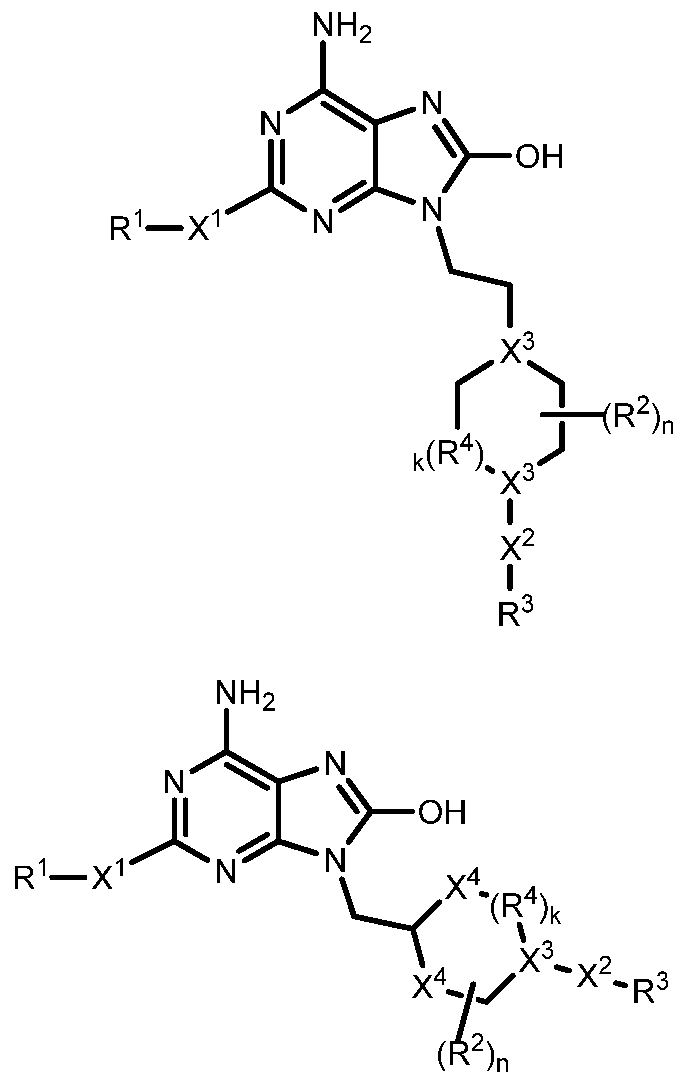

R1 is hydrogen, (Ci-Cio)alkyl, substituted (Ci-Cio)alkyl, C6-ioaryl, or substituted C6- i0aryl, C5-gheterocyclic, substituted C5-gheterocyclic;
Rc is hydrogen, Ci_i0alkyl, or substituted Ci_i0alkyl; or Rc and R1 taken together with the nitrogen to which they are attached form a heterocyclic ring or a substituted heterocyclic ring;
each R2 is independently -OH, (Ci-C6)alkyl, substituted (Ci-C6)alkyl, (Ci-C6)alkoxy, substituted (Ci-C5)alkoxy, -C(0)-(Ci-C5)alkyl (alkanoyl), substituted -C(0)-(Ci-C5)alkyl, - C(0)-(C5-Cio)aryl (aroyl), substituted -C(O)-(C5-Ci0)aryl, -C(0)OH
(carboxyl), -C(0)0(Ci-C5)alkyl (alkoxycarbonyl), substituted -C(0)0(Ci-C5)alkyl, -NRaRb, - C(0)NRaRb (carbamoyl), halo, nitro, or cyano, or R2 is absent;
each Ra and Rb is independently hydrogen, (Ci-C6)alkyl, substituted (Ci-C6)alkyl, (C3-C8)cycloalkyl, substituted (C3-C8)cycloalkyl, (Ci-C6)alkoxy, substituted (Ci-C6)alkoxy, (Ci-C6)alkanoyl, substituted (Ci-C6)alkanoyl, aryl, aryl(Ci-C6)alkyl, Het, Het (Ci-C6)alkyl, or (Ci-C6)alkoxycarbonyl;
wherein the substituents on any alkyl, aryl or heterocyclic groups are hydroxy, CV 5alkyl, hydroxyCi-6alkylene, Ci-6alkoxy, C3-5cycloalkyl, Ci-5alkoxyCi-5alkylene, amino, cyano, halo, or aryl;
n is 0, 1, 2, 3 or 4;
X2 is a bond or a linking group; and
R3 is a phospholipid comprising one or two carboxylic esters;
X3 is -N- or -CH-;
R4 is -CH2- or -CH(R2)-; and
k is 0 or 1;
X4 is -0-, -S-, -NH-, -N(Rd)-, -CH2-, or -CH(R2)-;
each Rd is independently -OH, (Ci-C6)alkyl, substituted (Ci-C6)alkyl, (Ci-C6)alkoxy, substituted (Ci-C5)alkoxy, -C(0)-(Ci-C5)alkyl (alkanoyl), substituted -C(0)-(Ci-C5)alkyl, - C(0)-(C5-Cio)aryl (aroyl), substituted -C(O)-(C5-Ci0)aryl, -C(0)0(Ci-C5)alkyl
(alkoxycarbonyl), substituted -C(0)0(Ci-C5)alkyl, -C(0)NRaRb (carbamoyl);
or a tautomer thereof;
or a pharmaceutically acceptable salt or solvate thereof.
The lipid vehicle could for example be a liposome, said liposome comprising at least part of said at least one active ingredient; said liposome exhibiting a net positive charge at physiological conditions.
According to third aspect, the invention concerns a pharmaceutical formulation comprising a lipid vehicle, said lipid vehicle comprising at least part of said at least one active ingredient, and at least part of said lipid vehicle are lipid vehicles according to the first aspect of the invention.The person skilled in the art is aware of suitable excipients to include in such a pharmaceutical formulation. However, reference is made to the detailed disclosure below.
According to another aspect, the invention concerns a lipid vehicle according to the first aspect of the invention, a lipid vehicle delivery system according to the second aspect of the invention or a pharmaceutical formulation according to the third aspect of the invention for use as a pharmaceutical. The lipid vehicle, the lipid vehicle delivery system or the pharmaceutical formulation according to the invention may be used as a pharmaceutical for the prophylaxis, treatment or amelioration of a number of conditions as disclosed in more detail below.
Another aspect of the invention is the lipid vehicle, the lipid vehicle delivery system or the pharmaceutical formulation according to for use in a monocytic associated prophylaxis, treatment or amelioration.
According to another aspect, the invention concerns a use of the lipid vehicle according to the first aspect of the invention, the lipid vehicle delivery system according to the second aspect of the invention or the pharmaceutical formulation according to the third aspect of the invention for the preparation of a medicament for use in a monocytic associated prophylaxis, treatment or amelioration.
According to another aspect, the invention concerns a method for in vitro activation/inhibition of monocytes, comprising the steps: i) Providing fresh blood from a mammal in need thereof; ii) Administering a lipid vehicle according to the first aspect, the lipid
vehicle delivery system according to the second aspect or the pharmaceutical formulation according to the third aspect of the invention to said fresh blood; iii) Allowing said lipid, vehicle, lipid vehicle delivery system or pharmaceutical formulation to react.
Thereby it will be possible to analyse the monocyte fraction for immune stimulation of monocyte function.
According to another aspect, the invention concerns a method for in vivo activation/inhibition of monocytes in a mammal, comprising the step of administering a lipid vehicle according to the first aspect of the invention, a lipid vehicle delivery system according to the second aspect or a pharmaceutical composition according to the third aspect of the invention to said mammal in an amount sufficient to activate/inhibit said monocytes.
According to another aspect, the invention concerns a method for in vivo activation/inhibition of monocytes in a mammal, comprising the steps: i) Providing fresh blood from a mammal in need thereof;
Administering a lipipd vehicle according to the first aspect of the
invention, a lipid vehicle delivery system according to the second aspect or a pharmaceutical formulation according to the third aspect of the invention to said fresh blood;
Allowing said lipid vehicle, lipid delivery system or pharmaceutical formulation to react with said fresh blood; iv) Reintroducing said blood into the circulation of said mammal.
Thereby inducing immune functions through monocytes in said mammal without directly administering the lipid vehicle to that mammal. According to another aspect, the invention concerns a method for prophylactic or therapeutic treatment or amelioration of cancer, an infectious disease, or allergy, the method comprising administering to a subject in need thereof an effective amount of a lipid vehicle according to the first aspect of the invention, a lipid vehicle delivery system according to the second aspect or a pharmaceutical composition according to the third aspect of the invention. LEGENDS TO THE FIGURE
Fig. 1 : Overview of liposomes, liposome size and surface charge. (A) List of liposomes composed of l-palmitoyl-2-oleoyl-sn-glycero-3-phosphocholine (POPC), l-palmitoyl-2-oleoyl- sn-glycero-3-phosphoglycerol (POPG) and 1,2- dioleoyl -sn-glycero-3-phosphoethanolamine- N-[methoxy(polyethylene glycol)-2000] (DOPE-PEG2000). Ratio of each component in the liposomes is shown. (B) Liposome surface charge expressed in mV. (C) Liposome size measured in nanometer (nm). Liposome compositions for B and C refer to the numbers from figure 1A.
Fig. 2: Uptake of liposome formulations containing POPC (formulation 3 and 4) with or without addition of negative (POPG, formulation 1 and 2) or positive (DOTAP, formulation 5 and 8) lipids. (A) Antibodies used as markers for five different cell populations in whole blood samples; CD14 (monocytic marker), CD15 (granulocytic marker), CD3 (T-lymphocytic marker), CD19 (B-lymphocytic marker), and CD56 (NK cell marker). (B) FACS analysis of the uptake of six different liposome formulations containing RhB (compositions 1-4, 8 and 5, respectively, in Fig. lA)(POPC: POPG 90: 10, POPC: POPG: DOPE-PEG2000 90: 5: 5, POPC, POPC: DOTAP: DOPE-PEG2000 90: 5: 5, POPC: DOTAP 90: 10, POPC: DOTAP: DOPE-PEG2000
80: 15: 5) . The data are expressed as percentages of cells positive for RhB shown as mean ±
SD. Each group is analyzed by one-way ANOVA. When two values are compared a two-tailed t-test is used (*** P<0.001, **** P<0.0001) . (C) Representative graphs showing gating of positive cells in the 5 cell populations.
Fig. 3: Uptake of liposome formulation 3 (A) and 8 (B) after 0, 5, 15 and 60 min incubation are shown. Data are expressed as percentages of cells positive for RhB shown as mean ± SD. Each group is analyzed by one-way ANOVA (**** P<0.0001). (C) Representative graphs showing gating of positive cells in the 5 cell populations.
Fig. 4: Uptake of liposome formulation 3 (A) and 8 (B) containing RhB (Fig. 1A) at a concentration of 0, 50, 250, and 500mM. Data are expressed as percentages of cells positive for RhB shown as mean ± SD. Each group is analyzed by one-way ANOVA (**** P<0.0001). (C) Representative graphs showing gating of positive cells in the 5 cell populations.
Fig. 5: The effect of positive charge on uptake in the different cell populations was analyzed. (A) Uptake of liposome formulations containing 0-50 mol% DOTAP (composition 3 and 6-12 in Fig. 1A). Data are expressed as percentages of cells positive for RhB shown as mean ± SD. Each group is analyzed by one-way ANOVA. When two values are compared a two-tailed t- test is used (*** P<0.001, **** P<0.0001, ns = not significant). (B) Representative graphs showing gating of positive cells in the 5 cell populations.
Fig. 6: Uptake of liposome formulation 3 (A) and 8 (B) containing RhB (Fig. 1A) after 0, 2h and 4h incubation of the blood at 37C with rotation are shown. Data are expressed as percentages of cells positive for RhB shown as mean ± SD. Each group is analyzed by oneway ANOVA. When two values are compared a two-tailed t-test is used (* P<0.05, *** P<0.001, **** P<0.0001). (C) Representative graphs showing gating of positive cells in the 5 cell populations.
Fig. 7: Liposome cytotoxicity was measured on the human monocytic cell line THP-1 using liposomes containing 0- 50% DOTAP (composition 3 and 6-12 in Fig. 1A). Four different concentrations of liposome were used : 5, 50, 250 and 500 μΜ. (A) FACS analysis of uptake of liposomes in THP-1 cells after 60 min incubation. (B) Liposomes were incubated with cells for 60 min before washing with cell media. After 24 h annexin V binding to the cells was measured by FACS. Staurosporine is used as positive control for apoptosis. (C)
Representative graphs showing gating of annexin V positive cells. (D) Liposomes were incubated with cells for 60 min before washing with cell media. After 24 h the liposome induced cytotoxicity was measured by incubation with XTT for 4 hours. (E) Phase contrast microscopy pictures showing cells after XTT incubation. Data are expressed as MFI of liposome uptake (A), percentages of cells positive for annexin V (B) or absorbance (D) shown
as mean ± SD. Each group is analyzed by one-way ANOVA. When two values are compared a two-tailed t-test is used (*** P<0.001, **** P<0.0001, ns = not significant).
Fig. 8: Two examples of TLR7 agonists that have been investigated and that have structural properties suitable for formulation in liposomes, A) TMX-201 (2-(4-((6-amino-2-(2- methoxyethoxy)-8-oxo-7H-purin-9(8H)-yl)methyl)benzamido)ethyl 2,3-bis(oleoyloxy)propyl phosphate ) and B) TMX-202 (2-(4-((6-amino-2-(2-methoxyethoxy)-8-oxo-7H-purin-9(8H)- yl)methyl)benzamido)ethyl 2,3-bis(dodecyloxy)propyl phosphate ).
Fig. 9: Overview of liposomes prepared according to the described in examples and used for studying the targeting and activation of monocytes in human whole blood. Shown are the molar ratios of each liposome and associated zeta potential for each formulation measured in mV. Lipids used were l-palmitoyl-2-oleoyl-sn-glycero-3-phosphocholine (POPC), cholesterol (Choi), dimethyldioctadecylammonium bromide (DDAB), l,2-dioctadecanoyl-3- trimethylammonium-propane (DOTAP) and TMX-201 and TMX-202. Fig. 10: Cationic liposomes target CD14+ monocytes efficiently in human whole blood.
Liposomes prepared and shown in figure 9 were incubated with human whole blood and CD14+ monocytes were analysed for rhodamine content. Data are expressed as percentages of CD14+ monocytes positive for RhB shown as mean + SD of single measurements from four separate donors (open bars) . The filled bars show the amount of liposome associated with monocytes, expressed as Mean Fluorescence Intensity (MFI).
Fig. 11 : Cationic liposomes preferentially target CD14+ monocytes over leukocytes and granulocytes. Liposomes prepared and shown in figure 9 and 10 were incubated with human whole blood and different immune cell subsets were analysed for RhB association and expressed as percentage of this specific cell subset being positive for RhB. The analyses were based on the following markers: black bars represent monocytes (CD14+), grey bars represent lymphocytes CD3 (T-lymphocytic marker), CD19 (B-lymphocytic marker), and CD56 (NK cell marker), and finally white bars represent granulocytes (CD15+). Data are expressed as mean + SD of single measurements from four separate donors.
Fig. 12: TMX-201 and TMX-202 containing liposomes (TMX-liposomes) combined with cationic lipids are able to target and activate monocytes when incubated in whole blood. Whole fresh human blood was drawn and immediately incubated with control reagents and liposomes. The samples were incubated for 60 min at 37° C with rotation and subsequently distributed into 96 well plates with the addition of 20 % RPMI medium, and incubated for 24 h to allow the targeted monocytes to respond towards the treatment. All TMX-containing samples were treated with concentrations in the range between 0.1-1.0 and 10 ug/ml. Free TMX-201
showed secretion of IL-6 to 2000 pg/ml in the highest concentration, but not at lower concentrations. TMX-201 with POPC liposomes were not able to induce IL-6 secretion, whereas TMX-201 liposomes with DOTAP or DDAB induced IL-6 to similar levels, but also at lower concentrations (1.0 ug/ml). Free TMX-202 showed secretion of IL-6 at approximately 200 pg/ml in the highest concentration, but not at lower concentrations. TMX-202 with POPC liposomes showed similar IL-6 secretion, whereas TMX-202 liposomes with DOTAP or DDAB induced very high IL-6 secretion, both at the highest doses of 10 ug/ml, but also at the lower and middle doses, with the free TMX-202 and the POPC formulated TMX-202 being unable to induce IL-6. SD is shown for measurements from three separate donors. Fig. 13: TMX-201 and TMX-202 containing liposomes combined with cationic lipids are able to target and activate monocytes to induce secretion of IL-12p40 when targeted in whole blood. Experimental procedures were as in figure 10. Free TMX-201 showed a dose-dependent secretion of IL-12p40. TMX-201 with POPC liposomes were not able to induce IL-12p40 secretion, whereas TMX-201 liposomes with DOTAP or DDAB induced higher IL-12p40 amounts. Free TMX-202 showed low secretion of IL-12p40 at approximately 200 pg/ml in the highest concentration. TMX-202 with POPC liposomes showed similar low IL-12p40 secretion, whereas TMX-202 liposomes with DOTAP or DDAB dose-dependently induced very high IL- 12p40 secretion. SD of measurements from three separate donors.
Fig. 14: Table showing potent TMX-liposomes suitable for testing in a mammal as general immunotherapy against cancer in a non-antigen specific manner, or combined with an antigen. Lipids used were l-palmitoyl-2-oleoyl-sn-glycero-3-phosphocholine (POPC), cholesterol (Choi), dimethyldioctadecylammonium bromide (DDAB), l,2-dioctadecanoyl-3- trimethylammonium-propane (DOTAP) and TMX-202. Fig. 15: (A) Total metastatic score evaluated using the scoring table in example 17 for vehicle treated (sucrose buffer) and free TMX-202 administered with 10 doses (lOd), total dose was 800 nmol TMX-202 for the whole study per mouse. The cationic liposomes with the formulation POPC: Chol : DDAB:TMX-202 (52: 13: 30: 5), were administered at the same dose and schedule. (B) A crude measure of lung metastatic burden was evaluated by the total lung weight measured at autopsy in grams. All treatment groups showed reduced lung weight to 70-80 % of vehicle treated mice.
Fig. 16: (A) As a measure of toxicity towards the treatment, total survival days were counted for each group of mice treated as outlined in example 18. For all groups, 10 mice were used per group and sacrificed at day 23 unless toxicity caused earlier death or sacrifice due to toxicity. Only one mouse in group 3 died at day 13. (B) Body weight change was monitored during the study, and no significant change between the groups was noticed.
Detailed disclosure of the invention Definitions
A "lipid vehicle" in the present application and claims denotes an artificial prepared vesicle made of at least one type of lipid that self-associates into an aggregate in water. Examples of such vesicles are, but not limited to, liposome, micelle, cubosomes, worm-like micelles.
A "liposome" in the present application and claims denotes an artificial prepared vesicle made of at least one lipid bilayer.
The term "preferentially adheres" as used in the present context means that the liposomes according to the invention adheres to monocytes in freshly drawn blood to an extent which is at least 1.5 times larger than the adherence to granulocytes, T-lymphocytes, B-lymphocytes and/or NK cells in freshly drawn blood, preferably at least 2 times, such as at least 3 times, more preferably at least 4 times, such as at least 5 times larger than the adherence to granulocytes, T-lymphocytes, B-lymphocytes and/or NK cells in freshly drawn blood . The term "freshly drawn blood" in the present context means that the blood in question has been drawn from a mammal within no more than 60 minutes, such as no more than 30 minutes, preferably no more than 15 minutes, no more than 10 minutes, such as no more than 5 minutes.
The term "zeta potential" in the present context describes the electric potential at the location of the slipping plane of a colloidal particle in solution versus a point in the bulk fluid away from the interface. The term "relative zeta potential" in the present context for a liposome X is defined as (zeta potential of X minus zeta potential of liposome 6 of fig. 1 (5% DOTAP)) divided by (difference between zeta potential of liposome 11 of fig. 1 (20% DOTAP) minus zeta potential of liposome 6 of fig. 1 (5% DOTAP))x 100; measured in 10% sucrose buffer under the same conditions as disclosed in detail in ex. 2.
The term "immunogenic" means capable of inducing an immunological response.
The term "lipids with a net positive charge" and "cationic lipid" as used in the present context covers lipids that have one or more positively charged atoms in its chemical structure where the overall net charge of the lipid is positive, said lipids are molecules with a hydrophobic
part and a hydrophilic part such as an amphiphile, said, but not limited to, phospholipids, ceramides, sterols, lipopeptides.
When using the terms "substantial"/"substantially" or "essential"/"essentially" herein it is intended that the feature which is described by these terms is present in an amount or has an impact which provides for a technical effect with relevance for the exercise of the presently claimed invention. For instance, a "substantial amount" of a substance in a composition is an amount which provides for a technical effect exhibited by the substance to a degree which provides for a technical effect in terms of the present invention . Likewise, if a composition is indicated as comprising "substantially no" of a particular substance, this means that the composition is allowed to include insignificant amounts of the substance, as long as these amounts do not have any technical impact on the other ingredients in the composition and does not in itself "make a difference" - or put in other words, "substantially no" and "essentially no" means that e.g. trace amounts or effects may be present as long as they do not have an overall technical influence. The term "amino acid" as used herein, comprises the residues of the natural amino acids
(e.g., Ala, Arg, Asn, Asp, Cys, Glu, Gin, Gly, His, Hyl, Hyp, He, Leu, Lys, Met, Phe, Pro, Ser, Thr, Trp, Tyr, and Val) in D or L form, as well as unnatural amino acids (e.g ., phosphoserine, phosphothreonine, phosphotyrosine, hydroxyproline, gamma-carboxyglutamate; hippuric acid, octahydroindole-2-carboxylic acid, statine, l,2,3,4,-tetrahydroisoquinoline-3-carboxylic acid, penicillamine, ornithine, citruline, -methyl-alanine, para-benzoylphenylalanine, phenylglycine, propargylglycine, sarcosine, and tert-butylglycine) . The term also comprises natural and unnatural amino acids bearing a conventional amino protecting group (e.g ., acetyl or benzyloxycarbonyl), as well as natural and unnatural amino acids protected at the carboxy terminus (e.g., as a (Ci-C6)alkyl, phenyl or benzyl ester or amide; or as an - methylbenzyl amide) . Other suitable amino and carboxy protecting groups are known to those skilled in the art (see for example, T.W. Greene, Protecting Groups In Organic
Synthesis; Wiley: New York, 1981, and references cited therein) . For instance, an amino acid can be linked to the remainder of a compound of formula I through the carboxy terminus, the amino terminus, or through any other convenient point of attachment, such as, for example, through the sulfur of cysteine.
The term "toll-like receptor agonist" (TLR agonist) refers to a molecule that binds to a TLR. Synthetic TLR agonists are chemical compounds that are designed to bind to a TLR and activate the receptor.
The term "nucleic acid" as used herein, refers to DNA, RNA, single-stranded, double- stranded, or more highly aggregated hybridization motifs, and any chemical modifications
thereof. Modifications include, but are not limited to, those providing chemical groups that incorporate additional charge, polarizability, hydrogen bonding, electrostatic interaction, and fluxionality to the nucleic acid ligand bases or to the nucleic acid ligand as a whole. Such modifications include, but are not limited to, peptide nucleic acids (PNAs), phosphodiester group modifications (e.g., phosphorothioates, methylphosphonates), 2'-position sugar modifications, 5-position pyrimidine modifications, 7-position purine modifications, 8-position purine modifications, 9-position purine modifications, modifications at exocyclic amines, substitution of 4-thiouridine, substitution of 5-bromo or 5-iodo-uracil; backbone
modifications, methylations, unusual base-pairing combinations such as the isobases, isocytidine and isoguanidine and the like. Nucleic acids can also include non-natural bases, such as, for example, nitroindole. Modifications can also include 3' and 5' modifications such as capping with a BHQ, a fluorophore or another moiety.
Within the present invention it is to be understood that a compound of the formula (I) or a salt thereof may exhibit the phenomenon of tautomerism whereby two chemical compounds that are capable of facile interconversion by exchanging a hydrogen atom between two atoms, to either of which it forms a covalent bond. Since the tautomeric compounds exist in mobile equilibrium with each other they may be regarded as different isomeric forms of the same compound. It is to be understood that the formula drawings within this specification can represent only one of the possible tautomeric forms. However, it is also to be understood that the invention encompasses any tautomeric form, and is not to be limited merely to any one tautomeric form utilized within the formula drawings. The formula drawings within this specification can represent only one of the possible tautomeric forms and it is to be understood that the specification encompasses all possible tautomeric forms of the compounds drawn not just those forms which it has been convenient to show graphically herein. For example, tautomerism may be exhibited by a pyrazolyl group bonded as indicated by the wavy line. While both substituents would be termed a 4-pyrazolyl group, it is evident that a different nitrogen atom bears the hydrogen atom in each structure.

Such tautomerism can also occur with substituted pyrazoles such as 3-methyl, 5-methyl, or 3,5-dimethylpyrazoles, and the like. Another example of tautomerism is amido-imido (lactam-lactim when cyclic) tautomerism, such as is seen in heterocyclic compounds bearing a ring oxygen atom adjacent to a ring nitrogen atom. For example, the equilibrium:
 is an example of tautomerism.
Accordingly, a structure depicted herein as one tautomer is intended to also include the other tautomer.
is an example of tautomerism.
Accordingly, a structure depicted herein as one tautomer is intended to also include the other tautomer.
Optical Isomerism It will be understood that when compounds of the present invention contain one or more chiral centers, the compounds may exist in, and may be isolated as pure enantiomeric or diastereomeric forms or as racemic mixtures. The present invention therefore includes any possible enantiomers, diastereomers, racemates or mixtures thereof of the compounds of the invention. Specific embodiments of the invention
Additional embodiments of the present invention are described below. It will be clear for the person skilled in the art, that aspects and/or embodiments of the invention may be combined.
An embodiment of the invention is a lipid vehicle exhibiting a net positive charge at physiological conditions at which said lipid vehicle preferentially adheres to monocytes in freshly drawn blood when compared to adherence to granulocytes, T-lymphocytes, B- lymphocytes and/or NK cells in freshly drawn blood. Thereby a selective targeting and association with monocytes present in the blood or tissue is allowed.
An embodiment of the invention is a lipid vehicle such as, but not limited to, a liposome having a relative zeta potential of between 15 and 85%.
As it appears from the results reported herein, a lipid vehicle such as, but not limited to, a liposome according to the invention, at a relative zeta potential in the range 15-85% selectively adheres to monocytes.
An embodiment of the invention is a lipid vehicle such as, but not limited to a liposome, wherein said lipid vehilce suitable for intravenous administration.
An embodiment of the invention is a lipid vehicle such as, but not limited to, a liposome having a relative zeta potential of between 20 and 80%.
An embodiment of the invention is a lipid vehicle such as, but not limited to, a liposome having a relative zeta potential of between 25 and 75%.
More particularly, the relative zeta potential is in the range 20-80%, even more particularly in the range 25-75%. Within these ranges the selectivity for monocytes compared to other blood components such as granulocytes, T-lymphocytes, B-lymphocytes and/or NK cells is even more pronounced.
Liposome structure and characteristics
An embodiment of the invention is a lipid vehicle such as, but not limited to, a liposome, wherein at least part of the lipids are selected from the group consisting of phospholipids, sterols and sterol derivatives.
A particular embodiment of the invention is a lipid vehicle such as, but not limited to, a liposome, wherein the lipid comprises or constitutes a member selected from the group consisting of phosphatidylcholine (PC), phosphatidylethanolamine (PE), phosphatidylserine (PS), phosphatidylglycerol (PG), phosphatidylinositol (PI), phosphatidic acid (PA), DPG (bisphosphatidyl glycerol), PEOH (phosphatidyl alcohol), cholesterol, ergosterol and lanosterol.
An embodiment of the invention is a lipid vehicle such as, but not limited to, a liposome, wherein the phosphatidylcholines are selected from the group consisting of 1,2-dioleoyl- phosphatidylcholine, 1,2-dipalmitoyl-phosphatidylcholine, 1,2-dimyristoyl- phosphatidylcholine, 1,2-distearoyl-phosphatidylcholine, l-oleoyl-2-palmitoyl- phosphatidylcholine, l-oleoyl-2-stearoyl-phosphatidylcholine, l-palmitoyl-2-oleoyl- phosphatidylcholine and l-stearoyl-2-oleoyl-phosphatidylcholine.
An embodiment of the invention is a lipid vehicle such as, but not limited to, a liposome, wherein the phosphatidylcholines are selected from the group consisting of 1,2-dioleoyl- phosphatidylcholine, 1,2-dipalmitoyl-phosphatidylcholine, 1,2-dimyristoyl- phosphatidylcholine, 1,2-distearoyl-phosphatidylcholine, and l-palmitoyl-2-oleoyl- phosphatidylcholine.
A particular embodiment of the invention is a lipid vehicle such as, but not limited to, a liposome, wherein the lipid comprises 1,2-dioleoyl-phosphatidylcholine.
Another embodiment of the invention is a lipid vehicle such as, but not limited to, a liposome, wherein the phosphatidylethanolamines are selected from the group consisting of 1,2- dioleoyl-phosphatidylethanolamine, 1,2-dipalmitoyl-phosphatidylethanolamine, 1,2- dimyristoyl-phosphatidylethanolamine, 1,2-distearoyl-phosphatidylethanolamine, l-oleoyl-2- palmitoyl-phosphatidylethanolamine, l-oleoyl-2-stearoyl-phosphatidylethanolamine, 1- palmitoyl-2-oleoyl-phosphatidylethanolamine, l-stearoyl-2-oleoyl-phosphatidylethanolamine and N-succinyl-dioleoyl-phosphatidylethanolamine; the phosphatidylserines are selected from the group consisting 1,2-dioleoyl-phosphatidylserine, 1,2-dipalmitoyl-phosphatidylserine, 1,2-dimyristoyl-phosphatidylserine, 1,2-distearoyl-phosphatidylserine, l-oleoyl-2-palmitoyl- phosphatidylserine, l-oleoyl-2-stearoyl-phosphatidylserine, l-palmitoyl-2-oleoyl- phosphatidylserine and l-stearoyl-2-oleoyl-phosphatidylserine; the phosphatidylglycerols are selected from the group consisting 1,2-dioleoyl-phosphatidylglycerol, 1,2-dipalmitoyl- phosphatidylglycerol, 1,2-dimyristoyl-phosphatidylglycerol, 1,2-distearoyl- phosphatidylglycerol, l-oleoyl-2-palmitoyl-phosphatidylglycerol, l-oleoyl-2-stearoyl- phosphatidylglycerol, l-palmitoyl-2-oleoyl-phosphatidylglycerol and l-stearoyl-2-oleoyl- phosphatidylglycerol; the phosphatidic acids are selected from the group consisting of di- palmitoyl-glycerophosphatidic acid, di-stearoyl-glycerophosphatidic acid, di-myrostoyl- glycerophosphatidic acid, di-oleoyl-glycerophosphatidic acid, palmitoyl-oleoyl- glycerophosphatidic acid. Another embodiment of the invention is a lipid vehicle such as, but not limited to, a liposome, wherein the lipid comprises or constitutes phosphatidylglycerol (PG),
phosphatidylethanolamine (PE), phosphatidylserine (PS), phosphatidylcholine (PC), phosphatidylinositol (PI), phosphatidic acid (PA), DPG (bisphosphatidyl glycerol), PEOH (phosphatidyl alcohol), cholesterol, phosphatidylcholines such as 1,2-dioleoyl- phosphatidylcholine, 1,2-dipalmitoyl-phosphatidylcholine, 1,2-dimyristoyl- phosphatidylcholine, 1,2-distearoyl-phosphatidylcholine, l-oleoyl-2-palmitoyl- phosphatidylcholine, l-oleoyl-2-stearoyl-phosphatidylcholine, l-palmitoyl-2-oleoyl- phosphatidylcholine and l-stearoyl-2-oleoyl-phosphatidylcholine; phosphatidylethanolamines such as 1,2-dioleoyl-phosphatidylethanolamine, 1,2-dipalmitoyl-phosphatidylethanolamine, 1,2-dimyristoyl-phosphatidylethanolamine, 1,2-distearoyl-phosphatidylethanolamine, 1- oleoyl-2-palmitoyl-phosphatidylethanolamine, l-oleoyl-2-stearoyl-phosphatidylethanolamine, l-palmitoyl-2-oleoyl-phosphatidylethanolamine, l-stearoyl-2-oleoyl- phosphatidylethanolamine and N-succinyl-dioleoyl-phosphatidylethanolamine;
phosphatidylserines such as 1,2-dioleoyl-phosphatidylserine, 1,2-dipalmitoyl- phosphatidylserine, 1,2-dimyristoyl-phosphatidylserine, 1,2-distearoyl-phosphatidylserine, 1- oleoyl-2-palmitoyl-phosphatidylserine, l-oleoyl-2-stearoyl-phosphatidylserine, l-palmitoyl-2- oleoyl-phosphatidylserine and l-stearoyl-2-oleoyl-phosphatidylserine; phosphatidylglycerols such as 1,2-dioleoyl-phosphatidylglycerol, 1,2-dipalmitoyl-phosphatidylglycerol, 1,2-
dimyristoyl-phosphatidylglycerol, 1,2-distearoyl-phosphatidylglycerol, l-oleoyl-2-palmitoyl- phosphatidylglycerol, l-oleoyl-2-stearoyl-phosphatidylglycerol, l-palmitoyl-2-oleoyl- phosphatidylglycerol and l-stearoyl-2-oleoyl-phosphatidylglycerol; 1,2-dioctadecanoyl-sn- glycero-3-ethylphosphocholine (Ethyl PC); pegylated lipids; pegylated phospoholipids such as phophatidylethanolamine-N-[methoxy(polyethyleneglycol)-1000], phophatidylethanolamine- N-[methoxy(polyethyleneglycol)-2000], phophatidylethanolamine-N-[methoxy (polyethylene glycol)-3000], phophatidylethanolamine-N-[methoxy(polyethyleneglycol)-5000] ; pegylated ceramides such as N-octanoyl-sphingosine-l-{succinyl[methoxy(polyethyleneglycol)1000]}, N-octanoyl-sphingosine-l-{succinyl[methoxy(polyethylene glycol)2000]}, N-octanoyl- sphingosine-l-{succinyl[methoxy(polyethyleneglycol)3000]}, N-octanoyl-sphingosine-1- {succinyl[methoxy(polyethyleneglycol)5000]};lyso-phosphatidylcholines, lyso- phosphatidylethanolamines, lyso-phosphatidylglycerols, lyso-phosphatidylserines, ceramides; sphingolipids; glycolipids such as ganglioside GMI; glucolipids; sulphatides; phosphatidic acid, such as di-palmitoyl-glycerophosphatidic acid; palmitic fatty acids; stearic fatty acids;
arachidonic fatty acids; lauric fatty acids; myristic fatty acids; lauroieic fatty acids; physeteric fatty acids; myristoleic fatty acids; palmitoleic fatty acids; petroselinic fatty acids; oleic fatty acids; isolauric fatty acids; isomyristic fatty acids; isostearic fatty acids; sterol and sterol derivatives such as cholesterol, cholesterol hemisuccinate, cholesterol sulphate, and cholesteryl-(4-trimethylammonio)-butanoate, ergosterol, lanosterol; polyoxyethylene fatty acids esters and polyoxyethylene fatty acids alcohols; polyoxyethylene fatty acids alcohol ethers; polyoxyethylated sorbitan fatty acid esters, glycerol polyethylene glycol oxy-stearate; glycerol polyethylene glycol ricinoleate; ethoxylated soybean sterols; ethoxylated castor oil; polyoxyethylene polyoxypropylene fatty acid polymers; polyoxyethylene fatty acid stearates; di-oleoyl-sn-glycerol; dipalmitoyl-succinylglycerol; l,3-dipalmitoyl-2-succinylglycerol; 1-alkyl- 2-acyl-phosphatidylcholines such as l-hexadecyl-2-palmitoyl-phosphatidylcholine; l-alkyl-2- acyl-phosphatidylethanolamines such as l-hexadecyl-2-palmitoyl-phosphatidylethanolamine; l-alkyl-2-acyl-phosphatidylserines such as l-hexadecyl-2-palmitoyl-phosphatidylserine; 1- alkyl-2-acyl-phosphatidylglycerols such as l-hexadecyl-2-palmitoyl-phosphatidylglycerol; 1- alkyl-2-alkyl-phosphatidylcholines such as l-hexadecyl-2-hexadecyl-phosphatidylcholine; 1- alkyl-2-alkyl-phosphatidylethanolamines such as l-hexadecyl-2-hexadecyl- phosphatidylethanolamine; l-alkyl-2-alkyl-phosphatidylserines such as l-hexadecyl-2- hexadecyl-phosphatidylserine; l-alkyl-2-alkyl-phosphatidylglycerols such as l-hexadecyl-2- hexadecyl-phosphatidylglycerol; and N-Succinyl-dioctadecylamine; palmitoylhomocysteine.
An embodiment of the invention is a lipid vehicle such as, but not limited to, a liposome, wherein at least part of the lipids is a cationic lipid.
It has thus been found that liposomes having a net positive charge adhere preferentially to monocytes compared to adherence to granulocytes, T-lymphocytes, B-lymphocytes and/or NK cells.
An embodiment of the invention is a lipid vehicle such as, but not limited to, a liposome, wherein the cationic lipids are selected from the group consisting of stearylamine (SA), lauryltrimethylammonium bromide; cetyltrimethyl-ammonium bromide, myristyl
trimethylammonium bromide, dimethyldioctadecylammonium bromide (DDAB), 3β-[Ν-(Ν',Ν'- dimethylaminoethane)-carbamoyl]cholesterol (DC-Cholesterol), l,2-ditetradecanoyl-3- trimethylammonium-propane (DMTAP), l,2-dioctadecanoyl-3-trimethylammonium-propane (DOTAP) and DOTAP derivatives such as l,2-di-(9Z-octadecenoyl)-3-trimethylammonium- propane and l,2-dihexadecanoyl-3-trimethylammonium-propane, l,2-di-(9Z-octadecenoyl)- 3-dimethylammonium-propane (DODAP) and DODAP derivatives such as 1,2-ditetradecanoyl- 3-dimethylammonium-propane, l,2-dihexadecanoyl-3-dimethylammonium-propane, and 1,2- dioctadecanoyl-3-dimethylammonium-propane, l,2-di-0-octadecenyl-3-trimethylammonium propane (DOTMA), l,2-dioleoyl-c-(4'-trimethylammonium)-butanoyl-sn-glycerol (DOTB), dioctadecylamide-glycylspermine, SAINT-2, polycationic lipid 2,3-dioleyloxy-N-[2(spermine- carboxamido)ethyl]-N,N-dimethyl-l-propanaminiumtrifluoroacetate (DOSPA), and GL67TM.
A particular embodiment of the invention is a liposome, wherein the cationic lipids are selected from the group consisting of stearylamine (SA), l,2-dioctadecanoyl-3- trimethylammonium-propane (DOTAP) and l,2-di-(9Z-octadecenoyl)-3-dimethylammonium- propane (DODAP), preferably l,2-dioctadecanoyl-3-trimethylammonium-propane (DOTAP).
Preferred cationic lipids are DOTAP and DOTAP derivatives. Additional examples of cationic lipids and lipid components may be found in or made according to US 4,804,539.
An embodiment of the invention is a liposome, wherein at least part of the lipids is a cationic lipopeptide selected from the group consisting of a lipid polyarginine conjugate, a lipid TAT conjugate, a lipid polylysine conjugate, or a cationic liposaccharide or lipopolysaccharide such as a lipid chitosan conjugate.
An embodiment of the invention is a lipid vehicle such as, but not limited to, a liposome, wherein the lipid vehicle comprise 0.5-50%, preferably 1-20%, such as 5-20, such as 10- 20% (mol/mol) cationic lipids.
As it appears from the results reported herein, at ranges of cationic lipids in the above range selectivity for monocytes is obtained.
An embodiment of the invention is a lipid vehicle such as, but not limited to, a liposome, which, when relevant, contains alkyl chains of the lipids that are C8-C24, preferably C10- C22, more preferred C12-C20, preferably C14-C18, most preferred C16-C18 saturated chains or unsaturated chains, preferably saturated chains.
An embodiment of the invention is a lipid vehicle such as, but not limited to, a liposome, wherein at least one liposome is a Large Unilamellar Vesicle (LUV).
One preferred embodiment of the in invention is a liposome in the form of Large Unilamellar Vesicles (LUV), meaning that LUVs are preferred components of a pharmaceutical composition comprising liposomes of the invention.
An embodiment of the invention is a lipid vehicle such as, but not limited to, a liposome, wherein the lipid vehicles have a diameter of 40-2000 nm, preferably 80-1000 nm, more preferred 100-500 nm, preferred 50-200 nm, more preferred 100-150 nm, preferably 100- 400 nm.
The lipid vehicle such as, but not limited to, a liposome of the invention includes a TLR7 agonist of formula (I) as active ingredient, and may further compise one or more active ingredients.
The skilled person will generally be knowledgeable about the choice of active ingredient and the correct dosage thereof.
TLR7 Agonists and Conjugates and Uses thereof
In various embodiments, the invention provides a method to prevent, inhibit or treat a microbial or viral infection, or a malign or benign tumor or allergy in a mammal. The methods include administering to a mammal in need thereof an effective amount of a a lipid vehicle comprising an amount of a compound of selected from any one of Formula (I), Formula (II), Formula (III), and Formula (IV) :


wherein X1 is -0-, -S-, or -NRC-;
R1 is hydrogen, (Ci-Cio)alkyl, substituted (Ci-Cio)alkyl, C6-ioaryl, or substituted C6-ioaryl, C5. gheterocyclic, substituted C5.9heterocyclic;
Rc is hydrogen, Ci_i0alkyl, or substituted Ci_i0alkyl; or Rc and R1 taken together with the nitrogen to which they are attached form a heterocyclic ring or a substituted heterocyclic ring; each R2 is independently -OH, (Ci-C6)alkyl, substituted (Ci-C6)alkyl, (Ci-C6)alkoxy, substituted (Ci-C5)alkoxy, -C(0)-(Ci-C5)alkyl (alkanoyi), substituted -C(0)-(Ci-C5)alkyl, - C(0)-(C5-Cio)aryl (aroyl), substituted -C(O)-(C5-Ci0)aryl, -C(0)OH
(carboxyl), -C(0)0(Ci-C6)alkyl (alkoxycarbonyl), substituted -C(0)0(Ci-C5)alkyl, -NRaRb, - C(0)NRaRb (carbamoyl), halo, nitro, or cyano, or R2 is absent; each Ra and Rb is independently hydrogen, (Ci-C6)alkyl, substituted (Ci-C6)alkyl,
(C3-C8)cycloalkyl, substituted (C3-C8)cycloalkyl, (Ci-C6)alkoxy, substituted (Ci-C6)alkoxy, (Ci-C6)alkanoyl, substituted (Ci-C6)alkanoyl, aryl, aryl(Ci-C6)alkyl, Het, Het (Ci-C6)alkyl, or (Ci-C6)alkoxycarbonyl; wherein the substituents on any alkyl, aryl or heterocyclic groups are hydroxy, Ci_5alkyl, hydroxyCi-6alkylene, Ci-6alkoxy, C3.5cycloalkyl, Ci-5alkoxyCi-5alkylene, amino, cyano, halo, or aryl; n is 0, 1, 2, 3 or 4;
X2 is a bond or a linking group; and
R3 is a phospholipid comprising one or two carboxylic esters;
X3 is -N- or -CH-;
R4 is -CH2- or -CH(R2)-; and
k is 0 or 1;
X4 is -0-, -S-, -NH-, -N(Rd)-, -CH2-, or -CH(R2)-;
each Rd is independently -OH, (Ci-C6)alkyl, substituted (Ci-C6)alkyl, (Ci-C6)alkoxy, substituted (Ci-C5)alkoxy, -C(0)-(Ci-C5)alkyl (alkanoyi), substituted -C(0)-(Ci-C5)alkyl, - C(0)-(C5-Cio)aryl (aroyl), substituted -C(O)-(C5-Ci0)aryl, -C(0)0(Ci-C5)alkyl
(alkoxycarbonyl), substituted -C(0)0(Ci-C5)alkyl, -C(0)NRaRb (carbamoyl); or a tautomer thereof; or a pharmaceutically acceptable salt or solvate thereof. Optionally, the composition further comprises an antigen. In one embodiment, the composition having an antigen is administered concurrently, prior to or subsequent to administration of the composition having a compound of formula (I).
In various embodiments, R3 can comprise a group of formula
 wherein R11 and R12 are each independently a hydrogen, an alkoxycarbonyl, a carbamoyl, an alkyl, or an alkanoyl group, R13 is a negative charge or a hydrogen, and m is 1 to 8, wherein a wavy line indicates a position of bonding, wherein an absolute configuration at the carbon atom bearing OR12 is (R), (S), or any mixture thereof.
In various embodiments, m can be 1, providing a
glycerophosphatidylethanolamine. More specifically, R11 and R12 can each be (C8-C2o)alkanoyl or (C8-C2o)alkyl groups.
In various embodiments, the R11 and R12 of phospholipid of R3 can comprise two (C8-C20)alkanoyl or (C8-C20)alkyl groups with one, two, three or four sites of unsaturation, epoxidation, hydroxylation, or a combination thereof.
In various embodiments, the R11 and R12 of phospholipid of R3 can comprise two (C8-C20)alkanoyl or (C8-C20)alkyl groups that are the same or different. More specifically, each(C8-C20)alkanoyl or (C8-C20)alkyl groups can be fully saturated or have one unsaturation.
In various embodiments, X2 can be a bond or a chain having one to about 10 atoms in a chain wherein the atoms of the chain are selected from the group consisting of carbon, nitrogen, sulfur, and oxygen, wherein any carbon atom can be substituted with oxo, and wherein any sulfur atom can be substituted with one or two oxo groups. The chain can be interspersed with one or more cycloalkyl, aryl, heterocyclyl, or heteroaryl rings.
In various embodiments, X2 can be C(O), or can be any of

In various embodiments, R3 can be l,2-dioleoyl-sn-glycero-3-phospho ethanolamine and X2 can be C(O) .
In various embodiments, X can be oxygen.
In various embodiments, X1 can be sulfur, or can be -NRC- where Rc is hydrogen, Ci_5 alkyl or substituted Ci_5 alkyl, where the alkyl substituents are hydroxy, C3-6cycloalkyl, Ci-6alkoxy, amino, cyano, or aryl . More specifically, X1 can be -NH-.
In various embodiments, R1 and Rc taken together can form a heterocyclic ring or a substituted heterocyclic ring . More specifically, R1 and Rc taken together can form a substituted or unsubstituted morpholino, piperidino, pyrrolidino, or piperazino ring .
In various embodiments R can be a C1-C10 alkyl substituted with Cl-6 alkoxy.
In various embodiments, R1 can be hydrogen, Ci_4alkyl, or substituted Ci_4alkyl . More specifically, R1 can be hydrogen, methyl, ethyl, propyl, butyl, hydroxyCi-4alkylene, or Ci-4alkoxyCi-4alkylene. Even more specifically, R1 can be hydrogen, methyl, ethyl, methoxyethyl, or ethoxyethyl .
In various embodiments, R2 can be absent, or R2 can be halogen or Ci_4alkyl .
More specifically, R2 can be chloro, bromo, methyl, or ethyl, or R2 is absent.
In various embodiments, X1 can be O, R1 can be Ci_4alkoxy-ethyl, n can be 1, R2 can be hydrogen, X2 can be carbonyl, and R3 can be 1,2-dioleoylphosphatidyl ethanolamine (DOPE) .
In various embodiments, the compound of Formula (I) can be:


In some embodiments in the two compounds


In various embodiments, the microbe is a bacteria, or, the antigen can comprise bacterial spores.
In various embodiments, the amount is effective to prevent infection. In various embodiments, the mammal can be a human. In various embodiments, the pharmaceutical formulation can be intravenously administered.
In various embodiments, the pharmaceutical formulation can be intranasally administered, or can be dermally administered.
In various embodiments, the pharmaceutical formulation can be subcutaneously
administered. An embodiment of the invention is a liposome, wherein said at least one active ingredient is an immuno stimulating compound, which is a ligand for TLR7 selected from the group consisting of TMX-201 (2-(4-((6-amino-2-(2-methoxyethoxy)-8-oxo-7H-purin-9(8H)- yl)methyl)benzamido)ethyl 2,3-bis(oleoyloxy)propyl phosphate ) and TMX-202 (2-(4-((6- amino-2-(2-methoxyethoxy)-8-oxo-7H-purin-9(8H)-yl)methyl)benzamido)ethyl 2,3- bis(dodecyloxy)propyl phosphate ). Thus suitable agonists against TLR7 are TMX-201 or TMX- 202 with structures as outlined in figure 8.
An embodiment of the invention is a lipid vehicle such as, but not limited to, a liposome, further comprising at least one antigen as active ingredient.
In an embodiment of the invention the antigen is administered concurrently with the lipid vehicle according to the first aspect, the lipid vehicle delivery system according to the second aspect or the pharmaceutical formulation according to the third aspect according to the invention.
In an embodiment of the invention the antigen is administered before or after the lipid vehicle according to the first aspect, the lipid vehicle delivery system according to the second aspect or the pharmaceutical formulation according to the third aspect according to the invention.
An embodiment of the invention is a lipid vehicle such as, but not limited to, a liposome, wherein said at least one antigen is selected from the group consisting of a cancer antigen, a microbial antigen, an allergen, or an environmental antigen. For monocyte specific targeting of drugs, positively charged lipid vehicles, such as but not limited to, positively charged liposomes will likely be phagocytosed by the monocyte, and the drug delivered by the lipid vehicle will be released inside the monocyte, allowing the drug to exert its intracellular function. For immune stimulating compounds like e.g. agonists towards intracellular receptors like pattern recognition receptors (PRRs), these molecules will be released once inside the cell, and activate the relevant receptor, which may result in immune stimulatory monocytes.
TEST OF LIPOSOMES FOR MONOCYTE TARGETING:
The preferred lipid vehicle such as, but not limited to, a liposomes for specific monocyte targeting show a zeta potential between 0-60 mV, 20-50 mV, 23-45 mV, 33-42, 31-41 mV, 32-38 mV when measured on a ZetaPALS zeta potential analyzer (Brookhaven Instruments Coorporation, Holtsville, NY) in a buffer consisting of 300 mM glucose, 10 mM HEPES, 1 mM CaCI2 in MilliQ water, pH 7.4. In addition, the preferred liposome for specific monocyte targeting is tested using the following test system :
Fresh whole human blood is drawn from healthy donors using BD vacutainers (Cat# 366450) with EDTA as anticoagulant. A volume of 10 μΙ_ liposome (5 mM) is added to a volume of 190 μΙ_ (final 250 μΜ) fresh blood in 1.5 mL eppendorf tubes and incubated at 37C with gentle rotation for 60 minutes. Red blood cells are lysed in 4 mL BD Pharm lysis buffer in the dark at room temperature for 15 minutes in BD serum Vacutainers (Cat#367614), centrifuged at 200g for 5 min and resuspended in 1 mL Pharm lysis buffer. After 5 min incubation in the dark at RT, samples are centrifuged at 200 g for 5 min, resuspended in 1 mL FACS buffer (PBS supplemented with 1% BSA), immediately centrifuged at 200 g for 5 min, resuspended in 400 μί FACS buffer and transferred to a 96 well plate with round bottom (Nunc, Roskilde, DK). Unspecific binding is blocked by human IgG for 10 min on ice before the cells are incubated in 100 μί with primary pre-conjugated antibody or isotype control for 60 minutes on ice, centrifuged at 500 g for 5 min at 4°C, and washed twice in 200 μί FACS buffer. Cells are resuspended in 150 μί FACS buffer, before being subjected to flow cytometric analysis, which can be carried out on a BD FACSArray bioanalyzer. The cellular uptake of liposomes is determined based on the fluorescence of DOPE-rhodamine B (RhB) incorporated into the liposomal membrane. The total amount of liposome associated with cells (indicated as 'uptake' and include cell membrane bound liposomes and liposomes already internalized) is estimated using excitation at 532 nm and emission at 564-606 nm. Liposomal uptake in different cell populations in peripheral blood is analyzed based on the following markers: CD14 (monocytic marker), CD15 (granulocytic marker), CD3 (T-lymphocytic marker), CD19 (B-lymphocytic marker), and CD56 (natural killer cell marker). Data can be analyzed by BD FACSDiva Software v5.0.2. Unstained cells are used as negative controls, and cells with fluorescence higher than the control cells were considered positive. The same gate was used to analyze all cell populations in each experiment.
Antigens
The antigen may be without limitation a cancer antigen, a viral antigen, a microbial antigen, an allergen, or an environmental antigen. The antigen may by peptide, lipid, or carbohydrate in nature, but it is no so limited.
Cancer Antigens: A cancer antigen is an antigen that is expressed preferentially by cancer cells (i.e., it is expressed at higher levels in cancer cells than on non-cancer cells) and in som instances it is expressed solely by cancer cells. The cancer antigen may be expressed within a cancer cell or on the surface of the cancer cell. The cancer antigen may be MART- 1/Melan- A, gplOO, adenosine deaminase-binding protein (ADAbp), FAP, cyclophilin b, colorectal associated antigen (CRC) 0017-1A/GA733, carcinoembryonic antigen (CEA), CAP-1, CAP-2, etv6, AML 1, prostate specific antigen (PSA), PSA-1, PSA-2, PSA-3, prostate-specific membrange antigen (PSMA), T cell receptor/CD3-zeta chain, and MAGE-A1, MAGE-A2, MAGE- A3, MAGE-A4, MAGE-A5, MAGE-A6, MAGE-A7, MAGE-A8, MAGE-A9, MAGE-A10, MAGE-A11, MAGE-A12, MAGE-Xp2, (MAGE-B2), MAGE-Xp3 (MAGE-B3), MAGE-Xp4 (MAGE-B4), MAGE- Cl, MAGE-C2, MAGE-C3, MAGE-C4, MAGE-C5, GAGE-1, GAGE-2, GAGE-3, GAGE-4, GAGE-5, GAGE-6, GAGE-7, GAGE-8, GAGE-9. BAGE, RAGE, LAGE-1, NAG, GnT-V, MUM-1, CDK4, tyrosinase, p53, MUC family, HER2/neu, p21ras, RCAS1, a-fetoprotein, E-cadherin, a-catenin, β-catenin, y-catenin, pll20ctn, gplOO, PRAME, NY-ESO-1, cdc27, adenomatous polyposis coli protein (APC), fodrin, Connexin 37, Ig-idiotype, pl5, gp75, GM2 ganglioside, GD2
ganglioside, human papilloma virus proteins, Smad family of tumor antigens, Imp-1, P1A, EBV-encoded nuclear antigen (EBNA)-l, brain glycogen phosporylase, SSX-1, SSA-2 (HOM- MEL-40), SSX-1, SSX-4, SSX-5, SCP-1 and CT-7, CD20, and c-erbB-2. (Amll :cyclophilin b), B cell lymphoma (Ig-idiotype); Burkitt's (Non-Hodgkin's) lymphoma (CD20) : glioma (E- cadherin:a-catenin, β-catenin, γ-catenin, pl20ctn), bladder cancer (p21ras), biliary cancer (p21ras), breast cancer (MUC family; HER2/neu; e-erbB2), cervical carcinoma (p53; p21ras), colon carcinoma (p21ras; HER2/neu; c-erbB-2; MUC family), gastric cancer (HER2/neu; c- erbB-2; ga733 glycoprotein), hepatocellular cancer, melanoma (pl5 protein, gp75, oncofetal antigen , GM2 and GD2 gangliosides), myeloma (MUC family, p21ras), non-small cell lung carcinoma (HER2/neu;c-erbB-2), nasopharyngeal cancer (lmp-1; EBNA-1), ovarian cancer (MUS family; Her2/neu;c-erbB-2), squamous cell cancers of cervix and esophagus (viral products such as human papilloma virus proteins and non-infectious particles), testicular cancer (NY-ESO-1), T cell leukemia (HTLV-1 epitopes).
Microbial Antigens: Microbial antigens are antigens derived from microbial species such as without limitation bacterial, viral fungal, parasitic and mycobacterial species. As such, microbial antigens include bacterial antigens, viral antigens, fungal antigens, parasitic antigens, and mycobacterial antigens. Examples of bacterial, viral, fungal, parasitic and mycobacterial species are provided herein. The microbial antigen may be part of a microbial species or it may be the entire microbe. In one embodiment, the bacterial antigen is derived
from a bacterial species selected from the consisting of E. coli, Staphylococcal, Chlamydia, Streptococcal, Pseudomonas, Clostridium difficile, Legionella, Pnetanococcus. Haemophilus, Klebsiella, Enterobacter, Citrobacter, Neisseria, Meningococcus B, Shigella, Salmonella, Listeria, Pasteurella, Streptobacillus, Spirillum, Treponema, Actinomyces, Borrelia,
Corynebacterium, Tuberculosis, Norcardia, Gardnerella, Campylobacter, Splrochaeta, Proteus, Bacteriodes, Yersenia pestis, H. pylori, and anthrax.
In another embodiment, the viral antigen is derived from a viral species selected from the gruop consisting og HIV, Coronavirus, Herpes simples virus 1, Herpes simplex virus 2, cytomegalovirus, Dengue virus, Ebola virus, hepatitis A virus, hepatitis B virus, hepatitis C virus, hepatitis E virus, human papilloma virus, human Metapneumoniavirus, Epstein Barr virus, rotavirus, adenovirus, influenza virus (universal, HlNl v, H7N1, H9N2), Pneumococcus, Para influenza virus, respiratory syncytial virus (RSV), varicella-zoster virus, small pox, monkey pox, West Nile virus and SARS.
In yet another embodiment, the fungal antigen is derived from a fungal species that causes an infection selected from the group consisting of candidiasis, ringworm, histoplasmosis, blastomycosis, paracoccidioidomycosis, cryptococcosis, aspergillosis, chromomycosis, mycetoma infections, pseudallescheriasis, and tinea versicolor infection.
In still another embodiment, the parasitic antigen is derived from a parasite species selected from the group consisting of amebiasis, trypanosome cruzi, Fasciolia, Leishmania,
Plasmodium. Onchocercia, Paragonimia, Trypanosoma brucei, Pneumocystis, Trichomonas vaginalis, Taenia, Hymenolepsis, Echinococcus, Schistosoma, neurocysticercosis, Necator americanus, and Trichuris trichuria.
The mycobacterial antigen may be derived from a mycobacterial species such as M.
tuberculosis and M. leprae, but not so limited.
In one embodiment, the invention provides the following conjugates

a compound of formula (V) : Thiazolopyrimidines a compound of formula (VI) : Purines
X1 = -0-, -S-, or -NRC-, wherein Rc hydrogen, Ci-i0alkyl, or Ci-i0alkyl substituted by C3-6 cycloalkyl, or Rc and R1 taken together with the nitrogen atom can form a heterocyclic ring or a substituted heterocyclic ring, wherein the substituents are hydroxy, Ci_5 alkyl, hydroxy C|-6 alkylene, Ci_5 alkoxy, Ci-6 alkoxy Ci-6 alkylene, or cyano; wherein R1 is (Ci-Cio)alkyl, substituted (Ci-Cio)alkyl, C6-io aryl, or substituted C6-io aryl, C5-g heterocyclic, substituted C5-g heterocyclic;wherein the substituents on the alkyl, aryl or heterocyclic groups are hydroxy, Ci-6 alkyl, hydroxy Ci-6 alkylene, Ci-6 alkoxy, Ci-6 alkoxy Ci-6 alkylene, amino, cyano, halogen, or aryl; each R2 is independently -OH, (Ci-C6)alkyl, substituted (Ci-C6)alkyl, (Ci-C5)alkoxy, substituted (Ci-C5)alkoxy, -C(0)-(Ci-C5)alkyl (alkanoyi), substituted -C(0)-(Ci-C5)alkyl, - C(0)-(C5-Cio)aryl (aroyl), substituted -C(O)-(C5-Ci0)aryl, -C(0)OH
(carboxyl), -C(0)0(d-C6)alkyl (alkoxycarbonyl),
substituted -C(0)0(Ci-C5)alkyl, -NRaRb, -C(0)NRaRb (carbamoyl), -0-C(0)NRaRb, - (Ci-C5)alkylene-NRaRb, -(Ci-C5)alkylene-C(0)NRaRb, halo, nitro, or cyano;
wherein each Ra and Rb is independently hydrogen, (Ci_5)alkyl, (C3-C8)cycloalky, (Ci_ 56)alkoxy, halo(Ci_5)alkyl, (C3-C8)cycloalkyl(Ci.5)alkyl, (Ci_5)alkanoyl, hydroxy(Ci_5)alkyl, aryl, aryl(Ci-6)alkyl, aryl, aryl(Ci-6)alkyl, Het, Het (Ci-6)alkyl, or (Ci-6)alkoxycarbonyl; wherein X2 is a bond or a linking group; wherein R3 is a phospholipid comprising one or two carboxylic esters
wherein n is 0, 1, 2, 3, or 4; or a tautomer thereof; or a pharmaceutically acceptable salt thereof.

wherein X1 is -0-, -S-, or -NRC-;
R1 is hydrogen, (Ci-Cio)alkyl, substituted (Ci-Cio)alkyl, C6-ioaryl, or substituted C6 i0aryl, C5.9heterocyclic, substituted C5.9heterocyclic;
Rc is hydrogen, Ci-i0alkyl, or substituted Ci_i0alkyl; or Rc and R1 taken together with the nitrogen to which they are attached form a heterocyclic ring or a substituted heterocyclic ring;
each R2 is independently -OH, (Ci-C6)alkyl, substituted (Ci-C6)alkyl, (Ci-C6)alkoxy, substituted (Ci-C5)alkoxy, -C(0)-(Ci-C5)alkyl (alkanoyl), substituted -C(0)-(Ci-C5)alkyl, - C(0)-(C5-Cio)aryl (aroyl), substituted -C(O)-(C5-Ci0)aryl, -C(0)OH
(carboxyl), -C(0)0(Ci-C5)alkyl (alkoxycarbonyl), substituted -C(0)0(Ci-C5)alkyl, -NRaRb, - C(0)NRaRb (carbamoyl), halo, nitro, or cyano, or R2 is absent;
each Ra and Rb is independently hydrogen, (Ci-C6)alkyl, substituted (Ci-C6)alkyl, (C3-C8)cycloalkyl, substituted (C3-C8)cycloalkyl, (Ci-C6)alkoxy, substituted (Ci-C6)alkoxy,
(Ci-C6)alkanoyl, substituted (Ci-C6)alkanoyl, aryl, aryl(Ci-C6)alkyl, Het, Het (Ci-C6)alkyl, or (Ci-C6)alkoxycarbonyl;
wherein the substituents on any alkyl, aryl or heterocyclic groups are hydroxy, CV 5alkyl, hydroxyCi-6alkylene, Ci-6alkoxy, C3-5cycloalkyl, Ci-5alkoxyCi-5alkylene, amino, cyano, halo, or aryl;
n is 0, 1, 2, 3 or 4;
X2 is a bond or a linking group; and
R3 is a phospholipid comprising one or two carboxylic esters;
X3 is -N- or -CH-; R4 is -CH2- or -CH(R2)-; and
k is O or l;
X4 is -0-, -S-, -NH-, -N(Rd)-, -CH2-, or -CH(R2)-;
each Rd is independently -OH, (Ci-C6)alkyl, substituted (Ci-C6)alkyl, (Ci-C6)alkoxy, substituted (Ci-C5)alkoxy, -C(0)-(Ci-C5)alkyl (alkanoyl), substituted -C(0)-(Ci-C5)alkyl, - C(0)-(C5-Cio)aryl (aroyl), substituted -C(O)-(C5-Ci0)aryl, -C(0)0(Ci-C5)alkyl
(alkoxycarbonyl), substituted -C(0)0(Ci-C5)alkyl, -C(0)NRaRb (carbamoyl);
or a tautomer thereof;
or a pharmaceutically acceptable salt or solvate thereof.
In cases where compounds are sufficiently basic or acidic to form acid or base salts, use of the compounds as salts may be appropriate. Examples of acceptable salts are organic acid addition salts formed with acids which form a physiological acceptable anion, for example, tosylate, methanesulfonate, acetate, citrate, malonate, tartarate, succinate, benzoate, ascorbate, a-ketoglutarate, and a-glycerophosphate. Suitable inorganic salts may also be formed, including hydrochloride, sulfate, nitrate, bicarbonate, and carbonate salts.
Acceptable salts may be obtained using standard procedures well known in the art, for example by reacting a sufficiently basic compound such as an amine with a suitable acid affording a physiologically acceptable anion. Alkali metal (for example, sodium, potassium or lithium) or alkaline earth metal (for example calcium) salts of carboxylic acids can also be made.
Alkyl includes straight or branched Ci_i0 alkyl groups, e.g ., methyl, ethyl, propyl, butyl, pentyl, isopropyl, isobutyl, 1-methylpropyl, 3-methylbutyl, hexyl, and the like.
Lower alkyl includes straight or branched Ci-6 alkyl groups, e.g., methyl, ethyl, propyl, 1-methylethyl, butyl, 1-methylpropyl, 2-methylpropyl, 1,1-dimethylethyl, pentyl, 1- methylbutyl, 2-methylbutyl, 3-methylbutyl, 1,1-dimethylpropyl, 1,2-dimethylpropyl, 2,2- dimethylpropyl, and the like.
The term "alkylene" refers to a divalent straight or branched hydrocarbon chain (e.g ., ethylene: -CH2-CH2-) .
C3-7 Cycloalkyl includes groups such as, cyclopropyl, cyclopentyl, cyclohexyl, cycloheptyl, and the like, and alkyl-substituted C3.7 cycloalkyl group, preferably straight or branched Ci-6 alkyl group such as methyl, ethyl, propyl, butyl or pentyl, and C5.7 cycloalkyl group such as, cyclopentyl or cyclohexyl, and the like.
Lower alkoxy includes Ci_5 alkoxy groups, such as methoxy, ethoxy or propoxy, and the like. Lower alkanoyl includes Ci-6 alkanoyl groups, such as formyl, acetyl, propanoyl, butanoyl, pentanoyl or hexanoyl, and the like.
C7-11 aroyl, includes groups such as benzoyl or naphthoyl ;
Lower alkoxycarbonyl includes C2-7 alkoxycarbonyl groups, such as methoxycarbonyl, ethoxycarbonyl or propoxycarbonyl, and the like. Lower alkylamino group means amino group substituted by Ci_5 alkyl group, such as, methylamino, ethylamino, propylamino, butylamino, and the like.
Di(lower alkyl)amino group means amino group substituted by the same or different and Ci-6 alkyl group (e.g ., dimethylamino, diethylamino, ethylmethylamino) .
Lower alkylcarbamoyl group means carbamoyl group substituted by Ci-6 alkyl group (e.g., methylcarbamoyl, ethylcarbamoyl, propylcarbamoyl, butylcarbamoyl) .
Di(lower alkyl)carbamoyl group means carbamoyl group substituted by the same or different and Ci-6 alkyl group (e.g ., dimethylcarbamoyl, diethylcarbamoyl,
ethylmethylcarbamoyl) .
Halogen atom means halogen atom such as fluorine atom, chlorine atom, bromine atom or iodine atom.
Aryl refers to a C6-io monocyclic or fused cyclic aryl group, such as phenyl, indenyl, or naphthyl, and the like.
Heterocyclic or heterocycle refers to monocyclic saturated heterocyclic groups, or unsaturated monocyclic or fused heterocyclic group containing at least one heteroatom, e.g., 0-3 nitrogen atoms NRC, 0-1 oxygen atom (-0-), and 0-1 sulfur atom (-S-). Non-limiting examples of saturated monocyclic heterocyclic group includes 5 or 6 membered saturated heterocyclic group, such as tetrahydrofuranyl, pyrrolidinyl, morpholinyl, piperidyl, piperazinyl or pyrazolidinyl. Non-limiting examples of unsaturated monocyclic heterocyclic group includes 5 or 6 membered unsaturated heterocyclic group, such as furyl, pyrrolyl, pyrazolyl, imidazolyl, thiazolyl, thienyl, pyridyl or pyrimidinyl. Non-limiting examples of unsaturated fused heterocyclic groups includes unsaturated bicyclic heterocyclic group, such as indolyl, isoindolyl, quinolyl, benzothizolyl, chromanyl, benzofuranyl, and the like. A Het group can be a saturated heterocyclic group or an unsaturated heterocyclic group, such as a heteroaryl group. Rc and R1 taken together with the nitrogen atom to which they are attached can form a heterocyclic ring. Non-limiting examples of heterocyclic rings include 5 or 6 membered saturated heterocyclic rings, such as 1-pyrrolidinyl, 4-morpholinyl, 1-piperidyl, 1-piperazinyl or 1-pyrazolidinyl, 5 or 6 membered unsaturated heterocyclic rings such as 1-imidazolyl , and the like. The alkyl, aryl, heterocyclic groups of R1 can be optionally substituted with one or more substituents, wherein the substituents are the same or different, and include lower alkyl; cycloalkyl, hydroxyl; hydroxy Ci-6 alkylene , such as hydroxymethyl, 2-hydroxyethyl or 3-hydroxypropyl; lower alkoxy; Ci-6 alkoxy Ci-6 alkyl , such as 2-methoxyethyl, 2-ethoxyethyl or 3-methoxypropyl; amino; alkylamino; dialkyl amino; cyano; nitro; acyl; carboxyl; lower alkoxycarbonyl; halogen; mercapto; Ci_5 alkylthio, such as, methylthio, ethylthio, propylthio or butylthio; substituted Ci_5 alkylthio, such as methoxyethylthio, methylthioethylthio, hydroxyethylthio or chloroethylthio; aryl; substituted C6-10 monocyclic or fused-cyclic aryl, such as 4-hydroxyphenyl, 4-methoxyphenyl, 4-fluorophenyl, 4-chlorophenyl or 3,4- dichlorophenyl; 5-6 membered unsaturated heterocyclic, such as furyl, pyrrolyl, pyrazolyl, imidazolyl, thiazolyl, thienyl, pyridyl or pyrimidinyl; and bicyclic unsaturated heterocyclic, such as indolyl, isoindolyl, quinolyl, benzothiazolyl, chromanyl, benzofuranyl or phthalimino. In certain embodiments, one or more of the above groups can be expressly excluded as a substituent of various other groups of the formulas.
The alkyl, aryl, heterocyclic groups of R2 can be optionally substituted with one or more substituents, wherein the substituents are the same or different, and include hydroxyl;
Ci-6 alkoxy , such as methoxy, ethoxy or propoxy; carboxyl ; C2.7 alkoxycarbonyl, such as methoxycarbonyl, ethoxycarbonyl or propoxycarbonyl) and halogen.
The alkyl, aryl, heterocyclic groups of Rc can be optionally substituted with one or more substituents, wherein the substituents are the same or different, and include C3-6 cycloalkyl; hydroxyl ; Ci-6 alkoxy; amino; cyano; aryl ; substituted aryl, such as 4- hydroxyphenyl, 4-methoxyphenyl, 4-chlorophenyl or 3,4-dichlorophenyl ; nitro and halogen.
The heterocyclic ring formed together with Rc and R1 and the nitrogen atom to which they are attached can be optionally substituted with one or more substituents, wherein the
substituents are the same or different, and include Ci-6 alkyl; hydroxy Ci-6 alkylene; Ci-6 alkoxy Ci-6 alkylene; hydroxyl; Ci-6 alkoxy; and cyano. A specific value for X1 is a sulfur atom, an oxygen atom or -NRC-.
Another specific X1 is a sulfur atom .
Another specific X1 is an oxygen atom .
Another specific X1 is -NRC-.
Another specific X1 is -NH-.
A specific value for Rc is hydrogen, Ci-4 alkyl or substituted Ci-4 alkyl .
A specific value for R1 and Rc taken together is when they form a heterocyclic ring or a substituted heterocyclic ring .
Another specific value for R1 and Rc taken together is substituted or unsubstituted morpholino, piperidino, pyrrolidino, or piperazino ring
A specific value for R1 is hydrogen, d-4alkyl, or substituted Ci-4alkyl .
Another specific R1 is 2-hydroxyethyl, 3-hydroxypropyl, 4-hydroxybutyl, 2- aminoethyl, 3-aminopropyl, 4-aminobutyl, methoxymethyl, 2-methoxyethyl, 3- methoxypropyl, ethoxymethyl, 2-ethoxyethyl, methylthiomethyl, 2-methylthioethyl, 3- methylthiopropyl, 2-fluoroethyl, 3-fluoropropyl, 2,2,2-trifluoroethyl, cyanomethyl, 2- cyanoethyl, 3-cyanopropyl, methoxycarbonylmethyl, 2-methoxycarbonylethyl, 3- methoxycarbonylpropyl, benzyl, phenethyl, 4-pyridylmethyl, cyclohexylmethyl, 2- thienylmethyl, 4-methoxyphenylmethyl, 4-hydroxyphenylmethyl, 4-fluorophenylmethyl, or 4- chlorophenylmethyl .
Another specific R1 is hydrogen, CH3-, CH3-CH2-, CH3CH2CH2-, hydroxyCi-4alkylene, or
Ci_4alkoxyCi-4alkylene.
Another specific value for R1 is hydrogen, CH3-, CH3-CH2-, CH3-0-CH2CH2- or CH3-CH2- 0-CH2CH2-.
A specific value for R2 is halogen or Ci_4alkyl .
Another specific value for R2 is chloro, bromo, CH3-, or CH3-CH2-.
Specific substituents for substitution on the alkyl, aryl or heterocyclic groups are hydroxy, Ci-6alkyl, hydroxyCi-6alkylene, Ci-6alkoxy, Ci-5alkoxyCi-5alkylene, C3.5cycloalkyl, amino, cyano, halogen, or aryl.
A specific value for X2 is a bond or a chain having up to about 24 atoms; wherein the atoms are selected from the group consisting of carbon, nitrogen, sulfur, non-peroxide oxygen, and phosphorous. Any carbon atom can bear an oxo group, and any sulfur atom can bear one or two oxo groups. The chain can be interspersed with one or more cycloalkyl, aryl, heterocyclyl, or heteroaryl rings.
Another specific value for X2 is a bond or a chain having from about 4 to about 12 atoms.
Another specific value for X2 is a bond or a chain having from about 6 to about 9 atoms.
Another specific value for X2 is a carbonyl (C(O)) group.
Certain non-limiting examples of X2 include -(Y)y-, -(Y)y-C(0)N-(Z)z-, -(CH2)y-C(0)N- (CH2)z-, -(Y)y-NC(0)-(Z)z-, -(CH2)y-NC(0)-(CH2)z-, where each y (subscript) and z (subscript) independently is 0 to 20 and each Y and Z independently is C1-C10 alkyl, substituted C1-C10 alkyl, C1-C10 alkoxy, substituted C1-C10 alkoxy, C3-C9 cycloalkyl, substituted C3-C9 cycloalkyl, C5-C10 aryl, substituted C5-C10 aryl, C5-C9 heterocyclic, substituted C5-C9 heterocyclic, C1-C6 alkanoyi, Het, Het C1-C6 alkyl, or C1-C6 alkoxycarbonyl, wherein the substituents on the alkyl, cycloalkyl, alkanoyi, alkcoxycarbonyl, Het, aryl or heterocyclic groups are hydroxyl, C1-C10 alkyl, hydroxyl C1-C10 alkylene, C1-C6 alkoxy, C3-C9 cycloalkyl, C5-C9 heterocyclic, Cl-6 alkoxy Cl-6 alkenyl, amino, cyano, halogen or aryl. In certain embodiments, a linker sometimes is a -C(Y')(Z')-C(Y")(Z")- linker, where each Y', Y", Z' and Z" independently is hydrogen C1-C10 alkyl, substituted C1-C10 alkyl, C1-C10 alkoxy, substituted C1-C10 alkoxy, C3-C9 cycloalkyl, substituted C3-C9 cycloalkyl, C5-C10 aryl, substituted C5-C10 aryl, C5-C9 heterocyclic, substituted C5-C9 heterocyclic, C1-C6 alkanoyi, Het, Het C1-C6 alkyl, or C1-C6 alkoxycarbonyl, wherein the substituents on the alkyl, cycloalkyl, alkanoyi, alkcoxycarbonyl, Het, aryl or heterocyclic groups are hydroxyl, C1-C10 alkyl, hydroxyl C1-C10 alkylene, C1-C6 alkoxy, C3-C9 cycloalkyl, C5-C9 heterocyclic, Cl-6 alkoxy Cl-6 alkenyl, amino, cyano, halogen or aryl.
Another specific value for X2 is


A specific antigen includes an amino acid, a carbohydrate, a peptide, a protein, a nucleic acid, a lipid, a body substance, or a cell such as a microbe.
A specific peptide has from 2 to about 20 amino acid residues.
Another specific peptide has from 10 to about 20 amino acid residues.
A specific antigen includes a carbohydrate.
A specific antigen is a microbe. A specific microbe is a virus, bacteria, or fungi.
Specific bacteria are Bacillus anthracis, Listeria monocytogenes, Francisella tularensis, Salmonella, or Staphylococcus. Specific Salmonella are S. typhimurium or S. enteritidis. Specific Staphylococcus include S. aureus.
Specific viruses are RNA viruses, including RSV and influenza virus, a product of the RNA virus, or a DNA virus, including herpes virus. A specific DNA virus is hepatitis B virus.
The invention includes lipid vehicles of the invention that include a TLR7 agonist phospholipid conjugate of the invention optionally in combination with other active agents that may or may not be antigens, e.g., ribavirin, mizoribine, and mycophenolate mofetil.
Other non-limiting examples are known and are disclosed in U.S. published patent application No. 20050004144.
Pharmaceutical compositions of the invention
As discussed above, the lipid vehicles of the present invention are useful as constituents of a pharmaceutical formulation of the invention. Any form of such formulation which is suitable for intravenous administration to a mammal is contemplated.
The pharmaceutical formulation according to the invention is preferably in the form of a solution, dispersion, suspension, lyophilisate, or frozen form.
EXAMPLE 1 Liposome preparation Unilamellar fully hydrated liposomes were made from mixtures of l-palmitoyl-2-oleoyl-sn- glycero-3-phosphocholine (POPC), l-palmitoyl-2-oleoyl-sn-glycero-3-phosphoglycerol (POPG), l,2-dioleoyl-3-trimethylammonium-propane (DOTAP) and l,2-dioleoyl-sn-glycero-3- phosphoethanolamine-N-[methoxy(polyethylene glycol)-2000] (DOPE-PEG2000). As a fluorescence marker to measure presence of liposomes in biological systems, 0.5% 1,2- dioleoyl-sn-glycero-3-phosphoethanolamine-N-rhodamine (DOPE-RhB) was mixed with the lipids as a tracer. The molar ratios of each lipid in the liposomes are outlined in Fig. 1A. All lipids were all obtained from Avanti Polar lipids. Briefly, appropriate weighed amounts of POPC, POPG, DOTAP and DOPE-PEG2000 were dissolved in chloroform. The solvent was removed by a gentle stream of N2 and the lipid films were dried overnight under low pressure to remove trace amounts of solvent. Multilamellar vesicles were prepared by dispersing the dried lipids in a buffer solution containing : 150 mM KCL, 10 mM HEPES (pH = 7.5), 1 mM NaN3, 30 μΜ CaCI2 and 10 μΜ EDTA. The multilamellar vesicles were extruded ten times through two stacked 100 nm pore size polycarbonate filters as described by Mayer et al., Biochim. Biophys. Acta, 858, 161-168. EXAMPLE 2
Characterization of liposome size and surface charge dependent on composition
Liposomes prepared as outlined in Fig. 1A were prepared with the attempt to design liposomes with ability to be recognized and taken up by monocytes but not other cells in the blood. We designed liposomes with 0-50% net positive charge (formulation 6-12 in figure 1A), together with control liposomes with negative or nearly neutral charge (formulation 1-5 in figure 1A). The liposomes were prepared as described in example 1, and their size measured in nanometer (nm) by dynamic light scattering on a ZetaPALS zeta potential analyzer from Brookhaven Instruments in a buffer consisting of 300 mM glucose, 10 mM HEPES, 1 mM CaCI2 in MilliQ water, pH 7.4. The liposomes showed sizes between 110 + 20 nm in diameter (Figure IB). The surface charge (Zeta potential) of the liposomes was measured in mV and showed surface charge dependent on lipid composition (figure 1C). Addition of the negatively charged POPG (10 molar percent) in the liposome, showed negative surface charge of -13 mV (figure 1C, composition 1). High content of the neutral lipid POPC (100 molar percent) in the liposome showed neutral charge (figure 1C, composition 3). Increased amounts of DOTAP to 10% (molar percent 90: 10), showed a net positive charge of nearly 38 mV (figure IB, composition 8), whereas the highest amount of DOTAP at 50 mol% (molar percent 50: 50), showed a net positive charge of 52 mV (figure 1C, composition 12).
EXAMPLE 3
Liposome targeting to monocytes dependent on liposome composition The cellular uptake of modified POPC liposome formulations was determined based on fluorescence of RhB incorporated into the liposomal membrane. The total amount of liposome associated with cells (indicated as 'uptake' and include cell membrane bound liposomes and liposomes already internalized) was estimated using excitation at 532 nm and emission at 564-606 nm. Liposomal uptake in five different cell populations in whole blood was analyzed. The following markers were used to distinguish the different populations: CD14 (monocytic marker), CD15 (granulocytic marker), CD3 (T-lymphocytic marker), CD19 (B-lymphocytic marker), and CD56 (natural killer cell marker). Whole blood was obtained from healthy volunteers by standard methods in BD Vacutainer containing ethylenediaminetetraacetic acid (EDTA, 366450). Briefly, 10 μΙ liposome preparations (formulation 1-5 and 8 in fig. 1A) were added to 200 μΙ fresh whole blood in 1.5 ml eppendorf tubes. Samples were incubated for 1 h at 37°C with rotation. Red blood cells (RBC) were lysed in 4 ml BD Pharm lysis buffer in the dark at room temperature (RT) for 15 min in BD serum Vacutainer (367614), centrifuged at 200 g for 5 min, and resuspended in 1 ml Pharm lysis buffer. After 5 min incubation in the dark at RT, samples were centrifuged at 200 g for 5 min, resuspended in 1 ml FACS buffer (PBS supplemented with 1% BSA), immediately centrifuged at 200 g for 5 min, resuspended
in 400 μΙ FACS buffer and transferred to a 96 well plate with round bottom (Nunc). Unspecific binding were blocked by human IgG for 10 min on ice before the cells were incubated in 100 μΙ with primary pre-conjugated antibody or isotype control (Table 1) for 60 minutes on ice, centrifuged at 600 g for 5 min at 4°C, and washed twice in 200 μΙ FACS buffer. Cells were resuspended in 150 μΙ FACS buffer, before being subjected to flow cytometric analysis, which were carried out on a BD FACSArray bioanalyzer. Data was analyzed by BD FACSDiva Software v5.0.2. Unstained cells were used as negative control, and cells with fluorescence higher than the control cells were considered positive. The same gate was used to analyze all cell populations. Negatively charged and neutral liposomes were not taken up by cells (fig. 2). Anionic and neutral liposomes were not taken up by any of the cell populations. The cationic formulation containing DOTAP were taken up in a significantly higher amounts of CD14 positive monocytes (p<0.0001) than in the other cell populations. The addition of 10 mol% PEG inhibited some of the uptake of cationic liposomes in CD14 positive monocytes. Based on these results, only two types of formulations (POPC and POPC: DOTAP) will be used in future experiments.
EXAMPLE 4
Liposome targeting to monocytes dependent on liposome incubation time
Whole blood was obtained from healthy volunteers as described in example 3. Briefly, 10 μΙ liposome preparations (formulation 3 and 8 in fig. 1A) were added to 200 μΙ fresh whole blood in 1.5 ml eppendorf tubes. Samples were incubated for 5 min, 15 min and 1 h at 37°C with rotation. Red blood cells (RBC) were lysed and cells were prepared for FACS analysis as described in example 3. Data was analyzed by BD FACSDiva Software v5.0.2. Unstained cells were used as negative control, and cells with fluorescence higher than the control cells were considered positive. The same gate was used to analyze all cell populations (Fig 3). Time dependent increase in cellular uptake was observed in monocytes when the liposomes contained 10% DOTAP (Fig. 3B). The uptake in monocytes was significantly higher than the uptake in the other four cell populations at all 3 time points (p<0.0001).
EXAMPLE 5 Liposome targeting to monocytes dependent on liposome charge properties
The effect of positive charge on the cellular uptake was tested using liposome formulations containing 0-50 mol% DOTAP (Fig. 5A). Whole blood was obtained from healthy volunteers as described in example 3. Briefly, 10 μΙ liposome preparations (formulation 3 and 6-12 in fig. 1A) were added to 200 μΙ fresh whole blood in 1.5 ml eppendorf tubes. Samples were incubated for 1 h at 37°C with rotation. Red blood cells (RBC) were lysed and cells were prepared for FACS analysis as described in example 3. Data was analyzed by BD FACSDiva Software v5.0.2. Unstained cells were used as negative control, and cells with fluorescence higher than the control cells were considered positive. The same gate was used to analyze all cell populations (Fig 5). Liposomes consisting of POPC and those containing 5 mol% DOTAP were almost not taken up by cells (cells positive for RhB < 5%). Liposomes containing 7.5- 12.5 mol% DOTAP were taken up in CD14 positive monocytes in a higher degree than the other cell populations (p<0.0001). When 15 mol% DOTAP was incorporated into the membrane more CD19 positive B-lymphocytes started to take up the formulation.
Significantly more CD14 cells were positive for RhB than both CD19 cells (p<0.001) and the other three cell populations (p<0.0001) . At 20 mol% DOTAP the same amount of CD19 cells were positive for RhB as CD14 cells, whereas significantly less CD3, CD15 and CD56 positive cells were positive for RhB. At 50 mol% DOTAP 85-100% of all cell populations had taken up liposomes. This indicates that the optimal DOTAP contend in order to specific target CD14 positive monocytes in the blood lies between 7.5-12.5 mol% DOTAP. EXAMPLE 6
Liposome targeting to monocytes dependent on freshness of blood
To be able to study liposome uptake in human blood cells an in vitro model has to be used. All experiments are conducted on whole blood immediately after the blood is drawn from the donors (within 10 minutes), since fresh blood probably most closely resembles in vivo conditions. To investigate the importance of this aspect of the in vitro conditions the blood were left for 2h and 4h at 37°C with rotation before the liposome uptake study was performed (Fig. 6). Whole blood was obtained from healthy volunteers as described in example 3. Briefly, 10 μΙ liposome preparations (formulation 3 and 8 in fig. 1A) were added to 200 μΙ fresh whole blood in 1.5 ml eppendorf tubes after Oh, 2h and 4h incubation of the blood at 37°C with rotation. Samples were incubated for 1 h at 37°C with rotation. Red blood cells (RBC) were lysed and cells were prepared for FACS analysis as described in example 3. Data was analyzed by BD FACSDiva Software v5.0.2. Unstained cells were used as negative control, and cells with fluorescence higher than the control cells were considered positive. The same gate was used to analyze all cell populations. At t=0h, the uptake was as previously described (example 3, formulation 3 and 8), with significantly higher uptake in
CD14 positive cells as compared with the four other populations. After 2h, the percentage of CD14 positive monocytes that had taken up 10% DOTAP decreases significantly compared with CD14 positive cells at t=0h and at the same time, significantly more CD19 positive B- lymphocytes took up liposomes compared with CD19 cells at t=0. At t=2h and t=4h there are no significant difference between uptake in CD14 and CD19 positive cells. The uptake in CD 14 monocytes further decreased at t=4h. Together these results demonstrate the importance of the blood being fresh for the in vitro conditions to mimic in vivo conditions.
EXAMPLE 7
Cytotoxic activity of cationic liposomes on the monocytic cell line THP1 A toxicity assay was performed to examine the potential cytotoxic effect of the cationic liposomes (Fig. 7). Liposome cytotoxicity was measured on the human monocytic cell line THP-1 using the formulations from figure 5A (composition 3 + 6, 8, 10, 11, 12 in Fig. 1A). Liposome preparations (10 μΙ) were added to 200 μΙ cell suspension (105 cells/ml) in 1.5 ml eppendorf tubes. The cells were incubated with different concentrations (0, 5, 50, 250 and 500 μΜ) of liposomes for 1 h at 37°C with rotation before washing twice with fresh media. The uptake by THP-1 cells was immediately analyzed by FACS (Fig. 7A). After 24h incubation in fresh media induced apoptosis were measured by analyzing annexin V binding to the cells. Annexin V has specific affinity for phosphatidyleserine that soon after induction of apoptosis is translocated from the inner leaflet of the plasmamambrane to the cell surface
(G. Koopman, et al., Blood, 84 (5): 1415-1420, Sep 1994). Cells were incubated for 24h at 37°C in a humidified air atmosphere in the presence of 5 % C02 in 96 well plates. 10"5 M (0.26g/^l) staurosporine was added to one well with cells and used as positive control for apoptosis. Cells were harvested and washed twice with ice cold PBS and re-suspended in binding buffer at a concentration of 105 cells/ml. A total of 100 μΙ of cell suspension was added 1 μΙ of Annexin V, mixed gently and incubated at RT for 15 min in dark and analyzed immediately by FACS. There was no significant cytotoxicity of the cationic liposomes containing up to 20 mol% DOTAP compared to untreated cells (Fig. 7B and 7C). At 50 mol% DOTAP the liposomes were toxic to cells, when they were present in high concentrations (250 and 500 μΜ) detected by significant higher amount of bound annexin V when compared to both the control and the other formulations (P<0.001). A proliferation assay was also conducted on the cells after 24h incubation to analyze the viability of liposome treated cells. Liposome induced cytotoxicity was assessed based on the ability of the cells to convert a tetrazolium reagent, 2,3-bis (2-methoxy-4-nitro-5-sulfophenyl)-5-[(phenylamino)carbonyl]- 2H-tetrazolium hydroxide (XTT), into a water-soluble formazan product. Liposome preparations (10 μΙ) were added to 200 μΙ cell suspension (105 cells/ml) in 1.5 ml eppendorf
tubes. Samples were incubated for lh at 37°C with rotation. 105 cells were seeded/well in 100 μΙ culture medium on a 96-well microtitre plate and incubated for 24h at 37°C. XTT labelling mixture (20 μΙ) was added and cells were further incubated for 4h. The absorbance of the samples was measured at 450 nm subtracted the absorbance at 690 nm as recommended by the manufacturer using an Infinite 200 microplate reader (Tecan,
Mannedorf, Switzerland). As with annexin V binding liposomes containing 50 mol% DOTAP were toxic to cells at high concentrations (250 and 500 μΜ), detected by decreased amount of converted XTT.
EXAMPLE 8 Test of specific liposomal uptake by monocytes in animal model
RhB labeled liposomes composed of POPC (100) (negative control) and POPC: DOTAP (90: 10) with inclusion of 0,2-0,5 mol % DOPE-rhodamine B and/or tritium labeled POPC (1-2 mol %) are injected into the tail vein of a rodent (e.g. rat or rabbit). After 5 min, 15 min and lh, blood samples are drawn, RBCs are lysed and the uptake of liposomes in the different cell populations are analyzed by FACS by detection of rhodamine B, as described in example 3. Total amounts of liposomes accumulated in organs like liver, spleen, heart and lung are analyzed by sacrificing the animals, draw a large blood sample, removal of the organs, homogenization of the tissues and detection of the amount of tritium in these organs. It is expected that organs rich in immune cells like blood, liver and spleen will show relatively high tritium levels compared to e.g. heart.
EXAMPLE 9
Treatment of a mammal with cancer using immunostimulatory liposomes (non-antigen specific)
To obtain an immune stimulatory liposome suitable for cancer treatment, a monocyte targeting liposome is prepared using e.g. POPC and DOTAP (90: 10), with addition of the TLR7 agonist TMX-201 or TMX-202. the compounds are formulated together with POPC and DOTAP and dried to a lipid film. This film is hydrated in a buffer suitable for intravenous administration, e.g. saline and glucose. The TMX-liposomes are administered intravenously to a cancer patient suffering from e.g. osteosarcoma, prostate cancer, leukemia, lymphoma or melanoma within a one-two week interval. Monocytes are known to largely migrate to the tumor environment, and are therefore suitable for enhancing the anti-tumor immune
response under the right conditions. However, a known phenomenon for tumor development is the production of immune suppressing substances like cytokines and regulatory T-cells, which may be difficult for the intact immune system to overcome. Therefore, the peripheral monocytes that phagocytose the TMX-liposomes are stimulated to boost the immune response, and may show better resistance and overcome the immune tolerance inducing milieu associated with the cancer and tumor area, thereby allowing the TMX-liposome targeted monocytes to stimulate an anti-cancer immune response.
EXAMPLE 10
Treatment of a mammal with cancer using immune stimulatory liposomes (antigen specific) To obtain an antigen specific immune response liposomes are prepared as in example 9, however, the buffer used for hydration of the liposome contains the cancer associated antigen of interest (passive loading). The antigen may also be actively loaded using a method suitable for this. The antigen may be e.g. a MAGE antigen for treatment of melanoma, PSA for treatment of prostate cancer or a third antigen. The antigen together with TMX-201 or TMX-202, are administered intravenously to a cancer patient corresponding to the loaded antigen. The liposomes are administered to the same patient for a number of times to boost an antigen specific response, preferably with 1-2 weeks interval.
EXAMPLE 11
Vaccine for preventing infectious disease (e.g. influenza virus) using antigen specific immunostimulatory liposomes
To obtain an antigen specific immune response suitable for treatment of an infectious disease like e.g. influenza infections, liposomes are prepared using e.g. POPC, DOTAP and TMX-202 (80: 14: 6). Liposomes are prepared as in example 10, however, the buffer used for hydration of the liposome contains an antigen for the influenza virus (passive loading), or loaded actively using a suitable gradient. The antigen together with TMX-202 formulated in liposomes are administered intravenously to a human that wish to reduce the risk of a future influenza infection. The liposomes are administered to the same patient for a number of times to boost an antigen specific response, preferably with 2-3 weeks interval. This vaccine may also be used for subcutaneous or intramuscular administration.'
EXAMPLE 12
Liposome preparation with incorporation of TMX-201 or TMX-202
Unilamellar fully hyd rated liposomes were made from mixtures of l-palmitoyl-2-oleoyl-sn- glycero-3-phosphocholine (POPC), cholesterol, l,2-dioleoyl-3-trimethylammonium-propane (DOTAP) or dimethyldioctadecylammonium bromide (DDAB) with either TMX-201
(C57H93N6012P, Mw= 1085.4, (2-(4-((6-amino-2-(2-methoxyethoxy)-8-oxo-7H-purin- 9(8H)-yl)methyl)benzamido)ethyl 2,3-bis(oleoyloxy)propyl phosphate ) or TMX-202 202 (C45H73N6012P, Mw=920.5, (2-(4-((6-amino-2-(2-methoxyethoxy)-8-oxo-7H-purin-9(8H)- yl)methyl)benzamido)ethyl 2,3-bis(dodecyloxy)propyl phosphate )) . The chemical structures of TMX-201 and TMX-202 are outlined in figures 8A and 8B. As a fluorescence marker to measure the presence of liposomes in biological systems, 0.5% l,2-dioleoyl-sn-glycero-3- phosphoethanolamine-N-rhodamine (DOPE-RhB) was mixed with the lipids as a tracer. The molar ratios, lipid concentration, zeta potentials, lipid and TMX 201/202 concentrations are as outlined in figure 14. All lipids were obtained from Avanti Polar lipids. Briefly, appropriate weighed amounts of POPC, DDAB, DOTAP and TMX-201 or TMX-202 were dissolved in chloroform . The solvent was removed by a gentle stream of N2 and the lipid films were dried overnight under low pressure to remove trace amounts of solvent. Multilamellar vesicles were prepared by dispersing the dried lipids in a buffer solution containing : 150 mM KCL, 10 mM HEPES (pH = 7.5), 1 mM NaN3, 30 μΜ CaCI2 and 10 μΜ EDTA. The multilamellar vesicles were extruded ten times through two stacked 100 nm pore size polycarbonate filters as described by Mayer et al ., Biochim. Biophys. Acta, 858, 161-168.
EXAMPLE 13
Targeting of Liposomes with TLR7 agonist TMX-201 or TMX-202 towards monocytes
The cellular uptake of modified POPC liposome formulations with DOTAP, DDAB, TMX-201 and TMX-202 (figure 9) were determined based on fluorescence of RhB incorporated into the liposomal membrane (figure 10) . The total amount of liposome associated with cells was estimated using excitation at 532 nm and emission at 564-606 nm . Liposomal uptake in CD14+ cells (monocytes) was analysed in whole blood assays. Whole blood was obtained from healthy volunteers by standard methods in BD Vacutainer containing anticoagulant. Briefly, 10 μΙ liposome preparations (final 250 μΜ lipid) containing RhB, were incubated for 1 hour at 37 °C with rotation with 10 % RPMI media. Red blood cells (RBC) were lysed in 4 ml BD Pharm lysis buffer in the dark at room temperature (RT) for 15 min in BD serum
Vacutainer (367614), centrifuged at 200 g for 5 min, and resuspended in 1 ml Pharm lysis buffer. After 5 min incubation in the dark at RT, samples were centrifuged at 200 g for 5 min, resuspended in 1 ml FACS buffer (PBS supplemented with 1% BSA), immediately centrifuged at 200 g for 5 min, resuspended in 400 μΙ FACS buffer and transferred to a 96 well plate with round bottom (Nunc). Unspecific binding was blocked by human IgG for 10 min on ice before the cells were incubated in 100 μΙ with primary pre-conjugated antibody or isotype control (Table 1) for 60 minutes on ice, centrifuged at 600 g for 5 min at 4°C, and washed twice in 200 μΙ FACS buffer. Cells were resuspended in 150 μΙ FACS buffer, before being subjected to flow cytometric analysis, which were carried out on a BD FACSArray bioanalyzer. Data was analyzed by BD FACSDiva Software v5.0.2. Unstained cells were used as negative control, and cells with fluorescence higher than the control cells were considered positive. The same gate was used to analyze all cell populations. POPC liposomes with TMX-201 and TMX-202 showed poor monocyte targeting (first two bars) . When DOTAP was incorporated at 8 mol %, the monocyte targeting was dramatically enhanced to approximately 62 %. Liposomes with 10-15 % DOTAP or DDAB showed very efficient monocyte targeting with 90-100 % of the monocytes positive for rhodamine as sign of positive liposome uptake (open bars). Uptake of liposomes was between 90-100 % and was not influenced by content of cholesterol, incorporation of DOTAP or DDAB. Neither was the targeting efficiency dependent on the presence of TMX-201 or TMX-202. In the same experimental setting, the mean fluorescence value was determined as a measure of the amount of liposome taken up by the monocytes (filled bars, right axis). The incorporation of TMX-202 instead of TMX-201 into POPC DOTAP- liposomes enhanced dramatically the amount of liposome taken up per cell, with increased Mean Flourescence Intensity (MFI) values increasing from approximately 45.000 to 90.000 MFI values (column 8 and 9). A similar effect was seen with incorporation of TMX-201 and TMX-202 into POPC: DDAB-liposomes (coulumn 12 and 13). Data are expressed as percentages of CD14+ monocytes positive for RhB shown as mean + SD of single
measurements from four separate donors (open bars), or for relative MFI values (closed bars).
EXAMPLE 14
Preferential Targeting to monocytes over other blood immune cells with cationic Liposomes containing TLR7 agonists TMX-201 and TMX-202
Cationic liposomes preferentially target CD14+ monocytes instead of leukocytes and granulocytes. Liposomes prepared as in figure 9 and 10 were incubated with human whole
blood as in the previous example (figure 10). The cellular uptake of modified POPC liposome formulations with DOTAP, DDAB, TMX-201 and TMX-202 (figure 9) were determined based on fluorescence of RhB incorporated into the liposomal membrane (figure 10). After lysis of RBCs, FACS was performed as in the previous example, and the cells stained for analyses of monocytes (CD14+), lymphocytes (CD3 (T-lymphocytic marker), CD19 (B-lymphocytic marker), and CD56 (NK cell marker), and finally granulocytes (CD15+). Percent monocyte uptake is shown with black bars, and is seen to target between 90-100 % of all monocytes. Lymphocyte uptake was for most formulations below 20 % of the total lymphocyte population, and for the DDAB formulations with TMX-201 and 202 compounds, lymphocyte uptake was below 10 %. Granulocyte uptake was at or below 30 % of the total granulocyte population, and again for the formulations with DDAB and with TMX-201 and 202 compounds (column 12 and 13), granulocyte uptake was approximately at 10 %. Data are expressed as percentages of cells positive for RhB compared to total number of cells of the same subset shown as mean + SD of single measurements from four separate donors.
EXAMPLE 15
Activation of monocytes with liposomes formulated with TLR7 agonist TMX-201 and TMX-202
TMX-201 and TMX-202 containing liposomes combined with cationic lipids (formulations shown in figure 9) are able to target and activate monocytes when targeted in whole blood as explained in the previous two examples. Briefly, whole fresh human blood was drawn and immediately incubated with control reagents and liposomes. The samples were incubated for 60 min at 37 C with rotation, and subsequently distributed into 96 well plates with addition of 20 % RPMI medium, and incubated for 24 h to allow the blood cells and targeted monocytes to respond towards the treatment. All TMX-containing samples were treated with
concentrations in the range between 0.1-1.0 and 10 ug/ml. Free TMX-201 showed secretion of IL-6 to 2000 pg/ml in the highest concentration, but not at lower concentrations. TMX-201 with POPC liposomes was not able to induce IL-6 secretion, whereas TMX-201 liposomes with DOTAP or DDAB induced IL-6 to similar levels, but also at lower concentrations (1.0 ug/ml), showing that the targeting capability as seen in figure 10 and 11 is associated with increased expression of a main monocyte produced cytokine IL-6. Free TMX-202 showed secretion of IL-6 at approximately 200 pg/ml in the highest concentration, but not at lower
concentrations. TMX-202 with POPC liposomes showed similar low IL-6 secretion, whereas TMX-202 liposomes with DOTAP or DDAB induced very high IL-6 secretion, both at the highest dose at 10 ug/ml, but also at the lower and middle doses, where the free TMX-202 and the POPC formulated TMX-202 were unable to induce IL-6. Analysis was also performed
on the IL-12p40 subunit, which is an important cytokinefor induction of cytotoxic T-cell responses, mainly secreted from monocytes and myeloid dendritic cells. IL-12p40 was stimulated strongly when blood cells were incubated with the TMX-liposomes as seen for IL-6 secretion. However, for TMX-201 liposomes, the responses were significantly stronger for the liposome preparations compared to the free TMX-201. The cationic TMX-202 liposomes were much more potent in induction of IL-12p40 compared to the free compound. These results provide evidence, that the targeting property and subsequent monocyte activation of the TMX-201 and 202 liposomes is dependent on 1) cationic charge, 2) that the TMX-compounds are able to interact with the endosomally expressed TLR7 receptor and induce cytokine responses, 3) are largely independent on the presence of cholesterol, and 4) that the presence of DDAB for the TMX-202 liposomes is even further enhancing the ability of the TLR7 agonist to stimulate monocytes. SD is shown for measurements from three separate donors.
EXAMPLE 16 Treatment of a mammal with cancer using immunostimulatory liposomes containing specific TLR7 agonists (non-antigen specific)
To obtain an immune stimulatory liposome suitable for cancer treatment, a monocyte targeting liposome is prepared using cationic liposomes e.g. with the lipid composition POPC:Chol: DOTAP:TMX-202 (51 : 30: 14: 5) or POPC:Chol : DDAB:TMX-202 (55: 30: 10: 5) (see figure 14). The TMX-201 or TMX-202 containing liposomes (TMX-liposomes) are administered intravenously to a cancer patient suffering from e.g. osteosarcoma, colon cancer, breast cancer, prostate cancer, leukemia, lymphoma, melanoma or metastatic cancer within a one- two week interval. Monocytes are known to be able to migrate to the tumor environment, and are therefore suitable for enhancing the anti-tumor immune response under the right conditions. However, a known phenomenon for tumor development is the production of immune suppressing substances like cytokines and regulatory T-cells, which may be difficult for the intact immune system to overcome. Therefore, the peripheral monocytes that phagocytose the TMX-liposomes are stimulated to boost the immune response, and may show better resistance and overcome the immune tolerance inducing milieu associated with the cancer and tumor area, thereby allowing the TMX-liposome targeted monocytes to stimulate an anti-cancer immune response through activation of TLR7.
EXAMPLE 17
Treatment of a mammal with cancer using immunostimulatory liposomes containing specific TLR7 agonists (antigen specific)
To obtain an antigen specific immune stimulatory liposome suitable for cancer treatment, a monocyte targeting liposome is prepared using cationic liposomes e.g. with the lipid composition POPC:Chol : DOTAP:TMX-202 (51 : 30: 14: 5) or POPC:Chol : DDAB:TMX-202 (55: 30: 10: 5) (see figure 14). To obtain an antigen specific immune response, the TMX- liposomes are prepared as in example 14, however, the buffer used for hydration of the liposome contains the cancer associated antigen of interest (passive loading). The antigen may also be actively loaded using a method suitable for this. The antigen may be e.g. a MAGE antigen for treatment of melanoma, PSA for treatment of prostate cancer or a third antigen for another type of cancer. The TMX-liposome loaded with the relevant cancer antigen is administered intravenously to a cancer patient suffering from that specific type of cancer. The liposomes are administered to the same patient for a number of times to boost an antigen specific response, preferably with 2-3 weeks interval. EXAMPLE 18
Treatment of a mouse with experimental B16-F10 lung metastasis using cationic immune stimulating liposomes containing TMX-202
Immune stimulating liposomes were examined for anti-metastatic activity in the B16-F10 melanoma model in C57BL/6 mice. B16-F10 cells cultured in vitro were injected IV (200 ul) at day 0 in 3 groups of 10 mice each. Ixl0e4 B16 F10 cells were injected and iv treatment started after 4 hours. The following treatments were applied:
1. Vehicle: sucrose liposome buffer at 200 ul/mouse administered iv every second day
2. Free TMX-202 at 80 nmol administered iv at 200 ul/mouse every second day for 8 days, subsequently ip every second day for 12 days
3. Cationic liposome with the lipid composition POPC:Chol: DDAB:TMX-202 (52: 13 :30: 5) at 80 nmol administered iv at 200 ul/mouse every second day for 8 days, subsequently ip every second day for 12 days
Endpoints were lung weight when sacrifice at day 23, number of lung metastasis and the scoring of metastasis size according to the scoring scheme below. Metastasis at other sites than the lung were also counted and included.
Scoring scheme:
Code Diameter (appr.) Score
tiny < 1 mm 1
pinhead 1-2mm 8
rice grain 2-3mm 27
lentil 3-4 mm 64
pea 4-5mm 125
bean 5-8mm 512
hazelnut 8-10mm 1000
cherry 10-13mm 2000
The score for lung and distant metastasis were counted for all mice, and shown in figure 15A. The free TMX-202 administered every second day for 10 days showed reduced lung metastatic score from 3611 in the vehicle group to 360 in the TMX-202 treated group. The cationic liposomes were able to reduce metastatic score at dosing for every second day
(group 3), to 231 in metastatic score. This shows that both free TMX-202, but certainly also the cationic liposome formulated TMX-202 are able to reduce metastatic score as well as their size, compared to vehicle treated mice.
When the lung tumor weight were used as a crude measure of metastatic burden (figure 15B), the treatment groups showed reduced lung weight, to approximately 70-80 % of the lung weight in vehicle treated mice, strongly indicating an anti-metastatic activity of both free TMX-202 as well as cationic TMX-202 liposomes.
EXAMPLE 19 Toxicity evaluation of cationic immune stimulatory liposomes containing TMX-202 in a mouse model of experimental B16-F10 lung metastasis
Administration of cationic liposomes to a mammal may cause toxicity (Zhou et al., 2010, Kelly et al., 2011). In order to evaluate potential toxicity of the cationic liposomes, we monitored toxicity parameters in the experiment described in example 18. End points were death prior to sacrifice, autopsy of organs, general observation during the study under and after administration and whole body weight. The overall survival (figure 16A), showed that mice in group 1, 2 and 3 survived for 230, 230 and 220 days respectively. Autopsy showed that most mice in all groups including the vehicle treated group had enlarged thymus, but no obvious toxicity was noticed in any of the treatment groups. In addition, no obvious signs of acute toxicity were seen after administration in any of the groups. The body weight monitored during the study is shown in figure 16 B. The average body weight for each group
was between 108-120 % of the initial weight at day 0. Only group B showed a final body weight below the control vehicle group A, whereas the liposome treated group showed a final body weight above the control group (none were significantly different from the vehicle treated group), showing that the treatment groups did not induce significant toxicity measured on body weight change.
REFERENCES
1. Y. Zou, G. Zong, Y. H. Ling, and R. Perez-Soler. Development of cationic liposome formulations for intratracheal gene therapy of early lung cancer. Cancer Gene Ther, 7 (5) : 683-696, May 2000. 2. Crispin R Dass and Peter F M Choong. Selective gene delivery for cancer therapy using cationic liposomes: in vivo proof of applicability. J Control Release, 113 (2) : 155-163, Jun 2006.
3. Suk Hyun Jung, Soon Hwa Jung, Hasoo Seong, Sun Hang Cho, Kyu-Sung Jeong, and Byung Cheol Shin. Polyethylene glycol-complexed cationic liposome for enhanced cellular uptake and anticancer activity. Int J Pharm, 382 (1-2) : 254-261, Dec 2009.
4. Rebecca Anderson, Angels Franch, Margarida Castell, Francisco J Perez-Cano, Rolf Brauer, Dirk Pohlers, Mieczyslaw Gajda, Alexandras P Siskos, Theodora Katsila,
Constantin Tamvakopoulos, Una Rauchhaus, Steffen Panzner, and Raimund W Kinne.
Liposomal encapsulation enhances and prolongs the anti-inflammatory effects of water- soluble dexamethasone phosphate in experimental adjuvant arthritis. Arthritis Res Ther, 12 (4) : R147, 2010.
5. B. A. t Hart, D. G. Elferink, J. W. Drijfhout, G. Storm, L. van Blooijs, R. E.
Bontrop, and R. R. de Vries. Liposome-mediated peptide loading of mhc-dr molecules in vivo. FEBS Lett, 409 (1) : 91-95, Jun 1997. 6. Efstathios Karathanasis, Cissy M Geigerman, Charles A Parkos, Leslie Chan,
Ravi V Bellamkonda, and David L Jaye. Selective targeting of nanocarriers to neutrophils and monocytes. Ann Biomed Eng, 37 (10) : 1984-1992, Oct 2009.
7. K. D. Lee, S. Nir, and D. Papahadjopoulos. Quantitative analysis of liposome- cell interactions in vitro: rate constants of binding and endocytosis with suspension and adherent j774 cells and human monocytes. Biochemistry, 32 (3) : 889-899, Jan 1993.
8. C. R. Miller, B. Bondurant, S. D. McLean, K. A. McGovern, and D. F. O'Brien. Liposome-cell interactions in vitro: effect of liposome surface charge on the binding and endocytosis of conventional and sterically stabilized liposomes. Biochemistry, 37 (37) :
12875-12883, Sep 1998.
9. Keelung Hong Kyung-Dall Lee and Demitrios Papahadjopoulos. Recognition of liposomes by cells: in vitro binding and endocytosis mediated by specific lipid headgroups and surface charge density. Biochim Biophys Acta, 1103: 185-197, 1992.
10. P. Pires, S. Simoes, S. Nir, R. Gaspar, N. Duzgunes, and M. C. Pedroso de Lima. Interaction of cationic liposomes and their dna complexes with monocytic leukemia cells.
Biochim Biophys Acta, 1418 (1) : 71-84, Apr 1999.
11. Mouldy Sioud and Dag R Sorensen. Cationic liposome-mediated delivery of sirnas in adult mice. Biochem Biophys Res Commun, 312 (4) : 1220-1225, Dec 2003.
12. Ikuko Yamane, Makiya Nishikawa, and Yoshinobu Takakura. Cellular uptake and activation characteristics of naked plasmid dna and its cationic liposome complex in human macrophages. Int J Pharm, 305 (1-2) : 145-153, Nov 2005.
13. Hongtao Lv, Shubiao Zhang, Bing Wang, Shaohui Cui, and Jie Yan. Toxicity of cationic lipids and cationic polymers in gene delivery. J Control Release, 114 (1) : 100-109, Aug 2006. 14. Leuschner F, Dutta P, Gorbatov R, Novobrantseva TI, Donahoe JS, Courties G,
Lee KM, Kim JI, Markmann JF, Marinelli B, Panizzi P, Lee WW, Iwamoto Y, Milstein S, Epstein- Barash H, Cantley W, Wong J, Cortez-Retamozo V, Newton A, Love K, Libby P, Pittet MJ, Swirski FK, Koteliansky V, Langer R, Weissleder R, Anderson DG, Nahrendorf M. Therapeutic siRNA silencing in inflammatory monocytes in mice. Nat Biotechnol. 2011 Oct 9;29(11) : 1005- 10.
Claims
1. A lipid vehicle comprising lipids and at least one active ingredient, wherein at least one of the lipids has a net positive charge; said lipid vehicle exhibiting a net positive charge at physiological conditions; and wherein the at least one active ingredient is a compound selected from any one of Formula (I), Formula (II), Formula (III) and Formula (IV) :


R1 is hydrogen, (Ci-Cio)alkyl, substituted (Ci-Cio)alkyl, C6-ioaryl, or substituted C6- loaryl, C5-gheterocyclic, substituted C5-gheterocyclic;
Rc is hydrogen, Ci_i0alkyl, or substituted Ci_i0alkyl; or Rc and R1 taken together with the nitrogen to which they are attached form a heterocyclic ring or a substituted heterocyclic ring;
each R2 is independently -OH, (Ci-C6)alkyl, substituted (Ci-C6)alkyl, (Ci-C6)alkoxy, substituted (Ci-C5)alkoxy, -C(0)-(Ci-C5)alkyl (alkanoyl), substituted -C(0)-(Ci-C5)alkyl, - C(0)-(C5-Cio)aryl (aroyl), substituted -C(O)-(C5-Ci0)aryl, -C(0)OH
(carboxyl), -C(0)0(Ci-C5)alkyl (alkoxycarbonyl), substituted -C(0)0(Ci-C5)alkyl, -NRaRb, - C(0)NRaRb (carbamoyl), halo, nitro, or cyano, or R2 is absent;
each Ra and Rb is independently hydrogen, (Ci-C6)alkyl, substituted (Ci-C6)alkyl, (C3-C8)cycloalkyl, substituted (C3-C8)cycloalkyl, (Ci-C6)alkoxy, substituted (Ci-C6)alkoxy,
(Ci-C6)alkanoyl, substituted (Ci-C6)alkanoyl, aryl, aryl(Ci-C6)alkyl, Het, Het (Ci-C6)alkyl, or (Ci-C6)alkoxycarbonyl;
wherein the substituents on any alkyl, aryl or heterocyclic groups are hydroxy, CV 5alkyl, hydroxyCi_5alkylene, Ci_5alkoxy, C3.5cycloalkyl, Ci.5alkoxyCi_5alkylene, amino, cyano, halo, or aryl;
n is 0, 1, 2, 3 or 4;
X2 is a bond or a linking group; and
R3 is a phospholipid comprising one or two carboxylic esters;
X3 is -N- or -CH-; R4 is -CH2- or -CH(R2)-; and
k is 0 or 1;
X4 is -0-, -S-, -NH-, -N(Rd)-, -CH2-, or -CH(R2)-;
each Rd is independently -OH, (Ci-C6)alkyl, substituted (Ci-C6)alkyl, (Ci-C6)alkoxy, substituted (Ci-C5)alkoxy, -C(0)-(Ci-C5)alkyl (alkanoyl), substituted -C(0)-(Ci-C5)alkyl, - C(0)-(C5-Cio)aryl (aroyl), substituted -C(O)-(C5-Ci0)aryl, -C(0)0(Ci-C5)alkyl
(alkoxycarbonyl), substituted -C(0)0(Ci-C5)alkyl, -C(0)NRaRb (carbamoyl);
or a tautomer thereof;
or a pharmaceutically acceptable salt or solvate thereof.
2. The lipid vehicle according to claim 1 wherein in the compound of any one of formula (I), (II), (III), and (IV) R3 comprises a group of formula

Wherein R11 and R12 are each independently a hydrogen, an alkoxycarbonyl, a carbamoyl, an alkyl, or an alkanoyl group, R13 is a negative charge or a hydrogen, and m is 1 to 8, wherein a wavy line indicates a position of bonding, wherein an absolute configuration at the carbon atom bearing OR12 is (R), (S), or any mixture thereof.
3. The lipid vehicle according to claim 2, wherein in the compound of any one of formula (I), (II), (III), and (IV) m is 1.
4. The lipid vehicle according to claim 2 or 3, wherein in the compound of any one of formula (I), (II), (III), and (IV) R11 and R12 are each (C8-C2o)alkanoyl or (C8-C2o)alkyl groups.
5. The lipid vehicle according to any one of the preceding claims, wherein in the compound of any one of formula (I), (II), (III), and (IV) the R11 and R12 of phospholipid of R3 comprises two (C8-C20)alkanoyl or (C8-C20)alkyl groups with one, two, three or four sites of unsaturation, epoxidation, hydroxylation, or a combination thereof.
6. The lipid vehicle according to any one of the preceding claims, wherein in the compound of any one of formula (I), (II), (III), and (IV) the R11 and R12 of phospholipid of R3 comprises two (C8-C20)alkanoyl or (C8-C20)alkyl groups that are the same or different.
7. The lipid vehicle according to claim 6, wherein in the compound of any one of formula (I), (II), (III), and (IV) each R11 and R12 of the phospholipid is (C8-C20)alkanoyl or (C8-C20)alkyl groups with one unsaturation.
8. The lipid vehicle according to claim 6, wherein in the compound of any one of formula (I), (II), (III), and (IV) each R11 and R12 of the phospholipid is fully saturated
(C8-C20)alkanoyl or (C8-C20)alkyl groups..
9. The lipid vehicle according to any one of the preceding claims, wherein in the compound of any one of formula (I), (II), (III), and (IV) X2 is a bond or a chain having one to about 10 atoms in a chain wherein the atoms of the chain are selected from the group consisting of carbon, nitrogen, sulfur, and oxygen, wherein any carbon atom can be substituted with oxo, and wherein any sulfur atom can be substituted with one or two oxo groups.
10. The lipid vehicle according to any one of the preceding claims, wherein in the compound of any one of formula (I), (II), (III), and (IV) X2 is C(O),

11. The lipid vehicle according to any one of the preceding claims, wherein in the compound of any one of formula (I), (II), (III), and (IV) R3 comprises l,2-dioleoyl-sn-glycero-3- phospho ethanolamine (DOPE) .
12. The lipid vehicle according to any one of the preceding claims, wherein in the compound of any one of formula (I), (II), (III), and (IV) R3 is l,2-dioleoyl-sn-glycero-3-phospho ethanolamine and X2 is C(O).
13. The lipid vehicle according to any one of the preceding claims, wherein in the compound of any one of formula (I), (II), (III), and (IV) X1 is oxygen.
14. The lipid vehicle according to any one of the preceding claims, wherein in the compound of any one of formula (I), (II), (III), and (IV) X1 is sulfur, or -NRC- where Rc is hydrogen, Ci-6 alkyl or substituted Ci-6 alkyl, where the alkyl substituents are hydroxy, C3-6 cycloalkyl, Ci-6alkoxy, amino, cyano, or aryl .
15. The lipid vehicle according to claim 14 wherein in the compound of any one of formula (I), (II), (III), and (IV) X1 is -NH-.
16. The lipid vehicle according to any one of the preceding claims, wherein in the compound of any one of formula (I), (II), (III), and (IV) R1 and Rc taken together form a heterocyclic ring or a substituted heterocyclic ring .
17. The lipid vehicle according to claim 16, wherein in the compound of any one of formula (I), (II), (III), and (IV) R1 and Rc taken together form a substituted or unsubstituted morpholino, piperidino, pyrrolidino, or piperazino ring .
18. The lipid vehicle according to any one of claims 1- 15 wherein in the compound of any one of formula (I), (II), (III), and (IV) R1 is a C1-C10 alkyl substituted with Cl-6 alkoxy.
19. The lipid vehicle according to any one of claims 1- 15, wherein in the compound of any one of formula (I), (II), (III), and (IV) R1 is hydrogen, d-4alkyl, or substituted Ci_ 4alkyl .
20. The lipid vehicle according to claim 19, wherein in the compound of any one of formula (I), (II), (III), and (IV) R1 is hydrogen, methyl, ethyl, propyl, butyl, hydroxyCi- 4alkylene, or Ci.4alkoxyCi.4alkylene.
21. The lipid vehicle according to claim 20, wherein in the compound of any one of formula (I), (II), (III), and (IV) R1 is hydrogen, methyl, ethyl, methoxyethyl, or ethoxyethyl .
22. The lipid vehicle according to any one of the preceding claims, wherein in the compound of any one of formula (I), (II), (III), and (IV) R2 is halogen or Ci_4alkyl, or R2 is absent.
23. The lipid vehicle according to claim 22, wherein in the compound of any one of formula (I), (II), (III), and (IV) R2 is chloro, bromo, methyl, or ethyl, or R2 is absent.
24. The lipid vehicle according to any one of the preceding claims wherein in the compound of any one of formula (I), (II), (III), and (IV) X1 is O, R1 is Ci_4alkoxy-ethyl, n is 0, X2 is carbonyl, and R3 is 1,2-dioleoylphosphatidyl ethanolamine (DOPE) .
25. The lipid vehicle according to any one of the preceding claims, wherein the active ingredient is selected from :

27. The lipid vehicle according to any one of the preceding claims having a relative zeta potential of between 15 and 85 %.
28. The lipid vehicle according to any one of the preceding claims having a relative zeta potential of between 20 and 80%.
29. The lipid vehicle according to any one of the preceding claims having a relative zeta potential of between 25 and 75%.
30. The lipid vehicle according to any of the preceding claims, wherein at least one of the lipids is selected from the group consisting of phosphatidylcholine (PC),
phosphatidylethanolamine (PE), phosphatidylserine (PS), phosphatidylglycerol (PG), phosphatidylinositol (PI), phosphatidic acid (PA), DPG (bisphosphatidyl glycerol), PEOH (phosphatidyl alcohol), cholesterol, ergosterol and lanosterol.
31. The lipid vehicle according to claim 30, wherein the phosphatidylcholines are selected from the group consisting of 1,2-dioleoyl-phosphatidylcholine, 1,2-dipalmitoyl- phosphatidylcholine, 1,2-dimyristoyl-phosphatidylcholine, 1,2-distearoyl-phosphatidylcholin
l-oleoyl-2-palmitoyl-phosphatidylcholine, l-oleoyl-2-stearoyl-phosphatidylcholine, 1- palmitoyl-2-oleoyl-phosphatidylcholine and l-stearoyl-2-oleoyl-phosphatidylcholine.
32. The lipid vehicle according to claim 30, wherein the phosphatidylethanolamines are selected from the group consisting of 1,2-dioleoyl-phosphatidylethanolamine, 1,2- dipalmitoyl-phosphatidylethanolamine, 1,2-dimyristoyl-phosphatidylethanolamine, 1,2- distearoyl-phosphatidylethanolamine, l-oleoyl-2-palmitoyl-phosphatidylethanolamine, 1- oleoyl-2-stearoyl-phosphatidylethanolamine, l-palmitoyl-2-oleoyl-phosphatidylethanolamine, l-stearoyl-2-oleoyl-phosphatidylethanolamine and N-succinyl-dioleoyl- phosphatidylethanolamine; the phosphatidylserines are selected from the group consisting 1,2-dioleoyl-phosphatidylserine, 1,2-dipalmitoyl-phosphatidylserine, 1,2-dimyristoyl- phosphatidylserine, 1,2-distearoyl-phosphatidylserine, l-oleoyl-2-palmitoyl- phosphatidylserine, l-oleoyl-2-stearoyl-phosphatidylserine, l-palmitoyl-2-oleoyl- phosphatidylserine and l-stearoyl-2-oleoyl-phosphatidylserine; the phosphatidylglycerols are selected from the group consisting 1,2-dioleoyl-phosphatidylglycerol, 1,2-dipalmitoyl- phosphatidylglycerol, 1,2-dimyristoyl-phosphatidylglycerol, 1,2-distearoyl- phosphatidylglycerol, l-oleoyl-2-palmitoyl-phosphatidylglycerol, l-oleoyl-2-stearoyl- phosphatidylglycerol, l-palmitoyl-2-oleoyl-phosphatidylglycerol and l-stearoyl-2-oleoyl- phosphatidylglycerol; and the phosphatidic acids are selected from the group consisting of di- palmitoyl-glycerophosphatidic acid, di-stearoyl-glycerophosphatidic acid, di-myrostoyl- glycerophosphatidic acid, di-oleoyl-glycerophosphatidic acid, palmitoyl-oleoyl- glycerophosphatidic acid.
33. The lipid vehicle according to any of the proceeding claims, wherein the cationic lipids are selected from the group consisting of stearylamine (SA), lauryltrimethylammonium bromide; cetyltrimethyl-ammonium bromide, myristyl trimethylammonium bromide, dimethyldioctadecylammonium bromide (DDAB), 36-[N-(N',N'-dimethylaminoethane)- carbamoyljcholesterol (DC-Cholesterol), l,2-ditetradecanoyl-3-trimethylammonium-propane (DMTAP), l,2-dioctadecanoyl-3-trimethylammonium-propane (DOTAP) and DOTAP derivatives such as l,2-di-(9Z-octadecenoyl)-3-trimethylammonium-propane and 1,2- dihexadecanoyl-3-trimethylammonium-propane, l,2-di-(9Z-octadecenoyl)-3- dimethylammonium-propane (DODAP) and DODAP derivatives such as l,2-ditetradecanoyl-3- dimethylammonium-propane, l,2-dihexadecanoyl-3-dimethylammonium-propane, and 1,2- dioctadecanoyl-3-dimethylammonium-propane, l,2-di-0-octadecenyl-3-trimethylammonium propane (DOTMA), l,2-dioleoyl-c-(4'-trimethylammonium)-butanoyl-sn-glycerol (DOTB), dioctadecylamide-glycylspermine, SAINT-2, polycationic lipid 2,3-dioleyloxy-N-[2(spermine- carboxamido)ethyl]-N,N-dimethyl-l-propanaminiumtrifluoroacetate (DOSPA), and GL67TM.
34. The lipid vehicle according to any one of the preceding claims, wherein at least one of the lipids is a cationic lipopeptide selected from the group consisting of a lipid polyarginine conjugate, a lipid TAT conjugate, a lipid polylysine conjugate, or a cationic lipopolysaccharide or lipopolysaccharide such as a lipid chitosan conjugate.
35. The lipid vehicle according to any one of the preceding claims, wherein the lipid vehicle comprise 0.1-50%, preferably 1-20%, such as 3-15, such as 7.5-12.5% (mol/mol) cationic lipids.
36. The lipid vehicle according to any one of the preceding claims, wherein the alkyl chains of the lipids are C8-C24, preferably C10-C22, more preferred C12-C20, preferably C14-C18, most preferred C16-C18 saturated chains or unsaturated chains, preferably saturated chains.
37. The lipid vehicle according to any one of the preceding claims, wherein the lipid vehicles have an diameter of 40-2000 nm, preferably 80-1000 nm, more preferred 100-500 nm, preferred 50-200 nm, more preferred 100-150 nm, preferably 100-400 nm.
38. The lipid vehicle according to any one of the preceding claims, wherein the lipid vehicle is a liposome.
39. The lipid vehicle according to any one of the preceding claims further comprising an amount of an antigen.
40. A lipid vehicle delivery system for targeting monocytes in fresh blood, said system providing delivery to and release of at least one active ingredient to the targeted monocyte, said lipid vehicle system comprising:
(I) lipids comprising : at least one lipid with a net positive charge; and
(II) at least one active ingredient that is a synthetic TLR7 agonist selected from any one of Formula (I), Formula (II), Formula (III), and Formula (IV) :


R1 is hydrogen, (Ci-Cio)alkyl, substituted (Ci-Cio)alkyl, C5_i0aryl, or substituted C5. i0aryl, C5-gheterocyclic, substituted C5-gheterocyclic;
Rc is hydrogen, Ci-i0alkyl, or substituted Ci-i0alkyl; or Rc and R1 taken together with the nitrogen to which they are attached form a heterocyclic ring or a substituted heterocyclic ring;
each R2 is independently -OH, (Ci-C5)alkyl, substituted (Ci-C5)alkyl, (Ci-C5)alkoxy, substituted (Ci-C5)alkoxy, -C(0)-(Ci-C5)alkyl (alkanoyi), substituted -C(0)-(Ci-C5)alkyl, - C(0)-(C5-Cio)aryl (aroyl), substituted -C(O)-(C5-Ci0)aryl, -C(0)OH
(carboxyl), -C(0)0(Ci-C6)alkyl (alkoxycarbonyl), substituted -C(0)0(Ci-C5)alkyl, -NRaRb, - C(0)NRaRb (carbamoyl), halo, nitro, or cyano, or R2 is absent;
each Ra and Rb is independently hydrogen, (Ci-C6)alkyl, substituted (Ci-C6)alkyl, (C3-C8)cycloalkyl, substituted (C3-C8)cycloalkyl, (Ci-C6)alkoxy, substituted (Ci-C6)alkoxy, (Ci-C6)alkanoyl, substituted (Ci-C6)alkanoyl, aryl, aryl(Ci-C6)alkyl, Het, Het (Ci-C6)alkyl, or (Ci-C6)alkoxycarbonyl;
wherein the substituents on any alkyl, aryl or heterocyclic groups are hydroxy, CV 5alkyl, hydroxyCi-6alkylene, Ci-6alkoxy, C3-5cycloalkyl, Ci-5alkoxyCi-5alkylene, amino, cyano, halo, or aryl;
n is 0, 1, 2, 3 or 4;
X2 is a bond or a linking group; and
R3 is a phospholipid comprising one or two carboxylic esters;
X3 is -N- or -CH-;
R4 is -CH2- or -CH(R2)-; and
k is 0 or 1;
X4 is -0-, -S-, -NH-, -N(Rd)-, -CH2-, or -CH(R2)-;
each Rd is independently -OH, (Ci-C6)alkyl, substituted (Ci-C6)alkyl, (Ci-C6)alkoxy, substituted (Ci-C5)alkoxy, -C(0)-(Ci-C5)alkyl (alkanoyl), substituted -C(0)-(Ci-C5)alkyl, - C(0)-(C5-Cio)aryl (aroyl), substituted -C(O)-(C5-Ci0)aryl, -C(0)0(Ci-C5)alkyl
(alkoxycarbonyl), substituted -C(0)0(Ci-C5)alkyl, -C(0)NRaRb (carbamoyl);
or a tautomer thereof;
or a pharmaceutically acceptable salt or solvate thereof.
41. A pharmaceutical formulation comprising a lipid vehicle, said lipid vehicle comprising at least part of said at least one active ingredient, and at least part of said lipid vehicle are lipid vehicles according to any one of claims 1-39.
42. The pharmaceutical formulation according to claim 41 suitable for intravenous administration of at least one active ingredient.
43. The pharmaceutical formulation according to claim 41 suitable for intranasal administration of at least one active ingredient.
44. The pharmaceutical formulation according to claim 41 suitable for dermal administration of at least one active ingredient.
45. The pharmaceutical formulation according to claim 41 suitable for subcutaneous administration of at least one active ingredient.
46. A lipid vehicle according to any one of claims 1-39, a lipid vehicle delivery system according to claim 40 or a pharmaceutical formulation according to any one of claims 41-45 for use as a pharmaceutical.
47. A lipid vehicle according to any one of claims 1-39, a lipid vehicle delivery system according to claim 40 or a pharmaceutical formulation according to any one of claims 41-45 for use in a monocytic associated prophylaxis, treatment or amelioration.
48. A method for in vitro activation/inhibition of monocytes in a mammal, comprising the steps: i) Providing fresh blood from a mammal in need thereof; ii) Administering a lipid vehicle according to any one of claims 1-39, a lipid vehicle delivery system according to claim 40 or a pharmaceutical formulation according to any one of claims 41-45 to said fresh blood; iii) Allowing said lipid vehicle, lipid delivery system or pharmaceutical formulation to react.
49. A method for in vivo activation/inhibition of monocytes in a mammal, comprising the step of administering a lipid vehicle according to any one of claims 1-39, a lipid vehicle delivery system according to claim 40 or a pharmaceutical formulation according to any one of claims 41-45 in an amount sufficient to activate/inhibit said monocytes.
50. A method for in vivo activation/inhibition of monocytes in a mammal, comprising the steps: i) Providing fresh blood from a mammal in need thereof; ii) Administering a lipid vehicle according to any one of claims 1-39, a lipid vehicle delivery system according to claim 40 or a pharmaceutical formulation according to any one of claims 41-45 to said fresh blood; iii) Allowing said lipid vehicle, lipid delivery system or pharmaceutical formulation to react with said fresh blood; iv) Reintroducing said blood into the circulation of said mammal.
51. A method for prophylactic or therapeutic treatment or amelioration of cancer, an infectious disease, or allergy, the method comprising administering to a subject in need thereof an effective amount of a lipid vehicle according to any one of claims 1-39, a lipid vehicle delivery system according to claim 40 or a pharmaceutical formulation according to any one of claims 41-45.
52. The method of any one of claims 48-50, wherein the mammal is a human.
Priority Applications (1)
| Application Number | Priority Date | Filing Date | Title |
|---|---|---|---|
| PCT/EP2013/069065 WO2015036044A1 (en) | 2013-09-13 | 2013-09-13 | Cationic lipid vehicles for delivery of tlr7 agonists for specific targeting of human cd14+ monocytes in whole blood |
Applications Claiming Priority (1)
| Application Number | Priority Date | Filing Date | Title |
|---|---|---|---|
| PCT/EP2013/069065 WO2015036044A1 (en) | 2013-09-13 | 2013-09-13 | Cationic lipid vehicles for delivery of tlr7 agonists for specific targeting of human cd14+ monocytes in whole blood |
Publications (1)
| Publication Number | Publication Date |
|---|---|
| WO2015036044A1 true WO2015036044A1 (en) | 2015-03-19 |
Family
ID=49223761
Family Applications (1)
| Application Number | Title | Priority Date | Filing Date |
|---|---|---|---|
| PCT/EP2013/069065 Ceased WO2015036044A1 (en) | 2013-09-13 | 2013-09-13 | Cationic lipid vehicles for delivery of tlr7 agonists for specific targeting of human cd14+ monocytes in whole blood |
Country Status (1)
| Country | Link |
|---|---|
| WO (1) | WO2015036044A1 (en) |
Cited By (26)
| Publication number | Priority date | Publication date | Assignee | Title |
|---|---|---|---|---|
| CN108069969A (en) * | 2016-11-11 | 2018-05-25 | 礼沃(上海)医药科技有限公司 | Nitrogen-containing heterocycle compound, preparation method, intermediate, pharmaceutical composition and application |
| WO2019012107A1 (en) | 2017-07-13 | 2019-01-17 | Danmarks Tekniske Universitet | Cationic liposomes |
| WO2019035970A1 (en) | 2017-08-16 | 2019-02-21 | Bristol-Myers Squibb Company | 6-amino-7,9-dihydro-8h-purin-8-one derivatives as immunostimulant toll-like receptor 7 (tlr7) agonists |
| WO2019036023A1 (en) | 2017-08-16 | 2019-02-21 | Bristol-Myers Squibb Company | 6-amino-7,9-dihydro-8h-purin-8-one derivatives as immunostimulant toll-like receptor 7 (tlr7) agonists |
| WO2019035969A1 (en) | 2017-08-16 | 2019-02-21 | Bristol-Myers Squibb Company | Toll-like receptor 7 (tlr7) agonists having a tricyclic moiety, conjugates thereof, and methods and uses therefor |
| WO2019035968A1 (en) | 2017-08-16 | 2019-02-21 | Bristol-Myers Squibb Company | 6-amino-7,9-dihydro-8h-purin-8-one derivatives as toll-like receptor 7 (tlr7) agonists as immunostimulants |
| WO2019035971A1 (en) | 2017-08-16 | 2019-02-21 | Bristol-Myers Squibb Company | 6-amino-7,9-dihydro-8h-purin-8-one derivatives as immunostimulant toll-like receptor 7 (tlr7) agonists |
| CN110317202A (en) * | 2018-03-30 | 2019-10-11 | 江苏恒瑞医药股份有限公司 | Cyanopyrrole and heteroaryl analog derivative, preparation method and its application in medicine |
| WO2019209811A1 (en) | 2018-04-24 | 2019-10-31 | Bristol-Myers Squibb Company | Macrocyclic toll-like receptor 7 (tlr7) agonists |
| WO2020028610A1 (en) | 2018-08-03 | 2020-02-06 | Bristol-Myers Squibb Company | 2H-PYRAZOLO[4,3-d]PYRIMIDINE COMPOUNDS AS TOLL-LIKE RECEPTOR 7 (TLR7) AGONISTS AND METHODS AND USES THEREFOR |
| US10954233B2 (en) | 2016-09-09 | 2021-03-23 | Novartis Ag | Compounds and compositions as inhibitors of endosomal toll-like receptors |
| WO2021053163A1 (en) * | 2019-09-19 | 2021-03-25 | Danmarks Tekniske Universitet | Immune stimulating micelle composition |
| WO2021058027A1 (en) * | 2019-09-29 | 2021-04-01 | 江苏恒瑞医药股份有限公司 | Pyrrolo heteroaryl derivative or conjugate thereof, preparation method therefor and application thereof |
| WO2021154669A1 (en) | 2020-01-27 | 2021-08-05 | Bristol-Myers Squibb Company | 1H-PYRAZOLO[4,3-d]PYRIMIDINE COMPOUNDS AS TOLL-LIKE RECEPTOR 7 (TLR7) AGONISTS |
| WO2021154666A1 (en) | 2020-01-27 | 2021-08-05 | Bristol-Myers Squibb Company | 1H-PYRAZOLO[4,3-d]PYRIMIDINE COMPOUNDS AS TOLL-LIKE RECEPTOR 7 (TLR7) AGONISTS |
| WO2021154667A1 (en) | 2020-01-27 | 2021-08-05 | Bristol-Myers Squibb Company | C3-SUBSTITUTED 1H-PYRAZOLO[4,3-d]PYRIMIDINE COMPOUNDS AS TOLL-LIKE RECEPTOR 7 (TLR7) AGONISTS |
| WO2021154664A1 (en) | 2020-01-27 | 2021-08-05 | Bristol-Myers Squibb Company | 1H-PYRAZOLO[4,3-d]PYRIMIDINE COMPOUNDS AS TOLL-LIKE RECEPTOR 7 (TLR7) AGONISTS |
| WO2021154661A1 (en) | 2020-01-27 | 2021-08-05 | Bristol-Myers Squibb Company | 1H-PYRAZOLO[4,3-d]PYRIMIDINE COMPOUNDS AS TOLL-LIKE RECEPTOR 7 (TLR7) AGONISTS |
| WO2021154668A1 (en) | 2020-01-27 | 2021-08-05 | Bristol-Myers Squibb Company | 1H-PYRAZOLO[4,3-d]PYRIMIDINE COMPOUNDS AS TOLL-LIKE RECEPTOR 7 (TLR7) AGONISTS |
| WO2021154665A1 (en) | 2020-01-27 | 2021-08-05 | Bristol-Myers Squibb Company | 1H-PYRAZOLO[4,3-d]PYRIMIDINE COMPOUNDS AS TOLL-LIKE RECEPTOR 7 (TLR7) AGONISTS |
| WO2021154663A1 (en) | 2020-01-27 | 2021-08-05 | Bristol-Myers Squibb Company | 1H-PYRAZOLO[4,3-d]PYRIMIDINE COMPOUNDS AS TOLL-LIKE RECEPTOR 7 (TLR7) AGONISTS |
| WO2021154662A1 (en) | 2020-01-27 | 2021-08-05 | Bristol-Myers Squibb Company | 1H-PYRAZOLO[4,3-d]PYRIMIDINE COMPOUNDS AS TOLL-LIKE RECEPTOR 7 (TLR7) AGONISTS |
| CN113797354A (en) * | 2020-06-11 | 2021-12-17 | 江苏恒瑞医药股份有限公司 | Pyrrolopyrimidine derivative or conjugate thereof, preparation method and application thereof |
| CN117263939A (en) * | 2023-11-22 | 2023-12-22 | 成都迈科康生物科技有限公司 | Adenine derivatives, preparation methods and applications thereof and immune adjuvant systems |
| CN117589905A (en) * | 2023-11-21 | 2024-02-23 | 中山大学肿瘤防治中心(中山大学附属肿瘤医院、中山大学肿瘤研究所) | A lipid metabolite combination that can be used as a diagnostic marker for gastric cancer and its application |
| RU2832220C1 (en) * | 2019-09-19 | 2024-12-23 | Данмаркс Текниске Университет | Immune system stimulating micellar composition |
Citations (3)
| Publication number | Priority date | Publication date | Assignee | Title |
|---|---|---|---|---|
| WO2011017611A1 (en) * | 2009-08-07 | 2011-02-10 | Glaxosmithkline Biologicals Sa | Lipidated oxoadenine derivatives |
| WO2011134668A1 (en) * | 2010-04-30 | 2011-11-03 | Telormedix Sa | Phospholipid drug analogs |
| EP2674170A1 (en) * | 2012-06-15 | 2013-12-18 | Cayla | Novel compositions of TLR7 and/or TLR8 agonists conjugated to lipids |
-
2013
- 2013-09-13 WO PCT/EP2013/069065 patent/WO2015036044A1/en not_active Ceased
Patent Citations (3)
| Publication number | Priority date | Publication date | Assignee | Title |
|---|---|---|---|---|
| WO2011017611A1 (en) * | 2009-08-07 | 2011-02-10 | Glaxosmithkline Biologicals Sa | Lipidated oxoadenine derivatives |
| WO2011134668A1 (en) * | 2010-04-30 | 2011-11-03 | Telormedix Sa | Phospholipid drug analogs |
| EP2674170A1 (en) * | 2012-06-15 | 2013-12-18 | Cayla | Novel compositions of TLR7 and/or TLR8 agonists conjugated to lipids |
Non-Patent Citations (1)
| Title |
|---|
| PEDRO PIRES ET AL: "Interaction of cationic liposomes and their DNA complexes with monocytic leukemia cells", BIOCHIMICA ET BIOPHYSICA ACTA, ELSEVIER, NL, vol. 1418, no. 1, 14 April 1999 (1999-04-14), pages 71 - 84, XP002692699, ISSN: 0006-3002 * |
Cited By (54)
| Publication number | Priority date | Publication date | Assignee | Title |
|---|---|---|---|---|
| US10954233B2 (en) | 2016-09-09 | 2021-03-23 | Novartis Ag | Compounds and compositions as inhibitors of endosomal toll-like receptors |
| CN108069969B (en) * | 2016-11-11 | 2020-09-18 | 南京海璞医药科技有限公司 | Nitrogen-containing heterocyclic compound, preparation method, intermediate, pharmaceutical composition and application |
| CN108069969A (en) * | 2016-11-11 | 2018-05-25 | 礼沃(上海)医药科技有限公司 | Nitrogen-containing heterocycle compound, preparation method, intermediate, pharmaceutical composition and application |
| WO2019012107A1 (en) | 2017-07-13 | 2019-01-17 | Danmarks Tekniske Universitet | Cationic liposomes |
| US10941145B2 (en) | 2017-08-16 | 2021-03-09 | Bristol-Myers Squibb Company | Toll-like receptor 7 (TLR7) agonists having a benzotriazole moiety, conjugates thereof, and methods and uses therefor |
| US10696676B2 (en) | 2017-08-16 | 2020-06-30 | Bristol-Myers Squibb Company | Toll-like receptor 7 (TLR7) agonists having a benzotriazole moiety, conjugates thereof, and methods and uses therefor |
| WO2019035971A1 (en) | 2017-08-16 | 2019-02-21 | Bristol-Myers Squibb Company | 6-amino-7,9-dihydro-8h-purin-8-one derivatives as immunostimulant toll-like receptor 7 (tlr7) agonists |
| WO2019035968A1 (en) | 2017-08-16 | 2019-02-21 | Bristol-Myers Squibb Company | 6-amino-7,9-dihydro-8h-purin-8-one derivatives as toll-like receptor 7 (tlr7) agonists as immunostimulants |
| US10457681B2 (en) | 2017-08-16 | 2019-10-29 | Bristol_Myers Squibb Company | Toll-like receptor 7 (TLR7) agonists having a tricyclic moiety, conjugates thereof, and methods and uses therefor |
| US10981914B2 (en) | 2017-08-16 | 2021-04-20 | Bristol-Myers Squibb Companay | Toll-like receptor 7 (TLR7) agonists having a tricyclic moiety, conjugates thereof, and methods and uses therefor |
| US10472361B2 (en) | 2017-08-16 | 2019-11-12 | Bristol-Myers Squibb Company | Toll-like receptor 7 (TLR7) agonists having a benzotriazole moiety, conjugates thereof, and methods and uses therefor |
| US10487084B2 (en) | 2017-08-16 | 2019-11-26 | Bristol-Myers Squibb Company | Toll-like receptor 7 (TLR7) agonists having a heterobiaryl moiety, conjugates thereof, and methods and uses therefor |
| US10494370B2 (en) | 2017-08-16 | 2019-12-03 | Bristol-Myers Squibb Company | Toll-like receptor 7 (TLR7) agonists having a pyridine or pyrazine moiety, conjugates thereof, and methods and uses therefor |
| US10508115B2 (en) | 2017-08-16 | 2019-12-17 | Bristol-Myers Squibb Company | Toll-like receptor 7 (TLR7) agonists having heteroatom-linked aromatic moieties, conjugates thereof, and methods and uses therefor |
| WO2019035970A1 (en) | 2017-08-16 | 2019-02-21 | Bristol-Myers Squibb Company | 6-amino-7,9-dihydro-8h-purin-8-one derivatives as immunostimulant toll-like receptor 7 (tlr7) agonists |
| WO2019036023A1 (en) | 2017-08-16 | 2019-02-21 | Bristol-Myers Squibb Company | 6-amino-7,9-dihydro-8h-purin-8-one derivatives as immunostimulant toll-like receptor 7 (tlr7) agonists |
| US10689382B2 (en) | 2017-08-16 | 2020-06-23 | Bristol-Myers Squibb Company | Toll-like receptor 7 (TLR7) agonists having heteroatom-linked aromatic moieties, conjugates thereof, and methods and uses therefor |
| US10927114B2 (en) | 2017-08-16 | 2021-02-23 | Bristol-Myers Squibb Company | Toll-like receptor 7 (TLR7) agonists having a heterobiaryl moiety, conjugates thereof, and methods and uses therefor |
| US10711003B2 (en) | 2017-08-16 | 2020-07-14 | Bristol-Myers Squibb Company | Toll-like receptor 7 (TLR7) agonists having a heterobiaryl moiety, conjugates thereof, and methods and uses therefor |
| US10723736B2 (en) | 2017-08-16 | 2020-07-28 | Bristol-Myers Squibb Company | Toll-like receptor 7 (TLR7) agonists having a pyridine or pyrazine moiety, conjugates thereof, and methods and uses therefor |
| WO2019035969A1 (en) | 2017-08-16 | 2019-02-21 | Bristol-Myers Squibb Company | Toll-like receptor 7 (tlr7) agonists having a tricyclic moiety, conjugates thereof, and methods and uses therefor |
| US10793569B2 (en) | 2017-08-16 | 2020-10-06 | Bristol-Myers Squibb Company | Toll-like receptor 7 (TLR7) agonists having heteroatom-linked aromatic moieties, conjugates thereof, and methods and uses therefor |
| US10913741B2 (en) | 2017-08-16 | 2021-02-09 | Bristol-Myers Squibb Company | Toll-like receptor 7 (TLR7) agonists having heteroatom-linked aromatic moieties, conjugates thereof, and methods and uses therefor |
| US10919895B2 (en) | 2017-08-16 | 2021-02-16 | Bristol-Myers Squibb Company | Toll-like receptor 7 (TLR7) agonists having a pyridine or pyrazine moiety, conjugates thereof, and methods and uses therefor |
| CN110317202B (en) * | 2018-03-30 | 2021-12-24 | 江苏恒瑞医药股份有限公司 | Cyanopyrroloheteroaryl derivative, preparation method and medical application thereof |
| CN110317202A (en) * | 2018-03-30 | 2019-10-11 | 江苏恒瑞医药股份有限公司 | Cyanopyrrole and heteroaryl analog derivative, preparation method and its application in medicine |
| WO2019209811A1 (en) | 2018-04-24 | 2019-10-31 | Bristol-Myers Squibb Company | Macrocyclic toll-like receptor 7 (tlr7) agonists |
| US11485741B2 (en) | 2018-04-24 | 2022-11-01 | Bristol-Myers Squibb Company | Macrocyclic toll-like receptor 7 (TLR7) agonists |
| WO2020028608A1 (en) | 2018-08-03 | 2020-02-06 | Bristol-Myers Squibb Company | 1H-PYRAZOLO[4,3-d]PYRIMIDINE COMPOUNDS AS TOLL-LIKE RECEPTOR 7 (TLR7) AGONISTS AND METHODS AND USES THEREFOR |
| WO2020028610A1 (en) | 2018-08-03 | 2020-02-06 | Bristol-Myers Squibb Company | 2H-PYRAZOLO[4,3-d]PYRIMIDINE COMPOUNDS AS TOLL-LIKE RECEPTOR 7 (TLR7) AGONISTS AND METHODS AND USES THEREFOR |
| US11554120B2 (en) | 2018-08-03 | 2023-01-17 | Bristol-Myers Squibb Company | 1H-pyrazolo[4,3-d]pyrimidine compounds as toll-like receptor 7 (TLR7) agonists and methods and uses therefor |
| US11400094B2 (en) | 2018-08-03 | 2022-08-02 | Bristol-Myers Squibb Company | 2H-pyrazolo[4,3-d]pyrimidine compounds as toll-like receptor 7 (TLR7) agonists and methods and uses therefor |
| CN114514015A (en) * | 2019-09-19 | 2022-05-17 | 丹麦科技大学 | Immunostimulatory micelle compositions |
| AU2020349613B2 (en) * | 2019-09-19 | 2025-11-13 | Danmarks Tekniske Universitet | Immune stimulating micelle composition |
| US12318481B2 (en) * | 2019-09-19 | 2025-06-03 | Danmarks Tekniske Universitet | Immune stimulating micelle composition |
| JP7662206B2 (en) | 2019-09-19 | 2025-04-15 | ダンマルクス テクニスケ ウニベルシテット | Immune-stimulating micellar compositions |
| RU2832220C1 (en) * | 2019-09-19 | 2024-12-23 | Данмаркс Текниске Университет | Immune system stimulating micellar composition |
| WO2021053163A1 (en) * | 2019-09-19 | 2021-03-25 | Danmarks Tekniske Universitet | Immune stimulating micelle composition |
| JP2022548733A (en) * | 2019-09-19 | 2022-11-21 | ダンマルクス テクニスケ ウニベルシテット | Immune stimulating micelle composition |
| WO2021058027A1 (en) * | 2019-09-29 | 2021-04-01 | 江苏恒瑞医药股份有限公司 | Pyrrolo heteroaryl derivative or conjugate thereof, preparation method therefor and application thereof |
| WO2021154669A1 (en) | 2020-01-27 | 2021-08-05 | Bristol-Myers Squibb Company | 1H-PYRAZOLO[4,3-d]PYRIMIDINE COMPOUNDS AS TOLL-LIKE RECEPTOR 7 (TLR7) AGONISTS |
| WO2021154665A1 (en) | 2020-01-27 | 2021-08-05 | Bristol-Myers Squibb Company | 1H-PYRAZOLO[4,3-d]PYRIMIDINE COMPOUNDS AS TOLL-LIKE RECEPTOR 7 (TLR7) AGONISTS |
| WO2021154666A1 (en) | 2020-01-27 | 2021-08-05 | Bristol-Myers Squibb Company | 1H-PYRAZOLO[4,3-d]PYRIMIDINE COMPOUNDS AS TOLL-LIKE RECEPTOR 7 (TLR7) AGONISTS |
| WO2021154664A1 (en) | 2020-01-27 | 2021-08-05 | Bristol-Myers Squibb Company | 1H-PYRAZOLO[4,3-d]PYRIMIDINE COMPOUNDS AS TOLL-LIKE RECEPTOR 7 (TLR7) AGONISTS |
| WO2021154667A1 (en) | 2020-01-27 | 2021-08-05 | Bristol-Myers Squibb Company | C3-SUBSTITUTED 1H-PYRAZOLO[4,3-d]PYRIMIDINE COMPOUNDS AS TOLL-LIKE RECEPTOR 7 (TLR7) AGONISTS |
| US12485123B2 (en) | 2020-01-27 | 2025-12-02 | Bristol-Myers Squibb Company | 1H-pyrazolo[4,3-d]pyrimidine compounds as toll-like receptor 7 (TLR7) agonists |
| WO2021154662A1 (en) | 2020-01-27 | 2021-08-05 | Bristol-Myers Squibb Company | 1H-PYRAZOLO[4,3-d]PYRIMIDINE COMPOUNDS AS TOLL-LIKE RECEPTOR 7 (TLR7) AGONISTS |
| WO2021154661A1 (en) | 2020-01-27 | 2021-08-05 | Bristol-Myers Squibb Company | 1H-PYRAZOLO[4,3-d]PYRIMIDINE COMPOUNDS AS TOLL-LIKE RECEPTOR 7 (TLR7) AGONISTS |
| WO2021154668A1 (en) | 2020-01-27 | 2021-08-05 | Bristol-Myers Squibb Company | 1H-PYRAZOLO[4,3-d]PYRIMIDINE COMPOUNDS AS TOLL-LIKE RECEPTOR 7 (TLR7) AGONISTS |
| WO2021154663A1 (en) | 2020-01-27 | 2021-08-05 | Bristol-Myers Squibb Company | 1H-PYRAZOLO[4,3-d]PYRIMIDINE COMPOUNDS AS TOLL-LIKE RECEPTOR 7 (TLR7) AGONISTS |
| CN113797354A (en) * | 2020-06-11 | 2021-12-17 | 江苏恒瑞医药股份有限公司 | Pyrrolopyrimidine derivative or conjugate thereof, preparation method and application thereof |
| CN117589905B (en) * | 2023-11-21 | 2024-04-26 | 中山大学肿瘤防治中心(中山大学附属肿瘤医院、中山大学肿瘤研究所) | A lipid metabolite combination that can be used as a diagnostic marker for gastric cancer and its application |
| CN117589905A (en) * | 2023-11-21 | 2024-02-23 | 中山大学肿瘤防治中心(中山大学附属肿瘤医院、中山大学肿瘤研究所) | A lipid metabolite combination that can be used as a diagnostic marker for gastric cancer and its application |
| CN117263939A (en) * | 2023-11-22 | 2023-12-22 | 成都迈科康生物科技有限公司 | Adenine derivatives, preparation methods and applications thereof and immune adjuvant systems |
Similar Documents
| Publication | Publication Date | Title |
|---|---|---|
| WO2015036044A1 (en) | Cationic lipid vehicles for delivery of tlr7 agonists for specific targeting of human cd14+ monocytes in whole blood | |
| US20150079155A1 (en) | Cationic Liposomal Drug Delivery System for Specific Targeting of Human CD14+ Monocytes in Whole Blood | |
| US11406706B2 (en) | Lipid nanoparticle vaccine adjuvants and antigen delivery systems | |
| KR101783068B1 (en) | Lipid vesicle compositions and methods of use | |
| Yoshizaki et al. | Potentiation of pH-sensitive polymer-modified liposomes with cationic lipid inclusion as antigen delivery carriers for cancer immunotherapy | |
| Yuba et al. | Dextran derivative-based pH-sensitive liposomes for cancer immunotherapy | |
| Bershteyn et al. | Robust IgG responses to nanograms of antigen using a biomimetic lipid-coated particle vaccine | |
| Foged et al. | Interaction of dendritic cells with antigen-containing liposomes: effect of bilayer composition | |
| Espuelas et al. | Influence of ligand valency on the targeting of immature human dendritic cells by mannosylated liposomes | |
| Shinchi et al. | Enhancement of the Immunostimulatory Activity of a TLR7 Ligand by Conjugation to Polysaccharides | |
| JP7566629B2 (en) | Langerin + Cell Targeting | |
| US20040234588A1 (en) | Artificial lipoprotein carrier system for bioactive materials | |
| US20180162913A1 (en) | Methods for potentiating an immune response using depot-forming and non-depot-forming vaccines | |
| US20170072033A1 (en) | Liposomal compositions for mucosal delivery | |
| Altube et al. | Fast biofilm penetration and anti-PAO1 activity of nebulized azithromycin in nanoarchaeosomes | |
| Du et al. | MUC1 specific immune responses enhanced by coadministration of liposomal DDA/MPLA and lipoglycopeptide | |
| US20180153984A1 (en) | Adjuvant particles comprising adenosine receptor antagonists | |
| US20200163880A1 (en) | Cationic liposomes | |
| CN108926535A (en) | SapC- phosphatide nano vesicle lyophilized preparation, preparation method and the usage | |
| Gupta et al. | Antigen presenting cells targeting and stimulation potential of lipoteichoic acid functionalized lipo-polymerosome: a chemo-immunotherapeutic approach against intracellular infectious disease | |
| Dai et al. | Co-delivery of polyinosinic: polycytidylic acid and flagellin by poly (lactic-co-glycolic acid) MPs synergistically enhances immune response elicited by intranasally delivered hepatitis B surface antigen | |
| US20250049904A1 (en) | Immunostimulatory compositions | |
| Kargar et al. | Application potential of liposomal delivery systems prepared by lipids extracted from E. coli cultures | |
| Wilkinson | Nanotechnology for the delivery of vaccines | |
| Szachniewicz | Mei gaarden |
Legal Events
| Date | Code | Title | Description |
|---|---|---|---|
| 121 | Ep: the epo has been informed by wipo that ep was designated in this application |
Ref document number: 13765335 Country of ref document: EP Kind code of ref document: A1 |
|
| NENP | Non-entry into the national phase |
Ref country code: DE |
|
| 122 | Ep: pct application non-entry in european phase |
Ref document number: 13765335 Country of ref document: EP Kind code of ref document: A1 |