WO2015034729A1 - Substituted pyridine compounds and methods of use - Google Patents
Substituted pyridine compounds and methods of use Download PDFInfo
- Publication number
- WO2015034729A1 WO2015034729A1 PCT/US2014/053017 US2014053017W WO2015034729A1 WO 2015034729 A1 WO2015034729 A1 WO 2015034729A1 US 2014053017 W US2014053017 W US 2014053017W WO 2015034729 A1 WO2015034729 A1 WO 2015034729A1
- Authority
- WO
- WIPO (PCT)
- Prior art keywords
- mmol
- cancer
- vacuo
- tert
- alkylene
- Prior art date
- Legal status (The legal status is an assumption and is not a legal conclusion. Google has not performed a legal analysis and makes no representation as to the accuracy of the status listed.)
- Ceased
Links
- IHMFRGJFPNWBKS-UHFFFAOYSA-N CC(c(c(Cl)ccc1)c1Cl)Oc1c(N)ncc(-c2ccc(C(CNCC3)C3O)nc2)c1 Chemical compound CC(c(c(Cl)ccc1)c1Cl)Oc1c(N)ncc(-c2ccc(C(CNCC3)C3O)nc2)c1 IHMFRGJFPNWBKS-UHFFFAOYSA-N 0.000 description 1
- LIWCIZRXXBVNEQ-MIGRPCEESA-N CC(c1cc(Cl)ccc1C(F)(F)F)Oc1c(N)ncc(-c2ccc(C(CO[C@@H]34)[C@H]3OC[C@H]4O)nc2)c1 Chemical compound CC(c1cc(Cl)ccc1C(F)(F)F)Oc1c(N)ncc(-c2ccc(C(CO[C@@H]34)[C@H]3OC[C@H]4O)nc2)c1 LIWCIZRXXBVNEQ-MIGRPCEESA-N 0.000 description 1
- GGUJLVPQFOPIJU-UHFFFAOYSA-N CN(CCC1)S1(=O)=O Chemical compound CN(CCC1)S1(=O)=O GGUJLVPQFOPIJU-UHFFFAOYSA-N 0.000 description 1
Classifications
-
- C—CHEMISTRY; METALLURGY
- C07—ORGANIC CHEMISTRY
- C07D—HETEROCYCLIC COMPOUNDS
- C07D493/00—Heterocyclic compounds containing oxygen atoms as the only ring hetero atoms in the condensed system
- C07D493/02—Heterocyclic compounds containing oxygen atoms as the only ring hetero atoms in the condensed system in which the condensed system contains two hetero rings
- C07D493/04—Ortho-condensed systems
-
- C—CHEMISTRY; METALLURGY
- C07—ORGANIC CHEMISTRY
- C07D—HETEROCYCLIC COMPOUNDS
- C07D401/00—Heterocyclic compounds containing two or more hetero rings, having nitrogen atoms as the only ring hetero atoms, at least one ring being a six-membered ring with only one nitrogen atom
- C07D401/02—Heterocyclic compounds containing two or more hetero rings, having nitrogen atoms as the only ring hetero atoms, at least one ring being a six-membered ring with only one nitrogen atom containing two hetero rings
- C07D401/04—Heterocyclic compounds containing two or more hetero rings, having nitrogen atoms as the only ring hetero atoms, at least one ring being a six-membered ring with only one nitrogen atom containing two hetero rings directly linked by a ring-member-to-ring-member bond
-
- C—CHEMISTRY; METALLURGY
- C07—ORGANIC CHEMISTRY
- C07D—HETEROCYCLIC COMPOUNDS
- C07D401/00—Heterocyclic compounds containing two or more hetero rings, having nitrogen atoms as the only ring hetero atoms, at least one ring being a six-membered ring with only one nitrogen atom
- C07D401/14—Heterocyclic compounds containing two or more hetero rings, having nitrogen atoms as the only ring hetero atoms, at least one ring being a six-membered ring with only one nitrogen atom containing three or more hetero rings
-
- C—CHEMISTRY; METALLURGY
- C07—ORGANIC CHEMISTRY
- C07D—HETEROCYCLIC COMPOUNDS
- C07D405/00—Heterocyclic compounds containing both one or more hetero rings having oxygen atoms as the only ring hetero atoms, and one or more rings having nitrogen as the only ring hetero atom
- C07D405/14—Heterocyclic compounds containing both one or more hetero rings having oxygen atoms as the only ring hetero atoms, and one or more rings having nitrogen as the only ring hetero atom containing three or more hetero rings
Definitions
- This invention relates to novel substituted pyridine compounds, and salts thereof, which are useful in the treatment of hyperproliferative diseases, such as cancers, in mammals.
- the invention relates to compounds that inhibit the protein tyrosine kinase activity, resulting in the inhibition of inter- and/or intra-cellular signaling.
- This invention also relates to a method of using such compounds in the treatment of hyperproliferative diseases in mammals, especially humans, and to pharmaceutical compositions containing such compounds.
- Protein kinases are key regulators of cell function that constitute one of the largest and most functionally diverse gene families. By adding phosphate groups to substrate proteins, they direct the activity, localization and overall function of many proteins, and serve to orchestrate the activity of many cellular processes. Kinases are particularly prominent in signal transduction and co-ordination of complex functions such as the cell cycle. Of the 518 human protein kinases, 478 belong to a single superfamily whose catalytic domains are related in sequence. These can be clustered into groups, families and sub-families, of increasing sequence similarity and biochemical function.
- a partial list of such kinases include abl, AATK, ALK, Akt, Axl, bmx, bcr-abl,
- Receptor tyrosine kinases are a diverse group of transmembrane proteins that act as receptors for cytokines, growth factors, hormones and other signaling molecules. Receptor tyrosine kinases (RTKs) are expressed in many cell types and play important roles in a wide variety of cellular processes, including growth, differentiation and angiogenesis. Activation of the kinase is effected by binding of a ligand to the extracellular domain, which induces dimerization of the receptors. Activated receptors auto-phosphorylate tyrosine residues outside the catalytic domain via cross-phosphorylation. This auto-phosphorylation stabilizes the active receptor conformation and creates phosphotyrosine docking sites for proteins that transduce signals within the cell.
- RTKs Receptor tyrosine kinases
- Receptor tyrosine kinases are hyper-activated (through receptor activating mutations, gene amplification, growth factor activation, etc.) in many human solid tumors and hematological malignancies. RTK's elevated activation contributes to tumourigenesis factors such as hyperplasia, survival, invasion, metastasis and angiogenesis. Inhibition of receptor tyrosine kinases proved to be effective strategies in cancer therapy (Sharma et al., "Receptor tyrosine kinase inhibitors as potent weapons in war against cancers", Curr. Pharm. Des., 2009, 15, 758).
- ALK Anaplastic lymphoma kinase
- NPM nucleophosmin
- ALK anaplastic large-cell lymphoma
- ALK fusions were also found in the human sarcomas called inflammatory myofibroblastic tumors (IMTs). Studies suggested that the ALK fusion, TPM4-ALK, may be involved in the genesis of a subset of esophageal squamous cell carcinomas. Moreover, studies have implicated various mutations of the ALK gene in both familial and sporadic cases of neuroblastoma. ALK mutations in neuroblastoma cells results in constitutive ALK phosphorylation and attenuation.
- EML4-ALK fusion gene comprised of portions of the echinoderm microtubule-associated protein-like 4 (EML4) gene and the ALK gene were identified in NSCLC cells.
- EML4-ALK fusion transcript was detected in approximately 3- 7% of NSCLC patients examined.
- Experimental evidence from in vitro and in vivo studies demonstrated oncogenic transforming activity of the EML4-ALK fusion proteins and reinforced the pivotal role of EML4-ALK in the pathogenesis of NSCLC in humans (Soda et al., "Identification of the transforming EML4-ALK fusion gene in non-small-cell lung cancer", Nature, 2007, 448, 561).
- JAK3-STAT3 pathway and the PI3K-Akt pathway have been shown to be vital primarily for cell survival and phenotypic changes (Chiarle et al., "The anaplastic lymphoma kinase in the pathogenesis of cancer", Nat. Rev. Cancer, 2008, 8, 11; Barreca et al, "Anaplastic lymphoma kinase (ALK) in human cancer", J. Mol. Endocrinol., 2011, 47, Rl 1).
- c-Met also referred to as hepatocyte growth factor receptor (HGFR)
- HGFR hepatocyte growth factor receptor
- HGF also known as scatter factor (SF).
- SF scatter factor
- c-Met is also implicated in atherosclerosis and lung fibrosis. Invasive growth of certain cancer cells is drastically enhanced by tumor- stromal interactions involving the HGF/c-Met pathway.
- c-Met signaling is involved in the progression and spread of several cancers and an enhanced understanding of its role in disease have generated considerable interest in c-Met as major targets in cancer drug development (Migliore et al., "Molecular cancer therapy: can our expectation be MET", Eur. J.
- Crizotinib is an ATP-competitive small molecule ALK inhibitor, which also displays activity against the c-Met receptor tyrosine kinase.
- the FDA recently approved crizotinib (Pfizer' s XALKORI ® , originally known as PF-02341066) for treatment of patients with locally advanced or metastatic non-small cell lung cancer (NSCLC), in which tumor cells exhibit rearrangements in the anaplastic lymphoma kinase (ALK) gene.
- Crizotinib is administered 250 mg twice daily. Following oral single-dose administration, crizotinib was absorbed with median time to achieve peak concentration of 4 to 6 hours. Following crizotinib 250 mg twice daily, steady state was reached within 15 days and remained stable, with a median accumulation ratio of 4.8 (XALKORI ® FDA- Approved Patient Labeling, Pfizer Inc. February 2012).
- crizotinib As seen with other targeted cancer drugs, patients with ALK-positive NSCLC eventually relapse on crizotinib. The development of acquired resistance is clearly the major hurdle preventing targeted therapies such as crizotinib from having an even more substantial impact on patients (Alice et al, Nat. Rev. Drug Discovery, 2011, 10, 897).
- the present invention provides novel compounds believed to have clinical use for treatment of cancer through inhibiting ALK and/or c-Met. Preferred compounds of the present invention are also believed to provide an improvement in potency, pharmacokinetic properties, and/or toxicity profile over certain other ALK and/or c-Met inhibitor compounds found in the art.
- the compounds disclosed herein are inhibitors of protein tyrosine kinases.
- the compounds disclosed herein are capable of inhibiting, for example, ALK (including ALK fusions such as EML4-ALK, NPM-ALK, etc.), and c-Met receptor (hepatocyte growth factor receptor) signaling.
- ALK including ALK fusions such as EML4-ALK, NPM-ALK, etc.
- c-Met receptor hepatocyte growth factor receptor
- R 1 , R 2 , R 3 , R 4 , R 5 , R 6 , X, Y and W is as defined herein.
- each of R 1 , R 2 , R 3 , R 4 , R 5 and R 6 is independently H, D or
- W is C3-8cycloalkyl, -(Ci- 4 alkylene)-(C3-8cycloalkyl), C3-7heterocyclyl or -(Ci_ 4 alkylene)- (C3-7heterocyclyl), wherein each of the C3-8cycloalkyl, -(Ci_ 4 alkylene)-(C3-8cycloalkyl), C3- 7heterocyclyl and -(Ci_ 4 alkylene)-(C3-7heterocyclyl) is optionally substituted with 1, 2, 3, 4 or 5 substituents independently selected from D, F, N3, CN, Ci_6alkyl, Ci_6haloalkyl, OR a , NR a R b , - each R a and R b is independently H, Ci_6alkyl, C3-6cycloalkyl, -(Ci_ 4 alkylene)-(C3- 6cycloalkyl), C 2 -6heterocycly
- the compound is not 5-(l-(2-chloro-5-fluorophenyl)-2,2,2-trifluoroethoxy)- 5'-(piperazin-l-yl)-[3,3'-bipyridin]-6-amine.
- each of R 1 , R 2 , R 3 , R 4 , R 5 and R 6 is independently H or D;
- X is phenyl optionally substituted with 1, 2, 3 or 4 substituents independently selected from D, F, CI, Br, Ci_3alkyl and Ci-3haloalkyl; and X is not 2,6-dichloro-3 -fluorophenyl group .
- Y is phenyl or 5-6 membered heteroaryl, wherein each of the phenyl and 5-6 membered heteroaryl is optionally substituted with 1, 2, 3 or 4 substituents independently selected from D, F, CI, Ci_3alkyl and Ci_3haloalkyl; and Y is not pyrazolyl group.
- W is C3-7heterocyclyl or -(Ci_ 4 alkylene)-(C3-7heterocyclyl), wherein each of the C3-7heterocyclyl and -(Ci_ 4 alkylene)-(C3-7heterocyclyl) is optionally substituted with 1, 2, 3 or 4 substituents independently selected from D, F, Ci_3alkyl, Ci_ 3haloalkyl, OR a , NR a R b , -(Ci_ 3 alkylene)-OR a , -(Ci_ 3 alkylene)-NR a R b and -(Ci_ 4 alkylene)-CN; and
- each R a and R b is independently H, Ci_3alkyl, Cs ecycloalkyl or -(Ci_3alkylene)-(C3-6cycloalkyl), or R a and R b are taken together with the nitrogen atom to which they are attached form a 3-6 membered heterocyclic ring, wherein each of the above substituents is optionally substituted with 1, 2, 3 or 4 substituents independently selected from D, F, -OH and -NH 2 .
- X is phenyl optionally substituted with 1, 2, 3 or 4 substituents independently selected from D, F, CI and CF3; and X is not 2,6-dichloro-3- fluorophenyl group.
- Y is 5-6 membered heteroaryl optionally substituted with 1,
- W is C3-7heterocyclyl or -(Ci- 2 alkylene)-(C3-7heterocyclyl), wherein each of the C3-7heterocyclyl and -(Ci- 2 alkylene)-(C3-7heterocyclyl) is optionally substituted with 1, 2, 3 or 4 substituents independently selected from D, F, -OR a , -NR a R b , -(Ci_
- each R a and R b is independently H or Ci- 2 alkyl, or R a and R b are taken together with the nitrogen atom to which they are attached form a 5-6 membered heterocyclic ring, wherein each of the above substituents is optionally substituted with 1, 2, 3 or 4 substituents independently selected from D and F.
- composition comprising a compound disclosed herein, and a pharmaceutically acceptable carrier, excipient, diluent, adjuvant, vehicle or a combination thereof.
- the pharmaceutical composition disclosed herein further comprises a therapeutic agent selected from the group consisting of chemotherapeutic agents, anti-proliferative agents, agents for treating atherosclerosis, agents for treating lung fibrosis and combinations thereof.
- the therapeutic agent is chlorambucil, melphalan, cyclophosphamide, ifosfamide, busulfan, carmustine, lomustine, streptozocin, cisplatin, carboplatin, oxaliplatin, dacarbazine, temozolomide, procarbazine, methotrexate, fluorouracil, cytarabine, gemcitabine, mercaptopurine, fludarabine, vinblastine, vincristine, vinorelbine, paclitaxel, docetaxel, topotecan, irinotecan, etoposide, trabectedin, dactinomycin, doxorubicin, epirubicin, daunorubicin, mitoxantrone, bleomycin, mitomycin, ixabepilone, tamoxifen, fiutamide, gonadorelin analogues, megestro
- provided herein is a method of preventing, managing, treating or lessening the severity of a proliferative disorder in a patient by administering to the patient with the compound disclosed herein, or the pharmaceutical composition disclosed.
- the method further comprises administering a therapeutic agent to the patient.
- the compound disclosed herein or the pharmaceutical composition disclosed herein for use in preventing, managing, treating or lessening the severity of a proliferative disorder in a patient.
- the proliferative disorder is metastatic cancer.
- the proliferative disorder is colon cancer, gastric adenocarcinoma, bladder cancer, breast cancer, kidney cancer, liver cancer, lung cancer, melanoma, thyroid cancer, a cancer of the head and neck, prostate cancer, pancreatic cancer, a cancer of the CNS, glioblastoma, or a myeloproliferative disorder.
- the proliferative disorder is atherosclerosis or lung fibrosis.
- a method of inhibiting or modulating the activity of a protein kinase in a biological sample comprising contacting a biological sample with the compound disclosed herein or the pharmaceutical composition disclosed herein.
- the protein kinase is a receptor tyrosine kinase.
- the receptor tyrosine kinase is ALK and/or c-Met.
- a method of inhibiting protein tyrosine kinase the method comprises contacting the kinase with the compound disclosed herein, or with the composition disclosed herein.
- a method of inhibiting ALK receptor signaling and/or HGF receptor signaling the method comprises contacting the receptor with the compound disclosed herein, or with the pharmaceutical composition disclosed herein.
- inhibition of receptor protein kinase activity can be in a cell or a multicellular organism. If in a multicellular organism, the method disclosed herein may comprise administering to the organism the compound disclosed herein, or the pharmaceutical composition disclosed herein. In some embodiments, the organism is a mammal; in other embodiments, the organism is a human. In still other embodiments, the method further comprises contacting the kinase with an additional therapeutic agent.
- a method of inhibiting proliferative activity of a cell comprising contacting the cell with an effective proliferative inhibiting amount of the compound disclosed herein or the pharmaceutical composition disclosed herein. In some embodiments, the method further comprises contacting the cell with an additional therapeutic agent.
- a method of treating a cell proliferative disease in a patient comprising administering to the patient in need of such treatment an effective therapeutic amount of the compound disclosed herein or the pharmaceutical composition disclose herein. In other embodiments, the method further comprises administering an additional therapeutic agent.
- a method of inhibiting tumor growth in a patient comprises administering to the patient in need thereof an effective therapeutic amount of a compound disclosed herein or a composition thereof. In other embodiments, the method further comprises administering an additional therapeutic agent.
- provided herein include methods of preparing, methods of separating, and methods of purifying compounds of Formula (I).
- the term "subject" refers to an animal. Typically the animal is a mammal. A subject also refers to for example, primates (e.g., humans, male or female), cows, sheep, goats, horses, dogs, cats, rabbits, rats, mice, fish, birds and the like. In certain embodiments, the subject is a primate. In yet other embodiments, the subject is a human.
- primates e.g., humans, male or female
- the subject is a primate.
- the subject is a human.
- patient refers to a human (including adults and children) or other animal. In one embodiment, “patient” refers to a human.
- the present invention also includes isotopically-labelled compounds, which are identical to those recited herein, but for the fact that one or more atoms are replaced by an atom having an atomic mass or mass number different from the atomic mass or mass number usually found in nature.
- isotopes that can be incorporated into the compounds disclosed herein include isotopes of hydrogen, carbon, nitrogen, oxygen, phosphorous, fluorine and chlorine, such as 2 H, 3 H, 13 C, 14 C, 15 N, 17 0, 18 0, 31 P, 32 P, 36 S, 18 F, and 37 C1.
- the compounds disclosed herein that contain the aforementioned isotopes and/or other isotopes of other atoms are within the scope of this invention.
- Certain isotopically-labeled compounds disclosed herein, for example those into which radioactive isotopes such as 3 H and 14 C are incorporated, are useful in drug and/or substrate tissue distribution assays. Tritiated, i.e., 3 H, and carbon-14, i.e., 14 C, isotopes are particularly preferred for their ease of preparation and detection.
- substitution with heavier isotopes such as deuterium, i.e., 2 H can afford certain therapeutic advantages resulting from greater metabolic stability, for example increased in vivo half-life or reduced dosage requirements and, hence, may be preferred in some circumstances.
- d and 1 or (+) and (-) are employed to designate the sign of rotation of plane-polarized light by the compound, with (-) or 1 meaning that the compound is levorotatory.
- a compound prefixed with (+) or d is dextrorotatory.
- these stereoisomers are identical except that they are mirror images of one another.
- a specific stereoisomer may also be referred to as an enantiomer, and a mixture of such isomers is often called an enantiomeric mixture.
- a 50:50 mixture of enantiomers is referred to as a racemic mixture or a racemate, which may occur where there has been no stereoselection or stereospecificity in a chemical reaction or process.
- the compounds can be present in the form of one of the possible isomers or as mixtures thereof, for example as pure optical isomers, or as isomer mixtures, such as racemates and diastereoisomer mixtures, depending on the number of asymmetric carbon atoms.
- Optically active (R)- and (S)- isomers may be prepared using chiral synthons or chiral reagents, or resolved using conventional techniques. If the compound contains a double bond, the substituent may be E or Z configuration. If the compound contains a disubstituted cycloalkyl, the cycloalkyl substituent may have a cis- or trans-configuration.
- the compounds disclosed herein may contain asymmetric or chiral centers, and therefore exist in different stereoisomeric forms. It is intended that all stereoisomeric forms of the compounds disclosed herein, including but not limited to, diastereomers, enantiomers, atropisomers, and geometric (or conformational) isomers as well as mixtures thereof such as racemic mixtures, form part of the present invention.
- structures depicted herein are also meant to include all isomeric (e.g., enantiomeric, diastereomeric, atropisomers and geometric (or conformational)) forms of the structure; for example, the R and S configurations for each asymmetric center, (Z) and (E) double bond isomers, and (Z) and (E) conformational isomers. Therefore, single stereochemical isomers as well as enantiomeric, diastereomeric, and geometric (or conformational) mixtures of the present compounds are within the scope of the invention.
- tautomer or "tautomeric form” refers to structural isomers of different energies which are interconvertible via a low energy barrier. Where tautomerization is possible (e.g. in solution), a chemical equilibrium of tautomers can be reached.
- proton tautomers also known as prototropic tautomers
- Valence tautomers include interconversions by reorganization of some of the bonding electrons.
- keto- enol tautomerization is the interconversion of pentane-2,4-dione and 44iydroxypent-3-en-2-one tautomers.
- Another example of tautomerization is phenol-keto tautomerization.
- a specific example of phenol-keto tautomerization is the interconversion of pyridin-4-ol and pyridm-4(lH)- one tautomers,
- any asymmetric atom (e.g., carbon or the like) of the compound(s) disclosed herein can be present in racemic or enantiomericaily enriched, for example the (i?) ⁇ , (8)- or (R,S)- configuration.
- each asymmetric atom has at least 50% enantiomeric excess, at least 60% enantiomeric excess, at least 70% enantiomeric excess, at least 80% enantiomeric excess, at least 90% enantiomeric excess, at least 95% enantiomeric excess, or at least 99% enantiomeric excess in the (i?) ⁇ or (8)- configuration.
- Substituents at atoms with unsaturated double bonds may, if possible, be present in cis-(Z) ⁇ or trans-(E)-form.
- a compound disclosed herein can be in the form of one of the possible isomers, retainers, atropisomers, tautomers or mixtures thereof, for example, as substantially pure geometric (cis or trans) isomers, diastereomers, optical isomers (antipodes), racemates or mixtures thereof
- Any resulting mixtures of isomers can be separated on the basis of the physicochemical differences of the constituents, into the pure or substantially pure geometric or optical isomers, diastereomers, racemates, for example, by chromatography and/or fractional crystallization.
- racemates of final products or intermediates can be resolved into the optical antipodes by methods known to those skilled in the art, e.g., by separation of the diastereomeric salts thereof.
- Racemic products can also be resolved by chiral chromatography, e.g., high pressure liquid chromatography (HPLC) using a chiral adsorbent.
- HPLC high pressure liquid chromatography
- Preferred enantiomers can also be prepared by asymmetric syntheses. See, for example, Jacques, et al., Enantiomers, Racemates and Resolutions (Wiley Interscience, New York, 1981); Principles of Asymmetric Synthesis (2 nd Ed.
- the compounds disclosed herein may optionally be substituted with one or more substituents, such as those illustrated below, or as exemplified by particular classes, subclasses, and species of the invention.
- substituents such as those illustrated below, or as exemplified by particular classes, subclasses, and species of the invention.
- the phrase “optionally substituted” is used interchangeably with the phrase “substituted or unsubstituted”.
- substituted whether proceeded by the term “optionally” or not, refers to the replacement of one or more hydrogen radicals in a given structure with the radical of a specified substituent.
- the term “optional” or “optionally” means that the subsequently described event or circumstance may but need not occur, and that the description includes instances where the event or circumstance occurs and instances in which it does not.
- an optionally substituted group may have a substituent at each substitutable position of the group.
- the substituent may be either the same or different at each position.
- aliphatic refers to a straight-chain (i.e., unbranched) or branched, substituted or unsubstituted hydrocarbon chain that is completely saturated or that contains one or more units of unsaturation. Unless otherwise specified, the aliphatic group contains 1-20 carbon atoms. In some embodiments, the aliphatic group contains
- the aliphatic group contains 1-8 carbon atoms. In still other embodiments, the aliphatic group contains 1-6 carbon atoms. In yet other embodiments, the aliphatic group contains 1-4 carbon atoms, and in further embodiments, the aliphatic group contains 1-3 carbon atoms. Some non- limiting examples of the aliphatic group include linear or branched, substituted or unsubstituted alkyl, alkenyl, or alkynyl groups.
- (Ci- C6)aliphatic groups include unbranched or branched, unsubstituted or suitably substituted (Ci- C 6 )alkyl, (C 2 -C6)alkenyl or (C 2 -Ce)alkynyl groups.
- alkyl refers to a saturated linear or branched-chain monovalent hydrocarbon radical of 1 to 20 carbon atoms, wherein the alkyl radical may be optionally substituted independently with one or more substituents described herein. Unless otherwise specified, the alkyl group contains 1-20 carbon atoms. In some embodiments, the alkyl group contains 1-10 carbon atoms. In other embodiments, the alkyl group contains 1-8 carbon atoms. In still other embodiments, the alkyl group contains 1-6 carbon atoms. In yet other embodiments, the alkyl group contains 1-4 carbon atoms, and in further embodiments, the alkyl group contains 1-3 carbon atoms.
- alkyl group examples include methyl (Me, -CH3), ethyl
- alk- is inclusive of both straight chain and branched saturated carbon chain.
- alkyl ene refers to a saturated divalent hydrocarbon group derived from a straight or branched chain saturated hydrocarbon by the removal of two hydrogen atoms. Unless otherwise specified, the alkylene group contains 1-6 carbon atoms. In some embodiments, the alkylene group contains 1-4 carbon atoms. In other embodiments, the alkylene group contains 1-2 carbon atoms. Some non-limiting examples of the alkylene group include methylene (-CH 2 -), ethylidene (-CH 2 CH 2 -), isopropylidene (-CH(CH 3 )CH 2 -), and the like.
- alkenyl refers to linear or branched-chain monovalent hydrocarbon radical of 2 to 12 carbon atoms with at least one site of unsaturation, i.e., a carbon-carbon, sp 2 double bond, wherein the alkenyl radical may be optionally substituted independently with one or more substituents described herein, and includes radicals having "cis” and “trans” orientations, or alternatively, "E” and "Z” orientations.
- the alkenyl group contains 2 to 8 carbon atoms, more preferably 2 to 6 carbon atoms, and most preferably 2 to 4 carbon atoms.
- alkynyl refers to a linear or branched monovalent hydrocarbon radical of 2 to 12 carbon atoms with at least one site of unsaturation, i.e., a carbon-carbon, sp triple bond, wherein the alkynyl radical may be optionally substituted independently with one or more substituents described herein.
- the alkynyl group contains 2 to 8 carbon atoms, more preferably 2 to 6 carbon atoms, and most preferably 2 to 4 carbon atoms.
- Some non-limiting examples of the alkynyl group include ethynyl (-C ⁇ CH), propynyl (propargyl, -CH 2 C ⁇ CH), - C ⁇ C-CH 3 , and the like.
- alkoxy refers to an alkyl group, as previously defined, attached to the principal carbon atom through an oxygen atom. Unless otherwise specified, the alkoxy group contains 1-20 carbon atoms. In some embodiments, the alkoxy group contains 1-10 carbon atoms. In other embodiments, the alkoxy group contains 1-8 carbon atoms. In still other embodiments, the alkoxy group contains 1-6 carbon atoms. In yet other embodiments, the alkoxy group contains 1-4 carbon atoms, and in further embodiments, the alkoxy group contains 1-3 carbon atoms.
- alkoxy group examples include methoxy (MeO, -OCH 3 ), ethoxy (EtO, -OCH 2 CH 3 ), 1-propoxy (n-PrO, n-propoxy, -OCH 2 CH 2 CH 3 ), 2-propoxy (z ' -PrO, i- propoxy, -OCH(CH 3 ) 2 ), 1-butoxy (n-BuO, n-butoxy, -OCH 2 CH 2 CH 2 CH 3 ), 2-methyl-l-propoxy ( ⁇ -BuO, z-butoxy, -OCH 2 CH(CH 3 ) 2 ), 2-butoxy (s-BuO, s-butoxy, -OCH(CH 3 )CH 2 CH 3 ), 2- methyl-2-propoxy (t-BuO, t-butoxy, -OC(CH 3 ) 3 ), 1-pentoxy (n-pentoxy, OCH 2 CH 2 CH 2 CH 2 CH 3 ), 2-pentoxy (n-pentoxy, O
- haloalkyl or haloalkoxy refers to alkyl or alkoxy, as the case may be, substituted with one or more halogen atoms.
- carbocycle refers to a monovalent or multivalent non-aromatic, saturated or partially unsaturated ring having 3 to 12 carbon atoms as a monocyclic, bicyclic, or tricyclic ring system.
- carbocyclyl group include cycloalkyl, cycloalkenyl, and cycloalkynyl.
- carbocyclyl group examples include cyclopropyl, cyclobutyl, cyclopentyl, 1- cyclopent-l-enyl, l-cyclopent-2-enyl, l-cyclopent-3-enyl, cyclohexyl, 1-cyclohex-l-enyl, 1- cyclohex-2-enyl, l-cyclohex-3-enyl, cyclohexadienyl, and the like.
- cycloalkyl refers to a monovalent or multivalent saturated ring having
- a bicyclic ring system includes a spiro bicyclyl or a fused bicyclyl.
- the cycloalkyl contains 3 to 10 carbon atoms. In still other embodiments, the cycloalkyl contains 3 to 8 carbon atoms, and in yet other embodiments, the cycloalkyl contains 3 to 6 carbon atoms.
- the cycloalkyl radical is optionally substituted independently with one or more substituents described herein.
- heterocycle refers to a monocyclic, bicyclic, or tricyclic ring system in which one or more ring members are independently selected from heteroatoms and that is completely saturated or that contains one or more units of unsaturation, but not aromatic, having one or more points of attachment to the rest of the molecule.
- a bicyclic ring system includes a spiro bicyclyl or a fused bicyclyl, and one of the rings can be either a monocarbocycle or a monohetercycle.
- One or more ring atoms are optionally substituted independently with one or more substituents described herein.
- the "heterocycle”, “heterocyclyl”, or “heterocyclic ring” group is a monocycle having 3 to 7 ring members (2 to 6 carbon atoms and 1 to 3 heteroatoms selected from N, O, P, and S, wherein the S or P is optionally substituted with one or more oxo to provide the group SO or S0 2 , PO or P0 2 ).
- the "heterocycle”, “heterocyclyl”, or “heterocyclic ring” group is a monocycle having 3 to 6 ring members (2 to 5 carbon atoms and 1 to 2 heteroatoms selected from N, O, P, and S, wherein the S or P is optionally substituted with one or more oxo to provide the group SO or SO2, PO or PO2) or a bicycle having 7 to 10 ring members (4 to 9 carbon atoms and 1 to 3 heteroatoms selected from N, O, P, and S, wherein the S or P is optionally substituted with one or more oxo to provide the group SO or SO2, PO or PO2).
- the heterocyclyl may be a carbon radical or heteroatom radical.
- Some non- limiting examples of the heterocyclyl group include pyrrolidinyl, tetrahydrofuranyl, dihydrofuranyl, tetrahydrothienyl, tetrahydropyranyl, tetrahydro-2H-pyranyl, dihydropyranyl, tetrahydrothiopyranyl, piperidino, morpholino, thiomorpholino, thioxanyl, piperazinyl, homo- piperazinyl, azetidinyl, oxetanyl, thietanyl, homopiperidinyl, oxepanyl, thiepanyl, oxazepinyl, diazepinyl, thiazepinyl, 2-pyrrolinyl, 3-pyrrolinyl, indolinyl, 2H-pyranyl, 4H-pyranyl, di
- heteroatom refers to one or more of oxygen, sulfur, nitrogen, phosphorus, or silicon, including any oxidized form of nitrogen, sulfur, or phosphorus; the quaternized form of any basic nitrogen; or a substitutable nitrogen of a heterocyclic ring, for example N (as in 3,4-dihydro-2H-pyrrolyl), ⁇ (as in pyrrolidinyl) or NR (as in N- substituted pyrrolidinyl).
- halogen refers to F, CI, Br or I.
- ⁇ refers to a single hydrogen atom. This radical may be attached, for example, to an oxygen atom to form a hydroxyl radical.
- D denotes a single deuterium atom.
- One of this radical may be attached, for example, to a methyl group to form a mono-deuterated methyl group (-CDH2), two of deuterium atoms may be attached to a methyl group to form a di-deuterated methyl (-CD2H), and three of deuterium atoms may be attached to a methyl group to form a tri-deuterated methyl group (-CD3).
- N3 refers to an azide moiety. This radical may be attached, for example, to a methyl group to form azidomethane (methyl azide, MeNs); or attached to a phenyl group to form phenyl azide (PI1N3).
- aryl used alone or as part of a larger moiety as in “aralkyl”, “aralkoxy” or “aryloxyalkyl” refers to monocyclic, bicyclic, and tricyclic carbocyclic ring systems having a total of 6 to 14 ring members, wherein at least one ring in the system is aromatic, wherein each ring in the system contains 3-7 ring members and that has one or more points of attachment to the rest of the molecule.
- aryl may be used interchangeably with the term “aryl ring”. Some non-limiting examples of the aryl group would include phenyl, naphthyl, and anthracenyl.
- the aryl radical is optionally substituted independently with one or more substituents described herein.
- heteroaryl used alone or as part of a larger moiety as in “heteroaralkyl” or “heteroarylalkoxy” refers to monocyclic, bicyclic, and tricyclic ring systems having a total of 5 to 14 ring members, preferably 5 to 12 ring members, more preferably 5 to 10 ring members, and most preferably 5 to 6 ring members, wherein at least one ring in the system is aromatic, at least one ring in the system contains one or more heteroatoms, wherein each ring in the system contains 5 to 7 ring members and that has a one or more points of attachment to the rest of the molecule.
- a 5-10 membered heteroaryl comprises 1, 2, 3 or 4 heteroatoms independently selected from O, S and N.
- a 5-6 membered heteroaryl comprises 1, 2, 3 or 4 heteroatoms independently selected from O, S and N.
- heteroaryl may be used interchangeably with the term “heteroaryl ring” or the term “heteroaromatic”.
- the heteroaryl radical is optionally substituted independently with one or more substituents described herein.
- heteroaryl group include the following monocycles: 2-furanyl, 3-furanyl, N-imidazolyl, 2-imidazolyl, 4-imidazolyl, 5-imidazolyl, 3- isoxazolyl, 4-isoxazolyl, 5-isoxazolyl, 2-oxazolyl, 4-oxazolyl, 5-oxazolyl, N-pyrrolyl, 2-pyrrolyl, 3- pyrrolyl, 2-pyridyl, 3-pyridyl, 4-pyridyl, 2-pyrimidinyl, 4-pyrimidinyl, 5-pyrimidinyl, pyridazinyl (e.g., 3-pyridazinyl), 2-thiazolyl, 4-thiazolyl, 5-thiazolyl, tetrazolyl (e.g., 5- tetrazolyl), triazolyl (e.g., 2-triazolyl and 5-triazolyl), 2-thiazolyl, 4-thiazolyl,
- Carboxy or “carboxyl”, whether used alone or with other terms, such as “carboxyalkyl”, refers to -CO2H.
- alkylamino embraces “N-alkylamino” and “N,N-dialkylamino” where amino groups are independently substituted with one alkyl radical and with two alkyl radicals, respectively. More preferred alkylamino radicals are “lower alkylamino” radicals having 1 or 2 alkyl radicals of 1 to 6 carbon atoms, attached to a nitrogen atom. Even more preferred alkylamino radicals having 1 or 2 alkyl radicals of 1 to 3 carbon atoms, attached to a nitrogen atom. Suitable alkylamino radicals may be mono or dialkylamino such as N-methylamino, N- ethylamino, N,N- dimethylamino, N,N-diethylamino, and the like.
- arylamino denotes amino groups, which have been substituted with one or two aryl radicals, such as N-phenylamino.
- the arylamino radicals may be further substituted on the aryl ring portion of the radical.
- aminoalkyl embraces linear or branched alkyl radicals having one to about ten carbon atoms any one of which may be substituted with one or more amino radicals. More preferred aminoalkyl radicals are "lower aminoalkyl” radicals having 1 to 6 carbon atoms and one or more amino radicals. Some non-limiting examples of such radical include aminomethyl, aminoethyl, aminopropyl, aminobutyl and aminohexyl.
- n membered where n is an integer typically describes the number of ring-forming atoms in a moiety where the number of ring-forming atoms is n.
- piperidinyl is an example of a 6 membered heterocycloalkyl
- 1,2,3,4-tetrahydronaphthalenyl is an example of a 10 membered carbocyclyl group.
- spirocyclyl refers to a ring originating from a particular annular carbon of another ring.
- ring A and ring B share an atom between the two saturated ring system, and are refered to a “spirocyclyl” or “spiro bicyclyl”, as depicted below.
- a saturated bridged ring system (ring B and B') is termed as "fused bicyclic” or "fused bicyclic".
- Each cyclic ring in a spirocyclyl or a fused bicyclyl can be either a carbocyclic or a heterocyclic.
- a bond drawn from a substituent to the center of one ring within a ring system represents substitution of the substituent at any substitutable position on the rings to which it is attached.
- Structure b represents possible substitution in any of the positions on the B ring shown in Structure c-1, c-2 and c-3.
- prodrug represents a compound that is transformed in vivo into a compound of formula (I). Such a transformation can be affected, for example, by hydrolysis in blood or enzymatic transformation of the prodrug form to the parent form in blood or tissue.
- Prodrugs of the compounds disclosed herein may be, for example, esters. Esters that may be utilized as prodrugs in the present invention are phenyl esters, aliphatic (C1-C24) esters, acyloxymethyl esters, carbonates, carbamates, and amino acid esters. For example, a compound disclosed herein that contains an OH group may be acylated at this position in its prodrug form.
- prodrug forms include phosphates, such as, for example those phosphates resulting from the phosphonation of an OH group on the parent compound.
- phosphates such as, for example those phosphates resulting from the phosphonation of an OH group on the parent compound.
- a thorough discussion of prodrugs is provided in Higuchi et al, Pro-drugs as Novel Delivery Systems, Vol. 14, A.C.S. Symposium Series; Roche et al., Bioreversible Carriers in Drug Design, American Pharmaceutical Association and Pergamon Press, 1987; Rautio et al, Prodrugs: Design and Clinical Applications, Nat. Rev. Drug Discovery, 2008, 7, 255-270, and Hecker et al, Prodrugs of Phosphates and Phosphonates, J. Med. Chem., 2008, 51, 2328-2345, all of which are incorporated herein by reference.
- a "metabolite” is a product produced through metabolism in the body of a specified compound or salt thereof.
- the metabolite of a compound may be identified using routine techniques known in the art and their activities determined using tests such as those described herein. Such products may result for example from the oxidation, reduction, hydrolysis, amidation, deamidation, esterification, deesterification, enzymatic cleavage, and the like, of the administered compound.
- the invention includes metabolites of compounds disclosed herein, including compounds produced by a process comprising contacting a compound of this invention with a mammal for a period of time sufficient to yield a metabolic product thereof.
- a "pharmaceutically acceptable salt” refers to organic or inorganic salts of a compound disclosed herein.
- the pharmaceutically acceptable salts are well known in the art. For example, Berge et al, describe pharmaceutically acceptable salts in detail in J. Pharm. Sci., 1977, 66, 1-19, which is incorporated herein by reference.
- the pharmaceutically acceptable salt include salts of an amino group formed with inorganic acids such as hydrochloric acid, hydrobromic acid, phosphoric acid, sulfuric acid and perchloric acid or with organic acids such as acetic acid, oxalic acid, maleic acid, tartaric acid, citric acid, succinic acid or malonic acid or by using other methods used in the art such as ion exchange.
- inorganic acids such as hydrochloric acid, hydrobromic acid, phosphoric acid, sulfuric acid and perchloric acid
- organic acids such as acetic acid, oxalic acid, maleic acid, tartaric acid, citric acid, succinic acid or malonic acid or by using other methods used in the art such as ion exchange.
- the pharmaceutically acceptable salt include adipate, alginate, ascorbate, aspartate, benzenesulfonate, benzoate, bisulfate, borate, butyrate, camphorate, camphorsulfonate, citrate, cyclopentanepropionate, digluconate, dodecylsulfate, ethanesulfonate, formate, fumarate, glucoheptonate, glycerophosphate, gluconate, hemisulfate, heptanoate, hexanoate, hydroiodide, 2-hydroxy-ethanesulfonate, lactobionate, lactate, laurate, lauryl sulfate, malate, maleate, malonate, methanesulfonate, 2-naphthalenesulfonate, nicotinate, nitrate, oleate, oxalate, palmitate, pamoate, pect
- Salts derived from appropriate bases include alkali metal, alkaline earth metal, ammonium and N + (Ci_4alkyl)4 salts.
- This invention also envisions the quaternization of any basic nitrogen-containing groups of the compounds disclosed herein. Water or oil-soluble or dispersible products may be obtained by such quaternization.
- Representative alkali or alkaline earth metal salts include sodium, lithium, potassium, calcium, magnesium, and the like.
- compositions include, when appropriate, nontoxic ammonium, quaternary ammonium, and amine cations formed using counterions such as halide, hydroxide, carboxylate, sulfate, phosphate, nitrate, C 1-8 sulfonate and aryl sulfonate.
- counterions such as halide, hydroxide, carboxylate, sulfate, phosphate, nitrate, C 1-8 sulfonate and aryl sulfonate.
- a “solvate” refers to an association or complex of one or more solvent molecules and a compound disclosed herein.
- solvents that form solvates include water, isopropanol, ethanol, methanol, DMSO, ethyl acetate, acetic acid and ethanolamine.
- hydrate refers to the complex where the solvent molecule is water.
- the term "pharmaceutically acceptable carrier” includes any and all solvents, dispersion media, coatings, surfactants, antioxidants, preservatives (e.g., antibacterial agents, antifungal agents), isotonic agents, absorption delaying agents, salts, preservatives, drug stabilizers, binders, excipients, disintegration agents, lubricants, sweetening agents, flavoring agents, dyes, and the like and combinations thereof, as would be known to those skilled in the art (see, for example, Remington's Pharmaceutical Sciences, 18th Ed. Mack Printing Company, 1990, p. 1289-1329). Except insofar as any conventional carrier is incompatible with the active ingredient, its use in the therapeutic or pharmaceutical compositions is contemplated.
- protecting group refers to a substituent that is commonly employed to block or protect a particular functionality while reacting with other functional groups on the compound.
- an “amino-protecting group” is a substituent attached to an amino group that blocks or protects the amino functionality in the compound.
- Suitable amino- protecting groups include acetyl, trifluoroacetyl, t-butoxycarbonyl (BOC, Boc), benzyloxycarbonyl (CBZ, Cbz) and 9-fluorenylmethylenoxycarbonyl (Fmoc).
- a "hydroxy-protecting group” refers to a substituent of a hydroxy group that blocks or protects the hydroxy functionality.
- Suitable protecting groups include acetyl and silyl.
- a "carboxy-protecting group” refers to a substituent of the carboxy group that blocks or protects the carboxy functionality.
- Common carboxy-protecting groups include -CFbCFbSChPh, cyanoethyl, 2- (trimethylsilyl)ethyl, 2-(trimethylsilyl) ethoxy-methy-1, 2-(/?-toluenesulfonyl) ethyl, 2-(p- nitrophenylsulfenyl)-ethyl, 2-(diphenylphosphino)-ethyl, nitroethyl and the like.
- the present invention provides pyridine compounds, salts, and pharmaceutical formulations thereof, which are potentially useful in the treatment of diseases, conditions and disorders modulated by receptor tyrosine kinases, especially ALK and/or c-Met receptor.
- R 1 , R 2 , R 3 , R 4 , R 5 , R 6 , X, Y and W is as defined herein.
- each of R 1 , R 2 , R 3 , R 4 , R 5 and R 6 is independently H, D or
- W is C3-8cycloalkyl, -(Ci- 4 alkylene)-(C3-8cycloalkyl), C3-7heterocyclyl or -(Ci_ 4 alkylene)- (C3-7heterocyclyl), wherein each of the C3-8cycloalkyl, -(Ci_ 4 alkylene)-(C3-8cycloalkyl), C3- 7heterocyclyl and -(Ci_ 4 alkylene)-(C3-7heterocyclyl) is optionally substituted with 1, 2, 3, 4 or 5 substituents independently selected from D, F, N3, CN, Ci_6alkyl, Ci_6haloalkyl a , NR a R b , -
- R a and R b are taken together with the nitrogen atom to which they are attached form a 3-8 membered heterocyclic ring, wherein each of the above substituents is optionally substituted with 1, 2, 3 or 4 substituents
- the compound is not 5-(l-(2-chloro-5-fluorophenyl)-2,2,2-trifluoroethoxy)- 5'-(piperazin-l-yl)-[3,3'-bipyridin]-6-amine.
- each of R 1 , R 2 , R 3 , R 4 , R 5 and R 6 is independently H or D;
- X is phenyl optionally substituted with 1, 2, 3 or 4 substituents independently selected from D, F, CI, Br, Ci_3alkyl and Ci-3haloalkyl; and X is not 2,6-dichloro-3 -fluorophenyl group .
- Y is phenyl or 5-6 membered heteroaryl, wherein each of the phenyl and 5-6 membered heteroaryl is optionally substituted with 1, 2, 3 or 4 substituents independently selected from D, F, CI, Ci_3alkyl and Ci_3haloalkyl; and Y is not pyrazolyl group.
- W is C3-7heterocyclyl or -(Ci- 4 alkylene)-(C3-7heterocyclyl), wherein each of the C3-7heterocyclyl and -(Ci- 4 alkylene)-(C3-7heterocyclyl) is optionally substituted with 1, 2, 3 or 4 substituents independently selected from D, F, Ci_3alkyl, Ci_ 3 haloalkyl, OR a , NR a R b , -(Ci_ 3 alkylene)-OR a , -(Ci_ 3 alkylene)-NR a R b and -(Ci_ 4 alkylene)-CN; and
- each R a and R b is independently H, Ci-3alkyl, C3-6cycloalkyl or -(Ci_3alkylene)-(C3-6cycloalkyl), or R a and R b are taken together with the nitrogen atom to which they are attached form a 3-6 membered heterocyclic ring, wherein each of the above substituents is optionally substituted with 1, 2, 3 or 4 substituents independently selected from D, F, -OH and -NH 2 .
- X is phenyl optionally substituted with 1, 2, 3 or 4 substituents independently selected from D, F, CI and CF3; and X is not 2,6-dichloro-3- fluorophenyl group.
- Y is 5-6 membered heteroaryl optionally substituted with 1,
- W is C3-7heterocyclyl or -(Ci_ 2 alkylene)-(C3-7heterocyclyl), wherein each of the C3-7heterocyclyl and -(Ci_ 2 alkylene)-(C3-7heterocyclyl) is optionally substituted with 1, 2, 3 or 4 substituents independently selected from D, F, -OR a , -NR a R b , -(Ci_
- each R a and R b is independently H or Ci_ 2 alkyl, or R a and R b are taken together with the nitrogen atom to which they are attached form a 5-6 membered heterocyclic ring, wherein each of the above substituents is optionally substituted with 1, 2, 3 or 4 substituents independently selected from D and F.
- the present invention also comprises the use of a compound disclosed herein, or pharmaceutically acceptable salt thereof, in the manufacture of a medicament for the treatment either acutely or chronically of a hyperproliferative disease state and/or an angiogenesis mediated disease state, including those described previously.
- the compounds disclosed herein are useful in the manufacture of an anti-cancer medicament.
- the compounds disclosed herein are also useful in the manufacture of a medicament to attenuate or prevent disorders through inhibition of protein kinases.
- the present invention comprises a pharmaceutical composition comprising a therapeutically effective amount of a compound of Formula (I) in association with at least one pharmaceutically acceptable carrier, adjuvant or diluent.
- the present invention also comprises a method of treating hyperproliferating and angiogenesis related disorders in a subject having or susceptible to such disorder, the method comprising treating the subject with a therapeutically effective amount of a compound of Formula (I).
- the salt is a pharmaceutically acceptable salt.
- pharmaceutically acceptable indicates that the substance or composition must be compatible chemically and/or toxicologically, with the other ingredients comprising a formulation, and/or the mammal being treated therewith.
- the compounds disclosed herein also include salts of such compounds which are not necessarily pharmaceutically acceptable salts, and which may be useful as intermediates for preparing and/or purifying compounds of Formula I and/or for separating enantiomers of compounds of Formula (I).
- the desired salt may be prepared by any suitable method available in the art, for example, treatment of the free base with an inorganic acid, such as hydrochloric acid, hydrobromic acid, sulfuric acid, nitric acid, phosphoric acid and the like, or with an organic acid, such as acetic acid, maleic acid, succinic acid, mandelic acid, fumaric acid, malonic acid, pyruvic acid, oxalic acid, glycolic acid, salicylic acid, a pyranosidyl acid, such as glucuronic acid or galacturonic acid, an alpha hydroxy acid, such as citric acid or tartaric acid, an amino acid, such as aspartic acid or glutamic acid, an aromatic acid, such as benzoic acid or cinnamic acid, a sulfonic acid, such as p-toluenesulfonic acid or ethanesulfonic acid, or the like.
- an inorganic acid such as hydrochloric acid, hydrobro
- compositions that include a compound of formula (I), or a compound listed in Table 1; and a pharmaceutically acceptable carrier, adjuvant, or vehicle.
- the amount of compound in the pharmaceutical compositions disclosed herein is such that is effective to detectably inhibit a protein kinase in a biological sample or in a patient
- compositions disclosed herein can exist in free form for treatment, or where appropriate, as a pharmaceutically acceptable derivative thereof.
- pharmaceutically acceptable derivatives include pharmaceutically acceptable prodrugs, salts, esters, salts of such esters, or any other adducts or derivatives which upon administration to a patient in need is capable of providing, directly or indirectly, a compound as otherwise described herein, or a metabolite or residue thereof.
- compositions disclosed herein additionally comprise a pharmaceutically acceptable carrier, adjuvant, or vehicle, which, as used herein, includes any and all solvents, diluents, or other liquid vehicle, dispersion or suspension aids, surface active agents, isotonic agents, thickening or emulsifying agents, preservatives, solid binders, lubricants and the like, as suited to the particular dosage form desired.
- a pharmaceutically acceptable carrier includes any and all solvents, diluents, or other liquid vehicle, dispersion or suspension aids, surface active agents, isotonic agents, thickening or emulsifying agents, preservatives, solid binders, lubricants and the like, as suited to the particular dosage form desired.
- Some non-limiting examples of materials which can serve as pharmaceutically acceptable carriers include ion exchangers, alumina, aluminum stearate, lecithin, serum proteins, such as human serum albumin, buffer substances such as phosphates, glycine, sorbic acid or potassium sorbate, partial glyceride mixtures of saturated vegetable fatty acids, water, salts or electrolytes, such as protamine sulfate, disodium hydrogen phosphate, potassium hydrogen phosphate, sodium chloride, zinc salts, colloidal silica, magnesium trisilicate, polyvinyl pyrrolidone, polyacrylates, waxes, polyethylene -polyoxypropylene-block polymers, wool fat, sugars such as lactose, glucose and sucrose; starches such as corn starch and potato starch; cellulose and its derivatives such as sodium carboxymethyl cellulose, ethyl cellulose and cellulose acetate; powdered tragacanth; malt; gelatin; talc;
- compositions disclosed herein may be administered orally, parenterally, by inhalation spray, topically, rectally, nasally, buccally, vaginally or via an implanted reservoir.
- parenteral as used herein includes subcutaneous, intravenous, intramuscular, intraarticular, intra-synovial, intrasternal, intrathecal, intraocular, intrahepatic, intralesional and intracranial injection or infusion techniques.
- the compositions are administered orally, intraperitoneally or intravenously.
- Sterile injectable forms of the compositions disclosed herein may be aqueous or oleaginous suspension. These suspensions may be formulated according to techniques known in the art using suitable dispersing or wetting agents and suspending agents.
- the sterile injectable preparation may also be a sterile injectable solution or suspension in a non-toxic parenterally acceptable diluent or solvent, for example as a solution in 1,3-butanediol.
- a non-toxic parenterally acceptable diluent or solvent for example as a solution in 1,3-butanediol.
- acceptable vehicles and solvents that may be employed are water, Ringer's solution and isotonic sodium chloride solution.
- sterile, fixed oils are conventionally employed as a solvent or suspending medium.
- any bland fixed oil may be employed including synthetic mono- or diglycerides.
- Fatty acids such as oleic acid and its glyceride derivatives are useful in the preparation of injectables, as are natural pharmaceutically-acceptable oils, such as olive oil or castor oil, especially in their polyoxyethylated versions.
- These oil solutions or suspensions may also contain a long-chain alcohol diluent or dispersant, such as carboxymethyl cellulose or similar dispersing agents that are commonly used in the formulation of pharmaceutically acceptable dosage forms including emulsions and suspensions.
- Other commonly used surfactants such as Tweens, Spans and other emulsifying agents or bioavailability enhancers which are commonly used in the manufacture of pharmaceutically acceptable solid, liquid, or other dosage forms may also be used for the purposes of formulation.
- compositions disclosed herein may be orally administered in any orally acceptable dosage form including, but not limited to, capsules, tablets, aqueous suspensions or solutions.
- carriers commonly used include lactose and corn starch.
- Lubricating agents such as magnesium stearate, are also typically added.
- useful diluents include lactose and dried cornstarch.
- aqueous suspensions are required for oral use, the active ingredient is combined with emulsifying and suspending agents. If desired, certain sweetening, flavoring or coloring agents may also be added.
- compositions disclosed herein may be administered in the form of suppositories for rectal administration.
- suppositories for rectal administration.
- suppositories can be prepared by mixing the agent with a suitable non-irritating excipient that is solid at room temperature but liquid at rectal temperature and therefore will melt in the rectum to release the drug.
- suitable non-irritating excipient include cocoa butter, beeswax and polyethylene glycols.
- compositions disclosed herein may also be administered topically, especially when the target of treatment includes areas or organs readily accessible by topical application, including diseases of the eye, the skin, or the low intestinal tract. Suitable topical formulations are readily prepared for each of these areas or organs.
- Topical application for the lower intestinal tract can be effected in a rectal suppository formulation (see above) or in a suitable enema formulation. Topically-transdermal patches may also be used.
- the pharmaceutically acceptable compositions may be formulated in a suitable ointment containing the active component suspended or dissolved in one or more carriers.
- Carriers for topical administration of the compounds disclosed herein include, but are not limited to, mineral oil, liquid petrolatum, white petrolatum, propylene glycol, polyoxyethylene, polyoxypropylene compound, emulsifying wax and water.
- the pharmaceutically acceptable compositions can be formulated in a suitable lotion or cream containing the active components suspended or dissolved in one or more pharmaceutically acceptable carriers. Suitable carriers include, but are not limited to, mineral oil, sorbitan monostearate, polysorbate 60, cetyl esters wax, cetearyl alcohol, 2-octyldodecanol, benzyl alcohol and water.
- the pharmaceutically acceptable compositions may be formulated, e.g., as micronized suspensions in isotonic, pH adjusted sterile saline or other aqueous solution, or, preferably, as solutions in isotonic, pH adjusted sterile saline or other aqueous solution, either with or without a preservative such as benzylalkonium chloride.
- the pharmaceutically acceptable compositions may be formulated in an ointment such as petrolatum.
- the pharmaceutically acceptable compositions disclosed herein may also be administered by nasal aerosol or inhalation.
- compositions are prepared according to techniques well-known in the art of pharmaceutical formulation and may be prepared as solutions in saline, employing benzyl alcohol or other suitable preservatives, absorption promoters to enhance bioavailability, fluorocarbons, and/or other conventional solubilizing or dispersing agents.
- Liquid dosage forms for oral administration include, but are not limited to, pharmaceutically acceptable emulsions, microemulsions, solutions, suspensions, syrups and elixirs.
- the liquid dosage forms may contain inert diluents commonly used in the art such as, for example, water or other solvents, solubilizing agents and emulsifiers such as ethyl alcohol, isopropyl alcohol, ethyl carbonate, ethyl acetate, benzyl alcohol, benzyl benzoate, propylene glycol, 1,3-butylene glycol, dimethylformamide, oils (in particular, cottonseed, groundnut, corn, germ, olive, castor, and sesame oils), glycerol, tetrahydrofurfuryl alcohol, polyethylene glycols and fatty acid esters of sorbitan, and mixtures thereof.
- the oral compositions can also include adjuvants, glycerol, tetrahydrofurfur
- Injectable preparations for example, sterile injectable aqueous or oleaginous suspensions may be formulated according to the known art using suitable dispersing or wetting agents and suspending agents.
- the sterile injectable preparation may also be a sterile injectable solution, suspension or emulsion in a nontoxic parenterally acceptable diluent or solvent, for example, as a solution in 1, 3-butanediol.
- acceptable vehicles and solvents that may be employed are water, Ringer's solution, U.S. P. and isotonic sodium chloride solution.
- sterile, fixed oils are conventionally employed as a solvent or suspending medium.
- any bland fixed oil can be employed including synthetic mono- or diglycerides.
- fatty acids such as oleic acid are used in the preparation of injectables.
- the injectable formulations can be sterilized, for example, by filtration through a bacterial-retaining filter, or by incorporating sterilizing agents in the form of sterile solid compositions which can be dissolved or dispersed in sterile water or other sterile injectable medium prior to use.
- dissolving or suspending the compound in an oil vehicle accomplishes delayed absorption of a parenterally administered compound form.
- Injectable depot forms are made by forming microencapsule matrices of the compound in biodegradable polymers such as polylactide-polyglycolide. Depending upon the ratio of compound to polymer and the nature of the particular polymer employed, the rate of compound release can be controlled. Examples of other biodegradable polymers include poly(orthoesters) and poly(anhydrides). Depot injectable formulations are also prepared by entrapping the compound in liposomes or microemulsions that are compatible with body tissues.
- biodegradable polymers such as polylactide-polyglycolide.
- Depot injectable formulations are also prepared by entrapping the compound in liposomes or microemulsions that are compatible with body tissues.
- compositions for rectal or vaginal administration are preferably suppositories which can be prepared by mixing the compounds disclosed herein with suitable non-irritating excipients or carriers such as cocoa butter, polyethylene glycol or a suppository wax which are solid at ambient temperature but liquid at body temperature and therefore melt in the rectum or vaginal cavity and release the active compound.
- suitable non-irritating excipients or carriers such as cocoa butter, polyethylene glycol or a suppository wax which are solid at ambient temperature but liquid at body temperature and therefore melt in the rectum or vaginal cavity and release the active compound.
- Solid dosage forms for oral administration include capsules, tablets, pills, powders, and granules.
- the active compound is mixed with at least one inert, pharmaceutically acceptable excipient or carrier such as sodium citrate or dicalcium phosphate and/or a) fillers or extenders such as starches, lactose, sucrose, glucose, mannitol, and silicic acid, b) binders such as, for example, carboxymethylcellulose, alginates, gelatin, polyvinylpyrrolidinone, sucrose, and acacia, c) humectants such as glycerol, d) disintegrating agents such as agar-agar, calcium carbonate, potato or tapioca starch, alginic acid, certain silicates, and sodium carbonate, e) solution retarding agents such as paraffin, f) absorption accelerators such as quaternary ammonium compounds, g) wetting agents such as, for example, cetyl alcohol and
- Solid compositions of a similar type may also be employed as fillers in soft and hard-filled gelatin capsules using such excipients as lactose or milk sugar as well as high molecular weight polyethylene glycols and the like.
- the solid dosage forms of tablets, dragees, capsules, pills, and granules can be prepared with coatings and shells such as enteric coatings and other coatings well known in the pharmaceutical formulating art. They may optionally contain opacifying agents and can also be of a composition that they release the active ingredient(s) only, or preferentially, in a certain part of the intestinal tract, optionally, in a delayed manner. Examples of embedding compositions that can be used include polymeric substances and waxes. Solid compositions of a similar type may also be employed as fillers in soft and hard-filled gelatin capsules using such excipients as lactose or milk sugar as well as high molecular weight polythylene glycols and the like.
- the active compounds can also be in micro-encapsulated form with one or more excipients as noted above.
- the solid dosage forms of tablets, dragees, capsules, pills, and granules can be prepared with coatings and shells such as enteric coatings, release controlling coatings and other coatings well known in the pharmaceutical formulating art.
- the active compound may be admixed with at least one inert diluent such as sucrose, lactose or starch.
- Such dosage forms may also comprise, as is normal practice, additional substances other than inert diluents, e.g., tableting lubricants and other tableting aids such a magnesium stearate and microcrystalline cellulose.
- the dosage forms may also comprise buffering agents. They may optionally contain pacifying agents and can also be of a composition that they release the active ingredient(s) only, or preferentially, in a certain part of the intestinal tract, optionally, in a delayed manner.
- buffering agents include polymeric substances and waxes.
- Dosage forms for topical or transdermal administration of a compound disclosed herein include ointments, pastes, creams, lotions, gels, powders, solutions, sprays, inhalants or patches.
- the active component is admixed under sterile conditions with a pharmaceutically acceptable carrier and any needed preservatives or buffers as may be required.
- Ophthalmic formulation, eardrops, and eye drops are also contemplated as being within the scope of this invention.
- the present invention contemplates the use of transdermal patches, which have the added advantage of providing controlled delivery of a compound to the body.
- Such dosage forms can be made by dissolving or dispensing the compound in the proper medium.
- Absorption enhancers can also be used to increase the flux of the compound across the skin. The rate can be controlled by either providing a rate controlling membrane or by dispersing the compound in a polymer matrix or gel.
- the compounds disclosed herein are preferably formulated in dosage unit form for ease of administration and uniformity of dosage.
- dosage unit form refers to a physically discrete unit of agent appropriate for the patient to be treated. It will be understood, however, that the total daily usage of the compounds and compositions disclosed herein will be decided by the attending physician within the scope of sound medical judgment.
- the specific effective dose level for any particular patient or organism will depend upon a variety of factors including the disorder being treated and the severity of the disorder; the activity of the specific compound employed; the specific composition employed; the age, body weight, general health, sex and diet of the patient; the time of administration, route of administration, and rate of excretion of the specific compound employed; the duration of the treatment; drugs used in combination or coincidental with the specific compound employed, and like factors well known in the medical arts.
- compositions should be formulated so that a dosage of between 0.01-200 mg/kg body weight/day of the inhibitor can be administered to a patient receiving these compositions.
- Compounds disclosed herein can be administered as the sole pharmaceutical agent or in combination with one or more other additional therapeutic (pharmaceutical) agents where the combination causes no unacceptable adverse effects. This may be of particular relevance for the treatment of hyper-proliferative diseases such as cancer.
- the compound disclosed herein can be combined with known cytotoxic agents, signal transduction inhibitors, or with other anti-cancer agents, as well as with admixtures and combinations thereof.
- additional therapeutic agents that are normally administered to treat a particular disease, or condition, are known as "appropriate for the disease, or condition, being treated”.
- additional therapeutic agents is meant to include chemotherapeutic agents and other anti-proliferative agents.
- chemotherapeutic agents or other antiproliferative agents may be combined with the compounds disclosed herein to treat proliferative disease or cancer.
- chemotherapeutic agents or other antiproliferative agents include HDAC inhibitors including, but are not limited to, SAHA, MS-275, MGO 103, and those described in WO 2006/010264, WO 03/024448, WO 2004/069823, US 2006/0058298, US 2005/0288282, WO 00/71703, WO 01/38322, WO 01/70675, WO 03/006652, WO 2004/035525, WO 2005/030705, WO 2005/092899, and demethylating agents including, but not limited to, 5-aza-dC, Vidaza and Decitabine and those described in US 6,268137, US 5,578,716, US 5,919,772, US 6,054,439, US 6,184,211, US 6,020,318, US 6,066,625, US 6,506,735,
- chemotherapeutic agents or other anti-proliferative agents may be combined with the compounds of this invention to treat proliferative diseases and cancer.
- known chemotherapeutic agents include, but are not limited to, for example, other therapies or anticancer agents that may be used in combination with the inventive anticancer agents disclosed herein and include surgery, radiotherapy (in but a few examples, gamma radiation, neutron beam radiotherapy, electron beam radiotherapy, proton therapy, brachytherapy, and systemic radioactive isotopes, to name a few), endocrine therapy, taxanes (paclitaxel, taxotere), platinum derivatives (cisplatin, carboplatin, oxaliplatin), biologic response modifiers (interferons, interleukins), tumor necrosis factor (TNF, TRAIL receptor targeting agents, to name a few), hyperthermia and cryotherapy, agents to attenuate any adverse effects (e.g., antiemetics),
- radiotherapy in but a few examples, gam
- the compounds disclosed herein can be combined, with cytotoxic anti-cancer agents.
- cytotoxic anti-cancer agents include, by no way of limitation, asparaginase, bleomycin, carboplatin, carmustine, chlorambucil, cisplatin, colaspase, cyclophosphamide, cytarabine, dacarbazine, dactinomycin, daunorubicin, doxorubicin (adriamycine), epirubicin, etoposide, 5- fluorouracil, hexamethylmelamine, hydroxyurea, ifosfamide, irinotecan, leucovorin, lomustine, mechlorethamine, 6-mercaptopurine, mesna, methotrexate, mitomycin C, mitoxantrone, prednisolone, prednisone, procarbazin
- cytotoxic drugs suitable for use with the compounds disclosed herein include, but are not limited to, those compounds acknowledged to be used in the treatment of neoplastic diseases, such as those for example in Goodman and Gilman's The Pharmacological Basis of Therapeutics (Ninth Edition, 1996, McGraw-Hill).
- agents include, by no way of limitation, aminoglutethimide, L-asparaginase, azathioprine, 5-azacytidine cladribine, busulfan, diethylstilbestrol, 2,2'-difluorodeoxycytidine, docetaxel, erythrohydroxynonyladenine, ethinyl estradiol, 5-fluorodeoxyuridine, 5-fluorodeoxyuridine monophosphate, fludarabine phosphate, fluoxymesterone, flutamide, hydroxyprogesterone caproate, idarubicin, interferon, medroxyprogesterone acetate, megestrol acetate, melphalan, mitotane, paclitaxel, pentostatin, N- phosphonoacetyl-L-aspartate (PALA), plicamycin, semustine, teniposide, testosterone propionate, thiotepa, trimethylmelamine,
- cytotoxic anti-cancer agents suitable for use in combination with the compounds disclosed herein also include newly discovered cytotoxic principles such as oxaliplatin, gemcitabine, capecitabine, epothilone and its natural or synthetic derivatives, temozolomide (Quinn et al, J. Clin. Oncol, 2003, 21(4), 646-651), tositumomab (BEXXAR ® ), trabedectin (Vidal et al, Proceedings of the American Society for Clinical Oncology, 2004, 23, abstract 3181), and the inhibitors of the kinesin spindle protein Eg5 (Wood, et al, Curr. Opin. Pharmacol, 2001, 1, 370-377).
- cytotoxic principles such as oxaliplatin, gemcitabine, capecitabine, epothilone and its natural or synthetic derivatives, temozolomide (Quinn et al, J. Clin. Oncol, 2003, 21(4), 646-651
- the compounds disclosed herein can be combined with other signal transduction inhibitors.
- Some non-limiting examples of such agents include antibody therapies such as trastuzumab (HERCEPTIN ® ), cetuximab (ERBITUX ® ), ipilimumab (YERVOY ® ) and pertuzumab.
- Some non-limiting examples of such therapies also include small- molecule kinase inhibitors such as imatinib (GLEEVEC ® ), sunitinib (SUTENT ® ), sorafenib (NEXAVAR ® ), erlotinib (TARCEVA ® ), gefitinib (IRESSA ® ), dasatinib (SPRYCEL ® ), nilotinib (TASIGNA ® ), lapatinib (TYKERB ® ), crizotinib (XALKORI ® ), ruxolitinib (JAKAFI ® ), vemurafenib (ZELBORAF ® ), vandetanib (CAPRELSA ® ), pazopanib (VOTRIENT ® ), afatinib, alisertib, amuvatinib, axitinib, bosutinib, brivanib, canert
- the compounds disclosed herein can be combined with inhibitors of histone deacetylase.
- examples of such agents include, by no way of limitation, suberoylanilide hydroxamic acid (SAHA), LAQ-824 (Ottmann, et al., Proceedings of the
- the compounds disclosed herein can be combined with other anti-cancer agents such as proteasome inhibitors, and m-TOR inhibitors. These include, by no way of limitation, bortezomib, and CCI-779 (Wu, et al, Proceedings of the American Association of Cancer Research, 2004, 45, abstract 3849).
- the compounds disclosed herein can be combined with other anti-cancer agents such as topoisomerase inhibitors, including but not limited to camptothecin.
- those additional agents may be administered separately from the compound- containing composition, as part of a multiple dosage regimen.
- those agents may be part of a single dosage form, mixed together with the compound disclosed herein in a single composition. If administered as part of a multiple dosage regimen, the two active agents may be submitted simultaneously, sequentially or within a period of time from one another which would result in the desired activity of the agents.
- the amount of both the compound and the additional therapeutic agent (in those compositions which comprise an additional therapeutic agent as described above) that may be combined with the carrier materials to produce a single dosage form will vary depending upon the host treated and the particular mode of administration. Normally, the amount of additional therapeutic agent present in the compositions disclosed herein will be no more than the amount that would normally be administered in a composition comprising that therapeutic agent as the only active agent. Preferably the amount of additional therapeutic agent in the presently disclosed compositions will range from about 50% to 100% of the amount normally present in a composition comprising that agent as the only therapeutically active agent. In those compositions which comprise an additional therapeutic agent, that additional therapeutic agent and the compound disclosed herein may act synergistically.
- the invention features pharmaceutical compositions that include a compound of formula (I), or a compound listed in Table 1, and a pharmaceutically acceptable carrier, adjuvant, or vehicle.
- the amount of compound in the compositions diclosed herein is such that is effective to detectably inhibit a protein kinase, such as ALK and c-Met inhibitory activity.
- the compounds disclosed herein are useful in therapy as antineoplastic agents or to minimize deleterious effects of ALK and c-Met signaling.
- the compounds disclosed herein would be useful for, but not limited to, the prevention or treatment of proliferative diseases, condition, or disorder in a patient by administering to the patient a compound or a composition disclosed herein in an effective amount.
- diseases, conditions, or disorders include cancer, particularly metastatic cancer, atherosclerosis and lung fibrosis.
- neoplasm including cancer and metastasis, including, but not limited to: carcinoma such as cancer of the bladder, breast, colon, kidney, liver, lung (including small cell lung cancer), esophagus, gallbladder, ovary, pancreas, stomach, cervix, thyroid, prostate, and skin (including squamous cell carcinoma); hematopoietic tumors of lymphoid lineage (including leukemia, acute lymphocitic leukemia, acute lymphoblastic leukemia, B-cell lymphoma, T-cell-lymphoma, Hodgkin's lymphoma, non-Hodgkin's lymphoma, hairy cell lymphoma and Burkett's lymphoma); hematopoietic tumors of myeloid lineage (including acute and chronic myelogenous leukemias, myelodysplasia syndrome and promyelocytic leukemia); tumors of lymphoid lineage (including acute and chronic myelog
- tumors of the central and peripheral nervous system including astrocytoma, neuroblastoma, glioma and schwannomas); and other tumors (including melanoma, seminoma, teratocarcinoma, osteosarcoma, xeroderma pigmentosum, keratoacanthoma, thyroid follicular cancer and Kaposi's sarcoma).
- the compounds disclosed herein also would be useful for treatment of ophthalmological conditions such as corneal graft rejection, ocular neovascularization, retinal neovascularization including neovascularization following injury or infection, diabetic retinopathy, retrolental fibroplasia and neovascular glaucoma; retinal ischemia; vitreous hemorrhage; ulcerative diseases such as gastric ulcer; pathological, but non-malignant, conditions such as hemangiomas, including infantile hemaginomas, angiofibroma of the nasopharynx and avascular necrosis of bone; and disorders of the female reproductive system such as endometriosis.
- the compounds are also useful for the treatment of edema, and conditions of vascular hyperpermeability.
- the compounds disclosed herein are also useful in the treatment of diabetic conditions such as diabetic retinopathy and microangiopathy.
- the compounds disclosed herein are also useful in the reduction of blood flow in a tumor in a subject.
- the compounds disclosed herein are also useful in the reduction of metastasis of a tumor in a subject.
- the compounds disclosed herein are also useful for veterinary treatment of companion animals, exotic animals and farm animals, including mammals, rodents, and the like. More preferred animals include horses, dogs, and cats. As used herein, the compounds disclosed herein include the pharmaceutically acceptable derivatives thereof.
- the treatment method that includes administering a compound or composition disclosed herein can further include administering to the patient an additional therapeutic agent (combination therapy) selected from: a chemotherapeutic or anti-proliferative agent, or an antiinflammatory agent, wherein the additional therapeutic agent is appropriate for the disease being treated and the additional therapeutic agent is administered together with a compound or composition disclosed herein as a single dosage form or separately from the compound or composition as part of a multiple dosage form.
- the additional therapeutic agent may be administered at the same time as a compound disclosed herein or at a different time. In the latter case, administration may be staggered by, for example, 6 hours, 12 hours, 1 day, 2 days, 3 days, 1 week, 2 weeks, 3 weeks, 1 month, or 2 months.
- the invention also features a method of inhibiting the growth of a cell that expresses ALK or c-Met, that includes contacting the cell with a compound or composition disclosed herein, thereby causing inhibition of growth of the cell.
- a cell whose growth can be inhibited include: a breast cancer cell, a colorectal cancer cell, a lung cancer cell, a papillary carcinoma cell, a prostate cancer cell, a lymphoma cell, a colon cancer cell, a pancreatic cancer cell, an ovarian cancer cell, a cervical cancer cell, a central nervous system cancer cell, an osteogenic sarcoma cell, a renal carcinoma cell, a hepatocellular carcinoma cell, a bladder cancer cell, a gastric carcinoma cell, a head and neck squamous carcinoma cell, a melanoma cell, or a leukemia cell.
- the invention provides a method of inhibiting ALK or c-Met kinase activity in a biological sample that includes contacting the biological sample with a compound or composition disclosed herein.
- biological sample means a sample outside a living organism and includes, without limitation, cell cultures or extracts thereof; biopsied material obtained from a mammal or extracts thereof; and blood, saliva, urine, feces, semen, tears, or other body fluids or extracts thereof.
- Inhibition of kinase activity, particularly ALK or c-Met kinase activity, in a biological sample is useful for a variety of purposes known to one of skill in the art. Examples of such purposes include, but are not limited to, blood transfusion, organ-transplantation, biological specimen storage, and biological assays.
- an “effective dose” of the compound or pharmaceutically acceptable composition is that amount effective for treating or lessening the severity of one or more of the aforementioned disorders.
- the compounds and compositions, according to the method of the present invention may be administered using any amount and any route of administration effective for treating or lessening the severity of the disorder or disease. The exact amount required will vary from subject to subject, depending on the species, age, and general condition of the subject, the severity of the infection, the particular agent, its mode of administration, and the like.
- a compound or composition can also be administered with one or more other therapeutic agents, as discussed above.
- the compounds disclosed herein or pharmaceutical compositions thereof may also be used for coating an implantable medical device, such as prostheses, artificial valves, vascular grafts, stents and catheters.
- vascular stents for example, have been used to overcome restenosis (re -narrowing of the vessel wall after injury).
- patients using stents or other implantable devices risk clot formation or platelet activation. These unwanted effects may be prevented or mitigated by pre-coating the device with a pharmaceutically acceptable composition comprising a compound disclosed herein.
- Suitable coatings and the general preparation of coated implantable devices are described in U.S. Patent Nos. 6,099,562; 5,886,026; and 5,304,121, the contents of each of which are incorporated by reference herein.
- the coatings are typically biocompatible polymeric materials such as a hydrogel polymer, polymethyldisiloxane, polycaprolactone, polyethylene glycol, polylactic acid, ethylene vinyl acetate, and mixtures thereof.
- the coatings may optionally be further covered by a suitable topcoat of fluorosilicone, polysaccharides, polyethylene glycol, phospholipids or combinations thereof to impart controlled release characteristics into the composition.
- Implantable devices coated with a compound disclosed herein are another embodiment of the present invention.
- the compounds may also be coated on implantable medical devices, such as beads, or co- formulated with a polymer or other molecule, to provide a "drug depot" thus permitting the drug to be released over a longer time period than administration of an aqueous solution of the drug.
- non-exemplified compounds according to the invention may be successfully performed by modifications apparent to those skilled in the art, e.g., by appropriately protecting interfering groups, by utilizing other suitable reagents known in the art other than those described, and/or by making routine modifications of reaction conditions.
- other reactions disclosed herein or known in the art will be recognized as having applicability for preparing other compounds disclosed herein.
- Boc- group and other PG group are all removed under acidic conditions, for example, trifluoroacetic acid (TFA) in DCM, or HC1 in ethyl acetate or ethyl ether to afford the desired kinase inhibitor (10).
- TFA trifluoroacetic acid
- Step 2 fert-butyl 4-(5-bromopyridin-2-yl)piperazine-l-carboxylate
- Step 4 5- -(2,5 -dichlorophenyOethoxy)- 6'-(piperazin- 1 -yl)-3 ,3 '-bipyridin-6-amine
- Step 2) (3a6',6i?,6a6 ⁇ -6-((ter ⁇ butyldimethylsilyl)oxy)tetrahydromro[3,2-&lfuran-3(2H)-one [182]
- the reaction was stirred at -78 °C for 1 hours, then allowed to warm to room temperature and stirred further for 3 hours.
- the mixture was washed with saturated NH4CI (100 mL) aqueous solution, followed by brine (100 mL) and H 2 0 (100 mL), then dried over anhydrous Na 2 S04, and concentrated in vacuo.
- Step 6 (3i? ai?,6ai? -6-(6 , -amino-5 , -(l-(2,5-dichlorophenvnethoxy -r3,3 , -bipyridinl-6- yl)hexahvdromro[3,2-&]furan-3-ol
- Step 5 5 -bromo-N,N-bis(tert-butoxycarbonyl)-3 -( 1 -(2-chloro-3 ,6-difluorophenyl)ethoxy) pyridin-2-amine
- Step 6 N,N-bis(tert-butoxycarbonyl)-3-(l-(2-chloro-3,6-difluorophenyl)ethoxy)-5-(4,4,5,5- tetramethyl- 1 ,3 ,2-dioxaborolan-2-yl)pyridin-2-amine
- Step 7) N,N-bis(fert-butoxycarbonyl)-6'-((3 ai?,6i?,6a6 -6-((tert-butyldimethylsilyl)oxy)hexa- hvdromro[3,2-&]mran-3-yl)-5-(l-(2-chloro-3,6-di ⁇
- Step 8) (3 ?,3ai?,6ai?)-6-(6 , -amino-5 , -(l-(2-chloro-3,6-difluorophenyl)ethoxy)-[33'-bipyridm]-6- yl)hexahydromro[3,2-3 ⁇ 4]furan-3-ol
- Step 1) fert-butyl 4-(5-(4 ⁇ ,5,5-tetramethyl-13,2-dioxaborolan-2-yl)pyridin-2-yl)piperazine-l- carboxylate
- Step 2 5-(l-(2-chloro-3,6-difluorophenyl)ethoxy)-6'-(piperazin-l-yl)-[33 , -bipyridinl-6-amine
- Step 2 tert-butyl 4,4-dimethoxy-3-oxopiperidine-l-carboxylate
- Step 1) (26 , ,4 ?)-methyl 4-hvdroxypyrrolidine-2-carboxylate
- Step 11 (5 ?)-tert-butyl 3-(5-bromopyridin-2-yl)-5-((tert-butyldimethylsilyl)oxy)piperidine-l- carboxylate
- Step 12) (3 ?)-5 -(6'-amino-5 '-(1 -(2-chloro-3 ,6-difluorophenyl)ethoxy)-[3 ,3 '-bipyridinl -6- yl)piperidin-3-ol
- Example 7 4-(6 , -amino-5 , -(l-(2-chloro-3,6-difluorophenyl)ethoxy)-r3,3 , -bipyridin1-6-yl) piperidin-4-ol
- Step 1) fert-butyl 4-(5-bromopyridin-2-yl)-4-hvdroxypiperidine-l-carboxylate [215] To a solution of 2,5-dibromopyridine (5.0 g, 21.11 mmol) in toluene (200 mL) at
- Step 2) 4-(6'-amino-5'-(l -(2-chloro-3,6-difluorophenyl)ethoxy)-r33 , -bipyridin1-6-yl)piperidin-4- ol
- Step 6 N.iV-bis(tert-butoxycarbonyl)- 3 -( 1 -(5 -chloro-2-(trifluoromethyl)phenyl)ethoxy)-5 - (4,4,5 ,5-tetramethyl- 1 ,3 ,2-dioxaborolan-2-yl)pyridin-2-amine
- Step 9) N,N-bis(fert-butoxycarbonyl)- 6'-( 1 -(tert-butoxycarbonyl)piperidin-4-yl)-5 -( 1 -(5 -chloro- 2-(trifluoromethvDphenyl)ethoxy)- [3 ,3 '-bip yridinl -6-amine
- Example 11 4-(6 , -amino-5 , -(l-(5-chloro-2-(trifluoromethyl)phenyl)ethoxy)-r3 ,3'-bipyridin1-6- yl)piperidin-3-ol
- Step 2 fert-butyl 4-(5-bromopyridin-2-yl)-3-hydroxypiperidine-l -carboxylate
- Step 3) 4-(6 , -(bis(tert-butoxycarbonyl)amino)-5 , -(l-(5-chloro-2-(trifluoromethyl)phenyl)ethoxy)- r3,3 , -bipyridin1-6-yl)-l-(tert-butoxycarbonyl)piperidin-3-ol
- Step 4) 4-(6 , -amino-5'-(l-(5-chloro-2-(trifluoromethyl)phenyl)ethoxy)-[33 , -bipyridinl-6- yl)piperidin-3-ol
- n-BuLi 2.5 M in n-hexane, 2.2 mL, 5.41 mmol
- the mixture was stirred for 30 minutes, followed by a dropwise addition of a solution of 4-((ter ⁇ butyldimethylsilyl)oxy)dihydrofuran-3(2H)-one (0.9 g, 4.16 mmol) in toluene (4 mL).
- the reaction was allowed to warm to room temperature and stirred overnight, and then quenched with saturated NH 4 C1 aqueous solution (15 mL).
- Step 5 3-(6 , -(bis(tert-butoxycarbonyl)amino)-5 , -(l-(5-chloro-2-(trifluoromethyl)phenyl)ethoxy)- [3 J , -bipyridinl-6-yl)-4-((ter ⁇ butyldimethylsilyl)oxy)tetrahydrofuran-3-ol
- Step 6 3-(6 , -amino-5 , -(l-(5-chloro-2-(trifluoromethyl)phenyl)ethoxy)-[3,3 , -bipyridin1-6- yl)tetrahydrofuran-3 ,4-diol
- Example 14 3-(6 , -amino-5 , -(l-(5-chloro-2-(trifluoromethyl)phenyl)ethoxy)-r3,3 , -bipyridin1-6- yl)tetrahvdro-2H-p yran-3 -ol
- Step 2 dihydro-2H-pyran-3(4H)-one [241] To a solution of pyridinium chlorochromate (10.35 g, 48 mmol) in DCM (100 mL) was added tetrahydro-2H-pyran-3-ol (3.27 g, 32 mmol). The reaction was stirred at room temperature overnight, and then partially concentrated in vacuo. The mixture was diluted with EtOAc (100 mL) and filtered through a pad of CELITE ® .
- n-BuLi 2.4 M in THF, 4.75 mL, 11.40 mmol
- the mixture was stirred for 1 hour, followed by an addition of a solution of dihydro-2H-pyran-3(4H)-one (1.037 g, 10.36 mmol) in toluene (15 mL).
- the reaction was stirred at -78 °C for 1 hour, then was allowed to warm to room temperature and quenched with saturated NH 4 C1 aqueous solution.
- Step 4) 3 -(6'-(bis(tert-butoxycarbonyl)amino)-5 '-( 1 -(5 -chloro-2-(trifluoromethyl)phenyl)ethoxy)- [3 ,3 '-bipyridin] -6-yl)tetrahydro-2H-p yran-3 -ol
- Step 6 N,N-bis(tert-butoxycarbonyl)-3-(l-(2,5-difluorophenyl)ethoxy)-5-(4,4,5,5-tetramethyl- 1 ,3 ,2-dioxaborolan-2-yl)pyridin-2-amine
- Step 5 N,N-bis(tert-butoxycarbonyl)-3-(l-(2,6-dichlorophenyl)ethoxy)-5-(4,4,5,5-tetramethyl- 1 ,3 ,2-dioxaborolan-2-yl)pyridin-2-amine
- Example 18 4-(6 , -amino-5 , -(l-(2,6-dichlorophenyl)ethoxy)-r3,3 , -bipyridin1-6-yl)tetrahydro-2H- pyran-4-ol
- Step 3 4-(6 , -amino-5 , -(l-(2,6-dichlorophenyl)ethoxy)-[3 ⁇
- Example 23 4-(6 , -amino-5 , -(l-(2,6-dichlorophenyl)ethoxy)-r3,3 , -bipyridin1-6-yl) pyrrolidin-3-ol
- Step 2) tert-butyl 3-(5-bromopyridin-2-yl)-2,5-dihydro-lH-pyrrole-l-carboxylate
- Step 5 4-(6 , -(bis(ter ⁇ butoxycarbonyl)amino)-5'-(l-(2,6-dichlorophenyl)ethoxy)-[33 , -bipyridinl- 6-yl)- 1 -(tert-butoxycarbonyl)pyrrolidin-3-ol
- Step 6 4-(6'-amino-5'-(T -(2,6-dichlorophenyl)ethoxy)-r3,3 , -bipyridin1-6-yl)pyrrolidin-3-ol
- Example 24 4-(6 , -amino-5 , -(l-(2,6-dichlorophenyl)ethoxy)-r3,3 , -bipyridin1-6-yl)tetrahydro-2H- pyran-3-ol
- Step 4) 4-(6 , -amino-5 , -(l-(2,6-dichlorophenyl)ethoxy)-[3 ,3 , -bipyridin1-6-yl)tetrahydro-2H-pyran- 3-ol
- 4-(5-bromopyridin-2-yl)tetrahydro-2H-pyran-3-ol 100 mg, 0.38 mmol
- N,N-bis(tert-butoxycarbonyl)-3-(l-(2,6-dichlorophenyl)ethoxy)-5-(4,4,5,5-tetramethyl- l,3,2-dioxaborolan-2-yl)pyridin-2-amine (283 mg, 0.46 mmol) and CS2CO3 (252 mg, 0.77 mmol) in DME and H 2 0 mixture (10 mL/1 mL) was added Pd(dppf)Cl 2 -CH 2 Cl 2 (32
- Step 2) (S)- ⁇ -tert- vXy ⁇ 2-((i?)-l-(2,6-dichlorophenyl)ethyl)pyrrolidine-l,2-dicarboxylate
- Step 7) (6 -5-bromo-3-(l -(2,6-dichlorophenyl)ethoxy)pyridin-2-amine
- Step 8) (6 -5-bromo-N,N-bis(ter ⁇ butoxycarbonyl)-3-(l-(2,6-dichlorophenyl)ethoxy)pyridin-2- amine
- Step 2) (i?)-3-(l-(2,6-dichlorophenyl)ethoxy)pyridin-2-amine
- Step 4) (i?)-5-bromo-N,N-bis(ter ⁇ butoxycarbonyl)-3-(l-(2,6-dichlorophenyl)ethoxy)pyridin-2- amine
- Step 5 (RVN.N-bis(tgrt-butoxycarbonylV3-(l-(2.6-dichlorophenvnethoxyV5-(4.4.5.5- tetramethyl- 1 ,3 ,2-dioxaborolan-2-yl)pyridin-2-amine
- Step 6 N.N-bis(tgrt-butoxycarbonylV6'-((3S.3aR.6R.6a5V6-((fe ⁇ butyldimethylsilv0oxyV hexahvdromror3,2-&1furan-3-yl)-5-((i?)-l ⁇
- Step 7) (3i? ai?,6 ⁇ 6ai? -6-(6 , -amino-5 , -((R -l-(2,6-dichlorophenvnethoxy 3 , -bipyridinl-6- yl)hexahydromro[3,2-&]furan-3-ol
- Step 1) (S)-l-tert-butyl 2-((i?)-l-(2,5-dichlorophenyl)ethyl)pytTolidine-l,2-dicarboxylate
- Step 2) (5V(i?)-l-(2,5-dichlorophenyl)ethyl pyrrolidine-2-carboxylate
- Step 6 (6 -5-bromo-3-(l -(2,5-dichlorophenyl)ethoxy)pyridin-2-amine
- Step 7) (6 -5-bromo-N,N-bis(tert-butoxycarbonyl)-3-(l-(2,5-dichlorophenyl)ethoxy)pyridin-2- amine
- Step 4) (i?)-5-bromo-N,N-bis(tert-butoxycarbonyl)-3-(l-(2,5-dichlorophenyl)ethoxy)pyridin-2- amine
- Step 5 (RVN.N-bis(tgrt-butoxycarbonylV3-(l-(2.5-dichlorophenvnethoxyV5-(4.4.5.5- tetramethyl- 1 ,3 ,2-dioxaborolan-2-yl)p yridin-2-amine
- Step 7) (3i?.3ai?.66'.6ai? -6-(6 , -amino-5 , -((i? -l-(2,5-dichlorophenvnethoxy -r3,3 , -bipyridinl-6- yl)hexahydromro[3,2-3 ⁇ 4]furan-3-ol
- Step 1) (S)-l-tert-butyl 2-((i?)-l-(5-chloro-2-(trifluoromethyl)phenyl)ethyl)pyrrolidine-l,2- dicarboxylate
- Step 2) (6 -(i?)-l-(5-chloro-2-(trifluoromethyl)phenyl)ethyl pyrrolidine-2-carboxylate
- Step 5 (6 -3-(l-(5-chloro-2-(trifluoromethyl)phenyl)ethoxy)pyridin-2-amine
- Step 6 (6 -5-bromo-3-(l -(5-chloro-2-(trifluoromethyl)phenyl)ethoxy)pyridin-2-amine [317]
- the title compound was prepared according to the procedure of Example 25 Step
- Step 7) (6 -5-bromo-N,N-bis(tert-butoxycarbonyl)-3-(l -(5-chloro-2-(trifluoromethyl)phenyl)- ethoxy)pyridin-2-amine
- Step 8) (5VN,N-bis(fert-butoxycarbonyl)- 3 -( 1 -(5 -chloro-2-(trifluoromethyl)phenyl)ethoxy)-5 - (4,4,5 ,5-tetramethyl- 1 ,3 ,2-dioxaborolan-2-yl)p yridin-2-amine
- Step 9) N.N-bis(tert-butoxYcarbowD-6'-((3S.3aR.6R.6ay)-6-((tert-butyldimethylsilvnoxy - hexahvdro ⁇ ⁇ ro[3,2- ⁇ 1furan-3-yl -5-((6 -l-(5-chloro-2-(trifluoromethyl phenyl ethoxy -[3,3 , - bipyridinl-6-amine
Landscapes
- Chemical & Material Sciences (AREA)
- Organic Chemistry (AREA)
- Pharmaceuticals Containing Other Organic And Inorganic Compounds (AREA)
Abstract
The present invention provides novel substituted pyridine compounds, pharmaceutical acceptable salts and formulations thereof useful in modulating the protein tyrosine kinase activity, and in modulating cellular activities such as proliferation, differentiation, apoptosis, migration and invasion. The invention also provides pharmaceutically acceptable compositions comprising such compounds and methods of using the compositions in the treatment of hyperproliferative disorders in mammals, especially humans.
Description
SUBSTITUTED PYRIDINE COMPOUNDS AND METHODS OF USE
CROSS-REFERENCE TO RELATED APPLICATION
[001] This application claims the benefit of U.S. Provisional Application Serial Number
61/873,963, filed on September 5, 2013, which is hereby incorporated by reference in its entirety.
FIELD OF THE INVENTION
[002] This invention relates to novel substituted pyridine compounds, and salts thereof, which are useful in the treatment of hyperproliferative diseases, such as cancers, in mammals. In particular, the invention relates to compounds that inhibit the protein tyrosine kinase activity, resulting in the inhibition of inter- and/or intra-cellular signaling. This invention also relates to a method of using such compounds in the treatment of hyperproliferative diseases in mammals, especially humans, and to pharmaceutical compositions containing such compounds.
BACKGROUND OF THE INVENTION
[003] Protein kinases are key regulators of cell function that constitute one of the largest and most functionally diverse gene families. By adding phosphate groups to substrate proteins, they direct the activity, localization and overall function of many proteins, and serve to orchestrate the activity of many cellular processes. Kinases are particularly prominent in signal transduction and co-ordination of complex functions such as the cell cycle. Of the 518 human protein kinases, 478 belong to a single superfamily whose catalytic domains are related in sequence. These can be clustered into groups, families and sub-families, of increasing sequence similarity and biochemical function.
[004] A partial list of such kinases include abl, AATK, ALK, Akt, Axl, bmx, bcr-abl,
Blk, Brk, Btk, csk, c-kit, c-Met, c-src, c-fms, CDK1, CDK2, CDK3, CDK4, CDK5, CDK6, CDK7, CDK8, CDK9, CDK10, cRafl, CSF1R, CSK, DDR1, DDR2, EPHA, EPHB, EGFR, ErbB2, ErbB3, ErbB4, Erk, Fak, fes, FER, FGFR1, FGFR2, FGFR3, FGFR4, FGFR5, Fgr, fit-1, Fps, Frk, Fyn, GSG2, GSK, Hck, ILK, INSRR, IRAK4, ITK, IGF-1R, INS-R, Jak, KSR1, KDR, LMTK2, LMTK3, LTK, Lck, Lyn, MATK, MERTK, MLTK, MST1R, MUSK, NPR1, NTRK, MEK, MER, PLK4, PTK, p38, PDGFR, PIK, PKC, PYK2, RET, ROR1, ROR2, RYK, ros, Ron, SGK493, SRC, SRMS, STYK1, SYK, TEC, TEK, TEX14, TNK1, TNK2, TNNI3K, TXK, TYK2, Tyro-3, tie, tie2, TRK, Yes and Zap70.
[005] Receptor tyrosine kinases (RTKs) are a diverse group of transmembrane proteins
that act as receptors for cytokines, growth factors, hormones and other signaling molecules. Receptor tyrosine kinases (RTKs) are expressed in many cell types and play important roles in a wide variety of cellular processes, including growth, differentiation and angiogenesis. Activation of the kinase is effected by binding of a ligand to the extracellular domain, which induces dimerization of the receptors. Activated receptors auto-phosphorylate tyrosine residues outside the catalytic domain via cross-phosphorylation. This auto-phosphorylation stabilizes the active receptor conformation and creates phosphotyrosine docking sites for proteins that transduce signals within the cell.
[006] Receptor tyrosine kinases (RTKs) are hyper-activated (through receptor activating mutations, gene amplification, growth factor activation, etc.) in many human solid tumors and hematological malignancies. RTK's elevated activation contributes to tumourigenesis factors such as hyperplasia, survival, invasion, metastasis and angiogenesis. Inhibition of receptor tyrosine kinases proved to be effective strategies in cancer therapy (Sharma et al., "Receptor tyrosine kinase inhibitors as potent weapons in war against cancers", Curr. Pharm. Des., 2009, 15, 758).
[007] Anaplastic lymphoma kinase (ALK), a membrane associated tyrosine kinase receptor from the insulin receptor superfamily, has been implicated in oncogenesis in several human tumors. Indeed, ALK was initially identified in constitutively activated and oncogenic fusion forms (the most common being nucleophosmin (NPM)-ALK) in a non-Hodgkin's lymphoma (NHL) known as anaplastic large-cell lymphoma (ALCL) (Morris et al., "Fusion of a kinase gene, ALK, to a nucleolar protein gene, NPM, in non-Hodgkin's lymphoma", Science, 1994, 263, 1281).
[008] ALK fusions were also found in the human sarcomas called inflammatory myofibroblastic tumors (IMTs). Studies suggested that the ALK fusion, TPM4-ALK, may be involved in the genesis of a subset of esophageal squamous cell carcinomas. Moreover, studies have implicated various mutations of the ALK gene in both familial and sporadic cases of neuroblastoma. ALK mutations in neuroblastoma cells results in constitutive ALK phosphorylation and attenuation. Conversely, inhibition of ALK by sRNA and small molecule ALK inhibitors resulted in profound growth inhibition in those cell lines (Palmer et al., "Anaplastic lymphoma kinase: signalling in development and disease", Biochem. J, 2009, 420, 345).
[009] More recently, various isoforms of a fusion gene comprised of portions of the echinoderm microtubule-associated protein-like 4 (EML4) gene and the ALK gene were
identified in NSCLC cells. The EML4-ALK fusion transcript was detected in approximately 3- 7% of NSCLC patients examined. Experimental evidence from in vitro and in vivo studies demonstrated oncogenic transforming activity of the EML4-ALK fusion proteins and reinforced the pivotal role of EML4-ALK in the pathogenesis of NSCLC in humans (Soda et al., "Identification of the transforming EML4-ALK fusion gene in non-small-cell lung cancer", Nature, 2007, 448, 561).
[010] Fusions of ALK have clear oncogenic potential as its aberrant tyrosine kinase activity enhances cell proliferation and survival and leads to cytoskeletal rearrangements and changes in cell shape. Oncogenic ALK transformation is mediated by interactions with downstream molecules that trigger substantial intracellular signaling cascades. Similarly to most normal and oncogenic tyrosine kinases, ALK fusions activate many different pathways that are strictly interconnected and overlapping. The most relevant and better characterized pathways are reported: the Ras-extracellular signal-regulated kinase (ERK) pathway, the Janus kinase 3 (JAK3)-STAT3 pathway and the phosphatidylinositol 3 -kinase (PI3K)-Akt pathway. These three pathways have many points of interaction to mediate the effects of ALK activity. Overall, the JAK3-STAT3 pathway and the PI3K-Akt pathway have been shown to be vital primarily for cell survival and phenotypic changes (Chiarle et al., "The anaplastic lymphoma kinase in the pathogenesis of cancer", Nat. Rev. Cancer, 2008, 8, 11; Barreca et al, "Anaplastic lymphoma kinase (ALK) in human cancer", J. Mol. Endocrinol., 2011, 47, Rl 1).
[011] The involvement of the full-length, normal ALK receptor in the genesis of additional malignancies including glioblastoma, neuroblastoma, breast cancer, and others has also been implicated. In a survey of a collection of human cancer cell lines, Dirks,et al. confirmed the expression of ALK transcripts in nervous system-derived lines, including retinoblastoma, and a large percentage of cell lines derived from solid cancers of ectodermal origin, including melanoma and breast carcinoma (Dirks et al., "Cancer's source in the peripheral nervous system", Nat. Med., 2008, 14, 373).
[012] c-Met, also referred to as hepatocyte growth factor receptor (HGFR), is expressed predominantly in epithelial cells but has also been identified in endothelial cells, myoblasts, hematopoietic cells and motor neurons. The natural ligand for c-Met is hepatocyte growth factor
(HGF), also known as scatter factor (SF). In both embryos and adults, activated c-Met promotes a morphogenetic program, known as invasive growth, which induces cell spreading, the disruption of intercellular contacts, and the migration of cells towards their surroundings
(Peschard et al, "From Tpr-Met to Met, tumorigenesis and tubes", Oncogene, 2007, 26, 1276;
Stellrecht et al., "Met Receptor Tyrosine Kinase as a Therapeutic Anticancer Target", Cancer
Letter, 2009, 280, 1).
[013] A wide variety of human malignancies exhibit sustained c-Met stimulation, overexpression, or mutation, including carcinomas of the breast, liver, lung, ovary, kidney, thyroid, colon, renal, glioblastomas, and prostate, etc. c-Met is also implicated in atherosclerosis and lung fibrosis. Invasive growth of certain cancer cells is drastically enhanced by tumor- stromal interactions involving the HGF/c-Met pathway. Thus, extensive evidence that c-Met signaling is involved in the progression and spread of several cancers and an enhanced understanding of its role in disease have generated considerable interest in c-Met as major targets in cancer drug development (Migliore et al., "Molecular cancer therapy: can our expectation be MET", Eur. J. Cancer, 2008, 44, 641; Benedetta et al, "Targeting the c-Met Signaling Pathway in Cancer", Clin. Cancer Res., 2006, 12, 3657). Agents targeting c-Met signaling pathway are now under clinical investigation (Joseph et al., "Novel Therapeutic Inhibitors of the c-Met Signaling Pathway in Cancer", Clin. Cancer Res., 2009, 15, 2207; Paolo et al, "Drug development of MET inhibitors: targeting oncogene addiction and expedience", Nat. Rev. Drug Discovery, 2008, 7, 504).
[014] Many ALK and/or c-Met inhibitors are now under clinical development for the treatment of various human cancers. Crizotinib is an ATP-competitive small molecule ALK inhibitor, which also displays activity against the c-Met receptor tyrosine kinase. The FDA recently approved crizotinib (Pfizer' s XALKORI ®, originally known as PF-02341066) for treatment of patients with locally advanced or metastatic non-small cell lung cancer (NSCLC), in which tumor cells exhibit rearrangements in the anaplastic lymphoma kinase (ALK) gene. These rearrangements of the ALK gene (EML4-ALK) constitute driver mutations that are critical for the malignant phenotype of lung adenocarcinomas that have the mutations. Thus, the inhibition of mutated kinase ALK for the treatment of cancer is validated.
[015] Crizotinib is administered 250 mg twice daily. Following oral single-dose administration, crizotinib was absorbed with median time to achieve peak concentration of 4 to 6 hours. Following crizotinib 250 mg twice daily, steady state was reached within 15 days and remained stable, with a median accumulation ratio of 4.8 (XALKORI ® FDA- Approved Patient Labeling, Pfizer Inc. February 2012).
[016] As seen with other targeted cancer drugs, patients with ALK-positive NSCLC eventually relapse on crizotinib. The development of acquired resistance is clearly the major hurdle preventing targeted therapies such as crizotinib from having an even more substantial impact on patients (Alice et al, Nat. Rev. Drug Discovery, 2011, 10, 897).
[017] There is, therefore, still a need for effective therapies for use in proliferative disease, including treatments for primary cancers, metastatic disease, and for targeted therapies, including tyrosine kinase inhibitors, such as ALK and/or c-Met inhibitors, dual inhibitors, selective inhibitors, and for potent, orally bioavailable, and efficacious inhibitors, and for inhibitors that provide optimized dosing schedule, such as once daily oral administration.
[018] The present invention provides novel compounds believed to have clinical use for treatment of cancer through inhibiting ALK and/or c-Met. Preferred compounds of the present invention are also believed to provide an improvement in potency, pharmacokinetic properties, and/or toxicity profile over certain other ALK and/or c-Met inhibitor compounds found in the art.
SUMMARY OF THE INVENTION
[019] Provided herein are new compounds and methods for treating cell proliferative diseases. The compounds disclosed herein are inhibitors of protein tyrosine kinases. Preferably, the compounds disclosed herein are capable of inhibiting, for example, ALK (including ALK fusions such as EML4-ALK, NPM-ALK, etc.), and c-Met receptor (hepatocyte growth factor receptor) signaling. Accordingly, provided herein are new inhibitors of protein tyrosine kinase receptor signaling, such as ALK receptor signaling, c-Met receptor signaling.
[020] Specifically, it has been found that compounds disclosed herein, and pharmaceutically acceptable compositions thereof, are effective as inhibitors of receptor tyrosine kinases, such as ALK and/or c-Met.
[021] In one aspect, p g formula (I):

or a stereoisomer, a geometric isomer, a tautomer, an N-oxide, a hydrate, a solvate, a metabolite, a pharmaceutically acceptable salt or a prodrug thereof, wherein each of R1, R2, R3, R4, R5, R6, X, Y and W is as defined herein.
[022] In some embodiments, each of R1, R2, R3, R4, R5 and R6 is independently H, D or
F :
each of X and Y is independently C6-ioaryl or 5-10 membered heteroaryl, wherein each of the C6-ioaryl and 5-10 membered heteroaryl is optionally substituted with 1, 2, 3 or 4 substituents independently selected from D, F, CI, Br, I, N3, CN, N02, Ci_6alkyl, Ci_6haloalkyl, C2-6alkenyl, C2-6alkynyl, -SRa, -NRaRb, -(Ci_4alkylene)-ORa, -(Ci_4alkylene)-NRaRb, -(Ci_4alkylene)-CN, - C(=0)NRaRb and C6-ioaryl ; and X is not 2,6-dichloro-3-fluorophenyl group, Y is not pyrazolyl group;
W is C3-8cycloalkyl, -(Ci-4alkylene)-(C3-8cycloalkyl), C3-7heterocyclyl or -(Ci_4alkylene)- (C3-7heterocyclyl), wherein each of the C3-8cycloalkyl, -(Ci_4alkylene)-(C3-8cycloalkyl), C3- 7heterocyclyl and -(Ci_4alkylene)-(C3-7heterocyclyl) is optionally substituted with 1, 2, 3, 4 or 5 substituents independently selected from D, F, N3, CN, Ci_6alkyl, Ci_6haloalkyl, ORa, NRaRb, -
 each Ra and Rb is independently H, Ci_6alkyl, C3-6cycloalkyl, -(Ci_4alkylene)-(C3- 6cycloalkyl), C2-6heterocyclyl, -(Ci_4alkylene)-(C2-6heterocyclyl), C6-ioaryl, -(Ci_4alkylene)-(C6- loaryl), 5-10 membered heteroaryl or -(Ci_4alkylene)-(5-10 membered heteroaryl), or Ra and Rb are taken together with the nitrogen atom to which they are attached form a 3-8 membered heterocyclic ring, wherein each of the above substituents is optionally substituted with 1, 2, 3 or 4 substituents independently selected from D, F, CI, N3, CN, OH, NH2, alkoxy and alkylamino.
Provided that the compound is not 5-(l-(2-chloro-5-fluorophenyl)-2,2,2-trifluoroethoxy)- 5'-(piperazin-l-yl)-[3,3'-bipyridin]-6-amine.
[023] In other embodiment, each of R1, R2, R3, R4, R5 and R6 is independently H or D;
[024] In other embodiment, X is phenyl optionally substituted with 1, 2, 3 or 4 substituents independently selected from D, F, CI, Br, Ci_3alkyl and Ci-3haloalkyl; and X is not 2,6-dichloro-3 -fluorophenyl group .
[025] In other embodiment, Y is phenyl or 5-6 membered heteroaryl, wherein each of the phenyl and 5-6 membered heteroaryl is optionally substituted with 1, 2, 3 or 4 substituents independently selected from D, F, CI, Ci_3alkyl and Ci_3haloalkyl; and Y is not pyrazolyl group.
[026] In other embodiment, W is C3-7heterocyclyl or -(Ci_4alkylene)-(C3-7heterocyclyl), wherein each of the C3-7heterocyclyl and -(Ci_4alkylene)-(C3-7heterocyclyl) is optionally substituted with 1, 2, 3 or 4 substituents independently selected from D, F, Ci_3alkyl, Ci_ 3haloalkyl, ORa, NRaRb, -(Ci_3alkylene)-ORa, -(Ci_3alkylene)-NRaRb and -(Ci_4alkylene)-CN; and

W is not
[027] In other embodiment, each Ra and Rb is independently H, Ci_3alkyl, Cs ecycloalkyl or -(Ci_3alkylene)-(C3-6cycloalkyl), or Ra and Rb are taken together with the nitrogen atom to which they are attached form a 3-6 membered heterocyclic ring, wherein each of the above substituents is optionally substituted with 1, 2, 3 or 4 substituents independently selected from D, F, -OH and -NH2.
[028] In other embodiment, X is phenyl optionally substituted with 1, 2, 3 or 4 substituents independently selected from D, F, CI and CF3; and X is not 2,6-dichloro-3- fluorophenyl group.
[029] In other embodiment, Y is 5-6 membered heteroaryl optionally substituted with 1,
2 or 3 substituents independently selected from D and F, and Y is not pyrazolyl group.
[030] In other embodiment, W is C3-7heterocyclyl or -(Ci-2alkylene)-(C3-7heterocyclyl), wherein each of the C3-7heterocyclyl and -(Ci-2alkylene)-(C3-7heterocyclyl) is optionally substituted with 1, 2, 3 or 4 substituents independently selected from D, F, -ORa, -NRaRb, -(Ci_
2alkylene)-ORa, Ci_2alkyl and Ci_2haloalkyl; and W is not

[031] In other embodiment, each Ra and Rb is independently H or Ci-2alkyl, or Ra and Rb are taken together with the nitrogen atom to which they are attached form a 5-6 membered heterocyclic ring, wherein each of the above substituents is optionally substituted with 1, 2, 3 or 4 substituents independently selected from D and F.
[032] In another aspect, provided herein is a pharmaceutical composition comprising a compound disclosed herein, and a pharmaceutically acceptable carrier, excipient, diluent, adjuvant, vehicle or a combination thereof.
[033] In some embodiments, the pharmaceutical composition disclosed herein further comprises a therapeutic agent selected from the group consisting of chemotherapeutic agents, anti-proliferative agents, agents for treating atherosclerosis, agents for treating lung fibrosis and combinations thereof.
[034] In other embodiments, the therapeutic agent is chlorambucil, melphalan, cyclophosphamide, ifosfamide, busulfan, carmustine, lomustine, streptozocin, cisplatin, carboplatin, oxaliplatin, dacarbazine, temozolomide, procarbazine, methotrexate, fluorouracil,
cytarabine, gemcitabine, mercaptopurine, fludarabine, vinblastine, vincristine, vinorelbine, paclitaxel, docetaxel, topotecan, irinotecan, etoposide, trabectedin, dactinomycin, doxorubicin, epirubicin, daunorubicin, mitoxantrone, bleomycin, mitomycin, ixabepilone, tamoxifen, fiutamide, gonadorelin analogues, megestrol, prednisone, dexamethasone, methylprednisolone, thalidomide, interferon alfa, leucovorin, sirolimus, temsirolimus, everolimus, afatinib, alisertib, amuvatinib, apatinib, axitinib, bortezomib, bosutinib, brivanib, cabozantinib, cediranib, crenolanib, crizotinib, dabrafenib, dacomitinib, danusertib, dasatinib, dovitinib, erlotinib, foretinib, ganetespib, gefitinib, ibrutinib, icotinib, imatinib, iniparib, lapatinib, lenvatinib, linifanib, linsitinib, masitinib, momelotinib, motesanib, neratinib, nilotinib, niraparib, oprozomib, olaparib, pazopanib, pictilisib, ponatinib, quizartinib, regorafenib, rigosertib, rucaparib, ruxolitinib, saracatinib, saridegib, sorafenib, sunitinib, tasocitinib, telatinib, tivantinib, tivozanib, tofacitinib, trametinib, vandetanib, veliparib, vemurafenib, vismodegib, volasertib, alemtuzumab, bevacizumab, brentuximabvedotin, catumaxomab, cetuximab, denosumab, gemtuzumab, ipilimumab, nimotuzumab, ofatumumab, panitumumab, ramucirumab, rituximab, tositumomab, trastuzumab, or a combination thereof.
[035] In another aspect, provided herein is a method of preventing, managing, treating or lessening the severity of a proliferative disorder in a patient by administering to the patient with the compound disclosed herein, or the pharmaceutical composition disclosed. In other embodiments, the method further comprises administering a therapeutic agent to the patient.
[036] In another aspect, provided herein is the compound disclosed herein or the pharmaceutical composition disclosed herein for use in preventing, managing, treating or lessening the severity of a proliferative disorder in a patient.
[037] In some embodiments, the proliferative disorder is metastatic cancer. In other embodiments, the proliferative disorder is colon cancer, gastric adenocarcinoma, bladder cancer, breast cancer, kidney cancer, liver cancer, lung cancer, melanoma, thyroid cancer, a cancer of the head and neck, prostate cancer, pancreatic cancer, a cancer of the CNS, glioblastoma, or a myeloproliferative disorder. In further embodiments, the proliferative disorder is atherosclerosis or lung fibrosis.
[038] In another aspect, provided herein is a method of inhibiting or modulating the activity of a protein kinase in a biological sample comprising contacting a biological sample with the compound disclosed herein or the pharmaceutical composition disclosed herein.
[039] In some embodiments, the protein kinase is a receptor tyrosine kinase. In other embodiments, the receptor tyrosine kinase is ALK and/or c-Met.
[040] In another aspect, provided herein is a method of inhibiting protein tyrosine kinase, the method comprises contacting the kinase with the compound disclosed herein, or with the composition disclosed herein. In other embodiments, provided herein is a method of inhibiting ALK receptor signaling and/or HGF receptor signaling, the method comprises contacting the receptor with the compound disclosed herein, or with the pharmaceutical composition disclosed herein.
[041] In some embodiments, inhibition of receptor protein kinase activity, such as ALK and/or HGF receptor signaling, can be in a cell or a multicellular organism. If in a multicellular organism, the method disclosed herein may comprise administering to the organism the compound disclosed herein, or the pharmaceutical composition disclosed herein. In some embodiments, the organism is a mammal; in other embodiments, the organism is a human. In still other embodiments, the method further comprises contacting the kinase with an additional therapeutic agent.
[042] In another aspect, provided herein is a method of inhibiting proliferative activity of a cell, wherein the method comprises contacting the cell with an effective proliferative inhibiting amount of the compound disclosed herein or the pharmaceutical composition disclosed herein. In some embodiments, the method further comprises contacting the cell with an additional therapeutic agent.
[043] In another aspect, provided herein is a method of treating a cell proliferative disease in a patient, wherein the method comprises administering to the patient in need of such treatment an effective therapeutic amount of the compound disclosed herein or the pharmaceutical composition disclose herein. In other embodiments, the method further comprises administering an additional therapeutic agent.
[044] In another aspect, provided herein is a method of inhibiting tumor growth in a patient, the method comprises administering to the patient in need thereof an effective therapeutic amount of a compound disclosed herein or a composition thereof. In other embodiments, the method further comprises administering an additional therapeutic agent.
[045] In another aspect, provided herein include methods of preparing, methods of separating, and methods of purifying compounds of Formula (I).
[046] The foregoing merely summarizes certain aspects disclosed herein and is not intended to be limiting in nature. These aspects and other aspects and embodiments are described more fully below.
DETAILED DESCRIPTION OF THE INVENTION
DEFINITIONS AND GENERAL TERMINOLOGY
[047] Reference will now be made in detail to certain embodiments of the invention, examples of which are illustrated in the accompanying structures and formulas. The invention is intended to cover all alternatives, modifications, and equivalents which may be included within the scope of the present invention as defined by the claims. One skilled in the art will recognize many methods and materials similar or equivalent to those described herein, which could be used in the practice of the present invention. The present invention is in no way limited to the methods and materials described herein. In the event that one or more of the incorporated literature, patents, and similar materials differs from or contradicts this application, including but not limited to defined terms, term usage, described techniques, or the like, this application controls.
[048] Unless defined otherwise, all technical and scientific terms used herein have the same meaning as is commonly understood by one of skill in the art to which this invention belongs. All patents and publications referred to herein are incorporated by reference.
[049] As used herein, the following definitions shall apply unless otherwise indicated.
For purposes of this invention, the chemical elements are identified in accordance with the Periodic Table of the Elements, CAS version, and the Handbook of Chemistry and Physics, 75th Ed. 1994. Additionally, general principles of organic chemistry are described in Sorrell et al., "Organic Chemistry", University Science Books, Sausalito: 1999, and Smith et al., "March's Advanced Organic Chemistry", John Wiley & Sons, New York: 2007, all of which are incorporated by reference in their entireties.
[050] As used in the specification and claims, the term "a," "an," "the" and similar terms used in the context of the present invention are to be construed to cover both the singular and plural unless otherwise indicated herein or clearly contradicted by the context.
[051] As used herein, the term "subject" refers to an animal. Typically the animal is a mammal. A subject also refers to for example, primates (e.g., humans, male or female), cows, sheep, goats, horses, dogs, cats, rabbits, rats, mice, fish, birds and the like. In certain embodiments, the subject is a primate. In yet other embodiments, the subject is a human.
[052] As used herein, "patient" refers to a human (including adults and children) or other animal. In one embodiment, "patient" refers to a human.
[053] The present invention also includes isotopically-labelled compounds, which are identical to those recited herein, but for the fact that one or more atoms are replaced by an atom
having an atomic mass or mass number different from the atomic mass or mass number usually found in nature. Some non-limiting examples of isotopes that can be incorporated into the compounds disclosed herein include isotopes of hydrogen, carbon, nitrogen, oxygen, phosphorous, fluorine and chlorine, such as 2H, 3H, 13C, 14C, 15N, 170, 180, 31P, 32P, 36S, 18F, and 37C1.
[054] The compounds disclosed herein that contain the aforementioned isotopes and/or other isotopes of other atoms are within the scope of this invention. Certain isotopically-labeled compounds disclosed herein, for example those into which radioactive isotopes such as 3H and 14C are incorporated, are useful in drug and/or substrate tissue distribution assays. Tritiated, i.e., 3H, and carbon-14, i.e., 14C, isotopes are particularly preferred for their ease of preparation and detection. Further, substitution with heavier isotopes such as deuterium, i.e., 2H, can afford certain therapeutic advantages resulting from greater metabolic stability, for example increased in vivo half-life or reduced dosage requirements and, hence, may be preferred in some circumstances.
[055] Stereochemical definitions and conventions used herein generally follow Parker et al., McGraw-Hill Dictionary of Chemical Terms (1984) McGraw-Hill Book Company, New York and Eliel et al, "Stereochemistry of Organic Compounds", John Wiley & Sons, Inc., New York, 1994. Many organic compounds exist in optically active forms, i.e., they have the ability to rotate the plane of plane-polarized light. In describing an optically active compound, the prefixes D and L, or R and S, are used to denote the absolute configuration of the molecule about its chiral center(s). The prefixes d and 1 or (+) and (-) are employed to designate the sign of rotation of plane-polarized light by the compound, with (-) or 1 meaning that the compound is levorotatory. A compound prefixed with (+) or d is dextrorotatory. For a given chemical structure, these stereoisomers are identical except that they are mirror images of one another. A specific stereoisomer may also be referred to as an enantiomer, and a mixture of such isomers is often called an enantiomeric mixture. A 50:50 mixture of enantiomers is referred to as a racemic mixture or a racemate, which may occur where there has been no stereoselection or stereospecificity in a chemical reaction or process.
[056] Depending on the choice of the starting materials and procedures, the compounds can be present in the form of one of the possible isomers or as mixtures thereof, for example as pure optical isomers, or as isomer mixtures, such as racemates and diastereoisomer mixtures, depending on the number of asymmetric carbon atoms. Optically active (R)- and (S)- isomers may be prepared using chiral synthons or chiral reagents, or resolved using conventional techniques. If the compound contains a double bond, the substituent may be E or Z
configuration. If the compound contains a disubstituted cycloalkyl, the cycloalkyl substituent may have a cis- or trans-configuration.
[057] The compounds disclosed herein may contain asymmetric or chiral centers, and therefore exist in different stereoisomeric forms. It is intended that all stereoisomeric forms of the compounds disclosed herein, including but not limited to, diastereomers, enantiomers, atropisomers, and geometric (or conformational) isomers as well as mixtures thereof such as racemic mixtures, form part of the present invention.
[058] Unless otherwise stated, structures depicted herein are also meant to include all isomeric (e.g., enantiomeric, diastereomeric, atropisomers and geometric (or conformational)) forms of the structure; for example, the R and S configurations for each asymmetric center, (Z) and (E) double bond isomers, and (Z) and (E) conformational isomers. Therefore, single stereochemical isomers as well as enantiomeric, diastereomeric, and geometric (or conformational) mixtures of the present compounds are within the scope of the invention.
[059] The term "tautomer" or "tautomeric form" refers to structural isomers of different energies which are interconvertible via a low energy barrier. Where tautomerization is possible (e.g. in solution), a chemical equilibrium of tautomers can be reached. For example, proton tautomers (also known as prototropic tautomers) include interconversions via migration of a proton, such as keto-enol and imine-enamine isomerizations. Valence tautomers include interconversions by reorganization of some of the bonding electrons. A specific example of keto- enol tautomerization is the interconversion of pentane-2,4-dione and 44iydroxypent-3-en-2-one tautomers. Another example of tautomerization is phenol-keto tautomerization. A specific example of phenol-keto tautomerization is the interconversion of pyridin-4-ol and pyridm-4(lH)- one tautomers,
[060] Unless otherwise stated, all tautomeric forms of the compounds disclosed herein are within the scope of the invention. Additionally, unless otherwise stated, structures depicted herein are also meant to include compounds that differ only in the presence of one or more isotopically enriched atoms.
[061] Any asymmetric atom (e.g., carbon or the like) of the compound(s) disclosed herein can be present in racemic or enantiomericaily enriched, for example the (i?)~, (8)- or (R,S)- configuration. In certain embodiments, each asymmetric atom has at least 50% enantiomeric excess, at least 60% enantiomeric excess, at least 70% enantiomeric excess, at least 80% enantiomeric excess, at least 90% enantiomeric excess, at least 95% enantiomeric excess, or at least 99% enantiomeric excess in the (i?)~ or (8)- configuration. Substituents at atoms with
unsaturated double bonds may, if possible, be present in cis-(Z)~ or trans-(E)-form.
[062] Accordingly, as used herein a compound disclosed herein can be in the form of one of the possible isomers, retainers, atropisomers, tautomers or mixtures thereof, for example, as substantially pure geometric (cis or trans) isomers, diastereomers, optical isomers (antipodes), racemates or mixtures thereof
[063] Any resulting mixtures of isomers can be separated on the basis of the physicochemical differences of the constituents, into the pure or substantially pure geometric or optical isomers, diastereomers, racemates, for example, by chromatography and/or fractional crystallization.
[064] Any resulting racemates of final products or intermediates can be resolved into the optical antipodes by methods known to those skilled in the art, e.g., by separation of the diastereomeric salts thereof. Racemic products can also be resolved by chiral chromatography, e.g., high pressure liquid chromatography (HPLC) using a chiral adsorbent. Preferred enantiomers can also be prepared by asymmetric syntheses. See, for example, Jacques, et al., Enantiomers, Racemates and Resolutions (Wiley Interscience, New York, 1981); Principles of Asymmetric Synthesis (2nd Ed. Robert et al, Elsevier, Oxford, UK, 2012); Eliel et al, Stereochemistry of Carbon Compounds (McGraw-Hill, NY, 1962); and Wilen et al, Tables of Resolving Agents and Optical Resolutions p. 268 (E.L. Eliel, Ed., Univ. of Notre Dame Press, Notre Dame, IN, 1972).
[065] As described herein, the compounds disclosed herein may optionally be substituted with one or more substituents, such as those illustrated below, or as exemplified by particular classes, subclasses, and species of the invention. It will be appreciated that the phrase "optionally substituted" is used interchangeably with the phrase "substituted or unsubstituted". In general, the term "substituted" whether proceeded by the term "optionally" or not, refers to the replacement of one or more hydrogen radicals in a given structure with the radical of a specified substituent. The term "optional" or "optionally" means that the subsequently described event or circumstance may but need not occur, and that the description includes instances where the event or circumstance occurs and instances in which it does not. Unless otherwise indicated, an optionally substituted group may have a substituent at each substitutable position of the group. When more than one position in a given structure can be substituted with more than one substituent selected from a specified group, the substituent may be either the same or different at each position.
[066] The term "aliphatic" or "aliphatic group" refers to a straight-chain (i.e.,
unbranched) or branched, substituted or unsubstituted hydrocarbon chain that is completely saturated or that contains one or more units of unsaturation. Unless otherwise specified, the aliphatic group contains 1-20 carbon atoms. In some embodiments, the aliphatic group contains
1- 10 carbon atoms. In other embodiments, the aliphatic group contains 1-8 carbon atoms. In still other embodiments, the aliphatic group contains 1-6 carbon atoms. In yet other embodiments, the aliphatic group contains 1-4 carbon atoms, and in further embodiments, the aliphatic group contains 1-3 carbon atoms. Some non- limiting examples of the aliphatic group include linear or branched, substituted or unsubstituted alkyl, alkenyl, or alkynyl groups. For example, (Ci- C6)aliphatic groups include unbranched or branched, unsubstituted or suitably substituted (Ci- C6)alkyl, (C2-C6)alkenyl or (C2-Ce)alkynyl groups.
[067] The term "alkyl" or "alkyl group" refers to a saturated linear or branched-chain monovalent hydrocarbon radical of 1 to 20 carbon atoms, wherein the alkyl radical may be optionally substituted independently with one or more substituents described herein. Unless otherwise specified, the alkyl group contains 1-20 carbon atoms. In some embodiments, the alkyl group contains 1-10 carbon atoms. In other embodiments, the alkyl group contains 1-8 carbon atoms. In still other embodiments, the alkyl group contains 1-6 carbon atoms. In yet other embodiments, the alkyl group contains 1-4 carbon atoms, and in further embodiments, the alkyl group contains 1-3 carbon atoms.
[068] Some non-limiting examples of the alkyl group include methyl (Me, -CH3), ethyl
(Et, -CH2CH3), 1 -propyl (rc-Pr, n-propyl, -CH2CH2CH3), 2-propyl (z'-Pr, /-propyl, -CH(CH3)2), 1- butyl (n-Bu, n-butyl, -CH2CH2CH2CH3), 2-methyl-l-propyl (/-Bu, /-butyl, -CH2CH(CH3)2), 2- butyl (s-BvL, 5-butyl, -CH(CH3)CH2CH3), 2-methyl-2-propyl (/-Bu, /-butyl, -C(CH3)3), 1-pentyl (n-pentyl, -CH2CH2CH2CH2CH3), 2-pentyl (-CH(CH3)CH2CH2CH3), 3-pentyl (-CH(CH2CH3)2),
2- methyl-2-butyl (-C(CH3)2CH2CH3), 3-methyl-2-butyl (-CH(CH3)CH(CH3)2), 3-methyl-l-butyl (-CH2CH2CH(CH3)2), 2-methyl-l-butyl (-CH2CH(CH3)CH2CH3), 1-hexyl (- CH2CH2CH2CH2CH2CH3), 2-hexyl (-CH(CH3)CH2CH2CH2CH3), 3-hexyl (- CH(CH2CH3)(CH2CH2CH3)), 2-methyl-2-pentyl (-C(CH3)2CH2CH2CH3), 3-methyl-2-pentyl (- CH(CH3)CH(CH3)CH2CH3), 4-methyl-2-pentyl (-CH(CH3)CH2CH(CH3)2), 3-methyl-3-pentyl (- C(CH3)(CH2CH3)2), 2-methyl-3-pentyl (-CH(CH2CH3)CH(CH3)2), 2,3-dimethyl-2-butyl (- C(CH3)2CH(CH3)2), 3,3-dimethyl-2-butyl (-CH(CH3)C(CH3)3, 1-heptyl, 1-octyl, and the like.
[069] The prefix "alk-" is inclusive of both straight chain and branched saturated carbon chain.
[070] The term " alkyl ene" refers to a saturated divalent hydrocarbon group derived from
a straight or branched chain saturated hydrocarbon by the removal of two hydrogen atoms. Unless otherwise specified, the alkylene group contains 1-6 carbon atoms. In some embodiments, the alkylene group contains 1-4 carbon atoms. In other embodiments, the alkylene group contains 1-2 carbon atoms. Some non-limiting examples of the alkylene group include methylene (-CH2-), ethylidene (-CH2CH2-), isopropylidene (-CH(CH3)CH2-), and the like.
[071] The term "alkenyl" refers to linear or branched-chain monovalent hydrocarbon radical of 2 to 12 carbon atoms with at least one site of unsaturation, i.e., a carbon-carbon, sp2 double bond, wherein the alkenyl radical may be optionally substituted independently with one or more substituents described herein, and includes radicals having "cis" and "trans" orientations, or alternatively, "E" and "Z" orientations. Preferably the alkenyl group contains 2 to 8 carbon atoms, more preferably 2 to 6 carbon atoms, and most preferably 2 to 4 carbon atoms. Some non-limiting examples of the alkenyl group include ethylenyl or vinyl (-CH=CH2), allyl (- CH2CH=CH2), and the like.
[072] The term "alkynyl" refers to a linear or branched monovalent hydrocarbon radical of 2 to 12 carbon atoms with at least one site of unsaturation, i.e., a carbon-carbon, sp triple bond, wherein the alkynyl radical may be optionally substituted independently with one or more substituents described herein. Preferably the alkynyl group contains 2 to 8 carbon atoms, more preferably 2 to 6 carbon atoms, and most preferably 2 to 4 carbon atoms. Some non-limiting examples of the alkynyl group include ethynyl (-C≡CH), propynyl (propargyl, -CH2C≡CH), - C≡C-CH3, and the like.
[073] The term "alkoxy" refers to an alkyl group, as previously defined, attached to the principal carbon atom through an oxygen atom. Unless otherwise specified, the alkoxy group contains 1-20 carbon atoms. In some embodiments, the alkoxy group contains 1-10 carbon atoms. In other embodiments, the alkoxy group contains 1-8 carbon atoms. In still other embodiments, the alkoxy group contains 1-6 carbon atoms. In yet other embodiments, the alkoxy group contains 1-4 carbon atoms, and in further embodiments, the alkoxy group contains 1-3 carbon atoms.
[074] Some non-limiting examples of the alkoxy group include methoxy (MeO, -OCH3), ethoxy (EtO, -OCH2CH3), 1-propoxy (n-PrO, n-propoxy, -OCH2CH2CH3), 2-propoxy (z'-PrO, i- propoxy, -OCH(CH3)2), 1-butoxy (n-BuO, n-butoxy, -OCH2CH2CH2CH3), 2-methyl-l-propoxy (ι-BuO, z-butoxy, -OCH2CH(CH3)2), 2-butoxy (s-BuO, s-butoxy, -OCH(CH3)CH2CH3), 2- methyl-2-propoxy (t-BuO, t-butoxy, -OC(CH3)3), 1-pentoxy (n-pentoxy, OCH2CH2CH2CH2CH3), 2-pentoxy (-OCH(CH3)CH2CH2CH3), 3-pentoxy (-OCH(CH2CH3)2), 2-
methyl-2-butoxy (-OC(CH3)2CH2CH3), 3-methyl-2-butoxy (-OCH(CH3)CH(CH3)2), 3-methyl-l- butoxy (-OCH2CH2CH(CH3)2), 2-methyl-l-butoxy (-OCH2CH(CH3)CH2CH3), and the like.
[075] The term "haloalkyl" or "haloalkoxy" refers to alkyl or alkoxy, as the case may be, substituted with one or more halogen atoms.
[076] The term "carbocycle", "carbocyclyl", "carbocyclic ring" or "cycloaliphatic" refers to a monovalent or multivalent non-aromatic, saturated or partially unsaturated ring having 3 to 12 carbon atoms as a monocyclic, bicyclic, or tricyclic ring system. Some non-limiting examples of the carbocyclyl group include cycloalkyl, cycloalkenyl, and cycloalkynyl. Further non- limiting examples of the carbocyclyl group include cyclopropyl, cyclobutyl, cyclopentyl, 1- cyclopent-l-enyl, l-cyclopent-2-enyl, l-cyclopent-3-enyl, cyclohexyl, 1-cyclohex-l-enyl, 1- cyclohex-2-enyl, l-cyclohex-3-enyl, cyclohexadienyl, and the like.
[077] The term "cycloalkyl" refers to a monovalent or multivalent saturated ring having
3 to 12 carbon atoms as a monocyclic, bicyclic, or tricyclic ring system. A bicyclic ring system includes a spiro bicyclyl or a fused bicyclyl. In some embodiments, the cycloalkyl contains 3 to 10 carbon atoms. In still other embodiments, the cycloalkyl contains 3 to 8 carbon atoms, and in yet other embodiments, the cycloalkyl contains 3 to 6 carbon atoms. The cycloalkyl radical is optionally substituted independently with one or more substituents described herein.
[078] The term "heterocycle", "heterocyclyl" or "heterocyclic ring" as used interchangeably herein refers to a monocyclic, bicyclic, or tricyclic ring system in which one or more ring members are independently selected from heteroatoms and that is completely saturated or that contains one or more units of unsaturation, but not aromatic, having one or more points of attachment to the rest of the molecule. A bicyclic ring system includes a spiro bicyclyl or a fused bicyclyl, and one of the rings can be either a monocarbocycle or a monohetercycle. One or more ring atoms are optionally substituted independently with one or more substituents described herein. In some embodiments, the "heterocycle", "heterocyclyl", or "heterocyclic ring" group is a monocycle having 4 to 8 ring members (3 to 7 carbon atoms and 1 to 3 heteroatoms selected from N, O, P, and S, wherein the S or P is optionally substituted with one or more oxo to provide the group S=0 or S02, PO or P02). In other embodiments, the "heterocycle", "heterocyclyl", or "heterocyclic ring" group is a monocycle having 3 to 7 ring members (2 to 6 carbon atoms and 1 to 3 heteroatoms selected from N, O, P, and S, wherein the S or P is optionally substituted with one or more oxo to provide the group SO or S02, PO or P02). In still other embodiments, the "heterocycle", "heterocyclyl", or "heterocyclic ring" group is a monocycle having 3 to 7 ring members (2 to 6 carbon atoms and 1 to 3 heteroatoms selected from N, O, P, and S, wherein the
S or P is optionally substituted with one or more oxo to provide the group S=0 or S02, PO or PO2). In yet other embodiments, the "heterocycle", "heterocyclyl", or "heterocyclic ring" group is a monocycle having 3 to 6 ring members (2 to 5 carbon atoms and 1 to 2 heteroatoms selected from N, O, P, and S, wherein the S or P is optionally substituted with one or more oxo to provide the group SO or SO2, PO or PO2) or a bicycle having 7 to 10 ring members (4 to 9 carbon atoms and 1 to 3 heteroatoms selected from N, O, P, and S, wherein the S or P is optionally substituted with one or more oxo to provide the group SO or SO2, PO or PO2).
[079] The heterocyclyl may be a carbon radical or heteroatom radical. Some non- limiting examples of the heterocyclyl group include pyrrolidinyl, tetrahydrofuranyl, dihydrofuranyl, tetrahydrothienyl, tetrahydropyranyl, tetrahydro-2H-pyranyl, dihydropyranyl, tetrahydrothiopyranyl, piperidino, morpholino, thiomorpholino, thioxanyl, piperazinyl, homo- piperazinyl, azetidinyl, oxetanyl, thietanyl, homopiperidinyl, oxepanyl, thiepanyl, oxazepinyl, diazepinyl, thiazepinyl, 2-pyrrolinyl, 3-pyrrolinyl, indolinyl, 2H-pyranyl, 4H-pyranyl, dioxanyl, 1,3-dioxolanyl, pyrazolinyl, dithianyl, dithiolanyl, dihydropyranyl, dihydrothienyl, dihydrofuranyl, pyrazolidinylimidazolinyl, imidazolidinyl, 1,2,3,4-tetrahydroisoquinolinyl, and hexahydrofuro[3,2-¾]furanyl, and octahydrocyclopenta[c]pyrrol-5-yl. Some non-limiting examples of the heterocyclyl group wherein 2 ring carbon atoms are substituted with oxo (=0) moieties are pyrimidindionyl and 1, 1-dioxo-thiomorpholinyl.
[080] The term "heteroatom" refers to one or more of oxygen, sulfur, nitrogen, phosphorus, or silicon, including any oxidized form of nitrogen, sulfur, or phosphorus; the quaternized form of any basic nitrogen; or a substitutable nitrogen of a heterocyclic ring, for example N (as in 3,4-dihydro-2H-pyrrolyl), ΝΗ (as in pyrrolidinyl) or NR (as in N- substituted pyrrolidinyl).
[081] The term "halogen" refers to F, CI, Br or I.
[082] The term "Η" refers to a single hydrogen atom. This radical may be attached, for example, to an oxygen atom to form a hydroxyl radical.
[083] The term "D" or "2H" denotes a single deuterium atom. One of this radical may be attached, for example, to a methyl group to form a mono-deuterated methyl group (-CDH2), two of deuterium atoms may be attached to a methyl group to form a di-deuterated methyl (-CD2H), and three of deuterium atoms may be attached to a methyl group to form a tri-deuterated methyl group (-CD3).
[084] The term "N3" refers to an azide moiety. This radical may be attached, for example, to a methyl group to form azidomethane (methyl azide, MeNs); or attached to a phenyl
group to form phenyl azide (PI1N3).
[085] The term "aryl" used alone or as part of a larger moiety as in "aralkyl", "aralkoxy" or "aryloxyalkyl" refers to monocyclic, bicyclic, and tricyclic carbocyclic ring systems having a total of 6 to 14 ring members, wherein at least one ring in the system is aromatic, wherein each ring in the system contains 3-7 ring members and that has one or more points of attachment to the rest of the molecule. The term "aryl" may be used interchangeably with the term "aryl ring". Some non-limiting examples of the aryl group would include phenyl, naphthyl, and anthracenyl. The aryl radical is optionally substituted independently with one or more substituents described herein.
[086] The term "heteroaryl" used alone or as part of a larger moiety as in "heteroaralkyl" or "heteroarylalkoxy" refers to monocyclic, bicyclic, and tricyclic ring systems having a total of 5 to 14 ring members, preferably 5 to 12 ring members, more preferably 5 to 10 ring members, and most preferably 5 to 6 ring members, wherein at least one ring in the system is aromatic, at least one ring in the system contains one or more heteroatoms, wherein each ring in the system contains 5 to 7 ring members and that has a one or more points of attachment to the rest of the molecule. In some embodiments, a 5-10 membered heteroaryl comprises 1, 2, 3 or 4 heteroatoms independently selected from O, S and N. In another embodiments, a 5-6 membered heteroaryl comprises 1, 2, 3 or 4 heteroatoms independently selected from O, S and N. The term "heteroaryl" may be used interchangeably with the term "heteroaryl ring" or the term "heteroaromatic". The heteroaryl radical is optionally substituted independently with one or more substituents described herein.
[087] Further non-limiting examples of the heteroaryl group include the following monocycles: 2-furanyl, 3-furanyl, N-imidazolyl, 2-imidazolyl, 4-imidazolyl, 5-imidazolyl, 3- isoxazolyl, 4-isoxazolyl, 5-isoxazolyl, 2-oxazolyl, 4-oxazolyl, 5-oxazolyl, N-pyrrolyl, 2-pyrrolyl, 3- pyrrolyl, 2-pyridyl, 3-pyridyl, 4-pyridyl, 2-pyrimidinyl, 4-pyrimidinyl, 5-pyrimidinyl, pyridazinyl (e.g., 3-pyridazinyl), 2-thiazolyl, 4-thiazolyl, 5-thiazolyl, tetrazolyl (e.g., 5- tetrazolyl), triazolyl (e.g., 2-triazolyl and 5-triazolyl), 2-thienyl, 3-thienyl, pyrazolyl (e.g., 2- pyrazolyl), isothiazolyl, 1,2,3-oxadiazolyl, 1,2,5-oxadiazolyl, 1,2,4-oxadiazolyl, 1 ,2,3-triazolyl, 1,2,3-thiadiazolyl, 1,3,4-thiadiazolyl, 1,2,5-thiadiazolyl, pyrazinyl, 1,3,5-triazinyl, and the following bicycles: benzimidazolyl, benzofuryl, benzothiophenyl, indolyl (e.g., 2-indolyl), purinyl, quinolinyl (e.g., 2-quinolinyl, 3-quinolinyl, 4-quinolinyl), and isoquinolinyl (e.g., 1- isoquinolinyl, 3 -isoquinolinyl or 4-isoquinolinyl).
[088] The term "carboxy" or "carboxyl", whether used alone or with other terms, such as
"carboxyalkyl", refers to -CO2H. The term "carbonyl", whether used alone or with other terms, such as "aminocarbonyl", refers to -(C=0)-.
[089] The term "alkylamino" embraces "N-alkylamino" and "N,N-dialkylamino" where amino groups are independently substituted with one alkyl radical and with two alkyl radicals, respectively. More preferred alkylamino radicals are "lower alkylamino" radicals having 1 or 2 alkyl radicals of 1 to 6 carbon atoms, attached to a nitrogen atom. Even more preferred alkylamino radicals having 1 or 2 alkyl radicals of 1 to 3 carbon atoms, attached to a nitrogen atom. Suitable alkylamino radicals may be mono or dialkylamino such as N-methylamino, N- ethylamino, N,N- dimethylamino, N,N-diethylamino, and the like.
[090] The term "arylamino" denotes amino groups, which have been substituted with one or two aryl radicals, such as N-phenylamino. The arylamino radicals may be further substituted on the aryl ring portion of the radical.
[091] The term "aminoalkyl" embraces linear or branched alkyl radicals having one to about ten carbon atoms any one of which may be substituted with one or more amino radicals. More preferred aminoalkyl radicals are "lower aminoalkyl" radicals having 1 to 6 carbon atoms and one or more amino radicals. Some non-limiting examples of such radical include aminomethyl, aminoethyl, aminopropyl, aminobutyl and aminohexyl.
[092] The term "n membered" where n is an integer typically describes the number of ring-forming atoms in a moiety where the number of ring-forming atoms is n. For example, piperidinyl is an example of a 6 membered heterocycloalkyl and 1,2,3,4-tetrahydronaphthalenyl is an example of a 10 membered carbocyclyl group.
[093] The term "unsaturated" refers to a moiety having one or more units of unsaturation.
[094] The term "comprising" is meant to be open ended, including the indicated component but not excluding other elements.
[095] The terms "spirocyclyl", "spirocyclic", "spiro bicyclyl" or "spiro bicyclic" refer to a ring originating from a particular annular carbon of another ring. For example, ring A and ring B share an atom between the two saturated ring system, and are refered to a "spirocyclyl" or "spiro bicyclyl", as depicted below. A saturated bridged ring system (ring B and B') is termed as "fused bicyclic" or "fused bicyclic". Each cyclic ring in a spirocyclyl or a fused bicyclyl can be either a carbocyclic or a heterocyclic.

Structure a
[096] As described herein, a bond drawn from a substituent to the center of one ring within a ring system (as shown below) represents substitution of the substituent at any substitutable position on the rings to which it is attached. For example, Structure b represents possible substitution in any of the positions on the B ring shown in Structure c-1, c-2 and c-3.

Structure b Structure c-1 Structure c-2 Structure c-3
[097] The term "prodrug" as used herein, represents a compound that is transformed in vivo into a compound of formula (I). Such a transformation can be affected, for example, by hydrolysis in blood or enzymatic transformation of the prodrug form to the parent form in blood or tissue. Prodrugs of the compounds disclosed herein may be, for example, esters. Esters that may be utilized as prodrugs in the present invention are phenyl esters, aliphatic (C1-C24) esters, acyloxymethyl esters, carbonates, carbamates, and amino acid esters. For example, a compound disclosed herein that contains an OH group may be acylated at this position in its prodrug form. Other prodrug forms include phosphates, such as, for example those phosphates resulting from the phosphonation of an OH group on the parent compound. A thorough discussion of prodrugs is provided in Higuchi et al, Pro-drugs as Novel Delivery Systems, Vol. 14, A.C.S. Symposium Series; Roche et al., Bioreversible Carriers in Drug Design, American Pharmaceutical Association and Pergamon Press, 1987; Rautio et al, Prodrugs: Design and Clinical Applications, Nat. Rev. Drug Discovery, 2008, 7, 255-270, and Hecker et al, Prodrugs of Phosphates and Phosphonates, J. Med. Chem., 2008, 51, 2328-2345, all of which are incorporated herein by reference.
[098] A "metabolite" is a product produced through metabolism in the body of a specified compound or salt thereof. The metabolite of a compound may be identified using routine techniques known in the art and their activities determined using tests such as those described herein. Such products may result for example from the oxidation, reduction, hydrolysis, amidation, deamidation, esterification, deesterification, enzymatic cleavage, and the like, of the administered compound. Accordingly, the invention includes metabolites of
compounds disclosed herein, including compounds produced by a process comprising contacting a compound of this invention with a mammal for a period of time sufficient to yield a metabolic product thereof.
[099] A "pharmaceutically acceptable salt" refers to organic or inorganic salts of a compound disclosed herein. The pharmaceutically acceptable salts are well known in the art. For example, Berge et al, describe pharmaceutically acceptable salts in detail in J. Pharm. Sci., 1977, 66, 1-19, which is incorporated herein by reference. Some non-limiting examples of the pharmaceutically acceptable salt include salts of an amino group formed with inorganic acids such as hydrochloric acid, hydrobromic acid, phosphoric acid, sulfuric acid and perchloric acid or with organic acids such as acetic acid, oxalic acid, maleic acid, tartaric acid, citric acid, succinic acid or malonic acid or by using other methods used in the art such as ion exchange. Other examples of the pharmaceutically acceptable salt include adipate, alginate, ascorbate, aspartate, benzenesulfonate, benzoate, bisulfate, borate, butyrate, camphorate, camphorsulfonate, citrate, cyclopentanepropionate, digluconate, dodecylsulfate, ethanesulfonate, formate, fumarate, glucoheptonate, glycerophosphate, gluconate, hemisulfate, heptanoate, hexanoate, hydroiodide, 2-hydroxy-ethanesulfonate, lactobionate, lactate, laurate, lauryl sulfate, malate, maleate, malonate, methanesulfonate, 2-naphthalenesulfonate, nicotinate, nitrate, oleate, oxalate, palmitate, pamoate, pectinate, persulfate, 3-phenylpropionate, phosphate, picrate, pivalate, propionate, stearate, succinate, sulfate, tartrate, thiocyanate, /?-toluenesulfonate, undecanoate, valerate salts, and the like. Salts derived from appropriate bases include alkali metal, alkaline earth metal, ammonium and N+(Ci_4alkyl)4 salts. This invention also envisions the quaternization of any basic nitrogen-containing groups of the compounds disclosed herein. Water or oil-soluble or dispersible products may be obtained by such quaternization. Representative alkali or alkaline earth metal salts include sodium, lithium, potassium, calcium, magnesium, and the like. Further examples of the pharmaceutically acceptable salt include, when appropriate, nontoxic ammonium, quaternary ammonium, and amine cations formed using counterions such as halide, hydroxide, carboxylate, sulfate, phosphate, nitrate, C1-8 sulfonate and aryl sulfonate.
[0100] A "solvate" refers to an association or complex of one or more solvent molecules and a compound disclosed herein. Some non-limiting examples of solvents that form solvates include water, isopropanol, ethanol, methanol, DMSO, ethyl acetate, acetic acid and ethanolamine. The term "hydrate" refers to the complex where the solvent molecule is water.
[100] As used herein, the term "pharmaceutically acceptable carrier" includes any and all solvents, dispersion media, coatings, surfactants, antioxidants, preservatives (e.g., antibacterial agents, antifungal agents), isotonic agents, absorption delaying agents, salts, preservatives, drug
stabilizers, binders, excipients, disintegration agents, lubricants, sweetening agents, flavoring agents, dyes, and the like and combinations thereof, as would be known to those skilled in the art (see, for example, Remington's Pharmaceutical Sciences, 18th Ed. Mack Printing Company, 1990, p. 1289-1329). Except insofar as any conventional carrier is incompatible with the active ingredient, its use in the therapeutic or pharmaceutical compositions is contemplated.
[101] The term "protecting group" or "PG" refers to a substituent that is commonly employed to block or protect a particular functionality while reacting with other functional groups on the compound. For example, an "amino-protecting group" is a substituent attached to an amino group that blocks or protects the amino functionality in the compound. Suitable amino- protecting groups include acetyl, trifluoroacetyl, t-butoxycarbonyl (BOC, Boc), benzyloxycarbonyl (CBZ, Cbz) and 9-fluorenylmethylenoxycarbonyl (Fmoc). Similarly, a "hydroxy-protecting group" refers to a substituent of a hydroxy group that blocks or protects the hydroxy functionality. Suitable protecting groups include acetyl and silyl. A "carboxy-protecting group" refers to a substituent of the carboxy group that blocks or protects the carboxy functionality. Common carboxy-protecting groups include -CFbCFbSChPh, cyanoethyl, 2- (trimethylsilyl)ethyl, 2-(trimethylsilyl) ethoxy-methy-1, 2-(/?-toluenesulfonyl) ethyl, 2-(p- nitrophenylsulfenyl)-ethyl, 2-(diphenylphosphino)-ethyl, nitroethyl and the like. For a general description of protecting groups and their use, see Greene et al, Protective Groups in Organic Synthesis, John Wiley & Sons, New York, 1991 and Kocienski et al, Protecting Groups, Thieme, Stuttgart, 2005.
DESCRIPTION OF THE COMPOUNDS DISCLOSED HEREIN
[102] The present invention provides pyridine compounds, salts, and pharmaceutical formulations thereof, which are potentially useful in the treatment of diseases, conditions and disorders modulated by receptor tyrosine kinases, especially ALK and/or c-Met receptor.
[103] More specifically, the present invention provides compounds having Formula (I):

[104] In some embodiments, each of R1, R2, R3, R4, R5 and R6 is independently H, D or
F;
each of X and Y is independently C6-ioaryl or 5-10 membered heteroaryl, wherein each of the C6-ioaryl and 5-10 membered heteroaryl is optionally substituted with 1, 2, 3 or 4 substituents independently selected from D, F, CI, Br, I, N3, CN, N02, Ci_6alkyl, Ci_6haloalkyl, C2-6alkenyl, C2-6alkynyl, -SRa, -NRaRb, -(Ci_4alkylene)-ORa, -(Ci_4alkylene)-NRaRb, -(Ci_4alkylene)-CN, - C(=0)NRaRb and C6-ioaryl ; and X is not 2,6-dichloro-3-fluorophenyl group, Y is not pyrazolyl group;
W is C3-8cycloalkyl, -(Ci-4alkylene)-(C3-8cycloalkyl), C3-7heterocyclyl or -(Ci_4alkylene)- (C3-7heterocyclyl), wherein each of the C3-8cycloalkyl, -(Ci_4alkylene)-(C3-8cycloalkyl), C3- 7heterocyclyl and -(Ci_4alkylene)-(C3-7heterocyclyl) is optionally substituted with 1, 2, 3, 4 or 5 substituents independently selected from D, F, N3, CN, Ci_6alkyl, Ci_6haloalkyl a, NRaRb, -
(Ci_4alkylene)-ORa, -(Ci_4alkylene)-NRaRb and -(Ci_4alkylene)-CN; and W is not
 and each Ra and Rb is independently H, Ci_6alkyl, C3-6cycloalkyl, -(Ci_4alkylene)-(C3- 6cycloalkyl), C2-6heterocyclyl, -(Ci_4alkylene)-(C2-6heterocyclyl), C6-ioaryl, -(Ci_4alkylene)-(C6- loaryl), 5-10 membered heteroaryl or -(Ci_4alkylene)-(5-10 membered heteroaryl), or Ra and Rb are taken together with the nitrogen atom to which they are attached form a 3-8 membered heterocyclic ring, wherein each of the above substituents is optionally substituted with 1, 2, 3 or 4 substituents independently selected from D, F, CI, N3, CN, OH, NH2, alkoxy and alkylamino.
Provided that the compound is not 5-(l-(2-chloro-5-fluorophenyl)-2,2,2-trifluoroethoxy)- 5'-(piperazin-l-yl)-[3,3'-bipyridin]-6-amine.
[105] In other embodiment, each of R1, R2, R3, R4, R5 and R6 is independently H or D;
[106] In other embodiment, X is phenyl optionally substituted with 1, 2, 3 or 4 substituents independently selected from D, F, CI, Br, Ci_3alkyl and Ci-3haloalkyl; and X is not 2,6-dichloro-3 -fluorophenyl group .
[107] In other embodiment, Y is phenyl or 5-6 membered heteroaryl, wherein each of the phenyl and 5-6 membered heteroaryl is optionally substituted with 1, 2, 3 or 4 substituents independently selected from D, F, CI, Ci_3alkyl and Ci_3haloalkyl; and Y is not pyrazolyl group.
[108] In other embodiment, W is C3-7heterocyclyl or -(Ci-4alkylene)-(C3-7heterocyclyl), wherein each of the C3-7heterocyclyl and -(Ci-4alkylene)-(C3-7heterocyclyl) is optionally substituted with 1, 2, 3 or 4 substituents independently selected from D, F, Ci_3alkyl, Ci_ 3haloalkyl, ORa, NRaRb, -(Ci_3alkylene)-ORa, -(Ci_3alkylene)-NRaRb and -(Ci_4alkylene)-CN; and

W is not
[109] In other embodiment, each Ra and Rb is independently H, Ci-3alkyl, C3-6cycloalkyl or -(Ci_3alkylene)-(C3-6cycloalkyl), or Ra and Rb are taken together with the nitrogen atom to which they are attached form a 3-6 membered heterocyclic ring, wherein each of the above substituents is optionally substituted with 1, 2, 3 or 4 substituents independently selected from D, F, -OH and -NH2.
[110] In other embodiment, X is phenyl optionally substituted with 1, 2, 3 or 4 substituents independently selected from D, F, CI and CF3; and X is not 2,6-dichloro-3- fluorophenyl group.
[I l l] In other embodiment, Y is 5-6 membered heteroaryl optionally substituted with 1,
2 or 3 substituents independently selected from D and F, and Y is not pyrazolyl group.
[112] In other embodiment, W is C3-7heterocyclyl or -(Ci_2alkylene)-(C3-7heterocyclyl), wherein each of the C3-7heterocyclyl and -(Ci_2alkylene)-(C3-7heterocyclyl) is optionally substituted with 1, 2, 3 or 4 substituents independently selected from D, F, -ORa, -NRaRb, -(Ci_
2alkylene)-ORa, Ci_2alkyl and Ci_2haloalkyl; and W is not

[113] In other embodiment, each Ra and Rb is independently H or Ci_2alkyl, or Ra and Rb are taken together with the nitrogen atom to which they are attached form a 5-6 membered heterocyclic ring, wherein each of the above substituents is optionally substituted with 1, 2, 3 or 4 substituents independently selected from D and F.
[114] Some non- limiting examples of the compound disclosed herein, and their pharmaceutically acceptable salts and solvates thereof, are shown in the following:
Table 1


[115] The present invention also comprises the use of a compound disclosed herein, or pharmaceutically acceptable salt thereof, in the manufacture of a medicament for the treatment either acutely or chronically of a hyperproliferative disease state and/or an angiogenesis mediated disease state, including those described previously. The compounds disclosed herein are useful in the manufacture of an anti-cancer medicament. The compounds disclosed herein are also useful in the manufacture of a medicament to attenuate or prevent disorders through inhibition of protein kinases. The present invention comprises a pharmaceutical composition comprising a therapeutically effective amount of a compound of Formula (I) in association with at least one pharmaceutically acceptable carrier, adjuvant or diluent.
[116] The present invention also comprises a method of treating hyperproliferating and angiogenesis related disorders in a subject having or susceptible to such disorder, the method
comprising treating the subject with a therapeutically effective amount of a compound of Formula (I).
[117] Unless otherwise stated, all stereoisomers, geometric isomers, tautomers, solvates, metabolites, salts, and pharmaceutically acceptable prodrugs of the compounds disclosed herein are within the scope of the invention
[118] In certain embodiments, the salt is a pharmaceutically acceptable salt. The phrase
"pharmaceutically acceptable" indicates that the substance or composition must be compatible chemically and/or toxicologically, with the other ingredients comprising a formulation, and/or the mammal being treated therewith.
[119] The compounds disclosed herein also include salts of such compounds which are not necessarily pharmaceutically acceptable salts, and which may be useful as intermediates for preparing and/or purifying compounds of Formula I and/or for separating enantiomers of compounds of Formula (I).
[120] The desired salt may be prepared by any suitable method available in the art, for example, treatment of the free base with an inorganic acid, such as hydrochloric acid, hydrobromic acid, sulfuric acid, nitric acid, phosphoric acid and the like, or with an organic acid, such as acetic acid, maleic acid, succinic acid, mandelic acid, fumaric acid, malonic acid, pyruvic acid, oxalic acid, glycolic acid, salicylic acid, a pyranosidyl acid, such as glucuronic acid or galacturonic acid, an alpha hydroxy acid, such as citric acid or tartaric acid, an amino acid, such as aspartic acid or glutamic acid, an aromatic acid, such as benzoic acid or cinnamic acid, a sulfonic acid, such as p-toluenesulfonic acid or ethanesulfonic acid, or the like.
COMPOSITION, FORMULATIONS AND ADMINISTRATION OF THE COMPOUNDS DISCLOSED HEREIN
[121] In one aspect, featured herein are pharmaceutical compositions that include a compound of formula (I), or a compound listed in Table 1; and a pharmaceutically acceptable carrier, adjuvant, or vehicle. The amount of compound in the pharmaceutical compositions disclosed herein is such that is effective to detectably inhibit a protein kinase in a biological sample or in a patient
[122] It will also be appreciated that certain of the compounds disclosed herein can exist in free form for treatment, or where appropriate, as a pharmaceutically acceptable derivative thereof. According to the present invention, some non-limiting examples of the pharmaceutically acceptable derivatives include pharmaceutically acceptable prodrugs, salts, esters, salts of such
esters, or any other adducts or derivatives which upon administration to a patient in need is capable of providing, directly or indirectly, a compound as otherwise described herein, or a metabolite or residue thereof.
[123] As described above, the pharmaceutically acceptable compositions disclosed herein additionally comprise a pharmaceutically acceptable carrier, adjuvant, or vehicle, which, as used herein, includes any and all solvents, diluents, or other liquid vehicle, dispersion or suspension aids, surface active agents, isotonic agents, thickening or emulsifying agents, preservatives, solid binders, lubricants and the like, as suited to the particular dosage form desired. Troy et al., Remington: The Science and Practice of Pharmacy, 21st ed., 2005, Lippincott Williams & Wilkins, Philadelphia and Swarbrick et al., Encyclopedia of Pharmaceutical Technology, eds., 1988-1999, Marcel Dekker, New York, all of which are incorporated by reference in their entireties, are disclosed various carriers used in formulating pharmaceutically acceptable compositions and known techniques for the preparation thereof. Except insofar as any conventional carrier medium is incompatible with the compounds disclosed herein, such as by producing any undesirable biological effect or otherwise interacting in a deleterious manner with any other component(s) of the pharmaceutically acceptable composition, its use is contemplated to be within the scope of this invention.
[124] Some non-limiting examples of materials which can serve as pharmaceutically acceptable carriers include ion exchangers, alumina, aluminum stearate, lecithin, serum proteins, such as human serum albumin, buffer substances such as phosphates, glycine, sorbic acid or potassium sorbate, partial glyceride mixtures of saturated vegetable fatty acids, water, salts or electrolytes, such as protamine sulfate, disodium hydrogen phosphate, potassium hydrogen phosphate, sodium chloride, zinc salts, colloidal silica, magnesium trisilicate, polyvinyl pyrrolidone, polyacrylates, waxes, polyethylene -polyoxypropylene-block polymers, wool fat, sugars such as lactose, glucose and sucrose; starches such as corn starch and potato starch; cellulose and its derivatives such as sodium carboxymethyl cellulose, ethyl cellulose and cellulose acetate; powdered tragacanth; malt; gelatin; talc; excipients such as cocoa butter and suppository waxes; oils such as peanut oil, cottonseed oil, safflower oil, sesame oil, olive oil, corn oil and soybean oil; glycols; such a propylene glycol or polyethylene glycol; esters such as ethyl oleate and ethyl laurate; agar; buffering agents such as magnesium hydroxide and aluminum hydroxide; alginic acid; pyrogen-free water; isotonic saline; Ringer's solution; ethyl alcohol, and phosphate buffer solutions, as well as other non-toxic compatible lubricants such as sodium lauryl sulfate and magnesium stearate, as well as coloring agents, releasing agents, coating agents, sweetening, flavoring and perfuming agents, preservatives and antioxidants can
also be present in the composition, according to the judgment of the formulator.
[125] The compositions disclosed herein may be administered orally, parenterally, by inhalation spray, topically, rectally, nasally, buccally, vaginally or via an implanted reservoir. The term "parenteral" as used herein includes subcutaneous, intravenous, intramuscular, intraarticular, intra-synovial, intrasternal, intrathecal, intraocular, intrahepatic, intralesional and intracranial injection or infusion techniques. Preferably, the compositions are administered orally, intraperitoneally or intravenously. Sterile injectable forms of the compositions disclosed herein may be aqueous or oleaginous suspension. These suspensions may be formulated according to techniques known in the art using suitable dispersing or wetting agents and suspending agents. The sterile injectable preparation may also be a sterile injectable solution or suspension in a non-toxic parenterally acceptable diluent or solvent, for example as a solution in 1,3-butanediol. Among the acceptable vehicles and solvents that may be employed are water, Ringer's solution and isotonic sodium chloride solution. In addition, sterile, fixed oils are conventionally employed as a solvent or suspending medium.
[126] For this purpose, any bland fixed oil may be employed including synthetic mono- or diglycerides. Fatty acids, such as oleic acid and its glyceride derivatives are useful in the preparation of injectables, as are natural pharmaceutically-acceptable oils, such as olive oil or castor oil, especially in their polyoxyethylated versions. These oil solutions or suspensions may also contain a long-chain alcohol diluent or dispersant, such as carboxymethyl cellulose or similar dispersing agents that are commonly used in the formulation of pharmaceutically acceptable dosage forms including emulsions and suspensions. Other commonly used surfactants, such as Tweens, Spans and other emulsifying agents or bioavailability enhancers which are commonly used in the manufacture of pharmaceutically acceptable solid, liquid, or other dosage forms may also be used for the purposes of formulation.
[127] The pharmaceutically acceptable compositions disclosed herein may be orally administered in any orally acceptable dosage form including, but not limited to, capsules, tablets, aqueous suspensions or solutions. In the case of tablets for oral use, carriers commonly used include lactose and corn starch. Lubricating agents, such as magnesium stearate, are also typically added. For oral administration in a capsule form, useful diluents include lactose and dried cornstarch. When aqueous suspensions are required for oral use, the active ingredient is combined with emulsifying and suspending agents. If desired, certain sweetening, flavoring or coloring agents may also be added.
[128] Alternatively, the pharmaceutically acceptable compositions disclosed herein may
be administered in the form of suppositories for rectal administration. These can be prepared by mixing the agent with a suitable non-irritating excipient that is solid at room temperature but liquid at rectal temperature and therefore will melt in the rectum to release the drug. Such materials include cocoa butter, beeswax and polyethylene glycols.
[129] The pharmaceutically acceptable compositions disclosed herein may also be administered topically, especially when the target of treatment includes areas or organs readily accessible by topical application, including diseases of the eye, the skin, or the low intestinal tract. Suitable topical formulations are readily prepared for each of these areas or organs.
[130] Topical application for the lower intestinal tract can be effected in a rectal suppository formulation (see above) or in a suitable enema formulation. Topically-transdermal patches may also be used. For topical applications, the pharmaceutically acceptable compositions may be formulated in a suitable ointment containing the active component suspended or dissolved in one or more carriers. Carriers for topical administration of the compounds disclosed herein include, but are not limited to, mineral oil, liquid petrolatum, white petrolatum, propylene glycol, polyoxyethylene, polyoxypropylene compound, emulsifying wax and water. Alternatively, the pharmaceutically acceptable compositions can be formulated in a suitable lotion or cream containing the active components suspended or dissolved in one or more pharmaceutically acceptable carriers. Suitable carriers include, but are not limited to, mineral oil, sorbitan monostearate, polysorbate 60, cetyl esters wax, cetearyl alcohol, 2-octyldodecanol, benzyl alcohol and water.
[131] For ophthalmic use, the pharmaceutically acceptable compositions may be formulated, e.g., as micronized suspensions in isotonic, pH adjusted sterile saline or other aqueous solution, or, preferably, as solutions in isotonic, pH adjusted sterile saline or other aqueous solution, either with or without a preservative such as benzylalkonium chloride. Alternatively, for ophthalmic uses, the pharmaceutically acceptable compositions may be formulated in an ointment such as petrolatum. The pharmaceutically acceptable compositions disclosed herein may also be administered by nasal aerosol or inhalation. Such compositions are prepared according to techniques well-known in the art of pharmaceutical formulation and may be prepared as solutions in saline, employing benzyl alcohol or other suitable preservatives, absorption promoters to enhance bioavailability, fluorocarbons, and/or other conventional solubilizing or dispersing agents.
[132] Liquid dosage forms for oral administration include, but are not limited to, pharmaceutically acceptable emulsions, microemulsions, solutions, suspensions, syrups and
elixirs. In addition to the active compounds, the liquid dosage forms may contain inert diluents commonly used in the art such as, for example, water or other solvents, solubilizing agents and emulsifiers such as ethyl alcohol, isopropyl alcohol, ethyl carbonate, ethyl acetate, benzyl alcohol, benzyl benzoate, propylene glycol, 1,3-butylene glycol, dimethylformamide, oils (in particular, cottonseed, groundnut, corn, germ, olive, castor, and sesame oils), glycerol, tetrahydrofurfuryl alcohol, polyethylene glycols and fatty acid esters of sorbitan, and mixtures thereof. Besides inert diluents, the oral compositions can also include adjuvants such as wetting agents, emulsifying and suspending agents, sweetening, flavoring, and perfuming agents.
[133] Injectable preparations, for example, sterile injectable aqueous or oleaginous suspensions may be formulated according to the known art using suitable dispersing or wetting agents and suspending agents. The sterile injectable preparation may also be a sterile injectable solution, suspension or emulsion in a nontoxic parenterally acceptable diluent or solvent, for example, as a solution in 1, 3-butanediol. Among the acceptable vehicles and solvents that may be employed are water, Ringer's solution, U.S. P. and isotonic sodium chloride solution. In addition, sterile, fixed oils are conventionally employed as a solvent or suspending medium. For this purpose any bland fixed oil can be employed including synthetic mono- or diglycerides. In addition, fatty acids such as oleic acid are used in the preparation of injectables.
[134] The injectable formulations can be sterilized, for example, by filtration through a bacterial-retaining filter, or by incorporating sterilizing agents in the form of sterile solid compositions which can be dissolved or dispersed in sterile water or other sterile injectable medium prior to use. In order to prolong the effect of a compound of the present invention, it is often desirable to slow the absorption of the compound from subcutaneous or intramuscular injection. This may be accomplished by the use of a liquid suspension of crystalline or amorphous material with poor water solubility. The rate of absorption of the compound then depends upon its rate of dissolution that, in turn, may depend upon crystal size and crystalline form. Alternatively, dissolving or suspending the compound in an oil vehicle accomplishes delayed absorption of a parenterally administered compound form.
[135] Injectable depot forms are made by forming microencapsule matrices of the compound in biodegradable polymers such as polylactide-polyglycolide. Depending upon the ratio of compound to polymer and the nature of the particular polymer employed, the rate of compound release can be controlled. Examples of other biodegradable polymers include poly(orthoesters) and poly(anhydrides). Depot injectable formulations are also prepared by entrapping the compound in liposomes or microemulsions that are compatible with body tissues.
[136] Compositions for rectal or vaginal administration are preferably suppositories which can be prepared by mixing the compounds disclosed herein with suitable non-irritating excipients or carriers such as cocoa butter, polyethylene glycol or a suppository wax which are solid at ambient temperature but liquid at body temperature and therefore melt in the rectum or vaginal cavity and release the active compound.
[137] Solid dosage forms for oral administration include capsules, tablets, pills, powders, and granules. In such solid dosage forms, the active compound is mixed with at least one inert, pharmaceutically acceptable excipient or carrier such as sodium citrate or dicalcium phosphate and/or a) fillers or extenders such as starches, lactose, sucrose, glucose, mannitol, and silicic acid, b) binders such as, for example, carboxymethylcellulose, alginates, gelatin, polyvinylpyrrolidinone, sucrose, and acacia, c) humectants such as glycerol, d) disintegrating agents such as agar-agar, calcium carbonate, potato or tapioca starch, alginic acid, certain silicates, and sodium carbonate, e) solution retarding agents such as paraffin, f) absorption accelerators such as quaternary ammonium compounds, g) wetting agents such as, for example, cetyl alcohol and glycerol monostearate, h) absorbents such as kaolin and bentonite clay, and i) lubricants such as talc, calcium stearate, magnesium stearate, solid polyethylene glycols, sodium lauryl sulfate, and mixtures thereof. In the case of capsules, tablets and pills, the dosage form may also comprise buffering agents.
[138] Solid compositions of a similar type may also be employed as fillers in soft and hard-filled gelatin capsules using such excipients as lactose or milk sugar as well as high molecular weight polyethylene glycols and the like. The solid dosage forms of tablets, dragees, capsules, pills, and granules can be prepared with coatings and shells such as enteric coatings and other coatings well known in the pharmaceutical formulating art. They may optionally contain opacifying agents and can also be of a composition that they release the active ingredient(s) only, or preferentially, in a certain part of the intestinal tract, optionally, in a delayed manner. Examples of embedding compositions that can be used include polymeric substances and waxes. Solid compositions of a similar type may also be employed as fillers in soft and hard-filled gelatin capsules using such excipients as lactose or milk sugar as well as high molecular weight polythylene glycols and the like.
[139] The active compounds can also be in micro-encapsulated form with one or more excipients as noted above. The solid dosage forms of tablets, dragees, capsules, pills, and granules can be prepared with coatings and shells such as enteric coatings, release controlling coatings and other coatings well known in the pharmaceutical formulating art. In such solid dosage forms the active compound may be admixed with at least one inert diluent such as
sucrose, lactose or starch. Such dosage forms may also comprise, as is normal practice, additional substances other than inert diluents, e.g., tableting lubricants and other tableting aids such a magnesium stearate and microcrystalline cellulose. In the case of capsules, tablets and pills, the dosage forms may also comprise buffering agents. They may optionally contain pacifying agents and can also be of a composition that they release the active ingredient(s) only, or preferentially, in a certain part of the intestinal tract, optionally, in a delayed manner. Examples of embedding compositions that can be used include polymeric substances and waxes.
[140] Dosage forms for topical or transdermal administration of a compound disclosed herein include ointments, pastes, creams, lotions, gels, powders, solutions, sprays, inhalants or patches. The active component is admixed under sterile conditions with a pharmaceutically acceptable carrier and any needed preservatives or buffers as may be required. Ophthalmic formulation, eardrops, and eye drops are also contemplated as being within the scope of this invention. Additionally, the present invention contemplates the use of transdermal patches, which have the added advantage of providing controlled delivery of a compound to the body. Such dosage forms can be made by dissolving or dispensing the compound in the proper medium. Absorption enhancers can also be used to increase the flux of the compound across the skin. The rate can be controlled by either providing a rate controlling membrane or by dispersing the compound in a polymer matrix or gel.
[141] The compounds disclosed herein are preferably formulated in dosage unit form for ease of administration and uniformity of dosage. The expression "dosage unit form" as used herein refers to a physically discrete unit of agent appropriate for the patient to be treated. It will be understood, however, that the total daily usage of the compounds and compositions disclosed herein will be decided by the attending physician within the scope of sound medical judgment. The specific effective dose level for any particular patient or organism will depend upon a variety of factors including the disorder being treated and the severity of the disorder; the activity of the specific compound employed; the specific composition employed; the age, body weight, general health, sex and diet of the patient; the time of administration, route of administration, and rate of excretion of the specific compound employed; the duration of the treatment; drugs used in combination or coincidental with the specific compound employed, and like factors well known in the medical arts.
[142] The amount of the compounds disclosed herein that may be combined with the carrier materials to produce a composition in a single dosage form will vary depending upon the host treated, the particular mode of administration. Preferably, the compositions should be formulated so that a dosage of between 0.01-200 mg/kg body weight/day of the inhibitor can be
administered to a patient receiving these compositions.
[143] Compounds disclosed herein can be administered as the sole pharmaceutical agent or in combination with one or more other additional therapeutic (pharmaceutical) agents where the combination causes no unacceptable adverse effects. This may be of particular relevance for the treatment of hyper-proliferative diseases such as cancer. In this instance, the compound disclosed herein can be combined with known cytotoxic agents, signal transduction inhibitors, or with other anti-cancer agents, as well as with admixtures and combinations thereof. As used herein, additional therapeutic agents that are normally administered to treat a particular disease, or condition, are known as "appropriate for the disease, or condition, being treated". As used herein, "additional therapeutic agents" is meant to include chemotherapeutic agents and other anti-proliferative agents.
[144] For example, chemotherapeutic agents or other antiproliferative agents may be combined with the compounds disclosed herein to treat proliferative disease or cancer. Examples of chemotherapeutic agents or other antiproliferative agents include HDAC inhibitors including, but are not limited to, SAHA, MS-275, MGO 103, and those described in WO 2006/010264, WO 03/024448, WO 2004/069823, US 2006/0058298, US 2005/0288282, WO 00/71703, WO 01/38322, WO 01/70675, WO 03/006652, WO 2004/035525, WO 2005/030705, WO 2005/092899, and demethylating agents including, but not limited to, 5-aza-dC, Vidaza and Decitabine and those described in US 6,268137, US 5,578,716, US 5,919,772, US 6,054,439, US 6,184,211, US 6,020,318, US 6,066,625, US 6,506,735, US 6,221,849, US 6,953,783, US 11/393,380.
[145] In another embodiment of the present invention, for example, chemotherapeutic agents or other anti-proliferative agents may be combined with the compounds of this invention to treat proliferative diseases and cancer. Examples of known chemotherapeutic agents include, but are not limited to, for example, other therapies or anticancer agents that may be used in combination with the inventive anticancer agents disclosed herein and include surgery, radiotherapy (in but a few examples, gamma radiation, neutron beam radiotherapy, electron beam radiotherapy, proton therapy, brachytherapy, and systemic radioactive isotopes, to name a few), endocrine therapy, taxanes (paclitaxel, taxotere), platinum derivatives (cisplatin, carboplatin, oxaliplatin), biologic response modifiers (interferons, interleukins), tumor necrosis factor (TNF, TRAIL receptor targeting agents, to name a few), hyperthermia and cryotherapy, agents to attenuate any adverse effects (e.g., antiemetics), and other approved chemotherapeutic drugs, including, but not limited to, alkylating drugs (chlormethine, chlorambucil, cyclophosphamide, ifosfamide, melphalan, etc), anti-metabolites (methotrexate, raltitrexed,
pemetrexed, etc), purine antagonists and pyrimidine antagonists (6-mercaptopurine, 5- fluorouracil, cytarabine, gemcitabine), spindle poisons (vinblastine, vincristine, vinorelbine), podophyllotoxins (etoposide, irinotecan, topotecan), antibiotics (doxorubicin, bleomycin, mitomycin), nitrosoureas (carmustine, lomustine), cell cycle inhibitors (KSP mitotic kinesin inhibitors, CENP-E and CDK inhibitors), enzymes (asparaginase), hormones (tamoxifen, leuprolide, flutamide, megestrol, dexamethasone), antiangiogenic agents (avastin and others), monoclonal antibodies (Belimumab (BENLYSTA®), brentuximab (ADCETRIS®), cetuximab (ERBITUX®), gemtuzumab (MYLOTARG®), ipilimumab (YERVOY®), ofatumumab (ARZERRA®), panitumumab (VECTIBIX®), ranibizumab (LUCENTIS®), rituximab (RITUXAN®), tositumomab (BEXXAR®), trastuzumab (HERCEPTIN®), kinase inhibitors (imatinib (GLEEVEC®), sunitinib (SUTENT®), sorafenib (NEXAVAR®), erlotinib (TARCEVA®), gefitinib (IRESSA®), dasatinib (SPRYCEL®), nilotinib (TASIGNA®), lapatinib (TYKERB®), crizotinib (XALKORI®), ruxolitinib (JAKAFI®), vemurafenib (ZELBORAF®), vandetanib (CAPRELSA®), pazopanib (VOTRIENT®), and others), and agents inhibiting or activating cancer pathways such as the mTOR, HIF (hypoxia induced factor) pathways (such as everolimus and temsirolimus) and others. For a more comprehensive discussion of updated cancer therapies see, http://www.nci.nih.gov/, a list of the FDA approved oncology drugs at http://www.fda.gov/cder/cancer/druglist-rame.htm, and The Merck Manual, Eighteenth Ed. 2006, the entire contents of which are hereby incorporated by reference.
[146] In another embodiment, the compounds disclosed herein can be combined, with cytotoxic anti-cancer agents. Examples of such agents can be found in the 13th Edition of the Merck Index (2001). These agents include, by no way of limitation, asparaginase, bleomycin, carboplatin, carmustine, chlorambucil, cisplatin, colaspase, cyclophosphamide, cytarabine, dacarbazine, dactinomycin, daunorubicin, doxorubicin (adriamycine), epirubicin, etoposide, 5- fluorouracil, hexamethylmelamine, hydroxyurea, ifosfamide, irinotecan, leucovorin, lomustine, mechlorethamine, 6-mercaptopurine, mesna, methotrexate, mitomycin C, mitoxantrone, prednisolone, prednisone, procarbazine, raloxifen, streptozocin, tamoxifen, thioguanine, topotecan, vinblastine, vincristine, and vindesine.
[147] Other cytotoxic drugs suitable for use with the compounds disclosed herein include, but are not limited to, those compounds acknowledged to be used in the treatment of neoplastic diseases, such as those for example in Goodman and Gilman's The Pharmacological Basis of Therapeutics (Ninth Edition, 1996, McGraw-Hill). These agents include, by no way of limitation, aminoglutethimide, L-asparaginase, azathioprine, 5-azacytidine cladribine, busulfan, diethylstilbestrol, 2,2'-difluorodeoxycytidine, docetaxel, erythrohydroxynonyladenine, ethinyl
estradiol, 5-fluorodeoxyuridine, 5-fluorodeoxyuridine monophosphate, fludarabine phosphate, fluoxymesterone, flutamide, hydroxyprogesterone caproate, idarubicin, interferon, medroxyprogesterone acetate, megestrol acetate, melphalan, mitotane, paclitaxel, pentostatin, N- phosphonoacetyl-L-aspartate (PALA), plicamycin, semustine, teniposide, testosterone propionate, thiotepa, trimethylmelamine, uridine, and vinorelbine.
[148] Other cytotoxic anti-cancer agents suitable for use in combination with the compounds disclosed herein also include newly discovered cytotoxic principles such as oxaliplatin, gemcitabine, capecitabine, epothilone and its natural or synthetic derivatives, temozolomide (Quinn et al, J. Clin. Oncol, 2003, 21(4), 646-651), tositumomab (BEXXAR®), trabedectin (Vidal et al, Proceedings of the American Society for Clinical Oncology, 2004, 23, abstract 3181), and the inhibitors of the kinesin spindle protein Eg5 (Wood, et al, Curr. Opin. Pharmacol, 2001, 1, 370-377).
[149] In another embodiment, the compounds disclosed herein can be combined with other signal transduction inhibitors. Some non-limiting examples of such agents include antibody therapies such as trastuzumab (HERCEPTIN®), cetuximab (ERBITUX®), ipilimumab (YERVOY®) and pertuzumab. Some non-limiting examples of such therapies also include small- molecule kinase inhibitors such as imatinib (GLEEVEC®), sunitinib (SUTENT®), sorafenib (NEXAVAR®), erlotinib (TARCEVA®), gefitinib (IRESSA®), dasatinib (SPRYCEL®), nilotinib (TASIGNA®), lapatinib (TYKERB®), crizotinib (XALKORI®), ruxolitinib (JAKAFI®), vemurafenib (ZELBORAF®), vandetanib (CAPRELSA®), pazopanib (VOTRIENT®), afatinib, alisertib, amuvatinib, axitinib, bosutinib, brivanib, canertinib, cabozantinib, cediranib, crenolanib, dabrafenib, dacomitinib, danusertib, dovitinib, foretinib, ganetespib, ibrutinib, iniparib, lenvatinib, linifanib, linsitinib, masitinib, momelotinib, motesanib, neratinib, niraparib, oprozomib, olaparib, pictilisib, ponatinib, quizartinib, regorafenib, rigosertib, rucaparib, saracatinib, saridegib, tandutinib, tasocitinib, telatinib, tivantinib, tivozanib, tofacitinib, trametinib, vatalanib, veliparib, vismodegib, volasertib, BMS-540215, BMS777607, JNJ38877605, TKI258, GDC-0941 (Folkes, et al.J. Med. Chem., 2008, 51, 5522), BZE235, and others.
[150] In another embodiment, the compounds disclosed herein can be combined with inhibitors of histone deacetylase. Examples of such agents include, by no way of limitation, suberoylanilide hydroxamic acid (SAHA), LAQ-824 (Ottmann, et al., Proceedings of the
American Society for Clinical Oncology, 2004, 23, abstract 3024), LBH-589 (Beck, et al,
Proceedings of the American Society for Clinical Oncology, 2004, 23, abstract 3025), MS-275
(Ryan, et al., Proceedings of the American Association of Cancer Research, 2004, 45, abstract
2452), FR-901228 (Piekarz, et al., Proceedings of the American Society for Clinical Oncology, 2004, 23, abstract 3028) and MGCDOl 03 (US 6,897,220).
[151] In another embodiment, the compounds disclosed herein can be combined with other anti-cancer agents such as proteasome inhibitors, and m-TOR inhibitors. These include, by no way of limitation, bortezomib, and CCI-779 (Wu, et al, Proceedings of the American Association of Cancer Research, 2004, 45, abstract 3849). The compounds disclosed herein can be combined with other anti-cancer agents such as topoisomerase inhibitors, including but not limited to camptothecin.
[152] Those additional agents may be administered separately from the compound- containing composition, as part of a multiple dosage regimen. Alternatively, those agents may be part of a single dosage form, mixed together with the compound disclosed herein in a single composition. If administered as part of a multiple dosage regimen, the two active agents may be submitted simultaneously, sequentially or within a period of time from one another which would result in the desired activity of the agents.
[153] The amount of both the compound and the additional therapeutic agent (in those compositions which comprise an additional therapeutic agent as described above) that may be combined with the carrier materials to produce a single dosage form will vary depending upon the host treated and the particular mode of administration. Normally, the amount of additional therapeutic agent present in the compositions disclosed herein will be no more than the amount that would normally be administered in a composition comprising that therapeutic agent as the only active agent. Preferably the amount of additional therapeutic agent in the presently disclosed compositions will range from about 50% to 100% of the amount normally present in a composition comprising that agent as the only therapeutically active agent. In those compositions which comprise an additional therapeutic agent, that additional therapeutic agent and the compound disclosed herein may act synergistically.
USES OF THE COMPOUNDS AND COMPOSITIONS DISCLOSED HEREIN
[154] The invention features pharmaceutical compositions that include a compound of formula (I), or a compound listed in Table 1, and a pharmaceutically acceptable carrier, adjuvant, or vehicle. The amount of compound in the compositions diclosed herein is such that is effective to detectably inhibit a protein kinase, such as ALK and c-Met inhibitory activity. The compounds disclosed herein are useful in therapy as antineoplastic agents or to minimize deleterious effects of ALK and c-Met signaling.
[155] The compounds disclosed herein would be useful for, but not limited to, the
prevention or treatment of proliferative diseases, condition, or disorder in a patient by administering to the patient a compound or a composition disclosed herein in an effective amount. Such diseases, conditions, or disorders include cancer, particularly metastatic cancer, atherosclerosis and lung fibrosis.
[156] The compounds disclosed herein would be useful for the treatment of neoplasm including cancer and metastasis, including, but not limited to: carcinoma such as cancer of the bladder, breast, colon, kidney, liver, lung (including small cell lung cancer), esophagus, gallbladder, ovary, pancreas, stomach, cervix, thyroid, prostate, and skin (including squamous cell carcinoma); hematopoietic tumors of lymphoid lineage (including leukemia, acute lymphocitic leukemia, acute lymphoblastic leukemia, B-cell lymphoma, T-cell-lymphoma, Hodgkin's lymphoma, non-Hodgkin's lymphoma, hairy cell lymphoma and Burkett's lymphoma); hematopoietic tumors of myeloid lineage (including acute and chronic myelogenous leukemias, myelodysplasia syndrome and promyelocytic leukemia); tumors of mesenchymal origin (including fibrosarcoma and rhabdomyosarcoma, and other sarcomas, e.g. soft tissue and bone); tumors of the central and peripheral nervous system (including astrocytoma, neuroblastoma, glioma and schwannomas); and other tumors (including melanoma, seminoma, teratocarcinoma, osteosarcoma, xeroderma pigmentosum, keratoacanthoma, thyroid follicular cancer and Kaposi's sarcoma).
[157] The compounds disclosed herein also would be useful for treatment of ophthalmological conditions such as corneal graft rejection, ocular neovascularization, retinal neovascularization including neovascularization following injury or infection, diabetic retinopathy, retrolental fibroplasia and neovascular glaucoma; retinal ischemia; vitreous hemorrhage; ulcerative diseases such as gastric ulcer; pathological, but non-malignant, conditions such as hemangiomas, including infantile hemaginomas, angiofibroma of the nasopharynx and avascular necrosis of bone; and disorders of the female reproductive system such as endometriosis. The compounds are also useful for the treatment of edema, and conditions of vascular hyperpermeability.
[158] The compounds disclosed herein are also useful in the treatment of diabetic conditions such as diabetic retinopathy and microangiopathy. The compounds disclosed herein are also useful in the reduction of blood flow in a tumor in a subject. The compounds disclosed herein are also useful in the reduction of metastasis of a tumor in a subject.
[159] Besides being useful for human treatment, the compounds disclosed herein are also useful for veterinary treatment of companion animals, exotic animals and farm animals,
including mammals, rodents, and the like. More preferred animals include horses, dogs, and cats. As used herein, the compounds disclosed herein include the pharmaceutically acceptable derivatives thereof.
[160] Where the plural form is used for compounds, salts, and the like, this is taken to mean also a single compound, salt and the like.
[161] The treatment method that includes administering a compound or composition disclosed herein can further include administering to the patient an additional therapeutic agent (combination therapy) selected from: a chemotherapeutic or anti-proliferative agent, or an antiinflammatory agent, wherein the additional therapeutic agent is appropriate for the disease being treated and the additional therapeutic agent is administered together with a compound or composition disclosed herein as a single dosage form or separately from the compound or composition as part of a multiple dosage form. The additional therapeutic agent may be administered at the same time as a compound disclosed herein or at a different time. In the latter case, administration may be staggered by, for example, 6 hours, 12 hours, 1 day, 2 days, 3 days, 1 week, 2 weeks, 3 weeks, 1 month, or 2 months.
[162] The invention also features a method of inhibiting the growth of a cell that expresses ALK or c-Met, that includes contacting the cell with a compound or composition disclosed herein, thereby causing inhibition of growth of the cell. Examples of a cell whose growth can be inhibited include: a breast cancer cell, a colorectal cancer cell, a lung cancer cell, a papillary carcinoma cell, a prostate cancer cell, a lymphoma cell, a colon cancer cell, a pancreatic cancer cell, an ovarian cancer cell, a cervical cancer cell, a central nervous system cancer cell, an osteogenic sarcoma cell, a renal carcinoma cell, a hepatocellular carcinoma cell, a bladder cancer cell, a gastric carcinoma cell, a head and neck squamous carcinoma cell, a melanoma cell, or a leukemia cell.
[163] The invention provides a method of inhibiting ALK or c-Met kinase activity in a biological sample that includes contacting the biological sample with a compound or composition disclosed herein. The term "biological sample" as used herein, means a sample outside a living organism and includes, without limitation, cell cultures or extracts thereof; biopsied material obtained from a mammal or extracts thereof; and blood, saliva, urine, feces, semen, tears, or other body fluids or extracts thereof. Inhibition of kinase activity, particularly ALK or c-Met kinase activity, in a biological sample is useful for a variety of purposes known to one of skill in the art. Examples of such purposes include, but are not limited to, blood transfusion, organ-transplantation, biological specimen storage, and biological assays.
[164] In certain embodiments of the present invention an "effective amount" or
"effective dose" of the compound or pharmaceutically acceptable composition is that amount effective for treating or lessening the severity of one or more of the aforementioned disorders. The compounds and compositions, according to the method of the present invention, may be administered using any amount and any route of administration effective for treating or lessening the severity of the disorder or disease. The exact amount required will vary from subject to subject, depending on the species, age, and general condition of the subject, the severity of the infection, the particular agent, its mode of administration, and the like. A compound or composition can also be administered with one or more other therapeutic agents, as discussed above.
[165] The compounds disclosed herein or pharmaceutical compositions thereof may also be used for coating an implantable medical device, such as prostheses, artificial valves, vascular grafts, stents and catheters. Vascular stents, for example, have been used to overcome restenosis (re -narrowing of the vessel wall after injury). However, patients using stents or other implantable devices risk clot formation or platelet activation. These unwanted effects may be prevented or mitigated by pre-coating the device with a pharmaceutically acceptable composition comprising a compound disclosed herein.
[166] Suitable coatings and the general preparation of coated implantable devices are described in U.S. Patent Nos. 6,099,562; 5,886,026; and 5,304,121, the contents of each of which are incorporated by reference herein. The coatings are typically biocompatible polymeric materials such as a hydrogel polymer, polymethyldisiloxane, polycaprolactone, polyethylene glycol, polylactic acid, ethylene vinyl acetate, and mixtures thereof. The coatings may optionally be further covered by a suitable topcoat of fluorosilicone, polysaccharides, polyethylene glycol, phospholipids or combinations thereof to impart controlled release characteristics into the composition. Implantable devices coated with a compound disclosed herein are another embodiment of the present invention. The compounds may also be coated on implantable medical devices, such as beads, or co- formulated with a polymer or other molecule, to provide a "drug depot" thus permitting the drug to be released over a longer time period than administration of an aqueous solution of the drug.
GENERAL SYNTHETIC PROCEDURES
[167] In order to illustrate the invention, the following examples are included. However, it is to be understood that these examples do not limit the invention and are only meant to suggest a method of practicing the invention.
[168] Generally, the compounds in this invention may be prepared by methods described herein, wherein the substituents are as defined for formula (I), above, except where further noted. The following non-limiting schemes and examples are presented to further exemplify the invention. Persons skilled in the art will recognize that the chemical reactions described herein may be readily adapted to prepare a number of other compounds disclosed herein, and alternative methods for preparing the compounds disclosed herein are deemed to be within the scope of this invention. For example, the synthesis of non-exemplified compounds according to the invention may be successfully performed by modifications apparent to those skilled in the art, e.g., by appropriately protecting interfering groups, by utilizing other suitable reagents known in the art other than those described, and/or by making routine modifications of reaction conditions. Alternatively, other reactions disclosed herein or known in the art will be recognized as having applicability for preparing other compounds disclosed herein.
[169] In the examples described below, unless otherwise indicated all temperatures are set forth in degrees Celsius. Reagents were purchased from commercial suppliers such as Aldrich Chemical Company, Arco Chemical Company and Alfa Chemical Company, Shanghai Medpep. Co Ltd, Aladdin-Shanghai Jinchun Reagents, Ltd, and were used without further purification unless otherwise indicated. Common solvents were purchased from commercial suppliers such as Shantou XiLong Chemical Factory, Guangdong Guanghua Reagent Chemical Factory Co. Ltd., Guangzhou Reagent Chemical Factory, Tainjin YuYu Fine Chemical Ltd., Qingdao Tenglong Reagent Chemical Ltd., and Qingdao Ocean Chemical Factory.
[170] Anhydrous THF, dioxane, toluene, and ether were obtained by refluxing the solvent with sodium. Anhydrous CH2CI2 and CHCI3 were obtained by refluxing the solvent with CaH2. EtOAc, PE, hexanes, DMA and DMF were treated with anhydrous Na2S04 prior use.
[171] The reactions set forth below were done generally under a positive pressure of nitrogen or argon or with a drying tube (unless otherwise stated) in anhydrous solvents, and the reaction flasks were typically fitted with rubber septa for the introduction of substrates and reagents via syringe. Glassware was oven dried and/or heat dried.
[172] Column chromatography was conducted using a silica gel column. Silica gel (300-
400 mesh) was purchased from Qingdao Ocean Chemical Factory. lH NMR spectra were recorded with a Bruker 400 MHz spectrometer or a Bruker 600 MHz spectrometer at ambient temperature. !H NMR spectra were obtained as CDCb, DMSO-<i6, CD3OD or acetone-<i6 solutions (reported in ppm), using TMS (0 ppm) or chloroform (7.26 ppm) as the reference standard. When peak multiplicities are reported, the following abbreviations are used: s (singlet),
d (doublet), t (triplet), m (multiplet), br (broadened), dd (doublet of doublets), dt (doublet of triplets). Coupling constants (J), when given, are reported in Hertz (Hz).
[173] Low-resolution mass spectral (MS) data were generally determined on an Agilent
6120 Quadrupole HPLC-MS (Zorbax SB-C 18, 2.1 x 30 mm, 3.5 micron, 6 minutes run, 0.6 mL/min flow rate, 5% to 95% (0.1% formic acid in CH3CN) in (0.1% formic acid in H20) with UV detection at 210 nm/254 nm and electrospray ionization mode (ESI).
[174] Purities of compounds were assessed by Agilent 1260 Pre-HPLC or Calesep Pump
250 Pre-HPLC (Column NOVASEP 50/80 mm DAC) with UV detection at 210 nm/254 nm.
[175] The following abbreviations are used throughout the specification: aq. aqueous
AIBN azodiisobutyronitrile
BF3-Et20 boron trifluoride etherate
BH3-THF borane-tetrahydrofuran complex
BBr3 boron tribromide
ΒΓΝΑΡ 2,2'-bis(diphenylphosphino)-l, 1 '-binaphthyl
BOC, Boc butyloxycarbonyl
(Boc)20 di-tert-butyl dicarbonate
BnBr benzyl bromide
BSA bovine serum albumin
CDC13 chloroform deuterated
CH3COOK, AcOK potassium acetate
CHC13 chloroform
CH2C12, DCM methylene chloride
CH3MgBr methylmagnesium bromide
CH3S02C1, MsCl methanesulfonyl chloride
cone, concentrated
CS2 carbon disulfide
Cs2C03 cesium carbonate
Cu copper
Cul copper(I) iodide
DAST diethylaminosulfur trifluoride
DBU l,8-diazabicyclo[5.4.0]undec-7-ene
DCE 1 ,2-dichloroethane
DEAD dimethyl azodicarboxylate
DIAD diisopropyl azodicarboxylate
DIBAL diisobutylaluminum hydride
DIEA, DIPEA diisopropylethylamine
DMAP 4-dimethylaminopyridine
DMAC N,N-dimethylacetamide
DME dimethoxyethane
DMF N,jV-dimethylformamide
DMSO dimethylsulfoxide
DMP dimethyl phthalate
DPPA diphenylphosphoryl azide
EDCI 1 -(3 -dimethylaminopropyl)-3 -ethylcarbodiimide hydrochloride
EtOAc, EA ethyl acetate
EtOH, CH3CH2OH ethanol
Et20 diethyl ether
Et3N, TEA triethylamine
FBS fetal bovine serum
Fe iron
g gram
h hour
HATU 0-(7-azabenzotriazol- 1 -yl)-N,N,N',N'-tetramethyluronium hexafluorophosphate HBr hydrobromic acid
HBTU O-benzotriazol-l-yl-N,N,N',N'-tetramethyluronium hexafluorophosphate HC1 hydrochloric acid
H2 hydrogen
H20 water
H2O2 hydrogen peroxide
HO Ac AcOH, CH3COOH acetic acid
HO AT 1 -hydroxy-7-azabenzotriazole
HOBt 1 -hydroxybenzotriazole hydrate
HMTA hexamethylenetetramine
I2 iodine
K2CO? potassium carbonate
KOH potassium hydroxide
LiBr lithium bromide
LiHMDS lithium bis(trimethylsilyl)amide
L1AIH4 lithium aluminium hydride
LDA lithium diisopropylamide
MCPBA, m-CPBA weta-chloroperbenzoic acid
MeCN, CH3CN acetonitrile
Me2NH-HCl dimethylamine hydrochloride
(Me3Si)3SiH 1,1,1 ,3,3,3-hexamethyl-2-(trimethylsilyl)trisilane
Mel, CH3I methyl iodide
MeOH, CH3OH methanol
MeONa, CH3ONa sodium methoxide
2-MeTHF 2-methyl tetrahydrofuran
MgS04 magnesium sulfate
MTBE methyl tert-butyl ether
mL, ml milliliter
min minute
N2 nitrogen
n-BuOH 1-butanol
n-BuLi «-butyllithium
(n-Bu)4NHS04 tetrabutyl ammonium hydrogen sulfate
(n-Bu)3SnH tri-n-butyltin hydride
NaBH4 sodium borohydride
NaBH3CN sodium cyanoborohydride
NaCl sodium chloride
NaC102 sodium chlorite
NaH sodium hydride
Na2C03 sodium carbonate
NaHCC sodium bicarbonate
NaH2P04 sodium biphosphate
Nal sodium iodide
NaO(i-Bu) sodium teri-butoxide
NaOH sodium hydroxide
Na2S203 sodium thiosulfate
Na2S04 sodium sulfate
NBS N-bromosuccinimide
NIS N-iodosuccinimide
NCS N-chlorosuccinimide
NH3 ammonia
NH3 · H2O ammonium hydroxide
NH4CI ammonium chloride
NMP N-methylpyrrolidinone
PBS phosphate buffered saline
PPh3 triphenylphosphine
P2O5 phosphorus pentoxide
P(t-Bu)3 tri(te/ -butyl)phosphine
P(O-Tol)? tri(o-tolyl)phosphine
Pd/C palladium on carbon
Pd2(dba)3 bis(dibenzylideneacetone) palladium
Pd(dppf)Cl2 l,l-bis(diphenylphosphino)ferrocene palladium chloride
Pd(dppf)Cl2-CH2C dichloro[l ,1 'bis(diphenylphosphino)ferrocene]palladium(II) dichloromethane adduct
Pd(OAc)2 palladium acetate
Pd(OH)2 palladium hydroxide
Pd(PPh3)4 palladium tetrakis triphenylphosphine
Pd(PPh3)2Ck bis(triphenylphosphine)palladium (II) chloride
PE petroleum ether (60-90 °C)
POCl3 phosphorous oxychloride
PhS02Cl benzenesulfonyl chloride
PyBop benzotriazol- 1 -yl-oxytripyrrolidinophosphonium hexafluorophosphate RT, rt, r.t. room temperature
Rt retention time
TBAB tetrabutylammonium bromide
TBAF tetrabutyl ammonium fluoride
TBAI tetrabutylammonium iodide
t-BuOK potassium tert-butanolate
TBAHSO4 tetrabutylammonium hydrogen sulfate
TBTU O-benzotriazol-l-yl-N,N,N ',Ν '-tetramethyluronium tetrafluoroborate TBSC1, TBDMSC1 tert-butyldimethylsilyl chloride
TFA trifluoroacetic acid
TFAA trifluoroacetic anhydride
TEAC bis(tetra-ethylammonium)carbonate
THF tetrahydrofuran
μΐ^ microliter
[176] Representative synthetic scheme for the preparation of the compound disclosed herein is outlined below in following schemes. Unless otherwise indicated, R1, R2, R3, R4, R5, R6, X, Y and W carry the definitions set forth above in connection with formula (I).
Scheme 1
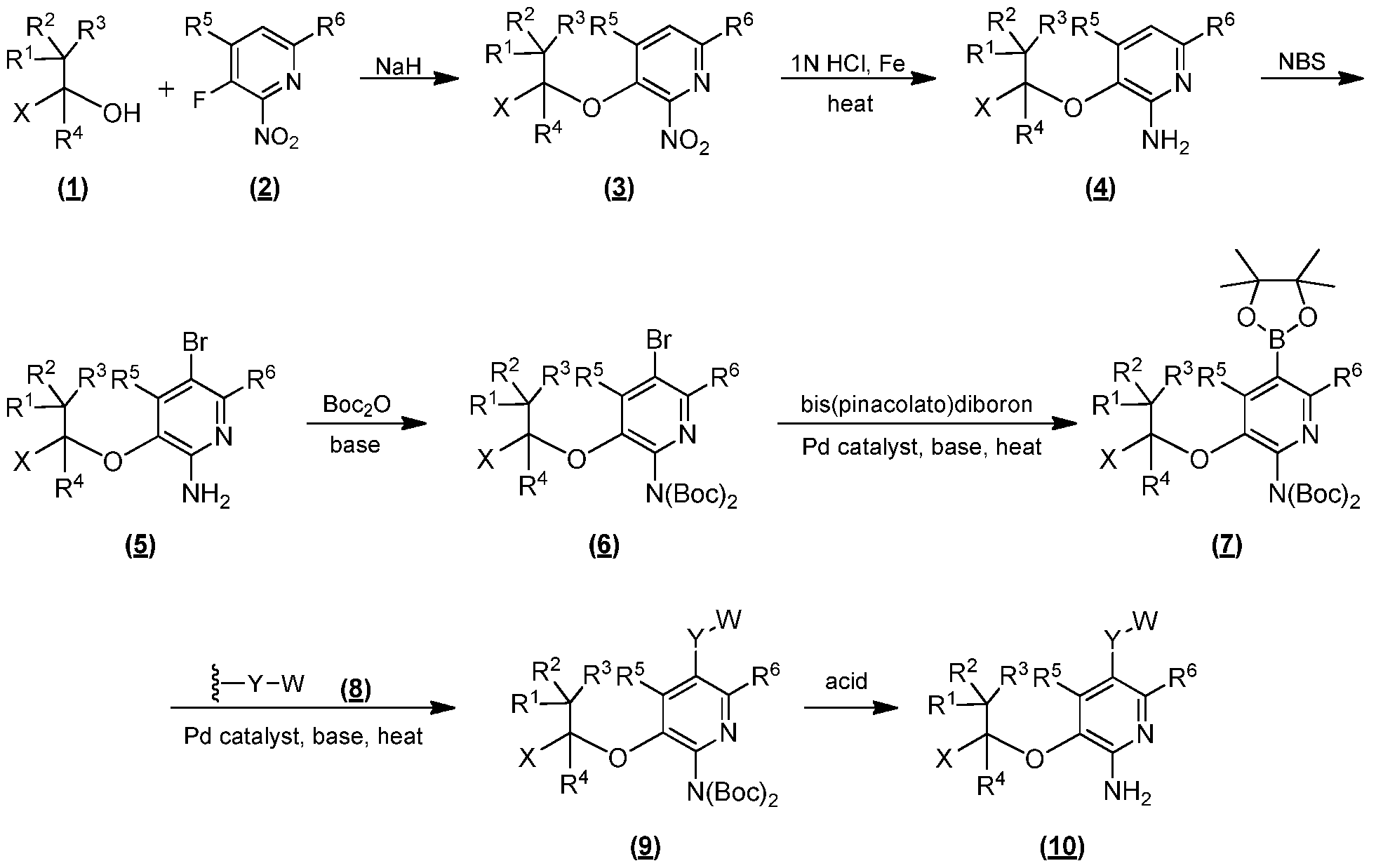
The compounds disclosed herein can be prepared according to the general synthetic methods illustrated in Scheme 1 and described in details in the Examples. Referring to Scheme 1 , ( ?)-aryl alcohol (1) and substituted fluoropyridine (2) is treated with a base such as NaH in aprotic solvent such as THF to give the coupled compound (3). The nitro group in Q) is then reduced to an amine (4) under acidic conditions using a reducing agent such as Fe powder. Subsequent regio-selective bromination of the pyridine ring can be accomplished with the aid of N-bromo- succinimide to furnish compound (5). The intermediate (5) and (Boc)20 is treated with a base such as Na2C03, NaHC03 or Et3N to give N-protected compound (6). Compound (6) is then coupled with bis(pinacolato)diboron with the aid of an appropriate Pd catalyst such as
Pd(dppf)Cl2-CH2Cl2 or Pd(PPh3)2Cl2 in an aprotic solvent (for example, DMSO, DMF or
dioxane) to afford a boronic acid derivative (7). The subsquent Suzuki reaction of compound (7) and compound (8) in the presence of a base and a catalyst such as Pd(dppf)Cl2-CH2Cl2 to furnish compound (9). The preferred bases for the coupling reaction include NaHCCb, KHCO3, Na2C03, K2CO3, CS2CO3, and others. The reaction is preferably performed in a mixed solvent such as DME/H2O, dioxane/H20, at a temperature ranging from 70 °C to 100 °C. Finally, the Boc- group and other PG group are all removed under acidic conditions, for example, trifluoroacetic acid (TFA) in DCM, or HC1 in ethyl acetate or ethyl ether to afford the desired kinase inhibitor (10).
EXAMPLES
Example 1 5-(l-(2,5-dichlorophenyl)ethoxy)-6,-(piperazin-l-yl)-[33'-bipyridinl-6-amine

Step 1) l-(5-bromopyridin-2-yl)piperazine
[177] A suspension of 5-bromo-2-fluoropyridine (10.0 g, 56.8 mmol) and piperazine
(39.0, 454.6 mmol) in toluene (100 mL) was heated at 125 °C for 3 hours. The reaction was cooled to room temperature, and diluted with toluene/H20 mixture (100 mL/100 mL). The seperated aqueous phase was extracted with toluene (100 mL), and the combined organic phases were washed with brine (100 mL), dried over anhydrous Na2S04, and concentrated in vacuo to give a white solid (13.56 g, 98%) which was used for the next step without further purification.
LC-MS (ESI, pos. ion) m/z: 242.0 (M+l);
!H NMR (400 MHz, CDCI3) δ (ppm): 8.17-8.16 (d, J= 2.4 Hz, 1H), 7.51-7.48 (dd, J= 8.8 Hz, J = 2.4 Hz, 1H), 6.52-6.50 (d, J = 9.2 Hz, 1H), 3.45-3.43 (t, J = 5.2 Hz, 4H), 2.95-2.93 (t, J = 5.2 Hz, 4H).
Step 2) fert-butyl 4-(5-bromopyridin-2-yl)piperazine-l-carboxylate
[178] To a solution of l-(5-bromopyridin-2-yl)piperazine (13.56 g, 56.01 mmol) and
Na2C03 (11.87 g, 112.01 mmol) in THF/H2O mixture (56 mL/56 mL) was added (Boc)20 (18 mL, 84.01 mmol). The reaction was stirred at room temperature for 3 hours, then filtered and concentrated in vacuo. The residue was partitioned between EtOAc (100 mL) and brine (100
mL). The seperated organic phase was concentrated in vacuo to give a white solid (21.0 g, 110%), which was used for the next step without further purification.
!H NMR (400 MHz, CDCb) δ (ppm): 8.18 (d, J= 2.0 Hz, 1H), 7.55-7.52 (dd, J= 8.8 Hz, 2.4 Hz, 1H), 6.54-6.52 (d, J= 8.8 Hz, 1H), 3.52-3.47 (m, 8H), 1.47 (s, 9H).
Step 3) N,N-bis(ter^butoxymethyl)-6'-(4-(fe^
dichlorophenyl)ethoxy)-r3,3'-bipyridin1-6-amine
[179] To a solution of tert-butyl 4-(5-bromopyridin-2-yl)piperazine-l-carboxylate (202 mg, 0.59 mmol), N,N-bis(tert-butoxycarbonyl)-3-(l-(2,5-dichlorophenyl)ethoxy)-5-(4,4,5,5- tetramethyl-l,3,2-dioxaborolan-2-yl)pyridin-2-amine (300 mg, 0.49 mmol) and CS2CO3 (320 mg, 0.98 mmol) in DME/H2O mixture (10 mL/1 mL) was added Pd(dppf)Cl2-CH2Cl2 (40 mg, 0.05 mmol) under a nitrogen atmosphere. The reaction was heated at 90 °C overnight, then cooled to room temperature and filtered through a pad of CELITE®. The filtrate was concentrated in vacuo, and the resulted residue was purified by a silica gel column chromatography (PE/EtOAc (v/v) = 5/1) to give the title compound as yellow oil (250 mg, 68 %).
LC-MS (ESI, pos. ion) m/z: 744.0 (M+l).
Step 4 5- -(2,5 -dichlorophenyOethoxy)- 6'-(piperazin- 1 -yl)-3 ,3 '-bipyridin-6-amine
[180] To a solution of N,N-bis(tert-butoxymethyl)-6'-(4-(tert-butoxymethyl)piperazin-l- yl)-5-(l-(2,5-dichlorophenyl)ethoxy)-[3,3'-bipyridin]-6-amine (250 mg, 0.34 mmol) in EtOAc (5 mL) was added HCl (2 M in EtOAc, 10 mL) dropwise at 0 °C. The reaction was stirred at room temperature overnight, and then concentrated in vacuo. The residue was dissolved in DCM/MeOH mixture (20 mL/2 mL), followed by an addition of NaHCCb powder (86 mg, 1 mmol). The mixture was stirred at room temperature for 2 hours, then filtered. The filtrate was concentrated in vacuo, and the resulted residue was purified by a silica gel column chromatography (DCM/MeOH/NH40H (v/v/v) = 100/10/1) to give the title compound as a yellow solid (86 mg, 57%).
LC-MS (ESI, pos. ion) m/z: 444.0 (M+l);
'H NMR (400 MHz, DMSC /e) δ (ppm): 8.18-8.17 (d, J= 2.4 Hz, 1H), 7.74-7.72 (m, 2H), 7.61- 7.58 (dd, J = 2.4 Hz, 8.8 Hz, 1H), 7.51-7.49 (d, J = 8.4 Hz, 1H), 7.38-7.35 (dd, J = 2.8 Hz, 8.8 Hz, 1H), 6.99-6.98 (d, J = 1.6 Hz, 1H), 6.81-6.79 (d, J = 8.8 Hz, 1H), 5.98 (br s, 2H), 5.88-5.83 (q, J = 6.4 Hz, 1H), 3.40-3.37 (t, J= 4.8 Hz, 4H), 2.77-2.75 (t, J= 4.8 Hz, 4H), 1.61-1.60 (d, J = 6.0 Hz, 3H).
Example 2 (3i?,3ai?,6ai?)-6-(6,-amino-5,-(l-(2,5-dichlorophenyl)ethoxy)-[3 ,3'-bipyridinl-6- yl)hexahvdrofuror3,2-¾1furan-3-ol

Step 1) (3£3ai?,6i?,6a£y6-((fe^butyldimem^ (4.1a) and (3 ?3ai?,66',6a6 -6-((ter^butyldimethylsilyl)oxy)hexahydrofuro[3,2-&lfuran-3-ol (4.1b)

[181] To a solution of (3i?,3ai?,6^,6ai?)-hexahydrofuro[3,2-¾]furan-3,6-diol (29.2 g, 200 mmol) and imidazole (19.0 g, 280 mmol) in DMF (250 mL) was added TBSC1 (33.2 g, 220 mmol) in portions. The reaction was stirred at room temperature overnight, and then concentrated in vacuo. The residue was partitioned between EtOAc (300 mL) and H20 (150 mL). The seperated organic phase was washed with brine (100 mL x 2), dried over anhydrous Na2SC"4, and concentrated in vacuo. The residue was purified by a silica gel column chromatography (PE/EtOAc (v/v) = 2/1) to give (3S,3aR,6R S)-6-((tert- butyldimethylsilyl)oxy)-hexahydrofuro[3,2-¾]furan-3-ol (4.1a) (14.6 g, 28%) and (3i?,3ai?,65',6a5)-6-((tert-butyldimethylsilyl)oxy)hexahydrofuro[3,2-¾]furan-3-ol (4.1b) (9.3 g, 18%) as colorless oil.
LC-MS (ESI, pos. ion) m/z: 261.0 (M+l);
4.1a: ¾ NMR (400 MHz, CDCb) δ (ppm): 4.68-4.53 (m, 1H), 4.33-4.23 (m, 3H), 3.90-3.82 (m, 3H), 3.55-3.45 (m, 1H), 0.89 (s, 9H), 0.09 (m, 6H);
4.1b: !H NMR (400 MHz, CDCb) δ (ppm): 4.52 (t, J = 4.7 Hz, 1H), 4.37 (d, J = 4.5 Hz, 1H), 4.28 (q, J= 6.5 Hz, 2H), 3.96 (dd, J = 10.1, 3.5 Hz, 1H), 3.87 (d, J = 10.1 Hz, 1H), 3.76 (dd, J = 8.7, 6.0 Hz, 1H), 3.53 (dd, J= 8.7, 6.8 Hz, 1H), 0.92-0.89 (m, 9H), 0.11 (s, 3H), 0.10 (s, 3H).
Step 2) (3a6',6i?,6a6^-6-((ter^butyldimethylsilyl)oxy)tetrahydromro[3,2-&lfuran-3(2H)-one
[182] To a solution of (35',3ai?,6i?,6a5)-6-((tert-butyldimethylsilyl)oxy)- hexahydrofuro[3,2-6]furan-3-ol (4.1a) (14.61 g, 56.1 mmol) in DCM (250 mL) was added DMP (47.59 g, 112.2 mmol). The reaction was heated at 55 °C overnight, and then filtered. The filtrate was concentrated in vacuo and the resulted residue was purified by a silica gel column chromatography (PE/EtOAc (v/v) = 4/1) to give the the tittle compound as light-yellow oil (11.7 g, 55%).
LC-MS (ESI, pos. ion) m/z: 259.0 (M+l);
1HNMR (400 MHz, CDC ) δ (ppm): 4.81 (dd, J = 6.6, 5.0 Hz, 1H), 4.35 (q, J = 4.8 Hz, 1H), 4.29 (d, J = 6.8 Hz, 1H), 4.22 (d, J = 17.4 Hz, 1H), 4.05 (d, J = 17.4 Hz, 1H), 3.93 (dd, J = 9.3, 4.7 Hz, 1H), 3.74 (dd, J= 9.3, 4.8 Hz, 1H), 0.93-0.86 (m, 10H), 0.13-0.08 (m, 6H).
Step 3) (3a6',6i?,6a6 -3-(5-bromopyridin-2-yl)-6-((ter^butyldimethylsilyl)oxy)hexahvdrofuro [3,2-&]furan-3-ol
[183] To a solution of 2,5-dibromopyridine (4.74 g, 20.0 mmol) in toluene (150 mL) was added n-BuLi (2.5 M in n-hexane, 8.8 mL, 22.0 mmol) dropwise at -78 °C. The mixture was stirred for 30 minutes, followed by an addition of a solution of (3a5*,6i?,6a5)-6-((tert- butyldimethylsilyl)oxy)tetrahydromro[3,2-¾]furan-3(2H)-one (5.17 g, 20.0 mmol) in toluene (15 mL). The reaction was stirred at -78 °C for 1 hours, then allowed to warm to room temperature and stirred further for 3 hours. The mixture was washed with saturated NH4CI (100 mL) aqueous solution, followed by brine (100 mL) and H20 (100 mL), then dried over anhydrous Na2S04, and concentrated in vacuo. The residue was purified by a silica gel column chromatography (PE/EtOAc (v/v) = 14/1) to give the tittle compound as a white solid (3.1 g, 37%).
LC-MS (ESI, pos. ion) m/z: 416.0 (M+l);
!H NMR (400 MHz, CDCb) δ (ppm): 8.61 (d, J = 1.7 Hz, 1H), 7.83 (dd, J = 8.5, 2.3 Hz, 1H), 7.71 (d, J = 8.5 Hz, 1H), 4.83 (d, J = 6.2 Hz, 1H), 4.75-4.69 (m, 1H), 4.57 (s, 1H), 4.32 (q, J = 4.9 Hz, 1H), 4.26 (d, J = 9.5 Hz, 1H), 4.10 (d, J = 9.5 Hz, 1H), 4.03-3.95 (m, 2H), 0.97 (s, 9H), 0.21-0.16 (m, 6H).
Step 4) O-((3a6',6i?,6a6 -3-(5-bromopyridin-2-yl)-6-((ter^butyldimethylsilyl)oxy)hexahvdrofuro [3,2-&]furan-3-yl) S-methyl carbonodithioate
[184] To a solution of (3a5',6i?,6a5)-3-(5-bromopyridin-2-yl)-6-((tert- butyldimethylsilyl)oxy)hexahydrofuro[3,2-¾]furan-3-ol (2.89 g, 6.94 mmol) in anhydrous THF (60 mL) was added NaH (60%> dispersion in mineral oil, 555 mg, 13.88 mmol). The suspension was stirred at room temperature for 30 minutes, followed by an addition of CS2 (2.1 mL, 34.70
mmol). The suspension was further stirred for 3 hours, then CH3I (2.2 mL, 34.70 mmol) was added to the mixture. The reaction was stirred at room temperature for 18 hours, then poured into brine (150 mL) and extracted with EtOAc (100 mL x 2). The combined organic phases were dried over anhydrous Na2S04, and concentrated in vacuo. The residue was purified by a silica gel column chromatography (PE/EtOAc (v/v) = 20/1) to give the title compound as colorless oil (2.36 g, 52%).
LC-MS (ESI, pos. ion) m/z: 506.0 (M+l);
!H NMR (400 MHz, CDCb) δ (ppm): 8.62 (d, J = 1.7 Hz, 1H), 7.79 (dd, J = 8.5, 2.4 Hz, 1H), 7.23 (d, J = 8.5 Hz, 1H), 5.39 (d, J = 4.4 Hz, 1H), 4.69 (t, J = 4.8 Hz, 1H), 4.44-4.40 (m, 1H), 4.37 (d, J = 9.4 Hz, 1H), 4.31 (d, J = 9.1 Hz, 1H), 3.99 (dd, J = 8.7, 6.4 Hz, 1H), 3.80-3.73 (m, 1H), 2.55 (s, 3H), 0.92 (s, 9H), 0.15-0.10 (m, 6H).
Step 5) 5-bromo-2-((3ai?,6i?,6a6 -6-((ter^butyldimethylsilyl)oxy)hexahydrofuro[3,2-¾lfuran-3- yPpyridine
[185] To a solution of O-((3a5',6i?,6a5)-3-(5-bromopyridin-2-yl)-6-((tert- butyldimethylsilyl)oxy)hexahydrofuro[3,2-¾]furan-3-yl) S-methyl carbonodithioate (2.36 g, 4.7 mmol) in toluene (65 mL) were added AIBN (36 mg, 0.2 mmol), followed by n-Bu3SnH (2.14 g, 6.6 mmol). The reaction was purged with nitrogen three times and heated at 110 °C for 3 hours, and then concentrated in vacuo. The residue was purified by a silica gel column chromatography (PE/EtOAc (v/v) = 10/1) to give the title compound as colorless oil (1.0 g, 53%).
LC-MS (ESI, pos. ion) m/z: 400.0 (M+l);
!H NMR (400 MHz, CDCb) δ (ppm): 8.61 (d, J = 2.3 Hz, 1H), 7.77 (dd, J = 8.4, 2.4 Hz, 1H), 7.21 (d, J = 8.4 Hz, 1H), 4.80 (t, J = 4.6 Hz, 1H), 4.58 (t, J = 4.7 Hz, 1H), 4.43-4.27 (m, 2H), 4.19-4.12 (m, 1H), 3.78 (dd, J = 8.7, 6.0 Hz, 1H), 3.68-3.57 (m, 2H), 0.97 (s, 9H), 0.25-0.05 (m, 6H).
Step 6) (3i? ai?,6ai? -6-(6,-amino-5,-(l-(2,5-dichlorophenvnethoxy -r3,3,-bipyridinl-6- yl)hexahvdromro[3,2-&]furan-3-ol
[186] To a solution of 5-bromo-2-((3ai?,6i?,6a5)-6-((tert-butyldimethylsilyl)oxy)- hexahydrofuro[3,2-¾]furan-3-yl)pyridine (120 mg, 0.30 mmol) and N,N-bis(tert- butoxycarbonyl)-3-(l-(2,5-dichlorophenyl)ethoxy)-5-(4,4,5,5-tetramethyl-l,3,2-dioxaborolan-2- yl)pyridin-2-amine (216 mg, 0.36 mmol) in DME (15 mL) was added a solution of Cs2C03 (293 mg, 0.90 mmol) in H20 (3 mL). The mixture was purged with nitrogen, followed by an addition of Pd(dppf)Cl2-CH2Cl2 (24 mg, 0.03 mmol). The reaction was purged with nitrogen again and
heated at 95 °C overnight, then cooled to room temperature and silica gel (1.0 g) was added to the mixture. The mixture was concentrated in vacuo, and the resulted residue was purified by a silica gel column chromatography (PE/EtOAc (v/v) = 3/1) to give light yellow oil.
To a solution of the oil in MeOH (15 mL) was added cone. HC1 (3 mL). The reaction was stirred at room temperature for 6 hours, then heated at 35 °C for 16 hours and further at 45 °C for 8 hours. The mixture was concentrated in vacuo, and the resulted residue was dissolved in H20 (20 mL). The solution was adjusted to pH=8 with saturated NaHCCb aqueous solution and extracted with EtOAc (50 mL x 2). The combined organic phases were dried over anhydrous Na2S04, and concentrated in vacuo. The crude product was reslurried with Et20 (5 mL) to give the title compound as a white solid (48 mg, 28% for two steps).
LC-MS (ESI, pos. ion) m/z: 488.0 (M+l);
¾ NMR (400 MHz, CDCb) δ (ppm): 8.56 (d, J= 2.2 Hz, 1H), 7.88 (d, J= 1.7 Hz, 1H), 7.64 (dt, J = 8.1, 2.2 Hz, 1H), 7.43 (d, J = 2.4 Hz, 1H), 7.36 (d, J = 8.5 Hz, 1H), 7.31 (d, J = 8.2 Hz, 1H), 7.23 (dd, J = 8.5, 1.6 Hz, 1H), 6.83 (d, J = 1.5 Hz, 1H), 5.73 (q, J = 6.3 Hz, 1H), 4.97 (s, 2H), 4.85 (t, J= 4.6 Hz, 1H), 4.78-4.68 (m, 1H), 4.47 (t, J = 8.1 Hz, 1H), 4.40-4.33 (m, 1H), 4.25 (dd, J= 11.1, 8.3 Hz, 1H), 3.86 (dd, J = 9.7, 5.5 Hz, 1H), 3.80-3.69 (m, 2H), 3.12 (br s, 1H), 1.71 (d, J = 6.3 Hz, 3H).
Example 3 (3 ?,3a ?,6a ? -6-(6,-amino-5,-(l-(2-chloro-3,6-difίuorophenyl ethoxy -Γ3,3,- bipyridin1-6-yl)hexahydrofuror3,2-¾1furan-3-ol

Step 1) l-(2-chloro-3,6-difluorophenyl)ethanol
[187] To a solution of 2-chloro-3,6-difluorobenzaldehyde (15.0 g, 85.0 mmol) in THF
(300 mL) was added methyl magnesium bromide (3 M, 31 mL) at -5 °C in a nitrogen atmosphere. The reaction was stirred at rt overnight, then quenched with saturated NH4C1 aqueous solution (2 mL) and concentrated in vacuo. The residue was partitioned between EtOAc (200 mL) and saturated NH4C1 aqueous solution (30 mL). The seperated organic phase was
washed with Η20 (30 mL), followed by brine (30 mL), dried over anhydrous Na2S04, and concentrated in vacuo to give the title compound as yellow oil (17.0 g, 104 %).
LC-MS (ESI, pos. ion) m/z: 193.1 (M+l).
Step 2) 3-(l-(2-chloro-3,6-difluorophenyl)ethoxy)-2-nitropyridine
[188] To a solution of l-(2-chloro-3,6-difluorophenyl)ethanol (3.7 g, 19.2 mmol) in THF
(50 mL) was added NaH (60% dispersion in mineral oil, 920 mg, 23.0 mmol) in portions. Until no gas bubbled, a solution of 3-fluoro-2-nitropyridine (3.3 g, 23.0 mmol) in THF (10 mL) was added to the mixture. The reaction was stirred at room temperature overnight, then quenched with H20 (20 mL) at 0 °C and removed most of the solvent in vacuo. The residue was poured into H20 (150 mL) and the resulted mixture was extracted with EtOAc (100 mL x 3). The combined organic phases were washed with saturated NaHCCb aqueous solution (150 mL), followed by brine (150 mL), dried over anhydrous Na2S04, and concentrated in vacuo to give the title compound as brown liquid (6.1 g, 100%).
LC-MS (ESI, pos. ion) m/z: 315.0 (M+l).
Step 3) 3-(l-(2-chloro-3,6-difluorophenyl)ethoxy)pyridin-2-amine
[189] To a solution of 3-(l-(2-chloro-3,6-difluorophenyl)ethoxy)-2-nitropyridine (6.1 g,
19.4 mmol) in AcOH (60 mL) was added Fe powder (5.4 g, 96.9 mmol) in protions. The reaction was heated at 100 °C for 2.5 hours, then cooled to room temperature and filtered. The filter cake was washed with AcOH (30 mL x 3), followed by EtOH (30 mL x 3), and the combined filtrates were concentrated in vacuo. The residue was treated with saturated Na2C03 aqueous solution (100 mL) carefully, and then the resulted mixture was extracted with EtOAc (200 mL x 3). The combined organic phases were washed with saturated NaHCCb aqueous solution (200 mL), followed by brine (200 mL), dried over anhydrous Na2S04, and concentrated in vacuo to give the title compound as a light-brown solid (5.3g,96.4%).
LC-MS (ESI, pos. ion) m/z: 285.0 (M+l).
Step 4) 5-bromo-3-(l -(2-chloro-3,6-difluorophenyl)ethoxy)pyridin-2-amine
[190] To a solution of 3-(l-(2-chloro-3,6-difluorophenyl)ethoxy)pyridin-2-amine (4.8 g,16.9 mmol) in CH3CN (150 mL) was added NBS (3.6 g, 20.3 mmol ) in protions at 0 °C. The reaction was stirred at 0 °C for 2.5 hours, and then concentrated in vacuo. The residue was dissolved in EtOAc (200 mL), and the resulted mixture was washed with saturated Na2C03 aqueous solution (100 mL x 2), dried over anhydrous Na2S04, and concentrated in vacuo. The residue was purified by a silica gel column chromatography (PE/EtOAc (v/v) = 4/1) to give the
title compound as a yellow solid (3.0 g, 49.2%). LC-MS (ESI, pos. ion) m/z: 363.0 (M+l);
¾ NMR (400 MHz, CDCb) δ (ppm): 7.67 (s, 1H), 7.14-7.05 (m, 1H), 7.02-6.95 (m, 1H), 6.94 (s, 1H), 5.98-5.72 (m, 1H), 1.79 (d, J= 6.6 Hz, 3H).
Step 5) 5 -bromo-N,N-bis(tert-butoxycarbonyl)-3 -( 1 -(2-chloro-3 ,6-difluorophenyl)ethoxy) pyridin-2-amine
[191] To a solution of 5-bromo-3-(l-(2-chloro-3,6-difluorophenyl)ethoxy)pyridin-2- amine (1.0 g, 2.8 mmol) in DMF (15 mL) were added DMAP (73 mg, 0.6 mmol) and Boc20 (1.5 g, 6.9 mmol). The reaction was stirred at room temperature overnight, then poured into saturated NaHCCb aqueous solution (50 mL) and the resulted mixture was extracted with EtOAc (50 mL x 2). The combined organic phases were washed with H20 (50 mL x 3), followed by saturated NaHCCb aqueous solution (50 mL x 2) and brine (50 mL x 2), then dried over anhydrous Na2S04, and concentrated in vacuo to give the title compound as a yellow solid (1.55 g, 98.2%).
!H NMR (400 MHz, CDCb) δ (ppm): 8.11 (d, J = 2.0 Hz, 1H), 7.30 (s, 1H), 7.14-7.06 (m, 1H), 7.01-6.93 (m, 1H), 5.85-5.78 (m, 1H), 1.76 (d, J= 6.6 Hz, 3H), 1.42 (d, J= 29.5 Hz, 18H).
Step 6) N,N-bis(tert-butoxycarbonyl)-3-(l-(2-chloro-3,6-difluorophenyl)ethoxy)-5-(4,4,5,5- tetramethyl- 1 ,3 ,2-dioxaborolan-2-yl)pyridin-2-amine
[192] To a solution of 5-bromo-N,N-bis(tert-butoxycarbonyl)-3-(l-(2-chloro-3,6- difluorophenyl)- ethoxy)pyridin-2-amine (1.55 g, 2.7 mmol) in DMSO (16 mL) were added bis(pinacolato)diboron (1.04 g, 4.1 mmol) and AcOK (1.08 g, 11 mmol). The mixture was purged with nitrogen three times, followed by an addition of Pd(dppf)Cl2-CH2Cl2 (245 mg, 0.3 mmol). The reaction was purged with nitrogen three times again and heated at 80 °C overnight, and then cooled to room temperature. The mixture was poured into H20 (100 mL) and extracted with EtOAc (100 mL x 3). The combined organic phases were washed with brine (100 mL x 2), dried over anhydrous Na2S04, and concentrated in vacuo. The residue was purified by a silica gel column chromatography (PE/EtOAc (v/v) = 3/1) to give the title compound as yellow oil (1.82 g, 100%).
LC-MS (ESI, pos. ion) m/z: 528.0 (M-84+2);
'H NMR (400 MHz, CDCb) δ (ppm): 8.41-8.35 (m, 1H), 7.61-7.53 (m, 1H), 7.11-7.01 (m, 1H), 6.99-6.89 (m, 1H), 5.97-5.89 (m, 1H), 1.75 (d, J= 6.6 Hz, 3H), 1.34 (d, J= 4.0 Hz, 18H), 1.26 (s, 12H).
Step 7) N,N-bis(fert-butoxycarbonyl)-6'-((3 ai?,6i?,6a6 -6-((tert-butyldimethylsilyl)oxy)hexa- hvdromro[3,2-&]mran-3-yl)-5-(l-(2-chloro-3,6-di^
[193] To a solution of N,N-bis(tert-butoxycarbonyl)-3-(l-(2-chloro-3,6- difluorophenyl)ethoxy)-5-(4,4,5,5-tetramethyl-l,3,2-dioxaborolan-2-yl)pyridin-2-amine (257 mg, 0.42 mmol) and 5-bromo-2-((3ai?,6i?,6a5)-6-((tert- butyldimethylsilyl)oxy)hexahydrofuro[3,2-¾]furan-3-yl)pyridine (140 mg, 0.35 mmol) in DME (5 mL) was added a solution of CS2CO3 (342 mg, 1.05 mmol) in H20 (1 mL). The mixture was purged with nitrogen three times, followed by an addition of Pd(dppf)Ci2-CH2Ci2 (33 mg, 0.04 mmol). The reation was purged with nitrogen three times again and stirred at 90 °C for 2.5 hours, and then concentrated in vacuo. The residue was purified by a silica gel column chromatography (PE/EtOAc (v/v) = 1/1) to give the title compound as yellow oil (381 mg, 100%).
Step 8) (3 ?,3ai?,6ai?)-6-(6,-amino-5,-(l-(2-chloro-3,6-difluorophenyl)ethoxy)-[33'-bipyridm]-6- yl)hexahydromro[3,2-¾]furan-3-ol
[194] To a solution of N,N-bis(tert-butoxycarbonyl)-6'-((3ai?,6i?,6a5)-6-((tert- butyldimethylsilyl)oxy)hexahydrofuro[3,2-¾]furan-3-yl)-5-(l-(2-chloro-3,6-difluorophenyl)- ethoxy)-[3,3'-bipyridin]-6-amine (381 mg, 0.47 mmol) in MeOH (15 mL) was added cone. HC1 (3 mL). The reation was stirred at 60 °C for 16 hours, and then concentrated in vacuo to give the residue which was dissolved in H2O (10 mL). The mixture was adjust to pH=8 with saturated NaHCC"3 aqueous solution and extracted with EtOAc (50 mL x 2). The combined organic phases were dried over anhydrous Na2S04, and concentrated in vacuo. The residue was recrystallized in Et20 (3 mL) to give the title compound as a white solid (154 mg, 67%).
LC-MS (ESI, pos. ion) m/z: 490.0 (M+l);
!H NMR (400 MHz, CDCb) δ (ppm): 8.61-8.57 (m, 1H), 7.87-7.82 (m, 1H), 7.69-7.62 (m, 1H), 7.34-7.28 (m, 1H), 7.06-7.04 (m, 1H), 7.03-6.93 (m, 1H), 6.01-5.90 (m, 1H), 5.01-4.87 (m, 2H), 4.87-4.80 (m, 1H), 4.76-4.67 (m, 1H), 4.50-4.40 (m, 1H), 4.39-4.31 (m, 1H), 4.28-4.18 (m, 1H), 3.91-3.80 (m, 1H), 3.80-3.67 (m, 2H), 1.84 (d, J= 6.6 Hz, 3H).
Example 4 5-(l-(2-chloro-3,6-difluorophenyl)ethoxy)-6,-(piperazin-l-yl)-[3,3,-bipyridin]-6- amine

Step 1) fert-butyl 4-(5-(4^,5,5-tetramethyl-13,2-dioxaborolan-2-yl)pyridin-2-yl)piperazine-l- carboxylate
[195] To a solution of tert-butyl 4-(5-bromopyridin-2-yl)piperazine-l-carboxylate (2.0 g,
5.84 mmol), bis(pinacolato)diboron (2.2 g, 8.77 mmol) and AcOK (1.72 g, 17.53 mmol) in DMSO (10 niL) was added Pd(dppf)Cl2-CH2Cl2 (473.0 mg, 0.58 mmol) under a nitrogen atmosphere. The reaction was heated at 80 °C for 2 hours, then cooled to room temperature, diluted with EtOAc (100 mL) and filtered through a pad of CELITE®. The filtrate was washed with brine (100 mL x 4), dried over anhydrous Na2S04, and concentrated in vacuo. The residue was purified by a silica gel column chromatography (PE/EtOAc (v/v) = 3/1) to give the title compound as an off-white solid (2.55 g, 112 %).
LC-MS (ESI, pos. ion) m/z: 308.0 (M-84+2);
!H NMR (400 MHz, CDCb) δ (ppm): 8.53 (d, J = 1.2 Hz, 1H), 7.84-7.81 (dd, J= 2.0 Hz, 8.4 Hz, 1H), 6.59-6.57 (d, J = 8.4 Hz, 1H), 3.60-3.59 (t, J = 2.8 Hz, 4H), 3.53-3.51 (t, J = 2.4 Hz, 4H), 1.47 (s, 9H), 1.31 (s, 12H).
Step 2) 5-(l-(2-chloro-3,6-difluorophenyl)ethoxy)-6'-(piperazin-l-yl)-[33,-bipyridinl-6-amine
[196] To a solution of 5-bromo-3-(l-(2-chloro-3,6-difluorophenyl)ethoxy)pyridin-2- amine (182 mg, 0.50 mmol) and tert-butyl 4-(5-(4,4,5,5-tetramethyl-l,3,2-dioxaborolan-2- yl)pyridin-2-yl)piperazine-l-carboxylate (292 mg, 0.75 mmol) in DME (10 mL) was added a solution of Cs2CC"3 (489 mg, 1.5 mmol) in H20 (2 mL). The mixture was purged with nitrogen, followed by an addition of Pd(dppf)Cl2-CH2Cl2 (41 mg, 0.05 mmol). The reaction was purged with nitrogen again and heated at 95 °C for 18 hours, then cooled to room temperature and silica gel (1.0 g) was added to the mixture. The mixture was concentrated in vacuo, and the resulted residue was purified by a silica gel column chromatography (PE/EtOAc (v/v) = 1/1) to give a yellow solid.
To a solution of the solid above in DCM (20 mL) was added a solution of HC1 in EtOAc (3 M, 10 mL) at 0 °C. The reaction was stirred at room temperature overnight, and then concentrated in
vacuo to give residue which was dissovled in Η20 (30 mL). The resulted mixture was adjusted to pH=10 with saturated Na2C03 aqueous solution and extracted with EtOAc (100 mL x 3). The combined organic phases were dried over anhydrous Na2S04, and concentrated in vacuo. The residue was slurried with PE/EtOAc (2/1, 5 mL) to give the tittle compound as a yellow solid (115 mg, 52%).
LC-MS (ESI, pos. ion) m/z: 446.0 (M+l);
¾ NMR (400 MHz, DMSO- e) δ (ppm): 8.18 (d, J= 2.3 Hz, 1H), 7.76 (d, J= 1.6 Hz, 1H), 7.59 (dd, J= 8.8, 2.4 Hz, 1H), 7.50-7.40 (m, 1H), 7. 38-7.28 (m, 1H), 7.06 (s, 1H), 6.81 (d, J= 8.9 Hz, 1H), 6.00 (q, J= 6.4 Hz, 1H), 5.69 (s, 2H), 3.56-3.35 (m, 4H), 2.86-2.68 (m, 4H), 1.77 (d, J= 6.5 Hz, 3H).
Example 5 3-(6,-amino-5,-(l-(2-chloro-3,6-difluorophenyl)ethoxy)-r3,3,-bipyridin1-6-yl) piperidin-4-ol

Step 1) tert-butyl 3-hydroxy-4,4-dimethoxypiperidine-l-carboxylate
[197] To a solution of KOH (6.73 g, 120.0 mmol) in CH3OH (105 mL) was added tert- butyl 4-oxopiperidine-l-carboxylate (9.96 g, 50.0 mmol) at 0 °C. The mixture was sitrred for 10 minutes, followed by an addition of a solution of I2 (13.96 g, 55.0 mmol) in CH3OH (95 mL) over 1.5 hours. The reaction was stirred at room temperature for 3 hours, and then concentrated in vacuo. The residue was diluted with toluene (250 mL), and the resulted mixture was filtered. The filtrate was concentrated in vacuo to give the tittle compound as yellow oil (13.1 g, 100%), which was used directly in the next step without further purification.
Step 2) tert-butyl 4,4-dimethoxy-3-oxopiperidine-l-carboxylate
[198] To a solution of tert- vXy\ 3-hydroxy-4,4-dimethoxypiperidine-l-carboxylate (5.23 g, 20.0 mmol) in DCM (100 mL) was added DMP (16.97 g, 40.0 mmol). The reaction was heated at 50 °C for 12 hours, then cooled to -25 °C and filtered. The filtrate was concentrated in vacuo, and the residue was suspended in PE (50 mL). The mixture was filtered, and then the filtrate was concentrated in vacuo to give the tittle compound as yellow oil (5.3 g, 100%), which
was used directly in the next step without further purification.
Step 3) tert-butyl 3-(5-bromopyridin-2-yl)-3-hvdroxy-4,4-dimethoxypiperidine-l-carboxylate
[199] To a solution of tert-butyl 4,4-dimethoxy-3-oxopiperidine-l-carboxylate (4.74 g,
20.0 mmol) in toluene (150 mmol) was added n-BuLi (2.5 M in n-hexane, 8.8 mL, 22.0 mmol) dropwise at -78 °C. The mixture was stirred at -78 °C for 45 minutes, followed by an addition of a solution of 3,5-dibromopyridine (5.3 g, 20.0 mmol) in toluene (20 mL). The reaction was stirred at -78 °C for 1 hour, then allowed to warm to room temperature and stirred further for 13 hours. The mixture was diluted with EtOAc (200 mL), and the resulted mixture was washed with saturated NH4C1 aqueous solution (150 mL) and brine (150 mL), then dried over anhydrous Na2S04, and concentrated in vacuo. The residue was purified by a silica gel column chromatography (PE/EtOAc (v/v) = 6/1) to give the title compound as yellow oil (4.1 g, 49%).
LC-MS (ESI, pos. ion) m/z: 417.0 (M+l).
Step 4) tert-butyl 3-(5-bromopyridin-2-yl)-4,4-dimethoxy-3-(((methylthio)carbonothioyl)oxy) piperidine- 1 -carboxylate
[200] To a solution of tert-butyl 3-(5-bromopyridin-2-yl)-3-hydroxy-4,4- dimethoxypiperidine-l-carboxylate (4.1 g, 10.0 mmol) in anhydrous THF (60 mL) was added NaH (60% dispersion in mineral oil, 800 mg, 20 mmol). The suspension was stirred at room temperature for 20 minutes, followed by an addition of CS2 (3 mL, 50.0 mmol). The suspension was stirred further for 1.5 hours, then CH3I (3.1 mL, 50.0 mmol) was added to the mixture. The reaction was stirred at room temperature overnight, then poured into brine (150 mL), and the resulted mixture was extracted with EtOAc (100 x 3 mL). The combined organic phases were dried over anhydrous Na2S04, and concentrated in vacuo. The residue was purified by a silica gel column chromatography (PE/EtOAc (v/v) = 8/1) to give the title compound as a white solid (2.7 g, 53%).
LC-MS (ESI, pos. ion) m/z: 507.0 (M+l);
1HNMR (400 MHz, CDCI3) δ (ppm): 8.62 (d, J = 2.1 Hz, 1H), 7.70 (dd, J = 8.6, 2.3 Hz, 1H), 7.35 (d, J= 8.6 Hz, 1H), 5.52 (d, J= 14.9 Hz, 1H), 4.35-4.25 (m, 1H), 4.17 (d, J = 15.0 Hz, 1H), 3.50 (s, 3H), 3.06-2.94 (m, 1H), 2.86 (s, 3H), 2.48 (s, 3H), 2.35-2.22 (m, 1H), 2.14-1.93 (m, 1H), 1.52-1.33 (m, 9H).
Step 5) tert-butyl 3-(5-bromopyridin-2-yl)-4,4-dimethoxypiperidine-l-carboxylate
[201] To a solution of tert-butyl 3-(5-bromopyridin-2-yl)-4,4-dimethoxy-3-
(((methylthio)carbonothioyl)oxy)piperidine-l-carboxylate (2.65 g, 5.2 mmol) in toluene (60 mL)
were added AIBN (100 mg, 0.6 mmol), followed by n-Bu3SnH (2.37 g, 7.3 mmol). The reaction was purged with nitrogen three times and heated at 110 °C for 3 hours, and then concentrated in vacuo. The residue was purified by a silica gel column chromatography (PE/EtOAc (v/v) = 4/1) to give the title compound as colorless oil (2.1 g, 100%).
LC-MS (ESI, pos. ion) m/z: 401.0 (M+l);
!H NMR (400 MHz, CDCb) δ (ppm): 8.59 (br s, 1H), 7.71 (d, J = 7.2 Hz, 1H), 7.28 (br s, 1H), 4.02-3.72 (m, 1H), 3.52 (dd, J= 13.5, 4.0 Hz, 1H), 3.33-3.23 (m, 2H), 3.19 (s, 3H), 3.11 (s, 3H), 2.35-2.21 (m, 1H), 1.50-1.15 (m, 11H).
Step 6) 3-(6'-amino-5'-(l -(2-chloro-3,6-difluorophenyl)ethoxy)-[33,-bipyridinl-6-yl)piperidin-4- ol
[202] To a solution of tert- vXy\ 3-(5-bromopyridin-2-yl)-4,4-dimethoxypiperidine-l- carboxylate (221 mg, 0.55 mmol) and A/N-bis (tert-butoxycarbonyl)-3-(l-(2-chloro-3,6- difluorophenyl)ethoxy)-5-(4,4,5,5-tetramethyl-l ,3,2-dioxaborolan-2-yl)pyridin-2-amine (305 mg, 0.5 mmol) in DME (15 mL) was added a solution of CS2CO3 (489 mg, 1.5 mmol) in H20 (3 mL). The mixture was purged with nitrogen, followed by an addition of Pd(dppf)Cb-CH2Cl2 (41 mg, 0.05 mmol). The reaction was purged with nitrogen again and heated at 90 °C for 3.5 hours, then cooled to room temperature and silica gel (1.0 g) was added to the mixture. The mixture was concentrated in vacuo, and the residue was purified by a silica gel column chromatography (PE/EtOAc (v/v) = 3/1) to give a yellow solid.
To a solution of the above solid in DCM (15 mL) was added a solution of HC1 in EtOAc (3 M, 3 mL). The reaction was stirred at room temperature for 8 hours, then concentrated in vacuo to give the residue which was dissolved in H2O (15 mL). The mixture was adjusted to pH=10 with saturated Na2CC"3 aqueous solution, and extracted with EtOAc (25 mL x 2). The combined organic phases were concentrated in vacuo. The residue was dissolved in CH3OH (10 mL), followed by an addition of NaBH4 (95 mg, 2.5 mmol). The reaction was sirred at room temperature for 30 minutes, then quenched with H2O (0.5 mL) and concentrated in vacuo. The residue was diluted with H2O (15 mL) and the resulted mixture was extracted with EtOAc (25 x 2 mL). The combined organic phases were dried over anhydrous Na2S04, and concentrated in vacuo. The residue was purified by a Prep.TLC, and then slurried with Et20 (5 mL) to give the title compound as a light-yellow solid (118 mg, 51% for two steps).
LC-MS (ESI, pos. ion) m/z: 461.0 (M+l).
Example 6 (3i?)-5-(6,-amino-5,-(l-(2-chloro-3,6-difluorophenyl)ethoxy)-[33'-bipyridinl-6 piperidin-3-ol

Step 1) (26,,4 ?)-methyl 4-hvdroxypyrrolidine-2-carboxylate
[203] To a solution of (25',4i?)-4-hydroxypyrrolidine-2-carboxylic acid (26.2 g, 200 mmol) in CH3OH (500 mL) was added SOCl2 (17.5 mL, 240 mmol) dropwise at 0 °C. The reaction was stirred at room temperature for 20 hours, and then concentrated in vacuo to give the tittle compound as a yellow solid (36.2 g, 100%).
LC-MS (ESI, pos. ion) m/z: 146.0 (M+l).

[204] To a solution of (25*,4i?)-methyl 4-hydroxypyrrolidine-2-carboxylate (14.52 g,
100 mmol) and Et3N (40.48 g, 400 mmol) in DCM (160 mL) was added BnBr (20.52 g, 120 mmol) dropwise. The reaction was heated at reflux for 24 hours, and then cooled to room temperature. The mixture was washed with saturated NaHC03 aqueous solution (100 mL x 2), followed by H20 (100 mL x 2), dried over anhydrous Na2S04, and concentrated in vacuo to give the tittle compound as yellow oil (15.5 g, 82%).
LC-MS (ESI, pos. ion) m/z: 236.0 (M+l).

[205] To a solution of (25*,4i?)-methyl l-benzyl-4-hydroxypyrrolidine-2-carboxylate
(15.5 g, 65.8 mmol) and Et3N (13.3 g, 131.6 mmol) in DCM (100 mL) were added TBSC1 (11.9 g, 79.1 mmol) in portions, followed by DMAP (80 mg, 0.66 mmol). The reaction was stirred at 30 °C for 30 hours, and then diluted with DCM (100 mL). The mixture was washed with saturated NaHC03 aqueous solution (100 mL x 2), followed by H20 (100 mL x 2), dried over anhydrous Na2S04, and concentrated in vacuo. The residue was purified by a silica gel column chromatography (PE/EtOAc (v/v) = 4/1) to give the tittle compound as light-yellow oil (22.17 g, 96%).
LC-MS (ESI, pos. ion) m/z: 350.0 (M+l);
!H NMR (400 MHz, CDCb) δ (ppm): 7.37-7.29 (m, 4H), 7.28-7.24 (m, 1H), 4.48-4.38 (m, 1H), 3.92 (d, J = 12.8 Hz, 1H), 3.66 (s, 3H), 3.61 (d, J = 12.8 Hz, 1H), 3.55 (t, J = 8.2 Hz, 1H), 3.28 (dd, J = 9.7, 5.8 Hz, 1H), 2.38 (dd, J = 9.7, 5.2 Hz, 1H), 2.27-2.14 (m, 1H), 2.08-2.00 (m, 1H), 0.88 (s, 9H), 0.07-0.02 (m, 6H).
Step 4) ((2SAR)- 1 -benzyl-4-((tert-butyldimethylsilyl)oxy)pyrrolidin-2-yl)methanol
[206] To a suspension of LiAlH4 (4.82 g, 126.8 mmol) in THF (120 mL) was added a solution of (25',4i?)-methyl 1 -benzyl -4-((tert-butyldimethylsilyl)oxy)pyrrolidine-2-carboxylate (22.17 g, 63.4 mmol) in THF (30 mL) dropwise at 75 °C. The reaction was stirred for 1 hour, then cooled to 0 °C, and diluted with EtOAc (80 mL) dropwise, followed by H20 (80 mL). The resulted mixture was stirred at 40 °C for 30 minutes. The solid was filtered off and washed with H20 (20 mL), followed by THF (20 mL) and EtOAc (100 mL). The filtrate was washed with brine (100 mL), dried over anhydrous Na2S04, and concentrated in vacuo to give the tittle compound as yellow oil (19.86 g, 97%).
LC-MS (ESI, pos. ion) m/z: 322.0 (M+l);
¾ NMR (400 MHz, CDCb) δ (ppm): 7.40-7.24 (m, 6H), 4.34-4.24 (m, 1H), 3.99 (d, J= 13.1 Hz, 1H), 3.67 (dd, J = 10.9, 3.3 Hz, 1H), 3.49 (d, J = 13.0 Hz, 1H), 3.40 (dd, J = 10.9, 1.5 Hz, 1H), 3.15 (dd, J = 9.8, 5.5 Hz, 1H), 3.12-3.03 (m, 1H), 2.38 (dd, J = 9.8, 5.7 Hz, 1H), 2.13-2.04 (m, 1H), 1.90-1.81 (m, 1H), 0.89 (s, 9H), 0.07-0.02 (m, 6H).
Step 5) (3R,5R)- 1 -benzyl-5-((tert-butyldimethylsilyl)oxy)piperidin-3-ol
[207] To a solution of ((2S,4R)-l -benzyl -4-((tert-butyldimethylsilyl)oxy)pyrrolidin-2- yl)methanol (19.86 g, 61.8 mmol) in anhydrous THF (300 mL) was added TFAA (19.49 g, 92.8 mmol) slowly at -78 °C. The mixture was stirred for 3 hours, followed by a dropwise addition of Et3N (18.74 g, 185.4 mmol). The reaction was stirred at -78 °C for 15 minutes, then heated to reflux and stirred further for 26 hours. The mixture was cooled to room temperature, then treated with NaOH aqueous solution (2.5 M, 100 mL) and stirred at room temperature for 1 hour. The mixture was extracted with EtOAc (150 mL x 2), and the combined organic phases were washed with water (100 mL x 2), dried over anhydrous Na2S04, and concentrated in vacuo. The residue was purified by a silica gel column chromatography (DCM/MeOH (v/v) = 20/1) to give the tittle compound as yellow oil (16.1 g, 81%).
LC-MS (ESI, pos. ion) m/z: 322.0 (M+l);
!H NMR (400 MHz, CDC ) δ (ppm): 7.60-7.08 (m, 5H), 4.10-4.00 (m, 1H), 3.97 (br s, 1H), 3.64 (d, J = 13.2 Hz, 1H), 3.54 (d, J = 13.2 Hz, 1H), 2.95-2.87 (m, 1H), 2.79-2.73 (m, 1H), 2.53 (br s, 1H), 2.19 (dd, J = 11.4 Hz, 1H), 2.15-2.05 (m, 1H), 1.97 (dd, J = 10.1, 10.1 Hz, 1H), 1.38 (ddd, J= 13.1, 10.5, 2.8 Hz, 1H), 0.88 (s, 9H), 0.06 (s, 3H), 0.04 (s, 3H).
Step 6) (3i?,5i?)-5-((tert-butyldimethylsilyl)oxy)piperidin-3-ol
[208] A suspension of (3i?,5i?)-l-benzyl-5-((tert-butyldimethylsilyl)oxy)piperidin-3-ol
(10.0 g, 31.1 mmol) and Pd(OH)2/C (1.0 g) in EtOH (100 mL) was heated at 60 °C for 24 hours under 6 MPa hydrogen atmosphere. Then the reaction was cooled to room temperature and stirred further for 62 hours. The resulted mixture was filtered through a pad of CELITE®, which was washed with EtOH (20 mL). The filtrate was concentrated in vacuo to give the tittle compound as yellow oil (7.2 g, 100%).
LC-MS (ESI, pos. ion) m/z: 232.0 (M+l).
Step 7) (3i?,5i?)-tert-butyl 3-((tert-butyldimethylsilyl)oxy)-5-hydroxypiperidine-l-carboxylate
[209] To a solution of (3i?,5i?)-5-((tert-butyldimethylsilyl)oxy)piperidin-3-ol (7.2 g,
31.1 mmol) in CH3CN (100 mL) at 0 °C was added NaHCOs (7.8 g, 93.3 mmol), followed by Boc20 (8.1 g, 37.3 mmol). The reaction was allowed to stir at room temperature overnight, and then filtered. The filtrate was concentrated in vacuo, and the residue was purified by a silica gel column chromatography (PE/EtOAc (v/v) = 5/1) to give the tittle compound as light yellow oil (10.2 g, 99%).
LC-MS (ESI, pos. ion) m/z: 232.0 (M-100+1).
Step 8) (i?)-tert-butyl 3-((tert-butyldimethylsilyl)oxy)-5-oxopiperidine-l-carboxylate
[210] To a solution of (3 ?,5i?)-tert-butyl 3-((tert-butyldimethylsilyl)oxy)-5- hydroxypiperidine-l-carboxylate (10.2 g, 30.8 mmol) in DCM (200 mL) was added DMP (25.5 g, 60.0 mmol). The reaction was heated at reflux overnight, then diluted with PE (100 mL), cooled to -20 °C and filtered. The filtrate was concentrated in vacuo, and the resulted residue was suspended in PE (30 mL). The mixture was filtered and the filtrate was concentrated in vacuo to give the tittle compound as yellow oil (10.0 g, 99%).
LC-MS (ESI, pos. ion) m/z: 330.0 (M+l).
Step 9) (5R)-tgrt-butyl 3-(5-bromopyridin-2-yl)-5-((tert-butyldimethylsilyl)oxy)-3- hvdroxypiperidine- 1 -carboxylate
[211] To a suspension of 2,5-dibromopyridine (7.2 g, 30.3 mmol) in toluene (200 mL) was added n-BuLi (2.5 M in n-hexane, 13.3 mL, 33.3 mmol) dropwise at -78 °C. The mixture was stirred for 1 hour, followed by a dropwise addition of a solution of {R)-tert-bvXy\ 3-((tert- butyldimethylsilyl)oxy)-5-oxopiperidine-l -carboxylate (10.0 g, 30.3 mmol) in toluene (50 mL). The reaction was stirred at -78 °C for 1 hour, then allowed to warm to rt and stirred overnight, then diluted with EtOAc (300 mL), and the resulted mixture was washed with saturated NH4C1 aqueous solution (150 mL), followed by brine (150 mL). The solution was dried over anhydrous Na2S04, and concentrated in vacuo. The residue was purified by a silica gel column chromatography (PE/EtOAc (v/v) = 15/1) to give the tittle compound as a white solid (6.3 g, 43%).
LC-MS (ESI, pos. ion) m/z: 487.0 (M+l);
!H NMR (400 MHz, CDCb) δ (ppm): 8.56 (s, 1H), 7.95-7.64 (m, 2H), 5.35-5.03 (m, 1H), 4.48- 3.96 (m, 3H), 3.47-3.13 (m, 1H), 3.12-2.85 (m, 1H), 2.50-2.28 (m, 1H), 1.95-1.83 (m, 1H), 1.55- 1.38 (m, 9H), 0.95 (s, 9H), 0.25-0.10 (m, 6H).
Step 10) (5i?)-fert-butyl 3-(5-bromopyridin-2-yl)-5-((tert-butyldimethylsilyl)oxy)-3- (((methylthio)carbonothioyl)oxy)piperidine- 1 -carboxylate
[212] To a solution of (5R)-tert-butyl 3-(5-bromopyridin-2-yl)-5-((tert- butyldimethylsilyl)oxy)-3-hydroxypiperidine-l -carboxylate (3.7 g, 7.6 mmol) in anhydrous THF (60 mL) was added NaH (60% dispersion in mineral oil, 800 mg, 20 mmol). The suspension was stirred at room temperature for 15 minutes, followed by a dropwise addition of CS2 (3 mL, 50.0 mmol). The suspension was stirred further for 3 hours, then CH3I (10.8 g, 76 mmol) was added to the mixture. The reaction was stirred for 10 hours, then poured into brine (150 mL) and the resulted mixture was extracted with EtOAc (100 mL x 2). The combined organic phases were dried over anhydrous Na2S04, and concentrated in vacuo. The residue was purified by a silica gel column chromatography (PE/EtOAc (v/v) = 15/1) to give the title compound as yellow oil (2.75 g, 63%).
LC-MS (ESI, pos. ion) m/z: 577.0 (M+l).
Step 11) (5 ?)-tert-butyl 3-(5-bromopyridin-2-yl)-5-((tert-butyldimethylsilyl)oxy)piperidine-l- carboxylate
[213] To a solution of (5R)-tert-butyl 3-(5-bromopyridin-2-yl)-5-((tert- butyldimethylsilyl)oxy)-3 -(((methylthio)carbonothioyl)oxy)piperidine- 1 -carboxylate (2.75 g, 4.8 mmol) in anhydrous toluene (60 mL) were added AIBN (100 mg, 0.6 mmol), followed by n-
Bu3SnH (2.17 g, 7.5 mmol). The reaction was purged with nitrogen three times and heated at 110 °C for 3 hours, then concentrated in vacuo. The residue was purified by a silica gel column chromatography (PE/EtOAc (v/v) = 15/1) to give the crude product as yellow oil (1.7 g, 75%).
Step 12) (3 ?)-5 -(6'-amino-5 '-(1 -(2-chloro-3 ,6-difluorophenyl)ethoxy)-[3 ,3 '-bipyridinl -6- yl)piperidin-3-ol
[214] To a solution of {5R)-tert- vXy\ 3-(5-bromopyridin-2-yl)-5-((tert- butyldimethylsilyl)oxy)piperidine-l-carboxylate (283 mg, 0.6 mmol) and N,N-bis(tert- butoxycarbonyl)-3 -( 1 -(2-chloro-3 ,6-difluorophenyl)ethoxy)-5 -(4 ,4,5 ,5 -tetramethyl- 1 ,3 ,2- dioxaborolan-2-yl)pyridin-2-amine (306 mg, 0.5 mmol) in DME (15 mL) was added a solution of Cs2C03 (489 mg, 1.5 mmol) in H20 (3 mL). The mixture was purged with nitrogen, followed by an addition of Pd(dppf)Cl2-CH2Cl2 (41 mg, 0.05 mmol). The reaction was purged with nitrogen again and stirred at 95 °C for 5 hours, then cooled to room temperature and silica gel (2.0 g) was added to the mixture. The mixture was concentrated in vacuo, and the resulted residue was purified by a silica gel column chromatography (PE/EtOAc (v/v) = 4/1) to give a yellow solid.
To a solution of the above solid in CH3OH (15 mL) was added cone. HC1 (3 mL). The reaction was heated at 60 °C for 8 hours, and then concentrated in vacuo to give the residue which was dissolved in H20 (15 mL). The mixture was adjusted to pH=10 with saturated Na2C03 aqueous solution, and extracted with EtOAc/MeOH (10/1, 50 mL x 2). The combined organic phases were dried over anhydrous Na2S04, and concentrated in vacuo. The residue was purified by a Prep.TLC to give the title compound as a light-yellow solid (54 mg, 23%).
LC-MS (ESI, pos. ion) m/z: 461.0 (M+l).
Example 7 4-(6,-amino-5,-(l-(2-chloro-3,6-difluorophenyl)ethoxy)-r3,3,-bipyridin1-6-yl) piperidin-4-ol

Step 1) fert-butyl 4-(5-bromopyridin-2-yl)-4-hvdroxypiperidine-l-carboxylate
[215] To a solution of 2,5-dibromopyridine (5.0 g, 21.11 mmol) in toluene (200 mL) at
-78 °C was added n-BuLi (2.5 M in n-hexane, 10.1 mL, 25.33 mmol) over 30 minutes under a nitrogen atmosphere, followed by a solution of l-(tert-butoxycarbonyl)piperidin-4-one (4.6 g, 23.22 mmol) in toluene (50 mL) via syringe over 30 minutes. The reaction was stirred at -78 °C for 2 hours, then allowed to warm to room temperature and stirred overnight. The reaction was quenched with saturated NH4C1 aqueous solution (100 mL), and the seperated organic phase was dried over anhydrous Na2S04, and concentrated in vacuo. The residue was purified by a silica gel column chromatography (PE/EtOAc (v/v) = 3/2) to give the title compound as a yellow solid (4.5 g, 60%).
LC-MS (ESI, pos. ion) m/z: 357.0 (M+l);
1HNMR (400 MHz, CDCI3) δ (ppm): 8.62-8.61 (d, J = 2.4 Hz, 1H), 8.05-8.02 (dd, J = 2.4 Hz, J = 8.8 Hz, 1H), 7.66-7.63 (dd, J = 0.8 Hz, J = 8.8 Hz, 1H), 5.41 (br s, 1H), 3.86-3.83 (d, J= 10.4 Hz, 2H), 3.11 (br s, 2H), 2.00-1.92(td, J = 4.8 Hz, J = 12. 8 Hz, 2H), 1.52-1.49 (d, J = 12.8Hz, 2H), 1.41 (s, 9H).
Step 2) 4-(6'-amino-5'-(l -(2-chloro-3,6-difluorophenyl)ethoxy)-r33,-bipyridin1-6-yl)piperidin-4- ol
[216] To a solution of tert-butyl 4-(5-bromopyridin-2-yl)-4-hydroxypiperidine-l- carboxylate (100 mg, 0.28 mmol), N,N-bis(tert-butoxycarbonyl)-3-(l-(2-chloro-3,6- difluorophenyl)ethoxy)-5-(4,4,5,5-tetramethyl-l ,3,2-dioxaborolan-2-yl)pyridin-2-amine (205 mg, 0.33 mmol) and Cs2C03 (182 mg, 0.56 mmol) in DME/H20 (5 mL/0.5 mL) was added Pd(dppf)Cl2-CH2Cl2 (23 mg, 0.028 mmol) under a nitrogen atmosphere. The reaction was heated at 90 °C for 5 hours, and then concentrated in vacuo. The residue was purified by a silica gel column chromatography (PE/EtOAc (v/v) = 1/1) to give yellow colloid.
To a solution of the above colloid in EtOAc (1 mL) was added a solution of HC1 in EtOAc (3 M, 8 mL, 24 mmol). The reaction was stirred at room temperature overnight, and then concentrated in vacuo. The residue was dissolved in DCM/MeOH (10 mL/5mL), followed by an addition of NaHCC"3 powder (100 mg, 1.16 mL). The mixture was stirred at room temperature for 2 hours, and then concentrated in vacuo. The residue was purified by a silica gel column chromatography (DCM/MeOH/NH4OH (v/v/v) = 100/12/5) to give the title compound as an off-white solid (79 mg, 61%).
LC-MS (ESI, pos. ion) m/z: 461.0 (M+l);
!H NMR (400 MHz, DMSO- e) δ (ppm): 8.58 (d, J = 2.0 Hz, 1H), 7.89 (d, J = 2.0 Hz, 1H), 7.85-7.82 (dd, J = 8.0 Hz, J = 2.4 Hz, 1H), 7.65-7.63 (d, J = 8.0 Hz, 1H), 7.49-7.44 (td, J = 9.2 Hz, J = 4.8 Hz, 1H), 7.38-7.32 (td, J = 4.4 Hz, J = 10.4 Hz, 1H), 7.19 (d, J = 1.6 Hz, 1H), 6.06- 6.01 (q, J = 6.4 Hz, 1H), 5.87 (s, 2H), 4.99 (s, 1H), 4.09 (br s, 1H), 2.94-2.89 (m, 2H), 2.77-2.74 (m, 2H), 2.05-1.99 (m, 2H), 1.80-1.78 (d, J= 6.4 Hz, 3H), 1.45-1.42 (m, 2H).
Example 8 5-(l-(5-chloro-2-(trifluoromethyl)phenyl)ethoxy)-6,-(piperidin-4-yl)-r3 ,3'-bipyridin1- 6-amine

Step 1) l-(5-chloro-2-(trifluoromethyl)phenyl)ethanol
[217] The title compound was prepared according to the procedure of Example 3 Step
1 by using a solution of 5-chloro-2-(trifluoromethyl)benzaldehyde (15.0 g, 71.9 mmol) and CH3MgBr (3 M, 27 mL) in THF (300 mL). The title compound was obtained as yellow oil (16.5 g, 102 %).
LC-MS (ESI, pos. ion) m/z: 225.1 (M+l).
Setp 2) 3 -( 1 -(5 -chloro-2-(trifluoromethyl)phenyl)ethoxy)-2-nitropyridine
[218] To a solution of l-(5-chloro-2-(trifluoromethyl)phenyl)ethanol (16.7 g, 74.4 mmol) in THF (100 mL) was added NaH (60% dispersion in mineral oil, 3.9 g, 96.7 mmol) in portions at 0 °C. Until no gas was bubbled, 3-fluoro-2-nitropyridine (10.6 g, 74.4 mmol) in THF (10 mL) was added dropwise to the mixture. The reaction was stirred at room temperature overnight, then poured into brine (200 mL), and the resulted mixture was extracted with EtOAc (150 mL x 3). The combine organic phases were dried over anhydrous Na2S04, and concentrated in vacuo to give the title compound as brown liquid (25 g, 96.9 %>).
MS (ESI, pos. ion) m/z: 347.0 (M+l).
Setp 3) 3-(l-(5-chloro-2-(trifluoromethyl)phenyl)ethoxy)pyridin-2-amine
[219] To a solution of 3-(l-(5-chloro-2-(trifluoromethyl)phenyl)ethoxy)-2-nitropyridine
(25.0 g, 72.1 mmol) in AcOH (200 mL) was added Fe powder (20.2 g, 360.6 mmol) in portions.
The reaction was stirred at 100 °C for 2.5 hours, and then concentrated in vacuo. The residue was poured into satutated Na2C03 aqueous solution (200 mL), and the resulted mixture was extracted with EtOAc (200 mL x 2). The combine organic phases were washed with saturated Na2CC"3 aqueous solution (200 mL) and brine (200 mL), dried over anhydrous Na2S04, and concentrated in vacuo. The residue was purified by a silica gel column chromatography (PE/EtOAc (v/v) = 2/1) to give the title compound as a yellow solid (13.9 g, 60.7 %).
LC-MS (ESI, pos. ion) m/z: 317.1 (M+l);
!H NMR (400 MHz, CDC ) δ (ppm): 7.62 (ddd, J= 8.5, 6.2, 3.4 Hz, 3H), 7.36 (dd, J = 8.4, 1.3 Hz, 1H), 6.67 (dd, J = 7.9, 1.2 Hz, 1H), 6.44 (dd, J = 7.9, 5.1 Hz, 1H), 5.62 (d, J = 6.1 Hz, 1H), 5.16-4.45 (m, 2H), 1.67 (t, J= 5.5 Hz, 3H).
Setp 4) 5-bromo-3-(l -(5-chloro-2-(trifluoromethyl)phenyl)ethoxy)pyridin-2-amine
[220] To a solution of 3-(l-(5-chloro-2-(trifluoromethyl)phenyl)ethoxy)pyridin-2-amine
(13.9 g, 43.9 mmol) in CH3CN (200 mL) was added NBS (9.4 g, 52.7 mmol) in portions at 0 °C. The reaction was stirred at 0 °C for 1 hour, and then concentrated in vacuo. The residue was dissolved in EtOAc (200 mL), and the resulted mixture was washed with satutated NaHCCb aqueous solution (150 mL x 2), dried over anhydrous Na2S04, and concentrated in vacuo. The residue was purified by a silica gel column chromatography (PE/EtOAc (v/v) = 5/1) to give the title compound as a brown solid (10.95 g, 63 %).
LC-MS (ESI, pos. ion) m/z: 394.9 (M+l);
!H NMR (400 MHz, CDCb) δ (ppm) 7.72-7.55 (m, 3H), 7.40 (dd, J= 8.4, 1.3 Hz, 1H), 6.81 (d, J = 1.9 Hz, 1H), 5.60 (d, J= 6.2 Hz, 1H), 5.20-4.35 (m, 2H), 1.68 (d, J= 6.3 Hz, 3H).
Step 5) 5-bromo-N,N-bis(tert-butoxycarbonyl)-3-(l-(5-chloro-2-(trifluoromethyl)phenyl)ethoxy) pyridin-2-amine
[221] To a solution of 5-bromo-3-(l-(5-chloro-2-(trifluoromethyl)phenyl)ethoxy)- pyridine-2-amine (2.0 g, 5.06 mmol) and DMAP (117 mg, 0.96 mmol) in DMF (15 mL) was added (Boc)20 (3.0 mL, 14.16 mmol) dropwise. The reaction was stirred at room temperature overnight, and then diluted with EtOAc (100 mL). The mixture was washed with brine (100 mL x 3), dried over anhydrous Na2S04, and concentrated in vacuo to give the title compound as a yellow solid (3.0 g, 100%) which was used for the next step without further purification.
LC-MS (ESI, pos. ion) m/z: 439 (M- 156+1);
!H NMR (400 MHz, CDC ) δ (ppm): 8.11 (d, J = 2.0 Hz, 1H), 7.67-7.66 (d, J = 1.2 Hz,), 7.64- 7.62 (d, J= 8.4 Hz, 1H), 7.40-7.38 (dd, J= 8.4, 1.2 Hz, 1H), 7.16-7.15 (d, J= 2.0 Hz, 1H), 5.63- 5.58 (q, J= 6.4 Hz, 1H), 1.64-1.62 (d, J= 6.4 Hz, 3H), 1.46 (s, 18H).
Step 6) N.iV-bis(tert-butoxycarbonyl)- 3 -( 1 -(5 -chloro-2-(trifluoromethyl)phenyl)ethoxy)-5 - (4,4,5 ,5-tetramethyl- 1 ,3 ,2-dioxaborolan-2-yl)pyridin-2-amine
[222] To a solution of 5-bromo-N,N-bis(tert-butoxycarbonyl)-3-(l-(5-chloro-2-
(trifluoromethyl)phenyl)ethoxy)pyridin-2-amine (3.0 g, 5.03 mmol), bis(pinaocolato)diboron (1.92 g, 7.55 mmol) and AcOK (1.48 g, 15.10 mmol) in DMSO (20 mL) was added Pd(dppf)Cl2-CH2Ck (408 mg, 0.5 mmol) under a nitrogen atmosphere. The reaction was heated at 80 °C for 2.5 hours, then cooled to room temperature, diluted with EtOAc (100 mL), and filtered through a pad of CELITE®. The filtrate was washed with brine (100 mL x 3), dried over anhydrous Na2S04, and concentrated in vacuo. The residue was purified by a silica gel column chromatography (PE/EtOAc (v/v) = 10/1) to give the title compound as yellow oil (2.47 g, 76%).
!H NMR (400 MHz, CDCb) δ (ppm): 8.37-8.36 (d, J = 1.2 Hz, 1H), 7.72 (d, J = 1.6 Hz, 1H), 7.60-7.58 (d, J = 8.4 Hz, 1H), 7.45-7.44 (d, J = 1.2 Hz, 1H), 7.36-7.34 (dd, J = 8.4, 1.2 Hz, 1H), 5.73-5.68 (q, J = 6.0 Hz, 1H), 1.61-1.60 (d, J = 6.4 Hz, 3H), 1.42 (s, 18H), 1.30-1.29 (d, J = 4.8 Hz, 12H).
Step 7) tert-butyl 4-(5-bromopyridin-2-yl)-5,6-dihvdropyridine-l(2H)-carboxylate
[223] To a solution of tert-butyl 4-(5-bromopyridin-2-yl)-4-hydroxypiperidine-l- carboxylate (1.0 g, 2.8 mmol) in pyridine (28 mL) cooled in an iced-bath was added POCb (0.77 mL ,8.4 mmol) dropwise over 10 minutes. The reaction was stirred at room temperature overnight, then poured into a crack iced bath carefully and the resulted mixture was extracted with DCM (100 mL x 2). The combined organic phases were washed with brine (100 mL), dried over anhydrous Na2S04, and concentrated in vacuo. The residue was purified by a silica gel column chromatography (PE/EtOAc (v/v) = 10/1) to give the title compound as yellow oil (600 mg, 63%).
LC-MS (ESI, pos. ion) m/z: 339.0 (M+l); lU NMR (400 MHz, CDCb) δ (ppm): 8.63-8.62 (d, J= 2.4 Hz, 1H), 7.82-7.79 (dd, J= 2.4 Hz, J = 8.4 Hz, 1H), 7.30-7.28 (d, J= 8.4 Hz, 1H), 6.67 (br s, 1H), 4.13-4.12 (m, 2H), 3.65-3.63 (t, J = 5.2 Hz, 2H), 2.63-2.59 (m, 2H), 1.48 (s, 9H).
Step 8) tert-butyl 4-(5-bromopyridin-2-yl)piperidine-l-carboxylate
[224] To a solution of tert-butyl 4-(5-bromopyridin-2-yl)-5,6-dihydropyridine-l(2H)- carboxylate (930 mg, 2.74 mmol) in THF (27 mL) was added BH3-THF (8.2 mL, 8.22 mmol) dropwise at -30 °C under a nitrogen atmosphere. The reaction was stirred at room temperature overnight, then NaOH aqueous solution (6 M, 493 mg, 12.34 mmol) was added dropwise to the mixture at 0 °C before being treating with 30% H2O2 aqueous solution (1.4 g, 12.34 mmol). The reaction was heated at 60 °C for 5 hours, and then concentrated in vacuo. The residue was purified by a silica gel column chromatography (PE/EtOAc (v/v) = 10/1) to give the title compound as a white solid (307 mg, 31%>).
LC-MS (ESI, pos. ion) m/z: 285.0 (M-56+1);
!H NMR (400 MHz, CDCb) δ (ppm): 8.59-8.58 (d, J = 2.0 Hz, 1H), 7.76-7.73 (dd, Ji = 2.4 Hz, J2 = 8.4 Hz, 1H), 7.07-7.05 (d, J = 8.4 Hz, 1H), 4.24 (br s, 1H), 2.85-2.77 (tt, Ji =J2 = 3.6 Hz, J3 = J4 = 12.0 Hz, 3H), 1.90-1.87 (dd, Ji = J2 = 13.6 Hz, 2H), 1.73-1.62 (dq, Ji = 4.4 Hz, J2 = J3 = J4 = 12.8 Hz, ), 1.47 (s, 9H).
Step 9) N,N-bis(fert-butoxycarbonyl)- 6'-( 1 -(tert-butoxycarbonyl)piperidin-4-yl)-5 -( 1 -(5 -chloro- 2-(trifluoromethvDphenyl)ethoxy)- [3 ,3 '-bip yridinl -6-amine
[225] To a solution of tert-butyl 4-(5-bromopyridin-2-yl)-3-hydroxypiperidine-l- carboxylate (200 mg, 0.56 mmol), N,N-bis(tert-butoxycarbonyl)-3-(l-(5-chloro-2- (trifluoromethyl)phenyl)ethoxy)-5-(4,4,5,5-tetramethyl-l,3,2-dioxaborolan-2-yl)pyridin-2-amine (432 mg, 0.67 mmol) and Cs2C03 (365 mg, 1.12 mmol) in DME/H2O (5 mL/0.5 mL) was added Pd(dppf)Cl2-CH2Cb (46 mg, 0.056 mmol) under a nitrogen atmosphere. The reaction was heated at 90 °C overnight, and then concentrated in vacuo. The residue was purified by a silica gel column chromatography (PE/EtOAc (v/v) = 1/1) to give the title compound as light-yellow colloid (333 mg, 75%).
LC-MS (ESI, pos. ion) m/z: 777.0 (M+l).
Step 10) 5-n-(5-chloro-2-(trifluoromethyl)pheny0
amine
[226] To a solution of N,N-bis(tert-butoxycarbonyl)-6'-(l-(tert- butoxycarbonyl)piperidin-4-yl)-5-(l-(5-chloro-2-(trifluoromethyl)phenyl)ethoxy)-[3,3'- bipyri din] -6-amine (333 mg, 0.42 mmol) in EtOAc (1 mL) was added a solution of HC1 in EtOAc (2 M, 14 mL, 28 mmol) drop wise at 0 °C. The reaction was stirred at room temperature for 6 hours, and then concentrated in vacuo. The residue was dissolved in DCM/MeOH mixture (10 mL/1 mL), followed by an addition of NaHC03 powder (179 mg, 2.08 mmol). The mixture
was stirred at room temperature overnight, and then filtered. The filtrate was concentrated in vacuo, and the resulted residue was purified by a silica gel column chromatography (DCM/MeOH/NH4OH (v/v/v) = 100/10/1) to give the title compound as a white solid (160 mg, 79%).
LC-MS (ESI, pos. ion) m/z: 477.0 (M+l);
1HNMR (400 MHz, 6-DMSO) δ (ppm): 8.52-8.51 (d, J = 2.0 Hz, 1H), 8.05-8.04 (d, J = 1.2 Hz, 1H), 7.85 (d, J = 1.6 Hz, 1H), 7.76-7.74 (d, J = 8.6 Hz, 1H), 7.72-7.70 (dd, J = 8.0 Hz, 2.4 Hz, 1H), 7.57-7.55 (d, J = 8.4 Hz, 1H), 7.25-7.23 (d, J = 8.0 Hz, 1H), 7.12 (d, J = 1.2 Hz, 1H), 6.25 (s, 2H), 5.88-5.83 (q, J = 6.0 Hz, 1H), 3.04-3.01 (d, J = 12.0 Hz, 2H), 2.75-2.67 (tt, J= 11.8 Hz, 3.4 Hz, 1H), 2.61-2.55 (t, J = 12.4 Hz, 2H), 1.75-1.72 (d, J = 11.2 Hz, 2H), 1.66-1.64 (d, J = 6.0 Hz, 3H), 1.64-1.53 (m, 2H).
Example 9 (3i?,3ai?,6ai?)-6-(6,-amino-5,-(l-(5-chloro-2-(trifluoromethyl)phenyl)ethoxy)-[3,3'- bipyridinl-6-yl)hexahydrofuro[3,2-¾lfuran-3-ol

[227] To a solution of 5-bromo-2-((3ai?,6i?,6a5)-6-((tert-butyldimethylsilyl)oxy)- hexahydrofuro[3,2-¾]furan-3-yl)pyridine (120 mg, 0.30 mmol) and N,N-bis(tert- butoxycarbonyl)-3-(l-(5-chloro-2-(trifluoromethyl)phenyl)ethoxy)-5-(4,4,5,5-tetramethyl-l,3,2- dioxaborolan-2-yl)pyridin-2-amine (231 mg, 0.36 mmol) in DME (15 mL) was added a solution of CS2CO3 (293 mg, 0.90 mmol) in H20 (3 mL). The mixture was purged with nitrogen, followed by an addition of Pd(dppf)Cl2-CH2Ck (24 mg, 0.03 mmol). The reaction was purged with nitrogen again and heated at 95 °C for 16 hours, then cooled to room temperature and silica gel (1.0 g) was added to the mixture. The mixture was concentrated in vacuo, and the resulted residue was purified by a silica gel column chromatography (PE/EtOAc (v/v) = 3/1) to give light yellow oil.
To a solution of the oil in CH3OH (15 mL) was added cone. HC1 (3 mL). The reaction was heated at 45 °C for 24 hours, then concentrated in vacuo to give the residue which was dissolved in H2O (20 mL). The mixture was adjusted to pH=8 with saturated NaHCCb aqueous solution,
and extracted with EtOAc (50 mL x 3). The combined organic phases were dried over anhydrous Na2S04, and concentrated in vacuo. The residue was purified by a Prep.TLC to give the title compound as a white solid (57 mg, 36%).
LC-MS (ESI, pos. ion) m/z: 522.0 (M+l);
!H NMR (400 MHz, CDCb) δ (ppm): 8.54 (d, J = 1.9 Hz, 1H), 7.88 (d, J = 1.8 Hz, 1H), 7.70- 7.57 (m, 3H), 7.40 (d, J= 8.6 Hz, 1H), 7.31 (s, 1H), 6.93 (d, J= 1.8 Hz, 1H), 5.74 (q, J= 6.0 Hz, 1H), 5.00 (s, 2H), 4.84 (t, J= 4.5 Hz, 1H), 4.78-4.69 (m, 1H), 4.46 (t, J= 8.0 Hz, 1H), 4.37 (dd, J = 10.7, 5.3 Hz, 1H), 4.28-4.20 (m, H), 3.88-3.82 (m, 1H), 3.81-3.69 (m, 3H), 1.74 (d, J = 6.2 Hz, 3H).
Example 10 3-(6,-amino-5,-(l-(5-chloro-2-(trifluoromethyl)phenyl)ethoxy)-r3 ,3'-bipyridin1-6- yl)piperidin-4-ol

[228] To a solution of tert-butyl 3-(5-bromopyridin-2-yl)-4,4-dimethoxypiperidine-l- carboxylate (256 mg, 0.64 mmol) and N,N-bis(tert-butoxycarbonyl)-3-(l-(5-chloro-2- (trifluoromethyl)phenyl)ethoxy)-5-(4,4,5 ,5 -tetramethyl- 1 ,3 ,2-dioxaborolan-2-yl)pyridin-2-amine (355 mg, 0.58 mmol) in DME (15 mL) was added a solution of CS2CO3 (567 mg, 1.74 mmol) in H20 (3 mL). The mixture was purged with nitrogen, followed by an addition of Pd(dppf)Cl2-CH2Cl2 (49 mg, 0.06 mmol). The reacrion was purged with nitrogen again and heated at 90 °C overnight, then cooled to room temperature and silica gel (1.0 g) was added to the mixture. The mixture was concentrated in vacuo, and the resulted residue was purified by a silica gel column chromatography (PE/EtOAc (v/v) = 3/1) to give a yellow solid.
To a solution of the solid in DCM (15 mL) was added a solution of HC1 in EtOAc (3 M, 3 mL, 9 mmol). The reaction was stirred at room temperature for 8 hours, then concentrated in vacuo to give the residue which was dissolved in H20 (15 mL). The mixture was adjusted to pH=10 with saturated Na2C03 aqueous solution, and extracted with EtOAc (25 mL x 2). The combined organic phases were dried over anhydrous Na2S04, and concentrated in vacuo. The residue was dissolved in CH3OH (10 mL), followed by an addition of NaBH4 (95 mg, 2.5 mmol). The reaction was stirred at room temperature for 30 minutes, then quenched with H20 (0.5 mL) and
concentrated in vacuo. The residue was diluted with Η20 (15 mL) and the resulted mixture was extracted with EtOAc (25 x 2 mL). The combined organic phases were dried over Na2S04, and concentrated in vacuo. The residue was purified by a prep.TLC, and then slurried with Et20 (5 mL) to give the title compound as a light yellow solid (98 mg, 40%).
LC-MS (ESI, pos. ion) m/z: 493.0 (M+l).
Example 11 4-(6,-amino-5,-(l-(5-chloro-2-(trifluoromethyl)phenyl)ethoxy)-r3 ,3'-bipyridin1-6- yl)piperidin-3-ol

Step 1) 5-bromo-2-(3-(tert-butoxycarbonyl)-7-oxa-3-azabicyclo[4.1.01heptan-6-yl)pyridine 1- oxide
[229] To a solution of tert-butyl 4-(5-bromopyridin-2-yl)-5,6-dihydropyridine-l(2H)- carboxylate (1.5 g, 4.4 mmol) in DCM (40 mL) was added m-CPBA (1.9 g, 11.05 mmol) in portions at 0 °C. The reaction was stirred at room temperature overnight, then quenched with saturated Na2S203 aqueous solution (20 mL), followed by saturated NaHCCb aqueous solution (40 mL). The seperated aqueous phase was extracted with DCM (50 mL), and the combined organic phases were washed with brine (100 mL), dried over anhydrous Na2S04, and concentrated in vacuo. The residue was purified by a silica gel column chromatography (PE/EtOAc (v/v) = 3/2) to give the title compound as a white solid (530 mg, 32%).
LC-MS (ESI, pos. ion) m/z: 371.0 (M+l);
!H NMR (400 MHz, CDCI3) δ (ppm): 8.33 (d, J = 1.6 Hz, 1H), 7.42-7.39 (dd, J = 8.4, 1.6 Hz, 1H), 7.31-7.29 (d, J = 8.4 Hz, 1H), 4.36-4.20 (dd, J = 62.4 Hz, 15.6 Hz, 1H), 3.78-3.70 (m, 1H), 3.65-3.53 (dd, J= 31.0 Hz, 16.9 Hz, 1H), 3.22 (m, 1H), 3.07 (m, 1H), 2.33-2.28 (dt, J= 14.4 Hz, 4.0 Hz, 1H), 1.99 (m, 1H), 1.47 (s, 9H).
Step 2) fert-butyl 4-(5-bromopyridin-2-yl)-3-hydroxypiperidine-l -carboxylate
[230] To a solution of 5-bromo-2-(3-(tert-butoxycarbonyl)-7-oxa-3- azabicyclo[4.1.0]heptan-6-yl)pyridine 1 -oxide (430 mg, 1.16 mmol) in THF (4.3 mL) were
added saturated NH4C1 aqueous solution (4.3 mL), followed by an addition of zinc powder (379 mg, 5.8 mmol) in protions. The reaction was heated at 70 °C for 18 hours, then cooled to room temperature, diluted with EtOAc (5 mL) and filtered. The filtrate was concentrated in vacuo, and the resulted residue was purified by a silica gel chromatography (PE/EtOAc (v/v) = 4/1) to give the title compound as a white solid (60 mg, 14%).
LC-MS (ESI, pos. ion) m/z: 357.0 (M+l);
¾ NMR (400 MHz, CDCI3) δ (ppm): 8.57 (d, J = 2.4 Hz, 1H), 7.81-7.78 (m, 1H), 7.15-7.13 (d, J = 8.4 Hz, 1H), 4.35-4.13 (m, 3H), 3.87-3.81(m, 1H), 2.85-2.69 (m, 3H), 1.95-1.93 (m, 1H), 1.71-1.64 (qd, J= 12.8 Hz, 4.4 Hz, 1H), 1.45 (s, 9H).
Step 3) 4-(6,-(bis(tert-butoxycarbonyl)amino)-5,-(l-(5-chloro-2-(trifluoromethyl)phenyl)ethoxy)- r3,3,-bipyridin1-6-yl)-l-(tert-butoxycarbonyl)piperidin-3-ol
[231] To a solution of tert- vXy\ 4-(5-bromopyridin-2-yl)-3-hydroxypiperidine-l- carboxylate (110 mg, 0.31 mmol), N,N-bis(tert-butoxycarbonyl)-3-(l-(5-chloro-2- (trifluoromethyl)phenyl)ethoxy)-5-(4,4,5,5-tetramethyl-l,3,2-dioxaborolan-2-yl)pyridin-2-amine (237 mg, 0.37 mmol) and Cs2C03 (200 mg, 0.61 mmol) in DME/H20 (5 mL/0.5 mL) was added Pd(dppf)Cl2-CH2Cl2 (25 mg, 0.031 mmol) under a nitrogen atmosphere. The reaction was heated at 90 °C for 18 hours, and then concentrated in vacuo. The residue was purified by a silica gel column chromatography (PE/EtOAc (v/v) = 1/1) to give the title compound as yellow colloid (149 mg, 61%).
Step 4) 4-(6,-amino-5'-(l-(5-chloro-2-(trifluoromethyl)phenyl)ethoxy)-[33,-bipyridinl-6- yl)piperidin-3-ol
[232] To a solution of 4-(6'-(bis(tert-butoxycarbonyl)amino)-5'-(l-(5-chloro-2-
(trifluoromethyl)phenyl)ethoxy)-[3,3'-bipyridin]-6-yl)-l-(ter^butoxycarbonyl)piperidin-3-ol (148 mg, 0.19 mmol) in EtOAc (1 mL) was added a solution of HC1 in EtOAc (0.5 M, 6 mL, 3 mmol) drop wise at 0 °C. The reaction was stirred at room temperature overnight, and then concentrated in vacuo. The residue was dissolved in DCM/MeOH (10 mL/1 mL), followed by an addition of NaHCCb powder (66 mg, 0.76 mmol). The mixture was stirred at room temperature for 2 hours, and then concentrated in vacuo. The residue was purified by a silica gel column chromatography (DCM/MeOH/NH40H (v/v/v) = 100/10/1) to give the title compound as a yellow solid (55 mg, 60%>).
LC-MS (ESI, pos. ion) m/z: 493.0 (M+l);
¾ NMR (400 MHz, DMSO- e) δ (ppm): 8.53-8.52 (d, J= 2.0 Hz, 1H), 8.04 (s, 1H), 7.85 (d, J = 1.2 Hz, 1H), 7.75-7.73 (d, J = 8.4 Hz, 1H), 7.70-7.67 (dd, J = 8.4 Hz, 2.4 Hz, 1H), 7.56-7.54 (d, J = 8.4 Hz, 1H), 7.23-7.21 (d, J = 8.0 Hz, 1H), 7.11 (s, 1H), 6.27 (s, 2H), 5.86-5.84 (q, J = 6.0 Hz, 1H), 4.66 (br s, 1H), 3.73-3.67 (td, J = 10.0 Hz, 4.8 Hz, 1H), 3.11-3.07 (dd, J = 11.6 Hz, 4.0 Hz, 1H), 2.97-2.94 (m, 1H), 2.63-2.53 (m, 2H), 2.40-2.34 (t, J= 10.8 Hz, 1H), 1.70-1.69 (m, 2H), 1.65-1.64 (d, J= 6.0 Hz, 3H).
Example 12 (3i?)-5-(6,-amino-5,-(l-(5-chloro-2-(trifluoromethyl)phenyl)ethoxy)-r33,-bipyri -yl)piperidin-3-ol

[233] To a solution of (5R)-tert-butyl 3-(5-bromopyridin-2-yl)-5-((tert- butyldimethylsilyl)oxy)piperidine-l-carboxylate (311 mg, 0.66 mmol) and N,N-bis(tert- butoxycarbonyl)-3-(l-(5-chloro-2-(trifluoromethyl)phenyl)ethoxy)-5-(4,4,5,5-tetramethyl-l,3,2- dioxaborolan-2-yl)pyridin-2-amine (353 mg, 0.55 mmol) in DME (17.5 mL) was added a solution of CS2CO3 (538 mg, 1.65 mmol) in H20 (3.5 mL). The mixture was purged with nitrogen, followed by an addition of Pd(dppf)Cl2-CH2Ck (45 mg, 0.055 mmol). The reaction was purged with nitrogen again and heated at 95 °C for 6 hours, then cooled to room temperature and silica gel (1.5 g) was added to the mixture. The mixture was concentrated in vacuo, and the resulted residue was purified by a silica gel column chromatography (PE/EtOAc (v/v) = 3/1) to give a solid.
To a solution of the above solid in CH3OH (15 mL) was added cone. HC1 (3 mL). The reaction was heated at 60 °C for 8 hours, then concentrated in vacuo to give the residue which was dissolved in H2O (15 mL). The mixture was adjusted to pH=10 with saturated Na2CC"3 aqueous solution, and extracted with EtOAc/MeOH (10/1, 50 mL x 2). The combined organic phases were dried over anhydrous Na2S04, and concentrated in vacuo. The residue was purified by a prep.TLC to give the title compound as a light yellow solid (125 mg, 51% for two steps).
LC-MS (ESI, pos. ion) m/z: 493.0 (M+l).
Example 13 3-(6'-αηιίηο-5'-(1-(5-€ΐι1θΓθ-2-(ίΓίιΐυοΓοηΐ6ί1ινΠ 1ΐ6ηνΠ6ί1ιοχν - 3 ,3'-bipyridinl-6- yl)tetrahydrofuran-3 ,4-diol

Step 1) tetrahydrofuran-3 ,4-diol
[234] A solution of 3,6-dioxabicyclo[3.1.0]hexane in H2SO4 (3 M, 168 mL) was heated at 110 °C overnight. Then the reaction was cooled to room temperature, then treated with Na2C03 powder until pH is 8-9, and filtered. The filtrate was concentrated in vacuo, and the resulted residue was extracted with THF (200 mL x 3). The combined organic phases were concentrated in vacuo, and dried in vacuo to give the title compound as light-yellow oil (2.0 g, 29%).
!H NMR (400 MHz, D20) δ (ppm): 4.18-4.17 (d, J = 3.8 Hz, 2H), 3.95-3.92 (dd, J = 10.2 Hz, 3.5 Hz, 2H), 3.69-3.66 (d, J= 10.4 Hz, 2H).
Step 2) 4-((tert-butyldimethylsilyl)oxy)tetrahydrofuran-3-ol
[235] To a solution of tetrahydrofuran-3 ,4-diol (1.1 g, 10. 57 mmol) in CH3CN (30 mL) were added IH-imidazole (1.44 g, 21.13 mmol) and TBDMSCl (1.75 g, 11.62 mmol) at 0 °C. The reaction was stirred at room temperature overnight, and then quenched with saturated NaHCC"3 aquesous solution. The seperated organic phase was concentrated in vacuo, and the resulted residue was purified by a silica gel column chromatography (PE/EtOAc (v/v) = 5/1) to give the title compound as colorless oil (1.0 g, 43%).
!H NMR (400 MHz, CDCI3) δ (ppm): 4.15-4.14 (m, 1H), 4.07-4.06 (m, 1H), 4.03-4.01 (dd, J = 9.2 Hz, 4.0 Hz, 1H), 3.96-3.92 (dd, J = 9.6 Hz, 3.2 Hz, 1H), 3.71-3.69 (d, J = 9.6 Hz, 1H), 3.61- 3.58 (dd, J= 9.2 Hz, 1.6 Hz, 1H), 2.47 (s, 1H), 0.87-0.85 (m, 9H), 0.07-0.06 (d, J= 4.4 Hz, 6H).
Step 3) 4-((tert-butyldimethylsilyl)oxy)dihvdrofuran-3(2H)-one
[236] To a solution of 4-((tert-butyldimethylsilyl)oxy)tetrahydrofuran-3-ol (1.0 g, 4.58 mmol) in DCM (20 mL) was added DMP (2.53 g, 5.95 mmol). The reaction was stirred at room temperature for 10 hours, and then concentrated in vacuo. The residue was purified by a silica
gel column chromatography (PE/EtOAc (v/v) = 10/1) to give the title compound as colorless oil (0.9 g, 90%).
¾ NMR (400 MHz, CDCb) δ (ppm): 4.38-4.28 (m, 2H), 4.10-4.06 (d, J= 17.6 Hz, 1H), 3.91 (d, J= 17.6 Hz, 1H), 3.75-3.71 (t, J= 8.8 Hz, 1H), 0.90 (s, 9H), 0.13 (d, J= 15.4 Hz, 6H).
Step 4) 3 -(5 -bromopyridin-2-yl)-4-((tert-butyldimethylsilyl)oxy)tetrahydrofuran-3 -ol
[237] To a suspension of 2,5-dibromopyridine (1.2 g, 4.99 mmol) in toluene (40 ml) at -
78 °C was added n-BuLi (2.5 M in n-hexane, 2.2 mL, 5.41 mmol) dropwise under a nitrogen atmosphere. The mixture was stirred for 30 minutes, followed by a dropwise addition of a solution of 4-((ter^butyldimethylsilyl)oxy)dihydrofuran-3(2H)-one (0.9 g, 4.16 mmol) in toluene (4 mL). The reaction was allowed to warm to room temperature and stirred overnight, and then quenched with saturated NH4C1 aqueous solution (15 mL). The seperated organic phase was concentrated in vacuo, and the resulted residue was purified by a silica gel column chromatography (PE/EtOAc (v/v) = 5/1) to give the title compound as a yellow solid (760 mg, 49%).
LC-MS (ESI, pos. ion) m/z: 374.0 (M+l).
Step 5) 3-(6,-(bis(tert-butoxycarbonyl)amino)-5,-(l-(5-chloro-2-(trifluoromethyl)phenyl)ethoxy)- [3 J,-bipyridinl-6-yl)-4-((ter^butyldimethylsilyl)oxy)tetrahydrofuran-3-ol
[238] To a solution of 3-(5-bromopyridin-2-yl)-4-((tert-butyldimethylsilyl)oxy)- tetrahydrofuran-3-ol (256 mg, 0.68 mmol), N,N-bis(tert-butoxycarbonyl)-3-(l-(5-chloro-2- (trifluoromethyl)phenyl)ethoxy)-5-(4,4,5,5-tetramethyl-l,3,2-dioxaborolan-2-yl)pyridin-2-amine (400 mg, 0.62 mmol) and Cs2C03 (446 mg, 1.36 mmol) in DME/H20 (6 mL/0.5 mL) was added Pd(dppf)Cl2-CH2Cl2 (49 mg, 0.06 mmol) under a nitrogen atmosphere. The reaction was heated at 95 °C overnight, and then concentrated in vacuo. The residue was purified by a silica gel column chromatography (PE/EtOAc (v/v) = 5/1) to give the title compound as colorless colloid (160 mg, 32%).
Step 6) 3-(6,-amino-5,-(l-(5-chloro-2-(trifluoromethyl)phenyl)ethoxy)-[3,3,-bipyridin1-6- yl)tetrahydrofuran-3 ,4-diol
[239] To a solution of 3-(6'-(bis(tert-butoxycarbonyl)amino)-5'-(l-(5-chloro-2-
(trifluoromethyl)phenyl)ethoxy)-[3,3'-bipyridin]-6-yl)-4-((tert-butyldimethylsilyl)oxy)- tetrahydrofuran-3-ol (160 mg, 0.2 mmol) in EtOAc (2 mL) was added a solution of HC1 in EtOAc (4 M, 8 mL, 32 mmol). The reaction was stirred at room temperature overnight, and then concentrated in vacuo. The residue was dissolved in DCM/MeOH (10 mL/1 mL), followed by an
addition of NaHC03 powder (100 mg, 1.16 mmol). The mixture was stirred at room temperature for 7 hours, and then concentrated in vacuo. The residue was purified by a silica gel column chromatography (DCM/MeOH (v/v) = 100/3) to give the title compound as an off-white solid (61 mg, 20 %).
LC-MS (ESI, pos. ion) m/z: 496.0 (M+l)
¾ NMR (400 MHz, CDC13) δ (ppm): 8.46 (s, 1H), 7.82 (s, 1H), 7.66-7.63 (m, 3H), 7.47-7.45 (d, J= 8.4 Hz,lH),7.39-7.37 (d, J= 7.6 Hz, 1H), 6.90 (s, 1H), 5.73-5.71 (q, J= 6.0 Hz, 1H), 5.12 (s, 2H), 4.28- 4.22 (m, 2H), 4.14-4.11 (d, J = 9.6 Hz, 1H), 4.05-4.02 (d, J= 10.0 Hz, 1H), 3.81-3.78 (dd, J= 8.0 Hz, 5.2 Hz, 1H), 3.48 (s, 1H), 1.74-1.72 (d, J= 6.4 Hz, 3H).
Example 14 3-(6,-amino-5,-(l-(5-chloro-2-(trifluoromethyl)phenyl)ethoxy)-r3,3,-bipyridin1-6- yl)tetrahvdro-2H-p yran-3 -ol

Step 1) tetrah vdro-2H-p yran-3 -ol
[240] To a solution of 3,4-dihydro-2H-pyran (5.42 mL, 59.4 mmol) in THF (100 mL) at
0 °C was added borane (1.0 M in THF, 29.7 mL, 29.7 mmol) via syringe under a nitrogen atmosphere. The reaction was stirred at 0 °C overnight, then NaOH (5 M, 40 mL) and H2O2 (30% aqueous solution, 20 mL) was added to the mixture. The reaction was stirred at 50 °C for 3 hours, then cooled to room temperature, diluted with saturated Na2C03 aqueous solution, and extracted with EtOAc (100 mL x 2). The combined organic phases were washed with H20 (50 mL), followed by brine (50 mL), dried over anhydrous Na2S04, and concentrated in vacuo. The residue was purified by a flash silica gel column chromatography (PE/EtOAc (v/v) = 5/1) to give the title compound as colorless oil (2.54 g, 42%).
LC-MS (ESI, pos. ion) m/z: 85.3 (M-17);
!H NMR (400 MHz, CDC1 ) δ (ppm): 3.72 (dd, J = 11.1, 2.5 Hz, 1H), 3.62 (ddd, J = 11.3, 7.6, 3.8 Hz, 2H), 3.49-3.37 (m, 1H), 3.26 (q, J = 7.5 Hz, 2H), 1.94-1.80 (m, 1H), 1.79-1.65 (m, 1H), 1.58-1.41 (m, 2H).
Step 2) dihydro-2H-pyran-3(4H)-one
[241] To a solution of pyridinium chlorochromate (10.35 g, 48 mmol) in DCM (100 mL) was added tetrahydro-2H-pyran-3-ol (3.27 g, 32 mmol). The reaction was stirred at room temperature overnight, and then partially concentrated in vacuo. The mixture was diluted with EtOAc (100 mL) and filtered through a pad of CELITE®. The filtrate was concentrated in vacuo, and the resulted residue was purified by a flash silica gel column chromatography (PE/EtOAc (v/v) = 2/1) to give the title compound as colorless oil (1.037 g, 32.4%).
Step 3) 3-(5-bromopyridin-2-yl)tetrahvdro-2H-pyran-3-ol
[242] To a solution of 2,5-dibromopyridine (2.46 g, 10.36 mmol) in toluene (50 mL) at
-78 °C was added n-BuLi (2.4 M in THF, 4.75 mL, 11.40 mmol) slowly. The mixture was stirred for 1 hour, followed by an addition of a solution of dihydro-2H-pyran-3(4H)-one (1.037 g, 10.36 mmol) in toluene (15 mL). The reaction was stirred at -78 °C for 1 hour, then was allowed to warm to room temperature and quenched with saturated NH4C1 aqueous solution. The resulted mixture was extracted with EtOAc (35 mL x 3), and the combined organic phases were washed with H2O (50 mL), followed by brine (50 mL), dried over anhydrous Na2S04, and concentrated in vacuo. The residue was purified by a flash silica gel column chromatography (PE/EtOAc (v/v) = 5/1) to give the title compound as a yellow solid (826.6 mg, 31%).
LC-MS (ESI, pos. ion) m/z: 258.0 (M+l);
!H NMR (600 MHz, CDCb) δ (ppm): 8.61 (d, J = 2.2 Hz, 1H), 7.85 (dd, J = 8.5, 2.1 Hz, 1H), 7.61 (d, J = 8.5 Hz, 1H), 3.97 (dd, J = 7.8, 3.5 Hz, 1H), 3.85 (d, J = 13.1 Hz, 1H), 3.61 (td, J = 11.5, 2.4 Hz, 2H), 2.27-2.14 (m, 1H), 2.05 (m, 1H), 1.89-1.79 (m, 1H), 1.68-1.56 (m, 1H).
Step 4) 3 -(6'-(bis(tert-butoxycarbonyl)amino)-5 '-( 1 -(5 -chloro-2-(trifluoromethyl)phenyl)ethoxy)- [3 ,3 '-bipyridin] -6-yl)tetrahydro-2H-p yran-3 -ol
[243] To a solution of 3-(5-bromopyridin-2-yl)tetrahydro-2H-pyran-3-ol (234.4 mg,
0.91 mmol), N,N-bis(tert-butoxycarbonyl)-3-(l-(5-chloro-2-(trifluoromethyl)phenyl)ethoxy)-5- (4,4,5,5-tetramethyl-l,3,2-dioxaborolan-2-yl)pyridin-2-amine (531.0 mg, 0.83 mmol) and CS2CO3 (541.2 mg, 1.66 mmol) in DME/H2O (8 mL/0.5 mL) was and Pd(dppf)Cl2-CH2Cl2 (68.5 mg, 0.083 mmol) under a nitrogen atmosphere. The reaction was heated at 85 °C for 3 hours, and then concentrated in vacuo. The residue was purified by a flash silica gel column chromatography (PE/EtOAc (v/v) = 2/1) to give the title compound as a white solid (694.4 mg, 44.6%).
LC-MS (ESI, pos. ion) m/z: 694.4 (M+l).
Step 5) 3-(6,-amino-5,-(l-(5-chloro-2-(trifluoromethyl)phenyl)ethoxy)-[33'-bipyri yl)tetrahydro-2H-p yran-3 -ol
[244] To a solution of 3-(6'-(bis(tert-butoxycarbonyl)amino)-5'-(l-(5-chloro-2-
(trifluoromethyl)phenyl)ethoxy)-[3,3'-bipyridin]-6-yl)tetrahydro-2H-pyran-3-ol (257.1 mg, 0.37 mmol) in DCM (20 niL) was added a solution of HC1 in EtOAc (4.0 M, 3.0 niL, 12 mmol). The reaction was stirred at room temperature overnight, then was treated with saturated Na2C03 aqueous solution. The seperated aqueous phase was extracted with EtOAc (3 x 15 mL), and the combined organic phases were washed with with H20 (50 mL), followed by brine (50 mL), dried over anhydrous Na2S04, and concentrated in vacuo. The residue was purified by a flash silica gel column chromatography (DCM/MeOH (v/v) = 20/1) to give the title compound as a white solid (145.2 mg, yield: 79%).
LC-MS (ESI, pos. ion) m/z: 494.3 (M+l); HPLC: 99.7%;
!H NMR (400 MHz, CDC ) δ (ppm): 8.51 (d, J = 1.7 Hz, 1H), 7.79 (d, J = 1.7 Hz, 1H), 7.65 (ddd, J = 19.1, 8.2, 2.2 Hz, 4H), 7.43 (d, J = 8.3 Hz, 1H), 7.03 (d, J = 1.7 Hz, 1H), 5.95 (s, 2H), 5.78 (q, J= 6.0 Hz, 1H), 4.00 (d, J= 10.9 Hz, 1H), 3.85 (dd, J= 11.5, 1.3 Hz, 1H), 3.68-3.59 (m, 2H), 2.25-2.16 (m, 1H), 2.09 (m, 1H), 1.88 (d, J = 11.1 Hz, 1H), 1.78 (d, J = 6.2 Hz, 3H), 1.71- 1.61 (m, 1H).
Example 15 (3i?3ai?,6ai?)-6-(6,-amino-5,-(l-(2,5-difluorophenyl)ethoxy)-r3 J'-bipyridin1-6- yl)hexahvdromro[3,2-&]furan-3-ol

Step 1) l-(2,5-difluorophenyl)ethanol Method 1 :
[245] To a solution of 2,5-difluorobenzaldehyde (5.0 g, 35.19 mmol) in THF (20 mL) at
-78 °C was added C¾MgBr (3M, 14.1mL, 42.22mmol) over 1 hour under a nitrogen atmosphere. The reaction was stirred at -78 °C for 1 hour, then quenched with saturated NH4C1 aqueous solution (5 mL) and extracted with DCM (30 mL x 2). The combined organic phases were dried
over anhydrous Na2S04, and concentrated in vacuo. The residue was purified by a silica gel column chromatography (PE/EtOAc (v/v) = 10/1) to give the title compound as colorless oil (4.67 g, 83.8%).
Method 2:
[246] To a solution of l-(2,5-difluorophenyl)ethanone (15.0 g, 96.1 mmol) in CH3OH
(500 mL) was added sodium borohydride (4.0 g, 105.7 mmol) at -5 °C. The reaction was stirred at rt overnight, then quenched with H20 (4 mL) and concentrated in vacuo. The residue was partitioned with DCM (200 mL) and H20 (50 mL). The organic phase was seperated, and the aqueous phase was extracted with DCM (50 mL x 2). The combined organic phases were washed with brine (50 mL), dried over anhydrous Na2S04, and concentrated in vacuo to give the title compound as yellow oil (16.0 g, 105 %).
LC-MS (ESI, pos. ion) m/z: 159.1 (M+l).
Step 2) 3-(l-(2,5-difluorophenyl)ethoxy)-2-nitropyridine
[247] To a solution of l-(2,5-difiuorophenyl)ethanol (5.39 g, 34.08 mmol) in THF (110 mL) was added NaH (60% dispersion in mineral oil, 1.64 g, 40.90 mmol) in portions at 0 °C. The mixture was stirred at room temperature for 1 hour, then a solution of 3-fluoro-2-nitropyridine (5.81 g, 40.90 mmol) in THF (50 mL) was added to the system in portions at 0 °C. The reaction was stirred at room temperature for 1 hour, then quenched with H20 (5 mL) at 0 °C and concentrated in vacuo. The resulted residue was diluted with H20 (50 mL) and the resulted mixture was extracted with EtOAc (100 mL x 3). The combined organic phases were washed with saturated NaHCCb aqueous solution (50 mL), followed by brine (50 mL), dried over anhydrous Na2S04, and concentrated in vacuo to give the crude product as brown oil (10.5 g) which was used directly in the next step without further purification.
Step 3) 3-(l-(2,5-difluorophenyl)ethoxy)pyridin-2-amine
[248] To a solution of 3-(l-(2,5-difluorophenyl)ethoxy)-2-nitropyridine (10.5 g, 37.5 mmol) in AcOH (60 mL) was added Fe powder (10.46 g, 187.35 mmol) in portions. The reaction was heated at 100 °C for 3 hours, then cooled to room temperature and filtered through a pad of CELITE®. The filtrate was concentrated in vacuo, and the resulted residue was dissolved in EtOAc (200 mL). The resulted mixture was washed with saturated Na2CC"3 aqueous solution (100 mL x 2), followed by brine (100 mL), dried over anhydrous Na2S04, and concentrated in vacuo. The residue was purified by a silica gel column chromatography (PE/EtOAc (v/v) = 3/1) to give the title compound as an off-white solid (5.3 g, 56%>).
!H NMR (400 MHz, CDC ) δ (ppm): 7.63-7.61 (dd, J = 5.2, 1.6 Hz, 1H), 7.04-6.99 (m, 2H), 6.92-6.87 (m, 1H), 6.72-6.70 (dd, J=8.0, 1.2 Hz, 1H), 6.48-6.45 (dd, J = 8.0, 5.2 Hz, 1H), 5.58- 5.54 (q, J= 6.4 Hz, 1H), 4.77 (br s, 2H), 1.66-1.65 (d, J= 6.4 Hz, 3H).
Step 4) 5-bromo-3-(l-(2,5-difluorophenyl)ethoxy)pyridin-2-amine
[249] To a solution of 3-(l-(2,5-difluorophenyl)ethoxy)pyridin-2-amine (5.3 g, 21.18 mmol) in CH3CN (106 mL) was added NBS (4.5 g, 25.42 mmol) in portions at 0 °C. The reaction was stirred at 0 °C for 40 minutes, and then concentrated in vacuo. The residue was purified by a silica gel column chromatography (PE/EtOAc (v/v) = 1/1) to give the title compound as a yellow solid (4.76 g, 68%).
!H NMR (400 MHz, CDCb) δ (ppm): 7.69-7.68 (d, J= 2.0 Hz, 1H), 7.06-6.93 (m, 3H), 6.82 (d, J= 1.6 Hz, 1H), 5.56-5.52 (q, J= 6.4 Hz, 1H), 4.79 (br s, 2H), 1.67-1.65 (d, J= 6.4 Hz, 3H).
Step 5) 5-bromo-N,N-bis(ter^butoxycarbonyl)-3-(l-(2,5-difluorophenyl)ethoxy)pyridin-2-amine
[250] To a solution of 5-bromo-3-(l-(2,5-difluorophenyl)ethoxy)pyridin-2-amine (2.0 g,
6.08 mmol) and DMAP (148 mg, 1.22 mmol) in DMF (18 mL) was added (Boc)20 (3.25 mL, 15.19 mmol) dropwise. The reaction was stirred at room temperature for 24 hours, and then was diluted with EtOAc (100 mL). The resulted mixture was washed with brine (100 mL x 3), dried over anhydrous Na2S04, and concentrated in vacuo. The residue was purified by a silica gel column chromatography (PE/EtOAc (v/v) = 10/1) to give the title compound as yellow colloid (2.62 g, 81%).
!H NMR (400 MHz, CDCb) δ (ppm): 8.11-8.10 (d, J= 2.0 Hz, 1H), 7.16-7.15 (d, J=2.0 Hz, 1H), 7.09-7.02 (tdd, J= 10.7, 7.4, 3.7 Hz, 2H), 6.98-6.92 (m, 1H), 5.61-5.57 (q, J= 6.4 Hz, 1H), 1.63- 1.61 (d, J= 6.4 Hz, 3H), 1.43 (s, 18H).
Step 6) N,N-bis(tert-butoxycarbonyl)-3-(l-(2,5-difluorophenyl)ethoxy)-5-(4,4,5,5-tetramethyl- 1 ,3 ,2-dioxaborolan-2-yl)pyridin-2-amine
[251] To a solution of 5-bromo-N,N-bis(tert-butoxycarbonyl)-3-(l-(2,5- difluorophenyl)ethoxy)pyridin-2-amine (2.6 g, 4.95 mmol), bis(pinacolato)diboron (1.89 g, 7.42 mmol) and AcOK (1.46 g, 14.85 mmol) in DMSO (25 mL) was added Pd(dppf)Cl2-CH2Cl2 (403 mg, 0.5 mmol) under a nitrogen atmosphere. The reaction was heated at 80 °C for 3 hours, then cooled to room temperature, diluted with EtOAc (100 mL), and filtered through a pad of CELITE®. The filtrate was washed with brine (100 mL x 3), dried over anhydrous Na2S04, and concentrated in vacuo. The residue was purified by a silica gel column chromatography (PE/EtOAc (v/v) = 5/1) to give the title compound as yellow oil (2.0 g, 70%>).
!H NMR (400 MHz, CDCb) δ (ppm): 8.40-8.39 (d, J = 1.2 Hz, 1H), 7.44-7.43 (d, J = 1.2 Hz, 1H), 7.17-7.12 (ddd, J = 8.8 Hz, J = 5.6 Hz, J = 3.2 Hz, 1H), 7.04-6.99 (td, J = 9.2 Hz, J = 4.4 Hz, 1H), 6.95-6.89 (m, 1H), 5.75-5.70 (q, J= 6.4 Hz, 1H), 1.60-1.59 (d, J = 6.4 Hz, 3H), 1.40 (s, 18H), 1.32-1.31 (d, J= 4.8 Hz, 12H).
7) (3i? ai?,6ai? -6-(6,-amino-5,-(l-(2,5-difluorophenvnethoxy -r3,3,-bipyridinl-6-vn- hexahvdrofuror3,2-¾1furan-3-ol
[252] To a solution of 5-bromo-2-((3ai?,6i?,6a5)-6-((tert-butyldimethylsilyl)oxy)- hexahydrofuro[3,2-¾]furan-3-yl)pyridine (160 mg, 0.40 mmol) and N,N-bis(tert- butoxycarbonyl)-3-(l-(2,5-difluorophenyl)ethoxy)-5-(4,4,5,5-tetramethyl-l,3,2-dioxaborolan-2- yl)pyridin-2-amine (277 mg, 0.48 mmol) in DME (20 mL) was added a solution of CS2CO3 (391 mg, 1.20 mmol) in H20 (4 mL). The mixture was purged with nitrogen, followed by an addition of Pd(dppf)Cl2-CH2Ck (33 mg, 0.04 mmol). The reaction was purged with nitrogen again and stirred at 90 °C for 16 hours, then cooled to room temperature and silica gel (1.0 g) was added. The mixture was concentrated in vacuo, and the residue was purified by a silica gel column chromatography (PE/EtOAc (v/v) = 3/1) to give colorless oil.
To a solution of the above oil in CH3OH (20 mL) was added cone. HC1 (2 mL). The reaction was stirred at 45 °C for 26 hours, then concentrated in vacuo to give the residue which was dissolved in H2O (20 mL). The solution was adjusted to pH=8 with saturated NaHCCb aqueous solution, and then extracted with EtOAc (50 mL x 2). The combined organic phases were dried over anhydrous Na2S04, and concentrated in vacuo. The residue was purified by a Prep.TLC to give the title compound as a white solid (75 mg, 41%).
LC-MS (ESI, pos. ion) m/z: 456.0 (M+l);
¾ NMR (400 MHz, CDCb) δ (ppm): 8.56 (s, 1H), 7.87 (s, 1H), 7.65 (d, J= 8.1 Hz, 1H), 7.31 (d, J = 8.1 Hz, 1H), 7.09 (td, J = 9.0, 4.9 Hz, 2H), 7.03-6.95 (m, 1H), 6.94 (s, 1H), 5.68 (q, J = 6.3 Hz, 1H), 4.95 (s, 2H), 4.85 (t, J= 4.6 Hz, 1H), 4.78-4.70 (m, 1H), 4.47 (t, J= 8.1 Hz, 1H), 4.42- 4.33 (m, 1H), 4.26 (dd, J = 11.1, 8.3 Hz, 1H), 3.87 (dd, J = 9.7, 5.5 Hz, 1H), 3.81-3.70 (m, 2H), 3.15 (br s, 1H), 1.73 (d, J= 6.4 Hz, 3H).
Example 16 3 -(6'-amino-5 '-( 1 -(2,5 -difluorophenyDethoxy)- [3 ,3 '-bipyridin] -6-yl)tetrahydrofuran- 3,4-diol

[253] To a solution of 3-(5-bromopyridin-2-yl)-4-((tert- butyldimethylsilyl)oxy)tetrahydrofuran-3-ol (200 mg, 0.53 mmol), N,N-bis(tert- butoxycarbonyl)-3-(l-(2,5-difluorophenyl)ethoxy)-5-(4,4,5,5-tetramethyl-l,3,2-dioxaborolan-2- yl)pyridin-2-amine (616 mg, 1.07 mmol) and Cs2C03 (348 mg, 1.07 mmol) in DME/H20 (5 mL/0.5 mL) was added Pd(dppf)Cl2-CH2Cl2 (41 mg, 0.05 mmol) under a nitrogen atmosphere. The reaction was heated at 91 °C overnight, and then concentrated in vacuo. The residue was purified by a silica gel column chromatography (PE/EtOAc (v/v) = 3/1) to give colorless colloid (180 mg, 45%).
To a solution of the above colloid in EtOAc (2 mL) at 0 °C was added a solution of HC1 in EtOAc (4 M, 8 mL, 32 mmol). The reaction was stirred at room temperature overnight, and then concentrated in vacuo. The residue was dissolved in DCM/MeOH (10 mL/1 mL), followed by an addition of NaHCCb powder (100 mg, 1.16 mmol). The resulted mixture was stirred at rt for 5 hours, and then concentrated in vacuo. The residue was purified by a silica gel column chromatography (DCM/MeOH (v/v) = 100/3) to give the title compound as an off-white solid (42 mg, 40 %).
LC-MS (ESI, pos. ion) m/z: 430.0 (M+l);
!H NMR (400 MHz, CDCb) δ (ppm): 8.48 (s, 1H), 7.1-7.757 (m, 3H), 7.09-7.02 (m, 4H), 6.03 (br s, 2H), 5.73 (m, 1H), 4.27 (m, 2H), 4.13-4.06 (m, 2H), 3.81 (s, 1H), 3.12 (br s, 2H), 1.76 (d, J = 4.4 Hz, 3H).
Example 17 (3i?,3ai?,6ai?)-6-(6,-amino-5,-(l-(2,6-dichlorophenyl)ethoxy)-r3,3,-bipyridin1-6-yl) hexahydrofuro[3,2-¾lfuran-3-ol

Step 1) 3-(l-(2,6-dichlorophenyl)ethoxy)-2-nitropyridine
[254] To a solution of l-(2,6-dichlorophenyl)ethanol (9.0 g, 47.11 mmol) in THF (200 mL) at 0 °C was added NaH (60% dispersion in mineral oil, 2.45 g, 61.24 mmol) in protions. When no gas bubbled, a solution of 3-fluoro-2-nitropyridine (6.69 g, 47.11 mmol) in THF (50 mL) was added to the system. The reaction was stirred at room temperature overnight, then quenched with H20 (10 mL) at 0 °C, and concentrated in vacuo. The residue was diluted with H20 (200 mL), and the resulted mixture was extracted with EtOAc (150 mL x 3). The combined organic phases were washed with saturated NaHC03 aqueous solution (200 mL), followed by brine (200 mL), dried over anhydrous Na2S04, and concentrated in vacuo to give the title compound as a brown solid (14.34 g, 97.2%).
Spet 2) 3-(l-(2,6-dichlorophenyl)ethoxy)pyridin-2-amine
[255] To a solution of 3-(l-(2,6-dichlorophenyl)ethoxy)-2-nitropyridine (14.34 g, 45.79 mmol) in AcOH (250 mL) was added Fe powder (12.79 g, 228.97 mmol) in portions. The reaction was heated at 100 °C for 1 hour, and then concentrated in vacuo. The residue was poured into saturated Na2C03 aqueous solution (100 mL) carefully and the resulted mixture was extracted with EtOAc (200 mL x 2). The combined organic phases were washed with saturated NaHC03 aqueous solution (200 mL), followed by brine (200 mL), dried over anhydrous Na2S04, and concentrated in vacuo to give the title compound as a brown solid (12.4g,95.6%>).
LC-MS (ESI, pos. ion) m/z: 283.0 (M+l).
Step 3) 5-bromo-3-(l-(2,6-dichlorophenyl)ethoxy)pyridin-2-amine
[256] To a solution of 3-(l-(2,6-dichlorophenyl)ethoxy)pyridin-2-amine (3.6 g, 12.7 mmol ) in CH3CN (120 mL) at 0 °C was added NBS (2.7 g, 15.3 mmol) in portions. The reaction was stirred at 0 °C for 3 hours, and then concentrated in vacuo to give the residue which was dissolved in EtOAc (100 mL). The resulted mixture was washed with saturated Na2C03 aqueous solution (100 mL x 2), dried over anhydrous Na2S04, and concentrated in vacuo. The residue
was purified by a silica gel column chromatography (PE/EtOAc (v/v) = 5/1) to give the title compound as a brown solid (1.5 g, 33%).
LC-MS (ESI, pos. ion) m/z: 361.0 (M+l);
¾ NMR (400 MHz, CDCb) δ (ppm): 7.64 (s, 1H), 7.33 (s, 1H), 7.31 (s, 1H), 7.21-7.13 (m, 1H), 6.86 (s, 1H), 6.07-5.96 (m, 1H), 1.82 (d, J= 6.7 Hz, 3H).
Step 4) 5-bromo-N,N-bis(tert-butoxycarbonyl)-3-(l-(2,6-dichlorophenyl)ethoxy)pyridin-2-amine
[257] To a solution of 5-bromo-3-(l-(2,6-dichlorophenyl)ethoxy)pyridin-2-amine (1.70 g, 4.7 mmol) in DMF (20 mL) was added DMAP (115 mg, 0.94 mmol), followed by an addition of Boc20 (2.87 g, 13.2 mmol). The reaction was stirred at room temperature overnight, then poured into saturated NaHCCb aqueous solution (30 mL), and the resulted mixture was extracted with EtOAc (50 mL x 2). The combined organic phases were washed with H20 (50 mL x 2), followed by saturated NaHCCb aqueous solution (50 mL x 2) and brine (50 mL x 2), dried over anhydrous Na2S04, and concentrated in vacuo to give the title compound as a brown solid (2.82 g, 92.3%).
!H NMR (400 MHz, CDCb) δ (ppm): 8.09 (d, J= 2.0 Hz, 1H), 7.32 (s, 1H), 7.30 (s, 1H), 7.24 (t, J = 2.7 Hz, 1H), 7.19-7.14 (m, 1H), 6.00 (q, J = 6.7 Hz, 1H), 1.79 (t, J = 5.1 Hz, 3H), 1.49-1.35 (m, 18H).
Step 5) N,N-bis(tert-butoxycarbonyl)-3-(l-(2,6-dichlorophenyl)ethoxy)-5-(4,4,5,5-tetramethyl- 1 ,3 ,2-dioxaborolan-2-yl)pyridin-2-amine
[258] To a solution of 5-bromo-N,N-bis(tert-butoxycarbonyl)-3-(l-(2,6- dichlorophenyl)ethoxy)pyridin-2-amine (2.82 g, 5.02 mmol) in DMSO (50 mL) was added bis(pinacolato)diboron (1.91g,7.52 mmol) and AcOK (1.97 g, 20.06 mmol). The mixture was purged with nitrogen three times, followed by an addition of Pd(dppf)Cl2-CH2Cl2 (408 mg, 0.50 mmol). The reaction was purged with nitrogen three times again and heated at 80 °C overnight, then cooled to room temperature, poured into H20 (50 mL) and the resulted mixture was extracted with EtOAc (50 mL x 3). The combined organic phases were washed brine (50 mL x 2), dried over anhydrous Na2S04, and concentrated in vacuo. The residue was purified by a silica gel column chromatography (PE/EtOAc (v/v) = 5/1) to give the title compound as yellow oil (2.67 g, 87.4%).
LC-MS (ESI, pos. ion) m/z: 527.0 (M-82+1).
6) (3i?,3ai?,6ai? -6-(6,-amino-5,-(l-(2,6-dichlorophenvnethoxy -r3,3,-bipyridin1-6-vn hexahydrofuro[3,2-¾]furan-3-ol
[259] To a solution of 5-bromo-2-((3ai?,6i?,6a5)-6-((tert-butyldimethylsilyl)oxy)- hexahydrofuro[3,2-¾]furan-3-yl)pyridine (270 mg, 0.68 mmol) and N,N-bis(tert- butoxycarbonyl)-3-(l-(2,6-dichlorophenyl)ethoxy)-5-(4,4,5,5-tetramethyl-l,3,2-dioxaborolan-2- yl)pyridin-2-amine (414 mg, 0.68 mmol) in DME (15 mL) was added a solution of CS2CO3 (665 mg, 2.04 mmol) in H20 (3 mL). The mixture was purged with nitrogen, followed by an addition of Pd(dppf)Cl2-CH2Cb (57 mg, 0.07 mmol). The reaction was purged with nitrogen again and stirred at 95 °C for 6 hours, and then cooled to room temperature. Silica gel (2.0 g) was added to the system, and the resulted mixture was concentrated in vacuo. The residue was purified by a silica gel column chromatography (PE/EtOAc (v/v) = 2/1) to give yellow oil.
To a solution of the above oil in CH3OH (30 mL) was added cone. HC1 (3 mL). The reation was stirred at 50 °C for 20 hours, and then concentrated in vacuo to give the residue which was dissolved in H2O (20 mL). The resulted mixture was adjusted to pH=10 with saturated Na2CC"3 aqueous solution, and then extracted with EtOAc (50 mL x 2). The combined organic phases were dried over anhydrous Na2S04, and concentrated in vacuo. The residue was purified by a Prep.TLC (DCM/MeOH (v/v) = 10/10), followed by being washed with Et20 (5 mL) to give the title compound as a gray solid (115 mg, 35% for two steps).
LC-MS (ESI, pos. ion) m/z: 488.0 (M+l);
!H NMR (600 MHz, CDCI3) δ (ppm): 8.56 (d, J = 2.2 Hz, 1H), 7.75 (s, 1H), 7.68-7.61 (m, 1H), 7.42-7.32 (m, 3H), 7.24-7.17 (m, 1H), 7.06 (s, 1H), 6.19 (q, J= 6.6 Hz, 1H), 5.78 (s, 2H), 4.86 (t, J = 4.6 Hz, 1H), 4.78-4.69 (m, 1H), 4.48 (t, J = 8.0 Hz, 1H), 4.38 (dd, J = 10.6, 5.3 Hz, 1H), 4.30-4.20 (m, 1H), 3.87 (dd, J = 9.6, 5.5 Hz, 1H), 3.81-3.71 (m, 2H), 3.50 (dd, J = 14.0, 7.0 Hz, 1H), 1.91 (d, J= 6.7 Hz, 3H).
Example 18 4-(6,-amino-5,-(l-(2,6-dichlorophenyl)ethoxy)-r3,3,-bipyridin1-6-yl)tetrahydro-2H- pyran-4-ol

[260] To a solution of 4-(5-bromopyridin-2-yl)tetrahydro-2H-pyran-4-ol (200 mg, 0.77 mmol), N,N-bis(tert-butoxycarbonyl)-3-(l-(2,6-dichlorophenyl)ethoxy)-5-(4,4,5,5-tetramethyl- l,3,2-dioxaborolan-2-yl)pyridin-2-amine (708 mg, 1.16 mmol) and CS2CO3 (504 mg, 1.55 mmol)
in DME/H2O mixture (10 mL/1 mL) was added Pd(dppf)Ci2-CH2Ci2 (64 mg, 0.07 mmol) under a nitrogen atmosphere. The reaction was stirred at 90 °C for 7 hours, and then concentrated in vacuo. The residue was purified by a silica gel column chromatography (PE/EtOAc (v/v) = 2/1) to give a yellow solid (335 mg, 65%).
To a solution of the above solid in EtOAc (3 mL) was added a solution of HC1 in EtOAc (4 M, 8 mL, 32 mmol) at room temperature. The reaction was stirred at room temperature overnight, and then concentrated in vacuo. The residue was dissolved in DCM/CH3OH (10 mL/1 mL), followed by an addition of NaHCCb powder (300 mg, 3.48 mmol). The mixture was stirred at room temperature for 4 hours, and then concentrated in vacuo. The residue was purified by a silica gel column chromatography (DCM/MeOH (v/v) = 40/1) to give the title compound as a yellow solid (152 mg, 69%).
LC-MS (ESI, pos. ion) m/z: 460.0 (M+l);
¾ NMR (400 MHz, DMSO- e) δ (ppm): 8.58-8.57 (d, J=2.0 Hz, 1H), 7.92-7.91 (d, J = 1.2 Hz, 1H), 7.85-7.82 (dd, J = 8.4, 2.4 Hz, 1H), 7.72-7.70 (d, J = 8.0 Hz, 1H), 7.52-7.50 (d, J = 8.0 Hz, 2H), 7.37-7.33 (t, J= 8.0 Hz, 1H), 7.11 (d, J= 1.2 Hz, 1H), 7.11 (s, 2H), 6.28-6.23 (q, J= 6.4 Hz, 1H), 5.30 (br s, 1H), 3.79-3.70 (m, 4H), 2.20-2.15 (m, 2H), 1.85-1.83 (d, J = 6.8 Hz, 3H), 1.48- 1.45 (dd, J= 12.8 Hz, 2H). -(6,-amino-5,-(l-(2,6-dichlorophenyl)ethoxy)-r3 ,3'-bipyridin1-6-yl)piperidin-4-ol

[261] To a solution of tert-butyl 4-(5-bromopyridin-2-yl)-4-hydroxypiperidine-l- carboxylate (200 mg, 0.56 mmol), N,N-bis(tert-butoxycarbonyl)-3-(l-(2,6- dichlorophenyl)ethoxy)-5-(4,4,5,5-tetramethyl-l,3,2-dioxaborolan-2-yl)pyridin-2-amine (510 mg, 1.16 mmol) and Cs2C03 (365 mg, 1.12 mmol) in DME/H2O (10 mL/1 mL) was added Pd(dppf)Cl2-CH2Cl2 (64 mg, 0.07 mmol) under a nitrogen atmosphere. The reaction was stirred at 90 °C for 7 hours, and then concentrated in vacuo. The residue was purified by a silica gel column chromatography (PE/EtOAc (v/v) = 1/2) to give yellow colloid (232 mg, 51%)
To a solution of the colloid in EtOAc (3 mL) was added a solution of HC1 in EtOAc (4 M, 8 mL, 32 mmol) at room temperature. The reaction was stirred at room temperature overnight, and then concentrated in vacuo. The residue was dissolved in DCM and MeOH mixture (20 mL/4 mL), followed by an addition of NaHCCb powder (300 mg, 3.48 mmol). The mixture was stirred at room temperature for 4 hours, and then concentrated in vacuo. The residue was purified by a silica gel column chromatography (DCM/MeOH/NH4OH (v/v/v) = 100/10/1) to give the title compound as a pale yellow solid (98 mg, 69%).
LC-MS (ESI, pos. ion) m/z: 459.0 (M+l);
¾ NMR (400 MHz, DMSO- e) δ (ppm): 8.53 (d, J= 2.0 Hz, 1H), 7.87 (d, J= 1.6 Ηζ,ΙΗ), 7.84- 7.82 (dd, J = 2.4 Hz, J = 8.4 Hz, 1H), 7.67-7.65 (d, J = 8.4 Hz, 1H), 7.50-7.48 (d, J = 8.0 Hz, 2H), 7.35-7.31 (t, J= 8.0 Hz, 1H), 6.99 (d, J= 1.6 Hz, 1H), 6.17-6.12 (q, J= 6.4 Hz, 1H), 6.04 (s, 2H), 3.18 (m, 4H), 2.37-2.31 (m, 2H), 1.81-1.79 (d, J = 6.8 Hz,3H), 1.74-1.73 (dd, J = 13.6 Hz, 2H).
Example 20 3-(6,-amino-5,-(l-(2,6-dichlorophenyl)ethoxy)-r33,-bipyridin1-6-yl)piperidin-4-ol

[262] To a solution of tert-butyl 3-(4-bromopyridin-2-yl)-4,4-dimethoxypiperidine-l- carboxylate (201 mg, 0.5 mmol) and N,N-bis(tert-butoxycarbonyl)-3-(l-(2,6- dichlorophenyl)ethoxy)-5-(4,4,5,5-tetramethyl-l ,3,2-dioxaborolan-2-yl)pyridin-2-amine (305 mg, 0.5 mmol) in DME (15 mL) was added a solution of CS2CO3 (489 mg, 1.5 mmol) in H20 (3 mL). The mixture was purged with nitrogen, followed by an addition of Pd(dppf)Ci2-CH2Ci2 (41 mg, 0.05 mmol). The reation was purged with nitrogen again and stirred at 95 °C for 3 hours, then cooled to room temperature. Silica gel (1.5 g) was added to the system and the resulted mixture was concentrated in vacuo. The residue was purified by a silica gel column chromatography (PE/EtOAc (v/v) = 2/1) to give a white solid.
To a solution of the solid in DCM (20 mL) was added a solution of HC1 in EtOAc (3 M, 3 mL). The reaction was stirred at room temperature for 8 hours, and then concentrated in vacuo. The residue was dissolved in MeOH (15 mL), followed by a portionwise addition of NaBH4 (243 mg, 6.4 mmol). The reaction was stirred at room temperature for 0.5 hour, then quenched with H2O
(0.5 mL) and concentrated in vacuo. The residue was diluted with Η20 (15 mL), and then extracted with EtOAc (25 x 2 mL). The combined organic phases were washed with brine (25 mL), dried over anhydrous Na2S04, and concentrated in vacuo. The residue was purified by a Prep.TLC (DCM/MeOH/NH3 H20 (v/v/v) = 80/10/2), followed by being washed with Et20 (5 mL) to give the title compound as a gray solid (45 mg, 20% for two steps).
LC-MS (ESI, pos. ion) m/z: 459.0 (M+l).
Example 21 (3i?)-5-(6,-amino-5,-(l-(2,6-dichlorophenyl)ethoxy)-r3,3,-bipyridin1-6-yl)piperidin- -ol

[263] solution of (5R)-tert- vAy\ 3-(5-bromopyridin-2-yl)-5-((tert- butyldimethylsilyl)oxy)piperidine-l-carboxylate (273 mg, 0.58 mmol) and NN-bis(tert- butoxycarbonyl)-3-(l-(2,6-dichlorophenyl)ethoxy)-5-(4,4,5,5-tetramethyl-l,3,2-dioxaborolan-2- yl)pyridin-2-amine (291 mg, 0.48 mmol) in DME (15 mL) was added a solution of Cs2C03 (469 mg, 1.44 mmol) in H20 (3 mL). The mixture was purged with nitrogen, followed by an addition of Pd(dppf)Cl2-CH2Cl2 (49 mg, 0.06 mmol). The reation was purged with nitrogen again and stirred at 95 °C for 10 hours. The mixture was poured into brine (50 mL), and the resulted mixture was extracted with EtOAc (30 mL x 2). The combined organic phases were dried over anhydrous Na2S04, and concentrated in vacuo. The residue was purified by a silica gel column chromatography (PE/EtOAc (v/v) = 5/1) to give yellow oil.
To a solution of the above oil in CH3OH (15 mL) was added cone. HC1 (3 mL). The reation was stirred at 50 °C for 10 hours, and then concentrated in vacuo to give the residue which was dissolved in H20 (15 mL). The mixture was adjusted to pH=10 with saturated Na2C03 aqueous solution, and extracted with EtOAc (30 mL x 2). The combined organic phases were dried over anhydrous Na2S04, and concentrated in vacuo. The residue was purified by a Prep.TLC (DCM/MeOH/NH3 H20 (v/v/v) = 80/10/1) to give the title compound as a light-yellow solid (84 mg, 38% for two steps).
LC-MS (ESI, pos. ion) m/z: 459.0 (M+l).
Example 22 4-(6,-amino-5,-(l-(2,6-dichlorophenyl)ethoxy)-[33'-bipyridinl-6-yl)tetrahyd^ 3-ol

Step 1) O-(3-(5-bromopyridin-2-yl)-4-((ter^butyldimethylsilyl)oxy)tetrahydrofuran-3-yl) S- methyl carbonodithioate
[264] To a solution of 3-(5-bromopyridin-2-yl)-4-((tert- butyldimethylsilyl)oxy)tetrahydrofuran-3-ol (50 mg, 0.13 mmol) in THF (1 mL) was added NaH (60% dispersion in mineral oil, 7 mg, 0.17 mmol), followed by CS2 (0.4 mL, 21.3 mmol) via syringe. The mixture was stirred for 2 hours, then CH3I (9 μί, 0.14 mmol) was added to the system. The reation was stirred at room temperature overnight, then quenched with saturated NaCHC"3 aqueous solution (0.5 mL), and extracted with EtOAc (10 mL). The organic phase was dried over anhydrous Na2S04, and concentrated in vacuo. The residue was purified by a silica gel column chromatography (PE/EtOAc (v/v) = 30/1) to give the title compound as a yellow solid (38 mg, 48%).
!H NMR (600 MHz, CDCI3) δ (ppm): 8.62 (d, J= 2.4 Ηζ,ΙΗ), 7.87-7.85 (dd, J = 8.5 Hz, J= 2.2 Hz, 1H), 7.68-7.67 (d, J = 8.5 Hz, 1H), 6.22-6.20 (m, 1H), 4.54-4.52 (d, J = 9.2 Hz, 1H), 4.22- 4.20 (dd, J= 10.6 Hz, J= 5.8 Hz, 1H), 4.06-4.01 (m, 2H), 2.57 (s, 3H), 0.90 (s, 9H), 0.07 (s,3H), -0.09 (s, 3H).
Step 2) 5-bromo-2-(4-((ter^butyldimethylsilyl)oxy)tetrahydrofuran-3-yl)pyridine
[265] To a solution of O-(3-(5-bromopyridin-2-yl)-4-((tert-butyldimethylsilyl)oxy)- tetrahydrofuran-3-yl) S-methyl carbonodithioate (490 mg, 1.05 mmol) in toluene (5 mL) was added AIBN (86 mg, 0.5 mmol) and n-BuSnH (0.34 mL, 1.27 mmol) under a nitrogen atmosphere. The reation was stirred at reflux for 2.5 hours, and then concentrated in vacuo. The residue was purified by a silica gel column chromatography (PE/EtOAc (v/v) = 5/1) to give the title compound as colorless oil (128 mg, 44%>).
!H NMR (600 MHz, CDCI3) δ (ppm): 8.59-8.58 (d, J= 1.8 Hz, 1H), 7.82-7.80 (dd, J= 8.4 Hz, J = 2.4 Hz, 1H), 7.56-7.55 (d, J= 8.4 Hz, 1H), 4.19-4.15 (m, 1H), 4.09-4.05 (m, 2H), 4.00-3.99 (d,
J= 9.6 Hz, 1H), 2.63-2.58 (dt, J = 12.9 Hz, J = 8.3 Ηζ,ΙΗ), 2.24-2.20 (ddd, J = 12.2 Hz, J = 6.7 Hz, J= 5.3 Hz, 2H), 0.92 (s, 9H), 0.03 (s, 6H).
Step 3) 4-(6,-amino-5,-(l-(2,6-dichlorophenyl)ethoxy)-[3^
[266] To a solution of 5-bromo-2-(4-((tert-butyldimethylsilyl)oxy)tetrahydrofuran-3- yl)pyridine (157 mg, 0.43 mmol), N,N-bis(tert-butoxycarbonyl)-3-(l-(2,6- dichlorophenyl)ethoxy)-5-(4,4,5,5-tetramethyl-l ,3,2-dioxaborolan-2-yl)pyridin-2-amine (320 mg, 0.52 mmol) and Cs2C03 in DME/H20 (10 mL/1 mL) was added Pd(dppf)Cl2-CH2Cl2 (35 mg, 0.04 mmol) under a nitrogen atmosphere. The reaction was heated at 90 °C overnight, and then concentrated in vacuo. The residue was purified by a silica gel column chromatography (PE/EtOAc (v/v) = 4/1) to give the title compound as yellow colloid (157 mg, 47%).
A mixture of the above colloid and a solution of HC1 in EtOAc (4 M, 8 mL, 32 mmol) was stirred at room temperature overnight, and then concentrated in vacuo. The residue was dissolved in DCM/MeOH (8 mL/lmL), followed by an addition of NaHCCb powder (100 mg, 1.16 mmol). The mixture was stirred further at room temperature for 2 hours, and then concentrated in vacuo. The residue was purified by a silica gel column chromatography (DCM/MeOH/NH40H (v/v/v) = 10/1/0.5) to give the title compound as a yellow solid (35 mg, 38%).
LC-MS (ESI, pos. ion) m/z: 446.0 (M+l);
!H NMR (600 MHz, CDCb) δ (ppm): 8.47-8.46 (m, 1H), 7.66-7.64 (dt, J = 2.4 Hz, J = 8.4 Hz, 1H), 7.58- 7.56 (m, 1H), 7.39-7.38 (d, J= 8.0 Ηζ,ΙΗ), 7.28-7.23 (m, 3H), 7.15 (s, 1H), 6.24 (q, J = 6.6 Hz, 1H), 4.84 (br s, 1H), 4.21-4.18 (m, 1H), 4.02-4.00 (dd, J = 9.0 Hz, J = 3.6 Hz, 1H), 3.94-3.93 (d, J = 9.0 Hz, 1H), 2.98-2.95 (m, 1H), 2.43-2.38 (m, 1H), 2.29 (m, 1H), 1.95-1.93 (d, J= 6.6 Hz,3H).
Example 23 4-(6,-amino-5,-(l-(2,6-dichlorophenyl)ethoxy)-r3,3,-bipyridin1-6-yl) pyrrolidin-3-ol

Step 1) tert-butyl 3-(5-bromopyridin-2-yl)-3-hydroxypyrrolidine-l-carboxylate
[267] To a solution of 2,5-dibromopyridine (7.0 g, 29.7 mmol) in toluene (80 mL) was added n-BuLi (2.5 M in n-hexane, 13 mL, 32.4 mmol) at -78 °C over 30 minutes. The mixture
was stirred for 1 hour, then a solution of tert-butyl 3-oxopyrrolidine-l-carboxylate (5.0 g, 27.0 mmol) in toluene (20 mL) was added to the system. The reaction was stirred at -78 °C for 2 hours, then allowed to warm to room temperature and stirred overnight. The reaction was quenched with saturated NH4C1 aqueous solution (50 mL), and then the seperated aqueous phase was extracted with EtOAc (50 mL). The combined organic phases were washed with brine (50 mL), dried over anhydrous Na2S04, and concentrated in vacuo. The residue was purified by a silica gel column chromatography (PE/EtOAc (v/v) = 2/1) to give the title compound as a yellow solid (5.1 g, 54.6 %).
LC-MS (ESI, pos. ion) m/z: 287.1 (M-56+1);
!H NMR (600 MHz, DMSO- e) δ (ppm): 8.65-8.66 (d, J = 6.0 Hz, 1H), 7.90-7.92 (dd, J = 12.0 Hz, 1H), 7.41-7.42 (d, J = 6.0 Hz, 1H), 3.66-3.70 (m, 4H), 3.51 (s, 1H), 2.31-2.36 (m, 1H), 2.12- 2.16 (m, 1H), 1.49 (s, 9H).
Step 2) tert-butyl 3-(5-bromopyridin-2-yl)-2,5-dihydro-lH-pyrrole-l-carboxylate
[268] To a solution of tert-butyl 3-(5-bromopyridin-2-yl)-3-hydroxypyrrolidine-l- carboxylate (5.1 g, 14.7 mmol) in pyridine (110 mL) was added phosphorus oxytrichloride (6.8 g, 44.1 mmol) at -5 °C over 30 minutes. The reation was stirred at room temperature overnight, then poured into ice-water (200 mL), and the resulted mixture was extracted with DCM (200 mL x 2). The combined organic phases were washed with brine (50 mL), dried over anhydrous Na2SC"4, and concentrated in vacuo. The residue was purified by a silica gel column chromatography (PE/EtOAc (v/v) = 4/1) to give the title compound as a yellow solid (3.1 g, 63.9 %).
LC-MS (ESI, pos. ion) m/z: 325.1 (M+l); lU NMR (600 MHz, DMSO-de) δ (ppm): 8.66-8.68 (d, J = 12.0 Hz, 1H), 7.83-7.89 (m, 1H), 7.20-7.37 (d, J = 90.0 Hz, 1H), 6.60-6.74 (d, J = 84.0 Hz, 1H), 4.57 (s, 2H), 4.35-4.40 (d, J = 30.0 Hz, 2H), 1.53 (s, 9H).
Step 3) 5-bromo-2-(3-(tert-butoxycarbonyl)-6-oxa-3-azabicvclor3.1.01hexan-l-yl)pyridine 1- oxide
[269] To a solution of tert-butyl 3-(5-bromopyridin-2-yl)-2,5-dihydro-lH-pyrrole-l- carboxylate (7.2 g, 22.0 mmol) in DCM (110 mL) was added m-CPBA (9.5 g, 55.0 mmol) at -5 °C. The reation was stirred at room temperature overnight, then quenched with saturated Na2S203 aqueous solution (50 mL), followed by saturated NaHCCb aqueous solution (120 mL). The mixture was extracted with DCM (200 mL x 2), and the combined organic phases were
washed with brine (100 mL), dried over anhydrous Na2S04, and concentrated in vacuo. The residue was purified by a silica gel column chromatography (PE/EtOAc (v/v) = 1/2) to give the title compound as a yellow solid (3.6 g, 45.5 %).
LC-MS (ESI, pos. ion) m/z: 301.0 (M-56+1);
!H NMR (600 MHz, DMSO- e) δ (ppm): 8.41 (s, 1H), 7.46-7.47 (d, J = 6.0 Hz, 1H), 7.38-7.41 (m, 1H), 4.08-4.17 (dd, J = 42.0 Hz, 1H), 3.88-3.97 (dd, J = 36.0 Hz, 1H), 3.64-3.83 (m, 3H), 1.46 (s, 9H).
Step 4) tert-butyl 3-(5-bromopyridin-2-yl)-4-hydroxypyrrolidine-l-carboxylate
[270] To a solution of 5-bromo-2-(3-(tert-butoxycarbonyl)-6-oxa-3- azabicyclo[3.1.0]hexan-l-yl)pyridine 1-oxide (1.6 g, 4.4 mmol) in THF (30 mL) were added Zn powder (1.4 g, 21.9 mmol) and saturated NH4C1 aqueous solution (30 mL). The reation was stirred at 75 °C overnight, then cooled to room temperature and extracted with EtOAc (100 mL x 2). The combined organic phases were washed with brine (100 mL), dried over anhydrous Na2S04, and concentrated in vacuo. The residue was purified by a silica gel column chromatography (PE/EtOAc (v/v) = 2/1) to give the title compound as yellow liquid (0.8 g, 52.7 %).
LC-MS (ESI, pos. ion) m/z: 343.0 (M+l);
!H NMR (600 MHz, DMSO-de) δ (ppm): 8.63 (s, 1H), 7.82-7.89 (m, 1H), 7.19-7.08 (m, 1H), 5.32 (s, 1H), 4.48-4.70 (m, 1H), 3.80-4.02 (m, 2H), 3.30-3.67 (m, 3H), 1.49 (s, 9H).
Step 5) 4-(6,-(bis(ter^butoxycarbonyl)amino)-5'-(l-(2,6-dichlorophenyl)ethoxy)-[33,-bipyridinl- 6-yl)- 1 -(tert-butoxycarbonyl)pyrrolidin-3-ol
[271] To a solution of tert-butyl 3-(5-bromopyridin-2-yl)-4-hydroxypyrrolidine-l- carboxylate (0.4 g, 1.2 mmol) and N,N-bis(tert-butoxycarbonyl)-3-(l-(2,6- dichlorophenyl)ethoxy)-5-(4,4,5,5-tetramethyl-l ,3,2-dioxaborolan-2-yl)pyridin-2-amine (0.9 g, 1.5 mmol) in DME (10 mL) was added a solution of Cs2CC>3 (0.8 g, 2.4 mmol) in H20 (1 mL). The mixture was purged with nitrogen, followed by an addition of Pd(dppf)Cl2-CH2Cl2 (98 mg, 0.12 mmol). The reation was purged with nitrogen again and stirred at 87 °C overnight. The mixture was cooled to room temperature, then diluted with H20 (30 mL) and extracted with EtOAc (50 mL x 2). The combined organic phases were washed with brine (50 mL), dried over anhydrous Na2S04, and concentrated in vacuo. The residue was purified by a silica gel column chromatography (PE/EtOAc (v/v) = 2/1) to give the title compound as yellow liquid (0.46 g, 50.5 %).
LC-MS (ESI, pos. ion) m/z: 745.4 (M+l).
Step 6) 4-(6'-amino-5'-(T -(2,6-dichlorophenyl)ethoxy)-r3,3,-bipyridin1-6-yl)pyrrolidin-3-ol
[272] To a solution of 4-(6'-(bis(tert-butoxycarbonyl)amino)-5'-(l-(2,6- dichlorophenyl)ethoxy)-[3,3'-bipyridin]-6-yl)-l-(tert-butoxycarbonyl)pyrrolidin-3-ol (0.46 g, 0.62 mmol) in EtOAc (4 mL) was added a solution of HC1 in EtOAc (2 M, 10 mL) at 0 °C. The reation was stirred at room temperature overnight, and then concentrated in vacuo. The residue was dissolved in EtOAc (20 mL), and treated with saturated NaHCCb aqueous solution (20 mL). The seperated organic phase was washed with brine (10 mL), dried over anhydrous Na2S04, and concentrated in vacuo. The residue was purified by a silica gel column chromatography (DCM/MeOH (v/v) = 10/1) to give yellow liquid, which was then washed with PE/EtOAc (10 mL/5 mL) to give the title compound as a solid (50 mg, 18.2 %).
LC-MS (ESI, pos. ion) m/z: 445.3 (M+l);
!H NMR (600 MHz, DMSO- e) δ (ppm): 8.53-8.57 (m, 1H), 7.87 (s, 1H), 7.77-7.80 (m, 1H), 7.49-7.51 (dd, J= 12.0 Hz, 2H), 7.39-7.41 (m, 1H), 7.33-7.36 (m, 1H), 6.98 (s, 1H), 6.15-6.18 (m, 1H), 5.98-5.99 (d, J = 6.0 Hz, 2H), 5.65 (s, 1H), 4.61 (s, 1H), 3.66-3.69 (m, 1H), 3.55-3.57 (m, 1H), 3.46-3.49 (m, 1H), 3.41-3.44 (m, 1H), 3.18-3.20 (d, J = 12.0 Hz, 1H), 3.01-3.03 (dd, J = 12.0 Hz, 1H), 1.81-1.82 (dd, J= 6 Hz, 3H).
Example 24 4-(6,-amino-5,-(l-(2,6-dichlorophenyl)ethoxy)-r3,3,-bipyridin1-6-yl)tetrahydro-2H- pyran-3-ol

Step 1) 5-bromo-2-(3,6-dihvdro-2H-pyran-4-yl)pyridine
[273] To a solution of 4-(5-bromopyridin-2-yl)tetrahydro-2H-pyran-4-ol (1.5 g, 5.81 mmol) in toluene (20 mL) was added Burgess reagent (2.1 g, 8.72 mmol). The reaction was stirred at 80 °C for 21 hours, then cooled to rt and quenched with brine (10 mL). The seperated organic phase was dried over anhydrous Na2S04, and concentrated in vacuo. The residue was purified by a silica gel column chromatography (PE/EtOAc (v/v) = 10/1) to give the title compound as a white solid (1.14 g, 82%).
LC-MS (ESI, pos. ion) m/z: 240.0 (M+l);
!H NMR (600 MHz, CDC ) δ (ppm): 8.61-8.60 (d, J = 1.2 Hz, 1H), 7.78-7.76 (dd, J = 5.6 Hz, 1.6 Hz, 1H), 7.28-7.26 (d, J = 5.6 Hz, 1H), 6.69 (m, 1H), 4.36-4.35 (d, J = 4.0 Hz, 1H), 4.35- 4.34 (d, J= 3.6, 1H), 3.94-3.92 (t, J= 3.6 Hz, 2H), 2.61-2.58 (m, 2H).
Step 2) 2-(3 ,7-dioxabicyclo[4.1.01heptan-6-yl)-5-bromopyridine 1-oxide
[274] To a solution of 5-bromo-2-(3,6-dihydro-2H-pyran-4-yl)pyridine (1.9 g, 7.91 mmol) in DCM (40 mL) was added m-CPBA (3.2 g, 18.2 mmol). The reation was stirred at room temperature overnight, and then quenched with saturated NaHCCb aqueous solution (20 mL). The seperated organic phase was washed with brine (100 mL), dried over anhydrous Na2S04, and concentrated in vacuo. The residue was purified by a silica gel column chromatography (PE/EtOAc (v/v) = 1/2) to give the title compound as a white solid (880 mg, 40%).
LC-MS (ESI, pos. ion) m/z: 272.0 (M+l);
!H NMR (600 MHz, CDCb) δ (ppm): 8.35 (s, 1H), 7.43-7.42 (d, J = 5.6 Hz, 1H), 7.35-7.34 (d, J = 5.6 Hz, 1H), 4.18-4.16 (d, J = 9.2 Hz, 1H), 4.04-4.01 (d, J = 9.2 Hz, 1H), 3.83-3.81 (ddd, J = 7.6 Hz, 4.0 Hz, 1.6 Hz, 1H), 3.65-3.60 (td, J = 7.2 Hz, 2.8 Hz, 1H), 3.07 (s, 1H), 2.33-2.30 (dt, J = 2.0 Hz, 9.6 Hz, 1H), 2.05-2.00 (ddd, J= 10.4 Hz, 6.8 Hz, 4.0 Hz, 1H).
Step 3) 4-(5-bromopyridin-2-yl)tetrahydro-2H-pyran-3-ol
[275] To a solution of 2-(3,7-dioxabicyclo[4.1.0]heptan-6-yl)-5-bromopyridine 1-oxide
(880 mg, 3.23 mmol) in THF (12 mL) were added saturated NH4CI aqueous solution (12 mL), followed by zinc powder (2.1 g, 32.3 mmol) in five portions. The reaction was stirred at 40 °C overnight, then cooled to room temperature and filtered through a pad of CELITE®. The filtrate was seperated and the aqueous phase was extracted with EtOAc (50 mL). The combined organic phases were dried over anhydrous Na2S04, and concentrated in vacuo. The residue was purified by a silica gel column chromatography (PE/EtOAc (v/v) = 1/1) to give the title compound as a white solid (267 mg, 32%).
LC-MS (ESI, pos. ion) m/z: 258.0 (M+l);
!H NMR (600 MHz, CDCb) δ 8.58 (d, J= 1.2 Hz, 1H), 7.82 (dd, J = 5.2 Hz, 1.2 Hz, 1H), 7.15- 7.14 (d, J = 5.2 Hz, 1H), 4.10-4.06 (m, 3H), 3.59-3.53 (m, 2H), 3.00-2.98 (m, 1H), 2.37-2.30 (m, 1H), 1.60-1.58 (d, J= 8.0 Hz, 1H).
Step 4) 4-(6,-amino-5,-(l-(2,6-dichlorophenyl)ethoxy)-[3 ,3,-bipyridin1-6-yl)tetrahydro-2H-pyran- 3-ol
[276] To a solution of 4-(5-bromopyridin-2-yl)tetrahydro-2H-pyran-3-ol (100 mg, 0.38 mmol), N,N-bis(tert-butoxycarbonyl)-3-(l-(2,6-dichlorophenyl)ethoxy)-5-(4,4,5,5-tetramethyl- l,3,2-dioxaborolan-2-yl)pyridin-2-amine (283 mg, 0.46 mmol) and CS2CO3 (252 mg, 0.77 mmol) in DME and H20 mixture (10 mL/1 mL) was added Pd(dppf)Cl2-CH2Cl2 (32 mg, 0.038) under a nitrogen atmosphere. The reaction was stired at 90 °C overnight, and then concentrated in vacuo. The residue was purified by a silica gel column chromatography (PE/EtOAc (v/v) = 1/6) to give brown colloid (252 mg, 98%).
To a solution of the above colloid in EtOAc (1 mL) was added a solution of HC1 in EtOAc (4 M, 8 mL 32 mmol). The reation was stirred at room temperature overnight, and then concentrated in vacuo. The residue was dissolved in DCM/MeOH (10 mL/1 mL), and NaHCCb powder (100 mg, 1.16 mmol) was added to the solution. The mixture was stirred at room temperature for 3 hours, and then concentrated in vacuo. The residue was purified by a silica gel column chromatography (DCM/MeOH (v/v) = 10/1) to give the title compound as a white solid (64 mg, 38%).
LC-MS (ESI, pos. ion) m/z: 460.0 (M+l);
!H NMR (600 MHz, DMSO- e) δ (ppm): 8.51-8.50 (d, J = 2.4 Hz, 1H), 7.84 (s, 1H), 7.73-7.72 (d, J= 7.8 Hz, 1H), 7.49-7.48 (d, J=7.8 Hz, 2H), 7.34-7.29 (m, 2H), 6.97 (s, 1H), 6.15-6.13 (q, J = 6.6 Hz, 1H), 5.93 (br s, 2H), 4.78-4.77 (dd, J = 4.2 Hz, 2.4 Hz, 1H), 3.96-3.91 (m, 2H), 3.80- 3.79 (d, J = 10.8 Hz, 1H), 3.54-3.52 (d, J = 11.4 Hz, 1H), 3.46-3.43 (m, 1H), 3.01-2.99 (m, 1H), 2.26-2.20 (m, 1H), 1.81-1.80 (d, J= 6.6 Hz,3H), 1.59-1.57 (d, J=12.6 Hz, 1H).
Example 25 (3i? ai?,6^6ai? -6-(6,-amino-5,-((^-l-(2,6-dichlorophenvnethoxy -r3 ,-bipyridinl- -yl)hexahydrofuro[3,2-&]furan-3-ol

Step 1) 5-bromo-2-((36'Jai?,6i?,6a6 -6-((ter^butyldimethylsilyl)oxy)hexahydromro[3,2-&lfuran- 3-yl)pyridine
[277] To a solution of O-((3a5',6i?,6a5)-3-(5-bromopyridin-2-yl)-6-((tert- butyldimethylsilyl)oxy)hexahydrofuro[3,2-¾]furan-3-yl) S-methyl carbonodithioate (2.6 g, 5.1 mmol) in toluene (50 mL) was added AIBN (43 mg, 0.26 mmol) and (Me3Si)3SiH (2.0 g, 8.2
mmol). The reaction was heated at 85 °C for 5 hours in a nitrogen atmosphere, and then concentrated in vacuo. The resulted residue was purified by a silica gel column chromatography (EtOAc/PE (v/v) = 1/10) to give the title compound as yellow oil (1.4 g, 60 %).
!H NMR (400 MHz, CDC ) δ (ppm): 8.62 (d, J= 2.2 Hz, 1H), 7.78 (dd, J= 8.4 Hz, 2.4 Hz, 1H), 7.22 (d, J = 8.4 Hz, 1H), 4.81 (t, J = 4.6 Hz, 1H), 4.58 (t, J = 4.7 Hz, 1H), 4.43-4.33 (m, 2H), 4.17 (dd, J= 11.3 Hz, 1H), 3.79 (dd, J= 8.7 Hz, 1H), 3.69-3.56 (m, 2H), 0.95 (s, 10H), 0.15 (d, J = 9.2 Hz, 7H).
Step 2) (S)-\-tert- vXy\ 2-((i?)-l-(2,6-dichlorophenyl)ethyl)pyrrolidine-l,2-dicarboxylate
[278] To a solution of l-(2,6-dichlorophenyl)ethanol (25.0 g, 130.9 mmol) in DCM
(500 mL) were added (5)-l-(tert-butoxycarbonyl)pyrrolidine-2-carboxylic acid (16.9 g, 78.5 mmol), DMAP (3.2 g, 26.2 mmol) and EDCI (20.1 g, 104.7 mmol). The reaction was stirred at rt overnight, then washed with H20 (200 mL x 2) followed by brine (100 mL). The mixture was dried over anhydrous Na2S04, and concentrated in vacuo. The resulted residue was used for the next step without further purification (39.1 g).
LC-MS (ESI, pos. ion) m/z: 410.1 (M+23).
Step 3) (5 (i?y l-(2,6-dichlorophenyl)ethyl pyrrolidine-2-carboxylate
[279] To a solution of {S)-\-tert- vXy\ 2-((i?)-l-(2,6-dichlorophenyl)ethyl)pyrrolidine-
1 ,2-dicarboxylate (20.0 g, 130.9 mmol) in DCM (200 mL) was added trifluoroacetic acid (29.4 g, 258 mmol). The reaction was stirred at rt overnight, then diluted with saturated NaHCCb aqueous solution (50 mL) and NaOH (aq., 5 M, 40 mL) slowly. The seperated organic phase was washed with saturated NaHCCb aqueous solution (50 mL), followed by brine (50 mL), dried over anhydrous Na2S04, and concentrated in vacuo. The resulted residue was purified by a silica gel column chromatography (MeOH/DCM (v/v) = 1/50) to give the title compound as yellow oil (2.8 g, 30 % for two steps).
LC-MS (ESI, pos. ion) m/z: 288.1 (M+l).
Step 4) (i?)-l-(2,6-dichlorophenyl)ethanol
[280] To a solution of (5)-(i?)-l-(2,6-dichlorophenyl)ethyl pyrrolidine-2-carboxylate
(2.8 g, 9.5 mmol) in dioxane (20 mL) were added 2 M NaOH aqueous solution (20 mL) and EtOH (10 mL). The reaction was heated at 70 °C overnight, and then concentrated in vacuo. The mixture was extracted with EtOAc (50 mL x 2). The combined organic phases were washed with saturated NaHCCb aqueous solution (10 mL), followed by brine (10 mL), dried over anhydrous Na2S04, and concentrated in vacuo to give the title compound as yellow oil (2.0 g, 106 %).
LC-MS (ESI, pos. ion) m/z: 191.1 (M+l). Step 5) (6 -3-(l-(2,6-dichlorophenyl)ethoxy)-2-nitropyridine
[281] To a solution of (i?)-l-(2,6-dichlorophenyl)ethanol (3.2 g, 16.7 mmol) in toluene
(40 mL) was added 2-nitropyridin-3-ol (2.6 g, 18.4 mmol) and triphenylphosphine (5.3 g, 20.0 mmol). The mixture was cooled to -5 °C, followed by an addition of a solution of DIAD (4.0 g, 20.0 mmol) in toluene (10 mL). The reaction was stirred at rt overnight, and then diluted with 0.5 M NaOH (aq., 10 mL). The organic phase was seperated, and the aqueous phase was extracted with EtOAc (20 mL). The combined organic phases were washed with brine (10 mL), dried over anhydrous Na2S04, and concentrated in vacuo. The resulted residue was purified by a silica gel column chromatography (EtOAc/PE (v/v) = 1/5) to give the title compound as a yellow solid (8.5 g, 135 %).
LC-MS (ESI, pos. ion) m/z: 313.0 (M+l).
Step 6) (6 -3-(l-(2,6-dichlorophenyl)ethoxy)pyridin-2-amine
[282] To a solution of (5)-3-(l-(2,6-dichlorophenyl)ethoxy)-2-nitropyridine (8.5 g, 27.2 mmol) in HO Ac (100 mL) was added Fe powder (9.1 g, 163 mmol). The reaciton was heated at 100 °C for 2 hours, and then concentrated in vacuo. The residue was diluted with a mixture of EtOAc (100 mL) and saturated NaHC03 aqueous solution/5 M NaOH aqueous solution (50 mL/50 mL), then filtered. The organic phase was seperated and the aqueous phase was extracted with EtOAc (50 mL x 3). The combined organic phases were washed with saturated NaHC03 aqueous solution (50 mL), followed by brine (50 mL), dried over anhydrous Na2S04, and concentrated in vacuo to give the title compound as yellow oil (8.1 g, 105 %).
LC-MS (ESI, pos. ion) m/z: 283.0 (M+l).
Step 7) (6 -5-bromo-3-(l -(2,6-dichlorophenyl)ethoxy)pyridin-2-amine
[283] To a solution of (5)-3-(l-(2,6-dichlorophenyl)ethoxy)pyridin-2-amine (8.1 g, 28.6 mmol) in DCM (100 mL) was added a solution of NBS (6.1 g, 34.3 mmol) in CH3CN (50 mL) at -5 °C. The mixture was stirred at -5 °C for 20 minutes, followed by an addition of a solution of sodium metabisulfite (4.7 g, 24.7 mmol) and KOH (0.09 g, 1.6 mmol) in water (30 mL). The reaction was stirred at rt for 20 minutes, then diluted with DCM (100 mL). The organic phase was seperated, and the aqueous phase was extracted with DCM (100 mL). The combined organic phases were washed with saturated NaHC03 aqueous solution (50 mL), followed by brine (50 mL), dried over anhydrous Na2S04, and concentrated in vacuo. The resulted residue was purified
by a silica gel column chromatography (EtOAc/PE (v/v) = 1 / 5) to give the title compound as a yellow solid (3.8 g, 37 %).
LC-MS (ESI, pos. ion) m/z: 360.9 (M+l).
Step 8) (6 -5-bromo-N,N-bis(ter^butoxycarbonyl)-3-(l-(2,6-dichlorophenyl)ethoxy)pyridin-2- amine
[284] To a solution of (5)-5-bromo-3-(l-(2,6-dichlorophenyl)ethoxy)pyridin-2-amine
(2.0 g, 5.5 mmol) in DMF (20 mL) was added DMAP (0.13 g, 1.1 mmol) and Boc20 (3.6 g, 16.6 mmol). The reaction was stirred at rt overnight, then concentrated in vacuo. The residue was partitioned between EtOAc (50 mL) and saturated NaHCCb aqueous solution (20 mL). The organic phase was seperated and the aqueous phase was extracted with EtOAc (50 mL). The combined organic phases were washed with saturated NaHCCb aqueous solution (20 mL), followed by water (20 mL x 2) and brine (20 mL), dried over anhydrous Na2S04, and concentrated in vacuo. The resulted residue was purified by a silica gel column chromatography (EtOAc/PE (v/v) = 1/5) to give the title compound as a yellow solid (3.4 g, 108 %).
LC-MS (ESI, pos. ion) m/z: 405.0 (M-156+1).
Step 9) (S)-N.N-bis(tgrt-butoxycarbonylV3-(l-(2.6-dichlorophenvnethoxyV5-(4.4.5.5- tetramethyl- 1 ,3 ,2-dioxaborolan-2-yl)pyridin-2-amine
[285] To a solution of (5)-5-bromo-N,N-bis(tert-butoxycarbonyl)-3-(l-(2,6- dichlorophenyl)-ethoxy)pyridin-2-amine (1.4 g, 2.5 mmol) in DMSO (20 mL) were added AcOK (1.0 g, 10.0 mmol), bis(pinacolato)diboron (1.0 g, 3.8 mmol) and Pd(dppf)Cl2 (180 mg, 0.25 mmol). The reaction was heated at 90 °C overnight in a nitrogen atmosphere, then cooled to rt, and diluted with EtOAc and water mixture (50 mL/25 mL). The organic phase was seperated and the aqueous phase was extracted with EtOAc (50 mL x 2). The combined organic phases were washed with brine (25 mL x 2), dried over anhydrous Na2S04, and concentrated in vacuo. The resulted residue was purified by a silica gel column chromatography (EtOAc/PE (v/v) = 1/5) to give the title compound as a yellow solid (1.3 g, 86 %).
LC-MS (ESI, pos. ion) m/z: 609.3 (M-156+1).

hexahydromro[3,2-&lfuran-3-yl)-5-((5 -(2,^
[286] To a solution of (5)-N,N-bis(tert-butoxycarbonyl)-3-(l-(2,6- dichlorophenyl)ethoxy)-5-(4,4,5,5-tetramethyl-l ,3,2-dioxaborolan-2-yl)pyridin-2-amine (1.3 g, 2.2 mmol) in DME (40 mL) were added 5-bromo-2-((3S,3ai?,6i?,6aS)-6-((tert-
butyldimethylsilyl)oxy)hexahydrofuro[3,2-¾]furan-3-yl)pyridine (0.87 g, 2.2 mmol), CS2CO3 (2.1 g, 6.5 mmol), water (8 mL) and Pd(dppf)Cl2 (160 mg, 0.22 mmol). The reaction was heated at 90 °C overnight in a nitrogen atomsphere, then cooled to rt, and diluted with EtO Ac/water (50 mL/12 mL). The organic phase was seperated and the aqueous phase was extracted with EtOAc (50 mL x 2). The combined organic phases were washed with brine (25 mL), dried over anhydrous Na2S04, and concentrated in vacuo. The resulted residue was purified by a silica gel column chromatography (EtOAc/PE (v/v) = 1/1) to give the title compound as yellow oil (1.1 g, 65.6 %).
Step 11) (3i?.3ai?.66'.6ai? -6-(6,-amino-5,-((^-l-(2,6-dichlorophenvnethoxy 3 ,-bipyridinl-6- yl)hexahvdromro[3,2-&]furan-3-ol
[287] To a solution of N,N-bis(tert-butoxycarbonyl)-6'-((35*,3ai?,6i?,6a5)-6-((tert- butyldimethylsilyl)oxy)hexahydrofuro[3,2-¾]furan-3-yl)-5-((5)-l-(2,6-dichlorophenyl)ethoxy)- [3,3'-bipyridin]-6-amine (1.1 g, 1.4 mmol) in MeOH (60 mL) was added cone. HC1 (6.0 mL). The reaction was stirred at 50 °C overnight, and then concentrated in vacuo. The residue was diluted with EtOAc (50 mL), and then saturated NaHCCb aqueous solution (10 mL) and 5 M NaOH (aq., 10 mL) were added to the mixture. The organic phase was seperated and the aqueous phase was extracted with EtOAc (30 mL x 3). The combined organic phases were washed with brine (25 mL), dried over anhydrous Na2S04, and concentrated in vacuo. The resulted residue was purified by a silica gel column chromatography (MeOH/DCM (v/v) = 1/20) to give the title compound as a yellow solid (0.35 g, 51 %).
LC-MS (ESI, pos. ion) m/z: 488.1 (M+l).
Example 26 (3R, 3aR, 6S, 6ai?)-6-(6'-amino-5'-((i?)- 1 -(2,6-dichlorophenyl)ethoxy)-r3,3'-bipyridin1- 6-yl)hexahvdrofuro[3,2-&]furan-3-ol

Step 1) (i?)-3-(l-(2,6-dichlorophenyl)ethoxy)-2-nitropyridine
[288] solution of (i?)-l-(2,6-dichlorophenyl)ethanol (4.6 g, 24.1 mmol) in THF
(100 mL) was added NaH (60 % dispersion in mineral oil, 1.3 g, 31.3 mmol) at -5 °C, followed
by a solution of 3-fluoro-2-nitropyridine (3.8 g, 26.5 mmol) in THF (20 mL). The reaction was stirred at rt overnight, then quenched with water (4 mL) and concentrated in vacuo. The residue was partitioned between EtOAc (100 mL) and H20 (30 mL). The organic phase was seperated and the aqueous phase was extracted with EtOAc (50 mL). The combined organic phases were washed with brine (30 mL), dried over anhydrous Na2S04, and concentrated in vacuo. The resulted residue was purified by a silica gel column chromatography (EtOAc/PE (v/v) = 1/5) to give the title compound as a yellow solid (6.5 g, 86 %).
LC-MS (ESI, pos. ion) m/z: 313.0 (M+l).
Step 2) (i?)-3-(l-(2,6-dichlorophenyl)ethoxy)pyridin-2-amine
[289] The title compound was prepared according to the procedure of Example 25 Step
6 by using (i?)-3-(l-(2,6-dichlorophenyl)ethoxy)-2-nitropyridine (6.5 g, 23.0 mmol), Fe powder (7.7 g, 138 mmol) and HOAc (80 mL). The title compound was obtained as yellow oil (5.5 g, 85 %).
LC-MS (ESI, pos. ion) m/z: 283.0 (M+l).
Step 3) (i?)-5-bromo-3-(l-(2,6-dichlorophenyl)ethoxy)pyridin-2-amine
[290] The title compound was prepared according to the procedure of Example 25 Step
7 by using (i?)-3-(l-(2,6-dichlorophenyl)ethoxy)pyridin-2-amine (5.5 g, 19.6 mmol), NBS (3.8 g, 21.6 mmol), DCM (80 mL) and MeCN (40 mL). The title compound was obtained as a yellow solid (4.6 g, 65 %).
LC-MS (ESI, pos. ion) m/z: 360.9 (M+l).
Step 4) (i?)-5-bromo-N,N-bis(ter^butoxycarbonyl)-3-(l-(2,6-dichlorophenyl)ethoxy)pyridin-2- amine
[291] The title compound was prepared according to the procedure of Example 25 Step
8 by using (i?)-5-bromo-3-(l-(2,6-dichlorophenyl)ethoxy)pyridin-2-amine (4.6 g, 12.7 mmol), Boc20 (8.3 g, 38.1 mmol), DMAP (0.31 g, 2.5 mmol) and DMF (50 mL). The title compound was obtained as a yellow solid (7.0 g, 98 %).
LC-MS (ESI, pos. ion) m/z: 405.0 (M-156+1).
Step 5) (RVN.N-bis(tgrt-butoxycarbonylV3-(l-(2.6-dichlorophenvnethoxyV5-(4.4.5.5- tetramethyl- 1 ,3 ,2-dioxaborolan-2-yl)pyridin-2-amine
[292] The title compound was prepared according to the procedure of Example 25 Step
9 by using (i?)-5-bromo-N,N-bis(tert-butoxycarbonyl)-3-(l-(2,6-dichlorophenyl)ethoxy)-pyridin-
2-amine (7.0 g, 12.4 mmol), bis(pinacolato)diboron (4.7 g, 18.6 mmol), AcOK (4.9 g, 49.6 mmol), Pd(dppf)Ci2-CH2Ci2 (1.0 g, 1.2 mmol) and 1 ,4-dioxane (40 mL). The title compound was obtained as a yellow solid (5.7 g, 75 %).
LC-MS (ESI, pos. ion) m/z: 609.3 (M+l).
Step 6) N.N-bis(tgrt-butoxycarbonylV6'-((3S.3aR.6R.6a5V6-((fe^butyldimethylsilv0oxyV hexahvdromror3,2-&1furan-3-yl)-5-((i?)-l^
[293] The title compound was prepared according to the procedure of Example 25 Step
10 by using (i?)-N,N-bis(tert-butoxycarbonyl)-3-(l-(2,6-dichlorophenyl)ethoxy)-5-(4,4,5,5- tetramethyl-l ,3,2-dioxaborolan-2-yl)pyridin-2-amine (1.3 g, 2.2 mmol), 5-bromo-2- ((3S,3ai?,6i?,6a5)-6-((ter^butyldimem^ (0.87 g, 2.2 mmol), CS2CO3 (2.1 g, 6.5 mmol), water (8 mL), Pd(dppf)Cb (160 mg, 0.22 mmol) and DME (40 mL). The title compound was obtained as yellow oil (1.0 g, 60 %).
Step 7) (3i? ai?,6^6ai? -6-(6,-amino-5,-((R -l-(2,6-dichlorophenvnethoxy 3 ,-bipyridinl-6- yl)hexahydromro[3,2-&]furan-3-ol
[294] The title compound was prepared according to the procedure of Example 25 Step
11 by using N,N-bis(tert-butoxycarbonyl)-6'-((35',3ai?,6i?,6a5)-6-((tert-butyldimethylsilyl)oxy) hexahydromro[3,2-¾]furan-3-yl)-5-((i?)-l-(2,6-dichlorophenyl)ethoxy)-[3,3'-bipyridin]-6-amine (1.0 g, 1.2 mmol), cone. HC1 (6.0 mL) and MeOH (60 mL). The title compound was obtained as a yellow solid (0.36 g, 62 %).
LC-MS (ESI, pos. ion) m/z: 488.1 (M+l);
¾ NMR (400 MHz, CDCb) δ (ppm): 8.59 (d, J= 2.0 Hz, 1H), 7.85 (d, J = 1.8 Hz, 1H), 7.66 (m, 1H), 7.39-7.30 (m, 3H), 7.18 (m, 1H), 7.00 (d, J = 1.6 Hz, 1H), 6.16 (m, 1H), 4.96 (s, 2H), 4.86 (m, 1H), 4.79-4.69 (m, 1H), 4.48 (m, 1H), 4.38 (d, J = 5.1 Hz, 1H), 4.26 (m, 1H), 3.87 (m, 1H), 3.82-3.69 (m, 2H), 3.13 (s, 1H), 1.89 (d, J = 6.7 Hz, 3H).
Example 27 (3i?.3ai?.6^.6ai? -6-(6,-amino-5,-((6,)-l-(2,5-dichlorophenvnethoxy -r3,3,-bipyridin1- 6-yl)hexahydrofuro[3,2-&]furan-3-ol

Step 1) (S)-l-tert-butyl 2-((i?)-l-(2,5-dichlorophenyl)ethyl)pytTolidine-l,2-dicarboxylate
[295] The title compound was prepared according to the procedure of Example 25 Step
2 by using l-(2,5-dichlorophenyl)ethanol (25.0 g, 130.9 mmol), {S)-\-{tert- butoxycarbonyl)pyrrolidine-2-carboxylic acid (16.9 g, 78.5 mmol), DMAP (3.2 g, 26.2 mmol), EDCI (20.1 g, 104.7 mmol) and DCM (500 mL). The resulted residue was used for the next step without further purification (40.0 g).
LC-MS (ESI, pos. ion) m/z: 410.1 (M+23).
Step 2) (5V(i?)-l-(2,5-dichlorophenyl)ethyl pyrrolidine-2-carboxylate
[296] The title compound was prepared according to the procedure of Example 25 Step
3 by using {S)-\-tert- vXy\ 2-((i?)-l-(2,5-dichlorophenyl)ethyl) pyrrolidine- 1,2-dicarboxylate (20.0 g, 130.9 mmol), trifluoroacetic acid (29.4 g, 258 mmol) and DCM (200 mL). The title compound was obtained as yellow oil (3.7 g, 40 % for two steps).
LC-MS (ESI, pos. ion) m/z: 288.1 (M+l).
Step 3) (i?)-l-(2,5-dichlorophenyl)ethanol
[297] The title compound was prepared according to the procedure of Example 25 Step
4 by using (5)-(i?)-l-(2,5-dichlorophenyl)ethyl pyrrolidine-2-carboxylate (3.7 g, 12.8 mmol), 2 M NaOH (aq., 20 mL), 1,4-dioxane (20 mL) and EtOH (10 mL). The title compound was obtained as yellow oil (2.5 g, 102 %).
LC-MS (ESI, pos. ion) m/z: 191.1 (M+l).
Step 4) (6 -3-(l-(2,5-dichlorophenyl)ethoxy)-2-nitropyridine
[298] The title compound was prepared according to the procedure of Example 25 Step
5 by using (i?)-l-(2,5-dichlorophenyl)ethanol (2.5 g, 13.1 mmol), 2-nitropyridin-3-ol (2.0 g, 14.4 mmol), triphenylphosphine (4.1 g, 15.7 mmol), DIAD (3.2 g, 15.7 mmol) and toluene (50 mL). The title compound was obtained as a yellow solid (3.5 g, 85 %).
LC-MS (ESI, pos. ion) m/z: 313.0 (M+l). Step 5) (6 -3-(l-(2,5-dichlorophenyl)ethoxy)pyridin-2-amine
[299] The title compound was prepared according to the procedure of Example 25 Step
6 by using (5)-3-(l-(2,5-dichlorophenyl)ethoxy)-2-nitropyridine (3.5 g, 11.1 mmol), Fe powder (3.7 g, 66.6 mmol) and HO Ac (50 mL). The title compound was obtained as yellow oil (3.0 g, 95 %).
LC-MS (ESI, pos. ion) m/z: 283.0 (M+l).
Step 6) (6 -5-bromo-3-(l -(2,5-dichlorophenyl)ethoxy)pyridin-2-amine
[300] The title compound was prepared according to the procedure of Example 25 Step
7 by using (5)-3-(l-(2,5-dichlorophenyl)ethoxy)pyridin-2-amine (3.0 g, 10.5 mmol), NBS (2.1 g, 11.6 mmol), DCM (50 mL) and MeCN (25 mL). The title compound was obtained as a yellow solid (2.3 g, 60 %).
LC-MS (ESI, pos. ion) m/z: 360.9 (M+l).
Step 7) (6 -5-bromo-N,N-bis(tert-butoxycarbonyl)-3-(l-(2,5-dichlorophenyl)ethoxy)pyridin-2- amine
[301] The title compound was prepared according to the procedure of Example 25 Step
8 by using (5)-5-bromo-3-(l-(2,5-dichlorophenyl)ethoxy)pyridin-2-amine (2.0 g, 5.5 mmol), DMAP (0.13 g, 1.1 mmol), Boc20 (3.6 g, 16.6 mmol) and DMF (20 mL). The title compound was obtained as a yellow solid (3.0 g, 95 %).
LC-MS (ESI, pos. ion) m/z: 405.0 (M-156+1).
Step 8) (S)-N.N-bis(tgrt-butoxycarbonvn-3-(l-(2.5-dichlorophenvnethoxyV5-(4.4.5.5- tetramethyl- 1 ,3 ,2-dioxaborolan-2-yl)p yridin-2-amine
[302] The title compound was prepared according to the procedure of Example 25 Step
9 by using (5)-5-bromo-N,N-bis(tert-butoxycarbonyl)-3-(l-(2,5-dichlorophenyl)ethoxy)-pyridin- 2-amine (1.4 g, 2.5 mmol), AcOK (1.0 g, 10.0 mmol), bis(pinacolato)diboron (1.0 g, 3.8 mmol), Pd(dppf)Cl2 (180 mg, 0.25 mmol) and DMSO (20 mL). The title compound was obtained as a yellow solid (1.3 g, 86 %).
LC-MS (ESI, pos. ion) m/z: 609.3 (M+l).
Step 9) N.N-bis(tgrt-butoxycarbonylV6'-((3S.3aR.6R.6ay)-6-((tert-butyldimethylsilvnoxy - hexahvdromro[3,2-¾1furan-3-yl)-5-((6 -l-(2,5-dichlorophenyl)ethoxy)-[33,-bipyridin1-6-amine
[303] The title compound was prepared according to the procedure of Example 25 Step
10 by using (5)-N,N-bis(tert-butoxycarbonyl)-3-(l-(2,5-dichlorophenyl)ethoxy)-5-(4,4,5,5- tetramethyl-l,3,2-dioxaborolan-2-yl)pyridin-2-amine (1.3 g, 2.2 mmol), 5-bromo-2- ((3S,3ai?,6i?,6a5)-6-((ter^butyldimem^ (0.87 g, 2.2 mmol), CS2CO3 (2.1 g, 6.5 mmol), water (8 mL), Pd(dppf)Cb (160 mg, 0.22 mmol) and DME (40 mL). The title compound was obtained as yellow oil (1.0 g, 60 %).
Step 10) (3R R.6S.6aRV6-(6'-amino-5'-((S 1 -(2,5-dichlorophenvnethoxy -r3,3,-bipyridinl-6- yl)hexahydromro[3,2-¾]furan-3-ol
[304] The title compound was prepared according to the procedure of Example 25 Step
11 by using N,N-bis(tert-butoxycarbonyl)-6'-((35',3ai?,6i?,6a5)-6-((tert-butyldimethylsilyl)oxy)- hexahydromro[3,2-¾]furan-3-yl)-5-((5)-l-(2,5-dichlorophenyl)ethoxy)-[3,3'-bipyridin]-6-amine (1.0 g, 1.3 mmol), cone. HC1 (6.0 mL) and MeOH (60 mL). The title compound was obtained as a yellow solid (0.32 g, 50 %).
LC-MS (ESI, pos. ion) m/z: 488.1 (M+l);
¾ NMR (600 MHz, CDCb) δ (ppm): 8.56 (d, J= 1.4 Hz, 1H), 7.88 (d, J= 1.1 Hz, 1H), 7.65 (m, 1H), 7.43 (d, J = 2.1 Hz, 1H), 7.35 (m, 1H), 7.33-7.29 (m, 1H), 7.23 (m, 1H), 6.83 (s, 1H), 5.73 (m, 1H), 4.97 (s, 2H), 4.85 (m, 1H), 4.78-4.70 (m, 1H), 4.47 (m, 1H), 4.37 (m, 1H), 4.25 (m, 1H), 3.86 (m, 1H), 3.80-3.70 (m, 2H), 1.71 (d, J= 6.3 Hz, 3H).
Example 28 (3R.3aR.6S. ea^ e-ie'-amino-S'-iii? - 1 -(2,5-dichlorophenvnethoxy -[3,3,-bipyridin1- 6-yl)hexahydrofuro[3,2-¾]furan-3-ol

Step 1) (i?)-3-(l-(2,5-dichlorophenyl)ethoxy)-2-nitropyridine
[305] The title compound was prepared according to the procedure of Example 26 Step
1 by using (i?)-l-(2,5-dichlorophenyl)ethanol (4.6 g, 24.1 mmol), 3-fluoro-2-nitropyridine (3.8 g, 26.5 mmol), NaH (60 % dispersion in mineral oil, 1.3 g, 31.3 mmol) and THF (100 mL). The title compound was obtained as a yellow solid (6.5 g, 86 %).
LC-MS (ESI, pos. ion) m/z: 313.0 (M+l). Step 2) (i?)-3-(l-(2,5-dichlorophenyl)ethoxy)pyridin-2-amine
[306] The title compound was prepared according to the procedure of Example 25 Step
6 by using (i?)-3-(l-(2,5-dichlorophenyl)ethoxy)-2-nitropyridine (3.5 g, 11.1 mmol), Fe powder (3.7 g, 66.6 mmol) and HO Ac (50 mL). The title compound was obtained as yellow oil (3.0 g, 95 %).
LC-MS (ESI, pos. ion) m/z: 283.0 (M+l).
Step 3) (i?)-5-bromo-3-(l-(2,5-dichlorophenyl)ethoxy)pyridin-2-amine
[307] The title compound was prepared according to the procedure of Example 25 Step
7 by using (i?)-3-(l-(2,5-dichlorophenyl)ethoxy)pyridin-2-amine (3.0 g, 10.5 mmol), NBS (2.1 g, 11.6 mmol), DCM (50 mL) and CH3CN (25 mL). The title compound was obtained as a yellow solid (2.3 g, 60 %).
LC-MS (ESI, pos. ion) m/z: 360.9 (M+l).
Step 4) (i?)-5-bromo-N,N-bis(tert-butoxycarbonyl)-3-(l-(2,5-dichlorophenyl)ethoxy)pyridin-2- amine
[308] The title compound was prepared according to the procedure of Example 25 Step
8 by using (i?)-5-bromo-3-(l-(2,5-dichlorophenyl)ethoxy)pyridin-2-amine (2.0 g, 5.5 mmol), B0C2O (3.6 g, 16.6 mmol), DMAP (0.13 g, 1.1 mmol) and DMF (20 mL). The title compound was obtained as a yellow solid (3.0 g, 95 %).
LC-MS (ESI, pos. ion) m/z: 405.0 (M-156+1).
Step 5) (RVN.N-bis(tgrt-butoxycarbonylV3-(l-(2.5-dichlorophenvnethoxyV5-(4.4.5.5- tetramethyl- 1 ,3 ,2-dioxaborolan-2-yl)p yridin-2-amine
[309] The title compound was prepared according to the procedure of Example 25 Step
9 by using (i?)-5-bromo-N,N-bis(tert-butoxycarbonyl)-3-(l-(2,5-dichlorophenyl)ethoxy)-pyridin- 2-amine (7.0 g, 12.4 mmol), AcOK (4.9 g, 49.6 mmol), bis(pinacolato)diboron (4.7 g, 18.6 mmol), Pd(dppf)Ci2-CH2Ci2 (1.0 g, 1.2 mmol) and 1,4-dioxane (40 mL). The title compound was obtained as a yellow solid (5.7 g, 75 %).
LC-MS (ESI, pos. ion) m/z: 609.3 (M+l).
Step 6) N.N-bis(tgrt-butoxycarbonylV6'-((3S.3aR.6R.6a5V6-((fe^butyldimethylsilv0oxyV hexahvdromro[3,2-&1furan-3-yl)-5-((i?)-l-^
[310] The title compound was prepared according to the procedure of Example 25 Step
10 by using (i?)-N,N-bis(tert-butoxycarbonyl)-3-(l-(2,5-dichlorophenyl)ethoxy)-5-(4,4,5,5- tetramethyl-l,3,2-dioxaborolan-2-yl)pyridin-2-amine (1.3 g, 2.2 mmol), 5-bromo-2- ((3S,3ai?,6i?,6a5)-6-((ter^butyldimem^ (0.87 g, 2.2 mmol), CS2CO3 (2.1 g, 6.5 mmol), water (8 mL), Pd(dppf)Cb (160 mg, 0.22 mmol) and DME (40 mL). The title compound was obtained as yellow oil (1.0 g, 60 %).
Step 7) (3i?.3ai?.66'.6ai? -6-(6,-amino-5,-((i? -l-(2,5-dichlorophenvnethoxy -r3,3,-bipyridinl-6- yl)hexahydromro[3,2-¾]furan-3-ol
[311] The title compound was prepared according to the procedure of Example 25 Step
11 by using N,N-bis(tert-butoxycarbonyl)-6'-((35',3ai?,6i?,6a5)-6-((tert-butyldimethylsilyl)oxy)- hexahydromro[3,2-¾]furan-3-yl)-5-((i?)-l-(2,5-dichlorophenyl)ethoxy)-[3,3'-bipyridin]-6-amine (1.0 g, 1.3 mmol), cone. HC1 (6.0 mL) and CH3OH (60 mL). The title compound was obtained as a yellow solid (0.32 g, 50 %).
LC-MS (ESI, pos. ion) m/z: 488.1 (M+l);
¾ NMR (400 MHz, CDCb) δ (ppm): 8.56 (d, J= 2.0 Hz, 1H), 7.88 (d, J= 1.8 Hz, 1H), 7.64 (m, 2.4 Hz, 1H), 7.43 (d, J = 2.5 Hz, 1H), 7.40-7.31 (m, 2H), 7.23 (dd, J = 8.6 Hz, 2.5 Hz, 1H), 6.82 (d, J= 1.7 Hz, 1H), 5.72 (q, J= 6.4 Hz, 1H), 4.93 (s, 2H), 4.85 (m, 1H), 4.78-4.70 (m, 1H), 4.47 (m, 1H), 4.38 (d, J= 5.6 Hz, 1H), 4.25 (m, 1H), 3.86 (m, 1H), 3.75 (m, 2H), 3.11 (s, 1H), 1.70 (d, J= 9.0 Hz, 3H).
Example 29 (3R.3aR.6S.6ai? -6-(6'-amino-5,-((tS - 1 -(5-chloro-2-(trifluoromethvnphenyiy ethoxy)-[3 J,-bipyridin]-6-yl)hexahydrofuro[3,2-¾]furan-3-ol
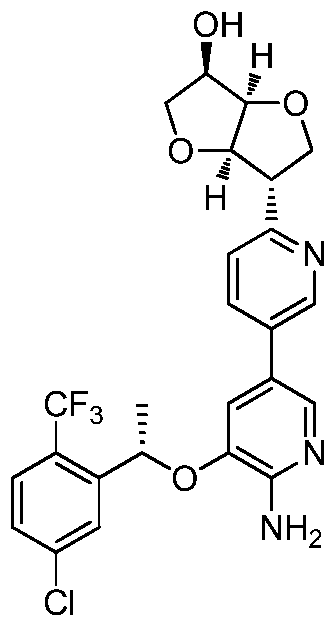
Step 1) (S)-l-tert-butyl 2-((i?)-l-(5-chloro-2-(trifluoromethyl)phenyl)ethyl)pyrrolidine-l,2- dicarboxylate
[312] The title compound was prepared according to the procedure of Example 25 Step
2 by using l-(5-chloro-2-(trifluoromethyl)phenyl)ethanol (16.5 g, 73.5 mmol), {S)-\-{tert-
butoxycarbonyl)pyrrolidine-2-carboxylic acid (9.5 g, 44.1 mmol), DMAP (1.8 g, 14.7 mmol), EDCI (1 1.3 g, 58.8 mmol) and DCM (300 mL). The resulted residue as the crude product was used for the next step without further purification (25.0 g).
LC-MS (ESI, pos. ion) m/z: 444.1 (M+23).
Step 2) (6 -(i?)-l-(5-chloro-2-(trifluoromethyl)phenyl)ethyl pyrrolidine-2-carboxylate
[313] The title compound was prepared according to the procedure of Example 25 Step
3 by using (S)-l-tert-butyl 2-((i?)-l-(5-chloro-2-(trifluoromethyl)phenyl)ethyl)pyrrolidine-l ,2- dicarboxylate (25.0 g, 59.3 mmol), trifluoroacetic acid (33.9 g, 297 mmol) and DCM (200 mL). The title compound was obtained as yellow oil (3.5 g, 30 % for two steps).
LC-MS (ESI, pos. ion) m/z: 322.1 (M+l).
Step 3) (i?)-l-(5-chloro-2-(trifluoromethyl)phenyl)ethanol
[314] The title compound was prepared according to the procedure of Example 25 Step
4 by using (5)-(i?)-l-(5-chloro-2-(trifluoromethyl)phenyl)ethyl pyrrolidine-2-carboxylate (3.5 g, 10.9 mmol), 2 M NaOH (aq., 20 mL), EtOH (10 mL) and 1 ,4-dioxane (20 mL). The title compound was obtained as yellow oil (2.6 g, 105 %).
LC-MS (ESI, pos. ion) m/z: 225.1 (M+l).
Step 4) (S)-3 -( 1 -(5 -chloro-2-(trifluoromethyl)phenyl)ethoxy)-2-nitropyridine
[315] The title compound was prepared according to the procedure of Example 25 Step
5 by using (i?)-l-(5-chloro-2-(trifluoromethyl)phenyl)ethanol (2.6 g, 1 1.6 mmol), 2-nitropyridin- 3-ol (1.8 g, 12.8 mmol), triphenylphosphine (3.6 g, 13.9 mmol), DIAD (2.8 g, 13.9 mmol) and toluene (50 mL). The title compound was obtained as a yellow solid (3.6 g, 90 %).
LC-MS (ESI, pos. ion) m/z: 347.0 (M+l).
Step 5) (6 -3-(l-(5-chloro-2-(trifluoromethyl)phenyl)ethoxy)pyridin-2-amine
[316] The title compound was prepared according to the procedure of Example 25 Step
6 by using (5)-3-(l-(5-chloro-2-(trifluoromethyl)phenyl)ethoxy)-2-nitropyridine (3.6 g, 10.4 mmol), Fe powder (3.5 g, 62.4 mmol) and HO Ac (50 mL). The title compound was obtained as yellow oil (3.0 g, 90 %).
LC-MS (ESI, pos. ion) m/z: 317.0 (M+l).
Step 6) (6 -5-bromo-3-(l -(5-chloro-2-(trifluoromethyl)phenyl)ethoxy)pyridin-2-amine
[317] The title compound was prepared according to the procedure of Example 25 Step
7 by using (5)-3-(l-(5-chloro-2-(trifluoromethyl)phenyl)ethoxy)pyridin-2-amine (3.0 g, 9.5 mmol), NBS (1.9 g, 10.5 mmol), DCM (50 mL) and CH3CN (25 mL). The title compound was obtained as a yellow solid (2.3 g, 62 %).
LC-MS (ESI, pos. ion) m/z: 394.9 (M+l).
Step 7) (6 -5-bromo-N,N-bis(tert-butoxycarbonyl)-3-(l -(5-chloro-2-(trifluoromethyl)phenyl)- ethoxy)pyridin-2-amine
[318] The title compound was prepared according to the procedure of Example 25 Step
8 by using (5)-5-bromo-3-(l-(5-chloro-2-(trifluoromethyl)phenyl)ethoxy)pyridin-2-amine (2.3 g, 5.8 mmol), Boc20 (3.8 g, 17.4 mmol), DMAP (0.14 g, 1.2 mmol) and DMF (20 mL). The title compound was obtained as a yellow solid (3.5 g, 100 %).
LC-MS (ESI, pos. ion) m/z: 439.0 (M-156 + 1).
Step 8) (5VN,N-bis(fert-butoxycarbonyl)- 3 -( 1 -(5 -chloro-2-(trifluoromethyl)phenyl)ethoxy)-5 - (4,4,5 ,5-tetramethyl- 1 ,3 ,2-dioxaborolan-2-yl)p yridin-2-amine
[319] The title compound was prepared according to the procedure of Example 25 Step
9 by using (5)-5-bromo-N,N-bis(tert-butoxycarbonyl)-3-(l-(5-chloro-2-(trifluoromethyl)- phenyl)ethoxy)pyridin-2-amine (3.5 g, 5.8 mmol), AcOK (2.3 g, 23.2 mmol), bis(pinacolato)diboron (2.2 g, 8.7 mmol), Pd(dppf)Cl2-CH2Cl2 (490 mg, 0.6 mmol) and DMSO (40 mL). The title compound was obtained as a yellow solid (3.0 g, 80 %).
LC-MS (ESI, pos. ion) m/z: 643.3 (M+l).
Step 9) N.N-bis(tert-butoxYcarbowD-6'-((3S.3aR.6R.6ay)-6-((tert-butyldimethylsilvnoxy - hexahvdroί ιro[3,2-ά1furan-3-yl -5-((6 -l-(5-chloro-2-(trifluoromethyl phenyl ethoxy -[3,3,- bipyridinl-6-amine
[320] The title compound was prepared according to the procedure of Example 25 Step
10 by using (5)-N,N-bis(tert-butoxycarbonyl)-3-(l-(5-chloro-2-(trifluoromethyl)phenyl)-ethoxy)- 5-(4,4,5,5-tetramethyl-l,3,2-dioxaborolan-2-yl)pyridin-2-amine (1.5 g, 2.3 mmol), 5-bromo-2- ((3S, 3 aR, 6R, 6a5)-6-((tert-butyldimethylsilyl)oxy)hexahydrofuro[3 ,2-b] furan-3 -yl)pyridine (0.92 g, 2.3 mmol), Cs2C03 (2.2 g, 6.9 mmol), water (4 mL), Pd(dppf)Cl2-CH2Cl2 (190 mg, 0.23 mmol) and DME (20 mL). The title compound was obtained as yellow oil (0.8 g, 55 %).
Step 10) (3R.3aR.6S.6ai? -6-(6,-amino-5,-((t^- 1 -(5-chloro-2-(trifiuoromethvnphenvnethoxy - [3,3,-bipyridin1-6-yl)hexahvdromro[3,2-¾1furan-3-ol
[321] The title compound was prepared according to the procedure of Example 25 Step
11 by using N,N-bis(tert-butoxycarbonyl)-6'-((35',3ai?,6i?,6a5)-6-((tert-butyldimethylsilyl)oxy)- hexahydromro[3,2-¾]mran-3-yl)-5-((5)-l-(5-chloro-2-(trifluoromethyl)phenyl)ethoxy)-[3,3'- bipyridin]-6-amine (0.8 g, 1.0 mmol), cone. HC1 (4.0 mL) and CH3OH (40 mL). The title compound was obtained as a yellow solid (0.31 g, 60 %).
LC-MS (ESI, pos. ion) m/z: 522.1 (M+l);
!H NMR (400 MHz, CDCb) δ (ppm): 8.49 (d, J = 2.1 Hz, 1H), 7.70 (d, J = 8.5 Hz, 1H), 7.66- 7.53 (m, 3H), 7.47 (d, J= 9.5 Hz, 1H), 7.39 (d, J= 8.2 Hz, 1H), 7.13 (s, 1H), 5.83 (d, J= 6.1 Hz, 1H), 5.32 (s, 1H), 4.84 (m, 1H), 4.78-4.70 (m, 1H), 4.47 (m, 1H), 4.38 (m, 1H), 4.25 (m, 1H), 3.80 (m, 3H), 1.83 (d, J= 6.2 Hz, 3H).
Example 30 (3R R.6S.6ai? -6-(6'-amino-5 '-((S)- 1 -(2-chloro-3 ,6-difjuorophenvnethoxy)-[3.3'- bipyridinl-6-yl)hexahydrofuro[3,2-¾lfuran-3-ol

Step 1) (S)-l-tert-butyl 2-((i?)-l-(2-chloro-3,6-difluorophenyl)ethyl) pyrrolidine- 1,2- dicarboxylate
[322] The title compound was prepared according to the procedure of Example 25 Step
2 by using l-(5-chloro-2-(trifluoromethyl)phenyl)ethanol (17.0 g, 88.3 mmol), {S)-\-{tert- butoxycarbonyl)pyrrolidine-2-carboxylic acid (11.4 g, 53.0 mmol), DMAP (2.2 g, 17.7 mmol), EDCI (13.5 g, 70.6 mmol) and DCM (300 mL). The resulted residue as the crude product was used for the next step without further purification (22.0 g).
LC-MS (ESI, pos. ion) m/z: 412.1 (M+23).
Step 2) (5V(i?)-l-(2-chloro-3,6-difluorophenyl)ethyl pyrrolidine-2-carboxylate
[323] The title compound was prepared according to the procedure of Example 25 Step
3 by using (S)-l-tert-butyl 2-((i?)-l-(2-chloro-3,6-difluorophenyl)ethyl)pyrrolidine-l,2- dicarboxylate (22.0 g, 56.4 mmol), trifluoroacetic acid (32.1 g, 282 mmol) and DCM (200 mL). The title compound was obtained as yellow oil (4.9 g, 40 % for two steps).
I l l
LC-MS (ESI, pos. ion) m/z: 290.1 (M+l). Step 3) (i?)-l-(2-chloro-3,6-difluorophenyl)ethanol
[324] The title compound was prepared according to the procedure of Example 25 Step
4 by using (5)-(i?)-l-(2-chloro-3,6-difluorophenyl)ethyl pyrrolidine-2-carboxylate (4.9 g, 16.9 mmol), 2 M NaOH (aq., 30 mL), EtOH (15 mL) and 1 ,4-dioxane (30 mL). The title compound was obtained as yellow oil (3.4 g, 105 %).
LC-MS (ESI, pos. ion) m/z: 193.1 (M+l).
Step 4) (S)-3 -( 1 -(2-chloro-3 ,6-difluorophenyl)ethoxy)-2-nitropyridine
[325] The title compound was prepared according to the procedure of Example 25 Step
5 by using (i?)-l -(2-chloro-3,6-difluorophenyl)ethanol (3.4 g, 17.7 mmol), 2-nitropyridin-3-ol (2.7 g, 19.5 mmol), triphenylphosphine (5.6 g, 21.2 mmol), DIAD (4.3 g, 21.2 mmol) and toluene (60 mL). The title compound as obtained as a yellow solid (5.0 g, 90 %).
LC-MS (ESI, pos. ion) m/z: 315.0 (M+l).
Step 5) (6 -3-(l-(2-chloro-3,6-difluorophenyl)ethoxy)pyridin-2-amine
[326] The title compound was prepared according to the procedure of Example 25 Step
6 by using (5)-3-(l -(2-chloro-3,6-difluorophenyl)ethoxy)-2-nitropyridine (5.0 g, 15.9 mmol), Fe powder (5.3 g, 95.6 mmol) and HO Ac (80 mL). The title compound was obtained as yellow oil (3.8 g, 85 %).
LC-MS (ESI, pos. ion) m/z: 285.0 (M+l).
Step 6) (6 -5-bromo-3-(l -(2-chloro-3,6-difluorophenyl)ethoxy)pyridin-2-amine
[327] The title compound was prepared according to the procedure of Example 25 Step
7 by using (5)-3-(l-(2-chloro-3,6-difluorophenyl)ethoxy)pyridin-2-amine (3.8 g, 13.5 mmol), NBS (2.6 g, 14.9 mmol), DCM (70 mL) and CH3CN (35 mL). The title compound was obtained as a yellow solid (3.2 g, 65 %).
LC-MS (ESI, pos. ion) m/z: 362.9 (M+l).
Step 7) (6 -5-bromo-N,N-bis(tert-butoxycarbonyl)-3 -( 1 -(2-chloro-3 ,6-difluorophenyl)ethoxy)- pyridin-2-amine
[328] The title compound was prepared according to the procedure of Example 25 Step
8 by using (5)-5-bromo-3-(l-(2-chloro-3,6-difluorophenyl)ethoxy)pyridin-2-amine (3.2 g, 8.8
mmol), Boc20 (5.8 g, 26.4 mmol), DMAP (0.22 g, 1.8 mmol) and DMF (30 mL). The title compound was obtained as a yellow solid (5.2 g, 104 %).
LC-MS (ESI, pos. ion) m/z: 407.0 (M-156+1).
Step 8) (^-N.N-bis(te^butoxycarbonvn-3-(l-(2-chloro-3.6-difluorophenvnethoxy -5-(4.4.5.5- tetramethyl- 1 ,3 ,2-dioxaborolan-2-yl)pyridin-2-amine
[329] The title compound was prepared according to the procedure of Example 25 Step
9 by using (5)-5-bromo-N,N-bis(tert-butoxycarbonyl)-3-(l-(2-chloro-3,6-difluorophenyl)- ethoxy)pyridin-2-amine (5.2 g, 9.2 mmol), AcOK (3.6 g, 36.8 mmol), bis(pinacolato)diboron (3.5 g, 13.8 mmol), Pd(dppf)Ci2-CH2Ci2 (730 mg, 0.9 mmol) and DMSO (50 mL). The title compound was obtained as a yellow solid (3.9 g, 70 %).
LC-MS (ESI, pos. ion) m/z: 611.3 (M+l).
Step 9) (3R.3aR.6S.6ai? -6-(6,-(bis(tert-butoxycarbonvnamino -5,-((t^- 1 -(2-chloro-3 ,6- difίuorophenyl eτhoxy 33,-bipyridinl^^
[330] The title compound was prepared according to the procedure of Example 25 Step
10 by using (5)-N,N-bis(tert-butoxycarbonyl)-3-(l-(2-chloro-3,6-difluorophenyl)ethoxy)-5- (4,4,5,5-tetramethyl-l,3,2-dioxaborolan-2-yl)pyridin-2-amine (1.5 g, 2.5 mmol), 5-bromo-2- ((35',3ai?,6i?,6a5)-6-((ter^butyldimethylsilyl)oxy)hexahydromro[3,2-¾]mran-3-yl)pyridine (1.0 g, 2.5 mmol), Cs2C03 (2.4 g, 7.5 mmol), water (4 mL), Pd(dppf)Ci2-CH2Ci2 (200 mg, 0.25 mmol) and DME (20 mL). The title compound was obtained as yellow oil (1.4 g, 70 %).
Step 10) (3R R.6S.6ai? -6-(6,-amino-5 '-((£)- 1 -(2-chloro-3 ,6-difluorophenvnethoxy)-[3.3'- bipyridin]-6-yl)hexahydrofuro[3,2-¾]furan-3-ol
[331] The title compound was prepared according to the procedure of Example 25 Step
11 by using (3i?,3ai?,65',6ai?)-6-(6'-(bis(tert-butoxycarbonyl)amino)-5'-((5)-l-(2-chloro-3,6- difluorophenyl)ethoxy)-[3,3'-bipyridin]-6-yl)hexahydrofuro[3,2-¾]furan-3-ol (1.4 g, 1.8 mmol), cone. HC1 (6.0 mL) and CH3OH (60 mL). The title compound was obtained as a yellow solid (0.44 g, 50 %).
LC-MS (ESI, pos. ion) m/z: 490.1 (M+l);
¾ NMR (400 MHz, CDCb) δ (ppm): 8.62 (d, J= 2.0 Hz, 1H), 7.88 (d, J= 1.8 Hz, 1H), 7.68 (m, 1H), 7.36-7.30 (m, 1H), 7.16-7.05 (m, 2H), 7.05-6.95 (m, 1H), 5.98 (m, 1H), 5.32 (s, 1H), 4.91 (s, 2H), 4.86 (m, 1H), 4.80-4.70 (m, 1H), 4.49 (m, 1H), 4.38 (m, 1H), 4.27 (m, 1H), 3.88 (m, 1H), 3.83-3.70 (m, 2H), 1.86 (d, J= 6.6 Hz, 3H).
Example 31 (3 ?Ja ?,66'■6a ? -6-(6,-amino-5,-(( ? -l-(2-chloro-3,6-difluoro henvnethoxy -r3,3,- bipyridin1-6-yl)hexahvdrofuror3,2-¾1furan-3-ol

Step 1 ) (R)-3 -( 1 -(2-chloro-3 ,6-difluorophenyl)ethoxy)-2-nitrop yridine
[332] The title compound was prepared according to the procedure of Example 26 Step
1 by using (i?)-l-(2-chloro-3,6-difluorophenyl)ethanol (4.1 g, 21.1 mmol), 3-fluoro-2- nitropyridine (3.3 g, 23.2 mmol), NaH (60 % dispersion in mineral oil, 1.1 g, 27.4 mmol) and THF (120 mL). The title compound was obtained as a yellow solid (5.6 g, 85 %).
LC-MS (ESI, pos. ion) m/z: 313.0 (M+l).
Step 2) (i?)-3-(l-(2-chloro-3,6-difluorophenyl)ethoxy)pyridin-2-amine
[333] The title compound was prepared according to the procedure of Example 25 Step
6 by using (i?)-3-(l-(2-chloro-3,6-difluorophenyl)ethoxy)-2-nitropyridine (5.6 g, 17.9 mmol), Fe powder (6.0 g, 107 mmol) and HO Ac (90 mL). The title compound was obtained as yellow oil (4.8 g, 95 %).
LC-MS (ESI, pos. ion) m/z: 285.0 (M+l).
Step 3) (i?)-5-bromo-3-(l-(2-chloro-3,6-difluorophenyl)ethoxy)pyridin-2-amine
[334] The title compound was prepared according to the procedure of Example 25 Step
7 by using (i?)-3-(l -(2-chloro-3,6-difluorophenyl)ethoxy)pyridin-2-amine (4.8 g, 17.0 mmol), NBS (3.3 g, 18.7 mmol), DCM (70 mL) and CH3CN (35 mL). The title compound was obtained as a yellow solid (5.2 g, 84 %).
LC-MS (ESI, pos. ion) m/z: 362.9 (M+l).
Step 4) (i?)-5-bromo-N,N-bis(tert-butoxycarbonyl)-3-(l-(2-chloro-3,6-difluorophenyl)- ethoxy)pyridin-2-amine
[335] The title compound was prepared according to the procedure of Example 25 Step
8 by using (i?)-5-bromo-3-(l-(2-chloro-3,6-difluorophenyl)ethoxy)pyridin-2-amine (5.2 g, 14.4
mmol), Boc20 (9.4 g, 43.2 mmol), DMAP (0.35 g, 2.9 mmol) and DMF (50 mL). The title compound was obtained as a yellow solid (6.6 g, 81 %).
LC-MS (ESI, pos. ion) m/z: 407.0 (M-156+1).
Step 5) (i? -N.N-bis(te^butoxycarbonvn-3-(l-(2-chloro-3.6-difluorophenvnethoxy -5-(4.4.5.5- tetramethyl- 1 ,3 ,2-dioxaborolan-2-yl)pyridin-2-amine
[336] The title compound was prepared according to the procedure of Example 25 Step
9 by using (i?)-5-bromo-N,N-bis(tert-butoxycarbonyl)-3-(l-(2-chloro-3,6-difluorophenyl)- ethoxy)pyridin-2-amine (6.6 g, 1 1.7 mmol), AcOK (3.6 g, 36.8 mmol), bis(pinacolato)diboron (4.6 g, 46.8 mmol), Pd(dppf)Cl2-CH2Cl2 (980 mg, 1.2 mmol) and 1 ,4-dioxane (45 mL). The title compound was obtained as a yellow solid (5.4 g, 75 %).
LC-MS (ESI, pos. ion) m/z: 61 1.3 (M+l).
Step 6) N.N-bisffe^butoxycarbonviye'-fOSJai?^
hexahydroi ro[3,2-&lfuran-3-yl)-5-((i?)-l-(2-chloro-3,6-difluorophenyl)ethoxy)-[3 J'-bipyridin]- 6-amine
[337] The title compound was prepared according to the procedure of Example 25 Step
10 by using (i?)-N,N-bis(tert-butoxycarbonyl)-3-(l-(2-chloro-3,6-difluorophenyl)ethoxy)-5- (4,4,5,5-tetramethyl-l ,3,2-dioxaborolan-2-yl)pyridin-2-amine (0.9 g, 1.5 mmol), 5-bromo-2- ((35',3ai?,6i?,6a5)-6-((ter^butyldimethylsilyl)oxy)hexahydromro[3,2-¾]mran-3-yl)pyridine (0.6 g, 1.5 mmol), Cs2C03 (1.5 g, 4.6 mmol), water (2 mL), Pd(dppf)Cl2 (120 mg, 0.15 mmol) and DME (10 mL). The title compound was obtained as yellow oil (0.7 g, 53 %).
Step 7) (3i? ai?,6^6ai? -6-(6,-amino-5,-((i? -l-(2-chloro-3,6-difluorophenvnethoxy 3 ,-bipyri din] -6-yl)hexahydrofuro[3 ,2-b~\ furan-3 -ol
[338] The title compound was prepared according to the procedure of Example 25 Step
11 by using N,N-bis(tert-butoxycarbonyl)-6'-((35',3ai?,6i?,6a5)-6-((tert-butyldimethylsilyl)oxy)- hexahydromro[3,2-¾]furan-3-yl)-5-((i?)-l-(2-chloro-3,6-difluorophenyl)ethoxy)-[3,3'-bipyridin]- 6-amine (0.7 g, 0.8 mmol), cone. HC1 (3.0 mL) and MeOH (30 mL). The title compound was obtained as a yellow solid (0.2 g, 47 %).
LC-MS (ESI, pos. ion) m/z: 490.1 (M+l);
¾ NMR (400 MHz, CDCb) δ (ppm): 8.62 (d, J= 2.1 Hz, 1H), 7.85 (d, J = 1.7 Hz, 1H), 7.67 (m, 1H), 7.33 (d, J = 8.2 Hz, 1H), 7.15-7.05 (m, 2H), 7.01 (m, 1H), 5.98 (m, 1H), 5.06 (s, 2H), 4.87 (m, 1H), 4.79-4.71 (m, 1H), 4.49 (m, 1H), 4.38 (m, 1H), 4.27 (m, 1H), 3.88 (m, 1H), 3.77 (m, 2H), 1.85 (t, J = 12.2 Hz, 3H).
Example 32 (3i ai?,6£6ai?V6-(6,-amino-5,-((i?yi-(2,5-dm
6-yl)hexahydrofuro[3,2-&]furan-3-ol

Step 1) (S)-l-tert-butyl 2-((i?)-l-(2,5-difluorophenyl)ethyl) pyrrolidine- 1,2-dicarboxylate
[339] The title compound was prepared according to the procedure of Example 25 Step
2 by using l-(2,5-difluorophenyl)ethanol (16.0 g, 101 mmol), {S)-\-{tert- butoxycarbonyl)pyrrolidine-2-carboxylic acid (13.0 g, 60.6 mmol), DMAP (2.5 g, 20.2 mmol), EDCI (15.5 g, 80.8 mmol) and DCM (300 mL). The resulted residue as the crude product was used for the next step without further purification (21.0 g).
LC-MS (ESI, pos. ion) m/z: 378.1 (M+23).
Step 2) (5V(i?)-l-(2,5-difluorophenyl)ethyl pyrrolidine-2-carboxylate
[340] The title compound was prepared according to the procedure of Example 25 Step
3 by using {S)-\-tert- vXy\ 2-((i?)-l-(2,5-difluorophenyl)ethyl) pyrrolidine- 1 ,2-dicarboxylate (21.0 g, 59.1 mmol), trifiuoroacetic acid (33.7 g, 296 mmol) and DCM (200 mL). The title compound was obtained as yellow oil (8.1 g, 63 % for two steps).
LC-MS (ESI, pos. ion) m/z: 256.1 (M+l).
Step 3) (i?)-l-(2,5-difluorophenyl)ethanol
[341] The title compound was prepared according to the procedure of Example 25 Step
4 by using (5)-(i?)-l-(2,5-difluorophenyl)ethyl pyrrolidine-2-carboxylate (8.1 g, 31.7 mmol), 2 M NaOH (aq., 60 mL), EtOH (35 mL) and 1,4-dioxane (60 mL). The title compound was obtained as yellow oil (5.3 g, 105 %).
LC-MS (ESI, pos. ion) m/z: 159.1 (M+l).
Step 4) (i?)-3-(l-(2,5-difluorophenyl)ethoxy)-2-nitropyridine
[342] The title compound was prepared according to the procedure of Example 26 Step
1 by using (i?)-l-(2,5-difluorophenyl)ethanol (5.3 g, 33.3 mmol), 3-fluoro-2-nitropyridine (5.2 g,
36.6 mmol), NaH (60 % dispersion in mineral oil, 1.7 g, 43.3 mmol) and THF (170 mL). The title compound was obtained as a yellow solid (7.7 g, 83 %).
LC-MS (ESI, pos. ion) m/z: 381.0 (M+l).
Step 5) (i?)-3-(l-(2,5-difluorophenyl)ethoxy)pyridin-2-amine
[343] The title compound was prepared according to the procedure of Example 25 Step
6 by using (i?)-3-(l-(2,5-difluorophenyl)ethoxy)-2-nitropyridine (7.7 g, 27.6 mmol), Fe powder (9.2 g, 166 mmol) and HOAc (100 mL). The title compound was obtained as yellow oil (5.7 g, 82 %).
LC-MS (ESI, pos. ion) m/z: 251.0 (M+l).
Step 6) (i?)-5-bromo-3-(l-(2,5-difluorophenyl)ethoxy)pyridin-2-amine
[344] The title compound was prepared according to the procedure of Example 25 Step
7 by using (i?)-3-(l-(2,5-difluorophenyl)ethoxy)pyridin-2-amine (5.7 g, 22.6 mmol), NBS (4.4 g, 24.9 mmol), DCM (100 mL) and CH3CN (55 mL). The title compound was obtained as a yellow solid (4.7 g, 63 %).
LC-MS (ESI, pos. ion) m/z: 328.9 (M+l).
Step 7) ( ? -5-bromo-N,N-bis(ter butoxycarbonyl -3-(l-(2,5-difίuorophenyl ethoxy pyridin-2- amine
[345] The title compound was prepared according to the procedure of Example 25 Step
8 by using (i?)-5-bromo-3-(l-(2,5-difluorophenyl)ethoxy)pyridin-2-amine (4.7 g, 14.2 mmol), B0C2O (9.3 g, 42.6 mmol), DMAP (0.34 g, 2.8 mmol) and DMF (50 mL). The title compound was obtained as a yellow solid (7.5 g, 100 %).
LC-MS (ESI, pos. ion) m/z: 373.0 (M-156+1).
Step 8) (RVN.N-bis(tgrt-butoxycarbonylV3-(l-(2.5-difluorophenvnethoxyV5-("4.4.5.5- tetramethyl- 1 ,3 ,2-dioxaborolan-2-yl)pyridin-2-amine
[346] The title compound was prepared according to the procedure of Example 25 Step
9 by using (i?)-5-bromo-N,N-bis(tert-butoxycarbonyl)-3-(l-(2,5-difluorophenyl)ethoxy)pyridin- 2-amine (7.5 g, 14.2 mmol), AcOK (5.6 g, 56.8 mmol), bis(pinacolato)diboron (5.4 g, 21.3 mmol), Pd(dppf)Ci2-CH2Ci2 (1.1 g, 0.9 mmol) and 1,4-dioxane (50 mL). The title compound was obtained as a yellow solid (6.1 g, 75 %).
LC-MS (ESI, pos. ion) m/z: 577.3 (M+l).
Step 9) N.N-bis(tert-butoxycarbonviy6'-((3S3
hexahvdromro[3,2-&]furan-3-yl)-5-((i -l-(2,5-di^
[347] The title compound was prepared according to the procedure of Example 25 Step
10 by using (i?)-N,N-bis(tert-butoxycarbonyl)-3-(l-(2,5-difluorophenyl)ethoxy)-5-(4,4,5,5- tetramethyl-l,3,2-dioxaborolan-2-yl)pyridin-2-amine (1.4 g, 2.4 mmol), 5-bromo-2- ((35',3ai?,6i?,6a5)-6-((ter^butyldimethylsilyl)oxy)hexahydromro[3,2-¾]mran-3-yl)pyridm (1.0 g, 2.4 mmol), Cs2C03 (2.3 g, 7.2 mmol), water (4 mL), Pd(dppf)Cl2-CH2Cl2 (200 mg, 0.24 mmol) and DME (20 mL). The title compound was obtained as yellow oil (1.2 g, 66 %).
Step 10) (3i? ai?,6^6ai? -6-(6,-amino-5,-((i? -l-(2,5-difluorophenvnethoxy 3 ,-bipyridinl-6- yl) hexahydrofuro[3 ,2-b] furan-3 -ol
[348] The title compound was prepared according to the procedure of Example 25 Step
11 by using N,N-bis(tert-butoxycarbonyl)-6'-((35',3ai?,6i?,6a5)-6-((tert-butyldimethylsilyl)oxy)- hexahydromro[3,2-¾7mran-3-yl)-5-((i?)-l-(2,5-difluorophenyl)ethoxy)-[3,3'-bipyridin]-6-a
(1.2 g, 1.6 mmol), cone. HC1 (6.0 mL) and MeOH (60 mL). The title compound was obtained as a yellow solid (0.4 g, 55 %).
LC-MS (ESI, pos. ion) m/z: 456.1 (M+l);
¾ NMR (400 MHz, CDC ) δ (ppm): 8.56 (s, 1H), 7.87 (s, 1H), 7.65 (d, J= 6.4 Hz, 1H), 7.31 (d, J = 4.5 Hz, 1H), 7.14-7.03 (m, 2H), 6.96 (d, J = 15.0 Hz, 2H), 5.68 (d, J = 6.0 Hz, 1H), 4.92 (s, 2H), 4.85 (m, 1H), 4.79-4.68 (m, 1H), 4.47 (m, 1H), 4.37 (d, J= 4.8 Hz, 1H), 4.31-4.19 (m, 1H), 3.87 (m, 1H), 3.81-3.65 (m, 2H), 1.73 (d, J= 6.3 Hz, 3H).
Example 33 (i?)-5-(l-(2-chloro-3,6-difluorophenyl)ethoxy)-6'-(piperazin-l-yl)-[33,-bipyridinl-6- amine

Step 1 ) (7?)-fert-butyl 4-(6'-((bis(tert-butoxycarbonyl))amino)-5 '-( 1 -(2-chloro-3 ,6- difluorophenyl)ethoxy)-r3,3,-bipyridin1-6-yl)piperazine-l-carboxylate
[349] To a solution of (i?)-N,N-bis(tert-butoxycarbonyl)-3-(l-(2-chloro-3,6- difluorophenyl)ethoxy)-5-(4,4,5,5-tetramethyl-l ,3,2-dioxaborolan-2-yl)pyridin-2-amine (0.89 g, 1.46 mmol) in DME (10 mL) was added tert-butyl 4-(5-bromopyridin-2-yl)piperazine-l- carboxylate (0.5 g, 1.46 mmol), cesium carbonate (1.43 g, 4.38 mmol), water (2 mL) and Pd(dppf)Cl2-CH2Ci2 (120 mg, 0.15 mmol). The reaction was degassed with nitrogen for 3 times. After being stirred at 100 °C overnight, the mixture was diluted with ethyl acetate (50 mL) and water (12 mL). The water phase was extracted with ethyl acetate (50 mL x 2). The combined organic layers were washed with brine (25 mL), dried over anhydrous Na2S04, and concentrated in vacuo. The residue was purified by a silica gel column chromatography (ethyl acetate/petroleum ether (v/v) = 1/1) to give the title compound as yellow oil (0.69 g, 63 %).
Step 2) (i?)-5-(l-(2-chloro-3,6-difluorophenyl)ethoxy)-6'-(piperazin-l-yl)-r3,3,-bipyridin1-6- amine
[350] To a solution of {R)-tert- vXy\ 4-(6'-((bis(tert-butoxycarbonyl))amino)-5'-(l-(2- chloro-3,6-difluorophenyl)ethoxy)-[3,3'-bipyridin]-6-yl)piperazine-l-carboxylate (0.69 g, 0.92 mmol) in methanol (30 mL) was added cone. HC1 (3.0 mL). After being stirred at 50 °C overnight, the reaction mixture was concentrated in vacuo. The residue was diluted with ethyl acetate (50 mL) and the resulted mixture was neutralized with a mixture of saturated NaHCCb aqueous solution (2 mL) and NaOH aqueous solution (5 M, 15 mL). The aqueous phase was extracted with ethyl acetate (30 mL x 3). The combined organic layers were washed with brine (15 mL), dried over anhydrous Na2S04, and concentrated in vacuo. The residue was purified by a silica gel column chromatography (MeOH/CH2Cl2 (v/v) = 1/20) to give the title compound as a yellow solid (60 mg, 15 %).
MS (ESI, pos. ion) m/z: 446.0 (M+l).
¾ NMR (400 MHz, CDC ) δ: 8.27 (d, J = 2.1 Hz, 1H), 7.81 (s, 1H), 7.54 (dd, J = 8.7, 2.4 Hz, 1H), 7.11-7.07 (m, 1H), 7.04 (s, 1H), 7.02-6.97 (m, 1H), 6.70 (d, J = 8.8 Hz, 1H), 5.97 (dd, J = 13.3, 6.6 Hz, 1H), 4.79 (s, 2H), 3.60-3.51 (m, 4H), 3.06-2.98 (m, 4H), 1.85 (d, J= 6.6 Hz, 3H).
Example 34 (i?)-5-(l-(2,5-dichlorophenyl)ethoxy)-6,-(piperazin-l-yl)-[3,3,-bipyridin]-6-amine

Step 1) ("R ert-butyl 4-( &-( (bis( tert-butoxycarbonylT)aminoy 5'-( 1 -(2.5 - dichlorophenyl)ethoxy)-[3,3,-bipyridinl-6-yl)piperazine-l-carboxylate
[351] The title compound was prepared according to the procedure of Example 33 Step
1 by using (i?)-N,N-bis(tert-butoxycarbonyl)-3-(l-(2,5-dichlorophenyl)ethoxy)-5-(4,4,5,5- tetramethyl-l ,3,2-dioxaborolan-2-yl)pyridin-2-amine (0.88 g, 1.44 mmol), tert-butyl 4-(5- bromopyridin-2-yl)piperazine-l-carboxylate (0.49 g, 1.44 mmol), cesium carbonate (1.41 g, 4.32 mmol), water (2 mL), Pd(dppf)Cl2-CH2Cl2 (1 10 mg, 0.14 mmol) and DME (10 mL). The title compound was obtained as yellow oil (0.80 g, 75 %).
Step 2) (R)-5-(l -(2,5-dichlorophenyl)ethoxy)-6'-(piperazin- 1 -yl)- r3,3'-bipyridin1-6-amine
[352] The title compound was prepared according to the procedure of Example 33 Step
2 by using {R)-tert- v y\ 4-(6'-((bis(tert-butoxycarbonyl))amino)-5'-(l-(2,5-dichlorophenyl)- ethoxy)-[3,3'-bipyridin]-6-yl)piperazine-l-carboxylate (0.80 g, 1.1 mmol) and cone. HCl (3.0 mL) and methanol (30 mL). The title compound was obtained as a yellow solid (0.1 g, 20 %).
MS (ESI, pos. ion) m/z: 444.2 (M+l);
!H NMR (400 MHz, CDCb) δ: 8.21 (d, J = 2.3 Hz, 1H), 7.82 (d, J = 1.4 Hz, 1H), 7.51 (dd, J = 8.8, 2.5 Hz, 1H), 7.44 (d, J = 2.5 Hz, 1H), 7.34 (d, J= 8.5 Hz, 1H), 7.22 (dd, J= 8.5, 2.5 Hz, 1H), 6.80 (d, J = 1.5 Hz, 1H), 6.68 (d, J = 8.8 Hz, 1H), 5.72 (q, J = 6.3 Hz, 1H), 4.85 (s, 2H), 3.59- 3.54 (m, 4H), 3.06-3.02 (m, 4H), 1.69 (d, J= 6.3 Hz, 3H).
Example 35 (3i?.3ai?.6tS'.6ai? -6-(6,-amino-5 '-((R)- 1 -(5 -chloro-2-(trifluoromethvn phenyl)ethoxy)-[3,3,-bipyridin1-6-yl)hexahvdrofuro[3,2-&1furan-3-ol

Step 1 ) (R)-3-(l -(5 -chloro-2-(trifluoromethyl)phenyl)ethoxy)-2-nitropyridine
[353] To a solution of (i?)-l-(5-chloro-2-(trifluoromethyl)phenyl)ethanol (4.57 g, 20.3 mmol) in THF (100 mL) was added NaH (60% dispersion in mineral oil, 1.06 g, 26.4 mmol), followed by the addition of a solution of 3-fluoro-2-nitropyridine (3.17 g, 22.3 mmol) in THF (20 mL) at -5 °C. After being stirred at rt overnight, the reaction mixture was quenched with H20 (4 mL) and concentrated in vacuo. The residue was partitioned between ethyl acetate (100 mL) and H20 (30 mL). The aqueous phase was extracted with ethyl acetate (50 mL). The combined organic layers were washed with brine (30 mL), dried over anhydrous Na2S04, and concentrated in vacuo. The residue was purified by a silica gel column chromatography (ethyl acetate/petroleum ether (v/v) = 1/5) to give the title compound as a yellow solid (5.61 g, 80 %).
MS (ESI, pos. ion) m/z: 347.0 (M+l).
Step 2) (R)-3 -( 1 -(5 -chloro-2-(trifluoromethyl)phenyl)ethoxy)p yridin-2-amine
[354] The title compound was prepared according to the procedure of Example 25 Step
6 by using (i?)-3-(l-(5-chloro-2-(trifluoromethyl)phenyl)ethoxy)-2-nitropyridine (5.61 g, 16.2 mmol), Fe powder (5.43 g, 97.2 mmol) and glacial acetic acid (60 mL). The title compound was obtained as yellow oil (5.01 g, 98 %).
MS (ESI, pos. ion) m/z: 317.0 (M+l).
Step 3) (i?)-5-bromo-3-(l-(5-chloro-2-(trifluoromethyl)phenyl)ethoxy)pyridin-2-amine
[355] The title compound was prepared according to the procedure of Example 25 Step
7 by using (i?)-3-(l-(5-chloro-2-(trifluoromethyl)phenyl)ethoxy)pyridin-2-amine (5.01 g, 15.8 mmol), CH2CI2 (70 mL) and a solution of NBS (3.1 g, 17.4 mmol) in CH3CN (35 mL). The title compound was obtained as a yellow solid (4.31 g, 69 %).
MS (ESI, pos. ion) m/z: 394.9 (M+l).
Step 4) (R)-5-bromo-N,N-bis(tert-butoxycarbonyl)-3-(l-(5-chloro-2-(trifluoromethyl)- phenyl)ethoxy)pyridin-2-amine
[356] The title compound was prepared according to the procedure of Example 25 Step
8 by using (i?)-5-bromo-3-(l-(5-chloro-2-(trifluoromethyl)phenyl)ethoxy)pyridin-2-amine (4.31 g, 10.9 mmol), DMAP (0.27 g, 2.2 mmol), Boc20 (7.14 g, 32.7 mmol) and DMF (40 mL). The title compound was obtained as yellow oil (5.8 g, 89 %).
MS (ESI, pos. ion) m/z: 439.0 (M-156+1).
Step 5) ^-N,N-bis(fert-butoxycarbonyl)-3 -( 1 -(5-chloro-2-(trifluoromethyl)phenyl)ethoxy)-5 - (4,4,5 ,5-tetramethyl- 1 ,3 ,2-dioxaborolan-2-yl)pyridin-2-amine
[357] The title compound was prepared according to the procedure of Example 25 Step
9 by using (i?)-5-bromo-N,N-bis(tert-butoxycarbonyl)-3-(l-(5-chloro-2-(trifluoromethyl)phenyl)- ethoxy)pyridin-2-amine (5.8 g, 9.7 mmol), potassium acetate (3.81 g, 38.8 mmol), 4,4,4',4',5,5,5',5'-octamethyl-2,2'-bi(l ,3,2-dioxaborolane) (3.69 g, 8.7 mmol), Pd(dppf)Cl2-CH2Cl2 (0.82 g, 1.0 mmol) and 1 ,4-dioxane (40 mL). The title compound was obtained as yellow oil (5.3 g, 85 %).
MS (ESI, pos. ion) m/z: 643.3 (M+l).
Step 6) N.N-bis(tert-butoxycarbonvn-6,-((36'.3aR.6R.6a5V6-((fe^butyldimethylsilvO- oxy)hexahydrofuro[3 ,2-b] furan-3 -yl)-5 -((R)- 1 -(5 -chloro-2-(trifluoromethyl)phenyl)ethoxy)- [3 ,3 '-bipyridin] -6-amine
[358] The title compound was prepared according to the procedure of Example 25 Step
10 by using (7? -N,N-bis(tert-butoxycarbonyl)-3-(l-(5-chloro-2-(trifluoromethyl)phenyl)ethoxy)- 5-(4,4,5,5-tetramethyl-l ,3,2-dioxaborolan-2-yl)pyridin-2-amine (1.24 g, 1.9 mmol), 5-bromo-2- ((35',3ai?,6i?,6a5)-6-((ter^butyldimethylsilyl)oxy)hexahydromro[3,2-¾]mran-3-yl)pyridine (0.77 g, 1.9 mmol), cesium carbonate (1.86 g, 5.7 mmol), water (2 mL), Pd(dppf)Cl2-CH2Cl2 (155 mg, 0.19 mmol) and DME (10 mL). The title compound was obtained as yellow oil (1.09 g, 68 %).
Step 7) (3i?.3ai?,6tS'.6ai? -6-(6,-amino-5,-((i? -l-(5-chloro-2-(trifiuoromethvnphenvnethoxy - [3,3,-bipyridin1-6-yl)hexahvdromro[3,2-¾1furan-3-ol
[359] The title compound was prepared according to the procedure of Example 25 Step
11 by using N,N-bis(tert-butoxycarbonyl)-6'-((35',3ai?,6i?,6a5)-6-((tert-butyldimethylsilyl)oxy)- hexahydrofuro[3 ,2-£]furan-3 -yl)-5 -((R)- 1 -(5 -chloro-2-(trifluoromethyl)-phenyl)ethoxy)- [3 ,3 '- bipyridin] -6-amine (1.09 g, 1.3 mmol), cone. HC1 (4.0 mL) and methanol (40 mL). The title compound was obtained as a yellow solid (0.44 g, 65 %).
MS (ESI, pos. ion) m/z: 522.3 (M+l);
!H NMR (400 MHz, CDCb) δ 8.54 (s, 1H), 7.89 (s, 1H), 7.75-7.56 (m, 3H), 7.40 (d, J = 8.1 Hz, 1H), 7.29 (s, 1H), 6.92 (s, 1H), 5.74 (d, J = 6.0 Hz, 1H), 4.93 (s, 2H), 4.84 (d, J = 3.7 Hz, 1H), 4.74 (d, J = 4.0 Hz, 1H), 4.46 (t, J = 7.7 Hz, 1H), 4.37 (d, J = 4.4 Hz, 1H), 4.30-4.18 (m, 1H), 3.91-3.81 (m, 1H), 3.81-3.67 (m, 2H), 3.09 (s, 1H), 1.74 (d, J= 5.6 Hz, 3H).
Example 36 (i?)-5-(l-(2,5-difluorophenyl)ethoxy)-6,-(piperazin-l-yl)-r33'-bipyridin1-6-amine

Step 1) (R)-tert-butyl 4-(6,-((bis(tert-butoxycarbonyl))amino)-5,-(l-(2,5-difluorophenyl)ethoxy)- [3,3,-bipyridinl-6-yl)piperazine-l-carboxylate
[360] The title compound was prepared according to the procedure of Example 33 Step
1 by using (i?)-3-(l-(2,5-difluorophenyl)ethoxy)-N,N-bis(tert-butoxycarbonyl)-5-(4,4,5,5- tetramethyl-l,3,2-dioxaborolan-2-yl)pyridin-2-amine (0.67 g, 1.16 mmol), tert-butyl 4-(5- bromopyridin-2-yl)piperazine-l-carboxylate (0.4 g, 1.16 mmol), cesium carbonate (1.13 g, 3.48 mmol), water (1.6 mL), Pd(dppf)Cl2-CH2Cl2 (98 mg, 0.12 mmol) and DME (8 mL). The title compound was obtained as yellow oil (0.74 g, 89 %).
Step 2) (i?)-5-(l-(2,5-difluorophenyl)ethoxy)-6'-(pi
[361] The title compound was prepared according to the procedure of Example 33 Step
2 by using {R)-tert-bvXy\ 4-(6'-((bis(tert-butoxycarbonyl))amino)-5'-(l-(2,5- difiuorophenyl)ethoxy)-[3,3'-bipyridin]-6-yl)piperazine-l-carboxylate (0.74 g, 1.0 mmol), cone. HC1 (3.0 mL) and methanol (30 mL). The title compound was obtained as a yellow solid (0.27 g,
63 %).
MS (ESI, pos. ion) m/z: 412.3 (M+l).
!H NMR (400 MHz, CDCb) 5 8.21 (d, J= 2.3 Hz, 1H), 7.82 (d, J= 1.6 Hz, 1H), 7.52 (dd, J= 8.8, 2.5 Hz, 1H), 7.14-7.03 (m, 2H), 7.00-6.94 (m, 1H), 6.91 (d, J = 1.6 Hz, 1H), 6.68 (d, J = 8.8 Hz, 1H), 5.67 (q, J = 6.3 Hz, 1H), 4.79 (s, 2H), 3.58-3.51 (m, 4H), 3.05-2.98 (m, 4H), 1.92 (s, 2H), 1.72 (d, J= 6.4 Hz, 3H).
Example 37 (i?)-5-(l-(5-chloro-2-(trifluoromethyl)phenyl)ethoxy)-6,-(piperazin-l-yl)-[3,3'- bipyridinl-6-amine

Step 1) (7?)-fert-butyl 4-(6,-((bis(tert-butoxycarbonyl))amino)-5'-(l-(5-chloro-2-
(trifluoromethyl)phenyl)ethoxy)-[3 ,3,-bipyridin1-6-yl)piperazine-l-carboxylate
[362] The title compound was prepared according to the procedure of Example 33 Step
1 by using (i?)-3-(l-(5-chloro-2-(trifluoromethyl)phenyl)ethoxy)-N,N-bis(tert-butoxycarbonyl)-
5- (4,4,5,5-tetramethyl-l,3,2-dioxaborolan-2-yl)pyridin-2-amine (0.74 g, 1.2 mmol), tert-butyl 4- (5-bromopyridin-2-yl)piperazine-l-carboxylate (0.39 g, 1.1 mmol), cesium carbonate (1.12 g, 3.44 mmol), water (1.6 mL), Pd(dppf)Ci2-CH2Ci2 (98 mg, 0.12 mmol) and DME (8 mL). The title compound was obtained as yellow oil (0.86 g, 96 %).
Step 2) (i?)-5-(l-(5-chloro-2-(trifluoromethyl)phenyl)ethoxy)-6'-(piperazin-l-yl)-[3 J'-bipyridin]-
6- amine
[363] The title compound was prepared according to the procedure of Example 33 Step
2 by using {R)-tert- vXy\ 4-(6'-((bis(tert-butoxycarbonyl))amino)-5'-(l-(5-chloro-2- (trifluoromethyl)phenyl)-ethoxy)-[3,3'-bipyridin]-6-yl)piperazine-l-carboxylate (0.86 g, 1.1 mmol), cone. HC1 (4.0 mL) and methanol (40 mL). The title compound was obtained as a yellow solid (0.29 g, 55 %).
MS (ESI, pos. ion) m/z: 478.0 (M+l);
¾ NMR (600 MHz, CDC ) δ 8.19 (d, J = 2.3 Hz, 1H), 7.83 (d, J = 1.8 Hz, 1H), 7.69 (d, J = 1.7 Hz, 1H), 7.63 (d, J = 8.5 Hz, 1H), 7.49-7.44 (m, 1H), 7.38 (dt, J = 7.2, 3.6 Hz, 1H), 6.89 (d, J = 1.8 Hz, 1H), 6.67 (d, J = 8.8 Hz, 1H), 5.73 (q, J = 6.2 Hz, 1H), 4.83 (s, 2H), 3.60-3.50 (m, 4H), 3.07-2.97 (m, 4H), 1.73 (d, J= 6.3 Hz, 3H).
BIOLOGICAL TESTING
[364] The LC/MS/MS system used in the analysis consists of an Agilent 1200 Series vacuum degasser, binary pump, well-plate autosampler, thermostattedcolumn compartment, the
Agilent G6430 TripleQuadrupole Mass Spectrometer with an electrosprayionization (ESI) source. Quantitative analysis was carried out using MRM mode. The parameters for MRM transitions are in the Table A.
Table A

[365] An Agilent XDB-C18, 2.1 x 30 mm, 3.5 μΜ column was used for the analysis. 5 μΕ of the samples were injected. Analysis condition: The mobile phase was 0.1% formic acid in water (A) and 0.1% formic acid in methanol (B). The flow rate was 0.4 mL/min. And the gradient of Mobile phase was in the Table B.
Table B

[366] Alternatively, an Agilent 6330 series LC/MS/MS spectrometer equipped with
G1312A binary pumps, a G1367A autosampler and a G1314C UV detector were used in the analysis. An ESI source was used on the LC/MS/MS spectrometer. The analysis was done in positive ion mode as appropriate and the MRM transition for each analyte was optimized using standard solution. A Capcell MP-C18 100 x 4.6 mm I.D., 5 μΜ column (Phenomenex, Torrance, California, USA) was used during the analysis. The mobile phase was 5mM ammonia acetate, 0.1% MeOH in water (A) : 5mM ammonia acetate, 0.1% MeOH in acetonitrile (B) (70:30, v/v). The flow rate was 0.6 mL/min. Column was maintained at ambient temperature. 20 μΐ^ of the samples were injected.
Example A: Compound Stability In Human And Rat Liver Microsomes
[367] Human or rat liver microsomes incubations were conducted in duplicate in polypropylene tubes. The typical incubation mixtures consisted of human liver microsomes (0.5
mg protein/mL), compounds of interest (5 μΜ) and NADPH (1.0 mM) in a total volume of 200 μΐ, potassium phosphate buffer (PBS, 100 mM, pH7.4). Compounds were dissolved in DMSO and diluted with PBS such that the final concentration of DMSO was 0.05%. The enzymatic reactions were commenced with the addition of protein after a 3-min preincubation and incubated in a water bath open to the air at 37 °C. Reactions were terminated at various time points (0, 5, 10, 15, 30, 60 min) by adding equal volume of ice-cold acetonitrile. The samples were stored at -80 °C until LC/MS/MS assays.
[368] The concentrations of compounds in the incubation mixtures of human liver microsomes were determined by a LC/MS/MS method. The ranges of the linearity in the concentration range were determined for each tested compounds.
[369] A parallel incubation was performed using denatured microsomes as the negative control, and reactions were terminated at various time points (0, 15, 60 min) after incubation at 37°C.
[370] Dextromethorphan (70 μΜ) was selected as the positive control, and reactions were terminated at various time points (0, 5, 10, 15, 30, 60 min) after incubation at 37°C. Both positive and negative control samples were included in each assay to ensure the integrity of the microsomal incubation system.
Data Analysis
[371] The concentrations of compounds in human liver microsome incubations were plotted as a percentage of the relevant zero time point control for each reaction. The in vivo CLint were extrapolated (ref : Naritomi, Y.; Terashita, S.; Kimura, S.; Suzuki, A.; Kagayama, A.; and Sugiyama, Y.; Prediction of human hepatic clearance from in vivo animal experiments and in vitro metabolic studies with liver microsomes from animals and humans. Drug Metab.Dispos., 2001, 29: 1316-1324).
Table 2 Human and rat liver microsomes Stability
Human Rat
Example # T1/2 CLint T1/2 CLint
(min) (mL/min/kg) (min) (niL/min/kg)
Ex. 1 43.92 39.58 28.25 87.92
Ex. 2 50.09 34.70 31.48 78.90
Ex. 3 28.26 61.51 16.20 153.32
Ex. 4 42.34 41.06 22.99 108.03
Ex. 5 133.1 13.06 59.90 41.46
Ex. 6 oo N/A 58.82 42.23
Ex. 7 726.5 2.39 85.20 29.15
Ex. 8 233.8 7.44 95.38 26.04
Ex. 9 29.29 59.35 18.95 131.07
Ex. 10 160.9 10.80 97.41 25.50
Ex. 11 213.5 8.14 87.20 28.48
Ex. 12 528.9 3.29 131.7 18.86
Ex. 13 24.48 71.01 11.86 209.42
Ex. 14 24.73 70.29 16.72 148.55
Ex. 15 73.51 23.65 55.73 44.57
Ex. 16 95.46 18.21 28.42 87.39
Ex. 17 9.29 187.08 6.99 355.53
Ex. 18 8.24 210.86 4.81 516.90
Ex. 19 180.4 9.64 30.98 80.17
Ex. 20 119.0 14.61 29.18 85.12
Ex. 21 138.9 12.51 35.42 70.12
Ex. 22 28.87 60.21 3.48 712.89
Ex. 23 173.1 10.04 23.32 106.51
Ex. 24 34.27 50.72 6.43 386.03
Ex. 25 7.66 226.99 4.30 577.88
Ex. 26 9.53 182.41 7.29 340.61
Ex. 27 34.73 50.05 14.17 175.28
Ex. 28 34.23 50.78 22.71 109.37
Ex. 29 20.20 86.06 9.83 252.67
Ex. 30 20.60 84.38 10.43 238.13
Ex. 31 35.82 48.53 30.11 82.49
Ex. 32 74.69 23.27 43.62 56.94
Ex. 35 36.44 47.70 28.73 86.45
Example B: Evaluation of Pharmacokinetics After Intravenous and Oral Administration of The Compounds Disclosed Herein In Mice, Rats, Dogs And Monkeys
[372] The Compounds disclosed herein are assessed in pharmacokinetic studies in mice, rats, dogs or monkeys. The compounds are administered as a water solution, 2% HPMC + 1% TWEEN®80 in water solution, 5% DMSO + 5% solutol in saline, 4% MC suspension or capsule. For the intravenous administration, the animals are generally given at 1 or 2 mg/kg dose. For the
oral (p.o.) dosing, mice and rats are generally given 5 or 10 mg/kg dose, and dogs and monkeys are generally given 10 mg/kg dose. The blood samples (0.3 mL) are drawn at 0.25, 0.5, 1.0, 2.0, 3.0, 4.0, 6.0, 8.0, 12 and 24 h time points or 0.083, 0.25, 0.5, 1.0, 2.0, 4.0, 6.0, 8.0 and 24 h time points and centrifuged at 3,000 or 4000 rpm for 2 to 10 min. The plasma solutions are collected, and stored at -20 °C or -70 °C until analyzed by LC/MS/MS as described above.
Table 3 Pharmacokinetic profiles in rats

Ex. 26 2 0.75 739 2.72 1.81 21.67
Ex. 27 2 0.85 751 2.66 2.13 42.7
Ex. 28 1 0.474 260 3.88 1.63 16.63
Ex. 29 2 1.43 751 2.69 2.83 35.5
Ex. 30 1 0.46 215 4.65 2.10 29.49
Ex. 31 1 0.616 299 3.43 1.71 13.42
Ex. 32 2 0.52 487 4.13 2.32 34.37
Ex. 35 1 0.94 197 5.07 2.95 13.23
Example C: Kinase Assays
[373] Kinase assays can be performed by measurement of incorporation of γ-33Ρ ATP into immobilized myelin basic protein (MBP). High binding white 384 well plates (Greiner) are coated with MBP (Sigma #M-1891) by incubation of 60 μΕ/well of 20 μg/mL MBP in Tris- buffered saline (TBS; 50 mM Tris pH 8.0, 138 mM NaCl, 2.7 mM KCl) for 24 h at 4°C. Plates are washed 3 x with 100 TBS. Kinase reactions are carried out in a total volume of 34 μΕ in kinase buffer (5 mM Hepes pH 7.6, 15 mM NaCl, 0.01% bovine gamma globulin (Sigma #1- 5506), 10 mM MgCl2, 1 mM DTT, 0.02% TritonX-100). Compound dilutions are performed in DMSO and added to assay wells to a final DMSO concentration of 1%. Each data point is measured in duplicate, and at least two duplicate assays are performed for each individual compound determination. Enzyme is added to final concentrations of 10 nM or 20 nM, for example. A mixture of unlabeled ATP and γ-33Ρ ATP is added to start the reaction (2 x 10⁶ cpm of γ-33Ρ ATP per well (3000 Ci/mmole) and 10 μΜ unlabeled ATP, typically. The reactions are carried out for 1 h at rt with shaking. Plates are washed 7x with TBS, followed by the addition of 50 μΕΛνεΙΙ scintillation fluid (Wallac). Plates are read using a Wallac Trilux counter. This is only one format of such assays; various other formats are possible, as known to one skilled in the art.
[374] The above assay procedure can be used to determine the IC50 for inhibition and/or the inhibition constant, K. The IC50 is defined as the concentration of compound required to reduce the enzyme activity by 50%> under the condition of the assay. The IC50 value is estimated by preparing a 10 point curve using a ½ log dilution series (for example, a typical curve may be prepared using the following compound concentrations: 10 μΜ, 3 μΜ, 1 μΜ, 0.3 μΜ, 0.1 μΜ, 0.03 μΜ, 0.01 μΜ, 0.003 μΜ, 0.001 μΜ and 0 μΜ).
[375] The kinase assays described herein were performed at Millipore UK Ltd, Dundee
Technology Park, Dundee DD2 1 SW, UK.
ALK (h) Kinase Assay
[376] ALK (h) is incubated with 8 mM MOPS pH 7.0, 0.2 mM EDTA, 250 μΜ
KKKSPGEYVNIEFG, 10 mM MgAcetate and [γ-33Ρ-ΑΤΡ] (specific activity aprrox. 500 pcm/pmol, concentration as required (10 μΜ)). The reaction is initiated by the addition of the MgATO mix. After incubation for 40 minutes at room temperature, the reaction is stopped by the addition of 3% phosphoric acid solution. 10 μΐ^ of the reaction is then spotted onto a P30 filter mat and washed three times for 5 minutes in 75 mM phosphoric acid and once in methanol prior to drying and scintillation counting. c-Met (h) Kinase Assay
[377] Met (h) is incubated with 8 mM MOPS pH 7.0, 0.2 mM EDTA, 250 μΜ
KKKSPGEYVNIEFG, 10 mM MgAcetate and [γ-33Ρ-ΑΤΡ] (specific activity approx. 500 cpm/pmol, concentration as required (10 μΜ)). The reaction is initiated by the addition of the MgATP mix. After incubation for 40 minutes at room temperature, the reaction is stopped by the addition of 3% phosphoric acid solution. 10 μΐ^ of the reaction is then spotted onto a P30 filtermat and washed three times for 5 minutes in 75 mM phosphoric acid and once in methanol prior to drying and scintillation counting.
Table 4 Kinase inhibition data

Ex. 14 131
Ex. 15 61
Ex. 17 57
Ex. 18 45
Ex. 19 69
Ex. 20 33
Ex. 21 39
Ex. 27 837
Ex. 28 15
Ex. 31 98
Ex. 32 31
[378] Finally, it should be noted that there are alternative ways of implementing the present invention. Accordingly, the present embodiments are to be considered as illustrative and not restrictive and the invention is not be limited to the details given herein, but may be modified within the scope and equivalents of the appended claims. All publications and patents cited herein are incorporated by reference.
Claims
1. A compound having Formula (I):

or a stereoisomer, a geometric isomer, a tautomer, an N-oxide, a hydrate, a solvate, a metabolite, a pharmaceutically acceptable salt or a prodrug thereof, wherein:
each of R1, R2, R3, R4, R5 and R6 is independently H, D or F;
each of X and Y is independently C6-ioaryl or 5-10 membered heteroaryl, wherein each of the C6-ioaryl and 5-10 membered heteroaryl is optionally substituted with 1, 2, 3 or 4 substituents independently selected from D, F, CI, Br, I, N3, CN, N02, Ci-6alkyl, Ci-6haloalkyl, C2-6alkenyl, C2- ealkynyl, -SRa, -NRaRb, -(Ci_4alkylene)-ORa, -(Ci_4alkylene)-NRaRb, -(Ci_4alkylene)-CN, - C(=0)NRaRb and C6-ioaryl ; and X is not 2,6-dichloro-3-fluorophenyl group, Y is not pyrazolyl group;
W is C3_8cycloalkyl, -(Ci-4alkylene)-(C3_8cycloalkyl), C3_7heterocyclyl or -(Ci alkylene)-(C3_ 7heterocyclyl), wherein each of the C3-scycloalkyl, -(Ci-4alkylene)-(C3-8cycloalkyl), C3_7heterocyclyl and -(Ci-4alkylene)-(C3_7heterocyclyl) is optionally substituted with 1 , 2, 3, 4 or 5 substituents independently selected from D, F, N3, CN, Ci_6alkyl, Ci_6haloal ORa, NRaRb, -(Ci_ alkylene)-
ORa, -(Ci_4alkylene)-NRaRb and -(Ci_ alkylene)-CN; and W is not
 ; and
; and
each Ra and Rb is independently H, Ci-6alkyl, C3_6Cycloalkyl, -(Ci alkylene)-(C3_ 6cycloalkyl), C2-6heterocyclyl, -(Ci_4alkylene)-(C2-6heterocyclyl), C6-ioaryl, -(Ci_4alkylene)-(C6- loaryl), 5-10 membered heteroaryl or -(Ci_4alkylene)-(5-10 membered heteroaryl), or Ra and Rb are taken together with the nitrogen atom to which they are attached form a 3-8 membered heterocyclic ring, wherein each of the above substituents is optionally substituted with 1, 2, 3 or 4 substituents
independently selected from D, F, CI, N3, CN, OH, NH2, alkoxy and alkylamino.
Provided that the compound is not 5-(l-(2-chloro-5-fluorophenyl)-2,2,2-trifluoroethoxy)-5'- (piperazin-l-yl)-[3,3'-bipyridin]-6-amine.
2. The compound according to claim 1, each of R1, R2, R3, R4, R5 and R6 is independently H or D;
3. The compound according to claim 1, wherein X is phenyl optionally substituted with 1 , 2, 3 or 4 substituents independently selected from D, F, CI, Br, Ci-3alkyl and Ci-3haloalkyl; and X is not 2,6-dichloro-3-fluorophenyl group.
4. The compound according to claim 1, wherein Y is phenyl or 5-6 membered heteroaryl, wherein each of the phenyl and 5-6 membered heteroaryl is optionally substituted with 1 , 2, 3 or 4 substituents independently selected from D, F, CI, Ci-3alkyl and Ci-3haloalkyl; and Y is not pyrazolyl group.
5. The compound according to claim 1, wherein W is C3-7heterocyclyl or -(Ci_4alkylene)-(C3- 7heterocyclyl), wherein each of the C3-7heterocyclyl and -(Ci alkylene)-(C3-7heterocyclyl) is optionally substituted with 1, 2, 3 or 4 substituents independently selected from D, F, Ci-3alkyl, Ci_ 3haloalkyl, ORa, NRaRb, -(Ci-3alkylene)-ORa, -(Ci-3alkylene)-NRaRb and -(Ci-4alkylene)-CN; and W

6. The compound according to claim 1, wherein each Ra and Rb is independently H, Ci- 3alkyl, C3-6cycloalkyl or -(Ci-3alkylene)-(C3-6cycloalkyl), or Ra and Rb are taken together with the nitrogen atom to which they are attached form a 3-6 membered heterocyclic ring, wherein each of the above substituents is optionally substituted with 1, 2, 3 or 4 substituents independently selected from D, F, -OH and -NH2.
7. The compound according to claim 1, wherein X is phenyl optionally substituted with 1 , 2, 3 or 4 substituents independently selected from D, F, CI and CF3; and X is not 2,6-dichloro-3- fluorophenyl group.
8. The compound according to claim 1, wherein Y is 5-6 membered heteroaryl optionally substituted with 1 , 2 or 3 substituents independently selected from D and F, and Y is not pyrazolyl group.
9. The compound according to claim 1 , wherein W is C3-7heterocyclyl or -(Ci-2alkylene)-(C3- 7heterocyclyl), wherein each of the C3-7heterocyclyl and -(Ci-2alkylene)-(C3-7heterocyclyl) is optionally substituted with 1 , 2, 3 or 4 substituents independently selected from D, F, -ORa, -NRaRb,
-(Ci-2alkylene)-ORa, Ci_2alkyl and Ci_2haloalkyl; and W is not
 .
.
10. The compound according to claim 1 , wherein each Ra and Rb is independently H or Ci- 2alkyl, or Ra and Rb are taken together with the nitrogen atom to which they are attached form a 5-6 membered heterocyclic ring, wherein each of the above substituents is optionally substituted with 1 , 2, 3 or 4 substituents independently selected from D and F.
1 1. The compound of claim 1 having one of the following structures:


(51) (52) (53) (54) Qr (55)
12. A pharmaceutical composition comprising the compound according to any one of claims 1 to 1 1, and a pharmaceutically acceptable carrier, excipient, diluent, adjuvant, vehicle or a combination thereof.
13. The pharmaceutical composition according to claim 12 further comprising a therapeutic agent selected from the group consisting of chemotherapeutic agents, anti-proliferative agents, agents for treating atherosclerosis, agents for treating lung fibrosis and combinations thereof.
14. The pharmaceutical composition according to claim 13, wherein the therapeutic agent is chlorambucil, melphalan, cyclophosphamide, ifosfamide, busulfan, carmustine, lomustine, streptozocin, cisplatin, carboplatin, oxaliplatin, dacarbazine, temozolomide, procarbazine, methotrexate, fluorouracil, cytarabine, gemcitabine, mercaptopurine, fludarabine, vinblastine, vincristine, vinorelbine, paclitaxel, docetaxel, topotecan, irinotecan, etoposide, trabectedin, dactinomycin, doxorubicin, epirubicin, daunorubicin, mitoxantrone, bleomycin, mitomycin, ixabepilone, tamoxifen, flutamide, gonadorelin analogues, megestrol, prednisone, dexamethasone, methylprednisolone, thalidomide, interferon alfa, leucovorin, sirolimus, temsirolimus, everolimus, afatinib, alisertib, amuvatinib, apatinib, axitinib, bortezomib, bosutinib, brivanib, cabozantinib, cediranib, crenolanib, crizotinib, dabrafenib, dacomitinib, danusertib, dasatinib, dovitinib, erlotinib, foretinib, ganetespib, gefitinib, ibrutinib, icotinib, imatinib, iniparib, lapatinib, lenvatinib, linifanib, linsitinib, masitinib, momelotinib, motesanib, neratinib, nilotinib, niraparib, oprozomib, olaparib, pazopanib, pictilisib, ponatinib, quizartinib, regorafenib, rigosertib, rucaparib, ruxolitinib, saracatinib, saridegib, sorafenib, sunitinib, tasocitinib, telatinib, tivantinib, tivozanib, tofacitinib, trametinib, vandetanib, veliparib, vemurafenib, vismodegib, volasertib, alemtuzumab, bevacizumab, brentuximabvedotin, catumaxomab, cetuximab, denosumab, gemtuzumab, ipilimumab, nimotuzumab, ofatumumab, panitumumab, ramucirumab, rituximab, tositumomab, trastuzumab, or a combination thereof
15. The compound according to any one of claims 1 to 11 or the pharmaceutical composition according to any one of claims 12 to 14 for use in preventing, managing, treating or lessening the severity of a proliferative disorder in a patient.
16. The compound or pharmaceutical composition according to claim 15, wherein the proliferative disorder is metastatic cancer, colon cancer, gastric adenocarcinoma, bladder cancer, breast cancer, kidney cancer, liver cancer, lung cancer, skin cancer, thyroid cancer, a cancer of the head and neck, prostate cancer, pancreatic cancer, a cancer of the CNS, glioblastoma, a myeloproliferative disorder, atherosclerosis or lung fibrosis.
17. Use of the compound according to any one of claims 1 to 11 or the pharmaceutical composition according to any one of claims 12 to 14 in the manufacture of a medicament for preventing, managing, treating or lessening the severity of a proliferative disorder in a patient.
18. The use of claim 17, wherein the proliferative disorder is metastatic cancer, colon cancer, gastric adenocarcinoma, bladder cancer, breast cancer, kidney cancer, liver cancer, lung cancer, skin cancer, thyroid cancer, a cancer of the head and neck, prostate cancer, pancreatic cancer, a cancer of the CNS, glioblastoma, a myeloproliferative disorder, atherosclerosis or lung fibrosis.
19. A method of preventing, managing, treating or lessening the severity of a proliferative disorder in a patient comprising administering to the patient with the compound according to any one of claims 1 to 11 or the pharmaceutical composition according to any one of claims 12 to 14.
20. The method of claim 19, wherein the proliferative disorder is metastatic cancer, colon cancer, gastric adenocarcinoma, bladder cancer, breast cancer, kidney cancer, liver cancer, lung cancer, skin cancer, thyroid cancer, a cancer of the head and neck, prostate cancer, pancreatic cancer, a cancer of the CNS, glioblastoma, a myeloproliferative disorder, atherosclerosis or lung fibrosis.
21. A method of inhibiting or modulating the activity of a protein kinase in a biological sample comprising contacting a biological sample with the compound according to any one of claims 1 to 1 1 or the pharmaceutical composition according to any one of claims 12 to 14.
22. The method of claim 21 , wherein the protein kinase is a receptor tyrosine kinase.
23. The method of claim 22, wherein the receptor tyrosine kinase is ALK, c-Met or a combination thereof.
Applications Claiming Priority (2)
| Application Number | Priority Date | Filing Date | Title |
|---|---|---|---|
| US201361873963P | 2013-09-05 | 2013-09-05 | |
| US61/873,963 | 2013-09-05 |
Publications (1)
| Publication Number | Publication Date |
|---|---|
| WO2015034729A1 true WO2015034729A1 (en) | 2015-03-12 |
Family
ID=52628860
Family Applications (1)
| Application Number | Title | Priority Date | Filing Date |
|---|---|---|---|
| PCT/US2014/053017 Ceased WO2015034729A1 (en) | 2013-09-05 | 2014-08-27 | Substituted pyridine compounds and methods of use |
Country Status (1)
| Country | Link |
|---|---|
| WO (1) | WO2015034729A1 (en) |
Cited By (6)
| Publication number | Priority date | Publication date | Assignee | Title |
|---|---|---|---|---|
| CN108264500A (en) * | 2016-12-31 | 2018-07-10 | 正大天晴药业集团股份有限公司 | Substituted 2-aminopyridine class compound and preparation method |
| CN108264501A (en) * | 2016-12-31 | 2018-07-10 | 正大天晴药业集团股份有限公司 | Substituted 2-aminopyridine class compound and preparation method thereof |
| US11040027B2 (en) | 2017-01-17 | 2021-06-22 | Heparegenix Gmbh | Protein kinase inhibitors for promoting liver regeneration or reducing or preventing hepatocyte death |
| WO2021219137A1 (en) * | 2020-04-30 | 2021-11-04 | 正大天晴药业集团股份有限公司 | Aminopyridine derivative for treating diseases caused by met genetic abnormalities |
| JP2023550021A (en) * | 2020-10-30 | 2023-11-30 | 珠海宇繁生物科技有限責任公司 | Deuterated HPK1 kinase inhibitor and its production method and use |
| RU2852946C1 (en) * | 2020-10-30 | 2025-12-16 | Гуанчжоу Юйфань Наньту Байотекнолоджиз Ко., Лтд | Deuterated hpk1 kinase inhibitor, method for production and its application |
Citations (3)
| Publication number | Priority date | Publication date | Assignee | Title |
|---|---|---|---|---|
| US20060128724A1 (en) * | 2004-08-26 | 2006-06-15 | Agouron Pharmaceuticals, Inc. | Pyrazole-substituted aminoheteroaryl compounds as protein kinase inhibitors |
| US20070072874A1 (en) * | 2003-02-26 | 2007-03-29 | Sugen, Inc. | Aminoheteroaryl compounds as protein kinase inhibitors |
| US7858643B2 (en) * | 2004-08-26 | 2010-12-28 | Agouron Pharmaceuticals, Inc. | Enantiomerically pure aminoheteroaryl compounds as protein kinase inhibitors |
-
2014
- 2014-08-27 WO PCT/US2014/053017 patent/WO2015034729A1/en not_active Ceased
Patent Citations (3)
| Publication number | Priority date | Publication date | Assignee | Title |
|---|---|---|---|---|
| US20070072874A1 (en) * | 2003-02-26 | 2007-03-29 | Sugen, Inc. | Aminoheteroaryl compounds as protein kinase inhibitors |
| US20060128724A1 (en) * | 2004-08-26 | 2006-06-15 | Agouron Pharmaceuticals, Inc. | Pyrazole-substituted aminoheteroaryl compounds as protein kinase inhibitors |
| US7858643B2 (en) * | 2004-08-26 | 2010-12-28 | Agouron Pharmaceuticals, Inc. | Enantiomerically pure aminoheteroaryl compounds as protein kinase inhibitors |
Cited By (9)
| Publication number | Priority date | Publication date | Assignee | Title |
|---|---|---|---|---|
| CN108264500A (en) * | 2016-12-31 | 2018-07-10 | 正大天晴药业集团股份有限公司 | Substituted 2-aminopyridine class compound and preparation method |
| CN108264501A (en) * | 2016-12-31 | 2018-07-10 | 正大天晴药业集团股份有限公司 | Substituted 2-aminopyridine class compound and preparation method thereof |
| CN108264501B (en) * | 2016-12-31 | 2020-04-21 | 正大天晴药业集团股份有限公司 | Substituted 2-aminopyridine compounds and preparation method thereof |
| CN108264500B (en) * | 2016-12-31 | 2020-04-21 | 正大天晴药业集团股份有限公司 | Substituted 2-aminopyridine compounds and preparation method thereof |
| US11040027B2 (en) | 2017-01-17 | 2021-06-22 | Heparegenix Gmbh | Protein kinase inhibitors for promoting liver regeneration or reducing or preventing hepatocyte death |
| WO2021219137A1 (en) * | 2020-04-30 | 2021-11-04 | 正大天晴药业集团股份有限公司 | Aminopyridine derivative for treating diseases caused by met genetic abnormalities |
| JP2023550021A (en) * | 2020-10-30 | 2023-11-30 | 珠海宇繁生物科技有限責任公司 | Deuterated HPK1 kinase inhibitor and its production method and use |
| JP7751779B2 (en) | 2020-10-30 | 2025-10-09 | 広州宇繁南図生物科技有限公司 | Deuterated HPK1 kinase inhibitors and methods for their preparation and use |
| RU2852946C1 (en) * | 2020-10-30 | 2025-12-16 | Гуанчжоу Юйфань Наньту Байотекнолоджиз Ко., Лтд | Deuterated hpk1 kinase inhibitor, method for production and its application |
Similar Documents
| Publication | Publication Date | Title |
|---|---|---|
| AU2012223639B2 (en) | Substituted quinoline compounds and methods of use | |
| US9181277B2 (en) | Aminoquinazoline derivatives and their salts and methods of use | |
| WO2013138210A1 (en) | Substituted cyclic compounds and methods of use | |
| CN104650049B (en) | Substituted pyridine compounds and its application method and purposes | |
| EP3299019B1 (en) | Heteroaromatic compounds as pi3 kinase modulators and methods of use | |
| KR102148681B1 (en) | Heteroaromatic compounds as pi3 kinase modulators | |
| AU2012223639A1 (en) | Substituted quinoline compounds and methods of use | |
| WO2014177038A1 (en) | Aminoquinazoline derivatives and their salts and methods of use thereof | |
| CN103304552B (en) | Substituted pyridine compounds and using method thereof and purposes | |
| WO2013180949A1 (en) | Substituted quinoline compounds and methods of use | |
| KR20110075016A (en) | Compound and how to use | |
| EP2879676A1 (en) | Substituted pyrazolone compounds and methods of use | |
| WO2014022128A1 (en) | Pi3 kinase modulators and methods of use | |
| WO2014193647A2 (en) | Alkenyl compounds and methods of use | |
| WO2014089324A1 (en) | Substituted cyclic compounds and methods of use | |
| WO2015034729A1 (en) | Substituted pyridine compounds and methods of use | |
| WO2014089280A1 (en) | Alkynyl compounds and methods of use | |
| WO2013148537A1 (en) | Substituted spirobicyclic compounds and methods of use | |
| WO2013177092A1 (en) | Substituted alkynyl pyridine compounds and methods of use | |
| CN103833753B (en) | Alkynyl compound and its use method and purpose | |
| HK1218385B (en) | Heteroaromatic compounds as pi3 kinase modulators | |
| HK1187259B (en) | Substituted quinoline compounds | |
| HK1196609B (en) | Aminoquinazoline derivatives and their salts and methods of use | |
| HK1210956B (en) | Heteroaromatic compounds as pi3 kinase modulators and methods of use |
Legal Events
| Date | Code | Title | Description |
|---|---|---|---|
| 121 | Ep: the epo has been informed by wipo that ep was designated in this application |
Ref document number: 14842485 Country of ref document: EP Kind code of ref document: A1 |
|
| NENP | Non-entry into the national phase |
Ref country code: DE |
|
| 122 | Ep: pct application non-entry in european phase |
Ref document number: 14842485 Country of ref document: EP Kind code of ref document: A1 |