WO2015033972A1 - 真珠核、及び真珠核コーティング剤 - Google Patents
真珠核、及び真珠核コーティング剤 Download PDFInfo
- Publication number
- WO2015033972A1 WO2015033972A1 PCT/JP2014/073231 JP2014073231W WO2015033972A1 WO 2015033972 A1 WO2015033972 A1 WO 2015033972A1 JP 2014073231 W JP2014073231 W JP 2014073231W WO 2015033972 A1 WO2015033972 A1 WO 2015033972A1
- Authority
- WO
- WIPO (PCT)
- Prior art keywords
- pearl
- nucleus
- pearl nucleus
- substance
- positive charge
- Prior art date
- Legal status (The legal status is an assumption and is not a legal conclusion. Google has not performed a legal analysis and makes no representation as to the accuracy of the status listed.)
- Ceased
Links
Images



Classifications
-
- A—HUMAN NECESSITIES
- A01—AGRICULTURE; FORESTRY; ANIMAL HUSBANDRY; HUNTING; TRAPPING; FISHING
- A01K—ANIMAL HUSBANDRY; AVICULTURE; APICULTURE; PISCICULTURE; FISHING; REARING OR BREEDING ANIMALS, NOT OTHERWISE PROVIDED FOR; NEW BREEDS OF ANIMALS
- A01K61/00—Culture of aquatic animals
- A01K61/50—Culture of aquatic animals of shellfish
- A01K61/54—Culture of aquatic animals of shellfish of bivalves, e.g. oysters or mussels
-
- Y—GENERAL TAGGING OF NEW TECHNOLOGICAL DEVELOPMENTS; GENERAL TAGGING OF CROSS-SECTIONAL TECHNOLOGIES SPANNING OVER SEVERAL SECTIONS OF THE IPC; TECHNICAL SUBJECTS COVERED BY FORMER USPC CROSS-REFERENCE ART COLLECTIONS [XRACs] AND DIGESTS
- Y02—TECHNOLOGIES OR APPLICATIONS FOR MITIGATION OR ADAPTATION AGAINST CLIMATE CHANGE
- Y02A—TECHNOLOGIES FOR ADAPTATION TO CLIMATE CHANGE
- Y02A40/00—Adaptation technologies in agriculture, forestry, livestock or agroalimentary production
- Y02A40/80—Adaptation technologies in agriculture, forestry, livestock or agroalimentary production in fisheries management
- Y02A40/81—Aquaculture, e.g. of fish
Definitions
- the present invention relates to a pearl nucleus whose surface is positively charged, and a pearl nucleus coating agent.
- Pearl is a mineral produced in the shell of shells, and has been useful as a gem for a long time.
- a method for artificially producing pearls has already been established.
- the conventional method of producing pearls is to insert a section of the mantle of the same kind as the pearl nucleus and pearl oyster shell into the gonad gonad and cultivate the pearl oyster shell for one to two years.
- a pearl is produced in the body of a pearl mother shell (see Non-Patent Document 1).
- JP 2007-000047 A Japanese Patent Laid-Open No. 07-031321 JP 2009-055873 A JP 2009-219487 A JP-A-11-000076 Japanese Patent Application Laid-Open No. 08-256631
- the mantle inserted together with the pearl nucleus forms a pearl bag so as to surround the pearl nucleus, and the pearl nucleus wrapped in the pearl bag can be engrafted in the pearl mother shell.
- the pearl nucleus is discharged from the pearl shell. Therefore, a technology that can increase the production efficiency of pearls by promoting the early formation of pearl bags has been demanded.
- Patent Literature 5 and Patent Literature 6 describe artificially synthesized pearl nuclei.
- the use of chitin and chitosan for artificial pearl nuclei is suggested, there is no description on improvement of pearl production efficiency and high quality using conventional pearl nuclei.
- the pearl nucleus of the present invention is characterized in that the surface is positively charged.
- Another pearl nucleus of the present invention is obtained by coating the surface with a positively charged substance.
- the substance having a positive charge is an organic compound or an inorganic compound having a large number of functional groups exhibiting a positive charge. More specifically, it is one or more selected from sugars, proteins, polypeptides, nucleic acids, lipids, and low molecular weight compounds having many positively charged functional groups. More specifically, it is one or more selected from chitosan, poly-L-lysine, histone, polyallylamine, aminosilane, basic fuchsin, and amino sugar.
- another pearl nucleus of the present invention is a pearl nucleus in which a substance having a positive charge is coated on a surface by immersing the pearl nucleus in a solution containing about 0.01 wt% to about 2 wt% of a substance having a positive charge. is there.
- the substance having a positive charge is chitosan
- the pearl nucleus is coated with chitosan on the surface by immersing the pearl nucleus in a solution containing about 0.15 wt% to about 1.5 wt% of chitosan.
- the surface of the pearl nucleus of the present invention is positively charged, the collection of blood cells of the pearl mother shell on the pearl nucleus surface is promoted in the body of the pearl mother shell. Since the nacreous bag is formed by dividing the mantle epithelial cells using the blood cells of the nacreous shell as a foothold, formation of the nacreous bag is promoted when the nacreous nucleus of the present invention is used.
- the pearl nucleus coating agent of the present invention contains a positively charged substance as an active ingredient.
- the substance having a positive charge is an organic compound or an inorganic compound having many functional groups exhibiting a positive charge. More specifically, it is one or more selected from sugars, proteins, polypeptides, nucleic acids, lipids, and low molecular weight compounds having many positively charged functional groups. More specifically, it is one or more selected from chitosan, poly-L-lysine, histone, polyallylamine, aminosilane, basic fuchsin, and amino sugar.
- Another embodiment of the present invention is a pearl nucleus coating agent containing about 0.01 wt% to about 2 wt% of a positively charged substance.
- the positively charged substance is chitosan
- it is a pearl nucleus coating agent containing about 0.15 wt% to about 1.5 wt% chitosan.
- the pearl nucleus coating agent of the present invention has an effect of promoting blood cell assembly of the pearl oyster shell in the pearl oyster shell. Therefore, the pearl nucleus coated on the surface with the pearl nucleus coating agent of the present invention promotes the assembly of blood cells of the pearl mother shell on the pearl nucleus surface in the body of the pearl mother shell.
- the present invention provides a pearl production method using the pearl nucleus or the pearl nucleus coated on the surface with the pearl nucleus coating agent.
- the pearl nucleus of the present invention or the pearl nucleus coated with the pearl nucleus coating agent When the pearl nucleus of the present invention or the pearl nucleus coated with the pearl nucleus coating agent is inserted into the body of the pearl shell with the mantle, blood cells of the pearl shell gather on the pearl nucleus surface. Since the blood cells of the mother of pearl are negatively charged, the pearl nucleus of the present invention promotes the assembly of blood cells compared to the conventional pearl nucleus. As a result, the formation of pearl bags is promoted, the survival rate of pearl nuclei is improved, and the production efficiency of pearls is dramatically increased. In addition, the proportion of high-quality pearls in the produced pearls increases.
- the pearl nucleus of the present invention is characterized in that the surface is positively charged.
- the blood cells of the pearl shell gather on the surface of the pearl nucleus of the present invention in a sheet form. Since the blood cells of the mother of pearl are negatively charged, the pearl nucleus of the present invention promotes the assembly of blood cells on the surface of the pearl nucleus as compared with the conventional pearl nucleus. As a result, the formation of pearl bags is promoted, and the production efficiency of pearls is dramatically increased.
- the pearl nucleus is a pearl formed by forming a shell structure such as a pearl layer on the surface, and is inserted into the body of the pearl shell simultaneously or continuously with the mantle.
- a pearl layer of a shellfish particularly a bivalve shell
- a substantially spherical shape or a substantially hemispherical shape is used, but synthetic resin or ceramics can also be used.
- Pearl nuclei having a diameter of about 0.5 mm to about 20 mm are widely used.
- the surface of the pearl nucleus of the present invention is positively charged. Specifically, it can be obtained by a conventional method such as coating of a substance having a positive charge on the surface of a pearl nucleus or consolidation of a fine substance having a positive charge.
- Another aspect of the present invention is a pearl nucleus having a surface coated with a positively charged substance. It can be easily obtained by coating the surface of a conventional pearl nucleus. Specifically, it can be obtained by immersing the pearl nucleus in an aqueous solution containing a substance having a positive charge, or applying an aqueous solution containing a substance having a positive charge to the surface of the pearl nucleus.
- the positively charged substance and the pearl nucleus surface are bonded by electrostatic bonding, hydrophobic bonding, or the like.
- the substance having a positive charge is an organic compound or an inorganic compound having a large number of functional groups exhibiting a positive charge. More specifically, it may be a sugar, protein, polypeptide, nucleic acid, polymer such as lipid, or low molecular weight compound having many positively charged functional groups such as amino groups. More specifically, examples include, but are not limited to, chitosan, poly-L-lysine, histone, polyallylamine, aminosilane, basic fuchsin, and amino sugar. Specific examples of amino sugars include glucosamine, galactosamine, sialic acid, aminouronic acid, muramic acid and the like.
- the coating of the substance having a positive charge on the surface of the pearl nucleus is performed by immersing the pearl nucleus in a solution in which the substance having a positive charge is dissolved and further drying.
- the coating of the substance having a positive charge on the pearl nucleus surface is preferably performed by immersing the pearl nucleus in a solution containing about 0.01 wt% to about 2 wt%. In the case of chitosan, it is preferable to use a solution containing about 0.15 wt% to about 1.5 wt%.
- Another aspect of the present invention is a pearl nucleus coating agent containing a positively charged substance as an active ingredient.
- a pearl nucleus coating agent containing a positively charged substance as an active ingredient.
- the active ingredient contained in the pearl nucleus coating agent is an organic compound or an inorganic compound having many functional groups exhibiting a positive charge. More specifically, it may be a sugar, protein, polypeptide, nucleic acid, polymer such as lipid, or low molecular weight compound having many positively charged functional groups such as amino groups. More specifically, examples include, but are not limited to, chitosan, poly-L-lysine, histone, polyallylamine, aminosilane, basic fuchsin, and amino sugar. Specific examples of amino sugars include glucosamine, galactosamine, sialic acid, aminouronic acid, muramic acid and the like.
- the coated pearl nucleus coated with chitosan was immersed for 5 seconds in eosin Y that stains positively charged particles, washed with distilled water, and dried. The resulting photograph is shown in FIG. Untreated pearl nuclei were not stained with eosin Y, whereas pearl nuclei coated with chitosan were stained with eosin Y.
- a pearl production test was conducted using the pearl nucleus obtained as described above.
- a pearl nucleus was inserted into the gonad of the pearl oyster shell of the pearl oyster and a pearl oyster mantle from a separate body to form a pearl.
- the engraftment rate on day 31 after intubation was measured by X-ray examination. The results are shown in FIG. It was confirmed that the survival rate of the pearl nucleus having a positive surface was higher than that of the control pearl nucleus.
- basic fuchsin is dissolved in 70% by volume ethanol aqueous solution so as to be 0.5% by weight
- histone is dissolved in distilled water so that calf thymus-derived histone is 0.2% by weight
- aminosilane is 3- Aminopropyltriethoxysilane was dissolved in acetone so as to be 2% by weight, and the pearl nucleus was immersed in each at room temperature for 3 hours while shaking, and after the immersion treatment, dried overnight.
- a pearl production test was conducted using the pearl nucleus obtained as described above.
- a pearl nucleus was inserted into the gonad of the pearl oyster shell of the pearl oyster and a pearl oyster mantle from a separate body to form a pearl.
- the engraftment rate on day 17 after nucleation was measured by X-ray examination. The results are shown in FIG. It was confirmed that the survival rate of the pearl nucleus having a positive surface was higher than that of the control pearl nucleus.
- pearl nucleus coated with positively charged material and pearl formation test (3) Furthermore, pearl nuclei each coated on the surface were prepared using chitosan, glucosamine, histone, and aminosilane. Chitosan, histone, and aminosilane were treated in the same manner as described above. Glucosamine belonging to amino sugar was dissolved in distilled water so as to be 0.15% by weight, and the pearl nucleus was immersed while shaking at room temperature for 3 hours. After the immersion treatment, it was dried overnight.
- a pearl production test was conducted using the pearl nucleus obtained as described above.
- a pearl nucleus was inserted into the gonad of the pearl oyster shell of the pearl oyster and a pearl oyster mantle from a separate body to form a pearl.
- the engraftment rate on day 127 after nucleation was measured by X-ray examination. The results are shown in FIG. It was confirmed that the survival rate of the pearl nucleus having a positive surface was higher than that of the control pearl nucleus.
- FIG. 7 is a photograph of pearls used for quality evaluation. The pearls having the quality corresponding to “flower pearls” are indicated by arrows and the pearl ratio of each group is described.
Landscapes
- Life Sciences & Earth Sciences (AREA)
- Environmental Sciences (AREA)
- Marine Sciences & Fisheries (AREA)
- Zoology (AREA)
- Animal Husbandry (AREA)
- Biodiversity & Conservation Biology (AREA)
- Farming Of Fish And Shellfish (AREA)
Abstract
【課題】 真珠核と共に挿入された外套膜は真珠核を取り囲むように真珠袋を形成し、真珠袋に包まれた真珠核は真珠母貝体内に生着することができる。一方、真珠袋の形成が失敗した場合には、真珠核は真珠母貝から排出される。そこで、真珠袋の早期形成を促進することで、真珠の生産効率を高めることができる技術が求められた。 【解決手段】本発明は、表面が正電荷を帯びたことを特徴とする真珠核を提供する。また、別の本発明は、正電荷を有する物質を表面にコーティングした真珠核を提供する。さらに、正電荷を有する物質は、正電荷を示す官能基を多く持つ有機化合物又は無機化合物である。
Description
本発明は、表面が正電荷を帯びた真珠核、及び真珠核コーティング剤に関する。
真珠とは、貝の体内で生産される鉱物であり、古くから宝石として重宝されてきた。また、人工的に真珠を生産する方法は既に確立されている。従来の一般的な真珠生産方法は、真珠核及び真珠母貝と同種の貝の外套膜の切片を、真珠母貝の生殖腺に挿入し、該真珠母貝を1年~2年間養殖することで、真珠母貝の体内で真珠が生産されるというものである(非特許文献1参照)。
また、効率的な真珠生産方法や、独自の性質を有する真珠を生産する方法が数多く開発されている。例えば、真珠母貝の感染症を防止するため、サイトカインの存在下で挿核を行う方法(特許文献1参照)、β―1,3―グルコシド結合からなる主鎖を持つグルカン類を用いて真珠核を挿入することで真珠核挿入後の真珠母貝の生存率を向上させる方法(特許文献2参照)、略ハート型に形成した真珠核を用いてハート型の真珠を生産する方法(特許文献3参照)、siRNAを用いてアコヤガイの生殖細胞の発達を抑制する方法(特許文献4参照)が開示されている。
また、人工的に真珠核を作製する技術が開示されている(特許文献5及び特許文献6参照)。
文部科学省著、「水産006 栽培漁業」、実教出版株式会社発行、2003年2月25日発行、p.277~285
真珠核と共に挿入された外套膜は真珠核を取り囲むように真珠袋を形成し、真珠袋に包まれた真珠核は真珠母貝体内に生着することができる。一方、真珠袋の形成が失敗した場合には、真珠核は真珠母貝から排出される。そこで、真珠袋の早期形成を促進することで、真珠の生産効率を高めることができる技術が求められた。
また、高価格で取引される高品質な真珠を、より多く生産できる技術が求められていた。
一方、特許文献5及び特許文献6には人工的に合成した真珠核が記載されている。その中で、人工真珠核に対するキチン・キトサンの利用が示唆されているものの、従来の真珠核を用いた真珠の生産効率向上や高品質化については記載されていない。
本発明の真珠核は、表面が正電荷を帯びたことを特徴とする。また、別の本発明の真珠核は、正電荷を有する物質を表面にコーティングしたものである。さらに、正電荷を有する物質は、正電荷を示す官能基を多く持つ有機化合物又は無機化合物である。より具体的には、正電荷を示す官能基を多く持つ糖、タンパク質、ポリペプチド、核酸、脂質、及び低分子化合物から選択される1又は複数である。さらに具体的にはキトサン、ポリ―L―リジン、ヒストン、ポリアリルアミン、アミノシラン、塩基性フクシン、及びアミノ糖から選択される1又は複数である。
さらに、別の本発明の真珠核は、正電荷を有する物質を約0.01重量%~約2重量%含有する溶液に真珠核を浸漬させることで正電荷を有する物質を表面にコーティングした真珠核である。正電荷を有する物質がキトサンである場合には、キトサンを約0.15重量%~約1.5重量%含有する溶液に真珠核を浸漬させることでキトサンを表面にコーティングした真珠核である。
本発明の真珠核は、表面が正電荷であるため、真珠母貝の体内で、該真珠母貝の血球の真珠核表面への集合が促進される。真珠袋は、真珠母貝の血球を足がかりにして外套膜上皮細胞が分裂することにより形成されるため、本発明の真珠核を用いた場合には、真珠袋形成が促進される。
また、本発明の真珠核コーティング剤は、正電荷を有する物質を有効成分として含有する。正電荷を有する物質は、正電荷を示す官能基を多く持つ有機化合物又は無機化合物である。より具体的には、正電荷を示す官能基を多く持つ糖、タンパク質、ポリペプチド、核酸、脂質、及び低分子化合物から選択される1又は複数である。さらに具体的にはキトサン、ポリ―L―リジン、ヒストン、ポリアリルアミン、アミノシラン、塩基性フクシン、及びアミノ糖から選択される1又は複数である。
また、別の本発明は、正電荷を有する物質を約0.01重量%~約2重量%含有する真珠核コーティング剤である。正電荷を有する物質がキトサンである場合には、キトサンを約0.15重量%~約1.5重量%含有する真珠核コーティング剤である。これらコーティング剤に真珠核を浸漬させることで、正電荷を有する物質を表面にコーティングした真珠核を得ることができる。
さらに、本発明の真珠核コーティング剤は、真珠母貝の体内で該真珠母貝の血球の集合促進効果を有する。したがって、本発明の真珠核コーティング剤を表面にコーティングされた真珠核は、真珠母貝の体内で、該真珠母貝の血球の真珠核表面への集合が促進される。
さらに、本発明は、上記の真珠核、又は上記の真珠核コーティング剤を表面にコーティングされた真珠核を用いた真珠生産方法を提供する。
本発明の真珠核、又は真珠核コーティング剤をコーティングした真珠核を、外套膜と共に真珠母貝の体内に挿入すると、真珠核表面に真珠母貝の血球が集合する。真珠母貝の血球は負に帯電しているため、本発明の真珠核は、従来の真珠核に比べて血球の集合が促進される。その結果、真珠袋の形成が促進され、真珠核の生着率が向上し、真珠の生産効率が飛躍的に高まる。また、生産された真珠のなかで、高品質な真珠が占める割合が高くなる。
次に、本発明を実施するための形態について説明するが、本発明はこれらの実施形態に限定されるものではない。
本発明の真珠核は、表面が正電荷を帯びたことを特徴とする。本発明の真珠核を外套膜と共に真珠母貝に挿入すると、本発明の真珠核表面に真珠母貝の血球がシート状に集合する。真珠母貝の血球は負に帯電しているため、本発明の真珠核は、従来の真珠核に比べて、真珠核表面への血球の集合が促進される。その結果、真珠袋の形成が促進され、真珠の生産効率が飛躍的に高まる。
真珠核とは、表面に真珠層等の貝殻構造が形成されることで真珠となるものであり、外套膜と同時に又は連続して真珠母貝の体内に挿入される。一般的な真珠核としては、貝(特に二枚貝)の真珠層を略球形又は略半球形に削ったものが用いられるが、合成樹脂やセラミクスを用いることも可能である。真珠核は、直径が約0.5mmから約20mmまでのものが広く用いられている。
本発明の真珠核は、その表面が正電荷を帯びている。具体的には、従来の真珠核の表面への正電荷を有する物質のコーティングや、正電荷を有する微細な物質の固結等の方法により得ることができる。
別の本発明は、正電荷を有する物質を表面にコーティングした真珠核である。従来の真珠核の表面にコーティング処理を施すことで容易に得ることができる。具体的には、正電荷を有する物質を含んだ水溶液中に真珠核を浸したり、正電荷を有する物質を含んだ水溶液を真珠核表面に塗布したりして得られる。正電荷を有する物質と真珠核表面とは、静電結合や疎水結合等により結合される。
さらに、正電荷を有する物質は、正電荷を示す官能基を多く持つ有機化合物又は無機化合物である。より具体的には、アミノ基等の正電荷を示す官能基を多く持つ糖、タンパク質、ポリペプチド、核酸、脂質等のポリマー、又は低分子化合物であり得る。さらに具体的にはキトサン、ポリ―L―リジン、ヒストン、ポリアリルアミン、アミノシラン、塩基性フクシン、アミノ糖等が挙げられるがこれらに限定されない。アミノ糖の具体例としては、グルコサミン、ガラクトサミン、シアル酸、アミノウロン酸、ムラミン酸等が挙げられる。
好ましくは、真珠核表面への正電荷を有する物質のコーティングは、正電荷を有する物質を溶解した溶液に真珠核を浸漬させ、さらに乾燥させることによって行われる。
真珠核表面への正電荷を有する物質のコーティングは、約0.01重量%~約2重量%含有する溶液に真珠核を浸漬させることが好ましい。キトサンの場合は、約0.15重量%~約1.5重量%含有する溶液を用いることが好ましい。
また、別の本発明は、正電荷を有する物質を有効成分として含有する真珠核コーティング剤である。真珠核コーティング剤を真珠核にコーティングすることで、真珠核表面が正電荷を帯びることとなるため、真珠形成効率が高い真珠核を得ることができる。
真珠核コーティング剤に含有される有効成分は、正電荷を示す官能基を多く持つ有機化合物又は無機化合物である。より具体的には、アミノ基等の正電荷を示す官能基を多く持つ糖、タンパク質、ポリペプチド、核酸、脂質等のポリマー、又は低分子化合物であり得る。さらに具体的にはキトサン、ポリ―L―リジン、ヒストン、ポリアリルアミン、アミノシラン、塩基性フクシン、アミノ糖等が挙げられるがこれらに限定されない。アミノ糖の具体例としては、グルコサミン、ガラクトサミン、シアル酸、アミノウロン酸、ムラミン酸等が挙げられる。
続いて、本発明を実施例に基づいてさらに詳細に説明するが、本発明はこれらの実施例に限定されない。
1.電荷によるアコヤガイ血球の挙動の変化
まず、アコヤガイの血球が電荷によりどのような挙動の変化を示すのかを確認した。通常のスライドグラスに加えて、ヘパリン(負に帯電)、ポリ-L-リジン(正に帯電)、又はキトサン(正に帯電)でスライドグラスをコーティングした。アコヤガイの血球を回収し、それぞれのスライドグラスに乗せて血球を観察した。血球の顕微鏡写真を図1に示す。ポリ-L-リジンでコーティングされたスライドグラス上、及びキトサンでコーティングされたスライドグラス上で著しい血球の接着が確認された。
まず、アコヤガイの血球が電荷によりどのような挙動の変化を示すのかを確認した。通常のスライドグラスに加えて、ヘパリン(負に帯電)、ポリ-L-リジン(正に帯電)、又はキトサン(正に帯電)でスライドグラスをコーティングした。アコヤガイの血球を回収し、それぞれのスライドグラスに乗せて血球を観察した。血球の顕微鏡写真を図1に示す。ポリ-L-リジンでコーティングされたスライドグラス上、及びキトサンでコーティングされたスライドグラス上で著しい血球の接着が確認された。
2.正電荷を有する物質を表面にコーティングした真珠核の作製と真珠形成試験(1)
キトサンを0.15重量%になるよう希塩酸水に溶解させた溶液に、室温で3時間、振盪させながら真珠核を浸漬させた。浸漬処理後、一晩室温で乾燥させ、キトサンがコーティングされた真珠核を得た。また、ポリ-L-リジンを0.01重量%になるよう蒸留水に溶解させた溶液に、室温で3時間、振盪させながら真珠核を浸漬させた。浸漬処理後、一晩乾燥させ、ポリ-L-リジンがコーティングされた真珠核を得た。
キトサンを0.15重量%になるよう希塩酸水に溶解させた溶液に、室温で3時間、振盪させながら真珠核を浸漬させた。浸漬処理後、一晩室温で乾燥させ、キトサンがコーティングされた真珠核を得た。また、ポリ-L-リジンを0.01重量%になるよう蒸留水に溶解させた溶液に、室温で3時間、振盪させながら真珠核を浸漬させた。浸漬処理後、一晩乾燥させ、ポリ-L-リジンがコーティングされた真珠核を得た。
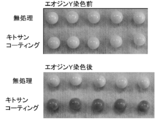
さらに、コーティングした真珠核が正電荷を帯びているか否かを確認した。キトサンがコーティングされた真珠核を、正電荷を持つものを染色するエオジンYに5秒間浸漬し、蒸留水で洗浄し、乾燥した。結果の写真を図2に示す。無処理の真珠核はエオジンYで染色されなかったが、キトサンがコーティングされた真珠核はエオジンYで染色された。
上述のように得られた真珠核を用いて真珠の生産試験を行った。アコヤガイの真珠母貝の生殖巣に、別個体のアコヤガイの外套膜と共に真珠核を挿入し、真珠を形成させた。挿核後31日目の生着率をX線検査により測定した。結果を図3に示す。対照の真珠核の生着率と比較して、表面が正電荷を帯びた真珠核の生着率が高いことが確認された。また、挿核から1年半養殖した後の製品率を比較した。表面が正電荷を帯びた真珠核で製品率が高く、特にキトサンでコーティングされた真珠核で著しい製品率向上がみられた。
3.正電荷を有する物質を表面にコーティングした真珠核の作製と真珠形成試験(2)
続いて、キトサン、塩基性フクシン、ヒストン、及びアミノシランを用いて、それぞれを表面にコーティングした真珠核を作製した。キトサンは0.15重量%及び1.5重量%となるように希塩酸に溶解し、室温で3時間、振盪させながら真珠核を浸漬させ、浸漬処理後、一晩乾燥させた。また、塩基性フクシンは0.5重量%となるように70容量%のエタノール水溶液に溶解し、ヒストンは、仔ウシ胸腺由来ヒストンを0.2重量%となるように蒸留水に溶解し、アミノシランは、3-アミノプロピルトリエトキシシランを2重量%となるようにアセトンに溶解し、それぞれ室温で3時間、振盪させながら真珠核を浸漬させ、浸漬処理後、一晩乾燥させた。
続いて、キトサン、塩基性フクシン、ヒストン、及びアミノシランを用いて、それぞれを表面にコーティングした真珠核を作製した。キトサンは0.15重量%及び1.5重量%となるように希塩酸に溶解し、室温で3時間、振盪させながら真珠核を浸漬させ、浸漬処理後、一晩乾燥させた。また、塩基性フクシンは0.5重量%となるように70容量%のエタノール水溶液に溶解し、ヒストンは、仔ウシ胸腺由来ヒストンを0.2重量%となるように蒸留水に溶解し、アミノシランは、3-アミノプロピルトリエトキシシランを2重量%となるようにアセトンに溶解し、それぞれ室温で3時間、振盪させながら真珠核を浸漬させ、浸漬処理後、一晩乾燥させた。
上述のように得られた真珠核を用いて真珠の生産試験を行った。アコヤガイの真珠母貝の生殖巣に、別個体のアコヤガイの外套膜と共に真珠核を挿入し、真珠を形成させた。挿核後17日目の生着率をX線検査により測定した。結果を図5に示す。対照の真珠核の生着率と比較して、表面が正電荷を帯びた真珠核の生着率が高いことが確認された。
4.正電荷を有する物質を表面にコーティングした真珠核の作製と真珠形成試験(3)
さらに、キトサン、グルコサミン、ヒストン、及びアミノシランを用いて、それぞれを表面にコーティングした真珠核を作製した。キトサン、ヒストン、アミノシランは上述と同じ方法で処理を行った。アミノ糖に属するグルコサミンは、0.15重量%になるように蒸留水に溶解し、室温で3時間、振盪させながら真珠核を浸漬させ、浸漬処理後、一晩乾燥させた。
さらに、キトサン、グルコサミン、ヒストン、及びアミノシランを用いて、それぞれを表面にコーティングした真珠核を作製した。キトサン、ヒストン、アミノシランは上述と同じ方法で処理を行った。アミノ糖に属するグルコサミンは、0.15重量%になるように蒸留水に溶解し、室温で3時間、振盪させながら真珠核を浸漬させ、浸漬処理後、一晩乾燥させた。
上述のように得られた真珠核を用いて真珠の生産試験を行った。アコヤガイの真珠母貝の生殖巣に、別個体のアコヤガイの外套膜と共に真珠核を挿入し、真珠を形成させた。挿核後127日目の生着率をX線検査により測定した。結果を図6に示す。対照の真珠核の生着率と比較して、表面が正電荷を帯びた真珠核の生着率が高いことが確認された。
5.生産された真珠の品質評価
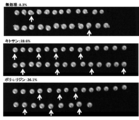
正電荷を有する物質を表面にコーティングした真珠核を用いて生産された真珠の評価を行った。「2.正電荷を有する物質を表面にコーティングした真珠核の作製と真珠形成試験(1)」で得られた製品品質の真珠から無作為に25個程度を抽出し、「花珠」(特に品質が高い真珠をいう。)に相当する品質を有する真珠の割合(以下、「花珠率」とする。)を算出した。図7は、品質評価に用いた真珠の写真であり、「花珠」に相当する品質を有する真珠を矢印で示すとともに、各群の花珠率を記載した。
正電荷を有する物質を表面にコーティングした真珠核を用いて生産された真珠の評価を行った。「2.正電荷を有する物質を表面にコーティングした真珠核の作製と真珠形成試験(1)」で得られた製品品質の真珠から無作為に25個程度を抽出し、「花珠」(特に品質が高い真珠をいう。)に相当する品質を有する真珠の割合(以下、「花珠率」とする。)を算出した。図7は、品質評価に用いた真珠の写真であり、「花珠」に相当する品質を有する真珠を矢印で示すとともに、各群の花珠率を記載した。
無処理の真珠核を用いた場合の花珠率は8.3%であるのに対し、キトサンは28.6%、ポリ-L-リジンは26.1%であった。したがって、正電荷を有する物質を表面にコーティングした真珠核を用いることで、高品質の真珠の生産が可能であることが明らかになった。
Claims (13)
- 表面が正電荷を帯びたことを特徴とする真珠核
- 正電荷を有する物質を表面にコーティングした、請求項1に記載の真珠核
- 前記正電荷を有する物質が、糖、タンパク質、ポリペプチド、核酸、脂質、及び低分子化合物から選択される1又は複数である、請求項2に記載の真珠核
- 前記正電荷を有する物質が、キトサン、ポリ―L―リジン、ヒストン、ポリアリルアミン、アミノシラン、塩基性フクシン、及びアミノ糖から選択される1又は複数である、請求項2に記載の真珠核
- 前記正電荷を有する物質を約0.01重量%~約2重量%含有する溶液に真珠核を浸漬させることで正電荷を有する物質を表面にコーティングした、請求項2~請求項4いずれか一項に記載の真珠核
- 前記正電荷を有する物質がキトサンであり、
キトサンを約0.15重量%~約1.5重量%含有する溶液に真珠核を浸漬させることでキトサンを表面にコーティングした請求項2に記載の真珠核 - 真珠母貝の体内で、該真珠母貝の血球の前記真珠核の表面への集合が促進される、請求項1~請求項6いずれか一項に記載の真珠核
- 正電荷を有する物質を含有する真珠核コーティング剤
- 前記正電荷を有する物質が、糖、タンパク質、ポリペプチド、核酸、脂質、及び低分子化合物から選択される1又は複数である、請求項8に記載の真珠核コーティング剤
- 前記正電荷を有する物質が、キトサン、ポリ―L―リジン、ヒストン、ポリアリルアミン、アミノシラン、及び塩基性フクシンから選択される1又は複数である、請求項8に記載の真珠核コーティング剤
- 前記正電荷を有する物質を約0.01重量%~約2重量%含有する、請求項8~請求項10いずれか一項に記載の真珠核コーティング剤
- 前記正電荷を有する物質がキトサンであり、
キトサンを約0.15重量%~約1.5重量%含有する、請求項8に記載の真珠核コーティング剤 - 真珠母貝の体内で該真珠母貝の血球の集合促進効果を有する、請求項8~請求項12いずれか一項に記載の真珠核コーティング剤
Priority Applications (1)
| Application Number | Priority Date | Filing Date | Title |
|---|---|---|---|
| JP2015535499A JPWO2015033972A1 (ja) | 2013-09-03 | 2014-09-03 | 真珠核、及び真珠核コーティング剤 |
Applications Claiming Priority (2)
| Application Number | Priority Date | Filing Date | Title |
|---|---|---|---|
| JP2013-182627 | 2013-09-03 | ||
| JP2013182627 | 2013-09-03 |
Publications (1)
| Publication Number | Publication Date |
|---|---|
| WO2015033972A1 true WO2015033972A1 (ja) | 2015-03-12 |
Family
ID=52628440
Family Applications (1)
| Application Number | Title | Priority Date | Filing Date |
|---|---|---|---|
| PCT/JP2014/073231 Ceased WO2015033972A1 (ja) | 2013-09-03 | 2014-09-03 | 真珠核、及び真珠核コーティング剤 |
Country Status (2)
| Country | Link |
|---|---|
| JP (1) | JPWO2015033972A1 (ja) |
| WO (1) | WO2015033972A1 (ja) |
Cited By (3)
| Publication number | Priority date | Publication date | Assignee | Title |
|---|---|---|---|---|
| CN105309345A (zh) * | 2015-06-07 | 2016-02-10 | 福建师范大学 | 外套膜游离细胞与组织工程支架珠核在体外共培养后植核培育珍珠的方法 |
| CN105309347A (zh) * | 2015-06-07 | 2016-02-10 | 福建师范大学 | 一种表面包裹高分子组织工程支架材料的珍珠核及其制备方法 |
| WO2020075715A1 (ja) | 2018-10-12 | 2020-04-16 | 富士フイルム株式会社 | 真珠養殖用材料、挿核方法及び真珠養殖用材料組成物 |
Citations (3)
| Publication number | Priority date | Publication date | Assignee | Title |
|---|---|---|---|---|
| JPH08256631A (ja) * | 1995-03-28 | 1996-10-08 | Masashi Sugimoto | 高吸水性高分子を原料とした極小合成真珠核による真珠養殖方法 |
| JP2006296274A (ja) * | 2005-04-20 | 2006-11-02 | Keisuke Kasahara | 真珠養殖用核とその製造方法及び該核を用いる真珠養殖方法 |
| JP2007151548A (ja) * | 2005-11-14 | 2007-06-21 | Univ Nihon | 識別方法、生分解性高分子材の転写装置、転写方法 |
-
2014
- 2014-09-03 JP JP2015535499A patent/JPWO2015033972A1/ja active Pending
- 2014-09-03 WO PCT/JP2014/073231 patent/WO2015033972A1/ja not_active Ceased
Patent Citations (3)
| Publication number | Priority date | Publication date | Assignee | Title |
|---|---|---|---|---|
| JPH08256631A (ja) * | 1995-03-28 | 1996-10-08 | Masashi Sugimoto | 高吸水性高分子を原料とした極小合成真珠核による真珠養殖方法 |
| JP2006296274A (ja) * | 2005-04-20 | 2006-11-02 | Keisuke Kasahara | 真珠養殖用核とその製造方法及び該核を用いる真珠養殖方法 |
| JP2007151548A (ja) * | 2005-11-14 | 2007-06-21 | Univ Nihon | 識別方法、生分解性高分子材の転写装置、転写方法 |
Cited By (5)
| Publication number | Priority date | Publication date | Assignee | Title |
|---|---|---|---|---|
| CN105309345A (zh) * | 2015-06-07 | 2016-02-10 | 福建师范大学 | 外套膜游离细胞与组织工程支架珠核在体外共培养后植核培育珍珠的方法 |
| CN105309347A (zh) * | 2015-06-07 | 2016-02-10 | 福建师范大学 | 一种表面包裹高分子组织工程支架材料的珍珠核及其制备方法 |
| WO2020075715A1 (ja) | 2018-10-12 | 2020-04-16 | 富士フイルム株式会社 | 真珠養殖用材料、挿核方法及び真珠養殖用材料組成物 |
| CN112839509A (zh) * | 2018-10-12 | 2021-05-25 | 富士胶片株式会社 | 珍珠养殖用材料、插核方法及珍珠养殖用材料组合物 |
| US11523592B2 (en) | 2018-10-12 | 2022-12-13 | Fujifilm Corporation | Pearl culture material, nucleus insertion method, and pearl culture material composition |
Also Published As
| Publication number | Publication date |
|---|---|
| JPWO2015033972A1 (ja) | 2017-03-02 |
Similar Documents
| Publication | Publication Date | Title |
|---|---|---|
| Claverie et al. | Marine-derived polymeric materials and biomimetics: An overview | |
| Kopecká et al. | The influence of Congo red on the cell wall and (1→ 3)-β-d-glucan microfibril biogenesis in Saccharomyces cerevisiae | |
| Muzzarelli | Chitins and chitosans as immunoadjuvants and non-allergenic drug carriers | |
| Wallin et al. | The induction of aggregation and fusion of Dancus carota protoplasts by polyethylene glycol | |
| Kim et al. | Extraction of chitin and chitosan from housefly, Musca domestica, pupa shells | |
| Yang et al. | The roles of microsporidia spore wall proteins in the spore wall formation and polar tube anchorage to spore wall during development and infection processes | |
| Silva et al. | Exploitation of marine molecules to manage Alzheimer’s disease | |
| Ma et al. | Ultrastructural features of the tomont of Cryptocaryon irritans (Ciliophora: Prostomatea), a parasitic ciliate of marine fishes | |
| CN111328803B (zh) | 一种苏云金芽胞杆菌菌体微胶囊及其制备方法与应用 | |
| Zhao et al. | Chito-protein matrices in arthropod exoskeletons and peritrophic matrices | |
| JPWO2015033972A1 (ja) | 真珠核、及び真珠核コーティング剤 | |
| CN105032309A (zh) | 一种微胶囊及其制备方法 | |
| Behr et al. | Improving polysaccharide-based chitin/chitosan-aerogel materials by learning from genetics and molecular biology | |
| Szubinska et al. | Ruthenium red and violet. III. Fine structure of the plasma membrane and extraneous coats in amoebae (A. proteus and Chaos chaos) | |
| Ye et al. | Protoplast preparation for algal single-cell omics sequencing | |
| Ghobara et al. | Diatom nanostructured biosilica | |
| Hasan et al. | Functional characterization of OXYL, a SghC1qDC LacNAc-specific lectin from the crinoid feather star Anneissia japonica | |
| Grinchenko et al. | A novel C1q domain-containing protein isolated from the mollusk Modiolus kurilensis recognizing glycans enriched with acidic galactans and mannans | |
| JPWO2015033973A1 (ja) | 真珠母貝、真珠母貝の生産方法、及び真珠の生産方法 | |
| Cha et al. | Progress in the application of marine polysaccharide drug delivery systems in tumor immunotherapy: Multiple mechanisms and material forms | |
| Kim et al. | Strategies to maximize the potential of marine biomaterials as a platform for cell therapy | |
| CN103210855B (zh) | 一种提高海水珍珠质量的细胞小片处理液及处理方法 | |
| Darmody et al. | Tissue targeting of the European flat oyster, Ostrea edulis, using microencapsulated microbeads as a biological proxy | |
| Leys | Sponge cell culture: a comparative evaluation of adhesion to a native tissue extract and other culture substrates | |
| JP2015082974A (ja) | ウナギ目葉形仔魚の成長促進剤 |
Legal Events
| Date | Code | Title | Description |
|---|---|---|---|
| 121 | Ep: the epo has been informed by wipo that ep was designated in this application |
Ref document number: 14841960 Country of ref document: EP Kind code of ref document: A1 |
|
| ENP | Entry into the national phase |
Ref document number: 2015535499 Country of ref document: JP Kind code of ref document: A |
|
| NENP | Non-entry into the national phase |
Ref country code: DE |
|
| 122 | Ep: pct application non-entry in european phase |
Ref document number: 14841960 Country of ref document: EP Kind code of ref document: A1 |