WO2015015183A1 - Polymer and organic electronic device - Google Patents
Polymer and organic electronic device Download PDFInfo
- Publication number
- WO2015015183A1 WO2015015183A1 PCT/GB2014/052315 GB2014052315W WO2015015183A1 WO 2015015183 A1 WO2015015183 A1 WO 2015015183A1 GB 2014052315 W GB2014052315 W GB 2014052315W WO 2015015183 A1 WO2015015183 A1 WO 2015015183A1
- Authority
- WO
- WIPO (PCT)
- Prior art keywords
- polymer
- formula
- independently
- layer
- polymer according
- Prior art date
- Legal status (The legal status is an assumption and is not a legal conclusion. Google has not performed a legal analysis and makes no representation as to the accuracy of the status listed.)
- Ceased
Links
- 0 C*****(C)c(cc1)cc2c1c1ccc(*)cc1c(*)c2* Chemical compound C*****(C)c(cc1)cc2c1c1ccc(*)cc1c(*)c2* 0.000 description 2
Classifications
-
- C—CHEMISTRY; METALLURGY
- C09—DYES; PAINTS; POLISHES; NATURAL RESINS; ADHESIVES; COMPOSITIONS NOT OTHERWISE PROVIDED FOR; APPLICATIONS OF MATERIALS NOT OTHERWISE PROVIDED FOR
- C09K—MATERIALS FOR MISCELLANEOUS APPLICATIONS, NOT PROVIDED FOR ELSEWHERE
- C09K11/00—Luminescent materials, e.g. electroluminescent or chemiluminescent
- C09K11/06—Luminescent materials, e.g. electroluminescent or chemiluminescent containing organic luminescent materials
-
- C—CHEMISTRY; METALLURGY
- C07—ORGANIC CHEMISTRY
- C07C—ACYCLIC OR CARBOCYCLIC COMPOUNDS
- C07C25/00—Compounds containing at least one halogen atom bound to a six-membered aromatic ring
- C07C25/18—Polycyclic aromatic halogenated hydrocarbons
- C07C25/22—Polycyclic aromatic halogenated hydrocarbons with condensed rings
-
- C—CHEMISTRY; METALLURGY
- C08—ORGANIC MACROMOLECULAR COMPOUNDS; THEIR PREPARATION OR CHEMICAL WORKING-UP; COMPOSITIONS BASED THEREON
- C08G—MACROMOLECULAR COMPOUNDS OBTAINED OTHERWISE THAN BY REACTIONS ONLY INVOLVING UNSATURATED CARBON-TO-CARBON BONDS
- C08G61/00—Macromolecular compounds obtained by reactions forming a carbon-to-carbon link in the main chain of the macromolecule
- C08G61/12—Macromolecular compounds containing atoms other than carbon in the main chain of the macromolecule
-
- C—CHEMISTRY; METALLURGY
- C08—ORGANIC MACROMOLECULAR COMPOUNDS; THEIR PREPARATION OR CHEMICAL WORKING-UP; COMPOSITIONS BASED THEREON
- C08G—MACROMOLECULAR COMPOUNDS OBTAINED OTHERWISE THAN BY REACTIONS ONLY INVOLVING UNSATURATED CARBON-TO-CARBON BONDS
- C08G61/00—Macromolecular compounds obtained by reactions forming a carbon-to-carbon link in the main chain of the macromolecule
- C08G61/12—Macromolecular compounds containing atoms other than carbon in the main chain of the macromolecule
- C08G61/122—Macromolecular compounds containing atoms other than carbon in the main chain of the macromolecule derived from five- or six-membered heterocyclic compounds, other than imides
-
- C—CHEMISTRY; METALLURGY
- C08—ORGANIC MACROMOLECULAR COMPOUNDS; THEIR PREPARATION OR CHEMICAL WORKING-UP; COMPOSITIONS BASED THEREON
- C08L—COMPOSITIONS OF MACROMOLECULAR COMPOUNDS
- C08L65/00—Compositions of macromolecular compounds obtained by reactions forming a carbon-to-carbon link in the main chain; Compositions of derivatives of such polymers
-
- C—CHEMISTRY; METALLURGY
- C09—DYES; PAINTS; POLISHES; NATURAL RESINS; ADHESIVES; COMPOSITIONS NOT OTHERWISE PROVIDED FOR; APPLICATIONS OF MATERIALS NOT OTHERWISE PROVIDED FOR
- C09K—MATERIALS FOR MISCELLANEOUS APPLICATIONS, NOT PROVIDED FOR ELSEWHERE
- C09K11/00—Luminescent materials, e.g. electroluminescent or chemiluminescent
- C09K11/02—Use of particular materials as binders, particle coatings or suspension media therefor
- C09K11/025—Use of particular materials as binders, particle coatings or suspension media therefor non-luminescent particle coatings or suspension media
-
- H—ELECTRICITY
- H05—ELECTRIC TECHNIQUES NOT OTHERWISE PROVIDED FOR
- H05B—ELECTRIC HEATING; ELECTRIC LIGHT SOURCES NOT OTHERWISE PROVIDED FOR; CIRCUIT ARRANGEMENTS FOR ELECTRIC LIGHT SOURCES, IN GENERAL
- H05B33/00—Electroluminescent light sources
- H05B33/10—Apparatus or processes specially adapted to the manufacture of electroluminescent light sources
-
- H—ELECTRICITY
- H10—SEMICONDUCTOR DEVICES; ELECTRIC SOLID-STATE DEVICES NOT OTHERWISE PROVIDED FOR
- H10K—ORGANIC ELECTRIC SOLID-STATE DEVICES
- H10K71/00—Manufacture or treatment specially adapted for the organic devices covered by this subclass
-
- H—ELECTRICITY
- H10—SEMICONDUCTOR DEVICES; ELECTRIC SOLID-STATE DEVICES NOT OTHERWISE PROVIDED FOR
- H10K—ORGANIC ELECTRIC SOLID-STATE DEVICES
- H10K71/00—Manufacture or treatment specially adapted for the organic devices covered by this subclass
- H10K71/10—Deposition of organic active material
- H10K71/12—Deposition of organic active material using liquid deposition, e.g. spin coating
- H10K71/13—Deposition of organic active material using liquid deposition, e.g. spin coating using printing techniques, e.g. ink-jet printing or screen printing
- H10K71/135—Deposition of organic active material using liquid deposition, e.g. spin coating using printing techniques, e.g. ink-jet printing or screen printing using ink-jet printing
-
- H—ELECTRICITY
- H10—SEMICONDUCTOR DEVICES; ELECTRIC SOLID-STATE DEVICES NOT OTHERWISE PROVIDED FOR
- H10K—ORGANIC ELECTRIC SOLID-STATE DEVICES
- H10K71/00—Manufacture or treatment specially adapted for the organic devices covered by this subclass
- H10K71/40—Thermal treatment, e.g. annealing in the presence of a solvent vapour
- H10K71/441—Thermal treatment, e.g. annealing in the presence of a solvent vapour in the presence of solvent vapors, e.g. solvent vapour annealing
-
- H—ELECTRICITY
- H10—SEMICONDUCTOR DEVICES; ELECTRIC SOLID-STATE DEVICES NOT OTHERWISE PROVIDED FOR
- H10K—ORGANIC ELECTRIC SOLID-STATE DEVICES
- H10K85/00—Organic materials used in the body or electrodes of devices covered by this subclass
- H10K85/10—Organic polymers or oligomers
- H10K85/111—Organic polymers or oligomers comprising aromatic, heteroaromatic, or aryl chains, e.g. polyaniline, polyphenylene or polyphenylene vinylene
- H10K85/115—Polyfluorene; Derivatives thereof
-
- H—ELECTRICITY
- H10—SEMICONDUCTOR DEVICES; ELECTRIC SOLID-STATE DEVICES NOT OTHERWISE PROVIDED FOR
- H10K—ORGANIC ELECTRIC SOLID-STATE DEVICES
- H10K85/00—Organic materials used in the body or electrodes of devices covered by this subclass
- H10K85/10—Organic polymers or oligomers
- H10K85/151—Copolymers
-
- C—CHEMISTRY; METALLURGY
- C08—ORGANIC MACROMOLECULAR COMPOUNDS; THEIR PREPARATION OR CHEMICAL WORKING-UP; COMPOSITIONS BASED THEREON
- C08G—MACROMOLECULAR COMPOUNDS OBTAINED OTHERWISE THAN BY REACTIONS ONLY INVOLVING UNSATURATED CARBON-TO-CARBON BONDS
- C08G2261/00—Macromolecular compounds obtained by reactions forming a carbon-to-carbon link in the main chain of the macromolecule
- C08G2261/10—Definition of the polymer structure
- C08G2261/12—Copolymers
-
- C—CHEMISTRY; METALLURGY
- C08—ORGANIC MACROMOLECULAR COMPOUNDS; THEIR PREPARATION OR CHEMICAL WORKING-UP; COMPOSITIONS BASED THEREON
- C08G—MACROMOLECULAR COMPOUNDS OBTAINED OTHERWISE THAN BY REACTIONS ONLY INVOLVING UNSATURATED CARBON-TO-CARBON BONDS
- C08G2261/00—Macromolecular compounds obtained by reactions forming a carbon-to-carbon link in the main chain of the macromolecule
- C08G2261/10—Definition of the polymer structure
- C08G2261/14—Side-groups
- C08G2261/141—Side-chains having aliphatic units
- C08G2261/1412—Saturated aliphatic units
-
- C—CHEMISTRY; METALLURGY
- C08—ORGANIC MACROMOLECULAR COMPOUNDS; THEIR PREPARATION OR CHEMICAL WORKING-UP; COMPOSITIONS BASED THEREON
- C08G—MACROMOLECULAR COMPOUNDS OBTAINED OTHERWISE THAN BY REACTIONS ONLY INVOLVING UNSATURATED CARBON-TO-CARBON BONDS
- C08G2261/00—Macromolecular compounds obtained by reactions forming a carbon-to-carbon link in the main chain of the macromolecule
- C08G2261/10—Definition of the polymer structure
- C08G2261/14—Side-groups
- C08G2261/148—Side-chains having aromatic units
-
- C—CHEMISTRY; METALLURGY
- C08—ORGANIC MACROMOLECULAR COMPOUNDS; THEIR PREPARATION OR CHEMICAL WORKING-UP; COMPOSITIONS BASED THEREON
- C08G—MACROMOLECULAR COMPOUNDS OBTAINED OTHERWISE THAN BY REACTIONS ONLY INVOLVING UNSATURATED CARBON-TO-CARBON BONDS
- C08G2261/00—Macromolecular compounds obtained by reactions forming a carbon-to-carbon link in the main chain of the macromolecule
- C08G2261/10—Definition of the polymer structure
- C08G2261/14—Side-groups
- C08G2261/149—Side-chains having heteroaromatic units
-
- C—CHEMISTRY; METALLURGY
- C08—ORGANIC MACROMOLECULAR COMPOUNDS; THEIR PREPARATION OR CHEMICAL WORKING-UP; COMPOSITIONS BASED THEREON
- C08G—MACROMOLECULAR COMPOUNDS OBTAINED OTHERWISE THAN BY REACTIONS ONLY INVOLVING UNSATURATED CARBON-TO-CARBON BONDS
- C08G2261/00—Macromolecular compounds obtained by reactions forming a carbon-to-carbon link in the main chain of the macromolecule
- C08G2261/10—Definition of the polymer structure
- C08G2261/18—Definition of the polymer structure conjugated
-
- C—CHEMISTRY; METALLURGY
- C08—ORGANIC MACROMOLECULAR COMPOUNDS; THEIR PREPARATION OR CHEMICAL WORKING-UP; COMPOSITIONS BASED THEREON
- C08G—MACROMOLECULAR COMPOUNDS OBTAINED OTHERWISE THAN BY REACTIONS ONLY INVOLVING UNSATURATED CARBON-TO-CARBON BONDS
- C08G2261/00—Macromolecular compounds obtained by reactions forming a carbon-to-carbon link in the main chain of the macromolecule
- C08G2261/30—Monomer units or repeat units incorporating structural elements in the main chain
- C08G2261/31—Monomer units or repeat units incorporating structural elements in the main chain incorporating aromatic structural elements in the main chain
- C08G2261/314—Condensed aromatic systems, e.g. perylene, anthracene or pyrene
-
- C—CHEMISTRY; METALLURGY
- C08—ORGANIC MACROMOLECULAR COMPOUNDS; THEIR PREPARATION OR CHEMICAL WORKING-UP; COMPOSITIONS BASED THEREON
- C08G—MACROMOLECULAR COMPOUNDS OBTAINED OTHERWISE THAN BY REACTIONS ONLY INVOLVING UNSATURATED CARBON-TO-CARBON BONDS
- C08G2261/00—Macromolecular compounds obtained by reactions forming a carbon-to-carbon link in the main chain of the macromolecule
- C08G2261/30—Monomer units or repeat units incorporating structural elements in the main chain
- C08G2261/31—Monomer units or repeat units incorporating structural elements in the main chain incorporating aromatic structural elements in the main chain
- C08G2261/314—Condensed aromatic systems, e.g. perylene, anthracene or pyrene
- C08G2261/3142—Condensed aromatic systems, e.g. perylene, anthracene or pyrene fluorene-based, e.g. fluorene, indenofluorene, or spirobifluorene
-
- C—CHEMISTRY; METALLURGY
- C08—ORGANIC MACROMOLECULAR COMPOUNDS; THEIR PREPARATION OR CHEMICAL WORKING-UP; COMPOSITIONS BASED THEREON
- C08G—MACROMOLECULAR COMPOUNDS OBTAINED OTHERWISE THAN BY REACTIONS ONLY INVOLVING UNSATURATED CARBON-TO-CARBON BONDS
- C08G2261/00—Macromolecular compounds obtained by reactions forming a carbon-to-carbon link in the main chain of the macromolecule
- C08G2261/30—Monomer units or repeat units incorporating structural elements in the main chain
- C08G2261/32—Monomer units or repeat units incorporating structural elements in the main chain incorporating heteroaromatic structural elements in the main chain
- C08G2261/324—Monomer units or repeat units incorporating structural elements in the main chain incorporating heteroaromatic structural elements in the main chain condensed
- C08G2261/3245—Monomer units or repeat units incorporating structural elements in the main chain incorporating heteroaromatic structural elements in the main chain condensed containing nitrogen and oxygen as heteroatoms
-
- C—CHEMISTRY; METALLURGY
- C08—ORGANIC MACROMOLECULAR COMPOUNDS; THEIR PREPARATION OR CHEMICAL WORKING-UP; COMPOSITIONS BASED THEREON
- C08G—MACROMOLECULAR COMPOUNDS OBTAINED OTHERWISE THAN BY REACTIONS ONLY INVOLVING UNSATURATED CARBON-TO-CARBON BONDS
- C08G2261/00—Macromolecular compounds obtained by reactions forming a carbon-to-carbon link in the main chain of the macromolecule
- C08G2261/30—Monomer units or repeat units incorporating structural elements in the main chain
- C08G2261/34—Monomer units or repeat units incorporating structural elements in the main chain incorporating partially-aromatic structural elements in the main chain
- C08G2261/344—Monomer units or repeat units incorporating structural elements in the main chain incorporating partially-aromatic structural elements in the main chain containing heteroatoms
-
- C—CHEMISTRY; METALLURGY
- C08—ORGANIC MACROMOLECULAR COMPOUNDS; THEIR PREPARATION OR CHEMICAL WORKING-UP; COMPOSITIONS BASED THEREON
- C08G—MACROMOLECULAR COMPOUNDS OBTAINED OTHERWISE THAN BY REACTIONS ONLY INVOLVING UNSATURATED CARBON-TO-CARBON BONDS
- C08G2261/00—Macromolecular compounds obtained by reactions forming a carbon-to-carbon link in the main chain of the macromolecule
- C08G2261/40—Polymerisation processes
- C08G2261/41—Organometallic coupling reactions
- C08G2261/411—Suzuki reactions
-
- C—CHEMISTRY; METALLURGY
- C08—ORGANIC MACROMOLECULAR COMPOUNDS; THEIR PREPARATION OR CHEMICAL WORKING-UP; COMPOSITIONS BASED THEREON
- C08G—MACROMOLECULAR COMPOUNDS OBTAINED OTHERWISE THAN BY REACTIONS ONLY INVOLVING UNSATURATED CARBON-TO-CARBON BONDS
- C08G2261/00—Macromolecular compounds obtained by reactions forming a carbon-to-carbon link in the main chain of the macromolecule
- C08G2261/50—Physical properties
- C08G2261/51—Charge transport
- C08G2261/512—Hole transport
-
- C—CHEMISTRY; METALLURGY
- C08—ORGANIC MACROMOLECULAR COMPOUNDS; THEIR PREPARATION OR CHEMICAL WORKING-UP; COMPOSITIONS BASED THEREON
- C08G—MACROMOLECULAR COMPOUNDS OBTAINED OTHERWISE THAN BY REACTIONS ONLY INVOLVING UNSATURATED CARBON-TO-CARBON BONDS
- C08G2261/00—Macromolecular compounds obtained by reactions forming a carbon-to-carbon link in the main chain of the macromolecule
- C08G2261/90—Applications
- C08G2261/95—Use in organic luminescent diodes
-
- C—CHEMISTRY; METALLURGY
- C09—DYES; PAINTS; POLISHES; NATURAL RESINS; ADHESIVES; COMPOSITIONS NOT OTHERWISE PROVIDED FOR; APPLICATIONS OF MATERIALS NOT OTHERWISE PROVIDED FOR
- C09K—MATERIALS FOR MISCELLANEOUS APPLICATIONS, NOT PROVIDED FOR ELSEWHERE
- C09K2211/00—Chemical nature of organic luminescent or tenebrescent compounds
- C09K2211/14—Macromolecular compounds
- C09K2211/1408—Carbocyclic compounds
- C09K2211/1416—Condensed systems
-
- C—CHEMISTRY; METALLURGY
- C09—DYES; PAINTS; POLISHES; NATURAL RESINS; ADHESIVES; COMPOSITIONS NOT OTHERWISE PROVIDED FOR; APPLICATIONS OF MATERIALS NOT OTHERWISE PROVIDED FOR
- C09K—MATERIALS FOR MISCELLANEOUS APPLICATIONS, NOT PROVIDED FOR ELSEWHERE
- C09K2211/00—Chemical nature of organic luminescent or tenebrescent compounds
- C09K2211/14—Macromolecular compounds
- C09K2211/1408—Carbocyclic compounds
- C09K2211/1425—Non-condensed systems
-
- C—CHEMISTRY; METALLURGY
- C09—DYES; PAINTS; POLISHES; NATURAL RESINS; ADHESIVES; COMPOSITIONS NOT OTHERWISE PROVIDED FOR; APPLICATIONS OF MATERIALS NOT OTHERWISE PROVIDED FOR
- C09K—MATERIALS FOR MISCELLANEOUS APPLICATIONS, NOT PROVIDED FOR ELSEWHERE
- C09K2211/00—Chemical nature of organic luminescent or tenebrescent compounds
- C09K2211/14—Macromolecular compounds
- C09K2211/1408—Carbocyclic compounds
- C09K2211/1433—Carbocyclic compounds bridged by heteroatoms, e.g. N, P, Si or B
-
- H—ELECTRICITY
- H10—SEMICONDUCTOR DEVICES; ELECTRIC SOLID-STATE DEVICES NOT OTHERWISE PROVIDED FOR
- H10K—ORGANIC ELECTRIC SOLID-STATE DEVICES
- H10K50/00—Organic light-emitting devices
- H10K50/10—OLEDs or polymer light-emitting diodes [PLED]
- H10K50/11—OLEDs or polymer light-emitting diodes [PLED] characterised by the electroluminescent [EL] layers
Definitions
- OLEDs organic light emitting diodes
- photoresponsive devices in particular organic photovoltaic devices and organic photosensors
- organic transistors organic transistors and memory array devices.
- Devices containing active organic materials offer benefits such as low weight, low power consumption and flexibility.
- use of soluble organic materials allows use of solution processing in device manufacture, for example inkjet printing or spin-coating.
- An OLED may comprise a substrate carrying an anode, a cathode and one or more organic light-emitting layers between the anode and cathode.
- Holes are injected into the device through the anode and electrons are injected through the cathode during operation of the device. Holes in the highest occupied molecular orbital (HOMO) and electrons in the lowest unoccupied molecular orbital (LUMO) of a light-emitting material combine to form an exciton that releases its energy as light.
- HOMO highest occupied molecular orbital
- LUMO lowest unoccupied molecular orbital
- a light emitting layer may comprise a semiconducting host material and a light-emitting dopant wherein energy is transferred from the host material to the light-emitting dopant.
- a semiconducting host material and a light-emitting dopant wherein energy is transferred from the host material to the light-emitting dopant.
- J. Appl. Phys. 65, 3610, 1989 discloses a host material doped with a fluorescent light-emitting dopant (that is, a light-emitting material in which light is emitted via decay of a singlet exciton).
- Phosphorescent dopants are also known (that is, a light-emitting dopant in which light is emitted via decay of a triplet exciton).
- a hole-transporting layer may be provided between the anode and light-emitting layer of an OLED.
- Light-emitting materials include small molecule, polymeric and dendrimeric materials.
- Suitable light-emitting polymers include poly(arylene vinylenes) such as poly(p- phenylene vinylenes) and polymers containing arylene repeat units, such as fluorene repeat units.
- a layer of an OLED e. g. the light-emitting layer
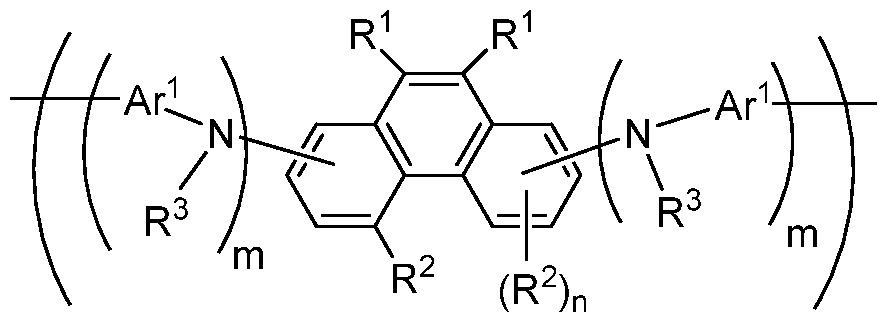
- the invention provides a polymer comprising a repeat unit of formula (I):
- R in each occurrence is independently H or a substituent
- R in each occurrence is independently a substituent
- Ar in each occurrence is independently an aryl or heteroaryl group that may be unsubstituted or substituted with one or more substituents;
- the invention provides a method of forming a polymer according to the first aspect, the method comprising the step of polymerising a monomer according to the second aspect.
- the invention provides a formulation comprising a polymer according to the first aspect and one or more solvents.
- the invention provides an organic electronic device comprising a layer comprising a polymer according to the first aspect.
- the organic electronic device is an organic light- emitting device comprising an anode, a cathode and at least one organic semiconducting layer including an organic light-emitting layer between the anode and the cathode, wherein the at least one organic semiconducting layer comprises a polymer according to the first aspect.
- the invention provides a method of forming an organic light-emitting device according to the fifth aspect, the method comprising the steps of:
- FIG. 1 illustrates schematically an OLED according to an embodiment of the invention
- Figure 2 is a graph of viscosity vs. time for a formulation according to an embodiment of the invention and comparative formulations;
- Figure 3 is a graph of luminance vs. time for a device according to an embodiment of the invention and a comparative device;
- Figure 4 is a graph of current density vs. voltage for a device according to an
- Figure 5 is a graph of external quantum efficiency (EQE) vs. voltage for a device according to an embodiment of the invention and a comparative device;
- Figure 1 illustrates an OLED 100 according to an embodiment of the invention comprising an anode 101, a cathode 105 and a light-emitting layer 103 between the anode and cathode.
- the device 100 is supported on a substrate 107, for example a glass or plastic substrate.
- One or more further layers may be provided between the anode 101 and cathode 105, for example hole-transporting layers, electron transporting layers, hole blocking layers and electron blocking layers.
- the device may contain more than one light-emitting layer.
- Preferred device structures include:
- At least one of a hole-transporting layer and hole injection layer may be present.
- both a hole injection layer and hole-transporting layer are present.
- a polymer comprising a repeat unit of formula (I) is provided in a layer of the device.
- the polymer may be provided in one or more of light-emitting layer 103; a hole- transporting layer; an electron-transporting layer; and a charge-blocking layer.
- a layer containing a polymer comprising a repeat unit of formula (I) may consist essentially of the polymer, or the polymer may be mixed with one or more further materials.
- the polymer may emit light itself when in operation, or it may function as a host material used in combination with one or more fluorescent or phosphorescent materials of the light-emitting layer.
- the repeat unit of formula (I) may have formula (II):
- Linking the repeat unit of formula (I) through its 2- and 7- positions, as in the repeat unit of formula (II), may increase conjugation across the repeat unit as compared to repeat units of formula (I) linked through other positions.
- the repeat unit of formula (I) may have formula (III):
- the polymer has formula (IV a) or (IVb):
- Each R 1 may independently be selected from the group consisting of:
- aryl or heteroaryl that may be substituted or unsubstituted with one or more substituents.
- R 4 may be a Ci-20 hydrocarbyl group, for example Ci-20 alkyl, phenyl, or phenyl substituted with one or more alkyl groups.
- Each R 1 may be a Ci_4o hydrocarbyl group, for example a group selected from Ci_2o alkyl, unsubstituted phenyl, and phenyl substituted with one or more alkyl groups.
- Two groups R 1 may be linked to form a ring that may be unsubstituted or substituted with one or more substituents, for example substituted with one or more Ci-20 alkyl groups.
- each R is independently selected from the group consisting of:
- Each R may be a C 1-40 hydrocarbyl group, for example a group selected from C 1-20 alkyl, unsubstituted phenyl, and phenyl substituted with one or more alkyl groups.
- each R is independently a C 1-10 alkyl group.
- one n is 1 and the other n is 0.
- each m is 0. In another embodiment, at least one m is 1. If one or both m is 1 then the amine groups of the repeat unit of formula (I) may provide hole- transporting functionality in a light-emitting layer or in a hole-transporting layer of an
- Ar in each occurrence may independently be a phenyl group that may be unsubstituted or substituted with one or more substituents.
- R in each occurrence may independently be a C 1-40 hydrocarbyl group, for example C I _ 2 Q alkyl, phenyl, or phenyl substituted with one or more alkyl groups.
- the polymer comprises 1 -50 mol %, optionally 5-40 or 10-40 mol % of the repeat unit of formula (I).
- Exemplary repeat units of formula (I) include the following:
- the polymer may contain only repeat units of formula (I), or it may be a copolymer containing repeat units of formula (I) and one or more further co-repeat repeat units.
- co-repeat units include arylene and heteroarylene repeat units, each of which may be unsubstituted or substituted with one or more substituents, and charge- transporting repeat units. Co-repeat units may be selected according to the intended use of the polymer.
- Exemplary arylene co-repeat units include arylene repeat units, for example 1,2-, 1,3- and 1 ,4-phenylene repeat units, 3,6- and 2,7- linked fluorene repeat units, indenofluorene, naphthalene and anthracene repeat units, and stilbene repeat units, each of which may be unsubstituted or substituted with one or more substitutents, for example one or more Ci-30 hydrocarbyl substituents.
- arylene repeat units for example 1,2-, 1,3- and 1 ,4-phenylene repeat units, 3,6- and 2,7- linked fluorene repeat units, indenofluorene, naphthalene and anthracene repeat units, and stilbene repeat units, each of which may be unsubstituted or substituted with one or more substitutents, for example one or more Ci-30 hydrocarbyl substituents.
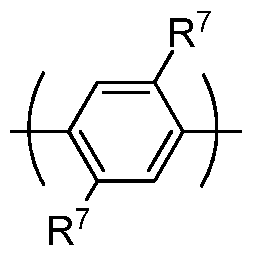
- arylene repeat units such as phenylene repeat units of formula (VI):
- R comprises an aryl or heteroaryl group, or a linear or branched chain of aryl or heteroaryl groups
- each R 9 is independently selected from the group consisting of alkyl, preferably Ci_2o alkyl; and aryl or heteroaryl, preferably phenyl, optionally substituted with one or more C 1-20 alkyl groups.
- Substituted N may be -NR 9 - wherein R 9 is as described above.
- each R is independently selected from Ci_ 4 o hydrocarbyl, and is more preferably selected from Ci_ 2 o alkyl; unusubstituted phenyl; phenyl substituted with one or more C 1-20 alkyl groups; a linear or branched chain of phenyl groups, wherein each phenyl may be unsubstituted or substituted with one or more substituents; and a crosslinkable group.
- exemplary repeat units of formula (VI) include the following:
- a particularly preferred repeat unit of formula (VI) has formula (Via):
- Substituents R of formula (Via) are adjacent to linking positions of the repeat unit, which may cause steric hindrance between the repeat unit of formula (Via) and adjacent repeat units, resulting in the repeat unit of formula (Via) twisting out of plane relative to one or both adjacent repeat units.
- Exemplary repeat units where p is 2 or 3 include the following:
- the two R groups of formula (VIb) may cause steric hindrance between the phenyl rings they are bound to, resulting in twisting of the two phenyl rings relative to one another.
- the repeat unit of formula (I) may be the only polycyclic aromatic repeat unit of the polymer.
- the polymer may contain one or more polycyclic aromatic repeat units in addition to the repeat unit of formula (I).
- An exemplary further polycyclic aromatic repeat unit is optionally substituted fluorene, such as repeat units of formula (VII):
- the aromatic carbon atoms of the fluorene repeat unit may be unsubstituted, or may be substituted with one or more substituents R 10 .
- Particularly preferred substituents include C 1-20 alkyl and substituted or unsubstituted aryl, for example phenyl.
- Optional substituents for the aryl include one or more C 1-20 alkyl groups.
- Substituted N may be -NR 11 - wherein R 11 is C 1-20 alkyl; unsubstituted phenyl; or phenyl substituted with one or more C 1-20 alkyl groups.
- the extent of conjugation of repeat units of formula (VII) to aryl or heteroaryl groups of adjacent repeat units may be controlled by (a) linking the repeat unit through the 3- and / or 6- positions to limit the extent of conjugation across the repeat unit, and / or (b) substituting the repeat unit with one or more substituents R 10 in or more positions adjacent to the linking positions in order to create a twist with the adjacent repeat unit or units, for example a 2,7-linked fluorene carrying a C 1-20 alkyl substituent in one or both of the 3- and 6-positions.
- the repeat unit of formula (VII) may be an optionally substituted 2,7-linked repeat unit of formula (Vila):
- the repeat unit of formula (Vila) is not substituted in a position adjacent to the 2- or 7-position.
- Linkage through the 2- and 7-positions and absence of substituents adjacent to these linking positions provides a repeat unit that is capable of providing a relatively high degree of conjugation across the repeat unit.
- the repeat unit of formula (VII) may be an optionally substituted 3,6-linked repeat unit of formula (Vllb)
- R 7', R 1 1 0 U and d are each independently as described with reference to Formula (VII), and wherein two groups R may be linked to form an unsubstituted or substituted ring, for example a ring substituted with one or more C 1-20 alkyl groups:
- arylene co-repeat units include: naphthalene repeat units; anthracene repeat units; pyrene repeat units; and perylene repeat units. Each of these arylene repeat units may be linked to adjacent repeat units through any two of the aromatic carbon atoms of these units. Specific exemplary linkages include 9,10-anthracene; 2,6-anthracene; 1,4- naphthalene; 2,6-naphthalene; and 2,5-perylene. Each of these repeat units may be substituted or unsubstituted, for example substituted with one or more Ci_ 4 o hydrocarbyl groups.
- the polymer may contain one or more hole transporting repeat units.
- Exemplary hole transporting repeat units may be repeat units of materials having a electron affinity of 2.9 eV or lower and an ionisation potential of 5.8 eV or lower, preferably 5.7 eV or lower.
- Preferred hole-transporting repeat units are (hetero)arylamine repeat units, including repeat units of formula (IX):
- Ar and Ar in each occurrence are independently selected from substituted or unsubstituted aryl or heteroaryl with the proviso that Ar 8 and Ar 9 are not phenanthrene, g is greater than or equal to 1, preferably 1 or 2, R 13 is H or a substituent, preferably a substituent, and c and d are each independently 1, 2 or 3.
- R 13 which may be the same or different in each occurrence when g > 1, is preferably selected from the group consisting of alkyl, for example Ci_ 2 o alkyl, Ar 10 , a branched or linear chain of Ar 10 groups, or a crosslinkable unit that is bound directly to the N atom of formula (IX) or spaced apart therefrom by a spacer group, wherein Ar 10 in each occurrence is independently optionally substituted aryl or heteroaryl.
- Exemplary spacer groups are C 1-20 alkyl, phenyl and phenyl-Ci_ 2 o alkyl.
- Ar 8 , Ar 9 and, if present, Ar 10 in the repeat unit of Formula (IX) may be linked by a direct bond or a divalent linking atom or group to another of Ar 8 , Ar 9 and Ar 10 .
- Preferred divalent linking atoms and groups include O, S; substituted N; and substituted C.
- any of Ar 8 , Ar 9 and, if present, Ar 10 may be substituted with one or more substituents.
- Preferred repeat units of formula (IX) have formulae 1-3:
- R 13 is Ar 10 and each of Ar 8 , Ar 9 and Ar 10 are independently and optionally substituted with one or more C 1-20 alkyl groups.
- Ar 8 , Ar 9 and Ar 10 are preferably phenyl.
- the central Ar 9 group of formula (IX) linked to two N atoms is a polycychc aromatic that may be unsubstituted or substituted with one or more substituents R 10 .
- exemplary polycychc aromatic groups are naphthalene, perylene, anthracene and fluorene.
- Ar and Ar are phenyl, each of which may be substituted with one or more C 1-20 alkyl groups
- R 13 is -(Ar 10 ) r wherein r is at least 2 and wherein the group -(Ar 10 ) r forms a linear or branched chain of aromatic or heteroaromatic groups, for example 3,5-diphenylbenzene wherein each phenyl may be substituted with one or more C 1-20 alkyl groups.
- c, d and g are each 1 and Ar 8 and Ar 9 are phenyl linked by an oxygen atom to form a phenoxazine ring.
- Amine repeat units may be provided in a molar amount in the range of about 0.5 mol % up to about 50 mol %, optionally about 1-25 mol %, optionally about 1-10 mol %.
- the polymer may contain one, two or more different repeat units of formula (IX).
- Amine repeat units may provide hole-transporting and / or light-emitting functionality.
- Preferred methods for preparation of polymers as described herein comprise a "metal insertion" wherein the metal atom of a metal complex catalyst is inserted between an aryl or heteroaryl group and a leaving group of a monomer (Im).
- Exemplary metal insertion methods are Suzuki polymerisation as described in, for example, WO 00/53656 and Yamamoto polymerisation as described in, for example, T. Yamamoto, "Electrically Conducting And Thermally Stable pi-Conjugated Poly(arylene)s Prepared by Organometallic Processes", Progress in Polymer Science 1993, 17, 1153-1205.
- Yamamoto polymerisation a nickel complex catalyst is used; in the case of Suzuki polymerisation, a palladium complex catalyst is used.
- a monomer having two reactive halogen groups is used.
- at least one reactive group is a boron derivative group such as a boronic acid or boronic ester and the other reactive group is a halogen.
- Preferred halogens are chlorine, bromine and iodine, most preferably bromine.
- repeat units illustrated throughout this application may be derived from a monomer carrying suitable leaving groups.
- an end- capping group or side group carrying only one reactive leaving group may be bound to the polymer by reaction of a leaving group at the polymer chain end or side respectively.
- Suzuki polymerisation may be used to prepare regioregular, block and random copolymers.
- homopolymers or random copolymers may be prepared when one reactive group is a halogen and the other reactive group is a boron derivative group.
- block or regioregular copolymers may be prepared when both reactive groups of a first monomer are boron and both reactive groups of a second monomer are halogen.
- sulfonic acids and sulfonic acid esters such as tosylate, mesylate and triflate.
- Polymers as described herein suitably have a polystyrene-equivalent number-average molecular weight (Mn) measured by gel permeation chromatography in the range of about lxlO 3 to lxlO 8 , and preferably lxlO 3 to 5xl0 6 .
- Mn number-average molecular weight measured by gel permeation chromatography
- Mw weight-average molecular weight measured by gel permeation chromatography
- the polystyrene-equivalent weight-average molecular weight (Mw) of the polymers described herein may be 1x10 to 1x10 8 , and preferably 1x10⁴ to 1x10⁷.
- the polymers as described anywhere herein are suitably amorphous polymers.
- a light-emitting layer of an OLED may be unpatterned, or may be patterned to form discrete pixels. Each pixel may be further divided into subpixels.
- the light-emitting layer may contain a single light-emitting material, for example for a monochrome display or other monochrome device, or may contain materials emitting different colours, in particular red, green and blue light-emitting materials for a full-colour display.
- a polymer comprising a repeat unit of formula (I) may be provided as a light-emitting material in a light-emitting layer, or as a host for a fluorescent or phosphorescent dopant.
- the lowest singlet excited state energy level or lowest triplet excited state energy level respectively of the polymer is preferably at least the same as, or no lower than, the corresponding energy level of the dopant.
- Light emitted from a light-emitting layer may be red, green or blue.
- a blue emitting material may have a photoluminescent spectrum with a peak in the range of no more than 490 nm, optionally in the range of 420-480 nm.
- a green emitting material may have a photoluminescent spectrum with a peak in the range of more than 490nm up to 580 nm, optionally more than 490 nm up to 540 nm.
- a red emitting material may optionally have a peak in its photoluminescent spectrum of more than 580 nm up to 630 nm, optionally 585-625 nm.
- a light-emitting layer may contain a mixture of more than one light-emitting material, for example a mixture of light-emitting materials that together provide white light emission.
- a white-emitting OLED may contain a single, white-emitting layer or may contain two or more layers that emit different colours which, in combination, produce white light.
- White light may be produced from a combination of red, green and blue light-emitting materials provided in a single light-emitting layer distributed within two or more light- emitting layers.
- the light emitted from a white-emitting OLED may have CIE x coordinate equivalent to that emitted by a black body at a temperature in the range of 2500-9000K and a CIE y coordinate within 0.05 or 0.025 of the CIE y co-ordinate of said light emitted by a black body, optionally a CIE x coordinate equivalent to that emitted by a black body at a temperature in the range of 2700-4500K.
- Exemplary phosphorescent light-emitting materials include metal complexes comprising substituted or unsubstituted complexes of formula (X):
- Heavy elements M induce strong spin-orbit coupling to allow rapid intersystem crossing and emission from triplet or higher states.
- Suitable heavy metals M include d-block metals, in particular those in rows 2 and 3 i.e. elements 39 to 48 and 72 to 80, in particular ruthenium, rhodium, palladium, rhenium, osmium, iridium, platinum and gold. Iridium is particularly preferred.
- Exemplary ligands L 1 , L2 and L 3 include carbon or nitrogen donors such as porphyrin or bidentate ligands of formula (XI):
- Ar 5 and Ar 6 may be the same or different and are independently selected from substituted or unsubstituted aryl or heteroaryl; X 1 and Y 1 may be the same or different and are independently selected from carbon or nitrogen; and Ar 5 and Ar 6 may be fused together.
- Ligands wherein X 1 is carbon and Y 1 is nitrogen are preferred, in particular ligands in which Ar 5 is a single ring or fused heteroaromatic of N and C atoms only, for example pyridyl or isoquinoline, and Ar 6 is a single ring or fused aromatic, for example phenyl or naphthyl.
- bidentate ligands are illustrated below, each of which may be unsubstituted or substituted with one or more subsituents:
- Each of Ar 5 and Ar 6 may carry one or more substituents. Two or more of these substituents may be linked to form a ring, for example an aromatic ring.
- ligands suitable for use with d-block elements include diketonates, in particular acetylacetonate (acac); triarylphosphines and pyridine, each of which may be substituted.
- substituents include groups R 13 as described above with reference to Formula (IX). Particularly preferred substituents include fluorine or trifluoromethyl which may be used to blue-shift the emission of the complex, for example as disclosed in WO
- alkyl or alkoxy groups for example C 1-20 alkyl or alkoxy, which may be as disclosed in JP 2002-324679;
- carbazole which may be used to assist hole transport to the complex when used as an emissive material, for example as disclosed in WO 02/81448; and dendrons which may be used to obtain or enhance solution processability of the metal complex, for example as disclosed in WO 02/66552.
- a light-emitting dendrimer typically comprises a light-emitting core bound to one or more dendrons, wherein each dendron comprises a branching point and two or more dendritic branches.
- the dendron is at least partially conjugated, and at least one of the branching points and dendritic branches comprises an aryl or heteroaryl group, for example a phenyl group.
- the branching point group and the branching groups are all phenyl, and each phenyl may independently be substituted with one or more substituents, for example alkyl or alkoxy.
- a dendron may have optionally substituted formula (XII)
- the dendron may be a first, second, third or higher generation dendron.
- Gi may be substituted with two or more second generation branching groups G 2 , and so on, as in optionally substituted formula (Xlla):
- each of BP and G 1; G 2 ... G n is phenyl, and each phenyl BP, G 1; G 2 ... G n _i is a 3,5-linked phenyl.
- a preferred dendron is a substituted or unsubstituted dendron of formula (Xllb):
- BP and / or any group G may be substituted with one or more substituents, for example one or more C 1-20 alkyl or alkoxy groups.
- Phosphorescent light-emitting materials may be provided in a light-emitting layer with a host material.
- the host material may be a host polymer of the invention.
- the phosphorescent light-emitting material may be physically mixed with a host material or may be covalently bound thereto. If the polymer comprising a repeat unit of formula (I) is used as a host material then the phosphorescent light-emitting material may be provided in a side-chain, main chain or end-group of the polymer. Where the phosphorescent material is provided in a polymer side-chain, the phosphorescent material may be directly bound to the backbone of the polymer or spaced apart there from by a spacer group, for example a Ci_ 2 o alkyl spacer group in which one or more non-adjacent C atoms may be replaced by O or S. It will therefore be appreciated that a composition of the present invention may consist of or may comprise a polymer of the invention comprising repeat units of formula (I) with a phosphorescent light-emitting material bound to the polymer.
- a hole transporting layer may be provided between the anode and the light-emitting layer or layers of an OLED.
- an electron transporting layer may be provided between the cathode and the light-emitting layer or layers.
- an electron blocking layer may be provided between the anode and the light- emitting layer and a hole blocking layer may be provided between the cathode and the light-emitting layer.
- Transporting and blocking layers may be used in combination. Depending on its HOMO and LUMO levels, a single layer may both transport one of holes and electrons and block the other of holes and electrons.
- a charge-transporting layer or charge -blocking layer may be cross-linked, particularly if a layer overlying that charge-transporting or charge-blocking layer is deposited from a solution.
- the crosshnkable group used for this crosshnking may be a crosshnkable group comprising a reactive double bond such and a vinyl or acrylate group, or a
- a hole transporting layer located between the anode and the light-emitting layers preferably has a HOMO level of less than or equal to 5.5 eV, more preferably around 4.8-5.5 eV or 5.1-5.3 eV as measured by cyclic voltammetry.
- the HOMO level of the hole transport layer may be selected so as to be within 0.2 eV, optionally within 0.1 eV, of an adjacent layer (such as a light-emitting layer) in order to provide a small barrier to hole transport between these layers.
- an electron transporting layer located between the light-emitting layers and cathode preferably has a LUMO level of around 2.5-3.5 eV as measured by cyclic voltammetry.
- a layer of a silicon monoxide or silicon dioxide or other thin dielectric layer having thickness in the range of 0.2-2nm may be provided between the light-emitting layer nearest the cathode and the cathode.
- HOMO and LUMO levels may be measured using cyclic voltammetry.
- a hole transporting layer may contain a polymer comprising a repeat unit of formula (I). One or more of the repeat units of this polymer may be substituted with a crosslinkable group.
- Exemplary hole-transporting polymers comprising a repeat unit of formula (I) include:
- a conductive hole injection layer which may be formed from a conductive organic or inorganic material, may be provided between the anode 101 and the light-emitting layer 103 of an OLED as illustrated in Figure 1 to assist hole injection from the anode into the layer or layers of semiconducting polymer.
- doped organic hole injection materials include optionally substituted, doped poly(ethylene dioxythiophene) (PEDT), in particular PEDT doped with a charge -balancing polyacid such as polystyrene sulfonate (PSS) as disclosed in EP 0901176 and EP 0947123, polyacrylic acid or a fluorinated sulfonic acid, for example Nafion ®; polyaniline as disclosed in US 5723873 and US 5798170; and optionally substituted polythiophene or poly(thienothiophene).
- PES polystyrene sulfonate
- conductive inorganic materials include transition metal oxides such as VOx MoOx and RuOx as disclosed in Journal of Physics D: Applied Physics (1996), 29(11), 2750-2753.
- the cathode 105 is selected from materials that have a workfunction allowing injection of electrons into the light-emitting layer of the OLED. Other factors influence the selection of the cathode such as the possibility of adverse interactions between the cathode and the light-emitting material.
- the cathode may consist of a single material such as a layer of aluminium. Alternatively, it may comprise a plurality of conductive materials such as metals, for example a bilayer of a low workfunction material and a high workfunction material such as calcium and aluminium, for exampleas disclosed in WO 98/10621.
- the cathode may comprise elemental barium, for example as disclosed in WO 98/57381, Appl. Phys. Lett.
- the cathode may comprise a thin (e.g. 1-5 nm) layer of metal compound, in particular an oxide or fluoride of an alkali or alkali earth metal, between the organic layers of the device and one or more conductive cathode layers to assist electron injection, for example lithium fluoride as disclosed in WO 00/48258; barium fluoride as disclosed in Appl. Phys. Lett. 2001, 79(5), 2001; and barium oxide.
- the cathode preferably has a workfunction of less than 3.5 eV, more preferably less than 3.2 eV, most preferably less than 3 eV. Work functions of metals can be found in, for example, Michaelson, J. Appl. Phys. 48(11), 4729, 1977.
- the cathode may be opaque or transparent.
- Transparent cathodes are particularly advantageous for active matrix devices because emission through a transparent anode in such devices is at least partially blocked by drive circuitry located underneath the emissive pixels.
- a transparent cathode comprises a layer of an electron injecting material that is sufficiently thin to be transparent. Typically, the lateral conductivity of this layer will be low as a result of its thinness. In this case, the layer of electron injecting material is used in combination with a thicker layer of transparent conducting material such as indium tin oxide.
- a transparent cathode device need not have a transparent anode (unless, of course, a fully transparent device is desired), and so the transparent anode used for bottom-emitting devices may be replaced or supplemented with a layer of reflective material such as a layer of aluminium.
- transparent cathode devices are disclosed in, for example, GB 2348316.
- Organic optoelectronic devices tend to be sensitive to moisture and oxygen.
- the substrate preferably has good barrier properties for prevention of ingress of moisture and oxygen into the device.
- the substrate is commonly glass, however alternative substrates may be used, in particular where flexibility of the device is desirable.
- the substrate may comprise one or more plastic layers, for example a substrate of alternating plastic and dielectric barrier layers or a laminate of thin glass and plastic.
- the device may be encapsulated with an encapsulant (not shown) to prevent ingress of moisture and oxygen.
- encapsulants include a sheet of glass, films having suitable barrier properties such as silicon dioxide, silicon monoxide, silicon nitride or alternating stacks of polymer and dielectric or an airtight container.
- a transparent encapsulating layer such as silicon monoxide or silicon dioxide may be deposited to micron levels of thickness, although in one preferred embodiment the thickness of such a layer is in the range of 20-300 nm.
- a getter material for absorption of any atmospheric moisture and / or oxygen that may permeate through the substrate or encapsulant may be disposed between the substrate and the encapsulant.
- a formulation suitable for forming a charge-transporting or light-emitting layer may be formed from the composition or the polymer comprising repeat units of formula (I) dissolved in a solvent or solvent mixture.
- the composition may consist of the polymer comprising repeat units of formula (I) and the solvent(s), or it may contain further components such as light-emitting dopants.
- Polymers comprising a repeat unit of formula (I) may show lower viscosity than their counterparts in which R is absent. This may enable the preparation of relatively high concentration polymer formulations that are brought into the viscosity range suitable for the range of printing and coating techniques as described below, and provide for better control of the printing process. Control of polymer viscosity is particularly advantageous for inkjet printing of the polymer.
- Solvents suitable for dissolving polymers comprising repeat units of formula (I), particularly polymers comprising alkyl substituents, include benzenes substituted with one or more C 1-10 alkyl or C 1-10 alkoxy groups, for example toluene, xylenes and methylanisoles.
- Particularly preferred solution deposition techniques including printing and coating techniques such spin-coating and inkjet printing.
- Spin-coating is particularly suitable for devices wherein patterning of the light-emitting layer is unnecessary - for example for lighting applications or simple monochrome segmented displays.
- Inkjet printing is particularly suitable for high information content displays, in particular full colour displays.
- a device may be inkjet printed by providing a patterned layer over the first electrode and defining wells for printing of one colour (in the case of a monochrome device) or multiple colours (in the case of a multicolour, in particular full colour device).
- the patterned layer is typically a layer of photoresist that is patterned to define wells as described in, for example, EP 0880303.
- the ink may be printed into channels defined within a patterned layer.
- the photoresist may be patterned to form channels which, unlike wells, extend over a plurality of pixels and which may be closed or open at the channel ends.
- Other solution deposition techniques include dip-coating, roll printing and screen printing.
- a monomer was prepared according to the following reaction scheme:
- the aqueous phase was re-extracted twice with diethyl ether (lOOmL).
- the combined organic phases were washed with saturated solution of sodium hydrogen carbonate, dried over Mg S0 4 , and concentrated to give an oil.
- the oil was purified by repeated Silica column chromatography eluting with hexane, and the resulting oil was solidified by repeated vigorous stirring in methanol with the solvent decanted or filtered off between washes. 11.7g were obtained at a purity of 98.4%, another 14.3g were obtained in lower purity (45% overall yield).
- Polymers were prepared by Suzuki polymerisation of the following monomers according to the method described in WO 00/53656 in the amounts set out in Table 1. Molecular weights of polymers were controlled by using an imbalance (non 50:50 ratio) of boronic ester : halogen monomers.
- Comparative Polymer IB and Comparative Polymer 2 A are formed using the same monomers, but the polymers are of different molecular weights.
- Monomer A was not used in an amount of exactly 50 mol %, e.g. in the range of 49-51 mol %, in order to provide a boronic ester : halogen monomer imbalance.
- Viscosity was measured at 20°C with a cone (1°) and plate geometry using a controlled stress rheometer (TA instruments-ARlOOO).
- the phenanthrene repeat unit of Polymer Example 1 and Comparative Polymer 1A have the same substituents R 1 , but substituent R 2 is not present in Comparative Polymer 1 A, resulting in a much higher viscosity of the formulation of Comparative Polymer 1A, despite similar molecular weights of the two polymers.
- the viscosity of the formulation of Comparative Polymer IB is significantly reduced as compared to Comparative Polymer 1A by providing larger substituents R 1 than Polymer Example 1 or Comparative Polymer 1A, but is still higher than viscosity of the formulation of Polymer Example 1.
- viscosity of the formulation of Polymer Example 2 is stable over time.
- the viscosity of the formulation of Polymer Example 2 is significantly lower than that of Polymer Example 2A, which has the same substituents R 1 as Polymer Example 2 but no substituent R .
- Device Example 1
- a blue organic light-emitting device having the following structure was prepared: ITO / HIL / HTL / LE / Cathode wherein ITO is an indium-tin oxide anode; HIL is a hole-injecting layer; HTL is a hole- transporting layer; LE is a light-emitting layer; and the cathode comprises a layer of sodium fluoride in contact with the light-emitting layer and a layer of silver and a layer of aluminium.
- a substrate carrying ITO was cleaned using UV / Ozone.
- the hole injection layer was formed by spin-coating an aqueous formulation of a hole-injection material available from Plextronics, Inc. and heating the resultant layer.
- the hole transporting layer was formed by spin-coating a polymer comprising phenylene repeat units of formula (Via), amine repeat units of formula (IX- 1) and crosslinkable repeat units of formula (Vila) and crosslinking the polymer by heating.
- the light-emitting layer was formed by spin-coating composition of Polymer Example 2 and an additive polymer.
- the cathode was formed by evaporation of a first layer of sodium fluoride to a thickness of about 2 nm, a second layer of aluminium to a thickness of about 100 nm and a third layer of silver to a thickness of about 100 nm.
- a device was prepared as described for Device Example 1 except that Polymer Example 2 was replaced with Comparative Polymer IB. As shown in Figures 3-5, device performance of Device Example 1 and Comparative Device 1 are similar.
Landscapes
- Chemical & Material Sciences (AREA)
- Organic Chemistry (AREA)
- Engineering & Computer Science (AREA)
- Manufacturing & Machinery (AREA)
- Health & Medical Sciences (AREA)
- Chemical Kinetics & Catalysis (AREA)
- Medicinal Chemistry (AREA)
- Polymers & Plastics (AREA)
- Materials Engineering (AREA)
- Electroluminescent Light Sources (AREA)
- Organic Low-Molecular-Weight Compounds And Preparation Thereof (AREA)
- Polyoxymethylene Polymers And Polymers With Carbon-To-Carbon Bonds (AREA)
Abstract
Description




Claims



Priority Applications (4)
| Application Number | Priority Date | Filing Date | Title |
|---|---|---|---|
| JP2016530603A JP6507161B2 (en) | 2013-07-31 | 2014-07-29 | Polymer and organic electronic devices |
| KR1020167005433A KR102171581B1 (en) | 2013-07-31 | 2014-07-29 | Polymer and organic electronic device |
| CN201480042827.7A CN105431504B (en) | 2013-07-31 | 2014-07-29 | polymer and organic electronic device |
| US14/909,045 US10290810B2 (en) | 2013-07-31 | 2014-07-29 | Polymer and organic electronic device |
Applications Claiming Priority (2)
| Application Number | Priority Date | Filing Date | Title |
|---|---|---|---|
| GB201313699A GB201313699D0 (en) | 2013-07-31 | 2013-07-31 | Polymer and organic electronic device |
| GB1313699.9 | 2013-07-31 |
Publications (1)
| Publication Number | Publication Date |
|---|---|
| WO2015015183A1 true WO2015015183A1 (en) | 2015-02-05 |
Family
ID=49167256
Family Applications (1)
| Application Number | Title | Priority Date | Filing Date |
|---|---|---|---|
| PCT/GB2014/052315 Ceased WO2015015183A1 (en) | 2013-07-31 | 2014-07-29 | Polymer and organic electronic device |
Country Status (7)
| Country | Link |
|---|---|
| US (1) | US10290810B2 (en) |
| JP (1) | JP6507161B2 (en) |
| KR (1) | KR102171581B1 (en) |
| CN (1) | CN105431504B (en) |
| GB (1) | GB201313699D0 (en) |
| TW (1) | TWI653256B (en) |
| WO (1) | WO2015015183A1 (en) |
Cited By (3)
| Publication number | Priority date | Publication date | Assignee | Title |
|---|---|---|---|---|
| JP2017019996A (en) * | 2015-05-15 | 2017-01-26 | ケンブリッジ ディスプレイ テクノロジー リミテッド | Polymer and organic light-emitting device |
| US10032984B2 (en) | 2014-10-23 | 2018-07-24 | Cambridge Display Technology Limited | Polymer and organic light emitting device |
| US11258017B2 (en) | 2016-04-27 | 2022-02-22 | Wuhan Xinqu Chuangrou Optoelectronics Technology Co., Ltd | Semiconducting compositions comprising semiconducting polymers |
Families Citing this family (1)
| Publication number | Priority date | Publication date | Assignee | Title |
|---|---|---|---|---|
| KR102561772B1 (en) * | 2018-09-11 | 2023-07-28 | 주식회사 엘지화학 | Novel polymer and organic light emitting device comprising the same |
Citations (1)
| Publication number | Priority date | Publication date | Assignee | Title |
|---|---|---|---|---|
| WO2005104264A1 (en) * | 2004-04-26 | 2005-11-03 | Merck Patent Gmbh | Electroluminescent polymers and use therof |
Family Cites Families (15)
| Publication number | Priority date | Publication date | Assignee | Title |
|---|---|---|---|---|
| JP2003212977A (en) * | 2002-01-18 | 2003-07-30 | Tokyo Univ Of Agriculture & Technology | Copolymer of arylamine compound and polycyclic aryl compound and copolymerization method |
| JP4234383B2 (en) | 2002-09-19 | 2009-03-04 | Tdk株式会社 | Organic EL element and organic EL display |
| AU2003268752A1 (en) | 2002-10-30 | 2004-05-25 | Sumitomo Chemical Company, Limited | High-molecular compounds and polymerer light emitting devices made by using the same |
| KR20080020674A (en) | 2005-06-10 | 2008-03-05 | 스미또모 가가꾸 가부시키가이샤 | Aromatic polymer |
| DE102005037734B4 (en) * | 2005-08-10 | 2018-02-08 | Merck Patent Gmbh | Electroluminescent polymers, their use and bifunctional monomeric compounds |
| DE112007000699T5 (en) * | 2006-05-12 | 2009-06-04 | Merck Patent Gmbh | Indenofluorene polymer-based organic semiconductor materials |
| CA2657231A1 (en) | 2006-07-14 | 2008-01-17 | Ciba Holding Inc. | Novel electroluminescent polymers for electronic applications |
| WO2008012250A1 (en) * | 2006-07-28 | 2008-01-31 | Ciba Holding Inc. | Novel polymers |
| CN101679039A (en) * | 2007-05-09 | 2010-03-24 | 国立大学法人九州大学 | carbon nanotube solubilizer |
| JP2009215333A (en) * | 2008-03-07 | 2009-09-24 | Toyo Ink Mfg Co Ltd | Material for organic electroluminescence device and organic electroluminescence device |
| EP2435496A1 (en) | 2009-05-29 | 2012-04-04 | Merck Patent GmbH | Conjugated polymers and their use as organic semiconductors |
| DE102009030848A1 (en) * | 2009-06-26 | 2011-02-03 | Merck Patent Gmbh | Polymers comprising structural units which have alkylalkoxy groups, blends containing these polymers and optoelectronic devices containing these polymers and blends |
| DE102010035730A1 (en) * | 2009-09-28 | 2011-04-07 | Merck Patent Gmbh | Polymerizable compounds and their use in liquid crystal displays |
| JP5573697B2 (en) * | 2011-01-21 | 2014-08-20 | 三菱化学株式会社 | Polymer, organic electroluminescent element material, composition for organic electroluminescent element, organic electroluminescent element, organic EL display device, and organic EL lighting |
| GB201223369D0 (en) | 2012-12-24 | 2013-02-06 | Cambridge Display Tech Ltd | Polymer and device |
-
2013
- 2013-07-31 GB GB201313699A patent/GB201313699D0/en not_active Ceased
-
2014
- 2014-07-29 CN CN201480042827.7A patent/CN105431504B/en not_active Expired - Fee Related
- 2014-07-29 JP JP2016530603A patent/JP6507161B2/en active Active
- 2014-07-29 US US14/909,045 patent/US10290810B2/en active Active
- 2014-07-29 KR KR1020167005433A patent/KR102171581B1/en not_active Expired - Fee Related
- 2014-07-29 WO PCT/GB2014/052315 patent/WO2015015183A1/en not_active Ceased
- 2014-07-31 TW TW103126287A patent/TWI653256B/en not_active IP Right Cessation
Patent Citations (1)
| Publication number | Priority date | Publication date | Assignee | Title |
|---|---|---|---|---|
| WO2005104264A1 (en) * | 2004-04-26 | 2005-11-03 | Merck Patent Gmbh | Electroluminescent polymers and use therof |
Non-Patent Citations (3)
| Title |
|---|
| HONGSUK SUH ET AL: "Stabilized Blue Emission from Organic Light-Emitting Diodes Using Poly(2,6-(4,4-bis(2-ethylhexyl)-4 H -cyclopenta[ d ef ]phenanthrene))", MACROMOLECULES, vol. 38, no. 15, 1 July 2005 (2005-07-01), pages 6285 - 6289, XP055136858, ISSN: 0024-9297, DOI: 10.1021/ma050812l * |
| MASAKI SHIMIZU ET AL: "Palladium-catalyzed double cross-coupling reaction of 1,2-bis(pinacolatoboryl)alkenes and -arenes with 2,2-dibromobiaryls: annulative approach to functionalized polycyclic aromatic hydrocarbons", TETRAHEDRON, ELSEVIER SCIENCE PUBLISHERS, AMSTERDAM, NL, vol. 67, no. 41, 6 August 2011 (2011-08-06), pages 8014 - 8026, XP028288356, ISSN: 0040-4020, [retrieved on 20110812], DOI: 10.1016/J.TET.2011.08.019 * |
| WOUTER VANORMELINGEN ET AL: "Conformational Steering in Substituted Poly(3,6-phenanthrene)s: A Linear and Nonlinear Optical Study", MACROMOLECULES, vol. 42, no. 12, 23 June 2009 (2009-06-23), pages 4282 - 4287, XP055136859, ISSN: 0024-9297, DOI: 10.1021/ma900447x * |
Cited By (3)
| Publication number | Priority date | Publication date | Assignee | Title |
|---|---|---|---|---|
| US10032984B2 (en) | 2014-10-23 | 2018-07-24 | Cambridge Display Technology Limited | Polymer and organic light emitting device |
| JP2017019996A (en) * | 2015-05-15 | 2017-01-26 | ケンブリッジ ディスプレイ テクノロジー リミテッド | Polymer and organic light-emitting device |
| US11258017B2 (en) | 2016-04-27 | 2022-02-22 | Wuhan Xinqu Chuangrou Optoelectronics Technology Co., Ltd | Semiconducting compositions comprising semiconducting polymers |
Also Published As
| Publication number | Publication date |
|---|---|
| CN105431504A (en) | 2016-03-23 |
| US20160190458A1 (en) | 2016-06-30 |
| KR102171581B1 (en) | 2020-10-30 |
| TWI653256B (en) | 2019-03-11 |
| CN105431504B (en) | 2018-11-02 |
| JP6507161B2 (en) | 2019-04-24 |
| JP2016534184A (en) | 2016-11-04 |
| KR20160038041A (en) | 2016-04-06 |
| US10290810B2 (en) | 2019-05-14 |
| TW201522418A (en) | 2015-06-16 |
| GB201313699D0 (en) | 2013-09-11 |
Similar Documents
| Publication | Publication Date | Title |
|---|---|---|
| EP3211056B1 (en) | Compounds for use in opto-electrical devices | |
| US10580992B2 (en) | Polymer comprising an unsymmetric diarylaminofluoren unit | |
| EP2738195B1 (en) | Polymer and organic electronic device | |
| EP2746359B1 (en) | Polymer and organic light-emitting device | |
| WO2014102543A2 (en) | Polymer and device | |
| WO2013114118A2 (en) | Polymer | |
| WO2012104628A1 (en) | Polymer | |
| WO2016185183A1 (en) | Light-emitting compound | |
| WO2016005750A1 (en) | Hole transporting cyclobutene compound | |
| US10290810B2 (en) | Polymer and organic electronic device | |
| US9963550B2 (en) | Polymers and organic electronic device | |
| WO2013064814A1 (en) | Light emitting composition and device | |
| US20160315265A1 (en) | 4,7-phenanthroline containing polymer and organic electronic device | |
| WO2016132112A1 (en) | Compound, composition and organic light-emitting device | |
| WO2016046568A1 (en) | Compound, composition and organic light-emitting device | |
| WO2015079261A1 (en) | Polymer and organic light-emitting device | |
| GB2521005A (en) | Polymer and organic electronic device |
Legal Events
| Date | Code | Title | Description |
|---|---|---|---|
| WWE | Wipo information: entry into national phase |
Ref document number: 201480042827.7 Country of ref document: CN |
|
| 121 | Ep: the epo has been informed by wipo that ep was designated in this application |
Ref document number: 14749953 Country of ref document: EP Kind code of ref document: A1 |
|
| ENP | Entry into the national phase |
Ref document number: 2016530603 Country of ref document: JP Kind code of ref document: A |
|
| WWE | Wipo information: entry into national phase |
Ref document number: 14909045 Country of ref document: US |
|
| NENP | Non-entry into the national phase |
Ref country code: DE |
|
| ENP | Entry into the national phase |
Ref document number: 20167005433 Country of ref document: KR Kind code of ref document: A |
|
| 122 | Ep: pct application non-entry in european phase |
Ref document number: 14749953 Country of ref document: EP Kind code of ref document: A1 |