WO2015011194A1 - Novel microbiocides - Google Patents
Novel microbiocides Download PDFInfo
- Publication number
- WO2015011194A1 WO2015011194A1 PCT/EP2014/065830 EP2014065830W WO2015011194A1 WO 2015011194 A1 WO2015011194 A1 WO 2015011194A1 EP 2014065830 W EP2014065830 W EP 2014065830W WO 2015011194 A1 WO2015011194 A1 WO 2015011194A1
- Authority
- WO
- WIPO (PCT)
- Prior art keywords
- alkyl
- compounds
- optionally substituted
- formula
- crc
- Prior art date
- Legal status (The legal status is an assumption and is not a legal conclusion. Google has not performed a legal analysis and makes no representation as to the accuracy of the status listed.)
- Ceased
Links
- 0 C[C@@](C=*)(C=CC(C(C(*1)O2)OC2=C(*2C=*C=C2)C#*)=C1C=CN)N Chemical compound C[C@@](C=*)(C=CC(C(C(*1)O2)OC2=C(*2C=*C=C2)C#*)=C1C=CN)N 0.000 description 9
Classifications
-
- C—CHEMISTRY; METALLURGY
- C07—ORGANIC CHEMISTRY
- C07D—HETEROCYCLIC COMPOUNDS
- C07D495/00—Heterocyclic compounds containing in the condensed system at least one hetero ring having sulfur atoms as the only ring hetero atoms
- C07D495/02—Heterocyclic compounds containing in the condensed system at least one hetero ring having sulfur atoms as the only ring hetero atoms in which the condensed system contains two hetero rings
- C07D495/04—Ortho-condensed systems
-
- A—HUMAN NECESSITIES
- A01—AGRICULTURE; FORESTRY; ANIMAL HUSBANDRY; HUNTING; TRAPPING; FISHING
- A01N—PRESERVATION OF BODIES OF HUMANS OR ANIMALS OR PLANTS OR PARTS THEREOF; BIOCIDES, e.g. AS DISINFECTANTS, AS PESTICIDES OR AS HERBICIDES; PEST REPELLANTS OR ATTRACTANTS; PLANT GROWTH REGULATORS
- A01N43/00—Biocides, pest repellants or attractants, or plant growth regulators containing heterocyclic compounds
- A01N43/48—Biocides, pest repellants or attractants, or plant growth regulators containing heterocyclic compounds having rings with two nitrogen atoms as the only ring hetero atoms
- A01N43/50—1,3-Diazoles; Hydrogenated 1,3-diazoles
-
- A—HUMAN NECESSITIES
- A01—AGRICULTURE; FORESTRY; ANIMAL HUSBANDRY; HUNTING; TRAPPING; FISHING
- A01N—PRESERVATION OF BODIES OF HUMANS OR ANIMALS OR PLANTS OR PARTS THEREOF; BIOCIDES, e.g. AS DISINFECTANTS, AS PESTICIDES OR AS HERBICIDES; PEST REPELLANTS OR ATTRACTANTS; PLANT GROWTH REGULATORS
- A01N43/00—Biocides, pest repellants or attractants, or plant growth regulators containing heterocyclic compounds
- A01N43/90—Biocides, pest repellants or attractants, or plant growth regulators containing heterocyclic compounds having two or more relevant hetero rings, condensed among themselves or with a common carbocyclic ring system
-
- C—CHEMISTRY; METALLURGY
- C07—ORGANIC CHEMISTRY
- C07D—HETEROCYCLIC COMPOUNDS
- C07D409/00—Heterocyclic compounds containing two or more hetero rings, at least one ring having sulfur atoms as the only ring hetero atoms
- C07D409/02—Heterocyclic compounds containing two or more hetero rings, at least one ring having sulfur atoms as the only ring hetero atoms containing two hetero rings
- C07D409/06—Heterocyclic compounds containing two or more hetero rings, at least one ring having sulfur atoms as the only ring hetero atoms containing two hetero rings linked by a carbon chain containing only aliphatic carbon atoms
Definitions
- the present invention relates to novel microbiocidally active, in particular fungicidally active, vinyl heteroaromatic moieties containing compounds their use in compositions and methods for the control and/or prevention of microbial infection, particularly fungal infection, in plants and to processes for the preparation of these compounds.
- Fungicides are compounds, of natural or synthetic origin, which act to protect plants against damage caused by fungi.
- Current methods of agriculture rely heavily on the use of fungicides. In fact, some crops cannot be grown usefully without the use of fungicides.
- Using fungicides allows a grower to increase the yield of the crop and consequently, increase the value of the crop. Numerous fungicidal agents have been developed. However, the treatment of fungal infestations continues to be a major problem. Furthermore, fungicide resistance has become a serious problem, rendering these agents ineffective for some agricultural uses. As such, a need exists for the development of new fungicidal compounds.
- the present invention accordingly relates to compounds of formula (I)
- HetAr is an optionally substituted heteroaryl moiety
- Y and Z are independently O, S, NR 5 or C(R 6 R 7 )
- R 1 and R 4 are independently of each other hydrogen, CrC 6 alkyl, CrC 6 haloalkyl, C 3 - C 7 cycloalkyl, CrC 6 alkoxy, CrC 6 haloalkoxy, halogen, or optionally substituted phenyl
- n is an integer equal to 0, 1 , 2 or 3
- R 5 , R 6 and R 7 are independently of each other hydrogen, CrC 6 alkyl or a salt or a N-oxide thereof.
- the optional substituents on alkyl on cycloalkyl, on aryl, on heterocyclyl and on heteroaryl include one or more of halogen, nitro, cyano, hydroxyl, amino, phenoxy optionally substituted by halogen, CrC 6 alkyl, CrC 6 haloalkyl, CrC 6 alkoxy, CrC 6 haloalkoxy, C 3 -C 6 cycloalkyl (itself optionally substituted with CrC 6 alkyl, halogen or CrC 6 haloalkyl), C 3 - C 6 halocycloalkyl (itself optionally substituted with CrC 6 alkyl, halogen or CrC 6 haloalkyl), C 3 - C 6 cycloalkyloxy (itself optionally substituted with CrC 6 alkyl, halogen or CrC 6 haloalkyl), optionally substituted aryl, optionally substituted heterocyclyl, optionally substituted heteroaryl wherein
- Preferred optional substituents on alkyl, on cycloalkyl, on aryl, on heterocyclyl and on heteroaryl include one or more of halogen, cyano, phenoxy optionally substituted by halogen, CrC 6 alkyl, CrC 6 haloalkyl, CrC 6 alkoxy, CrC 6 haloalkoxy, C 3 -C 6 cycloalkyl, C 3 - C 6 halocycloalkyl, C 3 -C 6 cycloalkyloxy, optionally substituted aryl, optionally substituted aryl, heterocyclyl, optionally substituted heteroaryl wherein the optional substituents of the optionally substituted aryl, optionally substituted heterocyclyl, optionally substituted heteroaryl are selected from one or more of halogen, nitro, cyano, hydroxyl, amino, C C 6 alkyl, CrC 6 haloalkyl, CrC 6 alkoxy, CrC 6 haloalkoxy.
- substituents on alkyl, on cycloalkyi, on aryl, on heterocyclyl and on heteroaryl include one or more of halogen, nitro, cyano, hydroxyl, amino, phenoxy optionally substituted by halogen, CrC 6 alkyl, CrC 6 haloalkyl, CrC 6 alkoxy, CrC 6 haloalkoxy, C 3 - C 6 cycloalkyl, C 3 -C 6 halocycloalkyl optionally substituted aryl, optionally substituted
- heterocyclyl optionally substituted heteroaryl
- optional substituents of the optionally substituted aryl, optionally substituted heterocyclyl, optionally substituted heteroaryl are selected from one or more of halogen, nitro, cyano, hydroxyl, amino, C C 6 alkyl, CrC 6 haloalkyl, CrC 6 alkoxy, CrC 6 haloalkoxy.
- Even more preferred optional substituents on alkyl, on cycloalkyi, on aryl, on heterocyclyl and on heteroaryl include one or more halogen, cyano, phenoxy optionally substituted by halogen, phenoxy optionally substituted by halogen, CrC 6 alkyl, CrC 6 haloalkyl, CrC 6 alkoxy, CrC 6 haloalkoxy, C 3 -C 6 cycloalkyl, C 3 -C 6 halocycloalkyl.
- substituents are indicated as being optionally substituted, this means that they may or may not carry one or more identical or different substituents, e.g. one to three substituents. Normally not more than three such optional substituents are present at the same time.
- halogen refers to fluorine, chlorine, bromine or iodine, preferably fluorine, chlorine or bromine and most preferably fluorine and chlorine.
- Alkyl substituents may be straight-chained or branched. Alkyl on its own or as part of another substituent is, depending upon the number of carbon atoms mentioned, for example, methyl, ethyl, n-propyl, n-butyl, n-pentyl, n-hexyl and the isomers thereof, for example, iso-propyl, iso-butyl, sec-butyl, tert-butyl or iso-amyl.
- Preferred alkyl groups are methyl, ethyl, n-propyl, n-butyl, n-pentyl, n-hexyl, iso-propyl, iso-butyl, sec-butyl, tert-butyl or iso-amyl.
- Haloalkyl groups may contain one or more identical or different halogen atoms and, for example, may stand for CH 2 CI, CHCI 2 , CCI 3 , CH 2 F, CHF 2 , CF 3 , CF 3 CH 2 , CH 3 CF 2 , CF 3 CF 2 or CCI 3 CCI 2 .
- the preferred haloalkyl groups are CH 2 CI, CHCI 2 , CCI 3 , CH 2 F, CHF 2 , CF 3 , CF 3 CH 2 , CH 3 CF 2 , CF 3 CF 2 or CCI 3 CCI 2 .
- Alkoxy means a radical -OR, where R is alkyl, e.g. as defined above.
- Alkoxy groups include, but are not limited to, methoxy, ethoxy, 1 -methylethoxy, propoxy, butoxy, 1 -methylpropoxy and 2-methylpropoxy.
- the preferred alkyl groups are methoxy, ethoxy, 1 -methylethoxy, propoxy, butoxy, 1 -methylpropoxy and 2-methylpropoxy.
- Haloalkoxy means a radical -OR, where R is haloalkyl, e.g. as defined above.
- Haloalkoxy groups include, but are not limited to, CH 2 CIO-, CHCI 2 0-, CCI 3 0-, CH 2 F 0-, CHF 2 0-, CF 3 0-, CF 3 CH 2 0-, CH 3 CF 2 0-, CF 3 CF 2 O- or CCI 3 CCI 2 0-.
- the preferred haloalkyl groups are CH 2 CIO-, CHCI 2 0-, CCI 3 0-, CH 2 F 0-, CHF 2 0-, CF 3 0-, CF 3 CH 2 0-, CH 3 CF 2 0-, CF 3 CF 2 O- or CCI 3 CCI 2 0-.
- Cycloalkyl includes preferably cyclopropyl, cyclobutyl, cyclopentyl and cyclohexyl.
- Aryl means a ring system which may be mono-, bi- or tricyclic. Examples of such rings include phenyl, naphthalenyl, anthracenyl, indenyl or phenanthrenyl. A preferred aryl group is phenyl.
- monocyclic heteocyclyl may be a 4- to 7-membered ring containing one to three heteroatoms selected from oxygen, nitrogen and sulfur, more preferably selected from nitrogen and oxygen.
- Bicyclic heterocyclyl may be a 7- to 1 1 -membered bicyclic ring containing one to five heteroatoms, preferably one to three heteroatoms, selected from oxygen, nitrogen and sulfur.
- the different rings of bi- and tricyclic heterocyclyl may be linked via one atom belonging to two different rings (spiro), via two adjacent ring atoms belonging to two different rings (annelated) or via two different, not adjacent ring atoms belonging to two different rings (bridged).
- saturated heterocyclyl examples include azetidinyl, oxetanyl, thietanyl, pyrrolidinyl, tetrahydrofuranyl, tetrahydrothienyl, pyrazolidinyl, imidazolidinyl, oxazolidinyl, thiazolidinyl, isoxazolidinyl, isothiazolidinyl, oxadiazolidinyl, thiadiazolidinyl, dioxolanyl, dithiolanyl, piperidinyl, piperazinyl, tetrahydropyranyl, tetrahydrothiopyranyl, dithianyl and morpholinyl.
- heterocyclyl examples include pyrrolinyl, dihydrofuranyl, dihydrothienyl, pyrazolinyl, imidazolinyl, oxazolinyl, thiazolinyl, isoxazolinyl, isothiazinyl, oxadiazolinyl, thiadiazolinyl, dihydropyranyl, dihydrothiopyranyl, oxathiolyl and oxazinyl.
- Heterocyclyl rings do not contain adjacent oxygen ring atoms, adjacent sulfur ring atoms or adjacent oxygen and sulfur ring atoms.
- a link to a heterocyclyl group can be via a carbon atom or via a nitrogen atom.
- Heteroaryl stands for aromatic heterocyclic ring systems, which can be mono-, bi- or tricyclic and wherein at least one oxygen, nitrogen or sulfur atom is present as a ring member.
- Monocyclic and bicyclic aromatic ring systems are preferred.
- aromatic heterocyclyl are furyl, thienyl, pyrrolyl, imidazolyl, pyrazolyl, thiazolyl, isothiazolyl, oxazolyl, isoxazolyl, oxadiazolyl, thiadiazolyl, triazolyl, tetrazolyl, pyridyl, pyridazinyl, pyrimidinyl, pyrazinyl, triazinyl, tetrazinyl, indolyl, benzothiophenyl, benzofuranyl, benzimidazolyl, indazolyl, benzotriazolyl, benzothiazolyl, benzoxazolyl, quinolinyl, isoquinolinyl, phthalazinyl, quinoxalinyl, quinazolinyl, cinnolinyl and naphthyridiny
- asymmetric carbon atoms in a compound of formula (I) means that the compounds may occur in optically isomeric forms, i.e. enantiomeric or diastereomeric forms.
- the presence of one or more possible double bonds in a compound of formula (I) means that the compounds may occur in various diastereomeric forms. Also atropisomers may occur as a result of restricted rotation about a single bond.
- Formula (I) is intended to include all those possible isomeric forms and mixtures thereof.
- the present invention includes all those possible isomeric forms and mixtures thereof for a compound of formula (I).
- formula (I) is intended to include all possible tautomers.
- the present invention includes all possible tautomeric forms for a compound of formula (I).
- the compounds of formula (I) according to the invention are in free form, in oxidized form as a N-oxide or in salt form, e.g. an agronomically usable salt form.
- N-oxides are oxidized forms of tertiary amines or oxidized forms of nitrogen containing heteroaromatic compounds. They are described for instance in the book "Heterocyclic N- oxides" by A. Albini and S. Pietra, CRC Press, Boca Raton 1991 .
- both Y and Z have the meaning of C(R 6 R 7 ) each of the R 6 and R 7 of the respective carbon atom may have the meaning as given above and below independently from each other.
- HetAr is an optionally substituted five or six membered
- HetAr is an optionally substituted imidazolyl, pyrazolyl, triazolyl, pyridyl, pyridazinyl, pyrimidinyl, pyrazinyl
- HetAr is an optionally substituted imidazolyl, triazolyl
- HetAr is CrC 4 alkyl substituted imidazolyl
- Y and Z are independent O or S, NR 5 or C(R 6 R 7 )
- Y and Z are independent O or S, NR 5 or C(R 6 R 7 )
- Y and Z are both S.
- A is hydrogen, CrC 6 alkyl, CrC 6 haloalkyl, C 3 -C 6 cycloalkyl, C 3 -C 6 halocycloalkyl, optionaly substituted phenyl, optionally substituted Ci-C 5 heteroaryl, nitro, cyano,
- A is cyano
- n is an integer equal to 1 or 2
- n is an integer equal to 1
- X is preferably CH 2 or O
- R 1 and R 4 are independently of each other hydrogen, CrC 6 alkyl, CrC 6 haloalkyl, C 3 -C 7 cycloalkyl
- R 1 and R 4 are independently of each other hydrogen, CrC 4 alkyl.
- R 1 and R 4 are hydrogen
- R 2 and R 3 together with the carbon atoms to which there are attached form an optionally substituted 5- to 6-membered aromatic or heteroaromatic ring More preferably R 2 and R 3 together with the carbon atoms to which there are attached form an optionally substituted phenyl, thienyl, thiazolyl, isothiazolyl, pyridyl, pyridazinyl, pyrimidinyl, pyrazinyl
- R 2 and R 3 together with the carbon atoms to which there are attached form an optionally substituted phenyl or pyridyl.
- R 5 , R 6 and R 7 are independently of each other hydrogen, CrC 6 alkyl
- R 5 , R 6 and R 7 are independently of each other CrC 6 alkyl
- R 5 , R 6 and R 7 are each other hydrogen
- HetAr is an optionally substituted five or six membered heteroaromatic ring.
- Y and Z are independent O or S, NR 5 or C(R 6 R 7 )
- n is an integer equal to 1 or 2 wherein n is an integer equal to 1 is even more preferred
- X is CH 2 or O
- R 1 and R 4 are independently of each other hydrogen, CrC 6 alkyl, CrC 6 haloalkyl, C 3 - C 7 cycloalkyl
- R 2 and R 3 together with the carbon atoms to which there are attached form an optionally substituted 5- to 6-membered aromatic or heteroaromatic ring
- R 5 , R 6 and R 7 are independently of each other hydrogen, CrC 6 alkyl
- HetAr is an optionally substituted imidazolyl, pyrazolyl, triazolyl, pyridyl, pyridazinyl, pyrimidinyl, pyrazinyl
- Y and Z are independent O or S, NR 5 or C(R 6 R 7 )
- R 1 and R 4 are independently of each other hydrogen, CrC 4 alkyl.
- R 2 and R 3 together with the carbon atoms to which there are attached form an optionally substituted phenyl, thienyl, thiazolyl, isothiazolyl, pyridyl, pyridazinyl, pyrimidinyl, pyrazinyl
- R 5 , R 6 and R 7 are independently of each other hydrogen, CrC 6 alkyl
- HetAr is an optionally substituted imidazolyl, triazolyl wherein imidazolyl is even more preferred
- Y and Z are both S.
- A is cyano
- R 1 and R 4 are hydrogen
- R 2 and R 3 together with the carbon atoms to which there are attached form an optionally substituted phenyl or pyridyl
- HetAr is an optionally substituted imidazolyl, triazolyl wherein imidazolyl is even more preferred
- Y and Z are both S.
- A is cyano
- R 1 and R 4 are hydrogen
- R 2 and R 3 together with the carbon atoms to which there are attached form an optionally substituted phenyl or pyridyl wherein the optional substituent are selected from one or more halogen, cyano, phenoxy optionally substituted by halogen, phenoxy optionally substituted by halogen, CrC 6 alkyl, CrC 6 haloalkyl, CrC 6 alkoxy, CrC 6 haloalkoxy, C 3 -C 6 cycloalkyl, C 3 - C 6 halocycloalkyl.
- HetAr is an imidazolyl
- Y and Z are both S.
- A is cyano
- n is an integer equal to 1 or 2 wherein n is an integer equal to 1 is more preferred
- R 1 and R 4 are hydrogen
- R 2 and R 3 together with the carbon atoms to which there are attached form an optionally substituted phenyl wherein the optional substituent are selected from one or more halogen, cyano, phenoxy optionally substituted by halogen, phenoxy optionally substituted by halogen, phenoxy optionally substituted by halogen, CrC 6 alkyl, CrC 6 haloalkyl, CrC 6 alkoxy, d- C 6 haloalkoxy, C 3 -C 6 cycloalkyl, C 3 -C 6 halocycloalkyl preferably optionally substituted by halogen, phenoxy optionally substituted by halogen.
- the optional substituent are selected from one or more halogen, cyano, phenoxy optionally substituted by halogen, phenoxy optionally substituted by halogen, phenoxy optionally substituted by halogen, phenoxy optionally substituted by halogen, CrC 6 alkyl, CrC 6 haloalkyl,
- HetAr is an optionally substituted imidazolyl, pyrazolyl, triazolyl, pyridyl, pyridazinyl, pyrimidinyl, pyrazinyl
- Y and Z are independent O or S, NR 5 or C(R 6 R 7 )
- R 1 and R 4 are independently of each other hydrogen, CrC 4 alkyl.
- R 2 and R 3 together with the carbon atoms to which there are attached form an optionally substituted phenyl, thienyl, thiazolyl, isothiazolyl, pyridyl, pyridazinyl, pyrimidinyl, pyrazinyl
- R 5 , R 6 and R 7 are independently of each other CrC 6 alkyl
- HetAr is an optionally substituted imidazolyl, pyrazolyl, triazolyl, pyridyl, pyridazinyl, pyrimidinyl, pyrazinyl
- Y and Z are independent O or S, NR 5 or C(R 6 R 7 )
- R 2 and R 3 together with the carbon atoms to which there are attached form an optionally substituted phenyl, thienyl, thiazolyl, isothiazolyl, pyridyl, pyridazinyl, pyrimidinyl, pyrazinyl
- R 5 , R 6 and R 7 are each other hydrogen
- embodiments E1 to E18 are defined as compounds of formula I which are represented by one formula selected from the group consisting of the formula T-1 to T-18 as described below, wherein in formulae T-1 to T-18 the meanings of the substituent Q, G 1 and G 2 has the preferred meanings as mentioned above or one of the meanings 1 .001 to 1 .052 given in the corresponding table.
- embodiment E1 is represented by the compounds of formula T-1
- Embodiments E2 to E18 are defined accordingly and the substituent Q has the meanings as definded above or one of the meanings 1 .001 to 1.052 given in the table 1.
- inventions E19 to E36 are the embodiments E19 to E36, which are defined as compounds of formula I which are represented by one formula selected from the group consisting of the formula T-19 to T-36 as described below, wherein in formulae T-19 to T-36 the meanings of the substituent Q and G 1 has the preferred meanings as mentioned above or one of the meanings 1 .001 to 1.010 given in the corresponding table.
- inventions E37 to E54 are defined as compounds of formula I which are represented by one formula selected from the group consisting of the formula T-37 to T-54 as described below, wherein in formulae T-37 to T-54 the meanings of the substituent Q and G 1 has the preferred meanings as mentioned above or one of the meanings 1 .001 to 1.010 given in the corresponding table.
- inventions E55 to E90 are the embodiments E55 to E90, which are defined as compounds of formula I which are represented by one formula selected from the group consisting of the formula T-55 to T-90 as described below, wherein in formulae T-55 to T-90 the meanings of the substituent Q and G 1 has the preferred meanings as mentioned above or one of the meanings 1 .001 to 1.010 given in the corresponding table.
- the compounds of formula (I) according to the invention have, for practical purposes, a very advantageous spectrum of activities for protecting useful plants against diseases that are caused by phytopathogenic microorganisams, such as fungi, bacteria or viruses.
- the invention therefore also relates to a method of controlling or preventing infestation of useful plants by phytopathogenic microorganisms, wherein a compound of formula (I) is applied as active ingredient to the plants, to parts thereof or the locus thereof.
- compounds of formula (I) according to the invention are distinguished by excellent activity at low rates of application, by being well tolerated by plants and by being environmentally safe. They have very useful curative, preventive and systemic properties and are used for protecting numerous useful plants.
- the compounds of formula (I) can be used to inhibit or destroy the diseases that occur on plants or parts of plants (fruit, blossoms, leaves, stems, tubers, roots) of different crops of useful plants, while at the same time protecting also those parts of the plants that grow later e.g. from phytopathogenic microorganisms.
- compounds of formula (I) as dressing agents for the treatment of plant propagation material, in particular of seeds (fruit, tubers, grains) and plant cuttings (e.g. rice), for the protection against fungal infections as well as against phytopathogenic fungi occurring in the soil.
- the compounds of formula (I) according to the invention may be used for controlling fungi in related areas, for example in the protection of technical materials, including wood and wood related technical products, in food storage or in hygiene
- the compounds of formula (I) are, for example, effective against the phytopathogenic fungi of the following classes: Fungi imperfecti (e.g. Botrytis, Pyricularia, Helminthosporium, Fusarium, Septoria, Cercospora and Alternaria) and Basidiomycetes (e.g. Rhizoctonia, Hemileia, Puccinia). Additionally, they are also effective against the Ascomycetes classes (e.g. Venturia and Erysiphe, Podosphaera, Monilinia, Uncinula) and of the Oomycetes classes (e.g. Phytophthora, Pythium, Plasmopara). Furthermore, the novel compounds of formula (I) are effective against phytopathogenic bacteria and viruses (e.g. against
- Xanthomonas spp Pseudomonas spp, Erwinia amylovora as well as against the tobacco mosaic virus.
- the compounds of formula (I) are also effective against Asian soybean rust (Phakopsora pachyrhizi).
- useful plants to be protected typically comprise the following species of plants: cereal (wheat, barley, rye, oat, rice, maize, sorghum and related species); beet (sugar beet and fodder beet); pomes, drupes and soft fruit (apples, pears, plums, peaches, almonds, cherries, strawberries, raspberries and blackberries); leguminous plants (beans, lentils, peas, soybeans); oil plants (rape, mustard, poppy, olives, sunflowers, coconut, castor oil plants, cocoa beans, groundnuts); cucumber plants (pumpkins, cucumbers, melons); fibre plants (cotton, flax, hemp, jute); citrus fruit (oranges, lemons, grapefruit, mandarins); vegetables (spinach, lettuce, asparagus, cabbages, carrots, onions, tomatoes, potatoes, paprika); lauraceae (avocado, cinnamomum, camphor) or plants such as tobacco
- useful plants is to be understood as including also useful plants that have been rendered tolerant to herbicides like bromoxynil or classes of herbicides (such as, for example, HPPD inhibitors, ALS inhibitors, for example primisulfuron, prosulfuron and trifloxysulfuron, EPSPS (5-enol-pyrovyl-shikimate-3-phosphate-synthase) inhibitors, GS (glutamine synthetase) inhibitors or PPO (protoporphyrinogen-oxidase) inhibitors) as a result of conventional methods of breeding or genetic engineering.
- herbicides like bromoxynil or classes of herbicides
- EPSPS (5-enol-pyrovyl-shikimate-3-phosphate-synthase) inhibitors
- GS glutamine synthetase
- PPO protoporphyrinogen-oxidase
- imazamox by conventional methods of breeding (mutagenesis) is Clearfield® summer rape (Canola).
- crops that have been rendered tolerant to herbicides or classes of herbicides by genetic engineering methods include glyphosate- and glufosinate-resistant maize varieties commercially available under the trade names RoundupReady® , Herculex I® and LibertyLink®.
- Useful plants is to be understood as including also useful plants which have been so transformed by the use of recombinant DNA techniques that they are capable of synthesising one or more selectively acting toxins, such as are known, for example, from toxin-producing bacteria, especially those of the genus Bacillus.
- YieldGard® (maize variety that expresses a CrylA(b) toxin); YieldGard Rootworm® (maize variety that expresses a Cryl 11 B(b1 ) toxin); YieldGard Plus® (maize variety that expresses a CrylA(b) and a CrylllB(bl ) toxin); Starlink® (maize variety that expresses a Cry9(c) toxin); Herculex I® (maize variety that expresses a CrylF(a2) toxin and the enzyme phosphinothricine N-acetyltransferase (PAT) to achieve tolerance to the herbicide glufosinate ammonium); NuCOTN 33B® (cotton variety that expresses a CrylA(c) toxin); Bollgard I® (cotton variety that expresses a CrylA(c) toxin); Bollgard II® (cotton variety that
- crops is to be understood as including also crop plants which have been so transformed by the use of recombinant DNA techniques that they are capable of synthesising one or more selectively acting toxins, such as are known, for example, from toxin-producing bacteria, especially those of the genus Bacillus.
- Toxins that can be expressed by such transgenic plants include, for example, insecticidal proteins from Bacillus cereus or Bacillus popilliae; or insecticidal proteins from Bacillus thuringiensis, such as ⁇ -endotoxins, e.g. CrylAb, CrylAc, Cry1 F, Cry1 Fa2, Cry2Ab, Cry3A, Cry3Bb1 or Cry9C, or vegetative insecticidal proteins (Vip), e.g. Vip1 , Vip2, Vip3 or Vip3A; or insecticidal proteins of bacteria colonising nematodes, for example Photorhabdus spp.
- insecticidal proteins from Bacillus cereus or Bacillus popilliae such as ⁇ -endotoxins, e.g. CrylAb, CrylAc, Cry1 F, Cry1 Fa2, Cry2Ab, Cry3A, Cry3Bb1 or Cry9C, or vegetative insecticid
- Xenorhabdus spp. such as Photorhabdus luminescens, Xenorhabdus nematophilus
- toxins produced by animals such as scorpion toxins, arachnid toxins, wasp toxins and other insect- specific neurotoxins
- toxins produced by fungi such as Streptomycetes toxins, plant lectins, such as pea lectins, barley lectins or snowdrop lectins
- agglutinins proteinase inhibitors, such as trypsin inhibitors, serine protease inhibitors, patatin, cystatin, papain inhibitors;
- ribosome-inactivating proteins such as ricin, maize-RIP, abrin, luffin, saporin or bryodin
- steroid metabolism enzymes such as 3-hydroxysteroidoxidase, ecdysteroid-UDP- glycosyl-transferase, cholesterol oxidases, ecdysone inhibitors, HMG-COA-reductase, ion channel blockers, such as blockers of sodium or calcium channels, juvenile hormone esterase, diuretic hormone receptors, stilbene synthase, bibenzyl synthase, chitinases and glucanases.
- RIP ribosome-inactivating proteins
- ⁇ -endotoxins for example CrylAb, CrylAc, Cry1 F, Cry1 Fa2, Cry2Ab, Cry3A, Cry3Bb1 or Cry9C, or vegetative insecticidal proteins (Vip), for example Vip1 , Vip2, Vip3 or Vip3A, expressly also hybrid toxins, truncated toxins and modified toxins.
- Hybrid toxins are produced recombinantly by a new combination of different domains of those proteins (see, for example, WO 02/15701 ).
- Truncated toxins for example a truncated CrylAb, are known.
- modified toxins one or more amino acids of the naturally occurring toxin are replaced.
- preferably non-naturally present protease recognition sequences are inserted into the toxin, such as, for example, in the case of Cry3A055, a cathepsin-G-recognition sequence is inserted into a Cry3A toxin (see WO 03/018810).
- Examples of such toxins or transgenic plants capable of synthesising such toxins are disclosed, for example, in EP-A-0 374 753, WO 93/07278, WO 95/34656, EP-A-0 427 529, EP-A-451 878 and WO 03/052073.
- Cryl-type deoxyribonucleic acids and their preparation are known, for example, from WO 95/34656, EP-A-0 367 474, EP-A-0 401 979 and WO 90/13651.
- the toxin contained in the transgenic plants imparts to the plants tolerance to harmful insects.
- insects can occur in any taxonomic group of insects, but are especially commonly found in the beetles (Coleoptera), two-winged insects (Diptera) and butterflies (Lepidoptera).
- Transgenic plants containing one or more genes that code for an insecticidal resistance and express one or more toxins are known and some of them are commercially available.
- YieldGard® (maize variety that expresses a CrylAb toxin); YieldGard Rootworm® (maize variety that expresses a Cry3Bb1 toxin); YieldGard Plus® (maize variety that expresses a CrylAb and a Cry3Bb1 toxin); Starlink® (maize variety that expresses a Cry9C toxin); Herculex I® (maize variety that expresses a Cry1 Fa2 toxin and the enzyme phosphinothricine N-acetyltransferase (PAT) to achieve tolerance to the herbicide glufosinate ammonium); NuCOTN 33B® (cotton variety that expresses a CrylAc toxin); Bollgard I® (cotton variety that expresses a CrylAc toxin); Bollgard II® (cotton variety that expresses a CrylAc and a Cry2Ab toxin
- transgenic crops are:
- MIR604 Maize from Syngenta Seeds SAS, Chemin de I'Hobit 27, F-31 790 St. Sauveur, France, registration number C/FR/96/05/10. Maize which has been rendered insect-resistant by transgenic expression of a modified Cry3A toxin. This toxin is Cry3A055 modified by insertion of a cathepsin-G-protease recognition sequence. The preparation of such transgenic maize plants is described in WO 03/018810.
- MON 863 Maize from Monsanto Europe S.A. 270-272 Avenue de Tervuren, B-1 150 Brussels, Belgium, registration number C/DE/02/9. MON 863 expresses a Cry3Bb1 toxin and has resistance to certain Coleoptera insects.
- NK603 x MON 810 Maize from Monsanto Europe S.A. 270-272 Avenue de Tervuren, B-1 150 Brussels, Belgium, registration number C/GB/02/M3/03. Consists of conventionally bred hybrid maize varieties by crossing the genetically modified varieties NK603 and MON 810.
- NK603 x MON 810 Maize transgenically expresses the protein CP4 EPSPS, obtained from Agrobacterium sp. strain CP4, which imparts tolerance to the herbicide Roundup® (contains glyphosate), and also a CrylAb toxin obtained from Bacillus thuringiensis subsp. kurstaki which brings about tolerance to certain Lepidoptera, include the European corn borer.
- locus of a useful plant as used herein is intended to embrace the place on which the useful plants are growing, where the plant propagation materials of the useful plants are sown or where the plant propagation materials of the useful plants will be placed into the soil.
- An example for such a locus is a field, on which crop plants are growing.
- plant propagation material is understood to denote generative parts of the plant, such as seeds, which can be used for the multiplication of the latter, and vegetative material, such as cuttings or tubers, for example potatoes. There may be mentioned for example seeds (in the strict sense), roots, fruits, tubers, bulbs, rhizomes and parts of plants.
- Germinated plants and young plants which are to be transplanted after germination or after emergence from the soil may also be mentioned. These young plants may be protected before transplantation by a total or partial treatment by immersion.
- plant propagation material is understood to denote seeds.
- the compounds of formula (I) can be used in unmodified form or, preferably, together with carriers and adjuvants conventionally employed in the art of formulation. Therefore the invention also relates to compositions for controlling and protecting against phytopathogenic microorganisms, comprising a compound of formula (I) and an inert carrier, and to a method of controlling or preventing infestation of useful plants by phytopathogenic microorganisms, wherein a composition, comprising a compound of formula (I) as acitve ingredient and an inert carrier, is applied to the plants, to parts thereof or the locus thereof.
- compounds of formula (I) and inert carriers are conveniently formulated in known manner to emulsifiable concentrates, coatable pastes, directly sprayable or dilutable solutions, dilute emulsions, wettable powders, soluble powders, dusts, granulates, and also encapsulations e.g. in polymeric substances.
- the methods of application such as spraying, atomising, dusting, scattering, coating or pouring, are chosen in accordance with the intended objectives and the prevailing circumstances.
- the compositions may also contain further adjuvants such as stabilizers, antifoams, viscosity regulators, binders or tackifiers as well as fertilizers, micronutrient donors or other formulations for obtaining special effects.
- Suitable carriers and adjuvants can be solid or liquid and are substances useful in formulation technology, e.g. natural or regenerated mineral substances, solvents, dispersants, wetting agents, tackifiers, thickeners, binders or fertilizers. Such carriers are for example described in WO 97/33890.
- the compounds of formula (I) or compositions, comprising a compound of formula (I) as acitve ingredient and an inert carrier can be applied to the locus of the plant or plant to be treated, simultaneously or in succession with further compounds.
- further compounds can be e.g. fertilizers or micronutrient donors or other preparations which influence the growth of plants. They can also be selective herbicides as well as insecticides, fungicides, bactericides, nematicides, molluscicides or mixtures of several of these preparations, if desired together with further carriers, surfactants or application promoting adjuvants customarily employed in the art of formulation.
- a preferred method of applying a compound of formula (I), or a composition, comprising a compound of formula (I) as acitve ingredient and an inert carrier is foliar application.
- the frequency of application and the rate of application will depend on the risk of infestation by the corresponding pathogen.
- the compounds of formula (I) can also penetrate the plant through the roots via the soil (systemic action) by drenching the locus of the plant with a liquid formulation, or by applying the compounds in solid form to the soil, e.g. in granular form (soil application). In crops of water rice such granulates can be applied to the flooded rice field.
- the compounds of formula (I) may also be applied to seeds (coating) by impregnating the seeds or tubers either with a liquid formulation of the fungicide or coating them with a solid formulation.
- a formulation i.e. a composition comprising the compound of formula (I) and, if desired, a solid or liquid adjuvant or, if desired as well, a further, other biocidally active ingredient, is prepared in a known manner, typically by intimately mixing and/or grinding the compound with extenders, for example solvents, solid carriers and, optionally, surface-active
- compositions according to the invention can be broadened considerably, and adapted to prevailing circumstances, by adding other insecticidally, acaricidally and/or fungicidally active ingredients.
- mixtures of the compounds of formula (I) with other insecticidally, acaricidally and/or fungicidally active ingredients may also have further surprising advantages which can also be described, in a wider sense, as synergistic activity. For example, better tolerance by plants, reduced phytotoxicity, insects can be controlled in their different development stages or better behaviour during their production, for example during grinding or mixing, during their storage or during their use.
- Suitable additions to active ingredients here are, for example, representatives of the following classes of active ingredients: organophosphorus compounds, nitrophenol derivatives, thioureas, juvenile hormones, formamidines, benzophenone derivatives, ureas, pyrrole derivatives, carbamates, pyrethroids, chlorinated hydrocarbons, acylureas, pyridyl- methyleneamino derivatives, macrolides, neonicotinoids and Bacillus thuringiensis preparations.
- TX means "one compound selected from the group consisting of one specific compound of formula I or a compound selected from the Tables 1 to 90 and T1 of the present invention": an adjuvant selected from the group of substances consisting of petroleum oils (alternative name) (628) + TX, an acaricide selected from the group of substances consisting of 1 ,1 - bis(4-chlorophenyl)-2-ethoxyethanol (lUPAC name) (910) + TX, 2,4-dichlorophenyl benzenesulfonate (lUPAC/Chemical Abstracts name) (1059) + TX, 2-fluoro-/V-methyl-/V-1 - naphthylacetamide (lUPAC name) (1295) + TX, 4-chlorophenyl phenyl sulfone (lUPAC name) (981 ) + TX, abamectin (1 ) + TX
- chlorfensulphide (971 ) + TX, chlorfenvinphos (131 ) + TX, chlorobenzilate (975) + TX, chloromebuform (977) + TX, chloromethiuron (978) + TX, chloropropylate (983) + TX, chlorpyrifos (145) + TX, chlorpyrifos-methyl (146) + TX, chlorthiophos (994) + TX, cinerin I (696) + TX, cinerin II (696) + TX, cinerins (696) + TX, clofentezine (158) + TX, closantel (alternative name) [CCN] + TX, coumaphos (174) + TX, crotamiton (alternative name) [CCN] + TX, crotoxyphos (1010) + TX, cufraneb (1013) + TX, cyanthoate (1020) + TX, cyflumetofen (CAS Reg.
- TX isopropyl 0-(methoxyaminothiophosphoryl)salicylate (lUPAC name) (473) + TX, ivermectin (alternative name) [CCN] + TX, jasmolin I (696) + TX, jasmolin II (696) + TX, jodfenphos (1248) + TX, lindane (430) + TX, lufenuron (490) + TX, malathion (492) + TX, malonoben (1254) + TX, mecarbam (502) + TX, mephosfolan (1261 ) + TX, mesulfen (alternative name) [CCN] + TX, methacrifos (1266) + TX, methamidophos (527) + TX, methidathion (529) + TX, methiocarb (530) + TX, methomy
- polychloroterpenes (traditional name) (1347) + TX, polynactins (alternative name) (653) + TX, proclonol (1350) + TX, profenofos (662) + TX, promacyl (1354) + TX, propargite (671 ) + TX, propetamphos (673) + TX, propoxur (678) + TX, prothidathion (1360) + TX, prothoate (1362) + TX, pyrethrin I (696) + TX, pyrethrin II (696) + TX, pyrethrins (696) + TX, pyridaben (699) + TX, pyridaphenthion (701 ) + TX, pyrimidifen (706) + TX, pyrimitate (1370) + TX, quinalphos (71 1 ) + TX, quintiofos (1381 ) + TX,
- development code (development code) (1382) + TX, RA-17 (development code) (1383) + TX, rotenone (722) + TX, schradan (1389) + TX, sebufos (alternative name) + TX, selamectin (alternative name) [CCN] + TX, SI-0009 (compound code) + TX, sophamide (1402) + TX,
- spirodiclofen (738) + TX, spiromesifen (739) + TX, SSI-121 (development code) (1404) + TX, sulfiram (alternative name) [CCN] + TX, sulfluramid (750) + TX, sulfotep (753) + TX, sulphur (754) + TX, SZI-121 (development code) (757) + TX, tau-fluvalinate (398) + TX, tebufenpyrad (763) + TX, TEPP (1417) + TX, terbam (alternative name) + TX,
- tetrachlorvinphos (777) + TX, tetradifon (786) + TX, tetranactin (alternative name) (653) + TX, tetrasul (1425) + TX, thiafenox (alternative name) + TX, thiocarboxime (1431 ) + TX, thiofanox (800) + TX, thiometon (801 ) + TX, thioquinox (1436) + TX, thuringiensin (alternative name) [CCN] + TX, triamiphos (1441 ) + TX, triarathene (1443) + TX, triazophos (820) + TX, triazuron (alternative name) + TX, trichlorfon (824) + TX, trifenofos (1455) + TX, trinactin (alternative name) (653) + TX, vamidothion (847) + TX
- an algicide selected from the group of substances consisting of bethoxazin [CCN] + TX, copper dioctanoate (lUPAC name) (170) + TX, copper sulfate (172) + TX, cybutryne [CCN] + TX, dichlone (1052) + TX, dichlorophen (232) + TX, endothal (295) + TX, fentin (347) + TX, hydrated lime [CCN] + TX, nabam (566) + TX, quinoclamine (714) + TX, quinonamid (1379) + TX, simazine (730) + TX, triphenyltin acetate (lUPAC name) (347) and triphenyltin hydroxide (lUPAC name) (347) + TX,
- an anthelmintic selected from the group of substances consisting of abamectin (1 ) + TX, crufomate (101 1 ) + TX, doramectin (alternative name) [CCN] + TX, emamectin (291 ) + TX, emamectin benzoate (291 ) + TX, eprinomectin (alternative name) [CCN] + TX, ivermectin (alternative name) [CCN] + TX, milbemycin oxime (alternative name) [CCN] + TX, moxidectin (alternative name) [CCN] + TX, piperazine [CCN] + TX, selamectin (alternative name) [CCN] + TX, spinosad (737) and thiophanate (1435) + TX,
- an avicide selected from the group of substances consisting of chloralose (127) + TX, endrin (1 122) + TX, fenthion (346) + TX, pyridin-4-amine (lUPAC name) (23) and strychnine (745) + TX,
- a bactericide selected from the group of substances consisting of 1 -hydroxy-1 /-/-pyridine-2- thione (lUPAC name) (1222) + TX, 4-(quinoxalin-2-ylamino)benzenesulfonamide (lUPAC name) (748) + TX, 8-hydroxyquinoline sulfate (446) + TX, bronopol (97) + TX, copper dioctanoate (lUPAC name) (170) + TX, copper hydroxide (lUPAC name) (169) + TX, cresol [CCN] + TX, dichlorophen (232) + TX, dipyrithione (1 105) + TX, dodicin (1 1 12) + TX, fenaminosulf (1 144) + TX, formaldehyde (404) + TX, hydrargaphen (alternative name) [CCN] + TX, kasugamycin (483) + TX, kasugamycin hydrochloride
- a biological agent selected from the group of substances consisting of Adoxophyes orana GV (alternative name) (12) + TX, Agrobacterium radiobacter (alternative name) (13) + TX, Amblyseius spp. (alternative name) (19) + TX, Anagrapha falcifera NPV (alternative name) (28) + TX, Anagrus atomus (alternative name) (29) + TX, Aphelinus abdominalis
- a chemosterilant selected from the group of substances consisting of apholate [CCN] + TX, bisazir (alternative name) [CCN] + TX, busulfan (alternative name) [CCN] + TX,
- an insect pheromone selected from the group of substances consisting of (£)-dec-5-en-1 -yl acetate with (£)-dec-5-en-1 -ol (lUPAC name) (222) + TX, (£)-tridec-4-en-1 -yl acetate (lUPAC name) (829) + TX, (£)-6-methylhept-2-en-4-ol (lUPAC name) (541 ) + TX, (£,Z)- tetradeca-4,10-dien-1 -yl acetate (lUPAC name) (779) + TX, (Z)-dodec-7-en-1 -yl acetate (lUPAC name) (285) + TX, (Z)-hexadec-l 1 -enal (lUPAC name) (436) + TX, (Z)-hexadec- 1 1 -en-1 -yl acetate (lUPAC name) (437) + T
- an insect repellent selected from the group of substances consisting of 2-(octylthio)ethanol (lUPAC name) (591 ) + TX, butopyronoxyl (933) + TX, butoxy(polypropylene glycol) (936) + TX, dibutyl adipate (lUPAC name) (1046) + TX, dibutyl phthalate (1047) + TX, dibutyl succinate (lUPAC name) (1048) + TX, diethyltoluamide [CCN] + TX, dimethyl carbate
- an insecticide selected from the group of substances consisting of 1 -dichloro-1 -nitroethane (lUPAC/Chemical Abstracts name) (1058) + TX, 1 ,1 -dichloro-2,2-bis(4-ethylphenyl)ethane (lUPAC name) (1056), + TX, 1 ,2-dichloropropane (lUPAC/Chemical Abstracts name) (1062) + TX, 1 ,2-dichloropropane with 1 ,3-dichloropropene (lUPAC name) (1063) + TX, 1 -bromo- 2-chloroethane (lUPAC/Chemical Abstracts name) (916) + TX, 2,2,2-trichloro-1 -(3,4- dichlorophenyl)ethyl acetate (lUPAC name) (1451 ) + TX, 2,2-dichlorovinyl 2- ethylsulphinylethyl methyl
- hexafluorosilicate (alternative name) [CCN] + TX, barium polysulfide (lUPAC/Chemical Abstracts name) (892) + TX, barthrin [CCN] + TX, Bayer 22/190 (development code) (893) + TX, Bayer 22408 (development code) (894) + TX, bendiocarb (58) + TX, benfuracarb (60) + TX, bensultap (66) + TX, beta-cyfluthrin (194) + TX, beta-cypermethrin (203) + TX, bifenthrin (76) + TX, bioallethrin (78) + TX, bioallethrin S-cyclopentenyl isomer (alternative name) (79) + TX, bioethanomethrin [CCN] + TX, biopermethrin (908) + TX, bioresmethrin (80) + TX
- methoxyfenozide (535) + TX, methyl bromide (537) + TX, methyl isothiocyanate (543) + TX, methylchloroform (alternative name) [CCN] + TX, methylene chloride [CCN] + TX, metofluthrin [CCN] + TX, metolcarb (550) + TX, metoxadiazone (1288) + TX, mevinphos (556) + TX, mexacarbate (1290) + TX, milbemectin (557) + TX, milbemycin oxime (alternative name) [CCN] + TX, mipafox (1293) + TX, mirex (1294) + TX, monocrotophos (561 ) + TX, morphothion (1300) + TX, moxidectin (alternative name) [CCN] + TX, naftalofos (alternative name) [CCN] +
- a molluscicide selected from the group of substances consisting of bis(tributyltin) oxide (lUPAC name) (913) + TX, bromoacetamide [CCN] + TX, calcium arsenate [CCN] + TX, cloethocarb (999) + TX, copper acetoarsenite [CCN] + TX, copper sulfate (172) + TX, fentin (347) + TX, ferric phosphate (lUPAC name) (352) + TX, metaldehyde (518) + TX, methiocarb (530) + TX, niclosamide (576) + TX, niclosamide-olamine (576) + TX, pentachlorophenol (623) + TX, sodium pentachlorophenoxide (623) + TX, tazimcarb (1412) + TX, thiodicarb (799) + TX, tributyltin oxide (913)
- a nematicide selected from the group of substances consisting of AKD-3088 (compound code) + TX, 1 ,2-dibromo-3-chloropropane (lUPAC/Chemical Abstracts name) (1045) + TX, 1 ,2-dichloropropane (lUPAC/ Chemical Abstracts name) (1062) + TX, 1 ,2-dichloropropane with 1 ,3-dichloropropene (lUPAC name) (1063) + TX, 1 ,3-dichloropropene (233) + TX, 3,4- dichlorotetrahydrothiophene 1 ,1 -dioxide (lUPAC/Chemical Abstracts name) (1065) + TX, 3- (4-chlorophenyl)-5-methylrhodanine (lUPAC name) (980) + TX, 5-methyl-6-thioxo-1 ,3,5- thiadiazinan-3-ylacetic acid (lUPAC name
- a nitrification inhibitor selected from the group of substances consisting of potassium ethylxanthate [CCN] and nitrapyrin (580) + TX,
- a plant activator selected from the group of substances consisting of acibenzolar (6) + TX, acibenzolar-S-methyl (6) + TX, probenazole (658) and Reynoutria sachalinensis extract (alternative name) (720) + TX,
- a rodenticide selected from the group of substances consisting of 2-isovalerylindan-1 ,3-dione (lUPAC name) (1246) + TX, 4-(quinoxalin-2-ylamino)benzenesulfonamide (lUPAC name) (748) + TX, alpha-chlorohydrin [CCN] + TX, aluminium phosphide (640) + TX, antu (880) + TX, arsenous oxide (882) + TX, barium carbonate (891 ) + TX, bisthiosemi (912) + TX, brodifacoum (89) + TX, bromadiolone (91 ) + TX, bromethalin (92) + TX, calcium cyanide (444) + TX, chloralose (127) + TX, chlorophacinone (140) + TX, cholecalciferol
- a synergist selected from the group of substances consisting of 2-(2-butoxyethoxy)ethyl piperonylate (lUPAC name) (934) + TX, 5-(1 ,3-benzodioxol-5-yl)-3-hexylcyclohex-2-enone (lUPAC name) (903) + TX, farnesol with nerolidol (alternative name) (324) + TX, MB-599 (development code) (498) + TX, MGK 264 (development code) (296) + TX, piperonyl butoxide (649) + TX, piprotal (1343) + TX, propyl isomer (1358) + TX, S421 (development code) (724) + TX, sesamex (1393) + TX, sesasmolin (1394) and sulfoxide (1406) + TX,
- an animal repellent selected from the group of substances consisting of anthraquinone (32) + TX, chloralose (127) + TX, copper naphthenate [CCN] + TX, copper oxychloride (171 ) + TX, diazinon (227) + TX, dicyclopentadiene (chemical name) (1069) + TX, guazatine (422) + TX, guazatine acetates (422) + TX, methiocarb (530) + TX, pyridin-4-amine (lUPAC name) (23) + TX, thiram (804) + TX, trimethacarb (840) + TX, zinc naphthenate [CCN] and ziram (856) + TX,
- a virucide selected from the group of substances consisting of imanin (alternative name) [CCN] and ribavirin (alternative name) [CCN] + TX,
- a wound protectant selected from the group of substances consisting of mercuric oxide (512) + TX, octhilinone (590) and thiophanate-methyl (802) + TX,
- azaconazole 60207-31 -0] + TX, bitertanol [70585-36-3] + TX, bromuconazole [1 16255-48-2] + TX, cyproconazole [94361 -06-5] + TX, difenoconazole [1 19446-68-3] + TX, diniconazole
- IKF-916 (Cyazofamid) [120116-88-3] + TX, kasugamycin [6980-18-3] + TX, methasulfo- carb [66952-49-6] + TX, metrafenone [220899-03-6] + TX, pencycuron [66063-05-6] + TX, phthalide [27355-22-2] + TX, polyoxins [1 1 1 13-80-7] + TX, probenazole [27605-76-1 ] + TX, propamocarb [25606-41 -1 ] + TX, proquinazid [189278-12-4] + TX, pyroquilon
- the active ingredient mixture of the compound of formula I or a compound selected from the Tables 1 to 90 and T1 and an active ingredient as described above preferably in a mixing ratio of from 100:1 to 1 :6000, especially from 50:1 to 1 :50, more especially in a ratio of from 20:1 to 1 :20, even more especially from 10:1 to 1 :10, very especially from 5:1 and 1 :5, special preference being given to a ratio of from 2:1 to 1 :2, and a ratio of from 4:1 to 2:1 being likewise preferred, above all in a ratio of 1 :1 , or 5:1 , or 5:2, or 5:3, or 5:4, or 4:1 , or 4:2, or 4:3, or 3:1 , or 3:2, or 2:1 , or 1 :5, or 2:5, or 3:5, or 4:5, or 1 :4, or 2:4, or 3:4, or 1 :3, or 2:3, or 1 :2, or 1 :600, or 1 :300, or 1 :150, or 1 :35
- mixing ratios are understood to include, on the one hand, ratios by weight and also, on the other hand, molar ratios.
- the mixtures as described above can be used in a method for controlling pests, which comprises applying a composition comprising a mixture as described above to the pests or their environment, with the exception of a method for treatment of the human or animal body by surgery or therapy and diagnostic methods practised on the human or animal body.
- the mixtures comprising a compound of formula I or a compound selected from the Tables 1 to 90 and T1 and one or more active ingredients as described above can be applied, for example, in a single "ready-mix” form, in a combined spray mixture composed from separate formulations of the single active ingredient components, such as a "tank-mix", and in a combined use of the single active ingredients when applied in a sequential manner, i.e. one after the other with a reasonably short period, such as a few hours or days.
- the order of applying the compound of formula I or a compound selected from the Tables 1 to 90 and T1 and the active ingredients as described above is not essential for working the present invention.
- compositions can also comprise further solid or liquid auxiliaries, such as stabilizers, for example unepoxidized or epoxidized vegetable oils (for example epoxidized coconut oil, rapeseed oil or soya oil), antifoams, for example silicone oil, preservatives, viscosity regulators, binders and/or tackifiers, fertilizers or other active ingredients for achieving specific effects, for example bactericides, fungicides, nematocides, plant activators, molluscicides or herbicides.
- auxiliaries such as stabilizers, for example unepoxidized or epoxidized vegetable oils (for example epoxidized coconut oil, rapeseed oil or soya oil), antifoams, for example silicone oil, preservatives, viscosity regulators, binders and/or tackifiers, fertilizers or other active ingredients for achieving specific effects, for example bactericides, fungicides, nematocides, plant activators
- compositions according to the invention are prepared in a manner known per se, in the absence of auxiliaries for example by grinding, screening and/or compressing a solid active ingredient and in the presence of at least one auxiliary for example by intimately mixing and/or grinding the active ingredient with the auxiliary (auxiliaries).
- auxiliaries for example by grinding, screening and/or compressing a solid active ingredient and in the presence of at least one auxiliary for example by intimately mixing and/or grinding the active ingredient with the auxiliary (auxiliaries).
- compositions that is the methods of controlling pests of the abovementioned type, such as spraying, atomizing, dusting, brushing on, dressing, scatte- ring or pouring - which are to be selected to suit the intended aims of the prevailing circumstances - and the use of the compositions for controlling pests of the abovementioned type are other subjects of the invention.
- Typical rates of concentration are between 0.1 and 1000 ppm, preferably between 0.1 and 500 ppm, of active ingredient.
- the rate of application per hectare is generally 1 to 2000 g of active ingredient per hectare, in particular 10 to 1000 g/ha, preferably 10 to 600 g/ha.
- a preferred method of application in the field of crop protection is application to the foliage of the plants (foliar application), it being possible to select frequency and rate of application to match the danger of infestation with the pest in question.
- the active ingredient can reach the plants via the root system (systemic action), by drenching the locus of the plants with a liquid composition or by incorporating the active ingredient in solid form into the locus of the plants, for example into the soil, for example in the form of granules (soil application). In the case of paddy rice crops, such granules can be metered into the flooded paddy-field.
- compositions according to the invention are also suitable for the protection of plant propagation material, for example seeds, such as fruit, tubers or kernels, or nursery plants, against pests of the abovementioned type.
- the propagation material can be treated with the compositions prior to planting, for example seed can be treated prior to sowing.
- the compositions can be applied to seed kernels (coating), either by soaking the kernels in a liquid composition or by applying a layer of a solid composition. It is also possible to apply the compositions when the propagation material is planted to the site of application, for example into the seed furrow during drilling.
- compounds of formula (I) may be prepared by treating compounds of formula (A) with a suitable selected inorganic base such as potassium hydroxide, sodium hydroxide and the like; in a suitable organic solvent like dimethyl sulfoxide at a temperature between - 30 °C and 200 °C in the presence of compounds of formula (B). Subsequently the resulting intermediate is mixed with compounds of formula (C) wherein LG1 and LG2 are
- Compounds of formula (C), for example, may be prepared by treating compounds of formula (D) with compounds of formula (E) wherein R is an alkyl or an aryl group in the presence of an organic base such as triethylamine or pyridine and the like; in a suitable organic solvent like dichloromethane or tetrahydrofuran at a temperature between -30 °C and 200 °C as outlines in scheme 2 below.
- an organic base such as triethylamine or pyridine and the like
- a suitable organic solvent like dichloromethane or tetrahydrofuran at a temperature between -30 °C and 200 °C as outlines in scheme 2 below.
- compounds of formula (I) may be prepared by treating compounds of formula (A) with a suitable selected inorganic base such as potassium hydroxide, sodium hydroxide and the like; in a suitable organic solvent like methanol, ethanol and the like at a temperature between -30 °C and 200 °C in the presence of compounds of formula (F) or under conditions described in the literature for a Knoevenagel condensation (for example see Jones, G. Org. React. (1967), 15). For a related example, see Ishikawa, M. et al. J. Med. Chem. (2010), 53, 6445-56.
- Example 1 This example illustrate the preparation of 2-(6-fluoro-4,8b-dihydro-3aH- indenoH ,2-dlH ,3ldithiol-2-ylidene)-2-imidazol-1 -yl-acetonitrile.
- Step 1 Preparation of 2-bromo-5-fluoro-indan-1 -one
- 5-fluoroindan-1 -one (1 g, 6.66 mmol)
- MeOH 6 mL
- a solution of Br 2 (0.34 mL, 6.66 mmol) in MeOH (1 mL) is then added dropwise.
- the cooling bath is removed and the resulting orange solution is stirred at room temperature for 30 minutes.
- the colorless reaction mixture is then evaporated and the resulting brown residue is purified by chromatography on silica gel
- Step 4 2-(6-fluoro-4,8b-dihydro-3aH-indenori ,2-dlH ,3ldithiol-2-ylidene)-2-imidazol-1 -ylacetonitrile.
- a 10 mL schlenk tube was charged with powdered KOH (1 16 mg, 2.07 mmol), DMSO (1 mL), purged with Argon and cooled at 18 ° C with a water bath.
- a solution of 2-imidazol-1 - ylacetonitrile (104 mg, 0.97 mmol) and CS 2 (1 17 ⁇ _, 1.9408 mmol) in DMSO (500 ⁇ _) is then added slowly to give an orange mixture.
- step 3 a solution of freshly prepared (2-bromo-5- fluoro-indan-1 -yl)methanesulfonate (step 3) in DMSO is added dropwise. After 30 minutes stirring at room temperature, the reaction is poured into H 2 0 (20 mL). The aqueous phase is extracted with AcOEt (3 x 5 mL), the combined organic phases were washed with H 2 0 (10 mL), brine (10 mL), dried with MgS0 4 , filtered and evaporated to give a crude pale yellow residue.
- Table 1 This table discloses 104 specific compounds of formula (T-1 )
- T-1 wherein Q is -CH 2 - in the first 52 compounds wherein G 1 and G 2 are selected from the lines 1 .001 to 1.052 in the table below and 52 further compounds wherein Q is -CH 2 -0- and G 1 and G 2 are selected from the lines 1 .001 to 1.052 in the table below.
- Table 2 discloses 104 specific compounds of formula (T-2), wherein Q is -CH 2 - in the first 52 compounds wherein G 1 and G 2 are selected from the lines 1 .001 to 1 .052 in the Table 1 and 52 further compounds wherein Q is -CH 2 -0- and G 1 and G 2 are selected from the lines 1.001 to 1 .052 in the Table 1.
- Table 3 discloses 104 specific compounds of formula (T-3), wherein Q is -CH 2 - the first 52 compounds wherein G 1 and G 2 are selected from the lines 1 .001 to 1 .052 in the Table 1 and 52 further compounds wherein Q is -CH 2 -0- and G 1 and G 2 are selected from the lines 1.001 to 1 .052 in the Table 1 .
- Table 4 discloses 104 specific compounds of formula (T-4), wherein Q is -CH 2 - the first 52 compounds wherein G 1 and G 2 are selected from the lines 1 .001 to 1 .052 in the Table 1 and 52 further compounds wherein Q is -CH 2 -0- and G 1 and G 2 are selected from the lines 1.001 to 1 .052 in the Table 1.
- Table 5 discloses 104 specific compounds of formula (T-5), wherein Q is -CH 2 - in the first 52 compounds wherein G 1 and G 2 are selected from the lines 1 .001 to 1 .052 in the Table 1 and 52 further compounds wherein Q is -CH 2 -0- and G 1 and G 2 are selected from the lines 1.001 to 1 .052 in the Table 1.
- Table 6 discloses 104 specific compounds of formula (T-6), wherein Q is -CH 2 - the first 52 compounds wherein G 1 and G 2 are selected from the lines 1 .001 to 1 .052 in the Table 1 and 52 further compounds wherein Q is -CH 2 -0- and G 1 and G 2 are selected from the lines 1.001 to 1 .052 in the Table 1.
- Table 7 discloses 104 specific compounds of formula (T-7), wherein Q is -CH 2 - the first 52 compounds wherein G 1 and G 2 are selected from the lines 1 .001 to 1 .052 in the Table 1 and 52 further compounds wherein Q is -CH 2 -0- and G 1 and G 2 are selected from the lines 1.001 to 1 .052 in the Table 1.
- Table 8 This table discloses 104 specific compounds of formula (T-8), wherein Q is -CH 2 - in the first 52 compounds wherein G 1 and G 2 are selected from the lines 1 .001 to 1 .052 in the Table 1 and 52 further compounds wherein Q is -CH 2 -0- and G 1 and G 2 are selected from the lines 1.001 to 1 .052 in the Table 1 .
- Table 9 discloses 104 specific compounds of formula (T-9), wherein Q is -CH 2 - the first 52 compounds wherein G 1 and G 2 are selected from the lines 1 .001 to 1 .052 in the Table 1 and 52 further compounds wherein Q is -CH 2 -0- and G 1 and G 2 are selected from the lines 1.001 to 1 .052 in the Table 1.
- Table 10 discloses 104 specific compounds of formula (T-10), wherein Q is -CH 2 - in the first 52 compounds wherein G 1 and G 2 are selected from the lines 1 .001 to 1 .052 in the Table 1 and 52 further compounds wherein Q is -CH 2 -0- and G 1 and G 2 are selected from the lines 1.001 to 1 .052 in the Table 1.
- Table 1 1 discloses 104 specific compounds of formula (T-1 1 ), wherein Q is -CH 2 - in the first 52 compounds wherein G 1 and G 2 are selected from the lines 1 .001 to 1 .052 in the Table 1 and 52 further compounds wherein Q is -CH 2 -0- and G 1 and G 2 are selected from the lines 1.001 to 1 .052 in the Table 1.
- Table 12 discloses 104 specific compounds of formula (T-12), wherein Q is -CH 2 - in the first 52 compounds wherein G 1 and G 2 are selected from the lines 1 .001 to 1 .052 in the Table 1 and 52 further compounds wherein Q is -CH 2 -0- and G 1 and G 2 are selected from the lines 1.001 to 1 .052 in the Table 1.
- Table 13 discloses 104 specific compounds of formula (T-13), wherein Q is -CH 2 - in the first 52 compounds wherein G 1 and G 2 are selected from the lines 1 .001 to 1 .052 in the Table 1 and 52 further compounds wherein Q is -CH 2 -0- and G 1 and G 2 are selected from the lines 1.001 to 1.052 in the Table 1 .
- Table 14 discloses 104 specific compounds of formula (T-14), wherein Q is -CH 2 - in the first 52 compounds wherein G 1 and G 2 are selected from the lines 1 .001 to 1 .052 in the Table 1 and 52 further compounds wherein Q is -CH 2 -0- and G 1 and G 2 are selected from the lines 1.001 to 1 .052 in the Table 1.
- Table 15 discloses 104 specific compounds of formula (T-15), wherein Q is -CH 2 - in the first 52 compounds wherein G 1 and G 2 are selected from the lines 1 .001 to 1 .052 in the Table 1 and 52 further compounds wherein Q is -CH 2 -0- and G 1 and G 2 are selected from the lines 1.001 to 1 .052 in the Table 1.
- Table 16 discloses 104 specific compounds of formula (T-16), wherein Q is -CH 2 - in the first 52 compounds wherein G 1 and G 2 are selected from the lines 1 .001 to 1 .052 in the Table 1 and 52 further compounds wherein Q is -CH 2 -0- and G 1 and G 2 are selected from the lines 1.001 to 1 .052 in the Table 1.
- Table 17 discloses 104 specific compounds of formula (T-17), wherein Q is -CH 2 - in the first 52 compounds wherein G 1 and G 2 are selected from the lines 1 .001 to 1 .052 in the Table 1 and 52 further compounds wherein Q is -CH 2 -0- and G 1 and G 2 are selected from the lines 1.001 to 1 .052 in the Table 1.
- Table 18 discloses 104 specific compounds of formula (T-18), wherein Q is -CH 2 - in the first 52 compounds wherein G 1 and G 2 are selected from the lines 1 .001 to 1 .052 in the Table 1 and 52 further compounds wherein Q is -CH 2 -0- and G 1 and G 2 are selected from the lines 1.001 to 1.052 in the Table 1 .
- Table 19 This table discloses 20 specific compounds of formula (T-19)
- Table 20 This table discloses 20 specific compounds of formula (T-20), wherein Q is -CH 2 - in the first 10 compounds wherein G 1 is selected from the lines 1 .001 to 1.010 in the Table 19 and 10 further compounds wherein Q is -CH 2 -0- and G 1 is selected from the lines 1 .001 to 1 .010 in the Table 19.
- Table 21 discloses 20 specific compounds of formula (T-21 ), wherein Q is -CH 2 - in the first 10 compounds wherein G 1 is selected from the lines 1 .001 to 1.010 in the Table 19 and 10 further compounds wherein Q is -CH 2 -0- and G 1 is selected from the lines 1 .001 to 1 .010 in the Table 19.
- Table 22 This table discloses 20 specific compounds of formula (T-22), wherein Q is -CH 2 - in the first 10 compounds wherein G 1 is selected from the lines 1 .001 to 1.010 in the Table 19 and 10 further compounds wherein Q is -CH 2 -0- and G 1 is selected from the lines 1 .001 to 1 .010 in the Table 19.
- Table 23 This table discloses 20 specific compounds of formula (T-23), wherein Q is -CH 2 - in the first 10 compounds wherein G 1 is selected from the lines 1 .001 to 1.010 in the Table 19 and 10 further compounds wherein Q is -CH 2 -0- and G 1 is selected from the lines 1 .001 to 1 .010 in the Table 19.
- Table 25 This table discloses 20 specific compounds of formula (T-25), wherein G 1 is as defined below in the Table 19 and Q is -CH 2 - or -CH 2 -0-.
- Table 26 This table discloses 20 specific compounds of formula (T-26), wherein Q is -CH 2 - in the first 10 compounds wherein G 1 is selected from the lines 1 .001 to 1.010 in the Table 19 and 10 further compounds wherein Q is -CH 2 -0- and G 1 is selected from the lines 1 .001 to 1 .010 in the Table 19.
- Table 27 This table discloses 20 specific compounds of formula (T-27), wherein Q is -CH 2 - in the first 10 compounds wherein G 1 is selected from the lines 1 .001 to 1 .010 in the Table 19 and 10 further compounds wherein Q is -CH 2 -0- and G 1 is selected from the lines 1 .001 to 1 .010 in the Table 19.
- Table 28 This table discloses 20 specific compounds of formula (T-28), wherein Q is -CH 2 - in the first 10 compounds wherein G 1 is selected from the lines 1 .001 to 1.010 in the Table 19 and 10 further compounds wherein Q is -CH 2 -0- and G 1 is selected from the lines 1 .001 to 1 .010 in the Table 19.
- Table 29 This table discloses 20 specific compounds of formula (T-29), wherein Q is -CH 2 - in the first 10 compounds wherein G 1 is selected from the lines 1 .001 to 1.010 in the Table 19 and 10 further compounds wherein Q is -CH 2 -0- and G 1 is selected from the lines 1 .001 to 1 .010 in the Table 19.
- Table 30 discloses 20 specific compounds of formula (T-30), wherein Q is -CH 2 - in the first 10 compounds wherein G 1 is selected from the lines 1.001 to 1.010 in the Table 19 and 10 further compounds wherein Q is -CH 2 -0- and G 1 is selected from the lines 1 .001 to 1 .010 in the Table 19.
- Table 31 discloses 20 specific compounds of formula (T-31 ), wherein Q is -CH 2 - in the first 10 compounds wherein G 1 is selected from the lines 1 .001 to 1.010 in the Table 19 and 10 further compounds wherein Q is -CH 2 -0- and G 1 is selected from the lines 1 .001 to 1 .010 in the Table 19.
- Table 32 This table discloses 20 specific compounds of formula (T-32), wherein Q is -CH 2 - in the first 10 compounds wherein G 1 is selected from the lines 1 .001 to 1.010 in the Table 19 and 10 further compounds wherein Q is -CH 2 -0- and G 1 is selected from the lines 1 .001 to 1 .010 in the Table 19.
- Table 33 This table discloses 20 specific compounds of formula (T-33), wherein Q is -CH 2 - in the first 10 compounds wherein G 1 is selected from the lines 1 .001 to 1.010 in the Table 19 and 10 further compounds wherein Q is -CH 2 -0- and G 1 is selected from the lines 1 .001 to 1 .010 in the Table 19.
- Table 34 discloses 20 specific compounds of formula (T-34), wherein Q is -CH 2 - in the first 10 compounds wherein G 1 is selected from the lines 1 .001 to 1.010 in the Table 19 and 10 further compounds wherein Q is -CH 2 -0- and G 1 is selected from the lines 1 .001 to 1 .010 in the Table 19.
- Table 35 This table discloses 20 specific compounds of formula (T-35), wherein Q is -CH 2 - in the first 10 compounds wherein G 1 is selected from the lines 1 .001 to 1.010 in the Table 19 and 10 further compounds wherein Q is -CH 2 -0- and G 1 is selected from the lines 1 .001 to 1 .010 in the Table 19.
- Table 36 This table discloses 20 specific compounds of formula (T-36), wherein Q is -CH 2 - in the first 10 compounds wherein G 1 is selected from the lines 1 .001 to 1.010 in the Table 19 and 10 further compounds wherein Q is -CH 2 -0- and G 1 is selected from the lines 1 .001 to 1 .010 in the Table 19.
- Table 37 This table discloses 20 specific compounds of formula (T-37)
- T-37 wherein Q is -CH 2 - in the first 10 compounds wherein G 1 and G 2 are selected from the lin 1 .001 to 1.010 in the table below and 10 further compounds wherein Q is -CH 2 -0- and G and G 2 are selected from the lines 1 .001 to 1.010 in the table below.
- Table 38 discloses 20 specific compounds of formula (T-38), wherein Q is -CH 2 - in the first 10 compounds wherein G 1 is selected from the lines 1 .001 to 1.010 in the Table 37 and 10 further compounds wherein Q is -CH 2 -0- and G 1 is selected from the lines 1 .001 to 1 .010 in the Table 37.
- Table 39 discloses 20 specific compounds of formula (T-39), wherein Q is -CH 2 - in the first 10 compounds wherein G 1 is selected from the lines 1 .001 to 1.010 in the Table 37 and 10 further compounds wherein Q is -CH 2 -0- and G 1 is selected from the lines 1 .001 to 1 .010 in the Table 37.
- Table 40 This table discloses 20 specific compounds of formula (T-40), wherein Q is -CH 2 - in the first 10 compounds wherein G 1 is selected from the lines 1 .001 to 1.010 in the Table 37 and 10 further compounds wherein Q is -CH 2 -0- and G 1 is selected from the lines 1 .001 to 1 .010 in the Table 37.
- Table 41 discloses 20 specific compounds of formula (T-41 ), wherein Q is -CH 2 - in the first 10 compounds wherein G 1 is selected from the lines 1 .001 to 1.010 in the Table 37 and 10 further compounds wherein Q is -CH 2 -0- and G 1 is selected from the lines 1 .001 to 1 .010 in the Table 37.
- Table 42 This table discloses 20 specific compounds of formula (T-42), wherein Q is -CH 2 - in the first 10 compounds wherein G 1 is selected from the lines 1.001 to 1.010 in the Table 37 and 10 further compounds wherein Q is -CH 2 -0- and G 1 is selected from the lines 1 .001 to 1 .010 in the Table 37.
- Table 43 This table discloses 20 specific compounds of formula (T-43), wherein Q is -CH 2 - in the first 10 compounds wherein G 1 is selected from the lines 1 .001 to 1.010 in the Table 37 and 10 further compounds wherein Q is -CH 2 -0- and G 1 is selected from the lines 1 .001 to 1 .010 in the Table 37.
- Table 44 This table discloses 20 specific compounds of formula (T-44), wherein Q is -CH 2 - in the first 10 compounds wherein G 1 is selected from the lines 1 .001 to 1.010 in the Table 37 and 10 further compounds wherein Q is -CH 2 -0- and G 1 is selected from the lines 1 .001 to 1 .010 in the Table 37.
- Table 45 This table discloses 20 specific compounds of formula (T-45), wherein Q is -CH 2 - in the first 10 compounds wherein G 1 is selected from the lines 1 .001 to 1 .010 in the Table 37 and 10 further compounds wherein Q is -CH 2 -0- and G 1 is selected from the lines 1 .001 to 1 .010 in the Table 37.
- Table 46 This table discloses 20 specific compounds of formula (T-46), wherein Q is -CH 2 - in the first 10 compounds wherein G 1 is selected from the lines 1 .001 to 1.010 in the Table 37 and 10 further compounds wherein Q is -CH 2 -0- and G 1 is selected from the lines 1 .001 to 1 .010 in the Table 37.
- Table 47 discloses 20 specific compounds of formula (T-47), wherein Q is -CH 2 - in the first 10 compounds wherein G 1 is selected from the lines 1 .001 to 1.010 in the Table 37 and 10 further compounds wherein Q is -CH 2 -0- and G 1 is selected from the lines 1 .001 to 1 .010 in the Table 37.
- Table 48 This table discloses 20 specific compounds of formula (T-48), wherein Q is -CH 2 - in the first 10 compounds wherein G 1 is selected from the lines 1.001 to 1.010 in the Table 37 and 10 further compounds wherein Q is -CH 2 -0- and G 1 is selected from the lines 1 .001 to 1 .010 in the Table 37.
- Table 49 discloses 20 specific compounds of formula (T-49), wherein Q is -CH 2 - in the first 10 compounds wherein G 1 is selected from the lines 1 .001 to 1.010 in the Table 37 and 10 further compounds wherein Q is -CH 2 -0- and G 1 is selected from the lines 1 .001 to 1 .010 in the Table 37.
- Table 50 This table discloses 20 specific compounds of formula (T-50), wherein Q is -CH 2 - in the first 10 compounds wherein G 1 is selected from the lines 1 .001 to 1.010 in the Table 37 and 10 further compounds wherein Q is -CH 2 -0- and G 1 is selected from the lines 1 .001 to 1 .010 in the Table 37.
- Table 51 discloses 20 specific compounds of formula (T-51 ), wherein Q is -CH 2 - in the first 10 compounds wherein G 1 is selected from the lines 1.001 to 1 .010 in the Table 37 and 10 further compounds wherein Q is -CH 2 -0- and G 1 is selected from the lines 1 .001 to 1 .010 in the Table 37.
- Table 52 This table discloses 20 specific compounds of formula (T-52), wherein Q is -CH 2 - in the first 10 compounds wherein G 1 is selected from the lines 1 .001 to 1.010 in the Table 37 and 10 further compounds wherein Q is -CH 2 -0- and G 1 is selected from the lines 1 .001 to 1 .010 in the Table 37.
- Table 53 This table discloses 20 specific compounds of formula (T-53), wherein Q is -CH 2 - in the first 10 compounds wherein G 1 is selected from the lines 1 .001 to 1.010 in the Table 37 and 10 further compounds wherein Q is -CH 2 -0- and G 1 is selected from the lines 1 .001 to 1 .010 in the Table 37.
- Table 54 discloses 20 specific compounds of formula (T-54), wherein Q is -CH 2 - in the first 10 compounds wherein G 1 is selected from the lines 1 .001 to 1.010 in the Table 37 and 10 further compounds wherein Q is -CH 2 -0- and G 1 is selected from the lines 1 .001 to 1 .010 in the Table 37.
- Table 56 This table discloses 20 specific compounds of formula (T-56), wherein Q is -CH 2 - in the first 10 compounds wherein G 1 is selected from the lines 1 .001 to 1.010 in the Table 55 and 10 further compounds wherein Q is -CH 2 -0- and G 1 is selected from the lines 1 .001 to 1 .010 in the Table 55.
- Table 57 This table discloses 20 specific compounds of formula (T-57), wherein Q is -CH 2 - in the first 10 compounds wherein G 1 is selected from the lines 1 .001 to 1.010 in the Table 55 and 10 further compounds wherein Q is -CH 2 -0- and G 1 is selected from the lines 1 .001 to 1 .010 in the Table 55.
- Table 58 This table discloses 20 specific compounds of formula (T-58), wherein Q is -CH 2 - in the first 10 compounds wherein G 1 is selected from the lines 1 .001 to 1.010 in the Table 55 and 10 further compounds wherein Q is -CH 2 -0- and G 1 is selected from the lines 1 .001 to 1 .010 in the Table 55.
- Table 59 This table discloses 20 specific compounds of formula (T-59), wherein Q is -CH 2 - in the first 10 compounds wherein G 1 is selected from the lines 1 .001 to 1.010 in the Table 55 and 10 further compounds wherein Q is -CH 2 -0- and G 1 is selected from the lines 1 .001 to 1 .010 in the Table 55.
- Table 60 This table discloses 20 specific compounds of formula (T-60), wherein Q is -CH 2 - in the first 10 compounds wherein G 1 is selected from the lines 1 .001 to 1.010 in the Table 55 and 10 further compounds wherein Q is -CH 2 -0- and G 1 is selected from the lines 1 .001 to 1 .010 in the Table 55.
- Table 61 discloses 20 specific compounds of formula (T-61 ), wherein Q is -CH 2 - in the first 10 compounds wherein G 1 is selected from the lines 1 .001 to 1.010 in the Table 55 and 10 further compounds wherein Q is -CH 2 -0- and G 1 is selected from the lines 1 .001 to 1 .010 in the Table 55.
- Table 62 This table discloses 20 specific compounds of formula (T-62), wherein Q is -CH 2 - in the first 10 compounds wherein G 1 is selected from the lines 1 .001 to 1.010 in the Table 55 and 10 further compounds wherein Q is -CH 2 -0- and G 1 is selected from the lines 1 .001 to 1 .010 in the Table 55.
- Table 63 This table discloses 20 specific compounds of formula (T-63), wherein Q is -CH 2 - in the first 10 compounds wherein G 1 is selected from the lines 1 .001 to 1.010 in the Table 55 and 10 further compounds wherein Q is -CH 2 -0- and G 1 is selected from the lines 1 .001 to 1 .010 in the Table 55.
- Table 64 This table discloses 20 specific compounds of formula (T-64), wherein Q is -CH 2 - in the first 10 compounds wherein G 1 is selected from the lines 1 .001 to 1.010 in the Table 55 and 10 further compounds wherein Q is -CH 2 -0- and G 1 is selected from the lines 1 .001 to 1 .010 in the Table 55.
- Table 65 This table discloses 20 specific compounds of formula (T-65), wherein Q is -CH 2 - in the first 10 compounds wherein G 1 is selected from the lines 1 .001 to 1.010 in the Table 55 and 10 further compounds wherein Q is -CH 2 -0- and G 1 is selected from the lines 1 .001 to 1 .010 in the Table 55.
- Table 66 This table discloses 20 specific compounds of formula (T-66), wherein Q is -CH 2 - in the first 10 compounds wherein G 1 is selected from the lines 1 .001 to 1.010 in the Table 55 and 10 further compounds wherein Q is -CH 2 -0- and G 1 is selected from the lines 1 .001 to 1 .010 in the Table 55.
- Table 67 This table discloses 20 specific compounds of formula (T-67), wherein G 1 is as defined below in the Table 55 and Q is -CH2- or -CH2-0-.
- Table 68 This table discloses 20 specific compounds of formula (T-68), wherein Q is -CH 2 - in the first 10 compounds wherein G 1 is selected from the lines 1 .001 to 1.010 in the Table 55 and 10 further compounds wherein Q is -CH 2 -0- and G 1 is selected from the lines 1 .001 to 1 .010 in the Table 55.
- Table 69 This table discloses 20 specific compounds of formula (T-69), wherein Q is -CH 2 - in the first 10 compounds wherein G 1 is selected from the lines 1 .001 to 1.010 in the Table 55 and 10 further compounds wherein Q is -CH 2 -0- and G 1 is selected from the lines 1 .001 to 1 .010 in the Table 55.
- Table 70 This table discloses 20 specific compounds of formula (T-70), wherein Q is -CH 2 - in the first 10 compounds wherein G 1 is selected from the lines 1 .001 to 1.010 in the Table 55 and 10 further compounds wherein Q is -CH 2 -0- and G 1 is selected from the lines 1 .001 to 1 .010 in the Table 55.
- Table 71 This table discloses 20 specific compounds of formula (T-71 ), wherein Q is -CH 2 - in the first 10 compounds wherein G 1 is selected from the lines 1 .001 to 1.010 in the Table 55 and 10 further compounds wherein Q is -CH 2 -0- and G 1 is selected from the lines 1 .001 to 1 .010 in the Table 55.
- Table 72 This table discloses 20 specific compounds of formula (T-72), wherein Q is -CH 2 - in the first 10 compounds wherein G 1 is selected from the lines 1 .001 to 1.010 in the Table 55 and 10 further compounds wherein Q is -CH 2 -0- and G 1 is selected from the lines 1 .001 to 1 .010 in the Table 55.
- T-73 wherein Q is -CH 2 - in the first 10 compounds wherein G 1 is selected from the lines 1 .001 to 1 .010 in the table below and 10 further compounds wherein Q is -CH 2 -0- and G 1 is selected from the lines 1 .001 to 1.010 in the table below.
- Table 74 This table discloses 20 specific compounds of formula (T-74), wherein Q is -CH 2 - in the first 10 compounds wherein G 1 is selected from the lines 1 .001 to 1.010 in the Table 73 and 10 further compounds wherein Q is -CH 2 -0- and G 1 is selected from the lines 1 .001 to 1 .010 in the Table 73.
- Table 75 discloses 20 specific compounds of formula (T-75), wherein Q is -CH 2 - in the first 10 compounds wherein G 1 is selected from the lines 1 .001 to 1 .010 in the Table 73 and 10 further compounds wherein Q is -CH 2 -0- and G 1 is selected from the lines 1 .001 to 1 .010 in the Table 73.
- Table 76 This table discloses 20 specific compounds of formula (T-76), wherein Q is -CH 2 - in the first 10 compounds wherein G 1 is selected from the lines 1 .001 to 1.010 in the Table 73 and 10 further compounds wherein Q is -CH 2 -0- and G 1 is selected from the lines 1 .001 to 1 .010 in the Table 73.
- Table 77 This table discloses 20 specific compounds of formula (T-77), wherein Q is -CH 2 - in the first 10 compounds wherein G 1 is selected from the lines 1 .001 to 1.010 in the Table 73 and 10 further compounds wherein Q is -CH 2 -0- and G 1 is selected from the lines 1 .001 to 1 .010 in the Table 73.
- Table 78 This table discloses 20 specific compounds of formula (T-78), wherein Q is -CH 2 - in the first 10 compounds wherein G 1 is selected from the lines 1.001 to 1.010 in the Table 73 and 10 further compounds wherein Q is -CH 2 -0- and G 1 is selected from the lines 1 .001 to 1 .010 in the Table 73.
- Table 79 This table discloses 20 specific compounds of formula (T-79), wherein Q is -CH 2 - in the first 10 compounds wherein G 1 is selected from the lines 1 .001 to 1.010 in the Table 73 and 10 further compounds wherein Q is -CH 2 -0- and G 1 is selected from the lines 1 .001 to 1 .010 in the Table 73.
- Table 80 This table discloses 20 specific compounds of formula (T-80), wherein Q is -CH 2 - in the first 10 compounds wherein G 1 is selected from the lines 1 .001 to 1.010 in the Table 73 and 10 further compounds wherein Q is -CH 2 -0- and G 1 is selected from the lines 1 .001 to 1 .010 in the Table 73.
- Table 81 discloses 20 specific compounds of formula (T-81 ), wherein Q is -CH 2 - in the first 10 compounds wherein G 1 is selected from the lines 1.001 to 1 .010 in the Table 73 and 10 further compounds wherein Q is -CH 2 -0- and G 1 is selected from the lines 1 .001 to 1 .010 in the Table 73.
- Table 82 This table discloses 20 specific compounds of formula (T-82), wherein Q is -CH 2 - in the first 10 compounds wherein G 1 is selected from the lines 1 .001 to 1.010 in the Table 73 and 10 further compounds wherein Q is -CH 2 -0- and G 1 is selected from the lines 1 .001 to 1 .010 in the Table 73.
- Table 83 This table discloses 20 specific compounds of formula (T-83), wherein Q is -CH 2 - in the first 10 compounds wherein G 1 is selected from the lines 1 .001 to 1.010 in the Table 73 and 10 further compounds wherein Q is -CH 2 -0- and G 1 is selected from the lines 1 .001 to 1 .010 in the Table 73.
- Table 84 This table discloses 20 specific compounds of formula (T-84), wherein Q is -CH 2 - in the first 10 compounds wherein G 1 is selected from the lines 1 .001 to 1.010 in the Table 73 and 10 further compounds wherein Q is -CH 2 -0- and G 1 is selected from the lines 1 .001 to 1 .010 in the Table 73.
- Table 85 This table discloses 20 specific compounds of formula (T-85), wherein Q is -CH 2 - in the first 10 compounds wherein G 1 is selected from the lines 1 .001 to 1.010 in the Table 73 and 10 further compounds wherein Q is -CH 2 -0- and G 1 is selected from the lines 1 .001 to 1 .010 in the Table 73.
- Table 86 This table discloses 20 specific compounds of formula (T-86), wherein Q is -CH 2 - in the first 10 compounds wherein G 1 is selected from the lines 1 .001 to 1.010 in the Table 73 and 10 further compounds wherein Q is -CH 2 -0- and G 1 is selected from the lines 1 .001 to 1 .010 in the Table 73.
- Table 87 This table discloses 20 specific compounds of formula (T-87), wherein Q is -CH 2 - in the first 10 compounds wherein G 1 is selected from the lines 1 .001 to 1.010 in the Table 73 and 10 further compounds wherein Q is -CH 2 -0- and G 1 is selected from the lines 1 .001 to 1 .010 in the Table 73.
- Table 88 This table discloses 20 specific compounds of formula (T-88), wherein Q is -CH 2 - in the first 10 compounds wherein G 1 is selected from the lines 1 .001 to 1.010 in the Table 73 and 10 further compounds wherein Q is -CH 2 -0- and G 1 is selected from the lines 1 .001 to 1 .010 in the Table 73.
- Table 89 This table discloses 20 specific compounds of formula (T-89), wherein Q is -CH 2 - in the first 10 compounds wherein G 1 is selected from the lines 1 .001 to 1.010 in the Table 73 and 10 further compounds wherein Q is -CH 2 -0- and G 1 is selected from the lines 1 .001 to 1 .010 in the Table 73.
- Table 90 This table discloses 20 specific compounds of formula (T-90), wherein Q is -CH 2 - in the first 10 compounds wherein G 1 is selected from the lines 1 .001 to 1.010 in the Table 73 and 10 further compounds wherein Q is -CH 2 -0- and G 1 is selected from the lines 1 .001 to 1 .010 in the Table 73.
- Table T1 shows selected LCMS data and retention times/molecular ion as examples compounds similar to the one described in Tables 1 to 90.
- Type of column Waters ACQUITY UPLC HSS T3; Column length: 30 mm; Internal diameter of column: 2.1 mm; Particle Size: 1 .8 micron; Temperature: 60°C.
- Emulsions of any desired concentration can be prepared by diluting such concentrates with water.
- Example F-2 Emulsifiable concentrate
- Emulsions of any desired concentration can be prepared by diluting such concentrates with water.
- Examples F-3.1 to F-3.4 Solutions
- a compound selected from the Tables 1 to 90 and table T1 80% 10% 5% 95% propylene glycol monomethyl ether 20% - - - polyethylene glycol 70%
- N-methylpyrrolid-2-one 20% - - epoxidised coconut oil - - 1 % 5% benzin (boiling range: 160-190°) - - 94% -
- the solutions are suitable for use in the form of microdrops.
- the novel compound is dissolved in dichloromethane, the solution is sprayed onto the carrier and the solvent is then removed by distillation under vacuum.
- Example F7 Flowable concentrate for seed treatment
- the finely ground active ingredient is intimately mixed with the adjuvants, giving a suspension concentrate from which suspensions of any desired dilution can be obtained by dilution with water.
- a suspension concentrate from which suspensions of any desired dilution can be obtained by dilution with water.
- living plants as well as plant propagation material can be treated and protected against infestation by microorganisms, by spraying, pouring or immersion.
- Biological example 1 fungicidal activity against Blumeria graminis f. sp. tritici (Erysiphe graminis f. sp. tritici) I wheat / leaf disc preventative (Powdery mildew on wheat)
- Wheat leaf segments cv. Kanzler were placed on agar in a multiwell plate (24-well format) and sprayed with the formulated test compound diluted in water.
- the leaf disks were inoculated by shaking powdery mildew infected plants above the test plates 1 day after application.
- the inoculated leaf disks were incubated at 20°C and 60% rh under a light regime of 24 h darkness followed by 12 h light / 12 h darkness in a climate chamber and the activity of a compound was assessed as percent disease control compared to untreated when an appropriate level of disease damage appears on untreated check leaf segments (6 - 8 days after application).
- Biological example 2 fungicidal activity against Pyrenophora teres I barley / leaf disc preventative (Net blotch)
- Barley leaf segments cv. Hasso were placed on agar in a multiwell plate (24-well format) and sprayed with the formulated test compound diluted in water.
- the leaf segmens were inoculated with a spore suspension of the fungus 2 days after application.
- the inoculated leaf segments were incubated at 20°C and 65% rh under a light regime of 12 h light / 12 h darkness in a climate cabinet and the activity of a compound was assessed as disease control compared to untreated when an appropriate level of disease damage appears in untreated check leaf segments (5 - 7 days after application).
- Biological example 3 fungicidal activity against Botryotinia fuckeliana (Botrytis cinerea) I liquid culture (Gray mould)
- Conidia of the fungus from cryogenic storage were directly mixed into nutrient broth (Vogels broth). After placing a (DMSO) solution of test compound into a microtiter plate (96-well format), the nutrient broth containing the fungal spores was added. The test plates were incubated at 24°C and the inhibition of growth was determined photometrically 3-4 days after application.
- DMSO fetal sulfate
- Biological example 4 fungicidal activity against Mycosphaerella arachidis (Cercospora arachidicola) I liquid culture (early leaf spot)
- Conidia of the fungus from cryogenic storage were directly mixed into nutrient broth (PDB potato dextrose broth). After placing a (DMSO) solution of test compound into a microtiter plate (96-well format), the nutrient broth containing the fungal spores was added. The test plates were incubated at 24°C and the inhibition of growth was determined photometrically 4- 5 days after application.
- nutrient broth PDB potato dextrose broth
- Conidia of the fungus from cryogenic storage were directly mixed into nutrient broth (PDB potato dextrose broth). After placing a (DMSO) solution of test compound into a microtiter plate (96-well format), the nutrient broth containing the fungal spores was added. The test plates were incubated at 24°C and the inhibition of growth was determined photometrically 4- 5 days after application.
- nutrient broth PDB potato dextrose broth
- Mycelial fragments of the fungus from cryogenic storage were directly mixed into nutrient broth (PDB potato dextrose broth). After placing a (DMSO) solution of test compound into a microtiter plate (96-well format), the nutrient broth containing the fungal spores iss added. The test plates were incubated at 24°C and the inhibition of growth was determined photometrically 4-5 days after application.
- nutrient broth PDB potato dextrose broth
- Biological example 7 fungicidal activity against Sclerotinia sclerotiorum I liquid culture (white mold, etc.):
- Mycelial fragments of the fungus from cryogenic storage were directly mixed into nutrient broth (PDB potato dextrose broth). After placing a (DMSO) solution of the test compounds into a microtiter plate (96-well format) the nutrient broth containing the fungal spores was added. The test plates were incubated at 24 C and the inhibition of growth was determined photometrically after 72 hrs at 620nm.
- nutrient broth PDB potato dextrose broth
Landscapes
- Life Sciences & Earth Sciences (AREA)
- Organic Chemistry (AREA)
- Chemical & Material Sciences (AREA)
- Dentistry (AREA)
- Health & Medical Sciences (AREA)
- Engineering & Computer Science (AREA)
- Plant Pathology (AREA)
- General Health & Medical Sciences (AREA)
- Wood Science & Technology (AREA)
- Zoology (AREA)
- Environmental Sciences (AREA)
- Pest Control & Pesticides (AREA)
- Agronomy & Crop Science (AREA)
- Plural Heterocyclic Compounds (AREA)
Abstract
Compounds of formula (I) wherein the other substituents HetAr, A, Y, Z, X, n, R1, R2, R3, R4, R5, R6 and R7 are as defined in claim 1, and their use in compositions and methods for the control and/or prevention of microbial infection, particularly fungal infection, in plants and to processes for the preparation of these compounds.
Description
Novel Microbiocides
The present invention relates to novel microbiocidally active, in particular fungicidally active, vinyl heteroaromatic moieties containing compounds their use in compositions and methods for the control and/or prevention of microbial infection, particularly fungal infection, in plants and to processes for the preparation of these compounds.
The incidence of serious microbial infections, particularly fungal infections, either systemic or topical, continues to increase for plants.
Fungicides are compounds, of natural or synthetic origin, which act to protect plants against damage caused by fungi. Current methods of agriculture rely heavily on the use of fungicides. In fact, some crops cannot be grown usefully without the use of fungicides. Using fungicides allows a grower to increase the yield of the crop and consequently, increase the value of the crop. Numerous fungicidal agents have been developed. However, the treatment of fungal infestations continues to be a major problem. Furthermore, fungicide resistance has become a serious problem, rendering these agents ineffective for some agricultural uses. As such, a need exists for the development of new fungicidal compounds. The present invention accordingly relates to compounds of formula (I)

Wherein
HetAr is an optionally substituted heteroaryl moiety
Y and Z are independently O, S, NR5 or C(R6R7) A is hydrogen, alkyl, haloalkyl, cycloalkyl, halocycloalkyl, optionally substituted aryl, optionally substituted heteroaryl, nitro, cyano, -C(=0)(alkyl), -C(=0)(haloalkyl), - C(=0)(alkoxy), -C(=0)(haloalkoxy), -C(=0)NH(alkyl), -C(=0)N(alkyl)2, -C(=0)(cycloalkyl), - C(=0)(halocycloalkyl), -C(=0)(cycloalkyloxy), -C(=0)(halocycloalkyloxy), -S(=0)2(alkyl), - S(=0)2(haloalkyl), -S(=0)2(alkoxy), -S(=0)2(haloalkoxy), -S(=0)2NH(alkyl), -S(=0)2N(alkyl)2, S(=0)2(cycloalkyl), -S(=0)2(halocycloalkyl), -S(=0)2(cycloalkyloxy), -
S(=0)2(halocycloalkyloxy), -C(=NO(alkyl))alkyl, -C(=NO(alkyl))cycloalkyl, -
C(=NNH(alkyl)alkyl), -C(=NN(alkyl)2)alkyl, -C(=NNH(alkyl)cycloalkyl), - C(=NN(alkyl)2)cycloalkyl
R1 and R4 are independently of each other hydrogen, CrC6alkyl, CrC6haloalkyl, C3- C7cycloalkyl, CrC6alkoxy, CrC6haloalkoxy, halogen, or optionally substituted phenyl
R2 and R3 together with the carbon atoms to which there are attached form an optionally substituted aromatic or heteroaromatic ring n is an integer equal to 0, 1 , 2 or 3
X equal to CH2 or O with the provisio that when n is greater than 1 not two oxygen atoms can be next to each other. R5, R6 and R7 are independently of each other hydrogen, CrC6alkyl or a salt or a N-oxide thereof.
When present, the optional substituents on alkyl on cycloalkyl, on aryl, on heterocyclyl and on heteroaryl include one or more of halogen, nitro, cyano, hydroxyl, amino, phenoxy optionally substituted by halogen, CrC6alkyl, CrC6haloalkyl, CrC6alkoxy, CrC6haloalkoxy, C3-C6cycloalkyl (itself optionally substituted with CrC6alkyl, halogen or CrC6haloalkyl), C3- C6halocycloalkyl (itself optionally substituted with CrC6alkyl, halogen or CrC6haloalkyl), C3- C6cycloalkyloxy (itself optionally substituted with CrC6alkyl, halogen or CrC6haloalkyl), optionally substituted aryl, optionally substituted heterocyclyl, optionally substituted heteroaryl wherein the optional substituents of the optionally substituted aryl, optionally substituted heterocyclyl, optionally substituted heteroaryl are selected from one or more of halogen, nitro, cyano, hydroxyl, amino, CrC6alkyl, CrC6haloalkyl, CrC6alkoxy, d- C6haloalkoxy.
Preferred optional substituents on alkyl, on cycloalkyl, on aryl, on heterocyclyl and on heteroaryl include one or more of halogen, cyano, phenoxy optionally substituted by halogen, CrC6alkyl, CrC6haloalkyl, CrC6alkoxy, CrC6haloalkoxy, C3-C6cycloalkyl, C3- C6halocycloalkyl, C3-C6cycloalkyloxy, optionally substituted aryl, optionally substituted aryl, heterocyclyl, optionally substituted heteroaryl wherein the optional substituents of the optionally substituted aryl, optionally substituted heterocyclyl, optionally substituted
heteroaryl are selected from one or more of halogen, nitro, cyano, hydroxyl, amino, C C6alkyl, CrC6haloalkyl, CrC6alkoxy, CrC6haloalkoxy.
More preferred optional substituents on alkyl, on cycloalkyi, on aryl, on heterocyclyl and on heteroaryl include one or more of halogen, nitro, cyano, hydroxyl, amino, phenoxy optionally substituted by halogen, CrC6alkyl, CrC6haloalkyl, CrC6alkoxy, CrC6haloalkoxy, C3- C6cycloalkyl, C3-C6halocycloalkyl optionally substituted aryl, optionally substituted
heterocyclyl, optionally substituted heteroarylwherein the optional substituents of the optionally substituted aryl, optionally substituted heterocyclyl, optionally substituted heteroaryl are selected from one or more of halogen, nitro, cyano, hydroxyl, amino, C C6alkyl, CrC6haloalkyl, CrC6alkoxy, CrC6haloalkoxy.
Even more preferred optional substituents on alkyl, on cycloalkyi, on aryl, on heterocyclyl and on heteroaryl include one or more halogen, cyano, phenoxy optionally substituted by halogen, phenoxy optionally substituted by halogen, CrC6alkyl, CrC6haloalkyl, CrC6alkoxy, CrC6haloalkoxy, C3-C6cycloalkyl, C3-C6halocycloalkyl.
Where substituents are indicated as being optionally substituted, this means that they may or may not carry one or more identical or different substituents, e.g. one to three substituents. Normally not more than three such optional substituents are present at the same time.
Where a group is indicated as being substituted, e.g. alkyl, this includes those groups that are part of other groups, e.g. the alkyl in -C(=0)(alkyl).
The term "halogen" refers to fluorine, chlorine, bromine or iodine, preferably fluorine, chlorine or bromine and most preferably fluorine and chlorine.
Alkyl substituents may be straight-chained or branched. Alkyl on its own or as part of another substituent is, depending upon the number of carbon atoms mentioned, for example, methyl, ethyl, n-propyl, n-butyl, n-pentyl, n-hexyl and the isomers thereof, for example, iso-propyl, iso-butyl, sec-butyl, tert-butyl or iso-amyl. Preferred alkyl groups are methyl, ethyl, n-propyl, n-butyl, n-pentyl, n-hexyl, iso-propyl, iso-butyl, sec-butyl, tert-butyl or iso-amyl.
Haloalkyl groups may contain one or more identical or different halogen atoms and, for example, may stand for CH2CI, CHCI2, CCI3, CH2F, CHF2, CF3, CF3CH2, CH3CF2, CF3CF2 or CCI3CCI2. The preferred haloalkyl groups are CH2CI, CHCI2, CCI3, CH2F, CHF2, CF3, CF3CH2, CH3CF2, CF3CF2 or CCI3CCI2.
Alkoxy means a radical -OR, where R is alkyl, e.g. as defined above. Alkoxy groups include, but are not limited to, methoxy, ethoxy, 1 -methylethoxy, propoxy, butoxy, 1 -methylpropoxy
and 2-methylpropoxy. The preferred alkyl groups are methoxy, ethoxy, 1 -methylethoxy, propoxy, butoxy, 1 -methylpropoxy and 2-methylpropoxy.
Haloalkoxy means a radical -OR, where R is haloalkyl, e.g. as defined above. Haloalkoxy groups include, but are not limited to, CH2CIO-, CHCI2 0-, CCI3 0-, CH2F 0-, CHF2 0-, CF3 0-, CF3CH2 0-, CH3CF2 0-, CF3CF2 O- or CCI3CCI2 0-. The preferred haloalkyl groups are CH2CIO-, CHCI2 0-, CCI3 0-, CH2F 0-, CHF2 0-, CF3 0-, CF3CH2 0-, CH3CF2 0-, CF3CF2 O- or CCI3CCI2 0-.
Cycloalkyl includes preferably cyclopropyl, cyclobutyl, cyclopentyl and cyclohexyl.
Aryl means a ring system which may be mono-, bi- or tricyclic. Examples of such rings include phenyl, naphthalenyl, anthracenyl, indenyl or phenanthrenyl. A preferred aryl group is phenyl.
Heterocyclyl stands for saturated, partially unsaturated which can be mono-, bi- or tricyclic and wherein at least one oxygen, nitrogen or sulfur atom is present as a ring member, which can be accompanied by other oxygen, nitrogen, sulphur, C(=0), C(=S), C(=NRX), C(=NORx), C(=NNH(RX)), C(=NN(RX)2), S(=0) or S(=0)2 as ring members wherein Rx is an C C6alkyl . For example, monocyclic heteocyclyl may be a 4- to 7-membered ring containing one to three heteroatoms selected from oxygen, nitrogen and sulfur, more preferably selected from nitrogen and oxygen. Bicyclic heterocyclyl may be a 7- to 1 1 -membered bicyclic ring containing one to five heteroatoms, preferably one to three heteroatoms, selected from oxygen, nitrogen and sulfur. The different rings of bi- and tricyclic heterocyclyl may be linked via one atom belonging to two different rings (spiro), via two adjacent ring atoms belonging to two different rings (annelated) or via two different, not adjacent ring atoms belonging to two different rings (bridged). Examples for saturated heterocyclyl are azetidinyl, oxetanyl, thietanyl, pyrrolidinyl, tetrahydrofuranyl, tetrahydrothienyl, pyrazolidinyl, imidazolidinyl, oxazolidinyl, thiazolidinyl, isoxazolidinyl, isothiazolidinyl, oxadiazolidinyl, thiadiazolidinyl, dioxolanyl, dithiolanyl, piperidinyl, piperazinyl, tetrahydropyranyl, tetrahydrothiopyranyl, dithianyl and morpholinyl. Examples for partially unsaturated heterocyclyl are pyrrolinyl, dihydrofuranyl, dihydrothienyl, pyrazolinyl, imidazolinyl, oxazolinyl, thiazolinyl, isoxazolinyl, isothiazinyl, oxadiazolinyl, thiadiazolinyl, dihydropyranyl, dihydrothiopyranyl, oxathiolyl and oxazinyl. Heterocyclyl rings do not contain adjacent oxygen ring atoms, adjacent sulfur ring atoms or adjacent oxygen and sulfur ring atoms. A link to a heterocyclyl group can be via a carbon atom or via a nitrogen atom.
Heteroaryl stands for aromatic heterocyclic ring systems, which can be mono-, bi- or tricyclic and wherein at least one oxygen, nitrogen or sulfur atom is present as a ring member.
Monocyclic and bicyclic aromatic ring systems are preferred. Examples of aromatic
heterocyclyl are furyl, thienyl, pyrrolyl, imidazolyl, pyrazolyl, thiazolyl, isothiazolyl, oxazolyl, isoxazolyl, oxadiazolyl, thiadiazolyl, triazolyl, tetrazolyl, pyridyl, pyridazinyl, pyrimidinyl, pyrazinyl, triazinyl, tetrazinyl, indolyl, benzothiophenyl, benzofuranyl, benzimidazolyl, indazolyl, benzotriazolyl, benzothiazolyl, benzoxazolyl, quinolinyl, isoquinolinyl, phthalazinyl, quinoxalinyl, quinazolinyl, cinnolinyl and naphthyridinyl. A link to a heteroaryl group can be via a carbon atom or via a nitrogen atom.
The presence of one or more possible asymmetric carbon atoms in a compound of formula (I) means that the compounds may occur in optically isomeric forms, i.e. enantiomeric or diastereomeric forms. The presence of one or more possible double bonds in a compound of formula (I) means that the compounds may occur in various diastereomeric forms. Also atropisomers may occur as a result of restricted rotation about a single bond. Formula (I) is intended to include all those possible isomeric forms and mixtures thereof. The present invention includes all those possible isomeric forms and mixtures thereof for a compound of formula (I). Likewise, formula (I) is intended to include all possible tautomers. The present invention includes all possible tautomeric forms for a compound of formula (I).
In each case, the compounds of formula (I) according to the invention are in free form, in oxidized form as a N-oxide or in salt form, e.g. an agronomically usable salt form.
N-oxides are oxidized forms of tertiary amines or oxidized forms of nitrogen containing heteroaromatic compounds. They are described for instance in the book "Heterocyclic N- oxides" by A. Albini and S. Pietra, CRC Press, Boca Raton 1991 .
According to the present invention the meaning of both Y and Z have the meaning of C(R6R7) each of the R6 and R7 of the respective carbon atom may have the meaning as given above and below independently from each other.
Preferred values of HetAr, A, Y, Z, X, n, R1, R2, R3, R4, R5, R6 and R7 are, in any combination, as set out below. In a preferred embodiment HetAr is an optionally substituted five or six membered
heteroaromatic ring.
More preferably HetAr is an optionally substituted imidazolyl, pyrazolyl, triazolyl, pyridyl, pyridazinyl, pyrimidinyl, pyrazinyl
Most preferably HetAr is an optionally substituted imidazolyl, triazolyl
Even more prefered HetAr is CrC4alkyl substituted imidazolyl
Preferably Y and Z are independent O or S, NR5 or C(R6R7)
More preferably Y and Z are independent O or S, NR5 or C(R6R7)
Most preferably Y and Z are both S. Preferably A is hydrogen, CrC6alkyl, CrC6haloalkyl, C3-C6cycloalkyl, C3-C6halocycloalkyl, optionaly substituted phenyl, optionally substituted Ci-C5heteroaryl, nitro, cyano,

C6alkyl), -C(=0)(C C6haloalkyl), -C(=0)(C C6alkoxy), -C(=0)(C C6haloalkoxy), - C(=0)NH(CrC6alkyl), -C(=0)N(CrC6alkyl)2, -C(=0)(C3-C6cycloalkyl), -C(=0)(C3- Cehalocycloalkyl), -C(=0)(C3-C6cycloalkyloxy), -C(=0)(C3-C6halocycloalkyloxy), -S(=0)2(C C6alkyl), -S(=0)2(Ci-C6haloalkyl), -S(=0)2(Ci-C6alkoxy), -S(=0)2(C C6haloalkoxy), - S(=0)2NH(CrC6alkyl), -S(=0)2N(CrC6alkyl)2, -S(=0)2(C3-C6cycloalkyl), -S(=0)2(C3- Cehalocycloalkyl), -S(=0)2(C3-C6cycloalkyloxy), -S(=0)2(C3-C6halocycloalkyloxy), -C(=NO(C C6alkyl))Ci-C6alkyl, -C(=NO(Ci-C6alkyl))C3-C6cycloalkyl, -C(=NNH(C C6alkyl) C C6alkyl), - C(=NN(CrC6alkyl)2) C C6alkyl, -C(=NNH(C C6alkyl) C3-C6cycloalkyl), -C(=NN(C C6alkyl)2) C3-C6cycloalkyl
More preferably A is hydrogen, CrC6alkyl, CrC6haloalkyl, C3-C6cycloalkyl, C3- Cehalocycloalkyl, nitro, cyano, -C(=0)(C C6alkyl), -C(=0)NH(C C6alkyl), -C(=0)N(C C6alkyl)2, -C(=0)(C3-C6cycloalkyl),

C6alkyl)2
Most preferably A is cyano.
Preferably n is an integer equal to 1 or 2
More preferably n is an integer equal to 1 X is preferably CH2 or O
More preferably X=CH2
Preferably R1 and R4 are independently of each other hydrogen, CrC6alkyl, CrC6haloalkyl, C3-C7cycloalkyl
More preferably R1 and R4 are independently of each other hydrogen, CrC4alkyl.
Most preferably R1 and R4 are hydrogen
Preferably R2 and R3 together with the carbon atoms to which there are attached form an optionally substituted 5- to 6-membered aromatic or heteroaromatic ring
More preferably R2 and R3 together with the carbon atoms to which there are attached form an optionally substituted phenyl, thienyl, thiazolyl, isothiazolyl, pyridyl, pyridazinyl, pyrimidinyl, pyrazinyl
Most preferably R2 and R3 together with the carbon atoms to which there are attached form an optionally substituted phenyl or pyridyl.
Preferably R5, R6 and R7 are independently of each other hydrogen, CrC6alkyl
In one embodiment R5, R6 and R7 are independently of each other CrC6alkyl
In another embodiment R5, R6 and R7 are each other hydrogen
Preferably
HetAr is an optionally substituted five or six membered heteroaromatic ring.
Y and Z are independent O or S, NR5 or C(R6R7)
A is hydrogen, CrC6alkyl, CrC6haloalkyl, C3-C6cycloalkyl, C3-C6halocycloalkyl, optionaly substituted phenyl, optionally substituted Ci-C5heteroaryl, nitro, cyano, -C(=0)(CrC6alkyl), - C(=0)(CrC6haloalkyl), -C(=0)(C C6alkoxy), -C(=0)(C C6haloalkoxy), -C(=0)NH(C C6alkyl), -C(=0)N(Ci-C6alkyl)2, -C(=0)(C3-C6cycloalkyl), -C(=0)(C3-C6halocycloalkyl), - C(=0)(C3-C6cycloalkyloxy), -C(=0)(C3-C6halocycloalkyloxy), -S(=0)2(Ci-C6alkyl), -S(=0)2(C Cehaloalkyl),
 - S(=0)2N(C C6alkyl)2, -S(=0)2(C3-C6cycloalkyl), -S(=0)2(C3-C6halocycloalkyl), -S(=0)2(C3- Cecycloalkyloxy), -S(=0)2(C3-C6halocycloalkyloxy), -C(=NO(Ci-C6alkyl))Ci-C6alkyl, - C(=NO(Ci-C6alkyl))C3-C6cycloalkyl,

C C6alkyl, -C(=NNH(Ci-C6alkyl) C3-C6cycloalkyl), -C(=NN(C C6alkyl)2) C3-C6cycloalkyl n is an integer equal to 1 or 2 wherein n is an integer equal to 1 is even more preferred X is CH2 or O
R1 and R4 are independently of each other hydrogen, CrC6alkyl, CrC6haloalkyl, C3- C7cycloalkyl
R2 and R3 together with the carbon atoms to which there are attached form an optionally substituted 5- to 6-membered aromatic or heteroaromatic ring
R5, R6 and R7 are independently of each other hydrogen, CrC6alkyl
More preferably
HetAr is an optionally substituted imidazolyl, pyrazolyl, triazolyl, pyridyl, pyridazinyl, pyrimidinyl, pyrazinyl
Y and Z are independent O or S, NR5 or C(R6R7)
A is hydrogen, CrC6alkyl, CrC6haloalkyl, C3-C6cycloalkyl, C3-C6halocycloalkyl, nitro, cyano, -C(=0)(CrC6alkyl), -C(=0)NH(C C6alkyl), -C(=0)N(d-C6alkyl)2, -C(=0)(C3-C6cycloalkyl), -

n is an integer equal to 1 or 2 wherein n is an integer equal to 1 is even more preferred X=CH2
R1 and R4 are independently of each other hydrogen, CrC4alkyl.
R2 and R3 together with the carbon atoms to which there are attached form an optionally substituted phenyl, thienyl, thiazolyl, isothiazolyl, pyridyl, pyridazinyl, pyrimidinyl, pyrazinyl R5, R6 and R7 are independently of each other hydrogen, CrC6alkyl
Even more preferably
HetAr is an optionally substituted imidazolyl, triazolyl wherein imidazolyl is even more preferred
Y and Z are both S.
A is cyano
n is an integer equal to 1 or 2 wherein n is an integer equal to 1 is even more preferred X=CH2
R1 and R4 are hydrogen
R2 and R3 together with the carbon atoms to which there are attached form an optionally substituted phenyl or pyridyl
Most preferably
HetAr is an optionally substituted imidazolyl, triazolyl wherein imidazolyl is even more preferred
Y and Z are both S.
A is cyano
n is an integer equal to 1 or 2 wherein n is an integer equal to 1 is even more preferred X=CH2
R1 and R4 are hydrogen
R2 and R3 together with the carbon atoms to which there are attached form an optionally substituted phenyl or pyridyl wherein the optional substituent are selected from one or more halogen, cyano, phenoxy optionally substituted by halogen, phenoxy optionally substituted by halogen, CrC6alkyl, CrC6haloalkyl, CrC6alkoxy, CrC6haloalkoxy, C3-C6cycloalkyl, C3- C6halocycloalkyl.
In a preferred embodiment
HetAr is an imidazolyl
Y and Z are both S.
A is cyano
n is an integer equal to 1 or 2 wherein n is an integer equal to 1 is more preferred
X=CH2
R1 and R4 are hydrogen
R2 and R3 together with the carbon atoms to which there are attached form an optionally substituted phenyl wherein the optional substituent are selected from one or more halogen, cyano, phenoxy optionally substituted by halogen, phenoxy optionally substituted by halogen, phenoxy optionally substituted by halogen, CrC6alkyl, CrC6haloalkyl, CrC6alkoxy, d- C6haloalkoxy, C3-C6cycloalkyl, C3-C6halocycloalkyl preferably optionally substituted by halogen, phenoxy optionally substituted by halogen.
In one embodiment
HetAr is an optionally substituted imidazolyl, pyrazolyl, triazolyl, pyridyl, pyridazinyl, pyrimidinyl, pyrazinyl
Y and Z are independent O or S, NR5 or C(R6R7)
A is hydrogen, CrC6alkyl, CrC6haloalkyl, C3-C6cycloalkyl, C3-C6halocycloalkyl, nitro, cyano, -C(=0)(CrC6alkyl), -C(=0)NH(C C6alkyl), -C(=0)N(CrC6alkyl)2, -C(=0)(C3-C6cycloalkyl), -
 -S(=0)2N(CrC6alkyl)2
n is an integer equal to 1 or 2 wherein n is an integer equal to 1 is even more preferred X=CH2
R1 and R4 are independently of each other hydrogen, CrC4alkyl.
R2 and R3 together with the carbon atoms to which there are attached form an optionally substituted phenyl, thienyl, thiazolyl, isothiazolyl, pyridyl, pyridazinyl, pyrimidinyl, pyrazinyl R5, R6 and R7 are independently of each other CrC6alkyl
In another embodiment
HetAr is an optionally substituted imidazolyl, pyrazolyl, triazolyl, pyridyl, pyridazinyl, pyrimidinyl, pyrazinyl
Y and Z are independent O or S, NR5 or C(R6R7)
A is hydrogen, CrC6alkyl, CrC6haloalkyl, C3-C6cycloalkyl, C3-C6halocycloalkyl, nitro, cyano, -C(=0)(CrC6alkyl), -C(=0)NH(C C6alkyl), -C(=0)N(C C6alkyl)2, -C(=0)(C3-C6cycloalkyl), - S(=0)2(CrC6alkyl), -S(=0)2NH(C C6alkyl), -S(=0)2N(CrC6alkyl)2
n is an integer equal to 1 or 2 wherein n is an integer equal to 1 is even more preferred X=CH2
R1 and R4 are independently of each other hydrogen, CrC4alkyl.
R2 and R3 together with the carbon atoms to which there are attached form an optionally substituted phenyl, thienyl, thiazolyl, isothiazolyl, pyridyl, pyridazinyl, pyrimidinyl, pyrazinyl R5, R6 and R7 are each other hydrogen
Further preferred embodiments of the present invention are the embodiments E1 to E18, which are defined as compounds of formula I which are represented by one formula selected from the group consisting of the formula T-1 to T-18 as described below, wherein in formulae T-1 to T-18 the meanings of the substituent Q, G1 and G2 has the preferred meanings as mentioned above or one of the meanings 1 .001 to 1 .052 given in the corresponding table. For example, embodiment E1 is represented by the compounds of formula T-1

(T-1 ) and the substituent Q has the meanings as defined above or one of the meanings 1 .001 to 1 .052 given in the Table 1 .
Embodiments E2 to E18 are defined accordingly and the substituent Q has the meanings as definded above or one of the meanings 1 .001 to 1.052 given in the table 1.
Further preferred embodiments of the present invention are the embodiments E19 to E36, which are defined as compounds of formula I which are represented by one formula selected from the group consisting of the formula T-19 to T-36 as described below, wherein in formulae T-19 to T-36 the meanings of the substituent Q and G1 has the preferred meanings as mentioned above or one of the meanings 1 .001 to 1.010 given in the corresponding table.
Further preferred embodiments of the present invention are the embodiments E37 to E54, which are defined as compounds of formula I which are represented by one formula selected from the group consisting of the formula T-37 to T-54 as described below, wherein in
formulae T-37 to T-54 the meanings of the substituent Q and G1 has the preferred meanings as mentioned above or one of the meanings 1 .001 to 1.010 given in the corresponding table.
Further preferred embodiments of the present invention are the embodiments E55 to E90, which are defined as compounds of formula I which are represented by one formula selected from the group consisting of the formula T-55 to T-90 as described below, wherein in formulae T-55 to T-90 the meanings of the substituent Q and G1 has the preferred meanings as mentioned above or one of the meanings 1 .001 to 1.010 given in the corresponding table. It has now been found that the compounds of formula (I) according to the invention have, for practical purposes, a very advantageous spectrum of activities for protecting useful plants against diseases that are caused by phytopathogenic microorganisams, such as fungi, bacteria or viruses. The invention therefore also relates to a method of controlling or preventing infestation of useful plants by phytopathogenic microorganisms, wherein a compound of formula (I) is applied as active ingredient to the plants, to parts thereof or the locus thereof. The
compounds of formula (I) according to the invention are distinguished by excellent activity at low rates of application, by being well tolerated by plants and by being environmentally safe. They have very useful curative, preventive and systemic properties and are used for protecting numerous useful plants. The compounds of formula (I) can be used to inhibit or destroy the diseases that occur on plants or parts of plants (fruit, blossoms, leaves, stems, tubers, roots) of different crops of useful plants, while at the same time protecting also those parts of the plants that grow later e.g. from phytopathogenic microorganisms.
It is also possible to use compounds of formula (I) as dressing agents for the treatment of plant propagation material, in particular of seeds (fruit, tubers, grains) and plant cuttings (e.g. rice), for the protection against fungal infections as well as against phytopathogenic fungi occurring in the soil.
Furthermore, the compounds of formula (I) according to the invention may be used for controlling fungi in related areas, for example in the protection of technical materials, including wood and wood related technical products, in food storage or in hygiene
management.
The compounds of formula (I) are, for example, effective against the phytopathogenic fungi of the following classes: Fungi imperfecti (e.g. Botrytis, Pyricularia, Helminthosporium, Fusarium, Septoria, Cercospora and Alternaria) and Basidiomycetes (e.g. Rhizoctonia, Hemileia, Puccinia). Additionally, they are also effective against the Ascomycetes classes (e.g. Venturia and Erysiphe, Podosphaera, Monilinia, Uncinula) and of the Oomycetes classes (e.g. Phytophthora, Pythium, Plasmopara). Furthermore, the novel compounds of formula (I) are effective against phytopathogenic bacteria and viruses (e.g. against
Xanthomonas spp, Pseudomonas spp, Erwinia amylovora as well as against the tobacco mosaic virus). The compounds of formula (I) are also effective against Asian soybean rust (Phakopsora pachyrhizi).
Within the scope of the invention, useful plants to be protected typically comprise the following species of plants: cereal (wheat, barley, rye, oat, rice, maize, sorghum and related species); beet (sugar beet and fodder beet); pomes, drupes and soft fruit (apples, pears, plums, peaches, almonds, cherries, strawberries, raspberries and blackberries); leguminous plants (beans, lentils, peas, soybeans); oil plants (rape, mustard, poppy, olives, sunflowers, coconut, castor oil plants, cocoa beans, groundnuts); cucumber plants (pumpkins, cucumbers, melons); fibre plants (cotton, flax, hemp, jute); citrus fruit (oranges, lemons, grapefruit, mandarins); vegetables (spinach, lettuce, asparagus, cabbages, carrots, onions, tomatoes, potatoes, paprika); lauraceae (avocado, cinnamomum, camphor) or plants such as tobacco, nuts, coffee, eggplants, sugar cane, tea, pepper, vines, hops, bananas and natural rubber plants, as well as ornamentals.
The term "useful plants" is to be understood as including also useful plants that have been rendered tolerant to herbicides like bromoxynil or classes of herbicides (such as, for example, HPPD inhibitors, ALS inhibitors, for example primisulfuron, prosulfuron and trifloxysulfuron, EPSPS (5-enol-pyrovyl-shikimate-3-phosphate-synthase) inhibitors, GS (glutamine synthetase) inhibitors or PPO (protoporphyrinogen-oxidase) inhibitors) as a result of conventional methods of breeding or genetic engineering. An example of a crop that has been rendered tolerant to imidazolinones, e.g. imazamox, by conventional methods of breeding (mutagenesis) is Clearfield® summer rape (Canola). Examples of crops that have been rendered tolerant to herbicides or classes of herbicides by genetic engineering methods include glyphosate- and glufosinate-resistant maize varieties commercially available under the trade names RoundupReady® , Herculex I® and LibertyLink®.
The term "useful plants" is to be understood as including also useful plants which have been so transformed by the use of recombinant DNA techniques that they are capable of synthesising one or more selectively acting toxins, such as are known, for example, from toxin-producing bacteria, especially those of the genus Bacillus.
Examples of such plants are: YieldGard® (maize variety that expresses a CrylA(b) toxin); YieldGard Rootworm® (maize variety that expresses a Cryl 11 B(b1 ) toxin); YieldGard Plus® (maize variety that expresses a CrylA(b) and a CrylllB(bl ) toxin); Starlink® (maize variety that expresses a Cry9(c) toxin); Herculex I® (maize variety that expresses a CrylF(a2) toxin and the enzyme phosphinothricine N-acetyltransferase (PAT) to achieve tolerance to the herbicide glufosinate ammonium); NuCOTN 33B® (cotton variety that expresses a CrylA(c) toxin); Bollgard I® (cotton variety that expresses a CrylA(c) toxin); Bollgard II® (cotton variety that expresses a CrylA(c) and a CryllA(b) toxin); VIPCOT® (cotton variety that expresses a VIP toxin); NewLeaf® (potato variety that expresses a CrylllA toxin); NatureGard® Agrisure® GT Advantage (GA21 glyphosate-tolerant trait), Agrisure® CB Advantage (Bt1 1 corn borer (CB) trait), Agrisure® RW (corn rootworm trait) and Protecta®.
The term "crops" is to be understood as including also crop plants which have been so transformed by the use of recombinant DNA techniques that they are capable of synthesising one or more selectively acting toxins, such as are known, for example, from toxin-producing bacteria, especially those of the genus Bacillus.
Toxins that can be expressed by such transgenic plants include, for example, insecticidal proteins from Bacillus cereus or Bacillus popilliae; or insecticidal proteins from Bacillus thuringiensis, such as δ-endotoxins, e.g. CrylAb, CrylAc, Cry1 F, Cry1 Fa2, Cry2Ab, Cry3A, Cry3Bb1 or Cry9C, or vegetative insecticidal proteins (Vip), e.g. Vip1 , Vip2, Vip3 or Vip3A; or insecticidal proteins of bacteria colonising nematodes, for example Photorhabdus spp. or Xenorhabdus spp., such as Photorhabdus luminescens, Xenorhabdus nematophilus; toxins produced by animals, such as scorpion toxins, arachnid toxins, wasp toxins and other insect- specific neurotoxins; toxins produced by fungi, such as Streptomycetes toxins, plant lectins, such as pea lectins, barley lectins or snowdrop lectins; agglutinins; proteinase inhibitors, such as trypsin inhibitors, serine protease inhibitors, patatin, cystatin, papain inhibitors;
ribosome-inactivating proteins (RIP), such as ricin, maize-RIP, abrin, luffin, saporin or bryodin; steroid metabolism enzymes, such as 3-hydroxysteroidoxidase, ecdysteroid-UDP- glycosyl-transferase, cholesterol oxidases, ecdysone inhibitors, HMG-COA-reductase, ion channel blockers, such as blockers of sodium or calcium channels, juvenile hormone
esterase, diuretic hormone receptors, stilbene synthase, bibenzyl synthase, chitinases and glucanases.
In the context of the present invention there are to be understood by δ-endotoxins, for example CrylAb, CrylAc, Cry1 F, Cry1 Fa2, Cry2Ab, Cry3A, Cry3Bb1 or Cry9C, or vegetative insecticidal proteins (Vip), for example Vip1 , Vip2, Vip3 or Vip3A, expressly also hybrid toxins, truncated toxins and modified toxins. Hybrid toxins are produced recombinantly by a new combination of different domains of those proteins (see, for example, WO 02/15701 ). Truncated toxins, for example a truncated CrylAb, are known. In the case of modified toxins, one or more amino acids of the naturally occurring toxin are replaced. In such amino acid replacements, preferably non-naturally present protease recognition sequences are inserted into the toxin, such as, for example, in the case of Cry3A055, a cathepsin-G-recognition sequence is inserted into a Cry3A toxin (see WO 03/018810). Examples of such toxins or transgenic plants capable of synthesising such toxins are disclosed, for example, in EP-A-0 374 753, WO 93/07278, WO 95/34656, EP-A-0 427 529, EP-A-451 878 and WO 03/052073.
The processes for the preparation of such transgenic plants are generally known to the person skilled in the art and are described, for example, in the publications mentioned above. Cryl-type deoxyribonucleic acids and their preparation are known, for example, from WO 95/34656, EP-A-0 367 474, EP-A-0 401 979 and WO 90/13651.
The toxin contained in the transgenic plants imparts to the plants tolerance to harmful insects. Such insects can occur in any taxonomic group of insects, but are especially commonly found in the beetles (Coleoptera), two-winged insects (Diptera) and butterflies (Lepidoptera).
Transgenic plants containing one or more genes that code for an insecticidal resistance and express one or more toxins are known and some of them are commercially available.
Examples of such plants are: YieldGard® (maize variety that expresses a CrylAb toxin); YieldGard Rootworm® (maize variety that expresses a Cry3Bb1 toxin); YieldGard Plus® (maize variety that expresses a CrylAb and a Cry3Bb1 toxin); Starlink® (maize variety that expresses a Cry9C toxin); Herculex I® (maize variety that expresses a Cry1 Fa2 toxin and the enzyme phosphinothricine N-acetyltransferase (PAT) to achieve tolerance to the herbicide glufosinate ammonium); NuCOTN 33B® (cotton variety that expresses a CrylAc toxin); Bollgard I® (cotton variety that expresses a CrylAc toxin); Bollgard II® (cotton variety
that expresses a CrylAc and a Cry2Ab toxin); VipCot® (cotton variety that expresses a Vip3A and a Cry1 Ab toxin); NewLeaf® (potato variety that expresses a Cry3A toxin); Nature- Gard®, Agrisure® GT Advantage (GA21 glyphosate-tolerant trait), Agrisure® CB Advantage (Bt1 1 corn borer (CB) trait) and Protecta®.
Further examples of such transgenic crops are:
1 . Bt11 Maize from Syngenta Seeds SAS, Chemin de I'Hobit 27, F-31 790 St. Sauveur, France, registration number C/FR/96/05/10. Genetically modified Zea mays which has been rendered resistant to attack by the European corn borer (Ostrinia nubilalis and Sesamia nonagrioides) by transgenic expression of a truncated Cry1 Ab toxin. Bt1 1 maize also transgenically expresses the enzyme PAT to achieve tolerance to the herbicide glufosinate ammonium. 2. Bt176 Maize from Syngenta Seeds SAS, Chemin de I'Hobit 27, F-31 790 St. Sauveur, France, registration number C/FR/96/05/10. Genetically modified Zea mays which has been rendered resistant to attack by the European corn borer (Ostrinia nubilalis and Sesamia nonagrioides) by transgenic expression of a CrylAb toxin. Bt176 maize also transgenically expresses the enzyme PAT to achieve tolerance to the herbicide glufosinate ammonium.
3. MIR604 Maize from Syngenta Seeds SAS, Chemin de I'Hobit 27, F-31 790 St. Sauveur, France, registration number C/FR/96/05/10. Maize which has been rendered insect-resistant by transgenic expression of a modified Cry3A toxin. This toxin is Cry3A055 modified by insertion of a cathepsin-G-protease recognition sequence. The preparation of such transgenic maize plants is described in WO 03/018810.
4. MON 863 Maize from Monsanto Europe S.A. 270-272 Avenue de Tervuren, B-1 150 Brussels, Belgium, registration number C/DE/02/9. MON 863 expresses a Cry3Bb1 toxin and has resistance to certain Coleoptera insects.
5. IPC 531 Cotton from Monsanto Europe S.A. 270-272 Avenue de Tervuren, B-1 150 Brussels, Belgium, registration number C/ES/96/02.
6. 1507 Maize from Pioneer Overseas Corporation, Avenue Tedesco, 7 B-1 160 Brussels, Belgium, registration number C/NL/00/10. Genetically modified maize for the expression of
the protein Cry1 F for achieving resistance to certain Lepidoptera insects and of the PAT protein for achieving tolerance to the herbicide glufosinate ammonium.
7. NK603 x MON 810 Maize from Monsanto Europe S.A. 270-272 Avenue de Tervuren, B-1 150 Brussels, Belgium, registration number C/GB/02/M3/03. Consists of conventionally bred hybrid maize varieties by crossing the genetically modified varieties NK603 and MON 810. NK603 x MON 810 Maize transgenically expresses the protein CP4 EPSPS, obtained from Agrobacterium sp. strain CP4, which imparts tolerance to the herbicide Roundup® (contains glyphosate), and also a CrylAb toxin obtained from Bacillus thuringiensis subsp. kurstaki which brings about tolerance to certain Lepidoptera, include the European corn borer.
The term "locus" of a useful plant as used herein is intended to embrace the place on which the useful plants are growing, where the plant propagation materials of the useful plants are sown or where the plant propagation materials of the useful plants will be placed into the soil. An example for such a locus is a field, on which crop plants are growing.
The term "plant propagation material" is understood to denote generative parts of the plant, such as seeds, which can be used for the multiplication of the latter, and vegetative material, such as cuttings or tubers, for example potatoes. There may be mentioned for example seeds (in the strict sense), roots, fruits, tubers, bulbs, rhizomes and parts of plants.
Germinated plants and young plants which are to be transplanted after germination or after emergence from the soil, may also be mentioned. These young plants may be protected before transplantation by a total or partial treatment by immersion. Preferably "plant propagation material" is understood to denote seeds.
The compounds of formula (I) can be used in unmodified form or, preferably, together with carriers and adjuvants conventionally employed in the art of formulation. Therefore the invention also relates to compositions for controlling and protecting against phytopathogenic microorganisms, comprising a compound of formula (I) and an inert carrier, and to a method of controlling or preventing infestation of useful plants by phytopathogenic microorganisms, wherein a composition, comprising a compound of formula (I) as acitve ingredient and an inert carrier, is applied to the plants, to parts thereof or the locus thereof.
To this end compounds of formula (I) and inert carriers are conveniently formulated in known manner to emulsifiable concentrates, coatable pastes, directly sprayable or dilutable solutions, dilute emulsions, wettable powders, soluble powders, dusts, granulates, and also encapsulations e.g. in polymeric substances. As with the type of the compositions, the methods of application, such as spraying, atomising, dusting, scattering, coating or pouring, are chosen in accordance with the intended objectives and the prevailing circumstances. The compositions may also contain further adjuvants such as stabilizers, antifoams, viscosity regulators, binders or tackifiers as well as fertilizers, micronutrient donors or other formulations for obtaining special effects.
Suitable carriers and adjuvants (auxiliaries) can be solid or liquid and are substances useful in formulation technology, e.g. natural or regenerated mineral substances, solvents, dispersants, wetting agents, tackifiers, thickeners, binders or fertilizers. Such carriers are for example described in WO 97/33890.
The compounds of formula (I) or compositions, comprising a compound of formula (I) as acitve ingredient and an inert carrier, can be applied to the locus of the plant or plant to be treated, simultaneously or in succession with further compounds. These further compounds can be e.g. fertilizers or micronutrient donors or other preparations which influence the growth of plants. They can also be selective herbicides as well as insecticides, fungicides, bactericides, nematicides, molluscicides or mixtures of several of these preparations, if desired together with further carriers, surfactants or application promoting adjuvants customarily employed in the art of formulation. A preferred method of applying a compound of formula (I), or a composition, comprising a compound of formula (I) as acitve ingredient and an inert carrier, is foliar application. The frequency of application and the rate of application will depend on the risk of infestation by the corresponding pathogen. However, the compounds of formula (I) can also penetrate the plant through the roots via the soil (systemic action) by drenching the locus of the plant with a liquid formulation, or by applying the compounds in solid form to the soil, e.g. in granular form (soil application). In crops of water rice such granulates can be applied to the flooded rice field. The compounds of formula (I) may also be applied to seeds (coating) by impregnating the seeds or tubers either with a liquid formulation of the fungicide or coating them with a solid formulation.
A formulation, i.e. a composition comprising the compound of formula (I) and, if desired, a solid or liquid adjuvant or, if desired as well, a further, other biocidally active ingredient, is prepared in a known manner, typically by intimately mixing and/or grinding the compound with extenders, for example solvents, solid carriers and, optionally, surface-active
compounds (surfactants).
The activity of the compositions according to the invention can be broadened considerably, and adapted to prevailing circumstances, by adding other insecticidally, acaricidally and/or fungicidally active ingredients. The mixtures of the compounds of formula (I) with other insecticidally, acaricidally and/or fungicidally active ingredients may also have further surprising advantages which can also be described, in a wider sense, as synergistic activity. For example, better tolerance by plants, reduced phytotoxicity, insects can be controlled in their different development stages or better behaviour during their production, for example during grinding or mixing, during their storage or during their use.
Suitable additions to active ingredients here are, for example, representatives of the following classes of active ingredients: organophosphorus compounds, nitrophenol derivatives, thioureas, juvenile hormones, formamidines, benzophenone derivatives, ureas, pyrrole derivatives, carbamates, pyrethroids, chlorinated hydrocarbons, acylureas, pyridyl- methyleneamino derivatives, macrolides, neonicotinoids and Bacillus thuringiensis preparations.
The following mixtures of the compounds of formula I with active ingredients are preferred (the abbreviation "TX" means "one compound selected from the group consisting of one specific compound of formula I or a compound selected from the Tables 1 to 90 and T1 of the present invention"): an adjuvant selected from the group of substances consisting of petroleum oils (alternative name) (628) + TX, an acaricide selected from the group of substances consisting of 1 ,1 - bis(4-chlorophenyl)-2-ethoxyethanol (lUPAC name) (910) + TX, 2,4-dichlorophenyl benzenesulfonate (lUPAC/Chemical Abstracts name) (1059) + TX, 2-fluoro-/V-methyl-/V-1 - naphthylacetamide (lUPAC name) (1295) + TX, 4-chlorophenyl phenyl sulfone (lUPAC name) (981 ) + TX, abamectin (1 ) + TX, acequinocyl (3) + TX, acetoprole [CCN] + TX, acrinathrin (9) + TX, aldicarb (16) + TX, aldoxycarb (863) + TX, alpha-cypermethrin (202) + TX, amidithion (870) + TX, amidoflumet [CCN] + TX, amidothioate (872) + TX, amiton (875) + TX, amiton hydrogen oxalate (875) + TX, amitraz (24) + TX, aramite (881 ) + TX, arsenous oxide (882) + TX, AVI 382 (compound code) + TX, AZ 60541 (compound code) + TX, azinphos-ethyl (44) + TX, azinphos-methyl (45) + TX, azobenzene (lUPAC name)
(888) + TX, azocyclotin (46) + TX, azothoate (889) + TX, benomyl (62) + TX, benoxafos (alternative name) [CCN] + TX, benzoximate (71 ) + TX, benzyl benzoate (lUPAC name) [CCN] + TX, bifenazate (74) + TX, bifenthrin (76) + TX, binapacryl (907) + TX, brofenvalerate (alternative name) + TX, bromocyclen (918) + TX, bromophos (920) + TX, bromophos-ethyl (921 ) + TX, bromopropylate (94) + TX, buprofezin (99) + TX,
butocarboxim (103) + TX, butoxycarboxim (104) + TX, butylpyridaben (alternative name) + TX, calcium polysulfide (lUPAC name) (1 1 1 ) + TX, camphechlor (941 ) + TX, carbanolate (943) + TX, carbaryl (1 15) + TX, carbofuran (1 18) + TX, carbophenothion (947) + TX, CGA 50'439 (development code) (125) + TX, chinomethionat (126) + TX, chlorbenside (959) + TX, chlordimeform (964) + TX, chlordimeform hydrochloride (964) + TX, chlorfenapyr (130) + TX, chlorfenethol (968) + TX, chlorfenson (970) + TX,
chlorfensulphide (971 ) + TX, chlorfenvinphos (131 ) + TX, chlorobenzilate (975) + TX, chloromebuform (977) + TX, chloromethiuron (978) + TX, chloropropylate (983) + TX, chlorpyrifos (145) + TX, chlorpyrifos-methyl (146) + TX, chlorthiophos (994) + TX, cinerin I (696) + TX, cinerin II (696) + TX, cinerins (696) + TX, clofentezine (158) + TX, closantel (alternative name) [CCN] + TX, coumaphos (174) + TX, crotamiton (alternative name) [CCN] + TX, crotoxyphos (1010) + TX, cufraneb (1013) + TX, cyanthoate (1020) + TX, cyflumetofen (CAS Reg. No.: 400882-07-7) + TX, cyhalothrin (196) + TX, cyhexatin (199) + TX, cypermethrin (201 ) + TX, DCPM (1032) + TX, DDT (219) + TX, demephion (1037) + TX, demephion-0 (1037) + TX, demephion-S (1037) + TX, demeton (1038) + TX, demeton-methyl (224) + TX, demeton-0 (1038) + TX, demeton-O-methyl (224) + TX, demeton-S (1038) + TX, demeton-S-methyl (224) + TX, demeton-S-methylsulphon (1039) + TX, diafenthiuron (226) + TX, dialifos (1042) + TX, diazinon (227) + TX, dichlofluanid (230) + TX, dichlorvos (236) + TX, dicliphos (alternative name) + TX, dicofol (242) + TX, dicrotophos (243) + TX, dienochlor (1071 ) + TX, dimefox (1081 ) + TX, dimethoate (262) + TX, dinactin (alternative name) (653) + TX, dinex (1089) + TX, dinex-diclexine (1089) + TX, dinobuton (269) + TX, dinocap (270) + TX, dinocap-4 [CCN] + TX, dinocap-6 [CCN] + TX, dinocton (1090) + TX, dinopenton (1092) + TX, dinosulfon (1097) + TX,
dinoterbon (1098) + TX, dioxathion (1 102) + TX, diphenyl sulfone (lUPAC name) (1 103) + TX, disulfiram (alternative name) [CCN] + TX, disulfoton (278) + TX, DNOC (282) + TX, dofenapyn (1 1 13) + TX, doramectin (alternative name) [CCN] + TX, endosulfan (294) + TX, endothion (1 121 ) + TX, EPN (297) + TX, eprinomectin (alternative name) [CCN] + TX, ethion (309) + TX, ethoate-methyl (1 134) + TX, etoxazole (320) + TX, etrimfos (1 142) + TX, fenazaflor (1 147) + TX, fenazaquin (328) + TX, fenbutatin oxide (330) + TX, fenothiocarb (337) + TX, fenpropathrin (342) + TX, fenpyrad (alternative name) + TX, fen- pyroximate (345) + TX, fenson (1 157) + TX, fentrifanil (1 161 ) + TX, fenvalerate (349) +
TX, fipronil (354) + TX, fluacrypyrim (360) + TX, fluazuron (1 166) + TX, flubenzimine (1 167) + TX, flucycloxuron (366) + TX, flucythrinate (367) + TX, fluenetil (1 169) + TX, flufenoxuron (370) + TX, flumethrin (372) + TX, fluorbenside (1 174) + TX, fluvalinate (1 184) + TX, FMC 1 137 (development code) (1 185) + TX, formetanate (405) + TX, formetanate hydrochloride (405) + TX, formothion (1 192) + TX, formparanate (1 193) + TX, gamma-HCH (430) + TX, glyodin (1205) + TX, halfenprox (424) + TX, heptenophos (432) + TX, hexadecyl cyclopropanecarboxylate (lUPAC/Chemical Abstracts name) (1216) + TX, hexythiazox (441 ) + TX, iodomethane (lUPAC name) (542) + TX, isocarbophos
(alternative name) (473) + TX, isopropyl 0-(methoxyaminothiophosphoryl)salicylate (lUPAC name) (473) + TX, ivermectin (alternative name) [CCN] + TX, jasmolin I (696) + TX, jasmolin II (696) + TX, jodfenphos (1248) + TX, lindane (430) + TX, lufenuron (490) + TX, malathion (492) + TX, malonoben (1254) + TX, mecarbam (502) + TX, mephosfolan (1261 ) + TX, mesulfen (alternative name) [CCN] + TX, methacrifos (1266) + TX, methamidophos (527) + TX, methidathion (529) + TX, methiocarb (530) + TX, methomyl (531 ) + TX, methyl bromide (537) + TX, metolcarb (550) + TX, mevinphos (556) + TX, mexacarbate (1290) + TX, milbemectin (557) + TX, milbemycin oxime (alternative name) [CCN] + TX, mipafox (1293) + TX, monocrotophos (561 ) + TX, morphothion (1300) + TX, moxidectin (alternative name) [CCN] + TX, naled (567) + TX, NC-184 (compound code) + TX, NC-512 (compound code) + TX, nifluridide (1309) + TX, nikkomycins (alternative name) [CCN] + TX, nitrilacarb (1313) + TX, nitrilacarb 1 :1 zinc chloride complex (1313) + TX, NNI-0101 (compound code) + TX, NNI-0250 (compound code) + TX, omethoate (594) + TX, oxamyl (602) + TX, oxydeprofos (1324) + TX, oxydisulfoton (1325) + TX, pp'-DDT (219) + TX, parathion (615) + TX, permethrin (626) + TX, petroleum oils
(alternative name) (628) + TX, phenkapton (1330) + TX, phenthoate (631 ) + TX, phorate (636) + TX, phosalone (637) + TX, phosfolan (1338) + TX, phosmet (638) + TX, phosphamidon (639) + TX, phoxim (642) + TX, pirimiphos-methyl (652) + TX,
polychloroterpenes (traditional name) (1347) + TX, polynactins (alternative name) (653) + TX, proclonol (1350) + TX, profenofos (662) + TX, promacyl (1354) + TX, propargite (671 ) + TX, propetamphos (673) + TX, propoxur (678) + TX, prothidathion (1360) + TX, prothoate (1362) + TX, pyrethrin I (696) + TX, pyrethrin II (696) + TX, pyrethrins (696) + TX, pyridaben (699) + TX, pyridaphenthion (701 ) + TX, pyrimidifen (706) + TX, pyrimitate (1370) + TX, quinalphos (71 1 ) + TX, quintiofos (1381 ) + TX, R-1492
(development code) (1382) + TX, RA-17 (development code) (1383) + TX, rotenone (722) + TX, schradan (1389) + TX, sebufos (alternative name) + TX, selamectin (alternative name) [CCN] + TX, SI-0009 (compound code) + TX, sophamide (1402) + TX,
spirodiclofen (738) + TX, spiromesifen (739) + TX, SSI-121 (development code) (1404) +
TX, sulfiram (alternative name) [CCN] + TX, sulfluramid (750) + TX, sulfotep (753) + TX, sulphur (754) + TX, SZI-121 (development code) (757) + TX, tau-fluvalinate (398) + TX, tebufenpyrad (763) + TX, TEPP (1417) + TX, terbam (alternative name) + TX,
tetrachlorvinphos (777) + TX, tetradifon (786) + TX, tetranactin (alternative name) (653) + TX, tetrasul (1425) + TX, thiafenox (alternative name) + TX, thiocarboxime (1431 ) + TX, thiofanox (800) + TX, thiometon (801 ) + TX, thioquinox (1436) + TX, thuringiensin (alternative name) [CCN] + TX, triamiphos (1441 ) + TX, triarathene (1443) + TX, triazophos (820) + TX, triazuron (alternative name) + TX, trichlorfon (824) + TX, trifenofos (1455) + TX, trinactin (alternative name) (653) + TX, vamidothion (847) + TX, vaniliprole [CCN] and YI-5302 (compound code) + TX,
an algicide selected from the group of substances consisting of bethoxazin [CCN] + TX, copper dioctanoate (lUPAC name) (170) + TX, copper sulfate (172) + TX, cybutryne [CCN] + TX, dichlone (1052) + TX, dichlorophen (232) + TX, endothal (295) + TX, fentin (347) + TX, hydrated lime [CCN] + TX, nabam (566) + TX, quinoclamine (714) + TX, quinonamid (1379) + TX, simazine (730) + TX, triphenyltin acetate (lUPAC name) (347) and triphenyltin hydroxide (lUPAC name) (347) + TX,
an anthelmintic selected from the group of substances consisting of abamectin (1 ) + TX, crufomate (101 1 ) + TX, doramectin (alternative name) [CCN] + TX, emamectin (291 ) + TX, emamectin benzoate (291 ) + TX, eprinomectin (alternative name) [CCN] + TX, ivermectin (alternative name) [CCN] + TX, milbemycin oxime (alternative name) [CCN] + TX, moxidectin (alternative name) [CCN] + TX, piperazine [CCN] + TX, selamectin (alternative name) [CCN] + TX, spinosad (737) and thiophanate (1435) + TX,
an avicide selected from the group of substances consisting of chloralose (127) + TX, endrin (1 122) + TX, fenthion (346) + TX, pyridin-4-amine (lUPAC name) (23) and strychnine (745) + TX,
a bactericide selected from the group of substances consisting of 1 -hydroxy-1 /-/-pyridine-2- thione (lUPAC name) (1222) + TX, 4-(quinoxalin-2-ylamino)benzenesulfonamide (lUPAC name) (748) + TX, 8-hydroxyquinoline sulfate (446) + TX, bronopol (97) + TX, copper dioctanoate (lUPAC name) (170) + TX, copper hydroxide (lUPAC name) (169) + TX, cresol [CCN] + TX, dichlorophen (232) + TX, dipyrithione (1 105) + TX, dodicin (1 1 12) + TX, fenaminosulf (1 144) + TX, formaldehyde (404) + TX, hydrargaphen (alternative name) [CCN] + TX, kasugamycin (483) + TX, kasugamycin hydrochloride hydrate (483) + TX, nickel bis(dimethyldithiocarbamate) (lUPAC name) (1308) + TX, nitrapyrin (580) + TX, octhilinone (590) + TX, oxolinic acid (606) + TX, oxytetracycline (61 1 ) + TX, potassium hydroxyquinoline sulfate (446) + TX, probenazole (658) + TX, streptomycin (744) + TX,
streptomycin sesquisulfate (744) + TX, tecloftalam (766) + TX, and thiomersal (alternative name) [CCN] + TX,
a biological agent selected from the group of substances consisting of Adoxophyes orana GV (alternative name) (12) + TX, Agrobacterium radiobacter (alternative name) (13) + TX, Amblyseius spp. (alternative name) (19) + TX, Anagrapha falcifera NPV (alternative name) (28) + TX, Anagrus atomus (alternative name) (29) + TX, Aphelinus abdominalis
(alternative name) (33) + TX, Aphidius colemani (alternative name) (34) + TX, Aphidoletes aphidimyza (alternative name) (35) + TX, Autographa californica NPV (alternative name) (38) + TX, Bacillus firmus (alternative name) (48) + TX, Bacillus sphaericus Neide
(scientific name) (49) + TX, Bacillus thuringiensis Berliner (scientific name) (51 ) + TX, Bacillus thuringiensis subsp. aizawai (scientific name) (51 ) + TX, Bacillus thuringiensis subsp. israelensis (scientific name) (51 ) + TX, Bacillus thuringiensis subsp. japonensis (scientific name) (51 ) + TX, Bacillus thuringiensis subsp. kurstaki (scientific name) (51 ) + TX, Bacillus thuringiensis subsp. tenebrionis (scientific name) (51 ) + TX, Beauveria bassiana (alternative name) (53) + TX, Beauveria brongniartii (alternative name) (54) + TX, Chrysoperla carnea (alternative name) (151 ) + TX, Cryptolaemus montrouzieri (alternative name) (178) + TX, Cydia pomonella GV (alternative name) (191 ) + TX, Dacnusa sibirica (alternative name) (212) + TX, Diglyphus isaea (alternative name) (254) + TX, Encarsia formosa (scientific name) (293) + TX, Eretmocerus eremicus (alternative name) (300) + TX, Helicoverpa zea NPV (alternative name) (431 ) + TX, Heterorhabditis bacteriophora and H. megidis (alternative name) (433) + TX, Hippodamia convergens (alternative name) (442) + TX, Leptomastix dactylopii (alternative name) (488) + TX, Macrolophus caliginosus (alternative name) (491 ) + TX, Mamestra brassicae NPV (alternative name) (494) + TX, Metaphycus helvolus (alternative name) (522) + TX, Metarhizium anisopliae var. acridum (scientific name) (523) + TX, Metarhizium anisopliae var. anisopliae (scientific name) (523) + TX, Neodiprion sertifer NPV and N. lecontei NPV (alternative name) (575) + TX, Orius spp. (alternative name) (596) + TX, Paecilomyces fumosoroseus (alternative name) (613) + TX, Phytoseiulus persimilis (alternative name) (644) + TX, Spodoptera exigua multicapsid nuclear polyhedrosis virus (scientific name) (741 ) + TX, Steinernema bibionis (alternative name) (742) + TX, Steinernema carpocapsae (alternative name) (742) + TX, Steinernema feltiae (alternative name) (742) + TX, Steinernema glaseri (alternative name) (742) + TX, Steinernema riobrave (alternative name) (742) + TX, Steinernema riobravis (alternative name) (742) + TX, Steinernema scapterisci (alternative name) (742) + TX, Steinernema spp. (alternative name) (742) + TX, Trichogramma spp. (alternative name) (826) + TX, Typhlodromus occidentalis (alternative name) (844) and Verticillium lecanii (alternative name) (848) + TX,
a soil sterilant selected from the group of substances consisting of iodomethane (lUPAC name) (542) and methyl bromide (537) + TX,
a chemosterilant selected from the group of substances consisting of apholate [CCN] + TX, bisazir (alternative name) [CCN] + TX, busulfan (alternative name) [CCN] + TX,
diflubenzuron (250) + TX, dimatif (alternative name) [CCN] + TX, hemel [CCN] + TX, hempa [CCN] + TX, metepa [CCN] + TX, methiotepa [CCN] + TX, methyl apholate [CCN] + TX, morzid [CCN] + TX, penfluron (alternative name) [CCN] + TX, tepa [CCN] + TX, thiohempa (alternative name) [CCN] + TX, thiotepa (alternative name) [CCN] + TX, tretamine (alternative name) [CCN] and uredepa (alternative name) [CCN] + TX,
an insect pheromone selected from the group of substances consisting of (£)-dec-5-en-1 -yl acetate with (£)-dec-5-en-1 -ol (lUPAC name) (222) + TX, (£)-tridec-4-en-1 -yl acetate (lUPAC name) (829) + TX, (£)-6-methylhept-2-en-4-ol (lUPAC name) (541 ) + TX, (£,Z)- tetradeca-4,10-dien-1 -yl acetate (lUPAC name) (779) + TX, (Z)-dodec-7-en-1 -yl acetate (lUPAC name) (285) + TX, (Z)-hexadec-l 1 -enal (lUPAC name) (436) + TX, (Z)-hexadec- 1 1 -en-1 -yl acetate (lUPAC name) (437) + TX, (Z)-hexadec-13-en-1 1 -yn-1 -yl acetate
(lUPAC name) (438) + TX, (Z)-icos-13-en-10-one (lUPAC name) (448) + TX, (Z)-tetradec- 7-en-1 -al (lUPAC name) (782) + TX, (Z)-tetradec-9-en-1 -ol (lUPAC name) (783) + TX, (Z)- tetradec-9-en-1 -yl acetate (lUPAC name) (784) + TX, (7£,9Z)-dodeca-7,9-dien-1 -yl acetate (lUPAC name) (283) + TX, (9Z,1 1 £)-tetradeca-9,1 1 -dien-1 -yl acetate (lUPAC name) (780) + TX, (9Z, 12£)-tetradeca-9,12-dien-1 -yl acetate (lUPAC name) (781 ) + TX, 14- methyloctadec-1 -ene (lUPAC name) (545) + TX, 4-methylnonan-5-ol with 4-methylnonan-5- one (lUPAC name) (544) + TX, alpha-multistriatin (alternative name) [CCN] + TX, brevicomin (alternative name) [CCN] + TX, codlelure (alternative name) [CCN] + TX, codlemone (alternative name) (167) + TX, cuelure (alternative name) (179) + TX, disparlure (277) + TX, dodec-8-en-1 -yl acetate (I UPAC name) (286) + TX, dodec-9-en-1 -yl acetate (lUPAC name) (287) + TX, dodeca-8 + TX, 10-dien-1 -yl acetate (lUPAC name) (284) + TX, dominicalure (alternative name) [CCN] + TX, ethyl 4-methyloctanoate (lUPAC name) (317) + TX, eugenol (alternative name) [CCN] + TX, frontalin (alternative name) [CCN] + TX, gossyplure (alternative name) (420) + TX, grandlure (421 ) + TX, grandlure I (alternative name) (421 ) + TX, grandlure II (alternative name) (421 ) + TX, grandlure III
(alternative name) (421 ) + TX, grandlure IV (alternative name) (421 ) + TX, hexalure [CCN] + TX, ipsdienol (alternative name) [CCN] + TX, ipsenol (alternative name) [CCN] + TX, japonilure (alternative name) (481 ) + TX, lineatin (alternative name) [CCN] + TX, litlure (alternative name) [CCN] + TX, looplure (alternative name) [CCN] + TX, medlure [CCN] + TX, megatomoic acid (alternative name) [CCN] + TX, methyl eugenol (alternative name) (540) + TX, muscalure (563) + TX, octadeca-2,13-dien-1 -yl acetate (lUPAC name) (588) +
TX, octadeca-3,13-dien-1 -yl acetate (lUPAC name) (589) + TX, orfralure (alternative name) [CCN] + TX, oryctalure (alternative name) (317) + TX, ostramone (alternative name) [CCN] + TX, siglure [CCN] + TX, sordidin (alternative name) (736) + TX, sulcatol (alternative name) [CCN] + TX, tetradec-1 1 -en-1 -yl acetate (lUPAC name) (785) + TX, trimedlure (839) + TX, trimedlure A (alternative name) (839) + TX, trimedlure B-i (alternative name) (839) + TX, trimedlure B2 (alternative name) (839) + TX, trimedlure C (alternative name) (839) and trunc-call (alternative name) [CCN] + TX,
an insect repellent selected from the group of substances consisting of 2-(octylthio)ethanol (lUPAC name) (591 ) + TX, butopyronoxyl (933) + TX, butoxy(polypropylene glycol) (936) + TX, dibutyl adipate (lUPAC name) (1046) + TX, dibutyl phthalate (1047) + TX, dibutyl succinate (lUPAC name) (1048) + TX, diethyltoluamide [CCN] + TX, dimethyl carbate
[CCN] + TX, dimethyl phthalate [CCN] + TX, ethyl hexanediol (1 137) + TX, hexamide [CCN] + TX, methoquin-butyl (1276) + TX, methylneodecanamide [CCN] + TX, oxamate [CCN] and picaridin [CCN] + TX,
an insecticide selected from the group of substances consisting of 1 -dichloro-1 -nitroethane (lUPAC/Chemical Abstracts name) (1058) + TX, 1 ,1 -dichloro-2,2-bis(4-ethylphenyl)ethane (lUPAC name) (1056), + TX, 1 ,2-dichloropropane (lUPAC/Chemical Abstracts name) (1062) + TX, 1 ,2-dichloropropane with 1 ,3-dichloropropene (lUPAC name) (1063) + TX, 1 -bromo- 2-chloroethane (lUPAC/Chemical Abstracts name) (916) + TX, 2,2,2-trichloro-1 -(3,4- dichlorophenyl)ethyl acetate (lUPAC name) (1451 ) + TX, 2,2-dichlorovinyl 2- ethylsulphinylethyl methyl phosphate (lUPAC name) (1066) + TX, 2-(1 ,3-dithiolan-2-yl)phenyl dimethylcarbamate (lUPAC/ Chemical Abstracts name) (1 109) + TX, 2-(2- butoxyethoxy)ethyl thiocyanate (lUPAC/Chemical Abstracts name) (935) + TX, 2-(4,5- dimethyl-1 ,3-dioxolan-2-yl)phenyl methylcarbamate (lUPAC/ Chemical Abstracts name) (1084) + TX, 2-(4-chloro-3,5-xylyloxy)ethanol (lUPAC name) (986) + TX, 2-chlorovinyl diethyl phosphate (lUPAC name) (984) + TX, 2-imidazolidone (lUPAC name) (1225) + TX, 2-isovalerylindan-1 ,3-dione (lUPAC name) (1246) + TX, 2-methyl(prop-2-ynyl)aminophenyl methylcarbamate (lUPAC name) (1284) + TX, 2-thiocyanatoethyl laurate (lUPAC name) (1433) + TX, 3-bromo-1 -chloroprop-1 -ene (lUPAC name) (917) + TX, 3-methyl-1 - phenylpyrazol-5-yl dimethylcarbamate (lUPAC name) (1283) + TX, 4-methyl(prop-2- ynyl)amino-3,5-xylyl methylcarbamate (lUPAC name) (1285) + TX, 5,5-dimethyl-3- oxocyclohex-1 -enyl dimethylcarbamate (lUPAC name) (1085) + TX, abamectin (1 ) + TX, acephate (2) + TX, acetamiprid (4) + TX, acethion (alternative name) [CCN] + TX, acetoprole [CCN] + TX, acrinathrin (9) + TX, acrylonitrile (lUPAC name) (861 ) + TX, alanycarb (15) + TX, aldicarb (16) + TX, aldoxycarb (863) + TX, aldrin (864) + TX, allethrin (17) + TX, allosamidin (alternative name) [CCN] + TX, allyxycarb (866) + TX,
alpha-cypermethrin (202) + TX, alpha-ecdysone (alternative name) [CCN] + TX, aluminium phosphide (640) + TX, amidithion (870) + TX, amidothioate (872) + TX, aminocarb (873) + TX, amiton (875) + TX, amiton hydrogen oxalate (875) + TX, amitraz (24) + TX, anabasine (877) + TX, athidathion (883) + TX, AVI 382 (compound code) + TX, AZ 60541 (compound code) + TX, azadirachtin (alternative name) (41 ) + TX, azamethiphos (42) + TX, azinphos-ethyl (44) + TX, azinphos-methyl (45) + TX, azothoate (889) + TX, Bacillus thuringiensis delta endotoxins (alternative name) (52) + TX, barium
hexafluorosilicate (alternative name) [CCN] + TX, barium polysulfide (lUPAC/Chemical Abstracts name) (892) + TX, barthrin [CCN] + TX, Bayer 22/190 (development code) (893) + TX, Bayer 22408 (development code) (894) + TX, bendiocarb (58) + TX, benfuracarb (60) + TX, bensultap (66) + TX, beta-cyfluthrin (194) + TX, beta-cypermethrin (203) + TX, bifenthrin (76) + TX, bioallethrin (78) + TX, bioallethrin S-cyclopentenyl isomer (alternative name) (79) + TX, bioethanomethrin [CCN] + TX, biopermethrin (908) + TX, bioresmethrin (80) + TX, bis(2-chloroethyl) ether (lUPAC name) (909) + TX, bistrifluron (83) + TX, borax (86) + TX, brofenvalerate (alternative name) + TX, bromfenvinfos (914) + TX,
bromocyclen (918) + TX, bromo-DDT (alternative name) [CCN] + TX, bromophos (920) + TX, bromophos-ethyl (921 ) + TX, bufencarb (924) + TX, buprofezin (99) + TX, butacarb (926) + TX, butathiofos (927) + TX, butocarboxim (103) + TX, butonate (932) + TX, butoxycarboxim (104) + TX, butylpyridaben (alternative name) + TX, cadusafos (109) + TX, calcium arsenate [CCN] + TX, calcium cyanide (444) + TX, calcium polysulfide (lUPAC name) (1 1 1 ) + TX, camphechlor (941 ) + TX, carbanolate (943) + TX, carbaryl (1 15) + TX, carbofuran (1 18) + TX, carbon disulfide (lUPAC/Chemical Abstracts name) (945) + TX, carbon tetrachloride (lUPAC name) (946) + TX, carbophenothion (947) + TX, carbosulfan (1 19) + TX, cartap (123) + TX, cartap hydrochloride (123) + TX, cevadine (alternative name) (725) + TX, chlorbicyclen (960) + TX, chlordane (128) + TX, chlordecone (963) + TX, chlordimeform (964) + TX, chlordimeform hydrochloride (964) + TX, chlorethoxyfos (129) + TX, chlorfenapyr (130) + TX, chlorfenvinphos (131 ) + TX, chlorfluazuron (132) + TX, chlormephos (136) + TX, chloroform [CCN] + TX, chloropicrin (141 ) + TX, chlorphoxim (989) + TX, chlorprazophos (990) + TX, chlorpyrifos (145) + TX, chlorpyrifos-methyl (146) + TX, chlorthiophos (994) + TX, chromafenozide (150) + TX, cinerin I (696) + TX, cinerin II (696) + TX, cinerins (696) + TX, cis-resmethrin (alternative name) + TX, cismethrin (80) + TX, clocythrin (alternative name) + TX, cloethocarb (999) + TX, closantel (alternative name) [CCN] + TX, clothianidin (165) + TX, copper acetoarsenite [CCN] + TX, copper arsenate [CCN] + TX, copper oleate [CCN] + TX, coumaphos (174) + TX, coumithoate (1006) + TX, crotamiton (alternative name) [CCN] + TX, crotoxyphos (1010) + TX, crufomate (101 1 ) + TX, cryolite (alternative name) (177) +
TX, CS 708 (development code) (1012) + TX, cyanofenphos (1019) + TX, cyanophos (184) + TX, cyanthoate (1020) + TX, cyclethrin [CCN] + TX, cycloprothrin (188) + TX, cyfluthrin (193) + TX, cyhalothrin (196) + TX, cypermethrin (201 ) + TX, cyphenothrin (206) + TX, cyromazine (209) + TX, cythioate (alternative name) [CCN] + TX, d-limonene (alternative name) [CCN] + TX, d-tetramethrin (alternative name) (788) + TX, DAEP (1031 ) + TX, dazomet (216) + TX, DDT (219) + TX, decarbofuran (1034) + TX, deltamethrin (223) + TX, demephion (1037) + TX, demephion-0 (1037) + TX, demephion-S (1037) + TX, demeton (1038) + TX, demeton-methyl (224) + TX, demeton-0 (1038) + TX, demeton-O-methyl (224) + TX, demeton-S (1038) + TX, demeton-S-methyl (224) + TX, demeton-S-methylsulphon (1039) + TX, diafenthiuron (226) + TX, dialifos (1042) + TX, diamidafos (1044) + TX, diazinon (227) + TX, dicapthon (1050) + TX, dichlofenthion (1051 ) + TX, dichlorvos (236) + TX, dicliphos (alternative name) + TX, dicresyl
(alternative name) [CCN] + TX, dicrotophos (243) + TX, dicyclanil (244) + TX, dieldrin (1070) + TX, diethyl 5-methylpyrazol-3-yl phosphate (lUPAC name) (1076) + TX, diflubenzuron (250) + TX, dilor (alternative name) [CCN] + TX, dimefluthrin [CCN] + TX, dimefox (1081 ) + TX, dimetan (1085) + TX, dimethoate (262) + TX, dimethrin (1083) + TX, dimethylvinphos (265) + TX, dimetilan (1086) + TX, dinex (1089) + TX, dinex- diclexine (1089) + TX, dinoprop (1093) + TX, dinosam (1094) + TX, dinoseb (1095) + TX, dinotefuran (271 ) + TX, diofenolan (1099) + TX, dioxabenzofos (1 100) + TX, dioxacarb (1 101 ) + TX, dioxathion (1 102) + TX, disulfoton (278) + TX, dithicrofos (1 108) + TX, DNOC (282) + TX, doramectin (alternative name) [CCN] + TX, DSP (1 1 15) + TX, ecdysterone (alternative name) [CCN] + TX, El 1642 (development code) (1 1 18) + TX, emamectin (291 ) + TX, emamectin benzoate (291 ) + TX, EMPC (1 120) + TX, empenthrin (292) + TX, endosulfan (294) + TX, endothion (1 121 ) + TX, endrin (1 122) + TX, EPBP (1 123) + TX, EPN (297) + TX, epofenonane (1 124) + TX, eprinomectin (alternative name) [CCN] + TX, esfenvalerate (302) + TX, etaphos (alternative name) [CCN] + TX, ethiofencarb (308) + TX, ethion (309) + TX, ethiprole (310) + TX, ethoate-methyl (1 134) + TX, ethoprophos (312) + TX, ethyl formate (I UPAC name) [CCN] + TX, ethyl-DDD (alternative name) (1056) + TX, ethylene dibromide (316) + TX, ethylene dichloride (chemical name) (1 136) + TX, ethylene oxide [CCN] + TX, etofenprox (319) + TX, etrimfos (1 142) + TX, EXD (1 143) + TX, famphur (323) + TX, fenamiphos (326) + TX, fenazaflor (1 147) + TX, fenchlorphos (1 148) + TX, fenethacarb (1 149) + TX, fenfluthrin (1 150) + TX, fenitrothion (335) + TX, fenobucarb (336) + TX, fenoxacrim (1 153) + TX, fenoxycarb (340) + TX, fenpirithrin (1 155) + TX, fenpropathrin (342) + TX, fenpyrad (alternative name) + TX, fensulfothion (1 158) + TX, fenthion (346) + TX, fenthion-ethyl [CCN] + TX, fenvalerate (349) + TX, fipronil (354) + TX, flonicamid (358) + TX,
flubendiamide (CAS. Reg. No.: 272451 -65-7) + TX, flucofuron (1 168) + TX, flucycloxuron (366) + TX, flucythrinate (367) + TX, fluenetil (1 169) + TX, flufenerim [CCN] + TX, flufenoxuron (370) + TX, flufenprox (1 171 ) + TX, flumethrin (372) + TX, fluvalinate (1 184) + TX, FMC 1 137 (development code) (1 185) + TX, fonofos (1 191 ) + TX, formetanate (405) + TX, formetanate hydrochloride (405) + TX, formothion (1 192) + TX, formparanate (1 193) + TX, fosmethilan (1 194) + TX, fospirate (1 195) + TX, fosthiazate (408) + TX, fosthietan (1 196) + TX, furathiocarb (412) + TX, furethrin (1200) + TX, gamma- cyhalothrin (197) + TX, gamma-HCH (430) + TX, guazatine (422) + TX, guazatine acetates (422) + TX, GY-81 (development code) (423) + TX, halfenprox (424) + TX, halofenozide (425) + TX, HCH (430) + TX, HEOD (1070) + TX, heptachlor (121 1 ) + TX, heptenophos (432) + TX, heterophos [CCN] + TX, hexaflumuron (439) + TX, HHDN (864) + TX, hydramethylnon (443) + TX, hydrogen cyanide (444) + TX, hydroprene (445) + TX, hyquincarb (1223) + TX, imidacloprid (458) + TX, imiprothrin (460) + TX, indoxacarb (465) + TX, iodomethane (lUPAC name) (542) + TX, IPSP (1229) + TX, isazofos (1231 ) + TX, isobenzan (1232) + TX, isocarbophos (alternative name) (473) + TX, isodrin (1235) + TX, isofenphos (1236) + TX, isolane (1237) + TX, isoprocarb (472) + TX, isopropyl O- (methoxyaminothiophosphoryl)salicylate (lUPAC name) (473) + TX, isoprothiolane (474) + TX, isothioate (1244) + TX, isoxathion (480) + TX, ivermectin (alternative name) [CCN] + TX, jasmolin I (696) + TX, jasmolin II (696) + TX, jodfenphos (1248) + TX, juvenile hormone I (alternative name) [CCN] + TX, juvenile hormone II (alternative name) [CCN] + TX, juvenile hormone III (alternative name) [CCN] + TX, kelevan (1249) + TX, kinoprene (484) + TX, lambda-cyhalothrin (198) + TX, lead arsenate [CCN] + TX, lepimectin (CCN) + TX, leptophos (1250) + TX, lindane (430) + TX, lirimfos (1251 ) + TX, lufenuron (490) + TX, lythidathion (1253) + TX, m-cumenyl methylcarbamate (lUPAC name) (1014) + TX, magnesium phosphide (lUPAC name) (640) + TX, malathion (492) + TX, malonoben (1254) + TX, mazidox (1255) + TX, mecarbam (502) + TX, mecarphon (1258) + TX, menazon (1260) + TX, mephosfolan (1261 ) + TX, mercurous chloride (513) + TX, mesulfenfos (1263) + TX, metaflumizone (CCN) + TX, metam (519) + TX, metam- potassium (alternative name) (519) + TX, metam-sodium (519) + TX, methacrifos (1266) + TX, methamidophos (527) + TX, methanesulphonyl fluoride (lUPAC/Chemical Abstracts name) (1268) + TX, methidathion (529) + TX, methiocarb (530) + TX, methocrotophos (1273) + TX, methomyl (531 ) + TX, methoprene (532) + TX, methoquin-butyl (1276) + TX, methothrin (alternative name) (533) + TX, methoxychlor (534) + TX,
methoxyfenozide (535) + TX, methyl bromide (537) + TX, methyl isothiocyanate (543) + TX, methylchloroform (alternative name) [CCN] + TX, methylene chloride [CCN] + TX, metofluthrin [CCN] + TX, metolcarb (550) + TX, metoxadiazone (1288) + TX, mevinphos
(556) + TX, mexacarbate (1290) + TX, milbemectin (557) + TX, milbemycin oxime (alternative name) [CCN] + TX, mipafox (1293) + TX, mirex (1294) + TX, monocrotophos (561 ) + TX, morphothion (1300) + TX, moxidectin (alternative name) [CCN] + TX, naftalofos (alternative name) [CCN] + TX, naled (567) + TX, naphthalene
(lUPAC/Chemical Abstracts name) (1303) + TX, NC-170 (development code) (1306) + TX, NC-184 (compound code) + TX, nicotine (578) + TX, nicotine sulfate (578) + TX, nifluridide (1309) + TX, nitenpyram (579) + TX, nithiazine (131 1 ) + TX, nitrilacarb (1313) + TX, nitrilacarb 1 :1 zinc chloride complex (1313) + TX, NNI-0101 (compound code) + TX, NNI-0250 (compound code) + TX, nornicotine (traditional name) (1319) + TX, novaluron (585) + TX, noviflumuron (586) + TX, 0-5-dichloro-4-iodophenyl O-ethyl
ethylphosphonothioate (lUPAC name) (1057) + TX, 0,0-diethyl 0-4-methyl-2-oxo-2H- chromen-7-yl phosphorothioate (lUPAC name) (1074) + TX, Ο,Ο-diethyl 0-6-methyl-2- propylpyrimidin-4-yl phosphorothioate (lUPAC name) (1075) + TX, Ο,Ο,Ο',Ο'-tetra propyl dithiopyrophosphate (lUPAC name) (1424) + TX, oleic acid (lUPAC name) (593) + TX, omethoate (594) + TX, oxamyl (602) + TX, oxydemeton-methyl (609) + TX, oxydeprofos (1324) + TX, oxydisulfoton (1325) + TX, pp'-DDT (219) + TX, para-dichlorobenzene
[CCN] + TX, parathion (615) + TX, parathion-methyl (616) + TX, penfluron (alternative name) [CCN] + TX, pentachlorophenol (623) + TX, pentachlorophenyl laurate (lUPAC name) (623) + TX, permethrin (626) + TX, petroleum oils (alternative name) (628) + TX, PH 60-38 (development code) (1328) + TX, phenkapton (1330) + TX, phenothrin (630) + TX, phenthoate (631 ) + TX, phorate (636) + TX, phosalone (637) + TX, phosfolan (1338) + TX, phosmet (638) + TX, phosnichlor (1339) + TX, phosphamidon (639) + TX, phosphine (lUPAC name) (640) + TX, phoxim (642) + TX, phoxim-methyl (1340) + TX, pirimetaphos (1344) + TX, pirimicarb (651 ) + TX, pirimiphos-ethyl (1345) + TX, pirimiphos-methyl (652) + TX, polychlorodicyclopentadiene isomers (lUPAC name) (1346) + TX, polychloroterpenes (traditional name) (1347) + TX, potassium arsenite [CCN] + TX, potassium thiocyanate [CCN] + TX, prallethrin (655) + TX, precocene I (alternative name) [CCN] + TX, precocene II (alternative name) [CCN] + TX, precocene III (alternative name) [CCN] + TX, primidophos (1349) + TX, profenofos (662) + TX, profluthrin [CCN] + TX, promacyl (1354) + TX, promecarb (1355) + TX, propaphos (1356) + TX, propetamphos (673) + TX, propoxur (678) + TX, prothidathion (1360) + TX, prothiofos (686) + TX, prothoate (1362) + TX, protrifenbute [CCN] + TX, pymetrozine (688) + TX, pyraclofos (689) + TX, pyrazophos (693) + TX, pyresmethrin (1367) + TX, pyrethrin I (696) + TX, pyrethrin II (696) + TX, pyrethrins (696) + TX, pyridaben (699) + TX, pyridalyl (700) + TX, pyridaphenthion (701 ) + TX, pyrimidifen (706) + TX, pyrimitate (1370) + TX, pyriproxyfen (708) + TX, quassia (alternative name) [CCN] + TX, quinalphos (71 1 ) + TX, quinalphos-
methyl (1376) + TX, quinothion (1380) + TX, quintiofos (1381 ) + TX, R-1492 (development code) (1382) + TX, rafoxanide (alternative name) [CCN] + TX, resmethrin (719) + TX, rotenone (722) + TX, RU 15525 (development code) (723) + TX, RU 25475 (development code) (1386) + TX, ryania (alternative name) (1387) + TX, ryanodine (traditional name) (1387) + TX, sabadilla (alternative name) (725) + TX, schradan (1389) + TX, sebufos (alternative name) + TX, selamectin (alternative name) [CCN] + TX, SI-0009 (compound code) + TX, SI-0205 (compound code) + TX, SI-0404 (compound code) + TX, SI-0405 (compound code) + TX, silafluofen (728) + TX, SN 72129 (development code) (1397) + TX, sodium arsenite [CCN] + TX, sodium cyanide (444) + TX, sodium fluoride (lUPAC/Chemical Abstracts name) (1399) + TX, sodium hexafluorosilicate (1400) + TX, sodium pentachlorophenoxide (623) + TX, sodium selenate (lUPAC name) (1401 ) + TX, sodium thiocyanate [CCN] + TX, sophamide (1402) + TX, spinosad (737) + TX, spiromesifen (739) + TX, spirotetrmat (CCN) + TX, sulcofuron (746) + TX, sulcofuron- sodium (746) + TX, sulfluramid (750) + TX, sulfotep (753) + TX, sulphuryl fluoride (756) + TX, sulprofos (1408) + TX, tar oils (alternative name) (758) + TX, tau-fluvalinate (398) + TX, tazimcarb (1412) + TX, TDE (1414) + TX, tebufenozide (762) + TX, tebufenpyrad (763) + TX, tebupirimfos (764) + TX, teflubenzuron (768) + TX, tefluthrin (769) + TX, temephos (770) + TX, TEPP (1417) + TX, terallethrin (1418) + TX, terbam (alternative name) + TX, terbufos (773) + TX, tetrachloroethane [CCN] + TX, tetrachlorvinphos (777) + TX, tetramethrin (787) + TX, theta-cypermethrin (204) + TX, thiacloprid (791 ) + TX, thiafenox (alternative name) + TX, thiamethoxam (792) + TX, thicrofos (1428) + TX, thiocarboxime (1431 ) + TX, thiocyclam (798) + TX, thiocyclam hydrogen oxalate (798) + TX, thiodicarb (799) + TX, thiofanox (800) + TX, thiometon (801 ) + TX, thionazin (1434) + TX, thiosultap (803) + TX, thiosultap-sodium (803) + TX, thuringiensin (alternative name) [CCN] + TX, tolfenpyrad (809) + TX, tralomethrin (812) + TX, transfluthrin (813) + TX, transpermethrin (1440) + TX, triamiphos (1441 ) + TX, triazamate (818) + TX, triazophos (820) + TX, triazuron (alternative name) + TX, trichlorfon (824) + TX, trichlormetaphos-3 (alternative name) [CCN] + TX, trichloronat (1452) + TX, trifenofos (1455) + TX, triflumuron (835) + TX, trimethacarb (840) + TX, triprene (1459) + TX, vamidothion (847) + TX, vaniliprole [CCN] + TX, veratridine (alternative name) (725) + TX, veratrine (alternative name) (725) + TX, XMC (853) + TX, xylylcarb (854) + TX, YI-5302 (compound code) + TX, zeta-cypermethrin (205) + TX, zetamethrin (alternative name) + TX, zinc phosphide (640) + TX, zolaprofos (1469) and ZXI 8901 (development code) (858) + TX, cyantraniliprole [736994-63-19] + TX, chlorantraniliprole [500008-45-7] + TX, cyenopyrafen [560121 -52-0] + TX, cyflumetofen [400882-07-7] + TX, pyrifluquinazon
[337458-27-2] + TX, spinetoram [187166-40-1 + 187166-15-0] + TX, spirotetramat [203313-
25-1] + TX, sulfoxaflor [946578-00-3] + TX, flufiprole [704886-18-0] + TX, meperfluthrin
[915288-13-0] + TX, tetramethylfluthrin [84937-88-2] + TX,
a molluscicide selected from the group of substances consisting of bis(tributyltin) oxide (lUPAC name) (913) + TX, bromoacetamide [CCN] + TX, calcium arsenate [CCN] + TX, cloethocarb (999) + TX, copper acetoarsenite [CCN] + TX, copper sulfate (172) + TX, fentin (347) + TX, ferric phosphate (lUPAC name) (352) + TX, metaldehyde (518) + TX, methiocarb (530) + TX, niclosamide (576) + TX, niclosamide-olamine (576) + TX, pentachlorophenol (623) + TX, sodium pentachlorophenoxide (623) + TX, tazimcarb (1412) + TX, thiodicarb (799) + TX, tributyltin oxide (913) + TX, trifenmorph (1454) + TX, trimethacarb (840) + TX, triphenyltin acetate (lUPAC name) (347) and triphenyltin hydroxide (lUPAC name) (347) + TX, pyriprole [394730-71 -3] + TX,
a nematicide selected from the group of substances consisting of AKD-3088 (compound code) + TX, 1 ,2-dibromo-3-chloropropane (lUPAC/Chemical Abstracts name) (1045) + TX, 1 ,2-dichloropropane (lUPAC/ Chemical Abstracts name) (1062) + TX, 1 ,2-dichloropropane with 1 ,3-dichloropropene (lUPAC name) (1063) + TX, 1 ,3-dichloropropene (233) + TX, 3,4- dichlorotetrahydrothiophene 1 ,1 -dioxide (lUPAC/Chemical Abstracts name) (1065) + TX, 3- (4-chlorophenyl)-5-methylrhodanine (lUPAC name) (980) + TX, 5-methyl-6-thioxo-1 ,3,5- thiadiazinan-3-ylacetic acid (lUPAC name) (1286) + TX, 6-isopentenylaminopurine
(alternative name) (210) + TX, abamectin (1 ) + TX, acetoprole [CCN] + TX, alanycarb (15) + TX, aldicarb (16) + TX, aldoxycarb (863) + TX, AZ 60541 (compound code) + TX, benclothiaz [CCN] + TX, benomyl (62) + TX, butylpyridaben (alternative name) + TX, cadusafos (109) + TX, carbofuran (1 18) + TX, carbon disulfide (945) + TX, carbosulfan (1 19) + TX, chloropicrin (141 ) + TX, chlorpyrifos (145) + TX, cloethocarb (999) + TX, cytokinins (alternative name) (210) + TX, dazomet (216) + TX, DBCP (1045) + TX, DCIP (218) + TX, diamidafos (1044) + TX, dichlofenthion (1051 ) + TX, dicliphos (alternative name) + TX, dimethoate (262) + TX, doramectin (alternative name) [CCN] + TX, emamectin (291 ) + TX, emamectin benzoate (291 ) + TX, eprinomectin (alternative name) [CCN] + TX, ethoprophos (312) + TX, ethylene dibromide (316) + TX, fenamiphos (326) + TX, fenpyrad (alternative name) + TX, fensulfothion (1 158) + TX, fosthiazate (408) + TX, fosthietan (1 196) + TX, furfural (alternative name) [CCN] + TX, GY-81 (development code) (423) + TX, heterophos [CCN] + TX, iodomethane (lUPAC name) (542) + TX, isamidofos (1230) + TX, isazofos (1231 ) + TX, ivermectin (alternative name) [CCN] + TX, kinetin (alternative name) (210) + TX, mecarphon (1258) + TX, metam (519) + TX, metam- potassium (alternative name) (519) + TX, metam-sodium (519) + TX, methyl bromide (537) + TX, methyl isothiocyanate (543) + TX, milbemycin oxime (alternative name) [CCN] + TX, moxidectin (alternative name) [CCN] + TX, Myrothecium verrucaria composition
(alternative name) (565) + TX, NC-184 (compound code) + TX, oxamyl (602) + TX, phorate (636) + TX, phosphamidon (639) + TX, phosphocarb [CCN] + TX, sebufos (alternative name) + TX, selamectin (alternative name) [CCN] + TX, spinosad (737) + TX, terbam (alternative name) + TX, terbufos (773) + TX, tetrachlorothiophene (lUPAC/ Chemical Abstracts name) (1422) + TX, thiafenox (alternative name) + TX, thionazin
(1434) + TX, triazophos (820) + TX, triazuron (alternative name) + TX, xylenols [CCN] + TX, YI-5302 (compound code) and zeatin (alternative name) (210) + TX, fluensulfone
[318290-98-1] + TX,
a nitrification inhibitor selected from the group of substances consisting of potassium ethylxanthate [CCN] and nitrapyrin (580) + TX,
a plant activator selected from the group of substances consisting of acibenzolar (6) + TX, acibenzolar-S-methyl (6) + TX, probenazole (658) and Reynoutria sachalinensis extract (alternative name) (720) + TX,
a rodenticide selected from the group of substances consisting of 2-isovalerylindan-1 ,3-dione (lUPAC name) (1246) + TX, 4-(quinoxalin-2-ylamino)benzenesulfonamide (lUPAC name) (748) + TX, alpha-chlorohydrin [CCN] + TX, aluminium phosphide (640) + TX, antu (880) + TX, arsenous oxide (882) + TX, barium carbonate (891 ) + TX, bisthiosemi (912) + TX, brodifacoum (89) + TX, bromadiolone (91 ) + TX, bromethalin (92) + TX, calcium cyanide (444) + TX, chloralose (127) + TX, chlorophacinone (140) + TX, cholecalciferol
(alternative name) (850) + TX, coumachlor (1004) + TX, coumafuryl (1005) + TX, coumatetralyl (175) + TX, crimidine (1009) + TX, difenacoum (246) + TX, difethialone (249) + TX, diphacinone (273) + TX, ergocalciferol (301 ) + TX, flocoumafen (357) + TX, fluoroacetamide (379) + TX, flupropadine (1 183) + TX, flupropadine hydrochloride (1 183) + TX, gamma-HCH (430) + TX, HCH (430) + TX, hydrogen cyanide (444) + TX, iodomethane (lUPAC name) (542) + TX, lindane (430) + TX, magnesium phosphide (lUPAC name) (640) + TX, methyl bromide (537) + TX, norbormide (1318) + TX, phosacetim (1336) + TX, phosphine (lUPAC name) (640) + TX, phosphorus [CCN] + TX, pindone (1341 ) + TX, potassium arsenite [CCN] + TX, pyrinuron (1371 ) + TX, scilliroside (1390) + TX, sodium arsenite [CCN] + TX, sodium cyanide (444) + TX, sodium fluoro- acetate (735) + TX, strychnine (745) + TX, thallium sulfate [CCN] + TX, warfarin (851 ) and zinc phosphide (640) + TX,
a synergist selected from the group of substances consisting of 2-(2-butoxyethoxy)ethyl piperonylate (lUPAC name) (934) + TX, 5-(1 ,3-benzodioxol-5-yl)-3-hexylcyclohex-2-enone (lUPAC name) (903) + TX, farnesol with nerolidol (alternative name) (324) + TX, MB-599 (development code) (498) + TX, MGK 264 (development code) (296) + TX, piperonyl butoxide (649) + TX, piprotal (1343) + TX, propyl isomer (1358) + TX, S421
(development code) (724) + TX, sesamex (1393) + TX, sesasmolin (1394) and sulfoxide (1406) + TX,
an animal repellent selected from the group of substances consisting of anthraquinone (32) + TX, chloralose (127) + TX, copper naphthenate [CCN] + TX, copper oxychloride (171 ) + TX, diazinon (227) + TX, dicyclopentadiene (chemical name) (1069) + TX, guazatine (422) + TX, guazatine acetates (422) + TX, methiocarb (530) + TX, pyridin-4-amine (lUPAC name) (23) + TX, thiram (804) + TX, trimethacarb (840) + TX, zinc naphthenate [CCN] and ziram (856) + TX,
a virucide selected from the group of substances consisting of imanin (alternative name) [CCN] and ribavirin (alternative name) [CCN] + TX,
a wound protectant selected from the group of substances consisting of mercuric oxide (512) + TX, octhilinone (590) and thiophanate-methyl (802) + TX,
and biologically active compounds selected from the group consisting of azaconazole (60207-31 -0] + TX, bitertanol [70585-36-3] + TX, bromuconazole [1 16255-48-2] + TX, cyproconazole [94361 -06-5] + TX, difenoconazole [1 19446-68-3] + TX, diniconazole
[83657-24-3] + TX, epoxiconazole [106325-08-0] + TX, fenbuconazole [1 14369-43-6] + TX, fluquinconazole [136426-54-5] + TX, flusilazole [85509-19-9] + TX, flutriafol [76674- 21 -0] + TX, hexaconazole [79983-71 -4] + TX, imazalil [35554-44-0] + TX, imibenconazole [86598-92-7] + TX, ipconazole [125225-28-7] + TX, metconazole [1251 16-23-6] + TX, myclobutanil [88671 -89-0] + TX, pefurazoate [101903-30-4] + TX, penconazole [66246-88- 6] + TX, prothioconazole [178928-70-6] + TX, pyrifenox [88283-41 -4] + TX, prochloraz [67747-09-5] + TX, propiconazole [60207-90-1] + TX, simeconazole [149508-90-7] + TX, tebuconazole [107534-96-3] + TX, tetraconazole [1 12281 -77-3] + TX, triadimefon [43121 - 43-3] + TX, triadimenol [55219-65-3] + TX, triflumizole [99387-89-0] + TX, triticonazole [131983-72-7] + TX, ancymidol [12771 -68-5] + TX, fenarimol [60168-88-9] + TX, nuarimol [63284-71 -9] + TX, bupirimate [41483-43-6] + TX, dimethirimol [5221 -53-4] + TX, ethirimol [23947-60-6] + TX, dodemorph [1593-77-7] + TX, fenpropidine [67306-00-7] + TX, fenpropimorph [67564-91 -4] + TX, spiroxamine [1 18134-30-8] + TX, tridemorph
[81412-43-3] + TX, cyprodinil [121552-61 -2] + TX, mepanipyrim [1 10235-47-7] + TX, pyrimethanil [531 12-28-0] + TX, fenpiclonil [74738-17-3] + TX, fludioxonil [131341 -86-1 ] + TX, benalaxyl [71626-1 1 -4] + TX, furalaxyl [57646-30-7] + TX, metalaxyl [57837-19-1 ] + TX, R-metalaxyl [70630-17-0] + TX, ofu race [58810-48-3] + TX, oxadixyl [77732-09-3] + TX, benomyl [17804-35-2] + TX, carbendazim [10605-21 -7] + TX, debacarb [62732-91 -6] + TX, fuberidazole [3878-19-1 ] + TX, thiabendazole [148-79-8] + TX, chlozolinate [84332- 86-5] + TX, dichlozoline [24201 -58-9] + TX, iprodione [36734-19-7] + TX, myclozoline [54864-61 -8] + TX, procymidone [32809-16-8] + TX, vinclozoline [50471 -44-8] + TX,
boscalid [188425-85-6] + TX, carboxin [5234-68-4] + TX, fenfuram [24691 -80-3] + TX, flutolanil [66332-96-5] + TX, mepronil [55814-41 -0] + TX, oxycarboxin [5259-88-1] + TX, penthiopyrad [183675-82-3] + TX, thifluzamide [130000-40-7] + TX, guazatine [108173-90- 6] + TX, dodine [2439-10-3] [1 12-65-2] (free base) + TX, iminoctadine [13516-27-3] + TX, azoxystrobin [131860-33-8] + TX, dimoxystrobin [149961 -52-4] + TX, enestroburin {Proc. BCPC, Int. Congr., Glasgow, 2003, 1 , 93} + TX, fluoxastrobin [361377-29-9] + TX, kresoxim-methyl [143390-89-0] + TX, metominostrobin [133408-50-1 ] + TX, trifloxystrobin [141517-21 -7] + TX, orysastrobin [248593-16-0] + TX, picoxystrobin [1 17428-22-5] + TX, pyraclostrobin [175013-18-0] + TX, ferbam [14484-64-1 ] + TX, mancozeb [8018-01 -7] + TX, maneb [12427-38-2] + TX, metiram [9006-42-2] + TX, propineb [12071 -83-9] + TX, thiram [137-26-8] + TX, zineb [12122-67-7] + TX, ziram [137-30-4] + TX, captafol [2425- 06-1 ] + TX, captan [133-06-2] + TX, dichlofluanid [1085-98-9] + TX, fluoroimide [41205- 21 -4] + TX, folpet [133-07-3 ] + TX, tolylfluanid [731 -27-1 ] + TX, bordeaux mixture [801 1 - 63-0] + TX, copperhydroxid [20427-59-2] + TX, copperoxychlorid [1332-40-7] + TX, coppersulfat [7758-98-7] + TX, copperoxid [1317-39-1 ] + TX, mancopper [53988-93-5] + TX, oxine-copper [10380-28-6] + TX, dinocap [131 -72-6] + TX, nitrothal-isopropyl [10552- 74-6] + TX, edifenphos [17109-49-8] + TX, iprobenphos [26087-47-8] + TX,
isoprothiolane [50512-35-1 ] + TX, phosdiphen [36519-00-3] + TX, pyrazophos [13457-18- 6] + TX, tolclofos-methyl [57018-04-9] + TX, acibenzolar-S-methyl [135158-54-2] + TX, anilazine [101 -05-3] + TX, benthiavalicarb [413615-35-7] + TX, blasticidin-S [2079-00-7] + TX, chinomethionat [2439-01 -2] + TX, chloroneb [2675-77-6] + TX, chlorothalonil [1897- 45-6] + TX, cyflufenamid [180409-60-3] + TX, cymoxanil [57966-95-7] + TX, dichlone [117-80-6] + TX, diclocymet [139920-32-4] + TX, diclomezine [62865-36-5] + TX, dicloran [99-30-9] + TX, diethofencarb [87130-20-9] + TX, dimethomorph [110488-70-5] + TX, SYP-LI90 (Flumorph) [211867-47-9] + TX, dithianon [3347-22-6] + TX, ethaboxam
[162650-77-3] + TX, etridiazole [2593-15-9] + TX, famoxadone [131807-57-3] + TX, fenamidone [161326-34-7] + TX, fenoxanil [115852-48-7] + TX, fentin [668-34-8] + TX, ferimzone [89269-64-7] + TX, fluazinam [79622-59-6] + TX, fluopicolide [2391 10-15-7] + TX, flusulfamide [106917-52-6] + TX, fenhexamid [126833-17-8] + TX, fosetyl-aluminium [39148-24-8] + TX, hymexazol [10004-44-1] + TX, iprovalicarb [140923-17-7] + TX,
IKF-916 (Cyazofamid) [120116-88-3] + TX, kasugamycin [6980-18-3] + TX, methasulfo- carb [66952-49-6] + TX, metrafenone [220899-03-6] + TX, pencycuron [66063-05-6] + TX, phthalide [27355-22-2] + TX, polyoxins [1 1 1 13-80-7] + TX, probenazole [27605-76-1 ] + TX, propamocarb [25606-41 -1 ] + TX, proquinazid [189278-12-4] + TX, pyroquilon
[57369-32-1 ] + TX, quinoxyfen [124495-18-7] + TX, quintozene [82-68-8] + TX, sulphur [7704-34-9] + TX, tiadinil [223580-51 -6] + TX, triazoxide [72459-58-6] + TX, tricyclazole
[41814-78-2] + TX, triforine [26644-46-2] + TX, validamycin [37248-47-8] + TX, zoxamide (RH7281 ) [156052-68-5] + TX, mandipropamid [374726-62-2] + TX, isopyrazam [881685- 58-1] + TX, sedaxane [874967-67-6] + TX, 3-difluoromethyl-1 -methyl-1 H-pyrazole-4- carboxylic acid (9-dichloromethylene-1 ,2,3,4-tetrahydro-1 ,4-methano-naphthalen-5-yl)-amide (dislosed in WO 2007/048556) + TX, 3-difluoromethyl-1 -methyl-1 H-pyrazole-4-carboxylic acid [2-(2,4-dichlorophenyl)-2-methoxy-1 -methyl-ethyl]-amide (disclosed in WO
2008/148570) + TX, 1 -[4-[4-[(5S)5-(2,6-difluorophenyl)-4,5-dihydro-1 ,2-oxazol-3-yl]-1 ,3- thiazol-2-yl]piperidin-1 -yl]-2-[5-methyl-3-(trifluoromethyl)-1 H-pyrazol-1 -yl]ethanone + TX, 1 - [4-[4-[5-(2,6-difluorophenyl)-4,5-dihydro-1 ,2-oxazol-3-yl]-1 ,3-thiazol-2-yl]piperidin-1 -yl]-2-[5- methyl-3-(trifluoromethyl)-1 H-pyrazol-1 -yl]ethanone [1003318-67-9], both disclosed in WO 2010/123791 , WO 2008/013925, WO 2008/013622 and WO 201 1/051243 page 20) +TX, 3- difluoromethyl-1 -methyl-1 H-pyrazole-4-carboxylic acid (3',4',5'-trifluoro-biphenyl-2-yl)-amide (disclosed in WO 2006/087343) + TX, 1 -methyl-2-(2,4,5-trichloro-thiophen-3-yl)-ethyl] + TX , (S)-[3-(4-Chloro-2-fluoro-phenyl)-5 -(2,4-difluoro-phenyl)-isoxazol-4-y l]-pyridin-3-yl-methanol + TX, 3-(4-Chloro-2-fluoro-phenyl)-5 -(2,4-difluoro-phenyl)-isoxazol-4-y l]-pyridin-3-yl- methanol + TX, (3-difluoromethyl-1 -methyl-1 H-pyrazole-4-carboxylic acid (3',4'-dichloro-5- fluoro-1 ,1 '-biphenyl-2-yl)-amide (bixafen) + TX, (N-{2-[3-Chloro-5-(trifluoromethyl)pyridin-2- yl]ethyl}-2-(trifluoromethyl)benzamid (fluopyram) + TX, N-[2-(1 ,3-dimethylbutyl)phenyl]-5- fluoro-1 ,3-dimethyl-1 H-pyrazole-4-carboxamide (Penflufen) + TX, 1 -[4-[4-[5-(2,6- difluorophenyl)-4,5-dihydro-3-isoxazolyl]-2-thiazolyl]-1 -piperidinyl]-2-[5-methyl-3-
(trifluoromethyl)-l H-pyrazol-1 -yl]ethanone (CAS Reg.-No.: 1003318-67-9, oxathiapiprolin) + TX and 3-difluoromethyl-1 -methyl-1 H-pyrazole-4-carboxylic acid (3',4',5'-trifluoro-biphenyl-2- yl)-amide (dislosed in WO 2006/087343) + TX, flupyradifurone (CAS registry number 951659-40-8) + TX, afidopyropen (CAS registry number 915972-17-7) + TX, pasteuria penetrans and TX, pasteuria spp. + TX, bacillus firmus +TX, bacillus cereus + TX, bacillus subtilis + TX and pasteuria penetrans +TX..
The references in brackets behind the active ingredients, e.g. [3878-19-1] refer to the Chemical Abstracts Registry number. The above described mixing partners are known. Where the active ingredients are included in "The Pesticide Manual" [The Pesticide Manual - A World Compendium; Thirteenth Edition; Editor: C. D. S. TomLin; The British Crop
Protection Council], they are described therein under the entry number given in round brackets hereinabove for the particular compound; for example, the compound "abamectin" is described under entry number (1 ). Where "[CCN]" is added hereinabove to the particular compound, the compound in question is included in the "Compendium of Pesticide Common Names", which is accessible on the internet [A. Wood; Compendium of Pesticide Common
Names, Copyright © 1995-2004]; for example, the compound "acetoprole" is described under the internet address http://www.alanwood.net pesticides/acetoprole.html.
Most of the active ingredients described above are referred to hereinabove by a so-called "common name", the relevant "ISO common name" or another "common name" being used in individual cases. If the designation is not a "common name", the nature of the designation used instead is given in round brackets for the particular compound; in that case, the lUPAC name, the lUPAC/Chemical Abstracts name, a "chemical name", a "traditional name", a "compound name" or a "development code" is used or, if neither one of those designations nor a "common name" is used, an "alternative name" is employed. "CAS Reg. No" means the Chemical Abstracts Registry Number.
The active ingredient mixture of the compound of formula I or a compound selected from the Tables 1 to 90 and T1 and an active ingredient as described above preferably in a mixing ratio of from 100:1 to 1 :6000, especially from 50:1 to 1 :50, more especially in a ratio of from 20:1 to 1 :20, even more especially from 10:1 to 1 :10, very especially from 5:1 and 1 :5, special preference being given to a ratio of from 2:1 to 1 :2, and a ratio of from 4:1 to 2:1 being likewise preferred, above all in a ratio of 1 :1 , or 5:1 , or 5:2, or 5:3, or 5:4, or 4:1 , or 4:2, or 4:3, or 3:1 , or 3:2, or 2:1 , or 1 :5, or 2:5, or 3:5, or 4:5, or 1 :4, or 2:4, or 3:4, or 1 :3, or 2:3, or 1 :2, or 1 :600, or 1 :300, or 1 :150, or 1 :35, or 2:35, or 4:35, or 1 :75, or 2:75, or 4:75, or 1 :6000, or 1 :3000, or 1 :1500, or 1 :350, or 2:350, or 4:350, or 1 :750, or 2:750, or 4:750.
Those mixing ratios are understood to include, on the one hand, ratios by weight and also, on the other hand, molar ratios. The mixtures as described above can be used in a method for controlling pests, which comprises applying a composition comprising a mixture as described above to the pests or their environment, with the exception of a method for treatment of the human or animal body by surgery or therapy and diagnostic methods practised on the human or animal body. The mixtures comprising a compound of formula I or a compound selected from the Tables 1 to 90 and T1 and one or more active ingredients as described above can be applied, for example, in a single "ready-mix" form, in a combined spray mixture composed from separate formulations of the single active ingredient components, such as a "tank-mix", and in a combined use of the single active ingredients when applied in a sequential manner, i.e. one after the other with a reasonably short period, such as a few hours or days. The order of applying the compound of formula I or a compound selected from the Tables 1 to 90 and T1
and the active ingredients as described above is not essential for working the present invention.
The compositions can also comprise further solid or liquid auxiliaries, such as stabilizers, for example unepoxidized or epoxidized vegetable oils (for example epoxidized coconut oil, rapeseed oil or soya oil), antifoams, for example silicone oil, preservatives, viscosity regulators, binders and/or tackifiers, fertilizers or other active ingredients for achieving specific effects, for example bactericides, fungicides, nematocides, plant activators, molluscicides or herbicides.
The compositions according to the invention are prepared in a manner known per se, in the absence of auxiliaries for example by grinding, screening and/or compressing a solid active ingredient and in the presence of at least one auxiliary for example by intimately mixing and/or grinding the active ingredient with the auxiliary (auxiliaries). These processes for the preparation of the compositions and the use of the compounds I for the preparation of these compositions are also a subject of the invention.
The application methods for the compositions, that is the methods of controlling pests of the abovementioned type, such as spraying, atomizing, dusting, brushing on, dressing, scatte- ring or pouring - which are to be selected to suit the intended aims of the prevailing circumstances - and the use of the compositions for controlling pests of the abovementioned type are other subjects of the invention. Typical rates of concentration are between 0.1 and 1000 ppm, preferably between 0.1 and 500 ppm, of active ingredient. The rate of application per hectare is generally 1 to 2000 g of active ingredient per hectare, in particular 10 to 1000 g/ha, preferably 10 to 600 g/ha.
A preferred method of application in the field of crop protection is application to the foliage of the plants (foliar application), it being possible to select frequency and rate of application to match the danger of infestation with the pest in question. Alternatively, the active ingredient can reach the plants via the root system (systemic action), by drenching the locus of the plants with a liquid composition or by incorporating the active ingredient in solid form into the locus of the plants, for example into the soil, for example in the form of granules (soil application). In the case of paddy rice crops, such granules can be metered into the flooded paddy-field.
The compositions according to the invention are also suitable for the protection of plant propagation material, for example seeds, such as fruit, tubers or kernels, or nursery plants, against pests of the abovementioned type. The propagation material can be treated with the compositions prior to planting, for example seed can be treated prior to sowing. Alternatively, the compositions can be applied to seed kernels (coating), either by soaking the kernels in a liquid composition or by applying a layer of a solid composition. It is also possible to apply the compositions when the propagation material is planted to the site of application, for example into the seed furrow during drilling. These treatment methods for plant propagation material and the plant propagation material thus treated are further subjects of the invention.
The following non-limiting examples illustrate the above-described invention in greater detail without limiting it.
Compounds of formula (I) may be prepared according to the process outlines in scheme 1 below:

Scheme 1
Accordingly, compounds of formula (I) may be prepared by treating compounds of formula (A) with a suitable selected inorganic base such as potassium hydroxide, sodium hydroxide and the like; in a suitable organic solvent like dimethyl sulfoxide at a temperature between - 30 °C and 200 °C in the presence of compounds of formula (B). Subsequently the resulting intermediate is mixed with compounds of formula (C) wherein LG1 and LG2 are
independently leaving groups such as halogen (preferably iodide, bromide or chloride) or an activated alcohol (preferably mesylate or tosylate) in a suitable organic solvent such as dimethyl sulfoxide. For related example, see Lin, Y.; Xiao, T.; Wang, J. T. Acta
Crystallograp ica, Section E (2006), 62(8), o3159-o3160.
Compounds of formula (A) are known or may be made from known compounds by known methods. For example, see Ahn, K. et al. US20100051642.
Compounds of formula (B) are known or may be made from known compounds by known methods.
Compounds of formula (C), for example, may be prepared by treating compounds of formula (D) with compounds of formula (E) wherein R is an alkyl or an aryl group in the presence of an organic base such as triethylamine or pyridine and the like; in a suitable organic solvent like dichloromethane or tetrahydrofuran at a temperature between -30 °C and 200 °C as outlines in scheme 2 below.

Scheme 2
Compounds of formula (D) are known or may be made from known compounds by known methods. For example see Nakano et al. EP968991.
Compounds of formula (E) are known. Alternatively, compouds of formula (I) wherein Y and Z are C(R5R6) may be prepared according to the process outlines in scheme 2 below:

(p) (I)
Compounds of formula (I) wherein Y and Z are C(R5R6)
Scheme 2 Accordingly, compounds of formula (I) may be prepared by treating compounds of formula (A) with a suitable selected inorganic base such as potassium hydroxide, sodium hydroxide and the like; in a suitable organic solvent like methanol, ethanol and the like at a temperature between -30 °C and 200 °C in the presence of compounds of formula (F) or under conditions described in the literature for a Knoevenagel condensation (for example see Jones, G. Org. React. (1967), 15). For a related example, see Ishikawa, M. et al. J. Med. Chem. (2010), 53, 6445-56.
Compounds of formula (F) are known or may be made from known compounds by known methods. For example see Garratt, P. J. et al. J. Am. Chem. Soc. (1973), 95{14), 4582.
Example 1 : This example illustrate the preparation of 2-(6-fluoro-4,8b-dihydro-3aH- indenoH ,2-dlH ,3ldithiol-2-ylidene)-2-imidazol-1 -yl-acetonitrile.

Step 1 : Preparation of 2-bromo-5-fluoro-indan-1 -one A 50 mL round bottom flask is charged with 5-fluoroindan-1 -one (1 g, 6.66 mmol), MeOH (6.7 mL) and is cooled at 0°C with an ice bath. A solution of Br2 (0.34 mL, 6.66 mmol) in MeOH (1 mL) is then added dropwise. The cooling bath is removed and the resulting orange solution is stirred at room temperature for 30 minutes. The colorless reaction mixture is then evaporated and the resulting brown residue is purified by chromatography on silica gel
(heptanes/ethylacetate 7: 1 ) to give 1 .1 g of 2-bromo-5-fluoro-indan-1 -one.
Step 2: Preparation of 2-bromo-5-fluoro-indan-1 -ol
A 250 mL round bottom flask is charged with 2-bromo-5-fluoro-indan-1 -one (1 .1 g, 4.8 mmol) and MeOH (4.8 mL). The flask is cooled at 0°C with an ice bath and NaBH4 (180 mg, 4.8 mmol) is added as a solid. After 10 minutes reaction, the reaction is quenched with a saturated aqueous solution of NaHC03 (10 mL) and H20 (10 mL). The aqueous phase is extracted with CH2CI2 (3 x 5 mL) and the combined organic phases are washed with brine (5 mL), dried with Na2S04, filtered and evaporated to give 1 .1 g of 2-bromo-5-fluoro-indan-1 -ol as a white solid.
Step 3: (2-bromo-5-fluoro-indan-1 -yl)methanesulfonate
A 10 mL flask is charged with 2-bromo-5-fluoro-indan-1 -ol (0.2 g, 0.86 mmol), Et3N (1 17 μί, 0.82 mmol) and THF (1 .7 mL). The mixture is cooled at 0°C with an ice bath and MsCI (61 L, 0.78 mmol) is added dropwise. After 10 minutes at 0°C, the resulting suspension is filtered and concentrated carefully at room temperature to a minimum volume of THF (0.5 mL). The residue is dissolved in DMSO (1 mL) and used immediately in the next step.
Step 4: 2-(6-fluoro-4,8b-dihydro-3aH-indenori ,2-dlH ,3ldithiol-2-ylidene)-2-imidazol-1 -ylacetonitrile. A 10 mL schlenk tube was charged with powdered KOH (1 16 mg, 2.07 mmol), DMSO (1 mL), purged with Argon and cooled at 18°C with a water bath. A solution of 2-imidazol-1 - ylacetonitrile (104 mg, 0.97 mmol) and CS2 (1 17 μΙ_, 1.9408 mmol) in DMSO (500 μΙ_) is then added slowly to give an orange mixture. The cooling bath is removed and the reaction is stirred at room temperature for 30 minutes. Then a solution of freshly prepared (2-bromo-5- fluoro-indan-1 -yl)methanesulfonate (step 3) in DMSO is added dropwise. After 30 minutes stirring at room temperature, the reaction is poured into H20 (20 mL). The aqueous phase is extracted with AcOEt (3 x 5 mL), the combined organic phases were washed with H20 (10 mL), brine (10 mL), dried with MgS04, filtered and evaporated to give a crude pale yellow residue. Purification by chromatography on silica gel (heptanes/ethylacetate 2:1→1 :3) afford 2-(6-fluoro-4,8b-dihydro-3aH-indeno[1 ,2-d][1 ,3]dithiol-2-ylidene)-2-imidazol-1 -yl-acetonitrile as an inseparable (2:1 ) mixture of E/Z-isomers.
Table 1 : This table discloses 104 specific compounds of formula (T-1 )

(T-1 ) wherein Q is -CH2- in the first 52 compounds wherein G1 and G2 are selected from the lines 1 .001 to 1.052 in the table below and 52 further compounds wherein Q is -CH2-0- and G1 and G2 are selected from the lines 1 .001 to 1.052 in the table below.


. 5-fluoro 8-cyano
Table 2: This table discloses 104 specific compounds of formula (T-2), wherein Q is -CH2- in the first 52 compounds wherein G1 and G2 are selected from the lines 1 .001 to 1 .052 in the Table 1 and 52 further compounds wherein Q is -CH2-0- and G1 and G2 are selected from the lines 1.001 to 1 .052 in the Table 1.

Table 3: This table discloses 104 specific compounds of formula (T-3), wherein Q is -CH2- the first 52 compounds wherein G1 and G2 are selected from the lines 1 .001 to 1 .052 in the Table 1 and 52 further compounds wherein Q is -CH2-0- and G1 and G2 are selected from the lines 1.001 to 1 .052 in the Table 1 .

(T-3)
Table 4: This table discloses 104 specific compounds of formula (T-4), wherein Q is -CH2- the first 52 compounds wherein G1 and G2 are selected from the lines 1 .001 to 1 .052 in the Table 1 and 52 further compounds wherein Q is -CH2-0- and G1 and G2 are selected from the lines 1.001 to 1 .052 in the Table 1.

(T-4)
Table 5: This table discloses 104 specific compounds of formula (T-5), wherein Q is -CH2- in the first 52 compounds wherein G1 and G2 are selected from the lines 1 .001 to 1 .052 in the Table 1 and 52 further compounds wherein Q is -CH2-0- and G1 and G2 are selected from the lines 1.001 to 1 .052 in the Table 1.

(T-5)
Table 6: This table discloses 104 specific compounds of formula (T-6), wherein Q is -CH2- the first 52 compounds wherein G1 and G2 are selected from the lines 1 .001 to 1 .052 in the Table 1 and 52 further compounds wherein Q is -CH2-0- and G1 and G2 are selected from the lines 1.001 to 1 .052 in the Table 1.
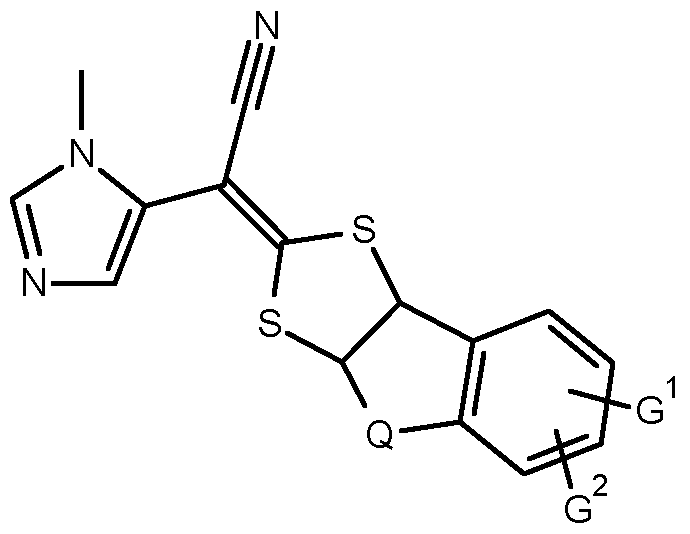
Table 7: This table discloses 104 specific compounds of formula (T-7), wherein Q is -CH2- the first 52 compounds wherein G1 and G2 are selected from the lines 1 .001 to 1 .052 in the Table 1 and 52 further compounds wherein Q is -CH2-0- and G1 and G2 are selected from the lines 1.001 to 1 .052 in the Table 1.

(T-7)
Table 8: This table discloses 104 specific compounds of formula (T-8), wherein Q is -CH2- in the first 52 compounds wherein G1 and G2 are selected from the lines 1 .001 to 1 .052 in the Table 1 and 52 further compounds wherein Q is -CH2-0- and G1 and G2 are selected from the lines 1.001 to 1 .052 in the Table 1 .

(T-8)
Table 9: This table discloses 104 specific compounds of formula (T-9), wherein Q is -CH2- the first 52 compounds wherein G1 and G2 are selected from the lines 1 .001 to 1 .052 in the Table 1 and 52 further compounds wherein Q is -CH2-0- and G1 and G2 are selected from the lines 1.001 to 1 .052 in the Table 1.

(T-9)
Table 10: This table discloses 104 specific compounds of formula (T-10), wherein Q is -CH2- in the first 52 compounds wherein G1 and G2 are selected from the lines 1 .001 to 1 .052 in the Table 1 and 52 further compounds wherein Q is -CH2-0- and G1 and G2 are selected from the lines 1.001 to 1 .052 in the Table 1.

(T-10)
Table 1 1 : This table discloses 104 specific compounds of formula (T-1 1 ), wherein Q is -CH2- in the first 52 compounds wherein G1 and G2 are selected from the lines 1 .001 to 1 .052 in the Table 1 and 52 further compounds wherein Q is -CH2-0- and G1 and G2 are selected from the lines 1.001 to 1 .052 in the Table 1.

(T-1 1 )
Table 12: This table discloses 104 specific compounds of formula (T-12), wherein Q is -CH2- in the first 52 compounds wherein G1 and G2 are selected from the lines 1 .001 to 1 .052 in the Table 1 and 52 further compounds wherein Q is -CH2-0- and G1 and G2 are selected from the lines 1.001 to 1 .052 in the Table 1.

(T-12)
Table 13: This table discloses 104 specific compounds of formula (T-13), wherein Q is -CH2- in the first 52 compounds wherein G1 and G2 are selected from the lines 1 .001 to 1 .052 in the Table 1 and 52 further compounds wherein Q is -CH2-0- and G1 and G2 are selected from the lines 1.001 to 1.052 in the Table 1 .

(T-13)
Table 14: This table discloses 104 specific compounds of formula (T-14), wherein Q is -CH2- in the first 52 compounds wherein G1 and G2 are selected from the lines 1 .001 to 1 .052 in the Table 1 and 52 further compounds wherein Q is -CH2-0- and G1 and G2 are selected from the lines 1.001 to 1 .052 in the Table 1.

(T-14)
Table 15: This table discloses 104 specific compounds of formula (T-15), wherein Q is -CH2- in the first 52 compounds wherein G1 and G2 are selected from the lines 1 .001 to 1 .052 in the Table 1 and 52 further compounds wherein Q is -CH2-0- and G1 and G2 are selected from the lines 1.001 to 1 .052 in the Table 1.

(T-15)
Table 16: This table discloses 104 specific compounds of formula (T-16), wherein Q is -CH2- in the first 52 compounds wherein G1 and G2 are selected from the lines 1 .001 to 1 .052 in the Table 1 and 52 further compounds wherein Q is -CH2-0- and G1 and G2 are selected from the lines 1.001 to 1 .052 in the Table 1.

(T-16)
Table 17: This table discloses 104 specific compounds of formula (T-17), wherein Q is -CH2- in the first 52 compounds wherein G1 and G2 are selected from the lines 1 .001 to 1 .052 in the Table 1 and 52 further compounds wherein Q is -CH2-0- and G1 and G2 are selected from the lines 1.001 to 1 .052 in the Table 1.

(T-1 1 )
Table 18: This table discloses 104 specific compounds of formula (T-18), wherein Q is -CH2- in the first 52 compounds wherein G1 and G2 are selected from the lines 1 .001 to 1 .052 in the Table 1 and 52 further compounds wherein Q is -CH2-0- and G1 and G2 are selected from the lines 1.001 to 1.052 in the Table 1 .

(T-18)
Table 19: This table discloses 20 specific compounds of formula (T-19)

(T-19) wherein Q is -CH2- in the first 10 compounds wherein G1 is selected from the lines 1 .001 to 1 .010 in the Table 19 and 10 further compounds wherein Q is -CH2-0- and G1 is selected from the lines 1.001 to 1 .010 in the Table 19.

. 8-cyano
Table 20: This table discloses 20 specific compounds of formula (T-20), wherein Q is -CH2- in the first 10 compounds wherein G1 is selected from the lines 1 .001 to 1.010 in the Table 19 and 10 further compounds wherein Q is -CH2-0- and G1 is selected from the lines 1 .001 to 1 .010 in the Table 19.

(T-20)
Table 21 : This table discloses 20 specific compounds of formula (T-21 ), wherein Q is -CH2- in the first 10 compounds wherein G1 is selected from the lines 1 .001 to 1.010 in the Table 19 and 10 further compounds wherein Q is -CH2-0- and G1 is selected from the lines 1 .001 to 1 .010 in the Table 19.
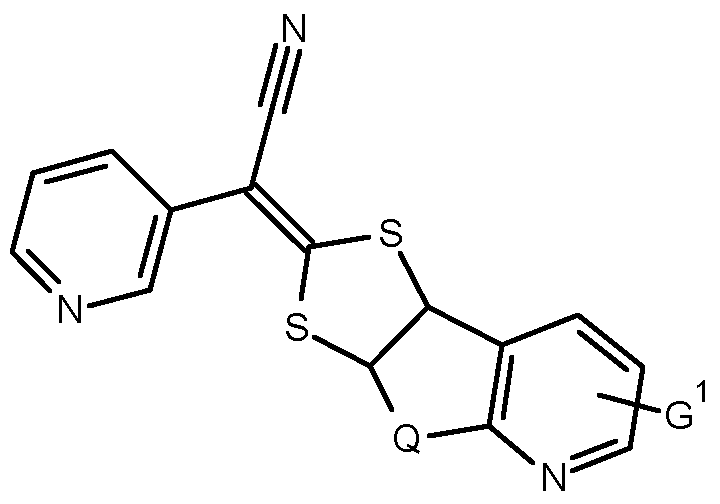
(T-21 )
Table 22: This table discloses 20 specific compounds of formula (T-22), wherein Q is -CH2- in the first 10 compounds wherein G1 is selected from the lines 1 .001 to 1.010 in the Table 19 and 10 further compounds wherein Q is -CH2-0- and G1 is selected from the lines 1 .001 to 1 .010 in the Table 19.
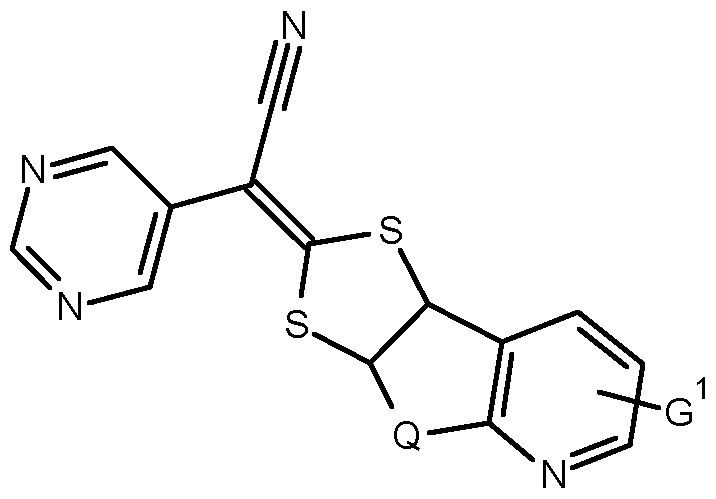
(T-22)
Table 23: This table discloses 20 specific compounds of formula (T-23), wherein Q is -CH2- in the first 10 compounds wherein G1 is selected from the lines 1 .001 to 1.010 in the Table 19 and 10 further compounds wherein Q is -CH2-0- and G1 is selected from the lines 1 .001 to 1 .010 in the Table 19.

in the first 10 compounds wherein G1 is selected from the lines 1 .001 to 1.010 in the Table 19 and 10 further compounds wherein Q is -CH2-0- and G1 is selected from the lines 1 .001 to 1 .010 in the Table 19.

(T-24)
Table 25: This table discloses 20 specific compounds of formula (T-25), wherein G1 is as defined below in the Table 19 and Q is -CH2- or -CH2-0-.

(T-25)
Table 26: This table discloses 20 specific compounds of formula (T-26), wherein Q is -CH2- in the first 10 compounds wherein G1 is selected from the lines 1 .001 to 1.010 in the Table 19
and 10 further compounds wherein Q is -CH2-0- and G1 is selected from the lines 1 .001 to 1 .010 in the Table 19.

(T-26) Table 27: This table discloses 20 specific compounds of formula (T-27), wherein Q is -CH2- in the first 10 compounds wherein G1 is selected from the lines 1 .001 to 1 .010 in the Table 19 and 10 further compounds wherein Q is -CH2-0- and G1 is selected from the lines 1 .001 to 1 .010 in the Table 19.

(T-27)
Table 28: This table discloses 20 specific compounds of formula (T-28), wherein Q is -CH2- in the first 10 compounds wherein G1 is selected from the lines 1 .001 to 1.010 in the Table 19 and 10 further compounds wherein Q is -CH2-0- and G1 is selected from the lines 1 .001 to 1 .010 in the Table 19.

(T-28)
Table 29: This table discloses 20 specific compounds of formula (T-29), wherein Q is -CH2- in the first 10 compounds wherein G1 is selected from the lines 1 .001 to 1.010 in the Table 19 and 10 further compounds wherein Q is -CH2-0- and G1 is selected from the lines 1 .001 to 1 .010 in the Table 19.

(T-29)
Table 30: This table discloses 20 specific compounds of formula (T-30), wherein Q is -CH2- in the first 10 compounds wherein G1 is selected from the lines 1.001 to 1.010 in the Table 19 and 10 further compounds wherein Q is -CH2-0- and G1 is selected from the lines 1 .001 to 1 .010 in the Table 19.

(T-30)
Table 31 : This table discloses 20 specific compounds of formula (T-31 ), wherein Q is -CH2- in the first 10 compounds wherein G1 is selected from the lines 1 .001 to 1.010 in the Table 19 and 10 further compounds wherein Q is -CH2-0- and G1 is selected from the lines 1 .001 to 1 .010 in the Table 19.

(T-31 )
Table 32: This table discloses 20 specific compounds of formula (T-32), wherein Q is -CH2- in the first 10 compounds wherein G1 is selected from the lines 1 .001 to 1.010 in the Table 19 and 10 further compounds wherein Q is -CH2-0- and G1 is selected from the lines 1 .001 to 1 .010 in the Table 19.

(T-32)
Table 33: This table discloses 20 specific compounds of formula (T-33), wherein Q is -CH2- in the first 10 compounds wherein G1 is selected from the lines 1 .001 to 1.010 in the Table 19 and 10 further compounds wherein Q is -CH2-0- and G1 is selected from the lines 1 .001 to 1 .010 in the Table 19.

(T-33)
Table 34: This table discloses 20 specific compounds of formula (T-34), wherein Q is -CH2- in the first 10 compounds wherein G1 is selected from the lines 1 .001 to 1.010 in the Table 19 and 10 further compounds wherein Q is -CH2-0- and G1 is selected from the lines 1 .001 to 1 .010 in the Table 19.

(T-34)
Table 35: This table discloses 20 specific compounds of formula (T-35), wherein Q is -CH2- in the first 10 compounds wherein G1 is selected from the lines 1 .001 to 1.010 in the Table 19 and 10 further compounds wherein Q is -CH2-0- and G1 is selected from the lines 1 .001 to 1 .010 in the Table 19.


(T-36)
Table 37: This table discloses 20 specific compounds of formula (T-37)

(T-37) wherein Q is -CH2- in the first 10 compounds wherein G1 and G2 are selected from the lin 1 .001 to 1.010 in the table below and 10 further compounds wherein Q is -CH2-0- and G and G2 are selected from the lines 1 .001 to 1.010 in the table below.


. 8-cyano
Table 38: This table discloses 20 specific compounds of formula (T-38), wherein Q is -CH2- in the first 10 compounds wherein G1 is selected from the lines 1 .001 to 1.010 in the Table 37 and 10 further compounds wherein Q is -CH2-0- and G1 is selected from the lines 1 .001 to 1 .010 in the Table 37.

(T-38)
Table 39: This table discloses 20 specific compounds of formula (T-39), wherein Q is -CH2- in the first 10 compounds wherein G1 is selected from the lines 1 .001 to 1.010 in the Table 37 and 10 further compounds wherein Q is -CH2-0- and G1 is selected from the lines 1 .001 to 1 .010 in the Table 37.

(T-39)
Table 40: This table discloses 20 specific compounds of formula (T-40), wherein Q is -CH2- in the first 10 compounds wherein G1 is selected from the lines 1 .001 to 1.010 in the Table 37
and 10 further compounds wherein Q is -CH2-0- and G1 is selected from the lines 1 .001 to 1 .010 in the Table 37.

(T-40)
Table 41 : This table discloses 20 specific compounds of formula (T-41 ), wherein Q is -CH2- in the first 10 compounds wherein G1 is selected from the lines 1 .001 to 1.010 in the Table 37 and 10 further compounds wherein Q is -CH2-0- and G1 is selected from the lines 1 .001 to 1 .010 in the Table 37.

(T-41 )
Table 42: This table discloses 20 specific compounds of formula (T-42), wherein Q is -CH2- in the first 10 compounds wherein G1 is selected from the lines 1.001 to 1.010 in the Table 37 and 10 further compounds wherein Q is -CH2-0- and G1 is selected from the lines 1 .001 to 1 .010 in the Table 37.

(T-42)
Table 43: This table discloses 20 specific compounds of formula (T-43), wherein Q is -CH2- in the first 10 compounds wherein G1 is selected from the lines 1 .001 to 1.010 in the Table 37 and 10 further compounds wherein Q is -CH2-0- and G1 is selected from the lines 1 .001 to 1 .010 in the Table 37.

(T-43) Table 44: This table discloses 20 specific compounds of formula (T-44), wherein Q is -CH2- in the first 10 compounds wherein G1 is selected from the lines 1 .001 to 1.010 in the Table 37 and 10 further compounds wherein Q is -CH2-0- and G1 is selected from the lines 1 .001 to 1 .010 in the Table 37.

(T-44)
Table 45: This table discloses 20 specific compounds of formula (T-45), wherein Q is -CH2- in the first 10 compounds wherein G1 is selected from the lines 1 .001 to 1 .010 in the Table 37 and 10 further compounds wherein Q is -CH2-0- and G1 is selected from the lines 1 .001 to 1 .010 in the Table 37.

(T-45)
Table 46: This table discloses 20 specific compounds of formula (T-46), wherein Q is -CH2- in the first 10 compounds wherein G1 is selected from the lines 1 .001 to 1.010 in the Table 37 and 10 further compounds wherein Q is -CH2-0- and G1 is selected from the lines 1 .001 to 1 .010 in the Table 37.

(T-46)
Table 47: This table discloses 20 specific compounds of formula (T-47), wherein Q is -CH2- in the first 10 compounds wherein G1 is selected from the lines 1 .001 to 1.010 in the Table 37 and 10 further compounds wherein Q is -CH2-0- and G1 is selected from the lines 1 .001 to 1 .010 in the Table 37.

(T-47)
Table 48: This table discloses 20 specific compounds of formula (T-48), wherein Q is -CH2- in the first 10 compounds wherein G1 is selected from the lines 1.001 to 1.010 in the Table 37 and 10 further compounds wherein Q is -CH2-0- and G1 is selected from the lines 1 .001 to 1 .010 in the Table 37.

(T-48)
Table 49: This table discloses 20 specific compounds of formula (T-49), wherein Q is -CH2- in the first 10 compounds wherein G1 is selected from the lines 1 .001 to 1.010 in the Table 37 and 10 further compounds wherein Q is -CH2-0- and G1 is selected from the lines 1 .001 to 1 .010 in the Table 37.

(T-49)
Table 50: This table discloses 20 specific compounds of formula (T-50), wherein Q is -CH2- in the first 10 compounds wherein G1 is selected from the lines 1 .001 to 1.010 in the Table 37 and 10 further compounds wherein Q is -CH2-0- and G1 is selected from the lines 1 .001 to 1 .010 in the Table 37.

(T-50)
Table 51 : This table discloses 20 specific compounds of formula (T-51 ), wherein Q is -CH2- in the first 10 compounds wherein G1 is selected from the lines 1.001 to 1 .010 in the Table 37 and 10 further compounds wherein Q is -CH2-0- and G1 is selected from the lines 1 .001 to 1 .010 in the Table 37.
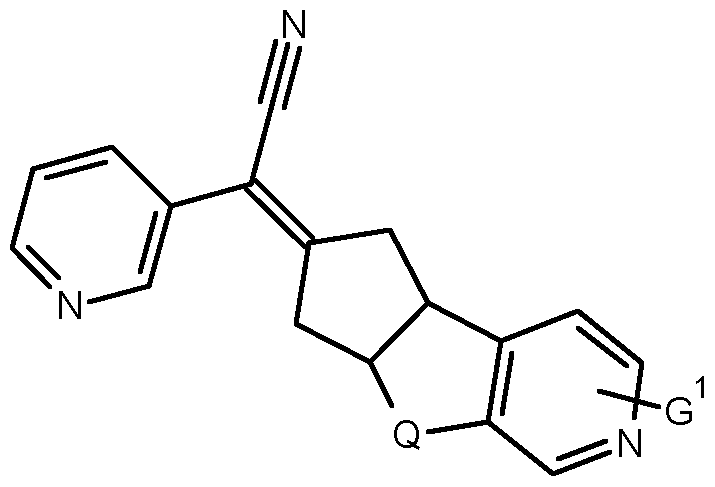
(T-51 )
Table 52: This table discloses 20 specific compounds of formula (T-52), wherein Q is -CH2- in the first 10 compounds wherein G1 is selected from the lines 1 .001 to 1.010 in the Table 37 and 10 further compounds wherein Q is -CH2-0- and G1 is selected from the lines 1 .001 to 1 .010 in the Table 37.

(T-52)
Table 53: This table discloses 20 specific compounds of formula (T-53), wherein Q is -CH2- in the first 10 compounds wherein G1 is selected from the lines 1 .001 to 1.010 in the Table 37 and 10 further compounds wherein Q is -CH2-0- and G1 is selected from the lines 1 .001 to 1 .010 in the Table 37.

(T-53)
Table 54: This table discloses 20 specific compounds of formula (T-54), wherein Q is -CH2- in the first 10 compounds wherein G1 is selected from the lines 1 .001 to 1.010 in the Table 37 and 10 further compounds wherein Q is -CH2-0- and G1 is selected from the lines 1 .001 to 1 .010 in the Table 37.

(T-54) Table 55: This table discloses 20 specific compounds of formula (T-55)

(T-55) wherein Q is -CH2- in the first 10 compounds wherein G1 is selected from the lines 1 .001 to 1 .010 in the table below and 10 further compounds wherein Q is -CH2-0- and G1 is selected from the lines 1 .001 to 1.010 in the table below.

Table 56: This table discloses 20 specific compounds of formula (T-56), wherein Q is -CH2- in the first 10 compounds wherein G1 is selected from the lines 1 .001 to 1.010 in the Table 55 and 10 further compounds wherein Q is -CH2-0- and G1 is selected from the lines 1 .001 to 1 .010 in the Table 55.

(T-56)
Table 57: This table discloses 20 specific compounds of formula (T-57), wherein Q is -CH2- in the first 10 compounds wherein G1 is selected from the lines 1 .001 to 1.010 in the Table 55 and 10 further compounds wherein Q is -CH2-0- and G1 is selected from the lines 1 .001 to 1 .010 in the Table 55.

(T-57)
Table 58: This table discloses 20 specific compounds of formula (T-58), wherein Q is -CH2- in the first 10 compounds wherein G1 is selected from the lines 1 .001 to 1.010 in the Table 55 and 10 further compounds wherein Q is -CH2-0- and G1 is selected from the lines 1 .001 to 1 .010 in the Table 55.

(T-58)
Table 59: This table discloses 20 specific compounds of formula (T-59), wherein Q is -CH2- in the first 10 compounds wherein G1 is selected from the lines 1 .001 to 1.010 in the Table 55 and 10 further compounds wherein Q is -CH2-0- and G1 is selected from the lines 1 .001 to 1 .010 in the Table 55.

(T-59)
Table 60: This table discloses 20 specific compounds of formula (T-60), wherein Q is -CH2- in the first 10 compounds wherein G1 is selected from the lines 1 .001 to 1.010 in the Table 55 and 10 further compounds wherein Q is -CH2-0- and G1 is selected from the lines 1 .001 to 1 .010 in the Table 55.

(T-60)
Table 61 : This table discloses 20 specific compounds of formula (T-61 ), wherein Q is -CH2- in the first 10 compounds wherein G1 is selected from the lines 1 .001 to 1.010 in the Table 55 and 10 further compounds wherein Q is -CH2-0- and G1 is selected from the lines 1 .001 to 1 .010 in the Table 55.

(T-61 )
Table 62: This table discloses 20 specific compounds of formula (T-62), wherein Q is -CH2- in the first 10 compounds wherein G1 is selected from the lines 1 .001 to 1.010 in the Table 55 and 10 further compounds wherein Q is -CH2-0- and G1 is selected from the lines 1 .001 to 1 .010 in the Table 55.

(T-62)
Table 63: This table discloses 20 specific compounds of formula (T-63), wherein Q is -CH2- in the first 10 compounds wherein G1 is selected from the lines 1 .001 to 1.010 in the Table 55 and 10 further compounds wherein Q is -CH2-0- and G1 is selected from the lines 1 .001 to 1 .010 in the Table 55.

(T-63)
Table 64: This table discloses 20 specific compounds of formula (T-64), wherein Q is -CH2- in the first 10 compounds wherein G1 is selected from the lines 1 .001 to 1.010 in the Table 55 and 10 further compounds wherein Q is -CH2-0- and G1 is selected from the lines 1 .001 to 1 .010 in the Table 55.

(T-64)
Table 65: This table discloses 20 specific compounds of formula (T-65), wherein Q is -CH2- in the first 10 compounds wherein G1 is selected from the lines 1 .001 to 1.010 in the Table 55 and 10 further compounds wherein Q is -CH2-0- and G1 is selected from the lines 1 .001 to 1 .010 in the Table 55.

(T-65)
Table 66: This table discloses 20 specific compounds of formula (T-66), wherein Q is -CH2- in the first 10 compounds wherein G1 is selected from the lines 1 .001 to 1.010 in the Table 55 and 10 further compounds wherein Q is -CH2-0- and G1 is selected from the lines 1 .001 to 1 .010 in the Table 55.

(T-66)
Table 67: This table discloses 20 specific compounds of formula (T-67), wherein G1 is as defined below in the Table 55 and Q is -CH2- or -CH2-0-.

(T-67)
Table 68: This table discloses 20 specific compounds of formula (T-68), wherein Q is -CH2- in the first 10 compounds wherein G1 is selected from the lines 1 .001 to 1.010 in the Table 55 and 10 further compounds wherein Q is -CH2-0- and G1 is selected from the lines 1 .001 to 1 .010 in the Table 55.

(T-68)
Table 69: This table discloses 20 specific compounds of formula (T-69), wherein Q is -CH2- in the first 10 compounds wherein G1 is selected from the lines 1 .001 to 1.010 in the Table 55 and 10 further compounds wherein Q is -CH2-0- and G1 is selected from the lines 1 .001 to 1 .010 in the Table 55.

(T-69)
Table 70: This table discloses 20 specific compounds of formula (T-70), wherein Q is -CH2- in the first 10 compounds wherein G1 is selected from the lines 1 .001 to 1.010 in the Table 55 and 10 further compounds wherein Q is -CH2-0- and G1 is selected from the lines 1 .001 to 1 .010 in the Table 55.

(T-70)
Table 71 : This table discloses 20 specific compounds of formula (T-71 ), wherein Q is -CH2- in the first 10 compounds wherein G1 is selected from the lines 1 .001 to 1.010 in the Table 55 and 10 further compounds wherein Q is -CH2-0- and G1 is selected from the lines 1 .001 to 1 .010 in the Table 55.

(T-71 )
Table 72: This table discloses 20 specific compounds of formula (T-72), wherein Q is -CH2- in the first 10 compounds wherein G1 is selected from the lines 1 .001 to 1.010 in the Table 55 and 10 further compounds wherein Q is -CH2-0- and G1 is selected from the lines 1 .001 to 1 .010 in the Table 55.

(T-72) Table 73: This table discloses 20 specific compounds of formula (T-73)

(T-73) wherein Q is -CH2- in the first 10 compounds wherein G1 is selected from the lines 1 .001 to 1 .010 in the table below and 10 further compounds wherein Q is -CH2-0- and G1 is selected from the lines 1 .001 to 1.010 in the table below.

Table 74: This table discloses 20 specific compounds of formula (T-74), wherein Q is -CH2- in the first 10 compounds wherein G1 is selected from the lines 1 .001 to 1.010 in the Table 73 and 10 further compounds wherein Q is -CH2-0- and G1 is selected from the lines 1 .001 to 1 .010 in the Table 73.

(T-74)
Table 75: This table discloses 20 specific compounds of formula (T-75), wherein Q is -CH2- in the first 10 compounds wherein G1 is selected from the lines 1 .001 to 1 .010 in the Table 73 and 10 further compounds wherein Q is -CH2-0- and G1 is selected from the lines 1 .001 to 1 .010 in the Table 73.

(T-75)
Table 76: This table discloses 20 specific compounds of formula (T-76), wherein Q is -CH2- in the first 10 compounds wherein G1 is selected from the lines 1 .001 to 1.010 in the Table 73 and 10 further compounds wherein Q is -CH2-0- and G1 is selected from the lines 1 .001 to 1 .010 in the Table 73.

(T-76)
Table 77: This table discloses 20 specific compounds of formula (T-77), wherein Q is -CH2- in the first 10 compounds wherein G1 is selected from the lines 1 .001 to 1.010 in the Table 73 and 10 further compounds wherein Q is -CH2-0- and G1 is selected from the lines 1 .001 to 1 .010 in the Table 73.

(T-77)
Table 78: This table discloses 20 specific compounds of formula (T-78), wherein Q is -CH2- in the first 10 compounds wherein G1 is selected from the lines 1.001 to 1.010 in the Table 73 and 10 further compounds wherein Q is -CH2-0- and G1 is selected from the lines 1 .001 to 1 .010 in the Table 73.
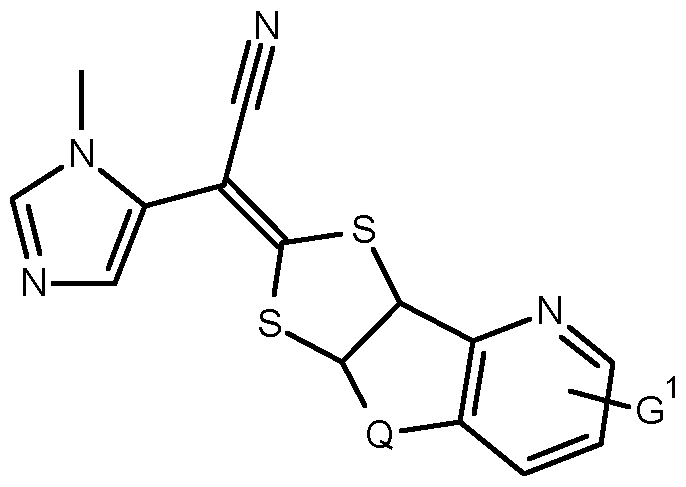
(T-78)
Table 79: This table discloses 20 specific compounds of formula (T-79), wherein Q is -CH2- in the first 10 compounds wherein G1 is selected from the lines 1 .001 to 1.010 in the Table 73 and 10 further compounds wherein Q is -CH2-0- and G1 is selected from the lines 1 .001 to 1 .010 in the Table 73.

(T-79)
Table 80: This table discloses 20 specific compounds of formula (T-80), wherein Q is -CH2- in the first 10 compounds wherein G1 is selected from the lines 1 .001 to 1.010 in the Table 73 and 10 further compounds wherein Q is -CH2-0- and G1 is selected from the lines 1 .001 to 1 .010 in the Table 73.

(T-80)
Table 81 : This table discloses 20 specific compounds of formula (T-81 ), wherein Q is -CH2- in the first 10 compounds wherein G1 is selected from the lines 1.001 to 1 .010 in the Table 73 and 10 further compounds wherein Q is -CH2-0- and G1 is selected from the lines 1 .001 to 1 .010 in the Table 73.

(T-81 )
Table 82: This table discloses 20 specific compounds of formula (T-82), wherein Q is -CH2- in the first 10 compounds wherein G1 is selected from the lines 1 .001 to 1.010 in the Table 73 and 10 further compounds wherein Q is -CH2-0- and G1 is selected from the lines 1 .001 to 1 .010 in the Table 73.

(T-82)
Table 83: This table discloses 20 specific compounds of formula (T-83), wherein Q is -CH2- in the first 10 compounds wherein G1 is selected from the lines 1 .001 to 1.010 in the Table 73 and 10 further compounds wherein Q is -CH2-0- and G1 is selected from the lines 1 .001 to 1 .010 in the Table 73.

(T-83)
Table 84: This table discloses 20 specific compounds of formula (T-84), wherein Q is -CH2- in the first 10 compounds wherein G1 is selected from the lines 1 .001 to 1.010 in the Table 73 and 10 further compounds wherein Q is -CH2-0- and G1 is selected from the lines 1 .001 to 1 .010 in the Table 73.

(T-84)
Table 85: This table discloses 20 specific compounds of formula (T-85), wherein Q is -CH2- in the first 10 compounds wherein G1 is selected from the lines 1 .001 to 1.010 in the Table 73 and 10 further compounds wherein Q is -CH2-0- and G1 is selected from the lines 1 .001 to 1 .010 in the Table 73.

(T-85)
Table 86: This table discloses 20 specific compounds of formula (T-86), wherein Q is -CH2- in the first 10 compounds wherein G1 is selected from the lines 1 .001 to 1.010 in the Table 73 and 10 further compounds wherein Q is -CH2-0- and G1 is selected from the lines 1 .001 to 1 .010 in the Table 73.

(T-86)
Table 87: This table discloses 20 specific compounds of formula (T-87), wherein Q is -CH2- in the first 10 compounds wherein G1 is selected from the lines 1 .001 to 1.010 in the Table 73 and 10 further compounds wherein Q is -CH2-0- and G1 is selected from the lines 1 .001 to 1 .010 in the Table 73.

Table 88: This table discloses 20 specific compounds of formula (T-88), wherein Q is -CH2- in the first 10 compounds wherein G1 is selected from the lines 1 .001 to 1.010 in the Table 73 and 10 further compounds wherein Q is -CH2-0- and G1 is selected from the lines 1 .001 to 1 .010 in the Table 73.

(T-88)
Table 89: This table discloses 20 specific compounds of formula (T-89), wherein Q is -CH2- in the first 10 compounds wherein G1 is selected from the lines 1 .001 to 1.010 in the Table 73 and 10 further compounds wherein Q is -CH2-0- and G1 is selected from the lines 1 .001 to 1 .010 in the Table 73.

(T-89)
Table 90: This table discloses 20 specific compounds of formula (T-90), wherein Q is -CH2- in the first 10 compounds wherein G1 is selected from the lines 1 .001 to 1.010 in the Table 73 and 10 further compounds wherein Q is -CH2-0- and G1 is selected from the lines 1 .001 to 1 .010 in the Table 73.

(T-90)
Table T1 shows selected LCMS data and retention times/molecular ion as examples compounds similar to the one described in Tables 1 to 90.
The analytical method used is described here below:
ACQUITY SQD Mass Spectrometer from Waters (Single quadrupole mass spectrometer) lonisation method: Electrospray
Polarity: positive ions
Capillary (kV) 3.00, Cone (V) 20.00, Extractor (V) 3.00, Source Temperature (°C) 150, Desolvation Temperature (°C) 400, Cone Gas Flow (L/Hr) 60, Desolvation Gas Flow (L/Hr) 700
Mass range: 100 to 800 Da
DAD Wavelength range (nm): 210 to 400
Method Waters ACQUITY UPLC with the following HPLC gradient conditions
(Solvent A: Water/Methanol 9:1 , 0.1 % formic acid and Solvent B: Acetonitrile,0.1 % formic acid )

Type of column: Waters ACQUITY UPLC HSS T3; Column length: 30 mm; Internal diameter of column: 2.1 mm; Particle Size: 1 .8 micron; Temperature: 60°C.
Table T1 : Melting point data and/or retention times for compounds:
RT [M+H] MP
Entry STRUCTURE
(min) (measured) °C


Formulation examples for compounds of formula (I): Example F-1.1 to F-1 .2: Emulsifiable concentrates
Components F-2.1 F-2.2
A compound selected from the Tables 1 to 90 and table T1 25% 50%
calciumdodecylbenzenesulfonate 5% 6%
castoroilpolyethyleneglycolether
(36molethylenoxyunits) 5% - tributylphenolpolyethyleneglycolether
(30molethylenoxyunits) - cyclohexanone - 20%
xylenemixture 65% 20%
Emulsions of any desired concentration can be prepared by diluting such concentrates with water. Example F-2: Emulsifiable concentrate

Emulsions of any desired concentration can be prepared by diluting such concentrates with water. Examples F-3.1 to F-3.4: Solutions
Components F-3.1 F-3.2 F-3.3 F-3.4
A compound selected from the Tables 1 to 90 and table T1 80% 10% 5% 95% propylene glycol monomethyl ether 20% - - - polyethylene glycol 70%
(relative molecular mass: 400 atomic mass units)
N-methylpyrrolid-2-one - 20% - - epoxidised coconut oil - - 1 % 5%
benzin (boiling range: 160-190°) - - 94% -
The solutions are suitable for use in the form of microdrops.
Examples F-4.1 to F-4.4: Granulates

The novel compound is dissolved in dichloromethane, the solution is sprayed onto the carrier and the solvent is then removed by distillation under vacuum.
Examples F-5.1 and F-5.2: Dusts

Ready for use dusts are obtained by intimately mixing all components.
Examples F-6.1 to F-6.3: Wettable powders

All components are mixed and the mixture is thoroughly ground in a suitable mill to give wettable powders which can be diluted with water to suspensions of any desired
concentration.
Example F7: Flowable concentrate for seed treatment

The finely ground active ingredient is intimately mixed with the adjuvants, giving a suspension concentrate from which suspensions of any desired dilution can be obtained by dilution with water. Using such dilutions, living plants as well as plant propagation material can be treated and protected against infestation by microorganisms, by spraying, pouring or immersion.
Biological examples:
These examples illustrate the fungicidal properties of the compounds described in table T1. Biological example 1 : fungicidal activity against Blumeria graminis f. sp. tritici (Erysiphe graminis f. sp. tritici) I wheat / leaf disc preventative (Powdery mildew on wheat)
Wheat leaf segments cv. Kanzler were placed on agar in a multiwell plate (24-well format) and sprayed with the formulated test compound diluted in water. The leaf disks were inoculated by shaking powdery mildew infected plants above the test plates 1 day after application. The inoculated leaf disks were incubated at 20°C and 60% rh under a light regime of 24 h darkness followed by 12 h light / 12 h darkness in a climate chamber and the activity of a compound was assessed as percent disease control compared to untreated when an appropriate level of disease damage appears on untreated check leaf segments (6 - 8 days after application).
Compounds (from table T1 ) 1 , 2, 4, 5, 7, 8 and 9 at 200 ppm give at least 80% disease control in this test when compared to untreated control leaf disks under the same conditions, which show extensive disease development.
Biological example 2: fungicidal activity against Pyrenophora teres I barley / leaf disc preventative (Net blotch)
Barley leaf segments cv. Hasso were placed on agar in a multiwell plate (24-well format) and sprayed with the formulated test compound diluted in water. The leaf segmens were inoculated with a spore suspension of the fungus 2 days after application. The inoculated leaf segments were incubated at 20°C and 65% rh under a light regime of 12 h light / 12 h darkness in a climate cabinet and the activity of a compound was assessed as disease control compared to untreated when an appropriate level of disease damage appears in untreated check leaf segments (5 - 7 days after application).
Compounds (from table T1 ) 1 , 2, 4, 5, 7, 8 and 9 at 200 ppm give at least 80% disease control in this test when compared to untreated control leaf disks under the same conditions, which show extensive disease development.
Biological example 3: fungicidal activity against Botryotinia fuckeliana (Botrytis cinerea) I liquid culture (Gray mould)
Conidia of the fungus from cryogenic storage were directly mixed into nutrient broth (Vogels broth). After placing a (DMSO) solution of test compound into a microtiter plate (96-well
format), the nutrient broth containing the fungal spores was added. The test plates were incubated at 24°C and the inhibition of growth was determined photometrically 3-4 days after application.
Compounds (from table T1 ) 1 , 2, 3, 4, 5, 6, 7 and 9 at 200 ppm give at least 80% disease control in this test when compared to untreated control leaf disks under the same conditions, which show extensive disease development.
Biological example 4: fungicidal activity against Mycosphaerella arachidis (Cercospora arachidicola) I liquid culture (early leaf spot)
Conidia of the fungus from cryogenic storage were directly mixed into nutrient broth (PDB potato dextrose broth). After placing a (DMSO) solution of test compound into a microtiter plate (96-well format), the nutrient broth containing the fungal spores was added. The test plates were incubated at 24°C and the inhibition of growth was determined photometrically 4- 5 days after application.
Compounds (from table T1 ) 1 , 2, 3, 4, 5, 6, 7, 8 and 9 at 200 ppm give at least 80% disease control in this test when compared to untreated control leaf disks under the same conditions, which show extensive disease development. Biological example 5: fungicidal activity against Mycosphaerella graminicola (Septoria tritici) I liquid culture (Septoria blotch)
Conidia of the fungus from cryogenic storage were directly mixed into nutrient broth (PDB potato dextrose broth). After placing a (DMSO) solution of test compound into a microtiter plate (96-well format), the nutrient broth containing the fungal spores was added. The test plates were incubated at 24°C and the inhibition of growth was determined photometrically 4- 5 days after application.
Compounds (from table T1 ) 1 , 2, 3, 4, 5, 6, 7, 8 and 9 at 200 ppm give at least 80% disease control in this test when compared to untreated control leaf disks under the same conditions, which show extensive disease development.
Biological example 6: fungicidal activity against Gaeumannomyces graminis I liquid culture (Take-all of cereals)
Mycelial fragments of the fungus from cryogenic storage were directly mixed into nutrient broth (PDB potato dextrose broth). After placing a (DMSO) solution of test compound into a microtiter plate (96-well format), the nutrient broth containing the fungal spores iss added.
The test plates were incubated at 24°C and the inhibition of growth was determined photometrically 4-5 days after application.
Compounds (from table T1 ) 1 , 2, 4, 5, 6, 7 and 9 at 200 ppm give at least 80% disease control in this test when compared to untreated control leaf disks under the same conditions, which show extensive disease development.
Biological example 7: fungicidal activity against Sclerotinia sclerotiorum I liquid culture (white mold, etc.):
Mycelial fragments of the fungus from cryogenic storage were directly mixed into nutrient broth (PDB potato dextrose broth). After placing a (DMSO) solution of the test compounds into a microtiter plate (96-well format) the nutrient broth containing the fungal spores was added. The test plates were incubated at 24 C and the inhibition of growth was determined photometrically after 72 hrs at 620nm.
Compounds (from table T1 ) 1 , 2, 7 and 8 at 200 ppm give at least 80% disease control in this test when compared to untreated control leaf disks under the same conditions, which show extensive disease development.
Claims
1. Compounds of formula (I)

Wherein
HetAr is an optionally substituted heteroaryl moiety Y and Z are independently 0, S, NR5 or C(R6R7)
A is is hydrogen, alkyl, haloalkyl, cycloalkyl, halocycloalkyl, optionally substituted aryl, optionally substituted heteroaryl, nitro, cyano, -C(=0)(alkyl), -C(=0)(haloalkyl), - C(=0)(alkoxy), -C(=0)(haloalkoxy), -C(=0)NH(alkyl), -C(=0)N(alkyl)2l -C(=0)(cycloalkyl), - C(=0)(halocycloalkyl), -C(=0)(cycloalkyloxy), -C(=0)(halocycloalkyloxy), -S(=0)2(alkyl), - S(=0)2(haloalkyl), -S(=0)2(alkoxy), -S(=0)2(haloalkoxy), -S(=0)2NH(alkyl), -S(=0)2N(alkyl)2, S(=0)2(cycloalkyl), -S(=0)2(halocycloalkyl), -S(=0)2(cycloalkyloxy), - S(=0)2(halocycloalkyloxy), -C(=NO(alkyl))alkyl, -C(=NO(alkyl))cycloalkyl, - C(=NNH(alkyl)alkyl), -C(=NN(alkyl)2)alkyl, -C(=NNH(alkyl)cycloalkyl), - C(=NN(alkyl)2)cycloalkyl
R1 and R4 are independently of each other hydrogen, CrC6alkyl, Ci-C6haloalkyl, C3- C7cycloalkyl, Ci-C6alkoxy, Ci-C6haloalkoxy, halogen, or optionally substituted phenyl
R2 and R3 together with the carbon atoms to which there are attached form an optionally substituted aromatic or heteroaromatic ring n is an integer equal to 0, 1 , 2 or 3
X equal to CH2 or O with the provisio that when n is greater than 1 not two oxygen atoms can be next to each other.
R5, R6and R7 are independently of each other hydrogen, C C6alkyl or a salt or a N-oxide thereof.
2. Compounds of formula (I) according to claim 1 characterized in that
Y and Z are both S.
A is cyano
3. Compounds of formula (I) according to claim 1 characterized in that the optional substituents on alkyl on cycloalkyi, on aryl, on heterocyciyi and on heteroaryl include one or more of halogen, nitro, cyano, hydroxyl, amino, Ci-C6alkyl, CrC6haloalkyl, d-C6alkoxy, d- C6haloalkoxy, C3-C6cycloalkyl (itself optionally substituted with Ci-C6alkyl, halogen or C C6haloalkyl), C3-C6halocycloalkyl (itself optionally substituted with CrC6alkyl, halogen or C Cehaloalkyl), C3-C6cycloalkyloxy (itself optionally substituted with CrC6alkyl, halogen or Ci- Cehaloalkyl), optionally substituted aryl, optionally substituted heterocyciyi, optionally substituted heteroaryl wherein the optional substituents of the optionally substituted aryl, optionally substituted heterocyciyi, optionally substituted heteroaryl are selected from one or more of halogen, nitro, cyano, hydroxyl, amino, CrC6alkyl, Ci-C6haloalkyl, C C6alkoxy, C C6haloalkoxy.
4. Compounds of formula (I) according to claim 1 characterized in that
HetAr is an optionally substituted five or six membered heteroaromatic ring.
Y and Z are independent O or S, NR5 or C(R6R7)
A is hydrogen, d-Cealkyl, C C6haloalkyl, C3-C6cycloalkyl, C3-C6halocycloalkyl, optionaly substituted phenyl, optionally substituted Ci-C5heteroaryl, nitro, cyano, -C(=0)(Ci-C6alkyl), -
 -C(=0)(C1-C6haloalkoxy),
C6alkyl), -C(=0)N(CrC6alkyl)2, -C(=0)(C3-C6cycloalkyl), -C(=0)(C3-C6halocycloalkyl), - C(=0)(C3-C6cycloalkyloxy), -C(=0)(C3-C6halocycloalkyloxy),

C6haloalkyl), -S(=0)2(CrC6alkoxy),
 -S(=0)2NH(CrC6alkyl), - S(=0)2N(CrC6alkyl)2, -S(=0)2(C3-C6cycloalkyl), -S(=0)2(C3-C6halocycloalkyl), -S(=0)2(C3- Cecycloalkyloxy), -S(=0)2(C3-C6halocycloalkyloxy), -C(=NO(Ci-C6alkyl))C1-C6alkyl, - C(=NO(CrC6alkyl))C3-C6cycloalkyl, -C(=NNH(d-C6alkyl) Ci-C6alkyl), -C(=NN(Ci-C6alkyl)2) Ci-C6alkyl,
 C3-C6cycloalkyl), C3-C6cycloalkyl n is an integer equal to 1 or 2
X is CH2 or O
R1 and R4 are independently of each other hydrogen, C C6alkyl, CrC6haloalkyl, C3- C cycloalkyl
R2 and R3 together with the carbon atoms to which there are attached form an optionally substituted 5- to 6-membered aromatic or heteroaromatic ring
R5, R6 and R7 are independently of each other hydrogen, C C6alkyl
5. Compounds of formula (I) according to claim 1 characterized in that
HetAr is an optionally substituted imidazolyl, pyrazolyl, triazolyl, pyridyl, pyridazinyl, pyrimidinyl, pyrazinyl
Y and Z are independent 0 or S, NR5 or C(R6R7)
A is hydrogen, Ci-C6alkyl, CrC6haloalkyl, C3-C6cycloalkyl, C3-C6halocycloalkyl, nitro, cyano,
 -C(=0)(C3-C6cycloalkyl), -
S(=0)2(CrC6alkyl), -S(=0)2NH(C C6alkyl), -S(=0)2N(CrC6alkyl)2
n is an integer equal to 1 or 2
X=CH2
R1 and R4 are independently of each other hydrogen, C C4alkyl.
R2 and R3 together with the carbon atoms to which there are attached form an optionally substituted phenyl, thienyl, thiazolyl, isothiazolyl, pyridyl, pyridazinyl, pyrimidinyl, pyrazinyl R5, R6 and R7are independently of each other hydrogen, C C6alkyl
6. Compounds of formula (I) according to claim 1 characterized in that
HetAr is an optionally substituted imidazolyl, pyrazolyl, triazolyl, pyridyl, pyridazinyl, pyrimidinyl, pyrazinyl
Y and Z are independent O or S, NR5 or C(R6R7)
A is hydrogen, C C6alkyl, CrC6haloalkyl, C3-C6cycloalkyl, C3-C6halocycloalkyl, nitro, cyano,
 -C(=0)(C3-C6cycloalkyl), -
 -S(=0)2N(CrC6alkyl)2
n is an integer equal to 1 or 2 wherein n is an integer equal to 1 is even more preferred X=CH2
R1 and R4 are independently of each other hydrogen, CrC4alkyl.
R2 and R3 together with the carbon atoms to which there are attached form an optionally substituted phenyl, thienyl, thiazolyl, isothiazolyl, pyridyl, pyridazinyl, pyrimidinyl, pyrazinyl R5, R6 and R7are independently of each other CrC6alkyl
7. Compounds of formula (I) according to claim 1 characterized in that
HetAr is an optionally substituted imidazolyl, pyrazolyl, triazolyl, pyridyl, pyridazinyl, pyrimidinyl, pyrazinyl
Y and Z are independent O or S, NR5 or C(R6R7)
A is hydrogen, Ci-C6alkyl, Ci-C6haloalkyl, C3-C6cycloalkyl, C3-C6halocycloalkyl, nitro, cyano,
C(=0)(C3-C6cycloalkyl), -

n is an integer equal to 1 or 2 wherein n is an integer equal to 1 is even more preferred X=CH2
R1 and R4 are independently of each other hydrogen, C C4alkyl.
R2 and R3 together with the carbon atoms to which there are attached form an optionally substituted phenyl, thienyl, thiazolyl, isothiazolyl, pyridyl, pyridazinyl, pyrimidinyl, pyrazinyl R5, R6 and R7 are each other hydrogen
8. Compounds of formula (I) according to claim 1 characterized in that
HetAr is an optionally substituted imidazolyl, triazolyl wherein imidazolyl is even more preferred
Y and Z are both S.
A is cyano
n is an integer equal to 1 or 2 wherein n is an integer equal to 1 is even more preferred X=CH2
R1 and R4 are hydrogen
R2 and R3 together with the carbon atoms to which there are attached form an optionally substituted phenyl or pyridyl
9. A method of controlling or preventing infestation of useful plants by phytopathogenic microorganisms, wherein a compound of formula (I) as defined in claim 1 or a composition, a compound of formula (I) as defined in claim 1 as active ingredient, is applied to the plants, to parts thereof or the locus thereof.
10. A composition for controlling and protecting against phytopathogenic microorganisms, comprising a compound of formula (I) as defined in claim 1 and at least one auxiliary.
1 1. A method of controlling phytopathogenic diseases on useful plants or plant propagation material thereof, which comprises applying to said plant propagation material a fungicidally effective amount of a plant propagation material protecting composition comprising a compound of formula (I) as defined in claim 1 , together with a suitable carrier therefor.
12. A composition comprising a fungicidally effective amount of a compound of formula (I) as defined in claim 1 , optionally comprising at least one additional active ingredient.
Applications Claiming Priority (2)
| Application Number | Priority Date | Filing Date | Title |
|---|---|---|---|
| EP13178206 | 2013-07-26 | ||
| EP13178206.2 | 2013-07-26 |
Publications (1)
| Publication Number | Publication Date |
|---|---|
| WO2015011194A1 true WO2015011194A1 (en) | 2015-01-29 |
Family
ID=48874205
Family Applications (1)
| Application Number | Title | Priority Date | Filing Date |
|---|---|---|---|
| PCT/EP2014/065830 Ceased WO2015011194A1 (en) | 2013-07-26 | 2014-07-23 | Novel microbiocides |
Country Status (1)
| Country | Link |
|---|---|
| WO (1) | WO2015011194A1 (en) |
Cited By (1)
| Publication number | Priority date | Publication date | Assignee | Title |
|---|---|---|---|---|
| WO2018167677A1 (en) | 2017-03-15 | 2018-09-20 | Oat & Iil India Laboratories Private Limited | Novel dithiolane compound or a salt or an n-oxide and use thereof |
Citations (2)
| Publication number | Priority date | Publication date | Assignee | Title |
|---|---|---|---|---|
| US4636519A (en) * | 1985-10-09 | 1987-01-13 | Nihon Nohyaku Co., Ltd. | Ketene S,S-acetal derivative, a process for manufacturing thereof and a method for curing mycosis by administering it |
| EP0218736A1 (en) * | 1985-10-10 | 1987-04-22 | Nihon Nohyaku Co., Ltd. | A ketene S,S-acetal derivative, a process for manufacturing thereof and a method for curing mycosis by administering it |
-
2014
- 2014-07-23 WO PCT/EP2014/065830 patent/WO2015011194A1/en not_active Ceased
Patent Citations (2)
| Publication number | Priority date | Publication date | Assignee | Title |
|---|---|---|---|---|
| US4636519A (en) * | 1985-10-09 | 1987-01-13 | Nihon Nohyaku Co., Ltd. | Ketene S,S-acetal derivative, a process for manufacturing thereof and a method for curing mycosis by administering it |
| EP0218736A1 (en) * | 1985-10-10 | 1987-04-22 | Nihon Nohyaku Co., Ltd. | A ketene S,S-acetal derivative, a process for manufacturing thereof and a method for curing mycosis by administering it |
Non-Patent Citations (1)
| Title |
|---|
| GOMEZ-GARIBAY ET AL: "Methoxy furan auranols with fungistatic activity from Lonchocarpus castilloi", PHYTOCHEMISTRY, PERGAMON PRESS, GB, vol. 29, no. 2, 1 January 1990 (1990-01-01), pages 459 - 463, XP022515589, ISSN: 0031-9422 * |
Cited By (1)
| Publication number | Priority date | Publication date | Assignee | Title |
|---|---|---|---|---|
| WO2018167677A1 (en) | 2017-03-15 | 2018-09-20 | Oat & Iil India Laboratories Private Limited | Novel dithiolane compound or a salt or an n-oxide and use thereof |
Similar Documents
| Publication | Publication Date | Title |
|---|---|---|
| EP2951167B1 (en) | Novel microbiocides | |
| US10040806B2 (en) | Microbiocidally active benzoxaboroles | |
| WO2015055764A1 (en) | 3-methanimidamid-pyridine derivatives as fungicides | |
| EP3086645A1 (en) | Benzoxaborole fungicides | |
| EP3518675A1 (en) | Fungicidal compositions | |
| WO2012066122A1 (en) | 2 - (pyridin- 2 -yl) -quinazoline derivatives and their use as microbicides | |
| WO2014173880A1 (en) | Novel microbiocides | |
| WO2015097237A1 (en) | Benzoxaborole fungicides | |
| WO2017067837A1 (en) | Microbiocidal phenylamidine derivatives | |
| EP3033330A2 (en) | Novel compounds | |
| WO2012069601A1 (en) | Substituted quinazolines as fungicides | |
| GB2503789A (en) | Quinazoline derivatives as antifungal agents | |
| WO2015003991A1 (en) | Novel microbiocides | |
| WO2014167133A1 (en) | Fungicides comprising boron | |
| EP3027592B1 (en) | Novel microbiocides | |
| US20130252972A1 (en) | Isoxazole, isothiazole, furane and thiophene compounds as microbicides | |
| US20130210836A1 (en) | Microbicides | |
| AU2011328112A1 (en) | Novel microbiocides | |
| WO2014147009A1 (en) | Novel microbiocides | |
| WO2013026900A1 (en) | Pyridine derivatives as microbiocides | |
| WO2012143395A1 (en) | 4,5-dihydro-isoxazole derivatives as fungicides | |
| WO2015011194A1 (en) | Novel microbiocides | |
| WO2012056003A1 (en) | Novel microbicides | |
| EP2641901A1 (en) | Novel microbiocides |
Legal Events
| Date | Code | Title | Description |
|---|---|---|---|
| 121 | Ep: the epo has been informed by wipo that ep was designated in this application |
Ref document number: 14747549 Country of ref document: EP Kind code of ref document: A1 |
|
| NENP | Non-entry into the national phase |
Ref country code: DE |
|
| 122 | Ep: pct application non-entry in european phase |
Ref document number: 14747549 Country of ref document: EP Kind code of ref document: A1 |