WO2014209238A1 - Sepsis biomarkers and uses thereof - Google Patents
Sepsis biomarkers and uses thereof Download PDFInfo
- Publication number
- WO2014209238A1 WO2014209238A1 PCT/SG2014/000312 SG2014000312W WO2014209238A1 WO 2014209238 A1 WO2014209238 A1 WO 2014209238A1 SG 2014000312 W SG2014000312 W SG 2014000312W WO 2014209238 A1 WO2014209238 A1 WO 2014209238A1
- Authority
- WO
- WIPO (PCT)
- Prior art keywords
- seq
- sepsis
- biomarker
- subject
- level
- Prior art date
- Legal status (The legal status is an assumption and is not a legal conclusion. Google has not performed a legal analysis and makes no representation as to the accuracy of the status listed.)
- Ceased
Links
Classifications
-
- C—CHEMISTRY; METALLURGY
- C12—BIOCHEMISTRY; BEER; SPIRITS; WINE; VINEGAR; MICROBIOLOGY; ENZYMOLOGY; MUTATION OR GENETIC ENGINEERING
- C12Q—MEASURING OR TESTING PROCESSES INVOLVING ENZYMES, NUCLEIC ACIDS OR MICROORGANISMS; COMPOSITIONS OR TEST PAPERS THEREFOR; PROCESSES OF PREPARING SUCH COMPOSITIONS; CONDITION-RESPONSIVE CONTROL IN MICROBIOLOGICAL OR ENZYMOLOGICAL PROCESSES
- C12Q1/00—Measuring or testing processes involving enzymes, nucleic acids or microorganisms; Compositions therefor; Processes of preparing such compositions
- C12Q1/68—Measuring or testing processes involving enzymes, nucleic acids or microorganisms; Compositions therefor; Processes of preparing such compositions involving nucleic acids
- C12Q1/6876—Nucleic acid products used in the analysis of nucleic acids, e.g. primers or probes
- C12Q1/6883—Nucleic acid products used in the analysis of nucleic acids, e.g. primers or probes for diseases caused by alterations of genetic material
-
- C—CHEMISTRY; METALLURGY
- C12—BIOCHEMISTRY; BEER; SPIRITS; WINE; VINEGAR; MICROBIOLOGY; ENZYMOLOGY; MUTATION OR GENETIC ENGINEERING
- C12Q—MEASURING OR TESTING PROCESSES INVOLVING ENZYMES, NUCLEIC ACIDS OR MICROORGANISMS; COMPOSITIONS OR TEST PAPERS THEREFOR; PROCESSES OF PREPARING SUCH COMPOSITIONS; CONDITION-RESPONSIVE CONTROL IN MICROBIOLOGICAL OR ENZYMOLOGICAL PROCESSES
- C12Q2600/00—Oligonucleotides characterized by their use
- C12Q2600/118—Prognosis of disease development
-
- C—CHEMISTRY; METALLURGY
- C12—BIOCHEMISTRY; BEER; SPIRITS; WINE; VINEGAR; MICROBIOLOGY; ENZYMOLOGY; MUTATION OR GENETIC ENGINEERING
- C12Q—MEASURING OR TESTING PROCESSES INVOLVING ENZYMES, NUCLEIC ACIDS OR MICROORGANISMS; COMPOSITIONS OR TEST PAPERS THEREFOR; PROCESSES OF PREPARING SUCH COMPOSITIONS; CONDITION-RESPONSIVE CONTROL IN MICROBIOLOGICAL OR ENZYMOLOGICAL PROCESSES
- C12Q2600/00—Oligonucleotides characterized by their use
- C12Q2600/158—Expression markers
Definitions
- the present invention relates to diagnostic and/or prognostic biomarker or biomarkers for detection and/or prediction of sepsis.
- SIRS Systemic Inflammatory Response Syndrome
- Outcomes from sepsis are determined by the virulence of the invading pathogen and the host response, which may be over-exuberant resulting in collateral damage of organs and tissues.
- the body of the host is unable to break down clots that are formed in the lining of inflamed blood vessels, limiting blood flow to the organs, and subsequently leading to organ failure or gangrene.
- Sepsis is a continuum of heterogeneous disease processes generally starting with infection, followed by SIRS, then sepsis, followed by severe sepsis and finally septic shock which causes multiple organ dysfunction and death.
- SIRS infection-resistance-sensitive sepsis
- severe sepsis septic shock which causes multiple organ dysfunction and death.
- septic shock causes multiple organ dysfunction and death.
- sepsis continues to rise, with increasing concern in the elderly patients due to fast aging population.
- SIRS in sepsis are antedated by biochemical and immunological reactions.
- SIRS criteria are very generic in which border line outcomes result in diagnostic unclarity.
- infection is only one of the protean conditions that can lead to SIRS, the rest being sterile inflammation.
- standard laboratory signs of sepsis such as leukocytes, lactate, blood glucose and thrombocyte counts are non-specific.
- the causative organism fails to be identified, further hampering early commencement of antimicrobial therapy or even worse, the liberal use of board-spectrum antibiotics which would perpetuate resistance to antimicrobial drugs.
- the present invention seeks to provide novel methods for detection and/or prognosis of sepsis, and states in the sepsis continuum, in a subject to ameliorate some of the difficulties with, and complement the current methods of detection and/or prediction of sepsis.
- the present invention further seeks to provide kits for detection and/or prognosis of sepsis, and states in the sepsis
- the present invention also seeks to provide novel methods for assessing and/or predicting the severity of sepsis in a subject tested positive for sepsis.
- the methods are for assessing whether a subject has, or is at risk of developing, one of a plurality of conditions selected from infection, mild sepsis and severe sepsis, and/or one of a plurality of conditions selected from the states in the sepsis continuum.
- the present invention further seeks to provide kits for assessing and/or predicting the severity of sepsis in a subject tested positive for sepsis.
- the present invention is based on a multi-gene signature approach as a diagnostic biomarker derived from gene expression profiling in leukocytes isolated from patient blood samples, which provides a diagnostic that is
- the diagnostic biomarker comprising a set of genes collectively reflect broad-range and convergent effects of inflammatory responses, hormonal signaling, onset of endothelial dysfunction, blood coagulation, organ injury and the like.
- the present invention relates to a set of genes which has been derived from a microarray genome wide expression profile, validated by qPCR assay.
- hierarchical clustering of the microarray gene expression profiling results demonstrated significant differences in gene expression pattern of leukocytes among the different states in the sepsis continuum, namely, control, infection, non-infected Systemic Inflammatory Response Syndrome (SIRS) or also known as SIRS without infection, sepsis, severe sepsis, cryptic shock and septic shock patients.
- SIRS Systemic Inflammatory Response Syndrome
- Differentially expressed genes during sepsis were derived from microarray gene profiling, and a panel of genes were shortlisted from the initial 33,000.
- any number of the predetermined panel of genes or biomarkers can be used, and in any combination, for the diagnosis and/or prognosis of sepsis and the states in the sepsis
- a method of detecting or predicting sepsis in a subject comprising:
- the at least one biomarker is selected from a group consisting of: (a) a polynucleotide comprising a nucleotide sequence set forth in any one of SEQ ID NO: 1 , SEQ ID NO: 2, SEQ ID NO: 3, SEQ ID NO: 4, SEQ ID NO: 5, SEQ ID NO: 6, SEQ ID NO: 7, SEQ ID NO: 8, SEQ ID NO: 9, SEQ ID NO: 10, SEQ ID NO: 11 , SEQ ID NO: 12, SEQ ID NO: 13, SEQ ID NO: 14, SEQ ID NO: 15, SEQ ID NO: 16, SEQ ID NO: 17, SEQ ID NO: 18, SEQ ID NO: 19, SEQ ID NO: 20, SEQ ID NO: 21 , SEQ ID NO: 22, SEQ ID NO: 23, SEQ ID NO: 24, SEQ ID NO: 25, SEQ ID NO: 26, SEQ ID NO: 27, SEQ ID NO: 28, SEQ ID NO: 29, SEQ ID NO: 30, SEQ ID NO: 31 , SEQ ID NO: 32, SEQ ID NO: 33,
- the presence of sepsis is determined by detecting in the subject an increase in the level of the at least one biomarker measured in the first
- the at least one biomarker selected from a group consisting of: (a) a polynucleotide comprising a nucleotide sequence set forth in any one of SEQ ID NO: 1 , SEQ ID NO: . 2, SEQ ID NO: 3, SEQ ID NO: 4, SEQ ID NO: 5, SEQ ID NO: 6, SEQ ID NO: 7, SEQ ID NO: 8, SEQ ID NO: 9, SEQ ID NO: 10, SEQ ID NO: 11 , SEQ ID NO: 12, SEQ ID NO: 13, SEQ ID NO: 14, SEQ ID NO: 15, SEQ ID NO: 16, SEQ ID NO: 17, SEQ ID NO: 18, SEQ ID NO: 19, SEQ ID NO: 20, SEQ ID NO: 21 , SEQ ID NO: 22, SEQ ID NO: 23, SEQ ID NO: 24, SEQ ID NO: 25, SEQ ID NO: 26, SEQ ID NO: 27, SEQ ID NO: 28, SEQ ID NO: 29, SEQ ID NO: 30, or a fragment, homologue, variant or derivative thereof; (b) a polynucle
- the presence of sepsis is determined by detecting in the subject a decrease in the level of the at least one biomarker measured in the first sample, the at least one biomarker selected from a group consisting of: (a) a polynucleotide comprising a nucleotide sequence set forth in any one of SEQ ID NO: 31 , SEQ ID NO: 32, SEQ ID NO: 33, SEQ ID NO: 34, SEQ ID NO: 35, SEQ ID NO: 36, SEQ ID NO: 37, SEQ ID NO: 38, SEQ ID NO: 39, SEQ ID NO: 40, or a fragment, homologue, variant or derivative thereof; (b) a polynucleotide comprising a nucleotide sequence set forth in any one of the sequences of (a), that encodes a polypeptide comprising the corresponding amino acid sequence; and (c) a polynucleotide comprising a nucleotide sequence capable of hybridising
- the reference level is the level of the corresponding biomarker in a second sample isolated from at least one subject with no sepsis.
- the comparing step comprises applying a decision rule to determine or predict the presence or absence of sepsis in the subject.
- the at least one biomarker is selected from a group consisting of: (a) a polynucleotide comprising a nucleotide sequence set forth in any one of SEQ ID NO: 1 , SEQ ID NO: 2, SEQ ID NO: 3, SEQ ID NO: 4, SEQ ID NO: 5, SEQ ID NO: 6, SEQ ID NO: 7, SEQ ID NO: 8, SEQ ID NO: 9, SEQ ID NO: 10, SEQ ID NO: 11 , SEQ ID NO: 12, SEQ ID NO: 13, SEQ ID NO: 14, SEQ ID NO: 15, SEQ ID NO: 16, SEQ ID NO: 17, SEQ ID NO: 18, SEQ ID NO: 19, SEQ ID NO: 20, SEQ ID NO: 21 , SEQ ID NO: 22, SEQ ID NO: 23, SEQ ID NO: 24, SEQ ID NO: 25, SEQ ID NO: 26, SEQ ID NO: 27, SEQ ID NO: 28, SEQ ID NO: 29, SEQ ID NO: 30, SEQ ID NO: 31 , SEQ ID NO: 32, SEQ ID NO: 33,
- the level measured in the first sample is statistically substantially similar to the reference level is indicative of whether the subject has one of the conditions.
- the reference level is the level of a corresponding biomarker in a second sample isolated from at least one subject selected from a group consisting of: a control subject, an infection positive subject, a non-infected SIRS positive subject, a mild sepsis positive subject, a severe sepsis positive subject and a cryptic shock positive subject.
- the comparing step comprises applying a decision rule to determine or predict whether the subject has one of the conditions.
- kits for performing the method of the first aspect comprising:
- At least one reagent capable of specifically binding to the at least one biomarker to quantify the level of the biomarker in the first sample of a subject
- a reference standard indicating the reference level of the corresponding biomarker.
- the at least one reagent comprises at least one antibody capable of specifically binding to the at least one biomarker.
- the kit further comprises at least one additional reagent capable of specifically binding at least one additional biomarker in the first sample, and a reference standard indicating a reference level of a corresponding at least one additional biomarker.
- kits for performing the method of the second aspect comprising: i. at least one reagent capable of specifically binding to the at least one biomarker to quantify the level of the biomarker in the first sample of a subject; and ii. a reference standard indicating the reference level of the
- the at least one reagent comprises at least one antibody capable of specifically binding to the at least one biomarker.
- the kit further comprises at least one additional reagent capable of specifically binding at least one additional biomarker in the first sample, and a reference standard indicating a reference level of a corresponding at least one additional biomarker.
- kits for detecting or predicting sepsis in a subject comprising an antibody capable of binding selectively to at least one biomarker in a first sample isolated from the subject and reagents for detection of a complex formed between the antibody and complement component of the at least one biomarker, wherein the at least one biomarker is selected from a group consisting of: (a) a polynucleotide comprising a nucleotide sequence set forth in any one of SEQ ID NO: 1 , SEQ ID NO: 2, SEQ ID NO: 3, SEQ ID NO: 4, SEQ ID NO: 5, SEQ ID NO: 6, SEQ ID NO: 7, SEQ ID NO: 8, SEQ ID NO: 9, SEQ ID NO: 10, SEQ ID NO: 11 , SEQ ID NO: 12, SEQ ID NO: 13, SEQ ID NO: 14, SEQ ID NO: 15, SEQ ID NO: 16, SEQ ID NO: 17, SEQ ID NO: 18, SEQ ID NO: 19,
- the reference level is the level of the corresponding biomarker in a second sample isolated from at least one subject with no sepsis.
- the at least one biomarker is selected from a group consisting of: (a) a polynucleotide comprising a nucleotide sequence set forth in any one of SEQ ID NO: 1 , SEQ ID NO: 2, SEQ ID NO: 3, SEQ ID NO: 4, SEQ ID NO: 5, SEQ ID NO: 6, SEQ ID NO: 7, SEQ ID NO: 8, SEQ ID NO: 9, SEQ ID NO: 10, SEQ ID NO: 11 , SEQ ID NO: 12, SEQ ID NO: 13, SEQ ID NO: 14, SEQ ID NO: 15, SEQ ID NO: 16, SEQ ID NO: 17, SEQ ID NO: 18, SEQ ID NO: 19, SEQ ID NO: 20, SEQ ID NO: 21 , SEQ ID NO: 22, SEQ ID NO: 23, SEQ ID NO: 24, SEQ ID NO: 25, SEQ ID NO: 26, SEQ ID NO: 27, SEQ ID NO: 28, SEQ ID NO:
- the reference level is the level of a corresponding biomarker in a second sample isolated from at least one subject selected from a group consisting of: a control subject, an infection positive subject, a non-infected SIRS positive subject, a mild sepsis positive subject, a severe sepsis positive subject and a cryptic shock positive subject.
- a method of detecting or predicting sepsis in a subject comprising:
- the at least one biomarker is selected from a group consisting of: (a) a polynucleotide comprising a nucleotide sequence set forth in any one or more, and in any combination, of SEQ ID NO: 1 , SEQ ID NO: 2, SEQ ID NO: 3, SEQ ID NO: 4, SEQ ID NO: 5, SEQ ID NO: 6, SEQ ID NO: 7, SEQ ID NO: 8, SEQ ID NO: 9, SEQ ID NO: 10, SEQ ID NO: 11 , SEQ ID NO: 12, SEQ ID NO: 13, SEQ ID NO: 14, SEQ ID NO: 15, SEQ ID NO: 16, SEQ ID NO: 17, SEQ ID NO: 18, SEQ ID NO: 19, SEQ ID NO: 20, SEQ ID NO: 21 , SEQ ID NO: 22, SEQ ID NO: 23, SEQ ID NO: 24, SEQ ID NO: 25, SEQ ID NO: 26, SEQ ID NO: 27, SEQ ID NO: 28, SEQ ID NO: 29, SEQ ID NO: 30, SEQ ID NO: 31 , SEQ ID NO: 32
- the at least one biomarker is selected from a group consisting of: (a) a polynucleotide comprising a nucleotide sequence set forth in any one or more, and in any combination, of SEQ ID NO: 1 , SEQ ID NO: 2, SEQ ID NO: 3, SEQ ID NO: 4, SEQ ID NO: 5, SEQ ID NO: 6, SEQ ID NO: 7, SEQ ID NO: 8, SEQ ID NO: 9, SEQ ID NO: 10, SEQ ID NO: 11 , SEQ ID NO: 12, SEQ ID NO: 13, SEQ ID NO: 14, SEQ ID NO: 15, SEQ ID NO: 16, SEQ ID NO: 17, SEQ ID NO: 18, SEQ ID NO: 19, SEQ ID NO: 20, SEQ ID NO: 21 , SEQ ID NO: 22, SEQ ID NO: 23, SEQ ID NO: 24, SEQ ID NO: 25, SEQ ID NO: 26, SEQ ID NO: 27, SEQ ID NO: 28, SEQ ID NO: 29, SEQ ID NO: 30, SEQ ID NO: 31 , SEQ ID NO:
- the level measured in the first sample is statistically substantially similar to the reference level is indicative of whether the subject has one of the conditions.
- At least one gene selected from a predetermined panel of genes for diagnosis of sepsis in a subject.
- Another aspect of the present invention provides at least one gene selected from a predetermined panel of genes for prognosis of sepsis in a subject.
- Another aspect of the present invention provides a method for detecting, or predicting, sepsis in a subject.
- the method generally comprises measuring the level of at least one sepsis continuum marker expression product of at least one gene selected from a predetermined panel of genes in a suitable fluid sample obtained from the subject and comparing the level measured to the level of a corresponding sepsis continuum marker expression product in at least one
- control subject being a normal subject, wherein a difference between the level of the at least one sepsis continuum marker expression product and the level of the corresponding sepsis continuum marker expression product is indicative, of sepsis being present in the subject.
- Another aspect of the present invention provides a method for assessing whether a subject has one of a plurality of conditions selected from infection, mild sepsis and severe sepsis.
- the method generally comprise the steps of measuring the level of at least one sepsis continuum marker expression product of at least one gene selected from a predetermined panel of genes in a suitable fluid sample obtained from the subject and comparing the level measured to the level of a corresponding sepsis continuum marker expression product in a plurality of control subjects, the control subjects being at least one infection positive subject, at least one mild sepsis positive subject and at least one severe sepsis positive subject, wherein when the level of the at least one expression product is statistically substantially similar to the level of the corresponding sepsis continuum marker expression product of any one of the control subjects, it is indicative of whether the subject has one of the conditions.
- kits for detection and/or prognosis of sepsis in a subject comprising an antibody capable of binding selectively to at least one sepsis continuum marker expression product of at least one gene selected from a predetermined panel of genes in a suitable fluid sample obtained from the subject and reagents for detection of a complex formed between the antibody and a complement component of the at least one expression product.
- kits for assessing and/or predicting the severity of sepsis in a subject comprising an antibody capable of binding selectively to at least one sepsis continuum marker expression product of at least one gene selected from a predetermined panel of genes in a suitable fluid sample obtained from the subject and reagents for detection of a complex formed between the antibody and a complement component of the at least one
- the kit is for assessing whether a subject has, or is at
- the at least one gene is selected from a
- predetermined panel of geries comprising of: Homo sapiens acyl-CoA synthetase long-chain family member 1 (ACSL1 ) gene, Homo sapiens annexin A3 (ANXA3) gene, Homo sapiens cysteine-rich transmembrane module containing 1
- CYSTM1 Homo sapiens chromosome 19 open reading frame 59
- C19orf59 Homo sapiens colony stimulating factor 2 receptor, beta, low- affinity (granulocyte-macrophage) (CSF2RB) gene, Homo sapiens DEAD (Asp- Glu-Ala-Asp) box polypeptide 60-like (DDX60L) gene, Homo sapiens Fc fragment of IgG, high affinity lb, receptor (CD64) (FCGR1 B) gene, Homo sapiens free fatty acid receptor 2 (FFAR2) gene, Homo sapiens formyl peptide receptor 2 (FPR2) gene, Homo sapiens heat shock 70kDa protein 1 B (HSPA1 B) gene, Homo sapiens interferon induced transmembrane protein 1 (IFITM1 ) gene, Homo sapiens interferon induced transmembrane protein 3 (IFITM3) gene, Homo sapiens interleukin 1 , beta (IL1 B) gene, Homo sapiens interleukin 1 receptor antagonist (
- CD6 Homo sapiens Fas apoptotic inhibitory molecule 3
- FIM3 Homo sapiens Fc fragment of IgE, high affinity I, receptor for; alpha polypeptide (FCER1A) gene, Homo sapiens granzyme K (granzyme 3; tryptase II) (GZMK) gene, Homo sapiens interleukin 7 receptor (IL7R) gene, Homo sapiens killer cell lectin-like receptor subfamily B, member 1 (KLRB1 ) gene, Homo sapiens mal, T- cell differentiation protein (MAL) gene.
- FCER1A alpha polypeptide
- GZMK Homo sapiens granzyme K (granzyme 3; tryptase II)
- I7R Homo sapiens interleukin 7 receptor
- KLRB1 Homo sapiens killer cell lectin-like receptor subfamily B, member 1
- MAL T- cell differentiation protein
- predetermined panel of genes is either up-regulated or down-regulated in a subject with sepsis.
- predetermined panel of genes is progressively up-regulated or down-regulated from control and SIRS without infection, to infection without SIRS, to mild sepsis to severe sepsis,
- any number of the predetermined panel of genes can be selected or used, and in any combination, for the diagnosis and/or prognosis of sepsis.
- any number of the predetermined panel of genes can be selected or used, and in any combination, for assessing and/or predicting the severity of sepsis in a subject tested positive for sepsis.
- the at least one sepsis continuum marker transcript is selected from the group consisting of: (a) a polynucleotide comprising a nucleotide sequence set forth in any one of the sequences listed in List 1 ; (b) a
- polynucleotide comprising a nucleotide sequence set forth in any one of the sequences listed in List 1 that encodes a polypeptide comprising its
- the present invention can be used to distinguish between patients with no sepsis and patients with sepsis.
- the present invention can also be used to distinguish patients with sepsis and patients with severe sepsis.
- the present invention can be used for the early detection and diagnosis of sepsis, and also the monitoring of patients for an improvement of treatment and outcome for such patients.
- the present invention can be used to identify and/or classify a subject or patient as a candidate for sepsis therapy.
- FIGURE 1 Relative average fold change of infection (without SIRS), mild and severe sepsis samples over control by qPCR. (A) 30 up-regulated genes; and (B) 10 down-regulated genes.
- FIGURE 2 Overlapping genes identified from four different gene classification methods.
- FIGURE 3 Unsupervised hierarchical clustering heatmap of genes with up- or down- regulated expression level in sepsis continuum.
- FIGURE 4 Boxplots based on 6 Models (A-F) which allow the stratification of septic/non septic patients. A predetermined cut off between A-F and A-F.
- Sepsis/non-sepsis is based on a decision rule for highest total accuracy achievable.
- a training set based on 100 samples was created (left) and a blinded test of 61 samples was used (right) to validate the models.
- the Models are:
- FIGURE 5 Boxplot representing 85 sepsis patients based on either
- Weight scoring system was implemented using 2 models which allow the segregation of severe sepsis from mild sepsis.
- FIGURE 6 Average plasma protein concentration (S100A12) in patients selected from the group consisting of control, infection, mild sepsis and severe sepsis/septic shock, indicating a correlation between severity of Sepsis and protein concentration.
- the present invention uses a multi-gene signature approach as a diagnostic biomarker derived from gene expression profiling in leukocytes isolated from blood samples of subjects which provides a diagnostic that is significantly more accurate and faster than existing methods.
- gene expression profiling overcomes, or at least alleviates, the problem of delayed diagnosis of sepsis as the up- or down-regulation of genes occur before the synthesis of functional gene products such as pro-inflammatory proteins.
- the present invention can reliably and accurately categorise an individual with sepsis or provide prognostic clues on the progression of the syndrome, thereby allowing for more effective therapeutic intervention.
- 16 relating to the study of emergency department patients with sepsis include (i) deriving and validating a gene expression pahel that are differentially expressed in the leukocytes of patients with and without sepsis to enhance early diagnosis of sepsis; and (ii) investigating the prognostic value of the gene expression panel to guide treatment in sepsis by predicting the severity of sepsis at its onset.
- a method of detecting or predicting sepsis in a subject comprises
- the at least one biomarker is selected from a group consisting of: (a) a polynucleotide comprising a nucleotide sequence set forth in any one of SEQ ID NO: 1 , SEQ ID NO: 2, SEQ ID NO: 3, SEQ ID NO: 4, SEQ ID NO: 5, SEQ ID NO: 6, SEQ ID NO: 7, SEQ ID NO: 8, SEQ ID NO: 9, SEQ ID NO: 10, SEQ ID NO: 11 , SEQ ID NO: 12, SEQ ID NO: 13, SEQ ID NO: 14, SEQ ID NO: 15, SEQ ID NO: 16, SEQ ID NO: 17, SEQ ID NO: 18, SEQ ID NO: 19, SEQ ID NO: 20, SEQ ID NO: 21 , SEQ ID NO: 22, SEQ ID NO: 23, SEQ ID NO: 24, SEQ ID NO: 25, SEQ ID NO: 26, SEQ ID NO: 27, SEQ ID NO: 28, SEQ ID NO: 29, SEQ ID NO: 30, SEQ ID NO: 31 , SEQ ID NO: 32, SEQ ID NO: 33,
- the method comprises: control, infection, non-infected systemic inflammatory response syndrome (SIRS), mild sepsis, severe sepsis, septic shock and cryptic shock, the method comprises
- the at least one biomarker is selected from a group consisting of: (a) a polynucleotide comprising a nucleotide sequence set forth in any one of SEQ ID NO: 1 , SEQ ID NO: 2, SEQ ID NO: 3, SEQ ID NO: 4, SEQ ID NO: 5, SEQ ID NO: 6, SEQ ID NO: 7, SEQ ID NO: 8, SEQ ID NO: 9, SEQ ID NO: 10, SEQ ID NO: 11 , SEQ ID NO: 12, SEQ ID NO: 13, SEQ ID NO: 14, SEQ ID NO: 15, SEQ ID NO: 16, SEQ ID NO: 17, SEQ ID NO: 18, SEQ ID NO: 19, SEQ ID NO: 20, SEQ ID NO: 21 , SEQ ID NO: 22, SEQ ID NO: 23, SEQ ID NO: 24, SEQ ID NO: 25, SEQ ID NO: 26, SEQ ID NO: 27, SEQ ID NO: 28, SEQ ID NO: 29, SEQ ID NO: 30, SEQ ID NO: 31 , SEQ ID NO: 32, SEQ ID NO: 33,
- the level measured in the first sample is statistically substantially similar to the reference level is indicative of whether the subject has one of the conditions.
- sample may be used interchangeably and may be a sample of blood, tissue, urine, serum, plasma, amniotic fluid, cerebrospinal fluid, placental cells or tissue, endothelial cells, leukocytes, or monocytes.
- the sample can be used directly as obtained from a patient or subject can be pre-treated, such as by filtration, distillation, extraction, concentration, centrifugation, inactivation of interfering components, addition of reagents, and the like, to modify the character of the sample in some manner as discussed herein or otherwise as is known in the art.
- any cell type, tissue, or bodily fluid may be utilised to obtain a sample.
- Such cell types, tissues, and fluid may include sections of tissues such as biopsy and autopsy samples, frozen sections taken for histological purposes, blood (such as whole blood), plasma, serum, sputum, stool, tears, mucus, saliva, broncholveolar lavage (BAL) fluid, hair, skin, red blood cells, platelets, interstitial fluid, ocular lens fluid, cerebral spinal fluid, sweat, nasal fluid, synovial fluid, menses, amniotic fluid, semen, etc.
- Cell types and tissues may also include lymph fluid, ascetic fluid, gynaecological fluid, urine, peritoneal fluid, cerebrospinal fluid, a fluid collected by vaginal rinsing, or a fluid collected by vaginal flushing.
- a tissue or cell type may be provided by removing a sample of cells from an animal, but can also be accomplished by using previously isolated cells (for example, isolated by another person, at another time, and/or for another purpose).
- Archival tissues such as those having treatment or outcome history, may also be used. Protein or nucleotide isolation and/or purification may or may not be necessary.
- a nucleic acid or fragment thereof is “substantially homologous” ("or substantially similar”) to another if, when optimally aligned (with appropriate nucleotide insertions or deletions) with the other nucleic acid (or its
- nucleotide sequence identity in at least about 60% of the nucleotide bases, usually at least about 70%, more usually at least about 80%, preferably at least about 90%, and more preferably at least about 95- 98% of the nucleotide bases.
- nucleic acid or fragment thereof will hybridise to another nucleic acid (or a complementary strand thereof) under selective hybridisation conditions, to a strand, or to its complement.
- Selectivity of hybridisation exists when hybridisation that is substantially more selective than total lack of specificity occurs.
- selective hybridisation will occur when there is at least about 55% identity over a stretch of at least about 14 nucleotides, preferably at least about 65%, more preferably at least about 75%, and most preferably at least about 90%.
- the length of homology comparison, as described, may be over longer stretches, and in certain embodiments will often be over a stretch of at least about nine nucleotides, usually at least about 20 nucleotides, more usually at least about 24 nucleotides, typically at least about 28 nucleotides, more typically at least about 32 nucleotides, and preferably at least about 36 or more nucleotides.
- polynucleotides of the invention preferably have at least 75%, more preferably at least 85%, more preferably at least 90% homology to the sequences shown in List 1 or the sequence listings herein. More preferably there is at least 95%, more preferably at least 98%, homology. Nucleotide homology comparisons may be conducted as described below for polypeptides. A preferred sequence comparison program is the GCG Wisconsin Best fit program described below. The default scoring matrix has a match value of 10 for each identical nucleotide and -9 for each mismatch. The default gap creation penalty is -50 and the default gap extension penalty is -3 for each nucleotide.
- a homologue or homologous sequence is taken to include a nucleotide sequence which is at least 60, 70, 80 or 90% identical, preferably at least 95 or 98% identical at the amino acid level over at least 20, 50, 100, 200, 300, 500 or 1000 nucleotides with the nucleotides sequences set out in the sequence listings or in List 1 below.
- homology should typically be considered with respect to those regions of the sequence that encode contiguous amino acid sequences known to be essential for the function of the protein rather than non-essential neighbouring sequences.
- Preferred polypeptides of the invention comprise a contiguous sequence having greater than 50, 60 or 70% homology, more preferably greater than 80, 90, 95 or
- Preferred polynucleotides may alternatively or in addition comprise a contiguous sequence having greater than 80, 90, 95 or 97% homology to the sequences set out in the sequence listings or in List 1 below that encode
- polypeptides comprising the corresponding amino acid sequences.
- polynucleotides comprise a contiguous sequence having greater than 40, 50, 60, or 70% homology, more preferably greater than 80, 90, 95 or 97% homology to the sequences set out that encode polypeptides comprising the corresponding amino acid sequences.
- Nucleotide sequences are preferably at least 15 nucleotides in length, more preferably at least 20, 30, 40, 50, 100 or 200 nucleotides in length.
- the shorter the length of the polynucleotide the greater the homology required to obtain selective hybridization. Consequently, where a polynucleotide of the invention consists of less than about 30 nucleotides, it is preferred that the % identity is greater than 75%, preferably greater than 90% or 95% compared with the nucleotide sequences set out in the sequence listings herein or in List 1 below. Conversely, where a polynucleotide of the invention consists of, for example, greater than 50 or 100 nucleotides, the % identity compared with the sequences set out in the sequence listings herein or List 1 below may be lower, for example greater than 50%, preferably greater than 60 or 75%.
- compositions of this invention include RNA, cDNA, genomic DNA, synthetic forms, and mixed polymers, both sense and antisense strands, and may be chemically or biochemically modified or may contain non-natural or derivatized nucleotide bases, as will be readily appreciated by those skilled in the art.
- Such modifications include, for example, labels, methylation, substitution of one or more of the naturally occurring nucleotides with an analog, internucleotide modifications such as uncharged linkages (e.g., methyl phosphonates, phosphotriesters, phosphoamidates, carbamates, etc.), charged linkages (e.g., phosphorothioates, phosphorodithioates, etc.), pendent moieties (e.g., polypeptides), intercalators (e.g., acridine, psoralen, etc.), chelators,
- uncharged linkages e.g., methyl phosphonates, phosphotriesters, phosphoamidates, carbamates, etc.
- charged linkages e.g., phosphorothioates, phosphorodithioates, etc.
- pendent moieties e.g., polypeptides
- intercalators e.g., acridine, psoral
- alkylators and modified linkages (e.g., alpha anomeric nucleic acids, etc.).
- synthetic molecules that mimic polynucleotides in their ability to bind to a designated sequence via hydrogen bonding and other chemical interactions.
- Such molecules are known in the art and include, for example, those in which peptide linkages substitute for phosphate linkages in the backbone of the molecule.
- polypeptide refers to a polymer of amino acids and its equivalent and does not refer to a specific length of the product; thus, peptides, oligopeptides and proteins are included within the definition of a polypeptide. This term also does not refer to, or exclude modifications of the polypeptide, for example, glycosylations, acetylations, phosphorylations, and the like. Included within the definition are, for example, polypeptides containing one or more analogs of an amino acid (including, for example, natural amino acids, etc.), polypeptides with substituted linkages as well as other modifications known in the art, both naturally and non-naturally occurring.
- a homologous sequence is taken to include an amino acid sequence which is at least 60, 70, 80 or 90% identical, preferably at least 95 or 98% identical at the amino acid level over at least 20, 50, 100, 200, 300 or 400 amino acids with the sequences set out in the sequence listings or in List 1 below that encode polypeptides comprising the corresponding amino acid sequences.
- homology should typically be considered with respect to those regions of the sequence known to be essential for the function of the protein rather than non-essential neighbouring sequences.
- Preferred polypeptides of the invention comprise a contiguous sequence having greater than 50, 60 or 70% homology, more preferably greater than 80 or 90% homology, to one or more of the corresponding amino acids.
- polypeptides comprise a contiguous sequence having greater than 40, 50, 60, or 70% homology, of the sequences set out in the sequence listings or in List 1 below that encode polypeptides comprising the corresponding amino acid sequences. Although homology can also be considered in terms of similarity (i.e. amino acid residues having similar chemical
- polypeptide 22 homology or "substantial identity”, when referring to polypeptides, indicate that the polypeptide or protein in question exhibits at least about 70% identity with an entire naturally-occurring protein or a portion thereof, usually at least about 80% identity, and preferably at least about 90 or 95% identity.
- Percentage (%) homology may be calculated over contiguous sequences, i.e. one sequence is aligned with the other sequence and each amino acid in one sequence directly compared with the corresponding amino acid in the other sequence, one residue at a time. This is called an "ungapped" alignment. Typically, such ungapped alignments are performed only over a relatively short number of residues (for example less than 50 contiguous amino acids).
- the default values when using such software for sequence comparisons.
- the default gap penalty for amino acid sequences is -12 for a gap and -4 for each extension.
- the alignment process itself is typically not based on an all-or-nothing pair comparison. Instead, a scaled similarity score matrix is generally used that assigns scores to each pair-wise comparison based on chemical similarity or evolutionary distance.
- a scaled similarity score matrix is generally used that assigns scores to each pair-wise comparison based on chemical similarity or evolutionary distance.
- An example of such a matrix commonly used is the
- BLOSUM62 matrix the default matrix for the BLAST suite of programs.
- GCG Wisconsin programs generally use either the public default values or a custom symbol comparison table if supplied (see user manual for further details). It is preferred to use the public default values for the GCG package, or in the case of other software, the default matrix, such as BLOSUM62.
- a polypeptide "fragment,” “portion” or “segment” is a stretch of amino acid residues of at least about five to seven contiguous amino acids, often at least about seven to nine contiguous amino acids, typically at least about nine
- Preferred polypeptides of the invention have substantially similar function to the sequences set out in the sequence listings or in List 1 below.
- Preferred polynucleotides of the invention encode polypeptides having the amino acids having the amino acids having the amino acids having the amino acids having the amino acids having the amino acids having the amino acids having the amino acids having the amino acids having the amino acids having the amino acids having the amino acids having the amino acids having the amino acids having the amino acids having the amino acids having the amino acids having the amino acids having the amino acids having the amino acids having the amino acids having the amino acids having the amino acids having the amino acids having
- substantially similar function refers to the function of a nucleic acid or polypeptide homologue, variant, derivative or fragment of the sequences set out in the sequence listings or in List 1 below, with reference to the sequences set out in the sequence listings or in List 1 below or the sequences set out in the sequence listings or in List 1 below that encode polypeptides comprising corresponding amino acid sequences.
- Nucleic acid hybridisation will be affected by such conditions as salt concentration, temperature, or organic solvents, in addition to the base
- Stringent temperature conditions will generally include temperatures in excess of 30 degrees Celsius, typically in excess of 37 degrees Celsius, and preferably in excess of 45 degrees Celsius.
- Stringent salt conditions will ordinarily be less than 1000 mM, typically less than 500 mM, and preferably less than 200 mM. However, the combination of parameters is much more important than the measure of any single parameter.
- Subject including the plural referents, as used herein may be used interchangeably and refers to any vertebrate, including but not limited to a mammal.
- the subject may be a human or a non-human.
- the subject or patient may or may not be undergoing other forms of treatment.
- Control or "controls” as used herein refers to any condition unrelated to any infective cause; no underlying chronic inflammatory condition,
- autoimmune disease or immunological disorder for example, asthma, rheumatoid arthritis, inflammatory bowel disease, systemic lupus erythematosus (SLE), type I diabetes mellitus, and the like.
- SIRS Systemic Inflammatory Response Syndrome
- Imaging without SIRS and “infection” as used herein, may be used interchangeably, does not fulfil at least two of the four SIRS criteria in Table 2 below. There is also clinical/radiological suspicion or confirmation of infection. Patients with such a condition may present symptoms and signs of upper respiratory tract infection/chest infection/pneumonia (including productive cough, runny nose, sore throat, infiltrates on the chest X-ray), urinary tract infection (including cloudy urine, dysuria, positive nitrites in the urinalysis), gastroenteritis (including diarrhoea, vomiting, abdominal cramps), cellulitis/abscess (including redness, swelling, pain, erythema of skin).
- upper respiratory tract infection/chest infection/pneumonia including productive cough, runny nose, sore throat, infiltrates on the chest X-ray
- urinary tract infection including cloudy urine, dysuria, positive nitrites in the urinalysis
- gastroenteritis including diarrho
- Mild sepsis as used herein fulfils at least two of the four SIRS criteria in Table 2 below, and there is clinical/radiological suspicion or confirmation of infection. The term also refers to SIRS with infection.
- Septic shock refers to sepsis with hypotension despite 1 litre infusion of intravenous crystalloid.
- States or “conditions” of the sepsis continuum as used herein refers to control, infection (without SIRS), SIRS without infection, mild sepsis, severe sepsis, cryptic shock and septic shock.
- Sepsis refers to one or more of the states or conditions comprising mild sepsis, severe sepsis,
- Non-sepsis or “no sepsis” as used herein refers to one or more of the states or conditions comprising control, infection and SIRS without infection.
- the subject may be a control or has an infection or has SIRS without infection.
- Predetermined cut off' or "cut off' including the plural referents, as used herein refers to an assay cut off value that is used to assess diagnostic, prognostic, or therapeutic efficacy results by comparing the assay results against the predetermined cut off/cut off, where the predetermined cut off/cut off already has been linked or associated with various clinical parameters (for example, presence of disease/condition, stage of disease/condition, severity of
- cut off values may vary depending on the nature of the assay (for example, antibodies employed, reaction conditions, sample purity, etc.).
- the disclosure herein may be adapted for other assays, such as immunoassays to obtain immunoassay-specific cut off values for those other assays based on the description provided by this disclosure.
- the precise value of the predetermined cut off/cut off may vary between assays, the correlations as described herein should be generally applicable.
- Subjects identified to fulfill the inclusion criteria for recruitment were approached to participate in this study. After informed consent was obtained from subjects, 12mL of blood was extracted into EDTA tubes and transported on ice to Acumen Research Laboratories ("ARL"). Samples were processed for RNA isolation within 30 minutes after blood collection. Patients who were discharged directly from the ED were tracked for any clinical recurrence of their disease within 30 days to ensure the diagnostic accuracy of the sample of biomarkers that are extracted. All patients that enrolled into the study were followed up after 30 days for final review, to ensure the diagnostic accuracy at recruitment.
- Table 1 below shows the inclusion criteria for recruitment of subjects for the cohort study.
- Table 1 Inclusion criteria (adults 21 years and above) for patients into categories in sepsis continuum.
- Infection infection/chest infection/pneumonia productive cough, runny nose, sore throat, infiltrates on the chest X-ray
- urinary tract infection cloudy urine, without SIRS
- dysuria positive nitrites in the urinalysis
- gastroenteritis diarrhoea, vomiting, abdominal cramps
- cellulitis/abscess redness, swelling, pain, erythema of skin
- the exclusion criteria for recruitment of subjects for the cohort study includes the following: Age below 21 years, known pregnancy, prisoners, do-not- attempt resuscitation status, requirement for immediate surgery, active
- SIRS Systemic Inflammatory Response Syndrome
- a total of 12 ml_ of whole blood was drawn from each patient into four EDTA-coated blood collection tubes. Whole blood was transported on ice and RNA isolation was carried out within 30 minutes of sample collection.
- Leukocyte RNA purification Kit (Norgen Biotek Corporation) was used according to the manufacturer's instruction for leukocytes RNA extraction.
- RNA concentration and quality were determined using Nanodrop 2000 (Thermo Fisher Scientific). The RNA concentration, 260/280 and 260/230 ratios were recorded. The RNA was then stored in RNase and DNAse free cryotube in liquid nitrogen.
- a bioanalyzer (Agilent) was used in addition to Nanodrop to check the RNA quality of samples that was used in microarray studies.
- the RNA Integrity Number (RIN) of each RNA sample was obtained and images produced by the bioanalyzer after each electrophoretic run was analysed.
- RNA purified from patient blood samples were amplified and labeled using the lllumina TotalPrep RNA Amplification kit (Ambion) according to the manufacturer's instructions.
- a total of 750 ng of labelled cRNA was then prepared for hybridization to the lllumina Human HT-12 v4 Expression BeadChip.
- BeadChips were scanned oh a BeadArray Reader using BeadScan software v3.2, and the data was uploaded into GenomeStudio Gene Expression Module software v1.6 for further analysis.
- cDNA conversion of RNA samples was performed using iScriptTM cDNA Synthesis Kit (Bio-Rad) according to the manufacturer instructions.
- Primers pairs were designed with Primer-BLAST (NCBI, NIH) and Oligo 7. All primer pairs were validated by qPCR for standard curve analysis and in three different RNA samples for melting curve before being shortlisted for additional test in patient samples.
- Primer pairs were tested by SYBR Green-based qPCR. Primer pairs that were specific (consistent replicates and single peak in the qPCR melting curve analysis) with strong fold change between infection and mild sepsis subjects (fold change ⁇ 1.5) were selected. A total of 40 candidate sepsis biomarkers were shortlisted (30 up-regulated genes, 10 down-regulated genes).
- Primer pairs were also tested using the standard curve method to determine the efficiencies of qPCR assays (see Table 14). PCR efficiencies were determined using the linear regression slope of template dilution series. Shortlisted biomarkers were required to have efficiency of 80-120% in the linear Ct range (r2 > 0.99). All 42 primer pairs (40 shortlisted sepsis biomarkers and 2 housekeeping genes) had qPCR efficiency of greater than 80%, which indicate that a standard ddCt method for data analysis is applicable.
- Amplification and detection of biomarkers were performed using three systems, LightCycler 1.5 (Roche), LightCycler 480 Instrument I (Roche) and LightCycler 480 Instrument II (Roche).
- the LightCycler FastStart DNA MasterPlus SYBR Green I Kit (Roche) was used with LightCycler 1.5
- the LightCycler 480 SYBR Green I Master Kit was used with LightCycler 480 Instrument I and II (Roche).
- the final reaction volume used was 10
- Ct values of shortlisted biomarkers were normalized against the housekeeping gene, hypoxanthine phosphoribosyltransferase 1 (HPRT1 ) and glyceraldehyde-3-phosphate dehydrogenase (GAPDH), to generate ACt values for each gene.
- HPRT1 hypoxanthine phosphoribosyltransferase 1
- GPDH glyceraldehyde-3-phosphate dehydrogenase
- ACt Ct biomarker - Ct housekeeping gene
- AACt Ct sepsis category 1 - Ct sepsis category 2
- a predictive model capable of classifying patients with sepsis from healthy controls that subsequently predict the severity of sepsis was developed. This was performed by training the predictive model using the gene expression (ACt values from qPCR) of 46 samples (9 control, 14 SIRS, 14 mild sepsis, and 9 severe sepsis) based on the 40 significant differentially expressed genes.
- the predictive model was developed with two components, the classification model and regression model, dedicated to the task of diagnosing patients with sepsis, and subsequently predicting sepsis severity respectively.
- Ten-fold Cross validation was adopted to build and assess five classification models (random forest, decision tree, k-nearest neighbour, support vector machine and logistic regression). The model with highest ten-fold cross validation accuracy is selected (logistic regression) (see Table 4). Similarly, to predict the severity of sepsis, ten-fold cross validation was employed to train and assess different regression models (linear regression, support vector regression,
- Table 4 shows the ten-fold cross validation of five data mining models.
- Table 5 shows the ten-fold cross validation of five regression models.
- the predictive model was subjected to a blinded validation process. Twenty four blind samples were used. Prediction of patient sepsis categories was done using the established model. The results were sent to NUH for comparison to clinically assigned categories.
- Amplification and detection of biomarkers was performed using LightCycler 480 Instrument I (Roche) and LightCycler 480 Instrument II (Roche). Quantifast RT-PCR kit (Qiagen) and LightCycler® 480 Probes Master (Roche) was used. Final reaction volume was 10 /yL and 4.17 /g of RNA or cDNA template was used.
- LightCycler® 480 Probes Master reactions were performed with the following cycling conditions: 95°C for 5 minutes (initial denaturation); 40-45 cycles of 95°C for 10 seconds (denaturation), 60°C for 30 seconds (annealing and extension) and 72°C for 1 second (quantification), followed by cooling.
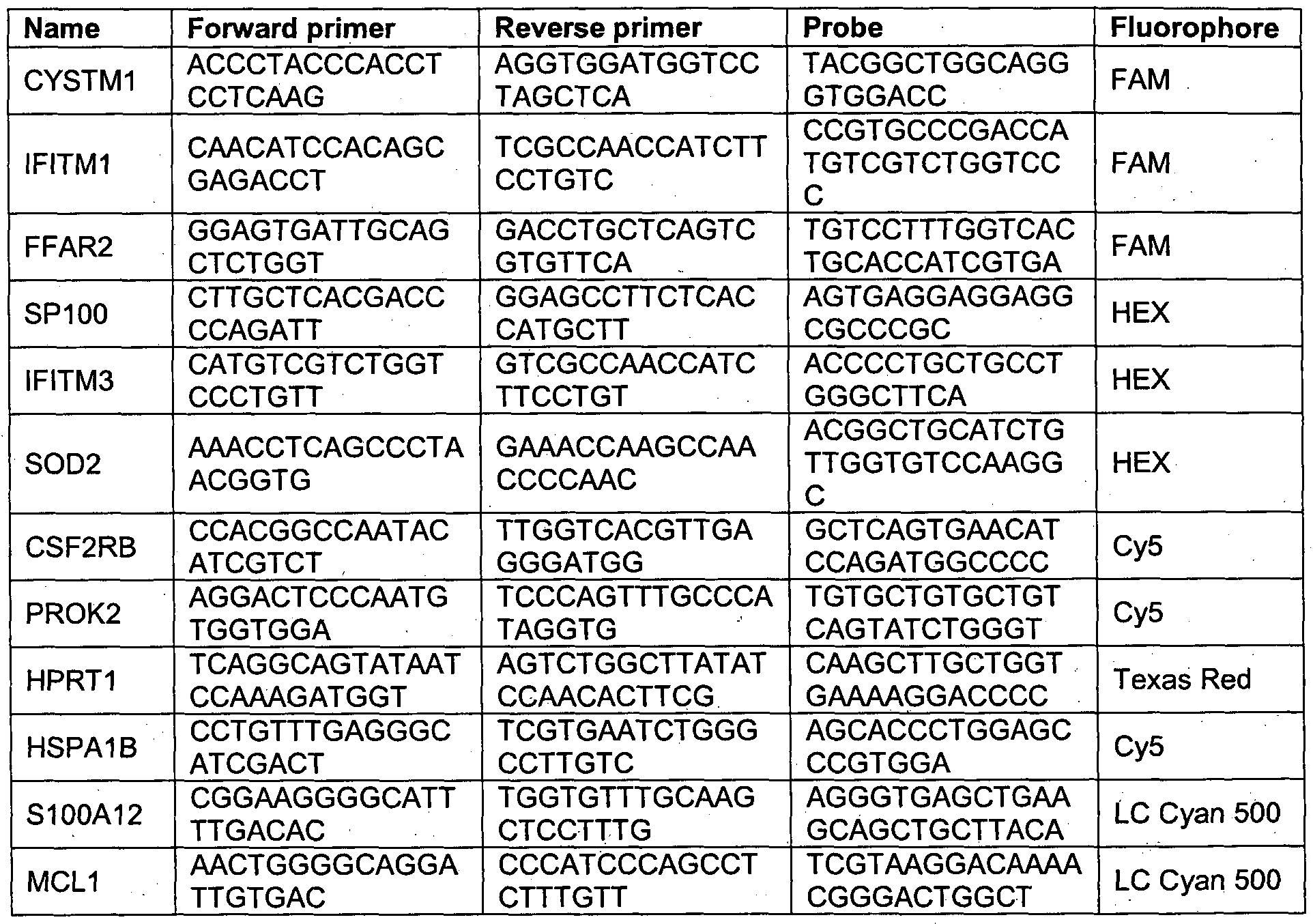
- Taqman probes were designed using the Primer3web website (www.primer.wi.mit.edu) and Oligo 7. Autodimer was used to test for dimerization of all primer and probe combinations [1]. All primers-probe were validated in standard curve assay. Primer titration was also performed to determine the lowest primer concentration with consistent Ct value possible.
- Table 6 shows the subject details grouped accordingly to sepsis continuum.
- HRPT1 and GAPDH were selected as the housekeeping genes for their stable expression in leukocytes [2].
- List 1 lists the gene coding sequences for each of the 30 up- regulated genes and 10 down-regulated genes.
- List 2 lists the two housekeeping genes.
- ACSL1 Homo sapiens acyl-CoA synthetase long-chain family member 1 (ACSL1), mRNA. NCBI Reference Sequence: NM_001995.2 (SEQ ID NO: 1 )
- ANXA3 Homo sapiens annexin A3 (ANXA3), mRNA. NCBI Reference Sequence: NM_005139.2 (SEQ ID NO: 2)
- CYSTM1 Homo sapiens cysteine-rich transmembrane module containing 1 (CYSTM1), mRNA. NCBI Reference Sequence: NM_032412.3 (SEQ ID NO: 3)
- C19orf59 Homo sapiens chromosome 19 open reading frame 59 (C19orf59), mRNA. NCBI Reference Sequence: NM_174918.2 (SEQ ID NO: 4)
- CSF2RB Homo sapiens colony stimulating factor 2 receptor, beta, low-affinity (granulocyte- macrophage) (CSF2RB), mRNA.
- DDX60L Homo sapiens DEAD (Asp-Glu-Ala-Asp) box polypeptide 60-like (DDX60L), mRNA.
- FCGR1B Homo sapiens Fc fragment of IgG, high affinity lb, receptor (CD64) (FCGR1B), transcript variant 2, mRNA.
- FFAR2 Homo sapiens free fatty acid receptor 2 (FFAR2), mRNA.
- FPR2 Homo sapiens formyl peptide receptor 2 (FPR2), transcript variant 1, mRNA. NCBI Reference Sequence: NM 001462.3 (SEQ ID NO: 9)
- HSPA1B Homo sapiens heat shock 70kDa protein IB (HSPA1B), mRNA. NCBI Reference Sequence: NM_005346.4 (SEQ ID NO: 10)
- IFITM1 Homo sapiens interferon induced transmembrane protein 1 (IFITM1), mRNA. NCBI Reference Sequence: NM 003641.3 (SEQ ID NO: 11)
- IFITM3 Homo sapiens interferon induced transmembrane protein 3 (IFITM3), transcript variant 1, mRNA. NCBI Reference Sequence: NM 021034.2 (SEQ ID NO: 12)
- IL1B Homo sapiens interleukin 1, beta (DL1B), mRNA. NCBI Reference Sequence: NM_000576.2 (SEQ ID NO: 13)
- IL1RN Homo sapiens interleukin 1 receptor antagonist (IL1RN), transcript variant 1, mRNA. NCBI Reference Sequence: NM_173842.2 (SEQ ID NO: 14)
- LILRA5 Homo sapiens leukocyte immunoglobulin-like receptor, subfamily A (with TM domain), member 5 (LHJ A5), transcript variant 1, mRNA. NCBI Reference Sequence: NM_021250.2 (SEQ ID NO: 15)
- LRG1 Homo sapiens leucine-rich alpha-2-glycoprotein 1 (LRG1), mRNA. NCBI Reference Sequence: NM_052972.2 (SEQ ID NO: 16)
- MCL1 Homo sapiens myeloid cell leukemia sequence 1 (BCL2-related) (MCL1), nuclear gene encoding mitochondrial protein, transcript variant 1 , mRNA. NCBI Reference Sequence: NM_021960.4 (SEQ ID NO: 17)
- NAIP Homo sapiens NLR family, apoptosis inhibitory protein (NAIP), transcript variant 1, mRNA.
- NFIL3 Homo sapiens nuclear factor, interleukin 3 regulated (NFLL3), mRNA. NCBI Reference Sequence: NM 005384.2 (SEQ ID NO: 19)
- NT5C3 Homo sapiens 5 '-nucleotidase, cytosolic ⁇ (NT5C3), transcript variant 1, mRNA. NCBI Reference Sequence: NM_001002010.2 (SEQ ID NO: 20)
- PFKFB3 Homo sapiens 6-phosphofructo-2-kinase/fructose-2,6-biphosphatase 3 (PFKFB3), transcript variant 1, mRNA.
- PLSCRl Homo sapiens phospholipid scramblase 1 (PLSCRl), mRNA.
- PROK2 Homo sapiens prokineticin 2 (PROK2), transcript variant 2, mRNA. NCBI Reference Sequence: NM_021935.3 (SEQ ID NO: 23)
- RAB24 Homo sapiens RAB24, member RAS oncogene family (RAB24), transcript variant 1, mRNA. NCBI Reference Sequence: NM_001031677.2 (SEQ ID NO: 24)
- S100A12 Homo sapiens SlOO calcium binding protein A12 (S100A12), mRNA. NCBI Reference Sequence: NM_005621.1 (SEQ ID NO: 25)
- SELL Homo sapiens selectin L (SELL), transcript variant 1, mRNA.
- SLC22A4 Homo sapiens solute carrier family 22 (organic cation/ergothioneine transporter), member 4 (SLC22A4), mRNA. NCBI Reference Sequence: NM_003059.2 (SEQ ED NO: 27)
- SOD2 Homo sapiens superoxide dismutase 2, mitochondrial (SOD2), nuclear gene encoding mitochondrial protein, transcript variant 1, mRNA.
- SPlOO Homo sapiens SPlOO nuclear antigen (SPlOO), transcript variant 1, mRNA. NCBI Reference Sequence: NM 001080391.1 (SEQ ID NO: 29)
- TLR4 Homo sapiens toll-like receptor 4 (TLR4), transcript variant 1, mRNA. NCBI Reference Sequence: NM_138554.4 (SEQ ID NO: 30)
- CCL5 Homo sapiens chemokine (C-C motif) ligand 5 (CCL5), mRNA. NCBI Reference Sequence: NM_002985.2 (SEQ ID NO: 31)
- CCR7 Homo sapiens chemokine (C-C motif) receptor 7 (CCR7), mRNA. NCBI Reference Sequence: NM_001838.3 (SEQ ID NO: 32)
- CD3D Homo sapiens CD3d molecule, delta (CD3-TCR complex) (CD3D), transcript variant 1, mRNA. NCBI Reference Sequence: NM_000732.4 (SEQ ID NO: 33)
- CD6 Homo sapiens CD6 molecule (CD6), transcript variant 1, mRNA. NCBI Reference Sequence: NM_006725.4 (SEQ ID NO: 34)
- FA1M3 Homo sapiens Fas apoptotic inhibitory molecule 3 (FAIM3), transcript variant 1, mRNA. NCBI Reference Sequence: NM_005449.4 (SEQ ID NO: 35)
- FCER1A Homo sapiens Fc fragment of IgE, high affinity I, receptor for; alpha polypeptide (FCER1A), mRNA. NCBI Reference Sequence: NM_002001.3 (SEQ ED NO: 36)
- GZMK Homo sapiens granzyme K (granzyme 3; tryptase ⁇ ) (GZMK), mRNA. NCBI Reference Sequence: NM_002104.2 (SEQ ED NO: 37)
- BL7R Homo sapiens interleukin 7 receptor (EL7R), mRNA. NCBI Reference Sequence:
- KLRB1 Homo sapiens killer cell lectin-like receptor subfamily B, member 1 (KLRBl), mRNA. NCBI Reference Sequence: NM_002258.2 (SEQ ED NO: 39)
- MAL Homo sapiens mal, T-cell differentiation protein (MAL), transcript variant d, mRNA.
- HPRTl Homo sapiens hypoxanthine phosphoribosyltransferase 1 (HPRT1), mRNA. NCBI Reference Sequence: NM_000194.2 (SEQ ED NO: 41)
- GAPDH Homo sapiens glyceraldehyde-3-phosphate dehydrogenase (GAPDH), mRNA, NCBI Reference Sequence: NM_002046.5 (SEQ ED NO: 42)
- Each of the 40 candidate sepsis biomarkers has high sensitivity and specificity for sepsis diagnosis
- the predictive value of each sepsis biomarker was calculated using the Area Under Curve (AUC) of Receiver Operating Characteristic (ROC) curve for differentiation of controls from infection/mild sepsis/severe sepsis and
- biomarkers had > 95%, 18 biomarkers had 90-95% and 16 biomarkers had 85-90%.
- p-values are ⁇ 0.01 for all biomarkers for both
- a predictive model capable of differentiating between controls and subjects with infection, mild sepsis and severe sepsis was built.
- the model is an aggregate of two components.
- the first component classification model
- the support vector regression was selected to predict severity of sepsis discovered in the first component.
- the regression model was capable of accurately predicting the sepsis severity in 87% of the samples.
- the predictive model comprises two components with two purposes: diagnosis of sepsis and assessment of sepsis severity.
- the first component classified sepsis from controls; the selected model has a high overall accuracy of 88%, correctly diagnosing 16 out of 18 subjects with sepsis(sensitivity 94%) and accurately identifying 5 out of 7 controls (specificity 71 %). More importantly, the subjects with SIRS without infection were accurately classified as control, showing that the candidate biomarkers were able to differentiate sterile SIRS from sepsis effectively.
- the second component is the regression model. Despite the difficulty in predicting severity of sepsis due to the high similarity between infection and mild sepsis, the model was 82% accurate in distinguishing infection from mild sepsis or severe sepsis. This relatively low accuracy indicates the arbitrary
- Table 7 below shows the performance of biomarker panel for classifying sepsis from control.
- Table 8 below shows the performance of biomarker panel for staging sepsis severity.
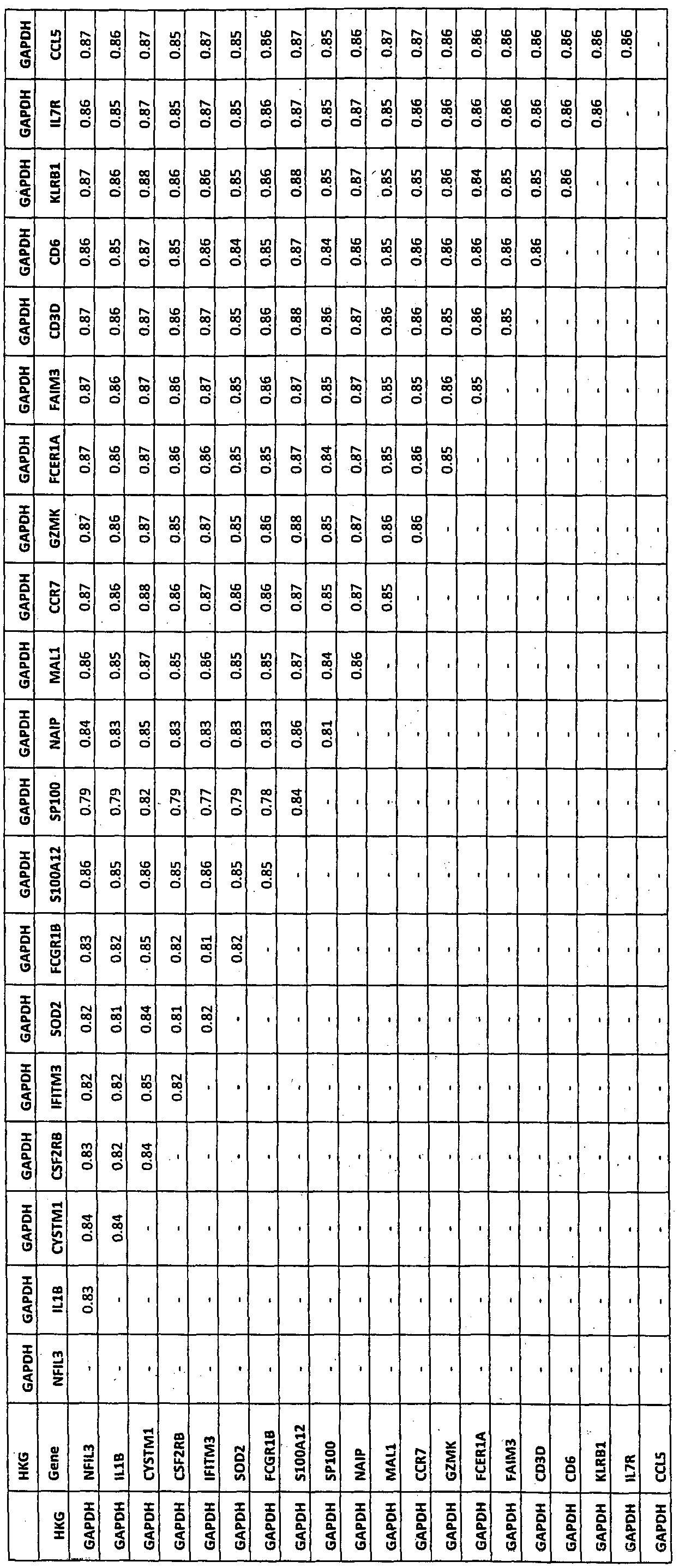
- Three-plex combinations were designed from the most predictive genes. A total of 21 combinations of three-plex assays were screened by comparing Ct values in multiplex to monoplex of eight different patient samples (see Table 22). Of the 21 combinations, five three-plex assays had similar Ct values (ACt ⁇ 1.0) and were shortlisted for further validation.
- Biomarkers from leukocytes can be used for sepsis diagnosis
- the qualitative gene expression data obtained can be used for multiple applications, including the differentiation of infected and non-infected patients, differentiation of sepsis and non-sepsis patients, and staging severity of sepsis, through the use of different predictive models.
- Existing data can be merged with new data from future studies for use in new predictive model building. Should it be desirable, new genes can be selected from the microarray data. This could be useful if sufficient information on patient disease progression could be obtained and new genes specifically for use in classifying patient disease prognosis were to be identified. Thus, there is unparalleled flexibility to exploit the data obtained from this study.
- RNA from leukocytes is used as the template for the prototype development.
- starting material for the final prototype may be determined by multiple factors such as processing time and complexity, sensitivity and stability of the assay, equipment available in hospitals, and time taken for
- expression diagnostic kit presents an opportunity for front line doctors such as emergency physicians to make rapid informed decisions for triage and right-siting
- each primer pair was tested to check their quality. New primers were tested with three different samples by qPCR. The melting curve was checked to verify that there are no side products or primer dimers. Additionally, standard curve analysis was done to calculate the correlation coefficient (r2) and the efficiency (E) of the primer pairs. The formula used to calculate efficiency is as follows:
- Taqman probes were designed using the Primer3web website (www.primer.wi.mit.edu) with the following parameters: Probe size was between 18-27bp; probe melting temperature (Tm) 65-73°C; GC content 30-80%. Each probe was then tested for stability and usage in silico using Oligo 7. Autodimer was used to test for primer-probe and probe-probe and primer-primer dimerization for all primer and probe combinations [1] (see Table 10).
- Primer-probe mix was first tested in standard curve assay using serial dilution of template RNA on two different kits: QuantiFast® Multiplex RT- PCR Kit (Qiagen) and LightCycler® 480 Probes Master (Roche). Sets were validated to ensure that the probe is compatible with primer pairs: the amplification efficiency is within the range of 80-120% and fold change is linear across tested Ct
- RNA concentration and ratio for 260/280 and 260/230 acquired for all RNA samples are found.
- the RNA quality and quantity acquired had concentration > 50 ng/uL, 280/260 ratio > 2.0, and 260/230 ratio > 1.7, showing that good yield was obtained from RNA extraction and RNA samples used were not contaminated with proteins and carbohydrates.
- RNA quality and integrity were tested with Bioanalyzer before being used for microarray experiments.
- RNA integrity number (RIN) for all samples used in microarray were > 7. Electrophoretic runs showed that sharp bands of RNA were present. Results confirmed that RNA samples used in microarray had high integrity and were not degraded.
- Table 12 below shows the summary of array quality controls for pilot microarrays.
- Table 13 below shows the summary of array quality controls for the second batch of microarray.
- Table 13 Summary of array quality controls for second microarray
- Primer pairs were also tested with the standard curve method to determine the efficiencies of qPCR assays (see Table 14). PCR efficiencies were determined using the linear regression slope of template dilution series.
- Shortlisted biomarkers were required to have efficiency of 80-120% in the linear Ct range (r 2 > 0.99). Among the 41 primer pairs (40 shortlisted sepsis biomarkers and 1 housekeeping gene), none had qPCR efficiency of ⁇ 80%. However, 11 primer pairs had efficiency > 120%. Despite having > 120% efficiency, these primer pairs were still used to study gene expression changes during sepsis since no false products were detected in the melting curve.
- Table 14 below shows the efficiency and linear Ct range primer pairs of shortlisted sepsis biomarkers.
- Figure 1 shows the relative fold change of infection, mild and severe sepsis samples over control by qPCR.
- A 30 up-regulated genes; and
- B 10 down-regulated genes.
- Table 15 shows the fold change between control versus infection and infection versus mild sepsis.
- Table 16 shows the predictive value (Area Under Curve; AUC), standard deviation and p-value of biomarker panel for control versus infection/mild sepsis/severe sepsis and control/infection versus mild sepsis/severe sepsis.
- Table 17 below shows the weights for each gene and intercept from logistic regression model.
- Table 17 Weights for each gene and intercept from logistic regression model.
- Table 18 below shows the weights for each gene and intercept from support vector regression model.
- Table 18 Weights for each gene and intercept from support vector regression model.
- Figure 2 shows the most predictive genes identified from overlap of four different classification methods.
- Table 19 below shows the list of top eight predictive genes from two different selection methods.
- Table 19 List of top eight predictive genes from two different selection methods
- Primers-probe was tested with the standard curve method to confirm that primers-probe can produce amplification curves and to determine the efficiencies of qPCR assays. PCR efficiencies were determined using the linear regression slope of template dilution series. Similar to qPCR using SYBR Green format, primers-probe need to have efficiency of 80-120% in the linear Ct range (r 2 > 0.99).
- Table 20 below shows the efficiency and linear Ct range primers- probe of tested sepsis biomarkers.
- Primer titration was performed to reduce the primer concentration used for highly abundant genes (see Table 21 ). Reduced primer concentration should not be affecting Ct value compared to the recommended starting working concentration of 0.4uM. Reducing primer concentration will limit the effect of amplification suppression of highly abundant genes on low abundant genes through qPCR reactant competition and depletion. Since, possible minimum final primer concentration ranged from 0.20 to 0.05 ⁇ , 0.2 ⁇ was selected as the final primer concentration for all biomarkers. Final primer concentration for low abundance housekeeping gene was maintained at 0.4 ⁇ .
- Table 2 below shows the efficiency and linear Ct range primers- probe of tested sepsis biomarkers.
- Table 22 shows the tested 3-plex combinations. Table 22: Tested 3-plex combinations
- Table 23 shows the number of samples with Ct difference between multiplex and monoplex assays of more than 1.0 for shortlisted 3-plex combinations.
- Table 24 below shows the predictive value (Area Under the Curve (AUC)) of each of the biomarkers of the biomarker panel of the 40 biomarkers or genes listed in List 1 for control versus sepsis.
- AUC Average Under the Curve
- the methods or kits respectively described herein use any one of the biomarkers or genes listed in Table 24.
- Table 24 Predictive value (AUC) of each of the biomarkers (single genes) of the biomarker panel for control versus sepsis, with HPRT1 as the housekeeping gene.
- the methods or kits respectively described herein use one or more, and in any combination, of the 40 biomarkers or genes listed in List 1.
- Table 25 shows the predictive value (Area Under Curve (AUC)) of exemplary sets of two biomarkers of the biomarker panel of the 40 biomarkers or genes listed in List 1 for control versus sepsis, with HPRT1/GAPDH as the housekeeping gene.
- AUC Average Under Curve
- Table 25 Predictive value (AUC) of exemplary sets of two biomarkers or genes of the biomarker panel for control versus sepsis, with HPRT1/GAPDH as the housekeeping gene.
- Table 26 below shows the weights given to each of the biomarkers of the biomarker panel of the 40 biomarkers or genes listed in List 1 for
- Table 27 shows the weights given to each of the biomarkers of the biomarker panel of the 40 biomarkers or genes listed in List 1 for mild sepsis versus severe sepsis/septic shock.
- Table 27 Weights were given to each of the biomarkers or genes of the
- the methods or kits respectively described herein use any five of the 40 biomarkers or genes listed in List 1.
- Table 28 below shows the predictive value (Area Under Curve (AUC)) of exemplary sets of five biomarkers of the biomarker panel of the 40 biomarkers or genes listed in List 1 for control versus sepsis, with HPRT1/GAPDH as the housekeeping gene.
- AUC Average Under Curve
- Table 28 Predictive value (AUC) of exemplary sets of five biomarkers or genes of the biomarker panel for control versus sepsis, with HPRT1 /GAPDH as the housekeeping gene.
- Table 29 below shows the predictive value (Area Under Curve (AUC)) of exemplary sets of ten biomarkers of the biomarker panel of the 40 biomarkers or genes listed in List 1 for control versus sepsis, with HPRT1/GAPDH as the housekeeping gene.
- AUC Average Under Curve
- the methods or kits respectively described herein use any twenty of the 40 biomarkers or genes listed in List 1 .
- Table 30 below shows the predictive value (Area Under Curve (AUC)) of exemplary sets of twenty biomarkers of the biomarker panel of the 40 biomarkers or genes listed in List 1 for control versus sepsis, with HPRT1/GAPDH as the housekeeping gene.
- AUC Average Under Curve
- Table 30 Predictive value (AUG) of exemplary sets of twenty biomarkers or genes of the biomarker panel for control versus sepsis, with HPRT1/GAPDH as the housekeeping gene.
- the methods or kits respectively described herein use any thirty of the 40 biomarkers or genes listed in List 1.
- Table 31 below shows the predictive value (Area Under Curve (AUC)) of exemplary sets of thirty biomarkers of the biomarker panel of the 40 biomarkers or genes listed in List 1 for control versus sepsis, with HPRT1/GAPDH as the housekeeping gene.
- AUC Average Under Curve
- Table 31 Predictive value (AUC) of exemplary sets of thirty biomarkers or genes of the biomarker panel for control versus sepsis, with HPRT1/GAPDH as the housekeeping gene.
- Figure 4 shows boxplots representing 6 Models (A-F) which allow the stratification of septic/non septic patients.
- For each model a training set based on 100 samples was created (left) and a blinded test of 61 samples was used to validate the models.
- the Models are:
- Table 32 below shows the predictive value (AUC) of the 6 models described above for the respective number of genes (i.e. 40 genes, 8 genes, 40 genes, 8 genes, 40 genes, 11 genes), with HPRT1/GAPDH as the housekeeping gene.
- Figure 5 shows a boxplot representing 85 sepsis patients based on either 37 genes(A) or 14 genes(B). Weight scoring system was implemented using 2 models which allow the segregation of severe sepsis from mild sepsis.
- Figure 6 shows an average plasma protein concentration (S100A12) in patients selected from the group consisting of control, infection, mild sepsis and severe sepsis/septic shock, indicating a correlation between severity of Sepsis and protein concentration.
- the methods, biomarker or biomarkers and kits described can be used for the early detection and diagnosis of sepsis, and also the monitoring of patients for an improvement of treatment and outcome for such patients.
- kits described can be used to identify and/or classify a subject or patient as a candidate for sepsis therapy. Diagnostic kits
- Detection kits may contain antibodies, aptamers, amplification systems, detection reagents (chromogen, fluorophore, etc), dilution buffers, washing solutions, counter stains or any combination thereof. Kit components may be packaged for either manual or partially or wholly automated practice of the foregoing methods. In other embodiments involving kits, this invention
- compositions of the present invention contemplates a kit including compositions of the present invention, and optionally
- kits may have a variety of uses, including, for example, stratifying patient populations, diagnosis, prognosis, guiding therapeutic treatment decisions, and other applications.
- the invention described herein may include one or more range of values (e.g. size, concentration etc).
- a range of values will be understood to include all values within the range, including the values defining the range, and values adjacent to the range which lead to the same or substantially the same outcome as the values immediately adjacent to that value which defines the boundary to the range.
Landscapes
- Chemical & Material Sciences (AREA)
- Life Sciences & Earth Sciences (AREA)
- Proteomics, Peptides & Aminoacids (AREA)
- Health & Medical Sciences (AREA)
- Organic Chemistry (AREA)
- Wood Science & Technology (AREA)
- Analytical Chemistry (AREA)
- Zoology (AREA)
- Genetics & Genomics (AREA)
- Engineering & Computer Science (AREA)
- Pathology (AREA)
- Immunology (AREA)
- Microbiology (AREA)
- Molecular Biology (AREA)
- Biotechnology (AREA)
- Biophysics (AREA)
- Physics & Mathematics (AREA)
- Biochemistry (AREA)
- Bioinformatics & Cheminformatics (AREA)
- General Engineering & Computer Science (AREA)
- General Health & Medical Sciences (AREA)
- Measuring Or Testing Involving Enzymes Or Micro-Organisms (AREA)
Abstract
Description






Claims
Priority Applications (9)
| Application Number | Priority Date | Filing Date | Title |
|---|---|---|---|
| JP2016523708A JP2016526888A (en) | 2013-06-28 | 2014-06-27 | Sepsis biomarkers and their use |
| AU2014299322A AU2014299322B2 (en) | 2013-06-28 | 2014-06-27 | Sepsis biomarkers and uses thereof |
| CA2915611A CA2915611A1 (en) | 2013-06-28 | 2014-06-27 | Sepsis biomarkers and uses thereof |
| EP14818542.4A EP3013985A4 (en) | 2013-06-28 | 2014-06-27 | Sepsis biomarkers and uses thereof |
| HK16106275.5A HK1218314A1 (en) | 2013-06-28 | 2014-06-27 | Sepsis biomarkers and uses thereof |
| KR1020157036630A KR20160037137A (en) | 2013-06-28 | 2014-06-27 | Sepsis biomarkers and uses thereof |
| US14/900,416 US20160244834A1 (en) | 2013-06-28 | 2014-06-27 | Sepsis biomarkers and uses thereof |
| SG11201510282PA SG11201510282PA (en) | 2013-06-28 | 2014-06-27 | Sepsis biomarkers and uses thereof |
| CN201480046835.9A CN105473743A (en) | 2013-06-28 | 2014-06-27 | Sepsis biomarkers and their applications |
Applications Claiming Priority (2)
| Application Number | Priority Date | Filing Date | Title |
|---|---|---|---|
| SG2013050828 | 2013-06-28 | ||
| SG201305082-8 | 2013-06-28 |
Publications (1)
| Publication Number | Publication Date |
|---|---|
| WO2014209238A1 true WO2014209238A1 (en) | 2014-12-31 |
Family
ID=55027906
Family Applications (1)
| Application Number | Title | Priority Date | Filing Date |
|---|---|---|---|
| PCT/SG2014/000312 Ceased WO2014209238A1 (en) | 2013-06-28 | 2014-06-27 | Sepsis biomarkers and uses thereof |
Country Status (9)
| Country | Link |
|---|---|
| US (1) | US20160244834A1 (en) |
| EP (1) | EP3013985A4 (en) |
| JP (1) | JP2016526888A (en) |
| CN (2) | CN110129425A (en) |
| AU (1) | AU2014299322B2 (en) |
| CA (1) | CA2915611A1 (en) |
| HK (1) | HK1218314A1 (en) |
| SG (1) | SG11201510282PA (en) |
| WO (1) | WO2014209238A1 (en) |
Cited By (6)
| Publication number | Priority date | Publication date | Assignee | Title |
|---|---|---|---|---|
| CN109312411A (en) * | 2016-06-07 | 2019-02-05 | 斯坦福大学托管董事会 | Methods for Diagnosing Bacterial and Viral Infections |
| EP3371324A4 (en) * | 2015-11-06 | 2019-07-03 | ImmuneXpress Pty Ltd | VIRAL BIOMARKERS AND USES THEREOF |
| WO2020096984A1 (en) * | 2018-11-05 | 2020-05-14 | Institute For Systems Biology | Sepsis biomarker panels and methods of use |
| WO2022246553A1 (en) | 2021-05-25 | 2022-12-01 | The University Of British Columbia | Diagnostic for sepsis endotypes and/or severity |
| US11851717B2 (en) | 2014-03-14 | 2023-12-26 | Robert E. W. Hancock | Diagnostic for sepsis |
| US11884978B2 (en) | 2015-09-30 | 2024-01-30 | Immunexpress Pty Ltd | Pathogen biomarkers and uses therefor |
Families Citing this family (13)
| Publication number | Priority date | Publication date | Assignee | Title |
|---|---|---|---|---|
| CN106367484A (en) * | 2016-08-29 | 2017-02-01 | 北京泱深生物信息技术有限公司 | Application of molecular marker to sepsis diagnosis |
| CN106119402A (en) * | 2016-08-29 | 2016-11-16 | 北京泱深生物信息技术有限公司 | A kind of pyemic molecular diagnostic markers |
| CN106282355A (en) * | 2016-08-29 | 2017-01-04 | 北京泱深生物信息技术有限公司 | Pyemic gene marker RGL4 |
| US10793923B2 (en) * | 2016-11-09 | 2020-10-06 | Roche Molecular Systems, Inc. | Compositions and methods for detection of BK virus |
| US20220156561A1 (en) * | 2019-03-13 | 2022-05-19 | Tomocube, Inc. | Identifying microorganisms using three-dimensional quantitative phase imaging |
| CN110187100B (en) * | 2019-06-13 | 2020-06-23 | 重庆医科大学附属儿童医院 | Application of Prokineticin2 in preparation of sepsis diagnostic reagent and treatment medicine |
| US20220283153A1 (en) * | 2019-08-05 | 2022-09-08 | Seattle Children's Hospital D/B/A Seattle Children's Research Institute | Compositions and methods for detecting sepsis |
| CN113981079A (en) * | 2021-09-22 | 2022-01-28 | 杭州金域医学检验所有限公司 | Application of CSF2RB and encoded protein in protection of female non-smoking lung cancer |
| AU2022366192A1 (en) * | 2021-10-15 | 2024-02-29 | Boehringer Ingelheim International Gmbh | Trpc6 inhibitory compounds for treating sepsis |
| CN116546998A (en) * | 2021-12-03 | 2023-08-04 | 香港理工大学 | Glucose-regulating compounds, compositions thereof and uses thereof |
| CN114606308A (en) * | 2022-01-26 | 2022-06-10 | 江门市中心医院 | Prognostic and therapeutic markers for sepsis ARDS |
| CN114457086B (en) * | 2022-03-02 | 2022-11-15 | 上海勉亦生物科技有限公司 | Expression cassette for interleukin 1 receptor antagonist protein and AAV-based gene delivery system |
| CN115627293A (en) * | 2022-09-13 | 2023-01-20 | 上海医创云康生物科技有限公司 | Colorectal Cancer Methylated Gene Markers and Its Application |
Citations (15)
| Publication number | Priority date | Publication date | Assignee | Title |
|---|---|---|---|---|
| WO2003084388A2 (en) * | 2002-04-02 | 2003-10-16 | Becton, Dickinson And Co. | Early detection of sepsis |
| US20050037344A1 (en) * | 2001-11-09 | 2005-02-17 | Pathoarray Gmbh | Nucleic acid array |
| WO2006061644A1 (en) * | 2004-12-09 | 2006-06-15 | Secretary Of State For Defence | Early detection of sepsis |
| US20080070235A1 (en) * | 2003-04-02 | 2008-03-20 | Sirs-Lab Gmbh | Method for Recognizing Acute Generalized Inflammatory Conditions (Sirs), Sepsis, Sepsis-Like Conditions and Systemic Infections |
| US20090075831A1 (en) * | 2004-10-13 | 2009-03-19 | Stefan Russwurm | Method for differentiating between the non-infectious and infectious causes of multiple organ failure |
| WO2009063249A2 (en) * | 2007-11-16 | 2009-05-22 | Secretary Of State For Defence | Early detection of sepsis |
| US20090208933A1 (en) * | 2005-01-31 | 2009-08-20 | Biomerieux | Method For Diagnosis And/Or Prognosis Of A Septic Syndrome |
| WO2009123737A2 (en) * | 2008-04-03 | 2009-10-08 | Becton, Dickinson And Company | Advanced detection of sepsis |
| US20100086909A1 (en) * | 2004-03-30 | 2010-04-08 | Sirs-Lab Gmbh | Method for the prediction of individual disease course in sepsis |
| US20100203534A1 (en) * | 2007-08-03 | 2010-08-12 | Sirs-Lab Gmbh | Use of polynucleotides for detecting gene activites for distinguishing between local and systemic infections |
| US20110098195A1 (en) * | 2008-03-17 | 2011-04-28 | Stefan Russwurm | Method for the in vitro detection and differentiation of pathophysiological conditions |
| US7939282B2 (en) * | 2004-10-21 | 2011-05-10 | Rhode Island Hospital | Methods for detecting sepsis |
| US20110312521A1 (en) * | 2010-06-17 | 2011-12-22 | Baylor Research Institute | Genomic Transcriptional Analysis as a Tool for Identification of Pathogenic Diseases |
| WO2012120026A1 (en) * | 2011-03-08 | 2012-09-13 | Sirs-Lab Gmbh | Method for identifying a subset of polynucleotides from an initial set of polynucleotides corresponding to the human genome for the in vitro determination of the severity of the host response of a patient |
| RU2011139413A (en) * | 2011-09-27 | 2013-04-10 | ГБОУ ВПО КубГМУ Минздравсоцразвития России | METHOD FOR DIAGNOSTIC OF PURULENT-SEPTIC DISEASES IN NEWBORN CHILDREN |
Family Cites Families (11)
| Publication number | Priority date | Publication date | Assignee | Title |
|---|---|---|---|---|
| US5474899A (en) * | 1987-05-13 | 1995-12-12 | Cistron Biotechnology, Inc. | Selective immunoassay for IL-1 β |
| AU2003274715A1 (en) * | 2002-06-10 | 2003-12-22 | Develogen Aktiengesellschaft Fur Entwicklungsbiologische Forschung | L(2)44 dea, wunen-2, grapes, cg2221, cg1172, rutabaga, cg11940, facl involved in the regulation of energy homeostasis |
| EP1573054A4 (en) * | 2002-11-12 | 2005-12-28 | Becton Dickinson Co | Diagnosis of sepsis or sirs using biomarker profiles |
| KR20080016789A (en) * | 2005-02-18 | 2008-02-22 | 더 거번먼트 오브 더 유나이티드 스테이츠 오브 어메리카 애즈 레프리젠티드 바이 더 세크러터리 오브 더 디파트먼트 오브 헬쓰 앤드 휴먼 써비시즈 | Identification of molecular markers for diagnosing endometriosis in blood lymphocytes |
| CN101208602A (en) * | 2005-04-15 | 2008-06-25 | 贝克顿迪金森公司 | Diagnosis of sepsis |
| KR20080006617A (en) * | 2005-04-15 | 2008-01-16 | 백톤 디킨슨 앤드 컴퍼니 | Diagnosis of Sepsis |
| MX2010008698A (en) * | 2008-02-08 | 2010-12-20 | Medimmune Llc | Disease markers and uses thereof. |
| US8697370B2 (en) * | 2008-05-23 | 2014-04-15 | Pronota N.V. | Biomarker for diagnosis, prediction and/or prognosis of sepsis and uses thereof |
| JP5828849B2 (en) * | 2010-03-02 | 2015-12-09 | エフ.ホフマン−ラ ロシュ アーゲーF. Hoffmann−La Roche Aktiengesellschaft | Detection of IL-6 based on early diagnosis and prediction of systemic inflammatory response syndrome and sepsis in asymptomatic patients |
| EP2520662A1 (en) * | 2011-05-04 | 2012-11-07 | Stichting Sanquin Bloedvoorziening | Means and methods to determine a risk of multiple organ failure |
| JP2013021932A (en) * | 2011-07-15 | 2013-02-04 | Chiba Univ | Method for predicting efficacy of anti-il-6 receptor antibody therapy to rheumatoid arthritis |
-
2014
- 2014-06-27 WO PCT/SG2014/000312 patent/WO2014209238A1/en not_active Ceased
- 2014-06-27 EP EP14818542.4A patent/EP3013985A4/en not_active Ceased
- 2014-06-27 SG SG11201510282PA patent/SG11201510282PA/en unknown
- 2014-06-27 US US14/900,416 patent/US20160244834A1/en not_active Abandoned
- 2014-06-27 CN CN201910246271.8A patent/CN110129425A/en active Pending
- 2014-06-27 HK HK16106275.5A patent/HK1218314A1/en unknown
- 2014-06-27 CN CN201480046835.9A patent/CN105473743A/en active Pending
- 2014-06-27 CA CA2915611A patent/CA2915611A1/en not_active Abandoned
- 2014-06-27 JP JP2016523708A patent/JP2016526888A/en active Pending
- 2014-06-27 AU AU2014299322A patent/AU2014299322B2/en active Active
Patent Citations (15)
| Publication number | Priority date | Publication date | Assignee | Title |
|---|---|---|---|---|
| US20050037344A1 (en) * | 2001-11-09 | 2005-02-17 | Pathoarray Gmbh | Nucleic acid array |
| WO2003084388A2 (en) * | 2002-04-02 | 2003-10-16 | Becton, Dickinson And Co. | Early detection of sepsis |
| US20080070235A1 (en) * | 2003-04-02 | 2008-03-20 | Sirs-Lab Gmbh | Method for Recognizing Acute Generalized Inflammatory Conditions (Sirs), Sepsis, Sepsis-Like Conditions and Systemic Infections |
| US20100086909A1 (en) * | 2004-03-30 | 2010-04-08 | Sirs-Lab Gmbh | Method for the prediction of individual disease course in sepsis |
| US20090075831A1 (en) * | 2004-10-13 | 2009-03-19 | Stefan Russwurm | Method for differentiating between the non-infectious and infectious causes of multiple organ failure |
| US7939282B2 (en) * | 2004-10-21 | 2011-05-10 | Rhode Island Hospital | Methods for detecting sepsis |
| WO2006061644A1 (en) * | 2004-12-09 | 2006-06-15 | Secretary Of State For Defence | Early detection of sepsis |
| US20090208933A1 (en) * | 2005-01-31 | 2009-08-20 | Biomerieux | Method For Diagnosis And/Or Prognosis Of A Septic Syndrome |
| US20100203534A1 (en) * | 2007-08-03 | 2010-08-12 | Sirs-Lab Gmbh | Use of polynucleotides for detecting gene activites for distinguishing between local and systemic infections |
| WO2009063249A2 (en) * | 2007-11-16 | 2009-05-22 | Secretary Of State For Defence | Early detection of sepsis |
| US20110098195A1 (en) * | 2008-03-17 | 2011-04-28 | Stefan Russwurm | Method for the in vitro detection and differentiation of pathophysiological conditions |
| WO2009123737A2 (en) * | 2008-04-03 | 2009-10-08 | Becton, Dickinson And Company | Advanced detection of sepsis |
| US20110312521A1 (en) * | 2010-06-17 | 2011-12-22 | Baylor Research Institute | Genomic Transcriptional Analysis as a Tool for Identification of Pathogenic Diseases |
| WO2012120026A1 (en) * | 2011-03-08 | 2012-09-13 | Sirs-Lab Gmbh | Method for identifying a subset of polynucleotides from an initial set of polynucleotides corresponding to the human genome for the in vitro determination of the severity of the host response of a patient |
| RU2011139413A (en) * | 2011-09-27 | 2013-04-10 | ГБОУ ВПО КубГМУ Минздравсоцразвития России | METHOD FOR DIAGNOSTIC OF PURULENT-SEPTIC DISEASES IN NEWBORN CHILDREN |
Non-Patent Citations (1)
| Title |
|---|
| See also references of EP3013985A4 * |
Cited By (6)
| Publication number | Priority date | Publication date | Assignee | Title |
|---|---|---|---|---|
| US11851717B2 (en) | 2014-03-14 | 2023-12-26 | Robert E. W. Hancock | Diagnostic for sepsis |
| US11884978B2 (en) | 2015-09-30 | 2024-01-30 | Immunexpress Pty Ltd | Pathogen biomarkers and uses therefor |
| EP3371324A4 (en) * | 2015-11-06 | 2019-07-03 | ImmuneXpress Pty Ltd | VIRAL BIOMARKERS AND USES THEREOF |
| CN109312411A (en) * | 2016-06-07 | 2019-02-05 | 斯坦福大学托管董事会 | Methods for Diagnosing Bacterial and Viral Infections |
| WO2020096984A1 (en) * | 2018-11-05 | 2020-05-14 | Institute For Systems Biology | Sepsis biomarker panels and methods of use |
| WO2022246553A1 (en) | 2021-05-25 | 2022-12-01 | The University Of British Columbia | Diagnostic for sepsis endotypes and/or severity |
Also Published As
| Publication number | Publication date |
|---|---|
| CN110129425A (en) | 2019-08-16 |
| US20160244834A1 (en) | 2016-08-25 |
| EP3013985A4 (en) | 2017-07-19 |
| HK1218314A1 (en) | 2017-02-10 |
| EP3013985A1 (en) | 2016-05-04 |
| SG11201510282PA (en) | 2016-01-28 |
| JP2016526888A (en) | 2016-09-08 |
| AU2014299322B2 (en) | 2018-08-09 |
| CN105473743A (en) | 2016-04-06 |
| AU2014299322A1 (en) | 2016-01-21 |
| CA2915611A1 (en) | 2014-12-31 |
Similar Documents
| Publication | Publication Date | Title |
|---|---|---|
| US20160244834A1 (en) | Sepsis biomarkers and uses thereof | |
| US20220325348A1 (en) | Biomarker signature method, and apparatus and kits therefor | |
| JP2023138990A (en) | Diagnosis of sepsis | |
| US20140128277A1 (en) | Method for Identifying a Subset of Polynucleotides from an Initial Set of Polynucleotides Corresponding to the Human Genome for the In Vitro Determination of the Severity of the Host Response of a Patient | |
| AU2011334548B2 (en) | Diagnostic and/or screening agents and uses therefor | |
| AU2016340121B2 (en) | Methods for diagnosis of tuberculosis | |
| JP2020162615A (en) | Diagnosis of sepsis | |
| US20110312521A1 (en) | Genomic Transcriptional Analysis as a Tool for Identification of Pathogenic Diseases | |
| CA2859663A1 (en) | Identification of multigene biomarkers | |
| EP3430172A1 (en) | Methods of diagnosing inflammatory bowel disease through rnaset2 | |
| CN107075569A (en) | Biomarker for diagnosis of tuberculosis and combinations thereof | |
| US10793911B2 (en) | Host DNA as a biomarker of Crohn's disease | |
| WO2020061072A1 (en) | Method of characterizing a neurodegenerative pathology | |
| US20180320234A1 (en) | Biomarkers for assessing idiopathic pulmonary fibrosis | |
| WO2014187884A2 (en) | Mirnas as non-invasive biomarkers for heart failure | |
| AU2024358539A1 (en) | Autism spectrum disorder assessment via alternative polyadenylation analysis | |
| EP3359682B1 (en) | Method for diagnosing hepatic fibrosis based on bacterial profile and diversity | |
| KR102622108B1 (en) | Predicting or Diagnosing Composition for Risk of Renal Diseases Using Human Intestinal Microbiome, Diagnosing Kit, Method For Providing Information, And Screening Method For Drugs For Preventing Or Treating Renal Diseases Using The Same | |
| KR20160037137A (en) | Sepsis biomarkers and uses thereof | |
| Al-Ali | Heparanase (HPSE) SNPs as A Predictor for Hepatocellular Carcinoma | |
| WO2026036182A1 (en) | Biomarkers and uses therefor | |
| Class et al. | Patent application title: Method for Identifying a Subset of Polynucleotides from an Initial Set of Polynucleotides Corresponding to the Human Genome for the In Vitro Determination of the Severity of the Host Response of a Patient Inventors: Eva Möller (Jena, DE) Andriy Ruryk (Jena, DE) Britta Wlotzka (Erfurt, DE) Cristina Guillen (Jena, DE) Karen Felsmann (Jena, DE) Assignees: Analytik Jena AG | |
| Budiarti | EFFICIENCY OF GENEAID REAGENT USAGE IN GENOMIC EXTRACTION | |
| KR20180125778A (en) | Method for providing the information for predicting or diagnosing of inflammatory bowel disease using single nucleotide polymorphism to be identified from next generation sequencing screening |
Legal Events
| Date | Code | Title | Description |
|---|---|---|---|
| WWE | Wipo information: entry into national phase |
Ref document number: 201480046835.9 Country of ref document: CN |
|
| 121 | Ep: the epo has been informed by wipo that ep was designated in this application |
Ref document number: 14818542 Country of ref document: EP Kind code of ref document: A1 |
|
| ENP | Entry into the national phase |
Ref document number: 2915611 Country of ref document: CA |
|
| WWE | Wipo information: entry into national phase |
Ref document number: 14900416 Country of ref document: US |
|
| ENP | Entry into the national phase |
Ref document number: 20157036630 Country of ref document: KR Kind code of ref document: A |
|
| ENP | Entry into the national phase |
Ref document number: 2016523708 Country of ref document: JP Kind code of ref document: A |
|
| NENP | Non-entry into the national phase |
Ref country code: DE |
|
| WWE | Wipo information: entry into national phase |
Ref document number: 2014818542 Country of ref document: EP |
|
| ENP | Entry into the national phase |
Ref document number: 2014299322 Country of ref document: AU Date of ref document: 20140627 Kind code of ref document: A |