WO2014203208A1 - Process for the preparation of telaprevir and intermediates thereof - Google Patents
Process for the preparation of telaprevir and intermediates thereof Download PDFInfo
- Publication number
- WO2014203208A1 WO2014203208A1 PCT/IB2014/062459 IB2014062459W WO2014203208A1 WO 2014203208 A1 WO2014203208 A1 WO 2014203208A1 IB 2014062459 W IB2014062459 W IB 2014062459W WO 2014203208 A1 WO2014203208 A1 WO 2014203208A1
- Authority
- WO
- WIPO (PCT)
- Prior art keywords
- formula
- carried out
- process according
- pyrrole
- hydroxy
- Prior art date
- Legal status (The legal status is an assumption and is not a legal conclusion. Google has not performed a legal analysis and makes no representation as to the accuracy of the status listed.)
- Ceased
Links
- LPLLBOLLPKIGLN-PCFDSBEJSA-N CCC[C@@H](C(C(NC1CC1)=O)O)NC([C@H]([C@@H](CC1)[C@H](C2)C1=C)N2C(OCc1ccccc1)=O)=O Chemical compound CCC[C@@H](C(C(NC1CC1)=O)O)NC([C@H]([C@@H](CC1)[C@H](C2)C1=C)N2C(OCc1ccccc1)=O)=O LPLLBOLLPKIGLN-PCFDSBEJSA-N 0.000 description 1
- AZAXBLGCRWLYMB-RRBVDNIESA-N CCC[C@@H](C(C(NC1CC1)=O)O)NC([C@H]([C@@H](CCC1)[C@@H]1C1)N1C(O)OCc1ccccc1)=O Chemical compound CCC[C@@H](C(C(NC1CC1)=O)O)NC([C@H]([C@@H](CCC1)[C@@H]1C1)N1C(O)OCc1ccccc1)=O AZAXBLGCRWLYMB-RRBVDNIESA-N 0.000 description 1
- UTLNQASUTLKMRN-VODRKTFHSA-N CCC[C@@H](C(C(NC1CC1)=O)O)NC([C@H]([C@@H](CCC1)[C@@H]1C1)N1C(OCc1ccccc1)=O)=O Chemical compound CCC[C@@H](C(C(NC1CC1)=O)O)NC([C@H]([C@@H](CCC1)[C@@H]1C1)N1C(OCc1ccccc1)=O)=O UTLNQASUTLKMRN-VODRKTFHSA-N 0.000 description 1
- CDJICADXFMMOPM-HAXBKTOASA-N CCC[C@@H](C(C(NC1CC1)=O)O)NC([C@H]([C@H]1CC2)NC[C@@H]1C2=C)=O Chemical compound CCC[C@@H](C(C(NC1CC1)=O)O)NC([C@H]([C@H]1CC2)NC[C@@H]1C2=C)=O CDJICADXFMMOPM-HAXBKTOASA-N 0.000 description 1
- BSJHQRWRELBZPB-NNHPNHAHSA-N CCOC(C(C)([C@@](C(C)CC1)([C@@H]1CN1)I)C1=O)=O Chemical compound CCOC(C(C)([C@@](C(C)CC1)([C@@H]1CN1)I)C1=O)=O BSJHQRWRELBZPB-NNHPNHAHSA-N 0.000 description 1
- DVKGTKJDQWDZJM-WLSHKCNDSA-N OC([C@H]([C@@H](CCC1)[C@@H]1C1)N1C1OC1OCc1ccccc1)=O Chemical compound OC([C@H]([C@@H](CCC1)[C@@H]1C1)N1C1OC1OCc1ccccc1)=O DVKGTKJDQWDZJM-WLSHKCNDSA-N 0.000 description 1
Classifications
-
- C—CHEMISTRY; METALLURGY
- C07—ORGANIC CHEMISTRY
- C07D—HETEROCYCLIC COMPOUNDS
- C07D209/00—Heterocyclic compounds containing five-membered rings, condensed with other rings, with one nitrogen atom as the only ring hetero atom
- C07D209/02—Heterocyclic compounds containing five-membered rings, condensed with other rings, with one nitrogen atom as the only ring hetero atom condensed with one carbocyclic ring
- C07D209/52—Heterocyclic compounds containing five-membered rings, condensed with other rings, with one nitrogen atom as the only ring hetero atom condensed with one carbocyclic ring condensed with a ring other than six-membered
-
- C—CHEMISTRY; METALLURGY
- C07—ORGANIC CHEMISTRY
- C07K—PEPTIDES
- C07K5/00—Peptides containing up to four amino acids in a fully defined sequence; Derivatives thereof
- C07K5/02—Peptides containing up to four amino acids in a fully defined sequence; Derivatives thereof containing at least one abnormal peptide link
- C07K5/0202—Peptides containing up to four amino acids in a fully defined sequence; Derivatives thereof containing at least one abnormal peptide link containing the structure -NH-X-X-C(=0)-, X being an optionally substituted carbon atom or a heteroatom, e.g. beta-amino acids
Definitions
- the present invention provides a process for the preparation of telaprevir and intermediates thereof.
- Telaprevir is a serine protease inhibitor known from U.S. Patent No. 7,820,671. It is chemically designated as (15',3ai?,6aS)-2-[(25)-2-( ⁇ (25)-2-cyclohexyl-2-[(pyrazin-2- ylcarbonyl)amino] acetyl ⁇ amino)-3 ,3-dimethylbutanoyl] -N- [(35)- 1 -(cyclopropylamino)- l,2-dioxohexan-3-yl]-3,3a,4,5,6,6a-hexahydro-lH-cyclopenta[c]pyrrole-l-carboxamide and has the structure depicted by Formula I:
- Telaprevir is marketed in the United States under the brand name Incivek and is used for the treatment of hepatitis C in combination with peginterferon alpha and ribavirin.
- a first aspect of the present invention provides a process for the preparation of benzyl ( 1 S,3aR,6aS)- 1 - ⁇ [(3 S)- 1 -(cyclopropylamino)-2 -hydroxy- 1 -oxohexan-3 - yl]carbamoyl ⁇ hexahydrocyclopenta[c]pyrrole-2-(lH)carboxylate of Formula II
- a second aspect of the present invention provides a process for the preparation of telaprevir of Formula I
- a third aspect of the present invention provides the use of the benzyl
- a fourth aspect of the present invention provides a process for the preparation of telaprevir of Formula I
- a fifth aspect of the present invention provides the benzyl (lS,3aR,6aS)-l- ⁇ [(3S)- l-(cyclopropylamino)-2-hydroxy-l-oxohexan-3-yl]carbamoyl ⁇ hexahydrocyclopenta[c]- pyrrole-2-(lH)-carboxylate intermediate of Formula II.
- COMU 1 -Cyano-2-ethoxy-2-oxoethylidenaminooxy
- TPTDP S-( 1 -oxo-2-pyridyl)thio- 1 ,3-dimethylpropyleneuronium tetrafluoroborate
- the ethyl 3-oxo-octahydro-lH-cyclopenta[c]pyridine-4-carboxylate intermediate of Formula III may be prepared according to the process provided in Zhurnal Organicheskoi Khimii, Vol. 5, 1784-1788 (1969), which is incorporated herein by reference.
- the (3S)-3-amino-N-cyclopropyl-2-hydroxyhexanamide intermediate of Formula VII may be prepared according to the processes disclosed in PCT Publication Nos. WO 2007/109080, WO 2007/109023, WO 2007/022459, and WO 2010/126881, which are incorporated herein by reference for their disclosure of the preparation of the (3S)-3- amino-N-cyclopropyl-2-hydroxyhexanamide intermediate of Formula VII.
- N- ⁇ (2S)-2-cyclohexyl-2-[(pyrazin-2-yl-carbonyl)amino]acetyl ⁇ -3-methyl-L- valine intermediate of Formula IX may be prepared according to the process disclosed in PCT Publication No. WO 02/18369, which is incorporated herein by reference for its disclosure of the preparation of the N- ⁇ (2S)-2-cyclohexyl-2-[(pyrazin-2-yl- carbonyl)amino] acetyl ⁇ -3 -methyl-L-valine intermediate of Formula IX.
- telaprevir In the processes of the present invention, the preparation of telaprevir and its intermediates is carried out in an inert atmosphere.
- Formula IV is carried out in the presence of a chlorinating agent selected from sulfuryl chloride or N-chlorosuccinimide, and a solvent at a temperature of about 10°C to 40°C for about 30 minutes to about 10 hours.
- the solvent may be selected from the group comprising chlorinated hydrocarbons, aromatic hydrocarbons, or mixtures thereof.
- chlorinated hydrocarbons examples include dichloromethane, dichloroethane, chlorobenzene, and chloroform.
- aromatic hydrocarbons examples include toluene and xylene.
- the chlorination of the intermediate of Formula III is carried out in dichloromethane at about 20°C to about 30°C for about 2 hours to about 4 hours.
- the intermediate of Formula IV is treated with hydrochloric acid at a temperature of about 80°C to about 90°C.
- the reaction mixture is stirred for about 5 hours to about 10 hours, followed by the addition of aqueous sodium hydroxide solution at a temperature of about 30°C to about 35°C.
- the reaction mixture is stirred for about 20 hours to about 36 hours, cooled to a temperature of about 0°C to about 20°C, and then condensed with benzyl chloroformate to obtain the intermediate of Formula V.
- the condensation with benzyl chloroformate is carried out in the presence of a solvent at a temperature of about 0°C to about 40°C for about 15 hours to about 30 hours.
- the solvent may be selected from the group comprising nitriles, aromatic hydrocarbons, chlorinated hydrocarbons, or mixtures thereof.
- nitriles include acetonitrile, propionitrile, butyronitrile, and valeronitrile.
- aromatic hydrocarbons include toluene and xylene.
- chlorinated hydrocarbons include dichloromethane, dichloroethane, chlorobenzene, and chloroform. In a preferred embodiment of the present invention, toluene is used as the solvent.
- the resolution of the intermediate of Formula V to obtain the intermediate of Formula VI is carried out using a resolving agent and a solvent at a temperature of about 15°C to about 70°C.
- the resolving agent may be selected from (S)-mandelic acid, di- butyl tartrate, (S)-phenyl ethyl amine, (S)-l,2,3,4-tetrahydronapthylamine, or mixtures thereof.
- the solvent may be selected from the group comprising alcohols, esters, or mixtures thereof. Examples of alcohols include methanol, ethanol, n-propanol, isopropanol, n-butanol, and 2-methyl-l-pentanol. Examples of esters include ethyl acetate, propyl acetate, isopropyl acetate, and butyl acetate.
- the resolution of the intermediate of Formula V is facilitated by adding a seed crystal of an adduct of (lS,3aR,6aS)-2-[(benzyloxy)carbonyl]octahydrocyclopenta[c]- pyrrole-l-carboxylic acid of Formula VI with (S)-l,2,3,4-tetrahydro napthylamine.
- Formula V is carried out in ethyl acetate.
- resolution of the intermediate of Formula V is carried out in isopropyl acetate.
- the condensation of the intermediate of Formula VI with the intermediate of Formula VII to obtain the intermediate of Formula II is carried out in the presence of a coupling agent, a base, and a solvent at a temperature of about 0°C to about 40°C.
- the coupling agent may be selected from HATU, HBTU, HDBTU, HOTU, HOBT, EDC, EDC.HCl, BOP, PyBOP, DEPBT, Oxyma, COMU, TNTU, TPTDP, TPTU, TBTU, DIC, DCC, or mixtures thereof.
- the base may be selected from the group comprising organic and inorganic bases.
- organic bases examples include ⁇ , ⁇ -diisopropylethylamine, triethylamine, triisopropylamine, N,N-2-trimethyl-2-propanamine, N-methylmorpholine, 4- dimethylaminopyridine, 2,6-di-tert-butyl-4-dimethylaminopyridine, 1 ,4- diazabicyclo[2.2.2]-octane, l,8-diazabicyclo[5.4.0]undec-7-ene, or mixtures thereof.
- inorganic bases examples include sodium bicarbonate, potassium bicarbonate, or mixtures thereof.
- the solvent may be selected from the group comprising nitriles, chlorinated hydrocarbons, amides, dialkylsulfoxides, or mixtures thereof.
- nitriles include acetonitrile, propionitrile, butyronitrile, and valeronitrile.
- chlorinated hydrocarbons include dichloromethane, dichloroethane, chlorobenzene, and chloroform.
- amides include dimethylformamide, dimethylacetamide, and N-methyl formamide.
- dialkylsulfoxides include dimethylsulfoxide, diethylsulfoxide, and dibutylsulfoxide.
- the coupling agent is selected from HOBT, HATU, HBTU, TBTU, EDC, EDC.HC1, or mixtures thereof;
- the base is selected from N,N-diisopropylethylamine, 4-dimethylaminopyridine, triethyl amine, or N,N-2-trimethyl-2-propanamine; and
- the solvent is selected from
- the deprotection of the intermediate of Formula II to obtain the intermediate of Formula VIII is carried out in the presence of a metal catalyst, hydrogen gas, and a solvent at a temperature of about 0°C to about 40°C for about 5 minutes to about 20 hours.
- the metal catalyst may be selected from palladium supported on carbon, palladium black, palladium in the presence of barium sulphate, platinum supported on carbon, and raney nickel.
- the solvent may be selected from the group comprising alcohols, nitriles, aromatic hydrocarbons, chlorinated hydrocarbons, dialkylsulfoxides, water, or mixtures thereof.
- alcohols include methanol, ethanol, n-propanol, isopropanol, n-butanol, and 2-methyl-l-pentanol.
- nitriles include acetonitrile, propionitrile, butyronitrile, and valeronitrile.
- aromatic hydrocarbons include toluene and xylene.
- chlorinated hydrocarbons examples include dichloromethane, dichloroethane, chlorobenzene, and chloroform.
- dialkylsulfoxides examples include dimethylsulfoxide, diethylsulfoxide, and dibutylsulfoxide.
- deprotection of the intermediate of Formula II is carried out in the presence of methanol at about 10°C to about 30°C for about 1 hour to about 10 hours.
- the condensation of the intermediate of Formula VIII with the intermediate of Formula IX to obtain the intermediate of Formula X is carried out in the presence of a coupling agent, a base, and a solvent at a temperature of about 0°C to about 40°C.
- the coupling agent may be selected from HATU, HBTU, HDBTU, HOTU, HOBT, EDC, EDC.HCl, BOP, PyBOP, DEPBT, Oxyma, COMU, TNTU, TPTDP, TPTU, TBTU, DIC, DCC, or mixtures thereof.
- the base may be selected from the group comprising organic and inorganic bases.
- organic bases examples include ⁇ , ⁇ -diisopropylethylamine, triethylamine, triisopropylamine, N,N-2-trimethyl-2-propanamine, N-methylmorpholine, 4- dimethylaminopyridine, 2,6-di-tert-butyl-4-dimethylaminopyridine, 1 ,4- diazabicyclo[2.2.2] octane, l,8-diazabicyclo[5.4.0]undec-7-ene, or mixtures thereof.
- inorganic bases examples include sodium bicarbonate, potassium bicarbonate, or mixtures thereof.
- the solvent may be selected from the group comprising nitriles, chlorinated hydrocarbons, amides, dialkylsulfoxides, or mixtures thereof.
- nitriles include acetonitrile, propionitrile, butyronitrile, and valeronitrile.
- chlorinated hydrocarbons include dichloromethane, dichloroethane, chlorobenzene, and chloroform.
- amides include dimethylformamide, dimethylacetamide, and N-methyl formamide.
- dialkylsulfoxides include dimethylsulfoxide, diethylsulfoxide, and dibutylsulfoxide.
- the coupling agent is selected from HOBT, HATU, HBTU, TBTU, EDC, EDC.HCl, or mixtures thereof;
- the base is selected from N,N-diisopropylethylamine, 4-dimethylaminopyridine, triethyl amine, or N,N-2-trimethyl-2-propanamine; and
- the solvent is selected from
- the oxidation of the intermediate of Formula X to obtain telaprevir of Formula I may be carried out in the presence of an oxidizing agent and a solvent at a temperature of about 0°C to about 20°C for about 1 hour to about 15 hours.
- the oxidizing agent may be selected from Dess-Martin periodinane (DMP), oxalyl chloride, chromium trioxide, potassium permanganate, or mixtures thereof.
- DMP Dess-Martin periodinane
- oxalyl chloride chromium trioxide
- potassium permanganate or mixtures thereof.
- a catalytic amount of TEMPO or TPAP may also be added to the reaction mixture for facilitating the oxidation reaction.
- the solvent may be selected from the group comprising nitriles, aromatic hydrocarbons, chlorinated hydrocarbons, dialkylsulfoxides, water, or mixtures thereof.
- nitriles include acetonitrile, propionitrile, butyronitrile, and valeronitrile.
- aromatic hydrocarbons include toluene and xylene.
- chlorinated hydrocarbons include dichloromethane, dichloroethane, chlorobenzene, and chloroform.
- dialkylsulfoxides include dimethylsulfoxide, diethylsulfoxide, and dibutylsulfoxide.
- the oxidation of the intermediate of Formula X is carried out in the presence of DMP in dichloromethane at a temperature of about 0°C to about 10°C for about 1 hour to about 5 hours.
- telaprevir and intermediates thereof may be carried out by filtration, concentration, decantation, or a combination thereof. In the preferred embodiments of the present invention, the isolation of telaprevir and intermediates thereof is carried out by concentration.
- the reaction mixture was heated to about 20°C to about 25 °C and stirred for about 24 hours. The progress of the reaction was monitored by thin layer chromatography. After completion of the reaction, the organic layer was extracted with water (2 L) and washed with dichloromethane (800 mL). The aqueous layer was acidified with concentrated hydrochloric acid and extracted with dichloromethane (1 L). The dichloromethane layer was concentrated under reduced pressure to obtain (3aR,6aS)-2-[(benzyloxy)carbonyl] octahydrocyclopenta[c]pyrrole- 1-carboxylic acid as an oil.
- the oil was dissolved in dichloromethane (400 mL) and washed with aqueous hydrochloric acid (400 mL). The organic layer was concentrated to obtain an oil.
- the oil (26.5 g) was dissolved in isopropyl acetate (106 mL) and (S)-l,2,3,4- tetrahydronapthylamine (13.5 g) was added at about 18°C to about 25°C. The reaction mixture was stirred for about 24 hours.
- a solid adduct of (lS,3aR,6aS)-2- [(benzyloxy)carbonyl]octahydrocyclopenta[c]pyrrole-l-carboxylic acid (Formula VI) with (S)-l,2,3,4-tetrahydronapthylamine was formed.
- the solid adduct was filtered and washed with isopropyl acetate (26.5 mL).
- the adduct (1 g) was dissolved in isopropyl acetate (10 mL) and heated to a temperature of about 60°C to about 65 °C to obtain a clear solution. The solution was cooled to about 55°C to about 60°C.
- a seed crystal of the solid adduct (0.1 g) was added to the reaction mixture followed by cooling to about 35°C for about 1 hour. The solution was stirred for about 2 hours, filtered, washed with isopropyl acetate (5 mL), and dried. The dried solid was dissolved in dichloromethane (10 mL) and washed with IN hydrochloric acid (10 mL). The organic layer was concentrated under reduced pressure to obtain (lS,3aR,6aS)-2-[(benzyloxy)carbonyl]octahydro- cyclopenta[c]pyrrole- 1 -carboxylic acid.
- the temperature of the reaction mixture was raised to between about 20°C to about 25 °C and stirred for about 4 hours.
- the reaction mixture was washed with IN HCl (2 x 100 mL), 5% aqueous sodium bicarbonate solution (100 mL), and water (100 mL).
- the dichloromethane layer was concentrated under reduced pressure to obtain benzyl ( 1 S,3aR,6aS)- 1 - ⁇ [(3 S)- 1 -(cyclopropylamino)-2 -hydroxy- 1 -oxohexan-3 - yl]carbamoyl ⁇ hexahydrocyclopenta[c]pyrrole-2-(lH)-carboxylate.
- N- ⁇ (2S)-2-cyclohexyl-2-[(pyrazin-2-yl- carbonyl)amino]acetyl ⁇ -3-methyl-L-valine (Formula IX; 1.16 g) was dissolved in dichloromethane (30 mL). To this solution, TBTU (1.2 g) was added at about 12°C.
- N- ⁇ (2S)-2-cyclohexyl-2-[(pyrazin-2-yl- carbonyl)amino]acetyl ⁇ -3-methyl-L-valine (Formula IX; 1.45 g) was dissolved in dichloromethane (25 mL). To this solution, HOBT (0.5 g) and EDC.HC1 (0.9 g) were added at a temperature of about 20°C to about 25°C.
- hydroxy telaprevir (Formula X; 1.05 g) was dissolved in dichloromethane (25 mL). To the resulting solution, Dess-Martin periodinane (1.28 g) was added at about 5°C. The reaction mixture was stirred at about 0°C to about 5°C for about 2 hours. The progress of the reaction was monitored by thin layer chromatography. After completion of the reaction, the reaction mixture was quenched with sodium thiosulphate solution and washed with sodium bicarbonate solution (20 mL). The dichloromethane layer was concentrated under reduced pressure to obtain telaprevir.
Landscapes
- Chemical & Material Sciences (AREA)
- Organic Chemistry (AREA)
- General Health & Medical Sciences (AREA)
- Life Sciences & Earth Sciences (AREA)
- Biochemistry (AREA)
- Biophysics (AREA)
- Health & Medical Sciences (AREA)
- Genetics & Genomics (AREA)
- Medicinal Chemistry (AREA)
- Molecular Biology (AREA)
- Proteomics, Peptides & Aminoacids (AREA)
- Crystallography & Structural Chemistry (AREA)
- Nitrogen Condensed Heterocyclic Rings (AREA)
- Indole Compounds (AREA)
Abstract
The present invention provides a process for the preparation of telaprevir and intermediates thereof.
Description
PROCESS FOR THE PREPARATION OF TELAPREVIR AND
INTERMEDIATES THEREOF
Field of the Invention
The present invention provides a process for the preparation of telaprevir and intermediates thereof.
Background of the Invention
Telaprevir is a serine protease inhibitor known from U.S. Patent No. 7,820,671. It is chemically designated as (15',3ai?,6aS)-2-[(25)-2-({(25)-2-cyclohexyl-2-[(pyrazin-2- ylcarbonyl)amino] acetyl} amino)-3 ,3-dimethylbutanoyl] -N- [(35)- 1 -(cyclopropylamino)- l,2-dioxohexan-3-yl]-3,3a,4,5,6,6a-hexahydro-lH-cyclopenta[c]pyrrole-l-carboxamide and has the structure depicted by Formula I:

Telaprevir is marketed in the United States under the brand name Incivek and is used for the treatment of hepatitis C in combination with peginterferon alpha and ribavirin.
Processes for the preparation of telaprevir are disclosed in U.S. Patent No.
7,776,887; U.S. Publication No. 2010/0298568; PCT Publication Nos. WO 02/18369, WO 2008/090819, and WO 2011/153423; and Chemical Communications 46(42):7918-7920 (2010).
In view of the growing demand for compounds useful for the treatment of hepatitis C, there exists a need for the development of an alternative, cost effective, industrially advantageous, and simple process for the preparation of telaprevir.
Summary of the Invention
A first aspect of the present invention provides a process for the preparation of benzyl ( 1 S,3aR,6aS)- 1 - { [(3 S)- 1 -(cyclopropylamino)-2 -hydroxy- 1 -oxohexan-3 - yl]carbamoyl}hexahydrocyclopenta[c]pyrrole-2-(lH)carboxylate of Formula II

Formula II
comprising the steps of:
a) chlorinating the ethyl 3-oxo-octahydro-lH-cyclopenta[c]pyridine-4- carboxylate intermediate of Formula III

Formula III
to obtain the ethyl 4-chloro-3-oxooctahydro-lH-cyclopenta[c]pyridine-4- carboxylate intermediate of Formula IV;

Formula IV
treating the intermediate of Formula IV with hydrochloric acid and sodium hydroxide followed by condensation with benzyl chloroformate to obtain the (3aR,6aS)-2-[(benzyloxy)carbonyl]octahydrocyclopenta[c]pyrrole-l- carboxylic acid intermediate of Formula V;

Formula V
resolving the intermediate of Formula V to obtain the ( 1 S,3aR,6aS)-2- [(benzyloxy)carbonyl] octahydrocyclopenta[c]pyrrole- 1 -carboxylic acid intermediate of Formula VI; and

Formula VI
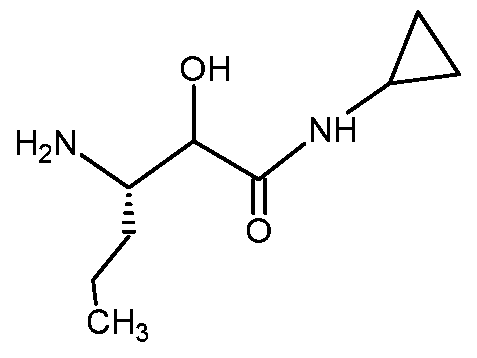
condensing the intermediate of Formula VI with the (3S)-3-amino-N- cyclopropyl-2-hydroxyhexanamide intermediate of Formula VII

Formula VII
to obtain benzyl (lS,3aR,6aS)-l-{[(3S)-l-(cyclopropylamino)-2-hydroxy-l- oxohexan-3-yl]carbamoyl}hexahydrocyclopenta[c]pyrrole-2-(lH)carboxylate of Formula II.
A second aspect of the present invention provides a process for the preparation of telaprevir of Formula I

Formula I
comprising the steps of:
a) deprotecting the benzyl (lS,3aR,6aS)-l-{[(3S)-l-(cyclopropylamino)-2- hydroxy-l-oxohexan-3-yl]carbamoyl}hexahydrocyclopenta[c]pyrrole-2- (lH)carboxylate intermediate of Formula II

Formula II
to obtain the (lS,3aR,6aS)-N-[(3S)-l-(cyclopropylamino)-2-hydroxy-l- oxohexan-3-yl]octahydrocyclopenta[c]pyrrole-l-carboxamide intermediate of Formula VIII:

Formula VIII
condensing the intermediate of Formula VIII with the N-{(2S)-2-cyclohexyl- 2-[(pyrazin-2-yl-carbonyl)amino]acetyl} -3-methyl-L-valine intermediate of Formula IX

Formula IX
to obtain the hydroxy telaprevir intermediate of Formula X; and

Formula X
c) oxidizing the hydroxy telaprevir intermediate of Formula X to obtain
telaprevir of Formula I.
A third aspect of the present invention provides the use of the benzyl
( 1 S,3aR,6aS)- 1-{[(3S)-1 -(cyclopropylamino)-2 -hydroxy- 1 -oxohexan-3 - yl]carbamoyl}hexahydrocyclopenta[c] pyrrole-2-(lH)carboxylate intermediate of Formula II for the preparation of telaprevir of Formula I.

Formula II
A fourth aspect of the present invention provides a process for the preparation of telaprevir of Formula I

Formula I
comprising the steps of:
a) chlorinating the ethyl 3-oxo-octahydro-lH-cyclopenta[c]pyridine-4- carboxylate intermediate of Formula III

Formula III to obtain the ethyl 4-chloro-3-oxooctahydro-lH-cyclopenta[c]pyridine-4- carboxylate intermediate of Formula IV;

Formula IV
treating the intermediate of Formula IV with hydrochloric acid and sodium hydroxide followed by condensation with benzyl chloroformate to obtain the (3aR,6aS)-2-[(benzyloxy)carbonyl]octahydrocyclopenta[c]pyrrole- 1 - carboxylic acid intermediate of Formula V;

Formula V
resolving the intermediate of Formula V to obtain the ( 1 S,3aR,6aS)-2- [(benzyloxy)carbonyl] octahydrocyclopenta[c]pyrrole- 1 -carboxylic acid intermediate of Formula VI;

Formula VI
condensing the intermediate of Formula VI with the (3S)-3-amino-N- cyclopropyl-2-hydroxyhexanamide intermediate of Formula VII

Formula VII
to obtain the benzyl (lS,3aR,6aS)-l-{[(3S)-l-(cyclopropylamino) l-oxohexan-3-yl]carbamoyl}hexahydrocyclopenta[c]pyrrole-2- (lH)carboxylate intermediate of Formula II;

Formula II
e) deprotecting the intermediate of Formula II to obtain the (lS,3aR,6aS)-N- [(3 S)- l-(cyclopropylamino)-2 -hydroxy- 1 -oxohexan-3- yl]octahydrocyclopenta[c]pyrrole-l-carboxamide intermediate of Formula VIII:

Formula VIII
f) condensing the intermediate of Formula VIII with the N-{(2S)-2-cyclohexyl- 2-[(pyrazin-2-yl-carbonyl)amino]acetyl} -3-methyl-L-valine intermediate of Formula IX

Formula IX
to obtain the hydroxy telaprevir intermediate of Formula X; and

Formula X
g) oxidizing the hydroxy telaprevir intermediate of Formula X to obtain
telaprevir of Formula I.
A fifth aspect of the present invention provides the benzyl (lS,3aR,6aS)-l-{[(3S)- l-(cyclopropylamino)-2-hydroxy-l-oxohexan-3-yl]carbamoyl}hexahydrocyclopenta[c]- pyrrole-2-(lH)-carboxylate intermediate of Formula II.

Formula II
Detailed Description of the Invention
The following abbreviations are used in the present invention:
HATU 2-( lH-7-Azabenzotriazol- 1 -yl)- 1 , 1 ,3 ,3 -tetramethyluronium
hexafluorophosphate methanaminium
HBTU 0-Benzotriazole-N,N,N',N'-tetramethyl-uronium-hexafluoro-phosphate
HDBTU 2-(3 ,4-dihydro-4-oxo- 1 ,2,3 -benzotriazin-3 -yl)-N,N,N' ,Ν' - tetramethyluronium hexafluorophosphate
HOTU 0-[(Ethoxycarbonyl)cyanomethylenamino]-N,N,N,N -tetramethyluronium hexafluorophosphate
HOBT N-Hydroxybenzotriazole
EDC l-ethyl-3-(3-dimethylaminopropyl)carbodiimide
EDC.HC1 l-ethyl-3-(3-dimethylaminopropyl)carbodiimide hydrochloride
BOP (Benzotriazol- 1 -yl-oxy)tris(dimethylamino)phosphonium
hexafluorophosphate
PyBOP (Benzotriazol- l-yl-oxy)]-tripyrrolidinophosphonium hexafluorophosphate
DEPBT 3-(Diethoxy-phosphoryloxy)-3H-benzo[d][l,2,3] triazin-4-one
Oxyma Ethyl (hydroxyimino)cyanoacetate
COMU ( 1 -Cyano-2-ethoxy-2-oxoethylidenaminooxy)dimethylamino-moφholino- carbenium hexafluorophosphate
TNTU 2-(endo-5 -norborene-2,3 -dicarboxyamido)- 1 , 1 ,3 ,3 -tetramethyluronium tetrafluoroborate
TPTDP S-( 1 -oxo-2-pyridyl)thio- 1 ,3-dimethylpropyleneuronium tetrafluoroborate
TPTU -[\,2 -dihy dro -2 -oxo -py ridy 1] -N, Ν,Ν',Ν '-tetramethyluronium
tetrafluoroborate
TBTU 0-(Benzotriazol- 1 -yl)-NNN'N'-tetramethyluronium tetrafluoroborate
DIC NN-diisopropylcarbodiimide
DCC NN'-Dicyclohexylcarbodiimide
TEMPO (2,2,6,6-Tetramethylpiperidin- 1 -yl)oxyl
TPAP Tetrapropylammonium perruthenate
Various embodiments and variants of the present invention are described
hereinafter.
The term "about", as used herein, refers to any value which lies within a range defined by a number up to ± 10% of the value .
The ethyl 3-oxo-octahydro-lH-cyclopenta[c]pyridine-4-carboxylate intermediate of Formula III may be prepared according to the process provided in Zhurnal
Organicheskoi Khimii, Vol. 5, 1784-1788 (1969), which is incorporated herein by reference.
The (3S)-3-amino-N-cyclopropyl-2-hydroxyhexanamide intermediate of Formula VII may be prepared according to the processes disclosed in PCT Publication Nos. WO 2007/109080, WO 2007/109023, WO 2007/022459, and WO 2010/126881, which are incorporated herein by reference for their disclosure of the preparation of the (3S)-3- amino-N-cyclopropyl-2-hydroxyhexanamide intermediate of Formula VII.
The N-{(2S)-2-cyclohexyl-2-[(pyrazin-2-yl-carbonyl)amino]acetyl}-3-methyl-L- valine intermediate of Formula IX may be prepared according to the process disclosed in PCT Publication No. WO 02/18369, which is incorporated herein by reference for its disclosure of the preparation of the N-{(2S)-2-cyclohexyl-2-[(pyrazin-2-yl- carbonyl)amino] acetyl} -3 -methyl-L-valine intermediate of Formula IX.
In the processes of the present invention, the preparation of telaprevir and its intermediates is carried out in an inert atmosphere.
The chlorination of the intermediate of Formula III to obtain the intermediate of
Formula IV is carried out in the presence of a chlorinating agent selected from sulfuryl chloride or N-chlorosuccinimide, and a solvent at a temperature of about 10°C to 40°C for about 30 minutes to about 10 hours. The solvent may be selected from the group comprising chlorinated hydrocarbons, aromatic hydrocarbons, or mixtures thereof.
Examples of chlorinated hydrocarbons include dichloromethane, dichloroethane, chlorobenzene, and chloroform. Examples of aromatic hydrocarbons include toluene and xylene.
In a preferred embodiment of the present invention, the chlorination of the intermediate of Formula III is carried out in dichloromethane at about 20°C to about 30°C for about 2 hours to about 4 hours.
The intermediate of Formula IV is treated with hydrochloric acid at a temperature of about 80°C to about 90°C. The reaction mixture is stirred for about 5 hours to about 10 hours, followed by the addition of aqueous sodium hydroxide solution at a temperature of about 30°C to about 35°C. The reaction mixture is stirred for about 20 hours to about 36 hours, cooled to a temperature of about 0°C to about 20°C, and then condensed with benzyl chloroformate to obtain the intermediate of Formula V. The condensation with
benzyl chloroformate is carried out in the presence of a solvent at a temperature of about 0°C to about 40°C for about 15 hours to about 30 hours. The solvent may be selected from the group comprising nitriles, aromatic hydrocarbons, chlorinated hydrocarbons, or mixtures thereof. Examples of nitriles include acetonitrile, propionitrile, butyronitrile, and valeronitrile. Examples of aromatic hydrocarbons include toluene and xylene. Examples of chlorinated hydrocarbons include dichloromethane, dichloroethane, chlorobenzene, and chloroform. In a preferred embodiment of the present invention, toluene is used as the solvent.
The resolution of the intermediate of Formula V to obtain the intermediate of Formula VI is carried out using a resolving agent and a solvent at a temperature of about 15°C to about 70°C. The resolving agent may be selected from (S)-mandelic acid, di- butyl tartrate, (S)-phenyl ethyl amine, (S)-l,2,3,4-tetrahydronapthylamine, or mixtures thereof. The solvent may be selected from the group comprising alcohols, esters, or mixtures thereof. Examples of alcohols include methanol, ethanol, n-propanol, isopropanol, n-butanol, and 2-methyl-l-pentanol. Examples of esters include ethyl acetate, propyl acetate, isopropyl acetate, and butyl acetate.
The resolution of the intermediate of Formula V is facilitated by adding a seed crystal of an adduct of (lS,3aR,6aS)-2-[(benzyloxy)carbonyl]octahydrocyclopenta[c]- pyrrole-l-carboxylic acid of Formula VI with (S)-l,2,3,4-tetrahydro napthylamine.
In one embodiment of the present invention, resolution of the intermediate of
Formula V is carried out in ethyl acetate.
In another embodiment of the present invention, resolution of the intermediate of Formula V is carried out in isopropyl acetate.
The condensation of the intermediate of Formula VI with the intermediate of Formula VII to obtain the intermediate of Formula II is carried out in the presence of a coupling agent, a base, and a solvent at a temperature of about 0°C to about 40°C.
The coupling agent may be selected from HATU, HBTU, HDBTU, HOTU, HOBT, EDC, EDC.HCl, BOP, PyBOP, DEPBT, Oxyma, COMU, TNTU, TPTDP, TPTU, TBTU, DIC, DCC, or mixtures thereof.
The base may be selected from the group comprising organic and inorganic bases.
Examples of organic bases include Ν,Ν-diisopropylethylamine, triethylamine,
triisopropylamine, N,N-2-trimethyl-2-propanamine, N-methylmorpholine, 4- dimethylaminopyridine, 2,6-di-tert-butyl-4-dimethylaminopyridine, 1 ,4- diazabicyclo[2.2.2]-octane, l,8-diazabicyclo[5.4.0]undec-7-ene, or mixtures thereof. Examples of inorganic bases include sodium bicarbonate, potassium bicarbonate, or mixtures thereof.
The solvent may be selected from the group comprising nitriles, chlorinated hydrocarbons, amides, dialkylsulfoxides, or mixtures thereof. Examples of nitriles include acetonitrile, propionitrile, butyronitrile, and valeronitrile. Examples of chlorinated hydrocarbons include dichloromethane, dichloroethane, chlorobenzene, and chloroform. Examples of amides include dimethylformamide, dimethylacetamide, and N-methyl formamide. Examples of dialkylsulfoxides include dimethylsulfoxide, diethylsulfoxide, and dibutylsulfoxide.
In the preferred embodiments of the present invention, the coupling agent is selected from HOBT, HATU, HBTU, TBTU, EDC, EDC.HC1, or mixtures thereof; the base is selected from N,N-diisopropylethylamine, 4-dimethylaminopyridine, triethyl amine, or N,N-2-trimethyl-2-propanamine; and the solvent is selected from
dichloromethane, acetonitrile, dimethylformamide, or mixtures thereof.
The deprotection of the intermediate of Formula II to obtain the intermediate of Formula VIII is carried out in the presence of a metal catalyst, hydrogen gas, and a solvent at a temperature of about 0°C to about 40°C for about 5 minutes to about 20 hours.
The metal catalyst may be selected from palladium supported on carbon, palladium black, palladium in the presence of barium sulphate, platinum supported on carbon, and raney nickel.
The solvent may be selected from the group comprising alcohols, nitriles, aromatic hydrocarbons, chlorinated hydrocarbons, dialkylsulfoxides, water, or mixtures thereof. Examples of alcohols include methanol, ethanol, n-propanol, isopropanol, n-butanol, and 2-methyl-l-pentanol. Examples of nitriles include acetonitrile, propionitrile, butyronitrile, and valeronitrile. Examples of aromatic hydrocarbons include toluene and xylene.
Examples of chlorinated hydrocarbons include dichloromethane, dichloroethane, chlorobenzene, and chloroform. Examples of dialkylsulfoxides include dimethylsulfoxide, diethylsulfoxide, and dibutylsulfoxide.
In a preferred embodiment of the present invention, deprotection of the intermediate of Formula II is carried out in the presence of methanol at about 10°C to about 30°C for about 1 hour to about 10 hours.
The condensation of the intermediate of Formula VIII with the intermediate of Formula IX to obtain the intermediate of Formula X is carried out in the presence of a coupling agent, a base, and a solvent at a temperature of about 0°C to about 40°C.
The coupling agent may be selected from HATU, HBTU, HDBTU, HOTU, HOBT, EDC, EDC.HCl, BOP, PyBOP, DEPBT, Oxyma, COMU, TNTU, TPTDP, TPTU, TBTU, DIC, DCC, or mixtures thereof.
The base may be selected from the group comprising organic and inorganic bases.
Examples of organic bases include Ν,Ν-diisopropylethylamine, triethylamine, triisopropylamine, N,N-2-trimethyl-2-propanamine, N-methylmorpholine, 4- dimethylaminopyridine, 2,6-di-tert-butyl-4-dimethylaminopyridine, 1 ,4- diazabicyclo[2.2.2] octane, l,8-diazabicyclo[5.4.0]undec-7-ene, or mixtures thereof. Examples of inorganic bases include sodium bicarbonate, potassium bicarbonate, or mixtures thereof.
The solvent may be selected from the group comprising nitriles, chlorinated hydrocarbons, amides, dialkylsulfoxides, or mixtures thereof. Examples of nitriles include acetonitrile, propionitrile, butyronitrile, and valeronitrile. Examples of chlorinated hydrocarbons include dichloromethane, dichloroethane, chlorobenzene, and chloroform. Examples of amides include dimethylformamide, dimethylacetamide, and N-methyl formamide. Examples of dialkylsulfoxides include dimethylsulfoxide, diethylsulfoxide, and dibutylsulfoxide.
In the preferred embodiments of the present invention, the coupling agent is selected from HOBT, HATU, HBTU, TBTU, EDC, EDC.HCl, or mixtures thereof; the base is selected from N,N-diisopropylethylamine, 4-dimethylaminopyridine, triethyl amine, or N,N-2-trimethyl-2-propanamine; and the solvent is selected from
dichloromethane, acetonitrile, dimethylformamide, or mixtures thereof.
The oxidation of the intermediate of Formula X to obtain telaprevir of Formula I may be carried out in the presence of an oxidizing agent and a solvent at a temperature of about 0°C to about 20°C for about 1 hour to about 15 hours.
The oxidizing agent may be selected from Dess-Martin periodinane (DMP), oxalyl chloride, chromium trioxide, potassium permanganate, or mixtures thereof. A catalytic amount of TEMPO or TPAP may also be added to the reaction mixture for facilitating the oxidation reaction.
The solvent may be selected from the group comprising nitriles, aromatic hydrocarbons, chlorinated hydrocarbons, dialkylsulfoxides, water, or mixtures thereof. Examples of nitriles include acetonitrile, propionitrile, butyronitrile, and valeronitrile. Examples of aromatic hydrocarbons include toluene and xylene. Examples of chlorinated hydrocarbons include dichloromethane, dichloroethane, chlorobenzene, and chloroform. Examples of dialkylsulfoxides include dimethylsulfoxide, diethylsulfoxide, and dibutylsulfoxide.
In a preferred embodiment of the present invention, the oxidation of the intermediate of Formula X is carried out in the presence of DMP in dichloromethane at a temperature of about 0°C to about 10°C for about 1 hour to about 5 hours.
The isolation of telaprevir and intermediates thereof may be carried out by filtration, concentration, decantation, or a combination thereof. In the preferred embodiments of the present invention, the isolation of telaprevir and intermediates thereof is carried out by concentration.
In the foregoing section, embodiments are described by way of examples to illustrate the processes of invention. However, these are not intended in any way to limit the scope of the present invention. Variants of the examples that would be evident to persons ordinarily skilled in the art are within the scope of the present invention.
EXAMPLES
Example 1 : Preparation of ethyl 4-chloro-3-oxooctahydro-lH-cvclopentarclpyridine-4- carboxylate (Formula IV)
In a round bottom flask flushed with nitrogen gas, ethyl-3-oxo-octahydro-lH- cyclopenta[c]pyridine-4-carboxylate (Formula III; 225 g) was dissolved in
dichloromethane (300 mL). A solution of sulfuryl chloride (151.2 g in dichloromethane 375 mL) was added over about 30 minutes at about 25°C to about 30°C. The reaction mixture was stirred for about 2 hours. The progress of the reaction was monitored by thin layer chromatography. After completion of the reaction, the reaction mixture was
concentrated under reduced pressure to obtain ethyl 4-chloro-3-oxooctahydro-lH- cyclopenta[c]pyridine-4-carboxylate.
Yield: 99%
Example 2: Preparation of (3aPv6aS)-2-r(benzyloxy)carbonylloctahydrocvclopentaM pyrrole- 1-carboxy lie acid (Formula V)
In a round bottom flask, concentrated hydrochloric acid (294 mL) was added to ethyl 4-chloro-3-oxooctahydro-lH-cyclopenta[c]pyridine-4-carboxylate (Formula IV; 182 g). The reaction mixture was heated to between about 85°C and about 90°C for about 6 hours. Aqueous sodium hydroxide solution (191 g in 200 mL water) was added to the reaction mixture at about 30°C to about 35°C. The reaction mixture was stirred for about 24 hours and cooled to about 5°C to about 10°C. Benzyl chloroformate (50% w/w in toluene, 250 mL) was added to the reaction mixture over about 30 minutes. The reaction mixture was heated to about 20°C to about 25 °C and stirred for about 24 hours. The progress of the reaction was monitored by thin layer chromatography. After completion of the reaction, the organic layer was extracted with water (2 L) and washed with dichloromethane (800 mL). The aqueous layer was acidified with concentrated hydrochloric acid and extracted with dichloromethane (1 L). The dichloromethane layer was concentrated under reduced pressure to obtain (3aR,6aS)-2-[(benzyloxy)carbonyl] octahydrocyclopenta[c]pyrrole- 1-carboxylic acid as an oil.
Yield: 90%
Example 3: Resolution of (3aR.6aS)-2-[(benzyloxy)carbonyl]octahydrocyclopenta[c] pyrrole- 1-carboxylic acid (Formula V)
Method A:
In a round bottom flask, (3aR,6aS)-2-[(benzyloxy)carbonyl]octahydrocyclopenta [c]pyrrole- 1-carboxylic acid (Formula V; 66 g) was dissolved in ethyl acetate (330 mL). To this solution, (S)-phenyl ethyl amine (27.6 g) was added at a temperature of about 20°C to about 25 °C and the reaction mixture was stirred for about 24 hours to about 30 hours. The reaction mixture was filtered and the filtrate was concentrated under reduced pressure to obtain an oil. The oil was dissolved in dichloromethane (400 mL) and washed with aqueous hydrochloric acid (400 mL). The organic layer was concentrated to obtain an oil. The oil (26.5 g) was dissolved in isopropyl acetate (106 mL) and (S)-l,2,3,4-
tetrahydronapthylamine (13.5 g) was added at about 18°C to about 25°C. The reaction mixture was stirred for about 24 hours. A solid adduct of (lS,3aR,6aS)-2- [(benzyloxy)carbonyl]octahydrocyclopenta[c]pyrrole-l-carboxylic acid (Formula VI) with (S)-l,2,3,4-tetrahydronapthylamine was formed. The solid adduct was filtered and washed with isopropyl acetate (26.5 mL). The adduct (1 g) was dissolved in isopropyl acetate (10 mL) and heated to a temperature of about 60°C to about 65 °C to obtain a clear solution. The solution was cooled to about 55°C to about 60°C. A seed crystal of the solid adduct (0.1 g) was added to the reaction mixture followed by cooling to about 35°C for about 1 hour. The solution was stirred for about 2 hours, filtered, washed with isopropyl acetate (5 mL), and dried. The dried solid was dissolved in dichloromethane (10 mL) and washed with IN hydrochloric acid (10 mL). The organic layer was concentrated under reduced pressure to obtain (lS,3aR,6aS)-2-[(benzyloxy)carbonyl]octahydro- cyclopenta[c]pyrrole- 1 -carboxylic acid.
Yield: 4%
Method B:
In a round bottom flask, (3aR,6aS)-2-[(benzyloxy)carbonyl]octahydrocyclopenta [c]pyrrole-l -carboxylic acid (Formula V; 21.6 g) was dissolved in isopropyl acetate (108 mL). To this solution, (S)-l,2,3,4-tetrahydro naphthylamine (11 g) was added at a temperature of about 25°C to about 35°C. The reaction mixture was heated to about 55°C to about 60°C. To the reaction mixture, a seed crystal of an adduct of (lS,3aR,6aS)-2-
[(benzyloxy)carbonyl]octahydrocyclopenta[c]pyrrole-l-carboxylic acid (Formula VI) with (S)-l,2,3,4-tetrahydro napthylamine (10.8 g) was added and the reaction mixture was cooled to about 35°C for about 1 hour. The reaction mixture was stirred for 2 hours, filtered, washed with isopropyl acetate (43 mL), and concentrated under reduced pressure to obtain a solid material. The solid material was dissolved in dichloromethane (216 mL) and washed with IN hydrochloric acid (216 mL). The organic layer was concentrated under reduced pressure to obtain (lS,3aR,6aS)-2-[(benzyloxy)carbonyl]octahydrocyclo- penta[c]pyrrole- 1 -carboxylic acid.
Yield: 10.9%
Example 4: Preparation of benzyl (lS.3aR.6aS)-l-{r(3S)-l-(cyclopropylamino)-2- hvdroxy-l-oxohexan-3-yllcarbamoyl}hexahvdrocvclopentarclpyrrole-2-(lH)carboxylate (Formula II)
Method A:
In a round bottom flask, (lS,3aR,6aS)-2[(benzyloxy)carbonyl]octahydrocyclopenta
[c]pyrrole-l-carboxylic acid (Formula VI; 12.4 g) was dissolved in dichloromethane (96 mL) by stirring. To this solution, HOBT (6.6 g) and EDC.HC1 (9.8 g) were added. The reaction mixture was cooled to about 0°C and (3S)-3-amino-N-cyclopropyl-2- hydroxyhexanamide (Formula VII; 8.0 g) and N,N-diisopropylethylamine (7.6 mL) were added. The temperature of the reaction mixture was raised to about 30°C and the reaction mixture was stirred for about 16 hours. The reaction mixture was washed with IN HCl (2 x 80 mL), 5% aqueous sodium bicarbonate solution (80 mL), and water (80 mL). The dichloromethane layer was concentrated under reduced pressure to obtain benzyl ( 1 S,3aR,6aS)- 1 - { [(3 S)- 1 -(cyclopropylamino)-2 -hydroxy- 1 -oxohexan-3 - yl]carbamoyl}hexahydrocyclopenta[c]pyrrole-2-(lH)carboxylate.
Yield: 91.6%
Method B:
In a round bottom flask, (lS,3aR,6aS)-2[(benzyloxy)carbonyl]octahydrocyclopenta [c]pyrrole-l-carboxylic acid (Formula VI; 16 g) was dissolved in dichloromethane (200 mL). To this solution, TBTU (20 g) was added at a temperature of about 10°C. The reaction mixture was stirred for about 10 minutes. (3S)-3-Amino-N-cyclopropyl-2- hydroxyhexanamide (Formula VII; 10 g) and N,N-diisopropylethylamine (10 mL) were added at about 0°C. The temperature of the reaction mixture was raised to between about 20°C to about 25 °C and stirred for about 4 hours. The reaction mixture was washed with IN HCl (2 x 100 mL), 5% aqueous sodium bicarbonate solution (100 mL), and water (100 mL). The dichloromethane layer was concentrated under reduced pressure to obtain benzyl ( 1 S,3aR,6aS)- 1 - { [(3 S)- 1 -(cyclopropylamino)-2 -hydroxy- 1 -oxohexan-3 - yl]carbamoyl}hexahydrocyclopenta[c]pyrrole-2-(lH)-carboxylate.
Yield: 79.8%
Example 5 : Preparation of ( 1 S.3aR.6aS)-N-r(3 S)- 1 -(cyclopropylamino)-2 -hydroxy- 1 - oxohexan-3-ylloctahydrocvclopentarclpyrrole-l-carboxamide (Formula VIII)
In a round bottom flask, benzyl (lS,3aR,6aS)-l-{[(3S)-l-(cyclopropylamino)-2- hydroxy-l-oxohexan-3-yl]carbamoyl}hexahydrocyclopenta[c]pyrrole-2(lH)carboxylate (Formula II; 9.0 g) was dissolved in methanol (108 mL). To this solution, palladium supported on carbon (0.9 g) was added and a hydrogen pressure of 1.5 bars was applied for about 4 hours at a temperature of about 20°C to about 25 °C. The reaction mixture was filtered through a Hyflo® bed and concentrated under reduced pressure to obtain
(lS,3aR,6aS)-N-[(3S)-l-(cyclopropylamino)-2-hydroxy-l-oxohexan-3- yl]octahydrocyclopenta[c]pyrrole- 1 -carboxamide .
Yield: 95.8%
Example 6: Preparation of hydroxy telaprevir (Formula X)
Method A:
In a round bottom flask, N-{(2S)-2-cyclohexyl-2-[(pyrazin-2-yl- carbonyl)amino]acetyl}-3-methyl-L-valine (Formula IX; 1.16 g) was dissolved in dichloromethane (30 mL). To this solution, TBTU (1.2 g) was added at about 12°C. (1 S,3aPv,6aS)-N-(3S)- l-(cyclopropylamino)-2-hydroxy- l-oxohexan-3- yl]octahydrocyclopenta[c]pyrrole-l -carboxamide (Formula VIII; 1.0 g) and N,N- diisopropylethylamine (0.56 mL) were added at about 0°C to about 5°C. After the addition, the temperature of the reaction mixture was raised to about 23 °C to about 25 °C and the reaction mixture was stirred for about 7 hours. The progress of the reaction was monitored by thin layer chromatography. After completion of the reaction, the reaction mixture was washed with IN HCl (2 x 20 mL), 5% aqueous sodium bicarbonate solution (20 mL), and water (20 mL). The dichloromethane layer was concentrated under reduced pressure to obtain hydroxy telaprevir.
Yield: 80.6%
Method B:
In a round bottom flask, N-{(2S)-2-cyclohexyl-2-[(pyrazin-2-yl- carbonyl)amino]acetyl}-3-methyl-L-valine (Formula IX; 1.45 g) was dissolved in dichloromethane (25 mL). To this solution, HOBT (0.5 g) and EDC.HC1 (0.9 g) were added at a temperature of about 20°C to about 25°C. The solution was cooled to about
0°C to about 5°C followed by the addition of (lS,3aR,6aS)-N-[(3S)-l- (cyclopropylamino)-2-hydroxy-l-oxohexan-3-yl]octahydrocyclopenta[c]
pyrrole- 1-carboxamide (Formula VIII; 1.25 g) and N,N-diisopropylethylamine (1.5 mL). After complete addition, the temperature of the reaction mixture was raised to about 20°C to about 25 °C and the reaction mixture was stirred for about 8 hours. The progress of the reaction was monitored by thin layer chromatography. After completion of the reaction, the reaction mixture was washed with IN HC1 (30 mL), 5% aqueous sodium bicarbonate solution (30 mL), and water (30 mL). The dichloromethane layer was concentrated under reduced pressure to obtain hydroxy telaprevir.
Yield: 68.3%
Example 7: Preparation of telaprevir (Formula I)
In a round bottom flask, hydroxy telaprevir (Formula X; 1.05 g) was dissolved in dichloromethane (25 mL). To the resulting solution, Dess-Martin periodinane (1.28 g) was added at about 5°C. The reaction mixture was stirred at about 0°C to about 5°C for about 2 hours. The progress of the reaction was monitored by thin layer chromatography. After completion of the reaction, the reaction mixture was quenched with sodium thiosulphate solution and washed with sodium bicarbonate solution (20 mL). The dichloromethane layer was concentrated under reduced pressure to obtain telaprevir.
Yield: 66%
Claims
We claim:
1. A process for the preparation of benzyl (lS,3aR,6aS)-l-{[(3S)-l- (cyclopropylamino)-2 -hydroxy- 1 -oxohexan-3 - yl]carbamoyl}hexahydrocyclopenta[c]pyrrole-2-(lH)carboxylate of Formula II

Formula II
comprising the steps of:
a) chlorinating the ethyl 3-oxo-octahydro-lH-cyclopenta[c]pyridine-4- carboxylate intermediate of Formula III

Formula III
to obtain the ethyl 4-chloro-3-oxooctahydro-lH-cyclopenta[c]pyridine-4- carboxylate intermediate of Formula IV;

Formula IV
treating the intermediate of Formula IV with hydrochloric acid and sodium hydroxide followed by condensation with benzyl chloroformate to obtain the (3aR,6aS)-2-[(benzyloxy)carbonyl]octahydrocyclopenta[c]pyrrole-l- carboxylic acid intermediate of Formula V;

Formula V
resolving the intermediate of Formula V to obtain the (lS,3aR,6aS)-2- [(benzyloxy)carbonyl] octahydrocyclopenta[c]pyrrole- 1 -carboxylic acid intermediate of Formula VI; and

Formula VI
condensing the intermediate of Formula VI with the (3S)-3-amino-N- cyclopropyl-2-hydroxyhexanamide intermediate of Formula VII
Formula VII
to obtain the benzyl (lS,3aR,6aS)-l-{[(3S)-l-(cyclopropylamino)-2-hydroxy- l-oxohexan-3-yl]carbamoyl}hexahydrocyclopenta[c]pyrrole-2- (lH)carboxylate of Formula II.
2. The process according to claim 1, wherein step a) is carried out in the presence of a chlorinating agent selected from sulfuryl chloride or N-chlorosuccinimide.
3. The process according to claims 1 or 2, wherein step a) is carried out in a solvent selected from the group comprising chlorinated hydrocarbons, aromatic hydrocarbons, or mixtures thereof.
4. The process according to claim 1, wherein the condensation of the intermediate of Formula IV with benzylchloroformate in step b) is carried out in the presence of toluene. 5. The process according to claim 1, wherein the resolution of the (3aR,6aS)-2- [(benzyloxy)carbonyl]octahydrocyclopenta[c]pyrrole-l-carboxylic acid intermediate of Formula V in step c) is carried out in the presence of a resolving agent selected from (S)- mandelic acid, di-butyl tartrate, (S)-phenyl ethyl amine, (S)-l,2,3,4-tetrahydronapthyl amine, or mixtures thereof.
6. The process according to claim 1, wherein the resolution of the (3aR,6aS)-2- [(benzyloxy)carbonyl]octahydrocyclopenta[c]pyrrole-l-carboxylic acid intermediate of Formula V in step c) is carried out in the presence of a solvent selected from the group consisting of ethyl acetate and isopropyl acetate.
7. The process according to claim 1, wherein the condensation of the intermediate of Formula VI with the intermediate of Formula VII in step d) is carried out in the presence of a coupling agent selected from HOBT, HATU, HBTU, TBTU, EDC, EDC.HC1, or mixtures thereof.
8. The process according to claim 1, wherein the condensation of the intermediate of Formula VI with the intermediate of Formula VII in step b) is carried out in the presence of a base selected from the group consisting of N,N-diisopropylethylamine, 4- dimethylaminopyridine, triethyl amine, N,N-2-trimethyl-2-propanamine, or mixtures thereof.
9. A process for the preparation of telaprevir of Formula I

Formula I
comprising the steps of:
a) deprotecting the benzyl (lS,3aR,6aS)-l-{[(3S)-l-(cyclopropylamino)-2- hydroxy-l-oxohexan-3-yl]carbamoyl}hexahydrocyclopenta[c]pyrrole-2- ( lH)carboxylate intermediate of Formula II

Formula II
to obtain (lS,3aR,6aS)-N-[(3S)-l-(cyclopropylamino)-2-hydroxy-l- oxohexan-3-yl]octahydrocyclopenta[c]pyrrole-l-carboxamide intermediate of Formula VIII:

Formula VIII b) condensing the intermediate of Formula VIII with the N-{(2S)-2-cyclohexyl- 2- [(pyrazin-2-yl-carbonyl)amino]acetyl } -3 -methyl -L-valine intermediate of Formula IX

Formula IX
to obtain the hydroxy telaprevir intermediate of Formula X; and

Formula X
c) oxidizing the hydroxy telaprevir intermediate of Formula X to obtain
telaprevir of Formula I.
10. The process according to claim 9, wherein the deprotection of the intermediate of Formula II in step a) is carried out using a metal catalyst and hydrogen gas.
11. The process according to claim 9, wherein the condensation of the intermediate of Formula VIII with the intermediate of Formula IX is carried out in the presence of a coupling agent selected from HOBT, HATU, HBTU, TBTU, EDC, EDC.HCl, or mixtures thereof.
12. The process according to claim 9, wherein the condensation of the intermediate of Formula VIII with the intermediate of Formula IX is carried out using a base selected from N,N-diisopropylethylamine, 4-dimethylaminopyridine, triethyl amine, N,N-2-trimethyl-2- propanamine, or mixtures thereof.
13. The process according to claim 9, wherein the oxidation of the hydroxy telaprevir of Formula X is carried out in the presence of Dess-Martin periodinane.
14. The use of the benzyl (lS,3aR,6aS)-l-{[(3S)-l-(cyclopropylamino)-2-hydroxy-l- oxohexan-3-yl]carbamoyl}hexahydrocyclopenta[c]pyrrole-2-(lH)carboxylate of Formula II


Formula I
A process for the preparation of telaprevir of Formula I


Formula III
to obtain the ethyl 4-chloro-3-oxooctahydro-lH-cyclopenta[c]pyridine-4- carboxylate intennediate of Formula IV;

Formula IV
treating the intennediate of Formula IV with hydrochloric acid and sodium hydroxide followed by condensation with benzyl chlorofonnate to obtain the (3aR,6aS)-2-[(benzyloxy)carbonyl]octahydrocyclopenta[c]pyrrole-l- carboxylic acid intermediate of Formula V;

Formula V
c) resolving the intermediate of Formula V to obtain ( 1 S,3aR,6aS)-2- [(benzyloxy)carbonyl]octahydrocyclopenta[c]pyrrole-l-carboxylic acid intermediate of Formula VI;

Formula VI
d) condensing the intermediate of Formula VI with the (3S)-3-amino-N- cyclopropyl-2-hydroxyhexanamide intermediate of Formula VII

Formula VII to obtain the benzyl (lS,3aR,6aS)-l-{[(3S)-l-(cyclopropylamino)-2-hydroxy- 1 -oxohexan-3 -yl]carbamoyl }hexahydrocyclopenta[c]pyrrole-2- (lH)carboxylate intermediate of Formula II;

Formula II
e) deprotecting the intermediate of Formula II to obtain the ( 1 S,3aR,6aS)-N- [(3 S)- l-(cyclopropylamino)-2 -hydroxy- 1 -oxohexan-3- yl]octahydrocyclopenta[c]pyrrole- 1 -carboxamide intermediate of Formula VIII:

Formula VIII
condensing the intermediate of Formula VIII with the N-{(2S)-2-cyclohexyl- 2-[(pyrazin-2-yl-carbonyl)amino]acetyl} -3-methyl-L-valine intermediate of Formula IX

Formula IX
to obtain the hydroxy telaprevir intermediate of Formula X; and

Formula X
l) oxidizing the hydroxy telaprevir intermediate of Formula X to obtain
telaprevir of Formula I.
16. The process according to claim 15, wherein the chlorination of the intermediate of Formula III in step a) is carried out in the presence of a chlorinating agent selected from the group consisting of sulfuryl chloride and N-chlorosuccinimide.
17. The process according to claim 15, wherein the condensation of the intermediate of Formula IV with benzylchloroformate in step b) is carried out in the presence of toluene. 18. The process according to claim 15, wherein the resolution of the intermediate of Formula V in step c) is carried out in the presence of a resolving agent selected from the group consisting of (S)-mandelic acid, di-butyl tartrate, (S)-phenyl ethyl amine, (S)- 1,2,3,4-tetrahydronapthyl amine, or mixtures thereof.
19. The process according to claim 15, wherein the resolution of the intermediate of Formula V in step c) is carried out in the presence of a solvent selected from ethyl acetate and isopropyl acetate.
20. The process according to claim 15, wherein the condensation of the intermediate of Formula VI with the intermediate of Formula VII in step d) is carried out in the presence of a coupling agent selected from the group consisting of HOBT, HATU, HBTU, TBTU, EDC, EDC.HC1, or mixtures thereof.
21. The process according to claim 15, wherein the condensation of the intermediate of Formula VI with the intermediate of Formula VII in step d) is carried out in the presence of a base selected from the group consisting of N,N-diisopropylethylamine, 4- dimethylaminopyridine, triethyl amine, N,N-2-trimethyl-2-propanamine, or mixtures thereof.
22. The process according to claim 15, wherein the deprotection of the intermediate of Formula II in step e) is carried out using a metal catalyst and hydrogen gas.
23. The process according to claim 15, wherein the condensation of the intermediate of Formula VIII with the intermediate of Formula IX in step f) is carried out in the presence of a coupling agent selected from the group consisting of HOBT, HATU, HBTU, TBTU, EDC, EDC.HC1, or mixtures thereof.
24. The process according to claim 15, wherein the condensation of the intermediate of Formula VIII with the intermediate of Formula IX in step f) is carried out using a base selected from N,N-diisopropylethylamine, 4-dimethylaminopyridine, triethyl amine, N,N-
2-trimethyl-2-propanamine, or mixtures thereof.
25. The process according to claim 15, wherein the oxidation of the hydroxy telaprevir of Formula X in step g) is carried out in the presence of Dess-Martin periodinane.
26. Benzyl (lS,3aR,6aS)-l-{[(3S)-l-(cyclopropylamino)-2-hydroxy-l-oxohexan-3- yl]carbamoyl}hexahydrocyclopenta[c]pyrrole-2-( lH)carboxylate of Formula II.

Formula II
Applications Claiming Priority (2)
| Application Number | Priority Date | Filing Date | Title |
|---|---|---|---|
| IN1833/DEL/2013 | 2013-06-21 | ||
| IN1833DE2013 | 2013-06-21 |
Publications (1)
| Publication Number | Publication Date |
|---|---|
| WO2014203208A1 true WO2014203208A1 (en) | 2014-12-24 |
Family
ID=51022382
Family Applications (1)
| Application Number | Title | Priority Date | Filing Date |
|---|---|---|---|
| PCT/IB2014/062459 Ceased WO2014203208A1 (en) | 2013-06-21 | 2014-06-20 | Process for the preparation of telaprevir and intermediates thereof |
Country Status (1)
| Country | Link |
|---|---|
| WO (1) | WO2014203208A1 (en) |
Citations (7)
| Publication number | Priority date | Publication date | Assignee | Title |
|---|---|---|---|---|
| WO2002018369A2 (en) | 2000-08-31 | 2002-03-07 | Eli Lilly And Company | Peptidomimetic protease inhibitors |
| WO2007022459A2 (en) | 2005-08-19 | 2007-02-22 | Vertex Pharmaceuticals Incorporated | Processes and intermediates |
| WO2007109080A2 (en) | 2006-03-16 | 2007-09-27 | Vertex Pharmaceuticals Incorporated | Deuterated hepatitis c protease inhibitors |
| WO2007109023A1 (en) | 2006-03-16 | 2007-09-27 | Vertex Pharmaceuticals Incorporated | Processes and intermediates for preparing steric compounds |
| WO2008090819A1 (en) | 2007-01-23 | 2008-07-31 | Ajinomoto Co., Inc. | Process for production of bicyclic proline compound |
| WO2010126881A1 (en) | 2009-04-27 | 2010-11-04 | Vertex Pharmaceuticals Incorporated | Processes and intermediates |
| WO2011153423A2 (en) | 2010-06-03 | 2011-12-08 | Vertex Pharmaceuticals Incorporated | Processes and intermediates |
-
2014
- 2014-06-20 WO PCT/IB2014/062459 patent/WO2014203208A1/en not_active Ceased
Patent Citations (10)
| Publication number | Priority date | Publication date | Assignee | Title |
|---|---|---|---|---|
| WO2002018369A2 (en) | 2000-08-31 | 2002-03-07 | Eli Lilly And Company | Peptidomimetic protease inhibitors |
| US7820671B2 (en) | 2000-08-31 | 2010-10-26 | Vertex Pharmaceuticals Incorporated | Peptidomimetic protease inhibitors |
| WO2007022459A2 (en) | 2005-08-19 | 2007-02-22 | Vertex Pharmaceuticals Incorporated | Processes and intermediates |
| US7776887B2 (en) | 2005-08-19 | 2010-08-17 | Vertex Pharmaceuticals Incorporated | Processes and intermediates |
| WO2007109080A2 (en) | 2006-03-16 | 2007-09-27 | Vertex Pharmaceuticals Incorporated | Deuterated hepatitis c protease inhibitors |
| WO2007109023A1 (en) | 2006-03-16 | 2007-09-27 | Vertex Pharmaceuticals Incorporated | Processes and intermediates for preparing steric compounds |
| US20100298568A1 (en) | 2006-03-16 | 2010-11-25 | Vertex Pharmaceuticals Incorporated | Processes and intermediates for preparing steric compounds |
| WO2008090819A1 (en) | 2007-01-23 | 2008-07-31 | Ajinomoto Co., Inc. | Process for production of bicyclic proline compound |
| WO2010126881A1 (en) | 2009-04-27 | 2010-11-04 | Vertex Pharmaceuticals Incorporated | Processes and intermediates |
| WO2011153423A2 (en) | 2010-06-03 | 2011-12-08 | Vertex Pharmaceuticals Incorporated | Processes and intermediates |
Non-Patent Citations (4)
| Title |
|---|
| ANASS ZNABET ET AL: "A highly efficient synthesis of telaprevir by strategic use of biocatalysis and multicomponent reactions", CHEMICAL COMMUNICATIONS, vol. 46, no. 42, 1 January 2010 (2010-01-01), pages 7918, XP055027224, ISSN: 1359-7345, DOI: 10.1039/c0cc02823a * |
| CHEMICAL COMMUNICATIONS, vol. 46, no. 42, 2010, pages 7918 - 7920 |
| YIP Y ET AL: "P4 and P1' optimization of bicycloproline P2 bearing tetrapeptidyl alpha-ketoamides as HCV protease inhibitors", BIOORGANIC & MEDICINAL CHEMISTRY LETTERS, PERGAMON, AMSTERDAM, NL, vol. 14, no. 19, 4 October 2004 (2004-10-04), pages 5007 - 5011, XP027213215, ISSN: 0960-894X, [retrieved on 20040901] * |
| ZHURNAL ORGANICHESKOI KHIMII, vol. 5, 1969, pages 1784 - 1788 |
Similar Documents
| Publication | Publication Date | Title |
|---|---|---|
| EP2632934B1 (en) | Process for the manufacture of degarelix and its intermediates | |
| CN102105485B (en) | Selectivity caspase inhibitors and uses thereof | |
| Jad et al. | Oxyma-B, an excellent racemization suppressor for peptide synthesis | |
| US20200369652A1 (en) | Processes for preparation of lifitegrast and intermediates thereof | |
| US10112976B2 (en) | Process for the production of D-arginyl-2,6-dimethyl-L-tyrosyl-L-lysyl-L-phenylalaninamide | |
| WO2014049585A2 (en) | Process for the preparation of dabigatran etexilate or pharmaceutically acceptable salt thereof | |
| US10125164B2 (en) | Process for preparing D-arginyl-2,6-dimethyl-L-tyrosyl-L-lysyl-L-phenylalaninamide | |
| Chinchilla et al. | Polymer-bound TBTU as a new solid-supported reagent for peptide synthesis | |
| CA1305827C (en) | Spergualin-related compounds and process for producing the same | |
| EP0611774A1 (en) | Production of amides and peptides without racemization in the presence of catalytic amounts of a N-hydroxy-compound | |
| TW200827335A (en) | Efficient method for producing mugineic acids | |
| CN114667136A (en) | Composition of TROFINETIDE | |
| WO2014203208A1 (en) | Process for the preparation of telaprevir and intermediates thereof | |
| WO2020189621A1 (en) | Method for producing peptide compound | |
| CA2884292A1 (en) | Process for preparing of bortezomib | |
| WO2014203224A1 (en) | Process for the preparation of telaprevir and its intermediates | |
| CN116724022A (en) | Method for producing peptide, reagent for forming protective group, and condensed polycyclic compound | |
| CN101970454A (en) | Methods of peptide modification | |
| CN1373770A (en) | Pseudomycin prodrugs | |
| EP0640618A1 (en) | Tetrahydronaphthalene-peptide derivatives | |
| WO2020262259A1 (en) | Method for producing peptide compound, reagent for forming protective group, and fused polycyclic compound | |
| WO2014033667A1 (en) | Process for the preparation of telaprevir | |
| WO2022196797A1 (en) | Method for producing amino acid or peptide, reagent for forming protecting group, and compound | |
| US7671215B2 (en) | Process for the preparation of compounds having an ace inhibitory action | |
| CN1190418C (en) | Process for preparing distamycin derivatives |
Legal Events
| Date | Code | Title | Description |
|---|---|---|---|
| 121 | Ep: the epo has been informed by wipo that ep was designated in this application |
Ref document number: 14733378 Country of ref document: EP Kind code of ref document: A1 |
|
| NENP | Non-entry into the national phase |
Ref country code: DE |
|
| 122 | Ep: pct application non-entry in european phase |
Ref document number: 14733378 Country of ref document: EP Kind code of ref document: A1 |