WO2014200243A1 - Compound for organic electroluminescent device and organic electroluminescent device including the same - Google Patents
Compound for organic electroluminescent device and organic electroluminescent device including the same Download PDFInfo
- Publication number
- WO2014200243A1 WO2014200243A1 PCT/KR2014/005078 KR2014005078W WO2014200243A1 WO 2014200243 A1 WO2014200243 A1 WO 2014200243A1 KR 2014005078 W KR2014005078 W KR 2014005078W WO 2014200243 A1 WO2014200243 A1 WO 2014200243A1
- Authority
- WO
- WIPO (PCT)
- Prior art keywords
- substituted
- unsubstituted
- group
- compound
- organic
- Prior art date
- Legal status (The legal status is an assumption and is not a legal conclusion. Google has not performed a legal analysis and makes no representation as to the accuracy of the status listed.)
- Ceased
Links
- GNMCGMFNBARSIY-UHFFFAOYSA-N C(CC1)CC2C1C(CCCC1)C1CC2 Chemical compound C(CC1)CC2C1C(CCCC1)C1CC2 GNMCGMFNBARSIY-UHFFFAOYSA-N 0.000 description 1
- QOMPTTMFHHVVEE-UHFFFAOYSA-N C[Si+]1(C)c(c(-c(c2ccc3)cc(cccc45)c4c2c3cc5-c(c2ccc3)cc4c5c2c3cc(-c2cccc-3c2[Si+](C)(C)c2c-3cccc2)c5ccc4)ccc2)c2-c2c1cccc2 Chemical compound C[Si+]1(C)c(c(-c(c2ccc3)cc(cccc45)c4c2c3cc5-c(c2ccc3)cc4c5c2c3cc(-c2cccc-3c2[Si+](C)(C)c2c-3cccc2)c5ccc4)ccc2)c2-c2c1cccc2 QOMPTTMFHHVVEE-UHFFFAOYSA-N 0.000 description 1
- BYUOVOQDRKWICA-UHFFFAOYSA-N c(cc1)cc(c2ccc3)c1[o]c2c3-c(cc1)c(ccc2c3c4ccc2)c3c1cc4-c1cc2ccc(-c3cccc4c3[o]c3c4cccc3)c3c2c2c1cccc2cc3 Chemical compound c(cc1)cc(c2ccc3)c1[o]c2c3-c(cc1)c(ccc2c3c4ccc2)c3c1cc4-c1cc2ccc(-c3cccc4c3[o]c3c4cccc3)c3c2c2c1cccc2cc3 BYUOVOQDRKWICA-UHFFFAOYSA-N 0.000 description 1
- CMBYKVWRSAUTGI-UHFFFAOYSA-N c(cc1)cc(c2ccc3)c1[s]c2c3-c(cc1)c(ccc2c3c4ccc2)c3c1cc4-c(c1ccc2)cc3ccc(-c4cccc5c4[s]c4c5cccc4)c4c3c1c2cc4 Chemical compound c(cc1)cc(c2ccc3)c1[s]c2c3-c(cc1)c(ccc2c3c4ccc2)c3c1cc4-c(c1ccc2)cc3ccc(-c4cccc5c4[s]c4c5cccc4)c4c3c1c2cc4 CMBYKVWRSAUTGI-UHFFFAOYSA-N 0.000 description 1
- LRLDCUCRRLPGFX-UHFFFAOYSA-N c(cc1)ccc1-[n]1c(ccc(-c(cc2)c(ccc3c4c5ccc3)c4c2cc5-c(c2ccc3)cc4cccc5c4c2c3cc5-c(cc2c3c4cccc3)ccc2[n]4-c2ccccc2)c2)c2c2ccccc12 Chemical compound c(cc1)ccc1-[n]1c(ccc(-c(cc2)c(ccc3c4c5ccc3)c4c2cc5-c(c2ccc3)cc4cccc5c4c2c3cc5-c(cc2c3c4cccc3)ccc2[n]4-c2ccccc2)c2)c2c2ccccc12 LRLDCUCRRLPGFX-UHFFFAOYSA-N 0.000 description 1
- UHOVQNZJYSORNB-UHFFFAOYSA-N c1ccccc1 Chemical compound c1ccccc1 UHOVQNZJYSORNB-UHFFFAOYSA-N 0.000 description 1
Images


Classifications
-
- C—CHEMISTRY; METALLURGY
- C07—ORGANIC CHEMISTRY
- C07C—ACYCLIC OR CARBOCYCLIC COMPOUNDS
- C07C15/00—Cyclic hydrocarbons containing only six-membered aromatic rings as cyclic parts
- C07C15/20—Polycyclic condensed hydrocarbons
- C07C15/38—Polycyclic condensed hydrocarbons containing four rings
-
- C—CHEMISTRY; METALLURGY
- C07—ORGANIC CHEMISTRY
- C07B—GENERAL METHODS OF ORGANIC CHEMISTRY; APPARATUS THEREFOR
- C07B59/00—Introduction of isotopes of elements into organic compounds ; Labelled organic compounds per se
- C07B59/001—Acyclic or carbocyclic compounds
-
- C—CHEMISTRY; METALLURGY
- C07—ORGANIC CHEMISTRY
- C07C—ACYCLIC OR CARBOCYCLIC COMPOUNDS
- C07C13/00—Cyclic hydrocarbons containing rings other than, or in addition to, six-membered aromatic rings
- C07C13/28—Polycyclic hydrocarbons or acyclic hydrocarbon derivatives thereof
- C07C13/32—Polycyclic hydrocarbons or acyclic hydrocarbon derivatives thereof with condensed rings
- C07C13/54—Polycyclic hydrocarbons or acyclic hydrocarbon derivatives thereof with condensed rings with three condensed rings
- C07C13/547—Polycyclic hydrocarbons or acyclic hydrocarbon derivatives thereof with condensed rings with three condensed rings at least one ring not being six-membered, the other rings being at the most six-membered
- C07C13/567—Polycyclic hydrocarbons or acyclic hydrocarbon derivatives thereof with condensed rings with three condensed rings at least one ring not being six-membered, the other rings being at the most six-membered with a fluorene or hydrogenated fluorene ring system
-
- C—CHEMISTRY; METALLURGY
- C07—ORGANIC CHEMISTRY
- C07D—HETEROCYCLIC COMPOUNDS
- C07D209/00—Heterocyclic compounds containing five-membered rings, condensed with other rings, with one nitrogen atom as the only ring hetero atom
- C07D209/56—Ring systems containing three or more rings
- C07D209/80—[b, c]- or [b, d]-condensed
- C07D209/82—Carbazoles; Hydrogenated carbazoles
- C07D209/86—Carbazoles; Hydrogenated carbazoles with only hydrogen atoms, hydrocarbon or substituted hydrocarbon radicals, directly attached to carbon atoms of the ring system
-
- C—CHEMISTRY; METALLURGY
- C07—ORGANIC CHEMISTRY
- C07D—HETEROCYCLIC COMPOUNDS
- C07D307/00—Heterocyclic compounds containing five-membered rings having one oxygen atom as the only ring hetero atom
- C07D307/77—Heterocyclic compounds containing five-membered rings having one oxygen atom as the only ring hetero atom ortho- or peri-condensed with carbocyclic rings or ring systems
- C07D307/91—Dibenzofurans; Hydrogenated dibenzofurans
-
- C—CHEMISTRY; METALLURGY
- C07—ORGANIC CHEMISTRY
- C07D—HETEROCYCLIC COMPOUNDS
- C07D333/00—Heterocyclic compounds containing five-membered rings having one sulfur atom as the only ring hetero atom
- C07D333/50—Heterocyclic compounds containing five-membered rings having one sulfur atom as the only ring hetero atom condensed with carbocyclic rings or ring systems
- C07D333/76—Dibenzothiophenes
-
- C—CHEMISTRY; METALLURGY
- C09—DYES; PAINTS; POLISHES; NATURAL RESINS; ADHESIVES; COMPOSITIONS NOT OTHERWISE PROVIDED FOR; APPLICATIONS OF MATERIALS NOT OTHERWISE PROVIDED FOR
- C09B—ORGANIC DYES OR CLOSELY-RELATED COMPOUNDS FOR PRODUCING DYES, e.g. PIGMENTS; MORDANTS; LAKES
- C09B57/00—Other synthetic dyes of known constitution
- C09B57/001—Pyrene dyes
-
- C—CHEMISTRY; METALLURGY
- C09—DYES; PAINTS; POLISHES; NATURAL RESINS; ADHESIVES; COMPOSITIONS NOT OTHERWISE PROVIDED FOR; APPLICATIONS OF MATERIALS NOT OTHERWISE PROVIDED FOR
- C09B—ORGANIC DYES OR CLOSELY-RELATED COMPOUNDS FOR PRODUCING DYES, e.g. PIGMENTS; MORDANTS; LAKES
- C09B69/00—Dyes not provided for by a single group of this subclass
- C09B69/008—Dyes containing a substituent, which contains a silicium atom
-
- H—ELECTRICITY
- H10—SEMICONDUCTOR DEVICES; ELECTRIC SOLID-STATE DEVICES NOT OTHERWISE PROVIDED FOR
- H10K—ORGANIC ELECTRIC SOLID-STATE DEVICES
- H10K85/00—Organic materials used in the body or electrodes of devices covered by this subclass
- H10K85/60—Organic compounds having low molecular weight
- H10K85/615—Polycyclic condensed aromatic hydrocarbons, e.g. anthracene
- H10K85/626—Polycyclic condensed aromatic hydrocarbons, e.g. anthracene containing more than one polycyclic condensed aromatic rings, e.g. bis-anthracene
-
- C—CHEMISTRY; METALLURGY
- C07—ORGANIC CHEMISTRY
- C07B—GENERAL METHODS OF ORGANIC CHEMISTRY; APPARATUS THEREFOR
- C07B2200/00—Indexing scheme relating to specific properties of organic compounds
- C07B2200/05—Isotopically modified compounds, e.g. labelled
-
- C—CHEMISTRY; METALLURGY
- C07—ORGANIC CHEMISTRY
- C07C—ACYCLIC OR CARBOCYCLIC COMPOUNDS
- C07C2603/00—Systems containing at least three condensed rings
- C07C2603/02—Ortho- or ortho- and peri-condensed systems
- C07C2603/04—Ortho- or ortho- and peri-condensed systems containing three rings
- C07C2603/06—Ortho- or ortho- and peri-condensed systems containing three rings containing at least one ring with less than six ring members
- C07C2603/10—Ortho- or ortho- and peri-condensed systems containing three rings containing at least one ring with less than six ring members containing five-membered rings
- C07C2603/12—Ortho- or ortho- and peri-condensed systems containing three rings containing at least one ring with less than six ring members containing five-membered rings only one five-membered ring
- C07C2603/18—Fluorenes; Hydrogenated fluorenes
-
- C—CHEMISTRY; METALLURGY
- C07—ORGANIC CHEMISTRY
- C07C—ACYCLIC OR CARBOCYCLIC COMPOUNDS
- C07C2603/00—Systems containing at least three condensed rings
- C07C2603/02—Ortho- or ortho- and peri-condensed systems
- C07C2603/04—Ortho- or ortho- and peri-condensed systems containing three rings
- C07C2603/22—Ortho- or ortho- and peri-condensed systems containing three rings containing only six-membered rings
- C07C2603/26—Phenanthrenes; Hydrogenated phenanthrenes
-
- C—CHEMISTRY; METALLURGY
- C07—ORGANIC CHEMISTRY
- C07C—ACYCLIC OR CARBOCYCLIC COMPOUNDS
- C07C2603/00—Systems containing at least three condensed rings
- C07C2603/02—Ortho- or ortho- and peri-condensed systems
- C07C2603/40—Ortho- or ortho- and peri-condensed systems containing four condensed rings
- C07C2603/42—Ortho- or ortho- and peri-condensed systems containing four condensed rings containing only six-membered rings
-
- C—CHEMISTRY; METALLURGY
- C07—ORGANIC CHEMISTRY
- C07C—ACYCLIC OR CARBOCYCLIC COMPOUNDS
- C07C2603/00—Systems containing at least three condensed rings
- C07C2603/02—Ortho- or ortho- and peri-condensed systems
- C07C2603/40—Ortho- or ortho- and peri-condensed systems containing four condensed rings
- C07C2603/42—Ortho- or ortho- and peri-condensed systems containing four condensed rings containing only six-membered rings
- C07C2603/50—Pyrenes; Hydrogenated pyrenes
-
- H—ELECTRICITY
- H10—SEMICONDUCTOR DEVICES; ELECTRIC SOLID-STATE DEVICES NOT OTHERWISE PROVIDED FOR
- H10K—ORGANIC ELECTRIC SOLID-STATE DEVICES
- H10K85/00—Organic materials used in the body or electrodes of devices covered by this subclass
- H10K85/30—Coordination compounds
- H10K85/321—Metal complexes comprising a group IIIA element, e.g. Tris (8-hydroxyquinoline) gallium [Gaq3]
- H10K85/324—Metal complexes comprising a group IIIA element, e.g. Tris (8-hydroxyquinoline) gallium [Gaq3] comprising aluminium, e.g. Alq3
-
- H—ELECTRICITY
- H10—SEMICONDUCTOR DEVICES; ELECTRIC SOLID-STATE DEVICES NOT OTHERWISE PROVIDED FOR
- H10K—ORGANIC ELECTRIC SOLID-STATE DEVICES
- H10K85/00—Organic materials used in the body or electrodes of devices covered by this subclass
- H10K85/60—Organic compounds having low molecular weight
- H10K85/615—Polycyclic condensed aromatic hydrocarbons, e.g. anthracene
- H10K85/622—Polycyclic condensed aromatic hydrocarbons, e.g. anthracene containing four rings, e.g. pyrene
-
- H—ELECTRICITY
- H10—SEMICONDUCTOR DEVICES; ELECTRIC SOLID-STATE DEVICES NOT OTHERWISE PROVIDED FOR
- H10K—ORGANIC ELECTRIC SOLID-STATE DEVICES
- H10K85/00—Organic materials used in the body or electrodes of devices covered by this subclass
- H10K85/60—Organic compounds having low molecular weight
- H10K85/649—Aromatic compounds comprising a hetero atom
- H10K85/657—Polycyclic condensed heteroaromatic hydrocarbons
- H10K85/6572—Polycyclic condensed heteroaromatic hydrocarbons comprising only nitrogen in the heteroaromatic polycondensed ring system, e.g. phenanthroline or carbazole
-
- H—ELECTRICITY
- H10—SEMICONDUCTOR DEVICES; ELECTRIC SOLID-STATE DEVICES NOT OTHERWISE PROVIDED FOR
- H10K—ORGANIC ELECTRIC SOLID-STATE DEVICES
- H10K85/00—Organic materials used in the body or electrodes of devices covered by this subclass
- H10K85/60—Organic compounds having low molecular weight
- H10K85/649—Aromatic compounds comprising a hetero atom
- H10K85/657—Polycyclic condensed heteroaromatic hydrocarbons
- H10K85/6574—Polycyclic condensed heteroaromatic hydrocarbons comprising only oxygen in the heteroaromatic polycondensed ring system, e.g. cumarine dyes
-
- H—ELECTRICITY
- H10—SEMICONDUCTOR DEVICES; ELECTRIC SOLID-STATE DEVICES NOT OTHERWISE PROVIDED FOR
- H10K—ORGANIC ELECTRIC SOLID-STATE DEVICES
- H10K85/00—Organic materials used in the body or electrodes of devices covered by this subclass
- H10K85/60—Organic compounds having low molecular weight
- H10K85/649—Aromatic compounds comprising a hetero atom
- H10K85/657—Polycyclic condensed heteroaromatic hydrocarbons
- H10K85/6576—Polycyclic condensed heteroaromatic hydrocarbons comprising only sulfur in the heteroaromatic polycondensed ring system, e.g. benzothiophene
Definitions
- the present invention relates to a compound for an organic electroluminescent device and an organic electroluminescent device including the same, and more particularly, to a compound for an organic electroluminescent device improving the light emission efficiency and an organic electroluminescent device including the same.
- Organic electroluminescent (EL) devices have a simpler structure, various processing advantages, higher brightness, superior viewing angle properties, quicker response rate, and a lower driving voltage compared to other flat panel displays such as liquid crystal displays (LCDs), plasma display panels (PDPs), field emission displays (FEDs), etc., and are thus being thoroughly developed so as to be utilized as light sources of flat panel displays such as wall-mountable TVs, etc. or backlight units of the displays, illuminators, advertisement boards and so on.
- LCDs liquid crystal displays
- PDPs plasma display panels
- FEDs field emission displays
- Hole transport materials for use in organic EL devices which have been known to date, are problematic because thin films formed therefrom using vacuum deposition are thermally and electrically unstable, and thus may rapidly crystallize due to heat generated upon device driving and also the film materials may change, undesirably deteriorating the light emission efficiency of the devices. Further, non-emission parts referred to as dark spots may increasingly occur, and the voltage may increase upon constant-current driving, undesirably damaging the devices.
- the light emitting materials can be divided into a host and a light emitting materials (dopant).
- the light emitting materials can be divided into the fluorescent and the phosphorescent materials in accordance with the light emitting mechanism. Especially if the fluorescent light emitting materials are used, the fluorescent host materials are needed to satisfy both high efficiency and high colorimetric purity.
- an object of the present invention is to provide a compound for an organic EL device which may be used as a host of a fluorescent light emitting layer with high electrical stability, high transport capacity of an electron and a hole, high efficiency, and high colorimetric purity and an organic electroluminescent device including the same.
- Another object of the present invention is to provide a compound for an organic EL device which may be used as an electron or a hole transport material and an organic electroluminescent device including the same.
- an aspect of the present invention provides a compound for an organic EL device, as represented by Chemical Formula 1 below.
- R 1 to R 5 , and R 7 to R 11 are identical to or different from each other, and R 1 to R 5 , and R 7 to R 11 are each independently a hydrogen atom, a deuterium atom, a substituted or unsubstituted C1 to C30 alkyl group, a substituted or unsubstituted C3 to C30 cycloalkyl group, a substituted or unsubstituted C1 to C30 heterocycloalkyl group, a substituted or unsubstituted C6 to C30 aryl group, or a substituted or unsubstituted C1 to C30 heteroaryl group, or at least one of R 1 to R 5 , and R 7 to R 11 is further coupled with a carbon atom adjacent to a carbon atom linked therewith to form a substituted or unsubstituted fused C3 to C30 cycloalkyl group, a substituted or unsubstituted fused C1 to C30 heterocyclo
- R 6 to R 12 are identical to or different from each other, and R 6 to R 12 are each independently a hydrogen atom, a deuterium atom, a substituted or unsubstituted C1 to C30 alkyl group, a substituted or unsubstituted C3 to C30 cycloalkyl group, a substituted or unsubstituted C1 to C30 heterocycloalkyl group, a substituted or unsubstituted C6 to C30 aryl group, or a substituted or unsubstituted C1 to C30 heteroaryl group.
- R 1 to R 12 are identical to or different from each other, and R 1 to R 12 are each independently a hydrogen atom, a deuterium atom, , , , , , , a substituted or unsubstituted C1 to C30 alkyl group, a substituted or unsubstituted C3 to C30 cycloalkyl group, or a substituted or unsubstituted C1 to C30 heterocycloalkyl group,
- X 1 is an oxygen atom, a sulfur atom, , , or ,
- Ar 1 is a substituted or unsubstituted C1 to C30 alkyl group, a substituted or unsubstituted C3 to C30 cycloalkyl group, a substituted or unsubstituted C1 to C30 heterocycloalkyl group, a substituted or unsubstituted C6 to C30 aryl group, or a substituted or unsubstituted C1 to C30 heteroaryl group,
- R 35 to R 38 are identical to or different from each other, and R 35 to R 38 are each independently a hydrogen atom, a substituted or unsubstituted C1 to C30 alkyl group, a substituted or unsubstituted C3 to C30 cycloalkyl group, a substituted or unsubstituted C1 to C30 heterocycloalkyl group, a substituted or unsubstituted C6 to C30 aryl group, or a substituted or unsubstituted C1 to C30 heteroaryl group, or R 35 and R 36 , and R 37 and R 38 , respectively, are linked to form a substituted or unsubstituted C3 to C30 cycloalkyl group, a substituted or unsubstituted C1 to C30 heterocycloalkyl group, a substituted or unsubstituted C6 to C30 aryl group, or a substituted or unsubstituted C1 to C30 heteroaryl group,
- R 13 to R 34 are identical to or different from each other, and R 13 to R 34 are each independently a hydrogen atom, a substituted or unsubstituted C1 to C30 alkyl group, a substituted or unsubstituted C3 to C30 cycloalkyl group, a substituted or unsubstituted C1 to C30 heterocycloalkyl group, a substituted or unsubstituted C6 to C30 aryl group, or a substituted or unsubstituted C1 to C30 heteroaryl group, or at least one of R 13 to R 34 is further coupled with a carbon atom adjacent to a carbon atom linked therewith to form a substituted or unsubstituted fused C3 to C30 cycloalkyl group, a substituted or unsubstituted fused C1 to C30 heterocycloalkyl group, a substituted or unsubstituted fused C6 to C30 aryl group, or a substituted or un
- R 1 to R 12 are identical to or different from each other, and R 1 to R 12 are each independently a hydrogen atom, a deuterium atom, , , , , , ,
- X 1 is a oxygen atom, a sulfur atom, , ,
- Ar 1 is a substituted or unsubstituted C6 to C30 aryl group, or a substituted or unsubstituted C1 to C30 heteroaryl group,
- R 35 to R 38 are identical to or different from each other, and R 35 to R 38 are each independently a hydrogen atom, a substituted or unsubstituted C1 to C30 alkyl group, a substituted or unsubstituted C3 to C30 cycloalkyl group, or a substituted or unsubstituted C1 to C30 heterocycloalkyl group, and
- R 13 to R 34 are identical to or different from each other, and R 13 to R 34 are each independently a hydrogen atom, a substituted or unsubstituted C1 to C30 alkyl group, a substituted or unsubstituted C3 to C30 cycloalkyl group, a substituted or unsubstituted C1 to C30 heterocycloalkyl group, a substituted or unsubstituted C6 to C30 aryl group, or a substituted or unsubstituted C1 to C30 heteroaryl group.
- Examples of the substituted or unsubstituted C2 to C30 heteroaryl group may include a substituted or unsubstituted pyridinyl group, a substituted or unsubstituted pyrimidinyl group, a substituted or unsubstituted triazinyl group, a substituted or unsubstituted thiophenyl group, a substituted or unsubstituted pyrrolyl group, a substituted or unsubstituted benzothiophenyl group, a substituted or unsubstituted indolyl group, a substituted or unsubstituted imidazo[1,2-a]pyridinyl group, a substituted or unsubstituted benzimidazolyl group, a substituted or unsubstituted indazolyl group, a substituted or unsubstituted phenothiazinyl group, a substituted or unsubstituted phenazin
- a substituted or unsubstituted pyridinyl group a substituted or unsubstituted pyrimidinyl group, a substituted or unsubstituted triazinyl group, a substituted or unsubstituted thiophenyl group, a substituted or unsubstituted pyrrolyl group, a substituted or unsubstituted benzothiophenyl group, a substituted or unsubstituted indolyl group, a substituted or unsubstituted imidazo[1,2-a]pyridinyl group, a substituted or unsubstituted benzimidazolyl group, a substituted or unsubstituted indazolyl group, a substituted or unsubstituted phenothiazinyl group, a substituted or unsubstituted phenazinyl group, a substituted or unsubstituted carbazolyl
- the compound for an organic EL device is any one selected from among Compounds 1 to 65 represented by the following chemical formulas.
- an organic electroluminescent (EL) device including the compound for an organic EL device according to the present invention may be provided.
- an organic EL device may include a first electrode, a second electrode, and a single organic layer or a plurality of organic layers between the first electrode and the second electrode, and one or more organic layers selected from among the single organic layer or the plurality of organic layers may include the compound for an organic EL device according to the present invention.
- the single organic layer or the plurality of organic layers may include a light emitting layer.
- the plurality of organic layers may include a light emitting layer, and the plurality of organic layers may further include one or more selected from among an electron injection layer, an electron transport layer, a hole blocking layer, an electron blocking layer, a hole transport layer and a hole injection layer.
- the light emitting layer may include a host and a dopant.
- the present invention may provide a compound for an organic EL device which may be used as a host of a fluorescent light emitting layer with high electrical stability, high transport capacity of an electron and a hole, high efficiency and high colorimetric purity, and an organic electroluminescent device including the same.
- the present invention may also provide a compound for an organic EL device which may be used as an electron transport material or a hole transport material, and an organic electroluminescent device including the same.
- FIG. 1 is a cross-sectional view illustrating an organic EL device according to an embodiment of the present invention.
- FIG. 2 is a cross-sectional view illustrating an organic EL device according to another embodiment of the present invention.
- the present invention may be variously modified, and may have a variety of embodiments, and is intended to illustrate specific embodiments. However, the following description does not limit the present invention to specific embodiments, and should be understood to include all variations, equivalents or substitutions within the spirit and scope of the present invention. Furthermore, in the description of the present invention, when it is determined that the detailed description of the related art would obscure the gist of the present invention, the description thereof will be omitted.
- first a first component
- second a second component
- first component a first component
- any one component when any one component is mentioned to be “formed” or “stacked” on another component, it may be directly attached to the entire surface or one surface of another component, or a further component may be additionally interposed therebetween.
- the singular expression includes a plural expression.
- the terms “include” and “have” are used to designate the presence of features, numbers, steps, operations, components, parts or combinations thereof described in the specification, not intending to exclude the presence or additional possibility of one or more different features, numbers, steps, operations, components, parts or combinations thereof are not excluded.
- valence bond means a single bond, a double bond or a triple bond.
- substituted means that at least one hydrogen on a substituent or a compound is substituted with deuterium, a halogen group, a hydroxyl group, an amino group, a C1 to C30 amine group, a nitro group, a silyl group, a C1 to C30 alkyl group, a C1 to C30 alkylsilyl group, a C3 to C30 cycloalkyl group, a C1 to C30 heterocycloalkyl group, a C6 to C30 aryl group, a C1 to C30 heteroaryl group, a C1 to C20 alkoxy group, a C1 to C10 trifluoroalkyl group or a cyano group.
- two adjacent substituents may be fused to form a ring.
- hetero means a functional group containing 1 ⁇ 4 heteroatoms selected from the group consisting of N, O, S and P, the remainder being carbon.
- the term “combination thereof” means that two or more substituents are coupled with each other by a linker or two or more substituents are condensed to each other.
- hydrogen means hydrogen, deuterium or tritium.
- alkyl group means an aliphatic hydrocarbon group.
- the alkyl group may be a “saturated alkyl group” without any double bond or triple bond.
- the alkyl group may be an “unsaturated alkyl group” with at least one double bond or triple bond.
- alkenylene group means a functional group having at least one carbon-carbon double bond between at least two carbon atoms
- alkynylene group means a functional group having at least one carbon-carbon triple bond between at least two carbon atoms.
- the alkyl group may be branched, linear or cyclic, regardless of whether it is saturated or unsaturated.
- the alkyl group may be a C1 to C30 alkyl group, preferably a C1 to C20 alkyl, more preferably a C1 to C10 alkyl group, and much more preferably a C1 to C6 alkyl group.
- a C1 to C4 alkyl group indicates an alkyl chain containing 1 ⁇ 4 carbon atoms, particularly an alkyl chain which is selected from the group consisting of methyl, ethyl, propyl, iso-propyl, n-butyl, iso-butyl, sec-butyl and t-butyl.
- alkyl group examples include a methyl group, an ethyl group, a propyl group, an isopropyl group, a butyl group, an isobutyl group, a t-butyl group, a pentyl group, a hexyl group, an ethenyl group, a propenyl group, a butenyl group, a cyclopropyl group, a cyclobutyl group, a cyclopentyl group, a cyclohexyl group, etc.
- the “amine group” includes an arylamine group, an alkylamine group, an arylalkylamine group, or an alkylarylamine group.
- cycloalkyl group refers to a monocyclic or fused-ring polycyclic (i.e., rings which share adjacent pairs of carbon atoms) functional group.
- heterocycloalkyl group means a cycloalkyl group containing 1 ⁇ 4 heteroatoms selected from the group consisting of N, O, S and P, the remainder being carbon. In the case where the heterocycloalkyl group is a fused ring, at least one ring may contain 1 ⁇ 4 heteroatoms.
- aromatic group means a cyclic functional group where all ring atoms have p-orbitals, and these p-orbitals form conjugation. Specific examples thereof include an aryl group and a heteroaryl group.
- aryl group refers to a monocyclic or fused-ring polycyclic (i.e., rings which share adjacent pairs of carbon atoms) functional group.
- heteroaryl group means an aryl group containing 1 ⁇ 4 heteroatoms selected from the group consisting of N, O, S and P, the remainder being carbon. In the case where the heteroalkyl group is a fused ring, at least one ring may contain 1 ⁇ 4 heteroatoms.
- the number of ring atoms is the sum of the number of carbons and the number of non-carbon atoms.
- alkyl and aryl are used in combination as in “alkylaryl group” or “arylalkyl group,” “alkyl” and “aryl” respectively have the meanings as above.
- arylalkyl group means an aryl substituted alkyl radical such as benzyl, and is incorporated in the alkyl group.
- alkylaryl group means an alkyl substituted aryl radical, and is incorporated in the aryl group.
- an organic EL device 1 including the compound for an organic EL device according to the present invention may be provided.
- an organic EL device includes a first electrode 110, a second electrode 150, and a single organic layer or a plurality of organic layers 130 between the first electrode and the second electrode, and one or more organic layers selected from among the single organic layer or the plurality of organic layers 130 may include the compound for an organic EL device according to the present invention.
- the single organic layer or the plurality of organic layers 130 may include a light emitting layer 134.
- the plurality of organic layers 130 include a light emitting layer 134, and the plurality of organic layers 130 may further include one or more selected from among an electron injection layer 131, an electron transport layer 132, a hole blocking layer 133, an electron blocking layer 135, a hole transport layer 136 and a hole injection layer 137.
- the light emitting layer 134 may include a host and a dopant.
- the organic EL device is preferably supported by a transparent substrate.
- the material for the transparent substrate is not particularly limited so long as it has good mechanical strength, thermal stability and transparency. Specific examples thereof may include glass, a transparent plastic film, etc.
- the anode material of the organic EL device according to the present invention may include a metal, an alloy, an electrically conductive compound or a mixture thereof, having a work function of 4 eV or more. Specific examples thereof may include Au metal or a transparent conductive material such as CuI, ITO (indium tin oxide), SnO 2 and ZnO.
- the thickness of the anode film is preferably set to 10 ⁇ 200 nm.
- the cathode material of the organic EL device according to the present invention may include a metal, an alloy, an electrically conductive compound or a mixture thereof, having a work function of less than 4 eV. Specific examples thereof may include Na, a Na-K alloy, calcium, magnesium, lithium, a lithium alloy, indium, aluminum, a magnesium alloy, or an aluminum alloy. In addition, aluminum/AlO 2 , aluminum/lithium, magnesium/silver or magnesium/indium may be used. The thickness of the cathode film is preferably set to 10 ⁇ 200 nm.
- one or more electrodes preferably have a light transmittance of 10% or more.
- the sheet resistance of the electrodes is preferably hundreds of ⁇ /mm or less.
- the thickness of the electrodes falls in the range of 10 nm ⁇ 1 ⁇ m, and preferably 10 ⁇ 400 nm.
- Such electrodes may be manufactured in the form of a thin film using the above electrode material via vapor deposition such as chemical vapor deposition (CVD), physical vapor deposition (PVD) or the like, or sputtering.
- CVD chemical vapor deposition
- PVD physical vapor deposition
- a hole transport material, a hole injection material, a light emitting layer material, a host material for a light emitting layer, an electron transport material, and an electron injection material may be used alone in each organic layer, or may be used in selective combination with the compound for an organic EL device according to the present invention.
- Examples of the hole transport material may include porphyrin compound derivatives including N,N-dicarbazolyl-3,5-benzene (mCP), poly(3,4-ethylenedioxythiophene):poly(styrenesulfonate) (PEDOT:PSS), N,N'-di(1-naphthyl)-N,N'-diphenylbenzidine (NPD), N,N'-diphenyl-N,N'-di(3-methylphenyl)-4,4'-diaminobiphenyl (TPD), N,N'-diphenyl-N,N'-dinaphthyl-4,4'-diaminobiphenyl, N,N,N',N'-tetra-p-tolyl-4,4'-diaminobiphenyl, N,N,N'N'-tetraphenyl-4,4'-diaminobiphenyl, 1,10,15,20-te
- Examples of the electron transport material may include diphenylphosphine oxide-4-(triphenylsilyl)phenyl (TSPO1), Alq 3 , 2,5-diaryl sylol derivatives (PyPySPyPy), perfluorinated compounds (PF-6P), octasubstituted cyclooctatetraene compounds (COTs), etc.
- TSPO1 diphenylphosphine oxide-4-(triphenylsilyl)phenyl
- Alq 3 2,5-diaryl sylol derivatives
- PF-6P perfluorinated compounds
- COTs octasubstituted cyclooctatetraene compounds
- an electron injection layer, an electron transport layer, a hole transport layer and a hole injection layer may be provided in the form of a single layer containing one or more kinds of the above compound, or may be provided in the form of a plurality of stacked layers containing different kinds of compounds.
- the light emitting material may include, for example, photoluminescent fluorescent materials, fluorescent brighteners, laser dyes, organic scintillators and fluorescence analysis reagents.
- specific examples thereof include carbazole-based compounds, phosphine oxide-based compounds, carbazole-based phosphine oxide compounds, polyaromatic compounds including bis((3,5-difluoro-4-cyanophenyl)pyridine)iridium picolinate (FCNIrpic), tris(8-hydroxyquinoline) aluminum (Alq 3 ), anthracene, phenanthrene, pyrene, chrysene, perylene, coronene, rubrene and quinacridone, oligophenylene compounds including quaterphenyl, scintillators for liquid scintillation including 1,4-bis(2-methylstyryl)benzene, 1,4-bis(4-methylstyryl)benzene, 1,4-bis(4-methyl-5-phenyl-2-
- Each layer of the organic EL device according to the present invention may be provided in the form of a thin film using a known process such as vacuum deposition, spin coating or casting, or may be manufactured using each layer material.
- the thickness of each layer is not particularly limited, but may be appropriately set depending on the material properties , and may be typically determined in the range of 2 ⁇ 5,000 nm.
- the compound for an organic EL device according to the present invention may be subjected to vacuum deposition, a thin film formation process is simple and a uniform thin film which does not substantially have pin holes may be easily obtained.
- a glass substrate coated with an ITO (indium tin oxide) thin film having a thickness of 100 nm was ultrasonically washed with an isopropyl alcohol solvent, dried, placed in a plasma cleaning system so that the substrate was cleaned using oxygen plasma for 5 min, and then transferred into a vacuum deposition system.
- ITO indium tin oxide
- the ITO transparent electrode thus prepared was used as an anode, and DNTPD [N,N'-diphenyl-N,N'-bis-[4-(phenyl-m-tolylamino)-phenyl]-biphenyl-4,4'-diamine] was vacuum deposited on the ITO substrate, thus forming a hole injection layer having a thickness of 40 nm.
- NPB N,N’-bis(1-naphthyl)-N,N’-diphenyl-1,1’-biphenyl-4,4’-diamine
- DPP N1,N1,N6,N6-tetraphenylpyrene-1,6-diamine
- an electron transport layer was formed to a thickness of 25 nm deposing Alq 3 on the light emitting layer, and 2 nm thick Liq [lithium quinolate] and 100 nm thick Al were sequentially vacuum deposited on the electron transport layer to form a cathode, thereby manufacturing an organic EL device.
- deposition speed of materials was 0.1nm/sec of organic compound 1, DNTPD, NPB and Alq 3 , 0.01 nm/sec of lithium fluoride and 0.5nm/sec of alluminium.
- An organic EL device was manufactured in the same manner as in Device Example 1, with the exception that Compound 2 was used instead of Compound 1 in Device Example 2.
- An organic EL device was manufactured in the same manner as in Device Example 1, with the exception that Compound 3 was used instead of Compound 1 in Device Example 3.
- An organic EL device was manufactured in the same manner as in Device Example 1, with the exception that Compound 4 was used instead of Compound 1 in Device Example 4.
- An organic EL device was manufactured in the same manner as in Device Example 1, with the exception that Compound 5 was used instead of Compound 1 in Device Example 5.
- An organic EL device was manufactured in the same manner as in Device Example 1, with the exception that Compound 6 was used instead of Compound 1 in Device Example 6.
- the brightness was measured using a brightness meter (Minolta CS-2000), and the measured brightness value was divided by the current value, thus obtaining brightness efficiency. Also, the color coordinates were measured using a brightness meter (Minolta CS-2000).
- the present invention may provide a compound for an organic EL device which may be used as a host of a fluorescent light emitting layer with high electrical stability, high transport capacity of an electron and a hole, high efficiency and high colorimetric purity, and an organic electroluminescent device including the same.
- the present invention may also provide a compound for an organic EL device which may be used as an electron transport material or a hole transport material, and an organic electroluminescent device including the same.
Landscapes
- Chemical & Material Sciences (AREA)
- Organic Chemistry (AREA)
- Physics & Mathematics (AREA)
- Spectroscopy & Molecular Physics (AREA)
- Engineering & Computer Science (AREA)
- Materials Engineering (AREA)
- Electroluminescent Light Sources (AREA)
Abstract
This invention relates to a compound for an organic electroluminescent device and to an organic electroluminescent device including the same. The present invention may provide a compound for an organic EL device which may be used as a host of a fluorescent light emitting layer with high electrical stability, high transport capacity of an electron and a hole, high efficiency and high colorimetric purity, and as an electron transport material or a hole transport material.
Description
The present invention relates to a compound for an organic electroluminescent device and an organic electroluminescent device including the same, and more particularly, to a compound for an organic electroluminescent device improving the light emission efficiency and an organic electroluminescent device including the same.
Organic electroluminescent (EL) devices have a simpler structure, various processing advantages, higher brightness, superior viewing angle properties, quicker response rate, and a lower driving voltage compared to other flat panel displays such as liquid crystal displays (LCDs), plasma display panels (PDPs), field emission displays (FEDs), etc., and are thus being thoroughly developed so as to be utilized as light sources of flat panel displays such as wall-mountable TVs, etc. or backlight units of the displays, illuminators, advertisement boards and so on.
Typically, when a direct-current voltage is applied to an organic EL device, holes injected from an anode and electrons injected from a cathode recombine to form electron-hole pairs, namely, excitons. While the excitons return to a stable ground state, energy corresponding thereto is transferred to a light emitting material and is thereby converted into light.
In order to increase efficiency and stability of an organic EL device, since C. W. Tang et al. of Eastman Kodak Company made an organic EL device operating at low voltage by forming a tandem organic thin film between two opposite electrodes (C. W. Tang, S. A. Vanslyke, Applied Physics Letters, vol. 51, pp. 913, 1987), extensive and intensive research into organic materials for organic EL devices having a multilayered thin-film structure has been ongoing. The efficiency and lifetime of such a tandem organic EL device are closely related to the molecular structure of a material for the thin film. For example, quantum efficiency may greatly vary depending on the structure of the material for the thin film, particularly a host material, a hole transport layer material or an electron transport layer material. When thermal stability of the material decreases, the material may be crystallized at a high temperature or a driving temperature, undesirably shortening the lifetime of the device.
Hole transport materials for use in organic EL devices, which have been known to date, are problematic because thin films formed therefrom using vacuum deposition are thermally and electrically unstable, and thus may rapidly crystallize due to heat generated upon device driving and also the film materials may change, undesirably deteriorating the light emission efficiency of the devices. Further, non-emission parts referred to as dark spots may increasingly occur, and the voltage may increase upon constant-current driving, undesirably damaging the devices.
The light emitting materials can be divided into a host and a light emitting materials (dopant). The light emitting materials can be divided into the fluorescent and the phosphorescent materials in accordance with the light emitting mechanism. Especially if the fluorescent light emitting materials are used, the fluorescent host materials are needed to satisfy both high efficiency and high colorimetric purity.
Accordingly, an object of the present invention is to provide a compound for an organic EL device which may be used as a host of a fluorescent light emitting layer with high electrical stability, high transport capacity of an electron and a hole, high efficiency, and high colorimetric purity and an organic electroluminescent device including the same.
Another object of the present invention is to provide a compound for an organic EL device which may be used as an electron or a hole transport material and an organic electroluminescent device including the same.
In order to accomplish the above objects, an aspect of the present invention provides a compound for an organic EL device, as represented by Chemical Formula 1 below.
[Chemical Formula 1]

In Chemical Formula 1, R1 to R5 , and R7 to R11 are identical to or different from each other, and R1 to R5 , and R7 to R11 are each independently a hydrogen atom, a deuterium atom, a substituted or unsubstituted C1 to C30 alkyl group, a substituted or unsubstituted C3 to C30 cycloalkyl group, a substituted or unsubstituted C1 to C30 heterocycloalkyl group, a substituted or unsubstituted C6 to C30 aryl group, or a substituted or unsubstituted C1 to C30 heteroaryl group, or at least one of R1 to R5 , and R7 to R11 is further coupled with a carbon atom adjacent to a carbon atom linked therewith to form a substituted or unsubstituted fused C3 to C30 cycloalkyl group, a substituted or unsubstituted fused C1 to C30 heterocycloalkyl group, a substituted or unsubstituted fused C6 to C30 aryl group, or a substituted or unsubstituted fused C1 to C30 heteroaryl group, and
R6 to R12 are identical to or different from each other, and R6 to R12 are each independently a hydrogen atom, a deuterium atom, a substituted or unsubstituted C1 to C30 alkyl group, a substituted or unsubstituted C3 to C30 cycloalkyl group, a substituted or unsubstituted C1 to C30 heterocycloalkyl group, a substituted or unsubstituted C6 to C30 aryl group, or a substituted or unsubstituted C1 to C30 heteroaryl group.
In a preferred embodiment of the present invention, R1 to R12 are identical to or different from each other, and R1 to R12 are each independently a hydrogen atom, a deuterium atom, ,
,  ,
, ,
, ,
,  ,
,  ,
,  , a substituted or unsubstituted C1 to C30 alkyl group, a substituted or unsubstituted C3 to C30 cycloalkyl group, or a substituted or unsubstituted C1 to C30 heterocycloalkyl group,
X1 is an oxygen atom, a sulfur atom,  ,
,  , or
, or  ,
,
Ar1 is a substituted or unsubstituted C1 to C30 alkyl group, a substituted or unsubstituted C3 to C30 cycloalkyl group, a substituted or unsubstituted C1 to C30 heterocycloalkyl group, a substituted or unsubstituted C6 to C30 aryl group, or a substituted or unsubstituted C1 to C30 heteroaryl group,
R35 to R38 are identical to or different from each other, and R35 to R38 are each independently a hydrogen atom, a substituted or unsubstituted C1 to C30 alkyl group, a substituted or unsubstituted C3 to C30 cycloalkyl group, a substituted or unsubstituted C1 to C30 heterocycloalkyl group, a substituted or unsubstituted C6 to C30 aryl group, or a substituted or unsubstituted C1 to C30 heteroaryl group, or R35 and R36, and R37 and R38, respectively, are linked to form a substituted or unsubstituted C3 to C30 cycloalkyl group, a substituted or unsubstituted C1 to C30 heterocycloalkyl group, a substituted or unsubstituted C6 to C30 aryl group, or a substituted or unsubstituted C1 to C30 heteroaryl group, together with a carbon atom or a silicon atom therebetween, and
R13 to R34 are identical to or different from each other, and R13 to R34 are each independently a hydrogen atom, a substituted or unsubstituted C1 to C30 alkyl group, a substituted or unsubstituted C3 to C30 cycloalkyl group, a substituted or unsubstituted C1 to C30 heterocycloalkyl group, a substituted or unsubstituted C6 to C30 aryl group, or a substituted or unsubstituted C1 to C30 heteroaryl group, or at least one of R13 to R34 is further coupled with a carbon atom adjacent to a carbon atom linked therewith to form a substituted or unsubstituted fused C3 to C30 cycloalkyl group, a substituted or unsubstituted fused C1 to C30 heterocycloalkyl group, a substituted or unsubstituted fused C6 to C30 aryl group, or a substituted or unsubstituted fused C1 to C30 heteroaryl group.
In a preferred embodiment of the present invention, R1 to R12 are identical to or different from each other, and R1 to R12 are each independently a hydrogen atom, a deuterium atom,  ,
,  ,
, ,
,  ,
,  ,
,  ,
,  ,
,
X1 is a oxygen atom, a sulfur atom,  ,
,  ,
,
or  ,
,
Ar1 is a substituted or unsubstituted C6 to C30 aryl group, or a substituted or unsubstituted C1 to C30 heteroaryl group,
R35 to R38 are identical to or different from each other, and R35 to R38 are each independently a hydrogen atom, a substituted or unsubstituted C1 to C30 alkyl group, a substituted or unsubstituted C3 to C30 cycloalkyl group, or a substituted or unsubstituted C1 to C30 heterocycloalkyl group, and
R13 to R34 are identical to or different from each other, and R13 to R34 are each independently a hydrogen atom, a substituted or unsubstituted C1 to C30 alkyl group, a substituted or unsubstituted C3 to C30 cycloalkyl group, a substituted or unsubstituted C1 to C30 heterocycloalkyl group, a substituted or unsubstituted C6 to C30 aryl group, or a substituted or unsubstituted C1 to C30 heteroaryl group.
Examples of the substituted or unsubstituted C2 to C30 heteroaryl group may include a substituted or unsubstituted pyridinyl group, a substituted or unsubstituted pyrimidinyl group, a substituted or unsubstituted triazinyl group, a substituted or unsubstituted thiophenyl group, a substituted or unsubstituted pyrrolyl group, a substituted or unsubstituted benzothiophenyl group, a substituted or unsubstituted indolyl group, a substituted or unsubstituted imidazo[1,2-a]pyridinyl group, a substituted or unsubstituted benzimidazolyl group, a substituted or unsubstituted indazolyl group, a substituted or unsubstituted phenothiazinyl group, a substituted or unsubstituted phenazinyl group, a substituted or unsubstituted carbazolyl group, a substituted or unsubstituted dibenzothiophenyl group, a substituted or unsubstituted imidazolyl group, a substituted or unsubstituted triazolyl group, a substituted or unsubstituted tetrazolyl group, a substituted or unsubstituted oxadiazolyl group, a substituted or unsubstituted oxatriazolyl group, a substituted or unsubstituted thiatriazolyl group, a substituted or unsubstituted benzotriazolyl group, a substituted or unsubstituted pyrazinyl group, a substituted or unsubstituted pyridazinyl group, a substituted or unsubstituted purinyl group, a substituted or unsubstituted quinolinyl group, a substituted or unsubstituted isoquinolinyl group, a substituted or unsubstituted phthalazinyl group, a substituted or unsubstituted naphpyridinyl group, a substituted or unsubstituted quinoxalinyl group, a substituted or unsubstituted quinazolinyl group, a substituted or unsubstituted acridinyl group, or a substituted or unsubstituted phenanthrolinyl group. Preferably useful is a substituted or unsubstituted pyridinyl group, a substituted or unsubstituted pyrimidinyl group, a substituted or unsubstituted triazinyl group, a substituted or unsubstituted thiophenyl group, a substituted or unsubstituted pyrrolyl group, a substituted or unsubstituted benzothiophenyl group, a substituted or unsubstituted indolyl group, a substituted or unsubstituted imidazo[1,2-a]pyridinyl group, a substituted or unsubstituted benzimidazolyl group, a substituted or unsubstituted indazolyl group, a substituted or unsubstituted phenothiazinyl group, a substituted or unsubstituted phenazinyl group, a substituted or unsubstituted carbazolyl group, or a substituted or unsubstituted dibenzothiophenyl group.
According to a preferred embodiment of the present invention, the compound for an organic EL device is any one selected from among Compounds 1 to 65 represented by the following chemical formulas.


According to an embodiment of the present invention, an organic electroluminescent (EL) device including the compound for an organic EL device according to the present invention may be provided.
According to an embodiment of the present invention, an organic EL device may include a first electrode, a second electrode, and a single organic layer or a plurality of organic layers between the first electrode and the second electrode, and one or more organic layers selected from among the single organic layer or the plurality of organic layers may include the compound for an organic EL device according to the present invention.
According to an embodiment of the present invention, the single organic layer or the plurality of organic layers may include a light emitting layer.
According to an embodiment of the present invention, the plurality of organic layers may include a light emitting layer, and the plurality of organic layers may further include one or more selected from among an electron injection layer, an electron transport layer, a hole blocking layer, an electron blocking layer, a hole transport layer and a hole injection layer.
According to an embodiment of the present invention, the light emitting layer may include a host and a dopant.
The present invention may provide a compound for an organic EL device which may be used as a host of a fluorescent light emitting layer with high electrical stability, high transport capacity of an electron and a hole, high efficiency and high colorimetric purity, and an organic electroluminescent device including the same.
The present invention may also provide a compound for an organic EL device which may be used as an electron transport material or a hole transport material, and an organic electroluminescent device including the same.
The above and other objects, features and advantages of the present invention will be more clearly understood from the following detailed description taken in conjunction with the accompanying drawings, in which:
FIG. 1 is a cross-sectional view illustrating an organic EL device according to an embodiment of the present invention; and
FIG. 2 is a cross-sectional view illustrating an organic EL device according to another embodiment of the present invention.
The present invention may be variously modified, and may have a variety of embodiments, and is intended to illustrate specific embodiments. However, the following description does not limit the present invention to specific embodiments, and should be understood to include all variations, equivalents or substitutions within the spirit and scope of the present invention. Furthermore, in the description of the present invention, when it is determined that the detailed description of the related art would obscure the gist of the present invention, the description thereof will be omitted.
Also, in the following description, the terms “first,” “second” and the like are used to differentiate a certain component from other components, but the configuration of such components should not be construed to be limited by the terms. For example, a first component may be referred to as a second component, and a second component may be referred to as a first component, within the scope of the present invention.
Also, when any one component is mentioned to be “formed” or “stacked” on another component, it may be directly attached to the entire surface or one surface of another component, or a further component may be additionally interposed therebetween.
Unless otherwise stated, the singular expression includes a plural expression. In this application, the terms “include” and “have” are used to designate the presence of features, numbers, steps, operations, components, parts or combinations thereof described in the specification, not intending to exclude the presence or additional possibility of one or more different features, numbers, steps, operations, components, parts or combinations thereof are not excluded.
As used herein, unless otherwise defined, the term “valence bond” means a single bond, a double bond or a triple bond.
As used herein, unless otherwise defined, the term “substituted” means that at least one hydrogen on a substituent or a compound is substituted with deuterium, a halogen group, a hydroxyl group, an amino group, a C1 to C30 amine group, a nitro group, a silyl group, a C1 to C30 alkyl group, a C1 to C30 alkylsilyl group, a C3 to C30 cycloalkyl group, a C1 to C30 heterocycloalkyl group, a C6 to C30 aryl group, a C1 to C30 heteroaryl group, a C1 to C20 alkoxy group, a C1 to C10 trifluoroalkyl group or a cyano group.
Further, among the halogen group, the hydroxyl group, the amino group, the C1 to C30 amine group, the C3 to C30 silyl group, the C1 to C30 alkyl group, the C1 to C30 alkylsilyl group, the C3 to C30 cycloalkyl group, the C6 to C30 aryl group, the C1 to C20 alkoxy group, the C1 to C10 trifluoroalkyl group or the cyano group, which is substituted, two adjacent substituents may be fused to form a ring.
As used herein, unless otherwise defined, the term “hetero” means a functional group containing 1 ~ 4 heteroatoms selected from the group consisting of N, O, S and P, the remainder being carbon.
As used herein, unless otherwise defined, the term “combination thereof” means that two or more substituents are coupled with each other by a linker or two or more substituents are condensed to each other.
As used herein, unless otherwise defined, the term “hydrogen” means hydrogen, deuterium or tritium.
As used herein, unless otherwise defined, the term “alkyl group” means an aliphatic hydrocarbon group.
The alkyl group may be a “saturated alkyl group” without any double bond or triple bond.
The alkyl group may be an “unsaturated alkyl group” with at least one double bond or triple bond.
The term “alkenylene group” means a functional group having at least one carbon-carbon double bond between at least two carbon atoms, and the term “alkynylene group” means a functional group having at least one carbon-carbon triple bond between at least two carbon atoms. The alkyl group may be branched, linear or cyclic, regardless of whether it is saturated or unsaturated.
The alkyl group may be a C1 to C30 alkyl group, preferably a C1 to C20 alkyl, more preferably a C1 to C10 alkyl group, and much more preferably a C1 to C6 alkyl group.
For example, a C1 to C4 alkyl group indicates an alkyl chain containing 1 ~ 4 carbon atoms, particularly an alkyl chain which is selected from the group consisting of methyl, ethyl, propyl, iso-propyl, n-butyl, iso-butyl, sec-butyl and t-butyl.
Specific examples of the alkyl group include a methyl group, an ethyl group, a propyl group, an isopropyl group, a butyl group, an isobutyl group, a t-butyl group, a pentyl group, a hexyl group, an ethenyl group, a propenyl group, a butenyl group, a cyclopropyl group, a cyclobutyl group, a cyclopentyl group, a cyclohexyl group, etc.
The “amine group” includes an arylamine group, an alkylamine group, an arylalkylamine group, or an alkylarylamine group.
The term “cycloalkyl group” refers to a monocyclic or fused-ring polycyclic (i.e., rings which share adjacent pairs of carbon atoms) functional group.
The term “heterocycloalkyl group” means a cycloalkyl group containing 1 ~ 4 heteroatoms selected from the group consisting of N, O, S and P, the remainder being carbon. In the case where the heterocycloalkyl group is a fused ring, at least one ring may contain 1 ~ 4 heteroatoms.
The term “aromatic group” means a cyclic functional group where all ring atoms have p-orbitals, and these p-orbitals form conjugation. Specific examples thereof include an aryl group and a heteroaryl group.
The term “aryl group” refers to a monocyclic or fused-ring polycyclic (i.e., rings which share adjacent pairs of carbon atoms) functional group.
The term “heteroaryl group” means an aryl group containing 1 ~ 4 heteroatoms selected from the group consisting of N, O, S and P, the remainder being carbon. In the case where the heteroalkyl group is a fused ring, at least one ring may contain 1 ~ 4 heteroatoms.
In the aryl group and the heteroaryl group, the number of ring atoms is the sum of the number of carbons and the number of non-carbon atoms.
When alkyl and aryl are used in combination as in “alkylaryl group” or “arylalkyl group,” “alkyl” and “aryl” respectively have the meanings as above.
The term “arylalkyl group” means an aryl substituted alkyl radical such as benzyl, and is incorporated in the alkyl group.
The term “alkylaryl group” means an alkyl substituted aryl radical, and is incorporated in the aryl group.
Below is a description of embodiments of the present invention with reference to the appended drawings, wherein the same or similar components are designated by the same reference numerals and the overlapping description thereof is omitted.
With reference to FIGS. 1 and 2, according to an embodiment of the present invention, an organic EL device 1 including the compound for an organic EL device according to the present invention may be provided.
According to another embodiment of the present invention, an organic EL device includes a first electrode 110, a second electrode 150, and a single organic layer or a plurality of organic layers 130 between the first electrode and the second electrode, and one or more organic layers selected from among the single organic layer or the plurality of organic layers 130 may include the compound for an organic EL device according to the present invention.
As such, the single organic layer or the plurality of organic layers 130 may include a light emitting layer 134.
The plurality of organic layers 130 include a light emitting layer 134, and the plurality of organic layers 130 may further include one or more selected from among an electron injection layer 131, an electron transport layer 132, a hole blocking layer 133, an electron blocking layer 135, a hole transport layer 136 and a hole injection layer 137.
The light emitting layer 134 may include a host and a dopant.
The organic EL device is preferably supported by a transparent substrate. The material for the transparent substrate is not particularly limited so long as it has good mechanical strength, thermal stability and transparency. Specific examples thereof may include glass, a transparent plastic film, etc.
The anode material of the organic EL device according to the present invention may include a metal, an alloy, an electrically conductive compound or a mixture thereof, having a work function of 4 eV or more. Specific examples thereof may include Au metal or a transparent conductive material such as CuI, ITO (indium tin oxide), SnO2 and ZnO. The thickness of the anode film is preferably set to 10 ~ 200 nm.
The cathode material of the organic EL device according to the present invention may include a metal, an alloy, an electrically conductive compound or a mixture thereof, having a work function of less than 4 eV. Specific examples thereof may include Na, a Na-K alloy, calcium, magnesium, lithium, a lithium alloy, indium, aluminum, a magnesium alloy, or an aluminum alloy. In addition, aluminum/AlO2, aluminum/lithium, magnesium/silver or magnesium/indium may be used. The thickness of the cathode film is preferably set to 10 ~ 200 nm.
In order to increase light emission efficiency of the organic EL device, one or more electrodes preferably have a light transmittance of 10% or more. The sheet resistance of the electrodes is preferably hundreds of Ω/mm or less. The thickness of the electrodes falls in the range of 10 nm ~ 1 ㎛, and preferably 10 ~ 400 nm. Such electrodes may be manufactured in the form of a thin film using the above electrode material via vapor deposition such as chemical vapor deposition (CVD), physical vapor deposition (PVD) or the like, or sputtering.
When the compound for an organic EL device according to the present invention is used so as to be adapted for the purposes of the present invention, a hole transport material, a hole injection material, a light emitting layer material, a host material for a light emitting layer, an electron transport material, and an electron injection material, which are known, may be used alone in each organic layer, or may be used in selective combination with the compound for an organic EL device according to the present invention.
Examples of the hole transport material may include porphyrin compound derivatives including N,N-dicarbazolyl-3,5-benzene (mCP), poly(3,4-ethylenedioxythiophene):poly(styrenesulfonate) (PEDOT:PSS), N,N'-di(1-naphthyl)-N,N'-diphenylbenzidine (NPD), N,N'-diphenyl-N,N'-di(3-methylphenyl)-4,4'-diaminobiphenyl (TPD), N,N'-diphenyl-N,N'-dinaphthyl-4,4'-diaminobiphenyl, N,N,N',N'-tetra-p-tolyl-4,4'-diaminobiphenyl, N,N,N'N'-tetraphenyl-4,4'-diaminobiphenyl, 1,10,15,20-tetraphenyl-21H,23H-porphyrin copper(II), etc., triarylamine derivatives including polymers having an aromatic tertiary amine in the main chain or side chain thereof, 1,1-bis(4-di-p-tolylaminophenyl)cyclohexane, N,N,N-tri(p-tolyl)amine and 4,4',4'-tris[N-(3-methylphenyl)-N-phenylamino]triphenylamine, carbazole derivatives including N-phenylcarbazole and polyvinylcarbazole, phthalocyanine derivatives including metal-free phthalocyanine and copper phthalocyanine, starburst amine derivatives, enaminestilbene-based derivatives, aromatic tertiary amine-containing styrylamine compound derivatives, polysilane, etc.
Examples of the electron transport material may include diphenylphosphine oxide-4-(triphenylsilyl)phenyl (TSPO1), Alq3, 2,5-diaryl sylol derivatives (PyPySPyPy), perfluorinated compounds (PF-6P), octasubstituted cyclooctatetraene compounds (COTs), etc.
In the organic EL device according to the present invention, an electron injection layer, an electron transport layer, a hole transport layer and a hole injection layer may be provided in the form of a single layer containing one or more kinds of the above compound, or may be provided in the form of a plurality of stacked layers containing different kinds of compounds.
The light emitting material may include, for example, photoluminescent fluorescent materials, fluorescent brighteners, laser dyes, organic scintillators and fluorescence analysis reagents. Specific examples thereof include carbazole-based compounds, phosphine oxide-based compounds, carbazole-based phosphine oxide compounds, polyaromatic compounds including bis((3,5-difluoro-4-cyanophenyl)pyridine)iridium picolinate (FCNIrpic), tris(8-hydroxyquinoline) aluminum (Alq3), anthracene, phenanthrene, pyrene, chrysene, perylene, coronene, rubrene and quinacridone, oligophenylene compounds including quaterphenyl, scintillators for liquid scintillation including 1,4-bis(2-methylstyryl)benzene, 1,4-bis(4-methylstyryl)benzene, 1,4-bis(4-methyl-5-phenyl-2-oxazolyl)benzene, 1,4-bis(5-phenyl-2-oxazolyl)benzene, 2,5-bis(5-t-butyl-2-benzoxazolyl)thiophene, 1,4-diphenyl-1,3-butadiene, 1,6-diphenyl-1,3,5-hexatriene and 1,1,4,4-tetraphenyl-1,3-butadiene, metal complexes of oxine derivatives, coumarine dyes, dicyanomethylenepyran dyes, dicyanomethylenethiopyran dyes, polymethine dyes, oxobenzanthracene dyes, xanthene dyes, carbostyryl dyes, perylene dyes, oxazine compounds, stilbene derivatives, spiro compounds, oxadiazole compounds, etc.
Each layer of the organic EL device according to the present invention may be provided in the form of a thin film using a known process such as vacuum deposition, spin coating or casting, or may be manufactured using each layer material. The thickness of each layer is not particularly limited, but may be appropriately set depending on the material properties , and may be typically determined in the range of 2 ~ 5,000 nm.
Because the compound for an organic EL device according to the present invention may be subjected to vacuum deposition, a thin film formation process is simple and a uniform thin film which does not substantially have pin holes may be easily obtained.
[Example]
A better understanding of the present invention regarding the synthesis of the compound for an organic EL device and the manufacture of the organic EL device including the same may be obtained through the following examples which are set forth to illustrate, but are not to be construed as limiting, the present invention.
Preparation Example 1. Synthesis of Intermediate 1 (4,9-dibromo-1,2,3,6,7,8-hexahydropyrene)

In a 500mL round-bottom three-neck flask, 10.0 g of 1,2,3,6,7,8-hexahydropyrene, and 200ml of dichloromethane(DCM) were placed, and 7.8g of bromine was slowly dropprd, with stirring at room temperature. After completion of the dropping, additional stirring was performed at room temperature for 3 hr. After completion of the reaction, the extracted solid products was obtaining through vaccum filtration, and recrystallized from dichloromethane, and then washed with n-hexane, thus obtaining 9.4 g of Intermediate 1 (yield 53%).
1H NMR (CDCl3, 600 MHz) δ 7.39 (s, 2H), 3.07 (t, 4H), 2.98 (t, 4H), 2.04-2.00(m, 4H)
Preparation Example 2. Synthesis of Intermediate 2 (4,9-dibromopyrene)

In a 1L round-bottom three-neck flask in a nitrogen atmosphere, 9.4 g of Intermediate 1, 25.1 g of 2,3-dichloro-5,6-dicyano-1,4-benzoquinone(DDQ) and 550 ml of toluene were placed, and refluxed for 5 hr. The reaction solution was cooled, filtered with silica gel, concentrated and then subjected to column chromatography with a solvent mixture of dichloromethane and n-hexane, thus obtaining 6.6 g of Intermediate 2 (yield 71%).
1H NMR(600MHz, CDCl3): δ 8.62 (d, 2H), 8.45 (s, 2H), 8.18 (d, 2H), 8.10 (t, 2H)
Preparation Example 3. Synthesis of Intermediate 3 (4-bromo-9-phenylpyrene)

In a 250 ml round-bottom three-neck flask in a nitrogen atmosphere, 6.6 g of Intermediate 2, 2.2 g of phenylboronic acid, 0.6g of tetrakis(triphenylphosphine)palladium(0), 5.2g of sodium tert-butoxide and 66 ml of toluene were placed, and stirred at 75 ℃ for 12 hr. The reaction solution was cooled, filtered with silica gel, concentrated and then subjected to column chromatography with a solvent mixture of dichloromethane and n-hexane, thus obtaining 4.1 g of Intermediate 3 (yield 63%).
1H NMR(600MHz, CDCl3): δ 8.58 (d, 1H), 8.44 (s, 1H), 8.22 (d, 2H), 8.11-8.07 (m, 2H), 8.02 (s, 1H), 7.93 (t, 1H), 7.66 (d, 2H), 7.57 (t, 2H), 7.52 (t, 1H)
Preparation Example 4. Synthesis of Intermediate 4 (4-bromo-9-phenyl(d
5
)pyrene)

In a 250 ml round-bottom three-neck flask in a nitrogen atmosphere, 6.6 g of Intermediate 2, 2.3 g of phenylboronic acid(d5), 0.6g of tetrakis(triphenylphosphine)palladium(0), 5.2g of sodium tert-butoxide and 66 ml of toluene were placed, and stirred at 75 ℃ for 12 hr. The reaction solution was cooled, filtered with silica gel, concentrated and then subjected to column chromatography with a solvent mixture of dichloromethane and n-hexane, thus obtaining 3.8 g of Intermediate 4 (yield 58%).
1H NMR(600MHz, CDCl3): δ 8.58 (d, 1H), 8.44 (s, 1H), 8.22 (d, 2H), 8.11-8.07 (m, 2H), 8.02 (s, 1H), 7.93 (t, 1H)
Preparation Example 5. Synthesis of Intermediate 5 (4-bromo-(9-dibenzofuranyl)pyrene)

In a 250 ml round-bottom three-neck flask in a nitrogen atmosphere, 6.6 g of Intermediate 2, 3.9 g of 4-(dibenzofuanyl)boronic acid, 0.6g of tetrakis(triphenylphosphine)palladium(0), 5.2g of sodium tert-butoxide and 66 ml of toluene were placed, and stirred at 80 ℃ for 16 hr. The reaction solution was cooled, filtered with silica gel, concentrated, thus obtaining 5.0 g of Intermediate 5 (yield 62%).
1H NMR(600MHz, CDCl3): δ 8.65 (d, 1H), 8.50 (s, 1H), 8.31 (d, 1H), 8.26 (s, 1H), 8.15-8.12 (m, 3H), 8.05 (d, 1H), 8. 03 (d, 1H), 7.90 (t, 1H), 7.69 (d, 1H), 7.56 (t, 1H), 7.40-7.37 (m, 3H)
Preparation Example 6. Synthesis of Intermediate 6 (4-bromo-9-dibenzothiophenylpyrene)

In a 250 ml round-bottom three-neck flask in a nitrogen atmosphere, 6.6 g of Intermediate 2, 4.2 g of 4-dibenzothiophenylboronic acid, 0.6g of tetrakis(triphenylphosphine)palladium(0), 5.2g of sodium tert-butoxide and 66 ml of toluene were placed, and stirred at 80 ℃ for 24 hr. The reaction solution was cooled, filtered with silica gel, concentrated, thus obtaining 5.8 g of Intermediate 6 (yield 70%).
1H NMR (600MHz, CDCl3): δ 8.60 (d, 1H), 8.47 (s, 1H), 8.25 (d, 2H), 8.15-8.09 (m, 4H), 8.04 (s, 1H), 7.96 (t, 1H), 7.87-7.84 (m, 1H), 7.50-7.45 (m, 4H)
Preparation Example 7. Synthesis of Intermediate 7 (4-bromo-9-(9,9-dimethyl-9H-fluoren-2-yl)pyrene)

In a 250 ml round-bottom three-neck flask in a nitrogen atmosphere, 6.6 g of Intermediate 2, 4.4 g of 9,9-dimethyl-9H-fluoren-2-yl boronic acid, 0.6g of tetrakis(triphenylphosphine)palladium(0), 5.2g of sodium tert-butoxide and 66 ml of toluene were placed, and stirred at 90℃ for 12 hr. The reaction solution was cooled, filtered with silica gel, concentrated, thus obtaining 5.4 g of Intermediate 7 (yield 63%).
1H NMR(600MHz, CDCl3): δ 8.61 (d, 1H), 8.49 (s, 1H), 8.32 (d, 1H), 8.28 (d, 1H), 8.16-8.12 (m, 3H), 7.98 (t, 1H), 7.90 (d, 1H), 7.82 (d, 1H), 7.72 (s, 1H), 7.64-7.63 (m, 1H), 7.50 (d, 1H), 7.40-7.37 (m, 2H), 1.58 (s, 6H)
Preparation Example 8. Synthesis of Intermediate 8, 9 (4-bromo-6-iodopyrene, 4-bromo-8-iodopyrene)
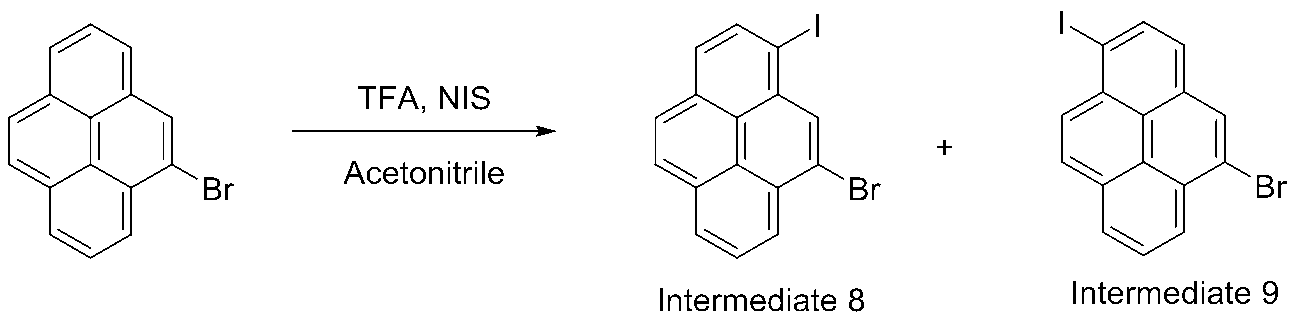
In a 500 ml round-bottom three-neck flask in a nitrogen atmosphere, 28.2 g of 4-bromopyrene, 3.4 g of trifluoroacetic acid, 22.4 g of NIS (N-Iodosuccinimide) and 400 ml of acetonitrile were placed, and refluxed for 24 hr. The reaction solution was cooled, filtered with silica gel, concentrated, and then subjected to column chromatography using a solvent of n-hexane, thus obtaining 14.0 g of Intermediate 8, and 12.1g of Intermediate 9 (yield 64%).
Intermediate 8: 1H NMR(600MHz, CDCl3): δ 8.70 (s, 1H), 8.64 (d, 1H), 8.50 (d, 1H), 8.27 (d, 1H), 8.13-8.09 (m, 2H), 8.03 (d, 1H), 7.90 (d, 1H)
Intermediate 9: 1H NMR(600MHz, CDCl3): δ 8.62 (d, 1H), 8.51 (d, 1H), 8.38 (s, 1H), 8.31 (d, 1H), 8.29 (d, 1H), 8.16 (d, 1H), 8.12 (t, 1H), 7.81 (d, 1H)
Preparation Example 9. Synthesis of Intermediate 10 (4-bromo-6-phenylpyrene)

In a 100 ml round-bottom three-neck flask in a nitrogen atmosphere, 6.2 g of Intermediate 8, 1.8 g of phenylboronic acid, 0.5g of tetrakis(triphenylphosphine)palladium(0), 4.4g of sodium tert-butoxide and 60 ml of toluene were placed, and stirred at 90℃ for 24 hr. The reaction solution was cooled, filtered with silica gel, concentrated, and then subjected to column chromatography with a solvent mixture of dichloromethane and n-hexane, thus obtaining 3.6 g of Intermediate 10 (yield 68%).
1H NMR(600MHz, CDCl3): δ 8.61 (d, 1H), 8.46 (s, 1H), 8.23 (d, 1H), 8.18 (d, 1H), 8.16 (d, 1H), 8.10 (t, 1H) 7.99 (d, 2H), 7.61 (d, 2H), 7.56 (t, 2H), 7.49 (t, 1H)
Preparation Example 10. Synthesis of Intermediate 11 (4-bromo-8-phenylpyrene)

In a 100 ml round-bottom three-neck flask in a nitrogen atmosphere, 8.0 g of Intermediate 9, 2.3 g of phenylboronic acid, 0.6 g of tetrakis(triphenylphosphine)palladium(0), 5.7 g of sodium tert-butoxide and 80 ml of toluene were placed, and stirred at 90℃ for 24 hr. The reaction solution was cooled, filtered with silica gel, concentrated, and then subjected to column chromatography with a solvent of n-hexane, thus obtaining 5.3 g of Intermediate 11 (yield 75%).
1H NMR(600MHz, CDCl3): δ 8.58 (d, 1H), 8.51 (s, 1H), 8.26-8.24 (m, 2H), 8.11-8.08 (m, 3H), 7.98 (d, 1H), 7.62-7.58 (m, 4H), 7.51 (t, 1H)
Preparation Example 11. Synthesis of Intermediate 12 (4-bromo-6-(2-biphenyl)pyrene)

In a 100 ml round-bottom three-neck flask in a nitrogen atmosphere, 4.1 g of Intermediate 8, 2.0 g of 2-biphenylboronic acid, 0.3 g of tetrakis(triphenylphosphine)palladium(0), 2.9 g of sodium tert-butoxide and 40 ml of toluene were placed, and stirred at 90℃ for 24 hr. The reaction solution was cooled, filtered with silica gel, concentrated, and then subjected to column chromatography with a solvent of n-hexane, thus obtaining 3.0 g of Intermediate 12 (yield 70%).
1H NMR(600MHz, CDCl3): δ 8.57 (d, 1H), 8.37 (s, 1H), 8.22 (d, 1H), 8.06 (t, 1H), 7.97-7.94 (m, 3H), 7.72 (d, 1H), 7.61-7.56 (m, 2H), 7.52-7.51 (m, 2H), 7.05-7.03 (m, 2H), 6.95-6.93 (m, 3H)
Preparation Example 12. Synthesis of Intermediate 13 (4-bromo-8-(2-biphenyl)pyrene)

In a 100 ml round-bottom three-neck flask in a nitrogen atmosphere, 4.1 g of Intermediate 9, 2.0 g of biphenylboronic acid, 0.3 g of tetrakis(triphenylphosphine)palladium(0), 2.9 g of sodium tert-butoxide and 40 ml of toluene were placed, and stirred at 90℃ for 24 hr. The reaction solution was cooled, filtered with silica gel, concentrated, and then subjected to column chromatography with a solvent of mixture of dichloromethane and n-hexane, thus obtaining 2.7 g of Intermediate 13 (yield 63%).
1H NMR(600MHz, CDCl3): δ 8.52 (d, 1H), 8.28 (s, 1H), 8.21 (d, 1H), 8.08-8.01 (m, 4H), 7.73 (d, 1H), 7.63-7.58 (m, 2H), 7.54-7.52 (m, 2H), 7.06-7.04 (m, 2H), 6.96-6.94 (m, 3H)
Preparation Example 13. Synthesis of Intermediate 14 (8-phenyl-4-(pinacolatoboron-yl)pyrene)

In a 100 mL round-bottom three-neck flask in a nitrogen atmosphere, 2.0 g of Intermediate 11, 1.6 g of bis(pinacolato)diboron, 0.1 g of [1,1’-bis(diphenylphosphino)ferrocene]dichloropalladium (II), 1.6 g of potassium acetate and 20 ml of DMSO were placed, and stirred at 90℃ for 12 hr. The reaction solution was cooled and then extracted with dichloromethane and water, after which the organic layer was filtered with silica gel, concentrated, and then subjected to column chromatography with a solvent of mixture of dichloromethane and n-hexane, thus obtaining 1.2 g of Intermediate 14 (yield 53%).
Preparation Example 14. Synthesis of Intermediate 15 (4-bromo-1,2,3,6,7,8-hexahydropyrene)

In a 2 L round-bottom three-neck flask in a nitrogen atmosphere, 25.0 g of 1,2,3,6,7,8-hexahydropyrene, 250 ml of dichloromethane(DCM), 875 ml of acetonitrile and 19.2g of NBS(N-bromosuccinimide) were placed, and stirred at room temperature for 24 hr. After completion of the reaction, the extracted solid products was obtaining through vaccum filtration, and washed with methanol, thus obtaining 25.0 g of Intermediate 15 (yield 73%).
1H NMR(600MHz, CDCl3): δ 7.35 (s, 1H), 7.16-7.11 (m, 2H), 3.09 (t, 2H), 3.06-3.01 (m, 6H), 2.04-2.02 (m, 4H)
Preparation Example 15. Synthesis of Intermediate 16 (4-bromo-9-iodo-1,2,3,6,7,8-hexahydropyrene)

In a 2 L round-bottom three-neck flask in a nitrogen atmosphere, 28.3 g of Intermediate 15, 33.8g of silver sulfate, 27.5g of iodine(I2) and 1000 ml of dichloromethane(DCM) were placed, and stirred at room temperature for 24 hr. After completion of the reaction, The reaction solution was filtered and vaccum concentrated, thus obtaining 18.8 g of Intermediate 16 (yield 46%).
1H NMR(600MHz, CDCl3): δ 7.65 (s, 1H), 7.39 (s, 1H), 3.08-2.95 (m, 8H), 2.03-1.99 (m, 4H)
Preparation Example 16. Synthesis of Intermediate 17 (3-(9-bromo-1,2,3,6,7,8-hexahydropyrene-4-yl)-9-phenyl-9H-carbazole)

In a 250 mL round-bottom three-neck flask in a nitrogen atmosphere, 10.0 g of Intermediate 16, 7.0g of 9-phenyl-9H-carbazol-3-ylboronic acid, 0.8g of tetrakis(triphenylphosphine)palladium(0), 7.0 g of sodium tert-butoxide and 140 ml of toluene were placed, and stirred at 60℃ for 24 hr. The reaction solution was cooled, filtered with silica gel, concentrated, and then subjected to column chromatography with a solvent of mixture of dichloromethane and n-hexane, thus obtaining 4.3 g of Intermediate 17 (yield 33%).
1H NMR(600MHz, CDCl3): δ 8.14-8.12 (m, 2H), 7.65-7.60 (m, 4H), 7.49-7.41 (m, 6H), 7.32-7.28 (m, 2H) , 3.14 (t, 2H), 3.09-3.05 (m, 6H), 2.11-2.07 (m, 2H), 1.95-1.91 (m, 2H)
Preparation Example 17. Synthesis of Intermediate 18 (3-(9-bromopyrene-4-yl)-9-phenyl-9H-carbazole)

In a 250 mL round-bottom three-neck flask in a nitrogen atmosphere, 4.3 g of Intermediate 17, 7.4g of 2,3-dichloro-5,6-dicyano-1,4-benzoquinone(DDQ) and 200 ml of toluene were placed, and refluxed for 2 hr. The reaction solution was cooled, filtered with silica gel, concentrated, and then subjected to column chromatography with a solvent of mixture of dichloromethane and n-hexane, thus obtaining 3.1 g of Intermediate 18 (yield 72%).
1H NMR(600MHz, CDCl3): δ 8.62 (d, 1H), 8.49 (s, 2H), 8.42 (s, 1H) , 8.35 (d, 1H) , 8.29 (d, 1H) , 8.18-8.12 (m, 4H), 7.96 (t, 1H) , 7.70-7.66 (m, 5H) , 7.59 (d, 1H) , 7.52-7.44 (m, 3H) , 7.31 (t, 1H)
Preparation Example 18. Synthesis of Intermediate 19 (4-bromo-9-([1,1’:3’,1’’-tertphenyl]-5’-yl)-1,2,3,6,7,8-hexahydropyrene)

In a 100 mL round-bottom three-neck flask in a nitrogen atmosphere, 5.0 g of Intermediate 16, 4.3g of 1,3-diphenyl-5-phenylpiancolatoboron, 0.4g of tetrakis(triphenylphosphine)palladium(0), 3.5 g of sodium tert-butoxide and 70 ml of toluene were placed, and stirred at 60℃ for 24 hr. The reaction solution was cooled, filtered with silica gel, concentrated, and then subjected to column chromatography with a solvent of mixture of dichloromethane and n-hexane, thus obtaining 3.5 g of Intermediate 19 (yield 56%).
1H NMR(600MHz, CDCl3): δ 7.81 (s, 1H), 7.70 (d, 4H), 7.59 (d, 2H), 7.47 (t, 4H), 7.42 (s, 1H), 7.38 (t, 2H), 7.29 (s, 1H), 3.13 (t, 2H), 3.09-3.05 (m, 6H), 2.10-2.07 (m, 2H) , 1.97-1.94 (m, 2H)
Preparation Example 19. Synthesis of Intermediate 20 (4-bromo-9-([1,1’:3’,1’’-tertphenyl]-5’-yl)pyrene)

In a 250 mL round-bottom three-neck flask in a nitrogen atmosphere, 7.0 g of Intermediate 19, 12.3g of 2,3-dichloro-5,6-dicyano-1,4-benzoquinone(DDQ) and 300 ml of toluene were placed, and refluxed for 12 hr. The reaction solution was cooled, filtered with silica gel, concentrated, and then subjected to column chromatography with a solvent of mixture of dichloromethane and n-hexane, thus obtaining 4.6 g of Intermediate 20 (yield 67%).
1H NMR(600MHz, CDCl3): δ 8.62 (d, 1H), 8.49 (s, 1H), 8.36 (d, 1H), 8.27 (d, 1H), 8.16-8.12 (m, 3H), 8.00-7.96 (m, 2H), 7.88-7.87 (m, 2H), 7.76 (d, 4H), 7.49 (t, 4H), 7.40 (t, 2H)
Preparation Example 20. Synthesis of Intermediate 21 (4-bromo-9-naphthyl-hexahydropyrene)

In a 100 mL round-bottom three-neck flask in a nitrogen atmosphere, 9.8 g of Intermediate 16, 4.1g of naphthylboronic acid, 1.1g of tetrakis(triphenylphosphine)palladium(0), 6.8 g of sodium tert-butoxide and 200 ml of toluene were placed, and stirred at 60℃ for 24 hr. The reaction solution was cooled, filtered with silica gel, concentrated, and then subjected to column chromatography with a solvent of mixture of dichloromethane and n-hexane, thus obtaining 5.2 g of Intermediate 21 (yield 53%).
1H NMR(600MHz, CDCl3): δ 7.90-7.86 (m, 3H), 7.82 (s, 1H), 7.53-7.49 (m, 3H), 7.42 (s, 1H), 7.27 (s, 1H), 3.14 (t, 2H), 3.07-3.04 (m, 4H), 3.01 (t, 2H), 2.11-2.07 (m, 2H), 1.93-1.90 (m, 2H)
Preparation Example 21. Synthesis of Intermediate 22 (4-bromo-9-naphthylpyrene)

In a 1 L round-bottom three-neck flask in a nitrogen atmosphere, 5.2 g of Intermediate 21, 12.3g of 2,3-dichloro-5,6-dicyano-1,4-benzoquinone(DDQ) and 350 ml of toluene were placed, and refluxed for 5 hr. The reaction solution was cooled, filtered with silica gel, concentrated, and then subjected to column chromatography with a solvent of mixture of dichloromethane and n-hexane, thus obtaining 4.8 g of Intermediate 22 (yield 94%).
1H NMR(600MHz, CDCl3): δ 8.62 (d, 1H), 8.49 (s, 1H), 8.28 (d, 1H), 8.25 (d, 1H), 8.16-8.12 (m, 4H), 8.03 (d, 1H), 7.98-7.94 (m, 3H), 7.78 (d, 1H), 7.58-7.57 (m, 2H)
Example 1. Synthesis of Compound 1

In a 100 ml round-bottom three-neck flask in a nitrogen atmosphere, 4.1 g of Intermediate 3, 1.5 g of bis(pinacolato)diboron, 0.3 g of [1,1’-bis(diphenylphosphino)ferrocene]dichloropalladium (II), 4.8 g of potassium carbonate and 40 ml of DMSO were placed, and stirred at 80℃ for 12 hr. The reaction solution was cooled and then extracted with dichloromethane and water, after which the organic layer was filtered with silica gel, concentrated, and then subjected to column chromatography with a solvent of mixture of dichloromethane and n-hexane, thus obtaining 1.6 g of Compound 1 (yield 49%).
1H NMR(600MHz, CDCl3): δ 8.35 (s, 2H), 8.30 (t, 4H), 8.21 (d, 2H), 8.12 (s, 2H), 8.04 (t, 2H), 7.87 (d, 2H), 7.80 (t, 2H), 7.75 (d, 4H), 7.61 (t, 4H), 7.54 (t, 2H)
MS (ESI): [M+H]+ 555
Example 2. Synthesis of Compound 2

In a 100 ml round-bottom three-neck flask in a nitrogen atmosphere, 3.8 g of Intermediate 4, 1.3 g of bis(pinacolato)diboron, 0.2 g of [1,1’-bis(diphenylphosphino)ferrocene]dichloropalladium (II), 4.4 g of potassium carbonate and 40 ml of DMSO were placed, and stirred at 80℃ for 12 hr. The reaction solution was cooled and then extracted with dichloromethane and water, after which the organic layer was filtered with silica gel, concentrated, and then subjected to column chromatography with a solvent of mixture of dichloromethane and n-hexane, thus obtaining 1.6 g of Compound 2 (yield 54%).
1H NMR(600MHz, CDCl3): δ 8.35 (s, 2H), 8.30 (t, 4H), 8.21 (d, 2H), 8.12 (s, 2H), 8.04 (t, 2H), 7.87 (d, 2H), 7.80 (t, 2H)
MS (ESI): [M+H]+ 565
Example 3. Synthesis of Compound 3

In a 100 ml round-bottom three-neck flask in a nitrogen atmosphere, 5.0 g of Intermediate 5, 1.4 g of bis(pinacolato)diboron, 0.2 g of [1,1’-bis(diphenylphosphino)ferrocene]dichloropalladium (II), 4.6 g of potassium carbonate and 40 ml of DMSO were placed, and stirred at 80℃ for 24 hr. The reaction solution was cooled and then extracted with dichloromethane and water, after which the organic layer was filtered with silica gel, concentrated, and then subjected to column chromatography with a solvent of mixture of dichloromethane and n-hexane, thus obtaining 2.4 g of Compound 3 (yield 58%).
1H NMR(600MHz, CDCl3): δ 8.54 (s, 2H), 8.50 (d, 2H), 8.44-8.42 (m, 4H), 8.38 (d, 2H), 8.28 (d, 2H), 8.08 (t, 2H), 7.96-7.92 (m, 4H), 7.83-7.80 (m, 4H), 7.69 (t, 2H), 7.54 (d, 2H), 7.49 (t, 2H), 7.48-7.43 (m, 2H)
MS (ESI): [M+H]+ 735
Example 4. Synthesis of Compound 4

In a 100 ml round-bottom three-neck flask in a nitrogen atmosphere, 5.8 g of Intermediate 6, 1.6 g of bis(pinacolato)diboron, 0.3 g of [1,1’-bis(diphenylphosphino)ferrocene]dichloropalladium (II), 5.3 g of potassium carbonate and 40 ml of DMSO were placed, and stirred at 80℃ for 24 hr. The reaction solution was cooled and then extracted with dichloromethane and water, after which the organic layer was filtered with silica gel, concentrated, and then subjected to column chromatography with a solvent of mixture of dichloromethane and n-hexane, thus obtaining 2.0 g of Compound 4 (yield 41%).
1H NMR(600MHz, CDCl3): δ 8.41 (s, 2H), 8.37 (t, 4H), 8.29 (d, 2H), 8.19 (s, 2H), 8.13-8.07 (m, 6H), 7.91 (d, 2H), 7.85-7.83 (m, 4H), 7.49-7.44 (m, 8H)
MS (ESI): [M+H]+ 767
Example 5. Synthesis of Compound 5

In a 100 ml round-bottom three-neck flask in a nitrogen atmosphere, 5.4 g of Intermediate 7, 1.5 g of bis(pinacolato)diboron, 0.3 g of [1,1’-bis(diphenylphosphino)ferrocene]dichloropalladium (II), 4.8 g of potassium carbonate and 40 ml of DMSO were placed, and stirred at 80℃ for 24 hr. The reaction solution was cooled and then extracted with dichloromethane and water, after which the organic layer was filtered with silica gel, concentrated, and then subjected to column chromatography with a solvent of mixture of dichloromethane and n-hexane, thus obtaining 2.2 g of Compound 5 (yield 49%).
1H NMR(600MHz, CDCl3): δ 8.40 (t, 4H), 8.31 (d, 2H), 8.24 (d, 2H), 8.20 (s, 2H), 8.06 (t, 2H), 7.95 (d, 2H), 7.89 (d, 2H), 7.86 (d, 2H), 7.83-7.81 (m, 4H), 7.75-7.73 (m, 2H), 7.52 (d, 2H), 7.43-7.39 (m, 4H), 1.63 (s,12H)
MS (ESI): [M+H]+ 787
Example 6. Synthesis of Compound 6

In a 100 ml round-bottom three-neck flask in a nitrogen atmosphere, 2.5 g of Intermediate 10, 0.9 g of bis(pinacolato)diboron, 0.2 g of [1,1’-bis(diphenylphosphino)ferrocene]dichloropalladium (II), 2.9 g of potassium carbonate and 25 ml of DMSO were placed, and stirred at 80℃ for 12 hr. The reaction solution was cooled and then extracted with dichloromethane and water, after which the organic layer was filtered with silica gel, concentrated, and then subjected to column chromatography with a solvent of mixture of dichloromethane and n-hexane, thus obtaining 1.1 g of Compound 6 (yield 55%).
1H NMR(600MHz, CDCl3): δ 8.32 (s, 2H), 8.29-8.25 (m, 4H), 8.10-8.05 (m, 4H), 7.84 (d, 2H), 7.76-7.74 (m, 4H), 7.69 (d, 4H), 7.43 (t, 4H), 7.33 (t, 2H)
MS (ESI): [M+H]+ 555
Example 7. Synthesis of Compound 7

In a 100 ml round-bottom three-neck flask in a nitrogen atmosphere, 3.3 g of Intermediate 11, 1.2 g of bis(pinacolato)diboron, 0.2 g of [1,1’-bis(diphenylphosphino)ferrocene]dichloropalladium (II), 3.8 g of potassium carbonate and 35 ml of DMSO were placed, and stirred at 80℃ for 12 hr. The reaction solution was cooled and then extracted with dichloromethane and water, after which the organic layer was filtered with silica gel, concentrated, and then subjected to column chromatography with a solvent of mixture of dichloromethane and n-hexane, thus obtaining 1.5 g of Compound 7 (yield 60%).
1H NMR(600MHz, CDCl3): δ 8.34 (s, 2H), 8.29 (d, 2H), 8.18 (d, 2H), 8.16-8.14 (m, 4H), 8.03 (d, 2H), 7.79 (d, 2H), 7.76 (t, 2H), 7.63 (d, 4H), 7.59 (t, 4H), 7.51 (t, 2H)
MS (ESI): [M+H]+ 555
Example 8. Synthesis of Compound 8

In a 100 ml round-bottom three-neck flask in a nitrogen atmosphere, 3.0 g of Intermediate 12, 1.2 g of bis(pinacolato)diboron, 0.1 g of [1,1’-bis(diphenylphosphino)ferrocene]dichloropalladium (II), 2.9 g of potassium carbonate and 30 ml of DMSO were placed, and stirred at 90℃ for 24 hr. The reaction solution was cooled and then extracted with dichloromethane and water, after which the organic layer was filtered with silica gel, concentrated, and then subjected to column chromatography with a solvent of mixture of dichloromethane and n-hexane, thus obtaining 1.3 g of Compound 8 (yield 52%).
1H NMR(600MHz, CDCl3): δ 8.23 (d, 2H), 8.11-8.03 (m, 8H), 7.79-7.73 (m, 4H), 7.65-7.54 (m, 10H), 7.17-7.13 (m, 4H), 7.03-6.99 (m, 6H)
MS (ESI): [M+H]+ 707
Example 9. Synthesis of Compound 9

In a 100 ml round-bottom three-neck flask in a nitrogen atmosphere, 2.7 g of Intermediate 13, 0.8 g of bis(pinacolato)diboron, 0.1 g of [1,1’-bis(diphenylphosphino)ferrocene]dichloropalladium (II), 2.6 g of potassium carbonate and 30 ml of DMSO were placed, and stirred at 90℃ for 24 hr. The reaction solution was cooled and then extracted with dichloromethane and water, after which the organic layer was filtered with silica gel, concentrated, and then subjected to column chromatography with a solvent of mixture of dichloromethane and n-hexane, thus obtaining 1.0 g of Compound 9 (yield 45%).
1H NMR(600MHz, CDCl3): δ 8.13 (d, 2H), 8.09-7.96 (m, 6H), 7.75-7.69 (m, 4H), 7.63-7.51 (m, 8H), 7.45-7.32 (m, 4H), 7.15-7.12 (m, 4H), 7.07-7.01 (m, 6H)
MS (ESI) : [M+H]+ 707
Example 10. Synthesis of Compound 10

In a 100 ml round-bottom three-neck flask in a nitrogen atmosphere, 1.2 g of Intermediate 14, 1.1 g of Intermediate 10, 0.1 g of tetrakis(triphenylphosphine)palladium(0), 0.9 g of sodium tert-butoxide and 12 ml of toluene were placed, and stirred at 90℃ for 24 hr. The reaction solution was cooled, filtered with silica gel, concentrated, and then subjected to column chromatography with a solvent of mixture of dichloromethane and n-hexane, thus obtaining 1.1 g of Compound 10 (yield 66%).
1H NMR(600MHz, CDCl3): δ 8.41 (s, 1H), 8.33 (d, 1H), 8.26-8.19 (m, 6H), 8.15 (d, 1H), 8.09-8.06 (m, 2H), 8.03 (d, 1H), 7.83-7.76 (m, 4H), 7.68-7.65 (m, 4H), 7.59 (t, 2H), 7.51 (t, 1H), 7.43 (t, 2H), 7.33 (t, 1H)
MS (ESI) : [M+H]+ 555
Example 11. Synthesis of Compound 42

In a 100 ml round-bottom three-neck flask in a nitrogen atmosphere, 2.7 g of Intermediate 18, 0.9 g of bis(pinacolato)diboron, 0.2 g of [1,1’-bis(diphenylphosphino)ferrocene]dichloropalladium (II), 2.2 g of potassium carbonate and 40 ml of DMSO were placed, and stirred at 80℃ for 4 hr. The reaction solution was cooled and then extracted with dichloromethane and water, after which the organic layer was filtered with silica gel, concentrated, and then subjected to column chromatography with a solvent of mixture of dichloromethane and n-hexane, thus obtaining 1.4 g of Compound 42 (yield 62%).
1H NMR(600MHz, CDCl3): δ 8.53 (s, 2H), 8.43 (d, 2H), 8.40 (s, 2H), 8.31 (d, 2H), 8.25-8.22 (m, 6H), 8.06 (t, 2H), 7.91 (d, 2H), 7.84-7.80 (m, 4H), 7.72-7.67 (m, 8H), 7.64 (d, 2H) , 7.54-7.46 (m, 6H), 7.34 (t, 2H)
MS (ESI) : [M+H]+ 885
Example 12. Synthesis of Compound 65

In a 100 ml round-bottom three-neck flask in a nitrogen atmosphere, 3.0 g of Intermediate 20, 1.0 g of bis(pinacolato)diboron, 0.2 g of [1,1’-bis(diphenylphosphino)ferrocene]dichloropalladium (II), 2.4 g of potassium carbonate and 43 ml of DMSO were placed, and stirred at 80℃ for 4 hr. The reaction solution was cooled and then extracted with dichloromethane and water, after which the organic layer was filtered with silica gel, concentrated, and then subjected to column chromatography with a solvent of mixture of dichloromethane and n-hexane, thus obtaining 1.2 g of Compound 65 (yield 47%).
1H NMR(600MHz, CDCl3): δ 8.45 (d, 2H), 8.39 (s, 2H), 8.32 (d, 2H), 8.25-8.24 (m, 4H), 8.07 (t, 2H), 8.00-7.98 (m, 6H), 7.90 (d, 2H), 7.84-7.80 (m, 10H), 7.52 (t, 8H), 7.42 (t, 4H)
MS (ESI) : [M+H]+ 859
Example 13. Synthesis of Compound 55

In a 250 ml round-bottom three-neck flask in a nitrogen atmosphere, 4.7 g of Intermediate 22, 2.1 g of bis(pinacolato)diboron, 0.3 g of [1,1’-bis(diphenylphosphino)ferrocene]dichloropalladium (II), 4.8 g of potassium carbonate and 120 ml of DMSO were placed, and stirred at 80℃ for 20 hr. The reaction solution was cooled and then extracted with dichloromethane and water, after which the organic layer was filtered with silica gel, concentrated, and then subjected to recrystallization with a solvent of toluene, thus obtaining 1.9 g of Compound 55 (yield 50%).
1H NMR(600MHz, CDCl3): NMR analysis of Compound 13 could not be performed, because Compound 13 was not soluble in NMR solvent.
MS (ESI) : [M+H]+ 655
Device Example 1. Manufacture of organic EL device including Compound 1 as host
A glass substrate coated with an ITO (indium tin oxide) thin film having a thickness of 100 nm was ultrasonically washed with an isopropyl alcohol solvent, dried, placed in a plasma cleaning system so that the substrate was cleaned using oxygen plasma for 5 min, and then transferred into a vacuum deposition system.
The ITO transparent electrode thus prepared was used as an anode, and DNTPD [N,N'-diphenyl-N,N'-bis-[4-(phenyl-m-tolylamino)-phenyl]-biphenyl-4,4'-diamine] was vacuum deposited on the ITO substrate, thus forming a hole injection layer having a thickness of 40 nm. Subsequently, NPB [N,N’-bis(1-naphthyl)-N,N’-diphenyl-1,1’-biphenyl-4,4’-diamine] as a hole injection layer was deposited to a thickness of 30 nm, thus forming the hole transport layer, and DPP [N1,N1,N6,N6-tetraphenylpyrene-1,6-diamine] as a dopant, was deposited to 0.1nm/sec of deposition speed of compound 1 and 0.003nm/sec of deposition speed of DPP, and 3 % of deposition speed rate of DPP was deposited to a thickness of 25 nm on the hole transport layer, thus forming a light emitting layer.
Thereafter, an electron transport layer was formed to a thickness of 25 nm deposing Alq3 on the light emitting layer, and 2 nm thick Liq [lithium quinolate] and 100 nm thick Al were sequentially vacuum deposited on the electron transport layer to form a cathode, thereby manufacturing an organic EL device.
At this time, deposition speed of materials was 0.1nm/sec of organic compound 1, DNTPD, NPB and Alq3, 0.01 nm/sec of lithium fluoride and 0.5nm/sec of alluminium.
Device Example 2. Manufacture of organic EL device including Compound 2 as host
An organic EL device was manufactured in the same manner as in Device Example 1, with the exception that Compound 2 was used instead of Compound 1 in Device Example 2.
Device Example 3. Manufacture of organic EL device including Compound 3 as host
An organic EL device was manufactured in the same manner as in Device Example 1, with the exception that Compound 3 was used instead of Compound 1 in Device Example 3.
Device Example 4. Manufacture of organic EL device including Compound 4 as host
An organic EL device was manufactured in the same manner as in Device Example 1, with the exception that Compound 4 was used instead of Compound 1 in Device Example 4.
Device Example 5. Manufacture of organic EL device including Compound 5 as host
An organic EL device was manufactured in the same manner as in Device Example 1, with the exception that Compound 5 was used instead of Compound 1 in Device Example 5.
Device Example 6. Manufacture of organic EL device including Compound 6 as hole transport layer
An organic EL device was manufactured in the same manner as in Device Example 1, with the exception that Compound 6 was used instead of Compound 1 in Device Example 6.
The chemical formulas of DNTPD, NPB, DPP and Alq3 used in the examples are represented below.


Evaluation of properties of organic EL device
The properties of the organic EL devices in the manufactured Device Examples 1 to 6, were evaluated at a brightness of 2000 cd/m2, and the results are shown in Table 1 below.
Table 1
| Host material | Current density(mA/cm2) | Brightness efficiency(cd/A) | Color coordinatesCIE (x,y) | |
| Device Examples 1 | | 43.48 | 4.6 | 0.15,0.18 |
| Device Examples 2 | Compound 2 | 44.43 | 4.5 | 0.15,0.18 |
| Device Examples 3 | Compound 3 | 44.49 | 4.5 | 0.15,0.18 |
| Device Examples 4 | Compound 4 | 47.62 | 4.2 | 0.15,0.18 |
| Device Examples 5 | Compound 5 | 46.51 | 4.3 | 0.15,0.18 |
| Device Examples 6 | Compound 6 | 45.46 | 4.4 | 0.15,0.18 |
The organic EL devices in the manufactured Device Examples 1 to 6, while a voltage was increased from 0 V to 10 V, current of each unit device was measured using a current-voltage meter (Keithley 2635A Source Meter), and the measured current value was divided by the area, thus obtaining current density.
In the manufactured organic EL devices, while a voltage was increased from 0 V to 10 V, the brightness was measured using a brightness meter (Minolta CS-2000), and the measured brightness value was divided by the current value, thus obtaining brightness efficiency. Also, the color coordinates were measured using a brightness meter (Minolta CS-2000).
According to the table 1, as is apparent from the results of manufacturing organic EL devices using the compound 1 to 6 according to the present invention as the material for the host, exhibited superior properties.
Although the preferred embodiments of the present invention have been disclosed for illustrative purposes, those skilled in the art will appreciate that various modifications, additions and substitutions are possible, without departing from the scope and spirit of the invention as disclosed in the accompanying claims.
The present invention may provide a compound for an organic EL device which may be used as a host of a fluorescent light emitting layer with high electrical stability, high transport capacity of an electron and a hole, high efficiency and high colorimetric purity, and an organic electroluminescent device including the same.
The present invention may also provide a compound for an organic EL device which may be used as an electron transport material or a hole transport material, and an organic electroluminescent device including the same.
Claims (9)
- A compound for an organic electroluminescent device, represented by Chemical Formula 1 below:[Chemical Formula 1]
 wherein R1 to R5 , and R7 to R11 are identical to or different from each other, and R1 to R5 , and R7 to R11 are each independently a hydrogen atom, a deuterium atom, a substituted or unsubstituted C1 to C30 alkyl group, a substituted or unsubstituted C3 to C30 cycloalkyl group, a substituted or unsubstituted C1 to C30 heterocycloalkyl group, a substituted or unsubstituted C6 to C30 aryl group, or a substituted or unsubstituted C1 to C30 heteroaryl group, or at least one of R1 to R5 , and R7 to R11 is further coupled with a carbon atom adjacent to a carbon atom linked therewith to form a substituted or unsubstituted fused C3 to C30 cycloalkyl group, a substituted or unsubstituted fused C1 to C30 heterocycloalkyl group, a substituted or unsubstituted fused C6 to C30 aryl group, or a substituted or unsubstituted fused C1 to C30 heteroaryl group, andR6 to R12 are identical to or different from each other, and R6 to R12 are each independently a hydrogen atom, a deuterium atom, a substituted or unsubstituted C1 to C30 alkyl group, a substituted or unsubstituted C3 to C30 cycloalkyl group, a substituted or unsubstituted C1 to C30 heterocycloalkyl group, a substituted or unsubstituted C6 to C30 aryl group, or a substituted or unsubstituted C1 to C30 heteroaryl group.
 - The compound of claim 1, wherein R1 to R12 are identical to or different from each other, and R1 to R12 are each independently a hydrogen atom, a deuterium atom,,
 ,
, ,
, ,
, ,
, ,
, , a substituted or unsubstituted C1 to C30 alkyl group, a substituted or unsubstituted C3 to C30 cycloalkyl group, or a substituted or unsubstituted C1 to C30 heterocycloalkyl group,
 X1 is an oxygen atom, a sulfur atom,,
 , or
, or ,
, Ar1 is a substituted or unsubstituted C1 to C30 alkyl group, a substituted or unsubstituted C3 to C30 cycloalkyl group, a substituted or unsubstituted C1 to C30 heterocycloalkyl group, a substituted or unsubstituted C6 to C30 aryl group, or a substituted or unsubstituted C1 to C30 heteroaryl group,R35 to R38 are identical to or different from each other, and R35 to R38 are each independently a hydrogen atom, a substituted or unsubstituted C1 to C30 alkyl group, a substituted or unsubstituted C3 to C30 cycloalkyl group, a substituted or unsubstituted C1 to C30 heterocycloalkyl group, a substituted or unsubstituted C6 to C30 aryl group, or a substituted or unsubstituted C1 to C30 heteroaryl group, or R35 and R36, and R37 and R38, respectively, are linked to form a substituted or unsubstituted C3 to C30 cycloalkyl group, a substituted or unsubstituted C1 to C30 heterocycloalkyl group, a substituted or unsubstituted C6 to C30 aryl group, or a substituted or unsubstituted C1 to C30 heteroaryl group, together with a carbon atom or a silicon atom therebetween, andR13 to R34 are identical to or different from each other, and R13 to R34 are each independently a hydrogen atom, a substituted or unsubstituted C1 to C30 alkyl group, a substituted or unsubstituted C3 to C30 cycloalkyl group, a substituted or unsubstituted C1 to C30 heterocycloalkyl group, a substituted or unsubstituted C6 to C30 aryl group, or a substituted or unsubstituted C1 to C30 heteroaryl group, or at least one of R13 to R34 is further coupled with a carbon atom adjacent to a carbon atom linked therewith to form a substituted or unsubstituted fused C3 to C30 cycloalkyl group, a substituted or unsubstituted fused C1 to C30 heterocycloalkyl group, a substituted or unsubstituted fused C6 to C30 aryl group, or a substituted or unsubstituted fused C1 to C30 heteroaryl group.
 - The compound of claim 1, wherein R1 to R12 are identical to or different from each other, and R1 to R12 are each independently a hydrogen atom, a deuterium atom,,
 ,
, ,
, ,
, ,
, , or
, or ,
, X1 is a oxygen atom, a sulfur atom,,
 , or
, or ,
, Ar1 is a substituted or unsubstituted C6 to C30 aryl group, or a substituted or unsubstituted C1 to C30 heteroaryl group,R35 to R38 are identical to or different from each other, and R35 to R38 are each independently a hydrogen atom, a substituted or unsubstituted C1 to C30 alkyl group, a substituted or unsubstituted C3 to C30 cycloalkyl group, or a substituted or unsubstituted C1 to C30 heterocycloalkyl group, andR13 to R34 are identical to or different from each other, and R13 to R34 are each independently a hydrogen atom, a substituted or unsubstituted C1 to C30 alkyl group, a substituted or unsubstituted C3 to C30 cycloalkyl group, a substituted or unsubstituted C1 to C30 heterocycloalkyl group, a substituted or unsubstituted C6 to C30 aryl group, or a substituted or unsubstituted C1 to C30 heteroaryl group.
 - The compound of claim 1, which is any one selected from among Compounds 1 to 65 represented by the following chemical formulas:


- An organic electroluminescent device, including the compound which is any one selected from among claim 1 to 4.
- An organic electroluminescent device, comprising a first electrode, a second electrode, and a single organic layer or a plurality of organic layers between the first electrode and the second electrode, wherein one or more organic layers selected from among the single organic layer or the plurality of organic layers include the compound which is any one selected from among claim 1 to 4.
- The organic electroluminescent device of claim 6, wherein the single organic layer or the plurality of organic layers include a light emitting layer.
- The organic electroluminescent device of claim 6, wherein the plurality of organic layers include a light emitting layer, and the plurality of organic layers further include one or more selected from among an electron injection layer, an electron transport layer, a hole blocking layer, an electron blocking layer, a hole transport layer and a hole injection layer.
- The organic electroluminescent device of claim 7, wherein the light emitting layer includes a host and a dopant.
Applications Claiming Priority (4)
| Application Number | Priority Date | Filing Date | Title |
|---|---|---|---|
| KR10-2013-0067043 | 2013-06-12 | ||
| KR20130067043 | 2013-06-12 | ||
| KR20140060059A KR20140145540A (en) | 2013-06-12 | 2014-05-20 | Compound for organic electroluminescent device and organic electroluminescent device comprising the same |
| KR10-2014-0060059 | 2014-05-20 |
Publications (1)
| Publication Number | Publication Date |
|---|---|
| WO2014200243A1 true WO2014200243A1 (en) | 2014-12-18 |
Family
ID=52022475
Family Applications (1)
| Application Number | Title | Priority Date | Filing Date |
|---|---|---|---|
| PCT/KR2014/005078 Ceased WO2014200243A1 (en) | 2013-06-12 | 2014-06-10 | Compound for organic electroluminescent device and organic electroluminescent device including the same |
Country Status (1)
| Country | Link |
|---|---|
| WO (1) | WO2014200243A1 (en) |
Cited By (2)
| Publication number | Priority date | Publication date | Assignee | Title |
|---|---|---|---|---|
| WO2016133058A1 (en) * | 2015-02-18 | 2016-08-25 | Tdk株式会社 | Electroluminescent element |
| CN107162869A (en) * | 2017-05-05 | 2017-09-15 | 吉林奥来德光电材料股份有限公司 | Pyrene analog derivative electroluminescent organic material and preparation method thereof and organic electroluminescence device |
Citations (5)
| Publication number | Priority date | Publication date | Assignee | Title |
|---|---|---|---|---|
| KR20040034349A (en) * | 2002-10-16 | 2004-04-28 | 내셔널 칭화 유니버시티 | Aromatic Compounds and Organic Light Emitting Diodes |
| WO2007004364A1 (en) * | 2005-07-06 | 2007-01-11 | Idemitsu Kosan Co., Ltd. | Pyrene derivative and organic electroluminescence device making use of the same |
| JP2009070987A (en) * | 2007-09-12 | 2009-04-02 | Mitsui Chemicals Inc | Organic transistor |
| WO2011030493A1 (en) * | 2009-09-14 | 2011-03-17 | Canon Kabushiki Kaisha | Novel pyrene compound and organic electroluminescent device including the same |
| WO2011077691A1 (en) * | 2009-12-21 | 2011-06-30 | 出光興産株式会社 | Organic electroluminescent element using pyrene derivative |
-
2014
- 2014-06-10 WO PCT/KR2014/005078 patent/WO2014200243A1/en not_active Ceased
Patent Citations (5)
| Publication number | Priority date | Publication date | Assignee | Title |
|---|---|---|---|---|
| KR20040034349A (en) * | 2002-10-16 | 2004-04-28 | 내셔널 칭화 유니버시티 | Aromatic Compounds and Organic Light Emitting Diodes |
| WO2007004364A1 (en) * | 2005-07-06 | 2007-01-11 | Idemitsu Kosan Co., Ltd. | Pyrene derivative and organic electroluminescence device making use of the same |
| JP2009070987A (en) * | 2007-09-12 | 2009-04-02 | Mitsui Chemicals Inc | Organic transistor |
| WO2011030493A1 (en) * | 2009-09-14 | 2011-03-17 | Canon Kabushiki Kaisha | Novel pyrene compound and organic electroluminescent device including the same |
| WO2011077691A1 (en) * | 2009-12-21 | 2011-06-30 | 出光興産株式会社 | Organic electroluminescent element using pyrene derivative |
Cited By (3)
| Publication number | Priority date | Publication date | Assignee | Title |
|---|---|---|---|---|
| WO2016133058A1 (en) * | 2015-02-18 | 2016-08-25 | Tdk株式会社 | Electroluminescent element |
| JPWO2016133058A1 (en) * | 2015-02-18 | 2017-11-30 | Tdk株式会社 | Electroluminescent device |
| CN107162869A (en) * | 2017-05-05 | 2017-09-15 | 吉林奥来德光电材料股份有限公司 | Pyrene analog derivative electroluminescent organic material and preparation method thereof and organic electroluminescence device |
Similar Documents
| Publication | Publication Date | Title |
|---|---|---|
| WO2014200260A1 (en) | Compound for organic electroluminescent device and organic electroluminescent device including the same | |
| WO2014021572A1 (en) | Compound for organic electroluminescent device and organic electroluminescent device including the same | |
| WO2010074422A1 (en) | Novel compound for organic photoelectric device and organic photoelectric device including the same | |
| WO2020122460A1 (en) | Compound for organic optoelectronic diode, organic optoelectronic diode, and display device | |
| WO2021075856A1 (en) | Polycyclic compound and organic light-emitting device using same | |
| WO2010114243A2 (en) | Novel compounds for organic electronic material and organic electronic device using the same | |
| WO2018174682A1 (en) | Heterocyclic compound and organic light emitting element comprising same | |
| WO2013151297A1 (en) | Novel organic electroluminescent compounds and organic electroluminescent device comprising the same | |
| WO2016036031A1 (en) | Compound for organic electroluminescent device and organic electroluminescent device comprising the same | |
| WO2014021569A1 (en) | Compound for organic electroluminescent device and organic electroluminescent device including the same | |
| WO2012015265A1 (en) | Novel organic electroluminescent compounds and organic electroluminescent device using the same | |
| WO2010131930A2 (en) | Compound for organic photoelectric device and organic photoelectric device comprising same | |
| WO2015009076A1 (en) | A combination of a dopant compound and a host compound and an organic electroluminescent device comprising the same | |
| WO2018009009A1 (en) | Heterocyclic compound, and organic light-emitting device using same | |
| WO2019203550A1 (en) | Heterocyclic compound and organic light-emitting device comprising same | |
| WO2013183851A1 (en) | Novel organic electroluminescent element compound and organic electroluminescent element comprising same | |
| WO2011081431A2 (en) | Organic light emitting compound, and organic electroluminescent device using same | |
| WO2017196081A1 (en) | Compound for organic electroluminescent device and organic electroluminescent device comprising the same | |
| WO2019245263A1 (en) | Heterocyclic compound, organic light emitting diode comprising same, composition for organic layer of organic light emitting diode, and method for manufacturing organic light emitting diode | |
| WO2021172965A1 (en) | Polycyclic aromatic derivative compound and organoelectroluminescent device using same | |
| WO2014163228A1 (en) | Novel organic electroluminescent element compound and organic electroluminescent element comprising same | |
| WO2020149666A1 (en) | Organic light-emitting device | |
| WO2019098695A1 (en) | Organic compound and organic electroluminescent device using same | |
| WO2021187924A1 (en) | Organoelectroluminescent device using polycyclic aromatic compounds | |
| WO2014104704A1 (en) | Novel organic electroluminescent compounds and organic electroluminescent device comprising the same |
Legal Events
| Date | Code | Title | Description |
|---|---|---|---|
| 121 | Ep: the epo has been informed by wipo that ep was designated in this application |
Ref document number: 14810519 Country of ref document: EP Kind code of ref document: A1 |
|
| NENP | Non-entry into the national phase |
Ref country code: DE |
|
| 122 | Ep: pct application non-entry in european phase |
Ref document number: 14810519 Country of ref document: EP Kind code of ref document: A1 |