WO2014194786A1 - 用于负压封闭引流的多层泡沫敷料及其制作方法 - Google Patents
用于负压封闭引流的多层泡沫敷料及其制作方法 Download PDFInfo
- Publication number
- WO2014194786A1 WO2014194786A1 PCT/CN2014/078650 CN2014078650W WO2014194786A1 WO 2014194786 A1 WO2014194786 A1 WO 2014194786A1 CN 2014078650 W CN2014078650 W CN 2014078650W WO 2014194786 A1 WO2014194786 A1 WO 2014194786A1
- Authority
- WO
- WIPO (PCT)
- Prior art keywords
- layer
- negative pressure
- foam
- drainage
- foam dressing
- Prior art date
- Legal status (The legal status is an assumption and is not a legal conclusion. Google has not performed a legal analysis and makes no representation as to the accuracy of the status listed.)
- Ceased
Links
Classifications
-
- A—HUMAN NECESSITIES
- A61—MEDICAL OR VETERINARY SCIENCE; HYGIENE
- A61F—FILTERS IMPLANTABLE INTO BLOOD VESSELS; PROSTHESES; DEVICES PROVIDING PATENCY TO, OR PREVENTING COLLAPSING OF, TUBULAR STRUCTURES OF THE BODY, e.g. STENTS; ORTHOPAEDIC, NURSING OR CONTRACEPTIVE DEVICES; FOMENTATION; TREATMENT OR PROTECTION OF EYES OR EARS; BANDAGES, DRESSINGS OR ABSORBENT PADS; FIRST-AID KITS
- A61F13/00—Bandages or dressings; Absorbent pads
- A61F13/05—Bandages or dressings; Absorbent pads specially adapted for use with sub-pressure or over-pressure therapy, wound drainage or wound irrigation, e.g. for use with negative-pressure wound therapy [NPWT]
-
- A—HUMAN NECESSITIES
- A61—MEDICAL OR VETERINARY SCIENCE; HYGIENE
- A61M—DEVICES FOR INTRODUCING MEDIA INTO, OR ONTO, THE BODY; DEVICES FOR TRANSDUCING BODY MEDIA OR FOR TAKING MEDIA FROM THE BODY; DEVICES FOR PRODUCING OR ENDING SLEEP OR STUPOR
- A61M1/00—Suction or pumping devices for medical purposes; Devices for carrying-off, for treatment of, or for carrying-over, body-liquids; Drainage systems
- A61M1/90—Negative pressure wound therapy devices, i.e. devices for applying suction to a wound to promote healing, e.g. including a vacuum dressing
- A61M1/91—Suction aspects of the dressing
- A61M1/915—Constructional details of the pressure distribution manifold
-
- A—HUMAN NECESSITIES
- A61—MEDICAL OR VETERINARY SCIENCE; HYGIENE
- A61M—DEVICES FOR INTRODUCING MEDIA INTO, OR ONTO, THE BODY; DEVICES FOR TRANSDUCING BODY MEDIA OR FOR TAKING MEDIA FROM THE BODY; DEVICES FOR PRODUCING OR ENDING SLEEP OR STUPOR
- A61M1/00—Suction or pumping devices for medical purposes; Devices for carrying-off, for treatment of, or for carrying-over, body-liquids; Drainage systems
- A61M1/90—Negative pressure wound therapy devices, i.e. devices for applying suction to a wound to promote healing, e.g. including a vacuum dressing
- A61M1/91—Suction aspects of the dressing
- A61M1/918—Suction aspects of the dressing for multiple suction locations
Definitions
- the present invention relates to the field of medical wound treatment devices, and more particularly to a multilayer foam dressing for negative pressure closed drainage and a method of making the same. Background technique
- Vacuum sealing drainage was initiated in 1992 by Dr. Wim Fleischman of ULM University in Germany, and formed a theoretical prototype for the drainage of limbs.
- Professor Yan Huade of China applied the application of vacuum sealing technology for the first time. Yupu Surgery pioneered the application of negative pressure closed drainage technology in general surgery.
- Professor Wang Yanfeng and Prof. Hua Huade were granted the patent CN 2236350 on March 17, 1997, which is the first patent for vacuum sealing drainage technology.
- the basic configuration of the existing VSD technology includes a negative pressure source (including a medical suction machine, a central negative pressure device used in a hospital or a negative pressure drainage bottle, etc.), a drainage tube, a hydrophilic foam material or other medical hydrophobic foam material or sponge.
- the dressing or gauze dressing hereinafter referred to as the above-mentioned medical material collectively referred to as porous foam material
- the sealing film can be adhered, and the drainage container is composed.
- the above technology can directly excrete necrotic tissue and toxins, pus, etc., avoid re-absorption of toxins, and quickly clean the wound surface; at the same time, high vacuum suction can effectively promote the rapid growth of granulation and shorten the wound healing time.
- patients can change their medication within 3-7 days, avoid cross-infection, reduce the workload of medical staff, reduce patient suffering, and reduce the mortality and disability rate of trauma.
- VSD technology is mainly realized by relying on porous foam cushions as medical polymer dressings.
- This dressing is both a negative pressure transmission medium and a drainage medium for introducing necrotic tissue, pus, exudate, other toxic products and toxins into the drainage tube.
- foam dressings for negative pressure closed drainage on the market: hydrophobic dressings and hydrophilic dressings.
- Hydrophobic dressings are mostly made of PU materials, which have larger foam pores and higher permeability. Because of their hydrophobic nature, the foams generally do not contain water, so the negative pressure conduction performance is excellent.
- Most of the hydrophilic dressings are foamed with PVA material.
- the foam pores are smaller than the hydrophobic dressings, and the material permeability is low, but it can also meet the negative pressure drainage treatment. Need; Because of its hydrophilic nature, a layer of water molecules will form on the surface of the dressing, which will directly contact the endothelial cells of the dressing and granulation tissue, prevent the granulation tissue from growing into the dressing, avoid pulling bleeding, and the material is extremely safe. high.
- both of the above dressings have drawbacks in clinical applications. Due to its hydrophobic nature, the hydrophobic dressing (PU) has no protective layer on the surface of the material. The granulation tissue can grow into the pores of the foam, which is prone to pulling bleeding. It is also difficult due to the poor tensile strength of the hydrophobic dressing (PU). The debris is detached, which in turn causes the foreign body inflammatory reaction (rejection) and secondary infection of the wound cavity, so there is a big problem in material safety.
- the US FDA report shows that with PU dressings, patients have death and aggravated trauma.
- PU dressings have a short dressing period (US FDA report and related literature shows that it can not exceed three days), the cost is high, the labor intensity of medical staff is large, and patients are more painful.
- Hydrophilic dressing Due to its hydrophilic nature, the material itself is moist, although its permeability is low, it can also meet the treatment requirements of negative pressure drainage, but because of the water content of the material, its negative pressure conduction performance is better. Poor, it is easy to produce negative pressure conduction weak area when using large area wounds. Secondly, PVA material gradually becomes dry gradually after water loss, which leads to further decrease of permeability and weakening treatment effect. Summary of the invention
- the technical problem to be solved by the present invention is to provide a multi-layered foam dressing for negative pressure closed drainage and a manufacturing method thereof, which can overcome the defects of the existing negative pressure closed drainage dressing, and can effectively improve the safety of the material while ensuring the safety of the material. Its negative pressure conduction performance, and it is not easy to block during use, the permeability is stable, and the treatment effect is excellent.
- a multi-layered foam dressing for negative pressure closed drainage includes a negative pressure conducting layer, and a drainage protective layer for contacting a wound or a wound cavity is disposed at a lower portion of the negative pressure conducting layer.
- the negative pressure conductive layer and the drainage protective layer are both porous foam layers; the negative pressure conductive layer is a hydrophobic porous foam material layer, and the drainage protective layer is a hydrophilic porous foam material layer, and the two layers are fixed between Connected and the pores are in contact with each other.
- the negative pressure conductive layer has a thickness a of 0.5 to 10 cm, a pore diameter of 1 to 2.5 mm, a thickness b of the drainage protective layer of 0.1 to 3.5 cm, and a pore diameter of 0.2 to 1 mm.
- the negative pressure conducting layer has a thickness a of l ⁇ 3 cm and a pore diameter of l ⁇ 1.5 mm.
- the negative pressure conducting layer has a thickness a of 3 to 6 cm and a pore diameter of 1 to 2.0 mm.
- the negative pressure conducting layer has a thickness a of 6 to 9 cm and a pore diameter of 1 to 2.5 mm.
- the drainage protective layer has a thickness b of 0.3 to 0.5 cm and a pore diameter of 0.2 to 0.5 mm.
- the drainage protective layer has a thickness b of 0.5 to 1.5 cm and a pore diameter of 0.5 to 1.0 mm.
- the drainage protective layer has a thickness b of 1.5 to 3.5 cm and a pore diameter of 0.8 to 1.0 mm.
- the negative pressure conducting layer is made of hydrophobic PU foam, EVA foam or PU foam of composite chitosan.
- the drainage protective layer is made of PVA foam, PVA foam of composite chitosan or PVA foam of composite antibacterial and bacteriostatic agent.
- the multi-layer foam dressing When the multi-layer foam dressing is used on the product of the negative pressure drainage tube installation, there are two longitudinal fractures, two longitudinal fractures are located at the position where the negative pressure drainage tube is to be installed, and one end opening is installed by the negative pressure drainage tube.
- the length of the longitudinal fracture can be as long as it passes through the position where the negative pressure drainage tube hole is installed.
- An outer surface layer is disposed on an upper portion of the negative pressure conducting layer, that is, a side away from the wound surface, and an outer surface layer is fixedly coupled to an upper portion of the negative pressure conducting layer.
- the outer surface layer is a porous foam outer surface layer, and the porous foam outer surface layer is a hydrophilic porous foam material layer.
- the porous foam outer surface layer has a thickness c of 0.1 to 0.5 cm.
- the outer surface layer is a layer of outer surface of the sealant film.
- the outer surface layer of the sealant film has a thickness of 0.1 ⁇ 0..5mm.
- One of the methods for making the multilayered foam dressing for vacuum sealing drainage of the present invention comprises the following steps:
- the cutting and cutting are performed to obtain a negative pressure conducting layer and a drainage protective layer;
- the negative pressure conductive layer foam material and the drainage protective layer foam material produced in the first step are fixedly connected by means of adhesive bonding, and the contact points on the two layers of porous foam material layer are provided with dispensing points. Adjacent two layers of porous foam material are laminated and bonded by a dry and hydrophilic composite glue at a dispensing point to form a composite layered structure;
- the second method for fabricating the multi-layered foam dressing for negative pressure closed drainage of the present invention comprises the following steps:
- the cutting and cutting are performed to obtain a negative pressure conducting layer and a drainage protective layer;
- the negative pressure conductive layer and the drainage protective layer are fixedly connected and stacked by means of a contact surface to form a multi-layered foam material;
- the multi-layered foam material prepared in the second step is perforated on the needle punching device, the pore diameter is l ⁇ 4 mm, and the needle body is penetrated through the adhesive layer to connect the two foam materials.
- Multi-layer foam dressing is
- the aperture of the perforation is 2 to 3 mm.
- the third method for fabricating the multi-layered foam dressing for negative pressure closed drainage of the present invention comprises the following steps:
- the negative pressure conductive layer and the drainage protective layer are prepared by cutting and cutting according to the design size
- the drainage protective layer cut in the first step is placed in the mold box, and an appropriate amount of the hydrophilic foam foaming raw material liquid is injected into the surface, and allowed to stand for 10-30 seconds, and the first surface is to be flattened.
- the negative pressure conductive layer cut in the step covers the surface of the raw material liquid, and the pressure is evenly applied by the tool to the negative pressure conductive layer, so that the negative pressure conductive layer and the original liquid surface are uniformly and uniformly contacted;
- the mold box for injecting the raw material liquid in the second step is heated, and the foaming raw material liquid is reacted and solidified, and the negative pressure conductive layer and the drainage protective layer are compositely joined together, and then the new foaming is performed in the middle.
- the foam bonding layer is cut and cut to obtain a double-layered foam dressing.
- the third method for manufacturing the multi-layered foam dressing for negative pressure closed drainage the third step of the foaming reaction process is first heated to 30 ⁇ 50 ° C for 0.5 to 1 hour to make it pre-mixed; Heat to 50 ⁇ 90 ° C for 2 to 8 hours.
- the preheating temperature is 35 to 45 ° C and the heating time is 0.5 hour.
- the temperature rise is 55 to 75 ° C and the heating time is 4 to 8 hours.
- the hydrophilic foam foaming raw material liquid in the third step further comprises an antibacterial agent, a bacteriostatic agent and a reinforcing agent in a total mass of the raw material liquid of 0.5% to 5%.
- the invention relates to a method for manufacturing a multi-layer foam dressing for negative pressure closed drainage and a porous foam outer surface layer, comprising the following steps:
- a method of adding a porous foam outer surface layer to the upper portion of the multi-layer foam dressing is: placing the negative pressure conductive layer of the double-layer foam dressing face down in the square mold box, and repeating the third method to obtain a three-layer foam dressing.
- the second method for manufacturing a multi-layer foam dressing for negative pressure closed drainage and a porous foam outer surface layer comprises the following steps:
- the upper layer of the prepared multi-layered foam dressing was glued, and the outer surface layer of the sealant film was adhered to the upper surface to obtain a three-layer foam dressing.
- the longitudinal fracture is located at the position where the negative pressure drainage pipe is installed, and the end of the installation of the negative pressure drainage pipe on the multi-layer foam dressing is inserted through the hole of the negative pressure drainage pipe. To the middle of the multi-layer foam dressing.
- a drainage protective layer is arranged on the lower layer of the foam dressing.
- the foam material is a hydrophilic foam material, which can effectively block the granulation tissue, avoid adhesion between the granulation tissue and the dressing, cause pulling bleeding, and effectively ensure the treatment. safety;
- Multi-layer structure negative pressure conduction layer is set in the middle, which is used for conducting negative pressure, which effectively improves the negative pressure conduction efficiency. While ensuring safety, it can effectively improve the negative pressure conduction performance of the dressing and avoid negative pressure conduction. Dead angle, guarantee the therapeutic effect;
- the hydrophilic foam material is used as a drainage protective layer to form a moist environment on the surface of the wound surface, which is beneficial to promote the growth of the wound granulation tissue and promote wound healing, and the hydrophilic environment can effectively reduce the suffering of the patient;
- the present invention is the first to propose a multi-layered foam dressing, which overcomes the clinical treatment of the clinical advantages of the clinically simple, single use of hydrophilic negative pressure materials or hydrophobic negative pressure materials. Troubled and distressed, using simple structural design and production methods, using a multi-layer structure, combining the advantages of the above materials, overcoming its shortcomings;
- the bottom drainage protective layer has higher hardness and elasticity due to its hydrophilic property, while the negative pressure conductive layer can ensure high negative pressure without loss during conduction, at high negative pressure Under the action, the bottom drainage protection layer can effectively divide the large necrotic tissue into small pieces, and the negative pressure conduction layer can effectively extract the necrotic tissue divided into small pieces, effectively avoiding the blockage of the negative pressure conduction layer material, and at the same time being more effective. Clean the wound, avoid the production of toxins, avoid the absorption of toxins, and reduce the incidence of infection;
- the dressing use time can be effectively extended.
- the above structure can effectively extend the dressing period and further alleviate the patient's pain. Reduce the cost of comprehensive treatment;
- the hydrophilic foam material is used as the drainage protective layer. Because the hydrophilic foam has high tensile strength and no chipping, it can effectively prevent the debris from entering the wound surface, which makes the wound healing difficult, and further improves the treatment safety of the foam dressing. Sex. DRAWINGS
- FIG. 1 is a schematic view of a first embodiment of a basic structure of the present invention
- Figure 2 is a schematic view showing the structure of the outer surface layer with a porous foam according to the embodiment 2 of the present invention
- FIG. 3 is a schematic structural view of an embodiment 3 of the present invention with an outer surface layer of a sealant film;
- Figure 4 is a perspective view of the three-dimensional structure of Figure 1;
- Figure 5 is a schematic plan view showing the structure of Figures 1, 2, 3 and the drainage tube;
- Figure 6 is a schematic view showing the structure of a needle punching device used for processing the product of the present invention.
- Figure 7 is a plan view of Figure 6;
- 1_negative pressure conducting layer 2_ draining protective layer, 3a—porous foam outer surface layer, 3b_sealing film outer surface layer, 4_needle punching device, 5_needle body, 6—in multiple layers Two longitudinal slits cut on the foam dressing.
- a multi-layered foam dressing for vacuum sealing drainage of the present invention comprises a negative pressure conducting layer 1 disposed at a lower portion of the negative pressure conducting layer 1 for contact with a wound or a wound cavity.
- the drainage protective layer 2, the negative pressure conductive layer 1 and the drainage protective layer 2 are both porous foam layers; the negative pressure conductive layer 1 is a hydrophobic porous foam material layer, and the drainage protective layer 2 is hydrophilic porous
- the foam layer is fixedly connected between the two layers of material and the pores are in contact with each other.
- the multi-layer foam dressing When the multi-layer foam dressing is applied to the product of the negative pressure drainage tube installation, there are two longitudinal fractures 6 which are located at a position where the negative pressure drainage tube is to be installed, and are installed by the negative pressure drainage tube. One end is open, and the length of the longitudinal slit 6 is only required to pass through the position where the negative pressure drainage tube hole is installed. Generally, the length of the longitudinal slit 6 is 1/10 to 1/2 of the length of the multilayered foam dressing.
- the effect of the two longitudinal fractures 6 is that the film can be exposed to the wound that has been seriously infected.
- the flow tube and the irrigation tube are turned over to the drainage protective layer 2 through the slit of the cut, and the negative pressure conductive layer 1 is directly contacted for treatment.
- the negative pressure conductive layer 1 has a thickness a of 0.5 to 10 cm and a pore diameter of 1 to 2.5 mm
- the drainage protective layer 2 has a thickness b of 0.1 to 3.5 cm and a pore diameter of 0.2 to 1 mm.
- the negative pressure conductive layer 1 has a thickness a of 1 to 3 cm and a pore diameter of 1 to 1.5 mm; and the drainage protective layer 2 has a thickness b of 0.5 to 1.5 cm and a pore diameter of 0.5 to 1.0 mm, which is suitable for forming a manifold, Sufficient drainage and negative pressure conduction of the sinus disease.
- the negative pressure conductive layer 1 has a thickness a of 3 to 6 cm and a pore diameter of 1 to 2.0 mm; the drainage protective layer 2 has a thickness b of 0.3 to 0.5 cm, and the pore diameter is 0.2 to 0.5 mm, which is suitable for various chronic and acute Traumatic, subacute and split wounds, burns, ulcers (such as diabetic ulcers and pressure ulcers), adequate drainage and negative pressure conduction of wounds such as flaps and skin grafts.
- the negative pressure conductive layer 1 has a thickness a of 6 to 9 cm and a pore diameter of 1 to 2.5 mm.
- the thickness of the drainage protection layer 2 is 1.5 to 3.5 cm, and the pore diameter is 0.8 to 1.0 mm, which is suitable for various openness. Adequate drainage and negative pressure conduction of abdominal cavity injury.
- the drainage protection layer 2 adopts the pore arrangement, which can facilitate the conduction of negative pressure on the one hand, and can effectively prevent the growth of granulation tissue into the foam pores on the other hand, and improve the overall safety and therapeutic effect of the foam dressing.
- the use of a thin drainage protection layer 2 can effectively reduce the negative impact of the hydrophilic foam layer on the negative pressure conduction, and a certain thickness can effectively block the wound granulation tissue.
- the use of a thicker negative pressure conducting layer 1 can effectively improve the overall negative pressure conduction properties of the foam dressing.
- the drainage protective layer 2 is preferably a hydrophilic porous foam layer.
- the drainage protective layer 2 can be made of PVA foam, PVA foam of composite chitosan or PVA foam of a composite antibacterial or bacteriostatic agent.
- the negative pressure conductive layer 1 is preferably a hydrophobic porous foam material layer. It can be made of hydrophobic PU foam, EVA foam or PU foam of composite chitosan. PU foams using composite chitosan are more suitable for the reverse use.
- the hydrophobic porous foam material has a larger pore size and a higher permeability, due to its hydrophobic nature, within the foam Generally, it does not contain water, so the negative pressure conduction performance is excellent, and the overall negative pressure conduction performance of the foam dressing can be effectively improved.
- the medical profession has caused many problems and distress in the clinical treatment of the advantages and disadvantages of clinically simple, single use of hydrophilic negative pressure materials or hydrophobic negative pressure materials.
- An outer surface layer 3 is disposed on an upper portion of the negative pressure conducting layer 1, that is, a side away from the wound surface, and an outer surface layer 3 is fixedly coupled to the upper portion of the negative pressure conducting layer 1 for preventing material from losing water; and, when used for endovascular treatment The outer surface layer 3 can effectively prevent the negative pressure conductive layer 1 from coming into direct contact with the wound tissue.
- Figure 2 is a schematic view showing the structure of the outer surface layer with a porous foam according to the embodiment 2 of the present invention
- the outer surface layer 3 is a porous foam outer surface layer 3a, and the porous foam outer surface layer 3a is a hydrophilic porous foam material layer.
- the porous foam outer surface layer 3a has a thickness c of 0.1 to 0.5 cm.
- Figure 3 is a schematic view showing the structure of the outer surface layer of the sealant film according to the embodiment 3 of the present invention:
- the outer surface layer 3 is a layer of a sealant outer surface layer 3b.
- the outer surface layer 3b of the sealant film has a thickness of 0.1 to 0.5 mm.
- One of the methods for making the multilayered foam dressing for vacuum sealing drainage of the present invention comprises the following steps:
- the negative pressure conductive layer 1 foam material and the drainage protective layer 2 foam material produced in the first step are fixedly connected by means of adhesive bonding, and the two porous foam material layer has a point on the contact surface. Glue point, the two layers of porous foam material are laminated and bonded by dry and hydrophilic composite glue at the dispensing point to form a composite layer structure.
- the second method for manufacturing a multi-layer foam dressing for negative pressure closed drainage and a porous foam outer surface layer comprises the following steps:
- the negative pressure conductive layer 1 and the drainage protective layer 2 are fixedly connected and stacked by means of a contact surface to form a multi-layered foam material;
- the multi-layered foam material prepared in the second step is perforated on the needle punching device, the pore diameter is l ⁇ 4 mm, and the needle body is penetrated through the adhesive layer to connect the two foam materials.
- Multi-layer foam dressing are schematic views showing the structure of a needle punching device for processing the product of the present invention:
- the aperture of the perforation is 2 to 3 mm.
- the third method for fabricating the multi-layered foam dressing for negative pressure closed drainage of the present invention comprises the following steps:
- the first step cutting and cutting according to the design size to obtain a negative pressure conductive layer 1 and a drainage protection layer 2;
- the drainage protective layer 2 which is cut in the first step is placed in a mold box, and an appropriate amount of the hydrophilic foam foaming raw material liquid is injected into the surface thereof, and left to stand for 10 to 30 seconds, and the surface is to be leveled.
- the negative pressure conductive layer 1 which is cut in one step covers the surface of the raw material liquid, and applies a pressure to the negative pressure conduction layer 1 by using a tool to uniformly and uniformly contact the negative pressure conductive layer 1 with the raw liquid surface;
- the mold box for injecting the raw material liquid in the second step is heated, and the foaming raw material liquid is reacted and solidified, and the negative pressure conductive layer 1 and the drainage protective layer 2 are compositely connected together, and then the new pair is newly formed.
- the foamed foam bonding layer is cut and cut to obtain a double-layered foam dressing.
- the foaming reaction is first heated to 30 to 50 ° C for 0.5 to 1 hour to pre-comply; and then heated to 50 to 90 ° C and heated for 2 to 8 hours. Heating to 30 ⁇ 50 °C is for better fusion, pre-expansion, and heating to 50 ⁇ 90 °C for heating 2 ⁇ 8 for better curing.
- the preheating temperature was 35 to 45 ° C, and the heating time was 0.5 hour.
- the heating temperature is 55 to 75 ° C, and the heating time is 4 to 8 hours.
- the hydrophilic foam foaming raw material liquid is mainly used for bonding, and its composition and proportion are similar to those of the drainage protective layer used in the product.
- the hydrophilic foam foaming raw material liquid in the third step further comprises an additive of 0.5% to 5% of the total mass of the raw material liquid, including but not limited to an antibacterial agent, a bacteriostatic agent, an enhancer and the like.
- the porous foam outer surface layer 3a is added to the upper portion of the multi-layered foam dressing by placing the negative pressure conductive layer 1 of the double-layer foam dressing in the square mold box downward, repeating the third method and the third method. In step, a three-layer foam dressing is obtained.
- the second method for producing the porous foam outer surface layer 3a on the upper portion of the multi-layered foam dressing is to apply the upper layer of the multi-layered foam dressing to the outer surface layer 3b of the sealant film to the upper surface to obtain a three-layer foam dressing.
- the longitudinal fracture is located at the position where the negative pressure drainage pipe is installed, and the end of the installation of the negative pressure drainage pipe on the multi-layer foam dressing is inserted through the hole of the negative pressure drainage pipe. To the middle of the multi-layer foam dressing.
- the dressing is a two-layer structure composed of a layer of a negative pressure conducting layer 1 and a layer of a drainage protective layer 2.
- the negative pressure conductive layer 1 is a hydrophobic foam material
- the drainage protective layer 2 is a hydrophilic foam material.
- the negative pressure conductive layer 1 has a thickness of lcm, and the drainage protective layer 2 has a thickness of 0.5 cm.
- the negative pressure conductive layer 1 has a pore diameter of 2.5 mm, and the drainage protective layer 2 has a pore diameter of 0.5 mm.
- the outer surface of the porous foam layer of the outer layer away from the wound surface is fixedly attached with a layer of sealing film outer surface layer 3b.
- the dressing has a three-layer structure with the negative pressure conducting layer 1 centered.
- the negative pressure conductive layer 1 is made of a hydrophobic foam material
- the drainage protective layer 2 is made of a hydrophilic foam material.
- the negative pressure conductive layer 1 has a thickness of lcm, and the drainage protective layer 2 has a thickness of 0.5 cm.
- the negative pressure conducting layer 1 has a pore diameter of 2.5 mm, and the bow I flow protective layer 2 has a pore diameter of 0.5 mm.
- the outer surface layer 3a of the porous foam was added to have a diameter of 0.5 cm and a pore diameter of 0.5 mm.
- the dressing is a two-layer structure, which is formed by bonding a layer of negative pressure conductive layer 1 and a layer of drainage protective layer 2. Negative pressure conduction
- the layer 1 is made of a hydrophobic foam material
- the drainage protective layer 2 is made of a hydrophilic foam material.
- the negative pressure conductive layer 1 has a thickness of lcm, and the drainage protective layer 2 has a thickness of 0.5 cm.
- the negative pressure conductive layer 1 has a pore diameter of 2.5 mm, and the drainage protective layer 2 has a pore diameter of 0.5 mm.
- the bonding method is multi-point dispensing.
- the outer surface of the porous foam layer on the outer layer away from the side of the wound surface is fixedly connected with a layer of sealing film outer surface layer 3b.
- the dressing has a two-layer structure and is formed by bonding a layer of negative pressure conductive layer 1 and a layer of drainage protective layer 2.
- the negative pressure conductive layer 1 is a hydrophobic foam material
- the drainage protective layer 2 is a hydrophilic foam material.
- the negative pressure conductive layer 1 has a thickness of lcm, and the drainage protective layer 2 has a thickness of 0.5 cm.
- the negative pressure conductive layer 1 has a pore diameter of 2.5 mm, and the drainage protective layer 2 has a pore diameter of 0.5 mm.
- the bonding method is surface bonding, and a through hole is formed in the adhesive layer, and the hole diameter is 2 mm.
- the dressing is a two-layer structure composed of a layer of a negative pressure conducting layer 1 and a layer of a drainage protective layer 2.
- the negative pressure conductive layer 1 is a hydrophobic foam material
- the drainage protective layer 2 is a hydrophilic foam material.
- the negative pressure conductive layer 1 has a thickness of 3 cm, and the drainage protective layer 2 has a thickness of 1 cm.
- the negative pressure conductive layer 1 has a pore diameter of 1.5 mm, and the drainage protective layer 2 has a pore diameter of 1 mm.
- the outer surface of the porous foam layer of the outer layer away from the wound surface is fixedly attached with a layer of sealing film outer surface layer 3b.
- the dressing is a two-layer structure composed of a layer of a negative pressure conducting layer 1 and a layer of a drainage protective layer 2.
- the negative pressure conductive layer 1 is a hydrophobic foam material
- the drainage protective layer 2 is a hydrophilic foam material.
- the negative pressure conductive layer 1 has a thickness of 6 cm, and the drain protective layer 2 has a thickness of 0.75 cm.
- the negative pressure conducting layer 1 has a pore diameter of lmm, and the bow I flow protective layer 2 has a pore diameter of lmm.
- the dressing is a two-layer structure composed of a layer of a negative pressure conducting layer 1 and a layer of a drainage protective layer 2.
- the negative pressure conductive layer 1 is a hydrophobic foam material
- the drainage protective layer 2 is a hydrophilic foam material.
- the negative pressure conductive layer 1 has a thickness of 8 cm, and the drain protective layer 2 has a thickness of 1 cm.
- the negative pressure conductive layer 1 has a pore diameter of 2.5 mm, and the drainage protective layer 2 has a pore diameter of 0.5 mm.
- the outer surface of the porous foam layer of the outer layer away from the wound surface is fixedly attached with a layer of sealing film outer surface layer 3b.
- the dressing is a two-layer structure composed of a layer of a negative pressure conducting layer 1 and a layer of a drainage protective layer 2.
- the negative pressure conductive layer 1 is a hydrophobic foam material
- the drainage protective layer 2 is a hydrophilic foam material.
- the negative pressure conductive layer 1 has a thickness of 10 cm, and the drain protective layer 2 has a thickness of 3.5 cm.
- the negative pressure conductive layer 1 has a pore diameter of 2.5 mm, and the drainage protective layer 2 has a pore diameter of 0.5 mm.
- the outer surface of the porous foam layer of the outer layer away from the wound surface is fixedly attached with a layer of sealing film outer surface layer 3b.
- the dressing is a two-layer structure composed of a layer of a negative pressure conducting layer 1 and a layer of a drainage protective layer 2.
- the negative pressure conductive layer 1 is a hydrophobic foam material
- the drainage protective layer 2 is a hydrophilic foam material.
- the negative pressure conductive layer 1 has a thickness of 6 cm, and the drain protective layer 2 has a thickness of 2.5 cm.
- the negative pressure conductive layer 1 has a pore diameter of 2.5 mm, and the drainage protective layer 2 has a pore diameter of 0.5 mm.
- the outer surface of the porous foam layer of the outer layer away from the wound surface is fixedly attached with a layer of sealing film outer surface layer 3b.
- the dressing is a two-layer structure, which is composed of a layer of negative pressure conductive layer 1 and a layer of drainage protection layer 2.
- the negative pressure conductive layer 1 is made of a hydrophobic foam material
- the drainage protective layer 2 is made of a hydrophilic foam material.
- the negative pressure conductive layer 1 has a thickness of 6 cm
- the drainage protective layer 2 has a thickness of 2 cm.
- the negative pressure conductive layer 1 has a pore diameter of 2.5 mm
- the drainage protective layer 2 has a pore diameter of 0.5 mm.
- the outer surface of the porous foam layer of the outer layer away from the wound surface is fixedly attached with a layer of sealing film outer surface layer 3b.
- Heating temperature and time are directly related to the mechanical strength and hardness of the product. The higher the temperature, the longer the heating time, the greater the mechanical strength and hardness; the lower the temperature, the shorter the heating time, the lower the mechanical strength and hardness of the product.
- the double-layer composite PVA was compared with the existing PVA dressings and PU dressings.
- the specific results are as follows:
- the first-stage treatment outcome time refers to the repair time of the wound bed after the treatment of the wound surface and the wound cavity by the negative pressure closed drainage technique can be used for the second-stage direct suture or skin graft or tissue flap transfer.
- Epithelialization rate The epithelialization process, including the three stages of migration, proliferation and differentiation of keratinocytes, is an important marker of tissue repair process; epithelialization rate is a significant indicator of the process of epithelialization.
- the amount of blood perfusion in the wound and wound cavity refers to the amount of blood per ml of wound or the wall of the wound cavity per ml of blood per minute.
- the wound volume of the wound and the wound cavity is larger. The more active the capillary is produced per unit area, the faster the growth rate of granulation tissue.
- PU m 00g-l.min-l
- the filling rate of granulation tissue refers to the proportion of filling of granulation tissue in wound and wound cavity; the larger the filling rate of granulation tissue, the more the wound and wound cavity are filled with new granulation, the wound healing
- Bacterial count refers to the number of viable bacteria per unit volume; the larger the bacterial count, the greater the possibility of infection.
- *K Comprehensive expenses, including material costs during hospitalization, drug costs such as antibiotics, surgery fees, treatment fees, bed fees, nutrition fees, etc.
- the product of the present invention is superior to the existing products in many aspects such as therapeutic effect and comprehensive treatment cost.
- the core of the present invention is a multi-layer composite foam dressing with a drainage protective layer on the outside, which subtly solves the poor safety performance of the existing negative pressure closed drainage foam dressing hydrophobic dressing material, and the hydrophilic dressing negative pressure. Poor conduction performance.
- a double or multi-layer structure can be used as needed, which is extremely flexible. Therefore, any changes or modifications made without departing from the principles of the invention are intended to be included within the scope of the invention.
Landscapes
- Health & Medical Sciences (AREA)
- Heart & Thoracic Surgery (AREA)
- General Health & Medical Sciences (AREA)
- Engineering & Computer Science (AREA)
- Biomedical Technology (AREA)
- Life Sciences & Earth Sciences (AREA)
- Animal Behavior & Ethology (AREA)
- Vascular Medicine (AREA)
- Public Health (AREA)
- Veterinary Medicine (AREA)
- Anesthesiology (AREA)
- Hematology (AREA)
- Materials For Medical Uses (AREA)
Abstract
一种用于负压封闭引流的多层泡沫敷料包括负压传导层(1)和设于负压传导层(1)下部用于与创面或创腔接触的引流保护层(2)。负压传导层(1)和引流保护层(2)均为多孔泡沫材料层。负压传导层(1)为疏水性多孔泡沫材料层,引流保护层(2)为亲水性多孔泡沫材料层,两层材料之间固定连接且孔隙相互渗透联通。该多层泡沫敷料在保证材料安全性的同时,能够有效提高其负压传导性能,并且在使用过程中不易堵塞,通透性稳定,治疗效果优异。
Description
用于负压封闭引流的多层泡沬敷料及其制作方法 技术领域
本发明涉及医用创伤治疗器械领域, 具体地说, 是指一种用于负压封闭引流的多层 泡沫敷料及其制作方法。 背景技术
负压封闭引流技术 (vacuum sealing drainage, 简称 VSD) 是德国 ULM大学 Wim Fleischman博士于 1992年首创, 并形成理论雏形, 用于四肢创面的引流; 1994年中国 裘华德教授首次将负压封闭引流技术应用于普外科, 开创了负压封闭引流技术在普外科 应用的先河,王彦峰、裘华德教授在中国于 1997年 3月 17日得到授权的专利 CN 2236350, 为负压封闭引流技术的第一个专利。
现有的 VSD技术基本配置包括负压源(包括医用吸引机、医院使用的中心负压装置 或负压引流瓶等), 引流管,亲水性泡沫材料或其它医用疏水性泡沫材料或海绵类敷料或 纱布类敷料(以下对上述医用材料统称多孔泡沫材料)、可粘贴密封薄膜、引流容器组成。 接通负压源引流, 可以将人体组织内的渗血、 渗液、 液化坏死的组织碎片以及脓液等液 化物质引流至引流容器内。 上述技术可以将坏死组织和毒素、 脓液等直接排出体外, 避 免毒素重吸收, 快速清洁创面; 同时, 高负压吸引能够有效促进肉芽迅速生长, 缩短创 面愈合时间。 使用该技术, 病患者可以 3-7天内不需换药, 避免交叉感染, 降低了医护 人员工作量, 减少了患者痛苦, 降低了创伤的致死率、 致残率。
VSD技术主要是依靠多孔泡沫软垫这种医用高分子敷料来实现的。这种敷料既是负 压传导介质, 同时也是将坏死组织、 脓液、 渗液、 其它毒性产物和毒素等物质引入引流 管的引流介质。 目前市场上用于负压封闭引流的泡沫敷料主要分为两种: 疏水性敷料和 亲水性敷料。 疏水性敷料多为 PU材料发泡而成, 泡沫孔隙较大, 通透率较高; 由于其 疏水的特性, 泡沫内一般不会含水, 因此负压传导性能极佳。 亲水性敷料多为 PVA材料 发泡而成, 泡沫孔隙比疏水性敷料小, 材料通透率较低, 但是也能满足负压引流治疗的
需要; 由于其亲水的特性, 敷料表面会形成一层水分子薄膜, 隔开了敷料与肉芽组织的 内皮细胞直接接触, 能够阻止肉芽组织长入敷料内, 避免牵拉出血, 材料安全性极高。
然而上述两种敷料在临床应用中均存在缺陷。疏水性敷料(PU)由于其疏水的特性, 材料表面没有保护层, 肉芽组织能够长入泡沫孔隙内, 极易发生牵拉出血; 也由于疏水 性敷料(PU)抗拉力性较差,容易产生碎屑脱落,继而引起创面创腔的异物炎性反应(排 斥反应) 和继发性感染, 因此材料安全性存在较大问题。 美国 FDA报告显示, 使用 PU 敷料, 病人存在死亡和加重创伤的情况。 使用 PU敷料换药周期短(美国 FDA报告及相 关文献显示不能超过三天), 成本高, 医护人员的劳动强度大, 病人也较痛苦。 亲水性敷 料 (PVA) 由于其亲水特性, 材料本身是湿润的, 虽然其通透率也较低, 也能满足负压 引流的治疗要求, 但是由于材料含水, 因此其负压传导性能较差, 在大面积创面使用时 容易产生负压传导衰弱区, 其次 PVA材料失水后易逐渐慢慢变干, 导致通透率进一步下 降, 减弱治疗效果。 发明内容
本发明所要解决的技术问题就是提供一种用于负压封闭引流的多层泡沫敷料和其制 作方法, 能够克服现有负压封闭引流敷料的缺陷, 在保证材料安全性的同时, 能够有效 提高其负压传导性能, 并且在使用过程中不易堵塞, 通透性稳定, 治疗效果优异。
本发明的技术方案: 本发明提供的一种用于负压封闭引流的多层泡沫敷料包括负压 传导层, 在负压传导层下部设用于与创面或创腔接触的引流保护层, 所述负压传导层和 引流保护层均为多孔泡沫材料层; 所述负压传导层为疏水性多孔泡沫材料层, 所述引流 保护层为亲水性多孔泡沫材料层, 两层材料之间固定连接且孔隙相互渗透联通。
所述负压传导层厚度 a为 0.5〜10cm, 孔隙直径为 l〜2.5mm, 所述引流保护层厚度 b为 0.1〜3.5cm, 孔隙直径为 0.2〜lmm。
优选地, 所述负压传导层厚度 a为 l〜3cm, 孔隙直径为 l〜1.5mm。
优选地, 所述负压传导层厚度 a为 3〜6cm, 孔隙直径为 l〜2.0mm。
优选地, 所述负压传导层厚度 a为 6〜9cm, 孔隙直径为 l〜2.5mm。
优选地, 所述引流保护层厚度 b为 0.3〜0.5cm, 孔隙直径为 0.2〜0.5mm。
优选地, 所述引流保护层厚度 b为 0.5〜1.5cm, 孔隙直径为 0.5〜1.0mm。
优选地, 所述引流保护层厚度 b为 1.5〜3.5cm, 孔隙直径为 0.8〜1.0mm。
优选地, 所述负压传导层采用疏水性的 PU泡沫、 EVA泡沫或者复合壳聚糖的 PU 泡沫制成。
优选地, 所述引流保护层采用 PVA泡沫、 复合壳聚糖的 PVA泡沫或者复合抗菌、 抑菌药剂的 PVA泡沫制成。
所述的多层泡沫敷料用于负压引流管安装的产品上时, 有两条纵向断缝, 两条纵向 断缝位于将安装负压引流管的位置, 由负压引流管安装的一端开口, 纵向断缝的长度只 要穿过负压引流管管孔安装的位置即可。
在负压传导层上部, 即远离创面的一侧设外表面层, 外表面层固定连接有在负压传 导层上部。
所述的外表面层是多孔泡沫外表面层,多孔泡沫外表面层为亲水性多孔泡沫材料层。 所述的多孔泡沫外表面层厚度 c为 0.1〜0.5cm。
所述的外表面层是一层密封胶膜外表面层。
所述的密封胶膜外表面层厚度为 0.1〜0..5mm。
本发明的一种制作所述用于负压封闭引流的多层泡沫敷料的制作方法之一, 包括以 下步骤:
第一步, 切割裁剪制得负压传导层和引流保护层;
第二步, 将所述第一步制作的负压传导层泡沫材料和引流保护层泡沫材料之间采用 点胶粘接的方式固定连接, 两层多孔泡沫材料层接触面上设有点胶点, 点胶点处由干、 亲水性复合胶将相邻两层多孔泡沫材料层叠放粘接, 形成复合层状结构;
本发明的一种制作所述用于负压封闭引流的多层泡沫敷料的制作方法之二, 包括以 下步骤:
第一步, 切割裁剪制得负压传导层和引流保护层;
第二步,将负压传导层与引流保护层之间采用接触面刷胶粘接的方式固定连接叠放, 制作出多层泡沫材料;
第三步, 将第二步制作的多层泡沫材料在针式穿孔设备上穿孔, 孔径在 l〜4mm, 且保证其针体穿透粘胶层, 使两层泡沫材料之间连通, 制得多层泡沫敷料。
所述第三步中, 穿孔的孔径为 2〜3mm。
本发明的一种制作所述用于负压封闭引流的多层泡沫敷料的制作方法之三, 包括以 下步骤:
第一步, 按照设计尺寸切割裁剪制得负压传导层及引流保护层;
第二步, 将第一步中裁剪完成的引流保护层置于模具盒中, 将适量亲水性泡沫材料 发泡原料液注入其表面, 静置 10-30秒, 待表面平整后将第一步中裁剪完成的负压传导 层覆盖于原料液表面, 使用工具对负压传导层均匀平整的施加压力, 使负压传导层与原 液面均匀充分接触;
第三步, 将第二步中注入原料液的模具盒加温, 使发泡原料液反应固化成型, 此时 负压传导层与引流保护层会复合连接在一起, 而后对中间新发泡的泡沫材料粘接层进行 切割裁剪, 制得双层泡沫敷料。
所述用于负压封闭引流的多层泡沫敷料的制作方法之三, 第三步中发泡反应过程为 先加热至 30〜50°C, 持续 0.5〜1小时, 使之预合; 而后升温至 50〜90°C, 加热 2〜8小 时。
优选地, 预合温度为 35〜45°C, 加热时间为 0.5小时。
优选地, 升温温度为 55〜75°C, 加热时间为 4〜8小时。
优选地, 第三步中亲水性泡沫材料发泡原料液的组分和比例为: 不同聚合度及醇解 度的聚乙烯醇: 强酸: 多元醛: 醇 = 1 : 0.5-2: 0.5-3: 0.5〜1。
优选地, 第三步中亲水性泡沫材料发泡原料液还包括所述原料液总质量 0.5%〜5% 的抗菌剂、 抑菌剂、 增强剂。
一种所述用于负压封闭引流的多层泡沫敷料加设多孔泡沫外表面层的制作方法, 包 括以下步骤:
制得多层泡沫敷料上部加设多孔泡沫外表面层的方法是: 将双层泡沫敷料的负压传 导层朝下放置于方形模具盒内, 重复方法三制得三层泡沫敷料。
第二种所述用于负压封闭引流的多层泡沫敷料加设多孔泡沫外表面层的制作方法, 包括以下步骤:
将制作的多层泡沫敷料上部刷胶, 将密封胶膜外表面层粘接在上表面, 制得三层泡 沫敷料。
在多层泡沫敷料上切割两条纵向断缝, 纵向断缝位于负压引流管安装的位置, 由多 层泡沫敷料上负压引流管安装的一端穿过负压引流管管孔安装的位置伸至多层泡沫敷料 中部。
与现有技术相比, 本发明的有益效果在于:
1 )在泡沫敷料下层设置了引流保护层, 该层泡沫材料为亲水性泡沫材料, 能够有效 阻隔肉芽组织, 避免肉芽组织与敷料之间发生黏连, 造成牵拉出血, 有效保证了治疗的 安全性;
2)采用多层结构, 中间设置负压传导层, 专用于传导负压, 有效提高了负压传导效 率, 在保证安全性的同时, 能够有效提高敷料的负压传导性能, 避免产生负压传导死角, 保证了治疗效果;
3 )采用亲水性泡沫材料作为引流保护层, 能够在创面表面区域形成湿润环境, 有利 于促进创面肉芽组织的生长, 促进创面愈合, 并且亲水性环境能够有效减少病人痛苦;
4)本发明率先提出了多层泡沫敷料的设想, 克服了医学界多年来对临床上单纯、单 一使用亲水性负压材料或疏水性负压材料的各自优劣性所造成的临床治疗的困扰和苦 恼, 利用简单的结构设计和制作方法, 采用多层结构, 综合了上述材料的优点, 克服了 其不足;
5)采用多层泡沫敷料结构, 底层引流保护层由于其亲水性的特性, 硬度和弹性都较 高, 而负压传导层能够保证高负压在传导过程中不会损失, 在高负压作用下, 底层引流 保护层能够有效将大块坏死组织分割为小块, 负压传导层能够有效将分割为小块的坏死 组织引出, 有效避免了负压传导层材料堵塞, 同时能够更为有效地清洁创面, 避免毒素 产生, 也避免毒素的吸收, 降低感染发生率;
6)采用多层泡沫敷料结构后, 由于引流通畅,并且材料安全性高、负压传导效率高, 敷料使用时间能够有效延长, 上述结构能够有效延长换药周期, 进一步减缓病人痛苦,
降低综合治疗费用;
7)采用亲水性泡沫材料作为引流保护层, 由于亲水性泡沫抗拉强度高, 不会产生碎 屑, 能够有效避免碎屑进入创面, 造成创面愈合困难, 进一步提高了泡沫敷料的治疗安 全性。 附图说明
图 1为本发明的基本结构一实施例 1示意图;
图 2为本发明实施例 2—带多孔泡沫外表面层的结构示意图;
图 3为本发明实施例 3—带有密封胶膜外表面层的结构示意图;
图 4为图 1的立体结构示意图;
图 5为图 1、 2、 3与加引流管的俯视结构示意图;
图 6为加工本发明产品所用针式穿孔设备的结构示意图;
图 7是图 6的俯视图;
图中, 1_负压传导层, 2_引流保护层, 3a—多孔泡沫外表面层, 3b_密封胶膜外 表面层, 4_针式穿孔设备, 5_针体, 6—在多层泡沫敷料上切割的两条纵向断缝。 具体实施方式
以下结合附图对本发明的具体实施例作进一步的详细描述:
如图 1、 图 4、 图 5: 本发明的一种用于负压封闭引流的多层泡沫敷料包括负压传导 层 1, 在负压传导层 1下部设用于与创面或创腔接触的引流保护层 2, 所述负压传导层 1 和引流保护层 2均为多孔泡沫材料层; 所述负压传导层 1为疏水性多孔泡沫材料层, 所 述引流保护层 2为亲水性多孔泡沫材料层,两层材料之间固定连接且孔隙相互渗透联通。
所述的多层泡沫敷料用于负压引流管安装的产品上时, 有两条纵向断缝 6, 两条纵 向断缝 6位于将安装负压引流管的位置, 由负压引流管安装的一端开口, 纵向断缝 6的 长度只要穿过负压引流管管孔安装的位置即可。 一般纵向断缝 6的长度为多层泡沫敷料 长度的 1/10〜1/2。
两条纵向断缝 6的作用在于, 对于已发生严重感染的创面, 可以将胶膜、 露出的引
流管和冲洗管通过切割的缝隙翻转到引流保护层 2, 直接将负压传导层 1与创面接触进 行治疗。
所述负压传导层 1厚度 a为 0.5〜10cm, 孔隙直径为 l〜2.5mm, 所述引流保护层 2 厚度 b为 0.1〜3.5cm, 孔隙直径为 0.2〜lmm。
所述负压传导层 1厚度 a为 l〜3cm, 孔隙直径为 l〜1.5mm; 引流保护层 2厚度 b 为 0.5〜1.5cm, 孔隙直径为 0.5〜1.0mm时, 适用于各种形成瘘管、窦道的疾病的充分引 流和负压传导。
所述负压传导层 1厚度 a为 3〜6cm, 孔隙直径为 l〜2.0mm; 引流保护层 2厚度 b 为 0.3〜0.5cm, 孔隙直径为 0.2〜0.5mm时, 适用于各种慢性、 急性、 外伤性、 亚急性及 裂开伤口, 烧伤, 溃疡 (例如糖尿病溃疡及压力性溃疡), 皮瓣和植皮前后等类型的伤口 等的充分引流和负压传导)。
所述负压传导层 1厚度 a为 6〜9cm, 孔隙直径为 l〜2.5mm; 所述引流保护层 2厚 度 b为 1.5〜3.5cm,孔隙直径为 0.8〜1.0mm时适用于各种开放性腹腔损伤的充分引流和 负压传导。
经发明人长期临床研究分析, 在高负压作用下, 创面肉芽的直径一般在 lmm以下。 引流保护层 2采用这种孔隙配置, 一方面能够有利于负压的传导, 另一方面能够有效避 免肉芽组织生长入泡沫孔隙中, 提高泡沫敷料的整体安全性和治疗效果。
采用较薄的引流保护层 2, 能够有效降低亲水性泡沫层对负压传导产生的负面影响, 而一定的厚度又能有效对创面肉芽组织产生阻隔作用。 采用较厚的负压传导层 1, 能够 有效提高泡沫敷料的整体负压传导性能。 上述数据是发明人经过大量临床实验研究所得 出的。
引流保护层 2优选为亲水性多孔泡沫材料层。所述引流保护层 2可以采用 PVA泡沫、 复合壳聚糖的 PVA泡沫或者复合抗菌、 抑菌药剂的 PVA泡沫制成。
所述负压传导层 1优选疏水性多孔泡沫材料层。 可以采用疏水性的 PU泡沫、 EVA 泡沫或者复合壳聚糖的 PU泡沫制成。 采用复合壳聚糖的 PU泡沫更适于反过来使用的 需要。
优选疏水性多孔泡沫材料泡沫孔隙较大, 通透率较高, 由于其疏水的特性, 泡沫内
一般不会含水, 因此负压传导性能极佳, 能够有效提高泡沫敷料的整体负压传导性能。 医学界多年来对临床上单纯、 单一使用亲水性负压材料或疏水性负压材料的各自优 劣性造成了临床治疗的很多困扰和苦恼。
在负压传导层 1上部, 即远离创面的一侧设外表面层 3, 外表面层 3固定连接有在 负压传导层 1上部, 用于阻止材料失水; 同时, 当用于腔内治疗时, 外表面层 3可以有 效防止负压传导层 1与创腔组织直接接触。
图 2为本发明实施例 2—带多孔泡沫外表面层的结构示意图;
外表面层 3是多孔泡沫外表面层 3a, 多孔泡沫外表面层 3a为亲水性多孔泡沫材料 层。
所述的多孔泡沫外表面层 3a厚度 c为 0.1〜0.5cm。
图 3为本发明实施例 3—带有密封胶膜外表面层的结构示意图:
外表面层 3是一层密封胶膜外表面层 3b。所述的密封胶膜外表面层 3b厚度为 0.1〜 0.5mm。
本发明的一种制作所述用于负压封闭引流的多层泡沫敷料的制作方法之一, 包括以 下步骤:
第一步, 切割裁剪制得负压传导层 1和引流保护层 2;
第二步, 将所述第一步制作的负压传导层 1泡沫材料和引流保护层 2泡沫材料之间 采用点胶粘接的方式固定连接, 两层多孔泡沫材料层接触面上设有点胶点, 点胶点处由 干、 亲水性复合胶将相邻两层多孔泡沫材料层叠放粘接, 形成复合层状结构。
第二种所述用于负压封闭引流的多层泡沫敷料加设多孔泡沫外表面层的制作方法, 包括以下步骤:
第一步, 切割裁剪制得负压传导层 1和引流保护层 2;
第二步, 将负压传导层 1与引流保护层 2之间采用接触面刷胶粘接的方式固定连接 叠放, 制作出多层泡沫材料;
第三步, 将第二步制作的多层泡沫材料在针式穿孔设备上穿孔, 孔径在 l〜4mm, 且保证其针体穿透粘胶层, 使两层泡沫材料之间连通, 制得多层泡沫敷料。
图 6、 图 7为加工本发明产品所用针式穿孔设备的结构示意图:
所述第三步中, 穿孔的孔径为 2〜3mm。
本发明的一种制作所述用于负压封闭引流的多层泡沫敷料的制作方法之三, 包括以 下步骤:
第一步, 按照设计尺寸切割裁剪制得负压传导层 1及引流保护层 2;
第二步, 将第一步中裁剪完成的引流保护层 2置于模具盒中, 将适量亲水性泡沫材 料发泡原料液注入其表面,静置 10〜30秒,待表面平整后将第一步中裁剪完成的负压传 导层 1覆盖于原料液表面, 使用工具对负压传导层 1均匀平整的施加压力, 使负压传导 层 1与原液面均匀充分接触;
第三步, 将第二步中注入原料液的模具盒加温, 使发泡原料液反应固化成型, 此时 负压传导层 1与引流保护层 2会复合连接在一起, 而后对中间新发泡的泡沫材料粘接层 进行切割裁剪, 制得双层泡沫敷料。
所述第三步中发泡反应过程为先加热至 30〜50°C, 持续 0.5〜1小时, 使之预合; 而 后升温至 50〜90°C, 加热 2〜8小时。 加热至 30〜50°C是为了更好地融合、 预发泡, 升 温至 50〜90°C加热 2〜8是为了更好地固化。
所述预合温度为 35〜45°C, 加热时间为 0.5小时。
所述升温温度为 55〜75°C, 加热时间为 4〜8小时。
所述第三步中亲水性泡沫材料发泡原料液的组分和比例为: 不同聚合度及醇解度的 聚乙烯醇: 强酸: 多元醛: 醇 = 1 : 0.5-2: 0.5-3: 0.5〜1。
强酸及多元醛的浓度越大, 孔隙越小, 产品的硬度越大, 反之则强酸及多元醛的浓 度越小, 孔隙越大, 产品的硬度越小; 醇含量越高产品的亲水性越强, 反之醇含量越低, 产品的亲水性越弱。 该处亲水性泡沫材料发泡原料液主要用于粘接, 一般它的成份和比 例与产品所采用的引流保护层 2—致。
所述第三步中亲水性泡沫材料发泡原料液还包括所述原料液总质量 0.5%〜5%的添 加剂, 包括但不限于抗菌剂、 抑菌剂、 增强剂等。
采用亲水性泡沫材料发泡原料液将所述各层多孔泡沫材料层之间复合固定的方式连
接, 相邻两层泡沫材料相互渗透黏连, 渗透性更好。
将制得多层泡沫敷料上部加设多孔泡沫外表面层 3a的方法是:将双层泡沫敷料的负 压传导层 1朝下放置于方形模具盒内, 重复制作方法之三第二、 第三步, 制得三层泡沫 敷料。
制作多层泡沫敷料上部加设多孔泡沫外表面层 3a的方法之二是:将多层泡沫敷料上 部刷胶, 将密封胶膜外表面层 3b粘接在上表面, 制得三层泡沫敷料。
在多层泡沫敷料上切割两条纵向断缝, 纵向断缝位于负压引流管安装的位置, 由多 层泡沫敷料上负压引流管安装的一端穿过负压引流管管孔安装的位置伸至多层泡沫敷料 中部。
实施例 1 :
复合型泡沫敷料
该敷料为双层结构, 由一层负压传导层 1和一层引流保护层 2复合而成。 负压传导 层 1采用疏水性泡沫材料, 引流保护层 2采用亲水性泡沫材料。
负压传导层 1厚度为 lcm, 引流保护层 2厚度为 0.5cm。 负压传导层 1孔隙直径为 2.5mm, 引流保护层 2孔隙直径为 0.5mm。
所述远离创面的一侧外层的多孔泡沫材料层外表面固定连接有一层密封胶膜外表面 层 3b。
实施例 2:
复合型泡沫敷料
该敷料为三层结构, 负压传导层 1居中。 负压传导层 1采用疏水性泡沫材料, 引流 保护层 2采用亲水性泡沫材料。
负压传导层 1厚度为 lcm, 引流保护层 2厚度为 0.5cm。 负压传导层 1孔隙直径为 2.5mm, 弓 I流保护层 2孔隙直径为 0.5mm。 加设多孔泡沫外表面层 3a为 0.5cm, 孔隙直 径为 0.5mm。
实施例 3 :
粘接型泡沫敷料
该敷料为双层结构, 由一层负压传导层 1和一层引流保护层 2粘接而成。 负压传导
层 1采用疏水性泡沫材料, 引流保护层 2采用亲水性泡沫材料。
负压传导层 1厚度为 lcm, 引流保护层 2厚度为 0.5cm。 负压传导层 1孔隙直径为 2.5mm, 引流保护层 2孔隙直径为 0.5mm。
所述粘接方式为多点点胶粘接。 所述远离创面的一侧外层的多孔泡沫材料层外表面 固定连接有一层密封胶膜外表面层 3b。
实施例 4:
粘接型泡沫敷料
该敷料为双层结构, 由一层负压传导层 1和一层引流保护层 2粘接而成。 负压传导 层 1采用疏水性泡沫材料, 引流保护层 2采用亲水性泡沫材料。
负压传导层 1厚度为 lcm, 引流保护层 2厚度为 0.5cm。 负压传导层 1孔隙直径为 2.5mm, 引流保护层 2孔隙直径为 0.5mm。
所述粘接方式为面粘接, 胶层上穿设有通孔, 孔径为 2mm。
实施例 5:
复合型泡沫敷料
该敷料为双层结构, 由一层负压传导层 1和一层引流保护层 2复合而成。 负压传导 层 1采用疏水性泡沫材料, 引流保护层 2采用亲水性泡沫材料。
负压传导层 1厚度为 3cm, 引流保护层 2厚度为 lcm。 负压传导层 1孔隙直径为 1.5mm, 引流保护层 2孔隙直径为 lmm。
所述远离创面的一侧外层的多孔泡沫材料层外表面固定连接有一层密封胶膜外表面 层 3b。
实施例 6:
复合型泡沫敷料
该敷料为双层结构, 由一层负压传导层 1和一层引流保护层 2复合而成。 负压传导 层 1采用疏水性泡沫材料, 引流保护层 2采用亲水性泡沫材料。
负压传导层 1厚度为 6cm, 引流保护层 2厚度为 0.75cm。 负压传导层 1孔隙直径为 lmm, 弓 I流保护层 2孔隙直径为 lmm。
所述远离创面的一侧外层的多孔泡沫材料层外表面固定连接有一层密封胶膜外表面 层 3b。
实施例 7:
复合型泡沫敷料
该敷料为双层结构, 由一层负压传导层 1和一层引流保护层 2复合而成。 负压传导 层 1采用疏水性泡沫材料, 引流保护层 2采用亲水性泡沫材料。
负压传导层 1厚度为 8cm, 引流保护层 2厚度为 lcm。 负压传导层 1孔隙直径为 2.5mm, 引流保护层 2孔隙直径为 0.5mm。
所述远离创面的一侧外层的多孔泡沫材料层外表面固定连接有一层密封胶膜外表面 层 3b。
实施例 8:
复合型泡沫敷料
该敷料为双层结构, 由一层负压传导层 1和一层引流保护层 2复合而成。 负压传导 层 1采用疏水性泡沫材料, 引流保护层 2采用亲水性泡沫材料。
负压传导层 1厚度为 10cm, 引流保护层 2厚度为 3.5cm。 负压传导层 1孔隙直径为 2.5mm, 引流保护层 2孔隙直径为 0.5mm。
所述远离创面的一侧外层的多孔泡沫材料层外表面固定连接有一层密封胶膜外表面 层 3b。
实施例 9:
复合型泡沫敷料
该敷料为双层结构, 由一层负压传导层 1和一层引流保护层 2复合而成。 负压传导 层 1采用疏水性泡沫材料, 引流保护层 2采用亲水性泡沫材料。
负压传导层 1厚度为 6cm, 引流保护层 2厚度为 2.5cm。 负压传导层 1孔隙直径为 2.5mm, 引流保护层 2孔隙直径为 0.5mm。
所述远离创面的一侧外层的多孔泡沫材料层外表面固定连接有一层密封胶膜外表面 层 3b。
实施例 10:
复合型泡沫敷料
该敷料为双层结构, 由一层负压传导层 1和一层引流保护层 2复合而成。 负压传导 层 1采用疏水性泡沫材料, 引流保护层 2采用亲水性泡沫材料。
负压传导层 1厚度为 6cm, 引流保护层 2厚度为 2cm。 负压传导层 1孔隙直径为 2.5mm, 引流保护层 2孔隙直径为 0.5mm。
所述远离创面的一侧外层的多孔泡沫材料层外表面固定连接有一层密封胶膜外表面 层 3b。
加热温度与时间与产品的机械强度和硬度直接相关。 温度越高, 加热时间越长, 机 械强度和硬度越大; 温度越低, 加热时间越短, 则产品的机械强度和硬度越小。
双层复合 PVA与现有 PVA敷料和 PU敷料进行实验对比, 具体结果如下表:
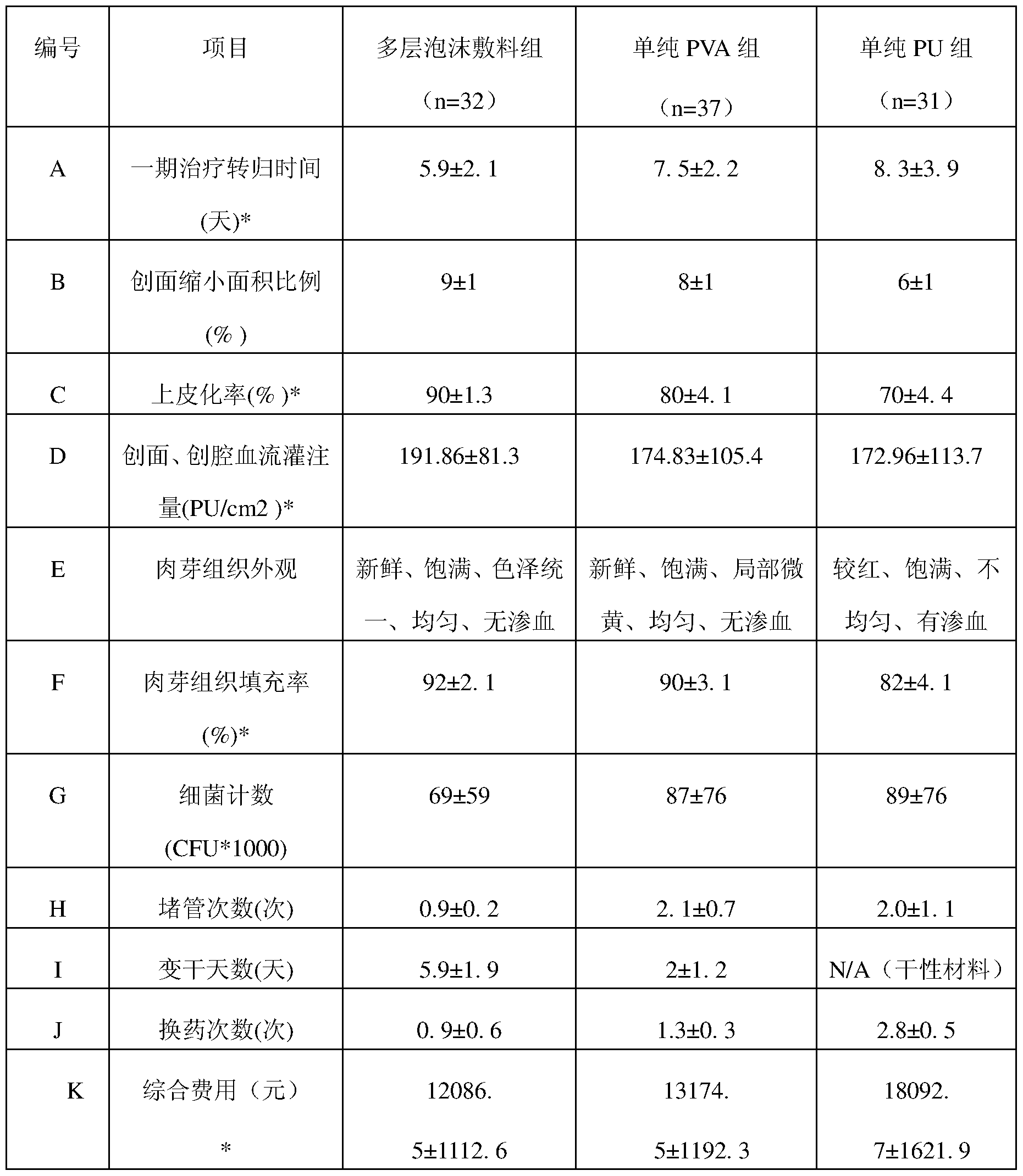
*C: 上皮化率。 上皮化过程包括角质形成细胞的迁移、 增殖和分化三个阶段, 是组 织修复过程的重要标志; 上皮化率是上皮化修复过程的显著指标。
*D: 创面、 创腔血流灌注量, 是指每 100g血液每分钟内能流入每平方厘米的创面 或者创腔腔壁的血液量 (ml); 创面、 创腔血流灌注量越大, 单位面积内毛细血管的生 成越活跃, 肉芽组织的生长速率越快。 PU=m 00g-l.min-l
*F: 肉芽组织填充率, 是指创面、 创腔中肉芽组织填充的比例; 肉芽组织填充率越 大, 表示创面、 创腔被新生肉芽填充的越多, 伤口愈合情况
*0: 细菌计数, 是指单位体积中的活菌个数; 细菌计数越大, 表示感染可能性越大。
*K: 综合费用, 包括住院期间材料费用、 抗生素等药品费用、 手术费、 治疗费、 床 位费、 营养费等。
根据上述对比实验可知, 本发明产品在治疗效果, 综合治疗费用等多方面均优于现 有产品。
综上所述, 本发明的核心是利用外侧为引流保护层的多层复合的泡沫敷料, 巧妙地 解决了现有负压封闭引流泡沫敷料疏水性敷料材料安全性能差, 亲水性敷料负压传导性 能差的问题。在单个泡沫敷料中, 可以根据需要使用双层或多层结构, 极其灵活。 因此, 在不改变本发明原理的前提下, 所做出的任何改变或变形, 均属于本发明的保护范围。
Claims
1. 一种用于负压封闭引流的多层泡沫敷料, 包括负压传导层(1), 其特征在于: 在 负压传导层(1)下部设用于与创面或创腔接触的引流保护层(2), 所述负压传导层(1) 和引流保护层 (2) 均为多孔泡沫材料层; 所述负压传导层 (1) 为疏水性多孔泡沫材料 层, 所述引流保护层(2)为亲水性多孔泡沫材料层, 两层材料之间固定连接且孔隙相互 渗透联通。
2. 根据权利要求 1所述的用于负压封闭引流的多层泡沫敷料, 其特征在于: 所述负 压传导层 (1) 厚度 a为 0.5〜10cm, 孔隙直径为 1〜2.5讓, 所述引流保护层 (2) 厚度 b为 0.1〜3.5cm, 孔隙直径为 0.2〜1讓。
3. 根据权利要求 1或 2所述的用于负压封闭引流的多层泡沫敷料, 其特征在于: 所 述负压传导层 (1) 厚度 3为 1〜3«11, 孔隙直径为 1〜1.5mm。
4. 根据权利要求 1或 2所述的用于负压封闭引流的多层泡沫敷料, 其特征在于: 所 述负压传导层 (1) 厚度 3为3〜6«11, 孔隙直径为 1〜2.0mm。
5. 根据权利要求 1或 2所述的用于负压封闭引流的多层泡沫敷料, 其特征在于: 所 述负压传导层 (1) 厚度 3为6〜9«11, 孔隙直径为 1〜2.5mm。
6. 根据权利要求 1或 2所述的用于负压封闭引流的多层泡沫敷料, 其特征在于: 所 述引流保护层 (2) 厚度 b为 0.3〜0.5cm, 孔隙直径为 0.2〜0.5mm。
7. 根据权利要求 1或 2所述的用于负压封闭引流的多层泡沫敷料, 其特征在于: 所 述引流保护层 (2) 厚度 b为 0.5〜1.5cm, 孔隙直径为 0.5〜1.0讓。
8. 根据权利要求 1或 2所述的用于负压封闭引流的多层泡沫敷料, 其特征在于: 所 述引流保护层 (2 ) 厚度 b为 1. 5〜3. 5cm, 孔隙直径为 0. 8〜1. 0mm。
9. 根据权利要求 1或 2所述的用于负压封闭引流的多层泡沫敷料, 其特征在于: 所 述负压传导层 (1 ) 采用疏水性的 PU泡沫、 EVA泡沫或者复合壳聚糖的 PU泡沫制成。
10. 根据权利要求 1或 2所述的用于负压封闭引流的多层泡沫敷料, 其特征在于: 所述引流保护层(2 )采用 PVA泡沫、 复合壳聚糖的 PVA泡沫或者复合抗菌、抑菌药剂的 PVA泡沫制成。
11. 根据权利要求 1或 2所述的用于负压封闭引流的多层泡沫敷料, 其特征在于: 所述的多层泡沫敷料用于负压引流管安装的产品上时, 有两条纵向断缝 (6), 两条纵向 断缝(6 )位于将安装负压引流管的位置, 由负压引流管安装的一端开口, 纵向断缝(6 ) 的长度只要穿过负压引流管管孔安装的位置即可。
12. 根据权利要求 1或 2所述的用于负压封闭引流的多层泡沫敷料, 其特征在于: 在负压传导层 (1 ) 上部, 即远离创面的一侧设外表面层 (3), 外表面层 (3 ) 固定连接 有在负压传导层 (1 ) 上部。
13. 根据权利要求 12所述的用于负压封闭引流的多层泡沫敷料, 其特征在于: 外表 面层 (3 ) 是多孔泡沫外表面层 (3a), 多孔泡沫外表面层 (3a) 为亲水性多孔泡沫材料 层。
14. 根据权利要求 13所述的用于负压封闭引流的多层泡沫敷料, 其特征在于: 所述 的多孔泡沫外表面层 (3a) 厚度 c为 0. 1〜0. 5cm。
15. 根据权利要求 12所述的用于负压封闭引流的多层泡沫敷料, 其特征在于: 外表 面层 (3) 是一层密封胶膜外表面层 (3b)。
16. 根据权利要求 15所述的用于负压封闭引流的多层泡沫敷料, 其特征在于: 所述 的密封胶膜外表面层 (3b) 厚度为 0.1 0.5mm
17.一种制作如权利要求 1 11所述用于负压封闭引流的多层泡沫敷料的制作方法, 包括以下步骤:
第一步, 切割裁剪制得负压传导层 (1) 和引流保护层 (2);
第二步, 将所述第一步制作的负压传导层 (1) 泡沫材料和引流保护层 (2) 泡沫材 料之间采用点胶粘接的方式固定连接, 两层多孔泡沫材料层接触面上设有点胶点, 点胶 点处由干、 亲水性复合胶将相邻两层多孔泡沫材料层叠放粘接, 形成复合层状结构。
18.一种制作如权利要求 1 11所述用于负压封闭引流的多层泡沫敷料的制作方法, 包括以下步骤:
第一步, 切割裁剪制得负压传导层 (1) 和引流保护层 (2);
第二步, 将负压传导层 (1) 与引流保护层 (2) 之间采用接触面刷胶粘接的方式固 定连接叠放, 制作出多层泡沫材料;
第三步, 将第二步制作的多层泡沫材料在针式穿孔设备上穿孔, 孔径在 l 4mm, 且 保证其针体穿透粘胶层, 使两层泡沫材料之间连通, 制得孔隙互通的多层泡沫敷料。
19.根据权利要求 18所述的用于负压封闭引流的多层泡沫敷料的制作方法,其特征 在于: 所述第三步中, 穿孔的孔径为 2 3
20.一种制作如权利要求 1 11所述用于负压封闭引流的多层泡沫敷料的制作方法, 包括以下步骤:
第一步, 按照设计尺寸切割裁剪制得负压传导层 (1 ) 及引流保护层 (2 );
第二步, 将第一步中裁剪完成的引流保护层(2 )置于模具盒中, 将适量亲水性泡沫 材料发泡原料液注入其表面,静置 10〜30秒,待表面平整后将第一步中裁剪完成的负压 传导层 (1 ) 覆盖于原料液表面, 使用工具对负压传导层 (1 ) 均匀平整的施加压力, 使 负压传导层 (1 ) 与原液面均匀充分接触;
第三步, 将第二步中注入原料液的模具盒加温, 使发泡原料液反应固化成型, 此时 负压传导层 (1 ) 与引流保护层 (2 ) 会复合连接在一起, 而后对中间新发泡的泡沫材料 粘接层进行毛边切割裁剪, 制得双层泡沫敷料。
21.根据权利要求 20所述用于负压封闭引流的多层泡沫敷料的制作方法,其特征在 于: 第三步中发泡反应过程为先加热至 30〜50°C, 持续 0. 5〜1小时, 使之预合; 而后 升温至 50〜90°C, 加热 2〜8小时。
22.根据权利要求 21所述用于负压封闭引流的多层泡沫敷料的制作方法,其特征在 于: 预合温度为 35〜45°C, 加热时间为 0. 5小时。
23.根据权利要求 21所述用于负压封闭引流的多层泡沫敷料的制作方法,其特征在 于: 升温温度为 55〜75°C, 加热时间为 4〜8小时。
24. 根据权利要求 20或 21所述用于负压封闭引流的多层泡沫敷料的制作方法, 其 特征在于: 第三步中亲水性泡沫材料发泡原料液的组分和比例为: 不同聚合度及醇解度 的聚乙烯醇: 强酸: 多元醛: 醇 = 1 : 0. 5〜2: 0. 5〜3: 0. 5〜1。
25. 根据权利要求 24所述用于负压封闭引流的多层泡沫敷料的制作方法, 其特征 在于: 第三步中亲水性泡沫材料发泡原料液还包括所述原料液总质量 0. 5%〜5%的抗菌 剂、 抑菌剂、 增强剂。
26. 一种制作如权利要求 12〜14 所述用于负压封闭引流的多层泡沫敷料的制作方 法, 包括以下步骤:
将权利要求 17〜25之一制得多层泡沫敷料上部加设多孔泡沫外表面层(3a)的方法 是: 将双层泡沫敷料的负压传导层 (1 ) 朝下放置于方形模具盒内, 重复权利要求 20第 二、 第三步, 制得三层泡沫敷料。
27. 一种制作如权利要求 15〜16 所述用于负压封闭引流的多层泡沫敷料的制作方 法, 包括以下步骤: 将权利要求 17〜25之一制作的多层泡沫敷料上部刷胶, 将密封胶膜 外表面层 (3b ) 粘接在上表面, 制得三层泡沫敷料。
28.根据权利要求 17或 18或 20所述的用于负压封闭引流的多层泡沫敷料的制作方 法, 其特征在于: 在多层泡沫敷料上切割两条纵向断缝(6), 纵向断缝(6 )位于负压引 流管安装的位置, 由多层泡沫敷料上负压引流管安装的一端穿过负压引流管管孔安装的 位置伸至多层泡沫敷料中部。
Applications Claiming Priority (4)
| Application Number | Priority Date | Filing Date | Title |
|---|---|---|---|
| CN201310219477.4 | 2013-06-04 | ||
| CN201310219477 | 2013-06-04 | ||
| CN201310393784.4A CN103691010B (zh) | 2013-06-04 | 2013-09-02 | 用于负压封闭引流的多层泡沫敷料及其制作方法 |
| CN201310393784.4 | 2013-09-02 |
Publications (1)
| Publication Number | Publication Date |
|---|---|
| WO2014194786A1 true WO2014194786A1 (zh) | 2014-12-11 |
Family
ID=50352775
Family Applications (1)
| Application Number | Title | Priority Date | Filing Date |
|---|---|---|---|
| PCT/CN2014/078650 Ceased WO2014194786A1 (zh) | 2013-06-04 | 2014-05-28 | 用于负压封闭引流的多层泡沫敷料及其制作方法 |
Country Status (2)
| Country | Link |
|---|---|
| CN (1) | CN103691010B (zh) |
| WO (1) | WO2014194786A1 (zh) |
Cited By (25)
| Publication number | Priority date | Publication date | Assignee | Title |
|---|---|---|---|---|
| WO2018041805A1 (en) * | 2016-08-30 | 2018-03-08 | Smith & Nephew Plc | Systems for applying reduced pressure therapy |
| US10130520B2 (en) | 2012-07-16 | 2018-11-20 | Smith & Nephew, Inc. | Negative pressure wound closure device |
| US10159771B2 (en) | 2013-03-14 | 2018-12-25 | Smith & Nephew Plc | Compressible wound fillers and systems and methods of use in treating wounds with negative pressure |
| US10179073B2 (en) | 2014-01-21 | 2019-01-15 | Smith & Nephew Plc | Wound treatment apparatuses |
| US10201642B2 (en) | 2014-01-21 | 2019-02-12 | Smith & Nephew Plc | Collapsible dressing for negative pressure wound treatment |
| US10220125B2 (en) | 2012-02-03 | 2019-03-05 | Smith & Nephew Plc | Apparatuses and methods for wound therapy |
| US10660992B2 (en) | 2013-10-21 | 2020-05-26 | Smith & Nephew, Inc. | Negative pressure wound closure device |
| WO2020240362A1 (en) * | 2019-05-28 | 2020-12-03 | 3M Innovative Properties Company | Medical dressing for securing a tubiform component of a medical device |
| US11096832B2 (en) | 2016-09-27 | 2021-08-24 | Smith & Nephew Plc | Wound closure devices with dissolvable portions |
| US11123476B2 (en) | 2017-06-14 | 2021-09-21 | Smith & Nephew, Inc. | Fluid removal management and control of wound closure in wound therapy |
| US11166726B2 (en) | 2011-02-04 | 2021-11-09 | University Of Massachusetts | Negative pressure wound closure device |
| US11241337B2 (en) | 2012-05-24 | 2022-02-08 | Smith & Nephew, Inc. | Devices and methods for treating and closing wounds with negative pressure |
| US11324876B2 (en) | 2017-06-13 | 2022-05-10 | Smith & Nephew Plc | Collapsible structure and method of use |
| US11375923B2 (en) | 2017-08-29 | 2022-07-05 | Smith & Nephew Plc | Systems and methods for monitoring wound closure |
| US11395873B2 (en) | 2017-06-14 | 2022-07-26 | Smith & Nephew, Inc. | Control of wound closure and fluid removal management in wound therapy |
| US11419767B2 (en) | 2013-03-13 | 2022-08-23 | University Of Massachusetts | Negative pressure wound closure device and systems and methods of use in treating wounds with negative pressure |
| US11439539B2 (en) | 2015-04-29 | 2022-09-13 | University Of Massachusetts | Negative pressure wound closure device |
| US11471586B2 (en) | 2015-12-15 | 2022-10-18 | University Of Massachusetts | Negative pressure wound closure devices and methods |
| US11583623B2 (en) | 2017-06-14 | 2023-02-21 | Smith & Nephew Plc | Collapsible structure for wound closure and method of use |
| US11590030B2 (en) | 2017-08-07 | 2023-02-28 | Smith & Nephew Plc | Wound closure device with protective layer and method of use |
| US11607344B2 (en) | 2017-07-27 | 2023-03-21 | Smith & Nephew Plc | Customizable wound closure device and method of use |
| US11617684B2 (en) | 2016-11-02 | 2023-04-04 | Smith & Nephew, Inc. | Wound closure devices |
| US11724020B2 (en) | 2017-06-14 | 2023-08-15 | Smith & Nephew Plc | Collapsible sheet for wound closure and method of use |
| US11872110B2 (en) | 2017-06-13 | 2024-01-16 | Smith & Nephew Plc | Wound closure device and method of use |
| US12533440B2 (en) | 2013-03-15 | 2026-01-27 | Smith & Nephew Plc | Wound dressing and method of treatment |
Families Citing this family (10)
| Publication number | Priority date | Publication date | Assignee | Title |
|---|---|---|---|---|
| CN103691010B (zh) * | 2013-06-04 | 2016-09-14 | 武汉维斯第医用科技股份有限公司 | 用于负压封闭引流的多层泡沫敷料及其制作方法 |
| CN104225768B (zh) * | 2014-06-16 | 2017-01-04 | 武汉维斯第医用科技股份有限公司 | 一种多层负压封闭引流护创装置 |
| CN105944220A (zh) * | 2016-05-18 | 2016-09-21 | 浙江保尔曼生物科技有限公司 | 可冲洗负压引流装置 |
| CN106916399B (zh) * | 2017-03-17 | 2018-05-15 | 广州润虹医药科技股份有限公司 | 一种环境友好型多功能复合负压引流护创海绵及其制备方法 |
| CN110996867A (zh) * | 2017-06-12 | 2020-04-10 | 凯希特许有限公司 | 发泡且纹理化的烧结聚合物伤口填料 |
| CN110025430A (zh) * | 2019-04-04 | 2019-07-19 | 江门泓一生物医疗科技有限公司 | 一种防堵塞负压引流装置 |
| CN110152052A (zh) * | 2019-05-17 | 2019-08-23 | 武汉大学 | 一种多功能医用材料及其制备方法 |
| CN112826630B (zh) * | 2019-11-22 | 2024-09-27 | 四川大学华西医院 | 一种肛瘘内口封闭引流器 |
| CN112773927B (zh) * | 2020-12-24 | 2022-09-13 | 江苏申思生物科技有限公司 | 一种高效环保的pva/pu多层泡沫敷料制作方法 |
| CN117224728A (zh) * | 2023-10-10 | 2023-12-15 | 上海亚澳医用保健品有限公司 | 一种硅凝胶泡沫敷料的生产方法及硅凝胶泡沫敷料 |
Citations (5)
| Publication number | Priority date | Publication date | Assignee | Title |
|---|---|---|---|---|
| CN1438904A (zh) * | 2000-05-09 | 2003-08-27 | Kci特许公司 | 腹部创口敷料 |
| WO2005123170A1 (en) * | 2004-06-21 | 2005-12-29 | Ethicon, Inc. | Wound dressings for vacuum therapy |
| CN101720242A (zh) * | 2007-06-27 | 2010-06-02 | 莫恩里克保健公司 | 用降压处理创面的装置 |
| CN102143726A (zh) * | 2008-09-18 | 2011-08-03 | 凯希特许有限公司 | 用于在组织部位施加减压的多层敷料、系统和方法 |
| CN103691010A (zh) * | 2013-06-04 | 2014-04-02 | 武汉维斯第医用科技股份有限公司 | 用于负压封闭引流的多层泡沫敷料及其制作方法 |
Family Cites Families (2)
| Publication number | Priority date | Publication date | Assignee | Title |
|---|---|---|---|---|
| CA2090795A1 (en) * | 1992-11-19 | 1994-05-20 | Donald Joseph Sanders | Method and apparatus for sealing absorbent materials in an absorbent product |
| CN102631698A (zh) * | 2012-04-28 | 2012-08-15 | 厦门银华祥环保科技有限公司 | 一种超吸水抗菌无纺布及抗菌敷料、制备方法和应用 |
-
2013
- 2013-09-02 CN CN201310393784.4A patent/CN103691010B/zh active Active
-
2014
- 2014-05-28 WO PCT/CN2014/078650 patent/WO2014194786A1/zh not_active Ceased
Patent Citations (5)
| Publication number | Priority date | Publication date | Assignee | Title |
|---|---|---|---|---|
| CN1438904A (zh) * | 2000-05-09 | 2003-08-27 | Kci特许公司 | 腹部创口敷料 |
| WO2005123170A1 (en) * | 2004-06-21 | 2005-12-29 | Ethicon, Inc. | Wound dressings for vacuum therapy |
| CN101720242A (zh) * | 2007-06-27 | 2010-06-02 | 莫恩里克保健公司 | 用降压处理创面的装置 |
| CN102143726A (zh) * | 2008-09-18 | 2011-08-03 | 凯希特许有限公司 | 用于在组织部位施加减压的多层敷料、系统和方法 |
| CN103691010A (zh) * | 2013-06-04 | 2014-04-02 | 武汉维斯第医用科技股份有限公司 | 用于负压封闭引流的多层泡沫敷料及其制作方法 |
Cited By (47)
| Publication number | Priority date | Publication date | Assignee | Title |
|---|---|---|---|---|
| US11166726B2 (en) | 2011-02-04 | 2021-11-09 | University Of Massachusetts | Negative pressure wound closure device |
| US10220125B2 (en) | 2012-02-03 | 2019-03-05 | Smith & Nephew Plc | Apparatuses and methods for wound therapy |
| US11241337B2 (en) | 2012-05-24 | 2022-02-08 | Smith & Nephew, Inc. | Devices and methods for treating and closing wounds with negative pressure |
| US10130520B2 (en) | 2012-07-16 | 2018-11-20 | Smith & Nephew, Inc. | Negative pressure wound closure device |
| US11564843B2 (en) | 2012-07-16 | 2023-01-31 | University Of Massachusetts | Negative pressure wound closure device |
| US11083631B2 (en) | 2012-07-16 | 2021-08-10 | University Of Massachusetts | Negative pressure wound closure device |
| US11419767B2 (en) | 2013-03-13 | 2022-08-23 | University Of Massachusetts | Negative pressure wound closure device and systems and methods of use in treating wounds with negative pressure |
| US10159771B2 (en) | 2013-03-14 | 2018-12-25 | Smith & Nephew Plc | Compressible wound fillers and systems and methods of use in treating wounds with negative pressure |
| US12447055B2 (en) | 2013-03-14 | 2025-10-21 | Smith & Nephew Plc | Compressible wound fillers and systems and methods of use in treating wounds with negative pressure |
| US11097044B2 (en) | 2013-03-14 | 2021-08-24 | Smith & Nephew Plc | Compressible wound fillers and systems and methods of use in treating wounds with negative pressure |
| US12533440B2 (en) | 2013-03-15 | 2026-01-27 | Smith & Nephew Plc | Wound dressing and method of treatment |
| US12239509B2 (en) | 2013-10-21 | 2025-03-04 | Smith & Nephew, Inc. | Negative pressure wound closure device |
| US10660992B2 (en) | 2013-10-21 | 2020-05-26 | Smith & Nephew, Inc. | Negative pressure wound closure device |
| US12133790B2 (en) | 2013-10-21 | 2024-11-05 | Smith & Nephew, Inc. | Negative pressure wound closure device |
| US11344665B2 (en) | 2014-01-21 | 2022-05-31 | Smith & Nephew Plc | Collapsible dressing for negative pressure wound treatment |
| US10201642B2 (en) | 2014-01-21 | 2019-02-12 | Smith & Nephew Plc | Collapsible dressing for negative pressure wound treatment |
| US10179073B2 (en) | 2014-01-21 | 2019-01-15 | Smith & Nephew Plc | Wound treatment apparatuses |
| US12642905B2 (en) | 2014-01-21 | 2026-06-02 | Smith & Nephew Plc | Collapsible dressing for negative pressure wound treatment |
| US12324727B2 (en) | 2014-01-21 | 2025-06-10 | Smith & Nephew Plc | Wound treatment apparatuses |
| US11103385B2 (en) | 2014-01-21 | 2021-08-31 | Smith & Nephew Plc | Wound treatment apparatuses |
| US11439539B2 (en) | 2015-04-29 | 2022-09-13 | University Of Massachusetts | Negative pressure wound closure device |
| US11471586B2 (en) | 2015-12-15 | 2022-10-18 | University Of Massachusetts | Negative pressure wound closure devices and methods |
| JP7038701B2 (ja) | 2016-08-30 | 2022-03-18 | スミス アンド ネフュー ピーエルシー | 減圧療法を適用するためのシステム |
| JP2019526336A (ja) * | 2016-08-30 | 2019-09-19 | スミス アンド ネフュー ピーエルシーSmith & Nephew Public Limited Company | 減圧療法を適用するためのシステム |
| US11135351B2 (en) | 2016-08-30 | 2021-10-05 | Smith & Nephew Plc | Systems and methods for applying reduced pressure therapy |
| WO2018041805A1 (en) * | 2016-08-30 | 2018-03-08 | Smith & Nephew Plc | Systems for applying reduced pressure therapy |
| US11096832B2 (en) | 2016-09-27 | 2021-08-24 | Smith & Nephew Plc | Wound closure devices with dissolvable portions |
| US11617684B2 (en) | 2016-11-02 | 2023-04-04 | Smith & Nephew, Inc. | Wound closure devices |
| US11872110B2 (en) | 2017-06-13 | 2024-01-16 | Smith & Nephew Plc | Wound closure device and method of use |
| US12082999B2 (en) | 2017-06-13 | 2024-09-10 | Smith & Nephew Plc | Wound closure device and method of use |
| US11324876B2 (en) | 2017-06-13 | 2022-05-10 | Smith & Nephew Plc | Collapsible structure and method of use |
| US12127918B2 (en) | 2017-06-13 | 2024-10-29 | Smith & Nephew Plc | Collapsible structure and method of use |
| US11583623B2 (en) | 2017-06-14 | 2023-02-21 | Smith & Nephew Plc | Collapsible structure for wound closure and method of use |
| US11690948B2 (en) | 2017-06-14 | 2023-07-04 | Smith & Nephew, Inc. | Fluid removal management and control of wound closure in wound therapy |
| US11938002B2 (en) | 2017-06-14 | 2024-03-26 | Smith & Nephew, Inc. | Control of wound closure and fluid removal management in wound therapy |
| US12005180B2 (en) | 2017-06-14 | 2024-06-11 | Smith & Nephew Plc | Collapsible sheet for wound closure and method of use |
| US12082998B2 (en) | 2017-06-14 | 2024-09-10 | Smith & Nephew Plc | Collapsible structure for wound closure and method of use |
| US11724020B2 (en) | 2017-06-14 | 2023-08-15 | Smith & Nephew Plc | Collapsible sheet for wound closure and method of use |
| US11123476B2 (en) | 2017-06-14 | 2021-09-21 | Smith & Nephew, Inc. | Fluid removal management and control of wound closure in wound therapy |
| US11395873B2 (en) | 2017-06-14 | 2022-07-26 | Smith & Nephew, Inc. | Control of wound closure and fluid removal management in wound therapy |
| US11607344B2 (en) | 2017-07-27 | 2023-03-21 | Smith & Nephew Plc | Customizable wound closure device and method of use |
| US12097096B2 (en) | 2017-07-27 | 2024-09-24 | Smith & Nephew Plc | Customizable wound closure device and method of use |
| US11590030B2 (en) | 2017-08-07 | 2023-02-28 | Smith & Nephew Plc | Wound closure device with protective layer and method of use |
| US12521280B2 (en) | 2017-08-07 | 2026-01-13 | Smith & Nephew Plc | Wound closure device with protective layer and method of use |
| US11375923B2 (en) | 2017-08-29 | 2022-07-05 | Smith & Nephew Plc | Systems and methods for monitoring wound closure |
| CN113853187A (zh) * | 2019-05-28 | 2021-12-28 | 3M创新有限公司 | 用于固定医疗装置的管形部件的医用敷料 |
| WO2020240362A1 (en) * | 2019-05-28 | 2020-12-03 | 3M Innovative Properties Company | Medical dressing for securing a tubiform component of a medical device |
Also Published As
| Publication number | Publication date |
|---|---|
| CN103691010A (zh) | 2014-04-02 |
| CN103691010B (zh) | 2016-09-14 |
Similar Documents
| Publication | Publication Date | Title |
|---|---|---|
| CN103691010B (zh) | 用于负压封闭引流的多层泡沫敷料及其制作方法 | |
| CN103394155B (zh) | 一次性便携式负压创面治疗系统 | |
| CN203244673U (zh) | 一种含纳米银聚氨酯敷料的封闭式负压引流装置 | |
| JP2020520749A (ja) | 伸縮性被覆材 | |
| CN101249274A (zh) | 促进伤口愈合的白芨多糖水凝胶的制备及其应用 | |
| CN209154217U (zh) | 一种新型医用水凝胶复合敷料 | |
| CN104013493B (zh) | 一种内置冲洗滴注管的封闭创面敷料装置 | |
| CN104383585B (zh) | 一种三维纳米复合材料创可贴及其制备和使用方法 | |
| WO2016029602A1 (zh) | 一种粘稠渗液、血液整体吸收敷料 | |
| CN202822443U (zh) | 一种封闭式负压引流装置 | |
| CN104857552A (zh) | 一种止血贴及其制备方法 | |
| CN104225768A (zh) | 一种多层负压封闭引流护创装置 | |
| CN217391248U (zh) | 一种便携式感染伤口负压吸引装置 | |
| CN104324412B (zh) | 一种竹原壳聚糖功能性敷料 | |
| CN204352016U (zh) | 后躯深ⅱ度烧伤创面专用敷料 | |
| CN202207239U (zh) | 一种新型的创伤贴 | |
| CN203408345U (zh) | 一次性便携式负压伤口治疗套装 | |
| CN103876890A (zh) | 一种湿性敷料 | |
| CN204147173U (zh) | 一种活性碳纤维复合型敷料 | |
| CN221888547U (zh) | 一种带冲洗换药功能的负压封闭引流敷料 | |
| CN219022534U (zh) | 负压引流泡沫敷料 | |
| CN204072475U (zh) | 一种复合水凝胶伤口敷料 | |
| CN209108370U (zh) | 胸腔引流管贴膜 | |
| CN220090052U (zh) | 一种具有防粘连涂层的高渗液吸收性pva压缩海绵 | |
| CN217908465U (zh) | 用于负压封闭引流的球珠支撑桥接样防堵引流装置 |
Legal Events
| Date | Code | Title | Description |
|---|---|---|---|
| 121 | Ep: the epo has been informed by wipo that ep was designated in this application |
Ref document number: 14806876 Country of ref document: EP Kind code of ref document: A1 |
|
| NENP | Non-entry into the national phase |
Ref country code: DE |
|
| 122 | Ep: pct application non-entry in european phase |
Ref document number: 14806876 Country of ref document: EP Kind code of ref document: A1 |