WO2014178435A1 - Compound having azo skeleton structure, pigment-dispersing agent, pigment composition, pigment dispersion, and toner - Google Patents
Compound having azo skeleton structure, pigment-dispersing agent, pigment composition, pigment dispersion, and toner Download PDFInfo
- Publication number
- WO2014178435A1 WO2014178435A1 PCT/JP2014/062123 JP2014062123W WO2014178435A1 WO 2014178435 A1 WO2014178435 A1 WO 2014178435A1 JP 2014062123 W JP2014062123 W JP 2014062123W WO 2014178435 A1 WO2014178435 A1 WO 2014178435A1
- Authority
- WO
- WIPO (PCT)
- Prior art keywords
- group
- tnr
- dis
- pigment
- compound
- Prior art date
- Legal status (The legal status is an assumption and is not a legal conclusion. Google has not performed a legal analysis and makes no representation as to the accuracy of the status listed.)
- Ceased
Links
- 0 CC(*C(*)=C1*C(*C2)=C34)=C(*)C1=C3NC(*)C4=C2c1c(C)c(*)c(*)c([Ru-])c1* Chemical compound CC(*C(*)=C1*C(*C2)=C34)=C(*)C1=C3NC(*)C4=C2c1c(C)c(*)c(*)c([Ru-])c1* 0.000 description 2
Classifications
-
- G—PHYSICS
- G03—PHOTOGRAPHY; CINEMATOGRAPHY; ANALOGOUS TECHNIQUES USING WAVES OTHER THAN OPTICAL WAVES; ELECTROGRAPHY; HOLOGRAPHY
- G03G—ELECTROGRAPHY; ELECTROPHOTOGRAPHY; MAGNETOGRAPHY
- G03G9/00—Developers
- G03G9/08—Developers with toner particles
- G03G9/09—Colouring agents for toner particles
- G03G9/0906—Organic dyes
- G03G9/091—Azo dyes
-
- C—CHEMISTRY; METALLURGY
- C08—ORGANIC MACROMOLECULAR COMPOUNDS; THEIR PREPARATION OR CHEMICAL WORKING-UP; COMPOSITIONS BASED THEREON
- C08F—MACROMOLECULAR COMPOUNDS OBTAINED BY REACTIONS ONLY INVOLVING CARBON-TO-CARBON UNSATURATED BONDS
- C08F8/00—Chemical modification by after-treatment
- C08F8/34—Introducing sulfur atoms or sulfur-containing groups
-
- C—CHEMISTRY; METALLURGY
- C09—DYES; PAINTS; POLISHES; NATURAL RESINS; ADHESIVES; COMPOSITIONS NOT OTHERWISE PROVIDED FOR; APPLICATIONS OF MATERIALS NOT OTHERWISE PROVIDED FOR
- C09B—ORGANIC DYES OR CLOSELY-RELATED COMPOUNDS FOR PRODUCING DYES, e.g. PIGMENTS; MORDANTS; LAKES
- C09B29/00—Monoazo dyes prepared by diazotising and coupling
- C09B29/32—Monoazo dyes prepared by diazotising and coupling from coupling components containing a reactive methylene group
- C09B29/33—Aceto- or benzoylacetylarylides
- C09B29/335—Aceto- or benzoylacetylarylides free of acid groups
- C09B29/337—Carbocyclic arylides
-
- C—CHEMISTRY; METALLURGY
- C09—DYES; PAINTS; POLISHES; NATURAL RESINS; ADHESIVES; COMPOSITIONS NOT OTHERWISE PROVIDED FOR; APPLICATIONS OF MATERIALS NOT OTHERWISE PROVIDED FOR
- C09B—ORGANIC DYES OR CLOSELY-RELATED COMPOUNDS FOR PRODUCING DYES, e.g. PIGMENTS; MORDANTS; LAKES
- C09B33/00—Disazo and polyazo dyes of the types A->K<-B, A->B->K<-C, or the like, prepared by diazotising and coupling
- C09B33/02—Disazo dyes
- C09B33/153—Disazo dyes in which the coupling component is a bis-(aceto-acetyl amide) or a bis-(benzoyl-acetylamide)
-
- C—CHEMISTRY; METALLURGY
- C09—DYES; PAINTS; POLISHES; NATURAL RESINS; ADHESIVES; COMPOSITIONS NOT OTHERWISE PROVIDED FOR; APPLICATIONS OF MATERIALS NOT OTHERWISE PROVIDED FOR
- C09B—ORGANIC DYES OR CLOSELY-RELATED COMPOUNDS FOR PRODUCING DYES, e.g. PIGMENTS; MORDANTS; LAKES
- C09B69/00—Dyes not provided for by a single group of this subclass
- C09B69/10—Polymeric dyes; Reaction products of dyes with monomers or with macromolecular compounds
- C09B69/106—Polymeric dyes; Reaction products of dyes with monomers or with macromolecular compounds containing an azo dye
-
- C—CHEMISTRY; METALLURGY
- C09—DYES; PAINTS; POLISHES; NATURAL RESINS; ADHESIVES; COMPOSITIONS NOT OTHERWISE PROVIDED FOR; APPLICATIONS OF MATERIALS NOT OTHERWISE PROVIDED FOR
- C09D—COATING COMPOSITIONS, e.g. PAINTS, VARNISHES OR LACQUERS; FILLING PASTES; CHEMICAL PAINT OR INK REMOVERS; INKS; CORRECTING FLUIDS; WOODSTAINS; PASTES OR SOLIDS FOR COLOURING OR PRINTING; USE OF MATERIALS THEREFOR
- C09D17/00—Pigment pastes, e.g. for mixing in paints
-
- G—PHYSICS
- G03—PHOTOGRAPHY; CINEMATOGRAPHY; ANALOGOUS TECHNIQUES USING WAVES OTHER THAN OPTICAL WAVES; ELECTROGRAPHY; HOLOGRAPHY
- G03G—ELECTROGRAPHY; ELECTROPHOTOGRAPHY; MAGNETOGRAPHY
- G03G9/00—Developers
- G03G9/08—Developers with toner particles
- G03G9/087—Binders for toner particles
-
- G—PHYSICS
- G03—PHOTOGRAPHY; CINEMATOGRAPHY; ANALOGOUS TECHNIQUES USING WAVES OTHER THAN OPTICAL WAVES; ELECTROGRAPHY; HOLOGRAPHY
- G03G—ELECTROGRAPHY; ELECTROPHOTOGRAPHY; MAGNETOGRAPHY
- G03G9/00—Developers
- G03G9/08—Developers with toner particles
- G03G9/09—Colouring agents for toner particles
-
- G—PHYSICS
- G03—PHOTOGRAPHY; CINEMATOGRAPHY; ANALOGOUS TECHNIQUES USING WAVES OTHER THAN OPTICAL WAVES; ELECTROGRAPHY; HOLOGRAPHY
- G03G—ELECTROGRAPHY; ELECTROPHOTOGRAPHY; MAGNETOGRAPHY
- G03G9/00—Developers
- G03G9/08—Developers with toner particles
- G03G9/09—Colouring agents for toner particles
- G03G9/0902—Inorganic compounds
- G03G9/0904—Carbon black
-
- G—PHYSICS
- G03—PHOTOGRAPHY; CINEMATOGRAPHY; ANALOGOUS TECHNIQUES USING WAVES OTHER THAN OPTICAL WAVES; ELECTROGRAPHY; HOLOGRAPHY
- G03G—ELECTROGRAPHY; ELECTROPHOTOGRAPHY; MAGNETOGRAPHY
- G03G9/00—Developers
- G03G9/08—Developers with toner particles
- G03G9/09—Colouring agents for toner particles
- G03G9/0906—Organic dyes
- G03G9/0918—Phthalocyanine dyes
-
- G—PHYSICS
- G03—PHOTOGRAPHY; CINEMATOGRAPHY; ANALOGOUS TECHNIQUES USING WAVES OTHER THAN OPTICAL WAVES; ELECTROGRAPHY; HOLOGRAPHY
- G03G—ELECTROGRAPHY; ELECTROPHOTOGRAPHY; MAGNETOGRAPHY
- G03G9/00—Developers
- G03G9/08—Developers with toner particles
- G03G9/09—Colouring agents for toner particles
- G03G9/0906—Organic dyes
- G03G9/092—Quinacridones
-
- G—PHYSICS
- G03—PHOTOGRAPHY; CINEMATOGRAPHY; ANALOGOUS TECHNIQUES USING WAVES OTHER THAN OPTICAL WAVES; ELECTROGRAPHY; HOLOGRAPHY
- G03G—ELECTROGRAPHY; ELECTROPHOTOGRAPHY; MAGNETOGRAPHY
- G03G9/00—Developers
- G03G9/08—Developers with toner particles
- G03G9/09—Colouring agents for toner particles
- G03G9/0906—Organic dyes
- G03G9/0924—Dyes characterised by specific substituents
Definitions
- the present invention relates to a compound having an azo skeleton structure, a pigment-dispersing agent containing the compound, a pigment composition, a pigment dispersion containing the pigment composition, and a toner.
- pigments having fine particle diameters are liable to disperse insufficiently in media such as organic solvent and molten resins because the cohesive force between pigment particles tends to be strong. In the case where pigments have insufficient dispersibility and are in an aggregate state, a reduction in tinting strength is caused .
- PTL 1 discloses, as a technique for dispersing an azo-based pigment in a yellow toner, a
- a structure is used in combination with a binder resin and a pigment to provide a yellow toner having a satisfactory color tone.
- PTL 2 discloses, as a technique for dispersing a pigment in a magenta toner, a technique in which a specific polyester-based dispersant is used in combination with a binder resin and a pigment to increase the dispersibility of a magenta pigment and improve the tinting strength of the toner .
- PTL 3 discloses, as a technique for improving the dispersibility of a phthalocyanine pigment, an example in which a polymer containing sodium styrenesulfonate serving as a monomer unit is used as a dispersant.
- PTL 4 discloses a toner containing a copolymer composed of a styrene-based monomer and an acrylate-based (or methacrylate-based) monomer in order to improve the dispersibility of carbon black in a black toner.
- target pigments are limited. The effect is not sufficiently provided for various pigments.
- the compound having an azo skeleton structure is used as a pigment-dispersing agent disclosed in PTL 1
- satisfactory pigment dispersibility is provided for various pigments to some extent.
- a pigment- dispersing agent is required to have a higher dispersion effect .
- the present invention provides a compound capable of improving the dispersibility of yellow, magenta, cyan, and black pigments in a water-insoluble solvent and a pigment-dispersing agent.
- the present invention also provides a pigment composition, a pigment dispersion, and a toner, which have satisfactory tinting strength.
- a first aspect of the present invention relates to a compound having a structure in which a moiety represented by the following formula (1) is bound to a polymer portion having a monomer unit represented by the following formula (2) via a linking group in the moiety,
- an alkyl group selected from the group consisting of an alkyl group, an alkoxy group, a halogen atom, a hydroxy group, a cyano group, a trifluoromethyl group, a carboxy group, a carboxylate group, a carboxamide group, an SOORg group, an NRioSOORn group, and the linking group,
- Ri represents an alkyl group, a phenyl group, or the linking group
- R 2 to R 6 each independently represent a hydrogen atom, an SOOR 6 o group, an NR 6 iSOOR62 group, or the linking group,
- R 9 and R 60 each independently represent an 0Ri 2 group, an NR13R14 group, or an NRi 5 CONRi 6 Ri 7 group,
- io/ r 61A and R 15 each independently represent a hydrogen atom or an alkyl group
- Rn and R 62 each independently represent an alkyl group, a phenyl group, or an aralkyl group,
- Ri 2 represents a hydrogen atom, an alkyl group, a phenyl group, an aralkyl group, an alkali metal ion, or a
- Ri3 and R 14 each independently represent a hydrogen atom, an alkyl group, an aryl group, or an aralkyl group,
- Rx6 and Ri 7 each independently represent a hydrogen atom, an alkyl group, a phenyl group, or an aralkyl group,
- Ari and R 2 to R6 satisfy at least one of requirements i) and ii) described below,
- Ari represents an aryl group having the substituent, the aryl group having an SOOR 9 group or an NRioSOORn group serving as the substituent, and
- R 2 to R 6 represents an SOOR 6 o group or an NR 6 1SOOR 62 group, and wherein
- substituent is the linking group
- R 7 represents a
- Ra represents a phenyl group, a carboxy group, a carboxylate group, or a
- a second aspect of the present invention relates to a pigment-dispersing agent containing the compound.
- a third aspect of the present invention relates to a pigment composition containing the pigment-dispersing agent and a pigment.
- a fourth aspect of the present invention relates to a pigment dispersion containing the pigment composition and a water-insoluble solvent.
- a fifth aspect of the present invention relates to a toner including toner particles containing a binder resin and a colorant, in which the colorant is the pigment
- a compound and a pigment-dispersing agent according to embodiments of the present invention improve the
- a pigment composition, a pigment dispersion, and a toner of embodiments of the present invention have satisfactory tinting strength.
- Fig. 1 is a 13 C NMR spectrum of compound (C-l) of an embodiment of the present invention in CDCI 3 at 600 MHz and room temperature.
- Fig. 2 is a 13 C NMR spectrum of compound (C-15) of an embodiment of the present invention in CDCI 3 at 600 MHz and room temperature.
- Fig. 3 is a 13 C NMR spectrum of compound (C-44) of an embodiment of the present invention in CDCI 3 at 600 MHz and room temperature.
- a compound of an embodiment of the present invention has a structure in which a moiety represented by the following formula (1) is bound to a polymer portion having a monomer unit represented by the following formula (2) via a linking group in the moiety:
- an alkyl group selected from the group consisting of an alkyl group, an alkoxy group, a halogen atom, a hydroxy group, a cyano group, a trifluoromethyl group, a carboxy group, a carboxylate group, a carboxamide group, an SOOR 9 group, an Rio SOORn group, and the linking group,
- Ri represents an alkyl group, a phenyl group, or the linking group
- R2 to R6 each independently represent a hydrogen atom, an SOOR 6 o group, an R 6 iSOOR 6 2 group, or the linking group,
- R 9 and R 6 o each independently represent an OR12 group, an NR 13 R14 group, or an NRi 5 CONRi 6 Ri7 group,
- R6ir and R i5 each independently represent a hydrogen atom or an alkyl group
- Rn and R 6 2 each independently represent an alkyl group, a phenyl group, or an aralkyl group
- Ri2 represents a hydrogen atom, an alkyl group, a phenyl group, an aralkyl group, an alkali metal ion, or a
- Ri3 and R i4 each independently represent a hydrogen atom, an alkyl group, an aryl group, or an aralkyl group,
- Ri6 and R i7 each independently represent a hydrogen atom, an alkyl group, a phenyl group, or an aralkyl group,
- Ari and R 2 to R 6 satisfy at least one of requirements i) and ii) described below,
- Ari represents an aryl group having the substituent, the aryl group having an SOORg group or an NRioSOORn group serving as the substituent, and
- R 2 to R6 represents an SOOR60 group or an NR 6 iSOOR 62 group, and wherein
- Ari represents an aryl group having the
- substituent is the linking group
- R 7 represents a hydrogen atom or an alkyl group
- R 8 represents a phenyl group, a carboxy group, a carboxylate group, or a
- the compound having an azo skeleton structure is composed of the azo skeleton structure represented by the formula (1) and the polymer portion having the monomer unit represented by the formula (2), the azo skeleton structure having a high affinity for various pigments, and the monomer unit having a high affinity for a water-insoluble solvent.
- Azo skeleton structure of compound having azo skeleton structure is composed of the azo skeleton structure represented by the formula (1) and the polymer portion having the monomer unit represented by the formula (2), the azo skeleton structure having a high affinity for various pigments, and the monomer unit having a high affinity for a water-insoluble solvent.
- Examples of an alkyl group represented by R x in the formula (1) include straight, branched, and cyclic alkyl groups, such as a methyl group, an ethyl group, a n-propyl group, a n-butyl group, a n-pentyl group, a n-hexyl group, an isopropyl group, an isobutyl group, a sec-butyl group, tert-butyl group, and a cyclohexyl group.
- the alkyl group or the phenyl group represented by Ri in the formula (1) may be substituted with a substituent as long as the affinity for a pigment is not significantly inhibited.
- a substituent examples include a halogen atom, a nitro group, an amino group, a hydroxy group, a cyano group, and trifluoromethyl group.
- R x in the formula (1) may represent a methyl group from the viewpoint of achieving a good affinity for a pigment.
- R 9 and R 6 o n the formula (1) each represent an ORi 2 group, an Ri 3 Ri 4 group, or an NRi 5 CO Ri 6 Ri7 group.
- Examples of the alkyl group represented by R12 in the formula (1) include straight, branched, and cyclic alkyl groups, such as a methyl group, an ethyl group, a n-propyl group, a n-butyl group, a n-pentyl group, a n-hexyl group, an isopropyl group, an isobutyl group, a sec-butyl group, a tert-butyl group, and a cyclohexyl group.
- Examples of the aralkyl group represented by R12 in the formula (1) include a benzyl group and a phenethyl group.
- the alkali metal ion represented by R 12 in the formula (1) may be an alkali metal ion that forms a salt with S0 3 ⁇ . Examples thereof include a lithium ion, a sodium ion, and potassium ion.
- the quaternary ammonium ion represented by R 12 may be a quaternary ammonium ion that forms a salt with SC>3 ⁇ . Examples thereof include an ammonium ion, a methylammonium ion, a dimethylammonium ion, a trimethylammonium ion, a tetramethylammonium ion, an ethylammonium ion, a
- diethylammonium ion diethylammonium ion, a triethylammonium ion, a
- Each of the alkyl group, the phenyl group, and the aralkyl group represented by R i2 in the formula (1) may be substituted with a substituent as long as the affinity for a pigment is not significantly inhibited.
- substituents include a halogen atom, a nitro group, an amino group, a hydroxy group, a cyano group, and a trifluoromethyl group .
- R 12 in the formula (1) may represent a hydrogen atom from the viewpoint of achieving a good affinity for a pigment.
- Examples of the alkyl group represented by R13 or Ri4 in the formula (1) include straight, branched, and cyclic alkyl groups, such as a methyl group, an ethyl group, a n- propyl group, a n-butyl group, a n-pentyl group, a n-hexyl group, an isopropyl group, an isobutyl group, a sec-butyl group, a_ tert-butyl group, and a cyclohexyl group.
- Examples of the aryl group represented by R13 or R 14 in the formula (1) include a phenyl group and a naphthyl group .
- Examples of the aralkyl group represented by R i3 or R14 in the formula (1) include a benzyl group and a phenethyl group .
- Each of the alkyl group, the aryl group, and the aralkyl group represented by R i3 or R 14 in the formula (1) may be substituted with a substituent as long as the
- substituents examples include a halogen atom, a nitro group, an amino group, a hydroxy group, a cyano group, and trifluoromethyl group.
- R13 or R i4 in the formula (1) may represent a hydrogen atom from the viewpoint of achieving a good affinity for a pigment.
- Examples of the alkyl group represented by Ri 5 in the formula (1) include straight, branched, and cyclic alkyl groups, such as a methyl group, an ethyl group, a n-propyl group, a n-butyl group, a n-pentyl group, a n-hexyl group, an isopropyl group, an isobutyl group, a sec-butyl group, a tert-butyl group, and a cyclohexyl group.
- the alkyl group represented by R i5 in the formula (1) may be substituted with a substituent as long as the affinity for a pigment is not significantly inhibited.
- substituents examples include a halogen atom, a nitro group, an amino group, a hydroxy group, a cyano group, and a trifluoromethyl group.
- R 15 in the formula (1) may represent a hydrogen atom from the viewpoint of
- Examples of the alkyl group represented by Rig or Ri7 in the formula (1) include straight, branched, and cyclic alkyl groups, such as a methyl group, an ethyl group, a n- propyl group, a n-butyl group, a n-pentyl group, a n-hexyl group, an isopropyl group, an isobutyl group, a sec-butyl group, a tert-butyl group, and a cyclohexyl group.
- straight, branched, and cyclic alkyl groups such as a methyl group, an ethyl group, a n- propyl group, a n-butyl group, a n-pentyl group, a n-hexyl group, an isopropyl group, an isobutyl group, a sec-butyl group, a tert-butyl group, and a
- Examples of the aralkyl group represented by Ri6 or Ri7 in the formula (1) include a benzyl group and a phenethyl group .
- Each of the alkyl group, the aralkyl group, and the a phenyl group represented by Ri 6 or R i7 in the formula (1) may be substituted with a substituent as long as the
- the substituent include a halogen atom, a nitro group, an amino group, a hydroxy group, a cyano group, and a trifluoromethyl group.
- Rj.6 or Ri in the formula (1) may represent a hydrogen atom from the viewpoint of achieving a good affinity for a pigment.
- Examples of the alkyl group represented by R 10 , R6i, or Ri5 in the formula (1) include straight, branched, and cyclic alkyl groups, such as a methyl group, an ethyl group, a n-propyl group, a n-butyl group, a n-pentyl group, a n- hexyl group, an isopropyl group, an isobutyl group, a sec- butyl group, a tert-butyl group, and a cyclohexyl group.
- straight, branched, and cyclic alkyl groups such as a methyl group, an ethyl group, a n-propyl group, a n-butyl group, a n-pentyl group, a n- hexyl group, an isopropyl group, an isobutyl group, a sec- butyl group, a tert-but
- (1) may be substituted with a substituent as long as the affinity for a pigment is not significantly inhibited.
- substituents examples include a halogen atom, a nitro group, an amino group, a hydroxy group, a cyano group, and a trifluoromethyl group.
- Rio in the formula (1) may represent a hydrogen atom from the viewpoint of achieving a good affinity for a pigment.
- Examples of the alkyl group represented by each of Rii and R62 in the formula (1) include straight, branched, and cyclic alkyl groups, such as a methyl group, an ethyl . group, a n-propyl group, a n-butyl group, a n-pentyl group, a n-hexyl group, an isopropyl group, an isobutyl group, a sec-butyl group, a tert-butyl group, and a cyclohexyl group.
- straight, branched, and cyclic alkyl groups such as a methyl group, an ethyl . group, a n-propyl group, a n-butyl group, a n-pentyl group, a n-hexyl group, an isopropyl group, an isobutyl group, a sec-butyl group, a tert-butyl
- Examples of the aralkyl group represented by each of Rii and R3 ⁇ 42 in the formula (1) include a benzyl group and a phenethyl group.
- the alkyl group, the aralkyl group, and the a phenyl group represented by each of Rn and R 62 i the formula (1) may be substituted with a substituent as long as the affinity for a pigment is not significantly inhibited.
- substituents include a halogen atom, a nitro group, an amino group, a hydroxy group, a cyano group, a. methyl group, and a trifluoromethyl group.
- each of Rii and R 62 in the formula (1) may represent a methyl group or a p-tolyl group from the viewpoint of achieving a good affinity for a pigment and ease of production.
- R 2 to R6 in the formula (1) among those substituents described above, at least one of R 2 to R6 may represent the linking group from the viewpoint of achieving a good affinity for a pigment and ease of
- Examples of the aryl group represented by Ari in the formula (1) include a phenyl group and a naphthyl group.
- Ari in the formula (1) may be substituted with a substituent as long as the affinity for a pigment is not significantly inhibited.
- substituents include an alkyl group, an alkoxy group, a halogen atom, a hydroxy group, a cyano group, a trifluoromethyl group, a carboxy group, a carboxylate group, a carboxamide group, an SOORg group, an NRi 0 SOORn group, and the linking group.
- Ari represents an aryl group having the substituent, the substituent being an SOORg group or an NRi 0 SOORn group, and
- At least one of R2 to R 6 represents an SOOR 6 o group or an NR 61 SOOR 62 group.
- At least one substituent of Ari in the formula (1) may be an SOOR 9 group or an NRioSOORn group.
- at least one substituent of Ari in the formula (1) may be an SOOR 9 group or an NRioSOORn group.
- substituent of Ari may be an SOORg group, and R 9 may be an SOORg group
- ri in the formula (1) may represent a phenyl group from the viewpoint of achieving a good affinity for a pigment and ease of production. That is, the moiety represented by the formula (1) may be a moiety represented by the following formula (3) :
- Ri represents an alkyl group, a phenyl group, or the linking group
- R 2 to R 6 each independently represent a hydrogen atom, an SOOR 60 group, an NR 6 iSOOR62 group, or the linking group,
- Rig to R 2 2 each independently represent a hydrogen atom, an SOORg group, an NRioSOORn group, or the linking group,
- Rg and R60 each independently represent an OR12 group, an NR13R14 group, or an NRi 5 CONRi 6 Ri 7 group,
- RiO f R6i and R15 each independently represent a hydrogen atom or an alkyl group
- Rn and R 62 each independently represent an alkyl group, a phenyl group, or an aralkyl group,
- R12 represents a hydrogen atom, an alkyl group, a phenyl group, an aralkyl group, an alkali metal ion, or a
- Ri3 and R14 each independently represent a hydrogen atom, an alkyl group, an aryl group, or an aralkyl group,
- Ri6 and Ri 7 each independently represent a hydrogen atom, an alkyl group, a phenyl group, or an aralkyl group,
- R 2 to R 6 and Ris to R 22 satisfy at least one of
- R 2 to R 6 represents an SOOR 6 i group or an NR 6 iSOOR62 group
- Ris to R 22 represents an SOOR 9 group or an NRioSOORn group
- Ri to R6 and Ris to R22 represents the linking group.
- R 2 to R 6 in the formula (3) among those substituents described above, at least one of R 2 to R 6 may represent the linking group, and the remaining
- substituents each may represent a hydrogen atom from the viewpoint of achieving a good affinity for a pigment and ease of production.
- Ris to R 22 in the formula (3) may represent an SOOR 9 group or an RioSOORn group, and the remaining substituents each may represent a hydrogen atom from the viewpoint of achieving a good affinity for a pigment and ease of production.
- the linking group in the moiety represented by the formula (1) may have a carboxylate bond or a carboxamide bond from the viewpoint of achieving a good affinity for a pigment and ease of production.
- linking group in the moiety are as follows:
- Examples of the alkyl group represented by R 7 in the formula (2) include, but are not particularly limited to, straight, branched, and cyclic alkyl groups, such as a methyl group, an ethyl group, a n-propyl group, a n-butyl group, a n-pentyl group, a n-hexyl group, an isopropyl group, an isobutyl group, a sec-butyl group, a tert-butyl group, and a cyclohexyl group.
- straight, branched, and cyclic alkyl groups such as a methyl group, an ethyl group, a n-propyl group, a n-butyl group, a n-pentyl group, a n-hexyl group, an isopropyl group, an isobutyl group, a sec-butyl group, a tert-butyl group
- R 7 in the formula (2) may represent a hydrogen atom or a methyl group from the viewpoint of achieving the high polymerizability of a polymerizable monomer that forms the monomer unit.
- Examples of the carboxylate group represented by Rs in the formula (2) include, but are not particularly limited to, straight or branched ester groups, such as a methyl ester group, an ethyl ester group, a n-propyl ester group, an isopropyl ester group, a n-butyl ester group, an isobutyl ester group, a sec-butyl ester group, tert-butyl ester group, an octyl ester group, a nonyl ⁇ ester group, a decyl ester group, an undecyl ester group, a dodecyl ester group, a hexadecyl ester group, an octadecyl ester group, an eicosyl ester group, a docosyl ester group, a 2-ethylhexyl ester group, a phenyl ester group, a benzyl ester group
- Examples of the carboxamide group represented by R 8 in the formula (2) include, but are not particularly limited to, straight or branched amide groups, such as an N- methylamide group, an N, N-dimethylamide group, an N- ethylamide group, an N, N-diethylamide group, an N- isopropylamide group, an N, N-diisopropylamide group, an N-n- butylamide group, an N, N-di-n-butylamide group, an N- isobutylamide group, an N, -diisobutylamide group, an N-sec- butylamide group, an N, -di-sec-butylamide group, an N-tert- butylamide group, an N-octylamide group, an N, N-dioctylamide group, an N-nonylamide group, an N, N-dinonylamide group, an N-decylamide
- the polymerizable monomer that forms the monomer unit is not inhibited and the solubility of the compound having an azo skeleton structure is not significantly reduced.
- substituents include alkoxy groups, such as a methoxy group and an ethoxy group; amino groups and alkyl- substituted amino groups, such as an N-methylamino group and an N, N-dimethylamino group; acyl groups, such as an acetyl group; halogen atoms, such as a fluorine atom and a chlorine atom.
- R 8 in the formula (2) may represent a phenyl group or a carboxylate group from the viewpoint of achieving good dispersibility and compatibility of the compound having an azo skeleton structure in a medium.
- dispersion medium may be controlled by changing the
- the proportion of the monomer unit in which R 8 in the formula (2) represents a phenyl group may be increased from the viewpoint of achieving a good affinity for the dispersion medium.
- formula (2) represents a carboxy group, a carboxylate group, or a carboxamide group may be increased from the viewpoint of achieving a good affinity for the dispersion medium.
- the polymer portion may have a number-average molecular weight of 500 or more. From the viewpoint of improving the affinity for a water-insoluble solvent, the polymer portion may have a number-average molecular weight of 200, 000 or less. From the viewpoint of achieving ease of production, the polymer portion may have a number-average molecular weight of 2, 000 to 50,000.
- a method is known in which the dispersibility of a polyoxyalkylenecarbonyl-based dispersant is improved by introducing a branched aliphatic chain into a terminus.
- a telechelic polymer portion is synthesized by a method, such as atom transfer radical polymerization (ATRP) described below, a branched aliphatic chain may be introduced into a terminus.
- ATRP atom transfer radical polymerization
- azo skeleton structures may be located at random or may be unevenly located in such a manner that one or more blocks may be formed at a terminus.
- the number of the azo skeleton structures in the compound having an azo skeleton structure is preferably 0.5 to 10 and more preferably 0.5 to 5 with respect to 100 monomer units that form the polymer portion in view of a balance between the affinity for a pigment and the affinity for a dispersion medium.
- a polymer compound to which a carboxy group is attached is used, and the carboxy group is allowed to bind to a functional group in the azo skeleton structure to achieve the introduction.
- the carboxy group may be located at a terminus of the polymer compound.
- the reaction between the carboxy group and the functional group in the azo skeleton structure may be a reaction to form a carboxylate bond or a carboxamide bond.
- the carboxylate bond or the like formed by the reaction serves as the linking group according to an embodiment of the present invention .
- polymerization initiator is used, and a method in which a carboxy group-containing mercaptan-based chain transfer agent is used may be employed.
- R x to R 6 and Ari in the formulae (4) and (5) are defined the same as Ri to R 6 and Ari, respectively, in the formula ( 1 ) .
- the compound having an azo skeleton structure may be synthesized by a known method.
- an azo skeleton structure and a polymer portion are each synthesized in advance.
- the azo skeleton structure and the polymer portion are bonded together by a condensation reaction, thereby synthesizing a compound having an azo skeleton structure.
- Ri and Ari in the formulae (7) to (11) are defined the same as Ri and Ari, respectively, in the formula (1);
- Xi in the formula (7) represents a leaving group;
- Pi represents a polymer portion obtained by the polymerization of a polymerizable monomer that forms the monomer unit represented by the formula (2); and
- formulae (8), (10), and (11) represents an integer value of 1 or 2.
- the compound having an azo skeleton structure represented by the formula (1) may be synthesized through steps 1 to 4.
- step 1 a nitroaniline derivative represented by the formula (6) and an acetoacetic acid analogue represented by the formula (7) are amidated to synthesize intermediate (8), which is an acylacetanilide analogue.
- step 2 azo
- step 3 a nitro group in azo compound (10) is reduced to synthesize azo compound (11).
- step 4 azo compound (11) is bonded to polymer portion Pi by a condensation reaction or the like.
- step 1 will be described below.
- step 1 a known method may be employed. For example, see Datta E. Ponde and four other authors, The
- the compound represented by the formula (8) may be synthesized by a method in which a diketene is used in place of raw material (7). For example, see Kiran Kumar
- acetoacetic acid analogue (7) various types thereof are readily commercially available. Furthermore, they may be easily synthesized by known methods.
- step 1 may be performed without using a solvent
- step 1 may be performed in the presence of a solvent in order to prevent the rapid progress of the reaction.
- the solvent is not particularly limited as long as the solvent does not inhibit the reaction. Examples thereof include alcohols, such as methanol, ethanol, and propanol; esters, such as methyl acetate, ethyl acetate, and propyl acetate; ethers, such as diethyl ether,
- hydrocarbons such as benzene, toluene, xylene, hexane, and heptane; halogenated
- hydrocarbons such as dichloromethane, dichloroethane , and chloroform
- amides such as N, N-dimethylformamide, N- methylpyrrolidone, and N, N-dimethylimidazolidinone
- nitriles such as acetonitrile and propionitrile
- acids such as formic acid, acetic acid, and propionic acid
- water such as water.
- solvents may be optionally used in combination as a mixture of two or more.
- the mixing ratio may be
- the amount of the solvent used may be freely determined. However, the amount of the solvent used may be in the range of 1.0 to 20 times the mass of the compound represented by the formula (6) in view of the reaction rate.
- Step 1 is usually performed in the temperature range of 0°C to 250°C and usually completed within 24 hours.
- Step 2 will be described below.
- step 2 a known method may be employed. Specifically, the following method is exemplified.
- Aniline derivative (9) is allowed to react with a diazotizing agent, for example, sodium nitrite or nitrosyl hydrogensulfate, in a methanol solvent in the presence of an inorganic acid, for example, hydrochloric acid or sulfuric acid, to synthesize a corresponding diazonium salt.
- a diazotizing agent for example, sodium nitrite or nitrosyl hydrogensulfate
- an inorganic acid for example, hydrochloric acid or sulfuric acid
- aniline derivative (9) described above various types thereof are readily commercially available.
- step 2 may be performed without using a solvent, step 2 may be performed in the presence of a
- the solvent is not particularly limited as long as the solvent does not inhibit the reaction.
- examples thereof include alcohols, such as methanol, ethanol, and propanol; esters, such as methyl acetate, ethyl acetate, and propyl acetate; ethers, such as diethyl ether,
- hydrocarbons such as benzene, toluene, xylene, hexane, and heptane; halogenated
- hydrocarbons such as dichloromethane, dichloroethane, and chloroform
- amides such as N, N-dimethylformamide, N- methylpyrrolidone, and N, N-dimethylimidazolidinone
- nitriles such as acetonitrile and propionitrile
- acids such as formic acid, acetic acid, and propionic acid
- water water.
- solvents may be optionally used in combination as a mixture of two or more. When these solvents are used in combination as a mixture, the mixing ratio may be
- the amount of the solvent used may be freely determined. However, the amount of the solvent used may be in the range of 1.0 to 20 times the mass of the compound represented by the formula (8) in view of the reaction rate.
- Step 2 is usually performed in the temperature range of -50°C to 100°C and usually completed within 24 hours .
- Step 3 will be described below.
- step 3 a known method may be employed.
- a method of using a metal compound for example, a method described in "Jikken Kagaku Kouza
- step 3 may be performed without using a solvent
- step 3 may be performed in the presence of a solvent in order to prevent the rapid progress of the reaction.
- the solvent is not particularly limited as long as the solvent does not inhibit the reaction. Examples thereof include alcohols, such as methanol, ethanol, and propanol; esters, such as methyl acetate, ethyl acetate, and propyl acetate; ethers, such as diethyl ether,
- solvents may be optionally used in combination as a mixture of two or more. When these solvents are used in combination as a mixture, the mixing ratio may be appropriately determined.
- the amount of the solvent used may be appropriately determined, depending on solubilities of substrates. However, the amount of the solvent used may be in the range of 1.0 to 20 times the mass of the compound represented by the formula (10) in view of the reaction rate.
- This step is usually performed in the temperature range of 0°C to 250°C and usually completed within 24 hours.
- polymer portion ⁇ In the synthesis of polymer portion ⁇ , a known polymerization method may be employed (for example, Krzysztof Matyj aszewski and one other author, Chemical Reviews (United States) , American Chemical Society, 2001, Vol. 101, pp. 2921-2990) .
- radical polymerization may be employed in view of ease of production.
- Radical polymerization may be performed by the use of a radical polymerization initiator; irradiation with radiation, a laser beam, or the like; the use of a
- Any radical polymerization initiator may be used as long as it is capable of generating a radical and initiating a polymerization reaction, and is selected from compounds that generate a radical by heat, light, radiation, or a redox reaction.
- the radical polymerization initiator include azo compounds, organic peroxides,
- photopolymerization initiators include azo-based polymerization initiators, such as 2,2'- azobis (isobutyronitrile) , 2,2' -azobis (2-methylbutyronitrile) , 2,2' -azobis ( 4-methoxy-2 , 4-dimethylvaleronitrile) , 2,2'- azobis (2, 4-dime.thylvaleronitrile) , and 4 , 4 ' -azobis ( 4- cyanovaleric acid) ; organic peroxide-based polymerization initiators, such as benzoyl peroxide, di-tert-butyl peroxide, tert-butylperoxyisopropyl carbonate, tert-hexyl
- azo-based polymerization initiators such as 2,2'- azobis (isobutyronitrile) , 2,2' -azobis (2-methylbutyronitrile) , 2,2' -azobis ( 4-methoxy-2 , 4-d
- inorganic peroxide-based polymerization initiators such as potassium persulfate and ammonium persulfate
- redox initiators such as hydrogen peroxide-ferrous-based compounds, benzoyl peroxide-dimethylaniline-based compounds, and cerium (IV) salt-alcohol-based compounds.
- photopolymerization initiators include benzophenones ,
- radical polymerization initiators may be optionally used in combination of two or more.
- the amount of polymerization initiator used here may be adjusted in the range of 0.1 to 20 parts by mass with respect to 100 parts by mass of a polymerizable monomer in such a manner that the resulting copolymer has a target molecular weight distribution.
- the polymer portion represented by Pi may be any polymer portion represented by Pi.
- solution polymerization suspension polymerization, emulsion polymerization, dispersion polymerization, precipitation polymerization, or bulk polymerization.
- the polymerization method is not particularly limited. Among these methods, solution polymerization in a solvent capable of dissolving components used for production may be employed. Specific examples of the solvent include polar organic solvents, such as alcohols, e.g., methanol, ethanol, and 2-propanol;
- ketones e.g., acetone and methyl ethyl ketone
- ethers e.g., tetrahydrofuran and diethyl ether
- ethylene glycol monoalkyl ethers and acetates thereof propylene glycol monoalkyl ethers and acetates thereof
- diethylene glycol monoalkyl ethers and nonpolar solvents, such as toluene and xylene.
- nonpolar solvents such as toluene and xylene.
- solvents may be used separately or in combination as a mixture.
- solvents each having a boiling point of 100°C to 180°C may be used separately or in combination as a mixture.
- a polymerization temperature varies depending on the type of polymerization initiator used. Specifically, the polymerization temperature is, but not particularly limited to, usually preferably in the range of -30°C to
- the molecular-weight distribution and the molecular structure of the polymer portion represented by P x may be controlled by known methods. Specifically, polymer portion Pi having a controlled molecular-weight distribution and a controlled molecular structure may be produced by, for
- Step 4 will be described below.
- step 4 polymer portion ⁇ having a carboxy group is allowed to react with an amino group in azo
- a dehydration- condensation agent such as l-ethyl-3- ( 3- dimethylaminopropyl) carbodiimide hydrochloride
- a dehydration- condensation agent such as l-ethyl-3- ( 3- dimethylaminopropyl) carbodiimide hydrochloride
- step 4 may be performed without using a solvent
- step 4 may be performed in the presence of a solvent in order to prevent the rapid progress of the reaction.
- the solvent is not particularly limited as long as the solvent does not inhibit the reaction. Examples thereof include ethers, such as diethyl ether,
- hydrocarbons such as benzene, toluene, xylene, hexane, and heptane; halogenated
- hydrocarbons such as dichloromethane, dichloroethane, and chloroform
- amides such as N, -dimethylformamide, N- methylpyrrolidone, and N, N-dimethylimidazolidinone
- nitriles such as acetonitrile and propionitrile .
- the amount of the solvent used may be freely determined. However, the amount of the solvent used may be in the range of 1.0 to 20 times the mass of the polymer portion represented by ⁇ in view of the reaction rate.
- Step 4 is usually performed in the temperature range of 0°C to 250°C and usually completed within 24 hours.
- the azo compound is bonded to the polymer portion by a condensation reaction, thereby synthesizing a compound having an azo skeleton structure .
- Ri to R 6 in the formulae (12) to (16) are defined the same as Ri to R 6 in the formula (1);
- AR 2 in each of the formulae (15) and (16) represents an arylene group;
- X 2 in the formula (13) represents a leaving group;
- Pi represents a polymer portion obtained by the polymerization of a polymerizable monomer that forms the monomer unit represented by the formula (2) ;
- X 3 in each of the formulae (15) and (16) represents a substituent that reacts with Pi to form the divalent linking group, and n represents an integer value of 1 or 2.
- the compound having an azo skeleton structure may be synthesized through steps 5 to 7.
- step 5 an aniline derivative represented by the formula (12) and an acetoacetic acid analogue represented by the formula (13) are amidated to synthesize intermediate (14), which is an acylacetanilide analogue.
- step 6 azo compound (16) is synthesized by diazo coupling of intermediate (14) with an aniline
- step 7 the azo skeleton structure is bonded to polymer portion Pi by a condensation reaction or the like.
- Step 5 will be described below.
- step 5 intermediate (14), which is an
- acylacetanilide analogue is synthesized by the same method as in step 1 of method (i) .
- Step 6 will be described below.
- step 6 azo compound (16) may be synthesized by the same method as in step 2 in method (i) .
- aniline derivative various types thereof are readily commercially available. Furthermore, it may be easily synthesized by a known method.
- Step 7 will be described below.
- azo skeleton structure (16) may be copolymerized with a polymerizable monomer to be formed into the monomer unit represented by the formula (2) by the same way as the synthesis of polymer portion ⁇ in method (i) , thereby synthesizing a compound having an azo skeleton structure.
- a compound having an azo skeleton structure in which the linking group has a carboxylate bond may be synthesized with polymer portion Pi having a carboxy group and azo compound (16) in which X 3 represents a hydroxy group-containing substituent.
- a compound having an azo skeleton structure in which the linking group has a carboxamide bond may be synthesized with polymer portion ⁇ having a carboxy group and azo compound (16) in which X 3 represents an amino group- containing substituent.
- polymerizable functional group is synthesized in advance and copolymerized with a polymerizable monomer to be formed into the monomer unit represented by the formula (2), thereby synthesizing the compound having the azo skeleton structure.
- Ri to R 6 , AR 2 , X 3 and n in the formula (16) are defined the same as Ri to R6, AR 2 , X 3 and n, respectively, in the formula (16) in the scheme of method (ii); in the formula (17), R 23 represents a hydrogen atom or an alkyl group, and X 4 represents a substituent to be allowed to react with X 3 in the formula (16) to form X5 in the formula (18); and in the formula (18), Ri to R 6 , AR 2 , and n are defined the same as those in the formula (16), and X 5 represents a divalent linking group formed by the reaction of X 3 in the formula (16) and X 4 in the formula (17) .
- step 8 azo compound (16) is allowed to react with vinyl group-containing compound represented by formula (17) to synthesize azo compound (18) having a polymerizable functional group.
- step 9 azo compound (18) having a polymerizable functional group is copolymerized with a polymerizable monomer to be formed into the monomer unit represented by the formula (2) .
- Step 8 will be described below.
- step 8 azo compound (18) having a polymerizable functional group may be synthesized by the same method as in step 4 of method (i) .
- step 9 azo skeleton structure (18) is
- a halogen atom-containing azo compound serving as a polymerization initiator is synthesized in advance and copolymerized with a
- polymerxzable monomer to be formed into the monomer unit represented by the formula (2), thereby synthesizing the compound having an azo skeleton structure.
- Ri to R 6 , AR 2 , X 3 , and n in the formula (16) are defined the same as Ri to R6, AR 2 , X3 and n, respectively, in the formula (16) in the scheme of method (ii) ;
- X 6 in the formula (19) represents a substituent to be allowed to react with X 3 in the formula (16) to form X 7 in the formula (20), and
- A represents a chlorine atom, a bromine atom, or an iodine atom;
- Ri to Rg, AR 2 , and n are defined the same as those in the formula (16), and X 7 represents a divalent linking group formed by the reaction of X 3 in the formula (16) and X 6 in the formula (19) .
- a compound having an azo skeleton structure may be synthesized through steps 10 and 11.
- step 10 azo compound (16) is allowed to react with a halogen atom-containing compound represented by the formula (20) to synthesize halogen atom-containing azo compound (20).
- step 11 halogen atom-containing azo compound (20) serving as a polymerization initiator is polymerized with a polymerizable monomer to be formed into the monomer unit represented by the formula (2) .
- Step 10 will be described below.
- halogen atom-containing azo compound (20) may be synthesized by the same method as in step 4 in method (i) .
- halogen atom- containing azo compound (20) may be synthesized with halogen atom-containing compound (19) having a carboxy group and azo compound (16) in which X 3 represents a hydroxy group- containing substituent.
- halogen atom- containing azo compound (20) may be synthesized with halogen atom-containing compound (19) having a carboxy group and azo compound (16) in which X 3 represents an amino group- containing substituent.
- halogen atom-containing compound (19) having a carboxy group examples include chloroacetic acid, a- chloropropionic acid, oc-chlorobutyric acid, a- chloroisobutyric acid, a-chlorovaleric acid, a- chloroisovaleric acid, a-chlorocaproic acid, a- chlorophenylacetic acid, a-chlorodiphenylacetic acid, a- chloro-a-phenylpropionic acid, oc-chloro-p-phenylpropionic acid, bromoacetic acid, a-bromopropionic acid, a- bromobutyric acid, -bromoisobutyric acid, a-bromovaleric acid, a-bromoisovaleric acid, -bromocaproic acid, - bromophenylacetic acid, a-bromodiphenylacetic acid, oc-bromo-
- halogen atom-containing compound (19) having a hydroxy group examples include 1-chloroethanol , 1- bromoethanol, 1-iodoethanol , 1-chloropropanol , 2- bromopropanol, 2-chloro-2-propanol , 2-bromo-2-methylpropanol , 2-phenyl-l-bromoethanol , and 2-phenyl-2-iodoethanol .
- Step 11 will be described below.
- the compound having an azo skeleton structure may be synthesized by the ATRP method in method (ii) .
- halogen atom-containing azo compound (20) serving as a polymerization initiator is copolymerized with a polymerizable monomer to be formed into the monomer unit represented by the formula (2) in the presence of a metal catalyst and a ligand.
- the metal catalyst used in the ATRP method is not particularly limited and may be at least one transition metal selected from groups 7 to 11 of the periodic table.
- a low-valent metal include metals selected from the group consisting of Cu + , Ni°, Ni + , Ni 2+ , Pd°, Pd + , Pt°, Pt + , Pt 2+ , Rh + , Rh 2+ , Rh 3+ , Co + , Co 2+ , Ir°, lr + , lr 2+ , lr 3+ , Fe 2+ , Ru 2+ , Ru 3+ , Ru 4+ , Ru 5+ , Os 2+ , Os 3+ , Re 2+ , Re 3+ , Re + , Re 6+ , Mn 2+ and Mn 3+ .
- Cu + , Ru 2+ , Fe 2+ , or Ni 2+ may be used. Particularly, Cu + may be used.
- a monovalent copper compound examples include cuprous chloride, cuprous bromide, cuprous iodide, and cuprous cyanide.
- an organic ligand is commonly used. Examples thereof include 2,2'- bipyridyl and derivatives thereof; 1, 10-phenanthroline and derivatives thereof; tetramethylethylenediamine,
- aliphatic polyamines such as N, N, ' , N" , "- pentamethyldiethylenetriamine may be used.
- the compounds each having an azo skeleton structure, the compounds being obtained by the synthesis methods, and the compounds represented by the formulae (8), (10), (11), (14), (16), (18), and (20) may be purified by common methods for isolation and purification of organic compounds.
- isolation and purification methods examples include a recrystallization method and a reprecipitation method with organic solvents; and column chromatography with silica gel. One or a combination of two or more of these methods may be used to purify the compounds, thereby providing high-purity compounds .
- ECA-400 nuclear magnetic resonance spectroscopy
- JIS Japanese Industrial Standard
- embodiment of the present invention may contain a compound having an azo skeleton structure because the compound having an azo skeleton structure has high affinities for various pigments and water-insoluble solvents.
- one or a combination of two or more of the compounds each having an azo skeleton structure may be used in the pigment-dispersing agent .
- embodiment of the present invention may contain the compound having an azo skeleton structure according to an embodiment of the present invention.
- the pigment composition according to an embodiment of the present invention contains the pigment-dispersing agent and a pigment.
- the pigment composition may be used for coatings, inks, toners, and resin molded products.
- a yellow pigment contained in a pigment composition according to an embodiment of the present invention may be appropriately selected from, for example, yellow pigments described in Organic Pigments Handbook published in 2006
- condensed azo-based pigments condensed azo-based pigments, azomethine-based pigments, anthraquinone-based pigments, and quinoxaline-based pigments.
- monoazo-based pigments bisazo-based pigments, polyazo-based pigments, and isoindoline-based pigments may be used.
- acetoacetanilide-based pigments such as C.I. Pigment Yellow 74, 83, 93, 128, 155, 175, and 180
- isoindoline-based pigments such as C.I. Pigment Yellow 139 and 185 may be used because they have high affinities for a compound having an azo skeleton structure according to an embodiment of the present
- C.I. Pigment Yellow 155, 180, and 185 may be used because the compound having an azo skeleton structure according to an embodiment of the present
- the yellow pigments may be used separately or in combination as a mixture of two or more.
- the yellow pigment described above may be used in combination with a known yellow colorant as long as the dispersibility of the pigment is not inhibited.
- Examples of the colorant that may be used in combination include condensed azo compounds, isoindolinone compounds, anthraquinone compounds, azo metal complexes, methine compounds, quinophthalone compounds, and arylamide compounds .
- colorant examples include C.I. Pigment Yellow 12, 13, 14, 15, 17, 62, 94, 95, 97, 109, 110, 111, 120, 127, 129, 139, 147, 151, 154, 168, 174, 176, 181, 191, 194, 213, and 214.; C.I. Vat Yellow 1, 3, 20; Mineral Fast Yellow, Navel Yellow, Naphthol Yellow S, Hansa Yellow G, Permanent Yellow NCG, C.I. Solvent Yellow 9, 17, 24, 31, 35, 58, 93, 100, 102, 103, 105, 112, 162, and 163.
- invention may be appropriately selected from magenta
- pigments such as quinacridone-based pigments
- pigments perylene-based pigments, thioindigo-based pigments, diketopyrrolopyrrole-based pigments, naphthol AS-based pigments, and BONA lake-based pigments, described in Organic Pigments Handbook published in 2006 (written by Isao
- pigments diketopyrrolopyrrole-based pigments, naphthol AS- based pigments, and BONA lake-based pigments may be used.
- BONA lake- based pigments may be used because of their high affinities for a compound having an azo skeleton structure according to an embodiment of the present invention.
- R 2 to R 3i each independently represent a hydrogen atom, a chlorine atom, or a methyl group .
- R 32 to R 4i each independently represent a hydrogen atom, a chlorine atom, a tert-butyl group, a cyano group, or a phenyl group.
- R 42 to R 44 each independently represent a hydrogen atom, a methoxy group, a methyl group, a nitro group, a chlorine atom, N, N-diethylaminosulfonyl group, a sulfonic group, a sulfonate group, or a CONHR 6 group
- R 45 represents an amino group, a carboxy group, a carboxylate group, or a CONHR 47 group
- R 46 and R 47 each independently represent a hydrogen atom or a phenyl group.
- Examples of quinacridone-based pigments represented by the formula (21) include C.I. Pigment Red 202, 122, 192, and 209.
- R 24 , R 25 , R27 to R 29 , and R 3i may each represent a hydrogen atom, and R 2 6 and R 30 may each represent a hydrogen atom, a chlorine atom, or a methyl group, from the viewpoint of achieving a good affinity for a compound having an azo skeleton structure according to an embodiment of the present invention.
- Examples of diketopyrrolopyrrole-based pigments represented by the formula (22) include C.I. Pigment Red 255, 254, and 264.
- R 32 , R 33 , R35 to R 38 , 40, and R41 may each represent a hydrogen atom, and R 34 and R 3 g may each represent a hydrogen atom or a phenyl group, from the viewpoint of achieving a good affinity for a compound having an azo skeleton structure according to an embodiment of the present invention.
- naphtho.l AS-based pigments represented by the formula (23) include C.I. Pigment Red 2, 3, 5, 6, 7, 23, 150, and 146; Red 184; and C.I. Pigment Red 269.
- BONA lake-based pigments represented by the formula (23) include C.I. Pigment Red 48:2, C.I. Pigment Red 48:3, C.I. Pigment Red 48:4, and C.I. Pigment Red 57:1.
- R 42 to R 47 in the formula (23) at least one of R42 to R 44 may represent a CONHR 46 group, and R 45 may represent a CONHR 47 group, from the viewpoint of achieving a good affinity for a compound having an azo skeleton structure according to an embodiment of the present invention. Furthermore, R 47 may represent a hydrogen atom from the viewpoint of achieving a good
- quinacridone-based pigments such as C.I.
- Pigment Red 122 and C.I. Pigment Red 202, C.I. Pigment Red 255, C.I. Pigment Red 264, and naphthol AS-based pigments, such as C.I. Pigment Red 150 may be used from the viewpoint of achieving a good affinity for a compound having an azo skeleton structure according to an embodiment of the present invention .
- magenta pigments may be used separately or in combination of two or more.
- magenta colorant contained in the pigment composition according to an embodiment of the present invention the magenta pigment described above may be used in combination with a known magenta colorant as long as the dispersibility of the pigment is not inhibited.
- magenta colorant examples include condensed azo compounds
- anthraquinone basic dye lake compounds, benzimidazolone compounds, thioindigo compounds, and perylene compounds.
- a phthalocyanine pigment represented by the following formula (24) may be used:
- M represents a metal atom or a hydrogen atom.
- Examples of the phthalocyanine pigment represented by the formula (24) include C.I. Pigment Blue 15, 15:1, 15:2, 15:3, 15:4, 15:5, 15:6, 16, 17, 17:1, 68, 70, 75, and 79
- C.I. Pigment Blue 15, 15:1, 15:2, 15:3, 15:4, 15:5, or 15:6 may be used from the viewpoint of achieving a good affinity for a
- cyan pigments described above may be used separately or in combination as a mixture of two or more.
- the cyan pigment described above may be used in combination with a known cyan colorant as long as the dispersibility of the pigment is not inhibited.
- Examples of the cyan colorant that may be used in combination include C.I. Pigment Blue 1, 1:2, 1:3, 2, 2:1, 2:2, 3, 4, 5, 6, 7, 8, 9, 9:1, 10, 10:1, 11, 12, 13, 14, 18, 19, 20, 21, 22, 23, 24, 24:1, 25, 26, 27, 28, 29, 30, 31, 32, 33, 34, 35, 36, 36:1, 52, 53, 56, 56:1, 57, 58, 59, 60, 61, 61:1, 62, 63, 64, 65, 66, 67, 69, 71, 72, 73, 74, 77, 78, 80, 81, 82, and 83; and Blue 84.
- C.I. Pigment Blue 1 1:2, 1:3, 2, 2:1, 2:2, 3, 4, 5, 6, 7, 8, 9, 9:1, 10, 10:1, 11, 12, 13, 14, 18, 19, 20, 21, 22, 23, 24, 24:1, 25, 26, 27, 28, 29, 30, 31, 32, 33, 34, 35, 36, 36:1, 52, 53, 56, 56:1, 57, 58, 59, 60, 61,
- a colorant other than the cyan colorant may be used.
- the use of a colorant other than the cyan colorant may be used.
- the use of a colorant other than the cyan colorant may be used.
- carbon black may be used.
- Carbon black used in an embodiment of the present invention is not particularly limited. Carbon blacks
- a thermal method such as a thermal method, an acetylene method, a channel method, a furnace method, and a lampblack method may be used.
- invention is, but not particularly limited to, preferably 14 to 80 nm and more preferably 25 to 50 nm from the viewpoint of achieving a good color tone.
- the average particle diameter of the primary particles of the carbon black may be measured by
- the dibutyl phthalate (DBP) absorption number of the carbon black used in an embodiment of the present invention is, but not particularly limited to 30 to 200 ml/100 g and more preferably 40 to 150 ml/100 g. In the case where the DBP absorption number of the carbon black is within the range described above, the carbon black used for printing an image has further improved tinting strength.
- DBP dibutyl phthalate
- the DBP absorption number of carbon black refers to the amount of dibutyl phthalate (DBP) absorbed by 100 g of carbon black and may be measured according to JIS K6217.
- the pH of the carbon black is not particularly limited as long as the dispersibility of the compound having an azo skeleton structure is not significantly inhibited by the carbon black.
- the pH of the carbon black may be
- the specific surface area of the carbon black is, but not particularly limited to, preferably 300 m 2 /g or less and more preferably 100 m 2 /g or less. In the case where the specific surface area of the carbon black is within the range described above, the amount of the compound having an azo skeleton structure added may be further reduced.
- the specific surface area of the carbon black refers to a BET specific surface area and may be measured according to JIS K4652.
- the carbon blacks described above may be used separately or in combination as a mixture of two or more.
- the carbon black described above may be used in combination with a known black colorant as long as the dispersibility of the carbon black is not inhibited.
- black colorant examples include C.I. Pigment Black 1, 10,31, C.I.
- the black colorant contained in a pigment composition according to an embodiment of the present invention may be used in combination with a known magenta, cyan, or yellow colorant.
- Pigments that may be used in an embodiment of the present invention are not limited to the foregoing pigments because pigments other than the yellow pigments, the magenta pigments, the cyan pigments, and the carbon black as
- pigments may be crude pigments (pigments which are produced from raw materials corresponding to the foregoing pigments and which are not adjusted by performing purification, the control of the crystal forms and the particle size, or surface treatment). Furthermore, adjusted pigment compositions may be used as long as the effect of the compound having an azo skeleton structure is not
- composition ratio, on a mass basis, of a pigment to a compound having an azo skeleton structure in a pigment composition according to an embodiment of the present invention is preferably in the range of 100:0.1 to 100:100 and more preferably 100:0.5 to 100:20 from the viewpoint of achieving good pigment dispersibility .
- the pigment composition may be produced by a wet or dry process.
- the compound having an azo skeleton structure according to an embodiment of the present invention has a high affinity for water-insoluble solvents.
- the pigment composition may be produced by a wet process, in which a uniform pigment composition may be easily produced.
- a pigment composition may be produced as described below.
- a pigment-dispersing agent and, optionally, a resin are dissolved in a dispersion medium.
- a pigment powder is slowly added thereto under stirring and sufficiently mixed with the dispersion medium.
- the application of a mechanical shear force to the mixture with a disperser allows the pigment-dispersing agent to adsorb on surfaces of the
- the disperser examples include kneaders, roll mills, ball mills, paint shakers, dissolvers, attritors, sand mills, and high-speed mills.
- An auxiliary agent may be added to a pigment
- auxiliary agent examples include surfactants, dispersants, fillers,
- the pigment-dispersing agent according to an embodiment of the present invention may be added in advance at the time of the production of the crude pigment.
- a pigment dispersion according to an embodiment of the present invention will be described below.
- a pigment dispersion according to an embodiment of the present invention contains the pigment composition and a water-insoluble solvent serving as a dispersion medium.
- the pigment dispersion may be a dispersion in which the pigment composition is dispersed in the water-insoluble solvent or a dispersion in which components constituting the pigment composition are dispersed in the water-insoluble solvent.
- the pigment dispersion may be produced as described below.
- a pigment-dispersing agent and a resin are
- a pigment or a pigment composition powder is slowly added thereto under stirring and sufficiently mixed with the dispersion medium.
- a disperser for example, a ball mill, a paint shaker, a dissolver, an attritor, a sand mill, or a high-speed mill, allows the pigment to be stably and uniformly dispersed in the form of fine particles.
- the water-insoluble solvent serving as a dispersion medium for a pigment dispersion according to an embodiment of the present invention is determined, depending on the intended use of the pigment dispersion, and is not
- water-insoluble solvent examples include esters, such as methyl acetate, ethyl acetate, and propyl acetate; hydrocarbons, such as hexane, octane, petroleum ethers, cyclohexane, benzene, toluene, and xylene; halogenated hydrocarbons, such as carbon
- the water-insoluble solvent serving as a dispersion medium for a pigment dispersion according to an embodiment of the present invention may be a polymerizable monomer.
- Examples thereof include styrene, oc-methylstyrene, oc-ethylstyrene, o-methylstyrene, m-methylstyrene, p- methylstyrene, p-methoxystyrene, p-phenylstyrene, p- chlorostyrene, 3, 4-dichlorostyrene, p-ethylstyrene, 2,4- dimethylstyrene, p-n-butylstyrene, p-tert-butylstyrene, p-n- hexylstyrene, p-n-octylstyrene, p-n-nonylstyrene , p-n- decylstyrene, p-n-dodecylstyrene, ethylene, propylene, buty
- the water-insoluble solvent may be styrene from the viewpoint of achieving a good affinity for a compound having an azo skeleton structure according to an embodiment of the present invention
- a resin that may be dissolved in the water- insoluble solvent is determined, depending on the intended use of the pigment composition and is not particularly limited.
- the resin include polystyrene resins, styrene copolymers, polyacrylic resins, polymethacrylic resins, polyacrylate resins, polymethacrylate resins, acrylate copolymers, methacrylate copolymers, polyester resins, polyvinyl ether resins, polyvinyl alcohol resins, polyvinyl butyral resins, polyurethane resins, and
- polypeptide resins are polypeptide resins. These resins may be used in combination as a mixture of two or more.
- a toner according to an embodiment of the present invention will be described below.
- the toner according to an embodiment of the present invention includes toner particles.
- Each toner particle contains a binder resin and a colorant.
- the foregoing pigment composition is used as the colorant.
- satisfactory dispersibility of the pigment in the toner particles is maintained, so that the toner has high tinting strength .
- binder resin a known, commonly used resin may be used.
- Specific examples thereof include styrene- methacrylic acid copolymers, styrene-acrylic acid copolymers, polyester resins, epoxy resins, and styrene-butadiene
- the toner particles may be directly produced by the polymerization of a polymerizable monomer using a
- Examples thereof include styrene-based monomers, such as styrene, cc-methylstyrene, -ethylstyrene, o- methylstyrene, m-methylstyrene, p-methylstyrene, o- ethylstyrene, m-ethylstyrene, and p-ethylstyrene;
- methacrylate-based monomers such as methyl methacrylate, ethyl methacrylate, propyl methacrylate, butyl methacrylate, octyl methacrylate, dodecyl methacrylate, stearyl
- methacrylate behenyl methacrylate, 2-ethylhexyl
- the polar resin is added during the polymerization reaction from a dispersion step to a polymerization step.
- the polar resin is added in view of the balance between the polarity of the polymerizable
- the concentration of the polar resin may be controlled so as to vary continuously from a surface of a toner particle to the center thereof, for example, to form a thin layer of the polar resin on the surface of the toner particle.
- the use of a polar resin that interacts with the compound having an azo skeleton structure, the colorant, and the charge control agent may enable the colorant to be present in the toner particles in a predetermined state.
- a cross- linking agent may be used in the synthesis of the binder resin in order to increase the mechanical strength of toner particles and to control the molecular weight of the binder resin .
- cross-linking agent a bifunctional cross- linking agent and tri- or higher functional cross-linking agent may be used.
- bifunctional cross-linking agent examples include divinylbenzene, bis (4- acryloxypolyethoxyphenyl) propane, ethylene glycol diacrylate, 1,3-butylene glycol diacrylate, 1 , 4-butanediol diacrylate, 1 , 5-pentanediol diacrylate, 1 , 6-hexanediol diacrylate, neopentyl glycol diacrylate, diethylene glycol diacrylate, triethylene glycol diacrylate, tetraethylene glycol
- diacrylate diacrylates of polyethylene glycols #200, #400, and #600, dipropylene glycol diacrylate, polypropylene glycol diacrylate, polyester-type diacrylate, and compounds in which these diacrylates are replaced with corresponding dimethacrylates .
- Examples of the tri- or higher functional cross- linking agent include pentaerythritol triacrylate,
- triacrylate tetramethylolmethane tetraacrylate, oligoester acrylates, and methacrylates thereof, 2,2-bis(4- methacryloxyphenyl ) propane , diallyl phthalate, triallyl cyanurate, triallyl isocyanurate, and triallyl trimellitate .
- the amount of the cross-linking agent added is preferably 0.05 to 10 parts by mass and more preferably 0.1 to 5 parts by mass with respect to 100 parts by mass of the polymerizable monomer from the viewpoint of achieving good fixability and offset resistance of the toner.
- a wax may be used in order to prevent the adhesion of toner particles to a fixing member.
- wax examples include petroleum-based waxes, such as paraffin waxes, microcrystalline waxes, and
- petrolatum and derivatives thereof montan waxes and derivatives thereof; hydrocarbon waxes produced by a Fischer-Tropsch process and derivatives thereof; polyolefin waxes, such as polyethylene, and derivatives thereof; and natural waxes, such as carnauba waxes and candelilla waxes, and derivatives thereof.
- These derivatives include oxides, block copolymers with vinyl monomers, and graft-modified products.
- the wax further include alcohols, such as higher aliphatic alcohols; fatty acids, such as stearic acid and palmitic acid; fatty acid amides, fatty acid esters, hardened castor oil, and derivatives thereof; vegetable waxes; and animal waxes. These waxes may be used separately or in combination.
- the amount of the wax added is preferably 2.5 to 15.0 parts by mass and more preferably 3.0 to 10.0 parts by mass with respect to 100 parts by mass of the binder resin. In the case where the amount of the wax added is within the range described above, it is possible to further improve the fixability and chargeability .
- toner particles may optionally contain a charge control agent.
- charge control agent known charge control agents may be used.
- a charge control agent that enables high-speed charging and stably maintains a constant amount of charge may be used.
- a charge control agent that enables high-speed charging and stably maintains a constant amount of charge may be used.
- toner particles are produced directly from a polymerizable monomer by a polymerization method, such as a suspension polymerization method
- a charge control agent that exhibits a low polymerization-inhibiting property and contains substantially no soluble substance in an aqueous medium may be used.
- chargeable charge control agent and a positively chargeable charge control agent may be used.
- Examples of the negatively chargeable charge control agent include polymers and copolymers containing sulfonic groups, sulfonate groups, or sulfonic acid ester groups; salicylic acid derivatives and metal complexes thereof; monoazo metal compounds; metal acetylacetonate compounds; aromatic oxycarboxylic acids, aromatic mono- and poly-carboxylic acids, metal salts thereof, anhydrides thereof, and esters thereof; and phenol derivatives, such a bisphenol; urea derivatives; metal-containing naphthoic aci compounds; boron compounds; quaternary ammonium salts;
- calixarenes and resin-based charge control agents.
- Examples of the positively chargeable charge control agent include nigrosine and nigrosine modified with metal salts of fatty acids; guanidine compounds; imidazole compounds; salts of tributylbenzylammonium-l-hydroxy-4- naphthosulfonic acid; quaternary ammonium salts, such as tetrabutylammonium tetrafluoroborate, onium salts, such as phosphonium salts, being analogues thereof, and lake
- the laking agent includes phosphotungstic acid, phosphomolybdic acid, phosphotungstomolybdic acid, tannic acid, lauric acid, gallic acid, ferricyanides , and
- ferrocyanides ferrocyanides
- metal salts of higher fatty acids metal salts of higher fatty acids
- diorganotin oxides such as dibutyltin oxide, dioctyltin oxide, and dicyclohexylt in oxide
- diorganotin borates such as dibutyltin borate, dioctyltin borate, and dicyclohexyltin borate
- resin-based charge control agents such as dibutyltin oxide, dioctyltin oxide, and dicyclohexyltin borate.
- charge control agents may be used separately or in combination of two or more.
- an inorganic fine powder may be added as a fluidizing agent to the toner particles.
- the inorganic fine powder include fine powders composed of silica, titanium oxide, alumina, and double oxides thereof, and surface-treated powders thereof.
- Examples of a method for producing toner particles include a pulverization method, a suspension polymerization method, a suspension granulation method, and an emulsion polymerization method, all of which are commonly used.
- the toner particles may be produced by the suspension polymerization method or the suspension granulation method in view of the environmental load of the production and the controllability of the particle size among these production methods .
- toner particles produced by the suspension polymerization method are produced as described below.
- a colorant containing a pigment composition according to an embodiment of the present invention, a polymerizable monomer, a wax, a polymerization initiator, and so forth are mixed together to prepare a polymerizable monomer composition.
- the polymerizable monomer composition is dispersed in an aqueous medium to form particles of the polymerizable monomer composition.
- the polymerizable monomer in the particles of the polymerizable monomer composition is polymerized in an aqueous medium to provide toner particles.
- the polymerizable monomer composition may be prepared by dispersing the colorant in a first polymerizable monomer to provide a dispersion, and then by mixing the resulting dispersion with a second polymerizable monomer. That is, the pigment composition is sufficiently dispersed in the first polymerizable monomer, and then the resulting dispersion is mixed with the second polymerizable monomer together with other toner materials. Thereby, the pigment may be present in the toner particles in a satisfactory dispersed state.
- a known polymerization initiator may be used. Examples thereof include azo
- organometallic compounds and photopolymerization initiators.
- azo-based polymerization initiators such as 2 , 2 ' -azobis ( isobutyronitrile ) , 2,2'- azobis (2-methylbutyronitrile) , 2,2' -azobis ( 4-methoxy-2 , 4- dimethylvaleronitrile ), 2,2'-azobis(2,4- dimethylvaleronitrile) , and dimethyl 2,2'- azobis (isobutyrate)
- organic peroxide-based polymerization initiators such as benzoyl peroxide, di-tert-butyl peroxide, tert-butylperoxyisopropyl monocarbonate, tert-hexyl
- inorganic peroxide-based polymerization initiators such as potassium persulfate and ammonium persulfate
- hydrogen peroxide- ferrous compound-based polymerization initiators BPO- dimethylaniline-based polymerization initiators
- cerium(IV) salt-alcohol-based polymerization initiators are cerium(IV) salt-alcohol-based polymerization initiators.
- photopolymerization initiators examples include
- polymerization initiators may be used separately or in
- the amount of the polymerization initiator added is preferably 0.1 to 20 parts by mass and more preferably 0.1 to 10 parts by mass with respect to 100 parts by mass of the polymerizable monomer.
- polymerization method may contain a dispersion stabilizer.
- a dispersion stabilizer known inorganic and organic dispersion stabilizers may be used.
- Examples of the inorganic dispersion stabilizer include calcium phosphate, magnesium phosphate, aluminum phosphate, zinc phosphate, magnesium carbonate, calcium carbonate, calcium hydroxide, magnesium hydroxide, aluminum hydroxide, calcium metasilicate, calcium sulfate, barium sulfate, bentonite, silica, and alumina.
- organic dispersion stabilizer examples include polyvinyl alcohol, gelatin, methylcellulose,
- methylhydroxypropylcellulose ethylcellulose, a sodium salt of carboxymethylcellulose, and starch.
- Nonionic, anionic, and cationic surfactants may also be used. Examples thereof include sodium dodecyl
- a poorly water-soluble inorganic dispersion stabilizer soluble in an acid may be used.
- the amount of the dispersion stabilizer added may be 0.2 to 2.0 parts by mass with respect to 100 parts by mass of a polymerizable monomer.
- the aqueous medium may be prepared using 300 to 3000 parts by mass of water with respect to 100 parts by mass of the polymerizable monomer composition.
- a commercially available dispersion stabilizer may be dispersed without further treatment.
- the poorly water-soluble inorganic dispersion stabilizer may be formed in water under high-speed stirring to provide
- dispersion stabilizer particles having a fine, uniform particle size.
- an aqueous solution of sodium phosphate and an aqueous solution of calcium chloride may be mixed together under high-speed stirring to form a dispersion stabilizer.
- the toner particles according to an embodiment of the present invention may also be produced by a suspension granulation method.
- suspension granulation method does not include a heating step. It is thus possible to inhibit the occurrence of compatibilization of a resin and a wax when a low-melting point wax is used and to prevent a reduction in the glass transition temperature of the toner due to the
- a toner material serving as a binder resin may be selected from a wide range of resins.
- a polyester resin which is generally believed to be
- the suspension granulation method is advantageous in producing toner particles having a resin composition that cannot be produced by the suspension polymerization method.
- toner particles produced by the suspension granulation method are provided as described below.
- a colorant containing a pigment composition is provided as described below.
- a binder resin, a wax, and so forth are mixed together in a solvent to prepare a solvent composition.
- the solvent composition is dispersed in an aqueous medium to form particles of the solvent composition, thereby providing a toner particle suspension. Removal of the solvent in the suspension by heat or under reduced pressure provides toner particles .
- the solvent composition in the foregoing step may be prepared by mixing a dispersion containing the colorant dispersed in a first solvent with a second solvent.
- the colorant is sufficiently dispersed in the first solvent, and then the resulting dispersion is mixed with the second solvent together with other toner materials. Thereby, the pigment may be present in the toner particles in a satisfactory dispersed state.
- Examples of a solvent that may be used in the suspension granulation method include hydrocarbons, such as toluene, xylene, and hexane; halogenated hydrocarbons, such as methylene chloride, chloroform, dichloroethane,
- alcohols such as methanol, ethanol, butanol, and isopropyl alcohol
- polyhydric alcohols such as ethylene glycol, propylene glycol, diethylene glycol, and triethylene glycol
- cellosolves such as methyl cellosolve and ethyl cellosolve
- ketones such as acetone, methyl ethyl ketone, and methyl isobutyl ketone
- ethers such as benzyl alcohol ethyl ether, benzyl alcohol isopropyl ether, and tetrahydrofuran
- esters such as methyl acetate, ethyl acetate, and butyl acetate.
- solvents may be used separately or in combination as a mixture of two or more.
- a solvent having a low boiling point and being capable of sufficiently dissolving the binder resin may be used in order to easily remove a solvent in the toner particle suspension.
- the amount of the solvent used is preferably in the range of 50 to 5000 parts by mass and more preferably 120 to 1000 parts by mass with respect to 100 parts by mass of the binder resin.
- granulation method may contain a dispersion stabilizer.
- a dispersion stabilizer known inorganic and organic dispersion stabilizers may be used. Examples of the
- inorganic dispersion stabilizer examples include calcium phosphate, calcium carbonate, aluminum hydroxide, calcium sulfate, and barium carbonate.
- organic dispersion stabilizer examples include water-soluble polymers, such as polyvinyl alcohol, methylcellulose, hydroxyethylcellulose,
- anionic surfactants such as sodium dodecylbenzenesulfonate, sodium octadecylsulfate, sodium oleate, sodium laurate, and
- potassium stearate potassium stearate
- cationic surfactants such as sodium stearate
- laurylamine acetate stearylamine acetate, and lauryltrimethylammonium chloride
- amphoteric surfactants such as lauryldimethylamine oxide
- nonionic surfactants such as polyoxyethylene alkyl ethers, polyoxyethylene alkyl phenyl ethers, and polyoxyethylene alkylamines.
- the amount of the dispersion stabilizer used may be in the range of 0.01 to 20 parts by mass with respect to 100 parts by mass of the binder resin from the viewpoint of achieving good droplet stability of the solvent composition in the aqueous medium.
- the toner preferably has a weight-average particle size (hereinafter, also referred to as "D4") of 3.0 to 15.0 ⁇ and more preferably 4.0 to 12.0 ⁇ .
- D4 weight-average particle size
- the weight-average particle size of the toner is within the range described above, satisfactory charging stability is provided. It is thus possible to further inhibit fogging or toner scattering when developing is continuously performed on many sheets. Furthermore, the reproducibility of a halftone portion is improved, and surface irregularities of a formed image are easily reduced.
- the ratio of the weight-average particle size D4 to the number-average particle size (hereinafter, also referred to as "Dl") of the toner (hereinafter, also referred to as "D4/D1”) is preferably 1.35 or less and more preferably 1.30 or less.
- D4/D1 ratio is within the range described above, it is possible to further inhibit the occurrence of fogging or a reduction in transfer efficiency, thereby easily providing a high-resolution image.
- D4 and Dl of the toner may be adjusted by a method for producing toner particles.
- D4 and Dl may be adjusted by controlling the concentration of the
- dispersion stabilizer used in the preparation of an aqueous medium, a stirring speed and a stirring time during a reaction, or the like.
- the toner according to an embodiment of the present invention may be either a magnetic toner or a nonmagnetic toner.
- toner particles in the toner according to an embodiment of the present invention may be mixed with a magnetic material.
- the magnetic material examples include iron oxides, such as magnetite, maghemite, and ferrite; iron oxides containing other metal oxides; metals, such as Fe, Co, and Ni; alloys of these metals with metals, such as Al, Co, Cu, Pb, Mg, Ni, Sn, Zn, Sb, Be, Bi, Cd, Ca, Mn, Se, Ti, W, and V; mixtures thereof.
- a magnetic material that may be used in an embodiment of the present invention is a fine powder of triiron tetroxide or ⁇ -iron sesquioxide.
- the magnetic material preferably has an average particle size of 0.1 to 2 ⁇ and more preferably 0.1 to 0.3 ⁇ .
- the magnetic material may have a coercive force of 1.6 to 12 kA/m, a saturation magnetization of 5 to 200 Am 2 /kg (e.g., 50 to 100 Am 2 /kg) , and a residual magnetization of 2 to 20 Am 2 /kg from the viewpoint of achieving good developability of the toner.
- the amount of the magnetic material added is preferably in the range of 10 to 200 parts by mass and more preferably 20 to 150 parts by mass with respect to 100 parts by mass of the binder resin.
- a sample was added to an eluent described below in such a manner that the sample concentration was 1.0%.- The resulting solution was allowed to stand at room temperature for 24 hours and then filtered with a solvent-resistant membrane filter having a pore size of 0.2 ⁇ to prepare a sample solution. Measurement of the sample solution was performed under conditions described below.
- a molecular-weight calibration curve prepared with standard polystyrene resins (TSK standard polystyrenes manufactured by Tosoh Corporation: F-850, F-450, F-288, F- 128, F-80, F-40, F-20, F-10, F-4, F-2, F-l, A-5000, A-2500, A-1000, and A-500) was used.
- skeleton structure is determined by a method described below.
- the basic operation is based on JIS K-0070.
- the amount of the KOH solution used at this time was defined as S (mL) .
- a blank value was also measured, and the amount of the KOH solution used at this time was defined as B (mL) .
- PERBUTYL Z was added dropwise thereto over a period of 3 hours. After the completion of the dropwise addition, the solution was stirred for 3 hours and then distilled under normal pressure while the liquid temperature was increased to 170°C. After the liquid temperature reached 170°C, distillation was performed under a reduced pressure of 1 hPa for 1 hour to remove the solvent, thereby providing a solid resin. The solid resin was dissolved in tetrahydrofuran . Purification was performed by reprecipitation from n-hexane to provide 185 parts of compound (C-57). [0302] Next, 10.0 parts of compound (C-57) was dissolved in 130 parts of chloroform, and then 4.13 parts of thionyl chloride was added dropwise to the solution. The mixture was stirred for 24 hours. The reaction mixture was
- the number of carbon atoms constituting the copolymer assigned to each peak was quantified from the analysis results of 13 C NMR data.
- the number of monomer units constituting compound (C-l) having an azo skeleton structure was calculated from these measurement results and the value of the number-average molecular weight obtained by the GPC analysis.
- Weight-average molecular weight (Mw) 9,592
- number-average molecular weight (Mn) 8,866
- copolymer assigned to each peak was quantified from the analysis results of 13 C NMR data.
- the number of monomer units constituting compound (C-15) having an azo skeleton structure was calculated from these measurement results.
- copolymer assigned to each peak was quantified from the analysis results of 13 C NMR data.
- the number of monomer units constituting compound (C-44) having an azo skeleton structure was calculated from these measurement results.
- Table 1 illustrates structures of polymer portions.
- Tables 2-1 and 2-2 illustrate structures of compounds having azo skeleton structures.
- constituting the copolymer is a block.
- R 52 represents a hydrogen atom or an alkyl group.
- R 53 represents a hydrogen atom or an alkyl group
- R 54 represents a carboxylate group or a carboxamide group.
- R55 represents a hydrogen atom or an alkyl group
- R 56 represents a carboxylate group or a carboxamide group.
- R 57 represents a hydrogen atom or an alkyl group.
- Comparative azo compound (C-48) described below was synthesized according to Example 2 (Synthesis example 3 of dye compound) in Japanese Patent Laid-Open No. 2012-067285.
- Yellow pigment dispersions were prepared by methods described below.
- yellow pigment a serving as a yellow pigment represented by the following formula (Pig-A)
- compound (C- 1) having an azo skeleton structure 1.80 parts of compound (C- 1) having an azo skeleton structure, 180 parts of styrene serving as a water-insoluble solvent, and 130 parts of glass beads (1 mm in diameter) were mixed together.
- the resulting mixture was dispersed in an attritor (manufactured by Nippon Coke & Engineering Co., Ltd.) for 3 hours and filtered through a mesh to prepare yellow pigment dispersion (Dis-Yl) .
- Pigment Yellow 180 (yellow pigment b) represented by the following formula (Pig-B) and C.I. Pigment Yellow 185
- yellow pigment a serving as a yellow pigment represented by the formula (Pig-A) and 4.2 parts of compound (C-l) having an azo skeleton structure, which serves as a pigment- dispersing agent, were dry-mixed together with a
- Reference yellow pigment dispersions serving as references for evaluation and comparative yellow pigment dispersions were prepared by methods described below.
- Reference yellow pigment dispersion (Dis-Y51) was prepared in the same operation as in Preparation example 1 of yellow pigment dispersion, except that compound (C-l) having an azo skeleton structure was not added.
- Reference yellow pigment dispersion (Dis-Y54) was prepared in the same operation as in Preparation example 4 of yellow pigment dispersion, except that compound (C-l) having an azo skeleton structure was not added.
- Comparative yellow pigment dispersions (Dis-Y55) to (Dis-Y58) were prepared in the same operation as in
- Preparation example 1 of yellow pigment dispersion except that comparative azo compound (C-48) (comparative compound 1) described above, DISPARLON DA-703-50 (manufactured by Kusumoto Chemicals, Ltd., acid value: 15 mgKOH/g, amine value: 40 mgKOH/g) (comparative compound 2) described in PTL 2, a methyl methacrylate/sodium styrenesulfonate copolymer (comparative compound 3) described in PTL 3, and a
- Magenta pigment dispersions were prepared by methods described below.
- Magenta pigment dispersions (Dis-M2) to (Dis-M47) were prepared in the same operation as in Preparation example 1 of magenta pigment dispersion, except that
- Magenta pigment dispersions (Dis-M48) and (Dis-M49) were prepared in the same operation as in Preparation example 1 of magenta pigment dispersion, except that C.I. Pigment Red 255 (magenta pigment b) represented by the formula (Pig-E) or C.I. Pigment Red 150 (magenta pigment c) represented by the formula (Pig-F) was used in place of C.I. Pigment Red 122 (magenta pigment a) represented by the formula (Pig-D) .
- Reference magenta pigment dispersions serving as references for evaluation and comparative magenta pigment dispersions were prepared by methods described below.
- Reference magenta pigment dispersion (Dis-M51) was prepared in the same operation as in Preparation example 1 of magenta pigment dispersion, except that compound (C-l) having an azo skeleton structure was not added.
- Reference magenta pigment dispersion (Dis-M54) was prepared in the same operation as in Preparation example 4 of magenta pigment dispersion, except that compound (C-l) having an azo skeleton structure was not added. 11.6
- Comparative magenta pigment dispersions (Dis-M55) to (Dis-M58) were prepared in the same operation as in
- Preparation example 1 of magenta pigment dispersion except that comparative azo compound (C-48) (comparative compound 1), DISPARLON DA-703-50 (manufactured by Kusumoto Chemicals, Ltd., acid value: 15 mgKOH/g, amine value: 40 mgKOH/g)
- Cyan pigment dispersions were prepared by methods described below.
- C.I. Pigment Blue 15:3 (cyan pigment a) serving as a cyan pigment represented by the formula (Pig-G), 1.80 parts of compound (C-l) having an azo skeleton structure, 180 parts of styrene serving as a water- insoluble solvent, and 130 parts of glass beads (1 mm in diameter) were mixed together.
- the mixture was dispersed with an attritor (manufactured by Nippon Coke & Engineering Co., Ltd.) for 3 hours and filtered through a mesh to prepare cyan pigment dispersion (Dis-Cl).
- Cyan pigment dispersions (Dis-C2) to (Dis-C47) were prepared in the same operation as in Preparation example 1 of cyan pigment dispersion, except that compounds (C-2) to (C-47) each having an azo skeleton structure were used in place of compound (C-l) having an azo skeleton structure.
- Cyan pigment dispersions (Dis-C48) and (Dis-C49) were prepared in the same operation as in Preparation example 1 of cyan pigment dispersion, except that C.I.
- Pigment Blue 16 (cyan pigment b) represented by the formula (Pig-H) or C.I. Pigment Blue 17:1 (cyan pigment c)
- Reference cyan pigment dispersion (Dis-C51) was prepared in the same operation as in Preparation example 1 of cyan pigment dispersion, except that compound (C-l) having an azo skeleton structure was not added.
- Reference cyan pigment dispersion (Dis-C54) was prepared in the same operation as in Preparation example 4 of cyan pigment dispersion, except that compound (C-l) having an azo skeleton structure was not added.
- Comparative cyan pigment dispersions (Dis-C55) to (Dis-C58) were prepared in the same operation as in
- Preparation example 1 of cyan pigment dispersion except that comparative azo compound (C-48) (comparative compound 1), DISPARLON DA-703-50 (manufactured by Kusumoto Chemicals, Ltd., acid value: 15 mgKOH/g, amine value: 40 mgKOH/g)
- Black pigment dispersions were prepared by methods described below.
- Black pigment dispersions (Dis-Bk2) to (Dis-Bk47) were prepared in the same operation as in Preparation example 1 of black pigment dispersion, except that compounds (C-2) to (C-47) each having an azo skeleton structure were used in place of compound (C-l) having an azo skeleton structure .
- Reference black pigment dispersions serving as references for evaluation and comparative black pigment dispersions were prepared by methods described below.
- Reference black pigment dispersion (Dis-Bk51) was prepared in the same operation as in Preparation example 1 of black pigment dispersion, except that compound (C-l) having an azo skeleton structure was not added.
- Preparation example 3 of black pigment dispersion except that compound (C-l) having an azo skeleton structure was not added.
- Reference black pigment dispersion (Dis-Bk54) was prepared in the same operation as in Preparation example 4 of black pigment dispersion, except that compound (C-l) having an azo skeleton structure was not added.
- Comparative black pigment dispersions (Dis-Bk55) to (Dis-Bk58) were prepared in the same operation as in
- Preparation example 1 of black pigment dispersion except that comparative azo compound (C-48) (comparative compound 1), DISPARLON D7A-703-50 (manufactured by Kusumoto Chemicals, Ltd., acid value: 15 mgKOH/g, amine value: 40 mgKOH/g)
- a pigment dispersion was taken with a dropper, fed in the form of straight line on super art paper (Golden Cask Super Art, 180 kg, 80 x 160, manufactured by Oji Paper Co., Ltd. ) , and coated uniformly on the art paper with a wire bar (#10) . After drying, gloss was measured (at a reflection angle of 75°C) with a gloss meter (Gloss Meter VG2000, manufactured by Nippon Denshoku Industries Co., Ltd.) and evaluated according to the following criteria. Note that a more finely dispersed pigment improves the smoothness of the coating film, thereby improving the gloss value.
- Improvement rates of gloss values of yellow pigment dispersions (Dis-Yl) to (Dis-Y47) were determined using the gloss value of reference yellow pigment dispersion (Dis-Y51) as a reference value.
- the improvement rate of the gloss value of yellow pigment dispersion (Dis-Y48) was determined using the gloss value of reference yellow pigment dispersion (Dis-Y52) as a reference value.
- the improvement rate of the gloss value of yellow pigment dispersion (Dis-Y45) was determined using the gloss value of reference yellow pigment dispersion (Dis-Y53) as a reference value.
- the improvement rate of the gloss value of yellow pigment dispersion (Dis- Y50) was determined using gloss value of reference yellow pigment dispersion (Dis-Y54) as a reference value.
- the improvement rate of the gloss value of magenta pigment dispersion (Dis- M48) was determined using the gloss value of reference magenta pigment dispersion (Dis-M52) as a reference value.
- the improvement rate of the gloss value of magenta pigment dispersion (Dis-M49) was determined using the gloss value of reference magenta pigment dispersion (Dis-M53) as a
- the improvement rate of the gloss value of magenta pigment dispersion was determined using the gloss value of reference magenta pigment dispersion
- Improvement rates of gloss values of cyan pigment dispersions (Dis-Cl) to (Dis-C47) were determined using the gloss value of reference cyan pigment dispersion (Dis-C51) as a reference value.
- the improvement rate of the gloss value of cyan pigment dispersion (Dis-C48) was determined using the gloss value of reference cyan pigment dispersion (Dis-C52) as a reference value.
- the improvement rate of the gloss value of cyan pigment dispersion (Dis-C49) was
- the improvement rate of the gloss value of cyan pigment dispersion (Dis-C50) was determined using gloss value of reference cyan pigment dispersion (Dis-C54) as a reference value.
- the improvement rate of the gloss value is 10% or more .
- the improvement rate of the gloss value is 5% or more and less than 10%.
- the improvement rate of the gloss value is 0% or more and less than 5%.
- A The improvement rate of the gloss value is 35% . or more .
- B The improvement rate of the gloss value is 20% or more and less than 35%.
- the improvement rate of the gloss value is 5% or more and less than 20%.
- the improvement rate of the gloss value is 25% or more .
- the improvement rate of the gloss value is 15% or more and less than 25%.
- the improvement rate of the gloss value is 5% or more and less than 15%.
- A The gloss value is 80 or more.
- B The gloss value is 50 or more and less than 80.
- the gloss value is 20 or more and less than 50.
- Improvement rates of gloss values of comparative yellow pigment dispersions (Dis-Y55) to (Dis-Y58) were determined using the gloss value of reference yellow pigment dispersion (Dis-Y51) as a reference value. Improvement rates of gloss values of comparative magenta pigment
- Table 3 describes the evaluation results of the yellow pigment dispersions, the magenta pigment disp the cyan pigment dispersions, and the black pigment dispersions .
- Dispersion gloss value Dispersion 'gloss value
- Dispersion gloss value Dispersion gloss value
- Example C-1 a Dis-Y 1 A(69) Dis-M 1 A(68) Dis-C 1 A(68) Dis-Bk 1 A(106)
- Example C-2 a Dis-Y 2 A(70) Dis-M 2 A(67) Dis-C 2 A(60) Dis-Bk 2 A(95)
- Example C-3 a Dis-Y 3 A(71) Dis-M 3 A(64) Dis-C 3 A(58) Dis-Bk 3 A(100)
- Example C-4 a Dis-Y 4 A(67) Dis-M 4 A(65) Dis-C 4 A(59) Dis-Bk 4 A(101)
- Example C-5 a Dis-Y 5 A(65) Dis-M 5 A(59) Dis-C 5 A(60) Dis-Bk 5 A(102)
- Example C-6 a Dis-Y 6 A(70) Dis-M 6 A(65) Dis-C 6 A(59) Dis-Bk 6 A(100)
- Example C-7 a Dis-Y 7 A(69) Dis-M 7 A(66) Dis-C 7 A(67) Dis-Bk 7 A(99)
- Example C-8 a Dis-Y 8 ⁇ 70) Dis-M 8 A(69) Dis-C 8 A(69) Dis-Bk 8 A(102)
- Example C-9 a Dis-Y 9 A(69) Dis-M 9 A(65) Dis-C 9 A(62) Dis-Bk 9 A(98)
- Example C-10 a Dis-Y 10 A(71) Dis-M 10 A(64) Dis-C 10 A(62) Dis-Bk 10 A(104)
- Example C-11 a Dis-Y 11 A(70) Dis-M 1 A(69) Dis-C 11 A(60) Dis-Bk 11 A(102)
- Example C-12 a Dis-Y 12 A(64) Dis-M 12 A(68) Dis-C 12 A(63) Dis-Bk 12 A(99)
- Example C-13 a Dis-Y 13 A(70) Dis-M 13 A(69) Dis-C 13 A(69) Dis-Bk 13 A(105)
- Example C-1 a Dis-Y 14 A ⁇ 69) Dis-M 14 A(66) Dis-C 14 A(63) Dis-Bk 14 A(99)
- Example C-15 a Dis-Y 15 A(71) Dis-M 5 A(68) Dis-C 15 A(64) Dis-Bk 15 A(102)
- Example C-16 a Dis-Y 16 A(69) Dis-M 16 A(67) Dis-C 16 A(58) Dis-Bk 16 A(96)
- Example C-17 a Dis-Y 17 A(70) Dis-M 17 A(65) Dis-C 17 A(59) Dis-Bk 17 AO01 )
- Example C-18 a Dis-Y 18 A(69) Dis-M 18 A(64) Dis-C 18 A(60) Dis-Bk 18 AO 04)
- Example C-19 a Dis-Y 19 A(70) Dis-M 19 A(69) Dis-C 19 A(59) Dis-Bk 9 A(99)
- Example C-20 a Dis-Y 20 A(71) Dis-M 20 A(68) Dis-C 20 A(63) Dis-Bk 20 A(102)
- Example C-21 a Dis-Y 21 A(64) Dis-M 21 A(67) Dis-C 21 A(68) Dis-Bk 21 A(95)
- Example C-22 a Dis-Y 22 A(69) Dis-M 22 A(68) Dis-C 22 A(58) Dis-Bk 22 A(96)
- Example C-23 a Dis-Y 23 A(72) Dis-M 23 A(67) Dis-C 23 A(67) Dis-Bk 23 A(95)
- Example C-24 a Dis-Y 24 Af71 ) Dis-M 24 A(69) Dis-C 24 A(61) Dis-Bk 24 A(96)
- Example C-25 a Dis-Y 25 A(69) Dis-M 25 A(67) Dis-C 25 A(58) Dis-Bk 25 A ⁇ 93)
- Example C-30 a Dis-Y 30 A(65) Dis-M 30 A(68) Dis-C 30 A(59) Dis-Bk 30 A(96)
- Example C-3 a Dis-Y 31 A ⁇ 63) Dis-M 31 A(68) Dis-C 31 A(64) Dis-Bk 31 A(97)
- Example C-33 a Dis-Y 33 A(70) Dis-M 33 A ⁇ 68) Dis-C 33 A(69) Dis-Bk 33 A(98)
- Example C-35 a Dis-Y 35 A(68) Dis-M 35 A(65) Dis-C 35 A(66) Dis-Bk 35 A(102)
- Example C-36 a Dis-Y 36 A(70) Dis-M 36 A(65) Dis-C 36 A(58) Dis-Bk 36 A(97)
- Example C-40 a Dis-Y 40 A(70) Dis-M 40 A(67) Dis-C 40 A(65) Dis-Bk 40 AO 05)
- Example C-42 a Dis-Y 42 A(69) Dis-M 42 A(67) Dis-C 42 A(63) Dis-Bk 42 AO 04)
- Example C-44 a Dis-Y 44 A(68) Dis-M 44 A(68) Dis-C 44 A(62) Dis-Bk 44 AO01)
- Example C-45 a Dis-Y 45 A(67) Dis-M 45 A(65) Dis-C 45 A(61) Dis-Bk 45 A(99)
- Example C-1 Dis-Y 48 A(70) Dis-M 48 A(55) Dis-C 48 A(79) Dis-Bk 48 A(105)
- Example C-1 Dis-Y 49 A(73) Dis-M 49 B(68) Dis-C 49 A(79) Dis-Bk 49 AO 04)
- Example C-1 a Dis-Y 50 A(67) Dis-M 50 A(65) Dis-C 50 A(60) Dis-Bk 50 AO 02)
- Dis-Y 51 (57) Dis-M 51 (47) Dis-C 51 (46) Dis-Bk 51 D(7)
- Dis-Y 52 (60) Dis-M 52 (30) Dis-C 52 (63) Dis-Bk 52 C(42)
- Dis-Y 54 55) Dis-M 54 (48) Dis-C 54 (44) Dis-Bk 54 D(5)
- Yellow toners were produced by the following methods using suspension polymerization.
Landscapes
- Chemical & Material Sciences (AREA)
- General Physics & Mathematics (AREA)
- Physics & Mathematics (AREA)
- Organic Chemistry (AREA)
- Materials Engineering (AREA)
- Wood Science & Technology (AREA)
- Engineering & Computer Science (AREA)
- Life Sciences & Earth Sciences (AREA)
- Inorganic Chemistry (AREA)
- Health & Medical Sciences (AREA)
- Polymers & Plastics (AREA)
- Chemical Kinetics & Catalysis (AREA)
- General Chemical & Material Sciences (AREA)
- Medicinal Chemistry (AREA)
- Developing Agents For Electrophotography (AREA)
- Addition Polymer Or Copolymer, Post-Treatments, Or Chemical Modifications (AREA)
- Pigments, Carbon Blacks, Or Wood Stains (AREA)
- Inks, Pencil-Leads, Or Crayons (AREA)
Abstract
Description


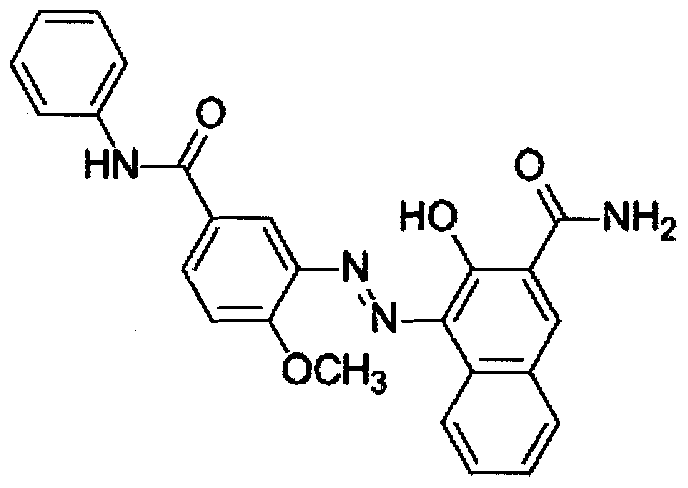


Claims

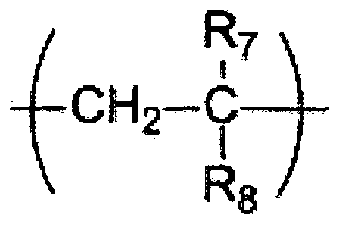

Priority Applications (4)
| Application Number | Priority Date | Filing Date | Title |
|---|---|---|---|
| CN201480024314.3A CN105164212A (en) | 2013-04-30 | 2014-04-24 | Compound having azo skeleton structure, pigment-dispersing agent, pigment composition, pigment dispersion, and toner |
| US14/787,460 US9625845B2 (en) | 2013-04-30 | 2014-04-24 | Compound having azo skeleton structure, pigment-dispersing agent, pigment composition, pigment dispersion, and toner |
| KR1020157033871A KR20160003171A (en) | 2013-04-30 | 2014-04-24 | Compound having azo skeleton structure, pigment-dispersing agent, pigment composition, pigment dispersion, and toner |
| DE112014002210.1T DE112014002210T5 (en) | 2013-04-30 | 2014-04-24 | Compound having azo skeleton structure, pigment dispersing agent, pigment composition, pigment dispersion and toner |
Applications Claiming Priority (2)
| Application Number | Priority Date | Filing Date | Title |
|---|---|---|---|
| JP2013096018 | 2013-04-30 | ||
| JP2013-096018 | 2013-04-30 |
Publications (1)
| Publication Number | Publication Date |
|---|---|
| WO2014178435A1 true WO2014178435A1 (en) | 2014-11-06 |
Family
ID=51843559
Family Applications (1)
| Application Number | Title | Priority Date | Filing Date |
|---|---|---|---|
| PCT/JP2014/062123 Ceased WO2014178435A1 (en) | 2013-04-30 | 2014-04-24 | Compound having azo skeleton structure, pigment-dispersing agent, pigment composition, pigment dispersion, and toner |
Country Status (6)
| Country | Link |
|---|---|
| US (1) | US9625845B2 (en) |
| JP (1) | JP6468721B2 (en) |
| KR (1) | KR20160003171A (en) |
| CN (1) | CN105164212A (en) |
| DE (1) | DE112014002210T5 (en) |
| WO (1) | WO2014178435A1 (en) |
Cited By (1)
| Publication number | Priority date | Publication date | Assignee | Title |
|---|---|---|---|---|
| US9618867B2 (en) | 2015-02-20 | 2017-04-11 | Canon Kabushiki Kaisha | Pigment dispersion and toner |
Families Citing this family (2)
| Publication number | Priority date | Publication date | Assignee | Title |
|---|---|---|---|---|
| US9952523B2 (en) | 2015-02-25 | 2018-04-24 | Canon Kabushiki Kaisha | Toner and toner production method |
| JP7478343B2 (en) | 2020-04-07 | 2024-05-07 | 株式会社リコー | Image forming method and image forming apparatus |
Citations (4)
| Publication number | Priority date | Publication date | Assignee | Title |
|---|---|---|---|---|
| JP2009242684A (en) * | 2008-03-31 | 2009-10-22 | Fujifilm Corp | Active radiation-curable ink composition for inkjet recording, inkjet recording method, and printed matter |
| WO2012026607A1 (en) * | 2010-08-27 | 2012-03-01 | Canon Kabushiki Kaisha | Azo compound, and pigment dispersant, pigment composition, pigment dispersion and toner including the azo compound |
| US20120094226A1 (en) * | 2010-09-07 | 2012-04-19 | Canon Kabushiki Kaisha | Azo compound, and pigment dispersant, pigment composition, pigment dispersion and toner including the azo compound |
| WO2013129433A1 (en) * | 2012-02-29 | 2013-09-06 | Canon Kabushiki Kaisha | Novel compound having azo skeleton and pigment dispersant, pigment composition, pigment dispersion, and toner containing the compound |
Family Cites Families (16)
| Publication number | Priority date | Publication date | Assignee | Title |
|---|---|---|---|---|
| JPH03113462A (en) | 1989-09-27 | 1991-05-14 | Mita Ind Co Ltd | Manufacture of electrostatic charge developing toner |
| JP3285623B2 (en) | 1992-10-30 | 2002-05-27 | 株式会社クラレ | Dispersant for carbon black |
| JP3721617B2 (en) | 1995-10-09 | 2005-11-30 | 東亞合成株式会社 | Radical polymerizable macromonomer |
| CA2259559C (en) | 1996-07-10 | 2004-11-09 | E.I. Du Pont De Nemours And Company | Polymerization with living characteristics |
| IL139666A0 (en) | 1997-07-21 | 2002-02-10 | Commw Scient Ind Res Org | Synthesis of dithioester chain transfer agents and use of bis (thioacyl) disulfides or dithioesters as chain transfer agents |
| GB0009798D0 (en) | 2000-04-20 | 2000-06-07 | Avecia Ltd | Dispersants |
| JP4254292B2 (en) | 2003-03-24 | 2009-04-15 | 星光Pmc株式会社 | Aqueous pigment dispersant and method for producing the same |
| JP2006030760A (en) | 2004-07-20 | 2006-02-02 | Kyocera Chemical Corp | Toner for electrostatic image development |
| CN101223247B (en) * | 2005-07-14 | 2015-04-29 | 爱克发印艺公司 | Pigment dispersions containing polymeric dispersants with pendant chromophores |
| ES2335358T3 (en) * | 2005-07-14 | 2010-03-25 | Agfa Graphics N.V. | PHENYLAZO-ACETOACETANILIDE DERIVATIVES WITH A POLYMERIZABLE FUNCTIONAL GROUP AND ASSOCIATED COMPOUNDS AS MONOMERS FOR POLYMERIC DISPERSANTS FOR PIGMENTED INKS OF INK. |
| JP5560715B2 (en) | 2007-11-09 | 2014-07-30 | 和光純薬工業株式会社 | Selective reduction of nitro group by metal catalyst supported carbon |
| JP5531586B2 (en) | 2008-12-09 | 2014-06-25 | 住友化学株式会社 | Compound |
| CN103080184B (en) | 2010-08-24 | 2014-11-05 | 佳能株式会社 | Polyester, pigment composition, and toner |
| JP5748430B2 (en) * | 2010-08-27 | 2015-07-15 | キヤノン株式会社 | Dye compound, pigment dispersant, pigment composition, pigment dispersion and toner containing the dye compound |
| JP2013072915A (en) * | 2011-09-27 | 2013-04-22 | Canon Inc | Toner containing compound with azo dye skeleton |
| EP2766433A4 (en) | 2011-10-12 | 2015-07-01 | Canon Kk | Compound having bisazo skeleton, pigment dispersant containing the compound, pigment composition, pigment dispersion, ink and resist composition for color filter |
-
2014
- 2014-04-24 WO PCT/JP2014/062123 patent/WO2014178435A1/en not_active Ceased
- 2014-04-24 KR KR1020157033871A patent/KR20160003171A/en not_active Withdrawn
- 2014-04-24 DE DE112014002210.1T patent/DE112014002210T5/en not_active Withdrawn
- 2014-04-24 CN CN201480024314.3A patent/CN105164212A/en active Pending
- 2014-04-24 US US14/787,460 patent/US9625845B2/en not_active Expired - Fee Related
- 2014-04-30 JP JP2014093915A patent/JP6468721B2/en not_active Expired - Fee Related
Patent Citations (4)
| Publication number | Priority date | Publication date | Assignee | Title |
|---|---|---|---|---|
| JP2009242684A (en) * | 2008-03-31 | 2009-10-22 | Fujifilm Corp | Active radiation-curable ink composition for inkjet recording, inkjet recording method, and printed matter |
| WO2012026607A1 (en) * | 2010-08-27 | 2012-03-01 | Canon Kabushiki Kaisha | Azo compound, and pigment dispersant, pigment composition, pigment dispersion and toner including the azo compound |
| US20120094226A1 (en) * | 2010-09-07 | 2012-04-19 | Canon Kabushiki Kaisha | Azo compound, and pigment dispersant, pigment composition, pigment dispersion and toner including the azo compound |
| WO2013129433A1 (en) * | 2012-02-29 | 2013-09-06 | Canon Kabushiki Kaisha | Novel compound having azo skeleton and pigment dispersant, pigment composition, pigment dispersion, and toner containing the compound |
Cited By (1)
| Publication number | Priority date | Publication date | Assignee | Title |
|---|---|---|---|---|
| US9618867B2 (en) | 2015-02-20 | 2017-04-11 | Canon Kabushiki Kaisha | Pigment dispersion and toner |
Also Published As
| Publication number | Publication date |
|---|---|
| KR20160003171A (en) | 2016-01-08 |
| JP6468721B2 (en) | 2019-02-13 |
| CN105164212A (en) | 2015-12-16 |
| US9625845B2 (en) | 2017-04-18 |
| DE112014002210T5 (en) | 2016-03-03 |
| US20160070189A1 (en) | 2016-03-10 |
| JP2014231602A (en) | 2014-12-11 |
Similar Documents
| Publication | Publication Date | Title |
|---|---|---|
| KR101477865B1 (en) | Toner including compound having bisazo skeleton | |
| JP6576078B2 (en) | Method for producing compound having dye structure at main chain terminal of polymer | |
| JP6041704B2 (en) | Black toner containing a compound having an azo skeleton | |
| JP4999997B2 (en) | Azo compound, pigment dispersant, pigment composition, pigment dispersion and toner containing the azo compound | |
| JP6108875B2 (en) | Azo compound, pigment dispersant, pigment composition, pigment dispersion and toner containing the azo compound | |
| WO2013129695A1 (en) | Cyan toner containing compound having azo skeleton | |
| JP2013210629A (en) | Magenta toner containing compound having azo skeleton | |
| JP6463042B2 (en) | Compound having azo skeleton structure, pigment dispersant, pigment composition, pigment dispersion and toner | |
| JP2013210631A (en) | Magenta toner containing compound having azo skeleton | |
| JP6041703B2 (en) | Black toner containing a compound having an azo skeleton | |
| US10087328B2 (en) | Compound having azo skeleton, pigment dispersant, pigment composition, pigment dispersion, and toner | |
| US9625845B2 (en) | Compound having azo skeleton structure, pigment-dispersing agent, pigment composition, pigment dispersion, and toner | |
| JP2013209642A (en) | New compound having azo skeleton, pigment dispersant containing the compound, pigment composition, pigment dispersion, and toner | |
| US9926450B2 (en) | Compound having azo skeleton structure, pigment-dispersing agent, pigment composition, pigment dispersion, and toner | |
| JP6463040B2 (en) | Novel compound, pigment dispersant containing the compound, pigment composition, pigment dispersion, and toner | |
| JP2013210628A (en) | Cyan toner containing compound having azo skeleton |
Legal Events
| Date | Code | Title | Description |
|---|---|---|---|
| WWE | Wipo information: entry into national phase |
Ref document number: 201480024314.3 Country of ref document: CN |
|
| 121 | Ep: the epo has been informed by wipo that ep was designated in this application |
Ref document number: 14791109 Country of ref document: EP Kind code of ref document: A1 |
|
| WWE | Wipo information: entry into national phase |
Ref document number: 14787460 Country of ref document: US |
|
| WWE | Wipo information: entry into national phase |
Ref document number: 112014002210 Country of ref document: DE Ref document number: 1120140022101 Country of ref document: DE |
|
| ENP | Entry into the national phase |
Ref document number: 20157033871 Country of ref document: KR Kind code of ref document: A |
|
| 122 | Ep: pct application non-entry in european phase |
Ref document number: 14791109 Country of ref document: EP Kind code of ref document: A1 |