WO2014174457A1 - Pyrazole carboxylic acid analogues as anti-mycobacterial drug candidates - Google Patents
Pyrazole carboxylic acid analogues as anti-mycobacterial drug candidates Download PDFInfo
- Publication number
- WO2014174457A1 WO2014174457A1 PCT/IB2014/060936 IB2014060936W WO2014174457A1 WO 2014174457 A1 WO2014174457 A1 WO 2014174457A1 IB 2014060936 W IB2014060936 W IB 2014060936W WO 2014174457 A1 WO2014174457 A1 WO 2014174457A1
- Authority
- WO
- WIPO (PCT)
- Prior art keywords
- methyl
- pyrazole
- chlorophenyl
- carboxylic acid
- dichlorophenyl
- Prior art date
- Legal status (The legal status is an assumption and is not a legal conclusion. Google has not performed a legal analysis and makes no representation as to the accuracy of the status listed.)
- Ceased
Links
- HLDURSRJCIWNKA-UHFFFAOYSA-N CCOC(c(c(C)c1-c(cc2)ccc2Cl)n[n]1-c(c(Cl)c1)ccc1Cl)=O Chemical compound CCOC(c(c(C)c1-c(cc2)ccc2Cl)n[n]1-c(c(Cl)c1)ccc1Cl)=O HLDURSRJCIWNKA-UHFFFAOYSA-N 0.000 description 1
- XONAWIYYYGPDIP-UHFFFAOYSA-N Cc1c(-c(cc2)ccc2Cl)[n](-c(ccc(Cl)c2)c2Cl)nc1C(NNC(c1ccncc1)=O)=O Chemical compound Cc1c(-c(cc2)ccc2Cl)[n](-c(ccc(Cl)c2)c2Cl)nc1C(NNC(c1ccncc1)=O)=O XONAWIYYYGPDIP-UHFFFAOYSA-N 0.000 description 1
- XQFWOCBFCCQKMR-UHFFFAOYSA-N Cc1c(-c(cc2)ccc2Cl)[n](-c(cccc2)c2Cl)nc1C(NN1CCCCC1)=O Chemical compound Cc1c(-c(cc2)ccc2Cl)[n](-c(cccc2)c2Cl)nc1C(NN1CCCCC1)=O XQFWOCBFCCQKMR-UHFFFAOYSA-N 0.000 description 1
Classifications
-
- A—HUMAN NECESSITIES
- A61—MEDICAL OR VETERINARY SCIENCE; HYGIENE
- A61K—PREPARATIONS FOR MEDICAL, DENTAL OR TOILETRY PURPOSES
- A61K31/00—Medicinal preparations containing organic active ingredients
- A61K31/33—Heterocyclic compounds
- A61K31/395—Heterocyclic compounds having nitrogen as a ring hetero atom, e.g. guanethidine or rifamycins
- A61K31/41—Heterocyclic compounds having nitrogen as a ring hetero atom, e.g. guanethidine or rifamycins having five-membered rings with two or more ring hetero atoms, at least one of which being nitrogen, e.g. tetrazole
- A61K31/425—Thiazoles
-
- A—HUMAN NECESSITIES
- A61—MEDICAL OR VETERINARY SCIENCE; HYGIENE
- A61K—PREPARATIONS FOR MEDICAL, DENTAL OR TOILETRY PURPOSES
- A61K31/00—Medicinal preparations containing organic active ingredients
- A61K31/33—Heterocyclic compounds
- A61K31/395—Heterocyclic compounds having nitrogen as a ring hetero atom, e.g. guanethidine or rifamycins
- A61K31/41—Heterocyclic compounds having nitrogen as a ring hetero atom, e.g. guanethidine or rifamycins having five-membered rings with two or more ring hetero atoms, at least one of which being nitrogen, e.g. tetrazole
- A61K31/415—1,2-Diazoles
-
- A—HUMAN NECESSITIES
- A61—MEDICAL OR VETERINARY SCIENCE; HYGIENE
- A61K—PREPARATIONS FOR MEDICAL, DENTAL OR TOILETRY PURPOSES
- A61K31/00—Medicinal preparations containing organic active ingredients
- A61K31/33—Heterocyclic compounds
- A61K31/395—Heterocyclic compounds having nitrogen as a ring hetero atom, e.g. guanethidine or rifamycins
- A61K31/41—Heterocyclic compounds having nitrogen as a ring hetero atom, e.g. guanethidine or rifamycins having five-membered rings with two or more ring hetero atoms, at least one of which being nitrogen, e.g. tetrazole
- A61K31/415—1,2-Diazoles
- A61K31/4155—1,2-Diazoles non condensed and containing further heterocyclic rings
-
- A—HUMAN NECESSITIES
- A61—MEDICAL OR VETERINARY SCIENCE; HYGIENE
- A61K—PREPARATIONS FOR MEDICAL, DENTAL OR TOILETRY PURPOSES
- A61K31/00—Medicinal preparations containing organic active ingredients
- A61K31/33—Heterocyclic compounds
- A61K31/395—Heterocyclic compounds having nitrogen as a ring hetero atom, e.g. guanethidine or rifamycins
- A61K31/41—Heterocyclic compounds having nitrogen as a ring hetero atom, e.g. guanethidine or rifamycins having five-membered rings with two or more ring hetero atoms, at least one of which being nitrogen, e.g. tetrazole
- A61K31/42—Oxazoles
-
- A—HUMAN NECESSITIES
- A61—MEDICAL OR VETERINARY SCIENCE; HYGIENE
- A61K—PREPARATIONS FOR MEDICAL, DENTAL OR TOILETRY PURPOSES
- A61K31/00—Medicinal preparations containing organic active ingredients
- A61K31/33—Heterocyclic compounds
- A61K31/395—Heterocyclic compounds having nitrogen as a ring hetero atom, e.g. guanethidine or rifamycins
- A61K31/435—Heterocyclic compounds having nitrogen as a ring hetero atom, e.g. guanethidine or rifamycins having six-membered rings with one nitrogen as the only ring hetero atom
- A61K31/44—Non condensed pyridines; Hydrogenated derivatives thereof
- A61K31/4427—Non condensed pyridines; Hydrogenated derivatives thereof containing further heterocyclic ring systems
- A61K31/4439—Non condensed pyridines; Hydrogenated derivatives thereof containing further heterocyclic ring systems containing a five-membered ring with nitrogen as a ring hetero atom, e.g. omeprazole
-
- A—HUMAN NECESSITIES
- A61—MEDICAL OR VETERINARY SCIENCE; HYGIENE
- A61K—PREPARATIONS FOR MEDICAL, DENTAL OR TOILETRY PURPOSES
- A61K31/00—Medicinal preparations containing organic active ingredients
- A61K31/33—Heterocyclic compounds
- A61K31/395—Heterocyclic compounds having nitrogen as a ring hetero atom, e.g. guanethidine or rifamycins
- A61K31/435—Heterocyclic compounds having nitrogen as a ring hetero atom, e.g. guanethidine or rifamycins having six-membered rings with one nitrogen as the only ring hetero atom
- A61K31/44—Non condensed pyridines; Hydrogenated derivatives thereof
- A61K31/445—Non condensed piperidines, e.g. piperocaine
- A61K31/4523—Non condensed piperidines, e.g. piperocaine containing further heterocyclic ring systems
- A61K31/454—Non condensed piperidines, e.g. piperocaine containing further heterocyclic ring systems containing a five-membered ring with nitrogen as a ring hetero atom, e.g. pimozide, domperidone
-
- A—HUMAN NECESSITIES
- A61—MEDICAL OR VETERINARY SCIENCE; HYGIENE
- A61K—PREPARATIONS FOR MEDICAL, DENTAL OR TOILETRY PURPOSES
- A61K31/00—Medicinal preparations containing organic active ingredients
- A61K31/33—Heterocyclic compounds
- A61K31/395—Heterocyclic compounds having nitrogen as a ring hetero atom, e.g. guanethidine or rifamycins
- A61K31/495—Heterocyclic compounds having nitrogen as a ring hetero atom, e.g. guanethidine or rifamycins having six-membered rings with two or more nitrogen atoms as the only ring heteroatoms, e.g. piperazine or tetrazines
- A61K31/496—Non-condensed piperazines containing further heterocyclic rings, e.g. rifampin, thiothixene or sparfloxacin
-
- A—HUMAN NECESSITIES
- A61—MEDICAL OR VETERINARY SCIENCE; HYGIENE
- A61P—SPECIFIC THERAPEUTIC ACTIVITY OF CHEMICAL COMPOUNDS OR MEDICINAL PREPARATIONS
- A61P31/00—Antiinfectives, i.e. antibiotics, antiseptics, chemotherapeutics
- A61P31/04—Antibacterial agents
-
- A—HUMAN NECESSITIES
- A61—MEDICAL OR VETERINARY SCIENCE; HYGIENE
- A61P—SPECIFIC THERAPEUTIC ACTIVITY OF CHEMICAL COMPOUNDS OR MEDICINAL PREPARATIONS
- A61P31/00—Antiinfectives, i.e. antibiotics, antiseptics, chemotherapeutics
- A61P31/04—Antibacterial agents
- A61P31/06—Antibacterial agents for tuberculosis
-
- C—CHEMISTRY; METALLURGY
- C07—ORGANIC CHEMISTRY
- C07D—HETEROCYCLIC COMPOUNDS
- C07D231/00—Heterocyclic compounds containing 1,2-diazole or hydrogenated 1,2-diazole rings
- C07D231/02—Heterocyclic compounds containing 1,2-diazole or hydrogenated 1,2-diazole rings not condensed with other rings
- C07D231/10—Heterocyclic compounds containing 1,2-diazole or hydrogenated 1,2-diazole rings not condensed with other rings having two or three double bonds between ring members or between ring members and non-ring members
- C07D231/12—Heterocyclic compounds containing 1,2-diazole or hydrogenated 1,2-diazole rings not condensed with other rings having two or three double bonds between ring members or between ring members and non-ring members with only hydrogen atoms, hydrocarbon or substituted hydrocarbon radicals, directly attached to ring carbon atoms
-
- C—CHEMISTRY; METALLURGY
- C07—ORGANIC CHEMISTRY
- C07D—HETEROCYCLIC COMPOUNDS
- C07D231/00—Heterocyclic compounds containing 1,2-diazole or hydrogenated 1,2-diazole rings
- C07D231/02—Heterocyclic compounds containing 1,2-diazole or hydrogenated 1,2-diazole rings not condensed with other rings
- C07D231/10—Heterocyclic compounds containing 1,2-diazole or hydrogenated 1,2-diazole rings not condensed with other rings having two or three double bonds between ring members or between ring members and non-ring members
- C07D231/14—Heterocyclic compounds containing 1,2-diazole or hydrogenated 1,2-diazole rings not condensed with other rings having two or three double bonds between ring members or between ring members and non-ring members with hetero atoms or with carbon atoms having three bonds to hetero atoms with at the most one bond to halogen, e.g. ester or nitrile radicals, directly attached to ring carbon atoms
-
- C—CHEMISTRY; METALLURGY
- C07—ORGANIC CHEMISTRY
- C07D—HETEROCYCLIC COMPOUNDS
- C07D401/00—Heterocyclic compounds containing two or more hetero rings, having nitrogen atoms as the only ring hetero atoms, at least one ring being a six-membered ring with only one nitrogen atom
- C07D401/02—Heterocyclic compounds containing two or more hetero rings, having nitrogen atoms as the only ring hetero atoms, at least one ring being a six-membered ring with only one nitrogen atom containing two hetero rings
- C07D401/12—Heterocyclic compounds containing two or more hetero rings, having nitrogen atoms as the only ring hetero atoms, at least one ring being a six-membered ring with only one nitrogen atom containing two hetero rings linked by a chain containing hetero atoms as chain links
Definitions
- the invention relates to pyrazole carboxylic acid analogues of formula-I as potent anti -mycobacterial drug candidates. Particularly the invention provides novel pyrazole carboxylic acid analogues of formula-I, and pharmaceutically acceptable salts thereof for treatment of mycobacterial infections.
- BACKGROUND AND PRIOR ART Tuberculosis (TB) is one of the deadliest diseases afflicting centuries. One third of the world's population is infected with TB. In 2011, nearly 9 million people around the world suffered from TB. There were around 1.4 million TB- related deaths worldwide. TB is a leading killer of people who are HIV infected.
- Anti -tuberculosis drug resistance is a major public health problem that threatens progress made in TB care and control worldwide. Drug resistance arises due to improper use of antibiotics in chemotherapy of drug-susceptible TB patients. This improper use is a result of a number of actions including, administration of improper treatment regimens and failure to ensure that patients complete the whole course of treatment. Essentially, drug resistance arises in areas with weak TB control programmes. A patient who develops active disease with a drug-resistant TB strain can transmit this form of TB to other individuals. Multidrug-resistant (MDR) and extensively drug -resistant (XDR) tuberculosis are generally thought to have high mortality rates.
- MDR multidrug-resistant
- XDR extensively drug -resistant tuberculosis
- Multidrug-resistant is the combination of at least four drugs to which the Mycobacterium tuberculosis isolate is likely to be susceptible.
- the first group the oral first-line drugs
- high-dose isoniazid, pyrazinamide, and ethambutol are thought of as an adjunct for the treatment of MDR and XDR tuberculosis.
- the MDR TB patients with HIV/AIDS lack the immunity to fight the TB infection and are at great risk of developing drug resistance. Therefore research and funding is needed in the diagnosis, prevention and treatment of TB and MDR TB.
- To combat continuous rise in multi-drug resistant TB scientific efforts are concentrated on inventing new agents for treatment of TB.
- New drug discovery is a long and tedious process consuming several years and the regulatory approval process following drug discovery involves several tests and trials.
- it would be highly beneficial and attractive to identify a candidate effective for treatment of TB such that the candidate has been approved as a drug by regulatory authorities. This would enable a quick introduction of the drug into the market for TB treatment.
- Rimonabant a pyrazole carboxylic acid derivative was withdrawn from market, the reason for the withdrawal was that its benefits did not outweigh the risks. But the fact that it was marketed establishes that it is safe for administration in humans.
- Rimonabant a pyrazole carboxylic acid derivative was discovered by Sanofi-Synthelabo in 1994 as the first potent, orally active, selective CBl cannabinoid receptor antagonist and sold under several trade names as an anorectic antiobesity drug, but withdrawn from the market due to its side effects. It is an inverse agonist for the cannabinoid receptor CBl . Its main effect is reduction in appetite. Rimonabant was the first selective CBl receptor blocker to be approved for use anywhere in the world.
- BMI body mass index
- Pyrazole derivatives are the subject of many research studies due to their widespread potential biological activities such as antimicrobial, antiviral, antitumor, antihistaminic, antidepressant, insecticides and fungicides.
- WO 2007017125 describes pyrazolinecarboxamides of formula-I as CBl antagonists or inverse antagonists as therapeutical agents for the treatment of inflammation involving gene expression.
- WO' 125 also describes preparation ofN-piperidinyl-5-(4-chlorophenyl)-l-(2,4-dichiorophenyl)-4,5- dihydropyrazole-3-carboxamide.
- WO 2007009701 describes use of substituted pyrazole compounds of formula-I for the treatment of cardiovascular risk factors caused by metabolic syndrome in humans and animals
- ⁇ 1743637 discloses use of substituted pyrazole compounds and combinations thereof for the treatment of metabolic syndrome.
- Mohamed Jawed Ahsana et al. in European Journal of Medicinal Chemistry, vol 46, (11), Nov 2011, Pg. 5694-5697 discloses synthesis of a series of 3a,4-dihydro-3H- indeno [1,2-c] pyrazole-2-carboxamide analogues and evaluation of antitubercular activity thereof.
- Rimonabant is an approved drug, with established safety. Rimonabant and its analogues are also shown to have promising activities and also are proved safe to human. Since Rimonabant was recently withdrawn from the market following postmarketing surveillance studies, which confirmed a risk of depressive disorders amongst users, there is need for modification or elimination of the carboxamide side chain, which is responsible for crossing the blood-brain barrier, might reduce these side effects. Therefore, the present inventors have modified the core structure of rimonabant i.e. pyrazole carboxylic acid to obtain a safe, alternative drug candidate for treatment of mycobacterial infections.
- OBJECT OF THE INVENTION The main object of invention is to provide Pyrazole carboxylic acid analogues for the treatment of Mycobacterium Tuberculosis.
- Still another object of the present invention is to introduce rimonabant and its analogues as potential drug candidates for treatment of mycobacterial infection.
- Yet another object of the present invention is to provide a pharmaceutical composition for the treatment of mycobacterial infections in human.
- the present invention provides the pyrazole carboxylic acid analogues of Formula 1, or stereoisomers, or esters or pharmaceutically acceptable salts thereof, for use as a medicament for treating mycobacterial infections,
- Y represents heteroatom N, S or O
- X represents hydrogen, or halogen
- Ri represents (un)substituted aryl, hydrogen, where substituents are mono, di or tri halogen;
- R 2 represents OH, (C1-C6) alkyl, (C1-C6) alkoxy, piperidine, 1 -amino piperidine, morpholine, pyridine-4-carbohydrazide, 1-methylpiperazine, 1-methylpiperazine, thiomorpholine, hydrazine, amino acids, Schiff bases, heterocycles;
- R represents (C1-C4) linear or branched alkyl, hydrogen.
- the pyrazole carboxylic acid analogues of Formula 1 encompasses the following compounds;
- the minimum inhibitory concentration (MIC) of the pyrazole carboxylic acid analogues of Formula 1, against Mycobacterium tuberculosis (strain H37Rv) is in the range of 3 to 30 ⁇ g/ml and for Mycobacterium smegmantis the MIC is in the range of 1-35 ⁇ g/ml.
- a pharmaceutical composition comprising pyrazole carboxylic acid analogues of the Formula I, together with pharmaceutically acceptable excipient(s) and/or vehicle(s), for the treatment of mycobacterial infections in human.
- the pharmaceutical composition comprising pyrazole carboxylic acid analogues of general formula I, optionally with an additional antitubercular agent together with pharmaceutically acceptable excipient(s) and/or vehicle(s).
- the Mycobacterium species is selected from the group consisting of Mycobacterium tuberculosis (strain H37Rv) and Mycobacterium smegmatis (strain MC2 155).
- a method of treating or inhibiting or controlling growth of Mycobacterium species in human comprising administrating pyrazole carboxylic acid analogues of general formula-I, together with pharmaceutically acceptable excipient(s) and/or vehicle(s).
- Y represents heteroatom N, S or O
- X represents hydrogen, or halogen
- Ri represents (un)substituted aryl, hydrogen, where substituents are mono, di or tri halogen;
- R 2 represents OH, (C1-C6) alkyl, (C1-C6) alkoxy, piperidine, 1 -amino piperidine, morpholine, pyridine-4-carbohydrazide, 1-methylpiperazine, 1-methylpiperazine, thiomorpholine, hydrazine, amino acids, Schiff bases, heterocycles;
- R represents (C1-C4) linear or branched alkyl, hydrogen.
- the method of treating or inhibiting or controlling growth of Mycobacterium species in human comprising administrating pyrazole carboxylic acid analogues of general formula- 1, wherein the compounds are selected from the group consisting of ; i. 5 -(4-Chlorophenyl)- 1 -(2,4-dichlorophenyl)-4-methyl-N-(piperidin- 1 -yl)-l -H-pyrazole-3 - carboxamide (1)
- the Mycobacterium species is selected from the group consisting of Mycobacterium tuberculosis (strain H37Rv) and Mycobacterium smegmatis (strain MC2 155).
- the invention provides the pyrazole carboxylic acid analogues of Formula 1 or stereoisomers, or esters or pharmaceutically acceptable salts thereof, for use as a medicament for mycobacterial infections,
- Y represents heteroatom N, S or O
- X represents hydrogen, halogen
- Ri represents (un)substituted aryl, hydrogen, where substituents are mono, di or tri halogen;
- R 2 represents OH,(Cl-C6)alkyl, (C1-C6) alkoxy, piperidine, 1 -amino piperidine, morpholine, pyridine-4- carbohydrazide, 1-methylpiperazine, 1-methylpiperazine,
- R represents (C1-C4) linear or branched alkyl, hydrogen.
- the pyrazole carboxylic acid analogues of Formula 1, having anti-mycobacterial activity encompass the compounds as listed in table 1.
- the anti-mycobacterial pyrazole carboxylic acid analogues of Formula- 1 are selected from the group consisting of;
- the initial studies involved screening of Rimonabant (1) against Mycobacterium smegmatis, which showed a MIC value 13.56 ⁇ g/ml. Therefore, its 18-analogues were synthesized and few of them were screened against Mycobacterium smegmatis. They showed moderate to excellent activity (Table 1). Similarly Rimonabant and all the synthesized analogues were then screened for anti-bacterial activity against Mycobacterium tuberculosis (virulent strain H37Rv) in vitro. The precursor of Rimonabant, acid 2 showed improved MTB activity and ester 3 retains the activity as compared to Rimonabant.
- analogues 2, 4, 7, 11 & 15-18 showed enhanced activity and the analogues 3, 5, 6, 8, 10, 12 & 19 retains the activity.
- the analogues 9 and 13 showed drastic increase in MTB activity.
- the analogue 14 came out to be a promising lead with highest activity. Compared with one of the first line anti-TB drug Ethambutol (MIC 3.25 ⁇ g/ml), the analogue 14 was found to be equally active. When compared to Pyrazinamide (MIC 50.0 ⁇ g/ml) all the 18 analogues were found to be more potent.
- the analogue 13 was a simplified lead molecule. Based on the analogue 9, a simple replacement of chlorine by hydrogen might provide a more active analogue of 13.
- the anti- mycobacterial activity of compounds of Formula-I against mycobacterial species is measured in the range of 1 to 50 ⁇ g/ml, particularly anti -mycobacterial activity against Mycobacterium tuberculosis (strain H37Rv) is evaluated in the range of 3 to 30 ⁇ g/ml and for Mycobacterium smegmantis the MIC is calculated in the range of 1-35 ⁇ g/ml,
- the invention provides, novel pyrazole carboxylic acid analogues of Formula 1 having anti-mycobacterial activity as disclosed in above Table 1,
- Y represents heteroatom N or O
- Ri represents phenyl, 2-4 dichlorophenyl, 2-4 difluorophenyl
- R 2 represents OH, ethyl, piperidine, 1-aminopiperidine, pyridine-4-carbohydrazide, 1- methylpiperazine; and R represents methyl, hydrogen.
- novel anti-mycobacterial agents of formula-I are selected from the group consisting of;
- the pyrazole carboxylic acid analogues of Formula 1 is Rimonabant or 5 -(4-Chlorophenyl)- 1 -(2,4-dichloro-phenyl)-4-methyl-N-(piperidin- 1 -yl)- lH-pyrazole-3 - carboxamide, wherein the minimum inhibitory concentration of Rimonabant against Mycobacterium smegmatis is 13.56 ⁇ g/ml and against Mycobacterium tuberculosis 25 ⁇ g/ml.
- the invention provides a pharmaceutical composition
- a pharmaceutical composition comprising a compound of Formula 1, or its stereoisomers, esters or pharmaceutically acceptable salt thereof, and a pharmaceutically acceptable carrier(s), diluent(s) vehicle(s), and/or excipient(s).
- the compound of formula 1 disclosed herein is present in the composition in an amount which is effective to treat the disease or the condition caused by the bacterial strains mentioned above.
- compositions of the invention can be prepared by combining compounds of Formula-I with appropriate pharmaceutically acceptable carriers, diluents or excipients, and may be formulated into preparations in solid, semi-solid, liquid or gaseous forms, such as tablets, capsules, powders, granules, ointments, solutions, injections, gels and microspheres.
- the present invention relates to administering 'an effective amount' of the 'composition of invention' to the subject suffering from said disease.
- compound of Formula 1 and pharmaceutical compositions containing them may be administered using any amount, any form of pharmaceutical composition via any route of administration effective for treating the disease.
- Typical routes of administering such pharmaceutical compositions include, without limitation, oral, topical, transdermal, inhalation, parenteral, sublingual, buccal, rectal, vaginal, and intranasal.
- compositions of the invention are formulated so as to allow the active ingredients contained therein to be bioavailable upon administration of the composition to a patient.
- Compositions that will be administered to a subject or patient may take the form of one or more dosage units.
- the dosage forms can also be prepared as sustained, controlled, modified and immediate dosage forms.
- excipients or carriers are selected from the group such as diluents, disintegrants, crosslinked polymers, binders, lubricants, coatings layer.
- synergistic effect of instant pharmaceutical composition can be achieved in combination with additional known anti-tubercular drugs such as Rifampcin, Ethambutol, Pyrazinamide.
- the invention provides a method of treating or inhibiting growth of a bacteria preferably Mycobacterium smegmatis and Mycobacterium tuberculosis in a subject (i.e. human or animal) comprising administrating anti-mycobacterial compounds of Formula-I, optionally with at least one additional active compound or anti-tubercular agent together with pharmaceutically acceptable excipients and/or vehicles.
- the invention provides pyrazole carboxylic acid compounds of Formula-I for use in treating or inhibiting growth of a bacteria preferably Mycobacterium smegmatis and Mycobacterium tuberculosis in a subject.
- a bacteria preferably Mycobacterium smegmatis and Mycobacterium tuberculosis.
- the subject according to the invention is an animal or human.
- the invention furnishes pyrazole carboxylic acid compounds of Formula-I for the preparation of medicament useful for treating or inhibiting the growth of Mycobacterium smegmatis and Mycobacterium tuberculosis in human.
- Anti- mycobacterial activity assay Mycobacterium smegmatis MC 2 155 strain
- Anti-mycobacterial activity of the compounds was performed with Mycobacterium smegmatis MC 2 155 strain by performing a growth inhibition assay by agar dilution followed turbidometry method. The assay was semi -throughput and conducted in a 96 well plate (sterile). Isolated single colonies of M. smegmatis MC 2 155 (ATCC 14468) grown on 7H10 agar plate were grown overnight in Middlebrook 7H9 medium (0.47% Middlebrook 7H9 broth base, 10% ADS, 0.2% glycerol, and 0.1% Tween-80) to mid exponential phase inoculated in 5 ml Middlebrook 7H9 medium.
- Middlebrook 7H9 medium 0.47% Middlebrook 7H9 broth base, 10% ADS, 0.2% glycerol, and 0.1% Tween-80
- the secondary culture was incubated overnight and allowed to grow at 37°C to early log phase (OD 60 o 3 ⁇ 4 0.3).
- 98 ⁇ of l 1000-folds dilution of secondary culture was dispensed into 96-well microtiter plate per well along with 2 ⁇ 1 of test compound in triplicate.
- 240 ⁇ of sterile water were added to each well of the peripheral rows of 96-well plate to minimize media evaporation during assay incubation.
- the final concentration of the test compound (Rimonabant) in each well was 30 ⁇ .
- MIC / Minimum Inhibitory Concentration is that concentration of compound which inhibits the 90 % growth of bacteria under optimum conditions.
- the growth inhibition assays were carried out in the same analogy as explained above various concentrations of the test compounds prepared by serial dilutions 100 ⁇ , 50 ⁇ , 25 ⁇ , 12.5 ⁇ and 6.25 ⁇ (DMSO as solvent) to obtain the final concentrations of 46.37 ⁇ g/ml, 23.18 ⁇ g ml, 11.59 ⁇ g/ml, 5.79 ⁇ g/ml, 2.89 ⁇ g/ml respectively. From the rate of inhibition bacterial growth, the ascertained MIC of the compound was calculated.
- the MIC value of the test compound JMG 005 i.e. Rimonabant is 13.56 ⁇ (29.24 ⁇ ⁇ 1.47).
- the minimum inhibitory concentration (MIC) is defined as the minimum concentration of the compound required to completely inhibit the bacterial growth. Rifampicin, Ethambutol and Pyrazinamide were used as reference compounds. This method is similar to that recommended by the National Committee for Clinical Laboratory Standards 11 for the determination of minimum inhibitory concentration (MIC) in triplicate.
- Compound 4 was synthesized from 2 according to the procedure applied to 1.
- Compound 5 was synthesized from 2 according to the procedure applied to 1.
- Compound 6 was synthesized from 2 according to the procedure applied to 1.
- Compound 10 was synthesized from 9 according to the procedure applied to 1.
- Compound 11 was synthesized by the procedure applied to 2.
- Compound 12 was synthesized by the procedure applied to 2.
- Compound 14 was synthesized from 7 according to the procedure applied to 1.
- Com pound 15 was synthesized from 12 according to the procedure applied to 1.
- Compound 16 was synthesized from 13 according to the procedure applied to 1.
- Compound 18 was synthesized from 9 according to the procedure applied to 1.
- Mode of administration Disperse the powder in water/juice.
- Example 21 Rimonabant (1) Composition:
- Mode of administration Disperse the powder in water/juice.
- Example 22 Composition:
- Mix active ingredient (JMG-14) and Magnesium stearate may be filled in a capsule of suitable size.
- the capsule may be had with water of juice
- Example 23 Composition:
- Mix active ingredient (JMG-14) and Magnesium stearate may be filled in a capsule of suitable size.
- the capsule may be had with water of juice
- Example 24 Composition:
- Mix active ingredient (Compound-11) and Magnesium stearate may be filled in a capsule of suitable size.
- the tablet may be had with water of juice
- Example 25 Composition:
- the tablet may be had with water of juice
- Example 26 Composition:
Landscapes
- Health & Medical Sciences (AREA)
- Chemical & Material Sciences (AREA)
- Organic Chemistry (AREA)
- Medicinal Chemistry (AREA)
- Pharmacology & Pharmacy (AREA)
- Life Sciences & Earth Sciences (AREA)
- Animal Behavior & Ethology (AREA)
- General Health & Medical Sciences (AREA)
- Public Health (AREA)
- Veterinary Medicine (AREA)
- Epidemiology (AREA)
- Communicable Diseases (AREA)
- Oncology (AREA)
- Chemical Kinetics & Catalysis (AREA)
- General Chemical & Material Sciences (AREA)
- Nuclear Medicine, Radiotherapy & Molecular Imaging (AREA)
- Pulmonology (AREA)
- Pharmaceuticals Containing Other Organic And Inorganic Compounds (AREA)
- Plural Heterocyclic Compounds (AREA)
Abstract
The present invention relates to the pyrazole carboxylic acid analogues of Formula (1) or stereoisomers, or esters or pharmaceutically acceptable salts thereof, as potent anti- mycobacterial agents. Formula Further it discloses the pharmaceutical composition comprising compounds of Formula-I for the treatment of mycobacterial infections.
Description
PYRAZOLE CARBOXYLIC ACID ANALOGUES AS ANTI-MYCOBACTERIAL
DRUG CANDIDATES
The following specification particularly describes the invention and the manner in which it is to be performed:
FIELD OF INVENTION: The invention relates to pyrazole carboxylic acid analogues of formula-I as potent anti -mycobacterial drug candidates. Particularly the invention provides novel pyrazole carboxylic acid analogues of formula-I, and pharmaceutically acceptable salts thereof for treatment of mycobacterial infections. BACKGROUND AND PRIOR ART: Tuberculosis (TB) is one of the deadliest diseases afflicting mankind. One third of the world's population is infected with TB. In 2011, nearly 9 million people around the world suffered from TB. There were around 1.4 million TB- related deaths worldwide. TB is a leading killer of people who are HIV infected.
Anti -tuberculosis drug resistance is a major public health problem that threatens progress made in TB care and control worldwide. Drug resistance arises due to improper use of antibiotics in chemotherapy of drug-susceptible TB patients. This improper use is a result of a number of actions including, administration of improper treatment regimens and failure to ensure that patients complete the whole course of treatment. Essentially, drug resistance arises in areas with weak TB control programmes. A patient who develops active disease with a drug-resistant TB strain can transmit this form of TB to other individuals. Multidrug-resistant (MDR) and extensively drug -resistant (XDR) tuberculosis are generally thought to have high mortality rates. Multidrug-resistant is the combination of at least four drugs to which the Mycobacterium tuberculosis isolate is likely to be susceptible. Among the first group (the oral first-line drugs) high-dose isoniazid, pyrazinamide, and ethambutol are thought of as an adjunct for the treatment of MDR and XDR tuberculosis. The MDR TB patients with HIV/AIDS lack the immunity to fight the TB infection and are at great risk of developing drug resistance. Therefore research and funding is needed in the diagnosis, prevention and treatment of TB and MDR TB. To combat continuous rise in multi-drug resistant TB, scientific efforts are concentrated on inventing new agents for treatment of TB. New drug discovery is a long and tedious process consuming several years and the regulatory approval process following drug discovery involves several tests and trials. At the current stage it would be highly beneficial and attractive to identify a candidate effective for treatment of TB, such that the candidate has been approved as a drug by regulatory authorities. This would enable a quick introduction of the drug into the market for TB treatment. While Rimonabant, a pyrazole carboxylic acid derivative was withdrawn from market, the reason for the withdrawal was that its benefits did not outweigh the risks. But the fact that it was marketed establishes that it is safe for administration in humans.
Rimonabant or 5 -(4-Chlorophenyl)- 1 -(2,4-dichloro-phenyl)-4-methyl-N-(piperidin- 1 -yl)- lH-pyrazole- 3-carboxamide (1)

(1)
Rimonabant, a pyrazole carboxylic acid derivative was discovered by Sanofi-Synthelabo in 1994 as the first potent, orally active, selective CBl cannabinoid receptor antagonist and sold under several trade names as an anorectic antiobesity drug, but withdrawn from the market due to its side effects. It is an inverse agonist for the cannabinoid receptor CBl . Its main effect is reduction in appetite. Rimonabant was the first selective CBl receptor blocker to be approved for use anywhere in the world. In Europe, it was indicated for use in conjunction with diet and exercise for patients with a body mass index (BMI) greater than 30 kg/m2, or patients with a BMI greater than 27 kg/m2 with associated risk factors, such as type 2 diabetes or dyslipidaemia. In the UK, it was available beginning in July 2006, but the drug was officially withdrawn by the EMEA (European Medicines Agency) on 16 January 2009.
As like Rimonabant, substituted pyrazole and its analogs have been used as precursors for synthesis of various biologically active molecules. Pyrazole derivatives are the subject of many research studies due to their widespread potential biological activities such as antimicrobial, antiviral, antitumor, antihistaminic, antidepressant, insecticides and fungicides.
WO 2007017125 describes pyrazolinecarboxamides of formula-I as CBl antagonists or inverse antagonists as therapeutical agents for the treatment of inflammation involving gene expression.
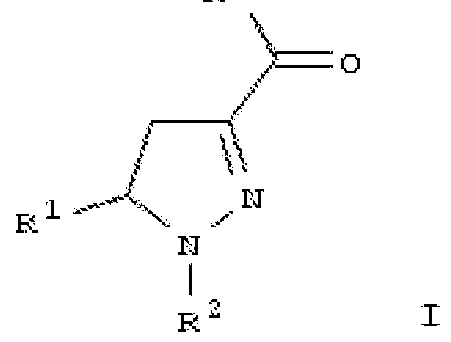
WO' 125 also describes preparation ofN-piperidinyl-5-(4-chlorophenyl)-l-(2,4-dichiorophenyl)-4,5- dihydropyrazole-3-carboxamide. WO 2007009701 describes use of substituted pyrazole compounds of formula-I for the treatment of cardiovascular risk factors caused by metabolic syndrome in humans and animals

ΕΡ 1743637 discloses use of substituted pyrazole compounds and combinations thereof for the treatment of metabolic syndrome. Mohamed Jawed Ahsana et al. in European Journal of Medicinal Chemistry, vol 46, (11), Nov 2011, Pg. 5694-5697 discloses synthesis of a series of 3a,4-dihydro-3H- indeno [1,2-c] pyrazole-2-carboxamide analogues and evaluation of antitubercular activity thereof. Sudalaiandi Kumaresan et al. in IJAPR Feb. 2013 vol. 4 (2) 1402-1412 discloses antimycobacterial activity of the N, l-Diphenyl-l,4-Dihydrothiochromeno[4,3-c] Pyrazole-3-Carboxamide analogues" compounds with minimum inhibitory concentrations of 7.5-6.25 M. Further, antitubercular activity of cyclic azole substituted diphenyl ether derivatives is disclosed by Suvarna G. Kini, in European Journal of Medicinal Chemistry 44, (2), February 2009, Pages 492-500
Further in Journal of Medicinal Chemistry (2003), 46(4), 642-645 by Reeti Katoch-Rouse et al. discloses synthesized a series of less lipophilic analogues of compound of Formula-I to serve as potential radioligands. Binding affinities of the series and a functional electrophysiological assay of three of our compounds have been presented.

Pyrazole derivatives as cannabinoid receptor agonists are also reported in US 5624941, EP 576357, US 8030323.
In the light of the above, it is clear that there are several important anti-TB drug candidates such as PA-824 and BM212, which are structurally reminiscent to Rimonabant.
Rimonabant is an approved drug, with established safety. Rimonabant and its analogues are also shown to have promising activities and also are proved safe to human. Since Rimonabant was recently withdrawn from the market following postmarketing surveillance studies, which confirmed a risk of depressive disorders amongst users, there is need for modification or elimination of the carboxamide side chain, which is responsible for crossing the blood-brain barrier, might reduce these side effects.
Therefore, the present inventors have modified the core structure of rimonabant i.e. pyrazole carboxylic acid to obtain a safe, alternative drug candidate for treatment of mycobacterial infections. OBJECT OF THE INVENTION: The main object of invention is to provide Pyrazole carboxylic acid analogues for the treatment of Mycobacterium Tuberculosis.
Still another object of the present invention is to introduce rimonabant and its analogues as potential drug candidates for treatment of mycobacterial infection.
Yet another object of the present invention is to provide a pharmaceutical composition for the treatment of mycobacterial infections in human.
SUMMARY OF INVENTION:
Accordingly the present invention provides the pyrazole carboxylic acid analogues of Formula 1, or stereoisomers, or esters or pharmaceutically acceptable salts thereof, for use as a medicament for treating mycobacterial infections,

Formula 1
wherein, Y represents heteroatom N, S or O;
X represents hydrogen, or halogen;
Ri represents (un)substituted aryl, hydrogen, where substituents are mono, di or tri halogen;
R2 represents OH, (C1-C6) alkyl, (C1-C6) alkoxy, piperidine, 1 -amino piperidine, morpholine, pyridine-4-carbohydrazide, 1-methylpiperazine, 1-methylpiperazine, thiomorpholine, hydrazine, amino acids, Schiff bases, heterocycles;
and R represents (C1-C4) linear or branched alkyl, hydrogen.In an embodiment of the present invention, the pyrazole carboxylic acid analogues of Formula 1, encompasses the following compounds;
5 -(4-Chlorophenyl)- 1 -(2,4-dichlorophenyl)-4-methyl-N-(piperidin- 1 -yl)-l -H-pyrazole-3 -carboxamide
(1)
5 -(4-Chlorophenyl)- 1 -(2,4-dichlorophenyl)-4-methyl- 1 H-pyrazole-3 -carboxylic acid (2)
Ethyl 5-(4-chlorophenyl)-l-(2,4-dichlorophenyl)-4-methyl-lH-pyrazole-3-carboxylate (3)
N'-(5-(4-chlorophenyl)-l-(2,4-dichlorophenyl)-4-methyl-lH-pyrazole-3-carbonyl)
isonicotinohydrazide (4)
(5 -(4-chlorophenyl)- 1 -(2,4-dichlorophenyl)-4-methyl- 1 H-pyrazol-3 -yl)(4-methylpiperazin- methanone (5)
(5-(4-chlorophenyl)-l-(2,4-dichlorophenyl)-4-methyl-lH-pyrazol-3-yl) (morpholino) methanone (6) 5 -(4-Chlorophenyl)-4-methyl- 1 -phenyl- lH-pyrazole-3 -carboxylic acid (7)
1 -(5-(4-chlorophenyl)-4-methyl- 1 -phenyl- lH-pyrazol-3 -yl)propan- 1 -one (8)
l-(2,4-dichlorophenyl)-4-methyl-5-phenyl-lH-pyrazole-3-carboxylic acid (9)
N'-(l-(2,4-dichlorophenyl)-4-methyl-5-phenyl-lH-pyrazole-3-carbonyl) isonicotinohydrazide (10) 5-(4-chlorophenyl)-4-methyl-lH-pyrazole-3-carboxylic acid (11)
l-(2-chlorophenyl)-5-(4-chlorophenyl)-4-methyl-lH-pyrazole-3-carboxylic acid (12)
5 -(4-chlorophenyl)- 1 -(2,4-difluorophenyl)-4-methyl- 1 H-pyrazole-3 -carboxylic acid (13)
5-(4-chlorophenyl)-4-methyl- 1 -phenyl-N-(piperidin- 1 -yl)- lH-pyrazole-3 -carbox amide (14) l-(2-chlorophenyl)-5-(4-chlorophenyl)-4-methyl-N-(piperidin-l-yl)-lH-pyrazole-3-carboxamide (15) (5 -(4-chlorophenyl)- 1 -(2,4-difluorophenyl)-4-methyl- 1 H-pyrazol-3 -yl)(4-methylpiperazin- 1 -yl) methanone (16)
5-(4-chlorophenyl)-4-methyl-N-(piperidin-l-yl)isoxazole-3-carboxamide (17)
l-(2,4-dichlorophenyl)-4-methyl-5-phenyl-N-(piperidin-l-yl)-lH-pyrazole-3-carboxamide (18) 5-(4-chlorophenyl)-l-(2,4-dichlorophenyl)-N-(piperidin-l-yl)-lH-pyrazole-3-carbox amide (19).
In still another embodiment of the present invention, the minimum inhibitory concentration (MIC) of the pyrazole carboxylic acid analogues of Formula 1, against Mycobacterium tuberculosis (strain H37Rv) is in the range of 3 to 30 μg/ml and for Mycobacterium smegmantis the MIC is in the range of 1-35 μg/ml.
In yet another embodiment of the present invention, a pharmaceutical composition comprising pyrazole carboxylic acid analogues of the Formula I, together with pharmaceutically acceptable excipient(s) and/or vehicle(s), for the treatment of mycobacterial infections in human.
In still another embodiment of the present invention, the pharmaceutical composition comprising pyrazole carboxylic acid analogues of general formula I, optionally with an additional antitubercular agent together with pharmaceutically acceptable excipient(s) and/or vehicle(s).
In yet another embodiment of the present invention, the Mycobacterium species is selected from the group consisting of Mycobacterium tuberculosis (strain H37Rv) and Mycobacterium smegmatis (strain MC2 155).
In still another embodiment of the present invention, a method of treating or inhibiting or controlling growth of Mycobacterium species in human, comprising administrating pyrazole carboxylic acid analogues of general formula-I, together with pharmaceutically acceptable excipient(s) and/or vehicle(s).

Formula 1
wherein, Y represents heteroatom N, S or O;
X represents hydrogen, or halogen;
Ri represents (un)substituted aryl, hydrogen, where substituents are mono, di or tri halogen;
R2 represents OH, (C1-C6) alkyl, (C1-C6) alkoxy, piperidine, 1 -amino piperidine, morpholine, pyridine-4-carbohydrazide, 1-methylpiperazine, 1-methylpiperazine, thiomorpholine, hydrazine, amino acids, Schiff bases, heterocycles;
and R represents (C1-C4) linear or branched alkyl, hydrogen.
In yet another embodiment of the present invention, the method of treating or inhibiting or controlling growth of Mycobacterium species in human, comprising administrating pyrazole carboxylic acid analogues of general formula- 1, wherein the compounds are selected from the group consisting of ; i. 5 -(4-Chlorophenyl)- 1 -(2,4-dichlorophenyl)-4-methyl-N-(piperidin- 1 -yl)-l -H-pyrazole-3 - carboxamide (1)
ii. 5 -(4-Chlorophenyl)- 1 -(2,4-dichlorophenyl)-4-methyl- 1 H-pyrazole-3 -carboxylic acid (2) iii. Ethyl 5-(4-chlorophenyl)-l-(2,4-dichlorophenyl)-4-methyl-lH-pyrazole-3-carboxylate (3) iv. N'-(5-(4-chlorophenyl)-l-(2,4-dichlorophenyl)-4-methyl-lH-pyrazole-3-carbonyl)
isonicotinohydrazide (4)
v. (5 -(4-chlorophenyl)- 1 -(2,4-dichlorophenyl)-4-methyl- 1 H-pyrazol-3 -yl)(4-methylpiperazin- 1 - yl) methanone (5)
vi. (5 -(4-chlorophenyl)- 1 -(2,4-dichlorophenyl)-4-methyl- 1 H-pyrazol-3 -yl) (morpholino)
methanone (6)
vii. 5-(4-Chlorophenyl)-4-methyl-l-phenyl-lH-pyrazole-3-carboxylic acid (7)
viii. 1 -(5-(4-chlorophenyl)-4-methyl- 1 -phenyl- 1 H-pyrazol-3 -yl)propan- 1 -one (8)
ix. l-(2,4-dichlorophenyl)-4-methyl-5-phenyl-lH-pyrazole-3-carboxylic acid (9)
x. N'-( 1 -(2,4-dichlorophenyl)-4-methyl-5 -phenyl- lH-pyrazole-3 -carbonyl) isonicotinohydrazide (10)
xi. 5-(4-chlorophenyl)-4-methyl-lH-pyrazole-3-carboxylic acid (11)
xii. l-(2-chlorophenyl)-5-(4-chlorophenyl)-4-methyl-lH-pyrazole-3-carboxylic acid (12) xiii. 5 -(4-chlorophenyl)- l-(2,4-difluorophenyl)-4-methyl-l H-pyrazole-3 -carboxylic acid (13) xiv. 5-(4-chlorophenyl)-4-methyl-l-phenyl-N-(piperidin-l-yl)-lH-pyrazole-3-carbox amide (14)
xv. l-(2-chlorophenyl)-5-(4-chlorophenyl)-4-methyl-N-(piperidin-l-yl)-lH-pyrazole-3- carboxamide (15)
xvi. (5 -(4-chlorophenyl)- 1 -(2,4-difluorophenyl)-4-methyl- 1 H-pyrazol-3 -yl)(4-methylpiperazin- 1 - yl) methanone (16)
xvii. 5-(4-chlorophenyl)-4-methyl-N-(piperidin-l-yl)isoxazole-3-carboxamide (17)
xviii. l-(2,4-dichlorophenyl)-4-methyl-5-phenyl-N-(piperidin-l-yl)-lH-pyrazole-3-carboxamide (18)
xix. 5 -(4-chlorophenyl)- 1 -(2,4-dichlorophenyl)-N-(piperidin- 1 -yl)- lH-pyrazole-3 -carbox amide (19).
In still another embodiment of the present invention the Mycobacterium species is selected from the group consisting of Mycobacterium tuberculosis (strain H37Rv) and Mycobacterium smegmatis (strain MC2 155).
Further the invention furnishes evaluation of anti-mycobacterial activity of synthesized compounds of Formula-I.
DETAILED DESCRIPTION OF INVENTION:
The invention will now be described in detail in connection with certain preferred and optional embodiments, so that various aspects thereof may be more fully understood and appreciated. In a preferred embodiment, the invention provides the pyrazole carboxylic acid analogues of Formula 1 or stereoisomers, or esters or pharmaceutically acceptable salts thereof, for use as a medicament for mycobacterial infections,

Formula 1
wherein, Y represents heteroatom N, S or O;
X represents hydrogen, halogen
Ri represents (un)substituted aryl, hydrogen, where substituents are mono, di or tri halogen; R2 represents OH,(Cl-C6)alkyl, (C1-C6) alkoxy, piperidine, 1 -amino piperidine, morpholine, pyridine-4- carbohydrazide, 1-methylpiperazine, 1-methylpiperazine,
and R represents (C1-C4) linear or branched alkyl, hydrogen.
According to the above preferred embodiment, the pyrazole carboxylic acid analogues of Formula 1, having anti-mycobacterial activity encompass the compounds as listed in table 1.
Table 1:


"NT: Not tested bMycobacterium tuberculosis H37Rv
In accordance with Table 1, the anti-mycobacterial pyrazole carboxylic acid analogues of Formula- 1 are selected from the group consisting of;
i. 5 -(4-Chlorophenyl)- 1 -(2,4-dichlorophenyl)-4-methyl-N-(piperidin- 1 -yl)-l -H-pyrazole-3 - carboxamide (1)
ii. 5 -(4-Chlorophenyl)- 1 -(2,4-dichlorophenyl)-4-methyl- 1 H-pyrazole-3 -carboxylic acid (2) iii. Ethyl 5-(4-chlorophenyl)-l-(2,4-dichlorophenyl)-4-methyl-lH-pyrazole-3-carboxylate (3) iv. N'-(5-(4-chlorophenyl)-l-(2,4-dichlorophenyl)-4-methyl-lH-pyrazole-3-carbonyl)
isonicotinohydrazide (4)
v. (5 -(4-chlorophenyl)- 1 -(2,4-dichlorophenyl)-4-methyl- 1 H-pyrazol-3 -yl)(4-methyl piperazin- 1 - yl) methanone (5)
vi. (5 -(4-chlorophenyl)- 1 -(2,4-dichlorophenyl)-4-methyl- 1 H-pyrazol-3 -yl) (morpholino)
methanone (6)
vii. 5-(4-Chlorophenyl)-4-methyl-l-phenyl-lH-pyrazole-3-carboxylic acid (7)
viii. 1 -(5-(4-chlorophenyl)-4-methyl- 1 -phenyl- 1 H-pyrazol-3 -yl)propan- 1 -one (8)
ix. l-(2,4-dichlorophenyl)-4-methyl-5-phenyl-lH-pyrazole-3-carboxylic acid (9)
x. N'-(l-(2,4-dichlorophenyl)-4-methyl-5-phenyl-lH-pyrazole-3-carbonyl) isonicotinohydrazide
(10)
xi. 5-(4-chlorophenyl)-4-methyl-lH-pyrazole-3-carboxylic acid (11)
xii. l-(2-chlorophenyl)-5-(4-chlorophenyl)-4-methyl-lH-pyrazole-3-carboxylic acid (12) xiii. 5 -(4-chlorophenyl)- l-(2,4-difluorophenyl)-4-methyl-lH-pyrazole-3-carboxylic acid (13) xiv. 5-(4-chlorophenyl)-4-methyl-l-phenyl-N-(piperidin-l-yl)-lH-pyrazole-3-carbox amide (14) xv. l-(2-chlorophenyl)-5-(4-chlorophenyl)-4-methyl-N-(piperidin-l-yl)-lH-pyrazole-3- carboxamide (15)
xvi. (5 -(4-chlorophenyl)- 1 -(2,4-difluorophenyl)-4-methyl- 1 H-pyrazol-3 -yl)(4-methylpiperazin- 1 - yl) methanone (16)
xvii. 5 -(4-chlorophenyl)-4-methyl-N-(piperidin-l-yl)isoxazole-3 -carboxamide (17)
xviii. l-(2,4-dichlorophenyl)-4-methyl-5-phenyl-N-(piperidin-l-yl)-lH-pyrazole-3-carboxamide (18)
xix. 5 -(4-chlorophenyl)- 1 -(2,4-dichlorophenyl)-N-(piperidin- 1 -yl)- lH-pyrazole-3 -carbox amide (19)
With regards to the antibacterial activity of the compounds of the Formula-I, the initial studies involved screening of Rimonabant (1) against Mycobacterium smegmatis, which showed a MIC value 13.56 μg/ml. Therefore, its 18-analogues were synthesized and few of them were screened against Mycobacterium smegmatis. They showed moderate to excellent activity (Table 1). Similarly Rimonabant and all the synthesized analogues were then screened for anti-bacterial activity against Mycobacterium tuberculosis (virulent strain H37Rv) in vitro. The precursor of Rimonabant, acid 2 showed improved MTB activity and ester 3 retains the activity as compared to Rimonabant. Similarly analogues 2, 4, 7, 11 & 15-18 showed enhanced activity and the analogues 3, 5, 6, 8, 10, 12 & 19 retains the activity. Most importantly the analogues 9 and 13 showed drastic increase in MTB activity. The analogue 14 came out to be a promising lead with highest activity. Compared with one of the first line anti-TB drug Ethambutol (MIC 3.25 μg/ml), the analogue 14 was found to be equally active. When compared to Pyrazinamide (MIC 50.0 μg/ml) all the 18 analogues were found to be more potent. The analogue 13 was a simplified lead molecule. Based on the analogue 9, a simple replacement of chlorine by hydrogen might provide a more active analogue of 13. The anti-
mycobacterial activity of compounds of Formula-I against mycobacterial species is measured in the range of 1 to 50 μg/ml, particularly anti -mycobacterial activity against Mycobacterium tuberculosis (strain H37Rv) is evaluated in the range of 3 to 30 μg/ml and for Mycobacterium smegmantis the MIC is calculated in the range of 1-35 μg/ml, In another preferred embodiment, the invention provides, novel pyrazole carboxylic acid analogues of Formula 1 having anti-mycobacterial activity as disclosed in above Table 1,

Formula 1
wherein, Y represents heteroatom N or O;
X represents hydrogen, CI
Ri represents phenyl, 2-4 dichlorophenyl, 2-4 difluorophenyl;
R2 represents OH, ethyl, piperidine, 1-aminopiperidine, pyridine-4-carbohydrazide, 1- methylpiperazine; and R represents methyl, hydrogen.
According to the above embodiment, the novel anti-mycobacterial agents of formula-I are selected from the group consisting of;
1. (5-(4-chlorophenyl)-l-(2,4-dichlorophenyl)-4-methyl-lH-pyrazol-3-yl)(4-methylpiperazin-l- yl) methanone (5)
2. 5-(4-Chlorophenyl)-4-methyl-l-phenyl-lH-pyrazole-3-carboxylic acid (7)
3. 1 -(5-(4-chlorophenyl)-4-methyl- 1 -phenyl- lH-pyrazol-3 -yl)propan- 1 -one (8)
4. N'-(l-(2,4-dichlorophenyl)-4-methyl-5-phenyl-lH-pyrazole-3-carbonyl) isonicotinohydrazide
(10)
5. (5-(4-chlorophenyl)-l-(2,4-difluorophenyl)-4-methyl-lH-pyrazol-3-yl)(4-methylpiperazin-l- yl) methanone (16)
6. 5-(4-chlorophenyl)-4-methyl-N-(piperidin-l-yl)isoxazole-3-carboxamide (17)
In another optional embodiment, the pyrazole carboxylic acid analogues of Formula 1 is Rimonabant or 5 -(4-Chlorophenyl)- 1 -(2,4-dichloro-phenyl)-4-methyl-N-(piperidin- 1 -yl)- lH-pyrazole-3 - carboxamide, wherein the minimum inhibitory concentration of Rimonabant against Mycobacterium smegmatis is 13.56 μg/ml and against Mycobacterium tuberculosis 25 μg/ml.

Rimonabant
In another embodiment, the invention provides a pharmaceutical composition comprising a compound of Formula 1, or its stereoisomers, esters or pharmaceutically acceptable salt thereof, and a pharmaceutically acceptable carrier(s), diluent(s) vehicle(s), and/or excipient(s).
The compound of formula 1 disclosed herein is present in the composition in an amount which is effective to treat the disease or the condition caused by the bacterial strains mentioned above.
The pharmaceutical compositions of the invention can be prepared by combining compounds of Formula-I with appropriate pharmaceutically acceptable carriers, diluents or excipients, and may be formulated into preparations in solid, semi-solid, liquid or gaseous forms, such as tablets, capsules, powders, granules, ointments, solutions, injections, gels and microspheres.
In another embodiment, the present invention relates to administering 'an effective amount' of the 'composition of invention' to the subject suffering from said disease. Accordingly, compound of Formula 1 and pharmaceutical compositions containing them may be administered using any amount, any form of pharmaceutical composition via any route of administration effective for treating the disease. Typical routes of administering such pharmaceutical compositions include, without limitation, oral, topical, transdermal, inhalation, parenteral, sublingual, buccal, rectal, vaginal, and intranasal.
Pharmaceutical compositions of the invention are formulated so as to allow the active ingredients contained therein to be bioavailable upon administration of the composition to a patient. Compositions that will be administered to a subject or patient may take the form of one or more dosage units. The dosage forms can also be prepared as sustained, controlled, modified and immediate dosage forms.
The excipients or carriers are selected from the group such as diluents, disintegrants, crosslinked polymers, binders, lubricants, coatings layer.
Further the synergistic effect of instant pharmaceutical composition can be achieved in combination with additional known anti-tubercular drugs such as Rifampcin, Ethambutol, Pyrazinamide.
In another embodiment, the invention provides a method of treating or inhibiting growth of a bacteria preferably Mycobacterium smegmatis and Mycobacterium tuberculosis in a subject (i.e. human or animal) comprising administrating anti-mycobacterial compounds of Formula-I, optionally with at
least one additional active compound or anti-tubercular agent together with pharmaceutically acceptable excipients and/or vehicles.
In another embodiment, the invention provides pyrazole carboxylic acid compounds of Formula-I for use in treating or inhibiting growth of a bacteria preferably Mycobacterium smegmatis and Mycobacterium tuberculosis in a subject. The subject according to the invention is an animal or human.
In yet another embodiment, the invention furnishes pyrazole carboxylic acid compounds of Formula-I for the preparation of medicament useful for treating or inhibiting the growth of Mycobacterium smegmatis and Mycobacterium tuberculosis in human.
EXAMPLES
The following examples are given by way of illustrating the present invention and should not be construed to limit the scope of the present invention
1. Anti- mycobacterial activity assay (Mycobacterium smegmatis MC2155 strain):
Anti-mycobacterial activity of the compounds was performed with Mycobacterium smegmatis MC2155 strain by performing a growth inhibition assay by agar dilution followed turbidometry method. The assay was semi -throughput and conducted in a 96 well plate (sterile). Isolated single colonies of M. smegmatis MC2 155 (ATCC 14468) grown on 7H10 agar plate were grown overnight in Middlebrook 7H9 medium (0.47% Middlebrook 7H9 broth base, 10% ADS, 0.2% glycerol, and 0.1% Tween-80) to mid exponential phase inoculated in 5 ml Middlebrook 7H9 medium. The secondary culture was incubated overnight and allowed to grow at 37°C to early log phase (OD60o ¾ 0.3). For the anti-mycobacterial assay, 98 μΐ of l : 1000-folds dilution of secondary culture was dispensed into 96-well microtiter plate per well along with 2μ1 of test compound in triplicate. 240 μΐ of sterile water were added to each well of the peripheral rows of 96-well plate to minimize media evaporation during assay incubation. The final concentration of the test compound (Rimonabant) in each well was 30μΜ. Bacterial growth was assessed after 32 hours of incubation by measuring turbidity at 600nm OD60o values using TECAN Infinite 200 PRO™ (Tecan Instruments, Switzerland). Depending upon the percentage of growth, the percentage of inhibition was calculated at the standard concentration of 30μΜ. Isoniazid and Rifampicin were included in every assay plate as positive controls of growth inhibition using stock solutions of INH (10 mg/mL, HiMedia) and Rifampicin (10 mg/mL, HiMedia) to achieve the final concentration of 16 g/mL for INH and 2 g/mL for Rifampicin. Additional controls DMSO (solvent without compound) and medium without inoculums were included in all the assay plates avoiding intra assay variability. The results were analyzed as the percentage of growth inhibition.
2. MIC Assay:
After the compounds were screened for percentage inhibition, those compounds which were found to be promising were further screened to obtain their MIC values. MIC / Minimum Inhibitory
Concentration is that concentration of compound which inhibits the 90 % growth of bacteria under optimum conditions. The growth inhibition assays were carried out in the same analogy as explained above various concentrations of the test compounds prepared by serial dilutions 100 μΜ, 50 μΜ, 25 μΜ, 12.5 μΜ and 6.25 μΜ (DMSO as solvent) to obtain the final concentrations of 46.37μg/ml, 23.18 μg ml, 11.59 μg/ml, 5.79 μg/ml, 2.89 μg/ml respectively. From the rate of inhibition bacterial growth, the ascertained MIC of the compound was calculated.
The MIC value of the test compound JMG 005 i.e. Rimonabant is 13.56 μ^πιΐ (29.24 μΜ ± 1.47). 3. Anti- Mycobacterial Activity for M.tuberculosis (General Procedure)
Ten fold serial dilutions of each test compound were prepared and incorporated into Middle brook 7H11 agar medium with OADC Growth Supplement. Inoculum of M. tuberculosis H37Rv ATCC 27294 (MTB) was prepared from fresh Middle brook 7H11 agar slants with OADC growth supplement adjusted to lmg/ml (wet weight) in Tween 80 (0.05%) saline diluted to 10"2 to give a concentration approximately 107 cfu/ml. A 5 μί amount of bacterial suspension was spotted into 7H11 agar tubes containing 10-fold serial dilutions of compounds per mL. The tubes were incubated at 37 °C, and final readings were recorded after 28 days. The minimum inhibitory concentration (MIC) is defined as the minimum concentration of the compound required to completely inhibit the bacterial growth. Rifampicin, Ethambutol and Pyrazinamide were used as reference compounds. This method is similar to that recommended by the National Committee for Clinical Laboratory Standards11 for the determination of minimum inhibitory concentration (MIC) in triplicate.
Examples:
General Information:
All reagents and solvents were used as received from commercial sources unless and otherwise noted. All experiments were carried out under an atmosphere of Argon in round bottom flask. Pre-coated plates (silica gel 60 PF254, 0.25 mm or 0.5 mm) were utilized for Thin Layer Chromatography (TLC). Column chromatographic purifications were carried out on flash silica-gel (100-200 mesh) using either petroleum ether and ethyl acetate or dichloromethane and methanol as eluents. Melting points are uncorrected. The IR spectra were recorded on an FT-IR spectrometer. The l and 1 C NMR spectra were recorded on 200/400/500 MHz and 50/100/125 MHz NMR spectrometer respectively in CDCl3/DMSO-£/6. Mass spectra were taken on LC-MS (ESI) mass spectrometer. HRMS were scanned at NCL, Pune.
Example 1:
Synthesis of 5 -(4-Chlorophenyl)- 1 -(2,4-dichlorophenyl)-4-methyl-N-(piperidin- 1 -yl)- 1 -H-pyrazole-3 - carboxamide (1):

Modified Procedure:
To a stirred solution of compound 2 (382 mg; 1.0 mmol) in toluene (10 ml) one drop of dimethyl formamide was added. The reaction mixture was cooled to 0°C and added thionyl chloride (140 mg: 1.2mmol) in 2ml toluene drop-wise for the period of 2 minutes at the same temperature. The reaction mixture was allowed to attain room temperature and heated at 100°C for 4 h. Excess of thionyl chloride and toluene was distilled off under reduced pressure. In another flask under nitrogen atmosphere was introduced 1- amino piperidine (100 mg; 1.0 mmol) and triethyl amine (101 mg; 1.0 mmol) in 5.0 ml dichloromethane. The flask was cooled to 0°C. To this was added a cooled solution of acid chloride drop-wise at the same temperature. The resulting reaction mixture was allowed to attain room temperature and then it was stirred for 12h. After completion of the reaction (monitored by TLC), the reaction mixture was diluted with water (10 ml) and organic layer was separated, washed with water (2x5 ml) and brine solution(5ml), dried over Na2S04(anhydrous) and concentrated in vacuo. The residue was purified by column chromatography over silica gel (ethyl acetate/petroleum ether 1 :9(v/v)) afforded pure product.
Rf: 0.4 (3:7 EtOAc : Pet Ether); Solid; 292 mg, 63%; m.p. 182-183 °C ;
'H NMR (CDC13, 400 MHz): δ 7.63 (s, lH), 7.41-7.36 (m, 1H), 7.30-7.26 (m, 3H), 7.04 (d, J=8.28 Hz, 2H), 2.93-2.78 (m, 4H), 2.35 (s, 3H), 1.78-1.70 (m, 4H), 1.48-1.37 (m, 2H);
1 C NMR (CDC13, 100 MHz): δ 159.9, 144.4, 142.9, 136.0, 135.9, 134.9, 132.9, 130.8, 130.6, 130.3, 128.9, 127.9, 127.2, 118.2, 57.0, 25.4, 23.3, 9.3;
HRMS-ESI (m/z) Calcd C22H22ON3Cl3 + H)+: 463.0854 found:463.0853.
Example 2:
5 -(4-Chlorophenyl)- 1 -(2,4-dichlorophenyl)-4-methyl- 1 H-pyrazole-3 -carboxylic acid (2)

Synthesis of 2 was accomplished by the reported procedure.
Rf: 0.6 (5:95 MeOH : Dichloromethane); Solid; 979 mg, 65% ; m.p. 208-209 °C;
'H NMR (CDC13, 400 MHz): δ 7.44-7.41 (m, IH), 7.35 (d, J=1.89 Hz, IH), 7.33-7.28 (m, 3H), 7.09 (d, J=8.47 Hz, 2H), 2.36 (s, 3H);
1 C NMR (CDC13, 100 MHz): δ 166.4, 143.3, 136.2, 135.6, 135.1, 133.5, 130.8, 130.5, 129.8, 128.9, 127.8, 127.7, 126.7, 119.6, 9.6;
HRMS-ESI (m/z) Calcd CivHnOzNzClsNa : 402.9778 found: 402.978.1.
Example 3:
Ethyl 5-(4-chlorophenyl)-l-(2,4-dichl yrazole-3-carboxylate (3)

Compound 3 was prepared by the reported procedure.
Rf: 0.6 (1 :9 EtOAc : Pet ether); Solid; 697 mg, 45% ; m.p. 128-129 °C;
¾ NMR (CDC13, 200 MHz): δ 7.39 (d, J=2.02 Hz, IH), 7.34 (d, J=1.37 Hz, IH), 7.33-7.28 (m, 3H), 7.08 (d, J=8.59 Hz, 2H), 4.51-4.41 (q, J= 7.08 Hz, 2H), 2.34 (s, 3H), 1.43 (t, J =7.08 Hz, 3H);
1 C NMR (CDC13, 100 MHz): δ 162.7, 142.9, 136.0, 135.9, 135.0, 133.0, 130.9, 130.7, 130.1, 128.9, 127.7, 127.0, 119.1, 60.9, 14.4, 9.6;
HRMS-ESI (m/z) Calcd Ci9H1502N2Cl3 + H)+: 409.0272 found: 409.0265.
Example 4:
N'-(5-(4-chlorophenyl)-l-(2,4-dichlorophenyl)-4-methyl-lH-pyrazole-3-carbonyl)
isonicotinohydrazide (4)
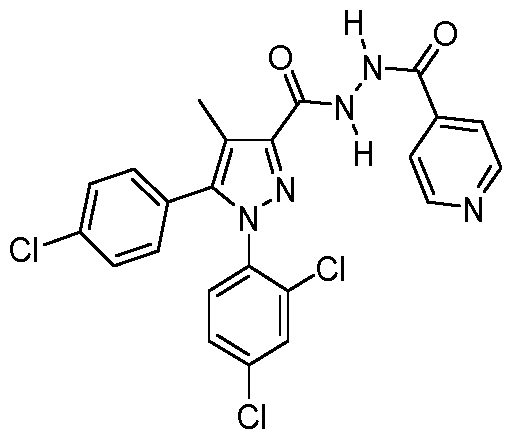
Compound 4 was synthesized from 2 according to the procedure applied to 1.
Rf : 0.6 (1 :9 MeOH : Dichloromethane); Solid; 499 mg, 59% ; m.p. 237-239 °C;
'H NMR (CDC13, 400 MHz): δ 10.33 (s, IH), 9.44 (s, IH), 8.71 (s, IH), 7.74 (s, 2H), 7.41 (s, IH), 7.30-7.32 (m, 5H), 7.05 (d, J=8.53 Hz, 2H), 2.17 (s, 3H);
1 C NMR (CDCI3, 100 MHz): δ 163.5, 161.2, 150.2, 143.3, 142.4, 136.2, 135.6, 135.2, 132.7, 130.7,
130.5, 130.3, 128.9, 128.8, 127.9, 126.7, 118.4, 30.9, 9.2;
HRMS-ESI (m/z) Calcd C23H1602N5Ci3 + H)+ : 500.0442 found: 500.0443. Example 5: (5-(4-chlorophenyl)-l-(2,4-dichlorophenyl)-4-methyl-lH-pyrazol-3-yl)(4- methylpiperazin-l-yl) methanone (5)

Compound 5 was synthesized from 2 according to the procedure applied to 1.
Rf : 0.68 (5 :95 MeOH : Dichloromethane); Solid; 306 mg, 50% ; m.p. 1 1 1-1 13 °C
¾ NMR (CDC13, 400 MHz): δ 7.48 (s, 1H), 7.31-7.34 (m, 3H), 7.20 (d, J=8.54 Hz, 1H), 7.10 (d, J=8.28 Hz, 2H), 3.99-3.80 (m, 4H), 2.61-2.45 (m, 4H), 2.37 (s, 3H), 2.24 (s, 3H);
1 C NMR (CDC13, 100 MHz): δ 163.2, 146.4, 141.9, 135.9, 135.7, 134.8, 133.0, 130.6, 128.9, 127.8, 127.3, 1 16.8, 55.5, 54.7, 47.1, 45.9, 41.9, 9.0;
HRMS-ESI (m/z) Calcd C22H2iON4Cl3 + H)+: 463.0854 found: 463.0862. Example 6: (5-(4-chlorophenyl)-l-(2,4-dichlorophenyl)-4-methyl-lH-pyrazol-3-yl) (morpholino) methanone (6)

Compound 6 was synthesized from 2 according to the procedure applied to 1.
Rf : 0.68 (5 :95 MeOH : Dichloromethane); Solid; 590 mg, 63% ; m.p. 170-172 °C;
'H NMR (CDC13, 500 MHz): δ 7.47 (d, J=2Hz, 1H), 7.33 (d, J=8.54 Hz, 2H), 7.27-7.30 (m, 1H), 7.19
(d, J=8.55 Hz, 1H), 7.09 (d, J=8.54 Hz, 2H), 3.85-3.92 (m, 4H), 3.75-3.83 (m, 4H), 2.25 (s, 3H);
1 C NMR (CDCI3, 125 MHz): δ 163.2, 146.0, 142.1, 135.9, 135.8, 134.9, 133.0, 130.6, 130.5, 130.3,
128.9, 127.8, 127.3, 1 17.2, 67.3, 66.9, 47.8, 42.6, 9.1 ;
HRMS-ESI (m/z) Calcd C2iH1802N3Cl3Na :472.0357 found: 472.0355.
Example 7: 5 -(4-Chlorophenyl)-4-methyl- l -phenyl- lH-pyrazole-3-carboxylic acid (7)

Compound 7 was synthesized by the procedure applied to 2.
Rf : 0.5 (5 :95 MeOH:Dichloromethane); Solid; 719 mg, 58% ; m.p. 203-204 °C;
¾ NMR (CDC13, 200 MHz): δ 7.46 (s, 1H), 7.32-7.38 (m, 5H), 7.30-7.20 (m, 2H), 7.13 (d, J= 6.36 Hz, 2H), 2.35 (s, 3H);
1 C NMR (CDCI3, 100 MHz): δ 165.9, 141.3, 140.9, 139.0, 134.9, 131.3, 129.0, 128.2, 127.6, 125.4, 125.1, 120.5, 9.6;
HRMS-ESI (m/z) Calcd Ci7H1302N2ClNa : 335.0571 found: 335.0566. Example 8: l-(5-(4-chlorophenyl)-4-methyl-l-phenyl-lH-pyrazol-3-yl)propan-l-one (8)

Synthesis of compound 8 was done by the reported procedure.
Rf: 0.8 (1 :9 EtOAc : Pet ether); Solid; 595 mg, 48% ; m.p. 121-123 °C;
¾ NMR (CDC13, 400 MHz): δ 7.31-7.36 (m, 5H), 7.24-7.27 (m, 2H), 7.10 (d, J=8.6 Hz, 2H), 4.48 (q, J=14.14 Hz, 2H), 2.33 (s, 3H), 1.46 (t, J=7.07 Hz, 3H);
1 C NMR (CDCI3, 100 MHz): δ 163.0, 142.3, 140.9, 139.3, 134.7, 131.3, 128.9, 128.0, 127.9, 127.0, 125.4, 120.0, 60.8, 14.4, 9.7;
HRMS-ESI (m/z) Calcd Ci9H1702N2ClNa : 363.0871 found: 363.0868
Example 9: l-(2,4-dichlorophenyl)-4-meth l-5-phenyl-lH-pyrazole-3-carboxylic acid (9)

Compound 9 was synthesized by the procedure applied to 2.
Rf: 0.5 (5:95 MeOH : Dichloromethane); Solid; 865 mg, 59%; m.p. 188-189 °C;
¾ NMR (CDC13, 400 MHz): δ 7.46 (s, 1H), 7.16-7.27 (m, 5H), 7.08 (s, 2H), 6.02 (s, 1H), 2.17 (s, 3H);
1 C NMR (CDCI3, 100 MHz): δ 167.2, 145.6, 136.0, 135.1, 132.2, 131.2, 130.8, 129.6, 129.1, 128.5, 128.3, 128.2, 127.8, 118.0, 9.7;
HRMS-ESI (m/z) Calcd
 : 369.0168 found: 369.0164.
Example 10: N'-(l-(2,4-dichlorophenyl)-4-methyl-5-phenyl-lH-pyrazole-3-carbonyl)
isonicotinohydrazide (10)

Compound 10 was synthesized from 9 according to the procedure applied to 1.
Rf : 0.7 (5:95 MeOH : Dichloromethane); Solid; 273 mg, 68%; m.p. 167-168°C;
¾ NMR (CDC13, 400 MHz): δ 10.28 (bs, IH), 9.43 (s, IH), 8.71 (bs, IH), 7.75 (s, IH), 7.41 (d, J=1.47, 2H), 7.28-7.34 (m, 5H), 7.14 (d, J=4.40, 2H), 7.01-7.04(m, IH) 2.33 (s, 3H);
1 C NMR (CDC13, 100 MHz): δ 163.4, 161.2, 150.3, 144.4, 142.3, 138.8, 135.9, 135.8, 132.8, 130.5,
130.2, 129.5, 128.9, 128.6, 128.2, 127.8, 121.2, 118.3, 9.3;
HRMS-ESI (m/z) Calcd C23H1702N5Cl2 + H)+: 466.0832 found: 463.0830. Example 11: 5-(4-chlorophenyl)-4- lic acid (11)

Compound 11 was synthesized by the procedure applied to 2.
Rf : 0.5 (2:8 MeOH : Dichloromethane); Solid; 387 mg, 45%; m.p. 288-290 °C ;
¾ NMR (DMSO-£¾, 500 MHz): δ 13.54 (s, IH), 7.89, (d, J=8.24 Hz, 2H), 7.77 (d, J=8.24 Hz, 2H), 2.61 (s, 3H);
1 C NMR (DMSO-£/6, 125 MHz): δ 162.4, 132.7, 130.9, 129.4, 128.9, 128.5, 117.0, 60.5, 9.9;
HRMS-ESI (m/z) Calcd CiiH902N2ClNa : 259.0245 found: 259.0243.
Example 12: l-(2-chlorophenyl)-5-(4-chlorophenyl)-4-methyl-lH-pyrazole-3-carboxylic acid (12)

Compound 12 was synthesized by the procedure applied to 2.
Rf: 0.7 (5:95 MeOH : Dichloromethane); Solid; 656 mg, 52%; m.p. 204- 206 °C;
¾ NMR (CDC13, 200 MHz): δ 7.33-7.42 (m, 4H), 7.26 (d, J=6.41 Hz, 2H), 7.04 (d, J=7.79 Hz, 2 H),
2.32 (s, 3H);
1 C NMR (CDCI3, 100 MHz): δ 165.6, 143.3, 141.7, 136.9, 134.9, 131.9, 130.9, 130.3, 130.0, 129.8, 128.8 127.5, 126.9, 119.4, 9.6;
HRMS-ESI (m/z) Calcd Ci7H1202N2Cl2Na : 369.0168 found: 369.0168.
Example 13: 5-(4-chlorophenyl)-l-(2,4-difluorophenyl)-4-methyl-lH-pyrazole-3-carboxylic acid (13)

Compound 13 was synthesized by the procedure applied to 2
Rf: 0.5 (5:95 MeOH : Dichloromethane); Solid; 781 mg, 62%; m.p. 196-198°C;
¾ NMR (CDC13, 500 MHz): δ 9.31 (bs, IH), 7.44 (s, IH), 7.27 (d, J=8.46 Hz, 2H), 7.03 (d, J=8.46 Hz, 2H), 6.87 (s, IH), 6.72 (s, IH), 2.25 (s, 3H);
1 C NMR (CDC13, 125 MHz): δ 161.7, 157.5, 155.5, 143.1, 135.0, 130.7, 130.0, 128.9, 127.0, 123.7, 119.5, 112.1, 111.9, 104.8, 9.6;
HRMS-ESI (m/z) Calcd CnHnOzNzClFzNa : 371.0369 found: 371.0369.
Example 14: 5-(4-chlorophenyl)-4-methyl-l-phenyl-N-(piperidin-l-yl)-lH-pyrazole-3-carboxamide (14)

Compound 14 was synthesized from 7 according to the procedure applied to 1.
Rf : 0.3 (1 :9 MeOH : Dichloromethane); Solid; 580 mg, 65%; m.p. 201-202°C.
¾ NMR (CDC13, 400 MHz): δ 7.77 (bs, IH), 7.33 (d, J=7.27 Hz, 5H), 7.21 (d, J=7.78 Hz, 2H), 7.08 (d, J=8.28 Hz, 2H), 2.98-2.79 (m, 4H), 2.35 (s, 3H), 1.85-1.68 (m, 4H), 1.52-1.38 (m, 2H).
1 C NMR (CDC13, 100 MHz): δ 160.1, 143.5, 140.9, 139.3, 134.6, 131.2, 129.0, 128.9, 128.0, 127.9, 125.0, 119.1, 57.1, 25.4, 23.3, 9.3.
HRMS-ESI (m/z) Calcd C22H230N4C1 + H)+: 395.1633 found: 395.1631.
Example 15: 1 -(2-chlorophenyl)-5-(4-chlorophenyl)-4-methyl-N-(piperidin- 1 -yl)- lH-pyrazole-3 - carboxamide (15)

Com pound 15 was synthesized from 12 according to the procedure applied to 1.
Rf : 0.5 (1 : 1 EtOAc : Pet ether); Solid; 207 mg, 42% ; m.p. 248-250 °C;
l NMR (CDC13, 200MHz): δ 7.69 (bs, IH), 7.37-7.30 (m, 1Η),7.29-7.24 (m, 2H), 7.23-7.15 (m, 3H), 6.98 (d, J=8.71 Hz, 2H), 2.95-2.72 (m, 4H), 2.30 (s,3H), 1.78-1.61 (m, 4H), 1.45-1.29 (m, 2H); 1 C NMR (CDC13, 100 MHz): δ 160.3, 143.4, 141.1, 136.5, 135.0, 131.5, 130.9, 130.8, 130.3, 129.8, 128.8, 127.7, 126.6, 1 18.3, 55.7, 23.8, 21.1, 9.2;
HRMS-ESI (m/z) Calcd C22H22ON4CI2 + H)+: 429.1243 found: 429.1246
Example 16: (5-(4-chlorophenyl)-l-(2,4-difluorophenyl)-4-methyl-lH-pyrazol-3-yl)(4- methylpiperazin-l-yl) methanone (16)

Compound 16 was synthesized from 13 according to the procedure applied to 1.
Rf : 0.6 (5 :95 MeOH : Dichloromethane); Solid; 518 mg, 84%; m.p. 174-176 °C;
¾ NMR (CDC13, 200 MHz): δ 7.30-7.24 (m, IH), 7.24-7.20 (m, 2H), 7.06-6.96 (m, 2H), 6.91-6.69 (m, 2H), 3.91-3.63 (m, 4H), 2.56-2.34 (m, 4H), 2.29 (s, 3H), 2.12 (s, 3H);
1 C NMR (CDCI3, 50 MHz): δ 163.2, 146.6, 141.9, 134.8, 130.5, 129.7, 128.8, 127.4, 124.1, 1 16.8, 1 12.1, 1 1 1.6, 105.0, 104.5, 55.5, 54.7, 47.0, 45.9, 41.8, 8.9;
HRMS-ESI (m/z) Calcd C22H21ON4CIF2 + H)+: 431.1445 found: 431.1447.
Example 17: 5-(4-chlorophenyl)-4 ole-3-carboxamide (17)

Compound 17 was synthesized from the corresponding acid according to the procedure applied to 1. Rf : 0.6 (2:8 EtOAc:Pet ether); Solid; 240 mg, 45% ; m.p. 103-104 °C;
¾ NMR (CDC13, 500MHz): δ 7.63-7.64 (d, J=8.24 Hz, IH), 7.57-7.58 (d, J=8.24 Hz, IH), 7.47-7.49 (d, J=8.24 Hz, 2H), 2.99-2.81 (m, 4H), 2.45 (s, 3H), 1.85-1.71 (m, 4H), 1.53-1.41 (m, 2H);
1 C NMR (CDC13, 125MHz): δ 165.8, 163.0, 157.3, 156.4, 136.1, 129.2, 126.0, 1 1 1.7, 56.9, 25.2, 23.1, 8.3;
HRMS-ESI (m/z) Calcd Ci6H1802N3Cl + H)+: 320.1 160 found: 320.1 161.
Example 18: Synthesis of l-(2,4-dichlorophenyl)-4-methyl-5-phenyl-N-(piperidin-l-yl)-lH-pyrazole- 3-carboxamide (18)

Compound 18 was synthesized from 9 according to the procedure applied to 1.
Rf : 0.6 (5:95 MeOH:Dichloromethane); Solid; 288 mg, 61%; m.p. 172-173 °C;
¾ NMR (CDC13, 400 MHz): δ 7.72 (s, IH), 7.41 (s, IH), 7.27-7.32 (m, 5H), 7.11 (s, 2H), 3.05-2.75 (m, 4H), 2.38 (s, 3H), 1.91-1.65 (m, 4H), 1.54-1.34 (m, 2H);
1 C NMR (CDC13, 100 MHz): δ 160.1, 144.2, 144.0, 136.1, 135.7, 133.0, 130.6, 130.2, 129.5, 128.6, 128.6, 128.4, 127.7, 117.9, 57.0, 25.3, 23.2, 9.3;
HRMS-ESI (m/z) Calcd C22H22ON4CI2 + H)+: 429.1243 found: 429.1244. Example 19: 5-(4-chlorophenyl)-l-(2,4-dichlorophenyl)-N-(piperidin-l-yl)-lH-pyrazole-3- carboxamide (19)

Compound 19 was synthesized from the corresponding acid according to the procedure applied to 1. Rf : 0.7 (5:95 MeOH : Dichloromethane); Solid; 199 mg, 53%; m.p. 139-140 °C;
¾ NMR (CDC13, 400 MHz): δ 7.61 (d, J =2.29 Hz, IH), 7.57 (s, IH), 7.55 (d, J=2.29 Hz, IH), 7.53 (d, J = 1.83 Hz, IH), 7.42 (d, J = 9.15 Hz, 2H), 7.26 (d, 2H), 7.23 (s, IH), 3.35-3.19 (m, 4H), 2.01- 1.95 (m, 4H), 1.70-1.59 (m, 2H);
1 C NMR (CDCI3, 100 MHz): δ 158.8, 146.8, 145.6, 136.3, 135.7, 135.1, 132.8, 130.5, 130.4, 129.1, 129.0, 128.2, 127.3, 107.5, 56.8, 24.9, 22.7;
HRMS-ESI (m/z) Calcd C2iH19ON4Cl3 + H)+: 449.0697 found: 449.0701.
Example 20: Rimonabant (1)
Composition:
Rimonabant 10.0% w/w
Colour Iron oxide red 0.3% w/w
Strawberry Flavour 0.7% w/w
Magnesium stearate 2.0% w/w
Mannitol q. s . to 100.0%w/w
Procedure: Dissolve mannitol in 2.0 ml of water. Then iron oxide red was added followed by strawberry flavour.
Water was evaporated on rotary vapour to adsorb colour and flavour on mannitol.
Then the active ingredient (Rimonabant, Compound 1) and Magnesium stearate was mixed and filled in a sample vial.
Mode of administration: Disperse the powder in water/juice.
Example 21: Rimonabant (1) Composition:
Rimonabant 20.0% w/w
Colour Iron oxide red 0.3% w/w
Strawberry Flavour 0.7% w/w
Magnesium stearate 2.0% w/w
Mannitol q.s. to 100.0%w/w
Procedure: Dissolve mannitol in 2.0 ml of water. Then iron oxide red was added followed by strawberry flavour.
Water was evaporated on rotary vapour to adsorb colour and flavour on mannitol.
Then the active ingredient (Rimonabant, Compound 1) and Magnesium stearate was mixed and filled in a sample vial.
Mode of administration: Disperse the powder in water/juice.
Example 22: Composition:
Compound JMG-14 10.0% w/w
Colour Iron oxide red 0.3% w/w
Strawberry Flavour 0.7% w/w
Magnesium stearate 2.0% w/w
Mannitol q. s . to 100.0%w/w
Procedure: Dissolve mannitol in 2.0 ml of water. Then iron oxide red was added followed by strawberry flavour.
Water was evaporated on rotary vapour to adsorb colour and flavour on mannitol.
Mix active ingredient (JMG-14) and Magnesium stearate and may be filled in a capsule of suitable size.
Mode of administration: The capsule may be had with water of juice
Example 23: Composition:
Compound JMG-14 20.0% w/w
Colour Iron oxide red 0.3% w/w
Strawberry Flavour 0.7% w/w
Magnesium stearate 2.0% w/w
Mannitol q. s . to 100.0%w/w
Procedure: Dissolve mannitol in 2.0 ml of water. Then iron oxide red was added followed by strawberry flavour.
Water was evaporated on rotary vapour to adsorb colour and flavour on mannitol.
Mix active ingredient (JMG-14) and Magnesium stearate and may be filled in a capsule of suitable size.
Mode of administration: The capsule may be had with water of juice
Example 24: Composition:
Compound 11 10.0% w/w
Colour Iron oxide red 0.3% w/w
Strawberry Flavour 0.7% w/w
Magnesium stearate 2.0% w/w
Mannitol q.s. to 100.0%w/w
Procedure: Dissolve mannitol in 2.0 ml of water. Then iron oxide red was added followed by strawberry flavour.
Water was evaporated on rotary vapour to adsorb colour and flavour on mannitol.
Mix active ingredient (Compound-11) and Magnesium stearate and may be filled in a capsule of suitable size.
Mode of administration;
Mode of administration: The tablet may be had with water of juice
Example 25: Composition:
Compound 16 5.0% w/w
Colour Iron oxide red 0.3% w/w
Strawberry Flavour 0.7% w/w
Magnesium stearate 2.0% w/w
Mannitol q. s . to 100.0%w/w
Procedure: Dissolve mannitol in 2.0 ml of water. Then iron oxide red was added followed by strawberry flavour.
Water was evaporated on rotary vapour to adsorb colour and flavour on mannitol.
Mix active ingredient (Compound 16) and Magnesium stearate and may be compressed as tablet.
Mode of administration: The tablet may be had with water of juice
Example 26: Composition:
Compound 17 10.0% w/w
Colour Iron oxide red 0.3% w/w
Strawberry Flavour 0.7% w/w
Magnesium stearate 2.0% w/w
Mannitol q. s . to 100.0%w/w
Procedure: Dissolve mannitol in 2.0 ml of water. Then iron oxide red was added followed by strawberry flavour.
Water was evaporated on rotary vapour to adsorb colour and flavour on mannitol.
Mix active ingredient (Compound -17) and Magnesium stearate and fill in pouch or bottle. Mode of administration:
Disperse the powder in water/juice.
ADVANTAGES OF THE INVENTION:
• Novel candidates with anti-mycobacterial activity
Claims
1. Pyrazole carboxylic acid analogues of Formula 1, or stereoisomers, or esters or
pharmaceutically acceptable salts thereof for use as a medicament for treating

Formula 1
mycobacterial infections,
wherein, Y represents heteroatom N, S or O;
X represents hydrogen, or halogen;
Ri represents (un) substituted aryl, hydrogen, where substituents are mono, di or tri halogen;
R-2 represents OH, (C1-C6) alkyl, (Cl-C6)alkoxy, piperidine, 1 -amino piperidine, morpholine, pyridine-4-carbohydrazide, 1 -methylpiperazine, 1- methylpiperazine, thiomorpholine, hydrazine, amino acids, Schiff bases, heterocycles; and R represents (C1-C4) linear or branched alkyl, hydrogen.
2. The pyrazole carboxylic acid analogues of Formula 1, according to claim 1, encompasses the following compounds;
5-(4-Chlorophenyl)- 1 -(2,4-dichlorophenyl)-4-methyl-N-(piperidin- 1 -yl)- 1 -H-pyrazole-3 - carboxamide (1)
5-(4-Chlorophenyl)-l-(2,4-dichlorophenyl)-4-methyl-lH-pyrazole-3-carboxylic acid (2)
Ethyl 5-(4-chlorophenyl)-l-(2,4-dichlorophenyl)-4-methyl-lH-pyrazole-3-carboxylate (3) N'-(5 -(4-chlorophenyl)- 1 -(2,4-dichlorophenyl)-4-methyl- 1 H-pyrazole-3 -carbonyl)
isonicotinohydrazide (4)
(5 -(4-chlorophenyl)- 1 -(2,4-dichlorophenyl)-4-methyl- 1 H-pyrazol-3 -yl)(4-methyl piperazin- 1 - yl) methanone (5)
(5 -(4-chlorophenyl)- 1 -(2,4-dichlorophenyl)-4-methyl- 1 H-pyrazol-3 -yl) (morpholino) methanone (6)
5 -(4-Chlorophenyl)-4-methyl- 1 -phenyl- 1 H-pyrazole-3 -carboxylic acid (7)
1 -(5 -(4-chlorophenyl)-4-methyl- 1 -phenyl- 1 H-pyrazol-3 -yl)propan- 1 -one (8)
l-(2,4-dichlorophenyl)-4-methyl-5-phenyl-lH-pyrazole-3-carboxylic acid (9) N'-(l-(2,4-dichlorophenyl)-4-methyl-5-phenyl-lH-pyrazole-3-carbonyl) isonicotinohydrazide (10)
5 -(4-chlorophenyl)-4-methyl-lH-pyrazole-3 -carboxylic acid (11)
l-(2-chlorophenyl)-5-(4-chlorophenyl)-4-methyl-lH-pyrazole-3-carboxylic acid (12)
5-(4-chlorophenyl)-l-(2,4-difluorophenyl)-4-methyl-lH-pyrazole-3-carboxylic acid (13) 5 -(4-chlorophenyl)-4-methyl- 1 -phenyl-N-(piperidin- 1 -yl)- 1 H-pyrazole-3 -carbox amide (14) 1 -(2-chlorophenyl)-5-(4-chlorophenyl)-4-methyl-N-(piperidin- 1 -yl)- 1 H-pyrazole-3 - carboxamide (15)
(5 -(4-chlorophenyl)- 1 -(2,4-difluorophenyl)-4-methyl- 1 H-pyrazol-3 -yl)(4-methylpiperazin- 1 - yl) methanone (16)
5-(4-chlorophenyl)-4-methyl-N-(piperidin-l-yl)isoxazole-3-carboxamide (17)
l-(2,4-dichlorophenyl)-4-methyl-5-phenyl-N-(piperidin-l-yl)-lH-pyrazole-3-carboxamide
(18)
5 -(4-chlorophenyl)- 1 -(2,4-dichlorophenyl)-N-(piperidin- 1 -yl)- 1 H-pyrazole-3 -carbox amide (19).
3. The pyrazole carboxylic acid analogues of Formula 1, as claimed in claim 1, wherein Minimum inhibitory concentration(MIC) against Mycobacterium tuberculosis (strain H37Rv) is in the range of 3 to 30 μg/ml and for Mycobacterium smegmantis the MIC is in the range of 1-35 μg/ml,
4. A pharmaceutical composition comprising pyrazole carboxylic acid analogues of the Formula I, according to claim 1, together with pharmaceutically acceptable excipient(s) and/or vehicle(s), for the treatment of mycobacterial infections in human.
5. The pharmaceutical composition comprising pyrazole carboxylic acid analogues of general formula I, according to claim 3, optionally with an additional anti tubercular agent together with pharmaceutically acceptable excipient(s) and/or vehicle(s).
6. The pyrazole carboxylic acid analogues of Formula 1, according to any of the preceding claim, wherein Mycobacterium species is selected from the group consisting of Mycobacterium tuberculosis (strain H37Rv) and Mycobacterium smegmatis (strain MC2 155).
7. A method of treating or inhibiting or controlling growth of Mycobacterium species in human, comprising administrating pyrazole carboxylic acid analogues of general formula- 1, together with p le excipient(s) and/or vehicle(s).

Formula 1
wherein, Y represents heteroatom N, S or O;
X represents hydrogen, or halogen;
Ri represents (un) substituted aryl, hydrogen, where substituents are mono, di or tri halogen; R2 represents OH, (C1-C6) alkyl, (C1-C6) alkoxy, piperidine, 1 -amino piperidine, morpholine, pyridine-4-carbohydrazide, 1 -methylpiperazine, 1- methylpiperazine, thiomorpholine, hydrazine, amino acids, Schiff bases, heterocycles; and R represents (C1-C4) linear or branched alkyl, hydrogen.
The method of treating or inhibiting or controlling growth of Mycobacterium species in human, comprising administrating pyrazole carboxylic acid analogues of general formula- 1, according to claim 7. , wherein the compounds are selected from the group consisting of ;
5-(4-Chlorophenyl)- 1 -(2,4-dichlorophenyl)-4-methyl-N-(piperidin- 1 -yl)- 1 -H- pyrazole-3-carboxamide (1)
5 -(4-Chlorophenyl)- 1 -(2,4-dichlorophenyl)-4-methyl- 1 H-pyrazole-3 -carboxylic acid (2)
Ethyl 5-(4-chlorophenyl)-l-(2,4-dichlorophenyl)-4-methyl-lH-pyrazole-3-carboxylate (3)
N'-(5 -(4-chlorophenyl)- 1 -(2,4-dichlorophenyl)-4-methyl- 1 H-pyrazole-3 -carbonyl) isonicotinohydrazide (4)
(5 -(4-chlorophenyl)- 1 -(2,4-dichlorophenyl)-4-methyl- 1 H-pyrazol-3 -yl)(4-methyl piperazin-l-yl) methanone (5)
(5 -(4-chlorophenyl)- 1 -(2,4-dichlorophenyl)-4-methyl- 1 H-pyrazol-3 -yl) (morpholino) methanone (6)
5 -(4-Chlorophenyl)-4-methyl- 1 -phenyl- 1 H-pyrazole-3 -carboxylic acid (7)
viii. 1 -(5 -(4-chlorophenyl)-4-methyl- 1 -phenyl- 1 H-pyrazol-3 -yl)propan- 1 -one (8) ix. l-(2,4-dichlorophenyl)-4-methyl-5-phenyl-lH-pyrazole-3-carboxylic acid (9) x. N'-(l-(2,4-dichlorophenyl)-4-methyl-5-phenyl-lH-pyrazole-3-carbonyl)
isonicotinohydrazide (10)
xi. 5-(4-chlorophenyl)-4-methyl-lH-pyrazole-3-carboxylic acid (11)
xii. l-(2-chlorophenyl)-5-(4-chlorophenyl)-4-methyl-lH-pyrazole-3-carboxylic acid (12) xiii. 5 -(4-chlorophenyl)- 1 -(2,4-difluorophenyl)-4-methyl- 1 H-pyrazole-3 -carboxylic acid (13)
xiv. 5 -(4-chlorophenyl)-4-methyl- 1 -phenyl-N-(piperidin- 1 -yl)- 1 H-pyrazole-3 -carbox amide (14)
xv. 1 -(2-chlorophenyl)-5-(4-chlorophenyl)-4-methyl-N-(piperidin- 1 -yl)- 1 H-pyrazole-3 - carboxamide (15)
xvi. (5 -(4-chlorophenyl)- 1 -(2,4-difluorophenyl)-4-methyl- 1 H-pyrazol-3 -yl)(4- methylpiperazin-l-yl) methanone (16)
xvii. 5-(4-chlorophenyl)-4-methyl-N-(piperidin-l-yl)isoxazole-3-carboxamide (17) xviii. 1 -(2,4-dichlorophenyl)-4-methyl-5-phenyl-N-(piperidin- 1 -yl)- 1 H-pyrazole-3 - carboxamide (18)
xix. 5 -(4-chlorophenyl)- 1 -(2,4-dichlorophenyl)-N-(piperidin- 1 -yl)- 1 H-pyrazole-3 -carbox amide (19).
Applications Claiming Priority (2)
| Application Number | Priority Date | Filing Date | Title |
|---|---|---|---|
| IN1180/DEL/2013 | 2013-04-23 | ||
| IN1180DE2013 | 2013-04-23 |
Publications (1)
| Publication Number | Publication Date |
|---|---|
| WO2014174457A1 true WO2014174457A1 (en) | 2014-10-30 |
Family
ID=50896356
Family Applications (1)
| Application Number | Title | Priority Date | Filing Date |
|---|---|---|---|
| PCT/IB2014/060936 Ceased WO2014174457A1 (en) | 2013-04-23 | 2014-04-23 | Pyrazole carboxylic acid analogues as anti-mycobacterial drug candidates |
Country Status (1)
| Country | Link |
|---|---|
| WO (1) | WO2014174457A1 (en) |
Cited By (3)
| Publication number | Priority date | Publication date | Assignee | Title |
|---|---|---|---|---|
| WO2020103856A1 (en) * | 2018-11-20 | 2020-05-28 | Shanghaitech University | Mmpl3 inhibitors, compositions and uses thereof |
| RU2795229C2 (en) * | 2018-11-20 | 2023-05-02 | Шанхайтек Юниверсити | Mmpl3 inhibitors, compositions based on them and ways of their application |
| CN120025297A (en) * | 2025-02-26 | 2025-05-23 | 和径医药科技(上海)有限公司 | Mycobacterium membrane protein MmpL3 inhibitor, pharmaceutical composition and application thereof |
Citations (8)
| Publication number | Priority date | Publication date | Assignee | Title |
|---|---|---|---|---|
| EP0576357A1 (en) | 1992-06-23 | 1993-12-29 | Sanofi | Pyrazole derivatives, process for their preparation and pharmaceutical compositions containing them |
| EP1188754A1 (en) * | 1999-06-03 | 2002-03-20 | Teikoku Hormone Mfg. Co., Ltd. | Substituted pyrazole compounds |
| EP1743637A1 (en) | 2005-07-15 | 2007-01-17 | Laboratorios Del Dr. Esteve, S.A. | Use of substituted pyrazole compounds and combinations thereof for the treatment of the metabolic syndrome |
| WO2007009701A2 (en) | 2005-07-15 | 2007-01-25 | Laboratorios Del Dr. Esteve, S.A. | Use of substituted pyrazole compounds and combinations thereof for the treatment of the metabolic syndrome |
| WO2007017125A1 (en) | 2005-07-29 | 2007-02-15 | Laboratorios Del Dr. Esteve, S.A. | Cb1 antagonists or inverse antagonists as therapeutical agents for the treatment of inflammation involving gene expression |
| WO2007075896A2 (en) * | 2005-12-22 | 2007-07-05 | Kemia, Inc. | Heterocyclic cytokine inhibitors |
| WO2009011850A2 (en) * | 2007-07-16 | 2009-01-22 | Abbott Laboratories | Novel therapeutic compounds |
| US8030323B2 (en) | 2006-01-11 | 2011-10-04 | Beijing Molecule Science And Technology Co., Ltd. | Pyrazole carboxamide derivatives, pharmaceutical compositions and its preparation |
-
2014
- 2014-04-23 WO PCT/IB2014/060936 patent/WO2014174457A1/en not_active Ceased
Patent Citations (9)
| Publication number | Priority date | Publication date | Assignee | Title |
|---|---|---|---|---|
| EP0576357A1 (en) | 1992-06-23 | 1993-12-29 | Sanofi | Pyrazole derivatives, process for their preparation and pharmaceutical compositions containing them |
| US5624941A (en) | 1992-06-23 | 1997-04-29 | Sanofi | Pyrazole derivatives, method of preparing them and pharmaceutical compositions in which they are present |
| EP1188754A1 (en) * | 1999-06-03 | 2002-03-20 | Teikoku Hormone Mfg. Co., Ltd. | Substituted pyrazole compounds |
| EP1743637A1 (en) | 2005-07-15 | 2007-01-17 | Laboratorios Del Dr. Esteve, S.A. | Use of substituted pyrazole compounds and combinations thereof for the treatment of the metabolic syndrome |
| WO2007009701A2 (en) | 2005-07-15 | 2007-01-25 | Laboratorios Del Dr. Esteve, S.A. | Use of substituted pyrazole compounds and combinations thereof for the treatment of the metabolic syndrome |
| WO2007017125A1 (en) | 2005-07-29 | 2007-02-15 | Laboratorios Del Dr. Esteve, S.A. | Cb1 antagonists or inverse antagonists as therapeutical agents for the treatment of inflammation involving gene expression |
| WO2007075896A2 (en) * | 2005-12-22 | 2007-07-05 | Kemia, Inc. | Heterocyclic cytokine inhibitors |
| US8030323B2 (en) | 2006-01-11 | 2011-10-04 | Beijing Molecule Science And Technology Co., Ltd. | Pyrazole carboxamide derivatives, pharmaceutical compositions and its preparation |
| WO2009011850A2 (en) * | 2007-07-16 | 2009-01-22 | Abbott Laboratories | Novel therapeutic compounds |
Non-Patent Citations (13)
| Title |
|---|
| BERESFORD, NICOLA J. ET AL: "Inhibition of MptpB phosphatase from Mycobacterium tuberculosis impairs mycobacterial survival in macrophages", JOURNAL OF ANTIMICROBIAL CHEMOTHERAPY, vol. 63, 2009, pages 928 - 936, XP002727672, DOI: 10.1093/JAC/DKP031 * |
| KATOCH-ROUSE, REETI ET AL: "Synthesis, Structure-Activity Relationship, and Evaluation of SR141716 Analogues: Development of Central Cannabinoid Receptor Ligands with Lower Lipophilicity", JOURNAL OF MEDICINAL CHEMISTRY, vol. 46, no. 4, 2003, pages 642 - 645, XP002727677, DOI: 10.1021/JM020157X * |
| LILIENKAMPF, ANNAMARIA ET AL: "Rational Design of 5-Phenyl-3-isoxazolecarboxylic Acid Ethyl Esters as Growth Inhibitors of Mycobacterium tuberculosis: A Potent and Selective Series for Further Drug Development", JOURNAL OF MEDICINAL CHEMISTRY, vol. 53, 2010, pages 678 - 688, XP002727675, DOI: 10.1021/JM901273N * |
| METAFERIA, BELHU B. ET AL: "Synthesis of Natural Product-Inspired Inhibitors of Mycobacterium tuberculosis Mycothiol-Associated Enzymes: The First Inhibitors of GlcNAc-Ins Deacetylase", JOURNAL OF MEDICINAL CHEMISTRY, vol. 50, 2007, pages 6326 - 6336, XP002727670, DOI: 10.1021/JM070669H * |
| MOHAMED JAWED AHSANA ET AL., EUROPEAN JOURNAL OF MEDICINAL CHEMISTRY, vol. 46, no. 11, November 2011 (2011-11-01), pages 5694 - 5697 |
| MORASKI, GARRETT C. ET AL: "Generation and exploration of new classes of antitubercular agents: The optimization of oxazolines, oxazoles, thiazolines, thiazoles to imidazo[1,2-a]pyridines and isomeric 5,6-fused scaffolds", BIOORGANIC & MEDICINAL CHEMISTRY, vol. 20, no. 7, 2012, pages 2214 - 2220, XP002727674, DOI: 10.1016/J.BMC.2012.02.025 * |
| PATHAK, RAVINDRA B. ET AL: "Synthesis, antitubercular and antimicrobial evaluation of 3-(4-chlorophenyl)-4-substituted pyrazole derivatives", BIOORGANIC & MEDICINAL CHEMISTRY LETTERS, vol. 22, no. 15, 2012, pages 5129 - 5133, XP002727676, DOI: 10.1016/J.BMCL.2012.05.063 * |
| PIERONI, MARCO ET AL: "NOC chemistry for tuberculosis-further investigations on the structure-activity relationships of antitubercular isoxazole-3-carboxylic acid ester derivatives", CHEMMEDCHEM, vol. 5, no. 10, 2010, pages 1667 - 1672, XP002727671, DOI: 10.1002/CMDC.201000169 * |
| REETI KATOCH-ROUSE, JOURNAL OF MEDICINAL CHEMISTRY, vol. 46, no. 4, 2003, pages 642 - 645 |
| SUDALAIANDI KUMARESAN ET AL., IJAPR, vol. 4, no. 2, February 2013 (2013-02-01), pages 1402 - 1412 |
| SUDALAIANDI KUMARESAN ET AL: "Syntheses, Characterization, Antimicrobial-, Antituberculosis-, and Antitumor Activity of N,1-Diphenyl-1,4-dihydrothiochromeno[4,3-c]pyrazole-3-carboxamide Analogues", IJAPR INTERNATIONAL JOURNAL OF ADVANCES IN PHARMACEUTICAL RESEARCH, vol. 4, no. 2, February 2013 (2013-02-01), India, pages 1402 - 1412, XP055128032, ISSN: 2230-7583 * |
| SUVARNA G. KINI, EUROPEAN JOURNAL OF MEDICINAL CHEMISTRY, vol. 44, no. 2, February 2009 (2009-02-01), pages 492 - 500 |
| TAN, LAY PHENG ET AL: "High-Throughput Discovery of Mycobacterium tuberculosis Protein Tyrosine Phosphatase B (MptpB) Inhibitors Using Click Chemistry", ORGANIC LETTERS, vol. 11, no. 22, 2009, pages 5102 - 5105, XP002727673, DOI: 10.1021/OL9023419 * |
Cited By (7)
| Publication number | Priority date | Publication date | Assignee | Title |
|---|---|---|---|---|
| WO2020103856A1 (en) * | 2018-11-20 | 2020-05-28 | Shanghaitech University | Mmpl3 inhibitors, compositions and uses thereof |
| CN113166068A (en) * | 2018-11-20 | 2021-07-23 | 上海科技大学 | MmpL3 inhibitors, compositions and uses thereof |
| RU2795229C2 (en) * | 2018-11-20 | 2023-05-02 | Шанхайтек Юниверсити | Mmpl3 inhibitors, compositions based on them and ways of their application |
| US11655238B2 (en) | 2018-11-20 | 2023-05-23 | Shanghaitech University | MMPL3 inhibitors, compositions and uses thereof |
| RU2795229C9 (en) * | 2018-11-20 | 2023-05-30 | Шанхайтек Юниверсити | Mmpl3 inhibitors, compositions based on them and ways of their application |
| CN113166068B (en) * | 2018-11-20 | 2024-08-16 | 上海科技大学 | MmpL3 inhibitors, compositions and uses thereof |
| CN120025297A (en) * | 2025-02-26 | 2025-05-23 | 和径医药科技(上海)有限公司 | Mycobacterium membrane protein MmpL3 inhibitor, pharmaceutical composition and application thereof |
Similar Documents
| Publication | Publication Date | Title |
|---|---|---|
| CN110312719B (en) | Imidazopyrrolopyridines as JAK Family Kinase Inhibitors | |
| JP6764970B2 (en) | Tricyclic benzoxabolol compounds and their use | |
| CN110099898B (en) | Compounds and uses thereof | |
| EP1183252B1 (en) | pharmaceutically active compounds | |
| TW200410939A (en) | Novel mycobacterial inhibitors | |
| US20160095843A1 (en) | Pyrazolopyrrolidine derivatives and their use in the treatment of disease | |
| KR20140048235A (en) | Novel trifluoromethyl-oxadiazole derivatives and their use in the treatment of disease | |
| US11174267B2 (en) | Spiroindolinones and therapeutic uses thereof | |
| JP2020523388A (en) | Diazabicyclic substituted imidazopyrimidines and their use for treating respiratory disorders | |
| AU2013296619B2 (en) | Antibacterial protein kinase inhibitors | |
| KR20190121315A (en) | Combination therapy | |
| WO2016049586A2 (en) | Non-beta lactam antibiotics | |
| Dixit et al. | Hybrid triazoles: Design and synthesis as potential dual inhibitor of growth and efflux inhibition in tuberculosis | |
| EP4259616B1 (en) | Substituted pyrazolo piperidine carboxylic acids | |
| CN107207521A (en) | It is used as the substituted bridging urea analog of Sirtuin conditioning agent | |
| JP2021519312A (en) | Calpain modulator and its therapeutic use | |
| KR102301753B1 (en) | Azaindole compounds, synthesis thereof, and methods of using the same | |
| ES3057235T3 (en) | Isoxazolidines as ripk1 inhibitors and use thereof | |
| KR101369584B1 (en) | Phenyl-isoxazol derivatives and preparation process thereof | |
| US20030119848A1 (en) | Anti acid-fast bacterial agent containing pyridonecarboxylic acids as active ingredient | |
| JP2016056142A (en) | Combination of pde10a inhibitor and antipsychotic drug | |
| CN102548552A (en) | Spectinamides as anti-tuberculosis agents | |
| TW542832B (en) | Cycloalkyl-substituted aminomethylpyrrolidine derivative | |
| US20180221437A1 (en) | Pharmaceutical composition for preventing or treating mycobacterium species infection and method using the same | |
| JP2016056143A (en) | Drugs that improve behavioral and psychological symptoms of dementia |
Legal Events
| Date | Code | Title | Description |
|---|---|---|---|
| 121 | Ep: the epo has been informed by wipo that ep was designated in this application |
Ref document number: 14728637 Country of ref document: EP Kind code of ref document: A1 |
|
| NENP | Non-entry into the national phase |
Ref country code: DE |
|
| 122 | Ep: pct application non-entry in european phase |
Ref document number: 14728637 Country of ref document: EP Kind code of ref document: A1 |