WO2014155594A1 - 錫・白金複酸化物及びその製造方法 - Google Patents
錫・白金複酸化物及びその製造方法 Download PDFInfo
- Publication number
- WO2014155594A1 WO2014155594A1 PCT/JP2013/059178 JP2013059178W WO2014155594A1 WO 2014155594 A1 WO2014155594 A1 WO 2014155594A1 JP 2013059178 W JP2013059178 W JP 2013059178W WO 2014155594 A1 WO2014155594 A1 WO 2014155594A1
- Authority
- WO
- WIPO (PCT)
- Prior art keywords
- sno
- tin
- platinum complex
- complex oxide
- catalyst
- Prior art date
- Legal status (The legal status is an assumption and is not a legal conclusion. Google has not performed a legal analysis and makes no representation as to the accuracy of the status listed.)
- Ceased
Links
Images


Classifications
-
- C—CHEMISTRY; METALLURGY
- C01—INORGANIC CHEMISTRY
- C01G—COMPOUNDS CONTAINING METALS NOT COVERED BY SUBCLASSES C01D OR C01F
- C01G55/00—Compounds of ruthenium, rhodium, palladium, osmium, iridium, or platinum
-
- B—PERFORMING OPERATIONS; TRANSPORTING
- B01—PHYSICAL OR CHEMICAL PROCESSES OR APPARATUS IN GENERAL
- B01J—CHEMICAL OR PHYSICAL PROCESSES, e.g. CATALYSIS OR COLLOID CHEMISTRY; THEIR RELEVANT APPARATUS
- B01J21/00—Catalysts comprising the elements, oxides, or hydroxides of magnesium, boron, aluminium, carbon, silicon, titanium, zirconium, or hafnium
- B01J21/06—Silicon, titanium, zirconium or hafnium; Oxides or hydroxides thereof
- B01J21/063—Titanium; Oxides or hydroxides thereof
-
- B—PERFORMING OPERATIONS; TRANSPORTING
- B01—PHYSICAL OR CHEMICAL PROCESSES OR APPARATUS IN GENERAL
- B01J—CHEMICAL OR PHYSICAL PROCESSES, e.g. CATALYSIS OR COLLOID CHEMISTRY; THEIR RELEVANT APPARATUS
- B01J23/00—Catalysts comprising metals or metal oxides or hydroxides, not provided for in group B01J21/00
- B01J23/38—Catalysts comprising metals or metal oxides or hydroxides, not provided for in group B01J21/00 of noble metals
- B01J23/54—Catalysts comprising metals or metal oxides or hydroxides, not provided for in group B01J21/00 of noble metals combined with metals, oxides or hydroxides provided for in groups B01J23/02 - B01J23/36
- B01J23/56—Platinum group metals
- B01J23/62—Platinum group metals with gallium, indium, thallium, germanium, tin or lead
- B01J23/622—Platinum group metals with gallium, indium, thallium, germanium, tin or lead with germanium, tin or lead
- B01J23/626—Platinum group metals with gallium, indium, thallium, germanium, tin or lead with germanium, tin or lead with tin
-
- B—PERFORMING OPERATIONS; TRANSPORTING
- B01—PHYSICAL OR CHEMICAL PROCESSES OR APPARATUS IN GENERAL
- B01J—CHEMICAL OR PHYSICAL PROCESSES, e.g. CATALYSIS OR COLLOID CHEMISTRY; THEIR RELEVANT APPARATUS
- B01J37/00—Processes, in general, for preparing catalysts; Processes, in general, for activation of catalysts
- B01J37/34—Irradiation by, or application of, electric, magnetic or wave energy, e.g. ultrasonic waves ; Ionic sputtering; Flame or plasma spraying; Particle radiation
- B01J37/341—Irradiation by, or application of, electric, magnetic or wave energy, e.g. ultrasonic waves ; Ionic sputtering; Flame or plasma spraying; Particle radiation making use of electric or magnetic fields, wave energy or particle radiation
- B01J37/344—Irradiation by, or application of, electric, magnetic or wave energy, e.g. ultrasonic waves ; Ionic sputtering; Flame or plasma spraying; Particle radiation making use of electric or magnetic fields, wave energy or particle radiation of electromagnetic wave energy
- B01J37/346—Irradiation by, or application of, electric, magnetic or wave energy, e.g. ultrasonic waves ; Ionic sputtering; Flame or plasma spraying; Particle radiation making use of electric or magnetic fields, wave energy or particle radiation of electromagnetic wave energy of microwave energy
-
- C—CHEMISTRY; METALLURGY
- C01—INORGANIC CHEMISTRY
- C01G—COMPOUNDS CONTAINING METALS NOT COVERED BY SUBCLASSES C01D OR C01F
- C01G19/00—Compounds of tin
- C01G19/02—Oxides
-
- C—CHEMISTRY; METALLURGY
- C01—INORGANIC CHEMISTRY
- C01P—INDEXING SCHEME RELATING TO STRUCTURAL AND PHYSICAL ASPECTS OF SOLID INORGANIC COMPOUNDS
- C01P2002/00—Crystal-structural characteristics
- C01P2002/50—Solid solutions
-
- C—CHEMISTRY; METALLURGY
- C01—INORGANIC CHEMISTRY
- C01P—INDEXING SCHEME RELATING TO STRUCTURAL AND PHYSICAL ASPECTS OF SOLID INORGANIC COMPOUNDS
- C01P2002/00—Crystal-structural characteristics
- C01P2002/50—Solid solutions
- C01P2002/52—Solid solutions containing elements as dopants
- C01P2002/54—Solid solutions containing elements as dopants one element only
Definitions
- the present invention relates to a tin / platinum double oxide and a method for producing the same, and more particularly, a rutile (tetragonal system) capable of allowing a large amount of fine Pt fine particles (Pt atoms) to be present in SnO 2 in a highly dispersed state.
- the present invention relates to a tin-platinum double oxide having a structure and a method for producing the same.
- a Pt / SnO 2 catalyst in which Pt fine particles are supported on a SnO 2 carrier is known as a highly active CO oxidation catalyst and a fuel cell electrode catalyst.
- a CO 2 laser in which CO 2 gas is closed-cycle CO 2 as a decomposition product generated in a trace amount when the laser is driven.
- Pt / SnO 2 catalyst has been introduced as a highly active CO oxidation catalyst for catalytically oxidizing oxygen and oxygen back to CO 2 . It is described on the same page that the reason for the high activity is due to the synergistic effect of the Pt catalyst fine particles and the SnO 2 carrier. Many other similar reports have been made, but what is reported is a mixture of Pt catalyst fine particles and SnO 2 particles. When examined by X-ray diffraction, Pt and SnO 2 are It can be identified as an independent phase.
- SnO 2 is used as a sensor material such as a flammable gas.
- SnO 2 carrying a Pt catalyst is used in order to improve the sensitivity of the sensor and the selectivity to gas species. It has been.
- Non-Patent Document 2 “Catalyst”, vol. 35, no. 3, 206 (1993) is also a mixture of Pt catalyst fine particles and SnO 2 particles (Pt / SnO 2 ). Many other similar reports have been made.
- Non-Patent Document 3 “Journal of the Chemical Society of Japan”, 10, 1597 (1980), which is described in detail, generally, there are many examples of producing SnO 2 powder by drying / calcining ⁇ -stannic acid using tin chloride as a starting material. Then, by impregnating / calcining salts such as chloroplatinic acid, a Pt fine particles (catalyst) is precipitated on the SnO 2 surface (carrying) can be obtained Pt / SnO 2.
- Non-Patent Document 4 “Material Science and Engineering”, B57, p. 76 (1998), there are few examples of carrying Pt.
- a mixture of Pt fine particles and SnO 2 particles obtained by pyrolyzing (Pt / SnO 2 : Pt concentration 0 to 12 [mol%]) has been reported.
- Non-Patent Document 5 “Chem. Mater”, Vol. 13, no. 11, p. 4355 (2001), as a specific example, from analysis of X-ray diffraction of pyrolysis products (2.5 [mol%] Pt) of tetra (tert-butoxy) tin and bis-acetylacetonatePt.
- Pt-doped SnO 2 structure in which some Pt is substituted at the Sn position is mentioned.
- the mixture of Pt fine particles and SnO 2 particles exhibits a highly active catalytic action as a result of the synergistic effect of Pt and SnO 2, and a catalyst for CO oxidation and sensor using the same.
- the use of materials is widely promoted.
- the synergistic effect between Pt and SnO 2 is expected to be further improved by making fine Pt fine particles present in SnO 2 in a large amount with high dispersion.
- Patent Document 1 a tin-platinum double oxide having a rutile structure shown in Patent Document 1. That is, according to the invention according to Patent Document 1, as a tin / platinum double oxide in which a large amount of Pt is substituted and dissolved in the Sn site of SnO 2 having a rutile structure, the general formula: Sn X Pt (1-X) 2 O 2 (0.565 ⁇ X ⁇ 0.97) can be provided.
- the range of the Pt composition X in Sn X Pt (1-X) O 2 is set to 0.565 ⁇ X ⁇ 0.97, whereby Pt fine particles ( Pt atoms) can be present in SnO 2 in a large amount with high dispersion.
- the above-described tin / platinum composite oxide has been found to have a large change in catalyst performance depending on the composition of Pt, in other words, the value of X. Therefore, it is possible to provide a tin / platinum composite oxide having more stable characteristics as a catalyst. It was sought after.
- an object of the present invention is to set the Pt composition within an optimum range and control the solid solution amount of Pt, thereby stabilizing the catalyst performance by keeping the Pt oxidation state constant.
- the object is to provide a double oxide and a method for producing the same.
- the tin-platinum double oxide according to the present invention has a general formula: Sn X Pt (1-X) 2 O (2- ⁇ ) (0.7 ⁇ X ⁇ 0.9, 0 ⁇ ⁇ ⁇ 2) and having a rutile structure.
- the method for producing a tin / platinum composite oxide according to the present invention is the method for producing a tin / platinum composite oxide according to claim 1, wherein SnO 2 and Pt are contained in an inert sputtering gas containing oxygen. It is characterized by synthesizing by forming a film by co-sputtering.
- Pt fine particles Pt atoms
- Sn X O (2- ⁇ ) 0.7 ⁇ X ⁇ 0.9, 0 ⁇ ⁇ ⁇ 2
- a novel tin / platinum double oxide having stable catalytic performance can be provided.
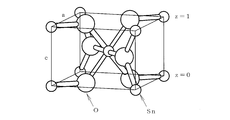
- FIG. 1 is a view showing a unit cell of a rutile structure constituting the tin / platinum complex oxide according to the embodiment.
- Sn small sphere
- O large sphere
- Sn small sphere
- O large sphere
- Sn small sphere
- the octahedron made by O spreads throughout the crystal due to edge sharing and vertex sharing.
- SnO 2 Sn is +4 valent and O is -2 valent.
- the ionic radius of Sn + 4 valence (Shannon radius) is 0.69 [ ⁇ ]
- the ionic radius of O-2 valence is 1.26 [ ⁇ ].
- the problems are whether or not Pt is stably present at +4 valence in the SnO 2 crystal, and Sn + 4 valent ions as rutile crystals.
- the difference is whether or not the difference between the radius and the ionic radius of Pt + 4 is acceptable.
- the ionic radius of Pt + 4 valence (Shannon radius) is 0.63 [ ⁇ ], and it can be said that there is no significant difference from the ionic radius of Sn + 4 valence.
- the present inventors have made SnO 2 (Sn X Pt (1-X) O (2- ⁇ ) in which a large amount of Pt is dissolved. I thought it was not impossible to synthesize ) ). Furthermore, the present inventors do not have any example of synthesizing Sn X Pt (1-X) 2 O (2- ⁇ ) . Since ordinary synthesis methods often involve synthesis at thermal equilibrium, Pt and SnO 2 (2 This is considered to be due to separation of - ⁇ ) and a mixture of Pt fine particles and SnO 2 (2- ⁇ ) particles (Pt / SnO 2 (2- ⁇ ) ).
- the present inventors tried to synthesize Sn X Pt (1-X) 2 O (2- ⁇ ) by a synthesis method with a high degree of non-equilibrium. Specifically, a reactive sputtering method using an RF magnetron sputtering apparatus or the like is used, and the film formation conditions in that case are sputtering gas in an inert sputtering gas Ar + O 2 (40 [cc / min]) atmosphere. By simultaneously sputtering SnO 2 and Pt at a pressure of 2 [Pa], a substrate temperature of 150 [° C.], and an RF power of 50 [W], a Pt-doped SnO 2 film having a thickness of 500 [nm] is formed.
- ⁇ 4 inch (10.16 [cm]) Si having a thermal oxide film formed on the surface was used as the substrate.
- a target was formed by using a predetermined number of 20 [mm] Pt wires arranged uniformly in an erosion forming portion on 4N purity SnO 2 .
- a pure SnO 2 film is formed by sputtering is described in Japanese Patent Publication No. 6-43978 as a film forming method excellent in sensor characteristics and mass productivity.
- a general formula: Sn X Pt (1-X) 2 O (2- ⁇ ) (0.7 ⁇ X ⁇ 0 ) may be obtained by a synthesis method having a high degree of non-equilibrium such as plasma CVD, CVD, or PLD. It is possible to synthesize a tin-platinum complex oxide having a rutile structure represented by .9,0 ⁇ ⁇ ⁇ 2).
- ⁇ indicates the amount of oxygen deficiency that varies depending on the production conditions, and does not greatly affect the catalyst performance.
- Table 1 shows the composition of each sample (values of X and ⁇ in Examples 1 to 3 and Comparative Examples 1 to 4) prepared by adjusting the diameter and number of Pt wires and changing the addition amount, and methane gas corresponding thereto. The conversion is shown.
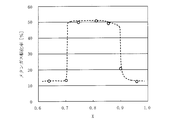
- FIG. 2 shows the relationship between the composition of each sample (the value of X in Examples 1 to 3 and Comparative Examples 1 to 4) and the methane gas conversion rate.
- the composition of the sample was analyzed by ESCA after obtaining a quantitative correction coefficient of ESCA (Electron Spectroscopy for Chemical Analysis) with respect to a standard sample that was quantitatively analyzed by RBS (Rutherford Backscattering Spectrometry).
- ESCA Electrode Spectroscopy for Chemical Analysis
- RBS Rutherford Backscattering Spectrometry
- the methane gas conversion rate is 100 [%], it indicates that the methane gas is completely burned.
- White Line Peak Height corresponds to the oxidation state of Pt and is closely related to the catalyst performance. In FIG. 2, the reason why the methane gas conversion rate rapidly decreases when X ⁇ 0.7 is that the oxidation state of Pt is rapidly decreased.
- FIG. 4 and Table 2 are diagrams showing the relationship between the Pt composition X (values of X and ⁇ in Examples 4 to 8 and Comparative Example 5) shown in FIG. 3 and White Line Peak Height.
- X values of X and ⁇ in Examples 4 to 8 and Comparative Example 5
- FIG. 4 and Table 2 show a sharp drop.
- X ⁇ 0.9 there is almost no change in the oxidation state of Pt, but since the amount of Pt itself is small, it is considered that the methane gas conversion rate was also low as shown in FIG. .
- FIG. 5 shows the XANES spectrum of the sample of Example 6 in Table 2 when the temperature is increased to 430 ° C. in the atmosphere.
- the white line peak height that is, the oxidation state of Pt is maintained in the range of 30 to 430.degree. That is, it can be seen that the structure of the oxidized state of Pt is stably maintained even at a high temperature state up to 430 ° C.
- the tin-platinum complex oxide according to the present invention can be used for various catalysts, sensor materials, catalyst electrodes, and the like.
Landscapes
- Chemical & Material Sciences (AREA)
- Organic Chemistry (AREA)
- Engineering & Computer Science (AREA)
- Materials Engineering (AREA)
- Chemical Kinetics & Catalysis (AREA)
- Physics & Mathematics (AREA)
- Inorganic Chemistry (AREA)
- Electromagnetism (AREA)
- Health & Medical Sciences (AREA)
- Plasma & Fusion (AREA)
- Toxicology (AREA)
- Optics & Photonics (AREA)
- Inorganic Compounds Of Heavy Metals (AREA)
- Physical Vapour Deposition (AREA)
- Catalysts (AREA)
Abstract
反応性スパッタリング方法等を用い、所定の成膜条件のもとでSnO2とPtとを同時にスパッタリングして合成することにより、PtをドープしたSnO2膜を成膜し、一般式:SnXPt(1-X)O(2-δ)(0.7<X<0.9,0≦δ<2)によって示されるルチル構造の錫・白金複酸化物を製造する。この発明によれば、Pt微粒子(Pt原子)をSnO(2-δ)中に高分散で多量に存在させ、Ptの酸化状態を一定にして安定した触媒性能を有する新規な錫・白金複酸化物を得ることができ、各種触媒やセンサ材料、触媒電極等に利用することができる。
Description
本発明は、錫・白金複酸化物及びその製造方法に関し、詳しくは、微細なPt微粒子(Pt原子)をSnO2中に高分散で多量に存在させることが可能な、ルチル(正方晶系)構造を有する錫・白金複酸化物及びその製造方法に関するものである。
従来、Pt微粒子をSnO2担体に担持させたPt/SnO2触媒は、高活性なCO酸化用触媒や燃料電池の電極用触媒として知られている。
非特許文献1の「Journal of Catalysis 130」,314ページ(1991年)にあるように、CO2ガスをclosed-cycleにしたCO2レーザーにおいては、レーザー駆動時に微量生成される分解生成物のCOと酸素とを接触酸化してCO2に戻すための高活性なCO酸化用触媒として、Pt/SnO2触媒が紹介されている。高活性な理由は、Pt触媒微粒子とSnO2担体のシナジー効果によるものである、と同ページに記載されている。
その他にも数多くの同様の報告がなされているが、報告されているものは、Pt触媒微粒子とSnO2粒子との混合物であり、X線回折によって調べてみると、PtとSnO2とがそれぞれ独立した相として識別できるものである。
非特許文献1の「Journal of Catalysis 130」,314ページ(1991年)にあるように、CO2ガスをclosed-cycleにしたCO2レーザーにおいては、レーザー駆動時に微量生成される分解生成物のCOと酸素とを接触酸化してCO2に戻すための高活性なCO酸化用触媒として、Pt/SnO2触媒が紹介されている。高活性な理由は、Pt触媒微粒子とSnO2担体のシナジー効果によるものである、と同ページに記載されている。
その他にも数多くの同様の報告がなされているが、報告されているものは、Pt触媒微粒子とSnO2粒子との混合物であり、X線回折によって調べてみると、PtとSnO2とがそれぞれ独立した相として識別できるものである。
また、SnO2は可燃性ガスなどのセンサ材料として利用されており、その分野においても、センサの感度の向上、ガス種に対する選択性の向上のために、Pt触媒を担持させたSnO2が用いられている。例えば、非特許文献2の「触媒」,vol.35,No.3,206ページ(1993年)に記載されているものも、Pt触媒微粒子とSnO2粒子との混合物(Pt/SnO2)である。その他、同様の報告が数多くなされている。
なお、SnO2の作製方法は、非特許文献3の「日本化学学会誌」,No.10,1597ページ(1980年)に詳しく記載されているが、一般的には、塩化錫を出発原料としてβ-スズ酸を乾燥/焼成し、SnO2粉末を作製する例が多い。その後、塩化白金酸などの塩を含浸/焼成することで、Pt微粒子(触媒)をSnO2の表面に析出(担持)させてPt/SnO2を得ることができる。
近年、センサの特性向上を目的として、ナノサイズのSnO2粒子を作製することが試みられている。作製方法としては、スパッタリング、PLD(パルスレーザーアブレーション)などの気相法により作製する方法、Snのアルコキシド化合物を原料として用いた液相法(ゾルゲル法)、あるいは、熱分解法によりナノサイズのSnO2粒子を作製する方法が知られている。
Ptを担持させた例は少ないものの、例えば、非特許文献4の「Material Science and Engineering」,B57,76ページ(1998年)に記載されているように、dibutyltin diacetateとPt-acetylacetonateのacetylacetone混合溶液を熱分解して得られるPt微粒子とSnO2粒子との混合物(Pt/SnO2:Pt濃度0~12[mol%])が報告されている。
一方、非特許文献5の「Chem. Mater」, Vol.13,No.11,4355ページ(2001年)には、特異な例として、tetra(tert-butoxy)tinとbis-acetylacetonatePtの熱分解生成物(2.5[mol%]Pt)のX線回折などの解析から、一部のPtがSn位置に置換したPtドープSnO2構造の可能性について言及されている。
上述したごとく、Pt微粒子とSnO2粒子との混合物(Pt/SnO2)は、PtとSnO2とのシナジー効果の結果として高活性な触媒作用を示し、それを利用したCO酸化用触媒、センサ用材料の利用が広く進んでいる。
PtとSnO2とのシナジー効果は、SnO2中に微細なPt微粒子を高分散で多量に存在させることにより、更に向上が期待される。
PtとSnO2とのシナジー効果は、SnO2中に微細なPt微粒子を高分散で多量に存在させることにより、更に向上が期待される。
上記の点に鑑み、本発明者等は、微細なPt微粒子(Pt原子)をSnO2中に高分散で多量に存在させることができる新規な錫・白金複酸化物について研究を続けた結果、特許文献1に示すルチル構造の錫・白金複酸化物を見出した。
すなわち、特許文献1に係る発明によれば、ルチル構造であるSnO2のSnサイトに多量のPtを置換固溶した錫・白金複酸化物として、一般式:SnXPt(1-X)O2(0.565≦X≦0.97)で示される錫・白金複酸化物を提供することが可能である。
すなわち、特許文献1に係る発明によれば、ルチル構造であるSnO2のSnサイトに多量のPtを置換固溶した錫・白金複酸化物として、一般式:SnXPt(1-X)O2(0.565≦X≦0.97)で示される錫・白金複酸化物を提供することが可能である。
「Journal of Catalysis 130」,314ページ(1991年)
「触媒」,vol.35,No.3,206ページ(1993年)
「日本化学学会誌」,No.10,1597ページ(1980年)
「Material Science and Engineering」,B57,76ページ(1998年)
「Chem. Mater」, Vol.13,No.11,4355ページ(2001年)
特許文献1に記載された錫・白金複酸化物では、SnXPt(1-X)O2におけるPtの組成Xの範囲を0.565≦X≦0.97とすることにより、Pt微粒子(Pt原子)をSnO2中に高分散で多量に存在させることを可能にしている。
しかしながら、上記の錫・白金複酸化物では、Ptの組成、言い換えればXの値によって触媒性能が大きく変化することが判明したため、触媒として一層安定した特性を有する錫・白金複酸化物の提供が求められていた。
しかしながら、上記の錫・白金複酸化物では、Ptの組成、言い換えればXの値によって触媒性能が大きく変化することが判明したため、触媒として一層安定した特性を有する錫・白金複酸化物の提供が求められていた。
そこで、本発明の目的は、Ptの組成を最適な範囲に設定してPtの固溶量を制御することにより、Ptの酸化状態を一定にして触媒性能を安定化させるようにした錫・白金複酸化物及びその製造方法を提供することにある。
上記課題を解決するため、本発明に係る錫・白金複酸化物は、一般式:SnXPt(1-X)O(2-δ)(0.7<X<0.9,0≦δ<2)により示され、ルチル構造を有することを特徴とする。
また、本発明に係る錫・白金複酸化物の製造方法は、請求項1に記載した錫・白金複酸化物の製造方法において、酸素を含有する不活性スパッタガス中でSnO2とPtとを同時スパッタリングにより成膜して合成することを特徴とする。
また、本発明に係る錫・白金複酸化物の製造方法は、請求項1に記載した錫・白金複酸化物の製造方法において、酸素を含有する不活性スパッタガス中でSnO2とPtとを同時スパッタリングにより成膜して合成することを特徴とする。
本発明によれば、Pt微粒子(Pt原子)をSnXO(2-δ)(0.7<X<0.9,0≦δ<2)中に高分散で多量に存在させることが可能であり、安定した触媒性能を有する新規な錫・白金複酸化物を提供することができる。
以下、図に沿って本発明の実施形態を説明する。
図1は、実施形態に係る錫・白金複酸化物を構成するルチル構造のユニットセルを示した図である。図1に示すように、Sn(小球)はO(大球)で6配位され、Oの作る8面体の中心に位置する。また、O(大球)はSn(小球)に3配位されている。Oの作る8面体は、稜共有と頂点共有により結晶全体に広がっている。SnO2において、Snは+4価であり、Oは-2価である。Sn+4価のイオン半径(Shannon半径)は0.69[Å]、O-2価のイオン半径(Shannon半径)は1.26[Å]である。
図1は、実施形態に係る錫・白金複酸化物を構成するルチル構造のユニットセルを示した図である。図1に示すように、Sn(小球)はO(大球)で6配位され、Oの作る8面体の中心に位置する。また、O(大球)はSn(小球)に3配位されている。Oの作る8面体は、稜共有と頂点共有により結晶全体に広がっている。SnO2において、Snは+4価であり、Oは-2価である。Sn+4価のイオン半径(Shannon半径)は0.69[Å]、O-2価のイオン半径(Shannon半径)は1.26[Å]である。
SnO2のSnサイトに多量なPtを固溶させる場合に問題となるのは、SnO2結晶中でPtが+4価で安定して存在するか否かという点と、ルチル結晶としてSn+4価のイオン半径とPt+4価のイオン半径との差異を許容できるか否かという点にある。Pt+4価のイオン半径(Shannon半径)は0.63[Å]であり、Sn+4価のイオン半径とは大きな差異がないとも言える。
また、ルチル構造におけるカチオンのイオン半径に対する許容度が比較的大きいことを考え合わせると、本発明者等は多量なPtを固溶したSnO2(SnXPt(1-X)O(2-δ))を合成することは不可能ではないと考えた。更に、本発明者等は、SnXPt(1-X)O(2-δ)が合成された例がないのは、通常の合成法は熱平衡での合成が多いためにPtとSnO(2-δ)とが分離し、Pt微粒子とSnO(2-δ)粒子との混合物(Pt/SnO(2-δ))になってしまうためであると考えた。
そこで、本発明者等は、非平衡度の高い合成法によるSnXPt(1-X)O(2-δ)の合成を試みた。
具体的には、RFマグネトロンスパッタリング装置等を用いた反応性スパッタリング方法を用いることとし、その場合の成膜条件は、不活性スパッタガスのAr+O2(40[cc/min])雰囲気において、スパッタガス圧力2[Pa]、基板温度150[℃]、RFパワー50[W]として、SnO2とPtとを同時にスパッタリングすることにより、膜厚500[nm]の、PtをドープしたSnO2膜を成膜した。基板としては、表面に熱酸化膜が形成されたφ4インチ(10.16[cm])Siを用いた。
ターゲットには、4N純度のSnO2の上のエロージョン形成部に長さ20[mm]のPtワイヤを所定本数、均等に配置したものを用いて成膜した。
具体的には、RFマグネトロンスパッタリング装置等を用いた反応性スパッタリング方法を用いることとし、その場合の成膜条件は、不活性スパッタガスのAr+O2(40[cc/min])雰囲気において、スパッタガス圧力2[Pa]、基板温度150[℃]、RFパワー50[W]として、SnO2とPtとを同時にスパッタリングすることにより、膜厚500[nm]の、PtをドープしたSnO2膜を成膜した。基板としては、表面に熱酸化膜が形成されたφ4インチ(10.16[cm])Siを用いた。
ターゲットには、4N純度のSnO2の上のエロージョン形成部に長さ20[mm]のPtワイヤを所定本数、均等に配置したものを用いて成膜した。
参考までに、純粋なSnO2膜をスパッタリング法により形成した例は、センサ特性、量産性の点で優れた成膜方法として特公平6-43978号公報に記載されている。
ここで、スパッタリング法以外でも、プラズマCVD、CVD、PLDなどの非平衡度の高い合成法により、一般式:SnXPt(1-X)O(2-δ)(0.7<X<0.9,0≦δ<2)で表されるルチル構造の錫・白金複酸化物を合成することができる。
なお、上記一般式において、δは、作製条件により変化する酸素欠損量を示しており、触媒性能に大きく影響するものではない。
ここで、スパッタリング法以外でも、プラズマCVD、CVD、PLDなどの非平衡度の高い合成法により、一般式:SnXPt(1-X)O(2-δ)(0.7<X<0.9,0≦δ<2)で表されるルチル構造の錫・白金複酸化物を合成することができる。
なお、上記一般式において、δは、作製条件により変化する酸素欠損量を示しており、触媒性能に大きく影響するものではない。
表1に、Ptワイヤの径や本数を調整し、添加量を変えて作成した各サンプルの組成(実施例1~3及び比較例1~4におけるX,δの値)とこれらに対応するメタンガス転化率を示す。
なお、図2は、各サンプルの組成(実施例1~3及び比較例1~4におけるXの値)とメタンガス転化率との関係を示している。

なお、図2は、各サンプルの組成(実施例1~3及び比較例1~4におけるXの値)とメタンガス転化率との関係を示している。
サンプルの組成は、RBS(Rutherford Backscattering Spectrometry)による定量分析を行った標準サンプルに対し、ESCA(Electron Spectroscopy for Ckemical Analysis)の定量補正係数を求めたうえでESCAにより分析した。
メタンガス転化率は、CH4が5000[ppm](残りはair)の標準ガスを、空間速度:SV=4200[l/h]の条件で温度が450[℃]に保たれた触媒に流通させて測定した。なお、メタンガス転化率が100[%]の場合には、メタンガスが完全に燃焼したことを示す。
メタンガス転化率は、CH4が5000[ppm](残りはair)の標準ガスを、空間速度:SV=4200[l/h]の条件で温度が450[℃]に保たれた触媒に流通させて測定した。なお、メタンガス転化率が100[%]の場合には、メタンガスが完全に燃焼したことを示す。
表1及び図2から、Ptの組成Xが0.7<X<0.9の範囲では、メタンガス転化率が50[%]程度でほぼ一定であることが分かる。これに対し、X≦0.7またはX≧0.9の範囲では、メタンガス転化率が急激に低下している。前述したように、酸素欠損量を示すδは、メタンガス転化率、言い換えれば触媒性能に大きく影響することはない。
一方、Ptの酸化状態を調べるために、XAFS(X-ray Absorption Fine Structure)による分析を行い、XANES(X-ray Absorption Near Edge Structure)の情報を詳細に比較した。
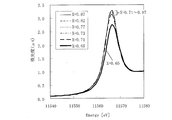
図3は、表1とは異なる複数のサンプルについて、Ptワイヤの径や本数を調整し、添加量を変えて作成した各サンプルの組成(X=0.65,X=0.71,X=0.73,X=0.77,X=0.82,X=0.87)について、XANESの結果を示す図であり、スペクトルは、吸光度が大きく増加する吸収端より十分高く、吸光度が安定するエネルギー領域で規格化した。Xの値により、吸収端近傍のピークの高さ(White Line Peak Height)が変化しているが、X=0.65のみピーク値が低く、それ以外のX=0.71,X=0.73,X=0.77,X=0.82,X=0.87はピーク値が高く、しかも差異が少ないことが判る。
ここで、White Line Peak Heightは、Ptの酸化状態に対応し、触媒性能と密接に関連するものである。図2において、X≦0.7でメタンガス転化率が急激に低下している理由は、Ptの酸化状態が急激に低下しているためである。
図3は、表1とは異なる複数のサンプルについて、Ptワイヤの径や本数を調整し、添加量を変えて作成した各サンプルの組成(X=0.65,X=0.71,X=0.73,X=0.77,X=0.82,X=0.87)について、XANESの結果を示す図であり、スペクトルは、吸光度が大きく増加する吸収端より十分高く、吸光度が安定するエネルギー領域で規格化した。Xの値により、吸収端近傍のピークの高さ(White Line Peak Height)が変化しているが、X=0.65のみピーク値が低く、それ以外のX=0.71,X=0.73,X=0.77,X=0.82,X=0.87はピーク値が高く、しかも差異が少ないことが判る。
ここで、White Line Peak Heightは、Ptの酸化状態に対応し、触媒性能と密接に関連するものである。図2において、X≦0.7でメタンガス転化率が急激に低下している理由は、Ptの酸化状態が急激に低下しているためである。
図4及び表2は、図3に示したPtの組成X(実施例4~8及び比較例5におけるX,δの値)とWhite Line Peak Heightとの関係を示す図である。
図4及び表2によれば、X≦0.7においてWhite Line Peak Height、すなわちPtの酸化状態が急激に低下しているため、図2と同様に、X≦0.7ではメタンガス転化率も急激に低下することを示している。
また、図4において、X≧0.9ではPtの酸化状態にほとんど変化がないが、Ptの量そのものが少ないために、図2に示すごとくメタンガス転化率も低い値にあったものと考えられる。
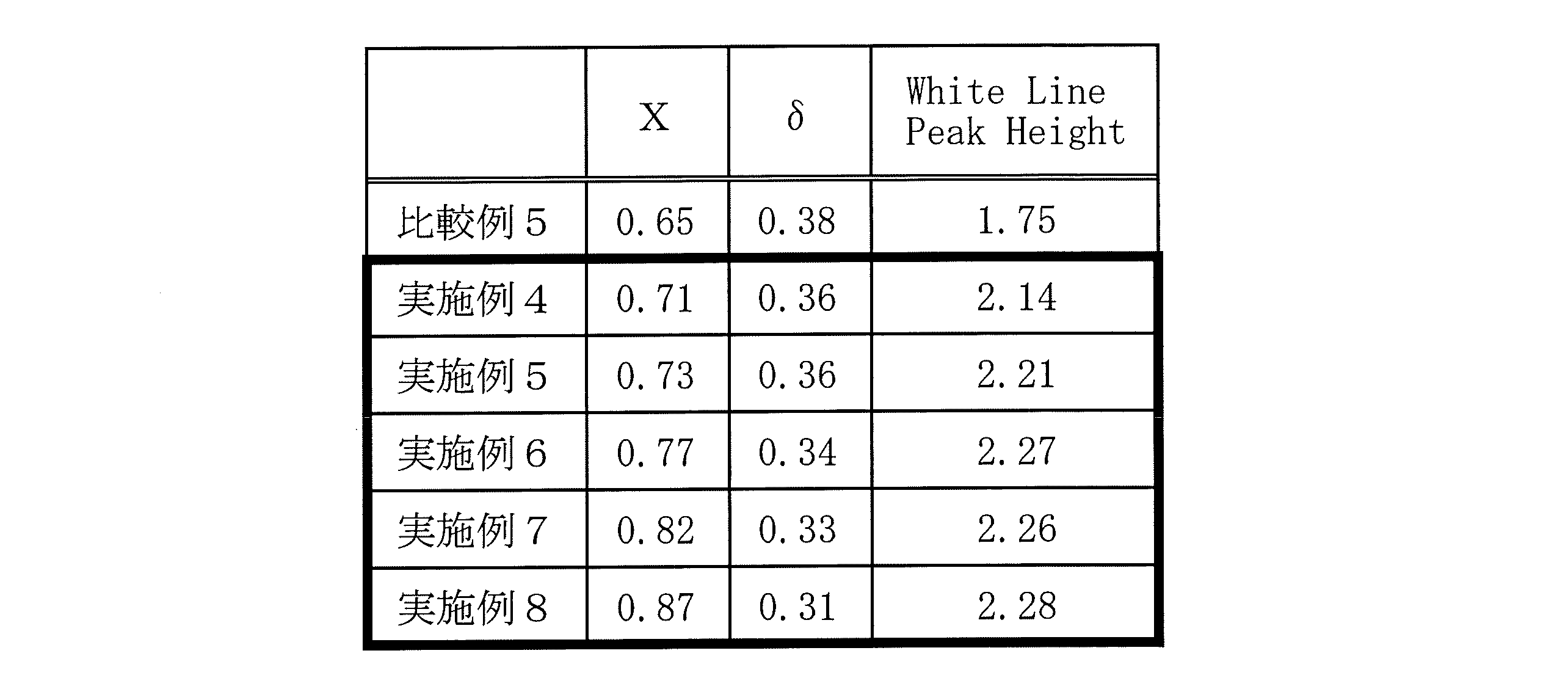
図4及び表2によれば、X≦0.7においてWhite Line Peak Height、すなわちPtの酸化状態が急激に低下しているため、図2と同様に、X≦0.7ではメタンガス転化率も急激に低下することを示している。
また、図4において、X≧0.9ではPtの酸化状態にほとんど変化がないが、Ptの量そのものが少ないために、図2に示すごとくメタンガス転化率も低い値にあったものと考えられる。
図5は、表2の実施例6のサンプルについて、大気中で温度を430℃まで上げた場合のXANESスペクトルを示したものである。図5によれば、30~430℃の範囲でWhite Line Peak Height、すなわちPtの酸化状態が維持されていることが判る。つまり、430℃までの高温状態であっても、Ptの酸化状態の構造が安定して保たれていることが判る。
例えば、Pt触媒を担持させたSnO2を可燃性ガスなどのセンサ材料として利用する場合には、430℃の高温状態で触媒性能を発揮する必要があるが、本発明の実施例によれば、そのような高温状態であっても、触媒性能を向上させたPtの酸化状態の構造を安定して保つことができる。
例えば、Pt触媒を担持させたSnO2を可燃性ガスなどのセンサ材料として利用する場合には、430℃の高温状態で触媒性能を発揮する必要があるが、本発明の実施例によれば、そのような高温状態であっても、触媒性能を向上させたPtの酸化状態の構造を安定して保つことができる。
本発明に係る錫・白金複酸化物は、各種触媒やセンサ材料、触媒電極等に利用することができる。
Claims (2)
- 一般式:SnXPt(1-X)O(2-δ)(0.7<X<0.9,0≦δ<2)により示され、ルチル構造を有することを特徴とする錫・白金複酸化物。
- 請求項1に記載した錫・白金複酸化物の製造方法において、
酸素を含有する不活性スパッタガス中でSnO(2-δ)とPtとを同時スパッタリングにより成膜して合成することを特徴とする錫・白金複酸化物の製造方法。
Priority Applications (2)
| Application Number | Priority Date | Filing Date | Title |
|---|---|---|---|
| JP2015507794A JP6065104B2 (ja) | 2013-03-28 | 2013-03-28 | 錫・白金複酸化物及びその製造方法 |
| PCT/JP2013/059178 WO2014155594A1 (ja) | 2013-03-28 | 2013-03-28 | 錫・白金複酸化物及びその製造方法 |
Applications Claiming Priority (1)
| Application Number | Priority Date | Filing Date | Title |
|---|---|---|---|
| PCT/JP2013/059178 WO2014155594A1 (ja) | 2013-03-28 | 2013-03-28 | 錫・白金複酸化物及びその製造方法 |
Publications (1)
| Publication Number | Publication Date |
|---|---|
| WO2014155594A1 true WO2014155594A1 (ja) | 2014-10-02 |
Family
ID=51622670
Family Applications (1)
| Application Number | Title | Priority Date | Filing Date |
|---|---|---|---|
| PCT/JP2013/059178 Ceased WO2014155594A1 (ja) | 2013-03-28 | 2013-03-28 | 錫・白金複酸化物及びその製造方法 |
Country Status (2)
| Country | Link |
|---|---|
| JP (1) | JP6065104B2 (ja) |
| WO (1) | WO2014155594A1 (ja) |
Citations (2)
| Publication number | Priority date | Publication date | Assignee | Title |
|---|---|---|---|---|
| JP2005134251A (ja) * | 2003-10-30 | 2005-05-26 | Fuji Electric Fa Components & Systems Co Ltd | 薄膜ガスセンサ |
| JP2011063507A (ja) * | 2003-11-04 | 2011-03-31 | Fuji Electric Holdings Co Ltd | 錫・白金複酸化物およびその製造方法 |
-
2013
- 2013-03-28 JP JP2015507794A patent/JP6065104B2/ja active Active
- 2013-03-28 WO PCT/JP2013/059178 patent/WO2014155594A1/ja not_active Ceased
Patent Citations (2)
| Publication number | Priority date | Publication date | Assignee | Title |
|---|---|---|---|---|
| JP2005134251A (ja) * | 2003-10-30 | 2005-05-26 | Fuji Electric Fa Components & Systems Co Ltd | 薄膜ガスセンサ |
| JP2011063507A (ja) * | 2003-11-04 | 2011-03-31 | Fuji Electric Holdings Co Ltd | 錫・白金複酸化物およびその製造方法 |
Also Published As
| Publication number | Publication date |
|---|---|
| JP6065104B2 (ja) | 2017-01-25 |
| JPWO2014155594A1 (ja) | 2017-02-16 |
Similar Documents
| Publication | Publication Date | Title |
|---|---|---|
| Wang et al. | Oxysulfide photocatalyst for visible-light-driven overall water splitting | |
| Huang et al. | Gradient tungsten-doped Bi3TiNbO9 ferroelectric photocatalysts with additional built-in electric field for efficient overall water splitting | |
| Borchert et al. | Electronic and chemical properties of nanostructured cerium dioxide doped with praseodymium | |
| Elias et al. | Structure, bonding, and catalytic activity of monodisperse, transition-metal-substituted CeO2 nanoparticles | |
| Zou et al. | Photocatalytic hydrogen and oxygen formation under visible light irradiation with M-doped InTaO4 (M= Mn, Fe, Co, Ni and Cu) photocatalysts | |
| Mokrushin et al. | Gas-sensing properties of nanostructured CeO2-xZrO2 thin films obtained by the sol-gel method | |
| Amarsingh Bhabu et al. | Cubic fluorite phase of samarium doped cerium oxide (CeO2) 0.96 Sm0. 04 for solid oxide fuel cell electrolyte | |
| EP2945909B1 (en) | A core-shell catalyst comprising a mixed metal oxide material of tin and titanium | |
| Deng et al. | Combined X-ray diffraction and diffuse reflectance analysis of nanocrystalline mixed Sn (II) and Sn (IV) oxide powders | |
| Illyaskutty et al. | Hydrogen and ethanol sensing properties of molybdenum oxide nanorods based thin films: Effect of electrode metallization and humid ambience | |
| Suzuki et al. | Compositional control of AuPt nanoparticles synthesized in ionic liquids by the sputter deposition technique | |
| Lu et al. | Effects of sintering temperature on sensing properties of WO3 and Ag-WO3 electrode for NO2 sensor | |
| Michalska et al. | Spectroscopic and structural properties of CeO2 nanocrystals doped with La3+, Nd3+ and modified on their surface with Ag nanoparticles | |
| Konan et al. | X-ray diffraction, XPS, and Raman spectroscopy of coated ZnO: Al (1—7 at%) nanoparticles | |
| Ilkhechi et al. | Enhanced optical and hydrophilic properties of V and La co-doped ZnO thin films | |
| JP7230663B2 (ja) | 光触媒と、この光触媒を用いた水素及び酸素の製造方法 | |
| Ruiz-Preciado et al. | Nanostructured NiTiO3 as a catalytic material for methanol electrochemical oxidation in alkaline conditions | |
| Janene et al. | Gas sensing performance of Ni-doped CuO/ZnO p–n heterostructures for ethanol detection: high sensitivity, selectivity and stability | |
| Gribov et al. | Flat-band potential determination and catalytical properties of Sn3O4/SnO2 heterostructures in the photo-electrooxidation of small organic molecules under ultraviolet (370 nm) and blue (450 nm) light | |
| JP6065104B2 (ja) | 錫・白金複酸化物及びその製造方法 | |
| Ito et al. | Photocatalytic Activity of Metal Oxide Supported Gallium Oxide for CO2 Reduction with Water | |
| JP6562321B2 (ja) | 酸化物半導体 | |
| JP4671163B2 (ja) | 錫・タングステン複酸化物およびその製造方法、並びに錫・レニューム複酸化物およびその製造方法 | |
| Fukushi et al. | Enhancing the rate of organic material decomposition photo catalyzed by high performance visible light activated tungsten oxide | |
| Wang et al. | Hydrogen Incorporation in RuxTi1− xO2 Mixed Oxides Promotes Total Oxidation of Propane |
Legal Events
| Date | Code | Title | Description |
|---|---|---|---|
| 121 | Ep: the epo has been informed by wipo that ep was designated in this application |
Ref document number: 13879819 Country of ref document: EP Kind code of ref document: A1 |
|
| ENP | Entry into the national phase |
Ref document number: 2015507794 Country of ref document: JP Kind code of ref document: A |
|
| NENP | Non-entry into the national phase |
Ref country code: DE |
|
| 122 | Ep: pct application non-entry in european phase |
Ref document number: 13879819 Country of ref document: EP Kind code of ref document: A1 |