WO2014154530A1 - Microbiocidal pyrazole derivatives - Google Patents
Microbiocidal pyrazole derivatives Download PDFInfo
- Publication number
- WO2014154530A1 WO2014154530A1 PCT/EP2014/055396 EP2014055396W WO2014154530A1 WO 2014154530 A1 WO2014154530 A1 WO 2014154530A1 EP 2014055396 W EP2014055396 W EP 2014055396W WO 2014154530 A1 WO2014154530 A1 WO 2014154530A1
- Authority
- WO
- WIPO (PCT)
- Prior art keywords
- hydrogen
- independently
- halogen
- alkyl
- crc
- Prior art date
- Legal status (The legal status is an assumption and is not a legal conclusion. Google has not performed a legal analysis and makes no representation as to the accuracy of the status listed.)
- Ceased
Links
- 0 **C1=*C(CCCC(*(CC2)CCC2c2cc(C(C3)=*OC3(C(*O)O*=C(*N)*=C)c3cc(N)ccc3)c(N)[n]2)=O)C(*)=C1 Chemical compound **C1=*C(CCCC(*(CC2)CCC2c2cc(C(C3)=*OC3(C(*O)O*=C(*N)*=C)c3cc(N)ccc3)c(N)[n]2)=O)C(*)=C1 0.000 description 5
Classifications
-
- C—CHEMISTRY; METALLURGY
- C07—ORGANIC CHEMISTRY
- C07D—HETEROCYCLIC COMPOUNDS
- C07D413/00—Heterocyclic compounds containing two or more hetero rings, at least one ring having nitrogen and oxygen atoms as the only ring hetero atoms
- C07D413/14—Heterocyclic compounds containing two or more hetero rings, at least one ring having nitrogen and oxygen atoms as the only ring hetero atoms containing three or more hetero rings
-
- C—CHEMISTRY; METALLURGY
- C07—ORGANIC CHEMISTRY
- C07D—HETEROCYCLIC COMPOUNDS
- C07D417/00—Heterocyclic compounds containing two or more hetero rings, at least one ring having nitrogen and sulfur atoms as the only ring hetero atoms, not provided for by group C07D415/00
- C07D417/14—Heterocyclic compounds containing two or more hetero rings, at least one ring having nitrogen and sulfur atoms as the only ring hetero atoms, not provided for by group C07D415/00 containing three or more hetero rings
Definitions
- the present invention relates to microbiocidal pyrazole derivatives, e.g. as active ingredients, which have microbiocidal activity, in particular fungicidal activity.
- the invention also relates to preparation of these pyrazole derivatives, to pyrazole derivatives used as intermediates in the preparation of these pyrazole derivatives, to preparation of these intermediates, to agrochemical compositions which comprise at least one of the pyrazole derivatives, to preparation of these compositions and to use of the pyrazole derivatives or compositions in agriculture or horticulture for controlling or preventing infestation of plants, harvested food crops, seeds or non-living materials by phytopathogenic microorganisms, preferably fungi.
- the present invention provides compounds of formula I:
- G 1 and G 2 are independently O or S;
- T is CR 14 or N
- Y 1 and Y 2 are independently CR 15 or N;
- n 1 or 2;
- p is 1 or 2, providing that when n is 2, p is 1 ;
- R 1 and R 2 each independently are CrC 4 alkyl, CrC 4 haloalkyl or C 3 -C 5 cycloalkyl;
- R 3 , R 4 , R 5 , R 6 , R 7 and R 8 each independently are hydrogen, halogen, cyano, CrC 4 alkyl, Ci- C 4 alkoxy, d-C 4 haloalkyl, C 3 -C 5 cycloalkyl or Ci-C 4 alkylthio;
- R 9 is aryl or heteroaryl, both optionally substituted by one or more R 16 ;
- R 10 , R 11 and R 12 each independently are hydrogen, halogen, cyano, Ci-C 4 alkyl, Ci- C haloalkyl, C 3 -C 5 cycloalkyl, aryl or heteroaryl, the aryl or heteroaryl optionally substituted by one or more R 16 ; or
- R 10 and R 11 together with the carbon atom to which they are attached, independently form a saturated or partially unsaturated three- to five-membered alicyclic ring, optionally substituted by halogen, cyano, CrC 4 alkyl, Ci-C 4 alkoxy or Ci-C 4 haloalkyl;
- R 13 is C C alkyl, Ci-C 4 haloalkyl, C 3 -C 5 cycloalkyl, Ci-C 4 alkylcarbonyl, aryl, heteroaryl, the aryl or heteroaryl optionally substituted by one or more R 16 ;
- R 14 is hydrogen, halogen or hydroxyl;
- R 15 is hydrogen, halogen or cyano
- R 16 is halogen, cyano, hydroxyl, amino, formyl, Ci-C 4 alkyl, Ci-C 4 haloalkyl, C 3 -C 5 cycloalkyl, C 2 -C 5 alkenyl, C 2 -C 5 haloalkenyl, C 2 -C 5 alkynyl, C 2 -C 5 haloalkynyl, CrC 4 alkoxy, Ci- C 4 haloalkoxy, C 3 -C 5 cycloalkoxy, C 3 -C 5 alkenyloxy, C 3 -C 5 haloalkenyloxy, C 3 -C 5 alkynyloxy, C 3 - C 5 haloalkynyloxy, Ci-C 4 alkylamino, Ci-C 4 dialkylamino, Ci-C 4 alkylcarbonyl, Ci- C 4 haloalkylcarbonyl, C 3 -C 5 cycloalkylcarbonyl, Cr
- substituents are indicated as being optionally substituted, this means that they may or may not carry one or more identical or different substituents, e.g. one to five substituents, e.g. one to three substituents. Normally not more than three such optional substituents are present at the same time.
- substituents are indicated as being substituted, e.g. alkyl, unless stated otherwise this includes those groups that are part of other groups, e.g. the alkyl in alkylthio.
- halogen refers to fluorine, chlorine, bromine or iodine, preferably fluorine, chlorine or bromine.
- Alkyl substituents may be straight-chained or branched. Alkyl on its own or as part of another substituent is, depending upon the number of carbon atoms mentioned, for example, methyl, ethyl, n-propyl, n-butyl, n-pentyl, n-hexyl and the isomers thereof, for example, iso- propyl, iso-butyl, sec-butyl, tert-butyl or iso-amyl.
- Alkenyl substituents can be in the form of straight or branched chains, and the alkenyl moieties, where appropriate, can be of either the (E)- or (Z)-configu ration. Examples are vinyl and allyl.
- the alkenyl groups are preferably C 2 -C 6 , more preferably C 2 -C 4 and most preferably C 2 -C 3 alkenyl groups.
- Alkynyl substituents can be in the form of straight or branched chains. Examples are ethynyl and propargyl.
- the alkynyl groups are preferably C 2 -C 6 , more preferably C 2 -C 4 and most preferably C 2 -C 3 alkynyl groups.
- Haloalkyl groups may contain one or more identical or different halogen atoms and, for example, may stand for CH 2 CI, CHCI 2 , CCI 3 , CH 2 F, CHF 2 , CF 3 , CF 3 CH 2 , CH 3 CF 2 , CF 3 CF 2 or CCI 3 CCI 2 .
- Haloalkenyl groups are alkenyl groups, respectively, which are substituted with one or more of the same or different halogen atoms and are, for example, 2,2-difluorovinyl or 1 ,2- dichloro-2-fluoro-vinyl.
- Haloalkynyl groups are alkynyl groups, respectively, which are substituted with one or more of the same or different halogen atoms and are, for example, 1-chloro-prop-2-ynyl.
- Alkoxy means a radical -OR, where R is alkyl, e.g. as defined above.
- Alkoxy groups include, but are not limited to, methoxy, ethoxy, 1 -methylethoxy, propoxy, butoxy, 1 - methylpropoxy and 2-methylpropoxy.
- Cyano means a -CN group.
- Amino means an NH 2 group.
- Hydroxyl or hydroxy stands for a -OH group.
- Aryl means a ring system which may be mono-, bi- or tricyclic. Examples of such rings include phenyl, naphthalenyl, anthracenyl, indenyl or phenanthrenyl. A preferred aryl group is phenyl.
- Heteroaryl stands for aromatic ring systems comprising mono-, bi- or tricyclic systems wherein at least one oxygen, nitrogen or sulfur atom is present as a ring member.
- Monocyclic and bicyclic aromatic ring systems are preferred, monocyclic ring systems are more preferred.
- monocyclic heteoraryl may be a 5- to 7-membered aromatic ring containing one to three heteroatoms selected from oxygen, nitrogen and sulfur, more preferably selected from nitrogen and sulfur.
- Bicyclic heteroaryl may be a 9- to 11-membered bicyclic ring containing one to five heteroatoms, preferably one to three heteroatoms, selected from oxygen, nitrogen and sulfur.
- Examples are furyl, thienyl, pyrrolyl, imidazolyl, pyrazolyl, thiazolyl, isothiazolyl, oxazolyl, isoxazolyl, oxadiazolyl, thiadiazolyl, triazolyl, tetrazolyl, pyridyl, pyridazinyl, pyrimidinyl, pyrazinyl, triazinyl, tetrazinyl, indolyl,
- Heteroaryl rings do not contain adjacent oxygen ring atoms, adjacent sulfur ring atoms or adjacent oxygen and sulfur ring atoms.
- a link to a heteroaryl group can be via a carbon atom or via a nitrogen atom.
- asymmetric carbon atoms in a compound of formula I means that the compounds may occur in optically isomeric forms, i.e. enantiomeric or diastereomeric forms. Also atropisomers may occur as a result of restricted rotation about a single bond.
- Formula I is intended to include all those possible isomeric forms and mixtures thereof.
- the present invention includes all those possible isomeric forms and mixtures thereof for a compound of formula I.
- formula I is intended to include all possible tautomers.
- the present invention includes all possible tautomeric forms for a compound of formula I.
- the compounds of formula I according to the invention are in free form, in oxidized form as a N-oxide or in salt form, e.g. an agronomically usable salt form.
- N-oxides are oxidized forms of tertiary amines or oxidized forms of nitrogen containing heteroaromatic compounds. They are described for instance in the book "Heterocyclic N- oxides" by A. Albini and S. Pietra, CRC Press, Boca Raton 1991.
- G 1 and G 2 are independently 0 or S.
- G 1 is preferably O.
- G 2 is preferably S.
- T is CR 14 or N, preferably CH or N, more preferably CH.
- Y 1 and Y 2 are independently CR 15 or N.
- Y 1 is preferably CH or N, more preferably N.
- Y 2 is preferably CH or N; more preferably CH.
- n 1 or 2, preferably 2.
- p is 1 or 2, providing that when n is 2, p is 1 , preferably p is 1.
- p is 1 and n is 2.
- R 1 and R 2 each independently are Ci-C 4 alkyl, d-C 4 haloalkyl or C 3 -C 5 cycloalkyl.
- R 1 and R 2 are each independently methyl or halomethyl, more preferably methyl, difluoromethyl or trifluoromethyl.
- R 1 is difluoromethyl or trifluoromethyl.
- R 2 is methyl or difluoromethyl. In one group of compounds R 1 is trifluoromethyl and R 2 is methyl. In another group of compounds R 1 and R 2 are both difluoromethyl.
- R 3 , R 4 , R 5 , R 6 , R 7 and R 8 each independently are hydrogen, halogen, cyano, C C 4 alkyl, Ci-C 4 alkoxy, CrC 4 haloalkyl, C 3 -C 5 cycloalkyl or Ci-C 4 alkylthio; preferably hydrogen, halogen, methyl, halomethyl or methylthio, more preferably hydrogen or methyl, even more preferably hydrogen.
- R 9 is aryl or heteroaryl, both optionally substituted by one or more R 16 ; preferably phenyl which is optionally substituted by one or more R 16 ; more preferably phenyl, which is substituted by hydrogen, halogen, cyano, Ci-C 4 alkyl, CrC 4 haloalkyl or C 3 -C 5 alkynyloxy, even more preferably phenyl, which is substituted by hydrogen, halogen, or C 3 -C 5 alkynyloxy.
- R 10 , R 11 and R 12 each independently are hydrogen, halogen, cyano, Ci-C 4 alkyl, Ci- C haloalkyl, C 3 -C 5 cycloalkyl, aryl or heteroaryl; preferably hydrogen, halogen, Ci-C 4 alkyl, Ci- C 4 haloalkyl or C 3 -C 5 cycloalkyl; more preferably hydrogen, halogen or CrC 4 alkyl, even more preferably hydrogen or Ci-C 4 alkyl.
- R 13 is CrC 4 alkyl, Ci-C 4 haloalkyl, C 3 -C 5 cycloalkyl, Ci-C 4 alkylcarbonyl, aryl, heteroaryl, the aryl or heteroaryl optionally substituted by one or more R 16 ; preferably CrC 4 alkyl, Ci- C 4 haloalkyl, C 3 -C 5 cycloalkyl or phenyl which is optionally substituted by one or more R 16 ; more preferably CrC 4 alkyl or C 3 -C 5 cycloalkyl.
- R 14 is hydrogen, halogen or hydroxyl; preferably hydrogen or hydroxyl, more preferably hydrogen.
- R 15 is hydrogen, halogen or cyano; preferably hydrogen or cyano, more preferably hydrogen.
- the compound of formula I is a compound wherein:
- G 2 is S
- T CH or N
- Y 1 and Y 2 are independently CH or N;
- n 1 or 2;
- p is 1 or 2, providing that when n is 2, p is 1 ;
- R 1 and R 2 each independently are methyl or halomethyl
- R 3 , R 4 , R 5 , R 6 , R 7 and R 8 each independently are hydrogen, halogen, cyano, CrC 4 alkyl, Ci- C 4 alkoxy, Ci-C 4 haloalkyl, C 3 -C 5 cycloalkyl or CrC 4 alkylthio;
- R 9 is aryl or heteroaryl, both optionally substituted by one or more R 16 ;
- R 10 , R 11 and R 12 each independently are hydrogen, halogen, cyano, CrC 4 alkyl, Ci- C 4 haloalkyl, C 3 -C 5 cycloalkyl, aryl or heteroaryl; or
- R 10 and R 11 together with the carbon atom to which they are attached, independently form a saturated or partially unsaturated three- to five-membered alicyclic ring, optionally substituted by halogen, cyano, CrC 4 alkyl, d-C 4 alkoxy or CrC 4 haloalkyl;
- R 13 is C C 4 alkyl, CrC 4 haloalkyl, C 3 -C 5 cycloalkyl, Ci-C 4 alkylcarbonyl, aryl, heteroaryl, the aryl or heteroaryl optionally substituted by one or more R 16 ;
- R 14 is hydrogen, halogen or hydroxyl
- R 15 is hydrogen, halogen or cyano
- the compound of formula I is a compound wherein:
- G 2 is S
- T CH or N
- Y 1 and Y 2 are independently CH or N;
- n 1 or 2;
- p is 1 or 2, providing that when n is 2, p is 1 ;
- R 1 and R 2 each independently are methyl or halomethyl
- R 3 , R 4 , R 5 , R 6 , R 7 and R 8 each independently are hydrogen, halogen, methyl, halomethyl or methylthio
- R 9 is phenyl which is optionally substituted by one or more R 15 ;
- R 10 , R 11 and R 12 each independently are hydrogen, halogen, Ci-C 4 alkyl, CrC 4 haloalkyl or C3- C 5 cycloalkyl;
- R 13 is C C 4 alkyl, Ci-C 4 haloalkyl, C3-C 5 cycloalkyl or phenyl which is optionally substituted by one or more R 16 ;
- R 14 is hydrogen, halogen or hydroxyl
- R 15 is hydrogen, halogen or cyano
- the compound of formula I is a compound wherein:
- G 2 is S
- T CH or N
- Y 1 and Y 2 are independently CH or N;
- n 1 or 2;
- p is 1 or 2, providing that when n is 2, p is 1 ;
- R 1 and R 2 each independently are methyl or halomethyl
- R 3 , R 4 , R 5 , R 6 , R 7 and R 8 each independently are hydrogen or methyl
- R 9 is phenyl, which is substituted by hydrogen, halogen, cyano, CrC 4 alkyl, CrC 4 haloalkyl or C 3 -C 5 alkynyloxy.
- R 10 , R 11 and R 12 each independently are hydrogen, halogen or d-C 4 alkyl
- R 13 is C C 4 alkyl or C 3 -C 5 cycloalkyl
- R 14 is hydrogen, halogen or hydroxyl
- R 15 is hydrogen, halogen or cyano
- the compound of formula I is a compound wherein:
- G 2 is S
- T CH or N
- Y 1 and Y 2 are independently CH or N;
- n 1 or 2;
- p is 1 or 2, providing that when n is 2, p is 1 ;
- R 1 and R 2 each independently are methyl, difluoromethyl or trifluoromethyl
- R 3 , R 4 , R 5 , R 6 , R 7 and R 8 are hydrogen
- R 9 is phenyl, which is substituted by hydrogen, halogen or C3-C 5 alkynyloxy.
- R 10 , R 11 and R 12 each independently are hydrogen or CrC4alkyl
- R 13 is CrC 4 alkyl or C 3 -C 5 cycloalkyl; R is hydrogen or hydroxyl;
- R 15 is hydrogen or cyano
- the compound of formula I is a compound wherein G 1 is O, G 2 is S, T is CH, Y 1 is N, and Y 2 is CH.
- the compound of formula I is a compound wherein R 1 and R 2 each independently are methyl, difluoromethyl or trifluoromethyl and R 3 , R 4 , R 5 , R 6 , R 7 and R 8 each independently are hydrogen, or methyl, and preferably hydrogen.
- R 1 , R 2 , R 3 , R 4 , R 5 , R 6 , R 7 , R 8 , R 9 , R 10 , R 11 , R 12 , R 13 , G 1 , G 2 , T, Y 1 and Y 2 have the definitions as described for formula I.
- R 1 , R 2 , R 3 , R 4 , R 5 , R 6 , R 7 , R 8 , R 9 , R 10 , R 11 , R 12 , R 13 , G 1 , G 2 , T, Y 1 and Y 2 have the definitions as described for formula I.
- R 1 , R 2 , R 3 , R 4 , R 5 , R 6 , R 7 , R 8 , R 9 , R 10 , R 11 , R 12 , R 13 , G 1 , G 2 , T, Y 1 and Y 2 have the definitions as described for formula I.
- the invention also relates to compounds of formula l-a, formula l-b and formula l-c as shown above.
- R 1 , R 2 , R 3 , R 4 , R 5 , R 6 , R 7 , R 8 , R 9 , R 10 , R 11 , R 12 , R 13 , G 2 , T, Y 1 and Y 2 have the definitions as described for formula I.
- Preferred definitions of R 1 , R 2 , R 3 , R 4 , R 5 , R 6 , R 7 , R ! R 9 , R 10 , R 11 , R 12 , R 13 , G 2 , T, Y 1 and Y 2 are as defined for formula I.
- R 1 , R 2 , R 3 , R 4 , R 5 , R 6 , R 7 , R 8 , R 9 , R 10 , R 11 , R 12 , R 13 and T have the definitions as described for formula I.
- Preferred definitions of R 1 , R 2 , R 3 , R 4 , R 5 , R 5 , R 7 , R 8 , R 9 , R 10 , R 11 , R 12 , R 13 and T are as defined for formula I.
- R 3 , R 4 , R 5 , R 6 , R 7 , R 8 , R 9 , R 10 , R 11 , R 12 , R 13 , G 1 , G 2 , T, Y 1 , Y 2 , n and p have the definition as described for formula I .
- Preferred definitions of R 3 , R 4 , R 5 , R 6 , R 7 , R 8 , R 9 , R 10 , R 11 , R 12 , R 13 , G 1 , G 2 , T, Y 1 , Y 2 , n and p are as defined for formula I .
- the invention also relates to compounds of formula l-g:
- R 3 , R 4 , R 5 , R 6 , R 7 , R 8 , R 9 , R 10 , R 11 , R 12 , R 13 , G 1 , G 2 , T, Y 1 , Y 2 , n and p have the definitions as described for formula I.
- Preferred definitions of R 3 , R 4 , R 5 , R 6 , R 7 , R 8 , R 9 , R 10 , R 11 , R 12 , R 13 , G 1 , G 2 , T, Y 1 , Y 2 , n and p are as defined for formula I.
- the invention also relates to compounds of formula l-h:
- R 3 , R 4 , R 5 , R 6 , R 7 , R 8 , R 9 , R 10 , R 11 , R 12 , R 13 , G 1 , G 2 , T, Y 1 , Y 2 , n and p have the definitions as described for formula I.
- Preferred definitions of R 3 , R 4 , R 5 , R 6 , R 7 , R 8 , R 9 , R 10 , R 11 , R 12 , R 3 , G 1 , G 2 , T, Y 1 , Y 2 , n and p are as defined for formula I.
- R 3 , R 4 , R 5 , R 6 , R 7 , R 8 , R 9 , R 10 , R 11 , R 12 , R 13 , G 2 , T, Y 1 , Y 2 , n and p are as defined for a compound of formula I.
- These compounds, including salts and N-oxides thereof, are useful as intermediates in the synthesis of compounds of formula I.
- Preferred definitions of R 3 , R 4 , R 5 , R 6 , R 7 , R 8 , R 9 , R 10 , R 11 , R 12 , R 13 , G 2 , T, Y 1 , Y 2 , n and p are as defined for formula I.
- R 3 , R 4 , R 5 , R 6 , R 7 , R 8 , R 9 , R 10 , R 11 , R 12 , R 13 , G 2 , T, Y 1 , Y 2 , n and p are as defined for a compound of formula I and E is a protecting group, such as C1-C4 alkylcarbonyl, benzyl or C1-C4 alkoxycarbonyl, in particular acetyl, benzyl or iert-butoxycarbonyl.
- These compounds, including salts and N-oxides thereof, are useful as intermediates in the synthesis of compounds of formula I.
- R 3 , R 4 , R 5 , R 6 , R 7 , R 8 , R 9 , R 0 , R 11 , R 2 , R 13 , G 2 , T, Y 1 , Y 2 , n and p are as defined for formula I.
- the compounds of formula III wherein R 3 , R 4 , R 5 , R 6 , R 7 , R 8 , R 9 , R 10 , R 11 , R 12 , R 13 , G 2 , T, Y 1 , Y 2 , n and p are as defined for formula I and E is a protecting group such as acetyl, benzyl or ferf-butoxycarbonyl, can be obtained by transformation of a compound of formula VII, wherein R 3 , R 4 , R 5 , R 6 , R 7 , R 8 , G 2 , T, Y 1 , Y 2 , n and p are as defined for formula I and E is a protecting group such as acetyl, benzyl or ierf-butoxycarbonyl, with a compound of formula VI, wherein R 9 , R 10 , R 11 , R 12 and R 13 are as defined for formula I, and an oxidant such as sodium hypochlorite
- E is a protecting group such as acetyl, benzyl or tert- butoxycarbonyl, can be obtained by transformation of a compound of formula VIII, wherein R 3 , R 4 , R 5 , R 6 , R 7 , R 8 , G 2 , T, Y 1 , Y 2 , n and p are as defined for formula I , R 18 is alkoxy, such as methoxy or ethoxy and E 1 is a protecting group such as acetyl, benzyl or tert- butoxycarbonyl, and a reducing agent, such as diisobutyllithium aluminium hydride. This is shown in Scheme 6.
- the compounds of formula VI wherein R 9 , R 10 , R 11 , R 12 and R 13 are as defined for formula I, can be obtained by transformation of a compound of formula IX, wherein R 9 , R 10 and R 11 are as defined for formula I and Hal is halogen, preferably chloro or bromo, with a compound of formula X, wherein R 12 and R 13 are as defined for formula I, and a base. This is shown in Scheme 7.
- the compounds of formula IX wherein R 9 , R 10 and R 1 are as defined for formula I and Hal is halogen, preferably chloro or bromo, can be obtained by transformation of a compound of formula XI, wherein R 9 , R 0 and R 11 are as defined for formula I , and a halogenation agent, such as N-chlorosuccinimid or N-bromosuccinimid. This is shown in Scheme 8.
- the compounds of formula VI wherein R 9 , R 10 , R 11 , R 12 and R 13 are as defined for formula I, can be obtained by transformation of a compound of formula XIII, wherein R 9 , R 10 and R 11 are as defined for formula I, with a compound of formula XII, wherein R 12 and R are as defined for formula I. This is shown in Scheme 10.
- the compounds of formula III wherein R 3 , R 4 , R 5 , R 6 , R 7 , R 8 , R 9 , R 10 , R 11 , R 12 , R 13 , T, Y 1 , Y 2 , n and p are as defined for formula I, G 2 is S and E is a protecting group such as acetyl, benzyl or ierf-butoxycarbonyl, can be obtained by transformation of a compound of formula XIV, wherein R 3 , R 4 , R 5 , R 6 , R 7 , R 8 , T, n and p are as defined for formula I and E is a protecting group such as acetyl, benzyl or ierf-butoxycarbonyl, with a compound of formula XV, wherein R 9 , R 10 , R 11 , R 12 and R 13 are as defined for formula I and Hal is halogen, preferably chloro or bromo, and a base.
- novel compounds of formula I have, for practical purposes, a very advantageous level of biological activity for protecting plants against diseases that are caused by fungi.
- the compounds of formula I can be used in the agricultural sector and related fields of use e.g. as active ingredients for controlling plant pests or on non-living materials for control of spoilage microorganisms or organisms potentially harmful to man.
- the novel compounds are distinguished by excellent activity at low rates of application, by being well tolerated by plants and by being environmentally safe. They have very useful curative, preventive and systemic properties and may be used for protecting numerous cultivated plants.
- the compounds of formula I can be used to inhibit or destroy the pests that occur on plants or parts of plants (fruit, blossoms, leaves, stems, tubers, roots) of different crops of useful plants, while at the same time protecting also those parts of the plants that grow later e.g. from phytopathogenic microorganisms.
- compositions comprising a compound of formula I before planting: seed, for example, can be dressed before being sown.
- the active ingredients according to the invention can also be applied to grains (coating), either by impregnating the seeds in a liquid formulation or by coating them with a solid formulation.
- the composition can also be applied to the planting site when the propagation material is being planted, for example, to the seed furrow during sowing. The invention relates also to such methods of treating plant propagation material and to the plant propagation material so treated.
- the compounds according to present invention can be used for controlling fungi in related areas, for example in the protection of technical materials, including wood and wood related technical products, in food storage, in hygiene management.
- the invention could be used to protect non-living materials from fungal attack, e.g. lumber, wall boards and paint.
- the compounds of formula I are, for example, effective against the phytopathogenic fungi of the following classes: Fungi imperfecti (e.g. Alternaria spp.), Basidiomycetes (e.g. Corticium spp., Ceratobasidium spp., Waitea spp., Thanatephorus spp., Rhizoctonia spp., Hemileia spp., Puccinia spp., Phakopsora spp., Ustilago spp., Tilletia spp.), Ascomycetes (e.g.
- Venturia spp. Blumeria spp., Erysiphe spp., Podosphaera spp., Uncinula spp., Monilinia spp., Sclerotinia spp., Colletotrichum spp., Glomerella spp., Fusarium spp., Gibberella spp., Monographella spp., Phaeosphaeria spp., Mycosphaerella spp., Cercospora 5 spp., Pyrenophora spp., Rhynchosporium spp., Magnaporthe spp., Gaeumannomyces spp., Oculimacula spp., Ramularia spp., Botryotinia spp.) and Oomycetes (e.g.
- Xanthomonas spp Pseudomonas spp, Erwinia amylovora, Ralstonia spp.
- viruses e.g. tobacco mosaic virus
- target crops and/or useful plants to be protected typically comprise the following species of plants: cereal (wheat, barley, rye, oat, rice, maize,
- cabbages, carrots, onions, tomatoes, potatoes, paprika lauraceae (avocado, cinnamomum, camphor) or plants such as tobacco, nuts, coffee, eggplants, sugar cane, tea, pepper, vines, hops, bananas and natural rubber plants, as well as turf and ornamentals.
- the useful plants and / or target crops in accordance with the invention include
- genetically enhanced or engineered varieties such as, for example, insect resistant (e.g. Bt. and VIP varieties) as well as disease resistant, herbicide tolerant (e.g. glyphosate- and glufosinate-resistant maize varieties commercially available under the trade names RoundupReady® and LibertyLink®) and nematode tolerant varieties.
- suitable genetically enhanced or engineered crop varieties include the Stoneville
- useful plants and/or “target crops” is to be understood as including also useful plants that have been rendered tolerant to herbicides like bromoxynil or classes of herbicides (such as, for example, HPPD inhibitors, ALS inhibitors, for example primisulfuron, prosulfuron and trifloxysulfuron, EPSPS (5-enol-pyrovyl-shikimate-3-phosphate-synthase)
- herbicides like bromoxynil or classes of herbicides (such as, for example, HPPD inhibitors, ALS inhibitors, for example primisulfuron, prosulfuron and trifloxysulfuron, EPSPS (5-enol-pyrovyl-shikimate-3-phosphate-synthase)
- GS glucose synthetase
- PPO protoporphyrinogen-oxidase
- mutagenesis is Clearfield® summer rape (Canola).
- crops that have been rendered tolerant to herbicides or classes of herbicides by genetic engineering methods include glyphosate- and glufosinate-resistant maize varieties commercially available under the trade names RoundupReady® , Herculex I® and
- useful plants and/or “target crops” is to be understood as including also useful plants which have been so transformed by the use of recombinant DNA techniques that they are capable of synthesising one or more selectively acting toxins, such as are known, for example, from toxin-producing bacteria, especially those of the genus Bacillus.
- useful plants and/or target crops is to be understood as including also useful plants which have been so transformed by the use of recombinant DNA techniques that they are capable of synthesising antipathogenic substances having a selective action, such as, for example, the so-called “pathogenesis-related proteins” (PRPs, see e.g. EP-A-0 392 225).
- PRPs pathogenesis-related proteins
- Examples of such antipathogenic substances and transgenic plants capable of synthesising such antipathogenic substances are known, for example, from EP-A-0 392 225, WO 95/33818, and EP-A-0 353 191.
- the methods of producing such transgenic plants are generally known to the person skilled in the art and are described, for example, in the publications mentioned above.
- locus of a plant as used herein is intended to embrace the place on which the plants are growing, where the plant propagation materials of the plants are sown or where the plant propagation materials of the plants will be placed into the soil.
- An example for such a locus is a field, on which crop plants are growing.
- plant propagation material is understood to denote generative parts of the plant, such as seeds, which can be used for the multiplication of the latter, and vegetative material, such as cuttings or tubers, for example potatoes. There may be mentioned for example seeds (in the strict sense), roots, fruits, tubers, bulbs, rhizomes and parts of plants. Germinated plants and young plants which are to be transplanted after germination or after emergence from the soil, may also be mentioned. These young plants may be protected before transplantation by a total or partial treatment by immersion. Preferably "plant propagation material” is understood to denote seeds.
- the compounds of formula I may be used in unmodified form or, preferably, together with the adjuvants conventionally employed in the art of formulation. To this end they may be conveniently formulated in known manner to emulsifiable concentrates, coatable pastes, directly sprayable or dilutable solutions or suspensions, dilute emulsions, wettable powders, soluble powders, dusts, granulates, and also encapsulations e.g. in polymeric substances. As with the type of the compositions, the methods of application, such as spraying, atomising, dusting, scattering, coating or pouring, are chosen in accordance with the intended objectives and the prevailing circumstances. The compositions may also contain further adjuvants such as stabilizers, antifoams, viscosity regulators, binders or tackifiers as well as fertilizers, micronutrient donors or other formulations for obtaining special effects.
- Suitable carriers and adjuvants can be solid or liquid and are substances useful in formulation technology, e.g. natural or regenerated mineral substances, solvents, dispersants, wetting agents, tackifiers, thickeners, binders or fertilizers.
- Such carriers are for example described in WO 97/33890.
- the compounds of formula I are normally used in the form of compositions and can be applied to the crop area or plant to be treated, simultaneously or in succession with further compounds.
- further compounds can be e.g. fertilizers or micronutrient donors or other preparations, which influence the growth of plants. They can also be selective herbicides or non-selective herbicides as well as insecticides, fungicides, bactericides, nematicides, molluscicides or mixtures of several of these preparations, if desired together with further carriers, surfactants or application promoting adjuvants customarily employed in the art of formulation.
- the compounds of formula I may be used in the form of (fungicidal) compositions for controlling or protecting against phytopathogenic microorganisms, comprising as active ingredient at least one compound of formula I or of at least one preferred individual compound as above-defined, in free form or in agrochemically usable salt form, and at least one of the above-mentioned adjuvants.
- the invention provides a composition, preferably a fungicidal composition, comprising at least one compound formula I an agriculturally acceptable carrier and optionally an adjuvant.
- An agricultural acceptable carrier is for example a carrier that is suitable for agricultural use.
- Agricultural carriers are well known in the art.
- said composition may comprise at least one or more pesticidally active compounds, for example an additional fungicidal active ingredient in addition to the compound of formula I.
- the compound of formula (I) may be the sole active ingredient of a composition or it may be admixed with one or more additional active ingredients such as a pesticide, fungicide, synergist, herbicide or plant growth regulator where appropriate.
- An additional active ingredient may, in some cases, result in unexpected synergistic activities.
- Suitable additional active ingredients include the following: Azoxystrobin (131860-33-8), Dimoxystrobin (1 9961-52-4), Enestrobin (238410-1 1-2), Fluoxastrobin (193740-76-0), Kresoxim-methyl (143390-89-0), Metominostrobin (133408-50-1 ), Orysastrobin (248593-16- 0), Picoxystrobin (1 17428-22-5), Pyraclostrobin (175013-18-0), trifloxystrobin (141517-21 -7), Azaconazole (60207-31-0), Bromuconazole (1 16255-48-2), Cyproconazole (94361 -06-5), Difenoconazole (1 19446-68-3), Diniconazole (83657-24-3), Diniconazole-M (83657-18-5), Epoxiconazole (13385-98-8), Fenbuconazole (1 14369-43-6), Fluquinconazole (136426-54- 5), Flusilazole
- Another aspect of invention is related to the use of a compound of formula I or of a preferred individual compound as above-defined, of a composition comprising at least one compound of formula I or at least one preferred individual compound as above-defined, or of a fungicidal mixture comprising at least one compound of formula I or at least one preferred individual compound as above-defined, in admixture with other fungicides, as described above, for controlling or preventing infestation of plants, e.g. useful plants such as crop plants, propagation material thereof, e.g. seeds, harvested crops, e.g. harvested food crops, or non-living materials by phytopathogenic microorganisms, preferably fungal organisms.
- useful plants such as crop plants, propagation material thereof, e.g. seeds, harvested crops, e.g. harvested food crops, or non-living materials by phytopathogenic microorganisms, preferably fungal organisms.
- a further aspect of invention is related to a method of controlling or preventing an infestation of plants, e.g. useful plants such as crop plants, propagation material thereof, e.g. seeds, harvested crops, e.g. harvested food crops, or of non-living materials by
- phytopathogenic or spoilage microorganisms or organisms potentially harmful to man, especially fungal organisms which comprises the application of a compound of formula I or of a preferred individual compound as above-defined as active ingredient to the plants, to parts of the plants or to the locus thereof, to the propagation material thereof, or to any part of the non-living materials.
- Controlling or preventing means reducing infestation by phytopathogenic or spoilage microorganisms or organisms potentially harmful to man, especially fungal organisms, to such a level that an improvement is demonstrated.
- a preferred method of controlling or preventing an infestation of crop plants by phytopathogenic microorganisms, especially fungal organisms, which comprises the application of a compound of formula I, or an agrochemical composition which contains at least one of said compounds, is foliar application.
- the frequency of application and the rate of application will depend on the risk of infestation by the corresponding pathogen.
- the compounds of formula I can also penetrate the plant through the roots via the soil (systemic action) by drenching the locus of the plant with a liquid formulation, or by applying the compounds in solid form to the soil, e.g. in granular form (soil application). In crops of water rice such granulates can be applied to the flooded rice field.
- the compounds of formula I may also be applied to seeds (coating) by impregnating the seeds or tubers either with a liquid formulation of the fungicide or coating them with a solid formulation.
- a formulation e.g. a composition containing the compound of formula I, and, if desired, a solid or liquid adjuvant or monomers for encapsulating the compound of formula I, may be prepared in a known manner, typically by intimately mixing and/or grinding the compound with extenders, for example solvents, solid carriers and, optionally, surface active compounds (surfactants).
- extenders for example solvents, solid carriers and, optionally, surface active compounds (surfactants).
- the agrochemical formulations and/or compositions will usually contain from 0.1 to 99% by weight, preferably from 0.1 to 95% by weight, of the compound of formula I, 99.9 to 1 % by weight, preferably 99.8 to 5% by weight, of a solid or liquid adjuvant, and from 0 to 25% by weight, preferably from 0.1 to 25% by weight, of a surfactant.
- Advantageous rates of application are normally from 5g to 2kg of active ingredient (a.i.) per hectare (ha), preferably from 10g to 1 kg a.i./ha, most preferably from 20g to 600g a.i./ha.
- convenient dosages are from 10mg to 1 g of active substance per kg of seeds.
- Example 1 This example illustrates the preparation of acetaldehyde 0-[3-(2- ⁇ 1-[2-(3,5-bis- difluoromethyl-pyrazol-1-yl)-acetyl]-piperidin-4-yl ⁇ -thiazol-4-yl)-5-(2-fluoro-phenyl)-4,5- dihydro-isoxazol-5-ylmethyl]-oxime (compound l.b.109) a) Preparation of 1 -(1 -bromomethyl-vinyl)-2-fluoro-benzene
- N-Bromosuccinimide (12.8 g, 73 mmol) is added to a solution of 1 -fluoro-2- isopropenyl-benzene (9.9 g, 73 mmol) in 16 ml of tetrachloromethane.
- the mixture is heated to reflux for 48 h, then cooled to room temperature and filtered.
- the filtrate is concentrated under reduced pressure, the residue is purified by column chromatography on silica gel (cyclohexane / ethyl acetate 5 : 1 ) to give 1-(1-bromomethyl-vinyl)-2-fluoro-benzene as a colourless oil.
- a suspension of 4-[4-(hydroxyimino-methyl)-thiazol-2-yl]-piperidine-1 -carboxylic acid tert-butyl ester (0.47 g, 1.5 mmol) in 30 ml of methanol is added dropwise to a solution of acetaldehyde 0-[2-(2-fluoro-phenyl)-allyl]-oxime (0.46 g, 2.4 mmol), (diacetoxy)iodobenzene (0.53 g, 1.6 mmol) and trifluoroacetic acid (43 mg, 0.37 mmol) in 15 ml of methanol.
- the reaction mixture is stirred for 6 h at room temperature, then concentrated under reduced pressure.
- Acetaldehyde 0-[5-(2-fluoro-phenyl)-3-(2-piperidin-4-yl-thiazol-4-yl)-4,5-dihydro- isoxazol-5-ylmethyl]-oxime (0.15 g, 0.34 mmol) is dissolved in 3 ml of N,N- dimethylformamide and the mixture is cooled to 0 °C.
- Diisoproplyethylamine (0.11 g, 0.86 mmol) is added and the reaction mixture is stirred for 10 min at 0 °C.
- Table 1 illustrates examples of individual compounds of formula I according to the invention.
- R 1 , R 2 , R 0 , R 12 , R 13 , G 2 , T, Y 1 and Y 2 are as defined in Table 1.
- R 1 , R 2 , R 0 , R 12 , R 13 , G 2 , T, Y 1 and Y 2 are as defined in Table 1.
- R 1 , R 2 , R 0 , R 12 , R 13 , G 2 , T, Y 1 and Y 2 are as defined in Table 1
- R', R", R IU , R", R IJ , Q> T, Y' and Y are as defined in Table 1.
- R 1 , R 2 , R 10 , R 12 , R 13 , G 2 , T, Y 1 and Y 2 are as defined in Table 1.
- R 1 , R 2 , R 10 , R 12 , R 13 , G 2 , T, Y 1 and Y 2 are as defined in Table 1.
- R 1 , R 2 , R 0 , R 12 , R 13 , G 2 , T, Y 1 and Y 2 are as defined in Table 1.
- R 1 , R 2 , R 10 , R 12 , R 13 , G 2 , T, Y 1 and Y 2 are as defined in Table 1.
- R 1 , R 2 , R 10 , R 12 , R 13 , G 2 , T, Y 1 and Y 2 are as defined in Table 1.
- R 1 , R 2 , R 10 , R 12 , R 13 , G 2 , T, Y 1 and Y 2 are as defined in Table 1.
- R 1 , R 2 , R 0 , R 12 , R 13 , G 2 , T, Y 1 and Y 2 are as defined in Table 1.
- R , R 2 R 0 , R 12 , R 13 , G 2 , T, Y 1 and Y 2 are as defined in Table 1.
- R 1 , R 2 , R 10 , R 12 , R 13 , G 2 , T, Y 1 and Y 2 are as defined in Table 1.
- R 1 , R 2 , R 10 , R 12 , R 13 , G 2 , T, Y 1 and Y 2 are as defined in Table 1.
- R 1 , R 2 , R 10 , R 12 , R 13 , G 2 , T, Y 1 and Y 2 are as defined in Table 1.
- R 1 , R 2 , R 10 , R 12 , R 13 , G 2 , T, Y 1 and Y 2 are as defined in Table 1.
- LC/MS Liquid Chromatography Mass Spectroscopy and the description of the apparatus and the method is:
- Table 2 Melting point and LC/MS data for compounds of Table 1 Compound No. Melting point (°C) LC/MS
- Tomato leaf disks are placed on water agar in multiwell plates (24-well format) and sprayed with the formulated test compound diluted in water.
- the leaf disks are inoculated with a spore suspension of the fungus 1 day after application.
- the inoculated leaf disks are incubated at 16°C and 75% rh under a light regime of 24 h darkness followed by 12 h light / 12 h darkness in a climate cabinet and the activity of a compound is assessed as percent disease control compared to untreated when an appropriate level of disease damage appears in untreated check leaf disks (5 - 7 days after application).
- 2-week old potato plants cv. Bintje are sprayed in a spray chamber with the formulated test compound diluted in water.
- the test plants are inoculated by spraying them with a sporangia suspension 2 days after application.
- the inoculated test plants are incubated at 18° C with 1 h light/day and 100 % rh in a growth chamber and the percentage leaf area covered by disease is assessed when an appropriate level of disease appears on untreated check plants (5 - 7 days after application).
- 2-week old potato plants cv. Bintje are inoculated by spraying them with a sporangia suspension one day before application.
- the inoculated plants are sprayed in a spray chamber with the formulated test compound diluted in water.
- the inoculated test plants are incubated at 18° C with 14 h light/day and 100 % rh in a growth chamber and the percentage leaf area covered by disease is assessed when an appropriate level of disease appears on untreated check plants (3 - 4 days after application).
- 2-week old potato plants cv. Bintje are sprayed in a spray chamber with the formulated test compound diluted in water.
- the test plants are inoculated by spraying them with a sporangia suspension 6 days after application.
- the inoculated test plants are incubated at 18° C with 14 h light/day and 100 % rh in a growth chamber and the percentage leaf area covered by disease is assessed when an appropriate level of disease appears on untreated check plants (9 - 1 1 days after application).
- Plasmopara viticola I grape / leaf disc preventative Grape vine leaf disks are placed on water agar in multiwell plates (24-well format) and sprayed with the formulated test compound diluted in water. The leaf disks are inoculated with a spore suspension of the fungus 1 day after application. The inoculated leaf disks are incubated at 19°C and 80% rh under a light regime of 12 h light / 12 h darkness in a climate cabinet and the activity of a compound is assessed as percent disease control compared to untreated when an appropriate level of disease damage appears in untreated check leaf disks (6 - 8 days after application).
- 5-week old grape seedlings cv. Gutedel are sprayed in a spray chamber with the formulated test compound diluted in water.
- the test plants plants are inoculated by spraying a sporangia suspension on their lower leaf surface one day after application.
- the inoculated test plants are incubated at 22° C and 100% rh in a greenhouse and the percentage leaf area covered by disease is assessed when an appropriate level of disease appears on untreated check plants (6 - 8 days after application).
- Plasmopara viticola I grape / curative (grape downy mildew)
- 5-week-old grape seedlings cv. Gutedel are inoculated by spraying a sporangia suspension on their lower leaf surface one day before application.
- the inoculated grape plants are sprayed in a spray chamber with the formulated test compound diluted in water.
- the inoculated test plants are incubated at 22° C and 100% rh in a greenhouse and the percentage leaf area covered by disease is assessed when an appropriate level of disease appears on untreated check plants (4 - 6 days after application).
- Compounds l.a.001 , l.a.109, l.d.001 , l.d.109 and l.b.109 at 200 ppm gives at least
- 5-week old grape seedlings cv. Gutedel are sprayed in a spray chamber with the formulated test compound diluted in water.
- the test plants are inoculated by spraying a sporangia suspension on their lower leaf surface 6 days after application.
- the inoculated test plants are incubated at 22° C and 100% rh in a greenhouse and the percentage leaf area covered by disease is assessed when an appropriate level of disease appears on untreated check plants (1 1 - 13 days after application).
Landscapes
- Chemical & Material Sciences (AREA)
- Organic Chemistry (AREA)
- Pharmaceuticals Containing Other Organic And Inorganic Compounds (AREA)
- Plural Heterocyclic Compounds (AREA)
Abstract
Compounds of the formula (I) wherein the substituents are as defined in claim 1, are useful as pesticides.
Description
Microbiocidal Pyrazole Derivatives
The present invention relates to microbiocidal pyrazole derivatives, e.g. as active ingredients, which have microbiocidal activity, in particular fungicidal activity. The invention also relates to preparation of these pyrazole derivatives, to pyrazole derivatives used as intermediates in the preparation of these pyrazole derivatives, to preparation of these intermediates, to agrochemical compositions which comprise at least one of the pyrazole derivatives, to preparation of these compositions and to use of the pyrazole derivatives or compositions in agriculture or horticulture for controlling or preventing infestation of plants, harvested food crops, seeds or non-living materials by phytopathogenic microorganisms, preferably fungi.
Certain compounds for use as fungicides are described in WO 2007/014290, WO 2008/013622, WO 2008/013925, WO 2008/091580, WO 2008/091594 and WO
2009/055514.
The present invention provides compounds of formula I:

wherein,
G1 and G2 are independently O or S;
T is CR14 or N;
Y1 and Y2 are independently CR15 or N;
n is 1 or 2;
p is 1 or 2, providing that when n is 2, p is 1 ;
R1 and R2 each independently are CrC4alkyl, CrC4haloalkyl or C3-C5cycloalkyl;
R3, R4, R5, R6, R7 and R8 each independently are hydrogen, halogen, cyano, CrC4alkyl, Ci- C4alkoxy, d-C4haloalkyl, C3-C5cycloalkyl or Ci-C4alkylthio;
R9 is aryl or heteroaryl, both optionally substituted by one or more R16;
R10, R11 and R12 each independently are hydrogen, halogen, cyano, Ci-C4alkyl, Ci- C haloalkyl, C3-C5cycloalkyl, aryl or heteroaryl, the aryl or heteroaryl optionally substituted by one or more R16; or
R10 and R11 together with the carbon atom to which they are attached, independently form a saturated or partially unsaturated three- to five-membered alicyclic ring, optionally substituted by halogen, cyano, CrC4alkyl, Ci-C4alkoxy or Ci-C4haloalkyl;
R13 is C C alkyl, Ci-C4haloalkyl, C3-C5cycloalkyl, Ci-C4alkylcarbonyl, aryl, heteroaryl, the aryl or heteroaryl optionally substituted by one or more R16;
R14 is hydrogen, halogen or hydroxyl;
R15 is hydrogen, halogen or cyano;
R16 is halogen, cyano, hydroxyl, amino, formyl, Ci-C4alkyl, Ci-C4haloalkyl, C3-C5cycloalkyl, C2-C5alkenyl, C2-C5haloalkenyl, C2-C5alkynyl, C2-C5haloalkynyl, CrC4alkoxy, Ci- C4haloalkoxy, C3-C5cycloalkoxy, C3-C5alkenyloxy, C3-C5haloalkenyloxy, C3-C5alkynyloxy, C3- C5haloalkynyloxy, Ci-C4alkylamino, Ci-C4dialkylamino, Ci-C4alkylcarbonyl, Ci- C4haloalkylcarbonyl, C3-C5cycloalkylcarbonyl, CrC4alkylcarbonyl 0-Ci-C4alkyloxime, Ci- C4haloalkylcarbonyl 0-Ci-C4alkyloxime, C3-C5cycloalkylcarbonyl 0-Ci-C4alkyloxime, Ci- C4alkylcarbonyloxy, Ci-C4haloalkylcarbonyloxy, C3-C5cycloalkylcarbonyloxy, Ci- C4alkoxycarbonyl, CrC4haloalkoxycarbonyl, C3-C5cycloalkoxycarbonyl, aryl, heteroaryl, arylCrC4alkyl or heteroarylCi-C4alkyl;
or a salt or a N-oxide thereof.
Where substituents are indicated as being optionally substituted, this means that they may or may not carry one or more identical or different substituents, e.g. one to five substituents, e.g. one to three substituents. Normally not more than three such optional substituents are present at the same time. Where a group is indicated as being substituted, e.g. alkyl, unless stated otherwise this includes those groups that are part of other groups, e.g. the alkyl in alkylthio.
The term "halogen" refers to fluorine, chlorine, bromine or iodine, preferably fluorine, chlorine or bromine.
Alkyl substituents may be straight-chained or branched. Alkyl on its own or as part of another substituent is, depending upon the number of carbon atoms mentioned, for example, methyl, ethyl, n-propyl, n-butyl, n-pentyl, n-hexyl and the isomers thereof, for example, iso- propyl, iso-butyl, sec-butyl, tert-butyl or iso-amyl.
Alkenyl substituents can be in the form of straight or branched chains, and the alkenyl moieties, where appropriate, can be of either the (E)- or (Z)-configu ration. Examples are vinyl and allyl. The alkenyl groups are preferably C2-C6, more preferably C2-C4 and most preferably C2-C3 alkenyl groups.
Alkynyl substituents can be in the form of straight or branched chains. Examples are ethynyl and propargyl. The alkynyl groups are preferably C2-C6, more preferably C2-C4 and most preferably C2-C3 alkynyl groups.
Haloalkyl groups may contain one or more identical or different halogen atoms and, for example, may stand for CH2CI, CHCI2, CCI3, CH2F, CHF2, CF3, CF3CH2, CH3CF2, CF3CF2 or CCI3CCI2.
Haloalkenyl groups are alkenyl groups, respectively, which are substituted with one or more of the same or different halogen atoms and are, for example, 2,2-difluorovinyl or 1 ,2- dichloro-2-fluoro-vinyl.
Haloalkynyl groups are alkynyl groups, respectively, which are substituted with one or more of the same or different halogen atoms and are, for example, 1-chloro-prop-2-ynyl.
Alkoxy means a radical -OR, where R is alkyl, e.g. as defined above. Alkoxy groups include, but are not limited to, methoxy, ethoxy, 1 -methylethoxy, propoxy, butoxy, 1 - methylpropoxy and 2-methylpropoxy.
Cyano means a -CN group.
Amino means an NH2 group.
Hydroxyl or hydroxy stands for a -OH group.
Aryl means a ring system which may be mono-, bi- or tricyclic. Examples of such rings include phenyl, naphthalenyl, anthracenyl, indenyl or phenanthrenyl. A preferred aryl group is phenyl.
Heteroaryl stands for aromatic ring systems comprising mono-, bi- or tricyclic systems wherein at least one oxygen, nitrogen or sulfur atom is present as a ring member. Monocyclic and bicyclic aromatic ring systems are preferred, monocyclic ring systems are more preferred. For example, monocyclic heteoraryl may be a 5- to 7-membered aromatic ring containing one to three heteroatoms selected from oxygen, nitrogen and sulfur, more preferably selected from nitrogen and sulfur. Bicyclic heteroaryl may be a 9- to 11-membered bicyclic ring containing one to five heteroatoms, preferably one to three heteroatoms, selected from oxygen, nitrogen and sulfur. Examples are furyl, thienyl, pyrrolyl, imidazolyl, pyrazolyl, thiazolyl, isothiazolyl, oxazolyl, isoxazolyl, oxadiazolyl, thiadiazolyl, triazolyl, tetrazolyl, pyridyl, pyridazinyl, pyrimidinyl, pyrazinyl, triazinyl, tetrazinyl, indolyl,
benzothiophenyl, benzofuranyl, benzimidazolyl, indazolyl, benzotriazolyl, benzothiazolyl, benzoxazolyl, imiazothiazoyl, quinolinyl, quinoxalinyl, isoquinolinyl, phthalazinyl, quinoxalinyl, quinazolinyl, cinnolinyl and naphthyridinyl, preferably pyridyl, pyrazinyl, pyridazinyl, pyrimidinyl, pyrrolyl, pyrazolyl, imidazolyl, triazolyl, furanyl, thienyl thiazolyl or thiadiazolyl. Heteroaryl rings do not contain adjacent oxygen ring atoms, adjacent sulfur ring atoms or adjacent oxygen and sulfur ring atoms. A link to a heteroaryl group can be via a carbon atom or via a nitrogen atom.
The presence of one or more possible asymmetric carbon atoms in a compound of formula I means that the compounds may occur in optically isomeric forms, i.e. enantiomeric or diastereomeric forms. Also atropisomers may occur as a result of restricted rotation about a single bond. Formula I is intended to include all those possible isomeric forms and mixtures thereof. The present invention includes all those possible isomeric forms and mixtures thereof for a compound of formula I. Likewise, formula I is intended to include all possible tautomers. The present invention includes all possible tautomeric forms for a compound of formula I.
In each case, the compounds of formula I according to the invention are in free form, in oxidized form as a N-oxide or in salt form, e.g. an agronomically usable salt form.
N-oxides are oxidized forms of tertiary amines or oxidized forms of nitrogen containing heteroaromatic compounds. They are described for instance in the book "Heterocyclic N- oxides" by A. Albini and S. Pietra, CRC Press, Boca Raton 1991.
The following list provides definitions, including preferred definitions, for substituents R1, R2, R3, R4, R5, R6, R7, R8, R9, R10, R11, R12, R13, R14, R15, R16, R17, R18, G1, G2, T, Y1, Y2, n and p with reference to compounds of formula I and other compounds of the invention carrying the same substituents. For any one of these substituents, any of the definitions given below may be combined with any definition of any other substituent given below or elsewhere in this document.
G1 and G2 are independently 0 or S.
G1 is preferably O.
G2 is preferably S.
T is CR14 or N, preferably CH or N, more preferably CH.
Y1 and Y2 are independently CR15 or N.
Y1 is preferably CH or N, more preferably N.
Y2 is preferably CH or N; more preferably CH.
n is 1 or 2, preferably 2.
p is 1 or 2, providing that when n is 2, p is 1 , preferably p is 1.
Preferably, p is 1 and n is 2.
R1 and R2 each independently are Ci-C4alkyl, d-C4haloalkyl or C3-C5cycloalkyl.
Preferably R1 and R2 are each independently methyl or halomethyl, more preferably methyl, difluoromethyl or trifluoromethyl.
Preferably R1 is difluoromethyl or trifluoromethyl. Preferably R2 is methyl or difluoromethyl. In one group of compounds R1 is trifluoromethyl and R2 is methyl. In another group of compounds R1 and R2 are both difluoromethyl.
R3, R4, R5, R6, R7 and R8 each independently are hydrogen, halogen, cyano, C C4alkyl, Ci-C4alkoxy, CrC4haloalkyl, C3-C5cycloalkyl or Ci-C4alkylthio; preferably hydrogen, halogen, methyl, halomethyl or methylthio, more preferably hydrogen or methyl, even more preferably hydrogen.
R9 is aryl or heteroaryl, both optionally substituted by one or more R16; preferably phenyl which is optionally substituted by one or more R16; more preferably phenyl, which is substituted by hydrogen, halogen, cyano, Ci-C4alkyl, CrC4haloalkyl or C3-C5alkynyloxy, even more preferably phenyl, which is substituted by hydrogen, halogen, or C3-C5alkynyloxy.
R10, R11 and R12 each independently are hydrogen, halogen, cyano, Ci-C4alkyl, Ci- C haloalkyl, C3-C5cycloalkyl, aryl or heteroaryl; preferably hydrogen, halogen, Ci-C4alkyl, Ci- C4haloalkyl or C3-C5cycloalkyl; more preferably hydrogen, halogen or CrC4alkyl, even more preferably hydrogen or Ci-C4alkyl.
R13 is CrC4alkyl, Ci-C4haloalkyl, C3-C5cycloalkyl, Ci-C4alkylcarbonyl, aryl, heteroaryl, the aryl or heteroaryl optionally substituted by one or more R16; preferably CrC4alkyl, Ci- C4haloalkyl, C3-C5cycloalkyl or phenyl which is optionally substituted by one or more R16; more preferably CrC4alkyl or C3-C5cycloalkyl.
R14 is hydrogen, halogen or hydroxyl; preferably hydrogen or hydroxyl, more preferably hydrogen.
R15 is hydrogen, halogen or cyano; preferably hydrogen or cyano, more preferably hydrogen.
Preferably the compound of formula I is a compound wherein:
G1 is O
G2 is S;
T is CH or N;
Y1 and Y2 are independently CH or N;
n is 1 or 2;
p is 1 or 2, providing that when n is 2, p is 1 ;
R1 and R2 each independently are methyl or halomethyl;
R3, R4, R5, R6, R7 and R8 each independently are hydrogen, halogen, cyano, CrC4alkyl, Ci- C4alkoxy, Ci-C4haloalkyl, C3-C5cycloalkyl or CrC4alkylthio;
R9 is aryl or heteroaryl, both optionally substituted by one or more R16;
R10, R11 and R12 each independently are hydrogen, halogen, cyano, CrC4alkyl, Ci- C4haloalkyl, C3-C5cycloalkyl, aryl or heteroaryl; or
R10 and R11 together with the carbon atom to which they are attached, independently form a saturated or partially unsaturated three- to five-membered alicyclic ring, optionally substituted by halogen, cyano, CrC4alkyl, d-C4alkoxy or CrC4haloalkyl;
R13 is C C4alkyl, CrC4haloalkyl, C3-C5cycloalkyl, Ci-C4alkylcarbonyl, aryl, heteroaryl, the aryl or heteroaryl optionally substituted by one or more R16;
R14 is hydrogen, halogen or hydroxyl;
R15 is hydrogen, halogen or cyano;
or a salt or a N-oxide thereof.
Preferably the compound of formula I is a compound wherein:
G is O
G2 is S;
T is CH or N;
Y1 and Y2 are independently CH or N;
n is 1 or 2;
p is 1 or 2, providing that when n is 2, p is 1 ;
R1 and R2 each independently are methyl or halomethyl;
R3, R4, R5, R6, R7 and R8 each independently are hydrogen, halogen, methyl, halomethyl or methylthio;
R9 is phenyl which is optionally substituted by one or more R15;
R10, R11 and R12 each independently are hydrogen, halogen, Ci-C4alkyl, CrC4haloalkyl or C3- C5cycloalkyl;
R13 is C C4alkyl, Ci-C4haloalkyl, C3-C5cycloalkyl or phenyl which is optionally substituted by one or more R16;
R14 is hydrogen, halogen or hydroxyl;
R15 is hydrogen, halogen or cyano;
or a salt or a N-oxide thereof.
Preferably the compound of formula I is a compound wherein:
G1 is O
G2 is S;
T is CH or N;
Y1 and Y2 are independently CH or N;
n is 1 or 2;
p is 1 or 2, providing that when n is 2, p is 1 ;
R1 and R2 each independently are methyl or halomethyl;
R3, R4, R5, R6, R7 and R8 each independently are hydrogen or methyl;
R9 is phenyl, which is substituted by hydrogen, halogen, cyano, CrC4alkyl, CrC4haloalkyl or C3-C5alkynyloxy.
R10, R11 and R12 each independently are hydrogen, halogen or d-C4alkyl;
R13 is C C4alkyl or C3-C5cycloalkyl;
R14 is hydrogen, halogen or hydroxyl;
R15 is hydrogen, halogen or cyano;
or a salt or a N-oxide thereof.
Preferably the compound of formula I is a compound wherein:
G1 is O
G2 is S;
T is CH or N;
Y1 and Y2 are independently CH or N;
n is 1 or 2;
p is 1 or 2, providing that when n is 2, p is 1 ;
R1 and R2 each independently are methyl, difluoromethyl or trifluoromethyl;
R3, R4, R5, R6, R7 and R8 are hydrogen;
R9 is phenyl, which is substituted by hydrogen, halogen or C3-C5alkynyloxy.
R10, R11 and R12 each independently are hydrogen or CrC4alkyl;
R13 is CrC4alkyl or C3-C5cycloalkyl;
R is hydrogen or hydroxyl;
R15 is hydrogen or cyano;
or a salt or a N-oxide thereof.
Preferably the compound of formula I is a compound wherein G1 is O, G2 is S, T is CH, Y1 is N, and Y2 is CH.
Preferably the compound of formula I is a compound wherein R1 and R2 each independently are methyl, difluoromethyl or trifluoromethyl and R3, R4, R5, R6, R7 and R8 each independently are hydrogen, or methyl, and preferably hydrogen.
For the avoidance of doubt, when n is 1 and p is 1 compounds of formula I have the

in which R1, R2, R3, R4, R5, R6, R7, R8, R9, R10, R11, R12, R13, G1, G2, T, Y1 and Y2 have the definitions as described for formula I.
When n is 2 and p is 1 compounds of formula I have the formula according to formula l

in which R1, R2, R3, R4, R5, R6, R7, R8, R9, R10, R11, R12, R13, G1, G2, T, Y1 and Y2 have the definitions as described for formula I.
When n is 1 and p is 2, compounds of formula I have the formula according to formula l-

in which R1, R2, R3, R4, R5, R6, R7, R8, R9, R10, R11, R12, R13, G1, G2, T, Y1 and Y2 have the definitions as described for formula I.
The invention also relates to compounds of formula l-a, formula l-b and formula l-c as shown above.

in which R1, R2, R3, R4, R5, R6, R7, R8, R9, R10, R11, R12, R13, G2, T, Y1 and Y2 have the definitions as described for formula I. Preferred definitions of R1, R2, R3, R4, R5, R6, R7, R! R9, R10, R11, R12, R13, G2, T, Y1 and Y2 are as defined for formula I.

in which R1, R2, R3, R4, R5, R6, R7, R8, R9, R10, R11, R12, R13 and T have the definitions as described for formula I. Preferred definitions of R1, R2, R3, R4, R5, R5, R7, R8, R9, R10, R11, R12, R13 and T are as defined for formula I.

wherein R3, R4, R5, R6, R7, R8, R9, R10, R11, R12, R13, G1, G2, T, Y1, Y2, n and p have the definition as described for formula I . Preferred definitions of R3, R4, R5, R6, R7, R8, R9, R10, R11, R12, R13, G1, G2, T, Y1, Y2, n and p are as defined for formula I .
The invention also relates to compounds of formula l-g:

in which R3, R4, R5, R6, R7, R8, R9, R10, R11, R12, R13, G1, G2, T, Y1, Y2, n and p have the definitions as described for formula I. Preferred definitions of R3, R4, R5, R6, R7, R8, R9, R10, R11, R12, R13, G1, G2, T, Y1, Y2, n and p are as defined for formula I.
The invention also relates to compounds of formula l-h:

in which R3, R4, R5, R6, R7, R8, R9, R10, R11, R12, R13, G1, G2, T, Y1, Y2, n and p have the definitions as described for formula I. Preferred definitions of R3, R4, R5, R6, R7, R8, R9, R10, R11, R12, R 3, G1, G2, T, Y1, Y2, n and p are as defined for formula I.

wherein R3, R4, R5, R6, R7, R8, R9, R10, R11, R12, R13, G2, T, Y1, Y2 , n and p are as defined for a compound of formula I. These compounds, including salts and N-oxides thereof, are useful as intermediates in the synthesis of compounds of formula I. Preferred definitions of R3, R4, R5, R6, R7, R8, R9, R10, R11, R12, R13, G2, T, Y1, Y2 , n and p are as defined for formula I.

wherein R3, R4, R5, R6, R7, R8, R9, R10, R11, R12, R13, G2, T, Y1, Y2 , n and p are as defined for a compound of formula I and E is a protecting group, such as C1-C4 alkylcarbonyl, benzyl or C1-C4 alkoxycarbonyl, in particular acetyl, benzyl or iert-butoxycarbonyl. These compounds,
including salts and N-oxides thereof, are useful as intermediates in the synthesis of compounds of formula I. Preferred definitions of R3, R4, R5, R6, R7, R8, R9, R 0, R11, R 2, R13, G2, T, Y1, Y2 , n and p are as defined for formula I.
Compounds of the present invention can be made as shown in the following schemes.
The compounds of formula I, wherein R1, R2, R3, R4, R5, R6, R7, R8, R9, R10, R11, R12, R13, G1, G2, T, Y1, Y2, n and p are as defined for formula I can be obtained by transformation of a compound of formula IV, wherein R1, R2 and G1 are as defined for formula I and R17 is hydroxy, halogen, preferably fluoro, chloro or bromo, or alkoxy, such as methoxy or ethoxy, with a compound of formula II, wherein R3, R4, R5, R6, R7, R8, R9, R 0, R11, R12, R13, G2, T, Y1, Y2, n and p are as defined for formula I, and a base or an activating agent. This is shown in Scheme 1.
Scheme 1

The compounds of formula II, wherein R3, R4, R5, R6, R7, R8, R9, R10, R11, R12, R13, G2, T, Y1, Y2, n and p are as defined for formula I can be obtained by transformation of a compound of formula III, wherein R3, R4, R5, R6, R7, R8, R9, R 0, R11, R12, R13, G2, T, Y1, Y2, n and p are as defined for formula I and E is a protecting group such as acetyl, benzyl or tert- butoxycarbonyl, with a deprotecting agent such as a base, an acid or a hydrogenation system such as H2/Pd. This is shown in Scheme 2.
Scheme 2

(III) (ii) The compounds of formula III, wherein R3, R4, R5, R6, R7, R8, R9, R10, R11, R12, R13, G2, T, Y1, Y2, n and p are as defined for formula I and E is a protecting group such as acetyl, benzyl or fert-butoxycarbonyl, can be obtained by transformation of a compound of formula V, wherein R3, R4, R5, R6, R7, R8, G2, T, Y1, Y2, n and p are as defined for formula I and E is a protecting group such as acetyl, benzyl or ferf-butoxycarbonyl, with a compound of formula VI, wherein R9, R10, R11, R12 and R13 are as defined for formula I, and hydroxylamine and sodium hypochlorite. This is shown in Scheme 3.
Scheme 3

Scheme 4

The compounds of formula VII, wherein R3, R4, R5, R6, R7, R8, G2, T, Y1, Y2, n and p are as defined for formula I and E is a protecting group such as acetyl, benzyl or tert- butoxycarbonyl, can be obtained by transformation of a compound of formula V, wherein R3, R4, R5, R5, R7, R8, G2, T, Y1, Y2, n and p are as defined for formula I and E is a protecting group such as acetyl, benzyl or ierf-butoxycarbonyl, with hydroxylamine. This is shown in Scheme 5.
Scheme 5

as defined for formula I and E is a protecting group such as acetyl, benzyl or tert- butoxycarbonyl, can be obtained by transformation of a compound of formula VIII, wherein R3, R4, R5, R6, R7, R8, G2, T, Y1, Y2, n and p are as defined for formula I , R18 is alkoxy, such as methoxy or ethoxy and E1 is a protecting group such as acetyl, benzyl or tert- butoxycarbonyl, and a reducing agent, such as diisobutyllithium aluminium hydride. This is shown in Scheme 6.
Scheme 6

Scheme 7

(IX) (X) (VI)
The compounds of formula IX, wherein R9, R10 and R 1 are as defined for formula I and Hal is halogen, preferably chloro or bromo, can be obtained by transformation of a compound of formula XI, wherein R9, R 0 and R11 are as defined for formula I , and a halogenation agent, such as N-chlorosuccinimid or N-bromosuccinimid. This is shown in Scheme 8.
Scheme 8

(XI) (IX)
The compounds of formula X, wherein R12 and R13 are as defined for formula I can be obtained by transformation of a compound of formula XII, wherein R12 and R13 are as defined for formula I, and hydroxylamine. This is shown in Scheme 9.
Scheme 9

(Xll) (X)
Alternatively, the compounds of formula VI, wherein R9, R10, R11, R12 and R13 are as defined for formula I, can be obtained by transformation of a compound of formula XIII, wherein R9, R10 and R11 are as defined for formula I, with a compound of formula XII, wherein R12 and R are as defined for formula I. This is shown in Scheme 10.
Scheme 10

(XIII) (Xll) (VI)
Alternatively, the compounds of formula III, wherein R3, R4, R5, R6, R7, R8, R9, R10, R11, R12, R13, T, Y1, Y2, n and p are as defined for formula I, G2 is S and E is a protecting group such as acetyl, benzyl or ierf-butoxycarbonyl, can be obtained by transformation of a compound of formula XIV, wherein R3, R4, R5, R6, R7, R8, T, n and p are as defined for formula I and E is a protecting group such as acetyl, benzyl or ierf-butoxycarbonyl, with a compound of formula XV, wherein R9, R10, R11, R12 and R13 are as defined for formula I and Hal is halogen, preferably chloro or bromo, and a base. This is shown in Scheme 1 1.

Surprisingly, it has now been found that the novel compounds of formula I have, for practical purposes, a very advantageous level of biological activity for protecting plants against diseases that are caused by fungi.
The compounds of formula I can be used in the agricultural sector and related fields of use e.g. as active ingredients for controlling plant pests or on non-living materials for control of spoilage microorganisms or organisms potentially harmful to man. The novel compounds are distinguished by excellent activity at low rates of application, by being well tolerated by plants and by being environmentally safe. They have very useful curative, preventive and systemic properties and may be used for protecting numerous cultivated plants. The compounds of formula I can be used to inhibit or destroy the pests that occur on plants or parts of plants (fruit, blossoms, leaves, stems, tubers, roots) of different crops of useful plants, while at the same time protecting also those parts of the plants that grow later e.g. from phytopathogenic microorganisms.
It is also possible to use compounds of formula I as dressing agents for the treatment of plant propagation material, e.g., seed, such as fruits, tubers or grains, or plant cuttings (for example rice), for the protection against fungal infections as well as against phytopathogenic fungi occurring in the soil. The propagation material can be treated with a composition comprising a compound of formula I before planting: seed, for example, can be dressed before being sown. The active ingredients according to the invention can also be applied to grains (coating), either by impregnating the seeds in a liquid formulation or by coating them with a solid formulation. The composition can also be applied to the planting site when the propagation material is being planted, for example, to the seed furrow during sowing. The invention relates also to such methods of treating plant propagation material and to the plant propagation material so treated.
Furthermore the compounds according to present invention can be used for controlling fungi in related areas, for example in the protection of technical materials, including wood and wood related technical products, in food storage, in hygiene management.
In addition, the invention could be used to protect non-living materials from fungal attack, e.g. lumber, wall boards and paint.
The compounds of formula I are, for example, effective against the phytopathogenic fungi of the following classes: Fungi imperfecti (e.g. Alternaria spp.), Basidiomycetes (e.g. Corticium spp., Ceratobasidium spp., Waitea spp., Thanatephorus spp., Rhizoctonia spp.,
Hemileia spp., Puccinia spp., Phakopsora spp., Ustilago spp., Tilletia spp.), Ascomycetes (e.g. Venturia spp., Blumeria spp., Erysiphe spp., Podosphaera spp., Uncinula spp., Monilinia spp., Sclerotinia spp., Colletotrichum spp., Glomerella spp., Fusarium spp., Gibberella spp., Monographella spp., Phaeosphaeria spp., Mycosphaerella spp., Cercospora 5 spp., Pyrenophora spp., Rhynchosporium spp., Magnaporthe spp., Gaeumannomyces spp., Oculimacula spp., Ramularia spp., Botryotinia spp.) and Oomycetes (e.g. Phytophthora spp., Pythium spp., Plasmopara spp., Peronospora spp., Pseudoperonospora spp. Bremia spp). Outstanding activity is observed against downy mildew (e.g. Plasmopara viticola) and late blight (e.g. Phytophthora infestans). Furthermore, the novel compounds of formula I are
10 effective against phytopathogenic gram negative and gram positive bacteria (e.g.
Xanthomonas spp, Pseudomonas spp, Erwinia amylovora, Ralstonia spp.) and viruses (e.g. tobacco mosaic virus).
Within the scope of present invention, target crops and/or useful plants to be protected typically comprise the following species of plants: cereal (wheat, barley, rye, oat, rice, maize,
15 sorghum and related species); beet (sugar beet and fodder beet); pomes, drupes and soft fruit (apples, pears, plums, peaches, almonds, cherries, strawberries, raspberries and blackberries); leguminous plants (beans, lentils, peas, soybeans); oil plants (rape, mustard, poppy, olives, sunflowers, coconut, castor oil plants, cocoa beans, groundnuts); cucumber plants (pumpkins, cucumbers, melons); fibre plants (cotton, flax, hemp, jute); citrus fruit
20 (oranges, lemons, grapefruit, mandarins); vegetables (spinach, lettuce, asparagus,
cabbages, carrots, onions, tomatoes, potatoes, paprika); lauraceae (avocado, cinnamomum, camphor) or plants such as tobacco, nuts, coffee, eggplants, sugar cane, tea, pepper, vines, hops, bananas and natural rubber plants, as well as turf and ornamentals.
The useful plants and / or target crops in accordance with the invention include
25 conventional as well as genetically enhanced or engineered varieties such as, for example, insect resistant (e.g. Bt. and VIP varieties) as well as disease resistant, herbicide tolerant (e.g. glyphosate- and glufosinate-resistant maize varieties commercially available under the trade names RoundupReady® and LibertyLink®) and nematode tolerant varieties. By way of example, suitable genetically enhanced or engineered crop varieties include the Stoneville
30 5599BR cotton and Stoneville 4892BR cotton varieties.
The term "useful plants" and/or "target crops" is to be understood as including also useful plants that have been rendered tolerant to herbicides like bromoxynil or classes of herbicides (such as, for example, HPPD inhibitors, ALS inhibitors, for example primisulfuron, prosulfuron and trifloxysulfuron, EPSPS (5-enol-pyrovyl-shikimate-3-phosphate-synthase)
35 inhibitors, GS (glutamine synthetase) inhibitors or PPO (protoporphyrinogen-oxidase)
inhibitors) as a result of conventional methods of breeding or genetic engineering. An example of a crop that has been rendered tolerant to imidazolinones, e.g. imazamox, by conventional methods of breeding (mutagenesis) is Clearfield® summer rape (Canola).
Examples of crops that have been rendered tolerant to herbicides or classes of herbicides by genetic engineering methods include glyphosate- and glufosinate-resistant maize varieties commercially available under the trade names RoundupReady® , Herculex I® and
LibertyLink®.
The term "useful plants" and/or "target crops" is to be understood as including also useful plants which have been so transformed by the use of recombinant DNA techniques that they are capable of synthesising one or more selectively acting toxins, such as are known, for example, from toxin-producing bacteria, especially those of the genus Bacillus.
The term "useful plants" and/or "target crops" is to be understood as including also useful plants which have been so transformed by the use of recombinant DNA techniques that they are capable of synthesising antipathogenic substances having a selective action, such as, for example, the so-called "pathogenesis-related proteins" (PRPs, see e.g. EP-A-0 392 225). Examples of such antipathogenic substances and transgenic plants capable of synthesising such antipathogenic substances are known, for example, from EP-A-0 392 225, WO 95/33818, and EP-A-0 353 191. The methods of producing such transgenic plants are generally known to the person skilled in the art and are described, for example, in the publications mentioned above.
The term "locus" of a plant as used herein is intended to embrace the place on which the plants are growing, where the plant propagation materials of the plants are sown or where the plant propagation materials of the plants will be placed into the soil. An example for such a locus is a field, on which crop plants are growing.
The term "plant propagation material" is understood to denote generative parts of the plant, such as seeds, which can be used for the multiplication of the latter, and vegetative material, such as cuttings or tubers, for example potatoes. There may be mentioned for example seeds (in the strict sense), roots, fruits, tubers, bulbs, rhizomes and parts of plants. Germinated plants and young plants which are to be transplanted after germination or after emergence from the soil, may also be mentioned. These young plants may be protected before transplantation by a total or partial treatment by immersion. Preferably "plant propagation material" is understood to denote seeds.
The compounds of formula I may be used in unmodified form or, preferably, together with the adjuvants conventionally employed in the art of formulation. To this end they may be conveniently formulated in known manner to emulsifiable concentrates, coatable pastes, directly sprayable or dilutable solutions or suspensions, dilute emulsions, wettable powders, soluble powders, dusts, granulates, and also encapsulations e.g. in polymeric substances. As with the type of the compositions, the methods of application, such as spraying, atomising, dusting, scattering, coating or pouring, are chosen in accordance with the intended objectives and the prevailing circumstances. The compositions may also contain
further adjuvants such as stabilizers, antifoams, viscosity regulators, binders or tackifiers as well as fertilizers, micronutrient donors or other formulations for obtaining special effects.
Suitable carriers and adjuvants, e.g. for agricultural use, can be solid or liquid and are substances useful in formulation technology, e.g. natural or regenerated mineral substances, solvents, dispersants, wetting agents, tackifiers, thickeners, binders or fertilizers. Such carriers are for example described in WO 97/33890.
The compounds of formula I are normally used in the form of compositions and can be applied to the crop area or plant to be treated, simultaneously or in succession with further compounds. These further compounds can be e.g. fertilizers or micronutrient donors or other preparations, which influence the growth of plants. They can also be selective herbicides or non-selective herbicides as well as insecticides, fungicides, bactericides, nematicides, molluscicides or mixtures of several of these preparations, if desired together with further carriers, surfactants or application promoting adjuvants customarily employed in the art of formulation.
The compounds of formula I may be used in the form of (fungicidal) compositions for controlling or protecting against phytopathogenic microorganisms, comprising as active ingredient at least one compound of formula I or of at least one preferred individual compound as above-defined, in free form or in agrochemically usable salt form, and at least one of the above-mentioned adjuvants.
The invention provides a composition, preferably a fungicidal composition, comprising at least one compound formula I an agriculturally acceptable carrier and optionally an adjuvant. An agricultural acceptable carrier is for example a carrier that is suitable for agricultural use. Agricultural carriers are well known in the art. Preferably said composition may comprise at least one or more pesticidally active compounds, for example an additional fungicidal active ingredient in addition to the compound of formula I.
The compound of formula (I) may be the sole active ingredient of a composition or it may be admixed with one or more additional active ingredients such as a pesticide, fungicide, synergist, herbicide or plant growth regulator where appropriate. An additional active ingredient may, in some cases, result in unexpected synergistic activities. Examples of suitable additional active ingredients include the following: Azoxystrobin (131860-33-8), Dimoxystrobin (1 9961-52-4), Enestrobin (238410-1 1-2), Fluoxastrobin (193740-76-0), Kresoxim-methyl (143390-89-0), Metominostrobin (133408-50-1 ), Orysastrobin (248593-16- 0), Picoxystrobin (1 17428-22-5), Pyraclostrobin (175013-18-0), trifloxystrobin (141517-21 -7), Azaconazole (60207-31-0), Bromuconazole (1 16255-48-2), Cyproconazole (94361 -06-5), Difenoconazole (1 19446-68-3), Diniconazole (83657-24-3), Diniconazole-M (83657-18-5), Epoxiconazole (13385-98-8), Fenbuconazole (1 14369-43-6), Fluquinconazole (136426-54- 5), Flusilazole (85509-19-9), Flutriafol (76674-21 -0), Hexaconazole (79983-71 -4), Imazalil (58594-72-2), Imibenconazole (86598-92-7), Ipconazole (125225-28-7), Metconazole
(1251 16-23-6), Myclobutanil (88671-89-0), Oxpoconazole (174212-12-5), Pefurazoate (5801 1 -68-0), Penconazole (66246-88-6), Prochloraz (67747-09-5), Propiconazole (60207- 90-1 ), Prothioconazole (178928-70-6), Simeconazole (149508-90-7), Tebuconazole
(107534-96-3), Tetraconazole (1 12281-77-3), Triadimefon (43121-43-3), Triadimenol (55219-65-3), Triflumizole (99387-89-0), Triticonazole (131983-72-7), Diclobutrazol (76738- 62-0), Etaconazole (60207-93-4), Fluconazole (86386-73-4), Fluconazole-cis (112839-32-4), Thiabendazole (148-79-8), Quinconazole (103970-75-8), Fenpiclonil (74738-17-3),
Fludioxonil (131341 -86-1 ), Cyprodinil (121552-61 -2), Mepanipyrim (1 10235-47-7),
Pyrimethanil (531 12-28-0), Aldimorph (91315-15-0), Dodemorph (1593-77-7),
Fenpropimorph (67564-91-4), Tridemorph (81412-43-3), Fenpropidin (67306-00-7),
Spiroxamine (1 18134-30-8), Isopyrazam (881685-58-1 ), Sedaxane (874967-67-6), Bixafen (581809-46-3), Penthiopyrad (183675-82-3), Fluxapyroxad (907204-31 -3), Boscalid (188425- 85-6), Penflufen (494793-67-8), Fluopyram (658066-35-4), Mandipropamid (374726-62-2), Benthiavalicarb (413615-35-7), Dimethomorph (1 10488-70-5), Chlorothalonil (1897-45-6), Fluazinam (79622-59-6), Dithianon (3347-22-6), Metrafenone (220899-03-6), Tricyclazole (41814-78-2), Mefenoxam (70630-17-0), Metalaxyl (57837-19-1 ), Acibenzolar (126448-41 -7) (Acibenzolar-S-methyl (126448-41 -7)), Mancozeb (8018-01 -7), Ametoctradine (865318-97-4) Cyflufenamid (180409-60-3), and Kresoxim-methyl (143390-89-0), Ipconazole (125225-28- 7), Amisulbrom (348635-87-0), Cyflufenamid (180409-60-3), Ethaboxam (16650-77-3), Fluopicolide (2391 10-15-7), Fluthianil (304900-25-2), Isotianil (224049-04-1 ), Proquinazid (189278-12-4), Valiphenal (283159-90-0), 1-methyl-cyclopropene (3100-04-7), Trifloxystrobin (141517-21 -7), Sulfur (7704-34-9), Copper ammoniumcarbonate (CAS 331 13-08-5); Copper oleate (CAS 1 120-44-1 ); Folpet (133-07-3), Quinoxyfen (124495-18-7), Captan (133-06-2), Fenhexamid (126833-17-8), Glufosinate and its salts (51276-47-2, 35597-44-5 (S-isomer)), Glyphosate (1071 -83-6 ) and its salts (69254-40-6 (Diammonium), 34494-04-7
(Dimethylammonium), 38641-94-0 (Isopropylammonium), 40465-66-5 (Monoammonium), 70901-20-1 (Potassium), 70393-85-0 (Sesquisodium), 81591 -81 -3 (Trimesium)), 1-methyl-3- difluoromethyl-1 H-pyrazole-4-carboxylic acid (2-dichloromethylene-3-ethyl-1 -methyl-indan-4- yl)-amide (1072957-71 -1 ), 1-methyl-3-difluoromethyl-1 H-pyrazole-4-carboxylic acid (4'- methylsulfanyl-biphenyl-2-yl)-amide, 1 -methyl-3-difluoromethyl-4H-pyrazole-4-carboxylic acid [2-(2,4-dichloro-phenyl)-2-methoxy-1-methyl-ethyl]-amide, (5-Chloro-2,4-dimethyl-pyridin-3- yl)-(2,3,4-trimethoxy-6-methyl-phenyl)-methanone, (5-Bromo-4-chloro-2-methoxy-pyridin-3- yl)-(2,3,4-trimethoxy-6-methyl-phenyl)-methanone, 2-{2-[(E)-3-(2,6-Dichloro-phenyl)-1- methyl-prop-2-en-(E)-ylideneaminooxymethyl]-phenyl}-2-[(Z)-methoxyimino]-N-methyl- acetamide, 3-[5-(4-Chloro-phenyl)-2,3-dimethyl-isoxazolidin-3-yl]-pyridine.
Another aspect of invention is related to the use of a compound of formula I or of a preferred individual compound as above-defined, of a composition comprising at least one compound of formula I or at least one preferred individual compound as above-defined, or of
a fungicidal mixture comprising at least one compound of formula I or at least one preferred individual compound as above-defined, in admixture with other fungicides, as described above, for controlling or preventing infestation of plants, e.g. useful plants such as crop plants, propagation material thereof, e.g. seeds, harvested crops, e.g. harvested food crops, or non-living materials by phytopathogenic microorganisms, preferably fungal organisms.
A further aspect of invention is related to a method of controlling or preventing an infestation of plants, e.g. useful plants such as crop plants, propagation material thereof, e.g. seeds, harvested crops, e.g. harvested food crops, or of non-living materials by
phytopathogenic or spoilage microorganisms or organisms potentially harmful to man, especially fungal organisms, which comprises the application of a compound of formula I or of a preferred individual compound as above-defined as active ingredient to the plants, to parts of the plants or to the locus thereof, to the propagation material thereof, or to any part of the non-living materials.
Controlling or preventing means reducing infestation by phytopathogenic or spoilage microorganisms or organisms potentially harmful to man, especially fungal organisms, to such a level that an improvement is demonstrated.
A preferred method of controlling or preventing an infestation of crop plants by phytopathogenic microorganisms, especially fungal organisms, which comprises the application of a compound of formula I, or an agrochemical composition which contains at least one of said compounds, is foliar application. The frequency of application and the rate of application will depend on the risk of infestation by the corresponding pathogen. However, the compounds of formula I can also penetrate the plant through the roots via the soil (systemic action) by drenching the locus of the plant with a liquid formulation, or by applying the compounds in solid form to the soil, e.g. in granular form (soil application). In crops of water rice such granulates can be applied to the flooded rice field. The compounds of formula I may also be applied to seeds (coating) by impregnating the seeds or tubers either with a liquid formulation of the fungicide or coating them with a solid formulation.
A formulation, e.g. a composition containing the compound of formula I, and, if desired, a solid or liquid adjuvant or monomers for encapsulating the compound of formula I, may be prepared in a known manner, typically by intimately mixing and/or grinding the compound with extenders, for example solvents, solid carriers and, optionally, surface active compounds (surfactants).
The agrochemical formulations and/or compositions will usually contain from 0.1 to 99% by weight, preferably from 0.1 to 95% by weight, of the compound of formula I, 99.9 to 1 % by weight, preferably 99.8 to 5% by weight, of a solid or liquid adjuvant, and from 0 to 25% by weight, preferably from 0.1 to 25% by weight, of a surfactant.
Advantageous rates of application are normally from 5g to 2kg of active ingredient (a.i.) per hectare (ha), preferably from 10g to 1 kg a.i./ha, most preferably from 20g to 600g a.i./ha.
When used as seed drenching agent, convenient dosages are from 10mg to 1 g of active substance per kg of seeds.
Whereas it is preferred to formulate commercial products as concentrates, the end user will normally use dilute formulations.
The following non-limiting example illustrates the above-described invention in more detail.
Example 1 : This example illustrates the preparation of acetaldehyde 0-[3-(2-{1-[2-(3,5-bis- difluoromethyl-pyrazol-1-yl)-acetyl]-piperidin-4-yl}-thiazol-4-yl)-5-(2-fluoro-phenyl)-4,5- dihydro-isoxazol-5-ylmethyl]-oxime (compound l.b.109) a) Preparation of 1 -(1 -bromomethyl-vinyl)-2-fluoro-benzene
N-Bromosuccinimide (12.8 g, 73 mmol) is added to a solution of 1 -fluoro-2- isopropenyl-benzene (9.9 g, 73 mmol) in 16 ml of tetrachloromethane. The mixture is heated to reflux for 48 h, then cooled to room temperature and filtered. The filtrate is concentrated under reduced pressure, the residue is purified by column chromatography on silica gel (cyclohexane / ethyl acetate 5 : 1 ) to give 1-(1-bromomethyl-vinyl)-2-fluoro-benzene as a colourless oil. 1H-NMR (400 MHz, CDCI3): δ = 4.39 (s, 2H), 5.42 (s, 1 H), 5.61 (s, 1 H), 7.08 (t, 1 H), 7.17 (t, 1 H), 7.29 - 7.37 (m, 2H). MS: m/z = 216 (M+1 ). b) Preparation of acetaldehyde 0-[2-(2-fluoro-phenyl)-allyl]-oxime
Sodium hydride (0.4 g, 10 mmol) was added in portions at 0 °C to a solution of acetaldehyde oxime (0.55 g, 9.3 mmol) in 16 ml of Ν,Ν-dimethylformamide. After the addition is complete, the reaction mixture is brought to room temperature, stirred for 30 mins and then cooled again to 0 °C. A solution of 1-(1 -bromomethyl-vinyl)-2-fluoro-benzene (2.9 g, 10 mmol) in 10 ml of Ν,Ν-dimethylformamide is added slowly and the reaction mixture is warmed again to room temperature, stirred for 3 h, poured on water and extracted with ethyl acetate. The combined organic layer is washed with water and brine, dried over sodium sulphate and concentrated under reduced pressure. The remainder is purified by
chromatography on silica gel (cyclohexane / ethyl acetate 9 : 1 ) to give acetaldehyde 0-[2-(2- fluoro-phenyl)-allyl]-oxime as a colourless oil. 1H-NMR (400 MHz, CDCI3): δ = 1.75 (d, 3H), 4.93 (s, 2H), 5.49 (d, 2H), 6.76 (q, 1 H), 7.02 - 7.13 (m, 2H), 7.22 - 7.34 (m, 2H). MS: m/z = 194 (M+1 ). c) Preparation of 4-{4-[5-eth-(E)-ylideneaminooxymethyl-5-(2-fluoro-phenyl)-4,5-dihydro- isoxazol-3-yl]-thiazol-2-yl}-piperidine-1 -carboxylic acid tert-butyl ester
A suspension of 4-[4-(hydroxyimino-methyl)-thiazol-2-yl]-piperidine-1 -carboxylic acid
tert-butyl ester (0.47 g, 1.5 mmol) in 30 ml of methanol is added dropwise to a solution of acetaldehyde 0-[2-(2-fluoro-phenyl)-allyl]-oxime (0.46 g, 2.4 mmol), (diacetoxy)iodobenzene (0.53 g, 1.6 mmol) and trifluoroacetic acid (43 mg, 0.37 mmol) in 15 ml of methanol. The reaction mixture is stirred for 6 h at room temperature, then concentrated under reduced pressure. The remainder is purified by chromatography on silica gel (cyclohexane / ethyl acetate 6 : 1 ) to give 4-{4-[5-eth-(E)-ylideneaminooxymethyl-5-(2-fluoro-phenyl)-4,5-dihydro- isoxazol-3-yl]-thiazol-2-yl}-piperidine-1 -carboxylic acid tert-butyl ester. 1H-NMR (400 MHz, CDCI3): δ = 1.47 (s, 9H), 1.71 (dd, 2H), 1.75 (d, 2H), 2.09 (dd, 2H), 2.86 (t, 2H), 3.17 (dt, 1 H), 3.56 (dd, 1 H), 3.99 (dd, 1 H), 4.13 - 4.22 (m, 2H), 4.53 (dd, 2H), 6.68 (q, 1 H), 7.07 (t, 1 H), 7.18 (t, 1 H), 7.28 - 7.32 (m, 1 H), 7.57 (s, 1 H), 7.75 (t, 1 H). MS: m/z = 503 (M+1 ). d) Preparation of acetaldehyde 0-[5-(2-fluoro-phenyl)-3-(2-piperidin-4-yl-thiazol-4-yl)- 4,5-dihydro-isoxazol-5-ylmethyl]-oxime
2.9 ml of a 1 .25 M solution of hydrochloric acid in ethanol are added to a solution of 4- {4-[5-eth-(E)-ylideneaminooxymethyl-5-(2-fluoro-phenyl)-4,5-dihydro-isoxazol-3-yl]-thiazol-2- yl}-piperidine-1 -carboxylic acid tert-butyl ester (0.18 g, 0.36 mmol) in 3 ml of a 1 : 1 mixture of methanol and dichloromethane. The reaction mixture was stirred 16 h at room temperature, then concentrated under reduced pressure. The remainder was dried in high vacuum to deliver acetaldehyde 0-[5-(2-fluoro-phenyl)-3-(2-piperidin-4-yl-thiazol-4-yl)- 4,5-dihydro-isoxazol-5-ylmethyl]-oxime as a white foam. 1H-NMR (400 MHz, CDCI3): δ = 1 .70 - 1.77 (m, 4H), 2.12 (dd, 2H), 2.91 (t, 2H), 3.14 (dt, 1 H), 3.53 (dd, 1 H), 4.01 (dd, 1 H), 4.15 - 4.23 (m, 2H), 4.54 (dd, 2H), 6.70 (q, 1 H), 7.08 (t, 1 H), 7.19 (t, 1 H), 7.26 - 7.33 (m, 1 H), 7.56 (s, 1 H), 7.72 (t, 1 H). MS: m/z = 440 (M+1 ). e) Preparation of acetaldehyde 0-[3-(2-{1 -[2-(3,5-bis-difluoromethyl-pyrazol-1-yl)-acetyl]- piperidin-4-yl}-thiazol-4-yl)-5-(2-fluoro-phenyl)-4,5-dihydro-isoxazol-5-ylmethyl]-oxime (compound l.b.109)
Acetaldehyde 0-[5-(2-fluoro-phenyl)-3-(2-piperidin-4-yl-thiazol-4-yl)-4,5-dihydro- isoxazol-5-ylmethyl]-oxime (0.15 g, 0.34 mmol) is dissolved in 3 ml of N,N- dimethylformamide and the mixture is cooled to 0 °C. Diisoproplyethylamine (0.11 g, 0.86 mmol) is added and the reaction mixture is stirred for 10 min at 0 °C. (3,5-Bis-difluoromethyl- pyrazol-1-yl)-acetic acid (78 mg, 0.34 mmol) and (benzotriazol-l -yloxy)tris(dimethylamino) phosphonium hexafluorophosphate (BOP, Castro's reagent, 0.15 g, 0.34 mmol) are added, then the reaction mixture is stirred for further 10 min at 0 °C and 16 h at room temperature. Subsequently the reaction mixture is poured on water, and extracted with ethyl acetate. The organic layer is washed with saturated aqueous sodium hydrogencarbonate solution and brine, dried over sodium sulphate and concentrated under reduced pressure. The remainder is purified by chromatography on silica gel (cyclohexane / ethyl acetate 6 : 1 ) to give
acetaldehyde 0-[3-(2-{1-[2-(3,5-bis-difluoromethyl-pyrazol-1-yl)-acetyl]-piperidin-4-yl}-thiazol- 4-yl)-5-(2-fluoro-phenyl)-4,5-dihydro-isoxazol-5-ylmethyl]-oxime (Compound 1.b.109) as a white foam. 1H-NMR (400 MHz, CDCI3): δ = 1 .72 - 1 .89 (m, 5H), 2.21 (d, 1 H), 2.29 (d, 1 H), 2.93 (t, 1 H), 3.35 (t, 2H), 3.61 (dd, 1 H), 3.94 (d, 1 H), 4.03 (d, 1 H), 4.42 - 4.60 (m, 3H), 5.20 (s, 2H), 6.72 (dd, 1 H), 6.80 (t, 1 H), 6.87 (d, 1 H), 7.1 1 (t, 1 H), 7.20 (t, 1 H), 7.32 (dd, 1 H), 7.62 (s, 1 H), 7.79 (t, 1 H). MS: m/z = 611 (M+1 ).
Table 1 below illustrates examples of individual compounds of formula I according to the invention.
Table 1 : individual compounds of formula I according to the invention
Comp. R R T Y G Y R10 R R
No.
001 F3C H3C CH N S CH H H CH3
002 F3C H3C CH N S CH H CH3 CH3
003 F3C H3C CH N s CH H H CF3
004 F3C H3C CH N s CH H H CH2CH3
005 F3C H3C CH N s CH H CH3 cyclopropyl
006 F3C H3C CH N s CH CH3 H CH3
007 F3C H3C CH N s N H H CH3
008 F3C H3C CH N s N H CH3 CH3
009 F3C H3C CH N s N H H CF3
010 F3C H3C CH N s N H H CH2CH3
01 1 F3C H3C CH N s N H CH3 cyclopropyl
012 F3C H3C CH N s N CH3 H CH3
013 F3C H3C CH N 0 CH H H CH3
014 F3C H3C CH N 0 CH H CH3 CH3
015 F3C H3C CH N 0 CH H H CF3
016 F3C H3C CH N 0 CH H H CH2CH3
017 F3C H3C CH N 0 CH H CH3 cyclopropyl
018 F3C H3C CH N 0 CH CH3 H CH3
019 F3C H3C N N s CH H H CH3
020 F3C H3C N N s CH H CH3 CH3
021 F3C H3C N N s CH H H CF3
022 F3C H3C N N s CH H H CH2CH3
023 F3C H3C N N s CH H CH3 cyclopropyl
F3C H3C N N S CH CH3 H CH3
F3C H3C N N S N H H CH3
F3C H3C N N s N H CH3 CH3
F3C H3C N N s N H H CF3
F3C H3C N N s N H H CH2CH3
F3C H3C N N s N H CH3 cyclopropyl
F3C H3C N N s N CH3 H CH3
F3C H3C N N 0 CH H H CH3
F3C H3C N N 0 CH H CH3 CH3
F3C H3C N N 0 CH H H CF3
F3C H3C N N 0 CH H H CH2CH3
F3C H3C N N 0 CH H CH3 cyclopropyl
F3C H3C N N 0 CH CH3 H CH3
H3C H3C CH N s CH H H CH3
H3C H3C CH N s CH H CH3 CH3
H3C H3C CH N s CH H H CF3
H3C H3C CH N s CH H H CH2CH3
H3C H3C CH N s CH H CH3 cyclopropyl
H3C H3C CH N s CH CH3 H CH3
H3C H3C CH N s N H H CH3
H3C H3C CH N s N H CH3 CH3
H3C H3C CH N s N H H CF3
H3C H3C CH N s N H H CH2CH3
H3C H3C CH N s N H CH3 cyclopropyl
H3C H3C CH N s N CH3 H CH3
H3C H3C CH N 0 CH H H CH3
H3C H3C CH N 0 CH H CH3 CH3
H3C H3C CH N 0 CH H H CF3
H3C H3C CH N 0 CH H H CH2CH3
H3C H3C CH N 0 CH H CH3 cyclopropyl
H3C H3C CH N 0 CH CH3 H CH3
H3C H3C N N s CH H H CH3
H3C H3C N N s CH H CH3 CH3
H3C H3C N N s CH H H CF3
H3C H3C N N s CH H H CH2CH3
H3C H3C N N s CH H CH3 cyclopropyl
H3C H3C N N s CH CH3 H CH3
H3C H3C N N S N H H CH3
H3C H3C N N S N H CH3 CH3
H3C H3C N N s N H H CF3
H3C H3C N N s N H H CH2CH3
H3C H3C N N s N H CH3 cyclopropyl
H3C H3C N N s N CH3 H CH3
H3C H3C N N 0 CH H H CH3
H3C H3C N N 0 CH H CH3 CH3
H3C H3C N N 0 CH H H CF3
H3C H3C N N 0 CH H H CH2CH3
H3C H3C N N 0 CH H CH3 cyclopropyl
H3C H3C N N 0 CH CH3 H CH3
F2HC H3C CH N s CH H H CH3
F2HC H3C CH N s CH H CH3 CH3
F2HC H3C CH N s CH H H CF3
F2HC H3C CH N s CH H H CH2CH3
F2HC H3C CH N s CH H CH3 cyclopropyl
F2HC H3C CH N s CH CH3 H CH3
F2HC H3C CH N s N H H CH3
F2HC H3C CH N s N H CH3 CH3
F2HC H3C CH N s N H H CF3
F2HC H3C CH N s N H H CH2CH3
F2HC H3C CH N s N H CH3 cyclopropyl
F2HC H3C CH N s N CH3 H CH3
F2HC H3C CH N 0 CH H H CH3
F2HC H3C CH N 0 CH H CH3 CH3
F2HC H3C CH N 0 CH H H CF3
F2HC H3C CH N 0 CH H H CH2CH3
F2HC H3C CH N 0 CH H CH3 cyclopropyl
F2HC H3C CH N 0 CH CH3 H CH3
F2HC H3C N N s CH H H CH3
F2HC H3C N N s CH H CH3 CH3
F2HC H3C N N s CH H H CF3
F2HC H3C N N s CH H H CH2CH3
F2HC H3C N N s CH H CH3 cyclopropyl
F2HC H3C N N s CH CH3 H CH3
F2HC H3C N N s N H H CH3
098 F2HC H3C N N S N H CH3 CH3
099 F2HC H3C N N S N H H CF3
100 F2HC H3C N N s N H H CH2CH3
101 F2HC H3C N N s N H CH3 cyclopropyl
102 F2HC H3C N N s N CH3 H CH3
103 F2HC H3C N N 0 CH H H CH3
104 F2HC H3C N N 0 CH H CH3 CH3
105 F2HC H3C N N 0 CH H H CF3
106 F2HC H3C N N 0 CH H H CH2CH3
107 F2HC H3C N N 0 CH H CH3 cyclopropyl
108 F2HC H3C N N 0 CH CH3 H CH3
109 F2HC F2HC CH N s CH H H CH3
110 F2HC F2HC CH N s CH H CH3 CH3
11 1 F2HC F2HC CH N s CH H H CF3
112 F2HC F2HC CH N s CH H H CH2CH3
113 F2HC F2HC CH N s CH H CH3 cyclopropyl
114 F2HC F2HC CH N s CH CH3 H CH3
115 F2HC F2HC CH N s N H H CH3
116 F2HC F2HC CH N s N H CH3 CH3
117 F2HC F2HC CH N s N H H CF3
118 F2HC F2HC CH N s N H H CH2CH3
119 F2HC F2HC CH N s N H CH3 cyclopropyl
120 F2HC F2HC CH N s N CH3 H CH3
121 F2HC F2HC CH N 0 CH H H CH3
122 F2HC F2HC CH N 0 CH H CH3 CH3
123 F2HC F2HC CH N 0 CH H H CF3
124 F2HC F2HC CH N 0 CH H H CH2CH3
125 F2HC F2HC CH N 0 CH H CH3 cyclopropyl
126 F2HC F2HC CH N 0 CH CH3 H CH3
127 F2HC F2HC N N s CH H H CH3
128 F2HC F2HC N N s CH H CH3 CH3
129 F2HC F2HC N N s CH H H CF3
130 F2HC F2HC N N s CH H H CH2CH3
131 F2HC F2HC N N s CH H CH3 cyclopropyl
132 F2HC F2HC N N s CH CH3 H CH3
133 F2HC F2HC N N s N H H CH3
134 F2HC F2HC N N s N H CH3 CH3
135 F2HC F2HC N N S N H H CF3
136 F2HC F2HC N N S N H H CH2CH3
137 F2HC F2HC N N s N H CH3 cyclopropyl
138 F2HC F2HC N N s N CH3 H CH3
139 F2HC F2HC N N 0 CH H H CH3
140 F2HC F2HC N N 0 CH H CH3 CH3
141 F2HC F2HC N N 0 CH H H CF3
142 F2HC F2HC N N 0 CH H H CH2CH3
143 F2HC F2HC N N 0 CH H CH3 cyclopropyl
144 F2HC F2HC N N 0 CH CH3 H CH3
145 F3C F3C CH N s CH H H CH3
146 F3C F3C CH N s CH H CH3 CH3
147 F3C F3C CH N s CH H H CF3
148 F3C F3C CH N s CH H H CH2CH3
149 F3C F3C CH N s CH H CH3 cyclopropyl
150 F3C F3C CH N s CH CH3 H CH3
151 F3C F3C CH N s N H H CH3
152 F3C F3C CH N s N H CH3 CH3
153 F3C F3C CH N s N H H CF3
154 F3C F3C CH N s N H H CH2CH3
155 F3C F3C CH N s N H CH3 cyclopropyl
156 F3C F3C CH N s N CH3 H CH3
157 F3C F3C CH N 0 CH H H CH3
158 F3C F3C CH N 0 CH H CH3 CH3
159 F3C F3C CH N 0 CH H H CF3
160 F3C F3C CH N 0 CH H H CH2CH3
161 F3C F3C CH N 0 CH H CH3 cyclopropyl
162 F3C F3C CH N 0 CH CH3 H CH3
163 F3C F3C N N s CH H H CH3
164 F3C F3C N N s CH H CH3 CH3
165 F3C F3C N N s CH H H CF3
166 F3C F3C N N s CH H H CH2CH3
167 F3C F3C N N s CH H CH3 cyclopropyl
168 F3C F3C N N s CH CH3 H CH3
169 F3C F3C N N s N H H CH3
170 F3C F3C N N s N H CH3 CH3
171 F3C F3C N N s CH H H CF3
172 F3C F3C N N S CH H H CH2CH3
173 F3C F3C N N S CH H CH3 cyclopropyl
174 F3C F3C N N s CH CH3 H CH3
175 F3C F3C N N 0 CH H H CH3
176 F3C F3C N N 0 CH H CH3 CH3
177 F3C F3C N N 0 CH H H CF3
178 F3C F3C N N 0 CH H H CH2CH3
179 F3C F3C N N 0 CH H CH3 cyclopropyl
180 F3C F3C N N 0 CH CH3 H CH3
where
a) 180 compounds of formula

b) 180 compounds of formula (l.b):

c) 180 compounds of formula (l.c):


wherein R1, R2, R10, R12, R13, G2, T, Y1 and Y are as defined in Table 1. e) 180 compounds of formula (l.e):

wherein R1, R2, R10, R12, R13, G2, T, Y1 and Y2 are as defined in Table 1 f) 180 compounds of formula (l.f):

wherein R1, R2, R 0, R12, R13, G2, T, Y1 and Y2 are as defined in Table 1

wherein R1, R2, R10, R12, R13, G2, T, Y1 and Y2 are as defined in Table 1. h 180 compounds of formula l.h):
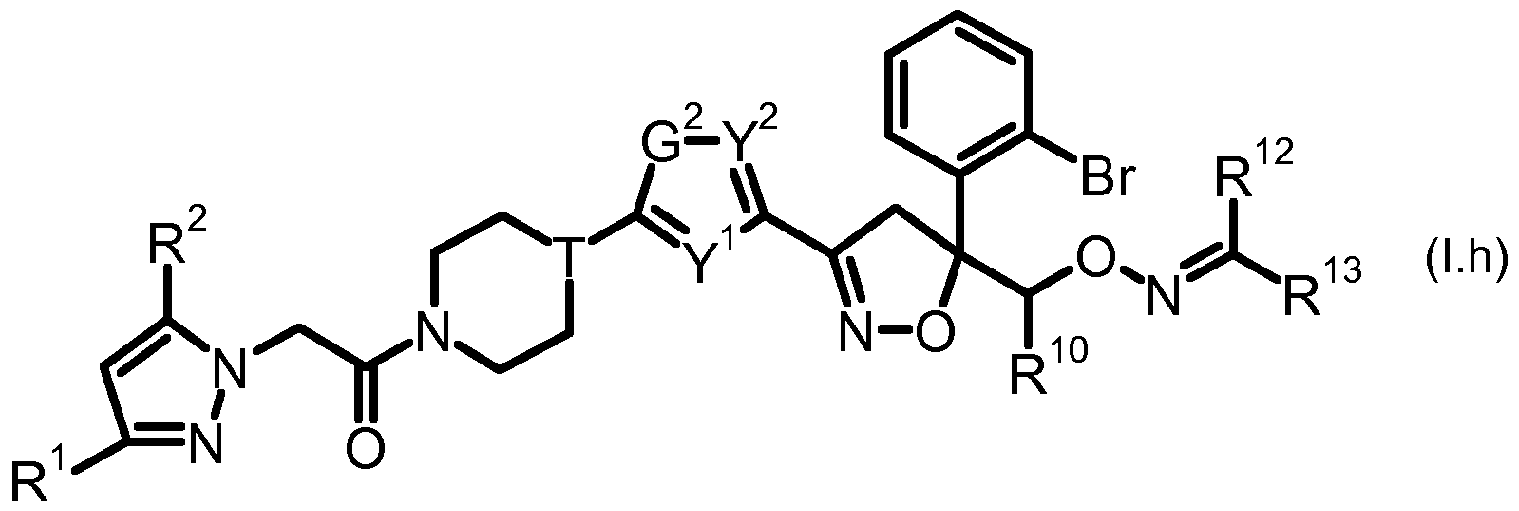
wherein R', R", RIU, R", RIJ, Q> T, Y' and Y are as defined in Table 1.
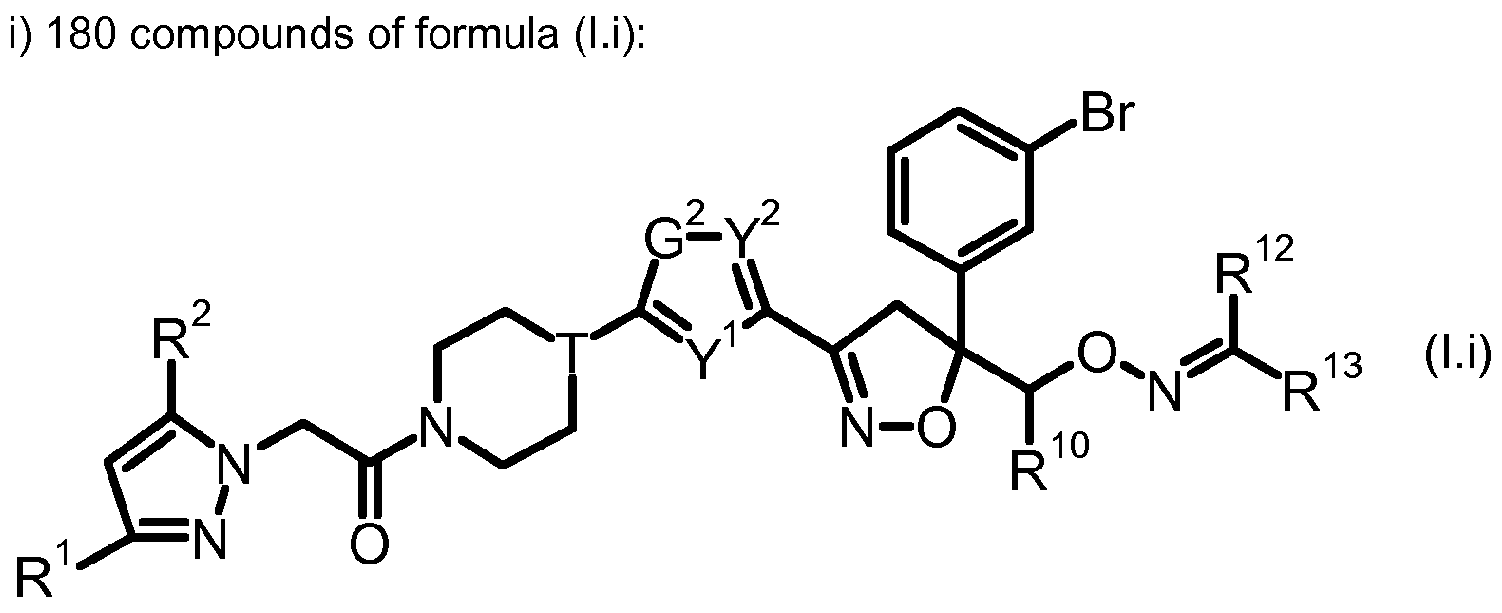
wherein R1, R2, R10, R12, R13, G2, T, Y1 and Y2 are as defined in Table 1. j) 180 compounds of formula (l.j):

k 180 compounds of formula (I. k):

wherein R1, R2, R10, R12, R13, G2, T, Y1 and Y2 are as defined in Table 1.

wherein R1, R2, R10, R12, R13, G2, T, Y1 and Y2 are as defined in Table 1.

wherein R1, R2, R10, R12, R13, G2, T, Y1 and Y2 are as defined in Table 1. n) 180 compounds of formula (l.n):

wherein R1, R2, R10, R12, R13, G2, T, Y1 and Y2 are as defined in Table 1. o) 180 compounds of formula (I. o):
wherein R1, R2, R10, R12, R13, G2, T, Y1 and Y2 are as defined in Table 1. p) 180 compounds of formula (I. p):

wherein R1, R2, R 0, R12, R13, G2, T, Y1 and Y2 are as defined in Table 1.
180 compounds of formula (I. q):

wherein R1, R2, R10, R12, R13, G2, T, Y1 and Y2 are as defined in Table 1.

wherein R1, R2, R 0, R12, R13, G2, T, Y1 and Y2 are as defined in Table 1. s) 180 compounds of formula (I .s):

wherein R1, R2, R10, R12, R13, G2, T, Y1 and Y2 are as defined in Table 1. t 180 compounds of formula (l.t):

wherein R1, R2, R 0, R12, R13, G2, T, Y1 and Y2 are as defined in Table 1. u) 180 compounds of formula (I. u):

v) 180 compounds of formula (l.v):

wherein R1, R2, R10, R12, R13, G2, T, Y1 and are as defined in Table 1. w 1 compounds of formula (l.w):

wherein R1, R2, R10, R12, R13, G2, T, Y1 and are as defined in Table 1.

wherein R1, R2, R10, R12, R13, G2, T, Y1 and Y2 are as defined in Table 1. y) 180 compounds of formula (I. y):


wherein R1, R2, R 0, R12, R13, G2, T, Y1 and Y2 are as defined in Table 1. aa) 180 compounds of formula (l.aa):

wherein R1, R2, R10, R12, R13, G2, T, Y1 and Y2 are as defined in Table 1 ab) 180 compounds of formula (l.ab):
 wherein R1, R2, R 0, R12, R13, G2, T, Y1 and Y2 are as defined in Table 1. ac) 180 compounds of formula (l.ac):

wherein R , R , R1U, R12, R13, G , T, Y and Y2 are as defined in Table 1. ad) 180 compounds of formula (I. ad):

wherein R1, R2, R10, R12, R13, G2, T, Y1 and Y2 are as defined in Table 1. ae) 180 compounds of formula (l.ae):
wherein R1, R2, R10, R12, R13, G2, T, Y1 and Y2 are as defined in Table 1.

wherein R , R", R1U, R , R1J, G , - Tr, Y and are as defined in Table 1.

wherein R1, R2, R10, R12, R13, G2, T, Y1 and Y2 are as defined in Table 1.

wherein R1, R2, R 0, R12, R13, G2, T, Y1 and Y2 are as defined in Table 1.
 wherein R , R2 R 0, R12, R13, G2, T, Y1 and Y2 are as defined in Table 1. aj) 180 compounds of formula (l.aj):

wherein R1, R2, R 0, R12, R13, G2, T, Y1 and Y2 are as defined in Table 1. ak 180 compounds of formula (l.ak):

wherein R1, R2, R 0, R12, R13, G2, T, Y1 and Y2 are as defined in Table 1. al) 180 compounds of formula (l.al):

wherein R1, R2, R10, R12, R13, G2, T, Y1 and Y2 are as defined in Table 1. am) 180 compounds of formula (I. am):

wherein R1, R2, R10, R12, R13, G2, T, Y1 and Y2 are as defined in Table 1. an) 180 compounds of formula (I. an):

wherein R1, R2, R 0, R12, R13, G2, T, Y1 and Y2 are as defined in Table 1 ao) 180 compounds of formula (l.ao):

wherein R1, R2, R10, R12, R13, G2, T, Y1 and Y2 are as defined in Table 1. ap) 180 compounds of formula (Lap):

wherein R1, R2, R10, R12, R13, G2, T, Y1 and Y2 are as defined in Table 1.

wherein R1, R2, R10, R12, R13, G2, T, Y1 and Y2 are as defined in Table 1 ar) 180 compounds of formula (l.ar):

wherein R1, R2, R10, R12, R13, G2, T, Y1 and Y2 are as defined in Table 1. as) 180 compounds of formula (I. as):

wherein R1, R2, R10, R12, R13, G2, T, Y1 and Y2 are as defined in Table 1. at 180 compounds of formula (I. at):

wherein R1, R2, R10, R12, R13, G2, T, Y1 and Y2 are as defined in Table 1. au) 180 compounds of formula (l.au):
 av) 180 compounds of formula (l.av):

aw 180 compounds of formula (Law):
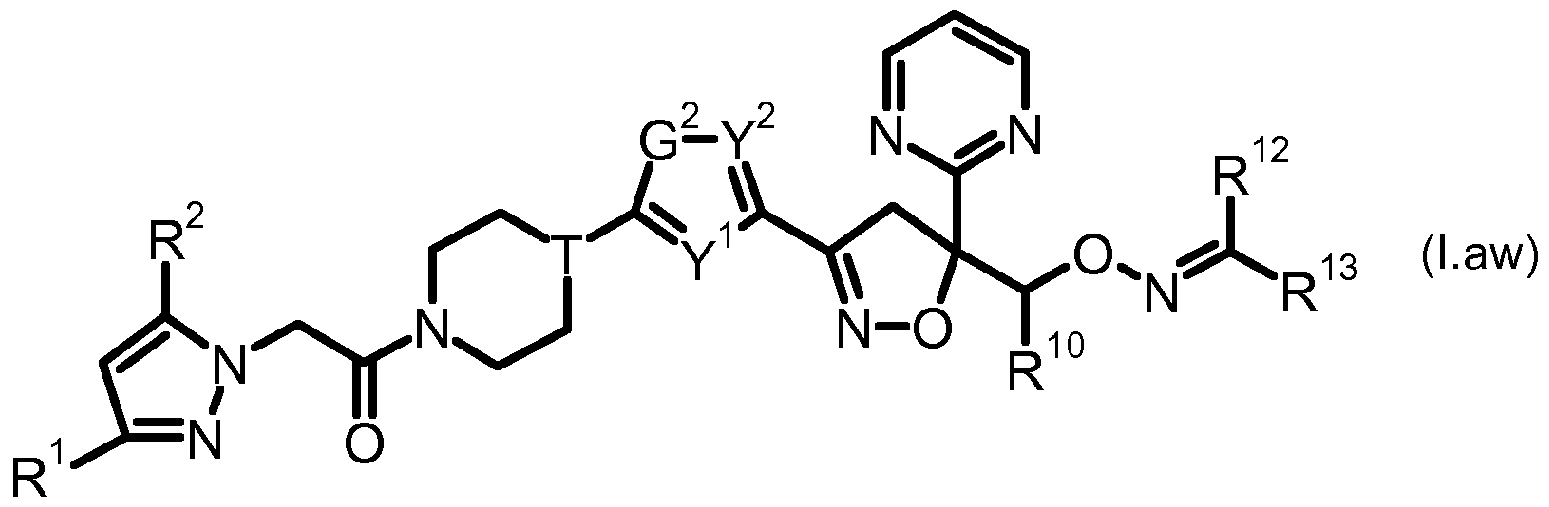
wherein R1, R2, R10, R12, R13, G2, T, Y1 and Y2 are as defined in Table 1.

wherein 1 , R2 R10 ' 12■ R R13 - r G 2. T' Y and Y are as defined in Table 1.

wherein R1, R2, R10, R12, R13, G2, T, Y1 and Y2 are as defined in Table 1.

Throughout this description, temperatures are given in degrees Celsius and "m.p." means melting point. LC/MS means Liquid Chromatography Mass Spectroscopy and the description of the apparatus and the method is:
Spectra were recorded on a Mass Spectrometer from Waters equipped with an electrospray source (Polarity: positive or negative ions, Capillary: 3.00 kV, Cone range: 30- 60 V, Extractor: 2.00 V, Source Temperature: 150°C, Desolvation Temperature: 350°C, Cone Gas Flow: 0 L/Hr, Desolvation Gas Flow: 650 L/Hr, Mass range: 100 to 900 Da) and an Acquity UPLC from Waters: Binary pump, heated column compartment and diode-array detector. Solvent degasser, binary pump, heated column compartment and diode-array detector. Column: Waters UPLC HSS T3 , 1.8 μιη, 30 x 2.1 mm, Temp: 60 °C, DAD
Wavelength range (nm): 210 to 500, Solvent Gradient: A = water + 5% MeOH + 0.05 % HCOOH, B= Acetonitrile + 0.05 % HCOOH: gradient: gradient: 0 min 0% B, 100%A; 1.2- 1.5min 100% B; Flow (ml/min) 0.85
Table 2: Melting point and LC/MS data for compounds of Table 1
Compound No. Melting point (°C) LC/MS
I.a.001 t = 1.75 min; MS: m/z 575 [M+1]+ l.a.002 Rt = 1.83 min; MS: m/z 589 [M+1]+ l.a.005 Rt = 1.95 min; MS: m/z 615 [M+1f l.a.109 Rt = 1.72 min; MS: m/z 593 [M+1f l.a.110 Rt = 1.80 min; MS: m/z 607 [M+1f l.a.113 Rt = 1.92 min; MS: m/z 633 [M+1]+ l.d.001 Rt = 1.80 min; MS: m/z 593 [M+1]+ l.d.002 Rt = 1.84 min; MS: m/z 607 [M+1]+ ld.005 Rt = 1.96 min; MS: m/z 633 [M+1]+ l.d.109 Rt = 1.76 min; MS: m/z 611 [M+1]+ l.d.110 Rt = 1.81 min; MS: m/z 625 [M+1]+ l.d.113 Rt = 1.92 min; MS: m/z 651 [M+1f l.b.109 Rt = 1.76 min; MS: m/z 61 1 [M+1f
The compounds according to the present invention can be prepared according to the above-mentioned reaction schemes, in which, unless otherwise stated, the definition of each variable is as defined above for a compound of formula (I).
Biological examples
Phytophthora infestans I tomato / leaf disc preventative (tomato late blight)
Tomato leaf disks are placed on water agar in multiwell plates (24-well format) and sprayed with the formulated test compound diluted in water. The leaf disks are inoculated with a spore suspension of the fungus 1 day after application. The inoculated leaf disks are incubated at 16°C and 75% rh under a light regime of 24 h darkness followed by 12 h light / 12 h darkness in a climate cabinet and the activity of a compound is assessed as percent disease control compared to untreated when an appropriate level of disease damage appears in untreated check leaf disks (5 - 7 days after application).
Compounds l.a.001 , l.a.002, l.a.005, l.a.109, l.a.1 10, l.a.113, l.d.001 , l.d.002, l.d.005, l.d.109, l.d.1 10, l.d.1 13 and l.b.109 at 200 ppm gives at least 80% disease control in this test when compared to untreated control plants under the same conditions, which show extensive disease development.
Phytophthora infestans I potato / preventative (potato late blight)
2-week old potato plants cv. Bintje are sprayed in a spray chamber with the formulated test compound diluted in water. The test plants are inoculated by spraying them with a sporangia
suspension 2 days after application. The inoculated test plants are incubated at 18° C with 1 h light/day and 100 % rh in a growth chamber and the percentage leaf area covered by disease is assessed when an appropriate level of disease appears on untreated check plants (5 - 7 days after application).
Compounds l.a.001 , l.a.002, l.a.005, l.a.109, l.a.1 10, l.a.1 13, l.d.001 , l.d.002, l.d.005, l.d.109, l.d.1 10, l.d.1 13 and l.b.109 at 200 ppm gives at least 80% disease control in this test when compared to untreated control plants under the same conditions, which show extensive disease development.
Phytophthora infestans I potato / curative (potato late blight)
2-week old potato plants cv. Bintje are inoculated by spraying them with a sporangia suspension one day before application. The inoculated plants are sprayed in a spray chamber with the formulated test compound diluted in water. The inoculated test plants are incubated at 18° C with 14 h light/day and 100 % rh in a growth chamber and the percentage leaf area covered by disease is assessed when an appropriate level of disease appears on untreated check plants (3 - 4 days after application).
Compounds l.a.001 , l.a.002, l.a.005, l.a.109, l.a.1 10, l.a.113, l.d.001 , l.d.002, l.d.005, l.d.109, l.d.1 10, l.d.113 and l.b.109 at 200 ppm gives at least 80% disease control in this test when compared to untreated control plants under the same conditions, which show extensive disease development.
Phytophthora infestans I potato / long lasting (potato late blight)
2-week old potato plants cv. Bintje are sprayed in a spray chamber with the formulated test compound diluted in water. The test plants are inoculated by spraying them with a sporangia suspension 6 days after application. The inoculated test plants are incubated at 18° C with 14 h light/day and 100 % rh in a growth chamber and the percentage leaf area covered by disease is assessed when an appropriate level of disease appears on untreated check plants (9 - 1 1 days after application).
Compounds l.a.001 , l.a.002, l.a.005, l.a.109, l.a.1 10, l.a.113, l.d.001 , l.d.002, l.d.005, l.d.109, l.d.1 10, l.d.1 13 and l.b.109 at 200 ppm gives at least 80% disease control in this test when compared to untreated control plants under the same conditions, which show extensive disease development.
Plasmopara viticola I grape / leaf disc preventative (grape downy mildew)
Grape vine leaf disks are placed on water agar in multiwell plates (24-well format) and sprayed with the formulated test compound diluted in water. The leaf disks are inoculated with a spore suspension of the fungus 1 day after application. The inoculated leaf disks are incubated at 19°C and 80% rh under a light regime of 12 h light / 12 h darkness in a climate cabinet and the activity of a compound is assessed as percent disease control compared to untreated when an appropriate level of disease damage appears in untreated check leaf disks (6 - 8 days after application).
Compounds l.a.001 , l.a.002, l.a.005, l.a.109, l.a.1 10, l.a.1 13, l.d.001 , l.d.002, l.d.005, l.d.109, l.d.1 10, l.d.1 13 and l.b.109 at 200 ppm gives at least 80% disease control in this test when compared to untreated control plants under the same conditions, which show extensive disease development.
Plasmopara viticola I grape / preventative (grape downy mildew)
5-week old grape seedlings cv. Gutedel are sprayed in a spray chamber with the formulated test compound diluted in water. The test plants plants are inoculated by spraying a sporangia suspension on their lower leaf surface one day after application. The inoculated test plants are incubated at 22° C and 100% rh in a greenhouse and the percentage leaf area covered by disease is assessed when an appropriate level of disease appears on untreated check plants (6 - 8 days after application).
Compounds l.a.001 , l.a.002, l.a.005, l.a.109, l.a.1 10, l.a.113, l.d.001 , l.d.002, l.d.005, l.d.109, l.d.1 10, l.d.1 13 and l.b.109 at 200 ppm gives at least 80% disease control in this test when compared to untreated control plants under the same conditions, which show extensive disease development.
Plasmopara viticola I grape / curative (grape downy mildew)
5-week-old grape seedlings cv. Gutedel are inoculated by spraying a sporangia suspension on their lower leaf surface one day before application. The inoculated grape plants are sprayed in a spray chamber with the formulated test compound diluted in water. The inoculated test plants are incubated at 22° C and 100% rh in a greenhouse and the percentage leaf area covered by disease is assessed when an appropriate level of disease appears on untreated check plants (4 - 6 days after application). Compounds l.a.001 , l.a.109, l.d.001 , l.d.109 and l.b.109 at 200 ppm gives at least
80% disease control in this test when compared to untreated control plants under the same conditions, which show extensive disease development.
Plasmopara viticola I grape / long lasting (grape downy mildew)
5-week old grape seedlings cv. Gutedel are sprayed in a spray chamber with the formulated test compound diluted in water. The test plants are inoculated by spraying a sporangia suspension on their lower leaf surface 6 days after application. The inoculated test plants are incubated at 22° C and 100% rh in a greenhouse and the percentage leaf area covered by disease is assessed when an appropriate level of disease appears on untreated check plants (1 1 - 13 days after application).
Compounds l.a.001 , l.a.002, l.a.109, l.a.110, l.d.001 , l.d.002, l.d.109, l.d.1 10 and I .b.109 at 200 ppm gives at least 80% disease control in this test when compared to untreated control plants under the same conditions, which show extensive disease development.
Claims
What is claimed is:

G1 and G2 are independently O or S;
T is CR14 or N;
Y1 and Y2 are independently CR15 or N;
n is 1 or 2;
p is 1 or 2, providing that when n is 2, p is 1 ;
R1 and R2 each independently are CrC4alkyl, CrC4haloalkyl or C3-C5cycloalkyl;
R3, R4, R5, R6, R7 and R8 each independently are hydrogen, halogen, cyano, C C4alkyl, Ci-
C4alkoxy, Ci-C4haloalkyl, C3-C5cycloalkyl or d-C4alkylthio;
R9 is aryl or heteroaryl, both optionally substituted by one or more R16;
R10, R11 and R12 each independently are hydrogen, halogen, cyano, CrC4alkyl, Ci-
C4haloalkyl, C3-C5cycloalkyl, aryl or heteroaryl, the aryl or heteroaryl optionally substituted by one or more R16; or
R10 and R1 together with the carbon atom to which they are attached, independently form a saturated or partially unsaturated three- to five-membered alicyclic ring, optionally substituted by halogen, cyano, CrC4alkyl, Ci-C alkoxy or CrC4haloalkyl;
R13 is CrC alkyl, Ci-C haloalkyl, C3-C5cycloalkyl, Ci-C alkylcarbonyl, aryl, heteroaryl, the aryl or heteroaryl optionally substituted by one or more R16;
R14 is hydrogen, halogen or hydroxyl;
R15 is hydrogen, halogen or cyano;
R16 is halogen, cyano, hydroxyl, amino, formyl, CrC4alkyl, Ci-C haloalkyl, C3-C5cycloalkyl, C2-C5alkenyl, C2-C5haloalkenyl, C2-C5alkynyl, C2-C5haloalkynyl, Ci-C4alkoxy, Cr
C4haloalkoxy, C3-C5cycloalkoxy, C3-C5alkenyloxy, C3-C5haloalkenyloxy, C3-C5alkynyloxy, C3- C5haloalkynyloxy, Ci-C alkylamino, Ci-C dialkylamino, CrC alkylcarbonyl, C
C4haloalkylcarbonyl, C3-C5cycloalkylcarbonyl, Ci-C4alkylcarbonyl 0-Ci-C4alkyloxime, C C4haloalkylcarbonyl 0-C C alkyloxime, C3-C5cycloalkylcarbonyl 0-C C4alkyloxime, C C4alkylcarbonyloxy, CrC4haloalkylcarbonyloxy, C3-C5cycloalkylcarbonyloxy, C
C4alkoxycarbonyl, CrC4haloalkoxycarbonyl, C3-C5cycloalkoxycarbonyl, aryl, heteroaryl, arylCi-C alkyl or heteroarylCi-C4alkyl;
or a salt or a N-oxide thereof.
2. A compound according to claim 1 wherein R9 is phenyl which is optionally substituted by one or more R16.
3. A compound according to claim 1 wherein R9 is phenyl, which is substituted by hydrogen, halogen, cyano, Ci-C4alkyl, Ci-C4haloalkyl or C3-C5alkynyloxy.
4. A compound according to claim 1 wherein R10, R11 and R12 each independently are hydrogen, halogen, Ci-C4alkyl, CrC4haloalkyl or C3-C5cycloalkyl.
5. A compound according to claim 1 wherein:
G1 is O
G2 is S;
T is CH or N;
Y1 and Y2 are independently CH or N;
n is 1 or 2;
p is 1 or 2, providing that when n is 2, p is 1 ;
R1 and R2 each independently are methyl or halomethyl;
R3, R4, R5, R6, R7 and R8 each independently are hydrogen, halogen, cyano, CrC alkyl, d-
C4alkoxy, Ci-C4haloalkyl, C3-C5cycloalkyl or CrC4alkylthio;
R9 is aryl or heteroaryl, both optionally substituted by one or more R16;
R10, R11 and R12 each independently are hydrogen, halogen, cyano, CrC4alkyl, Ci-
C4haloalkyl, C3-C5cycloalkyl, aryl or heteroaryl; or
R10 and R11 together with the carbon atom to which they are attached, independently form a saturated or partially unsaturated three- to five-membered alicyclic ring, optionally substituted by halogen, cyano, CrC alkyl, Ci-C4alkoxy or Ci-C haloalkyl;
R13 is CrC4alkyl, Ci-C4haloalkyl, C3-C5cycloalkyl, Ci-C4alkylcarbonyl, aryl, heteroaryl, the aryl or heteroaryl optionally substituted by one or more R16;
R14 is hydrogen, halogen or hydroxyl;
R15 is hydrogen, halogen or cyano;
or a salt or a N-oxide thereof.
6. A compound according to claim 1 wherein:
G1 is O
G2 is S;
T is CH or N;
Y1 and Y2 are independently CH or N;
n is 1 or 2;
p is 1 or 2, providing that when n is 2, p is 1 ;
R1 and R2 each independently are methyl or halomethyl;
R3, R4, R5, R6, R7 and R8 each independently are hydrogen, halogen, methyl, halomethyl or methylthio;
R9 is phenyl which is optionally substituted by one or more R15;
R10, R11 and R12 each independently are hydrogen, halogen, Ci-C4alkyl, CrC4haloalkyl or C3- C5cycloalkyl;
R13 is C C4alkyl, Ci-C4haloalkyl, C3-C5cycloalkyl or phenyl which is optionally substituted by one or more R16;
R14 is hydrogen, halogen or hydroxyl;
R15 is hydrogen, halogen or cyano;
or a salt or a N-oxide thereof.
7. A compound according to claim 1 wherein:
G1 is O
G2 is S;
T is CH or N;
Y1 and Y2 are independently CH or N;
n is 1 or 2;
p is 1 or 2, providing that when n is 2, p is 1 ;
R1 and R2 each independently are methyl or halomethyl;
R3, R4, R5, R6, R7 and R8 each independently are hydrogen or methyl;
R9 is phenyl, which is substituted by hydrogen, halogen, cyano, Ci-C4alkyl, CrC4haloalkyl or C3-C5alkynyloxy.
R10, R11 and R12 each independently are hydrogen, halogen or Ci-C4alkyl;
R13 is C C4alkyl or C3-C5cycloalkyl;
R14 is hydrogen, halogen or hydroxyl;
R15 is hydrogen, halogen or cyano;
or a salt or a N-oxide thereof.
8. A compound according to claim 1 wherein:
G1 is O
G2 is S;
T is CH or N;
Y1 and Y2 are independently CH or N;
n is 1 or 2;
p is 1 or 2, providing that when n is 2, p is 1 ;
R1 and R2 each independently are methyl, difluoromethyl or trifluoromethyl;
R3, R4, R5, R6, R7 and R8 are hydrogen;
R9 is phenyl, which is substituted by hydrogen, halogen or C3-C5alkynyloxy.
R10, R11 and R12 each independently are hydrogen or CrC4alkyl;
5 R13 is CrC4alkyl or C3-C5cycloalkyl;
R14 is hydrogen or hydroxyl;
R15 is hydrogen or cyano;
or a salt or a N-oxide thereof.
10 9. A compound according to any one of claims 1 to 8, wherein G1, is O, G2 is S, T is CH, Y1 is N, and Y2 is CH.
10. A compound according to any one of claims 1 to 9, wherein p is 1 and n is 2.
15 1 1. A compound according to any one of the claims 1 to 10, wherein R1 and R2 each independently are methyl, difluoromethyl or trifluoromethyl and R3, R4, R5, R6, R7 and R8 each independently are hydrogen, or methyl.
12. A compound according to anyone of claims 1 to 1 1 , wherein R3, R4, R5, R6, R7 and R8 20 are hydrogen.
13. A

wherein R3, R4, R5, R6, R7, R8, R9, R10, R11, R12, R13, G2, T, Y1, Y2 , n and p are as defined in 25 anyone of claims 1 to 12 for a compound of formula I, and salts and N-oxides thereof,
or a c

wherein R3, R4, R5, R6, R7, R8, R9, R10, R11, R12, R13, G2, T, Y1, Y2 , n and p are as defined in anyone of claims 1 to 12 for a compound of formula I and E is a protecting group, such as
C1-C4 alkylcarbonyl, benzyl or C1-C4 alkoxycarbonyl, in particular acetyl, benzyl or tert- butoxycarbonyl, and salts and N-oxides thereof.
14. A composition comprising at least one compound as defined in any one of claims 1 to 12 and an agriculturally acceptable carrier, optionally comprising an adjuvant, and optionally comprising one or more additional pesticidally active compounds.
15. A method of controlling or preventing an infestation of plants, propagation material thereof, harvested crops or of non-living materials by phytopathogenic or spoilage microorganisms or organisms potentially harmful to man, which comprises the application of a compound as defined in any one of claims 1 to 12, to the plant, to parts of the plants or to the locus thereof, to propagation material thereof or to any part of the non-living materials.
Applications Claiming Priority (2)
| Application Number | Priority Date | Filing Date | Title |
|---|---|---|---|
| IN903/DEL/2013 | 2013-03-25 | ||
| IN903DE2013 | 2013-03-25 |
Publications (1)
| Publication Number | Publication Date |
|---|---|
| WO2014154530A1 true WO2014154530A1 (en) | 2014-10-02 |
Family
ID=50336318
Family Applications (1)
| Application Number | Title | Priority Date | Filing Date |
|---|---|---|---|
| PCT/EP2014/055396 Ceased WO2014154530A1 (en) | 2013-03-25 | 2014-03-18 | Microbiocidal pyrazole derivatives |
Country Status (1)
| Country | Link |
|---|---|
| WO (1) | WO2014154530A1 (en) |
Cited By (6)
| Publication number | Priority date | Publication date | Assignee | Title |
|---|---|---|---|---|
| KR20170036104A (en) | 2014-08-13 | 2017-03-31 | 가부시키가이샤 에스디에스 바이오텍크 | Condensed 11-member ring compound and agriculture and horticultural fungicide comprising same |
| WO2019048988A1 (en) | 2017-09-08 | 2019-03-14 | Pi Industries Ltd. | NOVEL FUNGICIDE HETEROCYCLIC COMPOUNDS |
| WO2019048989A1 (en) | 2017-09-08 | 2019-03-14 | Pi Industries Ltd. | Novel fungicidal heterocyclic compounds |
| US11274076B2 (en) | 2016-02-08 | 2022-03-15 | Gowan Company, L.L.C. | Process for preparing 1, 2-benzenedimethanol compound |
| US11903387B2 (en) | 2016-02-08 | 2024-02-20 | Gowan Company, L.L.C. | Fungicidal composition |
| WO2025098238A1 (en) * | 2023-11-07 | 2025-05-15 | 江苏中旗科技股份有限公司 | Compound comprising piperazine ring structure, preparation method therefor and use thereof, and bactericide |
Citations (10)
| Publication number | Priority date | Publication date | Assignee | Title |
|---|---|---|---|---|
| EP0353191A2 (en) | 1988-07-29 | 1990-01-31 | Ciba-Geigy Ag | DNA sequences encoding polypeptides having beta-1,3-glucanase activity |
| EP0392225A2 (en) | 1989-03-24 | 1990-10-17 | Ciba-Geigy Ag | Disease-resistant transgenic plants |
| WO1995033818A2 (en) | 1994-06-08 | 1995-12-14 | Ciba-Geigy Ag | Genes for the synthesis of antipathogenic substances |
| WO1997033890A1 (en) | 1996-03-11 | 1997-09-18 | Novartis Ag | Pyrimidin-4-one derivatives as pesticide |
| WO2007014290A2 (en) | 2005-07-26 | 2007-02-01 | E. I. Du Pont De Nemours And Company | Fungicidal carboxamides |
| WO2008013925A2 (en) | 2006-07-27 | 2008-01-31 | E. I. Du Pont De Nemours And Company | Fungicidal azocyclic amides |
| WO2008091580A2 (en) | 2007-01-25 | 2008-07-31 | E. I. Du Pont De Nemours And Company | Fungicidal amides |
| WO2008091594A2 (en) | 2007-01-24 | 2008-07-31 | E. I. Du Pont De Nemours And Company | Fungicidal mixtures |
| WO2009055514A2 (en) | 2007-10-23 | 2009-04-30 | E. I. Du Pont De Nemours And Company | Fungicidal mixtures |
| WO2011146182A1 (en) * | 2010-05-20 | 2011-11-24 | E. I. Du Pont De Nemours And Company | Fungicidal oximes and hydrazones |
-
2014
- 2014-03-18 WO PCT/EP2014/055396 patent/WO2014154530A1/en not_active Ceased
Patent Citations (11)
| Publication number | Priority date | Publication date | Assignee | Title |
|---|---|---|---|---|
| EP0353191A2 (en) | 1988-07-29 | 1990-01-31 | Ciba-Geigy Ag | DNA sequences encoding polypeptides having beta-1,3-glucanase activity |
| EP0392225A2 (en) | 1989-03-24 | 1990-10-17 | Ciba-Geigy Ag | Disease-resistant transgenic plants |
| WO1995033818A2 (en) | 1994-06-08 | 1995-12-14 | Ciba-Geigy Ag | Genes for the synthesis of antipathogenic substances |
| WO1997033890A1 (en) | 1996-03-11 | 1997-09-18 | Novartis Ag | Pyrimidin-4-one derivatives as pesticide |
| WO2007014290A2 (en) | 2005-07-26 | 2007-02-01 | E. I. Du Pont De Nemours And Company | Fungicidal carboxamides |
| WO2008013925A2 (en) | 2006-07-27 | 2008-01-31 | E. I. Du Pont De Nemours And Company | Fungicidal azocyclic amides |
| WO2008013622A2 (en) | 2006-07-27 | 2008-01-31 | E. I. Du Pont De Nemours And Company | Fungicidal azocyclic amides |
| WO2008091594A2 (en) | 2007-01-24 | 2008-07-31 | E. I. Du Pont De Nemours And Company | Fungicidal mixtures |
| WO2008091580A2 (en) | 2007-01-25 | 2008-07-31 | E. I. Du Pont De Nemours And Company | Fungicidal amides |
| WO2009055514A2 (en) | 2007-10-23 | 2009-04-30 | E. I. Du Pont De Nemours And Company | Fungicidal mixtures |
| WO2011146182A1 (en) * | 2010-05-20 | 2011-11-24 | E. I. Du Pont De Nemours And Company | Fungicidal oximes and hydrazones |
Non-Patent Citations (2)
| Title |
|---|
| A. ALBINI; S. PIETRA: "Heterocyclic N-oxides", 1991, CRC PRESS |
| ALAIN DELCOURT ET AL: "New polyazole derivatives from 2-(2,4-dichlorophenyl)-1,3-dioxolane. Antifungal activity. Structure-activity relationships", MYCOPATHOLOGIA, KLUWER ACADEMIC PUBLISHERS, DO, vol. 137, no. 1, 1 April 1997 (1997-04-01), pages 27 - 32, XP019259223, ISSN: 1573-0832 * |
Cited By (8)
| Publication number | Priority date | Publication date | Assignee | Title |
|---|---|---|---|---|
| KR20170036104A (en) | 2014-08-13 | 2017-03-31 | 가부시키가이샤 에스디에스 바이오텍크 | Condensed 11-member ring compound and agriculture and horticultural fungicide comprising same |
| US9980487B2 (en) | 2014-08-13 | 2018-05-29 | Sds Biotech K.K. | Fused 11-membered compounds and agricultural/horticultural fungicides containing them |
| US10104891B2 (en) | 2014-08-13 | 2018-10-23 | Sds Biotech K.K. | Fused 11-membered compounds and agricultural/horticultural fungicides containing them |
| US11274076B2 (en) | 2016-02-08 | 2022-03-15 | Gowan Company, L.L.C. | Process for preparing 1, 2-benzenedimethanol compound |
| US11903387B2 (en) | 2016-02-08 | 2024-02-20 | Gowan Company, L.L.C. | Fungicidal composition |
| WO2019048988A1 (en) | 2017-09-08 | 2019-03-14 | Pi Industries Ltd. | NOVEL FUNGICIDE HETEROCYCLIC COMPOUNDS |
| WO2019048989A1 (en) | 2017-09-08 | 2019-03-14 | Pi Industries Ltd. | Novel fungicidal heterocyclic compounds |
| WO2025098238A1 (en) * | 2023-11-07 | 2025-05-15 | 江苏中旗科技股份有限公司 | Compound comprising piperazine ring structure, preparation method therefor and use thereof, and bactericide |
Similar Documents
| Publication | Publication Date | Title |
|---|---|---|
| US8748432B2 (en) | Microbiocidal pyrazole derivatives | |
| CA2768636C (en) | Microbiocidal heterocycles | |
| EP2643312B1 (en) | Microbicidal heterocycles | |
| EP2516424B1 (en) | Pyrazole derivatives | |
| WO2013127808A1 (en) | Microbiocidal pyrazole derivatives | |
| WO2013056915A1 (en) | Microbiocidal pyrazole derivatives | |
| WO2014075874A1 (en) | Microbiocidal pyrazole derivatives | |
| WO2014075873A1 (en) | Microbiocidal pyrazole derivatives | |
| WO2013127784A1 (en) | Microbiocidal pyrazole derivatives | |
| WO2013056911A1 (en) | Microbiocidal pyrazole derivatives | |
| WO2012107477A1 (en) | Microbiocidal pyrazole derivatives | |
| WO2013000941A1 (en) | Microbiocidal heterocycles | |
| WO2014118143A1 (en) | Microbiocidal pyrazole derivatives | |
| WO2014118142A1 (en) | Microbiocidal pyrazole derivatives | |
| EP2820011A1 (en) | Microbiocidal pyrazole derivatives | |
| EP2726474B1 (en) | Microbiocidal heterocycles | |
| WO2014060176A1 (en) | Microbiocidal pyrazole derivatives |
Legal Events
| Date | Code | Title | Description |
|---|---|---|---|
| 121 | Ep: the epo has been informed by wipo that ep was designated in this application |
Ref document number: 14711238 Country of ref document: EP Kind code of ref document: A1 |
|
| NENP | Non-entry into the national phase |
Ref country code: DE |
|
| 122 | Ep: pct application non-entry in european phase |
Ref document number: 14711238 Country of ref document: EP Kind code of ref document: A1 |