WO2014152453A2 - Continuous flow synthesis of dithioester compounds - Google Patents
Continuous flow synthesis of dithioester compounds Download PDFInfo
- Publication number
- WO2014152453A2 WO2014152453A2 PCT/US2014/027356 US2014027356W WO2014152453A2 WO 2014152453 A2 WO2014152453 A2 WO 2014152453A2 US 2014027356 W US2014027356 W US 2014027356W WO 2014152453 A2 WO2014152453 A2 WO 2014152453A2
- Authority
- WO
- WIPO (PCT)
- Prior art keywords
- compound
- formula
- solution
- group
- substituted
- Prior art date
- Legal status (The legal status is an assumption and is not a legal conclusion. Google has not performed a legal analysis and makes no representation as to the accuracy of the status listed.)
- Ceased
Links
- WPFPXUQEUXJYHU-UHFFFAOYSA-N CC(C(OC)=O)SC(c1ccccc1)=S Chemical compound CC(C(OC)=O)SC(c1ccccc1)=S WPFPXUQEUXJYHU-UHFFFAOYSA-N 0.000 description 1
- NXWVPIWRMPQYEX-UHFFFAOYSA-N CCOC(C(C)SC(c1ccccc1)=S)=O Chemical compound CCOC(C(C)SC(c1ccccc1)=S)=O NXWVPIWRMPQYEX-UHFFFAOYSA-N 0.000 description 1
- SBFVXSRJTJHHPR-UHFFFAOYSA-N N#CCSC(c1ccccc1)=S Chemical compound N#CCSC(c1ccccc1)=S SBFVXSRJTJHHPR-UHFFFAOYSA-N 0.000 description 1
Classifications
-
- C—CHEMISTRY; METALLURGY
- C07—ORGANIC CHEMISTRY
- C07C—ACYCLIC OR CARBOCYCLIC COMPOUNDS
- C07C327/00—Thiocarboxylic acids
- C07C327/36—Esters of dithiocarboxylic acids
-
- C—CHEMISTRY; METALLURGY
- C07—ORGANIC CHEMISTRY
- C07D—HETEROCYCLIC COMPOUNDS
- C07D213/00—Heterocyclic compounds containing six-membered rings, not condensed with other rings, with one nitrogen atom as the only ring hetero atom and three or more double bonds between ring members or between ring members and non-ring members
- C07D213/02—Heterocyclic compounds containing six-membered rings, not condensed with other rings, with one nitrogen atom as the only ring hetero atom and three or more double bonds between ring members or between ring members and non-ring members having three double bonds between ring members or between ring members and non-ring members
- C07D213/04—Heterocyclic compounds containing six-membered rings, not condensed with other rings, with one nitrogen atom as the only ring hetero atom and three or more double bonds between ring members or between ring members and non-ring members having three double bonds between ring members or between ring members and non-ring members having no bond between the ring nitrogen atom and a non-ring member or having only hydrogen or carbon atoms directly attached to the ring nitrogen atom
- C07D213/60—Heterocyclic compounds containing six-membered rings, not condensed with other rings, with one nitrogen atom as the only ring hetero atom and three or more double bonds between ring members or between ring members and non-ring members having three double bonds between ring members or between ring members and non-ring members having no bond between the ring nitrogen atom and a non-ring member or having only hydrogen or carbon atoms directly attached to the ring nitrogen atom with hetero atoms or with carbon atoms having three bonds to hetero atoms with at the most one bond to halogen, e.g. ester or nitrile radicals, directly attached to ring carbon atoms
- C07D213/62—Oxygen or sulfur atoms
- C07D213/70—Sulfur atoms
-
- C—CHEMISTRY; METALLURGY
- C07—ORGANIC CHEMISTRY
- C07D—HETEROCYCLIC COMPOUNDS
- C07D277/00—Heterocyclic compounds containing 1,3-thiazole or hydrogenated 1,3-thiazole rings
- C07D277/02—Heterocyclic compounds containing 1,3-thiazole or hydrogenated 1,3-thiazole rings not condensed with other rings
- C07D277/08—Heterocyclic compounds containing 1,3-thiazole or hydrogenated 1,3-thiazole rings not condensed with other rings having one double bond between ring members or between a ring member and a non-ring member
- C07D277/12—Heterocyclic compounds containing 1,3-thiazole or hydrogenated 1,3-thiazole rings not condensed with other rings having one double bond between ring members or between a ring member and a non-ring member with hetero atoms or with carbon atoms having three bonds to hetero atoms with at the most one bond to halogen, e.g. ester or nitrile radicals, directly attached to ring carbon atoms
- C07D277/16—Sulfur atoms
Definitions
- the present technology relates generally to continuous flow synthesis of compounds containing a dithioester group.
- Dithioesters are an important class of compounds in synthetic chemistry, having numerous applications in pharmaceutical, applied, and other chemical industries.
- RAFT reversible addition-fragmentation chain transfer
- Many contemporary RAFT polymerization methods require the use and availability of certain dithioester compounds (RAFT agents), some of which are structurally complex or contain sensitive functionality. See, for example, Keddie, D. J. et al. Macromolecules 2012, 45, 5321- 5342.
- RAFT agents dithioester compounds
- the synthesis of dithioester compounds, including RAFT agents can be a challenge even for the simplest of structures.
- contemporary synthesis approaches are often not easily scaled or provide dithioester compounds in low purity.
- Alternative, general, and commercially scalable methods of synthesizing dithioester compounds in high yield and/or purity are of significant interest.
- the present technology provides a synthesis method, the method comprising:
- R 1 is a substituted or unsubstituted alkyl, alkenyl, alkynyl, cycloalkyl,
- cycloalkylalkyl aryl, aralkyl, heteroaryl, heteroarylalkyl, heterocyclyl, or heterocyclylalkyl group;
- R 2 , R 3 , and R 4 are independently -H, -CN, -C0 2 R, -C(0)R, -C(0)NR 2 ,
- -NR 2 or a substituted or unsubstituted alkyl, alkenyl, alkynyl, cycloalkyl, cycloalkylalkyl, aryl, aralkyl, heteroaryl, heteroarylalkyl, heterocyclyl, or heterocyclylalkyl group;
- Z + is a cationic group
- LG is a leaving group
- each R is independently -H or a substituted or unsubstituted alkyl, alkenyl,
- alkynyl cycloalkyl, cycloalkylalkyl, aryl, aralkyl, heteroaryl, heteroarylalkyl, heterocyclyl, or heterocyclylalkyl group.
- the compound of Formula II is produced by
- the present technology provides another synthesis method, the method comprising:
- R 1 is -H, a substituted or unsubstituted alkyl, alkenyl, cycloalkyl, cycloalkylalkyl, aryl, aralkyl, heteroaryl, heteroarylalkyl, heterocyclyl, or heterocyclylalkyl group;
- Z + is a cationic group.
- FIG. 1 illustrates a continuous flow reactor and associated components that may be used, according to some embodiments of the present technology.
- references to a certain element such as hydrogen or H is meant to include all isotopes of that element.
- an R group is defined to include hydrogen or H, it also includes deuterium ( 2 H) and tritium ( 3 H).
- Compounds comprising radioisotopes such as tritium, 14 C, 32 P, and 35 S are thus within the scope of the present technology. Synthetic procedures for inserting such labels will be readily apparent to those skilled in the art based on the disclosure herein.
- substituted groups also include groups in which one or more bonds to a carbon(s) or hydrogen(s) atom are replaced by one or more bonds, including double or triple bonds, to a heteroatom.
- a substituted group is substituted with one or more substituents, unless otherwise specified. In some embodiments, a substituted group is substituted with 1, 2, 3, 4, 5, or 6 substituents.
- Non-limiting examples of substituent groups include groups such as: halogens (i.e., F, CI, Br, and I); hydroxy and protected hydroxy groups; nitriles (-CN, "cyano"); nitro groups (-N0 2 ); carbonyls (oxo); thiocarbonyls (thioxo); aldehydes and ketones; acyls; acyloxycarbonyls; carboxyls; carboxylates; ketals;
- halogens i.e., F, CI, Br, and I
- hydroxy and protected hydroxy groups nitriles (-CN, "cyano"); nitro groups (-N0 2 ); carbonyls (oxo); thiocarbonyls (thioxo); aldehydes and ketones; acyls; acyloxycarbonyls; carboxyls; carboxylates; ketals;
- acetals acyloxys; esters; dithioesters; carbonates, trithiocarbonates; xanthates; urethanes (carbamates); dithiocarbamates; oximes; hydroxyamines; alkoxyamines; aralkoxyamines; thiols (sulfhydryls); sulfides (e.g., alkylthio, arylthio, and the like); disulfides (e.g., alkyldithio);
- sulfoxides sulfones; sulfonyls; sulfonamides; sulfonates; amines (e.g., alkylamino,
- hydrazones azides; amides; ureas; amidines; guanidines; enamines; imines; imides; isocyanates; isothiocyanates; cyanates; thiocyanates; poly(oxyalkylene) groups (e.g., poly(ethylene glycol), "PEG”); silyl groups (e.g., trialkylsilyl or dialkylarylsilyl); phosphonates; phosphinates; alkyl, perhaloalkyl (e.g., -CF 3 , "trifluoromethyl"), cycloalkyl, cycloalkylalkyl, alkenyl, cycloalkenyl, cycloalkenylalkyl, alkynyl, aryl, aralkyl, heterocyclyl, heterocyclylalkyl, heteroaryl, and heteroaralkyl groups; alkoxy, perhaloalkoxy (e.g., -OCF 3
- Substituted ring groups such as substituted cycloalkyl, aryl, heterocyclyl, and heteroaryl groups also include rings and ring systems in which a bond to a hydrogen atom is replaced with a bond to a carbon atom. Therefore, substituted cycloalkyl, aryl, heterocyclyl and heteroaryl groups may also be substituted with substituted or unsubstituted alkyl, alkenyl, and alkynyl groups as defined below.
- alkyl includes straight chain and branched chain alkyl groups having from 1 to 20 carbon atoms, and typically from 1 to 18 carbon atoms or, in some embodiments, from 1 to 16, from 1 to 14, from 1 to 12, from 1 to 10, from 1 to 8, from 1 to 6, or from 1 to 4 carbon atoms.
- straight chain alkyl groups include groups such as methyl, ethyl, n- propyl, rc-butyl, /i-pentyl, /i-hexyl, rc-heptyl, /i-octyl, rc-nonyl, rc-decyl, rc-undecyl, and rc-dodecyl groups.
- branched alkyl groups include, but are not limited to, isopropyl, isobutyl, sec-butyl, ieri-butyl ( ⁇ -Bu), neopentyl, isopentyl, and 2,2-dimethylpropyl groups.
- Substituted alkyl groups may be substituted one or more times with substituents such as those listed herein, and include without limitation haloalkyl, hydroxyalkyl, protected hydroxylalkyl, thioalkyl, aminoalkyl, alkylaminoalkyl, dialkylaminoalkyl, alkoxyalkyl, carboxyalkyl, and the like.
- Alkyl groups include cycloalkyl groups as defined below.
- cycloalkyl includes mono-, bi-, or tricyclic alkyl groups having from 3 to 20 carbon atoms in the ring(s), or, in some embodiments, from 3 to 18, from 3 to 16, from 3 to 14, from 3 to 12, from 3 to 10, from 3 to 8, or from 3 to 4, 5, or 6 carbon atoms.
- exemplary monocyclic cycloalkyl groups include, but not limited to, cyclopropyl, cyclobutyl, cyclopentyl, cyclohexyl, cycloheptyl, and cyclooctyl groups.
- the cycloalkyl group has from 3 to 8 ring members, whereas in other embodiments the number of ring carbon atoms range from 3 to 5, from 3 to 6, or from 3 to 7 carbon atoms.
- Bi- and tricyclic ring systems include both bridged cycloalkyl groups and fused rings, such as, but not limited to, bicyclo[2.1.1]hexane, adamantyl, decalinyl, and the like.
- Substituted cycloalkyl groups may be substituted one or more times with, non-hydrogen and non-carbon groups as defined herein.
- substituted cycloalkyl groups also include rings that are substituted with straight or branched chain alkyl groups as defined above.
- cycloalkylalkyl groups may be mono-substituted or substituted more than once, such as, but not limited to, 2,2-, 2,3-, 2,4- 2,5- or 2,6-disubstituted cyclohexyl groups, which may be substituted with substituents such as those listed herein.
- the term "cycloalkylalkyl” includes alkyl groups, as defined above, in which a hydrogen or carbon bond of an alkyl group is replaced with a bond to a cycloalkyl group as defined above. In some embodiments, cycloalkylalkyl groups have from 4 to 20, from 4 to 16, from 4 to 12, or from 4 to 10 carbon atoms.
- Substituted cycloalkylalkyl groups may be substituted at the alkyl, the cycloalkyl, or both the alkyl and cycloalkyl portions of the group. Substituted cycloalkylalkyl groups may be mono-substituted or substituted more than once, such as, but not limited to, mono-, di-, or tri- substituted with substituents such as those listed herein.
- alkenyl includes straight and branched chain alkyl groups as defined above, except that at least one double bond exists between two carbon atoms.
- Alkenyl groups have from 2 to 20 carbon atoms, and typically from 2 to 18 carbon atoms or, in some embodiments, from 2 to 16, from 2 to 14, from 2 to 12, from 2 to 10, from 2 to 8, from 2 to 6, or from 2 to 4 carbon atoms.
- the alkenyl group has one, two, or three carbon-carbon double bonds. Examples include, but are not limited to vinyl, allyl,
- alkenyl groups may be mono-substituted or substituted more than once, such as, but not limited to, mono-, di-, or tri- substituted with substituents such as those listed herein.
- Alkenyl groups include cycloalkenyl groups as defined below.
- cycloalkenyl includes cycloalkyl groups as defined above, having at least one double bond between two carbon atoms. In some embodiments the cycloalkenyl group may have one, two, or three double bonds but does not include aromatic compounds.
- Cycloalkenyl groups have from 4 to 14 carbon atoms, or in some embodiments, from 5 to 14, from 5 to 10, or even 5, 6, 7, or 8 carbon atoms.
- Examples of cycloalkenyl groups include cyclohexenyl, cyclopentenyl, and cyclohexadienyl. Substituted cycloalkenyl groups may be substituted one or more times with substituents such as those listed herein.
- cycloalkenylalkyl includes alkyl groups as defined above in which a hydrogen or carbon bond of the alkyl group is replaced with a bond to a cycloalkenyl group as defined above. Substituted cycloalkenylalkyl groups may be substituted at the alkyl, the cycloalkenyl, or both the alkyl and cycloalkenyl portions of the group. Substituted cycloalkenylalkyl groups may be substituted one or more times with substituents such as those listed herein.
- alkynyl includes straight and branched chain alkyl groups as defined above, except that at least one triple bond exists between two carbon atoms. Alkynyl groups have from 2 to 20 carbon atoms, and typically from 2 to 18 carbon atoms or, in some
- the alkynyl group has one, two, or three carbon-carbon triple bonds. Examples include, but are not limited to -C ⁇ CH, -C ⁇ CCH 3 , - CH 2 C ⁇ CCH 3 , -C ⁇ CCH 2 CH(CH 2 CH 3 ) 2 , among others.
- Substituted alkynyl groups may be mono-substituted or substituted more than once, such as, but not limited to, mono-, di-, or tri- substituted with substituents such as those listed herein.
- aryl includes cyclic aromatic hydrocarbon groups that do not contain heteroatoms.
- Aryl groups herein may include monocyclic, bicyclic and tricyclic ring systems.
- Non-limiting examples of aryl groups include groups such as phenyl, azulenyl, heptalenyl, biphenyl, fluorenyl, phenanthrenyl, anthracenyl, indenyl, indanyl, pentalenyl, pyrenyl, and naphthyl groups.
- aryl groups contain from 6 to 20 carbon atoms, and in others from 6 to 16, from 6 to 14, from 6 to 12, or even from 6 to 10 carbon atoms in the ring portions of the groups.
- the aryl groups are phenyl, naphthyl, anthracenyl, or pyrenyl.
- aryl groups includes groups containing fused rings, such as fused aromatic-aliphatic ring systems (e.g., indanyl, tetrahydronaphthyl, and the like), it does not include aryl groups that have other groups, such as alkyl or halogen groups, bonded to one of the ring members. Rather, groups such as tolyl are referred to as substituted aryl groups.
- Substituted aryl groups may be mono substituted or substituted more than once.
- monosubstituted aryl groups include, but are not limited to, 2-, 3-, 4-, 5-, or 6-substituted phenyl or naphthyl groups, which may be substituted with substituents such as those listed herein.
- aralkyl (or "arylalkyl”) includes alkyl groups as defined above in which a hydrogen or carbon bond of an alkyl group is replaced with a bond to an aryl group as defined above. In some embodiments, aralkyl groups contain from 7 to 20, from 7 to 18, from 7 to 16, from 7 to 14, from 7 to 12, or from 7 to 10 carbon atoms.
- Substituted aralkyl groups may be substituted at the alkyl, the aryl, or both the alkyl and aryl portions of the group.
- Non-limiting examples of aralkyl groups include groups such as benzyl, phenethyl, and fused
- (cycloalkylaryl)alkyl groups such as 4-indanylethyl. Substituted aralkyl groups may be substituted one or more times with substituents such as those listed herein.
- heterocyclyl includes aromatic (also referred to as “heteroaryl” as defined below) and non-aromatic ring compounds containing 3 or more ring members, of which one or more is a heteroatom such as, but not limited to, N, O, and S.
- the heterocyclyl group contains 1, 2, 3, or 4 heteroatoms.
- heterocyclyl groups include mono-, bi- and tricyclic rings having 3 to 16 ring members, whereas other such groups have from 3 to 6, from 3 to 10, from 3 to 12, or from 3 to 14 ring members.
- Heterocyclyl groups encompass aromatic, partially unsaturated and saturated ring systems, such as, for example, imidazolyl, imidazolinyl, and imidazolidinyl groups.
- the term "heterocyclyl” includes fused ring species including those comprising fused aromatic and non-aromatic groups, such as, for example, benzotriazolyl, 2,3-dihydrobenzo[l,4]dioxinyl, and benzo[l,3]dioxolyl.
- the term also includes bridged polycyclic ring systems containing a heteroatom such as, but not limited to, quinuclidyl.
- heterocyclyl groups that have other groups, such as alkyl, oxo or halogen groups, bonded to one of the ring members. Rather, these are referred to as "substituted heterocyclyl groups”.
- heterocyclyl groups include groups such as aziridinyl, azetidinyl, pyrrolidinyl, imidazolidinyl, pyrazolidinyl, thiazolidinyl, tetrahydrothiophenyl, tetrahydrofuranyl, dioxolyl, furanyl, thiophenyl, pyrrolyl, pyrrolinyl, imidazolyl, imidazolinyl, pyrazolyl, pyrazolinyl, triazolyl, tetrazolyl, oxazolyl, isoxazolyl, thiazolyl, thiazolinyl, isothiazolyl, thiadiazolyl, oxadiazolyl, piperidyl, piperazinyl, morpholinyl, thiomorpholinyl, tetrahydropyranyl, tetrahydrothiopyranyl, ox
- Substituted heterocyclyl groups may be mono-substituted or substituted more than once, such as, but not limited to, pyridyl or morpholinyl groups, which are 2-, 3-, 4-, 5-, or 6- substituted, or disubstituted with various substituents such as those listed herein.
- heteroaryl includes aromatic ring groups containing 5 or more ring members, of which, one or more is a heteroatom such as, but not limited to, N, O, and S.
- Non- limiting examples of heteroaryl groups include groups such as pyrrolyl, pyrazolyl, triazolyl, tetrazolyl, oxazolyl, isoxazolyl, thiazolyl, pyridinyl, pyridazinyl, pyrimidinyl, pyrazinyl, thiophenyl, benzothiophenyl, furanyl, benzofuranyl, indolyl, azaindolyl (pyrrolopyridinyl), indazolyl, benzimidazolyl, imidazopyridinyl (azabenzimidazolyl), pyrazolopyridinyl, triazolopyridinyl, benzotriazolyl, benzoxazolyl, be
- imidazopyridinyl isoxazolopyridinyl, thianaphthyl, purinyl, xanthinyl, adeninyl, guaninyl, quinolinyl, isoquinolinyl, tetrahydroquinolinyl, quinoxalinyl, and quinazolinyl groups.
- Heteroaryl groups include fused ring groups in which all rings are aromatic such as indolyl groups and include fused ring groups in which only one of the rings is aromatic, such as 2,3- dihydroindolyl groups.
- heteroaryl groups includes fused ring groups, the phrase does not include heteroaryl groups that have other groups bonded to one of the ring members, such as alkyl groups. Rather, heteroaryl groups with such substitution are referred to as "substituted heteroaryl groups.” Substituted heteroaryl groups may be substituted one or more times with various substituents such as those listed herein.
- heterocyclylalkyl includes alkyl groups as defined above in which a hydrogen or carbon bond of an alkyl group is replaced with a bond to a heterocyclyl group as defined above. Substituted heterocyclylalkyl groups may be substituted at the alkyl, the heterocyclyl, or both the alkyl and heterocyclyl portions of the group. Non-limiting examples of heterocyclylalkyl groups include groups such as morpholin-4-ylethyl, furan-2-ylmethyl, imidazol-4-ylmethyl, pyridin-3-ylmethyl, tetrahydrofuran-2-ylethyl, and indol-2-ylpropyl, and the like. Substituted heterocyclylalkyl groups may be substituted one or more times with substituents such as those listed herein.
- heteroarylkyl includes alkyl groups as defined above in which a hydrogen or carbon bond of an alkyl group is replaced with a bond to a heteroaryl group as defined above. Substituted heteroaralkyl groups may be substituted at the alkyl, the heteroaryl, or both the alkyl and heteroaryl portions of the group. Substituted heteroaralkyl groups may be substituted one or more times with substituents such as those listed herein.
- Groups described herein having two or more points of attachment are designated by use of the suffix, "ene.”
- divalent alkyl groups are alkylene groups
- divalent aryl groups are arylene groups
- divalent heteroaryl groups are divalent heteroarylene groups, and so forth.
- Groups having two or more points of attachment may be substituted one or more times with substituents such as those listed herein.
- Substituted groups having a single point of attachment are not referred to using the "ene” designation.
- chloroethyl is not referred to herein as chloroethylene.
- hydroxy refers to an -OH group.
- protected hydroxy refers to a hydroxy group in which the bond to the hydrogen atom of the hydroxy group is replaced by a bond to a protecting group.
- An extensive list of protecting groups, including hydroxy protecting groups, and associated methods for introducing such protecting groups may be found in Protective Groups in Organic Synthesis, Greene, T.W.; Wuts, P. G. M., John Wiley & Sons, New York, NY, (3rd Edition, 1999), which is hereby incorporated by reference in its entirety and for all purposes as if fully set forth herein.
- Non-limiting examples of hydroxy protecting groups include groups such as alkoxycarbonyl, acyl, aroyl, silyl (e.g., trialkylsilyl or dialkylarylsilyl groups), alkoxyalkyl, arylmethyl, and the like.
- Alkoxycarbonyl protecting groups include groups such as methoxycarbonyl, ethoxycarbonyl, propoxycarbonyl, isopropoxycarbonyl,
- butoxycarbonyl isobutoxycarbonyl, ie/ -butoxycarbonyl, benzyloxycarbonyl, and
- Alkoxyalkyl protecting groups include groups such as methoxymethyl, ethoxymethyl, methoxyethoxymethyl, tetrahydrofuranyl, and tetrahydropyranyl groups.
- Arylmethyl groups are groups such as benzyl and p-methoxybenzyl groups.
- Preferred silyl- protecting groups are trimethylsilyl, triethylsilyl, ie/ -butyldimethylsilyl, dibutylmethylsilyl, diphenylmethylsilyl, phenyldimethylsilyl, diphenyl-ieri-butylsilyl, and analogous alkylated and/or arylated silyl groups. Where multiple hydroxy groups are present, such groups may be protected as cyclic ethers, such as 1,3-dioxolanes and 1,3-dioxanes (e.g., acetonides).
- alkoxy refers to a hydroxy group in which the bond to the hydrogen atom of the hydroxy group is replaced by a bond to a carbon atom of a substituted or
- Non-limiting examples of linear alkoxy groups include groups such as methoxy, ethoxy, propoxy, butoxy, pentoxy, hexoxy, and the like.
- Non-limiting examples of branched alkoxy groups include groups such as isopropoxy, sec-butoxy, ieri-butoxy, isopentoxy, isohexoxy, and the like.
- Non-limiting examples of cycloalkoxy groups include groups such as cyclopropyloxy, cyclobutyloxy, cyclopentyloxy, cyclohexyloxy, and the like. Substituted alkoxy groups may be substituted one or more times with substituents such as those listed herein.
- aryloxy refers to a hydroxy group in which the bond to the hydrogen atom of the hydroxy group is replaced by a bond to a carbon atom of a substituted or
- aryloxy groups include groups such as phenoxy, naphthyloxy, and 4-fluorophenoxy, and the like. Substituted aryloxy groups may be substituted one or more times with substituents such as those listed herein.
- arylalkoxy refers to a hydroxyl group (-OH) in which the bond to the hydrogen atom is replaced by a bond to a carbon atom of a substituted or unsubstituted aralkyl group as defined above.
- arylalkoxy groups include groups such as benzyloxy, phenethyloxy, anthracenylmethoxy, and the like. Substituted arylalkoxy groups may be substituted one or more times with substituents such as those listed herein.
- acyl and “acyloxy” refer to -C(0)R 30 groups and -0-C(0)R 30 groups, respectively.
- R 30 is a substituted or unsubstituted alkyl, cycloalkyl, cycloalkylalkyl, alkenyl, cycloalkenyl, cycloalkenylalkyl, alkynyl, aryl, aralkyl, heterocyclyl, heterocyclylalkyl, heteroaryl, or heteroarylalkyl group as defined herein.
- R 30 is a substituted or
- the acyl group or acyloxy group may be referred to as a substituted or unsubstituted alkanoyl group or substituted or unsubstituted alkanoyloxy group, respectively.
- R 30 is a substituted or unsubstituted aryl group
- the acyl group or acyloxy group may be referred to as a substituted or unsubstituted aroyl group or substituted or unsubstituted aroyloxy group, respectively.
- Non-limiting examples of acyl groups include groups such as acetyl, propanoyl, benzoyl, and the like.
- Non-limiting examples of acyloxy groups include groups such as acetoxy, propanoyloxy, benzoyloxy, and the like.
- halogen refers to fluorine, chlorine, bromine, or iodine groups.
- carboxy refers to a -C(0)OH group.
- ester and "dithioester” refer to -C(0)OR 31 and -C(S)SR 31 groups, respectively, wherein R 31 is a substituted or unsubstituted alkyl, cycloalkyl, cycloalkylalkyl, alkenyl, cycloalkenyl, cycloalkenylalkyl, alkynyl, aryl, aralkyl, heterocyclyl, heterocyclylalkyl, heteroaryl, or heteroarylalkyl group as defined herein.
- Ester groups may further include activated ester groups.
- activated ester groups include groups such as succinimidyl ester groups (-C0 2 Su), pentafluorophenyl ester groups (-C0 2 C 6 Fs), and the like.
- carbonate and “trithiocarbonate” refer to -OC(0)OR 32 and
- -SC(S)SR 32 groups respectively, wherein R 32 a substituted or unsubstituted alkyl, cycloalkyl, cycloalkylalkyl, alkenyl, cycloalkenyl, cycloalkenylalkyl, alkynyl, aryl, aralkyl, heterocyclyl, heterocyclylalkyl, heteroaryl, or heteroarylalkyl group as defined herein.
- xanthate includes O- and S-xanthate groups, i.e., -OC(S)SR 33 and
- R 33 is a substituted or unsubstituted alkyl, cycloalkyl, cycloalkylalkyl, alkenyl, cycloalkenyl, cycloalkenylalkyl, alkynyl, aryl, aralkyl, heterocyclyl, heterocyclylalkyl, heteroaryl, or heteroarylalkyl group as defined herein.
- carbamate (or “urethane”) includes N- and O-carbamate groups, i.e., N- and O-carbamate groups, i.e., N- and O-carbamate groups, i.e., N- and O-carbamate groups, i.e., N- and O-carbamate groups, i.e., N- and O-carbamate groups, i.e., N- and O-carbamate groups, i.e., N- and O-carbamate groups, i.e., N- and O-carbamate groups, i.e., N- and O-carbamate groups, i.e., N- and O-carbamate groups, i.e., N- and O-carbamate groups, i.e., N- and O-carbamate groups, i.e., N- and O-carbamate groups, i.e., N- and O-carbamate groups, i.e., N- and
- dithiocarbamate includes N- and S-dithiocarbamate groups, i.e., -NR 34 C(S)SR 35 and
- R 34 and R 35 are each independently a substituted or unsubstituted alkyl, cycloalkyl, cycloalkylalkyl, alkenyl, cycloalkenyl, cycloalkenylalkyl, alkynyl, aryl, aralkyl, heterocyclyl, heterocyclylalkyl, heteroaryl, or heteroarylalkyl group as defined herein.
- R 34 may also be H.
- amido (or "amide”) includes C- and N-amido groups, i.e.,
- R 36 and R 37 are each independently hydrogen, or a substituted or unsubstituted alkyl, cycloalkyl, cycloalkylalkyl, alkenyl, cycloalkenyl, cycloalkenylalkyl, alkynyl, aryl, aralkyl, heterocyclyl, heterocyclylalkyl, heteroaryl, or heteroarylalkyl group as defined herein.
- Amido groups therefore include, but are not limited, to carbamoyl groups (-C(0)NH 2 ) and formamide groups (-NHC(O)H).
- amino (or "amine”) refers to -NR 38 R 39 groups, wherein R 38 and R 39 are each independently hydrogen, or a substituted or unsubstituted alkyl, cycloalkyl,
- the amino group is an alkylamino, dialkylamino, arylamino, or alkyl(aryl)amino group. In other embodiments, the amino group is -NH 2 , methylamino, dimethylamino, ethylamino,
- sulfonamido refers to S- and N-sulfonamido groups, i.e., -SO 2 NR 40 R 41 and -NR 40 SO 2 R 41 groups, respectively.
- R 40 and R 41 are each independently hydrogen, or a substituted or unsubstituted alkyl, cycloalkyl, cycloalkylalkyl, alkenyl, cycloalkenyl, cycloalkenylalkyl, alkynyl, aryl, aralkyl, heterocyclyl, heterocyclylalkyl, heteroaryl, or heteroarylalkyl group as defined herein.
- Sulfonamido groups therefore include, but are not limited to, sulfamoyl groups (-S0 2 NH 2 ).
- thiol refers to -SH groups; the term “sulfide” refers to -SR 42 groups; the term “disulfide” refers to -S-SR 42 groups; the term “sulfoxide” refers to -S(0)R 42 groups; the term “sulfone” refers to -S0 2 R 42 groups; the term “sulfonic acid” refers to -SO 3 H groups; and the terms “sulfonyl ester” and “sulfonate” refers to -S0 2 OR 42 and -OS0 2 R 42 groups, respectively.
- R 42 is a substituted or unsubstituted alkyl, cycloalkyl, cycloalkylalkyl, alkenyl, cycloalkenyl, cycloalkenylalkyl, alkynyl, aryl, aralkyl, heterocyclyl, heterocyclylalkyl, heteroaryl, or heteroarylalkyl group as defined herein.
- urea refers to -NR 43 -C(0)-NR 44 R 45 groups, wherein R 43 , R 44 , and R 45 groups are each independently hydrogen, or a substituted or unsubstituted alkyl, cycloalkyl, cycloalkylalkyl, alkenyl, cycloalkenyl, cycloalkenylalkyl, alkynyl, aryl, aralkyl, heterocyclyl, heterocyclylalkyl, heteroaryl, or heteroarylalkyl group as defined herein.
- amidine refers to -C(NR 46 )NR 47 R 48 and -NR 46 C(NR 47 )R 48 groups, wherein R 46 , R 47 , and R 48 are each independently hydrogen, or a substituted or unsubstituted alkyl, cycloalkyl, cycloalkylalkyl, alkenyl, cycloalkenyl, cycloalkenylalkyl, alkynyl, aryl, aralkyl, heterocyclyl, heterocyclylalkyl, heteroaryl, or heteroarylalkyl group as defined herein.
- guanidine refers to -NR 49 C(NR 50 )NR 51 R 52 groups, wherein R 49 , R 50 ,
- R 5 J 1 1 , and R 5 J 2" are each independently hydrogen, or a substituted or unsubstituted alkyl, cycloalkyl, cycloalkylalkyl, alkenyl, cycloalkenyl, cycloalkenylalkyl, alkynyl, aryl, aralkyl, heterocyclyl, heterocyclylalkyl, heteroaryl, or heteroarylalkyl group as defined herein.
- R 53 , R 54 , R 55 , and R 56 are each independently hydrogen, a substituted or unsubstituted alkyl, cycloalkyl, cycloalkylalkyl, alkenyl, cycloalkenyl, cycloalkenylalkyl, alkynyl, aryl, aralkyl, heterocyclyl, heterocyclylalkyl, heteroaryl, or heteroarylalkyl group as defined herein.
- imido (or “imide”) includes -C(0)NR 57 C(0)R 58 groups, wherein R 57 and R 58 are each independently hydrogen, or a substituted or unsubstituted alkyl, cycloalkyl, cycloalkylalkyl, alkenyl, cycloalkenyl, cycloalkenylalkyl, alkynyl, aryl, aralkyl, heterocyclyl, heterocyclylalkyl, heteroaryl, or heteroarylalkyl group as defined herein.
- the term “imido” also includes cyclic N-bound imido groups such as is present in a phthalimido group (-Nphth).
- a chemical compound may be referenced on the basis of a group present in that chemical compound.
- a chemical compound comprising a dithioester group may be referred to herein as a dithioester.
- the term "base" in chemistry refers to a substance that can accept one or more protons, or more generally, donate one or more electron pairs. In general, the greater the tendency to accept a proton or donate an electron pair, the stronger the base.
- bases include bases such as: alkali metal or alkaline earth hydroxides (e.g., lithium hydroxide, sodium hydroxide, calcium hydroxide), hydrogencarbonates (e.g., sodium
- bicarbonate carbonates (e.g., potassium carbonate), fluorides (e.g., potassium fluoride), alkoxides and aryloxides (e.g., sodium methoxide, potassium ieri-butoxide), oxides (e.g., sodium oxide, magnesium oxide), hydrides (e.g., lithium hydride, calcium hydride), amides (e.g., sodium amide, lithium bis(trimethylsilylamide), lithium diisopropylamide), and alkyls (e.g.,
- alkylamines e.g., trimethylamine, triethylamine, diisopropylethylamine
- pyridines e.g., 2,6-dimethylaminopyridine, pyridine
- phosphazenes amidines; guanidines; and the like.
- leaving group in chemistry is art-recognized and refers to a substituent that is present on a chemical compound which may be readily displaced, such as by a
- nucleophile or nucleophilic group include, but are not limited to, halogens, sulfonates (e.g., inflates, tosylates, nosylates, besylates, and mesylates), diazonium salts, acyloxy groups, and the like.
- organometallic reagent refers to a compound that contains a bond between a carbon and a metal atom, such as is present in organolithium, organozinc,
- the organometallic reagent is an organolithium reagent of the formula R 61 -Li, an organozinc reagent of the formula R 61 -ZnX or R 61 -Zn-R 61 , or a Grignard reagent of the formula R 61 -MgX, wherein X is a halogen and R 61 is a substituted or unsubstituted alkyl, cycloalkyl, cycloalkylalkyl, alkenyl, cycloalkenyl,
- the present technology generally provides methods of synthesizing various dithioesters via continuous flow processes. According to one aspect, the method comprises reacting a first solution comprising a compound of Formula II:
- R is a substituted or unsubstituted alkyl, alkenyl, alkynyl, cycloalkyl, cycloalkylalkyl, aryl, aralkyl, heteroaryl, heteroarylalkyl, heterocyclyl, or heterocyclylalkyl group;
- R 2 , R 3 , and R 4 are independently -H, -CN, -C0 2 R, -C(0)R, -C(0)NR 2 , -NR 2 , or a substituted or unsubstituted alkyl, alkenyl, alkynyl, cycloalkyl, cycloalkylalkyl, aryl, aralkyl, heteroaryl, heteroarylalkyl, heterocyclyl, or heterocyclylalkyl group;
- Z + is a cationic group;
- R 1 is a substituted or unsubstituted straight chain or branched chain CrC ⁇ -alkyl or CrC ⁇ -alkenyl group or a substituted or unsubstituted C 7 -C 16 - aralkyl or Ce-C ⁇ -aryl group.
- R 1 is methyl, ethyl, w-propyl, isopropyl, w-butyl, w-decyl, w-dodecyl, benzyl, allyl, or a substituted or unsubstituted phenyl group.
- R 2 , R 3 , and R 4 are independently -H, -Nphth, -CN,
- R , R , and R are independently -H, -Nphth, -CN,
- At least one of R 2 , R 3 , and R 4 is -CN, -C0 2 R, or phenyl.
- R 2 and R 3 are each methyl and R 4 is -CN, -C0 2 R, or phenyl.
- one of R 2 , R 3 , and R 4 of the compound of Formula IV comprises, or is, an ester group.
- the method further comprises hydrolyzing the ester group, after the reacting step.
- a carboxylic acid or a salt form thereof such as an alkali metal carboxylate salt
- the ester group may be hydrolyzed with a base, such as for example, with an aqueous solution of an alkali metal hydroxide.
- the ester group is hydrolyzed in a continuous flow reactor, more fully defined below.
- the continuous flow reactor used for the hydrolysis reaction may the same or different from the continuous flow reactor used to prepare the compound of Formula IV comprising the ester group.
- the carboxylic acid (or salt form thereof) is prepared in single continuous process from the compound of Formula II and the compound of Formula III. That is, the compound of Formula IV is both produced and consumed in a sequential continuous flow process, without isolation.
- the cationic group Z + may be any atom or group which can stabilize the negative charge present in the compound of Formula II.
- Z + is an alkali metal cation such as Li + , Na + , or K + .
- Z + is an ammonium ion, such as a mono-, di-, or trialkylammonium ion.
- Z + is a triethylammonium ion, i.e., + N(H)Et 3 .
- Z + comprises an alkaline earth metal cation, such as Mg 2+ or Zn 2+ .
- Z + may be a group such as MgX + or ZnX + where X is a halogen.
- Z + is MgCl + , MgBr + , or Mgl + .
- the nature of bonding between the anionic sulfur atom and Z group can and will vary, particularly with the identity of Z.
- the valence of Z may allow for partial or full covalent bonding to the sulfur atom, such that the sulfur atom possesses less than a full anionic charge and Z possesses less than a full cationic charge.
- the anionic charge on the sulfur atom may be delocalized.
- the compound of Formula II not only embraces charge separated species, but also partially or fully covalently bonded species and related canonical forms such as: ⁇ ⁇ ⁇ +
- Z + comprises a metal atom and the metal atom is at least partially covalently bound to at least one sulfur atom in the compound of Formula II through a metal-to-sulfur bond.
- Z + is an alkali metal cation such as any of those listed above.
- Z + comprises an alkaline earth metal cation, such as any of those listed above.
- reacting includes reacting the compound of Formula II with the compound of Formula III to produce the compound of Formula IV.
- reacting and its various grammatical forms, is art-recognized and refers to the forming of one or more bonds between two or more starting materials to produce a stable, isolable compound (i.e., a product via an intermolecular reaction) or the forming of one or more stable bonds between two or more portions of a single starting material to produce a stable, isolable compound (i.e., a product via an intramolecular reaction).
- the compound of Formula II may react intermolecularly with the compound of Formula III to form the stable and isolable compound of Formula IV, in which a new sulfur-carbon bond is formed.
- reacting does not refer to interaction of solvents, catalysts, bases, ligands or other additives which may promote the reaction. As detailed more fully below, reacting may occur in a channel of the continuous flow reactor, such as for example, in a microchannel of a microreactor.
- Formula II with the compound of Formula III may generally be considered to be an alkylation reaction, wherein the leaving group (LG) of the compound of Formula III is displaced.
- LG leaving group
- the leaving group is a halogen.
- the leaving group is a sulfonate, including for example substituted and unsubstituted alkanesulfonates or arenesulfonates.
- alkanesulfonates include, but are not limited to, methanesulfonate (CH 3 SO 2 O-, “mesylate”), trifluoromethanesulfonate (CF 3 SO 2 O-, “triflate”), and the like.
- methanesulfonate CH 3 SO 2 O-, “mesylate”
- trifluoromethanesulfonate CF 3 SO 2 O-, “triflate”
- arenesulfonates include, but are not limited to, benzenesulfonate (PhS0 2 0-, "besylate”), p- toluenesulfonate, and the like.
- the compound of Formula III includes a plurality of leaving groups, in addition to LG of Formula III, for instance where one or more of
- R 2", R 3 J , and R 4" each comprise one or more leaving groups.
- multiple equivalents of the compound of Formula II may be reacted with a single equivalent the compound of Formula III, such that the compound of Formula IV comprises multiple
- the compound of Formula II is selected from the consisting of
- the compound of Formula III is selected from the group consisting of
- LG v Ph LG ⁇ C0 2 H LG X C0 2 H LG x C0 2 H LG y C0 2 H LG y P C h 0 2 H LG ⁇ C0 2 Me
- the compound of Formula IV is selected from the group consisting of
- R 1 is a substituted or unsubstituted phenyl group.
- continuous flow reactor is art-recognized and generally refers to a device or apparatus to which one or more starting materials are continuously added and from which one or more products are continuously withdrawn.
- the one or more starting materials may include a compound of Formula II and a compound of Formula III
- the one or more products may include a compound of Formula IV.
- continuous flow reactors including but not limited to, tubular reactors, microreactors, stirred tube reactors, extruders, static mixers, continuously-stirred tank reactors, and the like have been extensively reviewed.
- Continuous flow reactors generally include a variety of components, such as conduits, channels, reservoirs, enclosures, and the like and reactions are performed in the continuous flow reactor, such as within a channel or conduit.
- Continuous flow reactors including microreactors as more fully detailed below, can be readily assembled using known techniques and equipment or are otherwise commercially available from various suppliers (e.g., Vapourtec Ltd., Suffolk, UK; Corning Inc., Corning, NY; Syrris Inc., Charlestown, MA; Altamira Instruments, Pittsburgh, PA; AM Technology, Runcorn, UK; Parr Instrument Co., Moline, IL; Chemtrix BV, Geleen, Netherlands; and Uniqsis Ltd.,
- Continuous flow reactors may further comprise other components, such as sensors, controllers (e.g., temperature controllers), optical fibers, membranes, conduits, enclosures, valves, and the like, as required for a particular application. Further, continuous flow reactors may comprise a single reactor or may comprise two or more reactors connected in series or parallel.
- continuous flow reactors may be designed and fabricated as to be capable of withstanding a wide range of solvents, reagents, and chemical conditions (such as for example, as high temperatures and high pressures).
- Components of continuous flow reactors may be constructed of materials such as glass, corrosion resistant metals, and/or various polymeric materials such as fluorinated poly(ethylene) (FPE), fluorinated ethylene poly(propylene) (FEP), high density poly(ethylene) (HDPE),
- FPE fluorinated poly(ethylene)
- FEP fluorinated ethylene poly(propylene)
- HDPE high density poly(ethylene)
- microreactors may include microchannels coated with an inert material (e.g., silicon nitride) to provide chemical resistance, enabling the microreactor to withstand harsh conditions at high temperatures and/or pressures.
- an inert material e.g., silicon nitride
- the continuous flow reactor is a microreactor.
- microreactor (or alternatively “microfluidic device”) is art-recognized and refers to continuous flow reactors having components, such as conduits, channels, reservoirs, enclosures, and the like, which have maximum cross-sectional dimensions less than or equal to 2 mm, and in some cases, less than or equal to 1 mm.
- components are microfluidic or have a largest cross sectional dimension of no more than 2 mm or 1 mm.
- larger channels, tubes, chambers, reservoirs, etc. can be used to store one or more fluids in bulk and to deliver such fluids to components of the microreactor.
- the length of the channel, or the length of an individual region in a tandem device may be, for example, about 5 mm, about 10 mm, about 20 mm, about 30 mm, about 50 mm, about 100 mm, about 1,000 mm, about 5,000 mm, about 7,500 mm, about 10,000 mm, about 12,500 mm, about 15,000 mm, about 17,500 mm, about 20,000 mm, about 22,500 mm, about 25,000 mm, or greater.
- the dimensions of the component may be chosen such that fluid is able to freely flow through the article or substrate.
- the dimensions of the channel may also be chosen, for example, to allow a certain volumetric or linear flow rate of fluid in the channel.
- the number of channels and the shape of the channels can be varied by any method known to those of ordinary skill in the art. In some cases, more than one channel or capillary may be used. For example, two or more channels may be used, where they are positioned inside each other, positioned adjacent to each other, positioned to intersect with each other, etc. [0074] As will be appreciated by those of skill in the art, starting material(s) and product(s) are continuously added to and withdrawn from, respectively, the continuous flow reactor as fluids. As used herein, the term "fluid" refers to any fluent material in a liquid, gas, and/or supercritical state.
- the rate at which the total volume of fluid is added to the continuous flow reactor is equal to the rate at which the total volume of fluid is withdrawn from the continuous flow reactor.
- the starting material(s) may be added to the continuous flow reactor as one or more solutions of the starting material(s) in a solvent or combination of solvents.
- the starting material(s) may be delivered together or separately to the continuous flow reactor.
- the product(s), formed by reaction of the starting material(s) may be withdrawn from the continuous flow reactor as a solution in the solvent or combination of solvents used to prepare the starting material solution(s).
- fluid refers to any fluent material in a liquid, gas, and/or supercritical state.
- a given starting material (or combination of starting materials) may be delivered to the continuous flow reactor in the form of a neat liquid or it may be delivered in the form as solution in a supercritical fluid.
- a given product may be received from the continuous flow reactor as a neat liquid or it may be received as a solution in a supercritical fluid.
- Formula III are each separately dissolved in a solvent, or a combination of solvents, to provide a first solution comprising the compound of Formula II and a second solution comprising the compound of Formula III.
- the solvent (or combination of solvents) used to prepare the first and second solution may be the same or different.
- the solvent will be an organic solvent, preferably a polar organic solvent which may be either pro tic or aprotic.
- organic solvents which may be employed to prepare either the first or second solution include, but are not limited to: ethers such as tetrahydrofuran, 2-methyltetrahydrofuran, ieri-butyl methyl ether, diethyl ether, dioxane, dimethoxyethane, or anisole; halogenated hydrocarbons such as methylene chloride or chloroform; alcohols such as methanol, ethanol, or isopropanol; ethyl acetate; dimethyl sulfoxide; acetonitrile; and mixtures of any two or more thereof.
- ethers such as tetrahydrofuran, 2-methyltetrahydrofuran, ieri-butyl methyl ether, diethyl ether, dioxane, dimethoxyethane, or anisole
- halogenated hydrocarbons such as methylene chloride or chloroform
- alcohols such as methanol, ethanol, or isopropan
- the first organic solution comprising the compound of Formula II comprises a first organic solvent (or combination of organic solvents) and the second solution comprising the compound of Formula III comprises a second organic solvent (or combination of organic solvents).
- the first and second organic solvents, or combinations of organic solvents are the same.
- the first and second organic solvents are each tetrahydrofuran.
- the first and second organic solvents are selected as to be miscible with each other under the conditions of the reacting step in the continuous flow reactor.
- they are miscible as to provide a homogeneous solution under the conditions of the reacting step.
- the solvents (or combinations of solvents) employed for the first and second solutions are selected such that they solubilize the compound of Formula IV as well as any byproducts which may be formed under the conditions of the reacting step.
- ether solvents are particularly well adapted to solubilize salts such as Z + LG (a byproduct of the reaction of the compound of Formula II with the compound of Formula III), particularly when Z + comprises a metal atom.
- the concentration of the compound of Formula II or the compound of Formula III in either the first or second solutions, respectively, may vary (and may vary independently). Typically, the concentration of the compound of Formula II or the compound of Formula III is about 0.1 M, about 0.25 M, about 0.5 M, about 0.75 M, about 1.0 M, about 1.5 M, about 2.0 M, about, 2.5 M, about 3.0 M, about 3.5 M, about 4.0 M, about 4.5 M, about 5.0 M, or is a range between and including any two of these values. In certain embodiments, the concentration of the compound of Formula II in the first solution and the concentration of the compound of Formula III in the second solution are each from about 0.1 M to about 5.0 M. In some such embodiments, the concentration of the compound of Formula II in the first solution and the concentration of the compound Formula III in the second solution are each from about 0.5 M to about 2.0 M.
- the molar ratio of the compound of Formula II to the compound of Formula III can and will vary, depending on the specific structures of the reactants. For instance, if the compound of Formula III comprises a plurality of leaving groups, in addition to LG, multiple equivalents of the compound of Formula II may be used. Thus, in some embodiments, the molar ratio of the compound of Formula II to the compound of Formula III is about 5.0: 1.0 , about 4.5: 1.0, about 4.0: 1.0, about 3.5: 1.0, about 3.0: 1.0, about 2.5: 1.0, about 2.0: 1.0, or is a range between and including any two of these values. In other embodiments, the compound of
- Formula III includes a single leaving group 2 3 4
- the molar ratio of the compound of Formula II to the compound of Formula III is about 0.8: 1.0, about 0.9: 1.0, about 0.95: 1.0, about 1.0: 1.0 (i.e., about unity), about 1.0:0.95, about 1.0:0.9, about 1.0:0.8, or is a range between and including any two of these values.
- the molar ratio of the compound of Formula II to the compound of Formula III is from about 0.8: 1.0 to about 1.0:0.8, from about 0.95: 1.0 to about 1.0:0.95, or is about unity.
- the first and second solution comprising the compound of Formula II and the compound of Formula III, respectively, are each flowed into the continuous flow reactor.
- the flow rate employed for each of the solutions may depend on a number of factors, including but not limited to, the concentrations of the first and second solution, the molar ratio of the compound of Formula II to the compound of Formula III, the reaction temperature, pressure, and the rate of the reaction.
- the flow rates used for the first and second solution may vary independently for a given flow reaction and flow rates need not be constant. Typically, however, the flow rate for each solution will be the same and will be held constant over the course of the flow reaction.
- the first and second solutions may each independently be flowed at a rate of about 0.1 mL/min, about 0.2 mL/min, about 0.3 mL/min, about 0.4 mL/min, about 0.5 mL/min, about 1.0 mL/min, about 2.0 mL/min, about 3.0 mL/min, about 4.0 mL/min, about 5.0 mL/min, about 6.0 mL/min, about 7.0 mL/min, about 8.0 mL/min, about 9.0 mL/min, about 10 mL/min, about 11 mL/min, about 12 mL/min, about 13 mL/min, about 14 mL/min, about 15 mL/min, about 16 mL/min, about 17 mL/min, about 18 mL/min, about 19 mL/min, about 20 mL/min, about 50 mL/min, about 100 mL/min, or is a range between and including
- the first solution and the second solution are each independently flowed into the continuous flow reactor at a rate of about 0.5 mL/min to about 10 mL/min or from about 1.0 mL/min to about 5.0 mL/min.
- the compound of Formula II and the compound of Formula III are exposed to a set of conditions within a continuous flow reactor, for example within a channel, a mixing region, or a reaction region, of the continuous flow reactor, such that a reaction takes place.
- the compound of Formula II and the compound of Formula III may be reacted together at selected temperatures, pressures, concentrations, and flow rates to produce the compound of Formula IV, within a mixing region, or within a downstream channel or reaction region fluidly connected thereto, of the continuous flow reactor.
- the compound of Formula II and the compound of Formula III may be flowed as separate solutions into a mixing region of the of the continuous flow reactor, where the solutions are mixed together to produce a combined solution.
- the reaction to produce the compound of Formula IV may occur in the mixing region, or may occur downstream from the mixing region.
- a first solution comprising the compound of Formula II and a second solution comprising the compound of Formula III are separately introduced into the continuous flow reactor, via two different inlets.
- the separate solutions are flowed into a mixing region and a reaction occurs in the mixing region or in a channel or reaction region downstream from the mixing region.
- the combined solution comprising the compound of Formula IV is withdrawn from the continuous flow reactor.
- fluid withdrawn from the continuous flow reactor is referred to herein as a "continuous flow reactor effluent.”
- the continuous flow reactor effluent may be received in a vessel or container for further processing (e.g., purification).
- the continuous flow reactor effluent can also be flowed into another continuous process.
- continuous flow reactor effluent comprising the compound of Formula IV may be continuously reacted with another reagent (i.e., the compound of Formula IV is a starting material in a subsequent continuous flow process).
- continuous flow reactors may be equipped with one or more temperature control devices such that a reaction may be performed at a desired temperature or temperature range.
- the temperatures of the starting materials added to, and products withdrawn from, the continuous flow reactor, may also be controlled.
- the reacting step to produce the compound of Formula IV may be performed at a temperature of about room temperature (i.e., about 25 °C) or greater.
- the reaction is performed at a temperature of about 25 °C, about 30 °C, about 40 °C, about 50 °C, about 60 °C, about 70 °C, about 80 °C, about 90 °C, about 100 °C, about 110 °C, about 120 °C, about 130 °C, about 150 °C, or at range between and including any two of these values. In some particular embodiments, the reaction is performed at a temperature from about room temperature to about 150 °C or from about 60 °C to about 120 °C.
- the reacting step to produce the compound of Formula IV may be performed at pressures at or above atmospheric pressure.
- the continuous flow reactor and in particular instances the microreactor, may be equipped with one or more pumps (e.g., peristaltic HPLC pumps to deliver various reagents to the reactor) and one or more back pressure regulators (to restrict the flow).
- pumps e.g., peristaltic HPLC pumps to deliver various reagents to the reactor
- back pressure regulators to restrict the flow.
- back pressure regulators to restrict the flow.
- by performing reactions under high pressure it is possible to perform such reactions at temperatures above the normal boiling point of any solvents (or starting materials or additives) employed in the continuous flow process. Accordingly, increased reaction rates may be obtained. Additionally, the use of elevated pressures and temperatures may facilitate conversion of starting materials to products, without the need for additives or promoters.
- the reacting step to produce the compound of Formula IV is performed at a pressure greater than atmospheric pressure. In some embodiments, the reacting step to produce the compound of Formula IV is performed at a temperature greater than the normal boiling point temperature of either the first solution comprising the compound of Formula II or second solution comprising the compound of Formula III. In some such embodiments, the reacting step to produce the compound of Formula IV is performed at a temperature of at least 10, at least 20, at least 30, or at least 40 Celsius degrees greater than the normal boiling point of either the first or second solution. In other embodiments, the reacting step to produce the compound of Formula IV is performed at a temperature greater than the normal boiling point temperature of the lowest boiling solvent present in either the first or second solution.
- the reacting step to produce the compound of Formula IV is performed at a temperature of at least 10, at least 20, at least 30, or at least 40 Celsius degrees greater than the normal boiling point of lowest boiling solvent present in either the first or second solution.
- normal boiling point temperature refers to the boiling point temperature at 1 atmosphere (atm) of pressure.
- the reaction conditions to produce the compound of Formula IV will be selected such that the reacting step is substantially complete in the continuous flow reactor.
- substantially complete it is meant that at least 90% of the limiting reagent (which may be either the compound of Formula II or the compound of Formula III) is consumed. In some embodiments, at least 95%, at least 96%, at least 97%, at least 98% or at least 99% of the limiting reagent is consumed.
- Some embodiments of the present technology may allow for the synthesis of a compound of Formula IV using significantly reduced reaction times, in comparison to the corresponding batch reaction, allowing for increased efficiency in the production of the compound of Formula IV.
- the reaction of the compound of Formula II with the compound of Formula III is substantially complete in about 60 minutes or less, about 30 minutes or less, about 20 minutes or less, about 10 minutes or less, or about 5 minutes or less. In particular embodiments, the reaction is substantially complete in about 30 minutes or less or about 5 minutes or less.
- the present flow methods provide compounds of Formula IV in high yields, purities, and amounts.
- the compound of Formula IV may be produced at a rate of at least about 0.25 mmol/min, at least about 0.5 mmol/min, at least about 0.75 mmol/min, or at least about 1.0 mmol/min.
- the compound of Formula IV is produced in the continuous flow reactor as a solution in the combination of the one or more solvents from which the first and second solutions were prepared.
- the compound of Formula IV may be isolated from solution by any number of techniques commonly employed in synthetic chemistry.
- the solution comprising the compound of Formula IV may be diluted with water and extracted with a water immiscible solvent (e.g., ie/ -butyl methyl ether), as to leave byproducts (e.g., Z + LG ) in the aqueous phase.
- a water immiscible solvent e.g., ie/ -butyl methyl ether
- the organic extract(s) comprising the compound of Formula IV may be further washed with water, dried with a drying agent (e.g., Na 2 S0 4 , MgS0 4 , and the like), filtered, and concentrated (e.g., by rotary evaporation at reduced pressures) to provide the compound of Formula IV largely free of solvents and impurities such as organic and inorganic salts.
- a drying agent e.g., Na 2 S0 4 , MgS0 4 , and the like
- filtered e.g., by rotary evaporation at reduced pressures
- the compound of Formula IV produced in the continuous flow process is at least about 90%, at least about 91%, at least about 92%, at least about 93%, at least about 94%, at least about 95%, at least about 96%, at least about 97%, at least about 98%, or at least about 99% pure, excluding solvents and water-soluble impurities or byproducts (e.g., organic or inorganic salts such as Z + LG ⁇ ).
- the continuous flow methods described herein may provide the compound of Formula IV in highly pure form, obviating the need to perform additional, labor- and energy-intensive purification techniques, such as preparative column chromatography, distillation, or sublimation.
- the continuous flow methods described herein may provide the compound of Formula IV in sufficient purity such that the compound can easily be recrystallized.
- the corresponding batch reaction may provide the compound of Formula IV so contaminated with impurities that recrystallization is not possible (thus necessitating the need to resort to the aforementioned labor- and energy-intensive purification techniques).
- the present continuous flow methods provides compounds of Formula IV which either cannot be produced in a corresponding batch process or are produced in the corresponding batch process in yields less than about 50%, less than about 40%, less than about 30%, less than about 20%, or less than about 10%.
- the compound of Formula IV may be further purified if so desired. Further purification methods include, but are not limited to: column chromatography, recrystallization, precipitation, distillation, sublimation, and the like. In some embodiments, the compound of Formula IV is purified by a technique selected from the group consisting of column chromatography, recrystallization, distillation, and a combination of any two or more thereof. In certain embodiments, the compound of Formula IV is purified by recrystallization. In other embodiments, the compound is purified by a technique other than preparative column chromatography.
- the term "preparative column chromatography” refers to column chromatography employing a stationary phase such as silica gel or alumina, wherein at a purified compound (e.g., the compound of Formula IV) is produced in an amount greater than about 1 g, or in some embodiments, greater than about 10 g, or greater than about 100 g, or greater than about 1 kg.
- the compound of Formula IV may obtained in improved yields in comparison to corresponding batch process.
- the compound of Formula IV is obtained in a yield of at least about 45%, at least about 50%, at least about 55%, at least about 60%, at least about 65%, at least about 70%, at least about 75% at least about 80%, at least about 85%, at least about 90%, at least about 95%, or at least about 97%.
- the continuous flow reactor may be sized and configured to produce the compound of Formula IV at a wide range of rates and scales.
- the compound of Formula IV is produced in an amount greater than about 100 grams (g), greater than about 500 g, greater than about 1 kilogram (kg), greater than about 10 kg, or greater than about 100 kg.
- An embodiment of a continuous flow reactor and associated equipment is illustrated schematically in FIG. 1. In this embodiment, a first solution comprising the compound of Formula II within a first reagent container 104 is flowed into the continuous flow reactor 102 through a first channel 108. A second solution comprising the compound of Formula
- the first and second solutions are flowed with the aid of pumps, such as peristaltic HPLC pumps (not shown).
- the first and second channels are fluidly connected to a single "T" style mixer (not shown) outside or inside the continuous flow reactor.
- the first and second solutions are mixed at ambient temperature in the "T" style mixer as to provide a combined solution.
- the reaction rate at ambient temperature between the compound of Formula II and the compound of Formula III in the combined solution may be negligible, rapid, or intermediate upon mixing of the two solutions.
- the combined solution is flowed from the "T” style mixer to a third channel (not shown) fluidly connected to the output of the "T" style mixer.
- the third channel may be helical in shape, residing in a heated region of the continuous flow reactor.
- the combined solution within the third channel may be heated to a given temperature to increase the reaction rate.
- Parameters such as flow rate(s), concentrations, pressures, temperatures, and like are optimized such that the reaction to produce the compound of Formula IV is substantially complete within the continuous flow reactor.
- the combined solution comprising the compound of Formula IV (along with any byproducts, unreacted starting materials, additives, etc.) is flowed from the third channel out of the continuous flow reactor through outlet channel 112.
- IV is received in collection container 114 from outlet channel 112.
- any of the aforementioned embodiments, including those described in the context of FIG. 1, may be modified numerous ways.
- the reagent containers, conduits, collection containers, mixing regions, and other components may each be
- Reagent containers may be refillable. Other additives may be fed into the continuous flow reactor via an additional reagent container(s).
- Various flow rates, pressures, temperatures, and concentrations may be employed depending on the particulars of a given reaction. Where the compound of Formula II and the compound of Formula III are particularly reactive toward each other, it may be desirable to cool the solutions comprising such compounds prior to, after, or during mixing. Further, no heating may be required.
- the present technology also provides a method of producing the compound of Formula IV, the method comprising reacting, in a continuous flow reactor, a solution comprising the compound of Formula II and the compound of Formula III, wherein the solution of the compounds is a solution in an organic solvent or combination of solvents such as those identified above.
- the compound of Formula IV may be used directly in a subsequent reaction, for example in solution form, with or without isolation or purification (e.g., in a subsequent continuous flow reaction process).
- the compound of Formula II and/or the compound of Formula III may themselves be continuously produced in a continuous flow process which is directly coupled to the continuous flow process to produce the compound of Formula IV.
- the compound of Formula IV may be prepared from a precursor of the compound of Formula II and/or a precursor of the compound of Formula III.
- the continuous flow reactor system may include in line purification systems at one or more points.
- the present technology provides various methods to produce the compound of Formula II.
- the preparation of the compound of Formula II can and will vary.
- the compound of Formula II may be prepared by reaction of an
- organometallic reagent with carbon disulfide For example, the reaction of an organolithium reagent with carbon disulfide produces the compound of Formula II, where Z + is Li + .
- the reaction of a Grignard reagent with carbon disulfide produces the compound of Formula II, where Z + is MgX + .
- the reaction of an organozinc halide reagent with carbon disulfide produces the compound of Formula II, where Z + is ZnX + .
- Z comprises a metal atom.
- Organomagnesium halide reagents, and particularly organozinc halide reagents may allow for the preparation of compounds of Formula II with R 1 substituent groups which comprise sensitive functionality (e.g., ester groups, cyano groups, and the like).
- Organolithium, organomagnesium halide, and organozinc halide reagents are preferred primarily for reasons of cost, ease of synthesis, and/or commercial availability. However, it will be appreciated that other organometallic reagents may be used.
- the present technology provides a method of synthesizing the compound of Formula II, the method comprising: reacting a first solution comprising a compound of Formula I:
- R and Z + are as previously defined. However, R may also be -H .
- the compound of Formula I is shown in charge separated form. However, it is understood that the compound of Formula I embraces fully or partially covalently bound canonical forms such as R -Z or R 1 - -Z, as may be found in organolithium, organozinc halide, organomagnesium halide, and other organometallic reagents.
- the compound of Formula I is reacted with carbon disulfide or solution thereof in a continuous flow reactor to produce the compound of Formula II.
- the compound of Formula II is produced and consumed in sequential continuous flow processes, without isolation.
- a solution of an organomagnesium halide reagent i.e., a compound of Formula I
- an organic solvent or combination of organic solvents
- a solution of carbon disulfide in a continuous flow reactor may be reacted with a solution of carbon disulfide in a continuous flow reactor to produce a compound of Formula II in a combined solution.
- the combined solution comprising the compound of Formula II is subsequently reacted with a solution comprising the compound of Formula III, also in a continuous flow reactor, such as to provide the compound of Formula IV.
- the compound of Formula IV may be continuously produced from the compound of Formula I.
- Carbon disulfide (65 mL, 1.08 mol) was added to the reaction flask at 0-5 °C while maintaining reaction temperature below 20 °C.
- the homogeneous reaction mixture was stirred at room temperature for 12 hours, transferred to a glass bottle under nitrogen atmosphere. In some cases, minor amounts of solvent evaporated during stirring under nitrogen. In those cases, additional solvent was added such as to maintain a 1 M solution of the dithiobenzoate salt.
- ethyl 2-bromopropionate (181 g, 1.00 mol) was dissolved in sufficient anhydrous tetrahydrofuran as to make a 1 M solution.
- the 1 M dithiobenzoate salt solution and the 1 M ethyl 2- bromopropionate solution were reacted together via continuous flow at 100 °C, using a flow rate of 2 mL/min for both solutions and a residence time of 5 minutes.
- Product formation was confirmed by thin-layer chromatography (5% ethyl acetate in cyclohexane) and gas
- the reactor effluent was collected in an appropriately sized vessel and the crude ethyl 2-((phenylcarbonothioyl)thio)propanonate was determined to be 90% pure by gas chromatography. After collection, the solution was diluted with ieri-butyl methyl ether (2 L) and washed with water followed by saturated aqueous sodium chloride solution. The organic layer was dried (Na 2 S0 4 ) and filtered. The solvent was removed by rotary evaporation to provide red liquid which was further purified by column chromatography on silica gel using ethyl acetate-heptane (2.5% v/v) as the mobile phase.
- Ethyl 2- ((phenylcarbonothioyl)thio)propanonate was obtained as a dark red liquid (110 g, 45% yield, 97% purity), bp: 276 °C, 1H NMR (CDCI 3 /TMS): ⁇ 1.20 (t, 3H), 1.60 (d, 2H), 4.10 (m, 2H), 4.60 (q, 1H) 7.25 (m, 2H), 7.40 (m, 1H), 7.90 (d, 2H). [0097] A batch synthesis of ethyl 2-((phenylcarbonothioyl)thio)propanonate was also attempted as follows.
- the cooled reaction mixture was transferred to a separatory funnel and diluted with ie/ -butyl methyl ether.
- the organic solution was washed with water followed by saturated aqueous sodium chloride solution.
- the organic layer was dried (Na 2 S0 4 ) and filtered.
- the solvent was removed by rotary evaporation to provide crude ethyl 2-((phenylcarbonothioyl)thio)propanonate as red liquid which was determined to be 30% pure by gas chromatography.
- batch reaction required prolonged heating and excess reagents which resulted in an increase of side product formation and/or formation of side products not observed in the flow reaction.
- Certain side products produced in the batch reaction could not be effectively removed by column chromatography, due to their close retention factor(s) to the product.
- the corresponding batch reaction provided the dithioester product in reduced yield and purity.
- Carbon disulfide (65 mL, 1.08 mol) was added to the reaction flask at 0-5 °C while maintaining reaction temperature below 20 °C.
- the homogeneous reaction mixture was stirred at room temperature for 12 hours, transferred to a glass bottle under nitrogen atmosphere. In some cases, minor amounts of solvent evaporated during stirring under nitrogen. In those cases, additional solvent was added such as to maintain a 1 M solution of the dithiobenzoate salt.
- benzyl bromide (175 g, 1.02 mol) was dissolved in sufficient anhydrous tetrahydrofuran as to make a 1 M solution.
- the 1 M dithiobenzoate salt solution and the 1 M benzyl bromide solution were reacted together via continuous flow at 100 °C, using a flow rate of 2 mL/min for both solutions and a residence time of 5 minutes.
- Product formation was confirmed by thin-layer chromatography (10% ethyl acetate in cyclohexane) and gas chromatography of the reactor effluent.
- the reactor effluent was collected in an appropriately sized vessel and the crude benzyl benzodithioate was determined to be 96% pure. After collection, the solution was diluted with ieri-butyl methyl ether (2 L) and washed with water followed by saturated aqueous sodium chloride solution.
- Carbon disulfide (65 mL, 1.08 mol) was added to the reaction flask at 0-5 °C while maintaining reaction temperature below 20 °C.
- the homogeneous reaction mixture was stirred at room temperature for 12 hours, transferred to a glass bottle under nitrogen atmosphere. In some cases, minor amounts of solvent evaporated during stirring under nitrogen. In those cases, additional solvent was added such as to maintain a 1 M solution of the dithiobenzoate salt.
- bromoacetonitrile 130 g, 1.02 mol was dissolved in sufficient anhydrous tetrahydrofuran as to make a 1 M solution.
- the 1 M dithiobenzoate salt solution and the 1 M bromoacetonitrile solution were reacted together via continuous flow at 100 °C, using a flow rate of 2 mL/min for both solutions and a residence time of 5 minutes.
- Product formation was confirmed by thin-layer chromatography (5% ethyl acetate in cyclohexane) and gas chromatography of the reactor effluent.
- the reactor effluent was collected in an appropriately sized vessel and the crude cyanomethyl benzodithioate was determined to be 92% pure. After collection, the solution was diluted with ieri-butyl methyl ether (2 L) and washed with water followed by saturated aqueous sodium chloride solution.
- the organic layer was dried (Na 2 S0 4 ) and filtered.
- the solvent was removed by rotary evaporation to provide red liquid which was further purified by column chromatography on silica gel using ethyl acetate -heptane (2.5% v/v) as the mobile phase.
- Carbon disulfide (65 mL, 1.08 mol) was added to the reaction flask at 0-5 °C while maintaining reaction temperature below 20 °C.
- the homogeneous reaction mixture was stirred at room temperature for 12 hours, transferred to a glass bottle under nitrogen atmosphere. In some cases, minor amounts of solvent evaporated during stirring under nitrogen. In those cases, additional solvent was added such as to maintain a 1 M solution of the dithiobenzoate salt.
- methyl 2-bromopropionate (167 g, 1.02 mol) was dissolved in sufficient anhydrous
- Carbon disulfide (65 mL, 1.08 mol) was added to the reaction flask at 0-5 °C while maintaining reaction temperature below 20 °C.
- the homogeneous reaction mixture was stirred at room temperature for 12 hours, transferred to a glass bottle under nitrogen atmosphere. In some cases, minor amounts of solvent evaporated during stirring under nitrogen. In those cases, additional solvent was added such as to maintain a 1 M solution of the dithiobenzoate salt.
- ethyl a-bromophenylacetate 250 g, 1.02 mol was dissolved in sufficient anhydrous
- the 0.5 M carbodithioate salt solution and the 0.5 M ethyl bromoacetate solution were reacted together via continuous flow at 90 °C, using a flow rate of 2 mL/min for both solutions and a residence time of 5 minutes.
- Product formation was confirmed by thin-layer chromatography (10% ethyl acetate in cyclohexane) and gas chromatography of the reactor effluent.
- the reactor effluent including the crude ethyl 2-((4- methoxyphenylcarbonothioyl)thio)acetate was collected in an appropriately sized vessel.
- Example 6 was charged into a 1-L glass bottle and dissolved in sufficient ethanol- tetrahydrofuran (1: 1) to provide a 0.5 M solution of the ester. Separately, potassium hydroxide (85%, 24 g, 0.43 mol) was dissolved in sufficient water to provide a 1 M aqueous solution. The 0.5 M ester solution and the 1 M potassium hydroxide solution were reacted together via continuous flow at 50 °C with a residence time of 6.7 minutes, using a flow rate of 2 mL/min for the ester solution and 1 mL/min for the potassium hydroxide solution.
- Methoxyphenylcarbonothioyl)thio)acetic acid was obtained as an orange solid (50 g, 56% yield, 97% purity), mp: 123 °C, 1H NMR (CDC1 3 /TMS): ⁇ 3.90 (s, 3H), 4.30 (s, 2H), 6.90 (d, 2H), 8.20 (d, 2H).
Landscapes
- Chemical & Material Sciences (AREA)
- Organic Chemistry (AREA)
- Organic Low-Molecular-Weight Compounds And Preparation Thereof (AREA)
Abstract
The present technology relates to methods of producing various dithioester-containing compounds via continuous flow reactors.
Description
CONTINUOUS FLOW SYNTHESIS OF DITHIOESTER COMPOUNDS
FIELD
[0001] The present technology relates generally to continuous flow synthesis of compounds containing a dithioester group.
BACKGROUND
[0002] The following description is provided to assist the understanding of the reader.
None of the information provided or references cited is admitted to be prior art to the present technology.
[0003] Dithioesters are an important class of compounds in synthetic chemistry, having numerous applications in pharmaceutical, applied, and other chemical industries. For example, reversible addition-fragmentation chain transfer (RAFT) polymerization is one of the most effective and versatile methods for providing living characteristics to radical polymerization. Many contemporary RAFT polymerization methods require the use and availability of certain dithioester compounds (RAFT agents), some of which are structurally complex or contain sensitive functionality. See, for example, Keddie, D. J. et al. Macromolecules 2012, 45, 5321- 5342. However, the synthesis of dithioester compounds, including RAFT agents, can be a challenge even for the simplest of structures. Furthermore, contemporary synthesis approaches are often not easily scaled or provide dithioester compounds in low purity. Alternative, general, and commercially scalable methods of synthesizing dithioester compounds in high yield and/or purity are of significant interest.
SUMMARY
[0004] In accordance with one aspect, the present technology provides a synthesis method, the method comprising:
reacting a first solution comprising a compound of Formula II
S
+
s z
(Π)
with a second solution comprising a com ound of Formula III
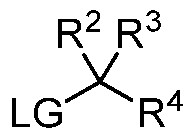
(HI)
in a continuous flow reactor, to produce a com ound of Formula IV

(IV)
wherein
R1 is a substituted or unsubstituted alkyl, alkenyl, alkynyl, cycloalkyl,
cycloalkylalkyl, aryl, aralkyl, heteroaryl, heteroarylalkyl, heterocyclyl, or heterocyclylalkyl group;
R2, R3, and R4 are independently -H, -CN, -C02R, -C(0)R, -C(0)NR2,
-NR2, or a substituted or unsubstituted alkyl, alkenyl, alkynyl, cycloalkyl, cycloalkylalkyl, aryl, aralkyl, heteroaryl, heteroarylalkyl, heterocyclyl, or heterocyclylalkyl group;
Z+ is a cationic group;
LG is a leaving group; and
each R is independently -H or a substituted or unsubstituted alkyl, alkenyl,
alkynyl, cycloalkyl, cycloalkylalkyl, aryl, aralkyl, heteroaryl, heteroarylalkyl, heterocyclyl, or heterocyclylalkyl group.
[0005] In one embodiment, the compound of Formula II is produced by
reacting a solution comprising the compound of Formula I:
R1 Z
(I) with carbon disulfide or a solution thereof. In a further embodiment, the compound of Formula I is reacted with carbon disulfide or a solution thereof in a continuous flow reactor.
[0006] In another aspect, the present technology provides another synthesis method, the method comprising:
reacting a first solution comprising a compound of Formula I
R1 " Z+
(I)
with carbon disulfide or a solution thereof, in a continuous flow reactor, to produce a compound of Formula II
S
R1 S Z
(Π)
wherein
R1 is -H, a substituted or unsubstituted alkyl, alkenyl, cycloalkyl, cycloalkylalkyl, aryl, aralkyl, heteroaryl, heteroarylalkyl, heterocyclyl, or heterocyclylalkyl group; and
Z+ is a cationic group.
[0007] The foregoing summary is illustrative only and is not intended to be in any way limiting. In addition to the illustrative aspects, embodiments and features described above, further aspects, embodiments and features will become apparent by reference to the following drawing(s) and the detailed description.
BRIEF DESCRIPTION OF THE DRAWING
[0008] FIG. 1 illustrates a continuous flow reactor and associated components that may be used, according to some embodiments of the present technology.
DETAILED DESCRIPTION
[0009] In the following detailed description, reference is made to the accompanying drawing(s), which form a part hereof. In the drawing(s), similar symbols typically identify similar components, unless context dictates otherwise. The illustrative embodiments described in the detailed description, drawing(s), and claims are not meant to be limiting. Other embodiments may be utilized, and other changes may be made, without departing from the spirit or scope of the subject matter presented here.
[0010] The following terms are used throughout as defined below.
[0011] Unless context indicates otherwise, reference to a certain element such as hydrogen or H is meant to include all isotopes of that element. For example, if an R group is defined to include hydrogen or H, it also includes deuterium ( 2 H) and tritium ( 3 H). Compounds comprising radioisotopes such as tritium, 14 C, 32 P, and 35 S are thus within the scope of the present technology. Synthetic procedures for inserting such labels will be readily apparent to those skilled in the art based on the disclosure herein.
[0012] The use of the terms "a", "an", "the", and similar referents in the context of describing the elements (especially in the context of the claims) are to be construed to cover both the singular and the plural, unless otherwise indicated herein or clearly contradicted by context.
[0013] As used herein, the term "about" will be understood by persons of ordinary skill in the art and will vary to some extent depending upon the context in which it is used. If there are uses of the term which are not clear to persons of ordinary skill in the art, given the context in which it is used, "about" will mean up to plus or minus 10% of the particular term.
[0014] In general, the term "substituted" refers to an organic group as defined below
(e.g., an alkyl group) in which one or more bonds to a hydrogen atom contained therein are replaced by a bond to non-hydrogen or non-carbon atoms. Substituted groups also include groups in which one or more bonds to a carbon(s) or hydrogen(s) atom are replaced by one or more bonds, including double or triple bonds, to a heteroatom. Thus, a substituted group is substituted with one or more substituents, unless otherwise specified. In some embodiments, a substituted group is substituted with 1, 2, 3, 4, 5, or 6 substituents. Non-limiting examples of substituent groups include groups such as: halogens (i.e., F, CI, Br, and I); hydroxy and protected hydroxy groups; nitriles (-CN, "cyano"); nitro groups (-N02); carbonyls (oxo); thiocarbonyls (thioxo); aldehydes and ketones; acyls; acyloxycarbonyls; carboxyls; carboxylates; ketals;
acetals; acyloxys; esters; dithioesters; carbonates, trithiocarbonates; xanthates; urethanes (carbamates); dithiocarbamates; oximes; hydroxyamines; alkoxyamines; aralkoxyamines; thiols (sulfhydryls); sulfides (e.g., alkylthio, arylthio, and the like); disulfides (e.g., alkyldithio);
sulfoxides; sulfones; sulfonyls; sulfonamides; sulfonates; amines (e.g., alkylamino,
dialkylamino, arylamino, diarylamino, heteroarylamino, and the like); N-oxides; ammonium (e.g., -NH3 +, mono-, di-, and trialkylammonium, and the like); hydrazines; hydrazides;
hydrazones; azides; amides; ureas; amidines; guanidines; enamines; imines; imides; isocyanates; isothiocyanates; cyanates; thiocyanates; poly(oxyalkylene) groups (e.g., poly(ethylene glycol), "PEG"); silyl groups (e.g., trialkylsilyl or dialkylarylsilyl); phosphonates; phosphinates; alkyl, perhaloalkyl (e.g., -CF3, "trifluoromethyl"), cycloalkyl, cycloalkylalkyl, alkenyl, cycloalkenyl, cycloalkenylalkyl, alkynyl, aryl, aralkyl, heterocyclyl, heterocyclylalkyl, heteroaryl, and heteroaralkyl groups; alkoxy, perhaloalkoxy (e.g., -OCF3, "trifluoromethoxy"), cycloalkoxy, cycloalkylalkoxy, alkenyloxy, cycloalkenyloxy, cycloalkenylalkoxy, alkynyloxy, aryloxy, aralkoxy, heterocyclyloxyl, heterocyclylalkoxy, heteroaryloxy, and heteroaralkoxy groups; and the like.
[0015] Substituted ring groups such as substituted cycloalkyl, aryl, heterocyclyl, and heteroaryl groups also include rings and ring systems in which a bond to a hydrogen atom is replaced with a bond to a carbon atom. Therefore, substituted cycloalkyl, aryl, heterocyclyl and
heteroaryl groups may also be substituted with substituted or unsubstituted alkyl, alkenyl, and alkynyl groups as defined below.
[0016] The term "alkyl" includes straight chain and branched chain alkyl groups having from 1 to 20 carbon atoms, and typically from 1 to 18 carbon atoms or, in some embodiments, from 1 to 16, from 1 to 14, from 1 to 12, from 1 to 10, from 1 to 8, from 1 to 6, or from 1 to 4 carbon atoms. Examples of straight chain alkyl groups include groups such as methyl, ethyl, n- propyl, rc-butyl, /i-pentyl, /i-hexyl, rc-heptyl, /i-octyl, rc-nonyl, rc-decyl, rc-undecyl, and rc-dodecyl groups. Examples of branched alkyl groups include, but are not limited to, isopropyl, isobutyl, sec-butyl, ieri-butyl (ί-Bu), neopentyl, isopentyl, and 2,2-dimethylpropyl groups. Substituted alkyl groups may be substituted one or more times with substituents such as those listed herein, and include without limitation haloalkyl, hydroxyalkyl, protected hydroxylalkyl, thioalkyl, aminoalkyl, alkylaminoalkyl, dialkylaminoalkyl, alkoxyalkyl, carboxyalkyl, and the like. Alkyl groups include cycloalkyl groups as defined below.
[0017] The term "cycloalkyl" includes mono-, bi-, or tricyclic alkyl groups having from 3 to 20 carbon atoms in the ring(s), or, in some embodiments, from 3 to 18, from 3 to 16, from 3 to 14, from 3 to 12, from 3 to 10, from 3 to 8, or from 3 to 4, 5, or 6 carbon atoms. Exemplary monocyclic cycloalkyl groups include, but not limited to, cyclopropyl, cyclobutyl, cyclopentyl, cyclohexyl, cycloheptyl, and cyclooctyl groups. In some embodiments, the cycloalkyl group has from 3 to 8 ring members, whereas in other embodiments the number of ring carbon atoms range from 3 to 5, from 3 to 6, or from 3 to 7 carbon atoms. Bi- and tricyclic ring systems include both bridged cycloalkyl groups and fused rings, such as, but not limited to, bicyclo[2.1.1]hexane, adamantyl, decalinyl, and the like. Substituted cycloalkyl groups may be substituted one or more times with, non-hydrogen and non-carbon groups as defined herein. However, substituted cycloalkyl groups also include rings that are substituted with straight or branched chain alkyl groups as defined above. Substituted cycloalkyl groups may be mono-substituted or substituted more than once, such as, but not limited to, 2,2-, 2,3-, 2,4- 2,5- or 2,6-disubstituted cyclohexyl groups, which may be substituted with substituents such as those listed herein.
[0018] The term "cycloalkylalkyl" includes alkyl groups, as defined above, in which a hydrogen or carbon bond of an alkyl group is replaced with a bond to a cycloalkyl group as defined above. In some embodiments, cycloalkylalkyl groups have from 4 to 20, from 4 to 16, from 4 to 12, or from 4 to 10 carbon atoms. Substituted cycloalkylalkyl groups may be substituted at the alkyl, the cycloalkyl, or both the alkyl and cycloalkyl portions of the group. Substituted cycloalkylalkyl groups may be mono-substituted or substituted more than once, such as, but not limited to, mono-, di-, or tri- substituted with substituents such as those listed herein.
[0019] The term "alkenyl" includes straight and branched chain alkyl groups as defined above, except that at least one double bond exists between two carbon atoms. Alkenyl groups have from 2 to 20 carbon atoms, and typically from 2 to 18 carbon atoms or, in some embodiments, from 2 to 16, from 2 to 14, from 2 to 12, from 2 to 10, from 2 to 8, from 2 to 6, or from 2 to 4 carbon atoms. In some embodiments, the alkenyl group has one, two, or three carbon-carbon double bonds. Examples include, but are not limited to vinyl, allyl,
-CH=CH(CH3), -CH=C(CH3)2, -C(CH3)=CH2, -C(CH3)=CH(CH3), -C(CH2CH3)=CH2, among others. Substituted alkenyl groups may be mono-substituted or substituted more than once, such as, but not limited to, mono-, di-, or tri- substituted with substituents such as those listed herein. Alkenyl groups include cycloalkenyl groups as defined below.
[0020] The term "cycloalkenyl" includes cycloalkyl groups as defined above, having at least one double bond between two carbon atoms. In some embodiments the cycloalkenyl group may have one, two, or three double bonds but does not include aromatic compounds.
Cycloalkenyl groups have from 4 to 14 carbon atoms, or in some embodiments, from 5 to 14, from 5 to 10, or even 5, 6, 7, or 8 carbon atoms. Examples of cycloalkenyl groups include cyclohexenyl, cyclopentenyl, and cyclohexadienyl. Substituted cycloalkenyl groups may be substituted one or more times with substituents such as those listed herein.
[0021] The term "cycloalkenylalkyl" includes alkyl groups as defined above in which a hydrogen or carbon bond of the alkyl group is replaced with a bond to a cycloalkenyl group as defined above. Substituted cycloalkenylalkyl groups may be substituted at the alkyl, the
cycloalkenyl, or both the alkyl and cycloalkenyl portions of the group. Substituted cycloalkenylalkyl groups may be substituted one or more times with substituents such as those listed herein.
[0022] The term "alkynyl" includes straight and branched chain alkyl groups as defined above, except that at least one triple bond exists between two carbon atoms. Alkynyl groups have from 2 to 20 carbon atoms, and typically from 2 to 18 carbon atoms or, in some
embodiments, from 2 to 16, from 2 to 14, from 2 to 12, from 2 to 10, from 2 to 8, from 2 to 6, or from 2 to 4 carbon atoms. In some embodiments, the alkynyl group has one, two, or three carbon-carbon triple bonds. Examples include, but are not limited to -C≡CH, -C≡CCH3, - CH2C≡CCH3, -C≡CCH2CH(CH2CH3)2, among others. Substituted alkynyl groups may be mono-substituted or substituted more than once, such as, but not limited to, mono-, di-, or tri- substituted with substituents such as those listed herein.
[0023] The term "aryl" includes cyclic aromatic hydrocarbon groups that do not contain heteroatoms. Aryl groups herein may include monocyclic, bicyclic and tricyclic ring systems. Non-limiting examples of aryl groups include groups such as phenyl, azulenyl, heptalenyl, biphenyl, fluorenyl, phenanthrenyl, anthracenyl, indenyl, indanyl, pentalenyl, pyrenyl, and naphthyl groups. In some embodiments, aryl groups contain from 6 to 20 carbon atoms, and in others from 6 to 16, from 6 to 14, from 6 to 12, or even from 6 to 10 carbon atoms in the ring portions of the groups. In some embodiments, the aryl groups are phenyl, naphthyl, anthracenyl, or pyrenyl. Although the phrase "aryl groups" includes groups containing fused rings, such as fused aromatic-aliphatic ring systems (e.g., indanyl, tetrahydronaphthyl, and the like), it does not include aryl groups that have other groups, such as alkyl or halogen groups, bonded to one of the ring members. Rather, groups such as tolyl are referred to as substituted aryl groups.
Substituted aryl groups may be mono substituted or substituted more than once. For example, monosubstituted aryl groups include, but are not limited to, 2-, 3-, 4-, 5-, or 6-substituted phenyl or naphthyl groups, which may be substituted with substituents such as those listed herein.
[0024] The terms "aralkyl" (or "arylalkyl") includes alkyl groups as defined above in which a hydrogen or carbon bond of an alkyl group is replaced with a bond to an aryl group as defined above. In some embodiments, aralkyl groups contain from 7 to 20, from 7 to 18, from 7 to 16, from 7 to 14, from 7 to 12, or from 7 to 10 carbon atoms. Substituted aralkyl groups may be substituted at the alkyl, the aryl, or both the alkyl and aryl portions of the group. Non-limiting examples of aralkyl groups include groups such as benzyl, phenethyl, and fused
(cycloalkylaryl)alkyl groups such as 4-indanylethyl. Substituted aralkyl groups may be substituted one or more times with substituents such as those listed herein.
[0025] The term "heterocyclyl" includes aromatic (also referred to as "heteroaryl" as defined below) and non-aromatic ring compounds containing 3 or more ring members, of which one or more is a heteroatom such as, but not limited to, N, O, and S. In some embodiments, the heterocyclyl group contains 1, 2, 3, or 4 heteroatoms. In some embodiments, heterocyclyl groups include mono-, bi- and tricyclic rings having 3 to 16 ring members, whereas other such groups have from 3 to 6, from 3 to 10, from 3 to 12, or from 3 to 14 ring members. Heterocyclyl groups encompass aromatic, partially unsaturated and saturated ring systems, such as, for example, imidazolyl, imidazolinyl, and imidazolidinyl groups. The term "heterocyclyl" includes fused ring species including those comprising fused aromatic and non-aromatic groups, such as, for example, benzotriazolyl, 2,3-dihydrobenzo[l,4]dioxinyl, and benzo[l,3]dioxolyl. The term also includes bridged polycyclic ring systems containing a heteroatom such as, but not limited to, quinuclidyl. However, the term does not include heterocyclyl groups that have other groups, such as alkyl, oxo or halogen groups, bonded to one of the ring members. Rather, these are referred to as "substituted heterocyclyl groups". Non-limiting examples of heterocyclyl groups include groups such as aziridinyl, azetidinyl, pyrrolidinyl, imidazolidinyl, pyrazolidinyl, thiazolidinyl, tetrahydrothiophenyl, tetrahydrofuranyl, dioxolyl, furanyl, thiophenyl, pyrrolyl, pyrrolinyl, imidazolyl, imidazolinyl, pyrazolyl, pyrazolinyl, triazolyl, tetrazolyl, oxazolyl, isoxazolyl, thiazolyl, thiazolinyl, isothiazolyl, thiadiazolyl, oxadiazolyl, piperidyl, piperazinyl, morpholinyl, thiomorpholinyl, tetrahydropyranyl, tetrahydrothiopyranyl, oxathiane, dioxyl, dithianyl, pyranyl, pyridyl, pyrimidinyl, pyridazinyl, pyrazinyl, triazinyl, dihydropyridyl,
dihydrodithiinyl, dihydrodithionyl, homopiperazinyl, quinuclidyl, indolyl, indolinyl, isoindolyl, azaindolyl (pyrrolopyridyl), indazolyl, indolizinyl, benzotriazolyl, benzimidazolyl, benzofuranyl, benzothiophenyl, benzthiazolyl, benzoxadiazolyl, benzoxazinyl, benzodithiinyl, benzoxathiinyl, benzothiazinyl, benzoxazolyl, benzothiazolyl, benzothiadiazolyl, benzo[l,3]dioxolyl, pyrazolopyridyl, imidazopyridyl (azabenzimidazolyl), triazolopyridyl, isoxazolopyridyl, purinyl, xanthinyl, adeninyl, guaninyl, quinolinyl, isoquinolinyl, quinolizinyl, quinoxalinyl, quinazolinyl, cinnolinyl, phthalazinyl, naphthyridinyl, pteridinyl, thianaphthyl, dihydrobenzothiazinyl, dihydrobenzofuranyl, dihydroindolyl, dihydrobenzodioxinyl, tetrahydroindolyl,
tetrahydroindazolyl, tetrahydrobenzimidazolyl, tetrahydrobenzotriazolyl,
tetrahydropyrrolopyridyl, tetrahydropyrazolopyridyl, tetrahydroimidazopyridyl,
tetrahydrotriazolopyridyl, and tetrahydroquinolinyl groups. Substituted heterocyclyl groups may be mono-substituted or substituted more than once, such as, but not limited to, pyridyl or morpholinyl groups, which are 2-, 3-, 4-, 5-, or 6- substituted, or disubstituted with various substituents such as those listed herein.
[0026] The term "heteroaryl" includes aromatic ring groups containing 5 or more ring members, of which, one or more is a heteroatom such as, but not limited to, N, O, and S. Non- limiting examples of heteroaryl groups include groups such as pyrrolyl, pyrazolyl, triazolyl, tetrazolyl, oxazolyl, isoxazolyl, thiazolyl, pyridinyl, pyridazinyl, pyrimidinyl, pyrazinyl, thiophenyl, benzothiophenyl, furanyl, benzofuranyl, indolyl, azaindolyl (pyrrolopyridinyl), indazolyl, benzimidazolyl, imidazopyridinyl (azabenzimidazolyl), pyrazolopyridinyl, triazolopyridinyl, benzotriazolyl, benzoxazolyl, benzothiazolyl, benzothiadiazolyl,
imidazopyridinyl, isoxazolopyridinyl, thianaphthyl, purinyl, xanthinyl, adeninyl, guaninyl, quinolinyl, isoquinolinyl, tetrahydroquinolinyl, quinoxalinyl, and quinazolinyl groups.
Heteroaryl groups include fused ring groups in which all rings are aromatic such as indolyl groups and include fused ring groups in which only one of the rings is aromatic, such as 2,3- dihydroindolyl groups. Although the phrase "heteroaryl groups" includes fused ring groups, the phrase does not include heteroaryl groups that have other groups bonded to one of the ring members, such as alkyl groups. Rather, heteroaryl groups with such substitution are referred to
as "substituted heteroaryl groups." Substituted heteroaryl groups may be substituted one or more times with various substituents such as those listed herein.
[0027] The term "heterocyclylalkyl" includes alkyl groups as defined above in which a hydrogen or carbon bond of an alkyl group is replaced with a bond to a heterocyclyl group as defined above. Substituted heterocyclylalkyl groups may be substituted at the alkyl, the heterocyclyl, or both the alkyl and heterocyclyl portions of the group. Non-limiting examples of heterocyclylalkyl groups include groups such as morpholin-4-ylethyl, furan-2-ylmethyl, imidazol-4-ylmethyl, pyridin-3-ylmethyl, tetrahydrofuran-2-ylethyl, and indol-2-ylpropyl, and the like. Substituted heterocyclylalkyl groups may be substituted one or more times with substituents such as those listed herein.
[0028] The term "heteroaralkyl" (or "heteroarylalkyl") includes alkyl groups as defined above in which a hydrogen or carbon bond of an alkyl group is replaced with a bond to a heteroaryl group as defined above. Substituted heteroaralkyl groups may be substituted at the alkyl, the heteroaryl, or both the alkyl and heteroaryl portions of the group. Substituted heteroaralkyl groups may be substituted one or more times with substituents such as those listed herein.
[0029] Groups described herein having two or more points of attachment (i.e., divalent, trivalent, or polyvalent) are designated by use of the suffix, "ene." For example, divalent alkyl groups are alkylene groups, divalent aryl groups are arylene groups, divalent heteroaryl groups are divalent heteroarylene groups, and so forth. Groups having two or more points of attachment may be substituted one or more times with substituents such as those listed herein. Substituted groups having a single point of attachment are not referred to using the "ene" designation. For example, chloroethyl is not referred to herein as chloroethylene.
[0030] The term "hydroxy" (or "hydroxyl") refers to an -OH group.
[0031] The term "protected hydroxy" (or "protected hydroxyl") refers to a hydroxy group in which the bond to the hydrogen atom of the hydroxy group is replaced by a bond to a
protecting group. An extensive list of protecting groups, including hydroxy protecting groups, and associated methods for introducing such protecting groups may be found in Protective Groups in Organic Synthesis, Greene, T.W.; Wuts, P. G. M., John Wiley & Sons, New York, NY, (3rd Edition, 1999), which is hereby incorporated by reference in its entirety and for all purposes as if fully set forth herein. Non-limiting examples of hydroxy protecting groups include groups such as alkoxycarbonyl, acyl, aroyl, silyl (e.g., trialkylsilyl or dialkylarylsilyl groups), alkoxyalkyl, arylmethyl, and the like. Alkoxycarbonyl protecting groups include groups such as methoxycarbonyl, ethoxycarbonyl, propoxycarbonyl, isopropoxycarbonyl,
butoxycarbonyl, isobutoxycarbonyl, ie/ -butoxycarbonyl, benzyloxycarbonyl, and
allyloxycarbonyl groups. Alkoxyalkyl protecting groups include groups such as methoxymethyl, ethoxymethyl, methoxyethoxymethyl, tetrahydrofuranyl, and tetrahydropyranyl groups.
Arylmethyl groups are groups such as benzyl and p-methoxybenzyl groups. Preferred silyl- protecting groups are trimethylsilyl, triethylsilyl, ie/ -butyldimethylsilyl, dibutylmethylsilyl, diphenylmethylsilyl, phenyldimethylsilyl, diphenyl-ieri-butylsilyl, and analogous alkylated and/or arylated silyl groups. Where multiple hydroxy groups are present, such groups may be protected as cyclic ethers, such as 1,3-dioxolanes and 1,3-dioxanes (e.g., acetonides).
[0032] The term "alkoxy" refers to a hydroxy group in which the bond to the hydrogen atom of the hydroxy group is replaced by a bond to a carbon atom of a substituted or
unsubstituted alkyl group as defined above. Non-limiting examples of linear alkoxy groups include groups such as methoxy, ethoxy, propoxy, butoxy, pentoxy, hexoxy, and the like. Non- limiting examples of branched alkoxy groups include groups such as isopropoxy, sec-butoxy, ieri-butoxy, isopentoxy, isohexoxy, and the like. Non-limiting examples of cycloalkoxy groups include groups such as cyclopropyloxy, cyclobutyloxy, cyclopentyloxy, cyclohexyloxy, and the like. Substituted alkoxy groups may be substituted one or more times with substituents such as those listed herein.
[0033] The term "aryloxy" refers to a hydroxy group in which the bond to the hydrogen atom of the hydroxy group is replaced by a bond to a carbon atom of a substituted or
unsubstituted aryl group as defined above. Non-limiting examples of aryloxy groups include
groups such as phenoxy, naphthyloxy, and 4-fluorophenoxy, and the like. Substituted aryloxy groups may be substituted one or more times with substituents such as those listed herein.
[0034] The term "arylalkoxy" (or "aralkoxy") refers to a hydroxyl group (-OH) in which the bond to the hydrogen atom is replaced by a bond to a carbon atom of a substituted or unsubstituted aralkyl group as defined above. Non-limiting examples of arylalkoxy groups include groups such as benzyloxy, phenethyloxy, anthracenylmethoxy, and the like. Substituted arylalkoxy groups may be substituted one or more times with substituents such as those listed herein.
[0035] The terms "acyl" and "acyloxy" refer to -C(0)R30 groups and -0-C(0)R30 groups, respectively. R 30 is a substituted or unsubstituted alkyl, cycloalkyl, cycloalkylalkyl, alkenyl, cycloalkenyl, cycloalkenylalkyl, alkynyl, aryl, aralkyl, heterocyclyl, heterocyclylalkyl, heteroaryl, or heteroarylalkyl group as defined herein. Where R 30 is a substituted or
unsubstituted alkyl group, the acyl group or acyloxy group may be referred to as a substituted or unsubstituted alkanoyl group or substituted or unsubstituted alkanoyloxy group, respectively.
Where R 30 is a substituted or unsubstituted aryl group, the acyl group or acyloxy group may be referred to as a substituted or unsubstituted aroyl group or substituted or unsubstituted aroyloxy group, respectively. Non-limiting examples of acyl groups include groups such as acetyl, propanoyl, benzoyl, and the like. Non-limiting examples of acyloxy groups include groups such as acetoxy, propanoyloxy, benzoyloxy, and the like.
[0036] The term "halogen" (or "halo") refers to fluorine, chlorine, bromine, or iodine groups.
[0037] The term "carboxy" (or "carboxyl" or "carboxylic acid") refers to a -C(0)OH group.
[0038] The terms "ester" and "dithioester" refer to -C(0)OR31 and -C(S)SR31 groups, respectively, wherein R 31 is a substituted or unsubstituted alkyl, cycloalkyl, cycloalkylalkyl, alkenyl, cycloalkenyl, cycloalkenylalkyl, alkynyl, aryl, aralkyl, heterocyclyl, heterocyclylalkyl,
heteroaryl, or heteroarylalkyl group as defined herein. Non-limiting examples of ester groups include groups such as methoxycarbonyl (-C02Me), ethoxycarbonyl (-C02Et), phenoxycarbonyl (-C02Ph), and allyloxycarbonyl (-C02CH2CH=CH2). Ester groups may further include activated ester groups. Non-limiting examples of activated ester groups include groups such as succinimidyl ester groups (-C02Su), pentafluorophenyl ester groups (-C02C6Fs), and the like.
[0039] The terms "carbonate" and "trithiocarbonate" refer to -OC(0)OR32 and
-SC(S)SR 32 groups, respectively, wherein R 32 a substituted or unsubstituted alkyl, cycloalkyl, cycloalkylalkyl, alkenyl, cycloalkenyl, cycloalkenylalkyl, alkynyl, aryl, aralkyl, heterocyclyl, heterocyclylalkyl, heteroaryl, or heteroarylalkyl group as defined herein.
[0040] The term "xanthate" includes O- and S-xanthate groups, i.e., -OC(S)SR33 and
-SC(S)OR 33 groups, respectively, wherein R 33 is a substituted or unsubstituted alkyl, cycloalkyl, cycloalkylalkyl, alkenyl, cycloalkenyl, cycloalkenylalkyl, alkynyl, aryl, aralkyl, heterocyclyl, heterocyclylalkyl, heteroaryl, or heteroarylalkyl group as defined herein.
[0041] The term "carbamate" (or "urethane") includes N- and O-carbamate groups, i.e.,
-NR34C(0)OR35 and -OC(0)NR34R35 groups, respectively. Similarly, the term
"dithiocarbamate" includes N- and S-dithiocarbamate groups, i.e., -NR34C(S)SR35 and
-SC(S)NR34R35 groups, respectively. R34 and R35 are each independently a substituted or unsubstituted alkyl, cycloalkyl, cycloalkylalkyl, alkenyl, cycloalkenyl, cycloalkenylalkyl, alkynyl, aryl, aralkyl, heterocyclyl, heterocyclylalkyl, heteroaryl, or heteroarylalkyl group as defined herein. R34 may also be H.
[0042] The term "amido" (or "amide") includes C- and N-amido groups, i.e.,
-C(0)NR36R37, and -NR36C(0)R37 groups, respectively. R36 and R37 are each independently hydrogen, or a substituted or unsubstituted alkyl, cycloalkyl, cycloalkylalkyl, alkenyl, cycloalkenyl, cycloalkenylalkyl, alkynyl, aryl, aralkyl, heterocyclyl, heterocyclylalkyl, heteroaryl, or heteroarylalkyl group as defined herein. Amido groups therefore include, but are not limited, to carbamoyl groups (-C(0)NH2) and formamide groups (-NHC(O)H).
[0043] The term "amino" (or "amine") refers to -NR38R39 groups, wherein R38 and R39 are each independently hydrogen, or a substituted or unsubstituted alkyl, cycloalkyl,
cycloalkylalkyl, alkenyl, cycloalkenyl, cycloalkenylalkyl, alkynyl, aryl, aralkyl, heterocyclyl, heterocyclylalkyl, heteroaryl, or heteroarylalkyl group as defined herein. In some embodiments, the amino group is an alkylamino, dialkylamino, arylamino, or alkyl(aryl)amino group. In other embodiments, the amino group is -NH2, methylamino, dimethylamino, ethylamino,
diethylamino, propylamino, isopropylamino, phenylamino, or benzylamino group.
[0044] The term "sulfonamido" (or "sulfonamide") refers to S- and N-sulfonamido groups, i.e., -SO2NR40R41 and -NR40SO2R41 groups, respectively. R40 and R41 are each independently hydrogen, or a substituted or unsubstituted alkyl, cycloalkyl, cycloalkylalkyl, alkenyl, cycloalkenyl, cycloalkenylalkyl, alkynyl, aryl, aralkyl, heterocyclyl, heterocyclylalkyl, heteroaryl, or heteroarylalkyl group as defined herein. Sulfonamido groups therefore include, but are not limited to, sulfamoyl groups (-S02NH2).
[0045] The term "thiol" refers to -SH groups; the term "sulfide" refers to -SR42 groups; the term "disulfide" refers to -S-SR 42 groups; the term "sulfoxide" refers to -S(0)R 42 groups; the term "sulfone" refers to -S02R 42 groups; the term "sulfonic acid" refers to -SO3H groups; and the terms "sulfonyl ester" and "sulfonate" refers to -S02OR 42 and -OS02R 42 groups, respectively. R 42 is a substituted or unsubstituted alkyl, cycloalkyl, cycloalkylalkyl, alkenyl, cycloalkenyl, cycloalkenylalkyl, alkynyl, aryl, aralkyl, heterocyclyl, heterocyclylalkyl, heteroaryl, or heteroarylalkyl group as defined herein.
[0046] The term "urea" refers to -NR43-C(0)-NR44R45 groups, wherein R43, R44, and R45 groups are each independently hydrogen, or a substituted or unsubstituted alkyl, cycloalkyl, cycloalkylalkyl, alkenyl, cycloalkenyl, cycloalkenylalkyl, alkynyl, aryl, aralkyl, heterocyclyl, heterocyclylalkyl, heteroaryl, or heteroarylalkyl group as defined herein.
[0047] The term "amidine" refers to -C(NR46)NR47R48 and -NR46C(NR47)R48 groups, wherein R46, R47, and R48 are each independently hydrogen, or a substituted or unsubstituted
alkyl, cycloalkyl, cycloalkylalkyl, alkenyl, cycloalkenyl, cycloalkenylalkyl, alkynyl, aryl, aralkyl, heterocyclyl, heterocyclylalkyl, heteroaryl, or heteroarylalkyl group as defined herein.
[0048] The term "guanidine" refers to -NR49C(NR50)NR51R52 groups, wherein R49, R50,
R 5J11, and R 5J2" are each independently hydrogen, or a substituted or unsubstituted alkyl, cycloalkyl, cycloalkylalkyl, alkenyl, cycloalkenyl, cycloalkenylalkyl, alkynyl, aryl, aralkyl, heterocyclyl, heterocyclylalkyl, heteroaryl, or heteroarylalkyl group as defined herein.
[0049] The term "enamine" refers to -C(R53)=C(R54)NR55R56 and
-NR53C(R54)=C(R55)R56 groups, wherein R53, R54, R55, and R56 are each independently hydrogen, a substituted or unsubstituted alkyl, cycloalkyl, cycloalkylalkyl, alkenyl, cycloalkenyl, cycloalkenylalkyl, alkynyl, aryl, aralkyl, heterocyclyl, heterocyclylalkyl, heteroaryl, or heteroarylalkyl group as defined herein.
[0050] The term "imido" (or "imide") includes -C(0)NR57C(0)R58 groups, wherein R57 and R 58 are each independently hydrogen, or a substituted or unsubstituted alkyl, cycloalkyl, cycloalkylalkyl, alkenyl, cycloalkenyl, cycloalkenylalkyl, alkynyl, aryl, aralkyl, heterocyclyl, heterocyclylalkyl, heteroaryl, or heteroarylalkyl group as defined herein. The term "imido" also includes cyclic N-bound imido groups such as is present in a phthalimido group (-Nphth).
[0051] The term "imino" (or "imine") refers to -CR59(=NR60) and -N=CR59R60) groups, wherein R59 and R60 are each independently hydrogen or a substituted or unsubstituted alkyl, cycloalkyl, cycloalkylalkyl, alkenyl, cycloalkenyl, cycloalkenylalkyl, alkynyl, aryl, aralkyl, heterocyclyl, heterocyclylalkyl, heteroaryl, or heteroarylalkyl group as defined herein, with the proviso that R59 and R60 are not both simultaneously hydrogen.
[0052] As will be appreciated by those of skill in the art, a chemical compound may be referenced on the basis of a group present in that chemical compound. For example, a chemical compound comprising a dithioester group may be referred to herein as a dithioester.
[0053] The term "base" in chemistry refers to a substance that can accept one or more protons, or more generally, donate one or more electron pairs. In general, the greater the tendency to accept a proton or donate an electron pair, the stronger the base. Non-limiting examples of bases include bases such as: alkali metal or alkaline earth hydroxides (e.g., lithium hydroxide, sodium hydroxide, calcium hydroxide), hydrogencarbonates (e.g., sodium
bicarbonate), carbonates (e.g., potassium carbonate), fluorides (e.g., potassium fluoride), alkoxides and aryloxides (e.g., sodium methoxide, potassium ieri-butoxide), oxides (e.g., sodium oxide, magnesium oxide), hydrides (e.g., lithium hydride, calcium hydride), amides (e.g., sodium amide, lithium bis(trimethylsilylamide), lithium diisopropylamide), and alkyls (e.g.,
butyllithium, ieri-butyllithium); ammonia; alkylamines (e.g., trimethylamine, triethylamine, diisopropylethylamine); pyridines (e.g., 2,6-dimethylaminopyridine, pyridine); phosphazenes; amidines; guanidines; and the like.
[0054] The term "leaving group" in chemistry is art-recognized and refers to a substituent that is present on a chemical compound which may be readily displaced, such as by a
nucleophile or nucleophilic group. Common leaving groups include, but are not limited to, halogens, sulfonates (e.g., inflates, tosylates, nosylates, besylates, and mesylates), diazonium salts, acyloxy groups, and the like.
[0055] The term "organometallic reagent" refers to a compound that contains a bond between a carbon and a metal atom, such as is present in organolithium, organozinc,
organocopper, or Grignard reagents. In some embodiments, the organometallic reagent is an organolithium reagent of the formula R61-Li, an organozinc reagent of the formula R61-ZnX or R61-Zn-R61, or a Grignard reagent of the formula R61-MgX, wherein X is a halogen and R61 is a substituted or unsubstituted alkyl, cycloalkyl, cycloalkylalkyl, alkenyl, cycloalkenyl,
cycloalkenylalkyl, alkynyl, aryl, aralkyl, heterocyclyl, heterocyclylalkyl, heteroaryl, or heteroarylalkyl group as defined herein.
[0056] The present technology generally provides methods of synthesizing various dithioesters via continuous flow processes. According to one aspect, the method comprises reacting a first solution comprising a compound of Formula II:
S
R1 S Z
(Π)
with a second solution comprising a compound of Formula III:
R2 R3
LG^R4
(HI)
in a continuous flow reactor, to produce a compound of Formula IV:
S R2 R3
RAS^ R4
(IV)
wherein R is a substituted or unsubstituted alkyl, alkenyl, alkynyl, cycloalkyl, cycloalkylalkyl, aryl, aralkyl, heteroaryl, heteroarylalkyl, heterocyclyl, or heterocyclylalkyl group; R 2 , R 3 , and R 4 are independently -H, -CN, -C02R, -C(0)R, -C(0)NR2, -NR2, or a substituted or unsubstituted alkyl, alkenyl, alkynyl, cycloalkyl, cycloalkylalkyl, aryl, aralkyl, heteroaryl, heteroarylalkyl, heterocyclyl, or heterocyclylalkyl group; Z+ is a cationic group; LG is a leaving group; and each R is independently -H or a substituted or unsubstituted alkyl, alkenyl, alkynyl, cycloalkyl, cycloalkylalkyl, aryl, aralkyl, heteroaryl, heteroarylalkyl, heterocyclyl, or heterocyclylalkyl group.
[0057] In some embodiments, R1 is a substituted or unsubstituted straight chain or branched chain CrC^-alkyl or CrC^-alkenyl group or a substituted or unsubstituted C7-C16- aralkyl or Ce-C^-aryl group. In some such embodiments, R1 is methyl, ethyl, w-propyl, isopropyl, w-butyl, w-decyl, w-dodecyl, benzyl, allyl, or a substituted or unsubstituted phenyl group.
[0058] In some embodiments, R2, R3, and R4 are independently -H, -Nphth, -CN,
-CO2R, a substituted or unsubstituted straight chain or branched chain CrC^-allcyl or CrC16- alkenyl group, or a substituted or unsubstituted Cv-Cie-aralkyl or C6-C16-aryl group. In some
2 3 4
such embodiments, R , R , and R are independently -H, -Nphth, -CN,
-CO2H, -C02Me, -C02Et, -C02i-Bu, -C02Su, -C02(CH2)!_6C≡CH,
-C02(CH2)1_6CH=CH2, -C02(CH2)1_6N3, -C02(CH2)1_6S-S-2-pyridyl,
-C(0)(OCH2CH2)1_5ooOCH3, -(CH2)!_6C02H, -(CH2)1_6C02Me, -(CH2)!_6C02Et,
-(CH2) !_6C02i-Bu, -(CH2) i_6C02Su,

-(CH2)1_6C(0)(OCH2CH2)1_5ooOCH3, -(CH2)!_6N3, -(CH2)!_6OH, methyl, ethyl, vinyl, allyl, pyrenyl, or a substituted or unsubstituted phenyl group.
[0059] In some embodiments, at least one of R2, R3, and R4 is -CN, -C02R, or phenyl.
[0060] In other embodiments, R2 and R3 are each methyl and R4 is -CN, -C02R, or phenyl.
[0061] In other embodiments, one of R2, R3, and R4 of the compound of Formula IV comprises, or is, an ester group. In one such embodiment, the method further comprises hydrolyzing the ester group, after the reacting step. In this regard, a carboxylic acid (or a salt form thereof such as an alkali metal carboxylate salt) may be provided. The ester group may be hydrolyzed with a base, such as for example, with an aqueous solution of an alkali metal hydroxide. In a particular embodiment, the ester group is hydrolyzed in a continuous flow reactor, more fully defined below. The continuous flow reactor used for the hydrolysis reaction may the same or different from the continuous flow reactor used to prepare the compound of Formula IV comprising the ester group. In a further embodiment, the carboxylic acid (or salt form thereof) is prepared in single continuous process from the compound of Formula II and the compound of Formula III. That is, the compound of Formula IV is both produced and consumed in a sequential continuous flow process, without isolation.
[0062] The cationic group Z+ may be any atom or group which can stabilize the negative charge present in the compound of Formula II. In some embodiments, Z+ is an alkali metal cation such as Li+, Na+, or K+. In other embodiments Z+ is an ammonium ion, such as a mono-, di-, or trialkylammonium ion. In a particular embodiment, Z+ is a triethylammonium ion, i.e., +N(H)Et3. In yet other embodiments, Z+ comprises an alkaline earth metal cation, such as Mg2+ or Zn2+. In such embodiments, Z+ may be a group such as MgX+ or ZnX+ where X is a halogen. In particular embodiments, Z+ is MgCl+, MgBr+, or Mgl+.
[0063] As illustrated above, the compound of Formula II is shown in charge separated
(ionic) form, with a full anionic charge on the sulfur atom and a full cationic charge on the group Z. However, and as will be appreciated by those of skill in the art, the nature of bonding between the anionic sulfur atom and Z group can and will vary, particularly with the identity of Z. For example, the valence of Z may allow for partial or full covalent bonding to the sulfur atom, such that the sulfur atom possesses less than a full anionic charge and Z possesses less than a full cationic charge. Additionally or alternatively, the anionic charge on the sulfur atom may be delocalized. Thus, the compound of Formula II not only embraces charge separated species, but also partially or fully covalently bonded species and related canonical forms such as: δδ~ δ+
«'αΜ~ί *A-z R-QV R-QA 00
(IIa) (Hb) (IIC) (IId)
[0064] Thus, in some embodiments, Z+ comprises a metal atom and the metal atom is at least partially covalently bound to at least one sulfur atom in the compound of Formula II through a metal-to-sulfur bond. In some such embodiments Z+ is an alkali metal cation such as any of those listed above. In other embodiments, Z+ comprises an alkaline earth metal cation, such as any of those listed above.
[0065] Included among the various aspects of the present technology is reacting the compound of Formula II with the compound of Formula III to produce the compound of Formula
IV. The term "reacting", and its various grammatical forms, is art-recognized and refers to the forming of one or more bonds between two or more starting materials to produce a stable, isolable compound (i.e., a product via an intermolecular reaction) or the forming of one or more stable bonds between two or more portions of a single starting material to produce a stable, isolable compound (i.e., a product via an intramolecular reaction). For example, under the appropriate conditions, the compound of Formula II may react intermolecularly with the compound of Formula III to form the stable and isolable compound of Formula IV, in which a new sulfur-carbon bond is formed. The term "reacting" does not refer to interaction of solvents, catalysts, bases, ligands or other additives which may promote the reaction. As detailed more fully below, reacting may occur in a channel of the continuous flow reactor, such as for example, in a microchannel of a microreactor.
[0066] As will be appreciated by those of skill in the art, the reaction of the compound of
Formula II with the compound of Formula III may generally be considered to be an alkylation reaction, wherein the leaving group (LG) of the compound of Formula III is displaced. There are no particular limitations on the structural features of the leaving group, and any leaving group may be used which can be displaced under the reaction conditions. In some embodiments, the leaving group is a halogen. In other embodiments, the leaving group is a sulfonate, including for example substituted and unsubstituted alkanesulfonates or arenesulfonates. Examples of suitable alkanesulfonates include, but are not limited to, methanesulfonate (CH3SO2O-, "mesylate"), trifluoromethanesulfonate (CF3SO2O-, "triflate"), and the like. Examples of suitable
arenesulfonates include, but are not limited to, benzenesulfonate (PhS020-, "besylate"), p- toluenesulfonate, and the like. In some embodiments, the compound of Formula III includes a plurality of leaving groups, in addition to LG of Formula III, for instance where one or more of
R 2", R 3J, and R 4" each comprise one or more leaving groups. In such embodiments, multiple equivalents of the compound of Formula II may be reacted with a single equivalent the compound of Formula III, such that the compound of Formula IV comprises multiple
substituents corresponding to the anionic portion of the compound of Formula II.
[0067] In some embodiments, the compound of Formula II is selected from the consisting of
ΕΓ Λ S- Z +
 Ci2H25 s - H02C S Z

[0068] In some embodiments the compound of Formula III is selected from the group consisting of
LG" "CN LG" "CN

LG v Ph LG ^ C02H LG X C02H LG x C02H LG y C02H LG yP Ch02H LG ^ C02Me

LG y C02f-Bu LG yP Ch02i-Bu LG Λ C02Su LG JL C02Su LG x C02Su LG y C02Su
C02Su


[0069] In some embodiments, the compound of Formula IV is selected from the group consisting of


[0070] In some embodiments of the compound of Formula II and the compound of
Formula IV, R1 is a substituted or unsubstituted phenyl group.
[0071] In numerous embodiments, compounds of the present technology, including a variety of compounds of Formula IV, are synthesized (produced) in a continuous flow reactor. The term "continuous flow reactor" is art-recognized and generally refers to a device or apparatus to which one or more starting materials are continuously added and from which one or
more products are continuously withdrawn. Thus, for example, the one or more starting materials may include a compound of Formula II and a compound of Formula III, and the one or more products may include a compound of Formula IV. The principles, design, and operation of continuous flow reactors, including but not limited to, tubular reactors, microreactors, stirred tube reactors, extruders, static mixers, continuously-stirred tank reactors, and the like have been extensively reviewed. See, for example: U.S. Pat. Pub. No. 2011/0118469 to Bedore et al.; - Hornung, C. H. et al. Org. Process Res. Dev. 2011, 15, 593-601; Hessel, V. Chem. Eng. Technol. 2009, 32(11), 1655-1681 ; Hartman, R. L. et al. Lab Chip 2009, 9, 2495-2507; Wegner, J. et al. Adv. Synth. Catal. 2012, 354, 17-57; van den Broek, S. A. M. W et al. Org. Process Res. Dev. 2012, 16, 934-938; and Microreactors: New Technology for Modern Chemistry, Ehrfeld, W.; Hessel, V.; Lowe, H., Wiley- VCH: Weinheim (2000) each of which are incorporated by reference in their entireties as if fully set forth herein. Continuous flow reactors generally include a variety of components, such as conduits, channels, reservoirs, enclosures, and the like and reactions are performed in the continuous flow reactor, such as within a channel or conduit. Continuous flow reactors, including microreactors as more fully detailed below, can be readily assembled using known techniques and equipment or are otherwise commercially available from various suppliers (e.g., Vapourtec Ltd., Suffolk, UK; Corning Inc., Corning, NY; Syrris Inc., Charlestown, MA; Altamira Instruments, Pittsburgh, PA; AM Technology, Runcorn, UK; Parr Instrument Co., Moline, IL; Chemtrix BV, Geleen, Netherlands; and Uniqsis Ltd.,
Cambridgeshire, UK). Continuous flow reactors may further comprise other components, such as sensors, controllers (e.g., temperature controllers), optical fibers, membranes, conduits, enclosures, valves, and the like, as required for a particular application. Further, continuous flow reactors may comprise a single reactor or may comprise two or more reactors connected in series or parallel.
[0072] As will be appreciated by those of skill in the art, continuous flow reactors may be designed and fabricated as to be capable of withstanding a wide range of solvents, reagents, and chemical conditions (such as for example, as high temperatures and high pressures).
Components of continuous flow reactors may be constructed of materials such as glass, corrosion
resistant metals, and/or various polymeric materials such as fluorinated poly(ethylene) (FPE), fluorinated ethylene poly(propylene) (FEP), high density poly(ethylene) (HDPE),
poly(chlorotrifluoroethylene) (PCT), poly(ether ether ketone) (PEEK), poly(tetrafluoroethylene) (PTFE), poly(vinyl fluoride) (PVF), perfluoroalkoxy (PFA) polymers, and combinations or copolymers thereof. For example, microreactors may include microchannels coated with an inert material (e.g., silicon nitride) to provide chemical resistance, enabling the microreactor to withstand harsh conditions at high temperatures and/or pressures.
[0073] In certain embodiments, the continuous flow reactor is a microreactor. The term
"microreactor" (or alternatively "microfluidic device") is art-recognized and refers to continuous flow reactors having components, such as conduits, channels, reservoirs, enclosures, and the like, which have maximum cross-sectional dimensions less than or equal to 2 mm, and in some cases, less than or equal to 1 mm. In one set of embodiments, components are microfluidic or have a largest cross sectional dimension of no more than 2 mm or 1 mm. Of course, larger channels, tubes, chambers, reservoirs, etc. can be used to store one or more fluids in bulk and to deliver such fluids to components of the microreactor. The length of the channel, or the length of an individual region in a tandem device, may be, for example, about 5 mm, about 10 mm, about 20 mm, about 30 mm, about 50 mm, about 100 mm, about 1,000 mm, about 5,000 mm, about 7,500 mm, about 10,000 mm, about 12,500 mm, about 15,000 mm, about 17,500 mm, about 20,000 mm, about 22,500 mm, about 25,000 mm, or greater. In some cases, the dimensions of the component may be chosen such that fluid is able to freely flow through the article or substrate. The dimensions of the channel may also be chosen, for example, to allow a certain volumetric or linear flow rate of fluid in the channel. Of course, the number of channels and the shape of the channels can be varied by any method known to those of ordinary skill in the art. In some cases, more than one channel or capillary may be used. For example, two or more channels may be used, where they are positioned inside each other, positioned adjacent to each other, positioned to intersect with each other, etc.
[0074] As will be appreciated by those of skill in the art, starting material(s) and product(s) are continuously added to and withdrawn from, respectively, the continuous flow reactor as fluids. As used herein, the term "fluid" refers to any fluent material in a liquid, gas, and/or supercritical state. In most cases, the rate at which the total volume of fluid is added to the continuous flow reactor is equal to the rate at which the total volume of fluid is withdrawn from the continuous flow reactor. The starting material(s) may be added to the continuous flow reactor as one or more solutions of the starting material(s) in a solvent or combination of solvents. For clarity, the starting material(s) may be delivered together or separately to the continuous flow reactor. The product(s), formed by reaction of the starting material(s) may be withdrawn from the continuous flow reactor as a solution in the solvent or combination of solvents used to prepare the starting material solution(s). Thus, while the ensuing description may refer to solutions of starting material(s) and/or product(s) in various solvents or
combinations of solvents, it is understood that the term "fluid" refers to any fluent material in a liquid, gas, and/or supercritical state. For example, a given starting material (or combination of starting materials) may be delivered to the continuous flow reactor in the form of a neat liquid or it may be delivered in the form as solution in a supercritical fluid. Likewise, a given product may be received from the continuous flow reactor as a neat liquid or it may be received as a solution in a supercritical fluid.
[0075] In some embodiments, the compound of Formula II and the compound of
Formula III are each separately dissolved in a solvent, or a combination of solvents, to provide a first solution comprising the compound of Formula II and a second solution comprising the compound of Formula III. The solvent (or combination of solvents) used to prepare the first and second solution may be the same or different. In some embodiments, the solvent will be an organic solvent, preferably a polar organic solvent which may be either pro tic or aprotic.
Examples of organic solvents which may be employed to prepare either the first or second solution include, but are not limited to: ethers such as tetrahydrofuran, 2-methyltetrahydrofuran, ieri-butyl methyl ether, diethyl ether, dioxane, dimethoxyethane, or anisole; halogenated hydrocarbons such as methylene chloride or chloroform; alcohols such as methanol, ethanol, or
isopropanol; ethyl acetate; dimethyl sulfoxide; acetonitrile; and mixtures of any two or more thereof. In some embodiments, the first organic solution comprising the compound of Formula II comprises a first organic solvent (or combination of organic solvents) and the second solution comprising the compound of Formula III comprises a second organic solvent (or combination of organic solvents). In some embodiments, the first and second organic solvents, or combinations of organic solvents, are the same. In a particular embodiment, the first and second organic solvents are each tetrahydrofuran.
[0076] Typically, the first and second organic solvents (or combinations of organic solvents) are selected as to be miscible with each other under the conditions of the reacting step in the continuous flow reactor. In this regard, they are miscible as to provide a homogeneous solution under the conditions of the reacting step. Furthermore, and as will be appreciated by those of skill in the art, it is generally preferred that no precipitates be formed as a result of reactions carried out in the continuous flow reactor, as such precipitates may lead to blockages. Blockages may be particularly problematic in the case of microreactors, and as such, are to be avoided. Thus, in some embodiments, the solvents (or combinations of solvents) employed for the first and second solutions are selected such that they solubilize the compound of Formula IV as well as any byproducts which may be formed under the conditions of the reacting step. For example, ether solvents are particularly well adapted to solubilize salts such as Z+ LG (a byproduct of the reaction of the compound of Formula II with the compound of Formula III), particularly when Z+ comprises a metal atom.
[0077] The concentration of the compound of Formula II or the compound of Formula III in either the first or second solutions, respectively, may vary (and may vary independently). Typically, the concentration of the compound of Formula II or the compound of Formula III is about 0.1 M, about 0.25 M, about 0.5 M, about 0.75 M, about 1.0 M, about 1.5 M, about 2.0 M, about, 2.5 M, about 3.0 M, about 3.5 M, about 4.0 M, about 4.5 M, about 5.0 M, or is a range between and including any two of these values. In certain embodiments, the concentration of the compound of Formula II in the first solution and the concentration of the compound of Formula
III in the second solution are each from about 0.1 M to about 5.0 M. In some such embodiments, the concentration of the compound of Formula II in the first solution and the concentration of the compound Formula III in the second solution are each from about 0.5 M to about 2.0 M.
[0078] The molar ratio of the compound of Formula II to the compound of Formula III can and will vary, depending on the specific structures of the reactants. For instance, if the compound of Formula III comprises a plurality of leaving groups, in addition to LG, multiple equivalents of the compound of Formula II may be used. Thus, in some embodiments, the molar ratio of the compound of Formula II to the compound of Formula III is about 5.0: 1.0 , about 4.5: 1.0, about 4.0: 1.0, about 3.5: 1.0, about 3.0: 1.0, about 2.5: 1.0, about 2.0: 1.0, or is a range between and including any two of these values. In other embodiments, the compound of
Formula III includes a single leaving group 2 3 4
(i.e., none of R% RJ, or IT comprise a leaving group capable of being displaced under the reaction conditions). In such embodiments, the molar ratio of the compound of Formula II to the compound of Formula III is about 0.8: 1.0, about 0.9: 1.0, about 0.95: 1.0, about 1.0: 1.0 (i.e., about unity), about 1.0:0.95, about 1.0:0.9, about 1.0:0.8, or is a range between and including any two of these values. In particular embodiments, the molar ratio of the compound of Formula II to the compound of Formula III is from about 0.8: 1.0 to about 1.0:0.8, from about 0.95: 1.0 to about 1.0:0.95, or is about unity.
[0079] The first and second solution comprising the compound of Formula II and the compound of Formula III, respectively, are each flowed into the continuous flow reactor. The flow rate employed for each of the solutions may depend on a number of factors, including but not limited to, the concentrations of the first and second solution, the molar ratio of the compound of Formula II to the compound of Formula III, the reaction temperature, pressure, and the rate of the reaction. The flow rates used for the first and second solution may vary independently for a given flow reaction and flow rates need not be constant. Typically, however, the flow rate for each solution will be the same and will be held constant over the course of the flow reaction. The first and second solutions may each independently be flowed at a rate of about 0.1 mL/min, about 0.2 mL/min, about 0.3 mL/min, about 0.4 mL/min, about 0.5 mL/min,
about 1.0 mL/min, about 2.0 mL/min, about 3.0 mL/min, about 4.0 mL/min, about 5.0 mL/min, about 6.0 mL/min, about 7.0 mL/min, about 8.0 mL/min, about 9.0 mL/min, about 10 mL/min, about 11 mL/min, about 12 mL/min, about 13 mL/min, about 14 mL/min, about 15 mL/min, about 16 mL/min, about 17 mL/min, about 18 mL/min, about 19 mL/min, about 20 mL/min, about 50 mL/min, about 100 mL/min, or is a range between and including any two of these values. In some embodiments, the first solution and the second solution are each independently flowed into the continuous flow reactor at a rate of about 0.5 mL/min to about 10 mL/min or from about 1.0 mL/min to about 5.0 mL/min.
[0080] The compound of Formula II and the compound of Formula III are exposed to a set of conditions within a continuous flow reactor, for example within a channel, a mixing region, or a reaction region, of the continuous flow reactor, such that a reaction takes place. For example, the compound of Formula II and the compound of Formula III may be reacted together at selected temperatures, pressures, concentrations, and flow rates to produce the compound of Formula IV, within a mixing region, or within a downstream channel or reaction region fluidly connected thereto, of the continuous flow reactor. In some embodiments, the compound of Formula II and the compound of Formula III may be flowed as separate solutions into a mixing region of the of the continuous flow reactor, where the solutions are mixed together to produce a combined solution. The reaction to produce the compound of Formula IV may occur in the mixing region, or may occur downstream from the mixing region. In a particular embodiment, a first solution comprising the compound of Formula II and a second solution comprising the compound of Formula III are separately introduced into the continuous flow reactor, via two different inlets. The separate solutions are flowed into a mixing region and a reaction occurs in the mixing region or in a channel or reaction region downstream from the mixing region. The combined solution comprising the compound of Formula IV is withdrawn from the continuous flow reactor. In general, fluid withdrawn from the continuous flow reactor is referred to herein as a "continuous flow reactor effluent." The continuous flow reactor effluent may be received in a vessel or container for further processing (e.g., purification). The continuous flow reactor effluent can also be flowed into another continuous process. For example, continuous flow
reactor effluent comprising the compound of Formula IV may be continuously reacted with another reagent (i.e., the compound of Formula IV is a starting material in a subsequent continuous flow process).
[0081] As will be appreciated by those of skill in the art, continuous flow reactors may be equipped with one or more temperature control devices such that a reaction may be performed at a desired temperature or temperature range. The temperatures of the starting materials added to, and products withdrawn from, the continuous flow reactor, may also be controlled. The reacting step to produce the compound of Formula IV may be performed at a temperature of about room temperature (i.e., about 25 °C) or greater. In some embodiments, the reaction is performed at a temperature of about 25 °C, about 30 °C, about 40 °C, about 50 °C, about 60 °C, about 70 °C, about 80 °C, about 90 °C, about 100 °C, about 110 °C, about 120 °C, about 130 °C, about 150 °C, or at range between and including any two of these values. In some particular embodiments, the reaction is performed at a temperature from about room temperature to about 150 °C or from about 60 °C to about 120 °C.
[0082] The reacting step to produce the compound of Formula IV may be performed at pressures at or above atmospheric pressure. To achieve pressures greater than atmospheric pressure, the continuous flow reactor, and in particular instances the microreactor, may be equipped with one or more pumps (e.g., peristaltic HPLC pumps to deliver various reagents to the reactor) and one or more back pressure regulators (to restrict the flow). As will be appreciated by those of skill in the art, by performing reactions under high pressure, it is possible to perform such reactions at temperatures above the normal boiling point of any solvents (or starting materials or additives) employed in the continuous flow process. Accordingly, increased reaction rates may be obtained. Additionally, the use of elevated pressures and temperatures may facilitate conversion of starting materials to products, without the need for additives or promoters. In some embodiments, the reacting step to produce the compound of Formula IV is performed at a pressure greater than atmospheric pressure. In some embodiments, the reacting step to produce the compound of Formula IV is performed at a temperature greater than the
normal boiling point temperature of either the first solution comprising the compound of Formula II or second solution comprising the compound of Formula III. In some such embodiments, the reacting step to produce the compound of Formula IV is performed at a temperature of at least 10, at least 20, at least 30, or at least 40 Celsius degrees greater than the normal boiling point of either the first or second solution. In other embodiments, the reacting step to produce the compound of Formula IV is performed at a temperature greater than the normal boiling point temperature of the lowest boiling solvent present in either the first or second solution. In such embodiments, the reacting step to produce the compound of Formula IV is performed at a temperature of at least 10, at least 20, at least 30, or at least 40 Celsius degrees greater than the normal boiling point of lowest boiling solvent present in either the first or second solution. As used herein, the term "normal boiling point temperature" refers to the boiling point temperature at 1 atmosphere (atm) of pressure.
[0083] In general, the reaction conditions to produce the compound of Formula IV will be selected such that the reacting step is substantially complete in the continuous flow reactor. By "substantially complete", it is meant that at least 90% of the limiting reagent (which may be either the compound of Formula II or the compound of Formula III) is consumed. In some embodiments, at least 95%, at least 96%, at least 97%, at least 98% or at least 99% of the limiting reagent is consumed.
[0084] Some embodiments of the present technology may allow for the synthesis of a compound of Formula IV using significantly reduced reaction times, in comparison to the corresponding batch reaction, allowing for increased efficiency in the production of the compound of Formula IV. In some embodiments, the reaction of the compound of Formula II with the compound of Formula III is substantially complete in about 60 minutes or less, about 30 minutes or less, about 20 minutes or less, about 10 minutes or less, or about 5 minutes or less. In particular embodiments, the reaction is substantially complete in about 30 minutes or less or about 5 minutes or less.
[0085] Advantageously, the present flow methods provide compounds of Formula IV in high yields, purities, and amounts. In some embodiments, the compound of Formula IV may be produced at a rate of at least about 0.25 mmol/min, at least about 0.5 mmol/min, at least about 0.75 mmol/min, or at least about 1.0 mmol/min.
[0086] Typically, the compound of Formula IV is produced in the continuous flow reactor as a solution in the combination of the one or more solvents from which the first and second solutions were prepared. The compound of Formula IV may be isolated from solution by any number of techniques commonly employed in synthetic chemistry. For example, the solution comprising the compound of Formula IV may be diluted with water and extracted with a water immiscible solvent (e.g., ie/ -butyl methyl ether), as to leave byproducts (e.g., Z+ LG ) in the aqueous phase. The organic extract(s) comprising the compound of Formula IV may be further washed with water, dried with a drying agent (e.g., Na2S04, MgS04, and the like), filtered, and concentrated (e.g., by rotary evaporation at reduced pressures) to provide the compound of Formula IV largely free of solvents and impurities such as organic and inorganic salts. In some embodiments, the compound of Formula IV produced in the continuous flow process is at least about 90%, at least about 91%, at least about 92%, at least about 93%, at least about 94%, at least about 95%, at least about 96%, at least about 97%, at least about 98%, or at least about 99% pure, excluding solvents and water-soluble impurities or byproducts (e.g., organic or inorganic salts such as Z+ LG~). In this regard, the continuous flow methods described herein may provide the compound of Formula IV in highly pure form, obviating the need to perform additional, labor- and energy-intensive purification techniques, such as preparative column chromatography, distillation, or sublimation. Furthermore, in those instances where the compound of Formula IV is desired in even higher purity, subsequent purification techniques may be greatly simplified. For example, the continuous flow methods described herein may provide the compound of Formula IV in sufficient purity such that the compound can easily be recrystallized. In contrast, the corresponding batch reaction may provide the compound of Formula IV so contaminated with impurities that recrystallization is not possible (thus necessitating the need to resort to the aforementioned labor- and energy-intensive purification
techniques). In particular embodiments, the present continuous flow methods provides compounds of Formula IV which either cannot be produced in a corresponding batch process or are produced in the corresponding batch process in yields less than about 50%, less than about 40%, less than about 30%, less than about 20%, or less than about 10%.
[0087] As noted above, the compound of Formula IV may be further purified if so desired. Further purification methods include, but are not limited to: column chromatography, recrystallization, precipitation, distillation, sublimation, and the like. In some embodiments, the compound of Formula IV is purified by a technique selected from the group consisting of column chromatography, recrystallization, distillation, and a combination of any two or more thereof. In certain embodiments, the compound of Formula IV is purified by recrystallization. In other embodiments, the compound is purified by a technique other than preparative column chromatography. As used herein, the term "preparative column chromatography" refers to column chromatography employing a stationary phase such as silica gel or alumina, wherein at a purified compound (e.g., the compound of Formula IV) is produced in an amount greater than about 1 g, or in some embodiments, greater than about 10 g, or greater than about 100 g, or greater than about 1 kg.
[0088] As noted above, the compound of Formula IV may obtained in improved yields in comparison to corresponding batch process. In some embodiments, the compound of Formula IV is obtained in a yield of at least about 45%, at least about 50%, at least about 55%, at least about 60%, at least about 65%, at least about 70%, at least about 75% at least about 80%, at least about 85%, at least about 90%, at least about 95%, or at least about 97%.
[0089] The continuous flow reactor may be sized and configured to produce the compound of Formula IV at a wide range of rates and scales. In some embodiments, the compound of Formula IV is produced in an amount greater than about 100 grams (g), greater than about 500 g, greater than about 1 kilogram (kg), greater than about 10 kg, or greater than about 100 kg.
[0090] An embodiment of a continuous flow reactor and associated equipment is illustrated schematically in FIG. 1. In this embodiment, a first solution comprising the compound of Formula II within a first reagent container 104 is flowed into the continuous flow reactor 102 through a first channel 108. A second solution comprising the compound of Formula
III within a second reagent container 106 is flowed into the continuous flow reactor 102 through a second channel 110. The first and second solutions are flowed with the aid of pumps, such as peristaltic HPLC pumps (not shown). The first and second channels are fluidly connected to a single "T" style mixer (not shown) outside or inside the continuous flow reactor. The first and second solutions are mixed at ambient temperature in the "T" style mixer as to provide a combined solution. The reaction rate at ambient temperature between the compound of Formula II and the compound of Formula III in the combined solution may be negligible, rapid, or intermediate upon mixing of the two solutions. The combined solution is flowed from the "T" style mixer to a third channel (not shown) fluidly connected to the output of the "T" style mixer. The third channel may be helical in shape, residing in a heated region of the continuous flow reactor. In this regard, the combined solution within the third channel may be heated to a given temperature to increase the reaction rate. Parameters such as flow rate(s), concentrations, pressures, temperatures, and like are optimized such that the reaction to produce the compound of Formula IV is substantially complete within the continuous flow reactor. The combined solution comprising the compound of Formula IV (along with any byproducts, unreacted starting materials, additives, etc.) is flowed from the third channel out of the continuous flow reactor through outlet channel 112. The continuous flow effluent comprising the compound of Formula
IV is received in collection container 114 from outlet channel 112.
[0091] Of course, any of the aforementioned embodiments, including those described in the context of FIG. 1, may be modified numerous ways. For example, the reagent containers, conduits, collection containers, mixing regions, and other components may each be
independently temperature controlled. Reagent containers may be refillable. Other additives may be fed into the continuous flow reactor via an additional reagent container(s). Various flow rates, pressures, temperatures, and concentrations may be employed depending on the particulars
of a given reaction. Where the compound of Formula II and the compound of Formula III are particularly reactive toward each other, it may be desirable to cool the solutions comprising such compounds prior to, after, or during mixing. Further, no heating may be required. Where the compound of Formula II and the compound of Formula III are relatively unreactive toward each other it may be possible to prepare a single combined solution comprising both of the compound of Formula II and the compound of Formula III, delivering the combined solution through a single conduit to the continuous flow reactor as to effect the formation of the compound of Formula IV, such as through heating (i.e., a "T" mixer would not be needed). (In this regard, the present technology also provides a method of producing the compound of Formula IV, the method comprising reacting, in a continuous flow reactor, a solution comprising the compound of Formula II and the compound of Formula III, wherein the solution of the compounds is a solution in an organic solvent or combination of solvents such as those identified above.) The compound of Formula IV may be used directly in a subsequent reaction, for example in solution form, with or without isolation or purification (e.g., in a subsequent continuous flow reaction process). Additionally or alternatively, the compound of Formula II and/or the compound of Formula III may themselves be continuously produced in a continuous flow process which is directly coupled to the continuous flow process to produce the compound of Formula IV. In this regard, the compound of Formula IV may be prepared from a precursor of the compound of Formula II and/or a precursor of the compound of Formula III. The continuous flow reactor system may include in line purification systems at one or more points.
[0092] In another aspect, the present technology provides various methods to produce the compound of Formula II. The preparation of the compound of Formula II can and will vary. In some embodiments, the compound of Formula II may be prepared by reaction of an
organometallic reagent with carbon disulfide. For example, the reaction of an organolithium reagent with carbon disulfide produces the compound of Formula II, where Z+ is Li+.
Alternatively, the reaction of a Grignard reagent with carbon disulfide produces the compound of Formula II, where Z+ is MgX+. In a similar fashion, the reaction of an organozinc halide reagent with carbon disulfide produces the compound of Formula II, where Z+ is ZnX+. In some
embodiments, Z comprises a metal atom. Organomagnesium halide reagents, and particularly organozinc halide reagents, may allow for the preparation of compounds of Formula II with R1 substituent groups which comprise sensitive functionality (e.g., ester groups, cyano groups, and the like). Organolithium, organomagnesium halide, and organozinc halide reagents are preferred primarily for reasons of cost, ease of synthesis, and/or commercial availability. However, it will be appreciated that other organometallic reagents may be used. In one embodiment, the present technology provides a method of synthesizing the compound of Formula II, the method comprising: reacting a first solution comprising a compound of Formula I:
R1 " Z+
(I)
with carbon disulfide or a solution thereof, to produce a compound of Formula II:

(Π)
wherein R and Z+ are as previously defined. However, R may also be -H . As shown above, the compound of Formula I is shown in charge separated form. However, it is understood that the compound of Formula I embraces fully or partially covalently bound canonical forms such as R -Z or R1- -Z, as may be found in organolithium, organozinc halide, organomagnesium halide, and other organometallic reagents. In further embodiments, the compound of Formula I is reacted with carbon disulfide or solution thereof in a continuous flow reactor to produce the compound of Formula II. In a particular embodiment, the compound of Formula II is produced and consumed in sequential continuous flow processes, without isolation. For example, a solution of an organomagnesium halide reagent (i.e., a compound of Formula I) in an organic solvent (or combination of organic solvents) may be reacted with a solution of carbon disulfide in a continuous flow reactor to produce a compound of Formula II in a combined solution. The combined solution comprising the compound of Formula II is subsequently reacted with a solution comprising the compound of Formula III, also in a continuous flow reactor, such as to
provide the compound of Formula IV. In this regard, the compound of Formula IV may be continuously produced from the compound of Formula I.
[0093] All publications, patent applications, issued patents, and other documents referred to in this specification are herein incorporated by reference as if each individual publication, patent application, issued patent, or other document was specifically and individually indicated to be incorporated by reference in its entirety. Definitions that are contained in text incorporated by reference are excluded to the extent that they contradict definitions in this disclosure.
[0094] The present technology, thus generally described, will be understood more readily by reference to the following examples, which is provided by way of illustration and is not intended to be limiting of the present technology.
EXAMPLES
[0095] General. Reactions employing air and/or water reactive reagents were performed under an inert atmosphere (nitrogen) with dried solvents. Flow reactions employed a continuous flow chemistry system from VAPOURTEC (Vapourtec Ltd. Suffolk, UK). The flow chemistry system was equipped with: two perfluoroalkoxy (PFA) coiled tube reactors (2 x 10 mL, 20 mL total volume, 1 mm tubing bore size) with two peristaltic pumps capable of obtaining a maximum flow rate of 10 mL/min per pump and a maximum pressure of 15 bar; a temperature control module (-60 to 150 °C) for controlling the temperature in the reactor; and a back pressure regulator affixed to the reactor outlet. Reagents were mixed in a "T" style mixer prior to introduction to the continuous flow reactor. The back pressure was set to 8 bar for reactions performed above room temperature. The post-reaction continuous flow effluent (i.e., the product containing solution) was cooled to approximately 30 °C prior to collection (via ambient air cooling of the reactor outlet tubing). In the case of flow reactions employing air and/or water reactive reagents, any residual water in the flow reactor system was removed by priming the system with isopropyl alcohol followed by anhydrous tetrahydrofuran. In most cases, flow reactions were performed using two reactant solutions of approximately equal volume.
Example 1
Ethyl 2-((phen lcarbonothioyl)thio)propanonate

[0096] A solution of phenylmagnesium chloride in tetrahydrofuran (2 M, 500 mL, 1 mol) was charged into a 3-L round bottom flask under a nitrogen atmosphere and further diluted with anhydrous tetrahydrofuran (500 mL) as to provide a 1 M solution of the Grignard reagent.
Carbon disulfide (65 mL, 1.08 mol) was added to the reaction flask at 0-5 °C while maintaining reaction temperature below 20 °C. The homogeneous reaction mixture was stirred at room temperature for 12 hours, transferred to a glass bottle under nitrogen atmosphere. In some cases, minor amounts of solvent evaporated during stirring under nitrogen. In those cases, additional solvent was added such as to maintain a 1 M solution of the dithiobenzoate salt. Separately, ethyl 2-bromopropionate (181 g, 1.00 mol) was dissolved in sufficient anhydrous tetrahydrofuran as to make a 1 M solution. The 1 M dithiobenzoate salt solution and the 1 M ethyl 2- bromopropionate solution were reacted together via continuous flow at 100 °C, using a flow rate of 2 mL/min for both solutions and a residence time of 5 minutes. Product formation was confirmed by thin-layer chromatography (5% ethyl acetate in cyclohexane) and gas
chromatography of the reactor effluent. The reactor effluent was collected in an appropriately sized vessel and the crude ethyl 2-((phenylcarbonothioyl)thio)propanonate was determined to be 90% pure by gas chromatography. After collection, the solution was diluted with ieri-butyl methyl ether (2 L) and washed with water followed by saturated aqueous sodium chloride solution. The organic layer was dried (Na2S04) and filtered. The solvent was removed by rotary evaporation to provide red liquid which was further purified by column chromatography on silica gel using ethyl acetate-heptane (2.5% v/v) as the mobile phase. Ethyl 2- ((phenylcarbonothioyl)thio)propanonate was obtained as a dark red liquid (110 g, 45% yield, 97% purity), bp: 276 °C, 1H NMR (CDCI3/TMS): δ 1.20 (t, 3H), 1.60 (d, 2H), 4.10 (m, 2H), 4.60 (q, 1H) 7.25 (m, 2H), 7.40 (m, 1H), 7.90 (d, 2H).
[0097] A batch synthesis of ethyl 2-((phenylcarbonothioyl)thio)propanonate was also attempted as follows. A solution of phenylmagnesium chloride in tetrahydrofuran (2 M, 100 mL, 0.2 mol) was charged into a 1-L round bottom flask under a nitrogen atmosphere and further diluted with anhydrous tetrahydrofuran (200 mL). Carbon disulfide (15 mL, 0.249 mol) was added to the reaction flask at 0-5 °C while maintaining reaction temperature below 20 °C. The homogeneous reaction mixture was stirred at room temperature for 12 hours. Subsequently, ethyl 2-bromopropionate (181 g, 1.00 mol) was added drop wise over a period of 15 minutes and then the reaction mixture was heated at reflux overnight. The cooled reaction mixture was transferred to a separatory funnel and diluted with ie/ -butyl methyl ether. The organic solution was washed with water followed by saturated aqueous sodium chloride solution. The organic layer was dried (Na2S04) and filtered. The solvent was removed by rotary evaporation to provide crude ethyl 2-((phenylcarbonothioyl)thio)propanonate as red liquid which was determined to be 30% pure by gas chromatography.
[0098] In contrast to the corresponding batch reaction, the flow reaction provided dramatic improvements in purity of the crude dithioester product (90% vs. 30% purity).
Furthermore, it was observed that batch reaction required prolonged heating and excess reagents which resulted in an increase of side product formation and/or formation of side products not observed in the flow reaction. Certain side products produced in the batch reaction could not be effectively removed by column chromatography, due to their close retention factor(s) to the product. Thus, even after chromatography, the corresponding batch reaction provided the dithioester product in reduced yield and purity.
Example 2
Benzyl benzodithioate

[0099] A solution of phenylmagnesium chloride in tetrahydrofuran (2 M, 500 mL, 1 mol) was charged into a 3-L round bottom flask under a nitrogen atmosphere and further diluted with anhydrous tetrahydrofuran (500 mL) as to provide a 1 M solution of the Grignard reagent.
Carbon disulfide (65 mL, 1.08 mol) was added to the reaction flask at 0-5 °C while maintaining reaction temperature below 20 °C. The homogeneous reaction mixture was stirred at room temperature for 12 hours, transferred to a glass bottle under nitrogen atmosphere. In some cases, minor amounts of solvent evaporated during stirring under nitrogen. In those cases, additional solvent was added such as to maintain a 1 M solution of the dithiobenzoate salt. Separately, benzyl bromide (175 g, 1.02 mol) was dissolved in sufficient anhydrous tetrahydrofuran as to make a 1 M solution. The 1 M dithiobenzoate salt solution and the 1 M benzyl bromide solution were reacted together via continuous flow at 100 °C, using a flow rate of 2 mL/min for both solutions and a residence time of 5 minutes. Product formation was confirmed by thin-layer chromatography (10% ethyl acetate in cyclohexane) and gas chromatography of the reactor effluent. The reactor effluent was collected in an appropriately sized vessel and the crude benzyl benzodithioate was determined to be 96% pure. After collection, the solution was diluted with ieri-butyl methyl ether (2 L) and washed with water followed by saturated aqueous sodium chloride solution. The organic layer was dried (Na2S04) and filtered. The solvent was removed by rotary evaporation to provide red liquid which was further purified by a simple filtration through a short path of silica gel using ethyl acetate-heptane (2.5% v/v). Benzyl benzodithioate was obtained as a dark red liquid (170 g, 70% yield, 97% purity), bp: 254 °C, 1H NMR
(CDC13 TMS): δ 4.60 (s, 2H), 7.25-7.45 (m, 7H), 7.60 (m, 1H), 8.10 (d, 2H).
Example 3
Cyanomethyl benzodithioate

[0100] A solution of phenylmagnesium chloride in tetrahydrofuran (2 M, 500 mL, 1 mol) was charged into a 3-L round bottom flask under a nitrogen atmosphere and further diluted with anhydrous tetrahydrofuran (500 mL) as to provide a 1 M solution of the Grignard reagent.
Carbon disulfide (65 mL, 1.08 mol) was added to the reaction flask at 0-5 °C while maintaining reaction temperature below 20 °C. The homogeneous reaction mixture was stirred at room temperature for 12 hours, transferred to a glass bottle under nitrogen atmosphere. In some cases, minor amounts of solvent evaporated during stirring under nitrogen. In those cases, additional solvent was added such as to maintain a 1 M solution of the dithiobenzoate salt. Separately, bromoacetonitrile (130 g, 1.02 mol) was dissolved in sufficient anhydrous tetrahydrofuran as to make a 1 M solution. The 1 M dithiobenzoate salt solution and the 1 M bromoacetonitrile solution were reacted together via continuous flow at 100 °C, using a flow rate of 2 mL/min for both solutions and a residence time of 5 minutes. Product formation was confirmed by thin-layer chromatography (5% ethyl acetate in cyclohexane) and gas chromatography of the reactor effluent. The reactor effluent was collected in an appropriately sized vessel and the crude cyanomethyl benzodithioate was determined to be 92% pure. After collection, the solution was diluted with ieri-butyl methyl ether (2 L) and washed with water followed by saturated aqueous sodium chloride solution. The organic layer was dried (Na2S04) and filtered. The solvent was removed by rotary evaporation to provide red liquid which was further purified by column chromatography on silica gel using ethyl acetate -heptane (2.5% v/v) as the mobile phase.
Cyanomethyl benzodithioate was obtained as a dark red solid (105 g, 55% yield, 97% purity), mp: 44 °C, 1H NMR (CDC13 TMS): δ 4.20 (s, 2H), 7.40 (m, 2H), 7.60 (m, 1H), 8.00 (d, 2H).
Example 4
Methyl 2-((phen lcarbonothioyl)thio)propanoate

[0101] A solution of phenylmagnesium chloride in tetrahydrofuran (2 M, 500 mL, 1 mol) was charged into a 3-L round bottom flask under a nitrogen atmosphere and further diluted with anhydrous tetrahydrofuran (500 mL) as to provide a 1 M solution of the Grignard reagent.
Carbon disulfide (65 mL, 1.08 mol) was added to the reaction flask at 0-5 °C while maintaining reaction temperature below 20 °C. The homogeneous reaction mixture was stirred at room temperature for 12 hours, transferred to a glass bottle under nitrogen atmosphere. In some cases, minor amounts of solvent evaporated during stirring under nitrogen. In those cases, additional solvent was added such as to maintain a 1 M solution of the dithiobenzoate salt. Separately, methyl 2-bromopropionate (167 g, 1.02 mol) was dissolved in sufficient anhydrous
tetrahydrofuran as to make a 1 M solution. The 1 M dithiobenzoate salt solution and the 1 M methyl 2-bromopropionate solution were reacted together via continuous flow at 100 °C, using a flow rate of 2 mL/min for both solutions and a residence time of 5 minutes. Product formation was confirmed by thin-layer chromatography (10% ethyl acetate in cyclohexane) and gas chromatography of the reactor effluent. The reactor effluent including the crude methyl 2- ((phenylcarbonothioyl)thio)propanoate was collected in an appropriately sized vessel. After collection, the solution was diluted with ie/ -butyl methyl ether (2 L) and washed with water followed by saturated aqueous sodium chloride solution. The organic layer was dried (Na2S04) and filtered. The solvent was removed by rotary evaporation to provide red liquid which was further purified by column chromatography on silica gel using ethyl acetate -heptane (2.5% v/v) as the mobile phase. Methyl 2-((phenylcarbonothioyl)thio)propanoate was obtained as a dark red liquid (140 g, 60% yield, 97% purity). 1H NMR (CDC13 TMS): δ 1.60 (d, 3H), 3.80 (s, 3H), 4.80 (m, 2H), 7.40 (m, 2H), 7.50 (m, 1H), 8.00 (d, 2H).
Example 5
Ethyl 2-phenyl-2-((phenylcarbonothioyl)thio)acetate

[0102] A solution of phenylmagnesium chloride in tetrahydrofuran (2 M, 500 mL, 1 mol) was charged into a 3-L round bottom flask under a nitrogen atmosphere and further diluted with anhydrous tetrahydrofuran (500 mL) as to provide a 1 M solution of the Grignard reagent.
Carbon disulfide (65 mL, 1.08 mol) was added to the reaction flask at 0-5 °C while maintaining reaction temperature below 20 °C. The homogeneous reaction mixture was stirred at room temperature for 12 hours, transferred to a glass bottle under nitrogen atmosphere. In some cases, minor amounts of solvent evaporated during stirring under nitrogen. In those cases, additional solvent was added such as to maintain a 1 M solution of the dithiobenzoate salt. Separately, ethyl a-bromophenylacetate (250 g, 1.02 mol) was dissolved in sufficient anhydrous
tetrahydrofuran as to make a 1 M solution. The 1 M dithiobenzoate salt solution and the 1 M ethyl a-bromophenylacetate solution were reacted together via continuous flow at 100 °C, using a flow rate of 2 mL/min for both solutions and a residence time of 5 minutes. Product formation was confirmed by thin-layer chromatography (10% ethyl acetate in cyclohexane) and gas chromatography of the reactor effluent. The reactor effluent including the crude ethyl 2-phenyl- 2-((phenylcarbonothioyl)thio)acetate was collected in an appropriately sized vessel. After collection, the solution was diluted with ie/ -butyl methyl ether (2 L) and washed with water followed by saturated aqueous sodium chloride solution. The organic layer was dried (Na2S04) and filtered. The solvent was removed by rotary evaporation to provide red liquid which was further purified by recrystallization with hot petroleum ether-cyclohexane (1: 1). Ethyl 2-phenyl- 2-((phenylcarbonothioyl)thio)acetate was obtained as a red solid (175 g, 55% yield, 97% purity), mp: 50 °C, 1H NMR (CDC13 TMS): δ 1.20 (t, 3H), 4.15 (m, 1H), 4.30 (m, 1H), 5.70 (s, 1H), 7.40- 7.50 (m, 8H), 8.00 (d, 2H).
Example 6
Ethyl 2-((4-methoxyphenylcarbonothioyl)thio)acetate

[0103] A solution of 4-methoxyphenylmagnesium bromide in tetrahydrofuran (0.5 M, 2
L, 1 mol) was charged into a 3-L round bottom flask under a nitrogen atmosphere. Carbon disulfide (65 mL, 1.1 mol) was added to the reaction flask at 0-5 °C while maintaining reaction temperature below 20 °C. The homogeneous reaction mixture was stirred at room temperature for 12 hours, transferred to a glass bottle under nitrogen atmosphere. In some cases, minor amounts of solvent evaporated during stirring under nitrogen. In those cases, additional solvent was added such as to maintain a 0.5 M solution of the carbodithioate salt. Separately, ethyl bromoacetate (180 g, 1.08 mol) was dissolved in sufficient anhydrous tetrahydrofuran as to make a 0.5 M solution. The 0.5 M carbodithioate salt solution and the 0.5 M ethyl bromoacetate solution were reacted together via continuous flow at 90 °C, using a flow rate of 2 mL/min for both solutions and a residence time of 5 minutes. Product formation was confirmed by thin-layer chromatography (10% ethyl acetate in cyclohexane) and gas chromatography of the reactor effluent. The reactor effluent including the crude ethyl 2-((4- methoxyphenylcarbonothioyl)thio)acetate was collected in an appropriately sized vessel. After collection, the solution was diluted with ie/ -butyl methyl ether (3 L) and washed with water followed by saturated aqueous sodium chloride solution. The organic layer was dried (Na2S04) and filtered. The solvent was removed by rotary evaporation to provide red solid which was further purified by recrystallization from hot cyclohexane-ieri-butyl methyl ether (5: 1). Ethyl 2- ((4-methoxyphenylcarbonothioyl)thio)acetate was obtained as a dark orange solid (160 g, 60% yield, 97% purity), mp: 32-33 °C, 1H NMR (CDC13/TMS): δ 1.30 (t, 3H), 3.90 (s, 3H), 4.25 (m, 2H), 6.90 (d, 2H), 8.20 (d, 2H).
Example 7
2-((Phenylcarbonothio l)thio)propanoic acid

[0104] Methyl 2-((phenylcarbonothioyl)thio)propanoate (120 g, 0.5 mol) from Example
4 was charged into a 1-L glass bottle and dissolved in sufficient ethanol-tetrahydrofuran (1: 1) to provide a 0.5 M solution of the ester. Separately, potassium hydroxide (85%, 33 g, 0.6 mol) was dissolved in sufficient water to provide a 1 M aqueous solution. The 0.5 M ester solution and the 1 M potassium hydroxide solution were reacted together via continuous flow at 50 °C with a residence time of 6.7 minutes, using a flow rate of 2 mL/min for the ester solution and 1 mL/min for the potassium hydroxide solution. Product formation and depletion of starting materials were confirmed by thin-layer chromatography (10% ethyl acetate in cyclohexane) of the reactor effluent. The reactor effluent was collected in an appropriately sized vessel and the crude 2- ((phenylcarbonothioyl)thio)propanoic acid was determined to be 90% pure. After collection, the solution was transferred to a separatory funnel, diluted with water (2 L), and washed with tert- butyl methyl ether (2 x 500 mL) to remove impurities. The aqueous layer was acidified with 2 M hydrochloric acid solution and extracted with ieri-butyl methyl ether (2 L). The combined organic extracts were washed with water followed by saturated aqueous sodium chloride solution. The organic layer was dried (Na2S04) and filtered. The solvent was removed by rotary evaporation to provide a yellowish solid which was further purified by recrystallization from hot cyclohexane. 2-((Phenylcarbonothioyl)thio)propanoic acid was obtained as a red solid (55 g, 50% yield, 97% purity), mp: 86 °C, 1H NMR (CDC13 TMS): δ 1.70 (d, 3H), 4.80 (m, 1H), 7.40 (m, 2H), 7.50 (m, 1H), 8.10 (d, 2H).
[0105] When the preceding ester hydrolysis reaction was performed in batch mode rather than flow, significant amounts byproducts associated with the undesired hydrolysis of the dithioester group (in addition to the desired hydrolysis of the ester) were observed. Thus, not
only was the yield of 2-((phenylcarbonothioyl)thio)propanoic acid reduced when prepared in batch mode, but purification of this product was complex in view of the additional impurities.
Example 8
2-((4-Methoxyphenylcarbonothioyl)thio)acetic acid

[0106] Ethyl 2-((4-methoxyphenylcarbonothioyl)thio)acetate (100 g, 0.37 mol) from
Example 6 was charged into a 1-L glass bottle and dissolved in sufficient ethanol- tetrahydrofuran (1: 1) to provide a 0.5 M solution of the ester. Separately, potassium hydroxide (85%, 24 g, 0.43 mol) was dissolved in sufficient water to provide a 1 M aqueous solution. The 0.5 M ester solution and the 1 M potassium hydroxide solution were reacted together via continuous flow at 50 °C with a residence time of 6.7 minutes, using a flow rate of 2 mL/min for the ester solution and 1 mL/min for the potassium hydroxide solution. Product formation and depletion of starting materials were confirmed by thin-layer chromatography (10% ethyl acetate in cyclohexane) of the reactor effluent. The reactor effluent including the crude 2-((4- methoxyphenylcarbonothioyl)thio)acetic acid was collected in an appropriately sized vessel. After collection, the solution was transferred to a separatory funnel, diluted with water (2 L), and washed with ie/ -butyl methyl ether (2 x 500 mL) to remove impurities. The aqueous layer was acidified with 2 M hydrochloric acid solution and extracted with ie/ -butyl methyl ether (2 L). The combined organic extracts were washed with water followed by saturated aqueous sodium chloride solution. The organic layer was dried (Na2S04) and filtered. The solvent was removed by rotary evaporation to provide a yellowish solid which was further purified by recrystallization from hot ieri-butyl methyl ether-cyclohexane (4: 1). 2-((4-
Methoxyphenylcarbonothioyl)thio)acetic acid was obtained as an orange solid (50 g, 56% yield, 97% purity), mp: 123 °C, 1H NMR (CDC13/TMS): δ 3.90 (s, 3H), 4.30 (s, 2H), 6.90 (d, 2H), 8.20 (d, 2H).
EQUIVALENTS
[0107] The embodiments, illustratively described herein may suitably be practiced in the absence of any element or elements, limitation or limitations, not specifically disclosed herein. Thus, for example, the terms "comprising," "including," "containing," etc. shall be read expansively and without limitation. Additionally, the terms and expressions employed herein have been used as terms of description and not of limitation, and there is no intention in the use of such terms and expressions of excluding any equivalents of the features shown and described or portions thereof, but it is recognized that various modifications are possible within the scope of the claimed technology. Additionally, the phrase "consisting essentially of" will be understood to include those elements specifically recited and those additional elements that do not materially affect the basic and novel characteristics of the claimed technology. The phrase "consisting of" excludes any element not specified.
[0108] The present disclosure is not to be limited in terms of the particular embodiments described in this application, which are intended as illustrations of various aspects. Many modifications and variations can be made without departing from its spirit and scope, as will be apparent to those skilled in the art. Functionally equivalent compositions, apparatuses, and methods within the scope of the disclosure, in addition to those enumerated herein, will be apparent to those skilled in the art from the foregoing descriptions. Such modifications and variations are intended to fall within the scope of the appended claims. The present disclosure is to be limited only by the terms of the appended claims, along with the full scope of equivalents to which such claims are entitled. It is to be understood that this disclosure is not limited to particular methods, reagents, compounds compositions or biological systems, which can, of course, vary. It is also to be understood that the terminology used herein is for the purpose of describing particular embodiments only, and is not intended to be limiting.
[0109] In addition, where features or aspects of the disclosure are described in terms of
Markush groups, those skilled in the art will recognize that the disclosure is also thereby described in terms of any individual member or subgroup of members of the Markush group.
[0110] As will be understood by one skilled in the art, for any and all purposes, particularly in terms of providing a written description, all ranges disclosed herein also encompass any and all possible subranges and combinations of subranges thereof. Any listed range can be easily recognized as sufficiently describing and enabling the same range being broken down into at least equal halves, thirds, quarters, fifths, tenths, etc. As a non-limiting example, each range discussed herein can be readily broken down into a lower third, middle third and upper third, etc. As will also be understood by one skilled in the art all language such as "up to," "at least," "greater than," "less than," and the like, include the number recited and refer to ranges which can be subsequently broken down into subranges as discussed above. Finally, as will be understood by one skilled in the art, a range includes each individual member. Thus, for example, a group having 1-3 atoms refers to groups having 1, 2, or 3 atoms. Similarly, a group having 1-5 atoms refers to groups having 1, 2, 3, 4, or 5 atoms, and so forth.
[0111] While certain embodiments have been illustrated and described, it should be understood that changes and modifications can be made therein in accordance with ordinary skill in the art without departing from the technology in its broader aspects as defined in the following claims.
Claims
WHAT IS CLAIMED IS:
1. A method comprising:
reacting a first solution comprising a compound of Formula II
S
R1 S Z
(Π)
with a second solution comprising a compound of Formula III
R2 R3
LG^R4
(HI)
in a continuous flow reactor, to produce a compound of Formula IV
S R2 R3
RAS R4
(IV)
wherein
R1 is a substituted or unsubstituted alkyl, alkenyl, alkynyl, cycloalkyl,
cycloalkylalkyl, aryl, aralkyl, heteroaryl, heteroarylalkyl, heterocyclyl, or heterocyclylalkyl group;
R2, R3, and R4 are independently -H, -CN, -C02R, -C(0)R, -C(0)NR2,
-NR2, or a substituted or unsubstituted alkyl, alkenyl, alkynyl, cycloalkyl, cycloalkylalkyl, aryl, aralkyl, heteroaryl, heteroarylalkyl, heterocyclyl, or heterocyclylalkyl group;
Z+ is a cationic group;
LG is a leaving group; and
each R is independently -H or a substituted or unsubstituted alkyl, alkenyl,
alkynyl, cycloalkyl, cycloalkylalkyl, aryl, aralkyl, heteroaryl, heteroarylalkyl, heterocyclyl, or heterocyclylalkyl group.
2. The method of claim 1, wherein the first solution comprises a first organic solvent and the second solution comprises a second organic solvent.
3. The method of claim 2, wherein the first and second organic solvents are each
independently selected from the group consisting of tetrahydrofuran, 2- methyltetrahydrofuran, ieri-butyl methyl ether, diethyl ether, dioxane, dimethoxyethane, anisole, methanol, ethanol, isopropanol, ethyl acetate, dimethyl sulfoxide, acetonitrile, methylene chloride, chloroform, and mixtures of any two or more thereof.
4. The method of claim 2, wherein the first and second organic solvents are the same.
5. The method of claim 2, wherein the first and second organic solvents are each
tetrahydrofuran .
6. The method of claim 2, wherein the first and second organic solvents are miscible to form a homogeneous solution under the conditions of the reacting step.
7. The method of claim 1, wherein the reacting step occurs in a homogeneous liquid phase.
8. The method of claim 1, wherein the reacting step occurs without the formation of a precipitate.
9. The method of claim 1 wherein the molar ratio of the compound of Formula II to the compound of Formula III is from about 0.8: 1.0 to about 1.0:0.8.
10. The method of claim 1, wherein the molar ratio of the compound of Formula II to the compound of Formula III is from about 0.95: 1.0 to about 1.0:0.95.
11. The method of claim 1, wherein the molar ratio of the compound of Formula II to the compound of Formula III is about unity.
12. The method of claim 1, wherein the concentration of the compound of Formula II in the first solution and the concentration of the compound of Formula III in the second solution are each from about 0.1 M to about 5.0 M.
13. The method of claim 1, wherein the concentration of the compound of Formula II in the first solution and the concentration of the compound of Formula III in the second solution are each from about 0.5 M to about 2.0 M.
14. The method of claim 1, wherein the first solution and the second solution are each flowed into the continuous flow reactor at a rate of about 0.1 mL/min to about 20 mL/min.
15. The method of claim 1, wherein the first solution and the second solution are each flowed into the continuous flow reactor at a rate of about 1.0 mL/min to about 5.0 mL/min.
16. The method of claim 1, wherein the reacting step is performed at about room temperature or greater.
17. The method of claim 1, wherein the reacting step is performed at a temperature from
about room temperature to about 150 °C.
18. The method of claim 1, wherein the reacting step is performed at a temperature from
about 60 °C to about 120 °C.
19. The method of claim 1, wherein the reacting step is performed at a temperature greater than the normal boiling point temperature of either the first or second solution.
20. The method of claim 1, wherein the reacting step is performed at a temperature at least 10 Celsius degrees greater than the normal boiling point temperature of either the first or second solution.
21. The method of claim 1, wherein the reacting step is performed at a pressure greater than atmospheric pressure.
22. The method of claim 1, wherein the reacting step is substantially complete in the continuous flow reactor.
23. The method of claim 1, wherein the reacting step is substantially complete in about 30 minutes or less.
24. The method of claim 1, wherein the reacting step is substantially complete in about 5 minutes or less.
25. The method of claim 1, wherein the compound of Formula IV is produced at a rate of at least about 0.25 mmol/min.
26. The method of claim 1, wherein the compound of Formula IV is produced at a rate of at least about 1.0 mmol/min.
27. The method of claim 1, wherein the compound of Formula IV is produced in an amount greater than about 100 g.
28. The method of claim 1, wherein the compound of Formula IV is produced in an amount greater than about 1 kg.
29. The method of claim 1, wherein the compound of Formula IV is obtained in a yield of at least about 45%.
30. The method of claim 1, wherein the compound of Formula IV is obtained in a yield of at least about 70%.
31. The method of claim 1, wherein the compound of Formula IV is obtained in a purity of at least about 90%.
32. The method of claim 1, wherein the compound of Formula IV is obtained in a purity of at least about 95%.
33. The method of claim 1, wherein the compound of Formula IV is obtained in a purity of at least about 97%.
34. The method of claim 1, wherein the compound of Formula IV is purified by a technique selected from the group consisting of column chromatography, recrystallization, distillation, and a combination of any two or more thereof.
35. The method of claim 1, wherein the compound of Formula IV is purified by
recrystallization.
36. The method of claim 1, wherein the compound of Formula IV is purified by a technique other than column chromatography.
37. The method of claim 1, wherein R1 is a substituted or unsubstituted straight chain or branched chain Ci-C^-alkyl or C Qe-alkenyl group or a substituted or unsubstituted C7- Cie-aralkyl or Ce-C^-aryl group.
38. The method of claim 37, wherein R1 is methyl, ethyl, ^-propyl, isopropyl, rc-butyl, n- decyl, rc-dodecyl, benzyl, allyl, or a substituted or unsubstituted phenyl group.
39. The method of claim 1, wherein Z+ is selected from the group consisting of Li+, Na+, K+, an ammonium ion, MgX+, and ZnX+, wherein X is a halogen.
40. The method of claim 1, wherein Z+ is MgCl+, MgBr+, or Mgl+.
41. The method of claim 1, wherein Z+ comprises a metal atom and the metal atom is at least partially covalently bound to at least one sulfur atom in the compound of Formula II through a metal-to-sulfur bond.
42. The method of claim 1, wherein R 2 , R 3 , and R 4 are independently -H, -Nphth, -CN, -C02R, a substituted or unsubstituted straight chain or branched chain C C^-alky! or
C Qe-alkenyl group, or a substituted or unsubstituted Cv-C^-aralkyl or Ce-C^-aryl group.
43. The method of claim 1, wherein R 2 , R 3 , and R 4 are independently -H, -Nphth, -CN, -C02H, -C02Me, -C02Et, -C02i-Bu, -C02Su, -C02(CH2)!_6C≡CH,
-C02(CH2)1_6CH=CH2, -C02(CH2)1_6N3, -C02(CH2)1_6S-S-2-pyridyl,
-C(0)(OCH2CH2)1_5ooOCH3, -(CH2)!_6C02H, -(CH2)1_6C02Me, -(CH2)!_6C02Et, -(CH2)!_6C02i-Bu, -(CH2)!_6C02Su, -(CH2)1_6C02C6F5,-(CH2)1_6C02(9- anthracenylmethyl), -(CH2)1_6C(0)(OCH2CH2)1_50oOCH3, -(CH2)!_6N3, -(CH.^OH, methyl, ethyl, vinyl, allyl, pyrenyl, or a substituted or unsubstituted phenyl group.
44. The method of claim 1, wherein at least one of R 2", R 3J, and R 4" is -CN, -C02R, or phenyl.
45. The method of claim 1, wherein R 2 and R 3 are each methyl and R 4 is -CN, -C02R, or phenyl.
46. The method of claim 1, wherein LG is a halogen or a sulfonate group.
47. The method of claim 1, wherein R1 is a substituted or unsubstituted phenyl group.
The method of claim 1, wherein the compound of Formula II is selected from the group consisting of
Et S Z
 Z Bu S Z C12H25 S Z H02C S Z

The method of claim 1, wherein the compound of Formula III is selected from the group consisting of
Ph Ph
LG CN LG CN LG CN LG CN LG CN LG Ph LG Ph LG Ph

LG ^ C02Me LG I C02Me LG Γ C02Me LG Y C02Me LG vP Ch02Me

LG λ C02f-Bu LG x C02f-Bu LG Y C02f-Bu LG YP Ch02i-Bu LG ^ C02Su


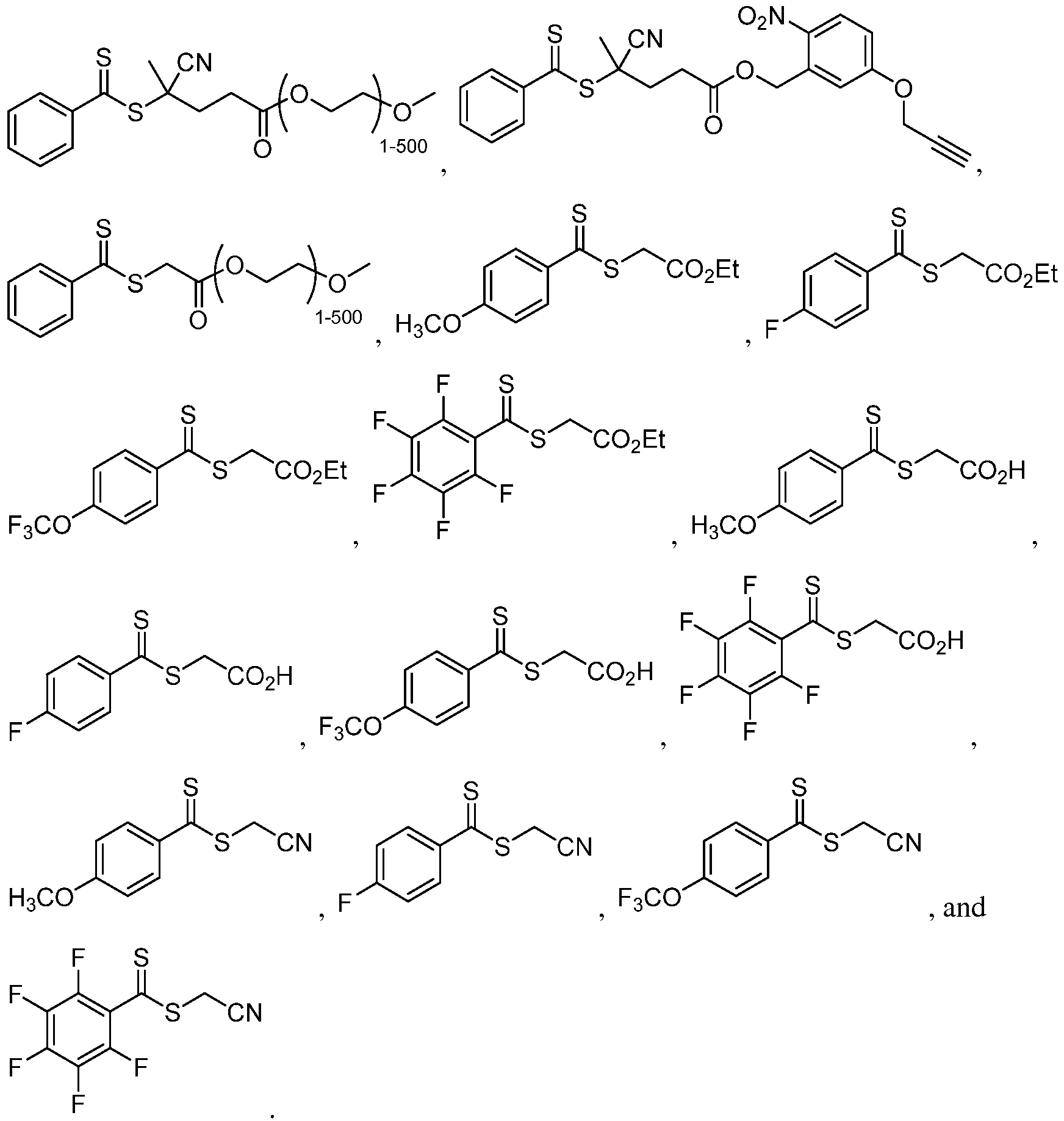
(I) with carbon disulfide or a solution thereof.
52. The method of claim 51, wherein the compound of Formula I is reacted with carbon disulfide or a solution thereof in a continuous flow reactor.
53. The method of claim 52, wherein the compound of Formula IV is continuously produced from the compound of Formula I.
54. The method of claim 1, wherein one of R 2 , R 3 , and R 4 of the compound of Formula IV comprises an ester group.
55. The method of claim 54, further comprising hydrolyzing the ester group after the reacting step.
56. The method of claim 55, wherein the ester group is hydrolyzed in a continuous flow
reactor.
57. A method comprising:
reacting a first solution comprising a compound of Formula I
R1 " z+
(I)
with carbon disulfide or a solution thereof, in a continuous flow reactor, to produce a compound of Formula II
S
R A1 S - Z ÷
(Π)
wherein
R1 is -H, a substituted or unsubstituted alkyl, alkenyl, cycloalkyl, cycloalkylalkyl, aryl, aralkyl, heteroaryl, heteroarylalkyl, heterocyclyl, or heterocyclylalkyl group; and
Z+ is a cationic group.
Applications Claiming Priority (2)
| Application Number | Priority Date | Filing Date | Title |
|---|---|---|---|
| US201361782023P | 2013-03-14 | 2013-03-14 | |
| US61/782,023 | 2013-03-14 |
Publications (2)
| Publication Number | Publication Date |
|---|---|
| WO2014152453A2 true WO2014152453A2 (en) | 2014-09-25 |
| WO2014152453A3 WO2014152453A3 (en) | 2014-11-20 |
Family
ID=51581711
Family Applications (1)
| Application Number | Title | Priority Date | Filing Date |
|---|---|---|---|
| PCT/US2014/027356 Ceased WO2014152453A2 (en) | 2013-03-14 | 2014-03-14 | Continuous flow synthesis of dithioester compounds |
Country Status (1)
| Country | Link |
|---|---|
| WO (1) | WO2014152453A2 (en) |
Cited By (1)
| Publication number | Priority date | Publication date | Assignee | Title |
|---|---|---|---|---|
| US11787952B2 (en) | 2017-05-17 | 2023-10-17 | Abf Technologies, Llc | Zwitterionic monomers, polyzwitterionic polymers formed therefrom, surface functionalization and surface modification |
Family Cites Families (4)
| Publication number | Priority date | Publication date | Assignee | Title |
|---|---|---|---|---|
| US4252814A (en) * | 1979-07-05 | 1981-02-24 | American Cyanamid Company | Ovicidal and larvicidal cyanomethyl thioesters |
| IL139666A0 (en) * | 1997-07-21 | 2002-02-10 | Commw Scient Ind Res Org | Synthesis of dithioester chain transfer agents and use of bis (thioacyl) disulfides or dithioesters as chain transfer agents |
| US6458968B2 (en) * | 2000-06-09 | 2002-10-01 | Rensselaer Polytechnic Institute | Dithiocarboxylic ester synthetic process |
| US6841695B2 (en) * | 2003-03-18 | 2005-01-11 | Rohmax Additives Gmbh | Process for preparing dithioesters |
-
2014
- 2014-03-14 WO PCT/US2014/027356 patent/WO2014152453A2/en not_active Ceased
Cited By (1)
| Publication number | Priority date | Publication date | Assignee | Title |
|---|---|---|---|---|
| US11787952B2 (en) | 2017-05-17 | 2023-10-17 | Abf Technologies, Llc | Zwitterionic monomers, polyzwitterionic polymers formed therefrom, surface functionalization and surface modification |
Also Published As
| Publication number | Publication date |
|---|---|
| WO2014152453A3 (en) | 2014-11-20 |
Similar Documents
| Publication | Publication Date | Title |
|---|---|---|
| Ueno et al. | Phase-transfer alkylation reactions using microreactors | |
| Holbrey et al. | Efficient, halide free synthesis of new, low cost ionic liquids: 1, 3-dialkylimidazolium salts containing methyl-and ethyl-sulfate anions | |
| JP5665942B2 (en) | Reactor and reaction system for producing metal alkoxide | |
| CN106608811B (en) | A method of chloropropane is prepared using micro passage reaction | |
| Hammond et al. | The mechanism of decomposition of azo compounds. III. Cage effects with positively charged geminate radical pairs | |
| WO2014152453A2 (en) | Continuous flow synthesis of dithioester compounds | |
| KR102134407B1 (en) | Method for continuously producing ketomalonic acid compound using flow reactor | |
| AU2021314375A1 (en) | Method for large-scale synthesis of tetrodotoxin | |
| CN113666850B (en) | Preparation method and application of organic sulfonic acid | |
| CN109796411B (en) | Method for preparing 4, 5-dinitroimidazole by using microchannel reactor | |
| CN110746326A (en) | A kind of method for continuous production of isethionic acid | |
| CN103304442A (en) | Process for synthesizing diacetylmonoxime ethyl ether by continuous reactions in microtube | |
| US11045745B2 (en) | Reactive extraction of water | |
| US20260125342A1 (en) | Synthesis of acid hydrazides using flow chemistry | |
| CN109761910B (en) | Synthetic method of ideprop | |
| WO2025010262A2 (en) | Synthesis of acid hydrazides using flow chemistry | |
| Yamashita et al. | Isolation of a Photochemically Unstable Product by Inner Filtering of Liquid–Liquid Slug Flow in a Microreactor | |
| KR101693913B1 (en) | Continuous flow process for the preparation of sulphoxide compounds | |
| CN110372462A (en) | It is continuously synthesizing to-purifies integrated device and the continuous reaction system containing it | |
| WO2024074501A1 (en) | Process for the fluorination and/or cyclization of an amino alkene or alkyne in a continuous stream and facility for performing the process | |
| US20260125349A1 (en) | Process for the fluorination and/or cyclization of an amino alkene or alkyne in a continuous stream and facility for performing the process | |
| JP2025519497A (en) | Method for preparing 1-[5-tert-butyl-3-[(1-methyltetrazol-5-yl)methyl]triazolo[4,5-d]pyrimidin-7-yl]pyrrolidin-3-ol | |
| CN117680061A (en) | A fully continuous flow chemical synthesis device and method for clethodim | |
| CN121064106A (en) | Process for synthesizing cimetidine based on continuous flow reaction | |
| 多田幸雄 et al. | A Correlation between Physicochemical Properties and Acute Toxicity of Sulfonium p-Toluenesulfonates as the Lead Compound of Suplatast Tosilate |
Legal Events
| Date | Code | Title | Description |
|---|---|---|---|
| 121 | Ep: the epo has been informed by wipo that ep was designated in this application |
Ref document number: 14770002 Country of ref document: EP Kind code of ref document: A2 |
|
| 122 | Ep: pct application non-entry in european phase |
Ref document number: 14770002 Country of ref document: EP Kind code of ref document: A2 |