WO2014147629A1 - Anti-biofilm screening assays - Google Patents
Anti-biofilm screening assays Download PDFInfo
- Publication number
- WO2014147629A1 WO2014147629A1 PCT/IN2013/000183 IN2013000183W WO2014147629A1 WO 2014147629 A1 WO2014147629 A1 WO 2014147629A1 IN 2013000183 W IN2013000183 W IN 2013000183W WO 2014147629 A1 WO2014147629 A1 WO 2014147629A1
- Authority
- WO
- WIPO (PCT)
- Prior art keywords
- forming units
- days
- colony forming
- sample
- test composition
- Prior art date
- Legal status (The legal status is an assumption and is not a legal conclusion. Google has not performed a legal analysis and makes no representation as to the accuracy of the status listed.)
- Ceased
Links
Classifications
-
- C—CHEMISTRY; METALLURGY
- C12—BIOCHEMISTRY; BEER; SPIRITS; WINE; VINEGAR; MICROBIOLOGY; ENZYMOLOGY; MUTATION OR GENETIC ENGINEERING
- C12Q—MEASURING OR TESTING PROCESSES INVOLVING ENZYMES, NUCLEIC ACIDS OR MICROORGANISMS; COMPOSITIONS OR TEST PAPERS THEREFOR; PROCESSES OF PREPARING SUCH COMPOSITIONS; CONDITION-RESPONSIVE CONTROL IN MICROBIOLOGICAL OR ENZYMOLOGICAL PROCESSES
- C12Q1/00—Measuring or testing processes involving enzymes, nucleic acids or microorganisms; Compositions therefor; Processes of preparing such compositions
- C12Q1/02—Measuring or testing processes involving enzymes, nucleic acids or microorganisms; Compositions therefor; Processes of preparing such compositions involving viable microorganisms
- C12Q1/18—Testing for antimicrobial activity of a material
-
- G—PHYSICS
- G01—MEASURING; TESTING
- G01N—INVESTIGATING OR ANALYSING MATERIALS BY DETERMINING THEIR CHEMICAL OR PHYSICAL PROPERTIES
- G01N33/00—Investigating or analysing materials by specific methods not covered by groups G01N1/00 - G01N31/00
- G01N33/48—Biological material, e.g. blood, urine; Haemocytometers
- G01N33/50—Chemical analysis of biological material, e.g. blood, urine; Testing involving biospecific ligand binding methods; Immunological testing
- G01N33/53—Immunoassay; Biospecific binding assay; Materials therefor
- G01N33/569—Immunoassay; Biospecific binding assay; Materials therefor for microorganisms, e.g. protozoa, bacteria, viruses
- G01N33/56911—Bacteria
- G01N33/56955—Bacteria involved in periodontal diseases
Definitions
- Such assays are very effective to identify potent and fast-acting antibacterial agents, but are poorly suited to identifying optimal antibacterial agents when the agents would have repeated application over longer periods of time (e.g., by daily or twice daily brushing or rinsing).
- activity against defined microorganisms in suspension culture may not adequately measure activity against the natural microflora, comprising a diversity of species in a biofilm.
- Bacteria in a biofilm are developmentally and phenotypically different from genetically identical bacteria in a free-floating suspension, and may react differently to antibacterial agents.
- the invention provides, in one embodiment, a method (Method 1) of measuring the efficacy of a test composition (for example a toothpaste or mouthwash) against oral bacterial biofilm growth, comprising
- a dental sample selected from a tooth section and a hydroxyapatite disc, with saliva and placing the sample in a flow of a buffered medium, wherein temperature, How and pll adjusted to approximate conditions in the mouth and wherein the buffered medium comprises nutrients similar to those in the mouth;
- Method 1 wherein the period of exposure the dental sample to a test composition in step b) is for a period of about 10 minutes.
- the buffered medium comprises nutrients as required to support bacterial growth, e.g., comprising phosphate buffer, sugar, amino acids, and essential vitamins and minerals.
- Any preceding method further comprising the step of culturing the suspension on a solid media and counting the number of colony forming units after a period of 2-5 days, wherein a lower number of colony forming units indicates that the test composition is more effective against oral biofilm growth.
- Method 1.4 wherein the culture on solid media is carried out in the presence of a metal salt, e.g., an iron or lead salt, which reacts with a volatile sulfur compound formed in step a-c, e.g., hydrogen sulfide, to form a black precipitate, e.g., a metal sulfide.
- a metal salt e.g., an iron or lead salt
- a volatile sulfur compound formed in step a-c e.g., hydrogen sulfide
- Method 1.5 wherein the solid media is an agar plate and the metal salt is lead acetate.
- Method 1.4 or 1.5 wherein any black colony forming units are counted independently from the other colony forming units and wherein a lower number of black colony forming units indicates that the test composition is more effective against oral biofilm growth comprising bacteria that produce volatile sulfur compounds.
- test composition is an oral care product.
- test composition comprises at least 0.1% of a metal ion having a valence of +2 or +3, e.g. Zn 2+ or Sn(II) 2+ .
- Method 1.9 comprising measuring the uptake of the metal ion from the test
- composition by the dental sample wherein greater uptake of the metal ion by the denial sample corresponds to the greater efficacy of the oral care product against oral biofilm formation.
- Buffered medium as used in step a) above may be any suitable medium as known in the art for allowing biofilm growth. See, for example, the various media described in Lemos, et ai, Methods Mol Biol. 2010; 666: 87-102, the contents of which are incorporated herein by reference.
- a typical medium thus comprises phosphate buffer, sugar, amino acids, and essential vitamins and minerals, and is adjusted to approximately pH and osmolality approximating natural saliva.
- one exemplary medium is made up of 58 mM K 2 HP0 4 , 15 mM KH2PO4, 10 mM (Nfl 4 )2S0 4, 35 mM NaCl, 0.8% (wf/vol) glucose, 0,2% (wt/vol) Casammo Acids (CAA), and 100 mM MnCl 2 ⁇ 4H 2 0 (pH 7.4) and is supplemented with filter-sterilized vitamins (0.04 mM nicotinic acid, 0.1 mM pyridoxine IlCi, 0.01 mM pantothenic acid, 1 ⁇ riboflavin, 0.3 ⁇ thiamin HCl, and 0.05 uM d-biotin), amino acids (4 mM 1-glutamic acid, 1 mM L-arginine HCi, 1.3 mM 1-cysteine HCl, and 0.1 mM ⁇ tryptophan), and 2 mM MgS0 2
- the dental samples as used herein are preferably saliva-coated hydroxyapatite discs.
- the saliva inoculates the discs with natural oral bioflora.
- Hydroxyapatite discs are commercially available, e.g., from Clarkson Chromatography Products, Inc.
- Hydroxyapatite also called hydroxyapatite, is a naturally occurring mineral form of calcium apatite with the formula Ca 5 (P0 4 )3(OH). The formula is usually written Cai 0 (PO 4 ) 6 (OH)2 to denote that the crystal unit cell comprises two entities.
- Dental enamel and dentin are comprised primarily of carbonated calcium-deficient hydroxyapatite.
- metal salts to detect the presence of bacteria producing volatile sulfur compounds is based on the fact that volatile sulfides such as hydrogen sulfide react with metal ions, for example Fe(II) ++ or Pb(II) ++ , to form metal sulfides, which may be considered the salts of hydrogen sulfide.
- Metal sulfides generally have a dark color.
- Lead(II) acetate paper or media may be used to detect hydrogen sulfide, for example, because it turns grey or black in the presence of the gas as lead(II) sulfide is produced.
- Various media containing iron compounds also allow detection of hydrogen sulfide production, for example Sulfide-Indole-Motility (SIM) medium or triple sugar iron agar (TSIA), both of which contain Fe(II)" , which reacts with hydrogen sulfide to produce FeS as a black precipitate.
- SIM Sulfide-Indole-Motility
- TSIA triple sugar iron agar
- a method of dynamic biofilm system based on conventional protocols is used to study the effect of actives on oral biofilm developed from salivary microflora.
- Saliva coated hydroxyapatite (HAP) discs are placed in the flow cell and connected to a one flow medium passage. The medium flows from the reservoir through the flow cells and is removed as the waste. Untreated sample/placebo is used as a control to test the efficacy of the dentrifices.
- Treatment solutions of 1 : 10 diluted dentifrices (30 ml) are then drawn into the flow cells to contact the disks for 1 minute. The flow of media is reinstated to rinse the treated discs and further allow the growth of biofilm during the study period of three days. The treatment is repeated over a time interval of 24 hours with the flow adjusted to stimulate conditions in the human mouth.
- the HAP discs are collected at the end of the study and introduced into anaerobic media, and vortexed to make the plaque on the disc thoroughly suspend in the solution.
- 300 ⁇ 1 of the suspension is pipeted into the wells of a 96-welI microplate, and the optical density (OD) at 610nm is read using a microplate reader. Means and standard deviation of the different treatments are calculated. The lower the OD, the lower the bacteria level, and the better the efficacy of the treatment.
- the suspension from the flowcell is collected and diluted serially with anaerobic transfer media. Serial dilutions are plated on lead acetate plates and incubated anaerobicaUy at 37°C for
- Tables 2-4 The results of the study with the above-described method (3 days) are outlined in Tables 2-4 below.
- the formulations tested include the prototype formulations, and also commercial toothpaste products Colgate Total® and Crest ProHeaith, which contain triclosan and stannous fluoride respectively as antibacterial agents.
- Table 2 OD at 610nm of the harvested HAP disc with three different inoculum sources (3 day study) - data grouped with Tukey method at 95% confidence level
- Table 3 Values of plate count on Neomycin Vancomycin agar (3 day study) - data grouped with Tukey method at 95% confidence level
- Tabic 4 Values of plate count on Lead Acetate agar (3 day study) - data grouped with Tukey method at 95% confidence level
- the experiment is then modified to be more representative of the actual in vivo situation.
- Saliva coated HAP disks are placed in the flow cell and connected to a one flow medium passage. The medium flows from the reservoir through the flow cells and is removed to waste. Untreated sample/placebo is used as a control to test the efficacy of the dentrifices.
- Treatment solutions of 1 :10 diluted dentifrices (30 ml) are then drawn into the flow cells to contact the disks for 10 minutes. The flow of media is reinstated to rinse the treatment and further allow the growth of biofilm during the study period. The treatment is repeated over a time interval of 24 hours with the flow adjusted to stimulate conditions in the human mouth.
- the treatment regime is increased to 8 days.
- the HAP disks are collected at the end of the study and introduced into anaerobic media, and vortexed to suspend the plaque on the disc thoroughly in the solution.
- 300 ⁇ 1 of the suspension is pipetted into the wells of a 96- well microplate, and optical density (OD) is read at 610nm in the microplate reader.
- OD optical density
- An Excel spreadsheet is used to calculate means and standard deviation of the different treatments. The lower the OD, the better the efficacy of the treatment.
- Table 5 OD at 610nm of the harvested HAP disc with three different inoculum sources (8 day study) - data grouped with Tukey method at 95% confidence level
- Table 6 Values of plate count on Neomycin Vancomycin agar (8 day study) - data grouped with Tukey method at 95% confidence level
- Table 7 Values of plate count on Lead Acetate agar (8 day study) - data grouped with Tukey method at 95% confidence level
- the modified method of this example is not only closer to the natural situation, but it does a better job of distinguishing the relative antibacterial activities of the different formulations. While the commercial Total ® formulation, which contains a potent antibacterial agent (triclosan) was always the most effective, the different formulations with different metal salts proved to have good activities over time, and as seen from the Tukey analysis, these differences allow separation and ranking of the different fomiulations, which was not possible using conventional testing, which had these formulations as statistically indistinguishable.
- triclosan potent antibacterial agent
- Example 3 Comparative evaluation between data for 3 days (conventional) and 8 days (modified) study
- the mean data for each prototype was compared using each of the two methods.
- the modified method is able to effectively differentiate statistically between the positive control (Total whitening (triclosan)) and the negative control (CAS control), and moreover is able to distinguish between different prototypes using different Zn compound combinations. This allows better selection and optimization of lead formulation based on efficacy.
- Table 8 Mean values of OD at 610nm for conventional and modified method
- the average amount of Zn uptake on HAP is a direct measure of the ability of the compound to reduce biofilm in vivo. Over a short interval, zinc citrate has a higher uptake, but with a longer time interval, the uptake of zinc oxide increases. Thus, the available zinc is enhanced with multiple treatments of zinc oxide, resulting in increased biofilm reduction.
- Table 11 Average values of Zn uptake on HAP using AAS with both methods
Landscapes
- Health & Medical Sciences (AREA)
- Life Sciences & Earth Sciences (AREA)
- Chemical & Material Sciences (AREA)
- Engineering & Computer Science (AREA)
- Immunology (AREA)
- Molecular Biology (AREA)
- Urology & Nephrology (AREA)
- Hematology (AREA)
- Biomedical Technology (AREA)
- Organic Chemistry (AREA)
- Biochemistry (AREA)
- General Health & Medical Sciences (AREA)
- Biotechnology (AREA)
- Microbiology (AREA)
- Physics & Mathematics (AREA)
- Analytical Chemistry (AREA)
- Proteomics, Peptides & Aminoacids (AREA)
- Wood Science & Technology (AREA)
- Zoology (AREA)
- Pathology (AREA)
- Medicinal Chemistry (AREA)
- Tropical Medicine & Parasitology (AREA)
- Virology (AREA)
- General Physics & Mathematics (AREA)
- Cell Biology (AREA)
- Food Science & Technology (AREA)
- Biophysics (AREA)
- Toxicology (AREA)
- Genetics & Genomics (AREA)
- General Engineering & Computer Science (AREA)
- Bioinformatics & Cheminformatics (AREA)
- Measuring Or Testing Involving Enzymes Or Micro-Organisms (AREA)
- Investigating Or Analysing Biological Materials (AREA)
Abstract
Procedures are provided to evaluate the effectiveness of slow-acting antibacterial agents such as metal salts on reduction of bacterial oral biofilm. In the modified process, the exposure time of the agent is increased from the usual 3 minutes to 7-15 minutes, e.g., about 10 minutes, and the duration increased to 5-12 days, e.g., about 8 days instead of the conventional 3 days.
Description
ANTI-BIOFILM SCREENING ASSAYS
BACKGROUND
[00.01] Conventional methods of screening compounds for potential efficacy of oral care agents against bacteria typically assess the efficacy of test compounds and compositions in a suspension culture of defined species of bacteria, measuring bacterial proliferation as a function of optical density (OD) in the presence and absence of the test agent, over a short period of time, following a brief exposure to the test agent.
[0002] Such assays are very effective to identify potent and fast-acting antibacterial agents, but are poorly suited to identifying optimal antibacterial agents when the agents would have repeated application over longer periods of time (e.g., by daily or twice daily brushing or rinsing).
[0003] Moreover, activity against defined microorganisms in suspension culture may not adequately measure activity against the natural microflora, comprising a diversity of species in a biofilm. Bacteria in a biofilm are developmentally and phenotypically different from genetically identical bacteria in a free-floating suspension, and may react differently to antibacterial agents.
[0004] Therefore, there is a need for improved assays for identifying and evaluating antibacterial agents effective against oral biofilms.
SUMMARY
[0005] Procedures have been developed to evaluate the effectiveness of slow-acting antibacterial agents such as metal salts on reduction of bacterial oral biofilm. In the modified process, the exposure time of the agent is increased from the usual 3 minutes to 7-15 minutes, e.g., about 10 minutes, and the duration increased to 5-12 days, e.g., about 8 days instead of conventional 3 days. This process allows testing of comparatively slow acting antibacterial agents.
[0006] Further areas of applicability of the present invention will become apparent from the detailed description provided hereinafter. H should be understood that the detailed description and specific examples, while indicating the preferred embodiment of the invention, are intended for purposes of illustration only and are not intended to limit the scope of the invention.
DESCRIPTION OF THE INVENTION
[0007] The following description of the preferred embodiment(s) is merely exemplary in nature and is in no way intended to limit the invention, its application, or uses.
J0008] The invention provides, in one embodiment, a method (Method 1) of measuring the efficacy of a test composition (for example a toothpaste or mouthwash) against oral bacterial biofilm growth, comprising
a) Coating a dental sample, selected from a tooth section and a hydroxyapatite disc, with saliva and placing the sample in a flow of a buffered medium, wherein temperature, How and pll adjusted to approximate conditions in the mouth and wherein the buffered medium comprises nutrients similar to those in the mouth;
b) Exposing the dental sample to a test composition, then reinstating the flow of buffered medium, wherein the period of exposure to a test compound is from 7-15 minutes, e.g. 8- 12 minutes, e.g., about 10 minutes;
c) Repeating the preceding step from one to four times per day for 5-12 days, e.g., for 6- 10 days, e.g., for about 8 days;
d) Vortexing the dental sample in anaerobic media to obtain a suspension and measuring the optical density thereof, wherein a lower optical density indicates that the test composition is more effective against oral biofilm growth.
or example, the invention provides
1.1. Method 1 wherein the period of exposure the dental sample to a test composition in step b) is for a period of about 10 minutes.
1.2. Method 1 or 1.1 wherein the step of repeating step b) is carried out from one to four limes per day for about 8 days.
1.3. Any preceding method wherein the buffered medium comprises nutrients as required to support bacterial growth, e.g., comprising phosphate buffer, sugar, amino acids, and essential vitamins and minerals.
1.4. Any preceding method further comprising the step of culturing the suspension on a solid media and counting the number of colony forming units after a period of 2-5 days,
wherein a lower number of colony forming units indicates that the test composition is more effective against oral biofilm growth.
1.5. Method 1.4 wherein the culture on solid media is carried out in the presence of a metal salt, e.g., an iron or lead salt, which reacts with a volatile sulfur compound formed in step a-c, e.g., hydrogen sulfide, to form a black precipitate, e.g., a metal sulfide.
1.6. Method 1.5 wherein the solid media is an agar plate and the metal salt is lead acetate.
1.7. Method 1.4 or 1.5 wherein any black colony forming units are counted independently from the other colony forming units and wherein a lower number of black colony forming units indicates that the test composition is more effective against oral biofilm growth comprising bacteria that produce volatile sulfur compounds.
1.8. Any preceding method wherein the test composition is an oral care product.
1.9. Any preceding method wherein the test composition comprises at least 0.1% of a metal ion having a valence of +2 or +3, e.g. Zn2+ or Sn(II)2+.
1.10. Method 1.9 comprising measuring the uptake of the metal ion from the test
composition by the dental sample, wherein greater uptake of the metal ion by the denial sample corresponds to the greater efficacy of the oral care product against oral biofilm formation.
[0009] Buffered medium as used in step a) above may be any suitable medium as known in the art for allowing biofilm growth. See, for example, the various media described in Lemos, et ai, Methods Mol Biol. 2010; 666: 87-102, the contents of which are incorporated herein by reference. A typical medium thus comprises phosphate buffer, sugar, amino acids, and essential vitamins and minerals, and is adjusted to approximately pH and osmolality approximating natural saliva.
[0010] For example, one exemplary medium is made up of 58 mM K2HP04, 15 mM KH2PO4, 10 mM (Nfl4)2S04, 35 mM NaCl, 0.8% (wf/vol) glucose, 0,2% (wt/vol) Casammo Acids (CAA), and 100 mM MnCl2 · 4H20 (pH 7.4) and is supplemented with filter-sterilized vitamins (0.04 mM nicotinic acid, 0.1 mM pyridoxine IlCi, 0.01 mM pantothenic acid, 1 μΜ riboflavin, 0.3 μΜ thiamin HCl, and 0.05 uM d-biotin), amino acids (4 mM 1-glutamic acid, 1 mM L-arginine HCi, 1.3 mM 1-cysteine HCl, and 0.1 mM ^tryptophan), and 2 mM MgS02 · 7H20.
[0011] The dental samples as used herein are preferably saliva-coated hydroxyapatite discs. The saliva inoculates the discs with natural oral bioflora. Hydroxyapatite discs are commercially available, e.g., from Clarkson Chromatography Products, Inc. Hydroxyapatite, also called hydroxyapatite, is a naturally occurring mineral form of calcium apatite with the formula Ca5(P04)3(OH). The formula is usually written Cai0(PO4)6(OH)2 to denote that the crystal unit cell comprises two entities. Dental enamel and dentin are comprised primarily of carbonated calcium-deficient hydroxyapatite.
[0012] Use of metal salts to detect the presence of bacteria producing volatile sulfur compounds is based on the fact that volatile sulfides such as hydrogen sulfide react with metal ions, for example Fe(II)++ or Pb(II)++, to form metal sulfides, which may be considered the salts of hydrogen sulfide. Metal sulfides generally have a dark color. Lead(II) acetate paper or media may be used to detect hydrogen sulfide, for example, because it turns grey or black in the presence of the gas as lead(II) sulfide is produced. Various media containing iron compounds also allow detection of hydrogen sulfide production, for example Sulfide-Indole-Motility (SIM) medium or triple sugar iron agar (TSIA), both of which contain Fe(II)" , which reacts with hydrogen sulfide to produce FeS as a black precipitate.
[0013] As used throughout, ranges are used as shorthand for describing each and every value that is within the range. Any value within the range can be selected as the terminus of the range. In addition, all references cited herein are hereby incorporated by referenced in their entireties. In the event of a conflict in a definition in the present disclosure and that of a cited reference, the present disclosure controls.
[0014] Unless otherwise specified, all percentages and amounts expressed herein and elsewhere in the specification should be understood to refer to percentages by weight. The amounts given are based on the active weight of the material.
EXAMPLES
fiMliSf Embodiments of the present invefttiott are further described in the following examples. The examples are merely illustrative and do not in any way limit the scope of the invention as described and claimed.
Example 1 : Conventional protocol design
[0016] A method of dynamic biofilm system based on conventional protocols is used to study the effect of actives on oral biofilm developed from salivary microflora. Saliva coated
hydroxyapatite (HAP) discs are placed in the flow cell and connected to a one flow medium passage. The medium flows from the reservoir through the flow cells and is removed as the waste. Untreated sample/placebo is used as a control to test the efficacy of the dentrifices. Treatment solutions of 1 : 10 diluted dentifrices (30 ml) are then drawn into the flow cells to contact the disks for 1 minute. The flow of media is reinstated to rinse the treated discs and further allow the growth of biofilm during the study period of three days. The treatment is repeated over a time interval of 24 hours with the flow adjusted to stimulate conditions in the human mouth.
[0017J The HAP discs are collected at the end of the study and introduced into anaerobic media, and vortexed to make the plaque on the disc thoroughly suspend in the solution. 300μ1 of the suspension is pipeted into the wells of a 96-welI microplate, and the optical density (OD) at 610nm is read using a microplate reader. Means and standard deviation of the different treatments are calculated. The lower the OD, the lower the bacteria level, and the better the efficacy of the treatment.
[0018] The suspension from the flowcell is collected and diluted serially with anaerobic transfer media. Serial dilutions are plated on lead acetate plates and incubated anaerobicaUy at 37°C for
2-3 days. The real colony forming units on the HAP disc are counted and the final result is reported as Log cfu/disc. The lower the value, the better the efficacy of the treatment.
[0019J The lead acetate reacts with sulfur to form a black deposit, so the biack colonies on the plates can be counted independently as an evaluation for a product's efficacy against bacteria producing volatile sulfur compounds. This is of interest because bacteria which produce volatile sulfur compounds are thought to be major contributors to halitosis.
[0020] Prototype formulations are prepared as set forth in the table below.
Tabic 1: Comparison of different zinc prototype formulations

Table 2: OD at 610nm of the harvested HAP disc with three different inoculum sources (3 day study) - data grouped with Tukey method at 95% confidence level

Table 3: Values of plate count on Neomycin Vancomycin agar (3 day study) - data grouped with Tukey method at 95% confidence level

CFU - colony forming units
Tabic 4: Values of plate count on Lead Acetate agar (3 day study) - data grouped with Tukey method at 95% confidence level

CFU - colony forming units
Example 2: Modified Dynamic Biofilm Protocol Design
[0022] The experiment is then modified to be more representative of the actual in vivo situation. Saliva coated HAP disks are placed in the flow cell and connected to a one flow medium passage. The medium flows from the reservoir through the flow cells and is removed to waste. Untreated sample/placebo is used as a control to test the efficacy of the dentrifices. Treatment solutions of 1 :10 diluted dentifrices (30 ml) are then drawn into the flow cells to contact the disks for 10 minutes. The flow of media is reinstated to rinse the treatment and further allow the growth of biofilm during the study period. The treatment is repeated over a time interval of 24 hours with the flow adjusted to stimulate conditions in the human mouth.
]0023] The treatment regime is increased to 8 days. The HAP disks are collected at the end of the study and introduced into anaerobic media, and vortexed to suspend the plaque on the disc thoroughly in the solution. 300μ1 of the suspension is pipetted into the wells of a 96- well microplate, and optical density (OD) is read at 610nm in the microplate reader. An Excel spreadsheet is used to calculate means and standard deviation of the different treatments. The lower the OD, the better the efficacy of the treatment.
(0024] The suspension from the flowcell is collected and diluted serially with anaerobic transfer media. Serial dilutions are plated on lead acetate plates and incubated anaerobically at 37°C for 2-3 days. The real colony forming units on the HAP disc are counted and the final result reported as Log CFU/disc. The lower the value, the better the efficacy of the treatment.
{0025] The black colonies on the plates are counted independently as an evaluation for the product's anti-VSC efficacy.
]0026] The following changes are made to the more conventional method of example 1 with respect to treatment- biofilm interaction, while keeping the working principle of the method constant. In the modified method the treament regime is increased to 8 days in place of 3 days. The contact time is also increased to 10 minutes from 1 minute. The rest of the procedure is repeated as is with harvesting alter completion of 8 days. The differentiation between in the individual values of the results is found to be significant.
[0027] The results are summarized in Tables 5-7 below:
Table 5: OD at 610nm of the harvested HAP disc with three different inoculum sources (8 day study) - data grouped with Tukey method at 95% confidence level


CFU - colony forming units
Table 7: Values of plate count on Lead Acetate agar (8 day study) - data grouped with Tukey method at 95% confidence level

CFU - colony forming units
[00281 The modified method of this example is not only closer to the natural situation, but it does a better job of distinguishing the relative antibacterial activities of the different
formulations. While the commercial Total ® formulation, which contains a potent antibacterial agent (triclosan) was always the most effective, the different formulations with different metal salts proved to have good activities over time, and as seen from the Tukey analysis, these differences allow separation and ranking of the different fomiulations, which was not possible using conventional testing, which had these formulations as statistically indistinguishable.
Example 3: Comparative evaluation between data for 3 days (conventional) and 8 days (modified) study
[0029] The mean data for each prototype was compared using each of the two methods. The modified method is able to effectively differentiate statistically between the positive control (Total whitening (triclosan)) and the negative control (CAS control), and moreover is able to distinguish between different prototypes using different Zn compound combinations. This allows better selection and optimization of lead formulation based on efficacy.
Table 8: Mean values of OD at 610nm for conventional and modified method
CFIJ - colony forming units
Table 10: Mean values of plate count on Lead Acetate agar with conventional and modified method
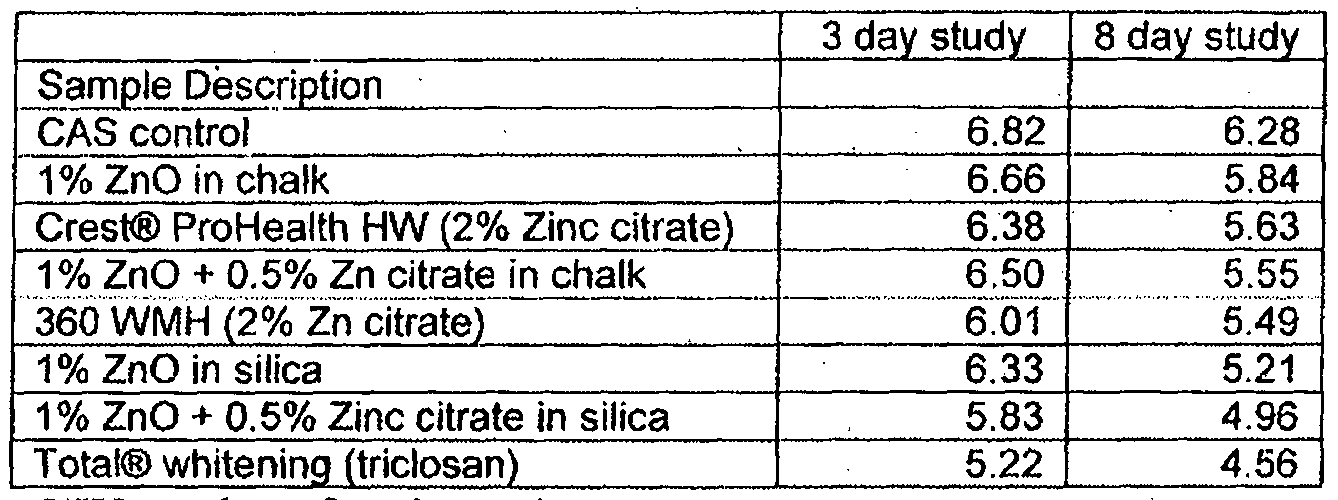
CFU - colony forming units Example 4: Correlation between Zn uptake and biofilm reduction data for conventional and modified method
[0030] The average amount of Zn uptake on HAP is a direct measure of the ability of the compound to reduce biofilm in vivo. Over a short interval, zinc citrate has a higher uptake, but with a longer time interval, the uptake of zinc oxide increases. Thus, the available zinc is enhanced with multiple treatments of zinc oxide, resulting in increased biofilm reduction.
Table 11: Average values of Zn uptake on HAP using AAS with both methods

As can be seen from the data in Table 11, the two samples with the best degree of zinc uptake also correlated with the two best samples in the 8 day biofilm protocols (i.e. 1% ZnO in silica and 1% ZnO + 0.5% Zinc citrate in silica)
[0031] As those skilled in the art.wiii appreciate, numerous changes and modifications may 'be niade to the embodiments described herein without departing from the spirit of the invention, it is intended that all such variations fall within the scope of the appended claims.
Claims
1. A method of measuring the efficacy of a test composition against oral bacterial biofilm formation, comprising
a) Coating a sample selected from a tooth section and a hydroxyapatite disc with saliva and placing the sample in a flow of a buffered medium, with temperature, flow and pll adjusted to approximate conditions in the mouth;
b) Exposing the sample to a test composition, then reinstating the flow of buffered medium, wherein the period of exposure to a test compound is from 7-15 minutes; c) Repeating the preceding step from one to four times per day for 5- 12 days;
d) Vortexing the sample in anaerobic media to obtain a suspension and measuring the optical density thereof, wherein the optical density is a measure of the degree of bacterial growth.
2 . The method of claim 1 wherein the period of exposure the sample to a test composition in step b) is for a period of about 10 minutes.
3. The method of any preceding claim wherein the step of repeating step b) is carried out from one to four times per day for about 8 days.
4. The method of any preceding claim wherein the buffered medium comprises nutrients as required to support bacterial growth.
5. The method of any preceding claim further comprising the step of culturing the
suspension on a solid media and counting the number of colony forming units after a period of 2-5 days, wherein the number of colony forming units is a measure of the degree of bacterial growth.
6. The method of claim 5 wherein the culture on solid media is carried out in the presence of a metal salt which reacts with volatile .sulfur compounds formed in steps arc to form « black precipitate
7. The method of claim 6 wherein the solid media is an agar plate and the metal salt is lead acetate.
8. The method of claim 6 or 7 wherein any black colony forming units are counted
independently from the other colony forming units and wherein the number of black
colony forming units corresponds to the degree of growth of bacteria which produce volatile sulfur compounds.
9. The method of any preceding claim wherein the test composition is an oral care product.
10. The method of any preceding claim wherein the test composition comprises at least 0.1% of a metal ion having a valence of +2 or +3.
11. The method of any preceding claim wherein metal ion having a valence of +2 or +3 is Zn2+.
Priority Applications (4)
| Application Number | Priority Date | Filing Date | Title |
|---|---|---|---|
| PCT/IN2013/000183 WO2014147629A1 (en) | 2013-03-19 | 2013-03-19 | Anti-biofilm screening assays |
| US14/770,866 US9562254B2 (en) | 2013-03-19 | 2013-03-19 | Anti-biofilm screening assays |
| TW103109854A TW201506404A (en) | 2013-03-19 | 2014-03-17 | Anti-biofilm screening assays |
| ARP140101298A AR095687A1 (en) | 2013-03-19 | 2014-03-19 | ANTI-BIO FILM EVALUATION TESTS |
Applications Claiming Priority (1)
| Application Number | Priority Date | Filing Date | Title |
|---|---|---|---|
| PCT/IN2013/000183 WO2014147629A1 (en) | 2013-03-19 | 2013-03-19 | Anti-biofilm screening assays |
Publications (1)
| Publication Number | Publication Date |
|---|---|
| WO2014147629A1 true WO2014147629A1 (en) | 2014-09-25 |
Family
ID=48703630
Family Applications (1)
| Application Number | Title | Priority Date | Filing Date |
|---|---|---|---|
| PCT/IN2013/000183 Ceased WO2014147629A1 (en) | 2013-03-19 | 2013-03-19 | Anti-biofilm screening assays |
Country Status (4)
| Country | Link |
|---|---|
| US (1) | US9562254B2 (en) |
| AR (1) | AR095687A1 (en) |
| TW (1) | TW201506404A (en) |
| WO (1) | WO2014147629A1 (en) |
Families Citing this family (3)
| Publication number | Priority date | Publication date | Assignee | Title |
|---|---|---|---|---|
| JP5548121B2 (en) | 2007-05-14 | 2014-07-16 | リサーチ ファウンデーション オブ ステイト ユニバーシティ オブ ニューヨーク | Induction of physiological dispersive responses in bacterial cells in biofilms |
| US10744226B2 (en) | 2017-12-08 | 2020-08-18 | Johnson & Johnson Consumer Inc. | High-throughput method for detecting tooth stain prevention and removal |
| US11541105B2 (en) | 2018-06-01 | 2023-01-03 | The Research Foundation For The State University Of New York | Compositions and methods for disrupting biofilm formation and maintenance |
Citations (1)
| Publication number | Priority date | Publication date | Assignee | Title |
|---|---|---|---|---|
| WO2012024897A1 (en) * | 2010-08-24 | 2012-03-01 | Hawley & Hazel Chemical Company (Zhongshan) Limited | Methods, devices and uses related to biofilms |
Family Cites Families (1)
| Publication number | Priority date | Publication date | Assignee | Title |
|---|---|---|---|---|
| EP2609189A4 (en) | 2010-08-24 | 2015-08-05 | Hawley & Hazel Chemical Co Zhongshan Ltd | Methods, devices and uses related to biofilms |
-
2013
- 2013-03-19 US US14/770,866 patent/US9562254B2/en active Active
- 2013-03-19 WO PCT/IN2013/000183 patent/WO2014147629A1/en not_active Ceased
-
2014
- 2014-03-17 TW TW103109854A patent/TW201506404A/en unknown
- 2014-03-19 AR ARP140101298A patent/AR095687A1/en unknown
Patent Citations (1)
| Publication number | Priority date | Publication date | Assignee | Title |
|---|---|---|---|---|
| WO2012024897A1 (en) * | 2010-08-24 | 2012-03-01 | Hawley & Hazel Chemical Company (Zhongshan) Limited | Methods, devices and uses related to biofilms |
Non-Patent Citations (4)
| Title |
|---|
| HERLES S ET AL: "Chemostat flow cell system: an in vitro model for the evaluation of antiplaque agents.", JOURNAL OF DENTAL RESEARCH NOV 1994, vol. 73, no. 11, November 1994 (1994-11-01), pages 1748 - 1755, XP008165974, ISSN: 0022-0345 * |
| HOROWITZ A ET AL: "Hydrogen sulfide production in the periodontal environment.", JOURNAL OF PERIODONTOLOGY JUL 1973, vol. 44, no. 7, July 1973 (1973-07-01), pages 390 - 395, XP008165980, ISSN: 0022-3492 * |
| LEMOS ET AL., METHODS MOL BIOL, vol. 666, 2010, pages 87 - 102 |
| S.L. KINNIMENT ET AL: "The effect of chlorhexidine on defined, mixed culture oral biofilms grown in a novel model system", JOURNAL OF APPLIED BACTERIOLOGY, vol. 81, no. 2, 1 August 1996 (1996-08-01), pages 120 - 125, XP055089944, ISSN: 0021-8847, DOI: 10.1111/j.1365-2672.1996.tb04488.x * |
Also Published As
| Publication number | Publication date |
|---|---|
| TW201506404A (en) | 2015-02-16 |
| US20160010137A1 (en) | 2016-01-14 |
| US9562254B2 (en) | 2017-02-07 |
| AR095687A1 (en) | 2015-11-04 |
Similar Documents
| Publication | Publication Date | Title |
|---|---|---|
| Tao et al. | Dentin remineralization via adhesive containing amorphous calcium phosphate nanoparticles in a biofilm-challenged environment | |
| João-Souza et al. | In situ evaluation of fluoride-, stannous-and polyphosphate-containing solutions against enamel erosion | |
| Pratten et al. | In vitro studies of the effect of antiseptic‐containing mouthwashes on the formation and viability of Streptococcus sanguis biofilms | |
| Marsh | Controlling the oral biofilm with antimicrobials | |
| Danelon et al. | Effect of toothpaste with nano-sized trimetaphosphate on dental caries: in situ study | |
| Kang et al. | Antimicrobial Effectiveness of Cetylpyridinium Chloride and Zinc Chloride--Containing Mouthrinses on Bacteria of Halitosis and Peri-implant Disease. | |
| Sorkhdini et al. | Effectiveness of in vitro primary coronal caries prevention with silver diamine fluoride-Chemical vs biofilm models | |
| Rolland et al. | In vitro biofilm formation on the surface of resin‐based dentine adhesives | |
| US9562254B2 (en) | Anti-biofilm screening assays | |
| Aranha Berto et al. | In vitro effects of arginine-containing toothpastes on cariogenic biofilms. | |
| Fu et al. | Effect of desensitising paste containing 8% arginine and calcium carbonate on biofilm formation of Streptococcus mutans in vitro | |
| Schmidt et al. | Influence of time, toothpaste and saliva in the retention of Streptococcus mutans and Streptococcus sanguinis on different toothbrushes | |
| Sanchez et al. | In situ effect of arginine-containing dentifrice on plaque composition and on enamel demineralization under distinct cariogenic conditions | |
| Ferretti et al. | The effect of fluoride and stannous ions on Streptococcus mutans: viability, growth, acid, glucan production, and adherence | |
| Lopes et al. | In situ evaluation of desensitizing toothpastes for protecting against erosive tooth wear and its characterization | |
| Kang et al. | Remineralizing efficacy of fluoride in the presence of oral microcosm biofilms | |
| Simratvir et al. | Efficacy of 10% povidone iodine in children affected with early childhood caries: an in vivo study | |
| Meier et al. | Biofilm formation on metal alloys and coatings, zirconia, and hydroxyapatite as implant materials in vivo | |
| Salman et al. | Remineralization effect of fluoride varnish containing casein phosphopeptide amorphous calcium phosphate on caries-like lesions in primary teeth (in vitro study) | |
| Yu et al. | Rechargeable adhesive with calcium phosphate nanoparticles inhibited long-term dentin demineralization in a biofilm-challenged environment | |
| Subramani et al. | In vitro evaluation of antimicrobial activity of chlorhexidine hexametaphosphate nanoparticle coatings on orthodontic elastomeric chains | |
| Vertuan et al. | Effect of TiF4/NaF and chitosan solutions on the development of enamel caries under a microcosm biofilm model | |
| Burguera-Pascu et al. | Substantivity of zinc salts used as rinsing solutions and their effect on the inhibition of Streptococcus mutans | |
| Bumgardner et al. | Effects of copper-based dental casting alloys on two lymphocyte cell lines and the secretion of interleukin 2 and lgG | |
| Ledder et al. | An in vitro comparison of dentifrice formulations in three distinct oral microbiotas |
Legal Events
| Date | Code | Title | Description |
|---|---|---|---|
| 121 | Ep: the epo has been informed by wipo that ep was designated in this application |
Ref document number: 13732638 Country of ref document: EP Kind code of ref document: A1 |
|
| WWE | Wipo information: entry into national phase |
Ref document number: 14770866 Country of ref document: US |
|
| NENP | Non-entry into the national phase |
Ref country code: DE |
|
| 122 | Ep: pct application non-entry in european phase |
Ref document number: 13732638 Country of ref document: EP Kind code of ref document: A1 |