WO2014147586A1 - 1-(2-(ethylamino)pyrimidin-4-yl)pyrrolidin-2-ones as inhibitors of mutant idh - Google Patents
1-(2-(ethylamino)pyrimidin-4-yl)pyrrolidin-2-ones as inhibitors of mutant idh Download PDFInfo
- Publication number
- WO2014147586A1 WO2014147586A1 PCT/IB2014/060007 IB2014060007W WO2014147586A1 WO 2014147586 A1 WO2014147586 A1 WO 2014147586A1 IB 2014060007 W IB2014060007 W IB 2014060007W WO 2014147586 A1 WO2014147586 A1 WO 2014147586A1
- Authority
- WO
- WIPO (PCT)
- Prior art keywords
- optionally substituted
- alkyl
- ethyl
- pharmaceutically acceptable
- mmol
- Prior art date
- Legal status (The legal status is an assumption and is not a legal conclusion. Google has not performed a legal analysis and makes no representation as to the accuracy of the status listed.)
- Ceased
Links
- 0 C*C(*)(C(*)([*+])C(*)(*#C)N1c2nc(NC(C)*)nc(C)c2*)C1=O Chemical compound C*C(*)(C(*)([*+])C(*)(*#C)N1c2nc(NC(C)*)nc(C)c2*)C1=O 0.000 description 6
- RRTORTQHDARONP-UHFFFAOYSA-N CC(C)(CCC1=C)N1c1ccnc(Cl)n1 Chemical compound CC(C)(CCC1=C)N1c1ccnc(Cl)n1 RRTORTQHDARONP-UHFFFAOYSA-N 0.000 description 1
- SUNDNSDAHDHUPY-UHFFFAOYSA-N CC(c(cc1)cc(Cl)c1/C(/N)=[O]/C)N Chemical compound CC(c(cc1)cc(Cl)c1/C(/N)=[O]/C)N SUNDNSDAHDHUPY-UHFFFAOYSA-N 0.000 description 1
- IWRYYLAJFUOXLI-UHFFFAOYSA-N CC(c1nc(C(CC2)=CC=C2Cl)n[o]1)N Chemical compound CC(c1nc(C(CC2)=CC=C2Cl)n[o]1)N IWRYYLAJFUOXLI-UHFFFAOYSA-N 0.000 description 1
- VVIUIDVDBRMOKX-XFJJJQTGSA-N C[C@@H](C1=N[U]C(C(C=C2)=CCC2Cl)=C1)[N](C)(C)S(C(C)(C)C)=O Chemical compound C[C@@H](C1=N[U]C(C(C=C2)=CCC2Cl)=C1)[N](C)(C)S(C(C)(C)C)=O VVIUIDVDBRMOKX-XFJJJQTGSA-N 0.000 description 1
Classifications
-
- C—CHEMISTRY; METALLURGY
- C07—ORGANIC CHEMISTRY
- C07D—HETEROCYCLIC COMPOUNDS
- C07D401/00—Heterocyclic compounds containing two or more hetero rings, having nitrogen atoms as the only ring hetero atoms, at least one ring being a six-membered ring with only one nitrogen atom
- C07D401/14—Heterocyclic compounds containing two or more hetero rings, having nitrogen atoms as the only ring hetero atoms, at least one ring being a six-membered ring with only one nitrogen atom containing three or more hetero rings
-
- A—HUMAN NECESSITIES
- A61—MEDICAL OR VETERINARY SCIENCE; HYGIENE
- A61P—SPECIFIC THERAPEUTIC ACTIVITY OF CHEMICAL COMPOUNDS OR MEDICINAL PREPARATIONS
- A61P35/00—Antineoplastic agents
-
- C—CHEMISTRY; METALLURGY
- C07—ORGANIC CHEMISTRY
- C07D—HETEROCYCLIC COMPOUNDS
- C07D209/00—Heterocyclic compounds containing five-membered rings, condensed with other rings, with one nitrogen atom as the only ring hetero atom
- C07D209/02—Heterocyclic compounds containing five-membered rings, condensed with other rings, with one nitrogen atom as the only ring hetero atom condensed with one carbocyclic ring
- C07D209/52—Heterocyclic compounds containing five-membered rings, condensed with other rings, with one nitrogen atom as the only ring hetero atom condensed with one carbocyclic ring condensed with a ring other than six-membered
-
- C—CHEMISTRY; METALLURGY
- C07—ORGANIC CHEMISTRY
- C07D—HETEROCYCLIC COMPOUNDS
- C07D403/00—Heterocyclic compounds containing two or more hetero rings, having nitrogen atoms as the only ring hetero atoms, not provided for by group C07D401/00
- C07D403/02—Heterocyclic compounds containing two or more hetero rings, having nitrogen atoms as the only ring hetero atoms, not provided for by group C07D401/00 containing two hetero rings
- C07D403/04—Heterocyclic compounds containing two or more hetero rings, having nitrogen atoms as the only ring hetero atoms, not provided for by group C07D401/00 containing two hetero rings directly linked by a ring-member-to-ring-member bond
-
- C—CHEMISTRY; METALLURGY
- C07—ORGANIC CHEMISTRY
- C07D—HETEROCYCLIC COMPOUNDS
- C07D403/00—Heterocyclic compounds containing two or more hetero rings, having nitrogen atoms as the only ring hetero atoms, not provided for by group C07D401/00
- C07D403/14—Heterocyclic compounds containing two or more hetero rings, having nitrogen atoms as the only ring hetero atoms, not provided for by group C07D401/00 containing three or more hetero rings
-
- C—CHEMISTRY; METALLURGY
- C07—ORGANIC CHEMISTRY
- C07D—HETEROCYCLIC COMPOUNDS
- C07D413/00—Heterocyclic compounds containing two or more hetero rings, at least one ring having nitrogen and oxygen atoms as the only ring hetero atoms
- C07D413/14—Heterocyclic compounds containing two or more hetero rings, at least one ring having nitrogen and oxygen atoms as the only ring hetero atoms containing three or more hetero rings
-
- C—CHEMISTRY; METALLURGY
- C07—ORGANIC CHEMISTRY
- C07D—HETEROCYCLIC COMPOUNDS
- C07D417/00—Heterocyclic compounds containing two or more hetero rings, at least one ring having nitrogen and sulfur atoms as the only ring hetero atoms, not provided for by group C07D415/00
- C07D417/14—Heterocyclic compounds containing two or more hetero rings, at least one ring having nitrogen and sulfur atoms as the only ring hetero atoms, not provided for by group C07D415/00 containing three or more hetero rings
-
- C—CHEMISTRY; METALLURGY
- C07—ORGANIC CHEMISTRY
- C07D—HETEROCYCLIC COMPOUNDS
- C07D491/00—Heterocyclic compounds containing in the condensed ring system both one or more rings having oxygen atoms as the only ring hetero atoms and one or more rings having nitrogen atoms as the only ring hetero atoms, not provided for by groups C07D451/00 - C07D459/00, C07D463/00, C07D477/00 or C07D489/00
- C07D491/02—Heterocyclic compounds containing in the condensed ring system both one or more rings having oxygen atoms as the only ring hetero atoms and one or more rings having nitrogen atoms as the only ring hetero atoms, not provided for by groups C07D451/00 - C07D459/00, C07D463/00, C07D477/00 or C07D489/00 in which the condensed system contains two hetero rings
- C07D491/10—Spiro-condensed systems
- C07D491/107—Spiro-condensed systems with only one oxygen atom as ring hetero atom in the oxygen-containing ring
Definitions
- the present invention is directed to novel 1-(2-(ethylamino)pyrimidin-4-yl)pyrrolidin-2- one compounds, compositions containing these compounds, the use of such compounds in the inhibition of mutant IDH proteins having a neomorphic activity and in the treatment of diseases or disorders associated with such mutant IDH proteins including, but not limited to, cell-proliferation disorders, such as cancer.
- Isocitrate dehydrogenase is a key family of enzymes found in cellular metabolism. They are NADP + / NAD + and metal dependent oxidoreductases of the enzyme class EC 1.1.1.42.
- the wild type proteins catalyze the oxidative decarboxylation of isocitrate to alpha-ketoglutarate generating carbon dioxide and NADPH / NADH in the process. They are also known to convert oxalosuccinate into alpha-ketoglutarate.
- IDH1 cytosolic
- IDH2 mitochondrial
- glioma glioblastoma multiforme
- paraganglioma supratentorial primordial neuroectodermal tumors
- acute myeloid leukemia (AML) prostate cancer
- thyroid cancer colon cancer
- chondrosarcoma cholangiocarcinoma
- peripheral T-cell lymphoma peripheral T-cell lymphoma
- melanoma See L. Deng et al., Trends Mol. Med., 2010, 16, 387; T. Shibata et al., Am. J. Pathol., 201 1 , 178(3), 1395; Gaal et al., J.
- Mutant IDH2 is also associated with the rare neurometabolic disorder D-2- hydroxyglutaric aciduria type II (D-2-HGA type II). Germline mutations were found at R140 in IDH2 in 15 pateints having D-2-HGA type II. Patients having this disorder also have consistently increased levels of D-2-HG in their urine, plasma and cerebrospinal fluid. (See Kranendijk, M. et al., Science, 2010, 330, 336). Finally, patients with Oilier Disease and Mafucci Syndrome (two rare disorders that predispose to cartilaginous tumors) have been shown to be somatically mosaic for IDH1 and 2 mutations and exhibit high levels of D-2-HG. (See Amary et al., Nature Genetics , 2011 and Pansuriya et al., Nature Genetics, 2011).
- this invention provides for a compound of formula (I):
- this invention provides for a pharmaceutical composition
- a pharmaceutical composition comprising a compound of formula (I), or a pharmaceutically acceptable salt thereof, and a pharmaceutically acceptable carrier or excipient.
- this invention provides for the use of a compound of formula (I), or a pharmaceutically acceptable salt thereof, as an inhibitor of a mutant IDH protein having a neomorphic activity such as reducing alpha-ketoglutarate to 2-hydroxyglutarate (2-HG neomorphic activity).
- this invention provides for the use of a compound of formula (I), or a pharmaceutically acceptable salt thereof, as an inhibitor of mutant IDH1 having a neomorphic activity, such as 2-HG neomorphic activity, and/or mutant IDH2 having a neomorphic activity, such as 2-HG neomorphic activity.
- This invention further provides for the use of a compound of formula (I), or a pharmaceutically acceptable salt thereof, as an inhibitor of IDH1 having a mutation at residue 97, 100 or 132, for example G97D, R100Q, R132H, R132C, R132S, R132G, R132L, and R132V; and/or an inhibitor of IDH2 having a mutation at residue 140 or 172, for example R172K, R172M, R172S, R172G, and R172W.
- a compound of formula (I), or a pharmaceutically acceptable salt thereof as an inhibitor of IDH1 having a mutation at residue 97, 100 or 132, for example G97D, R100Q, R132H, R132C, R132S, R132G, R132L, and R132V; and/or an inhibitor of IDH2 having a mutation at residue 140 or 172, for example R172K, R172M, R172S, R172G, and R172W.
- this invention provides for a method of treating a disease or disorder associated with a mutant I DH protein having a neomorphic activity comprising administration of an effective amount of a compound according to formula (I), or a pharmaceutically acceptable salt thereof, to a subject in need thereof.
- the disease or disorder is a cell proliferation disorder, such as cancer.
- the cancer is brain cancer, such as glioma, glioblastoma multiforme, paraganglioma, and supratentorial primordial neuroectodermal tumors (pNET); leukemia, such as acute myeloid leukemia (AML), myelodysplasia syndrome, and chronic myelogenous leukemia (CML); skin cancer, including melanoma; prostate cancer; thyroid cancer; colon cancer; lung cancer; sarcoma, including central chondrosarcoma, central and periosteal chondroma; and fibrosarcoma.
- the disease or disorder is D-2-hydroxyglutaric aciduria.
- the invention provides for a compound of formula (I), or a pharmaceutically acceptable salt thereof, in combination with another therapeutic agent.
- the present invention is directed to a compound of formula (I)
- Rl a is H, methyl, or ethyl
- R " " 3 is H, cyano, -COOC-1.4 alkyl, C 3.6 cycloalkyi, C-1.3 haloalkyi, optionally substituted C-1.3 alkyl, optionally substituted aryl or optionally substituted heteroaryl, wherein said C-1.3 alkyl is optionally substituted with one substituent selected from the group consisting of: OH, N H2, C-1.3 alkoxy, and optionally substituted phenyl, and said aryl and heteroaryl are optionally substituted with one to three substituents each independently selected from the group consisting of: halo, C-1.3 alkyl, C-1.3 haloalkyi,
- R1° is H, methyl or ethyl
- R d is H, OH, C-1.3 alkoxy, C 3.6 cycloalkyl, NH2, -NHCOO-t-butyl, or C-1.3 alkyl optionally substituted with one substituent selected from the group consisting of: OH, NH2, and C-1.3 alkoxy; or
- R1 c and R ⁇ are joined together forming a C 3.6 cycloalkyl or a 4 to 6 membered heterocyclic ring;
- R ⁇ e is H, methyl or ethyl and R f is H, OH, NH 2 , -NHCOO-t-butyl or C-
- R " “ 3 and Rlf are joined together forming a methylene or ethylene bridge; provided that R ⁇ a and R “ “ “ 3 and/or R ⁇ c and R ⁇ and/or R “ “ 3 and are not joined together at the same time;
- R2 and R3 are each independently H, deuterium, halo, C-1.3 alkyl or C-1.3 haloalkyi;
- R 4 is:
- ring A is a 6 membered heteroaryl ring having one to three nitrogen atoms
- ring B is a 5 membered heteroaryl ring having one to four heteroatoms each independently selected from the group consisting of N, O and S;
- X is N or CH; each is independently hydrogen, halo, C-1.3 alkyl or C-1.3 haloalkyi; n is 1 , 2 or 3;
- R R is H, halo, C-1.3 haloalkyi, optionally substituted C-
- R Ra is optionally substituted C-
- _6 alkyl is optionally substituted with one C3.6 cycloalkyi
- said phenyl is optionally substituted with one to three substituents each independently selected from the group consisting of: halo, hydroxyl, cyano, C-1.5 alkyl, C-1.5 haloalkyi, C-1.3 alkoxy, and C-1.3 haloalkoxy
- said C3.7 cycloalkyi and 5 or 6 membered heterocyclic are optionally substituted with one to three substituents each independently selected from the group consisting of: hydroxyl, CH2OH, -NRR, cyano, C-1.3 alkyl,
- R R k is optionally substituted C3.6 cycloalkyi, optionally substituted phenyl or optionally substituted 5 or 6 membered heterocyclic, said phenyl is optionally substituted with one to three substituents each independently selected from the group consisting of: halo, hydroxyl, cyano, C-1.5 alkyl, C-1.5 haloalkyi, C-1.3 alkoxy, and C-1.3 haloalkoxy, and said C3.5 cycloalkyi and 5 or 6 membered heterocyclic are optionally substituted with one to three substituents each independently selected from the group consisting of: hydroxyl, CH2OH, -NRR, cyano, halo, C-1.3 alkyl, C-1.3 haloalkyi, and C-1.3 alkoxy; and each R is independently selected from the group consisting of H and C-1.3 alkyl; provided the compound is not (S)-1-[6-Chloro-2-[[1-(4-fluoropheny
- Alkyl refers to a monovalent saturated hydrocarbon chain having the specified number of carbon atoms.
- C-1.5 alkyl refers to an alkyl group having from 1 to 6 carbon atoms.
- Alkyl groups may be optionally substituted with one or more substituents as defined in formula (I).
- Alkyl groups may be straight or branched. Representative branched alkyl groups have one, two, or three branches.
- alkyl groups include, but are not limited to, methyl, ethyl, propyl (n-propyl and isopropyl), butyl (n-butyl, isobutyl, sec-butyl, and t-butyl), pentyl (n-pentyl, isopentyl, and neopentyl), and hexyl.
- Alkoxy refers to any alkyl moiety attached through an oxygen bridge (i.e. a -O-C-1.3 alkyl group wherein C-1.3 alkyl is as defined herein). Examples of such groups include, but are not limited to, methoxy, ethoxy, and propoxy.
- Aryl refers to a hydrocarbon ring system having an aromatic ring. Aryl groups are monocyclic ring systems or bicyclic ring systems. Monocyclic aryl ring refers to phenyl. Bicyclic aryl rings refer to naphthyl and to rings wherein phenyl is fused to a C5.7 cycloalkyi or
- Aryl groups may be optionally substituted with one or more substituents as defined in formula (I).
- Cycloalkyi refers to a saturated hydrocarbon ring system having the specified number of carbon atoms. Cycloalkyi groups are monocyclic or bicyclic ring systems. For example, C3.
- cycloalkyi refers to a cycloalkyi group having from 3 to 6 carbon atoms. Cycloalkyi groups may be optionally substituted with one or more substituents as defined in formula (I). Examples of cycloalkyi groups include, but are not limited to, cyclopropyl, cyclobutyl, cyclopentyl and cyclohexyl.
- Cycloalkenyl refers to an unsaturated hydrocarbon ring system having the specified number of carbon atoms and having a carbon-carbon double bond within the ring.
- C5.7 cycloalkenyl refers to a cycloalkenyl group having from 5 to 7 carbon atoms.
- cycloalkenyl groups have one carbon-carbon double bond within the ring.
- cycloalkeneyl groups have more than one carbon-carbon double bond within the ring.
- Cycloalkenyl rings are not aromatic. Cycloalkenyl groups may be optionally substituted with one or more substituents as defined in formula (I).
- Halo refers to the halogen radicals fluoro, chloro, bromo, and iodo.
- Haloalkyl refers to an alkyl group wherein at least one hydrogen atom attached to a carbon atom within the alkyl group is replaced with halo.
- the number of halo substituents includes, but is not limited to, 1 , 2, 3, 4, 5, or 6 substituents.
- Haloalkyi includes, but is not limited to, monofluoromethyl, difluoroethyl, and trifluoromethyl.
- Haloalkoxy refers to a haloalkyi moiety attached through an oxygen bridge (i.e. a -O- C-
- An example of a haloalkoxy group is trifluoromethoxy.
- Heteroaryl refers to an aromatic ring system containing from 1 to 5 heteroatoms. Heteroaryl groups containing more than one heteroatom may contain different heteroatoms. Heteroaryl groups may be optionally substituted with one or more substituents as defined in formula (I). Heteroaryl groups are monocyclic ring systems or are fused bicyclic ring systems. Monocyclic heteroaryl rings have from 5 to 6 ring atoms. Bicyclic heteroaryl rings have from 8 to 10 member atoms. Bicyclic heteroaryl rings include those ring systems wherein a heteroaryl ring is fused to a phenyl ring.
- Heteroaryl includes, but is not limited to, pyrrolyl, pyrazolyl, imidazolyl, oxazolyl, isoxazolyl, oxadiazolyl (including 1 ,3,4-oxadiazolyl and 1 ,2,4-oxadiazolyl), thiazolyl, isothiazolyl, thiadiazolyl, furanyl, furanzanyl, thienyl, triazolyl, pyridinyl (including 2-, 3-, and 4-pyridinyl), pyrimidinyl, pyridazinyl, pyrazinyl, trazinyl, tetrazinyl, tetrzolyl, indonyl, isoindolyl, indolizinyl, indazolyl, purinyl, quinolinyl, isoquinolinyl, quinoxalinyl, quinazolinyl, benzimidazolyl,
- Heteroatom refers to a nitrogen, oxygen, or sulfur atom.
- Heterocyclic refers to a 3 to 1 1 membered saturated or unsaturated monocyclic or bicyclic ring containing from 1 to 4 heteroatoms. Heterocyclic ring systems are not aromatic. Heterocyclic groups containing more than one heteroatom may contain different heteroatoms. Heterocyclic includes ring systems wherein a sulfur atom is oxidized to form SO or S02- Heterocyclic groups may be optionally substituted with one or more substituents as defined in formula (I). Heterocyclic groups are monocyclic, spiro, or fused or bridged bicyclic ring systems. Monocyclic heterocyclic rings have 3 to 7 ring atoms.
- Examples of monocyclic heterocyclic groups include oxtanyl, tetrahydrofuranyl, dihydrofuranyl, 1 ,4-dioxanyl, morpholinyl, 1 ,4-dithianyl, piperazinyl, piperidinyl, 1 ,3-dioxolanyl, imidazolidinyl, imidazolinyl, pyrrolinyl, pyrrolidinyl, tetrahydropyranyl, dihydropyranyl, oxathiolanyl, dithiolanyl, 1 ,3-dioxanyl, 1 ,3-dithianyl, oxathianyl, thiomorpholinyl, tetrahydro-thiopyran 1 , 1 -dioxide, 1 ,4-diazepanyl, and the like.
- Fused heterocyclic ring systems have from 8 to 1 1 ring atoms and include groups wherein a heterocyclic ring is fused to a phenyl ring, a heteroaryl ring or another heterocyclic ring.
- fused heterocyclic rings include 2,3-dihydrobenzo[b][1 ,4]dioxinyl, octahydro- pyrrolo[1 ,2-a]pyrazinyl, octahydro-pyrido[1 ,2-a]pyrazinyl, octahydro-pyrrolo[3,4-c]pyrrolyl, 5,6,7,8-tetrahydro-[1 ,2,4]triazolo[4,3-a]pyrazinyl, 5,6,7,8-tetrahydro-imidazo[1 ,2-a]pyrazinyl and the like.
- bridged heterocyclic groups examples include 3,8-diaza-bicyclo[3.2.1]octanyl, 3,8- diaza-bicyclo[4.2.0]octanyl and the like.
- spiro heterocyclic groups examples include 4,7- diaza-spiro[2.5]octanyl and the like.
- 4-6 membered heterocyclic refers to a heterocyclic group as defined above, having from 4 to 6 ring atoms and containing from 1 to 4 heteroatoms.
- 5-6 membered heterocylic refers to a heterocyclic group as defined above, having 5 or 6 ring atoms and containing from 1 to 4 heteroatoms.
- Optionally substituted indicates that a group, such as an alkyl, cycloalkyl, heteroaryl, heterocyclic, phenyl, and benzyl may be unsubstitued or the group may be substituted with one or more substituents as defined in formula (I).
- “Pharmaceutically acceptable” means a compound which is suitable for pharmaceutical use.
- Salts and solvates (e.g. hydrates and hydrates of salts) of compounds of the invention which are suitable for use in medicine are those where in the counterion or associated solvent is pharmaceutically acceptable.
- salts and solvates having non-pharmaceutically acceptable counterions or associated solvents are within the scope of the present invention, for example, for use as intermediates in the preparation of other compounds of the invention and their pharmaceutically acceptable salts and solvates.
- Substituted in reference to a group such as alkyl, phenyl, benzyl, heteroaryl, and heterocyclic, indicates that one or more hydrogen atoms attached to an atom within the group is replaced with a substituent selected from the group of defined substituents. It should be understood that the term “substituted” includes the implicit provision that such substitution be in accordance with permitted valence of the substituted atom and the substituent, and that the substitution results in a stable compound (i.e. one that does not spontaneously undergo transformation, for example, by hydrolysis, rearrangement, cyclization, or elimination and that is sufficiently robust to survive isolation from a reaction mixture).
- a group may contain one or more substituents, one or more (as appropriate) atoms within the group may be substituted.
- a single atom within the group may be substituted with more than one substituent as long as such substitution is accordance with the permitted valence of the atom.
- Suitable substituents are defined for each substituted or optionally substituted group.
- salts including pharmaceutically acceptable salts, of the compounds according to formula (I) may be prepared. These salts may be prepared in situ during the final isolation and purification of the compound, or by separately reacting the purified compound in its free acid or free base form with a suitable base or acid, respectively.
- Pharmaceutically acceptable acid addition salts can be formed with inorganic acids and organic acids, e.g., acetate, aspartate, benzoate, besylate, bromide/hydrobromide, bicarbonate/carbonate, bisulfate/sulfate, camphorsulfonate, chloride/hydrochloride, chlortheophyllonate, citrate, ethandisulfonate, fumarate, gluceptate, gluconate, glucuronate, hippurate, hydroiodide/iodide, isethionate, lactate, lactobionate, laurylsulfate, malate, maleate, malonate, mandelate, mesylate, methylsulphate, naphthoate, napsylate, nicotinate, nitrate, octadecanoate, oleate, oxalate, palmitate, pamoate, phosphate/hydrogen phosphate/dihydrogen
- Inorganic acids from which salts can be derived include, for example, hydrochloric acid, hydrobromic acid, sulfuric acid, nitric acid, phosphoric acid, and the like.
- Organic acids from which salts can be derived include, for example, acetic acid, propionic acid, glycolic acid, oxalic acid, maleic acid, malonic acid, succinic acid, fumaric acid, tartaric acid, citric acid, benzoic acid, mandelic acid, methanesulfonic acid, ethanesulfonic acid, toluenesulfonic acid, sulfosalicylic acid, and the like.
- Pharmaceutically acceptable base addition salts can be formed with inorganic and organic bases.
- Inorganic bases from which salts can be derived include, for example, ammonium salts and metals from columns I to XII of the periodic table.
- the salts are derived from sodium, potassium, ammonium, calcium, magnesium, iron, silver, zinc, and copper; particularly suitable salts include ammonium, potassium, sodium, calcium and magnesium salts.
- Organic bases from which salts can be derived include, for example, primary, secondary, and tertiary amines, substituted amines including naturally occurring substituted amines, cyclic amines, basic ion exchange resins, and the like.
- Certain organic amines include isopropylamine, benzathine, cholinate, diethanolamine, diethylamine, lysine, meglumine, piperazine and tromethamine.
- the pharmaceutically acceptable salts of the present invention can be synthesized from a basic or acidic moiety, by conventional chemical methods.
- such salts can be prepared by reacting free acid forms of these compounds with a stoichiometric amount of the appropriate base (such as Na, Ca, Mg, or K hydroxide, carbonate, bicarbonate or the like), or by reacting free base forms of these compounds with a stoichiometric amount of the appropriate acid.
- a stoichiometric amount of the appropriate base such as Na, Ca, Mg, or K hydroxide, carbonate, bicarbonate or the like
- Such reactions are typically carried out in water or in an organic solvent, or in a mixture of the two.
- use of non-aqueous media like ether, ethyl acetate, ethanol, isopropanol, or acetonitrile is desirable, where practicable.
- Solvates, including pharmaceutically acceptable solvates, of the compounds of formula (I) may also be prepared.
- “Solvate” refers to a complex of variable stoichiometry formed by a solute and solvent. Such solvents for the purpose of the invention may not interfere with the biological activity of the solute. Examples of suitable solvents include, but are not limited to, water, MeOH, EtOH, and AcOH. Solvates wherein water is the solvent molecule are typically referred to as hydrates. Hydrates include compositions containing stoichiometric amounts of water, as well as compositions containing variable amounts of water.
- the compounds of formula (I), including salts and solvates thereof, may exist in crystalline forms, non-crystalline forms, or mixtures thereof.
- the compound or salt or solvate thereof may also exhibit polymorphism, i.e. the capacity of occurring in different crystalline forms. These different crystalline forms are typically known as "polymorphs". Polymorphs have the same chemical composition but differ in packing, geometrical arrangement, and other descriptive properties of crystalline solid state. Polymorphs, therefore, may have different physical properties such as shape, density, hardness, deformability, stability, and dissolution properties. Polymorphs typically exhibit different melting points, IR spectra, and X-ray powder diffraction patterns, all of which may be used for identification.
- different polymorphs may be produced, for example, by changing or adjusting the conditions used in crystallizing/recrystallizing a compound of formula (I).
- the invention also includes various isomers of the compounds of formula (I).
- “Isomer” refers to compounds that have the same composition and molecular weight but differ in physical and/or chemical properties. The structural difference may be in constitution (geometric isomers) or in the ability to rotate the plane of polarized light (stereosiomers). With regard to stereoisomers, the compounds of formula (I) may have one or more asymmetric carbon atom and may occur as racemates, racemic mixtures and as individual enantiomers or diastereomers. All such isomeric forms are included within the present invention, including mixtures thereof. If the compound contains a double bond, the substituent may be in the E or Z configuration. If the compound contains a disubstituted cycloalkyl, the cycloalkyl substituent may have a cis- or trans-configuration. All tautomeric forms are also intended to be included.
- any asymmetric atom (e.g., carbon or the like) of a compound of formula (I) can be present in racemic or enantiomerically enriched, for example the (R)-, (S)- or (R,S)- configuration.
- each asymmetric atom has at least 50 % enantiomeric excess, at least 60 % enantiomeric excess, at least 70 % enantiomeric excess, at least 80 % enantiomeric excess, at least 90 % enantiomeric excess, at least 95 % enantiomeric excess, or at least 99 % enantiomeric excess in the (R)- or (S)- configuration.
- Substituents at atoms with unsaturated double bonds may, if possible, be present in cis- (Z)- or trans- (£)- form.
- a compound of formula (I) can be in the form of one of the possible isomers, rotamers, atropisomers, tautomers or mixtures thereof, for example, as substantially pure geometric (cis or trans) isomers, diastereomers, optical isomers (antipodes), racemates or mixtures thereof. Any resulting mixtures of isomers can be separated on the basis of the physicochemical differences of the constituents, into the pure or substantially pure geometric or optical isomers, diastereomers, racemates, for example, by chromatography and/or fractional crystallization.
- any resulting racemates of final products or intermediates can be resolved into the optical antipodes by known methods, e.g., by separation of the diastereomeric salts thereof, obtained with an optically active acid or base, and liberating the optically active acidic or basic compound.
- a basic moiety may thus be employed to resolve the compounds of the present invention into their optical antipodes, e.g., by fractional crystallization of a salt formed with an optically active acid, e.g., tartaric acid, dibenzoyl tartaric acid, diacetyl tartaric acid, di-0,0'-p-toluoyl tartaric acid, mandelic acid, malic acid or camphor-10-sulfonic acid.
- Racemic products can also be resolved by chiral chromatography, e.g., high pressure liquid chromatography (HPLC) using a chiral adsorbent.
- HPLC high pressure liquid chromatography
- the invention includes unlabeled forms as well as isotopically labeled forms of compounds of formula (I).
- Isotopically labeled compounds have structures depicted by the formulas given herein except that one or more atoms are replaced by an atom having a selected atomic mass or mass number.
- isotopes that can be incorporated into compounds of the invention include isotopes of hydrogen, carbon, nitrogen, oxygen, phosphorous, fluorine, and chlorine, such as 2 H, 3 H, C, 3 C, 4 C, 5 N, 8 F 3 P, 32 P, 35 S, 36 CI, 2 5 l respectively.
- the invention includes various isotopically labeled compounds as defined herein, for example those into which radioactive isotopes, such as 3 H and 4 C, or those into which non-radioactive isotopes, such as 2 H and 3 C are present.
- isotopically labelled compounds are useful in metabolic studies (with 4 C), reaction kinetic studies (with, for example 2 H or 3 H), detection or imaging techniques, such as positron emission tomography (PET) or single-photon emission computed tomography (SPECT) including drug or substrate tissue distribution assays, or in radioactive treatment of patients.
- PET positron emission tomography
- SPECT single-photon emission computed tomography
- an 8 F or labeled compound may be particularly desirable for PET or SPECT studies.
- Isotopically-labeled compounds of formula (I) can generally be prepared by conventional techniques known to those skilled in the art or by processes analogous to those described in the accompanying Examples and Preparations using an appropriate isotopically-labeled reagents in place of the non-labeled reagent previously employed.
- isotopic enrichment factor means the ratio between the isotopic abundance and the natural abundance of a specified isotope.
- a substituent in a compound of this invention is denoted deuterium, such compound has an isotopic enrichment factor for each designated deuterium atom of at least 3500 (52.5% deuterium incorporation at each designated deuterium atom), at least 4000 (60% deuterium incorporation), at least 4500 (67.5% deuterium incorporation), at least 5000 (75% deuterium incorporation), at least 5500 (82.5% deuterium incorporation), at least 6000 (90% deuterium incorporation), at least 6333.3 (95% deuterium incorporation), at least 6466.7 (97% deuterium incorporation), at least 6600 (99% deuterium incorporation), or at least 6633.3 (99.5% deuterium incorporation).
- R a is H
- R b is H, methyl, CH 2 OH, CH 2 -phenyl, COOCH 2 CH 3 , COOCH 3 , CH 2 NH 2 ,
- R c , R d , R e and R f are all H.
- R ⁇ c is H or methyl
- R ⁇ d is H, OH, NH 2 or C-
- R a , R b , R e and R f are all H.
- R c is H or methyl
- R d is H, OH, NH 2 , CH 2 OH or methyl; and R a , R b , R e and R f are all H.
- R c is
- R d is H, OH, or NH 2 ; and R a , R b , R e and R f are all H.
- R ⁇ e is H
- R ⁇ is H, OH or NH 2 ;
- R a , R b , R c , R d and R e are all H.
- R ⁇ a is H or methyl
- R " " 3 is H or methyl
- R c , R d , R e and R f are all H.
- R ⁇ a and R " " 3 , R ⁇ c , Rl d , R ⁇ and R ⁇ are all H.
- R ⁇ 3 is H; R " " 3 is -CH 2 -phenyl; R ⁇ c is H; R d is OH; R e is H; and R f is H.
- R " " 3 and R ⁇ are joined together forming an ethylene bridge and R ⁇ 3 , R ⁇ c , R ⁇ and R ⁇ e are all H.
- R ⁇ c and R ⁇ are joined together forming a C 3.6 cycloalkyl or a 4 to 6 membered heterocyclic ring and R ⁇ 3 , R " " 3 , R ⁇ e and R ' are all H.
- R ⁇ c and R ⁇ are joined together forming a 4 to 6 membered heterocyclic ring and R ⁇ a , R " " 3 le anc
- Rlf are A
- More suitably R ⁇ c and R ⁇ are joined together forming an oxetanyl ring and R ⁇ 3 , R “ “ 3 , R ⁇ e and R ⁇ are all H.
- R2 and R ⁇ are each independently hydrogen or halo.
- R2 and R3 are each independently hydrogen, fluoro or chloro.
- R2 is H and R ⁇ is H, fluoro or chloro.
- R2 is H, fluoro or chloro and R ⁇ is H.
- R2 and R3 are both H.
- R5 is hydrogen or halo and n is 1.
- R ⁇ is hydrogen, chloro or fluoro and n is 1.
- R ⁇ is hydrogen and n is 1.
- R ⁇ is hydrogen, halo, C-1.3 haloalkyi or optionally substituted C-i_6 alkyl.
- R ⁇ is optionally substituted phenyl.
- R ⁇ is phenyl optionally substituted with one halo.
- R ⁇ is phenyl optionally substituted with one fluoro or chloro group.
- R ⁇ is optionally substituted heteroaryl.
- R ⁇ is optionally substituted pyrazolyl.
- pyrazolyl optionally substituted with one or two C-
- R ⁇ a is C-
- R ⁇ is -OR ⁇ a wherein R ⁇ a is CH2CF3, C-
- R ⁇ is -C(0)NHR6a wherein R a is optionally substituted C3.5 cycloalkyl.
- R ⁇ is -C(0)NHR6a wherein R a is C3.7 cycloalkyl optionally substituted with one OH.
- R ⁇ is -C(0)NHR6a wherein R a is cyclohexyl or cycloheptyl optionally substituted with one OH.
- R ⁇ is -C ⁇ R ⁇ b wherein R ⁇ b js optionally substituted
- R ⁇ is -C ⁇ R ⁇ b wherein R ⁇ b js optionally substituted piperidinyl or piperazinyl.
- R ⁇ is -C ⁇ R ⁇ ' 3 wherein R ⁇ b js piperidinyl or piperazinyl each of which is optionally substituted with one or two substituents each independently selected from the group consisting of: methyl, NH2, and -C(0)CH3.
- the compounds of the present invention may be made by a variety of methods, including standard chemistry. Suitable synthetic routes are depicted in the Schemes given below.
- the compounds of formula (I) may be prepared by methods known in the art of organic synthesis as set forth in part by the following synthetic schemes. In the schemes described below, it is well understood that protecting groups for sensitive or reactive groups are employed where necessary in accordance with general principles or chemistry. Protecting groups are manipulated according to standard methods of organic synthesis (T. W. Greene and P. G. M. Wuts, "Protective Groups in Organic Synthesis", Third edition, Wiley, New York 1999). These groups are removed at a convenient stage of the compound synthesis using methods that are readily apparent to those skilled in the art. The selection processes, as well as the reaction conditions and order of their execution, shall be consistent with the preparation of compounds of formula (I).
- the present invention includes both possible stereoisomers and includes not only racemic compounds but the individual enantiomers and/or diastereomers as well.
- a compound When a compound is desired as a single enantiomer or diastereomer, it may be obtained by stereospecific synthesis or by resolution of the final product or any convenient intermediate. Resolution of the final product, an intermediate, or a starting material may be effected by any suitable method known in the art. See, for example, "Stereochemistry of Organic Compounds" by E. L. Eliel, S. H. Wilen, and L. N. Mander (Wiley-lnterscience, 1994).
- the compounds described herein may be made from commercially available starting materials or synthesized using known organic, inorganic, and/or enzymatic processes.
- Conditions (a) may include the following: NaH, DMF; KH, THF; CS2CO3, Pd2(dba)3, xantphos, dioxane; or CS2CO3, Pd(OAc)2, xantphos, THF.
- Intermediate (iii) may be further manipulated to exchange, remove, or add a protecting group (as appropriate) or to convert a sidechain into an alternative moiety.
- Conditions (b) may include the following: Hunig's base (N,N- diisopropylethylamine) or triethylamine with solvents of either NMP, DMSO, or n-butanol; with either conventional heating or microwave heating.
- conditions (b) may also include a stepwise conversion of the chloropyrimidine intermediate into the fluoro intermediate in-situ with KF, DMSO prior to the final coupling with amine (iv) using Hunig's base and heating in DMSO.
- Compound (I) may be further manipulated to exchange, remove, or add a protecting group (as appropriate) or to convert a sidechain into an alternative moiety.
- the compounds of the present invention are inhibitors of a mutant IDH protein having a neomorphic activity and are therefore useful in the treatment of diseases or disorders associated with such proteins including, but not limited to, cell proliferation disorders, such as cancer.
- mutant IDH protein having a neomorphic activity examples include mutant IDH1 and mutant IDH2.
- a neomorphic activity associated with mutant IDH1 and mutant IDH2 is the ability to produce 2-hydroxyglutarate (2-HG neomorphic activity), specifically R-2-HG (R-2-HG neomorphic activity).
- Mutations in IDH1 associated with 2-HG neomorphic activity, specifically R-2-HG neomorphic activity include mutations at residues 97, 100, and 132, e.g. G97D, R100Q, R132H, R132C, R132S, R132G, R132L, and R132V.
- Mutations in IDH2 associated with 2-HG neoactivity, specifically R-2-HG neomorphic activity, include mutations at residues 140 and 172, e.g. R140Q, R140G, R172K, R172M, R172S, R172G, and R172W.
- Cell-proliferation disorders associated with a mutant IDH protein having a neomorphic activity include, but are not limited to, cancer.
- cancers include Acute Lymphoblastic Leukemia, Adult; Acute Lymphoblastic Leukemia, Childhood; Acute Myeloid Leukemia, Adult; Adrenocortical Carcinoma; Adrenocortical Carcinoma, Childhood; AIDS- Related Lymphoma; AIDS-Related Malignancies; Anal Cancer; Astrocytoma, Childhood Cerebellar; Astrocytoma, Childhood Cerebral; Bile Duct Cancer, Extrahepatic; Bladder Cancer; Bladder Cancer, Childhood; Bone Cancer, Osteosarcoma/Malignant Fibrous Histiocytoma; Brain Stem Glioma, Childhood; Brain Tumor, Adult; Brain Tumor, Brain Stem Glioma, Childhood; Brain Tumor, Cerebellar Astrocytoma, Childhood; Brain Tumor, Cerebral Astrocyto
- the cancer associated with a mutant IDH protein having a neomorphic acitvity is brain cancer, such as astrocytic tumor (e.g., pilocytic astrocytoma, subependymal giant-cell astrocytoma, diffuse astrocytoma, pleomorphic xanthoastrocytoma, anaplastic astrocytoma, astrocytoma, giant cell glioblastoma, glioblastoma, secondary glioblastoma, primary adult glioblastoma, and primary pediatric glioblastoma); oligodendroglial tumor (e.g., oligodendroglioma, and anaplastic oligodendroglioma); oligoastrocytic tumor (e.g., oligoastrocytoma, and anaplastic oligoastrocytoma); ependymoma (e.g., myxop
- the cancer associated with a mutant IDH protein having a neomorphic acitvity is leukemia, such as acute myeloid leukemia (AML), myelodysplasia syndrome (MDS), chronic myelogenous leukemia (CML), myeloproliferative neoplasm (MPN), M DS.MPN including chronic myelomonocytic leukemia, post MDS AML, post MPN AML, post M DS/MPN AML, del(5q)-associated high risk MDS or AML, blast-phase chronic myelogenous leukemia, angioimmunoblastic lymphoma and acute lymphoblastic leukemia.
- AML acute myeloid leukemia
- MDS myelodysplasia syndrome
- CML chronic myelogenous leukemia
- MPN myeloproliferative neoplasm
- M DS.MPN including chronic myelomonocytic leukemia,
- the cancer associated with a mutant I DH protein having a neomorphic activity is skin cancer, including melanoma.
- the cancer associated with a mutant I DH protein having a neomorphic activity is prostate cancer, thyroid cancer, colon cancer, or lung cancer.
- the cancer associated with a mutant I DH protein having a neomorphic activity is sarcoma, including central chondrosarcoma, central and periosteal chondroma, and fibrosarcoma.
- the cancer associated with a mutant I DH protein having a neomorphic activity is cholangiocarcinoma.
- Another disease or disorder associated with a mutant I DH protein having R-2-HG neomorphic activity is D-2-hydroxyglutaric aciduria.
- Another disease or disorder associated with a mutant I DH protein having R-2-HG neomorphic activity is Diller disease and Mafucci syndrome.
- neomorphic activity refers to a gain of novel activity of a protein that the wild-type protein does not have or does not exhibit to a significant degree.
- a neomorphic activity associated with a mutant form of I DH 1 and I DH2 is the ability to reduce alpha-ketoglutarate to 2-hydroxyglutarate (i.e. 2-HG, specifically R-2-HG).
- the wild type form of I DH 1 and I DH2 does not have the ability to reduce alpha-ketoglutarate to 2- hydroxyglutarate (i.e. 2-HG, specifically R-2-HG) or if it does have this ability, it does not produce significant (i.e. harmful or disease causing) amounts of 2-HG.
- the term "subject" refers to an animal. Typically the animal is a mammal. A subject also refers to for example, primates (e.g., humans, male or female), cows, sheep, goats, horses, dogs, cats, rabbits, rats, mice, fish, birds and the like. In certain embodiments, the subject is a primate. In yet other embodiments, the subject is a human.
- primates e.g., humans, male or female
- the subject is a primate.
- the subject is a human.
- the term "therapeutically effective amount" in reference to a compound of the invention means an amount of the compound sufficient to treat the subject's disease or condition, but low enough to avoid serious sides effects (at a reasonable benefit/risk ratio) within the scope of sound medical judgment.
- a therapeutically effective amount of a compound will vary with the particular compound chosen (e.g. consider the potency, efficacy, and half-life of the compound); the route of administration chosen; the condition being treated; the severity of the condition being treated; the age, size, weight, and physical condition of the subject being treated; the medical history of the subject being treated; the duration of the treatment; the nature of the concurrent therapy; the desired therapeutic effect; and like factors and can be routinely determined by the skilled artisan.
- the term “treat”, “treating” or “treatment” of any disease or disorder refers in one embodiment, to ameliorating the disease or disorder (i.e. , slowing or arresting or reducing the development of the disease or at least one of the clinical symptoms thereof).
- “treat”, “treating” or “treatment” refers to alleviating or ameliorating at least one physical parameter including those which may not be discernible by the patient.
- “treat”, “treating” or “treatment” refers to modulating the disease or disorder, either physically, (e.g., stabilization of a discernible symptom), physiologically, (e.g., stabilization of a physical parameter), or both.
- “treat”, “treating” or “treatment” refers to preventing or delaying the onset or development or progression of the disease or disorder.
- a subject is "in need of a treatment if such subject would benefit biologically, medically or in quality of life from such treatment.
- the compounds of the present invention may be administered by any suitable route including oral and parenteral administration.
- Parenteral administration is typically by injection or infusion and includes intravenous, intramuscular, and subcontaneous injection or infusion.
- the compounds of the invention may be administered once or according to a dosing regimen wherein a number of doses are administered at varying intervals of time for a given period of time. For example, doses may be administered one, two, three, or four times per day. Doses may be administered until the desired therapeutic effect is achieved or indefinitely to maintain the desired therapeutic effect. Suitable dosing regimens for a compound of the invention depend on the pharmacokinetic properties of that compound, such as absorption, distribution and half life which can be determined by the skilled artisan.
- suitable dosing regimens including the duration such regimens are administered, for a compound of the invention depend on the disease or condition being treated, the severity of the disease or condition, the age and physical condition of the subject being treated, the medical history of the subject being treated, the nature of concurrent therapy, the desired therapeutic effect, and like factors within the knowledge and expertise of the skilled artisan. It will be further understood by such skilled artisans that suitable dosing regimens may require adjustment given an individual subject's response to the dosing regimen or over time as the individual subject needs change. Typical daily dosages may vary depending upon the particular route of administration chosen. Typical daily dosages for oral administration, to a human weighing approximately 70kg would range from about 5mg to about 500mg of a compound of formula (I).
- One embodiment of the present invention provides for a method of treating a disease or disorder associated with a mutant form of I DH having a neomorphic activity comprising administration of a therapeutically effective amount of a compound of formula (I) to a subject in need of treatment thereof.
- the disease or disorder associated with a mutant form of IDH having a neomorphic activity is a cell proliferation disorder.
- the cell proliferation disorder is cancer.
- the cancer is a cancer associated with mutant IDH1 having 2-HG neomorphic activity or mutant IDH2 having 2-HG neomorphic activity.
- the neomorphic activity is R-2-HG neomorphic activity.
- the cancer is associated with mutant IDH1 having 2-HG or R-2-HG neomorphic activity having a mutation at residues 97, 100, or 132, such as G97D, R100Q, R132H, R132C, R132S, R132G, R132L, and R132V.
- the cancer is associated with mutant IDH2 having 2-HG or R-2-HG neomorphic activity having a mutation at residues 140 or 172, e.g. R140Q, R140G, R172K, R172M, R172S, R172G, and R172W.
- the cancer is brain cancer, leukemia, skin cancer, prostate cancer, thyroid cancer, colon cancer, lung cancer or sarcoma.
- the cancer is glioma, glioblastoma multiforme, paraganglioma, suprantentorial primordial neuroectodermal tumors, acute myeloid leukemia, myelodysplasia syndrome, chronic myelogenous leukemia, melanoma, prostate, thyroid, colon, lung, central chondrosarcoma, central and periosteal chondroma tumors, fibrosarcoma, and cholangiocarcinoma.
- Another embodiment of the present invention provides for a method of treating a disease or disorder associated with a mutant form of IDH having R-2-HG neomorphic activity comprising administration of a therapeutically effective amount of a compound according to formula (I) to a subject in need thereof wherein the disease or disorder is D-2-hydroxyglutaric aciduria, Oilier Disease, or Mafucci Syndrome.
- the therapy is a disease or disorder associated with a mutant form of IDH having a neomorphic activity.
- the therapy is a cell proliferation disorder associated with a mutant form of IDH having a neomorphic activity.
- the therapy is cancer.
- the therapy is a cancer associated with a mutant IDH protein having a neomorphic activity, such as mutant IDH1 having 2-HG neomorphic activity or mutant IDH2 having 2-HG neomorphic activity.
- the neomorphic activity is R-2-HG neomorphic activity.
- the cancer is associated with mutant IDH1 having 2-HG or R-2-HG neomorphic activity having a mutation at residues 97, 100, or 132, such as G97D, R100Q, R132H, R132C, R132S, R132G, R132L, and R132V.
- the cancer is associated with mutant IDH2 having 2-HG or R-2-HG neomorphic activity having a mutation at residue at residues R140 or 172, e.g. R140Q, R140G, R172K, R172M, R172S, R172G, and R172W.
- the cancer is brain cancer, leukemia, skin cancer, prostate cancer, thyroid cancer, colon cancer, lung cancer or sarcoma.
- the cancer is glioma, glioblastoma multiforme, paraganglioma, suprantentorial primordial neuroectodermal tumors, acute myeloid leukemia, myelodysplasia syndrome, chronic myelogenous leukemia, melanoma, prostate, thyroid, colon, lung, central chondrosarcoma, central and periosteal chondroma tumors, fibrosarcoma, and cholangiocarcinoma.
- Another embodiment of the present invention provides for the use of a compound of formula (I) in therapy wherein the therapy is D-2-hydroxyglutaric aciduria, Oilier Disease, or Mafucci Syndrome.
- Another embodiment of the present invention provides for the use of a compound according to formula (I) in the manufacture of a medicament for the treatment of disease or disorder associated with a mutant form of IDH having a neomorphic activity.
- the disease or disorder associated with a mutant form of IDH having a neomorphic activity is a cell proliferation disorder.
- the cell proliferation disorder is cancer.
- the cancer is a cancer associated with a mutant IDH protein having a neomorphic activity, such as mutant IDH1 having 2-HG neomorphic activity or mutant IDH2 having 2-HG neomorphic activity.
- the neomorphic activity is R-2-HG neomorphic activity.
- the cancer is associated with mutant IDH1 having 2-HG or R-2-HG neomorphic activity having a mutation at residues 97, 100, or 132, such as G97D, R100Q, R132H, R132C, R132S, R132G, R132L, and R132V.
- the cancer is associated with mutant IDH2 having 2-HG or R- 2-HG neomorphic activity having a mutation at residue at residues 140 or 172, e.g. R140Q, R140G, R172K, R172M, R172S, R172G, and R172W.
- the cancer is brain cancer, leukemia, skin cancer, prostate cancer, thyroid cancer, colon cancer, lung cancer or sarcoma.
- the cancer is glioma, glioblastoma multiforme, paraganglioma, suprantentorial primordial neuroectodermal tumors, acute myeloid leukemia, myelodysplasia syndrome, chronic myelogenous leukemia, melanoma, prostate, thyroid, colon, lung, central chondrosarcoma, central and periosteal chondroma tumors, fibrosarcoma, and cholangiocarcinoma.
- Another embodiment of the present invention provides for the use of a compound according to formula (I) in the manufacture of a medicament for the treatment of disease or disorder associated with a mutant form of IDH having R-2-HG neomorphic activity wherein the disease or disorder is D-2-hydroxyglutaric aciduria, Oilier Disease, or Mafucci Syndrome.
- the present invention provides a pharmaceutical composition
- a pharmaceutical composition comprising a compound of formula (I) and a pharmaceutically acceptable carrier or excipient.
- compositions of the invention may be prepared and packaged in bulk form wherein a therapeutically effective amount of a compound of the invention can be extracted and then given to a subject, such as with powders or syrups.
- the pharmaceutical compositions of the invention may be prepared and packaged in unit dosage form wherein each physically discrete unit contains a therapeutically effective amount of a compound of the invention.
- the pharmaceutical compositions of the invention typically contain from about 5mg to 500mg of a compound of formula (I).
- pharmaceutically acceptable carrier or excipient means a pharmaceutically acceptable material, composition or vehicle that, for example, are involved in giving form or consistency to the pharmaceutical composition.
- Each excipient must be compatible with the other ingredients of the pharmaceutical composition when commingled such that interactions which would substantially reduce the efficacy of the compound of the invention when administered to a subject and interactions which would result in pharmaceutical compositions that are not pharmaceutically acceptable are avoided.
- each excipient must, of course, be of sufficiently high purity to render it pharmaceutically acceptable.
- the compound of the invention and the pharmaceutically acceptable carrier or excipient(s) will typically be formulated into a dosage form adapted for administration to the subject by the desired route of administration.
- dosage forms include those adapted for (1) oral administration such as tablets, capsules, caplets, pills, troches, powders, syrups, elixirs, suspensions, solutions, emulsions, sachets, and cachets; and (2) parenteral administration such as sterile solutions, suspensions, and powders for reconstitution.
- suitable pharmaceutically acceptable excipients will vary depending upon the particular dosage form chosen.
- suitable pharmaceutically acceptable excipients may be chosen for a particular function that they may serve in the composition.
- certain pharmaceutically acceptable excipients may be chosen for their ability to facilitate the production of uniform dosage forms. Certain pharmaceutically acceptable excipients may be chosen for their ability to facilitate the production of stable dosage forms. Certain pharmaceutically acceptable excipients may be chosen for their ability to facilitate the carrying or transporting of the compound or compounds of the invention, once administered to the subject, from one organ or portion of the body to another organ or another portion of the body. Certain pharmaceutically acceptable excipients may be chosen for their ability to enhance patient compliance.
- Suitable pharmaceutically acceptable excipients include the following types of excipients: diluents, lubricants, binders, disintegrants, fillers, glidants, granulating agents, coating agents, wetting agents, solvents, co-solvents, suspending agents, emulsifiers, sweeteners, flavoring agents, flavor masking agents, coloring agents, anti-caking agents, hemectants, chelating agents, plasticizers, viscosity increasing agents, antioxidants, preservatives, stabilizers, surfactants, and buffering agents. Skilled artisans possess the knowledge and skill in the art to enable them to select suitable pharmaceutically acceptable carriers and excipients in appropriate amounts for the use in the invention.
- compositions of the invention are prepared using techniques and methods known to those skilled in the art. Some methods commonly used in the art are described in Remington's Pharmaceutical Sciences (Mack Publishing Company).
- the invention is directed to a solid oral dosage form such as a tablet or capsule comprising a therapeutically effective amount of a compound of the invention and a diluent or filler.
- Suitable diluents and fillers include lactose, sucrose, dextrose, mannitol, sorbitol, starch (e.g. corn starch, potato starch, and pre-gelatinized starch), cellulose and its derivatives, (e.g. microcrystalline cellulose), calcium sulfate, and dibasic calcium phosphate.
- the oral solid dosage form may further comprise a binder. Suitable binders include starch (e.g.
- the oral solid dosage form may further comprise a disintegrant. Suitable disintegrants include crospovidone, sodium starch glycolate, croscarmelose, alginic acid, and sodium carboxymethyl cellulose.
- the oral solid dosage form may further comprise a lubricant. Suitable lubricants include stearic acid, magnesium stearate, calcium stearate, and talc.
- dosage unit formulations for oral administration can be microencapsulated.
- the composition can also be prepared to prolong or sustain the release as, for example, by coating or embedding particulate material in polymers, wax, or the like.
- the compounds of the invention may also be coupled with soluble polymers as targetable drug carriers.
- soluble polymers can include polyvinylpyrrolidone, pyrancopolymer, polyhydroxypropylmethacrylamidephenol, polyhydroxyethylaspartamidephenol, or polyethyleneoxidepolylysine substituted with palmitoyl residues.
- the compounds of the invention may be coupled to a class of biodegradable polymers useful in achieving controlled release of a drug, for example polylactic acid, polepsilon caprolactone, polyhydroxy butyric acid, polyorthoesters, polyacetals, polydihydropyrans, polycyanacrylates and cross- linked or amphipathic block copolymers of hydrogels.
- the invention is directed to a liquid oral dosage form.
- Oral liquids such as solution, syrups and elixirs can be prepared in dosage unit form so that a given quantity contains a predetermined amount of a compound of the invention.
- Syrups can be prepared by dissolving the compound of the invention in a suitably flavored aqueous solution; while elixirs are prepared through the use of a non-toxic alcoholic vehicle.
- Suspensions can be formulated by dispersing the compound of the invention in a non-toxic vehicle.
- Solubilizers and emulsifiers such as ethoxylated isostearyl alcohols and polyoxy ethylene sorbitol ethers, preservatives, flavor additives such as peppermint oil or other natural sweeteners or saccharin or other artificial sweeteners and the like can also be added.
- compositions adapted for parenteral administration include aqueous and non- aqueous sterile injection solutions which may contain anti-oxidants, buffers, bacteriostats and solutes which render the formulation isotonic with the blood of the intended recipient; and aqueous and non-aqueous sterile suspensions which may include suspending agents and thickening agents.
- the compositions may be presented in unit-dose or multi-dose containers, for example sealed ampoules and vials, and may be stored in a freeze dried (lyophilized) condition requiring only the addition of the sterile liquid carrier, for example water for injections, immediately prior to use.
- Extemporaneous injection solutions and suspensions may be prepared from sterile powders, granules and tablets.
- the compound of the present invention may be administered either simultaneously with, or before or after, one or more other therapeutic agent(s).
- the compound of the present invention may be administered separately, by the same or different route of administration, or together in the same pharmaceutical composition as the other agent(s).
- the invention provides a product comprising a compound of formula (I) and at least one other therapeutic agent as a combined preparation for simultaneous, separate or sequential use in therapy.
- the therapy is the treatment of a disease or disorder associated with a mutant form of IDH.
- Products provided as a combined preparation include a composition comprising the compound of formula (I) and the other therapeutic agent(s) together in the same pharmaceutical composition, or the compound of formula (I) and the other therapeutic agent(s) in separate form, e.g. in the form of a kit.
- the invention provides a pharmaceutical composition comprising a compound of formula (I) and another therapeutic agent(s).
- the pharmaceutical composition may comprise a pharmaceutically acceptable excipient, as described above.
- the invention provides a kit comprising two or more separate pharmaceutical compositions, at least one of which contains a compound of formula (I).
- the kit comprises means for separately retaining said compositions, such as a container, divided bottle, or divided foil packet.
- a container, divided bottle, or divided foil packet An example of such a kit is a blister pack, as typically used for the packaging of tablets, capsules and the like.
- the kit of the invention may be used for administering different dosage forms, for example, oral and parenteral, for administering the separate compositions at different dosage intervals, or for titrating the separate compositions against one another.
- the kit of the invention typically comprises directions for administration.
- the compound of the invention and the other therapeutic agent may be manufactured and/or formulated by the same or different manufacturers. Moreover, the compound of the invention and the other therapeutic agent may be brought together into a combination therapy: (i) prior to release of the combination product to physicians (e.g. in the case of a kit comprising the compound of the invention and the other therapeutic agent); (ii) by the physician themselves (or under the guidance of the physician) shortly before administration; (iii) in the patient themselves, e.g. during sequential administration of the compound of the invention and the other therapeutic agent.
- the invention provides the use of a compound of formula (I) for treating a disease or disorder associated with a mutant form of I DH, wherein the medicament is prepared for administration with another therapeutic agent.
- the invention also provides the use of another therapeutic agent for treating a disease or disorder associated with a mutant form of I DH, wherein the medicament is administered with a compound of formula (I).
- the invention also provides a compound of formula (I) for use in a method of treating a disease or disorder associated with a mutant form of IDH, wherein the compound of formula (I) is prepared for administration with another therapeutic agent.
- the invention also provides another therapeutic agent for use in a method of treating a disease or disorder associated with a mutant form of IDH , wherein the other therapeutic agent is prepared for administration with a compound of formula (I).
- the invention also provides a compound of formula (I) for use in a method of treating a disease or disorder associated with a mutant form of I DH, wherein the compound of formula (I) is administered with another therapeutic agent.
- the invention also provides another therapeutic agent for use in a method of treating a disease or disorder associated with a mutant form of I DH, wherein the other therapeutic agent is administered with a compound of formula (I).
- the invention also provides the use of a compound of formula (I) for treating a disease or disorder associated with a mutant form of I DH, wherein the patient has previously (e.g. within 24 hours) been treated with another therapeutic agent.
- the invention also provides the use of another therapeutic agent for treating a disease or disorder associated with a mutant form of I DH, wherein the patient has previously (e.g. within 24 hours) been treated with a compound of formula (I).
- the other therapeutic agent is selected from: vascular endothelial growth factor (VEGF) receptor inhibitors, topoisomerase II inhibitors, smoothen inhibitors, alkylating agents, anti-tumor antibiotics, anti-metabolites, retinoids, and other cytotoxic agents.
- VEGF vascular endothelial growth factor
- vascular endothelial growth factor (VEGF) receptor inhibitors include, but are not limited to, bevacizumab (sold under the trademark Avastin® by Genentech/Roche), axitinib, (A/-methyl-2-[[3-[(E)-2-pyridin-2-ylethenyl]-1/-/-indazol-6-yl]sulfanyl]benzamide, also known as AG013736, and described in PCT Publication No.
- topoisomerase II inhibitors include but are not limited to, etoposide (also known as VP-16 and Etoposide phosphate, sold under the tradenames Toposar®, VePesid® and Etopophos®), and teniposide (also known as VM-26, sold under the tradename Vumon®).
- etoposide also known as VP-16 and Etoposide phosphate, sold under the tradenames Toposar®, VePesid® and Etopophos®
- teniposide also known as VM-26, sold under the tradename Vumon®
- alkylating agents include but are not limited to, temozolomide (sold under the tradenames Temodar® and Temodal® by Schering-Plough/Merck), dactinomycin (also known as actinomycin-D and sold under the tradename Cosmegen®), melphalan (also known as L-PAM, L-sarcolysin, and phenylalanine mustard, sold under the tradename Alkeran®), altretamine (also known as hexamethylmelamine (HMM), sold under the tradename Hexalen®), carmustine (sold under the tradename BiCNU®), bendamustine (sold under the tradename Treanda®), busulfan (sold under the tradenames Busulfex® and Myleran®), carboplatin (sold under the tradename Paraplatin®), lomustine (also known as CCNU, sold under the tradename CeeNU®), cisplatin (also known as CDDP, sold under the tradenames P
- anti-tumor antibiotics include, but are not limited to, doxorubicin (sold under the tradenames Adriamycin® and Rubex®), bleomycin (sold under the tradename lenoxane®), daunorubicin (also known as dauorubicin hydrochloride, daunomycin, and rubidomycin hydrochloride, sold under the tradename Cerubidine®), daunorubicin liposomal (daunorubicin citrate liposome, sold under the tradename DaunoXome®), mitoxantrone (also known as DHAD, sold under the tradename Novantrone®), epirubicin (sold under the tradename EllenceTM), idarubicin (sold under the tradenames Idamycin®, Idamycin PFS®), and mitomycin C (sold under the tradename Mutamycin®).
- doxorubicin sold under the tradenames Adriamycin® and Rubex®
- bleomycin sold under the trade
- anti-metabolites include, but are not limited to, claribine (2- chlorodeoxyadenosine, sold under the tradename leustatin®), 5-fluorouracil (sold under the tradename Adrucil®), 6-thioguanine (sold under the tradename Purinethol®), pemetrexed (sold under the tradename Alimta®), cytarabine (also known as arabinosylcytosine (Ara-C), sold under the tradename Cytosar-U®), cytarabine liposomal (also known as Liposomal Ara-C, sold under the tradename DepoCytTM), decitabine (sold under the tradename Dacogen®), hydroxyurea (sold under the tradenames Hydrea®, DroxiaTM and MylocelTM), fludarabine (sold under the tradename Fludara®), floxuridine (sold under the tradename FUDR®), cladribine (also known as 2-ch
- retinoids examples include, but are not limited to, alitretinoin (sold under the tradename Panretin®), tretinoin (a ⁇ -trans retinoic acid, also known as ATRA, sold under the tradename Vesanoid®), Isotretinoin (13-c/s-retinoic acid, sold under the tradenames Accutane®, Amnesteem®, Claravis®, Clarus®, Decutan®, Isotane®, Izotech®, Oratane®, Isotret®, and Sotret®), and bexarotene (sold under the tradename Targretin®).
- Panretin® tretinoin (a ⁇ -trans retinoic acid, also known as ATRA, sold under the tradename Vesanoid®)
- Isotretinoin 13-c/s-retinoic acid
- cytotoxic agents include, but are not limited to, arsenic trioxide (sold under the tradename Trisenox®), asparaginase (also known as L-asparaginase, and Erwinia L-asparaginase, sold under the tradenames Elspar® and Kidrolase®).
- Trisenox® arsenic trioxide
- asparaginase also known as L-asparaginase, and Erwinia L-asparaginase, sold under the tradenames Elspar® and Kidrolase®.
- LCMS data (also reported herein as simply MS) were recorded using a Waters System (Acuity UPLC and a Micromass ZQ mass spectrometer; Column: Acuity HSS C18 1.8-micron, 2.1 x 50 mm; gradient: 5-95 % acetonitrile in water with 0.05 % TFA over a 1.8 min period; flow rate 1.2 mL/min; molecular weight range 200-1500; cone Voltage 20 V; column temperature 50 °C). All masses reported are those of the protonated parent ions unless recorded otherwise.
- HRMS methods A, B and C are referred to throughout as HRMS(A), HRMS(B), or HRMS(C), respectively.
- Eluent A Water + 0.1 % formic acid.
- Eluent B ACN + 0.04% formic acid.
- Column: Acquity CSH 1.7 ⁇ 2.1x50mm. T 50°C.
- Xantphos (0.1588 g, 0.269 mmol) was then added, followed by Pd 2 (dba) 3 (0.1212 g, 0.132 mmol).
- the glass vessel was capped and immersed in a pre-heated oil bath. The mixture was heated at 92°C for 19 h. The mixture was filtered through 1 ⁇ PTFE filter, eluting with excess EtOAc, and the organics removed. The crude product was purified by silica gel chromatography (0-100% EtOAc/heptanes) to give 1-(2-chloropyrimidin-4-yl)-4,4- dimethylpyrrolidin-2-one (1.21 g, 80 % yield) as yellow solid.
- Step 1 In a 25ml_ round-bottomed flask was added 2,4-dichloro-5-fluoropyrimidine (1.01 g, 6.05 mmol) and (S)-(+)-5-(trityloxymethyl)-2-pyrrolidinone (0.79 g, 2.21 mmol) in DMF (12 mL) to give an off white solution. The solution was cooled with an ice bath, and 95% NaH (252.4 mg, 10.52 mmol) was added in 1 portion (bubbling occurred). The reaction was stirred for 10 min, and then the ice bath was removed. The reaction stirred for 2 days at room temperature. The reaction was quenched slowly with water. The reaction mixture was poured into water and EtOAc.
- Step 2 (S)-1-(2-Chloro-5-fluoropyrimidin-4-yl)-5-((trityloxy)methyl)pyrrolidin-2-one was dissolved in DCM (4 ml) and TFA (1 ml) and stirred overnight at room temperature. The reaction was concentrated to dryness to give (S)-1-(2-chloro-5-fluoropyrimidin-4-yl)-5- (hydroxymethyl)pyrrolidin-2-one (65.8 mg) which was taken on crude.
- Step 1 To a 25 °C solution of (R)-5-(hydroxymethyl)pyrrolidin-2-one (500 mg, 4.34 mmol) in DCM (20 mL) was added imidazole (443 mg, 6.51 mmol) followed by TBSCI (851 mg, 5.65 mmol). Reaction was stirred at 25°C for 12 hr. Reaction was diluted with DCM and washed with sat. aq. NaHC0 3 .
- Step 2 To a 25 °C suspension of NaH (126 mg, 3.14 mmol) in DMF (6.5 mL) was added a solution of (R)-5-(((tert-butyldimethylsilyl)oxy)methyl)pyrrolidin-2-one (600 mg, 2.62 mmol) in DMF (6.5 mL) followed by stirring at RT for 20 min. After this time, 2,4,5-trifluoropyrimidine (386 mg, 2.88 mmol) was added dropwise and reaction was stirred at 25 °C for 2 hr. The reaction was quenched with NH 4 CI (sat. aq.), diluted with EtOAc and washed with water.
- NH 4 CI sat. aq.
- Step 1 To a 25 °C solution of 4-(hydroxymethyl)pyrrolidin-2-one (500 mg, 4.34 mmol) in DCM (20 ml_) was added imidazole (443 mg, 6.51 mmol) followed by TBSCI (851 mg, 5.65 mmol). Reaction was stirred at 25 °C for 12 hr. LC/MS indicated reaction complete with only product noted. Reaction was diluted with DCM and washed with sat. aq. NaHC0 3 .
- Step 2 To a 25°C suspension of NaH (73.2 mg, 1.831 mmol) in DMF (25 ml_) was added a solution of 4-(((tert-butyldimethylsilyl)oxy)methyl)pyrrolidin-2-one (350 mg, 1.526 mmol) in DMF (1 ml_) followed by stirring at RT for 20 min. After this time, 2,4,5-trifluoropyrimidine (195 mg, 1.678 mmol) was added dropwise, and reaction was stirred at 25 °C for 2 hr. The reaction was quenched with NH4CI (sat. aq.), diluted with EtOAc and washed with water.
- NH4CI sat. aq.
- Step 1 (S)-4-(1-(tert-butoxycarbonylamino)ethyl)-2-fluorobenzoic acid
- the basic aqueous solution was extracted with 2 x 50 ml of (15% ethyl acetate in heptane) solution. Then to the basic aqueous solution was added 150 ml of ethyl acetate and with stirring acidified with 2M HCI solution to about pH 3. Then the ethyl acetate was extracted, and the acidic water extracted again with 100 ml of ethyl acetate.
- Step 2 (S)-tert-butyl 1-(4-(cycloheptylcarbamoyl)-3-fluorophenyl)ethylcarbamate
- Step 1 Preparation of ethyl 5-chloro-6-(2,2,2-trifluoroethoxy)nicotinate
- Step 1 To a oven dried round bottom flask with stir bar was added 2-fluoro-4-(trifluoromethyl) benzaldehyde (5 g, 26.0 mmol), (R)-2-methylpropane-2-sulfinamide (3.47 g, 28.6 mmol) and DCE (52 mL). To this mixture was then added copper (II) sulfate (6.23 g, 39.0 mmol). The reaction mixture was heated in a preheated oil bath at 55 °C for 18 hours. The reaction mixture was filtered through a pad celite, washing the solids with DCE.
- Step 2 To a solution of (R,E)-N-(2-fluoro-4-(trifluoromethyl)benzylidene)-2-methylpropane-2- sulfinamide (7.3 g, 24.7 mmol) in CH2CI2 (247 mL) cooled to 0°C (water/ice bath) under nitrogen, was added 3M methyl magnesium bromide (33 mL, 99 mmol) in Et 2 0. Reaction mixture allowed to stir for 30 min at 0°C, then gradually allowed to warm to room temperature and stirred for 1 hour at room temperature. Reaction mixture was cooled to 0°C then quenched with the slow addition of a saturated solution of NH 4 CI. Aqueous mixture extracted with EtOAc.
- Step 1 To a mixture of 1 H-imidazole-4-carbaldehyde (3.71 g, 38.6 mmol), 1-chloro-4- iodobenzene (13.81 g, 57.9 mmol), (1 R,2R)-N1 ,N2-dimethylcyclohexane-1 ,2-diamine (1.10 g, 7.72 mmol), copper(l) iodide (0.368 g, 1.93 mmol) and cesium carbonate (25.2 g, 77 mmol) was added DMF (50 ml_). The reaction was sealed and heated to 110 °C for 18 hours.
- Step 2 To a suspension of (S)-(-)tert-Butanesulfinamide (2.35 g, 19.4 mmol) and 1-(4- chlorophenyl)-1 H-imidazole-4-carbaldehyde (4 g, 19.4 mmol) in DCE (39 ml_) was added CuS0 4 (4.63 g, 29.0 mmol). The reaction mixture was heated at 60 °C for 18 hours in a oil bath. A dark brown suspension resulted. The reaction mixture was then cooled to RT, filtered through a pad of celite, rinsed with DCM. The solution was then concentrated onto silica gel.
- Step 3 To a solution of (S,E)-N-((1-(4-chlorophenyl)-1 H-imidazol-4-yl)methylene)-2- methylpropane-2-sulfinamide (1.69 g, 5.45 mmol) in DCM (27 ml_), cooled to -40°C (acetone/dry ice) under N 2 , was added 3M MeMgBr (7.27 ml, 21.8 mmol) in diethyl ether. Reaction mixture allowed to stir for 1 hr at -40 °C. Reaction mixture was quenched with the slow addition of a saturated solution of NH 4 CI and diluted with EtOAc.
- Step 1 To a oven dried round bottom flask with stir bar was added 4-iodobenzaldehyde (3 g, 12.9 mmol), (R)-2-methylpropane-2-sulfinamide (1.72 g, 14.2 mmol) and DCE (26 mL). To this mixture was then added CuS0 4 (3.10 g, 19.4 mmol). Reaction mixture heated in a preheated oil bath to 55 °C for 18 hr. Filtered the slurry through a 0.45 ⁇ syringe filter washing solids with DCM. Combined filtrate was concentrated onto silica gel.
- Step 2 To a solution of (R,E)-N-(4-iodobenzylidene)-2-methylpropane-2-sulfinamide (2.54 g, 7.58 mmol) in DCM (76 mL), cooled to 0°C (water/icebath) under N2, was added 3M MeMgBr (10.1 mL, 30.3 mmol) in diethyl ether. Reaction mixture allowed to stir for 30 min at 0 °C. Then gradually allowed to warm to RT and stirred for 1 hr at RT. Reaction mixture was then quenched with the slow addition of a saturated solution of NH 4 CI and diluted with EtOAc.
- Step 3 To a microwave vial with stir bar was added (R)-N-((S)-1-(4-iodophenyl)ethyl)-2- methylpropane-2-sulfinamide (400 mg, 1.139 mmol), 1-Methyl-4-1 H-pyrazoleboronic acid, pincacol ester (711 mg, 3.42 mmol), DME (6 mL), Na 2 C0 3 (5.69 ml, 11.4 mmol) (2.0 M aq) and PdCl 2 (dppf).CH 2 Cl 2 adduct (47 mg, 0.06 mmol). Vessel was capped and heated by microwave irradiation for 20 min at 100 °C.
- Step 1 To a round bottom flask with stir bar was added 4-((S)-1 aminoethyl-2-chlorobenzoic acid HCI salt (1.05 g, 4.45 mmol) followed by the addition of THF (40 mL). To this solution was added DIEA (1.86 ml, 10.7 mmol). The reaction mixture becomes cloudy white followed by the addition of di-tert-butyl dicarbonate (1.07 g, 4.89 mmol). Resulting reaction mixture allowed to stir for 18 hours at room temperature. At which time the reaction mixture was then heated to 60 °C for 2 hours in an oil bath.
- Step 2 To a round bottom flask with stir bar was added (S)-4-(1-(tert- butoxycarbonylamino)ethyl)-2-chlorobenzoic acid (450 mg, 1.20 mmol), (1 r,4r)-4- aminocyclohexanol (415 mg, 3.60 mmol), EDC HCI (460 mg, 2.40 mmol), 1 -hydroxy- 7-aza- benzotriazole (229 mg, 1.68 mmol) and DMF (6 ml_). To this mixture was then added DIEA (629 ⁇ _, 3.60 mmol). Reaction mixture was allowed to stir at room temperature for 18 hours. The reaction mixture was diluted with water and extracted with EtOAc.
- Step 3 To a round bottom flask containing tert-butyl (S)-1-(3-chloro-4-((1 r,4S)-4- hydroxycyclohexyl carbamoyl)phenyl)ethylcarbamate (330 mg, 0.83 mmol) was added dioxane (6 ml_). To this mixture was then added HCI in dioxane (2.08 ml_, 8.31 mmol, 4 M). Resulting homogenous reaction mixture allowed to stir at RT for 1 hr whereupon a biphasic mixture resulted. To this mixtuew was added MeOH (2 ml_) and solution becomes homogenous again. Allowed mixture to stir 15 min at RT.
- HRMS(A) m/z 395.1993 (M + H) + ; Rt 1.76 min.
- HRMS(A) m/z 395.1997 (M + H) + ; Rt 1.82 min.
- HRMS(A) m/z 409.2144 (M + H) + ; Rt 1.82 min.
- HRMS(A) m/z 409.2151 (M + H) + ; Rt 1.88 min.
- Example 29 Example 29
- HRMS(A) m/z 416.1284 (M + H) + ; Rt 2.26 min.
- HRMS(A) m/z 416.1293 (M + H) + ; Rt 2.27 min.
- Peak 2 73.1 mg.
- Retention time on analytical chiral column 4.652 min (8 min run time).
- Peak 1 carried on in a method similar to those described for the preparation of Example 29 (reaction temperature 85°C).
- the resulting regioisomers were separated via chiral HPLC on an AD column (20 ml/min, 21 x 250 mm) eluting 60/40 heptane/EtOH (v/v) to give product as a single diastereomer (Example 47).
- Step 1 (S)-4-(1-Aminoethyl)-2-fluorobenzoic acid (2.08 g, 9.47 mmol) was dissolved in toluene (40 ml_) and methanol (20 ml_). Trimethylsilyl diazomethane in hexanes (2M, 7.10 ml_, 14.21 mmol) was added to the reaction mixture which immediately turned white. After 4 h, an additional 8 ml_ of trimethylsilyldiazomethane in hexanes was added, and the material stirred overnight. Then an additional 40 ml_ of toluene and 20 ml_ of methanol were added to the reaction to solubilize the reaction mixture.
- Step 2 To a cooled (0°C) suspension of (S)-methyl 4-(1-aminoethyl)-2-fluorobenzoate hydrochloride (1.1556 g, 4.01 mmol) in THF (50 ml_) was added a solution of LAH in THF (2.0 M in THF, 6.0 ml_, 12.00 mmol), and the resulting white cloudy mixture was stirred at 0 °C for 1 h and then at room temperature for 2.5 h. The reaction mixture was cooled with an ice bath and quenched by addition of Na 2 S0 4 decahydrate/Celite (1 :1 by weight) until gas evolution ceased.
- Step 3 1-(2,5-Dichloropyrimidin-4-yl)pyrrolidin-2-one (176.5 mg, 0.76 mmol), (S)-(4-(1- aminoethyl)-2-fluorophenyl)methanol (156.2 mg, 0.92 mmol), Hunig's base (0.8 ml_, 4.58 mmol) were combined in DMSO (3 ml) and heated in the microwave at 190°C for 25 min. Reaction mixture wet loaded to silica gel cartridge and purified by silica gel chromatography (0-100% EtOAc: heptane). DMSO still present so material lyophilized to a yellow gum (0.14 g).
- Step 4 To a solution of (S)-1-(5-chloro-2-((1-(3-fluoro-4- (hydroxymethyl)phenyl)ethyl)amino)pyrimidin-4-yl)pyrrolidin-2-one (64.3 mg, 0.18 mmol) in DCM (5 ml_) was added Mn0 2 (690 mg, 7.94 mmol). The reaction was stirred at room temperature for 3 h. Reaction mixture filtered and rinsed with DCM.
- Step 5 To a solution of (S)-4-(1-((5-chloro-4-(2-oxopyrrolidin-1-yl)pyrimidin-2-yl)amino)ethyl)-2- fluorobenzaldehyde (assume theoretical yield from previous experiment, 32.2 mg, 0.09 mmol) and 1 -acetyl piperazine (44.7 mg, 0.35 mmol) in MeOH (2 mL) was added acetic acid (13 uL, 0.22 mmol). The mixture was shaken at room temperature for 40 minutes.
- Example 53 Prepared using methods similar to those described for the preparation of Example 53.
- the diastereomers were separated using CFC (Supercritical Fluid Chromatography) chiral purification, IC column (21 x 250 mm, 100ml/min), eluting with 35% EtOH in C0 2 isocratic, to obtain tert-butyl ((S)-1-(2-(((S)-1-(2-(4-chlorophenyl)thiazol-5- yl)ethyl)amino)pyrimidin-4-yl)-5-oxopyrrolidin-3-yl)carbamate and tert-butyl ((R)-1-(2-(((S)-1-(2- (4-chlorophenyl)thiazol-5-yl)ethyl)amino)pyrimidin-4-yl)-5-oxopyrrolidin-3-yl)carbamate.
- CFC Supercritical Fluid Chromatography
- Example 53 Prepared using methods similar to those described for the preparation of Example 53.
- the diastereomers were separated using Reverse Phase Chromatography, to obtain tert-butyl ((S)-1-(2-(((S)-1-(5-(4-chlorophenyl)isoxazol-3- yl)ethyl)amino)pyrimidin-4-yl)-5-oxopyrrolidin-3-yl)carbamate and tert-butyl ((R)-1-(2-(((S)-1-(5- (4-chlorophenyl)isoxazol-3-yl)ethyl)amino)pyrimidin-4-yl)-5-oxopyrrolidin-3-yl)carbamate.
- Example 53 Prepared using methods similar to those described for the preparation of Example 53.
- the diastereomers were separated using CFC (Supercritical Fluid Chromatography) chiral purification, AD column (21 x 250 mm, 100ml/min), eluting with 40% EtOH in C0 2 isocratic, to obtain tert-butyl ((S)-1-(2-(((S)-1-(1-(4-chlorophenyl)-1 H-imidazol-4- yl)ethyl)amino)pyrimidin-4-yl)-5-oxopyrrolidin-3-yl)carbamate and tert-butyl ((R)-1-(2-(((S)-1-(1- (4-chlorophenyl)-1 H-imidazol-4-yl)ethyl)amino)pyrimidin-4-yl)-5-oxopyrrolidin-3-yl)carbamate.
- CFC Supercritical Fluid Chromatography
- Peak 1 was carried on in a method similar to that described for the preparation of Example 74 to prepare Example 81.
- Example 85 Peak 1 : 17.7 mg.
- RP- HPLC Rt 2.28 min (Gradient: 2 to 98% B in 4.4 min - flow 1 mL/min.
- Example 86 Peak 2: 19.6 mg.
- Example 87 Peak 1: 23 mg (off-white foam).
- Example 88 Peak 2: 23 mg (off-white foam).
- Example 92 Peak 4: 5 mg.
- H NMR 400 MHz, CD 3 OD
- ⁇ 8.22 - 8.00 m, 1H
- 7.98-7.83 m, 2H
- 7.47 - 7.36 m, 2H
- 5.32 - 5.17 m, 1H
- 4.69 - 4.57 m, 1H
- Example 96 Peak 1 : 12.8 mg.
- Example 97 Peak 2: 21.9 mg.
- Eluent A Water + 3.75 mM ammonium acetate + 0.1 % formic acid.
- Eluent B ACN + 0.08% formic acid.
- Column: Acquity CSH 1.7 ⁇ 2.1x50mm. T 50°C).
- HRMS(B or C) m/z 446.0905 (M + H) + .
- Step 1 To a RBF with stir bar was added (R)-1-(2-(((S)-1-(2-(4-chlorophenyl)thiazol-5- yl)ethyl)amino)-5-fluoropyrimidin-4-yl)-5-(hydroxymethyl)pyrrolidin-2-one (30 mg, 0.067 mmol) followed by the addition of DCM (1 mL) under nitrogen. To this cold solution was added DIEA (0.047 mL, 0.268 mmol) followed by the addition of MsCI (0.016 mL, 0.208 mmol). Reaction mixture stirred for 1 hr at 25°C. Reaction was washed with sat. aq. NaHC0 3 .
- Step 2 To a 2.5 ml microwave vial containing ((R)-1-(2-(((S)-1-(2-(4-chlorophenyl)thiazol-5- yl)ethyl)amino)-5-fluoropyrimidin-4-yl)-5-oxopyrrolidin-2-yl)methyl methanesulfonate (20 mg, 0.038 mmol) in DMF (600 ⁇ _) was added sodium azide (25 mg, 0.385 mmol). Resulting reaction was sealed and mixture was allowed to stir at 80°C for 3 hr. Reaction was diluted with EtOAc and washed with water.
- Step 3 To a round bottom flask containing (R)-5-(azidomethyl)-1-(2-(((S)-1-(2-(4- chlorophenyl)thiazol-5-yl)ethyl)amino)-5-fluoropyrimidin-4-yl)pyrrolidin-2-one (14 mg, 0.030 mmol) was added THF (1 ml_) and trimethylphosphine (in THF) (0.059 ml_, 0.059 mmol). Resulting reaction mixture allowed to stir 2 hr at RT. Reaction was quenched with sat. aq. NaHC0 3 , and extracted with EtOAc 3 times.
- Mutant IDH1 biochemical assay LC-MS detection of 2-HG.
- Mutant IDH1 R132H catalytic activity was monitored using the quantitative liquid chromatography/mass spectrometry (LC-MS) detection of 2-HG, a product of the NADPH-dependent alpha-KG reduction reaction.
- LC-MS quantitative liquid chromatography/mass spectrometry
- biochemical reactions were performed at room temperature in 384-well Greiner flat-bottom plates (Costar, Cat. No. 781201) using a final reaction volume of 30 ⁇ _ and the following assay buffer conditions: 50 mM HEPES pH 7.4, 10 mM MgCI 2 , 50 mM KCI, 1 mM DTT, 0.02% BSA, 5 uM NADPH and 100 uM alpha-KG.
- the final reaction mixture contained 3.3% DMSO and inhibitors with concentrations ranging 0.02 - 50 ⁇ .
- the IDH1 enzyme was used at a final concentration of 0.25 nM.
- the reaction mixtures were quenched by the addition of 10 ⁇ _ of 16% formic acid containing 800 nM of 5-carbon labeled 3 C-2-HG).
- the protein was then precipitated by the addition of 2.5 volumes of acetonitrile followed by centrifugation (3000 x g, 20 minutes). The concentration of 2-HG in the resulting supernatants was measured by LC- MS (see below).
- Nicotinamide was eluted at 1 ml/min using a 85-5% B gradient over 0.9 minutes (Agilent 1200SL LC system, Thermofisher LX-4 autosampler) and analyzed by multiple reaction monitoring (MRM) on a API4000 QTrap mass spectrometer (ABSciex, Framingham, MA) in the positive electrospray ionization (ESI+) mode.
- MRM multiple reaction monitoring
- API4000 QTrap mass spectrometer API4000 QTrap mass spectrometer
- the mass transition for 2-HG and 3 C-2-HG were 147 ⁇ 129 and 152 ⁇ 134, respectively.
- the relative responses (2-HG/ 3 C-2-HG) were measured at varied inhibitor concentrations and used to calculate inhibitory IC50 values (normalized IC50 regression curves).
- IDH1 R132H was cloned into the pET47b vector using the restriction sites Xmal/Xhol which yields an in frame, N-terminal His 6 site cleavable with Prescission protease.
- This plasmid was transformed into RosettaTM 2(DE3) (Novagen) cells.
- 8L of cells were grown in Terrific Broth (Teknova) (plus kanamycin 50 ⁇ g/mL and chloramphenicol 34 ⁇ g/mL) at 37°C to an OD 6 oo of 0.8 and protein expression was induced by addition of IPTG to a concentration of 0.20mM. The cells were subsequently grown for 18 hours at 18°C.
- IDH1 (R132H) Prescission Cut Protein (N-term gpg is cloning artifact)
- the cells were homogenized in Lysis Buffer with protease inhibitors (complete EDTA- free protease inhibitor tablets (Roche), 1 tablet per 50mL of buffer), DNAse, and to 200 ⁇ PMSF and lysed in a Microfluidizer. After lysis, Triton X-100 was added to 0.1 % and stirred at 4°C for 30 minutes.
- the cleared lysate was loaded onto 2 x 5mL HisTrap FF crude columns (GE), washed extensively with Lysis Buffer until the A 2 so stabilized and eluted with Ni Elution Buffer. Peak eluted fractions were concentrated to 30ml_, EDTA was added to 1 mM and GST-Prescission protease was added to ⁇ / ⁇ of protein.
- the sample was dialyzed against 2L Dialysis Buffer I (MWCO 50kDa) for 6 hours at 4°C then dialyzed against 2L of Dialysis Buffer II for at least 6 more hours.
- GST-Prescission cleaved sample was rocked with Glutathione Agarose Beads, spun down and then the supernatant was loaded through a 5ml_ HisTrap HP column and the flow through was collected.
- the IDH1 (R132H) mutant catalyzes the reduced form of NADP+ (NADPH) and a- ketoglutarate (a-KG) to form nicotinamide adenine dinucleotide phosphate (NADP+) and R (-)- 2-hydroxyglutarate (2HG).
- the reaction can be monitored kinetically by following the oxidation of NADPH to NADP+ which is measured using fluorescence, excitation at 355 nm and emission at 530 nm. Reactions were monitored using the Perkin-Elmer Envision, Model 2101. More specifically, the biochemical reactions were performed at room temperature in 384-well Greiner flat-bottom plates (Cat. No.
- Embodiment 1 A compound according to formula (I):
- Rl a is H, methyl, or ethyl
- R 1 D is H, cyano, -COOC-1.4 a 'M > C 3.6 cycloalkyi, C-1.3 haloalkyi, optionally substituted C-1.3 alkyl, optionally substituted aryl or optionally substituted heteroaryl, wherein said C-1.3 alkyl is optionally substituted with one substituent selected from the group consisting of: OH, N H2, C-1.3 alkoxy, and optionally substituted phenyl, and said aryl and heteroaryl are optionally substituted with one to three substituents each independently selected from the group consisting of: halo, C-1.3 alkyl, C-1.3 haloalkyi,
- R1 a and R " " 3 are joined together forming a C 3.6 cycloalkyi or a 4 to 6 membered heterocyclic ring;
- R1° is H, methyl or ethyl and R D is H, OH, C ⁇
- R ⁇ E is H, methyl or ethyl
- R F is H, OH, NH 2 , -NHCOO-t-butyl or C ⁇
- R2 and R ⁇ are each independently H, deuterium, halo, C-1.3 alkyl or C-1.3 haloalkyi;
- R4 is:
- ring A is a 6 membered heteroaryl ring having one to three nitrogen atoms
- ring B is a 5 membered heteroaryl ring having one to four heteroatoms each independently selected from the group consisting of N, O and S;
- X is N or CH; each is independently hydrogen, halo, C-1.3 alkyl or C-1.3 haloalkyi; n is 1 , 2 or 3;
- R R is H, halo, C-1.3 haloalkyi, optionally substituted C-
- R 6 is hydrogen, ⁇ .3 haloalkyi, optionally substituted C ⁇ _Q alkyl, optionally substituted C3.5 cycloalkyl, optionally substituted aryl, optionally substituted heteroaryl, -SC>2R Ra or -C(0)NHR Ra , said C-
- R ⁇ b is optionally substituted C3.6 cycloalkyi, optionally substituted phenyl or optionally substituted 5 or 6 membered heterocyclic, said phenyl is optionally substituted with one to three substituents each independently selected from the group consisting of: halo, hydroxyl, cyano, C-
- each R is independently selected from the group consisting of H and C-1.3 alkyl; provided the compound is not (S)-1-[6-Chloro-2-[[1-(4-fluorophenyl)ethyl]amino]pyrimidin-4-yl]pyrrolidin-2- one; or a pharmaceutically acceptable salt thereof.
- Embodiment 2 The compound according to embodiment 1 wherein: R a is H, methyl, or ethyl;
- R " " 3 is H, cyano, -COOC-1.4 alkyl, C 3.5 cycloalkyi, C-1.3 haloalkyi, optionally substituted C-1.3 alkyl, optionally substituted aryl, or optionally substituted heteroaryl;
- R1 c is H, methyl or ethyl
- Rid is H, OH, C-1.3 alkoxy, C 3.5 cycloalkyi, NH2 or C-1.3 alkyl optionally substituted with one substituent selected from the group consisting of: OH, NH2, and C-1.3 alkoxy; and
- R ⁇ e is H, methyl or ethyl and R f is H, OH, NH 2 or C-
- Embodiment 3 The compound according to embodiment 2 wherein R ⁇ a is H or methyl; R " " 3 is H, cyano or C-1.3 alkyl optionally substituted with one substituent selected from the group consisting of: OH, NH2, C ⁇
- R ⁇ e and R ⁇ are all H; or a pharmaceutically acceptable salt thereof.
- Embodiment 4 The compound according to embodiment 3 wherein R " " 3 is H or methyl; or a pharmaceutically acceptable salt thereof.
- Embodiment 5 The compound according to embodiment 2 wherein R ⁇ c is H or methyl; Rld is H, OH, NH2 or C-
- Embodiment 6 The compound according to embodiment 2 wherein R ⁇ is H, OH or NH2 and R ⁇ a , Rib R1 c , R ⁇ d and R ⁇ e are all H; or a pharmaceutically acceptable salt thereof.
- Embodiment 7. The compound according to embodiment 2 wherein R ⁇ a is H; R " " 3 is -CH2- phenyl; R ⁇ c is H; R ⁇ d is OH; R ⁇ e is H; and R ⁇ is H; or a pharmaceutically acceptable salt thereof.
- Embodiment s The compound according to embodiment 2 wherein R " " 3 and R ⁇ are joined together forming an ethylene bridge and R ⁇ 3 , R ⁇ c , Rid and R ⁇ e are all H; or a
- Embodiment 9 The compound according to any one of embodiments 1-8 wherein R2 and R3 are each independently hydrogen or halo; or a pharmaceutically acceptable salt thereof.
- Embodiment 10 The compound according to any one of embodiments 1-9 wherein R2 is H and R3 is H, fluoro or chloro; or a pharmaceutically acceptable salt thereof.
- Embodiment 11 The compound according to any one of embodiments 1-9 wherein R ⁇ is H, fluoro or chloro and R3 is H; or a pharmaceutically acceptable salt thereof.
Landscapes
- Chemical & Material Sciences (AREA)
- Organic Chemistry (AREA)
- Health & Medical Sciences (AREA)
- General Chemical & Material Sciences (AREA)
- Medicinal Chemistry (AREA)
- Nuclear Medicine, Radiotherapy & Molecular Imaging (AREA)
- Chemical Kinetics & Catalysis (AREA)
- Pharmacology & Pharmacy (AREA)
- Life Sciences & Earth Sciences (AREA)
- Animal Behavior & Ethology (AREA)
- General Health & Medical Sciences (AREA)
- Public Health (AREA)
- Veterinary Medicine (AREA)
- Pharmaceuticals Containing Other Organic And Inorganic Compounds (AREA)
Abstract
The invention is directed to a formula (I): (I) or a pharmaceutically acceptable salt thereof, wherein R1a–R1f, R2, R3 and R4 are described herein. The invention is also directed to compositions containing a compound of formula (I) and to the use of such compounds in the inhibition of mutant IDH proteins having a neomorphic activity. The invention is further directed to the use of a compound of formula (I) in the treatment of diseases or disorders associated with such mutant IDH proteins including, but not limited to, cell-proliferation disorders, such as cancer.
Description
1-(2-(ETHYLAMINO)PYRIMIDIN-4-YL)PYRROLIDIN-2-ONES AS INHIBITORS OF MUTANT
IDH
FIELD OF THE INVENTION
The present invention is directed to novel 1-(2-(ethylamino)pyrimidin-4-yl)pyrrolidin-2- one compounds, compositions containing these compounds, the use of such compounds in the inhibition of mutant IDH proteins having a neomorphic activity and in the treatment of diseases or disorders associated with such mutant IDH proteins including, but not limited to, cell-proliferation disorders, such as cancer.
BACKGROUND OF THE INVENTION
Isocitrate dehydrogenase (IDH) is a key family of enzymes found in cellular metabolism. They are NADP+ / NAD+ and metal dependent oxidoreductases of the enzyme class EC 1.1.1.42. The wild type proteins catalyze the oxidative decarboxylation of isocitrate to alpha-ketoglutarate generating carbon dioxide and NADPH / NADH in the process. They are also known to convert oxalosuccinate into alpha-ketoglutarate. Mutations in IDH1 (cytosolic) and IDH2 (mitochondrial) have been identified in multiple cancer types including, but not limited to, glioma, glioblastoma multiforme, paraganglioma, supratentorial primordial neuroectodermal tumors, acute myeloid leukemia (AML), prostate cancer, thyroid cancer, colon cancer, chondrosarcoma, cholangiocarcinoma, peripheral T-cell lymphoma, and melanoma. (See L. Deng et al., Trends Mol. Med., 2010, 16, 387; T. Shibata et al., Am. J. Pathol., 201 1 , 178(3), 1395; Gaal et al., J. Clin. Endocrinol. Metab. 2010; Hayden et al., Cell Cycle, 2009; Balss et al., Acta Neuropathol., 2008). The mutations have been found at or near key residues in the active site: G97D, R100, R132, H133Q, and A134D for IDH1 , and R140 and R172 for IDH2. (See L. Deng et al., Nature, 2009, 462, 739; L. Sellner et al., Eur. J. Haematol., 2011 , 85, 457).
These mutant forms of IDH are shown to have a neomorphic activity (also known as a gain of function activity), reducing alpha-ketoglutarate to 2-hydroxyglutarate (2-HG). (See P.S. Ward et al., Cancer Cell, 2010, 17, 225) In general, production of 2-HG is enantiospecific, resulting in generation of the D-enantiomer (also known as R enantiomer or R-2-HG). Normal cells have low native levels of 2-HG, whereas cells harboring these mutations in IDH1 or IDH2 show significantly elevated levels of 2-HG. High levels of 2-HG have been detected in tumors harboring the mutations. For example, high levels of 2-HG have been detected in the plasma of patients with mutant IDH containing AML. (See S. Gross et al., J. Exp. Med., 2010, 207(2), 339). High levels of 2-HG are highly associated with tumorigenesis.
Mutant IDH2 is also associated with the rare neurometabolic disorder D-2- hydroxyglutaric aciduria type II (D-2-HGA type II). Germline mutations were found at R140 in
IDH2 in 15 pateints having D-2-HGA type II. Patients having this disorder also have consistently increased levels of D-2-HG in their urine, plasma and cerebrospinal fluid. (See Kranendijk, M. et al., Science, 2010, 330, 336). Finally, patients with Oilier Disease and Mafucci Syndrome (two rare disorders that predispose to cartilaginous tumors) have been shown to be somatically mosaic for IDH1 and 2 mutations and exhibit high levels of D-2-HG. (See Amary et al., Nature Genetics , 2011 and Pansuriya et al., Nature Genetics, 2011).
Thus, there is a need for small molecule inhibitors of mutant IDH proteins having a neomorphic activity for the treatment of diseases and disorders associated with these proteins. SUMMARY OF THE INVENTION
In one aspect, this invention provides for a compound of formula (I):

or a pharmaceutically acceptable salt thereof, wherein R^-R^, R2, R3 and R^ are described below.
In a second aspect, this invention provides for a pharmaceutical composition comprising a compound of formula (I), or a pharmaceutically acceptable salt thereof, and a pharmaceutically acceptable carrier or excipient.
In a third aspect, this invention provides for the use of a compound of formula (I), or a pharmaceutically acceptable salt thereof, as an inhibitor of a mutant IDH protein having a neomorphic activity such as reducing alpha-ketoglutarate to 2-hydroxyglutarate (2-HG neomorphic activity). Suitably, this invention provides for the use of a compound of formula (I), or a pharmaceutically acceptable salt thereof, as an inhibitor of mutant IDH1 having a neomorphic activity, such as 2-HG neomorphic activity, and/or mutant IDH2 having a neomorphic activity, such as 2-HG neomorphic activity. This invention further provides for the use of a compound of formula (I), or a pharmaceutically acceptable salt thereof, as an inhibitor of IDH1 having a mutation at residue 97, 100 or 132, for example G97D, R100Q, R132H, R132C, R132S, R132G, R132L, and R132V; and/or an inhibitor of IDH2 having a mutation at residue 140 or 172, for example R172K, R172M, R172S, R172G, and R172W.
In a fourth aspect, this invention provides for a method of treating a disease or disorder associated with a mutant I DH protein having a neomorphic activity comprising administration of an effective amount of a compound according to formula (I), or a pharmaceutically acceptable salt thereof, to a subject in need thereof. In one embodiment, the disease or disorder is a cell proliferation disorder, such as cancer. In another embodiment, the cancer is brain cancer, such as glioma, glioblastoma multiforme, paraganglioma, and supratentorial primordial neuroectodermal tumors (pNET); leukemia, such as acute myeloid leukemia (AML), myelodysplasia syndrome, and chronic myelogenous leukemia (CML); skin cancer, including melanoma; prostate cancer; thyroid cancer; colon cancer; lung cancer; sarcoma, including central chondrosarcoma, central and periosteal chondroma; and fibrosarcoma. In another embodiment the disease or disorder is D-2-hydroxyglutaric aciduria.
In a fifth aspect the invention provides for a compound of formula (I), or a pharmaceutically acceptable salt thereof, in combination with another therapeutic agent.
These and other aspects of the present invention are described further in the following detailed description of the invention.
DETAI LED DESCRI PTION OF THE INVENTION
The present invention is directed to a compound of formula (I)

Rl a is H, methyl, or ethyl, and
R""3 is H, cyano, -COOC-1.4 alkyl, C 3.6 cycloalkyi, C-1.3 haloalkyi, optionally substituted C-1.3 alkyl, optionally substituted aryl or optionally substituted heteroaryl, wherein said C-1.3 alkyl is optionally substituted with one substituent selected from the group consisting of: OH, N H2, C-1.3 alkoxy, and optionally substituted phenyl, and
said aryl and heteroaryl are optionally substituted with one to three substituents each independently selected from the group consisting of: halo, C-1.3 alkyl, C-1.3 haloalkyi,
C-| _4 alkoxy, C-1.3 haloalkoxy, cyano, optionally substituted phenyl and optionally substituted 5 or 6 membered heteroaryl, wherein said phenyl and 5 or 6 membered heteroaryl are optionally substituted with one to three substituents each independently selected from the group consisting of: halo, cyano, C-1.3 alkyl, C-1.3 haloalkyi, C-1.3 alkoxy and C-1.3 haloalkoxy; or Rla and R""3 are joined together forming a C 3.6 cycloalkyl or a 4 to 6 membered heterocyclic ring;
R1° is H, methyl or ethyl and
R d is H, OH, C-1.3 alkoxy, C 3.6 cycloalkyl, NH2, -NHCOO-t-butyl, or C-1.3 alkyl optionally substituted with one substituent selected from the group consisting of: OH, NH2, and C-1.3 alkoxy; or
R1c and R^ are joined together forming a C 3.6 cycloalkyl or a 4 to 6 membered heterocyclic ring;
R^e is H, methyl or ethyl and R f is H, OH, NH2, -NHCOO-t-butyl or C-|_3 alkoxy; or
R""3 and Rlf are joined together forming a methylene or ethylene bridge; provided that R^a and R""3 and/or R^c and R^ and/or R""3 and are not joined together at the same time;
R2 and R3 are each independently H, deuterium, halo, C-1.3 alkyl or C-1.3 haloalkyi;
R4 is:

X is N or CH; each is independently hydrogen, halo, C-1.3 alkyl or C-1.3 haloalkyi; n is 1 , 2 or 3;
RR is H, halo, C-1.3 haloalkyi, optionally substituted C-|_6 alkyl, optionally substituted C3-6 cycloalkyl, optionally substituted aryl, optionally substituted heteroaryl, -ORRa, -S02R6a, -C(0)NHR6a or -CH2R6b, provided that when X is N, R6 is hydrogen, haloalkyi, optionally substituted C-|_6 alkyl, optionally substituted C3.5 cycloalkyl, optionally substituted aryl, optionally substituted heteroaryl, -SC>2RRa or -C(0)NHRRa, said C-|_6 alkyl is optionally substituted with one to three substituents each independently selected from the group consisting of: OH and phenoxy,
said C3.6 cycloalkyi is optionally substituted with one to three substituents each independently selected from the group consisting of: hydroxyl, cyano, C-1.3 alkyl, C-1.3 haloalkyi, and C-1.3 alkoxy, and said aryl and heteroaryl are optionally substituted with one to three substituents each independently selected from the group consisting of: halo, hydroxyl, cyano, C-|_6 alkyl, C-|_6 haloalkyi, C-1.3 alkoxy, and C-1.3 haloalkoxy;
RRa is optionally substituted C-|_6 alkyl, C-|_6 haloalkyi, optionally substituted C3.7 cycloalkyi, optionally substituted phenyl or optionally substituted 5 or 6 membered heterocyclic, said C-|_6 alkyl is optionally substituted with one C3.6 cycloalkyi, said phenyl is optionally substituted with one to three substituents each independently selected from the group consisting of: halo, hydroxyl, cyano, C-1.5 alkyl, C-1.5 haloalkyi, C-1.3 alkoxy, and C-1.3 haloalkoxy, and said C3.7 cycloalkyi and 5 or 6 membered heterocyclic are optionally substituted with one to three substituents each independently selected from the group consisting of: hydroxyl, CH2OH, -NRR, cyano, C-1.3 alkyl,
C-|_3 haloalkyi, and C-1.3 alkoxy;
RRk is optionally substituted C3.6 cycloalkyi, optionally substituted phenyl or optionally substituted 5 or 6 membered heterocyclic, said phenyl is optionally substituted with one to three substituents each independently selected from the group consisting of: halo, hydroxyl, cyano, C-1.5 alkyl, C-1.5 haloalkyi, C-1.3 alkoxy, and C-1.3 haloalkoxy, and said C3.5 cycloalkyi and 5 or 6 membered heterocyclic are optionally substituted with one to three substituents each independently selected from the group consisting of: hydroxyl, CH2OH, -NRR, cyano, halo, C-1.3 alkyl, C-1.3 haloalkyi, and C-1.3 alkoxy; and
each R is independently selected from the group consisting of H and C-1.3 alkyl; provided the compound is not (S)-1-[6-Chloro-2-[[1-(4-fluorophenyl)ethyl]amino]pyrimidin-4- yl]pyrrolidin-2-one. "Alkyl" refers to a monovalent saturated hydrocarbon chain having the specified number of carbon atoms. For example, C-1.5 alkyl refers to an alkyl group having from 1 to 6 carbon atoms. Alkyl groups may be optionally substituted with one or more substituents as defined in formula (I). Alkyl groups may be straight or branched. Representative branched alkyl groups have one, two, or three branches. Examples of alkyl groups include, but are not limited to, methyl, ethyl, propyl (n-propyl and isopropyl), butyl (n-butyl, isobutyl, sec-butyl, and t-butyl), pentyl (n-pentyl, isopentyl, and neopentyl), and hexyl.
"Alkoxy" refers to any alkyl moiety attached through an oxygen bridge (i.e. a -O-C-1.3 alkyl group wherein C-1.3 alkyl is as defined herein). Examples of such groups include, but are not limited to, methoxy, ethoxy, and propoxy.
"Aryl" refers to a hydrocarbon ring system having an aromatic ring. Aryl groups are monocyclic ring systems or bicyclic ring systems. Monocyclic aryl ring refers to phenyl. Bicyclic aryl rings refer to naphthyl and to rings wherein phenyl is fused to a C5.7 cycloalkyi or
C5-7 cycloalkenyl ring as defined herein. Aryl groups may be optionally substituted with one or more substituents as defined in formula (I).
"Cycloalkyi" refers to a saturated hydrocarbon ring system having the specified number of carbon atoms. Cycloalkyi groups are monocyclic or bicyclic ring systems. For example, C3.
5 cycloalkyi refers to a cycloalkyi group having from 3 to 6 carbon atoms. Cycloalkyi groups may be optionally substituted with one or more substituents as defined in formula (I). Examples of cycloalkyi groups include, but are not limited to, cyclopropyl, cyclobutyl, cyclopentyl and cyclohexyl.
"Cycloalkenyl" refers to an unsaturated hydrocarbon ring system having the specified number of carbon atoms and having a carbon-carbon double bond within the ring. For example, C5.7 cycloalkenyl refers to a cycloalkenyl group having from 5 to 7 carbon atoms. In certain embodiments, cycloalkenyl groups have one carbon-carbon double bond within the ring. In other embodiments, cycloalkeneyl groups have more than one carbon-carbon double bond within the ring. Cycloalkenyl rings are not aromatic. Cycloalkenyl groups may be optionally substituted with one or more substituents as defined in formula (I).
"Halo" refers to the halogen radicals fluoro, chloro, bromo, and iodo.
"Haloalkyl" refers to an alkyl group wherein at least one hydrogen atom attached to a carbon atom within the alkyl group is replaced with halo. The number of halo substituents
includes, but is not limited to, 1 , 2, 3, 4, 5, or 6 substituents. Haloalkyi includes, but is not limited to, monofluoromethyl, difluoroethyl, and trifluoromethyl.
"Haloalkoxy" refers to a haloalkyi moiety attached through an oxygen bridge (i.e. a -O- C-| _3 haloalkyi group wherein C-1.3 haloalkyi is as defined herein). An example of a haloalkoxy group is trifluoromethoxy.
"Heteroaryl" refers to an aromatic ring system containing from 1 to 5 heteroatoms. Heteroaryl groups containing more than one heteroatom may contain different heteroatoms. Heteroaryl groups may be optionally substituted with one or more substituents as defined in formula (I). Heteroaryl groups are monocyclic ring systems or are fused bicyclic ring systems. Monocyclic heteroaryl rings have from 5 to 6 ring atoms. Bicyclic heteroaryl rings have from 8 to 10 member atoms. Bicyclic heteroaryl rings include those ring systems wherein a heteroaryl ring is fused to a phenyl ring. Heteroaryl includes, but is not limited to, pyrrolyl, pyrazolyl, imidazolyl, oxazolyl, isoxazolyl, oxadiazolyl (including 1 ,3,4-oxadiazolyl and 1 ,2,4-oxadiazolyl), thiazolyl, isothiazolyl, thiadiazolyl, furanyl, furanzanyl, thienyl, triazolyl, pyridinyl (including 2-, 3-, and 4-pyridinyl), pyrimidinyl, pyridazinyl, pyrazinyl, trazinyl, tetrazinyl, tetrzolyl, indonyl, isoindolyl, indolizinyl, indazolyl, purinyl, quinolinyl, isoquinolinyl, quinoxalinyl, quinazolinyl, benzimidazolyl, benzopyranyl, benzopyranyl, benzoxazolyl, benzoisoxazolyl, benzofuranyl, benzothiazolyl, benzothienyl, naphthyridinyl, 1 H-pyrrolo[2,3-b]pyridinyl, tetrazolo[1 ,5- a]pyridinyl, imidazo[2, 1-b][1 ,3,4]thiadiazolyl and the like.
"Heteroatom" refers to a nitrogen, oxygen, or sulfur atom.
"Heterocyclic" refers to a 3 to 1 1 membered saturated or unsaturated monocyclic or bicyclic ring containing from 1 to 4 heteroatoms. Heterocyclic ring systems are not aromatic. Heterocyclic groups containing more than one heteroatom may contain different heteroatoms. Heterocyclic includes ring systems wherein a sulfur atom is oxidized to form SO or S02- Heterocyclic groups may be optionally substituted with one or more substituents as defined in formula (I). Heterocyclic groups are monocyclic, spiro, or fused or bridged bicyclic ring systems. Monocyclic heterocyclic rings have 3 to 7 ring atoms. Examples of monocyclic heterocyclic groups include oxtanyl, tetrahydrofuranyl, dihydrofuranyl, 1 ,4-dioxanyl, morpholinyl, 1 ,4-dithianyl, piperazinyl, piperidinyl, 1 ,3-dioxolanyl, imidazolidinyl, imidazolinyl, pyrrolinyl, pyrrolidinyl, tetrahydropyranyl, dihydropyranyl, oxathiolanyl, dithiolanyl, 1 ,3-dioxanyl, 1 ,3-dithianyl, oxathianyl, thiomorpholinyl, tetrahydro-thiopyran 1 , 1 -dioxide, 1 ,4-diazepanyl, and the like. Fused heterocyclic ring systems have from 8 to 1 1 ring atoms and include groups wherein a heterocyclic ring is fused to a phenyl ring, a heteroaryl ring or another heterocyclic ring. Examples of fused heterocyclic rings include 2,3-dihydrobenzo[b][1 ,4]dioxinyl, octahydro- pyrrolo[1 ,2-a]pyrazinyl, octahydro-pyrido[1 ,2-a]pyrazinyl, octahydro-pyrrolo[3,4-c]pyrrolyl, 5,6,7,8-tetrahydro-[1 ,2,4]triazolo[4,3-a]pyrazinyl, 5,6,7,8-tetrahydro-imidazo[1 ,2-a]pyrazinyl and the like. Examples of bridged heterocyclic groups include 3,8-diaza-bicyclo[3.2.1]octanyl, 3,8-
diaza-bicyclo[4.2.0]octanyl and the like. Examples of spiro heterocyclic groups include 4,7- diaza-spiro[2.5]octanyl and the like.
"4-6 membered heterocyclic" refers to a heterocyclic group as defined above, having from 4 to 6 ring atoms and containing from 1 to 4 heteroatoms.
"5-6 membered heterocylic" refers to a heterocyclic group as defined above, having 5 or 6 ring atoms and containing from 1 to 4 heteroatoms.
"Optionally substituted" indicates that a group, such as an alkyl, cycloalkyl, heteroaryl, heterocyclic, phenyl, and benzyl may be unsubstitued or the group may be substituted with one or more substituents as defined in formula (I).
"Oxo" refers to a C=0 group.
"Pharmaceutically acceptable" means a compound which is suitable for pharmaceutical use. Salts and solvates (e.g. hydrates and hydrates of salts) of compounds of the invention which are suitable for use in medicine are those where in the counterion or associated solvent is pharmaceutically acceptable. However, salts and solvates having non-pharmaceutically acceptable counterions or associated solvents are within the scope of the present invention, for example, for use as intermediates in the preparation of other compounds of the invention and their pharmaceutically acceptable salts and solvates.
"Substituted" in reference to a group such as alkyl, phenyl, benzyl, heteroaryl, and heterocyclic, indicates that one or more hydrogen atoms attached to an atom within the group is replaced with a substituent selected from the group of defined substituents. It should be understood that the term "substituted" includes the implicit provision that such substitution be in accordance with permitted valence of the substituted atom and the substituent, and that the substitution results in a stable compound (i.e. one that does not spontaneously undergo transformation, for example, by hydrolysis, rearrangement, cyclization, or elimination and that is sufficiently robust to survive isolation from a reaction mixture). When it is stated that a group may contain one or more substituents, one or more (as appropriate) atoms within the group may be substituted. In addition, a single atom within the group may be substituted with more than one substituent as long as such substitution is accordance with the permitted valence of the atom. Suitable substituents are defined for each substituted or optionally substituted group.
The skilled artisan will appreciate that salts, including pharmaceutically acceptable salts, of the compounds according to formula (I) may be prepared. These salts may be prepared in situ during the final isolation and purification of the compound, or by separately reacting the purified compound in its free acid or free base form with a suitable base or acid, respectively.
Pharmaceutically acceptable acid addition salts can be formed with inorganic acids and organic acids, e.g., acetate, aspartate, benzoate, besylate, bromide/hydrobromide,
bicarbonate/carbonate, bisulfate/sulfate, camphorsulfonate, chloride/hydrochloride, chlortheophyllonate, citrate, ethandisulfonate, fumarate, gluceptate, gluconate, glucuronate, hippurate, hydroiodide/iodide, isethionate, lactate, lactobionate, laurylsulfate, malate, maleate, malonate, mandelate, mesylate, methylsulphate, naphthoate, napsylate, nicotinate, nitrate, octadecanoate, oleate, oxalate, palmitate, pamoate, phosphate/hydrogen phosphate/dihydrogen phosphate, polygalacturonate, propionate, stearate, succinate, subsalicylate, tartrate, tosylate and trifluoroacetate salts.
Inorganic acids from which salts can be derived include, for example, hydrochloric acid, hydrobromic acid, sulfuric acid, nitric acid, phosphoric acid, and the like.
Organic acids from which salts can be derived include, for example, acetic acid, propionic acid, glycolic acid, oxalic acid, maleic acid, malonic acid, succinic acid, fumaric acid, tartaric acid, citric acid, benzoic acid, mandelic acid, methanesulfonic acid, ethanesulfonic acid, toluenesulfonic acid, sulfosalicylic acid, and the like. Pharmaceutically acceptable base addition salts can be formed with inorganic and organic bases.
Inorganic bases from which salts can be derived include, for example, ammonium salts and metals from columns I to XII of the periodic table. In certain embodiments, the salts are derived from sodium, potassium, ammonium, calcium, magnesium, iron, silver, zinc, and copper; particularly suitable salts include ammonium, potassium, sodium, calcium and magnesium salts.
Organic bases from which salts can be derived include, for example, primary, secondary, and tertiary amines, substituted amines including naturally occurring substituted amines, cyclic amines, basic ion exchange resins, and the like. Certain organic amines include isopropylamine, benzathine, cholinate, diethanolamine, diethylamine, lysine, meglumine, piperazine and tromethamine.
The pharmaceutically acceptable salts of the present invention can be synthesized from a basic or acidic moiety, by conventional chemical methods. Generally, such salts can be prepared by reacting free acid forms of these compounds with a stoichiometric amount of the appropriate base (such as Na, Ca, Mg, or K hydroxide, carbonate, bicarbonate or the like), or by reacting free base forms of these compounds with a stoichiometric amount of the appropriate acid. Such reactions are typically carried out in water or in an organic solvent, or in a mixture of the two. Generally, use of non-aqueous media like ether, ethyl acetate, ethanol, isopropanol, or acetonitrile is desirable, where practicable. Lists of additional suitable salts can be found, e.g., in "Remington's Pharmaceutical Sciences", 20th ed., Mack Publishing Company, Easton, Pa., (1985); and in "Handbook of Pharmaceutical Salts: Properties, Selection, and Use" by Stahl and Wermuth (Wiley-VCH, Weinheim, Germany, 2002).
Solvates, including pharmaceutically acceptable solvates, of the compounds of formula (I) may also be prepared. "Solvate" refers to a complex of variable stoichiometry formed by a
solute and solvent. Such solvents for the purpose of the invention may not interfere with the biological activity of the solute. Examples of suitable solvents include, but are not limited to, water, MeOH, EtOH, and AcOH. Solvates wherein water is the solvent molecule are typically referred to as hydrates. Hydrates include compositions containing stoichiometric amounts of water, as well as compositions containing variable amounts of water.
The compounds of formula (I), including salts and solvates thereof, may exist in crystalline forms, non-crystalline forms, or mixtures thereof. The compound or salt or solvate thereof may also exhibit polymorphism, i.e. the capacity of occurring in different crystalline forms. These different crystalline forms are typically known as "polymorphs". Polymorphs have the same chemical composition but differ in packing, geometrical arrangement, and other descriptive properties of crystalline solid state. Polymorphs, therefore, may have different physical properties such as shape, density, hardness, deformability, stability, and dissolution properties. Polymorphs typically exhibit different melting points, IR spectra, and X-ray powder diffraction patterns, all of which may be used for identification. One of ordinary skill in the art will appreciate that different polymorphs may be produced, for example, by changing or adjusting the conditions used in crystallizing/recrystallizing a compound of formula (I).
The invention also includes various isomers of the compounds of formula (I). "Isomer" refers to compounds that have the same composition and molecular weight but differ in physical and/or chemical properties. The structural difference may be in constitution (geometric isomers) or in the ability to rotate the plane of polarized light (stereosiomers). With regard to stereoisomers, the compounds of formula (I) may have one or more asymmetric carbon atom and may occur as racemates, racemic mixtures and as individual enantiomers or diastereomers. All such isomeric forms are included within the present invention, including mixtures thereof. If the compound contains a double bond, the substituent may be in the E or Z configuration. If the compound contains a disubstituted cycloalkyl, the cycloalkyl substituent may have a cis- or trans-configuration. All tautomeric forms are also intended to be included.
Any asymmetric atom (e.g., carbon or the like) of a compound of formula (I) can be present in racemic or enantiomerically enriched, for example the (R)-, (S)- or (R,S)- configuration. In certain embodiments, each asymmetric atom has at least 50 % enantiomeric excess, at least 60 % enantiomeric excess, at least 70 % enantiomeric excess, at least 80 % enantiomeric excess, at least 90 % enantiomeric excess, at least 95 % enantiomeric excess, or at least 99 % enantiomeric excess in the (R)- or (S)- configuration. Substituents at atoms with unsaturated double bonds may, if possible, be present in cis- (Z)- or trans- (£)- form.
Accordingly, as used herein a compound of formula (I) can be in the form of one of the possible isomers, rotamers, atropisomers, tautomers or mixtures thereof, for example, as substantially pure geometric (cis or trans) isomers, diastereomers, optical isomers (antipodes), racemates or mixtures thereof.
Any resulting mixtures of isomers can be separated on the basis of the physicochemical differences of the constituents, into the pure or substantially pure geometric or optical isomers, diastereomers, racemates, for example, by chromatography and/or fractional crystallization.
Any resulting racemates of final products or intermediates can be resolved into the optical antipodes by known methods, e.g., by separation of the diastereomeric salts thereof, obtained with an optically active acid or base, and liberating the optically active acidic or basic compound. In particular, a basic moiety may thus be employed to resolve the compounds of the present invention into their optical antipodes, e.g., by fractional crystallization of a salt formed with an optically active acid, e.g., tartaric acid, dibenzoyl tartaric acid, diacetyl tartaric acid, di-0,0'-p-toluoyl tartaric acid, mandelic acid, malic acid or camphor-10-sulfonic acid. Racemic products can also be resolved by chiral chromatography, e.g., high pressure liquid chromatography (HPLC) using a chiral adsorbent.
The invention includes unlabeled forms as well as isotopically labeled forms of compounds of formula (I). Isotopically labeled compounds have structures depicted by the formulas given herein except that one or more atoms are replaced by an atom having a selected atomic mass or mass number. Examples of isotopes that can be incorporated into compounds of the invention include isotopes of hydrogen, carbon, nitrogen, oxygen, phosphorous, fluorine, and chlorine, such as 2H, 3H, C, 3C, 4C, 5N, 8F 3 P, 32P, 35S, 36CI, 25l respectively. The invention includes various isotopically labeled compounds as defined herein, for example those into which radioactive isotopes, such as 3H and 4C, or those into which non-radioactive isotopes, such as 2H and 3C are present. Such isotopically labelled compounds are useful in metabolic studies (with 4C), reaction kinetic studies (with, for example 2H or 3H), detection or imaging techniques, such as positron emission tomography (PET) or single-photon emission computed tomography (SPECT) including drug or substrate tissue distribution assays, or in radioactive treatment of patients. In particular, an 8F or labeled compound may be particularly desirable for PET or SPECT studies. Isotopically-labeled compounds of formula (I) can generally be prepared by conventional techniques known to those skilled in the art or by processes analogous to those described in the accompanying Examples and Preparations using an appropriate isotopically-labeled reagents in place of the non-labeled reagent previously employed.
Furthermore, substitution with heavier isotopes, particularly deuterium (i.e., 2H or D) may afford certain therapeutic advantages resulting from greater metabolic stability, for example increased in vivo half-life or reduced dosage requirements or an improvement in therapeutic index. It is understood that deuterium in this context is regarded as a substituent of a compound of the formula (I). The concentration of such a heavier isotope, specifically deuterium, may be defined by the isotopic enrichment factor. The term "isotopic enrichment
factor" as used herein means the ratio between the isotopic abundance and the natural abundance of a specified isotope. If a substituent in a compound of this invention is denoted deuterium, such compound has an isotopic enrichment factor for each designated deuterium atom of at least 3500 (52.5% deuterium incorporation at each designated deuterium atom), at least 4000 (60% deuterium incorporation), at least 4500 (67.5% deuterium incorporation), at least 5000 (75% deuterium incorporation), at least 5500 (82.5% deuterium incorporation), at least 6000 (90% deuterium incorporation), at least 6333.3 (95% deuterium incorporation), at least 6466.7 (97% deuterium incorporation), at least 6600 (99% deuterium incorporation), or at least 6633.3 (99.5% deuterium incorporation).
Representative Embodiments
Various embodiments of the invention are described herein. It will be recognized that features specified in each embodiment may be combined with other specified features to provide for further embodiments.
In one embodiment of the present invention R^3 is H or methyl; R""3 is H, cyano or C-|.
3 alkyl optionally substituted with one substituent selected from the group consisting of: OH,
NH2, C-i.3 alkoxy, phenyl, COOH, and -COO-C^ alkyl; and R c, R d, R e and R f are all H.
Suitably R a is H; R b is H, methyl, CH2OH, CH2-phenyl, COOCH2CH3, COOCH3, CH2NH2,
CH2OCH3or3-methyl-1,2,4-oxadiazolyl; and R c, R d, R eand R f are all H.
In another embodiment of the present invention R^c is H or methyl; R^d is H, OH, NH2 or C-|_3 alkyl optionally substituted with one substituent selected from the group consisting of:
OH, NH2, and alkoxy; and R a, R b, R e and R f are all H. Suitably R cis H or methyl;
R d is H, OH, NH2, CH2OH or methyl; and R a, R b, R e and R f are all H. Suitably R c is
H or methyl; R d is H, OH, or NH2; and R a, R b, R e and R f are all H.
In another embodiment of the present invention R^e is H; R^ is H, OH or NH2; and
R a, R b, R c, R d and R e are all H.
In another embodiment of the present invention R^a is H or methyl; R""3 is H or methyl; and R c, R d, R e and R f are all H.
In another embodiment of the present invention R^a and R""3, R^c, Rld, R^and R^ are all H.
In another embodiment of the present invention R^3 is H; R""3 is -CH2-phenyl; R^c is H; R d is OH; R e is H; and R f is H.
In another embodiment of the present invention R""3 and R^ are joined together forming an ethylene bridge and R^3, R^ c, R^ and R^e are all H.
In another embodiment of the present invention R^c and R^ are joined together forming a C 3.6 cycloalkyl or a 4 to 6 membered heterocyclic ring and R^3, R""3, R^e and R' are all H. Suitably R^c and R^ are joined together forming a 4 to 6 membered heterocyclic ring and R^a, R""3 le anc| Rlf are A|| H More suitably R^c and R^ are joined together forming an oxetanyl ring and R^3, R""3, R^e and R^ are all H.
In another embodiment of the present invention R2 and R^ are each independently hydrogen or halo. Suitably R2 and R3 are each independently hydrogen, fluoro or chloro.
In another embodiment of the present invention R2 is H and R^ is H, fluoro or chloro.
In another embodiment of the present invention R2 is H, fluoro or chloro and R^ is H. In another embodiment of the present invention R2 and R3 are both H.
In another embodiment R^ is

or
In another embodiment R5 is hydrogen or halo and n is 1. Suitably R^ is hydrogen, chloro or fluoro and n is 1.
In another embodiment R^ is hydrogen and n is 1.
In another embodiment R^ is hydrogen, halo, C-1.3 haloalkyi or optionally substituted C-i_6 alkyl.
In another embodiment R^ is optionally substituted phenyl. Suitably R^ is phenyl optionally substituted with one halo. Suitably R^ is phenyl optionally substituted with one fluoro or chloro group.
In another embodiment is optionally substituted heteroaryl. Suitably R§ is optionally substituted pyrazolyl. Suitably is pyrazolyl optionally substituted with one or two C-|_6 alkyl, suitably one or two methyl groups.
In another embodiment is -OR^a wherein R^a is C-|_6 haloalkyl, optionally substituted C-|_6 alkyl or optionally substituted phenyl. Suitably R^ is -OR^a wherein R^a is CH2CF3, C-|_5 alkyl or phenyl.
In another embodiment R^ is -C(0)NHR6a wherein R a is optionally substituted C3.5 cycloalkyl. Suitably R§ is -C(0)NHR6a wherein R a is C3.7 cycloalkyl optionally substituted with one OH. Suitably R^ is -C(0)NHR6a wherein R a is cyclohexyl or cycloheptyl optionally substituted with one OH.
In another embodiment R^ is -C^R^b wherein R^b js optionally substituted
heterocyclic. Suitably R^ is -C^R^b wherein R^b js optionally substituted piperidinyl or piperazinyl. Suitably R^ is -C^R^'3 wherein R^b js piperidinyl or piperazinyl each of which is optionally substituted with one or two substituents each independently selected from the group consisting of: methyl, NH2, and -C(0)CH3.
General Synthetic Procedures
The compounds of the present invention may be made by a variety of methods, including standard chemistry. Suitable synthetic routes are depicted in the Schemes given below.
The compounds of formula (I) may be prepared by methods known in the art of organic synthesis as set forth in part by the following synthetic schemes. In the schemes described below, it is well understood that protecting groups for sensitive or reactive groups are employed where necessary in accordance with general principles or chemistry. Protecting groups are manipulated according to standard methods of organic synthesis (T. W. Greene and P. G. M. Wuts, "Protective Groups in Organic Synthesis", Third edition, Wiley, New York 1999). These groups are removed at a convenient stage of the compound synthesis using methods that are readily apparent to those skilled in the art. The selection processes, as well as the reaction conditions and order of their execution, shall be consistent with the preparation of compounds of formula (I).
Those skilled in the art will recognize if a stereocenter exists in the compounds of formula (I). Accordingly, the present invention includes both possible stereoisomers and includes not only racemic compounds but the individual enantiomers and/or diastereomers as well. When a compound is desired as a single enantiomer or diastereomer, it may be obtained
by stereospecific synthesis or by resolution of the final product or any convenient intermediate. Resolution of the final product, an intermediate, or a starting material may be effected by any suitable method known in the art. See, for example, "Stereochemistry of Organic Compounds" by E. L. Eliel, S. H. Wilen, and L. N. Mander (Wiley-lnterscience, 1994).
The compounds described herein may be made from commercially available starting materials or synthesized using known organic, inorganic, and/or enzymatic processes.
Scheme 1.

Conditions (a) may include the following: NaH, DMF; KH, THF; CS2CO3, Pd2(dba)3, xantphos, dioxane; or CS2CO3, Pd(OAc)2, xantphos, THF. Intermediate (iii) may be further manipulated to exchange, remove, or add a protecting group (as appropriate) or to convert a sidechain into an alternative moiety. Conditions (b) may include the following: Hunig's base (N,N-
diisopropylethylamine) or triethylamine with solvents of either NMP, DMSO, or n-butanol; with either conventional heating or microwave heating. Where X=CI, conditions (b) may also include a stepwise conversion of the chloropyrimidine intermediate into the fluoro intermediate in-situ with KF, DMSO prior to the final coupling with amine (iv) using Hunig's base and heating in DMSO. Compound (I) may be further manipulated to exchange, remove, or add a protecting group (as appropriate) or to convert a sidechain into an alternative moiety.
Methods of Use
The compounds of the present invention are inhibitors of a mutant IDH protein having a neomorphic activity and are therefore useful in the treatment of diseases or disorders associated with such proteins including, but not limited to, cell proliferation disorders, such as cancer.
Examples of a mutant IDH protein having a neomorphic activity are mutant IDH1 and mutant IDH2. A neomorphic activity associated with mutant IDH1 and mutant IDH2 is the ability to produce 2-hydroxyglutarate (2-HG neomorphic activity), specifically R-2-HG (R-2-HG neomorphic activity). Mutations in IDH1 associated with 2-HG neomorphic activity, specifically R-2-HG neomorphic activity, include mutations at residues 97, 100, and 132, e.g. G97D, R100Q, R132H, R132C, R132S, R132G, R132L, and R132V. Mutations in IDH2 associated with 2-HG neoactivity, specifically R-2-HG neomorphic activity, include mutations at residues 140 and 172, e.g. R140Q, R140G, R172K, R172M, R172S, R172G, and R172W.
Cell-proliferation disorders associated with a mutant IDH protein having a neomorphic activity include, but are not limited to, cancer. Examples of such cancers include Acute Lymphoblastic Leukemia, Adult; Acute Lymphoblastic Leukemia, Childhood; Acute Myeloid Leukemia, Adult; Adrenocortical Carcinoma; Adrenocortical Carcinoma, Childhood; AIDS- Related Lymphoma; AIDS-Related Malignancies; Anal Cancer; Astrocytoma, Childhood Cerebellar; Astrocytoma, Childhood Cerebral; Bile Duct Cancer, Extrahepatic; Bladder Cancer; Bladder Cancer, Childhood; Bone Cancer, Osteosarcoma/Malignant Fibrous Histiocytoma; Brain Stem Glioma, Childhood; Brain Tumor, Adult; Brain Tumor, Brain Stem Glioma, Childhood; Brain Tumor, Cerebellar Astrocytoma, Childhood; Brain Tumor, Cerebral Astrocytoma/Malignant Glioma, Childhood; Brain Tumor, Ependymoma, Childhood; Brain Tumor, Medulloblastoma, Childhood; Brain Tumor, Supratentorial Primitive Neuroectodermal Tumors, Childhood; Brain Tumor, Visual Pathway and Hypothalamic Glioma, Childhood; Brain Tumor, Childhood (Other); Breast Cancer; Breast Cancer and Pregnancy; Breast Cancer, Childhood; Breast Cancer, Male; Bronchial Adenomas/Carcinoids, Childhood; Carcinoid Tumor, Childhood; Carcinoid Tumor, Gastrointestinal; Carcinoma, Adrenocortical; Carcinoma, Islet Cell; Carcinoma of Unknown Primaiy; Central Nervous System Lymphoma, Primary;
Cerebellar Astrocytoma, Childhood; Cerebral Astrocytoma/Malignant Glioma, Childhood; Cervical Cancer; Childhood Cancers; Chronic Lymphocytic Leukemia; Chronic Myelogenous Leukemia; Chronic Myeloproliferative Disorders; Clear Cell Sarcoma of Tendon Sheaths; Colon Cancer; Colorectal Cancer, Childhood; Cutaneous T-Cell Lymphoma; Endometrial Cancer; Ependymoma, Childhood; Epithelial Cancer, Ovarian; Esophageal Cancer; Esophageal Cancer, Childhood; Ewing's Family of Tumors; Extracranial Germ Cell Tumor, Childhood; Extragonadal Germ Cell Tumor; Extrahepatic Bile Duct Cancer; Eye Cancer, Intraocular Melanoma; Eye Cancer, Retinoblastoma; Gallbladder Cancer; Gastric (Stomach) Cancer; Gastric (Stomach) Cancer, Childhood; Gastrointestinal Carcinoid Tumor; Germ Cell Tumor, Extracranial, Childhood; Germ Cell Tumor, Extragonadal; Germ Cell Tumor, Ovarian; Gestational Trophoblastic Tumor; Glioma, Childhood Brain Stem; Glioma, Childhood Visual Pathway and Hypothalamic; Hairy Cell Leukemia; Head and Neck Cancer; Hepatocellular (Liver) Cancer, Adult (Primary); Hepatocellular (Liver) Cancer, Childhood (Primary); Hodgkin's Lymphoma, Adult; Hodgkin's Lymphoma, Childhood; Hodgkin's Lymphoma During Pregnancy; Hypopharyngeal Cancer; Hypothalamic and Visual Pathway Glioma, Childhood; Intraocular Melanoma; Islet Cell Carcinoma (Endocrine Pancreas); Kaposi's Sarcoma; Kidney Cancer; Laryngeal Cancer; Laryngeal Cancer, Childhood; Leukemia, Acute Lymphoblastic, Adult; Leukemia, Acute Lymphoblastic, Childhood; Leukemia, Acute Myeloid, Adult; Leukemia, Acute Myeloid, Childhood; Leukemia, Chronic Lymphocytic; Leukemia, Chronic Myelogenous; Leukemia, Hairy Cell; Lip and Oral Cavity Cancer; Liver Cancer, Adult (Primary); Liver Cancer, Childhood (Primary); Lung Cancer, Non-Small Cell; Lung Cancer, Small Cell; Lymphoblastic Leukemia, Adult Acute; Lymphoblastic Leukemia, Childhood Acute; Lymphocytic Leukemia, Chronic; Lymphoma, AIDS- Related; Lymphoma, Central Nervous System (Primary); Lymphoma, Cutaneous T-Cell; Lymphoma, Hodgkin's, Adult; Lymphoma, Hodgkin's, Childhood; Lymphoma, Hodgkin's During Pregnancy; Lymphoma, Non-Hodgkin' s, Adult; Lymphoma, Non- Hodgkin's, Childhood; Lymphoma, Non-Hodgkin's During Pregnancy; Lymphoma, Primary Central Nervous System; Macroglobulinemia, Waldenstrom's; Male Breast Cancer; Malignant Mesothelioma, Adult; Malignant Mesothelioma, Childhood; Malignant Thymoma; Medulloblastoma, Childhood; Melanoma; Melanoma, Intraocular; Merkel Cell Carcinoma; Mesothelioma, Malignant; Metastatic Squamous Neck Cancer with Occult Primary; Multiple Endocrine Neoplasia Syndrome, Childhood; Multiple Myeloma/Plasma Cell Neoplasm; Mycosis Fungoides; Myelodysplasia Syndromes; Myelogenous Leukemia, Chronic; Myeloid Leukemia, Childhood Acute; Myeloma, Multiple; Myeloproliferative Disorders, Chronic; Nasal Cavity and Paranasal Sinus Cancer; Nasopharyngeal Cancer; Nasopharyngeal Cancer, Childhood; Neuroblastoma; Non-Hodgkin's Lymphoma, Adult; Non-Hodgkin's Lymphoma, Childhood; Non- Hodgkin's Lymphoma During Pregnancy; Non-Small Cell Lung Cancer; Oral Cancer, Childhood; Oral Cavity and Lip Cancer; Oropharyngeal Cancer; steosarcoma/Malignant
Fibrous Histiocytoma of Bone; Ovarian Cancer, Childhood; Ovarian Epithelial Cancer; Ovarian Germ Cell Tumor; Ovarian Low Malignant Potential Tumor; Pancreatic Cancer; Pancreatic Cancer, Childhood; Pancreatic Cancer, Islet Cell; Paranasal Sinus and Nasal Cavity Cancer; Parathyroid Cancer; Penile Cancer; Pheochromocytoma; Pineal and Supratentorial Primitive Neuroectodermal Tumors, Childhood; Pituitary Tumor; Plasma Cell Neoplasm/Multiple Myeloma; Pleuropulmonary Blastoma; Pregnancy and Breast Cancer; Pregnancy and Hodgkin's Lymphoma; Pregnancy and Non-Hodgkin's Lymphoma; Primary Central Nervous System Lymphoma; Primary Liver Cancer, Adult; Primary Liver Cancer, Childhood; Prostate Cancer; Rectal Cancer; Renal Cell (Kidney) Cancer; Renal Cell Cancer, Childhood; Renal Pelvis and Ureter, Transitional Cell Cancer; Retinoblastoma; Rhabdomyosarcoma, Childhood; Salivary Gland Cancer; Salivary Gland Cancer, Childhood; Sarcoma, Ewing's Family of Tumors; Sarcoma, Kaposi's; Sarcoma (Osteosarcoma)/Malignant Fibrous Histiocytoma of Bone; Sarcoma, Rhabdomyosarcoma, Childhood; Sarcoma, Soft Tissue, Adult; Sarcoma, Soft Tissue, Childhood; Sezary Syndrome; Skin Cancer; Skin Cancer, Childhood; Skin Cancer (Melanoma); Skin Carcinoma, Merkel Cell; Small Cell Lung Cancer; Small Intestine Cancer; Soft Tissue Sarcoma, Adult; Soft Tissue Sarcoma, Childhood; Squamous Neck Cancer with Occult Primary, Metastatic; Stomach (Gastric) Cancer; Stomach (Gastric) Cancer, Childhood; Supratentorial Primitive Neuroectodermal Tumors, Childhood; T- Cell Lymphoma, Cutaneous; Testicular Cancer; Thymoma, Childhood; Thymoma, Malignant; Thyroid Cancer; Thyroid Cancer, Childhood; Transitional Cell Cancer of the Renal Pelvis and Ureter; Trophoblastic Tumor, Gestational; Unknown Primary Site, Cancer of, Childhood; Unusual Cancers of Childhood; Ureter and Renal Pelvis, Transitional Cell Cancer; Urethral Cancer; Uterine Sarcoma; Vaginal Cancer; Visual Pathway and Hypothalamic Glioma, Childhood; Vulvar Cancer; Waldenstrom's Macro globulinemia; and Wilms' Tumor.
In another embodiment the cancer associated with a mutant IDH protein having a neomorphic acitvity is brain cancer, such as astrocytic tumor (e.g., pilocytic astrocytoma, subependymal giant-cell astrocytoma, diffuse astrocytoma, pleomorphic xanthoastrocytoma, anaplastic astrocytoma, astrocytoma, giant cell glioblastoma, glioblastoma, secondary glioblastoma, primary adult glioblastoma, and primary pediatric glioblastoma); oligodendroglial tumor (e.g., oligodendroglioma, and anaplastic oligodendroglioma); oligoastrocytic tumor (e.g., oligoastrocytoma, and anaplastic oligoastrocytoma); ependymoma (e.g., myxopapillary ependymoma, and anaplastic ependymoma); medulloblastoma; primitive neuroectodermal tumor, schwannoma, meningioma, meatypical meningioma, anaplastic meningioma; and pituitary adenoma. In another embodiment, the brain cancer is glioma, glioblastoma multiforme, paraganglioma, or suprantentorial primordial neuroectodermal tumors (sPNET).
In another embodiment the cancer associated with a mutant IDH protein having a neomorphic acitvity is leukemia, such as acute myeloid leukemia (AML), myelodysplasia
syndrome (MDS), chronic myelogenous leukemia (CML), myeloproliferative neoplasm (MPN), M DS.MPN including chronic myelomonocytic leukemia, post MDS AML, post MPN AML, post M DS/MPN AML, del(5q)-associated high risk MDS or AML, blast-phase chronic myelogenous leukemia, angioimmunoblastic lymphoma and acute lymphoblastic leukemia.
In another embodiment the cancer associated with a mutant I DH protein having a neomorphic activity is skin cancer, including melanoma.
In another embodiment the cancer associated with a mutant I DH protein having a neomorphic activity is prostate cancer, thyroid cancer, colon cancer, or lung cancer.
In another embodiment the cancer associated with a mutant I DH protein having a neomorphic activity is sarcoma, including central chondrosarcoma, central and periosteal chondroma, and fibrosarcoma.
In another embodiment the cancer associated with a mutant I DH protein having a neomorphic activity is cholangiocarcinoma.
Another disease or disorder associated with a mutant I DH protein having R-2-HG neomorphic activity is D-2-hydroxyglutaric aciduria.
Another disease or disorder associated with a mutant I DH protein having R-2-HG neomorphic activity is Diller disease and Mafucci syndrome.
As used herein the term "neomorphic activity" refers to a gain of novel activity of a protein that the wild-type protein does not have or does not exhibit to a significant degree. For example, a neomorphic activity associated with a mutant form of I DH 1 and I DH2 is the ability to reduce alpha-ketoglutarate to 2-hydroxyglutarate (i.e. 2-HG, specifically R-2-HG). The wild type form of I DH 1 and I DH2 does not have the ability to reduce alpha-ketoglutarate to 2- hydroxyglutarate (i.e. 2-HG, specifically R-2-HG) or if it does have this ability, it does not produce significant (i.e. harmful or disease causing) amounts of 2-HG.
As used herein, the term "subject" refers to an animal. Typically the animal is a mammal. A subject also refers to for example, primates (e.g., humans, male or female), cows, sheep, goats, horses, dogs, cats, rabbits, rats, mice, fish, birds and the like. In certain embodiments, the subject is a primate. In yet other embodiments, the subject is a human.
As used herein, the term "therapeutically effective amount" in reference to a compound of the invention means an amount of the compound sufficient to treat the subject's disease or condition, but low enough to avoid serious sides effects (at a reasonable benefit/risk ratio) within the scope of sound medical judgment. A therapeutically effective amount of a compound will vary with the particular compound chosen (e.g. consider the potency, efficacy, and half-life of the compound); the route of administration chosen; the condition being treated; the severity of the condition being treated; the age, size, weight, and physical condition of the subject being treated; the medical history of the subject being treated; the duration of the
treatment; the nature of the concurrent therapy; the desired therapeutic effect; and like factors and can be routinely determined by the skilled artisan.
As used herein, the term "treat", "treating" or "treatment" of any disease or disorder refers in one embodiment, to ameliorating the disease or disorder (i.e. , slowing or arresting or reducing the development of the disease or at least one of the clinical symptoms thereof). In another embodiment "treat", "treating" or "treatment" refers to alleviating or ameliorating at least one physical parameter including those which may not be discernible by the patient. In yet another embodiment, "treat", "treating" or "treatment" refers to modulating the disease or disorder, either physically, (e.g., stabilization of a discernible symptom), physiologically, (e.g., stabilization of a physical parameter), or both. In yet another embodiment, "treat", "treating" or "treatment" refers to preventing or delaying the onset or development or progression of the disease or disorder.
As used herein, a subject is "in need of a treatment if such subject would benefit biologically, medically or in quality of life from such treatment.
The compounds of the present invention may be administered by any suitable route including oral and parenteral administration. Parenteral administration is typically by injection or infusion and includes intravenous, intramuscular, and subcontaneous injection or infusion.
The compounds of the invention may be administered once or according to a dosing regimen wherein a number of doses are administered at varying intervals of time for a given period of time. For example, doses may be administered one, two, three, or four times per day. Doses may be administered until the desired therapeutic effect is achieved or indefinitely to maintain the desired therapeutic effect. Suitable dosing regimens for a compound of the invention depend on the pharmacokinetic properties of that compound, such as absorption, distribution and half life which can be determined by the skilled artisan. In addition, suitable dosing regimens, including the duration such regimens are administered, for a compound of the invention depend on the disease or condition being treated, the severity of the disease or condition, the age and physical condition of the subject being treated, the medical history of the subject being treated, the nature of concurrent therapy, the desired therapeutic effect, and like factors within the knowledge and expertise of the skilled artisan. It will be further understood by such skilled artisans that suitable dosing regimens may require adjustment given an individual subject's response to the dosing regimen or over time as the individual subject needs change. Typical daily dosages may vary depending upon the particular route of administration chosen. Typical daily dosages for oral administration, to a human weighing approximately 70kg would range from about 5mg to about 500mg of a compound of formula (I).
One embodiment of the present invention provides for a method of treating a disease or disorder associated with a mutant form of I DH having a neomorphic activity comprising administration of a therapeutically effective amount of a compound of formula (I) to a subject in
need of treatment thereof. In one embodiment, the disease or disorder associated with a mutant form of IDH having a neomorphic activity is a cell proliferation disorder. In another embodiment, the cell proliferation disorder is cancer. In another embodiment, the cancer is a cancer associated with mutant IDH1 having 2-HG neomorphic activity or mutant IDH2 having 2-HG neomorphic activity. In another embodiment the neomorphic activity is R-2-HG neomorphic activity. In another embodiment the cancer is associated with mutant IDH1 having 2-HG or R-2-HG neomorphic activity having a mutation at residues 97, 100, or 132, such as G97D, R100Q, R132H, R132C, R132S, R132G, R132L, and R132V. In another embodiment the cancer is associated with mutant IDH2 having 2-HG or R-2-HG neomorphic activity having a mutation at residues 140 or 172, e.g. R140Q, R140G, R172K, R172M, R172S, R172G, and R172W. In another embodiment the cancer is brain cancer, leukemia, skin cancer, prostate cancer, thyroid cancer, colon cancer, lung cancer or sarcoma. In another embodiment the cancer is glioma, glioblastoma multiforme, paraganglioma, suprantentorial primordial neuroectodermal tumors, acute myeloid leukemia, myelodysplasia syndrome, chronic myelogenous leukemia, melanoma, prostate, thyroid, colon, lung, central chondrosarcoma, central and periosteal chondroma tumors, fibrosarcoma, and cholangiocarcinoma.
Another embodiment of the present invention provides for a method of treating a disease or disorder associated with a mutant form of IDH having R-2-HG neomorphic activity comprising administration of a therapeutically effective amount of a compound according to formula (I) to a subject in need thereof wherein the disease or disorder is D-2-hydroxyglutaric aciduria, Oilier Disease, or Mafucci Syndrome.
Another embodiment of the present invention provides for the use of a compound of formula (I) in therapy. In a further embodiment the therapy is a disease or disorder associated with a mutant form of IDH having a neomorphic activity. In another embodiment the therapy is a cell proliferation disorder associated with a mutant form of IDH having a neomorphic activity. In another embodiment the therapy is cancer. In another embodiment the therapy is a cancer associated with a mutant IDH protein having a neomorphic activity, such as mutant IDH1 having 2-HG neomorphic activity or mutant IDH2 having 2-HG neomorphic activity. In another embodiment the neomorphic activity is R-2-HG neomorphic activity. In another embodiment the cancer is associated with mutant IDH1 having 2-HG or R-2-HG neomorphic activity having a mutation at residues 97, 100, or 132, such as G97D, R100Q, R132H, R132C, R132S, R132G, R132L, and R132V. In another embodiment the cancer is associated with mutant IDH2 having 2-HG or R-2-HG neomorphic activity having a mutation at residue at residues R140 or 172, e.g. R140Q, R140G, R172K, R172M, R172S, R172G, and R172W. In another embodiment the cancer is brain cancer, leukemia, skin cancer, prostate cancer, thyroid cancer, colon cancer, lung cancer or sarcoma. In another embodiment the cancer is glioma, glioblastoma multiforme, paraganglioma, suprantentorial primordial neuroectodermal tumors,
acute myeloid leukemia, myelodysplasia syndrome, chronic myelogenous leukemia, melanoma, prostate, thyroid, colon, lung, central chondrosarcoma, central and periosteal chondroma tumors, fibrosarcoma, and cholangiocarcinoma.
Another embodiment of the present invention provides for the use of a compound of formula (I) in therapy wherein the therapy is D-2-hydroxyglutaric aciduria, Oilier Disease, or Mafucci Syndrome.
Another embodiment of the present invention provides for the use of a compound according to formula (I) in the manufacture of a medicament for the treatment of disease or disorder associated with a mutant form of IDH having a neomorphic activity. In one embodiment the disease or disorder associated with a mutant form of IDH having a neomorphic activity is a cell proliferation disorder. In another embodiment, the cell proliferation disorder is cancer. In another embodiment the cancer is a cancer associated with a mutant IDH protein having a neomorphic activity, such as mutant IDH1 having 2-HG neomorphic activity or mutant IDH2 having 2-HG neomorphic activity. In another embodiment the neomorphic activity is R-2-HG neomorphic activity. In another embodiment the cancer is associated with mutant IDH1 having 2-HG or R-2-HG neomorphic activity having a mutation at residues 97, 100, or 132, such as G97D, R100Q, R132H, R132C, R132S, R132G, R132L, and R132V. In another embodiment the cancer is associated with mutant IDH2 having 2-HG or R- 2-HG neomorphic activity having a mutation at residue at residues 140 or 172, e.g. R140Q, R140G, R172K, R172M, R172S, R172G, and R172W. In another embodiment the cancer is brain cancer, leukemia, skin cancer, prostate cancer, thyroid cancer, colon cancer, lung cancer or sarcoma. In another embodiment the cancer is glioma, glioblastoma multiforme, paraganglioma, suprantentorial primordial neuroectodermal tumors, acute myeloid leukemia, myelodysplasia syndrome, chronic myelogenous leukemia, melanoma, prostate, thyroid, colon, lung, central chondrosarcoma, central and periosteal chondroma tumors, fibrosarcoma, and cholangiocarcinoma.
Another embodiment of the present invention provides for the use of a compound according to formula (I) in the manufacture of a medicament for the treatment of disease or disorder associated with a mutant form of IDH having R-2-HG neomorphic activity wherein the disease or disorder is D-2-hydroxyglutaric aciduria, Oilier Disease, or Mafucci Syndrome.
Compositions
In another aspect, the present invention provides a pharmaceutical composition comprising a compound of formula (I) and a pharmaceutically acceptable carrier or excipient.
The pharmaceutical compositions of the invention may be prepared and packaged in bulk form wherein a therapeutically effective amount of a compound of the invention can be extracted and then given to a subject, such as with powders or syrups. Alternatively, the
pharmaceutical compositions of the invention may be prepared and packaged in unit dosage form wherein each physically discrete unit contains a therapeutically effective amount of a compound of the invention. When prepared in unit dosage form, the pharmaceutical compositions of the invention typically contain from about 5mg to 500mg of a compound of formula (I).
As used herein the term "pharmaceutically acceptable carrier or excipient" means a pharmaceutically acceptable material, composition or vehicle that, for example, are involved in giving form or consistency to the pharmaceutical composition. Each excipient must be compatible with the other ingredients of the pharmaceutical composition when commingled such that interactions which would substantially reduce the efficacy of the compound of the invention when administered to a subject and interactions which would result in pharmaceutical compositions that are not pharmaceutically acceptable are avoided. In addition, each excipient must, of course, be of sufficiently high purity to render it pharmaceutically acceptable.
The compound of the invention and the pharmaceutically acceptable carrier or excipient(s) will typically be formulated into a dosage form adapted for administration to the subject by the desired route of administration. For example, dosage forms include those adapted for (1) oral administration such as tablets, capsules, caplets, pills, troches, powders, syrups, elixirs, suspensions, solutions, emulsions, sachets, and cachets; and (2) parenteral administration such as sterile solutions, suspensions, and powders for reconstitution. Suitable pharmaceutically acceptable excipients will vary depending upon the particular dosage form chosen. In addition, suitable pharmaceutically acceptable excipients may be chosen for a particular function that they may serve in the composition. For example, certain pharmaceutically acceptable excipients may be chosen for their ability to facilitate the production of uniform dosage forms. Certain pharmaceutically acceptable excipients may be chosen for their ability to facilitate the production of stable dosage forms. Certain pharmaceutically acceptable excipients may be chosen for their ability to facilitate the carrying or transporting of the compound or compounds of the invention, once administered to the subject, from one organ or portion of the body to another organ or another portion of the body. Certain pharmaceutically acceptable excipients may be chosen for their ability to enhance patient compliance.
Suitable pharmaceutically acceptable excipients include the following types of excipients: diluents, lubricants, binders, disintegrants, fillers, glidants, granulating agents, coating agents, wetting agents, solvents, co-solvents, suspending agents, emulsifiers, sweeteners, flavoring agents, flavor masking agents, coloring agents, anti-caking agents, hemectants, chelating agents, plasticizers, viscosity increasing agents, antioxidants, preservatives, stabilizers, surfactants, and buffering agents.
Skilled artisans possess the knowledge and skill in the art to enable them to select suitable pharmaceutically acceptable carriers and excipients in appropriate amounts for the use in the invention. In addition, there are a number of resources available to the skilled artisan, which describe pharmaceutically acceptable carriers and excipients and may be useful in selecting suitable pharmaceutically acceptable carriers and excipients. Examples include Remington's Pharmaceutical Sciences (Mack Publishing Company), The Handbook of Pharmaceutical Additives (Gower Publishing Limited), and The Handbook of Pharmaceutical Excipients (the American Pharmaceutical Association and the Pharmaceutical Press).
The pharmaceutical compositions of the invention are prepared using techniques and methods known to those skilled in the art. Some methods commonly used in the art are described in Remington's Pharmaceutical Sciences (Mack Publishing Company).
In one aspect, the invention is directed to a solid oral dosage form such as a tablet or capsule comprising a therapeutically effective amount of a compound of the invention and a diluent or filler. Suitable diluents and fillers include lactose, sucrose, dextrose, mannitol, sorbitol, starch (e.g. corn starch, potato starch, and pre-gelatinized starch), cellulose and its derivatives, (e.g. microcrystalline cellulose), calcium sulfate, and dibasic calcium phosphate. The oral solid dosage form may further comprise a binder. Suitable binders include starch (e.g. corn starch, potato starch, and pre-gelatinized starch) gelatin, acacia, sodium alginate, alginic acid, tragacanth, guar gum, povidone, and cellulose and its derivatives (e.g. microcrystalline cellulose). The oral solid dosage form may further comprise a disintegrant. Suitable disintegrants include crospovidone, sodium starch glycolate, croscarmelose, alginic acid, and sodium carboxymethyl cellulose. The oral solid dosage form may further comprise a lubricant. Suitable lubricants include stearic acid, magnesium stearate, calcium stearate, and talc.
Where appropriate, dosage unit formulations for oral administration can be microencapsulated. The composition can also be prepared to prolong or sustain the release as, for example, by coating or embedding particulate material in polymers, wax, or the like.
The compounds of the invention may also be coupled with soluble polymers as targetable drug carriers. Such polymers can include polyvinylpyrrolidone, pyrancopolymer, polyhydroxypropylmethacrylamidephenol, polyhydroxyethylaspartamidephenol, or polyethyleneoxidepolylysine substituted with palmitoyl residues. Furthermore, the compounds of the invention may be coupled to a class of biodegradable polymers useful in achieving controlled release of a drug, for example polylactic acid, polepsilon caprolactone, polyhydroxy butyric acid, polyorthoesters, polyacetals, polydihydropyrans, polycyanacrylates and cross- linked or amphipathic block copolymers of hydrogels.
In another aspect, the invention is directed to a liquid oral dosage form. Oral liquids such as solution, syrups and elixirs can be prepared in dosage unit form so that a given
quantity contains a predetermined amount of a compound of the invention. Syrups can be prepared by dissolving the compound of the invention in a suitably flavored aqueous solution; while elixirs are prepared through the use of a non-toxic alcoholic vehicle. Suspensions can be formulated by dispersing the compound of the invention in a non-toxic vehicle. Solubilizers and emulsifiers such as ethoxylated isostearyl alcohols and polyoxy ethylene sorbitol ethers, preservatives, flavor additives such as peppermint oil or other natural sweeteners or saccharin or other artificial sweeteners and the like can also be added.
In another aspect, the invention is directed to parenteral administration. Pharmaceutical compositions adapted for parenteral administration include aqueous and non- aqueous sterile injection solutions which may contain anti-oxidants, buffers, bacteriostats and solutes which render the formulation isotonic with the blood of the intended recipient; and aqueous and non-aqueous sterile suspensions which may include suspending agents and thickening agents. The compositions may be presented in unit-dose or multi-dose containers, for example sealed ampoules and vials, and may be stored in a freeze dried (lyophilized) condition requiring only the addition of the sterile liquid carrier, for example water for injections, immediately prior to use. Extemporaneous injection solutions and suspensions may be prepared from sterile powders, granules and tablets.
Combinations
The compound of the present invention may be administered either simultaneously with, or before or after, one or more other therapeutic agent(s). The compound of the present invention may be administered separately, by the same or different route of administration, or together in the same pharmaceutical composition as the other agent(s).
In one embodiment, the invention provides a product comprising a compound of formula (I) and at least one other therapeutic agent as a combined preparation for simultaneous, separate or sequential use in therapy. In one embodiment, the therapy is the treatment of a disease or disorder associated with a mutant form of IDH. Products provided as a combined preparation include a composition comprising the compound of formula (I) and the other therapeutic agent(s) together in the same pharmaceutical composition, or the compound of formula (I) and the other therapeutic agent(s) in separate form, e.g. in the form of a kit.
In one embodiment, the invention provides a pharmaceutical composition comprising a compound of formula (I) and another therapeutic agent(s). Optionally, the pharmaceutical composition may comprise a pharmaceutically acceptable excipient, as described above.
In one embodiment, the invention provides a kit comprising two or more separate pharmaceutical compositions, at least one of which contains a compound of formula (I). In one embodiment, the kit comprises means for separately retaining said compositions, such as a
container, divided bottle, or divided foil packet. An example of such a kit is a blister pack, as typically used for the packaging of tablets, capsules and the like.
The kit of the invention may be used for administering different dosage forms, for example, oral and parenteral, for administering the separate compositions at different dosage intervals, or for titrating the separate compositions against one another. To assist compliance, the kit of the invention typically comprises directions for administration.
In the combination therapies of the invention, the compound of the invention and the other therapeutic agent may be manufactured and/or formulated by the same or different manufacturers. Moreover, the compound of the invention and the other therapeutic agent may be brought together into a combination therapy: (i) prior to release of the combination product to physicians (e.g. in the case of a kit comprising the compound of the invention and the other therapeutic agent); (ii) by the physician themselves (or under the guidance of the physician) shortly before administration; (iii) in the patient themselves, e.g. during sequential administration of the compound of the invention and the other therapeutic agent.
Accordingly, the invention provides the use of a compound of formula (I) for treating a disease or disorder associated with a mutant form of I DH, wherein the medicament is prepared for administration with another therapeutic agent. The invention also provides the use of another therapeutic agent for treating a disease or disorder associated with a mutant form of I DH, wherein the medicament is administered with a compound of formula (I).
The invention also provides a compound of formula (I) for use in a method of treating a disease or disorder associated with a mutant form of IDH, wherein the compound of formula (I) is prepared for administration with another therapeutic agent. The invention also provides another therapeutic agent for use in a method of treating a disease or disorder associated with a mutant form of IDH , wherein the other therapeutic agent is prepared for administration with a compound of formula (I). The invention also provides a compound of formula (I) for use in a method of treating a disease or disorder associated with a mutant form of I DH, wherein the compound of formula (I) is administered with another therapeutic agent. The invention also provides another therapeutic agent for use in a method of treating a disease or disorder associated with a mutant form of I DH, wherein the other therapeutic agent is administered with a compound of formula (I).
The invention also provides the use of a compound of formula (I) for treating a disease or disorder associated with a mutant form of I DH, wherein the patient has previously (e.g. within 24 hours) been treated with another therapeutic agent. The invention also provides the use of another therapeutic agent for treating a disease or disorder associated with a mutant form of I DH, wherein the patient has previously (e.g. within 24 hours) been treated with a compound of formula (I).
In one embodiment, the other therapeutic agent is selected from: vascular endothelial growth factor (VEGF) receptor inhibitors, topoisomerase II inhibitors, smoothen inhibitors, alkylating agents, anti-tumor antibiotics, anti-metabolites, retinoids, and other cytotoxic agents.
Examples of vascular endothelial growth factor (VEGF) receptor inhibitors include, but are not limited to, bevacizumab (sold under the trademark Avastin® by Genentech/Roche), axitinib, (A/-methyl-2-[[3-[(E)-2-pyridin-2-ylethenyl]-1/-/-indazol-6-yl]sulfanyl]benzamide, also known as AG013736, and described in PCT Publication No. WO 01/002369), Brivanib Alaninate ((S)-(( )-1-(4-(4-Fluoro-2-methyl-1 /-/-indol-5-yloxy)-5-methylpyrrolo[2,1- /][1 ,2,4]triazin-6-yloxy)propan-2-yl)2-aminopropanoate, also known as BMS-582664), motesanib ( -(2,3-dihydro~3,3~dίmethyl·1 HHndol·8- l)-2- (4~ ridinylmethy amino]~3~ pyridinecarboxamide, and described in PCT Publication No. WO 02/068470), pasireotide (also known as SO 230, and described in PCT Publication No. WO 02/010192), and sorafenib (sold under the tradename Nexavar®).
Examples of topoisomerase II inhibitors, include but are not limited to, etoposide (also known as VP-16 and Etoposide phosphate, sold under the tradenames Toposar®, VePesid® and Etopophos®), and teniposide (also known as VM-26, sold under the tradename Vumon®).
Examples of alkylating agents, include but are not limited to, temozolomide (sold under the tradenames Temodar® and Temodal® by Schering-Plough/Merck), dactinomycin (also known as actinomycin-D and sold under the tradename Cosmegen®), melphalan (also known as L-PAM, L-sarcolysin, and phenylalanine mustard, sold under the tradename Alkeran®), altretamine (also known as hexamethylmelamine (HMM), sold under the tradename Hexalen®), carmustine (sold under the tradename BiCNU®), bendamustine (sold under the tradename Treanda®), busulfan (sold under the tradenames Busulfex® and Myleran®), carboplatin (sold under the tradename Paraplatin®), lomustine (also known as CCNU, sold under the tradename CeeNU®), cisplatin (also known as CDDP, sold under the tradenames Platinol® and Platinol®-AQ), chlorambucil (sold under the tradename Leukeran®), cyclophosphamide (sold under the tradenames Cytoxan® and Neosar®), dacarbazine (also known as DTIC, DIC and imidazole carboxamide, sold under the tradename DTIC-Dome®), altretamine (also known as hexamethylmelamine (HMM) sold under the tradename Hexalen®), ifosfamide (sold under the tradename Ifex®), procarbazine (sold under the tradename Matulane®), mechlorethamine (also known as nitrogen mustard, mustine and mechloroethamine hydrochloride, sold under the tradename Mustargen®), streptozocin (sold under the tradename Zanosar®), thiotepa (also known as thiophosphoamide, TESPA and TSPA, and sold under the tradename Thioplex®.
Examples of anti-tumor antibiotics include, but are not limited to, doxorubicin (sold under the tradenames Adriamycin® and Rubex®), bleomycin (sold under the tradename lenoxane®), daunorubicin (also known as dauorubicin hydrochloride, daunomycin, and
rubidomycin hydrochloride, sold under the tradename Cerubidine®), daunorubicin liposomal (daunorubicin citrate liposome, sold under the tradename DaunoXome®), mitoxantrone (also known as DHAD, sold under the tradename Novantrone®), epirubicin (sold under the tradename Ellence™), idarubicin (sold under the tradenames Idamycin®, Idamycin PFS®), and mitomycin C (sold under the tradename Mutamycin®).
Examples of anti-metabolites include, but are not limited to, claribine (2- chlorodeoxyadenosine, sold under the tradename leustatin®), 5-fluorouracil (sold under the tradename Adrucil®), 6-thioguanine (sold under the tradename Purinethol®), pemetrexed (sold under the tradename Alimta®), cytarabine (also known as arabinosylcytosine (Ara-C), sold under the tradename Cytosar-U®), cytarabine liposomal (also known as Liposomal Ara-C, sold under the tradename DepoCyt™), decitabine (sold under the tradename Dacogen®), hydroxyurea (sold under the tradenames Hydrea®, Droxia™ and Mylocel™), fludarabine (sold under the tradename Fludara®), floxuridine (sold under the tradename FUDR®), cladribine (also known as 2-chlorodeoxyadenosine (2-CdA) sold under the tradename Leustatin™), methotrexate (also known as amethopterin, methotrexate sodim (MTX), sold under the tradenames Rheumatrex® and Trexall™), and pentostatin (sold under the tradename Nipent®).
Examples of retinoids include, but are not limited to, alitretinoin (sold under the tradename Panretin®), tretinoin (a\\-trans retinoic acid, also known as ATRA, sold under the tradename Vesanoid®), Isotretinoin (13-c/s-retinoic acid, sold under the tradenames Accutane®, Amnesteem®, Claravis®, Clarus®, Decutan®, Isotane®, Izotech®, Oratane®, Isotret®, and Sotret®), and bexarotene (sold under the tradename Targretin®).
Examples of other cytotoxic agents include, but are not limited to, arsenic trioxide (sold under the tradename Trisenox®), asparaginase (also known as L-asparaginase, and Erwinia L-asparaginase, sold under the tradenames Elspar® and Kidrolase®).
Intermediates and Examples
The following examples are intended to be illustrative only and not limiting in any way.
Unless otherwise noted, the following Intermediates and Examples were purified vial silica gel column chromatograph using RediSep® Rf columns from Teledyne Isco, Inc. Abbreviations used are those conventional in the art or the following:
ACN acetonitrile
BSA bovine serum albumin
C Celsius
d doublet
dd doublet of doublets
DMF N,N-dimethylformamide
DMSO dimethylsulfoxide
DTT dithiothreitol
EtOAc ethyl acetate
EtOH ethanol
g gram
h hour(s)
HATU 2-(1 H-7-azabenzotriazol-1-yl)-1 ,1 ,3,3-tetramethyluronium hexafluorophosphate
HEPES 4-(2-hydroxyethyl)-1-piperazineethylanesulfonic acid
HPLC high pressure liquid chromatography
Hunig's Base NN-diisopropylethylamine
I PA isopropyl alcohol
kg kilogram
L liter
LC liquid chromatographyLCMS liquid chromatography and mass spectrometry
MeOH methanol
MS mass spectrometry
m multiplet
min minutes
ml_ milliliter(s)
μΜ micromolar
m/z mass to charge ratio
nm nanometer
nM nanomolar
N normal
NADPH nicotinamide adenine dinucleotide phosphate
NMP N-methylpyrrolidone
NMR nuclear magnetic resonance
PdCl2(dppf).CH2Cl2 1 , 1 '-bis(diphenylphosphino)ferrocene-palladium(ll)dichloride dichloromethane complex
pTsOH p-toluenesulfonic acid
rac racemic
Rt retention time
RT room temperature
s singlet
sat. saturated
SFC supercritical fluid chromatography
t triplet
TFA trifluoroacetic acid
THF tetrahydrofuran
TMS-CN trimethylsilyl cyanide Instrumentation
LCMS:
Unless otherwise noted, LCMS data (also reported herein as simply MS) were recorded using a Waters System (Acuity UPLC and a Micromass ZQ mass spectrometer; Column: Acuity HSS C18 1.8-micron, 2.1 x 50 mm; gradient: 5-95 % acetonitrile in water with 0.05 % TFA over a 1.8 min period; flow rate 1.2 mL/min; molecular weight range 200-1500; cone Voltage 20 V; column temperature 50 °C). All masses reported are those of the protonated parent ions unless recorded otherwise.
High Resolution Mass Spectrometry (HRMS):
HRMS Method A: ESI-MS data were recorded using a Synapt G2 HDMS (TOF mass spectrometer, Waters) with electrospray ionization source. The resolution of the MS system was approximately 15000. Leucine Enkephalin was used as lock mass (internal standards) infused from lockspary probe. The compound was infused into the mass spectrometer by UPLC (Acquity, Waters) from sample probe. The separation was performed on Acquity UPLC BEH C18 1x50 mm column at 0.2 mL/min flow rate with the gradient from 5% to 95% in 3 min. Solvent A was Water with 0.1 % Formic Acid and solvent B was Acetonitrile with 0.1 % Formic Acid. The mass accuracy of the system has been found to be <5 ppm with lock mass.
HRMS Method B: LC-MS/ESI-MS data were recorded on an Acquity G2 Xevo QTof - Rs(FWHM) > 20000 Accuracy < 5 ppm. The separation was performed on Acquity CSH 1.7μηι 2.1x50mm - 50°C column Eluent A: Water + 3.75 mM ammonium acetate. Eluent B: Acetonitrile. Gradient: from 2 to 98% B in 4.4 min - flow 1.0 mL/min.
HRMS Method C: Same as HRMS method B, except Gradient: from 40 to 98% B in 3.4 min - flow 1.0 mL/min.
HRMS methods A, B and C are referred to throughout as HRMS(A), HRMS(B), or HRMS(C), respectively. Analytical Reverse Phase High Pressure Liquid Chromatography (HPLC)
RP-HPLC Method A: Gradient: 2 to 98% B in 4.4 min - flow 1 mL/min. Eluent A: Water + 0.1 % formic acid. Eluent B: ACN + 0.04% formic acid. Column: Acquity CSH 1.7μηι 2.1x50mm. T = 50°C. Varian 400MR spectrometer operating at a frequency of 399.88 MHz for H and 100.56 MHz for 3C equipped with a 5 mm PFG AutoX H/F with Z-gradient. Chemical shifts for H and 3C spectra were referenced to the DMSO solvent peak at 2.5ppm and 39.5ppm respectively. The spectra were recorded at a temperature of 298°K. INTERMEDIATES
Intermediate 1 : 1-(2-Chloropyrimidin-4-yl)pyrrolidin-2-one

In a 100ml_ round-bottomed flask was added 2,4-dichloropyrimidine (506.2 mg, 3.40 mmol) and 2-pyrrolidinone (0.265 ml_, 3.46 mmol) in DMF (8 ml_) to give a colorless solution. With water bath, 95% NaH (146 mg, 5.78 mmol) was added in 1 portion (bubbling occurred). The reaction turned orange and cloudy. The reaction was stirred for 30 min, and then the water bath was removed and the reaction stirred for an additional 3 hr. The flask was immersed in the water bath and EtOAc added which caused some bubbling. After stirring for 5 min, the reaction was slowly quenched with diluted brine. The reaction mixture was poured into diluted brine (1 : 1 sat brine/water) and EtOAc. The phases were separated, and the aqueous layer extracted with EtOAc. The combined organic layers were washed with diluted brine, dried over Na2S04, filtered, and concentrated to a brown oil. The crude material was purified by silica gel chromatography (eluent 0-100% EtOAc/heptane) to give 1-(2-chloropyrimidin-4-yl)pyrrolidin-2- one (116.1 mg, 17% yield) as a yellow solid. LCMS: m/z 197.9 (M + H)+, Rt 0.45 min.
The intermediates in Table 1 were prepared using a method similar to that described for the preparation of Intermediate 1. Table 1.
Intermediate A1 Intermediate A2 Intermediate A3

Table 2. Chemical name and analytical data for each intermediate listed in Table 1.
Intermediate: Name Analytical data
A1 : 1-(2-Chloro-5-fluoropyrimidin-4-yl)pyrrolidin-2-one LCMS m/z 215.9 (M + H)+, Rt 0.51 min; H NMR (400 MHz, CD3OD) δ 8.61 (d, J = 2.74 Hz, 1 H), 4.04 (t, J = 7.04 Hz, 2H), 2.64 (t, J = 8.02 Hz, 2H), 2.27 (quin, J = 7.43 Hz, 2H)
A2: 1-(2-Chloro-5-fluoropyrimidin-4-yl)-5-methylpyrrolidin- LCMS m/z 229.9 (M + H)+, Rt 0.60 2-one min; H NMR (400 MHz, CD3OD)
5 8.66 (d, J = 2.35 Hz, 1 H), 4.60 (sxt, J = 6.65 Hz, 1 H), 2.65 - 2.75 (m, 1 H), 2.51 - 2.64 (m, 1 H), 2.43 - 2.51 (m, 1 H), 1.73 - 2.02 (m,
1 H), 1.35 (d, J = 5.87 Hz, 3H)
A3: 1-(2,5-dichloropyrimidin-4-yl)pyrrolidin-2-one LCMS m/z 231.9 (M + H)+, Rt 0.53 min; H NMR (400 MHz, CD3OD) δ 8.74 (s, 1 H), 4.05 (t, J = 7.04 Hz, 2H), 2.63 (t, J = 8.02 Hz, 2H), 2.17 - 2.42 (m, 2H)
A4: 1-(2-chloro-5-fluoropyrimidin-4-yl)-2,3,3-trimethyl-5- LCMS m/z 283.0 (M + H)+, Rt 0.75 oxopyrrolidine-2-carbonitrile min
A5: 1 -(2-chloro-5-fluoropyrimidin-4-yl)-2-methyl-5- LCMS m/z 255.0 (M + H)+, Rt 0.59 oxopyrrolidine-2-carbonitrile min; H NMR (400 MHz, CD3OD)
5 8.75 (d, J = 2.35 Hz, 1 H), 2.69 - 2.93 (m, 3H), 2.35 - 2.59 (m, 1 H), 1.85 (s, 3H)
A6: 6-(2-chloro-5-fluoropyrimidin-4-yl)-2-oxa-6- LCMS m/z 258.0 (M + H)+, Rt 0.45 azaspiro[3.4]octan-7-one min; H NMR (400 MHz, CD3OD)
5 8.01 (s, 1 H), 2.97 - 3.15 (m, 4H), 2.89 (s, 4H)
A7: 1-(2,6-dichloropyrimidin-4-yl)pyrrolidin-2-one LCMS m/z 232.0, Rt 0.77 min
Intermediate 2: 1-(2-Chloropyrimidin-4-yl)-4,4-dimethylpyrrolidin-2-one

Xantphos (0.1588 g, 0.269 mmol) was then added, followed by Pd2(dba)3 (0.1212 g, 0.132 mmol). The glass vessel was capped and immersed in a pre-heated oil bath. The mixture was heated at 92°C for 19 h. The mixture was filtered through 1 μηι PTFE filter, eluting with excess EtOAc, and the organics removed. The crude product was purified by silica gel chromatography (0-100% EtOAc/heptanes) to give 1-(2-chloropyrimidin-4-yl)-4,4- dimethylpyrrolidin-2-one (1.21 g, 80 % yield) as yellow solid. H NMR (400 MHz,
CD3OD) δ 1.25 (s, 6 H) 2.51 (s, 2 H) 3.82 (s, 2 H) 8.34 (d, J=5.87 Hz, 1 H) 8.45 (d, J=5.87 Hz, 1 H). LCMS (MH+) 226.1 (M + H)+, Rt 0.78 min.
The intermediates in Table 3 were prepared using a method similar to that described for the preparation of Intermediate 2.
Table 3.

Table 4. Chemical name and analytical data for each intermediate listed in Table 3.
Intermediate: Name Analytical data
B1 : 1-(2-chloropyrimidin-4-yl)-4-methylpyrrolidin-2-one LCMS m/z 212.0 (M + H)+, Rt 0.68 min; H NMR (400 MHz, CDCI3) δ 1.23 (d, J=6.65 Hz, 3 H) 2.35 (dd, J=17.22, 7.83 Hz, 1 H) 2.57
(dq, J=14.62, 7.25 Hz, 1 H) 2.82
(dd, J=17.22, 8.22 Hz, 1 H) 3.62 (dd, J=11.35, 7.04 Hz, 1 H) 4.25 (dd, J=11.35, 7.43 Hz, 1 H) 8.33 (d, J=5.87 Hz, 1 H) 8.45 (d, J=5.87 Hz, 1 H)
B2: (4S,5S)-5-benzyl-1-(2-chloropyrimidin-4-yl)-4- LCMS m/z 304.1 (M + H)+, Rt 0.72 hydroxypyrrolidin-2-one min; H NMR (400 MHz,
CDCI3) δ 2.52 - 2.71 (m, 1 H) 2.79 (dd, J=17.22, 7.83 Hz, 1 H) 3.11 - 3.39 (m, 2 H) 4.59 - 4.85 (m, 1 H) 4.98 - 5.17 (m, 1 H) 7.16 - 7.52 (m, 5 H) 8.21 - 8.35 (m, 1 H) 8.49 (d, J=5.48 Hz, 1 H)
B3: (R)-1-(2-chloro-5-fluoropyrimidin-4-yl)-4- LCMS m/z 232.0/234.0 (M + H)+, hydroxypyrrolidin-2-one Rt 0.35 min; H NMR (400 MHz,
CDCI3) 5 1.86 (br. s., 1 H) 2.61 - 2.71 (m, 1 H) 2.94 (dd, J=18.00, 6.21 Hz, 1 H) 3.90 - 3.99 (m, 1 H) 4.28 (dd, J=11.54, 5.14 Hz, 1 H) 4.76 (ddt, J=6.02, 5.01 , 2.41 , 2.41 Hz, 1 H) 8.46 (d, J=2.40 Hz, 1 H)
B4: (R)-1-(2-chloropyrimidin-4-yl)-4-hydroxypyrrolidin-2- LCMS m/z 214.1/216.0 (M + H)+, one Rt 0.38 min; H NMR (400 MHz,
CDCI3) 5 1.92 (d, J=3.47 Hz, 1 H) 2.69 (dt, J=17.85, 1.08 Hz, 1 H) 2.98 (dd, J=17.85, 6.02 Hz, 1 H) 4.13 - 4.21 (m, 2 H) 4.65 - 4.72 (m, 1 H) 8.35 (d, J=5.77 Hz, 1 H) 8.47 (d, J=5.77 Hz, 1 H)
B5: (S)-tert- butyl (1-(2-chloropyrimidin-4-yl)-2- LCMS m/z 313.1/315.0 (M + H)+, oxopyrrolidin-3-yl)carbamate Rt 0.74 min; H NMR (400 MHz,
CDCI3) 5 1.47 (s, 9 H) 1.98 - 2.11 (m, 1 H) 2.67 - 2.79 (m, 1 H) 3.77 (td, J=11.30, 6.60 Hz, 1 H) 4.29 (dd, J=11.03, 9.27 Hz, 1 H) 4.42
(br. s., 1 H) 5.09 (br. s., 1 H) 8.32
(d, J=5.77 Hz, 1 H) 8.48 (d, J=5.77 Hz, 1 H)
B6: (S)-1-(2-chloropyrimidin-4-yl)-4-hydroxypyrrolidin-2- LCMS m/z 214.0/216.0 (M + H)+, one Rt 0.38 min; H NMR (400 MHz,
CDCI3) 5 1.93 (d, J=3.47 Hz, 1 H) 2.64 - 2.74 (m, 1 H) 2.98 (dd, J=17.85, 6.02 Hz, 1 H) 4.14 - 4.22 (m, 2 H) 4.64 - 4.73 (m, 1 H) 8.34 (d, J=5.77 Hz, 1 H) 8.47 (d, J=5.72 Hz, 1 H)
B7: (S)-1-(2-chloropyrimidin-4-yl)-3-hydroxypyrrolidin-2- LCMS m/z 214.1/216.0 (M + H)+, one Rt 0.41 min; H NMR (400 MHz,
CDCIs) δ 2.00 - 2.17 (m, 1 H) 2.57 - 2.70 (m, 1 H) 2.81 (d, J=2.45 Hz, 1 H) 3.78 (ddd, J=11.64, 10.37, 6.55 Hz, 1 H) 4.27 (ddd, J=11.58, 9.21 , 1.47 Hz, 1 H) 4.54 (ddd, J=10.34, 8.14, 2.45 Hz, 1 H) 8.32 (d, J=5.77 Hz, 1 H) 8.50 (d, J=5.77 Hz, 1 H)
B8: (R)-1-(2-chloropyrimidin-4-yl)-3-hydroxypyrrolidin-2- LCMS m/z 214.1/216.0 (M + H)+, one Rt 0.38 min; H NMR (400 MHz,
CDCI3) 5 1.86 (br. s., 1 H) 2.61 - 2.71 (m, 1 H) 2.94 (dd, J=18.00, 6.21 Hz, 1 H) 3.90 - 3.99 (m, 1 H) 4.28 (dd, J=11.54, 5.14 Hz, 1 H) 4.76 (ddt, J=6.02, 5.01 , 2.41 , 2.41 Hz, 1 H) 8.46 (d, J=2.40 Hz, 1 H)
B9: tert-butyl (1-(2-chloropyrimidin-4-yl)-5-oxopyrrolidin-3- LCMS m/z 313.1/314.9 (M + H)+, yl)carbamate Rt 0.81 min; H NMR (400 MHz,
CDCI3) 5 1.46 (s, 9 H) 2.65 (dd, J=17.73, 4.62 Hz, 1 H) 3.03 (dd, J=17.80, 7.83 Hz, 1 H) 4.00 (dd, J=12.15, 3.69 Hz, 1 H) 4.26 - 4.36
(m, 1 H) 4.41 (br. s., 1 H) 4.76 (br.
s., 1 H) 8.31 (d, J=5.77 Hz, 1 H) 8.47 (d, J=5.77 Hz, 1 H)
Intermediate 3: 1-(2-Chloro-pyrimidin-4-yl)-5,5-dimethyl-pyrrolidin-2-one

The intermediates in Table 5 were prepared using a method similar to that described for the preparation of Intermediate 3.
Table 5.
Intermediate C1 Intermediate C2 Intermediate C3
Intermediate C4

Table 6. Chemical name and analytical data for each intermediate listed in Table 5.

Intermediate 4: (S)-1-(2-Chloro-5-fluoropyrimidin-4-yl)-5-(hydroxymethyl)pyrrolidin-2-one

Step 1 : In a 25ml_ round-bottomed flask was added 2,4-dichloro-5-fluoropyrimidine (1.01 g, 6.05 mmol) and (S)-(+)-5-(trityloxymethyl)-2-pyrrolidinone (0.79 g, 2.21 mmol) in DMF (12 mL) to give an off white solution. The solution was cooled with an ice bath, and 95% NaH (252.4 mg, 10.52 mmol) was added in 1 portion (bubbling occurred). The reaction was stirred for 10
min, and then the ice bath was removed. The reaction stirred for 2 days at room temperature. The reaction was quenched slowly with water. The reaction mixture was poured into water and EtOAc. The phases were separated, and the aqueous layer extracted with EtOAc. The combined organic layers were washed with diluted brine, dried over ΙΝ^βΟ filtered, and concentrated to a brown oil. The crude material was purified by silica gel chromatography (eluent 0-100% EtOAc/heptane) to give (S)-1-(2-chloro-5-fluoropyrimidin-4-yl)-5- ((trityloxy)methyl)pyrrolidin-2-one (0.73 g) as an off white solid. LCMS: (MH+) 488.3 (M + H)+, Rt 1.20 min. H NMR (400 MHz, CD3OD) δ 8.59 (d, J = 2.35 Hz, 1 H), 7.14 - 7.48 (m, 15H), 4.68 - 4.82 (m, 1 H), 3.50 (dd, J = 3.13, 10.17 Hz, 1 H), 2.69 - 2.92 (m, 1 H), 2.50 - 2.64 (m, 1 H), 2.30 - 2.48 (m, 1 H), 2.1 1 - 2.27 (m, 1 H).
Step 2: (S)-1-(2-Chloro-5-fluoropyrimidin-4-yl)-5-((trityloxy)methyl)pyrrolidin-2-one was dissolved in DCM (4 ml) and TFA (1 ml) and stirred overnight at room temperature. The reaction was concentrated to dryness to give (S)-1-(2-chloro-5-fluoropyrimidin-4-yl)-5- (hydroxymethyl)pyrrolidin-2-one (65.8 mg) which was taken on crude.
Intermediate 5: 1-(2-Chloro-pyrimidin-4-yl)-5-(1-hydroxy-1-methyl-ethyl)-pyrrolidin-2-one

To a -78°C chilled solution of (R)-5-oxo-pyrrolidine-2-carboxylic acid methyl ester (5.0 g, 34.9 mmol) in THF (50 ml), was added methylmagnesium chloride (3M, 34.9 ml, 3.0 eq) dropwise. The reaction was stirred for 0.5 hours at rt and quenched with sat. IS^SC^ soln. The reaction mixture was concentrated and purified by silica gel chromatography (40 g) eluting with 5-50% EtOAc/DCM to give 890 mg of (R)-5-(1-hydroxy-1-methyl-ethyl)-pyrrolidin-2-one which was used in the next step.
In a 20 ml reaction vessel was added 2,4-dichloro-pyrimidine (104 mg, 0.698 mmol), (R)-5-(1- hydroxy-1-methyl-ethyl)-pyrrolidin-2-one (100 mg, 0.698 mmol, 1.0 eq), cesium carbonate (796 mg, 2.443 mmol, 3.5 eq), 4,5-bis-diphenylphosphanyl-9,9-dimethyl-9H-xanthene (20 mg, 0.035 mmol, 0.05 eq) and diacetoxypalladium (7.84 mg, 0.035 mmol, 0.05 eq) in THF (3 ml) and bubbled with N2 for 10 min. The reaction was heated at 70°C for 90 min. The mixture was filtered washing with DCM and concentrated. The crude product was purified by silica gel
chromatography (0-10% EtOAc/DCM) to give 1-(2-chloro-pyrimidin-4-yl)-5-(1-hydroxy-1- methyl-ethyl)-pyrrolidin-2-one (165 mg, off-white solid, 92.2%). HRMS(B or C) m/z 255.0775.
Intermediate 6: (R)-5-(((tert-butyldimethylsilyl)oxy)methyl)-1-(2,5-difluoropyrimidin-4- yl)pyrrolidin-2-one

Step 1 : To a 25 °C solution of (R)-5-(hydroxymethyl)pyrrolidin-2-one (500 mg, 4.34 mmol) in DCM (20 mL) was added imidazole (443 mg, 6.51 mmol) followed by TBSCI (851 mg, 5.65 mmol). Reaction was stirred at 25°C for 12 hr. Reaction was diluted with DCM and washed with sat. aq. NaHC03. Organics were isolated, dried (MgS04), filtered and concentrated to 1.0 g of (R)-5-(((tert-butyldimethylsilyl)oxy)methyl)pyrrolidin-2-one as a colorless oil which was utilized without further manipulation, LCMS m/z 230.2 (M + H)+; Rt 0.82 min.
Step 2: To a 25 °C suspension of NaH (126 mg, 3.14 mmol) in DMF (6.5 mL) was added a solution of (R)-5-(((tert-butyldimethylsilyl)oxy)methyl)pyrrolidin-2-one (600 mg, 2.62 mmol) in DMF (6.5 mL) followed by stirring at RT for 20 min. After this time, 2,4,5-trifluoropyrimidine (386 mg, 2.88 mmol) was added dropwise and reaction was stirred at 25 °C for 2 hr. The reaction was quenched with NH4CI (sat. aq.), diluted with EtOAc and washed with water. Organics were isolated, dried (MgS04), filtered and concentrated to 822 mg of orange oil which was purified on silica (0-100% EA/Heptane) to provide (R)-5-(((tert- butyldimethylsilyl)oxy)methyl)-1-(2,5-difluoropyrimidin-4-yl)pyrrolidin-2-one (600 mg, 1.747 mmol, 66.8 % yield) as a thick oil. LCMS m/z 344.2 (M + H)+; Rt 1.00 min.
Intermediate 7: (R)-5-(((tert-butyldimethylsilyl)oxy)methyl)-1-(2-fluoropyrimidin-4-yl)pyrrolidin- 2-one

To a 25°C suspension of NaH (0.209 g, 5.23 mmol) in DMF (10 mL) was added a solution of (R)-5-(((tert-butyldimethylsilyl)oxy)methyl)pyrrolidin-2-one (1 g, 4.36 mmol) in DMF (10 mL) followed by stirring at RT for 20 min. After this time, 2,4-difluoropyrimidine (0.409 mL, 4.80 mmol) was added dropwise and reaction was stirred at 25 °C for 2 hr. Reaction was quenched with NH4CI (sat. aq.), diluted with EtOAc and washed with water. Organics were isolated, dried (MgS04), filtered and concentrated to 1.4 g of orange oil which was purified on silica (40 g default 0-100% EA/Heptane) to provide (R)-5-(((tert-butyldimethylsilyl)oxy)methyl)-1-(2- fluoropyrimidin-4-yl)pyrrolidin-2-one as a thick oil (221 mg, 0.679 mmol, 15.58 % yield). LCMS m/z 326.3 (M + H)+; Rt 1.05 min.
Intermediate 8: (R)-methyl 1-(2-fluoropyrimidin-4-yl)-5-oxopyrrolidine-2-carboxylate

To a 25 °C suspension of NaH (13.41 mg, 0.335 mmol) in DMF (10 mL) was added a solution of (R)-methyl 5-oxopyrrolidine-2-carboxylate (40 mg, 0.279 mmol) in DMF (10 mL) followed by stirring at RT for 20 min. After this time, 2,4-dichloropyrimidine (35.7 mg, 0.307 mmol) was added dropwise and reaction was stirred at 25°C for 2 hr. After 60 min, reaction was quenched with NH4CI (sat. aq.), diluted with EtOAc and washed with water. Organics were isolated, dried (MgS04), filtered and concentrated to 150 mg of orange oil which was purified on silica (12 g default 0-100% EA/Heptane) to provide (R)-methyl 1-(2-fluoropyrimidin-4-yl)-5- oxopyrrolidine-2-carboxylate (34 mg, 0.142 mmol, 50.9 % yield) as a colorless oil. LCMS m/z 256.0 (M + H)+; Rt 0.59 min.
Intermediate 9: 4-(((tert-butyldimethylsilyl)oxy)methyl)-1-(2-fluoropyrimidin-4-yl)pyrrolidin-2- one

Step 2: To a 25°C suspension of NaH (73.2 mg, 1.831 mmol) in DMF (25 ml_) was added a solution of 4-(((tert-butyldimethylsilyl)oxy)methyl)pyrrolidin-2-one (350 mg, 1.526 mmol) in DMF (1 ml_) followed by stirring at RT for 20 min. After this time, 2,4,5-trifluoropyrimidine (195 mg, 1.678 mmol) was added dropwise, and reaction was stirred at 25 °C for 2 hr. The reaction was quenched with NH4CI (sat. aq.), diluted with EtOAc and washed with water. Organics were isolated, dried (MgS04), filtered and concentrated to 122 mg of orange oil which was purified on silica (0-100% EA/Heptane) to provide 30 mg of 4-(((tert- butyldimethylsilyl)oxy)methyl)-1-(2-fluoropyrimidin-4-yl)pyrrolidin-2-one as a colorless oil. LCMS m/z 326.2 (M + H)+; Rt 1.02 min.
Intermediate 10: (S)-1-(3-phenoxyphenyl)ethanamine

Into a 20ml microwave vial was weighted 1-(pyridin-2-yl)propan-2-one ligand (90 mg, 0.665 mmol), phenol (407 mg, 4.32 mmol), CuBr (47.7 mg, 0.332 mmol) and Cs2C03 (2166 mg, 6.65 mmol). To the mixture was added DMSO (5 ml) and (S)-1-(3-bromophenyl)ethanamine (0.5 ml, 3.32 mmol). The tube was flushed with N2, capped, and the black mixture heated in the oil bath at 90°C for 18 hours. The heterogenous mixture was diluted with EtOAc and filtered through a glass-fritted funnel, eluting with EtOAc and another 5mls of DMSO. The volatiles were then removed in vacuo and the crude brown liquid was filtered through 1 um PTFE filter and purified by reverse phase HPLC. The combined product fractions were desalted by addition of equal amount of EtOAc and about 250mg Na2C03 in a separatory funnel. The phases were separated and the organic washed with brine, dried over MgS04, filtered and concentrated in vacuo to yield (S)-1-(3-phenoxyphenyl)ethanamine (361.5 mg, 1.678 mmol, 50.5 % yield) as an amber oil. LCMS m/z 214.1 (M + H)+, Rt 0.61 min.
Intermediate 11 : (S)-4-(1-aminoethyl)-N-cycloheptyl-2-fluorobenzamide
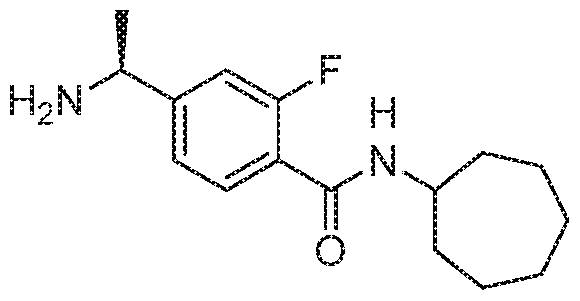
Step 1 : (S)-4-(1-(tert-butoxycarbonylamino)ethyl)-2-fluorobenzoic acid
To (S)-4-(1-aminoethyl)-2-fluorobenzoic acid (900 mg, 4.10 mmol) was added, DCM (1 1 ml), Huenig's Base (2.147 ml, 12.29 mmol) and di-tert-butyl dicarbonate (1.998 ml, 8.61 mmol). The reaction is not soluble so NMP (11.00 ml) was added. The reaction was sonicated for 10 minutes and was stirred at room temperature for 22 hours, followed by LCMS. The DCM was concentrated mostly off, and 120 ml of water was added. The solution was basified with 10 ml of 5M NaOH. The basic aqueous solution was extracted with 2 x 50 ml of (15% ethyl acetate in heptane) solution. Then to the basic aqueous solution was added 150 ml of ethyl acetate and with stirring acidified with 2M HCI solution to about pH 3. Then the ethyl acetate was extracted, and the acidic water extracted again with 100 ml of ethyl acetate. The organic layers were combined, washed with 0.5M HCI solution (1 x 40 ml), with water (3 x 40 ml) and concentrated to give 1 104 mg of the (S)-4-(1-(tert-butoxycarbonylamino)ethyl)-2-fluorobenzoic acid which was used as is. LCMS: BOC fragment pattern with a main peak of -15 at m/z 269.0 and weak peak of -56 at m/z 228.0, compared to expected m/z 284.0 (M + H)+, Rt 0.72 min.
Step 2: (S)-tert-butyl 1-(4-(cycloheptylcarbamoyl)-3-fluorophenyl)ethylcarbamate
To (S)-4-(1-(tert-butoxycarbonylamino)ethyl)-2-fluorobenzoic acid (80 mg, 0.282 mmol) was added NMP (1 ml), cycloheptanamine (80 mg, 0.706 mmol), Huenig's Base (0.197 ml, 1.130 mmol) and HATU (215 mg, 0.565 mmol). The reaction was stirred at room temperature for 6 hours, followed by LCMS. To the reaction was added 1.5 ml of NMP. The reaction mixture was filtered, purified by prep LC and lypholized to give 60 mg of (S)-tert-butyl 1-(4- (cycloheptylcarbamoyl)-3-fluorophenyl)ethylcarbamate as a TFA salt. LCMS m/z 379.1 (M + H)+, Rt 1.03 min.
Step 3: (S)-4-(1-aminoethyl)-N-cycloheptyl-2-fluorobenzamide
To (S)-tert-butyl 1-(4-(cycloheptylcarbamoyl)-3-fluorophenyl)ethylcarbamate (60 mg, 0.159 mmol) was added HCI (4M in Dioxane, 3 mL, 12.00 mmol) and MeOH (0.3 ml). The reaction was stirred at room temperature for 1 hour. The solvent was concentrated off to residue to give (S)-4-(1-aminoethyl)-N-cycloheptyl-2-fluorobenzamide as the HCI salt, assume quanitative yield (0.159 mmol). LCMS m/z 279.0 (M + H)+, Rt 0.62 min.
Intermediate 12: 5-chloro-6-(2,2,2-trif luoroethoxy)nicotinaldehyde

Step 1 : Preparation of ethyl 5-chloro-6-(2,2,2-trifluoroethoxy)nicotinate
To a solution of ethyl 5,6-dichloronicotinate (6.28 g, 28.5 mmol) and 2,2,2-trifluoroethanol (2.71 ml, 37.1 mmol) in THF (90 ml) at -73oC was added NaHMDS (37.1 ml, 37.1 mmol). The reaction was stirred at -73 °C for 30 minutes, then at 0 °C for 5 hours. The reaction was quenched with 30 ml_ saturated NH4CI solution. The reaction mixture was then poured into 50 ml_ brine and phases were separated. The aqueous layer was extracted with DCM (2x100ml_). The combined organics were dried (Na2SC>4) and concentrated. Silica gel chromatography with 100% heptane to 30% EtOAc in heptane provided final product (7.51 g). LCMS m/z 284.1 (M + H)+, Rt 1.07 min.
Step 2: Preparation of (5-chloro-6-(2,2,2-trifluoroethoxy)pyridin-3-yl)methanol
To a solution of ethyl 5-chloro-6-(2,2,2-trifluoroethoxy)nicotinate (7.51 g, 26.5 mmol) in Et20 (200ml_) was added LiBH4 (0.865 g, 39.7 mmol), followed by drop wise addition of methanol (1.61 1 ml, 39.7 mmol). The reaction was refluxed at 40 °C for one hour. The reaction mixture was then cooled to 0 °C, and quenched with HCI (1 M) until pH=2 for aqueous layer. The phases were separated and the aqueous layer was extracted with DCM (3x200ml_). The organic was then dried (Na2SC>4) and concentrated under reduced pressure to give final crude product (6.31 g). LCMS m/z 242.1 (M + H)+, Rt 0.77 min.
Step 3: Preparation of 5-chloro-6-(2,2,2-trifluoroethoxy)nicotinaldehyde
To a solution of (5-chloro-6-(2,2,2-trifluoroethoxy)pyridin-3-yl)methanol (4.00 g, 16.56 mmol) in EtOAc (15 ml_) was added manganese(IV) oxide (16.93 g, 166 mmol). The reaction was heated with microwave at 120 °C for 30 minutes. The mixture was then filtered through a pad of celite, and rinsed with EtOAc. The filtrated was concentrated to give crude product (3.38 g).
Intermediate 13: (R,E)-N-((5-(4-chlorophenyl)isoxazol-3-yl)methylene)-2-methylpropane-2- sulfinamide

A suspension of 5-(4-chlorophenyl)isoxazole-3-carbaldehyde (2.00 g, 9.63 mmol), (R)-2- methylpropane-2-sulfinamide (1.28 g, 10.6 mmol, 1.1 equiv) and anhydrous copper(ll) sulfate (2.31 g, 14.5 mmol, 1.5 equiv) in 1 ,2-dichloroethane (19 ml_) was heated at 55 °C for 2 - 18 hours. The reaction was then cooled to room temperature and filtered through a pad of celite, using 1 ,2-dichloroethane to wash through. The filtrate was concentrated in vacuo to give crude (R,E)-N-((5-(4-chlorophenyl)isoxazol-3-yl)methylene)-2-methylpropane-2-sulfinamide as a green solid, which was used without further purification. LCMS m/z 311.0 (M + H)+; Rt- 1.11 min. The intermediates in Table 7 were prepared using a method similar to that described for the preparation of Intermediate 13.
Table 7.

Table 8. Chemical name and analytical data for each intermediate listed in Table 7.
Intermediate: Name Analytical data
D1 : (R,E)-N-((5-(4-chlorophenyl)isoxazol-3- LCMS m/z 311.0 (M + H)+; Rt-1.11 min yl)methylene)-2-methylpropane-2-sulfinamide
D2: (R, E)-N-((2-(4-chlorophenyl)thiazol-5- LCMS m/z 327.1 (M + H)+; Rt-1.13 min yl)methylene)-2-methylpropane-2-sulfinamide
D3: (R,E)-N-((5-chloro-6-(2,2,2- LCMS m/z 343.1 (M + H)+; Rt-1.08 min
trifluoroethoxy)pyridin-3-yl)methylene)-2- methylpropane-2-sulfinamide
(R)-N-((S)-1-(5-(4-chlorophenyl)isoxazol-3-yl)ethyl)-2-methylpropane-2-

The intermediates in Table 9 were prepared using a method similar to that described for the preparation of Intermediate 14.
Table 9.

Table 10. Chemical name, NMR chemical shifts and LCMS signal for each intermediate listed in Table 9.

Intermediate 15: (S)-1-(5-(4-chlorophenyl)isoxazol-3-yl)ethanamine

A solution of hydrochloric acid (4.0 M in 1 ,4-dioxane, 2.1 mL, 8.2 mmol, 2 equiv) was added to a solution of (R)-N-((S)-1-(5-(4-chlorophenyl)isoxazol-3-yl)ethyl)-2-methylpropane-2- sulfinamide (1.34 g, 4.1 mmol) in 1 ,4-dioxane at room temperature. A precipitate formed. The suspension was stirred for 1 hour and then concentrated in vacuo to give the hydrochloride salt of (S)-1-(5-(4-chlorophenyl)isoxazol-3-yl)ethanamine (1.1 g, light yellow solid), which was used without purification. H NMR (400 MHz, CD3OD) δ 7.87 (d, J = 8.8 Hz, 2H), 7.56 (d, J = 8.8 Hz, 2H), 6.98 (s, 1 H), 4.72 (q, J = 6.9 Hz, 1 H), 1.72 (d, J = 7.0 Hz, 3H). LCMS m/z 223.1 (M + H)+; Rt-0.59 min.
The intermediates in Table 11 were prepared using a method similar to that described for the preparation of Intermediate 15.
Table 11.

Table 12. Chemical name, NMR chemical shifts and LCMS signal for each intermediate listed in Table 1 1.
Intermediate: Name 1 H NMR (400 MHz, LCMS
CD3OD ) δ ppm
F1 : (S)-1-(5-(4-chlorophenyl)isoxazol-3- 5 7.87 (d, J = 8.8 Hz, 2H), 7.56 LCMS m/z yl)ethanamine (d, J = 8.8 Hz, 2H), 6.98 (s, 1 H), 223.1 (M +
4.72 (q, J = 6.9 Hz, 1 H), 1.72 H)+; Rt-0.59
(d, J = 7.0 Hz, 3H). min
F2: (S)-1-(2-(4-chlorophenyl)thiazol-5- 5 7.97 (d, J = 8.7 Hz, 2H), 7.94 LCMS m/z yl)ethanamine (s, 1 H), 7.52 (d, J = 8.7 Hz, 2H), 239.9 (M +
4.95 (m, 1 H), 1.78 (d, J = 6.8 H)+; Rt-0.59 Hz, 3H) min
F3: (S)-1-(5-chloro-6-(2,2,2- LCMS m/z trifluoroethoxy)pyridin-3-yl)ethanamine 255.1 (M +
H)+, Rt 0.62 min.
Intermediate 16: 4-chloro-N'-hydroxybenzimidamide

A solution of 4-chlorobenzonitrile (1.00 g, 7.27 mmol), hydroxylamine hydrochloride (0.758 g, 10.9 mmol, 1.5 equiv), and N-ethyl-N-isopropylpropan-2-amine (2.0 mL, 1 1.6 mmol, 1.6 equiv) in absolute ethanol (7.3 mL) was heated at reflux for 2 hours. The reaction was then cooled to room temperature and concentrated in vacuo. The residue was dissolved in ethyl acetate (100 mL) and washed sequentially with water (2 x 75 mL), saturated aqueous sodium chloride (50 mL), dried over anhydrous magnesium sulfate, filtered and concentrated in vacuo to give 4- chloro-N'-hydroxybenzimidamide (1.2 g, white solid) in 97% yield. The material was used without further purification. LCMS m/z 171.0 (M + H)+; Rt 0.35 min.
Intermediate 17: (S)-tert-butyl 1-(3-(4-chlorophenyl)-1 ,2,4-oxadiazol-5-yl)ethylcarbamate

A solution of 4-chloro-N'-hydroxybenzimidamide (1.24 g, 7.27 mmol), (S)-2-(tert- butoxycarbonylamino)propanoic acid (1.38 g, 7.27 mmol, 1.0 equiv), and Ν,Ν'- methanediylidenedicyclohexanamine (1.65 g, 8.00 mmol, 1.1 equiv) in 1 ,4-dioxane (73 mL)
was heated at 100 °C for 18 hours. The reaction was then cooled to room temperature and concentrated in vacuo. Silica gel column chromatography (EtOAc/Heptane, 0 to 35%) provided (S)-tert-butyl 1-(3-(4-chlorophenyl)-1 ,2,4-oxadiazol-5-yl)ethylcarbamate (1.13 g, white solid) in 48% yield. H NMR (400 MHz, CDCI3) δ 8.03 (d, J = 8.8 Hz, 2H), 7.47 (d, J = 8.8 Hz, 2H), 5.18 (m, 1 H), 1.64 (d, J = 6.8 Hz, 3H), 1.47 (s, 9H).
Intermediate 18: (S)-1-(3-(4-chlorophenyl)-1 ,2,4-oxadiazol-5-yl)ethanamine

2,2,2-Trifluoroacetic acid (4 mL, 52 mmol) was added to a solution of (S)-tert-butyl 1-(3-(4- chlorophenyl)-1 ,2,4-oxadiazol-5-yl)ethylcarbamate (0.613 g, 1.89 mmol) in DCM (10 mL) at room temperature. The solution was stirred at room temperature for 1 hour and then concentrated in vacuo. The residue was dissolved in chloroform (100 mL) and washed with saturated aqueous sodium bicarbonate (100 mL). The layers were separated and the aqueous layer was extracted with chloroform (3 x 30 mL) and the combined organic layers were dried over anhydrous sodium sulfate, filtered and concentrated in vacuo to give (S)-1-(3-(4- chlorophenyl)-1 ,2,4-oxadiazol-5-yl)ethanamine (500 mg, yellow oil). The material was used without further purification. H NMR (400 MHz, CDCI3) δ 8.04 (d, J = 8.7 Hz, 2H), 7.47 (d, J = 8.6 Hz, 2H), 4.37 (q, J = 6.9 Hz, 1 H), 1.62 (d, J = 6.9 Hz, 3H). LCMS m/z 224.0 (M + H)+; Rt- 0.56 min.
Intermediate 19: (R)-N-((S)-1-(2-fluoro-4-(trifluoromethyl)phenyl)ethyl)-2-methylpropane-2- sulfinamide

Step 1 : To a oven dried round bottom flask with stir bar was added 2-fluoro-4-(trifluoromethyl) benzaldehyde (5 g, 26.0 mmol), (R)-2-methylpropane-2-sulfinamide (3.47 g, 28.6 mmol) and DCE (52 mL). To this mixture was then added copper (II) sulfate (6.23 g, 39.0 mmol). The reaction mixture was heated in a preheated oil bath at 55 °C for 18 hours. The reaction mixture
was filtered through a pad celite, washing the solids with DCE. The filtrate was concentrated to afford a viscous green oil of (R,E)-N-(2-fluoro-4-(trifluoromethyl)benzylidene)-2-methyl propane-2-sulfinamide (7.3 g, 24.7 mmol, 95 % yield). Material was taken onto next step without further purification. H NMR (400 MHz, CDCI3) 5 1.29 (s, 9 H) 7.44 (d, J=10.08 Hz, 1 H) 7.51 (d, J=8.27 Hz, 1 H) 8.13 (t, J=7.46 Hz, 1 H) 8.92 (s, 1 H). LCMS m/z 296.0 (M + H)+, Rt 1.02 min.
Step 2: To a solution of (R,E)-N-(2-fluoro-4-(trifluoromethyl)benzylidene)-2-methylpropane-2- sulfinamide (7.3 g, 24.7 mmol) in CH2CI2 (247 mL) cooled to 0°C (water/ice bath) under nitrogen, was added 3M methyl magnesium bromide (33 mL, 99 mmol) in Et20. Reaction mixture allowed to stir for 30 min at 0°C, then gradually allowed to warm to room temperature and stirred for 1 hour at room temperature. Reaction mixture was cooled to 0°C then quenched with the slow addition of a saturated solution of NH4CI. Aqueous mixture extracted with EtOAc. Organic phases combined, washed with water, brine, dried (Na2SC>4), filtered and concentrated onto silica gel. Silica gel column chromatography (EtOAc/Heptane 40 to 100%) provided (R)-N-((S)-1-(2-fluoro-4-(trifluoromethyl)phenyl)ethyl)-2-methylpropane-2-sulfinamide (4.68 g, 15.0 mmol, 61 % yield) as a white crystalline solid. H NMR (400 MHz, CDCL3) δ 1.22 (s, 9 H) 1.60 (d, J=6.80 Hz, 3 H) 3.38 (d, J=4.01 Hz, 1 H) 4.87 - 4.97 (m, 1 H) 7.33 (d, J=10.32 Hz, 1 H) 7.39 - 7.45 (m, 1 H) 7.49 - 7.55 (m, 1 H). LCMS m/z 312.0 (M + H)+, Rt 0.92 min.
Intermediate 20: (R)-N-((S)-1-(6-tert-butylpyridin-3-yl)ethyl)-2-methylpropane-2-sulfinamide

(R)-N-((S)-1-(6-tert-butylpyridin-3-yl)ethyl)-2-methylpropane-2-sulfinamide is prepared with methods similar to those used to prepare Intermediate 19. H NMR (400 MHz, CDCI3) δ 1.22 (s, 9 H) 1.37 (s, 9 H) 1.57 (d, J=6.75 Hz, 3 H) 3.31 (d, J=3.37 Hz, 1 H) 4.56 - 4.65 (m, 1 H) 7.32 (d, J=8.22 Hz, 1 H) 7.57 (dd, J=8.24, 2.23 Hz, 1 H) 8.54 (d, J=2.05 Hz, 1 H). MS m/z 283.1 (M + H)+, Rt 0.51 min.
Intermediate 21 : (S)-N-((S)-1-(1-(4-chlorophenyl)-1 H-imidazol-4-yl)ethyl)-2-methylpropane-2- sulfinamide

Step 1 : To a mixture of 1 H-imidazole-4-carbaldehyde (3.71 g, 38.6 mmol), 1-chloro-4- iodobenzene (13.81 g, 57.9 mmol), (1 R,2R)-N1 ,N2-dimethylcyclohexane-1 ,2-diamine (1.10 g, 7.72 mmol), copper(l) iodide (0.368 g, 1.93 mmol) and cesium carbonate (25.2 g, 77 mmol) was added DMF (50 ml_). The reaction was sealed and heated to 110 °C for 18 hours. The reaction mixture was then cooled to RT and diluted with a saturated solution of NH4CI. A brown solid develops. Solid was collected, washed with water and air dried. Solid material was then dissolved in 10%MeOH:90%DCM solution and dried (Na2S04), filtered and concentrated to afford a dark brown solid 1-(4-chlorophenyl)-1 H-imidazole-4-carbaldehyde (8.55 g, 41.4 mmol, 107 % yield). Material as used without further purification. LCMS m/z 207.1 (M + H)+, Rt 0.58 min.
Step 2: To a suspension of (S)-(-)tert-Butanesulfinamide (2.35 g, 19.4 mmol) and 1-(4- chlorophenyl)-1 H-imidazole-4-carbaldehyde (4 g, 19.4 mmol) in DCE (39 ml_) was added CuS04 (4.63 g, 29.0 mmol). The reaction mixture was heated at 60 °C for 18 hours in a oil bath. A dark brown suspension resulted. The reaction mixture was then cooled to RT, filtered through a pad of celite, rinsed with DCM. The solution was then concentrated onto silica gel. Silica gel column chromatography (EtOAc/Heptane 0 to 100%) provided (S,E)-N-((1-(4- chlorophenyl)-1 H-imidazol-4-yl)methylene)-2-methylpropane-2-sulfinamide (1.69 g, 5.45 mmol, 28.2 % yield) as a light brown solid. LCMS m/z 310.0 (M + H)+, Rt 0.75 min.
Step 3: To a solution of (S,E)-N-((1-(4-chlorophenyl)-1 H-imidazol-4-yl)methylene)-2- methylpropane-2-sulfinamide (1.69 g, 5.45 mmol) in DCM (27 ml_), cooled to -40°C (acetone/dry ice) under N2, was added 3M MeMgBr (7.27 ml, 21.8 mmol) in diethyl ether. Reaction mixture allowed to stir for 1 hr at -40 °C. Reaction mixture was quenched with the slow addition of a saturated solution of NH4CI and diluted with EtOAc. Phases partitioned, aqueous phase exctracted with EtOAc and the organic layers combined washed with water, brine, dried (Na2S04), filtered and concentrated onto silica gel. Silica gel column chromatography (EtOAc/MeOH: EtOAc 0 to 5%) provided (S)-N-((S)-1-(1-(4-chlorophenyl)-1 H- imidazol-4-yl)ethyl)-2-methylpropane-2-sulfinamide (1.1 1 g, 3.41 mmol, 62 % yield). H NMR (400 MHz, CDCL3) 5 1.25 (s, 9 H), 1.58 (d, J=6.65 Hz, 3 H), 3.80 (d, J=5.48 Hz, 1 H), 4.59
(quin, J=6.36 Hz, 1 H), 7.26 (s, 1 H), 7.33 (d, J=8.61 Hz, 2 H), 7.41 - 7.47 (m, 2 H), 7.76 (d, J=1.17 Hz, 1 H). LCMS m/z 326.1 (M + H)+, Rt 0.59 min.
Intermediate 22: (R)-2-methyl-N-((S)-1-(4-(1-methyl-1 H-pyrazol-4-yl)phenyl)ethyl)propane-2- sulfinamide

Step 1 : To a oven dried round bottom flask with stir bar was added 4-iodobenzaldehyde (3 g, 12.9 mmol), (R)-2-methylpropane-2-sulfinamide (1.72 g, 14.2 mmol) and DCE (26 mL). To this mixture was then added CuS04 (3.10 g, 19.4 mmol). Reaction mixture heated in a preheated oil bath to 55 °C for 18 hr. Filtered the slurry through a 0.45 μΜ syringe filter washing solids with DCM. Combined filtrate was concentrated onto silica gel. Silica gel column chromatography (EtOAc/Heptane 0 to 50%) provided (R,E)-N-(4-iodobenzylidene)-2- methylpropane-2-sulfinamide (3.85 g, 11.4 mmol, 88 % yield) as a viscous yellow oil. H NMR (400 MHz, CDCLs) δ 1.26 (s, 9 H), 7.56 (d, J=8.22 Hz, 2 H), 7.83 (d, J=8.22 Hz, 2 H), 8.52 (s, 1 H). LCMS m/z 335.8 (M + H)+, Rt 1.05 min.
Step 2: To a solution of (R,E)-N-(4-iodobenzylidene)-2-methylpropane-2-sulfinamide (2.54 g, 7.58 mmol) in DCM (76 mL), cooled to 0°C (water/icebath) under N2, was added 3M MeMgBr (10.1 mL, 30.3 mmol) in diethyl ether. Reaction mixture allowed to stir for 30 min at 0 °C. Then gradually allowed to warm to RT and stirred for 1 hr at RT. Reaction mixture was then quenched with the slow addition of a saturated solution of NH4CI and diluted with EtOAc. Phases partitioned, aqueous phase extracted with EtOAc and the organic layers combined washed with water, brine, dried (Na2S04), filtered and concentrated to afford (R)-N-((S)-1-(4- iodophenyl)ethyl)-2-methylpropane-2-sulfinamide (2.31 g, 6.58 mmol, 87 % yield) as white crystalline solid. LCMS m/z 351.9 (M + H)+, Rt 0.91 min.
Step 3: To a microwave vial with stir bar was added (R)-N-((S)-1-(4-iodophenyl)ethyl)-2- methylpropane-2-sulfinamide (400 mg, 1.139 mmol), 1-Methyl-4-1 H-pyrazoleboronic acid, pincacol ester (711 mg, 3.42 mmol), DME (6 mL), Na2C03 (5.69 ml, 11.4 mmol) (2.0 M aq) and PdCl2(dppf).CH2Cl2 adduct (47 mg, 0.06 mmol). Vessel was capped and heated by microwave irradiation for 20 min at 100 °C. Reaction mixture diluted with a saturated solution of NH4CI and EtOAc. Phases partitioned. Aqueous phase extracted with EtOAc and organic phases
combined, washed with water, brine, dried (Na2S04), filtered and concentrated onto silica gel. Silica gel column chromatography (EtOAc/Heptane 50 to 100%) provided a pale brown solid of (R)-2-methyl-N-((S)-1-(4-(1-methyl-1 H-pyrazol-4-yl)phenyl)ethyl)propane-2-sulfinamide (217 mg, 0.710 mmol, 62.4 % yield). LCMS m/z 306.0 (M + H)+, Rt 0.71 min.
The Intermediates in Table 13 were prepared by a method similar to the one described for the preparation of Intermediate 22.
Table 13.

Table 14. Chemical name, NMR chemical shifts and LCMS signal for each intermediate listed in Table 13.

Intermediate 23: (S)-1-(4-(1-methyl-1 H-pyrazol-4-yl)phenyl)ethanamine

The Intermediates in Table 15 were prepared by a method similar to the one described for the preparation of Intermediate 23. Table 15.

Table 16. Chemical name, NMR chemical shifts and LCMS signal for each intermediate listed in Table 15.
Intermediate: Name H NMR (400 MHz) δ ppm LCMS
H1 : (S)-1-(4-(1 ,5-dimethyl-1 H- LCMS m/z pyrazol-4-yl)phenyl)ethanamine 216.1 (M +
H)+, Rt 0.42 min.
H2: (S)-1-(1-(4-chlorophenyl)- (D20) δ 1.74 (d, J=6.65 Hz, 3 H), 4.76 - LCMS m/z 1 H-imidazol-4-yl)ethanamine 4.85 (m, 1 H), 7.61 (q, =9.00 Hz, 4 H), 205.1 (M +
8.00 (s, 1 H), 9.04 (s, 1 H) H)+, Rt 0.44 min
H3: (S)-1-(2-fluoro-4-(trifluoro (D20) δ 1.67 (d, J=6.94 Hz, 3 H), 4.84 (q, LCMS m/z methyl)phenyl)ethanamine J=6.94 Hz, 1 H), 7.54 - 7.70 (m, 3 H) 208.0 (M +
H)+, Rt 0. 51 min
H4: (S)-1-(6-(tert-butyl)pyridin-3- (D20) δ ppm 1.48 (s, 9 H), 1.71 (d, J=6.94 LCMS m/z yl)ethanamine Hz, 3 H), 4.81 (q, J=7.14 Hz, 1 H), 8.15 (d, 179.0 (M +
J=8.66 Hz, 1 H), 8.61 (d, J=8.56 Hz, 1 H), H)+, Rt 0. 31 8.72 (s, 1 H) min
Intermediate 24: 4-((S)-1-aminoethyl)-2-chloro-N-((1 r,4S)-4-hydroxycyclohexyl)benzamide
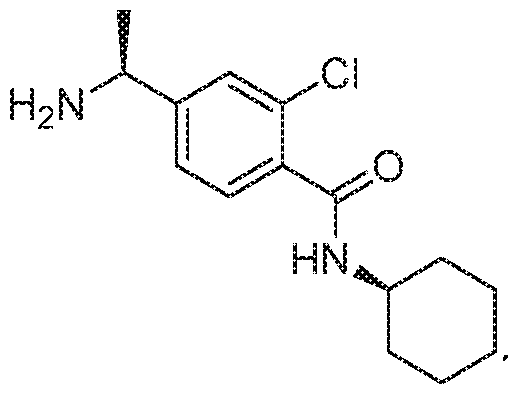
Step 1 : To a round bottom flask with stir bar was added 4-((S)-1 aminoethyl-2-chlorobenzoic acid HCI salt (1.05 g, 4.45 mmol) followed by the addition of THF (40 mL). To this solution was added DIEA (1.86 ml, 10.7 mmol). The reaction mixture becomes cloudy white followed by the addition of di-tert-butyl dicarbonate (1.07 g, 4.89 mmol). Resulting reaction mixture allowed to stir for 18 hours at room temperature. At which time the reaction mixture was then heated to 60 °C for 2 hours in an oil bath. Di-tert-butyl dicarbonate (1.07 g, 4.89 mmol) and NMP (20 ml) were then added and the resulting reaction mixture allowed to stir for 2 hours at 60 °C. Volatiles were removed. The resulting oil was diluted with a saturated solution of NH4CI and the aqueous mixture extracted with EtOAc. The organic phases combined, washed twice with water, brine, dried (Na2S04), filtered and concentrated to a viscous yellow oil of (S)-4-(1-(tert- butoxycarbonylamino)ethyl)-2-chlorobenzoic acid (2.32 g, 6.19 mmol, 139 % yield) which contains some excess di-tert-butyl dicarbonate and NMP. LCMS m/z 284.9 (M + H)+(carboxylic acid fragment + CH3CN adduct), Rt 0.75 min.
Step 2: To a round bottom flask with stir bar was added (S)-4-(1-(tert- butoxycarbonylamino)ethyl)-2-chlorobenzoic acid (450 mg, 1.20 mmol), (1 r,4r)-4-
aminocyclohexanol (415 mg, 3.60 mmol), EDC HCI (460 mg, 2.40 mmol), 1 -hydroxy- 7-aza- benzotriazole (229 mg, 1.68 mmol) and DMF (6 ml_). To this mixture was then added DIEA (629 μΙ_, 3.60 mmol). Reaction mixture was allowed to stir at room temperature for 18 hours. The reaction mixture was diluted with water and extracted with EtOAc. The organic phases were combined, washed with twice with water, brine, dried (Na2SC>4), filtered and concentrated to a brown crystalline tert-butyl (S)-1-(3-chloro-4-((1 r,4S)-4- hydroxycyclohexylcarbamoyl)phenyl)ethylcarbamate (330 mg, 0.83 mmol, 69 % yield). LCMS m/z 391.1 (M + H)+, Rt 0.71 min. Step 3: To a round bottom flask containing tert-butyl (S)-1-(3-chloro-4-((1 r,4S)-4- hydroxycyclohexyl carbamoyl)phenyl)ethylcarbamate (330 mg, 0.83 mmol) was added dioxane (6 ml_). To this mixture was then added HCI in dioxane (2.08 ml_, 8.31 mmol, 4 M). Resulting homogenous reaction mixture allowed to stir at RT for 1 hr whereupon a biphasic mixture resulted. To this mixtuew was added MeOH (2 ml_) and solution becomes homogenous again. Allowed mixture to stir 15 min at RT. Volatiles removed in vacuo residue triturated with ethyl ether to afford 4-((S)-1-aminoethyl)-2-chloro-N-((1 r,4S)-4-hydroxycyclohexyl)benzamide (299 mg, 0.90 mmol, 108 % yield) as a brown HCI salt. LCMS m/z 297.0 (M + H)+, Rt 0.33 min.
EXAMPLES
Example 1
(S)-1-(2-((1-(4-phenoxyphenyl)ethyl)amino)pyrimidin-4-yl)pyrrolidin-2-one

To a solution of 1-(2-chloropyrimidin-4-yl)pyrrolidin-2-one (38.7 mg, 0.20 mmol) and (S)-1-(4- phenoxyphenyl)ethanamine (43.8 mg, 0.21 mmol) in NMP (1 mL) was added Hunig's Base (0.2 mL, 1.14 mmol). The reaction mixture was heated at 180°C for 20 min in the microwave. The reaction mixture was filtered and purified on the reverse phase HPLC. Fractions containing product were combined and lyophilized to give (S)-1-(2-((1-(4- phenoxyphenyl)ethyl)amino)pyrimidin-4-yl)pyrrolidin-2-one as a TFA salt (2.7 mg, 3% yield, 99% purity). HRMS(A) m/z 375.1820 (M + H)+; Rt 1.70 min.
The compounds in Table 17 were prepared using methods similar to those described for the preparation of Example 1.
Table 17


Table 18. Chemical name, NMR chemical shifts and LCMS signal for each compound listed in Table 17.
Example: Name H NMR (400 MHz) δ ppm LCMS
2: (S)-1-(5-Fluoro-2-((1- HRMS(A)
phenylethyl)amino)pyrimidin-4- m/z yl)pyrrolidin-2-one 301.1462 (M
+ H)+; Rt 1.86 min.
3: (S)-1-(5-fluoro-2-((1-(4- (300 MHz, d6-DMSO) δ 8.27 (d, J = HRMS(A) phenoxyphenyl)ethyl)amino)pyrimidin- 3.22 Hz, 1 H), 7.77 (br. s., 1 H), 7.28 - m/z
4-yl)pyrrolidin-2-one 7.47 (m, 4H), 7.06 - 7.19 (m, 1 H), 393.1720 (M
6.94 (t, J = 8.94 Hz, 4H), 4.94 (br. s., + H)+; Rt 1 H), 3.79 - 3.95 (m, 4H), 1.87 - 2.19 2.32 min (m, 2H), 1.42 (d, J = 6.74 Hz, 3H).
4: 1-(5-Fluoro-2-((1-(1-(4- HRMS(A) fluorophenyl)-1 H-pyrazol-4- m/z yl)ethyl)amino)pyrimidin-4-yl)pyrrolidin- 385.1585 (M 2-one + H)+; Rt
1.91 min
5: (S)-1-(5-Fluoro-2-((1-(5- HRMS(A) neopentylisoxazol-3- m/z yl)ethyl)amino)pyrimidin-4-yl)pyrrolidin- 362.1988 (M 2-one + H)+; Rt
2.08 min
6: (S)-1-(2-((1-(6-(tert-butyl)pyridin-3- (CD3OD) δ 8.67 (d, J = 1.96 Hz, 1 H), HRMS(A) yl)ethyl)amino)-5-fluoropyrimidin-4- 8.58 (dd, J = 2.15, 8.41 Hz, 1 H), 8.19 m/z yl)pyrrolidin-2-one (d, J = 3.13 Hz, 1 H), 8.06 (d, J = 8.61 358.2033 (M
Hz, 1 H), 5.17 (q, J = 7.30 Hz, 1 H), + H)+; Rt 3.86 - 3.98 (m, 1 H), 3.45 - 3.55 (m, 1.19 min 1 H), 2.50 - 2.60 (m, 2H), 2.21 (q, J =
6.91 Hz, 2H), 1.63 (d, J = 7.04 Hz,
3H), 1.52 (s, 9H).
7: (S)-1-(5-Fluoro-2-((1-(4-(1-methyl- (CD3OD) δ 8.16 (d, J = 3.13 Hz, 1 H), HRMS(A) 1 H-pyrazol-4- 7.92 (s, 1 H), 7.78 (s, 1 H), 7.43 - 7.57 m/z yl)phenyl)ethyl)amino)pyrimidin-4- (m, 2H), 7.37 (d, J = 8.22 Hz, 2H), 381.1831 (M yl)pyrrolidin-2-one 4.95 - 5.06 (m, 1 H), 3.82 - 4.06 (m, + H)+; Rt
4H), 2.57 (t, J = 7.83 Hz, 2H), 2.11 - 1.70 min 2.31 (m, 2H), 1.53 (d, J = 7.04 Hz,
3H).
8: (S)-1-(5-Fluoro-2-((1-(2-fluoro-4- (CD3OD) δ 8.18 (d, J = 3.13 Hz, 1 H), HRMS(A)
(trifluoromethyl)phenyl)ethyl)- 7.56 - 7.70 (m, 1 H), 7.34 - 7.53 (m, m/z amino)pyrimidin-4-yl)pyrrolidin-2-one 2H), 5.31 (q, J = 7.04 Hz, 1 H), 3.82 - 387.1238 (M
3.99 (m, 1 H), 2.44 - 2.69 (m, 2H), + H)+; Rt 2.04 - 2.30 (m, 2H), 1.55 (d, J = 7.04 2.22 min Hz, 3H).
9: (S)-1-(2-((1-(4-(1 ,5-Dimethyl-1 H- (CD3OD) δ 8.18 (d, J = 3.52 Hz, 1 H), HRMS(A) pyrazol-4-yl)phenyl)ethyl)amino)-5- 7.57 (s, 1 H), 7.40 - 7.46 (m, 2H), 7.29 m/z fluoropyrimidin-4-yl)pyrrolidin-2-one - 7.38 (m, 2H), 4.97 - 5.09 (m, 1 H), 395.1993 (M
3.97 (td, J = 7.09, 10.08 Hz, 1 H), 3.85 + H)+; Rt (s, 3H), 2.52 - 2.68 (m, 2H), 2.40 (s, 1.77 min 3H), 2.10 - 2.30 (m, 2H), 1.55 (d, J =
7.04 Hz, 3H).
10: (S)-N-Cycloheptyl-2-fluoro-4-(1-((5- HRMS(A) fluoro-4-(2-oxopyrrolidin-1-yl)pyrimidin- m/z
2-yl)amino)ethyl)benzamide 458.2358 (M
+ H)+; Rt 2.19 min
11 : 1-(5-Fluoro-2-(((S)-1- (CD3OD) δ 8.19 (t, J = 3.13 Hz, 1 H), HRMS(A) phenylethyl)amino)pyrimidin-4-yl)-5- 7.34 - 7.40 (m, 2H), 7.26 - 7.33 (m, m/z methylpyrrolidin-2-one 2H), 7.14 - 7.25 (m, 1 H), 4.99 (q, J = 315.1613 (M
6.78 Hz, 1 H), 4.28 - 4.50 (m, 2H), + H)+; Rt 2.27 - 2.69 (m, 5H), 1.63 - 1.94 (m, 1.99 min 2H), 1.44 - 1.60 (m, 5H), 1.30 (d, J =
6.26 Hz, 3H).
12: 1-(5-Fluoro-2-(((S)-1-(4- HRMS(A) phenoxyphenyl)ethyl)amino)pyrimidin- m/z
4-yl)-5-methylpyrrolidin-2-one 407.1873 (M
+ H)+; Rt 2.42 min
13: 1-(5-Fluoro-2-(((S)-1-(5- HRMS(A) neopentylisoxazol-3- m/z yl)ethyl)amino)pyrimidin-4-yl)-5- 376.2143 (M methylpyrrolidin-2-one + H)+; Rt
2.19 min
14: 1-(2-(((S)-1-(6-(tert-Butyl)pyridin-3- HRMS(A)
yl)ethyl)amino)-5-fluoropyrimidin-4-yl)- m/z
5-methylpyrrolidin-2-one 372.2194 (M
+ H)+; Rt 1.29 min
15: 1 -(5-Fluoro-2-(((S)-1 -(2-fluoro-4- (CD3OD) 5 8.1 1 - 8.28 (m, 1 H), 7.61 HRMS(A) (trifluoromethyl)phenyl)ethyl)- (q, J = 7.43 Hz, 1 H), 7.37 - 7.51 (m, m/z amino)pyrimidin-4-yl)-5- 2H), 5.1 1 - 5.39 (m, 1 H), 2.28 - 2.72 401.1393 (M methylpyrrolidin-2-one (m, 4H), 1.55 (d, J = 7.04 Hz, 3H), + H)+; Rt
1.29 (d, J = 6.26 Hz, 3H). 2.30 min
16: 1-(2-(((S)-1-(4- (CD3OD) 5 8.20 (dd, J = 3.13, 4.70 HRMS(A) Chlorophenyl)ethyl)amino)-5- Hz, 1 H), 7.33 - 7.40 (m, 2H), 7.26 - m/z fluoropyrimidin-4-yl)-5-methylpyrrolidin- 7.32 (m, 2H), 4.94 - 5.06 (m, 1 H), 349.1228 (M 2-one 4.42 (q, J = 6.78 Hz, 1 H), 2.29 - 2.73 + H)+; Rt
(m, 4H), 1.69 - 1.93 (m, 1 H), 1.51 (dd, 2.17 min J = 4.70, 7.04 Hz, 2H), 1.29 (d, J =
5.87 Hz, 3H).
17: (S)-1-(2-((1-(4- (CD3OD) 5 8.16 (d, J = 3.13 Hz, 1 H), HRMS(A)
Chlorophenyl)ethyl)amino)-5- 7.35 - 7.42 (m, 2H), 7.23 - 7.32 (m, m/z fluoropyrimidin-4-yl)pyrrolidin-2-one 2H), 4.92 - 5.04 (m, 1 H), 3.94 (td, J = 335.1064 (M
7.24, 10.17 Hz, 1 H), 2.57 (t, J = 8.02 + H)+; Rt Hz, 2H), 2.12 - 2.29 (m, 2H), 1.50 (d, 2.07 min J = 7.04 Hz, 3H).
18: (S)-1-(5-Fluoro-2-((1-(4- HRMS(A) isobutoxyphenyl)ethyl)amino)pyrimidin- m/z
4-yl)pyrrolidin-2-one 373.2037 (M
+ H)+; Rt 2.39 min
19: (S)-1-(5-Chloro-2-((1- HRMS(A) phenylethyl)amino)pyrimidin-4- m/z yl)pyrrolidin-2-one 317.1159 (M
+ H)+; Rt 1.95 min
20: (S)-1-(5-chloro-2-((1-(4- (CD3OD) 5 8.25 (s, 1 H), 7.27 - 7.46 HRMS(A) phenoxyphenyl)ethyl)amino)pyrimidin- (m, 4H), 7.04 - 7.17 (m, 1 H), 6.94 (t, J m/z
4-yl)pyrrolidin-2-one = 8.61 Hz, 4H), 4.96 - 5.1 1 (m, 1 H), 409.1430 (M
3.85 - 3.99(m, 1 H), 2.56 (t, J = 7.83 + H)+; Rt
Hz, 2H), 2.09 - 2.31 (m, 2H), 1.53 (d, 2.40 min
J = 7.04 Hz, 3H), 1.39 (dd, J = 3.13,
6.65 Hz, 1 H).
21 : 2-Chloro-4-((S)-1-((5-chloro-4-(2- (CD3OD) 5 8.22 (s, 1 H), 7.48 (s, 1 H), HRMS(A) oxopyrrolidin-1-yl)pyrimidin-2- 7.31 - 7.43 (m, 2H), 4.97 (br. s., 1 H), m/z yl)amino)ethyl)-N-((1 r,4S)-4- 3.87 - 3.99 (m, 1 H), 3.55 (br. s., 1 H), 492.1570 (M hydroxycyclohexyl)-benzamide 2.50 - 2.64 (m, 2H), 2.16 - 2.27 (m, + H)+; Rt
2H), 1.92 - 2.08 (m, 5H), 1.52 (d, J = 1.55 min 7.04 Hz, 3H), 1.32 - 1.45 (m, 6H).
22: 1-(5-Fluoro-2-((1-(3-(4- (CD3OD) 5 8.24 (d, J = 3.13 Hz, 1 H), HRMS(A) fluorophenyl)-1 ,2,4-oxadiazol-5- 7.98 - 8.15 (m, 2H), 7.27 (t, J = 8.80 m/z yl)ethyl)amino)pyrimidin-4-yl)pyrrolidin- Hz, 2H), 5.20 - 5.41 (m, 1 H), 3.84 - 387.1378 (M 2-one 4.00 (m, 1 H), 2.48 - 2.63 (m, 2H), + H)+; Rt
2.06 - 2.25 (m, 2H), 1.73 (d, J = 7.04 1.98 min Hz, 3H), 1.39 (dd, J = 3.13, 6.65 Hz,
1 H).
23: 1-(5-Fluoro-2-(((S)-1- (CD3OD) 5 8.27 (s, 1 H), 7.42 (d, J = HRMS(A) phenylethyl)amino)pyrimidin-4-yl)- 7.43 Hz, 2H), 7.25 - 7.35 (m, 1 H), m/z
2,3,3-trimethyl-5-oxopyrrolidine-2- 7.21 (d, J = 7.04 Hz, 2H), 5.02 - 5.16 368.1883 (M carbonitrile (m, 1 H), 2.40 - 2.69 (m, 2H), 1.49 - + H)+; Rt
1.64 (m, 5H), 1.33 - 1.48 (m, 3H), 2.14 min 1.06 - 1.27 (m, 3H).
24: 1-(2-(((S)-1-(4- (CD3OD) 5 8.28 (d, J = 2.35 Hz, 1 H), HRMS(A) Chlorophenyl)ethyl)amino)-5- 7.36 - 7.51 (m, 2H), 7.30 (dd, J = m/z fluoropyrimidin-4-yl)-2,3,3-trimethyl-5- 8.61 , 12.52 Hz, 2H), 4.98 - 5.20 (m, 402.1490 (M oxopyrrolidine-2-carbonitrile 1 H), 3.75 (td, J = 6.65, 13.30 Hz, 1 H), + H)+; Rt
3.25 (q, J = 7.43 Hz, 1 H), 1.62 (s, 2.32 min 3H), 1.52 (dd, J = 7.04, 9.00 Hz, 3H),
1.44 (s, 2H), 1.36 - 1.41 (m, 9H), 1.21
(s, 2H), 1.12 (s, 1 H).
Examples 25 and 26

Prepared using methods similar to those described for the preparation of Example 1. The diastereomers were separated on reverse phase HPLC to give (S)-1-(5-fluoro-2-(((S)-1-(4-(1- methyl-1 H-pyrazol-4-yl)phenyl)ethyl)amino)pyrimidin-4-yl)-5-methylpyrrolidin-2-one and (R)-1- (5-fluoro-2-(((S)-1-(4-(1-methyl-1 H-pyrazol-4-yl)phenyl)ethyl)amino)pyrimidin-4-yl)-5- methylpyrrolidin-2-one.
Example 25: Peak 1 : H NMR (400 MHz, CD3OD) δ 8.20 (d, J = 2.74 Hz, 1 H), 7.91 (s, 1 H), 7.77 (s, 1 H), 7.48 (d, J = 8.22 Hz, 2H), 7.35 (d, J = 8.22 Hz, 2H), 4.34 (br. s., 1 H), 3.92 (s, 3H), 2.27 - 2.73 (m, 2H), 1.69 - 1.85 (m, 1 H), 1.52 (d, J = 7.04 Hz, 3H). HRMS(A) m/z 395.1993 (M + H)+; Rt 1.76 min.
Example 26: Peak 2: H NMR (400 MHz, CD3OD) δ 8.20 (d, J = 3.13 Hz, 1 H), 7.92 (s, 1 H), 7.79 (s, 1 H), 7.49 (d, J = 8.22 Hz, 2H), 7.37 (d, J = 8.22 Hz, 2H), 4.99 (d, J = 6.65 Hz, 1 H), 4.45 (d, J = 6.26 Hz, 1 H), 2.33 - 2.70 (m, 3H), 1.73 - 1.95 (m, 1 H), 1.53 (d, J = 7.04 Hz, 3H), 1.31 (d, J = 6.26 Hz, 3H). HRMS(A) m/z 395.1997 (M + H)+; Rt 1.82 min.
Example 27 and 28

Prepared using methods similar to those described for the preparation of Example 1. The diastereomers separated on reverse phase HPLC to give (S)-1-(2-(((S)-1-(4-(1 ,5-dimethyl-1 H-
pyrazol-4-yl)phenyl)ethyl)amino)-5-fluoropyrimidin-4-yl)-5-methylpyrrolidi and (R)-1-(2-
(((S)-1-(4-(1 ,5-dimethyl-1 H-pyrazol-4-yl)phenyl)ethyl)amino)-5-fluoropyrimidin-4-yl)-5- methylpyrrolidin-2-one. Example 27: Peak 1 : H NMR (400 MHz, CD3OD) δ 8.21 (d, J = 2.74 Hz, 1 H), 7.53 (s, 1 H), 7.36 - 7.45 (m, 2H), 7.32 (d, J = 8.22 Hz, 2H), 4.34 (d, J = 5.48 Hz, 1 H), 3.84 (s, 3H), 2.47 - 2.65 (m, 2H), 2.39 (s, 4H), 1.67 - 1.84 (m, 1 H), 1.54 (d, J = 7.04 Hz, 3H). HRMS(A) m/z 409.2144 (M + H)+; Rt 1.82 min. Example 28: Peak 2: H NMR (400 MHz, CD3OD) δ 8.20 (d, J = 2.74 Hz, 1 H), 7.55 (s, 1 H), 7.38 - 7.47 (m, 2H), 7.31 - 7.36 (m, 2H), 4.98 - 5.15 (m, 1 H), 4.46 (q, J = 6.78 Hz, 1 H), 3.85 (s, 3H), 2.45 - 2.76 (m, 2H), 2.40 (s, 4H), 1.76 - 1.96 (m, 1 H), 1.55 (d, J = 6.65 Hz, 3H), 1.31 (d, J = 6.26 Hz, 3H). HRMS(A) m/z 409.2151 (M + H)+; Rt 1.88 min. Example 29
1-(5-Fluoro-2-(((S)-1-phenylethyl)amino)pyrimidin-4-yl)-2-methyl-5-oxopyrrolidine-2-carbonitrile

To a solution of 1-(2-chloro-5-fluoropyrimidin-4-yl)-2-methyl-5-oxopyrrolidine-2-carbonitrile (40.4 mg, 0.16 mmol) and (S)-l-phenylethanamine (0.03 mL, 0.23 mmol) in DMSO (1 mL) was added Hunig's Base (0.1 mL, 0.57 mmol). The reaction mixture was heated at 180°C for 25 min in the microwave. The reaction mixture was filtered and purified on the reverse phase HPLC. Fractions containing product were combined and lyophilized to give 1-(5-fluoro-2-(((S)- 1-phenylethyl)amino)pyrimidin-4-yl)-2-methyl-5-oxopyrrolidine-2-carbonitrile as a TFA salt (12.0 mg, 16% yield, 99% purity). H NMR (400 MHz, CD3OD) δ 8.27 (br. s., 1 H), 7.42 (d, J = 7.83 Hz, 2H), 7.30 (d, J = 7.43 Hz, 2H), 7.20 (d, J = 6.26 Hz, 1 H), 5.01 - 5.25 (m, 2H), 2.59 - 2.95 (m, 4H), 1.74 (s, 3H), 1.53 (dd, J = 7.24, 10.37 Hz, 3H). HRMS(A) m/z 340.1563 (M + H)+; Rt 1.91 min.
The compounds in Table 19 were prepared using methods similar to those described for the preparation of Example 29.
Table 19.


Table 20. Chemical name, NMR chemical shifts and LCMS signal for each compound listed in Table 19.
Example: Name H NMR (400 MHz) 5 ppm LCMS
30: 1-(2-(((S)-1-(4- HRMS(A) chlorophenyl)ethyl)amino)-5- m/z fluoropyrimidin-4-yl)-2-methyl-5- 374.1176 (M oxopyrrolidine-2-carbonitrile + H)+; Rt
2.11 min
31 : (S)-1-(2-((1-(3-(4-chlorophenyl)- HRMS(A)
1 ,2,4-oxadiazol-5-yl)ethyl)amino)-5- m/z fluoropyrimidin-4-yl)pyrrolidin-2-one 403.1085 (M
+ H)+; Rt 2.16 min
32: (S)-6-(5-Fluoro-2-((1-(4- (CD3OD) δ 8.15 (d, J = 3.13 Hz, 1 H), HRMS(A) isobutoxyphenyl)ethyl)amino)pyrimidin- 7.29 (d, J = 8.61 Hz, 2H), 6.86 (d, J = m/z
4-yl)-2-oxa-6-azaspiro[3.4]octan-7-one 8.61 Hz, 2H), 4.56 - 4.78 (m, 3H), 415.2146 (M
4.20 (d, J =10.56 Hz, 1 H), 3.73 (d, J = + H)+; Rt 6.65 Hz, 2H), 2.95 (s, 2H), 1.94 - 2.18 2.21 min (m, 1 H), 1.50 (d, J = 7.04 Hz, 3H),
1.03 (d, J = 6.65 Hz, 6H).
33: (S)-1-(2-(((S)-1-(5-(4- HRMS(A) Chlorophenyl)isoxazol-3- m/z yl)ethyl)amino)-5-fluoropyrimidin-4-yl)- 432.1233 (M 5-(hydroxymethyl)pyrrolidin-2-one + H)+; Rt
1.92 min
34: (S)-1-(6-Chloro-2-((1-(2-(4- (CD3OD) δ 7.88 (d, J = 8.61 Hz, 2H), HRMS(A) chlorophenyl)thiazol-5- 7.77 (s, 1 H), 7.64 (s, 1 H), 7.48 (d, J = m/z yl)ethyl)amino)pyrimidin-4-yl)pyrrolidin- 8.61 Hz, 2H), 5.39 - 5.61 (m, 1 H), 434.0607 (M
2-one 3.87 - 4.18 (m, 2H), 2.63 (t, J = 8.02 + H)+; Rt
Hz, 2H), 2.12 (t, J = 7.83 Hz, 2H), 2.62 min 1.70 (d, J = 7.04 Hz, 3H).
35: (S)-1-(6-Chloro-2-((1 -(5-(4- (CD3OD) δ 7.82 (d, J = 8.61 Hz, 2H), HRMS(A) chlorophenyl)isoxazol-3- 7.63 (s, 1 H), 7.52 (d, J = 8.61 Hz, m/z yl)ethyl)amino)pyrimidin-4-yl)pyrrolidin- 2H), 6.80 (s, 1 H), 5.31 (br. s. , 1 H), 418.0832 (M 2-one 3.99 - 4.07 (m, 1 H), 2.62 (t, J = 8.02 + H)+; Rt
Hz, 2H), 2.03 - 2.18 (m, 2H), 1.63 (d, 2.53 min J = 7.04 Hz, 3H).
36: (S)-1-(2-((1-(5-(4- (CD3OD) δ 1.16 (s, 3 H), 1.21 (s, 3 H), HRMS(A) Chlorophenyl)isoxazol-3- 1.71 (d, J=7.04 Hz, 3 H), 2.52 (s, 2 m/z yl)ethyl)amino)pyrimidin-4-yl)-4,4- H), 3.64 - 3.88 (m, 2 H), 5.36 (d, 412.1533 (M dimethylpyrrolidin-2-one J=7.04 Hz, 1 H), 6.87 (s, 1 H), 7.54 + H)+; Rt
(d, J=8.61 Hz, 2 H), 7.83 (d, J=8.61 2.13 min Hz, 3 H), 8.15 (d, J=6.65 Hz, 1 H).
37: 1 -(2-(((S)-1-(5-(4- (CD3OD) 5 1.17 (dd, J=16.82, 6.65 HRMS(A) Chlorophenyl)isoxazol-3- Hz, 3 H), 1 .72 (d, J=7.04 Hz, 3 H), m/z yl)ethyl)amino)pyrimidin-4-yl)-4- 2.32 - 2.42 (m, 1 H), 2.54 (dt, 398.1378 (M methylpyrrolidin-2-one J=14.97, 7.58 Hz, 1 H), 2.81 (dd, + H)+; Rt
J=17.22, 8.22 Hz, 1 H), 3.59 (dd, 2.00 min J=1 1 .74, 7.04 Hz, 1 H), 4.24 (dd,
J=1 1 .54, 7.63 Hz, 1 H), 5.40 (br. s. , 1
H), 6.88 (s, 1 H), 7.54 (d, J=8.61 Hz,
2 H), 7.83 (d, J=8.61 Hz, 2 H), 7.88
(d, J=6.65 Hz, 1 H), 8.14 (d, J=6.65
Hz, 1 H).
38: (S)-1-(2-((1-(2-(4- (CD3OD) δ 1.22 (d, J=9.39 Hz, 6 H), HRMS(A) Chlorophenyl)thiazol-5-yl)ethyl)amino)- 1.75 (d, J=7.04 Hz, 3 H), 2.52 (s, 2 m/z pyrimidin-4-yl)-4,4-dimethylpyrrolidin-2- H), 3.64 - 3.92 (m, 1 H), 5.54 (d, 428.1310 (M one J=6.65 Hz, 1 H), 7.49 (d, J=8.61 Hz, 2 + H)+; Rt
H), 7.76 (d, J=5.87 Hz, 1 H), 7.80 (s, 2.22 min 1 H), 7.89 (d, J=8.61 Hz, 2 H), 8.15
(d, J=6.65 Hz, 1 H).
39: 1 -(2-(((S)-1-(2-(4- HRMS(A)
Chlorophenyl)thiazol-5- m/z yl)ethyl)amino)pyrimidin-4-yl)-4- 414.1 148 (M
methylpyrrolidin-2-one + H)+; Rt
2.08 min
40: (S)-1-(2-((1-(2-(4- (CD3OD) δ 1.47 (br. s., 3 H), 1.69 (s, 3 HRMS(A) Chlorophenyl)thiazol-5- H), 1.76 (d, J=7.04 Hz, 3 H), 1.97 - m/z yl)ethyl)amino)pyrimidin-4-yl)-5,5- 2.04 (m, 2 H), 2.58 - 2.66 (m, 2 H), 428.1307 (M dimethylpyrrolidin-2-one 5.51 (q,J=6.78 Hz, 1 H), 7.49 (d, + H)+; Rt
J=8.61 Hz, 3 H), 7.76 (s, 1 H), 7.89 2.18 min (d, J=8.61 Hz, 2 H), 8.18 (d, J=6.26
Hz, 1 H).
41 : (S)-1-(2-((1-(1-(4-Chlorophenyl)- HRMS(A) 1 H-imidazol-4- m/z yl)ethyl)amino)pyrimidin-4-yl)-5,5- 411.1697 (M dimethylpyrrolidin-2-one + H)+; Rt
1.49 min
42: (4S,5S)-5-Benzyl-1-(2-(((S)-1-(1- (CD3OD) δ 1.71 (d, J=7.04 Hz, 3 H), HRMS(A) (4-chlorophenyl)-1 H-imidazol-4- 2.16 - 2.27 (m, 1 H), 2.59 (dd, m/z yl)ethyl)amino)pyrimidin-4-yl)-4- J=17.22, 7.83 Hz, 1 H), 3.09 - 3.21 489.1803 (M hydroxypyrrolidin-2-one (m, 2 H), 4.41 - 4.63 (m, 1 H), 4.91 - + H)+; Rt
5.06 (m, 1 H), 5.28 (q, J=6.52 Hz, 1 1.52 min H), 7.12 (br. s., 6 H), 7.46 (br. s., 1 H),
7.53 (d, J=7.43 Hz, 2 H), 7.68 (d,
J=6.26 Hz, 1 H), 7.75 (br. s., 1 H),
8.22 (d, J=6.65 Hz, 1 H).
43: (4S,5S)-5-benzyl-1-(2-(((S)-1-(5-(4- (CD3OD) δ 1.69 (d, J=7.04 Hz, 3 H), HRMS(A) chlorophenyl)isoxazol-3- 2.19 (dd, J=17.22, 9.39 Hz, 1 H), 2.56 m/z yl)ethyl)amino)pyrimidin-4-yl)-4- (dd, J=17.41 , 8.02 Hz, 1 H), 3.03 - 490.1659 (M hydroxypyrrolidin-2-one 3.13 (m, 1 H), 4.54 (q, J=7.83 Hz, 1 + H)+; Rt
H), 5.02 (br. s., 1 H), 5.27 - 5.38 (m, 1 2.03 min H), 6.79 (s, 1 H), 7.07 (br. s., 5 H),
7.45 (d, J=8.22 Hz, 2 H), 7.60 - 7.77
(m, 3 H), 8.19(d, J=6.65 Hz, 1 H).
Example 44

Prepared using methods similar to those described for the preparation of Example 29. The diastereomers separated on reverse phase HPLC to give (S)-1-(2-(((S)-1-(5-chloro-6-(2,2,2- trifluoroethoxy)pyridin-3-yl)ethyl)amino)-5-fluoropyrimidin-4-yl)-5-methylpyrrolidin-2-one and (R)-1-(2-(((S)-1-(5-chloro-6-(2,2,2-trifluoroethoxy)pyridin-3-yl)ethyl)amino)-5-fluoropyrimidin-4- yl)-5-methylpyrrolidin-2-one.
Example 44: Peak 2 : HRMS(A) m/z 448.1161 (M + H)+; Rt 2.31 min.
Examples 45 and 46

Prepared using methods similar to those described for the preparation of Example 29. The diastereomers separated on reverse phase HPLC to give (S)-1-(2-(((S)-1-(5-(4- chlorophenyl)isoxazol-3-yl)ethyl)amino)-5-fluoropyrimidin-4-yl)-5-methylpyrrolidin-2-one and (R)-1-(2-(((S)-1-(5-(4-chlorophenyl)isoxazol-3-yl)ethyl)amino)-5-fluoropyrimidin-4-yl)-5- methylpyrrolidin-2-one.
Example 45: Peak 1 : H NMR (400 MHz, CD3OD) δ 8.27 (d, J = 2.74 Hz, 1 H), 7.80 (d, J = 8.61 Hz, 2H), 7.51 (d, J = 8.61 Hz, 2H), 6.79 (s, 1 H), 5.17 (d, J = 7.04 Hz, 1 H), 4.36 - 4.64 (m, 1 H), 2.39 - 2.73 (m, 2H), 1.63 (d, J = 7.04 Hz, 3H), 1.31 (s, 1 H), 1.03 (br. s., 2H). HRMS(A) m/z 416.1284 (M + H)+; Rt 2.26 min.
Example 46: Peak 2. H NMR (400 MHz, CD3OD) δ 8.27 (d, J = 2.74 Hz, 1 H), 7.81 (d, J = 8.61 Hz, 2H), 7.52 (d, J = 8.61 Hz, 2H), 6.80 (s, 1 H), 5.24 (d, J = 7.04 Hz, 1 H), 4.51 (q, J = 6.78 Hz, 1 H), 2.28 - 2.81 (m, 2H), 1.75 - 1.93 (m, 1 H), 1.64 (d, J = 7.04 Hz, 3H), 1.29 (d, J = 5.87 Hz, 3H). HRMS(A) m/z 416.1293 (M + H)+; Rt 2.27 min.
Examples 47 and 48

In a 100ml_ round-bottomed flask was added 2,4,6-trichloropyrimidine (1.03 g, 5.62 mmol) and 5-methyl-2-pyrrolidinone (0.58 g, 5.90 mmol) in DMF (12 ml_) which was cooled with an ice bath. NaH (95%, 0.204 g, 8.50 mmol) was added in 1 portion (bubbling occurred), and the reaction turned bright yellow. The reaction was stirred for 20 min, and then the ice bath was removed. The reaction stirred overnight at room temperature. The reaction mixture was quenched slowly with water. The reaction mixture was poured into water and EtOAc. The phases were separated, and the aqueous layer extracted with EtOAc. The combined organic layers were washed with diluted brine, dried over ΙΝ^βΟφ filtered, and concentrated to a brown oil. The crude material was purified by silica gel chromatography (eluent 0-100% EtOAc/heptane) to give 1-(2,6-dichloropyrimidin-4-yl)-5-methylpyrrolidin-2-one (245.9 mg, 18% yield) as an off white solid. LCMS: m/z 246.0 (M + H)+, Rt 0.87 min. The enantiomers were separated via chiral HPLC on an AD column (20 ml/min, 21 x 250 mm) eluting 95/5 heptane/EtOH (v/v) to give (S)-1-(2,6-dichloropyrimidin-4-yl)-5-methylpyrrolidin-2-one and (R)- 1-(2,6-dichloropyrimidin-4-yl)-5-methylpyrrolidin-2-one.
Peak 1 : 81.9 mg. Retention time on analytical chiral column: 3.378 min (8 min run time).
Peak 2: 73.1 mg. Retention time on analytical chiral column: 4.652 min (8 min run time). Peak 1 carried on in a method similar to those described for the preparation of Example 29 (reaction temperature 85°C). The resulting regioisomers were separated via chiral HPLC on an AD column (20 ml/min, 21 x 250 mm) eluting 60/40 heptane/EtOH (v/v) to give product as a single diastereomer (Example 47). H NMR (400 MHz, CD3OD) δ 1.63 (d, J=7.04 Hz, 3 H), 1.77 (t, J=10.56 Hz, 1 H), 2.18 - 2.35 (m, 1 H), 2.39 - 2.56 (m, 1 H), 2.66 - 2.88 (m, 1 H), 4.72 - 4.82 (m, 1 H), 6.79 (s, 1 H), 7.51 (d, J=8.61 Hz, 2 H), 7.61 (s, 1 H), 7.80 (d, J=8.61 Hz, 2 H). HRMS(A) m/z 432.0994 (M + H)+; Rt 2.61 min. Retention time on analytical chiral column: 3.293 min (8 min run time).
Peak 2 carried on in a method similar to those described for the preparation of Example 29 (reaction temperature 85°C). The resulting regioisomers were separated via chiral HPLC on an AD column (20 ml/min, 21 x 250 mm) eluting 60/40 heptane/EtOH (v/v) to give product as a single diastereomer (Example 48). H NMR (400 MHz, CD3OD) δ 1.36 (d, J=6.26 Hz, 3 H),
1.62 (d, J=6.65 Hz, 3 H), 1.80 (ddt, J=12.23, 9.49, 2.64, 2.64 Hz, 1 H), 2.19 - 2.37 (m, 1 H), 2.42 - 2.58 (m, 1 H), 2.79 (dt, J=17.61 , 9.78 Hz, 1 H), 4.67 - 4.79 (m, 1 H), 6.79 (s, 1 H), 7.42 (s, 1 H), 7.52 (d, J=8.61 Hz, 2 H), 7.82 (d, J=8.61 Hz, 2 H). HRMS(A) m/z 432.0993 (M + H)+; Rt 2.63 min. Retention time on analytical chiral column: 2.994 min (10 min run time).
Example 49
(S)-1-(2-((1-(4-((4-Acetylpiperazin-1-yl)methyl)-3-fluorophenyl)ethyl)amino)-5-chloropyrimidin- 4-yl)pyrrolidin-2-one

Step 2: To a cooled (0°C) suspension of (S)-methyl 4-(1-aminoethyl)-2-fluorobenzoate hydrochloride (1.1556 g, 4.01 mmol) in THF (50 ml_) was added a solution of LAH in THF (2.0 M in THF, 6.0 ml_, 12.00 mmol), and the resulting white cloudy mixture was stirred at 0 °C for 1 h and then at room temperature for 2.5 h. The reaction mixture was cooled with an ice bath and quenched by addition of Na2S04 decahydrate/Celite (1 :1 by weight) until gas evolution ceased. The reaction mixture was filtered, and the filtrate was concentrated to give (S)-(4-(1- aminoethyl)-2-fluorophenyl)methanol as a light tan solid (0.70 g). Taken on to next step without purification. H NMR (400 MHz, CD3OD) δ ppm 1.39 (d, J=6.65 Hz, 3 H), 4.30 (d, J=6.65 Hz, 1
H), 4.58 (s, 2 H), 7.02 - 7.22 (m, 2 H), 7.41 (t, J=7.83 Hz, 1 H). LCMS m/z 170.1/153.0 (M + H)+, Rt 0.28 min.
Step 3: 1-(2,5-Dichloropyrimidin-4-yl)pyrrolidin-2-one (176.5 mg, 0.76 mmol), (S)-(4-(1- aminoethyl)-2-fluorophenyl)methanol (156.2 mg, 0.92 mmol), Hunig's base (0.8 ml_, 4.58 mmol) were combined in DMSO (3 ml) and heated in the microwave at 190°C for 25 min. Reaction mixture wet loaded to silica gel cartridge and purified by silica gel chromatography (0-100% EtOAc: heptane). DMSO still present so material lyophilized to a yellow gum (0.14 g). The material was repurified by column chromatography (0-100% EtOAc: heptane) to give (S)-1-(5- chloro-2-((1-(3-fluoro-4-(hydroxymethyl)phenyl)ethyl)amino)pyrimidin-4-yl)pyrrolidin-2-one as a clear film (135.1 mg, 49% yield). LCMS m/z 365.1 (M + H)+, Rt 0.64 min.
Step 4: To a solution of (S)-1-(5-chloro-2-((1-(3-fluoro-4- (hydroxymethyl)phenyl)ethyl)amino)pyrimidin-4-yl)pyrrolidin-2-one (64.3 mg, 0.18 mmol) in DCM (5 ml_) was added Mn02 (690 mg, 7.94 mmol). The reaction was stirred at room temperature for 3 h. Reaction mixture filtered and rinsed with DCM. The filtrate was concentrated to give (S)-4-(1-((5-chloro-4-(2-oxopyrrolidin-1-yl)pyrimidin-2-yl)amino)ethyl)-2- fluorobenzaldehyde as a white film (0.1246 g). Crude material taken on to the next reaction without purification. LCMS m/z 363.1 (M + H)+, Rt 0.68 min.
Step 5: To a solution of (S)-4-(1-((5-chloro-4-(2-oxopyrrolidin-1-yl)pyrimidin-2-yl)amino)ethyl)-2- fluorobenzaldehyde (assume theoretical yield from previous experiment, 32.2 mg, 0.09 mmol) and 1 -acetyl piperazine (44.7 mg, 0.35 mmol) in MeOH (2 mL) was added acetic acid (13 uL, 0.22 mmol). The mixture was shaken at room temperature for 40 minutes. (5-Ethyl-2- methylpyridin-1-ium-1-yl)trihydroborate (0.05 uL, 0.34 mmol) was added, and the reaction was shaken at room temperature overnight. Five drops of water added to quench the reaction, and the reaction was concentrated. Crude material was purified by reverse phase HPLC. Fractions containing product were lyopholized to give (S)-1-(2-((1-(4-((4-Acetylpiperazin-1- yl)methyl)-3-fluorophenyl)ethyl)amino)-5-chloropyrimidin-4-yl)pyrrolidin-2-one as a TFA salt (46.7 mg, 88% yield, 99% purity). NMR (400 MHz, CD3OD) δ 1.54 (d, J=7.04 Hz, 3 H), 2.15 (s, 3 H), 2.17 - 2.27 (m, 2 H), 2.48 - 2.65 (m, 2 H), 3.68 - 3.97 (m, 2 H), 4.36 (s, 2 H), 5.33 (d, J=6.65 Hz, 1 H), 7.22 - 7.34 (m, 2 H), 7.56 (t, J=7.83 Hz, 1 H), 8.23 (br. s., 1 H). HRMS(A) m/z 475.2026 (M + H)+; Rt 1.22 min.
Example 50
(S)-1-(2-((1-(4-((4-amino-4-methylpiperidin-1-yl)methyl)-3-fluorophenyl)ethyl)amino)-5- chloropyrimidin-4-yl)pyrrolidin-2-one

Prepared using methods similar to those described for the preparation of Example 49. H NMR (400 MHz), CD3OD) δ 1.48 - 1.58 (m, 7 H), 2.02 - 2.25 (m, 6 H), 2.54 (t, J=8.02 Hz, 2 H), 3.40 - 3.55 (m, 2 H), 3.73 - 3.98 (m, 2 H), 4.34 (s, 2 H), 5.32 (d, J=4.70 Hz, 1 H), 7.22 - 7.38 (m, 2 H), 7.54 (t, J=7.83 Hz, 1 H), 8.23 (br. s., 1 H). HRMS(A) m/z 461.2237 (M + H)+; Rt 1.01 min
Examples 51 and 52
(S)-1-(2-(((S)-1-(4-((4-acetylpiperazin-1-yl)methyl)-3-fluorophenyl)ethyl)amino)-5- fluoropyrimidin-4-yl)-5-methylpyrrolidin-2-one and (R)-1-(2-(((S)-1-(4-((4-acetylpiperazin-1- yl)methyl)-3-fluorophenyl)ethyl)amino)-5-fluoropyrimidin-4-yl)-5-methylpyrrolidin-2-one

Prepared using methods similar to those described for the preparation of Example 49. At the benzyl alcohol, the diastereomers separated on reverse phase HPLC to give (S)-1-(5-fluoro-2- (((S)-1-(3-fluoro-4-(hydroxymethyl)phenyl)ethyl)amino)pyrimidin-4-yl)-5-methylpyrrolidin-2-one and (R)-1-(5-fluoro-2-(((S)-1-(3-fluoro-4-(hydroxymethyl)phenyl)ethyl)amino)pyrimidin-4-yl)-5- methylpyrrolidin-2-one.
Peak 1 : LCMS m/z 363.2 (M + H)+, Rt 0.68 min.
Peak 2: H NMR (400 MHz, CDCI3) δ ppm 1.30 (d, J=6.26 Hz, 3 H), 1.52 (d, J=7.04 Hz, 2 H), 1.69 - 1.93 (m, 1 H), 2.29 - 2.39 (m, 1 H), 2.41 - 2.51 (m, 1 H), 2.55 - 2.65 (m, 1 H), 4.28 - 4.46 (m, 1 H), 4.64 (s, 2 H), 5.21 (t, J=7.04 Hz, 1 H), 5.67 (br. s., 1 H), 7.01 - 7.10 (m, 2 H), 7.21 - 7.39 (m, 1 H) ,8.09 (br. s., 1 H). LCMS m/z 363.2 (M + H)+, Rt 0.71 min.
Peak 1 carried on in a method similar to those described for the preparation of Example 49 to prepare Example 51. H NMR (400 MHz, CD3OD) δ 1.34 (t, J=7.63 Hz, 1 H), 1.53 (d, J=7.04 Hz, 3 H), 1.72 - 1.82 (m, 1 H), 2.15 (s, 3 H), 2.32 - 2.44 (m, 1 H), 2.46 -2.63 (m, 2 H), 2.76 (s, 1
H), 2.87 (q, =7.70 Hz, 1 H), 4.35 (s, 2 H), 5.29 (q, =7.04 Hz, 1 H), 7.17 - 7.36 (m, 2 H), 7.55 (t, J=7.83 Hz, 1 H), 8.19 (br. s., 1 H). HRMS(A) m/z 473.2478 (M + H)+; Rt 1.20 min.
Peak 2 carried on carried on in a method similar to those described for the preparation of Example 49 to prepare Example 52. H NMR (400 MHz, CD3OD) δ 1.30 (d, J=5.87 Hz, 3 H), 1.53 (d, J=7.04 Hz, 3 H), 1.78 - 1.91 (m, 1 H), 2.15 (s, 3 H), 2.34 - 2.51 (m, 2 H), 2.56 - 2.70 (m, 1 H), 4.35 (s, 2 H), 4.38 - 4.51 (m, 1 H), 5.30 (q, J=6.78 Hz, 1 H), 7.23 - 7.33 (m, 2 H), 7.58 (t, J=8.02 Hz, 1 H), 7.86 (d, J=8.22 Hz, 1 H), 8.19 (br. s., 1 H), 8.41 (d, J=8.22 Hz, 1 H), 8.58 (s, 1 H). HRMS(A) m/z 473.2474 (M + H)+; Rt 1.27 min.
Example 53
(R)-1-(2-(((S)-1-(1-(4-chlorophenyl)-1 H-imidazol-4-yl)ethyl)amino)-5-fluoropyrimidin-4-yl)-4- hydroxypyrrolidin-2-one

To a solution of (R)-1-(2-chloro-5-fluoropyrimidin-4-yl)-4-hydroxypyrrolidin-2-one (25.0 mg, 0.11 mmol) and (S)-1-(1-(4-chlorophenyl)-1 H-imidazol-4-yl)ethanamine (39.0 mg, 0.15 mmol) in DMSO (0.54 ml_) was added Hunig's Base (66.0 uL, 0.38 mmol) in a 2 ml microwave vial. The reaction mixture was heated at 140°C for 23 hrs in a pre-heated oil bath. The mixture was then filtered and purified on the reverse phase HPLC. Fractions containing product were combined and lyophilized to give (R)-1-(2-(((S)-1-(1-(4-chlorophenyl)-1 H-imidazol-4- yl)ethyl)amino)-5-fluoropyrimidin-4-yl)-4-hydroxypyrrolidin-2-one as a TFA salt (10.6 mg, 18% yield, 95% purity). H NMR (400 MHz, DMSO-d6) δ 1.53 (d, J=6.90 Hz, 3 H) 2.24 - 2.34 (m, 2 H) 2.63 - 2.69 (m, 1 H) 2.83 (dd, =17.34, 6.04 Hz, 1 H) 4.00 (dd, =10.81 , 5.14 Hz, 1 H) 4.37 - 4.46 (m, 1 H) 5.1 1 (br. s., 1 H) 7.61 (br. s., 1 H) 7.67 (d, J=8.85 Hz, 2 H) 7.74 - 7.81 (m, 2 H) 7.97 (br. s., 1 H) 8.35 (d, J=3.23 Hz, 1 H) 9.17 (br. s., 1 H). HRMS(A) m/z 417.1238 (M + H)+; Rt-1.17 min.
The compounds in Table 21 were prepared using methods similar to those described for the preparation of Example 53.
Table 21.


Table 22. Chemical name, NMR chemical shifts and LCMS signal for each compound listed in Table 21.
Example: Name H NMR (400 MHz) 5 ppm LCMS
54: (R)-1-(2-(((S)-1-(5-(4- (DMSO-d6) δ 1.46 (d, J=6.99 Hz, 3 H) HRMS(A) chlorophenyl)isoxazol-3- 2.16 - 2.30 (m, 1 H) 2.57 - 2.63 (m, 1 m/z yl)ethyl)amino)-5-fluoropyrimidin-4-yl)- H) 2.77 (dd, J=17.36, 6.16 Hz, 2 H) 418.1080 (M 4-hydroxypyrrolidin-2-one 3.62 (d, J=9.34 Hz, 1 H) 3.90 (br. s., 1 + H)+; Rt
H) 4.36 (br. s., 1 H) 6.91 (s, 1 H) 7.51 1.88 min (d, J=8.75 Hz, 2 H) 7.71 (d, J=7.24
Hz, 1 H) 7.79 (d, J=8.75 Hz, 2 H) 8.27
(d, J=3.23 Hz, 1 H)
55: (R)-1-(2-(((S)-1-(2-(4- (DMSO-d6) δ 1.58 (d, J=6.94 Hz, 3 H) HRMS(A) chlorophenyl)thiazol-5-yl)ethyl)amino)- 2.22 - 2.33 (m, 1 H) 2.83 (dd, J=17.39, m/z
5-fluoropyrimidin-4-yl)-4- 6.09 Hz, 1 H) 3.70 (d, J=10.32 Hz, 2 434.0851 (M hydroxypyrrolidin-2-one H) 4.39 - 4.46 (m, 2 H) 5.30 (br. s., 1 + H)+; Rt
H) 7.47 - 7.55 (m, 2 H) 7.77 (s, 1 H) 1.92 min 7.87 (d, J=8.71 Hz, 2 H) 8.33 (d,
J=3.23 Hz, 1 H)
56: (R)-1-(2-(((S)-1-(2-(4- (DMSO-d6) δ 1.61 (d, J=6.94 Hz, 3 H) HRMS(A) chlorophenyl)thiazol-5- 2.33 (d, J=17.41 Hz, 1 H) 2.92 (dd, m/z yl)ethyl)amino)pyrimidin-4-yl)-4- J=17.22, 5.62 Hz, 1 H) 3.93 (d, J=4.40 416.0944 (M hydroxypyrrolidin-2-one Hz, 3 H) 4.35 (br. s., 1 H) 5.36 - 5.46 + H)+; Rt
(m, 1 H) 7.47 - 7.56 (m, 3 H) 7.79 (s, 1 1.63 min H) 7.84 - 7.90 (m, 2 H) 8.18 (d, J=5.97
Hz, 1 H)
57: (R)-1-(2-(((S)-1-(5-(4- (500MHz, DMSO-d6) 5 1.57 (d, HRMS(A) chlorophenyl)isoxazol-3- J=7.10 Hz, 3 H) 2.26 - 2.45 (m, 1 H) m/z
yl)ethyl)amino)pyrimidin-4-yl)-4- 2.94 (dd, J=17.30, 5.80 Hz, 1 H) 3.86 400.1 169 (M hydroxypyrrolidin-2-one (s, 1 H) 3.94 (d, J=1 1.70 Hz, 1 H) 4.35 + H)+; Rt
(dt, J=5.40, 3.0 Hz, 1 H) 5.29 (t, 1.60 min J=7.20 Hz, 1 H) 7.04 (s, 1 H), 7.52 - 7.70 (m, 3 H) 7.74 - 8.00 (m, 2 H)
8.24 (s, 1 H) 8.61 (s, 1 H)
58: (R)-1-(2-(((S)-1-(1-(4- (DMS0-d6) δ 1.55 (d, J=6.90 Hz, 3 H) HRMS(A) chlorophenyl)-1 H-imidazol-4- 2.28 - 2.39 (m, 2 H) 2.51 - 2.58 (m, 2 m/z yl)ethyl)amino)pyrimidin-4-yl)-4- H) 2.92 (dd, J=17.34, 5.80 Hz, 1 H) 399.1331 (M hydroxypyrrolidin-2-one 3.89 (br. s., 1 H) 4.33 (br. s., 1 H) 5.19 + H)+; Rt
(br. s, 1 H) 7.56 (d, J=6.02 Hz, 1 H) 1.10 min 7.66 (d, J=8.90 Hz, 2 H) 7.77 (d,
J=8.85 Hz, 2 H) 7.98 (br. s., 1 H) 8.20
(d, J=6.02 Hz, 1 H) 9.10 (br. s, 1 H)
59: (S)-1-(2-(((S)-1-(1-(4- (DMS0-d6) δ 1.55 (d, J=6.85 Hz, 3 H) HRMS(A) chlorophenyl)-1 H-imidazol-4- 2.36 (d, J=18.34 Hz, 1 H) 2.93 (dd, m/z yl)ethyl)amino)pyrimidin-4-yl)-4- J=17.31 , 5.77 Hz, 1 H) 3.77 - 3.97 (m, 399.1331 (M hydroxypyrrolidin-2-one 3 H) 4.31 - 4.36 (m, 2 H) 5.14 - 5.24 + H)+; Rt
(m, 1 H) 7.57 (d, J=6.06 Hz, 1 H) 7.63 1.09 min - 7.71 (m, 2 H) 7.74 - 7.81 (m, 2 H)
8.01 (s, 1 H) 8.21 (d, J=6.02 Hz, 1 H)
9.16 (br. s., 1 H)
60: (S)-1-(2-(((S)-1-(1-(4- (DMS0-d6) δ 1.50 (d, J=6.90 Hz, 3 H) HRMS(A) chlorophenyl)-1 H-imidazol-4- 1.74 (dq, J=12.38, 9.57 Hz, 1 H) 2.23 m/z yl)ethyl)amino)pyrimidin-4-yl)-3- - 2.34 (m, 1 H) 3.48 (br. s., 1 H) 3.88 - 399.1332 (M hydroxypyrrolidin-2-one 3.98 (m, 2 H) 4.31 (dd, J=9.81 , 8.19 + H)+; Rt
Hz, 2 H) 5.14 (br. s., 1 H) 7.51 (d, 1.14 min J=5.97 Hz, 1 H) 7.58 - 7.66 (m, 2 H)
7.69 - 7.76 (m, 2 H) 7.96 (s, 1 H) 8.17
(d, J=5.97 Hz, 1 H) 9.13 (br. s., 1 H)
61 : (S)-1-(2-(((S)-1-(5-(4- (DMS0-d6) δ 1.54 (d, J=7.04 Hz, 3 H) HRMS(A) chlorophenyl)isoxazol-3- 2.33 (d, J=17.51 Hz, 1 H) 2.91 (dd, m/z yl)ethyl)amino)pyrimidin-4-yl)-4- J=17.31 , 5.87 Hz, 1 H) 3.93 (d, J=4.79 400.1 172 (M hydroxypyrrolidin-2-one Hz, 3 H), 4.33 (t, J=5.09 Hz, 1 H) 5.25 + H)+; Rt
(d, J=7.04 Hz, 1 H) 6.99 (s, 1 H) 7.54 1.59 min (d, J=5.97 Hz, 1 H) 7.55 - 7.59 (m, 2
H) 7.81 - 7.86 (m, 2 H) 8.19 (d, J=5.97
Hz, 1 H)
62: (S)-1-(2-(((S)-1-(5-(4- (DMSO-d6) δ 1.53 (d, J=7.04 Hz, 3 H) HRMS(A) chlorophenyl)isoxazol-3- 1.70 - 1.86 (m, 1 H) 2.28 - 2.39 (m, 1 m/z yl)ethyl)amino)pyrimidin-4-yl)-3- H) 3.50 (br. s., 1 H) 3.95 - 4.04 (m, 2 400.1 170 (M hydroxypyrrolidin-2-one H) 4.35 (dd, J=9.85, 8.19 Hz, 1 H) + H)+; Rt
5.20 - 5.33 (m, 1 H) 6.99 (s, 1 H) 7.53 1.67 min - 7.56 (m, 1 H) 7.56 - 7.59 (m, 2 H)
7.80 - 7.88 (m, 2 H) 8.21 (d, J=5.97
Hz, 1 H)
63: (S)-1-(2-(((S)-1-(2-(4- (DMS0-d6) δ 1.61 (d, J=6.94 Hz, 3 H) HRMS(A) chlorophenyl)thiazol-5- 2.34 (d, J=17.61 Hz, 1 H) 2.91 (dd, m/z yl)ethyl)amino)pyrimidin-4-yl)-4- J=17.26, 5.82 Hz, 1 H) 3.87 (d, 416.0949 (M hydroxypyrrolidin-2-one J=11.93 Hz, 2 H) 3.90 - 4.02 (m, 1 H) + H)+; Rt
4.34 (t, J=5.21 Hz, 1 H) 5.41 (t, J=7.02 1.63 min Hz, 1 H) 7.48 - 7.54 (m, 3 H) 7.79 (s, 1
H) 7.84 - 7.90 (m, 2 H) 8.19 (d, J=5.87
Hz, 1 H)
64: (S)-1-(2-(((S)-1-(2-(4- (DMS0-d6) δ 1.61 (d, J=6.94 Hz, 3 H) HRMS(A) chlorophenyl)thiazol-5- 1.71 - 1.88 (m, 1 H) 2.27 - 2.42 (m, 1 m/z yl)ethyl)amino)pyrimidin-4-yl)-3- H) 3.51 - 3.62 (m, 1 H) 3.88 - 4.02 (m, 416.0952 (M hydroxypyrrolidin-2-one 2 H) 4.32 - 4.42 (m, 1 H) 5.37 - 5.48 + H)+; Rt
(m, 1 H) 7.49 - 7.54 (m, 2 H) 7.54 - 1.72 min 7.58 (m, 1 H) 7.80 (s, 1 H) 7.84 - 7.91
(m, 2 H) 8.18 - 8.23 (m, 1 H)
65: (R)-1-(2-(((S)-1-(2-(4- (DMS0-d6) δ 1.55 (d, J=6.99 Hz, 3 H) HRMS(A) chlorophenyl)thiazol-5- 1.67 - 1.82 (m, 1 H) 2.23 - 2.35 (m, 1 m/z yl)ethyl)amino)pyrimidin-4-yl)-3- H) 3.60 (br. s., 1 H) 3.85 - 3.95 (m, 2 416.0940 (M hydroxypyrrolidin-2-one H) 4.30 (dd, J=9.54, 8.22 Hz, 2 H) + H)+; Rt
5.29 - 5.43 (m, 1 H) 7.41 - 7.51 (m, 3 1.72 min H) 7.74 (s, 1 H) 7.78 - 7.86 (m, 2 H)
8.15 (d, J=5.87 Hz, 1 H)
66: (R)-1-(2-(((S)-1-(5-(4- (DMSO-d6) δ 1.52 (d, =7.04 Hz, 3 H) HRMS(A) chlorophenyl)isoxazol-3- 1.71 - 1.83 (m, 1 H) 2.29 - 2.39 (m, 2 m/z yl)ethyl)amino)pyrimidin-4-yl)-3- H) 3.91 (br. s., 1 H) 4.34 (dd, J=9.78, 400.1 176 (M hydroxypyrrolidin-2-one 8.17 Hz, 1 H) 5.25 (br. s., 1 H) 6.98 (s, + H)+; Rt
1 H) 7.52 (d, J=5.82 Hz, 1 H) 7.57 (d, 1.67 min J=8.71 Hz, 2 H) 7.79 - 7.87 (m, 2 H)
8.20 (d, J=5.82 Hz, 1 H)
67: (R)-1-(2-(((S)-1-(1-(4- (DMS0-d6) δ 1.49 (d, J=6.85 Hz, 3 H) HRMS(A) chlorophenyl)-1 H-imidazol-4- 1.66 - 1.79 (m, 1 H) 2.24 - 2.33 (m, 1 m/z yl)ethyl)amino)pyrimidin-4-yl)-3- H) 3.53 (td, =10.32, 6.90 Hz, 1 H) 399.1336 (M hydroxypyrrolidin-2-one 3.84 - 3.97 (m, 2 H) 4.31 (dd, J=9.66, + H)+; Rt
8.24 Hz, 2 H) 5.14 (br. s., 1 H) 7.50 (d, 1.14 min J=5.92 Hz, 1 H) 7.58 - 7.65 (m, 2 H)
7.68 - 7.76 (m, 2 H) 7.95 (br. s., 1 H)
8.17 (d, J=5.92 Hz, 1 H) 9.10 (br. s., 1
H)
The examples in Table 23 were prepared using methods similar to those described for the preparation of Example 53.
Table 23


Table 24. Chemical name, and LCMS signal for each compound listed in Table 23.

(S)-3-amino-1-(2-(((S)-1-(2-(4-chlorophenyl)thiazol-5-yl)ethyl)amino)pyrimidin-4-yl)pyrrolidin-2- one

Tert-butyl ((S)-1-(2-(((S)-1-(2-(4-chlorophenyl)thiazol-5-yl)ethyl)amino)pyrimidin-4-yl)-2- oxopyrrolidin-3-yl)carbamate was dissolved in 0.75ml DCM and 0.25ml TFA. The solution was left sitting for 1 hr and then concentrated to dryness. The crude material was purified on the reverse phase HPLC. Fractions containing product were combined and lyophilized to give (S)- 3-amino-1-(2-(((S)-1-(2-(4-chlorophenyl)thiazol-5-yl)ethyl)amino)pyrimidin-4-yl)pyrrolidin-2-one
as a TFA salt (13.2mg, 44% yield, 99% purity). H NMR (500 MHz, DMS0-d6) δ 1.62 (d, J=6.90 Hz, 3 H) 1.89 - 2.12 (m, 1 H) 3.70 (td, J=10.60, 6.80 Hz, 1 H) 4.10 - 4.30 (m, 3 H) 5.41 (br. s., 1 H) 7.47 (t, J=4.80 Hz, 1 H) 7.50 - 7.59 (m, 2 H) 7.80 (s, 1 H) 7.83 - 7.93 (m, 2 H) 8.29 (dd, J=5.70, 2.80 Hz, 1 H) 8.52 (s, 1 H). HRMS(A) m/z 415.1 107 (M + H)+; Rt-1.43 min.
The compounds in Table 25 were prepared using methods similar to those described for the preparation of Example 74.
Table 25

Table 26. Chemical name, NMR chemical shifts and LCMS signal for each compound listed in Table 25.
Example: Name H NMR δ ppm LCMS
75: (S)-3-amino-1-(2-(((S)-1-(5-(4- (400 MHz, DMSO-d6) 5 1.52 (d, HRMS(A) chlorophenyl)isoxazol-3- J=6.02 Hz, 3 H) 1.97 (br. s., 2 H) 4.09 m/z yl)ethyl)amino)pyrimidin-4- . 4.34 (m, 4 H) 5.21 (br. s., 1 H) 6.96 399.1334 (M yl)pyrrolidin-2-one (br. s., 1 H) 7.44 (br. s., 1 H) 7.57 (d, + H)+; Rt- J=7.09 Hz, 2 H) 7.84 (d, J=7.24 Hz, 2 1.40 min H) 8.26 (d, J=3.96 Hz, 1 H) 8.43 (br.
s., 2 H).
76: (S)-3-amino-1-(2-(((S)-1-(1-(4- (500 MHz, DMSO-d6) δ 1.44 - 1.65 HRMS(A) chlorophenyl)-1 H-imidazol-4- (m, 3 H) 1.89 - 2.07 (m, 1 H) 4.07 - m/z yl)ethyl)amino)pyrimidin-4- 4.32 (m, 4 H) 5.22 (br. s., 1 H) 7.49 (d, 398.1491 (M yl)pyrrolidin-2-one J=5.70 Hz, 1 H) 7.66 - 7.72 (m, 2 H) + H)+; Rt- 7.76 - 7.83 (m, 2 H) 8.02 (d, J=4.60 0.89 min Hz, 1 H) 8.27 - 8.33 (m, 1 H) 8.49 - 8.59 (m, 1 H).
Examples 77 and 78
(R)-4-amino-1-(2-(((S)-1-(2-(4-chlorophenyl)thiazol-5-yl)ethyl)amino)pyrimidi
one and (S)-4-amino-1-(2-(((S)-1-(2-(4-chlorophenyl)thiazol-5-yl)ethyl)amino)pyrimidin-4- yl)pyrrolidin-2-one

Prepared using methods similar to those described for the preparation of Example 53. At the Boc-protected stage, the diastereomers were separated using CFC (Supercritical Fluid Chromatography) chiral purification, IC column (21 x 250 mm, 100ml/min), eluting with 35% EtOH in C02 isocratic, to obtain tert-butyl ((S)-1-(2-(((S)-1-(2-(4-chlorophenyl)thiazol-5- yl)ethyl)amino)pyrimidin-4-yl)-5-oxopyrrolidin-3-yl)carbamate and tert-butyl ((R)-1-(2-(((S)-1-(2- (4-chlorophenyl)thiazol-5-yl)ethyl)amino)pyrimidin-4-yl)-5-oxopyrrolidin-3-yl)carbamate.
Intermediates from the chiral separation (Peak 1 Rt=3.27min, Peak 2 Rt=5.36min) were carried on directly to the final products.
Peak 1 was carried on in a method similar to that described for the preparation of Example 74 to prepare Example 77. H NMR (400 MHz, DMSO-d6) δ 1.61 (d, J=6.99 Hz, 3 H) 2.52 - 2.61 (m, 2 H) 3.1 1 (dd, J=18.19, 8.17 Hz, 1 H) 3.99 (d, J=10.91 Hz, 2 H) 5.39 (br. s., 1 H) 7.48 (d, J=5.72 Hz, 1 H) 7.52 (d, J=8.56 Hz, 2 H) 7.78 (s, 1 H) 7.87 (d, J=8.51 Hz, 2 H) 8.1 1 (br. s., 2 H) 8.23 (d, J=5.62 Hz, 1 H). HRMS(A) m/z 415.11 16 (M + H)+; Rt 1.37 min.
Peak 2 was carried on in a method similar to that described for the preparation of Example 74 to prepare Example 78. H NMR (400 MHz, DMSO-d6) δ 1.61 (d, J=6.99 Hz, 3 H) 2.56 (dd, J=18.12, 2.57 Hz, 2 H) 3.10 (dd, J=18.07, 8.29 Hz, 1 H) 3.98 - 4.13 (m, 2 H) 5.35 (br. s., 1 H) 7.49 (d, J=5.67 Hz, 1 H) 7.52 (d, J=8.56 Hz, 2 H) 7.77 (s, 1 H) 7.87 (d, J=8.56 Hz, 2 H) 8.08 (br. s., 2 H) 8.23 (d, J=5.67 Hz, 1 H). HRMS(A) m/z 415.11 16 (M + H)+; Rt 1.38 min.
Examples 79 and 80
(R)-4-amino-1-(2-(((S)-1-(5-(4-chlorophenyl)isoxazol-3-yl)ethyl)amino)pyrimidin-4-yl)pyrrolidin- 2-one and (S)-4-amino-1-(2-(((S)-1-(5-(4-chlorophenyl)isoxazol-3-yl)ethyl)amino)pyrimidin-4- yl)pyrrolidin-2-one

Prepared using methods similar to those described for the preparation of Example 53. At the Boc-protected stage, the diastereomers were separated using Reverse Phase Chromatography, to obtain tert-butyl ((S)-1-(2-(((S)-1-(5-(4-chlorophenyl)isoxazol-3- yl)ethyl)amino)pyrimidin-4-yl)-5-oxopyrrolidin-3-yl)carbamate and tert-butyl ((R)-1-(2-(((S)-1-(5- (4-chlorophenyl)isoxazol-3-yl)ethyl)amino)pyrimidin-4-yl)-5-oxopyrrolidin-3-yl)carbamate.
Peak 1 : LCMS m/z 499.3 (M + H)+, Rt 0.91 min
Peak 2: LCMS m/z 499.2 (M + H)+, Rt 0.92 min
Peak 1 was carried on in a method similar to that described for the preparation of Example 74 to prepare Example 79. H NMR (400 MHz, DMSO-d6) δ 1.52 (d, J=7.04 Hz, 3 H) 2.51 - 2.59 (m, 2 H) 3.10 (dd, J=18.12, 8.14 Hz, 1 H) 3.94 - 4.20 (m, 2 H) 5.26 (br. s., 1 H) 6.97 (s, 1 H) 7.47 (d, J=5.48 Hz, 1 H) 7.54 - 7.61 (m, 2 H) 7.83 (d, J=8.56 Hz, 2 H) 8.08 (br. s., 2 H) 8.22 (d, J=5.67 Hz, 1 H). HRMS(A) m/z 399.1344 (M + H)+; Rt-1.33 min.
Peak 2 was carried on in a method similar to that described for the preparation of Example 74 to prepare Example 80. H NMR (400 MHz, DMSO-d6) δ 1.53 (d, J=7.09 Hz, 3 H) 2.51 - 2.59 (m, 2 H) 3.09 (dd, J=18.00, 8.17 Hz, 1 H) 4.03 (br. s., 2 H) 5.20 (br. s, 1 H) 6.95 (s, 1 H) 7.48 (d, J=5.67 Hz, 1 H) 7.57 (d, J=8.56 Hz, 2 H) 7.83 (d, J=8.51 Hz, 2 H) 8.08 (br. s., 2 H) 8.22 (d, J=5.62 Hz, 1 H). HRMS(A) m/z 399.1343 (M + H)+; Rt-1.35 min.
Examples 81 and 82
(R)-4-amino-1-(2-(((S)-1-(1-(4-chlorophenyl)-1 H-imidazol-4-yl)ethyl)amino)pyrimidin-4- yl)pyrrolidin-2-one and (S)-4-amino-1-(2-(((S)-1-(1-(4-chlorophenyl)-1 H-imidazol-4- yl)ethyl)amino)pyrimidin-4-yl)pyrrolidin-2-one

Peak 2 was carried on in a method similar to that described for the preparation of Example 74 to prepare Example 82. H NMR (400 MHz, DMSO-d6) δ 1.52 (d, J=6.85 Hz, 3 H) 2.53 - 2.62 (m, 2 H) 3.11 (dd, J=18.12, 8.29 Hz, 1 H) 3.98 - 4.16 (m, 2 H) 5.17 (br. s., 1 H) 7.49 (d, J=5.67 Hz, 1 H) 7.59 - 7.67 (m, 2 H) 7.72 (d, J=8.80 Hz, 2 H) 7.80 (br. s., 1 H) 8.11 (br. s., 2 H) 8.23 (d, J=5.77 Hz, 1 H). HRMS(A) m/z 398.1497 (M + H)+; Rt 0.90 min.
Example 83
(S)-5,5-dimethyl-1-(2-((1-phenylethyl)amino)pyrimidin-4-yl)pyrrolidin-2-one

Example 84
(1S,4R)-2-(2-(((S)-1-phenylethyl)amino)pyrimidin-4-yl)-2-azabicyclo[2.2.1]heptan-3-one

(1S,4R)-2-(2-(((S)-1-phenylethyl)amino)pyrimidin-4-yl)-2-azabicyclo[2.2.1]heptan-3-one was prepared using methods similar to those described for the preparation of Example 83. H NMR (400 MHz, CD3OD) δ 8.04 (d, J = 5.8 Hz, 1 H), 7.42 - 7.35 (m, 2H), 7.32 - 7.14 (m, 4H), 5.51 (s, 1 H), 4.93 (s, 3H), 2.84 (dd, J = 4.3, 2.0 Hz, 1 H), 1.97 - 1.88 (m, 2H), 1.81 - 1.62 (m, 2H), 1.56 - 1.49 (m, 4H).HRMS(B or C) m/z 357.1372 (M+H)+; RP-HPLC Method A: Rt 1.51 min
Examples 85 and 86
(R)-5-benzyl-1-(2-((S)-1-phenylethylamino)pyrimidin-4-yl)pyrrolidin-2-one and (S)-5-benzyl-1- (2-((S)-1-phenylethylamino)pyrimidin-4-yl)pyrrolidin-2-one.

A solution of 5-benzyl-1-(2-fluoropyrimidin-4-yl)pyrrolidin-2-one (55 mg, 0.203 mmol), (S)-1- phenylethanamine (24.6 mg, 0.203 mmol) and triethylamine (0.028ml_, 0.203 mmol) in DMSO (1 ml) was heated in a microwave oven at 1 10°C for 3 hours. Chiral SFC chromatography on an Chiralpak® IA column (75 g/min, 120 bar, 21 x 250 mm) was carried out eluting with 25% MeOH/C02 (v/v) to give (R)-5-benzyl-1-(2-((S)-1-phenylethylamino)pyrimidin-4-yl)pyrrolidin-2- one and (S)-5-benzyl-1-(2-((S)-1-phenylethylamino)pyrimidin-4-yl)pyrrolidin-2-one.
Example 85: Peak 1 : 17.7 mg. H NMR (400 MHz, CD3OD) 5 8.15 (d, J = 5.8 Hz, 1 H), 7.59 (d, J = 5.8 Hz, 1 H), 7.43 - 7.35 (m, 2H), 7.35 - 7.15 (m, 9H), 4.93 (s, 3H), 4.79 (s, 1 H), 3.28 (d, J = 6.3 Hz, 3H), 3.22 - 3.08 (m, 2H), 2.37 - 1.83 (m, 4H), 1.55 (d, J = 7.0 Hz, 3H). Anal. RP- HPLC Rt = 2.28 min (Gradient: 2 to 98% B in 4.4 min - flow 1 mL/min. Eluent A: Water + 3.75 mM NH4Ac + 0.05% formic acid. Eluent B: ACN + 0.04% formic acid. Column: Acquity CSH 1.7μΓΠ 2.1x50mm. T = 50°C). HRMS(B or C) m/z 372.1950 (M + H)+. Chiral Rt = 3.15 min.
Example 86: Peak 2: 19.6 mg. H NMR (400 MHz, CD3OD) 5 8.18 (d, J = 5.8 Hz, 1 H), 7.57 (d, J = 5.8 Hz, 1 H), 7.45 - 7.30 (m, 2H), 7.22 (qd, J = 6.0, 4.5, 1.8 Hz, 5H), 7.11 (t, J = 7.3 Hz, 1 H), 6.96 (s, 2H), 5.15 (q, J = 7.0 Hz, 1 H), 4.96 - 4.86 (m, 3H), 4.98 (td, J = 7.9, 7.5, 3.4 Hz, 1 H), 2.86 - 2.35 (m, 2H), 2.27 - 2.04 (m, 2H), 2.02 - 1.80 (m, 2H), 1.56 (d, J = 7.0 Hz, 3H). Anal. RP-HPLC Rt = 2.27 min (Gradient: 2 to 98% B in 4.4 min - flow 1 mL/min. Eluent A: Water + 3.75 mM NH4Ac + 0.05% formic acid. Eluent B: ACN + 0.04% formic acid. Column: Acquity CSH 1.7μΓΠ 2.1x50mm. T = 50°C). HRMS(B or C) m/z 372.1950 (M + H)+. Chiral Rt = 3.70 min.
Examples 87 and 88
(S)-5-methyl-1-(2-(((S)-1-phenylethyl)amino)pyrimidin-4-yl)pyrrolidin-2-one and (R)-5-methyl- 1-(2-(((S)-1-phenylethyl)amino)pyrimidin-4-yl)pyrrolidin-2-one

A solution of 1-(2-chloropyrimidin-4-yl)-5-methylpyrrolidin-2-one (75 mg, 0.354 mmol), (S)-1- phenylethanamine (42.9 mg, 0.354 mmol) and N-ethyl-N-isopropylpropan-2-amine (0.062 ml_, 0.354 mmol) in n-butanol (1 ml) was heated at 150°C for 90 min. The rxn was concentrated in
vacuo and purified by flash column chromatography (silica, 24 g) eluting with 5-20% EtOAc/DCM to give 57 mg of diastereomeric mixture. Chiral SFC chromatography on an Chiralpak® IA column (75 g/min, 120 bar, 21 x 250 mm) was carried out eluting with 20% MeOH + NH4OH/CO2 (v/v) to give (S)-5-methyl-1-(2-(((S)-1-phenylethyl)amino)pyrimidin-4- yl)pyrrolidin-2-one and (R)-5-methyl-1-(2-(((S)-1-phenylethyl)amino)pyrimidin-4-yl)pyrrolidin-2- one.
Example 87: Peak 1: 23 mg (off-white foam). H NMR (400 MHz, CDCI3) δ 8.17 (s, 1H), 7.60 (d, J= 4.9 Hz, 1H), 7.47-7.31 (m, 4H), 7.30-7.19 (m, 1H), 5.49 (s, 1H), 5.21 -4.82 (m, 1H), 4.49 (s, 1H), 2.75 (ddd, J= 17.5, 11.4, 9.1 Hz, 1H), 2.49 (ddd, J= 17.5, 9.3, 2.2 Hz, 1H), 2.16 (tt, J= 11.6, 9.0 Hz, 1 H), 1.86 - 1.65 (m, 1 H), 1.56 (d, J = 6.9 Hz, 3H), 1.41 (d, J = 6.3 Hz, 3H). Anal. RP-HPLC tR = 1.54 min (Gradient: 2 to 98% B in 4.4 min - flow 1 mL/min. Eluent A: Water + 0.1% formic acid. Eluent B: ACN + 0.08% formic acid. Column: Acquity CSH 1.7μηι 2.1x50mm. T = 50°C.) HRMS(B or C) m/z 296.1637 (M + H)+. Chiral Rt = 2.50 min.
Example 88: Peak 2: 23 mg (off-white foam). H NMR (400 MHz, CDCI3) δ 8.19 (s, 1H), 7.60 (d, J= 4.9 Hz, 1H), 7.47-7.27 (m, 4H), 7.27-7.14 (m, 1H), 5.42 (s, 1H), 5.01 (d, J= 10.3 Hz, 1H), 4.69 (dtt, J= 11.0, 6.5, 3.2 Hz, 1H), 1.60-1.51 (m, 3H), 2.71 (ddd, J= 17.4, 11.3, 9.1 Hz, 1H), 2.50 (ddd, J= 17.6, 9.4, 2.4 Hz, 1H), 2.22 (ddt, J= 12.5, 11.2, 9.0 Hz, 1H), 1.70 (ddt, J = 12.8, 8.8, 2.0 Hz, 1H), 1.67-1.60 (m, 1H), 1.18-0.54 (m, 3H). Anal. RP-HPLC Rt = 1.56 min (Gradient: 2 to 98% B in 4.4 min - flow 1 mL/min. Eluent A: Water + 0.1% formic acid. Eluent B: ACN + 0.08% formic acid. Column: Acquity CSH 1.7μηι 2.1x50mm. T = 50°C). HRMS(B or C) m/z 296.1637 (M + H)+. Chiral Rt = 3.40 min. Examples 89, 90, 91, and 92
(S)-1-(2-(((R)-1-(3-(4-chlorophenyl)-1,2,4-oxadiazol-5-yl)ethyl)amino)pyrimidin-4-yl)-5- methylpyrrolidin-2-one, (R)-1-(2-(((R)-1-(3-(4-chlorophenyl)-1,2,4-oxadiazol-5- yl)ethyl)amino)pyrimidin-4-yl)-5-methylpyrrolidin-2-one, (S)-1-(2-(((S)-1-(3-(4-chlorophenyl)- 1,2,4-oxadiazol-5-yl)ethyl)amino)pyrimidin-4-yl)-5-methylpyrrolidin-2-one, and (R)-1-(2-(((S)-1- (3-(4-chlorophenyl)-1,2,4-oxadiazol-5-yl)ethyl)amino)pyrimidin-4-yl)-5-methylpyrrolidin-2-one

A solution of 1-(2-chloropyrimidin-4-yl)-5-methylpyrrolidin-2-one (125 mg, 591 mmol) and 1-(3- (4-chlorophenyl)-1 ,2,4-oxadiazol-5-yl)ethanamine (132 mg, 0.591) and triethylamine (0.082 mL, 0.591 mmol) in n-butanol (1 ml) was heated from 100-150°C for a total of 210 min. Flash column (silica, 24 g) eluting with 0 - 30% EtOAc/DCM 95 mg of white foam powder. Chiral SFC chromatography on a Chiralpak® ID column (75 g/min, 120 bar, 20 x 250 mm) was carried out eluting with 45% IPA/C02 (v/v) to give four diastereomers: (S)-1-(2-(((R)-1-(3-(4-chlorophenyl)- 1 ,2,4-oxadiazol-5-yl)ethyl)amino)pyrimidin-4-yl)-5-methylpyrrolidin-2-one, (R)-1-(2-(((R)-1-(3- (4-chlorophenyl)-1 ,2,4-oxadiazol-5-yl)ethyl)amino)pyrimidin-4-yl)-5-methylpyrrolidin-2-one, (S)- 1-(2-(((S)-1-(3-(4-chlorophenyl)-1 ,2,4-oxadiazol-5-yl)ethyl)amino)pyrimidin-4-yl)-5- methylpyrrolidin-2-one, (R)-1-(2-(((S)-1-(3-(4-chlorophenyl)-1 ,2,4-oxadiazol-5- yl)ethyl)amino)pyrimidin-4-yl)-5-methylpyrrolidin-2-one. Example 89: Peak 1 : 8 mg. H NMR (400 MHz, CD3OD) δ 2.66 (ddd, J = 17.6, 1 1.2, 9.0 Hz, 1 H), 2.32 (ddd, J = 17.6, 9.3, 2.3 Hz, 1 H), 2.03 (q, J = 17.6, 13.7 Hz, 1 H), 1.63 (d, J = 7.2 Hz, 4H), 1.25 (d, J = 6.4 Hz, 3H), 1.05 (d, J = 6.1 Hz, 1 H), 3.22 - 3.17 (m, 3H), 8.06 (s, 1 H), 7.96 - 7.86 (m, 2H), 7.51 (d, J = 5.7 Hz, 1 H), 7.46 - 7.37 (m, 2H), 5.24 (s, OH), 4.81 (s, 3H), 4.41 (s, 1 H). Anal. RP-HPLC tR = 2.44 min (Gradient: 2 to 98% B in 4.4 min - flow 1 mL/min. Eluent A: Water + 0.1 % formic acid. Eluent B: ACN + 0.08% formic acid. Column: Acquity CSH 1.7μηι 2.1x50mm. T = 50°C.) HRMS(B or C) m/z 398.1258 (M + H)+. Chiral Rt = 4.10 min.
Example 90: Peak 2: 7.8 mg. H NMR (400 MHz, CD3OD) δ 8.07 (s, 1 H), 7.97 - 7.85 (m, 2H), 7.51 (d, J = 5.5 Hz, 1 H), 5.24 (s, 1 H), 4.81 (s, 3H), 4.41 (s, 1 H), 3.28 - 3.13 (m, 3H), 2.66 (ddd, J = 17.5, 11.3, 9.1 Hz, 1 H), 2.32 (ddd, J = 17.9, 9.5, 2.3 Hz, 1 H), 2.03 (d, J = 11.6 Hz, 1 H), 1.64 (d, J = 7.2 Hz, 4H), 1.25 (d, J = 6.3 Hz, 3H), 1.23 - 1.12 (m, 1 H), 1.05 (d, J = 6.1 Hz, 1 H), 0.89 - 0.66 (m, 1 H). Anal. RP-HPLC tR = 2.44 min (Gradient: 2 to 98% B in 4.4 min - flow 1 mL/min. Eluent A: Water + 0.1 % formic acid. Eluent B: ACN + 0.08% formic acid. Column: Acquity CSH 1.7μΓΠ 2.1x50mm. T = 50°C). HRMS(B or C) m/z 398.1258 (M + H)+. Chiral RT = 6.10 min.
Example 91: Peak 3: 8.1 mg. H NMR (400 MHz, CD3OD) δ 8.08 (d, J= 6.5 Hz, 1H), 7.98 - 7.85 (m, 2H), 7.51 (d, J = 5.8 Hz, 1H), 7.46 - 7.37 (m, 2H), 5.40 (s, 2H), 5.24 (q, J = 7.0 Hz, 1H), 4.63 (q, J = 6.9 Hz, 1H), 4.91 - 4.77 (m, 1H).3.25 (s, 3H), 2.76 - 2.50 (m, 1H), 2.47 - 2.27 (m, 1H), 2.22 - 1.99 (m, 1H), 1.63 (d, J = 7.2 Hz, 4H), 1.33 - 1.09 (m, 3H), 1.05 (d, J = 6.2 Hz, 3H), 0.97 - 0.69 (m, 4H). Anal. RP-HPLC Rt = 2.42 min (Gradient: 2 to 98% B in 4.4 min - flow 1 mL/min. Eluent A: Water + 0.1% formic acid. Eluent B: ACN + 0.08% formic acid. Column: Acquity CSH 1.7μπι 2.1x50mm. T = 50°C.) HRMS(B or C) m/z 398.1258 (M + H)+. Chiral Rt = 6.70 min.
Example 92: Peak 4: 5 mg. H NMR (400 MHz, CD3OD) δ 8.22 - 8.00 (m, 1H), 7.98-7.83 (m, 2H), 7.51 (d, J = 5.7 Hz, 1H), 7.47 - 7.36 (m, 2H), 5.32 - 5.17 (m, 1H), 4.69 - 4.57 (m, 1H), 2.94 (q, J= 7.3 Hz, 1H), 2.65 (ddd, J= 17.6, 11.3, 9.1 Hz, 1H), 2.34 (ddd, J= 17.6, 9.3, 2.2 Hz, 1H), 2.22-2.01 (m, 1H), 1.63 (d, J=7.2 Hz, 4H), 1.25- 1.16 (m, 3H), 1.05 (d, J=6.1 Hz, 2H), 0.97 - 0.71 (m, 4H). Anal. RP-HPLC Rt = 2.42 min (Gradient: 2 to 98% B in 4.4 min - flow 1 mL/min. Eluent A: Water + 0.1% formic acid. Eluent B: ACN + 0.08% formic acid. Column: Acquity CSH 1.7μΓΠ 2.1x50mm. T = 50°C). HRMS(B or C) m/z 398.1258 (M + H)+. Chiral Rt = 8.60 min. Example 93
(1S,4R)-2-(2-((S)-1-(4-phenoxyphenyl)ethylamino)pyrimidin-4-yl)-2-azabicyclo[2.2.1]heptan-3- one

A solution of (1S,4R)-2-(2-chloropyrimidin-4-yl)-2-azabicyclo[2.2.1]heptan-3-one (79 mg, 0.352), (S)-1-(4-phenoxyphenyl)ethanamine (75 mg, 0.352 mmol) and N-ethyl-N- isopropylpropan-2-amine (0.10 mL, 0.573 mmol) in DMSO (1 ml) was heated between 110- 130°C for 3-4 hours. The reaction was filtered washing with DCM and then concentrated in vacuo. The crude reaction mixture was purified by flash column chromatography (silica, 40 g) eluting with 0-10% EtOAc/DCM and subsequently 0-10% MeOH/DCM to give (1S,4R)-2-(2- ((S)-1-(4-phenoxyphenyl)ethylamino)pyrimidin-4-yl)-2-azabicyclo[2.2.1]heptan-3-one as an off- white solid (50 mg). H NMR (400 MHz, CDCI3) 58.13 (d, J= 5.6 Hz, 1H), 7.42-7.23 (m, 5H), 7.17-7.05 (m, 1H), 7.05-6.93 (m, 4H), 5.38 (d, J = 43.9 Hz, 1H), 5.04 (s, 2H), 2.93 (dq, J = 3.5, 1.7 Hz, 1H), 1.94 (ddt, J= 15.4, 10.2, 3.4 Hz, 2H), 1.85-1.60 (m, 3H), 1.56 (d, J = 6.9 Hz,
3H), 1.54 - 1.47 (m, 1 H), 1.47 - 1.24 (m, 1 H). Anal. RP-HPLC Rt = 1.21 min (Gradient: 40 to 98% B in 3.4 min - flow 1 mL/min. Eluent A: Water + 3.75 mM ammonium acetate + 0.1 % formic acid. Eluent B: ACN. Column: Acquity CSH 1.7μηι 2.1x50mm. T = 50°C). HRMS(B or C) m/z 400.1899 (M + H)+.
Examples 94 and 95
(1 S,4R)-2-(2-(((R)-1-(3-(4-chlorophenyl)-1 ,2,4-oxadiazol-5-yl)ethyl)amino)pyrimidin-4-yl)-2- azabicyclo[2.2.1]heptan-3-one and (1S,4R)-2-(2-(((S)-1-(3-(4-chlorophenyl)-1 ,2,4-oxadiazol-5- yl)ethyl)amino)pyrimidin-4-yl)-2-azabicyclo[2.2.1]heptan-3-one

A solution of (1 S,4R)-2-(2-chloropyrimidin-4-yl)-2-azabicyclo[2.2.1]heptan-3-one (223 mg, 0.997) and potassium fluoride (87 mg, 1.496 mmol, 1.5 eq) in DMSO (1 ml) was heated at 1 10°C for 45 min. 1-(3-(4-Chlorophenyl)-1 ,2,4-oxadiazol-5-yl)ethanamine (223 mg, 0.997 mmol) and N-ethyl-N-isopropylpropan-2-amine (0.348 ml_, 1.994 mmol) was added and heated at 130°C for 2 hours. The reaction was diluted with EtOAc (50 ml_), washed with water, brine and concentrated in vacuo. Flash column chromatography (silica, 40 g) was carried out (0-20% EtOAc/DCM then 0-20% MeOH/DCM) to give a yellow residue (175 mg) of diastereomeric mixture of (1S,4R)-2-(2-(((R)-1-(3-(4-chlorophenyl)-1 ,2,4-oxadiazol-5-yl)ethyl)amino)pyrimidin- 4-yl)-2-azabicyclo[2.2.1]heptan-3-one and (1 S,4R)-2-(2-(((S)-1-(3-(4-chlorophenyl)-1 ,2,4- oxadiazol-5-yl)ethyl)amino)pyrimidin-4-yl)-2-azabicyclo[2.2.1]heptan-3-one. The diastereomers were separated by chiral SFC chromatography on an IA column (80 g/min, 120 bar, 20 x 250 mm) eluting 35% IPA with 5mM NH4OH/C02 (v/v) to give (1S,4R)-2-(2-(((R)-1-(3-(4- chlorophenyl)-1 ,2,4-oxadiazol-5-yl)ethyl)amino)pyrimidin-4-yl)-2-azabicyclo[2.2.1]heptan-3-one and (1 S,4R)-2-(2-(((S)-1-(3-(4-chlorophenyl)-1 ,2,4-oxadiazol-5-yl)ethyl)amino)pyrimidin-4-yl)-2- azabicyclo[2.2.1 ]heptan-3-one.
Example 94: Peak 1 : (23 mg), H NMR (400 MHz, CDCI3) δ 8.27 - 7.98 (m, 1 H), 7.93 (d, J = 8.2 Hz, 2H), 7.36 (dd, J = 1 1.0, 6.4 Hz, 3H), 5.81 (s, 1 H), 5.32 (s, 1 H), 4.86 (s, 1 H), 2.96 - 2.76 (m, 1 H), 2.54 (s, 1 H), 2.00 - 1.76 (m, 3H), 1.75 - 1.53 (m, 1 H), 1.45 - 1.24 (m, 3H), 1.24 - 1.04 (m, 1 H). Anal. RP-HPLC Rt = 2.40 min (Gradient: 2 to 98% B in 4.4 min - flow 1 mL/min. Eluent A: Water + 3.75 mM ammonium acetate + 0.001 % formic acid. Eluent B: ACN. Column: Acquity CSH 1.7μΓΠ 2.1x50mm. T = 50°C). HRMS(B or C) m/z 410.1258 (M + H)+.
Example 95: Peak 2: (25 mg), H NMR (400 MHz, CDCI3) δ 8.26 - 7.98 (m, 1 H), 7.98 - 7.88 (m, 2H), 7.47 - 7.30 (m, 3H), 5.80 (s, 1 H), 5.25 (d, J = 24.1 Hz, 1 H), 4.95 (s, 1 H), 2.92 - 2.77 (m, 1 H), 2.55 (d, J = 7.9 Hz, 1 H), 1.94 - 1.71 (m, 2H), 1.66 (d, J = 17.9 Hz, 2H), 1.39 (d, J = 9.9 Hz, 1 H), 1.35 - 1.21 (m, 2H), 1.21 - 1.04 (m, 1 H). Anal. RP-HPLC Rt = 2.37 min (Gradient: 2 to 98% B in 4.4 min - flow 1 mL/min. Eluent A: Water + 3.75 mM ammonium acetate + 0.001 % formic acid. Eluent B: ACN. Column: Acquity CSH 1.7μηι 2.1x50mm. T = 50°C). HRMS(B or C) m/z 410.1258 (M + H)+.
Examples 96 and 97
(1 S,4R)-2-(2-(((R)-1-(3-(4-chlorophenyl)-1 ,2,4-oxadiazol-5-yl)ethyl)amino)-5-fluoropyrimidin-4- yl)-2-azabicyclo[2.2.1]heptan-3-one and (1 S,4R)-2-(2-(((S)-1-(3-(4-chlorophenyl)-1 ,2,4- oxadiazol-5-yl)ethyl)amino)-5-fluoropyrimidin-4-yl)-2-azabicyclo[2.2.1]heptan-3-one.

Example 96: Peak 1 : 12.8 mg. H NMR (400 MHz, CDCI3) δ 8.16 (s, 1 H), 8.07 - 7.97 (m, 2H), 7.54 - 7.43 (m, 2H), 5.70 (d, J = 7.0 Hz, 1 H), 5.31 (d, J = 6.1 Hz, 1 H), 4.34 (d, J = 7.0 Hz, 1 H),
2.98 (dt, J = 3.8, 1.7 Hz, 1 H), 2.29 - 2.12 (m, 1 H), 2.10 - 1.90 (m, 3H), 1.84 - 1.70 (m, 4H), 1.70 - 1.48 (m, 3H), 1.37 - 1.26 (m, 2H), 1.23 (d, J = 6.2 Hz, 3H), 1.05 - 0.78 (m, 1 H). Anal. RP-HPLC Rt = 2.60 min (Gradient: 2 to 98% B in 4.4 min - flow 1 mL/min. Eluent A: Water + 3.75 mM ammonium acetate + 0.001 % formic acid. Eluent B: ACN. Column: Acquity CSH 1.7μΓΠ 2.1x50mm. T = 50°C). HRMS(B or C) m/z 428.1 164 (M + H)+. Chiral Rt = 5.35 min.
Example 97: Peak 2: 21.9 mg. H NMR (400 MHz, CDCI3) δ 8.15 (s, 1 H), 8.07 - 7.97 (m, 2H), 7.54 - 7.41 (m, 2H), 5.64 (d, J = 7.4 Hz, 1 H), 5.36 (dd, J = 16.8, 9.5 Hz, 1 H), 4.66 - 4.52 (m, 1 H), 4.05 (hept, J = 6.1 Hz, 1 H), 2.98 (dt, J = 4.2, 1.7 Hz, 1 H), 2.10 (dp, J = 9.8, 1.9 Hz, 1 H), 2.04 - 1.85 (m, 3H), 1.75 (d, J = 7.1 Hz, 3H), 1.72 - 1.65 (m, 1 H), 1.61 - 1.49 (m, 2H), 1.34 - 1.27 (m, 1 H), 1.23 (d, J = 6.1 Hz, 3H), 0.90 (tdd, J = 1 1.7, 6.8, 3.7 Hz, 1 H). Anal. RP-HPLC Rt = 2.58 min (Gradient: 2 to 98% B in 4.4 min - flow 1 mL/min. Eluent A: Water + 3.75 mM ammonium acetate + 0.001 % formic acid. Eluent B: ACN. Column: Acquity CSH 1.7μηι 2.1x50mm. T = 50°C). HRMS(B or C) m/z 428.1164 (M + H)+. Chiral Rt = 8.20 min.
Example 98
(2R)-ethyl 1-(2-((1-(3-(4-chlorophenyl)-1 ,2,4-oxadiazol-5-yl)ethyl)amino)-5-fluoropyrimidin-4- yl)-5-oxopyrrolidine-2-carboxylate

Example 99
(2R)-1-(2-((1-(3-(4-chlorophenyl)-1 ,2,4-oxadiazol-5-yl)ethyl)amino)-5-fluoropyrimidin-4-yl)-5- oxopyrrolidine-2-carboxylic acid

To a solution of (2R)-ethyl 1-(2-((1-(3-(4-chlorophenyl)-1 ,2,4-oxadiazol-5-yl)ethyl)amino)-5- fluoropyrimidin-4-yl)-5-oxopyrrolidine-2-carboxylate in THF (1 ml) was added a lithium hydroxide solution (0.1 M, 2 ml). The reaction stirred at rt for 2 hours when it was acidified to pH -4.5 with 1 M HCI solution, dilute with EtOAc, wash with water, brine, dry, cone, in vacuo. Flash column (silica, 40 g, 0-5% EtOAc/DCM) afforded 100 mg (clear resin). This material was further purified by reverse phase chromatography (Gradient 35-60% B in 10 min. - flow 75 ml/min. Eluent A: Water + 0.1 % TFA. Eluent B: ACN. Column: Sunfire 5μηι 30x50 mm column) to give (2R)-1-(2-((1-(3-(4-chlorophenyl)-1 ,2,4-oxadiazol-5-yl)ethyl)amino)-5-fluoropyrimidin-4- yl)-5-oxopyrrolidine-2-carboxylic acid (33 mg, white solid). H NMR (400 MHz, CD3OD) δ 8.27 (s, 1 H), 8.12 - 7.94 (m, 2H), 7.65 - 7.45 (m, 2H), 5.56 - 5.26 (m, 1 H), 4.80 (d, J = 50.3 Hz, 1 H), 3.35 - 3.27 (m, 4H), 3.37 (s, 1 H), 2.82 - 2.50 (m, 3H), 2.31 - 2.09 (m, 1 H), 1.71 (d, J = 7.2 Hz, 3H). Anal. RP-HPLC Rt = 2.08 min (Gradient: 2 to 98% B in 4.4 min - flow 1 mL/min. Eluent A: Water + 3.75 mM ammonium acetate + 0.1 % formic acid. Eluent B: ACN + 0.08% formic acid. Column: Acquity CSH 1.7μΓΠ 2.1x50mm. T = 50°C). HRMS(B or C) m/z 446.0905 (M + H)+.
Example 100
(5R)-1-(2-((1-(3-(4-chlorophenyl)-1 ,2,4-oxadiazol-5-yl)ethyl)amino)-5-fluoropyrimidin-4-yl)-5-(3- methyl-1 ,2,4-oxadiazol-5-yl)pyrrolidin-2-one

A solution of (2R)-1-(2-((1-(3-(4-chlorophenyl)-1 ,2,4-oxadiazol-5-yl)ethyl)amino)-5- fluoropyrimidin-4-yl)-5-oxopyrrolidine-2-carboxylic acid (120 mg, 0.269 mmol) and (Z)-N'-
hydroxyacetimidamide (20 mg, 0.269 mmol) in 1 ,4-dioxane was added Ν,Ν'- methanediylidenedicyclohexanamine (61 mg, 0.295 mmol, 1.1 eq) and heated at 100°C for 13 hours. The reaction mixture was concentrated in vacuo, diluted with EtOAc, filtered washing with EtOAc and concentrated in vacuo. Flash column chromatography (silica, 40 g, 5-50% EtOAc/DCM) afforded 35 mg (white solid). Chiral SFC chromatography on an OJ-H column (75 g/min, 120 bar, 21 x 250 mm) was carried out eluting with 20% MeOH + 10 mM NH4OH/C02 (v/v) to give peak 1 : H NMR (400 MHz, CDCI3) δ 8.24 (d, J = 2.8 Hz, 1 H), 8.10 - 7.96 (m, 2H), 7.55 - 7.42 (m, 2H), 5.76 - 5.44 (m, 2H), 5.09 (s, 1 H), 3.51 (s, 2H), 3.05 - 2.85 (m, 1 H), 2.80 - 2.58 (m, 2H), 2.42 (s, 3H), 2.40 - 2.25 (m, 1 H), 1.70 - 1.54 (m, 3H). Anal. RP-HPLC Rt = 2.58 min (Gradient: 2 to 98% B in 4.4 min - flow 1 mL/min. Eluent A: Water + 3.75 mM ammonium acetate + 0.001 % formic acid. Eluent B: ACN. Column: Acquity CSH 1.7μηι 2.1x50mm. T = 50°C). HRMS(B or C) m/z 484.1174 (M + H)+. Chiral Rt = 3.10 min.
Example 101
(R)-1-(2-(((S)-1-(2-(4-chlorophenyl)thiazol-5-yl)ethyl)amino)-5-fluoropyrimidin-4-yl)-5- (hydroxymethyl)pyrrolidin-2-one

To a solution of (R)-5-(((tert-butyldimethylsilyl)oxy)methyl)-1-(2,5-difluoropyrimidin-4- yl)pyrrolidin-2-one (200 mg, 0.582 mmol) in DMSO (2 ml_) was added (S)-1-(2-(4- chlorophenyl)thiazol-5-yl)ethanamine (208 mg, 0.757 mmol) followed by Huenig's Base (0.305 ml_, 1.747 mmol). Reaction was stirred at 115 °C for 48 hr. Reaction was filtered through a syringe filter and was purified by RP HPLC. Purified fractions were combined and lyophilized to give 70 mg of (R)-1-(2-(((S)-1-(2-(4-chlorophenyl)thiazol-5-yl)ethyl)amino)-5-fluoropyrimidin-4- yl)-5-(hydroxymethyl)pyrrolidin-2-one as a white solid. H NMR (400 MHz, CD3OD) δ 1.51 - 1.64 (m, 3 H), 1.98 - 2.14 (m, 1 H), 2.20 (br. s., 1 H), 2.31 - 2.46 (m, 1 H), 2.51 - 2.69 (m, 1 H), 4.33 - 4.47 (m, 1 H), 5.18 - 5.36 (m, 1 H), 7.36 (d, J=8.61 Hz, 2 H), 7.63 (s, 1 H), 7.71 - 7.85 (m, 2 H), 8.08 - 8.25 (m, 1 H). HRMS(B or C) m/z 448.1013 (M + H)+; Rt 1.95 min.
Example 102
(R)-1-(2-(((S)-1-(2-(4-chlorophenyl)thiazol-5-yl)ethyl)amino)pyrimidin-4-yl)-5- (hydroxymethyl)pyrrolidin-2-one

To a solution of (R)-5-(((tert-butyldimethylsilyl)oxy)methyl)-1-(2-fluoropyrimidin-4-yl)pyrrolidi 2-one (200 mg, 0.615 mmol) in DMSO (2 ml) was added (S)-1-(2-(4-chlorophenyl)thiazol-5- yl)ethanamine (220 mg, 0.799 mmol) followed by Huenig's Base (0.322 ml, 1.844 mmol). Reaction was stirred at 115 °C for 48 hr. Reaction was filtered through a syringe filter and was purified by reverse phase HPLC. Purified fractions were combined and lyophilized to give 70 mg of (R)-1-(2-(((S)-1-(2-(4-chlorophenyl)thiazol-5-yl)ethyl)amino)pyrimidin-4-yl)-5- (hydroxymethyl)pyrrolidin-2-one as a TFA salt (white solid). H NMR (400 MHz, CD3OD) δ 1.52 - 1.62 (m, 3 H), 1.95 - 2.06 (m, 1 H), 2.07 - 2.24 (m, 1 H), 2.30 - 2.43 (m, 1 H), 2.64 - 2.82 (m, 1 H), 4.62 - 4.71 (m, 1 H), 5.27 - 5.39 (m, 1 H), 7.37 (s, 2 H), 7.53 - 7.57 (m, 1 H), 7.60 - 7.62 (m, 1 H), 7.72 - 7.84 (m, 2 H), 8.01 - 8.15 (m, 1 H). HRMS(A) m/z 430.1 102 (M + H)+; Rt 1.70 min.
Example 103
(R)-5-(aminomethyl)-1-(2-(((S)-1-(2-(4-chlorophenyl)thiazol-5-yl)ethyl)amino)-5- fluoropyrimidin-4-yl)pyrrolidin-2-one

Step 1 : To a RBF with stir bar was added (R)-1-(2-(((S)-1-(2-(4-chlorophenyl)thiazol-5- yl)ethyl)amino)-5-fluoropyrimidin-4-yl)-5-(hydroxymethyl)pyrrolidin-2-one (30 mg, 0.067 mmol) followed by the addition of DCM (1 mL) under nitrogen. To this cold solution was added DIEA (0.047 mL, 0.268 mmol) followed by the addition of MsCI (0.016 mL, 0.208 mmol). Reaction mixture stirred for 1 hr at 25°C. Reaction was washed with sat. aq. NaHC03. Organics were isolated, dried (MgS04), filtered and concentrated to 39 mg of yellow oil which was purified on silica (0-100% EA/Heptane) to provide ((R)-1-(2-(((S)-1-(2-(4-chlorophenyl)thiazol-5- yl)ethyl)amino)-5-fluoropyrimidin-4-yl)-5-oxopyrrolidin-2-yl)methyl methanesulfonate as a colorless oil (21 mg, 0.040 mmol, 59.6 % yield). LCMS m/z 526.1 (M + H)+; Rt 0.91 min.
Step 2: To a 2.5 ml microwave vial containing ((R)-1-(2-(((S)-1-(2-(4-chlorophenyl)thiazol-5- yl)ethyl)amino)-5-fluoropyrimidin-4-yl)-5-oxopyrrolidin-2-yl)methyl methanesulfonate (20 mg,
0.038 mmol) in DMF (600 μΙ_) was added sodium azide (25 mg, 0.385 mmol). Resulting reaction was sealed and mixture was allowed to stir at 80°C for 3 hr. Reaction was diluted with EtOAc and washed with water. Organics were isolated, dried (MgS04), filtered and concentrated to 29 mg of yellow oil which was purified on silica (0-100% EA/Heptane) to provide (R)-5-(azidomethyl)-1-(2-(((S)-1-(2-(4-chlorophenyl)thiazol-5-yl)ethyl)amino)-5- fluoropyrimidin-4-yl)pyrrolidin-2-one as a yellow oil (16 mg, 0.034 mmol, 89 % yield). LCMS m/z 473.2 (M + H)+; Rt 0.94 min.
Step 3: To a round bottom flask containing (R)-5-(azidomethyl)-1-(2-(((S)-1-(2-(4- chlorophenyl)thiazol-5-yl)ethyl)amino)-5-fluoropyrimidin-4-yl)pyrrolidin-2-one (14 mg, 0.030 mmol) was added THF (1 ml_) and trimethylphosphine (in THF) (0.059 ml_, 0.059 mmol). Resulting reaction mixture allowed to stir 2 hr at RT. Reaction was quenched with sat. aq. NaHC03, and extracted with EtOAc 3 times. Organics were isolated, dried (MgS04), filtered and concentrated to 29 mg of yellow oil which was purified by by RPHPLC. Purified fractions were combined and lyophilized to give (R)-5-(aminomethyl)-1-(2-(((S)-1-(2-(4- chlorophenyl)thiazol-5-yl)ethyl)amino)-5-fluoropyrimidin-4-yl)pyrrolidin-2-one as a white solid (4.2 mg, 8.93 mol, 30.2 % yield). H NMR (400 MHz, CD3OD) δ 1.60 (d, J=7.04 Hz, 4 H), 1.65 - 1.72 (m, 1 H), 1.91 - 2.05 (m, 1 H), 2.27 - 2.68 (m, 4 H), 4.38 - 4.56 (m, 2 H), 5.27 - 5.41 (m, 1 H), 7.31 - 7.40 (m, 3 H), 7.63 - 7.67 (m, 1 H), 7.71 - 7.82 (m, 3 H), 8.19 - 8.27 (m, 1 H). HRMS(A) m/z 447.1168 (M + H)+; Rt 1.54 min.
Examples 104 and 105
(R)-methyl 1-(2-(((S)-1-(2-(4-chlorophenyl)thiazol-5-yl)ethyl)amino)pyrimidin-4-yl)-5- oxopyrrolidine-2-carboxylate and (R)-methyl 1-(2-(((R)-1-(2-(4-chlorophenyl)thiazol-5- yl)ethyl)amino)pyrimidin-4-yl)-5-oxopyrrolidine-2-carboxylate.

To a solution of (R)-methyl 1-(2-fluoropyrimidin-4-yl)-5-oxopyrrolidine-2-carboxylate (15 mg, 0.063 mmol) in DMSO (2 ml) was added 1-(2-(4-chlorophenyl)thiazol-5-yl)ethanamine (22.43 mg, 0.082 mmol) followed by Huenig's Base (0.033 ml, 0.188 mmol). Reaction was stirred at 1 15°C for 48 hr. Reaction was diluted with EtOAc and washed with water. Organics were isolated, dried (MgS04), filtered and concentrated to 29 mg of yellow oil. The diastereomers were separated on reverse phase HPLC to give (R)-methyl 1-(2-(((S)-1-(2-(4-
chlorophenyl)thiazol-5-yl)ethyl)amino)pyrimidin-4-yl)-5-oxopyrrolidine-2-c^ and (R)- methyl 1-(2-(((R)-1-(2-(4-chlorophenyl)thiazol-5-yl)ethyl)amino)pyrimidin-4-yl)-5-oxopyrrolidine- 2-carboxylate. Example 104: Peak 1 : 2.8 mg (7.4 %) yield as a white solid. H NMR (400 MHz, CD3OD) 5 1.57 - 1.64 (m, 3 H), 2.01 - 2.1 1 (m, 1 H), 2.31 - 2.47 (m, 1 H), 2.48 - 2.73 (m, 2 H), 3.38 - 3.48 (m, 2 H), 4.98 - 5.09 (m, 1 H), 5.33 - 5.48 (m, 1 H), 7.33 - 7.41 (m, 2 H), 7.57 - 7.63 (m, 1 H), 7.66 - 7.72 (m, 1 H), 7.74 - 7.83 (m, 2 H), 8.06 - 8.14 (m, 1 H). HRMS(A) m/z 458.1053 (M + H)+; Rt 2.05 min. HPLC Rt 3.42 min.
Example 105: Peak 2: H NMR (400 MHz, CD3OD) δ 1.69 (d, J=7.04 Hz, 3 H), 2.12 - 2.23 (m, 1 H), 2.43 - 2.56 (m, 1 H), 2.59 - 2.70 (m, 1 H), 2.71 - 2.86 (m, 1 H), 3.82 (s, 3 H), 4.96 - 5.07 (m, 1 H), 5.31 - 5.44 (m, 1 H), 7.44 - 7.51 (m, 2 H), 7.75 - 7.80 (m, 1 H), 7.81 - 7.85 (m, 1 H), 7.85 - 7.92 (m, 2 H), 8.16 - 8.21 (m, 1 H). HRMS(A) m/z 458.1054 (M + H)+; Rt 2.08 min. HPLC Rt 3.50 min.
Examples 106 and 107
(R)-1-(2-(((S)-1-(2-(4-chlorophenyl)thiazol-5-yl)ethyl)amino)pyrimidin-4-yl)-4- (hydroxymethyl)pyrrolidin-2-one and (S)-1-(2-(((S)-1-(2-(4-chlorophenyl)thiazol-5- yl)ethyl)amino)pyrimidin-4-yl)-4-(hydroxymethyl)pyrrolidin-2-one

To a solution of 4-(((tert-butyldimethylsilyl)oxy)methyl)-1-(2-fluoropyrimidin-4-yl)pyrrolidin-2-one (30 mg, 0.092 mmol) in DMSO (2 ml) was added (S)-1-(2-(4-chlorophenyl)thiazol-5- yl)ethanamine (33.0 mg, 0.120 mmol) followed by Huenig's Base (0.048 ml, 0.277 mmol). Reaction was stirred at 115 °C for 48 hr. Reaction was diluted with EtOAc and washed with water. Organics were isolated, dried (MgS04), filtered and concentrated to 29 mg of yellow oil which was purified on silica (12g default 0-100% EA/Heptane) to provide 15 mg of desired product as a yellow oil as a mixture of diastereomers. The diastereomers were separated on reverse phase HPLC to give (R)-1-(2-(((S)-1-(2-(4-chlorophenyl)thiazol-5- yl)ethyl)amino)pyrimidin-4-yl)-4-(hydroxymethyl)pyrrolidin-2-one and (S)-1-(2-(((S)-1-(2-(4- chlorophenyl)thiazol-5-yl)ethyl)amino)pyrimidin-4-yl)-4-(hydroxymethyl)pyrrolidin-2-one as white solids.
Example 106: Peak 1 : 1 H NMR (400 MHz, CD3OD) δ ppm 1.62 - 1.74 (m, 4 H), 2.41 - 2.60 (m, 2 H), 2.67 - 2.80 (m, 1 H), 3.45 - 3.59 (m, 2 H), 3.74 - 3.85 (m, 1 H), 4.09 - 4.20 (m, 1 H), 7.39 (s, 3 H), 7.73 - 7.75 (m, 1 H), 7.80 (d, J=8.61 Hz, 3 H), 7.99 - 8.04 (m, 1 H). HRMS(A) m/z 430.1 104 (M + H)+; Rt 1.64 min.
Example 107: Peak 2: H NMR (400 MHz, CD3OD) δ ppm 1.61 - 1.75 (m, 3 H), 2.41 - 2.60 (m, 2 H), 2.68 - 2.79 (m, 1 H), 3.46 - 3.59 (m, 2 H), 3.84 - 3.92 (m, 1 H), 3.97 - 4.11 (m, 1 H), 7.38 (d, J=8.61 Hz, 2 H), 7.71 - 7.84 (m, 4 H), 7.97 - 8.09 (m, 1 H). HRMS(A) m/z 430.1 101 (M + H)+; Rt 1.65 min.
Biological Data
Mutant IDH1 biochemical assay: LC-MS detection of 2-HG.
Mutant IDH1 R132H catalytic activity was monitored using the quantitative liquid chromatography/mass spectrometry (LC-MS) detection of 2-HG, a product of the NADPH- dependent alpha-KG reduction reaction.
More specifically, the biochemical reactions were performed at room temperature in 384-well Greiner flat-bottom plates (Costar, Cat. No. 781201) using a final reaction volume of 30 μΙ_ and the following assay buffer conditions: 50 mM HEPES pH 7.4, 10 mM MgCI2, 50 mM KCI, 1 mM DTT, 0.02% BSA, 5 uM NADPH and 100 uM alpha-KG.
The final reaction mixture contained 3.3% DMSO and inhibitors with concentrations ranging 0.02 - 50 μΜ. The IDH1 enzyme was used at a final concentration of 0.25 nM. Following 45 minutes incubation, the reaction mixtures were quenched by the addition of 10 μΙ_ of 16% formic acid containing 800 nM of 5-carbon labeled 3C-2-HG). The protein was then precipitated by the addition of 2.5 volumes of acetonitrile followed by centrifugation (3000 x g, 20 minutes). The concentration of 2-HG in the resulting supernatants was measured by LC- MS (see below).
LC-MS method. Reaction mixture supernatants were submitted to chromatographic separation on a BiobasicAX column (2.1 mm x 20 mm, 5 μηι particle, Thermo Scientific Inc.). The chromatographic mobile phases were A) 25 mM ammonium biocarbonate and B) acetonitrile (0.1 % ammonium hydroxide). Nicotinamide was eluted at 1 ml/min using a 85-5% B gradient over 0.9 minutes (Agilent 1200SL LC system, Thermofisher LX-4 autosampler) and analyzed by multiple reaction monitoring (MRM) on a API4000 QTrap mass spectrometer (ABSciex, Framingham, MA) in the positive electrospray ionization (ESI+) mode. The mass transition for 2-HG and 3C-2-HG were 147^129 and 152^134, respectively. The relative
responses (2-HG/ 3C-2-HG) were measured at varied inhibitor concentrations and used to calculate inhibitory IC50 values (normalized IC50 regression curves).
R132 protein expression and purification.
IDH1 R132H was cloned into the pET47b vector using the restriction sites Xmal/Xhol which yields an in frame, N-terminal His6 site cleavable with Prescission protease. This plasmid was transformed into Rosetta™ 2(DE3) (Novagen) cells. In shake flasks, 8L of cells were grown in Terrific Broth (Teknova) (plus kanamycin 50μg/mL and chloramphenicol 34μg/mL) at 37°C to an OD6oo of 0.8 and protein expression was induced by addition of IPTG to a concentration of 0.20mM. The cells were subsequently grown for 18 hours at 18°C.
His6-IDH1 (R132H) Uncut protein
MAHHHHHHSAALEVLFQGPGMSKKISGGSVVEMQGDEMTRIIWELIKEKLIFPYVELDLHSYD LGI EN RDATN DQVTKDAAEAI KKH N VGVKCATITPDEKRVEEFKLKQM WKSPNGTI RN I LGGTV FREAI ICKN I PRLVSGWVKPI I IGH HAYGDQYRATDFVVPGPGKVEITYTPSDGTQKVTYLVH N F EEGGGVAMGMYNQDKSI EDFAHSSFQMALSKGWPLYLSTKNTI LKKYDGRFKDI FQEI YDKQ YKSQFEAQKIWYEHRLIDDMVAQAMKSEGGFIWACKNYDGDVQSDSVAQGYGSLGMMTSVL VCPDGKTVEAEAAHGTVTRHYRMYQKGQETSTNPIASIFAWTRGLAHRAKLDNNKELAFFAN ALEEVSI ETI EAGFMTKDLAACI KGLPN VQRSDYLNTFEFM DKLGEN LKI KLAQAKL (stop) (SEQ ID NO: 1)
IDH1 (R132H) Prescission Cut Protein (N-term gpg is cloning artifact)
GPGMSKKISGGSVVEMQGDEMTRIIWELIKEKLIFPYVELDLHSYDLGIENRDATNDQVTKDAA EAIKKHNVGVKCATITPDEKRVEEFKLKQMWKSPNGTIRNILGGTVFREAIICKNIPRLVSGWVK PIIIGHHAYGDQYRATDFVVPGPGKVEITYTPSDGTQKVTYLVHNFEEGGGVAMGMYNQDKSI EDFAHSSFQMALSKGWPLYLSTKNTILKKYDGRFKDIFQEIYDKQYKSQFEAQKIWYEHRLIDD MVAQAMKSEGGFIWACKNYDGDVQSDSVAQGYGSLGMMTSVLVCPDGKTVEAEAAHGTVT RHYRMYQKGQETSTNPIASIFAWTRGLAHRAKLDNNKELAFFANALEEVSIETIEAGFMTKDLA ACIKGLPNVQRSDYLNTFEFMDKLGENLKI KLAQAKL (stop) (SEQ ID NO: 2)
Purification
The cells were homogenized in Lysis Buffer with protease inhibitors (complete EDTA- free protease inhibitor tablets (Roche), 1 tablet per 50mL of buffer), DNAse, and to 200 μΜ PMSF and lysed in a Microfluidizer. After lysis, Triton X-100 was added to 0.1 % and stirred at 4°C for 30 minutes.
The cleared lysate was loaded onto 2 x 5mL HisTrap FF crude columns (GE), washed extensively with Lysis Buffer until the A2so stabilized and eluted with Ni Elution Buffer. Peak
eluted fractions were concentrated to 30ml_, EDTA was added to 1 mM and GST-Prescission protease was added to βΙΙ/ΙΟΟμς of protein. The sample was dialyzed against 2L Dialysis Buffer I (MWCO 50kDa) for 6 hours at 4°C then dialyzed against 2L of Dialysis Buffer II for at least 6 more hours. GST-Prescission cleaved sample was rocked with Glutathione Agarose Beads, spun down and then the supernatant was loaded through a 5ml_ HisTrap HP column and the flow through was collected.
Flow through was then diluted with ice cold 20mM Tris pH 7.4 and 1 mM TCEP until the conductivity dropped to less than 5 mS/cm (a roughly three fold dilution). This sample was then flowed through a HiTrap Q column and the flow through was concentrated to 10ml_ and loaded onto an equilibrated 26/60 Superdex 200 column using SEC Buffer as the mobile phase. Peak fractions were collected, concentrated and aliquoted.
Lysis Buffer: 50mM Tris pH=7.4, 500mM NaCI, 20mM Imidazole, and 1 mM TCEP
Ni Elution Buffer: 50mM Tris pH=7.4, 150mM NaCI, 200mM Imidazole, and 1 mM TCEP
Dialysis Buffer I: 20mM Tris pH=7.4, 150mM NaCI, 1 mM TCEP, and 50mM Imidazole
Dialysis Buffer N:20mM Tris pH=7.4, 150mM NaCI, and 1 mM TCEP SEC Buffer: 20mM Tris pH=7.4, 150mM NaCI, and 1 mM TCEP
The results of the mutant IDH1 biochemical assay (mIDH R132H) are given in Table 27. Some of the examples were run in the assay multiple times and therefore the IC50 values are expressed as a range of activity.
Fluorescence biochemical assay
The IDH1 (R132H) mutant catalyzes the reduced form of NADP+ (NADPH) and a- ketoglutarate (a-KG) to form nicotinamide adenine dinucleotide phosphate (NADP+) and R (-)- 2-hydroxyglutarate (2HG). The reaction can be monitored kinetically by following the oxidation of NADPH to NADP+ which is measured using fluorescence, excitation at 355 nm and emission at 530 nm. Reactions were monitored using the Perkin-Elmer Envision, Model 2101. More specifically, the biochemical reactions were performed at room temperature in 384-well Greiner flat-bottom plates (Cat. No. 781076) using a final reaction volume of 20 μΙ_ and the following assay buffer conditions: 50 mM HEPES pH 7.5, 10 mM MgCI2, 1 mM DTT, 0.02% BSA, 0.02% Tween-20, 10 μΜ NADPH and 100 μΜ a- KG. The final reaction mixture contained 2.5% DMSO and test compounds with concentrations ranging 0.0000008 - 25
μΜ. The IDH1 (R132H) enzyme was used at a final concentration of 10 nM. Curve fitting for dose response IC50 determinations was done in the Helios module of the software package DAVID. The 4-parameter logistic model was used: y = min + ((max - min) / 1 + (x / IC5o)slo e) .
The results of the fluorescense biochemical assay (mlDH R132H) are given in Table 27. Some of the examples were run in the assay multiple times and therefore the IC50 values are expressed as a range of activity.
Table 27.
Fluorescence LC-MS
Example
biochemical biochemical
Number
assay IC50 (μΜ) assy IC50 (μΜ)
1 24.1 to 24.4 —
2 4.2 to 5.6 —
3 0.246 to 0.315 0.167 to 0.288
4 2.82 —
5 2.32 —
6 7.08 —
7 12.1 to 12.3 —
8 2.17 —
9 2.54 to 6.15 —
10 0.438 —
11 1.97 —
12 0.074 to 0.535 0.115
13 4.31 —
14 3.38 —
15 1.06 2.03
16 1.02 2.74
17 1.28 —
18 0.632 to 1.09 0.187
19 4.43 —
20 0.637 to 1.34 0.449
21 6.02 —
22 2.85 to 7.81 —
23 3.33 —
24 4.56 —
25 0.693 to 4.89 2.14
26 3.36 to 16.5 —
27 2.12 to 8.02 —
28 6.04 to 13.8 —
29 3.22 —
30 2.24 —
31 0.413 to 1.33 —
32 5.93 —
33 2.19 —
0.338 0.385
0.271 to 0.434 0.249 to 0.310
1.11 —
0.749 0.485
1.22 —
0.818 —
0.762 to 1.06 —
0.071 to 0.093 —
0.024 to 0.030 —
0.043 to 0.063 —
1.77 —
0.253 to 1.45 —
0.362 to 1.14 —
0.101 0.106
0.358 0.403
4.57 to 4.65 —
8.01 to 10 —
1.85 —
3.54 —
0.075 to 0.207 0.093
0.735 0.062
0.104 0.119
0.244 0.396
0.122 0.180
0.335 0.277
0.788 0.457
0.421 0.410
0.428 0.386
0.348 0.249
0.525 0.358
0.272 0.574
0.333 0.255
0.211 —
0.332 —
— —
— —
— —
— —
— —
— —
2.6 —
1.99 —
3.4 —
2.58 —
1.68 —
2.1 —
1.3 —
81 2.88 —
82 1.91 —
83 4.97 to 6.34 —
84 1.41 to 1.93 —
85 6.9 to 19.5 —
86 1.08 to 1.43 0.491
87 6.7 to 12.5 —
88 3.52 to 6.12 —
89 4.22 to 12.1 3.12
90 0.406 to 0.641 0.497
91 0.161 to 0.218 0.184
92 2.27 to 5.86 3.44
93 0.069 to 0.241 0.082
94 10.3 to 19.4 2.73
95 0.11 to 0.708 0.075
96 2.04 to 5.29 2.22
97 0.049 to 0.18 0.080
98 0.040 to 0.151 0.025
99 > 50 > 5
100 0.045 0.033
101 0.537 0.636
102 0.256 0.348
103 3.1 —
104 0.224 —
105 0.632 —
106 0.771 —
107 1.01 —
Enumerated Embodiments
Embodiment 1. A compound according to formula (I):

R1 D is H, cyano, -COOC-1.4 a'M> C 3.6 cycloalkyi, C-1.3 haloalkyi, optionally substituted C-1.3 alkyl, optionally substituted aryl or optionally substituted heteroaryl, wherein said C-1.3 alkyl is optionally substituted with one substituent selected from the group consisting of: OH, N H2, C-1.3 alkoxy, and optionally substituted phenyl, and said aryl and heteroaryl are optionally substituted with one to three substituents each independently selected from the group consisting of: halo, C-1.3 alkyl, C-1.3 haloalkyi,
C-| _4 alkoxy, C-1.3 haloalkoxy, cyano, optionally substituted phenyl and optionally substituted 5 or 6 membered heteroaryl, wherein said phenyl and 5 or 6 membered heteroaryl are optionally substituted with one to three substituents each independently selected from the group consisting of: halo, cyano, C-1.3 alkyl, C-1.3 haloalkyi, C-1.3 alkoxy and C-1.3 haloalkoxy; or
R1 a and R""3 are joined together forming a C 3.6 cycloalkyi or a 4 to 6 membered heterocyclic ring;
R1° is H, methyl or ethyl and
R D is H, OH, C<|_3 alkoxy, C 3.5 cycloalkyl, NH2, -NHCOO-t-butyl, or C-1.3 alkyl optionally substituted with one substituent selected from the group consisting of: OH, NH2, and C-1.3 alkoxy; or R1 ° and R^ are joined together forming a C 3.5 cycloalkyl or a 4 to 6 membered heterocyclic ring;
R^ E is H, methyl or ethyl and
R F is H, OH, NH2, -NHCOO-t-butyl or C<|_3 alkoxy; or R""3 and are joined together forming a methylene or ethylene bridge; provided that R^ A and R""3 and/or R^ C and R^ and/or R""3 and are not joined together at the same time;
R2 and R^ are each independently H, deuterium, halo, C-1.3 alkyl or C-1.3 haloalkyi;
R4 is:


or wherein
ring A is a 6 membered heteroaryl ring having one to three nitrogen atoms; ring B is a 5 membered heteroaryl ring having one to four heteroatoms each independently selected from the group consisting of N, O and S;
X is N or CH; each is independently hydrogen, halo, C-1.3 alkyl or C-1.3 haloalkyi; n is 1 , 2 or 3;
RR is H, halo, C-1.3 haloalkyi, optionally substituted C-|_6 alkyl, optionally substituted
C3-6 cycloalkyl, optionally substituted aryl, optionally substituted heteroaryl, -ORRa,
-S02R6a, -C(0)NHR6a or -CH2R6b, provided that when X is N, R6 is hydrogen, ^.3 haloalkyi, optionally substituted C<\ _Q alkyl, optionally substituted C3.5 cycloalkyl, optionally substituted aryl, optionally substituted heteroaryl, -SC>2RRa or -C(0)NHRRa, said C-|_5 alkyl is optionally substituted with one to three substituents each independently selected from the group consisting of: OH and phenoxy, said C3.5 cycloalkyl is optionally substituted with one to three substituents each independently selected from the group consisting of: hydroxyl, cyano, C-1.3 alkyl, C-1.3 haloalkyi, and C-1.3 alkoxy, and said aryl and heteroaryl are optionally substituted with one to three substituents each independently selected from the group consisting of: halo, hydroxyl, cyano, C<\ _Q alkyl, C<\ _Q haloalkyi, C-1.3 alkoxy, and C-1.3 haloalkoxy; RRa is optionally substituted C <\ _Q alkyl, C<\ _Q haloalkyi, optionally substituted C3.7 cycloalkyl, optionally substituted phenyl or optionally substituted 5 or 6 membered heterocyclic, said C-|_5 alkyl is optionally substituted with one C3.5 cycloalkyl, said phenyl is optionally substituted with one to three substituents each independently selected from the group consisting of: halo, hydroxyl, cyano, C-|_6 alkyl, C-|_6 haloalkyi, C-1.3 alkoxy, and C-1.3 haloalkoxy, and
said C3.7 cycloalkyi and 5 or 6 membered heterocyclic are optionally substituted with one to three substituents each independently selected from the group consisting of: hydroxyl, CH2OH, -NRR, cyano, C-1.3 alkyl,
C-| _3 haloalkyi, and C-1.3 alkoxy; R^b is optionally substituted C3.6 cycloalkyi, optionally substituted phenyl or optionally substituted 5 or 6 membered heterocyclic, said phenyl is optionally substituted with one to three substituents each independently selected from the group consisting of: halo, hydroxyl, cyano, C-| _6 alkyl, C-|_6 haloalkyi, C-1.3 alkoxy, and C-1.3 haloalkoxy, and said C3.6 cycloalkyi and 5 or 6 membered heterocyclic are optionally substituted with one to three substituents each independently selected from the group consisting of: hydroxyl, CH2OH, -NRR, cyano, halo, C-1.3 alkyl, C-1.3 haloalkyi, and C-1.3 alkoxy; and
each R is independently selected from the group consisting of H and C-1.3 alkyl; provided the compound is not (S)-1-[6-Chloro-2-[[1-(4-fluorophenyl)ethyl]amino]pyrimidin-4-yl]pyrrolidin-2- one; or a pharmaceutically acceptable salt thereof.
Embodiment 2. The compound according to embodiment 1 wherein: R a is H, methyl, or ethyl;
R""3 is H, cyano, -COOC-1.4 alkyl, C 3.5 cycloalkyi, C-1.3 haloalkyi, optionally substituted C-1.3 alkyl, optionally substituted aryl, or optionally substituted heteroaryl;
R1c is H, methyl or ethyl;
Rid is H, OH, C-1.3 alkoxy, C 3.5 cycloalkyi, NH2 or C-1.3 alkyl optionally substituted with one substituent selected from the group consisting of: OH, NH2, and C-1.3 alkoxy; and
R^e is H, methyl or ethyl and R f is H, OH, NH2 or C-|_3 alkoxy; or
R""3 and Rlf are joined together forming a methylene or ethylene bridge; or a pharmaceutically acceptable salt thereof.
Embodiment 3. The compound according to embodiment 2 wherein R^a is H or methyl; R""3 is H, cyano or C-1.3 alkyl optionally substituted with one substituent selected from the group consisting of: OH, NH2, C<|_3 alkoxy, phenyl, COOH, and -COO-C1.3 alkyl; and R c, R d,
R^e and R^ are all H; or a pharmaceutically acceptable salt thereof.
Embodiment 4. The compound according to embodiment 3 wherein R""3 is H or methyl; or a pharmaceutically acceptable salt thereof.
Embodiment 5. The compound according to embodiment 2 wherein R^ c is H or methyl; Rld is H, OH, NH2 or C-|_3 alkyl optionally substituted with one substituent selected from the group consisting of: OH, NH2, and C-1.3 alkoxy; and R a, R b, R e and R f are all H; or a pharmaceutically acceptable salt thereof.
Embodiment 6. The compound according to embodiment 2 wherein R^ is H, OH or NH2 and R^a, Rib R1c, R^d and R^e are all H; or a pharmaceutically acceptable salt thereof. Embodiment 7. The compound according to embodiment 2 wherein R^a is H; R""3 is -CH2- phenyl; R^c is H; R^d is OH; R^e is H; and R^ is H; or a pharmaceutically acceptable salt thereof.
Embodiment s. The compound according to embodiment 2 wherein R""3 and R^ are joined together forming an ethylene bridge and R^3, R^ c, Rid and R^e are all H; or a
pharmaceutically acceptable salt thereof.
Embodiment 9. The compound according to any one of embodiments 1-8 wherein R2 and R3 are each independently hydrogen or halo; or a pharmaceutically acceptable salt thereof.
Embodiment 10. The compound according to any one of embodiments 1-9 wherein R2 is H and R3 is H, fluoro or chloro; or a pharmaceutically acceptable salt thereof. Embodiment 11. The compound according to any one of embodiments 1-9 wherein R^ is H, fluoro or chloro and R3 is H; or a pharmaceutically acceptable salt thereof.
Embodiment 12. The compound according to any one of embodiments 1-11 wherein R^ is


or or a pharmaceutically acceptable salt thereof.
Embodiment 13. The compound according to any one of embodiments 1 -12 wherein is hydrogen, halo, C-1.3 haloalkyl or optionally substituted C-1.5 alkyl; or a pharmaceutically acceptable salt thereof.
Embodiment 14. The compound according to any one of embodiments 1 -12 wherein R6 is optionally substituted phenyl; or a pharmaceutically acceptable salt thereof.
Embodiment 15. The compound according to any one of embodiments 1-12 wherein R^ is optionally substituted heteroaryl; or a pharmaceutically acceptable salt thereof.
Embodiment 16. The compound according to any one of embodiments 1 -12 wherein R^ is -OR^a wherein R a is C-1.5 haloalkyl, optionally substituted C-1.5 alkyl or optionally substituted phenyl; or a pharmaceutically acceptable salt thereof.
Embodiment 17. The compound according to any one of embodiments 1 -12 wherein R^ is -C(0)NHR^a wherein R®a is optionally substituted C3.6 cycloalkyl; or a pharmaceutically acceptable salt thereof.
Embodiment 18. The compound according to any one of embodiments 1 -12 wherein R^ is -Ch^R^b wherein R^b is optionally substituted heterocyclic; or a pharmaceutically acceptable salt thereof.
Embodiment 19. A pharmaceutical composition comprising a compound according to any one of embodiments 1-18, or a pharmaceutically acceptable salt thereof, and a pharmaceutically acceptable carrier or excipient.
Embodiment 20. A method for the treatment of a disease or disorder associated with a mutant IDH protein having a neomorphic activity comprising administration of a therapeutically effective amount of a compound according to any of one of embodiments 1-18, or a pharmaceutically acceptable salt thereof, to subject in need of thereof.
Claims
1. A compound according to formula (I):

Rla is H, methyl or ethyl, and
R""3 is H, cyano, -COOC-1.4 alkyl, C 3.6 cycloalkyi, C-1.3 haloalkyi, optionally substituted C-1.3 alkyl, optionally substituted aryl or optionally substituted heteroaryl, wherein said C-1.3 alkyl is optionally substituted with one substituent selected from the group consisting of: OH, N H2, C-1.3 alkoxy, and optionally substituted phenyl, and said aryl and heteroaryl are optionally substituted with one to three substituents each independently selected from the group consisting of: halo, C-1.3 alkyl, C-1.3 haloalkyi,
C-| _4 alkoxy, C-1.3 haloalkoxy, cyano, optionally substituted phenyl and optionally substituted 5 or 6 membered heteroaryl, wherein said phenyl and 5 or 6 membered heteroaryl are optionally substituted with one to three substituents each independently selected from the group consisting of: halo, cyano, C-1.3 alkyl, C-1.3 haloalkyi, C-1.3 alkoxy and C-1.3 haloalkoxy; or
R1 a and R""3 are joined together forming a C 3.6 cycloalkyi or a 4 to 6 membered heterocyclic ring;
R1° is H, methyl or ethyl and
R D is H, OH, C<|_3 alkoxy, C 3.5 cycloalkyl, NH2, -NHCOO-t-butyl, or C-1.3 alkyl optionally substituted with one substituent selected from the group consisting of: OH, NH2, and C-1.3 alkoxy; or R1 ° and R^ are joined together forming a C 3.5 cycloalkyl or a 4 to 6 membered heterocyclic ring;
R^ E is H, methyl or ethyl and
R F is H, OH, NH2, -NHCOO-t-butyl or C<|_3 alkoxy; or R""3 and are joined together forming a methylene or ethylene bridge; provided that R^ A and R""3 and/or R^ C and R^ and/or R""3 and are not joined together at the same time;
R2 and R^ are each independently H, deuterium, halo, C-1.3 alkyl or C-1.3 haloalkyi;
R4 is:


or wherein
ring A is a 6 membered heteroaryl ring having one to three nitrogen atoms; ring B is a 5 membered heteroaryl ring having one to four heteroatoms each independently selected from the group consisting of N, O and S;
X is N or CH; each is independently hydrogen, halo, C-1.3 alkyl or C-1.3 haloalkyi; n is 1 , 2 or 3;
RR is H, halo, C-1.3 haloalkyi, optionally substituted C-| _6 alkyl, optionally substituted C3-6 cycloalkyl, optionally substituted aryl, optionally substituted heteroaryl, -ORRa, -S02R6a, -C(0)NHR6a or -CH2R6b, provided that when X is N, R6 is hydrogen, C<| _3 haloalkyi, optionally substituted C-1.5 alkyl, optionally substituted C3.5 cycloalkyl, optionally substituted aryl, optionally substituted heteroaryl, -SC>2RRa or -C(0)NHRRa, said C-|_5 alkyl is optionally substituted with one to three substituents each independently selected from the group consisting of: OH and phenoxy, said C3.5 cycloalkyl is optionally substituted with one to three substituents each independently selected from the group consisting of: hydroxyl, cyano, C-1.3 alkyl, C-1.3 haloalkyi, and C-1.3 alkoxy, and said aryl and heteroaryl are optionally substituted with one to three substituents each independently selected from the group consisting of: halo, hydroxyl, cyano, C-1.5 alkyl, C-1.5 haloalkyi, C-1.3 alkoxy, and C-1.3 haloalkoxy; RRa is optionally substituted C-1.5 alkyl, C-1.5 haloalkyi, optionally substituted C3.7 cycloalkyl, optionally substituted phenyl or optionally substituted 5 or 6 membered heterocyclic, said C-| _5 alkyl is optionally substituted with one C3.5 cycloalkyl, said phenyl is optionally substituted with one to three substituents each independently selected from the group consisting of: halo, hydroxyl, cyano, C-| _6 alkyl, C-|_6 haloalkyi, C-1.3 alkoxy, and C-1.3 haloalkoxy, and
said C3.7 cycloalkyi and 5 or 6 membered heterocyclic are optionally substituted with one to three substituents each independently selected from the group consisting of: hydroxyl, CH2OH, -NRR, cyano, C-1.3 alkyl,
C-| _3 haloalkyi, and C-1.3 alkoxy; R^b is optionally substituted C3.6 cycloalkyi, optionally substituted phenyl or optionally substituted 5 or 6 membered heterocyclic, said phenyl is optionally substituted with one to three substituents each independently selected from the group consisting of: halo, hydroxyl, cyano, C-| _6 alkyl, C-|_6 haloalkyi, C-1.3 alkoxy, and C-1.3 haloalkoxy, and said C3.5 cycloalkyi and 5 or 6 membered heterocyclic are optionally substituted with one to three substituents each independently selected from the group consisting of: hydroxyl, CH2OH, -NRR, cyano, halo, C-1.3 alkyl, C-1.3 haloalkyi, and C-1.3 alkoxy; and each R is independently selected from the group consisting of H and C-1.3 alkyl; provided the compound is not (S)-1-[6-Chloro-2-[[1-(4-fluorophenyl)ethyl]amino]pyrimidin-4-yl]pyrrolidin-2- one; or a pharmaceutically acceptable salt thereof.
2. The compound according to claim 1 wherein: R a is H, methyl, or ethyl;
R""3 is H, cyano, -COOC-1.4 alkyl, C 3.5 cycloalkyi, C-1.3 haloalkyi, optionally substituted C-1.3 alkyl, optionally substituted aryl, or optionally substituted heteroaryl;
R1c is H, methyl or ethyl;
Rid is H, OH, C-1.3 alkoxy, C 3.5 cycloalkyi, NH2 or C-1.3 alkyl optionally substituted with one substituent selected from the group consisting of: OH, NH2, and C-1.3 alkoxy; and
R^e is H, methyl or ethyl and R f is H, OH, NH2 or C-|_3 alkoxy;
or
R""3 and R^f are joined together forming a methylene or ethylene bridge; or a pharmaceutically acceptable salt thereof.
3. The compound according to claim 2 wherein R^a is H or methyl; R""3 is H, cyano or C-1.3 alkyi optionally substituted with one substituent selected from the group consisting of: OH, NH2,
C<| _3 alkoxy, phenyl, COOH, and -COO-C1.3 alkyi; and R c, R d, R e and R f are all H; or a pharmaceutically acceptable salt thereof.
4. The compound according to claim 3 wherein R""3 is H or methyl; or a pharmaceutically acceptable salt thereof.
5. The compound according to claim 2 wherein R^ c is H or methyl; R^ is H, OH, NH2 or C-1.3 alkyi optionally substituted with one substituent selected from the group consisting of: OH, NH2, and C-|_3 alkoxy; and R^3, R""3, R^e and R^ are all H; or a pharmaceutically acceptable salt thereof.
6. The compound according to claim 2 wherein R^ is H, OH or NH2 and R^3, R""3, R^c, R^ and R^e are all H; or a pharmaceutically acceptable salt thereof.
7. The compound according to claim 2 wherein R^a is H; R""3 is -CH2-phenyl; R^c is H; R^ is OH; R^e is H; and R^ is H; or a pharmaceutically acceptable salt thereof.
8. The compound according to claim 2 wherein R^a, R""3 R^c, R"^ le anc| Rlf are A|| H; or a pharmaceutically acceptable salt thereof.
9. The compound according to claim 2 wherein R""3 and R^ are joined together forming an ethylene bridge and R^a, R^c, R^ and R^e are all H; or a pharmaceutically acceptable salt thereof.
10. The compound according to any one of claims 1-9 wherein R2 and R3 are each
independently hydrogen or halo; or a pharmaceutically acceptable salt thereof.
11. The compound according to any one of claims 1-10 wherein R^ is H and R^ is H, fluoro or chloro; or a pharmaceutically acceptable salt thereof.
12. The compound according to any one of claims 1-10 wherein R2 is H, fluoro or chloro and R3 is H ; or a pharmaceutically acceptable salt thereof.
13. The compound according to any one of claims 1-12 wherein R4 is

, or ; or a pharmaceutically acceptable salt thereof.
14. The compound according to any one of claims 1-13 wherein R^ is hydrogen, halo, C-1.3 haloalkyl or optionally substituted C-1.5 alkyl; or a pharmaceutically acceptable salt thereof.
15. The compound according to any one of claims 1-13 wherein R^ is optionally substituted phenyl; or a pharmaceutically acceptable salt thereof.
16. The compound according to any one of claims 1-13 wherein R^ is optionally substituted heteroaryl; or a pharmaceutically acceptable salt thereof.
17. The compound according to any one of claims 1-13 wherein R^ is -OR^a wherein R^a is C-| _6 haloalkyl, optionally substituted C-|_6 alkyl or optionally substituted phenyl; or a pharmaceutically acceptable salt thereof.
18. The compound according to any one of claims 1-13 wherein R^ is -C(0)NHR^a wherein R^a is optionally substituted C3.6 cycloalkyl; or a pharmaceutically acceptable salt thereof.
19. The compound according to any one of claims 1-13 wherein R^ is -Ch^ ®'3 wherein R6b is optionally substituted heterocyclic; or a pharmaceutically acceptable salt thereof.
20. A pharmaceutical composition comprising a compound according to any one of claims 1- 19, or a pharmaceutically acceptable salt thereof, and a pharmaceutically acceptable carrier or excipient.
21. A method for the treatment of a disease or disorder associated with a mutant IDH protein having a neomorphic activity comprising administration of a therapeutically effective amount of a compound according to any of one of claims 1-19, or a pharmaceutically acceptable salt thereof, to subject in need of thereof.
Applications Claiming Priority (2)
| Application Number | Priority Date | Filing Date | Title |
|---|---|---|---|
| US201361804341P | 2013-03-22 | 2013-03-22 | |
| US61/804,341 | 2013-03-22 |
Publications (1)
| Publication Number | Publication Date |
|---|---|
| WO2014147586A1 true WO2014147586A1 (en) | 2014-09-25 |
Family
ID=50439447
Family Applications (1)
| Application Number | Title | Priority Date | Filing Date |
|---|---|---|---|
| PCT/IB2014/060007 Ceased WO2014147586A1 (en) | 2013-03-22 | 2014-03-20 | 1-(2-(ethylamino)pyrimidin-4-yl)pyrrolidin-2-ones as inhibitors of mutant idh |
Country Status (1)
| Country | Link |
|---|---|
| WO (1) | WO2014147586A1 (en) |
Cited By (22)
| Publication number | Priority date | Publication date | Assignee | Title |
|---|---|---|---|---|
| US20150094296A1 (en) * | 2012-03-28 | 2015-04-02 | Takeda Pharmaceutical Company Limited | Heterocyclic compound |
| WO2017140758A1 (en) | 2016-02-19 | 2017-08-24 | Debiopharm International S.A. | Derivatives of 2-amino-4-(2-oxazolidinon-3-yl)-pyrimidine fused with a five-membered heteroaromatic ring in 5,6-position which are useful for the treatment of various cancers |
| WO2017162133A1 (en) * | 2016-03-22 | 2017-09-28 | 上海海和药物研究开发有限公司 | Compound having mutant idh inhibitory activity, preparation method and use thereof |
| WO2018001332A1 (en) * | 2016-06-30 | 2018-01-04 | 上海海和药物研究开发有限公司 | Compound having inhibitory activity against mutant isocitrate dehydrogenase, preparation method therefor and use thereof |
| WO2018095344A1 (en) * | 2016-11-24 | 2018-05-31 | Shanghai Meton Pharmaceutical Co., Ltd | Isocitrate dehydrogenase (idh) inhibitor |
| JP2018525369A (en) * | 2015-07-27 | 2018-09-06 | イーライ リリー アンド カンパニー | 7-Phenylethylamino-4H-pyrimido [4,5-D] [1,3] oxazin-2-one compounds and their use as mutant IDH1 inhibitors |
| US10173989B2 (en) | 2013-09-06 | 2019-01-08 | Aurigene Discovery Technologies Limited | 1,2,4-oxadiazole derivatives as immunomodulators |
| JP2019517579A (en) * | 2016-06-06 | 2019-06-24 | イーライ リリー アンド カンパニー | Mutant IDH1 inhibitor |
| JP2020502157A (en) * | 2016-12-16 | 2020-01-23 | イーライ リリー アンド カンパニー | 7-Phenylethylamino-4H-pyrimido [4,5-D] [1,3] oxazin-2-one compounds as mutant IDH1 and IDH2 inhibitors |
| US10781189B2 (en) | 2015-03-10 | 2020-09-22 | Aurigene Discovery Technologies Limited | 1,2,4-Oxadiazole and thiadiazole compounds as immunomodulators |
| US11013734B2 (en) | 2018-05-16 | 2021-05-25 | Forma Therapeutics, Inc. | Treating patients harboring an isocitrate dehydrogenase-1 (IDH-1) mutation |
| US11013733B2 (en) | 2018-05-16 | 2021-05-25 | Forma Therapeutics, Inc. | Inhibiting mutant isocitrate dehydrogenase 1 (mlDH-1) |
| US11040948B2 (en) | 2017-09-29 | 2021-06-22 | Curis, Inc. | Crystal forms of immunomodulators |
| US11136300B2 (en) | 2017-10-11 | 2021-10-05 | Aurigene Discovery Technologies Limited | Crystalline forms of 3-substituted 1,2,4-oxadiazole |
| US11311527B2 (en) | 2018-05-16 | 2022-04-26 | Forma Therapeutics, Inc. | Inhibiting mutant isocitrate dehydrogenase 1 (mIDH-1) |
| US11376246B2 (en) | 2018-05-16 | 2022-07-05 | Forma Therapeutics, Inc. | Inhibiting mutant IDH-1 |
| JP2022531104A (en) * | 2019-04-23 | 2022-07-06 | エピタス バイオサイエンシズ(シャンハイ)カンパニー,リミティド | Mutant IDH inhibitors in dimer or multimeric form |
| US11497734B2 (en) | 2017-11-03 | 2022-11-15 | Aurigene Discovery Technologies Limited | Dual inhibitors of TIM-3 and PD-1 pathways |
| US11497735B2 (en) | 2017-11-06 | 2022-11-15 | Aurigene Discovery Technologies Limited | Conjoint therapies for immunomodulation |
| US11723905B2 (en) | 2018-05-16 | 2023-08-15 | Forma Therapeutics, Inc. | Solid forms of ((s)-5-((1-(6-chloro-2-oxo-1,2-dihydroquinolin-3-yl)ethyl)amino)-1-methyl-6-oxo-1,6-dihydropyridine-2-carbonitrile |
| US11738018B2 (en) | 2018-05-16 | 2023-08-29 | FORMA Therapeuetics, Inc. | Inhibiting mutant isocitrate dehydrogenase 1 (mIDH-1) |
| CN117510484A (en) * | 2023-11-10 | 2024-02-06 | 中国药科大学 | mIDH1/NAMPT dual-target inhibitors and their applications |
Citations (6)
| Publication number | Priority date | Publication date | Assignee | Title |
|---|---|---|---|---|
| WO2001002369A2 (en) | 1999-07-02 | 2001-01-11 | Agouron Pharmaceuticals, Inc. | Indazole compounds and pharmaceutical compositions for inhibiting protein kinases, and methods for their use |
| WO2002010192A2 (en) | 2000-08-01 | 2002-02-07 | Novartis Ag | Somatostatin analogues |
| WO2002066470A1 (en) | 2001-01-12 | 2002-08-29 | Amgen Inc. | Substituted alkylamine derivatives and methods of use |
| WO2008080937A1 (en) * | 2006-12-28 | 2008-07-10 | Basf Se | 2-substituted pyrimidines i in therapy |
| WO2009152325A1 (en) * | 2008-06-12 | 2009-12-17 | Janssen Pharmaceutica Nv | Diamino-pyridine, pyrimidine, and pyridazine modulators of the histamine h4 receptor |
| US20110288065A1 (en) * | 2009-02-06 | 2011-11-24 | Nippon Shinyaku Co., Ltd. | Aminopyrazine derivative and medicine |
-
2014
- 2014-03-20 WO PCT/IB2014/060007 patent/WO2014147586A1/en not_active Ceased
Patent Citations (6)
| Publication number | Priority date | Publication date | Assignee | Title |
|---|---|---|---|---|
| WO2001002369A2 (en) | 1999-07-02 | 2001-01-11 | Agouron Pharmaceuticals, Inc. | Indazole compounds and pharmaceutical compositions for inhibiting protein kinases, and methods for their use |
| WO2002010192A2 (en) | 2000-08-01 | 2002-02-07 | Novartis Ag | Somatostatin analogues |
| WO2002066470A1 (en) | 2001-01-12 | 2002-08-29 | Amgen Inc. | Substituted alkylamine derivatives and methods of use |
| WO2008080937A1 (en) * | 2006-12-28 | 2008-07-10 | Basf Se | 2-substituted pyrimidines i in therapy |
| WO2009152325A1 (en) * | 2008-06-12 | 2009-12-17 | Janssen Pharmaceutica Nv | Diamino-pyridine, pyrimidine, and pyridazine modulators of the histamine h4 receptor |
| US20110288065A1 (en) * | 2009-02-06 | 2011-11-24 | Nippon Shinyaku Co., Ltd. | Aminopyrazine derivative and medicine |
Non-Patent Citations (18)
| Title |
|---|
| "Reminaton's Pharmaceutical Sciences", MACK PUBLISHING COMPANY |
| "Remington's Pharmaceutical Sciences", 1985, MACK PUBLISHING COMPANY |
| "The Handbook of Pharmaceutical Additives", GOWER PUBLISHING LIMITED |
| "The Handbook of Pharmaceutical Excipients", AMERICAN PHARMACEUTICAL ASSOCIATION AND THE PHARMACEUTICAL PRESS |
| AMARY ET AL., NATURE GENETICS, 2011 |
| BALSS ET AL., ACTA NEUROPATHOL., 2008 |
| E. L. ELIEL; S. H. WILEN; L. N. MANDER: "Stereochemistry of Organic Compounds", 1994, WILEY-INTERSCIENCE |
| GAAL ET AL., J. CLIN. ENDOCRINOL. METAB., 2010 |
| HAYDEN ET AL., CELL CYCLE, 2009 |
| KRANENDIJK, M. ET AL., SCIENCE, vol. 330, 2010, pages 336 |
| L. DENG ET AL., NATURE, vol. 462, 2009, pages 739 |
| L. DENG ET AL., TRENDS MOL. MED, vol. 16, 2010, pages 387 |
| L. SELLNER ET AL., EUR. J. HAEMATOL., vol. 85, 2011, pages 457 |
| P.S. WARD ET AL., CANCER CELL, vol. 17, 2010, pages 225 |
| PANSURIYA ET AL., NATURE GENETICS, 2011 |
| S. GROSS ET AL., J. EXP. MED., vol. 207, no. 2, 2010, pages 339 |
| STAHL; WERMUTH: "Handbook of Pharmaceutical Salts: Properties, Selection, and Use", 2002, WILEY-VCH |
| T. SHIBATA ET AL., AM. J. PATHOL., vol. 178, no. 3, 2011, pages 1395 |
Cited By (50)
| Publication number | Priority date | Publication date | Assignee | Title |
|---|---|---|---|---|
| US9187453B2 (en) * | 2012-03-28 | 2015-11-17 | Takeda Pharmaceutical Company Limited | Heterocyclic compound |
| US20150094296A1 (en) * | 2012-03-28 | 2015-04-02 | Takeda Pharmaceutical Company Limited | Heterocyclic compound |
| US10173989B2 (en) | 2013-09-06 | 2019-01-08 | Aurigene Discovery Technologies Limited | 1,2,4-oxadiazole derivatives as immunomodulators |
| US12037321B2 (en) | 2013-09-06 | 2024-07-16 | Aurigene Oncology Limited | 1,2,4-oxadiazole derivatives as immunomodulators |
| US10961205B2 (en) | 2013-09-06 | 2021-03-30 | Aurigene Discovery Technologies Limited | 1,2,4-oxadiazole derivatives as immunomodulators |
| US10590093B2 (en) | 2013-09-06 | 2020-03-17 | Aurigene Discovery Technologies Limited | 1,2,4-oxadiazole derivatives as immunomodulators |
| US11512060B2 (en) | 2013-09-06 | 2022-11-29 | Aurigene Discovery Technologies Limited | 1,2,4-oxadiazole derivatives as immunomodulators |
| US10781189B2 (en) | 2015-03-10 | 2020-09-22 | Aurigene Discovery Technologies Limited | 1,2,4-Oxadiazole and thiadiazole compounds as immunomodulators |
| US11465976B2 (en) | 2015-03-10 | 2022-10-11 | Aurigene Discovery Technologies Limited | 1,2,4-oxadiazole and thiadiazole compounds as immunomodulators |
| US10253041B2 (en) | 2015-07-27 | 2019-04-09 | Eli Lilly And Company | 7-phenylethylamino-4H-pyrimido[4,5-d][1,3]oxazin-2-one compounds and their use as mutant IDH1 inhibitors |
| JP2018525369A (en) * | 2015-07-27 | 2018-09-06 | イーライ リリー アンド カンパニー | 7-Phenylethylamino-4H-pyrimido [4,5-D] [1,3] oxazin-2-one compounds and their use as mutant IDH1 inhibitors |
| WO2017140758A1 (en) | 2016-02-19 | 2017-08-24 | Debiopharm International S.A. | Derivatives of 2-amino-4-(2-oxazolidinon-3-yl)-pyrimidine fused with a five-membered heteroaromatic ring in 5,6-position which are useful for the treatment of various cancers |
| US10682352B2 (en) | 2016-03-22 | 2020-06-16 | Shanghai Haihe Pharmaceutical Co., Ltd. | Compound having mutant IDH inhibitory activity, preparation method and use thereof |
| AU2017239295B2 (en) * | 2016-03-22 | 2020-01-02 | Shanghai Haihe Pharmaceutical Co., Ltd. | Compound having mutant IDH inhibitory activity, preparation method and use thereof |
| CN107216312A (en) * | 2016-03-22 | 2017-09-29 | 上海海和药物研究开发有限公司 | A kind of compound with saltant type IDH inhibitory activity, preparation method and the usage |
| WO2017162133A1 (en) * | 2016-03-22 | 2017-09-28 | 上海海和药物研究开发有限公司 | Compound having mutant idh inhibitory activity, preparation method and use thereof |
| CN107216312B (en) * | 2016-03-22 | 2023-08-01 | 上海海和药物研究开发股份有限公司 | Compound with mutant IDH inhibitory activity, preparation method and application thereof |
| JP2019510819A (en) * | 2016-03-22 | 2019-04-18 | 上海海和薬物研究開発有限公司 | COMPOUNDS HAVING MUTANT IDH INHIBITION ACTIVITY, PROCESS FOR PRODUCTION THEREOF |
| EA037974B1 (en) * | 2016-03-22 | 2021-06-18 | Шанхай Хайхэ Фармасьютикал Ко., Лтд. | Compound having mutant idh inhibitory activity, preparation method and use thereof |
| JP2019517579A (en) * | 2016-06-06 | 2019-06-24 | イーライ リリー アンド カンパニー | Mutant IDH1 inhibitor |
| US10696665B2 (en) | 2016-06-06 | 2020-06-30 | Eli Lilly And Company | Mutant IDH1 inhibitors |
| CN107556366A (en) * | 2016-06-30 | 2018-01-09 | 上海海和药物研究开发有限公司 | Compound, preparation method and the usage with saltant type isocitric dehydrogenase inhibitory activity |
| WO2018001332A1 (en) * | 2016-06-30 | 2018-01-04 | 上海海和药物研究开发有限公司 | Compound having inhibitory activity against mutant isocitrate dehydrogenase, preparation method therefor and use thereof |
| WO2018095344A1 (en) * | 2016-11-24 | 2018-05-31 | Shanghai Meton Pharmaceutical Co., Ltd | Isocitrate dehydrogenase (idh) inhibitor |
| JP2020502157A (en) * | 2016-12-16 | 2020-01-23 | イーライ リリー アンド カンパニー | 7-Phenylethylamino-4H-pyrimido [4,5-D] [1,3] oxazin-2-one compounds as mutant IDH1 and IDH2 inhibitors |
| US11040948B2 (en) | 2017-09-29 | 2021-06-22 | Curis, Inc. | Crystal forms of immunomodulators |
| US11939306B2 (en) | 2017-09-29 | 2024-03-26 | Curis, Inc. | Crystal forms of immunomodulators |
| US12252475B2 (en) | 2017-09-29 | 2025-03-18 | Curis, Inc. | Crystal forms of immunomodulators |
| US11643401B2 (en) | 2017-09-29 | 2023-05-09 | Curis, Inc. | Crystal forms of immunomodulators |
| US11136300B2 (en) | 2017-10-11 | 2021-10-05 | Aurigene Discovery Technologies Limited | Crystalline forms of 3-substituted 1,2,4-oxadiazole |
| US12187689B2 (en) | 2017-10-11 | 2025-01-07 | Aurigene Oncology Limited | Crystalline forms of 3-substituted 1,2,4-oxadiazole |
| US11680051B2 (en) | 2017-10-11 | 2023-06-20 | Aurigene Discovery Technologies Limited | Crystalline forms of 3-substituted 1,2,4-oxadiazole |
| US11497734B2 (en) | 2017-11-03 | 2022-11-15 | Aurigene Discovery Technologies Limited | Dual inhibitors of TIM-3 and PD-1 pathways |
| US12226402B2 (en) | 2017-11-03 | 2025-02-18 | Aurigene Oncology Limited | Dual inhibitors of TIM-3 and PD-1 pathways |
| US11497735B2 (en) | 2017-11-06 | 2022-11-15 | Aurigene Discovery Technologies Limited | Conjoint therapies for immunomodulation |
| US12064418B2 (en) | 2017-11-06 | 2024-08-20 | Curis, Inc. | Conjoint therapies for immunomodulation |
| US11311527B2 (en) | 2018-05-16 | 2022-04-26 | Forma Therapeutics, Inc. | Inhibiting mutant isocitrate dehydrogenase 1 (mIDH-1) |
| US12053463B2 (en) | 2018-05-16 | 2024-08-06 | Forma Therapeutics, Inc. | Solid forms of ((s)-5-((1-(6-chloro-2-oxo-1,2-dihydroquinolin-3-yl)ethyl)amino)-1-methyl-6-oxo-1,6-dihydropyridine-2-carbonitrile |
| US11738018B2 (en) | 2018-05-16 | 2023-08-29 | FORMA Therapeuetics, Inc. | Inhibiting mutant isocitrate dehydrogenase 1 (mIDH-1) |
| US11013734B2 (en) | 2018-05-16 | 2021-05-25 | Forma Therapeutics, Inc. | Treating patients harboring an isocitrate dehydrogenase-1 (IDH-1) mutation |
| US11376246B2 (en) | 2018-05-16 | 2022-07-05 | Forma Therapeutics, Inc. | Inhibiting mutant IDH-1 |
| US11963956B2 (en) | 2018-05-16 | 2024-04-23 | Forma Therapeutics, Inc. | Inhibiting mutant isocitrate dehydrogenase 1 (mIDH-1) |
| US11013733B2 (en) | 2018-05-16 | 2021-05-25 | Forma Therapeutics, Inc. | Inhibiting mutant isocitrate dehydrogenase 1 (mlDH-1) |
| US11723905B2 (en) | 2018-05-16 | 2023-08-15 | Forma Therapeutics, Inc. | Solid forms of ((s)-5-((1-(6-chloro-2-oxo-1,2-dihydroquinolin-3-yl)ethyl)amino)-1-methyl-6-oxo-1,6-dihydropyridine-2-carbonitrile |
| US11576906B2 (en) | 2018-05-16 | 2023-02-14 | Forma Therapeutics, Inc. | Inhibiting mutant IDH-1 |
| JP2022531104A (en) * | 2019-04-23 | 2022-07-06 | エピタス バイオサイエンシズ(シャンハイ)カンパニー,リミティド | Mutant IDH inhibitors in dimer or multimeric form |
| EP3964508A4 (en) * | 2019-04-23 | 2022-12-21 | Epitas Biosciences (Shanghai) Co., Ltd. | DIMERE OR POLYMER FORM OF MUTANT IDH INHIBITOR |
| CN117510484B (en) * | 2023-11-10 | 2024-11-22 | 中国药科大学 | mIDH1/NAMPT dual-target inhibitors and their applications |
| CN117510484A (en) * | 2023-11-10 | 2024-02-06 | 中国药科大学 | mIDH1/NAMPT dual-target inhibitors and their applications |
| WO2025098432A1 (en) * | 2023-11-10 | 2025-05-15 | 中国药科大学 | mIDH1/NAMPT DUAL-TARGET INHIBITOR AND USE THEREOF |
Similar Documents
| Publication | Publication Date | Title |
|---|---|---|
| AU2014229283B2 (en) | 3-pyrimidin-4-yl-oxazolidin-2-ones as inhibitors of mutant IDH | |
| AU2014229313B2 (en) | 3-pyrimidin-4-yl-oxazolidin-2-ones as inhibitors of mutant IDH | |
| JP6026544B2 (en) | 3-pyrimidin-4-yl-oxazolidin-2-ones as inhibitors of mutant IDH | |
| JP6964576B2 (en) | Substitution 4-azaindole and their use as GLUN2B receptor regulator | |
| US20250051309A1 (en) | Mk2 inhibitors and methods of making and using the same | |
| HK1196618A (en) | 3-(pyrimidin-4-yl)-oxazolidin-2-ones as inhibitors of mutant idh | |
| HK1196618A1 (en) | ||
| NZ624040B2 (en) | 3-pyrimidin-4-yl-oxazolidin-2-ones as inhibitors of mutant idh |
Legal Events
| Date | Code | Title | Description |
|---|---|---|---|
| 121 | Ep: the epo has been informed by wipo that ep was designated in this application |
Ref document number: 14715444 Country of ref document: EP Kind code of ref document: A1 |
|
| NENP | Non-entry into the national phase |
Ref country code: DE |
|
| 122 | Ep: pct application non-entry in european phase |
Ref document number: 14715444 Country of ref document: EP Kind code of ref document: A1 |