WO2014140237A1 - A method of improving the efficiency of beef production from bovine animals - Google Patents
A method of improving the efficiency of beef production from bovine animals Download PDFInfo
- Publication number
- WO2014140237A1 WO2014140237A1 PCT/EP2014/055051 EP2014055051W WO2014140237A1 WO 2014140237 A1 WO2014140237 A1 WO 2014140237A1 EP 2014055051 W EP2014055051 W EP 2014055051W WO 2014140237 A1 WO2014140237 A1 WO 2014140237A1
- Authority
- WO
- WIPO (PCT)
- Prior art keywords
- feed
- zilpaterol
- type
- medicated
- animal
- Prior art date
- Legal status (The legal status is an assumption and is not a legal conclusion. Google has not performed a legal analysis and makes no representation as to the accuracy of the status listed.)
- Ceased
Links
Classifications
-
- A—HUMAN NECESSITIES
- A61—MEDICAL OR VETERINARY SCIENCE; HYGIENE
- A61K—PREPARATIONS FOR MEDICAL, DENTAL OR TOILETRY PURPOSES
- A61K31/00—Medicinal preparations containing organic active ingredients
- A61K31/33—Heterocyclic compounds
- A61K31/395—Heterocyclic compounds having nitrogen as a ring hetero atom, e.g. guanethidine or rifamycins
- A61K31/55—Heterocyclic compounds having nitrogen as a ring hetero atom, e.g. guanethidine or rifamycins having seven-membered rings, e.g. azelastine, pentylenetetrazole
-
- A—HUMAN NECESSITIES
- A23—FOODS OR FOODSTUFFS; TREATMENT THEREOF, NOT COVERED BY OTHER CLASSES
- A23K—FODDER
- A23K10/00—Animal feeding-stuffs
- A23K10/30—Animal feeding-stuffs from material of plant origin, e.g. roots, seeds or hay; from material of fungal origin, e.g. mushrooms
- A23K10/37—Animal feeding-stuffs from material of plant origin, e.g. roots, seeds or hay; from material of fungal origin, e.g. mushrooms from waste material
-
- A—HUMAN NECESSITIES
- A23—FOODS OR FOODSTUFFS; TREATMENT THEREOF, NOT COVERED BY OTHER CLASSES
- A23K—FODDER
- A23K20/00—Accessory food factors for animal feeding-stuffs
- A23K20/10—Organic substances
- A23K20/116—Heterocyclic compounds
- A23K20/137—Heterocyclic compounds containing two hetero atoms, of which at least one is nitrogen
-
- A—HUMAN NECESSITIES
- A23—FOODS OR FOODSTUFFS; TREATMENT THEREOF, NOT COVERED BY OTHER CLASSES
- A23K—FODDER
- A23K50/00—Feeding-stuffs specially adapted for particular animals
- A23K50/10—Feeding-stuffs specially adapted for particular animals for ruminants
Definitions
- bovine animals such as cattle
- Ruminant animals such as beef cattle
- cattle which are being intensively produced for slaughter will normally be placed in a confined feeding facility (feedlot) at 7-15 months of age, and fed growing diets consisting of 30-60% roughage and/or finishing diets consisting of only 5-15% roughage (conventional finishing ration on a dry basis), the roughage will normally be in the form of hay, silage, fodder, corn cobs, cottonseed hulls, etc.
- the remainder of the diet will consist of a high energy grain source such as corn, grain sorghum, barley, wheat, grain by-products, etc., and properly balanced for energy, protein, fibers, minerals and vitamins.
- Such diets are formulated according to the specific requirements of the target animal mostly by commercial feed mill operations as meal type, pellets or crumbles.
- feeds are in the form of: 1. complete feeds or rations that provide all the daily required nutrients, 2. concentrate feeds that provide a part of the ration (protein, energy) that are often combined with roughage such as hay or silage, or 3. feed supplements that only provide additional micronutrients, such as minerals and vitamins in the form of meals, pellets or crumbles. It is an important goal of livestock producers to optimize efficiency of feed conversion of the feedlot diet into edible human food products of high quality, without posing any significant risk to the consumer.
- a number of approaches have become very common to improve conversion of animal feed into meat, three of the more practical approaches being supplementing the animal feed with (i) hormones, (ii) adrenergic ⁇ -agonist compounds or (iii) antimicrobial- and ionophore medicated feed additives.
- the antimicrobial additive approach aims at decreasing populations of pathologic bacteria in the hosts' gastro-intestinal (GI) tract, ⁇ -agonist compounds preferentially increase nutrient partitioning to muscle.
- the two commercially available ⁇ -agonist compounds for use in beef cattle production are ractopamine and zilpaterol. Frequently used antimicrobial feed additives in cattle include monensin and tylosin.
- Melengestrol acetate (MGA) is another orally active feed additive commonly used in feedlot animals that suppresses recurrent estrus and increases growth rate and improves feed efficiency in heifers.
- cattle feed is mixed and typically distributed 2 to 3 time per day.
- all the animals in a single pen receive the same feed at any given meal or feeding.
- animals are grouped in pens based on similar characteristics such as size, sex and age. Each grouping or pen may require different feed requirements based on the aforementioned characteristics.
- feed additives that are mixed into the feed.
- feed additives such as monensin and tylosin
- MCA melengestrol acetate
- zilpaterol is only administered to animals during the last 20- 40 days prior to slaughter. Therefore, the mixing of different feed compositions for different pens can be a complicated and often laborious process. For example, many feed lots are mixing feed compositions for the cattle requiring zilpaterol 2-3 times per day in every feeding. If the feedlot has pens of heifers, yet another feed
- composition containing zilpaterol and MGA is required to be prepared several times per day for those particular pens of cattle.
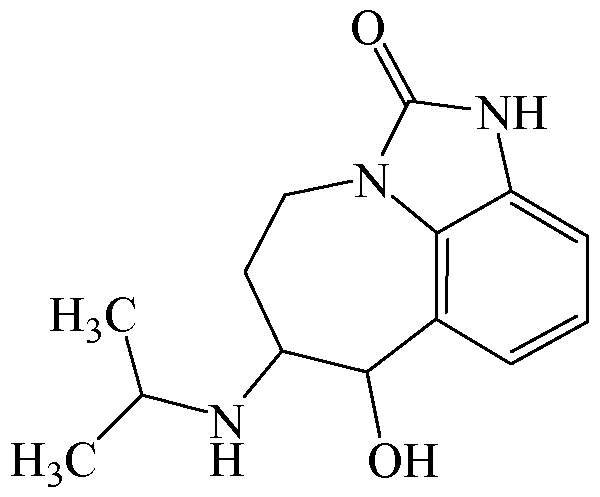
- Zilpaterol is a known adrenergic -2 agonist corresponding in structure to Formula (I):
- zilpaterol The IUPAC name for zilpaterol is 4,5,6,7-tetrahydro-7-hydroxy-6-(isopropylamino) imidazo[4,5,l-jk]-[l]benzazepin-2(lH)-one.
- the Chemical Abstracts name for zilpaterol is 4,5 ,6,7-tetrahydro-7-hydroxy-6-[( 1 -methyl-ethyl) amino] -imidazo [4,5,1 -jk] [ 1 Jbenzazepin- 2(lH)-one.
- Zilpaterol hydrochloride is sold by Merck Animal Health, under the trademark Zilmax ® . It is approved in the United States for increased rate of weight gain, improved feed efficiency, and increased carcass leanness in cattle fed in confinement for slaughter during the last 20 to 40 days on feed.
- the approved inclusion rate of zilpaterol hydrochloride is 6.8 grams/ton (7.5 ppm) in feed on a 90% dry matter basis that is fed continuously as a sole ration in the last 20- 40 days of the animal's life prior to slaughter. See NAD A No. 141-258.
- Frechet et al. discuss compounds, such as zilpaterol, encompassed by a genus characterized as 6-amino-7-hydroxy-4,5,6,7-tetrahydro-imidazo[4,5,l-j-k][l]- benzazepin-2-(lH)-one derivatives and acid addition salts thereof. Frechet et al. state that such compounds may be used as an active ingredient for inducing antihypertensive and hypotensive activity in a warm-blooded animal.
- Grandadam discusses a zootechnical composition comprising zilpaterol and acid addition salts thereof. Grandadam states that such a composition may be used in general to increase the weight of cattle, pigs, sheep, and poultry.
- Chevremont et al. discuss crystallized anhydrous zilpaterol hydrochloride, and particularly crystallized anhydrous zilpaterol hydrochloride wherein less than 5% of the crystals have a size of less than 15 ⁇ , and at least 95% of the crystals have a size of less than 250 ⁇ . According to Chevremont et al, such crystals may be incorporated into animal feed to increase body weight and meat quality.
- U.S. Patent Application Publication No. US 2010/0121050 and No. US 2012/0058189 disclose a process for making zilpaterol, salts - and crystalline forms thereof, as well as various administration methods and - regimes for a variety of livestock animals.
- Rhtopamine hydrochloride is another ⁇ -agonist that is currently added to feed in order to increase the growth performance of cattle and swine.
- Top dress feeding of feed additives to cattle is an alternative to complete feeding programs that increases flexibility to the cattle producer and at the same time reduces labor- and feed- manufacturing costs. This allows farmers to target pens of cattle with unique needs that, in particular, exist in feedlots.
- An embodiment of the present invention is a method of improving the efficiency of beef production from a bovine animal which is fed multiple times per day, comprising delivering to the animal an effective dose of zilpaterol in one or more but not all of daily feedings and wherein the zilpaterol is thoroughly mixed into the feed before use.
- the average daily gain (ADG) of the animal is increased.
- the feed efficiency ratio (FE) of the animal is decreased.
- the hot carcass weight of the animal is increased.
- the dressing percentage of the animal is increased.
- the animal is fed complete feedings.
- the animal is kept in confinement.
- the confinement is in a feedlot.
- the concentration of zilpaterol in the feed is from about 6.8 g/ton to about 360 g/ton.
- the concentration of zilpaterol in the feed is greater than about 68 g/ton to about 360 g/ton.
- the effective dose of zilpaterol is between 60 to 90 mg/head/day.
- the effective dose of zilpaterol is 60 mg/head/day.
- the hot carcass weight of animals treated with zilpaterol is about 30 lb per greater than the hot carcass weight of untreated animals.
- Yet another embodiment is a method of improving the efficiency of beef production from a bovine animal which is fed multiple times per day, comprising mixing a Type A medicated article comprising zilpaterol thoroughly into a Type C medicated feed and delivering the Type C medicated feed to the bovine animal in one or more but not all of daily feedings
- the Type A medicated article is mixed into a Type B medicated feed before mixing it into a Type C medicated feed.
- the Type A medicated article comprises 48g/kilogram zilpaterol hydrochloride.
- the Type C medicated feed comprises an effective dose of zilpaterol hydrochloride of 60-90 mg/head/day.
- the Type C medicated feed is delivered to the bovine animal fed in confinement for slaughter during the last 20-40 days on feed.
- one or more of the variables selected from the group consisting of average daily gain (ADG), feed efficiency (FE), dressing percent and hot carcass weight are improved.
- Another embodiment is a cattle feed composition comprising zilpaterol in a concentration of greater than about 75 g/ton to about 180 g/ton.
- Another embodiment is a cattle feed composition for bovine comprising zilpaterol in a concentration sufficient to deliver a dose of 60 to 90 mg/head/day of zilpaterol in a single feeding per day, wherein the amount of feed composition delivered to an animal is between 1.0 lb and 26.5 lb on a 90% dry matter basis and the concentration of zilpaterol in the feed is greater than about 75 g/ton to about 180 g/ton.
- the dose of zilpaterol is 60 mg/head/day.
- the zilpaterol is zilpaterol hydrochloride.
- the zilpaterol is adhered to a carrier.
- the carrier is corncob meal.
- An additional embodiment is a Type A Medicated Article that comprises greater than about 6.8 g/ton of zilpaterol.
- An additional embodiment is a liquid Type B Medicated Feed that comprises 68 to 680 g/ton of zilpaterol.
- An additional embodiment is a Type C medicated component feed that comprises greater than about 6.8 g/ton to about 20.4 g/ton of zilpaterol.
- the Type C medicated component feed comprises about 13.6 g/ton of zilpaterol.
- An additional embodiment is a Type A Medicated Article that is labeled with instructions to deliver the Type A Medicated Article according to the method of the present invention.
- Figure 1 shows the hot carcass weights of cattle of a control group (without zilpaterol), groups of cattle that received 60, 75 and 90 mg/head/day zilpaterol by component feeding (once per day) and a group fed continuously 6.8 g/ton zilpaterol.
- Dry matter intake refers to the feed intake, usually per day, expressed in terms of its dry matter content.
- ADG Average daily gain
- Fee efficiency ratio DMI / ADG. Improved feed efficiency means a decrease in the ratio of DMI/ADG.
- “Hot carcass weight” is the “hot” or unchilled weight in pounds (taken after slaughter and after the hide, head, intestinal tract and internal organs have been removed).
- “Dressing percentage” is determined by dividing the hot carcass weight by the live weight, then multiplying by 100. "Improving the efficiency of beef production” means improvement in one or more of the live growth performance variables of ADG (increasing) and FE (decreasing) or improvement in one or more of the carcass variables of carcass leanness (increasing), dressing percentage (increasing) and hot carcass weight (increasing), of a bovine animal that is fed zilpaterol containing feed compared to a bovine animal that is fed feed without zilpaterol.
- Bovine animal refers to an animal of genus Bos taurus or Bos indicus, in particular cattle, buffalo, zebu or yak, more in particular cattle, that are raised to produce meat for human food, specifically, cows, bulls, heifers or steers.
- “Thoroughly mixed into the feed” means the component (e.g. the zilpaterol) is uniformly distributed through out the feed. Methods are known to one skilled in the art to determine and monitor that the feed is thoroughly mixed (see Herrman et al., MF1172, Kansas State University Agricultural Experimental Station and Cooperative Extension Service, October 1994). "Well mixed feed enhances animal performance and is an essential step in complying with Food and Drug Administration (FDA) Current Good Manufacturing Practices regulation Title 21 C.F.R. 225.30,130).” For example, using the method described in Herrman, samples are taken at 10 predetermined locations or at even intervals during the mixing process. Each sample is analyzed for its content, e.g., zilpaterol content. A coefficient of variation (CV) between the contents of the samples is then calculated.
- FDA Food and Drug Administration
- Ton is a unit of measure for mass equal 2000 lb.
- ppm is an abbreviation of parts per million, ppm is a value that represents the part of a whole number in units of 1/1000000.
- ppm' is dimensionless quantity, a ratio of 2 quantities of the same unit.
- a 5 ppm concentration of zilpaterol means 5 mg of zilpaterol per 1 kg of feed.
- a 5 ppm concentration of zilpaterol means 5 g of zilpaterol per 1 metric ton (1000 kg) of feed
- a 5 ppm concentration of zilpaterol means 4.55 g of zilpaterol per 1 ton (2000 lb) of feed.
- zilpaterol means 4,5,6,7-tetrahydro-7-hydroxy-6-(isopropylamino) imidazo[4,5,l-jk]- [l]benzazepin-2(lH)-one or any salts or solvates thereof. It also includes salts or solvates of zilpaterol, e.g. the hydrochloride salt.
- Multiple feedings per day means more than one feeding per day to an animal.
- Effective amount is an amount of zilpaterol sufficient to improve the efficiency of beef production from a bovine animal.
- Component feeding means that a particular component of the feed, especially a feed additive, e.g. zilpaterol, is mixed thoroughly in the feed and delivered to the bovine animal in one or more but not all of the daily feedings.
- a feed additive e.g. zilpaterol
- Type A Medicated Article (previously called Premix) is intended solely for use in the manufacture of another Type A Medicated Article or a Type B or Type C Medicated Feed. It consists of a new animal drug (s) with or without a carrier (e.g., calcium carbonate, rice hull, corn, gluten) with or without inactive ingredients.
- Type B Medicated Feed (Type B feed) (previously called Concentrate) is intended solely for the manufacture of other medicated feeds (Type B or Type C). It contains a substantial quantity of nutrients including vitamins and/or minerals and/or other nutritional ingredients in an amount not less than 25 percent of the weight. It is manufactured by diluting a Type A Medicated Article or another Type B Medicated Feed.
- Type C Medicated Feed (Type C feed) is intended as the complete feed for the animal or may be fed “top dressed” (added on top of usual ration) on or offered “free-choice” (e.g., supplement) in conjunction with other animal feed. It contains a substantial quantity of nutrients including vitamins, minerals, and/or other nutritional ingredients. It is manufactured by diluting a Type A Medicated Article or a Type B Medicated Feed. A Type C Medicated Feed may be further diluted to produce another Type C Medicated Feed. Other definitions for selected terms used herein will be found within the description of the invention and apply throughout. Unless otherwise defined, all other scientific and technical terms used herein have the same meaning as commonly understood by individuals who are skilled in the art.
- the invention provides a method of improving the efficiency of beef production from a bovine animal which is fed multiple times per day, comprising delivering to the animal an effective dose of zilpaterol in one or more but not all of daily feedings and wherein the zilpaterol is thoroughly mixed into the feed before use.
- hydrochloride is preferably used in methods and compositions according to this invention.
- the methods and compositions of the present invention are useful for improving the "efficiency of beef production" of a bovine animal.
- the methods and compositions of the present invention are useful for improving one or more of the efficiency of beef production variables of average daily gain (ADG), feed efficiency (FE), and to dressing percentage and hot carcass weight.
- ADG average daily gain
- FE feed efficiency
- the methods and compositions according to the present invention can advantageously by applied in intensive production systems, such as feedlots, wherein cattle is kept and raised in confinement until slaughter and wherein efficiency of beef production of the animals is a key parameter that determines the economic success of the livestock producer (see also Merck Veterinary Manual, 10 th Edition, Management and Nutrition, 2010).
- the method according to the invention comprises improving the efficiency of beef production from cattle, in particular heifers and/or steers that are kept in confinement, such as in a feedlot.
- the method according to the invention is used with cattle fed in confinement during the last 20-40 days on feed.
- the bovine animal is fed 2-times day or 3-times per day.
- the frequency of feedings can be greater than 3 feedings per day.
- the exact nutrient composition and formulation of the feedings used herein are not critical to the present invention and can be selected from the compositions and formulations that are currently used in the field. As long as the ingredients are selected according to the nutrient requirements of a particular animal for which the feeding is intended. Such requirements depend, for example, upon age, stage of development of the animal and the sex of the animal. Commonly used cattle feed compositions and formulations are published by the National Academy of Sciences, Nutrient Requirements of Beef Cattle, Appendix Tables 1-19, 192- 214, National Academy Press (2000) and Merck Veterinary Manual (10 th Edition, 2010, Feeding and Nutritional management of Beef cattle).
- the feedings useful in the practice of the present invention include forages and grain feeds, such as grass and legume forages, crop residues, cereal grains, legume by- products and other agricultural by-products.
- forages include the cut aerial portion of a plant material, both monocotyledonous and dicotyledonous, used as animal feed. Examples include, without limitation, orchard grass, timothy, tall fescue, ryegrass, alfalfa, sainfoin, clovers and vetches.
- grain feeds are meant the seeds of plants that are fed to bovine animals and may or may not include the outer hull, pod or husk of the seed. Examples include, without limitation, corn, wheat, barley sorghum, triticale, rye, canola, and soya beans.
- a high energy diet in particular, consists of daily feedings that have relatively high grain content.
- the grain content of feedings to be used herein is typically between 70-90 % (w/w), more in particular between 75-85 % (w/w).
- the feedings delivered to the bovine animal in a method according to the invention comprises a grain content between 70-90 % (w/w), more in particular between 75-85 % (w/w).
- Favorable crude protein (CP) content of feedings to be used herein are typically between 12- 14% (w/w), more in particular between 12.5-13.5% (w/w).
- Optimal efficiency of beef production can be achieved when the bovine animals receive feedings with a total daily energy content of 1.37-1.70 MCal/kg net energy for gain (NEg), preferably 1.45-1.60 MCal/kg NEg.
- the bovine animal receives feed with a total daily CP content of 12-14% (w/w), more in particular between 12.5-13.5%) (w/w).
- the bovine animal receives feed with a total daily NEg content of 1.37-1.70 MCal/kg, preferably 1.45-1.60 MCal/kg.
- the feedings delivered to the animal are complete feedings, i.e. feedings that are balanced as to their nutrient composition.
- a complete feeding the roughage and the concentrate ingredients, including the protein, mineral, vitamin and other ingredients are all fed as one mixture.
- the composition of a complete feeding is such that it provides a balanced diet in each mouthful an animal consumes.
- one or more but not all of the multiple feedings per day comprises zilpaterol thoroughly mixed into the feed.
- Such mixed cattle feed can be produced by specialized commercial feed mills that blend the various raw materials and the feed additives, including zilpaterol, according to the specifications outlined by an animal nutritionist by applying commonly used milling techniques.
- Such feed compositions are, preferably, produced by mixing nutritional feed ingredients with a premix comprising the zilpaterol.
- the premix to be used in the context of the present invention comprises zilpaterol and a suitable carrier or diluent.
- a preferred premix is a Type A Medicated Article comprising zilpaterol.
- Carriers suitable for use to make up the feed composition may include the following: calcium carbonate, alfalfa meal, soybean meal, cottonseed oil meal, linseed oil meal, sodium chloride, cornmeal, cane molasses, urea, bone meal, corncob meal, rice kernel and the like.
- the carrier promotes a uniform distribution of the active ingredient in the finished feed into which the carrier is blended. It thus performs an important function by ensuring proper distribution of the active ingredient throughout the feed.
- a feed composition to be used in a method according to the present invention preferably comprises zilpaterol that is adhered to a carrier, in particular to corncob meal.
- the amount of feed consumed in a meal is generally between 0.5 lb/meal and 45 lb/meal.
- the amount of feed consumed per day is generally in the range of 1 to 90 lb/day.
- the zilpaterol concentration in the feed (when expressed in grams of zilpaterol per ton of feed on a 90% dry mater basis) is from about 2 g/ton to about 360 g/ton.
- the zilpaterol concentration in the feed is about 6.8 g/ton to about 128 g/ton , preferably 6.8 g/ton to about 20.4 g/ton.
- the range is greater than about 75 g/ton to about 128 g/ton.
- the effective dose of zilpaterol delivered to the animal is between 60 to 90 mg/head/day, preferably, the dose of zilpaterol is 60 mg/head/day.
- the hot carcass weight of animals treated with zilpaterol is about 30 lb per greater than the hot carcass weight of untreated animals.
- the present invention also provides cattle feed, such as Type C Medicated Feed that can advantageously be used in a method as described above.
- feed compositions may have the same or similar nutrient composition as those commonly used in the field by cattle producers, for example, as described in more detail above, but are distinguished therefrom by a higher concentration of zilpaterol (higher than 6.8 g. zilpaterol per ton feed).
- the range is about 6.8 g/ton to about 128 g/ton. In another embodiment, the range is greater than about 75 g/ton to about 128 g/ton. In another embodiment, the range is about 6.8 g/ton to about 20.4 g/ton.
- the present invention also provides a Type A medicated article comprising zilpaterol, preferably comprising 48 g/kilogram zilpaterol hydrochloride intended for use in the manufacture of medicated animal feed, such as a Type C medicated feed.
- a Type A medicated article comprising zilpaterol, preferably comprising 48 g/kilogram zilpaterol hydrochloride intended for use in the manufacture of medicated animal feed, such as a Type C medicated feed.
- the label on the Type A Medicated Article contains instructions to deliver to the animal an effective dose of zilpaterol in one or more but not all of daily feedings and wherein the zilpaterol is thoroughly mixed into the feed before use.
- Such label can be printed on the packaging of such Type A Medicated Article, e.g. on the bag or container, can be used as an adhesive label on the packaging or container, or alternatively the label can be delivered together with packaging on the package insert or other papers of the Type A Medicated Article.
- Type A Medicated Article comprising zilpaterol is available.
- the Type A Medicated Article contains 4.8% zilpaterol hydrochloride (48 grams per kilogram).
- the Type A Medicated Article contains ground corncobs, surfactant and binder as an inert ingredients.
- the Type A Medicated Article is diluted in a suitable carrier before addition to the final feed.
- the Type A Medicated Article is diluted to with additional appropriate feed to form of the Type C
- the Type A Medicated Article is first mixed to form a liquid Type B feed which is then subsequently used to prepare the Type C Medicated Feed.
- the Liquid Type B Medicated Feed Before feeding, the Liquid Type B Medicated Feed is thoroughly mixed with other feed materials to make a Type C Medicated Feed. Examples of addition rates for component feeds are shown in the following table.
- Type A Medicated Article comprising zilpaterol in a ton of appropriate feed ingredients or diluents according to the table below to obtain the proper concentration in the Type C
- the above Feeds are fed during one or more but not all of the daily feedings to cattle fed in confinement for slaughter containing no less than 6.8 g/ton for the last 20 to 40 days on feed to provide 60 to 90 mg zilpaterol hydrochloride per head per day.
- the maximum amount of Type C Medicated Feed in a single feeding must not exceed 17.6 lb. to 26.5 lb. to provide 60 to 90 mg/head/ day, respectively.
- the invention provides a method of improving the efficiency of beef production from a bovine animal which is fed multiple times per day, comprising mixing a Type A Medicated Article comprising zilpaterol thoroughly into a Type C Medicated Feed and delivering the Type C Medicated Feed to the bovine animal in one or more but not all of daily feedings.
- the Type A Medicated Article is mixed into a Type B
- the Type A Medicated Article comprises 48g/kilogram zilpaterol hydrochloride.
- the Type C Medicated Feed comprises an effective dose of zilpaterol hydrochloride of 60-90 mg/head/day.
- Type C Medicated Feed is delivered to the bovine animal fed in confinement for slaughter during the last 20-40 days on feed.
- one or more of the variables selected from the group consisting of average daily gain (ADG), feed efficiency (FE), dressing percent and hot carcass weight are increased.
- EXAMPLE 1 Comparison of component feeding at various doses (60, 75 and 90 mg/head/day) to continuous feeding at 6.8 g/ton.
- a multi-center, randomized complete block design was used.
- Four study sites enrolled 800 to 1000 head of cattle each.
- Cattle were randomized to 10 blocks of 80 to 100 head based on body weight, then penned in groups of 16 to 20 head per pen.
- mice were housed in typical feedlot drylot (dirt floored) pens by block and treatment group. Pens provided adequate pen space per animal. Feed bunks provided 9 to 10 inches of space per animal to simulate commercial feeding practices.
- a component feeding method was tested in the studies by thoroughly mixing the daily zilpaterol dose in the first feeding of the Type C feed prior to delivery to the animal for Groups 2, 3 and 4. Homogeneity of Zilmax ® mixing in the Type C feed was demonstrated by the study site prior to initiation of the Zilmax ® feeding period.
- Feedstuffs fed in the study were typical for the geographical location of the study sites and diets met the nutrient requirements of the study animals. Diets were formulated using typical feedlot diet procedures. At each study site, all cattle were fed a single formulation of a high concentrate Type C complete feed once the Zilmax ® feeding period of the study started. The diets contained monensin and tylosin at 30 g/t and 9 g/t, respectively, on a 90% dry matter basis (DMB) throughout the study. No other feed additives were included in the diets. Feed bunk management (e.g., increases and decreases in daily feed offering, unscheduled feed removals) were according to the standard practice at the study sites.
- DMB 90% dry matter basis
- the daily component feed amount (i.e., the first feeding each day of the Type C feed) was set at approximately 10 lb of feed dry matter (DM) per head to simulate commercial practice for component feeding. Therefore, all study pens were fed approximately 10 lb of DM per head in the first feeding of the day. Control steers were fed the Type C feed that contained no Zilmax. The component feeding treatment groups were fed the Type C feed that contained 60, 75, or 90 mg/head/day.
- Type C complete feed i.e., without Zilmax ®
- Steers in the 6.8 g/ton Zilmax ® treatment group received the Type C complete feed containing this level of Zilmax ® in both feedings each day during the 20-day Zilmax ® feeding period.
- Zilmax ® Type A Medicated Article was diluted prior to addition to the Type C feed by use of a micro -ingredient machine or preparation of a Type B feed. During the Zilmax ® feeding period, daily Type C feed samples were taken from each treatment group and composited on an approximately weekly basis prior to zilpaterol hydrochloride and moisture assays.
- Zilmax ® feeding period unconsumed feed was removed from the feed bunks, weighed, and discarded. All animals in the five treatment groups were fed a non-medicated feed (i.e., without Zilmax ® ) for a minimum 3 day withdrawal period prior to harvest. Unconsumed feed remaining in the feed bunks was removed and weighed on the day of final body weight measurement. Cattle were handled throughout the study using procedures which were typical of commercial practices. Cattle were exposed to ambient weather conditions during the studies. Feed was not restricted prior to weighing or harvest.
- the primary variables in this study were average daily body weight gain (ADG) and feed efficiency (FE) calculated for the Zilmax ® feeding period of the study (Day 0 through end of withdrawal period) and for the entire study (start of the acclimation period to end of withdrawal period).
- ADG average daily body weight gain
- FE feed efficiency
- Dry matter intake (DMI) for each pen of animals was calculated by correcting daily as-fed feed issues and any feed weighback weights to a 100% dry matter basis using the moisture concentrations determined at the zilpaterol analytical laboratory on the diet samples. Feed weighback dry matter was then subtracted from the feed issue dry matter to calculate total feed dry matter consumed. Daily dry matter intake per pen per day was calculated by dividing the total feed dry matter consumed by the animals in the pen by the total number of head days for the pen.
- FE DMI / ADG.
- ADG, DMI and FE were calculated for the two study periods (start of the acclimation period or Day 0 to the end of withdrawal).
- DMI was calculated for the two study periods (start of the acclimation period or Day 0 to the end of the withdrawal period). The following carcass data were collected or calculated:
- Comparisons were evaluated with Control versus each of the treatment groups. Comparisons of Group 5 (the 6.8 g/ton) versus each of the component feeding levels (60, 75 and 90 mg/head/day) were also made.
- carcass data were collected or calculated: marbling score, USDA quality grade or equivalent, hot carcass weight, ribeye area, backfat thickness, calculated yield grade, kidney-pelvic-heart fat percentage, and USDA yield grade or equivalent.
- the Canadian study site CBGA quality and yield grades were converted to USDA equivalents prior to analysis. Dressing percent was calculated.
- Table 2 Summary of the statistical analysis of the primary variables (least squares means and standard error of the mean)
- a statistically significant treatment effect was detected for ADG, DMI and FE during the Zilmax period (P ⁇ 0.05).
- ADG values were significantly higher in the treated groups compared to the control group. No differences between the component feeding groups and the continuous feeding group were detected.
- DMI was significantly lower in the component feeding groups compared to the control group.
- FE values were significantly lower in the treated groups compared to the control group. No differences between the component feeding groups and the continuous feeding group were detected.
- Dressing percentage, hot carcass weight, marbling score, USDA yield grade score, rib eye area, and calculated yield grade were significantly affected by treatment (P ⁇ 0.05).
- Dressing percentage, hot carcass weight, and rib eye area were significantly higher in the Zilmax treated groups compared to the control group and no differences between the component feeding groups and the continuous feeding group were detected.
- Marbling score, USDA yield grade score, and calculated yield grade values were significantly lower in the Zilmax treated groups compared to the control group and no differences between the component feeding groups and the continuous feeding group were detected. There were no significant differences (P > 0.19) among the treatment groups in USDA quality grade, backfat thickness, or kidney-pelvic-heart fat percentage.
- Site 1 only provided data from 25 of the 50 study pens due to an error by site personnel.
- the total number of pens was 35 per treatment group and the number of head per treatment was 648, 652, 654, 651, and 656 for the Control, 60 mg/hd/day, 75 mg/hd/day, 90 mg/hd/day and 6.8 g/ton treatment groups, respectively.
Landscapes
- Life Sciences & Earth Sciences (AREA)
- Chemical & Material Sciences (AREA)
- Polymers & Plastics (AREA)
- Health & Medical Sciences (AREA)
- Engineering & Computer Science (AREA)
- Animal Husbandry (AREA)
- Food Science & Technology (AREA)
- Zoology (AREA)
- Epidemiology (AREA)
- Animal Behavior & Ethology (AREA)
- Veterinary Medicine (AREA)
- Public Health (AREA)
- General Health & Medical Sciences (AREA)
- Medicinal Chemistry (AREA)
- Pharmacology & Pharmacy (AREA)
- Botany (AREA)
- Biotechnology (AREA)
- Physiology (AREA)
- Molecular Biology (AREA)
- Mycology (AREA)
- Birds (AREA)
- Fodder In General (AREA)
- Feed For Specific Animals (AREA)
Abstract
Description


Claims
Priority Applications (4)
| Application Number | Priority Date | Filing Date | Title |
|---|---|---|---|
| US14/776,024 US20160022694A1 (en) | 2013-03-15 | 2014-03-14 | A Method of Improving the Efficiency of Beef Production from Bovine Animals |
| BR112015022345A BR112015022345A2 (en) | 2013-03-15 | 2014-03-14 | method for increasing beef production efficiency, composition for beef feed, medicinal article, medicinal food, and medicinal component feed |
| CA2902257A CA2902257A1 (en) | 2013-03-15 | 2014-03-14 | A method of improving the efficiency of beef production from bovine animals |
| MX2015012726A MX2015012726A (en) | 2013-03-15 | 2014-03-14 | A method of improving the efficiency of beef production from bovine animals. |
Applications Claiming Priority (2)
| Application Number | Priority Date | Filing Date | Title |
|---|---|---|---|
| US201361792511P | 2013-03-15 | 2013-03-15 | |
| US61/792,511 | 2013-03-15 |
Publications (1)
| Publication Number | Publication Date |
|---|---|
| WO2014140237A1 true WO2014140237A1 (en) | 2014-09-18 |
Family
ID=50280383
Family Applications (1)
| Application Number | Title | Priority Date | Filing Date |
|---|---|---|---|
| PCT/EP2014/055051 Ceased WO2014140237A1 (en) | 2013-03-15 | 2014-03-14 | A method of improving the efficiency of beef production from bovine animals |
Country Status (5)
| Country | Link |
|---|---|
| US (1) | US20160022694A1 (en) |
| BR (1) | BR112015022345A2 (en) |
| CA (1) | CA2902257A1 (en) |
| MX (1) | MX2015012726A (en) |
| WO (1) | WO2014140237A1 (en) |
Cited By (2)
| Publication number | Priority date | Publication date | Assignee | Title |
|---|---|---|---|---|
| US10231472B2 (en) | 2015-07-21 | 2019-03-19 | Intervet Inc. | Zilpaterol animal premix formulation |
| EP3488705A1 (en) | 2017-11-23 | 2019-05-29 | Saviela AG | Solubilized growth promoting product to be applied orally to animals and method for the respective feed preparation |
Families Citing this family (1)
| Publication number | Priority date | Publication date | Assignee | Title |
|---|---|---|---|---|
| JP6455991B2 (en) * | 2015-04-15 | 2019-01-23 | 株式会社和農産 | Breeding of beef cattle |
Citations (7)
| Publication number | Priority date | Publication date | Assignee | Title |
|---|---|---|---|---|
| US4585770A (en) | 1982-10-12 | 1986-04-29 | Roussel Uclaf | Novel 6-amino-7-hydroxy-4,5,6,7-tetrahydro-imidazo[4,5,1-j-k][1]-benzazepin-2-(1H)-one |
| US4900735A (en) | 1986-12-11 | 1990-02-13 | Roussel Uclaf | Zootechnical compositions |
| US5731028A (en) | 1995-06-13 | 1998-03-24 | Roussel Uclaf | Crystallized zilpaterol hydrochloride |
| US20050284380A1 (en) * | 2004-05-20 | 2005-12-29 | Akzo Nobel N.V. | Method of feeding the cattle with feed additives that increases beef production and reduces liver abscess |
| US20090181906A1 (en) * | 2007-12-06 | 2009-07-16 | Intervet International B.V. | Combination Therapies using Melengestrol Acetate and Zilpaterol or its Salts |
| US20100121050A1 (en) | 2007-03-31 | 2010-05-13 | Stephane Dubuis | Processes for making zilpaterol and salts thereof |
| US20120058189A1 (en) | 2008-12-17 | 2012-03-08 | Oliver Krebs | Process for making a crystalline zilpaterol salt |
-
2014
- 2014-03-14 CA CA2902257A patent/CA2902257A1/en not_active Abandoned
- 2014-03-14 MX MX2015012726A patent/MX2015012726A/en unknown
- 2014-03-14 BR BR112015022345A patent/BR112015022345A2/en not_active Application Discontinuation
- 2014-03-14 WO PCT/EP2014/055051 patent/WO2014140237A1/en not_active Ceased
- 2014-03-14 US US14/776,024 patent/US20160022694A1/en not_active Abandoned
Patent Citations (8)
| Publication number | Priority date | Publication date | Assignee | Title |
|---|---|---|---|---|
| US4585770A (en) | 1982-10-12 | 1986-04-29 | Roussel Uclaf | Novel 6-amino-7-hydroxy-4,5,6,7-tetrahydro-imidazo[4,5,1-j-k][1]-benzazepin-2-(1H)-one |
| US4900735A (en) | 1986-12-11 | 1990-02-13 | Roussel Uclaf | Zootechnical compositions |
| US5731028A (en) | 1995-06-13 | 1998-03-24 | Roussel Uclaf | Crystallized zilpaterol hydrochloride |
| US5847124A (en) | 1995-06-13 | 1998-12-08 | Roussel Uclaf | Hydrated forms of zilpatherol hydrochloride |
| US20050284380A1 (en) * | 2004-05-20 | 2005-12-29 | Akzo Nobel N.V. | Method of feeding the cattle with feed additives that increases beef production and reduces liver abscess |
| US20100121050A1 (en) | 2007-03-31 | 2010-05-13 | Stephane Dubuis | Processes for making zilpaterol and salts thereof |
| US20090181906A1 (en) * | 2007-12-06 | 2009-07-16 | Intervet International B.V. | Combination Therapies using Melengestrol Acetate and Zilpaterol or its Salts |
| US20120058189A1 (en) | 2008-12-17 | 2012-03-08 | Oliver Krebs | Process for making a crystalline zilpaterol salt |
Non-Patent Citations (10)
| Title |
|---|
| "Merck Veterinary Manual", 2010, FEEDING AND NUTRITIONAL MANAGEMENT OF BEEF CATTLE |
| "Merck Veterinary Manual", 2010, MANAGEMENT AND NUTRITION |
| "National Academy of Sciences, Nutrient Requirements of Beef Cattle", 2000, NATIONAL ACADEMY PRESS, pages: 192 - 214 |
| "New animal drugs for use in animal feed ; zilpaterol", FEDERAL REGISTER, OFFICE OF THE FEDERAL REGISTER, WASHINGTON, DC, US, vol. 73, no. 70, 10 April 2008 (2008-04-10), pages 19432, XP009112954, ISSN: 0097-6326 * |
| AVENDANO-REYES ET AL., J. ANIMAL SCIENCES, vol. 84, 2006, pages 3259 - 3265 |
| GONZALEZ ET AL., FLORIDA BEEF REPORT, 2009, pages 77 - 82 |
| HERRMAN ET AL., MF1172, KANSAS STATE UNIVERSITY AGRICULTURAL EXPERIMENTAL STATION AND COOPERATIVE EXTENSION SERVICE, October 1994 (1994-10-01) |
| O'NEILL ET AL., S. AFRICAN JOURNAL ANIM. SCIENCE, vol. 40, 2010, pages 185 - 189 |
| VASCONCELOS ET AL., J ANIM SCI, vol. 85, 2007, pages 2772 - 2781 |
| VASCONCELOS ET AL., J. ANIM SCI, vol. 85, 2007, pages 2772 - 2781 |
Cited By (3)
| Publication number | Priority date | Publication date | Assignee | Title |
|---|---|---|---|---|
| US10231472B2 (en) | 2015-07-21 | 2019-03-19 | Intervet Inc. | Zilpaterol animal premix formulation |
| EP3488705A1 (en) | 2017-11-23 | 2019-05-29 | Saviela AG | Solubilized growth promoting product to be applied orally to animals and method for the respective feed preparation |
| WO2019101921A1 (en) | 2017-11-23 | 2019-05-31 | Saviela Ag | Solubilized growth promoting product to be applied orally to animals and method for the respective feed preparation |
Also Published As
| Publication number | Publication date |
|---|---|
| MX2015012726A (en) | 2016-02-18 |
| CA2902257A1 (en) | 2014-09-18 |
| BR112015022345A2 (en) | 2017-07-18 |
| US20160022694A1 (en) | 2016-01-28 |
Similar Documents
| Publication | Publication Date | Title |
|---|---|---|
| Liu et al. | Effects of mulberry leaves to replace rapeseed meal on performance of sheep feeding on ammoniated rice straw diet | |
| Myer et al. | Triticale as animal feed | |
| Ata et al. | The inclusion of sweet lupin grain (Lupinus angustifolius) improves nursing performance of lactation in Awassi ewes | |
| Economides | The nutritive value of sunflower meal and its effect on replacing cereal straw in the diets of lactating ewes and goats | |
| Loe et al. | Field pea (Pisum sativum) inclusion in corn-based lamb finishing diets | |
| Balci et al. | The effect of fibrolytic exogenous enzyme on fattening performance of steers | |
| US20200404949A1 (en) | Enhanced milk production effienciency in dairy cows | |
| US20160022694A1 (en) | A Method of Improving the Efficiency of Beef Production from Bovine Animals | |
| US20040170669A1 (en) | Feed rations and methods of feeding growing ruminants | |
| RU2106789C1 (en) | Fodder composition and method for stimulating growth of pigs | |
| Abubakar et al. | Nutrient intake, growth performance and economics of production of growing yankasa rams fed urea treated sesame chaff supplemented with varying proportion of protein and energy sources | |
| Polat et al. | The effects of partial replacement of corn silage on biochemical blood parameters in lactating primiparous dairy cows | |
| Jun et al. | Replacement of forage fiber sources with dried distillers grains with solubles and corn germ meal in Holstein calf diets | |
| Etman et al. | USING A NEW PROTEIN SOURCES IN FEEDING OF RUMINANTS 1-EFFECT OF FEEDING DIFFERENT LEVELS OF GUAR KORMA AS A SOURCE OF PROTEIN ON THE PRODUCTIVE PERFORMANCE OF EGYPTIAN BUFFALOES. | |
| Rafiq et al. | Economic benefits of supplementing lambs with urea molasses blocks on ranges of Pakistan | |
| Sunarso et al. | The performance of beef cattle fed by complete feed | |
| Thang et al. | Effects of supplementation of mixed cassava (Manihot esculenta) and legume (Phaseolus calcaratus) fodder on the rumen degradability and performance of growing cattle | |
| Hosamani et al. | Effect of different source of energy on urea molasses mineral block intake, nutrient utilization, rumen fermentation pattern and blood profile in Murrah buffaloes (Bubalus bubalis) | |
| Liu et al. | Mulberry leaf supplement for sheep fed ammoniated rice straw | |
| Vikram et al. | Effect of supplementation of two sources of non protein nitrogen in the diets based on finger millet straw and maize on the performance of growing lambs | |
| WO2014140236A1 (en) | Top dress feeding of zilpaterol in cattle | |
| Chacko et al. | Effect of paddy straw plus non-forage fibre sources based complete feeds containing different levels of neutral detergent fibre on digestibility coefficients of nutrients in lactating dairy cows | |
| BIRADAR | Effect of supplementation of two sources of non protein nitrogen in the diets based on finger millet straw and sorghum on the performance of growing lambs | |
| Yerima et al. | Response of growing Yankasa rams to stover-based diets containing different nitrogen sources with Balanites aegyptiaca (Desert Date) leaf powder as rumen buffer | |
| Buckhaus et al. | Effect of Corn Silage Inclusion Level and Steroidal Implant Type on Growth Performance, Dietary Net Energy Utilization, Beef Production Per Acre and Apparent Total Tract Digestibility in Feedlot Finishing Steers |
Legal Events
| Date | Code | Title | Description |
|---|---|---|---|
| 121 | Ep: the epo has been informed by wipo that ep was designated in this application |
Ref document number: 14710255 Country of ref document: EP Kind code of ref document: A1 |
|
| ENP | Entry into the national phase |
Ref document number: 2902257 Country of ref document: CA |
|
| WWE | Wipo information: entry into national phase |
Ref document number: 14776024 Country of ref document: US Ref document number: MX/A/2015/012726 Country of ref document: MX |
|
| NENP | Non-entry into the national phase |
Ref country code: DE |
|
| REG | Reference to national code |
Ref country code: BR Ref legal event code: B01A Ref document number: 112015022345 Country of ref document: BR |
|
| 122 | Ep: pct application non-entry in european phase |
Ref document number: 14710255 Country of ref document: EP Kind code of ref document: A1 |
|
| ENP | Entry into the national phase |
Ref document number: 112015022345 Country of ref document: BR Kind code of ref document: A2 Effective date: 20150910 |