WO2014138359A1 - Steroid antibiotic conjugates - Google Patents
Steroid antibiotic conjugates Download PDFInfo
- Publication number
- WO2014138359A1 WO2014138359A1 PCT/US2014/021096 US2014021096W WO2014138359A1 WO 2014138359 A1 WO2014138359 A1 WO 2014138359A1 US 2014021096 W US2014021096 W US 2014021096W WO 2014138359 A1 WO2014138359 A1 WO 2014138359A1
- Authority
- WO
- WIPO (PCT)
- Prior art keywords
- oxo
- methoxy
- carbonyl
- fluoro
- cyclopropyl
- Prior art date
- Legal status (The legal status is an assumption and is not a legal conclusion. Google has not performed a legal analysis and makes no representation as to the accuracy of the status listed.)
- Ceased
Links
- DNBRDMGGSYYVBL-UHFFFAOYSA-N CC(N(C1CC1)c(c1cc(F)c2N3CC4NCCCC4C3)c2OC)=C(C(O)=O)C1=O Chemical compound CC(N(C1CC1)c(c1cc(F)c2N3CC4NCCCC4C3)c2OC)=C(C(O)=O)C1=O DNBRDMGGSYYVBL-UHFFFAOYSA-N 0.000 description 1
Classifications
-
- A—HUMAN NECESSITIES
- A61—MEDICAL OR VETERINARY SCIENCE; HYGIENE
- A61K—PREPARATIONS FOR MEDICAL, DENTAL OR TOILETRY PURPOSES
- A61K9/00—Medicinal preparations characterised by special physical form
- A61K9/0012—Galenical forms characterised by the site of application
- A61K9/0048—Eye, e.g. artificial tears
-
- A—HUMAN NECESSITIES
- A61—MEDICAL OR VETERINARY SCIENCE; HYGIENE
- A61K—PREPARATIONS FOR MEDICAL, DENTAL OR TOILETRY PURPOSES
- A61K47/00—Medicinal preparations characterised by the non-active ingredients used, e.g. carriers or inert additives; Targeting or modifying agents chemically bound to the active ingredient
- A61K47/50—Medicinal preparations characterised by the non-active ingredients used, e.g. carriers or inert additives; Targeting or modifying agents chemically bound to the active ingredient the non-active ingredient being chemically bound to the active ingredient, e.g. polymer-drug conjugates
- A61K47/51—Medicinal preparations characterised by the non-active ingredients used, e.g. carriers or inert additives; Targeting or modifying agents chemically bound to the active ingredient the non-active ingredient being chemically bound to the active ingredient, e.g. polymer-drug conjugates the non-active ingredient being a modifying agent
- A61K47/54—Medicinal preparations characterised by the non-active ingredients used, e.g. carriers or inert additives; Targeting or modifying agents chemically bound to the active ingredient the non-active ingredient being chemically bound to the active ingredient, e.g. polymer-drug conjugates the non-active ingredient being a modifying agent the modifying agent being an organic compound
- A61K47/55—Medicinal preparations characterised by the non-active ingredients used, e.g. carriers or inert additives; Targeting or modifying agents chemically bound to the active ingredient the non-active ingredient being chemically bound to the active ingredient, e.g. polymer-drug conjugates the non-active ingredient being a modifying agent the modifying agent being an organic compound the modifying agent being also a pharmacologically or therapeutically active agent, i.e. the entire conjugate being a codrug
-
- A—HUMAN NECESSITIES
- A61—MEDICAL OR VETERINARY SCIENCE; HYGIENE
- A61K—PREPARATIONS FOR MEDICAL, DENTAL OR TOILETRY PURPOSES
- A61K47/00—Medicinal preparations characterised by the non-active ingredients used, e.g. carriers or inert additives; Targeting or modifying agents chemically bound to the active ingredient
- A61K47/50—Medicinal preparations characterised by the non-active ingredients used, e.g. carriers or inert additives; Targeting or modifying agents chemically bound to the active ingredient the non-active ingredient being chemically bound to the active ingredient, e.g. polymer-drug conjugates
- A61K47/51—Medicinal preparations characterised by the non-active ingredients used, e.g. carriers or inert additives; Targeting or modifying agents chemically bound to the active ingredient the non-active ingredient being chemically bound to the active ingredient, e.g. polymer-drug conjugates the non-active ingredient being a modifying agent
- A61K47/54—Medicinal preparations characterised by the non-active ingredients used, e.g. carriers or inert additives; Targeting or modifying agents chemically bound to the active ingredient the non-active ingredient being chemically bound to the active ingredient, e.g. polymer-drug conjugates the non-active ingredient being a modifying agent the modifying agent being an organic compound
- A61K47/554—Medicinal preparations characterised by the non-active ingredients used, e.g. carriers or inert additives; Targeting or modifying agents chemically bound to the active ingredient the non-active ingredient being chemically bound to the active ingredient, e.g. polymer-drug conjugates the non-active ingredient being a modifying agent the modifying agent being an organic compound the modifying agent being a steroid plant sterol, glycyrrhetic acid, enoxolone or bile acid
-
- A—HUMAN NECESSITIES
- A61—MEDICAL OR VETERINARY SCIENCE; HYGIENE
- A61K—PREPARATIONS FOR MEDICAL, DENTAL OR TOILETRY PURPOSES
- A61K47/00—Medicinal preparations characterised by the non-active ingredients used, e.g. carriers or inert additives; Targeting or modifying agents chemically bound to the active ingredient
- A61K47/50—Medicinal preparations characterised by the non-active ingredients used, e.g. carriers or inert additives; Targeting or modifying agents chemically bound to the active ingredient the non-active ingredient being chemically bound to the active ingredient, e.g. polymer-drug conjugates
- A61K47/51—Medicinal preparations characterised by the non-active ingredients used, e.g. carriers or inert additives; Targeting or modifying agents chemically bound to the active ingredient the non-active ingredient being chemically bound to the active ingredient, e.g. polymer-drug conjugates the non-active ingredient being a modifying agent
- A61K47/62—Medicinal preparations characterised by the non-active ingredients used, e.g. carriers or inert additives; Targeting or modifying agents chemically bound to the active ingredient the non-active ingredient being chemically bound to the active ingredient, e.g. polymer-drug conjugates the non-active ingredient being a modifying agent the modifying agent being a protein, peptide or polyamino acid
- A61K47/64—Drug-peptide, drug-protein or drug-polyamino acid conjugates, i.e. the modifying agent being a peptide, protein or polyamino acid which is covalently bonded or complexed to a therapeutically active agent
-
- A—HUMAN NECESSITIES
- A61—MEDICAL OR VETERINARY SCIENCE; HYGIENE
- A61P—SPECIFIC THERAPEUTIC ACTIVITY OF CHEMICAL COMPOUNDS OR MEDICINAL PREPARATIONS
- A61P27/00—Drugs for disorders of the senses
-
- A—HUMAN NECESSITIES
- A61—MEDICAL OR VETERINARY SCIENCE; HYGIENE
- A61P—SPECIFIC THERAPEUTIC ACTIVITY OF CHEMICAL COMPOUNDS OR MEDICINAL PREPARATIONS
- A61P27/00—Drugs for disorders of the senses
- A61P27/02—Ophthalmic agents
-
- A—HUMAN NECESSITIES
- A61—MEDICAL OR VETERINARY SCIENCE; HYGIENE
- A61P—SPECIFIC THERAPEUTIC ACTIVITY OF CHEMICAL COMPOUNDS OR MEDICINAL PREPARATIONS
- A61P27/00—Drugs for disorders of the senses
- A61P27/02—Ophthalmic agents
- A61P27/14—Decongestants or antiallergics
-
- A—HUMAN NECESSITIES
- A61—MEDICAL OR VETERINARY SCIENCE; HYGIENE
- A61P—SPECIFIC THERAPEUTIC ACTIVITY OF CHEMICAL COMPOUNDS OR MEDICINAL PREPARATIONS
- A61P29/00—Non-central analgesic, antipyretic or antiinflammatory agents, e.g. antirheumatic agents; Non-steroidal antiinflammatory drugs [NSAID]
-
- A—HUMAN NECESSITIES
- A61—MEDICAL OR VETERINARY SCIENCE; HYGIENE
- A61P—SPECIFIC THERAPEUTIC ACTIVITY OF CHEMICAL COMPOUNDS OR MEDICINAL PREPARATIONS
- A61P31/00—Antiinfectives, i.e. antibiotics, antiseptics, chemotherapeutics
- A61P31/02—Local antiseptics
-
- A—HUMAN NECESSITIES
- A61—MEDICAL OR VETERINARY SCIENCE; HYGIENE
- A61P—SPECIFIC THERAPEUTIC ACTIVITY OF CHEMICAL COMPOUNDS OR MEDICINAL PREPARATIONS
- A61P31/00—Antiinfectives, i.e. antibiotics, antiseptics, chemotherapeutics
- A61P31/04—Antibacterial agents
-
- A—HUMAN NECESSITIES
- A61—MEDICAL OR VETERINARY SCIENCE; HYGIENE
- A61P—SPECIFIC THERAPEUTIC ACTIVITY OF CHEMICAL COMPOUNDS OR MEDICINAL PREPARATIONS
- A61P43/00—Drugs for specific purposes, not provided for in groups A61P1/00-A61P41/00
-
- C—CHEMISTRY; METALLURGY
- C07—ORGANIC CHEMISTRY
- C07K—PEPTIDES
- C07K7/00—Peptides having 5 to 20 amino acids in a fully defined sequence; Derivatives thereof
- C07K7/64—Cyclic peptides containing only normal peptide links
- C07K7/645—Cyclosporins; Related peptides
Definitions
- the present invention describes steroid antibiotic conjugates. These single drug entities are formed connecting a steroid moiety and two same antibiotics moieties, or a steroid moiety and two different antibiotics moieties. Upon topical application to the eye, the conjugate hybrid would undergo enzymatic and/or hydrolytic cleavage to release the individual drugs.
- the antibiotic moieties and the steroid moiety, of the compounds disclosed herein are connected via two covalent bonds to a linker such that said compound degrades in vivo to yield the respective antibiotic and the respective steroids.
- Each bond is an amide bond or an ester bond depending on the nature of the compound.
- the single drug entity has one amide bond connecting to the antibiotic and/or one ester bond connecting to the other antibiotic and/or one ester bond connecting to the steroid.
- Degradation of the ester or amide bonds generally, but not necessarily, yields the corresponding acid and alcohol or amine by hydrolysis or a related reaction.
- a compound which degrades in vivo to yield the antibiotic and steroid produces the active drugs belonging to distinct classes at some point in the metabolic process of the claimed compound. In many cases, cleavage of the first amide or ester bond will release one active, and cleavage of the second amide or ester bond will release the second active and then the third active will be released if it is the case.
- the present invention relates to a hybrid compound comprising a steroid moiety and two same antibiotics moieties, or a pharmaceutical salt thereof, which are connected via two covalent bonds to a linker such that said compound degrades in vivo to yield the respective two antibiotics independently and the respective steroid drug, wherein each bond is an amide bond or an ester bond.
- the present invention relates to a compound comprising a steroid moiety and two different antibiotics moieties, or a pharmaceutical salt thereof , which are connected via two covalent bonds to a linker such that said compound degrades in vivo to yield the respective two antibiotics independently and the respective steroid drug, wherein each bond is an amide bond or an ester bond.
- the present invention relates to a hybrid compound comprising a steroid moiety and two antibiotics moieties, which are connected via separate covalent bonds to at least one linker each such that said covalent bond degrade in vivo to yield the respective two antibiotics independently and the respective steroid drug.
- the present invention relates to a hybrid compound wherein the two antibiotics moieties are identical.
- the present invention relates to a hybrid compound wherein the two antibiotics moieties are different.
- the present invention relates to a hybrid compound wherein a first antibiotic moiety is directly linked to the steroid moiety and further linked to the other antibiotic moiety via a linker.
- the present invention relates to a hybrid compound a first antibiotic moiety is linked to the steroid moiety via a linker and further linked to the other antibiotic moiety via another linker.
- the present invention relates to a hybrid compound wherein a first antibiotic moiety is linked to the steroid moiety via a linker and further linked to the other antibiotic moiety via another linker.
- the present invention relates to a hybrid compound wherein the two antibiotic drug moieties are selected from the group consisting of: gatifloxacin, moxifloxacin, chloramphenicol, tobramycin and amikacin.
- the present invention relates to a hybrid compound wherein the steroid drug moiety is selected from the group consisting of:
- dexmethasone betamethasone
- triamcinolone acetonide prednisolone and hydrocortisone.
- the present invention relates to a hybrid compound wherein said linker comprises an ester, a carboxylate, a carbonyl, a carbonate, an amido, a carbamate, a ketone, an amino, an oxo, an ethylene glycol, a polyethylene glycol moiety or an ethylene moiety.
- the present invention relates to a pharmaceutical composition
- a pharmaceutical composition comprising a therapeutically effective amount of a hybrid compound , comprising two antibiotic moieties and one steroid drug moiety, which are connected via separate covalent bonds such that said covalent bonds degrade in vivo to yield the antibiotics and steroid drugs , and wherein said pharmaceutical composition is formulated for topical ophthalmic administration.
- the present invention relates to a method comprising administrating to an eye of a mammal a pharmaceutical composition comprising a therapeutically effective amount of a hybrid compound comprising two antibiotic moieties and one steroid moiety, which are connected via separate covalent bonds such that said covalent bonds degrade in vivo to yield the antibiotics and the steroid drugs, and wherein said method is effective in the treatment of an inflammatory condition or bacterial infection affecting said eye.
- the present invention relates to a method wherein said hybrid compound has topical antibiotic and anti-inflammatory activity upon a surface of an eye, and wherein the hybrid compound degrades on said surface into said active antibiotics and said steroid drug, which are capable of penetrating beyond tissue of said surface
- the present invention relates to a hybrid compound comprising at least one linker having at least two bonds, wherein said bonds are asymmetrically degraded in vivo to release the antibiotic and steroid drugs.
- the hybrid compounds of the invention have both antibacterial and antiinflammatory activities and are very useful compounds capable of producing the effect of an antibacterial drug and anti-inflammatory drug in monotherapy.
- the present invention relates to a compound which is an active drug, which degrades in vivo into active antibacterial(s) and anti-inflammatory drug(s).
- the hybrid drugs of the invention provide a unique delivery of an antibiotic and a steroid for the treatment of ophthalmic bacterial infections and inflammation.
- a single drug entity is advantageous for individual dosing of each drug because of the ability for simultaneous dosing and elimination of washout concerns when applying each drug separately.
- the use of an antibiotic/anti-inflammatory hybrid drug is indicated where the risk of infection is high or where there is an expectation that potentially dangerous numbers of bacteria will be present in the eye.
- the anti-inflammatory component of the composition is useful in treating inflammation associated with physical trauma to ophthalmic tissues, inflammation associated with bacterial infections and
- compositions of the invention may also be used prophylactically in connection with various ophthalmic surgical procedures that create a risk of bacterial infection.
- Other examples of ophthalmic conditions which may be treated with the compositions of the present invention include infective conditions associated with inflammation and where the use of anti-inflammatory is acceptable.
- Such conditions may include, but are not limited to conjunctivitis, keratitis, blepharitis, endophthalmitis, dacyrocystitis, hordeolum, corneal ulcers, red eye, hyperemia, anterior blepharitis, posterior blepharitis, meibomian gland dysfunction, dry eye disease (keratocojunctivitis sicca) ocular pain, ocular pain and inflammation post-ocular surgery , bacterial conjunctivitis, anterior uveitis, postsurgical inflammation, inflammatory conditions of the palpebral and bulbar conjunctiva, cornea, and anterior segment of the globe, such as allergic
- conjunctivitis ocular rosacea, dry eye, blepharitis, meibomian gland dysfunction, superficial punctate keratitis, herpes zoster keratitis, ulceris, cyclitis, selected infective conjunctivitis, corneal injury from chemical radiation, or thermal burns, penetration of foreign bodies, allergy, and combinations thereof.
- the hybrid drugs disclosed herein comprise antibiotics moieties belonging to distinct classes: fluoroquinolones, cephalosporins, chloramphenicol,
- Fluoroquinolones include, but are not limited to: levofloxacin, moxifloxacin, gatifloxacin, gemifloxacin, trovafloxacin, ofloxacin, ciprofloxacin, sparfloxacin, grepafloxacin, norfoxacin, enoxacin, lomefloxacin, fleroxacin, tosufloxacin, prulifloxacin, pazufloxacin, clinafloxacin, garenoxacin, and sitafloxacin.
- Cephalosporins include, but are not limited to: loracarbef, cephalexin, cefuroxime, ceftriaxone, ceftaxime, ceftizoxime, ceftibuten, ceftazidime, cefprozil, cefpodoxime, cefoxitin, cefotetan, cefotaxime, cefoperazone, cefixime, cefepime, cefditoren, cefdinir, cefoperaxone, moxalactam, cefazolin, cefamandole, cefadroxil, cefaclor, cephalothin, cephradine, cephacetrile, and cephalothin.
- Aminoglycosides include, but are not limited to: tobramycin, streptomycin, gentamicin, kanamycin, amikacin and netilmicin.
- Penicillins include, but are not limited to: penicillin G, ticarcillin, methicillin, phenthicillin, cloxacillin, dicloxacillin, nafcillin, oxacillin.
- Macrolide antibiotics include, but are not limited to: erythromycin and azithromycin.
- Oxazolidinones include, but are not limited to: linezolid.
- the compounds disclosed herein comprise a steroidal drug selected from: dexmethasone, betamethasone, triamcinolone acetonide, prednisolone and hydrocortisone.
- the compounds disclosed herein comprise at least one antibiotic drug selected from levofloxacin, moxifloxacin, gatifloxacin, gemifloxacin, trovafloxacin, ofloxacin, ciprofloxacin, sparfloxacin, grepafloxacin, norfoxacin, enoxacin, lomefloxacin, fleroxacin, tosufloxacin, prulifloxacin, pazufloxacin, clinafloxacin, garenoxacin, sitafloxacin, loracarbef, cephalexin, cefuroxime, ceftriaxone, ceftaxime, ceftizoxime, ceftibuten, ceftazidime, cefprozil, cefpodoxime, cefoxitin, cefotetan, cefotaxime, cefoperazone, cefixime, cefepime, cefditoren, cefdinir,
- the compounds disclosed herein comprise at least one steroidal drug selected from: dexmethasone, betamethasone, triamcinolone acetonide, prednisolone and hydrocortisone.
- the hybrid compounds of the invention can be represented by Schemes 1 , wherein the antibiotic moieties can be the same or different:
- the invention provides compounds which may comprise a linker moiety selected from, but not limited to, an ester, a carboxylate, a carbonyl, a carbonate, an amido, a carbamate, a ketone, an amino, an oxo, an ethylene glycol, a polyethylene glycol, an ethylene.
- a linker moiety selected from, but not limited to, an ester, a carboxylate, a carbonyl, a carbonate, an amido, a carbamate, a ketone, an amino, an oxo, an ethylene glycol, a polyethylene glycol, an ethylene.
- the invention provides compounds which may comprise a linker moiety comprising any combination of an ester, a carboxylate, a carbonyl, a carbonate, an amido, a carbamate, a ketone, an ethylene, an amino, an oxo, an ethylene glycol and/or a polyethylene glycol.
- linker moieties are exemplified below and linker structures are exemplified in Table 1.
- ester moieties comprised in the linkers a
- Example of an oxo moiety comprised in the linker is:
- Example of ethylene glycol moieties comprised in the linkers are: "-" u '
- Example of polyethylene glycol moiety comprised in the linkers is:
- compositions disclosed herein comprise at least one pro-drug moiety selected from Table 2:
- the compounds disclosed herein comprise one steroid moiety and two antibiotic moieties.
- the compounds disclosed herein comprise one steroid moiety and two antibiotic moieties and at least one linker selected from Table 1 .
- the compounds disclosed herein comprise one steroid moiety and two antibiotic moieties and at least one linker selected from Table 1 and one pro-drug moiety selected from Table 2.
- the compounds disclosed herein comprise one steroid moiety and two antibiotic moieties and two linkers selected from Table 1 and two pro-drug moieties selected from Table 2.
- the compounds disclosed herein comprise steroid moiety and two antibiotic moieties and least two linkers selected from Table 1 and one pro-drug moiety selected from Table 2. In another embodiment the compounds disclosed herein comprise steroid moiety and two antibiotic moieties and one linker selected from Table 1 and two prodrug moieties selected from Table 2.
- the compounds disclosed herein comprise one prednisolone moiety and two moxifloxacin moieties, such as:
- hydrocortisone moiety and one besifloxacin moiety and one gatifloxacin moiety such as: [( ⁇ 4-[1 -cyclopropyl-3-( ⁇ 2-[(8R,9R, 10S, 1 1 R, 13R, 14R, 17S)-1 1 , 17-dihydroxy-10,13- dimethyl-3-oxo-2,3,6,7,8,9,10,1 1 ,12,13,14,15, 16,17-tetradecahydro-1 H- cyclopenta[a]phenanthren-17-yl]-2-oxoethoxy ⁇ carbonyl)-6-fluoro-8-methoxy-4-oxo- 1 ,4-dihydroquinolin-7-yl]-2-methylpiperazin-1 -yl ⁇ carbonyl)oxy]methyl rel-7-[(3S)-3- aminoazepan-1 -yl]-1 -cyclopropyl-6-fluoro-8-methoxy-4-oxo-1
- dexamethasone and two gatifloxacin moieties such as:
- the compounds disclosed herein comprise one bethasone and two gatifloxacin moieties such as: rel-1 -cyclopropyl-7-(4- ⁇ [5-( ⁇ 4-[1 -cyclopropyl-6-fluoro-3-( ⁇ 2- [(9R, 10S, 1 1 S, 13S, 16S, 17R)-9-fluoro-1 1 , 17-dihydroxy-10, 13,16-trimethyl-3-oxo- 6,7,8,9,10,1 1 ,12, 13,14, 15,16,17-dodecahydro-3H-cyclopenta[a]phenanthren-17-yl]- 2-oxoethoxy ⁇ carbonyl)-8-methoxy-4-oxo-1 ,4-dihydroquinolin-7-yl]-2-methylpiperazin- 1 -yl ⁇ methyl)-2-oxo-1 ,3-dioxol-4-yl]methyl ⁇ -3-methylpiperazin-1 -yl)-6
- hydrocortisone and two gatifloxacin moieties such as: I , 3-bis( ⁇ [1 -cyclopropyl-6-fluoro-8-methoxy-7-(3-methylpiperazin-1 -yl)-4-oxo-1 ,4- dihydroquinolin-3-yl]carbonyl ⁇ oxy)propan-2-yl 2-[(8R, 10S, 1 1 R, 13R, 14R, 17S)-1 1 ,17- dihydroxy-10,13-dimethyl-3-oxo-2,3,6,7,8,9,10,1 1 , 12,13,14,15,16,17-tetradecahydro- 1 H-cyclopenta[a]phenanthren-17-yl]-2-oxoethyl rel-butanedioate; 1 ,3-bis( ⁇ [( ⁇ [1 -cyclopropyl-6-fluoro-8-methoxy-7-(3-methylpiperazin-1 -yl)-4-ox
- hydrocortisone and two moxifloxacin moieties such as:
- the invention provides a hybrid compound comprising two antibiotic moieties and a steroid drug moiety, or a pharmaceutical salt thereof, which are connected via three separate covalent bonds to a linker such that said covalent bonds degrade in vivo to yield independently the antibiotics and steroid drugs.
- the invention provides a hybrid compound comprising two different antibiotic moieties and a steroid drug moiety, or a pharmaceutical salt thereof, which are connected via three separate covalent bonds to a linker such that said covalent bonds degrade in vivo to yield independently the antibiotics and steroid drugs.
- the invention provides a hybrid compound comprising two identical antibiotic moieties and a steroid drug moiety, or a pharmaceutical salt thereof, which are connected via three separate covalent bonds to a linker such that said covalent bonds degrade in vivo to yield independently the antibiotics and steroid drugs.
- the invention provides a hybrid compound comprising two different antibiotic moieties and a steroid drug moiety, or a pharmaceutical salt thereof, wherein the steroid is directly linked to one antibiotic which is connected via a linker to the other antibiotic and wherein the bonds degrade in vivo to yield independently the antibiotics and steroid drugs.
- the invention provides a hybrid compound comprising two identical antibiotic moieties and a steroid drug moiety, or a pharmaceutical salt thereof, which are connected via four separate covalent bonds to two different linkers such that said covalent bonds degrade in vivo to yield independently the antibiotics and steroid drugs.
- the invention provides a hybrid compound comprising two identical antibiotic moieties and a steroid drug moiety, or a pharmaceutical salt thereof, which are connected via four separate covalent bonds to two identical linkers such that said covalent bonds degrade in vivo to yield independently the antibiotics and steroid drugs.
- the invention provides a pharmaceutical composition
- a pharmaceutical composition comprising a hybrid compound comprising two antibiotic moieties and a steroid moiety, which are connected via three separate covalent bonds to a linker such that said covalent bonds degrade in vivo to yield the antibiotics and the steroid drugs, wherein each bond is an ester bond or an amide depending on the nature of the linker, wherein said pharmaceutical composition is formulated for topical ophthalmic administration.
- the invention provides a pharmaceutical composition
- a pharmaceutical composition comprising a hybrid compound comprising two antibiotic moieties and a steroid moiety, which are connected via four separate covalent bonds to two linkers such that said covalent bonds degrade in vivo to yield the antibiotics and the steroid drugs, wherein each bond is an ester bond or an amide depending on the nature of the linker, wherein said pharmaceutical composition is formulated for topical ophthalmic administration.
- the invention provides a pharmaceutical composition
- a pharmaceutical composition comprising a hybrid compound comprising two identical antibiotic moieties and a steroid moiety, which are connected via three separate covalent bonds to a linker such that said covalent bonds degrade in vivo to yield the antibiotics and the steroid drugs, wherein each bond is an ester bond or an amide depending on the nature of the linker, wherein said pharmaceutical composition is formulated for topical ophthalmic administration.
- the invention provides a pharmaceutical composition
- a pharmaceutical composition comprising a hybrid compound comprising two different antibiotic moieties and a steroid moiety, which are connected via three separate covalent bonds to a linker such that said covalent bonds degrade in vivo to yield the antibiotics and the steroid drugs, wherein each bond is an ester bond or an amide depending on the nature of the linker, wherein said pharmaceutical composition is formulated for topical ophthalmic administration.
- the invention provides a pharmaceutical composition
- a pharmaceutical composition comprising a hybrid compound comprising two antibiotic moieties and a steroid moiety, which are connected via four separate covalent bonds to two linkers such that said covalent bonds degrade in vivo to yield the antibiotics and the steroid drugs, wherein each bond is an ester bond or an amide depending on the nature of the linker, wherein said pharmaceutical composition is formulated for topical ophthalmic administration.
- the invention provides a pharmaceutical composition
- a pharmaceutical composition comprising a hybrid compound comprising two identical antibiotic moieties and a steroid moiety, which are connected via four separate covalent bonds to two linkers such that said covalent bonds degrade in vivo to yield the antibiotics and the steroid drugs, wherein each bond is an ester bond or an amide depending on the nature of the linker, wherein said pharmaceutical composition is formulated for topical ophthalmic administration.
- the invention provides a pharmaceutical composition
- a pharmaceutical composition comprising a hybrid compound comprising two different antibiotic moieties and a steroid moiety, which are connected via four separate covalent bonds to two linkers such that said covalent bonds degrade in vivo to yield the antibiotics and the steroid drugs, wherein each bond is an ester bond or an amide depending on the nature of the linker, wherein said pharmaceutical composition is formulated for topical ophthalmic administration.
- the invention provides a pharmaceutical composition
- a pharmaceutical composition comprising a hybrid compound comprising two different antibiotic moieties and a steroid moiety, which are connected via three separate covalent bonds to one linker such that said covalent bonds degrade in vivo to yield the antibiotics and the steroid drugs, wherein each bond is an ester bond or an amide depending on the nature of the linker, wherein said pharmaceutical composition is formulated for topical ophthalmic administration.
- the invention provides a hybrid compound comprising two linkers having four bonds, wherein said bonds are asymmetrically degraded in vivo to release the three active drugs.
- stereogenic center in their structure.
- This stereogenic center may be present in an R or S configuration, said R and S notation is used in correspondence with the rules described in Pure Appli. Chem. (1976), 45, 1 1 -13.
- pharmaceutically acceptable salts refers to salts or complexes that retain the desired biological activity of the above identified compounds and exhibit minimal or no undesired toxicological effects.
- pharmaceutically acceptable salts according to the invention include therapeutically active, non-toxic base or acid salt forms, which the compounds of the invention are able to form.
- the acid addition salt form of a compound of the invention that occurs in its free form as a base can be obtained by treating the free base with an appropriate acid such as an inorganic acid, for example, hydrochloric acid, hydrobromic acid, sulfuric acid, phosphoric acid, nitric acid and the like; or an organic acid such as for example, acetic, hydroxyacetic, propanoic, lactic, pyruvic, malonic, fumaric acid, maleic acid, oxalic acid, tartaric acid, succinic acid, malic acid, ascorbic acid, benzoic acid, tannic acid, pamoic acid, citric, methylsulfonic, ethanesulfonic,
- an appropriate acid such as an inorganic acid, for example, hydrochloric acid, hydrobromic acid, sulfuric acid, phosphoric acid, nitric acid and the like
- an organic acid such as for example, acetic, hydroxyacetic, propanoic, lactic, pyruvic,
- the base addition salt form of a compound of the invention that occurs in its acid form can be obtained by treating the acid with an appropriate base such as an inorganic base, for example, sodium hydroxide, magnesium hydroxide, potassium hydroxide, calcium hydroxide, ammonia and the like; or an organic base such as for example, L-Arginine, ethanolamine, betaine, benzathine, morpholine and the like.
- an appropriate base such as an inorganic base, for example, sodium hydroxide, magnesium hydroxide, potassium hydroxide, calcium hydroxide, ammonia and the like
- an organic base such as for example, L-Arginine, ethanolamine, betaine, benzathine, morpholine and the like.
- solvates include for example hydrates, alcoholates and the like.
- the present invention concerns the use of a compound of the invention or a pharmaceutically acceptable salt thereof, for the manufacture of a medicament for the treatment of conjunctivitis, keratitis, blepharitis, endophthalmitis, red eye, hyperemia, dacyrocystitis, hordeolum, corneal ulcers, anterior blepharitis, posterior blepharitis, meibomian gland dysfunction, dry eye disease (keratocojunctivitis sicca) ocular pain, ocular pain and inflammation post-ocular surgery , bacterial
- the actual amount of the compound to be administered in any given case will be determined by a physician taking into account the relevant circumstances, such as the severity of the condition, the age and weight of the patient, the patient's general physical condition, the cause of the condition, and the route of administration.
- the patient will be administered the compound orally in any acceptable form, such as a tablet, liquid, capsule, powder and the like, or other routes may be desirable or necessary, particularly if the patient suffers from nausea.
- routes may include, without exception, transdermal, parenteral, subcutaneous, intranasal, via an implant stent, intrathecal, intravitreal, topical to the eye, back to the eye, intramuscular, intravenous, and intrarectal modes of delivery.
- the formulations may be designed to delay release of the active compound over a given period of time, or to carefully control the amount of drug released at a given time during the course of therapy.
- compositions including at least one compound of the invention in a pharmaceutically acceptable carrier thereof.
- pharmaceutically acceptable means the carrier, diluent or excipient must be compatible with the other ingredients of the formulation and not deleterious to the recipient thereof.
- Pharmaceutical compositions of the present invention can be used in the form of a solid, a solution, an emulsion, a dispersion, a patch, a micelle, a liposome, and the like, wherein the resulting composition contains one or more compounds of the present invention, as an active ingredient, in admixture with an organic or inorganic carrier or excipient suitable for enteral or parenteral applications.
- Invention compounds may be combined, for example, with the usual non-toxic, pharmaceutically acceptable carriers for tablets, pellets, capsules, suppositories, solutions, emulsions, suspensions, and any other form suitable for use.
- the carriers which can be used include glucose, lactose, gum acacia, gelatin, mannitol, starch paste, magnesium trisilicate, talc, corn starch, keratin, colloidal silica, potato starch, urea, medium chain length triglycerides, dextrans, and other carriers suitable for use in manufacturing preparations, in solid, semisolid, or liquid form.
- auxiliary, stabilizing, thickening and coloring agents and perfumes may be used.
- Invention compounds are included in the pharmaceutical composition in an amount sufficient to produce the desired effect upon the process or disease condition.
- compositions containing invention compounds may be in a form suitable for oral use, for example, as tablets, troches, lozenges, aqueous or oily suspensions, dispersible powders or granules, emulsions, hard or soft capsules, or syrups or elixirs.
- Compositions intended for oral use may be prepared according to any method known in the art for the manufacture of pharmaceutical compositions and such compositions may contain one or more agents selected from the group consisting of a sweetening agent such as sucrose, lactose, or saccharin, flavoring agents such as peppermint, oil of wintergreen or cherry, coloring agents and preserving agents in order to provide pharmaceutically elegant and palatable preparations.
- Tablets containing invention compounds in admixture with non-toxic pharmaceutically acceptable excipients may also be manufactured by known methods.
- the excipients used may be, for example, (1 ) inert diluents such as calcium carbonate, lactose, calcium phosphate or sodium phosphate; (2) granulating and disintegrating agents such as corn starch, potato starch or alginic acid; (3) binding agents such as gum tragacanth, corn starch, gelatin or acacia, and (4) lubricating agents such as magnesium stearate, stearic acid or talc.
- the tablets may be uncoated or they may be coated by known techniques to delay disintegration and absorption in the gastrointestinal tract and thereby provide a sustained action over a longer period.
- a time delay material such as glyceryl monostearate or glyceryl distearate may be employed.
- formulations for oral use may be in the form of hard gelatin capsules wherein the invention compounds are mixed with an inert solid diluent, for example, calcium carbonate, calcium phosphate or kaolin. They may also be in the form of soft gelatin capsules wherein the invention compounds are mixed with water or an oil medium, for example, peanut oil, liquid paraffin or olive oil.
- an inert solid diluent for example, calcium carbonate, calcium phosphate or kaolin.
- water or an oil medium for example, peanut oil, liquid paraffin or olive oil.
- the pharmaceutical compositions may be in the form of a sterile injectable suspension.
- This suspension may be formulated according to known methods using suitable dispersing or wetting agents and suspending agents.
- the sterile injectable preparation may also be a sterile injectable solution or suspension in a non-toxic parenterally-acceptable diluent or solvent, for example, as a solution in 1 ,3- butanediol.
- Sterile, fixed oils are conventionally employed as a solvent or suspending medium.
- any bland fixed oil may be employed including synthetic mono- or diglycerides, fatty acids (including oleic acid), naturally occurring vegetable oils like sesame oil, coconut oil, peanut oil, cottonseed oil, etc., or synthetic fatty vehicles like ethyl oleate or the like. Buffers, preservatives, antioxidants, and the like can be incorporated as required.
- the compounds of the invention may also be administered in the form of suppositories for rectal administration of the drug.
- These compositions may be prepared by mixing the invention compounds with a suitable non-irritating excipient, such as cocoa butter, synthetic glyceride esters of polyethylene glycols, which are solid at ordinary temperatures, but liquefy and/or dissolve in the rectal cavity to release the drug.
- a suitable non-irritating excipient such as cocoa butter, synthetic glyceride esters of polyethylene glycols, which are solid at ordinary temperatures, but liquefy and/or dissolve in the rectal cavity to release the drug.
- the compounds of the invention may also be administered as pharmaceutical compositions in a form suitable for topical use, for example, as oily suspensions, as solutions or suspensions in aqueous liquids or nonaqueous liquids, or as oil-in-water or water-in-oil liquid emulsions.
- compositions may be prepared by combining a therapeutically effective amount of at least one compound according to the present invention, or a pharmaceutically acceptable salt thereof, as an active ingredient with conventional ophthalmically acceptable pharmaceutical excipients and by preparation of unit dosage suitable for topical ocular use.
- the therapeutically efficient amount typically is between about 0.001 and about 5% (w/v), preferably about 0.001 to about 2.0% (w/v) in liquid formulations.
- solutions are prepared using a physiological saline solution as a major vehicle.
- the pH of such ophthalmic solutions should preferably be maintained between 4.5 and 8.0 with an appropriate buffer system, a neutral pH being preferred but not essential.
- the formulations may also contain conventional pharmaceutically acceptable preservatives, stabilizers and surfactants.
- Preferred preservatives that may be used in the pharmaceutical compositions of the present invention include, but are not limited to, benzalkonium chloride, chlorobutanol, thimerosal, phenylmercuric acetate and phenylmercuric nitrate.
- a preferred surfactant is, for example, Tween 80.
- various preferred vehicles may be used in the ophthalmic preparations of the present invention. These vehicles include, but are not limited to, polyvinyl alcohol, povidone, hydroxypropyl methyl cellulose, poloxamers, carboxymethyl cellulose, hydroxyethyl cellulose cyclodextrin and purified water.
- Tonicity adjustors may be added as needed or convenient. They include, but are not limited to, salts, particularly sodium chloride, potassium chloride, mannitol and glycerin, or any other suitable ophthalmically acceptable tonicity adjustor.
- buffers include acetate buffers, citrate buffers, phosphate buffers and borate buffers. Acids or bases may be used to adjust the pH of these formulations as needed.
- an ophthalmically acceptable antioxidant for use in the present invention includes, but is not limited to, sodium metabisulfite, sodium thiosulfate, acetylcysteine, butylated hydroxyanisole and butylated hydroxytoluene.
- excipient components which may be included in the ophthalmic preparations are chelating agents.
- the preferred chelating agent is edentate disodium, although other chelating agents may also be used in place of or in conjunction with it.
- the ingredients are usually used in the following amounts:
- the actual dose of the active compounds of the present invention depends on the specific compound, and on the condition to be treated; the selection of the appropriate dose is well within the knowledge of the skilled artisan.
- the ophthalmic formulations of the present invention are conveniently packaged in forms suitable for metered application, such as in containers equipped with a dropper, to facilitate application to the eye.
- Containers suitable for dropwise application are usually made of suitable inert, non-toxic plastic material, and generally contain between about 0.5 and about 15 ml solution.
- One package may contain one or more unit doses.
- Especially preservative-free solutions are often formulated in non-resealable containers containing up to about ten, preferably up to about five units doses, where a typical unit dose is from one to about 8 drops, preferably one to about 3 drops.
- the volume of one drop usually is about 20-35 ⁇ .
- the compounds and pharmaceutical compositions described herein are useful as medicaments in mammals, including humans, for treatment of diseases and/or alleviations of conditions such as conjunctivitis, keratitis, blepharitis, endophthalmitis, red eye, hyperemia, dacyrocystitis, hordeolum, corneal ulcers, anterior blepharitis, posterior blepharitis, meibomian gland dysfunction, dry eye disease (keratocojunctivitis sicca) ocular pain, ocular pain and inflammation post- ocular surgery , bacterial conjunctivitis, anterior uveitis, post-surgical inflammation, inflammatory conditions of the palpebral and bulbar conjunctiva, cornea, and anterior segment of the globe, such as allergic conjunctivitis, ocular rosacea, dry eye, ble
- conjunctivitis conjunctivitis, keratitis, blepharitis, dacyrocystitis, endophthalmitis, red eye, hyperemia, hordeolum, corneal ulcers, anterior blepharitis, posterior blepharitis, meibomian gland dysfunction, dry eye disease (keratocojunctivitis sicca) ocular pain, ocular pain and inflammation post-ocular surgery , bacterial conjunctivitis, anterior uveitis, post-surgical inflammation, inflammatory conditions of the palpebral and bulbar conjunctiva, cornea, and anterior segment of the globe, such as allergic conjunctivitis, ocular rosacea, dry eye, blepharitis, meibomian gland dysfunction, superficial punctate keratitis, herpes zoster keratitis, ulceris, cyclitis, selected infective conjunctivitis, corneal injury from chemical radiation,
- Such methods can be performed, for example, by administering to a subject in need thereof a pharmaceutical composition containing a therapeutically effective amount of at least one invention compound.
- a pharmaceutical composition containing a therapeutically effective amount of at least one invention compound means the amount of the pharmaceutical composition that will elicit the biological or medical response of a subject in need thereof that is being sought by the researcher, veterinarian, medical doctor or other clinician.
- the subject in need thereof is a mammal.
- the mammal is human.
- the present invention concerns also processes for preparing the compounds of the invention.
- the compounds according to the invention can be prepared analogously to conventional methods as understood by the person skilled in the art of synthetic organic chemistry.
- Schemes A, B, C, D and E set forth below, illustrate how the compounds according to the invention can be made. It should be noted that the brief description on each of the arrows for each conversion has been added for illustration purpose sonly and should not be regarded as limiting with respect to the sequence of each individual step.
- Scheme B BOC a gatifloxacin molecule was coupled with linker and further coupled with a prednisolone molecule, which was further coupled with a molecule of moxifloxacin via a linker.
- Scheme B is representative of a Scheme 1 D hybrid compound.
- Scheme C shows the formation of a hybrid compound according to Scheme 1G.
- Scheme D shows the formation of a hybrid compound according to Scheme 1 G with a pro-drug moiety.
- Scheme E shows the formation of a hybrid compound according to Scheme 1 E.
- the compounds of the invention may contain one or more asymmetric centers, such that the compounds may exist in enantiomeric as well as in diastereisomeric forms. Unless it is specifically noted otherwise, the scope of the present invention includes all enantiomers, diastereisomers and racemic mixtures. Some of the compounds of the invention may form salts with pharmaceutically acceptable acids or bases, and such pharmaceutically acceptable salts of the compounds described herein are also within the scope of the invention. The present invention includes all pharmaceutically acceptable isotopically enriched compounds.
- Any compound of the invention may contain one or more isotopic atoms enriched or different than the natural ratio such as deuterium 2 H (or D) in place of hyrdrogen 1 H (or H) or use of 13 C enriched material in place of 12 C and the like. Similar substitutions can be employed for N, O and S.
- the use of isotopes may assist in analytical as well as therapeutic aspects of the invention. For example, use of deuterium may increase the in vivo half-life by altering the metabolism (rate) of the compounds of the invention.
- These compounds can be prepared in accord with the preparations described by use of isotopically enriched reagents.
- characterization of the compounds is performed according to the following methods.
- Proton nuclear magnetic resonance ( 1 H NMR) and carbon nuclear magnetic resonance ( 13 C NMR) spectra were recorded on a Varian 300 or 600 MHz spectrometer in deuterated solvent.
- Chemical shifts were reported as ⁇ (delta) values in parts per million (ppm) relative to tetramethylsilane (TMS) as an internal standard (0.00 ppm) and multiplicities were reported as s, singlet; d, doublet; t, triplet; q, quartet; m, multiplet; br, broad.
- Data were reported in the following format: chemical shift (multiplicity, coupling constant(s) J in hertz (Hz), integrated intensity).
- the mass spectrometry data were determined on a Shimadzu LCMS-IT- TOF instrument.
- Prednisolone reacted with one molecule of Gatifloxacin and one molecule of Moxifloxacin to form the following hybrid compounds as shown in Scheme 3 with the results described in Table 6; and as shown in Scheme 4 with the results described in Table 7; and as shown in Scheme 5 with the results described in Table 8; and as shown in Scheme 6 with the results described in Table 9; and as shown in Scheme 7 with the results described in Table 10.
- Betamethasone reacted with two molecules of Gatifloxacin to form the following hybrid compounds as shown in Scheme 17 with the results described in Table 20.
- experiments were performed in triplicate in 96-well plate format.
- the final percentage of solvent in the incubation was less than 1 .0% to prevent inhibition of enzymatic activity.
- test article was added to initiate the reaction.
- LC-MS/MS detection to determine the metabolite concentrations resulting from the metabolism of the hybrid compounds.
- Internal standards were used to compensate for variability from sample processing, chromatographic elution, mass spectrometer response and ion suppression by matrix components.
- Table 24 lists the rate of metabolite formation in human recombinant
- the data demonstrate that linkage of a fluoroquinolone (e.g. gatifloxacin, moxifloxacin, and besifloxacin) and a steroid (e.g. prednisolone) as a single hybrid compound was hydrolyzed enzymatically in human recombinant carboxylesterases to their respective individual antibiotic and steroid drugs.
- a fluoroquinolone e.g. gatifloxacin, moxifloxacin, and besifloxacin
- a steroid e.g. prednisolone
Landscapes
- Health & Medical Sciences (AREA)
- Life Sciences & Earth Sciences (AREA)
- Chemical & Material Sciences (AREA)
- Medicinal Chemistry (AREA)
- General Health & Medical Sciences (AREA)
- Animal Behavior & Ethology (AREA)
- Veterinary Medicine (AREA)
- Public Health (AREA)
- Pharmacology & Pharmacy (AREA)
- Bioinformatics & Cheminformatics (AREA)
- Engineering & Computer Science (AREA)
- Organic Chemistry (AREA)
- Epidemiology (AREA)
- General Chemical & Material Sciences (AREA)
- Chemical Kinetics & Catalysis (AREA)
- Nuclear Medicine, Radiotherapy & Molecular Imaging (AREA)
- Proteomics, Peptides & Aminoacids (AREA)
- Molecular Biology (AREA)
- Ophthalmology & Optometry (AREA)
- Genetics & Genomics (AREA)
- Biochemistry (AREA)
- Biophysics (AREA)
- Communicable Diseases (AREA)
- Oncology (AREA)
- Botany (AREA)
- Rheumatology (AREA)
- Pain & Pain Management (AREA)
- Pharmaceuticals Containing Other Organic And Inorganic Compounds (AREA)
- Steroid Compounds (AREA)
- Medicines That Contain Protein Lipid Enzymes And Other Medicines (AREA)
- Medicinal Preparation (AREA)
- Gastroenterology & Hepatology (AREA)
- Immunology (AREA)
- Acyclic And Carbocyclic Compounds In Medicinal Compositions (AREA)
Abstract
The present invention describes steroid antibiotic conjugates. These single drug entities are formed connecting a steroid moiety and two same antibiotics moieties, or a steroid moiety and two different antibiotics moieties. Upon topical application to the eye, the conjugate hybrid would undergo enzymatic and/or hydrolytic cleavage to release the individual drugs.
Description
STEROID ANTIBIOTIC CONJUGATES
By Inventors: Santosh C. Sinha, Ken Chow, Liming Wang, Bandon D. Swift,
Mayssa Attar and Michael E. Garst RELATED APPLICATIONS
This application claims the benefit of United States Provisional Patent Application Serial No. 61/775,216 filed March 08, 2013, the disclosure of which is hereby incorporated in its entirety by reference.
FIELD OF THE INVENTION The present invention describes steroid antibiotic conjugates. These single drug entities are formed connecting a steroid moiety and two same antibiotics moieties, or a steroid moiety and two different antibiotics moieties. Upon topical application to the eye, the conjugate hybrid would undergo enzymatic and/or hydrolytic cleavage to release the individual drugs.
SUMMARY OF THE INVENTION
The antibiotic moieties and the steroid moiety, of the compounds disclosed herein are connected via two covalent bonds to a linker such that said compound degrades in vivo to yield the respective antibiotic and the respective steroids. Each bond is an amide bond or an ester bond depending on the nature of the compound. In other words, the single drug entity has one amide bond connecting to the antibiotic and/or one ester bond connecting to the other antibiotic and/or one ester bond connecting to the steroid.
Degradation of the ester or amide bonds generally, but not necessarily, yields the corresponding acid and alcohol or amine by hydrolysis or a related reaction. A compound which degrades in vivo to yield the antibiotic and steroid, produces the active drugs belonging to distinct classes at some point in the metabolic process of the claimed compound. In many cases, cleavage of the first amide or ester bond will release one active, and cleavage of the second amide or ester bond will release the second active and then the third active will be released if it is the case.
DETAILED DESCRIPTION OF THE INVENTION
In one aspect, the present invention relates to a hybrid compound comprising a steroid moiety and two same antibiotics moieties, or a pharmaceutical salt thereof, which are connected via two covalent bonds to a linker such that said compound degrades in vivo to yield the respective two antibiotics independently and the respective steroid drug, wherein each bond is an amide bond or an ester bond.
In another aspect, the present invention relates to a compound comprising a steroid moiety and two different antibiotics moieties, or a pharmaceutical salt thereof , which are connected via two covalent bonds to a linker such that said compound degrades in vivo to yield the respective two antibiotics independently and the respective steroid drug, wherein each bond is an amide bond or an ester bond.
In another aspect, the present invention relates to a hybrid compound comprising a steroid moiety and two antibiotics moieties, which are connected via separate covalent bonds to at least one linker each such that said covalent bond degrade in vivo to yield the respective two antibiotics independently and the respective steroid drug.
In another aspect, the present invention relates to a hybrid compound wherein the two antibiotics moieties are identical.
In another aspect, the present invention relates to a hybrid compound wherein the two antibiotics moieties are different.
In another aspect, the present invention relates to a hybrid compound wherein a first antibiotic moiety is directly linked to the steroid moiety and further linked to the other antibiotic moiety via a linker.
In another aspect, the present invention relates to a hybrid compound a first antibiotic moiety is linked to the steroid moiety via a linker and further linked to the other antibiotic moiety via another linker.
In another aspect, the present invention relates to a hybrid compound wherein a first antibiotic moiety is linked to the steroid moiety via a linker and further linked to the other antibiotic moiety via another linker. In another aspect, the present invention relates to a hybrid compound wherein the two antibiotic drug moieties are selected from the group consisting of: gatifloxacin, moxifloxacin, chloramphenicol, tobramycin and amikacin.
In another aspect, the present invention relates to a hybrid compound wherein the steroid drug moiety is selected from the group consisting of:
dexmethasone, betamethasone, triamcinolone acetonide, prednisolone and hydrocortisone.
In another aspect, the present invention relates to a hybrid compound wherein said linker comprises an ester, a carboxylate, a carbonyl, a carbonate, an amido, a carbamate, a ketone, an amino, an oxo, an ethylene glycol, a polyethylene glycol moiety or an ethylene moiety.
In another aspect, the present invention relates to a pharmaceutical composition comprising a therapeutically effective amount of a hybrid compound , comprising two antibiotic moieties and one steroid drug moiety, which are connected via separate covalent bonds such that said covalent bonds degrade in vivo to yield the antibiotics and steroid drugs , and wherein said pharmaceutical composition is formulated for topical ophthalmic administration.
In another aspect, the present invention relates to a method comprising administrating to an eye of a mammal a pharmaceutical composition comprising a therapeutically effective amount of a hybrid compound comprising two antibiotic moieties and one steroid moiety, which are connected via separate covalent bonds such that said covalent bonds degrade in vivo to yield the antibiotics and the steroid drugs, and wherein said method is effective in the treatment of an inflammatory condition or bacterial infection affecting said eye.
In another aspect, the present invention relates to a method wherein said hybrid compound has topical antibiotic and anti-inflammatory activity upon a surface of an eye, and wherein the hybrid compound degrades on said surface into said active antibiotics and said steroid drug, which are capable of penetrating beyond tissue of said surface
In another aspect, the present invention relates to a hybrid compound comprising at least one linker having at least two bonds, wherein said bonds are asymmetrically degraded in vivo to release the antibiotic and steroid drugs.
The hybrid compounds of the invention have both antibacterial and antiinflammatory activities and are very useful compounds capable of producing the effect of an antibacterial drug and anti-inflammatory drug in monotherapy. In another aspect, the present invention relates to a compound which is an active drug, which degrades in vivo into active antibacterial(s) and anti-inflammatory drug(s).
The hybrid drugs of the invention provide a unique delivery of an antibiotic and a steroid for the treatment of ophthalmic bacterial infections and inflammation. A single drug entity is advantageous for individual dosing of each drug because of the ability for simultaneous dosing and elimination of washout concerns when applying each drug separately.
The use of an antibiotic/anti-inflammatory hybrid drug is indicated where the risk of infection is high or where there is an expectation that potentially dangerous numbers of bacteria will be present in the eye. The anti-inflammatory component of the composition is useful in treating inflammation associated with physical trauma to ophthalmic tissues, inflammation associated with bacterial infections and
inflammation resulting from surgical procedures. The combination of an antibiotic and anti-inflammatory is also useful in post-operative inflammation where there is an increased chance of bacterial infection. The composition of the invention may also be used prophylactically in connection with various ophthalmic surgical procedures that create a risk of bacterial infection. Other examples of ophthalmic conditions which may be treated with the compositions of the present invention include infective conditions associated with inflammation and where the use of anti-inflammatory is acceptable. Such conditions may include, but are not limited to conjunctivitis, keratitis, blepharitis, endophthalmitis, dacyrocystitis, hordeolum, corneal ulcers, red eye, hyperemia, anterior blepharitis, posterior blepharitis, meibomian gland dysfunction, dry eye disease (keratocojunctivitis sicca) ocular pain, ocular pain and inflammation post-ocular surgery , bacterial conjunctivitis, anterior uveitis, postsurgical inflammation, inflammatory conditions of the palpebral and bulbar conjunctiva, cornea, and anterior segment of the globe, such as allergic
conjunctivitis, ocular rosacea, dry eye, blepharitis, meibomian gland dysfunction,
superficial punctate keratitis, herpes zoster keratitis, iritis, cyclitis, selected infective conjunctivitis, corneal injury from chemical radiation, or thermal burns, penetration of foreign bodies, allergy, and combinations thereof.
The hybrid drugs disclosed herein comprise antibiotics moieties belonging to distinct classes: fluoroquinolones, cephalosporins, chloramphenicol,
aminoglycosides, penicillins, erythromycin, macrolide antibiotics and
oxazolidionones.
Fluoroquinolones include, but are not limited to: levofloxacin, moxifloxacin, gatifloxacin, gemifloxacin, trovafloxacin, ofloxacin, ciprofloxacin, sparfloxacin, grepafloxacin, norfoxacin, enoxacin, lomefloxacin, fleroxacin, tosufloxacin, prulifloxacin, pazufloxacin, clinafloxacin, garenoxacin, and sitafloxacin.
Cephalosporins include, but are not limited to: loracarbef, cephalexin, cefuroxime, ceftriaxone, ceftaxime, ceftizoxime, ceftibuten, ceftazidime, cefprozil, cefpodoxime, cefoxitin, cefotetan, cefotaxime, cefoperazone, cefixime, cefepime, cefditoren, cefdinir, cefoperaxone, moxalactam, cefazolin, cefamandole, cefadroxil, cefaclor, cephalothin, cephradine, cephacetrile, and cephalothin.
Aminoglycosides include, but are not limited to: tobramycin, streptomycin, gentamicin, kanamycin, amikacin and netilmicin.
Penicillins include, but are not limited to: penicillin G, ticarcillin, methicillin, phenthicillin, cloxacillin, dicloxacillin, nafcillin, oxacillin.
Macrolide antibiotics include, but are not limited to: erythromycin and azithromycin.
Oxazolidinones include, but are not limited to: linezolid.
Further, the compounds disclosed herein comprise a steroidal drug selected from: dexmethasone, betamethasone, triamcinolone acetonide, prednisolone and hydrocortisone.
In another embodiment the compounds disclosed herein comprise at least one antibiotic drug selected from levofloxacin, moxifloxacin, gatifloxacin, gemifloxacin, trovafloxacin, ofloxacin, ciprofloxacin, sparfloxacin, grepafloxacin, norfoxacin, enoxacin, lomefloxacin, fleroxacin, tosufloxacin, prulifloxacin, pazufloxacin,
clinafloxacin, garenoxacin, sitafloxacin, loracarbef, cephalexin, cefuroxime, ceftriaxone, ceftaxime, ceftizoxime, ceftibuten, ceftazidime, cefprozil, cefpodoxime, cefoxitin, cefotetan, cefotaxime, cefoperazone, cefixime, cefepime, cefditoren, cefdinir, cefoperaxone, moxalactam, cefazolin, cefamandole, cefadroxil, cefaclor, cephalothin, cephradine, cephacetrile, cephalothin, chloramphenicol, tobramycin, streptomycin, gentamicin, kanamycin, amikacin , netilmicin, penicillin g, ticarcillin, methicillin, phenthicillin, cloxacillin, dicloxacillin, nafcillin and oxacillin.
In another embodiment the compounds disclosed herein comprise at least one steroidal drug selected from: dexmethasone, betamethasone, triamcinolone acetonide, prednisolone and hydrocortisone.
Depending on the linking site, the hybrid compounds of the invention can be represented by Schemes 1 , wherein the antibiotic moieties can be the same or different:
Scheme 1A

antibiotic antibiotic
Linker 1 Linker 2
Scheme 1B


Scheme 1D

Linker 1 Linker 2
Scheme 1E
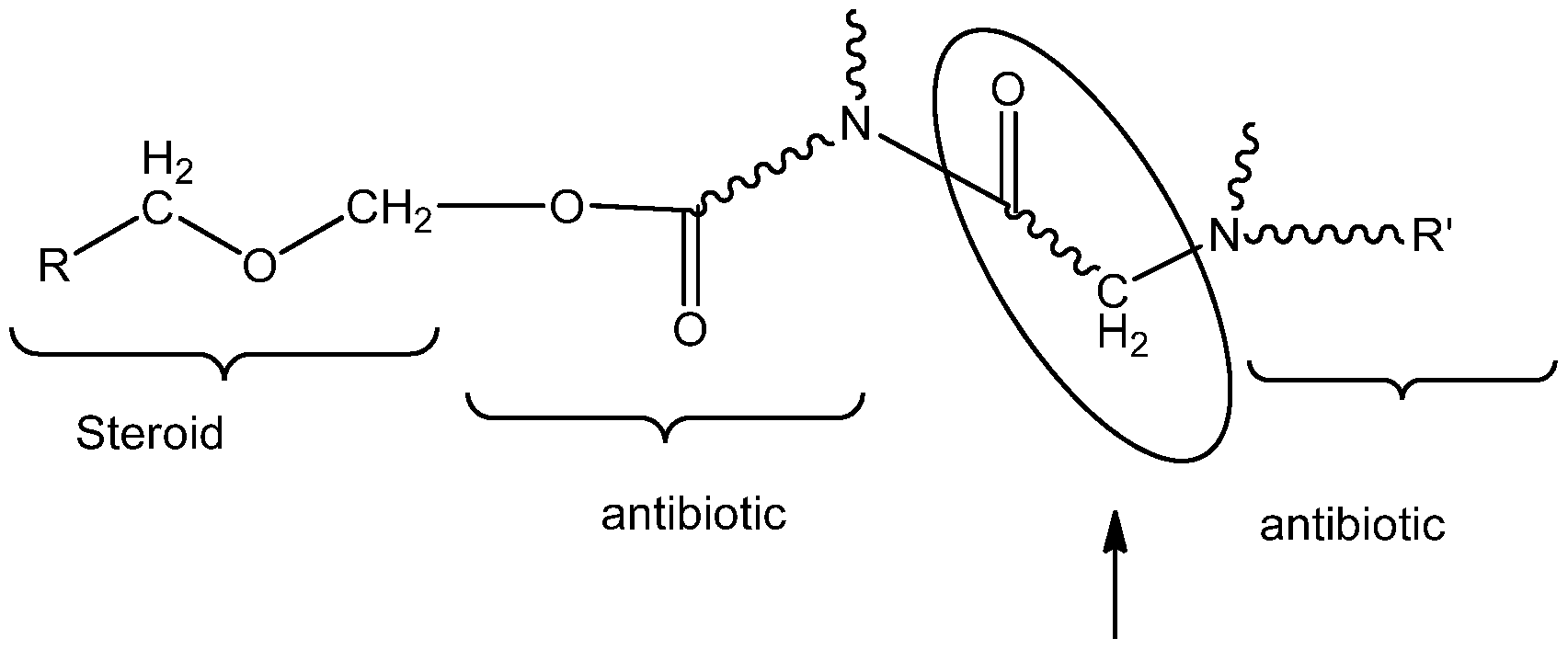
Linker
Scheme 1F


antibiotic antibiotic

Scheme 11
antibiotic antibiotic
 In another aspect the invention provides compounds which may comprise a linker moiety selected from, but not limited to, an ester, a carboxylate, a carbonyl, a carbonate, an amido, a carbamate, a ketone, an amino, an oxo, an ethylene glycol, a polyethylene glycol, an ethylene.
In another aspect, the invention provides compounds which may comprise a linker moiety comprising any combination of an ester, a carboxylate, a carbonyl, a carbonate, an amido, a carbamate, a ketone, an ethylene, an amino, an oxo, an ethylene glycol and/or a polyethylene glycol. Such linker moieties are exemplified below and linker structures are exemplified in Table 1.
Examples of ester moieties comprised in the linkers a
Examples of carboxylate moieties comprised in the lin
Example of a carbonyl moiety comprised in the linker
Example of a carbonate moiety comprised in the linke
Examples of amido moieties comprised in the linkers
Example of carbamate moiety comprised in the linker
Example of a ketone moiety comprised in the linkers i
Examples of amino moieties comprised in the linkers
Example of an oxo moiety comprised in the linker is:
 Example of ethylene glycol moieties comprised in the linkers are: "-" u'
Example of polyethylene glycol moiety comprised in the linkers is:
— — o —
Further the compounds disclosed herein comprise a linker selected from Table 1 :
Table 1


L52
0 0 0 L53 0 0 L54 NH2
L58
0 0 L56
0
L57 o 0 L59 0 0 0 L60
L61
0


Further the compounds disclosed herein comprise at least one pro-drug moiety selected from Table 2:
Table 2


Compounds of the invention are shown in Table 3.
Table 3

2-[(8R,9R,10S,1 1 R, 13R,14R,17S)-1 1 ,17-dihydroxy-10,13- dimethyl-3-oxo-6,7,8,9,10,1 1 , 12,13,14, 15,16,17-dodecahydro-
3H-cyclopenta[a]phenanthren-17-yl]-2-oxoethyl rel-1 - cyclopropyl-7-{4-[({[(1 -cyclopropyl-6-fluoro-8-methoxy-7-{1 -[(5- methyl-2-oxo-1 ,3-dioxol-4-yl)methyl]octahydro-6H-pyrrolo[3,4- b]pyridin-6-yl}-4-oxo-1 ,4-dihydroquinolin-3- yl)carbonyl]oxy}methoxy)carbonyl]-3-methylpiperazin-1 -yl}-6- fluoro-8-methoxy-4-oxo-1 ,4-dihydroquinoline-3-carboxylate rel-1 -cyclopropyl-7-(4-{[5-({4-[1 -cyclopropyl-6-fluoro-3-({2- [(9R,10S,1 1 S,13S,16R,17R)-9-fluoro-1 1 ,17-dihydroxy-10,13,16- trimethyl-3-oxo-6,7,8,9, 10,1 1 ,12,13, 14,15, 16,17-dodecahydro- 3H-cyclopenta[a]phenanthren-17-yl]-2-oxoethoxy}carbonyl)-8- methoxy-4-oxo-1 ,4-dihydroquinolin-7-yl]-2-methylpiperazin-1 - yl}methyl)-2-oxo-1 ,3-dioxol-4-yl]methyl}-3-methylpiperazin-1 -yl)- 6-fluoro-8-methoxy-4-oxo-1 ,4-dihydroquinoline-3-carboxylic acid rel-1 -cyclopropyl-7-(4-{[5-({4-[1 -cyclopropyl-6-fluoro-3-({2- [(9R,10S,1 1 S,13S,16S,17R)-9-fluoro-1 1 ,17-dihydroxy-10, 13,16- trimethyl-3-oxo-6,7,8,9,10,1 1 , 12,13,14,15,16,17-dodecahydro- 3H-cyclopenta[a]phenanthren-17-yl]-2-oxoethoxy}carbonyl)-8- methoxy-4-oxo-1 ,4-dihydroquinolin-7-yl]-2-methylpiperazin-1 - yl}methyl)-2-oxo-1 ,3-dioxol-4-yl]methyl}-3-methylpiperazin-1 -yl)- 6-fluoro-8-methoxy-4-oxo-1 ,4-dihydroquinoline-3-carboxylic acid rel-1 -cyclopropyl-7-(4-{[5-({4-[1 -cyclopropyl-3-({2- [(10R,1 1 S,13S,17R)-1 1 ,17-dihydroxy-10,13-dimethyl-3-oxo- 6,7,8,9,10,1 1 ,12,13, 14,15,16, 17-dodecahydro-3H- cyclopenta[a]phenanthren-17-yl]-2-oxoethoxy}carbonyl)-6-fluoro- 8-methoxy-4-oxo-1 ,4-dihydroquinolin-7-yl]-2-methylpiperazin-1 - yl}methyl)-2-oxo-1 ,3-dioxol-4-yl]methyl}-3-methylpiperazin-1 -yl)- 6-fluoro-8-methoxy-4-oxo-1 ,4-dihydroquinoline-3-carboxylic acid rel-1 -cyclopropyl-7-[4-({[({1 -cyclopropyl-7-[4-({[(4-{2- [(10R,1 1 S,13S,17R)-1 1 ,17-dihydroxy-10,13-dimethyl-3-oxo- 6,7,8,9,10,1 1 ,12,13, 14,15,16, 17-dodecahydro-3H- cyclopenta[a]phenanthren-17-yl]-2-oxoethoxy}-4- oxobutanoyl)oxy]methoxy}carbonyl)-3-methylpiperazin-1 -yl]-6- fluoro-8-methoxy-4-oxo-1 ,4-dihydroquinolin-3- yl}carbonyl)oxy]methoxy}carbonyl)-3-methylpiperazin-1 -yl]-6- fluoro-8-methoxy-4-oxo-1 ,4-dihydroquinoline-3-carboxylic acid rel-1 -cyclopropyl-7-[1 -({[({1 -cyclopropyl-7-[4-({[(4-{2- [(10R,1 1 S,13S,17R)-1 1 ,17-dihydroxy-10,13-dimethyl-3-oxo-
6,7,8,9,10,1 1 ,12,13, 14,15,16, 17-dodecahydro-3H- cyclopenta[a]phenanthren-17-yl]-2-oxoethoxy}-4- oxobutanoyl)oxy]methoxy}carbonyl)-3-methylpiperazin-1 -yl]-6- fluoro-8-methoxy-4-oxo-1 ,4-dihydroquinolin-3- yl}carbonyl)oxy]methoxy}carbonyl)octahydro-6H-pyrrolo[3,4- b]pyridin-6-yl]-6-fluoro-8-methoxy-4-oxo-1 ,4-dihydroquinoline-3- carboxylic acid
rel-1 -cyclopropyl-7-[4-({[({1 -cyclopropyl-7-[1 -({[(4-{2- [(10R,1 1 S,13S,17R)-1 1 ,17-dihydroxy-10,13-dimethyl-3-oxo- 6,7,8,9,10,1 1 ,12,13, 14,15,16, 17-dodecahydro-3H- cyclopenta[a]phenanthren-17-yl]-2-oxoethoxy}-4- oxobutanoyl)oxy]methoxy}carbonyl)octahydro-6H-pyrrolo[3,4- b]pyridin-6-yl]-6-fluoro-8-methoxy-4-oxo-1 ,4-dihydroquinolin-3- yl}carbonyl)oxy]methoxy}carbonyl)-2-methylpiperazin-1 -yl]-6- fluoro-8-methoxy-4-oxo-1 ,4-dihydroquinoline-3-carboxylic acid
({[4-(1 -cyclopropyl-3-{[({[1 -cyclopropyl-6-fluoro-8-methoxy-7-(2- methylpiperazin-1 -yl)-4-oxo-1 ,4-dihydroquinolin-3- yl]carbonyl}oxy)methoxy]carbonyl}-6-fluoro-8-methoxy-4-oxo-
1 ,4-dihydroquinolin-7-yl)-2-methylpiperazin-1 - yl]carbonyl}oxy)methyl 2-[(10R,1 1 S,13S,17R)-1 1 ,17-dihydroxy-
10,13-dimethyl-3-oxo-6,7,8,9,10,1 1 ,12,13, 14,15,16, 17- dodecahydro-3H-cyclopenta[a]phenanthren-17-yl]-2-oxoethyl rel-butanedioate
({[1 -cyclopropyl-7-(1 -{[({[1 -cyclopropyl-6-fluoro-8-methoxy-7-(3- methylpiperazin-1 -yl)-4-oxo-1 ,4-dihydroquinolin-3- yl]carbonyl}oxy)methoxy]carbonyl}octahydro-6H-pyrrolo[3,4- b]pyridin-6-yl)-6-fluoro-8-methoxy-4-oxo-1 ,4-dihydroquinolin-3- yl]carbonyl}oxy)methyl 2-[(10R,1 1 S,13S,17R)-1 1 ,17-dihydroxy-
10,13-dimethyl-3-oxo-6,7,8,9,10,1 1 ,12,13, 14,15,16, 17- dodecahydro-3H-cyclopenta[a]phenanthren-17-yl]-2-oxoethyl rel-butanedioate
({[1 -cyclopropyl-7-(1 -{[({[1 -cyclopropyl-6-fluoro-8-methoxy-7- (octahydro-6H-pyrrolo[3,4-b]pyridin-6-yl)-4-oxo-1 ,4- dihydroquinolin-3-yl]carbonyl}oxy)methoxy]carbonyl}octahydro-
6H-pyrrolo[3,4-b]pyridin-6-yl)-6-fluoro-8-methoxy-4-oxo-1 ,4- dihydroquinolin-3-yl]carbonyl}oxy)methyl 2-[(10R,1 1 S,13S,17R)- 1 1 ,17-di hydro xy-10,13-dimethyl-3-oxo- 6,7,8,9,10,1 1 ,12,13, 14,15,16, 17-dodecahydro-3H- cyclopenta[a]phenanthren-17-yl]-2-oxoethyl rel-butanedioate
2-[(9R, 10S, 1 1 S, 13S, 16R, 17R)-9-fluoro-1 1 , 17-dihydroxy- 10,13, 16-trimethyl-3-oxo-6,7,8,9,10,1 1 ,12,13, 14,15,16, 17- dodecahydro-3H-cyclopenta[a]phenanthren-17-yl]-2-oxoethyl 2- [(9S, 10R, 1 1 R, 13R, 16S, 17S)-9-fluoro-1 1 , 17-dihydroxy-10,13,16- trimethyl-3-oxo-6,7,8,9,10,1 1 , 12,13,14,15,16,17-dodecahydro- 3H-cyclopenta[a]phenanthren-17-yl]-2-oxoethyl rel-7,7'-{(2-oxo- 1 ,3-dioxole-4,5-diyl)bis[methanediyl(3-methylpiperazine-4,1 -
diyl)]}bis(1 -cyclopropyl-6-fluoro-8-methoxy-4-oxo-1 ,4- dihydroquinoline-3-carboxylate)
2-[(8R,9S,10R,1 1 R,13R,14R,16R,17S)-9-fluoro-1 1 ,17- dihydroxy-10,13,16-trimethyl-3-oxo- 6,7,8,9,10,1 1 ,12,13, 14,15,16, 17-dodecahydro-3H- cyclopenta[a]phenanthren-17-yl]-2-oxoethyl rel-1 -cyclopropyl-6- fluoro-7-{4-[({[2-(2-fluorobiphenyl-4- yl)propanoyl]oxy}methoxy)carbonyl]-3-methylpiperazin-1 -yl}-8- methoxy-4-oxo-1 ,4-dihydroquinoline-3-carboxylate
2-[(8R,10S,1 1 R,13R,14R,17S)-1 1 ,17-dihydroxy-10,13-dimethyl-
3-oxo-6,7,8,9,10,1 1 ,12,13,14,15,16,17-dodecahydro-3H- cyclopenta[a]phenanthren-17-yl]-2-oxoethyl rel-1 -cyclopropyl-6- fluoro-7-{4-[({[2-(2-fluorobiphenyl-4- yl)propanoyl]oxy}methoxy)carbonyl]-3-methylpiperazin-1 -yl}-8- methoxy-4-oxo-1 ,4-dihydroquinoline-3-carboxylate
1 ,3-bis({[1 -cyclopropyl-6-fluoro-8-methoxy-7-(3-methylpiperazin- 1 -yl)-4-oxo-1 ,4-dihydroquinolin-3-yl]carbonyl}oxy)propan-2-yl 2- [(8R,9S,10R,1 1 R,13R,14R,16S,17S)-9-fluoro-1 1 ,17-dihydroxy-
10,13, 16-trimethyl-3-oxo-6,7,8,9,10,1 1 ,12,13, 14,15,16, 17- dodecahydro-3H-cyclopenta[a]phenanthren-17-yl]-2-oxoethyl rel-benzene-1 ,4-dicarboxylate
1 ,3-bis({[1 -cyclopropyl-6-fluoro-8-methoxy-7-(3-methylpiperazin- 1 -yl)-4-oxo-1 ,4-dihydroquinolin-3-yl]carbonyl}oxy)propan-2-yl 2- [(8R,10S,1 1 R,13R,14R,17S)-1 1 ,17-dihydroxy-10,13-dimethyl-3- oxo-6,7,8,9,10,1 1 ,12, 13,14, 15,16, 17-dodecahydro-3H- cyclopenta[a]phenanthren-17-yl]-2-oxoethyl rel-butanedioate
1 ,3-bis({[1 -cyclopropyl-6-fluoro-8-methoxy-7-(3-methylpiperazin- 1 -yl)-4-oxo-1 ,4-dihydroquinolin-3-yl]carbonyl}oxy)propan-2-yl 2- [(8R,10S,1 1 R,13R,14R,17S)-1 1 ,17-dihydroxy-10,13-dimethyl-3- oxo-2,3,6,7,8,9, 10,1 1 ,12,13,14, 15,16, 17-tetradecahydro-1 H- cyclopenta[a]phenanthren-17-yl]-2-oxoethyl rel-butanedioate
1 ,3-bis{[(1 -cyclopropyl-6-fluoro-8-methoxy-7-{3-methyl-4-[(5- methyl-2-oxo-1 ,3-dioxol-4-yl)methyl]piperazin-1 -yl}-4-oxo-1 ,4- dihydroquinolin-3-yl)carbonyl]oxy}propan-2-yl 2- [(8R,10S,1 1 R,13R,14R,17S)-1 1 ,17-dihydroxy-10,13-dimethyl-3- oxo-6,7,8,9,10,1 1 ,12, 13,14, 15,16, 17-dodecahydro-3H- cyclopenta[a]phenanthren-17-yl]-2-oxoethyl rel-butanedioate
1 ,3-bis({[({[1 -cyclopropyl-6-fluoro-8-methoxy-7-(3- methylpiperazin-1 -yl)-4-oxo-1 ,4-dihydroquinolin-3- yl]carbonyl}oxy)methoxy]carbonyl}oxy)propan-2-yl 2- [(8R,10S,1 1 R,13R,14R,17S)-1 1 ,17-dihydroxy-10,13-dimethyl-3- oxo-6,7,8,9,10,1 1 ,12, 13,14, 15,16, 17-dodecahydro-3H- cyclopenta[a]phenanthren-17-yl]-2-oxoethyl rel-butanedioate
32 1 ,3-bis{[({[(1 -cyclopropyl-6-fluoro-8-methoxy-7-{3-methyl-4-[(5- methyl-2-oxo-1 ,3-dioxol-4-yl)methyl]piperazin-1 -yl}-4-oxo-1 ,4- dihydroquinolin-3-yl)carbonyl]oxy}methoxy)carbonyl]oxy}propan-
2-yl 2-[(8R, 10S, 1 1 R, 13R, 14R, 17S)-1 1 , 17-dihydroxy-10,13- dimethyl-3-oxo-6,7,8,9,10,1 1 , 12,13,14, 15,16,17-dodecahydro-
3H-cyclopenta[a]phenanthren-17-yl]-2-oxoethyl rel-butanedioate
33 1 ,3-bis{[({[(1 -cyclopropyl-6-fluoro-8-methoxy-7-{1 -[(5-methyl-2- oxo-1 ,3-dioxol-4-yl)methyl]octahydro-6H-pyrrolo[3,4-b]pyridin-6- yl}-4-oxo-1 ,4-dihydroquinolin-3- yl)carbonyl]oxy}methoxy)carbonyl]oxy}propan-2-yl 2- [(8R,10S,1 1 R,13R,14R,17S)-1 1 ,17-dihydroxy-10,13-dimethyl-3- oxo-6,7,8,9,10,1 1 ,12,13,14,15,16, 17-dodecahydro-3H- cyclopenta[a]phenanthren-17-yl]-2-oxoethyl rel-butanedioate
34 2-({2-[(8R, 10S, 1 1 R, 13R, 14R, 17S)-1 1 , 17-dihydroxy- 10,13-dimethyl-3-oxo-6,7,8,9,10,1 1 ,12,13, 14,15,16, 17- dodecahydro-3H-cyclopenta[a]phenanthren-17-yl]-2- oxoethoxy}carbonyl)propane-1 ,3-diyl relbis(1 -cyclopropyl-6- fluoro-8-methoxy-7-{3-methyl-4-[(5-methyl-2-oxo-1 ,3-dioxol-4- yl)methyl]piperazin-1 -yl}-4-oxo-1 ,4-dihydroquinoline-3- carboxylate)
In another embodiment the compounds disclosed herein comprise one steroid moiety and two antibiotic moieties.
In another embodiment the compounds disclosed herein comprise one steroid moiety and two antibiotic moieties and at least one linker selected from Table 1 .
In another embodiment the compounds disclosed herein comprise one steroid moiety and two antibiotic moieties and at least one linker selected from Table 1 and one pro-drug moiety selected from Table 2.
In another embodiment the compounds disclosed herein comprise one steroid moiety and two antibiotic moieties and two linkers selected from Table 1 and two pro-drug moieties selected from Table 2.
In another embodiment the compounds disclosed herein comprise steroid moiety and two antibiotic moieties and least two linkers selected from Table 1 and one pro-drug moiety selected from Table 2.
In another embodiment the compounds disclosed herein comprise steroid moiety and two antibiotic moieties and one linker selected from Table 1 and two prodrug moieties selected from Table 2.
In another embodiment the compounds disclosed herein comprise one prednisolone moiety and two moxifloxacin moieties, such as:
2-[(8R,9R, 10S, 1 1 R, 13R, 14R, 17S)-1 1 , 17-dihydroxy-10,13-dimethyl-3-oxo- 6,7,8,9,10,1 1 ,12, 13,14, 15,16,17-dodecahydro-3H-cyclopenta[a]phenanthren-17-yl]- 2-oxoethyl rel-1 -cyclopropyl-7-(1 -{[({[1 -cyclopropyl-6-fluoro-8-methoxy-7-(octahydro- 6H-pyrrolo[3,4-b]pyridin-6-yl)-4-oxo-1 ,4-dihydroquinolin-3- yl]carbonyl}oxy)methoxy]carbonyl}octahydro-6H-pyrrolo[3,4-b]pyridin-6-yl)-6-fluoro-8- methoxy-4-oxo-1 ,4-dihydroquinoline-3-carboxylate;
({[1 -cyclopropyl-7-(1 -{[({[1 -cyclopropyl-6-fluoro-8-methoxy-7-(octahydro-6H- pyrrolo[3,4-b]pyridin-6-yl)-4-oxo-1 ,4-dihydroquinolin-3- yl]carbonyl}oxy)methoxy]carbonyl}octahydro-6H-pyrrolo[3,4-b]pyridin-6-yl)-6-fluoro-8- methoxy-4-oxo-1 ,4-dihydroquinolin-3-yl]carbonyl}oxy)methyl 2-[(10R,1 1 S,13S,17R)- 1 1 ,17-dihydroxy-10,13-dimethyl-3-oxo-6,7,8,9,10, 1 1 , 12,13, 14,15,16, 17- dodecahydro-3H-cyclopenta[a]phenanthren-17-yl]-2-oxoethyl rel-butanedioate.
In another embodiment the compounds disclosed herein comprise one prednisolone moiety and one moxifloxacin moiety and one gatifloxacin moiety such as:
2-[(8R,9R, 10S, 1 1 R, 13R, 14R, 17S)-1 1 , 17-dihydroxy-10,13-dimethyl-3-oxo- 6,7,8,9,10,1 1 ,12, 13,14, 15,16,17-dodecahydro-3H-cyclopenta[a]phenanthren-17-yl]- 2-oxoethyl rel-1 -cyclopropyl-7-(4-{[({[1 -cyclopropyl-6-fluoro-8-methoxy-7-(octahydro- 6H-pyrrolo[3,4-b]pyridin-6-yl)-4-oxo-1 ,4-dihydroquinolin-3- yl]carbonyl}oxy)methoxy]carbonyl}-3-methylpiperazin-1 -yl)-6-fluoro-8-methoxy-4-oxo- 1 ,4-dihydroquinoline-3-carboxylate;
2-[(8R,9R, 10S, 1 1 R, 13R, 14R, 17S)-1 1 , 17-dihydroxy-10,13-dimethyl-3-oxo- 6,7,8,9,10,1 1 ,12, 13,14, 15,16,17-dodecahydro-3H-cyclopenta[a]phenanthren-17-yl]- 2-oxoethyl rel-1 -cyclopropyl-7-{4-[({[(1 -cyclopropyl-6-fluoro-8-methoxy-7-{1 -[(5- methyl-2-oxo-1 ,3-dioxol-4-yl)methyl]octahydro-6H-pyrrolo[3,4-b]pyridin-6-yl}-4-oxo-
1 ,4-dihydroquinolin-3-yl)carbonyl]oxy}me
fluoro-8-methoxy-4-oxo-1 ,4-dihydroquinoline-3-carboxylate; rel-1 -cyclopropyl-7-[1 -({[({1 -cyclopropyl-7-[4-({[(4-{2-[(10R,1 1 S, 13S, 17R)-1 1 ,17- dihydroxy-10,13-dimethyl-3-oxo-6,7,8,9,10,1 1 ,12,13, 14,15, 16,17-dodecahydro-3H- cyclopenta[a]phenanthren-17-yl]-2-oxoethoxy}-4- oxobutanoyl)oxy]methoxy}carbonyl)-3-methylpiperazin-1 -yl]-6-fluoro-8-methoxy-4- oxo-1 ,4-dihydroquinolin-3-yl}carbonyl)oxy]methoxy}carbonyl)octahydro-6H- pyrrolo[3,4-b]pyridin-6-yl]-6-fluoro-8-methoxy-4-oxo-1 ,4-dihydroquinoline-3- carboxylic acid; rel-1 -cyclopropyl-7-[4-({[({1 -cyclopropyl-7-[1 -({[(4-{2-[(10R,1 1 S, 13S, 17R)-1 1 ,17- dihydroxy-10,13-dimethyl-3-oxo-6,7,8,9,10,1 1 ,12,13, 14,15, 16,17-dodecahydro-3H- cyclopenta[a]phenanthren-17-yl]-2-oxoethoxy}-4- oxobutanoyl)oxy]methoxy}carbonyl)octahydro-6H-pyrrolo[3,4-b]pyridin-6-yl]-6-fluoro- 8-methoxy-4-oxo-1 ,4-dihydroquinolin-3-yl}carbonyl)oxy]methoxy}carbonyl)-2- methylpiperazin-1 -yl]-6-fluoro-8-methoxy-4-oxo-1 ,4-dihydroquinoline-3-carboxylic acid;
({[1 -cyclopropyl-7-(1 -{[({[1 -cyclopropyl-6-fluoro-8-methoxy-7-(3-methylpiperazin-1 -yl)- 4-OXO-1 ,4-dihydroquinolin-3-yl]carbonyl}oxy)methoxy]carbonyl}octahydro-6H- pyrrolo[3,4-b]pyridin-6-yl)-6-fluoro-8-methoxy-4-oxo-1 ,4-dihydroquinolin-3- yl]carbonyl}oxy)methyl 2-[(10R,1 1 S,13S,17R)-1 1 ,17-dihydroxy-10,13-dimethyl-3- oxo-6,7,8,9,10,1 1 ,12,13,14,15, 16,17-dodecahydro-3H-cyclopenta[a]phenanthren-17- yl]-2-oxoethyl rel-butanedioate.
In another embodiment the compounds disclosed herein comprise one prednisolone moiety and two gatifloxacin moieties such as:
({[4-(1 -cyclopropyl-3-{[({[1 -cyclopropyl-6-fluoro-8-methoxy-7-(2-methylpiperazin-1 -yl)-
4-0X0-1 ,4-dihydroquinolin-3-yl]carbonyl}oxy)methoxy]carbonyl}-6-fluoro-8-methoxy-
4-0X0-1 ,4-dihydroquinolin-7-yl)-2-methylpiperazin-1 -yl]carbonyl}oxy)methyl 2-
[(10R,1 1 S,13S,17R)-1 1 ,17-dihydroxy-10, 13-dimethyl-3-oxo-
6,7,8,9,10,1 1 ,12, 13,14, 15,16,17-dodecahydro-3H-cyclopenta[a]phenanthren-17-yl]-
2-oxoethyl rel-butanedioate;
rel-1 -cyclopropyl-7-[4-({[({1-cyclopropyl-7-[4-({[(4-{2-[(10R,1 1 S,13S, 17R)-1 1 ,17- dihydroxy-10,13-dimethyl-3-oxo-6,7,8,9,10,1 1 ,12,13,14,15,16,17-dode∞hydro-3H- cyclopenta[a]phenanthren-17-yl]-2-oxoethoxy}-4- oxobutanoyl)oxy]methoxy}carbonyl)-3-methylpiperazin-1 -yl]-6-fluoro-8-methoxy-4- oxo-1 ,4-dihydroquinolin-3-yl}carbonyl)oxy]methoxy}carbonyl)-3-methylpiperazin-1 - yl]-6-fluoro-8-methoxy-4-oxo-1 ,4-dihydroquinoline-3-carboxylic acid; rel-1 -cyclopropyl-7-(4-{[5-({4-[1 -cyclopropyl-3-({2-[(1 OR, 1 1 S, 13S, 17R)-1 1 , 17- dihydroxy-10,13-dimethyl-3-oxo-6,7,8,9,10,1 1 ,12,13,14,15,16,17-dodecahydro-3H- cyclopenta[a]phenanthren-17-yl]-2-oxoethoxy}carbonyl)-6-fluoro-8-methoxy-4-oxo- 1 ,4-dihydroquinolin-7-yl]-2-methylpiperazin-1 -yl}methyl)-2-oxo-1 ,3-dioxol-4- yl]methyl}-3-methylpiperazin-1 -yl)-6-fluoro-8-methoxy-4-oxo-1 ,4-dihydroquinoline-3- carboxylic acid;
2-[(8R,9R, 10S, 1 1 R, 13R, 14R, 17S)-1 1 , 17-dihydroxy-10,13-dimethyl-3-oxo- 6,7,8,9,10,1 1 ,12,13,14,15,16,17-dodecahydro-3H-cyclopenta[a]phenanthren-17-yl]- 2-oxoethyl rel-1 -cyclopropyl-7-{4-[({[(1 -cyclopropyl-6-fluoro-8-methoxy-7-{3-methyl-4- [(5-methyl-2-oxo-1 ,3-dioxol-4-yl)methyl]piperazin-1 -yl}-4-oxo-1 ,4-dihydroquinolin-3- yl)carbonyl]oxy}methoxy)carbonyl]-3-methylpiperazin-1 -yl}-6-fluoro-8-methoxy-4-oxo- 1 ,4-dihydroquinoline-3-carboxylate;
1 ,3-bis({[1 -cyclopropyl-6-fluoro-8-methoxy-7-(3-methylpiperazin-1 -yl)-4-oxo-1 ,4- dihydroquinolin-3-yl]carbonyl}oxy)propan-2-yl 2-[(8R, 10S, 1 1 R, 13R, 14R, 17S)-1 1 ,17- dihydroxy-10,13-dimethyl-3-oxo-6,7,8,9,10,1 1 ,12,13,14,15,16,17-dodecahydro-3H- cyclopenta[a]phenanthren-17-yl]-2-oxoethyl rel-butanedioate;
1 ,3-bis{[(1 -cyclopropyl-6-fluoro-8-methoxy-7-{3-methyl-4-[(5-methyl-2-oxo-1 ,3-dioxol-
4-yl)methyl]piperazin-1 -yl}-4-oxo-1 ,4-dihydroquinolin-3-yl)carbonyl]oxy}propan-2-yl 2-
[(8R,10S,1 1 R,13R,14R,17S)-1 1 ,17-dihydroxy-10,13-dimethyl-3-oxo-
6,7,8,9,10,1 1 ,12,13,14,15,16,17-dodecahydro-3H-cyclopenta[a]phenanthren-17-yl]-
2-oxoethyl rel-butanedioate.
In another embodiment the compounds disclosed herein comprise one
hydrocortisone moiety and one besifloxacin moiety and one gatifloxacin moiety such as:
[({4-[1 -cyclopropyl-3-({2-[(8R,9R, 10S, 1 1 R, 13R, 14R, 17S)-1 1 , 17-dihydroxy-10,13- dimethyl-3-oxo-2,3,6,7,8,9,10,1 1 ,12,13,14,15, 16,17-tetradecahydro-1 H- cyclopenta[a]phenanthren-17-yl]-2-oxoethoxy}carbonyl)-6-fluoro-8-methoxy-4-oxo- 1 ,4-dihydroquinolin-7-yl]-2-methylpiperazin-1 -yl}carbonyl)oxy]methyl rel-7-[(3S)-3- aminoazepan-1 -yl]-1 -cyclopropyl-6-fluoro-8-methoxy-4-oxo-1 ,4-dihydroquinoline-3- carboxylate.
In another embodiment the compounds disclosed herein comprise one
dexamethasone and two gatifloxacin moieties such as:
rel-1 -cyclopropyl-7-(4-{[5-({4-[1 -cyclopropyl-6-fluoro-3-({2-
[(9R,10S,1 1 S,13S,16R,17R)-9-fluoro-1 1 ,17-dihydroxy-10,13,16-trimethyl-3-oxo- 6,7,8,9,10,1 1 ,12, 13,14, 15,16,17-dodecahydro-3H-cyclopenta[a]phenanthren-17-yl]- 2-oxoethoxy}carbonyl)-8-methoxy-4-oxo-1 ,4-dihydroquinolin-7-yl]-2-methylpiperazin- 1 -yl}methyl)-2-oxo-1 ,3-dioxol-4-yl]methyl}-3-methylpiperazin-1 -yl)-6-fluoro-8- methoxy-4-oxo-1 ,4-dihydroquinoline-3-carboxylic acid;
1 ,3-bis({[1 -cyclopropyl-6-fluoro-8-methoxy-7-(3-methylpiperazin-1 -yl)-4-oxo-1 ,4- dihydroquinolin-3-yl]carbonyl}oxy)propan-2-yl 2-
[(8R.9S, 10R, 1 1 R, 13R, 14R, 16S, 17S)-9-fluoro-1 1 , 17-dihydroxy-10,13,16-trimethyl-3- oxo-6,7,8,9,10,1 1 ,12,13,14,15, 16,17-dodecahydro-3H-cyclopenta[a]phenanthren-17- yl]-2-oxoethyl rel-benzene-1 ,4-dicarboxylate.
In another embodiment the compounds disclosed herein comprise one bethasone and two gatifloxacin moieties such as: rel-1 -cyclopropyl-7-(4-{[5-({4-[1 -cyclopropyl-6-fluoro-3-({2- [(9R, 10S, 1 1 S, 13S, 16S, 17R)-9-fluoro-1 1 , 17-dihydroxy-10, 13,16-trimethyl-3-oxo- 6,7,8,9,10,1 1 ,12, 13,14, 15,16,17-dodecahydro-3H-cyclopenta[a]phenanthren-17-yl]- 2-oxoethoxy}carbonyl)-8-methoxy-4-oxo-1 ,4-dihydroquinolin-7-yl]-2-methylpiperazin- 1 -yl}methyl)-2-oxo-1 ,3-dioxol-4-yl]methyl}-3-methylpiperazin-1 -yl)-6-fluoro-8- methoxy-4-oxo-1 ,4-dihydroquinoline-3-carboxylic acid. In another embodiment the compounds disclosed herein comprise one
hydrocortisone and two gatifloxacin moieties such as:
I , 3-bis({[1 -cyclopropyl-6-fluoro-8-methoxy-7-(3-methylpiperazin-1 -yl)-4-oxo-1 ,4- dihydroquinolin-3-yl]carbonyl}oxy)propan-2-yl 2-[(8R, 10S, 1 1 R, 13R, 14R, 17S)-1 1 ,17- dihydroxy-10,13-dimethyl-3-oxo-2,3,6,7,8,9,10,1 1 , 12,13,14,15,16,17-tetradecahydro- 1 H-cyclopenta[a]phenanthren-17-yl]-2-oxoethyl rel-butanedioate; 1 ,3-bis({[({[1 -cyclopropyl-6-fluoro-8-methoxy-7-(3-methylpiperazin-1 -yl)-4-oxo-1 ,4- dihydroquinolin-3-yl]carbonyl}oxy)methoxy]carbonyl}oxy)propan-2-yl 2- [(8R,10S,1 1 R,13R,14R,17S)-1 1 ,17-dihydroxy-10,13-dimethyl-3-oxo- 6,7,8,9,10,1 1 ,12, 13,14, 15,16,17-dodecahydro-3H-cyclopenta[a]phenanthren-17-yl]- 2-oxoethyl rel-butanedioate; 1 ,3-bis{[({[(1 -cyclopropyl-6-fluoro-8-methoxy-7-{3-methyl-4-[(5-methyl-2-oxo-1 ,3- dioxol-4-yl)methyl]piperazin-1 -yl}-4-oxo-1 ,4-dihydroquinolin-3- yl)carbonyl]oxy}methoxy)carbonyl]oxy}propan-2-yl 2-[(8R, 10S, 1 1 R, 13R, 14R, 17S)-
I I , 17-dihydroxy-10,13-dimethyl-3-oxo-6,7,8,9,10, 1 1 , 12,13, 14,15,16, 17- dodecahydro-3H-cyclopenta[a]phenanthren-17-yl]-2-oxoethyl rel-butanedioate. In another embodiment the compounds disclosed herein comprise one
hydrocortisone and two moxifloxacin moieties such as:
I , 3-bis{[({[(1 -cyclopropyl-6-fluoro-8-methoxy-7-{1 -[(5-methyl-2-oxo-1 ,3-dioxol-4- yl)methyl]octahydro-6H-pyrrolo[3,4-b]pyridin-6-yl}-4-oxo-1 ,4-dihydroquinolin-3- yl)carbonyl]oxy}methoxy)carbonyl]oxy}propan-2-yl 2-[(8R,10S,1 1 R,13R,14R,17S)-
I I , 17-dihydroxy-10,13-dimethyl-3-oxo-6,7,8,9,10, 1 1 , 12,13, 14,15,16, 17- dodecahydro-3H-cyclopenta[a]phenanthren-17-yl]-2-oxoethyl rel-butanedioate;
2-({2-[(8R,10S,1 1 R,13R,14R,17S)-1 1 ,17-dihydroxy-10,13-dimethyl-3-oxo- 6,7,8,9,10,1 1 ,12, 13,14, 15,16,17-dodecahydro-3H-cyclopenta[a]phenanthren-17-yl]- 2-oxoethoxy}carbonyl)propane-1 ,3-diyl relbis(1 -cyclopropyl-6-fluoro-8-methoxy-7-{3- methyl-4-[(5-methyl-2-oxo-1 ,3-dioxol-4-yl)methyl]piperazin-1 -yl}-4-oxo-1 ,4- dihydroquinoline-3-carboxylate).
In another embodiment the invention provides a hybrid compound comprising two antibiotic moieties and a steroid drug moiety, or a pharmaceutical salt thereof, which are connected via three separate covalent bonds to a linker such that said covalent bonds degrade in vivo to yield independently the antibiotics and steroid drugs.
In another embodiment the invention provides a hybrid compound comprising two different antibiotic moieties and a steroid drug moiety, or a pharmaceutical salt thereof, which are connected via three separate covalent bonds to a linker such that said covalent bonds degrade in vivo to yield independently the antibiotics and steroid drugs.
In another embodiment the invention provides a hybrid compound comprising two identical antibiotic moieties and a steroid drug moiety, or a pharmaceutical salt thereof, which are connected via three separate covalent bonds to a linker such that said covalent bonds degrade in vivo to yield independently the antibiotics and steroid drugs.
In another embodiment the invention provides a hybrid compound comprising two different antibiotic moieties and a steroid drug moiety, or a pharmaceutical salt thereof, wherein the steroid is directly linked to one antibiotic which is connected via a linker to the other antibiotic and wherein the bonds degrade in vivo to yield independently the antibiotics and steroid drugs.
In another embodiment the invention provides a hybrid compound comprising two identical antibiotic moieties and a steroid drug moiety, or a pharmaceutical salt thereof, which are connected via four separate covalent bonds to two different linkers such that said covalent bonds degrade in vivo to yield independently the antibiotics and steroid drugs. In another embodiment the invention provides a hybrid compound comprising two identical antibiotic moieties and a steroid drug moiety, or a pharmaceutical salt thereof, which are connected via four separate covalent bonds to two identical linkers such that said covalent bonds degrade in vivo to yield independently the antibiotics and steroid drugs.
In another embodiment the invention provides a pharmaceutical composition comprising a hybrid compound comprising two antibiotic moieties and a steroid moiety, which are connected via three separate covalent bonds to a linker such that said covalent bonds degrade in vivo to yield the antibiotics and the steroid drugs,
wherein each bond is an ester bond or an amide depending on the nature of the linker, wherein said pharmaceutical composition is formulated for topical ophthalmic administration. In another embodiment the invention provides a pharmaceutical composition comprising a hybrid compound comprising two antibiotic moieties and a steroid moiety, which are connected via four separate covalent bonds to two linkers such that said covalent bonds degrade in vivo to yield the antibiotics and the steroid drugs, wherein each bond is an ester bond or an amide depending on the nature of the linker, wherein said pharmaceutical composition is formulated for topical ophthalmic administration.
In another embodiment the invention provides a pharmaceutical composition comprising a hybrid compound comprising two identical antibiotic moieties and a steroid moiety, which are connected via three separate covalent bonds to a linker such that said covalent bonds degrade in vivo to yield the antibiotics and the steroid drugs, wherein each bond is an ester bond or an amide depending on the nature of the linker, wherein said pharmaceutical composition is formulated for topical ophthalmic administration.
In another embodiment the invention provides a pharmaceutical composition comprising a hybrid compound comprising two different antibiotic moieties and a steroid moiety, which are connected via three separate covalent bonds to a linker such that said covalent bonds degrade in vivo to yield the antibiotics and the steroid drugs, wherein each bond is an ester bond or an amide depending on the nature of the linker, wherein said pharmaceutical composition is formulated for topical ophthalmic administration.
In another embodiment the invention provides a pharmaceutical composition comprising a hybrid compound comprising two antibiotic moieties and a steroid moiety, which are connected via four separate covalent bonds to two linkers such that said covalent bonds degrade in vivo to yield the antibiotics and the steroid drugs, wherein each bond is an ester bond or an amide depending on the nature of
the linker, wherein said pharmaceutical composition is formulated for topical ophthalmic administration.
In another embodiment the invention provides a pharmaceutical composition comprising a hybrid compound comprising two identical antibiotic moieties and a steroid moiety, which are connected via four separate covalent bonds to two linkers such that said covalent bonds degrade in vivo to yield the antibiotics and the steroid drugs, wherein each bond is an ester bond or an amide depending on the nature of the linker, wherein said pharmaceutical composition is formulated for topical ophthalmic administration.
In another embodiment the invention provides a pharmaceutical composition comprising a hybrid compound comprising two different antibiotic moieties and a steroid moiety, which are connected via four separate covalent bonds to two linkers such that said covalent bonds degrade in vivo to yield the antibiotics and the steroid drugs, wherein each bond is an ester bond or an amide depending on the nature of the linker, wherein said pharmaceutical composition is formulated for topical ophthalmic administration.
In another embodiment the invention provides a pharmaceutical composition comprising a hybrid compound comprising two different antibiotic moieties and a steroid moiety, which are connected via three separate covalent bonds to one linker such that said covalent bonds degrade in vivo to yield the antibiotics and the steroid drugs, wherein each bond is an ester bond or an amide depending on the nature of the linker, wherein said pharmaceutical composition is formulated for topical ophthalmic administration.
In another embodiment the invention provides a hybrid compound comprising two linkers having four bonds, wherein said bonds are asymmetrically degraded in vivo to release the three active drugs.
Some compounds of the invention have at least one stereogenic center in their structure. This stereogenic center may be present in an R or S configuration,
said R and S notation is used in correspondence with the rules described in Pure Appli. Chem. (1976), 45, 1 1 -13.
The term "pharmaceutically acceptable salts" refers to salts or complexes that retain the desired biological activity of the above identified compounds and exhibit minimal or no undesired toxicological effects. The "pharmaceutically acceptable salts" according to the invention include therapeutically active, non-toxic base or acid salt forms, which the compounds of the invention are able to form.
The acid addition salt form of a compound of the invention that occurs in its free form as a base can be obtained by treating the free base with an appropriate acid such as an inorganic acid, for example, hydrochloric acid, hydrobromic acid, sulfuric acid, phosphoric acid, nitric acid and the like; or an organic acid such as for example, acetic, hydroxyacetic, propanoic, lactic, pyruvic, malonic, fumaric acid, maleic acid, oxalic acid, tartaric acid, succinic acid, malic acid, ascorbic acid, benzoic acid, tannic acid, pamoic acid, citric, methylsulfonic, ethanesulfonic,
benzenesulfonic, formic acid and the like (Handbook of Pharmaceutical Salts, P. Heinrich Stahl & Camille G. Wermuth (Eds), Verlag Helvetica Chimica Acta- Zurich, 2002, 329-345).
The base addition salt form of a compound of the invention that occurs in its acid form can be obtained by treating the acid with an appropriate base such as an inorganic base, for example, sodium hydroxide, magnesium hydroxide, potassium hydroxide, calcium hydroxide, ammonia and the like; or an organic base such as for example, L-Arginine, ethanolamine, betaine, benzathine, morpholine and the like. (Handbook of Pharmaceutical Salts, P. Heinrich Stahl & Camille G. Wermuth (Eds), Verlag Helvetica Chimica Acta- Zurich, 2002, 329-345).
Compounds of the invention and their salts can be in the form of a solvate, which is included within the scope of the present invention. Such solvates include for example hydrates, alcoholates and the like.
In still another embodiment of the invention, there are provided methods for treating or preventing eye conditions such as: conjunctivitis, keratitis, blepharitis, dacyrocystitis, hordeolum, corneal ulcers, anterior blepharitis, posterior blepharitis, meibomian gland dysfunction, dry eye disease (keratocojunctivitis sicca) ocular pain,
ocular pain and inflammation post-ocular surgery , bacterial conjunctivitis, anterior uveitis, in a patient suffering thereof. Such methods can be performed, for example, by administering to a subject in need thereof a therapeutically effective amount of at least one compound of the invention, or any combination thereof, or
pharmaceutically acceptable salts, hydrates, solvates, crystal forms thereof.
The present invention concerns the use of a compound of the invention or a pharmaceutically acceptable salt thereof, for the manufacture of a medicament for the treatment of conjunctivitis, keratitis, blepharitis, endophthalmitis, red eye, hyperemia, dacyrocystitis, hordeolum, corneal ulcers, anterior blepharitis, posterior blepharitis, meibomian gland dysfunction, dry eye disease (keratocojunctivitis sicca) ocular pain, ocular pain and inflammation post-ocular surgery , bacterial
conjunctivitis, anterior uveitis.
The actual amount of the compound to be administered in any given case will be determined by a physician taking into account the relevant circumstances, such as the severity of the condition, the age and weight of the patient, the patient's general physical condition, the cause of the condition, and the route of administration.
The patient will be administered the compound orally in any acceptable form, such as a tablet, liquid, capsule, powder and the like, or other routes may be desirable or necessary, particularly if the patient suffers from nausea. Such other routes may include, without exception, transdermal, parenteral, subcutaneous, intranasal, via an implant stent, intrathecal, intravitreal, topical to the eye, back to the eye, intramuscular, intravenous, and intrarectal modes of delivery. Additionally, the formulations may be designed to delay release of the active compound over a given period of time, or to carefully control the amount of drug released at a given time during the course of therapy.
In another embodiment of the invention, there are provided pharmaceutical compositions including at least one compound of the invention in a pharmaceutically acceptable carrier thereof. The phrase "pharmaceutically acceptable" means the carrier, diluent or excipient must be compatible with the other ingredients of the formulation and not deleterious to the recipient thereof.
Pharmaceutical compositions of the present invention can be used in the form of a solid, a solution, an emulsion, a dispersion, a patch, a micelle, a liposome, and the like, wherein the resulting composition contains one or more compounds of the present invention, as an active ingredient, in admixture with an organic or inorganic carrier or excipient suitable for enteral or parenteral applications. Invention compounds may be combined, for example, with the usual non-toxic, pharmaceutically acceptable carriers for tablets, pellets, capsules, suppositories, solutions, emulsions, suspensions, and any other form suitable for use. The carriers which can be used include glucose, lactose, gum acacia, gelatin, mannitol, starch paste, magnesium trisilicate, talc, corn starch, keratin, colloidal silica, potato starch, urea, medium chain length triglycerides, dextrans, and other carriers suitable for use in manufacturing preparations, in solid, semisolid, or liquid form. In addition auxiliary, stabilizing, thickening and coloring agents and perfumes may be used. Invention compounds are included in the pharmaceutical composition in an amount sufficient to produce the desired effect upon the process or disease condition.
Pharmaceutical compositions containing invention compounds may be in a form suitable for oral use, for example, as tablets, troches, lozenges, aqueous or oily suspensions, dispersible powders or granules, emulsions, hard or soft capsules, or syrups or elixirs. Compositions intended for oral use may be prepared according to any method known in the art for the manufacture of pharmaceutical compositions and such compositions may contain one or more agents selected from the group consisting of a sweetening agent such as sucrose, lactose, or saccharin, flavoring agents such as peppermint, oil of wintergreen or cherry, coloring agents and preserving agents in order to provide pharmaceutically elegant and palatable preparations. Tablets containing invention compounds in admixture with non-toxic pharmaceutically acceptable excipients may also be manufactured by known methods. The excipients used may be, for example, (1 ) inert diluents such as calcium carbonate, lactose, calcium phosphate or sodium phosphate; (2) granulating and disintegrating agents such as corn starch, potato starch or alginic acid; (3) binding agents such as gum tragacanth, corn starch, gelatin or acacia, and (4) lubricating agents such as magnesium stearate, stearic acid or talc. The tablets may be uncoated or they may be coated by known techniques to delay disintegration and absorption in the gastrointestinal tract and thereby provide a sustained action over a
longer period. For example, a time delay material such as glyceryl monostearate or glyceryl distearate may be employed.
In some cases, formulations for oral use may be in the form of hard gelatin capsules wherein the invention compounds are mixed with an inert solid diluent, for example, calcium carbonate, calcium phosphate or kaolin. They may also be in the form of soft gelatin capsules wherein the invention compounds are mixed with water or an oil medium, for example, peanut oil, liquid paraffin or olive oil.
The pharmaceutical compositions may be in the form of a sterile injectable suspension. This suspension may be formulated according to known methods using suitable dispersing or wetting agents and suspending agents. The sterile injectable preparation may also be a sterile injectable solution or suspension in a non-toxic parenterally-acceptable diluent or solvent, for example, as a solution in 1 ,3- butanediol. Sterile, fixed oils are conventionally employed as a solvent or suspending medium. For this purpose any bland fixed oil may be employed including synthetic mono- or diglycerides, fatty acids (including oleic acid), naturally occurring vegetable oils like sesame oil, coconut oil, peanut oil, cottonseed oil, etc., or synthetic fatty vehicles like ethyl oleate or the like. Buffers, preservatives, antioxidants, and the like can be incorporated as required.
The compounds of the invention may also be administered in the form of suppositories for rectal administration of the drug. These compositions may be prepared by mixing the invention compounds with a suitable non-irritating excipient, such as cocoa butter, synthetic glyceride esters of polyethylene glycols, which are solid at ordinary temperatures, but liquefy and/or dissolve in the rectal cavity to release the drug. The compounds of the invention may also be administered as pharmaceutical compositions in a form suitable for topical use, for example, as oily suspensions, as solutions or suspensions in aqueous liquids or nonaqueous liquids, or as oil-in-water or water-in-oil liquid emulsions.
Pharmaceutical compositions may be prepared by combining a therapeutically effective amount of at least one compound according to the present invention, or a pharmaceutically acceptable salt thereof, as an active ingredient with conventional
ophthalmically acceptable pharmaceutical excipients and by preparation of unit dosage suitable for topical ocular use. The therapeutically efficient amount typically is between about 0.001 and about 5% (w/v), preferably about 0.001 to about 2.0% (w/v) in liquid formulations. For ophthalmic application, preferably solutions are prepared using a physiological saline solution as a major vehicle. The pH of such ophthalmic solutions should preferably be maintained between 4.5 and 8.0 with an appropriate buffer system, a neutral pH being preferred but not essential. The formulations may also contain conventional pharmaceutically acceptable preservatives, stabilizers and surfactants.
Preferred preservatives that may be used in the pharmaceutical compositions of the present invention include, but are not limited to, benzalkonium chloride, chlorobutanol, thimerosal, phenylmercuric acetate and phenylmercuric nitrate.
A preferred surfactant is, for example, Tween 80. Likewise, various preferred vehicles may be used in the ophthalmic preparations of the present invention. These vehicles include, but are not limited to, polyvinyl alcohol, povidone, hydroxypropyl methyl cellulose, poloxamers, carboxymethyl cellulose, hydroxyethyl cellulose cyclodextrin and purified water.
Tonicity adjustors may be added as needed or convenient. They include, but are not limited to, salts, particularly sodium chloride, potassium chloride, mannitol and glycerin, or any other suitable ophthalmically acceptable tonicity adjustor.
Various buffers and means for adjusting pH may be used so long as the resulting preparation is ophthalmically acceptable. Accordingly, buffers include acetate buffers, citrate buffers, phosphate buffers and borate buffers. Acids or bases may be used to adjust the pH of these formulations as needed.
In a similar manner an ophthalmically acceptable antioxidant for use in the present invention includes, but is not limited to, sodium metabisulfite, sodium thiosulfate, acetylcysteine, butylated hydroxyanisole and butylated hydroxytoluene.
Other excipient components which may be included in the ophthalmic preparations are chelating agents. The preferred chelating agent is edentate
disodium, although other chelating agents may also be used in place of or in conjunction with it.
The ingredients are usually used in the following amounts:
Ingredient Amount (% w/v)
active ingredient about 0.001 to about 5
preservative 0-0.10
vehicle 0-40
tonicity adjustor 0-10
buffer 0.01 -10
pH adjustor q .s. pH 4.5-7.8
antioxidant as needed
surfactant as needed
purified water to make 100%
The actual dose of the active compounds of the present invention depends on the specific compound, and on the condition to be treated; the selection of the appropriate dose is well within the knowledge of the skilled artisan.
The ophthalmic formulations of the present invention are conveniently packaged in forms suitable for metered application, such as in containers equipped with a dropper, to facilitate application to the eye. Containers suitable for dropwise application are usually made of suitable inert, non-toxic plastic material, and generally contain between about 0.5 and about 15 ml solution. One package may contain one or more unit doses. Especially preservative-free solutions are often formulated in non-resealable containers containing up to about ten, preferably up to about five units doses, where a typical unit dose is from one to about 8 drops, preferably one to about 3 drops. The volume of one drop usually is about 20-35 μΙ.
Since individual subjects may present a wide variation in severity of symptoms and each drug has its unique therapeutic characteristics, the precise mode of administration and dosage employed for each subject is left to the discretion of the practitioner.
The compounds and pharmaceutical compositions described herein are useful as medicaments in mammals, including humans, for treatment of diseases and/or alleviations of conditions such as conjunctivitis, keratitis, blepharitis, endophthalmitis, red eye, hyperemia, dacyrocystitis, hordeolum, corneal ulcers, anterior blepharitis, posterior blepharitis, meibomian gland dysfunction, dry eye disease (keratocojunctivitis sicca) ocular pain, ocular pain and inflammation post- ocular surgery , bacterial conjunctivitis, anterior uveitis, post-surgical inflammation, inflammatory conditions of the palpebral and bulbar conjunctiva, cornea, and anterior segment of the globe, such as allergic conjunctivitis, ocular rosacea, dry eye, blepharitis, meibomian gland dysfunction, superficial punctate keratitis, herpes zoster keratitis, iritis, cyclitis, selected infective conjunctivitis, corneal injury from chemical radiation, or thermal burns, penetration of foreign bodies, allergy, and combinations thereof.
Thus, in further embodiments of the invention, there are provided methods for treating conjunctivitis, keratitis, blepharitis, dacyrocystitis, endophthalmitis, red eye, hyperemia, hordeolum, corneal ulcers, anterior blepharitis, posterior blepharitis, meibomian gland dysfunction, dry eye disease (keratocojunctivitis sicca) ocular pain, ocular pain and inflammation post-ocular surgery , bacterial conjunctivitis, anterior uveitis, post-surgical inflammation, inflammatory conditions of the palpebral and bulbar conjunctiva, cornea, and anterior segment of the globe, such as allergic conjunctivitis, ocular rosacea, dry eye, blepharitis, meibomian gland dysfunction, superficial punctate keratitis, herpes zoster keratitis, iritis, cyclitis, selected infective conjunctivitis, corneal injury from chemical radiation, or thermal burns, penetration of foreign bodies, allergy, and combinations thereof. Such methods can be performed, for example, by administering to a subject in need thereof a pharmaceutical composition containing a therapeutically effective amount of at least one invention compound. As used herein, the term "therapeutically effective amount" means the amount of the pharmaceutical composition that will elicit the biological or medical response of a subject in need thereof that is being sought by the researcher, veterinarian, medical doctor or other clinician. In some embodiments, the subject in need thereof is a mammal. In some embodiments, the mammal is human.
The following examples are for illustrative purposes only and are not intended, nor should they be construed as limiting the invention in any manner. Those skilled in the art will appreciate that variations and modifications of the following examples can be made without exceeding the spirit or scope of the invention. The present invention concerns also processes for preparing the compounds of the invention. The compounds according to the invention can be prepared analogously to conventional methods as understood by the person skilled in the art of synthetic organic chemistry. Schemes A, B, C, D and E set forth below, illustrate how the compounds according to the invention can be made. It should be noted that the brief description on each of the arrows for each conversion has been added for illustration purpose sonly and should not be regarded as limiting with respect to the sequence of each individual step.
The following abbreviations are used in the examples:
CH2CI2 dichloromethane
EtOH ethanol
Na2S04 sodium sulfate
DMF N,N dimethylformamide
EDCI 1 -ethyl-3-(3-dimethylaminopropyl) carbodiimide
THF tetrahydrofuran
BOC tert-butyl carbamate
BOC2O di-tert-butyl pyrocarbonate
NaOH sodium hydroxide
HCI hydrochlorique acid
DMAP 4-Dimethylaminopyridine
NaHC03 sodium bicarbonate
CHCI3 chloroform
Na2C03 sodium carbonate
(n-Bu)4NHS04 tetrabutylammonium hydrogen sulfate
In Scheme A BOC protected gatifloxacin reacted with prednisolone to form a directly coupled steroid antibiotic hybrid compound, which was couple to a linker further
coupled with a molecule of moxifloxacin. Scheme A is representative of a Scheme 1 C hybrid compound.
Scheme A

3) Aq. workup
(aq NaHC03, CHCI3)


1 ) 4M HCI in 1 ,4 Dioxane
2) Aq. workup
(aq NaHCO?, CHCI3)
3 Fumaric acid, EtOH

In Scheme B BOC a gatifloxacin molecule was coupled with linker and further coupled with a prednisolone molecule, which was further coupled with a molecule of moxifloxacin via a linker. Scheme B is representative of a Scheme 1 D hybrid compound.
Scheme B

2)
3)

umarc c ,

Scheme C shows the formation of a hybrid compound according to Scheme 1G.
Scheme C


) 4M HCI in 1,4 Dioxane ) Aq. workup
(aq NaHC03, CHCI3) ) Fumaric Acid, EtOH

Scheme D shows the formation of a hybrid compound according to Scheme 1 G with a pro-drug moiety.
Scheme D

3) Aq. workup
(aq NaHCOo,

Scheme E shows the formation of a hybrid compound according to Scheme 1 E.
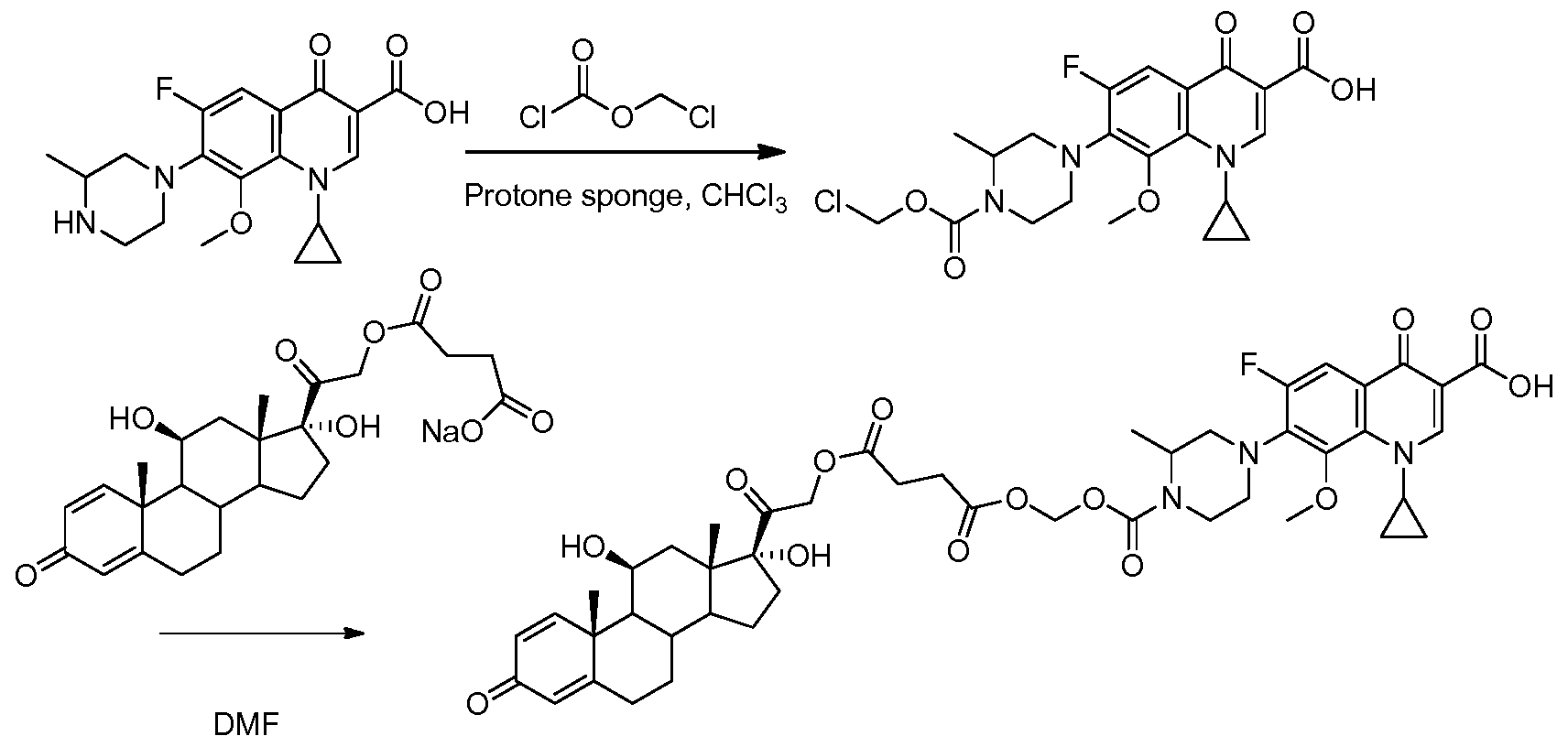
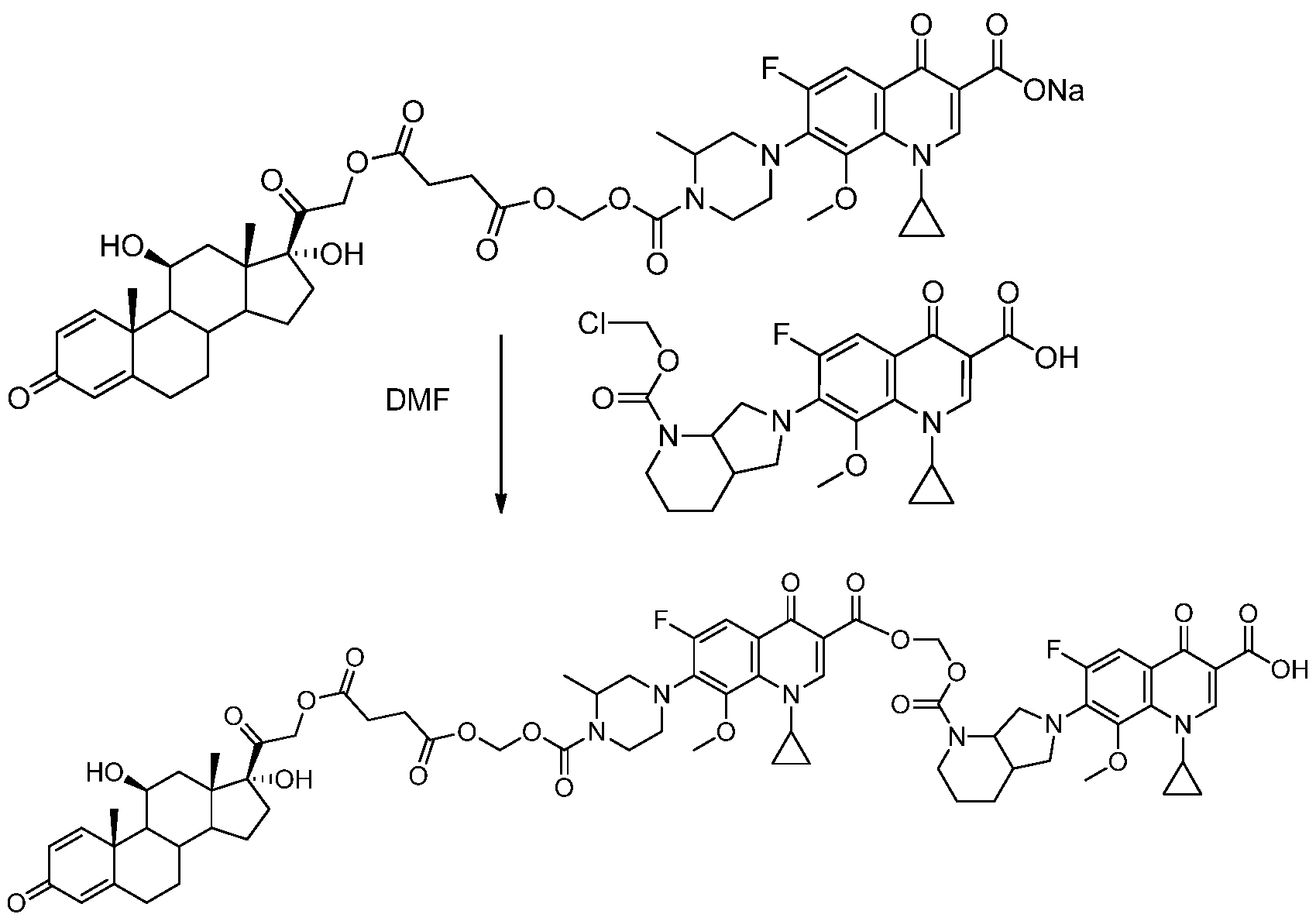
It is to be understood that both the foregoing general description and the following detailed description are exemplary and explanatory only and are not restrictive of the invention claimed. As used herein, the use of the singular includes the plural unless specifically stated otherwise.
It will be readily apparent to those skilled in the art that some of the compounds of the invention may contain one or more asymmetric centers, such that the compounds may exist in enantiomeric as well as in diastereisomeric forms. Unless it is specifically noted otherwise, the scope of the present invention includes all enantiomers, diastereisomers and racemic mixtures. Some of the compounds of the invention may form salts with pharmaceutically acceptable acids or bases, and such pharmaceutically acceptable salts of the compounds described herein are also within the scope of the invention. The present invention includes all pharmaceutically acceptable isotopically enriched compounds. Any compound of the invention may contain one or more isotopic atoms enriched or different than the natural ratio such as deuterium 2H (or D) in place of hyrdrogen 1H (or H) or use of 13 C enriched material in place of 12C and
the like. Similar substitutions can be employed for N, O and S. The use of isotopes may assist in analytical as well as therapeutic aspects of the invention. For example, use of deuterium may increase the in vivo half-life by altering the metabolism (rate) of the compounds of the invention. These compounds can be prepared in accord with the preparations described by use of isotopically enriched reagents.
The following examples are for illustrative purposes only and are not intended, nor should they be construed as limiting the invention in any manner. Those skilled in the art will appreciate that variations and modifications of the following examples can be made without exceeding the spirit or scope of the invention. As will be evident to those skilled in the art, individual isomeric forms can be obtained by separation of mixtures thereof in conventional manner. For example, in the case of diasteroisomeric isomers, chromatographic separation may be
employed.
Compound names were generated with ACDLabs version 12.5 or
ChemBioDraw Ultra version 12.0.2.
In general, characterization of the compounds is performed according to the following methods. Proton nuclear magnetic resonance (1H NMR) and carbon nuclear magnetic resonance (13C NMR) spectra were recorded on a Varian 300 or 600 MHz spectrometer in deuterated solvent. Chemical shifts were reported as δ (delta) values in parts per million (ppm) relative to tetramethylsilane (TMS) as an internal standard (0.00 ppm) and multiplicities were reported as s, singlet; d, doublet; t, triplet; q, quartet; m, multiplet; br, broad. Data were reported in the following format: chemical shift (multiplicity, coupling constant(s) J in hertz (Hz), integrated intensity). The mass spectrometry data were determined on a Shimadzu LCMS-IT- TOF instrument.
The formation of the hybrid compounds was checked by 1H-NMR, comparing the chemical shifts of the protons from the CH2 group identified in the schemes shown below, and identified as "CH2C" for the starting material and as "CH2C*" or "c*" for of the corresponding protons on the newly formed hybrid molecule wherein "*" indicates the hybrid compound. Applicants have marked with arrows the location of these protons and the reaction site of the pro-drug moiety, where available. Each
scheme shows the formation of the new hybrid drug. Each table describes the results for the new hybrid drug and the linker number, where existing. The linker and pro-drug moiety numbers are as described in Table 1 and 2 respectively.
It is to be understood that the embodiments of the invention disclosed herein are illustrative of the principles of the present invention. Other modifications that may be employed are within the scope of the invention. Thus, by way of example, but not of limitation, alternative configurations of the present invention may be utilized in accordance with the teachings herein. Accordingly, the present invention is not limited to that precisely as shown and described.
Examples of compounds
Prednisolone reacted with two molecules of Moxifloxacin to form the following hybrid compounds as shown in Scheme 1 with the results described in Table 4; and as shown in Scheme 2 with the results described in Table 5 .
Scheme 1

Prednisolone Moxifloxacin


Prednisolone reacted with one molecule of Gatifloxacin and one molecule of Moxifloxacin to form the following hybrid compounds as shown in Scheme 3 with the results described in Table 6; and as shown in Scheme 4 with the results described in Table 7; and as shown in Scheme 5 with the results described in Table 8; and as shown in Scheme 6 with the results described in Table 9; and as shown in Scheme 7 with the results described in Table 10.
Scheme 3
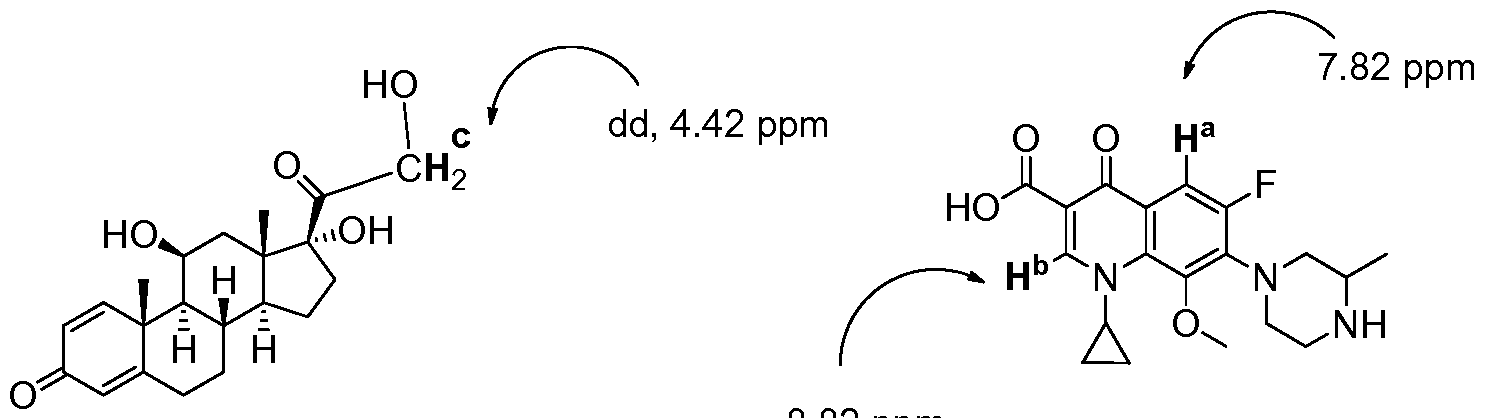
8.82 ppm
Prednisolone Gatifloxacin

8.83 ppm
Moxifloxacin


Scheme 4

Prednisolone Gatifloxacin
7.73 ppm

8.83 ppm
Moxifloxacin

Table 7

Scheme 5
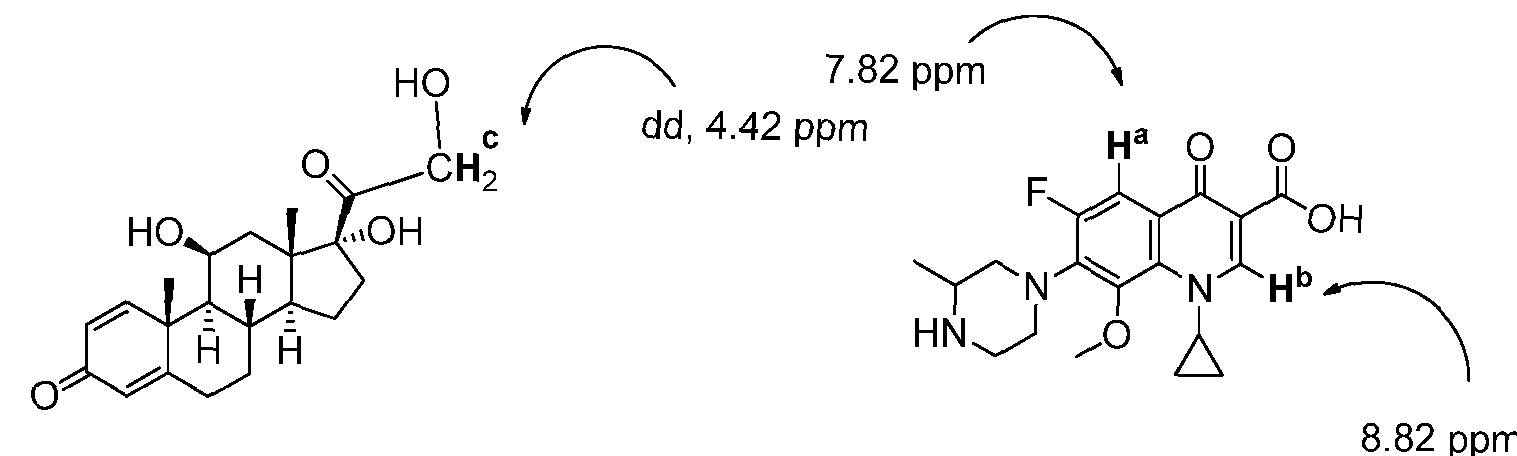
Prednisolone Gatifloxacin

8.83 ppm
Moxifloxacin
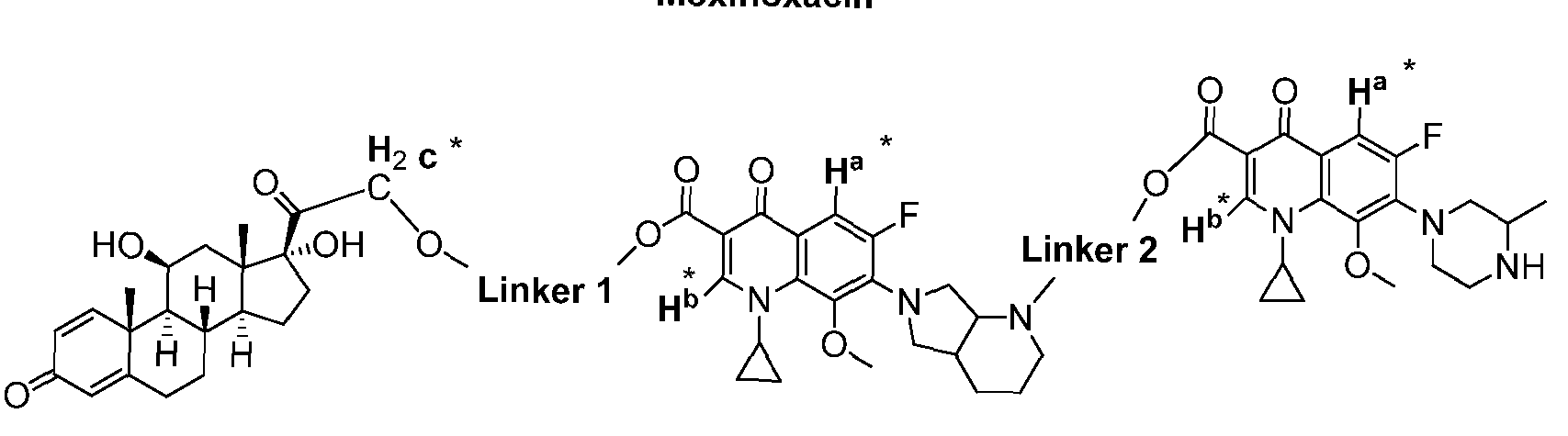
Table 8

Scheme 6

8.83 ppm
Moxifloxacin

Table 9

Scheme 7

Prednisolone Gatifloxacin
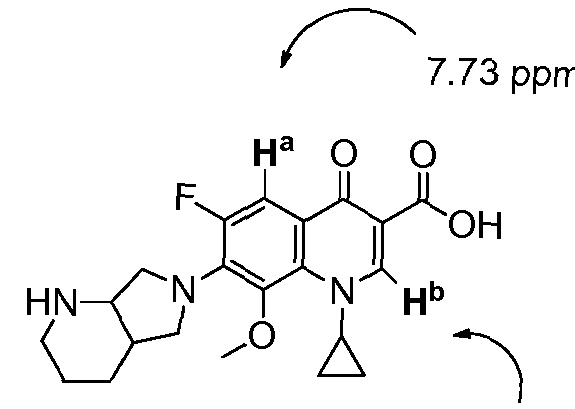
8.83 ppm
Nloxifloxacin

Table 10

Prednisolone reacted with two molecules Gatifloxacin to form the following hybrid compounds as shown in Scheme 8 with the results described in Table 11 and as shown in Scheme 9 with the results described in Table 12 and as shown in
Scheme 10 with the results described in Table 13 and as shown in Scheme 11 with the results described in Table 14 and as shown in Scheme 12 with the results described in Table 15 and as shown in Scheme 13 with the results described in Table 16.
Scheme 8


Table 12
 Scheme 10

Prednisolone Gatifloxacin

 Scheme 11

Prednisolone Gatifloxacin

Table 14

Scheme 12
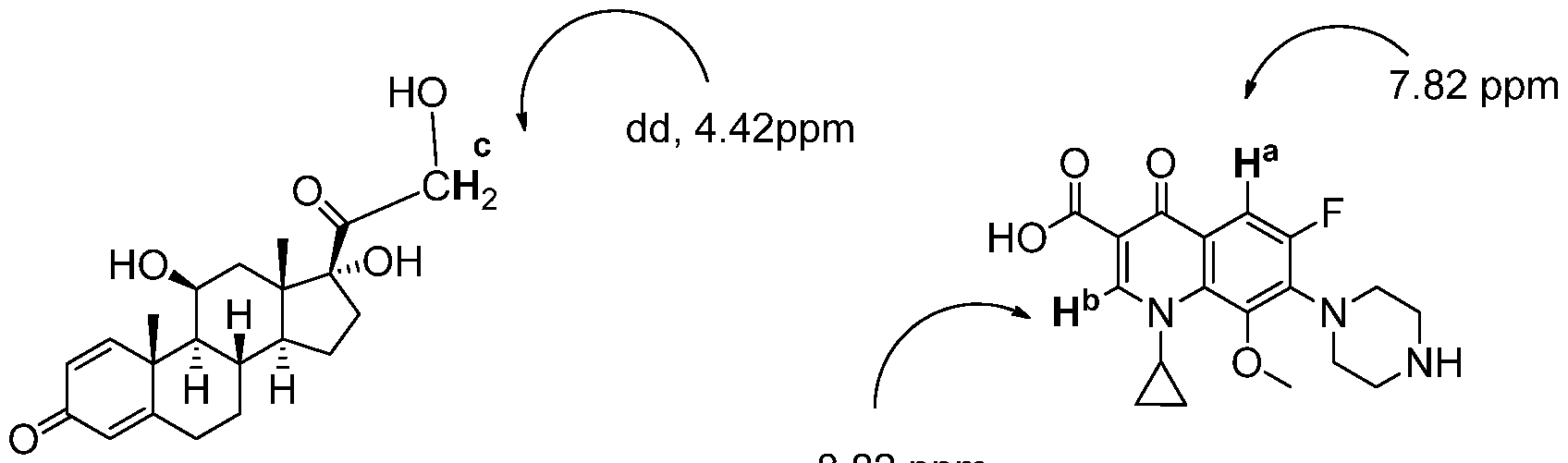
8.82 ppm
Prednisolone
Gatifloxacin

Table 15

Scheme 13

Prednisolone
Gatifloxacin
drug

Prodrug
Table 16

Hydrocortisone reacted with Gatifloxacin and with Besifloxacin to form the following hybrid compounds as shown in Scheme 14 with the results described in Table 17.
Scheme 14

Hydrocortisone Besifloxacin
7.82 ppm

8.82 ppm
Gatifloxacin

Table 17

Dexmethasone reacted with two molecules of Gatifloxacin to form the following hybrid compounds as shown in Scheme 15 with the results described in Table 18 and as shown in Scheme 16 with the results described in Table 19.
Scheme 15

Table 18


Table 19

Betamethasone reacted with two molecules of Gatifloxacin to form the following hybrid compounds as shown in Scheme 17 with the results described in Table 20.
Scheme 17

Table 20


Hydrocortisone Gatifloxacin

Table 21

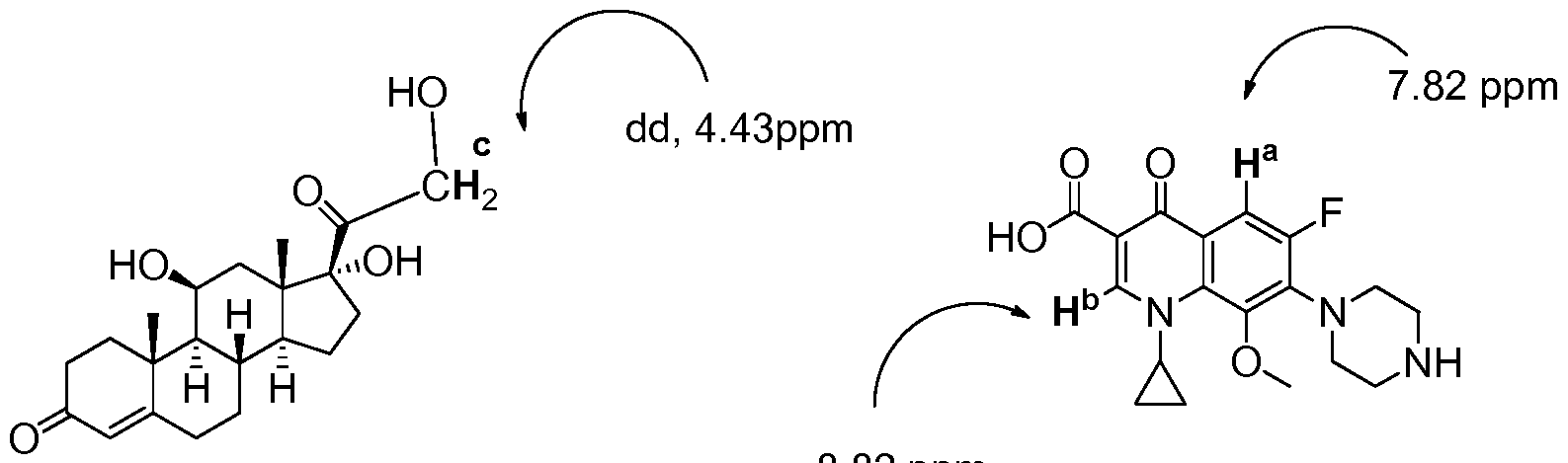
8.82 ppm
Hydrocortisone Gatifloxacin
drug

Prodrug
Table 22

Hydrocortisone reacted with two molecules of Moxifloxacin to form the following hybrid compounds as shown in Scheme 20 with the results described in Table 23.
Scheme 20


Table 23


In vitro Metabolic Stability in Human Recombinant Carboxylesterases
Human recombinant carboxylesterases were purchased from a commercial vendor (BD Gentest™, Bedford, Massachusettes). All metabolic stability
experiments were performed in triplicate in 96-well plate format. The final incubation mixture contained 1 μΜ test compound, 0.3 mg/mL corneal protein homogenate or 0.1 mg/mL human recombinant carboxylesterase mixture in a final volume of 0.5 mL 0.1 M potassium phosphate buffer (pH=6.0). The final percentage of solvent in the incubation was less than 1 .0% to prevent inhibition of enzymatic activity. Following a pre-incubation at 37°C, test article was added to initiate the reaction. At designated time points (typically less than 60 minutes to capture the linear range of metabolite formation), 0.05 mL aliquots were removed from the incubation mixtures using a clean pipet tip and immediately placed in organic solvent to stop any esterase activity. The hydrolysis to the metabolites was confirmed to be due to esterase activity and not chemical lability.
The samples were analyzed by liquid chromatography with mass
spectrometry (LC-MS/MS) detection to determine the metabolite concentrations resulting from the metabolism of the hybrid compounds. Internal standards were used to compensate for variability from sample processing, chromatographic elution, mass spectrometer response and ion suppression by matrix components.
Results
Table 24 lists the rate of metabolite formation in human recombinant
carboxylesterases.
Table 24

155 ± 31 54.9 ± 8.1 Besifloxacin Prednisolone Gatifloxacin
N/A
41 .8 ± 10.2 6.16 ± 1 .36
30
Prednisolone Gatifloxacin
18 N/A
81 .2 ± 9.0 107 ± 9
Prednisolone Gatifloxacin
N/A = Not applicable
The data demonstrate that linkage of a fluoroquinolone (e.g. gatifloxacin, moxifloxacin, and besifloxacin) and a steroid (e.g. prednisolone) as a single hybrid compound was hydrolyzed enzymatically in human recombinant carboxylesterases to their respective individual antibiotic and steroid drugs.
Claims
1 . A hybrid compound comprising a steroid and two antibiotic moieties, or a pharmaceutical salt thereof, which are connected via separate covalent bonds to at least one linker each such that said covalent bond degrade in vivo to yield the respective two antibiotics independently and the respective steroid drug.
2. The hybrid compound according to claim 1 , wherein the two antibiotics moieties are identical.
3. The hybrid compound according to claim 1 , wherein the two antibiotics moieties are different.
4. The hybrid compound according to claim 1 , wherein a first antibiotic moiety is directly linked to the steroid moiety and further linked to the other antibiotic moiety via a linker.
5. The hybrid compound according to claim 1 , wherein a first antibiotic moiety is linked to the steroid moiety via a linker and further linked to the other antibiotic moiety via another linker.
6. The hybrid compound according to claim 1 wherein the two antibiotic drug moieties are selected from the group consisting of: gatifloxacin, moxifloxacin, chloramphenicol, tobramycin and amikacin.
7. The hybrid compound according to claim 1 wherein the steroid drug moiety is selected from the group consisting of: dexmethasone, betamethasone, triamcinolone acetonide, prednisolone and hydrocortisone.
8. The hybrid compound according to claim 1 wherein said linker comprises an ester, a carboxylate, a carbonyl, a carbonate, an amido, a carbamate, a ketone, an amino, an oxo, an ethylene glycol, a polyethylene glycol moiety or an ethylene moiety.
9. A pharmaceutical composition comprising a therapeutically effective
amount of a hybrid compound , comprising two antibiotic moieties and one steroid drug moiety, which are connected via separate covalent bonds wherein said covalent bonds degrade in vivo to yield the antibiotics and steroid drugs , and wherein said pharmaceutical composition is formulated for topical ophthalmic administration.
10. A method comprising administrating to an eye of a mammal a
pharmaceutical composition comprising a therapeutically effective amount of a hybrid compound comprising two antibiotic moieties and one steroid moiety, which are connected via separate covalent bonds wherein said covalent bonds degrade in vivo to yield the antibiotics and the steroid drugs, and wherein said method is effective in the treatment of an inflammatory condition or bacterial infection affecting said eye.
1 1 . The method according to claim 10 wherein said hybrid compound has topical antibiotic and anti-inflammatory activity upon a surface of an eye, and wherein the hybrid compound degrades on said surface into said active antibiotics and said steroid drug, which are capable of penetrating beyond tissue of said surface eye.
12. The hybrid compound according to claim 1 comprising at least one linker having at least two bonds, wherein said bonds are asymmetrically degraded in vivo to release the antibiotic and steroid drugs.
13. The hybrid compound according to claim 1 , selected from:
2-[(8R,9R, 10S, 1 1 R, 13R, 14R, 17S)-1 1 , 17-dihydroxy-10,13-dimethyl-3-oxo- 6,7,8,9,10,1 1 ,12, 13,14, 15,16,17-dodecahydro-3H-cyclopenta[a]phenanthren-17-yl]- 2-oxoethyl rel-1 -cyclopropyl-7-(1 -{[({[1 -cyclopropyl-6-fluoro-8-methoxy-7-(octahydro- 6H-pyrrolo[3,4-b]pyridin-6-yl)-4-oxo-1 ,4-dihydroquinolin-3- yl]carbonyl}oxy)methoxy]carbonyl}octahydro-6H-pyrrolo[3,4-b]pyridin-6-yl)-6-fluoro-8- methoxy-4-oxo-1 ,4-dihydroquinoline-3-carboxylate;
2-[(8R,9R, 10S, 1 1 R, 13R, 14R, 17S)-1 1 , 17-dihydroxy-10,13-dimethyl-3-oxo- 6,7,8,9,10,1 1 ,12, 13,14, 15,16,17-dodecahydro-3H-cyclopenta[a]phenanthren-17-yl]- 2-oxoethyl rel-1 -cyclopropyl-7-(4-{[({[1 -cyclopropyl-6-fluoro-8-methoxy-7-(octahydro- 6H-pyrrolo[3,4-b]pyridin-6-yl)-4-oxo-1 ,4-dihydroquinolin-3- yl]carbonyl}oxy)methoxy]carbonyl}-3-methylpiperazin-1 -yl)-6-fluoro-8-methoxy-4-oxo- 1 ,4-dihydroquinoline-3-carboxylate;
[({4-[1 -cyclopropyl-3-({2-[(8R,9R, 10S, 1 1 R, 13R, 14R, 17S)-1 1 , 17-dihydroxy-10,13- dimethyl-3-oxo-2,3,6,7,8,9,10,1 1 ,12,13, 14,15, 16,17-tetradecahydro-1 H- cyclopenta[a]phenanthren-17-yl]-2-oxoethoxy}carbonyl)-6-fluoro-8-methoxy-4-oxo- 1 ,4-dihydroquinolin-7-yl]-2-methylpiperazin-1 -yl}carbonyl)oxy]methyl rel-7-[(3S)-3-
aminoazepan-1 -yl]-1 -cyclopropyl-6-fluoro-8-methoxy-4-oxo-1 ,4-dihydroquinoline-3- carboxylate;
2-[(8R,9R, 10S, 1 1 R, 13R, 14R, 17S)-1 1 , 17-dihydroxy-10,13-dimethyl-3-oxo- 6,7,8,9,10,1 1 ,12, 13,14, 15,16,17-dodecahydro-3H-cyclopenta[a]phenanthren-17-yl]- 2-oxoethyl rel-1 -cyclopropyl-7-{4-[({[(1 -cyclopropyl-6-fluoro-8-methoxy-7-{3-methyl-4- [(5-methyl-2-oxo-1 ,3-dioxol-4-yl)methyl]piperazin-1 -yl}-4-oxo-1 ,4-dihydroquinolin-3- yl)carbonyl]oxy}methoxy)carbonyl]-3-methylpiperazin-1 -yl}-6-fluoro-8-methoxy-4-oxo- 1 ,4-dihydroquinoline-3-carboxylate;
2-[(8R,9R, 10S, 1 1 R, 13R, 14R, 17S)-1 1 , 17-dihydroxy-10,13-dimethyl-3-oxo- 6,7,8,9,10,1 1 ,12, 13,14, 15,16,17-dodecahydro-3H-cyclopenta[a]phenanthren-17-yl]- 2-oxoethyl rel-1 -cyclopropyl-7-{4-[({[(1 -cyclopropyl-6-fluoro-8-methoxy-7-{1 -[(5- methyl-2-oxo-1 ,3-dioxol-4-yl)methyl]octahydro-6H-pyrrolo[3,4-b]pyridin-6-yl}-4-oxo- 1 ,4-dihydroquinolin-3-yl)carbonyl]oxy}methoxy)carbonyl]-3-methylpiperazin-1 -yl}-6- fluoro-8-methoxy-4-oxo-1 ,4-dihydroquinoline-3-carboxylate; rel-1 -cyclopropyl-7-(4-{[5-({4-[1 -cyclopropyl-6-fluoro-3-({2- [(9R,10S,1 1 S,13S,16R,17R)-9-fluoro-1 1 ,17-dihydroxy-10,13,16-trimethyl-3-oxo- 6,7,8,9,10,1 1 ,12, 13,14, 15,16,17-dodecahydro-3H-cyclopenta[a]phenanthren-17-yl]- 2-oxoethoxy}carbonyl)-8-methoxy-4-oxo-1 ,4-dihydroquinolin-7-yl]-2-methylpiperazin- 1 -yl}methyl)-2-oxo-1 ,3-dioxol-4-yl]methyl}-3-methylpiperazin-1 -yl)-6-fluoro-8- methoxy-4-oxo-1 ,4-dihydroquinoline-3-carboxylic acid; rel-1 -cyclopropyl-7-(4-{[5-({4-[1 -cyclopropyl-6-fluoro-3-({2- [(9R, 10S, 1 1 S, 13S, 16S, 17R)-9-fluoro-1 1 , 17-dihydroxy-10, 13,16-trimethyl-3-oxo- 6,7,8,9,10,1 1 ,12, 13,14, 15,16,17-dodecahydro-3H-cyclopenta[a]phenanthren-17-yl]- 2-oxoethoxy}carbonyl)-8-methoxy-4-oxo-1 ,4-dihydroquinolin-7-yl]-2-methylpiperazin- 1 -yl}methyl)-2-oxo-1 ,3-dioxol-4-yl]methyl}-3-methylpiperazin-1 -yl)-6-fluoro-8- methoxy-4-oxo-1 ,4-dihydroquinoline-3-carboxylic acid; rel-1 -cyclopropyl-7-(4-{[5-({4-[1 -cyclopropyl-3-({2-[(1 OR, 1 1 S, 13S, 17R)-1 1 , 17- dihydroxy-10,13-dimethyl-3-oxo-6,7,8,9,10,1 1 ,12,13, 14,15, 16,17-dodecahydro-3H- cyclopenta[a]phenanthren-17-yl]-2-oxoethoxy}carbonyl)-6-fluoro-8-methoxy-4-oxo- 1 ,4-dihydroquinolin-7-yl]-2-methylpiperazin-1 -yl}methyl)-2-oxo-1 ,3-dioxol-4-
yl]methyl}-3-methylpiperazin-1 -yl)-6-fluoro-8-methoxy-4-oxo-1 ,4-dihydroquinoline-3- carboxylic acid; rel-1 -cyclopropyl-7-[4-({[({1-cyclopropyl-7-[4-({[(4-{2-[(10R,1 1 S,13S, 17R)-1 1 ,17- dihydroxy-10,13-dimethyl-3-oxo-6,7,8,9,10,1 1 ,12,13, 14,15, 16,17-dodecahydro-3H- cyclopenta[a]phenanthren-17-yl]-2-oxoethoxy}-4- oxobutanoyl)oxy]methoxy}carbonyl)-3-methylpiperazin-1 -yl]-6-fluoro-8-methoxy-4- oxo-1 ,4-dihydroquinolin-3-yl}carbonyl)oxy]methoxy}carbonyl)-3-methylpiperazin-1 - yl]-6-fluoro-8-methoxy-4-oxo-1 ,4-dihydroquinoline-3-carboxylic acid; rel-1 -cyclopropyl-7-[1 -({[({1 -cyclopropyl-7-[4-({[(4-{2-[(10R,1 1 S, 13S, 17R)-1 1 ,17- dihydroxy-10,13-dimethyl-3-oxo-6,7,8,9,10,1 1 ,12,13, 14,15, 16,17-dodecahydro-3H- cyclopenta[a]phenanthren-17-yl]-2-oxoethoxy}-4- oxobutanoyl)oxy]methoxy}carbonyl)-3-methylpiperazin-1 -yl]-6-fluoro-8-methoxy-4- oxo-1 ,4-dihydroquinolin-3-yl}carbonyl)oxy]methoxy}carbonyl)octahydro-6H- pyrrolo[3,4-b]pyridin-6-yl]-6-fluoro-8-methoxy-4-oxo-1 ,4-dihydroquinoline-3- carboxylic acid; rel-1 -cyclopropyl-7-[4-({[({1 -cyclopropyl-7-[1 -({[(4-{2-[(10R,1 1 S, 13S, 17R)-1 1 ,17- dihydroxy-10,13-dimethyl-3-oxo-6,7,8,9,10,1 1 ,12,13, 14,15, 16,17-dodecahydro-3H- cyclopenta[a]phenanthren-17-yl]-2-oxoethoxy}-4- oxobutanoyl)oxy]methoxy}carbonyl)octahydro-6H-pyrrolo[3,4-b]pyridin-6-yl]-6-fluoro- 8-methoxy-4-oxo-1 ,4-dihydroquinolin-3-yl}carbonyl)oxy]methoxy}carbonyl)-2- methylpiperazin-1 -yl]-6-fluoro-8-methoxy-4-oxo-1 ,4-dihydroquinoline-3-carboxylic acid;
({[4-(1 -cyclopropyl-3-{[({[1 -cyclopropyl-6-fluoro-8-methoxy-7-(2-methylpiperazin-1 -yl)-
4-0X0-1 ,4-dihydroquinolin-3-yl]carbonyl}oxy)methoxy]carbonyl}-6-fluoro-8-methoxy-
4-0X0-1 ,4-dihydroquinolin-7-yl)-2-methylpiperazin-1 -yl]carbonyl}oxy)methyl 2-
[(10R,1 1 S,13S,17R)-1 1 ,17-dihydroxy-10, 13-dimethyl-3-oxo-
6,7,8,9,10,1 1 ,12, 13,14, 15,16,17-dodecahydro-3H-cyclopenta[a]phenanthren-17-yl]-
2-oxoethyl rel-butanedioate;
({[1 -cyclopropyl-7-(1 -{[({[1 -cyclopropyl-6-fluoro-8-methoxy-7-(3-methylpiperazin-1 -yl)- 4-0X0-1 ,4-dihydroquinolin-3-yl]carbonyl}oxy)methoxy]carbonyl}octahydro-6H- pyrrolo[3,4-b]pyridin-6-yl)-6-fluoro-8-methoxy-4-oxo-1 ,4-dihydroquinolin-3-
yl]carbonyl}oxy)methyl 2-[(10R,1 1 S, 13S, 17R)-1 1 , 17-dihydroxy-10,13-dimethyl-3- oxo-6,7,8,9,10,1 1 ,12,13,14,15, 16,17-dodecahydro-3H-cyclopenta[a]phenanthren-17- yl]-2-oxoethyl rel-butanedioate;
({[1 -cyclopropyl-7-(1 -{[({[1 -cyclopropyl-6-fluoro-8-methoxy-7-(octahydro-6H- pyrrolo[3,4-b]pyridin-6-yl)-4-oxo-1 ,4-dihydroquinolin-3- yl]carbonyl}oxy)methoxy]carbonyl}octahydro-6H-pyrrolo[3,4-b]pyridin-6-yl)-6-fluoro-8- methoxy-4-oxo-1 ,4-dihydroquinolin-3-yl]carbonyl}oxy)methyl 2-[(10R,1 1 S,13S,17R)- 1 1 ,17-dihydroxy-10,13-dimethyl-3-oxo-6,7,8,9,10, 1 1 , 12,13, 14,15,16, 17- dodecahydro-3H-cyclopenta[a]phenanthren-17-yl]-2-oxoethyl rel-butanedioate;
2-[(9R,10S,1 1 S,13S,16R,17R)-9-fluoro-1 1 ,17-dihydroxy-10,13,16-trimethyl-3-oxo- 6,7,8,9,10,1 1 ,12, 13,14, 15,16,17-dodecahydro-3H-cyclopenta[a]phenanthren-17-yl]- 2-oxoethyl 2-[(9S, 10R, 1 1 R, 13R, 16S, 17S)-9-fluoro-1 1 , 17-dihydroxy-10, 13,16- trimethyl-3-oxo-6,7,8,9,10,1 1 ,12,13,14,15,16,17-dodecahydro-3H- cyclopenta[a]phenanthren-17-yl]-2-oxoethyl rel-7,7'-{(2-oxo-1 ,3-dioxole-4,5- diyl)bis[methanediyl(3-methylpiperazine-4,1 -diyl)]}bis(1 -cyclopropyl-6-fluoro-8- methoxy-4-oxo-1 ,4-dihydroquinoline-3-carboxylate);
2- [(8R,9S,10R,1 1 R,13R,14R,16R,17S)-9-fluoro-1 1 ,17-dihydroxy-10,13,16-trimethyl-
3- oxo-6,7,8,9,10,1 1 , 12, 13, 14, 15, 16,17-dodecahydro-3H-cyclopenta[a]phenanthren- 17-yl]-2-oxoethyl rel-1 -cyclopropyl-6-fluoro-7-{4-[({[2-(2-fluorobiphenyl-4- yl)propanoyl]oxy}methoxy)carbonyl]-3-methylpiperazin-1 -yl}-8-methoxy-4-oxo-1 ,4- dihydroquinoline-3-carboxylate;
2-[(8R,10S,1 1 R, 13R,14R,17S)-1 1 ,17-dihydroxy-10,13-dimethyl-3-oxo- 6,7,8,9,10,1 1 ,12,13,14,15,16,17-dodecahydro-3H-cyclopenta[a]phenanthren-17-yl]- 2-oxoethyl rel-1 -cyclopropyl-6-fluoro-7-{4-[({[2-(2-fluorobiphenyl-4- yl)propanoyl]oxy}methoxy)carbonyl]-3-methylpiperazin-1 -yl}-8-methoxy-4-oxo-1 ,4- dihydroquinoline-3-carboxylate;
1 ,3-bis({[1 -cyclopropyl-6-fluoro-8-methoxy-7-(3-methylpiperazin-1 -yl)-4-oxo-1 ,4- dihydroquinolin-3-yl]carbonyl}oxy)propan-2-yl 2-
[(8R.9S, 10R, 1 1 R, 13R, 14R, 16S, 17S)-9-fluoro-1 1 , 17-dihydroxy-10,13,16-trimethyl-3- oxo-6,7,8,9,10,1 1 ,12,13,14,15, 16,17-dodecahydro-3H-cyclopenta[a]phenanthren-17- yl]-2-oxoethyl rel-benzene-1 ,4-dicarboxylate;
1 ,3-bis({[1 -cyclopropyl-6-fluoro-8-methoxy-7-(3-methylpiperazin-1 -yl)-4-oxo-1 ,4- dihydroquinolin-3-yl]carbonyl}oxy)propan-2-yl 2-[(8R, 10S, 1 1 R, 13R, 14R, 17S)-1 1 ,17- dihydroxy-10,13-dimethyl-3-oxo-6,7,8,9,10,1 1 ,12,13, 14,15, 16,17-dodecahydro-3H- cyclopenta[a]phenanthren-17-yl]-2-oxoethyl rel-butanedioate;
1 ,3-bis({[1 -cyclopropyl-6-fluoro-8-methoxy-7-(3-methylpiperazin-1 -yl)-4-oxo-1 ,4- dihydroquinolin-3-yl]carbonyl}oxy)propan-2-yl 2-[(8R, 10S, 1 1 R, 13R, 14R, 17S)-1 1 ,17- dihydroxy-10,13-dimethyl-3-oxo-2,3,6,7,8,9,10,1 1 , 12,13,14,15,16,17-tetradecahydro- 1 H-cyclopenta[a]phenanthren-17-yl]-2-oxoethyl rel-butanedioate;
1 ,3-bis{[(1 -cyclopropyl-6-fluoro-8-methoxy-7-{3-methyl-4-[(5-methyl-2-oxo-1 ,3-dioxol-
4-yl)methyl]piperazin-1 -yl}-4-oxo-1 ,4-dihydroquinolin-3-yl)carbonyl]oxy}propan-2-yl 2-
[(8R,10S,1 1 R,13R,14R,17S)-1 1 ,17-dihydroxy-10,13-dimethyl-3-oxo-
6,7,8,9,10,1 1 ,12, 13,14, 15,16,17-dodecahydro-3H-cyclopenta[a]phenanthren-17-yl]-
2-oxoethyl rel-butanedioate;
1 ,3-bis({[({[1 -cyclopropyl-6-fluoro-8-methoxy-7-(3-methylpiperazin-1 -yl)-4-oxo-1 ,4- dihydroquinolin-3-yl]carbonyl}oxy)methoxy]carbonyl}oxy)propan-2-yl 2- [(8R,10S,1 1 R,13R,14R,17S)-1 1 ,17-dihydroxy-10,13-dimethyl-3-oxo- 6,7,8,9,10,1 1 ,12, 13,14, 15,16,17-dodecahydro-3H-cyclopenta[a]phenanthren-17-yl]- 2-oxoethyl rel-butanedioate;
I , 3-bis{[({[(1 -cyclopropyl-6-fluoro-8-methoxy-7-{3-methyl-4-[(5-methyl-2-oxo-1 ,3- dioxol-4-yl)methyl]piperazin-1 -yl}-4-oxo-1 ,4-dihydroquinolin-3- yl)carbonyl]oxy}methoxy)carbonyl]oxy}propan-2-yl 2-[(8R,10S,1 1 R,13R,14R,17S)-
I I , 17-dihydroxy-10,13-dimethyl-3-oxo-6,7,8,9,10, 1 1 , 12,13, 14,15,16, 17- dodecahydro-3H-cyclopenta[a]phenanthren-17-yl]-2-oxoethyl rel-butanedioate;
I , 3-bis{[({[(1 -cyclopropyl-6-fluoro-8-methoxy-7-{1 -[(5-methyl-2-oxo-1 ,3-dioxol-4- yl)methyl]octahydro-6H-pyrrolo[3,4-b]pyridin-6-yl}-4-oxo-1 ,4-dihydroquinolin-3- yl)carbonyl]oxy}methoxy)carbonyl]oxy}propan-2-yl 2-[(8R,10S,1 1 R,13R,14R,17S)-
I I , 17-dihydroxy-10,13-dimethyl-3-oxo-6,7,8,9,10, 1 1 , 12,13, 14,15,16, 17- dodecahydro-3H-cyclopenta[a]phenanthren-17-yl]-2-oxoethyl rel-butanedioate; and
2-({2-[(8R,10S,1 1 R,13R,14R,17S)-1 1 ,17-dihydroxy-10,13-dimethyl-3-oxo- 6,7,8,9,10,1 1 ,12, 13,14, 15,16,17-dodecahydro-3H-cyclopenta[a]phenanthren-17-yl]- 2-oxoethoxy}carbonyl)propane-1 ,3-diyl relbis(1 -cyclopropyl-6-fluoro-8-methoxy-7-{3-
methyl-4-[(5-methyl-2-oxo-1 ,3-dioxol-4-yl)methyl]piperazin-1 -yl}-4-oxo-1 ,4- dihydroquinoline-3-carboxylate).
Applications Claiming Priority (2)
| Application Number | Priority Date | Filing Date | Title |
|---|---|---|---|
| US201361775216P | 2013-03-08 | 2013-03-08 | |
| US61/775,216 | 2013-03-08 |
Publications (1)
| Publication Number | Publication Date |
|---|---|
| WO2014138359A1 true WO2014138359A1 (en) | 2014-09-12 |
Family
ID=50382692
Family Applications (4)
| Application Number | Title | Priority Date | Filing Date |
|---|---|---|---|
| PCT/US2014/021096 Ceased WO2014138359A1 (en) | 2013-03-08 | 2014-03-06 | Steroid antibiotic conjugates |
| PCT/US2014/021219 Ceased WO2014138403A1 (en) | 2013-03-08 | 2014-03-06 | Antibiotic conjugates |
| PCT/US2014/021314 Ceased WO2014138437A1 (en) | 2013-03-08 | 2014-03-06 | Steroid conjugates |
| PCT/US2014/021283 Ceased WO2014138425A1 (en) | 2013-03-08 | 2014-03-06 | Cyclosporine a-steroid conjugates |
Family Applications After (3)
| Application Number | Title | Priority Date | Filing Date |
|---|---|---|---|
| PCT/US2014/021219 Ceased WO2014138403A1 (en) | 2013-03-08 | 2014-03-06 | Antibiotic conjugates |
| PCT/US2014/021314 Ceased WO2014138437A1 (en) | 2013-03-08 | 2014-03-06 | Steroid conjugates |
| PCT/US2014/021283 Ceased WO2014138425A1 (en) | 2013-03-08 | 2014-03-06 | Cyclosporine a-steroid conjugates |
Country Status (16)
| Country | Link |
|---|---|
| US (4) | US20140256694A1 (en) |
| EP (2) | EP2964269A1 (en) |
| JP (1) | JP2016510754A (en) |
| KR (1) | KR20150125663A (en) |
| CN (1) | CN105025929A (en) |
| AR (2) | AR095073A1 (en) |
| AU (1) | AU2014225637A1 (en) |
| BR (1) | BR112015021388A2 (en) |
| CA (1) | CA2899500A1 (en) |
| CL (1) | CL2015002210A1 (en) |
| IL (1) | IL240920A0 (en) |
| PH (1) | PH12015501857A1 (en) |
| RU (1) | RU2015135145A (en) |
| SG (1) | SG11201507241UA (en) |
| TW (2) | TW201511758A (en) |
| WO (4) | WO2014138359A1 (en) |
Cited By (2)
| Publication number | Priority date | Publication date | Assignee | Title |
|---|---|---|---|---|
| US9402912B2 (en) | 2013-03-08 | 2016-08-02 | Allergan, Inc. | Antibiotic conjugates directly linked with steroid drugs |
| US9402913B2 (en) | 2013-03-08 | 2016-08-02 | Allergan, Inc. | Cyclosporine A steroid conjugates |
Families Citing this family (13)
| Publication number | Priority date | Publication date | Assignee | Title |
|---|---|---|---|---|
| CA3048785A1 (en) | 2017-01-03 | 2018-07-12 | The University Of North Carolina At Chapel Hill | Nitric oxide-releasing alginates as biodegradable antibacterial scaffolds and methods pertaining thereto |
| AU2018247167B2 (en) | 2017-03-28 | 2024-05-16 | The University Of North Carolina At Chapel Hill | Nitric oxide-releasing polyaminoglycosides as biodegradable antibacterial scaffolds and methods pertaining thereto |
| CN111491982B (en) | 2017-11-15 | 2023-04-18 | 北卡罗来纳大学查佩尔希尔分校 | Nitric oxide-releasing hyperbranched compounds as antibacterial scaffolds and methods related thereto |
| EP3740494A4 (en) | 2018-02-02 | 2021-11-03 | Ripple Therapeutics Corporation | GLASS FORMULATIONS INCLUDING STEROID DIMERS AND RELATED USES |
| WO2019173539A1 (en) | 2018-03-06 | 2019-09-12 | The University Of North Carolina At Chapel Hill | Nitric oxide-releasing cyclodextrins as biodegradable antibacterial scaffolds and methods pertaining thereto |
| US20230041197A1 (en) | 2018-06-20 | 2023-02-09 | Progenity, Inc. | Treatment of a disease of the gastrointestinal tract with an immunomodulator |
| CN121554542A (en) | 2018-08-22 | 2026-02-24 | 贝凯恩生物医疗技术有限公司 | Cyclosporin compositions and methods of use |
| WO2020047496A1 (en) * | 2018-08-31 | 2020-03-05 | Aerie Pharmaceuticals, Inc. | Isoquinoline-steroid conjugates and uses thereof |
| JP7645546B2 (en) | 2018-12-28 | 2025-03-14 | ザ ユニバーシティ オブ ノース カロライナ アット チャペル ヒル | Nitric oxide releasing antimicrobial polymers and scaffolds made therefrom and methods relating thereto |
| WO2020154815A1 (en) | 2019-02-01 | 2020-08-06 | Ripple Therapeutics Corporation | Crystalline forms of dexamethasone dimers and uses thereof |
| US12509469B2 (en) | 2019-08-07 | 2025-12-30 | Ripple Therapeutics Corporation | Compositions and methods for the treatment of pain and dependence disorders |
| CA3176134A1 (en) | 2020-05-01 | 2021-11-04 | Ripple Therapeutics Corporation | Heterodimer compositions and methods for the treatment of ocular disorders |
| EP4426712A4 (en) * | 2021-11-03 | 2026-04-08 | Ripple Therapeutics Corp | PROCESSABLE COMPOSITIONS AND THEIR USE |
Citations (4)
| Publication number | Priority date | Publication date | Assignee | Title |
|---|---|---|---|---|
| US20010049366A1 (en) * | 2000-02-09 | 2001-12-06 | Alcon Universal Ltd. | Topical solution formulations containing an antibiotic and a corticosteroid |
| WO2004112838A2 (en) * | 2003-05-21 | 2004-12-29 | Control Delivery Systems, Inc. | Codrugs of diclofenac |
| US20050085413A1 (en) * | 2001-11-09 | 2005-04-21 | Betty Jin | Dimeric pharmaceutical compounds and their use |
| US20100063017A1 (en) * | 2008-09-09 | 2010-03-11 | Rajan Kothanda Raman T | Ophthalmic Suspension for Ocular Use |
Family Cites Families (41)
| Publication number | Priority date | Publication date | Assignee | Title |
|---|---|---|---|---|
| US2999102A (en) | 1959-10-14 | 1961-09-05 | Thomae Gmbh Dr K | Bis-(steroid-21)-dicarboxylic acid esters |
| US3147183A (en) | 1962-04-16 | 1964-09-01 | Boehringer Sohn Ingelheim | Bis-(steroid-21)-dicarboxylic acid esters |
| US3916002A (en) | 1973-12-17 | 1975-10-28 | Taubert Hans Dieter | Oligomeric steroid esters, process for their production, and therapeutic compositions containing the same |
| EP0194972B1 (en) | 1985-03-11 | 1992-07-29 | Sandoz Ag | Novel cyclosporins |
| JPH089597B2 (en) | 1986-01-21 | 1996-01-31 | 杏林製薬株式会社 | 8-Alkoxyquinolonecarboxylic acid excellent in selective toxicity and its salt, and method for producing the same |
| US4839342A (en) | 1987-09-03 | 1989-06-13 | University Of Georgia Research Foundation, Inc. | Method of increasing tear production by topical administration of cyclosporin |
| EP0629292A1 (en) | 1993-01-06 | 1994-12-21 | Beckman Instruments, Inc. | Method for making a preconjugate |
| US5688792A (en) | 1994-08-16 | 1997-11-18 | Pharmacia & Upjohn Company | Substituted oxazine and thiazine oxazolidinone antimicrobials |
| CA2136803A1 (en) | 1993-12-22 | 1995-06-23 | Kazumi Ogata | Steroid derivatives |
| US6051576A (en) | 1994-01-28 | 2000-04-18 | University Of Kentucky Research Foundation | Means to achieve sustained release of synergistic drugs by conjugation |
| PT740650E (en) | 1994-01-28 | 2004-10-29 | Univ Kentucky Res Found | CO-DRUGS AS A METHOD OF CONTROLLED DRUG ADMINISTRATION |
| US5474979A (en) | 1994-05-17 | 1995-12-12 | Allergan, Inc. | Nonirritating emulsions for sensitive tissue |
| US5565568A (en) | 1995-04-06 | 1996-10-15 | Eli Lilly And Company | 2-acylaminopropanamides as tachykinin receptor antagonists |
| US6350422B1 (en) | 1998-09-21 | 2002-02-26 | Phillips Petroleum Company | Sorbent compositions |
| US6254860B1 (en) | 1999-04-13 | 2001-07-03 | Allergan Sales, Inc. | Ocular treatment using cyclosporin-A derivatives |
| WO2001005819A1 (en) | 1999-07-15 | 2001-01-25 | Kuhnil Pharm. Co., Ltd. | Novel water soluble-cyclosporine conjugated compounds |
| US6306842B1 (en) | 2000-06-02 | 2001-10-23 | Medinox, Inc. | Protected forms of a combination of pharmacologically active agents and uses therefor |
| BR0209198A (en) | 2001-04-26 | 2004-06-08 | Control Delivery Sys Inc | Synthesis methods of phenol-containing compounds |
| WO2003031443A1 (en) | 2001-10-04 | 2003-04-17 | Morphochem Aktiengesellschaft für kombinatorische Chemie | Dual actions antibiotics comprising a oxazoldinone and a quinolone or naphthyridinone moiety |
| WO2003031441A1 (en) | 2001-10-04 | 2003-04-17 | Morphochen Aktiengesellschaft Für Kombinatorische Chemie | Multiple action compounds |
| US20030118528A1 (en) * | 2001-11-19 | 2003-06-26 | Walters Kenneth A. | Topical delivery of codrugs |
| CA2518265A1 (en) | 2003-03-17 | 2004-09-30 | Albany Molecular Research, Inc. | Novel cyclosporins |
| HRP20030324A2 (en) | 2003-04-24 | 2005-02-28 | Pliva-Istra�iva�ki institut d.o.o. | Compounds of antiinflammatory effect |
| MXPA05011654A (en) | 2003-04-30 | 2005-12-15 | Morphochem Ag Komb Chemie | Use of oxazolidinone-quinoline hybrid antibiotics for the treatment of anthrax and other infections. |
| US20050059583A1 (en) | 2003-09-15 | 2005-03-17 | Allergan, Inc. | Methods of providing therapeutic effects using cyclosporin components |
| US20060105941A1 (en) * | 2004-11-12 | 2006-05-18 | Allergan, Inc. | Mixed antibiotic codrugs |
| US7288520B2 (en) | 2005-07-13 | 2007-10-30 | Allergan, Inc. | Cyclosporin compositions |
| CA2643826A1 (en) | 2006-02-27 | 2008-06-12 | Paul A. Wender | Compositions and methods for transport of molecules with enhanced release properties across biological barriers |
| WO2008094507A2 (en) | 2007-01-26 | 2008-08-07 | Cellicon Biotechnologies, Inc. | Novel fusion compounds |
| ITMI20080382A1 (en) * | 2008-03-07 | 2009-09-08 | Ctg Pharma S R L | EYE PHARMACEUTICAL COMPOSITIONS |
| US8716238B2 (en) | 2008-07-10 | 2014-05-06 | Allergan, Inc. | Cyclosporin derivatives for treating ocular and dermal diseases and conditions |
| WO2010113151A1 (en) * | 2009-03-31 | 2010-10-07 | Technion Research & Development Foundation Ltd. | Conjugated antimicrobial agents |
| JP2012528163A (en) | 2009-05-27 | 2012-11-12 | アラーガン、インコーポレイテッド | Cyclosporine derivatives for treating inflammatory diseases and conditions |
| EP2627663B1 (en) | 2010-10-12 | 2018-02-21 | Allergan, Inc. | Cyclosporin analogs |
| AU2011316690C1 (en) | 2010-10-12 | 2017-01-19 | Allergan, Inc. | Cyclosporin analogs |
| MX2014003260A (en) * | 2011-09-16 | 2014-09-08 | Davidson Lopez Llc | Plant steroids and uses thereof. |
| WO2013181339A2 (en) | 2012-06-01 | 2013-12-05 | Allergan, Inc. | Cyclosporin a analogs |
| BR112015021836A2 (en) | 2013-03-08 | 2017-07-18 | Allergan Inc | antibiotic conjugates directly linked with steroid drugs |
| KR20150128856A (en) | 2013-03-08 | 2015-11-18 | 알러간, 인코포레이티드 | Antibiotic conjugates linked with steroid drugs |
| US20140256666A1 (en) | 2013-03-08 | 2014-09-11 | Allergan, Inc. | Antibiotic conjugates with nonsteroidal anti-inflammatory drugs |
| WO2014138359A1 (en) | 2013-03-08 | 2014-09-12 | Allergan, Inc. | Steroid antibiotic conjugates |
-
2014
- 2014-03-06 WO PCT/US2014/021096 patent/WO2014138359A1/en not_active Ceased
- 2014-03-06 US US14/199,212 patent/US20140256694A1/en not_active Abandoned
- 2014-03-06 EP EP14712954.8A patent/EP2964269A1/en not_active Withdrawn
- 2014-03-06 US US14/199,514 patent/US20140256696A1/en not_active Abandoned
- 2014-03-06 JP JP2015561664A patent/JP2016510754A/en active Pending
- 2014-03-06 US US14/199,310 patent/US20140256658A1/en not_active Abandoned
- 2014-03-06 EP EP14712952.2A patent/EP2964268A1/en not_active Withdrawn
- 2014-03-06 US US14/199,432 patent/US9402913B2/en active Active
- 2014-03-06 RU RU2015135145A patent/RU2015135145A/en not_active Application Discontinuation
- 2014-03-06 AU AU2014225637A patent/AU2014225637A1/en not_active Abandoned
- 2014-03-06 WO PCT/US2014/021219 patent/WO2014138403A1/en not_active Ceased
- 2014-03-06 BR BR112015021388A patent/BR112015021388A2/en not_active IP Right Cessation
- 2014-03-06 SG SG11201507241UA patent/SG11201507241UA/en unknown
- 2014-03-06 WO PCT/US2014/021314 patent/WO2014138437A1/en not_active Ceased
- 2014-03-06 CA CA2899500A patent/CA2899500A1/en not_active Abandoned
- 2014-03-06 KR KR1020157024379A patent/KR20150125663A/en not_active Withdrawn
- 2014-03-06 WO PCT/US2014/021283 patent/WO2014138425A1/en not_active Ceased
- 2014-03-06 CN CN201480012214.9A patent/CN105025929A/en active Pending
- 2014-03-07 AR ARP140100774A patent/AR095073A1/en unknown
- 2014-03-07 AR ARP140100773A patent/AR095072A1/en unknown
- 2014-03-10 TW TW103108219A patent/TW201511758A/en unknown
- 2014-03-10 TW TW103108198A patent/TW201511768A/en unknown
-
2015
- 2015-08-07 CL CL2015002210A patent/CL2015002210A1/en unknown
- 2015-08-24 PH PH12015501857A patent/PH12015501857A1/en unknown
- 2015-08-30 IL IL240920A patent/IL240920A0/en unknown
Patent Citations (4)
| Publication number | Priority date | Publication date | Assignee | Title |
|---|---|---|---|---|
| US20010049366A1 (en) * | 2000-02-09 | 2001-12-06 | Alcon Universal Ltd. | Topical solution formulations containing an antibiotic and a corticosteroid |
| US20050085413A1 (en) * | 2001-11-09 | 2005-04-21 | Betty Jin | Dimeric pharmaceutical compounds and their use |
| WO2004112838A2 (en) * | 2003-05-21 | 2004-12-29 | Control Delivery Systems, Inc. | Codrugs of diclofenac |
| US20100063017A1 (en) * | 2008-09-09 | 2010-03-11 | Rajan Kothanda Raman T | Ophthalmic Suspension for Ocular Use |
Non-Patent Citations (4)
| Title |
|---|
| "Handbook of Pharmaceutical Salts", 2002, VERLAG HELVETICA CHIMICA ACTA, pages: 329 - 345 |
| PURE APPLI. CHEM., vol. 45, 1976, pages 11 - 13 |
| RUBENS BELFORT JR ET AL: "Safety and Efficacy of Moxifloxacin-Dexamethasone Eyedrops as Treatment for Bacterial Ocular Infection Associated with Bacterial Blepharitis", ADVANCES IN THERAPY, SPRINGER HEALTHCARE COMMUNICATIONS, HEIDELBERG, vol. 29, no. 5, 3 May 2012 (2012-05-03), pages 416 - 426, XP035068601, ISSN: 1865-8652, DOI: 10.1007/S12325-012-0018-8 * |
| SHULMAN D G ET AL: "Comparative evaluation of the short-term bactericidal potential of a steroid-antibiotic combination versus steroid in the treatment of chronic bacterial blepharitis and conjunctivitis", EUROPEAN JOURNAL OF OPHTHALMOLOGY, MILAN, IT, vol. 6, no. 4, 1 January 1996 (1996-01-01), pages 361 - 367, XP009162312, ISSN: 1120-6721 * |
Cited By (2)
| Publication number | Priority date | Publication date | Assignee | Title |
|---|---|---|---|---|
| US9402912B2 (en) | 2013-03-08 | 2016-08-02 | Allergan, Inc. | Antibiotic conjugates directly linked with steroid drugs |
| US9402913B2 (en) | 2013-03-08 | 2016-08-02 | Allergan, Inc. | Cyclosporine A steroid conjugates |
Also Published As
| Publication number | Publication date |
|---|---|
| TW201511758A (en) | 2015-04-01 |
| EP2964269A1 (en) | 2016-01-13 |
| EP2964268A1 (en) | 2016-01-13 |
| SG11201507241UA (en) | 2015-10-29 |
| CN105025929A (en) | 2015-11-04 |
| US20140256651A1 (en) | 2014-09-11 |
| AR095073A1 (en) | 2015-09-16 |
| US20140256694A1 (en) | 2014-09-11 |
| RU2015135145A (en) | 2017-04-13 |
| TW201511768A (en) | 2015-04-01 |
| US20140256696A1 (en) | 2014-09-11 |
| PH12015501857A1 (en) | 2015-12-07 |
| AU2014225637A1 (en) | 2015-09-03 |
| BR112015021388A2 (en) | 2017-07-18 |
| AR095072A1 (en) | 2015-09-16 |
| US9402913B2 (en) | 2016-08-02 |
| KR20150125663A (en) | 2015-11-09 |
| WO2014138403A1 (en) | 2014-09-12 |
| IL240920A0 (en) | 2015-10-29 |
| CL2015002210A1 (en) | 2016-01-22 |
| JP2016510754A (en) | 2016-04-11 |
| US20140256658A1 (en) | 2014-09-11 |
| CA2899500A1 (en) | 2014-09-12 |
| WO2014138425A1 (en) | 2014-09-12 |
| WO2014138437A1 (en) | 2014-09-12 |
Similar Documents
| Publication | Publication Date | Title |
|---|---|---|
| US20140256694A1 (en) | Steroid antibiotic conjugates | |
| CA2766033C (en) | Prodrugs of nh-acidic compounds | |
| JP2016510753A (en) | Antibiotic conjugates combined with steroid drugs | |
| CA3110474C (en) | Highly active sting protein agonist compound | |
| ES2558685T3 (en) | Use of pyrroloquinoline compounds to eliminate clinically latent microorganisms | |
| JP2021509113A (en) | Heterocyclic amide as a kinase inhibitor | |
| CA3233408A1 (en) | Imidazopyridazine il-17 inhibitor compounds | |
| US9402912B2 (en) | Antibiotic conjugates directly linked with steroid drugs | |
| WO2014138343A1 (en) | Antibiotic conjugates with nonsteroidal anti-inflammatory drugs | |
| US20210387983A1 (en) | Crystalline alk5 inhibitors and uses thereof | |
| JP7755346B2 (en) | Compounds and compositions for targeted therapy of kidney disease |
Legal Events
| Date | Code | Title | Description |
|---|---|---|---|
| 121 | Ep: the epo has been informed by wipo that ep was designated in this application |
Ref document number: 14713330 Country of ref document: EP Kind code of ref document: A1 |
|
| NENP | Non-entry into the national phase |
Ref country code: DE |
|
| 122 | Ep: pct application non-entry in european phase |
Ref document number: 14713330 Country of ref document: EP Kind code of ref document: A1 |