WO2014134141A1 - Synthesis of acyclic and cyclic amines using iron-catalyzed nitrene group transfer - Google Patents
Synthesis of acyclic and cyclic amines using iron-catalyzed nitrene group transfer Download PDFInfo
- Publication number
- WO2014134141A1 WO2014134141A1 PCT/US2014/018623 US2014018623W WO2014134141A1 WO 2014134141 A1 WO2014134141 A1 WO 2014134141A1 US 2014018623 W US2014018623 W US 2014018623W WO 2014134141 A1 WO2014134141 A1 WO 2014134141A1
- Authority
- WO
- WIPO (PCT)
- Prior art keywords
- certain embodiments
- optionally substituted
- heteroaryl
- alkyl
- compound
- Prior art date
- Legal status (The legal status is an assumption and is not a legal conclusion. Google has not performed a legal analysis and makes no representation as to the accuracy of the status listed.)
- Ceased
Links
- 0 *NCc1ccccc1 Chemical compound *NCc1ccccc1 0.000 description 3
- OSYAESALOMJWLL-UHFFFAOYSA-N C=NC1C=CCCC1 Chemical compound C=NC1C=CCCC1 OSYAESALOMJWLL-UHFFFAOYSA-N 0.000 description 1
- YXFVVABEGXRONW-UHFFFAOYSA-N Cc1ccccc1 Chemical compound Cc1ccccc1 YXFVVABEGXRONW-UHFFFAOYSA-N 0.000 description 1
Classifications
-
- B—PERFORMING OPERATIONS; TRANSPORTING
- B01—PHYSICAL OR CHEMICAL PROCESSES OR APPARATUS IN GENERAL
- B01J—CHEMICAL OR PHYSICAL PROCESSES, e.g. CATALYSIS OR COLLOID CHEMISTRY; THEIR RELEVANT APPARATUS
- B01J31/00—Catalysts comprising hydrides, coordination complexes or organic compounds
- B01J31/16—Catalysts comprising hydrides, coordination complexes or organic compounds containing coordination complexes
- B01J31/22—Organic complexes
- B01J31/2265—Carbenes or carbynes, i.e.(image)
- B01J31/2269—Heterocyclic carbenes
- B01J31/2273—Heterocyclic carbenes with only nitrogen as heteroatomic ring members, e.g. 1,3-diarylimidazoline-2-ylidenes
-
- C—CHEMISTRY; METALLURGY
- C07—ORGANIC CHEMISTRY
- C07C—ACYCLIC OR CARBOCYCLIC COMPOUNDS
- C07C209/00—Preparation of compounds containing amino groups bound to a carbon skeleton
- C07C209/02—Preparation of compounds containing amino groups bound to a carbon skeleton by substitution of hydrogen atoms by amino groups
-
- C—CHEMISTRY; METALLURGY
- C07—ORGANIC CHEMISTRY
- C07D—HETEROCYCLIC COMPOUNDS
- C07D205/00—Heterocyclic compounds containing four-membered rings with one nitrogen atom as the only ring hetero atom
- C07D205/02—Heterocyclic compounds containing four-membered rings with one nitrogen atom as the only ring hetero atom not condensed with other rings
- C07D205/04—Heterocyclic compounds containing four-membered rings with one nitrogen atom as the only ring hetero atom not condensed with other rings having no double bonds between ring members or between ring members and non-ring members
-
- C—CHEMISTRY; METALLURGY
- C07—ORGANIC CHEMISTRY
- C07D—HETEROCYCLIC COMPOUNDS
- C07D207/00—Heterocyclic compounds containing five-membered rings not condensed with other rings, with one nitrogen atom as the only ring hetero atom
- C07D207/02—Heterocyclic compounds containing five-membered rings not condensed with other rings, with one nitrogen atom as the only ring hetero atom with only hydrogen or carbon atoms directly attached to the ring nitrogen atom
- C07D207/04—Heterocyclic compounds containing five-membered rings not condensed with other rings, with one nitrogen atom as the only ring hetero atom with only hydrogen or carbon atoms directly attached to the ring nitrogen atom having no double bonds between ring members or between ring members and non-ring members
- C07D207/06—Heterocyclic compounds containing five-membered rings not condensed with other rings, with one nitrogen atom as the only ring hetero atom with only hydrogen or carbon atoms directly attached to the ring nitrogen atom having no double bonds between ring members or between ring members and non-ring members with radicals, containing only hydrogen and carbon atoms, attached to ring carbon atoms
-
- C—CHEMISTRY; METALLURGY
- C07—ORGANIC CHEMISTRY
- C07D—HETEROCYCLIC COMPOUNDS
- C07D207/00—Heterocyclic compounds containing five-membered rings not condensed with other rings, with one nitrogen atom as the only ring hetero atom
- C07D207/02—Heterocyclic compounds containing five-membered rings not condensed with other rings, with one nitrogen atom as the only ring hetero atom with only hydrogen or carbon atoms directly attached to the ring nitrogen atom
- C07D207/04—Heterocyclic compounds containing five-membered rings not condensed with other rings, with one nitrogen atom as the only ring hetero atom with only hydrogen or carbon atoms directly attached to the ring nitrogen atom having no double bonds between ring members or between ring members and non-ring members
- C07D207/10—Heterocyclic compounds containing five-membered rings not condensed with other rings, with one nitrogen atom as the only ring hetero atom with only hydrogen or carbon atoms directly attached to the ring nitrogen atom having no double bonds between ring members or between ring members and non-ring members with hetero atoms or with carbon atoms having three bonds to hetero atoms with at the most one bond to halogen, e.g. ester or nitrile radicals, directly attached to ring carbon atoms
- C07D207/16—Carbon atoms having three bonds to hetero atoms with at the most one bond to halogen, e.g. ester or nitrile radicals
-
- C—CHEMISTRY; METALLURGY
- C07—ORGANIC CHEMISTRY
- C07D—HETEROCYCLIC COMPOUNDS
- C07D209/00—Heterocyclic compounds containing five-membered rings, condensed with other rings, with one nitrogen atom as the only ring hetero atom
- C07D209/02—Heterocyclic compounds containing five-membered rings, condensed with other rings, with one nitrogen atom as the only ring hetero atom condensed with one carbocyclic ring
- C07D209/54—Spiro-condensed
-
- C—CHEMISTRY; METALLURGY
- C07—ORGANIC CHEMISTRY
- C07D—HETEROCYCLIC COMPOUNDS
- C07D211/00—Heterocyclic compounds containing hydrogenated pyridine rings, not condensed with other rings
- C07D211/04—Heterocyclic compounds containing hydrogenated pyridine rings, not condensed with other rings with only hydrogen or carbon atoms directly attached to the ring nitrogen atom
- C07D211/06—Heterocyclic compounds containing hydrogenated pyridine rings, not condensed with other rings with only hydrogen or carbon atoms directly attached to the ring nitrogen atom having no double bonds between ring members or between ring members and non-ring members
- C07D211/08—Heterocyclic compounds containing hydrogenated pyridine rings, not condensed with other rings with only hydrogen or carbon atoms directly attached to the ring nitrogen atom having no double bonds between ring members or between ring members and non-ring members with hydrocarbon or substituted hydrocarbon radicals directly attached to ring carbon atoms
- C07D211/10—Heterocyclic compounds containing hydrogenated pyridine rings, not condensed with other rings with only hydrogen or carbon atoms directly attached to the ring nitrogen atom having no double bonds between ring members or between ring members and non-ring members with hydrocarbon or substituted hydrocarbon radicals directly attached to ring carbon atoms with radicals containing only carbon and hydrogen atoms attached to ring carbon atoms
- C07D211/16—Heterocyclic compounds containing hydrogenated pyridine rings, not condensed with other rings with only hydrogen or carbon atoms directly attached to the ring nitrogen atom having no double bonds between ring members or between ring members and non-ring members with hydrocarbon or substituted hydrocarbon radicals directly attached to ring carbon atoms with radicals containing only carbon and hydrogen atoms attached to ring carbon atoms with acylated ring nitrogen atom
-
- C—CHEMISTRY; METALLURGY
- C07—ORGANIC CHEMISTRY
- C07D—HETEROCYCLIC COMPOUNDS
- C07D263/00—Heterocyclic compounds containing 1,3-oxazole or hydrogenated 1,3-oxazole rings
- C07D263/02—Heterocyclic compounds containing 1,3-oxazole or hydrogenated 1,3-oxazole rings not condensed with other rings
- C07D263/04—Heterocyclic compounds containing 1,3-oxazole or hydrogenated 1,3-oxazole rings not condensed with other rings having no double bonds between ring members or between ring members and non-ring members
-
- C—CHEMISTRY; METALLURGY
- C07—ORGANIC CHEMISTRY
- C07D—HETEROCYCLIC COMPOUNDS
- C07D263/00—Heterocyclic compounds containing 1,3-oxazole or hydrogenated 1,3-oxazole rings
- C07D263/02—Heterocyclic compounds containing 1,3-oxazole or hydrogenated 1,3-oxazole rings not condensed with other rings
- C07D263/04—Heterocyclic compounds containing 1,3-oxazole or hydrogenated 1,3-oxazole rings not condensed with other rings having no double bonds between ring members or between ring members and non-ring members
- C07D263/06—Heterocyclic compounds containing 1,3-oxazole or hydrogenated 1,3-oxazole rings not condensed with other rings having no double bonds between ring members or between ring members and non-ring members with hydrocarbon radicals, substituted by oxygen atoms, attached to ring carbon atoms
-
- C—CHEMISTRY; METALLURGY
- C07—ORGANIC CHEMISTRY
- C07F—ACYCLIC, CARBOCYCLIC OR HETEROCYCLIC COMPOUNDS CONTAINING ELEMENTS OTHER THAN CARBON, HYDROGEN, HALOGEN, OXYGEN, NITROGEN, SULFUR, SELENIUM OR TELLURIUM
- C07F15/00—Compounds containing elements of Groups 8, 9, 10 or 18 of the Periodic Table
- C07F15/02—Iron compounds
- C07F15/025—Iron compounds without a metal-carbon linkage
-
- C—CHEMISTRY; METALLURGY
- C07—ORGANIC CHEMISTRY
- C07C—ACYCLIC OR CARBOCYCLIC COMPOUNDS
- C07C2601/00—Systems containing only non-condensed rings
- C07C2601/06—Systems containing only non-condensed rings with a five-membered ring
- C07C2601/10—Systems containing only non-condensed rings with a five-membered ring the ring being unsaturated
-
- C—CHEMISTRY; METALLURGY
- C07—ORGANIC CHEMISTRY
- C07C—ACYCLIC OR CARBOCYCLIC COMPOUNDS
- C07C2601/00—Systems containing only non-condensed rings
- C07C2601/12—Systems containing only non-condensed rings with a six-membered ring
- C07C2601/14—The ring being saturated
-
- C—CHEMISTRY; METALLURGY
- C07—ORGANIC CHEMISTRY
- C07C—ACYCLIC OR CARBOCYCLIC COMPOUNDS
- C07C2601/00—Systems containing only non-condensed rings
- C07C2601/12—Systems containing only non-condensed rings with a six-membered ring
- C07C2601/16—Systems containing only non-condensed rings with a six-membered ring the ring being unsaturated
-
- C—CHEMISTRY; METALLURGY
- C07—ORGANIC CHEMISTRY
- C07C—ACYCLIC OR CARBOCYCLIC COMPOUNDS
- C07C2601/00—Systems containing only non-condensed rings
- C07C2601/18—Systems containing only non-condensed rings with a ring being at least seven-membered
-
- C—CHEMISTRY; METALLURGY
- C07—ORGANIC CHEMISTRY
- C07C—ACYCLIC OR CARBOCYCLIC COMPOUNDS
- C07C2603/00—Systems containing at least three condensed rings
- C07C2603/56—Ring systems containing bridged rings
- C07C2603/58—Ring systems containing bridged rings containing three rings
- C07C2603/70—Ring systems containing bridged rings containing three rings containing only six-membered rings
- C07C2603/74—Adamantanes
Definitions
- C-H bond activation processes are only realized under forcing conditions (Labinger et al., Nature 2002, 417, 507) or when directing functionalities pre-organize a substrate to interact with transition metal based catalysts (Ryabov, Chem. Rev. 90, 403 (1990); Dick et al., Tetrahedron 62, 2439 (2006)).
- C-H bonds of unsaturated substrates ⁇ e.g., aromatic and olefinic C-H bonds substrates
- BDE > 110 kcal/mol the available ⁇ -electron system provides a handle to engage the transition metal catalyst prior to C-H bond activation; furthermore, the C-H bonding orbitals are more exposed and thus exhibit greater reactivity.
- a key structural element of the putative hydroxylation catalyst in both heme (where iron is embedded in a porphyrin) and non-heme systems is a transiently formed terminal iron oxo species, typically thought to involve multiple bond character (iron-oxo) (Ortiz de Montellano; Ed. Cytochrome P450: Structure, Mechanism, and Biochemistry, 4th ed.; Kluwer Academic/Plenum Publishers: New York, 2005; Krebs et al., Acc. Chem. Res. 2007, 40, 484).
- the iron-oxo contains two electrons residing in Fe-0 ⁇ * orbitals [Fe(d xz , d yz ) - 0(p x ,p y )], which result in a weakened Fe-0 bond vector possessing radical character, and thus renders the entire unit a reactive functionality.
- the iron-oxo can activate substrate aliphatic C-H bonds via an H-atom abstraction mechanism and thereby circumvent the orbital spatial restrictions that hinder oxidative addition pathways.
- Subsequent substrate functionalization results from recombination of the organic radical generated in the activation step with the open-shell iron-hydroxyl to produce an alcohol product with concomitant reduction of the iron species.
- metal stabilized carbene and nitrene transfer has garnered significant interest using noble metal catalysts (Zalatan et al., Top. Curr. Chem. 292, 347 (2010); Au et al., J. Am. Chem. Soc. 121, 9120 (1999); Davies et al., Nature 451, 417 (2008)).
- noble metal catalysts Zalatan et al., Top. Curr. Chem. 292, 347 (2010); Au et al., J. Am. Chem. Soc. 121, 9120 (1999); Davies et al., Nature 451, 417 (2008).
- late, first row-transition metal complexes are potentially ideal catalyst candidates but have been less explored.
- Fe(imido) complexes as isoelectronic surrogates to Fe(oxo) functionalities have been targeted in the pursuit of effecting viable catalytic delivery of the nitrene functional unit to a C-H bond or olefinic substrates.
- the present invention provides a selective synthesis of a variety of acyclic and cyclic amines using iron-catalyzed nitrene group transfer into tertiary, secondary, and primary C-H bonds.
- the present invention not only provides the synthetic methodology to such amines but also provide the catalysts, ligands, intermediates, and systems useful in the inventive methodology.
- the iron-based catalysts used in the inventive methods are capable of functionalizing a broad range of aliphatic C-H bonds to form the amines.
- This novel methodology provides access to acyclic and cyclic amines of various chain-lengths or ring sizes and of architectural diversity that will find significant utility in, e.g., pharmaceutical and fine chemical synthesis.
- the present invention provides methods of preparing acyclic secondary amines of Formula (I):
- inventive methods comprise the steps of:
- the inventive methods involve an iron-based catalyst, e.g. , the ferrous (Fe 11 ) compound of Formula (B), that may leverage the reactivity of the iron-born metal-ligand multiple bonds to promote the direct amination of the aliphatic C-H bonds of the compound of Formula (D) or (E), or a salt or stereoisomer thereof.
- Exposure of an organic azide (e.g. , the compounds of Formula (A), or a salt or stereoisomer thereof) to the iron-based catalyst furnishes amines (e.g. , the compound of Formula (I), or a salt or stereoisomer thereof) that may bear complex core- substitution patterns.
- Another aspect of the present invention relates to methods of preparing a compound of Formula (II-l):
- the method of preparing a compound of Formula (II-l), or a salt or stereoisomer thereof further comprises reacting the compound of Formula (II-l), or a salt or stereoisomer thereof, with Boc 2 0 to provide a compound of Formula (II-2-A):
- the method of preparing a compound of Formula (II-l), or a salt or stereoisomer thereof further comprises reacting the compound of Formula (II-l), or a salt or stereoisomer thereof, with Fmoc-OSuc to provide a compound of Formula (II-2-B), or a salt thereof:
- A) or (II-2-B), or a salt or stereoisomer thereof further comprises deprotecting the compound of Formula (II-2-A) or (II-2-B), or a salt or stereoisomer thereof, to provide a cyclic amine of Formula (II-3):
- Exemplary compounds that may be prepared using the inventive methods include but are not limited to:
- Compounds described herein can comprise one or more asymmetric centers, and thus can exist in various isomeric forms, e.g., enantiomers and/or diastereomers.
- the compounds described herein can be in the form of an individual enantiomer, diastereomer or geometric isomer, or can be in the form of a mixture of stereoisomers, including racemic mixtures and mixtures enriched in one or more stereoisomer.
- Isomers can be isolated from mixtures by methods known to those skilled in the art, including chiral high pressure liquid chromatography (HPLC) and the formation and crystallization of chiral salts; or preferred isomers can be prepared by asymmetric syntheses.
- HPLC high pressure liquid chromatography
- C ⁇ is intended to encompass, Q, C 2 , C 3 , C 4 , C 5 , C 6 , Ci-6, Ci-5, Ci ⁇ , Ci-3, Ci-2, C 2 -6, C 2 _5, C-2-A, C 2 _ 3 , C 3 _ 6 , C 3 _ 5 , C 3 ⁇ , C ⁇ , C 4 _ 5 , and C 5 _6.
- aliphatic refers to alkyl, alkenyl, alkynyl, and carbocyclic groups.
- heteroaliphatic refers to heteroalkyl, heteroalkenyl, heteroalkynyl, and heterocyclic groups.
- Alkyl refers to a radical of a straight-chain or branched saturated hydrocarbon group having from 1 to 20 carbon atoms (“C ⁇ o alkyl”). In some embodiments, an alkyl group has 1 to 10 carbon atoms (“Ci-w alkyl”). In some embodiments, an alkyl group has 1 to 9 carbon atoms (“Ci-9 alkyl”). In some embodiments, an alkyl group has 1 to 8 carbon atoms ("Ci-g alkyl”). In some embodiments, an alkyl group has 1 to 7 carbon atoms (“C ⁇ alkyl”). In some embodiments, an alkyl group has 1 to 6 carbon atoms (“C ⁇ alkyl”).
- an alkyl group has 1 to 5 carbon atoms ("C ⁇ s alkyl”). In some embodiments, an alkyl group has 1 to 4 carbon atoms ("C ⁇ alkyl”). In some embodiments, an alkyl group has 1 to 3 carbon atoms (“Ci_ 3 alkyl”). In some embodiments, an alkyl group has 1 to 2 carbon atoms ("C ⁇ alkyl”). In some embodiments, an alkyl group has 1 carbon atom (“Q alkyl”). In some embodiments, an alkyl group has 2 to 6 carbon atoms (“C2-6 alkyl”).
- Ci- ⁇ alkyl groups include methyl (CO, ethyl (C 2 ), w-propyl (C 3 ), isopropyl (C 3 ), w-butyl (C ), tert-bu ⁇ (C ), sec-butyl (C ), isobutyl (C ), w-pentyl (C 5 ), 3-pentanyl (C 5 ), amyl (C 5 ), neopentyl (C 5 ), 3-methyl-2-butanyl (C 5 ), tertiary amyl (C 5 ), and w-hexyl (C 6 ).
- alkyl groups include w-heptyl (C 7 ), w-octyl (C 8 ) and the like. Unless otherwise specified, each instance of an alkyl group is independently optionally substituted, i.e., unsubstituted (an "unsubstituted alkyl") or substituted (a "substituted alkyl") with one or more substituents. In certain embodiments, the alkyl group is unsubstituted C ⁇ o alkyl (e.g., - CH 3 ). In certain embodiments, the alkyl group is substituted C ⁇ o alkyl.
- alkenyl refers to a radical of a straight-chain or branched hydrocarbon group having from 2 to 20 carbon atoms, one or more carbon-carbon double bonds, and no triple bonds (“C2-20 alkenyl”).
- an alkenyl group has 2 to 10 carbon atoms ("C2-10 alkenyl”).
- an alkenyl group has 2 to 9 carbon atoms ("C2-9 alkenyl”).
- an alkenyl group has 2 to 8 carbon atoms ("C2-8 alkenyl”).
- an alkenyl group has 2 to 7 carbon atoms (“C 2 _ 7 alkenyl”).
- an alkenyl group has 2 to 6 carbon atoms (“C 2 -6 alkenyl”).
- an alkenyl group has 2 to 5 carbon atoms (“C 2 _5 alkenyl”).
- an alkenyl group has 2 to 4 carbon atoms ("C 2 ⁇ alkenyl"). In some
- an alkenyl group has 2 to 3 carbon atoms ("C 2 _3 alkenyl").
- an alkenyl group has 2 carbon atoms ("C 2 alkenyl”).
- the one or more carbon- carbon double bonds can be internal (such as in 2-butenyl) or terminal (such as in 1-butenyl).
- alkenyl groups include ethenyl (C 2 ), 1-propenyl (C 3 ), 2-propenyl (C 3 ), 1- butenyl (C 4 ), 2-butenyl (C 4 ), butadienyl (C 4 ), and the like.
- Examples of C2-6 alkenyl groups include the aforementioned alkenyl groups as well as pentenyl (C 5 ), pentadienyl (C 5 ), hexenyl (C 6 ), and the like.
- alkenyl examples include heptenyl (C 7 ), octenyl (C 8 ), octatrienyl (C 8 ), and the like. Unless otherwise specified, each instance of an alkenyl group is independently optionally substituted, i.e. , unsubstituted (an "unsubstituted alkenyl") or substituted (a "substituted alkenyl") with one or more substituents. In certain
- the alkenyl group is unsubstituted C 2 _ 10 alkenyl. In certain embodiments, the alkenyl group is substituted C2-10 alkenyl.
- Alkynyl refers to a radical of a straight-chain or branched hydrocarbon group having from 2 to 20 carbon atoms, one or more carbon-carbon triple bonds, and optionally one or more double bonds ("C2-20 alkynyl”). In some embodiments, an alkynyl group has 2 to 10 carbon atoms ("C2-10 alkynyl”). In some embodiments, an alkynyl group has 2 to 9 carbon atoms (“C2-9 alkynyl”). In some embodiments, an alkynyl group has 2 to 8 carbon atoms (“C 2 _ 8 alkynyl").
- an alkynyl group has 2 to 7 carbon atoms ("C2-7 alkynyl”). In some embodiments, an alkynyl group has 2 to 6 carbon atoms ("C2-6 alkynyl”). In some embodiments, an alkynyl group has 2 to 5 carbon atoms ("C2-5 alkynyl”). In some embodiments, an alkynyl group has 2 to 4 carbon atoms ("C 2 ⁇ alkynyl”). In some embodiments, an alkynyl group has 2 to 3 carbon atoms (“C 2 _ 3 alkynyl”). In some embodiments, an alkynyl group has 2 carbon atoms ("C 2 alkynyl”).
- the one or more carbon- carbon triple bonds can be internal (such as in 2-butynyl) or terminal (such as in 1-butynyl).
- Examples of C 2 - A alkynyl groups include, without limitation, ethynyl (C 2 ), 1-propynyl (C 3 ), 2-propynyl (C 3 ), 1-butynyl (C 4 ), 2-butynyl (C 4 ), and the like.
- Examples of C 2 _ 6 alkenyl groups include the aforementioned C 2 ⁇ alkynyl groups as well as pentynyl (C 5 ), hexynyl (C 6 ), and the like.
- alkynyl examples include heptynyl (C 7 ), octynyl (Cg), and the like. Unless otherwise specified, each instance of an alkynyl group is independently optionally substituted, i.e., unsubstituted (an "unsubstituted alkynyl") or substituted (a "substituted alkynyl") with one or more substituents. In certain embodiments, the alkynyl group is unsubstituted C 2 _io alkynyl. In certain embodiments, the alkynyl group is substituted C 2 _ 10 alkynyl.
- Carbocyclyl or “carbocyclic” refers to a radical of a non-aromatic cyclic hydrocarbon group having from 3 to 10 ring carbon atoms ('3 ⁇ 4_ 10 carbocyclyl”) and zero heteroatoms in the non-aromatic ring system.
- a carbocyclyl group has 3 to 8 ring carbon atoms ("C 3 _g carbocyclyl”).
- a carbocyclyl group has 3 to 6 ring carbon atoms ("C 3 _6 carbocyclyl”).
- a carbocyclyl group has 3 to 6 ring carbon atoms (“C 3 _6 carbocyclyl”).
- a carbocyclyl group has 5 to 10 ring carbon atoms ("Cs-io carbocyclyl").
- Exemplary C 3 _ 6 carbocyclyl groups include, without limitation, cyclopropyl (C 3 ), cyclopropenyl (C 3 ), cyclobutyl (C 4 ), cyclobutenyl (C 4 ), cyclopentyl (C 5 ), cyclopentenyl (C 5 ), cyclohexyl (C 6 ), cyclohexenyl (C 6 ), cyclohexadienyl (C 6 ), and the like.
- Exemplary C 3 _g carbocyclyl groups include, without limitation, the aforementioned C 3 _ 6 carbocyclyl groups as well as cycloheptyl (C 7 ), cycloheptenyl (C 7 ), cycloheptadienyl (C 7 ), cycloheptatrienyl (C 7 ), cyclooctyl (Cg), cyclooctenyl (Cg),
- C 3 _ 10 carbocyclyl groups include, without limitation, the aforementioned C 3 _g carbocyclyl groups as well as cyclononyl (C 9 ), cyclononenyl (C 9 ), cyclodecyl (C 10 ), cyclodecenyl (C 10 ), octahydro-lH-indenyl (C 9 ), decahydronaphthalenyl (C 10 ), spiro[4.5]decanyl (C 10 ), and the like.
- the carbocyclyl group is either monocyclic (“monocyclic carbocyclyl”) or contain a fused, bridged or spiro ring system such as a bicyclic system (“bicyclic carbocyclyl”) and can be saturated or can be partially unsaturated.
- “Carbocyclyl” also includes ring systems wherein the carbocyclic ring, as defined above, is fused with one or more aryl or heteroaryl groups wherein the point of attachment is on the carbocyclic ring, and in such instances, the number of carbons continue to designate the number of carbons in the carbocyclic ring system.
- each instance of a carbocyclyl group is independently optionally substituted, i.e., unsubstituted (an "unsubstituted carbocyclyl") or substituted (a "substituted carbocyclyl") with one or more substituents.
- the carbocyclyl group is unsubstituted C 3 _io carbocyclyl.
- the carbocyclyl group is a substituted C ⁇ o carbocyclyl.
- “carbocyclyl” is a monocyclic, saturated carbocyclyl group having from 3 to 10 ring carbon atoms ("C ⁇ o cycloalkyl”). In some embodiments, a cycloalkyl group has 3 to 8 ring carbon atoms ("C 3 _g cycloalkyl”). In some embodiments, a cycloalkyl group has 3 to 6 ring carbon atoms ("C 3 _6 cycloalkyl”). In some embodiments, a cycloalkyl group has 5 to 6 ring carbon atoms ("C 5 _6 cycloalkyl").
- a cycloalkyl group has 5 to 10 ring carbon atoms cycloalkyl").
- C 5 _6 cycloalkyl groups include cyclopentyl (C 5 ) and cyclohexyl (C 5 ).
- Examples of C 3 _ 6 cycloalkyl groups include the aforementioned C 5 _6 cycloalkyl groups as well as cyclopropyl (C 3 ) and cyclobutyl (C 4 ).
- Examples of C 3 _g cycloalkyl groups include the aforementioned C 3 _6 cycloalkyl groups as well as cycloheptyl (C 7 ) and cyclooctyl (Cg).
- each instance of a cycloalkyl group is independently unsubstituted (an "unsubstituted cycloalkyl") or substituted (a "substituted cycloalkyl") with one or more substituents.
- the cycloalkyl group is unsubstituted C 3 _io cycloalkyl.
- the cycloalkyl group is substituted C 3 _ 10 cycloalkyl.
- Heterocyclyl or “heterocyclic” refers to a radical of a 3- to 10-membered non-aromatic ring system having ring carbon atoms and 1 to 4 ring heteroatoms, wherein each heteroatom is independently selected from nitrogen, oxygen, sulfur, boron, phosphorus, and silicon ("3-10 membered heterocyclyl").
- the point of attachment can be a carbon or nitrogen atom, as valency permits.
- a heterocyclyl group can either be monocyclic ("monocyclic heterocyclyl”) or a fused, bridged or spiro ring system such as a bicyclic system ("bicyclic heterocyclyl”), and can be saturated or can be partially unsaturated.
- Heterocyclyl bicyclic ring systems can include one or more heteroatoms in one or both rings.
- Heterocyclyl also includes ring systems wherein the heterocyclic ring, as defined above, is fused with one or more carbocyclyl groups wherein the point of attachment is either on the carbocyclyl or heterocyclic ring, or ring systems wherein the heterocyclic ring, as defined above, is fused with one or more aryl or heteroaryl groups, wherein the point of attachment is on the heterocyclic ring, and in such instances, the number of ring members continue to designate the number of ring members in the
- heterocyclic ring system Unless otherwise specified, each instance of heterocyclyl is independently optionally substituted, i.e. , unsubstituted (an “unsubstituted heterocyclyl”) or substituted (a "substituted heterocyclyl”) with one or more substituents.
- each instance of heterocyclyl is independently optionally substituted, i.e. , unsubstituted (an “unsubstituted heterocyclyl”) or substituted (a "substituted heterocyclyl”) with one or more substituents.
- the heterocyclyl group is unsubstituted 3-10 membered heterocyclyl. In certain embodiments, the heterocyclyl group is substituted 3-10 membered heterocyclyl.
- a heterocyclyl group is a 5-10 membered non- aromatic ring system having ring carbon atoms and 1-4 ring heteroatoms, wherein each heteroatom is independently selected from nitrogen, oxygen, sulfur, boron, phosphorus, and silicon ("5-10 membered heterocyclyl").
- a heterocyclyl group is a 5-8 membered non-aromatic ring system having ring carbon atoms and 1-4 ring heteroatoms, wherein each heteroatom is independently selected from nitrogen, oxygen, and sulfur ("5-8 membered heterocyclyl").
- a heterocyclyl group is a 5-6 membered non-aromatic ring system having ring carbon atoms and 1-4 ring heteroatoms, wherein each heteroatom is independently selected from nitrogen, oxygen, and sulfur ("5-6 membered heterocyclyl").
- the 5-6 membered heterocyclyl has 1-3 ring heteroatoms selected from nitrogen, oxygen, and sulfur.
- the 5-6 membered heterocyclyl has 1-2 ring heteroatoms selected from nitrogen, oxygen, and sulfur.
- the 5-6 membered heterocyclyl has one ring heteroatom selected from nitrogen, oxygen, and sulfur.
- Exemplary 3-membered heterocyclyl groups containing one heteroatom include, without limitation, azirdinyl, oxiranyl, and thiiranyl.
- Exemplary 4-membered heterocyclyl groups containing one heteroatom include, without limitation, azetidinyl, oxetanyl and thietanyl.
- Exemplary 5-membered heterocyclyl groups containing one heteroatom include, without limitation, tetrahydrofuranyl, dihydrofuranyl,
- Exemplary 5-membered heterocyclyl groups containing two heteroatoms include, without limitation, dioxolanyl, oxasulfuranyl, disulfuranyl, and oxazolidin-2-one.
- Exemplary 5-membered heterocyclyl groups containing three heteroatoms include, without limitation, triazolinyl, oxadiazolinyl, and thiadiazolinyl.
- Exemplary 6-membered heterocyclyl groups containing one heteroatom include, without limitation, piperidinyl, tetrahydropyranyl, dihydropyridinyl, and thianyl.
- Exemplary 6-membered heterocyclyl groups containing two heteroatoms include, without limitation, piperazinyl, morpholinyl, dithianyl, and dioxanyl.
- Exemplary 6-membered heterocyclyl groups containing three heteroatoms include, without limitation, triazinanyl.
- Exemplary 7-membered heterocyclyl groups containing one heteroatom include, without limitation, azepanyl, oxepanyl and thiepanyl.
- Exemplary 8- membered heterocyclyl groups containing one heteroatom include, without limitation, azocanyl, oxecanyl and thiocanyl.
- Exemplary 5-membered heterocyclyl groups fused to a C 6 aryl ring include, without limitation, indolinyl, isoindolinyl, dihydrobenzofuranyl, dihydrobenzothienyl,
- Exemplary 6-membered heterocyclyl groups fused to an aryl ring include, without limitation, tetrahydroquinolinyl, tetrahydroisoquinolinyl, and the like.
- Aryl refers to a radical of a monocyclic or polycyclic (e.g., bicyclic or tricyclic) 4n+2 aromatic ring system (e.g., having 6, 10, or 14 p electrons shared in a cyclic array) having 6-14 ring carbon atoms and zero heteroatoms provided in the aromatic ring system ("C 6 -i 4 aryl").
- an aryl group has six ring carbon atoms ("C 6 aryl”; e.g., phenyl).
- an aryl group has ten ring carbon atoms ("C 10 aryl”; e.g., naphthyl such as 1-naphthyl and 2-naphthyl). In some embodiments, an aryl group has fourteen ring carbon atoms ("C 14 aryl”; e.g., anthracyl).
- Aryl also includes ring systems wherein the aryl ring, as defined above, is fused with one or more carbocyclyl or heterocyclyl groups wherein the radical or point of attachment is on the aryl ring, and in such instances, the number of carbon atoms continue to designate the number of carbon atoms in the aryl ring system. Unless otherwise specified, each instance of an aryl group is
- the aryl group is unsubstituted C 6 -i 4 aryl. In certain embodiments, the aryl group is substituted C6-14 aryl.
- Aralkyl is a subset of alkyl and aryl, as defined herein, and refers to an optionally substituted alkyl group substituted by an optionally substituted aryl group. In certain embodiments, the aralkyl is optionally substituted benzyl. In certain embodiments, the aralkyl is benzyl. In certain embodiments, the aralkyl is optionally substituted phenethyl. In certain embodiments, the aralkyl is phenethyl.
- Heteroaryl refers to a radical of a 5-10 membered monocyclic or bicyclic
- 4n+2 aromatic ring system (e.g., having 6 or 10 p electrons shared in a cyclic array) having ring carbon atoms and 1-4 ring heteroatoms provided in the aromatic ring system, wherein each heteroatom is independently selected from nitrogen, oxygen and sulfur ("5-10 membered heteroaryl").
- heteroaryl groups that contain one or more nitrogen atoms, the point of attachment can be a carbon or nitrogen atom, as valency permits.
- Heteroaryl bicyclic ring systems can include one or more heteroatoms in one or both rings.
- Heteroaryl includes ring systems wherein the heteroaryl ring, as defined above, is fused with one or more carbocyclyl or heterocyclyl groups wherein the point of attachment is on the heteroaryl ring, and in such instances, the number of ring members continue to designate the number of ring members in the heteroaryl ring system.
- Heteroaryl also includes ring systems wherein the heteroaryl ring, as defined above, is fused with one or more aryl groups wherein the point of attachment is either on the aryl or heteroaryl ring, and in such instances, the number of ring members designates the number of ring members in the fused (aryl/heteroaryl) ring system.
- Bicyclic heteroaryl groups wherein one ring does not contain a heteroatom e.g., indolyl, quinolinyl, carbazolyl, and the like
- the point of attachment can be on either ring, i.e., either the ring bearing a heteroatom (e.g., 2-indolyl) or the ring that does not contain a heteroatom (e.g., 5-indolyl).
- a heteroaryl group is a 5-10 membered aromatic ring system having ring carbon atoms and 1-4 ring heteroatoms provided in the aromatic ring system, wherein each heteroatom is independently selected from nitrogen, oxygen, and sulfur ("5-10 membered heteroaryl").
- a heteroaryl group is a 5-8 membered aromatic ring system having ring carbon atoms and 1-4 ring heteroatoms provided in the aromatic ring system, wherein each heteroatom is independently selected from nitrogen, oxygen, and sulfur ("5-8 membered heteroaryl").
- a heteroaryl group is a 5-6 membered aromatic ring system having ring carbon atoms and 1-4 ring heteroatoms provided in the aromatic ring system, wherein each heteroatom is independently selected from nitrogen, oxygen, and sulfur ("5-6 membered heteroaryl").
- the 5-6 membered heteroaryl has 1-3 ring heteroatoms selected from nitrogen, oxygen, and sulfur.
- the 5-6 membered heteroaryl has 1-2 ring heteroatoms selected from nitrogen, oxygen, and sulfur.
- the 5-6 membered heteroaryl has 1 ring heteroatom selected from nitrogen, oxygen, and sulfur.
- each instance of a heteroaryl group is independently optionally substituted, i.e.
- the heteroaryl group is unsubstituted 5-14 membered heteroaryl. In certain embodiments, the heteroaryl group is substituted 5-14 membered heteroaryl.
- Exemplary 5-membered heteroaryl groups containing one heteroatom include, without limitation, pyrrolyl, furanyl and thiophenyl.
- Exemplary 5-membered heteroaryl groups containing two heteroatoms include, without limitation, imidazolyl, pyrazolyl, oxazolyl, isoxazolyl, thiazolyl, and isothiazolyl.
- Exemplary 5-membered heteroaryl groups containing three heteroatoms include, without limitation, triazolyl, oxadiazolyl, and thiadiazolyl.
- Exemplary 5-membered heteroaryl groups containing four heteroatoms include, without limitation, tetrazolyl.
- Exemplary 6-membered heteroaryl groups containing one heteroatom include, without limitation, pyridinyl.
- Exemplary 6-membered heteroaryl groups containing two heteroatoms include, without limitation, pyridazinyl, pyrimidinyl, and pyrazinyl.
- Exemplary 6-membered heteroaryl groups containing three or four heteroatoms include, without limitation, triazinyl and tetrazinyl, respectively.
- Exemplary 7-membered heteroaryl groups containing one heteroatom include, without limitation, azepinyl, oxepinyl, and thiepinyl.
- Exemplary 5,6-bicyclic heteroaryl groups include, without limitation, indolyl, isoindolyl, indazolyl, benzotriazolyl, benzothiophenyl, isobenzothiophenyl, benzofuranyl, benzoisofuranyl, benzimidazolyl, benzoxazolyl, benzisoxazolyl, benzoxadiazolyl, benzthiazolyl, benzisothiazolyl, benzthiadiazolyl, indolizinyl, and purinyl.
- Exemplary 6,6- bicyclic heteroaryl groups include, without limitation, naphthyridinyl, pteridinyl, quinolinyl, isoquinolinyl, cinnolinyl, quinoxalinyl, phthalazinyl, and quinazolinyl.
- Heteroaralkyl is a subset of alkyl and heteroaryl, as defined herein, and refers to an optionally substituted alkyl group substituted by an optionally substituted heteroaryl group.
- Partially unsaturated refers to a group that includes at least one double or triple bond.
- a “partially unsaturated” ring system is further intended to encompass rings having multiple sites of unsaturation, but is not intended to include aromatic groups (e.g., aryl or heteroaryl groups) as herein defined.
- aromatic groups e.g., aryl or heteroaryl groups
- saturated refers to a group that does not contain a double or triple bond, i.e. , contains all single bonds.
- Alkyl, alkenyl, alkynyl, carbocyclyl, heterocyclyl, aryl, and heteroaryl groups, as defined herein, which are divalent bridging groups are further referred to using the suffix - ene, e.g., alkylene, alkenylene, alkynylene, carbocyclylene, heterocyclylene, arylene, and heteroarylene.
- Alkyl, alkenyl, alkynyl, carbocyclyl, heterocyclyl, aryl, and heteroaryl groups, as defined herein, are optionally substituted (e.g., "substituted” or “unsubstituted” alkyl, "substituted” or “unsubstituted” alkenyl, "substituted” or “unsubstituted” alkynyl,
- substituted means that at least one hydrogen present on a group (e.g., a carbon or nitrogen atom) is replaced with a permissible substituent, e.g., a substituent which upon substitution results in a stable compound, e.g., a compound which does not spontaneously undergo transformation such as by rearrangement, cyclization, elimination, or other reaction.
- a "substituted” group has a substituent at one or more substitutable positions of the group, and when more than one position in any given structure is substituted, the substituent is either the same or different at each position.
- substituted is contemplated to include substitution with all permissible substituents of organic compounds, any of the substituents described herein that results in the formation of a stable compound.
- the present invention contemplates any and all such combinations in order to arrive at a stable compound.
- heteroatoms such as nitrogen may have hydrogen substituents and/or any suitable substituent as described herein which satisfy the valencies of the heteroatoms and results in the formation of a stable moiety.
- Exemplary carbon atom substituents include, but are not limited to, halogen, -
- R aa is, independently, selected from C ⁇ o alkyl, C ⁇ o perhaloalkyl, C 2 _io alkenyl, C 2 _ 10 alkynyl, C 3 _ 10 carbocyclyl, 3-14 membered heterocyclyl, C 6 -i4 aryl, and 5-14 membered heteroaryl, or two R aa groups are joined to form a 3-14 membered heterocyclyl or 5-14 membered heteroaryl ring, wherein each alkyl, alkenyl, alkynyl, carbocyclyl, heterocycl
- each instance of R cc is, independently, selected from hydrogen, -io alkyl, d ⁇ o perhaloalkyl, C 2 _io alkenyl, C 2 _io alkynyl, ⁇ o carbocyclyl, 3-14 membered heterocyclyl, C 6 -i4 aryl, and 5-14 membered heteroaryl, or two R cc groups are joined to form a 3-14 membered heterocyclyl or 5-14 membered heteroaryl ring, wherein each alkyl, alkenyl, alkynyl, carbocyclyl, heterocyclyl, aryl, and heteroaryl is independently substituted with 0, 1, 2, 3, 4, or 5 R dd groups;
- each instance of R ee is, independently, selected from d_6 alkyl, d_6 perhaloalkyl, C 2 6 alkenyl, C 2 _ 6 alkynyl, C 3 _io carbocyclyl, C 6 -io aryl, 3-10 membered heterocyclyl, and 3-10 membered heteroaryl, wherein each alkyl, alkenyl, alkynyl, carbocyclyl, heterocyclyl, aryl, and heteroaryl is independently substituted with 0, 1, 2, 3, 4, or 5 R gg groups; each instance of R is, independently, selected from hydrogen, Q_6 alkyl, Q_6 perhaloalkyl, C 2 _ 6 alkenyl, C 2 _ 6 alkynyl, C 3 _io carbocyclyl, 3-10 membered heterocyclyl, C 6 - ff
- io aryl and 5-10 membered heteroaryl, or two R groups are joined to form a 3-14 membered heterocyclyl or 5-14 membered heteroaryl ring, wherein each alkyl, alkenyl, alkynyl, carbocyclyl, heterocyclyl, aryl, and heteroaryl is independently substituted with 0, 1, 2, 3, 4, or 5 R gg groups; and
- a "counterion” or “anionic counterion” is a negatively charged group associated with a cationic quaternary amino group in order to maintain electronic neutrality.
- exemplary counterions include halide ions (e.g., F ⁇ , CT, Br , ⁇ ), N0 3 , C10 4 , OH , H 2 P0 4 , HS0 4 , sulfonate ions (e.g., methansulfonate, trifluoromethanesulfonate, p-toluenesulfonate, benzenesulfonate, 10-camphor sulfonate, naphthalene-2-sulfonate, naphthalene- 1 -sulfonic acid-5-sulfonate, ethan-l-sulfonic acid-2-sulfonate, and the like), and carboxylate ions (e.g., acetate, ethanoate, propanoate,
- Halo or "halogen” refers to fluorine (fluoro, -F), chlorine (chloro, -CI), bromine (bromo, -Br), or iodine (iodo, -I).
- halogen refers to fluorine (fluoro, -F), chlorine (chloro, -CI), bromine (bromo, -Br), or iodine (iodo, -I).
- iodine iodo, -I
- Nitrogen atoms can be optionally substituted as valency permits, and include primary, secondary, tertiary, and quarternary nitrogen atoms.
- the substituent present on a nitrogen atom is a nitrogen protecting group (also referred to as an amino protecting group).
- nitrogen protecting groups such as amide groups ⁇ e.g., -
- picolinamide 3-pyridylcarboxamide, N-benzoylphenylalanyl derivative, benzamide, p- phenylbenzamide, o-nitophenylacetamide, o-nitrophenoxyacetamide, acetoacetamide, (N - dithiobenzyloxyacylamino)acetamide, 3-(p-hydroxyphenyl)propanamide, 3-(o- nitrophenyl)propanamide, 2-methyl-2-(o-nitrophenoxy)propanamide, 2-methyl-2-(o- phenylazophenoxy)propanamide, 4-chlorobutanamide, 3-methyl-3-nitrobutanamide, o- nitrocinnamide, N-acetylmethionine derivative, o-nitrobenzamide, and o- (benzoyloxymethyl)benzamide.
- Nitrogen protecting groups such as sulfonamide groups include, but are not limited to, p-toluenesulfonamide (Ts), benzenesulfonamide, 2,3,6,- trimethyl-4-methoxybenzenesulfonamide (Mtr), 2,4,6-trimethoxybenzenesulfonamide (Mtb), 2,6-dimethyl-4-methoxybenzenesulfonamide (Pme), 2,3,5, 6-tetramethyl-4- methoxybenzenesulfonamide (Mte), 4-methoxybenzenesulfonamide (Mbs), 2,4,6- trimethylbenzenesulfonamide (Mts), 2,6-dimethoxy-4-methylbenzenesulfonamide (iMds), 2,2,5,7, 8-pentamethylchroman-6-sulfonamide (Pmc), methanes
- Ts p-toluenesulfonamide
- Mtr 2,
- nitrogen protecting groups include, but are not limited to,
- phenothiazinyl-(10)-acyl derivative N'-p-toluenesulfonylaminoacyl derivative, N'- phenylaminothioacyl derivative, N-benzoylphenylalanyl derivative, N-acetylmethionine derivative, 4,5-diphenyl-3-oxazolin-2-one, N-phthalimide, N-dithiasuccinimide (Dts), N- 2,3-diphenylmaleimide, N-2,5-dimethylpyrrole, N- 1,1, 4,4- tetramethyldisilylazacyclopentane adduct (STABASE), 5-substituted l,3-dimethyl-l,3,5- triazacyclohexan-2-one, 5-substituted l,3-dibenzyl-l,3,5-triazacyclohexan-2-one, 1- substituted 3,5-dinitro-4-pyridone, N
- the substituent present on an oxygen atom is an oxygen protecting group (also referred to as a hydroxyl protecting group).
- Oxygen protecting groups are well known in the art and include those described in detail in Protecting Groups in Organic Synthesis, T. W. Greene and P. G. M. Wuts, 3 rd edition, John Wiley & Sons, 1999, incorporated herein by reference.
- oxygen protecting groups include, but are not limited to, methyl, methoxylmethyl (MOM), methylthiomethyl (MTM), t-butylthiomethyl,
- DPMS diphenylmethylsilyl
- TMPS i-butylmethoxyphenylsilyl
- the substituent present on a sulfur atom is a sulfur protecting group (also referred to as a thiol protecting group).
- Sulfur protecting groups are well known in the art and include those described in detail in Protecting Groups in Organic Synthesis, T. W. Greene and P. G. M. Wuts, 3 rd edition, John Wiley & Sons, 1999, incorporated herein by reference.
- Mesityl or “Mes” refers to 2,4,6-trimethylphenyl.
- Boc 2 0 or “(BOC) 2 0” refers to Boc anhydride or, in other words, di-t-butyl dicarbonate.
- nitrene refers to a compound that can be represented by the general formula ⁇ , wherein R is an atom or group including, but not limited to, hydrogen, halogen, optionally substituted acyl, optionally substituted alkyl, optionally substituted alkenyl, optionally substituted alkynyl, optionally substituted carbocyclyl, optionally substituted heterocyclyl, optionally substituted aryl, and optionally substituted heteroaryl.
- a nitrene is the nitrogen analog of a carbene. The nitrogen atom of a nitrene has only six valence electrons and is, therefore, an electrophile.
- nitrenes In the most simple nitrene, the linear imidogen (HN:), two of the six available electrons form a covalent bond with hydrogen, and two other create a free electron pair and the two remaining electrons occupy two degenerate p orbitals. Because nitrenes are highly reactive, they are usually not isolated. Instead, they are formed as reactive intermediates during a reaction. There are two common ways to generate nitrenes: (1) from azides by thermolysis or photolysis, with expulsion of nitrogen gas; and (2) from isocyanates, with expulsion of carbon monoxide.
- animation refers to a chemical reaction that involves the formation of one or more carbon-nitrogen bond, wherein the nitrogen is trivalent.
- catalysis refers to the change in rate of a chemical reaction due to the participation of a substance called a "catalyst.” Unlike other reagents that participate in the chemical reaction, a catalyst is not consumed by the reaction itself. A catalyst works by providing an alternative reaction pathway to the reaction product. Catalytic reactions have a lower rate-limiting free energy of activation than the corresponding uncatalyzed reaction, resulting in a higher reaction rate at the same temperature. A reaction is "catalyzed” when the addition of a catalyst into the reaction increases the reaction rate of the reaction.
- Exemplary mechanistic explanations of catalysis include that catalysts may affect the reaction environment favorably, bind to the reagents to polarize bonds, form specific intermediates that are not produced naturally, or cause lysis of reagents to reactive forms. Kinetically, catalytic reactions are typical chemical reactions; i.e., the reaction rate depends on the frequency of contact of the reactants in the rate-determining step. Usually, the catalyst participates in this slowest step, and reaction rates are limited by the amount of catalyst and its activity. Many transition metals and transition metal complexes as illustrated by the present invention are catalysts.
- Fmoc-OSuc refers to 9-fluorenylmethyl N-succinimidyl carbonate or Fmoc-OSu.
- salt refers to ionic compounds that result from the neutralization reaction of an acid and a base.
- a salt is composed of one or more cations (positively charged ions) and one or more anions (negative ions) so that the salt is electrically neutral (without a net charge).
- Salts of the compounds of this invention include those derived from inorganic and organic acids and bases.
- acid addition salts are salts of an amino group formed with inorganic acids such as hydrochloric acid, hydrobromic acid, phosphoric acid, sulfuric acid, and perchloric acid or with organic acids such as acetic acid, oxalic acid, maleic acid, tartaric acid, citric acid, succinic acid, or malonic acid or by using other methods known in the art such as ion exchange.
- Other salts include adipate, alginate, ascorbate, aspartate, benzenesulfonate, benzoate, bisulfate, borate, butyrate, camphorate, camphorsulfonate, citrate, cyclopentanepropionate, digluconate, dodecylsulfate,
- ethanesulfonate formate, fumarate, glucoheptonate, glycerophosphate, gluconate, hemisulfate, heptanoate, hexanoate, hydroiodide, 2-hydroxy-ethanesulfonate, lactobionate, lactate, laurate, lauryl sulfate, malate, maleate, malonate, methanesulfonate, 2- naphthalenesulfonate, nicotinate, nitrate, oleate, oxalate, palmitate, pamoate, pectinate, persulfate, 3-phenylpropionate, phosphate, picrate, pivalate, propionate, stearate, succinate, sulfate, tartrate, thiocyanate, p-toluenesulfonate, undecanoate, valerate salts, and the like.
- Salts derived from appropriate bases include alkali metal, alkaline earth metal, ammonium and N + (Ci ⁇ alkyl) 4 ⁇ salts.
- Representative alkali or alkaline earth metal salts include sodium, lithium, potassium, calcium, magnesium, and the like. Further salts include ammonium, quaternary ammonium, and amine cations formed using counterions such as halide, hydroxide, carboxylate, sulfate, phosphate, nitrate, loweralkyl sulfonate, and aryl sulfonate.
- tautomers refer to compounds that are interchangeable forms of a particular compound structure, and that vary in the displacement of hydrogen atoms and electrons. Thus, two structures may be in equilibrium through the movement of ⁇ electrons and an atom (usually H). For example, enols and ketones are tautomers because they are rapidly interconverted by treatment with either acid or base. Another example of tautomerism is the aci- and nitro- forms of phenylnitromethane, that are likewise formed by treatment with acid or base.
- Tautomeric forms may be relevant to the attainment of the optimal chemical reactivity and biological activity of a compound of interest.
- enantiomers and those that are non-superimposable mirror images of each other are termed "enantiomers".
- An enantiomer can be characterized by the absolute configuration of its asymmetric center and is described by the R- and S-sequencing rules of Cahn and Prelog, or by the manner in which the molecule rotates the plane of polarized light and designated as dextrorotatory or levorotatory (i.e. , as (+) or (-)-isomers respectively).
- a chiral compound can exist as either individual enantiomer or as a mixture thereof. A mixture containing equal proportions of the enantiomers is called a "racemic mixture".
- a "subject" to which administration is contemplated includes, but is not limited to, humans (i.e. , a male or female of any age group, e.g. , a pediatric subject (e.g. , infant, child, adolescent) or adult subject (e.g. , young adult, middle-aged adult, or senior adult)) and/or other non-human animals, for example, mammals (e.g. , primates (e.g., cynomolgus monkeys, rhesus monkeys); commercially relevant mammals such as cattle, pigs, horses, sheep, goats, cats, and/or dogs) and birds (e.g.
- humans i.e. , a male or female of any age group, e.g. , a pediatric subject (e.g. , infant, child, adolescent) or adult subject (e.g. , young adult, middle-aged adult, or senior adult)) and/or other non-human animals, for example,
- the animal is a mammal.
- the animal may be a male or female and at any stage of development.
- a non-human animal may be a transgenic animal.
- administer refers to implanting, absorbing, ingesting, injecting, inhaling, or otherwise introducing a compound (e.g. , an acyclic or cyclic amine synthesized using the methods of the invention), or a pharmaceutical composition thereof.
- a compound e.g. , an acyclic or cyclic amine synthesized using the methods of the invention
- treatment refers to reversing, alleviating, delaying the onset of, or inhibiting the progress of a "pathological condition” (e.g. , a disease, disorder, or condition, or one or more signs or symptoms thereof) described herein.
- pathological condition e.g. , a disease, disorder, or condition, or one or more signs or symptoms thereof
- treatment may be administered after one or more signs or symptoms have developed or have been observed.
- treatment may be administered in the absence of signs or symptoms of the disease or condition.
- treatment may be administered to a susceptible individual prior to the onset of symptoms (e.g., in light of a history of symptoms and/or in light of genetic or other susceptibility factors). Treatment may also be continued after symptoms have resolved, for example, to delay or prevent recurrence.
- Figures 1A-D show exemplary X-ray crystal structures of Fe n -dipyrromethene complexes useful in catalyzing C-H bond amination reactions.
- Figure 2 illustrates a proposed mechanism of an intermolecular C-H amination reaction catalyzed by Fe n -dipyrromethene complex 3A to yield acyclic secondary amines.
- Figure 3 illustrates a proposed mechanism of an intramolecular C-H amination reaction catalyzed by Fe n -dipyrromethene complex 3A to yield cyclic amines.
- Figures 4A-D are exemplary X-ray crystal structures of Fe in Cl (cyclic amine)- dipyrromethene complexes.
- Figures 5A-D are exemplary solid-state core structures of Fe in Cl (cyclic amine)-dipyrromethene complexes.
- A Ad L)FeCl(2-C 2 H3-NHC 4 H7) 8;
- B Ad L)FeCl(2-Ph- NHC 4 H 7 ) 9;
- C Ad L)FeCl(2-Et-NHC 4 H 7 ) 10;
- D Ad L)FeCl(2,2-Me 2 -NHC 4 H 7 ) 11.
- Thermal ellipsoids were set at the 50% probability level. Average bond lengths (A) for: Fe-Ndipymn 2.046(3), 2.062(3); Fe-N3, 2.145(3); Fe-Cl, 2.266(4).
- Figure 6 shows a X-ray crystal structure of (S)-2-methyl-2-phenylpyrrolidine iron-bound adduct 20 obtained from a reaction of (R)-2-phenyl-5-azidopentane (95% enantiomeric excess (ee)) with stoichiometric quantities of compound 3A.
- Figures 7A-C are exemplary solid-state core structures of Fe in Cl (cyclic amine)-dipyrromethene complexes.
- A Ad L)FeCl(2-C 2 H 3 -NHC 5 H 9 ) 12;
- B Ad L)FeCl(2,2- Me 2 -5,5-Me 2 -NHC 5 H 6 ) 21;
- C Ad L)FeCl(2,2-Me 2 -4-(i-Bu)-NHC 3 H 3 ) 22.
- Thermal ellipsoids were set at the 50% probability level.
- a class of electrophilic complexes has been synthesized that are capable of mediating C-H bond functionalization through transiently-formed, or metastable, transition states.
- the iron-catalyzed amination reaction is useful with a variety of organic azides and has shown reactivity with a range of organic substrates to form acyclic and cyclic secondary amines.
- linear azides can be intramolecularly aminated to form pyrrolidine or piperidine derivatives having an array of ring-substitutions, including heteroatom-bearing functional groups. It is well known in the art that the azides employed in the inventive methods can be prepared using a variety of synthetic methods.
- alkyl azides may be made by ring-opening an epoxide using a nucleophilic compound (e.g., a Grignard reagent or alkyl lithium reagent) to afford a terminal alcohol, followed by conversion of the terminal alcohol to the corresponding azide.
- a nucleophilic compound e.g., a Grignard reagent or alkyl lithium reagent
- Aryl azides may be prepared through a copper(II)-catalyzed conversion of organoboron compounds. See, e.g., Grimes et ah, Synthesis, 2010, 1441-1448, incorporated herein by reference.
- Acyl azides may be synthesized by reacting carboxylic acids with trichloroacetonitrile, triphenylphosphine, and sodium azide. See, e.g., Kim et ah, Synlett, 2008, 2072-2074, incorporated herein by reference. [0083] Therefore, by iron-catalyzed nitrene group transfer into tertiary, secondary, and primary C-H bonds, a wide range of functionalized products (e.g. , acyclic and cyclic secondary amines) can be readily synthesized.
- acyclic secondary amines may be prepared by an intermolecular reaction of an azide with a C-H source, catalyzed by a Fe 11 - dipyrromethene complex, e.g., compound 3A shown in Figure ID.
- Cyclic secondary amines e.g., 5-, 6-, and 7-membered cyclic secondary amines
- an azide e.g., a C-H source
- Fe 11 - dipyrromethene complex e.g., compound 3A shown in Figure ID.
- Cyclic secondary amines e.g., 5-, 6-, and 7-membered cyclic secondary amines
- the present invention provides methods of preparing compounds of Formula (I), which are acyclic secondar amines:
- Z is selected from the group consisting of mesityl and 2,6-dichlorophenyl
- R 1 is selected from the group consisting of optionally substituted alkyl, optionally substituted alkenyl, optionally substituted alkynyl, optionally substituted carbocyclyl, optionally substituted heterocyclyl, optionally substituted aryl, and optionally substituted heteroaryl;
- R 2 , R 3 , R 4 , R 5 , and R 6 groups are joined to form an optionally substituted carbocyclyl or optionally substituted heterocyclic ring;
- each occurrence of R a is independently selected from the group consisting of hydrogen, optionally substituted acyl, optionally substituted alkyl, optionally substituted alkenyl, optionally substituted alkynyl, optionally substituted carbocyclyl, optionally substituted heterocyclyl, optionally substituted aryl, optionally substituted heteroaryl, a nitrogen protecting group when attached to a nitrogen atom, an oxygen protecting group when attached to an oxygen atom, and a sulfur protecting group when attached to a sulfur atom, or optionally two R a groups are joined to form an optionally substituted heterocyclic ring;
- L is selected from the group consisting of N(R b ) 3 , R b -0-R b , R b -S-R b , optionally substituted heterocyclyl, and optionally substituted heteroaryl;
- each occurrence of R b is independently selected from the group consisting of optionally substituted alkyl, optionally substituted alkenyl, optionally substituted alkynyl, optionally substituted carbocyclyl, optionally substituted heterocyclyl, optionally substituted aryl, and optionally substituted heteroaryl.
- Z is selected from the group consisting of mesityl and 2,6-dichlorophenyl. In certain embodiments, Z is mesityl. In certain
- Z is 2,6-dichlorophenyl.
- R 1 is a substituent on the nitrogen atom.
- R 1 is a substituent on the azide group.
- R 1 is substituted alkyl.
- R 1 is unsubstituted alkyl.
- R 1 is C 1-6 alkyl.
- R 1 is methyl.
- R 1 is ethyl.
- R 1 is propyl.
- R 1 is butyl.
- R 1 is i-butyl.
- R 1 is Ad. In certain
- R 1 is substituted alkenyl. In certain embodiments, R 1 is unsubstituted alkenyl. In certain embodiments, R 1 is vinyl. In certain embodiments, R 1 is substituted alkynyl. In certain embodiments, R 1 is unsubstituted alkynyl. In certain embodiments, R 1 is ethynyl. In certain embodiments, R 1 is substituted carbocyclyl. In certain embodiments, R 1 is
- R 1 is cylcopropyl.
- R 1 is cylcobutyl. In certain embodiments, R 1 is cyclopentyl. In certain embodiments, R 1 is cyclohexyl. In certain embodiments, R 1 is cycloheptyl. In certain embodiments, R 1 is substituted heterocyclyl. In certain embodiments, R 1 is unsubstituted heterocyclyl. In certain embodiments, R 1 is substituted aryl. In certain embodiments, R 1 is unsubstituted aryl. In certain embodiments, R 1 is substituted phenyl. In certain embodiments, R 1 is tolyl. In certain embodiments, R 1 is 4-tolyl. In certain embodiments, R 1 is Mes.
- R 1 is unsubstituted phenyl. In certain embodiments, R 1 is substituted naphthyl. In certain embodiments, R 1 is unsubstituted naphthyl. In certain embodiments, R 1 is substituted heteroaryl. In certain embodiments, R 1 is unsubstituted heteroaryl. In certain embodiments, R 1 is monocyclic heteroaryl. In certain embodiments, R 1 is 5-membered monocyclic heteroaryl. In certain embodiments, R is 5-membered monocyclic heteroaryl, wherein only one of the five atoms in the ring of the heteroaryl is selected from the group consisting of nitrogen, oxygen, and sulfur.
- R 1 is 5-membered monocyclic heteroaryl, wherein only two of the five atoms in the ring of the heteroaryl are independently selected from the group consisting of nitrogen, oxygen, and sulfur. In certain embodiments, R 1 is 5-membered monocyclic heteroaryl, wherein only three of the five atoms in the ring of the heteroaryl are independently selected from the group consisting of nitrogen, oxygen, and sulfur. In certain embodiments, R 1 is tetrazolyl. In certain embodiments, R 1 is 6- membered monocyclic heteroaryl.
- R 1 is 6-membered monocyclic heteroaryl, wherein only one of the six atoms in the ring of the heteroaryl is selected from the group consisting of nitrogen, oxygen, and sulfur. In certain embodiments, R 1 is 6-membered monocyclic heteroaryl, wherein only two of the six atoms in the ring of the heteroaryl are independently selected from the group consisting of nitrogen, oxygen, and sulfur. In certain embodiments, R 1 is triazinyl. In certain embodiments, R 1 is tetrazinyl. In certain
- R 1 is bicyclic heteroaryl, wherein the point of attachment may be at any atom of the heteroaryl, as valency permits.
- R 1 is a monocyclic heteroaryl fused with phenyl.
- R 1 is a 5-membered monocyclic heteroaryl fused with phenyl.
- R 1 is a 6-membered monocyclic heteroaryl fused with phenyl.
- R 1 is a monocyclic heteroaryl fused with another monocyclic heteroaryl.
- R 1 is a 5-membered monocyclic heteroaryl fused with another 5-membered monocyclic heteroaryl.
- R 1 is a 5-membered monocyclic heteroaryl fused with a 6-membered monocyclic heteroaryl.
- Compounds of Formulae (I), (D), and (E) each include a substituent R 2 .
- R 2 is H.
- R 2 is halogen.
- R 2 is C 1-6 alkyl. In certain embodiments, R 2 is methyl. In certain embodiments, R 2 is ethyl. In certain embodiments, R 2 is propyl. In certain embodiments, R 2 is butyl. In certain embodiments, R 2 is Ad. In certain embodiments, R 2 is substituted alkenyl. In certain embodiments, R 2 is unsubstituted alkenyl.
- R 2 is vinyl. In certain embodiments, R 2 is substituted alkynyl. In certain embodiments, R 2 is unsubstituted alkynyl. In certain embodiments, R 2 is ethynyl. In certain embodiments, R 2 is substituted carbocyclyl. In certain embodiments, R 2 is unsubstituted carbocyclyl. In certain embodiments, R is cylcopropyl. In certain
- R 2 is cylcobutyl. In certain embodiments, R 2 is cyclopentyl. In certain embodiments, R 2 is cyclohexyl. In certain embodiments, R 2 is cycloheptyl. In certain embodiments, R 2 is substituted heterocyclyl. In certain embodiments, R 2 is unsubstituted heterocyclyl. In certain embodiments, R 2 is substituted aryl. In certain embodiments, R 2 is unsubstituted aryl. In certain embodiments, R is substituted phenyl. In certain embodiments,
- R 2 is unsubstituted phenyl. In certain embodiments, R 2 is substituted naphthyl. In certain embodiments, R 2 is unsubstituted naphthyl. In certain embodiments, R 2 is substituted heteroaryl. In certain embodiments, R is unsubstituted heteroaryl. In certain embodiments,
- R 2 is monocyclic heteroaryl. In certain embodiments, R 2 is 5-membered monocyclic heteroaryl. In certain embodiments, R is 5-membered monocyclic heteroaryl, wherein only one of the five atoms in the ring of the heteroaryl is selected from the group consisting of nitrogen, oxygen, and sulfur. In certain embodiments, R is 5-membered monocyclic heteroaryl, wherein only two of the five atoms in the ring of the heteroaryl are independently selected from the group consisting of nitrogen, oxygen, and sulfur. In certain embodiments,
- R is 5-membered monocyclic heteroaryl, wherein only three of the five atoms in the ring of the heteroaryl are independently selected from the group consisting of nitrogen, oxygen, and sulfur.
- R 2 is tetrazolyl.
- R 2 is 6-membered monocyclic heteroaryl.
- R is 6-membered monocyclic heteroaryl, wherein only one of the six atoms in the ring of the heteroaryl is selected from the group consisting of nitrogen, oxygen, and sulfur.
- R is 6-membered monocyclic heteroaryl, wherein only two of the six atoms in the ring of the heteroaryl are independently selected from the group consisting of nitrogen, oxygen, and sulfur.
- R 2 is triazinyl. In certain embodiments, R 2 is tetrazinyl. In certain embodiments, R is bicyclic heteroaryl, wherein the point of attachment may be at any atom of the heteroaryl, as valency permits. In certain embodiments, R is a monocyclic heteroaryl fused with phenyl. In certain embodiments, R is a 5-membered monocyclic heteroaryl fused with phenyl. In certain embodiments, R is a 6-membered monocyclic heteroaryl fused with phenyl. In certain embodiments, R is a monocyclic heteroaryl fused with another monocyclic heteroaryl.
- R is a 5-membered monocyclic heteroaryl fused with another 5-membered monocyclic heteroaryl. In certain embodiments, R is a 5-membered monocyclic heteroaryl fused with a 6-membered monocyclic heteroaryl. In certain embodiments, R is a 6-membered monocyclic heteroaryl fused with another 6-membered monocyclic heteroaryl. In certain embodiments, R 2 is -OR a . In certain embodiments, R 2 is - OH when attached to an sp 3 carbon atom. In certain embodiments, R 2 is -SR a . In certain embodiments,
- R is -SH when attached to an sp carbon atom.
- R is -N(R a ) 2 .
- R 2 is -NH 2 when attached to an sp 3 carbon atom.
- R 2 is -ON(R a ) 2 .
- R is H. In certain embodiments, R is halogen. In certain
- R is F. In certain embodiments, R is CI. In certain embodiments, R is Br. In
- R is unsubstituted alkyl. In certain embodiments, R is C 1-6 alkyl. In certain
- R is methyl. In certain embodiments, R is ethyl. In certain embodiments, R
- R is propyl. In certain embodiments, R is butyl. In certain embodiments, R is Ad. In certain
- R is substituted alkenyl. In certain embodiments, R is unsubstituted alkenyl.
- R is vinyl. In certain embodiments, R is substituted alkynyl. In
- R is unsubstituted alkynyl. In certain embodiments, R is ethynyl. In
- R is substituted carbocyclyl. In certain embodiments, R is
- R is cylcopropyl. In certain 3 3
- R is cylcobutyl. In certain embodiments, R is cyclopentyl. In certain
- R is cyclohexyl. In certain embodiments, R is cycloheptyl. In certain
- R is substituted heterocyclyl. In certain embodiments, R is unsubstituted
- R is substituted aryl. In certain embodiments, R is unsubstituted aryl. In certain embodiments, R is substituted phenyl. In certain embodiments,
- R is unsubstituted phenyl. In certain embodiments, R is substituted naphthyl. In certain
- R is unsubstituted naphthyl. In certain embodiments, R is substituted heteroaryl. In certain embodiments, R is unsubstituted heteroaryl. In certain embodiments,
- R is monocyclic heteroaryl. In certain embodiments, R is 5-membered monocyclic heteroaryl. In certain embodiments, R is 5-membered monocyclic heteroaryl, wherein only one of the five atoms in the ring of the heteroaryl is selected from the group consisting of nitrogen, oxygen, and sulfur. In certain embodiments, R is 5-membered monocyclic heteroaryl, wherein only two of the five atoms in the ring of the heteroaryl are independently selected from the group consisting of nitrogen, oxygen, and sulfur. In certain embodiments, R is 5-membered monocyclic heteroaryl, wherein only three of the five atoms in the ring of the heteroaryl are independently selected from the group consisting of nitrogen, oxygen, and
- R is tetrazolyl.
- R is 6-membered monocyclic heteroaryl.
- R is 6-membered monocyclic heteroaryl, wherein only one of the six atoms in the ring of the heteroaryl is selected from the group consisting of nitrogen, oxygen, and sulfur.
- R is 6-membered monocyclic heteroaryl, wherein only two of the six atoms in the ring of the heteroaryl are independently selected from the group consisting of nitrogen, oxygen, and sulfur.
- R is triazinyl. In certain embodiments, R is tetrazinyl. In certain
- R is bicyclic heteroaryl, wherein the point of attachment may be at any atom of the heteroaryl, as valency permits.
- R is a monocyclic heteroaryl fused with phenyl.
- R is a 5-membered monocyclic heteroaryl fused with phenyl.
- R is a 6-membered monocyclic heteroaryl fused with phenyl.
- R is a monocyclic heteroaryl fused with another monocyclic heteroaryl.
- R is a 5-membered monocyclic heteroaryl fused with another 5-membered monocyclic heteroaryl.
- R is a 5-membered monocyclic heteroaryl fused with a 6-membered monocyclic heteroaryl. In certain embodiments, R is a 6-membered monocyclic heteroaryl fused with another 6-membered monocyclic heteroaryl. In certain embodiments, R 3 is -OR a . In certain embodiments, R 3 is - OH when attached to an sp 3 carbon atom. In certain embodiments, R 3 is -SR a . In certain 3 3 3 embodiments, R is -SH when attached to an sp carbon atom. In certain embodiments, R is -N(R a ) 2 . In certain embodiments, R 3 is -NH 2 when attached to an sp 3 carbon atom. In certain embodiments,
- R 3 is -ON(R a ) 2 .
- Compounds of Formulae (I), (D), and (E) each include a substituent R 4 .
- R 4 is H.
- R 4 is halogen.
- R 4 is C 1-6 alkyl. In certain embodiments, R 4 is methyl. In certain embodiments, R 4 is ethyl. In certain embodiments, R 4 is propyl. In certain embodiments, R 4 is butyl. In certain embodiments, R 4 is Ad. In certain embodiments, R 4 is substituted alkenyl. In certain embodiments, R 4 is unsubstituted alkenyl. In certain embodiments, R 4 is vinyl. In certain embodiments, R 4 is substituted alkynyl. In certain embodiments, R 4 is unsubstituted alkynyl. In certain embodiments, R 4 is ethynyl. In certain embodiments, R 4 is substituted carbocyclyl. In certain embodiments, R 4 is unsubstituted carbocyclyl. In certain embodiments, R 4 is cylcopropyl. In certain
- R 4 is cylcobutyl. In certain embodiments, R 4 is cyclopentyl. In certain embodiments, R 4 is cyclohexyl. In certain embodiments, R 4 is cycloheptyl. In certain embodiments, R 4 is substituted heterocyclyl. In certain embodiments, R 4 is unsubstituted heterocyclyl. In certain embodiments, R 4 is substituted aryl. In certain embodiments, R 4 is unsubstituted aryl. In certain embodiments, R 4 is substituted phenyl. In certain embodiments, R 4 is unsubstituted phenyl. In certain embodiments, R 4 is substituted naphthyl.
- R 4 is unsubstituted naphthyl. In certain embodiments, R 4 is substituted heteroaryl. In certain embodiments, R 4 is unsubstituted heteroaryl. In certain embodiments, R 4 is monocyclic heteroaryl. In certain embodiments, R 4 is 5-membered monocyclic heteroaryl. In certain embodiments, R 4 is 5-membered monocyclic heteroaryl, wherein only one of the five atoms in the ring of the heteroaryl is selected from the group consisting of nitrogen, oxygen, and sulfur.
- R 4 is 5-membered monocyclic heteroaryl, wherein only two of the five atoms in the ring of the heteroaryl are independently selected from the group consisting of nitrogen, oxygen, and sulfur. In certain embodiments, R 4 is 5-membered monocyclic heteroaryl, wherein only three of the five atoms in the ring of the heteroaryl are independently selected from the group consisting of nitrogen, oxygen, and sulfur. In certain embodiments, R 4 is tetrazolyl. In certain embodiments, R 4 is 6-membered monocyclic heteroaryl.
- R 4 is 6-membered monocyclic heteroaryl, wherein only one of the six atoms in the ring of the heteroaryl is selected from the group consisting of nitrogen, oxygen, and sulfur. In certain embodiments, R 4 is 6-membered monocyclic heteroaryl, wherein only two of the six atoms in the ring of the heteroaryl are independently selected from the group consisting of nitrogen, oxygen, and sulfur. In certain embodiments, R 4 is triazinyl. In certain embodiments, R 4 is tetrazinyl. In certain
- R 4 is bicyclic heteroaryl, wherein the point of attachment may be at any atom of the heteroaryl, as valency permits.
- R 4 is a monocyclic heteroaryl fused with phenyl.
- R 4 is a 5-membered monocyclic heteroaryl fused with phenyl.
- R 4 is a 6-membered monocyclic heteroaryl fused with phenyl.
- R 4 is a monocyclic heteroaryl fused with another monocyclic heteroaryl.
- R 4 is a 5-membered monocyclic heteroaryl fused with another 5-membered monocyclic heteroaryl.
- R 4 is a 5-membered monocyclic heteroaryl fused with a 6-membered monocyclic heteroaryl. In certain embodiments, R 4 is a 6-membered monocyclic heteroaryl fused with another 6-membered monocyclic heteroaryl. In certain embodiments, R 4 is -OR a . In certain embodiments, R 4 is - OH when attached to an sp 3 carbon atom. In certain embodiments, R 4 is -SR a . In certain embodiments, R 4 is -SH when attached to an sp 3 carbon atom. In certain embodiments, R 4 is -N(R a ) 2 . In certain embodiments, R 4 is -NH 2 when attached to an sp 3 carbon atom.
- R 4 is -ON(R a ) 2 .
- Compounds of Formulae (I), (D), and (E) each include a substituent R 5 .
- R 5 is H.
- R 5 is halogen.
- R 5 is C 1-6 alkyl. In certain embodiments, R 5 is methyl. In certain embodiments, R 5 is ethyl. In certain embodiments, R 5 is propyl. In certain embodiments, R 5 is butyl. In certain embodiments, R 5 is Ad. In certain embodiments, R 5 is substituted alkenyl. In certain embodiments, R 5 is unsubstituted alkenyl. In certain embodiments, R 5 is vinyl. In certain embodiments, R 5 is substituted alkynyl. In certain embodiments, R 5 is unsubstituted alkynyl. In certain embodiments, R 5 is ethynyl. In certain embodiments, R 5 is substituted carbocyclyl. In certain embodiments, R 5 is unsubstituted carbocyclyl. In certain embodiments, R 5 is cylcopropyl. In certain
- R 5 is cylcobutyl. In certain embodiments, R 5 is cyclopentyl. In certain embodiments, R 5 is cyclohexyl. In certain embodiments, R 5 is cycloheptyl. In certain embodiments, R 5 is substituted heterocyclyl. In certain embodiments, R 5 is unsubstituted heterocyclyl. In certain embodiments, R 5 is substituted aryl. In certain embodiments, R 5 is unsubstituted aryl. In certain embodiments, R 5 is substituted phenyl. In certain embodiments, R 5 is unsubstituted phenyl. In certain embodiments, R 5 is substituted naphthyl.
- R 5 is unsubstituted naphthyl. In certain embodiments, R 5 is substituted heteroaryl. In certain embodiments, R 5 is unsubstituted heteroaryl. In certain embodiments, R 5 is monocyclic heteroaryl. In certain embodiments, R 5 is 5-membered monocyclic heteroaryl. In certain embodiments, R 5 is 5-membered monocyclic heteroaryl, wherein only one of the five atoms in the ring of the heteroaryl is selected from the group consisting of nitrogen, oxygen, and sulfur.
- R 5 is 5-membered monocyclic heteroaryl, wherein only two of the five atoms in the ring of the heteroaryl are independently selected from the group consisting of nitrogen, oxygen, and sulfur. In certain embodiments, R 5 is 5-membered monocyclic heteroaryl, wherein only three of the five atoms in the ring of the heteroaryl are independently selected from the group consisting of nitrogen, oxygen, and sulfur. In certain embodiments, R 5 is tetrazolyl. In certain embodiments, R 5 is 6-membered monocyclic heteroaryl.
- R 5 is 6-membered monocyclic heteroaryl, wherein only one of the six atoms in the ring of the heteroaryl is selected from the group consisting of nitrogen, oxygen, and sulfur. In certain embodiments, R 5 is 6-membered monocyclic heteroaryl, wherein only two of the six atoms in the ring of the heteroaryl are independently selected from the group consisting of nitrogen, oxygen, and sulfur. In certain embodiments, R 5 is triazinyl. In certain embodiments, R 5 is tetrazinyl. In certain embodiments, R 5 is bicyclic heteroaryl, wherein the point of attachment may be at any atom of the heteroaryl, as valency permits.
- R 5 is a monocyclic heteroaryl fused with phenyl. In certain embodiments, R 5 is a 5-membered monocyclic heteroaryl fused with phenyl. In certain embodiments, R 5 is a 6-membered monocyclic heteroaryl fused with phenyl. In certain embodiments, R 5 is a monocyclic heteroaryl fused with another monocyclic heteroaryl. In certain embodiments, R 5 is a 5-membered monocyclic heteroaryl fused with another 5-membered monocyclic heteroaryl. In certain embodiments, R 5 is a 5-membered monocyclic heteroaryl fused with a 6-membered monocyclic heteroaryl.
- R 5 is a 6-membered monocyclic heteroaryl fused with another 6-membered monocyclic heteroaryl. In certain embodiments, R 5 is -OR a . In certain embodiments, R 5 is - OH when attached to an sp 3 carbon atom. In certain embodiments, R 5 is -SR a . In certain
- Compounds of Formulae (I), (D), and (E) each include a substituent R 6 .
- R 6 is H.
- R 6 is halogen.
- R 6 is C 1-6 alkyl. In certain embodiments, R 6 is methyl. In certain embodiments, R 6 is ethyl. In certain embodiments, R 6 is propyl. In certain embodiments, R 6 is butyl. In certain embodiments, R 6 is Ad. In certain embodiments, R 6 is substituted alkenyl. In certain embodiments, R 6 is unsubstituted alkenyl. In certain embodiments, R 6 is vinyl. In certain embodiments, R 6 is substituted alkynyl. In certain embodiments, R 6 is unsubstituted alkynyl. In certain embodiments, R 6 is ethynyl. In certain embodiments, R 6 is substituted carbocyclyl.
- R 6 is unsubstituted carbocyclyl. In certain embodiments, R 6 is cylcopropyl. In certain embodiments, R 6 is cylcobutyl. In certain embodiments, R 6 is cyclopentyl. In certain embodiments, R 6 is cyclohexyl. In certain embodiments, R 6 is cycloheptyl. In certain embodiments, R 6 is substituted heterocyclyl. In certain embodiments, R 6 is unsubstituted heterocyclyl. In certain embodiments, R 6 is substituted aryl. In certain embodiments, R 6 is unsubstituted aryl. In certain embodiments, R 6 is substituted phenyl.
- R 6 is unsubstituted phenyl. In certain embodiments, R 6 is substituted naphthyl. In certain embodiments, R 6 is unsubstituted naphthyl. In certain embodiments, R 6 is substituted heteroaryl. In certain embodiments, R 6 is unsubstituted heteroaryl. In certain embodiments, R 6 is monocyclic heteroaryl. In certain embodiments, R 6 is 5-membered monocyclic heteroaryl. In certain embodiments, R 6 is 5-membered monocyclic heteroaryl, wherein only one of the five atoms in the ring of the heteroaryl is selected from the group consisting of nitrogen, oxygen, and sulfur.
- R 6 is 5-membered monocyclic heteroaryl, wherein only two of the five atoms in the ring of the heteroaryl are independently selected from the group consisting of nitrogen, oxygen, and sulfur. In certain embodiments, R 6 is 5-membered monocyclic heteroaryl, wherein only three of the five atoms in the ring of the heteroaryl are independently selected from the group consisting of nitrogen, oxygen, and sulfur. In certain embodiments, R 6 is tetrazolyl. In certain embodiments, R 6 is 6-membered monocyclic heteroaryl.
- R 6 is 6-membered monocyclic heteroaryl, wherein only one of the six atoms in the ring of the heteroaryl is selected from the group consisting of nitrogen, oxygen, and sulfur. In certain embodiments, R 6 is 6-membered monocyclic heteroaryl, wherein only two of the six atoms in the ring of the heteroaryl are independently selected from the group consisting of nitrogen, oxygen, and sulfur. In certain embodiments, R 6 is triazinyl. In certain embodiments, R 6 is tetrazinyl. In certain
- R 6 is bicyclic heteroaryl, wherein the point of attachment may be at any atom of the heteroaryl, as valency permits.
- R 6 is a monocyclic heteroaryl fused with phenyl.
- R 6 is a 5-membered monocyclic heteroaryl fused with phenyl.
- R 6 is a 6-membered monocyclic heteroaryl fused with phenyl.
- R 6 is a monocyclic heteroaryl fused with another monocyclic heteroaryl.
- R 6 is a 5-membered monocyclic heteroaryl fused with another 5-membered monocyclic heteroaryl.
- R 6 is a 5-membered monocyclic heteroaryl fused with a 6-membered monocyclic heteroaryl. In certain embodiments, R 6 is a 6-membered monocyclic heteroaryl fused with another 6-membered monocyclic heteroaryl. In certain embodiments, R 6 is -OR a . In certain embodiments, R 6 is - OH when attached to an sp 3 carbon atom. In certain embodiments, R 6 is -SR a . In certain embodiments, R 6 is -SH when attached to an sp 3 carbon atom. In certain embodiments, R 6 is -N(R a ) 2 . In certain embodiments, R 6 is -NH 2 when attached to an sp 3 carbon atom.
- R 6 is -ON(R a ) 2 .
- At least one R a is H. In certain embodiments, at least one R a is substituted acyl. In certain embodiments, at least one R a is unsubstituted acyl. In certain embodiments, at least one R a is acetyl. In certain embodiments, at least one R a is substituted alkyl. In certain embodiments, at least one R a is unsubstituted alkyl. In certain embodiments, at least one R a is C 1-6 alkyl. In certain embodiments, at least one R a is methyl. In certain embodiments, at least one R a is ethyl. In certain embodiments, at least one R a is propyl.
- At least one R a is butyl. In certain embodiments, at least one R a is substituted alkenyl. In certain embodiments, at least one R a is unsubstituted alkenyl. In certain embodiments, at least one R a is vinyl. In certain embodiments, at least one R a is substituted alkynyl. In certain embodiments, at least one R a is unsubstituted alkynyl. In certain embodiments, at least one R a is ethynyl. In certain embodiments, at least one R a is substituted carbocyclyl. In certain embodiments, at least one R a is unsubstituted carbocyclyl. In certain embodiments, at least one R a is cylcopropyl. In certain embodiments, at least one R a is cylcobutyl. In certain embodiments, at least one R a is cyclopentyl. In certain
- At least one R a is cyclohexyl. In certain embodiments, at least one R a is cycloheptyl. In certain embodiments, at least one R a is substituted heterocyclyl. In certain embodiments, at least one R a is unsubstituted heterocyclyl. In certain embodiments, at least one R a is substituted aryl. In certain embodiments, at least one R a is unsubstituted aryl. In certain embodiments, at least one R a is substituted phenyl. In certain embodiments, at least one R a is unsubstituted phenyl. In certain embodiments, at least one R a is substituted heteroaryl.
- At least one R a is unsubstituted heteroaryl. In certain embodiments, at least one R a is substituted pyridyl. In certain embodiments, at least one R a is unsubstituted pyridyl. In certain embodiments, at least one R a is a nitrogen protecting group when attached to a nitrogen atom. In certain embodiments, at least one R a is Bn, Boc, Cbz, Fmoc, trifluoroacetyl, triphenylmethyl, or Ts when attached to a nitrogen atom. In certain embodiments, at least one R a is an oxygen protecting group when attached to an oxygen atom.
- At least one R a is silyl, TBDPS, TBDMS, TIPS, TES, TMS, MOM, THP, ⁇ -Bu, Bn, allyl, acetyl, pivaloyl, or benzoyl when attached to an oxygen atom.
- two R a groups are joined to form a substituted heterocyclic ring.
- two R a groups are joined to form an unsubstituted heterocyclic ring.
- two R a groups are joined to form a substituted heteroaryl ring.
- two R a groups are joined to form an unsubstituted heteroaryl ring.
- any two of R 2 , R 3 , R 4 , R 5 , and R 6 groups may be joined to form a optionally substituted carbocyclyl ring or optionally substituted heterocyclic ring.
- R 2 and R 3 are joined to form a optionally substituted carbocyclyl ring.
- R 2 and R 3 are joined to form a optionally substituted heterocyclic ring.
- R 2 and R 4 are joined to form a optionally substituted carbocyclyl ring.
- R 2 and R 4 are joined to form a optionally substituted heterocyclic ring.
- R 2 and R 5 are joined to form a optionally substituted carbocyclyl ring. In certain embodiments, R 2 and R 5 are joined to form a optionally substituted heterocyclic ring. In certain embodiments, R and R 6 are joined to form a optionally substituted carbocyclyl ring. In certain embodiments, R 2 and R 6 are joined to form a optionally substituted heterocyclic ring. In certain embodiments, R 3 and R 4 are joined to form a optionally substituted carbocyclyl ring. In certain
- R 3 and R 4 are joined to form a optionally substituted heterocyclic ring.
- R 3 and R 5 are joined to form a optionally substituted carbocyclyl ring.
- R 3 and R 5 are joined to form a optionally substituted heterocyclic ring.
- R 3 and R 6 are joined to form a optionally substituted carbocyclyl ring.
- R 3 and R 6 are joined to form a optionally substituted heterocyclic ring.
- R 4 and R 5 are joined to form a optionally substituted carbocyclyl ring.
- R 4 and R 5 are joined to form a optionally substituted heterocyclic ring.
- R 4 and R 6 are joined to form a optionally substituted carbocyclyl ring.
- R 4 and R 6 are joined to form a optionally substituted heterocyclic ring.
- R 5 and R 6 are joined to form a optionally substituted carbocyclyl ring. In certain embodiments, R 5 and R 6 are joined to form a optionally substituted heterocyclic ring.
- ⁇ > ⁇ represents a single bond with any stereochemistry (e.g. , geometric isomer).
- R 4 is cis to R 5 and trans to R 6 . In certain embodiments, in compounds of Formulae (I) and (D), R 4 is trans to R 5 and cis to R 6 . In certain embodiments, in compounds of Formula (E), R 4 is cis to R 2 and trans to R 3. In certain embodiments, in compounds of Formula (E), R 4 is trans to R 2 and cis to R 3.
- R 2 and R 3 are each hydrogen.
- R 2 and R 3 are each hydrogen; and R 5 or R 6 is optionally substituted alkyl. In certain embodiments, R 2 and R 3 are each hydrogen; and R 5 or R 6 is C 1-12 alkyl. In certain embodiments, R 2 and R 3 are each hydrogen; and R 5 or R 6 is C 1-6 alkyl. In certain
- R 2 and R 3 are each hydrogen; and R 5 or R 6 is optionally substituted aryl. In certain embodiments, R 2 and R 3 are each hydrogen; and R 5 or R 6 is optionally substituted phenyl. In certain embodiments, R 2 and R 3 are each hydrogen; and R 5 or R 6 is phenyl.
- R 2 , R 3 , and R 4 are each hydrogen. In certain embodiments, R 2 , R 3 , and R 4 are each hydrogen; and R 5 or R 6 is optionally substituted alkyl. In certain embodiments, R 2 , R 3 , and R 4 are each hydrogen; and R 5 or R 6 is C 1-12 alkyl. In certain embodiments, R 2 , R 3 , and R 4 are each hydrogen; and R 5 or R 6 is C 1-6 alkyl. In certain embodiments, R 2 , R 3 , and R 4 are each hydrogen; and R 5 or R 6 is optionally substituted aryl.
- R 2 , R 3 , and R 4 are each hydrogen; and R 5 or R 6 is optionally substituted phenyl. In certain embodiments, R 2 , R 3 , and R 4 are each hydrogen; and R 5 or R 6 is phenyl.
- R 2 , R 3 , R 4 , and R 5 are each hydrogen. In certain embodiments, R 2 , R 3 , R 4 , and R 5 are each hydrogen; and R 6 is optionally substituted alkyl. In certain embodiments, R 2 , R 3 , R 4 , and R 5 are each hydrogen; and R 6 is C 1-12 alkyl. In certain embodiments, R 2 , R 3 , R 4 , and R 5 are each hydrogen; and R 6 is C 1-6 alkyl. In certain embodiments, R 2 , R 3 , R 4 , and R 5 are each hydrogen; and R 6 is optionally substituted alkenyl.
- R 2 , R 3 , R 4 , and R 5 are each hydrogen; and R 6 is C 1-12 alkenyl. In certain embodiments, R 2 , R 3 , R 4 , and R 5 are each hydrogen; and R 6 is C 1-6 alkenyl. In certain embodiments, R 2 , R 3 , R 4 , and R 5 are each hydrogen; and R 6 is optionally substituted alkynyl. In certain embodiments, R 2 , R 3 , R 4 , and R 5 are each hydrogen; and R 6 is C 1-12 alkynyl. In certain embodiments, R 2 , R 3 , R 4 , and R 5 are each hydrogen; and R 6 is C 1-6 alkynyl.
- R 2 , R 3 , R 4 , and R 5 are each hydrogen; and R 6 is optionally substituted aryl. In certain embodiments, R 2 , R 3 , R 4 , and R 5 are each hydrogen; and R 6 is optionally substituted phenyl. In certain embodiments, R 2 , R 3 , R 4 , and R 5 are each hydrogen; and R 6 is phenyl. In certain embodiments, R 2 , R 3 , R 4 , and R 5 are each hydrogen; and R 6 is optionally substituted heteroaryl.
- R 2 , R 3 , R 4 , and R 6 are each hydrogen. In certain embodiments, R 2 , R 3 , R 4 , and R 6 are each hydrogen; and R 5 is optionally substituted alkyl. In certain embodiments, R 2 , R 3 , R 4 , and R 6 are each hydrogen; and R 5 is C 1-12 alkyl. In certain embodiments, R 2 , R 3 , R 4 , and R 6 are each hydrogen; and R 5 is C 1-6 alkyl. In certain embodiments, R 2 , R 3 , R 4 , and R 6 are each hydrogen; and R 5 is optionally substituted aryl.
- R 2 , R 3 , R 4 , and R 6 are each hydrogen; and R 5 is optionally substituted phenyl. In certain embodiments, R 2 , R 3 , R 4 , and R 6 are each hydrogen; and R 5 is phenyl.
- the compound of Formula D) is of the formula:
- the compound of Formula (D) is of the formula:
- the compound of Formula (D) is of the formula: ; and the Formula (I) is of the formula: 0 ⁇ H
- the compound of Formula (D) is of the formula:
- the compound of Formula (D) is of the formula:
- the compound of Formula (D) is of the formula
- the compound of Formula (D) is of the formula:
- the compound of Formula (D) is of the formula:
- the compound of Formula the formula: ; and the compound of the Formula (I) is of the formula:
- the compound of Formula (D) is of the formula:
- Compounds of Formula (B) include a ligand L attached to the Fe 11 atom.
- L may be any ligand capable of binding to the Fe atom to form a coordination complex.
- L is a compound including one or more electron donating moieties.
- L a compound including one or more heteroatoms.
- L is a solvent.
- L is N(R b ) 3 .
- L is NEt 3 .
- L is (j-Pr) 2 NEt.
- L is R b -0-R b .
- L is R b -0-R b ; and each occurrence of R b is independently optionally substituted alkyl. In certain embodiments, L is R b -0-R b ; and each occurrence of R b is independently C 1-6 alkyl. In certain embodiments, L is diethyl ether. In certain embodiments, L is methyl i-butyl ether. In certain embodiments, L is R b -S-R b . In certain embodiments, L is dimethyl sulfide. In certain embodiments, L is diethyl sulfide. In certain embodiments, L is substituted heterocyclyl. In certain embodiments, L is unsubstituted heterocyclyl.
- L is substituted tetrahydrofuran. In certain embodiments, L is 2- methyltetrahydrofuran. In certain embodiments, L is unsubstituted tetrahydrofuran. In certain embodiments, L is substituted tetrahydropyran. In certain embodiments, L is unsubstituted tetrahydropyran. In certain embodiments, L is substituted heteroaryl. In certain embodiments, L is unsubstituted heteroaryl. In certain embodiments, L is substituted pyridine. In certain embodiments, L is 2,6-lutidine. In certain embodiments, L is unsubstituted pyridine.
- At least one R b is substituted alkyl. In certain embodiments, at least one R b is unsubstituted alkyl. In certain embodiments, at least one R b is Ci_6 alkyl. In certain embodiments, at least one R b is methyl. In certain embodiments, at least one R b is ethyl. In certain embodiments, at least one R b is propyl. In certain embodiments, at least one R b is butyl. In certain embodiments, at least one R b is Ad. In certain embodiments, at least one R b is substituted alkenyl. In certain embodiments, at least one R b is unsubstituted alkenyl.
- At least one R b is vinyl. In certain embodiments, at least one R b is substituted alkynyl. In certain embodiments, at least one R b is unsubstituted alkynyl. In certain embodiments, at least one R b is ethynyl. In certain embodiments, at least one R b is substituted carbocyclyl. In certain embodiments, at least one R b is unsubstituted carbocyclyl. In certain embodiments, at least one R b is cylcopropyl. In certain embodiments, at least one R b is cylcobutyl. In certain embodiments, at least one R b is cyclopentyl. In certain
- At least one R b is cyclohexyl. In certain embodiments, at least one R b is cycloheptyl. In certain embodiments, at least one R b is substituted heterocyclyl. In certain embodiments, at least one R b is unsubstituted heterocyclyl. In certain embodiments, at least one R b is substituted aryl. In certain embodiments, at least one R b is unsubstituted aryl. In certain embodiments, at least one R b is substituted phenyl. In certain embodiments, at least one R b is unsubstituted phenyl. In certain embodiments, at least one R b is substituted heteroaryl.
- At least one R b is unsubstituted heteroaryl. In certain embodiments, at least one R b is substituted pyridyl. In certain embodiments, at least one R b is unsubstituted pyridyl.
- FIG. 2 Shown in Figure 2 is a proposed mechanism for the intermolecular C-H amination reaction of an azide RN 3 (e.g., AdN 3 ) and a C-H source R'CH 3 (e.g., PhMe), catalyzed by a Fe n Cl(L)-dipyrromethene complex (e.g. , 3A), to yield an acyclic secondary amine RNHR' (e.g. , AdNHCH 2 Ph).
- the Fe n Cl(L)-dipyrromethene complex undergoes a ligand exchange to form Fe n Cl(N 3 R) (e.g., Fe n Cl(N 3 Ad))-dipyrromethene complex.
- the Fe n Cl(N 3 R)-dipyrromethene complex reacts with the C-H source R'CH (e.g. , PhMe) to release a molecule of N 2 and form Fe in Cl(-NR) (e.g., Fe III Cl(-NAd))-dipyrromethene complex (a "Fe in (imido) complex").
- R'CH 3 e.g., Fe III Cl(-NAd)
- Hydrogen transfer from R'CH 3 to the Fe in (imido) complex gives rise to Fe in Cl(NHR) (e.g. , Fe in Cl(NHAd))-dipyrromethene complex and R'CH 2 - radical.
- a radical recombination furnishes the C-H amination product RNHR' (e.g.
- AdNHCH 2 Ph regenerates the Fe n Cl(L)-dipyrromethene complex, and therefore, completes the catalytic cycle.
- the net effect of such a reaction is that a nitrene group RN: (e.g. , AdN:) is transferred to a C-H source R'CH (e.g. , PhMe).
- R'CH e.g. , PhMe
- the mechanism for a similar reaction using compound 3B as the catalyst instead of 3A is similar to or the same as the mechanism desbribed herein.
- a suitable condition is a combination of physical and chemical parameters under which an intended product (e.g. , an acyclic or cyclic amine) or intermediate may be formed using the inventive methods.
- a suitable condition may include a suitable solvent, such as an organic solvent (e.g., benzene, toluene, xylene, acetone, acetonitrile (ACN), N,N-dimethylformamide (DMF), N,N-dimethylacetamide (DMA), dimethysulfoxide (DMSO), N-methyl-2-pyrrolidone (NMP), 2-pyrrolidone, tetrahydrofuran (THF), or a mixture thereof).
- the suitable solvent is benzene.
- a suitable condition may also include a suitable temperature under which one or more steps of a method of the invention are performed.
- the suitable temperature is at least about 0 °C, at least about 20 °C, at least about 23 °C, at least about 25 °C, at least about 40 °C, at least about 60 °C, at least about 65 °C, at least about 80 °C, at least about 100 °C, or at least about 120 °C.
- the suitable temperature is lower than about 120 °C, lower than about 100 °C, lower than about 80 °C, lower than about 65 °C, lower than about 60 °C, lower than about 40 °C, lower than about 25 °C, lower than about 23 °C, lower than about 20 °C, or lower than about 0 °C. Combinations of the above-referenced ranges are also possible (e.g. , a suitable temperature of at least about 0 °C and lower than about 65 °C). Other ranges are also possible.
- the suitable temperature is about 0 °C. In certain embodiments, the suitable temperature is about 23 °C. In certain embodiments, the suitable temperature is about 60 °C. In certain
- the suitable temperature is about 65 °C.
- a suitable temperature may be a variable temperature during one or more steps of a method of the invention.
- a suitable condition may also include a suitable pressure under which one or more steps of the inventive methods are performed.
- the suitable pressure is about 1 atmosphere.
- a suitable pressure may also be higher or lower than 1 atmosphere.
- a suitable condition may also include a suitable atmosphere under which one or more steps of the inventive methods are performed.
- the suitable atmosphere is air.
- the suitable atmosphere is an inert atmosphere.
- the suitable atmosphere is a nitrogen or argon atmosphere.
- a suitable condition may also include a suitable time duration that one or more steps of a method of the invention last.
- the suitable time duration is in the order of minutes, hours (e.g., about 6 or about 12 hours), or days (e.g., about 1 day).
- a suitable condition may also include irradiation with microwave, shielding from ambient light, and/or agitating (e.g., stirring).
- One or more intermediates resulting from a step of a method of the invention may be isolated and/or purified, and the isolated and/or purified intermediates may be reacted in a next step of the method.
- the isolated and/or purified intermediates may be substantially pure or may contain one or more other components, such as reagents and solvents employed in the step yielding the intermediates and byproducts.
- the one or more intermediates may also be reacted in a next step without being isolated and/or purified.
- the present invention also provides methods of preparing compounds of
- W is selected from the group consisting of mesityl and 2,6-dichlorophenyl
- each occurrence of X is independently selected from the group consisting of -0-, -S- , -NR C - and -C(R d ) 2 -;
- R c is selected from the group consisting of hydrogen, a nitrogen protecting group, optionally substituted acyl, optionally substituted alkyl, optionally substituted alkenyl, optionally substituted alkynyl, optionally substituted carbocyclyl, optionally substituted heterocyclyl, optionally substituted aryl, and optionally substituted heteroaryl;
- each occurrence of R e is independently selected from the group consisting of hydrogen, optionally substituted acyl, optionally substituted alkyl, optionally substituted alkenyl, optionally substituted alkynyl, optionally substituted carbocyclyl, optionally substituted heterocyclyl, optionally substituted aryl, optionally substituted heteroaryl, a nitrogen protecting group when attached to a nitrogen atom, an oxygen protecting group when attached to an oxygen atom, and a sulfur protecting group when attached to a sulfur atom, or optionally two R e groups are joined to form an optionally substituted heterocyclic ring;
- R 7 , R 8 , R 9 , R 10 , R c , andR d groups are joined to form an optionally substituted carbocyclyl or optionally substituted heterocyclic ring;
- Y is selected from the group consisting of N(R f ) 3 , R f -O-R f , R f -S-R f , optionally substituted heterocyclyl, and optionally substituted heteroaryl;
- each occurrence of R is independently selected from the group consisting of optionally substituted alkyl, optionally substituted alkenyl, optionally substituted alkynyl, optionally substituted carbocyclyl, optionally substituted heterocyclyl, optionally substituted aryl, and optionally substituted heteroaryl; and
- n 1, 2, 3, 4, or 5.
- W is selected from the group consisting of mesityl and 2,6-dichlorophenyl. In certain embodiments, W is mesityl. In certain
- W is 2,6-dichlorophenyl.
- At least one X is -0-. In certain embodiments, at least one X is -S-. In certain embodiments, at least one X is -NR C - In certain embodiments, at least one X is - N(Ci_6 alkyl)-. In certain embodiments, at least one X is -N(Me)-. In certain embodiments, at least one X is -NH-. In certain embodiments, at least one X is -C(R d ) 2 -.
- At least one X is -C(C 1-6 alkyl) 2 -. In certain embodiments, at least one X is - C(Me) 2 -. In certain embodiments, at least one X is -C(Et) 2 -. In certain embodiments, at least one X is -C(Pr) 2 -. In certain embodiments, at least one X is -C(Bu) 2 -. In certain embodiments, at least one X is -C(C 1-6 alkenyl) 2 -. In certain embodiments, at least one X is - C(vinyl) 2 -.
- At least one X is -C(allyl) 2 - In certain embodiments, at least one X is -CH(4-butenyl)-. In certain embodiments, at least one X is -C(C 1-6 alkynyl) 2 - In certain embodiments, at least one X is -C(ethynyl) 2 - In certain embodiments, at least one X is -CH(R d )-. In certain embodiments, at least one X is -CH(C 1-6 alkyl)-. In certain embodiments, at least one X is -CH(Me)-. In certain embodiments, at least one X is - CH(Et)-.
- At least one X is -C(Pr) 2 - In certain embodiments, at least one X is -C(Bu) 2 -. In certain embodiments, at least one X is -CH(Ci-6 alkenyl)-. In certain embodiments, at least one X is -CH(vinyl)-. In certain embodiments, at least one X is - CH(allyl)-. In certain embodiments, at least one X is -CH(4-butenyl)-. In certain
- At least one X is -CH(Ci-6 alkynyl)-. In certain embodiments, at least one X is -CH(ethynyl)-. In certain embodiments, at least one X is -CH(aryl)-. In certain
- At least one X is -CH(Ph)-. In certain embodiments, at least one X is - CH(heteroaryl)-. In certain embodiments, at least one X is -CH(pyridyl)-. In certain embodiments, at least one X is -CH(0R 6 )-. In certain embodiments, at least one X is - CH(O-aryl)-. In certain embodiments, at least one X is -CH(OPh)-. In certain embodiments, at least one X is -CH(0-Ci- alkyl)-. In certain embodiments, at least one X is -CH(OH)-.
- R c is a substituent on the nitrogen atom.
- at least one R c is H.
- at least one R c is substituted alkyl.
- at least one R c is unsubstituted alkyl.
- at least one R c is C 1-6 alkyl.
- at least one R c is methyl.
- at least one R c is ethyl.
- at least one R c is propyl.
- at least one R c is butyl.
- at least one R c is i-butyl.
- at least one R c is Ad.
- at least one R c is substituted alkenyl.
- At least one R c is unsubstituted alkenyl. In certain embodiments, at least one R c is vinyl. In certain embodiments, at least one R c is substituted alkynyl. In certain
- At least one R c is unsubstituted alkynyl. In certain embodiments, at least one R c is ethynyl. In certain embodiments, at least one R c is substituted carbocyclyl. In certain embodiments, at least one R c is unsubstituted carbocyclyl. In certain embodiments, at least one R c is cylcopropyl. In certain embodiments, at least one R c is cylcobutyl. In certain embodiments, at least one R c is cyclopentyl. In certain embodiments, at least one R c is cyclohexyl. In certain embodiments, at least one R c is cycloheptyl. In certain embodiments, at least one R c is substituted heterocyclyl. In certain embodiments, at least one R c is
- At least one R c is substituted aryl. In certain embodiments, at least one R c is unsubstituted aryl. In certain embodiments, at least one R c is substituted phenyl. In certain embodiments, at least one R c is tolyl. In certain embodiments, at least one R c is 4-tolyl. In certain embodiments, at least one R c is Mes. In certain embodiments, at least one R c is unsubstituted phenyl. In certain embodiments, at least one R c is substituted naphthyl. In certain embodiments, at least one R c is unsubstituted naphthyl.
- At least one R c is substituted heteroaryl. In certain embodiments, at least one R c is unsubstituted heteroaryl. In certain embodiments, at least one R c is monocyclic heteroaryl. In certain embodiments, at least one R c is 5-membered monocyclic heteroaryl. In certain embodiments, at least one R c is 5-membered monocyclic heteroaryl, wherein only one of the five atoms in the ring of the heteroaryl is selected from the group consisting of nitrogen, oxygen, and sulfur.
- At least one R c is 5-membered monocyclic heteroaryl, wherein only two of the five atoms in the ring of the heteroaryl are independently selected from the group consisting of nitrogen, oxygen, and sulfur. In certain embodiments, at least one R c is 5-membered monocyclic heteroaryl, wherein only three of the five atoms in the ring of the heteroaryl are independently selected from the group consisting of nitrogen, oxygen, and sulfur. In certain embodiments, at least one R c is tetrazolyl. In certain embodiments, at least one R c is 6-membered monocyclic heteroaryl.
- At least one R c is 6-membered monocyclic heteroaryl, wherein only one of the six atoms in the ring of the heteroaryl is selected from the group consisting of nitrogen, oxygen, and sulfur. In certain embodiments, at least one R c is 6- membered monocyclic heteroaryl, wherein only two of the six atoms in the ring of the heteroaryl are independently selected from the group consisting of nitrogen, oxygen, and sulfur. In certain embodiments, at least one R c is triazinyl. In certain embodiments, at least one R c is tetrazinyl.
- At least one R c is bicyclic heteroaryl, wherein the point of attachment may be at any atom of the heteroaryl, as valency permits.
- at least one R c is a monocyclic heteroaryl fused with phenyl.
- at least one R c is a 5-membered monocyclic heteroaryl fused with phenyl.
- at least one R c is a 6-membered monocyclic heteroaryl fused with phenyl.
- at least one R c is a monocyclic heteroaryl fused with another monocyclic heteroaryl.
- At least one R c is a 5-membered monocyclic heteroaryl fused with another 5-membered monocyclic heteroaryl. In certain embodiments, at least one R c is a 5-membered monocyclic heteroaryl fused with a 6-membered monocyclic heteroaryl. In certain embodiments, at least one R c is a 6-membered monocyclic heteroaryl fused with another 6-membered monocyclic heteroaryl. In certain embodiments, at least one R c is a nitrogen protecting group. In certain embodiments, at least one R c is Bn, Boc, Cbz, Fmoc, trifluoroacetyl, triphenylmethyl, or Ts.
- R d is a substituent on the carbon atom.
- at least one R d is H.
- at least one R d is halogen.
- at least one R d is F.
- at least one R d is CI.
- at least one R d is Br.
- at least one R d is I (iodine).
- at least one R d is substituted acyl.
- at least one R d is unsubstituted acyl.
- At least one R d is propyl. In certain embodiments, at least one R d is butyl. In certain embodiments, at least one R d is Ad. In certain embodiments, at least one R d is substituted alkenyl. In certain embodiments, at least one R d is unsubstituted alkenyl. In certain embodiments, at least one R d is vinyl. In certain embodiments, at least one R d is substituted alkynyl. In certain embodiments, at least one R d is unsubstituted alkynyl. In certain embodiments, at least one R d is ethynyl. In certain embodiments, at least one R d is substituted carbocyclyl.
- At least one R d is unsubstituted carbocyclyl. In certain embodiments, at least one R d is cylcopropyl. In certain embodiments, at least one R d is cylcobutyl. In certain embodiments, at least one R d is cyclopentyl. In certain
- At least one R d is cyclohexyl. In certain embodiments, at least one R d is cycloheptyl. In certain embodiments, at least one R d is substituted heterocyclyl. In certain embodiments, at least one R d is unsubstituted heterocyclyl. In certain embodiments, at least one R d is substituted aryl. In certain embodiments, at least one R d is unsubstituted aryl. In certain embodiments, at least one R d is substituted phenyl. In certain embodiments, at least one R d is unsubstituted phenyl. In certain embodiments, at least one R d is substituted naphthyl.
- At least one R d is unsubstituted naphthyl. In certain embodiments, at least one R d is substituted heteroaryl. In certain embodiments, at least one R d is unsubstituted heteroaryl. In certain embodiments, at least one R d is monocyclic heteroaryl. In certain embodiments, at least one R d is 5-membered monocyclic heteroaryl. In certain embodiments, at least one R d is 5-membered monocyclic heteroaryl, wherein only one of the five atoms in the ring of the heteroaryl is selected from the group consisting of nitrogen, oxygen, and sulfur.
- At least one R d is 5-membered monocyclic heteroaryl, wherein only two of the five atoms in the ring of the heteroaryl are independently selected from the group consisting of nitrogen, oxygen, and sulfur. In certain embodiments, at least one R d is 5-membered monocyclic heteroaryl, wherein only three of the five atoms in the ring of the heteroaryl are independently selected from the group consisting of nitrogen, oxygen, and sulfur. In certain embodiments, at least one R d is tetrazolyl. In certain embodiments, at least one R d is 6-membered monocyclic heteroaryl.
- At least one R d is 6-membered monocyclic heteroaryl, wherein only one of the six atoms in the ring of the heteroaryl is selected from the group consisting of nitrogen, oxygen, and sulfur. In certain embodiments, at least one R d is 6-membered monocyclic heteroaryl, wherein only two of the six atoms in the ring of the heteroaryl are independently selected from the group consisting of nitrogen, oxygen, and sulfur. In certain embodiments, at least one R d is triazinyl. In certain embodiments, at least one R d is tetrazinyl.
- At least one R d is bicyclic heteroaryl, wherein the point of attachment may be at any atom of the heteroaryl, as valency permits.
- at least one R d is a monocyclic heteroaryl fused with phenyl.
- at least one R d is a 5- membered monocyclic heteroaryl fused with phenyl.
- at least one R d is a 6-membered monocyclic heteroaryl fused with phenyl.
- at least one R d is a monocyclic heteroaryl fused with another monocyclic heteroaryl.
- At least one R d is a 5-membered monocyclic heteroaryl fused with another 5- membered monocyclic heteroaryl. In certain embodiments, at least one R d is a 5-membered monocyclic heteroaryl fused with a 6-membered monocyclic heteroaryl. In certain
- At least one R d is a 6-membered monocyclic heteroaryl fused with another 6- membered monocyclic heteroaryl. In certain embodiments, at least one R d is -OR 6 . In certain embodiments, at least one R d is -OH when attached to an sp 3 carbon atom. In certain embodiments, at least one R d is -SR e . In certain embodiments, at least one R d is -SH when attached to an sp 3 carbon atom. In certain embodiments, at least one R d is -N(R e ) 2 . In certain embodiments, at least one R d is -NH 2 when attached to an sp 3 carbon atom.
- n is 1. In certain embodiments, n is 2. In certain embodiments, n is 3. In certain embodiments, n is 4. In certain embodiments, n is 5.
- Compounds of Formulae (II-l) and (F) include a substituent R 7 .
- R is H. In certain embodiments, R is halogen. In certain embodiments, R is
- R is CI. In certain embodiments, R is Br. In certain
- R is unsubstituted alkyl. In certain embodiments, R is C - alkyl. In certain
- R is methyl. In certain embodiments, R is ethyl. In certain embodiments, R
- R is propyl. In certain embodiments, R is butyl. In certain embodiments, R is Ad. In certain
- R is substituted alkenyl. In certain embodiments, R is unsubstituted alkenyl.
- R is vinyl. In certain embodiments, R is substituted alkynyl. In
- R is unsubstituted alkynyl. In certain embodiments, R is ethynyl. In
- R is substituted carbocyclyl. In certain embodiments, R is
- R is cylcopropyl.
- R is cylcobutyl. In certain embodiments, R is cyclopentyl. In certain
- R is cyclohexyl. In certain embodiments, R is cycloheptyl. In certain
- R is substituted heterocyclyl. In certain embodiments, R is unsubstituted
- R is substituted aryl. In certain embodiments, R is unsubstituted aryl. In certain embodiments, R is substituted phenyl. In certain embodiments,
- R is unsubstituted phenyl. In certain embodiments, R is substituted naphthyl. In certain
- R is unsubstituted naphthyl. In certain embodiments, R is substituted heteroaryl. In certain embodiments, R is unsubstituted heteroaryl. In certain embodiments, 7 7
- R is monocyclic heteroaryl. In certain embodiments, R is 5-membered monocyclic heteroaryl. In certain embodiments, R is 5-membered monocyclic heteroaryl, wherein only one of the five atoms in the ring of the heteroaryl is selected from the group consisting of nitrogen, oxygen, and sulfur. In certain embodiments, R is 5-membered monocyclic heteroaryl, wherein only two of the five atoms in the ring of the heteroaryl are independently selected from the group consisting of nitrogen, oxygen, and sulfur. In certain embodiments, R is 5-membered monocyclic heteroaryl, wherein only three of the five atoms in the ring of the heteroaryl are independently selected from the group consisting of nitrogen, oxygen, and
- R is tetrazolyl.
- R is 6-membered monocyclic heteroaryl.
- R is 6-membered monocyclic heteroaryl, wherein only one of the six atoms in the ring of the heteroaryl is selected from the group consisting of nitrogen, oxygen, and sulfur.
- R is 6-membered monocyclic heteroaryl, wherein only two of the six atoms in the ring of the heteroaryl are independently selected from the group consisting of nitrogen, oxygen, and sulfur.
- R is triazinyl. In certain embodiments, R is tetrazinyl. In certain
- R is bicyclic heteroaryl, wherein the point of attachment may be at any atom of the heteroaryl, as valency permits.
- R is a monocyclic heteroaryl fused with phenyl.
- R is a 5-membered monocyclic heteroaryl fused with phenyl.
- R is a 6-membered monocyclic heteroaryl fused with phenyl.
- R is a monocyclic heteroaryl fused with another monocyclic heteroaryl.
- R is a 5-membered monocyclic heteroaryl fused with another 5-membered monocyclic heteroaryl.
- R is a 5-membered monocyclic heteroaryl fused with a 6-membered monocyclic heteroaryl. In certain embodiments, R is a 6-membered monocyclic heteroaryl fused with another 6-membered monocyclic heteroaryl. In certain embodiments, R 7 is -OR 6 . In certain embodiments, R 7 is - OH when attached to an sp 3 carbon atom. In certain embodiments, R 7 is -SR e . In certain
- R is -SH when attached to an sp carbon atom.
- R is -N(R e ) 2 .
- R 7 is -NH 2 when attached to an sp 3 carbon atom.
- R 7 is -ON(R e ) 2 .
- Compounds of Formulae (II-l) and (F) also include a substituent R .
- R 8 is H.
- R 8 is halogen. In certain embodiments,
- R 8 is C 1-6 alkyl. In certain embodiments, R 8 is methyl. In certain embodiments, R 8 is ethyl. In certain embodiments, R 8 is propyl. In certain embodiments, R 8 is butyl. In certain embodiments, R 8 is Ad. In certain embodiments, R 8 is substituted alkenyl. In certain embodiments, R 8 is unsubstituted alkenyl.
- R 8 is vinyl. In certain embodiments, R 8 is substituted alkynyl. In certain embodiments, R 8 is unsubstituted alkynyl. In certain embodiments, R 8 is ethynyl. In certain embodiments, R 8 is substituted carbocyclyl. In certain embodiments, R 8 is unsubstituted carbocyclyl. In certain embodiments, R is cylcopropyl. In certain
- R 8 is cylcobutyl. In certain embodiments, R 8 is cyclopentyl. In certain embodiments, R 8 is cyclohexyl. In certain embodiments, R 8 is cycloheptyl. In certain embodiments, R 8 is substituted heterocyclyl. In certain embodiments, R 8 is unsubstituted heterocyclyl. In certain embodiments, R 8 is substituted aryl. In certain embodiments, R 8 is unsubstituted aryl. In certain embodiments, R is substituted phenyl. In certain embodiments,
- R 8 is unsubstituted phenyl. In certain embodiments, R 8 is substituted naphthyl. In certain embodiments, R 8 is unsubstituted naphthyl. In certain embodiments, R 8 is substituted heteroaryl. In certain embodiments, R is unsubstituted heteroaryl. In certain embodiments,
- R 8 is monocyclic heteroaryl. In certain embodiments, R 8 is 5-membered monocyclic heteroaryl. In certain embodiments, R is 5-membered monocyclic heteroaryl, wherein only one of the five atoms in the ring of the heteroaryl is selected from the group consisting of nitrogen, oxygen, and sulfur. In certain embodiments, R is 5-membered monocyclic heteroaryl, wherein only two of the five atoms in the ring of the heteroaryl are independently selected from the group consisting of nitrogen, oxygen, and sulfur. In certain embodiments, R is 5-membered monocyclic heteroaryl, wherein only three of the five atoms in the ring of the heteroaryl are independently selected from the group consisting of nitrogen, oxygen, and sulfur.
- R 8 is tetrazolyl. In certain embodiments, R 8 is 6-membered monocyclic heteroaryl. In certain embodiments, R is 6-membered monocyclic heteroaryl, wherein only one of the six atoms in the ring of the heteroaryl is selected from the group consisting of nitrogen, oxygen, and sulfur. In certain embodiments, R is 6-membered monocyclic heteroaryl, wherein only two of the six atoms in the ring of the heteroaryl are independently selected from the group consisting of nitrogen, oxygen, and sulfur. In certain
- R is triazinyl. In certain embodiments, R is tetrazinyl. In certain
- R is bicyclic heteroaryl, wherein the point of attachment may be at any atom of the heteroaryl, as valency permits.
- R is a monocyclic heteroaryl fused with phenyl.
- R is a 5-membered monocyclic heteroaryl fused with phenyl.
- R is a 6-membered monocyclic heteroaryl fused with phenyl.
- R is a monocyclic heteroaryl fused with another monocyclic heteroaryl.
- R is a 5-membered monocyclic heteroaryl fused with another 5-membered monocyclic heteroaryl.
- R is a 5-membered monocyclic heteroaryl fused with a 6-membered monocyclic heteroaryl.
- R is a 6-membered monocyclic heteroaryl fused with another 6-membered monocyclic heteroaryl.
- R is -OR .
- R is - OH when attached to an sp 3 carbon atom.
- R 8 is -SR e .
- R is -SH when attached to an sp carbon atom.
- R is -N(R e ) 2 .
- R 8 is -NH 2 when attached to an sp 3 carbon atom.
- R 8 is -ON(R e ) 2 .
- Compounds of Formulae (II-l) and (F) further include a substituent R 9 .
- R 9 is H.
- R 9 is halogen.
- R 9 is C 1-6 alkyl. In certain embodiments, R 9 is methyl. In certain embodiments, R 9 is ethyl. In certain embodiments, R 9 is propyl. In certain embodiments, R 9 is butyl. In certain embodiments, R 9 is Ad. In certain embodiments, R 9 is substituted alkenyl. In certain embodiments, R 9 is unsubstituted alkenyl. In certain embodiments, R 9 is vinyl. In certain embodiments, R 9 is substituted alkynyl. In certain embodiments, R 9 is unsubstituted alkynyl. In certain embodiments, R 9 is ethynyl. In certain embodiments, R 9 is substituted carbocyclyl. In certain embodiments, R 9 is
- R 9 is cylcopropyl.
- R 9 is cylcobutyl. In certain embodiments, R 9 is cyclopentyl. In certain embodiments, R 9 is cyclohexyl. In certain embodiments, R 9 is cycloheptyl. In certain embodiments, R 9 is substituted heterocyclyl. In certain embodiments, R 9 is unsubstituted heterocyclyl. In certain embodiments, R 9 is substituted aryl. In certain embodiments, R 9 is unsubstituted aryl. In certain embodiments, R 9 is substituted phenyl. In certain embodiments, R 9 is unsubstituted phenyl. In certain embodiments, R 9 is substituted naphthyl.
- R 9 is unsubstituted naphthyl. In certain embodiments, R 9 is substituted heteroaryl. In certain embodiments, R 9 is unsubstituted heteroaryl. In certain embodiments, R 9 is monocyclic heteroaryl. In certain embodiments, R 9 is 5-membered monocyclic heteroaryl. In certain embodiments, R 9 is 5-membered monocyclic heteroaryl, wherein only one of the five atoms in the ring of the heteroaryl is selected from the group consisting of nitrogen, oxygen, and sulfur.
- R 9 is 5-membered monocyclic heteroaryl, wherein only two of the five atoms in the ring of the heteroaryl are independently selected from the group consisting of nitrogen, oxygen, and sulfur. In certain embodiments, R 9 is 5-membered monocyclic heteroaryl, wherein only three of the five atoms in the ring of the heteroaryl are independently selected from the group consisting of nitrogen, oxygen, and sulfur. In certain embodiments, R 9 is tetrazolyl. In certain embodiments, R 9 is 6-membered monocyclic heteroaryl.
- R 9 is 6-membered monocyclic heteroaryl, wherein only one of the six atoms in the ring of the heteroaryl is selected from the group consisting of nitrogen, oxygen, and sulfur. In certain embodiments, R 9 is 6-membered monocyclic heteroaryl, wherein only two of the six atoms in the ring of the heteroaryl are independently selected from the group consisting of nitrogen, oxygen, and sulfur. In certain embodiments, R 9 is triazinyl. In certain embodiments, R 9 is tetrazinyl. In certain
- R 9 is bicyclic heteroaryl, wherein the point of attachment may be at any atom of the heteroaryl, as valency permits.
- R 9 is a monocyclic heteroaryl fused with phenyl.
- R 9 is a 5-membered monocyclic heteroaryl fused with phenyl.
- R 9 is a 6-membered monocyclic heteroaryl fused with phenyl.
- R 9 is a monocyclic heteroaryl fused with another monocyclic heteroaryl.
- R 9 is a 5-membered monocyclic heteroaryl fused with another 5-membered monocyclic heteroaryl.
- R 9 is a 5-membered monocyclic heteroaryl fused with a 6-membered monocyclic heteroaryl. In certain embodiments, R 9 is a 6-membered monocyclic heteroaryl fused with another 6-membered monocyclic heteroaryl. In certain embodiments, R 9 is -OR 6 . In certain embodiments, R 9 is - OH when attached to an sp 3 carbon atom. In certain embodiments, R 9 is -SR e . In certain embodiments, R 9 is -SH when attached to an sp 3 carbon atom. In certain embodiments, R 9 is -N(R e ) 2 . In certain embodiments, R 9 is -NH 2 when attached to an sp 3 carbon atom.
- R 9 is -ON(R e ) 2 .
- Compounds of Formulae (II-l) and (F) still include a substituent R 10 .
- R 10 is H.
- R 10 is halogen.
- R 10 is C 1-6 alkyl. In certain embodiments, R 10 is methyl. In certain embodiments, R 10 is ethyl. In certain embodiments, R 10 is propyl. In certain embodiments, R 10 is butyl. In certain embodiments, R 10 is Ad. In certain embodiments, R 10 is substituted alkenyl. In certain embodiments, R 10 is unsubstituted alkenyl. In certain embodiments, R 10 is vinyl. In certain embodiments, R 10 is substituted alkynyl. In certain embodiments, R 10 is unsubstituted alkynyl. In certain embodiments, R 10 is ethynyl. In certain embodiments, R 10 is substituted carbocyclyl.
- R 10 is unsubstituted carbocyclyl. In certain embodiments, R 10 is cylcopropyl. In certain embodiments, R 10 is cylcobutyl. In certain embodiments, R 10 is cyclopentyl. In certain embodiments, R 10 is cyclohexyl. In certain embodiments, R 10 is cycloheptyl. In certain embodiments, R 10 is substituted heterocyclyl. In certain embodiments, R 10 is unsubstituted heterocyclyl. In certain embodiments, R 10 is substituted aryl. In certain embodiments, R 10 is unsubstituted aryl. In certain embodiments, R 10 is substituted phenyl.
- R 10 is unsubstituted phenyl. In certain embodiments, R 10 is substituted naphthyl. In certain embodiments, R is unsubstituted naphthyl. In certain embodiments, R is substituted heteroaryl. In certain embodiments, R 10 is unsubstituted heteroaryl. In certain embodiments, R 10 is monocyclic heteroaryl. In certain embodiments, R 10 is 5-membered monocyclic heteroaryl. In certain embodiments, R 10 is 5-membered monocyclic heteroaryl, wherein only one of the five atoms in the ring of the heteroaryl is selected from the group consisting of nitrogen, oxygen, and sulfur.
- R 10 is 5-membered monocyclic heteroaryl, wherein only two of the five atoms in the ring of the heteroaryl are independently selected from the group consisting of nitrogen, oxygen, and sulfur. In certain embodiments, R 10 is 5-membered monocyclic heteroaryl, wherein only three of the five atoms in the ring of the heteroaryl are independently selected from the group consisting of nitrogen, oxygen, and sulfur. In certain embodiments, R 10 is tetrazolyl. In certain
- R 10 is 6-membered monocyclic heteroaryl. In certain embodiments, R 10 is 6- membered monocyclic heteroaryl, wherein only one of the six atoms in the ring of the heteroaryl is selected from the group consisting of nitrogen, oxygen, and sulfur. In certain embodiments, R 10 is 6-membered monocyclic heteroaryl, wherein only two of the six atoms in the ring of the heteroaryl are independently selected from the group consisting of nitrogen, oxygen, and sulfur. In certain embodiments, R 10 is triazinyl. In certain embodiments, R 10 is tetrazinyl.
- R 10 is bicyclic heteroaryl, wherein the point of attachment may be at any atom of the heteroaryl, as valency permits.
- R 10 is a monocyclic heteroaryl fused with phenyl.
- R 10 is a 5-membered monocyclic heteroaryl fused with phenyl.
- R 10 is a 6-membered monocyclic heteroaryl fused with phenyl.
- R 10 is a monocyclic heteroaryl fused with another monocyclic heteroaryl.
- R 10 is a 5- membered monocyclic heteroaryl fused with another 5-membered monocyclic heteroaryl.
- R 10 is a 5-membered monocyclic heteroaryl fused with a 6-membered monocyclic heteroaryl. In certain embodiments, R 10 is a 6-membered monocyclic heteroaryl fused with another 6-membered monocyclic heteroaryl. In certain embodiments, R 10 is -OR 6 .
- R is -OH when attached to an sp carbon atom.
- R 10 is -SR e .
- R 10 is -SH when attached to an sp 3 carbon atom.
- R 10 is -N(R e ) 2 .
- R 10 is -NH 2
- R when attached to an sp carbon atom.
- R is -CN.
- R 10 is -SCN.
- R 10 is -N0 2 .
- R 10 is -ON(R e ) 2 .
- At least one R e is H. In certain embodiments, at least one R e is substituted acyl. In certain embodiments, at least one R e is unsubstituted acyl. In certain embodiments, at least one R e is acetyl. In certain embodiments, at least one R e is substituted alkyl. In certain embodiments, at least one R e is unsubstituted alkyl. In certain embodiments, at least one R e is C 1-6 alkyl. In certain embodiments, at least one R e is methyl. In certain embodiments, at least one R e is ethyl. In certain embodiments, at least one R e is propyl.
- At least one R e is butyl. In certain embodiments, at least one R e is substituted alkenyl. In certain embodiments, at least one R e is unsubstituted alkenyl. In certain embodiments, at least one R e is vinyl. In certain embodiments, at least one R e is substituted alkynyl. In certain embodiments, at least one R e is unsubstituted alkynyl. In certain embodiments, at least one R e is ethynyl. In certain embodiments, at least one R e is substituted carbocyclyl. In certain embodiments, at least one R e is unsubstituted carbocyclyl. In certain embodiments, at least one R e is cylcopropyl. In certain embodiments, at least one R e is cylcobutyl. In certain embodiments, at least one R e is cyclopentyl. In certain
- At least one R e is cyclohexyl. In certain embodiments, at least one R e is cycloheptyl. In certain embodiments, at least one R e is substituted heterocyclyl. In certain embodiments, at least one R e is unsubstituted heterocyclyl. In certain embodiments, at least one R e is substituted aryl. In certain embodiments, at least one R e is unsubstituted aryl. In certain embodiments, at least one R e is substituted phenyl. In certain embodiments, at least one R e is unsubstituted phenyl. In certain embodiments, at least one R e is substituted heteroaryl.
- At least one R e is unsubstituted heteroaryl. In certain embodiments, at least one R e is substituted pyridyl. In certain embodiments, at least one R e is unsubstituted pyridyl. In certain embodiments, at least one R e is a nitrogen protecting group when attached to a nitrogen atom. In certain embodiments, at least one R e is Bn, Boc, Cbz, Fmoc, trifluoroacetyl, triphenylmethyl, or Ts when attached to a nitrogen atom. In certain embodiments, at least one R e is an oxygen protecting group when attached to an oxygen atom.
- At least one R e is silyl, TBDPS, TBDMS, TIPS, TES, TMS, MOM, THP, ⁇ -Bu, Bn, allyl, acetyl, pivaloyl, or benzoyl when attached to an oxygen atom.
- two R e groups are joined to form a substituted heterocyclic ring.
- two R e groups are joined to form an unsubstituted heterocyclic ring.
- two R e groups are joined to form a substituted heteroaryl ring.
- two R e groups are joined to form an unsubstituted heteroaryl ring.
- R d groups may be joined to form a optionally substituted carbocyclyl ring, or optionally substituted heterocyclic ring. In certain embodiments, two of R 7 , R 8 , R 9 , R 10 , R c , and R d groups are joined to form a optionally substituted cyclopropyl ring. In certain embodiments, two of R 7 , R 8 , R 9 , R 10 , R c , and R d groups are joined to form a optionally substituted cyclobutyl ring. In certain embodiments, two of R 7 , R 8 , R 9 , R 10 , R c , and R d groups are joined to form a optionally substituted cyclopentyl ring.
- two of R 7 , R 8 , R 9 , R 10 , R c , and R d groups are joined to form a optionally substituted cyclohexyl ring. In certain embodiments, two of R 7 , R 8 , R 9 , R 10 , R c , and R d groups are joined to form a optionally substituted cycloheptyl ring. In certain embodiments, two of R 7 , R 8 , R 9 , R 10 , R c , and R d groups are joined to form a optionally substituted cyclooctyl ring.
- two of R 7 , R 8 , R 9 , R 10 , R c , and R d groups are joined to form a optionally substituted cyclononyl ring. In certain embodiments, two of R 7 , R 8 , R 9 , R 10 , R c , and R d groups are joined to form a optionally substituted cyclodecyl ring. In certain embodiments, two of R 7 , R 8 , R 9 , R 10 , R c , and R d groups are joined to form a optionally substituted 4-membered heterocyclic ring.
- two of R 7 , R 8 , R 9 , R 10 , R c , and R d groups are joined to form a optionally substituted 5-membered heterocyclic ring. In certain embodiments, two of R 7 , R 8 , R 9 , R 10 , R c , and R d groups are joined to form a optionally substituted 6-membered
- heterocyclic ring In certain embodiments, two of R 7 , R 8 , R 9 , R 10 , R c , and R d groups are joined to form a optionally substituted 7-membered heterocyclic ring. In certain embodiments, two of R 7 , R 8 , R 9 , R 10 , R c , and R d groups are joined to form a optionally substituted 7-membered heterocyclic ring.
- two of R 7 , R 8 , R 9 , R 10 , R c , and R d groups are joined to form a optionally substituted 8-membered heterocyclic ring.
- two of R 7 , R 8 , R 9 , R 10 , R c , and R d groups are joined to form a optionally substituted 9-membered heterocyclic ring.
- two of R 7 , R 8 , R 9 , R 10 , R c , and R d groups are joined to form a optionally substituted 10-membered heterocyclic ring.
- R 7 and R 8 are joined to form a optionally substituted carbocyclyl ring.
- R 7 and R 8 are joined to form a optionally substituted heterocyclic ring.
- R 7 and R 9 are joined to form a optionally substituted carbocyclyl ring.
- R 7 and R 9 are joined to form a optionally substituted heterocyclic ring.
- R 10 are joined to form a optionally substituted carbocyclyl ring. In certain embodiments, R 7 and R 10 are joined to form a optionally substituted heterocyclic ring. In certain embodiments, R 7 and R c are joined to form a optionally substituted carbocyclyl ring. In certain embodiments,
- R 7 and R c are joined to form a optionally substituted heterocyclic ring.
- R 7 and R d are joined to form a optionally substituted carbocyclyl ring.
- R 7 and R d are joined to form a optionally substituted heterocyclic ring.
- R 8 and R 9 are joined to form a optionally substituted carbocyclyl ring.
- R 8 and R 9 are joined to form a optionally substituted heterocyclic ring.
- R 8 and R 10 are joined to form a optionally substituted carbocyclyl ring.
- R 8 and R 10 are joined to form a optionally substituted heterocyclic ring.
- R 8 and R c are joined to form a optionally substituted carbocyclyl ring. In certain embodiments, R 8 and R c are joined to form a optionally substituted heterocyclic ring. In certain embodiments, R 8 and R d are joined to form a optionally substituted carbocyclyl ring. In certain embodiments, R 8 and R d are joined to form a optionally substituted heterocyclic ring. In certain embodiments, R 9 and R 10 are joined to form a optionally substituted carbocyclyl ring. In certain embodiments, R 9 and R 10 are joined to form a optionally substituted heterocyclic ring. In certain embodiments, R 9 and R c are joined to form a optionally substituted carbocyclyl ring. In certain embodiments, R 8 and R c are joined to form a optionally substituted carbocyclyl ring. In certain embodiments, R 8 and R c are joined to form a optionally substituted carbocyclyl ring. In certain embodiments, R
- R 9 and R c are joined to form a optionally substituted heterocyclic ring. In certain embodiments, R 9 and R d are joined to form a optionally substituted carbocyclyl ring. In certain embodiments, R 9 and R d are joined to form a optionally substituted heterocyclic ring. In certain embodiments, R 10 and R c are joined to form a optionally substituted carbocyclyl ring. In certain embodiments, R 10 and R c are joined to form a optionally substituted heterocyclic ring. In certain embodiments, R 10 and R d are joined to form a optionally substituted carbocyclyl ring.
- R 10 and R d are joined to form a optionally substituted heterocyclic ring.
- R c and R d are joined to form a optionally substituted carbocyclyl ring.
- R c and R d are joined to form a optionally substituted heterocyclic ring.
- R 7 and R 8 are each independently selected from the group consisting of substituted alkyl, unsubstituted alkyl, substituted alkenyl, unsubstituted alkenyl, substituted alkynyl, and unsubstituted alkynyl. In certain embodiments, R 7 and R 8 are each independently selected from the group consisting of substituted alkyl and unsubstituted alkyl. In certain embodiments, R 7 and R 8 are each C 1-6 alkyl. In certain embodiments, R 7 and R 8 are each methyl. In certain embodiments, R 7 and R 8 are each independently selected from the group consisting of methyl, ethyl, propyl, and butyl.
- R 7 is optionally substituted alkyl; and R 8 is optionally substituted aryl. In certain embodiments, R 7 is optionally substituted alkyl; and R 8 is optionally substituted phenyl. In certain embodiments, R 7 is C 1-6 alkyl; and R 8 is optionally substituted aryl. In certain embodiments, R 7 is C 1-6 alkyl; and R 8 is optionally substituted phenyl. In certain embodiments, R 7 is methyl; and R 8 is phenyl. In certain embodiments, R 8 is optionally substituted alkyl; and R 7 is optionally substituted aryl. In certain embodiments, R 8 is optionally substituted alkyl; and R is optionally substituted phenyl. In certain embodiments,
- R 8 is C 1-6 alkyl; and R 7 is optionally substituted aryl. In certain embodiments,
- R 8 is C 1-6 alkyl; and R 7 is optionally substituted phenyl. In certain embodiments, R 8 is methyl; and R is phenyl.
- R 7 is H; and R 8 is substituted alkyl. In certain embodiments, R 7 is H; and R 8 is unsubstituted alkyl. In certain embodiments, R 7 is H; and R 8 is C 1-6 alkyl. In certain embodiments, R 7 is H; and R 8 is methyl. In certain embodiments, R 7 is
- R 8 is ethyl. In certain embodiments, R 7 is H; and R 8 is propyl. In certain embodiments,
- R 7 is H; and R 8 is butyl. In certain embodiments, R 7 is H; and R 8 is substituted alkenyl. In certain embodiments, R 7 is H; and R 8 is unsubstituted alkenyl. In certain embodiments, R 7 is H; and R 8 is C 1-6 alkenyl. In certain embodiments, R 7 is H; and R 8 is vinyl. In certain embodiments, R 7 is H; and R 8 is allyl. In certain embodiments, R 7 is H; and
- R 8 is 4-butenyl. In certain embodiments, R 7 is H; and R 8 is substituted alkynyl. In certain embodiments, R 7 is H; and R 8 is unsubstituted alkynyl. In certain embodiments, R 7 is H; and
- R 8 is C 1-6 alkynyl. In certain embodiments, R 7 is H; and R 8 is ethynyl. In certain
- R 7 is H; and R 8 is substituted aryl. In certain embodiments, R 7 is H; and R 8 is unsubstituted aryl. In certain embodiments, R 7 is H; and R 8 is substituted phenyl. In certain embodiments, R 7 is H; and R 8 is unsubstituted phenyl. In certain embodiments, R 7 is H; and
- R 8 is substituted heteroaryl. In certain embodiments, R 7 is H; and R 8 is unsubstituted heteroaryl. In certain embodiments, R 7 is H; and R 8 is substituted pyridyl. In certain embodiments, R 7 is H; and R 8 is unsubstituted pyridyl. In certain embodiments, R 7 is H; and R 8 is -OR 6 . In certain embodiments, R 7 is H; and R 8 is -O-aryl. In certain embodiments, R 7 is H; and R 8 is -OPh. In certain embodiments, R 7 is H; and R 8 is -0-C 1-6 alkyl. In certain embodiments, R 7 is H; and R 8 is -OH.
- R 8 is H; and R 7 is substituted alkyl. In certain embodiments, R 8 is H; and R 7 is unsubstituted alkyl. In certain embodiments, R 8 is H; and R 7 is Ci n embodiments, R 8 is H; and R 7 is methyl. In certain embodiments, R 8 -6 alkyl. In certai is
- R 7 is ethyl.
- R 8 is H; and R 7 is propyl.
- R 8 is H; and R 7 is butyl. In certain embodiments, R 8 is H; and R 7 is substituted alkenyl. In certain embodiments, R 8 is H; and R 7 is unsubstituted alkenyl. In certain embodiments, R 8 is H; and R 7 is C 1-6 alkenyl. In certain embodiments, R 8 is H; and R 7 is vinyl. In certain embodiments, R 8 is H; and R 7 is allyl. In certain embodiments, R 8 is H; and
- R 7 is 4-butenyl. In certain embodiments, R 8 is H; and R 7 is substituted alkynyl. In certain embodiments, R 8 is H; and R 7 is unsubstituted alkynyl. In certain embodiments, R 8 is H; and
- R 7 is C 1-6 alkynyl. In certain embodiments, R 8 is H; and R 7 is ethynyl. In certain
- R 8 is H; and R 7 is substituted aryl. In certain embodiments, R 8 is H; and R 7 is unsubstituted aryl. In certain embodiments, R 8 is H; and R 7 is substituted phenyl. In certain embodiments, R 8 is H; and R 7 is unsubstituted phenyl. In certain embodiments, R 8 is H; and
- R 7 is substituted heteroaryl.
- R 8 is H; and R 7 is unsubstituted heteroaryl.
- R 8 is H; and R 7 is substituted pyridyl.
- R 8 is H; and R 7 is unsubstituted pyridyl.
- R 8 is H; and R 7 is -OR 6 .
- R 8 is H; and R 7 is -O-aryl.
- R 8 is H; and R 7 is -OPh.
- R 8 is H; and R 7 is -0-C 1-6 alkyl.
- R 8 is H; and R 7 is -OH.
- R 7 and R 8 are each H.
- R 9 and R 10 are each independently selected from the group consisting of substituted alkyl, unsubstituted alkyl, substituted alkenyl, unsubstituted alkenyl, substituted alkynyl, and unsubstituted alkynyl. In certain embodiments, R 9 and R 10 are each independently selected from the group consisting of substituted alkyl and
- R 9 and R 10 are each C 1-6 alkyl. In certain embodiments, R 9 and R 10 are each methyl. In certain embodiments, R 9 and R 10 are each independently selected from the group consisting of methyl, ethyl, propyl, and butyl.
- R 9 is optionally substituted alkyl; and R 10 is optionally substituted aryl. In certain embodiments, R 9 is optionally substituted alkyl; and R 10 is optionally substituted phenyl. In certain embodiments, R 9 is C 1-6 alkyl; and R 10 is optionally substituted aryl. In certain embodiments, R 9 is C 1-6 alkyl; and R 10 is optionally substituted phenyl. In certain embodiments, R 9 is methyl; and R 10 is phenyl. In certain embodiments, R 10 is optionally substituted alkyl; and R 9 is optionally substituted aryl.
- R 10 is optionally substituted alkyl; and R 9 is optionally substituted phenyl.
- R 10 is C 1-6 alkyl; and R 9 is optionally substituted aryl.
- R 10 is C 1-6 alkyl; and R 9 is optionally substituted phenyl.
- R 10 is methyl; and R 9 is phenyl.
- R 9 is H; and R 10 is substituted alkyl. In certain embodiments, R 9 is H; and R 10 is unsubstituted alkyl. In certain embodiments, R 9 is H; and R 10 is C 1-6 alkyl. In certain embodiments, R 9 is H; and R 10 is methyl. In certain embodiments, R 9 is H; and R 10 is ethyl. In certain embodiments, R 9 is H; and R 10 is propyl. In certain embodiments, R 9 is H; and R 10 is butyl. In certain embodiments, R 9 is H; and R 10 is substituted alkenyl. In certain embodiments, R 9 is H; and R 10 is unsubstituted alkenyl.
- R 9 is H; and R 10 is C 1-6 alkenyl. In certain embodiments, R 9 is H; and R 10 is vinyl. In certain embodiments, R 9 is H; and R 10 is allyl. In certain embodiments, R 9 is H; and R 10 is 4-butenyl. In certain embodiments, R 9 is H; and R 10 is substituted alkynyl. In certain embodiments, R 9 is H; and R 10 is unsubstituted alkynyl. In certain embodiments, R 9 is H; and R 10 is C 1-6 alkynyl. In certain embodiments, R 9 is H; and R 10 is ethynyl. In certain embodiments, R 9 is H; and R 10 is substituted aryl.
- R 9 is H; and R 10 is unsubstituted aryl. In certain embodiments, R 9 is H; and R 10 is substituted phenyl. In certain embodiments, R 9 is H; and R 10 is unsubstituted phenyl. In certain embodiments, R 9 is H; and R 10 is substituted heteroaryl. In certain embodiments, R 9 is H; and R 10 is unsubstituted heteroaryl. In certain embodiments, R 9 is H; and R 10 is substituted pyridyl. In certain embodiments, R 9 is H; and R 10 is unsubstituted pyridyl. In certain embodiments, R 9 is H; and R 10 is -OR 6 .
- R 10 is H; and R 9 is substituted alkyl. In certain embodiments, R 10 is H; and R 9 is unsubstituted alkyl. In certain embodiments, R 10 is H; and R 9 is C 1-6 alkyl. In certain embodiments, R 10 is H; and R 9 is methyl. In certain embodiments, R 10 is H; and R 9 is ethyl. In certain embodiments, R 10 is H; and R 9 is propyl. In certain embodiments, R 10 is H; and R 9 is butyl. In certain embodiments, R 10 is H; and R 9 is substituted alkenyl. In certain embodiments, R 10 is H; and R 9 is unsubstituted alkenyl.
- R 10 is H; and R 9 is C 1-6 alkenyl. In certain embodiments, R 10 is H; and R 9 is vinyl. In certain embodiments, R 10 is H; and R 9 is allyl. In certain embodiments, R 10 is H; and R 9 is 4-butenyl. In certain embodiments, R 10 is H; and R 9 is substituted alkynyl. In certain embodiments, R 10 is H; and R 9 is unsubstituted alkynyl. In certain embodiments, R 10 is H; and R 9 is C 1-6 alkynyl. In certain embodiments, R 10 is H; and R 9 is ethynyl. In certain embodiments, R 10 is H; and R 9 is substituted aryl.
- R 10 is H; and R 9 is unsubstituted aryl. In certain embodiments, R 10 is H; and R 9 is substituted phenyl. In certain embodiments, R 10 is H; and R 9 is unsubstituted phenyl. In certain embodiments, R 10 is H; and R 9 is substituted heteroaryl. In certain embodiments, R 10 is H; and R 9 is unsubstituted heteroaryl. In certain embodiments, R 10 is H; and R 9 is substituted pyridyl. In certain embodiments, R 10 is H; and R 9 is unsubstituted pyridyl. In certain embodiments, R 10 is H; and R 9 is -OR 6 .
- R 9 and R 10 are each H.
- R 7 , R 8 , R 9 , and R 10 are each H.
- Compounds of Formula (G) include a ligand Y bound to the Fe 11 atom.
- Y may be any ligand capable of binding to the Fe 11 atom to form a coordination complex.
- Y is a compound including one or more electron donating moieties.
- Y a compound including one or more heteroatoms.
- Y is a solvent.
- Y is N(R ) 3 .
- Y is NEt 3 .
- Y is (i-Pr) 2 NEt.
- Y is R f -O-R f .
- Y is R f -O-R f ; and each occurrence of R f is independently optionally substituted alkyl. In certain embodiments, Y is R f -O-R f ; and each occurrence of R f is independently C 1-6 alkyl. In certain embodiments, Y is diethyl ether. In certain embodiments,
- Y is methyl i-butyl ether. In certain embodiments, Y is R f -S-R f . In certain embodiments, Y is dimethyl sulfide. In certain embodiments, Y is diethyl sulfide. In certain embodiments, Y is substituted heterocyclyl. In certain embodiments, Y is unsubstituted heterocyclyl. In certain embodiments, Y is substituted tetrahydrofuran. In certain embodiments, Y is 2- methyltetrahydrofuran. In certain embodiments, Y is unsubstituted tetrahydrofuran. In certain embodiments, Y is substituted tetrahydropyran.
- Y is unsubstituted tetrahydropyran. In certain embodiments, Y is substituted heteroaryl. In certain embodiments, Y is unsubstituted heteroaryl. In certain embodiments, Y is substituted pyridine. In certain embodiments, Y is 2,6-lutidine. In certain embodiments, Y is unsubstituted pyridine.
- R is substituted alkyl. In certain embodiments, R is
- R is C 1-6 alkyl. In certain embodiments, R is
- R is ethyl. In certain embodiments, R is propyl. In certain
- R is butyl. In certain embodiments, R is Ad. In certain embodiments, R is substituted alkenyl. In certain embodiments, R is unsubstituted alkenyl. In certain embodiments,
- R is vinyl. In certain embodiments, R is substituted alkynyl. In certain
- R is unsubstituted alkynyl. In certain embodiments, R is ethynyl. In certain
- R is substituted carbocyclyl. In certain embodiments, R is unsubstituted
- R is cylcopropyl. In certain embodiments, R is
- R is cyclopentyl. In certain embodiments, R is
- R is cyclohexyl. In certain embodiments, R is cycloheptyl. In certain embodiments, R is substituted heterocyclyl. In certain embodiments, R is unsubstituted heterocyclyl. In certain embodiments,
- R is substituted aryl. In certain embodiments, R is unsubstituted aryl.
- R is substituted phenyl. In certain embodiments, R is unsubstituted
- R is substituted heteroaryl. In certain embodiments, R is unsubstituted heteroaryl. In certain embodiments, R is substituted pyridyl. In certain embodiments, R is unsubstituted pyridyl.
- dipyrromethene complex e.g. , 3A
- Fe dipyrromethene complex
- the acyclic secondary amines may be synthesized under any suitable conditions described herein. Synthesis of Protected Cyclic Secondary Amines
- the method of preparing a compound of Formula (II-l), or a salt or stereoisomer thereof, which is a coordination complex of a cyclic secondary amine and ferrous compound may further comprise the step of:
- Exemplary compounds of Formula (II-2-A) that can be prepared by the inventive methods include, but are not limited to:
- the method of preparing a compound of Formula (II-l), or a salt or stereoisomer thereof, which is a coordination complex of a cyclic secondary amine and ferrous compound may further comprise the step of: reacting the compound of Formula (II-l), or a salt or stereoisomer thereof, with Fmoc-OSuc to provide a compound of Formula (II-2-B), which is a Fmoc-protected cyclic secondary amine:
- the protected cyclic secondary amines may be synthesized under any suitable conditions described herein.
- the method of preparing a compound of Formula (II-2-A) or (II-2-B), or a salt or stereoisomer thereof, which is a Boc- or Fmoc-protected cyclic secondary amine may further comprise the step of:
- the step of deprotecting a compound of Formula (II-2-A) or (II-2-B), or a salt or stereoisomer thereof may also comprise deprotecting the compound of Formula (II-2-A) or (II-2-B), or a salt or stereoisomer thereof, under suitable conditions to remove the protecting group.
- the step of deprotecting a compound of Formula (II-2-A), or a salt or stereoisomer thereof may comprise increasing the temperature of the compound of Formula (II-2-A), or a salt or stereoisomer thereof, above room temperature. In certain embodiments, the temperature of the compound of Formula (II-2-A), or a salt or stereoisomer thereof, is increased to at least 100 °C.
- the temperature of the compound of Formula (II-2-A), or a salt or stereoisomer thereof is increased to at least 150 °C. In certain embodiments, the temperature of the compound of Formula (II-2-A), or a salt or stereoisomer thereof, is increased to at least 200 °C. In certain embodiments, the temperature of the compound of Formula (II-2-A), or a salt or stereoisomer thereof, is increased to at least 250 °C. In certain embodiments, the temperature of the compound of Formula (II-2-A), or a salt or stereoisomer thereof, is increased to at least 250
- the deprotection step comprises reacting an acidic compound with the compound of Formula (II- 2- A), or a salt or stereoisomer thereof, to remove the protecting group.
- the acidic compound is an inorganic acid.
- the inorganic acid is HC1.
- the inorganic acid is HBr.
- the inorganic acid is HI.
- the inorganic acid is HC10 4 .
- the inorganic acid is HNO 3 .
- the inorganic acid is H 2 S0 4 .
- the inorganic acid is H 3 P0 4 .
- the acidic compound is an organic acid.
- the organic acid is trifluoroacetic acid.
- the organic acid is a sulfonic acid.
- the organic acid is methanesulfonic acid. In certain embodiments, the organic acid is trifluoromethanesulfonic acid. In certain embodiments, the organic acid is p- toluenesulfonic acid. In certain embodiments, the organic acid is benzenesulfonatic acid. In certain embodiments, the acidic compound is a trialkylsilyl halide. In certain embodiments, the trialkylsilyl halide is trimethylsilyl chloride. In certain embodiments, the trialkylsilyl halide is trimethylsilyl bromide. In certain embodiments, the trialkylsilyl halide is
- the acidic compound is trimethylsilyl iodide. In certain embodiments, the acidic compound is trimethylsilyl trifluoromethanesulfonate. In certain embodiments, the acidic compound is
- the acidic compound is a Lewis acid.
- the Lewis acid is boron trifluoride etherate.
- the deprotection step comprises reacting an nucleophilic compound with the compound of Formula (II-2-A) or (II-2-B), or a salt or stereoisomer thereof, to remove the protecting group.
- the suitable conditions in the deprotection step comprise use of a nucleophilic compound.
- the nucleophilic compound is alkyl lithium.
- the nucleophilic compound is LiMe.
- the nucleophilic compound is w-BuLi.
- the nucleophilic compound is sec-BuLi.
- the nucleophilic compound is t- BuLi. In certain embodiments, the nucleophilic compound is aryl lithium. In certain embodiments, the nucleophilic compound is LiPh. In certain embodiments, the nucleophilic compound is a Grignard reagent. In certain embodiments, the nucleophilic compound is MeMgCl, MeMgBr, or MeMgl. In certain embodiments, the nucleophilic compound is EtMgCl, EtMgBr, or EtMgl. In certain embodiments, the nucleophilic compound is PhMgCl, PhMgBr, or PhMgl. In certain embodiments, the nucleophilic compound is TMSMgCl or TMSMgBr.
- the nucleophilic compound is ammonia. In certain embodiments, the nucleophilic compound is ammonium hydroxide. In certain embodiments, the nucleophilic compound is a primary amine. In certain embodiments, the nucleophilic compound is methylamine, ethylamine, ⁇ -propylamine, isopropylamine, w-butylamine, n- pentylamine, w-hexylamine, cyclohexylamine, ethanolamine ⁇ i.e., 2-aminoethanol), Tris ⁇ i.e., 2-amino-2-hydroxymethyl -propane- 1,3-diol), ethylenediamine, triethylenediamine, or aniline.
- the nucleophilic compound is a secondary amine. In certain embodiments, the nucleophilic compound is dimethylamine, diethylamine, di-w-propylamine, diisopropylamine, ethylisopropylamine, dicyclohexylamine, methylethanolamine,
- the nucleophilic compound is a tertiary amine.
- the nucleophilic compound is trimethylamine, triethylamine, diisopropylethylamine (DIPEA), tri-w-butylamine, 4-dimethylaminopyridine (DMAP), or l,8-diazabicyclo[5.4.0]undec-7-ene (DBU).
- the deprotection step comprises reacting an basic compound with the compound of Formula (II- 2-B), or a salt or stereoisomer thereof, to remove the protecting group.
- the suitable conditions in the deprotection step comprise use of a basic compound.
- the basic compound is alkyl lithium.
- the basic compound is LiMe.
- the basic compound is w-BuLi.
- the basic compound is sec-BuLi.
- the basic compound is ⁇ -BuLi.
- the basic compound is aryl lithium.
- the basic compound is LiPh.
- the basic compound is a Grignard reagent.
- the basic compound is MeMgCl, MeMgBr, or MeMgl.
- the basic compound is EtMgCl, EtMgBr, or EtMgl. In certain embodiments, the basic compound is PhMgCl, PhMgBr, or PhMgl. In certain embodiments, the basic compound is TMSMgCl or TMSMgBr. In certain
- the basic compound is ammonia. In certain embodiments, the basic compound is ammonium hydroxide. In certain embodiments, the basic compound is a primary amine. In certain embodiments, the basic compound is methylamine, ethylamine, ⁇ -propylamine, isopropylamine, w-butylamine, w-pentylamine, w-hexylamine, cyclohexylamine, ethanolamine (i.e., 2-aminoethanol), Tris (i.e., 2-amino-2-hydroxymethyl-propane-l,3-diol), ethylenediamine, tnethylenediamine, or aniline. In certain embodiments, the basic compound is a secondary amine.
- the basic compound is dimethylamine, diethylamine, di-w-propylamine, diisopropylamine, ethylisopropylamine, dicyclohexylamine, methylethanolamine, pyrrolidine, piperidine, morpholine, piperazine, or l,4-bis-(3- aminopropyl)piperazine.
- the basic compound is a tertiary amine.
- the basic compound is trimethylamine, triethylamine,
- DIPEA diisopropylethylamine
- DMAP 4-dimethylaminopyridine
- DBU 1,8- diazabicyclo[5.4.0]undec-7-ene
- pyridine 2,6-lutidine
- the deprotection step comprises reacting an reductive compound with the compound of Formula (II-2-A) or (II-2-B), or a salt or stereoisomer thereof, to remove the protecting group.
- the suitable conditions in the deprotection step comprise use of a reductive compound .
- the reductive compound is a mixture of zinc and HC1.
- the reductive compound is LiAlH 4 .
- the reductive compound is a mixture of rhodium and hydrogen.
- the reductive compound is a mixture of sodium and ammonia.
- the deprotection step comprises reacting an oxidative compound with the compound of Formula (II-2-B), or a salt or stereoisomer thereof, to remove the protecting group.
- the oxidative compound is a mixture of Cr0 3 and pyridine.
- the compound of Formula (II-3) is of Formula (II-4):
- the anionic counterion is F ⁇ , CT, Br , or ⁇ .
- the anionic counterion is C10 4 .
- the anionic counterion is N0 3 .
- the anionic counterion is HS0 4 .
- the anionic counterion is H 2 P0 4 .
- the anionic counterion is a sulfonate ion.
- the anionic counterion is a methansulfonate, trifluoromethanesulfonate, /7-toluenesulfonate, or benzenesulfonate ion. In certain embodiments, the anionic counterion is BF 4 .
- a compound of Formula (II-4), or a stereoisomer thereof may be further reacted by contacting with a base to provide a compound of Formula (II-3), or a stereoisomer thereof.
- the base is an inorganic base.
- the inorganic base is ammonia.
- the inorganic base is ammonium carbonate.
- the inorganic base is ammonium hydroxide.
- the inorganic base is an alkali metal carbonate.
- the inorganic base is Li 2 C0 3 , Na 2 C0 3 , K 2 C0 3 , Rb 2 C0 3 , or Cs 2 C0 3 .
- the inorganic base is an alkali metal bicarbonate. In certain embodiments, the inorganic base is LiHC0 3 , NaHC0 3 , KHC0 3 , RbHC0 3 , or CsHC0 3 . In certain embodiments, the inorganic base is an alkali metal hydroxide. In certain embodiments, the inorganic base is LiOH, NaOH, KOH, RbOH, or CsOH. In certain embodiments, the inorganic base is an alkaline earth metal carbonate. In certain embodiments, the inorganic base is BeC0 3 , MgC0 3 , CaC0 3 , SrC0 3 , or BaC0 3 . In certain embodiments, the inorganic base is an alkaline earth metal bicarbonate. In certain embodiments, the inorganic base is Be(HC0 3 ) 2 , Mg(HC0 3 ) 2 ,
- the inorganic base is an alkaline earth metal hydroxide.
- the inorganic base is Be(OH) 2 , Mg(OH) 2 , Ca(OH) 2 , Sr(OH) 2 , or Ba(OH) 2 .
- the base is an organic base.
- the organic base is an aliphatic amine.
- the organic base is an aromatic amine.
- the organic base is a primary amine.
- the organic base is a secondary amine.
- the organic base is a tertiary amine. In certain embodiments, the organic base is triethylamine, DIPEA, or DBU. In certain embodiments, the organic base is substituted pyridine. In certain embodiments, the organic base is 2,6-lutidine or DMAP. In certain embodiments, the organic base is unsubstituted pyridine.
- a compound of Formula (II-3), or a stereoisomer thereof may be further reacted with an acid to provide a salt of compound of Formula (II-3), or a stereoisomer thereof.
- the acid is as described herein.
- the cyclic secondary amines may be synthesized under any suitable conditions described herein.
- the compounds synthesized by the inventive methods may be screened for a wide range of biological activities, e.g., for anti-proliferative, anti-microbial, anti-arrhythmic, anti-hypertensive, anti-neurodegenerative, and/or anti-diabetic activities.
- the compounds prepared by the inventive methods, or salts or stereoisomers thereof, may be administered to a subject to treat and/or prevent a disease (e.g., a proliferative disease, infectious disease, inflammatory disease, autoimmune disease, cardiovascular disease, gastrointestinal disease, neurodegenerative disease, or metabolic disease) in the subject.
- a disease e.g., a proliferative disease, infectious disease, inflammatory disease, autoimmune disease, cardiovascular disease, gastrointestinal disease, neurodegenerative disease, or metabolic disease
- iron-based catalysts described herein that are useful in the inventive methods may be synthesized according to reported processes, such as ones described in King et al., J. Am. Chem. Soc. 133, 4917 (2011), which is incorporated herein by reference.
- Acyclic secondary amines may be synthesized according to the general method shown in Scheme 4 through a reaction of an azide (e.g., R A N 3 ) with an substituted or unsubstituted, branched or unbranched, cyclic or acyclic olefin (e.g., compounds 26A-26C) catalyzed by a compound of Formula (B) or (G) (e.g., compound 3, 3A, or 3B). Any suitable conditions may be employed.
- compounds 25A-25D may be prepared at about 25 °C, about 60 °C, about 100 °C, or about 120 °C for about 6 hours, about 12 hours, or about 24 hours, using benzene as the solvent or no solvent (i.e., neat).
- the loading of compound 3 may be about 10% (i.e., 0.1 equiv.) or about 20% (i.e., 0.2 equiv.).
- the reactions may be conducted under an atmosphere of nitrogen or argon.
- Compounds 25A-25D may be purified and characterized using methods known in the art (e.g., flash chromatography). Scheme
- a wide range of acyclic secondary amines may be prepared by a method similar to the following procedure. Under an inert N 2 atmosphere, 1- azidoadamantane (60.9 mg, 0.28 mmol, 10 equiv.) was added to a stirring solution of compound 3B (20 mg, 0.028 mmol, 1 equiv.) in 1 mL of an olefin (e.g., styrene) in a 20 mL scintillation vial. The resultant inky, dark red solution was stirred for 12 hours at 25 °C.
- 1- azidoadamantane 60.9 mg, 0.28 mmol, 10 equiv.
- compound 3B 20 mg, 0.028 mmol, 1 equiv.
- an olefin e.g., styrene
- the mixture was purified by flash chromatography using a short pipette of triethylamine-treated silica gel eluted with 10: 1 hexanes:EtOAc to yield a brightly colored solution. Volatiles were removed under reduced pressure to yield the acyclic secondary amine product. The yields were determined by 1H NMR via integration against ferrocene, averaging over three runs for each substrate.
- acyclic secondary amines especially, allylic acyclic secondary amines.
- 1- azidoadamantane (30.5 mg, 0.14 mmol, 5 equiv., or 60.9 mg, 0.28mmol, 10 equiv.) was added to a stirring solution of compound 3B (20 mg, 0.028 mmol, 1 equiv.) in 2 mL of an olefin in a 20 mL scintillation vial.
- the resultant inky, dark red solution was stirred for 12 hours at the indicated temperature.
- Boc- or Fmoc-protected cyclic secondary amines may be synthesized according to the general method shown in Scheme 5.
- the gem-dimethyl substrate 2- azido-2-methylpentane was prepared and subjected to 3A at room temperature for 6 h to afford the cyclized 2,2-dimethylpyrrolidine complex 11 (Figure 5D) in quantitative yield.
- the presence of the two a-Me substituents may facilitate the C-H bond
- tertiary and benzylic alcohols were directly converted to the corresponding azide ⁇ e.g., compound 18) by exposure to trimethylsilylazide and boron trifluoride diethyl etherate (Mukaiyama et ah, Heterocycles 80, 63 (2010)). Allylic, tertiary and secondary C-H bond substrates available through either reaction sequence underwent facile C-H functionalization/cyclization to give protected ⁇ e.g., protected with Boc) cyclic amines 19 (entries 1-9, 58-98% yield). Notably, this method provides access to an all-carbon spiro-center (entry 7, 67%).
- Functionalization of primary C-H bonds may require a higher loading of the catalyst ⁇ e.g., compound 3A or 3B) than a catalytic amount (entry 10).
- pyrrolidines 19 are racemic unless otherwise noted.
- cyclization of l-azido-4-deutero-4-phenylbutane provides an intramolecular kinetic isotope effect (KIE) of 5.3 at 25 °C and 5.1(2) at 65 °C. This value is similar to the KIE observed in the hydroxylation of 1,3-dideuteroadamantane catalyzed by tetramesitylporphyrin iron with oxone
- 3 ⁇ 4/& ⁇ 4.1(2)] (Sorokin et al., J. Am. Chem. Soc. 115, 7293 (1993)).
- the invention encompasses all variations, combinations, and permutations in which one or more limitations, elements, clauses, and descriptive terms from one or more of the listed claims is introduced into another claim.
- any claim that is dependent on another claim can be modified to include one or more limitations found in any other claim that is dependent on the same base claim.
- elements are presented as lists, e.g., in Markush group format, each subgroup of the elements is also disclosed, and any element(s) can be removed from the group. It should it be understood that, in general, where the invention, or aspects of the invention, is/are referred to as comprising particular elements and/or features, certain embodiments of the invention or aspects of the invention consist, or consist essentially of, such elements and/or features.
Landscapes
- Chemical & Material Sciences (AREA)
- Organic Chemistry (AREA)
- Inorganic Chemistry (AREA)
- Engineering & Computer Science (AREA)
- Materials Engineering (AREA)
- Chemical Kinetics & Catalysis (AREA)
- Organic Low-Molecular-Weight Compounds And Preparation Thereof (AREA)
- Nitrogen Condensed Heterocyclic Rings (AREA)
Abstract
The present invention provides novel synthetic methods for making acyclic secondary amines by reacting an azide with a compound bearing one or more C-H groups, catalyzed by a FeII-dipyrromethene complex. The acyclic secondary amines are thought to be formed through an intermolecular nitrene transfer. Also provided herein are methods of synthesizing protected (e.g., Boc- or Fmoc-protected) cyclic secondary amines (e.g., 5-, 6-, and 7- membered cyclic secondary amines) by reacting an azide that bears one or more C-H groups, catalyzed by a FeII-dipyrromethene complex. The protected cyclic secondary amines are thought to be formed through an intramolecular nitrene transfer and may be subsequently deprotected to yield cyclic secondary amines.
Description
SYNTHESIS OF ACYCLIC AND CYCLIC AMINES USING IRON- CATALYZED NITRENE GROUP TRANSFER
RELATED APPLICATIONS
[0001] The present application claims priority under 35 U.S.C. § 119(e) to U.S. provisional patent application, U.S. S.N. 61/769,469, filed February 26, 2013, which is incorporated herein by reference.
GOVERNMENT SUPPORT
[0002] This invention was made with U.S. Government support under grant number
CHE-0955885 awarded by the U.S. National Science Foundation. The U.S. Government has certain rights in the invention.
BACKGROUND OF THE INVENTION
[0003] Introducing functionality into unactivated C-H bonds remains a significant challenge both in the realm of complex molecule synthesis as well as in the elaboration of simple hydrocarbon feedstocks into value-added commodity chemicals (Bergman, Nature 2007, 446, 391; Labinger et al, Nature 2002, 417, 507). A challenge to the development of a general and mild aliphatic C-H bond functionalization strategy is the unreactive nature of the substrates themselves. Saturated hydrocarbons are chemically inert due to the large C-H bond dissociation energy (BDE, 93-105 kcal/mol) coupled with the energetic and spatial inaccessibility of the C-H bonding and antibonding orbitals. C-H bond activation processes are only realized under forcing conditions (Labinger et al., Nature 2002, 417, 507) or when directing functionalities pre-organize a substrate to interact with transition metal based catalysts (Ryabov, Chem. Rev. 90, 403 (1990); Dick et al., Tetrahedron 62, 2439 (2006)). Although the C-H bonds of unsaturated substrates {e.g., aromatic and olefinic C-H bonds substrates) are stronger than their aliphatic counterparts (BDE > 110 kcal/mol), the available π-electron system provides a handle to engage the transition metal catalyst prior to C-H bond activation; furthermore, the C-H bonding orbitals are more exposed and thus exhibit greater reactivity. Although chemists have exploited these attributes en route to the functionalization of sp C-H bonds, where oxidative addition and reductive elimination reaction pathways are operative (Cho et al., Science 295, 305 (2002); Ishiyama et al., J. Am. Chem. Soc. 124, 390 (2002)), the catalytic conversion of sp C-H bonds within saturated hydrocarbon substrates to carbon-heteroatom bonds remains elusive.
[0004] Biological C-H bond functionalization is primarily performed by iron- containing enzymes that utilize dioxygen as the terminal oxidant. A key structural element of the putative hydroxylation catalyst in both heme (where iron is embedded in a porphyrin) and non-heme systems is a transiently formed terminal iron oxo species, typically thought to involve multiple bond character (iron-oxo) (Ortiz de Montellano; Ed. Cytochrome P450: Structure, Mechanism, and Biochemistry, 4th ed.; Kluwer Academic/Plenum Publishers: New York, 2005; Krebs et al., Acc. Chem. Res. 2007, 40, 484). The iron-oxo contains two electrons residing in Fe-0 π* orbitals [Fe(dxz, dyz) - 0(px,py)], which result in a weakened Fe-0 bond vector possessing radical character, and thus renders the entire unit a reactive functionality. As a consequence of this electronic configuration, the iron-oxo can activate substrate aliphatic C-H bonds via an H-atom abstraction mechanism and thereby circumvent the orbital spatial restrictions that hinder oxidative addition pathways. Subsequent substrate functionalization results from recombination of the organic radical generated in the activation step with the open-shell iron-hydroxyl to produce an alcohol product with concomitant reduction of the iron species. Despite this mechanistic precedent (Groves et ah, Biochem. Biophys. Res. Commun. 81, 154 (1978), viable catalysts fashioned with these design principles are only now being discovered. Furthermore, the reactivity of this intermediate is believed to be dictated by its electronic structure (Decker et ah, J. Am. Chem. Soc. 2007, 129, 15938; Bernasconi et ah, Eur. J. Inorg. Chem. 2007, 3023; Ye et ah, Curr. Opin. Chem. Biol. 2009, 13, 89). In non-heme enzymes, four such FeIV(oxo) complexes have been
characterized, and their reactivity has been linked to a common electronic feature: namely a high-spin ground state (S = 2) (Krebs et al., Acc. Chem. Res. 2007, 40, 484).
[0005] The direct functionalization of C-H bonds based on a strategy exemplified by cytochrome P450 would be transformative in converting ubiquitous C-H bonds into functional group handles and would circumvent the traditional synthetic requirement for functional group exchange (King et ah, Top. Organometallic Chem. 6, 205, (2004)). The electronic structure of the cytochrome P450 reactive iron-oxo intermediate can be, in principle, be replicated with any metal-ligand multiple bond (Nugent et al. , Metal-Ligand Multiple Bonds; Wiley: New York, NY, 1988), and would constitute a general strategy for the conversion of unactivated C-H bonds into a variety of C-heteroatom bond products. Indeed, metal stabilized carbene and nitrene transfer has garnered significant interest using noble metal catalysts (Zalatan et al., Top. Curr. Chem. 292, 347 (2010); Au et al., J. Am. Chem. Soc. 121, 9120 (1999); Davies et al., Nature 451, 417 (2008)). In contrast, late, first row-transition metal complexes are potentially ideal catalyst candidates but have been less
explored. Their high J-electron count and compressed ligand fields (compared to their second and third row analogues) favor population of metal-ligand antibonding orbitals leading to destabilization and reactivity akin to the cytochrome P450 iron-oxo intermediate (Badiei et al., Angew. Chem., Int. Ed. 47, 9961 (2008); Laskowski et al, J. Am. Chem. Soc. 133, 771 (2011); King et al., J. Am. Chem. Soc. 133, 4917 (2011); Lyaskovskyy et al., J. Am. Chem. Soc. 133, 12264 (2011); Wiese et al, J. Am. Chem. Soc. 134, 10114 (2012)).
[0006] Parallel to the work targeted at iron-mediated hydroxylation chemistry, C-H bond amination (Miiller et al., Chem. Rev. 2003, 103, 2905; Davies et al., Angew. Chem., Int. Ed. 2005, 44, 3518; Halfen, Curr. Org. Chem. 2005, 9, 657; Cenini et al, Coord. Chem. Rev. 2006, 256», 1234. Davies et al, Nature 2008, 451, All; Collet et al, Chem. Commun. 2009, 5061; Zalatan et al, J. Top. Curr. Chem. 2010, 292, 347) and olefin aziridination (Miiller et al, Chem. Rev. 2003, 103, 2905; Halfen, Curr. Org. Chem. 2005, 9, 657; Tanner, Angew. Chem., Int. Ed. 1994, 33, 599; Osborn et al, Tetrahedron: Asymmetry 1997, 8, 1693;
Sweeney, Chem. Soc. Rev. 2002, 31, 247) have been reported. The synthesis and
characterization of Fe(imido) complexes as isoelectronic surrogates to Fe(oxo) functionalities have been targeted in the pursuit of effecting viable catalytic delivery of the nitrene functional unit to a C-H bond or olefinic substrates. Iron imido complexes have now been characterized in four oxidation states spanning a range of spin states (Fen, S = 0 (Brown et al, J. Am. Chem. Soc. 2005, 127, 1913); Fe111, S = 1/2, 1, 3/2 (Brown et al, J. Am. Chem. Soc. 2003, 125, 322; Betley et al, J. Am. Chem. Soc. 2003, 125, 10782; Bart et al, J. Am. Chem. Soc. 2006, 128, 5302; Lu et al, J. Am. Chem. Soc. 2007, 129, 4; Scepaniak et al, Angew. Chem., Int. Ed. 2009, 48, 3158; Cowley et al, Inorg. Chem. 2010, 49, 6172); FeIV, S = 1; (Verma et al, J. Am. Chem. Soc. 2000, 122, 11013; Thomas et al, J. Am. Chem. Soc. 2006, 128, 4956; Nieto et al, J. Am. Chem. Soc. 2008, 130, 2716); Fe(V), S = 1/2 (Ni et al, Chem. Commun. 2008, 6045)) and have been shown to engage in group transfer to carbon monoxide to produce isocyanates (Brown et al, J. Am. Chem. Soc. 2003, 125, 322; Cowley et al, Chem. Commun. 2009, 1760) and to isocyanides to produce carbodiimides (Cowley et al, Chem. Commun. 2009, 1760), undergo hydrogenation (Bart et al, J. Am. Chem. Soc. 2006, 128, 5302), and perform H atom abstraction from C-H bonds (Cowley et al, Inorg. Chim. Acta 2011, 369, 40-44; King et al, Inorg. Chem. 2009, 48, 2361).
[0007] For example, it has been recently reported that a catalytic C-H bond amination of toluene yields secondary benzylamines through a transiently formed, high-spin (S = 2) iron imido complex (Scheme 1). See, e.g., King et al. (J. Am. Chem. Soc. 2011, 133, 4917-4923). Isolation and characterization of the reactive intermediate elucidated the unique electronic
structure of its high-spin iron-bound imido radical, wherein a high-spin Fe(III) (S = 5/2) is antiferromagnetically coupled to the imido radical (S = -1/2) to give a high- spin ground state. This electronic structure places significant radical character on both the Fe-N σ and π bond vectors, facilitating both radical H-atom abstraction and radical recombination pathways to proceed. Furthermore, the amination catalytic cycle remains in the quintet spin state (S = 5/2), making each step of the catalytic cycle spin-allowed.
Scheme 1.
alkyl— N3 +

[0008] Also reported is the preparation of substituted aziridines through a catalytic C
H bond amination of styrene (Scheme 2). See, e.g., King et al. (J. Am. Chem. Soc. 2011, 133, 4917-4923).
Scheme 2.
alkyl— N3 +

[0009] Despite these efforts, a facile synthetic route to a wide range of functionalized amines (e.g., acyclic and cyclic secondary amines) is still in need.
SUMMARY OF THE INVENTION
[0010] The ability to selectively incorporate functionality into unactivated C-H bonds represents a significant advance in chemical synthesis of a range of useful compounds, such as acyclic and cyclic amines. Such amines are important building blocks for the synthesis of biologically active natural products, pharmaceutical agents. Reported strategies for constructing those amines, such as saturated heterocyclic amines, are heavily dependent on functional group exchange, leading to inefficient synthetic protocols with poor atom economy and waste generation. A catalyst capable of the direct amination of aliphatic C-H bonds may be employed for a streamlined synthetic approach to those amines. One of the advantages of this method is its potential to harness saturated hydrocarbon feedstocks. Unfortunately, current C-H bond functionalization protocols often require substrate preoxidation or strong chemical oxidants (Zalatan et al., Top. Curr. Chem. 292, 347 (2010)), which contribute to a lack of generality for this bond construction. The present invention provides a selective synthesis of a variety of acyclic and cyclic amines using iron-catalyzed nitrene group transfer into tertiary, secondary, and primary C-H bonds. The present invention not only provides the synthetic methodology to such amines but also provide the catalysts, ligands, intermediates, and systems useful in the inventive methodology. The iron-based catalysts used in the inventive methods are capable of functionalizing a broad range of aliphatic C-H bonds to form the amines. This novel methodology provides access to acyclic and cyclic amines of various chain-lengths or ring sizes and of architectural diversity that will find significant utility in, e.g., pharmaceutical and fine chemical synthesis.
[0011] In one aspect, the present invention provides methods of preparing acyclic secondary amines of Formula (I):

and salts and stereoisomers thereof, wherein RZ-R6 are as described herein. The inventive methods comprise the steps of:
reacting an azide of Formula (A), or a salt or stereoisomer thereof, with a ferrous (Fe11) compound of Formula (B) (a Fen-dipyrromethene complex), or a salt or stereoisomer thereof, to provide a ferric (FeEI) compound of Formula (C) (a Fein-dipyrromethene complex), or a salt or stereoisomer thereof:

(A) (B) (C)
reacting the ferric compound of Formula (C), or a salt or stereoisomer thereof, with a compound of Formula (D) or (E), or a salt or stereoisomer thereof, to provide a compound of Formula (I):

(D) (E)
or a salt or stereoisomer thereof.
[0012] The inventive methods involve an iron-based catalyst, e.g. , the ferrous (Fe11) compound of Formula (B), that may leverage the reactivity of the iron-born metal-ligand multiple bonds to promote the direct amination of the aliphatic C-H bonds of the compound of Formula (D) or (E), or a salt or stereoisomer thereof. Exposure of an organic azide (e.g. , the compounds of Formula (A), or a salt or stereoisomer thereof) to the iron-based catalyst furnishes amines (e.g. , the compound of Formula (I), or a salt or stereoisomer thereof) that may bear complex core- substitution patterns.
[0013] Another aspect of the present invention relates to methods of preparing a compound of Formula (II-l):

or a salt or stereoisomer thereof, the method comprising reacting an azide of Formula (F), or a salt or stereoisomer thereof, with a ferrous compound of Formula (G) (a Fe11- dipyrromethene complex), or a salt or stereoisomer thereof:

[0014] In another aspect, the method of preparing a compound of Formula (II-l), or a salt or stereoisomer thereof, further comprises reacting the compound of Formula (II-l), or a salt or stereoisomer thereof, with Boc20 to provide a compound of Formula (II-2-A):

or a salt or stereoisomer thereof.
[0015] In another aspect, the method of preparing a compound of Formula (II-l), or a salt or stereoisomer thereof, further comprises reacting the compound of Formula (II-l), or a salt or stereoisomer thereof, with Fmoc-OSuc to provide a compound of Formula (II-2-B), or a salt thereof:

or a salt or stereoisomer thereof.
[0016] In still another aspect, the method of preparing a compound of Formula (II-2-
A) or (II-2-B), or a salt or stereoisomer thereof, further comprises deprotecting the compound of Formula (II-2-A) or (II-2-B), or a salt or stereoisomer thereof, to provide a cyclic amine of Formula (II-3):

or a salt or stereoisomer thereof.
[0017] Exemplary compounds that may be prepared using the inventive methods include but are not limited to:


and salts and stereoisomers thereof.
[0018] The present application refers to various issued patent, published patent applications, journal articles, and other publications, all of which are incorporated herein by reference.
[0019] The details of one or more embodiments of the invention are set forth herein.
Other features, objects, and advantages of the invention will be apparent from the Detailed Description, the Figures, the Examples, and the Claims.
DEFINITIONS
[0020] Definitions of specific functional groups and chemical terms are described in more detail below. The chemical elements are identified in accordance with the Periodic Table of the Elements, CAS version, Handbook of Chemistry and Physics, 75th Ed., inside cover, and specific functional groups are generally defined as described therein. Additionally, general principles of organic chemistry, as well as specific functional moieties and reactivity, are described in Thomas Sorrell, Organic Chemistry, University Science Books, Sausalito, 1999; Smith and March, March's Advanced Organic Chemistry, 5th Edition, John Wiley & Sons, Inc., New York, 2001; Larock, Comprehensive Organic Transformations, VCH
Publishers, Inc., New York, 1989; and Carruthers, Some Modern Methods of Organic
Synthesis, 3 rd Edition, Cambridge University Press, Cambridge, 1987.
[0021] Compounds described herein can comprise one or more asymmetric centers, and thus can exist in various isomeric forms, e.g., enantiomers and/or diastereomers. For example, the compounds described herein can be in the form of an individual enantiomer, diastereomer or geometric isomer, or can be in the form of a mixture of stereoisomers,
including racemic mixtures and mixtures enriched in one or more stereoisomer. Isomers can be isolated from mixtures by methods known to those skilled in the art, including chiral high pressure liquid chromatography (HPLC) and the formation and crystallization of chiral salts; or preferred isomers can be prepared by asymmetric syntheses. See, for example, Jacques et ah, Enantiomers, Racemates and Resolutions (Wiley Interscience, New York, 1981); Wilen et ah, Tetrahedron 33:2725 (1977); Eliel, Stereochemistry of Carbon Compounds (McGraw- Hill, NY, 1962); and Wilen, Tables of Resolving Agents and Optical Resolutions p. 268 (E.L. Eliel, Ed., Univ. of Notre Dame Press, Notre Dame, IN 1972). The invention additionally encompasses compounds described herein as individual isomers substantially free of other isomers, and alternatively, as mixtures of various isomers.
[0022] When a range of values is listed, it is intended to encompass each value and sub-range within the range. For example "C^" is intended to encompass, Q, C2, C3, C4, C5, C6, Ci-6, Ci-5, Ci^, Ci-3, Ci-2, C2-6, C2_5, C-2-A, C2_3, C3_6, C3_5, C3^, C^, C4_5, and C5_6.
[0023] The term "aliphatic" refers to alkyl, alkenyl, alkynyl, and carbocyclic groups. Likewise, the term "heteroaliphatic" as used herein, refers to heteroalkyl, heteroalkenyl, heteroalkynyl, and heterocyclic groups.
[0024] "Alkyl" refers to a radical of a straight-chain or branched saturated hydrocarbon group having from 1 to 20 carbon atoms ("C^o alkyl"). In some embodiments, an alkyl group has 1 to 10 carbon atoms ("Ci-w alkyl"). In some embodiments, an alkyl group has 1 to 9 carbon atoms ("Ci-9 alkyl"). In some embodiments, an alkyl group has 1 to 8 carbon atoms ("Ci-g alkyl"). In some embodiments, an alkyl group has 1 to 7 carbon atoms ("C^ alkyl"). In some embodiments, an alkyl group has 1 to 6 carbon atoms ("C^ alkyl"). In some embodiments, an alkyl group has 1 to 5 carbon atoms ("C^s alkyl"). In some embodiments, an alkyl group has 1 to 4 carbon atoms ("C^ alkyl"). In some embodiments, an alkyl group has 1 to 3 carbon atoms ("Ci_3 alkyl"). In some embodiments, an alkyl group has 1 to 2 carbon atoms ("C^ alkyl"). In some embodiments, an alkyl group has 1 carbon atom ("Q alkyl"). In some embodiments, an alkyl group has 2 to 6 carbon atoms ("C2-6 alkyl").
Examples of Ci-β alkyl groups include methyl (CO, ethyl (C2), w-propyl (C3), isopropyl (C3), w-butyl (C ), tert-bu \ (C ), sec-butyl (C ), isobutyl (C ), w-pentyl (C5), 3-pentanyl (C5), amyl (C5), neopentyl (C5), 3-methyl-2-butanyl (C5), tertiary amyl (C5), and w-hexyl (C6). Additional examples of alkyl groups include w-heptyl (C7), w-octyl (C8) and the like. Unless otherwise specified, each instance of an alkyl group is independently optionally substituted, i.e., unsubstituted (an "unsubstituted alkyl") or substituted (a "substituted alkyl") with one or
more substituents. In certain embodiments, the alkyl group is unsubstituted C^o alkyl (e.g., - CH3). In certain embodiments, the alkyl group is substituted C^o alkyl.
[0025] "Alkenyl" refers to a radical of a straight-chain or branched hydrocarbon group having from 2 to 20 carbon atoms, one or more carbon-carbon double bonds, and no triple bonds ("C2-20 alkenyl"). In some embodiments, an alkenyl group has 2 to 10 carbon atoms ("C2-10 alkenyl"). In some embodiments, an alkenyl group has 2 to 9 carbon atoms ("C2-9 alkenyl"). In some embodiments, an alkenyl group has 2 to 8 carbon atoms ("C2-8 alkenyl"). In some embodiments, an alkenyl group has 2 to 7 carbon atoms ("C2_7 alkenyl"). In some embodiments, an alkenyl group has 2 to 6 carbon atoms ("C2-6 alkenyl"). In some embodiments, an alkenyl group has 2 to 5 carbon atoms ("C2_5 alkenyl"). In some
embodiments, an alkenyl group has 2 to 4 carbon atoms ("C2^ alkenyl"). In some
embodiments, an alkenyl group has 2 to 3 carbon atoms ("C2_3 alkenyl"). In some
embodiments, an alkenyl group has 2 carbon atoms ("C2 alkenyl"). The one or more carbon- carbon double bonds can be internal (such as in 2-butenyl) or terminal (such as in 1-butenyl). Examples of alkenyl groups include ethenyl (C2), 1-propenyl (C3), 2-propenyl (C3), 1- butenyl (C4), 2-butenyl (C4), butadienyl (C4), and the like. Examples of C2-6 alkenyl groups include the aforementioned
 alkenyl groups as well as pentenyl (C5), pentadienyl (C5), hexenyl (C6), and the like. Additional examples of alkenyl include heptenyl (C7), octenyl (C8), octatrienyl (C8), and the like. Unless otherwise specified, each instance of an alkenyl group is independently optionally substituted, i.e. , unsubstituted (an "unsubstituted alkenyl") or substituted (a "substituted alkenyl") with one or more substituents. In certain
embodiments, the alkenyl group is unsubstituted C2_10 alkenyl. In certain embodiments, the alkenyl group is substituted C2-10 alkenyl.
[0026] "Alkynyl" refers to a radical of a straight-chain or branched hydrocarbon group having from 2 to 20 carbon atoms, one or more carbon-carbon triple bonds, and optionally one or more double bonds ("C2-20 alkynyl"). In some embodiments, an alkynyl group has 2 to 10 carbon atoms ("C2-10 alkynyl"). In some embodiments, an alkynyl group has 2 to 9 carbon atoms ("C2-9 alkynyl"). In some embodiments, an alkynyl group has 2 to 8 carbon atoms ("C2_8 alkynyl"). In some embodiments, an alkynyl group has 2 to 7 carbon atoms ("C2-7 alkynyl"). In some embodiments, an alkynyl group has 2 to 6 carbon atoms ("C2-6 alkynyl"). In some embodiments, an alkynyl group has 2 to 5 carbon atoms ("C2-5 alkynyl"). In some embodiments, an alkynyl group has 2 to 4 carbon atoms ("C2^ alkynyl"). In some embodiments, an alkynyl group has 2 to 3 carbon atoms ("C2_3 alkynyl"). In some embodiments, an alkynyl group has 2 carbon atoms ("C2 alkynyl"). The one or more carbon-
carbon triple bonds can be internal (such as in 2-butynyl) or terminal (such as in 1-butynyl). Examples of C2-A alkynyl groups include, without limitation, ethynyl (C2), 1-propynyl (C3), 2-propynyl (C3), 1-butynyl (C4), 2-butynyl (C4), and the like. Examples of C2_6 alkenyl groups include the aforementioned C2^ alkynyl groups as well as pentynyl (C5), hexynyl (C6), and the like. Additional examples of alkynyl include heptynyl (C7), octynyl (Cg), and the like. Unless otherwise specified, each instance of an alkynyl group is independently optionally substituted, i.e., unsubstituted (an "unsubstituted alkynyl") or substituted (a "substituted alkynyl") with one or more substituents. In certain embodiments, the alkynyl group is unsubstituted C2_io alkynyl. In certain embodiments, the alkynyl group is substituted C2_10 alkynyl.
[0027] "Carbocyclyl" or "carbocyclic" refers to a radical of a non-aromatic cyclic hydrocarbon group having from 3 to 10 ring carbon atoms ('¾_10 carbocyclyl") and zero heteroatoms in the non-aromatic ring system. In some embodiments, a carbocyclyl group has 3 to 8 ring carbon atoms ("C3_g carbocyclyl"). In some embodiments, a carbocyclyl group has 3 to 6 ring carbon atoms ("C3_6 carbocyclyl"). In some embodiments, a carbocyclyl group has 3 to 6 ring carbon atoms ("C3_6 carbocyclyl"). In some embodiments, a carbocyclyl group has 5 to 10 ring carbon atoms ("Cs-io carbocyclyl"). Exemplary C3_6 carbocyclyl groups include, without limitation, cyclopropyl (C3), cyclopropenyl (C3), cyclobutyl (C4), cyclobutenyl (C4), cyclopentyl (C5), cyclopentenyl (C5), cyclohexyl (C6), cyclohexenyl (C6), cyclohexadienyl (C6), and the like. Exemplary C3_g carbocyclyl groups include, without limitation, the aforementioned C3_6 carbocyclyl groups as well as cycloheptyl (C7), cycloheptenyl (C7), cycloheptadienyl (C7), cycloheptatrienyl (C7), cyclooctyl (Cg), cyclooctenyl (Cg),
bicyclo[2.2.1]heptanyl (C7), bicyclo[2.2.2]octanyl (Cg), and the like. Exemplary C3_10 carbocyclyl groups include, without limitation, the aforementioned C3_g carbocyclyl groups as well as cyclononyl (C9), cyclononenyl (C9), cyclodecyl (C10), cyclodecenyl (C10), octahydro-lH-indenyl (C9), decahydronaphthalenyl (C10), spiro[4.5]decanyl (C10), and the like. As the foregoing examples illustrate, in certain embodiments, the carbocyclyl group is either monocyclic ("monocyclic carbocyclyl") or contain a fused, bridged or spiro ring system such as a bicyclic system ("bicyclic carbocyclyl") and can be saturated or can be partially unsaturated. "Carbocyclyl" also includes ring systems wherein the carbocyclic ring, as defined above, is fused with one or more aryl or heteroaryl groups wherein the point of attachment is on the carbocyclic ring, and in such instances, the number of carbons continue to designate the number of carbons in the carbocyclic ring system. Unless otherwise specified, each instance of a carbocyclyl group is independently optionally substituted, i.e.,
unsubstituted (an "unsubstituted carbocyclyl") or substituted (a "substituted carbocyclyl") with one or more substituents. In certain embodiments, the carbocyclyl group is unsubstituted C3_io carbocyclyl. In certain embodiments, the carbocyclyl group is a substituted C^o carbocyclyl.
[0028] In some embodiments, "carbocyclyl" is a monocyclic, saturated carbocyclyl group having from 3 to 10 ring carbon atoms ("C^o cycloalkyl"). In some embodiments, a cycloalkyl group has 3 to 8 ring carbon atoms ("C3_g cycloalkyl"). In some embodiments, a cycloalkyl group has 3 to 6 ring carbon atoms ("C3_6 cycloalkyl"). In some embodiments, a cycloalkyl group has 5 to 6 ring carbon atoms ("C5_6 cycloalkyl"). In some embodiments, a cycloalkyl group has 5 to 10 ring carbon atoms cycloalkyl"). Examples of C5_6 cycloalkyl groups include cyclopentyl (C5) and cyclohexyl (C5). Examples of C3_6 cycloalkyl groups include the aforementioned C5_6 cycloalkyl groups as well as cyclopropyl (C3) and cyclobutyl (C4). Examples of C3_g cycloalkyl groups include the aforementioned C3_6 cycloalkyl groups as well as cycloheptyl (C7) and cyclooctyl (Cg). Unless otherwise specified, each instance of a cycloalkyl group is independently unsubstituted (an "unsubstituted cycloalkyl") or substituted (a "substituted cycloalkyl") with one or more substituents. In certain embodiments, the cycloalkyl group is unsubstituted C3_io cycloalkyl. In certain embodiments, the cycloalkyl group is substituted C3_10 cycloalkyl.
[0029] "Heterocyclyl" or "heterocyclic" refers to a radical of a 3- to 10-membered non-aromatic ring system having ring carbon atoms and 1 to 4 ring heteroatoms, wherein each heteroatom is independently selected from nitrogen, oxygen, sulfur, boron, phosphorus, and silicon ("3-10 membered heterocyclyl"). In heterocyclyl groups that contain one or more nitrogen atoms, the point of attachment can be a carbon or nitrogen atom, as valency permits. A heterocyclyl group can either be monocyclic ("monocyclic heterocyclyl") or a fused, bridged or spiro ring system such as a bicyclic system ("bicyclic heterocyclyl"), and can be saturated or can be partially unsaturated. Heterocyclyl bicyclic ring systems can include one or more heteroatoms in one or both rings. "Heterocyclyl" also includes ring systems wherein the heterocyclic ring, as defined above, is fused with one or more carbocyclyl groups wherein the point of attachment is either on the carbocyclyl or heterocyclic ring, or ring systems wherein the heterocyclic ring, as defined above, is fused with one or more aryl or heteroaryl groups, wherein the point of attachment is on the heterocyclic ring, and in such instances, the number of ring members continue to designate the number of ring members in the
heterocyclic ring system. Unless otherwise specified, each instance of heterocyclyl is independently optionally substituted, i.e. , unsubstituted (an "unsubstituted heterocyclyl") or
substituted (a "substituted heterocyclyl") with one or more substituents. In certain
embodiments, the heterocyclyl group is unsubstituted 3-10 membered heterocyclyl. In certain embodiments, the heterocyclyl group is substituted 3-10 membered heterocyclyl.
[0030] In some embodiments, a heterocyclyl group is a 5-10 membered non- aromatic ring system having ring carbon atoms and 1-4 ring heteroatoms, wherein each heteroatom is independently selected from nitrogen, oxygen, sulfur, boron, phosphorus, and silicon ("5-10 membered heterocyclyl"). In some embodiments, a heterocyclyl group is a 5-8 membered non-aromatic ring system having ring carbon atoms and 1-4 ring heteroatoms, wherein each heteroatom is independently selected from nitrogen, oxygen, and sulfur ("5-8 membered heterocyclyl"). In some embodiments, a heterocyclyl group is a 5-6 membered non-aromatic ring system having ring carbon atoms and 1-4 ring heteroatoms, wherein each heteroatom is independently selected from nitrogen, oxygen, and sulfur ("5-6 membered heterocyclyl"). In some embodiments, the 5-6 membered heterocyclyl has 1-3 ring heteroatoms selected from nitrogen, oxygen, and sulfur. In some embodiments, the 5-6 membered heterocyclyl has 1-2 ring heteroatoms selected from nitrogen, oxygen, and sulfur. In some embodiments, the 5-6 membered heterocyclyl has one ring heteroatom selected from nitrogen, oxygen, and sulfur.
[0031] Exemplary 3-membered heterocyclyl groups containing one heteroatom include, without limitation, azirdinyl, oxiranyl, and thiiranyl. Exemplary 4-membered heterocyclyl groups containing one heteroatom include, without limitation, azetidinyl, oxetanyl and thietanyl. Exemplary 5-membered heterocyclyl groups containing one heteroatom include, without limitation, tetrahydrofuranyl, dihydrofuranyl,
tetrahydrothiophenyl, dihydrothiophenyl, pyrrolidinyl, dihydropyrrolyl, and pyrrolyl-2,5- dione. Exemplary 5-membered heterocyclyl groups containing two heteroatoms include, without limitation, dioxolanyl, oxasulfuranyl, disulfuranyl, and oxazolidin-2-one. Exemplary 5-membered heterocyclyl groups containing three heteroatoms include, without limitation, triazolinyl, oxadiazolinyl, and thiadiazolinyl. Exemplary 6-membered heterocyclyl groups containing one heteroatom include, without limitation, piperidinyl, tetrahydropyranyl, dihydropyridinyl, and thianyl. Exemplary 6-membered heterocyclyl groups containing two heteroatoms include, without limitation, piperazinyl, morpholinyl, dithianyl, and dioxanyl. Exemplary 6-membered heterocyclyl groups containing three heteroatoms include, without limitation, triazinanyl. Exemplary 7-membered heterocyclyl groups containing one heteroatom include, without limitation, azepanyl, oxepanyl and thiepanyl. Exemplary 8- membered heterocyclyl groups containing one heteroatom include, without limitation,
azocanyl, oxecanyl and thiocanyl. Exemplary 5-membered heterocyclyl groups fused to a C6 aryl ring (also referred to herein as a 5,6-bicyclic heterocyclic ring) include, without limitation, indolinyl, isoindolinyl, dihydrobenzofuranyl, dihydrobenzothienyl,
benzoxazolinonyl, and the like. Exemplary 6-membered heterocyclyl groups fused to an aryl ring (also referred to herein as a 6,6-bicyclic heterocyclic ring) include, without limitation, tetrahydroquinolinyl, tetrahydroisoquinolinyl, and the like.
[0032] "Aryl" refers to a radical of a monocyclic or polycyclic (e.g., bicyclic or tricyclic) 4n+2 aromatic ring system (e.g., having 6, 10, or 14 p electrons shared in a cyclic array) having 6-14 ring carbon atoms and zero heteroatoms provided in the aromatic ring system ("C6-i4 aryl"). In some embodiments, an aryl group has six ring carbon atoms ("C6 aryl"; e.g., phenyl). In some embodiments, an aryl group has ten ring carbon atoms ("C10 aryl"; e.g., naphthyl such as 1-naphthyl and 2-naphthyl). In some embodiments, an aryl group has fourteen ring carbon atoms ("C14 aryl"; e.g., anthracyl). "Aryl" also includes ring systems wherein the aryl ring, as defined above, is fused with one or more carbocyclyl or heterocyclyl groups wherein the radical or point of attachment is on the aryl ring, and in such instances, the number of carbon atoms continue to designate the number of carbon atoms in the aryl ring system. Unless otherwise specified, each instance of an aryl group is
independently optionally substituted, i.e. , unsubstituted (an "unsubstituted aryl") or substituted (a "substituted aryl") with one or more substituents. In certain embodiments, the aryl group is unsubstituted C6-i4 aryl. In certain embodiments, the aryl group is substituted C6-14 aryl.
[0033] "Aralkyl" is a subset of alkyl and aryl, as defined herein, and refers to an optionally substituted alkyl group substituted by an optionally substituted aryl group. In certain embodiments, the aralkyl is optionally substituted benzyl. In certain embodiments, the aralkyl is benzyl. In certain embodiments, the aralkyl is optionally substituted phenethyl. In certain embodiments, the aralkyl is phenethyl.
[0034] "Heteroaryl" refers to a radical of a 5-10 membered monocyclic or bicyclic
4n+2 aromatic ring system (e.g., having 6 or 10 p electrons shared in a cyclic array) having ring carbon atoms and 1-4 ring heteroatoms provided in the aromatic ring system, wherein each heteroatom is independently selected from nitrogen, oxygen and sulfur ("5-10 membered heteroaryl"). In heteroaryl groups that contain one or more nitrogen atoms, the point of attachment can be a carbon or nitrogen atom, as valency permits. Heteroaryl bicyclic ring systems can include one or more heteroatoms in one or both rings. "Heteroaryl" includes ring systems wherein the heteroaryl ring, as defined above, is fused with one or more
carbocyclyl or heterocyclyl groups wherein the point of attachment is on the heteroaryl ring, and in such instances, the number of ring members continue to designate the number of ring members in the heteroaryl ring system. "Heteroaryl" also includes ring systems wherein the heteroaryl ring, as defined above, is fused with one or more aryl groups wherein the point of attachment is either on the aryl or heteroaryl ring, and in such instances, the number of ring members designates the number of ring members in the fused (aryl/heteroaryl) ring system. Bicyclic heteroaryl groups wherein one ring does not contain a heteroatom (e.g., indolyl, quinolinyl, carbazolyl, and the like) the point of attachment can be on either ring, i.e., either the ring bearing a heteroatom (e.g., 2-indolyl) or the ring that does not contain a heteroatom (e.g., 5-indolyl).
[0035] In some embodiments, a heteroaryl group is a 5-10 membered aromatic ring system having ring carbon atoms and 1-4 ring heteroatoms provided in the aromatic ring system, wherein each heteroatom is independently selected from nitrogen, oxygen, and sulfur ("5-10 membered heteroaryl"). In some embodiments, a heteroaryl group is a 5-8 membered aromatic ring system having ring carbon atoms and 1-4 ring heteroatoms provided in the aromatic ring system, wherein each heteroatom is independently selected from nitrogen, oxygen, and sulfur ("5-8 membered heteroaryl"). In some embodiments, a heteroaryl group is a 5-6 membered aromatic ring system having ring carbon atoms and 1-4 ring heteroatoms provided in the aromatic ring system, wherein each heteroatom is independently selected from nitrogen, oxygen, and sulfur ("5-6 membered heteroaryl"). In some embodiments, the 5-6 membered heteroaryl has 1-3 ring heteroatoms selected from nitrogen, oxygen, and sulfur. In some embodiments, the 5-6 membered heteroaryl has 1-2 ring heteroatoms selected from nitrogen, oxygen, and sulfur. In some embodiments, the 5-6 membered heteroaryl has 1 ring heteroatom selected from nitrogen, oxygen, and sulfur. Unless otherwise specified, each instance of a heteroaryl group is independently optionally substituted, i.e. , unsubstituted (an "unsubstituted heteroaryl") or substituted (a "substituted heteroaryl") with one or more substituents. In certain embodiments, the heteroaryl group is unsubstituted 5-14 membered heteroaryl. In certain embodiments, the heteroaryl group is substituted 5-14 membered heteroaryl.
[0036] Exemplary 5-membered heteroaryl groups containing one heteroatom include, without limitation, pyrrolyl, furanyl and thiophenyl. Exemplary 5-membered heteroaryl groups containing two heteroatoms include, without limitation, imidazolyl, pyrazolyl, oxazolyl, isoxazolyl, thiazolyl, and isothiazolyl. Exemplary 5-membered heteroaryl groups containing three heteroatoms include, without limitation, triazolyl, oxadiazolyl, and
thiadiazolyl. Exemplary 5-membered heteroaryl groups containing four heteroatoms include, without limitation, tetrazolyl. Exemplary 6-membered heteroaryl groups containing one heteroatom include, without limitation, pyridinyl. Exemplary 6-membered heteroaryl groups containing two heteroatoms include, without limitation, pyridazinyl, pyrimidinyl, and pyrazinyl. Exemplary 6-membered heteroaryl groups containing three or four heteroatoms include, without limitation, triazinyl and tetrazinyl, respectively. Exemplary 7-membered heteroaryl groups containing one heteroatom include, without limitation, azepinyl, oxepinyl, and thiepinyl. Exemplary 5,6-bicyclic heteroaryl groups include, without limitation, indolyl, isoindolyl, indazolyl, benzotriazolyl, benzothiophenyl, isobenzothiophenyl, benzofuranyl, benzoisofuranyl, benzimidazolyl, benzoxazolyl, benzisoxazolyl, benzoxadiazolyl, benzthiazolyl, benzisothiazolyl, benzthiadiazolyl, indolizinyl, and purinyl. Exemplary 6,6- bicyclic heteroaryl groups include, without limitation, naphthyridinyl, pteridinyl, quinolinyl, isoquinolinyl, cinnolinyl, quinoxalinyl, phthalazinyl, and quinazolinyl.
[0037] "Heteroaralkyl" is a subset of alkyl and heteroaryl, as defined herein, and refers to an optionally substituted alkyl group substituted by an optionally substituted heteroaryl group.
[0038] "Partially unsaturated" refers to a group that includes at least one double or triple bond. A "partially unsaturated" ring system is further intended to encompass rings having multiple sites of unsaturation, but is not intended to include aromatic groups (e.g., aryl or heteroaryl groups) as herein defined. Likewise, "saturated" refers to a group that does not contain a double or triple bond, i.e. , contains all single bonds.
[0039] Alkyl, alkenyl, alkynyl, carbocyclyl, heterocyclyl, aryl, and heteroaryl groups, as defined herein, which are divalent bridging groups are further referred to using the suffix - ene, e.g., alkylene, alkenylene, alkynylene, carbocyclylene, heterocyclylene, arylene, and heteroarylene.
[0040] As used herein, the term "optionally substituted" refers to optionally substituted.
[0041] Alkyl, alkenyl, alkynyl, carbocyclyl, heterocyclyl, aryl, and heteroaryl groups, as defined herein, are optionally substituted (e.g., "substituted" or "unsubstituted" alkyl, "substituted" or "unsubstituted" alkenyl, "substituted" or "unsubstituted" alkynyl,
"substituted" or "unsubstituted" carbocyclyl, "substituted" or "unsubstituted" heterocyclyl, "substituted" or "unsubstituted" aryl or "substituted" or "unsubstituted" heteroaryl group). In general, the term "substituted", whether preceded by the term "optionally" or not, means that at least one hydrogen present on a group (e.g., a carbon or nitrogen atom) is replaced with a
permissible substituent, e.g., a substituent which upon substitution results in a stable compound, e.g., a compound which does not spontaneously undergo transformation such as by rearrangement, cyclization, elimination, or other reaction. Unless otherwise indicated, a "substituted" group has a substituent at one or more substitutable positions of the group, and when more than one position in any given structure is substituted, the substituent is either the same or different at each position. The term "substituted" is contemplated to include substitution with all permissible substituents of organic compounds, any of the substituents described herein that results in the formation of a stable compound. The present invention contemplates any and all such combinations in order to arrive at a stable compound. For purposes of this invention, heteroatoms such as nitrogen may have hydrogen substituents and/or any suitable substituent as described herein which satisfy the valencies of the heteroatoms and results in the formation of a stable moiety.
[0042] Exemplary carbon atom substituents include, but are not limited to, halogen, -
CN, -SCN, -NO2, -N3, -SO2H, -S03H, -OH, -ORaa, -ON(Rbb)2, -N(Rbb)2, -N(Rbb)3 +X , - N(ORcc)Rbb, -SH, -SRaa, -SSRCC, -C(=0)Raa, -C02H, -CHO, -C(ORcc)2, -COaR^, - OC(=0)Raa, -OCOaR^, -C(=0)N(Rbb)2, -OC(=0)N(Rbb)2, -NRbbC(=0)Raa, -NR^COaR^, - NRbbC(=0)N(Rbb)2, -C(=NRbb)Raa, -C(=NRbb)ORaa, -OC(=NRbb)Raa, -OC(=NRbb)ORaa, - C(=NRbb)N(Rbb)2, -OC(=NRbb)N(Rbb)2, -NRbbC(=NRbb)N(Rbb)2, -C(=0)NRbbS02Raa, - NRbbS02Raa, -S02N(Rbb)2, -S02Raa, -S02ORaa, -OS02Raa, -S(=0)Raa, -OS(=0)Raa, - Si(Raa)3, -OSi(Raa)3 -C(=S)N(Rbb)2, -C(=0)SRaa, -C(=S)SRaa, -SC(=S)SRaa, -SC(=0)SRaa, -OC(=0)SRaa, -SC(=0)ORaa, -SC(=0)Raa, -P(=0)2Raa, -OP(=0)2Raa, -P(=0)(Raa)2, - OP(=0)(Raa)2, -OP(=0)(ORcc)2, -P(=0)2N(Rbb)2, -OP(=0)2N(Rbb)2, -P(=0)(NRbb)2, - OP(=0)(NRbb)2, -NRbbP(=0)(ORcc)2, -NRbbP(=0)(NRbb)2, -P(RCC)2, -P(RCC)3, -OP(Rcc)2, - OP(Rcc)3, -B(Raa)2, -B(ORcc)2, -BRaa(ORcc), Ci_i0 alkyl, Ci_i0 perhaloalkyl, C2_10 alkenyl, C2_io alkynyl, C3_io carbocyclyl, 3-14 membered heterocyclyl, C6-i4 aryl, and 5-14 membered heteroaryl, wherein each alkyl, alkenyl, alkynyl, carbocyclyl, heterocyclyl, aryl, and heteroaryl is independently substituted with 0, 1, 2, 3, 4, or 5 Rdd groups;
or two geminal hydrogens on a carbon atom are replaced with the group =0, =S, =NN(Rbb)2, =NNRbbC(=0)Raa, =NNRbbC(=0)ORaa, =NNRbbS(=0)2Raa, =NRbb, or =NORcc; each instance of Raa is, independently, selected from C^o alkyl, C^o perhaloalkyl, C2_io alkenyl, C2_10 alkynyl, C3_10 carbocyclyl, 3-14 membered heterocyclyl, C6-i4 aryl, and 5-14 membered heteroaryl, or two Raa groups are joined to form a 3-14 membered heterocyclyl or 5-14 membered heteroaryl ring, wherein each alkyl, alkenyl, alkynyl,
carbocyclyl, heterocyclyl, aryl, and heteroaryl is independently substituted with 0, 1, 2, 3, 4, or 5 Rdd groups;
each instance of Rbb is, independently, selected from hydrogen, -OH, -ORaa, - N(RCC)2, -CN, -SCN, -C(=0)Raa, -C(=0)N(Rcc)2, -C02Raa, -SOaR^, -C(=NRcc)ORaa, - C(=NRCC)N(RCC)2, -S02N(Rcc)2, -S02Rcc, -S02ORcc, -SORaa, -C(=S)N(RCC)2, -C(=0)SRcc, - C(=S)SRCC, -P(=0)2Raa, -P(=0)(Raa)2, -P(=0)2N(Rcc)2, -P(=0)(NRcc)2, d_10 alkyl, d_10 perhaloalkyl, C2_10 alkenyl, C2_10 alkynyl, C3_10 carbocyclyl, 3-14 membered heterocyclyl, C6-i4 aryl, and 5-14 membered heteroaryl, or two Rbb groups are joined to form a 3-14 membered heterocyclyl or 5-14 membered heteroaryl ring, wherein each alkyl, alkenyl, alkynyl, carbocyclyl, heterocyclyl, aryl, and heteroaryl is independently substituted with 0, 1, 2, 3, 4, or 5 Rdd groups;
each instance of Rcc is, independently, selected from hydrogen, -io alkyl, d^o perhaloalkyl, C2_io alkenyl, C2_io alkynyl, ^o carbocyclyl, 3-14 membered heterocyclyl, C6-i4 aryl, and 5-14 membered heteroaryl, or two Rcc groups are joined to form a 3-14 membered heterocyclyl or 5-14 membered heteroaryl ring, wherein each alkyl, alkenyl, alkynyl, carbocyclyl, heterocyclyl, aryl, and heteroaryl is independently substituted with 0, 1, 2, 3, 4, or 5 Rdd groups;
each instance of Rdd is, independently, selected from halogen, -CN, -SCN, -N02, - N3, -S02H, -S03H, -OH, -ORee, -ON(Rff)2, -N(Rff)2, -N(Rff)3 +X , -N(ORee)Rff, -SH, - SRee, -SSRee, -C(=0)Ree, -C02H, -C02Ree, -OC(=0)Ree, -OC02Ree, -C(=0)N(Rff)2, - OC(=0)N(Rff)2, -NRffC(=0)Ree, -NRffC02Ree, -NRffC(=0)N(Rff)2, -C(=NRff)ORee, - OC(=NRff)Ree, -OC(=NRff)ORee, -C(=NRff)N(Rff)2, -OC(=NRff)N(Rff)2, - NRffC(=NRff)N(Rff)2,-NRffS02Ree, -S02N(Rff)2, -S02Ree, -S02ORee, -OS02Ree, -S(=0)Ree, -Si(Ree)3, -OSi(Ree)3, -C(=S)N(Rff)2, -C(=0)SRee, -C(=S)SRee, -SC(=S)SRee, -P(=0)2Ree, - P(=0)(Ree)2, -OP(=0)(Ree)2, -OP(=0)(ORee)2, d_6 alkyl, d_6 perhaloalkyl, C2_6 alkenyl, C2 6 alkynyl, C3_io carbocyclyl, 3-10 membered heterocyclyl, d-io aryl, 5-10 membered heteroaryl, wherein each alkyl, alkenyl, alkynyl, carbocyclyl, heterocyclyl, aryl, and heteroaryl is independently substituted with 0, 1, 2, 3, 4, or 5 Rgg groups, or two geminal Rdd substituents can be joined to form =0 or =S;
each instance of Ree is, independently, selected from d_6 alkyl, d_6 perhaloalkyl, C2 6 alkenyl, C2_6 alkynyl, C3_io carbocyclyl, C6-io aryl, 3-10 membered heterocyclyl, and 3-10 membered heteroaryl, wherein each alkyl, alkenyl, alkynyl, carbocyclyl, heterocyclyl, aryl, and heteroaryl is independently substituted with 0, 1, 2, 3, 4, or 5 Rgg groups;
each instance of R is, independently, selected from hydrogen, Q_6 alkyl, Q_6 perhaloalkyl, C2_6 alkenyl, C2_6 alkynyl, C3_io carbocyclyl, 3-10 membered heterocyclyl, C6- ff
io aryl and 5-10 membered heteroaryl, or two R groups are joined to form a 3-14 membered heterocyclyl or 5-14 membered heteroaryl ring, wherein each alkyl, alkenyl, alkynyl, carbocyclyl, heterocyclyl, aryl, and heteroaryl is independently substituted with 0, 1, 2, 3, 4, or 5 Rgg groups; and
each instance of Rgg is, independently, halogen, -CN, -SCN, -N02, -N3, -S02H, - S03H, -OH, -OCi-6 alkyl, -ON(Ci_6 alkyl)2, -N(Ci_6 alkyl)2, -N(Ci_6 alkyl)3 +X- -NH(Ci_6 alkyl)2 +X~, -NH2(Ci_6 alkyl) +X~ -NH3 +X , -N(OCi_6 alkyl)(Ci_6 alkyl), -N(OH)(Ci_6 alkyl), -NH(OH), -SH, -SCi_6 alkyl, -SS(Ci_e alkyl), -C(=0)(Ci_6 alkyl), -C02H, -C02(Ci_6 alkyl), -OC(=0)(Ci_6 alkyl), -OC02(Ci 6 alkyl), -C(=0)NH2, -C(=0)N(Ci_6 alkyl)2, - OC(=0)NH(Ci_6 alkyl), -NHC(=0)( Ci_6 alkyl), -N(Ci_6 alkyl)C(=0)( Ci_6 alkyl), - NHC02(Ci_6 alkyl), -NHC(=0)N(Ci_6 alkyl)2, -NHC(=0)NH(Ci 6 alkyl), -NHC(=0)NH2, - C(=NH)0(Ci_6 alkyl),-OC(=NH)(Ci_6 alkyl), -OC(=NH)OCi 6 alkyl, -C(=NH)N(Ci_6 alkyl)2, -C(=NH)NH(Ci_6 alkyl), -C(=NH)NH2, -OC(=NH)N(Ci_6 alkyl)2, -OC(NH)NH(Ci 6 alkyl), -OC(NH)NH2, -NHC(NH)N(Ci_6 alkyl)2, -NHC(=NH)NH2, -NHS02(Ci_6 alkyl), - S02N(d_6 alkyl)2, -S02NH(C^ alkyl), -S02NH2,-S02Ci_6 alkyl, -S020d_6 alkyl, - OS02Ci^, alkyl, -SOCi_6 alkyl, -Si(Ci_e alkyl)3, -OSi(Ci_6 alkyl)3 -C(=S)N(C^ alkyl)2, C(=S)NH(Ci_6 alkyl), C(=S)NH2, -C(=0)S(Ci_6 alkyl), -C(=S)SCi_6 alkyl, -SC(=S)SCi_6 alkyl, -P(=0)2(Ci_i alkyl), -P(=0)(Ci_6 alkyl)2, -OP(=0)(Ci_6 alkyl)2, -OP(=0)(OCi_6 alkyl)2, Ci_6 alkyl, Ci_6 perhaloalkyl, C2_6 alkenyl, C2_6 alkynyl, C _10 carbocyclyl, C6-io aryl, 3-10 membered heterocyclyl, 5-10 membered heteroaryl; or two geminal Rgg substituents can be joined to form =0 or =S; wherein X~ is a counterion.
[0043] A "counterion" or "anionic counterion" is a negatively charged group associated with a cationic quaternary amino group in order to maintain electronic neutrality. Exemplary counterions include halide ions (e.g., F~, CT, Br , Γ), N03 , C104 , OH , H2P04 , HS04 , sulfonate ions (e.g., methansulfonate, trifluoromethanesulfonate, p-toluenesulfonate, benzenesulfonate, 10-camphor sulfonate, naphthalene-2-sulfonate, naphthalene- 1 -sulfonic acid-5-sulfonate, ethan-l-sulfonic acid-2-sulfonate, and the like), and carboxylate ions (e.g., acetate, ethanoate, propanoate, benzoate, glycerate, lactate, tartrate, glycolate, and the like).
[0044] "Halo" or "halogen" refers to fluorine (fluoro, -F), chlorine (chloro, -CI), bromine (bromo, -Br), or iodine (iodo, -I).
[0045] "Acyl" as used herein refers to a moiety selected from the group consisting of
-C(=0)Raa ,-CHO, -C02Raa, -C(=0)N(Rbb)2, -C(=NRbb)Raa, -C(=NRbb)ORaa, - C(=NRbb)N(Rbb)2, -C(=0)NRbbS02Raa, -C(=S)N(Rbb)2, -C(=0)SRaa, or -C(=S)SRaa, wherein Raa and Rbb are as defined herein.
[0046] Nitrogen atoms can be optionally substituted as valency permits, and include primary, secondary, tertiary, and quarternary nitrogen atoms. Exemplary nitrogen atom substituents include, but are not limited to, hydrogen, -OH, -ORaa, -N(RCC)2, -CN, -SCN, - C(=0)Raa, -C(=0)N(Rcc)2, -C02Raa, -S02Raa, -C(=NRbb)Raa, -C(=NRcc)ORaa, - C(=NRCC)N(RCC)2, -S02N(Rcc)2, -S02Rcc, -S02ORcc, -SORaa, -C(=S)N(RCC)2, -C(=0)SRcc, - C(=S)SRCC, -P(=0)2Raa, -P(=0)(Raa)2, -P(=0)2N(Rcc)2, -P(=0)(NRcc)2, d_10 alkyl, d_10 perhaloalkyl, C2_10 alkenyl, C2_10 alkynyl, d-io carbocyclyl, 3-14 membered heterocyclyl, C6-14 aryl, and 5-14 membered heteroaryl, or two Rcc groups attached to a nitrogen atom are joined to form a 3-14 membered heterocyclyl or 5-14 membered heteroaryl ring, wherein each alkyl, alkenyl, alkynyl, carbocyclyl, heterocyclyl, aryl, and heteroaryl is independently substituted with 0, 1, 2, 3, 4, or 5 Rdd groups, and wherein Raa, Rbb, Rcc, and Rdd are as defined above.
[0047] In certain embodiments, the substituent present on a nitrogen atom is a nitrogen protecting group (also referred to as an amino protecting group). Nitrogen protecting groups include, but are not limited to, -OH, -OR^, -N(RCC)2, -C(=0)Raa, -C(=0)N(Rcc)2, - COaR^, -SOaR^, -C(=NRcc)Raa, -C(=NRcc)ORaa, -C(=NRCC)N(RCC)2, -S02N(Rcc)2, -S02Rcc, -S02ORcc, -SORaa, -C(=S)N(RCC)2, -C(=0)SRcc, -C(=S)SRCC, Ci_i0 alkyl {e.g., aralkyl, heteroaralkyl), C2_io alkenyl, C2_io alkynyl, -io carbocyclyl, 3-14 membered heterocyclyl, C6-14 aryl, and 5-14 membered heteroaryl groups, wherein each alkyl, alkenyl, alkynyl, carbocyclyl, heterocyclyl, aralkyl, aryl, and heteroaryl is independently substituted with 0, 1, 2, 3, 4, or 5 R groups, and wherein Raa, Rbb, Rcc and Rdd are as defined herein. Nitrogen protecting groups are well known in the art and include those described in detail in Protecting
Groups in Organic Synthesis, T. W. Greene and P. G. M. Wuts, 3 rd edition, John Wiley & Sons, 1999, incorporated herein by reference.
[0048] For example, nitrogen protecting groups such as amide groups {e.g., -
C(=0)Raa) include, but are not limited to, formamide, acetamide, chloroacetamide, trichloroacetamide, trifluoroacetamide, phenylacetamide, 3-phenylpropanamide,
picolinamide, 3-pyridylcarboxamide, N-benzoylphenylalanyl derivative, benzamide, p- phenylbenzamide, o-nitophenylacetamide, o-nitrophenoxyacetamide, acetoacetamide, (N -
dithiobenzyloxyacylamino)acetamide, 3-(p-hydroxyphenyl)propanamide, 3-(o- nitrophenyl)propanamide, 2-methyl-2-(o-nitrophenoxy)propanamide, 2-methyl-2-(o- phenylazophenoxy)propanamide, 4-chlorobutanamide, 3-methyl-3-nitrobutanamide, o- nitrocinnamide, N-acetylmethionine derivative, o-nitrobenzamide, and o- (benzoyloxymethyl)benzamide.
[0049] Nitrogen protecting groups such as carbamate groups {e.g., -C(=0)ORaa) include, but are not limited to, methyl carbamate, ethyl carbamante, 9-fluorenylmethyl carbamate (Fmoc), 9-(2-sulfo)fluorenylmethyl carbamate, 9-(2,7-dibromo)fluoroenylmethyl carbamate, 2,7-di-i-butyl-[9-( 10,10-dioxo-l 0, 10,10,10-tetrahydrothioxanthyl)]methyl carbamate (DBD-Tmoc), 4-methoxyphenacyl carbamate (Phenoc), 2,2,2-trichloroethyl carbamate (Troc), 2-trimethylsilylethyl carbamate (Teoc), 2-phenylethyl carbamate (hZ), 1- (l-adamantyl)-l-methylethyl carbamate (Adpoc), l,l-dimethyl-2-haloethyl carbamate, l,l-dimethyl-2,2-dibromoethyl carbamate (DB-i-BOC), l,l-dimethyl-2,2,2-trichloroethyl carbamate (TCBOC), l-methyl-l-(4-biphenylyl)ethyl carbamate (Bpoc), 1— (3,5— di— i— butylphenyl)-l-methylethyl carbamate (i-Bumeoc), 2-(2'- and 4'-pyridyl)ethyl carbamate (Pyoc), 2-(N,N-dicyclohexylcarboxamido)ethyl carbamate, i-butyl carbamate (or t- butyloxycarbonyl (BOC or Boc)), 1-adamantyl carbamate (Adoc), vinyl carbamate (Voc), allyl carbamate (Alloc), 1-isopropylallyl carbamate (Ipaoc), cinnamyl carbamate (Coc), 4- nitrocinnamyl carbamate (Noc), 8-quinolyl carbamate, N-hydroxypiperidinyl carbamate, alkyldithio carbamate, benzyl carbamate (Cbz), /?-methoxybenzyl carbamate (Moz), /?- nitobenzyl carbamate, p-bromobenzyl carbamate, p-chlorobenzyl carbamate, 2,4- dichlorobenzyl carbamate, 4-methylsulfinylbenzyl carbamate (Msz), 9-anthrylmethyl carbamate, diphenylmethyl carbamate, 2-methylthioethyl carbamate, 2-methylsulfonylethyl carbamate, 2-(p-toluenesulfonyl)ethyl carbamate, [2-(l,3-dithianyl)]methyl carbamate (Dmoc), 4-methylthiophenyl carbamate (Mtpc), 2,4-dimethylthiophenyl carbamate (Bmpc), 2-phosphonioethyl carbamate (Peoc), 2-triphenylphosphonioisopropyl carbamate (Ppoc), l,l-dimethyl-2-cyanoethyl carbamate, m-chloro-p-acyloxybenzyl carbamate, p- (dihydroxyboryl)benzyl carbamate, 5-benzisoxazolylmethyl carbamate, 2-(trifluoromethyl)- 6-chromonylmethyl carbamate (Tcroc), m-nitrophenyl carbamate, 3,5-dimethoxybenzyl carbamate, o-nitrobenzyl carbamate, 3,4-dimethoxy-6-nitrobenzyl carbamate, phenyl (o- nitrophenyl)methyl carbamate, i-amyl carbamate, 5-benzyl thiocarbamate, p-cyanobenzyl carbamate, cyclobutyl carbamate, cyclohexyl carbamate, cyclopentyl carbamate,
cyclopropylmethyl carbamate, p-decyloxybenzyl carbamate, 2,2-dimethoxyacylvinyl
carbamate, o-(N,N-dimethylcarboxamido)benzyl carbamate, l,l-dimethyl-3-(N,N- dimethylcarboxamido)propyl carbamate, 1,1-dimethylpropynyl carbamate, di(2- pyridyl)methyl carbamate, 2-furanylmethyl carbamate, 2-iodoethyl carbamate, isoborynl carbamate, isobutyl carbamate, isonicotinyl carbamate, /?-(/ -methoxyphenylazo)benzyl carbamate, 1-methylcyclobutyl carbamate, 1-methylcyclohexyl carbamate, 1-methyl-l- cyclopropylmethyl carbamate, l-methyl-l-(3,5-dimethoxyphenyl)ethyl carbamate, 1- methyl-l-(p-phenylazophenyl)ethyl carbamate, 1 -methyl- 1-phenylethyl carbamate, 1- methyl-l-(4-pyridyl)ethyl carbamate, phenyl carbamate, /?-(phenylazo)benzyl carbamate, 2,4,6-tri-i-butylphenyl carbamate, 4-(trimethylammonium)benzyl carbamate, and 2,4,6- trimethylbenzyl carbamate.
[0050] Nitrogen protecting groups such as sulfonamide groups (e.g., -S(=0)2Raa) include, but are not limited to, p-toluenesulfonamide (Ts), benzenesulfonamide, 2,3,6,- trimethyl-4-methoxybenzenesulfonamide (Mtr), 2,4,6-trimethoxybenzenesulfonamide (Mtb), 2,6-dimethyl-4-methoxybenzenesulfonamide (Pme), 2,3,5, 6-tetramethyl-4- methoxybenzenesulfonamide (Mte), 4-methoxybenzenesulfonamide (Mbs), 2,4,6- trimethylbenzenesulfonamide (Mts), 2,6-dimethoxy-4-methylbenzenesulfonamide (iMds), 2,2,5,7, 8-pentamethylchroman-6-sulfonamide (Pmc), methanesulfonamide (Ms), β- trimethylsilylethanesulfonamide (SES), 9-anthracenesulfonamide, 4-(4',8'- dimethoxynaphthylmethyl)benzenesulfonamide (DNMBS), benzylsulfonamide, trifluoromethylsulfonamide, and phenacylsulfonamide.
[0051] Other nitrogen protecting groups include, but are not limited to,
phenothiazinyl-(10)-acyl derivative, N'-p-toluenesulfonylaminoacyl derivative, N'- phenylaminothioacyl derivative, N-benzoylphenylalanyl derivative, N-acetylmethionine derivative, 4,5-diphenyl-3-oxazolin-2-one, N-phthalimide, N-dithiasuccinimide (Dts), N- 2,3-diphenylmaleimide, N-2,5-dimethylpyrrole, N- 1,1, 4,4- tetramethyldisilylazacyclopentane adduct (STABASE), 5-substituted l,3-dimethyl-l,3,5- triazacyclohexan-2-one, 5-substituted l,3-dibenzyl-l,3,5-triazacyclohexan-2-one, 1- substituted 3,5-dinitro-4-pyridone, N-methylamine, N-allylamine, N-[2- (trimethylsilyl)ethoxy]methylamine (SEM), N-3-acetoxypropylamine, N-(l-isopropyl-4- nitro-2-oxo-3-pyroolin-3-yl)amine, quaternary ammonium salts, N-benzylamine, N-di(4- methoxyphenyl)methylamine, N-5-dibenzosuberylamine, N-triphenylmethylamine (Tr), N- [(4-methoxyphenyl)diphenylmethyl] amine (MMTr), N-9-phenylfluorenylamine (PhF), N- 2,7-dichloro-9-fluorenylmethyleneamine, N-ferrocenylmethylamino (Fcm), N-2-
picolylamino N'-oxide, N-l,l-dimethylthiomethyleneamine, N-benzylideneamine, N-p- methoxybenzylideneamine, N-diphenylmethyleneamine, N-[(2- pyridyl)mesityl]methyleneamine, N-(N ,N -dimethylaminomethylene)amine, Ν,Ν'- isopropylidenediamine, N-p-nitrobenzylideneamine, N-salicylideneamine, N-5- chlorosalicylideneamine, N-(5-chloro-2-hydroxyphenyl)phenylmethyleneamine, N- cyclohexylideneamine, N-(5,5-dimethyl-3-oxo-l-cyclohexenyl)amine, N-borane derivative, N-diphenylborinic acid derivative, N-[phenyl(pentaacylchromium- or tungsten)acyl] amine, N-copper chelate, N-zinc chelate, N-nitroamine, N-nitrosoamine, amine N-oxide, diphenylphosphinamide (Dpp), dimethylthiophosphinamide (Mpt), diphenylthiophosphinamide (Ppt), dialkyl phosphoramidates, dibenzyl phosphoramidate, diphenyl phosphoramidate, benzenesulfenamide, o-nitrobenzenesulfenamide (Nps), 2,4- dinitrobenzenesulfenamide, pentachlorobenzenesulfenamide, 2-nitro-4- methoxybenzenesulfenamide, triphenylmethylsulfenamide, and 3-nitropyridinesulfenamide (Npys).
[0052] In certain embodiments, the substituent present on an oxygen atom is an oxygen protecting group (also referred to as a hydroxyl protecting group). Oxygen protecting groups include, but are not limited to, -Raa, -N(Rbb)2, -C(=0)SRaa, -C(=0)Raa, -C02Raa, - C(=0)N(Rbb)2, -C(=NRbb)Raa, -C(=NRbb)ORaa, -C(=NRbb)N(Rbb)2, -S(=0)Raa, -SOaR^, - Si(Raa)3 -P(RCC)2, -P(RCC)3, -P(=0)2Raa, -P(=0)(Raa)2, -P(=0)(ORcc)2, -P(=0)2N(Rbb)2, and - P(=0)(NRbb)2, wherein Raa, Rbb, and Rcc are as defined herein. Oxygen protecting groups are well known in the art and include those described in detail in Protecting Groups in Organic Synthesis, T. W. Greene and P. G. M. Wuts, 3rd edition, John Wiley & Sons, 1999, incorporated herein by reference.
[0053] Exemplary oxygen protecting groups include, but are not limited to, methyl, methoxylmethyl (MOM), methylthiomethyl (MTM), t-butylthiomethyl,
(phenyldimethylsilyl)methoxymethyl (SMOM), benzyloxymethyl (BOM), p- methoxybenzyloxymethyl (PMBM), (4-methoxyphenoxy)methyl (p-AOM), guaiacolmethyl (GUM), i-butoxymethyl, 4-pentenyloxymethyl (POM), siloxymethyl, 2- methoxyethoxymethyl (MEM), 2,2,2-trichloroethoxymethyl, bis(2-chloroethoxy)methyl, 2- (trimethylsilyl)ethoxymethyl (SEMOR), tetrahydropyranyl (THP), 3- bromotetrahydropyranyl, tetrahydrothiopyranyl, 1-methoxycyclohexyl, 4- methoxytetrahydropyranyl (MTHP), 4-methoxytetrahydrothiopyranyl, 4- methoxytetrahydrothiopyranyl S,S-dioxide, l-[(2-chloro-4-methyl)phenyl]-4-
methoxypiperidin-4-yl (CTMP), l,4-dioxan-2-yl, tetrahydrofuranyl, tetrahydrothiofuranyl, 2,3,3a,4,5,6,7,7a-octahydro-7,8,8-trimethyl-4,7-methanobenzofuran-2-yl, 1-ethoxyethyl, l-(2-chloroethoxy)ethyl, 1-methyl-l-methoxyethyl, 1-methyl-l-benzyloxyethyl, 1- methyl-l-benzyloxy-2-fluoroethyl, 2,2,2-trichloroethyl, 2-trimethylsilylethyl, 2- (phenylselenyl)ethyl, i-butyl, allyl, p-chlorophenyl, p-methoxyphenyl, 2,4-dinitrophenyl, benzyl (Bn), /?-methoxybenzyl, 3,4-dimethoxybenzyl, o-nitrobenzyl, p-nitrobenzyl, p- halobenzyl, 2,6-dichlorobenzyl, p-cyanobenzyl, p-phenylbenzyl, 2-picolyl, 4-picolyl, 3- methyl-2-picolyl N-oxido, diphenylmethyl, /?,/ -dinitrobenzhydryl, 5-dibenzosuberyl, triphenylmethyl, a-naphthyldiphenylmethyl, /7-methoxyphenyldiphenylmethyl, di(p- methoxyphenyl)phenylmethyl, tri(p-methoxyphenyl)methyl, 4-(4 '- bromophenacyloxyphenyl)diphenylmethyl, 4,4',4"-tris(4,5- dichlorophthalimidophenyl)methyl, 4,4',4"-tris(levulinoyloxyphenyl)methyl, 4,4',4"- tris(benzoyloxyphenyl)methyl, 3-(imidazol-l-yl)bis(4',4"-dimethoxyphenyl)methyl, 1 , 1- bis(4-methoxyphenyl)- -pyrenylmethyl, 9-anthryl, 9-(9-phenyl)xanthenyl, 9-(9-phenyl- 10-oxo)anthryl, l,3-benzodisulfuran-2-yl, benzisothiazolyl S,S-dioxido, trimethylsilyl (TMS), triethylsilyl (TES), triisopropylsilyl (TIPS), dimethylisopropylsilyl (IPDMS), diethylisopropylsilyl (DEIPS), dimethylthexylsilyl, i-butyldimethylsilyl (TBDMS), t- butyldiphenylsilyl (TBDPS), tribenzylsilyl, tri-p-xylylsilyl, triphenylsilyl,
diphenylmethylsilyl (DPMS), i-butylmethoxyphenylsilyl (TBMPS), formate,
benzoylformate, acetate, chloroacetate, dichloroacetate, trichloroacetate, trifhioroacetate, methoxyacetate, triphenylmethoxyacetate, phenoxyacetate, p-chlorophenoxyacetate, 3- phenylpropionate, 4-oxopentanoate (levulinate), 4,4-(ethylenedithio)pentanoate
(levulinoyldithioacetal), pivaloate, adamantoate, crotonate, 4-methoxycrotonate, benzoate, p- phenylbenzoate, 2,4,6-trimethylbenzoate (mesitoate), alkyl methyl carbonate, 9- fluorenylmethyl carbonate (Fmoc), alkyl ethyl carbonate, alkyl 2,2,2-trichloroethyl carbonate (Troc), 2-(trimethylsilyl)ethyl carbonate (TMSEC), 2-(phenylsulfonyl) ethyl carbonate (Psec), 2-(triphenylphosphonio) ethyl carbonate (Peoc), alkyl isobutyl carbonate, alkyl vinyl carbonate alkyl allyl carbonate, alkyl p-nitrophenyl carbonate, alkyl benzyl carbonate, alkyl /7-methoxybenzyl carbonate, alkyl 3,4-dimethoxybenzyl carbonate, alkyl o-nitrobenzyl carbonate, alkyl p-nitrobenzyl carbonate, alkyl S-benzyl thiocarbonate, 4-ethoxy-l- napththyl carbonate, methyl dithiocarbonate, 2-iodobenzoate, 4-azidobutyrate, 4-nitro-4- methylpentanoate, o-(dibromomethyl)benzoate, 2-formylbenzenesulfonate, 2- (methylthiomethoxy)ethyl, 4-(methylthiomethoxy)butyrate, 2-
(methylthiomethoxymethyl)benzoate, 2,6-dichloro-4-methylphenoxyacetate, 2,6-dichloro- 4-( 1 , 1 ,3,3-tetramethylbutyl)phenoxyacetate, 2,4-bis( 1 , l-dimethylpropyl)phenoxyacetate, chlorodiphenylacetate, isobutyrate, monosuccinoate, (E)-2-methyl-2-butenoate, o- (methoxyacyl)benzoate, a-naphthoate, nitrate, alkyl Ν,Ν,Ν',Ν'- tetramethylphosphorodiamidate, i-butyloxycarbonyl (BOC or Boc), alkyl N- phenylcarbamate, borate, dimethylphosphinothioyl, alkyl 2,4-dinitrophenylsulfenate, sulfate, methanesulfonate (mesylate), benzylsulfonate, and tosylate (Ts).
[0054] In certain embodiments, the substituent present on a sulfur atom is a sulfur protecting group (also referred to as a thiol protecting group). Sulfur protecting groups include, but are not limited to, -Raa, -N(Rbb)2, -C(=0)SRaa, -C(=0)Raa, -CO^, - C(=0)N(Rbb)2, -C(=NRbb)Raa, -C(=NRbb)ORaa, -C(=NRbb)N(Rbb)2, -S(=0)Raa, -SO^, - Si(Raa)3 -P(RCC)2, -P(RCC)3, -P(=0)2Raa, -P(=0)(Raa)2, -P(=0)(ORcc)2, -P(=0)2N(Rbb)2, and - P(=0)(NRbb)2, wherein Raa, Rbb, and Rcc are as defined herein. Sulfur protecting groups are well known in the art and include those described in detail in Protecting Groups in Organic Synthesis, T. W. Greene and P. G. M. Wuts, 3rd edition, John Wiley & Sons, 1999, incorporated herein by reference.
[0055] "Adamantyl" or "Ad" refers to adamantane radical

[0056] "Mesityl" or "Mes" refers to 2,4,6-trimethylphenyl.
[0057] "Boc20" or "(BOC)20" refers to Boc anhydride or, in other words, di-t-butyl dicarbonate.
[0058] As used herein, the term "nitrene" refers to a compound that can be represented by the general formula ■ , wherein R is an atom or group including, but not limited to, hydrogen, halogen, optionally substituted acyl, optionally substituted alkyl, optionally substituted alkenyl, optionally substituted alkynyl, optionally substituted carbocyclyl, optionally substituted heterocyclyl, optionally substituted aryl, and optionally substituted heteroaryl. A nitrene is the nitrogen analog of a carbene. The nitrogen atom of a nitrene has only six valence electrons and is, therefore, an electrophile. In the most simple nitrene, the linear imidogen (HN:), two of the six available electrons form a covalent bond with hydrogen, and two other create a free electron pair and the two remaining electrons occupy two degenerate p orbitals. Because nitrenes are highly reactive, they are usually not
isolated. Instead, they are formed as reactive intermediates during a reaction. There are two common ways to generate nitrenes: (1) from azides by thermolysis or photolysis, with expulsion of nitrogen gas; and (2) from isocyanates, with expulsion of carbon monoxide.
[0059] The term "animation" refers to a chemical reaction that involves the formation of one or more carbon-nitrogen bond, wherein the nitrogen is trivalent.
[0060] The term "catalysis" refers to the change in rate of a chemical reaction due to the participation of a substance called a "catalyst." Unlike other reagents that participate in the chemical reaction, a catalyst is not consumed by the reaction itself. A catalyst works by providing an alternative reaction pathway to the reaction product. Catalytic reactions have a lower rate-limiting free energy of activation than the corresponding uncatalyzed reaction, resulting in a higher reaction rate at the same temperature. A reaction is "catalyzed" when the addition of a catalyst into the reaction increases the reaction rate of the reaction. Exemplary mechanistic explanations of catalysis include that catalysts may affect the reaction environment favorably, bind to the reagents to polarize bonds, form specific intermediates that are not produced naturally, or cause lysis of reagents to reactive forms. Kinetically, catalytic reactions are typical chemical reactions; i.e., the reaction rate depends on the frequency of contact of the reactants in the rate-determining step. Usually, the catalyst participates in this slowest step, and reaction rates are limited by the amount of catalyst and its activity. Many transition metals and transition metal complexes as illustrated by the present invention are catalysts.
[0061] The term "Fmoc-OSuc" refers to 9-fluorenylmethyl N-succinimidyl carbonate or Fmoc-OSu.
[0062] As used herein, the terms "Fe11" and "Fe(II)" are used interchangeably.
[0063] As used herein, the terms "Fe111" and "Fe(III)" are used interchangeably.
[0064] These and other exemplary substituents are described in more detail in the
Detailed Description, Figures, Examples, and Claims. The invention is not intended to be limited in any manner by the above exemplary listing of substituents.
Other definitions
[0065] The following definitions are more general terms used throughout the present application:
[0066] As used herein, the term "salt" refers to ionic compounds that result from the neutralization reaction of an acid and a base. A salt is composed of one or more cations (positively charged ions) and one or more anions (negative ions) so that the salt is electrically
neutral (without a net charge). Salts of the compounds of this invention include those derived from inorganic and organic acids and bases. Examples of acid addition salts are salts of an amino group formed with inorganic acids such as hydrochloric acid, hydrobromic acid, phosphoric acid, sulfuric acid, and perchloric acid or with organic acids such as acetic acid, oxalic acid, maleic acid, tartaric acid, citric acid, succinic acid, or malonic acid or by using other methods known in the art such as ion exchange. Other salts include adipate, alginate, ascorbate, aspartate, benzenesulfonate, benzoate, bisulfate, borate, butyrate, camphorate, camphorsulfonate, citrate, cyclopentanepropionate, digluconate, dodecylsulfate,
ethanesulfonate, formate, fumarate, glucoheptonate, glycerophosphate, gluconate, hemisulfate, heptanoate, hexanoate, hydroiodide, 2-hydroxy-ethanesulfonate, lactobionate, lactate, laurate, lauryl sulfate, malate, maleate, malonate, methanesulfonate, 2- naphthalenesulfonate, nicotinate, nitrate, oleate, oxalate, palmitate, pamoate, pectinate, persulfate, 3-phenylpropionate, phosphate, picrate, pivalate, propionate, stearate, succinate, sulfate, tartrate, thiocyanate, p-toluenesulfonate, undecanoate, valerate salts, and the like. Salts derived from appropriate bases include alkali metal, alkaline earth metal, ammonium and N+(Ci^ alkyl)4 ~ salts. Representative alkali or alkaline earth metal salts include sodium, lithium, potassium, calcium, magnesium, and the like. Further salts include ammonium, quaternary ammonium, and amine cations formed using counterions such as halide, hydroxide, carboxylate, sulfate, phosphate, nitrate, loweralkyl sulfonate, and aryl sulfonate.
[0067] The term "tautomers" refer to compounds that are interchangeable forms of a particular compound structure, and that vary in the displacement of hydrogen atoms and electrons. Thus, two structures may be in equilibrium through the movement of π electrons and an atom (usually H). For example, enols and ketones are tautomers because they are rapidly interconverted by treatment with either acid or base. Another example of tautomerism is the aci- and nitro- forms of phenylnitromethane, that are likewise formed by treatment with acid or base.
[0068] Tautomeric forms may be relevant to the attainment of the optimal chemical reactivity and biological activity of a compound of interest.
[0069] It is also to be understood that compounds that have the same molecular formula but differ in the nature or sequence of bonding of their atoms or the arrangement of their atoms in space are termed "isomers". Isomers that differ in the arrangement of their atoms in space are termed "stereoisomers".
[0070] Stereoisomers that are not mirror images of one another are termed
"diastereomers" and those that are non-superimposable mirror images of each other are
termed "enantiomers". When a compound has an asymmetric center, for example, it is bonded to four different groups, a pair of enantiomers is possible. An enantiomer can be characterized by the absolute configuration of its asymmetric center and is described by the R- and S-sequencing rules of Cahn and Prelog, or by the manner in which the molecule rotates the plane of polarized light and designated as dextrorotatory or levorotatory (i.e. , as (+) or (-)-isomers respectively). A chiral compound can exist as either individual enantiomer or as a mixture thereof. A mixture containing equal proportions of the enantiomers is called a "racemic mixture".
[0071] A "subject" to which administration is contemplated includes, but is not limited to, humans (i.e. , a male or female of any age group, e.g. , a pediatric subject (e.g. , infant, child, adolescent) or adult subject (e.g. , young adult, middle-aged adult, or senior adult)) and/or other non-human animals, for example, mammals (e.g. , primates (e.g., cynomolgus monkeys, rhesus monkeys); commercially relevant mammals such as cattle, pigs, horses, sheep, goats, cats, and/or dogs) and birds (e.g. , commercially relevant birds such as chickens, ducks, geese, and/or turkeys). In certain embodiments, the animal is a mammal. The animal may be a male or female and at any stage of development. A non-human animal may be a transgenic animal.
[0072] The terms "administer," "administering," or "administration," as used herein refers to implanting, absorbing, ingesting, injecting, inhaling, or otherwise introducing a compound (e.g. , an acyclic or cyclic amine synthesized using the methods of the invention), or a pharmaceutical composition thereof.
[0073] As used herein, the terms "treatment," "treat," and "treating" refer to reversing, alleviating, delaying the onset of, or inhibiting the progress of a "pathological condition" (e.g. , a disease, disorder, or condition, or one or more signs or symptoms thereof) described herein. In some embodiments, treatment may be administered after one or more signs or symptoms have developed or have been observed. In other embodiments, treatment may be administered in the absence of signs or symptoms of the disease or condition. For example, treatment may be administered to a susceptible individual prior to the onset of symptoms (e.g., in light of a history of symptoms and/or in light of genetic or other susceptibility factors). Treatment may also be continued after symptoms have resolved, for example, to delay or prevent recurrence.
BRIEF DESCRIPTION OF THE DRAWINGS
[0074] Figures 1A-D show exemplary X-ray crystal structures of Fen-dipyrromethene complexes useful in catalyzing C-H bond amination reactions.
[0075] Figure 2 illustrates a proposed mechanism of an intermolecular C-H amination reaction catalyzed by Fen-dipyrromethene complex 3A to yield acyclic secondary amines.
[0076] Figure 3 illustrates a proposed mechanism of an intramolecular C-H amination reaction catalyzed by Fen-dipyrromethene complex 3A to yield cyclic amines.
[0077] Figures 4A-D are exemplary X-ray crystal structures of FeinCl (cyclic amine)- dipyrromethene complexes.
[0078] Figures 5A-D are exemplary solid-state core structures of FeinCl (cyclic amine)-dipyrromethene complexes. (A) (AdL)FeCl(2-C2H3-NHC4H7) 8; (B) (AdL)FeCl(2-Ph- NHC4H7) 9; (C) (AdL)FeCl(2-Et-NHC4H7) 10; (D) (AdL)FeCl(2,2-Me2-NHC4H7) 11. Thermal ellipsoids were set at the 50% probability level. Average bond lengths (A) for: Fe-Ndipymn 2.046(3), 2.062(3); Fe-N3, 2.145(3); Fe-Cl, 2.266(4).
[0079] Figure 6 shows a X-ray crystal structure of (S)-2-methyl-2-phenylpyrrolidine iron-bound adduct 20 obtained from a reaction of (R)-2-phenyl-5-azidopentane (95% enantiomeric excess (ee)) with stoichiometric quantities of compound 3A.
[0080] Figures 7A-C are exemplary solid-state core structures of FeinCl (cyclic amine)-dipyrromethene complexes. (A) (AdL)FeCl(2-C2H3-NHC5H9) 12; (B) (AdL)FeCl(2,2- Me2-5,5-Me2-NHC5H6) 21; (C) (AdL)FeCl(2,2-Me2-4-(i-Bu)-NHC3H3) 22. Thermal ellipsoids were set at the 50% probability level.
DETAILED DESCRIPTION OF CERTAIN EMBODIMENTS OF THE INVENTION
[0081] A class of electrophilic complexes has been synthesized that are capable of mediating C-H bond functionalization through transiently-formed, or metastable, transition states. Using dipyrromethene ligand platforms as truncated models of the porphyrin platform found in P450 hydroxylase enzymes, it has been observed that the reactivity from the ferrous- ligand constructs mirrors their porphyrin analogs. Illustrated in Figure 1 are exemplary dipyrromethene ligand platforms that may be useful in the present invention. All these Fe11- dipyrromethene complexes show a high-spin state (S = 2). Catalytic C-H bond (e.g., a sp C- H bond) amination has been observed from the reaction of organic azides R-N3 with Fe11 coordination complex 1 to form Fein(imido) complex 2 (Scheme 3). Shown in Table 1 are mass spectrometric data indicating the formation of 2.
Scheme 3.

Table 1. Mass spectrometry data (TOF/ESI) ofFe (imido) complex 2.

[0082] The iron-catalyzed amination reaction is useful with a variety of organic azides and has shown reactivity with a range of organic substrates to form acyclic and cyclic secondary amines. For example, linear azides can be intramolecularly aminated to form pyrrolidine or piperidine derivatives having an array of ring-substitutions, including heteroatom-bearing functional groups. It is well known in the art that the azides employed in the inventive methods can be prepared using a variety of synthetic methods. For example, alkyl azides may be made by ring-opening an epoxide using a nucleophilic compound (e.g., a Grignard reagent or alkyl lithium reagent) to afford a terminal alcohol, followed by conversion of the terminal alcohol to the corresponding azide. See, e.g., Corey et ah, J. Am. Chem. Soc, 1992, 114, 1906-1908, incorporated herein by reference. Aryl azides may be prepared through a copper(II)-catalyzed conversion of organoboron compounds. See, e.g., Grimes et ah, Synthesis, 2010, 1441-1448, incorporated herein by reference. Acyl azides may be synthesized by reacting carboxylic acids with trichloroacetonitrile, triphenylphosphine, and sodium azide. See, e.g., Kim et ah, Synlett, 2008, 2072-2074, incorporated herein by reference.
[0083] Therefore, by iron-catalyzed nitrene group transfer into tertiary, secondary, and primary C-H bonds, a wide range of functionalized products (e.g. , acyclic and cyclic secondary amines) can be readily synthesized. For example, acyclic secondary amines may be prepared by an intermolecular reaction of an azide with a C-H source, catalyzed by a Fe11- dipyrromethene complex, e.g., compound 3A shown in Figure ID. Cyclic secondary amines (e.g., 5-, 6-, and 7-membered cyclic secondary amines) may be synthesized by an
intramolecular reaction of an azide that bears one or more C-H groups, catalyzed by a Fe11- dipyrromethene complex, e.g., compound 3A (Figure ID). These reactions generate little waste and are useful in the synthesis of fine chemicals and pharmaceuticals.

3A 3B
Synthesis of Acyclic Secondary Amines
[0084] In one aspect, the present invention provides methods of preparing compounds of Formula (I), which are acyclic secondar amines:

and salts and stereoisomers thereof, the method comprising the steps of:
reacting an azide of Formula (A), or a salt or stereoisomer thereof, with a ferrous compound of Formula (B), or a salt or stereoisomer thereof, to provide a ferric compound of Formula (C), or a salt or stereoisomer thereof:

reacting the ferric compound of Formula (C), or a salt or stereoisomer thereof, with a compound of Formula (D) or (E), or a salt or stereoisomer thereof, to provide a compound of Formula (I), or a salt or stereoisomer thereof:

wherein:
Z is selected from the group consisting of mesityl and 2,6-dichlorophenyl;
R1 is selected from the group consisting of optionally substituted alkyl, optionally substituted alkenyl, optionally substituted alkynyl, optionally substituted carbocyclyl, optionally substituted heterocyclyl, optionally substituted aryl, and optionally substituted heteroaryl;
each one of R2, R3, R4, R5, and R6 is independently selected from the group consisting of hydrogen, halogen, optionally substituted acyl, optionally substituted alkyl, optionally substituted alkenyl, optionally substituted alkynyl, optionally substituted carbocyclyl, optionally substituted heterocyclyl, optionally substituted aryl, optionally substituted heteroaryl, -ORa, -N(Ra)2, -SRa, -CN, -C(=NRa)Ra, -C(=NRa)ORa, -C(=NRa)N(Ra)2, -N02, -NRaC(=0)Ra, -NRaC(=0)ORa, -NRaC(=0)N(Ra)2, -OC(=0)Ra, -OC(=0)ORa, - OC(=0)N(Ra)2, and -ON(Ra)2;
optionally two of R2, R3, R4, R5, and R6 groups are joined to form an optionally substituted carbocyclyl or optionally substituted heterocyclic ring;
each occurrence of Ra is independently selected from the group consisting of hydrogen, optionally substituted acyl, optionally substituted alkyl, optionally substituted alkenyl, optionally substituted alkynyl, optionally substituted carbocyclyl, optionally substituted heterocyclyl, optionally substituted aryl, optionally substituted heteroaryl, a
nitrogen protecting group when attached to a nitrogen atom, an oxygen protecting group when attached to an oxygen atom, and a sulfur protecting group when attached to a sulfur atom, or optionally two Ra groups are joined to form an optionally substituted heterocyclic ring;
L is selected from the group consisting of N(Rb)3, Rb-0-Rb, Rb-S-Rb, optionally substituted heterocyclyl, and optionally substituted heteroaryl; and
each occurrence of Rb is independently selected from the group consisting of optionally substituted alkyl, optionally substituted alkenyl, optionally substituted alkynyl, optionally substituted carbocyclyl, optionally substituted heterocyclyl, optionally substituted aryl, and optionally substituted heteroaryl.
[0085] In compounds described herein, Z is selected from the group consisting of mesityl and 2,6-dichlorophenyl. In certain embodiments, Z is mesityl. In certain
embodiments, Z is 2,6-dichlorophenyl.
[0086] In compounds of Formula (I), R1 is a substituent on the nitrogen atom. In compounds of Formula (A), R1 is a substituent on the azide group. In certain embodiments, R1 is substituted alkyl. In certain embodiments, R1 is unsubstituted alkyl. In certain embodiments, R1 is C1-6 alkyl. In certain embodiments, R1 is methyl. In certain embodiments, R1 is ethyl. In certain embodiments, R1 is propyl. In certain embodiments, R1 is butyl. In certain embodiments, R1 is i-butyl. In certain embodiments, R1 is Ad. In certain
embodiments, R1 is substituted alkenyl. In certain embodiments, R1 is unsubstituted alkenyl. In certain embodiments, R1 is vinyl. In certain embodiments, R1 is substituted alkynyl. In certain embodiments, R1 is unsubstituted alkynyl. In certain embodiments, R1 is ethynyl. In certain embodiments, R1 is substituted carbocyclyl. In certain embodiments, R1 is
unsubstituted carbocyclyl. In certain embodiments, R1 is cylcopropyl. In certain
embodiments, R1 is cylcobutyl. In certain embodiments, R1 is cyclopentyl. In certain embodiments, R1 is cyclohexyl. In certain embodiments, R1 is cycloheptyl. In certain embodiments, R1 is substituted heterocyclyl. In certain embodiments, R1 is unsubstituted heterocyclyl. In certain embodiments, R1 is substituted aryl. In certain embodiments, R1 is unsubstituted aryl. In certain embodiments, R1 is substituted phenyl. In certain embodiments, R1 is tolyl. In certain embodiments, R1 is 4-tolyl. In certain embodiments, R1 is Mes. In certain embodiments, R1 is unsubstituted phenyl. In certain embodiments, R1 is substituted naphthyl. In certain embodiments, R1 is unsubstituted naphthyl. In certain embodiments, R1 is substituted heteroaryl. In certain embodiments, R1 is unsubstituted heteroaryl. In certain embodiments, R1 is monocyclic heteroaryl. In certain embodiments, R1 is 5-membered
monocyclic heteroaryl. In certain embodiments, R is 5-membered monocyclic heteroaryl, wherein only one of the five atoms in the ring of the heteroaryl is selected from the group consisting of nitrogen, oxygen, and sulfur. In certain embodiments, R1 is 5-membered monocyclic heteroaryl, wherein only two of the five atoms in the ring of the heteroaryl are independently selected from the group consisting of nitrogen, oxygen, and sulfur. In certain embodiments, R1 is 5-membered monocyclic heteroaryl, wherein only three of the five atoms in the ring of the heteroaryl are independently selected from the group consisting of nitrogen, oxygen, and sulfur. In certain embodiments, R1 is tetrazolyl. In certain embodiments, R1 is 6- membered monocyclic heteroaryl. In certain embodiments, R1 is 6-membered monocyclic heteroaryl, wherein only one of the six atoms in the ring of the heteroaryl is selected from the group consisting of nitrogen, oxygen, and sulfur. In certain embodiments, R1 is 6-membered monocyclic heteroaryl, wherein only two of the six atoms in the ring of the heteroaryl are independently selected from the group consisting of nitrogen, oxygen, and sulfur. In certain embodiments, R1 is triazinyl. In certain embodiments, R1 is tetrazinyl. In certain
embodiments, R1 is bicyclic heteroaryl, wherein the point of attachment may be at any atom of the heteroaryl, as valency permits. In certain embodiments, R1 is a monocyclic heteroaryl fused with phenyl. In certain embodiments, R1 is a 5-membered monocyclic heteroaryl fused with phenyl. In certain embodiments, R1 is a 6-membered monocyclic heteroaryl fused with phenyl. In certain embodiments, R1 is a monocyclic heteroaryl fused with another monocyclic heteroaryl. In certain embodiments, R1 is a 5-membered monocyclic heteroaryl fused with another 5-membered monocyclic heteroaryl. In certain embodiments, R1 is a 5-membered monocyclic heteroaryl fused with a 6-membered monocyclic heteroaryl. In certain
embodiments, R1 is a 6-membered monocyclic heteroaryl fused with another 6-membered monocyclic heteroaryl. In certain embodiments, R1 is -C(=NRa)Ra. In certain embodiments, R1 is -C(=NRa)ORa. In certain embodiments, R1 is -C(=NRa)N(Ra)2. In certain embodiments, R1 is -C(=0)Ra. In certain embodiments, R1 is -C(=0)ORa. In certain embodiments, R1 is - C(=0)N(Ra)2. In certain embodiments, R1 is a nitrogen protecting group. In certain embodiments, R1 is Bn, Boc, Cbz, Fmoc, trifluoroacetyl, triphenylmethyl, or Ts.
[0087] Compounds of Formulae (I), (D), and (E) each include a substituent R2. In certain embodiments, R 2 is H. In certain embodiments, R 2 is halogen. In certain
embodiments, R 2 is F. In certain embodiments, R 2 is CI. In certain embodiments, R 2 is Br. In certain embodiments, R 2 is I (iodine). In certain embodiments, R 2 is substituted acyl. In certain embodiments, R2 is unsubstituted acyl. In certain embodiments, R2 is -C(=0)Ra. In
certain embodiments, R2 is acetyl. In certain embodiments, R2 is -C(=0)ORa„ In certain embodiments, R2 is -C(=0)N(Ra)2. In certain embodiments, R2 is substituted alkyl. In certain embodiments, R 2 is unsubstituted alkyl. In certain embodiments, R 2 is C1-6 alkyl. In certain embodiments, R 2 is methyl. In certain embodiments, R 2 is ethyl. In certain embodiments, R 2 is propyl. In certain embodiments, R 2 is butyl. In certain embodiments, R 2 is Ad. In certain embodiments, R 2 is substituted alkenyl. In certain embodiments, R 2 is unsubstituted alkenyl.
In certain embodiments, R 2 is vinyl. In certain embodiments, R 2 is substituted alkynyl. In certain embodiments, R 2 is unsubstituted alkynyl. In certain embodiments, R 2 is ethynyl. In certain embodiments, R 2 is substituted carbocyclyl. In certain embodiments, R 2 is unsubstituted carbocyclyl. In certain embodiments, R is cylcopropyl. In certain
embodiments, R 2 is cylcobutyl. In certain embodiments, R 2 is cyclopentyl. In certain embodiments, R 2 is cyclohexyl. In certain embodiments, R 2 is cycloheptyl. In certain embodiments, R 2 is substituted heterocyclyl. In certain embodiments, R 2 is unsubstituted heterocyclyl. In certain embodiments, R 2 is substituted aryl. In certain embodiments, R 2 is unsubstituted aryl. In certain embodiments, R is substituted phenyl. In certain embodiments,
R 2 is unsubstituted phenyl. In certain embodiments, R 2 is substituted naphthyl. In certain embodiments, R 2 is unsubstituted naphthyl. In certain embodiments, R 2 is substituted heteroaryl. In certain embodiments, R is unsubstituted heteroaryl. In certain embodiments,
R 2 is monocyclic heteroaryl. In certain embodiments, R 2 is 5-membered monocyclic heteroaryl. In certain embodiments, R is 5-membered monocyclic heteroaryl, wherein only one of the five atoms in the ring of the heteroaryl is selected from the group consisting of nitrogen, oxygen, and sulfur. In certain embodiments, R is 5-membered monocyclic heteroaryl, wherein only two of the five atoms in the ring of the heteroaryl are independently selected from the group consisting of nitrogen, oxygen, and sulfur. In certain embodiments,
R is 5-membered monocyclic heteroaryl, wherein only three of the five atoms in the ring of the heteroaryl are independently selected from the group consisting of nitrogen, oxygen, and sulfur. In certain embodiments, R 2 is tetrazolyl. In certain embodiments, R 2 is 6-membered monocyclic heteroaryl. In certain embodiments, R is 6-membered monocyclic heteroaryl, wherein only one of the six atoms in the ring of the heteroaryl is selected from the group consisting of nitrogen, oxygen, and sulfur. In certain embodiments, R is 6-membered monocyclic heteroaryl, wherein only two of the six atoms in the ring of the heteroaryl are independently selected from the group consisting of nitrogen, oxygen, and sulfur. In certain embodiments, R 2 is triazinyl. In certain embodiments, R 2 is tetrazinyl. In certain
embodiments, R is bicyclic heteroaryl, wherein the point of attachment may be at any atom of the heteroaryl, as valency permits. In certain embodiments, R is a monocyclic heteroaryl fused with phenyl. In certain embodiments, R is a 5-membered monocyclic heteroaryl fused with phenyl. In certain embodiments, R is a 6-membered monocyclic heteroaryl fused with phenyl. In certain embodiments, R is a monocyclic heteroaryl fused with another monocyclic heteroaryl. In certain embodiments, R is a 5-membered monocyclic heteroaryl fused with another 5-membered monocyclic heteroaryl. In certain embodiments, R is a 5-membered monocyclic heteroaryl fused with a 6-membered monocyclic heteroaryl. In certain embodiments, R is a 6-membered monocyclic heteroaryl fused with another 6-membered monocyclic heteroaryl. In certain embodiments, R2 is -ORa. In certain embodiments, R2 is - OH when attached to an sp3 carbon atom. In certain embodiments, R2 is -SRa. In certain
2 3 2 embodiments, R is -SH when attached to an sp carbon atom. In certain embodiments, R is -N(Ra)2. In certain embodiments, R2 is -NH2 when attached to an sp3 carbon atom. In certain
2 2 2 embodiments, R is -CN. In certain embodiments, R is -SCN. In certain embodiments, R is -C(=NRa)Ra, -C(=NRa)ORa, or -C(=NRa)N(Ra)2. In certain embodiments, R2 is -C(=0)Ra, - C(=0)ORa, or -C(=0)N(Ra)2. In certain embodiments, R2 is -N02. In certain embodiments, R2 is -NRaC(=0)Ra, -NRaC(=0)ORa, or -NRaC(=0)N(Ra)2. In certain embodiments, R2 is - OC(=0)Ra, -OC(=0)ORa, or -OC(=0)N(Ra)2. In certain embodiments, R2 is -ON(Ra)2.
[0088] Compounds of Formulae (I), (D), and (E) each include a substituent R3. In
3 3
certain embodiments, R is H. In certain embodiments, R is halogen. In certain
3 3 3 embodiments, R is F. In certain embodiments, R is CI. In certain embodiments, R is Br. In
3 3
certain embodiments, R is I (iodine). In certain embodiments, R is substituted acyl. In certain embodiments, R3 is unsubstituted acyl. In certain embodiments, R3 is -C(=0)Ra. In certain embodiments, R3 is acetyl. In certain embodiments, R3 is -C(=0)ORa„ In certain embodiments, R3 is -C(=0)N(Ra)2. In certain embodiments, R3 is substituted alkyl. In certain
3 3
embodiments, R is unsubstituted alkyl. In certain embodiments, R is C1-6 alkyl. In certain
3 3 3 embodiments, R is methyl. In certain embodiments, R is ethyl. In certain embodiments, R
3 3
is propyl. In certain embodiments, R is butyl. In certain embodiments, R is Ad. In certain
3 3
embodiments, R is substituted alkenyl. In certain embodiments, R is unsubstituted alkenyl.
3 3
In certain embodiments, R is vinyl. In certain embodiments, R is substituted alkynyl. In
3 3
certain embodiments, R is unsubstituted alkynyl. In certain embodiments, R is ethynyl. In
3 3
certain embodiments, R is substituted carbocyclyl. In certain embodiments, R is
unsubstituted carbocyclyl. In certain embodiments, R is cylcopropyl. In certain
3 3
embodiments, R is cylcobutyl. In certain embodiments, R is cyclopentyl. In certain
3 3
embodiments, R is cyclohexyl. In certain embodiments, R is cycloheptyl. In certain
3 3
embodiments, R is substituted heterocyclyl. In certain embodiments, R is unsubstituted
3 3 heterocyclyl. In certain embodiments, R is substituted aryl. In certain embodiments, R is unsubstituted aryl. In certain embodiments, R is substituted phenyl. In certain embodiments,
3 3
R is unsubstituted phenyl. In certain embodiments, R is substituted naphthyl. In certain
3 3
embodiments, R is unsubstituted naphthyl. In certain embodiments, R is substituted heteroaryl. In certain embodiments, R is unsubstituted heteroaryl. In certain embodiments,
3 3
R is monocyclic heteroaryl. In certain embodiments, R is 5-membered monocyclic heteroaryl. In certain embodiments, R is 5-membered monocyclic heteroaryl, wherein only one of the five atoms in the ring of the heteroaryl is selected from the group consisting of nitrogen, oxygen, and sulfur. In certain embodiments, R is 5-membered monocyclic heteroaryl, wherein only two of the five atoms in the ring of the heteroaryl are independently selected from the group consisting of nitrogen, oxygen, and sulfur. In certain embodiments, R is 5-membered monocyclic heteroaryl, wherein only three of the five atoms in the ring of the heteroaryl are independently selected from the group consisting of nitrogen, oxygen, and
3 3
sulfur. In certain embodiments, R is tetrazolyl. In certain embodiments, R is 6-membered monocyclic heteroaryl. In certain embodiments, R is 6-membered monocyclic heteroaryl, wherein only one of the six atoms in the ring of the heteroaryl is selected from the group consisting of nitrogen, oxygen, and sulfur. In certain embodiments, R is 6-membered monocyclic heteroaryl, wherein only two of the six atoms in the ring of the heteroaryl are independently selected from the group consisting of nitrogen, oxygen, and sulfur. In certain
3 3
embodiments, R is triazinyl. In certain embodiments, R is tetrazinyl. In certain
embodiments, R is bicyclic heteroaryl, wherein the point of attachment may be at any atom of the heteroaryl, as valency permits. In certain embodiments, R is a monocyclic heteroaryl fused with phenyl. In certain embodiments, R is a 5-membered monocyclic heteroaryl fused with phenyl. In certain embodiments, R is a 6-membered monocyclic heteroaryl fused with phenyl. In certain embodiments, R is a monocyclic heteroaryl fused with another monocyclic heteroaryl. In certain embodiments, R is a 5-membered monocyclic heteroaryl fused with another 5-membered monocyclic heteroaryl. In certain embodiments, R is a 5-membered monocyclic heteroaryl fused with a 6-membered monocyclic heteroaryl. In certain embodiments, R is a 6-membered monocyclic heteroaryl fused with another 6-membered monocyclic heteroaryl. In certain embodiments, R3 is -ORa. In certain embodiments, R3 is - OH when attached to an sp3 carbon atom. In certain embodiments, R3 is -SRa. In certain
3 3 3 embodiments, R is -SH when attached to an sp carbon atom. In certain embodiments, R is -N(Ra)2. In certain embodiments, R3 is -NH2 when attached to an sp3 carbon atom. In certain
3 3 3 embodiments, R is -CN. In certain embodiments, R is -SCN. In certain embodiments, R is -C(=NRa)Ra, -C(=NRa)ORa, or -C(=NRa)N(Ra)2. In certain embodiments, R3 is -C(=0)Ra, - C(=0)ORa, or -C(=0)N(Ra)2. In certain embodiments, R3 is -N02. In certain embodiments, R3 is -NRaC(=0)Ra, -NRaC(=0)ORa, or -NRaC(=0)N(Ra)2. In certain embodiments, R3 is - OC(=0)Ra, -OC(=0)ORa, or -OC(=0)N(Ra)2. In certain embodiments, R3 is -ON(Ra)2.
[0089] Compounds of Formulae (I), (D), and (E) each include a substituent R4. In certain embodiments, R4 is H. In certain embodiments, R4 is halogen. In certain
embodiments, R4 is F. In certain embodiments, R4 is CI. In certain embodiments, R4 is Br. In certain embodiments, R4 is I (iodine). In certain embodiments, R4 is substituted acyl. In certain embodiments, R4 is unsubstituted acyl. In certain embodiments, R4 is -C(=0)Ra. In certain embodiments, R4 is acetyl. In certain embodiments, R4 is -C(=0)ORa„ In certain embodiments, R4 is -C(=0)N(Ra)2. In certain embodiments, R4 is substituted alkyl. In certain embodiments, R4 is unsubstituted alkyl. In certain embodiments, R4 is C1-6 alkyl. In certain embodiments, R4 is methyl. In certain embodiments, R4 is ethyl. In certain embodiments, R4 is propyl. In certain embodiments, R4 is butyl. In certain embodiments, R4 is Ad. In certain embodiments, R4 is substituted alkenyl. In certain embodiments, R4 is unsubstituted alkenyl. In certain embodiments, R4 is vinyl. In certain embodiments, R4 is substituted alkynyl. In certain embodiments, R4 is unsubstituted alkynyl. In certain embodiments, R4 is ethynyl. In certain embodiments, R4 is substituted carbocyclyl. In certain embodiments, R4 is unsubstituted carbocyclyl. In certain embodiments, R4 is cylcopropyl. In certain
embodiments, R4 is cylcobutyl. In certain embodiments, R4 is cyclopentyl. In certain embodiments, R4 is cyclohexyl. In certain embodiments, R4 is cycloheptyl. In certain embodiments, R4 is substituted heterocyclyl. In certain embodiments, R4 is unsubstituted heterocyclyl. In certain embodiments, R4 is substituted aryl. In certain embodiments, R4 is unsubstituted aryl. In certain embodiments, R4 is substituted phenyl. In certain embodiments, R4 is unsubstituted phenyl. In certain embodiments, R4 is substituted naphthyl. In certain embodiments, R4 is unsubstituted naphthyl. In certain embodiments, R4 is substituted heteroaryl. In certain embodiments, R4 is unsubstituted heteroaryl. In certain embodiments, R4 is monocyclic heteroaryl. In certain embodiments, R4 is 5-membered monocyclic heteroaryl. In certain embodiments, R4 is 5-membered monocyclic heteroaryl, wherein only one of the five atoms in the ring of the heteroaryl is selected from the group consisting of
nitrogen, oxygen, and sulfur. In certain embodiments, R4 is 5-membered monocyclic heteroaryl, wherein only two of the five atoms in the ring of the heteroaryl are independently selected from the group consisting of nitrogen, oxygen, and sulfur. In certain embodiments, R4 is 5-membered monocyclic heteroaryl, wherein only three of the five atoms in the ring of the heteroaryl are independently selected from the group consisting of nitrogen, oxygen, and sulfur. In certain embodiments, R4 is tetrazolyl. In certain embodiments, R4 is 6-membered monocyclic heteroaryl. In certain embodiments, R4 is 6-membered monocyclic heteroaryl, wherein only one of the six atoms in the ring of the heteroaryl is selected from the group consisting of nitrogen, oxygen, and sulfur. In certain embodiments, R4 is 6-membered monocyclic heteroaryl, wherein only two of the six atoms in the ring of the heteroaryl are independently selected from the group consisting of nitrogen, oxygen, and sulfur. In certain embodiments, R4 is triazinyl. In certain embodiments, R4 is tetrazinyl. In certain
embodiments, R4 is bicyclic heteroaryl, wherein the point of attachment may be at any atom of the heteroaryl, as valency permits. In certain embodiments, R4 is a monocyclic heteroaryl fused with phenyl. In certain embodiments, R4 is a 5-membered monocyclic heteroaryl fused with phenyl. In certain embodiments, R4 is a 6-membered monocyclic heteroaryl fused with phenyl. In certain embodiments, R4 is a monocyclic heteroaryl fused with another monocyclic heteroaryl. In certain embodiments, R4 is a 5-membered monocyclic heteroaryl fused with another 5-membered monocyclic heteroaryl. In certain embodiments, R4 is a 5-membered monocyclic heteroaryl fused with a 6-membered monocyclic heteroaryl. In certain embodiments, R4 is a 6-membered monocyclic heteroaryl fused with another 6-membered monocyclic heteroaryl. In certain embodiments, R4 is -ORa. In certain embodiments, R4 is - OH when attached to an sp3 carbon atom. In certain embodiments, R4 is -SRa. In certain embodiments, R4 is -SH when attached to an sp3 carbon atom. In certain embodiments, R4 is -N(Ra)2. In certain embodiments, R4 is -NH2 when attached to an sp3 carbon atom. In certain embodiments, R4 is -CN. In certain embodiments, R4 is -SCN. In certain embodiments, R4 is -C(=NRa)Ra, -C(=NRa)ORa, or -C(=NRa)N(Ra)2. In certain embodiments, R4 is -C(=0)Ra, - C(=0)ORa, or -C(=0)N(Ra)2. In certain embodiments, R4 is -N02. In certain embodiments, R4 is -NRaC(=0)Ra, -NRaC(=0)ORa, or -NRaC(=0)N(Ra)2. In certain embodiments, R4 is - OC(=0)Ra, -OC(=0)ORa, or -OC(=0)N(Ra)2. In certain embodiments, R4 is -ON(Ra)2.
[0090] Compounds of Formulae (I), (D), and (E) each include a substituent R5. In certain embodiments, R5 is H. In certain embodiments, R5 is halogen. In certain
embodiments, R5 is F. In certain embodiments, R5 is CI. In certain embodiments, R5 is Br. In certain embodiments, R5 is I (iodine). In certain embodiments, R5 is substituted acyl. In
certain embodiments, R5 is unsubstituted acyl. In certain embodiments, R5 is -C(=0)Ra. In certain embodiments, R5 is acetyl. In certain embodiments, R5 is -C(=0)ORa„ In certain embodiments, R5 is -C(=0)N(Ra)2. In certain embodiments, R5 is substituted alkyl. In certain embodiments, R5 is unsubstituted alkyl. In certain embodiments, R5 is C1-6 alkyl. In certain embodiments, R5 is methyl. In certain embodiments, R5 is ethyl. In certain embodiments, R5 is propyl. In certain embodiments, R5 is butyl. In certain embodiments, R5 is Ad. In certain embodiments, R5 is substituted alkenyl. In certain embodiments, R5 is unsubstituted alkenyl. In certain embodiments, R5 is vinyl. In certain embodiments, R5 is substituted alkynyl. In certain embodiments, R5 is unsubstituted alkynyl. In certain embodiments, R5 is ethynyl. In certain embodiments, R5 is substituted carbocyclyl. In certain embodiments, R5 is unsubstituted carbocyclyl. In certain embodiments, R5 is cylcopropyl. In certain
embodiments, R5 is cylcobutyl. In certain embodiments, R5 is cyclopentyl. In certain embodiments, R5 is cyclohexyl. In certain embodiments, R5 is cycloheptyl. In certain embodiments, R5 is substituted heterocyclyl. In certain embodiments, R5 is unsubstituted heterocyclyl. In certain embodiments, R5 is substituted aryl. In certain embodiments, R5 is unsubstituted aryl. In certain embodiments, R5 is substituted phenyl. In certain embodiments, R5 is unsubstituted phenyl. In certain embodiments, R5 is substituted naphthyl. In certain embodiments, R5 is unsubstituted naphthyl. In certain embodiments, R5 is substituted heteroaryl. In certain embodiments, R5 is unsubstituted heteroaryl. In certain embodiments, R5 is monocyclic heteroaryl. In certain embodiments, R5 is 5-membered monocyclic heteroaryl. In certain embodiments, R5 is 5-membered monocyclic heteroaryl, wherein only one of the five atoms in the ring of the heteroaryl is selected from the group consisting of nitrogen, oxygen, and sulfur. In certain embodiments, R5 is 5-membered monocyclic heteroaryl, wherein only two of the five atoms in the ring of the heteroaryl are independently selected from the group consisting of nitrogen, oxygen, and sulfur. In certain embodiments, R5 is 5-membered monocyclic heteroaryl, wherein only three of the five atoms in the ring of the heteroaryl are independently selected from the group consisting of nitrogen, oxygen, and sulfur. In certain embodiments, R5 is tetrazolyl. In certain embodiments, R5 is 6-membered monocyclic heteroaryl. In certain embodiments, R5 is 6-membered monocyclic heteroaryl, wherein only one of the six atoms in the ring of the heteroaryl is selected from the group consisting of nitrogen, oxygen, and sulfur. In certain embodiments, R5 is 6-membered monocyclic heteroaryl, wherein only two of the six atoms in the ring of the heteroaryl are independently selected from the group consisting of nitrogen, oxygen, and sulfur. In certain
embodiments, R5 is triazinyl. In certain embodiments, R5 is tetrazinyl. In certain embodiments, R5 is bicyclic heteroaryl, wherein the point of attachment may be at any atom of the heteroaryl, as valency permits. In certain embodiments, R5 is a monocyclic heteroaryl fused with phenyl. In certain embodiments, R5 is a 5-membered monocyclic heteroaryl fused with phenyl. In certain embodiments, R5 is a 6-membered monocyclic heteroaryl fused with phenyl. In certain embodiments, R5 is a monocyclic heteroaryl fused with another monocyclic heteroaryl. In certain embodiments, R5 is a 5-membered monocyclic heteroaryl fused with another 5-membered monocyclic heteroaryl. In certain embodiments, R5 is a 5-membered monocyclic heteroaryl fused with a 6-membered monocyclic heteroaryl. In certain embodiments, R5 is a 6-membered monocyclic heteroaryl fused with another 6-membered monocyclic heteroaryl. In certain embodiments, R5 is -ORa. In certain embodiments, R5 is - OH when attached to an sp3 carbon atom. In certain embodiments, R5 is -SRa. In certain
5 3 5 embodiments, R is -SH when attached to an sp carbon atom. In certain embodiments, R is -N(Ra)2. In certain embodiments, R5 is -NH2 when attached to an sp3 carbon atom. In certain embodiments, R5 is -CN. In certain embodiments, R5 is -SCN. In certain embodiments, R5 is -C(=NRa)Ra, -C(=NRa)ORa, or -C(=NRa)N(Ra)2. In certain embodiments, R5 is -C(=0)Ra, - C(=0)ORa, or -C(=0)N(Ra)2. In certain embodiments, R5 is -N02. In certain embodiments, R5 is -NRaC(=0)Ra, -NRaC(=0)ORa, or -NRaC(=0)N(Ra)2. In certain embodiments, R5 is - OC(=0)Ra, -OC(=0)ORa, or -OC(=0)N(Ra)2. In certain embodiments, R5 is -ON(Ra)2.
[0091] Compounds of Formulae (I), (D), and (E) each include a substituent R6. In certain embodiments, R6 is H. In certain embodiments, R6 is halogen. In certain
embodiments, R6 is F. In certain embodiments, R6 is CI. In certain embodiments, R6 is Br. In certain embodiments, R6 is I (iodine). In certain embodiments, R6 is substituted acyl. In certain embodiments, R6 is unsubstituted acyl. In certain embodiments, R6 is -C(=0)Ra. In certain embodiments, R6 is acetyl. In certain embodiments, R6 is -C(=0)ORa„ In certain embodiments, R6 is -C(=0)N(Ra)2. In certain embodiments, R6 is substituted alkyl. In certain embodiments, R6 is unsubstituted alkyl. In certain embodiments, R6 is C1-6 alkyl. In certain embodiments, R6 is methyl. In certain embodiments, R6 is ethyl. In certain embodiments, R6 is propyl. In certain embodiments, R6 is butyl. In certain embodiments, R6 is Ad. In certain embodiments, R6 is substituted alkenyl. In certain embodiments, R6 is unsubstituted alkenyl. In certain embodiments, R6 is vinyl. In certain embodiments, R6 is substituted alkynyl. In certain embodiments, R6 is unsubstituted alkynyl. In certain embodiments, R6 is ethynyl. In certain embodiments, R6 is substituted carbocyclyl. In certain embodiments, R6 is
unsubstituted carbocyclyl. In certain embodiments, R6 is cylcopropyl. In certain embodiments, R6 is cylcobutyl. In certain embodiments, R6 is cyclopentyl. In certain embodiments, R6 is cyclohexyl. In certain embodiments, R6 is cycloheptyl. In certain embodiments, R6 is substituted heterocyclyl. In certain embodiments, R6 is unsubstituted heterocyclyl. In certain embodiments, R6 is substituted aryl. In certain embodiments, R6 is unsubstituted aryl. In certain embodiments, R6 is substituted phenyl. In certain embodiments, R6 is unsubstituted phenyl. In certain embodiments, R6 is substituted naphthyl. In certain embodiments, R6 is unsubstituted naphthyl. In certain embodiments, R6 is substituted heteroaryl. In certain embodiments, R6 is unsubstituted heteroaryl. In certain embodiments, R6 is monocyclic heteroaryl. In certain embodiments, R6 is 5-membered monocyclic heteroaryl. In certain embodiments, R6 is 5-membered monocyclic heteroaryl, wherein only one of the five atoms in the ring of the heteroaryl is selected from the group consisting of nitrogen, oxygen, and sulfur. In certain embodiments, R6 is 5-membered monocyclic heteroaryl, wherein only two of the five atoms in the ring of the heteroaryl are independently selected from the group consisting of nitrogen, oxygen, and sulfur. In certain embodiments, R6 is 5-membered monocyclic heteroaryl, wherein only three of the five atoms in the ring of the heteroaryl are independently selected from the group consisting of nitrogen, oxygen, and sulfur. In certain embodiments, R6 is tetrazolyl. In certain embodiments, R6 is 6-membered monocyclic heteroaryl. In certain embodiments, R6 is 6-membered monocyclic heteroaryl, wherein only one of the six atoms in the ring of the heteroaryl is selected from the group consisting of nitrogen, oxygen, and sulfur. In certain embodiments, R6 is 6-membered monocyclic heteroaryl, wherein only two of the six atoms in the ring of the heteroaryl are independently selected from the group consisting of nitrogen, oxygen, and sulfur. In certain embodiments, R6 is triazinyl. In certain embodiments, R6 is tetrazinyl. In certain
embodiments, R6 is bicyclic heteroaryl, wherein the point of attachment may be at any atom of the heteroaryl, as valency permits. In certain embodiments, R6 is a monocyclic heteroaryl fused with phenyl. In certain embodiments, R6 is a 5-membered monocyclic heteroaryl fused with phenyl. In certain embodiments, R6 is a 6-membered monocyclic heteroaryl fused with phenyl. In certain embodiments, R6 is a monocyclic heteroaryl fused with another monocyclic heteroaryl. In certain embodiments, R6 is a 5-membered monocyclic heteroaryl fused with another 5-membered monocyclic heteroaryl. In certain embodiments, R6 is a 5-membered monocyclic heteroaryl fused with a 6-membered monocyclic heteroaryl. In certain embodiments, R6 is a 6-membered monocyclic heteroaryl fused with another 6-membered monocyclic heteroaryl. In certain embodiments, R6 is -ORa. In certain embodiments, R6 is -
OH when attached to an sp3 carbon atom. In certain embodiments, R6 is -SRa. In certain embodiments, R6 is -SH when attached to an sp3 carbon atom. In certain embodiments, R6 is -N(Ra)2. In certain embodiments, R6 is -NH2 when attached to an sp3 carbon atom. In certain embodiments, R6 is -CN. In certain embodiments, R6 is -SCN. In certain embodiments, R6 is -C(=NRa)Ra, -C(=NRa)ORa, or -C(=NRa)N(Ra)2. In certain embodiments, R6 is -C(=0)Ra, - C(=0)ORa, or -C(=0)N(Ra)2. In certain embodiments, R6 is -N02. In certain embodiments, R6 is -NRaC(=0)Ra, -NRaC(=0)ORa, or -NRaC(=0)N(Ra)2. In certain embodiments, R6 is - OC(=0)Ra, -OC(=0)ORa, or -OC(=0)N(Ra)2. In certain embodiments, R6 is -ON(Ra)2.
[0092] In certain embodiments, at least one Ra is H. In certain embodiments, at least one Ra is substituted acyl. In certain embodiments, at least one Ra is unsubstituted acyl. In certain embodiments, at least one Ra is acetyl. In certain embodiments, at least one Ra is substituted alkyl. In certain embodiments, at least one Ra is unsubstituted alkyl. In certain embodiments, at least one Ra is C1-6 alkyl. In certain embodiments, at least one Ra is methyl. In certain embodiments, at least one Ra is ethyl. In certain embodiments, at least one Ra is propyl. In certain embodiments, at least one Ra is butyl. In certain embodiments, at least one Ra is substituted alkenyl. In certain embodiments, at least one Ra is unsubstituted alkenyl. In certain embodiments, at least one Ra is vinyl. In certain embodiments, at least one Ra is substituted alkynyl. In certain embodiments, at least one Ra is unsubstituted alkynyl. In certain embodiments, at least one Ra is ethynyl. In certain embodiments, at least one Ra is substituted carbocyclyl. In certain embodiments, at least one Ra is unsubstituted carbocyclyl. In certain embodiments, at least one Ra is cylcopropyl. In certain embodiments, at least one Ra is cylcobutyl. In certain embodiments, at least one Ra is cyclopentyl. In certain
embodiments, at least one Ra is cyclohexyl. In certain embodiments, at least one Ra is cycloheptyl. In certain embodiments, at least one Ra is substituted heterocyclyl. In certain embodiments, at least one Ra is unsubstituted heterocyclyl. In certain embodiments, at least one Ra is substituted aryl. In certain embodiments, at least one Ra is unsubstituted aryl. In certain embodiments, at least one Ra is substituted phenyl. In certain embodiments, at least one Ra is unsubstituted phenyl. In certain embodiments, at least one Ra is substituted heteroaryl. In certain embodiments, at least one Ra is unsubstituted heteroaryl. In certain embodiments, at least one Ra is substituted pyridyl. In certain embodiments, at least one Ra is unsubstituted pyridyl. In certain embodiments, at least one Ra is a nitrogen protecting group when attached to a nitrogen atom. In certain embodiments, at least one Ra is Bn, Boc, Cbz, Fmoc, trifluoroacetyl, triphenylmethyl, or Ts when attached to a nitrogen atom. In certain embodiments, at least one Ra is an oxygen protecting group when attached to an oxygen
atom. In certain embodiments, at least one Ra is silyl, TBDPS, TBDMS, TIPS, TES, TMS, MOM, THP, ί-Bu, Bn, allyl, acetyl, pivaloyl, or benzoyl when attached to an oxygen atom. In certain embodiments, two Ra groups are joined to form a substituted heterocyclic ring. In certain embodiments, two Ra groups are joined to form an unsubstituted heterocyclic ring. In certain embodiments, two Ra groups are joined to form a substituted heteroaryl ring. In certain embodiments, two Ra groups are joined to form an unsubstituted heteroaryl ring. In certain embodiments, -ORa is not -OH when -ORa is attached to a carbon atom of a C=C bond. In certain embodiments, -N(Ra)2 is not -NH2 when -N(Ra)2 is attached to a carbon atom of a C=C bond. In certain embodiments, -SRa is not -SH when -SRa is attached to a carbon atom of a C=C bond.
[0093] In compounds of Formulae (I), (D), and (E), any two of R2, R3, R4, R5, and R6 groups may be joined to form a optionally substituted carbocyclyl ring or optionally substituted heterocyclic ring. In certain embodiments, R 2 and R 3 are joined to form a optionally substituted carbocyclyl ring. In certain embodiments, R 2 and R 3 are joined to form a optionally substituted heterocyclic ring. In certain embodiments, R 2 and R 4 are joined to form a optionally substituted carbocyclyl ring. In certain embodiments, R 2 and R 4 are joined to form a optionally substituted heterocyclic ring. In certain embodiments, R 2 and R 5 are joined to form a optionally substituted carbocyclyl ring. In certain embodiments, R 2 and R 5 are joined to form a optionally substituted heterocyclic ring. In certain embodiments, R and R6 are joined to form a optionally substituted carbocyclyl ring. In certain embodiments, R2 and R6 are joined to form a optionally substituted heterocyclic ring. In certain embodiments, R3 and R4 are joined to form a optionally substituted carbocyclyl ring. In certain
embodiments, R3 and R4 are joined to form a optionally substituted heterocyclic ring. In certain embodiments, R 3 and R 5 are joined to form a optionally substituted carbocyclyl ring.
In certain embodiments, R 3 and R 5 are joined to form a optionally substituted heterocyclic ring. In certain embodiments, R3 and R6 are joined to form a optionally substituted carbocyclyl ring. In certain embodiments, R3 and R6 are joined to form a optionally substituted heterocyclic ring. In certain embodiments, R4 and R5 are joined to form a optionally substituted carbocyclyl ring. In certain embodiments, R4 and R5 are joined to form a optionally substituted heterocyclic ring. In certain embodiments, R4 and R6 are joined to form a optionally substituted carbocyclyl ring. In certain embodiments, R4 and R6 are joined to form a optionally substituted heterocyclic ring. In certain embodiments, R5 and R6 are joined to form a optionally substituted carbocyclyl ring. In certain embodiments, R5 and R6 are joined to form a optionally substituted heterocyclic ring.
[0094] In compounds of Formulae (I), (D), and (E) ·~>~ represents a single bond with any stereochemistry (e.g. , geometric isomer). In certain embodiments, in compounds of Formulae (I) and (D), R4 is cis to R5 and trans to R6. In certain embodiments, in compounds of Formulae (I) and (D), R4 is trans to R5 and cis to R6. In certain embodiments, in compounds of Formula (E), R 4 is cis to R 2 and trans to R 3. In certain embodiments, in compounds of Formula (E), R 4 is trans to R 2 and cis to R 3.
[0095] In certain embodiments, R2 and R3 are each hydrogen. In certain
embodiments, R2 and R3 are each hydrogen; and R5 or R6 is optionally substituted alkyl. In certain embodiments, R2 and R3 are each hydrogen; and R5 or R6 is C1-12 alkyl. In certain embodiments, R2 and R3 are each hydrogen; and R5 or R6 is C1-6 alkyl. In certain
embodiments, R2 and R3 are each hydrogen; and R5 or R6 is optionally substituted aryl. In certain embodiments, R2 and R3 are each hydrogen; and R5 or R6 is optionally substituted phenyl. In certain embodiments, R2 and R3 are each hydrogen; and R5 or R6 is phenyl.
[0096] In certain embodiments, R2, R3, and R4 are each hydrogen. In certain embodiments, R2, R3, and R4 are each hydrogen; and R5 or R6 is optionally substituted alkyl. In certain embodiments, R2, R3, and R4 are each hydrogen; and R5 or R6 is C1-12 alkyl. In certain embodiments, R2, R3, and R4 are each hydrogen; and R5 or R6 is C1-6 alkyl. In certain embodiments, R2, R3, and R4 are each hydrogen; and R5 or R6 is optionally substituted aryl. In certain embodiments, R2, R3, and R4 are each hydrogen; and R5 or R6 is optionally substituted phenyl. In certain embodiments, R2, R3, and R4 are each hydrogen; and R5 or R6 is phenyl.
[0097] In certain embodiments, R2, R3, R4, and R5 are each hydrogen. In certain embodiments, R2, R3, R4, and R5 are each hydrogen; and R6 is optionally substituted alkyl. In certain embodiments, R2, R3, R4, and R5 are each hydrogen; and R6 is C1-12 alkyl. In certain embodiments, R2, R3, R4, and R5 are each hydrogen; and R6 is C1-6 alkyl. In certain embodiments, R2, R3, R4, and R5 are each hydrogen; and R6 is optionally substituted alkenyl. In certain embodiments, R2, R3, R4, and R5 are each hydrogen; and R6 is C1-12 alkenyl. In certain embodiments, R2, R3, R4, and R5 are each hydrogen; and R6 is C1-6 alkenyl. In certain embodiments, R2, R3, R4, and R5 are each hydrogen; and R6 is optionally substituted alkynyl. In certain embodiments, R2, R3, R4, and R5 are each hydrogen; and R6 is C1-12 alkynyl. In certain embodiments, R2, R3, R4, and R5 are each hydrogen; and R6 is C1-6 alkynyl. In certain embodiments, R2, R3, R4, and R5 are each hydrogen; and R6 is optionally substituted aryl. In certain embodiments, R2, R3, R4, and R5 are each hydrogen; and R6 is optionally substituted phenyl. In certain embodiments, R2, R3, R4, and R5 are each hydrogen; and R6 is phenyl. In
certain embodiments, R2, R3, R4, and R5 are each hydrogen; and R6 is optionally substituted heteroaryl.
[0098] In certain embodiments, R2, R3, R4, and R6 are each hydrogen. In certain embodiments, R2, R3, R4, and R6 are each hydrogen; and R5 is optionally substituted alkyl. In certain embodiments, R2, R3, R4, and R6 are each hydrogen; and R5 is C1-12 alkyl. In certain embodiments, R2, R3, R4, and R6 are each hydrogen; and R5 is C1-6 alkyl. In certain embodiments, R2, R3, R4, and R6 are each hydrogen; and R5 is optionally substituted aryl. In certain embodiments, R2, R3, R4, and R6 are each hydrogen; and R5 is optionally substituted phenyl. In certain embodiments, R2, R3, R4, and R6 are each hydrogen; and R5 is phenyl.
[0099] In certain embodiments, the compound of Formula D) is of the formula:


In certain embodiments, the compound of Formula (D) is of the formula: ; and the Formula (I) is of the formula: 0~ H
compound of the R .
[00100] In certain embodiments, the compound of Formula (D) is of the formula:

or
 . In certain embodiments, the compound of Formula (D) is of the formula:
NH
and the compound of the Formula (I) is of the formula: R1
[00101] In certain embodiments, the compound of Formula (D) is of the formula

and the compound of the Formula (I) is of the formula:

[00102] In certain embodiments, the compound of Formula (D) is of the formula:
or


In certain embodiments, the compound of Formula (D) is of the formula:



[00104] Compounds of Formula (B) include a ligand L attached to the Fe11 atom. L may be any ligand capable of binding to the Fe atom to form a coordination complex. In certain embodiments, L is a compound including one or more electron donating moieties. In certain embodiments, L a compound including one or more heteroatoms. In certain embodiments, L is a solvent. In certain embodiments, L is N(Rb)3. In certain embodiments, L is NEt3. In certain embodiments, L is (j-Pr)2NEt. In certain embodiments, L is Rb-0-Rb. In certain embodiments, L is Rb-0-Rb; and each occurrence of Rb is independently optionally substituted alkyl. In certain embodiments, L is Rb-0-Rb; and each occurrence of Rb is independently C1-6 alkyl. In certain embodiments, L is diethyl ether. In certain embodiments, L is methyl i-butyl ether. In certain embodiments, L is Rb-S-Rb. In certain embodiments, L is dimethyl sulfide. In certain embodiments, L is diethyl sulfide. In certain embodiments, L is substituted heterocyclyl. In certain embodiments, L is unsubstituted heterocyclyl. In certain embodiments, L is substituted tetrahydrofuran. In certain embodiments, L is 2- methyltetrahydrofuran. In certain embodiments, L is unsubstituted tetrahydrofuran. In certain embodiments, L is substituted tetrahydropyran. In certain embodiments, L is unsubstituted tetrahydropyran. In certain embodiments, L is substituted heteroaryl. In certain embodiments, L is unsubstituted heteroaryl. In certain embodiments, L is substituted pyridine. In certain embodiments, L is 2,6-lutidine. In certain embodiments, L is unsubstituted pyridine.
[00105] In certain embodiments, at least one Rb is substituted alkyl. In certain embodiments, at least one Rb is unsubstituted alkyl. In certain embodiments, at least one Rb is Ci_6 alkyl. In certain embodiments, at least one Rb is methyl. In certain embodiments, at least one Rb is ethyl. In certain embodiments, at least one Rb is propyl. In certain embodiments, at least one Rb is butyl. In certain embodiments, at least one Rb is Ad. In certain embodiments, at least one Rb is substituted alkenyl. In certain embodiments, at least one Rb is unsubstituted alkenyl. In certain embodiments, at least one Rb is vinyl. In certain embodiments, at least one Rb is substituted alkynyl. In certain embodiments, at least one Rb is unsubstituted alkynyl. In certain embodiments, at least one Rb is ethynyl. In certain embodiments, at least one Rb is
substituted carbocyclyl. In certain embodiments, at least one Rb is unsubstituted carbocyclyl. In certain embodiments, at least one Rb is cylcopropyl. In certain embodiments, at least one Rb is cylcobutyl. In certain embodiments, at least one Rb is cyclopentyl. In certain
embodiments, at least one Rb is cyclohexyl. In certain embodiments, at least one Rb is cycloheptyl. In certain embodiments, at least one Rb is substituted heterocyclyl. In certain embodiments, at least one Rb is unsubstituted heterocyclyl. In certain embodiments, at least one Rb is substituted aryl. In certain embodiments, at least one Rb is unsubstituted aryl. In certain embodiments, at least one Rb is substituted phenyl. In certain embodiments, at least one Rb is unsubstituted phenyl. In certain embodiments, at least one Rb is substituted heteroaryl. In certain embodiments, at least one Rb is unsubstituted heteroaryl. In certain embodiments, at least one Rb is substituted pyridyl. In certain embodiments, at least one Rb is unsubstituted pyridyl.
[00106] Shown in Figure 2 is a proposed mechanism for the intermolecular C-H amination reaction of an azide RN3 (e.g., AdN3) and a C-H source R'CH3 (e.g., PhMe), catalyzed by a FenCl(L)-dipyrromethene complex (e.g. , 3A), to yield an acyclic secondary amine RNHR' (e.g. , AdNHCH2Ph). First, the FenCl(L)-dipyrromethene complex undergoes a ligand exchange to form FenCl(N3R) (e.g., FenCl(N3Ad))-dipyrromethene complex. The FenCl(N3R)-dipyrromethene complex reacts with the C-H source R'CH (e.g. , PhMe) to release a molecule of N2 and form FeinCl(-NR) (e.g., FeIIICl(-NAd))-dipyrromethene complex (a "Fein(imido) complex"). Hydrogen transfer from R'CH3 to the Fein(imido) complex gives rise to FeinCl(NHR) (e.g. , FeinCl(NHAd))-dipyrromethene complex and R'CH2- radical. A radical recombination furnishes the C-H amination product RNHR' (e.g. , AdNHCH2Ph), regenerates the FenCl(L)-dipyrromethene complex, and therefore, completes the catalytic cycle. The net effect of such a reaction is that a nitrene group RN: (e.g. , AdN:) is transferred to a C-H source R'CH (e.g. , PhMe). The mechanism for a similar reaction using compound 3B as the catalyst instead of 3A is similar to or the same as the mechanism desbribed herein.
[00107] The steps of the methods of the invention may be performed under any suitable conditions. A suitable condition is a combination of physical and chemical parameters under which an intended product (e.g. , an acyclic or cyclic amine) or intermediate may be formed using the inventive methods. A suitable condition may include a suitable solvent, such as an organic solvent (e.g., benzene, toluene, xylene, acetone, acetonitrile (ACN), N,N-dimethylformamide (DMF), N,N-dimethylacetamide (DMA), dimethysulfoxide
(DMSO), N-methyl-2-pyrrolidone (NMP), 2-pyrrolidone, tetrahydrofuran (THF), or a mixture thereof). In certain embodiments, the suitable solvent is benzene.
[0001] A suitable condition may also include a suitable temperature under which one or more steps of a method of the invention are performed. In certain embodiments, the suitable temperature is at least about 0 °C, at least about 20 °C, at least about 23 °C, at least about 25 °C, at least about 40 °C, at least about 60 °C, at least about 65 °C, at least about 80 °C, at least about 100 °C, or at least about 120 °C. In certain embodiments, the suitable temperature is lower than about 120 °C, lower than about 100 °C, lower than about 80 °C, lower than about 65 °C, lower than about 60 °C, lower than about 40 °C, lower than about 25 °C, lower than about 23 °C, lower than about 20 °C, or lower than about 0 °C. Combinations of the above-referenced ranges are also possible (e.g. , a suitable temperature of at least about 0 °C and lower than about 65 °C). Other ranges are also possible. In certain embodiments, the suitable temperature is about 0 °C. In certain embodiments, the suitable temperature is about 23 °C. In certain embodiments, the suitable temperature is about 60 °C. In certain
embodiments, the suitable temperature is about 65 °C. A suitable temperature may be a variable temperature during one or more steps of a method of the invention.
[0002] A suitable condition may also include a suitable pressure under which one or more steps of the inventive methods are performed. In certain embodiments, the suitable pressure is about 1 atmosphere. A suitable pressure may also be higher or lower than 1 atmosphere.
[0003] A suitable condition may also include a suitable atmosphere under which one or more steps of the inventive methods are performed. In certain embodiments, the suitable atmosphere is air. In certain embodiments, the suitable atmosphere is an inert atmosphere. In certain embodiments, the suitable atmosphere is a nitrogen or argon atmosphere.
[0004] A suitable condition may also include a suitable time duration that one or more steps of a method of the invention last. In certain embodiments, the suitable time duration is in the order of minutes, hours (e.g., about 6 or about 12 hours), or days (e.g., about 1 day).
[0005] A suitable condition may also include irradiation with microwave, shielding from ambient light, and/or agitating (e.g., stirring). One or more intermediates resulting from a step of a method of the invention may be isolated and/or purified, and the isolated and/or purified intermediates may be reacted in a next step of the method. The isolated and/or purified intermediates may be substantially pure or may contain one or more other components, such as reagents and solvents employed in the step yielding the intermediates and byproducts. The
one or more intermediates may also be reacted in a next step without being isolated and/or purified.
Synthesis of Coordination Complexes of Cyclic Secondary Amines and a Ferrous Compound
[00108] The present invention also provides methods of preparing compounds of
Formula (II-l), which are coordination complexes of cyclic secondary amines and a ferrous compound:
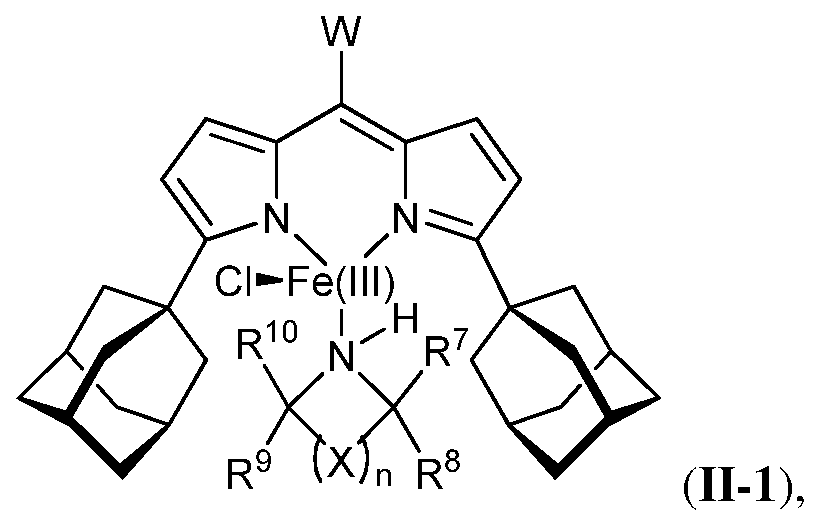
and salts and stereoisomers thereof, the method comprising the steps of:
reacting an azide of Formula (F), or a salt or stereoisomer thereof, with a ferrous compound of Formula (G), or a salt or stereoisomer thereof:

(F) (G)
wherein:
W is selected from the group consisting of mesityl and 2,6-dichlorophenyl;
each occurrence of X is independently selected from the group consisting of -0-, -S- , -NRC- and -C(Rd)2-;
Rc is selected from the group consisting of hydrogen, a nitrogen protecting group, optionally substituted acyl, optionally substituted alkyl, optionally substituted alkenyl, optionally substituted alkynyl, optionally substituted carbocyclyl, optionally substituted heterocyclyl, optionally substituted aryl, and optionally substituted heteroaryl;
each one of R7, R8, R9, and R10, and each occurrence of R , are independently selected from the group consisting of hydrogen, halogen, optionally substituted acyl, optionally
substituted alkyl, optionally substituted alkenyl, optionally substituted alkynyl, optionally substituted carbocyclyl, optionally substituted heterocyclyl, optionally substituted aryl, optionally substituted heteroaryl, -ORe, -N(Re)2, -SRe, -CN, -C(=NRe)Re, -C(=NRe)ORe, - C(=NRe)N(Re)2, -NO2, -NReC(=0)Re, -NReC(=0)ORe, -NReC(=0)N(Re)2, -OC(=0)Re, - OC(=0)ORe, -OC(=0)N(Re)2, and -ON(Re)2;
each occurrence of Re is independently selected from the group consisting of hydrogen, optionally substituted acyl, optionally substituted alkyl, optionally substituted alkenyl, optionally substituted alkynyl, optionally substituted carbocyclyl, optionally substituted heterocyclyl, optionally substituted aryl, optionally substituted heteroaryl, a nitrogen protecting group when attached to a nitrogen atom, an oxygen protecting group when attached to an oxygen atom, and a sulfur protecting group when attached to a sulfur atom, or optionally two Re groups are joined to form an optionally substituted heterocyclic ring;
optionally two of R7, R8, R9, R10, Rc, andRd groups are joined to form an optionally substituted carbocyclyl or optionally substituted heterocyclic ring;
Y is selected from the group consisting of N(R f )3, R f -O-R f , R f -S-R f , optionally substituted heterocyclyl, and optionally substituted heteroaryl;
each occurrence of R is independently selected from the group consisting of optionally substituted alkyl, optionally substituted alkenyl, optionally substituted alkynyl, optionally substituted carbocyclyl, optionally substituted heterocyclyl, optionally substituted aryl, and optionally substituted heteroaryl; and
n is 1, 2, 3, 4, or 5.
[00109] In compounds described herein, W is selected from the group consisting of mesityl and 2,6-dichlorophenyl. In certain embodiments, W is mesityl. In certain
embodiments, W is 2,6-dichlorophenyl.
[00110] In compounds of Formulae (II-l) and (F), each occurrence of X is
independently selected from the group consisting of -0-, -S-, -NRC-, and -C(Rd)2- In certain embodiments, at least one X is -0-. In certain embodiments, at least one X is -S-. In certain embodiments, at least one X is -NRC- In certain embodiments, at least one X is - N(Ci_6 alkyl)-. In certain embodiments, at least one X is -N(Me)-. In certain embodiments, at least one X is -NH-. In certain embodiments, at least one X is -C(Rd)2-. In certain embodiments, at least one X is -C(C1-6 alkyl)2-. In certain embodiments, at least one X is - C(Me)2-. In certain embodiments, at least one X is -C(Et)2-. In certain embodiments, at least one X is -C(Pr)2-. In certain embodiments, at least one X is -C(Bu)2-. In certain
embodiments, at least one X is -C(C1-6 alkenyl)2-. In certain embodiments, at least one X is - C(vinyl)2-. In certain embodiments, at least one X is -C(allyl)2- In certain embodiments, at least one X is -CH(4-butenyl)-. In certain embodiments, at least one X is -C(C1-6 alkynyl)2- In certain embodiments, at least one X is -C(ethynyl)2- In certain embodiments, at least one X is -CH(Rd)-. In certain embodiments, at least one X is -CH(C1-6 alkyl)-. In certain embodiments, at least one X is -CH(Me)-. In certain embodiments, at least one X is - CH(Et)-. In certain embodiments, at least one X is -C(Pr)2- In certain embodiments, at least one X is -C(Bu)2-. In certain embodiments, at least one X is -CH(Ci-6 alkenyl)-. In certain embodiments, at least one X is -CH(vinyl)-. In certain embodiments, at least one X is - CH(allyl)-. In certain embodiments, at least one X is -CH(4-butenyl)-. In certain
embodiments, at least one X is -CH(Ci-6 alkynyl)-. In certain embodiments, at least one X is -CH(ethynyl)-. In certain embodiments, at least one X is -CH(aryl)-. In certain
embodiments, at least one X is -CH(Ph)-. In certain embodiments, at least one X is - CH(heteroaryl)-. In certain embodiments, at least one X is -CH(pyridyl)-. In certain embodiments, at least one X is -CH(0R6)-. In certain embodiments, at least one X is - CH(O-aryl)-. In certain embodiments, at least one X is -CH(OPh)-. In certain embodiments, at least one X is -CH(0-Ci- alkyl)-. In certain embodiments, at least one X is -CH(OH)-. In certain embodiments, at least one X is -CH(N(Re)2)-. In certain embodiments, at least one X is -CH(N(Ci-6 alkyl)2)-. In certain embodiments, at least one X is -CH(NH2)-. In certain embodiments, at least one X is -CH(C(=0)0R6)-. In certain embodiments, at least one X is - CH(C(=0)OMe)-. In certain embodiments, at least one X is -CH(C(=0)OEt)-. In certain embodiments, at least one X is -CH2-.
[00111] In compounds of Formulae (II-l) and (F), when X is -NRC-, Rc is a substituent on the nitrogen atom. In certain embodiments, at least one Rc is H. In certain embodiments, at least one Rc is substituted alkyl. In certain embodiments, at least one Rc is unsubstituted alkyl. In certain embodiments, at least one Rc is C1-6 alkyl. In certain embodiments, at least one Rc is methyl. In certain embodiments, at least one Rc is ethyl. In certain embodiments, at least one Rc is propyl. In certain embodiments, at least one Rc is butyl. In certain embodiments, at least one Rc is i-butyl. In certain embodiments, at least one Rc is Ad. In certain embodiments, at least one Rc is substituted alkenyl. In certain
embodiments, at least one Rc is unsubstituted alkenyl. In certain embodiments, at least one Rc is vinyl. In certain embodiments, at least one Rc is substituted alkynyl. In certain
embodiments, at least one Rc is unsubstituted alkynyl. In certain embodiments, at least one Rc is ethynyl. In certain embodiments, at least one Rc is substituted carbocyclyl. In certain
embodiments, at least one Rc is unsubstituted carbocyclyl. In certain embodiments, at least one Rc is cylcopropyl. In certain embodiments, at least one Rc is cylcobutyl. In certain embodiments, at least one Rc is cyclopentyl. In certain embodiments, at least one Rc is cyclohexyl. In certain embodiments, at least one Rc is cycloheptyl. In certain embodiments, at least one Rc is substituted heterocyclyl. In certain embodiments, at least one Rc is
unsubstituted heterocyclyl. In certain embodiments, at least one Rc is substituted aryl. In certain embodiments, at least one Rc is unsubstituted aryl. In certain embodiments, at least one Rc is substituted phenyl. In certain embodiments, at least one Rc is tolyl. In certain embodiments, at least one Rc is 4-tolyl. In certain embodiments, at least one Rc is Mes. In certain embodiments, at least one Rc is unsubstituted phenyl. In certain embodiments, at least one Rc is substituted naphthyl. In certain embodiments, at least one Rc is unsubstituted naphthyl. In certain embodiments, at least one Rc is substituted heteroaryl. In certain embodiments, at least one Rc is unsubstituted heteroaryl. In certain embodiments, at least one Rc is monocyclic heteroaryl. In certain embodiments, at least one Rc is 5-membered monocyclic heteroaryl. In certain embodiments, at least one Rc is 5-membered monocyclic heteroaryl, wherein only one of the five atoms in the ring of the heteroaryl is selected from the group consisting of nitrogen, oxygen, and sulfur. In certain embodiments, at least one Rc is 5-membered monocyclic heteroaryl, wherein only two of the five atoms in the ring of the heteroaryl are independently selected from the group consisting of nitrogen, oxygen, and sulfur. In certain embodiments, at least one Rc is 5-membered monocyclic heteroaryl, wherein only three of the five atoms in the ring of the heteroaryl are independently selected from the group consisting of nitrogen, oxygen, and sulfur. In certain embodiments, at least one Rc is tetrazolyl. In certain embodiments, at least one Rc is 6-membered monocyclic heteroaryl. In certain embodiments, at least one Rc is 6-membered monocyclic heteroaryl, wherein only one of the six atoms in the ring of the heteroaryl is selected from the group consisting of nitrogen, oxygen, and sulfur. In certain embodiments, at least one Rc is 6- membered monocyclic heteroaryl, wherein only two of the six atoms in the ring of the heteroaryl are independently selected from the group consisting of nitrogen, oxygen, and sulfur. In certain embodiments, at least one Rc is triazinyl. In certain embodiments, at least one Rc is tetrazinyl. In certain embodiments, at least one Rc is bicyclic heteroaryl, wherein the point of attachment may be at any atom of the heteroaryl, as valency permits. In certain embodiments, at least one Rc is a monocyclic heteroaryl fused with phenyl. In certain embodiments, at least one Rc is a 5-membered monocyclic heteroaryl fused with phenyl. In certain embodiments, at least one Rc is a 6-membered monocyclic heteroaryl fused with
phenyl. In certain embodiments, at least one Rc is a monocyclic heteroaryl fused with another monocyclic heteroaryl. In certain embodiments, at least one Rc is a 5-membered monocyclic heteroaryl fused with another 5-membered monocyclic heteroaryl. In certain embodiments, at least one Rc is a 5-membered monocyclic heteroaryl fused with a 6-membered monocyclic heteroaryl. In certain embodiments, at least one Rc is a 6-membered monocyclic heteroaryl fused with another 6-membered monocyclic heteroaryl. In certain embodiments, at least one Rc is a nitrogen protecting group. In certain embodiments, at least one Rc is Bn, Boc, Cbz, Fmoc, trifluoroacetyl, triphenylmethyl, or Ts.
[00112] In compounds of Formulae (II-l) and (F), when X is -C(Rd)2- at least one Rd is a substituent on the carbon atom. In certain embodiments, at least one Rd is H. In certain embodiments, at least one Rd is halogen. In certain embodiments, at least one Rd is F. In certain embodiments, at least one Rd is CI. In certain embodiments, at least one Rd is Br. In certain embodiments, at least one Rd is I (iodine). In certain embodiments, at least one Rd is substituted acyl. In certain embodiments, at least one Rd is unsubstituted acyl. In certain embodiments, at least one Rd is -C(=0)Re. In certain embodiments, at least one Rd is acetyl. In certain embodiments, at least one Rd is -C(=0)ORe„ In certain embodiments, at least one Rd is -C(=0)N(Re)2. In certain embodiments, at least one Rd is substituted alkyl. In certain embodiments, at least one Rd is unsubstituted alkyl. In certain embodiments, at least one Rd is Ci-6 alkyl. In certain embodiments, at least one Rd is methyl. In certain embodiments, at least one Rd is ethyl. In certain embodiments, at least one Rd is propyl. In certain embodiments, at least one Rd is butyl. In certain embodiments, at least one Rd is Ad. In certain embodiments, at least one Rd is substituted alkenyl. In certain embodiments, at least one Rd is unsubstituted alkenyl. In certain embodiments, at least one Rd is vinyl. In certain embodiments, at least one Rd is substituted alkynyl. In certain embodiments, at least one Rd is unsubstituted alkynyl. In certain embodiments, at least one Rd is ethynyl. In certain embodiments, at least one Rd is substituted carbocyclyl. In certain embodiments, at least one Rd is unsubstituted carbocyclyl. In certain embodiments, at least one Rd is cylcopropyl. In certain embodiments, at least one Rd is cylcobutyl. In certain embodiments, at least one Rd is cyclopentyl. In certain
embodiments, at least one Rd is cyclohexyl. In certain embodiments, at least one Rd is cycloheptyl. In certain embodiments, at least one Rd is substituted heterocyclyl. In certain embodiments, at least one Rd is unsubstituted heterocyclyl. In certain embodiments, at least one Rd is substituted aryl. In certain embodiments, at least one Rd is unsubstituted aryl. In certain embodiments, at least one Rd is substituted phenyl. In certain embodiments, at least
one Rd is unsubstituted phenyl. In certain embodiments, at least one Rd is substituted naphthyl. In certain embodiments, at least one Rd is unsubstituted naphthyl. In certain embodiments, at least one Rd is substituted heteroaryl. In certain embodiments, at least one Rd is unsubstituted heteroaryl. In certain embodiments, at least one Rd is monocyclic heteroaryl. In certain embodiments, at least one Rd is 5-membered monocyclic heteroaryl. In certain embodiments, at least one Rd is 5-membered monocyclic heteroaryl, wherein only one of the five atoms in the ring of the heteroaryl is selected from the group consisting of nitrogen, oxygen, and sulfur. In certain embodiments, at least one Rd is 5-membered monocyclic heteroaryl, wherein only two of the five atoms in the ring of the heteroaryl are independently selected from the group consisting of nitrogen, oxygen, and sulfur. In certain embodiments, at least one Rd is 5-membered monocyclic heteroaryl, wherein only three of the five atoms in the ring of the heteroaryl are independently selected from the group consisting of nitrogen, oxygen, and sulfur. In certain embodiments, at least one Rd is tetrazolyl. In certain embodiments, at least one Rd is 6-membered monocyclic heteroaryl. In certain embodiments, at least one Rd is 6-membered monocyclic heteroaryl, wherein only one of the six atoms in the ring of the heteroaryl is selected from the group consisting of nitrogen, oxygen, and sulfur. In certain embodiments, at least one Rd is 6-membered monocyclic heteroaryl, wherein only two of the six atoms in the ring of the heteroaryl are independently selected from the group consisting of nitrogen, oxygen, and sulfur. In certain embodiments, at least one Rd is triazinyl. In certain embodiments, at least one Rd is tetrazinyl. In certain embodiments, at least one Rd is bicyclic heteroaryl, wherein the point of attachment may be at any atom of the heteroaryl, as valency permits. In certain embodiments, at least one Rd is a monocyclic heteroaryl fused with phenyl. In certain embodiments, at least one Rd is a 5- membered monocyclic heteroaryl fused with phenyl. In certain embodiments, at least one Rd is a 6-membered monocyclic heteroaryl fused with phenyl. In certain embodiments, at least one Rd is a monocyclic heteroaryl fused with another monocyclic heteroaryl. In certain embodiments, at least one Rd is a 5-membered monocyclic heteroaryl fused with another 5- membered monocyclic heteroaryl. In certain embodiments, at least one Rd is a 5-membered monocyclic heteroaryl fused with a 6-membered monocyclic heteroaryl. In certain
embodiments, at least one Rd is a 6-membered monocyclic heteroaryl fused with another 6- membered monocyclic heteroaryl. In certain embodiments, at least one Rd is -OR6. In certain embodiments, at least one Rd is -OH when attached to an sp3 carbon atom. In certain embodiments, at least one Rd is -SRe. In certain embodiments, at least one Rd is -SH when attached to an sp3 carbon atom. In certain embodiments, at least one Rd is -N(Re)2. In certain
embodiments, at least one Rd is -NH2 when attached to an sp3 carbon atom. In certain embodiments, at least one Rd is -CN. In certain embodiments, at least one Rd is -SCN. In certain embodiments, at least one Rd is -C(=NRe)Re, -C(=NRe)ORe, or -C(=NRe)N(Re)2. In certain embodiments, at least one Rd is -C(=0)Re, -C(=0)ORe, or -C(=0)N(Re)2. In certain embodiments, at least one Rd is -N02. In certain embodiments, at least one Rd is - NReC(=0)Re, -NReC(=0)ORe, or -NReC(=0)N(Re)2. In certain embodiments, at least one Rd is -OC(=0)Re, -OC(=0)ORe, or -OC(=0)N(Re)2. In certain embodiments, at least one Rd is -ON(Re)2.
[00113] In certain embodiments, n is 1. In certain embodiments, n is 2. In certain embodiments, n is 3. In certain embodiments, n is 4. In certain embodiments, n is 5.
[00114] Compounds of Formulae (II-l) and (F) include a substituent R7. In certain
7 7 7 embodiments, R is H. In certain embodiments, R is halogen. In certain embodiments, R is
7 7
F. In certain embodiments, R is CI. In certain embodiments, R is Br. In certain
7 7
embodiments, R is I (iodine). In certain embodiments, R is substituted acyl. In certain embodiments, R7 is unsubstituted acyl. In certain embodiments, R7 is -C(=0)Re. In certain embodiments, R7 is acetyl. In certain embodiments, R7 is -C(=0)ORe„ In certain
embodiments, R7 is -C(=0)N(Re)2. In certain embodiments, R7 is substituted alkyl. In certain
7 7
embodiments, R is unsubstituted alkyl. In certain embodiments, R is C - alkyl. In certain
7 7 7 embodiments, R is methyl. In certain embodiments, R is ethyl. In certain embodiments, R
7 7
is propyl. In certain embodiments, R is butyl. In certain embodiments, R is Ad. In certain
7 7
embodiments, R is substituted alkenyl. In certain embodiments, R is unsubstituted alkenyl.
7 7
In certain embodiments, R is vinyl. In certain embodiments, R is substituted alkynyl. In
7 7
certain embodiments, R is unsubstituted alkynyl. In certain embodiments, R is ethynyl. In
7 7
certain embodiments, R is substituted carbocyclyl. In certain embodiments, R is
unsubstituted carbocyclyl. In certain embodiments, R is cylcopropyl. In certain
7 7
embodiments, R is cylcobutyl. In certain embodiments, R is cyclopentyl. In certain
7 7
embodiments, R is cyclohexyl. In certain embodiments, R is cycloheptyl. In certain
7 7
embodiments, R is substituted heterocyclyl. In certain embodiments, R is unsubstituted
7 7 heterocyclyl. In certain embodiments, R is substituted aryl. In certain embodiments, R is unsubstituted aryl. In certain embodiments, R is substituted phenyl. In certain embodiments,
7 7
R is unsubstituted phenyl. In certain embodiments, R is substituted naphthyl. In certain
7 7
embodiments, R is unsubstituted naphthyl. In certain embodiments, R is substituted heteroaryl. In certain embodiments, R is unsubstituted heteroaryl. In certain embodiments,
7 7
R is monocyclic heteroaryl. In certain embodiments, R is 5-membered monocyclic heteroaryl. In certain embodiments, R is 5-membered monocyclic heteroaryl, wherein only one of the five atoms in the ring of the heteroaryl is selected from the group consisting of nitrogen, oxygen, and sulfur. In certain embodiments, R is 5-membered monocyclic heteroaryl, wherein only two of the five atoms in the ring of the heteroaryl are independently selected from the group consisting of nitrogen, oxygen, and sulfur. In certain embodiments, R is 5-membered monocyclic heteroaryl, wherein only three of the five atoms in the ring of the heteroaryl are independently selected from the group consisting of nitrogen, oxygen, and
7 7
sulfur. In certain embodiments, R is tetrazolyl. In certain embodiments, R is 6-membered monocyclic heteroaryl. In certain embodiments, R is 6-membered monocyclic heteroaryl, wherein only one of the six atoms in the ring of the heteroaryl is selected from the group consisting of nitrogen, oxygen, and sulfur. In certain embodiments, R is 6-membered monocyclic heteroaryl, wherein only two of the six atoms in the ring of the heteroaryl are independently selected from the group consisting of nitrogen, oxygen, and sulfur. In certain
7 7
embodiments, R is triazinyl. In certain embodiments, R is tetrazinyl. In certain
7
embodiments, R is bicyclic heteroaryl, wherein the point of attachment may be at any atom of the heteroaryl, as valency permits. In certain embodiments, R is a monocyclic heteroaryl fused with phenyl. In certain embodiments, R is a 5-membered monocyclic heteroaryl fused with phenyl. In certain embodiments, R is a 6-membered monocyclic heteroaryl fused with phenyl. In certain embodiments, R is a monocyclic heteroaryl fused with another monocyclic heteroaryl. In certain embodiments, R is a 5-membered monocyclic heteroaryl fused with another 5-membered monocyclic heteroaryl. In certain embodiments, R is a 5-membered monocyclic heteroaryl fused with a 6-membered monocyclic heteroaryl. In certain embodiments, R is a 6-membered monocyclic heteroaryl fused with another 6-membered monocyclic heteroaryl. In certain embodiments, R7 is -OR6. In certain embodiments, R7 is - OH when attached to an sp3 carbon atom. In certain embodiments, R7 is -SRe. In certain
7 3 7 embodiments, R is -SH when attached to an sp carbon atom. In certain embodiments, R is -N(Re)2. In certain embodiments, R7 is -NH2 when attached to an sp3 carbon atom. In certain
7 7 7 embodiments, R is -CN. In certain embodiments, R is -SCN. In certain embodiments, R is -C(=NRe)Re, -C(=NRe)ORe, or -C(=NRe)N(Re)2. In certain embodiments, R7 is -C(=0)Re, - C(=0)ORe, or -C(=0)N(Re)2. In certain embodiments, R7 is -N02. In certain embodiments, R7 is -NReC(=0)Re, -NReC(=0)ORe, or -NReC(=0)N(Re)2. In certain embodiments, R7 is - OC(=0)Re, -OC(=0)ORe, or -OC(=0)N(Re)2. In certain embodiments, R7 is -ON(Re)2.
[00115] Compounds of Formulae (II-l) and (F) also include a substituent R . In certain embodiments, R 8 is H. In certain embodiments, R 8 is halogen. In certain
embodiments, R 8 is F. In certain embodiments, R 8 is CI. In certain embodiments, R 8 is Br. In certain embodiments, R 8 is I (iodine). In certain embodiments, R 8 is substituted acyl. In certain embodiments, R 8 is unsubstituted acyl. In certain embodiments, R 8 is -C(=0)R e . In certain embodiments, R 8 is acetyl. In certain embodiments, R 8 is -C(=0)OR e„ In certain embodiments, R 8 is -C(=0)N(R e )2. In certain embodiments, R 8 is substituted alkyl. In certain embodiments, R 8 is unsubstituted alkyl. In certain embodiments, R 8 is C1-6 alkyl. In certain embodiments, R 8 is methyl. In certain embodiments, R 8 is ethyl. In certain embodiments, R 8 is propyl. In certain embodiments, R 8 is butyl. In certain embodiments, R 8 is Ad. In certain embodiments, R 8 is substituted alkenyl. In certain embodiments, R 8 is unsubstituted alkenyl.
In certain embodiments, R 8 is vinyl. In certain embodiments, R 8 is substituted alkynyl. In certain embodiments, R 8 is unsubstituted alkynyl. In certain embodiments, R 8 is ethynyl. In certain embodiments, R 8 is substituted carbocyclyl. In certain embodiments, R 8 is unsubstituted carbocyclyl. In certain embodiments, R is cylcopropyl. In certain
embodiments, R 8 is cylcobutyl. In certain embodiments, R 8 is cyclopentyl. In certain embodiments, R 8 is cyclohexyl. In certain embodiments, R 8 is cycloheptyl. In certain embodiments, R 8 is substituted heterocyclyl. In certain embodiments, R 8 is unsubstituted heterocyclyl. In certain embodiments, R 8 is substituted aryl. In certain embodiments, R 8 is unsubstituted aryl. In certain embodiments, R is substituted phenyl. In certain embodiments,
R 8 is unsubstituted phenyl. In certain embodiments, R 8 is substituted naphthyl. In certain embodiments, R 8 is unsubstituted naphthyl. In certain embodiments, R 8 is substituted heteroaryl. In certain embodiments, R is unsubstituted heteroaryl. In certain embodiments,
R 8 is monocyclic heteroaryl. In certain embodiments, R 8 is 5-membered monocyclic heteroaryl. In certain embodiments, R is 5-membered monocyclic heteroaryl, wherein only one of the five atoms in the ring of the heteroaryl is selected from the group consisting of nitrogen, oxygen, and sulfur. In certain embodiments, R is 5-membered monocyclic heteroaryl, wherein only two of the five atoms in the ring of the heteroaryl are independently selected from the group consisting of nitrogen, oxygen, and sulfur. In certain embodiments, R is 5-membered monocyclic heteroaryl, wherein only three of the five atoms in the ring of the heteroaryl are independently selected from the group consisting of nitrogen, oxygen, and sulfur. In certain embodiments, R 8 is tetrazolyl. In certain embodiments, R 8 is 6-membered monocyclic heteroaryl. In certain embodiments, R is 6-membered monocyclic heteroaryl,
wherein only one of the six atoms in the ring of the heteroaryl is selected from the group consisting of nitrogen, oxygen, and sulfur. In certain embodiments, R is 6-membered monocyclic heteroaryl, wherein only two of the six atoms in the ring of the heteroaryl are independently selected from the group consisting of nitrogen, oxygen, and sulfur. In certain
8 8
embodiments, R is triazinyl. In certain embodiments, R is tetrazinyl. In certain
embodiments, R is bicyclic heteroaryl, wherein the point of attachment may be at any atom of the heteroaryl, as valency permits. In certain embodiments, R is a monocyclic heteroaryl fused with phenyl. In certain embodiments, R is a 5-membered monocyclic heteroaryl fused with phenyl. In certain embodiments, R is a 6-membered monocyclic heteroaryl fused with phenyl. In certain embodiments, R is a monocyclic heteroaryl fused with another monocyclic heteroaryl. In certain embodiments, R is a 5-membered monocyclic heteroaryl fused with another 5-membered monocyclic heteroaryl. In certain embodiments, R is a 5-membered monocyclic heteroaryl fused with a 6-membered monocyclic heteroaryl. In certain embodiments, R is a 6-membered monocyclic heteroaryl fused with another 6-membered
8 e 8 monocyclic heteroaryl. In certain embodiments, R is -OR . In certain embodiments, R is - OH when attached to an sp3 carbon atom. In certain embodiments, R8 is -SRe. In certain
8 3 8 embodiments, R is -SH when attached to an sp carbon atom. In certain embodiments, R is -N(Re)2. In certain embodiments, R8 is -NH2 when attached to an sp3 carbon atom. In certain
8 8 8 embodiments, R is -CN. In certain embodiments, R is -SCN. In certain embodiments, R is -C(=NRe)Re, -C(=NRe)ORe, or -C(=NRe)N(Re)2. In certain embodiments, R8 is -C(=0)Re, - C(=0)ORe, or -C(=0)N(Re)2. In certain embodiments, R8 is -N02. In certain embodiments, R8 is -NReC(=0)Re, -NReC(=0)ORe, or -NReC(=0)N(Re)2. In certain embodiments, R8 is - OC(=0)Re, -OC(=0)ORe, or -OC(=0)N(Re)2. In certain embodiments, R8 is -ON(Re)2.
[00116] Compounds of Formulae (II-l) and (F) further include a substituent R9. In certain embodiments, R9 is H. In certain embodiments, R9 is halogen. In certain
embodiments, R9 is F. In certain embodiments, R9 is CI. In certain embodiments, R9 is Br. In certain embodiments, R9 is I (iodine). In certain embodiments, R9 is substituted acyl. In certain embodiments, R9 is unsubstituted acyl. In certain embodiments, R9 is -C(=0)Re. In certain embodiments, R9 is acetyl. In certain embodiments, R9 is -C(=0)ORe„ In certain embodiments, R9 is -C(=0)N(Re)2. In certain embodiments, R9 is substituted alkyl. In certain embodiments, R9 is unsubstituted alkyl. In certain embodiments, R9 is C1-6 alkyl. In certain embodiments, R9 is methyl. In certain embodiments, R9 is ethyl. In certain embodiments, R9 is propyl. In certain embodiments, R9 is butyl. In certain embodiments, R9 is Ad. In certain
embodiments, R9 is substituted alkenyl. In certain embodiments, R9 is unsubstituted alkenyl. In certain embodiments, R9 is vinyl. In certain embodiments, R9 is substituted alkynyl. In certain embodiments, R9 is unsubstituted alkynyl. In certain embodiments, R9 is ethynyl. In certain embodiments, R9 is substituted carbocyclyl. In certain embodiments, R9 is
unsubstituted carbocyclyl. In certain embodiments, R9 is cylcopropyl. In certain
embodiments, R9 is cylcobutyl. In certain embodiments, R9 is cyclopentyl. In certain embodiments, R9 is cyclohexyl. In certain embodiments, R9 is cycloheptyl. In certain embodiments, R9 is substituted heterocyclyl. In certain embodiments, R9 is unsubstituted heterocyclyl. In certain embodiments, R9 is substituted aryl. In certain embodiments, R9 is unsubstituted aryl. In certain embodiments, R9 is substituted phenyl. In certain embodiments, R9 is unsubstituted phenyl. In certain embodiments, R9 is substituted naphthyl. In certain embodiments, R9 is unsubstituted naphthyl. In certain embodiments, R9 is substituted heteroaryl. In certain embodiments, R9 is unsubstituted heteroaryl. In certain embodiments, R9 is monocyclic heteroaryl. In certain embodiments, R9 is 5-membered monocyclic heteroaryl. In certain embodiments, R9 is 5-membered monocyclic heteroaryl, wherein only one of the five atoms in the ring of the heteroaryl is selected from the group consisting of nitrogen, oxygen, and sulfur. In certain embodiments, R9 is 5-membered monocyclic heteroaryl, wherein only two of the five atoms in the ring of the heteroaryl are independently selected from the group consisting of nitrogen, oxygen, and sulfur. In certain embodiments, R9 is 5-membered monocyclic heteroaryl, wherein only three of the five atoms in the ring of the heteroaryl are independently selected from the group consisting of nitrogen, oxygen, and sulfur. In certain embodiments, R9 is tetrazolyl. In certain embodiments, R9 is 6-membered monocyclic heteroaryl. In certain embodiments, R9 is 6-membered monocyclic heteroaryl, wherein only one of the six atoms in the ring of the heteroaryl is selected from the group consisting of nitrogen, oxygen, and sulfur. In certain embodiments, R9 is 6-membered monocyclic heteroaryl, wherein only two of the six atoms in the ring of the heteroaryl are independently selected from the group consisting of nitrogen, oxygen, and sulfur. In certain embodiments, R9 is triazinyl. In certain embodiments, R9 is tetrazinyl. In certain
embodiments, R9 is bicyclic heteroaryl, wherein the point of attachment may be at any atom of the heteroaryl, as valency permits. In certain embodiments, R9 is a monocyclic heteroaryl fused with phenyl. In certain embodiments, R9 is a 5-membered monocyclic heteroaryl fused with phenyl. In certain embodiments, R9 is a 6-membered monocyclic heteroaryl fused with phenyl. In certain embodiments, R9 is a monocyclic heteroaryl fused with another monocyclic heteroaryl. In certain embodiments, R9 is a 5-membered monocyclic heteroaryl fused with
another 5-membered monocyclic heteroaryl. In certain embodiments, R9 is a 5-membered monocyclic heteroaryl fused with a 6-membered monocyclic heteroaryl. In certain embodiments, R9 is a 6-membered monocyclic heteroaryl fused with another 6-membered monocyclic heteroaryl. In certain embodiments, R9 is -OR6. In certain embodiments, R9 is - OH when attached to an sp3 carbon atom. In certain embodiments, R9 is -SRe. In certain embodiments, R9 is -SH when attached to an sp3 carbon atom. In certain embodiments, R9 is -N(Re)2. In certain embodiments, R9 is -NH2 when attached to an sp3 carbon atom. In certain embodiments, R9 is -CN. In certain embodiments, R9 is -SCN. In certain embodiments, R9 is -C(=NRe)Re, -C(=NRe)ORe, or -C(=NRe)N(Re)2. In certain embodiments, R9 is -C(=0)Re, - C(=0)ORe, or -C(=0)N(Re)2. In certain embodiments, R9 is -N02. In certain embodiments, R9 is -NReC(=0)Re, -NReC(=0)ORe, or -NReC(=0)N(Re)2. In certain embodiments, R9 is - OC(=0)Re, -OC(=0)ORe, or -OC(=0)N(Re)2. In certain embodiments, R9 is -ON(Re)2.
[00117] Compounds of Formulae (II-l) and (F) still include a substituent R10. In certain embodiments, R10 is H. In certain embodiments, R10 is halogen. In certain
embodiments, R10 is F. In certain embodiments, R10 is CI. In certain embodiments, R10 is Br. In certain embodiments, R10 is I (iodine). In certain embodiments, R10 is substituted acyl. In certain embodiments, R10 is unsubstituted acyl. In certain embodiments, R10 is -C(=0)Re. In certain embodiments, R10 is acetyl. In certain embodiments, R10 is -C(=0)ORe„ In certain embodiments, R10 is -C(=0)N(Re)2. In certain embodiments, R10 is substituted alkyl. In certain embodiments, R10 is unsubstituted alkyl. In certain embodiments, R10 is C1-6 alkyl. In certain embodiments, R10 is methyl. In certain embodiments, R10 is ethyl. In certain embodiments, R10 is propyl. In certain embodiments, R10 is butyl. In certain embodiments, R10 is Ad. In certain embodiments, R10 is substituted alkenyl. In certain embodiments, R10 is unsubstituted alkenyl. In certain embodiments, R10 is vinyl. In certain embodiments, R10 is substituted alkynyl. In certain embodiments, R10 is unsubstituted alkynyl. In certain embodiments, R10 is ethynyl. In certain embodiments, R10 is substituted carbocyclyl. In certain embodiments, R10 is unsubstituted carbocyclyl. In certain embodiments, R10 is cylcopropyl. In certain embodiments, R10 is cylcobutyl. In certain embodiments, R10 is cyclopentyl. In certain embodiments, R10 is cyclohexyl. In certain embodiments, R10 is cycloheptyl. In certain embodiments, R10 is substituted heterocyclyl. In certain embodiments, R10 is unsubstituted heterocyclyl. In certain embodiments, R10 is substituted aryl. In certain embodiments, R10 is unsubstituted aryl. In certain embodiments, R10 is substituted phenyl. In certain embodiments, R10 is unsubstituted phenyl. In certain embodiments, R10 is substituted
naphthyl. In certain embodiments, R is unsubstituted naphthyl. In certain embodiments, R is substituted heteroaryl. In certain embodiments, R10 is unsubstituted heteroaryl. In certain embodiments, R10 is monocyclic heteroaryl. In certain embodiments, R10 is 5-membered monocyclic heteroaryl. In certain embodiments, R10 is 5-membered monocyclic heteroaryl, wherein only one of the five atoms in the ring of the heteroaryl is selected from the group consisting of nitrogen, oxygen, and sulfur. In certain embodiments, R10 is 5-membered monocyclic heteroaryl, wherein only two of the five atoms in the ring of the heteroaryl are independently selected from the group consisting of nitrogen, oxygen, and sulfur. In certain embodiments, R10 is 5-membered monocyclic heteroaryl, wherein only three of the five atoms in the ring of the heteroaryl are independently selected from the group consisting of nitrogen, oxygen, and sulfur. In certain embodiments, R10 is tetrazolyl. In certain
embodiments, R10 is 6-membered monocyclic heteroaryl. In certain embodiments, R10 is 6- membered monocyclic heteroaryl, wherein only one of the six atoms in the ring of the heteroaryl is selected from the group consisting of nitrogen, oxygen, and sulfur. In certain embodiments, R10 is 6-membered monocyclic heteroaryl, wherein only two of the six atoms in the ring of the heteroaryl are independently selected from the group consisting of nitrogen, oxygen, and sulfur. In certain embodiments, R10 is triazinyl. In certain embodiments, R10 is tetrazinyl. In certain embodiments, R10 is bicyclic heteroaryl, wherein the point of attachment may be at any atom of the heteroaryl, as valency permits. In certain embodiments, R10 is a monocyclic heteroaryl fused with phenyl. In certain embodiments, R10 is a 5-membered monocyclic heteroaryl fused with phenyl. In certain embodiments, R10 is a 6-membered monocyclic heteroaryl fused with phenyl. In certain embodiments, R10 is a monocyclic heteroaryl fused with another monocyclic heteroaryl. In certain embodiments, R10 is a 5- membered monocyclic heteroaryl fused with another 5-membered monocyclic heteroaryl. In certain embodiments, R10 is a 5-membered monocyclic heteroaryl fused with a 6-membered monocyclic heteroaryl. In certain embodiments, R10 is a 6-membered monocyclic heteroaryl fused with another 6-membered monocyclic heteroaryl. In certain embodiments, R10 is -OR6.
10 3
In certain embodiments, R is -OH when attached to an sp carbon atom. In certain embodiments, R10 is -SRe. In certain embodiments, R10 is -SH when attached to an sp3 carbon atom. In certain embodiments, R10 is -N(Re)2. In certain embodiments, R10 is -NH2
3 10
when attached to an sp carbon atom. In certain embodiments, R is -CN. In certain embodiments, R10 is -SCN. In certain embodiments, R10 is -C(=NRe)Re, -C(=NRe)ORe, or - C(=NRe)N(Re)2. In certain embodiments, R10 is -C(=0)Re, -C(=0)ORe, or -C(=0)N(Re)2. In certain embodiments, R10 is -N02. In certain embodiments, R10 is -NReC(=0)Re, -
NReC(=0)ORe, or -NReC(=0)N(Re)2. In certain embodiments, R is -OC(=0)Re, - OC(=0)ORe, or -OC(=0)N(Re)2. In certain embodiments, R10 is -ON(Re)2.
[00118] In certain embodiments, at least one Re is H. In certain embodiments, at least one Re is substituted acyl. In certain embodiments, at least one Re is unsubstituted acyl. In certain embodiments, at least one Re is acetyl. In certain embodiments, at least one Re is substituted alkyl. In certain embodiments, at least one Re is unsubstituted alkyl. In certain embodiments, at least one Re is C1-6 alkyl. In certain embodiments, at least one Re is methyl. In certain embodiments, at least one Re is ethyl. In certain embodiments, at least one Re is propyl. In certain embodiments, at least one Re is butyl. In certain embodiments, at least one Re is substituted alkenyl. In certain embodiments, at least one Re is unsubstituted alkenyl. In certain embodiments, at least one Re is vinyl. In certain embodiments, at least one Re is substituted alkynyl. In certain embodiments, at least one Re is unsubstituted alkynyl. In certain embodiments, at least one Re is ethynyl. In certain embodiments, at least one Re is substituted carbocyclyl. In certain embodiments, at least one Re is unsubstituted carbocyclyl. In certain embodiments, at least one Re is cylcopropyl. In certain embodiments, at least one Re is cylcobutyl. In certain embodiments, at least one Re is cyclopentyl. In certain
embodiments, at least one Re is cyclohexyl. In certain embodiments, at least one Re is cycloheptyl. In certain embodiments, at least one Re is substituted heterocyclyl. In certain embodiments, at least one Re is unsubstituted heterocyclyl. In certain embodiments, at least one Re is substituted aryl. In certain embodiments, at least one Re is unsubstituted aryl. In certain embodiments, at least one Re is substituted phenyl. In certain embodiments, at least one Re is unsubstituted phenyl. In certain embodiments, at least one Re is substituted heteroaryl. In certain embodiments, at least one Re is unsubstituted heteroaryl. In certain embodiments, at least one Re is substituted pyridyl. In certain embodiments, at least one Re is unsubstituted pyridyl. In certain embodiments, at least one Re is a nitrogen protecting group when attached to a nitrogen atom. In certain embodiments, at least one Re is Bn, Boc, Cbz, Fmoc, trifluoroacetyl, triphenylmethyl, or Ts when attached to a nitrogen atom. In certain embodiments, at least one Re is an oxygen protecting group when attached to an oxygen atom. In certain embodiments, at least one Re is silyl, TBDPS, TBDMS, TIPS, TES, TMS, MOM, THP, ί-Bu, Bn, allyl, acetyl, pivaloyl, or benzoyl when attached to an oxygen atom. In certain embodiments, two Re groups are joined to form a substituted heterocyclic ring. In certain embodiments, two Re groups are joined to form an unsubstituted heterocyclic ring. In certain embodiments, two Re groups are joined to form a substituted heteroaryl ring. In certain embodiments, two Re groups are joined to form an unsubstituted heteroaryl ring.
[00119] In compounds of Formulae (II-l) and (F), any two of R7, R8, R9, R10, Rc, and
Rd groups may be joined to form a optionally substituted carbocyclyl ring, or optionally substituted heterocyclic ring. In certain embodiments, two of R7, R8, R9, R10, Rc, and Rd groups are joined to form a optionally substituted cyclopropyl ring. In certain embodiments, two of R7, R8, R9, R10, Rc, and Rd groups are joined to form a optionally substituted cyclobutyl ring. In certain embodiments, two of R7, R8, R9, R10, Rc, and Rd groups are joined to form a optionally substituted cyclopentyl ring. In certain embodiments, two of R 7 , R 8 , R 9 , R10, Rc, and Rd groups are joined to form a optionally substituted cyclohexyl ring. In certain embodiments, two of R7, R8, R9, R10, Rc, and Rd groups are joined to form a optionally substituted cycloheptyl ring. In certain embodiments, two of R7, R8, R9, R10, Rc, and Rd groups are joined to form a optionally substituted cyclooctyl ring. In certain embodiments, two of R7, R8, R9, R10, Rc, and Rd groups are joined to form a optionally substituted cyclononyl ring. In certain embodiments, two of R7, R8, R9, R10, Rc, and Rd groups are joined to form a optionally substituted cyclodecyl ring. In certain embodiments, two of R 7 , R 8 , R 9 , R10, Rc, and Rd groups are joined to form a optionally substituted 4-membered heterocyclic ring. In certain embodiments, two of R7, R8, R9, R10, Rc, and Rd groups are joined to form a optionally substituted 5-membered heterocyclic ring. In certain embodiments, two of R 7 , R 8 , R9, R10, Rc, and Rd groups are joined to form a optionally substituted 6-membered
heterocyclic ring. In certain embodiments, two of R7, R8, R9, R10, Rc, and Rd groups are joined to form a optionally substituted 7-membered heterocyclic ring. In certain
embodiments, two of R7, R8, R9, R10, Rc, and Rd groups are joined to form a optionally substituted 8-membered heterocyclic ring. In certain embodiments, two of R7, R8, R9, R10, Rc, and Rd groups are joined to form a optionally substituted 9-membered heterocyclic ring. In certain embodiments, two of R7, R8, R9, R10, Rc, and Rd groups are joined to form a optionally substituted 10-membered heterocyclic ring. In certain embodiments, R 7 and R 8 are joined to form a optionally substituted carbocyclyl ring. In certain embodiments, R 7 and R 8 are joined to form a optionally substituted heterocyclic ring. In certain embodiments, R 7 and R 9 are joined to form a optionally substituted carbocyclyl ring. In certain embodiments, R 7 and R 9 are joined to form a optionally substituted heterocyclic ring. In certain embodiments, R and
R 10 are joined to form a optionally substituted carbocyclyl ring. In certain embodiments, R 7 and R10 are joined to form a optionally substituted heterocyclic ring. In certain embodiments, R7 and Rc are joined to form a optionally substituted carbocyclyl ring. In certain
embodiments, R7 and Rc are joined to form a optionally substituted heterocyclic ring. In certain embodiments, R7 and Rd are joined to form a optionally substituted carbocyclyl ring.
In certain embodiments, R7 and Rd are joined to form a optionally substituted heterocyclic ring. In certain embodiments, R 8 and R 9 are joined to form a optionally substituted carbocyclyl ring. In certain embodiments, R 8 and R 9 are joined to form a optionally substituted heterocyclic ring. In certain embodiments, R 8 and R 10 are joined to form a optionally substituted carbocyclyl ring. In certain embodiments, R 8 and R 10 are joined to form a optionally substituted heterocyclic ring. In certain embodiments, R8 and Rc are joined to form a optionally substituted carbocyclyl ring. In certain embodiments, R8 and Rc are joined to form a optionally substituted heterocyclic ring. In certain embodiments, R 8 and R d are joined to form a optionally substituted carbocyclyl ring. In certain embodiments, R 8 and R d are joined to form a optionally substituted heterocyclic ring. In certain embodiments, R9 and R10 are joined to form a optionally substituted carbocyclyl ring. In certain embodiments, R9 and R10 are joined to form a optionally substituted heterocyclic ring. In certain embodiments, R9 and Rc are joined to form a optionally substituted carbocyclyl ring. In certain
embodiments, R9 and Rc are joined to form a optionally substituted heterocyclic ring. In certain embodiments, R9 and Rd are joined to form a optionally substituted carbocyclyl ring. In certain embodiments, R9 and Rd are joined to form a optionally substituted heterocyclic ring. In certain embodiments, R10 and Rc are joined to form a optionally substituted carbocyclyl ring. In certain embodiments, R10 and Rc are joined to form a optionally substituted heterocyclic ring. In certain embodiments, R10 and Rd are joined to form a optionally substituted carbocyclyl ring. In certain embodiments, R10 and Rd are joined to form a optionally substituted heterocyclic ring. In certain embodiments, Rc and Rd are joined to form a optionally substituted carbocyclyl ring. In certain embodiments, Rc and Rd are joined to form a optionally substituted heterocyclic ring.
[00120] In certain embodiments, R7 and R8 are each independently selected from the group consisting of substituted alkyl, unsubstituted alkyl, substituted alkenyl, unsubstituted alkenyl, substituted alkynyl, and unsubstituted alkynyl. In certain embodiments, R 7 and R 8 are each independently selected from the group consisting of substituted alkyl and unsubstituted alkyl. In certain embodiments, R 7 and R 8 are each C1-6 alkyl. In certain embodiments, R 7 and R 8 are each methyl. In certain embodiments, R 7 and R 8 are each independently selected from the group consisting of methyl, ethyl, propyl, and butyl.
[00121] In certain embodiments, R7 is optionally substituted alkyl; and R8 is optionally substituted aryl. In certain embodiments, R 7 is optionally substituted alkyl; and R 8 is optionally substituted phenyl. In certain embodiments, R 7 is C1-6 alkyl; and R 8 is optionally substituted aryl. In certain embodiments, R 7 is C1-6 alkyl; and R 8 is optionally substituted
phenyl. In certain embodiments, R 7 is methyl; and R 8 is phenyl. In certain embodiments, R 8 is optionally substituted alkyl; and R 7 is optionally substituted aryl. In certain embodiments, R 8 is optionally substituted alkyl; and R is optionally substituted phenyl. In certain
embodiments, R 8 is C1-6 alkyl; and R 7 is optionally substituted aryl. In certain embodiments,
R 8 is C1-6 alkyl; and R 7 is optionally substituted phenyl. In certain embodiments, R 8 is methyl; and R is phenyl.
[00122] In certain embodiments, R7 is H; and R8 is substituted alkyl. In certain embodiments, R 7 is H; and R 8 is unsubstituted alkyl. In certain embodiments, R 7 is H; and R 8 is C1-6 alkyl. In certain embodiments, R 7 is H; and R 8 is methyl. In certain embodiments, R 7 is
H; and R 8 is ethyl. In certain embodiments, R 7 is H; and R 8 is propyl. In certain
embodiments, R 7 is H; and R 8 is butyl. In certain embodiments, R 7 is H; and R 8 is substituted alkenyl. In certain embodiments, R 7 is H; and R 8 is unsubstituted alkenyl. In certain embodiments, R 7 is H; and R 8 is C1-6 alkenyl. In certain embodiments, R 7 is H; and R 8 is vinyl. In certain embodiments, R 7 is H; and R 8 is allyl. In certain embodiments, R 7 is H; and
R 8 is 4-butenyl. In certain embodiments, R 7 is H; and R 8 is substituted alkynyl. In certain embodiments, R 7 is H; and R 8 is unsubstituted alkynyl. In certain embodiments, R 7 is H; and
R 8 is C1-6 alkynyl. In certain embodiments, R 7 is H; and R 8 is ethynyl. In certain
embodiments, R 7 is H; and R 8 is substituted aryl. In certain embodiments, R 7 is H; and R 8 is unsubstituted aryl. In certain embodiments, R 7 is H; and R 8 is substituted phenyl. In certain embodiments, R 7 is H; and R 8 is unsubstituted phenyl. In certain embodiments, R 7 is H; and
R 8 is substituted heteroaryl. In certain embodiments, R 7 is H; and R 8 is unsubstituted heteroaryl. In certain embodiments, R 7 is H; and R 8 is substituted pyridyl. In certain embodiments, R 7 is H; and R 8 is unsubstituted pyridyl. In certain embodiments, R 7 is H; and R8 is -OR6. In certain embodiments, R7 is H; and R8 is -O-aryl. In certain embodiments, R7 is H; and R 8 is -OPh. In certain embodiments, R 7 is H; and R 8 is -0-C1-6 alkyl. In certain embodiments, R7 is H; and R8 is -OH. In certain embodiments, R7 is H; and R8 is -N(Re)2. In certain embodiments, R 7 is H; and R 8 is -N(C1-6 alkyl)2. In certain embodiments, R 7 is H; and R8 is -NH2. In certain embodiments, R7 is H; and R8 is -C(=0)ORe. In certain embodiments, R7 is H; and R8 is -C(=0)OMe. In certain embodiments, R7 is H; and R8 is -C(=0)OEt.
[00123] In certain embodiments, R8 is H; and R7 is substituted alkyl. In certain embodiments, R 8 is H; and R 7 is unsubstituted alkyl. In certain embodiments, R 8 is H; and R 7 is Ci n embodiments, R 8 is H; and R 7 is methyl. In certain embodiments, R 8 -6 alkyl. In certai is
H; and R 7 is ethyl. In certain embodiments, R 8 is H; and R 7 is propyl. In certain
embodiments, R 8 is H; and R 7 is butyl. In certain embodiments, R 8 is H; and R 7 is substituted
alkenyl. In certain embodiments, R 8 is H; and R 7 is unsubstituted alkenyl. In certain embodiments, R 8 is H; and R 7 is C1-6 alkenyl. In certain embodiments, R 8 is H; and R 7 is vinyl. In certain embodiments, R 8 is H; and R 7 is allyl. In certain embodiments, R 8 is H; and
R 7 is 4-butenyl. In certain embodiments, R 8 is H; and R 7 is substituted alkynyl. In certain embodiments, R 8 is H; and R 7 is unsubstituted alkynyl. In certain embodiments, R 8 is H; and
R 7 is C1-6 alkynyl. In certain embodiments, R 8 is H; and R 7 is ethynyl. In certain
embodiments, R 8 is H; and R 7 is substituted aryl. In certain embodiments, R 8 is H; and R 7 is unsubstituted aryl. In certain embodiments, R 8 is H; and R 7 is substituted phenyl. In certain embodiments, R 8 is H; and R 7 is unsubstituted phenyl. In certain embodiments, R 8 is H; and
R 7 is substituted heteroaryl. In certain embodiments, R 8 is H; and R 7 is unsubstituted heteroaryl. In certain embodiments, R 8 is H; and R 7 is substituted pyridyl. In certain embodiments, R 8 is H; and R 7 is unsubstituted pyridyl. In certain embodiments, R 8 is H; and R7 is -OR6. In certain embodiments, R8 is H; and R7 is -O-aryl. In certain embodiments, R8 is H; and R 7 is -OPh. In certain embodiments, R 8 is H; and R 7 is -0-C1-6 alkyl. In certain embodiments, R8 is H; and R7 is -OH. In certain embodiments, R8 is H; and R7 is -N(Re)2. In certain embodiments, R 8 is H; and R 7 is -N(C1-6 alkyl)2. In certain embodiments, R 8 is H; and R7 is -NH2. In certain embodiments, R8 is H; and R7 is -C(=0)ORe. In certain embodiments, R8 is H; and R7 is -C(=0)OMe. In certain embodiments, R8 is H; and R7 is -C(=0)OEt.
[00124] In certain embodiments, R7 and R8 are each H.
[00125] In certain embodiments, R9 and R10 are each independently selected from the group consisting of substituted alkyl, unsubstituted alkyl, substituted alkenyl, unsubstituted alkenyl, substituted alkynyl, and unsubstituted alkynyl. In certain embodiments, R9 and R10 are each independently selected from the group consisting of substituted alkyl and
unsubstituted alkyl. In certain embodiments, R9 and R10 are each C1-6 alkyl. In certain embodiments, R9 and R10 are each methyl. In certain embodiments, R9 and R10 are each independently selected from the group consisting of methyl, ethyl, propyl, and butyl.
[00126] In certain embodiments, R9 is optionally substituted alkyl; and R10 is optionally substituted aryl. In certain embodiments, R9 is optionally substituted alkyl; and R10 is optionally substituted phenyl. In certain embodiments, R9 is C1-6 alkyl; and R10 is optionally substituted aryl. In certain embodiments, R9 is C1-6 alkyl; and R10 is optionally substituted phenyl. In certain embodiments, R9 is methyl; and R10 is phenyl. In certain embodiments, R10 is optionally substituted alkyl; and R9 is optionally substituted aryl. In certain embodiments, R10 is optionally substituted alkyl; and R9 is optionally substituted phenyl. In certain embodiments, R10 is C1-6 alkyl; and R9 is optionally substituted aryl. In
certain embodiments, R10 is C1-6 alkyl; and R9 is optionally substituted phenyl. In certain embodiments, R10 is methyl; and R9 is phenyl.
[00127] In certain embodiments, R9 is H; and R10 is substituted alkyl. In certain embodiments, R9 is H; and R10 is unsubstituted alkyl. In certain embodiments, R9 is H; and R10 is C1-6 alkyl. In certain embodiments, R9 is H; and R10 is methyl. In certain embodiments, R9 is H; and R10 is ethyl. In certain embodiments, R9 is H; and R10 is propyl. In certain embodiments, R9 is H; and R10 is butyl. In certain embodiments, R9 is H; and R10 is substituted alkenyl. In certain embodiments, R9 is H; and R10 is unsubstituted alkenyl. In certain embodiments, R9 is H; and R10 is C1-6 alkenyl. In certain embodiments, R9 is H; and R10 is vinyl. In certain embodiments, R9 is H; and R10 is allyl. In certain embodiments, R9 is H; and R10 is 4-butenyl. In certain embodiments, R9 is H; and R10 is substituted alkynyl. In certain embodiments, R9 is H; and R10 is unsubstituted alkynyl. In certain embodiments, R9 is H; and R10 is C1-6 alkynyl. In certain embodiments, R9 is H; and R10 is ethynyl. In certain embodiments, R9 is H; and R10 is substituted aryl. In certain embodiments, R9 is H; and R10 is unsubstituted aryl. In certain embodiments, R9 is H; and R10 is substituted phenyl. In certain embodiments, R9 is H; and R10 is unsubstituted phenyl. In certain embodiments, R9 is H; and R10 is substituted heteroaryl. In certain embodiments, R9 is H; and R10 is unsubstituted heteroaryl. In certain embodiments, R9 is H; and R10 is substituted pyridyl. In certain embodiments, R9 is H; and R10 is unsubstituted pyridyl. In certain embodiments, R9 is H; and R10 is -OR6. In certain embodiments, R9 is H; and R10 is -O-aryl. In certain embodiments, R9 is H; and R10 is -OPh. In certain embodiments, R9 is H; and R10 is -0-C1-6 alkyl. In certain embodiments, R9 is H; and R10 is -OH. In certain embodiments, R9 is H; and R10 is -N(Re)2. In certain embodiments, R9 is H; and R10 is -N(C1-6 alkyl)2. In certain embodiments, R9 is H; and R10 is -NH2. In certain embodiments, R9 is H; and R10 is -C(=0)ORe. In certain embodiments, R9 is H; and R10 is -C(=0)OMe. In certain embodiments, R9 is H; and R10 is - C(=0)OEt.
[00128] In certain embodiments, R10 is H; and R9 is substituted alkyl. In certain embodiments, R10 is H; and R9 is unsubstituted alkyl. In certain embodiments, R10 is H; and R9 is C1-6 alkyl. In certain embodiments, R10 is H; and R9 is methyl. In certain embodiments, R10 is H; and R9 is ethyl. In certain embodiments, R10 is H; and R9 is propyl. In certain embodiments, R10 is H; and R9 is butyl. In certain embodiments, R10 is H; and R9 is substituted alkenyl. In certain embodiments, R10 is H; and R9 is unsubstituted alkenyl. In certain embodiments, R10 is H; and R9 is C1-6 alkenyl. In certain embodiments, R10 is H; and R9 is vinyl. In certain embodiments, R10 is H; and R9 is allyl. In certain embodiments, R10 is
H; and R9 is 4-butenyl. In certain embodiments, R10 is H; and R9 is substituted alkynyl. In certain embodiments, R10 is H; and R9 is unsubstituted alkynyl. In certain embodiments, R10 is H; and R9 is C1-6 alkynyl. In certain embodiments, R10 is H; and R9 is ethynyl. In certain embodiments, R10 is H; and R9 is substituted aryl. In certain embodiments, R10 is H; and R9 is unsubstituted aryl. In certain embodiments, R10 is H; and R9 is substituted phenyl. In certain embodiments, R10 is H; and R9 is unsubstituted phenyl. In certain embodiments, R10 is H; and R9 is substituted heteroaryl. In certain embodiments, R10 is H; and R9 is unsubstituted heteroaryl. In certain embodiments, R10 is H; and R9 is substituted pyridyl. In certain embodiments, R10 is H; and R9 is unsubstituted pyridyl. In certain embodiments, R10 is H; and R9 is -OR6. In certain embodiments, R10 is H; and R9 is -O-aryl. In certain embodiments, R10 is H; and R9 is -OPh. In certain embodiments, R10 is H; and R9 is -0-C1-6 alkyl. In certain embodiments, R10 is H; and R9 is -OH. In certain embodiments, R10 is H; and R9 is -N(Re)2. In certain embodiments, R10 is H; and R9 is -N(C1-6 alkyl)2. In certain embodiments, R10 is H; and R9 is -NH2. In certain embodiments, R10 is H; and R9 is -C(=0)ORe. In certain embodiments, R10 is H; and R9 is -C(=0)OMe. In certain embodiments, R10 is H; and R9 is - C(=0)OEt.
[00129] In certain embodiments, R9 and R10 are each H.
[00130] In certain embodiments, R7, R8, R9, and R10 are each H.
[00131] Compounds of Formula (G) include a ligand Y bound to the Fe11 atom. Y may be any ligand capable of binding to the Fe11 atom to form a coordination complex. In certain embodiments, Y is a compound including one or more electron donating moieties. In certain embodiments, Y a compound including one or more heteroatoms. In certain embodiments, Y is a solvent. In certain embodiments, Y is N(R )3. In certain embodiments, Y is NEt3. In certain embodiments, Y is (i-Pr)2NEt. In certain embodiments, Y is R f -O-R f . In certain embodiments, Y is R f -O-R f ; and each occurrence of R f is independently optionally substituted alkyl. In certain embodiments, Y is R f -O-R f ; and each occurrence of R f is independently C1-6 alkyl. In certain embodiments, Y is diethyl ether. In certain embodiments,
Y is methyl i-butyl ether. In certain embodiments, Y is R f -S-R f . In certain embodiments, Y is dimethyl sulfide. In certain embodiments, Y is diethyl sulfide. In certain embodiments, Y is substituted heterocyclyl. In certain embodiments, Y is unsubstituted heterocyclyl. In certain embodiments, Y is substituted tetrahydrofuran. In certain embodiments, Y is 2- methyltetrahydrofuran. In certain embodiments, Y is unsubstituted tetrahydrofuran. In certain embodiments, Y is substituted tetrahydropyran. In certain embodiments, Y is unsubstituted tetrahydropyran. In certain embodiments, Y is substituted heteroaryl. In certain embodiments,
Y is unsubstituted heteroaryl. In certain embodiments, Y is substituted pyridine. In certain embodiments, Y is 2,6-lutidine. In certain embodiments, Y is unsubstituted pyridine.
f f
[00132] In certain embodiments, R is substituted alkyl. In certain embodiments, R is
f f unsubstituted alkyl. In certain embodiments, R is C1-6 alkyl. In certain embodiments, R is
f f
methyl. In certain embodiments, R is ethyl. In certain embodiments, R is propyl. In certain
f f f embodiments, R is butyl. In certain embodiments, R is Ad. In certain embodiments, R is substituted alkenyl. In certain embodiments, R is unsubstituted alkenyl. In certain
f f
embodiments, R is vinyl. In certain embodiments, R is substituted alkynyl. In certain
f f
embodiments, R is unsubstituted alkynyl. In certain embodiments, R is ethynyl. In certain
f f
embodiments, R is substituted carbocyclyl. In certain embodiments, R is unsubstituted
f f
carbocyclyl. In certain embodiments, R is cylcopropyl. In certain embodiments, R is
f f
cylcobutyl. In certain embodiments, R is cyclopentyl. In certain embodiments, R is
f f
cyclohexyl. In certain embodiments, R is cycloheptyl. In certain embodiments, R is substituted heterocyclyl. In certain embodiments, R is unsubstituted heterocyclyl. In certain
f f
embodiments, R is substituted aryl. In certain embodiments, R is unsubstituted aryl. In
f f
certain embodiments, R is substituted phenyl. In certain embodiments, R is unsubstituted
f f phenyl. In certain embodiments, R is substituted heteroaryl. In certain embodiments, R is unsubstituted heteroaryl. In certain embodiments, R is substituted pyridyl. In certain embodiments, R is unsubstituted pyridyl.
[00133] Shown in Figure J is a proposed mechanism for the intramolecular C-H amination reaction of an azide R"CH(R'")N3 (e.g catalyzed by a FenCl(L)-
dipyrromethene complex (e.g. , 3A), to yield a Fe
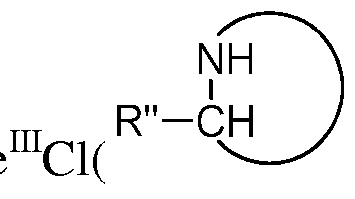 )-dipyrromethene complex
(e.g. , FeinCl( R- )-dipyrromethene complex). First, the FenCl(L)-dipyrromethene complex undergoes a ligand exchange to form radical imido intermediate 4. The intermediate 4 abstracts a hydrogen atom intramolecularly from a C-H moiety of intermediate 4 to give rise to intermediate 5. Radical recombination furnishes the C-H amination product 6. The net effect of the reaction is the transfer of the nitrene group N: of R"CH(R"')N: (e.g. , R(CH2)4N:) to the C-H of R"CH(R"')N:. The mechanism for a similar reaction using compound 3B as the catalyst instead of 3A is similar to or the same as the mechanism desbribed herein.
[00134] The acyclic secondary amines may be synthesized under any suitable conditions described herein.
Synthesis of Protected Cyclic Secondary Amines
[00135] The method of preparing a compound of Formula (II-l), or a salt or stereoisomer thereof, which is a coordination complex of a cyclic secondary amine and ferrous compound, may further comprise the step of:
reacting the compound of Formula (II-l), or a salt or stereoisomer thereof, with Boc20 to provide a compound of Formula (II-2-A), which is a Boc-protected cyclic secondary amine:

or a salt or stereoisomer thereof; wherein X, n, R , R , R , and R are as defined herein.
[00136] Exemplary compounds of Formula (II-2-A) that can be prepared by the inventive methods include, but are not limited to:

and salts and stereoisomers thereof.
[00137] The method of preparing a compound of Formula (II-l), or a salt or stereoisomer thereof, which is a coordination complex of a cyclic secondary amine and ferrous compound, may further comprise the step of:
reacting the compound of Formula (II-l), or a salt or stereoisomer thereof, with Fmoc-OSuc to provide a compound of Formula (II-2-B), which is a Fmoc-protected cyclic secondary amine:

or a salt or stereoisomer thereof; wherein X, n, R 7 , R 8 , R 9 , and R 10 are as defined herein.
[00138] The protected cyclic secondary amines may be synthesized under any suitable conditions described herein.
Synthesis of Cyclic Secondary Amines
[00139] The method of preparing a compound of Formula (II-2-A) or (II-2-B), or a salt or stereoisomer thereof, which is a Boc- or Fmoc-protected cyclic secondary amine, may further comprise the step of:
deprotecting the compound of Formula (II-2-A) or (II-2-B), or a salt or stereoisomer thereof, to provide a cyclic amine of Formula (II-3):

or a salt or stereoisomer thereof; wherein X, n, R 7 , R 8 , R 9 , and R 10 are as defined herein.
[00140] The step of deprotecting a compound of Formula (II-2-A) or (II-2-B), or a salt or stereoisomer thereof, may also comprise deprotecting the compound of Formula (II-2-A) or (II-2-B), or a salt or stereoisomer thereof, under suitable conditions to remove the protecting group. The step of deprotecting a compound of Formula (II-2-A), or a salt or stereoisomer thereof, may comprise increasing the temperature of the compound of Formula (II-2-A), or a salt or stereoisomer thereof, above room temperature. In certain embodiments, the temperature of the compound of Formula (II-2-A), or a salt or stereoisomer thereof, is increased to at least 100 °C. In certain embodiments, the temperature of the compound of Formula (II-2-A), or a salt or stereoisomer thereof, is increased to at least 150 °C. In certain embodiments, the temperature of the compound of Formula (II-2-A), or a salt or stereoisomer thereof, is increased to at least 200 °C. In certain embodiments, the temperature of the compound of Formula (II-2-A), or a salt or stereoisomer thereof, is increased to at least 250
°C.
[00141] The suitable conditions in the step of deprotecting a compound of Formula (II-
2-A), or a salt or stereoisomer thereof, may be acidic conditions. In certain embodiments, the deprotection step comprises reacting an acidic compound with the compound of Formula (II- 2- A), or a salt or stereoisomer thereof, to remove the protecting group. In certain
embodiments, the acidic compound is an inorganic acid. In certain embodiments, the inorganic acid is HC1. In certain embodiments, the inorganic acid is HBr. In certain embodiments, the inorganic acid is HI. In certain embodiments, the inorganic acid is HC104. In certain embodiments, the inorganic acid is HNO3. In certain embodiments, the inorganic acid is H2S04. In certain embodiments, the inorganic acid is H3P04. In certain embodiments, the acidic compound is an organic acid. In certain embodiments, the organic acid is trifluoroacetic acid. In certain embodiments, the organic acid is a sulfonic acid. In certain embodiments, the organic acid is methanesulfonic acid. In certain embodiments, the organic acid is trifluoromethanesulfonic acid. In certain embodiments, the organic acid is p- toluenesulfonic acid. In certain embodiments, the organic acid is benzenesulfonatic acid. In certain embodiments, the acidic compound is a trialkylsilyl halide. In certain embodiments, the trialkylsilyl halide is trimethylsilyl chloride. In certain embodiments, the trialkylsilyl halide is trimethylsilyl bromide. In certain embodiments, the trialkylsilyl halide is
trimethylsilyl iodide. In certain embodiments, the acidic compound is trimethylsilyl trifluoromethanesulfonate. In certain embodiments, the acidic compound is
tetrabutylammonium fluoride. In certain embodiments, the acidic compound is a Lewis acid. In certain embodiments, the Lewis acid is boron trifluoride etherate.
[00142] The suitable conditions in the step of deprotecting a compound of Formula (II-
2-A) or (II-2-B), or a salt or stereoisomer thereof, may be nucleophilic conditions. In certain embodiments, the deprotection step comprises reacting an nucleophilic compound with the compound of Formula (II-2-A) or (II-2-B), or a salt or stereoisomer thereof, to remove the protecting group. In certain embodiments, the suitable conditions in the deprotection step comprise use of a nucleophilic compound. In certain embodiments, the nucleophilic compound is alkyl lithium. In certain embodiments, the nucleophilic compound is LiMe. In certain embodiments, the nucleophilic compound is w-BuLi. In certain embodiments, the nucleophilic compound is sec-BuLi. In certain embodiments, the nucleophilic compound is t- BuLi. In certain embodiments, the nucleophilic compound is aryl lithium. In certain embodiments, the nucleophilic compound is LiPh. In certain embodiments, the nucleophilic compound is a Grignard reagent. In certain embodiments, the nucleophilic compound is MeMgCl, MeMgBr, or MeMgl. In certain embodiments, the nucleophilic compound is
EtMgCl, EtMgBr, or EtMgl. In certain embodiments, the nucleophilic compound is PhMgCl, PhMgBr, or PhMgl. In certain embodiments, the nucleophilic compound is TMSMgCl or TMSMgBr. In certain embodiments, the nucleophilic compound is ammonia. In certain embodiments, the nucleophilic compound is ammonium hydroxide. In certain embodiments, the nucleophilic compound is a primary amine. In certain embodiments, the nucleophilic compound is methylamine, ethylamine, ^-propylamine, isopropylamine, w-butylamine, n- pentylamine, w-hexylamine, cyclohexylamine, ethanolamine {i.e., 2-aminoethanol), Tris {i.e., 2-amino-2-hydroxymethyl -propane- 1,3-diol), ethylenediamine, triethylenediamine, or aniline. In certain embodiments, the nucleophilic compound is a secondary amine. In certain embodiments, the nucleophilic compound is dimethylamine, diethylamine, di-w-propylamine, diisopropylamine, ethylisopropylamine, dicyclohexylamine, methylethanolamine,
pyrrolidine, piperidine, morpholine, piperazine, or l,4-bis-(3-aminopropyl)piperazine. In certain embodiments, the nucleophilic compound is a tertiary amine. In certain embodiments, the nucleophilic compound is trimethylamine, triethylamine, diisopropylethylamine (DIPEA), tri-w-butylamine, 4-dimethylaminopyridine (DMAP), or l,8-diazabicyclo[5.4.0]undec-7-ene (DBU).
[00143] The suitable conditions in the step of deprotecting a compound of Formula (II-
2-B), or a salt or stereoisomer thereof, may be basic conditions. In certain embodiments, the deprotection step comprises reacting an basic compound with the compound of Formula (II- 2-B), or a salt or stereoisomer thereof, to remove the protecting group. In certain
embodiments, the suitable conditions in the deprotection step comprise use of a basic compound. In certain embodiments, the basic compound is alkyl lithium. In certain embodiments, the basic compound is LiMe. In certain embodiments, the basic compound is w-BuLi. In certain embodiments, the basic compound is sec-BuLi. In certain embodiments, the basic compound is ί-BuLi. In certain embodiments, the basic compound is aryl lithium. In certain embodiments, the basic compound is LiPh. In certain embodiments, the basic compound is a Grignard reagent. In certain embodiments, the basic compound is MeMgCl, MeMgBr, or MeMgl. In certain embodiments, the basic compound is EtMgCl, EtMgBr, or EtMgl. In certain embodiments, the basic compound is PhMgCl, PhMgBr, or PhMgl. In certain embodiments, the basic compound is TMSMgCl or TMSMgBr. In certain
embodiments, the basic compound is ammonia. In certain embodiments, the basic compound is ammonium hydroxide. In certain embodiments, the basic compound is a primary amine. In certain embodiments, the basic compound is methylamine, ethylamine, ^-propylamine, isopropylamine, w-butylamine, w-pentylamine, w-hexylamine, cyclohexylamine, ethanolamine
(i.e., 2-aminoethanol), Tris (i.e., 2-amino-2-hydroxymethyl-propane-l,3-diol), ethylenediamine, tnethylenediamine, or aniline. In certain embodiments, the basic compound is a secondary amine. In certain embodiments, the basic compound is dimethylamine, diethylamine, di-w-propylamine, diisopropylamine, ethylisopropylamine, dicyclohexylamine, methylethanolamine, pyrrolidine, piperidine, morpholine, piperazine, or l,4-bis-(3- aminopropyl)piperazine. In certain embodiments, the basic compound is a tertiary amine. In certain embodiments, the basic compound is trimethylamine, triethylamine,
diisopropylethylamine (DIPEA), tri-w-butylamine, 4-dimethylaminopyridine (DMAP), 1,8- diazabicyclo[5.4.0]undec-7-ene (DBU), pyridine, or 2,6-lutidine.
[00144] The suitable conditions in the step of deprotecting a compound of Formula (II-
2-A) or (II-2-B), or a salt or stereoisomer thereof, may be reductive conditions. In certain embodiments, the deprotection step comprises reacting an reductive compound with the compound of Formula (II-2-A) or (II-2-B), or a salt or stereoisomer thereof, to remove the protecting group. In certain embodiments, the suitable conditions in the deprotection step comprise use of a reductive compound . In certain embodiments, the reductive compound is a mixture of zinc and HC1. In certain embodiments, the reductive compound is LiAlH4. In certain embodiments, the reductive compound is a mixture of rhodium and hydrogen. In certain embodiments, the reductive compound is a mixture of sodium and ammonia.
[00145] The suitable conditions in the step of deprotecting a compound of Formula (II-
2-B), or a salt or stereoisomer thereof, may be oxidative conditions. In certain embodiments, the deprotection step comprises reacting an oxidative compound with the compound of Formula (II-2-B), or a salt or stereoisomer thereof, to remove the protecting group. In certain embodiments, the oxidative compound is a mixture of Cr03 and pyridine.
[00146] In certain embodiments, the compound of Formula (II-3) is of Formula (II-4):

or a stereoisomer thereof, wherein V" is an anionic counterion. All anionic counterions described herein are contemplated as being within the scope of the invention. In certain embodiments, the anionic counterion is F~, CT, Br , or Γ. In certain embodiments, the anionic counterion is C104 . In certain embodiments, the anionic counterion is N03 . In certain embodiments, the anionic counterion is HS04 . In certain embodiments, the anionic
counterion is H2P04 . In certain embodiments, the anionic counterion is a sulfonate ion. In certain embodiments, the anionic counterion is a methansulfonate, trifluoromethanesulfonate, /7-toluenesulfonate, or benzenesulfonate ion. In certain embodiments, the anionic counterion is BF4 .
[00147] A compound of Formula (II-4), or a stereoisomer thereof, may be further reacted by contacting with a base to provide a compound of Formula (II-3), or a stereoisomer thereof. In certain embodiments, the base is an inorganic base. In certain embodiments, the inorganic base is ammonia. In certain embodiments, the inorganic base is ammonium carbonate. In certain embodiments, the inorganic base is ammonium hydroxide. In certain embodiments, the inorganic base is an alkali metal carbonate. In certain embodiments, the inorganic base is Li2C03, Na2C03, K2C03, Rb2C03, or Cs2C03. In certain embodiments, the inorganic base is an alkali metal bicarbonate. In certain embodiments, the inorganic base is LiHC03, NaHC03, KHC03, RbHC03, or CsHC03. In certain embodiments, the inorganic base is an alkali metal hydroxide. In certain embodiments, the inorganic base is LiOH, NaOH, KOH, RbOH, or CsOH. In certain embodiments, the inorganic base is an alkaline earth metal carbonate. In certain embodiments, the inorganic base is BeC03, MgC03, CaC03, SrC03, or BaC03. In certain embodiments, the inorganic base is an alkaline earth metal bicarbonate. In certain embodiments, the inorganic base is Be(HC03)2, Mg(HC03)2,
Ca(HC03)2, Sr(HC03)2, or Ba(HC03)2. In certain embodiments, the inorganic base is an alkaline earth metal hydroxide. In certain embodiments, the inorganic base is Be(OH)2, Mg(OH)2, Ca(OH)2, Sr(OH)2, or Ba(OH)2. In certain embodiments, the base is an organic base. In certain embodiments, the organic base is an aliphatic amine. In certain embodiments, the organic base is an aromatic amine. In certain embodiments, the organic base is a primary amine. In certain embodiments, the organic base is a secondary amine. In certain
embodiments, the organic base is a tertiary amine. In certain embodiments, the organic base is triethylamine, DIPEA, or DBU. In certain embodiments, the organic base is substituted pyridine. In certain embodiments, the organic base is 2,6-lutidine or DMAP. In certain embodiments, the organic base is unsubstituted pyridine.
[00148] A compound of Formula (II-3), or a stereoisomer thereof, may be further reacted with an acid to provide a salt of compound of Formula (II-3), or a stereoisomer thereof. The acid is as described herein.
[00149] The cyclic secondary amines may be synthesized under any suitable conditions described herein.
[00150] The compounds synthesized by the inventive methods may be screened for a wide range of biological activities, e.g., for anti-proliferative, anti-microbial, anti-arrhythmic, anti-hypertensive, anti-neurodegenerative, and/or anti-diabetic activities. The compounds prepared by the inventive methods, or salts or stereoisomers thereof, may be administered to a subject to treat and/or prevent a disease (e.g., a proliferative disease, infectious disease, inflammatory disease, autoimmune disease, cardiovascular disease, gastrointestinal disease, neurodegenerative disease, or metabolic disease) in the subject.
EXAMPLES
[00151] In order that the invention described herein may be more fully understood, the following examples are set forth. These examples are for illustrative purposes only and are not to be construed as limiting this invention in any manner.
Preparation of the Iron-Based Catalysts
[00152] The iron-based catalysts described herein that are useful in the inventive methods (e.g., a ferrous compound of Formula (B) or (G), or a salt thereof, such as compounds 3A and 3B) may be synthesized according to reported processes, such as ones described in King et al., J. Am. Chem. Soc. 133, 4917 (2011), which is incorporated herein by reference.
Preparation of Acyclic Secondary Amines
[00153] Acyclic secondary amines (e.g. , compounds 25A-25D) may be synthesized according to the general method shown in Scheme 4 through a reaction of an azide (e.g., RAN3) with an substituted or unsubstituted, branched or unbranched, cyclic or acyclic olefin (e.g., compounds 26A-26C) catalyzed by a compound of Formula (B) or (G) (e.g., compound 3, 3A, or 3B). Any suitable conditions may be employed. For example, compounds 25A-25D may be prepared at about 25 °C, about 60 °C, about 100 °C, or about 120 °C for about 6 hours, about 12 hours, or about 24 hours, using benzene as the solvent or no solvent (i.e., neat). When 1 equiv. of RAN3 and 1 or more equiv. of the olefin are used, the loading of compound 3 may be about 10% (i.e., 0.1 equiv.) or about 20% (i.e., 0.2 equiv.). The reactions may be conducted under an atmosphere of nitrogen or argon. Compounds 25A-25D may be purified and characterized using methods known in the art (e.g., flash chromatography).
Scheme

+ RAN3
[00154] For example, a wide range of acyclic secondary amines may be prepared by a method similar to the following procedure. Under an inert N2 atmosphere, 1- azidoadamantane (60.9 mg, 0.28 mmol, 10 equiv.) was added to a stirring solution of compound 3B (20 mg, 0.028 mmol, 1 equiv.) in 1 mL of an olefin (e.g., styrene) in a 20 mL scintillation vial. The resultant inky, dark red solution was stirred for 12 hours at 25 °C. The mixture was purified by flash chromatography using a short pipette of triethylamine-treated silica gel eluted with 10: 1 hexanes:EtOAc to yield a brightly colored solution. Volatiles were removed under reduced pressure to yield the acyclic secondary amine product. The yields were determined by 1H NMR via integration against ferrocene, averaging over three runs for each substrate.
[00155] Alternatively, the following procedure may be used to make acyclic secondary amines, especially, allylic acyclic secondary amines. Under an inert N2 atmosphere, 1- azidoadamantane (30.5 mg, 0.14 mmol, 5 equiv., or 60.9 mg, 0.28mmol, 10 equiv.) was added to a stirring solution of compound 3B (20 mg, 0.028 mmol, 1 equiv.) in 2 mL of an olefin in a 20 mL scintillation vial. The resultant inky, dark red solution was stirred for 12 hours at the indicated temperature. The mixture was concentrated and purified by flash chromatography eluted with 9: 1 DCM: methanol to yield a yellow solution. Volatiles were removed under reduced pressure to yield the allylic amine product. The yields were determined by 1H NMR via integration against ferrocene.
[00156] Yields of exemplary acyclic secondary amines synthesized using the inventive methods are shown in Table 5.
Table 5. Synthesis of acyclic amines


[00157] Boc- or Fmoc-protected cyclic secondary amines may be synthesized according to the general method shown in Scheme 5.
Scheme 5.

[00158] For example, a variety of substituted aliphatic azides (e.g., l-azido-5-hexene) were subjected to compound 3A. Exposure of l-azido-5-hexene to compound 3A at room temperature in benzene quickly consumed the azide, as ascertained by the disappearance of the azide stretch in the IR spectrum and afforded a new paramagnetically shifted 1H NMR spectrum. Crystallization was induced by slow diffusion of a hexanes solution of the product at 23 °C to yield crystals in which 2-vinylpyrrolidine was bound to the iron-based complex to give compound 8 (Scheme 6 and Figure 5A). Similarly, treatment of l-azido-4-phenylbutane with 3A afforded the cyclized product 2-phenylpyrrolidine as an iron-bound adduct 9 (Figure 5B). In addition to allylic and benzylic C-H bonds, less reactive tertiary C-H bonds could similarly be functionalized. The reaction of l-azido-5-methylpentane and 3A under standard conditions gave the 2,2-dimethylpyrrolidine iron-bound product. Gratifyingly, even secondary aliphatic C-H bonds could be functionalized through this method. Addition of 1- azidohexane to 3A resulted in the rapid consumption of the azide to afford a single product, which was determined to be the 2-ethylpyrrolidine complex 10 (Figure 5C). In an attempt to activate the primary C-H bond of an aliphatic azide substrate, 1-azidobutane was exposed to 3A. However, the only products observed in this transformation were linear w-butylamine and w-butylimine. To eliminate the potential for imine formation, through a process involving intermolecular C-H bond activation or β-hydride elimination, the gem-dimethyl substrate 2- azido-2-methylpentane was prepared and subjected to 3A at room temperature for 6 h to afford the cyclized 2,2-dimethylpyrrolidine complex 11 (Figure 5D) in quantitative yield. The presence of the two a-Me substituents may facilitate the C-H bond

83
Scheme 6.

R = C2H3, Ph, Et
[00159] With a reliable protocol for the stoichiometric C-H
functionalization/cyclization of aliphatic azides in hand, attempts to render the reaction catalytic were undertaken (5-10 equiv. of azide per 1 equiv. of compound 3A or 3B).
Unfortunately, examination of the cyclization reaction under catalytic conditions did not markedly increase the yield of the resultant free heterocyclic product. The lack of catalyst turnover may be attributed to product inhibition, in which a tight Lewis-acid/base pair between the dipyrromethene-iron and the heterocyclic nitrogen atom is formed. This hypothesis is supported by the ease with which crystals of the corresponding dipyrromethene- iron complexes were obtained (Figures 4 and 5).
[00160] To overcome this problem, the cyclization reaction was performed in the presence of an in situ protection reagent, which would reduce the nucleophilicity of the product cyclic amines while avoiding the generation of byproducts that might retard or prevent catalysis. Accordingly, treatment of a solution of l-azido-4-phenylbutane and 9- fluorenylmethyl N-succinimidyl carbonate (Fmoc-OSuc) in benzene at room temperature with a stoichiometric amount of compound 3A for 12 h afforded the Fmoc-protected 2- phenylpyrrolidine in 98% yield. Similarly, addition of an equivalent of compound 3A to a solution of l-azido-4-phenylbutane and di-i-butyl dicarbonate (Boc20) under similar reaction conditions afforded the i-butyloxycarbonyl (Boc) protected product l-Boc-2- phenylpyrrolidine in 93% yield. As catalyst loading was decreased, it was discovered that the N-hydroxysuccinimide byproduct of Fmoc-protection led to catalyst decomposition through ligand protonation and limited the reaction to a single turnover. Fortunately, the byproducts of protection with Boc20 (i.e., i-BuOH and C02) did not inhibit catalyst turnover, permitting
the cyclic amines to be synthesized with catalytic amounts of compound 3B (chosen to eliminate benzylic C-H bonds from catalyst meso-aryl substituent).
[00161] Application of catalytic quantities of compound 3B to the established in situ protection protocol for C-H functionalization/cyclization was investigated (Table 2).
Exposure of azides 13 containing allylic, benzylic, or tertiary C-H bonds to compound 3B (10 mol%) provided the corresponding Boc-protected pyrrolidine 14 in good yield (57-64%, entries 1-3). Next, catalytic functionalization of a secondary C-H bond was also possible, affording l-Boc-2-ethylpyrrolidine in modest yield (27%, entry 4). Even, a primary C-H bond in 2-azido-2-methylpentane could be functionalized to give l-Boc-2,2- dimethylpyrrolidine in 17% yield (entry 6). The substrate scope was then expanded to include hetero-atom containing functional groups. Exposure of ethyl-5-azidopentanoate to compound 3B under standard catalytic conditions only resulted in linear primary amine and imine products (entry 7). Again, blocking the a-position of the azide 13 with gem-dimethyl substituents led to productive cyclization (entry 8). Introduction of heteroatoms between the reactive functionalities allowed for the formation of l-Boc-2-phenyloxazolidine in 47% yield (entry 9).
Table 2. Amination reactions of azides 13 catalyzed by compound 3 B yielding pyrrolidines
14.

14
Z = CH2, O
13

Yield determined by 1H NMR using ferrocene or trimethoxybenzene as the internal standard. 20 mol loading of compound 3B.
[00162] The scope of C-H functionalization/cyclization was further explored in substrates accessible via cuprate-assisted epoxide opening (Drouin et ah, Tetrahedron 36,
1195 (1980)) followed by azide formation {Table 3). The use of epoxides 15 and alkyl halides (which may be transformed into Grignard reagents 16) permits virtually any substitution pattern to be programmed into the ensuing heterocyclic product. After Li2[CuCl4] promoted epoxide opening, the resultant primary or secondary alcohols were tosylated and displaced with sodium azide to provide the desired cyclization precursor 17. Alternatively, tertiary and benzylic alcohols were directly converted to the corresponding azide {e.g., compound 18) by exposure to trimethylsilylazide and boron trifluoride diethyl etherate (Mukaiyama et ah, Heterocycles 80, 63 (2010)). Allylic, tertiary and secondary C-H bond substrates available through either reaction sequence underwent facile C-H functionalization/cyclization to give protected {e.g., protected with Boc) cyclic amines 19 (entries 1-9, 58-98% yield). Notably, this method provides access to an all-carbon spiro-center (entry 7, 67%). Functionalization of primary C-H bonds may require a higher loading of the catalyst {e.g., compound 3A or 3B) than a catalytic amount (entry 10). For example, a stoichiometic reaction similar to the reaction in Table 3, entry 10, except that Fmoc-OSuc was used instead of Boc20 and that 1
equiv. of compound 3B was employed, gave rise to
 in 78% yield. Interestingly, use of (R)-2-phenyl-5-azidopentane (95% enantiomeric excess (ee)) in the catalytic transformation resulted in (lS')-2-methyl-2-phenylpyrrolidine with retention of configuration (entry 5, 75%, 93% ee). A similar reaction using stoichiometric quantities of compound 3A gave the corresponding (S)-2-methyl-2-phenylpyrrolidine iron-bound adduct 20 whose absolute stereochemistry was verified by X-ray diffraction {Figure 6).
Table 3. Synthesis of 1,2,3, 4-substituted pyrrolidines 19.

Me3SiN3, BF3OEt2 (±)
benzene, 23 °C 18
Entry 15 16 17 or 18 19
b

35% 93%

bYields are representative of cyclization reactions only and are determined by 1H NMR using ferrocene or trimethoxybenzene as the internal standard.
cThe term "dr" refers to diastereomeric ratio.
[00163] The potential of the inventive methods to generate cyclic amines of various ring sizes was also explored. It was expected that a vinyl directing group could be employed to encourage the site- selective functionalization of the allylic C-H bond within the acyclic precursor. Treatment of l-azido-6-heptene and Boc20 (1 equiv.) with compound 3B (1 equiv.) at room temperature generated the 6-membered l-Boc-2-vinylpiperidine (entry 1, Table 4) as the exclusive reaction product. Unfortunately, use of the vinyl activating group to target 7-membered azepane products led to exclusive formation of the corresponding pyrrolidine (entry 4). In contrast, a phenyl activating group was not effective in favoring the formation of a 6-membered ring product. Addition of compound 3B to l-azido-5-phenyl- pentane under standard conditions resulted in a 1:0.85 mixture of both l-Boc-2- phenylpiperidine and l-Boc-2-benzylpyrrolidine (entry 2). Similarly, the use of a tertiary C- H bond to favor 6-membered ring formation in the case of l-azido-5-methylhexane resulted in a mixture of piperidine and pyrrolidine products (entry 3). An attempt was made to block
the potential for pyrrolidine formation; exposure of 2-azido-2,5,5-trimethylhexane and Fmoc- OSuc to compound 3B resulted in both the anticipated l-Fmoc-2,2,5,5-tetramethylpiperidine and the unexpected l-Fmoc-2,2-dimethyl-4-tert-butylazetidine (entry 5). Alternatively, use of compound 3A and omission of Fmoc-OSuc allowed for the characterization of the corresponding iron-bound adducts by X-ray analysis {Figures 7B and 7C).
Table 4. Synthesis of cyclic amines 24 of various ring sizes.

bRatios are deteremined by integration of GC/MS peaks.
[00164] As illustrated in Figure 3, it is hypothesize that the C-H bond
functionalization/cyclization reaction occurs via a three-step process involving: (1) oxidation of the Fe11 catalyst (e.g., compound 3A) to an Fe111 imido radical (e.g., compound 4) by the
alkyl azide substrate; (2) intramolecular H-atom abstraction to generate an alkyl radical and an Fe111 amide (e.g., compound 5) (path la); and (3) radical recombination to form the observed cyclic amine product (e.g., compound 6) (path lb). Alternatively, a direct C-H bond insertion by the Fe111 imido radical intermediate cannot be excluded (path II). Both
mechanisms require that the substrate C-H bond be brought into close proximity to the reactive Fe-imido radical. Based on previous findings, the imido radical likely resides in the plane defined by the iron and the dipyrrin ligand, flanked by large pyrrolide adamantyl substituents. Such a conformation requires that the C-H bond substrate approach the imido radical opposite the chloride ligand. It is expected that once this orientation is obtained, C-H bond functionalization is rapid. This hypothesis is supported by the retention of
stereochemical information during the cyclization of (R)-2-phenyl-5-azidopentane.
Additionally, cyclization of l-azido-4-deutero-4-phenylbutane (Scheme 7) provides an intramolecular kinetic isotope effect (KIE) of 5.3 at 25 °C and 5.1(2) at 65 °C. This value is similar to the KIE observed in the hydroxylation of 1,3-dideuteroadamantane catalyzed by tetramesitylporphyrin iron with oxone |¾/&ο = 4.1(2)] (Sorokin et al., J. Am. Chem. Soc. 115, 7293 (1993)). Finally, addition of the radical clock substrate (2-(4- azidobutyl)cyclopropyl)benzene to compound 3B exclusively furnishes the pyrrolidine product l-Boc-2-(2-phenylcyclopropyl)pyrrolidine with the cyclopropyl unit intact (Scheme 8). The non-unity intramolecular kinetic isotope effect suggests a stepwise mechanism for benzylic substrates (Figure 3, Path I (i.e., Ia and lb)), which is consistent with previously reported intermolecular amination reaction (King et al., J. Am. Chem. Soc. 133, 4917 (2011)). The stereospecificity of the cyclization and the preservation of the cyclopropyl unit in the radical clock experiment suggest that if a stepwise mechanism is operative, the radical intermediate following H-atom abstraction is short-lived [recombination rate > 1011 s_1 (Newcomb et al., Acc. Chem. Res. 33, 449 (2000))]. Alternatively, the reaction mechanism may change to a direct insertion mechanism (Figure 3, path II) when stronger substrate C-H bonds are functionalized.
Scheme 7.

Scheme 8.

[00165] The results described herein have demonstrated the oxidative potency of the transiently formed, high- spin iron imido radical for the functionalization of both activated and unactivated aliphatic C-H bond substrates. This iron-mediated cyclization of linear azides provides facile entry into complex acyclic and cyclic amines from readily available substrates that cannot be achieved by azide photolysis (Barton et ah, J. Chem. Soc. 2444 (1965)) or via classic Hoffmann-Loffler-Freytag methodologies (Hoffman, Berichte 18, 105 (1885)). It is expected that the methods of the invention can be extended to produce a wide variety of acyclic and cyclic amines (e.g., saturated cyclic amines). The oxidative amination of aliphatic C-H bonds over more electron-rich C-H bonds (olefins and aromatics) is made possible by the unique electronic structure of the putative iron- stabilized imido radical intermediate.
EQUIVALENTS AND SCOPE
[00166] In the claims articles such as "a," "an," and "the" may mean one or more than one unless indicated to the contrary or otherwise evident from the context. Claims or descriptions that include "or" between one or more members of a group are considered satisfied if one, more than one, or all of the group members are present in, employed in, or otherwise relevant to a given product or process unless indicated to the contrary or otherwise evident from the context. The invention includes embodiments in which exactly one member of the group is present in, employed in, or otherwise relevant to a given product or process.
The invention includes embodiments in which more than one, or all of the group members are present in, employed in, or otherwise relevant to a given product or process.
[00167] Furthermore, the invention encompasses all variations, combinations, and permutations in which one or more limitations, elements, clauses, and descriptive terms from one or more of the listed claims is introduced into another claim. For example, any claim that is dependent on another claim can be modified to include one or more limitations found in any other claim that is dependent on the same base claim. Where elements are presented as lists, e.g., in Markush group format, each subgroup of the elements is also disclosed, and any element(s) can be removed from the group. It should it be understood that, in general, where the invention, or aspects of the invention, is/are referred to as comprising particular elements and/or features, certain embodiments of the invention or aspects of the invention consist, or consist essentially of, such elements and/or features. For purposes of simplicity, those embodiments have not been specifically set forth in haec verba herein. It is also noted that the terms "comprising" and "containing" are intended to be open and permits the inclusion of additional elements or steps. Where ranges are given, endpoints are included. Furthermore, unless otherwise indicated or otherwise evident from the context and understanding of one of ordinary skill in the art, values that are expressed as ranges can assume any specific value or sub-range within the stated ranges in different embodiments of the invention, to the tenth of the unit of the lower limit of the range, unless the context clearly dictates otherwise.
[00168] This application refers to various issued patents, published patent applications, journal articles, and other publications, all of which are incorporated herein by reference. If there is a conflict between any of the incorporated references and the instant specification, the specification shall control. In addition, any particular embodiment of the present invention that falls within the prior art may be explicitly excluded from any one or more of the claims. Because such embodiments are deemed to be known to one of ordinary skill in the art, they may be excluded even if the exclusion is not set forth explicitly herein. Any particular embodiment of the invention can be excluded from any claim, for any reason, whether or not related to the existence of prior art.
[00169] Those skilled in the art will recognize or be able to ascertain using no more than routine experimentation many equivalents to the specific embodiments described herein. The scope of the present embodiments described herein is not intended to be limited to the above Description, but rather is as set forth in the appended claims. Those of ordinary skill in the art will appreciate that various changes and modifications to this description may be made
without departing from the spirit or scope of the present invention, as defined in the following claims.
Claims
1. A method of preparing a compound of Formula (I):

or a salt thereof, the method comprising the steps of:
reacting an azide of Formula (A), or a salt thereof, with a ferrous compound of Formula (B), or a salt thereof, to provide a ferric compound of Formula (C), or a salt thereof:

(A) (B) (C)
reacting the ferric compound of Formula (C), or a salt thereof, with a compound of Formula (D) or (E), or a salt thereof, to provide a compound of Formula (I), or a salt thereof:

(D) (E)
wherein:
Z is selected from the group consisting of mesityl and 2,6-dichlorophenyl;
R1 is selected from the group consisting of optionally substituted alkyl, optionally substituted alkenyl, optionally substituted alkynyl, optionally substituted carbocyclyl, optionally substituted heterocyclyl, optionally substituted aryl, and optionally substituted heteroaryl;
each one of R2, R3, R4, R5, and R6 is independently selected from the group consisting of hydrogen, halogen, optionally substituted acyl, optionally substituted alkyl, optionally substituted alkenyl, optionally substituted alkynyl, optionally substituted carbocyclyl, optionally substituted heterocyclyl, optionally substituted aryl, optionally substituted
heteroaryl, -ORa, -N(Ra)2, -SRa, -CN, -C(=NRa)Ra, -C(=NRa)ORa, -C(=NRa)N(Ra)2, -N02, -NRaC(=0)Ra, -NRaC(=0)ORa, -NRaC(=0)N(Ra)2, -OC(=0)Ra, -OC(=0)ORa, - OC(=0)N(Ra)2, and -ON(Ra)2;
optionally two of R2, R3, R4, R5, and R6 groups are joined to form an optionally substituted carbocyclyl or optionally substituted heterocyclic ring;
each occurrence of Ra is independently selected from the group consisting of hydrogen, optionally substituted acyl, optionally substituted alkyl, optionally substituted alkenyl, optionally substituted alkynyl, optionally substituted carbocyclyl, optionally substituted heterocyclyl, optionally substituted aryl, optionally substituted heteroaryl, a nitrogen protecting group when attached to a nitrogen atom, an oxygen protecting group when attached to an oxygen atom, and a sulfur protecting group when attached to a sulfur atom, or optionally two Ra groups are joined to form an optionally substituted heterocyclic ring;
L is selected from the group consisting of N(Rb)3, Rb-0-Rb, Rb-S-Rb, optionally substituted heterocyclyl, and optionally substituted heteroaryl; and
each occurrence of Rb is independently selected from the group consisting of optionally substituted alkyl, optionally substituted alkenyl, optionally substituted alkynyl, optionally substituted carbocyclyl, optionally substituted heterocyclyl, optionally substituted aryl, and optionally substituted heteroaryl.
2. The method of claim 1, wherein R1 is optionally substituted alkyl.
3. The method of claim 1, wherein R1 is adamantyl.
4. The method of claim 1, wherein R1 is optionally substituted aryl.
The method of claim 1, wherein R1 is optionally substituted phi
6. The method of claim 1, wherein R is hydrogen.
The method of claim 1, wherein R 2 and R 3 are each hydi
8. The method of claim 1, wherein R4 is hydrogen or optionally substituted alkyl.
9. The method of claim 1, wherein R5 is hydrogen.
10. The method of claim 1, wherein R6 is optionally substituted alkyl.
11. The method of claim 1 , wherein R6 is optionally substituted aryl.
12. The method of claim 1, wherein R6 is optionally substituted phenyl.
13. The method of claim 1, wherein R2 and R6 are joined to form an optionally substituted carbocyclyl ring.
14. The method of claim 1, wherein L is Rb-0-Rb; and each occurrence of Rb is independently optionally substituted alkyl.
15. The method of claim 1, wherein L is optionally substituted heterocyclyl.
16. The method of claim 1, wherein L is optionally substituted tetrahydrofuran or optionally substituted tetrahydropyran.
17. The method of claim 1, wherein L is optionally substituted heteroaryl.
18. The method of claim 1, wherein L is optionally substituted pyridine.
19. A method of preparing a compound of Formula (II-l):


wherein:
W is selected from the group consisting of mesityl and 2,6-dichlorophenyl;
each occurrence of X is independently selected from the group consisting of -0-, -S- , -NRC- and -C(Rd)2-;
Rc is selected from the group consisting of hydrogen, a nitrogen protecting group, optionally substituted acyl, optionally substituted alkyl, optionally substituted alkenyl, optionally substituted alkynyl, optionally substituted carbocyclyl, optionally substituted heterocyclyl, optionally substituted aryl, and optionally substituted heteroaryl;
each one of R7, R8, R9, and R10, and each occurrence of R , are independently selected from the group consisting of hydrogen, halogen, optionally substituted acyl, optionally substituted alkyl, optionally substituted alkenyl, optionally substituted alkynyl, optionally substituted carbocyclyl, optionally substituted heterocyclyl, optionally substituted aryl, optionally substituted heteroaryl, -ORe, -N(Re)2, -SRe, -CN, -C(=NRe)Re, -C(=NRe)ORe, - C(=NRe)N(Re)2, -NO2, -NReC(=0)Re, -NReC(=0)ORe, -NReC(=0)N(Re)2, -OC(=0)Re, - OC(=0)ORe, -OC(=0)N(Re)2, and -ON(Re)2;
each occurrence of Re is independently selected from the group consisting of hydrogen, optionally substituted acyl, optionally substituted alkyl, optionally substituted alkenyl, optionally substituted alkynyl, optionally substituted carbocyclyl, optionally substituted heterocyclyl, optionally substituted aryl, optionally substituted heteroaryl, a nitrogen protecting group when attached to a nitrogen atom, an oxygen protecting group when attached to an oxygen atom, and a sulfur protecting group when attached to a sulfur atom, or optionally two Re groups are joined to form an optionally substituted heterocyclic ring;
optionally two of R7, R8, R9, R10, Rc, andRd groups are joined to form an optionally substituted carbocyclyl or optionally substituted heterocyclic ring;
Y is selected from the group consisting of N(R f )3, R f -O-R f , R f -S-R f , optionally substituted heterocyclyl, and optionally substituted heteroaryl;
each occurrence of R is independently selected from the group consisting of optionally substituted alkyl, optionally substituted alkenyl, optionally substituted alkynyl, optionally substituted carbocyclyl, optionally substituted heterocyclyl, optionally substituted aryl, and optionally substituted heteroaryl; and
n is 1, 2, 3, 4, or 5.
20. The method of claim 19, further comprising reacting the compound of Formula (II-l), or a salt thereof, with Boc20 to provide a compound of Formula (II-2-A), or a salt thereof, or with Fmoc-OSuc to provide a compound of Formula (II-2-B), or a salt thereof:

(II-2-A) (II-2-B).
21. The method of claim 20, further comprising deprotecting the compound of Formula (II-2-A) or (II-2-B), or a salt thereof, to rovide a cyclic amine of Formula (II-3):

or a salt thereof.
22. The method of claim 21, wherein the deprotection step comprises reacting an acidic compound, a nucleophilic compound, or a reductive compound with the compound of Formula (II-2-A), or a salt thereof, or reacting a nucleophilic compound, a basic compound, a reductive compound, or an oxidative compound with the compound of Formula (II-2-B), or a salt thereof, to provide the cyclic amine of Formula (II-3), or a salt thereof.
23. The method of any one of claims 19-22, wherein R 7 andR 8 are each hydrogen.
24. The method of any one of claims 19-22, wherein R 7 is hydrogen; and R 8 is optionally substituted alkyl.
25. The method of any one of claims 19-22, wherein R 7 andR 8 are each optionally substituted alkyl.
26. The method of any one of claims 19-22, wherein Y is R f -O-R f ; and each occurrence of R is independently optionally substituted alkyl.
27. The method of any one of claims 19-22, wherein Y is optionally substituted heterocyclyl.
28. The method of any one of claims 19-22, wherein Y is optionally substituted tetrahydrofuran or optionally substituted tetrahydropyran.
29. The method of any one of claims 19-22, wherein Y is optionally substituted heteroaryl.
30. The method of any one of claims 19-22, wherein Y is optionally substituted pyridine.
31. The method of any one of claims 19-22, wherein n is 2.
32. The method of any one of claims 19-22, wherein n is 3.
33. The method of any one of claims 19-22, wherein n is 4.
Priority Applications (2)
| Application Number | Priority Date | Filing Date | Title |
|---|---|---|---|
| US14/770,217 US9487472B2 (en) | 2013-02-26 | 2014-02-26 | Synthesis of acyclic and cyclic amines using iron-catalyzed nitrene group transfer |
| US15/345,266 US9724682B2 (en) | 2013-02-26 | 2016-11-07 | Synthesis of acyclic and cyclic amines using iron-catalyzed nitrene group transfer |
Applications Claiming Priority (2)
| Application Number | Priority Date | Filing Date | Title |
|---|---|---|---|
| US201361769469P | 2013-02-26 | 2013-02-26 | |
| US61/769,469 | 2013-02-26 |
Related Child Applications (2)
| Application Number | Title | Priority Date | Filing Date |
|---|---|---|---|
| US14/770,217 A-371-Of-International US9487472B2 (en) | 2013-02-26 | 2014-02-26 | Synthesis of acyclic and cyclic amines using iron-catalyzed nitrene group transfer |
| US15/345,266 Division US9724682B2 (en) | 2013-02-26 | 2016-11-07 | Synthesis of acyclic and cyclic amines using iron-catalyzed nitrene group transfer |
Publications (1)
| Publication Number | Publication Date |
|---|---|
| WO2014134141A1 true WO2014134141A1 (en) | 2014-09-04 |
Family
ID=51428759
Family Applications (1)
| Application Number | Title | Priority Date | Filing Date |
|---|---|---|---|
| PCT/US2014/018623 Ceased WO2014134141A1 (en) | 2013-02-26 | 2014-02-26 | Synthesis of acyclic and cyclic amines using iron-catalyzed nitrene group transfer |
Country Status (2)
| Country | Link |
|---|---|
| US (2) | US9487472B2 (en) |
| WO (1) | WO2014134141A1 (en) |
Cited By (4)
| Publication number | Priority date | Publication date | Assignee | Title |
|---|---|---|---|---|
| US9975886B1 (en) | 2017-01-23 | 2018-05-22 | Cadent Therapeutics, Inc. | Potassium channel modulators |
| US10774064B2 (en) | 2016-06-02 | 2020-09-15 | Cadent Therapeutics, Inc. | Potassium channel modulators |
| CN115710210A (en) * | 2021-08-23 | 2023-02-24 | 港大科桥有限公司 | Iron catalyzed amination of C-H bonds |
| US11993586B2 (en) | 2018-10-22 | 2024-05-28 | Novartis Ag | Crystalline forms of potassium channel modulators |
Families Citing this family (5)
| Publication number | Priority date | Publication date | Assignee | Title |
|---|---|---|---|---|
| TWI543185B (en) | 2005-09-30 | 2016-07-21 | 考文森智財管理公司 | Memory with output control and system thereof |
| US9487472B2 (en) | 2013-02-26 | 2016-11-08 | President And Fellows Of Harvard College | Synthesis of acyclic and cyclic amines using iron-catalyzed nitrene group transfer |
| CN107071636B (en) * | 2016-12-29 | 2019-12-31 | 北京小鸟听听科技有限公司 | Dereverberation control method and device for equipment with microphone |
| WO2020061103A1 (en) | 2018-09-18 | 2020-03-26 | Nikang Therapeutics, Inc. | Fused tricyclic ring derivatives as src homology-2 phosphatase inhibitors |
| US11918984B2 (en) | 2018-09-19 | 2024-03-05 | President And Fellows Of Harvard College | Annulation catalysts via direct C—H bond amination |
Citations (1)
| Publication number | Priority date | Publication date | Assignee | Title |
|---|---|---|---|---|
| US20100056806A1 (en) * | 2006-12-07 | 2010-03-04 | Georgetown University | C-H Bond Amination and Olefin Aziridination with Beta-Diketiminato Copper Catalysts |
Family Cites Families (1)
| Publication number | Priority date | Publication date | Assignee | Title |
|---|---|---|---|---|
| US9487472B2 (en) | 2013-02-26 | 2016-11-08 | President And Fellows Of Harvard College | Synthesis of acyclic and cyclic amines using iron-catalyzed nitrene group transfer |
-
2014
- 2014-02-26 US US14/770,217 patent/US9487472B2/en not_active Expired - Fee Related
- 2014-02-26 WO PCT/US2014/018623 patent/WO2014134141A1/en not_active Ceased
-
2016
- 2016-11-07 US US15/345,266 patent/US9724682B2/en not_active Expired - Fee Related
Patent Citations (1)
| Publication number | Priority date | Publication date | Assignee | Title |
|---|---|---|---|---|
| US20100056806A1 (en) * | 2006-12-07 | 2010-03-04 | Georgetown University | C-H Bond Amination and Olefin Aziridination with Beta-Diketiminato Copper Catalysts |
Non-Patent Citations (3)
| Title |
|---|
| HENNESSY ET AL.: "Iron-mediated intermolecular N-group transfer chemistry with olefinic substrates", CHEM. SCI, vol. 5, no. 4, 29 January 2014 (2014-01-29), pages 1526 - 1532, Retrieved from the Internet <URL:http://pubs.rsc.org/en/content/articlelanding/2014/sc/c3sc52533c#!divAbstract> [retrieved on 20140715] * |
| KING ET AL.: "Catalytic C-H Bond Amination from High-Spin Iron Imido Complexes.", J. AM. CHEM. SOC., vol. 133, no. 13, 2011, pages 4917 - 4923 * |
| ZHANG ET AL.: "C-H bond amination by iron-imido/nitrene species.", CHINESE SCIENCE BULLETIN, vol. 57, no. 19, 2012, pages 2352 - 2360, XP035075233, DOI: doi:10.1007/s11434-012-5151-x * |
Cited By (6)
| Publication number | Priority date | Publication date | Assignee | Title |
|---|---|---|---|---|
| US10774064B2 (en) | 2016-06-02 | 2020-09-15 | Cadent Therapeutics, Inc. | Potassium channel modulators |
| US9975886B1 (en) | 2017-01-23 | 2018-05-22 | Cadent Therapeutics, Inc. | Potassium channel modulators |
| US10351553B2 (en) | 2017-01-23 | 2019-07-16 | Cadent Therapeutics, Inc. | Potassium channel modulators |
| US10717728B2 (en) | 2017-01-23 | 2020-07-21 | Cadent Therapeutics, Inc. | Potassium channel modulators |
| US11993586B2 (en) | 2018-10-22 | 2024-05-28 | Novartis Ag | Crystalline forms of potassium channel modulators |
| CN115710210A (en) * | 2021-08-23 | 2023-02-24 | 港大科桥有限公司 | Iron catalyzed amination of C-H bonds |
Also Published As
| Publication number | Publication date |
|---|---|
| US20160002145A1 (en) | 2016-01-07 |
| US20170072390A1 (en) | 2017-03-16 |
| US9724682B2 (en) | 2017-08-08 |
| US9487472B2 (en) | 2016-11-08 |
Similar Documents
| Publication | Publication Date | Title |
|---|---|---|
| US9724682B2 (en) | Synthesis of acyclic and cyclic amines using iron-catalyzed nitrene group transfer | |
| EP3087080B1 (en) | Cortistatin analogues and syntheses and uses thereof | |
| EP2550285B1 (en) | Trioxacarcins and uses thereof | |
| WO2014203132A1 (en) | Substituted benzopyran compounds, compositions and uses thereof | |
| US11498892B2 (en) | Fe/Cu-mediated ketone synthesis | |
| WO2013090921A1 (en) | Novel benzopyran compounds, compositions and uses thereof | |
| WO2014160200A9 (en) | Ras inhibitors and uses thereof | |
| WO2014100716A1 (en) | Prmt5 inhibitors and uses thereof | |
| WO2013154778A1 (en) | Host targeted inhibitors of dengue virus and other viruses | |
| WO2019009956A1 (en) | Fe/cu-mediated ketone synthesis | |
| WO2019165229A1 (en) | Small molecules for inducing selective protein degradation and uses thereof | |
| WO2013003315A2 (en) | Methods for preparing isoquinolines | |
| WO2015031725A1 (en) | Transition metal-catalyzed imidation of arenes | |
| WO2016003975A1 (en) | Synthesis of halichondrin analogs and uses thereof | |
| EP3664799A1 (en) | Lincosamide antibiotics and uses thereof | |
| EP3426654B1 (en) | Direct palladium-catalyzed aromatic fluorination | |
| WO2009026444A1 (en) | Ryanodine channel binders and uses thereof | |
| US20230135188A1 (en) | Fe/cu-mediated ketone synthesis | |
| WO2014193837A1 (en) | Synthesis of galanal compounds and analogues thereof | |
| WO2020061300A1 (en) | Novel annulation catalysts via direct c-h bond amination | |
| EP3582774A1 (en) | Analogs of vincamine and uses thereof | |
| EP3316889A1 (en) | Cortistatin analogues and syntheses and uses thereof | |
| WO2026006669A1 (en) | Prodrugs of n-[4-(6-fluoro-3,4-dihydro-2(1 h)-isoquinolinyl)-2,6-dimethylphe nyl]-3,3-dimethyl- butanamide | |
| WO2019032956A1 (en) | Lincosamide antibiotics and uses thereof | |
| WO2025193275A2 (en) | Compounds for inducing biostasis |
Legal Events
| Date | Code | Title | Description |
|---|---|---|---|
| 121 | Ep: the epo has been informed by wipo that ep was designated in this application |
Ref document number: 14757563 Country of ref document: EP Kind code of ref document: A1 |
|
| WWE | Wipo information: entry into national phase |
Ref document number: 14770217 Country of ref document: US |
|
| NENP | Non-entry into the national phase |
Ref country code: DE |
|
| 122 | Ep: pct application non-entry in european phase |
Ref document number: 14757563 Country of ref document: EP Kind code of ref document: A1 |