WO2014128203A1 - Catalyst manufacturing method - Google Patents
Catalyst manufacturing method Download PDFInfo
- Publication number
- WO2014128203A1 WO2014128203A1 PCT/EP2014/053300 EP2014053300W WO2014128203A1 WO 2014128203 A1 WO2014128203 A1 WO 2014128203A1 EP 2014053300 W EP2014053300 W EP 2014053300W WO 2014128203 A1 WO2014128203 A1 WO 2014128203A1
- Authority
- WO
- WIPO (PCT)
- Prior art keywords
- catalyst
- acid
- copper
- process according
- organic aliphatic
- Prior art date
- Legal status (The legal status is an assumption and is not a legal conclusion. Google has not performed a legal analysis and makes no representation as to the accuracy of the status listed.)
- Ceased
Links
Classifications
-
- B—PERFORMING OPERATIONS; TRANSPORTING
- B01—PHYSICAL OR CHEMICAL PROCESSES OR APPARATUS IN GENERAL
- B01J—CHEMICAL OR PHYSICAL PROCESSES, e.g. CATALYSIS OR COLLOID CHEMISTRY; THEIR RELEVANT APPARATUS
- B01J21/00—Catalysts comprising the elements, oxides, or hydroxides of magnesium, boron, aluminium, carbon, silicon, titanium, zirconium, or hafnium
- B01J21/02—Boron or aluminium; Oxides or hydroxides thereof
- B01J21/04—Alumina
-
- B—PERFORMING OPERATIONS; TRANSPORTING
- B01—PHYSICAL OR CHEMICAL PROCESSES OR APPARATUS IN GENERAL
- B01J—CHEMICAL OR PHYSICAL PROCESSES, e.g. CATALYSIS OR COLLOID CHEMISTRY; THEIR RELEVANT APPARATUS
- B01J23/00—Catalysts comprising metals or metal oxides or hydroxides, not provided for in group B01J21/00
- B01J23/70—Catalysts comprising metals or metal oxides or hydroxides, not provided for in group B01J21/00 of the iron group metals or copper
- B01J23/74—Iron group metals
- B01J23/755—Nickel
-
- B—PERFORMING OPERATIONS; TRANSPORTING
- B01—PHYSICAL OR CHEMICAL PROCESSES OR APPARATUS IN GENERAL
- B01J—CHEMICAL OR PHYSICAL PROCESSES, e.g. CATALYSIS OR COLLOID CHEMISTRY; THEIR RELEVANT APPARATUS
- B01J35/00—Catalysts, in general, characterised by their form or physical properties
- B01J35/30—Catalysts, in general, characterised by their form or physical properties characterised by their physical properties
- B01J35/34—Mechanical properties
- B01J35/37—Crush or impact strength
-
- B—PERFORMING OPERATIONS; TRANSPORTING
- B01—PHYSICAL OR CHEMICAL PROCESSES OR APPARATUS IN GENERAL
- B01J—CHEMICAL OR PHYSICAL PROCESSES, e.g. CATALYSIS OR COLLOID CHEMISTRY; THEIR RELEVANT APPARATUS
- B01J35/00—Catalysts, in general, characterised by their form or physical properties
- B01J35/30—Catalysts, in general, characterised by their form or physical properties characterised by their physical properties
- B01J35/391—Physical properties of the active metal ingredient
- B01J35/392—Metal surface area
-
- B—PERFORMING OPERATIONS; TRANSPORTING
- B01—PHYSICAL OR CHEMICAL PROCESSES OR APPARATUS IN GENERAL
- B01J—CHEMICAL OR PHYSICAL PROCESSES, e.g. CATALYSIS OR COLLOID CHEMISTRY; THEIR RELEVANT APPARATUS
- B01J35/00—Catalysts, in general, characterised by their form or physical properties
- B01J35/30—Catalysts, in general, characterised by their form or physical properties characterised by their physical properties
- B01J35/391—Physical properties of the active metal ingredient
- B01J35/393—Metal or metal oxide crystallite size
-
- B—PERFORMING OPERATIONS; TRANSPORTING
- B01—PHYSICAL OR CHEMICAL PROCESSES OR APPARATUS IN GENERAL
- B01J—CHEMICAL OR PHYSICAL PROCESSES, e.g. CATALYSIS OR COLLOID CHEMISTRY; THEIR RELEVANT APPARATUS
- B01J35/00—Catalysts, in general, characterised by their form or physical properties
- B01J35/60—Catalysts, in general, characterised by their form or physical properties characterised by their surface properties or porosity
- B01J35/61—Surface area
- B01J35/613—10-100 m2/g
-
- B—PERFORMING OPERATIONS; TRANSPORTING
- B01—PHYSICAL OR CHEMICAL PROCESSES OR APPARATUS IN GENERAL
- B01J—CHEMICAL OR PHYSICAL PROCESSES, e.g. CATALYSIS OR COLLOID CHEMISTRY; THEIR RELEVANT APPARATUS
- B01J35/00—Catalysts, in general, characterised by their form or physical properties
- B01J35/60—Catalysts, in general, characterised by their form or physical properties characterised by their surface properties or porosity
- B01J35/61—Surface area
- B01J35/615—100-500 m2/g
-
- B—PERFORMING OPERATIONS; TRANSPORTING
- B01—PHYSICAL OR CHEMICAL PROCESSES OR APPARATUS IN GENERAL
- B01J—CHEMICAL OR PHYSICAL PROCESSES, e.g. CATALYSIS OR COLLOID CHEMISTRY; THEIR RELEVANT APPARATUS
- B01J35/00—Catalysts, in general, characterised by their form or physical properties
- B01J35/60—Catalysts, in general, characterised by their form or physical properties characterised by their surface properties or porosity
- B01J35/63—Pore volume
- B01J35/633—Pore volume less than 0.5 ml/g
-
- B—PERFORMING OPERATIONS; TRANSPORTING
- B01—PHYSICAL OR CHEMICAL PROCESSES OR APPARATUS IN GENERAL
- B01J—CHEMICAL OR PHYSICAL PROCESSES, e.g. CATALYSIS OR COLLOID CHEMISTRY; THEIR RELEVANT APPARATUS
- B01J35/00—Catalysts, in general, characterised by their form or physical properties
- B01J35/60—Catalysts, in general, characterised by their form or physical properties characterised by their surface properties or porosity
- B01J35/63—Pore volume
- B01J35/635—0.5-1.0 ml/g
-
- B—PERFORMING OPERATIONS; TRANSPORTING
- B01—PHYSICAL OR CHEMICAL PROCESSES OR APPARATUS IN GENERAL
- B01J—CHEMICAL OR PHYSICAL PROCESSES, e.g. CATALYSIS OR COLLOID CHEMISTRY; THEIR RELEVANT APPARATUS
- B01J37/00—Processes, in general, for preparing catalysts; Processes, in general, for activation of catalysts
- B01J37/02—Impregnation, coating or precipitation
- B01J37/0201—Impregnation
-
- B—PERFORMING OPERATIONS; TRANSPORTING
- B01—PHYSICAL OR CHEMICAL PROCESSES OR APPARATUS IN GENERAL
- B01J—CHEMICAL OR PHYSICAL PROCESSES, e.g. CATALYSIS OR COLLOID CHEMISTRY; THEIR RELEVANT APPARATUS
- B01J37/00—Processes, in general, for preparing catalysts; Processes, in general, for activation of catalysts
- B01J37/02—Impregnation, coating or precipitation
- B01J37/0201—Impregnation
- B01J37/0203—Impregnation the impregnation liquid containing organic compounds
-
- B—PERFORMING OPERATIONS; TRANSPORTING
- B01—PHYSICAL OR CHEMICAL PROCESSES OR APPARATUS IN GENERAL
- B01J—CHEMICAL OR PHYSICAL PROCESSES, e.g. CATALYSIS OR COLLOID CHEMISTRY; THEIR RELEVANT APPARATUS
- B01J37/00—Processes, in general, for preparing catalysts; Processes, in general, for activation of catalysts
- B01J37/02—Impregnation, coating or precipitation
- B01J37/0201—Impregnation
- B01J37/0205—Impregnation in several steps
-
- B—PERFORMING OPERATIONS; TRANSPORTING
- B01—PHYSICAL OR CHEMICAL PROCESSES OR APPARATUS IN GENERAL
- B01J—CHEMICAL OR PHYSICAL PROCESSES, e.g. CATALYSIS OR COLLOID CHEMISTRY; THEIR RELEVANT APPARATUS
- B01J37/00—Processes, in general, for preparing catalysts; Processes, in general, for activation of catalysts
- B01J37/08—Heat treatment
-
- B—PERFORMING OPERATIONS; TRANSPORTING
- B01—PHYSICAL OR CHEMICAL PROCESSES OR APPARATUS IN GENERAL
- B01J—CHEMICAL OR PHYSICAL PROCESSES, e.g. CATALYSIS OR COLLOID CHEMISTRY; THEIR RELEVANT APPARATUS
- B01J37/00—Processes, in general, for preparing catalysts; Processes, in general, for activation of catalysts
- B01J37/16—Reducing
- B01J37/18—Reducing with gases containing free hydrogen
-
- B—PERFORMING OPERATIONS; TRANSPORTING
- B01—PHYSICAL OR CHEMICAL PROCESSES OR APPARATUS IN GENERAL
- B01J—CHEMICAL OR PHYSICAL PROCESSES, e.g. CATALYSIS OR COLLOID CHEMISTRY; THEIR RELEVANT APPARATUS
- B01J2235/00—Indexing scheme associated with group B01J35/00, related to the analysis techniques used to determine the catalysts form or properties
- B01J2235/15—X-ray diffraction
-
- B—PERFORMING OPERATIONS; TRANSPORTING
- B01—PHYSICAL OR CHEMICAL PROCESSES OR APPARATUS IN GENERAL
- B01J—CHEMICAL OR PHYSICAL PROCESSES, e.g. CATALYSIS OR COLLOID CHEMISTRY; THEIR RELEVANT APPARATUS
- B01J35/00—Catalysts, in general, characterised by their form or physical properties
- B01J35/50—Catalysts, in general, characterised by their form or physical properties characterised by their shape or configuration
Definitions
- the present invention relates to a process for preparing a catalyst containing nickel and copper, and to a catalyst obtainable by such process.
- the catalyst to be used has good mechanical properties, for example a relatively high and uniform
- the catalyst has good catalytic properties in that the dispersion of the catalytically active metal (s), such as nickel, is good and in that the porosity of the catalyst is relatively high.
- the catalyst to be used has a relatively large portion of pores having a relatively high pore radius (e.g. greater than 50 nm) . Still further, it is desirable that the catalyst to be used has a large pore volume .
- a catalyst having one or more of the above-described desired mechanical and catalytic properties can be prepared by a process wherein a catalyst containing nickel and copper, said catalyst having been obtained by impregnation of a support wherein the
- impregnation solution comprises an organic aliphatic acid comprising a carboxylic acid group (-CO 2 H group), is
- the present invention relates to a process for preparing a catalyst, which process comprises:
- the impregnation solution comprises an organic aliphatic acid comprising a carboxylic acid group (-CO 2 H group) ;
- the present invention relates to a catalyst obtainable by the above-mentioned process.
- the impregnation solution comprises an organic aliphatic acid comprising a carboxylic acid group (-CO 2 H group) .
- aliphatic means “non-aromatic”.
- the organic aliphatic acid may comprise 1 to 3 carboxylic acid groups, preferably 2 to 3 carboxylic acid groups, more preferably 3 carboxylic acid groups. Still further, the organic aliphatic acid may contain one or more carbon-carbon double bonds .
- the organic aliphatic acid may be an aliphatic saturated dicarboxylic acid, an aliphatic unsaturated dicarboxylic acid, an aliphatic hydroxycarboxylic acid or any combination thereof. Said aliphatic
- hydroxycarboxylic acid may comprise one or more carboxylic acid groups (-CO 2 H) and one or more hydroxyl groups (-OH) .
- Suitable examples of aliphatic saturated dicarboxylic acids include oxalic acid, malonic acid, succinic acid, glutaric acid and adipic acid.
- Suitable examples of aliphatic unsaturated dicarboxylic acids include maleic acid and fumaric acid.
- hydroxycarboxylic acids include citric acid, tartaric acid and malic acid.
- the organic aliphatic acid has a relatively low decomposition temperature.
- the decomposition temperature of the organic aliphatic acid is of from 100 to 250 °C, more preferably 125 to 225 °C, most preferably 150 to 200 °C.
- the organic aliphatic acid is selected from the group consisting of oxalic acid, malonic acid, succinic acid, glutaric acid, adipic acid, maleic acid, fumaric acid citric acid, tartaric acid and malic acid, or any combination thereof.
- the organic aliphatic acid is citric acid.
- Citric acid is 2-hydroxypropane-l , 2 , 3- tricarboxylic acid and has a decomposition temperature of 175 °C.
- the catalyst containing nickel and copper is prepared by a process comprising impregnation of a support. Impregnation may be carried out one time or multiple times, as long as one of the impregnation solutions contains the above-mentioned organic aliphatic acid. Preferably, in case multiple
- impregnations are carried out, the organic aliphatic acid is present in the impregnation solution used for the last impregnation .
- said impregnation solution (s) should contain a nickel salt or a copper salt or a nickel salt and a copper salt.
- the impregnation solution (s) does/do not have to contain a nickel salt.
- the impregnation solution (s) does/do not have to contain a copper salt.
- a support is impregnated first with a solution comprising nickel and/or copper salts, followed by impregnation with a solution comprising the organic aliphatic acid.
- solution(s) is/are aqueous solutions such as aqueous
- additional metals are present in the catalyst, in addition to the nickel (Ni) and copper (Cu) .
- Said one or more additional metals are preferably selected from the group consisting of cobalt (Co), chromium (Cr) , molybdenum (Mo), aluminium (Al), manganese (Mn) , tin (Sn), iron (Fe) , lead (Pb) , zirconium (Zr) , bismuth (Bi), antimony (Sb), boron (B) , rhenium (Re), rhodium (Rh) , iridium (Ir), ruthenium (Ru) , palladium (Pd) and platinum (Pt) .
- the amount of nickel in the catalyst is of from 1 to 35 wt.%, more preferably 5 to 30 wt.%, calculated as nickel metal and nickel oxide based on total weight of the catalyst.
- the amount of copper in the catalyst is of from 0.01 to 20 wt.%, more preferably 0.1 to 15 wt.%, calculated as copper metal and copper oxide based on total weight of the catalyst.
- the amount of such additional metal in the catalyst is of from 0.01 to 50 wt.%, more preferably 0.1 to 30 wt.%, most preferably 1 to 20 wt.%, calculated as the oxide of the additional metal based on total weight of the catalyst.
- the components of the catalyst are to be selected in an overall amount not to exceed 100 wt.%.
- impregnation with one or more metal salts, including at least nickel and/or copper salts, and the organic aliphatic acid, is performed.
- the impregnation solution should also comprise a salt of the additional metal.
- the nickel salt may be a nitrate, sulfate, chloride, organic acid salt or amine carbonate complex of nickel.
- the nickel salt is nickel nitrate, an organic acid salt of nickel or a nickel amine carbonate complex, most preferably a nickel amine carbonate complex.
- a suitable organic acid salt of nickel is nickel acetate.
- the copper salt may be a nitrate, sulfate, chloride, organic acid salt or amine carbonate complex of copper.
- the copper salt is copper nitrate, an organic acid salt of copper or a copper amine carbonate complex, most preferably a copper amine carbonate complex.
- a suitable organic acid salt of copper is copper acetate.
- the salt of the additional metal may be a nitrate, sulfate, chloride, organic acid salt or amine carbonate complex of the additional metal.
- the salt of the additional metal is a nitrate of the additional metal, an organic acid salt of the additional metal or an amine carbonate complex of the additional metal, most
- a suitable organic acid salt of the additional metal is an acetate of the additional metal.
- the support to be impregnated which support may have any shape, may be a support which comprises a material which is selected from the group consisting of alumina, silica, aluminium silicate, magnesia, titania, zirconia and mixtures thereof.
- said support material is alumina, more preferably a transition alumina, such as gamma, eta, chi, kappa, theta and/or delta alumina, most preferably theta alumina .
- the impregnated support may be dried, for example at a temperature in the range of from 80 to 160 °C, suitably 100 to 140 °C. After such drying, it may further be calcined in the presence of air, at a temperature in the range of from 175 to 900 °C, preferably 250 to 700 °C, more preferably 300 to 600 °C, most preferably 350 to 500 °C.
- the molar ratio of the total amount of nickel and copper in the catalyst preferably, the molar ratio of the total amount of nickel and copper in the catalyst
- the metals Ni and Cu (calculated as the metals Ni and Cu) to the amount of the organic aliphatic acid is of from 5 to 120, more preferably 10 to 70, most preferably 20 to 60. Further, preferably, the molar ratio of the amount of copper (calculated as the metal Cu) in the catalyst to the amount of the acid is of from 0.1 to 10, more preferably 1 to 8, most preferably 1.5 to 6.
- the impregnation with the organic aliphatic acid is subjected to an elevated temperature which is equal to or higher than the decomposition temperature of the organic aliphatic acid resulting in a thermally treated material.
- the temperature during this thermal treatment step is of from 175 to 900 °C, preferably of from 250 to 700 °C, more preferably of from 300 to 600 °C, most preferably of from 325 to 500 °C.
- the temperature during this thermal treatment step is at least 175 °C, more preferably at least 200 °C, more preferably at least 225 °C, more preferably at least 250 °C, more preferably at least 275 °C, more preferably at least 300 °C, most preferably at least 325 °C.
- the temperature during this thermal treatment step is at least 175 °C, more preferably at least 200 °C, more preferably at least 225 °C, more preferably at least 250 °C, more preferably at least 275 °C, more preferably at least 300 °C, most preferably at least 325 °C.
- temperature during this thermal treatment step may be at most 1000 °C, preferably at most 900 °C, more preferably at most 800 °C, more preferably at most 700 °C, more preferably at most 650 °C, more preferably at most 600 °C, more preferably at most 550 °C, most preferably at most 500 °C.
- the temperature during this thermal treatment step is equal to or higher than the decomposition temperature of the organic aliphatic acid and lower than any one of the above-mentioned maximum temperatures.
- the duration of said thermal treatment step is not essential and may be of from 1 to 15 hours.
- the above-mentioned thermal treatment step is preferably performed in an inert atmosphere.
- the catalyst is subjected to a stream containing one or more inert gases which may be selected from the group consisting of the noble gases and nitrogen ( 2 ) , preferably nitrogen.
- said stream substantially consists of nitrogen (100 vol.% of nitrogen) .
- a suitable noble gas is argon.
- the thermally treated material may be subjected to a stream containing hydrogen, preferably at an elevated temperature, resulting in a reduced, thermally treated material.
- the thermally treated material is subjected to the stream containing hydrogen at a temperature of from 100 to 600 °C, preferably 200 to 500 °C, more preferably 250 to 450 °C.
- said temperature is at least 100 °C, more preferably at least 200 °C, more preferably at least 250 °C, more preferably at least 300 °C, most preferably at least 350 °C.
- said temperature is at most 600 °C, more preferably at most 500 °C, more preferably at most 450 °C, most preferably at most 400 °C.
- the stream containing hydrogen may comprise of from 50 to 100 vol.% of H 2
- hydrox (hydrogen) , the remainder consisting of one or more inert gases which may be selected from the group consisting of the noble gases and nitrogen (N 2 ) , preferably nitrogen.
- inert gases which may be selected from the group consisting of the noble gases and nitrogen (N 2 ) , preferably nitrogen.
- Suitable noble gas is argon.
- containing hydrogen substantially consists of hydrogen (100 vol.% of hydrogen) .
- Hydrogen is a reducing agent. Therefore, contacting said hydrogen with the metal oxides from the catalyst results in metal reduction and production of water.
- the above-mentioned thermal treatment step which is carried out in the presence of the organic aliphatic acid, results in partial reduction of the metals from the catalyst .
- An additional advantage of such partial reduction during the above-mentioned thermal treatment step is that the above-mentioned optional reduction step wherein a stream containing hydrogen is used, can be shortened resulting in lowering of total production costs.
- the reduced, thermally treated material may be subjected to a stream containing oxygen.
- the stream containing oxygen may comprise of from 0.001 to 10 vol.% of 0 2 (oxygen), suitably 0.01 to 6 vol.% of 0 2 , more suitably 0.05 to 3 vol.% of O2, the remainder consisting of one or more inert gases which may be selected from the group consisting of the noble gases and nitrogen (N 2 ) , preferably nitrogen.
- a suitable noble gas is argon.
- the temperature during this treatment with oxygen is preferably at most 100 °C, more preferably at most 80 °C, most preferably of from 25 to 80 °C.
- Oxygen is a passivating agent. Therefore, contacting said oxygen with the metal from the catalyst results in metal oxidation and thus production of metal oxide.
- an outer surface layer of metal oxide on the catalyst is obtained, the catalyst core still comprising non-oxidized metal.
- said metal oxide layer is removed by treatment wit a hydrogen stream at an elevated temperature (for example 250 °C) , which step is called the catalyst activation step.
- the catalyst preparation process comprises :
- the impregnation solution comprises an organic aliphatic acid comprising a carboxylic acid group (-CO 2 H group);
- catalyst properties mentioned in this specification may be measured by standard measuring techniques, such as ISO. The following specific measuring techniques may be employed in the context of the invention.
- the nickel content (wt.% Ni) in the catalysts of the present invention may be determined by complexometric
- the nickel metal content of the catalysts of the present invention may be determined by using a volumetric method. After pre-treatment (reduction) of the reduced and passivated catalyst samples for 1 hour at 250 °C in a hydrogen stream (which is similar to the above-mentioned catalyst activation step) , the catalysts are treated with hydrochloric acid and the generated hydrogen is measured. The nickel metal content (wt.%) is then calculated by using the following formula:
- the catalyst composition (in terms of the metal oxides) may be determined by X-ray fluorescence analysis,
- the crushing strength may be determined by using the extrudate crushing strength tester Dillon QuantrolTM TC 2 , supplied by company Dillon.
- the extrudates are exposed between two plates, one of which is flexible.
- the force recorded at extrudate fracture is the crushing strength.
- the measured value is related to the extrudate length (N/mm length) .
- the nickel metal surface area may be determined by using the CO-pulse ("CO") and/or 3 ⁇ 4 chemisorption method. In both said methods, after pre-treatment (reduction) of the reduced and passivated catalyst samples for 1 hour at 250 °C in a hydrogen stream (which is similar to the above-mentioned catalyst activation step) , the samples are cooled in
- Thermo Finnigan 1100" from Thermo Finnigan.
- the H 2 chemisorption method is a volumetric process by means of ASAP 2010 of Micromeritics ("Analytical Methods in Fine Particle Technology",
- Ni crystallite size and crystallite size distribution are determined by X-ray diffraction (XRD) , based on the Scherrer relationship.
- the processing of the data was carried out with RAYFLEX software from SEIFERT FPM.
- the ICDD database PDF-2 Release 2004 was used for the identification of the phase structures.
- the X-ray diffractometer used was a XRD7 from
- Step width delta 0.05°
- Pore volume may be calculated from the envelope density by using mercury and absolute density values by using helium for the same sample (according to "Analytical Methods in Fine Particle Technology", Micromeritics 1997, p. 11, P. A. Webb and C . Orr ) .
- Pore size distribution may be determined according to "Analytical Methods in Fine Particle Technology"
- Intrusion Porosimetry p. 155, P. A. Webb and C. Orr, using "Autopore IV 9500” device from Micromeritics (Contact Angle: 141.3 degrees, Hg surface Tension: 480.5 dynes/cm). Prior to the pore volume and distribution measurements, all samples are pre-treated for 2 hours at 100 °C in air.
- the invention is further illustrated by the following Examples .
- the impregnated support is dried in air at 120 °C for 12 hours.
- the oxygen concentration in the first used gas stream was 0.1 vol.%. Once the temperature started to decrease, the oxygen concentration was increased step by step, to 0.2, 0.5, 1 and 2 vol.%. The oxygen concentration in all streams was chosen such that the catalyst temperature did not exceed 80 °C.
- Example 1 The procedure of Example 1 was followed, with the proviso that in the step of treating the dried intermediate catalyst at 350 °C, an air stream (100 vol.% of air) was used instead of the pure nitrogen stream.
- Example 1 The procedure of Example 1 was followed, with the proviso that no citric acid was added to the impregnation solution used in the third impregnation. Further in deviation from the procedure of Example 1, after drying following the third impregnation, the dried intermediate catalyst was calcined in air at 350°C for 4 hours. Subsequently, the calcined
- Example 2 The procedure of Example 2 was followed, with the proviso that in the step of treating the dried intermediate catalyst at 350 °C, an air stream (100 vol.% of air) was used instead of the pure nitrogen stream.
- Example 2 The procedure of Example 2 was followed, with the proviso that no citric acid was added to the impregnation solution used in the third impregnation. Further in deviation from the procedure of Example 2, after drying following the third impregnation, the dried intermediate catalyst was calcined in air at 350°C for 4 hours. Subsequently, the calcined
- Such better mechanical strength and better nickel metal dispersion are advantageous in a chemical process wherein starting material is converted into a desired product, in terms of conversion and selectivity, which reaction is catalyzed by the catalyst of the present invention and in which reaction nickel is the or one of the catalytically active metals.
- the catalyst of the present invention may advantageously be used in a process for
- preparing amines by reacting alcohols, ketones and/or aldehydes with nitrogen compounds and with a reducing agent, such as hydrogen.
Landscapes
- Chemical & Material Sciences (AREA)
- Engineering & Computer Science (AREA)
- Materials Engineering (AREA)
- Organic Chemistry (AREA)
- Chemical Kinetics & Catalysis (AREA)
- Physics & Mathematics (AREA)
- Thermal Sciences (AREA)
- Catalysts (AREA)
Abstract
The invention relates to a process for preparing a catalyst, which process comprises: preparing a catalyst containing nickel and copper by a process comprising impregnation of a support, wherein the impregnation solution comprises an organic aliphatic acid comprising a carboxylic acid group (-CO2 H group); and subjecting the catalyst to an elevated temperature which is equal to or higher than the decomposition temperature of the organic aliphatic acid resulting in a thermally treated material. Further, the invention relates to a catalyst obtainable by said process.
Description
CATALYST MANUFACTURING METHOD Field of the invention
The present invention relates to a process for preparing a catalyst containing nickel and copper, and to a catalyst obtainable by such process.
Background of the invention
It is known to use catalysts containing nickel and copper in all kinds of processes, such as hydrogenation, reductive amination and many other processes.
In catalyzed chemical processes in general, and more specificly in the above-mentioned catalyzed processes, it is desirable that the catalyst to be used has good mechanical properties, for example a relatively high and uniform
crushing strength, specifically radial crushing strength, and no fissures. In addition, it is desirable that the catalyst has good catalytic properties in that the dispersion of the catalytically active metal (s), such as nickel, is good and in that the porosity of the catalyst is relatively high.
Further, it is desirable that the catalyst to be used has a relatively large portion of pores having a relatively high pore radius (e.g. greater than 50 nm) . Still further, it is desirable that the catalyst to be used has a large pore volume .
It is an object of the present invention to provide a process for preparing a catalyst containing nickel and copper that results in a catalyst having one or more of the above- described desired properties.
Summary of the invention
Surprisingly it was found that a catalyst having one or more of the above-described desired mechanical and catalytic properties can be prepared by a process wherein a catalyst
containing nickel and copper, said catalyst having been obtained by impregnation of a support wherein the
impregnation solution comprises an organic aliphatic acid comprising a carboxylic acid group (-CO2H group), is
subjected to an elevated temperature which is equal to or higher than the decomposition temperature of the organic aliphatic acid.
Accordingly, the present invention relates to a process for preparing a catalyst, which process comprises:
preparing a catalyst containing nickel and copper by a process comprising impregnation of a support, wherein the impregnation solution comprises an organic aliphatic acid comprising a carboxylic acid group (-CO2H group) ; and
subjecting the catalyst to an elevated temperature which is equal to or higher than the decomposition temperature of the organic aliphatic acid resulting in a thermally treated material .
Further, the present invention relates to a catalyst obtainable by the above-mentioned process.
Detailed description of the invention
In the present invention, the impregnation solution comprises an organic aliphatic acid comprising a carboxylic acid group (-CO2H group) . Within the present specification, "aliphatic" means "non-aromatic".
Said organic aliphatic acid may have 1 to 15 carbon atoms, suitably 2 to 10 carbon atoms, more suitably 2 to 8 carbon atoms, including the carbon atoms from the carboxylic acid group or groups. Further, the organic aliphatic acid may be substituted with one ore more substituents other than a carboxylic acid group. Suitable other substituents are hydroxyl (-OH) and keto (=0), preferably hydroxyl . The organic aliphatic acid may comprise 1 to 3 carboxylic acid groups, preferably 2 to 3 carboxylic acid groups, more
preferably 3 carboxylic acid groups. Still further, the organic aliphatic acid may contain one or more carbon-carbon double bonds .
In the present invention, the organic aliphatic acid may be an aliphatic saturated dicarboxylic acid, an aliphatic unsaturated dicarboxylic acid, an aliphatic hydroxycarboxylic acid or any combination thereof. Said aliphatic
hydroxycarboxylic acid may comprise one or more carboxylic acid groups (-CO2H) and one or more hydroxyl groups (-OH) .
Suitable examples of aliphatic saturated dicarboxylic acids include oxalic acid, malonic acid, succinic acid, glutaric acid and adipic acid. Suitable examples of aliphatic unsaturated dicarboxylic acids include maleic acid and fumaric acid. Suitable examples of aliphatic
hydroxycarboxylic acids include citric acid, tartaric acid and malic acid.
Further, it is preferred that the organic aliphatic acid has a relatively low decomposition temperature. Preferably, the decomposition temperature of the organic aliphatic acid is of from 100 to 250 °C, more preferably 125 to 225 °C, most preferably 150 to 200 °C.
Preferably, the organic aliphatic acid is selected from the group consisting of oxalic acid, malonic acid, succinic acid, glutaric acid, adipic acid, maleic acid, fumaric acid citric acid, tartaric acid and malic acid, or any combination thereof. Most preferably, the organic aliphatic acid is citric acid. Citric acid is 2-hydroxypropane-l , 2 , 3- tricarboxylic acid and has a decomposition temperature of 175 °C.
The catalyst containing nickel and copper is prepared by a process comprising impregnation of a support. Impregnation may be carried out one time or multiple times, as long as one of the impregnation solutions contains the above-mentioned
organic aliphatic acid. Preferably, in case multiple
impregnations are carried out, the organic aliphatic acid is present in the impregnation solution used for the last impregnation .
Further, said impregnation solution (s) should contain a nickel salt or a copper salt or a nickel salt and a copper salt. In case the support already contains nickel, the impregnation solution (s) does/do not have to contain a nickel salt. In case the support already contains copper, the impregnation solution (s) does/do not have to contain a copper salt. Further, it is envisaged that a support is impregnated first with a solution comprising nickel and/or copper salts, followed by impregnation with a solution comprising the organic aliphatic acid. Preferably, said impregnation
solution(s) is/are aqueous solutions such as aqueous
solutions comprising metal nitrate and/or metal amine
carbonate complexes.
In the present invention, preferably one or more
additional metals are present in the catalyst, in addition to the nickel (Ni) and copper (Cu) . Said one or more additional metals are preferably selected from the group consisting of cobalt (Co), chromium (Cr) , molybdenum (Mo), aluminium (Al), manganese (Mn) , tin (Sn), iron (Fe) , lead (Pb) , zirconium (Zr) , bismuth (Bi), antimony (Sb), boron (B) , rhenium (Re), rhodium (Rh) , iridium (Ir), ruthenium (Ru) , palladium (Pd) and platinum (Pt) .
Preferably, the amount of nickel in the catalyst is of from 1 to 35 wt.%, more preferably 5 to 30 wt.%, calculated as nickel metal and nickel oxide based on total weight of the catalyst.
Preferably, the amount of copper in the catalyst is of from 0.01 to 20 wt.%, more preferably 0.1 to 15 wt.%,
calculated as copper metal and copper oxide based on total weight of the catalyst.
If an additional metal is present, preferably, the amount of such additional metal in the catalyst is of from 0.01 to 50 wt.%, more preferably 0.1 to 30 wt.%, most preferably 1 to 20 wt.%, calculated as the oxide of the additional metal based on total weight of the catalyst.
The components of the catalyst, such as the above- mentioned metal oxides, are to be selected in an overall amount not to exceed 100 wt.%.
In the first step of the catalyst preparation,
impregnation with one or more metal salts, including at least nickel and/or copper salts, and the organic aliphatic acid, is performed. In case the catalyst is to contain one or more additional metals, the impregnation solution should also comprise a salt of the additional metal.
The nickel salt may be a nitrate, sulfate, chloride, organic acid salt or amine carbonate complex of nickel.
Preferably, the nickel salt is nickel nitrate, an organic acid salt of nickel or a nickel amine carbonate complex, most preferably a nickel amine carbonate complex. A suitable organic acid salt of nickel is nickel acetate.
The copper salt may be a nitrate, sulfate, chloride, organic acid salt or amine carbonate complex of copper.
Preferably, the copper salt is copper nitrate, an organic acid salt of copper or a copper amine carbonate complex, most preferably a copper amine carbonate complex. A suitable organic acid salt of copper is copper acetate.
If used, the salt of the additional metal may be a nitrate, sulfate, chloride, organic acid salt or amine carbonate complex of the additional metal. Preferably, the salt of the additional metal is a nitrate of the additional metal, an organic acid salt of the additional metal or an
amine carbonate complex of the additional metal, most
preferably an amine carbonate complex of the additional metal. A suitable organic acid salt of the additional metal is an acetate of the additional metal.
The support to be impregnated, which support may have any shape, may be a support which comprises a material which is selected from the group consisting of alumina, silica, aluminium silicate, magnesia, titania, zirconia and mixtures thereof. Preferably, said support material is alumina, more preferably a transition alumina, such as gamma, eta, chi, kappa, theta and/or delta alumina, most preferably theta alumina .
After impregnation, the impregnated support may be dried, for example at a temperature in the range of from 80 to 160 °C, suitably 100 to 140 °C. After such drying, it may further be calcined in the presence of air, at a temperature in the range of from 175 to 900 °C, preferably 250 to 700 °C, more preferably 300 to 600 °C, most preferably 350 to 500 °C.
In the present invention, preferably, the molar ratio of the total amount of nickel and copper in the catalyst
(calculated as the metals Ni and Cu) to the amount of the organic aliphatic acid is of from 5 to 120, more preferably 10 to 70, most preferably 20 to 60. Further, preferably, the molar ratio of the amount of copper (calculated as the metal Cu) in the catalyst to the amount of the acid is of from 0.1 to 10, more preferably 1 to 8, most preferably 1.5 to 6.
In the present invention, the catalyst, after
impregnation with the organic aliphatic acid, is subjected to an elevated temperature which is equal to or higher than the decomposition temperature of the organic aliphatic acid resulting in a thermally treated material. Preferably, the temperature during this thermal treatment step is of from 175 to 900 °C, preferably of from 250 to 700 °C, more preferably
of from 300 to 600 °C, most preferably of from 325 to 500 °C. Preferably, the temperature during this thermal treatment step is at least 175 °C, more preferably at least 200 °C, more preferably at least 225 °C, more preferably at least 250 °C, more preferably at least 275 °C, more preferably at least 300 °C, most preferably at least 325 °C. Further, the
temperature during this thermal treatment step may be at most 1000 °C, preferably at most 900 °C, more preferably at most 800 °C, more preferably at most 700 °C, more preferably at most 650 °C, more preferably at most 600 °C, more preferably at most 550 °C, most preferably at most 500 °C. Most
preferably, the temperature during this thermal treatment step is equal to or higher than the decomposition temperature of the organic aliphatic acid and lower than any one of the above-mentioned maximum temperatures. The duration of said thermal treatment step is not essential and may be of from 1 to 15 hours.
The above-mentioned thermal treatment step is preferably performed in an inert atmosphere. Suitably, during said thermal treatment step, the catalyst is subjected to a stream containing one or more inert gases which may be selected from the group consisting of the noble gases and nitrogen ( 2) , preferably nitrogen. Preferably, said stream substantially consists of nitrogen (100 vol.% of nitrogen) . A suitable noble gas is argon.
Subsequent to the above-mentioned thermal treatment step, the thermally treated material may be subjected to a stream containing hydrogen, preferably at an elevated temperature, resulting in a reduced, thermally treated material.
Preferably, the thermally treated material is subjected to the stream containing hydrogen at a temperature of from 100 to 600 °C, preferably 200 to 500 °C, more preferably 250 to 450 °C. Preferably, said temperature is at least 100 °C, more
preferably at least 200 °C, more preferably at least 250 °C, more preferably at least 300 °C, most preferably at least 350 °C. Further, preferably, said temperature is at most 600 °C, more preferably at most 500 °C, more preferably at most 450 °C, most preferably at most 400 °C. The stream containing hydrogen may comprise of from 50 to 100 vol.% of H2
(hydrogen) , the remainder consisting of one or more inert gases which may be selected from the group consisting of the noble gases and nitrogen (N2) , preferably nitrogen. A
suitable noble gas is argon. Preferably, the stream
containing hydrogen substantially consists of hydrogen (100 vol.% of hydrogen) . Hydrogen is a reducing agent. Therefore, contacting said hydrogen with the metal oxides from the catalyst results in metal reduction and production of water.
Preferably, the above-mentioned thermal treatment step, which is carried out in the presence of the organic aliphatic acid, results in partial reduction of the metals from the catalyst .
An additional advantage of such partial reduction during the above-mentioned thermal treatment step, is that the above-mentioned optional reduction step wherein a stream containing hydrogen is used, can be shortened resulting in lowering of total production costs.
Further, after subjecting the thermally treated material to a stream containing hydrogen, the reduced, thermally treated material may be subjected to a stream containing oxygen. The stream containing oxygen may comprise of from 0.001 to 10 vol.% of 02 (oxygen), suitably 0.01 to 6 vol.% of 02, more suitably 0.05 to 3 vol.% of O2, the remainder consisting of one or more inert gases which may be selected from the group consisting of the noble gases and nitrogen (N2) , preferably nitrogen. A suitable noble gas is argon.
Further, preferably, the temperature during this treatment
with oxygen is preferably at most 100 °C, more preferably at most 80 °C, most preferably of from 25 to 80 °C. Oxygen is a passivating agent. Therefore, contacting said oxygen with the metal from the catalyst results in metal oxidation and thus production of metal oxide. Suitably, after such passivation, an outer surface layer of metal oxide on the catalyst is obtained, the catalyst core still comprising non-oxidized metal. In general, before catalytic use of the catalyst, said metal oxide layer is removed by treatment wit a hydrogen stream at an elevated temperature (for example 250 °C) , which step is called the catalyst activation step.
In a preferred embodiment for preparing the catalyst of the present invention, the catalyst preparation process comprises :
preparing a catalyst containing nickel and copper by a process comprising impregnation of a support, wherein the impregnation solution comprises an organic aliphatic acid comprising a carboxylic acid group (-CO2H group);
subjecting the catalyst to an elevated temperature which is equal to or higher than the decomposition temperature of the organic aliphatic acid resulting in a thermally treated material ;
subjecting the thermally treated material to a stream containing hydrogen; and
subjecting the reduced, thermally treated material to a stream containing oxygen.
The above-described preferences for each of the above steps also apply to the corresponding step in said preferred embodiment of the present catalyst preparation process.
Further, the order in which said steps in the preferred embodiment are given is the order in which they should be carried out in said embodiment.
Unless indicated otherwise, catalyst properties mentioned in this specification may be measured by standard measuring techniques, such as ISO. The following specific measuring techniques may be employed in the context of the invention.
The nickel content (wt.% Ni) in the catalysts of the present invention may be determined by complexometric
titration with murexide as indicator. Before measurements the catalyst samples are dissolved in sulphuric acid (25 wt.%) by using a microwave treatment.
The nickel metal content of the catalysts of the present invention may be determined by using a volumetric method. After pre-treatment (reduction) of the reduced and passivated catalyst samples for 1 hour at 250 °C in a hydrogen stream (which is similar to the above-mentioned catalyst activation step) , the catalysts are treated with hydrochloric acid and the generated hydrogen is measured. The nickel metal content (wt.%) is then calculated by using the following formula:
273 * 2.62 * a * b/10 * 760 * (273+T) * E
wherein: a = air pressure (Torr) ; b = measured gas volume (ml); T = temperature (°C); E = catalyst weight (g) .
The catalyst composition (in terms of the metal oxides) may be determined by X-ray fluorescence analysis,
specifically the analysis method "S4 Explorer" from Bruker AXS .
The crushing strength, specifically radial crushing strength, may be determined by using the extrudate crushing strength tester Dillon Quantrol™ TC2, supplied by company Dillon. The extrudates are exposed between two plates, one of which is flexible. The force recorded at extrudate fracture is the crushing strength. The measured value is related to the extrudate length (N/mm length) . For each measurement 20 extrudates are used.
The nickel metal surface area may be determined by using the CO-pulse ("CO") and/or ¾ chemisorption method. In both said methods, after pre-treatment (reduction) of the reduced and passivated catalyst samples for 1 hour at 250 °C in a hydrogen stream (which is similar to the above-mentioned catalyst activation step) , the samples are cooled in
hydrogen. In the CO chemisorption method, the cooled samples are subsequently loaded with CO-pulses at 0 °C for saturation of the metal surface with CO. The carrier gas is hydrogen (2 1/h) . These measurements are made with the device "TPDRO
1100" from Thermo Finnigan. The H2 chemisorption method is a volumetric process by means of ASAP 2010 of Micromeritics ("Analytical Methods in Fine Particle Technology",
Micromeritics 1997, page 227, P. A. Webb and C. Orr) .
Ni crystallite size and crystallite size distribution are determined by X-ray diffraction (XRD) , based on the Scherrer relationship. The processing of the data was carried out with RAYFLEX software from SEIFERT FPM. The ICDD database (PDF-2 Release 2004) was used for the identification of the phase structures. The X-ray diffractometer used was a XRD7 from
Rich. Seifert Co. The scattering curve sections were recorded perpendicularly to the (220) lattice plane from the
interference line spreading under the following conditions:
Generator data 34 kV/30 mA
Goniometer XRD7
Radiation Cu-K alpha
Filter Ni
Angular range 2 theta = 70.0- 83.0°
Step width delta = 0.05°
Count time 10 sec
Conclusions on the modality (mono Gauss-line profile or bimodal Gauss-line profile) of the Ni-(220) line profile were obtained by use of the peak fit program PF4 from Jandel
- In ¬ corporation. Before the XRD measurements all catalyst samples were reduced for 1 hour at 250 °C in a hydrogen stream.
Pore volume may be calculated from the envelope density by using mercury and absolute density values by using helium for the same sample (according to "Analytical Methods in Fine Particle Technology", Micromeritics 1997, p. 11, P. A. Webb and C . Orr ) .
Pore size distribution may be determined according to "Analytical Methods in Fine Particle Technology",
Micromeritics 1997, Chapter 4: "Pore structure by Mercury
Intrusion Porosimetry", p. 155, P. A. Webb and C. Orr, using "Autopore IV 9500" device from Micromeritics (Contact Angle: 141.3 degrees, Hg surface Tension: 480.5 dynes/cm). Prior to the pore volume and distribution measurements, all samples are pre-treated for 2 hours at 100 °C in air.
The invention is further illustrated by the following Examples .
Examples
Example 1
200 g of a theta-Al2<03 support, in the form of 1.3 mm trilobes having a BET surface area of 145 m2/g and a total pore volume of 0.9 cm3/g, were impregnated by spraying with 195 ml of an aqueous solution containing Ni and Cu salts (according to 110% of the water pore volume) . The latter impregnation solution was obtained by dissolving 350 g of nickel hydroxy carbonate (containing 40 wt . % of Ni) and 25 g of copper hydroxy carbonate (containing 55 wt . % of Cu) in a mixture of 230 g of ammonium carbonate with 600 g of an aqueous ammonium hydroxide solution (containing 25 wt . % of NH3) . The impregnation solution contained 127 g Ni/1 solution and 12 g Cu/1 solution.
After said impregnation, the impregnated support was dried in air at 120 °C for 12 hours and then calcined in air at 350 °C for 4 hours.
Then said impregnation, drying and calcination procedure was repeated for a second time.
Then said impregnation procedure was repeated for a third time, with the proviso that the impregnation solution used for this third impregnation also contained citric acid. The added amount of citric acid was such that the molar ratio of nickel and copper (calculated as Ni and Cu) to the added amount of citric acid was 30, and the molar ratio of copper (calculated as Cu) to the citric acid was 4.3. These data are also shown in Table 1.
After said third impregnation, the impregnated support is dried in air at 120 °C for 12 hours.
Then the dried intermediate catalyst was charged into a furnace, heated to 350 °C and treated at this temperature for 4 hours in a pure nitrogen stream (100 vol.% of nitrogen; GHSV (gas hourly space velocity) = 2,000 v/vh).
Then the nitrogen stream was replaced by a hydrogen stream. After the nitrogen was completely replaced by
hydrogen, the temperature was increased to 400 °C. At this temperature, the catalyst was treated (reduced) in a pure hydrogen stream (100 vol.% of hydrogen; GHSV = 2,000 v/vh) for 5 hours.
After cooling down to 50 °C, using a stream containing nitrogen of ambient temperature, a catalyst passivation was carried out in a stream containing nitrogen and air (GHSV = 2,000 v/vh) . The oxygen concentration in the first used gas stream was 0.1 vol.%. Once the temperature started to decrease, the oxygen concentration was increased step by step, to 0.2, 0.5, 1 and 2 vol.%. The oxygen concentration in
all streams was chosen such that the catalyst temperature did not exceed 80 °C.
Properties for the final catalyst are also shown in Table
1.
Comparative Example 1
The procedure of Example 1 was followed, with the proviso that in the step of treating the dried intermediate catalyst at 350 °C, an air stream (100 vol.% of air) was used instead of the pure nitrogen stream.
Comparative Example 2
The procedure of Example 1 was followed, with the proviso that no citric acid was added to the impregnation solution used in the third impregnation. Further in deviation from the procedure of Example 1, after drying following the third impregnation, the dried intermediate catalyst was calcined in air at 350°C for 4 hours. Subsequently, the calcined
intermediate catalyst was heated in a stream containing nitrogen and 2 vol. % of hydrogen (GHSV = 2,000 v/vh) up to a temperature of 250 °C. Once the temperature started to decrease, the hydrogen concentration was increased step by step, up to 100 vol. % of hydrogen. After the nitrogen was completely replaced by hydrogen, the temperature was
increased to 400 °C, at which temperature the catalyst was further treated (reduced) in the pure hydrogen stream for an additional 5 hours. After cooling down to 50 °C, using a stream containing nitrogen of ambient temperature, a catalyst passivation was carried out in the same way as in Example 1.
Example 2
200 g of a dried and calcined i/Al203 catalyst precursor (commercial name KL 6662 TL 1.3, available at CRI Catalyst Leuna GmbH), which contained 23 wt . % of Ni and which was in the form of 1.3 mm trilobes, were impregnated by spraying with 128 ml of an aqueous solution containing a Cu salt
(according to 110% of the water pore volume) . The latter impregnation solution was obtained by dissolving 90 g of copper hydroxy carbonate (containing 55 wt . % of Cu) in a mixture of 250 g of ammonium carbonate with 900 g of an aqueous ammonium hydroxide solution (containing 25 wt . % of NH3) . The impregnation solution contained 32 g Cu/1 solution and in addition it contained citric acid. The added amount of citric acid was such that the molar ratio of nickel and copper (calculated as Ni and Cu) to the added amount of citric acid was 20, and the molar ratio of copper (calculated as Cu) to the citric acid was 2.6. These data are also shown in Table 2.
The procedure that was performed after said impregnation, was the same procedure that was performed after the third impregnation in Example 1.
Properties for the final catalyst are also shown in Table
2.
Comparative Example 3
The procedure of Example 2 was followed, with the proviso that in the step of treating the dried intermediate catalyst at 350 °C, an air stream (100 vol.% of air) was used instead of the pure nitrogen stream.
Comparative Example 4
The procedure of Example 2 was followed, with the proviso that no citric acid was added to the impregnation solution used in the third impregnation. Further in deviation from the procedure of Example 2, after drying following the third impregnation, the dried intermediate catalyst was calcined in air at 350°C for 4 hours. Subsequently, the calcined
intermediate catalyst was heated in a stream containing nitrogen and 2 vol. % of hydrogen (GHSV = 2,000 v/vh) up to a temperature of 250 °C. Once the temperature started to decrease, the hydrogen concentration was increased step by
step, up to 100 vol. % of hydrogen. After the nitrogen was completely replaced by hydrogen, the temperature was
increased to 400 °C, at which temperature the catalyst was further treated (reduced) in the pure hydrogen stream for an additional 6 hours. After cooling down to 50 °C, using a stream containing nitrogen of ambient temperature, a catalyst passivation was carried out in the same way as in Example 1.
Discussion of experimental results
Upon comparing the results for the catalyst of Example 1 (invention) with those for the catalysts of Comparative
Examples 1 and 2 and upon comparing the results for the catalyst of Example 2 (invention) with those for the
catalysts of Comparative Examples 3 and 4, as shown in Tables
1 and 2, respectively, it appears that the radial crushing strength for the catalysts of the invention is advantageously higher .
Apart from showing better mechanical properties for the catalysts of the invention, as discussed above, Tables 1 and
2 also show that the catalysts of the invention
advantageously had a better nickel metal dispersion. This is indicated for Examples 1 and 2 in Tables 1 and 2 by a higher nickel metal surface area, both by CO chemisorption and by ¾ chemisorption, and by a lower nickel crystallite size.
Such better mechanical strength and better nickel metal dispersion are advantageous in a chemical process wherein starting material is converted into a desired product, in terms of conversion and selectivity, which reaction is catalyzed by the catalyst of the present invention and in which reaction nickel is the or one of the catalytically active metals. For example, the catalyst of the present invention may advantageously be used in a process for
preparing amines by reacting alcohols, ketones and/or
aldehydes with nitrogen compounds and with a reducing agent, such as hydrogen.
Table 1


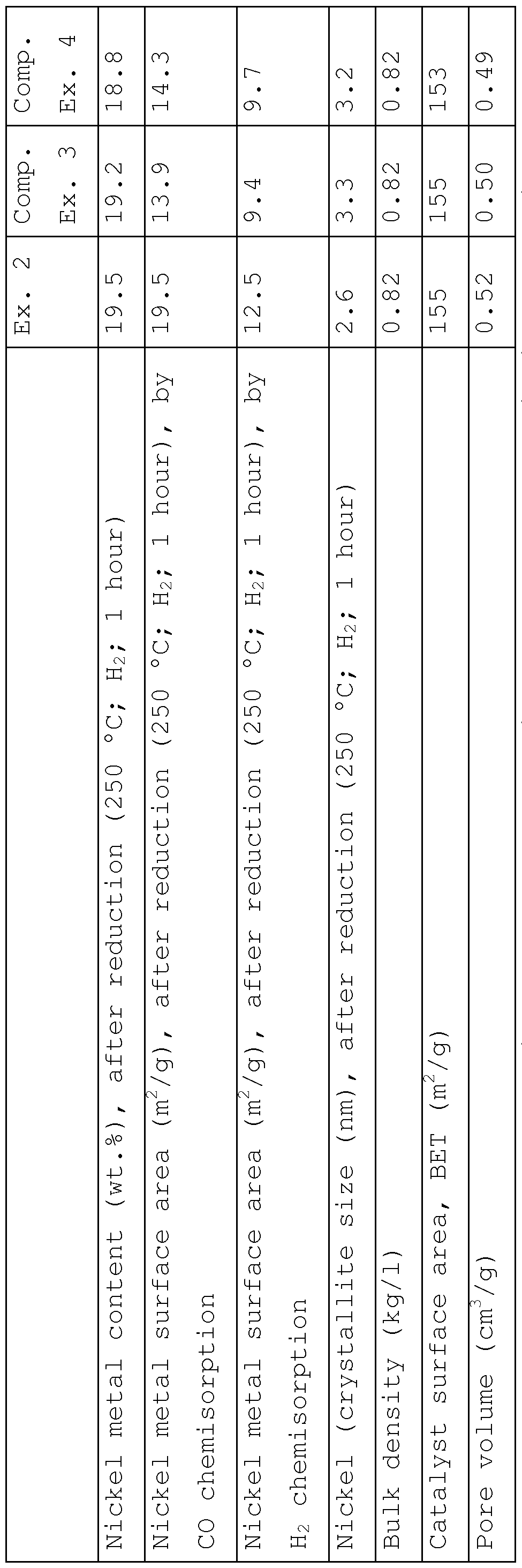
Ex. = Example; Comp. = Comparative; n.a. = not applicable. In the description preceding the Examples, it is described how the above properties were determined.
Claims
1. Process for preparing a catalyst, which process
comprises :
preparing a catalyst containing nickel and copper by a process comprising impregnation of a support, wherein the impregnation solution comprises an organic aliphatic acid comprising a carboxylic acid group (-CO2H group) ; and
subjecting the catalyst to an elevated temperature which is equal to or higher than the decomposition temperature of the organic aliphatic acid resulting in a thermally treated material .
2. Process according to claim 1, wherein the thermal
treatment step is performed in an inert atmosphere.
3. Process according to any one of the preceding claims, wherein the organic aliphatic acid has 1 to 15 carbon atoms including the carbon atoms from the carboxylic acid group or groups .
4. Process according to any one of the preceding claims, wherein the organic aliphatic acid comprises 1 to 3
carboxylic acid groups.
5. Process according to any one of the preceding claims, wherein the elevated temperature is of from 175 to 900 °C.
6. Process according to any one of the preceding claims, wherein the molar ratio of the total amount of nickel and copper, calculated as the metals Ni and Cu, in the catalyst to the amount of the organic aliphatic acid is of from 5 to 120.
7. Process according to any one of the preceding claims, wherein the molar ratio of the amount of copper, calculated as the metal Cu, in the catalyst to the amount of the organic aliphatic acid is of from 0.1 to 10.
8. Process according to any one of the preceding claims, wherein the thermally treated material is subjected to a stream containing hydrogen.
9. Process according to claim 10, wherein the thermally treated material is subjected to a stream containing hydrogen at a temperature of from 100 to 600 °C, preferably 200 to 500 °C.
10. Process according to any one of the preceding claims, wherein the support comprises a material which is selected from the group consisting of alumina, silica, aluminium silicate, magnesia, titania, zirconia and mixtures thereof.
Applications Claiming Priority (2)
| Application Number | Priority Date | Filing Date | Title |
|---|---|---|---|
| EP13156135 | 2013-02-21 | ||
| EP13156135.9 | 2013-02-21 |
Publications (1)
| Publication Number | Publication Date |
|---|---|
| WO2014128203A1 true WO2014128203A1 (en) | 2014-08-28 |
Family
ID=47749676
Family Applications (1)
| Application Number | Title | Priority Date | Filing Date |
|---|---|---|---|
| PCT/EP2014/053300 Ceased WO2014128203A1 (en) | 2013-02-21 | 2014-02-20 | Catalyst manufacturing method |
Country Status (1)
| Country | Link |
|---|---|
| WO (1) | WO2014128203A1 (en) |
Cited By (3)
| Publication number | Priority date | Publication date | Assignee | Title |
|---|---|---|---|---|
| CN107427816A (en) * | 2015-03-31 | 2017-12-01 | 巴斯夫公司 | Hydrogenation and ethynylation catalysts |
| WO2024017703A1 (en) * | 2022-07-21 | 2024-01-25 | IFP Energies Nouvelles | Method for preparing a catalyst containing an active nickel phase and a nickel-copper alloy |
| CN118663340A (en) * | 2024-07-03 | 2024-09-20 | 北京道思克能源设备有限公司 | Preparation method of catalyst for preparing hydrogen by reforming low-copper methanol |
Citations (4)
| Publication number | Priority date | Publication date | Assignee | Title |
|---|---|---|---|---|
| US5759947A (en) * | 1993-07-29 | 1998-06-02 | Zhou; Hongxing | Bifunctional catalyst containing multimetal oxides |
| US20080076660A1 (en) * | 2006-09-22 | 2008-03-27 | Clementine Reyes | Supported Nickel Catalysts Having High Nickel Loading and High Metal Dispersion and Methods of Making Same |
| WO2008043060A2 (en) * | 2006-10-05 | 2008-04-10 | Research Triangle Institute | Highly dispersed nickel hydrogenation catalysts and methods for making the same |
| US20100087312A1 (en) * | 2004-01-21 | 2010-04-08 | Avantium International B.V. | Chromium-free catalysts of metallic cu and at least one second metal |
-
2014
- 2014-02-20 WO PCT/EP2014/053300 patent/WO2014128203A1/en not_active Ceased
Patent Citations (4)
| Publication number | Priority date | Publication date | Assignee | Title |
|---|---|---|---|---|
| US5759947A (en) * | 1993-07-29 | 1998-06-02 | Zhou; Hongxing | Bifunctional catalyst containing multimetal oxides |
| US20100087312A1 (en) * | 2004-01-21 | 2010-04-08 | Avantium International B.V. | Chromium-free catalysts of metallic cu and at least one second metal |
| US20080076660A1 (en) * | 2006-09-22 | 2008-03-27 | Clementine Reyes | Supported Nickel Catalysts Having High Nickel Loading and High Metal Dispersion and Methods of Making Same |
| WO2008043060A2 (en) * | 2006-10-05 | 2008-04-10 | Research Triangle Institute | Highly dispersed nickel hydrogenation catalysts and methods for making the same |
Cited By (12)
| Publication number | Priority date | Publication date | Assignee | Title |
|---|---|---|---|---|
| CN107427816A (en) * | 2015-03-31 | 2017-12-01 | 巴斯夫公司 | Hydrogenation and ethynylation catalysts |
| US20180050325A1 (en) * | 2015-03-31 | 2018-02-22 | Basf Corporation | Hydrogenation and ethynylation catalysts |
| EP3277425A4 (en) * | 2015-03-31 | 2018-12-05 | BASF Corporation | Hydrogenation and ethynylation catalysts |
| US10399062B2 (en) | 2015-03-31 | 2019-09-03 | Basf Corporation | Hydrogenation and ethynylation catalysts |
| US20200055032A1 (en) * | 2015-03-31 | 2020-02-20 | Basf Corporation | Hydrogenation and ethynylation catalysts |
| US10744490B2 (en) * | 2015-03-31 | 2020-08-18 | Basf Corporation | Hydrogenation and ethynylation catalysts |
| CN107427816B (en) * | 2015-03-31 | 2021-03-05 | 巴斯夫公司 | Hydrogenation and ethynylation catalysts |
| CN112934228A (en) * | 2015-03-31 | 2021-06-11 | 巴斯夫公司 | Hydrogenation and ethynylation catalysts |
| CN112934228B (en) * | 2015-03-31 | 2024-02-09 | 巴斯夫公司 | Hydrogenation and Etynylation Catalysts |
| WO2024017703A1 (en) * | 2022-07-21 | 2024-01-25 | IFP Energies Nouvelles | Method for preparing a catalyst containing an active nickel phase and a nickel-copper alloy |
| FR3138050A1 (en) * | 2022-07-21 | 2024-01-26 | IFP Energies Nouvelles | METHOD FOR PREPARING A CATALYST COMPRISING AN ACTIVE PHASE OF NICKEL AND A NICKEL COPPER ALLOY |
| CN118663340A (en) * | 2024-07-03 | 2024-09-20 | 北京道思克能源设备有限公司 | Preparation method of catalyst for preparing hydrogen by reforming low-copper methanol |
Similar Documents
| Publication | Publication Date | Title |
|---|---|---|
| EP2401080B1 (en) | Process for the preparation of fischer-tropsch catalysts and their use | |
| JP5395164B2 (en) | Cobalt Fischer-Tropsch synthesis catalyst precursor, method for producing Fischer-Tropsch synthesis catalyst, and method for producing hydrocarbon | |
| US8765632B2 (en) | Process for preparing catalyst comprising palladium supported on carrier with high dispersion | |
| Dai et al. | The influence of alumina phases on the performance of Pd/Al2O3 catalyst in selective hydrogenation of benzonitrile to benzylamine | |
| US9387463B2 (en) | Process for preparing a fischer-tropsch catalyst | |
| DE112012000702T5 (en) | catalysts | |
| WO2010128137A2 (en) | Improvements relating to hydrogenation of aromatics and other unsaturated organic compounds | |
| DE112013000754T5 (en) | Treatment of a catalyst support | |
| Boretskaya et al. | Identification of amorphous and crystalline phases in alumina entity and their contribution to the properties of the palladium catalyst | |
| Wang et al. | The shape effect of La2O2CO3 in Pd/La2O2CO3 catalyst for selective hydrogenation of cinnamaldehyde | |
| Leite et al. | Synthesis of mesoporous silica with embedded nickel nanoparticles for catalyst applications | |
| WO2014128203A1 (en) | Catalyst manufacturing method | |
| CN112705241A (en) | Ruthenium-based catalyst, preparation method and application thereof | |
| US9370768B2 (en) | Stable support for Fischer-Tropsch catalyst | |
| US9192921B1 (en) | Support for Fischer-Tropsch catalyst having improved activity | |
| WO2010149286A1 (en) | Catalyst for chlorine production comprising a copper aluminate of the spinel type | |
| US9248435B2 (en) | Process for preparing a cobalt-containing fischer tropsch catalyst | |
| JPH01288337A (en) | Carrier substance of catalyst and production thereof | |
| WO2014128204A1 (en) | Catalyst manufacturing method | |
| WO2016039862A1 (en) | Stable support for fischer-tropsch catalyst | |
| US9687826B2 (en) | Support for fischer-tropsch catalyst having improved activity | |
| CN108654611B (en) | Supported bimetallic catalyst, preparation method thereof and glycerin hydrogenolysis reaction method | |
| US9233358B1 (en) | Stable support for Fischer-Tropsch catalyst | |
| Elkhalifa et al. | Effects of boron and barium dopants on VMgO catalysts employed in the oxidative dehydrogenation of n-octane | |
| JP6300280B2 (en) | Method for producing conjugated diene |
Legal Events
| Date | Code | Title | Description |
|---|---|---|---|
| 121 | Ep: the epo has been informed by wipo that ep was designated in this application |
Ref document number: 14708208 Country of ref document: EP Kind code of ref document: A1 |
|
| NENP | Non-entry into the national phase |
Ref country code: DE |
|
| 122 | Ep: pct application non-entry in european phase |
Ref document number: 14708208 Country of ref document: EP Kind code of ref document: A1 |