WO2014117741A1 - Heterocyclo compounds as apoptotic inducers and uses thereof - Google Patents
Heterocyclo compounds as apoptotic inducers and uses thereof Download PDFInfo
- Publication number
- WO2014117741A1 WO2014117741A1 PCT/CN2014/071751 CN2014071751W WO2014117741A1 WO 2014117741 A1 WO2014117741 A1 WO 2014117741A1 CN 2014071751 W CN2014071751 W CN 2014071751W WO 2014117741 A1 WO2014117741 A1 WO 2014117741A1
- Authority
- WO
- WIPO (PCT)
- Prior art keywords
- compound
- substituted
- compound according
- unsubstituted
- cells
- Prior art date
- Legal status (The legal status is an assumption and is not a legal conclusion. Google has not performed a legal analysis and makes no representation as to the accuracy of the status listed.)
- Ceased
Links
- 0 *1N=Nc2ccccc12 Chemical compound *1N=Nc2ccccc12 0.000 description 6
- FZUCACPLLWNFBO-ZBAXXZLZSA-N O[C@@H]([C@@H](c1ccccc1)F)[C@@H]([C@H](C=C1)O)OC1=O Chemical compound O[C@@H]([C@@H](c1ccccc1)F)[C@@H]([C@H](C=C1)O)OC1=O FZUCACPLLWNFBO-ZBAXXZLZSA-N 0.000 description 2
- SXPAQRPFUXRLPB-MYPMTAMASA-N CC(C)(O[C@@H]([C@@H](c1ccccc1)F)[C@@H]1O2)O[C@H]1C=CC2=O Chemical compound CC(C)(O[C@@H]([C@@H](c1ccccc1)F)[C@@H]1O2)O[C@H]1C=CC2=O SXPAQRPFUXRLPB-MYPMTAMASA-N 0.000 description 1
- QIMZCRGWPSEIEU-FFSGTFEZSA-N CC(OC(C1N=NCC11)[C@H](C(C(c2ccccc2)F)O)OC1=O)=O Chemical compound CC(OC(C1N=NCC11)[C@H](C(C(c2ccccc2)F)O)OC1=O)=O QIMZCRGWPSEIEU-FFSGTFEZSA-N 0.000 description 1
- IEASDMPSIYCJRL-SVGFKBNWSA-N CC(O[C@@H]([C@@H](c1ccccc1)F)[C@@H]([C@H](C=C1)OC(C)=O)OC1=O)=O Chemical compound CC(O[C@@H]([C@@H](c1ccccc1)F)[C@@H]([C@H](C=C1)OC(C)=O)OC1=O)=O IEASDMPSIYCJRL-SVGFKBNWSA-N 0.000 description 1
- QIMZCRGWPSEIEU-UMBPPFEGSA-N CC(O[C@@H]([C@H]1N=NC[C@H]11)[C@H]([C@H]([C@@H](c2ccccc2)F)O)OC1=O)=O Chemical compound CC(O[C@@H]([C@H]1N=NC[C@H]11)[C@H]([C@H]([C@@H](c2ccccc2)F)O)OC1=O)=O QIMZCRGWPSEIEU-UMBPPFEGSA-N 0.000 description 1
- JDAVONPSWKMHQP-PMOUVXMZSA-N CC(O[C@H]([C@H]([C@H]([C@@H](c1ccccc1)F)O)O1)C=CC1=O)=O Chemical compound CC(O[C@H]([C@H]([C@H]([C@@H](c1ccccc1)F)O)O1)C=CC1=O)=O JDAVONPSWKMHQP-PMOUVXMZSA-N 0.000 description 1
- NYJFJVSAHWPDQM-UHFFFAOYSA-N O=C(C=C1)OC(C(C(c2ccccc2)F)N2)C1NC2=O Chemical compound O=C(C=C1)OC(C(C(c2ccccc2)F)N2)C1NC2=O NYJFJVSAHWPDQM-UHFFFAOYSA-N 0.000 description 1
- VDKNAVWNISVSLJ-UHFFFAOYSA-N O=C(C=C1)OC(C(C(c2ccccc2)F)N2)C1NS2(=O)=O Chemical compound O=C(C=C1)OC(C(C(c2ccccc2)F)N2)C1NS2(=O)=O VDKNAVWNISVSLJ-UHFFFAOYSA-N 0.000 description 1
- AYPYBEXETIENRH-ZLXUSHJUSA-N OC(C(c1ccccc1)F)[C@@H](CC1N=NCC11)OC1=O Chemical compound OC(C(c1ccccc1)F)[C@@H](CC1N=NCC11)OC1=O AYPYBEXETIENRH-ZLXUSHJUSA-N 0.000 description 1
- MCMIGXPTLBJQQY-CHWSQXEVSA-N O[C@@H]([C@@H](c1ccccc1)F)C(O1)=CC=CC1=O Chemical compound O[C@@H]([C@@H](c1ccccc1)F)C(O1)=CC=CC1=O MCMIGXPTLBJQQY-CHWSQXEVSA-N 0.000 description 1
- XSCHRSMBECNVNS-UHFFFAOYSA-N c1cc2nccnc2cc1 Chemical compound c1cc2nccnc2cc1 XSCHRSMBECNVNS-UHFFFAOYSA-N 0.000 description 1
- PBMFSQRYOILNGV-UHFFFAOYSA-N c1ccnnc1 Chemical compound c1ccnnc1 PBMFSQRYOILNGV-UHFFFAOYSA-N 0.000 description 1
- CZPWVGJYEJSRLH-UHFFFAOYSA-N c1cncnc1 Chemical compound c1cncnc1 CZPWVGJYEJSRLH-UHFFFAOYSA-N 0.000 description 1
- KYQCOXFCLRTKLS-UHFFFAOYSA-N c1nccnc1 Chemical compound c1nccnc1 KYQCOXFCLRTKLS-UHFFFAOYSA-N 0.000 description 1
Classifications
-
- C—CHEMISTRY; METALLURGY
- C07—ORGANIC CHEMISTRY
- C07D—HETEROCYCLIC COMPOUNDS
- C07D309/00—Heterocyclic compounds containing six-membered rings having one oxygen atom as the only ring hetero atom, not condensed with other rings
- C07D309/32—Heterocyclic compounds containing six-membered rings having one oxygen atom as the only ring hetero atom, not condensed with other rings having two double bonds between ring members or between ring members and non-ring members
-
- A—HUMAN NECESSITIES
- A61—MEDICAL OR VETERINARY SCIENCE; HYGIENE
- A61P—SPECIFIC THERAPEUTIC ACTIVITY OF CHEMICAL COMPOUNDS OR MEDICINAL PREPARATIONS
- A61P35/00—Antineoplastic agents
-
- A—HUMAN NECESSITIES
- A61—MEDICAL OR VETERINARY SCIENCE; HYGIENE
- A61P—SPECIFIC THERAPEUTIC ACTIVITY OF CHEMICAL COMPOUNDS OR MEDICINAL PREPARATIONS
- A61P35/00—Antineoplastic agents
- A61P35/02—Antineoplastic agents specific for leukemia
-
- C—CHEMISTRY; METALLURGY
- C07—ORGANIC CHEMISTRY
- C07D—HETEROCYCLIC COMPOUNDS
- C07D491/00—Heterocyclic compounds containing in the condensed ring system both one or more rings having oxygen atoms as the only ring hetero atoms and one or more rings having nitrogen atoms as the only ring hetero atoms, not provided for by groups C07D451/00 - C07D459/00, C07D463/00, C07D477/00 or C07D489/00
- C07D491/02—Heterocyclic compounds containing in the condensed ring system both one or more rings having oxygen atoms as the only ring hetero atoms and one or more rings having nitrogen atoms as the only ring hetero atoms, not provided for by groups C07D451/00 - C07D459/00, C07D463/00, C07D477/00 or C07D489/00 in which the condensed system contains two hetero rings
- C07D491/04—Ortho-condensed systems
- C07D491/044—Ortho-condensed systems with only one oxygen atom as ring hetero atom in the oxygen-containing ring
- C07D491/052—Ortho-condensed systems with only one oxygen atom as ring hetero atom in the oxygen-containing ring the oxygen-containing ring being six-membered
-
- C—CHEMISTRY; METALLURGY
- C07—ORGANIC CHEMISTRY
- C07D—HETEROCYCLIC COMPOUNDS
- C07D493/00—Heterocyclic compounds containing oxygen atoms as the only ring hetero atoms in the condensed system
- C07D493/02—Heterocyclic compounds containing oxygen atoms as the only ring hetero atoms in the condensed system in which the condensed system contains two hetero rings
- C07D493/04—Ortho-condensed systems
-
- C—CHEMISTRY; METALLURGY
- C07—ORGANIC CHEMISTRY
- C07D—HETEROCYCLIC COMPOUNDS
- C07D513/00—Heterocyclic compounds containing in the condensed system at least one hetero ring having nitrogen and sulfur atoms as the only ring hetero atoms, not provided for in groups C07D463/00, C07D477/00 or C07D499/00 - C07D507/00
- C07D513/02—Heterocyclic compounds containing in the condensed system at least one hetero ring having nitrogen and sulfur atoms as the only ring hetero atoms, not provided for in groups C07D463/00, C07D477/00 or C07D499/00 - C07D507/00 in which the condensed system contains two hetero rings
- C07D513/04—Ortho-condensed systems
Definitions
- This invention relates to novel heterocylco compounds capable of inducing apoptosis in cancer cell and uses of such compounds to treat cancer and realted conditions. More particularly, the heterocyclo compounds may be used to induce apoptosis in cancer cells via p53- independent and p53/Bax- and PUMA-dependent pathway. Also encompassed herein, are compositions of novel heterocyclo compounds, pharmaceutical compositions of the heterocyclo compounds, assays and methods for using same to identify compounds capable of inducing apoptosis in cancer cells.
- Cancer is one of the leading causes of human death world-wide, accounting for
- TP53 mutation of the p53 gene
- TP53 Soussi T. Oncogene, 2007, 26: 2145.
- deregulation of expression of p53 and/or other p53-related components of the pathway Vogelstein B, et al. Nature, 2000, 408: 307.
- mutant p53 full-length point mutants
- mut-p53 or mutant p53 full-length point mutants
- mutant p53 proteins were associated with resistance to p53 -dependent drugs commonly used in anti-cancer therapy (Iwakuma T, et al. Oncogene, 2007, 26: 2177).
- p53 mutants Given the active role of p53 mutants in drug resistance, the identification of new efficient chemotherapeutic drugs that could kill cancer cells via p53 -independent cascade is desirable.
- the drugs with killing cancer cells via p53- independent manner are also highly toxic to normal cells of patients, which results in high side effects, and subsequently limiting the application of high drug doses and chemotherapeutic courses.
- p53-mediated normal cell growth arrest at GO phase via p53/p21 -dependent manner prevents the normal cells undergoing to apoptosis and that most of human cancer cells with p53 mutations will lost this p53 protection and further undergo to apoptosis upon p53 -independent cascade
- this kind of new drugs will be selectively killing cancer cells with no or less toxicity to normal cells, by which reduces their side
- the present invention provides novel derivatives of a natural compound or a natural product that are effective in killing cancer cells with no or much less toxicity to normal cells, thereby leads to promising anticancer drugs with no or less side effects in treatment of cancer patients.
- the present invention provides a compound according to formula I:
- X is -0-, or -NR X -; R x is H or Ci-C 6 alkyl;
- R 1 is H, OH, -OC(0)-R yl , NH 2 , -NR zl R z2 , or -N(R z3 )-C(0)-R z4 ;
- R 2 is H, OH, -OC(0)-R y2 , NH 2 , -NR z5 R z6 , -N(R z7 )-C(0)-R z8 ;
- each R yl , R y2 , R z2 , R z4 , R z6 , and R z8 is independently substituted or unsubstituted alkyl, substituted or unsubstituted aryl, or substituted or unsubstituted cycloalkyl; each R zl , R z3 , R z5 , and R z7 is independently H, substituted or unsubstituted alkyl, substituted or unsubstituted aryl, or substituted or unsubstituted cycloalkyl; or R z5 and R z6 together with the N they are attached to form a heterocycle;
- R 1 and R 2 are joined together to form -0-CR wl R w2 -0-, -0-C(0)-0-, -NH-C(0)-NH-, or -NH-C(S)-NH-; each R wl , and R w2 is independently H, or substituted or unsubstituted alkyl;
- R 3 is H or halo
- R 4 is independently selected from H, OH, substituted or unsubstituted alkyl, substituted or unsubstituted alkoxy, substituted or unsubstituted acyl, substituted or unsubstituted acylamino, substituted or unsubstituted alkylamino, substituted or unsubstituted alkythio, substituted or unsubstituted alkoxycarbonyl, substituted or unsubstituted alkylarylamino, substituted or unsubstituted amino, substituted or unsubstituted arylalkyl, sulfo, substituted sulfo, substituted sulfonyl, substituted sulfinyl, substituted sulfanyl, substituted or unsubstituted aminosulfonyl, substituted or unsubstituted alkylsulfonyl, substituted or unsubstituted arylsulfonyl, azid
- each R 5 and R 6 is independently H; or R 5 and R 6 together with the Cs they are attached to form a carbocycle or heterocycle; n is 1, 2, 3, 4 or 5; and
- each dotted bond is independently a single or a double bond
- the compound is other than
- the present invention provides methods for preventing, treating or ameliorating in a mammal a disease or condition that is causally related to p53 activity in vivo, which comprises administering to the mammal an effective disease-treating or condition- treating amount of a compound according to formula ⁇ .
- the disease is cancer.
- the present invention provides methods for inducing apoptosis in cancer cells via p53 -independent pathway, which comprises contacting the cancer cell with a compound according to formula ⁇ .
- the present invention provides methods for inducing apoptosis in cancer cells via p53/Bax- and PUMA-dependent pathway, which comprises contacting the cancer cell with a compound according to formula ⁇ .
- the present invention provides methods for mediating cell growth arrest of normal cells via p53/p21 -dependent pathway, which comprises contacting the cancer cell with a compound according to formula ⁇ .
- the compound protects apoptosis of normal cells.
- the present invention provides pharmaceutical compositions comprising a heterocyclic compound of the invention, and a pharmaceutical carrier, excipient or diluent.
- the pharmaceutical composition can comprise one or more of the compounds described herein.
- the compounds of the present invention useful in the pharmaceutical compositions and treatment methods disclosed herein are all pharmaceutically acceptable as prepared and used.
- this invention provides a method of treating a mammal susceptible to or afflicted with cancer.
- the cancer includes, without limitation, prostate, colon, bladder, melanoma, liver, breast, cervical, ovarian, esophagi, glialblastoma, and lung cancer.
- the cancer includes, without limitation, pancreatic cancer.
- the cancer includes, leukemia.
- FIG. 1 Compound F-2 inhibited anchorage-independent growth and apoptosis of human colon cancer HCTl 16 cells.
- HCTl 16 cells (l lO 4 ) were exposed to different concentration of Compound F2 in 0.33% agar for 14 days as described in Example 1. The number of colonies was counted under microscopy at the end of the experiments.
- B The colonies are expressed as means ⁇ S.D. from six assays. *, p ⁇ 0.05, significant decrease from vehicle control.
- C HCTl 16 cells were treated as indicated, with concentrated Compound F2 for 48h.
- Apoptosis cells are present in the area indicated in each figure by flow-cytometric analysis. Treatments were performed as described in Example 1. Data represent one of three different experiments showing similar results.
- Compound F2 HCTl 16 wild-type cells were treated with Compound F2 at 16 ⁇ for time points as indicated. Western blot analysis was performed to detect p53, Bax, p21 and p27 expression.
- the indicated cells were treated with Compound F2 for 48h and cell apoptosis and growth arrest were assayed by flow cytometry with propidium iodide (PI) staining.
- PI propidium iodide
- C The ratio of cell apoptosis was evaluated in each condition from three independent experiments. "*", p ⁇ 0.05, significant decrease from WT cells; and "A"p ⁇ 0.01, significant increase from WT cells.
- HCTl 16 wild-type and p53-/- cells were treated with 16 ⁇ Compound F2 for indicated time. Protein extracts were prepared and the expression of the indicated protein was analyzed by Western Blotting.
- E HCTl 16 wild-type and Bax-/- cells were placed under 16 ⁇ Compound F2 for indicated time and subjected to Western Blotting.
- F HCTl 16 wild-type and p21-/- cells were placed under 16 ⁇ Compound F2 for indicated time and subjected to Western Blotting.
- FIG. 3 Compound F2 treatment upregulated Bax mRNA expression in p53- independent manner.
- a and B HCTl 16 wild-type and p53-/- cells were placed under 16 ⁇ Compound F2 for indicated time.
- Cell protein extracts were subjected to Western Blotting as indicated.
- C C
- HCT116 wild-type and Bax ⁇ ⁇ cells(l x 10 4 ) were exposed to different concentration of Compound F2 in 0.33% agar for 14 days as described herein. The number of colonies was counted under microscopy at the end of the experiments. (D) The colonies are expressed as means ⁇ S.D. from six assays. "*", p ⁇ 0.05, significant increase from WT cells
- FIG. 4 Compound F2 treatment upregulated p21 mRNA expression in p53- dependent manner.
- A HCT116 wild-type (WT) cells and p53-/- cells were placed under 16 ⁇ Compound F2 for indicated time. Total RNA were isolated and subjected to RT-PCR analysis.
- B HCT116 WT and p21-/- cells were treated with 16 ⁇ Compound F2 for indicated time, and then extracted for determination of p53 and Bax protein expression by Western Blotting.
- C HCT116 wild-type cells stably transfected with full-length and p53 binding site mutant p21 promoter- luciferase reporter were exposed to 16 ⁇ Compound F2 for indicated time. The results were presented as the mean ⁇ S.D. from three independent experiments (*' /? ⁇ 0.05).
- FIG. 5 Compound F2 blocked anchorage-independent growth of human colon cancer cells.
- A The structure of Compound F2.
- B and C HCT116, HT29 and DLDl cells (l x lO 4 ) were exposed to vehicle control (0.2% DMSO), 16, 32 ⁇ Compound F2 in 0.33% agar for 2 weeks. The colonies were captured and counted under microscopy. The colonies are expressed as means ⁇ S.E. from five assays. *, /? ⁇ 0.05, significant difference from vehicle control.
- HCT116, HT29 and DLDl cells (2 l0 5 ) were seeded into each well of 6-well plates and cultured until the cell density reached 70-80%> confluence. The cells were then exposed to vehicle control (0.2% DMSO), 16, 32 ⁇ Compound F2 for 48 h. The cell death was determined by flow cytometry with PI staining. The result was representative one from three independent
- FIG. 7 Compound F2-induced cell apoptosis is in PUMA-dependent, and p53- independent manner
- HCT116 cells were exposed to 16 ⁇ Compound F2 for indicated time, and whole cell protein were extracted and subjected to Western Blot.
- B HCT116, HT29 and DLDl cells were exposed to vehicle control (0.2%> DMSO), 16 or 32 ⁇ Compound F2 for 48 h. The cell death was determined by flow cytometry with PI staining.
- C HCT116 WT and PUMA-/- cells were exposed to 16 ⁇ Compound F2 for indicated time. The whole cell protein were extracted and subjected to Western Blot.
- HCT116 WT and PUMA-/- cells (1 X 10 4 ) were exposed to vehicle control (0.2% DMSO), 16, 32 ⁇ Compound F2 in 0.33% agar for 2 weeks. The colonies were captured and counted under microscopy and expressed as means + S.E. from five assays. *, /? ⁇ 0.05, significant difference from WT cells.
- Figure 8 Compound F2-induced PUMA upregulation is through p53 -independent and Fox03a-dependent pathway.
- HCTl 16 WT and p53-/- cells were exposed to 16 ⁇ Compound F2 for indicated time.
- the whole cell protein were extracted and subjected to Western Blot.
- B HT-29 and DLD-1 cells were exposed to 16 ⁇ Compound F2 for indicated time.
- the whole cell protein were extracted and subjected to Western Blot.
- C HCTl 16 WT cells were exposed to 16 ⁇ Compound F2 for indicated time.
- the whole cell mR A was extracted and subjected to RT-PCR.
- D HCTl 16 WT cells stably transfected with PUMA promoter-driven luciferase reporter were exposed to 16 ⁇ Compound F2 for indicated time, and then extracted for determination of the luciferase activity.
- F HCTl 16 WT cells were exposed to 16 ⁇ Compound F2 for indicated time. The whole cell protein were extracted and subjected to Western Blot.
- G HCTl 16 WT cells stably transfected with Fox03a transcription dependent (4 X DBE) luciferase reporter were exposed to 16 ⁇ Compound F2 for indicated time, and then extracted for determination of the luciferase activity.
- H HCTl 16 wWTcells stably transfected with Fox03a wt and Fox03a mutant PUMA promoter-driven luciferase reporter were exposed to 16 ⁇ Compound F2 for indicated time, and then extracted for determination of the luciferase activity.
- Figure 9 Compound F2-induced Fox03a transcription activity upregulation through PHLPP1/AKT axis
- HCTl 16 WT cells were exposed to 16 ⁇ Compound F2 for indicated time. The whole cell protein were extracted and subjected to Western Blot.
- C HCTl 16 WT cells, stably transfected with shPHLPPl or empty vector control, were extracted for Western Blot.
- D HCTl 16 WT cells stably transfected with shPHLPPl or empty vector control were exposed to vehicle control or 16 or 32 ⁇ Compound F2 for 48 hours, and cell extracts were applied for Western Blot.
- HCTl 16 WT cells stably transfected with puma promoter- luciferase reporter together with either shPHLPPl or empty vector control were exposed to vehicle control or 32 ⁇ Compound F2 for indicated time, and cell extracts were applied for determination of luciferase activity.
- F HCTl 16 WT cells stably transfected with shPHLPPl or empty vector control were exposed to vehicle control or 16 or 32 ⁇ Compound F2 for 48 hours, and cell extracts were applied for flow cytometry with PI staining.
- G & H HCTl 16 WT cells, stably transfected with shPHLPPl vector or empty vector control, were exposed to vehicle control, 16, 32 ⁇
- Compound F2 for soft agar assay [0026] Figure 10. Compound F2 inhibited EGF-induced cell transformation, cell proliferation, and induced G0/G1 growth arrest in C141 cells. (A & B) C141 cells were exposed to indicated concentrations of Compound F2 in combination with EGF for cell transformation assay in soft agar. The symbol (*) indicated a significant decrease in comparison to that of no
- FIG. 11 Compound F2 induced p21 expression in C141 cells.
- a and B C141 cells were treated with Compound F2 in the indicated concentrations for 24 h (A), and indicated time under 16 ⁇ Compound F2 treatment (B). Expression of ⁇ -actin was used as protein loading control. Data was representative one of three independent experiments.
- FIG. 12 Compound F2 upregulated p21 protein expression at the transcription level.
- A C141 cells were treated with Compound F2 in the indicated concentrations for 24 h, and the total R A were isolated and subjected to RT-PCR analysis.
- B C141 cells were treated with medium containing either 0.2% DMSO or Compound F2 (16 ⁇ ) for indicated time, and the total RNA were isolated and subjected to RT-PCR analysis.
- C C141 cells stably transfected with either full length p21 promoter-driven luciferase reporter (p21-luc), or with p53 binding site
- FIG. 13 Compound F2 treatment induced p53 protein expression and p53- dependent transactivation.
- a and B C141 cells were treated with different concentrations of Compound F2 for 24 hrs (A) or 16 ⁇ Compound F2 for the indicated time (B). Total cell extracts were subjected to Western Blot.
- C C141 cells were treated with 16 ⁇ Compound F2 for the indicated time. Total mRNAwas extracts and subjected to RT-PCR determination of p53 mRNA induction.
- D p53 -dependent luciferase reporter plasmid was stably co-trans fected with the PRL-TK-Luciferase expression vector into C141 cells.
- C141 stable transfectants of p21 -promoter luciferase reporter together with mouse p53 shRNA or non-silencing control shRNA were exposed to 16 ⁇ Compound F2 for indicated time and subjected to RT-PCR for determination of p21 -promoter drived luciferase activity.
- D C141 stable transfectants of mouse p53 shRNA or non- silencing control shRNA were exposed to 16 ⁇ Compound F2 for indicated time and subjected to RT- PCR for determination of p21 mRNA induction.
- Acyl refers to a radical -C(0)R 20 , where R 20 is hydrogen, alkyl, cycloalkyl, cycloheteroalkyl, aryl, arylalkyl, heteroalkyl, heteroaryl, heteroarylalkyl as defined herein.
- Representative examples include, but are not limited to, formyl, acetyl, cyclohexylcarbonyl, cyclohexylmethylcarbonyl, benzoyl, benzylcarbonyl and the like.
- Acylamino refers to a radical -NR 21 C(0)R 22 , where R 21 is hydrogen, alkyl, cycloalkyl, cycloheteroalkyl, aryl, arylalkyl, heteroalkyl, heteroaryl, heteroarylalkyl and R 22 is hydrogen, alkyl, alkoxy, cycloalkyl, cycloheteroalkyl, aryl, arylalkyl, heteroalkyl, heteroaryl or heteroarylalkyl, as defined herein.
- Acyloxy refers to the group -OC(0)R 23 where R 23 is hydrogen, alkyl, aryl or cycloalkyl.
- Substituted alkenyl includes those groups recited in the definition of
- substituted herein, and particularly refers to an alkenyl group having 1 or more substituents, for instance from 1 to 5 substituents, and particularly from 1 to 3 substituents, selected from the group consisting of acyl, acylamino, acyloxy, alkoxy, substituted alkoxy, alkoxycarbonyl, alkoxycarbonylamino, amino, substituted amino, aminocarbonyl, aminocarbonylamino, aminocarbonyloxy, aryl, aryloxy, azido, carboxyl, cyano, cycloalkyl, substituted cycloalkyl, halogen, hydroxyl, keto, nitro, thioalkoxy, substituted thioalkoxy, thioaryloxy, thioketo, thiol, alkyl-S(O)-, aryl-S(O)-, alkyl-S(0) 2 - and aryl-S(0) 2 -.
- Alkoxy refers to the group -OR 24 where R 24 is alkyl. Particular alkoxy groups include, by way of example, methoxy, ethoxy, n-propoxy, isopropoxy, n-butoxy, tert-butoxy, sec-butoxy, n-pentoxy, n-hexoxy, 1 ,2-dimethylbutoxy, and the like.
- substituted herein, and particularly refers to an alkoxy group having 1 or more substituents, for instance from 1 to 5 substituents, and particularly from 1 to 3 substituents, selected from the group consisting of acyl, acylamino, acyloxy, alkoxy, substituted alkoxy, alkoxycarbonyl, alkoxycarbonylamino, amino, substituted amino, aminocarbonyl, aminocarbonylamino, aminocarbonyloxy, aryl, aryloxy, azido, carboxyl, cyano, cycloalkyl, substituted cycloalkyl, halogen, heteroaryl, hydroxyl, keto, nitro, thioalkoxy, substituted thioalkoxy, thioaryloxy, thioketo, thiol, alkyl-S(O)-, aryl-S(O)-, alkyl-S(0) 2 - and aryl-S(0) 2 -.
- substituents for instance from 1 to 5
- Alkoxycarbonylamino refers to the group -NR 25 C(0)OR 26 , where R 25 is hydrogen, alkyl, aryl or cycloalkyl, and R 26 is alkyl or cycloalkyl.
- Alkyl refers to monovalent saturated alkane radical groups particularly having up to about 11 carbon atoms, more particularly as a lower alkyl, from 1 to 8 carbon atoms and still more particularly, from 1 to 6 carbon atoms.
- the hydrocarbon chain may be either straight- chained or branched. This term is exemplified by groups such as methyl, ethyl, n-propyl, isopropyl, n-butyl, z ' so-butyl, tert-butyl, n-hexyl, n-octyl, tert-octyl and the like.
- the term “lower alkyl” refers to alkyl groups having 1 to 6 carbon atoms.
- alkyl also includes
- Substituted alkyl includes those groups recited in the definition of "substituted” herein, and particularly refers to an alkyl group having 1 or more substituents, for instance from 1 to 5 substituents, and particularly from 1 to 3 substituents, selected from the group consisting of acyl, acylamino, acyloxy, alkoxy, substituted alkoxy, alkoxycarbonyl, alkoxycarbonylamino, amino, substituted amino, aminocarbonyl, aminocarbonylamino, aminocarbonyloxy, aryl, aryloxy, azido, carboxyl, cyano, cycloalkyl, substituted cycloalkyl, halogen, hydroxyl, heteroaryl, keto, nitro, thioalkoxy, substituted thioalkoxy, thioaryloxy, thioketo, thiol, alkyl-S(O)-, aryl- S(O)-, alkyl
- Alkylene refers to divalent saturated alkene radical groups having 1 to 1 1 carbon atoms and more particularly 1 to 6 carbon atoms which can be straight-chained or branched. This term is exemplified by groups such as methylene (-CH 2 -), ethylene (-CH 2 CH 2 -), the propylene isomers (e.g., -CH 2 CH 2 CH 2 - and -CH(CH 3 )CH 2 -) and the like.
- Substituted alkylene includes those groups recited in the definition of
- substituted herein, and particularly refers to an alkylene group having 1 or more substituents, for instance from 1 to 5 substituents, and particularly from 1 to 3 substituents, selected from the group consisting of acyl, acylamino, acyloxy, alkoxy, substituted alkoxy, alkoxycarbonyl, alkoxycarbonylamino, amino, substituted amino, aminocarbonyl, amino-carbonylamino, aminocarbonyloxy, aryl, aryloxy, azido, carboxyl, cyano, halogen, hydroxyl, keto, nitro, thioalkoxy, substituted thioalkoxy, thioaryloxy, thioketo, thiol, alkyl-S(O)-, aryl-S(O)-, alkyl- S(0) 2 - and aryl-S(0) 2 -.
- substituents for instance from 1 to 5 substituents, and particularly from 1 to 3 substituents, selected from the group consist
- alkenyl refers to monovalent olefmically unsaturated hydrocarbyl groups preferably having 2 to 1 1 carbon atoms, particularly, from 2 to 8 carbon atoms, and more particularly, from 2 to 6 carbon atoms, which can be straight-chained or branched and having at least 1 and particularly from 1 to 2 sites of olefinic unsaturation.
- Alkynyl refers to acetylenically or alkynically unsaturated hydrocarbyl groups particularly having 2 to 1 1 carbon atoms, and more particularly 2 to 6 carbon atoms which can be straight-chained or branched and having at least 1 and particularly from 1 to 2 sites of alkynyl unsaturation.
- alkynyl groups include acetylenic, ethynyl (- C ⁇ CH), propargyl (-CH 2 C ⁇ CH), and the like.
- Substituted alkynyl includes those groups recited in the definition of
- substituted herein, and particularly refers to an alkynyl group having 1 or more substituents, for instance from 1 to 5 substituents, and particularly from 1 to 3 substituents, selected from the group consisting of acyl, acylamino, acyloxy, alkoxy, substituted alkoxy, alkoxycarbonyl, alkoxycarbonylamino, amino, substituted amino, aminocarbonyl, aminocarbonylamino, aminocarbonyloxy, aryl, aryloxy, azido, carboxyl, cyano, cycloalkyl, substituted cycloalkyl, halogen, hydroxyl, keto, nitro, thioalkoxy, substituted thioalkoxy, thioaryloxy, thioketo, thiol, alkyl-S(O)-, aryl-S(O)-, alkyl-S(0) 2 - and aryl-S(0) 2 -.
- alkanoyl or "acyl” as used herein refers to the group R 27 -C(0)-, where R 27 is hydrogen or alkyl as defined above.
- Aryl refers to a monovalent aromatic hydrocarbon group derived by the removal of one hydrogen atom from a single carbon atom of a parent aromatic ring system.
- Typical aryl groups include, but are not limited to, groups derived from aceanthrylene, acenaphthylene, acephenanthrylene, anthracene, azulene, benzene, chrysene, coronene, fluoranthene, fluorene, hexacene, hexaphene, hexalene, as-indacene, s-indacene, indane, indene, naphthalene, octacene, octaphene, octalene, ovalene, penta-2,4-diene, pentacene, pentalene, pentaphene, perylene, phenalene, phenanthrene, picene, pleia
- Substituted Aryl includes those groups recited in the definition of "substituted” herein, and particularly refers to an aryl group that may optionally be substituted with 1 or more substituents, for instance from 1 to 5 substituents, particularly 1 to 3 substituents, selected from the group consisting of acyl, acylamino, acyloxy, alkenyl, substituted alkenyl, alkoxy, substituted alkoxy, alkoxycarbonyl, alkyl, substituted alkyl, alkynyl, substituted alkynyl, amino, substituted amino, aminocarbonyl, aminocarbonylamino, aminocarbonyloxy, aryl, aryloxy, azido, carboxyl, cyano, cycloalkyl, substituted cycloalkyl, halogen, hydroxyl, nitro, thioalkoxy, substituted thioalkoxy, thioaryloxy, thiol, alkyl-
- Fused Aryl refers to an aryl having two of its ring carbon in common with a second aryl ring or with an aliphatic ring.
- Alkaryl refers to an aryl group, as defined above, substituted with one or more alkyl groups, as defined above.
- alkyl or arylalkyl refers to an alkyl group, as defined above, substituted with one or more aryl groups, as defined above.
- Aryloxy refers to -O-aryl groups wherein “aryl” is as defined above.
- Alkylamino refers to the group alkyl-NR 28 R 29 , wherein each of R 28 and R 29 are independently selected from hydrogen and alkyl.
- Arylamino refers to the group aryl-NR R , wherein each of R and R are independently selected from hydrogen, aryl and heteroaryl.
- Alkylarylamino refers to a radical -NR R where R represents an alkyl or cycloalkyl group and R 34 is an aryl as defined herein.
- Alkylsulfonyl refers to a radical -S(0) 2 R 35 where R 35 is an alkyl or cycloalkyl group as defined herein. Representative examples include, but are not limited to, methylsulfonyl, ethylsulfonyl, propylsulfonyl, butylsulfonyl and the like.
- Alkylsulfmyl refers to a radical -S(0)R 35 where R 35 is an alkyl or cycloalkyl group as defined herein. Representative examples include, but are not limited to, methylsulfmyl, ethylsulfmyl, propylsulfmyl, butylsulfmyl and the like.
- Alkylthio refers to a radical -SR 35 where R 35 is an alkyl or cycloalkyl group as defined herein that may be optionally substituted as defined herein. Representative examples include, but are not limited to, methylthio, ethylthio, propylthio, butylthio, and the like.
- Amino refers to the radical -NH 2 .
- substituted herein, and particularly refers to the group -N(R 36 ) 2 where each R 36 is
- both R groups are independently selected from the group consisting of hydrogen, alkyl, substituted alkyl, alkenyl, substituted alkenyl, alkynyl, substituted alkynyl, aryl, cycloalkyl, substituted cycloalkyl, and where both R groups are joined to form an alkylene group.
- both R groups are hydrogen, - N(R 36 ) 2 is an amino group.
- Aminocarbonyl refers to the group -C(0)NR 37 R 37 where each R 37 is
- Aminocarbonylamino refers to the group -NR 38 C(0)NR 38 R 38 where each R 38 is independently hydrogen, alkyl, aryl or cycloalkyl, or where two R groups are joined to form an alkylene group.
- Aminocarbonyloxy refers to the group -OC(0)NR 39 R 39 where each R 39 is independently hydrogen, alkyl, aryl or cycloalky, or where the R groups are joined to form an alkylene group.
- Arylalkyloxy refers to an -O-arylalkyl radical where arylalkyl is as defined herein.
- Arylamino means a radical -NHR 40 where R 40 represents an aryl group as defined herein.
- Aryloxycarbonyl refers to a radical -C(0)-0-aryl where aryl is as defined herein.
- Arylsulfonyl refers to a radical -S(0) 2 R 41 where R 41 is an aryl or heteroaryl group as defined herein.
- Bicycloaryl refers to a monovalent aromatic hydrocarbon group derived by the removal of one hydrogen atom from a single carbon atom of a parent bicycloaromatic ring system.
- Typical bicycloaryl groups include, but are not limited to, groups derived from indane, indene, naphthalene, tetrahydronaphthalene, and the like.
- an aryl group comprises from 8 to 11 carbon atoms.
- Bicycloheteroaryl refers to a monovalent bicycloheteroaromatic group derived by the removal of one hydrogen atom from a single atom of a parent bicycloheteroaromatic ring system.
- Typical bicycloheteroaryl groups include, but are not limited to, groups derived from benzofuran, benzimidazole, benzindazole, benzdioxane, chromene, chromane, cinnoline, phthalazine, indole, indoline, indolizine, isobenzofuran, isochromene, isoindole, isoindoline, isoquinoline, benzothiazole, benzoxazole, naphthyridine, benzoxadiazole, pteridine, purine, benzopyran, benzpyrazine, pyridopyrimidine, quinazoline, quinoline, quinolizine, quinoxaline, benzomorphan, tetrahydroisoquinoline, tetrahydroquinoline, and the like.
- the bicycloheteroaryl group is between 9-11 membered bicycloheteroaryl, with 5-10 membered heteroaryl being particularly preferred.
- Particular bicycloheteroaryl groups are those derived from benzothiophene, benzofuran, benzothiazole, indole, quinoline, isoquinoline, benzimidazole, benzoxazole and benzdioxane.
- Carbamoyl refers to the radical -C(0)N(R 42 ) 2 where each R 42 group is independently hydrogen, alkyl, cycloalkyl or aryl, as defined herein, which may be optionally substituted as defined herein.
- Carboxy refers to the radical -C(0)OH.
- Carboxyamino refers to the radical -N(H)C(0)OH.
- Cycloalkyl refers to cyclic hydrocarbyl groups having from 3 to about 10 carbon atoms and having a single cyclic ring or multiple condensed rings, including fused and bridged ring systems, which optionally can be substituted with from 1 to 3 alkyl groups.
- Such cycloalkyl groups include, by way of example, single ring structures such as cyclopropyl, cyclobutyl, cyclopentyl, cyclooctyl, 1-methylcyclopropyl, 2-methylcyclopentyl, 2- methylcyclooctyl, and the like, and multiple ring structures such as adamantanyl, and the like.
- substituted herein, and particularly refers to a cycloalkyl group having 1 or more substituents, for instance from 1 to 5 substituents, and particularly from 1 to 3 substituents, selected from the group consisting of acyl, acylamino, acyloxy, alkoxy, substituted alkoxy, alkoxycarbonyl, alkoxycarbonylamino, amino, substituted amino, aminocarbonyl, aminocarbonylamino, aminocarbonyloxy, aryl, aryloxy, azido, carboxyl, cyano, cycloalkyl, substituted cycloalkyl, halogen, hydroxyl, keto, nitro, thioalkoxy, substituted thioalkoxy, thioaryloxy, thioketo, thiol, alkyl-S(O)-, aryl-S(O)-, alkyl-S(0) 2 - and aryl-S(0) 2 -.
- substituents for instance from 1 to 5
- Cycloalkoxy refers to the group -OR 43 where R 43 is cycloalkyl.
- cycloalkoxy groups include, by way of example, cyclopentoxy, cyclohexoxy and the like.
- Cycloalkenyl refers to cyclic hydrocarbyl groups having from 3 to 10 carbon atoms and having a single cyclic ring or multiple condensed rings, including fused and bridged ring systems and having at least one and particularly from 1 to 2 sites of olefinic unsaturation.
- Such cycloalkenyl groups include, by way of example, single ring structures such as
- Substituted cycloalkenyl includes those groups recited in the definition of
- substituted herein, and particularly refers to a cycloalkenyl group having 1 or more substituents, for instance from 1 to 5 substituents, and particularly from 1 to 3 substituents, selected from the group consisting of acyl, acylamino, acyloxy, alkoxy, substituted alkoxy, alkoxycarbonyl, alkoxycarbonylamino, amino, substituted amino, aminocarbonyl, aminocarbonylamino, aminocarbonyloxy, aryl, aryloxy, azido, carboxyl, cyano, cycloalkyl, substituted cycloalkyl, halogen, hydroxyl, keto, nitro, thioalkoxy, substituted thioalkoxy, thioaryloxy, thioketo, thiol, alkyl-S(O)-, aryl-S(O)-, alkyl-S(0) 2 - and aryl-S(0) 2 -.
- substituents for instance from 1 to
- Fused Cycloalkenyl refers to a cycloalkenyl having two of its ring carbon atoms in common with a second aliphatic or aromatic ring and having its olefinic unsaturation located to impart aromaticity to the cycloalkenyl ring.
- Cyclone refers to the radical -OCN.
- Cyano refers to the radical -CN.
- Dialkylamino means a radical -NR 44 R 45 where R 44 and R 45 independently represent an alkyl, substituted alkyl, aryl, substituted aryl, cycloalkyl, substituted cycloalkyl, cycloheteroalkyl, substituted cycloheteroalkyl, heteroaryl, or substituted heteroaryl group as defined herein.
- Ethylene refers to substituted or unsubstituted -(C-C)-.
- Halo or "halogen” refers to fluoro, chloro, bromo and iodo. Preferred halo groups are either fluoro or chloro.
- Haldroxy refers to the radical -OH.
- Nitro refers to the radical -N0 2 .
- R 50 and R 51 are independently hydrogen, alkyl, substituted alkyl, aryl, substituted alkyl, arylalkyl, substituted alkyl, cycloalkyl, substituted alkyl, -NR 50 R 51 , -C(0)R 50 or -S(0) 2 R 50 or optionally R 50 and R 51 together with the atom to which they are both attached form a cycloheteroalkyl or substituted cycloheteroalkyl ring; and R 50 and R 51 are independently hydrogen, alkyl, substituted alkyl, aryl, substituted alkyl, arylalkyl, substituted alkyl, cycloalkyl, substituted alkyl,
- cycloheteroalkyl substituted cycloheteroalkyl, heteroalkyl, substituted heteroalkyl, heteroaryl, substituted heteroaryl, heteroarylalkyl or substituted heteroarylalkyl.
- one of R and R may be hydrogen and at least one of R and
- R is each independently selected from alkyl, alkenyl, alkynyl, cycloheteroalkyl, alkanoyl,
- S0 2 NR 54 R 55 S-alkyl, S-alkyl, SOalkyl, S0 2 alkyl, Saryl, SOaryl, S0 2 aryl; or R 52 and R 53 may be joined to form a cyclic ring (saturated or unsaturated) from 5 to 8 atoms, optionally containing one or more heteroatoms selected from the group N, O or S.
- R 54 , R 55 , and R 56 are independently hydrogen, alkyl, alkenyl, alkynyl, perfluoroalkyl, cycloalkyl, cycloheteroalkyl, aryl, substituted aryl, heteroaryl, substituted or hetero alkyl or the like.
- Hetero when used to describe a compound or a group present on a compound means that one or more carbon atoms in the compound or group have been replaced by a nitrogen, oxygen, or sulfur heteroatom. Hetero may be applied to any of the hydrocarbyl groups described above such as alkyl, e.g. heteroalkyl, cycloalkyl, e.g. cycloheteroalkyl, aryl, e.g. heteroaryl, cycloalkenyl, cycloheteroalkenyl, and the like having from 1 to 5, and especially from 1 to 3 heteroatoms.
- Heteroaryl refers to a monovalent heteroaromatic group derived by the removal of one hydrogen atom from a single atom of a parent heteroaromatic ring system.
- Typical heteroaryl groups include, but are not limited to, groups derived from acridine, arsindole, carbazole, ⁇ -carboline, chromane, chromene, cinnoline, furan, imidazole, indazole, indole, indoline, indolizine, isobenzofuran, isochromene, isoindole, isoindoline, isoquinoline, isothiazole, isoxazole, naphthyridine, oxadiazole, oxazole, perimidine, phenanthridine, phenanthroline, phenazine, phthalazine, pteridine, purine, pyran, pyrazine, pyrazole,
- benzothiophene benzofuran, indole, pyridine, quinoline, imidazole, oxazole and pyrazine.
- each Y is selected from carbonyl, N, NR , O, and S; and R is independently hydrogen, alkyl, cycloalkyl, cycloheteroalkyl, aryl, heteroaryl, heteroalkyl or the like.
- cycloheteroalkyl refers to a stable heterocyclic non- aromatic ring and fused rings containing one or more heteroatoms independently selected from N, O and S.
- a fused heterocyclic ring system may include carbocyclic rings and need only include one heterocyclic ring.
- heterocyclic rings include, but are not limited to, piperazinyl, homopiperazinyl, piperidinyl and morpholinyl, and are shown in the following illustrative examples:
- each X is selected from CR 2, NR , O and S; and each Y is selected from NR , O and S; and R 58 is independently hydrogen, alkyl, cycloalkyl, cycloheteroalkyl, aryl, heteroaryl, heteroalkyl or the like.
- cycloheteroalkyl rings may be optionally substituted with one or more groups selected from the group consisting of acyl, acylamino, acyloxy, alkoxy, substituted alkoxy, alkoxycarbonyl, alkoxycarbonylamino, amino, substituted amino, aminocarbonyl, aminocarbonylamino, aminocarbonyloxy, aryl, aryloxy, azido, carboxyl, cyano, cycloalkyl, substituted cycloalkyl, halogen, hydroxyl, keto, nitro, thioalkoxy, substituted thioalkoxy, thioaryloxy, thioketo, thiol, alkyl-S(O)-, aryl-S(O)-, alkyl-S(0) 2 - and aryl-S(0) 2 -.
- Substituting groups include carbonyl or thiocarbonyl which provide, for example, lactam and urea derivatives.
- Examples of representative cycloheteroalkenyls include the following:
- each X is selected from CR 2 , NR , O and S; and each Y is selected from carbonyl, N, NR 58 , O and S; and R 58 is independently hydrogen, alkyl, cycloalkyl, cycloheteroalkyl, aryl, heteroaryl, heteroalkyl or the like.
- each X is selected from C-R 2 NR , O and S; and each Y is selected from carbonyl, NR 58 , O and S; and R 58 is independently hydrogen, alkyl, cycloalkyl, cycloheteroalkyl, aryl, heteroaryl, heteroalkyl or the like.
- Hetero substituent refers to a halo, O, S or N atom-containing functionality that may be present as an R 4 in a R 4 C group present as substituents directly on A, B, W, Y or Z of the compounds of this invention or may be present as a substituent in the "substituted" aryl and aliphatic groups present in the compounds.
- hetero substituents examples include:
- each R 59 is independently an aryl or aliphatic, optionally with substitution.
- hetero substituents containing R 59 groups preference is given to those materials having aryl and alkyl R 59 groups as defined herein. Preferred hetero substituents are those listed above.
- Hydrogen bond donor refers to a group containg O-H, or N-H
- hydrophilicity examples include -OH, -NH 2 , and -NH-R 59a and wherein R 59a is alkyl, cycloalkyl, aryl, or heteroaryl.
- Dihydroxyphosphoryl refers to the radical -PO(OH) 2 .
- Substituted dihydroxyphosphoryl includes those groups recited in the definition of "substituted” herein, and particularly refers to a dihydroxyphosphoryl radical wherein one or both of the hydroxyl groups are substituted. Suitable substituents are described in detail below.
- Aminohydroxyphosphoryl refers to the radical -PO(OH)NH 2 .
- Substituted aminohydroxyphosphoryl includes those groups recited in the definition of "substituted” herein, and particularly refers to an aminohydroxyphosphoryl wherein the amino group is substituted with one or two substituents. Suitable substituents are described in detail below. In certain embodiments, the hydroxyl group can also be substituted.
- Thioalkoxy refers to the group -SR 60 where R 60 is alkyl.
- substituted herein, and particularly refers to a thioalkoxy group having 1 or more substituents, for instance from 1 to 5 substituents, and particularly from 1 to 3 substituents, selected from the group consisting of acyl, acylamino, acyloxy, alkoxy, substituted alkoxy, alkoxycarbonyl, alkoxycarbonylamino, amino, substituted amino, aminocarbonyl, aminocarbonylamino, aminocarbonyloxy, aryl, aryloxy, azido, carboxyl, cyano, cycloalkyl, substituted cycloalkyl, halogen, hydroxyl, keto, nitro, thioalkoxy, substituted thioalkoxy, thioaryloxy, thioketo, thiol, alkyl-S(O)-, aryl-S(O)-, alkyl-S(0) 2 - and aryl-S(0) 2 -.
- substituents for instance from 1 to 5
- Sulfanyl refers to the radical HS-.
- Substituted sulfanyl refers to a radical such as RS- wherein R is any substituent described herein.
- Sulfonyl refers to the divalent radical -S(0 2 )-.
- Substituted sulfonyl refers to a radical such as R 61 -(0 2 )S- wherein R 61 is any substituent described herein.
- Aminosulfonyl or “Sulfonamide” refers to the radical H 2 N(0 2 )S-, and "substituted aminosulfonyl” "substituted sulfonamide” refers to a radical such as R 62 2 N(0 2 )S- wherein each R 62 is independently any substituent described herein.
- Sulfone refers to the group -S0 2 R 63 .
- R 63 is selected from H, lower alkyl, alkyl, aryl and heteroaryl.
- Thioaryloxy refers to the group -SR 64 where R 64 is aryl.
- Thiol refers to the group -SH.
- heterocyclic ring may have one to four heteroatoms so long as the heteroaromatic ring is chemically feasible and stable.
- “Pharmaceutically acceptable” means approved by a regulatory agency of the
- “Pharmaceutically acceptable salt” refers to a salt of a compound of the invention that is pharmaceutically acceptable and that possesses the desired pharmacological activity of the parent compound.
- Such salts include: (1) acid addition salts, formed with inorganic acids such as hydrochloric acid, hydrobromic acid, sulfuric acid, nitric acid, phosphoric acid, and the like; or formed with organic acids such as acetic acid, propionic acid, hexanoic acid,
- cyclopentanepropionic acid glycolic acid, pyruvic acid, lactic acid, malonic acid, succinic acid, malic acid, maleic acid, fumaric acid, tartaric acid, citric acid, benzoic acid, 3-(4-hydroxybenzoyl) benzoic acid, cinnamic acid, mandelic acid, methanesulfonic acid, ethanesulfonic acid, 1 ,2- ethane-disulfonic acid, 2-hydroxyethanesulfonic acid, benzenesulfonic acid, 4- chlorobenzenesulfonic acid, 2-naphthalenesulfonic acid, 4-toluenesulfonic acid, camphorsulfonic acid, 4-methylbicyclo[2.2.2]-oct-2-ene-l-carboxylic acid, glucoheptonic acid, 3-phenylpropionic acid, trimethylacetic acid, tertiary butylacetic acid, lauryl sulfuric acid
- Salts further include, by way of example only, sodium, potassium, calcium, magnesium, ammonium, tetraalkylammonium, and the like; and when the compound contains a basic functionality, salts of non toxic organic or inorganic acids, such as hydrochloride, hydrobromide, tartrate, mesylate, acetate, maleate, oxalate and the like.
- pharmaceutically acceptable cation refers to a non toxic, acceptable cationic counter-ion of an acidic functional group. Such cations are exemplified by sodium, potassium, calcium, magnesium, ammonium,
- “Pharmaceutically acceptable vehicle” refers to a diluent, adjuvant, excipient or carrier with which a compound of the invention is administered.
- Preventing refers to a reduction in risk of acquiring a disease or disorder (i.e., causing at least one of the clinical symptoms of the disease not to develop in a subject that may be exposed to or predisposed to the disease but does not yet experience or display symptoms of the disease).
- Prodrugs refers to compounds, including derivatives of the compounds of the invention,which have cleavable groups and become by solvolysis or under physiological conditions the compounds of the invention which are pharmaceutically active in vivo. Such examples include, but are not limited to, choline ester derivatives and the like, N- alkylmorpholine esters and the like.
- Solvate refers to forms of the compound that are associated with a solvent, usually by a solvolysis reaction.
- solvents include water, ethanol, acetic acid and the like.
- the compounds of the invention may be prepared e.g. in crystalline form and may be solvated or hydrated.
- Suitable solvates include pharmaceutically acceptable solvates, such as hydrates, and further include both stoichiometric solvates and non- stoichiometric solvates.
- Subject includes humans.
- the terms “human,” “patient” and “subject” are used interchangeably herein.
- “Therapeutically effective amount” means the amount of a compound that, when administered to a subject for treating a disease, is sufficient to effect such treatment for the disease.
- the “therapeutically effective amount” can vary depending on the compound, the disease and its severity, and the age, weight, etc., of the subject to be treated.
- Treating” or “treatment” of any disease or disorder refers, in one embodiment, to ameliorating the disease or disorder (i.e., arresting or reducing the development of the disease or at least one of the clinical symptoms thereof). In another embodiment “treating” or “treatment” refers to ameliorating at least one physical parameter, which may not be discernible by the subject. In yet another embodiment, “treating” or “treatment” refers to modulating the disease or disorder, either physically, (e.g. , stabilization of a discernible symptom), physiologically, (e.g. , stabilization of a physical parameter), or both.
- operably linked refers to a regulatory sequence capable of mediating the expression of a coding sequence and which is placed in a DNA molecule (e.g., an expression vector) in an appropriate position relative to the coding sequence so as to effect expression of the coding sequence.
- a DNA molecule e.g., an expression vector
- transcription control elements e.g. promoters, enhancers, and termination elements
- a "vector” is a replicon, such as a plasmid, cosmid, bacmid, phage or virus, to which another genetic sequence or element (either DNA or RNA) may be attached so as to bring about the replication of the attached sequence or element.
- an "expression vector” or “expression operon” refers to a nucleic acid segment that may possess transcriptional and translational control sequences, such as promoters, enhancers, translational start signals (e.g., ATG or AUG codons), polyadenylation signals, terminators, and the like, and which facilitate the expression of a polypeptide coding sequence in a host cell or organism.
- transcriptional and translational control sequences such as promoters, enhancers, translational start signals (e.g., ATG or AUG codons), polyadenylation signals, terminators, and the like, and which facilitate the expression of a polypeptide coding sequence in a host cell or organism.
- transform shall refer to any method or means by which a nucleic acid is introduced into a cell or host organism and may be used interchangeably to convey the same meaning. Such methods include, but are not limited to, transfection, electroporation, microinjection, PEG- fusion and the like.
- the introduced nucleic acid may or may not be integrated (covalently linked) into nucleic acid of the recipient cell or organism.
- the introduced nucleic acid may be maintained as an episomal element or independent replicon such as a plasmid.
- the introduced nucleic acid may become integrated into the nucleic acid of the recipient cell or organism and be stably maintained in that cell or organism and further passed on or inherited to progeny cells or organisms of the recipient cell or organism.
- the introduced nucleic acid may exist in the recipient cell or host organism only transiently.
- phrases "consisting essentially of when referring to a particular nucleotide or amino acid means a sequence having the properties of a given SEQ ID NO:.
- the phrase when used in reference to an amino acid sequence, the phrase includes the sequence per se and molecular modifications that would not affect the basic and novel characteristics of the sequence.
- Prodrugs include acid derivatives well know to practitioners of the art, such as, for example, esters prepared by reaction of the parent acid with a suitable alcohol, or amides prepared by reaction of the parent acid compound with a substituted or unsubstituted amine, or acid anhydrides, or mixed anhydrides.
- Simple aliphatic or aromatic esters, amides and anhydrides derived from acidic groups pendant on the compounds of this invention are preferred prodrugs.
- double ester type prodrugs such as (acyloxy)alkyl esters or ((alkoxycarbonyl)oxy)alkylesters.
- Preferred are the Q to Cg alkyl, C 2 -Cg alkenyl, aryl, C 7 -Ci 2 substituted aryl, and C 7 -Ci 2 arylalkyl esters of the compounds of the invention.
- isotopic variant refers to a compound that contains unnatural proportions of isotopes at one or more of the atoms that constitute such
- an "isotopic variant" of a compound can contain one or more nonradioactive isotopes, such as for example, deuterium ( 2 H or D), carbon- 13 ( 13 C), nitrogen- 15 ( 15 N), or the like. It will be understood that, in a compound where such isotopic substitution is made, the following atoms, where present, may vary, so that for example, any hydrogen may be 2 H/D, any carbon may be 13 C, or any nitrogen may be 15 N, and that the presence and placement of such atoms may be determined within the skill of the art.
- the invention may include the preparation of isotopic variants with radioisotopes, in the instance for example, where the resulting compounds may be used for drug and/or substrate tissue distribution studies.
- the radioactive isotopes tritium, i.e. 3 H, and carbon- 14, i.e. 14 C, are particularly useful for this purpose in view of their ease of incorporation and ready means of detection. Further, compounds
- 11 18 15 13 may be prepared that are substituted with positron emitting isotopes, such as C, F, O and N, and would be useful in Positron Emission Topography (PET) studies for examining substrate receptor occupancy.
- positron emitting isotopes such as C, F, O and N
- enantiomers and those that are non-superimposable mirror images of each other are termed "enantiomers".
- An enantiomer can be characterized by the absolute configuration of its asymmetric center and is described by the R- and S-sequencing rules of Cahn and Prelog, or by the manner in which the molecule rotates the plane of polarized light and designated as dextrorotatory or levorotatory (i.e., as (+) or (-)-isomers respectively).
- a chiral compound can exist as either individual enantiomer or as a mixture thereof. A mixture containing equal proportions of the enantiomers is called a "racemic mixture".
- Tautomers refer to compounds that are interchangeable forms of a particular compound structure, and that vary in the displacement of hydrogen atoms and electrons. Thus, two structures may be in equilibrium through the movement of ⁇ electrons and an atom (usually H). For example, enols and ketones are tautomers because they are rapidly interconverted by treatment with either acid or base. Another example of tautomerism is the aci- and nitro- forms of phenylnitromethane, that are likewise formed by treatment with acid or base.
- Tautomeric forms may be relevant to the attainment of the optimal chemical reactivity and biological activity of a compound of interest.
- the compounds of this invention may possess one or more asymmetric centers; such compounds can therefore be produced as individual (R)- or (S)- stereoisomers or as mixtures thereof. Unless indicated otherwise, the description or naming of a particular compound in the specification and claims is intended to include both individual enantiomers and mixtures, racemic or otherwise, thereof. The methods for the determination of stereochemistry and the separation of stereoisomers are well-known in the art.
- the present invention provides novel derivatives of a natural compound or a natural product that are effective in killing cancer cells with no or much less toxicity to normal cells, thereby leads to promising anticancer drugs with no or less side effects in treatment of cancer patients.
- the present invention provides structural modification of cheliensisin A in order to prepare anticancer compounds.
- X is -0-, or -NR X -; R x is H or Ci-C 6 alkyl;
- R 1 is H, OH, -OC(0)-R yl , NH 2 , -NR zl R z2 , or -N(R z3 )-C(0)-R z4 ;
- R 2 is H, OH, -OC(0)-R y2 , NH 2 , -NR z5 R z6 , -N(R z7 )-C(0)-R z8 ;
- each R yl , R y2 , R z2 , R z4 , R z6 , and R z8 is independently substituted or unsubstituted alkyl, substituted or unsubstituted aryl, or substituted or unsubstituted cycloalkyl; each R zl , R z3 , R z5 , and R z7 is independently H, substituted or unsubstituted alkyl, substituted or unsubstituted aryl, or substituted or unsubstituted cycloalkyl; or R z5 and R z6 together with the N they are attached to form a heterocycle;
- R 1 and R 2 are joined together to form -0-CR wl R w2 -0-, -0-C(0)-0-, -NH-C(0)-NH-, or -NH-C(S)-NH-; each R wl , and R w2 is independently H, or substituted or unsubstituted alkyl;
- R 3 is H or halo
- R 4 is independently selected from H, OH, substituted or unsubstituted alkyl, substituted or unsubstituted alkoxy, substituted or unsubstituted acyl, substituted or unsubstituted acylamino, substituted or unsubstituted alkylamino, substituted or unsubstituted alkythio, substituted or unsubstituted alkoxycarbonyl, substituted or unsubstituted alkylarylamino, substituted or unsubstituted amino, substituted or unsubstituted arylalkyl, sulfo, substituted sulfo, substituted sulfonyl, substituted sulfinyl, substituted sulfanyl, substituted or unsubstituted aminosulfonyl, substituted or unsubstituted alkylsulfonyl, substituted or unsubstituted arylsulfonyl, azid
- each R 5 and R 6 is independently H; or R 5 and R 6 together with the Cs they are attached to form a carbocycle or heterocycle; n is 1, 2, 3, 4 or 5; and
- each dotted bond is independently a single or a double bond
- the compound is other than
- the present invention provides methods for preventing, treating or ameliorating in a mammal a disease or condition that is causally related to p53 activity in vivo, which comprises administering to the mammal an effective disease-treating or condition- treating amount of a compound according to formula ⁇ :
- the dotted bond between C(R 5 ) and C(R 6 ) is a double bond; and each R 5 and R 6 is H.
- the dotted bond between C(R 5 ) and C(R 6 ) is a single bond; and R 5 and R 6 together with the Cs they are attached to form a heterocycle.
- the dotted bond between C(R 5 ) and C(R 6 ) is a single bond; and R 5 and R 6 together with the Cs they are attached to form a pyrazole ring.
- the dotted bond between C ⁇ R 1 ) and C(X) is a double bond.
- X, R 1 , R 2 , R 3 , R 4 , and n are as described for formula ⁇ .
- the compound is according to formula I; and R 1 is selected from hydrogen, hydroxy, acyloxy or aryl phenyl substituted by lower alkyl, acyloxy substituted by naphthyl, amine substituted by loweralkyl, amine substituted by C 3 -C 8 cycloalkyl, amide substituted by loweralkyl, substituted amide or aryl phenyl by C 3 -C 8 cycloalkyl, amide substituted by naphthyl, sulfonylamino substituted by lower alkyl, sulfonylamino or aryl phenyl substituted by C 3 -C 8 cycloalkyl, sulfonylamino substituted by naphthyl, the chiral is R or S;
- R 2 is selected from hydrogen, hydroxy, acyloxy or arylphenyl substituted by loweralkyl, acyloxy substituted by naphthyl, amine substituted by loweralkyl, amine substituted by C 3 -Cg cycloalkyl, amide substituted by loweralkyl, amide or arylphenyl substituted by C 3 -Cg cycloalkyl, amide substituted by naphthyl;
- R 3 is selected from hydrogen, fluorine
- R 4 is selected from fluoro, chloro, bromo, iodo, hydroxy, nitro, amino substituted by loweralkyl, amino by substituted C 3 -Cg cycloalkyl;
- X 1 is selected from oxygen, nitrogen;
- R 1 and R 2 are linked through carbonate, acetone, urea or thiourea bridge.
- R 1 is selected from hydrogen, hydroxy, acyloxy substituted by aryl (wherein aryl is phenyl or naphthyl substituted with lower alkyl or C 3 -Cg cycloalkyl), amino substituted by loweralkyl, amino substituted by C 3 -Cg cycloalkyl, amido substituted by loweralkyl, amido substituted by aryl, amido substituted by naphthyl, sulfonylamino substituted by loweralkyl, sulfonylamino substituted by aryl, and sulfonylamino substituted by naphthyl.
- the chirality is R or S.
- R 2 is selected from hydrogen, hydroxy, acyloxy substituted by aryl (wherein aryl is phenyl or naphthyl substituted with lower alkyl or C 3 -Cg cycloalkyl), amino substituted by loweralkyl, amino substituted by C 3 -C 8 cycloalkyl, amido substituted by loweralkyl, amido substituted by aryl, and amido substituted by naphthyl.
- R 3 is selected from hydrogen, fluorine.
- each R 4 is independently selected from fluoro, chloro, bromo, iodo, hydroxy, nitro, amino substituted by loweralkyl, and amino substituted by C 3 -C 8 cycloalkyl.
- X is selected from oxygen, and nitrogen.
- R 1 and R 2 are connected through an acetone, urea, carbonate or thiourea bridge.
- R 3 is H, CI or F. In another embodiment, R 3 is H. In one particular embodiment, R 3 is F.
- the compound of formula ⁇ or I is according to formula Ila or lib:
- n, X, R 1 , R 2 , and R 4 are as described for formula ⁇ ; each W, Y, and Z is independently C, N, O, or S; and each double bond is independently single or a double bond.
- the dotted bond between between W-Y is a single bond.
- the dotted bond between between Y-Z is a double bond.
- the compound of formula ⁇ or I is according to formula Ilia, Illb, IIIc or Hid:
- R x is H, Me, Et, i-Pr, n-Pr, or t-Bu.
- R x is H or Me.
- R 1 is H or OH.
- R 1 is -OC(0)-R yl ; and R yl is substituted or unsubstituted alkyl.
- R 1 is - OC(0)-Me, -OC(O)- Et, -OC(O)- t-Bu, or -OC(0)-Ph.
- R 1 is OH or OAc.
- R 1 is NH 2 , or -NR zl R z2 ; and R zl and R z2 are as described for formula ⁇ .
- R 1 is -N(R z3 )-C(0)-R z4 ; and R z3 andR z4 are as described for formula ⁇ .
- R 1 is -NHAc, -NMe 2 , -NH-t-Bu, or -N(H)-C(0)-t-Bu.
- R 1 is -NR zl R z2 ; and R zl and R z2 together with the N they are attached to form a heterocycle.
- R 1 is piperidin-l-yl, morpholin-l-yl, pyrrolidin-l-yl, or piperizin-l-yl.
- the compound of formula ⁇ or I is according to formula IVa, IVb, IVc, IVd, IVe, or IVf:
- the compound of formula ⁇ or I is according to formula IVg or IVh:
- R 2 is H or OH.
- R 2 is -OC(0)-R y2 ; and R y2 is substituted or unsubstituted alkyl.
- R 2 is - OC(0)-Me, -OC(O)- Et, -OC(O)- t-Bu, or -OC(0)-Ph.
- R 2 is OH or OAc.
- R 2 is NH 2 , or -NR z5 R z6 ; and R z5 and R z6 are as described for formula ⁇ .
- R 2 is -N(R z7 )-C(0)-R z8 ; and R z7 andR z8 are as in claim 1.
- R 2 is -NHAc, -NMe 2 , -NH-t-Bu, or -N(H)-C(0)-t-Bu.
- R 2 is -NR z5 R z6 ; and R z5 and R z6 together with the N they are attached to form a heterocycle.
- R 2 is piperidin-l-yl, morpholin-l-yl, pyrrolidin-l-yl, or piperizin-l-yl.
- R 2 is OH.
- the compound of formula ⁇ or I is according to formula Va, Vb, Vc, Vd, Ve, or Vf:
- n, and R 4 are as described for formula ⁇ .
- n, and R 4 are as described for formula ⁇ .
- R 1 and R 2 are joined together to form -0-CR wl R w2 -0-, -
- each R wl , and R w2 is independently H, or substituted or unsubstituted alkyl.
- R 1 and R 2 are joined together to form -0-C(Me)2-0-,
- the compound of formula ⁇ or I is according to formula Va, Vb, Vc, Vd, Ve, or Vf:
- n, and R 4 are as described for formula ⁇ .
- the compound of formula ⁇ or I is according to formula Vg or Vh:
- n, and R 4 are as described for formula ⁇ .
- R 1 and R 2 are joined together to form -0-CR wl R w2 -0-, -0-C(0)-0-, -NH- C(0)-NH-, or -NH-C(S)-NH-; each R wl , and R w2 is independently H, or substituted or unsubstituted alkyl.
- R 1 and R 2 are joined together to form -0-C(Me) 2 -0-, -0-C(0)-0-, -NH-C(O)- NH-, or -NH-C(S)-NH-.
- the compound of formula ⁇ or I is according to formula Via, VIb, Vic, VId, or Vie:
- n, and R 4 are as described for formula ⁇ .
- each R 4 is independently halo, alkyl, haloalkyl, hydroxyl, alkoxy, nitro, cyano, amino, alkylamino, or dialkylamino.
- IVa-IVh, Va-Vh, Vla-VId, n is 1 or 2; and each R 4 is independently F, CI, CN, OH, Me, CF 3 , or NMe 2 .
- each R 4 is H.
- the compound of formula ⁇ or I is accordin to formula Vila, Vllb, VIIc, Vlld, Vile, or Vllf:
- the compound of formula ⁇ or I is according to formula Vllg or Vllh:
- the compound of formula ⁇ or I is according to formula Villa, VHIb, VIIIc, VHId, or VHIe:
- compound of formula ⁇ or I is according to formula IXa, IXb, IXc, IXd, IXe, or IXf:
- the compound of formula ⁇ or I is according to formula Xa, Xb, Xc, Xd, or Xe:
- the compound is any one of compounds listed in Table 1.
- the present invention provides pharmaceutical compositions of a compound according to formula ⁇ or I-Xd.
- the pharmaceutical composition comprises a
- the carrier is a parenteral carrier, oral or topical carrier.
- the disease or condition is cancer.
- the disease or condition is cancer of prostate, colon, bladder, melanoma, liver, breast, cervical, ovarian, esophagi, glialblastoma, or lung.
- the present invention provides prodrugs and derivatives of the compounds according to the formulae above.
- Prodrugs are derivatives of the compounds of the invention, which have metabolically cleavable groups and become by solvolysis or under physiological conditions the compounds of the invention, which are pharmaceutically active, in vivo.
- Such examples include, but are not limited to, choline ester derivatives and the like, N- alkylmorpholine esters and the like.
- Prodrugs include acid derivatives well know to practitioners of the art, such as, for example, esters prepared by reaction of the parent acid with a suitable alcohol, or amides prepared by reaction of the parent acid compound with a substituted or unsubstituted amine, or acid anhydrides, or mixed anhydrides.
- Simple aliphatic or aromatic esters, amides and anhydrides derived from acidic groups pendant on the compounds of this invention are preferred prodrugs.
- double ester type prodrugs such as (acyloxy)alkyl esters or ((alkoxycarbonyl)oxy)alkylesters.
- Preferred are the Ci to Cg alkyl, C 2 -Cg alkenyl, aryl, C 7 -Ci 2 substituted aryl, and C 7 -Ci 2 arylalkyl esters of the compounds of the invention.
- compositions When employed as pharmaceuticals, the compounds of this invention are typically administered in the form of a pharmaceutical composition.
- Such compositions can be prepared in a manner well known in the pharmaceutical art and comprise at least one active compound.
- the compounds of this invention are administered in a pharmaceutically effective amount.
- the amount of the compound actually administered will typically be determined by a physician, in the light of the relevant circumstances, including the condition to be treated, the chosen route of administration, the actual compound -administered, the age, weight, and response of the individual patient, the severity of the patient's symptoms, and the like.
- compositions of this invention can be administered by a variety of routes including oral, rectal, transdermal, subcutaneous, intravenous, intramuscular, and intranasal.
- routes including oral, rectal, transdermal, subcutaneous, intravenous, intramuscular, and intranasal.
- the compounds of this invention are preferably formulated as either injectable or oral compositions or as salves, as lotions or as patches all for transdermal administration.
- compositions for oral administration can take the form of bulk liquid solutions or suspensions, or bulk powders. More commonly, however, the compositions are presented in unit dosage forms to facilitate accurate dosing.
- unit dosage forms refers to physically discrete units suitable as unitary dosages for human subjects and other mammals, each unit containing a predetermined quantity of active material calculated to produce the desired therapeutic effect, in association with a suitable pharmaceutical excipient.
- Typical unit dosage forms include pre filled, premeasured ampules or syringes of the liquid compositions or pills, tablets, capsules or the like in the case of solid compositions.
- the furansulfonic acid compound is usually a minor component (from about 0.1 to about 50% by weight or preferably from about 1 to about 40% by weight) with the remainder being various vehicles or carriers and processing aids helpful for forming the desired dosing form.
- Liquid forms suitable for oral administration may include a suitable aqueous or nonaqueous vehicle with buffers, suspending and dispensing agents, colorants, flavors and the like.
- Solid forms may include, for example, any of the following ingredients, or compounds of a similar nature: a binder such as microcrystalline cellulose, gum tragacanth or gelatin; an excipient such as starch or lactose, a disintegrating agent such as alginic acid, Primogel, or corn starch; a lubricant such as magnesium stearate; a glidant such as colloidal silicon dioxide; a sweetening agent such as sucrose or saccharin; or a flavoring agent such as peppermint, methyl salicylate, or orange flavoring.
- a binder such as microcrystalline cellulose, gum tragacanth or gelatin
- an excipient such as starch or lactose, a disintegrating agent such as alginic acid, Primogel, or corn starch
- injectable compositions are typically based upon injectable sterile saline or phosphate-buffered saline or other injectable carriers known in the art.
- the active compound in such compositions is typically a minor component, often being from about 0.05 to
- Transdermal compositions are typically formulated as a topical ointment or cream containing the active ingredient(s), generally in an amount ranging from about 0.01 to about 20% by weight, preferably from about 0.1 to about 20%> by weight, preferably from about 0.1 to about
- the active ingredients When formulated as a ointment, the active ingredients will typically be combined with either a paraffmic or a water-miscible ointment base. Alternatively, the active ingredients may be formulated in a cream with, for example an oil-in-water cream base.
- Such transdermal formulations are well-known in the art and generally include additional ingredients to enhance the dermal penetration of stability of the active ingredients or the formulation. All such known transdermal formulations and ingredients are included within the scope of this invention.
- the compounds of this invention can also be administered by a transdermal device.
- transdermal administration can be accomplished using a patch either of the reservoir or porous membrane type, or of a solid matrix variety.
- the compounds of this invention can also be administered in sustained release forms or from sustained release drug delivery systems.
- sustained release materials can be found in Remington's Pharmaceutical Sciences.
- a compound of the invention is admixed as a dry powder with a dry gelatin binder in an approximate 1 :2 weight ratio.
- a minor amount of magnesium stearate is added as a lubricant.
- the mixture is formed into 240-270 mg tablets (80-90 mg of active amide compound per tablet) in a tablet press.
- a compound of the invention is admixed as a dry powder with a starch diluent in an approximate 1 : 1 weight ratio. The mixture is filled into 250 mg capsules (125 mg of active amide compound per capsule).
- a compound of the invention (125 mg), sucrose (1.75 g) and xanthan gum (4 mg) are blended, passed through a No. 10 mesh U.S. sieve, and then mixed with a previously made solution of microcrystalline cellulose and sodium carboxymethyl cellulose (11 :89, 50 mg) in water.
- Sodium benzoate (10 mg) flavor, and color are diluted with water and added with stirring. Sufficient water is then added to produce a total volume of 5 mL.
- a compound of the invention is admixed as a dry powder with a dry gelatin binder in an approximate 1 :2 weight ratio.
- a minor amount of magnesium stearate is added as a lubricant.
- the mixture is formed into 450-900 mg tablets (150-300 mg of active amide compound) in a tablet press.
- a compound of the invention is dissolved or suspended in a buffered sterile saline injectable aqueous medium to a concentration of approximately 5 mg/ml.
- Stearyl alcohol (250 g) and a white petrolatum (250 g) are melted at about 75°C and then a mixture of a compound of the invention (50 g) methylparaben (0.25 g), propylparaben (0.15 g), sodium lauryl sulfate (10 g), and propylene glycol (120 g) dissolved in water (about 370 g) is added and the resulting mixture is stirred until it congeals.
- the present compounds are used as therapeutic agents for the treatment of conditions in mammals that are causally related or attributable to p53 pathway. Accordingly, the compounds and pharmaceutical compositions of this invention find use as therapeutics for preventing and/or treating a variety of cancers in mammals, including humans.
- this invention provides a method of treating a mammal susceptible to or afflicted with a condition associated with cancer, which method comprises administering an effective amount of one or more of the pharmaceutical compositions just described.
- this invention provides methods of inducing apoptosis in cancer cells via p53-independent and p53/Bax- and PUNA-dependent pathway, whereas it mediates cell growth arrest of normal cells via p53/p21 -dependent pathway, which will protect normal cells from killing of drugs.
- the present compounds for use as a pharmaceutical especially in the treatment or prevention of the aforementioned conditions and diseases. Also provided herein is the use of the present compounds in the manufacture of a medicament for the treatment or prevention of cancers.
- Injection dose levels range from about 0.1 mg/kg/hour to at least 10 mg/kg/hour, all for from about 1 to about 120 hours and especially 24 to 96 hours.
- a preloading bolus of from about 0.1 mg/kg to about 10 mg/kg or more may also be administered to achieve adequate steady state levels.
- the maximum total dose is not expected to exceed about 2 g/day for a 40 to 80 kg human patient.
- each dose provides from about 0.01 to about 20 mg/kg of the compound of the invention, with preferred doses each providing from about 0.1 to about 10 mg/kg and especially about 1 to about 5 mg/kg.
- Transdermal doses are generally selected to provide similar or lower blood levels than are achieved using injection doses.
- Modes of administration suitable for mucosal sites are also envisioned herein and include without limitation: intra-anal swabs, enemas, intranasal sprays, and aerosolized or vaporized compounds and/or compositions for delivery to the lung mucosa.
- intra-anal swabs enemas
- intranasal sprays and aerosolized or vaporized compounds and/or compositions for delivery to the lung mucosa.
- aerosolized or vaporized compounds and/or compositions for delivery to the lung mucosa.
- One of skill in the art would choose an appropriate delivery mode/s based on a variety of parameters, including the organ or tissue site in a patient with a disease or condition that is most severely affected by the disease or condition.
- the compounds of this invention When used to prevent the onset of cancer, the compounds of this invention will be administered to a patient at risk for developing the cancer, typically on the advice and under the supervision of a physician, at the dosage levels described above.
- Patients at risk for developing a particular condition generally include those that have a family history of the condition, or those who have been identified by genetic testing or screening to be particularly susceptible to developing the condition.
- the compounds of this invention can be administered as the sole active agent or they can be administered in combination with other agents, including other compounds that demonstrate the same or a similar therapeutic activity and are determined to safe and efficacious for such combined administration.
- heterocyclo compounds of this invention may be purchased from various commercial sources or can be prepared from readily available starting materials using the following general methods and procedures. It will be appreciated that where typical or preferred process conditions (i.e., reaction temperatures, times, mole ratios of reactants, solvents, pressures, etc.) are given, other process conditions can also be used unless otherwise stated. Optimum reaction conditions may vary with the particular reactants or solvent used, but such conditions can be determined by one skilled in the art by routine optimization procedures.
- R 1 , R 4 , R 5 , R 6 , and n are as described herein.
- the epoxide ring- opening product 2 was first prepared by reacting with BF 3 OEt 2 in DCM (Scheme 1). The fluoride 2 was then used as the substrate for further modifications (Scheme 2). The C-7 alcohol was converted to its acetyl ester 3 by treatment of Ac 2 0 in presence of base.
- a [3+2] reaction of compound 2 with CH 2 N 2 in ether provided the adduct 4 in moderate yield. Hydrolysis of C-5 acetoxyl group with Et 3 N in MeOH afforded the diol 5 in good yield.
- the diol 5 was selectively esterifized with acyl chloride and Et 3 N, giving mono-esters 6 and 7 in moderate yield.
- treatment of the diol 5 with 2,2-dimethoxyl propane (DMP) in presence of TsOH furnished acetonylidene 12 in good yield.
- Tsuji-Trost reaction of the fluoride 2 with Pd(PPh 3 ) 4 as the catalyst and amine as the nucleaphilic reagent delivered the amines 8 and 9 in moderate yield and compound 13 as a side product.
- the phenyl ring of compound 2 was functionalized with KN0 3 in fumed HN0 3 , giving nitro 10 and 11 in moderate yield.
- Cheliensisin A was isolated from ethanol extract of Announaceae plants
- the compound 7 was prepared by the reaction of Compound 5 with t-Bu-COCl and following the procedure described in Example 7.
- the tumor suppressor p53 plays a key role in negative regulation of cellular growth upon treatment of chemotherapeutics agents.
- the inventors employed colon cancer HCTl 16 cell line and its derivatives in which a specific transcriptional target of p53 is knocked down by homologous recombination. Treatment with a representative compound of the invention,
- Compound F2 resulted in inhibited anchorage-independent growth and a cell apoptotic response, and led to induction of p53, p21 and Bax in HCTl 16 cells.
- Induction of Bax by Compound F2 was essential for Compound F2-induced apoptosis, for Compound F2 -induced anchorage- independent growth inhibition and apoptosis was dramatically impaired in Bax knockout (Bax-/-) HCTl 16 cells.
- treatment of HCTl 16 p21-/- cells with Compound F2 resulted in enhanced sensitivity to Compound F2 -induced anchorage-independent growth inhibition and apoptosis.
- p21 induced by p53-dependent transcription protects cells from, otherwise, in its absence, apoptosis which is mediated by p53-dependent activation of pro-apoptotic protein Bax.
- p21 thus can be used as a molecular switch for therapeutic intervention of colon cancer.
- p53 regulates a variety of cellular functions including cell cycle progression, apoptosis, senescence, cell motility, DNA repair, genetic instability and cell metabolism by transcriptionally activating a variety of cellular genes (1.4-1.7).
- p53 disruption rendered cells resistant to the anti-metabolite 5- FU but sensitized these cells to the DNA damaging drug doxorubicin (1.11).
- p21 is a member of the Cip/Kip family inhibitors of cell cycle progression that associates with the cyclin/CDK complexes leading to the inhibition of CDK activities and DNA replication (1.12).
- p21 is a p53 target gene and it is a relevant mediator of p53-induced cell cycle arrest in response to DNA damaging agents and/or oncogenic stress(1.12, 1.13).
- Other studies have shown that p21 has additional functions as a differentiation inducer (1.14, 1.15) and as an inhibitor of apoptosis induced by DNA-damaging agents (1.16). It was reported that p21 performed anti-apoptosis role through binding and inhibiting the main effector caspase, caspase 3 (1.17).
- the Bcl-2 family of interacting proteins acts as major regulators of the
- Anti-apoptotic Bcl-2 homologues preserve mitochondrial integrity by opposing the activity of multi-domain pro-apoptotic Bcl-2 family members Bax and Bak, and that of their upstream effectors, the BH3-only proteins (e.g. Bim, Puma, Bad). This occurs essentially by physical interactions between anti- and pro- apoptotic members that involve engagement of the BH3 domain of the latter by a hydrophobic pocket formed at the surface of the former. These physical interactions play a key role in maintaining cell survival.
- the antibodies specific against PARP, caspase-3, cleaved caspases-3 were purchased from Cell Signaling Technology Inc (Beverly, MA).
- the antibody specific against p53 was bought from Santa Cruz Biotechnology (Santa Cruz, CA).
- the antibodies against Bax and p21 were purchased from Upstate Biotechnology (Lake Placid, NY).
- Antibody against ⁇ -actin was from Sigma (St. Louis, MO).
- F2 was dissolved in dimethyl sulfoxide (DMSO, Santa Cruz Biotechnology) to make a stock concentration at 16 mM and further diluted in McCoy's 5A medium with final DMSO
- HCT116 Human colon cancer cell line HCT116 and its p53-deficient (HCT116-p53 "/_ ), Bax-deficient(HCTl 16-Bax “7” ), p21-deficient(HCTl 16- ⁇ 2 ⁇ /_ ) derivative was kindly provided by Dr. Bert Vogelstein (Johns Hopkins University Medical Institutions, Baltimore, MD)(1.23).
- HCT116 cells were maintained at 37°C in a 5% C02 incubator in McCoy's 5A medium supplemented with 10% fetal bovine serum (FBS). Stable transfections were performed with specific cDNA constructs using Poly JetTM DNA In Vitro Transfection Reagent (SignaGen Laboratories, Gaithersburg, MD) according to the manufacturer's instructions. For stable transfection selection, cultures were subjected to blasticidin selection for 4-6 weeks, and surviving cells were pooled as stable mass transfectants as described in our previous study (1.24).
- FBS fetal bovine serum
- Anchorage-independent growth (soft agar assay) in soft agar was carried out as described in inventors' previous studies (1.25). Briefly, lxl 0 4 cells mixed with various concentration of Compound X in 10% FBS BME containing 0.33% soft agar, was seeded over bottom layer of 0.5% agar in 10% FBS BME in each well of 6-well plates. The plates were incubated in 5% C0 2 incubator at 37°C for 3 weeks, and the colonies with more than 32 cells of each were scored and presented as colonies/1 x lO 4 cells. The data as collected is shown in Figures 1A-1B.
- the Compound X-treated and control cells were harvested and fixed in 75% ethanol.
- the fixed cells were stained in the buffer containing 0.1% Triton X-100, 0.2 mg/ml RNase A, and 50 ⁇ g/ml PI (propidium iodide) at 4 °C for 1 hour and were then examined by flow cytometry utilizing an Epics XL FACS (Beckman Coulter Inc., Miami, FL) and EXPO 32 software as described previously (1.26).
- Cellular protein extracts were prepared with cell lysis buffer (10 mM Tris-HCl, pH 7.4, 1% SDS, 1 mM Na 3 V0 4 ) and resolved by SDS-PAGE. The membranes were probed with the indicated primary antibodies and HRP-conjugated secondary antibody. Signals were detected with the ECL western-blotting system as described in our previous reports (1.27, 1.28).
- TTC TGA TCA GTT CCG GC-3' was synthesized and used as the specific primers to amplify human Bax cDNA.
- a pair of oligonucleotides (5'- ATG TCC GTC AGA ACC CAT GC-3'and 5'- GAG AAG ATC AGC CGG CGT TT-3') was synthesized and used as the specific primers to amplify human p21 cDNA.
- Human ⁇ -actin cDNA was amplified by the primers 5'-GTG CTA TCC CTG TAC GCC TC-3' and 5'-CCA GGA AGG AAG GCT GGA AG -3'.
- Compound F2 efficiently blocked anchorage-independent growth and induced cell apoptosis.
- HCT116 cells were treated either with DMSO (0.2%), 16 ⁇ or 32 ⁇ Compound F2 for 48 h and results revealed a substantial increase in sub-Gl DNA content (apoptotic peak) compared with cells treated with vehicle control (Fig. 1C).
- the inventors analyzed the Compound F2- induced apoptotic cell death by examining the expression of caspase-3 and PARP (poly (ADP- ribose) polymerase) after treatment with Compound F2.
- caspase-3 and PARP poly (ADP- ribose) polymerase
- Compound F2 and tested several important apoptosis-related proteins.
- the inventors cultured HCT116 colon cancer cells in the presence of 16 ⁇ Compound F2 and then examined protein levels at different time point.
- Fig. 2A showed that Compound F2 treatment caused p53 and its downstream target p21 and Bax increasing as time-dependent manner. Since p21 and Bax can be induced through both of p53-dependent and p53-independent pathways (1.30, 1.31), the inventors next investigated whether p21 and Bax is p53-dependent. The induction of p21 and Bax by Compound F2 in HCT116 WT cells was blocked in p53-/- HCT116 cell (Fig. 2D). These results showed that Compound F2-induced p21 and Bax accumulations are via p53-dependent axis. p53 and its downstream gene p21 and Bax, played different role in Compound F2-induced cell apoptosis
- p21 expression has been shown to be regulated largely at the transcriptional level by both p53-dependent and -independent mechanisms (1.34).
- the p21 promoter contains two conserved p53-binding sites, and at least one of these is required for p53 responsiveness after DNA damage (1.35).
- Inventors' study showed that p53 binding site in p21 promoter played a essential role in mediating Compound F2-induced p21 expression (Fig. 4C).
- the tumor suppressor p53 has a central role in plant natural compound's therapeutic modality (1.36). This protein facilitates favorable antitumor drug response through a variety of key cellular functions, including cell cycle arrest, senescence, and apoptosis. In cancer cells, p53 functions as a double- edged sword, inducing cell death by initiating apoptosis in response to some stimuli or when overexpressed and protects cells by inducing transient, reversible growth arrest in response to other stimuli (1.37-1.40).
- the inventors have showed that in wild-type p53 HCT116 cells, Compound F2 induced p53 up-regulation and thus induced both the pro-apoptotic protein Bax and check-point protein p21.
- Bax plays an essential role in the apoptotic response to Compound F2 in human cancer cells.
- genetic ablation of p21 makes these cells sensitive to Compound F2-induced apoptosis.
- p53 has a dual role in therapeutic intervention of colon cancer by Compound F2.
- p53 behaves as a signaling node that is activated by a plethora of stress signals and it in turn participates in the orchestration of various cellular responses including, but not restricted to, cell- cycle arrest, senescence, apoptosis, and autophagy (1.7).
- cytochrome C permeabilization of the outer mitochondrial membrane for release of pro-apoptotic molecules such as cytochrome C and Smac/Diabiol (1.48).
- pro-apoptotic molecules such as cytochrome C and Smac/Diabiol (1.48).
- cytochrome C functions as a cofactor with Apaf-1 to promote the cleavage of pro-caspase-9, initiating apoptosis (1.48).
- Two homologues, Bcl-2 and Bcl-xL antagonize Bax function by heterodimerizing with it in the mitochondria, blocking the release of cytochrome C (1.49). Regulation of Bax protein expression, therefore, is a key factor in this process.
- p21 is another well-known target gene regulated by p53 at transcriptional level, which is responsible for initiating /G0G1 arrest by binding and inhibiting cyclin-dependent kinases activity (1.50).
- p21 can induce apoptosis (1.12).
- the function of p21 to inhibit cell proliferation may contribute to its ability to act as tumor suppressor.
- the capacity of p21 to induce cell cycle arrest after stress can protect cells from stress-induced apoptosis(1.12). The mechanisms by which p21 can prevent cells from undergoing apoptosis are not well understood.
- HCT116 p21-/- cells sufficed to sensitize to Compound F2-induced cell apoptosis (Figs. 2B & F). It was reported that p21 could be induced by DNA damage, dependently or independently of p53 (1.51 , 1.52), not only at a transcriptional but also at a post-transcriptional level (1.51). In inventors' paradigm, p21 induction by Compound F2 was transcriptional (Fig. 4A) and p53-dependent (Figs. 2D and Figs. 4A & C).
- Compound F2 (a representative compound of the invention) treatment induced p53-dependent Bax which plays a critical role in drug-induced apoptosis of colon cancer cells.
- Genetic evidence implicates an important role of Bax in Compound F2-inuced apoptosis where another target protein of p53, p21 was a protective factor from colon cancer cells from Compound F2-induced apoptosis. Therefore, p53 played a dual role in therapeutic intervention of Compound F2 in cancer, and modulation of p21 could be exploited as an effective strategy for colon cancer therapeutics by Compound F2.
- Compound F2 (a representative compound of the invention) inhibited cancer cell anchorage-independent growth by inducing apoptosis via p53-independent PUMA induction. Deficiency in PUMA abrogated Compound F2-induced apoptosis, and rendered a cancer cell anchorage-independent growth in a Compound F2 resistance manner. Further studies indicated that PUMA induction by Compound F2 was regulated by Fox03a at transcriptional level, followed by Akt inhibition. The results also showed that superoxide generation induced by Compound F2 plays a role in Compound F2-induced
- PHLPPl/AKT/Fox03a cascade activation, PUMA upregulation and apoptosis induction. Furthermore, knocking down PHLPP1 with shRNA in HCT116 wild type cells suppressed the antitumor effects Compound F2. These results suggested that PUMA-mediated apoptosis is pivotal for the anticancer activities of Compound F2, and PHLPPl/AKT/Fox03a axis
- novel compounds of the invention can be potent antitumor agents that induce cell apoptosis and have therapeutic potential for colon cancer.
- PUMA Transcription of PUMA is activated by p53 in response to DNA-damaging agents such as ⁇ -irradiation and common chemotherapeutic drugs (2.6).
- PUMA binds to all five antiapoptotic Bcl-2 family members, such as Bcl-2 and Bcl-XL, which relieves their inhibition of Bax and Bak, leading to mitochondrial membrane
- PUMA p53-dependent regulation of PUMA is dysfunctional in most cancer cells due to p53 abnormalities, causing survival of tumor cells and therapeutic resistance.
- PUMA also mediates p53-independent apoptosis induced by a variety of nongenotoxic stimuli, such as tumor necrosis factor-a (2.7), serum starvation (2.8), cytokine withdrawal (2.9), STS (2.10, 2.11), glucocorticoids (2.10, 2.12), and ischemia/reperfusion (2.13).
- nongenotoxic stimuli such as tumor necrosis factor-a (2.7), serum starvation (2.8), cytokine withdrawal (2.9), STS (2.10, 2.11), glucocorticoids (2.10, 2.12), and ischemia/reperfusion (2.13).
- Several transcription factors, including p65, p73, and Forkhead box 03a (Fox03a) have been implicated in p53-independent PUMA induction.
- PHLPP1 shRNA plasmids was kindly gift from Dr. Tianyan Gao (University of Kentucky,
- the antibodies specific against PARP, caspase-3, cleaved caspases-3, Bcl-2, Bcl-xl, p-fox03a (Ser253), fox03a, p-AKT (Thr308), p-AKT(Ser473), AKT, PTEN and GFP were purchased from Cell Signaling Technology Inc (Beverly, MA).
- the antibodies specific against p53 and Bid were bought from Santa Cruz Biotechnology (Santa Cruz, CA).
- the antibodies against Bax were purchased from Upstate Biotechnology (Lake Placid, NY).
- Antibodies against PHLPP1 and PHLPP2 were obtained from Bethyl (Montgomery, TX).
- DCFH-DA Dichlorofluorescein diacetate
- HE hydroethidine
- Compound F2 was prepared according the methods of invention. Compound F2 was dissolved in Dimethyl sulfoxide (DMSO, Santa Cruz Biotechnology) to make a stock concentration at 16 mM and further diluted in McCoy's 5A medium with final DMSO
- DMSO Dimethyl sulfoxide
- HCT 1 16 Human colon cancer cell line HCT 1 16 and its PUMA-deficient (HCT 1 16-PUMA "
- p53 ⁇ ⁇ -deficient(HCT1 16-p53 ⁇ ⁇ ) derivative was kindly provided by Dr. Bert Vogelstein (Johns Hopkins University Medical Institutions, Baltimore, MD) (2.16), and HT-29 and DLD-1 colon cancer cell lines were gift from Dr. Chinthalapally V. Rao (University of Oklahoma Health
- HCT1 16 and HT29 were maintained at 37°C in a
- DLD-1 cell was cultured in RPMI-1640 medium supplemented with 10% FBS. Stable transfections were performed with specific cDNA constructs using Poly JetTM DNA In Vitro Transfection Reagent (SignaGen Laboratories, Gaithersburg, MD) according to the
- Anchorage-independent growth (soft agar assay) in soft agar was carried out as described in Example 1. Flow Cytometry Assay.
- HCT116 cells stably expressing the luciferase reporter constructs were seeded into 96-well plates (5x 10 3 /well) and subjected to compound treatment when the cultures reached 80 ⁇ 90% confluence.
- Cellular lysates were prepared at the indicated time points, and the luciferase activities were determined by a luminometer (Wallac 1420 Victor 2 multilabel counter system) as described in our previous studies(2.24, 2.25). The results are expressed as a relative activity that is normalized to the control cells without treatment.
- Compound F2 (a representative compound of the invention) efficiently blocked anchorage- independent growth of p53-wildtype and p53-mutant colon cancer cells
- PUMA induction was essential for Compound F2-induced apoptosis and anchorage-independent growth inhibition in colon cancer cells
- HCT116, HT-29 and DLD-1 colon cancer cells in the presence of 16 ⁇ Compound F2 for 48h and then examined protein levels in cell lysates.
- Fig. 7A shows that Compound F2 treatment caused p53 accumulation and increased expression of the pro-apoptotic protein PUMA.
- HCT116 cells express a wild-type p53
- HCT116 cells with a p53 deficiency HCT116 cells with a p53 deficiency
- HCT116 p53-/- HCT116 p53-/- cells were employed. As indicated by flow cytometry analysis, the deletion of p53 protein expression in HCT116 (HCT116 p53-/-) cells only partially inhibited Compound F2- induced apoptosis as compared to that in HCT116 wild type (WT) (Fig. 7B), whereas deficient of
- HCT116 PUMA-/- HCT116 cells
- HCT116 PUMA-/- HCT116 cells
- Fig. 7B The induction of the cleavage of caspase 3 and PARP was also detected in HCT116 cells but not in
- PUMA is induced by Compound F2 at transcription level in a fox03a-dependent, p53- independent manner
- PUMA is a mitochondrial protein, which could mediate apoptosis through either p53-dependent or -independent mechanisms based on various experimental systems (2.28).
- the requirement for PUMA in Compound F2-induced cancer cell apoptosis and anchorage- independent growth inhibition promoted us to investigate whether PUMA induction is in p53- dependent manner.
- PUMA was found to be induced by Compound F2 within 12 hours, with increasing as time-dependent manner, in both WT and p53-/- HCTl 16 cells at similar levels (Fig. 8A).
- Compound F2 treatment resulted in PUMA induction in HT-29 and DLD-1, two p53-mutant colon cancer cells (Fig. 8B). These results indicated PUMA induction was via p53-independent manner.
- HSF-1 Shock Factor- 1
- NF- ⁇ Nuclear Factor kappa B
- SP-1 Specific Proteins 1
- Protein 1(AP-1), cAMP response element-binding protein (CREB), cellular homolog of the retroviral v-myc(c-Myc) and forkhead box 03a (Fox03a) (Fig. 8E).
- AKT inhibition and PHLPPl induction drives PUMA and cancer cell apoptosis induced by Compound F2
- AKT an antiapoptotic kinase often activates aberrantly in cancer cells, phosphorylates Fox03a and prevents its nuclear localization (2.29), the inventors then
- FIG. 9A Western blot analyses indicated that the phosphorylation of AKT at Ser 473 was inhibited after exposure to Compound F2 for 12h or longer, and phosphorylation at Thr 308 was also inhibited after 24 h. Since the inhibited phosphorylation of AKT at Ser 473/Thr 308 and Fox03a at Ser 253 occurred in late phase ( ⁇ 12h), the inventors anticipated that the kinase that is responsible for activation of AKT/Fox03a pathway was not affected by Compound F2, whereas the major late phase inhibition on the phosphorylation of AKT/Fox03a could be due to altered phosphatase expression.
- the phosphorylated AKT is dephosphorylated by tumor suppressor PTEN (2.30) and PHLPP phosphatases (PHLPPl and PHLPP2) (2.31, 2.32). Therefore, the protein expression of PTEN and PHLPPl, 2 were evaluated in HCTl 16 cells upon Compound F2 treatment. The results showed that there were no significant differences in PTEN protein expression after Compound F2 treatment (Fig. 9B). However, PHLPPl, not PHLPP2, protein expression was upregulated after drug treatment (Fig. 9B). Since the phosphatase activity of PTEN mainly depends on protein expression (2.33), this result suggested that PHLPP1 , not PTEN or PHLPP2, is involved in Compound F2 regulating AKT/Fox03a pathway.
- PUMA plays an important role in the apoptotic response to Compound F2 in human cancer cells through a p53-independent, fox03a-dependent mechanism.
- Compound F2- induced fox03a activation is through the PHLPP1/AKT pathway.
- the inventors' findings have several important implications in the understanding of apoptosis regulation in human cancer cells.
- Compound F2 may have a potential use in therapeutic applications for patients with p53 mutation in cancer cells.
- p53 exerts its effects by inducing or repressing numerous genes that are involved in cell cycle arrest, senescence, apoptosis and DNA repair (2.40).
- PUMA is a p53- target downstream gene and a major mediator of DNA damage-induced, with an essential role in p53-independent apoptosis (2.42).
- the inventors' results suggest that Compound F2 treatment resulted in the induction of PUMA at protein level (Fig. 7A) and mRNA level (Fig. 8C).
- deletion of PUMA was sufficient to render resistant to apoptosis induction effect by
- Compound F2-induced puma transcription the inventors examined the expression of total protein and activated form of puma regulating related transcription factors upon Compound F2 treatment, and found fox03a phosphorylation was inhibited by Compound F2 treatment (Fig. 8F). The results also showed that Compound F2 treatment significantly induced Fox03a transactivation (Fig. 8G), and Fox03a binding site mutations abolished the responsiveness of the puma reporter to Compound F2 (Fig. 8H). These data implicate Fox03a as an important regulator of p53- independent PUMA induction following Compound F2-treatment of colon cancer cells.
- the mammalian Forkhead homolog Fox03a is a potent stress response regulator
- FOXO family members participate in various cellular functions, including apoptosis, cell cycle progression, and antioxidant defense (2.46).
- the role of Fox03a in causing p53- independent PUMA induction and apoptosis has been highlighted in recent publications (2.9, 2.47).
- the activity of Fox03a is negatively regulated by phosphorylation via AKT (2.48).
- the inventors' study showed that Compound F2-induced AKT dephosphorylation was related with increased expression of phosphatase PHLPP1.
- AKT is activated through the receptor-mediated PI3-kinase-dependent signaling pathway.
- the termination of AKT signal is mediated by phosphatases.
- PTEN was considered the only phosphatase to terminate AKT signaling (2.49).
- PHLPP1 and PHLPP2 two novel serine phosphatases, PHLPP1 and PHLPP2, were discovered to directly dephosphorylate and inactivate AKT (2.31, 2.32).
- level of PHLPP1 was greatly induced by Compound F2 treatment (Fig. 9B), terminated AKT activation and stimulate cell death.
- Compound F2 can induce increased PUMA transcription through PHLPP1/AKT pathway.
- Cancer is a disorder of deregulated cell proliferation and/or cell survival of genome-damaged cells (2.58). Inhibiting cell proliferation and increasing apoptosis in tumors are effective ways to prevent tumor growth and eliminate cancers.
- the inventors' studies demonstrate that Compound F2 upregulated potent tumor suppressor PHLPP1 expression and inhibited pro- survival AKT signaling, subsequent elevated the activation of Fox03a and its target genes PUMA, and then induce apoptosis and inhibits anchorage-independent growth in colon cancer cells.
- These results showed a novel signal pathway PHLPPl/AKT/Fox03a in regulating BH3- only family member PUMA expression and in regulating cancer cell apoptosis in a p53- independent manner. Therefore, Compound F2 may have a potential use in therapeutic
- Compound F2 activated p21 transcription, which depends on p53 (Fig. 12).
- the inventors' results suggested that Compound F2 inhibited EGF-induced C141 cellular transformation through p53-dependent p21 upregulation, which provided a basis for developing this compound as a novel agent for cancer prevention and proliferation repression.
- chemoprevention is a long-term process of cellular growth, division and subsequent clonal expansion of initiated cells exemplified by steps known as initiation, promotion and progression (3.1).
- initiation, promotion and progression 3.1
- agents can be targeted against tumor promotion stage of carcinogenesis.
- inhibition or slowing of promotion stage of carcinogenesis can potentially prevent cancers from becoming clinically significant.
- the genus Goniothalamus (Annonaceace) consists of 50 species distributed in the tropics and subtropics, of which 10 are found in China (3.6).
- Several acetogenins, styrylpyrones, and alkaloids have been isolated from the plants in the genus, and their cytotoxic activity against a number of human cancer cell lines has been reported (3.7, 3.8).
- Compound X is a novel conformation derivative of cheliensisin A, which is a natural styryl-lactone isolated from
- Plasmids, antibodies, and reagents Plasmids, antibodies, and reagents.
- p21 promoter-driven luciferase reporters (p21-luc), p21- lucAREl , p21-luc ARE1/RE2 and p21-luc 200bp were gifts from Dr. Jennifer A. Pietenpol, Vanderbilt University School of Medicine (3.11).
- p53 dependent transcription activity-driven luciferase reporter (PG13-Luc) (3.12)
- the antibodies against p53 and cyclin Bl were purchased from Cell Signaling Technology Inc (Beverly, MA).
- the antibodies against cyclin E, cyclin Dl, CDK4, PUMA were bought from Santa Cruz
- Compound F2 was prepared according the methods of invention.
- Compound F2 was dissolved in Dimethyl sulfoxide (DMSO, Santa Cruz Biotechnology) to make a stock concentration at 16 mM and further diluted in McCoy's 5A medium with final DMSO
- DMSO Dimethyl sulfoxide
- Anchorage-independent growth in soft agar was performed as described previously (3.15). Briefly, 2x10 4 cells mixed with various concentration of Compound X and 20ng/ml EGF in 10% FBS modified Eagle's medium (BMEM) containing 0.33% soft agar, was seeded over bottom layer of 0.5% agar in 10% FBS BMEM in each well of 6-well plates. The plates were incubated in 5% C0 2 incubator at 37°C for 3 weeks, and the colonies with more than 16 cells of each were scored and presented as colonies/1 x lO 4 cells.
- BMEM FBS modified Eagle's medium
- Cell cycle assay was assessed as previously described in reference (3.16). After the time periods indicated, the Compound X-treated and control cells were harvested and fixed in 75%) ethanol. The fixed cells were stained with propidium iodide (PI) solution at 4 °C for 30 minutes and were then examined by flow cytometry utilizing an Epics XL FACS (Beckman Coulter Inc., Miami, FL) and EXPO 32 software as described previously (3.17).
- PI propidium iodide
- RT-PCR Reverse transcription polymerase chain reaction
- Compound F2 prevented EGF-induced anchorage-independent colony formation of C141 cells [00313] To investigate the molecular basis or the antitumor promotion effect of Compound
- the inventors used the JB6 C141 cell culture model, a well-established model of anchorage- independent growth in soft agar which represents early stage of cancer promotion (3.20). As reported previously (3.20), EGF induced transformed colonies in soft agar at high frequency (Figs. 10A & B). Compound F2 significantly repressed EGF-induced cell transformation and colony formation on soft agar, in a dose-dependent manner (Fig. 10A & B).
- C141 cells is mediated via alteration in cell cycle regulation
- the inventors evaluated the effect of Compound F2 on cell cycle distribution.
- the C141 cells were synchronized by 0.1% FBS medium for 24h, and then cultured with 1% FBS medium containing 8, 16, 32 ⁇ of Compound F2 for 24 h.
- the flow cytometry analysis showed that the proportion of cells in the G0/G1 phase of the cell cycle increased from 63.49% to 77.74%, 79.79% and 80.13%, respectively (Fig. IOC).
- Compound F2 the cell cycle regulatory proteins were analyzed by Western Blot. It is known that cyclin Dl, cyclin E, cyclin A, CDK4/6 and CDK2 cooperate to promote GO— »G1 phase progression (3.21). As shown in Figure 11A, the protein level of these proteins underwent no change regardless of the dosage applied. Since the CDK activity can also be controlled by a group of CDKIs (3.22), the inventors further examined the effect of Compound F2 on the protein levels of p53, p21 and p27. After exposure to different dose of Compound F2 for 24 hours, the expression levels of p21 and p53 increased by 2 to 32 ⁇ Compound F2 in a dose-dependent manner (Fig. 12A). In contrast, p27 expression did not change. Next, the inventors analyzed the Compound f2-induced cell-cycle regulators expression treated with Compound F2 (16 ⁇ ) after indicated time. The results showed that Compound F2 treatment caused p53 and p21
- p53 exerts its tumor suppressing functions mainly as a transcription factor and binds to a specific DNA sequence, activating transcription of its target gene cell-cycle-related p21 and p27 and apoptosis-related PUMA and Bax.
- TFANSFAC® Transcription Factor Binding sites Software (Biological Database, Wolfenbuttel, Germany) was used for bioinformatics analysis of the p21 promoter region. The results revealed that the promoter region of the human p21 gene contains the putative DNA-binding site of cellular transcription factor p53, Stat3/5, C/EBP, ADR1, c-Ets and AP-4 (Fig. 14A). Among these transcription factors, Stat3/5 have two groups binding sites on RE1 (2.4-1.8kb) and RE2 (1.8 ⁇ 1.3kb) apart from p53. p21 is one of transcriptional targets of p53.
- p53 induces the expression of p21, leading to the inhibition of CDK activity to allow the arrest of cells at the Gl to S-phase transition (3.25).
- upregulation of p21 by Compound F2 was mediated by p53, the inventors tested the effects of Compound F2 on p53 transactivation in C141 cells stably transfected with p53-luciferase reporter containing consensus p53 binding sites (PG13-luc) (12). As expected, the results showed that Compound F2 treatment significantly induced p53 transactivation in C141 cells (Fig. 13C).
- the inventors further investigated whether p53-mediated GO/Gl cell cycle arrest by transactivation of p21 was involved in Compound F2-induced GO/Gl phase arrest in C141 cells.
- the inventors detected the ratio of cells in different cell cycle phases in p53 silenced or non-silenced cells treated with Compound F2 for 24 hours.
- Fig. 14E compared with the irrelevant control siRNA group, the induction of GO/Gl phase arrest by Compound F2 was significantly attenuated in the p53 siRNA group, and the percentage of GO/Gl phase cells dropped.
- the results demonstrate that the p53 - p21 pathway plays a substantial role in
- Compound F2 occurred at transcription level and was mediated via p53-dependent pathway. Decreased expression of p53 in C141 cells attenuated Compound F2 induction of p21 and G0/G1 growth arrest, which indicated that the p53 pathway accounted for its effects on its G0/G1 growth arrest and anti-cancer effect in C141 cells.
- Compound F2 is a novel conformation derivative of cheliensisin A, which is a natural styryl-lactone isolated from Goniothalamus cheliensis Hu with putative anticancer activities (3.9).
- Goniothalamus cheliensis Hu is a small tree or shrub in Yunnan province, southwest of China.
- Acetogenins, styryllactones and alkaloids from the genus were reported in the previous literature (3.7, 3.8) and many of them showed strong cytotoxic activities against a number of human cancer cell lines (3.9).
- the titled plant has been the subject of the inventors' investigation due to the impressive cytotoxicity of its organic extract against multiple cancer cells in preliminary pharmacological screening (3.29).
- the inventors demonstrated Compound F2, a novel conformation derivative of cheliensisin A, had anti-cancer effect in EGF- induced transformation of C141 cells, which indicated Compound F2 had potential
- CDK inhibitors can lead to suppression of tumor growth by cell cycle arrest at the GO/Gl phase, and this provides another possibility for tumor management.
- the inventors have presented evidence to substantiate that the transcriptional process and expression of p21 are upregulated in Compound F2 treated C141 cells (Figs. 12 and 14). The results suggested that the GO/Gl cell cycle arrest induced by Compound F2 is mediated through the p21 upregulation.
- the p21 protein binds to cyclin-CDK complexes and proliferating cell nuclear antigen, thereby inducing cell arrest at G0/G1 and blocking cell entry into the S phase.
- p21 prevents the phosphorylation of Rb via cyclin-CDK inhibition, thereby allowing Rb to sequester the S phase-necessary transcription factor (E2F), leading to Gl phase arrest (3.38).
- p21 may also function as an adaptor protein for CDK4-cyclin D complexes, thereby promoting cell cycle progression (3.39).
- the upregulation of p21 enhances the formation of complexes with CDKs and cyclins, thereby inhibiting their activities (3.25, 3.33).
- the inventors' study further demonstrated that upregulation of p21 induced by Compound F2 was mainly dependent on a transcriptional mechanism rather than a post-translational alteration.
- the expression of p21 can be regulated by both transcriptional and post-transcriptional mechanisms (3.26), and by the ubiquitin-proteasome system (3.27).
- the p21 promoter activity was measured to address the question whether the induced expression of mRNA and protein were caused by an upregulation of promoter activity.
- p21 is induced either dependently or independently by p53 tumor suppressor protein and by the presence of DNA damaging agents (3.34, 3.35).
- the tumor suppressor p53 controls a broad range of cellular responses.
- the induction of a transient (cell cycle arrest) or a permanent (senescence) block of cell proliferation and the activation of cell death pathways in response to genotoxic stress constitute the major arms of the survival- death axis governed by p53 (3.36).
- p53-mediated GO/Gl phase arrest the transactivation of the downstream target p21 is required (3.37).
- Compound F2 activated the p53 pathway by up-regulating its downstream targets p21 (Figs. 12 C and D). Moreover, the upregulation of p21 mediated by Compound F2 was obstructed by p53 siRNA (Figs. 14 B, C and D). These results indicate that the p53-mediated pathway may be involved in Compound F2-induced GO/Gl arrest. Furthermore, the inhibition of p53 markedly attenuated the induction of GO/Gl phase arrest by Compound F2 (Fig. 14E). From the above data the inventors conclude that the upregulation of p21 induced by Compound F2 is p53-dependent, and Compound F2-mediated GO/Gl phase arrest is probably carried out through the p53-p21 pathway.
- Essers MA Weijzen S, de Vries-Smits AM, et al. FOXO transcription factor activation by oxidative stress mediated by the small GTPase Ral and JNK. EMBO J 2004; 23: 4802-12.
- Black raspberry extracts inhibit benzo(a)pyrene diol-epoxide- induced activator protein 1 activation and VEGF transcription by targeting the phosphotidylinositol 3 -kinase/ Akt pathway. Cancer Res 66, 581-587
- apoptosis by cheliensisin A involves down-regulation of Bcl-2 expression. Acta pharmacologica Sinica 26, 623-628
- Lyophilized Cheliensisin A submicron emulsion for intravenous injection: characterization, in vitro and in vivo antitumor effect.
- Proteinase inhibitors I and II from potatoes specifically block UV- induced activator protein- 1 activation through a pathway that is independent of extracellular signal-regulated kinases, c-Jun N-terminal kinases, and P38 kinase. Proc Natl Acad Sci USA 94, 11957-11962
- NFAT3 is specifically required for TNF-alpha-induced cyclooxygenase-2 (COX-2) expression and transformation of C141 cells. Journal of cell science 119, 2985-2994
- SAHA Suberoylanilide hydroxamic acid
- Leptin-induced growth of human ZR-75-1 breast cancer cells is associated with up-regulation of cyclin Dl and c-Myc and down-regulation of tumor suppressor p53 and p21WAFl/CIPl .
- Isokotomolide A a new butanolide extracted from the leaves of Cinnamomum kotoense, arrests cell cycle progression and induces apoptosis through the induction of p53/p21 and the initiation of mitochondrial system in human non-small cell lung cancer A549 cells.
- European journal of pharmacology 51 A, 94-102
Landscapes
- Chemical & Material Sciences (AREA)
- Organic Chemistry (AREA)
- Health & Medical Sciences (AREA)
- General Health & Medical Sciences (AREA)
- Chemical Kinetics & Catalysis (AREA)
- General Chemical & Material Sciences (AREA)
- Medicinal Chemistry (AREA)
- Nuclear Medicine, Radiotherapy & Molecular Imaging (AREA)
- Pharmacology & Pharmacy (AREA)
- Life Sciences & Earth Sciences (AREA)
- Animal Behavior & Ethology (AREA)
- Public Health (AREA)
- Veterinary Medicine (AREA)
- Oncology (AREA)
- Hematology (AREA)
- Pharmaceuticals Containing Other Organic And Inorganic Compounds (AREA)
Abstract
Disclosed are heterocyclo compounds that have a formula represented by the following: and wherein X, R1, R2, R3, R4, R5, R6, and n are as described herein. The compounds may be prepared as pharmaceutical compositions, and may be used for the prevention and treatment of a variety of cancer conditions in mammals including humans, including by way of non-limiting example, prostate, colon, bladder, melanoma, liver, breast, cervical, ovarian, esophagi, glialblastoma, pancreatic and lung cancer.
Description
HETEROCYCLO COMPOUNDS AS APOPTOTIC INDUCERS AND USES THEREOF
FIELD OF THE INVENTION
[0001] This invention relates to novel heterocylco compounds capable of inducing apoptosis in cancer cell and uses of such compounds to treat cancer and realted conditions. More particularly, the heterocyclo compounds may be used to induce apoptosis in cancer cells via p53- independent and p53/Bax- and PUMA-dependent pathway. Also encompassed herein, are compositions of novel heterocyclo compounds, pharmaceutical compositions of the heterocyclo compounds, assays and methods for using same to identify compounds capable of inducing apoptosis in cancer cells.
BACKGROUND OF THE INVENTION
[0002] Cancer is one of the leading causes of human death world-wide, accounting for
7.6 million deaths each year [Siegel R, et al. CA Cancer J Clin, 62, 10 (2012)]. Various therapies have been developed to treat cancer patients such as chemotherapy, radiotherapy and targeted therapy, immunotherapy and gene therapy. For decades, natural products have been a well spring of anticancer drugs and drug leads. According to a recent survey by National Cancer Institute, 74% of anticancer drugs worldwide during 1981-2002 can be traced to or were inspired by natural products [Newman DJ, et al. J Nat Prod, 66, 1022 (2003)]. These includes natural products (6%), natural product derivatives (27%), synthetic compounds with natural-product- derived pharmacophores (5%>), and synthetic compounds designed on the basis of knowledge gained from a natural product (23%). Since some chemical instability and poor water solubility, as well as its high toxicity to normal cells of the compounds isolated from natural products, their clinic application in the treatment of cancers is limited. Through the structure modification of the active natural compounds is an effective way to identify anti-tumor drug candidate. The resulting modified natural product needs to be effective in killing cancer cells with no and much less toxicity to normal cells, and thereby leads to promising anticancer drugs with no or less side effects in treatment of cancer patients.
[0003] Most cancers are characterized by impairment of p53 pathway, either by mutation of the p53 gene (TP53) (Soussi T. Oncogene, 2007, 26: 2145.), or by deregulation of expression of p53 and/or other p53-related components of the pathway (Vogelstein B, et al. Nature, 2000, 408: 307). The importance of p53 function as a tumor suppressors by mediating DNA-damaged cells undergoing apoptosis via its transcriptional regulation of Bax and PUMA, while it also causes cell growth arrest at GO phase via mediating p21 expression when its induction is limited
to certain extent. It is well known that at least 50% of human cancers carry TP53 mutations. Interestingly, the majority of the TP53 alterations are missense mutations leading to loss of its biological function with the expression of full-length point mutants (hereinafter identified also as mut-p53 or mutant p53) that accumulate to high levels in cancer cells. Basing on the high frequency of mutation and on the observation that p53 point mutants are highly abundant in invasive and high metastatic tumors, it has been accepted that mutant p53 proteins were associated with resistance to p53 -dependent drugs commonly used in anti-cancer therapy (Iwakuma T, et al. Oncogene, 2007, 26: 2177). Given the active role of p53 mutants in drug resistance, the identification of new efficient chemotherapeutic drugs that could kill cancer cells via p53 -independent cascade is desirable. However, the drugs with killing cancer cells via p53- independent manner are also highly toxic to normal cells of patients, which results in high side effects, and subsequently limiting the application of high drug doses and chemotherapeutic courses. Taken with consideration that p53-mediated normal cell growth arrest at GO phase via p53/p21 -dependent manner prevents the normal cells undergoing to apoptosis and that most of human cancer cells with p53 mutations will lost this p53 protection and further undergo to apoptosis upon p53 -independent cascade, it may be beneficial to design and synthesize a kind of chemotherapeutic compounds that could lead to apoptosis in cancer cells via p53 -independent and p53/Bax-PUNA-dependent pathway, whereas it mediates cell growth arrest of normal cells via p53/p21 -dependent pathway, which will protect normal cells from killing of drugs. Thus, this kind of new drugs will be selectively killing cancer cells with no or less toxicity to normal cells, by which reduces their side effects on cancer patients.
[0004] In view of the above, a need exists for therapeutic agents, and corresponding pharmaceutical compositions and related methods of treatment of cancer that address selectively killing cancer cells with no or less toxicity to normal cells, and it is toward the fulfillment and satisfaction of that need, that the present invention is directed.
SUMMARY OF THE INVENTION
[0005] In one aspect, the present invention provides novel derivatives of a natural compound or a natural product that are effective in killing cancer cells with no or much less toxicity to normal cells, thereby leads to promising anticancer drugs with no or less side effects in treatment of cancer patients.
[0006] In a particular aspect, the present invention provides a compound according to formula I:

Γ
or a pharmaceutically acceptable salt, solvate or prodrug thereof;
and stereoisomers, isotopic variants and tautomers thereof;
wherein
X is -0-, or -NRX-; Rx is H or Ci-C6 alkyl;
R1 is H, OH, -OC(0)-Ryl, NH2, -NRzlRz2, or -N(Rz3)-C(0)-Rz4;
R2 is H, OH, -OC(0)-Ry2, NH2, -NRz5Rz6, -N(Rz7)-C(0)-Rz8;
each Ryl, Ry2, Rz2, Rz4, Rz6, and Rz8 is independently substituted or unsubstituted alkyl, substituted or unsubstituted aryl, or substituted or unsubstituted cycloalkyl; each Rzl, Rz3, Rz5, and Rz7 is independently H, substituted or unsubstituted alkyl, substituted or unsubstituted aryl, or substituted or unsubstituted cycloalkyl; or Rz5and Rz6 together with the N they are attached to form a heterocycle;
or R1 and R2 are joined together to form -0-CRwlRw2-0-, -0-C(0)-0-, -NH-C(0)-NH-, or -NH-C(S)-NH-; each Rwl, and Rw2 is independently H, or substituted or unsubstituted alkyl;
R3 is H or halo;
R4 is independently selected from H, OH, substituted or unsubstituted alkyl, substituted or unsubstituted alkoxy, substituted or unsubstituted acyl, substituted or unsubstituted acylamino, substituted or unsubstituted alkylamino, substituted or unsubstituted alkythio, substituted or unsubstituted alkoxycarbonyl, substituted or unsubstituted alkylarylamino, substituted or unsubstituted amino, substituted or unsubstituted arylalkyl, sulfo, substituted sulfo, substituted sulfonyl, substituted sulfinyl, substituted sulfanyl, substituted or unsubstituted aminosulfonyl, substituted or unsubstituted alkylsulfonyl, substituted or unsubstituted arylsulfonyl, azido, substituted or unsubstituted carbamoyl, carboxyl, cyano, substituted or unsubstituted aryl, substituted or unsubstituted heteroaryl, substituted or unsubstituted cycloalkyl, substituted or unsubstituted heterocycloalkyl, substituted or unsubstituted dialkylamino, substituted or unsubstituted dialkyl amido, halo, nitro, and thiol;
each R5 and R6 is independently H;
or R5 and R6 together with the Cs they are attached to form a carbocycle or heterocycle; n is 1, 2, 3, 4 or 5; and
each dotted bond is independently a single or a double bond;
provided that
i) when R2 is H; then R3 is halo; and
ii) the compound is other than

[0007] In one embodiment, with respect to the compound of formula Γ, when R is H; then R3 is halo
[0008] In one embodiment, with respect to the compound of formula Γ, the compound is other than


IXb (Compound F2)
or a pharmaceutically acceptable salt, solvate or prodrug thereof.
[0010] In yet another aspect, the present invention provides methods for preventing, treating or ameliorating in a mammal a disease or condition that is causally related to p53 activity in vivo, which comprises administering to the mammal an effective disease-treating or condition- treating amount of a compound according to formula Γ. In one embodiment, the disease is cancer.
[0011] In yet another aspect, the present invention provides methods for inducing apoptosis in cancer cells via p53 -independent pathway, which comprises contacting the cancer cell with a compound according to formula Γ.
[0012] In yet another aspect, the present invention provides methods for inducing apoptosis in cancer cells via p53/Bax- and PUMA-dependent pathway, which comprises contacting the cancer cell with a compound according to formula Γ.
[0013] In yet another aspect, the present invention provides methods for mediating cell growth arrest of normal cells via p53/p21 -dependent pathway, which comprises contacting the cancer cell with a compound according to formula Γ. In one embodiment, the compound protects apoptosis of normal cells.
[0014] In a further aspect, the present invention provides pharmaceutical compositions comprising a heterocyclic compound of the invention, and a pharmaceutical carrier, excipient or diluent. In this aspect of the invention, the pharmaceutical composition can comprise one or more of the compounds described herein. Moreover, the compounds of the present invention useful in the pharmaceutical compositions and treatment methods disclosed herein, are all pharmaceutically acceptable as prepared and used.
[0015] In a further aspect, this invention provides a method of treating a mammal susceptible to or afflicted with cancer. In one embodiment, the cancer includes, without limitation, prostate, colon, bladder, melanoma, liver, breast, cervical, ovarian, esophagi, glialblastoma, and lung cancer. In another embodiment, the cancer includes, without limitation, pancreatic cancer. In another embodiment, the cancer includes, leukemia.
[0016] Other objects and advantages will become apparent to those skilled in the art from a consideration of the ensuing detailed description.
FIGURES
[0017] The details of the various figures depicting the activity of the compound F-2 of the invention are given below. Figure 1. Compound F-2 inhibited anchorage-independent growth and apoptosis of human colon cancer HCTl 16 cells. (A) HCTl 16 cells (l lO4) were exposed to different concentration of Compound F2 in 0.33% agar for 14 days as described in Example 1. The number of colonies was counted under microscopy at the end of the experiments. (B) The colonies are expressed as means ± S.D. from six assays. *, p<0.05, significant decrease from vehicle control. (C) HCTl 16 cells were treated as indicated, with concentrated Compound F2 for 48h. Apoptosis cells are present in the area indicated in each figure by flow-cytometric analysis. Treatments were performed as described in Example 1. Data represent one of three different experiments showing similar results. (D) Cleavage of caspase 3 and PARP was detected by Western Blotting after treatment of HCTl 16 cells with Compound F2 at 16 μΜ for time points as indicated. β-Actin was used as the protein loading control.
[0018] Figure 2. Role of p53, Bax and p21 in cell death and growth arrest induced by
Compound F2. (A) HCTl 16 wild-type cells were treated with Compound F2 at 16μΜ for time points as indicated. Western blot analysis was performed to detect p53, Bax, p21 and p27 expression. (B) The indicated cells were treated with Compound F2 for 48h and cell apoptosis and growth arrest were assayed by flow cytometry with propidium iodide (PI) staining. (C) The ratio of cell apoptosis was evaluated in each condition from three independent experiments. "*", p<0.05, significant decrease from WT cells; and "A"p<0.01, significant increase from WT cells. (D) HCTl 16 wild-type and p53-/- cells were treated with 16μΜ Compound F2 for indicated time. Protein extracts were prepared and the expression of the indicated protein was analyzed by Western Blotting. (E) HCTl 16 wild-type and Bax-/- cells were placed under 16μΜ Compound F2 for indicated time and subjected to Western Blotting. (F) HCTl 16 wild-type and p21-/- cells were placed under 16μΜ Compound F2 for indicated time and subjected to Western Blotting.
[0019] Figure 3. Compound F2 treatment upregulated Bax mRNA expression in p53- independent manner. (A and B) HCTl 16 wild-type and p53-/- cells were placed under 16μΜ Compound F2 for indicated time. (A) Total RNA were isolated and subjected to RT-PCR analysis or (B) HCTl 16 wild-type and Bax-/- cells were placed under 16μΜ Compound F2 for
indicated time. Cell protein extracts were subjected to Western Blotting as indicated. (C)
HCT116 wild-type and Bax ~ ~ cells(l x 104) were exposed to different concentration of Compound F2 in 0.33% agar for 14 days as described herein. The number of colonies was counted under microscopy at the end of the experiments. (D) The colonies are expressed as means ± S.D. from six assays. "*", p<0.05, significant increase from WT cells
[0020] Figure 4. Compound F2 treatment upregulated p21 mRNA expression in p53- dependent manner. (A) HCT116 wild-type (WT) cells and p53-/- cells were placed under 16μΜ Compound F2 for indicated time. Total RNA were isolated and subjected to RT-PCR analysis. (B) HCT116 WT and p21-/- cells were treated with 16 μΜ Compound F2 for indicated time, and then extracted for determination of p53 and Bax protein expression by Western Blotting. (C) HCT116 wild-type cells stably transfected with full-length and p53 binding site mutant p21 promoter- luciferase reporter were exposed to 16 μΜ Compound F2 for indicated time. The results were presented as the mean±S.D. from three independent experiments (*' /?<0.05).
[0021] Figure 5. Compound F2 blocked anchorage-independent growth of human colon cancer cells. (A), The structure of Compound F2. (B and C), HCT116, HT29 and DLDl cells (l x lO4) were exposed to vehicle control (0.2% DMSO), 16, 32 μΜ Compound F2 in 0.33% agar for 2 weeks. The colonies were captured and counted under microscopy. The colonies are expressed as means±S.E. from five assays. *, /?<0.05, significant difference from vehicle control.
[0022] Figure 6. Compound F2 induces cell apoptosis in human colon cancer cells. (A),
HCT116, HT29 and DLDl cells (2 l05) were seeded into each well of 6-well plates and cultured until the cell density reached 70-80%> confluence. The cells were then exposed to vehicle control (0.2% DMSO), 16, 32 μΜ Compound F2 for 48 h. The cell death was determined by flow cytometry with PI staining. The result was representative one from three independent
experiments. (B), HCT116 cells were exposed to 16 μΜ Compound F2 for indicated time. The whole cell protein were extracted and subjected to Western Blotting.
[0023] Figure 7. Compound F2-induced cell apoptosis is in PUMA-dependent, and p53- independent manner
(A), HCT116 cells were exposed to 16μΜ Compound F2 for indicated time, and whole cell protein were extracted and subjected to Western Blot. (B), HCT116, HT29 and DLDl cells were exposed to vehicle control (0.2%> DMSO), 16 or 32 μΜ Compound F2 for 48 h. The cell death was determined by flow cytometry with PI staining. (C), HCT116 WT and PUMA-/- cells were exposed to 16μΜ Compound F2 for indicated time. The whole cell protein were extracted and subjected to Western Blot. (D & E), HCT116 WT and PUMA-/- cells (1 X 10⁴) were exposed to vehicle control (0.2% DMSO), 16, 32 μΜ Compound F2 in 0.33% agar for 2 weeks. The
colonies were captured and counted under microscopy and expressed as means + S.E. from five assays. *, /?<0.05, significant difference from WT cells.
[0024] Figure 8. Compound F2-induced PUMA upregulation is through p53 -independent and Fox03a-dependent pathway.
(A), HCTl 16 WT and p53-/- cells were exposed to 16μΜ Compound F2 for indicated time. The whole cell protein were extracted and subjected to Western Blot. (B), HT-29 and DLD-1 cells were exposed to 16μΜ Compound F2 for indicated time. The whole cell protein were extracted and subjected to Western Blot. (C), HCTl 16 WT cells were exposed to 16μΜ Compound F2 for indicated time. The whole cell mR A was extracted and subjected to RT-PCR. (D), HCTl 16 WT cells stably transfected with PUMA promoter-driven luciferase reporter were exposed to 16μΜ Compound F2 for indicated time, and then extracted for determination of the luciferase activity. (E), Schematic representation of transcription factor binding sites in PUMA promoter. (F), HCTl 16 WT cells were exposed to 16μΜ Compound F2 for indicated time. The whole cell protein were extracted and subjected to Western Blot. (G), HCTl 16 WT cells stably transfected with Fox03a transcription dependent (4 X DBE) luciferase reporter were exposed to 16μΜ Compound F2 for indicated time, and then extracted for determination of the luciferase activity. (H), HCTl 16 wWTcells stably transfected with Fox03a wt and Fox03a mutant PUMA promoter-driven luciferase reporter were exposed to 16μΜ Compound F2 for indicated time, and then extracted for determination of the luciferase activity.
[0025] Figure 9. Compound F2-induced Fox03a transcription activity upregulation through PHLPP1/AKT axis
(A and B), HCTl 16 WT cells were exposed to 16μΜ Compound F2 for indicated time. The whole cell protein were extracted and subjected to Western Blot. (C), HCTl 16 WT cells, stably transfected with shPHLPPl or empty vector control, were extracted for Western Blot. (D), HCTl 16 WT cells stably transfected with shPHLPPl or empty vector control were exposed to vehicle control or 16 or 32 μΜ Compound F2 for 48 hours, and cell extracts were applied for Western Blot. (E), HCTl 16 WT cells stably transfected with puma promoter- luciferase reporter together with either shPHLPPl or empty vector control were exposed to vehicle control or 32 μΜ Compound F2 for indicated time, and cell extracts were applied for determination of luciferase activity. (F), HCTl 16 WT cells stably transfected with shPHLPPl or empty vector control were exposed to vehicle control or 16 or 32 μΜ Compound F2 for 48 hours, and cell extracts were applied for flow cytometry with PI staining. (G & H), HCTl 16 WT cells, stably transfected with shPHLPPl vector or empty vector control, were exposed to vehicle control, 16, 32 μΜ
Compound F2 for soft agar assay.
[0026] Figure 10. Compound F2 inhibited EGF-induced cell transformation, cell proliferation, and induced G0/G1 growth arrest in C141 cells. (A & B) C141 cells were exposed to indicated concentrations of Compound F2 in combination with EGF for cell transformation assay in soft agar. The symbol (*) indicated a significant decrease in comparison to that of no
Compound F2 treatment control (p<0.05). (C and D) C141 cells were seeded into each well of 6- well plates. After cells were treated for 24 h with EGF and Compound F2 at indicated
concentrations, and the cell cycle was analyzed by flow cytometry with PI staining.
[0027] Figure 11. Compound F2 induced p21 expression in C141 cells. (A and B) C141 cells were treated with Compound F2 in the indicated concentrations for 24 h (A), and indicated time under 16μΜ Compound F2 treatment (B). Expression of β-actin was used as protein loading control. Data was representative one of three independent experiments.
[0028] Figure 12. Compound F2 upregulated p21 protein expression at the transcription level. (A) C141 cells were treated with Compound F2 in the indicated concentrations for 24 h, and the total R A were isolated and subjected to RT-PCR analysis. (B) C141 cells were treated with medium containing either 0.2% DMSO or Compound F2 (16μΜ) for indicated time, and the total RNA were isolated and subjected to RT-PCR analysis. (C) C141 cells stably transfected with either full length p21 promoter-driven luciferase reporter (p21-luc), or with p53 binding site
deletions (p21-luc AREl or p21-luc ARE1/RE2) were exposed to 16μΜ Compound F2 for
indicated time, and then extracted for determination of the luciferase activity. (D) Schematic representation of transcription factor binding sites of p21 promoter.
[0029] Figure 13. Compound F2 treatment induced p53 protein expression and p53- dependent transactivation. (A and B) C141 cells were treated with different concentrations of Compound F2 for 24 hrs (A) or 16μΜ Compound F2 for the indicated time (B). Total cell extracts were subjected to Western Blot. (C) C141 cells were treated with 16μΜ Compound F2 for the indicated time. Total mRNAwas extracts and subjected to RT-PCR determination of p53 mRNA induction. (D) p53 -dependent luciferase reporter plasmid was stably co-trans fected with the PRL-TK-Luciferase expression vector into C141 cells. Cell lysates were subjected to evaluate luciferase activity after treatment with 16μΜ Compound F2 at the indicated times. The results were presented as mean±S.D. from three independent experiments. The symbol (*) indicated a significant increase in comparison to that of no Compound F2 treatment (p<0.05).
[0030] Figure 14. p53 induction is crucial for Compound F2-induced p21 transcription and cell growth arrest in C141 cells. (A) identification of siRNA p53 knockdown of p53 expression in C141 cells by Western Blot. (B), C141 stable transfectants of mouse p53 shRNA or non-silencing control shRNA were exposed to 16μΜ Compound F2 for indicated time and subjected to western blot. (C) C141 stable transfectants of p21 -promoter luciferase reporter together with mouse p53 shRNA or non-silencing control shRNA were exposed to 16μΜ Compound F2 for indicated time and subjected to RT-PCR for determination of p21 -promoter drived luciferase activity. (D) C141 stable transfectants of mouse p53 shRNA or non- silencing control shRNA were exposed to 16μΜ Compound F2 for indicated time and subjected to RT- PCR for determination of p21 mRNA induction. (E) C141 stable transfectants of mouse p53 shRNA or non-silencing control shRNA were exposed to EGF alone or combination with 8, 16, and 32μΜ Compound F2 for 24 hrs and the cells were then subjected to flow cytometry with PI staining.
DETAILED DESCRIPTION OF THE INVENTION
Definitions
[0031] When describing the compounds, pharmaceutical compositions containing such compounds and methods of using such compounds and compositions, the following terms have the following meanings unless otherwise indicated. It should also be understood that any of the moieties defined forth below may be substituted with a variety of substituents, and that the respective definitions are intended to include such substituted moieties within their scope. It should be further understood that the terms "groups" and "radicals" can be considered interchangeable when used herein.
[0032] "Acyl" refers to a radical -C(0)R20, where R20 is hydrogen, alkyl, cycloalkyl, cycloheteroalkyl, aryl, arylalkyl, heteroalkyl, heteroaryl, heteroarylalkyl as defined herein. Representative examples include, but are not limited to, formyl, acetyl, cyclohexylcarbonyl, cyclohexylmethylcarbonyl, benzoyl, benzylcarbonyl and the like.
[0033] "Acylamino" refers to a radical -NR21C(0)R22, where R21 is hydrogen, alkyl, cycloalkyl, cycloheteroalkyl, aryl, arylalkyl, heteroalkyl, heteroaryl, heteroarylalkyl and R22 is hydrogen, alkyl, alkoxy, cycloalkyl, cycloheteroalkyl, aryl, arylalkyl, heteroalkyl, heteroaryl or heteroarylalkyl, as defined herein. Representative examples include, but are not limited to, formylamino, acetylamino, cyclohexylcarbonylamino, cyclohexylmethyl-carbonylamino, benzoylamino, benzylcarbonylamino and the like.
[0034] "Acyloxy" refers to the group -OC(0)R23 where R23 is hydrogen, alkyl, aryl or cycloalkyl.
[0035] "Substituted alkenyl" includes those groups recited in the definition of
"substituted" herein, and particularly refers to an alkenyl group having 1 or more substituents, for instance from 1 to 5 substituents, and particularly from 1 to 3 substituents, selected from the group consisting of acyl, acylamino, acyloxy, alkoxy, substituted alkoxy, alkoxycarbonyl, alkoxycarbonylamino, amino, substituted amino, aminocarbonyl, aminocarbonylamino, aminocarbonyloxy, aryl, aryloxy, azido, carboxyl, cyano, cycloalkyl, substituted cycloalkyl, halogen, hydroxyl, keto, nitro, thioalkoxy, substituted thioalkoxy, thioaryloxy, thioketo, thiol, alkyl-S(O)-, aryl-S(O)-, alkyl-S(0)2- and aryl-S(0)2-.
[0036] "Alkoxy" refers to the group -OR24 where R24 is alkyl. Particular alkoxy groups include, by way of example, methoxy, ethoxy, n-propoxy, isopropoxy, n-butoxy, tert-butoxy, sec-butoxy, n-pentoxy, n-hexoxy, 1 ,2-dimethylbutoxy, and the like.
[0037] "Substituted alkoxy" includes those groups recited in the definition of
"substituted" herein, and particularly refers to an alkoxy group having 1 or more substituents, for instance from 1 to 5 substituents, and particularly from 1 to 3 substituents, selected from the group consisting of acyl, acylamino, acyloxy, alkoxy, substituted alkoxy, alkoxycarbonyl, alkoxycarbonylamino, amino, substituted amino, aminocarbonyl, aminocarbonylamino, aminocarbonyloxy, aryl, aryloxy, azido, carboxyl, cyano, cycloalkyl, substituted cycloalkyl, halogen, heteroaryl, hydroxyl, keto, nitro, thioalkoxy, substituted thioalkoxy, thioaryloxy, thioketo, thiol, alkyl-S(O)-, aryl-S(O)-, alkyl-S(0)2- and aryl-S(0)2-.
[0038] "Alkoxycarbonylamino" refers to the group -NR25C(0)OR26, where R25 is hydrogen, alkyl, aryl or cycloalkyl, and R26 is alkyl or cycloalkyl.
[0039] "Alkyl" refers to monovalent saturated alkane radical groups particularly having up to about 11 carbon atoms, more particularly as a lower alkyl, from 1 to 8 carbon atoms and still more particularly, from 1 to 6 carbon atoms. The hydrocarbon chain may be either straight- chained or branched. This term is exemplified by groups such as methyl, ethyl, n-propyl, isopropyl, n-butyl, z'so-butyl, tert-butyl, n-hexyl, n-octyl, tert-octyl and the like. The term "lower alkyl" refers to alkyl groups having 1 to 6 carbon atoms. The term "alkyl" also includes
"cycloalkyls" as defined below.
[0040] "Substituted alkyl" includes those groups recited in the definition of "substituted" herein, and particularly refers to an alkyl group having 1 or more substituents, for instance from 1 to 5 substituents, and particularly from 1 to 3 substituents, selected from the group consisting of acyl, acylamino, acyloxy, alkoxy, substituted alkoxy, alkoxycarbonyl, alkoxycarbonylamino, amino, substituted amino, aminocarbonyl, aminocarbonylamino, aminocarbonyloxy, aryl,
aryloxy, azido, carboxyl, cyano, cycloalkyl, substituted cycloalkyl, halogen, hydroxyl, heteroaryl, keto, nitro, thioalkoxy, substituted thioalkoxy, thioaryloxy, thioketo, thiol, alkyl-S(O)-, aryl- S(O)-, alkyl-S(0)2-, and aryl-S(0)2-.
[0041] Alkylene" refers to divalent saturated alkene radical groups having 1 to 1 1 carbon atoms and more particularly 1 to 6 carbon atoms which can be straight-chained or branched. This term is exemplified by groups such as methylene (-CH2-), ethylene (-CH2CH2-), the propylene isomers (e.g., -CH2CH2CH2- and -CH(CH3)CH2-) and the like.
[0042] Substituted alkylene" includes those groups recited in the definition of
"substituted" herein, and particularly refers to an alkylene group having 1 or more substituents, for instance from 1 to 5 substituents, and particularly from 1 to 3 substituents, selected from the group consisting of acyl, acylamino, acyloxy, alkoxy, substituted alkoxy, alkoxycarbonyl, alkoxycarbonylamino, amino, substituted amino, aminocarbonyl, amino-carbonylamino, aminocarbonyloxy, aryl, aryloxy, azido, carboxyl, cyano, halogen, hydroxyl, keto, nitro, thioalkoxy, substituted thioalkoxy, thioaryloxy, thioketo, thiol, alkyl-S(O)-, aryl-S(O)-, alkyl- S(0)2- and aryl-S(0)2-.
[0043] "Alkenyl" refers to monovalent olefmically unsaturated hydrocarbyl groups preferably having 2 to 1 1 carbon atoms, particularly, from 2 to 8 carbon atoms, and more particularly, from 2 to 6 carbon atoms, which can be straight-chained or branched and having at least 1 and particularly from 1 to 2 sites of olefinic unsaturation. Particular alkenyl groups include ethenyl (-CH=CH2), n-propenyl (-CH2CH=CH2), isopropenyl (-C(CH3)=CH2), vinyl and substituted vinyl, and the like.
[0044] "Alkenylene" refers to divalent olefmically unsaturated hydrocarbyl groups particularly having up to about 1 1 carbon atoms and more particularly 2 to 6 carbon atoms which can be straight-chained or branched and having at least 1 and particularly from 1 to 2 sites of olefinic unsaturation. This term is exemplified by groups such as ethenylene (-CH=CH-), the propenylene isomers (e.g., -CH=CHCH2- and -C(CH3)=CH- and -CH=C(CH3)-) and the like.
[0045] "Alkynyl" refers to acetylenically or alkynically unsaturated hydrocarbyl groups particularly having 2 to 1 1 carbon atoms, and more particularly 2 to 6 carbon atoms which can be straight-chained or branched and having at least 1 and particularly from 1 to 2 sites of alkynyl unsaturation. Particular non-limiting examples of alkynyl groups include acetylenic, ethynyl (- C≡CH), propargyl (-CH2C≡CH), and the like.
[0046] "Substituted alkynyl" includes those groups recited in the definition of
"substituted" herein, and particularly refers to an alkynyl group having 1 or more substituents, for instance from 1 to 5 substituents, and particularly from 1 to 3 substituents, selected from the group consisting of acyl, acylamino, acyloxy, alkoxy, substituted alkoxy, alkoxycarbonyl,
alkoxycarbonylamino, amino, substituted amino, aminocarbonyl, aminocarbonylamino, aminocarbonyloxy, aryl, aryloxy, azido, carboxyl, cyano, cycloalkyl, substituted cycloalkyl, halogen, hydroxyl, keto, nitro, thioalkoxy, substituted thioalkoxy, thioaryloxy, thioketo, thiol, alkyl-S(O)-, aryl-S(O)-, alkyl-S(0)2- and aryl-S(0)2-.
[0047] "Alkanoyl" or "acyl" as used herein refers to the group R27-C(0)-, where R27 is hydrogen or alkyl as defined above.
[0048] "Aryl" refers to a monovalent aromatic hydrocarbon group derived by the removal of one hydrogen atom from a single carbon atom of a parent aromatic ring system. Typical aryl groups include, but are not limited to, groups derived from aceanthrylene, acenaphthylene, acephenanthrylene, anthracene, azulene, benzene, chrysene, coronene, fluoranthene, fluorene, hexacene, hexaphene, hexalene, as-indacene, s-indacene, indane, indene, naphthalene, octacene, octaphene, octalene, ovalene, penta-2,4-diene, pentacene, pentalene, pentaphene, perylene, phenalene, phenanthrene, picene, pleiadene, pyrene, pyranthrene, rubicene, triphenylene, trinaphthalene and the like. Particularly, an aryl group comprises from 6 to 14 carbon atoms.
[0049] "Substituted Aryl" includes those groups recited in the definition of "substituted" herein, and particularly refers to an aryl group that may optionally be substituted with 1 or more substituents, for instance from 1 to 5 substituents, particularly 1 to 3 substituents, selected from the group consisting of acyl, acylamino, acyloxy, alkenyl, substituted alkenyl, alkoxy, substituted alkoxy, alkoxycarbonyl, alkyl, substituted alkyl, alkynyl, substituted alkynyl, amino, substituted amino, aminocarbonyl, aminocarbonylamino, aminocarbonyloxy, aryl, aryloxy, azido, carboxyl, cyano, cycloalkyl, substituted cycloalkyl, halogen, hydroxyl, nitro, thioalkoxy, substituted thioalkoxy, thioaryloxy, thiol, alkyl-S(O)-, aryl-S(O)-, alkyl-S(0)2- and aryl-S(0)2-.
[0050] "Fused Aryl" refers to an aryl having two of its ring carbon in common with a second aryl ring or with an aliphatic ring.
[0051] "Alkaryl" refers to an aryl group, as defined above, substituted with one or more alkyl groups, as defined above.
[0052] "Aralkyl" or "arylalkyl" refers to an alkyl group, as defined above, substituted with one or more aryl groups, as defined above.
[0053] "Aryloxy" refers to -O-aryl groups wherein "aryl" is as defined above.
[0054] "Alkylamino" refers to the group alkyl-NR28R29, wherein each of R28 and R29 are independently selected from hydrogen and alkyl.
30 31 30 31
[0055] "Arylamino" refers to the group aryl-NR R , wherein each of R and R are independently selected from hydrogen, aryl and heteroaryl.
[[00005566]] ""AAllkkooxxyyaammiinnoo"" rreeffeers to a radical -N(H)OR where R represents an alkyl or cycloalkyl group as defined herein.
[0057] "Alkoxycarbonyl" refers to a radical -C(0)-alkoxy where alkoxy is as defined herein.
33 34 33
[0058] "Alkylarylamino" refers to a radical -NR R where R represents an alkyl or cycloalkyl group and R34 is an aryl as defined herein.
[0059] "Alkylsulfonyl" refers to a radical -S(0)2R35 where R35 is an alkyl or cycloalkyl group as defined herein. Representative examples include, but are not limited to, methylsulfonyl, ethylsulfonyl, propylsulfonyl, butylsulfonyl and the like.
[0060] "Alkylsulfmyl" refers to a radical -S(0)R35 where R35 is an alkyl or cycloalkyl group as defined herein. Representative examples include, but are not limited to, methylsulfmyl, ethylsulfmyl, propylsulfmyl, butylsulfmyl and the like.
[0061 ] "Alkylthio" refers to a radical -SR35 where R35 is an alkyl or cycloalkyl group as defined herein that may be optionally substituted as defined herein. Representative examples include, but are not limited to, methylthio, ethylthio, propylthio, butylthio, and the like.
[0062] "Amino" refers to the radical -NH2.
[0063] "Substituted amino" includes those groups recited in the definition of
"substituted" herein, and particularly refers to the group -N(R36)2 where each R36 is
independently selected from the group consisting of hydrogen, alkyl, substituted alkyl, alkenyl, substituted alkenyl, alkynyl, substituted alkynyl, aryl, cycloalkyl, substituted cycloalkyl, and where both R groups are joined to form an alkylene group. When both R groups are hydrogen, - N(R36)2 is an amino group.
[0064] "Aminocarbonyl" refers to the group -C(0)NR37R37 where each R37 is
independently hydrogen, alkyl, aryl and cycloalkyl, or where the R37 groups are joined to form an alkylene group.
[0065] "Aminocarbonylamino" refers to the group -NR38C(0)NR38R38 where each R38 is independently hydrogen, alkyl, aryl or cycloalkyl, or where two R groups are joined to form an alkylene group.
[0066] "Aminocarbonyloxy" refers to the group -OC(0)NR39R39 where each R39 is independently hydrogen, alkyl, aryl or cycloalky, or where the R groups are joined to form an alkylene group.
[0067] "Arylalkyloxy" refers to an -O-arylalkyl radical where arylalkyl is as defined herein.
[0068] "Arylamino" means a radical -NHR40 where R40 represents an aryl group as defined herein.
[0069] "Aryloxycarbonyl" refers to a radical -C(0)-0-aryl where aryl is as defined herein.
[0070] "Arylsulfonyl" refers to a radical -S(0)2R41 where R41 is an aryl or heteroaryl group as defined herein.
[0071] "Azido" refers to the radical -N3.
"Bicycloaryl" refers to a monovalent aromatic hydrocarbon group derived by the removal of one hydrogen atom from a single carbon atom of a parent bicycloaromatic ring system. Typical bicycloaryl groups include, but are not limited to, groups derived from indane, indene, naphthalene, tetrahydronaphthalene, and the like. Particularly, an aryl group comprises from 8 to 11 carbon atoms.
[0072] "Bicycloheteroaryl" refers to a monovalent bicycloheteroaromatic group derived by the removal of one hydrogen atom from a single atom of a parent bicycloheteroaromatic ring system. Typical bicycloheteroaryl groups include, but are not limited to, groups derived from benzofuran, benzimidazole, benzindazole, benzdioxane, chromene, chromane, cinnoline, phthalazine, indole, indoline, indolizine, isobenzofuran, isochromene, isoindole, isoindoline, isoquinoline, benzothiazole, benzoxazole, naphthyridine, benzoxadiazole, pteridine, purine, benzopyran, benzpyrazine, pyridopyrimidine, quinazoline, quinoline, quinolizine, quinoxaline, benzomorphan, tetrahydroisoquinoline, tetrahydroquinoline, and the like. Preferably, the bicycloheteroaryl group is between 9-11 membered bicycloheteroaryl, with 5-10 membered heteroaryl being particularly preferred. Particular bicycloheteroaryl groups are those derived from benzothiophene, benzofuran, benzothiazole, indole, quinoline, isoquinoline, benzimidazole, benzoxazole and benzdioxane.
[0073] "Carbamoyl" refers to the radical -C(0)N(R42)2 where each R42 group is independently hydrogen, alkyl, cycloalkyl or aryl, as defined herein, which may be optionally substituted as defined herein.
[0074] "Carboxy" refers to the radical -C(0)OH.
[0075] "Carboxyamino" refers to the radical -N(H)C(0)OH.
[0076] "Cycloalkyl" refers to cyclic hydrocarbyl groups having from 3 to about 10 carbon atoms and having a single cyclic ring or multiple condensed rings, including fused and bridged ring systems, which optionally can be substituted with from 1 to 3 alkyl groups. Such cycloalkyl groups include, by way of example, single ring structures such as cyclopropyl, cyclobutyl, cyclopentyl, cyclooctyl, 1-methylcyclopropyl, 2-methylcyclopentyl, 2- methylcyclooctyl, and the like, and multiple ring structures such as adamantanyl, and the like.
[0077] "Substituted cycloalkyl" includes those groups recited in the definition of
"substituted" herein, and particularly refers to a cycloalkyl group having 1 or more substituents, for instance from 1 to 5 substituents, and particularly from 1 to 3 substituents, selected from the group consisting of acyl, acylamino, acyloxy, alkoxy, substituted alkoxy, alkoxycarbonyl,
alkoxycarbonylamino, amino, substituted amino, aminocarbonyl, aminocarbonylamino, aminocarbonyloxy, aryl, aryloxy, azido, carboxyl, cyano, cycloalkyl, substituted cycloalkyl, halogen, hydroxyl, keto, nitro, thioalkoxy, substituted thioalkoxy, thioaryloxy, thioketo, thiol, alkyl-S(O)-, aryl-S(O)-, alkyl-S(0)2- and aryl-S(0)2-.
[0078] "Cycloalkoxy" refers to the group -OR43 where R43 is cycloalkyl. Such
cycloalkoxy groups include, by way of example, cyclopentoxy, cyclohexoxy and the like.
[0079] "Cycloalkenyl" refers to cyclic hydrocarbyl groups having from 3 to 10 carbon atoms and having a single cyclic ring or multiple condensed rings, including fused and bridged ring systems and having at least one and particularly from 1 to 2 sites of olefinic unsaturation. Such cycloalkenyl groups include, by way of example, single ring structures such as
cyclohexenyl, cyclopentenyl, cyclopropenyl, and the like.
[0080] "Substituted cycloalkenyl" includes those groups recited in the definition of
"substituted" herein, and particularly refers to a cycloalkenyl group having 1 or more substituents, for instance from 1 to 5 substituents, and particularly from 1 to 3 substituents, selected from the group consisting of acyl, acylamino, acyloxy, alkoxy, substituted alkoxy, alkoxycarbonyl, alkoxycarbonylamino, amino, substituted amino, aminocarbonyl, aminocarbonylamino, aminocarbonyloxy, aryl, aryloxy, azido, carboxyl, cyano, cycloalkyl, substituted cycloalkyl, halogen, hydroxyl, keto, nitro, thioalkoxy, substituted thioalkoxy, thioaryloxy, thioketo, thiol, alkyl-S(O)-, aryl-S(O)-, alkyl-S(0)2- and aryl-S(0)2-.
[0081] "Fused Cycloalkenyl" refers to a cycloalkenyl having two of its ring carbon atoms in common with a second aliphatic or aromatic ring and having its olefinic unsaturation located to impart aromaticity to the cycloalkenyl ring.
[0082] "Cyanato" refers to the radical -OCN.
[0083] "Cyano" refers to the radical -CN.
[0084] "Dialkylamino" means a radical -NR44R45 where R44 and R45 independently represent an alkyl, substituted alkyl, aryl, substituted aryl, cycloalkyl, substituted cycloalkyl, cycloheteroalkyl, substituted cycloheteroalkyl, heteroaryl, or substituted heteroaryl group as defined herein.
[0085] "Ethenyl" refers to substituted or unsubstituted -(C=C)-.
[0086] "Ethylene" refers to substituted or unsubstituted -(C-C)-.
[0087] "Ethynyl" refers to -(C≡C)-.
[0088] "Halo" or "halogen" refers to fluoro, chloro, bromo and iodo. Preferred halo groups are either fluoro or chloro.
[0089] "Hydroxy" refers to the radical -OH.
[0090] "Nitro" refers to the radical -N02.
[0091] "Substituted" refers to a group in which one or more hydrogen atoms are each independently replaced with the same or different substituent(s). Typical substituents include, but are not limited to, -X, -R46, -O , =0, -OR46, -SR46, -S~, =S, -NR46R47, =NR46, -CX3, -CF3, -CN, -OCN, -SCN, -NO, -N02, =N2, -N3, -S(0)20", -S(0)2OH, -S(0)2R46, -OS(02)0", -OS(0)2R46, - P(0)(0")2, -P(0)(OR46)(0"), -OP(0)(OR46)(OR47), -C(0)R46, -C(S)R46, -C(0)OR46, - C(0)NR46R47, -C(0)0", -C(S)OR46, -NR48C(0)NR46R47, -NR48C(S)NR46R47, - NR49C(NR48)NR46R47 and -C(NR48)NR46R47, where each X is independently a halogen; each R46, R47, R48 and R49 are independently hydrogen, alkyl, substituted alkyl, aryl, substituted alkyl, arylalkyl, substituted alkyl, cycloalkyl, substituted alkyl, cycloheteroalkyl, substituted
cycloheteroalkyl, heteroalkyl, substituted heteroalkyl, heteroaryl, substituted heteroaryl, heteroarylalkyl, substituted heteroarylalkyl, -NR50R51, -C(0)R50 or -S(0)2R50 or optionally R50 and R51 together with the atom to which they are both attached form a cycloheteroalkyl or substituted cycloheteroalkyl ring; and R50 and R51 are independently hydrogen, alkyl, substituted alkyl, aryl, substituted alkyl, arylalkyl, substituted alkyl, cycloalkyl, substituted alkyl,
cycloheteroalkyl, substituted cycloheteroalkyl, heteroalkyl, substituted heteroalkyl, heteroaryl, substituted heteroaryl, heteroarylalkyl or substituted heteroarylalkyl.
[0092] Examples of representative substituted ar ls include the following

[0093] In these formulae one of R and R may be hydrogen and at least one of R and
R is each independently selected from alkyl, alkenyl, alkynyl, cycloheteroalkyl, alkanoyl,
> 55
alkoxy, aryloxy, heteroaryloxy, alkylamino, arylamino, heteroarylamino, NR COR
NR54SOR55 NR54S02R57, COOalkyl, COOaryl, CONR54R55, CONR54OR55, NR54R5\
S02NR54R55, S-alkyl, S-alkyl, SOalkyl, S02alkyl, Saryl, SOaryl, S02aryl; or R52 and R53 may be joined to form a cyclic ring (saturated or unsaturated) from 5 to 8 atoms, optionally containing one or more heteroatoms selected from the group N, O or S. R54, R55, and R56 are independently hydrogen, alkyl, alkenyl, alkynyl, perfluoroalkyl, cycloalkyl, cycloheteroalkyl, aryl, substituted aryl, heteroaryl, substituted or hetero alkyl or the like.
[0094] "Hetero" when used to describe a compound or a group present on a compound means that one or more carbon atoms in the compound or group have been replaced by a nitrogen, oxygen, or sulfur heteroatom. Hetero may be applied to any of the hydrocarbyl groups described above such as alkyl, e.g. heteroalkyl, cycloalkyl, e.g. cycloheteroalkyl, aryl, e.g. heteroaryl,
cycloalkenyl, cycloheteroalkenyl, and the like having from 1 to 5, and especially from 1 to 3 heteroatoms.
[0095] "Heteroaryl" refers to a monovalent heteroaromatic group derived by the removal of one hydrogen atom from a single atom of a parent heteroaromatic ring system. Typical heteroaryl groups include, but are not limited to, groups derived from acridine, arsindole, carbazole, β-carboline, chromane, chromene, cinnoline, furan, imidazole, indazole, indole, indoline, indolizine, isobenzofuran, isochromene, isoindole, isoindoline, isoquinoline, isothiazole, isoxazole, naphthyridine, oxadiazole, oxazole, perimidine, phenanthridine, phenanthroline, phenazine, phthalazine, pteridine, purine, pyran, pyrazine, pyrazole, pyridazine, pyridine, pyrimidine, pyrrole, pyrrolizine, quinazoline, quinoline, quinolizine, quinoxaline, tetrazole, thiadiazole, thiazole, thiophene, triazole, xanthene, and the like. Preferably, the heteroaryl group is between 5-15 membered heteroaryl, with 5-10 membered heteroaryl being particularly preferred. Particular heteroaryl groups are those derived from thiophene, pyrrole,
benzothiophene, benzofuran, indole, pyridine, quinoline, imidazole, oxazole and pyrazine.
[0096] Exam les of representative heteroaryls include the following:

wherein each Y is selected from carbonyl, N, NR , O, and S; and R is independently hydrogen, alkyl, cycloalkyl, cycloheteroalkyl, aryl, heteroaryl, heteroalkyl or the like.
[0097] As used herein, the term "cycloheteroalkyl" refers to a stable heterocyclic non- aromatic ring and fused rings containing one or more heteroatoms independently selected from N, O and S. A fused heterocyclic ring system may include carbocyclic rings and need only include one heterocyclic ring. Examples of heterocyclic rings include, but are not limited to, piperazinyl, homopiperazinyl, piperidinyl and morpholinyl, and are shown in the following illustrative examples:

wherein each X is selected from CR 2, NR , O and S; and each Y is selected from NR , O and S; and R58 is independently hydrogen, alkyl, cycloalkyl, cycloheteroalkyl, aryl, heteroaryl, heteroalkyl or the like. These cycloheteroalkyl rings may be optionally substituted with one or more groups selected from the group consisting of acyl, acylamino, acyloxy, alkoxy, substituted alkoxy, alkoxycarbonyl, alkoxycarbonylamino, amino, substituted amino, aminocarbonyl, aminocarbonylamino, aminocarbonyloxy, aryl, aryloxy, azido, carboxyl, cyano, cycloalkyl, substituted cycloalkyl, halogen, hydroxyl, keto, nitro, thioalkoxy, substituted thioalkoxy, thioaryloxy, thioketo, thiol, alkyl-S(O)-, aryl-S(O)-, alkyl-S(0)2- and aryl-S(0)2-. Substituting groups include carbonyl or thiocarbonyl which provide, for example, lactam and urea derivatives.
[0098] Examples of representative cycloheteroalkenyls include the following:


wherein each X is selected from CR 2, NR , O and S; and each Y is selected from carbonyl, N, NR58, O and S; and R58 is independently hydrogen, alkyl, cycloalkyl, cycloheteroalkyl, aryl, heteroaryl, heteroalkyl or the like.
[0099] Examples of representative aryl having hetero atoms containing substitution include the followin :

wherein each X is selected from C-R 2 NR , O and S; and each Y is selected from carbonyl, NR58, O and S; and R58 is independently hydrogen, alkyl, cycloalkyl, cycloheteroalkyl, aryl, heteroaryl, heteroalkyl or the like.
[00100] "Hetero substituent" refers to a halo, O, S or N atom-containing functionality that may be present as an R4 in a R4C group present as substituents directly on A, B, W, Y or Z of the compounds of this invention or may be present as a substituent in the "substituted" aryl and aliphatic groups present in the compounds.
Examples of hetero substituents include:
-halo,
-NO2, -NH2, -NHR59, -N(R59) 2,
-NRCOR, -NR59SOR59, -NR59S02R59, OH, CN,
-C02H,
-R59-OH, -O-R59, -COOR59,
-CON(R59) 2, -CONROR59,
-SO3H, -R59-S, -S02N(R59) 2,
-S(0)R59, -S(0)2R59
wherein each R59 is independently an aryl or aliphatic, optionally with substitution. Among hetero substituents containing R59 groups, preference is given to those materials having aryl and alkyl R59 groups as defined herein. Preferred hetero substituents are those listed above.
[00101] "Hydrogen bond donor" group refers to a group containg O-H, or N-H
functionality. Examples of "hydrogen bond donor" groups include -OH, -NH2, and -NH-R59a and wherein R59a is alkyl, cycloalkyl, aryl, or heteroaryl.
[00102] "Dihydroxyphosphoryl" refers to the radical -PO(OH)2.
[00103] "Substituted dihydroxyphosphoryl" includes those groups recited in the definition of "substituted" herein, and particularly refers to a dihydroxyphosphoryl radical wherein one or both of the hydroxyl groups are substituted. Suitable substituents are described in detail below.
[00104] "Aminohydroxyphosphoryl" refers to the radical -PO(OH)NH2.
[00105] "Substituted aminohydroxyphosphoryl" includes those groups recited in the definition of "substituted" herein, and particularly refers to an aminohydroxyphosphoryl wherein the amino group is substituted with one or two substituents. Suitable substituents are described in detail below. In certain embodiments, the hydroxyl group can also be substituted.
[00106] "Thioalkoxy" refers to the group -SR60 where R60 is alkyl.
[00107] "Substituted thioalkoxy" includes those groups recited in the definition of
"substituted" herein, and particularly refers to a thioalkoxy group having 1 or more substituents, for instance from 1 to 5 substituents, and particularly from 1 to 3 substituents, selected from the group consisting of acyl, acylamino, acyloxy, alkoxy, substituted alkoxy, alkoxycarbonyl, alkoxycarbonylamino, amino, substituted amino, aminocarbonyl, aminocarbonylamino, aminocarbonyloxy, aryl, aryloxy, azido, carboxyl, cyano, cycloalkyl, substituted cycloalkyl,
halogen, hydroxyl, keto, nitro, thioalkoxy, substituted thioalkoxy, thioaryloxy, thioketo, thiol, alkyl-S(O)-, aryl-S(O)-, alkyl-S(0)2- and aryl-S(0)2-.
[00108] "Sulfanyl" refers to the radical HS-. "Substituted sulfanyl" refers to a radical such as RS- wherein R is any substituent described herein.
[00109] "Sulfonyl" refers to the divalent radical -S(02)-. "Substituted sulfonyl" refers to a radical such as R61-(02)S- wherein R61 is any substituent described herein. "Aminosulfonyl" or "Sulfonamide" refers to the radical H2N(02)S-, and "substituted aminosulfonyl" "substituted sulfonamide" refers to a radical such as R62 2N(02)S- wherein each R62 is independently any substituent described herein.
[00110] "Sulfone" refers to the group -S02R63. In particular embodiments, R63 is selected from H, lower alkyl, alkyl, aryl and heteroaryl.
[00111] "Thioaryloxy" refers to the group -SR64 where R64 is aryl.
[00112] "Thioketo" refers to the group =S.
[00113] "Thiol" refers to the group -SH.
[00114] One having ordinary skill in the art of organic synthesis will recognize that the maximum number of heteroatoms in a stable, chemically feasible heterocyclic ring, whether it is aromatic or non aromatic, is determined by the size of the ring, the degree of unsaturation and the valence of the heteroatoms. In general, a heterocyclic ring may have one to four heteroatoms so long as the heteroaromatic ring is chemically feasible and stable.
[00115] "Pharmaceutically acceptable" means approved by a regulatory agency of the
Federal or a state government or listed in the U.S. Pharmacopoeia or other generally recognized pharmacopoeia for use in animals, and more particularly in humans.
[00116] "Pharmaceutically acceptable salt" refers to a salt of a compound of the invention that is pharmaceutically acceptable and that possesses the desired pharmacological activity of the parent compound. Such salts include: (1) acid addition salts, formed with inorganic acids such as hydrochloric acid, hydrobromic acid, sulfuric acid, nitric acid, phosphoric acid, and the like; or formed with organic acids such as acetic acid, propionic acid, hexanoic acid,
cyclopentanepropionic acid, glycolic acid, pyruvic acid, lactic acid, malonic acid, succinic acid, malic acid, maleic acid, fumaric acid, tartaric acid, citric acid, benzoic acid, 3-(4-hydroxybenzoyl) benzoic acid, cinnamic acid, mandelic acid, methanesulfonic acid, ethanesulfonic acid, 1 ,2- ethane-disulfonic acid, 2-hydroxyethanesulfonic acid, benzenesulfonic acid, 4- chlorobenzenesulfonic acid, 2-naphthalenesulfonic acid, 4-toluenesulfonic acid, camphorsulfonic acid, 4-methylbicyclo[2.2.2]-oct-2-ene-l-carboxylic acid, glucoheptonic acid, 3-phenylpropionic acid, trimethylacetic acid, tertiary butylacetic acid, lauryl sulfuric acid, gluconic acid, glutamic acid, hydroxynaphthoic acid, salicylic acid, stearic acid, muconic acid, and the like; or (2) salts
formed when an acidic proton present in the parent compound either is replaced by a metal ion, e.g., an alkali metal ion, an alkaline earth ion, or an aluminum ion; or coordinates with an organic base such as ethanolamine, diethanolamine, triethanolamine, N-methylglucamine and the like. Salts further include, by way of example only, sodium, potassium, calcium, magnesium, ammonium, tetraalkylammonium, and the like; and when the compound contains a basic functionality, salts of non toxic organic or inorganic acids, such as hydrochloride, hydrobromide, tartrate, mesylate, acetate, maleate, oxalate and the like. The term "pharmaceutically acceptable cation" refers to a non toxic, acceptable cationic counter-ion of an acidic functional group. Such cations are exemplified by sodium, potassium, calcium, magnesium, ammonium,
tetraalkylammonium cations, and the like.
[00117] "Pharmaceutically acceptable vehicle" refers to a diluent, adjuvant, excipient or carrier with which a compound of the invention is administered.
[00118] "Preventing" or "prevention" refers to a reduction in risk of acquiring a disease or disorder (i.e., causing at least one of the clinical symptoms of the disease not to develop in a subject that may be exposed to or predisposed to the disease but does not yet experience or display symptoms of the disease).
[00119] "Prodrugs" refers to compounds, including derivatives of the compounds of the invention,which have cleavable groups and become by solvolysis or under physiological conditions the compounds of the invention which are pharmaceutically active in vivo. Such examples include, but are not limited to, choline ester derivatives and the like, N- alkylmorpholine esters and the like.
[00120] "Solvate" refers to forms of the compound that are associated with a solvent, usually by a solvolysis reaction. Conventional solvents include water, ethanol, acetic acid and the like. The compounds of the invention may be prepared e.g. in crystalline form and may be solvated or hydrated. Suitable solvates include pharmaceutically acceptable solvates, such as hydrates, and further include both stoichiometric solvates and non- stoichiometric solvates.
[00121] "Subject" includes humans. The terms "human," "patient" and "subject" are used interchangeably herein.
[00122] "Therapeutically effective amount" means the amount of a compound that, when administered to a subject for treating a disease, is sufficient to effect such treatment for the disease. The "therapeutically effective amount" can vary depending on the compound, the disease and its severity, and the age, weight, etc., of the subject to be treated.
[00123] "Treating" or "treatment" of any disease or disorder refers, in one embodiment, to ameliorating the disease or disorder (i.e., arresting or reducing the development of the disease or at least one of the clinical symptoms thereof). In another embodiment "treating" or "treatment"
refers to ameliorating at least one physical parameter, which may not be discernible by the subject. In yet another embodiment, "treating" or "treatment" refers to modulating the disease or disorder, either physically, (e.g. , stabilization of a discernible symptom), physiologically, (e.g. , stabilization of a physical parameter), or both.
[00124] As used herein, the term "operably linked" refers to a regulatory sequence capable of mediating the expression of a coding sequence and which is placed in a DNA molecule (e.g., an expression vector) in an appropriate position relative to the coding sequence so as to effect expression of the coding sequence. This same definition is sometimes applied to the arrangement of coding sequences and transcription control elements (e.g. promoters, enhancers, and termination elements) in an expression vector. This definition is also sometimes applied to the arrangement of nucleic acid sequences of a first and a second nucleic acid molecule wherein a hybrid nucleic acid molecule is generated.
[00125] A "vector" is a replicon, such as a plasmid, cosmid, bacmid, phage or virus, to which another genetic sequence or element (either DNA or RNA) may be attached so as to bring about the replication of the attached sequence or element.
[00126] An "expression vector" or "expression operon" refers to a nucleic acid segment that may possess transcriptional and translational control sequences, such as promoters, enhancers, translational start signals (e.g., ATG or AUG codons), polyadenylation signals, terminators, and the like, and which facilitate the expression of a polypeptide coding sequence in a host cell or organism.
[00127] The terms "transform", "transfect", or "transduce", shall refer to any method or means by which a nucleic acid is introduced into a cell or host organism and may be used interchangeably to convey the same meaning. Such methods include, but are not limited to, transfection, electroporation, microinjection, PEG- fusion and the like.
[00128] The introduced nucleic acid may or may not be integrated (covalently linked) into nucleic acid of the recipient cell or organism. In bacterial, yeast, plant and mammalian cells, for example, the introduced nucleic acid may be maintained as an episomal element or independent replicon such as a plasmid. Alternatively, the introduced nucleic acid may become integrated into the nucleic acid of the recipient cell or organism and be stably maintained in that cell or organism and further passed on or inherited to progeny cells or organisms of the recipient cell or organism. In other applications, the introduced nucleic acid may exist in the recipient cell or host organism only transiently.
[00129] The phrase "consisting essentially of when referring to a particular nucleotide or amino acid means a sequence having the properties of a given SEQ ID NO:. For example, when
used in reference to an amino acid sequence, the phrase includes the sequence per se and molecular modifications that would not affect the basic and novel characteristics of the sequence.
[00130] Other derivatives of the compounds of this invention have activity in both their acid and acid derivative forms, but in the acid sensitive form often offers advantages of solubility, tissue compatibility, or delayed release in the mammalian organism (see, Bundgard, H., Design of Prodrugs, pp. 7-9, 21-24, Elsevier, Amsterdam 1985). Prodrugs include acid derivatives well know to practitioners of the art, such as, for example, esters prepared by reaction of the parent acid with a suitable alcohol, or amides prepared by reaction of the parent acid compound with a substituted or unsubstituted amine, or acid anhydrides, or mixed anhydrides. Simple aliphatic or aromatic esters, amides and anhydrides derived from acidic groups pendant on the compounds of this invention are preferred prodrugs. In some cases it is desirable to prepare double ester type prodrugs such as (acyloxy)alkyl esters or ((alkoxycarbonyl)oxy)alkylesters. Preferred are the Q to Cg alkyl, C2-Cg alkenyl, aryl, C7-Ci2 substituted aryl, and C7-Ci2 arylalkyl esters of the compounds of the invention.
[00131] As used herein, the term "isotopic variant" refers to a compound that contains unnatural proportions of isotopes at one or more of the atoms that constitute such
compound. For example, an "isotopic variant" of a compound can contain one or more nonradioactive isotopes, such as for example, deuterium (2H or D), carbon- 13 (13C), nitrogen- 15 (15N), or the like. It will be understood that, in a compound where such isotopic substitution is made, the following atoms, where present, may vary, so that for example, any hydrogen may be 2H/D, any carbon may be 13C, or any nitrogen may be 15N, and that the presence and placement of such atoms may be determined within the skill of the art. Likewise, the invention may include the preparation of isotopic variants with radioisotopes, in the instance for example, where the resulting compounds may be used for drug and/or substrate tissue distribution studies. The radioactive isotopes tritium, i.e. 3H, and carbon- 14, i.e. 14C, are particularly useful for this purpose in view of their ease of incorporation and ready means of detection. Further, compounds
11 18 15 13 may be prepared that are substituted with positron emitting isotopes, such as C, F, O and N, and would be useful in Positron Emission Topography (PET) studies for examining substrate receptor occupancy.
[00132] All isotopic variants of the compounds provided herein, radioactive or not, are intended to be encompassed within the scope of the invention.
[00133] It is also to be understood that compounds that have the same molecular formula but differ in the nature or sequence of bonding of their atoms or the arrangement of their atoms in space are termed "isomers". Isomers that differ in the arrangement of their atoms in space are termed "stereoisomers".
[00134] Stereoisomers that are not mirror images of one another are termed
"diastereomers" and those that are non-superimposable mirror images of each other are termed "enantiomers". When a compound has an asymmetric center, for example, it is bonded to four different groups, a pair of enantiomers is possible. An enantiomer can be characterized by the absolute configuration of its asymmetric center and is described by the R- and S-sequencing rules of Cahn and Prelog, or by the manner in which the molecule rotates the plane of polarized light and designated as dextrorotatory or levorotatory (i.e., as (+) or (-)-isomers respectively). A chiral compound can exist as either individual enantiomer or as a mixture thereof. A mixture containing equal proportions of the enantiomers is called a "racemic mixture".
[00135] "Tautomers" refer to compounds that are interchangeable forms of a particular compound structure, and that vary in the displacement of hydrogen atoms and electrons. Thus, two structures may be in equilibrium through the movement of π electrons and an atom (usually H). For example, enols and ketones are tautomers because they are rapidly interconverted by treatment with either acid or base. Another example of tautomerism is the aci- and nitro- forms of phenylnitromethane, that are likewise formed by treatment with acid or base.
[00136] Tautomeric forms may be relevant to the attainment of the optimal chemical reactivity and biological activity of a compound of interest.
[00137] The compounds of this invention may possess one or more asymmetric centers; such compounds can therefore be produced as individual (R)- or (S)- stereoisomers or as mixtures thereof. Unless indicated otherwise, the description or naming of a particular compound in the specification and claims is intended to include both individual enantiomers and mixtures, racemic or otherwise, thereof. The methods for the determination of stereochemistry and the separation of stereoisomers are well-known in the art.
THE COMPOUNDS
[00138] In one aspect, the present invention provides novel derivatives of a natural compound or a natural product that are effective in killing cancer cells with no or much less toxicity to normal cells, thereby leads to promising anticancer drugs with no or less side effects in treatment of cancer patients. In one embodiment, the present invention provides structural modification of cheliensisin A in order to prepare anticancer compounds.
[00139] In a particular aspect, the present invention provides compounds according to formula I:

Γ
or a pharmaceutically acceptable salt, solvate or prodrug thereof;
and stereoisomers, isotopic variants and tautomers thereof;
wherein
X is -0-, or -NRX-; Rx is H or Ci-C6 alkyl;
R1 is H, OH, -OC(0)-Ryl, NH2, -NRzlRz2, or -N(Rz3)-C(0)-Rz4;
R2 is H, OH, -OC(0)-Ry2, NH2, -NRz5Rz6, -N(Rz7)-C(0)-Rz8;
each Ryl, Ry2, Rz2, Rz4, Rz6, and Rz8 is independently substituted or unsubstituted alkyl, substituted or unsubstituted aryl, or substituted or unsubstituted cycloalkyl; each Rzl, Rz3, Rz5, and Rz7 is independently H, substituted or unsubstituted alkyl, substituted or unsubstituted aryl, or substituted or unsubstituted cycloalkyl; or Rz5and Rz6 together with the N they are attached to form a heterocycle;
or R1 and R2 are joined together to form -0-CRwlRw2-0-, -0-C(0)-0-, -NH-C(0)-NH-, or -NH-C(S)-NH-; each Rwl, and Rw2 is independently H, or substituted or unsubstituted alkyl;
R3 is H or halo;
R4 is independently selected from H, OH, substituted or unsubstituted alkyl, substituted or unsubstituted alkoxy, substituted or unsubstituted acyl, substituted or unsubstituted acylamino, substituted or unsubstituted alkylamino, substituted or unsubstituted alkythio, substituted or unsubstituted alkoxycarbonyl, substituted or unsubstituted alkylarylamino, substituted or unsubstituted amino, substituted or unsubstituted arylalkyl, sulfo, substituted sulfo, substituted sulfonyl, substituted sulfinyl, substituted sulfanyl, substituted or unsubstituted aminosulfonyl, substituted or unsubstituted alkylsulfonyl, substituted or unsubstituted arylsulfonyl, azido, substituted or unsubstituted carbamoyl, carboxyl, cyano, substituted or unsubstituted aryl, substituted or unsubstituted heteroaryl, substituted or unsubstituted cycloalkyl, substituted or unsubstituted heterocycloalkyl, substituted or unsubstituted dialkylamino, substituted or unsubstituted dialkyl amido, halo, nitro, and thiol;
each R5 and R6 is independently H;
or R5 and R6 together with the Cs they are attached to form a carbocycle or heterocycle; n is 1, 2, 3, 4 or 5; and
each dotted bond is independently a single or a double bond;
provided that
i) when R2 is H; then R3 is halo; and
ii) the compound is other than

[00140] In one embodiment, with respect to the compound of formula Γ, when R is H; then R" is halo.
[00141] In one embodiment, with respect to the compound of formula Γ, the compound is other than


Γ
or a pharmaceutically acceptable salt, solvate or prodrug thereof;
and stereoisomers, isotopic variants and tautomers thereof;
wherein X, R1, R2, R3, R4, R5, R6, and n are as described herein; and each dotted bond is independently a single or a double bond.
[00143] In one embodiment, with respect to the compound of formula Γ, the dotted bond between C(R5) and C(R6) is a double bond; and each R5 and R6 is H.
[00144] In another embodiment, with respect to the compound of formula Γ, the dotted bond between C(R5) and C(R6) is a single bond; and R5 and R6 together with the Cs they are attached to form a heterocycle.
[00145] In another embodiment, with respect to the compound of formula Γ, the dotted bond between C(R5) and C(R6) is a single bond; and R5 and R6 together with the Cs they are attached to form a pyrazole ring.
[00146] In one embodiment, with respect to the compound of formula Γ, the dotted bond between C^R1) and C(X) is a double bond.
[00147] In one embodiment, with respect to the compound of formula Γ, the compound is according to formula I:

I
or a pharmaceutically acceptable salt, solvate or prodrug thereof;
and stereoisomers, isotopic variants and tautomers thereof;
wherein
X, R1, R2, R3, R4, and n are as described for formula Γ.
[00148] In one embodiment, the compound is according to formula I; and R1 is selected from hydrogen, hydroxy, acyloxy or aryl phenyl substituted by lower alkyl, acyloxy substituted by naphthyl, amine substituted by loweralkyl, amine substituted by C3-C8 cycloalkyl, amide substituted by loweralkyl, substituted amide or aryl phenyl by C3-C8 cycloalkyl, amide substituted by naphthyl, sulfonylamino substituted by lower alkyl, sulfonylamino or aryl phenyl substituted by C3-C8 cycloalkyl, sulfonylamino substituted by naphthyl, the chiral is R or S;
R2 is selected from hydrogen, hydroxy, acyloxy or arylphenyl substituted by loweralkyl, acyloxy substituted by naphthyl, amine substituted by loweralkyl, amine substituted by C3-Cg cycloalkyl, amide substituted by loweralkyl, amide or arylphenyl substituted by C3-Cg cycloalkyl, amide substituted by naphthyl;
R3 is selected from hydrogen, fluorine;
R4 is selected from fluoro, chloro, bromo, iodo, hydroxy, nitro, amino substituted by loweralkyl, amino by substituted C3-Cg cycloalkyl;
X1 is selected from oxygen, nitrogen;
or R1 and R2 are linked through carbonate, acetone, urea or thiourea bridge.
[00149] In one embodiment, R1 is selected from hydrogen, hydroxy, acyloxy substituted by aryl (wherein aryl is phenyl or naphthyl substituted with lower alkyl or C3-Cg cycloalkyl), amino substituted by loweralkyl, amino substituted by C3-Cg cycloalkyl, amido substituted by loweralkyl, amido substituted by aryl, amido substituted by naphthyl, sulfonylamino substituted by loweralkyl, sulfonylamino substituted by aryl, and sulfonylamino substituted by naphthyl. The chirality is R or S.
[00150] In one embodiment, R2 is selected from hydrogen, hydroxy, acyloxy substituted by aryl (wherein aryl is phenyl or naphthyl substituted with lower alkyl or C3-Cg cycloalkyl),
amino substituted by loweralkyl, amino substituted by C3-C8 cycloalkyl, amido substituted by loweralkyl, amido substituted by aryl, and amido substituted by naphthyl.
[00151] In one embodiment, R3 is selected from hydrogen, fluorine.
[00152] In one embodiment, each R4 is independently selected from fluoro, chloro, bromo, iodo, hydroxy, nitro, amino substituted by loweralkyl, and amino substituted by C3-C8 cycloalkyl.
[00153] In one embodiment, X is selected from oxygen, and nitrogen.
[00154] In one embodiment, R1 and R2 are connected through an acetone, urea, carbonate or thiourea bridge.
[00155] In one embodiment, R3 is H, CI or F. In another embodiment, R3 is H. In one particular embodiment, R3 is F.
[00156] In one embodiment, with respect to the compound of formula Γ or I, the compound is according to formula Ila or lib:

I la or Mb
or a pharmaceutically acceptable salt, solvate or prodrug thereof;
and stereoisomers, isotopic variants and tautomers thereof;
and wherein n, X, R1, R2, and R4 are as described for formula Γ; each W, Y, and Z is independently C, N, O, or S; and each double bond is independently single or a double bond.
[00157] In one embodiment, with respect to the compound of formula lib, the dotted bond between between W-Y is a single bond.
[00158] In one embodiment, with respect to the compound of formula lib, the dotted bond between between Y-Z is a double bond.
[00159] In one embodiment, with respect to the compound of formula Γ or I, the compound is according to formula Ilia, Illb, IIIc or Hid:


o r
1 1 Id
or a pharmaceutically acceptable salt, solvate or prodrug thereof;
and stereoisomers, isotopic variants and tautomers thereof;
and wherein n, R1, R2, R4, and Rx are as described for formula Γ.
[00160] In one embodiment, Rx is H, Me, Et, i-Pr, n-Pr, or t-Bu. In a particular
embodiment, Rx is H or Me.
[00161] In one embodiment, R1 is H or OH. In another embodiment, R1 is -OC(0)-Ryl; and Ryl is substituted or unsubstituted alkyl. In another embodiment, R1 is - OC(0)-Me, -OC(O)- Et, -OC(O)- t-Bu, or -OC(0)-Ph. In another embodiment, R1 is OH or OAc.
[00162] In another embodiment, R1 is NH2, or -NRzlRz2; and Rzl and Rz2 are as described for formula Γ. R1 is -N(Rz3)-C(0)-Rz4; and Rz3 andRz4 are as described for formula Γ.
[00163] In another embodiment, R1 is -NHAc, -NMe2, -NH-t-Bu, or -N(H)-C(0)-t-Bu.
[00164] In another embodiment, R1 is -NRzlRz2; and Rzl and Rz2 together with the N they are attached to form a heterocycle.
[00165] In another embodiment, R1 is piperidin-l-yl, morpholin-l-yl, pyrrolidin-l-yl, or piperizin-l-yl.
[00166] In one embodiment, with respect to the compound of formula Γ or I, the compound is according to formula IVa, IVb, IVc, IVd, IVe, or IVf:

or a pharmaceutically acceptable salt, solvate or prodrug thereof;
and stereoisomers, isotopic variants and tautomers thereof;
and wherein n, R2, and R4 are as described for formula Γ.
[00167] In one embodiment, with respect to the compound of formula Γ or I, the compound is according to formula IVg or IVh:

IVg or IVh
or a pharmaceutically acceptable salt, solvate or prodrug thereof;
and stereoisomers, isotopic variants and tautomers thereof;
and wherein n, R2, and R4 are as described for formula Γ.
[00168] In one embodiment, R2 is H or OH. In another embodiment, R2 is -OC(0)-Ry2; and Ry2 is substituted or unsubstituted alkyl. In another embodiment, R2 is - OC(0)-Me, -OC(O)- Et, -OC(O)- t-Bu, or -OC(0)-Ph. In another embodiment, R2 is OH or OAc.
[00169] In another embodiment, R2 is NH2, or -NRz5Rz6; and Rz5 and Rz6 are as described for formula Γ. R2 is -N(Rz7)-C(0)-Rz8; and Rz7 andRz8 are as in claim 1.
[00170] In another embodiment, R2 is -NHAc, -NMe2, -NH-t-Bu, or -N(H)-C(0)-t-Bu.
[00171] In another embodiment, R2 is -NRz5Rz6; and Rz5 and Rz6 together with the N they are attached to form a heterocycle.
[00172] In another embodiment, R2 is piperidin-l-yl, morpholin-l-yl, pyrrolidin-l-yl, or piperizin-l-yl.
[00173] In a particular embodiment, R2 is OH.
[00174] In one embodiment, with respect to the compound of formula Γ or I, the compound is according to formula Va, Vb, Vc, Vd, Ve, or Vf:
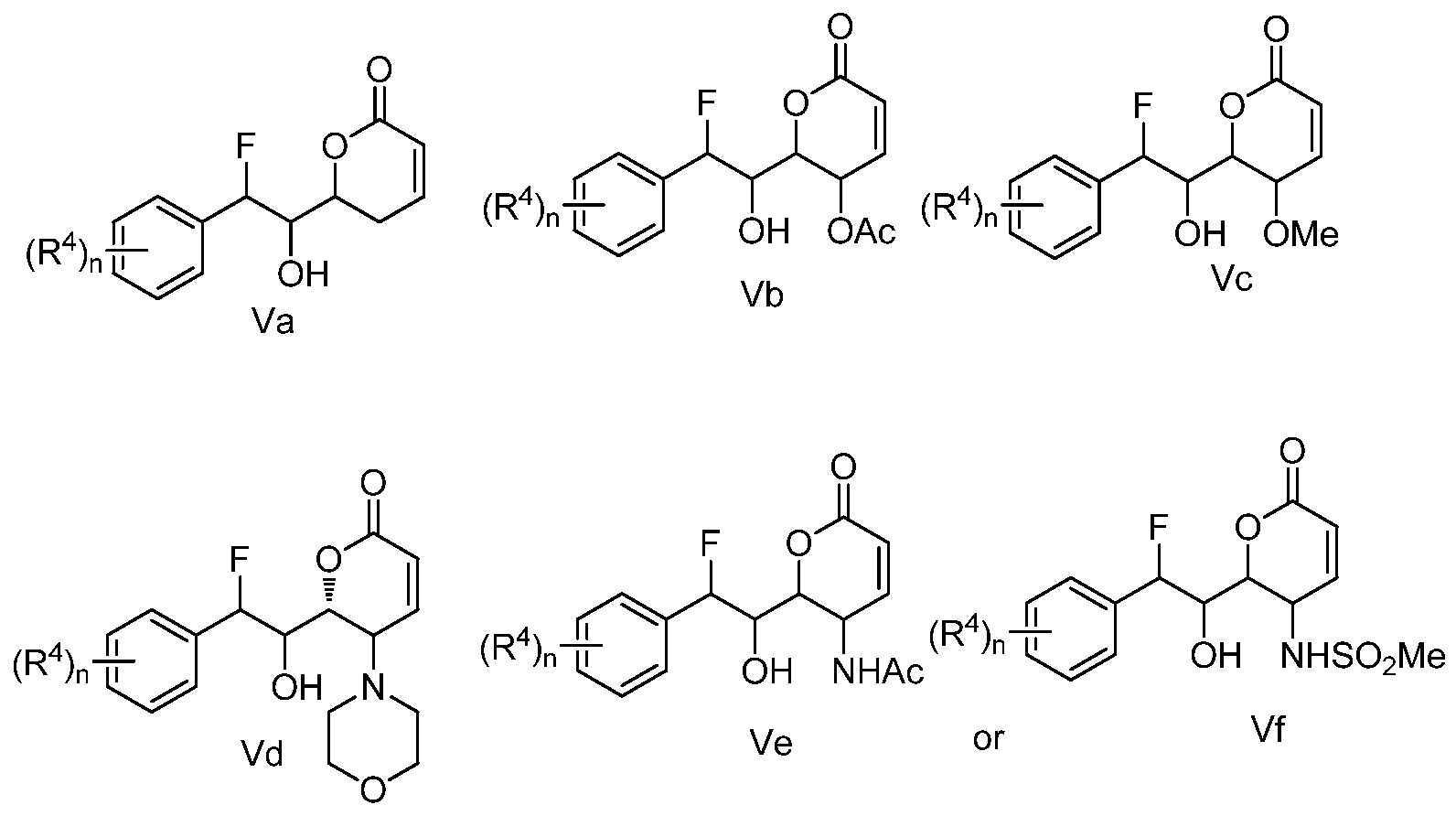
or a pharmaceutically acceptable salt, solvate or prodrug thereof;
and stereoisomers, isotopic variants and tautomers thereof;
and wherein n, and R4 are as described for formula Γ.
[00175] In one embodiment, with respect to the compound of formula Γ or I, the compound is according to formula Vg or Vh:
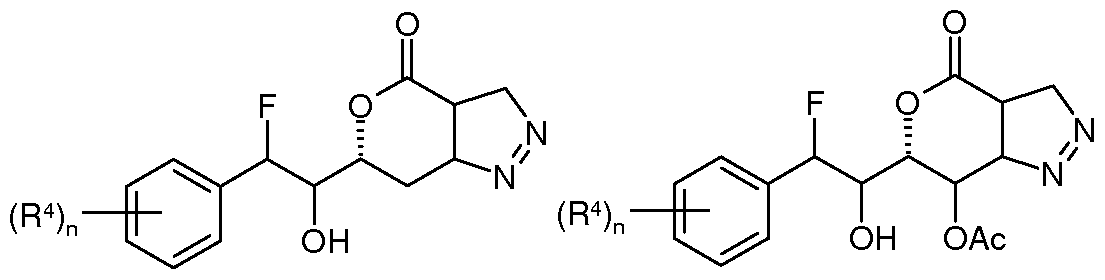
Vg or Vh
or a pharmaceutically acceptable salt, solvate or prodrug thereof;
and stereoisomers, isotopic variants and tautomers thereof;
and wherein n, and R4 are as described for formula Γ.
[00176] In one embodiment, R1 and R2 are joined together to form -0-CRwlRw2-0-, -
C(0)-0-, -NH-C(0)-NH-, or -NH-C(S)-NH-; each Rwl, and Rw2 is independently H, or substituted or unsubstituted alkyl.
[00177] In another embodiment, R1 and R2 are joined together to form -0-C(Me)2-0-,
C(0)-0-, -NH-C(0)-NH-, or -NH-C(S)-NH-.
[00178] In one embodiment, with respect to the compound of formula Γ or I, the compound is according to formula Va, Vb, Vc, Vd, Ve, or Vf:

or a pharmaceutically acceptable salt, solvate or prodrug thereof;
and stereoisomers, isotopic variants and tautomers thereof;
and wherein n, and R4 are as described for formula Γ.
[00179] In one embodiment, with respect to the compound of formula Γ or I, the compound is according to formula Vg or Vh:

Vg or Vh
or a pharmaceutically acceptable salt, solvate or prodrug thereof;
and stereoisomers, isotopic variants and tautomers thereof;
and wherein n, and R4 are as described for formula Γ.
[00180] In one embodiment, with respect to the compound of formula Γ I, Ila, lib, Ilia,
Illb, IIIc, or Hid, R1 and R2 are joined together to form -0-CRwlRw2-0-, -0-C(0)-0-, -NH- C(0)-NH-, or -NH-C(S)-NH-; each Rwl, and Rw2 is independently H, or substituted or unsubstituted alkyl.
[00181] In one embodiment, with respect to the compound of formula Γ I, Ila, lib, Ilia,
Illb, IIIc, or Hid, R1 and R2 are joined together to form -0-C(Me)2-0-, -0-C(0)-0-, -NH-C(O)- NH-, or -NH-C(S)-NH-.
[00182] In one embodiment, with respect to the compound of formula Γ or I, the compound is according to formula Via, VIb, Vic, VId, or Vie:


or a pharmaceutically acceptable salt, solvate or prodrug thereof;
and stereoisomers, isotopic variants and tautomers thereof;
and wherein n, and R4 are as described for formula Γ.
[00183] In one embodiment, with respect to the compound of formula Γ I, Ila-IIb, Illa-IIId,
IVa-IVh, Va-Vh, Vla-VId, n is 1 or 2; and each R4 is independently halo, alkyl, haloalkyl, hydroxyl, alkoxy, nitro, cyano, amino, alkylamino, or dialkylamino.
[00184] In one embodiment, with respect to the compound of formula Γ I, Ila-IIb, Illa-IIId,
IVa-IVh, Va-Vh, Vla-VId, n is 1 or 2; and each R4 is independently F, CI, CN, OH, Me, CF3, or NMe2.
[00185] In one embodiment, with respect to the compound of formula Γ I, Ila-IIb, Illa-IIId,
IVa-IVh, Va-Vh, Vla-VId, each R4 is H.
[00186] In one embodiment, with respect to the compound of formula Γ or I, the compound is accordin to formula Vila, Vllb, VIIc, Vlld, Vile, or Vllf:

and stereoisomers, isotopic variants and tautomers thereof.
[00187] In one embodiment, with respect to the compound of formula Γ or I, the compound is according to formula Vllg or Vllh:

Vllg or Vllh
or a pharmaceutically acceptable salt, solvate or prodrug thereof;
and stereoisomers, isotopic variants and tautomers thereof.
[00188] In one embodiment, with respect to the compound of formula Γ or I, the compound is according to formula Villa, VHIb, VIIIc, VHId, or VHIe:

Villa Vlllb

or a pharmaceutically acceptable salt, solvate or prodrug thereof;
and stereoisomers, isotopic variants and tautomers thereof.
[00189] In one particular embodiment, with respect to the compound of formula Γ or I, compound is according to formula IXa, IXb, IXc, IXd, IXe, or IXf:


or a pharmaceutically acceptable salt, solvate or prodrug thereof;
and stereoisomers, isotopic variants and tautomers thereof.
[00190] In another particular embodiment, with respect to the compound of formula Γ the compound is according to formula IXg or IXh:

IXg or IXh
or a pharmaceutically acceptable salt, solvate or prodrug thereof;
and stereoisomers, isotopic variants and tautomers thereof.
[00191] In another particular embodiment, with respect to the compound of formula Γ or I, the compound is according to formula Xa, Xb, Xc, Xd, or Xe:

Xa Xb
 or a pharmaceutically acceptable salt, solvate or prodrug thereof;
and stereoisomers, isotopic variants and tautomers thereof.
[00192] In a more particular embodiment, with respect to the compound of formula Γ the c mpound is

[00193] In a most particular embodiment, with respect to the compound of formula Γ or I, the compound is according to formula IXb (Compound X):

IXb (Compound X)
or a pharmaceutically acceptable salt, solvate or prodrug thereof.
[00194] In one embodiment, with respect to the compound of formula I, the compound is any one of compounds listed in Table 1.
[00195] In yet another aspect, the present invention provides pharmaceutical compositions of a compound according to formula Γ or I-Xd.
[00196] In one embodiment, the pharmaceutical composition comprises a
pharmaceutically acceptable carrier.
[00197] In one embodiment, the carrier is a parenteral carrier, oral or topical carrier.
[00198] In one embodiment, with respect to the method, the disease or condition is cancer.
[00199] In one embodiment, with respect to the method, the disease or condition is cancer of prostate, colon, bladder, melanoma, liver, breast, cervical, ovarian, esophagi, glialblastoma, or lung.
[00200] In certain aspects, the present invention provides prodrugs and derivatives of the compounds according to the formulae above. Prodrugs are derivatives of the compounds of the invention, which have metabolically cleavable groups and become by solvolysis or under physiological conditions the compounds of the invention, which are pharmaceutically active, in vivo. Such examples include, but are not limited to, choline ester derivatives and the like, N- alkylmorpholine esters and the like.
[00201] Other derivatives of the compounds of this invention have activity in both their acid and acid derivative forms, but the acid sensitive form often offers advantages of solubility, tissue compatibility, or delayed release in the mammalian organism (see, Bundgard, H., Design of Prodrugs, pp. 7-9, 21-24, Elsevier, Amsterdam 1985). Prodrugs include acid derivatives well know to practitioners of the art, such as, for example, esters prepared by reaction of the parent acid with a suitable alcohol, or amides prepared by reaction of the parent acid compound with a substituted or unsubstituted amine, or acid anhydrides, or mixed anhydrides. Simple aliphatic or aromatic esters, amides and anhydrides derived from acidic groups pendant on the compounds of this invention are preferred prodrugs. In some cases it is desirable to prepare double ester type prodrugs such as (acyloxy)alkyl esters or ((alkoxycarbonyl)oxy)alkylesters. Preferred are the Ci to Cg alkyl, C2-Cg alkenyl, aryl, C7-Ci2 substituted aryl, and C7-Ci2 arylalkyl esters of the compounds of the invention.
PHARMACEUTICAL COMPOSITIONS
[00202] When employed as pharmaceuticals, the compounds of this invention are typically administered in the form of a pharmaceutical composition. Such compositions can be prepared in a manner well known in the pharmaceutical art and comprise at least one active compound.
[00203] Generally, the compounds of this invention are administered in a pharmaceutically effective amount. The amount of the compound actually administered will typically be determined by a physician, in the light of the relevant circumstances, including the condition to be treated, the chosen route of administration, the actual compound -administered, the age, weight, and response of the individual patient, the severity of the patient's symptoms, and the like.
[00204] The pharmaceutical compositions of this invention can be administered by a variety of routes including oral, rectal, transdermal, subcutaneous, intravenous, intramuscular, and intranasal. Depending on the intended route of delivery, the compounds of this invention are
preferably formulated as either injectable or oral compositions or as salves, as lotions or as patches all for transdermal administration.
[00205] The compositions for oral administration can take the form of bulk liquid solutions or suspensions, or bulk powders. More commonly, however, the compositions are presented in unit dosage forms to facilitate accurate dosing. The term "unit dosage forms" refers to physically discrete units suitable as unitary dosages for human subjects and other mammals, each unit containing a predetermined quantity of active material calculated to produce the desired therapeutic effect, in association with a suitable pharmaceutical excipient. Typical unit dosage forms include pre filled, premeasured ampules or syringes of the liquid compositions or pills, tablets, capsules or the like in the case of solid compositions. In such compositions, the furansulfonic acid compound is usually a minor component (from about 0.1 to about 50% by weight or preferably from about 1 to about 40% by weight) with the remainder being various vehicles or carriers and processing aids helpful for forming the desired dosing form.
[00206] Liquid forms suitable for oral administration may include a suitable aqueous or nonaqueous vehicle with buffers, suspending and dispensing agents, colorants, flavors and the like. Solid forms may include, for example, any of the following ingredients, or compounds of a similar nature: a binder such as microcrystalline cellulose, gum tragacanth or gelatin; an excipient such as starch or lactose, a disintegrating agent such as alginic acid, Primogel, or corn starch; a lubricant such as magnesium stearate; a glidant such as colloidal silicon dioxide; a sweetening agent such as sucrose or saccharin; or a flavoring agent such as peppermint, methyl salicylate, or orange flavoring.
[00207] Injectable compositions are typically based upon injectable sterile saline or phosphate-buffered saline or other injectable carriers known in the art. As before, the active compound in such compositions is typically a minor component, often being from about 0.05 to
10% by weight with the remainder being the injectable carrier and the like.
[00208] Transdermal compositions are typically formulated as a topical ointment or cream containing the active ingredient(s), generally in an amount ranging from about 0.01 to about 20% by weight, preferably from about 0.1 to about 20%> by weight, preferably from about 0.1 to about
10% by weight, and more preferably from about 0.5 to about 15% by weight. When formulated as a ointment, the active ingredients will typically be combined with either a paraffmic or a water-miscible ointment base. Alternatively, the active ingredients may be formulated in a cream with, for example an oil-in-water cream base. Such transdermal formulations are well-known in the art and generally include additional ingredients to enhance the dermal penetration of stability of the active ingredients or the formulation. All such known transdermal formulations and ingredients are included within the scope of this invention.
[00209] The compounds of this invention can also be administered by a transdermal device.
Accordingly, transdermal administration can be accomplished using a patch either of the reservoir or porous membrane type, or of a solid matrix variety.
[00210] The above-described components for orally administrable, injectable or topically administrable compositions are merely representative. Other materials as well as processing techniques and the like are set forth in Part 8 of Remington's Pharmaceutical Sciences, 17th edition, 1985, Mack Publishing Company, Easton, Pennsylvania, which is incorporated herein by reference.
[00211] The compounds of this invention can also be administered in sustained release forms or from sustained release drug delivery systems. A description of representative sustained release materials can be found in Remington's Pharmaceutical Sciences.
[00212] The following formulation examples illustrate representative pharmaceutical compositions of this invention. The present invention, however, is not limited to the following pharmaceutical compositions.
Formulation 1 - Tablets
[00213] A compound of the invention is admixed as a dry powder with a dry gelatin binder in an approximate 1 :2 weight ratio. A minor amount of magnesium stearate is added as a lubricant. The mixture is formed into 240-270 mg tablets (80-90 mg of active amide compound per tablet) in a tablet press.
Formulation 2 - Capsules
[00214] A compound of the invention is admixed as a dry powder with a starch diluent in an approximate 1 : 1 weight ratio. The mixture is filled into 250 mg capsules (125 mg of active amide compound per capsule).
Formulation 3 - Liquid
[00215] A compound of the invention (125 mg), sucrose (1.75 g) and xanthan gum (4 mg) are blended, passed through a No. 10 mesh U.S. sieve, and then mixed with a previously made solution of microcrystalline cellulose and sodium carboxymethyl cellulose (11 :89, 50 mg) in water. Sodium benzoate (10 mg), flavor, and color are diluted with water and added with stirring. Sufficient water is then added to produce a total volume of 5 mL.
Formulation 4 - Tablets
[00216] A compound of the invention is admixed as a dry powder with a dry gelatin binder in an approximate 1 :2 weight ratio. A minor amount of magnesium stearate is added as a lubricant. The mixture is formed into 450-900 mg tablets (150-300 mg of active amide compound) in a tablet press.
Formulation 5 - Injection
[00217] A compound of the invention is dissolved or suspended in a buffered sterile saline injectable aqueous medium to a concentration of approximately 5 mg/ml.
Formulation 6 - Topical
[00218] Stearyl alcohol (250 g) and a white petrolatum (250 g) are melted at about 75°C and then a mixture of a compound of the invention (50 g) methylparaben (0.25 g), propylparaben (0.15 g), sodium lauryl sulfate (10 g), and propylene glycol (120 g) dissolved in water (about 370 g) is added and the resulting mixture is stirred until it congeals.
METHODS OF TREATMENT
[00219] The present compounds are used as therapeutic agents for the treatment of conditions in mammals that are causally related or attributable to p53 pathway. Accordingly, the compounds and pharmaceutical compositions of this invention find use as therapeutics for preventing and/or treating a variety of cancers in mammals, including humans.
[00220] In a method of treatment aspect, this invention provides a method of treating a mammal susceptible to or afflicted with a condition associated with cancer, which method comprises administering an effective amount of one or more of the pharmaceutical compositions just described.
[00221] In additional method of treatment aspects, this invention provides methods of inducing apoptosis in cancer cells via p53-independent and p53/Bax- and PUNA-dependent pathway, whereas it mediates cell growth arrest of normal cells via p53/p21 -dependent pathway, which will protect normal cells from killing of drugs.
[00222] As a further aspect of the invention there is provided the present compounds for use as a pharmaceutical especially in the treatment or prevention of the aforementioned conditions and diseases. Also provided herein is the use of the present compounds in the manufacture of a medicament for the treatment or prevention of cancers.
[00223] Injection dose levels range from about 0.1 mg/kg/hour to at least 10 mg/kg/hour, all for from about 1 to about 120 hours and especially 24 to 96 hours. A preloading bolus of from about 0.1 mg/kg to about 10 mg/kg or more may also be administered to achieve adequate steady state levels. The maximum total dose is not expected to exceed about 2 g/day for a 40 to 80 kg human patient.
[00224] For the prevention and/or treatment of long-term conditions, the regimen for treatment usually stretches over many months or years, so oral dosing is preferred for patient convenience and tolerance. With oral dosing, one to five and especially two to four and typically three oral doses per day are representative regimens. Using these dosing patterns, each dose
provides from about 0.01 to about 20 mg/kg of the compound of the invention, with preferred doses each providing from about 0.1 to about 10 mg/kg and especially about 1 to about 5 mg/kg.
[00225] Transdermal doses are generally selected to provide similar or lower blood levels than are achieved using injection doses. Modes of administration suitable for mucosal sites are also envisioned herein and include without limitation: intra-anal swabs, enemas, intranasal sprays, and aerosolized or vaporized compounds and/or compositions for delivery to the lung mucosa. One of skill in the art would choose an appropriate delivery mode/s based on a variety of parameters, including the organ or tissue site in a patient with a disease or condition that is most severely affected by the disease or condition.
[00226] When used to prevent the onset of cancer, the compounds of this invention will be administered to a patient at risk for developing the cancer, typically on the advice and under the supervision of a physician, at the dosage levels described above. Patients at risk for developing a particular condition generally include those that have a family history of the condition, or those who have been identified by genetic testing or screening to be particularly susceptible to developing the condition.
[00227] The compounds of this invention can be administered as the sole active agent or they can be administered in combination with other agents, including other compounds that demonstrate the same or a similar therapeutic activity and are determined to safe and efficacious for such combined administration.
GENERAL SYNTHETIC PROCEDURES
[00228] The heterocyclo compounds of this invention may be purchased from various commercial sources or can be prepared from readily available starting materials using the following general methods and procedures. It will be appreciated that where typical or preferred process conditions (i.e., reaction temperatures, times, mole ratios of reactants, solvents, pressures, etc.) are given, other process conditions can also be used unless otherwise stated. Optimum reaction conditions may vary with the particular reactants or solvent used, but such conditions can be determined by one skilled in the art by routine optimization procedures.
[00229] Additionally, as will be apparent to those skilled in the art, conventional protecting groups may be necessary to prevent certain functional groups from undergoing undesired reactions. The choice of a suitable protecting group for a particular functional group as well as suitable conditions for protection and deprotection are well known in the art. For example, numerous protecting groups, and their introduction and removal, are described in T. W. Greene and P. G. M. Wuts, Protecting Groups in Organic Synthesis, Second Edition, Wiley, New York, 1991, and references cited therein.
[00230] The compounds of the invention may be prepared from known or commercially available starting materials and reagents by one skilled in the art of organic synthesis.
General Materials and Methods:
[00231] All commercially available reagents and solvents were purchased and used without further purification. ESI-MS experiments were performed on a Shimadzu LCMS- 2010EV mass spectrometer. ID and 2D NMR experiments were performed on a Bruker AM-300 and DRX-500 NMR spectrometer. Deuterated reagents were purchased from Sigma Aldrich. Chemical shifts were given in δ with TMS as internal reference. The unit of δ was ppm, and J was Hz. Chromatography separations were performed with 300-400 mesh silica gels. Thin layer chromatography was carried out on 0.4-0.5 mm silica plates. The silica gels and plates were prepared by Yantai Jiangyou Silica Gel Development Co., Ltd. Analytically pure solvents were purchased from Tianjin Chemical Co., Ltd.
[00232] The following general procedures were used to synthesize compounds having different but analogous structures. One skilled in the art of synthesis will recognize how to modify these general procedures if necessary to accomplish the desired transformations.
Representative Synthetic Methods
Example C-l
General Method for Preparation of the Compounds of Invention
[00233] The representative 8-fluoro-7-hydroxy compounds of the invention can be prepared using the general synthetic pathway depicted in Scheme 1.
Scheme 1

and wherein R1, R4, R5, R6, and n are as described herein.
The 8-fluoro-7-hydroxy compounds can further used to prepare representative 2-13 using the synthetic pathway depicted in Scheme 2.
heme 2

a) BF3 OEt2, DCM, -78 °C; b) Ac20, DMAP, Pyridine, RT; c) CH2N2, Et20, 0 °C; d) Et3N, MeOH, RT; e) RCOC1, Et3N, DMAP, DCM, -40 °C; f) RNH2, Pd(PPh3)4, PPh3, DMF, 80 °C; g) CH2N2, Et20, 0 °C; h) KN03, HN03, 0 °C; i) DMP, TsOH, RT;
[00235] Using isolation product cheliensisine A as the starting material, the epoxide ring- opening product 2 was first prepared by reacting with BF3OEt2 in DCM (Scheme 1). The fluoride 2 was then used as the substrate for further modifications (Scheme 2). The C-7 alcohol was converted to its acetyl ester 3 by treatment of Ac20 in presence of base. A [3+2] reaction of compound 2 with CH2N2 in ether provided the adduct 4 in moderate yield. Hydrolysis of C-5 acetoxyl group with Et3N in MeOH afforded the diol 5 in good yield. Subsequently, the diol 5 was selectively esterifized with acyl chloride and Et3N, giving mono-esters 6 and 7 in moderate yield. And treatment of the diol 5 with 2,2-dimethoxyl propane (DMP) in presence of TsOH furnished acetonylidene 12 in good yield. Tsuji-Trost reaction of the fluoride 2 with Pd(PPh3)4 as the catalyst and amine as the nucleaphilic reagent delivered the amines 8 and 9 in moderate yield and compound 13 as a side product. The phenyl ring of compound 2 was functionalized with KN03 in fumed HN03, giving nitro 10 and 11 in moderate yield.
Example C-2
Isolation of Cheliensisin A

[00236] Cheliensisin A was isolated from ethanol extract of Announaceae plants
Goniothalamus cheliensis Hu in Yunnan province, China.
[00237] Crushed leaves of Goniothalamus cheliensis Hu were leached with ethanol (100 kg). The concentrated extract was separated by silica gel column chromatography. The crude product was achieved from petroleum ether - ethyl acetate (7:3), and separated by medium pressure column chromatography. The crude product was achieved from 70% methanol-water part, and further recrystallized from chloroform to afford Cheliensisin A (300g).
Example C-3
Compound 2

[00238] To a solution of Cheliensisin A (548 mg) in dichloromethane (12 mL) was added dropwise a solution of boron trifluoride etherate (202 μί) in dichloromethane under -78 °C nitrogen. The reaction was monitored by TLC. After the completion of the reaction (~ 0.5 h), a saturated aqueous sodium bicarbonate solution (6ml) was added to quench the reaction. The mixture was extracted by dichloromethane (50 mL><3). The combined organic phase was washed with H20 and brine, dried over anhydrous Na2S04 and concentrated. The resulting crude product was chromatographed on silica gel using petroleum ether/etrol ether (1.5: 1) to afford Compound 2 (312 mg, 53%).
1H-NMR (CDCI3, 300 MHz) δΗ 7.30-7.34 (m, 5H), 7.03 (dd, J=10.8 Hz, 4.5 Hz, IH), 6.15 (d, J=10.2 Hz, IH), 5.36 (t, J= 5.4 Hz, 5.4 Hz, IH), 4.89 (t, J= 4.8 Hz, 4.8 Hz, IH), 5.91 (d, J= 45.0 Hz, IH), 3.96 (d, J= 5.4 Hz, IH), 2.06 (s, 3H); ESI-MS (m/z) 317 [M+Na]+.
Example C-4

[00239] To a solution of Compound 2 (30 mg) and 4-N,N-dimethylamino-pyridine
(catalytic amount) in pyridine (1 mL) was added dropwise a solution of acetic anhydride (30 μί) at 0 °C. The mixture was allowed to warm up to room temperature and was stirred until the completion of the reaction (~1 h, TLC). Then the mixture was extracted by dichloromethane (50 mLx3). The combined organic phase was washed with H20 and brine, dried over anhydrous Na2S04 and concentrated. The resulting crude product was chromatographed on silica gel using petroleum ether/etrol ether (1 : 1) to afford pure Compound 3 (33 mg, 98%).
1H-NMR(CDC13, 300 MHZ): M 7.32-7.40 (m, 5H), 7.01 (dd, J= 9.6 Hz, 6.0 Hz, IH), 6.32 (d, J= 9.6 Hz, IH), 6.12 (d, J= 45 Hz, IH), 5.50 (dd, J= 27.6 Hz, 10.2 Hz, IH), 5.35(dd, J= 6.0 Hz, 2.7 Hz, IH), 4.98 (dd, J= 10.2 Hz, 2.4 Hz, IH), 2.00 (s, 3H), 1.82 (s, 3H); ESI-MS (m/z) 337
[M+H]+.
Example C-5
Compound 4

[00240] To a solution of compound 2 (30 mg) in diethyl ether (0.5 mL) was added dropwise a solution of diazomethane in ether solution (0.5 mL) under nitrogen at 0 °C. After completion of reaction (-0.5 h, TLC) an appropriate amount of acetic acid was added to quench the reaction. Then the mixture was extracted by ethyl acetate. The combined organic phase was washed with saturated brine, dried over anhydrous Na2S04 and concentrated. The crude product was purified by preparative Thin-layer chromatography to afford pure Compound 4 (18 mg, 53%).
1H-NMR (300 MHz, CDC13): δ H 7.39-7.47 (m, 5H), 6.34 (d, J= 3.6 Hz, 1H), 6.01 (d, J= 45.6 Hz, 1H), 5.14 (s, 1H), 4.52 (dd, J= 9.3 Hz, 2.1 Hz, 1H), 4.32 (t, J= 10.5 Hz, 10.5 Hz, 1H), 4.12 (dd, J= 14.1 Hz, 7.5 Hz, 1H) 3.57 (ddd, J= 16.8 Hz, 9.3 Hz, 3.9 Hz, 1H), 3.24 (dd, J= 17.4 Hz, 14.1 Hz, 1H), 2.12 (s, 3H), 1.25 (m, 2H); ESI-MS (m/z) 351 [M+H]+.
Example C-6
mpound 5

[00241] To a solution of Compound 2 (29 mg) in methanol (1 mL) was added Et3N (12 mg) dropwise at 0 °C. The reaction was monitored by TLC and was complete in 15 min. An aqueous hydrochloric acid solution (2 N, 0.1 mL) was added to quench the reaction. The mixture was then extracted with ethyl acetate (5 mL x3). The combined organic phase was washed with H20 and brine, dried over anhydrous Na2S04 and concentrated. The crude product was chromatographed on silica gel using petroleum ether/etrol ether (1 : 1) to afford Compound 5 as white foam (24 mg, 94%).
1H-NMR (400 MHz, MeOD) δ 7.68 (d, J= 8 Hz, 1H), 7.34-7.38 (m, 4H), 7.31 (d, J= 8 Hz, 1H), 6.18 (d, J= 4 Hz, 1H), 5.89 (d, J= 44 Hz, 1H), 5.49 (s, 1H), 4.04 (d, J= 12 Hz, 1H), 3.79 (dd, J= 28 Hz, 12 Hz, 1H); ESI-MS (m/z) 253 [M+H]+.
Example C-7
Compound 6

[00242] To a solution of compound 5 (13 mg) in dry dichloromethane (1 mL) and Α-Ν,Ν- dimethylamino-pyridine (2 mg) was treated dropwise with a solution of Et3N (11 mg) and then with benzoyl chloride (11 mg) at 0 °C. The reaction was monitored by TLC and was complete in
2 h. A saturated aqueous NaHC03 solution was added to quench the reaction. The mixture was then extracted with ethyl acetate (x3). The combined organic phase was washed with H20 and brine, dried over anhydrous Na2S04 and concentrated. The crude product was chromatographed on silica gel using petroleum ether/etrol ether (2: 1) to afford Compound 6 (10 mg, 57%) as white foam.
1H-NMR (400 MHz, CDC13) δ 7.92 (d, J= 8 Hz, 2H), 7.51 (t, J= 8 Hz, 4 Hz, 1H), 7.28-7.38 (m, 7H), 7.16 (dd, J= 12 Hz, 4 Hz, 1H), 6.28 (d, J= 8 Hz, 1H), 6.02 (d, J= 44 Hz, 1H), 5.70 (d, J = 4 Hz, 1H), 4.81 (dd, J= 8 Hz, 4 Hz, 1H), 4.06 (dd, J= 24 Hz, 8 Hz, 1H); EI-MS (m/z) 356 [M]+.
Example C-8
Compound 7

[00243] The compound 7 was prepared by the reaction of Compound 5 with t-Bu-COCl and following the procedure described in Example 7.
1H-NMR (400 MHz, CDC13) δ 7.42 (s, 5H), 7.13 (dd, J= 8 Hz, 8 Hz, 1H), 6.29 (d, J= 8 Hz, 1H), 6.07 (d, J= 44 Hz, 1H), 5.44 (s, 1H), 4.75 (d, J= 12 Hz, 1H), 4.05 (dd, J= 28 Hz, 8 Hz, 1H), 1.17 (s, 9H); EI-MS (m/z) 336 [M]+.
Example C-9
Compound 8

2
8
[00244] Tris (dibenzylidene acetone) palladium (3 mg) and triphenylphosphine (2 mg) was dissolved in tetrahydrofuran (1 mL). The mixture was stirred at room temperature for half an hour, and the solution of compound 2 (29 mg) in tetrahydrofuran (0.5 mL) was added. The mixture was then treated dropwise with t-butyl amine (17mg). The reaction was monitored by
TLC. After completion of the reaction, saturated aqueous ammonium chloride was added and the mixuture was extracted several times with methylene chloride. The combined organic phases were washed with saturated sodium chloride solution, then dried over anhydrous sodium sulfate and concentrated. The crude product was chromatographed on silica gel using
chloroform/methanol (30: 1) to afford compound 8 (20 mg, 65%).
1H-NMR (400 MHz, CDC13) δ 7.29-7.48 (m, 5H), 6.93 (dd, J= 10.0 Hz, 5.6 Hz, 1H), 6.31 (d, J = 10.0 Hz, 1H), 4.90 (d, J= 3.2 Hz, 1H), 4.65 (dd, J= 6.8 Hz, 5.2 Hz, 1H), 4.12 (dd, J= 6.8 Hz, 3.2 Hz, 1H), 3.48 (t, J= 5.2, 5.2 Hz, 1H), 2.76 (m, 2H), 2.53 (dd, J= 6.0 Hz, 4.8 Hz, 2H), 2.39 (d, J= 5.6 Hz, 2H), 1.92 (s, 1H), 1.56 (m, 4H); ESI-MS (m/z) 317 [M+H]+.
Example C-10
Compound 9

[00245] Tris (dibenzylidene acetone) palladium (3 mg) and triphenylphosphine (2 mg) was dissolved in tetrahydrofuran (1 mL). The mixture was stirred at room temperature for half an hour, and the solution of compound 2 (29 mg) in tetrahydrofuran (0.5 mL) was added. The mixture was then treated dropwise with morpholine (17 mg). The reaction was monitored by TLC. After completion of the reaction, saturated aqueous ammonium chloride was added and the mixuture was extracted several times with methylene chloride. The combined organic phases were washed with saturated sodium chloride solution, then dried over anhydrous sodium sulfate and concentrated. The crude product was chromatographed on silica gel using
chloroform/methanol (30: 1) to afford compound 9 as a white amorphous solid (21 mg, 65%). 1H-NMR (300 MHz, CDC13) δ 7.39-7.47 (m, 5H), 6.95 (dd, J= 9.6 Hz, 5.4 Hz, 1H), 6.35 (d, J = 9.9 Hz, 1H), 4.99 (d, J= 1.5 Hz, 1H), 4.70 (dd, J= 9.9 Hz, 4.5 Hz, 1H), 4.12 (d, J= 3.9 Hz, 1H), 5.69 (t, J= 4.2 Hz, 1H), 2.01 (s, 3H), 1.97 (dd, J= 7.2 Hz, 1.2 Hz, 3H); ESI-MS (m/z) 322
[M+H]+.
Example C-l 1
Compounds 10 and 11

10 11
[00246] To mixed solution of nitric acid - fuming nitric acid (0.5 mL / 0.5 mL) was added potassium nitrate (101 mg) under 0 °C. After 15 minutes of stirring, crushed Compound 2 (29 mg) was added to the mixture. The mixture was diluted by ice water after 15 minutes reaction. The aqueous phase was extracted by ethyl acetate (x3). The combined organic phases were washed with saturated NaHC03 solution, water and saturated sodium chloride solution, then dried over anhydrous sodium sulfate and concentrated. The crude product was chromatographed on silica gel using petroleum ether/ethyl acetate (1.5: 1) to afford compound 10 (26 mg, 78%) and compound 11 (4.5mg, 13%).
Compound 10 as white foam, 1H-NMR (400 MHz, CDC13) δ 8.23 (d, J= 8 Hz, 2H), 7.55 (d, J = 8 Hz, 2H), 7.07 (d, J= 8 Hz, 4Hz, 1H), 6.26 (d, J= 12 Hz, 1H), 6.09 (d, J= 48 Hz, 1H), 5.41 (d, J= 4 Hz, 1H), 4.69 (d, J= 12 Hz, 1H), 3.93 (ddd, J= 24 Hz, 8 Hz, 4 Hz, 1H), 2.03 (s, 3H); ESI- MS (m/z): 362 [M+Na]+.
Compound 11 as white foam, 1H-NMR (400 MHz, CDC13) δ 8.14 (d, J= 8 Hz, 1H), 7.84 (d, J = 8 Hz, 1H), 7.73 (t, J= 8 Hz, 8 Hz, 1H), 7.54 (t, J= 8 Hz, 4Hz, 1H), 7.08 (dd, J= 12 Hz, 8 Hz, 1H), 6.66 (d, J= 44 Hz, 1H), 6.27 (d, J= 8 Hz, 1H), 5.48 (dd, J= 8 Hz, 4 Hz, 1H), 4.75 (dd, J = 8 Hz, 4 Hz, 1H), 4.37 (dd, J= 24 Hz, 8 Hz, 1H), 2.07 (s, 3H); ESI-MS (m/z): 362 [M+Na]+.
Example C-12
Compound 12
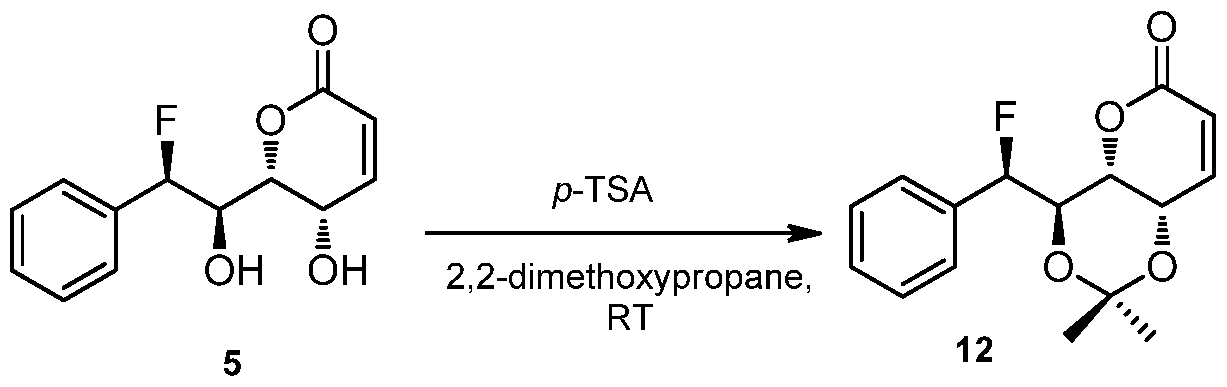
[00247] To a solution of Compound 5 (12 mg) in 2,2-dimethoxypropane (lmL) was added p-toluenesulfonic acid (catalytic amount). The reaction was monitored by TLC. After
completion of the reaction (~2 h), the solvent was distilled off under reduced pressure. The crude product was chromatographed on thin-layer chromatography using petroleum ether/ethyl acetate (2: 1) to afford Compound 12 (10 mg, 68%).
Compound 12 as colorless film-like substance, 1H-NMR (400 MHz, CDC13) δ 7.35-7.40 (m, 5H), 6.80 (dd, J= 8 Hz, 12 Hz, 1H), 6.23 (d, J= 8 Hz, 1H), 5.80 (d, J= 48 Hz, 1H), 4.94 (dd, J= 8 Hz, 4 Hz, 1H), 4.39 (t, J= 8 Hz, 4 Hz, 1H), 4.05 (dd, J= 24 Hz, 8 Hz, 1H), 1.41 (s, 3H), 1.18 (s, 3H). EI-MS (m/z): 292 [M]+.
Example C-13
Compound 13

[00248] The compound is obtained as a side product during the synthesis of Compound 9.
Compound 13, colorless film, 1H-NMR (400 MHz, CDC13) δ 7.35-7.42 (m, 5H), 7.32 (dd, J= 12 Hz, 4 Hz, 1H), 6.35 (d, J= 4 Hz, 1H), 6.24 (d, J= 8 Hz, 1H), 5.89 (dd, J= 44 Hz, 4 Hz, 1H), 4.69 (d, J= 24 Hz, 4 Hz, 1H); EI-MS (m/z) 250 [M]+.
EXAMPLES
Example 1
Dual Role of p53-regulated p21 and Bax in Apoptotic Induction by Compounds of the Invention
[00249] The tumor suppressor p53 plays a key role in negative regulation of cellular growth upon treatment of chemotherapeutics agents. To further explore the role of p53 signaling and elucidate the molecular mechanism, the inventors employed colon cancer HCTl 16 cell line and its derivatives in which a specific transcriptional target of p53 is knocked down by homologous recombination. Treatment with a representative compound of the invention,
Compound F2, resulted in inhibited anchorage-independent growth and a cell apoptotic response, and led to induction of p53, p21 and Bax in HCTl 16 cells. Induction of Bax by Compound F2 was essential for Compound F2-induced apoptosis, for Compound F2 -induced anchorage- independent growth inhibition and apoptosis was dramatically impaired in Bax knockout (Bax-/-) HCTl 16 cells. In contrast, treatment of HCTl 16 p21-/- cells with Compound F2 resulted in enhanced sensitivity to Compound F2 -induced anchorage-independent growth inhibition and
apoptosis. Taken together, the inventors' results present a novel concept wherein p21 induced by p53-dependent transcription protects cells from, otherwise, in its absence, apoptosis which is mediated by p53-dependent activation of pro-apoptotic protein Bax. p21 thus can be used as a molecular switch for therapeutic intervention of colon cancer.
[00250] As discussed above, most chemotherapeutic agents induce cell death through activation of the p53 pathway. In response to various cellular stresses, p53 regulates a variety of cellular functions including cell cycle progression, apoptosis, senescence, cell motility, DNA repair, genetic instability and cell metabolism by transcriptionally activating a variety of cellular genes (1.4-1.7). Significantly, there is evidence from cell, animal and clinical studies that p53 is associated with cancer cell or patient sensitivity in response to various anti-cancer agents (1.8- 1.10). In colorectal cancer cells, p53 disruption rendered cells resistant to the anti-metabolite 5- FU but sensitized these cells to the DNA damaging drug doxorubicin (1.11). Therefore the role of p53 in mediating anti-cancer response is complex and depends on both cellular context and class of chemotherapeutics. However, the molecular mechanism underlying this distinct role of p53 in the response of different tumor cell types to various drug groups is not fully understood.
[00251] p21 is a member of the Cip/Kip family inhibitors of cell cycle progression that associates with the cyclin/CDK complexes leading to the inhibition of CDK activities and DNA replication (1.12). p21 is a p53 target gene and it is a relevant mediator of p53-induced cell cycle arrest in response to DNA damaging agents and/or oncogenic stress(1.12, 1.13). Other studies have shown that p21 has additional functions as a differentiation inducer (1.14, 1.15) and as an inhibitor of apoptosis induced by DNA-damaging agents (1.16). It was reported that p21 performed anti-apoptosis role through binding and inhibiting the main effector caspase, caspase 3 (1.17). However, cell death induced by caffeine on irradiated MCF7 breast cancer cells that do not express caspases 3, was linked to a decrease of the expression of p21 and, consistently, was counteracted by overexpressed p21 (1.18). Therefore, the antiapoptotic function of p21 may not only involve its capacity to inhibit the caspase 3 and may act more upstream in the apoptotic machinery.
[00252] The Bcl-2 family of interacting proteins acts as major regulators of the
mitochondrial apoptotic pathway, representing an integrating node towards which converge numerous death and survival signals in mammalian cells(l .19). Anti-apoptotic Bcl-2 homologues preserve mitochondrial integrity by opposing the activity of multi-domain pro-apoptotic Bcl-2 family members Bax and Bak, and that of their upstream effectors, the BH3-only proteins (e.g. Bim, Puma, Bad...). This occurs essentially by physical interactions between anti- and pro- apoptotic members that involve engagement of the BH3 domain of the latter by a hydrophobic pocket formed at the surface of the former. These physical interactions play a key role in
maintaining cell survival. More specifically, mechanistic investigations revealed that the interactions required to maintain survival are these that the anti-apoptotic proteins (such as Bcl-2 and Bcl-xL) engage with "activator" BH3-only proteins (such as Puma or Bim, which can directly activate Bax) and with multi-domain proteins themselves (such as Bax) (1.20, 1.21). It should be noted that induction of Puma upon DNA damage does not trigger apoptosis unless p21 expression is abolished, indicating that p21 can interfere with cell death via affecting downstream of Puma (1.22).
[00253] In this Example, the inventors investigated the role played by p53 and two of its target proteins, p21 and Bax in cell death induced by Compound F2, a newly discovered anticancer agent. Our results indicated that Compound F2 treatment induced p53-dependent transcription of Bax, which played important role in Compound F2-induced cancer cell apoptosis. The results also showed that p21, induced through p53-dependent transcription, exerted anti- apoptosis function in Compound F2-treated cells. In the absence of p21 these cells switch to apoptosis. Thus, p53 has a dual role in therapeutic intervention of colon cancer by Compound F2.
Plasmids, Antibodies, and Reagents.
[00254] The antibodies specific against PARP, caspase-3, cleaved caspases-3 were purchased from Cell Signaling Technology Inc (Beverly, MA). The antibody specific against p53 was bought from Santa Cruz Biotechnology (Santa Cruz, CA). The antibodies against Bax and p21 were purchased from Upstate Biotechnology (Lake Placid, NY). Antibody against β-actin was from Sigma (St. Louis, MO).
[00255] The Compound F2 was prepared according the methods of invention. Compound
F2 was dissolved in dimethyl sulfoxide (DMSO, Santa Cruz Biotechnology) to make a stock concentration at 16 mM and further diluted in McCoy's 5A medium with final DMSO
concentration at 0.2% (v/v) for cell culture experiments. The same amount of DMSO was used as a vehicle control in all experiments.
Cell Culture and Transfection.
[00256] Human colon cancer cell line HCT116 and its p53-deficient (HCT116-p53"/_), Bax-deficient(HCTl 16-Bax"7"), p21-deficient(HCTl 16-ρ2Γ/_) derivative was kindly provided by Dr. Bert Vogelstein (Johns Hopkins University Medical Institutions, Baltimore, MD)(1.23).
HCT116 cells were maintained at 37°C in a 5% C02 incubator in McCoy's 5A medium
supplemented with 10% fetal bovine serum (FBS). Stable transfections were performed with specific cDNA constructs using Poly Jet™ DNA In Vitro Transfection Reagent (SignaGen Laboratories, Gaithersburg, MD) according to the manufacturer's instructions. For stable transfection selection, cultures were subjected to blasticidin selection for 4-6 weeks, and surviving cells were pooled as stable mass transfectants as described in our previous study (1.24).
Anchorage-independent Growth Assay.
[00257] Anchorage-independent growth (soft agar assay) in soft agar was carried out as described in inventors' previous studies (1.25). Briefly, lxl 04 cells mixed with various concentration of Compound X in 10% FBS BME containing 0.33% soft agar, was seeded over bottom layer of 0.5% agar in 10% FBS BME in each well of 6-well plates. The plates were incubated in 5% C02 incubator at 37°C for 3 weeks, and the colonies with more than 32 cells of each were scored and presented as colonies/1 x lO4 cells. The data as collected is shown in Figures 1A-1B.
Flow Cytometry Assay.
[00258] Flow cytometry assay was assessed as previously described in reference (1.26).
After the time periods indicated, the Compound X-treated and control cells were harvested and fixed in 75% ethanol. The fixed cells were stained in the buffer containing 0.1% Triton X-100, 0.2 mg/ml RNase A, and 50 μg/ml PI (propidium iodide) at 4 °C for 1 hour and were then examined by flow cytometry utilizing an Epics XL FACS (Beckman Coulter Inc., Miami, FL) and EXPO 32 software as described previously (1.26).
Western Blotting.
[00259] Cellular protein extracts were prepared with cell lysis buffer (10 mM Tris-HCl, pH 7.4, 1% SDS, 1 mM Na3V04) and resolved by SDS-PAGE. The membranes were probed with the indicated primary antibodies and HRP-conjugated secondary antibody. Signals were detected with the ECL western-blotting system as described in our previous reports (1.27, 1.28).
RT-PCR.
[00260] Total RNA was extracted with Trizol reagent (Gibco) and cDNAs were synthesized with the ThermoScript™RT-PCR system (Invitrogen, Carlsbad, CA). To detect Bax induction, a pair of oligonucleotides (5'- AGC TGC AGA GGA TGA TTG CC-3'and 5'- TGG
TTC TGA TCA GTT CCG GC-3') was synthesized and used as the specific primers to amplify human Bax cDNA. For p21 induction, a pair of oligonucleotides (5'- ATG TCC GTC AGA ACC
CAT GC-3'and 5'- GAG AAG ATC AGC CGG CGT TT-3') was synthesized and used as the specific primers to amplify human p21 cDNA. Human β-actin cDNA was amplified by the primers 5'-GTG CTA TCC CTG TAC GCC TC-3' and 5'-CCA GGA AGG AAG GCT GGA AG -3'.
Statistical Methods.
[00261] All data are presented as mean values ± standard deviation (SD) of three independent experiments. Comparison of the effects of various treatments was performed using factor analysis, one-way ANOVA analysis of variance and a two-tailed t-test. Difference with a p value of < 0.05 was considered statistically significant.
RESULTS
Compound F2 efficiently blocked anchorage-independent growth and induced cell apoptosis.
[00262] To clarify the potential application of Compound F2 in the treatment of human colon cancer, the inventors first examined the inhibition of anchorage-independent growth of human colon cancer cell treated with this compound. As in Figs. 1 A and B, incubation of Compound F2 with HCT116 cells in soft agar for 2 weeks exhibited significantly restrained the size and number of colonies when compared with the vehicle (DMSO, 0.2%)-treated cells. To elucidate the molecular mechanisms of Compound F2 inhibiting anchorage-independent growth, the inventors applied propidium iodide (Pl)-staining flow cytometry for measuring apoptosis and cell cycle transition, which were showed underlying anchorage-independent growth(1.29).
HCT116 cells were treated either with DMSO (0.2%), 16 μΜ or 32 μΜ Compound F2 for 48 h and results revealed a substantial increase in sub-Gl DNA content (apoptotic peak) compared with cells treated with vehicle control (Fig. 1C). Next, the inventors analyzed the Compound F2- induced apoptotic cell death by examining the expression of caspase-3 and PARP (poly (ADP- ribose) polymerase) after treatment with Compound F2. When cells were treated with 16μΜ Compound F2, as expected, cleaved caspases-3 and PARP were detected in a time-dependent manner from 24 h to 48 h (Fig. ID). These results confirmed reproducible apoptotic effects of Compound F2 on different human colon cancer cell lines, and indicated that the apoptosis inducing effect was mediated by activation of caspases-3.
Compound F2 induced p53-dependent Bax and p21 accumulation
[00263] Having established that Compound F2 could induce the apoptosis in colon cancer cells, the inventors next focused on the molecular mechanisms of apoptosis induced by
Compound F2 and tested several important apoptosis-related proteins. The inventors cultured
HCT116 colon cancer cells in the presence of 16μΜ Compound F2 and then examined protein levels at different time point. Fig. 2A showed that Compound F2 treatment caused p53 and its downstream target p21 and Bax increasing as time-dependent manner. Since p21 and Bax can be induced through both of p53-dependent and p53-independent pathways (1.30, 1.31), the inventors next investigated whether p21 and Bax is p53-dependent. The induction of p21 and Bax by Compound F2 in HCT116 WT cells was blocked in p53-/- HCT116 cell (Fig. 2D). These results showed that Compound F2-induced p21 and Bax accumulations are via p53-dependent axis. p53 and its downstream gene p21 and Bax, played different role in Compound F2-induced cell apoptosis
[00264] To further asses the role of p53, p21 and Bax in Compound F2-induced apoptosis, the inventors used HCT116 cells with either of these genes deleted by homologous
recombination (1.23). When treated with Compound F2, Bax-/- cells were completely refractory to apoptosis (1.00% vs. 18.30% when treated with 16 μΜ Compound F2, and 0.69% vs. 26.27% when treated with 32 μΜ Compound F2, Figs. 2B and 2C). In contrast, p53-/- cells were still able to undergo marked apoptosis, identical to parental HCT116 cells (7.41% vs. 18.30%) when treated with 16μΜ Compound F2, and 14.18%) vs. 26.27%) when treated with 32μΜ Compound F2, Figs. 2B and 2C). These results indicated that loss of Bax confers resistance of HCT116 cells to apoptosis induced by Compound F2, but loss of p53 with much less this effect. In the term of another p53 downstream target p21, the result showed that p21-/- HCT116 cells were more sensitive than wild type cells when treated with Compound F2 (80.31% vs. 26.27%) when treated with 32 μΜ Compound F2, in Fig. 2C).
[00265] To determine whether Bax is required for Compound F2-induced apoptosis, Bax knockout HCT116 cells were treated with 16 μΜ Compound F2 and subjected to Western Blot. As expected, Compound F2 treatment induced caspases 3 and PARP cleavage in wild type (WT) but not Bax-deficient cells (Fig. 2E). Taken together, these results showed that p53 functions upstream of p21 and Bax, which controlled Compound F2-induced apoptosis diversely.
Bax, upregulated through p53-dependent transcription, played a positive role in Compound F2- induced cell apoptosis
[00266] It is well accepted that Bax can be induced in response to a wide variety of stress
(1.32). Considering Bax expression being regulated through different levels (1.33), the inventors evaluated Bax mRNA levels induced by Compound F2 between HCT116 WT and p53-/- cells.
Bax mRNA expression was profoundly upregulated by Compound F2 treatment in HCT116 WT
cells, but this induction was blocked by p53 deficiency (Fig. 3A). The inventors' results demonstrated that Bax accumulation in HCTl 16 cells after Compound F2 treatment was through p53-dependent manner. As expected, Bax deficiency had no role in p53 and p21 induction (Fig. 3B). To determine the effect of Bax deficiency on inhibited cancer cell growth induced by Compound F2, the inventors also performed anchorage-independent cell growth assay with HCTl 16 Bax-/- cells and the result showed that Compound F2 treatment only partially inhibit colony formation in HCTl 16 Bax-/- cells (Fig. 3C). Collectively, these results show that Bax induction dependent on p53 play an important role in Compound F2-induced apoptosis and inhibited cancer cell growth in colon cancer cells.
P21, also upregulated through p53-dependent transcription, protected cells against in Compound F2-induced cell apoptosis
[00267] In human colon cancer HCTl 16 cells, Bax induction by Compound F2 was through p53-dependent transcription (Fig. 3A), and Compound F2-induced apoptosis was through Bax-mediated mitochondrial pathway (Fig. 2E). In contrast, p21 deficiency cells were more sensitive to Compound F2 (Fig. 2F). To further asses the role of p53 and p21 in Compound F2-induced apoptosis, the inventors evaluated p21 mRNA levels induced by Compound F2 between HCTl 16 WT and p53-/- cells. Under the treatment with Compound F2, p21 mRNA expression increased in time-course manner in HCTl 16 WT cells, but this induction was blocked by p53 deficiency (Fig. 4A). Therefore, p21 induction in HCTl 16 cells after Compound F2 treatment was through p53-dependent manner.
[00268] p21 expression has been shown to be regulated largely at the transcriptional level by both p53-dependent and -independent mechanisms (1.34). The p21 promoter contains two conserved p53-binding sites, and at least one of these is required for p53 responsiveness after DNA damage (1.35). Inventors' study showed that p53 binding site in p21 promoter played a essential role in mediating Compound F2-induced p21 expression (Fig. 4C).
DISCUSSION
[00269] With the accumulating exploration of molecular mechanisms of plant natural compound activity, they have been widely used as candidate anti-tumor agents (1.36). The tumor suppressor p53 has a central role in plant natural compound's therapeutic modality (1.36). This protein facilitates favorable antitumor drug response through a variety of key cellular functions, including cell cycle arrest, senescence, and apoptosis. In cancer cells, p53 functions as a double- edged sword, inducing cell death by initiating apoptosis in response to some stimuli or when overexpressed and protects cells by inducing transient, reversible growth arrest in response to
other stimuli (1.37-1.40). The inventors have showed that in wild-type p53 HCT116 cells, Compound F2 induced p53 up-regulation and thus induced both the pro-apoptotic protein Bax and check-point protein p21. Bax plays an essential role in the apoptotic response to Compound F2 in human cancer cells. In contrast, genetic ablation of p21 makes these cells sensitive to Compound F2-induced apoptosis. Thus, p53 has a dual role in therapeutic intervention of colon cancer by Compound F2.
[00270] Disruption of either p53 or any of the components that form the so called, ' 'p53- network" is a key event in the etiology and development of virtually all human cancers (1.41). p53 behaves as a signaling node that is activated by a plethora of stress signals and it in turn participates in the orchestration of various cellular responses including, but not restricted to, cell- cycle arrest, senescence, apoptosis, and autophagy (1.7). The inventors' previous studies demonstrated that p53 has a suppressive activity on the cell signaling pathways leading to the activation of AP-1 and NFKB through upregulated PTEN expression responding to UV radiation (1.42). These responses have been implicated in an individual's ability to suppress tumor formation and to respond to many types of cancer therapy (1.43). Following cellular stresses, p53 is stabilized and binds to DNA that results in the transcriptional regulation of p53-regulated genes that are involved in mediating key cellular processes (1.44). As observed for other master transcriptional regulators of cell behavior, the cellular response to p53 activation varies greatly with the context. Stimulus- and cell type-specific p53 responses have been extensively
documented (1.45). In inventors' paradigm, p53 was upregulated by anti-cancer agent Compound F2 treatment, and resulted in Bax and p21 induction (Fig. 2D). This asymmetrical activation of p53's downstream target genes occasionally had a pivotal role in the cellular response to DNA damage, which was necessary to clarify the role of p53 in anti-cancer therapy (1.46, 1.47).
[00271] Regulation of Bax activity is a critical event in apoptosis. Bax mediates
permeabilization of the outer mitochondrial membrane for release of pro-apoptotic molecules such as cytochrome C and Smac/Diabiol (1.48). Once in the cytoplasm, cytochrome c functions as a cofactor with Apaf-1 to promote the cleavage of pro-caspase-9, initiating apoptosis (1.48). Two homologues, Bcl-2 and Bcl-xL, antagonize Bax function by heterodimerizing with it in the mitochondria, blocking the release of cytochrome C (1.49). Regulation of Bax protein expression, therefore, is a key factor in this process. In this regard, the inventors' results demonstrated that treatment of HCT116 cells with F2 could upregulate Bax expression (Fig. 2A), and Bax induction appeared to play an essential role in Compound F2-induced apoptosis, because Bax- deficient HCT116 cells underwent primarily apoptosis-resistant response (Figs. 2B & C) and reduced Compound F2-inhibited anchorage-independent growth (Fig. 3C). The inventors' results
also demonstrated that Compound F2-induced Bax upregulation was at mRNA level (Fig. 3A), which was interrelated with p53 status (Fig. 2D).
[00272] Besides Bax, p21 is another well-known target gene regulated by p53 at transcriptional level, which is responsible for initiating /G0G1 arrest by binding and inhibiting cyclin-dependent kinases activity (1.50). In addition to growth inhibiting functions, p21 can induce apoptosis (1.12). On one hand, the function of p21 to inhibit cell proliferation may contribute to its ability to act as tumor suppressor. On the other hand, the capacity of p21 to induce cell cycle arrest after stress can protect cells from stress-induced apoptosis(1.12). The mechanisms by which p21 can prevent cells from undergoing apoptosis are not well understood. One mechanism is assumed to involve p21 -dependent cell cycle arrest that would permit repair or prevent DNA Damage. The inventors have shown here that HCT116 p21-/- cells sufficed to sensitize to Compound F2-induced cell apoptosis (Figs. 2B & F). It was reported that p21 could be induced by DNA damage, dependently or independently of p53 (1.51 , 1.52), not only at a transcriptional but also at a post-transcriptional level (1.51). In inventors' paradigm, p21 induction by Compound F2 was transcriptional (Fig. 4A) and p53-dependent (Figs. 2D and Figs. 4A & C).
[00273] In summary, the present study disclosed that Compound F2 (a representative compound of the invention) treatment induced p53-dependent Bax which plays a critical role in drug-induced apoptosis of colon cancer cells. Genetic evidence implicates an important role of Bax in Compound F2-inuced apoptosis where another target protein of p53, p21 was a protective factor from colon cancer cells from Compound F2-induced apoptosis. Therefore, p53 played a dual role in therapeutic intervention of Compound F2 in cancer, and modulation of p21 could be exploited as an effective strategy for colon cancer therapeutics by Compound F2.
Example 2
Apoptotic Induction via p53-independent PUMA Expression by Compounds of the Invention
[00274] The inventors have demonstrated that Compound F2 (a representative compound of the invention) inhibited cancer cell anchorage-independent growth by inducing apoptosis via p53-independent PUMA induction. Deficiency in PUMA abrogated Compound F2-induced apoptosis, and rendered a cancer cell anchorage-independent growth in a Compound F2 resistance manner. Further studies indicated that PUMA induction by Compound F2 was regulated by Fox03a at transcriptional level, followed by Akt inhibition. The results also showed that superoxide generation induced by Compound F2 plays a role in Compound F2-induced
PHLPPl/AKT/Fox03a cascade activation, PUMA upregulation and apoptosis induction.
Furthermore, knocking down PHLPP1 with shRNA in HCT116 wild type cells suppressed the antitumor effects Compound F2. These results suggested that PUMA-mediated apoptosis is pivotal for the anticancer activities of Compound F2, and PHLPPl/AKT/Fox03a axis
contributed to Compound F2-induced PUMA expression. These data indicated that the novel compounds of the invention can be potent antitumor agents that induce cell apoptosis and have therapeutic potential for colon cancer.
[00275] As discussed above, the most prevalent reported genetic defect observed in human malignancies, including colon cancer, is the loss or inactivation of the tumor suppressor protein p53 (2.4). It is implied that inactivation or loss of p53 is an important step in the development of colon cancer. Numerous studies have demonstrated that in response to DNA damage, p53 is stabilized and induces the expression of a plethora of genes involved in cell cycle control, DNA repair, and apoptosis (2.5). PUMA, p53-upregulated modulator of apoptosis, is a BH3-only Bcl-2 family member and a potent inducer of apoptosis. Transcription of PUMA is activated by p53 in response to DNA-damaging agents such as γ-irradiation and common chemotherapeutic drugs (2.6). PUMA binds to all five antiapoptotic Bcl-2 family members, such as Bcl-2 and Bcl-XL, which relieves their inhibition of Bax and Bak, leading to mitochondrial membrane
permeabilization, and subsequently caspase cascade activation (2.6). Nevertheless, p53- dependent regulation of PUMA is dysfunctional in most cancer cells due to p53 abnormalities, causing survival of tumor cells and therapeutic resistance. PUMA also mediates p53-independent apoptosis induced by a variety of nongenotoxic stimuli, such as tumor necrosis factor-a (2.7), serum starvation (2.8), cytokine withdrawal (2.9), STS (2.10, 2.11), glucocorticoids (2.10, 2.12), and ischemia/reperfusion (2.13). Several transcription factors, including p65, p73, and Forkhead box 03a (Fox03a), have been implicated in p53-independent PUMA induction.
[00276] The inventors have determined that whether Compound F2-induced cytotoxicity in human colon cancer cells required p53 function. The results indicate that, despite p53 upregulation, Compound F2-induced apoptosis in different colon cancer cells was independent of p53 status. Furthermore, this study demonstrates that Compound F2-induced PUMA is pivotal for the anticancer effects of Compound F2. The effect of Compound F2 on PHLPP1/AKT/ Fox03a pathway and related PUMA accumulation are also described. Therapeutic application of Compound F2 is therefore predicted to be effective against colon cancers regardless of p53 status. Plasmids, Antibodies, and Reagents.
[00277] The human PUMA promoter-driven luciferase reporters were kindly provided by
Dr. Lin Zhang (University of Pittsburgh School of Medicine, Pittsburgh, PA) (2.14). pLKO.l-
PHLPP1 shRNA plasmids was kindly gift from Dr. Tianyan Gao (University of Kentucky,
Lexington, KY) ( 2.15). The antibodies specific against PARP, caspase-3, cleaved caspases-3,
Bcl-2, Bcl-xl, p-fox03a (Ser253), fox03a, p-AKT (Thr308), p-AKT(Ser473), AKT, PTEN and GFP were purchased from Cell Signaling Technology Inc (Beverly, MA). The antibodies specific against p53 and Bid were bought from Santa Cruz Biotechnology (Santa Cruz, CA). The antibodies against Bax were purchased from Upstate Biotechnology (Lake Placid, NY).
Antibodies against PHLPP1 and PHLPP2 were obtained from Bethyl (Montgomery, TX).
Antibodies against PUMA and β-actin were from Sigma (St. Louis, MO). Dichlorofluorescein diacetate (DCFH-DA) and hydroethidine (HE) were purchased from Invitrogen (Carlsbad, CA, USA).
[00278] Compound F2 was prepared according the methods of invention. Compound F2 was dissolved in Dimethyl sulfoxide (DMSO, Santa Cruz Biotechnology) to make a stock concentration at 16 mM and further diluted in McCoy's 5A medium with final DMSO
concentration at 0.2% (v/v) for cell culture experiments. The same amount of DMSO was used as a vehicle control in all experiments.
Cell Culture and Transfection.
[00279] Human colon cancer cell line HCT 1 16 and its PUMA-deficient (HCT 1 16-PUMA"
A), p53^~-deficient(HCT1 16-p53~ ~) derivative was kindly provided by Dr. Bert Vogelstein (Johns Hopkins University Medical Institutions, Baltimore, MD) (2.16), and HT-29 and DLD-1 colon cancer cell lines were gift from Dr. Chinthalapally V. Rao (University of Oklahoma Health
Sciences Center, Oklahoma City, OH) (2.17). HCT1 16 and HT29 were maintained at 37°C in a
5% C02 incubator in McCoy's 5A medium supplemented with 10%> fetal bovine serum (FBS). DLD-1 cell was cultured in RPMI-1640 medium supplemented with 10% FBS. Stable transfections were performed with specific cDNA constructs using Poly Jet™ DNA In Vitro Transfection Reagent (SignaGen Laboratories, Gaithersburg, MD) according to the
manufacturer's instructions. For stable transfection selection, cultures were subjected to blasticidin selection for 4-6 weeks, and surviving cells were pooled as stable mass transfectants.
Anchorage-independent Growth Assay.
[00280] Anchorage-independent growth (soft agar assay) in soft agar was carried out as described in Example 1.
Flow Cytometry Assay.
[00281] Flow cytometry assay was carried out as described in Example 1.
Western blotting.
[00282] See Example 1 for the method.
RT-PCR.
[00283] See Example 1 for the description.
Luciferase Reporter Assay.
[00284] HCT116 cells stably expressing the luciferase reporter constructs were seeded into 96-well plates (5x 10³/well) and subjected to compound treatment when the cultures reached 80~ 90% confluence. Cellular lysates were prepared at the indicated time points, and the luciferase activities were determined by a luminometer (Wallac 1420 Victor 2 multilabel counter system) as described in our previous studies(2.24, 2.25). The results are expressed as a relative activity that is normalized to the control cells without treatment.
Statistical Methods.
[00285] See Example 1 for the description.
RESULTS
Compound F2 (a representative compound of the invention) efficiently blocked anchorage- independent growth of p53-wildtype and p53-mutant colon cancer cells
[00286] To clarify the potential application of Compound F2 in the treatment of human colon cancer, the inventors first examined the inhibition of anchorage-independent growth of human colon cancer cell treated with this compound. Anchorage-independent growth ability is an in vitro indicator and a key characteristic of the transformed cell phenotype (2.26). As in Fig. 5B, incubation of Compound F2 with HCT116 cells in soft agar for 2 weeks exhibited significantly decreased anchorage-independent growth when compared with the vehicle (DMSO, 0.2%) - treated cells. It was noted that the size and the number of colonies in the Compound F2 (16 and 32μΜ, respectively )-treated cells were restrained markedly (Fig. 5B). Results of the inhibition effects of this compound were shown in Fig. 5C for HCT116, HT-29 and DLD-1 colon cancer cells. These data showed that Compound F2 does have an inhibitory activity on human colon cancer growth.
Compound F2 efficiently induces apoptosis in different human colon cancer cells
[00287] To elucidate the molecular mechanisms of Compound F2 inhibiting anchorage- independent growth, the inventors applied propidium iodide (Pl)-staining flow cytometry for measuring apoptosis and cell cycle transition, which were showed underlying anchorage- independent growth (2.27). As in Fig. 6A, HCT116, HT-29 and DLD-1 cells were treated either with DMSO (0.2%), 16μΜ or 32 μΜ Compound F2 for 48 hours. Cells were harvested, ethanol fixed, stained with propidium iodide (PI) and analyzed by flow cytometry. Results revealed a substantial increase in sub-Gl DNA content (apoptotic peak) compared with cells treated with vehicle control in three colon cancer cells (Fig. 6A). Next, the inventors analyzed the Compound F2-induced apoptotic cell death by examining the cleaved caspase-3 (effecter caspase) and PARP (substrate of caspase-3, poly (ADP-ribose) polymerase) after treatment with Compound F2. When cells were treated with 16μΜ Compound F2, as expected, cleaved caspases-3 and PARP were detected in a time-dependent manner from 6 hours to 48 hours in three different colon cancer cells (Fig. 6B). These results confirmed reproducible apoptotic effects of Compound F2 on different human colon cancer cell lines, and indicated that the apoptosis inducing effect by Compound F2.
PUMA induction was essential for Compound F2-induced apoptosis and anchorage-independent growth inhibition in colon cancer cells
[00288] Having established that Compound F2 could induce the apoptosis in colon cancer cells, the inventors next focused on the molecular mechanisms of apoptosis induced by
Compound F2 and tested several important apoptosis-related proteins. The inventors cultured
HCT116, HT-29 and DLD-1 colon cancer cells in the presence of 16μΜ Compound F2 for 48h and then examined protein levels in cell lysates. Fig. 7A shows that Compound F2 treatment caused p53 accumulation and increased expression of the pro-apoptotic protein PUMA.
[00289] Considering that HCT116 cells express a wild-type p53, the inventors tested whether the induction of cell death by Compound F2 in HCT116 cells was through a p53- or
PUMA-dependent pathway. To address this possibility, HCT116 cells with a p53 deficiency
(HCT116 p53-/-) were employed. As indicated by flow cytometry analysis, the deletion of p53 protein expression in HCT116 (HCT116 p53-/-) cells only partially inhibited Compound F2- induced apoptosis as compared to that in HCT116 wild type (WT) (Fig. 7B), whereas deficient of
PUMA in HCT116 (HCT116 PUMA-/-) cells resulted in over 90% inhibition of cell apoptosis following 16 μΜ Compound F2 treatment under the same treatment conditions (Fig. 7B). The induction of the cleavage of caspase 3 and PARP was also detected in HCT116 cells but not in
HCT116 PUMA-/- cells (Fig. 7C). The result of anchorage-independent cancer cell growth
showed that PUMA-deficient cells were significantly more resistant to Compound F2 than wild type cells in a long-term colony formation assay (Fig. 7D). Collectively, these results show that PUMA is essential for Compound F2 induced apoptosis in colon cancer cells.
PUMA is induced by Compound F2 at transcription level in a fox03a-dependent, p53- independent manner
[00290] PUMA is a mitochondrial protein, which could mediate apoptosis through either p53-dependent or -independent mechanisms based on various experimental systems (2.28). The requirement for PUMA in Compound F2-induced cancer cell apoptosis and anchorage- independent growth inhibition promoted us to investigate whether PUMA induction is in p53- dependent manner. PUMA was found to be induced by Compound F2 within 12 hours, with increasing as time-dependent manner, in both WT and p53-/- HCTl 16 cells at similar levels (Fig. 8A). Furthermore, Compound F2 treatment resulted in PUMA induction in HT-29 and DLD-1, two p53-mutant colon cancer cells (Fig. 8B). These results indicated PUMA induction was via p53-independent manner.
[00291] To study the mechanism of p53-independent regulation of PUMA, the inventors analyzed puma mRNA levels in HCTl 16 cells following the treatment of Compound F2.
Consistent with the results obtained at protein levels, Compound F2 treatment led to a marked induction of puma mRNA (Fig. 8C). The inventors further applied puma-promoter luciferase reporter assay to test whether puma mRNA induction occurred at transcription level. Treatment of HCTl 16 stably trans fected with the puma promoter-driven luciferase reporter with Compound F2 resulted in markedly induction of puma promoter transcription activity (Fig. 8D). These results indicated that Compound F2 regulated the PUMA protein expression at transcriptional level in a p53-independent manner.
[00292] To identify the transcription factor responsible for Compound F2 upregulation of
PUMA transcription, TFANSFAC® Transcription Factor Binding Sites Software (Biological
Database, Wolfenbuttel, Germany) was used for bioinformatics analysis of the puma promoter region. The results revealed that the promoter region of the human puma gene contains the Heat
Shock Factor- 1 (HSF-1), Nuclear Factor kappa B (NF-κΒ) , Specific Proteins 1 (SP-1), Activator
Protein 1(AP-1), cAMP response element-binding protein (CREB), cellular homolog of the retroviral v-myc(c-Myc) and forkhead box 03a (Fox03a) (Fig. 8E). The inventors next examined the expression of total protein and activated form of these transcription factors upon Compound
F2 treatment. As shown in Fig. 8F, there was no significant change of c-Fos, Jun-D, phospho-
NFKB p65, NFKB p65, NFKB p50, Sp-1 and HSF-1. In contrast, the inhibition of Fox03a phosphorylation clearly occurred in whole cell lysate treated with Compound F2. The Fox03a
phosphorylation is known to mediate its nuclear translocation and ensuring transactivation (2.29), and this result indicates Compound F2 can induce Fox03a transactivation through
dephosphorylation at Ser 253. The c-Jun phosphorylation also increased in Compound F2 treating HCTl 16 cells with peak level at 12 hours (Fig. 8F), which was not concurrent with puma mRNA induction and not evolved in Compound F2-induced PUMA upregulation.
[00293] The inventors next tested the effect of Compound F2 on Fox03a transactivation in a HCTl 16 stably transfected with Fox03a transcription activity dependent luciferase (4><DBE) reporter containing four Fox03a consensus binding sites. The results showed that Compound F2 treatment significantly induced Fox03a transactivation in a time-dependent manner in HCTl 16 cells (Fig. 8G). To confirm that the induction of PUMA by Compound F2 was mediated by Fox03a, the inventors compared the effects of Compound F2 on puma promoter activity in a HCTl 16 cells transfected with Fox03a binding site mutant puma promoter luciferase reporter (2.14). As expected, Fox03a binding site mutations abolished the responsiveness of the puma reporter to Compound F2 (Fig. 8H). Taken together, these data suggest the requirement of Fox03a for the induction of PUMA following drug treatment.
AKT inhibition and PHLPPl induction drives PUMA and cancer cell apoptosis induced by Compound F2
[00294] Because AKT, an antiapoptotic kinase often activates aberrantly in cancer cells, phosphorylates Fox03a and prevents its nuclear localization (2.29), the inventors then
determined whether AKT is involved in the effect of Compound F2 on PUMA expression.
Western blot analyses (Fig. 9A) indicated that the phosphorylation of AKT at Ser 473 was inhibited after exposure to Compound F2 for 12h or longer, and phosphorylation at Thr 308 was also inhibited after 24 h. Since the inhibited phosphorylation of AKT at Ser 473/Thr 308 and Fox03a at Ser 253 occurred in late phase (~12h), the inventors anticipated that the kinase that is responsible for activation of AKT/Fox03a pathway was not affected by Compound F2, whereas the major late phase inhibition on the phosphorylation of AKT/Fox03a could be due to altered phosphatase expression.
[00295] The phosphorylated AKT is dephosphorylated by tumor suppressor PTEN (2.30) and PHLPP phosphatases (PHLPPl and PHLPP2) (2.31, 2.32). Therefore, the protein expression of PTEN and PHLPPl, 2 were evaluated in HCTl 16 cells upon Compound F2 treatment. The results showed that there were no significant differences in PTEN protein expression after Compound F2 treatment (Fig. 9B). However, PHLPPl, not PHLPP2, protein expression was upregulated after drug treatment (Fig. 9B). Since the phosphatase activity of PTEN mainly
depends on protein expression (2.33), this result suggested that PHLPP1 , not PTEN or PHLPP2, is involved in Compound F2 regulating AKT/Fox03a pathway.
[00296] To further confirm whether PHLPP1 is involved in Compound F2 inhibiting cancer growth through regulating AKT/Fox03a/PUMA axis, the inventors used shRNA specific targeting PHLPP1 to knockdown this protein expression in HCT1 16 cells. The results supported the notion that PHLPP1 upregulation by Compound F2 mediated the inhibition of cancer growth through targeting AKT/Fox03a/PUMA axis.
DISCUSSION
[00297] The ability of cancer cells to avoid apoptosis has been identified as one of the major mechanisms for development of cancers(2.38). Here the inventors show that Compound F2, a newly discovered natural isolate, can inhibit anchorage-independent growth and induce cell apoptosis against HCT-1 16 (p53+/+ and p53_/~) and p53 mutant HT-29 and DLD cell lines. The inventors also observed caspase-3 and PARP cleavage in Compound F2-treated colon cancer cells, implying apoptosis induction that involved caspases-3 and PARP cleavage. The inventors also found that PUMA plays an important role in the apoptotic response to Compound F2 in human cancer cells through a p53-independent, fox03a-dependent mechanism. Compound F2- induced fox03a activation is through the PHLPP1/AKT pathway. The inventors' findings have several important implications in the understanding of apoptosis regulation in human cancer cells.
[00298] It is well known that apoptosis induction by conventional chemotherapeutic agents is mediated mostly through p53-dependent pathways. However mutations and alterations in p53 are the most frequent genetic events observed in human cancers, with varying frequencies depending on the cancer type (2.40, 2.41). By utilization of p53 null HCT1 16 cells, the inventors determined that apoptotic induction of Compound F2 is through p53-independent mechanism.
Therefore, Compound F2 may have a potential use in therapeutic applications for patients with p53 mutation in cancer cells. p53 exerts its effects by inducing or repressing numerous genes that are involved in cell cycle arrest, senescence, apoptosis and DNA repair (2.40). PUMA is a p53- target downstream gene and a major mediator of DNA damage-induced, with an essential role in p53-independent apoptosis (2.42). The inventors' results suggest that Compound F2 treatment resulted in the induction of PUMA at protein level (Fig. 7A) and mRNA level (Fig. 8C).
Intriguingly, deletion of PUMA was sufficient to render resistant to apoptosis induction effect by
Compound F2. Several transcription factors have been implicated in the transcriptional regulation ofpuma in addition to p53 (2.8, 2.43-2.45). To identify the transcription factor responsible for
Compound F2-induced puma transcription, the inventors examined the expression of total protein
and activated form of puma regulating related transcription factors upon Compound F2 treatment, and found fox03a phosphorylation was inhibited by Compound F2 treatment (Fig. 8F). The results also showed that Compound F2 treatment significantly induced Fox03a transactivation (Fig. 8G), and Fox03a binding site mutations abolished the responsiveness of the puma reporter to Compound F2 (Fig. 8H). These data implicate Fox03a as an important regulator of p53- independent PUMA induction following Compound F2-treatment of colon cancer cells.
[00299] The mammalian Forkhead homolog Fox03a is a potent stress response regulator
(2.29). FOXO family members participate in various cellular functions, including apoptosis, cell cycle progression, and antioxidant defense (2.46). The role of Fox03a in causing p53- independent PUMA induction and apoptosis has been highlighted in recent publications (2.9, 2.47). The activity of Fox03a is negatively regulated by phosphorylation via AKT (2.48). The inventors' study showed that Compound F2-induced AKT dephosphorylation was related with increased expression of phosphatase PHLPP1. In physiological condition, AKT is activated through the receptor-mediated PI3-kinase-dependent signaling pathway. The termination of AKT signal is mediated by phosphatases. For a long time PTEN was considered the only phosphatase to terminate AKT signaling (2.49). In the past several years, two novel serine phosphatases, PHLPP1 and PHLPP2, were discovered to directly dephosphorylate and inactivate AKT (2.31, 2.32). Here the inventors showed that level of PHLPP1 was greatly induced by Compound F2 treatment (Fig. 9B), terminated AKT activation and stimulate cell death. Taken together, the inventors' observations showed that Compound F2 can induce increased PUMA transcription through PHLPP1/AKT pathway.
Cancer is a disorder of deregulated cell proliferation and/or cell survival of genome-damaged cells (2.58). Inhibiting cell proliferation and increasing apoptosis in tumors are effective ways to prevent tumor growth and eliminate cancers. In summary, the inventors' studies demonstrate that Compound F2 upregulated potent tumor suppressor PHLPP1 expression and inhibited pro- survival AKT signaling, subsequent elevated the activation of Fox03a and its target genes PUMA, and then induce apoptosis and inhibits anchorage-independent growth in colon cancer cells. These results showed a novel signal pathway PHLPPl/AKT/Fox03a in regulating BH3- only family member PUMA expression and in regulating cancer cell apoptosis in a p53- independent manner. Therefore, Compound F2 may have a potential use in therapeutic
applications for patients with p53 mutation in cancer cells.
Example 3
Induction of G0/G1 cell cycle arrest by Compounds F2 via upregulating the p53-p21Cipl pathway in mouse epidermal C141 cells
[00300] To investigate the anti-tumor promotive effects of Compound F2, the inventors performed experiments to examine the effects of Compound F2 on epidermal growth factor (EGF)-induced cell transformation in C141 cells, a mouse epidermal JB6 cell model. As shown in Figure 10, Compound F2 treatment resulted in marked inhibition of EGF-induced cell transformation. Treatment with Compound F2 arrested C141 cells in G0/G1 phase and significantly suppressed the growth of C141 cells. Compound F2 also upregulated the expression level of G0/G1 phase regulator p21 (Fig. 11). Compound F2 activated p21 transcription, which depends on p53 (Fig. 12). In summary, the inventors' results suggested that Compound F2 inhibited EGF-induced C141 cellular transformation through p53-dependent p21 upregulation, which provided a basis for developing this compound as a novel agent for cancer prevention and proliferation repression.
[00301] To reduce the occurrence of cancer, one promising approach is its prevention, specifically by chemical intervention through minor non-nutrient dietary constituents. Important to chemoprevention is the fact that carcinogenesis is a long-term process of cellular growth, division and subsequent clonal expansion of initiated cells exemplified by steps known as initiation, promotion and progression (3.1). One advantage of chemoprevention is that agents can be targeted against tumor promotion stage of carcinogenesis. Thus, inhibition or slowing of promotion stage of carcinogenesis can potentially prevent cancers from becoming clinically significant.
[00302] The intervention of cancer at the promotion stage, however, seems to be most appropriate and practical. The major reason for this is the fact that tumor promotion is a reversible event at least in early stages and requires repeated and prolonged exposure of a promoting agent (3.2). For this reason, it is important to identify antitumor-promoting agents. A number of compounds have been evaluated by the inventors' laboratory, for their potential chemopreventive activity, and many of them are of plant origin (3.3, 3.4). Therefore, considerable attention has been focused on identifying edible and medicinal phytochemicals that possess the ability to interfere with carcinogenic or mutagenic processes (3.5).
[00303] The genus Goniothalamus (Annonaceace) consists of 50 species distributed in the tropics and subtropics, of which 10 are found in China (3.6). Several acetogenins, styrylpyrones, and alkaloids have been isolated from the plants in the genus, and their cytotoxic activity against a number of human cancer cell lines has been reported (3.7, 3.8). Compound X is a novel conformation derivative of cheliensisin A, which is a natural styryl-lactone isolated from
Goniothalamus cheliensis Hu with putative anticancer activities (3.9). Mechanism studies revealed that cheliensisin A induced leukemia cell apoptosis involving activation of caspase-3
and downregulation of Bcl-2 mRNA expression (3.9). In addition to its significant in vitro antitumor activities, cheliensisin A also exhibited potent in vivo antitumor effect on mice (3.10).
[00304] In the work presented here, the inventors investigated the cancer preventive and proliferation repression properties of Compound F2. The results demonstrated the antiproliferative activity of Compound F2 and its effect on cell cycle arrest in C141 cells. The inventors assayed the levels of cell cycle control molecules and found that p53-p21 pathway played an important role in the anti-cancer effects of Compound F2. The results provide a mechanistic framework for further exploration of Compound F2 as a novel chemotherapeutic for human tumors
Plasmids, antibodies, and reagents.
[00305] The constructs of p21 promoter-driven luciferase reporters (p21-luc), p21- lucAREl , p21-luc ARE1/RE2 and p21-luc 200bp were gifts from Dr. Jennifer A. Pietenpol, Vanderbilt University School of Medicine (3.11). p53 dependent transcription activity-driven luciferase reporter (PG13-Luc) (3.12) and mouse p53 small interfering RNA (p53-siRNA) construct (3.13) were described in the inventors' previously studies. The antibodies against p53 and cyclin Bl were purchased from Cell Signaling Technology Inc (Beverly, MA). The antibodies against cyclin E, cyclin Dl, CDK4, PUMA were bought from Santa Cruz
Biotechnology (Santa Cruz, CA). The antibodies against Bax and p21 were purchased from Upstate Biotechnology (Lake Placid, NY). Antibody against β-actin was from Sigma (St. Louis, MO).
[00306] Compound F2 was prepared according the methods of invention. Compound F2 was dissolved in Dimethyl sulfoxide (DMSO, Santa Cruz Biotechnology) to make a stock concentration at 16 mM and further diluted in McCoy's 5A medium with final DMSO
concentration at 0.2% (v/v) for cell culture experiments. The same amount of DMSO was used as a vehicle control in all experiments.
Cell culture and transfection.
[00307] Mouse epidermal JB6 C141 cells and their transfectants were cultured in 5% Fetal bovine serum (FBS) MEM containing with 1% penicillin/streptomycin and 2mM L-glutamine (Life Technologies, Grand Island, NY), and were maintained at 37° in a 5% C02. Cell transfections were performed with specific cDNA constructs using PolyJet™ DNA In Vitro Transfection Reagent (SignaGen Laboratories, Gaithersburg, MD) according to the
manufacturer's instructions. For stable transfection selection, cultures were subjected to
hygromycin or G418 selection for 4-6 weeks, and surviving cells were pooled as stable mass transfectants as described in the inventors' previous study (3.14).
Anchorage-independent growth assay.
[00308] Anchorage-independent growth in soft agar was performed as described previously (3.15). Briefly, 2x10⁴ cells mixed with various concentration of Compound X and 20ng/ml EGF in 10% FBS modified Eagle's medium (BMEM) containing 0.33% soft agar, was seeded over bottom layer of 0.5% agar in 10% FBS BMEM in each well of 6-well plates. The plates were incubated in 5% C02 incubator at 37°C for 3 weeks, and the colonies with more than 16 cells of each were scored and presented as colonies/1 x lO4 cells.
Cell cycle assay.
[00309] Cell cycle assay was assessed as previously described in reference (3.16). After the time periods indicated, the Compound X-treated and control cells were harvested and fixed in 75%) ethanol. The fixed cells were stained with propidium iodide (PI) solution at 4 °C for 30 minutes and were then examined by flow cytometry utilizing an Epics XL FACS (Beckman Coulter Inc., Miami, FL) and EXPO 32 software as described previously (3.17).
Western blot assay.
[00310] See Example 1 for the method.
Reverse transcription polymerase chain reaction (RT-PCR).
[00311] See Example 1 for the description.
Statistical methods.
[00312] See Example 1 for the description.
Results
Compound F2 prevented EGF-induced anchorage-independent colony formation of C141 cells [00313] To investigate the molecular basis or the antitumor promotion effect of Compound
F2, the inventors used the JB6 C141 cell culture model, a well-established model of anchorage- independent growth in soft agar which represents early stage of cancer promotion (3.20). As reported previously (3.20), EGF induced transformed colonies in soft agar at high frequency
(Figs. 10A & B). Compound F2 significantly repressed EGF-induced cell transformation and colony formation on soft agar, in a dose-dependent manner (Fig. 10A & B).
[00314] To assess whether the inhibitory effects of Compound F on growth inhibition of
C141 cells is mediated via alteration in cell cycle regulation, the inventors evaluated the effect of Compound F2 on cell cycle distribution. The C141 cells were synchronized by 0.1% FBS medium for 24h, and then cultured with 1% FBS medium containing 8, 16, 32 μΜ of Compound F2 for 24 h. The flow cytometry analysis showed that the proportion of cells in the G0/G1 phase of the cell cycle increased from 63.49% to 77.74%, 79.79% and 80.13%, respectively (Fig. IOC). These results indicate that Compound F2 treatment inhibits EGF-induced cell transformation and such inhibition of cell transformation might be associated with cell cycle arrests at G0/G1 phase in a dose-dependent manner.
Effects of Compound F2 treatment on the expression levels of cell-cycle-regulatory proteins [00315] To explore the underlying mechanism of G0/G1 cycle arrest induced by
Compound F2, the cell cycle regulatory proteins were analyzed by Western Blot. It is known that cyclin Dl, cyclin E, cyclin A, CDK4/6 and CDK2 cooperate to promote GO— »G1 phase progression (3.21). As shown in Figure 11A, the protein level of these proteins underwent no change regardless of the dosage applied. Since the CDK activity can also be controlled by a group of CDKIs (3.22), the inventors further examined the effect of Compound F2 on the protein levels of p53, p21 and p27. After exposure to different dose of Compound F2 for 24 hours, the expression levels of p21 and p53 increased by 2 to 32 μΜ Compound F2 in a dose-dependent manner (Fig. 12A). In contrast, p27 expression did not change. Next, the inventors analyzed the Compound f2-induced cell-cycle regulators expression treated with Compound F2 (16μΜ) after indicated time. The results showed that Compound F2 treatment caused p53 and p21
accumulation within several hours, with the peak level at 24 hours (Fig. 12B). It is established that p53 exerts its tumor suppressing functions mainly as a transcription factor and binds to a specific DNA sequence, activating transcription of its target gene cell-cycle-related p21 and p27 and apoptosis-related PUMA and Bax.
Compound F2 treatment induced p21 upregulation at transcription level
[00316] To clarify the underlying mechanism of Compound F2-induced p21 protein expression, the inventors examined mRNA levels οΐρ21 in comparison to β-actin as control.
Consistent with the results obtained at protein levels, Compound F2 treatment led to marked induction οΐρ21 mRNA in dose- and time-dependent manners (Figs. 12 A & B). The inventors further carried out experiments to evaluate Compound F2-regulated p21 mRNA expression via
transcription. The result obtained from C141 stably transfected with the p21 promoter-driven luciferase reporter (3.11) showed that Compound F2 treatment resulted in obvious induction of p21 promoter transcription activity in a time-dependent manner (Fig. 12C).
[00317] To identify potential DNA elements responsible for p21 transcription following
Compound F2 treatment, an ~ 2.4 kb fragment of the p21 promoter (p21 Luc) and two smaller
fragments in this region [AREl, ARE 1/2 and 200bp, (3.11)] were stably transfected into C141
cells. The schematic representation of these reporters was shown in Fig. 12D and the activities of these reporters induced by Compound X treatment were tested at indicated time. The result indicated that both of RE1 (2.4~1.8kb) and RE2 (1.8~1.3kb) were responsible for Compound F2- induced p21 transcription (Fig. 12C).
Compound F2-induced p21 transcription was p53-dependent and inhibition of p53 abolished the Compound F2-induced GO/Gl arrest in C141 cells
[00318] To identify the transcription factor responsible for Compound F2 upregulation of p21 transcription, TFANSFAC® Transcription Factor Binding sites Software (Biological Database, Wolfenbuttel, Germany) was used for bioinformatics analysis of the p21 promoter region. The results revealed that the promoter region of the human p21 gene contains the putative DNA-binding site of cellular transcription factor p53, Stat3/5, C/EBP, ADR1, c-Ets and AP-4 (Fig. 14A). Among these transcription factors, Stat3/5 have two groups binding sites on RE1 (2.4-1.8kb) and RE2 (1.8~1.3kb) apart from p53. p21 is one of transcriptional targets of p53. At the G0/G1 check-point, p53 induces the expression of p21, leading to the inhibition of CDK activity to allow the arrest of cells at the Gl to S-phase transition (3.25). To study whether upregulation of p21 by Compound F2 was mediated by p53, the inventors tested the effects of Compound F2 on p53 transactivation in C141 cells stably transfected with p53-luciferase reporter containing consensus p53 binding sites (PG13-luc) (12). As expected, the results showed that Compound F2 treatment significantly induced p53 transactivation in C141 cells (Fig. 13C).
[00319] To further explore the cause-effect relationship between the p53 pathway and
Compound F2-induced p21 upregulation and G0/G1 cell cycle arrest in C141 cells, the expression of p53 was decreased by siRNA. Compared with the control vector transfected cells, p53 siRNA transfected cells displayed less of expression of p53 (Fig. 14A). Moreover, the induction of p21 by Compound F2 after p53 silencing was much less than that observed in the control vector
group (Fig. 14B). The si-p53/p211uc cells with normalized level of p21 protein were treated by Compound F2 and subjected to cell cycle analysis. The result indicated that. These data suggest that the up-regulation of p21 is induced by Compound F2 in a p53-dependent manner.
[00320] The inventors further investigated whether p53-mediated GO/Gl cell cycle arrest by transactivation of p21 was involved in Compound F2-induced GO/Gl phase arrest in C141 cells. The inventors detected the ratio of cells in different cell cycle phases in p53 silenced or non-silenced cells treated with Compound F2 for 24 hours. As shown in Fig. 14E, compared with the irrelevant control siRNA group, the induction of GO/Gl phase arrest by Compound F2 was significantly attenuated in the p53 siRNA group, and the percentage of GO/Gl phase cells dropped. The results demonstrate that the p53 - p21 pathway plays a substantial role in
Compound F2-induced GO/Gl cell cycle arrest.
Discussion
[00321] Chemoprevention, the use of naturally occurring and synthetic agents, to slow the growth, delay the onset, or reverse carcinogenesis is increasingly recognized as an important means for cancer control (3.1, 3.2, 3.5, 3.26). The intervention of cancer at the promotion stage appears to be the most appropriate and practical, because tumor promotion is a reversible event at least in early stages and requires repeated and prolonged exposure of a promoting agent (3.27). Natural compounds originally derived from plants, have historically been regarded as an invaluable source of potential therapeutic agents, and are also are well known to play essential roles in cancer treatments (3.28). In the present report, the inventors presented evidence for the first time to substantiate that the anti-cancer effects of Compound F2 in EGF-induced
transformation of C141 cells. The data reported here supported the notion that Compound F2 not only inhibited anchorage-independent cell growth of EGF-treated C141 cells, but also induced p21 upregulation and G0/G1 growth arrest in the same cells. The upregulation of p21 by
Compound F2 occurred at transcription level and was mediated via p53-dependent pathway. Decreased expression of p53 in C141 cells attenuated Compound F2 induction of p21 and G0/G1 growth arrest, which indicated that the p53 pathway accounted for its effects on its G0/G1 growth arrest and anti-cancer effect in C141 cells.
[00322] Compound F2 is a novel conformation derivative of cheliensisin A, which is a natural styryl-lactone isolated from Goniothalamus cheliensis Hu with putative anticancer activities (3.9). Goniothalamus cheliensis Hu is a small tree or shrub in Yunnan Province, southwest of China. Acetogenins, styryllactones and alkaloids from the genus were reported in the previous literature (3.7, 3.8) and many of them showed strong cytotoxic activities against a number of human cancer cell lines (3.9). The titled plant has been the subject of the inventors' investigation due to the impressive cytotoxicity of its organic extract against multiple cancer cells
in preliminary pharmacological screening (3.29). In the present study, the inventors demonstrated Compound F2, a novel conformation derivative of cheliensisin A, had anti-cancer effect in EGF- induced transformation of C141 cells, which indicated Compound F2 had potential
chemoprevention effect at the cancer promotion stage. Considering the significance of cell cycle progression to tumor growth, the inventors focused on the effects of Compound F2 on cell cycle progression and the potential mechanisms that may contribute to its anti-tumor activity.
[00323] The inventors' study demonstrated that Compound F2 exerted its growth inhibitory effects on C141 cells mainly by inducing GO/Gl cell cycle arrest (Fig. 1 ID). Aberrant cell growth and proliferation can lead to tumorigenicity (3.30). The molecular basis for inhibition of cell proliferation by potential chemopreventive agents is being explored (3.31). Euaryotic cell cycle progression is driven by cyclin-dependent kinases (CDKs) and cyclins. The regulation of CDK-cyclin complex activity also occurs through CDK inhibitors, such as p21 and p27, at checkpoints that halt the cell cycle in response to chemopreventive agents (3.32). Specific over- expression of CDK inhibitors can lead to suppression of tumor growth by cell cycle arrest at the GO/Gl phase, and this provides another possibility for tumor management. In the present report, the inventors have presented evidence to substantiate that the transcriptional process and expression of p21 are upregulated in Compound F2 treated C141 cells (Figs. 12 and 14). The results suggested that the GO/Gl cell cycle arrest induced by Compound F2 is mediated through the p21 upregulation.
[00324] The p21 protein, a universal cell cycle inhibitor, binds to cyclin-CDK complexes and proliferating cell nuclear antigen, thereby inducing cell arrest at G0/G1 and blocking cell entry into the S phase. p21 prevents the phosphorylation of Rb via cyclin-CDK inhibition, thereby allowing Rb to sequester the S phase-necessary transcription factor (E2F), leading to Gl phase arrest (3.38). p21 may also function as an adaptor protein for CDK4-cyclin D complexes, thereby promoting cell cycle progression (3.39). The inventors' results revealed that Compound
F2-mediated G0/G1 arrest in C141 cells was linked with p21 upregulation, but not p27 (Fig. 11A
& B). The upregulation of p21 enhances the formation of complexes with CDKs and cyclins, thereby inhibiting their activities (3.25, 3.33). The inventors' study further demonstrated that upregulation of p21 induced by Compound F2 was mainly dependent on a transcriptional mechanism rather than a post-translational alteration. The expression of p21 can be regulated by both transcriptional and post-transcriptional mechanisms (3.26), and by the ubiquitin-proteasome system (3.27). The p21 promoter activity was measured to address the question whether the induced expression of mRNA and protein were caused by an upregulation of promoter activity. A similar pattern of induction of p21 promoter activity, as in p21 mRNA and protein levels, was observed in Compound F2-treated C141 (Fig. 12). These findings indicate that an enhanced
promoter activity, instead of another mechanism such as mRNA stability, may be mainly responsible for the upregulation of p21 gene and protein expression.
[00325] At the transcriptional level, p21 is induced either dependently or independently by p53 tumor suppressor protein and by the presence of DNA damaging agents (3.34, 3.35). The tumor suppressor p53 controls a broad range of cellular responses. The induction of a transient (cell cycle arrest) or a permanent (senescence) block of cell proliferation and the activation of cell death pathways in response to genotoxic stress constitute the major arms of the survival- death axis governed by p53 (3.36). In p53-mediated GO/Gl phase arrest, the transactivation of the downstream target p21 is required (3.37). In this study, the inventors observed that
Compound F2 activated the p53 pathway by up-regulating its downstream targets p21 (Figs. 12 C and D). Moreover, the upregulation of p21 mediated by Compound F2 was obstructed by p53 siRNA (Figs. 14 B, C and D). These results indicate that the p53-mediated pathway may be involved in Compound F2-induced GO/Gl arrest. Furthermore, the inhibition of p53 markedly attenuated the induction of GO/Gl phase arrest by Compound F2 (Fig. 14E). From the above data the inventors conclude that the upregulation of p21 induced by Compound F2 is p53-dependent, and Compound F2-mediated GO/Gl phase arrest is probably carried out through the p53-p21 pathway.
[00326] In summary, the inventors' study demonstrated that Compound F2 induced G0/G1 phase arrest through the regulation of p21 in a p53-dependent manner in C141 cells. Collectively, these results indicate that the induction of cell cycle arrest by Compound F2 may contribute to its anti-proliferative function in C141 cells, and they shed light on the possibility of Compound F2 as an chemopreventive agent.
[00327] From the foregoing description, various modifications and changes in the compositions and methods of this invention will occur to those skilled in the art. All such modifications coming within the scope of the appended claims are intended to be included therein.
[00328] All publications, including but not limited to patents and patent applications, cited in this specification are herein incorporated by reference as if each individual publication were specifically and individually indicated to be incorporated by reference herein as though fully set forth.
[00329] The chemical names of compounds of invention given in this application are generated using Open Eye Software's Lexichem naming tool, Symyx Renassance Software's
Reaction Planner or MDL's ISIS Draw Autonom Software tool and not verified. Preferably, in the event of inconsistency, the depicted structure governs.
REFERENCES
Example 1
1.1. Jemal, A., Bray, F., Center, M. M., Ferlay, J., Ward, E., and Forman, D. CA Cancer J Clin 61, 69-90
1.2. Lee, K. W., Bode, A. M., and Dong, Z. Nat Rev Cancer 11, 21 1-218
1.3. Yang, C. S., Wang, X., Lu, G., and Picinich, S. C. (2009) Nat Rev Cancer 9, 429-439
1.4. Vousden, K. H. (2000) Cell 103, 691-694
1.5. Harris, S. L., and Levine, A. J. (2005) Oncogene 24, 2899-2908
1.6. Chipuk, J. E., and Green, D. R. (2006) Cell Death Differ 13, 994-1002
1.7. Vousden, K. H., and Prives, C. (2009) Cell 137, 413-431
1.8. Sax, J. K., and El-Deiry, W. S. (2003) Cell Death Differ 10, 413-417
1.9. Bertheau, P., Espie, M., Turpin, E., Lehmann, J., Plassa, L. F., Varna, M., Janin, A., and de The, H. (2008) Pathobiology 75, 132-139
1.10. Lu, C, and El-Deiry, W. S. (2009) Apoptosis 14, 597-606
1.1 1. Bunz, F., Hwang, P. M., Torrance, C, Waldman, T., Zhang, Y., Dillehay, L., Williams, J., Lengauer, C, Kinzler, K. W., and Vogelstein, B. (1999) J Clin Invest 104, 263-269
1.12. Gartel, A. L., and Tyner, A. L. (2002) Mol Cancer Ther 1, 639-649
1.13. el-Deiry, W. S., Tokino, T., Velculescu, V. E., Levy, D. B., Parsons, R., Trent, J. M., Lin, D., Mercer, W. E., Kinzler, K. W., and Vogelstein, B. (1993) Ce// 75, 817-825
1.14. Coqueret, O. (2003) Trends Cell Biol 13, 65-70
1.15. Jung, Y. S., Qian, Y., and Chen, X. Cell Signal 22, 1003-1012
1.16. Janicke, R. U., Sohn, D., Essmann, F., and Schulze-Osthoff, K. (2007) Cell Cycle 6, 407- 413
1.17. Suzuki, A., Tsutomi, Y., Miura, M., and Akahane, K. (1999) Oncogene 18, 1239-1244
1.18. Wendt, J., Radetzki, S., von Haefen, C, Hemmati, P. G., Guner, D., Schulze-Osthoff, K., Dorken, B., and Daniel, P. T. (2006) Oncogene 25, 972-980
1.19. Adams, J. M., and Cory, S. (2007) Oncogene 26, 1324-1337
1.20. Gallenne, T., Gautier, F., Oliver, L., Hervouet, E., Noel, B., Hickman, J. A., Geneste, O., Cartron, P. F., Vallette, F. M., Manon, S., and Juin, P. (2009) J Cell Biol 185, 279-290
1.21. Gautier, F., Guillemin, Y., Cartron, P. F., Gallenne, T., Cauquil, N., Le Diguarher, T., Casara, P., Vallette, F. M., Manon, S., Hickman, J. A., Geneste, O., and Juin, P. Mol Cell Biol 31, 832-844
1.22. Le, H. V., Minn, A. J., and Massague, J. (2005) J Biol Chem 280, 32018-32025
Zhang, L., Yu, J., Park, B. H., Kinzler, K. W., and Vogelstein, B. (2000) Science 290, 989-992
ang, Y., Yu, Y., Hou, Q., Zheng, X., Zhang, M., Zhang, D., Li, J., Wu, X. R., and Huang, C. (2012) J Biol Chem 287, 35234-35243
Luo, W., Liu, J., Li, J., Zhang, D., Liu, M., Addo, J. K., Patil, S., Zhang, L., Yu, J., Buolamwini, J. K., Chen, J., and Huang, C. (2008) J Biol Chem 283, 8624-8633
Song, L., Li, J., Ye, J., Yu, G., Ding, J., Zhang, D., Ouyang, W., Dong, Z., Kim, S. O., and Huang, C. (2007) Mol Cell Biol 27, 2713-2731
Ouyang, W., Luo, W., Zhang, D., Jian, J., Ma, Q., Li, J., Shi, X., Chen, J., Gao, J., and Huang, C. (2008) Environ Health Perspect 116, 1-6
Luo, W., Li, J., Zhang, D., Cai, T., Song, L., Yin, X. M., Desai, D., Amin, S., Chen, J., and Huang, C. Curr Cancer Drug Targets 10, 96-106
Wang, L. H. (2004) Mt Sinai J Med 11, 361-367
Parker, S. B., Eichele, G., Zhang, P., Rawls, A., Sands, A. T., Bradley, A., Olson, E. N., Harper, J. W., and Elledge, S. J. (1995) Science 267, 1024-1027
Strobel, T., Swanson, L., Korsmeyer, S., and Cannistra, S. A. (1996) Proc Natl Acad Sci USA 93, 14094-14099
Wu, X., and Deng, Y. (2002) Frontiers in bioscience : a journal and virtual library 7, dl51-156
Ghibelli, L., and Diederich, M. (2010) Mitochondrion 10, 604-613
Gartel, A. L., and Tyner, A. L. (1999) Exp Cell Res 246, 280-289
el-Deiry, W. S., Tokino, T., Waldman, T., Oliner, J. D., Velculescu, V. E., Burrell, M., Hill, D. E., Healy, E., Rees, J. L., Hamilton, S. R., and et al. (1995) Cancer Res 55, 2910- 2919
Li-Weber, M. Cancer Lett
Agarwal, M. K., Hastak, K., Jackson, M. W., Breit, S. N., Stark, G. R., and Agarwal, M. L. (2006) Proc Natl Acad Sci USA 103, 16278-16283
Efeyan, A., and Serrano, M. (2007) Cell Cycle 6, 1006-1010
Vousden, K. H., and Lane, D. P. (2007) Nat Rev Mol Cell Biol 8, 275-283
Hastak, K., Paul, R. K., Agarwal, M. K., Thakur, V. S., Amin, A. R., Agrawal, S., Sramkoski, R. M., Jacobberger, J. W., Jackson, M. W., Stark, G. R., and Agarwal, M. L. (2008) Proc Natl Acad Sci USA 105, 6314-6319
Resnick, M. A., Tomso, D., Inga, A., Menendez, D., and Bell, D. (2005) Cell Cycle 4, 1026-1029
1.42. Wang, J., Ouyang, W., Li, J., Wei, L., Ma, Q., Zhang, Z., Tong, Q., He, J., and Huang, C. (2005) Cancer Res 65, 6601-6611
1.43. Vazquez, A., Bond, E. E., Levine, A. J., and Bond, G. L. (2008) Nat Rev Drug Discov 7, 979-987
1.44. Menendez, D., Inga, A., and Resnick, M. A. (2009) Nat Rev Cancer 9, 724-737
1.45. Vousden, K. H., and Lu, X. (2002) Nat Rev Cancer 2, 594-604
1.46. Morachis, J. M., Murawsky, C. M., and Emerson, B. M. Genes Dev 24, 135-147
1.47. Tanaka, T., Ohkubo, S., Tatsuno, I., and Prives, C. (2007) Cell 130, 638-650
1.48. Jin, Z., and El-Deiry, W. S. (2005) Cancer Biol Ther 4, 139-163
1.49. Oltvai, Z. N., Milliman, C. L., and Korsmeyer, S. J. (1993) Cell 74, 609-619
1.50. Gorospe, M., Wang, X., and Holbrook, N. J. (1999) Gene expression 7, 377-385
1.51. Macleod, K. F., Sherry, N., Hannon, G., Beach, D., Tokino, T., Kinzler, K., Vogelstein, B., and Jacks, T. (1995) Genes Dev 9, 935-944
1.52. Aneja, R., Ghaleb, A. M., Zhou, J., Yang, V. W., and Joshi, H. C. (2007) Cancer Res 67, 3862-3870
Example 2
2.1. Siegel R, Naishadham D, Jemal A. Cancer statistics, 2012. CA Cancer J Clin; 62: 10-29.
2.2. Segal NH, Saltz LB. Evolving treatment of advanced colon cancer. Annu Rev Med 2009; 60: 207-19.
2.3. Chen XW, Sneed KB, Zhou SF. Pharmacokinetic profiles of anticancer herbal medicines in humans and the clinical implications. Curr Med Chem; 18: 3190-210.
2.4. Soussi T, Lozano G. p53 mutation heterogeneity in cancer. Biochem Biophys Res Commun 2005; 331 : 834-42.
2.5. Vogelstein B, Lane D, Levine AJ. Surfing the p53 network. Nature 2000; 408: 307-10.
2.6. Yu J, Zhang L. PUMA, a potent killer with or without p53. Oncogene 2008; 27 Suppl 1 : S71-83.
2.7. Wang P, Qiu W, Dudgeon C, et al. PUMA is directly activated by NF-kappaB and contributes to TNF-alpha-induced apoptosis. Cell Death Differ 2009; 16: 1192-202.
2.8. Ming L, Sakaida T, Yue W, Jha A, Zhang L, Yu J. Spl and p73 activate PUMA following serum starvation. Carcinogenesis 2008; 29: 1878-84.
2.9. You H, Pellegrini M, Tsuchihara K, et al. FOX03a-dependent regulation of Puma in response to cytokine/growth factor withdrawal. J Exp Med 2006; 203: 1657-63.
2.10. Villunger A, Michalak EM, Coultas L, et al. p53- and drug-induced apoptotic responses mediated by BH3-only proteins puma and noxa. Science 2003; 302: 1036-8.
2.11. Wang P, Yu J, Zhang L. The nuclear function of p53 is required for PUMA-mediated apoptosis induced by DNA damage. Proc Natl Acad Sci U S A 2007; 104: 4054-9.
2.12. Jeffers JR, Parganas E, Lee Y, et al. Puma is an essential mediator of p53-dependent and - independent apoptotic pathways. Cancer Cell 2003; 4: 321-8.
2.13. Wu B, Qiu W, Wang P, et al. p53 independent induction of PUMA mediates intestinal apoptosis in response to ischaemia-reperfusion. Gut 2007; 56: 645-54.
2.14. Dudgeon C, Wang P, Sun X, et al. PUMA induction by Fox03a mediates the anticancer activities of the broad-range kinase inhibitor UCN-01. Mol Cancer Ther; 9: 2893-902.
2.15. Liu J, Weiss HL, Rychahou P, Jackson LN, Evers BM, Gao T. Loss of PHLPP expression in colon cancer: role in proliferation and tumorigenesis. Oncogene 2009; 28: 994-1004.
2.16. Zhang L, Yu J, Park BH, Kinzler KW, Vogelstein B . Role of B AX in the apoptotic response to anticancer agents. Science 2000; 290: 989-92.
2.17. Swamy MV, Herzog CR, Rao CV. Inhibition of COX-2 in colon cancer cell lines by celecoxib increases the nuclear localization of active p53. Cancer Res 2003; 63: 5239-42.
2.18. Luo W, Liu J, Li J, et al. Anti-cancer effects of JKA97 are associated with its induction of cell apoptosis via a Bax-dependent and p53-independent pathway. J Biol Chem 2008; 283: 8624- 33.
2.19. Song L, Li J, Ye J, et al. p85alpha acts as a novel signal transducer for mediation of cellular apoptotic response to UV radiation. Mol Cell Biol 2007; 27: 2713-31.
2.20. Ouyang W, Zhang D, Ma Q, Li J, Huang C. Cyclooxygenase-2 induction by arsenite through the IKKbeta/NFkappaB pathway exerts an antiapoptotic effect in mouse epidermal C141 cells. Environ Health Perspect 2007; 115: 513-8.
2.21. Ouyang W, Luo W, Zhang D, et al. PI-3K/Akt pathway-dependent cyclin Dl expression is responsible for arsenite-induced human keratinocyte transformation. Environ Health Perspect 2008; 116: 1-6.
2.22. Luo W, Li J, Zhang D, et al. Bid mediates anti-apoptotic COX-2 induction through the IKKbeta/NFkappaB pathway due to 5-MCDE exposure. Curr Cancer Drug Targets; 10: 96-106.
2.23. Cai T, Li X, Ding J, Luo W, Li J, Huang C. A cross-talk between NFAT and NF-kappaB pathways is crucial for nickel-induced COX-2 expression in Beas-2B cells. Curr Cancer Drug Targets; 11 : 548-59.
2.24. Song L, Gao M, Dong W, et al. p85alpha mediates p53 K370 acetylation by p300 and regulates its promoter- specific transactivity in the cellular UVB response. Oncogene; 30: 1360- 71.
2.25. Liu J, Zhang D, Mi X, et al. p27 suppresses arsenite-induced Hsp27/Hsp70 expression through inhibiting JNK2/c-Jun- and HSF-1 -dependent pathways. J Biol Chem; 285: 26058-65.
2.26. Freedman VH, Shin SI. Cellular tumorigenicity in nude mice: correlation with cell growth in semi-solid medium. Cell 1974; 3: 355-9.
2.27. Wang LH. Molecular signaling regulating anchorage-independent growth of cancer cells. Mt Sinai J Med 2004; 71 : 361-7.
2.28. Yu J, Zhang L. No PUMA, no death: implications for p53-dependent apoptosis. Cancer Cell 2003; 4: 248-9.
2.29. Huang H, Tindall DJ. Dynamic FoxO transcription factors. J Cell Sci 2007; 120: 2479-87.
2.30. Stambolic V, Suzuki A, de la Pompa JL, et al. Negative regulation of PKB/Akt-dependent cell survival by the tumor suppressor PTEN. Cell 1998; 95: 29-39.
2.31. Gao T, Furnari F, Newton AC. PHLPP: a phosphatase that directly dephosphorylates Akt, promotes apoptosis, and suppresses tumor growth. Mol Cell 2005; 18: 13-24.
2.32. Brognard J, Sierecki E, Gao T, Newton AC. PHLPP and a second isoform, PHLPP2, differentially attenuate the amplitude of Akt signaling by regulating distinct Akt isoforms. Mol Cell 2007; 25: 917-31.
2.33. Simpson L, Parsons R. PTEN: life as a tumor suppressor. Exp Cell Res 2001; 264: 29-41.
2.34. Trachootham D, Alexandre J, Huang P. Targeting cancer cells by ROS-mediated mechanisms: a radical therapeutic approach? Nat Rev Drug Discov 2009; 8: 579-91.
2.35. Storz P. Forkhead homeobox type O transcription factors in the responses to oxidative stress. Antioxid Redox Signal; 14: 593-605.
2.36. Liou GY, Storz P. Reactive oxygen species in cancer. Free Radic Res; 44: 479-96.
2.37. Chen Y, Azad MB, Gibson SB. Superoxide is the major reactive oxygen species regulating autophagy. Cell Death Differ 2009; 16: 1040-52.
2.38. Hanahan D, Weinberg RA. Hallmarks of cancer: the next generation. Cell; 144: 646-74.
2.39. Cragg GM, Newman DJ, Snader KM. Natural products in drug discovery and
development. J Nat Prod 1997; 60: 52-60.
2.40. Vazquez A, Bond EE, Levine AJ, Bond GL. The genetics of the p53 pathway, apoptosis and cancer therapy. Nat Rev Drug Discov 2008; 7: 979-87.
2.41. Petitjean A, Mathe E, Kato S, et al. Impact of mutant p53 functional properties on TP53 mutation patterns and tumor phenotype: lessons from recent developments in the IARC TP53 database. Hum Mutat 2007; 28: 622-9.
2.42. Yu J, Zhang L. The transcriptional targets of p53 in apoptosis control. Biochem Biophys Res Commun 2005; 331 : 851-8.
2.43. Hershko T, Ginsberg D. Up-regulation of Bcl-2 homology 3 (BH3)-only proteins by E2F1 mediates apoptosis. J Biol Chem 2004; 279: 8627-34.
2.44. Melino G, Bernassola F, Ranalli M, et al. p73 Induces apoptosis via PUMA
transactivation and Bax mitochondrial translocation. J Biol Chem 2004; 279: 8076-83.
2.45. You H, Mak TW. Crosstalk between p53 and FOXO transcription factors. Cell Cycle 2005; 4: 37-8.
2.46. Tran H, Brunei A, Griffith EC, Greenberg ME. The many forks in FOXO's road. Sci STKE 2003; 2003: RE5.
2.47. Ekoff M, Kaufmann T, Engstrom M, et al. The BH3-only protein Puma plays an essential role in cytokine deprivation induced apoptosis of mast cells. Blood 2007; 110: 3209-17.
2.48. Skurk C, Izumiya Y, Maatz H, et al. The FOX03a transcription factor regulates cardiac myocyte size downstream of AKT signaling. J Biol Chem 2005; 280: 20814-23.
2.49. Yin Y, Shen WH. PTEN: a new guardian of the genome. Oncogene 2008; 27: 5443-53.
2.50. Schumacker PT. Reactive oxygen species in cancer cells: live by the sword, die by the sword. Cancer Cell 2006; 10: 175-6.
2.51. van Gorp AG, Pomeranz KM, Birkenkamp KU, Hui RC, Lam EW, Coffer PJ. Chronic protein kinase B (PKB/c-akt) activation leads to apoptosis induced by oxidative stress-mediated Foxo3a transcriptional up-regulation. Cancer Res 2006; 66: 10760-9.
2.52. Essers MA, Weijzen S, de Vries-Smits AM, et al. FOXO transcription factor activation by oxidative stress mediated by the small GTPase Ral and JNK. EMBO J 2004; 23: 4802-12.
2.53. Sunayama J, Tsuruta F, Masuyama N, Gotoh Y. TNK antagonizes Akt-mediated survival signals by phosphorylating 14-3-3. J Cell Biol 2005; 170: 295-304.
2.54. Sunters A, Madureira PA, Pomeranz KM, et al. Paclitaxel-induced nuclear translocation of FOX03a in breast cancer cells is mediated by c-Jun NH2-terminal kinase and Akt. Cancer Res 2006; 66: 212-20.
2.55. Cao J, Xu D, Wang D, et al. ROS-driven Akt dephosphorylation at Ser-473 is involved in 4-HPR-mediated apoptosis in NB4 cells. Free Radic Biol Med 2009; 47: 536-47.
2.56. Gong K, Li W. Shikonin, a Chinese plant-derived naphthoquinone, induces apoptosis in hepatocellular carcinoma cells through reactive oxygen species: A potential new treatment for hepatocellular carcinoma. Free Radic Biol Med; 51 : 2259-71.
2.57. Hussain AR, Ahmed M, Ahmed S, et al. Thymoquinone suppresses growth and induces apoptosis via generation of reactive oxygen species in primary effusion lymphoma. Free Radic Biol Med; 50: 978-87.
2.58. Evan GI, Vousden KH. Proliferation, cell cycle and apoptosis in cancer. Nature 2001; 411 : 342-8.
2.59. Ouyang W, Ma Q, Li J, et al. Cyclin Dl induction through IkappaB kinase beta/nuclear factor-kappaB pathway is responsible for arsenite-induced increased cell cycle Gl-S phase transition in human keratinocytes. Cancer Res 2005; 65: 9287-93.
Example 3
3.1. Gupta, S., and Mukhtar, H. (2002) Chemoprevention of skin cancer: current status and future prospects. Cancer metastasis reviews 21, 363-380
3.2. Stratton, S. P., Dorr, R. T., and Alberts, D. S. (2000) The state-of-the-art in
chemoprevention of skin cancer. European journal of cancer 36, 1292-1297
3.3. Huang, C, Li, J., Song, L., Zhang, D., Tong, Q., Ding, M., Bowman, L., Aziz, R., and Stoner, G. D. (2006) Black raspberry extracts inhibit benzo(a)pyrene diol-epoxide- induced activator protein 1 activation and VEGF transcription by targeting the phosphotidylinositol 3 -kinase/ Akt pathway. Cancer Res 66, 581-587
3.4. Li, J., Zhang, D., Stoner, G. D., and Huang, C. (2008) Differential effects of black
raspberry and strawberry extracts on BaPDE-induced activation of transcription factors and their target genes. Molecular carcinogenesis 47, 286-294
3.5. Afaq, F., Adhami, V. M., Ahmad, N., and Mukhtar, H. (2002) Botanical antioxidants for chemoprevention of photocarcinogenesis. Frontiers in bioscience : a journal and virtual library 7, d784-792
3.6. Wang, S., Zhang, Y. J., Chen, R. Y., and Yu, D. Q. (2002) Goniolactones A-F, six new styrylpyrone derivatives from the roots of Goniothalamus cheliensis. Journal of natural products 65, 835-841
3.7. Fang, X. P., Anderson, J. E., Chang, C. J., McLaughlin, J. L., and Fanwick, P. E. (1991) Two new styryl lactones, 9-deoxygoniopypyrone and 7-epi-goniofufurone, from
Goniothalamus giganteus. Journal of natural products 54, 1034-1043
3.8. Soonthornchareonnon, N., Suwanborirux, K., Bavovada, R., Patarapanich, C, and
Cassady, J. M. (1999) New cytotoxic 1-azaanthraquinones and 3-aminonaphthoquinone from the stem bark of Goniothalamus marcanii. Journal of natural products 62, 1390- 1394
3.9. Zhong, L., Li, C. M., Hao, X. J., and Lou, L. G. (2005) Induction of leukemia cell
apoptosis by cheliensisin A involves down-regulation of Bcl-2 expression. Acta pharmacologica Sinica 26, 623-628
3.10. Zhao, D., Gong, T., Fu, Y., Nie, Y., He, L. L., Liu, J., and Zhang, Z. R. (2008)
Lyophilized Cheliensisin A submicron emulsion for intravenous injection:
characterization, in vitro and in vivo antitumor effect. International journal of
pharmaceutics 357, 139-147
Westfall, M. D., Mays, D. J., Sniezek, J. C, and Pietenpol, J. A. (2003) The Delta Np63 alpha phosphoprotein binds the p21 and 14-3-3 sigma promoters in vivo and has transcriptional repressor activity that is reduced by Hay- Wells syndrome-derived mutations. Mol Cell Biol 23, 2264-2276
Huang, C, Ma, W. Y., Ryan, C. A., and Dong, Z. (1997) Proteinase inhibitors I and II from potatoes specifically block UV- induced activator protein- 1 activation through a pathway that is independent of extracellular signal-regulated kinases, c-Jun N-terminal kinases, and P38 kinase. Proc Natl Acad Sci USA 94, 11957-11962
Wang, J., Ouyang, W., Li, J., Wei, L., Ma, Q., Zhang, Z., Tong, Q., He, J., and Huang, C. (2005) Loss of tumor suppressor p53 decreases PTEN expression and enhances signaling pathways leading to activation of activator protein 1 and nuclear factor kappaB induced by UV radiation. Cancer Res 65, 6601-6611
ang, Y., Yu, Y., Hou, Q., Zheng, X., Zhang, M., Zhang, D., Li, J., Wu, X. R., and Huang, C. (2012) The Chinese Herb Isolate Isorhapontigenin Induces Apoptosis in Human Cancer Cells by Down-regulating Overexpression of Antiapoptotic Protein XIAP. J Biol Chem 287, 35234-35243
Yan, Y., Li, J., Ouyang, W., Ma, Q., Hu, Y., Zhang, D., Ding, J., Qu, Q., Subbaramaiah, K., and Huang, C. (2006) NFAT3 is specifically required for TNF-alpha-induced cyclooxygenase-2 (COX-2) expression and transformation of C141 cells. Journal of cell science 119, 2985-2994
Zhang, J., Ouyang, W., Li, J., Zhang, D., Yu, Y., Wang, Y., Li, X., and Huang, C. (2012) Suberoylanilide hydroxamic acid (SAHA) inhibits EGF-induced cell transformation via reduction of cyclin Dl mRNA stability. Toxicology and applied pharmacology 263, 218- 224
Song, L., Li, J., Ye, J., Yu, G., Ding, J., Zhang, D., Ouyang, W., Dong, Z., Kim, S. O., and Huang, C. (2007) p85alpha acts as a novel signal transducer for mediation of cellular apoptotic response to UV radiation. Mol Cell Biol 27, 2713-2731
Ouyang, W., Luo, W., Zhang, D., Jian, J., Ma, Q., Li, J., Shi, X., Chen, J., Gao, J., and Huang, C. (2008) PI-3K/Akt pathway-dependent cyclin Dl expression is responsible for arsenite-induced human keratinocyte transformation. Environ Health Perspect 116, 1-6 Luo, W., Li, J., Zhang, D., Cai, T., Song, L., Yin, X. M., Desai, D., Amin, S., Chen, J., and Huang, C. Bid mediates anti-apoptotic COX-2 induction through the
IK beta/NFkappaB pathway due to 5-MCDE exposure. Curr Cancer Drug Targets 10, 96-106
Huang, C, Ma, W. Y., Young, M. R., Colburn, N., and Dong, Z. (1998) Shortage of mitogen-activated protein kinase is responsible for resistance to AP-1 transactivation and transformation in mouse JB6 cells. Proc Natl Acad Sci USA 95, 156-161
Obaya, A. J., and Sedivy, J. M. (2002) Regulation of cyclin-Cdk activity in mammalian cells. Cellular and molecular life sciences : CMLS 59, 126-142
Cicenas, J., and Valius, M. (2011) The CDK inhibitors in cancer research and therapy. Journal of cancer research and clinical oncology 131, 1409-1418
Darnell, J. E., Jr., Kerr, I. M., and Stark, G. R. (1994) Jak-STAT pathways and transcriptional activation in response to IFNs and other extracellular signaling proteins. Science 264, 1415-1421
Wen, Z., Zhong, Z., and Darnell, J. E., Jr. (1995) Maximal activation of transcription by Statl and Stat3 requires both tyrosine and serine phosphorylation. Cell 82, 241-250 Bartek, J., and Lukas, J. (2001) Pathways governing Gl/S transition and their response to DNA damage. FEBS letters 490, 117-122
Bowden, G. T. (2004) Prevention of non-melanoma skin cancer by targeting ultraviolet- B-light signalling. Nat Rev Cancer 4, 23-35
Bickers, D. R., and Athar, M. (2000) Novel approaches to chemoprevention of skin cancer. The Journal of dermatology 27, 691-695
Lee, K. W., Bode, A. M., and Dong, Z. Molecular targets of phytochemicals for cancer prevention. Nat Rev Cancer 11, 211-218
Deng, X., Su, J., Zhao, Y., Peng, L. Y., Li, Y., Yao, Z. J., and Zhao, Q. S. (2011) Development of novel conformation-constrained cytotoxic derivatives of cheliensisin A by embedment of small heterocycles. European journal of medicinal chemistry 46, 4238- 4244
Musgrove, E. A., Caldon, C. E., Barraclough, J., Stone, A., and Sutherland, R. L. (2011) Cyclin D as a therapeutic target in cancer. Nat Rev Cancer 11, 558-572
Sarkar, F. FL, and Li, Y. (2006) Using chemopreventive agents to enhance the efficacy of cancer therapy. Cancer Res 66, 3347-3350
Vermeulen, K., Van Bockstaele, D. R., and Berneman, Z. N. (2003) The cell cycle: a review of regulation, deregulation and therapeutic targets in cancer. Cell proliferation 36, 131-149
el-Deiry, W. S., Tokino, T., Velculescu, V. E., Levy, D. B., Parsons, R., Trent, J. M., Lin, D., Mercer, W. E., Kinzler, K. W., and Vogelstein, B. (1993) WAF1, a potential mediator of p53 tumor suppression. Cell 75, 817-825
Macleod, K. F., Sherry, N., Hannon, G., Beach, D., Tokino, T., Kinzler, K., Vogelstein, B., and Jacks, T. (1995) p53-dependent and independent expression of p21 during cell growth, differentiation, and DNA damage. Genes & development 9, 935-944
Sheikh, M. S., Li, X. S., Chen, J. C, Shao, Z. M., Ordonez, J. V., and Fontana, J. A. (1994) Mechanisms of regulation of WAFl/Cipl gene expression in human breast carcinoma: role of p53-dependent and independent signal transduction pathways.
Oncogene 9, 3407-3415
Kim, E., Giese, A., and Deppert, W. (2009) Wild-type p53 in cancer cells: when a guardian turns into a blackguard. Biochemical pharmacology 11, 11-20
Chen, C, Chang, Y. C, Liu, C. L., Chang, K. J., and Guo, I. C. (2006) Leptin-induced growth of human ZR-75-1 breast cancer cells is associated with up-regulation of cyclin Dl and c-Myc and down-regulation of tumor suppressor p53 and p21WAFl/CIPl . Breast cancer research and treatment 98, 121-132
Chen, C. Y., Hsu, Y. L., Chen, Y. Y., Hung, J. Y., Huang, M. S., and Kuo, P. L. (2007) Isokotomolide A, a new butanolide extracted from the leaves of Cinnamomum kotoense, arrests cell cycle progression and induces apoptosis through the induction of p53/p21 and the initiation of mitochondrial system in human non-small cell lung cancer A549 cells. European journal of pharmacology 51 A, 94-102
Ocker, M., and Schneider- Stock, R. (2007) Histone deacetylase inhibitors: signalling towards p21cipl/wafl . The international journal of biochemistry & cell biology 39, 1367- 1374
Brown, J. M., and Wouters, B. G. (1999) Apoptosis, p53, and tumor cell sensitivity to anticancer agents. Cancer Res 59, 1391-1399
Rokudai, S., Aikawa, Y., Tagata, Y., Tsuchida, N., Taya, Y., and Kitabayashi, I. (2009) Monocytic leukemia zinc finger (MOZ) interacts with p53 to induce p21 expression and cell-cycle arrest. J Biol Chem 284, 237-244
Yu, J., and Zhang, L. (2005) The transcriptional targets of p53 in apoptosis control.
Biochemical and biophysical research communications 331, 851-858
Claims
WHAT IS CLAIMED IS:
1. A compound according to formula Γ:

or a pharmaceutically acceptable salt, solvate or prodrug thereof;
and stereoisomers, isotopic variants and tautomers thereof;
wherein
X is -0-, or -NRX-; Rx is H or Ci-C6 alkyl;
R1 is H, OH, -OC(0)-Ryl, NH2, -NRzlRz2, or -N(Rz3)-C(0)-Rz4;
R2 is H, OH, -OC(0)-Ry2, NH2, -NRz5Rz6, -N(Rz7)-C(0)-Rz8;
each Ryl, Ry2, Rz2, Rz4, Rz6, and Rz8 is independently substituted or unsubstituted alkyl, substituted or unsubstituted aryl, or substituted or unsubstituted cycloalkyl; each Rzl, Rz3, Rz5, and Rz7 is independently H, substituted or unsubstituted alkyl, substituted or unsubstituted aryl, or substituted or unsubstituted cycloalkyl; or Rz5and Rz6 together with the N they are attached to form a heterocycle;
or R1 and R2 are joined together to form -0-CRwlRw2-0-, -0-C(0)-0-, -NH-C(0)-NH-, or -NH-C(S)-NH-; each Rwl, and Rw2 is independently H, or substituted or unsubstituted alkyl;
R3 is H or halo;
R4 is independently selected from H, OH, substituted or unsubstituted alkyl, substituted or unsubstituted alkoxy, substituted or unsubstituted acyl, substituted or unsubstituted acylamino, substituted or unsubstituted alkylamino, substituted or unsubstituted alkythio, substituted or unsubstituted alkoxycarbonyl, substituted or unsubstituted alkylarylamino, substituted or unsubstituted amino, substituted or unsubstituted arylalkyl, sulfo, substituted sulfo, substituted sulfonyl, substituted sulfinyl, substituted sulfanyl, substituted or unsubstituted aminosulfonyl, substituted or unsubstituted alkylsulfonyl, substituted or unsubstituted arylsulfonyl, azido, substituted or unsubstituted carbamoyl,
carboxyl, cyano, substituted or unsubstituted aryl, substituted or unsubstituted heteroaryl, substituted or unsubstituted cycloalkyl, substituted or unsubstituted heterocycloalkyl, substituted or unsubstituted dialkylamino, substituted or unsubstituted dialkylamido, halo, nitro, and thiol;
each R5 and R6 is independently H;
or R5 and R6 together with the Cs they are attached to form a carbocycle or heterocycle; n is 1, 2, 3, 4 or 5; and
each dotted bond is independently a single or a double bond;
provided that
i) when R2 is H; then R3 is halo; and
ii) the compound is other than

2. A method for preventing, treating or ameliorating in a mammal a disease or condition that is causally related to p53 activity in vivo, which comprises administering to the mammal an effective disease-treating or condition-treating amount of a compound according to formula Γ:

or a pharmaceutically acceptable salt, solvate or prodrug thereof;
and stereoisomers, isotopic variants and tautomers thereof;
wherein
X, R1, R2, R3, R4, R5, R6, and n are as in claim 1 and each dotted bond is independently a single or a double bond.
3. The method or the compound according to either of claims 1 or 2, wherein the dotted bond between C(R5) and C(R6) is a double bond; and each R5 and R6 is H.
4. The method or the compound according to either of claims 1 or 2, wherein the dotted bond between C(R5) and C(R6) is a single bond; and R5 and R6 together with the Cs they are attached to form a heterocycle.
5. The method or the compound according to either of claims 1 or 2, wherein the dotted bond between C(R5) and C(R6) is a single bond; and R5 and R6 together with the Cs they are attached to form a pyrazole ring.
6. The method or the compound according to either of claims 1 or 2, wherein the dotted bond between C^R1) and C(X) is a double bond.
7. The method or the compound according to either of claims 1 or 2, wherein the
compound is according to formula I:

or a pharmaceutically acceptable salt, solvate or prodrug thereof;
and stereoisomers, isotopic variants and tautomers thereof;
wherein
X, R1, R2, R3, R4, and n are as in claim 1.
8. The method or the compound according to either of claims 1 or 2, wherein R is H, CI or F.
9. The method or the compound according to either of claims 1 or 2, wherein R3 is H.
10. The method or the compound according to either of claims 1 or 2, wherein R3 is F.
11. The method or the compound according to either of claims 1 or 2, wherein the
compound is according to formula Ila or lib:

I la or l ib or a pharmaceutically acceptable salt, solvate or prodrug thereof;
and stereoisomers, isotopic variants and tautomers thereof;
and wherein n, X, R1, R2, and R4 are as in claim 1; each W, Y, and Z is independently C, N, O, or S; and each double bond is independently single or a double bond.
12. The method or the compound according to claim 11 , wherein the dotted bond between W-Y is a single bond.
13. The method or the compound according to claim 11 , wherein the dotted bond between Y-Z is a double bond.
14. The method or the compound according to either of claims 1 or 2, wherein the
compound is according to formula Ilia, Illb, IIIc or Hid:


or a pharmaceutically acceptable salt, solvate or prodrug thereof;
and stereoisomers, isotopic variants and tautomers thereof;
and wherein n, R1, R2, R4, and Rx are as in claim 1.
15. The method or the compound according to any one of claims 1-14, wherein Rx is H, Me, Et, i-Pr, n-Pr, or t-Bu.
16. The method or the compound according to any one of claims 1-14, wherein R1 is H or OH.
17. The method or the compound according to any one of claims 1-14, wherein R1 is - OC(0)-Ry2; and Ry2 is substituted or unsubstituted alkyl.
18. The method or the compound according to any one of claims 1-14, wherein R1 is - OC(0)-Me, -OC(0)-Et, -OC(O)- t-Bu, or -OC(0)-Ph.
19. The method or the compound according to any one of claims 1-14, wherein R1 is OH or OAc.
20. The method or the compound according to any one of claims 1-14, wherein R1 is NH2, or -NRz5Rz6; and Rz5 andRz6 are as in claim 1.
21. The method or the compound according to any one of claims 1-14, wherein R1 is - N(Rz7)-C(0)-Rz8; and Rz7 andRz8 are as in claim 1.
22. The method or the compound according to any one of claims 1-14, wherein R1 is - NHAc, -NMe2, -NH-t-Bu, or -N(H)-C(0)-t-Bu.
23. The method or the compound according to any one of claims 1-14, wherein R1 is - NRz5Rz6; and Rz5 andRz6 together with the N they are attached to form a heterocycle.
24. The method or the compound according to any one of claims 1-14, wherein R1 is
piperidin-l-yl, morpholin-l-yl, pyrrolidin-l-yl, or piperizin-l-yl.
25. The method or the compound according to either of claims 1 or 2, wherein the
compound is according to formula IVa, IVb, IVc, IVd, IVe, or IVf:

or a pharmaceutically acceptable salt, solvate or prodrug thereof;
and stereoisomers, isotopic variants and tautomers thereof;
and wherein n, R2, and R4 are as in claim 1.
The method or the compound according to either of claims 1 or 2, wherein compound is according to formula IVg or IVh:

IVg or IVh
or a pharmaceutically acceptable salt, solvate or prodrug thereof;
and stereoisomers, isotopic variants and tautomers thereof;
and wherein n, R2, and R4 are as in claim 1.
27. The method or the compound according to any one of claims 1-26, wherein R2 is OH.
28. The method or the compound according to either of claims 1 or 2, wherein the
compound is according to formula Va, Vb, Vc, Vd, Ve, or Vf:

or a pharmaceutically acceptable salt, solvate or prodrug thereof;
and stereoisomers, isotopic variants and tautomers thereof;
and wherein n, and R4 are as in claim 1.
The method or the compound according to either of claims 1 or 2, wherein
compound is according to formula Vg or Vh:

Vg or Vh
or a pharmaceutically acceptable salt, solvate or prodrug thereof;
and stereoisomers, isotopic variants and tautomers thereof;
and wherein n, and R4 are as in claim 1.
30. The method or the compound according to any one of claims 1-14, wherein R1 and R2 are joined together to form -0-CRwlRw2-0-, -0-C(0)-0-, -NH-C(0)-NH-, or -NH- C(S)-NH-; each Rwl, and Rw2 is independently H, or substituted or unsubstituted alkyl.
31. The method or the compound according to any one of claims 1-14, wherein R1 and R2 are joined together to form -0-C(Me)2-0-, -0-C(0)-0-, -NH-C(0)-NH-, or -NH- C(S)-NH-.
32. The method or the compound according to either of claims 1 or 2, wherein the
compound is according to formula Via, VIb, Vic, VId, or Vie:

Via Vlb

or a pharmaceutically acceptable salt, solvate or prodrug thereof;
and stereoisomers, isotopic variants and tautomers thereof;
and wherein n, and R4 are as in claim 1.
The method or the compound according to any one of claims 1-32, wherein n is 1 or 2 and each R4 is independently halo, alkyl, haloalkyl, hydroxyl, alkoxy, nitro, cyano, amino, alkylamino, or dialkylamino.
The method or the compound according to any one of claims 1-32, wherein n is 1 or 2 and each R4 is independently F, CI, CN, OH, Me, CF3, or NMe2.
The method or the compound according to any one of claims 1-32, wherein each R4 is
H.
The method or the compound according to either of claims 1 or 2, wherein the com ound is according to formula Vila Vllb, VIIc Vlld, Vile, or Vllf:

or a pharmaceutically acceptable salt, solvate or prodrug thereof;
and stereoisomers, isotopic variants and tautomers thereof.
37. The method or the compound according to either of claims 1 or 2, wherein the compound is according to formula Vllg or Vllh:

Vllg or Vllh
or a pharmaceutically acceptable salt, solvate or prodrug thereof;
and stereoisomers, isotopic variants and tautomers thereof.
38. The method or the compound according to either of claims 1 or 2, wherein the compound is according to formula Villa, VHIb, VIIIc, VHId, or VHIe:

Vi lla Vl llb

or a pharmaceutically acceptable salt, solvate or prodrug thereof;
and stereoisomers, isotopic variants and tautomers thereof.
39. The method or the compound according to either of claims 1 or 2, wherein the compound is according to formula IXa, IXb, IXc, IXd, IXe, or IXf:
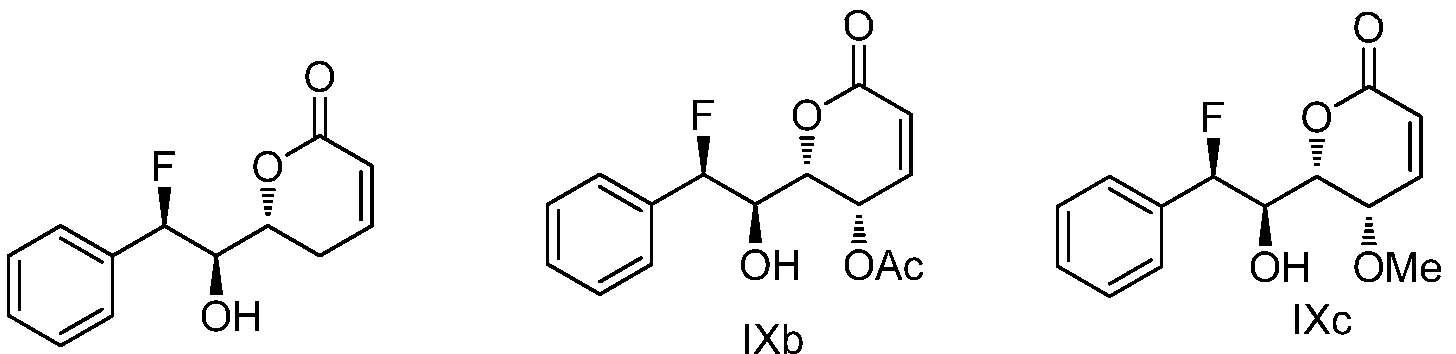

or a pharmaceutically acceptable salt, solvate or prodrug thereof;
and stereoisomers, isotopic variants and tautomers thereof.
The method or the compound according to either of claims 1 or 2, wherein compound is according to formula IXg or IXh:

or a pharmaceutically acceptable salt, solvate or prodrug thereof;
and stereoisomers, isotopic variants and tautomers thereof.
The method or the compound according to either of claims 1 or 2, wherein com ound is according to formula Xa, Xb, Xc, Xd, or Xe:

and stereoisomers, isotopic variants and tautomers thereof.
42. The method or the compound according to either of claims 1 or 2, wherein the
compound is according to formula IXb (Compound F2):

IXb (Compound F2)
or a pharmaceutically acceptable salt, solvate or prodrug thereof.
The method or the compound according to either of claims 1 or 2, wherein
mpound is any one of compounds listed below:

43.
45. The pharmaceutical according to claim 44, wherein in the pharmaceutical
composition comprises a pharmaceutically acceptable carrier.
46. The pharmaceutical composition of claim 44 wherein the carrier is a parenteral carrier, oral or topical carrier.
47. The method of claim 2, wherein the disease or condition is cancer.
48. The method of claim 2, wherein the disease or condition is cancer of prostate, colon, bladder, melanoma, liver, breast, cervical, ovarian, esophagi, glialblastoma, or lung.
Priority Applications (1)
| Application Number | Priority Date | Filing Date | Title |
|---|---|---|---|
| US14/764,236 US9682947B2 (en) | 2013-01-30 | 2014-01-29 | Substituted lactones for treating cancer |
Applications Claiming Priority (2)
| Application Number | Priority Date | Filing Date | Title |
|---|---|---|---|
| CN201310034985.5A CN103130759B (en) | 2013-01-30 | 2013-01-30 | Jinghong goniothalamicin A derivative and the application in pharmacy thereof |
| CN201310034985.5 | 2013-01-30 |
Publications (1)
| Publication Number | Publication Date |
|---|---|
| WO2014117741A1 true WO2014117741A1 (en) | 2014-08-07 |
Family
ID=48491261
Family Applications (1)
| Application Number | Title | Priority Date | Filing Date |
|---|---|---|---|
| PCT/CN2014/071751 Ceased WO2014117741A1 (en) | 2013-01-30 | 2014-01-29 | Heterocyclo compounds as apoptotic inducers and uses thereof |
Country Status (3)
| Country | Link |
|---|---|
| US (1) | US9682947B2 (en) |
| CN (1) | CN103130759B (en) |
| WO (1) | WO2014117741A1 (en) |
Families Citing this family (1)
| Publication number | Priority date | Publication date | Assignee | Title |
|---|---|---|---|---|
| CN103130759B (en) | 2013-01-30 | 2015-10-07 | 中国科学院昆明植物研究所 | Jinghong goniothalamicin A derivative and the application in pharmacy thereof |
Citations (1)
| Publication number | Priority date | Publication date | Assignee | Title |
|---|---|---|---|---|
| CN103130759A (en) * | 2013-01-30 | 2013-06-05 | 中国科学院昆明植物研究所 | Goniothalamus cheliesis vitamin derivative and application of goniothalamus cheliesis vitamin derivative in pharmacy |
Family Cites Families (2)
| Publication number | Priority date | Publication date | Assignee | Title |
|---|---|---|---|---|
| CN1052721C (en) * | 1995-09-01 | 2000-05-24 | 中国科学院昆明植物研究所 | Jinghong goniothalamicin A and its preparation method and use |
| CN102329310A (en) * | 2011-07-26 | 2012-01-25 | 苏州宝泽堂医药科技有限公司 | Method for preparing cheliensisin A |
-
2013
- 2013-01-30 CN CN201310034985.5A patent/CN103130759B/en not_active Expired - Fee Related
-
2014
- 2014-01-29 US US14/764,236 patent/US9682947B2/en active Active
- 2014-01-29 WO PCT/CN2014/071751 patent/WO2014117741A1/en not_active Ceased
Patent Citations (1)
| Publication number | Priority date | Publication date | Assignee | Title |
|---|---|---|---|---|
| CN103130759A (en) * | 2013-01-30 | 2013-06-05 | 中国科学院昆明植物研究所 | Goniothalamus cheliesis vitamin derivative and application of goniothalamus cheliesis vitamin derivative in pharmacy |
Non-Patent Citations (2)
| Title |
|---|
| LAN YU-HSUAN ET AL.: "Cytotoxic styrylpyrones from Goniothalamus amuyon", JOURNAL OF NATURAL PRODUCTS, vol. 66, no. 4, 2003, pages 487 - 490 * |
| LAN YU-HSUAN ET AL.: "Digoniodiol, deoxygoniopypyrone A, and goniofupyrone A: three new styryllactones from Goniothalamus amuyon", PLANTA MEDICA, vol. 71, no. 2, 2005, pages 153 - 159 * |
Also Published As
| Publication number | Publication date |
|---|---|
| CN103130759A (en) | 2013-06-05 |
| US20150361062A1 (en) | 2015-12-17 |
| US9682947B2 (en) | 2017-06-20 |
| CN103130759B (en) | 2015-10-07 |
Similar Documents
| Publication | Publication Date | Title |
|---|---|---|
| CN109153687A (en) | A class of compounds containing tricyclic heteroaryl groups | |
| Ashok et al. | 1, 2, 3-Triazole-fused spirochromenes as potential anti-tubercular agents: synthesis and biological evaluation | |
| EP2404922B1 (en) | Quinoxaline compounds | |
| CA2692922C (en) | Azaindole-indole coupled derivatives, preparation methods and uses thereof | |
| EP1104423A1 (en) | Anhydride modified cantharidin analogues useful in the treatment of cancer | |
| Cardona-G et al. | Chemistry and anticancer activity of hybrid molecules and derivatives based on 5-fluorouracil | |
| Salem et al. | Novel 2-substituted-quinoxaline analogs with potential antiproliferative activity against breast cancer: insights into cell cycle arrest, topoisomerase II, and EGFR activity | |
| Liu et al. | Antitumor evaluation of novel phenothiazine derivatives that inhibit migration and tubulin polymerization against gastric cancer MGC-803 cells | |
| CN116390921A (en) | Heterocyclic compound with cyclin-dependent kinase inhibitory activity, preparation method and medical use thereof | |
| US20040110822A1 (en) | Anhydride modified cantharidin analogues useful in the treatment of cancer | |
| Zhang et al. | Potential anti-MDR agents based on the podophyllotoxin scaffold: synthesis and antiproliferative activity evaluation against chronic myeloid leukemia cells by activating MAPK signaling pathways | |
| WO2014007412A1 (en) | Novel compound or pharmaceutically acceptable salt thereof, and pharmaceutical composition containing same as active ingredient | |
| Yang et al. | Semisynthesis and biological evaluation of novel honokiol thioethers against colon cancer cells HCT116 via inhibiting the transcription and expression of YAP protein | |
| Yao et al. | Discovery of novel hydrazinyl thiazole derivatives as potent anticancer agents by inhibiting eIF4E/eIF4G interactions | |
| WO2012171488A1 (en) | Coumarin derivative, pharmaceutical composition and use thereof | |
| KR20220140731A (en) | Polycyclic compounds acting as kinase inhibitors | |
| US9682947B2 (en) | Substituted lactones for treating cancer | |
| Zha et al. | Synthesis and in vitro anticancer evaluation of novel flavonoid-based amide derivatives as regulators of the PI3K/AKT signal pathway for TNBC treatment | |
| Wang et al. | Design, synthesis, anticancer activity and mechanism studies of novel 2-amino-4-aryl-pyrimidine derivatives of ursolic acid | |
| Huang et al. | Synthesis and evaluation of anticancer activity of quillaic acid derivatives: A cell cycle arrest and apoptosis inducer through NF-κ B and MAPK pathways | |
| CN116457346A (en) | Preparation of indolone derivatives as novel diacylglycerol O-acyltransferase 2 inhibitors | |
| E García-Rubiño et al. | Enantiospecific synthesis of heterocycles linked to purines: different apoptosis modulation of enantiomers in breast cancer cells | |
| AU7406900A (en) | Novel xanthone compounds, their preparation and use as medicament | |
| US10882852B1 (en) | 3-vinylquinolines as cancer cells inhibitors | |
| Ma et al. | Discovery of the theobromine derivative MQS-14 that induces death of MGC-803 cells mainly through ROS-mediated mechanisms |
Legal Events
| Date | Code | Title | Description |
|---|---|---|---|
| 121 | Ep: the epo has been informed by wipo that ep was designated in this application |
Ref document number: 14746084 Country of ref document: EP Kind code of ref document: A1 |
|
| WWE | Wipo information: entry into national phase |
Ref document number: 14764236 Country of ref document: US |
|
| NENP | Non-entry into the national phase |
Ref country code: DE |
|
| 122 | Ep: pct application non-entry in european phase |
Ref document number: 14746084 Country of ref document: EP Kind code of ref document: A1 |