WO2014115362A1 - 識別器学習装置及び識別器学習方法 - Google Patents
識別器学習装置及び識別器学習方法 Download PDFInfo
- Publication number
- WO2014115362A1 WO2014115362A1 PCT/JP2013/072665 JP2013072665W WO2014115362A1 WO 2014115362 A1 WO2014115362 A1 WO 2014115362A1 JP 2013072665 W JP2013072665 W JP 2013072665W WO 2014115362 A1 WO2014115362 A1 WO 2014115362A1
- Authority
- WO
- WIPO (PCT)
- Prior art keywords
- vector
- reference vector
- sample
- processing target
- nearest neighbor
- Prior art date
- Legal status (The legal status is an assumption and is not a legal conclusion. Google has not performed a legal analysis and makes no representation as to the accuracy of the status listed.)
- Ceased
Links
Images



Classifications
-
- G—PHYSICS
- G06—COMPUTING OR CALCULATING; COUNTING
- G06N—COMPUTING ARRANGEMENTS BASED ON SPECIFIC COMPUTATIONAL MODELS
- G06N20/00—Machine learning
-
- G—PHYSICS
- G06—COMPUTING OR CALCULATING; COUNTING
- G06F—ELECTRIC DIGITAL DATA PROCESSING
- G06F18/00—Pattern recognition
- G06F18/20—Analysing
- G06F18/24—Classification techniques
- G06F18/241—Classification techniques relating to the classification model, e.g. parametric or non-parametric approaches
- G06F18/2411—Classification techniques relating to the classification model, e.g. parametric or non-parametric approaches based on the proximity to a decision surface, e.g. support vector machines
-
- G—PHYSICS
- G06—COMPUTING OR CALCULATING; COUNTING
- G06F—ELECTRIC DIGITAL DATA PROCESSING
- G06F18/00—Pattern recognition
- G06F18/20—Analysing
- G06F18/24—Classification techniques
- G06F18/241—Classification techniques relating to the classification model, e.g. parametric or non-parametric approaches
- G06F18/2413—Classification techniques relating to the classification model, e.g. parametric or non-parametric approaches based on distances to training or reference patterns
- G06F18/24147—Distances to closest patterns, e.g. nearest neighbour classification
-
- G—PHYSICS
- G06—COMPUTING OR CALCULATING; COUNTING
- G06F—ELECTRIC DIGITAL DATA PROCESSING
- G06F7/00—Methods or arrangements for processing data by operating upon the order or content of the data handled
- G06F7/60—Methods or arrangements for performing computations using a digital non-denominational number representation, i.e. number representation without radix; Computing devices using combinations of denominational and non-denominational quantity representations, e.g. using difunction pulse trains, STEELE computers, phase computers
- G06F7/72—Methods or arrangements for performing computations using a digital non-denominational number representation, i.e. number representation without radix; Computing devices using combinations of denominational and non-denominational quantity representations, e.g. using difunction pulse trains, STEELE computers, phase computers using residue arithmetic
Definitions
- the present invention relates to a learning technique for a nearest neighbor classifier.
- NNC Nearest Neighbor Classifier
- the NNC has reference vectors (also called templates or prototypes) classified into categories, and outputs a category (class) to which a reference vector having the smallest distance from the input vector belongs as a result of recognition (identification) of the input vector.
- a two-class classifier or a multi-class classifier can be configured.
- the identification boundary surface of NNC is a boundary surface of a feature space that is Voronoi divided by reference vectors.
- the learning accuracy of NNC can be improved by learning a reference vector for determining the identification boundary surface using a learning sample prepared in advance.
- a learning method of the NNC reference vector a method called learning vector quantization (LVQ (Learning VectorizationQuantization)) (see Non-Patent Document 1 below) and a method called GLVQ (Generalized Learning Vector Quantization) which is an improved method (see FIG. The following non-patent document 2) is known.
- LVQ Learning VectorizationQuantization
- GLVQ Generalized Learning Vector Quantization
- a support vector machine (SVM (Support Vector Machine)) is known (see Non-Patent Document 3 below).
- SVM Support Vector Machine
- the SVM suppresses overlearning by learning to maximize the distance (margin) between the identification boundary surface and the learning sample.
- the linear SVM can be applied to a two-class identification problem in which the identification boundary is a plane (see Non-Patent Document 4 below). With this application, learning is performed so as to maximize the margin between the identification boundary surface and the learning sample, so that a classifier having high identification performance can be obtained.
- Patent Document 2 proposes a speech recognition method that uses a continuous HMM (Hidden Markov Model) for learning and a discrete HMM for recognition.
- HMM Hidden Markov Model
- JP 2009-186243 A Japanese Patent Laid-Open No. 8-11599
- LIBLINEAR a library for linear classification
- Journal of Machine Learning Research Vol.9, pp.1871-1874, 2008 Chi-Chung Chang and Chih-Jen Lin
- LIBSVM a library for support vector machines
- the present invention has been made in view of such circumstances, and provides an NNC reference vector learning technique capable of improving the identification accuracy.
- the first aspect relates to a discriminator learning device.
- the classifier learning device includes a target acquisition unit that acquires a reference vector set and belonging category information of each reference vector as a processing target, and a reference vector of the processing target that belongs to the same category as the sample vector.
- a specifying unit for specifying the internal nearest neighbor reference vector closest to the sample vector and for specifying the external nearest neighbor reference vector closest to the sample vector from the reference vectors to be processed belonging to a different category from the sample vector
- a calculation unit that calculates an evaluation value of the processing target using a distance between the identification boundary formed by the inner nearest neighbor reference vector and the outer nearest neighbor reference vector and the sample vector. Based on the evaluation value of the processing target, the original reference vector set and the original affiliation category information Having, an update unit that updates the processing target.
- the second aspect relates to a classifier learning method.
- the classifier learning method according to the second aspect is executed by at least one computer, acquires a reference vector set and belonging category information of each reference vector as a processing target, and refers to the processing target belonging to the same category as the sample vector.
- the internal nearest neighbor reference vector closest to the sample vector is identified from the vectors, and the external nearest neighbor reference vector closest to the sample vector is identified from the reference vectors to be processed belonging to a different category from the sample vector.
- the evaluation value of the processing target is calculated, and the calculated evaluation value of the processing target Based on the original reference vector set and the original affiliation category information. In the update, including that.
- Another aspect of the present invention may be a program that causes at least one computer to execute the method of the second aspect, or a computer-readable recording medium that records such a program. May be.
- This recording medium includes a non-transitory tangible medium.
- NNC learning apparatus it is a figure which shows notionally the process structural example of the nearest neighbor discriminator learning apparatus (NNC learning apparatus) in 3rd Embodiment. It is a flowchart which shows the operation example of the nearest neighbor discriminator learning apparatus (NNC learning apparatus) in 3rd Embodiment.
- FIG. 1 is a diagram conceptually illustrating a configuration example of a discriminator learning device 100 according to an embodiment of the present invention.
- the classifier learning device 100 includes a target acquisition unit 101 that acquires a reference vector set and affiliation category information of each reference vector as a processing target, and a reference of the processing target that belongs to the same category as the sample vector.
- the internal nearest neighbor reference vector closest to the sample vector is identified from the vectors, and the nearest external reference vector closest to the sample vector is selected from the reference vectors to be processed belonging to a different category from the sample vector.
- the discriminator learning device 100 has, for example, the same hardware configuration as the nearest neighbor discriminator learning device 1 in the detailed embodiment described later, and the program is processed in the same manner as the nearest neighbor discriminator learning device 1. Each processing unit described above is realized.
- the classifier learning method is executed by at least one computer such as the above-described classifier learning apparatus 100, and acquires a reference vector set and affiliation category information of each reference vector as a processing target. Then, from among the reference vectors of the processing target belonging to the same category as the sample vector, the internal nearest neighbor reference vector closest to the sample vector is specified, and from among the reference vectors of the processing target belonging to a category different from the sample vector Identify the nearest external reference vector closest to the sample vector, and evaluate the processing target using the distance between the identification boundary formed by the internal nearest neighbor reference vector and the external nearest neighbor reference vector and the sample vector.
- the Kutorusetto and original category membership information to update in the processed includes.
- the steps included in the classifier learning method may be executed sequentially in any order, or may be executed simultaneously.
- the evaluation value of the processing target is calculated from the relationship between the sample vector and the reference vector set acquired as the processing target, and based on the evaluation value, the NNC reference vector set and Those affiliation category information is learned.
- the term “vector” means not only data having a size and an orientation, but also any data composed of a plurality of elements.
- Each reference vector of the reference vector set belongs to a category, and the belonging category information indicates a category to which each reference vector belongs.
- Sample vector is learning data having the same number of elements as each reference vector to be processed, and belongs to a certain category.
- the processing target and the sample vector may be generated by the discriminator learning device 100, or may be acquired from another device or a portable recording medium.
- an internal nearest neighbor reference vector (hereinafter referred to as an IN-NN reference vector) that belongs to the same category as the sample vector and is closest to the sample vector, and a sample vector And an external nearest neighbor reference vector (hereinafter referred to as an EX-NN reference vector) closest to the sample vector.
- the evaluation value of the processing target is calculated using the distance between the identification boundary formed by the IN-NN reference vector and the EX-NN reference vector and the sample vector.
- the NNC reference vector can be learned so as to maximize the distance, that is, the margin between the learning sample vector and the identification boundary in the reference vector set.
- the NNC identification accuracy can be improved.
- the first to third embodiments will be exemplified as detailed embodiments.
- Each of the following embodiments is an example when the classifier learning device 100 and the classifier learning method described above are applied to a nearest neighbor classifier (NNC) learning device.
- NNC nearest neighbor classifier
- the use of the classifier learned in the above-described classifier learning apparatus 100 and classifier learning method and the following detailed embodiment is not limited.
- the discriminator can be used in various pattern recognitions such as character recognition, face recognition, vehicle detection, and voice recognition.
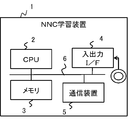
- FIG. 2 is a diagram conceptually illustrating a hardware configuration example of the nearest neighbor classifier learning device (hereinafter referred to as an NNC learning device) 1 in the first embodiment.
- the NNC learning device 1 in the first embodiment is a so-called computer, and is, for example, a CPU (Central Processing Unit) 2, a memory 3, an input / output interface (I / F) 4, and a communication device that are connected to each other via a bus 6. 5 etc.
- the memory 3 is a RAM (Random Access Memory), a ROM (Read Only Memory), a hard disk, a portable storage medium, or the like.
- the input / output I / F 4 can be connected to a user interface device such as a display device (not shown) or an input device (not shown).
- the communication device 5 communicates with other devices via a network (not shown).
- the present embodiment does not limit the hardware configuration of the NNC learning device 1.
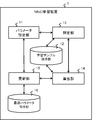
- FIG. 3 is a diagram conceptually illustrating a processing configuration example of the NNC learning device 1 in the first embodiment.
- the NNC learning device 1 according to the first embodiment includes a parameter setting unit 11, a learning sample holding unit 12, a specifying unit 13, a calculating unit 14, an updating unit 15, an optimal parameter holding unit 16, and the like.
- Each of these processing units is realized, for example, by executing a program stored in the memory 3 by the CPU 2.
- the program may be installed from a portable recording medium such as a CD (Compact Disc) or a memory card or another computer on the network via the input / output I / F 4 and stored in the memory 3. Good.
- CD Compact Disc
- the parameter setting unit 11 sets a reference vector set in the NNC to be processed and their belonging category information.
- the processing target set by the parameter setting unit 11 includes N (N is an integer of 2 or more) reference vectors r i (i is an integer of 1 to N) and categories c i corresponding to the respective reference vectors. Can be represented.
- the target acquisition unit 101 described above acquires, for example, the processing target set by the parameter setting unit 11.
- the parameter setting unit 11 sets a reference vector, which is an NNC parameter, using a technique such as MDS (Multi-Directional Search), simplex method, or Alternate Directions Search described in the following references.
- Reference 1 VJ Torczon, "On the convergence of the multidirectional search algorithm", SIAM Journal on Optimization, Vol. 1, pp.123-145 (1991).
- Reference 2 NJ Higham, "Optimization by direct search in matrix computations", SIAM Journal on Matrix Analysis and Applications, Vol. 14, No. 2, pp. 317-333 (1993).
- the parameter setting unit 11 may use an average vector of clusters obtained by clustering the learning sample vectors by the K-means method as the reference vector (see Reference Document 3 below).
- Reference 3 R. O. Duda and P. E. Hart and D. G. Stork, "Pattern Identification", New Technology Communications, pp.528-529 (2001).
- the learning sample holding unit 12 holds a plurality of learning sample vectors and affiliation category information of each sample vector.
- the information held by the learning sample holding unit 12 includes M (M is an integer of 2 or more) sample vectors s j (j is an integer of 1 to M) and categories c j corresponding to the sample vectors. Can be represented.
- the sample vector s j and the reference vector r i have the same number of elements.
- the optimum parameter holding unit 16 holds a reference vector set and their belonging category information, which are obtained as a result of learning by the NNC learning device 1 and are NNC optimum parameters.
- the specifying unit 13 specifies the IN-NN reference vector and the EX-NN reference vector for each of the plurality of sample vectors held in the learning sample holding unit 12 as in the above-described specifying unit 102. For example, the specifying unit 13 calculates each distance between the reference vector r i and the sample vector s j and specifies the IN-NN reference vector and the EX-NN reference vector based on each calculated distance. . In the present embodiment, the distance between the sample vector s j having the same number of elements and the reference vector r i is calculated using the square distance as shown in the following (Equation 1).
- the calculation unit 14 When the sample vector is closer to the EX-NN reference vector than the IN-NN reference vector, the calculation unit 14 shows a lower evaluation as the distance between the identification boundary and the sample vector is longer, and the sample vector becomes EX-NN.
- the evaluation value of the processing target is calculated so that the higher the distance, the higher the evaluation. If the category of the reference vector that is the nearest to the sample vector among all the reference vectors is the same as the category of the sample vector, the sample vector is correctly identified, so the distance (margin) at this time is It is desirable to be maximized. Therefore, in this case, as described above, the calculation unit 14 calculates the evaluation value of the processing target so that the longer the distance, the higher the evaluation.
- the calculation unit 14 calculates the evaluation value of the processing target so that the longer the distance, the lower the evaluation. If this embodiment is a calculation method that embodies such a technical idea, the calculation unit 14 limits the calculation method for calculating the evaluation value of the processing target from the distance between the identification boundary and the sample vector. do not do.
- the calculation unit 14 can use the following calculation method that embodies the technical idea described above.
- the calculation unit 14 calculates the distance as a negative value when the sample vector is closer to the EX-NN reference vector than the IN-NN reference vector, and the sample vector is closer to the IN-NN reference vector than the EX-NN reference vector.
- the distance is calculated as a positive value
- the evaluation value of the processing target is calculated based on the output value of the sigmoid function that receives the calculated distance.
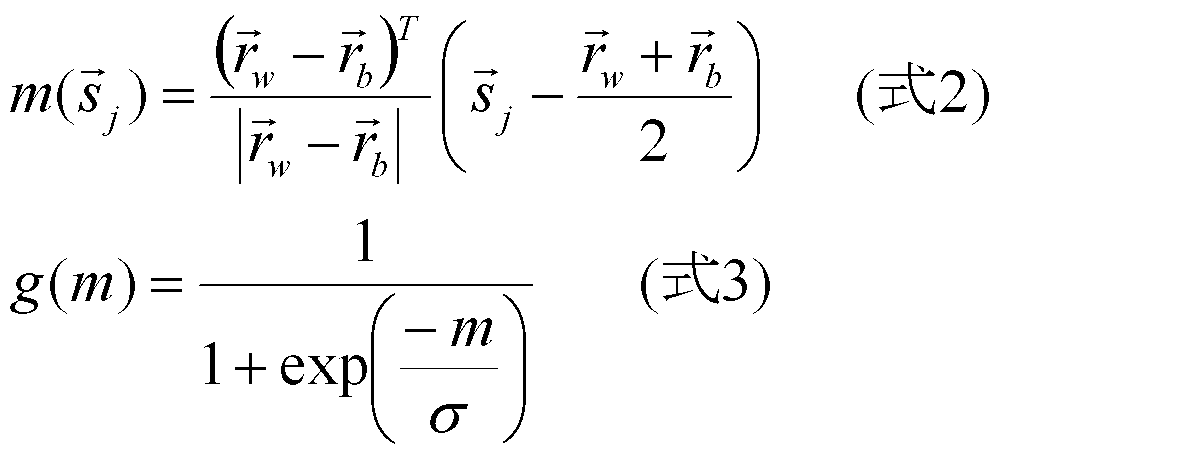
- the following (Formula 2) shows an example of the distance calculation method
- the following (Formula 3) shows a sigmoid function.
- r w denotes an IN-NN reference vector
- r b represents an EX-NN reference vectors.
- the coefficient ⁇ in (Expression 3) is a positive constant set experimentally in advance.
- the calculation unit 14 calculates the total value of the evaluation values calculated for each of the plurality of sample vectors held in the learning sample holding unit 12, and sets this total value as the final evaluation value of the processing target. According to the above-described examples of (Expression 2) and (Expression 3), the calculation unit 14 calculates the final evaluation value J using the following (Expression 4).
- FIG. 4 is a diagram conceptually showing an NNC identification boundary.
- the reference vectors r 1 , r 2 and r 3 belong to the category C A and the reference vectors r 4 and r 5 belong to the category C B.
- the feature space in NNC is divided into Voronoi regions by reference vectors.
- the boundaries (Voronoi boundaries) of the region divided by the reference vector r i are indicated by solid lines B 15 , B 14 , B 24 and B 34 , and broken lines B 12 , B 23 and B 45 . .
- Each boundary is a boundary of an area occupied by each reference vector, and a vector located in the area has the smallest distance from the reference vector of the area. That is, the nearest neighbor reference vector of a vector located in the region becomes the reference vector of the region.
- the nearest reference vector of an arbitrary vector located in the region surrounded by the broken line B 23 , the solid line B 24 and the broken line B 12 is the reference vector r 2 .
- the Voronoi boundary is constituted by a plane perpendicular to the midpoint between adjacent reference vectors when a square distance is used as the distance between vectors.
- the Voronoi boundary dashed B 12 is a plane perpendicular to the midpoint of the reference vector r 1 and the reference vector r 2.
- a two-dimensional Voronoi boundary dashed B 12 is a perpendicular bisector of a line segment connecting the reference vector r 1 and reference vector r 2.
- An identification boundary is formed by Voronoi boundaries between reference vectors having different affiliation categories in Voronoi boundaries created by reference vectors. In the example of FIG. 4, the identification boundary is indicated by solid lines B 15 , B 14 , B 24 and B 34 .
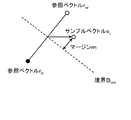
- FIG. 5 is a diagram conceptually showing a margin of NNC.
- the margin is the distance from the identification boundary closest to the sample vector s j . Closest identification boundary to sample vector s j is, in the reference vector belonging to the same category as the sample vector s j, and the sample vector s j the closest reference vector (IN-NN reference vector) r w, sample vector s j and in the different reference vectors belonging to the category, sample vector s j and the nearest reference vector and (EX-NN reference vector) r b is Voronoi boundary B wb constituting.
- the margin m (s j ) is the distance from the Voronoi boundary B wb to the sample vector s j .
- the margin m (s j ) is the distance from the sample vector s j to the plane (identification boundary surface B wb ) perpendicular to the midpoint between the IN-NN reference vector and the EX-NN reference vector, It can be calculated by the above (formula 2) and the like.
- the update unit 15 includes a final evaluation value related to the reference vector set and the belonging category information held in the optimum parameter holding unit 16, and a final evaluation value calculated by the calculation unit 14 regarding the processing target set in the parameter setting unit 11. And the reference vector set having a high evaluation value and the category information belonging to them are updated and held in the optimum parameter holding unit 16. Thereby, when the final evaluation value to be processed is held in the optimum parameter holding unit 16 but is smaller than the final evaluation value, the optimum parameter holding unit 16 is not updated.
- the NNC learning device 1 causes the parameter setting unit 11 to set a new processing target a predetermined number of times, and operates the specifying unit 13, the calculation unit 14, and the updating unit 15 for each processing target, so that the optimum parameter holding unit The reference vector set held in 16 and their category information are sequentially updated. Further, the NNC learning device 1 may end the learning process when the information in the optimal parameter holding unit 16 is not updated by the updating unit 15 a predetermined number of times or more.
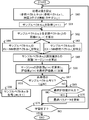
- FIG. 6 is a flowchart showing an operation example of the NNC learning device 1 in the first embodiment.
- the NNC learning device 1 is the execution subject of each process, but the above-described processing units included in the NNC learning device 1 may be the execution subject.
- the NNC learning device 1 sets a processing target (S60).
- the processing target is a reference vector set which is a parameter of NNC and information on their belonging category.
- the NNC learning device 1 sets the processing target by the above-described method described for the parameter setting unit 11.
- the processing target set in (S60) is represented by N (N is an integer of 2 or more) reference vectors r i (i is an integer of 1 or more and N or less), and a category c i corresponding to each reference vector. be able to.
- the NNC learning device 1 acquires a sample vector s 1 (S61). All sample vectors s j may be expressed as M (M is an integer of 2 or more) sample vectors s j (j is an integer of 1 or more and M or less) each having the same number of elements as the reference vector r i. it can. In (S61), one of all sample vectors s j is acquired.
- the NNC learning device 1 calculates the distance d (s 1 , r i ) between the sample vector s 1 and each reference vector r i (S62).
- the distance d (s 1 , r i ) is calculated using the square distance represented by (Equation 1) above.
- the NNC learning device 1 specifies the IN-NN reference vector r w and the EX-NN reference vector r b for the sample vector s 1 based on the distance d (s 1 , r i ) calculated in (S62) ( S63, S64).
- the IN-NN reference vector r w is one of the reference vectors r i belonging to the same category as the sample vector s 1
- the EX-NN reference vector r b is a reference vector belonging to a different category from the sample vector s 1 one of r i .
- NNC learning device 1 calculates a margin m (s 1) is the distance between the decision boundary and the sample vector s 1 which is formed from the IN-NN reference vector r w and EX-NN reference vector r b (S65) .
- the NNC learning device 1 inputs the calculated margin m (s 1 ) into a gain function g (m) such as a sigmoid function, thereby evaluating the margin m (s 1 ) evaluation value g (m (s 1 )). Is calculated (S66).
- the (S65) and (S66), NNC learning device 1 includes a sample vector s 1 is the case close to the EX-NN reference vector r b from IN-NN reference vector r w, and the decision boundary and the sample vector s 1 The longer the distance between, the lower the evaluation, and when the sample vector s 1 is closer to the IN-NN reference vector r w than the EX-NN reference vector r b , the longer the distance, the higher the evaluation, An evaluation value g (m (s 1 )) of the margin m (s 1 ) is calculated.
- the NNC learning device 1 sets the margin m (s 1 ) as a negative value when the sample vector s 1 is closer to the EX-NN reference vector r b than the IN-NN reference vector r w in (S65). calculated, when the sample vector s 1 is close to EX-NN reference vector r b from iN-NN reference vector r w, calculated the margin m a (s 1) as a positive value, the (S66), the calculated The evaluation value g (m (s 1 )) of the margin m (s 1 ) may be calculated by inputting the margin m (s 1 ) into the sigmoid function g (m).
- the NNC learning device 1 adds the calculated evaluation value g (m (s 1 )) to the final evaluation value J (S66).
- the NNC learning device 1 determines that the final evaluation value J is the original It is determined whether it is higher than the final evaluation value calculated for the reference vector set and their category information (S69).
- the NNC learning device 1 updates the optimum parameter with the processing target set in (S60) (S70). That is, when the final evaluation value J is improved (S69; YES), the reference vector set set in (S60) and the information on the category belonging thereto are set as the optimum parameters.
- the NNC learning device 1 does not update the optimal parameter because the processing target set in (S60) is inferior to the current optimal parameter. .
- the NNC learning device 1 determines whether or not the learning is finished (S71).
- the learning end is, for example, that the number of repetitions of the above process has reached a predetermined number, or that the final evaluation value J does not improve even if the above process is repeated a predetermined number of times (S69; NO). Judged by standards. If the learning is not finished (S71; NO), the NNC learning device 1 sets a new processing target in (S60), and executes (S60) and subsequent steps on this new processing target.
- the sum of the evaluation values of the margins of a plurality of sample vectors is calculated as the final evaluation value for the processing target, and the final evaluation value is improved.
- the NNC optimum parameters are updated.
- the evaluation value of each margin is set to a higher value as the distance between the identification boundary and the sample vector is longer when the nearest neighbor reference vector of the sample vector belongs to the same category as the sample vector. When the nearest neighbor reference vector belongs to a different category from the sample vector, the longer the distance, the lower the value.
- the first embodiment it is possible to learn the reference vector of the NNC on the basis of maximizing the margin, and as a result, it is possible to improve the identification accuracy of the NNC.
- the distance between the sample vector s j having the same number of elements and the reference vector r i is calculated using the square distance.
- the distance is calculated by weighting the square distance.
- the NNC learning device 1 in the second embodiment will be described focusing on the content different from the first embodiment. In the following description, the same contents as those in the first embodiment are omitted as appropriate.
- the identification boundary is a plane.
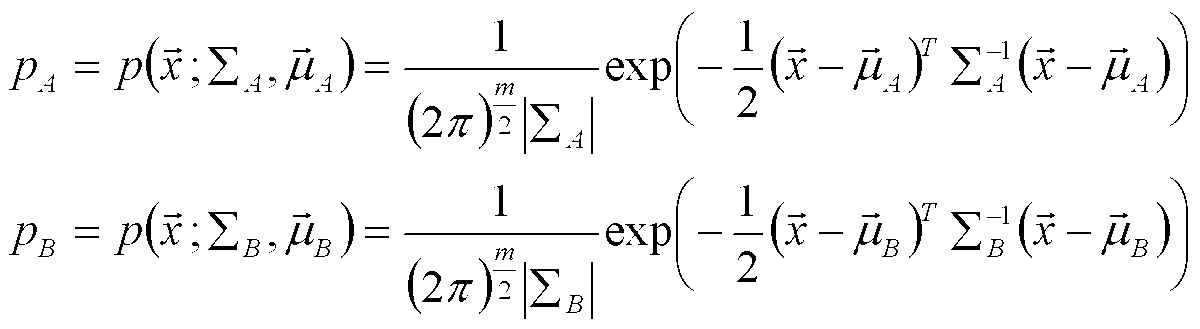
- ⁇ represents a variance covariance matrix
- ⁇ represents an average vector.
- the category C A and the category C B are isotropic normal distributions.
- the discrimination boundary where the discrimination error is the smallest is the boundary where p A and p B are equal, passes through the center point of the mean vector ⁇ A and the mean vector ⁇ B, and the mean vector ⁇ a plane orthogonal to the line connecting the a and the average vector mu B. That is, an ideal NNC for identifying a pattern composed of the distributions p A and p B is when the reference vector of category C A is ⁇ A and the reference vector of category C B is ⁇ B.
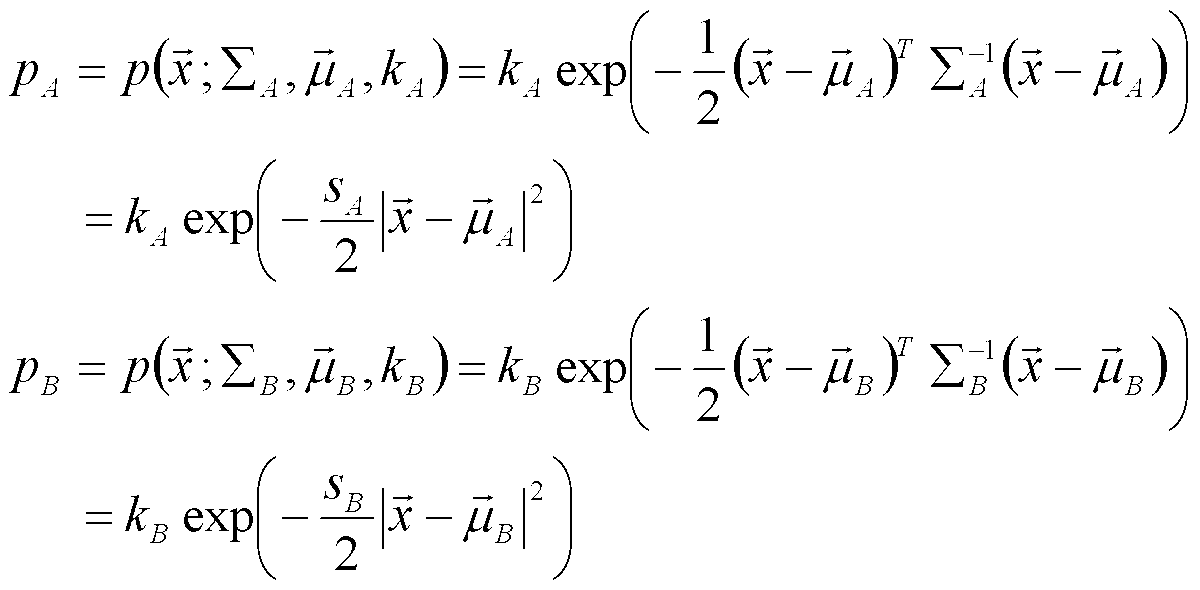
- the identification boundary surface with the smallest error is a surface where the distributions p A and p B are equal.
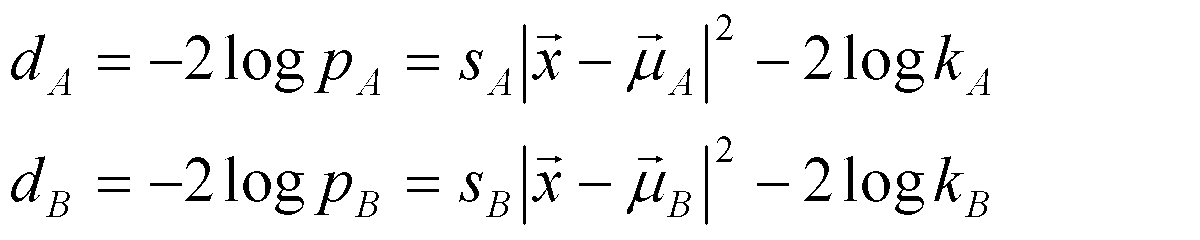
- the log likelihood of the distributions p A and p B is expressed by the following equation.
- the identification surface where p A and p B are equal is the identification surface where d A and d B are equal, it can be seen that this identification surface is a superquadratic surface.
- the square distance is used, and the identification plane is a plane (a plane passing through the midpoint between the reference vector and the reference vector and orthogonal to a straight line connecting the reference vectors).
- a curved surface cannot be expressed directly. For this reason, when using the square distance, it is desired to set a plurality of identification surfaces using more reference vectors and approximate the superquadratic surface. However, this results in degradation of NNC identification accuracy, an increase in the number of reference vectors required for NNC, and a reduction in processing speed.
- the NNC learning device 1 calculates the distance between the sample vector s j having the same number of elements and the reference vector r i using the CWP distance or the AWP distance.
- the device configuration of the NNC learning device 1 in the second embodiment is the same as that of the first embodiment shown in FIGS.
- the processing content of the processing unit shown below is different from that of the first embodiment.
- the parameter setting unit 11 further sets a weighting coefficient used for calculation of the distance between vectors in addition to the reference vector set and their belonging category information as the processing target.
- the parameter setting unit 11 further sets the weighting factors ⁇ i and ⁇ i as processing targets, and the AWP distance (the above (formula 6)) as the distance function. Is used, the weighting factor ⁇ i is further set as a processing target.
- the parameter setting unit 11 sets weighting coefficients ⁇ i and ⁇ i for each reference vector.
- the specifying unit 13 calculates the distance between the sample vector s j and the reference vector r i using the CWP distance or the AWP distance including the weighting coefficient set by the parameter setting unit 11. Further, since the identification boundary is a superquadratic surface at the CWP distance, for example, the specifying unit 13 calculates the distance m (s j ) between the sample vector s j and the identification boundary by the following expression.
- the case of d (s j , r w ) ⁇ d (s j , r b ) indicates that the sample vector is closer to the IN-NN reference vector than the EX-NN reference vector, and otherwise Indicates a case where the sample vector is closer to the EX-NN reference vector than the IN-NN reference vector.
- the specifying unit 13 calculates the distance m (s j ) between the sample vector s j and the identification boundary by the following equation.
- the optimum parameter holding unit 16 holds the weighting coefficient together with the reference vector set and the category information belonging thereto as the NNC optimum parameters.
- the updating unit 15 causes the optimum parameter holding unit 16 to further reflect the weighting coefficient set as the processing target when updating the optimum parameter holding unit 16.
- the NNC learning device 1 further sets a weighting coefficient used for the distance function as a processing target.
- the NNC learning device 1 calculates the distance d (s 1 , r i ) between the sample vector s 1 and each reference vector r i using the CWP distance or the AWP distance.
- the NNC learning device 1 updates the optimum parameter with the weighting coefficient in addition to the reference vector set and the category information to which the processing is set in (S60).
- the AWP distance or CWP distance that weights the square distance with the weighting coefficient is used.
- the weighting coefficient used for the distance function is also learned and optimized.
- the NNC can be configured with fewer reference vectors by calculating the inter-vector distance using the CWP distance or the AWP distance.
- a pattern identification problem for detecting an object such as a face is illustrated.
- the pattern identification is processed as a two-class identification problem of an object to be detected (for example, a face) and a non-object (for example, a background) that is not to be detected. That is, the pattern discriminator determines whether the input data is an object class or a non-object class.
- the detection omission rate is an error rate at which an object cannot be detected
- the excess detection rate is an error rate at which a non-object is detected.
- the detection omission rate and the excess detection rate are in a trade-off relationship.
- the excess detection rate is increased.
- the detection failure rate is increased.
- object detection if you want to minimize the detection omission after setting the overdetection rate to a certain value, if you want to minimize the overdetection after setting the omission detection rate to a certain value, or There are cases where you want to make the detection omission rate the same.
- the NNC reference vector is learned so that the discrimination accuracy such as the detection omission rate and the excess detection rate approaches the designated value.
- the NNC learning device 1 according to the third embodiment will be described focusing on the contents different from the first embodiment and the second embodiment. In the following description, the same contents as those in the first embodiment and the second embodiment are omitted as appropriate.
- FIG. 7 is a diagram conceptually illustrating a processing configuration example of the NNC learning device 1 in the third embodiment.
- the calculation unit 14 includes a correction unit 21.
- the correction unit 21 is realized, for example, by executing a program stored in the memory 3 by the CPU 2.
- FIG. 7 an example in which the correction unit 21 exists inside the calculation unit 14 is shown, but the correction unit 21 may be realized as a processing unit different from the calculation unit 14.
- Correcting unit 21 category membership information of the most adjacent reference vectors for each of the sample vector s j, and, based on category membership information of each sample vector s j, for the sample vector s j which is held in the learning sample holding portion 12 Then, the identification accuracy of the processing target set by the parameter setting unit 11 is calculated, and the processing target corresponding to the sample vector s j is calculated with a correction value corresponding to the calculated identification accuracy and the specified identification accuracy information. Correct the final evaluation value.
- the specified identification accuracy information may be input by the user operating the input unit or the like based on an input screen or the like, or from a portable recording medium, another computer, or the like via the input / output I / F 4 May be acquired.
- the specified identification accuracy information indicates a desired identification accuracy, for example, a desired detection failure rate, a desired excess detection rate, or a request for making the detection failure rate and the excess detection rate the same.
- amendment part 21 is not restrict
- an example in which the NNC that is the learning target of the NNC learning device 1 is used for pattern recognition for object detection is illustrated.
- NNC learning for object detection a plurality of sample vectors belonging to either the object class or the non-object class are used.
- Misdetection means an identification error in which a sample vector of an object class is identified as a non-object class. Therefore, when the nearest reference vector of the sample vector of the object class belongs to the non-object class, the sample vector corresponds to the detection omission.
- over-detection means an identification error in which a sample vector of a non-object class is identified as an object class. Therefore, when the nearest reference vector of the sample vector of the non-object class belongs to the object class, the sample vector corresponds to the excessive detection.
- the correction unit 21 determines the number of sample vectors corresponding to the detection omission with respect to the number of sample vectors held in the learning sample holding unit 12. obj is calculated. In addition, when the desired excess detection rate is specified as the identification accuracy information, the correction unit 21 overdetects the number of sample vectors corresponding to the excess detection with respect to the number of sample vectors held in the learning sample holding unit 12. Calculated as the rate E bg .
- the correction unit 21 detects that the sample vector s j is not detected depending on whether the value of the margin m (s j ) is positive or negative. Alternatively, it can be determined whether it corresponds to over-detection or identification success.
- the correction unit 21 is a correction value corresponding to the identification accuracy calculated as described above and the specified identification accuracy information.
- the final evaluation value J is corrected.
- This correction can be expressed by the following equation corresponding to the specified identification accuracy information.
- the following (Equation 7) is used when the specified identification accuracy information indicates a desired detection omission rate e
- the following (Equation 8) is used when the specified identification accuracy information indicates a desired excess detection rate e.
- the following (Equation 9) is used when the specified identification accuracy information indicates a request for making the detection omission rate and the excess detection rate the same.
- ⁇ in the following equations is a negative value, and its absolute value is set in advance to a value sufficiently larger than the value of J.
- J ′ J + ⁇ (E obj ⁇ e) 2 (Expression 7)
- J ′ J + ⁇ (E bg ⁇ e) 2 (Formula 8)
- J ′ J + ⁇ (E obj ⁇ E bg ) 2 (Formula 9)
- FIG. 8 is a flowchart showing an operation example of the NNC learning device 1 in the third embodiment.
- steps similar to those in FIG. 6 are denoted by the same reference numerals as in FIG.
- the NNC learning device 1 detects an identification error by the processing in (S63), (S64), and (S65).
- an identification error at least one of detection omission and overdetection may be detected as described above, or it may be detected that the nearest neighbor reference vector of the sample vector s j is an EX-NN reference vector.
- the NNC learning device 1 When the sum of the evaluation values g (m (s j )) for all the sample vectors s j is calculated as the final evaluation value J (S67; NO), the NNC learning device 1 is based on the specified identification accuracy information. Then, the identification accuracy of the processing target for the sample vector s j is calculated (S81). For example, the NNC learning device 1 calculates the ratio of the number of sample vectors s j whose nearest neighbor reference vectors are EX-NN reference vectors to the number of all sample vectors s j as the identification accuracy. Further, as described above, the NNC learning device 1 may calculate the detection omission rate and the excess detection rate.
- the NNC learning device 1 corrects the final evaluation value J with a correction value corresponding to the identification accuracy calculated in (S81) and the specified identification accuracy information (S82). Then, the NNC learning device 1 determines whether or not the final evaluation value J ′ is improved based on the corrected final evaluation value J ′ (S69).
- the identification accuracy of the processing target with respect to the sample vector for learning is calculated, and the final evaluation value of the processing target is a correction value corresponding to the identification accuracy and the specified identification accuracy information. It is corrected. That is, in the third embodiment, the reference vector set and the category information thereof are updated so that the NNC identification accuracy approaches the specified value. Therefore, according to the third embodiment, identification accuracy such as a detection error rate and an excessive detection rate can be controlled to a desired value.
- the identification boundary is a superquadratic surface, and the distance between the sample vector s j and the superquadratic surface can be calculated by the method described in the following reference.
- Reference 4 David Eberly, "Distance from point to a general quadratic curve or a general quadric surface", http://www.geometrictools.com/Documentation/DistancePointToQuadratic.pdf (1999)
- the NNC learning device 1 has the parameter setting unit 11, the learning sample holding unit 12, and the optimum parameter holding unit 16, but the other devices include the parameter setting unit 11, the learning sample, The holding unit 12 and the optimum parameter holding unit 16 may be provided. In this case, the NNC learning device 1 may access the learning sample holding unit 12 and the optimum parameter holding unit 16 via the other device and acquire a processing target from the other device.
- a target acquisition unit that acquires the reference vector set and affiliation category information of each reference vector as a processing target;
- the internal nearest neighbor reference vector closest to the sample vector is identified from the reference vectors to be processed belonging to the same category as the sample vector, and the reference vector of the processing target belonging to a category different from the sample vector
- a specifying unit for specifying an external nearest neighbor reference vector closest to the sample vector
- a calculation unit that calculates an evaluation value of the processing target using a distance between an identification boundary formed by the inner nearest neighbor reference vector and the outer nearest neighbor reference vector and the sample vector; Based on the evaluation value of the processing target calculated by the calculation unit, an updating unit that updates the original reference vector set and the original affiliation category information with the processing target;
- a classifier learning device comprising:
- the calculation unit calculates the distance as a negative value when the sample vector is closer to the external nearest neighbor reference vector than the inner nearest neighbor reference vector, and the sample vector is greater than the inner nearest neighbor reference vector to the inner nearest reference vector.
- the distance is calculated as a positive value, and the evaluation value of the processing target is calculated based on the output value of the sigmoid function with the calculated distance as an input.
- the discriminator learning device according to appendix 2.
- the specifying unit specifies the inner nearest neighbor reference vector and the outer nearest neighbor reference vector for each of a plurality of sample vectors,
- the calculation unit calculates a total value of evaluation values calculated for each of the plurality of sample vectors,
- the update unit includes a total value of evaluation values calculated by the calculation unit with respect to the original reference vector set and the original belonging category information, and a total value of evaluation values calculated by the calculation unit with respect to the processing target. And, based on the comparison result, determines the update of the processing target.
- the discriminator learning device according to any one of appendices 1 to 3.
- the calculation unit includes: Based on the belonging category information of the nearest reference vector for each of the plurality of sample vectors and the belonging category information of each sample vector, the identification accuracy of the processing target for the plurality of sample vectors is calculated and calculated.
- a correction unit that corrects a total value of the evaluation values of the processing target corresponding to the plurality of sample vectors with a correction value corresponding to the identification accuracy and the specified identification accuracy information;
- the discriminator learning device including:
- the specifying unit uses any one of (Equation 1), (Equation 5), (Equation 6), and (Equation 10) to calculate the distance between the sample vector and the reference vector. calculate, The classifier learning device according to any one of supplementary notes 1 to 5.
- the target acquisition unit further acquires the weighting factor as the processing target
- the specifying unit calculates the distance between the sample vector and the reference vector using the (Formula 5) or the (Formula 6) including the weighting coefficient acquired by the target acquisition unit,
- the updating unit further updates the original weighting factor with the weighting factor acquired as the processing target;
- the discriminator learning device according to appendix 6.
- (Appendix 8) In a classifier learning method performed by at least one computer, Obtain the reference vector set and the category information of each reference vector as the processing target, From the reference vectors to be processed belonging to the same category as the sample vector, an internal nearest neighbor reference vector closest to the sample vector is identified, From the reference vectors to be processed belonging to a category different from the sample vector, an external nearest neighbor reference vector closest to the sample vector is identified, Using the distance between the identification boundary formed by the inner nearest neighbor reference vector and the outer nearest neighbor reference vector and the sample vector, the evaluation value of the processing target is calculated, Based on the calculated evaluation value of the processing target, the original reference vector set and the original affiliation category information are updated with the processing target.
- a classifier learning method including:
- the evaluation value is calculated when the sample vector is closer to the external nearest neighbor reference vector than the inner nearest neighbor reference vector, and the longer the distance, the lower the evaluation, and the sample vector is the outer nearest neighbor reference vector. When closer to the internal nearest neighbor reference vector, the evaluation value of the processing target is calculated so as to indicate higher evaluation as the distance is longer.
- the evaluation value is calculated as follows: When the sample vector is closer to the external nearest neighbor reference vector than the inner nearest neighbor reference vector, the distance is calculated as a negative value, and the sample vector is changed from the outer nearest neighbor reference vector to the inner nearest neighbor reference vector. When near, calculate the distance as a positive value, Calculating an evaluation value of the processing target based on an output value of a sigmoid function having the calculated distance as an input; The classifier learning method according to appendix 9.
- the specification of the internal nearest neighbor reference vector specifies the internal nearest neighbor reference vector for each of a plurality of sample vectors, The external nearest neighbor reference vector is specified with respect to each of a plurality of sample vectors, and the external nearest neighbor reference vector is specified respectively.
- the evaluation value is calculated by calculating a total value of evaluation values calculated for each of the plurality of sample vectors,
- the update includes a total value of evaluation values calculated by the calculation unit with respect to the original reference vector set and the original belonging category information, and a total value of evaluation values calculated by the calculation unit with respect to the processing target. Comparing, and determining the update of the processing target based on the comparison result;
- the classifier learning method according to any one of appendices 8 to 10.
- a distance between the sample vector and the reference vector is calculated using any one of (Equation 1), (Equation 5), (Equation 6), and (Equation 10).
- the discriminator learning method according to any one of appendices 8 to 12, further including: In each of the above equations, the vector s j indicates the sample vector, the vector r i indicates the reference vector, ⁇ i and ⁇ i indicate weighting factors corresponding to the reference vector r i , and ⁇ is the variance covariance Indicates a matrix.
- Appendix 15 A program that causes at least one computer to execute the classifier learning method according to any one of appendices 8 to 14.
Landscapes
- Engineering & Computer Science (AREA)
- Theoretical Computer Science (AREA)
- Physics & Mathematics (AREA)
- Data Mining & Analysis (AREA)
- General Physics & Mathematics (AREA)
- General Engineering & Computer Science (AREA)
- Artificial Intelligence (AREA)
- Computer Vision & Pattern Recognition (AREA)
- Evolutionary Computation (AREA)
- Bioinformatics & Computational Biology (AREA)
- Bioinformatics & Cheminformatics (AREA)
- Life Sciences & Earth Sciences (AREA)
- Evolutionary Biology (AREA)
- Software Systems (AREA)
- Mathematical Physics (AREA)
- Computing Systems (AREA)
- Mathematical Optimization (AREA)
- Computational Mathematics (AREA)
- Mathematical Analysis (AREA)
- Pure & Applied Mathematics (AREA)
- Medical Informatics (AREA)
- Image Analysis (AREA)
- Information Retrieval, Db Structures And Fs Structures Therefor (AREA)
Abstract
Description
〔装置構成〕
図2は、第1実施形態における最近傍識別器学習装置(以降、NNC学習装置と表記する)1のハードウェア構成例を概念的に示す図である。第1実施形態におけるNNC学習装置1は、いわゆるコンピュータであり、例えば、バス6で相互に接続される、CPU(Central Processing Unit)2、メモリ3、入出力インタフェース(I/F)4、通信装置5等を有する。メモリ3は、RAM(Random Access Memory)、ROM(Read Only Memory)、ハードディスク、可搬型記憶媒体等である。入出力I/F4は、表示装置(図示せず)や入力装置(図示せず)等のようなユーザインタフェース装置と接続され得る。通信装置5は、ネットワーク(図示せず)を介して他の装置と通信を行う。本実施形態は、NNC学習装置1のハードウェア構成を制限しない。
参考文献1:V.J. Torczon, "On the convergence of the multidirectional search algorithm", SIAM Journal on Optimization, Vol. 1, pp.123-145 (1991).
参考文献2:N.J. Higham, "Optimization by direct search in matrix computations", SIAM Journal on Matrix Analysis and Applications, Vol. 14, No. 2, pp. 317-333 (1993).
パラメータ設定部11は、学習用のサンプルベクトルをK平均(K-means)法によりクラスタリングすることで得られるクラスタの平均ベクトルを当該参照ベクトルに用いるようにしてもよい(下記参考文献3参照)。
参考文献3:R. O. Duda and P. E. Hart and D. G. Stork, "パターン識別", 新技術コミュニケーションズ, pp.528-529 (2001).


以下、第1実施形態における識別器学習方法について図6を用いて説明する。図6は、第1実施形態におけるNNC学習装置1の動作例を示すフローチャートである。以下の説明では、NNC学習装置1が各工程の実行主体となるが、NNC学習装置1に含まれる上述の各処理部が実行主体となってもよい。
NNC学習装置1は、算出されたマージンm(s1)をシグモイド関数のような利得関数g(m)に入力することにより、マージンm(s1)の評価値g(m(s1))を算出する(S66)。
上述したように第1実施形態では、処理対象に対して、複数のサンプルベクトルの各々のマージンの評価値の合計が最終評価値として算出され、最終評価値が向上する場合に、その処理対象でNNCの最適パラメータが更新される。また、各マージンの評価値は、サンプルベクトルの最近傍参照ベクトルがサンプルベクトルと同じカテゴリに属する場合に、識別境界とサンプルベクトルとの間の距離が長い程、高い値に設定され、サンプルベクトルの最近傍参照ベクトルがサンプルベクトルと異なるカテゴリに属する場合に、当該距離が長い程、低い値に設定される。
上述の第1実施形態では、同じ要素数を持つサンプルベクトルsjと参照ベクトルriとの間の距離が二乗距離を用いて算出された。第2実施形態では、二乗距離に対し重み付けすることで、当該距離を算出する。以下、第2実施形態におけるNNC学習装置1について、第1実施形態と異なる内容を中心に説明する。以下の説明では、第1実施形態と同様の内容については適宜省略する。


第2実施形態におけるNNC学習装置1の装置構成は、図2及び図3に示される第1実施形態と同様である。第2実施形態では、以下に示す処理部の処理内容が第1実施形態と異なる。


以下、第2実施形態における識別器学習方法について図6を用いて説明する。
(S60)において、NNC学習装置1は、処理対象として距離関数に用いる重み係数を更に設定する。(S62)において、NNC学習装置1は、CWP距離又はAWP距離を用いて、サンプルベクトルs1と各参照ベクトルriとの距離d(s1、ri)をそれぞれ算出する。(S70)において、NNC学習装置1は、(S60)で設定された処理対象としての、参照ベクトルセット及びそれらの所属カテゴリ情報に加えて重み係数で、当該最適パラメータを更新する。
このように、第2実施形態では、サンプルベクトルs1と各参照ベクトルriとの距離を算出するために、二乗距離を重み係数で重み付けするAWP距離又はCWP距離が用いられる。そして、第2実施形態では、NNCのパラメータである参照ベクトルセット及びそれらの所属カテゴリ情報に加えて、距離関数に用いられる重み係数も学習され最適化される。
例えば、顔などの物体の検出を行うパターン識別問題を例示する。この問題をパターン識別器で判定する場合、パターン識別は、検出対象の物体(例えば、顔)と、検出対象でない非物体(例えば、背景など)との2クラスの識別問題として処理される。つまり、パターン識別器は入力データに対して、物体クラスか、非物体クラスかの判定を行う。物体検出における代表的な識別精度の尺度としては、検出漏れ率と過剰検出率とが存在する。検出漏れ率とは、物体を検出できない誤り率であり、過剰検出率とは、非物体を検出してしまう誤り率である。一般的には、検出漏れ率と過剰検出率とは、トレードオフの関係にある。検出漏れ率が小さくなるように調整すると、過剰検出率が大きくなり、逆に、過剰検出率が小さくなるように調整すると、検出漏れ率が大きくなる。物体検出では、過剰検出率を或る値に設定した上で検出漏れを最小にしたい場合、検出漏れ率を或る値に設定した上で過剰検出を最小にしたい場合、又は、過剰検出率と検出漏れ率を同じにしたい場合などがある。
図7は、第3実施形態におけるNNC学習装置1の処理構成例を概念的に示す図である。第3実施形態におけるNNC学習装置1では、算出部14が補正部21を有する。補正部21も他の処理部と同様に、例えば、CPU2によりメモリ3に格納されるプログラムが実行されることにより実現される。なお、図7の例では、補正部21は、算出部14の内部に存在する例が示されるが、算出部14とは異なる処理部として実現されてもよい。
J'=J+λ(Eobj-e)2 (式7)
J'=J+λ(Ebg-e)2 (式8)
J'=J+λ(Eobj-Ebg)2 (式9)
以下、第3実施形態における識別器学習方法について図8を用いて説明する。図8は、第3実施形態におけるNNC学習装置1の動作例を示すフローチャートである。図8では、図6と同様の工程については図6と同様の符号が付されている。
このように、第3実施形態では、学習用のサンプルベクトルに対する処理対象の識別精度が算出され、この識別精度と指定された識別精度情報とに対応する補正値で、処理対象の最終評価値が補正される。即ち、第3実施形態では、NNCの識別精度が指定した値に近づくように、参照ベクトルセット及びそれらの所属カテゴリ情報が更新される。従って、第3実施形態によれば、検出誤り率や過剰検出率等のような識別精度を所望の値に制御することができる。
上述の各実施形態では、距離関数として、二乗距離、CWP距離及びAWP距離を用いる例が示されたが、それ以外の距離関数が用いられてもよい。例えば、等方的でない分布を持つパターンの識別の場合には、以下の(式10)を距離関数として用いるようにしてもよい。以下の(式10)は、異方性重み付け距離と表記される。以下の式においてΣは、サンプルベクトルsjと参照ベクトルriとの分散共分散行列である。

参考文献4:David Eberly, "Distance from point to a general quadratic curve or a general quadric surface", http://www.geometrictools.com/Documentation/DistancePointToQuadratic.pdf (1999)
参照ベクトルセット及び各参照ベクトルの所属カテゴリ情報を処理対象として取得する対象取得部と、
サンプルベクトルと同じカテゴリに属する前記処理対象の参照ベクトルの中から、該サンプルベクトルに最も近い内部最近傍参照ベクトルを特定し、かつ、該サンプルベクトルとは異なるカテゴリに属する前記処理対象の参照ベクトルの中から、該サンプルベクトルに最も近い外部最近傍参照ベクトルを特定する特定部と、
前記内部最近傍参照ベクトルと前記外部最近傍参照ベクトルとにより形成される識別境界と前記サンプルベクトルとの間の距離を用いて、前記処理対象の評価値を算出する算出部と、
前記算出部により算出される前記処理対象の評価値に基づいて、元の参照ベクトルセット及び元の所属カテゴリ情報を前記処理対象で更新する更新部と、
を備える識別器学習装置。
前記算出部は、前記サンプルベクトルが前記内部最近傍参照ベクトルより前記外部最近傍参照ベクトルに近い場合に、前記距離が長い程、低い評価を示し、前記サンプルベクトルが前記外部最近傍参照ベクトルより前記内部最近傍参照ベクトルに近い場合に、前記距離が長い程、高い評価を示すように、前記処理対象の評価値を算出する、
付記1に記載の識別器学習装置。
前記算出部は、前記サンプルベクトルが前記内部最近傍参照ベクトルより前記外部最近傍参照ベクトルに近い場合に、前記距離を負の値として算出し、前記サンプルベクトルが前記外部最近傍参照ベクトルより前記内部最近傍参照ベクトルに近い場合に、前記距離を正の値として算出し、算出された該距離を入力とするシグモイド関数の出力値に基づいて前記処理対象の評価値を算出する、
付記2に記載の識別器学習装置。
前記特定部は、複数のサンプルベクトルの各々に関し、前記内部最近傍参照ベクトル及び前記外部最近傍参照ベクトルをそれぞれ特定し、
前記算出部は、前記複数のサンプルベクトルの各々に関しそれぞれ算出される評価値の合計値を算出し、
前記更新部は、前記元の参照ベクトルセット及び前記元の所属カテゴリ情報に関し前記算出部で算出される評価値の合計値と、前記処理対象に関し前記算出部で算出される評価値の合計値とを比較し、該比較結果に基づいて、前記処理対象の更新を決める、
付記1から3のいずれか1つに記載の識別器学習装置。
前記算出部は、
前記複数のサンプルベクトルの各々に対する最近傍参照ベクトルの所属カテゴリ情報、及び、該各サンプルベクトルの所属カテゴリ情報に基づいて、前記複数のサンプルベクトルに対する前記処理対象の識別精度を算出し、該算出された識別精度と、指定される識別精度情報とに対応する補正値で前記複数のサンプルベクトルに対応する前記処理対象の評価値の合計値を補正する補正部、
を含む付記4に記載の識別器学習装置。
前記特定部は、上記(式1)、上記(式5)、上記(式6)及び上記(式10)のいずれか1つを用いて、前記サンプルベクトルと前記参照ベクトルとの間の距離を算出する、
付記1から5のいずれか1つに記載の識別器学習装置。
前記対象取得部は、前記重み係数を前記処理対象として更に取得し、
前記特定部は、前記対象取得部により取得される前記重み係数を含む前記(式5)又は前記(式6)を用いて、前記サンプルベクトルと前記参照ベクトルとの間の距離を算出し、
前記更新部は、前記処理対象として取得される前記重み係数で元の重み係数を更に更新する、
付記6に記載の識別器学習装置。
少なくとも1つのコンピュータにより実行される識別器学習方法において、
参照ベクトルセット及び各参照ベクトルの所属カテゴリ情報を処理対象として取得し、
サンプルベクトルと同じカテゴリに属する前記処理対象の参照ベクトルの中から、該サンプルベクトルに最も近い内部最近傍参照ベクトルを特定し、
前記サンプルベクトルとは異なるカテゴリに属する前記処理対象の参照ベクトルの中から、前記サンプルベクトルに最も近い外部最近傍参照ベクトルを特定し、
前記内部最近傍参照ベクトルと前記外部最近傍参照ベクトルとにより形成される識別境界と前記サンプルベクトルとの間の距離を用いて、前記処理対象の評価値を算出し、
前記算出された処理対象の評価値に基づいて、元の参照ベクトルセット及び元の所属カテゴリ情報を前記処理対象で更新する、
ことを含む識別器学習方法。
前記評価値の算出は、前記サンプルベクトルが前記内部最近傍参照ベクトルより前記外部最近傍参照ベクトルに近い場合に、前記距離が長い程、低い評価を示し、前記サンプルベクトルが前記外部最近傍参照ベクトルより前記内部最近傍参照ベクトルに近い場合に、前記距離が長い程、高い評価を示すように、前記処理対象の評価値を算出する、
付記8に記載の識別器学習方法。
前記評価値の算出は、
前記サンプルベクトルが前記内部最近傍参照ベクトルより前記外部最近傍参照ベクトルに近い場合に、前記距離を負の値として算出し、前記サンプルベクトルが前記外部最近傍参照ベクトルより前記内部最近傍参照ベクトルに近い場合に、前記距離を正の値として算出し、
前記算出された距離を入力とするシグモイド関数の出力値に基づいて前記処理対象の評価値を算出する、
付記9に記載の識別器学習方法。
前記内部最近傍参照ベクトルの特定は、複数のサンプルベクトルの各々に関し、前記内部最近傍参照ベクトルをそれぞれ特定し、
前記外部最近傍参照ベクトルの特定は、複数のサンプルベクトルの各々に関し、前記外部最近傍参照ベクトルをそれぞれ特定し、
前記評価値の算出は、前記複数のサンプルベクトルの各々に関しそれぞれ算出される評価値の合計値を算出し、
前記更新は、前記元の参照ベクトルセット及び前記元の所属カテゴリ情報に関し前記算出部で算出される評価値の合計値と、前記処理対象に関し前記算出部で算出される評価値の合計値とを比較し、該比較結果に基づいて、前記処理対象の更新を決める、
付記8から10のいずれか1つに記載の識別器学習方法。
前記複数のサンプルベクトルの各々に対する最近傍参照ベクトルの所属カテゴリ情報、及び、該各サンプルベクトルの所属カテゴリ情報に基づいて、前記複数のサンプルベクトルに対する前記処理対象の識別精度を算出し、
前記算出された識別精度と、指定される識別精度情報とに対応する補正値で前記複数のサンプルベクトルに対応する前記処理対象の評価値の合計値を補正する、
ことを更に含む付記11に記載の識別器学習方法。
前記サンプルベクトルと前記参照ベクトルとの間の距離を、上記(式1)、上記(式5)、上記(式6)及び上記(式10)のいずれか1つを用いてを算出する、
ことを更に含む付記8から12のいずれか1つに記載の識別器学習方法。
上記各式において、ベクトルsjは、前記サンプルベクトルを示し、ベクトルriは前記参照ベクトルを示し、αi及びβiは、参照ベクトルriに対応する重み係数を示し、Σは分散共分散行列を示す。
前記重み係数を前記処理対象として取得し、
前記算出された処理対象の評価値に基づいて、前記処理対象として取得される前記重み係数で元の重み係数を更新する、
ことを更に含み、
前記サンプルベクトルと前記参照ベクトルとの間の距離は、前記重み係数を含む前記(式5)又は前記(式6)を用いて算出される、
付記13に記載の識別器学習方法。
付記8から14のいずれか1つに記載の識別器学習方法を少なくとも1つのコンピュータに実行させるプログラム。
付記15に記載のプログラムをコンピュータにより読み取り可能に記録する記録媒体。
Claims (9)
- 参照ベクトルセット及び各参照ベクトルの所属カテゴリ情報を処理対象として取得する対象取得部と、
サンプルベクトルと同じカテゴリに属する前記処理対象の参照ベクトルの中から、該サンプルベクトルに最も近い内部最近傍参照ベクトルを特定し、かつ、該サンプルベクトルとは異なるカテゴリに属する前記処理対象の参照ベクトルの中から、該サンプルベクトルに最も近い外部最近傍参照ベクトルを特定する特定部と、
前記内部最近傍参照ベクトルと前記外部最近傍参照ベクトルとにより形成される識別境界と前記サンプルベクトルとの間の距離を用いて、前記処理対象の評価値を算出する算出部と、
前記算出部により算出される前記処理対象の評価値に基づいて、元の参照ベクトルセット及び元の所属カテゴリ情報を前記処理対象で更新する更新部と、
を備える識別器学習装置。 - 前記算出部は、前記サンプルベクトルが前記内部最近傍参照ベクトルより前記外部最近傍参照ベクトルに近い場合に、前記距離が長い程、低い評価を示し、前記サンプルベクトルが前記外部最近傍参照ベクトルより前記内部最近傍参照ベクトルに近い場合に、前記距離が長い程、高い評価を示すように、前記処理対象の評価値を算出する、
請求項1に記載の識別器学習装置。 - 前記算出部は、前記サンプルベクトルが前記内部最近傍参照ベクトルより前記外部最近傍参照ベクトルに近い場合に、前記距離を負の値として算出し、前記サンプルベクトルが前記外部最近傍参照ベクトルより前記内部最近傍参照ベクトルに近い場合に、前記距離を正の値として算出し、算出された該距離を入力とするシグモイド関数の出力値に基づいて前記処理対象の評価値を算出する、
請求項2に記載の識別器学習装置。 - 前記特定部は、複数のサンプルベクトルの各々に関し、前記内部最近傍参照ベクトル及び前記外部最近傍参照ベクトルをそれぞれ特定し、
前記算出部は、前記複数のサンプルベクトルの各々に関しそれぞれ算出される評価値の合計値を算出し、
前記更新部は、前記元の参照ベクトルセット及び前記元の所属カテゴリ情報に関し前記算出部で算出される評価値の合計値と、前記処理対象に関し前記算出部で算出される評価値の合計値とを比較し、該比較結果に基づいて、前記処理対象の更新を決める、
請求項1から3のいずれか1項に記載の識別器学習装置。 - 前記算出部は、
前記複数のサンプルベクトルの各々に対する最近傍参照ベクトルの所属カテゴリ情報、及び、該各サンプルベクトルの所属カテゴリ情報に基づいて、前記複数のサンプルベクトルに対する前記処理対象の識別精度を算出し、該算出された識別精度と、指定される識別精度情報とに対応する補正値で前記複数のサンプルベクトルに対応する前記処理対象の評価値の合計値を補正する補正部、
を含む請求項4に記載の識別器学習装置。 - 前記特定部は、以下の(式1)、(式2)、(式3)及び(式4)のいずれか1つを用いて、前記サンプルベクトルと前記参照ベクトルとの間の距離を算出する、
請求項1から5のいずれか1項に記載の識別器学習装置。

- 前記対象取得部は、前記重み係数を前記処理対象として更に取得し、
前記特定部は、前記対象取得部により取得される前記重み係数を含む前記(式2)又は前記(式3)を用いて、前記サンプルベクトルと前記参照ベクトルとの間の距離を算出し、
前記更新部は、前記処理対象として取得される前記重み係数で元の重み係数を更に更新する、
請求項6に記載の識別器学習装置。 - 少なくとも1つのコンピュータにより実行される識別器学習方法において、
参照ベクトルセット及び各参照ベクトルの所属カテゴリ情報を処理対象として取得し、
サンプルベクトルと同じカテゴリに属する前記処理対象の参照ベクトルの中から、該サンプルベクトルに最も近い内部最近傍参照ベクトルを特定し、
前記サンプルベクトルとは異なるカテゴリに属する前記処理対象の参照ベクトルの中から、前記サンプルベクトルに最も近い外部最近傍参照ベクトルを特定し、
前記内部最近傍参照ベクトルと前記外部最近傍参照ベクトルとにより形成される識別境界と前記サンプルベクトルとの間の距離を用いて、前記処理対象の評価値を算出し、
前記算出された処理対象の評価値に基づいて、元の参照ベクトルセット及び元の所属カテゴリ情報を前記処理対象で更新する、
ことを含む識別器学習方法。 - 少なくとも1つのコンピュータに識別器学習方法を実行させるプログラムにおいて、
前記識別器学習方法は、
参照ベクトルセット及び各参照ベクトルの所属カテゴリ情報を処理対象として取得し、
サンプルベクトルと同じカテゴリに属する前記処理対象の参照ベクトルの中から、該サンプルベクトルに最も近い内部最近傍参照ベクトルを特定し、
前記サンプルベクトルとは異なるカテゴリに属する前記処理対象の参照ベクトルの中から、前記サンプルベクトルに最も近い外部最近傍参照ベクトルを特定し、
前記内部最近傍参照ベクトルと前記外部最近傍参照ベクトルとにより形成される識別境界と前記サンプルベクトルとの間の距離を用いて、前記処理対象の評価値を算出し、
前記算出された処理対象の評価値に基づいて、元の参照ベクトルセット及び元の所属カテゴリ情報を前記処理対象で更新する、
ことを含むプログラム。
Priority Applications (2)
| Application Number | Priority Date | Filing Date | Title |
|---|---|---|---|
| US14/763,702 US20150363709A1 (en) | 2013-01-28 | 2013-08-26 | Classifier learning device and classifier learning method |
| JP2014558428A JPWO2014115362A1 (ja) | 2013-01-28 | 2013-08-26 | 識別器学習装置及び識別器学習方法 |
Applications Claiming Priority (2)
| Application Number | Priority Date | Filing Date | Title |
|---|---|---|---|
| JP2013-013674 | 2013-01-28 | ||
| JP2013013674 | 2013-01-28 |
Publications (1)
| Publication Number | Publication Date |
|---|---|
| WO2014115362A1 true WO2014115362A1 (ja) | 2014-07-31 |
Family
ID=51227171
Family Applications (1)
| Application Number | Title | Priority Date | Filing Date |
|---|---|---|---|
| PCT/JP2013/072665 Ceased WO2014115362A1 (ja) | 2013-01-28 | 2013-08-26 | 識別器学習装置及び識別器学習方法 |
Country Status (3)
| Country | Link |
|---|---|
| US (1) | US20150363709A1 (ja) |
| JP (1) | JPWO2014115362A1 (ja) |
| WO (1) | WO2014115362A1 (ja) |
Cited By (1)
| Publication number | Priority date | Publication date | Assignee | Title |
|---|---|---|---|---|
| WO2019181675A1 (ja) * | 2018-03-19 | 2019-09-26 | 日本電気株式会社 | 識別器修正装置、識別器修正方法、および記憶媒体 |
Families Citing this family (11)
| Publication number | Priority date | Publication date | Assignee | Title |
|---|---|---|---|---|
| EP2769668B1 (fr) * | 2013-02-26 | 2021-10-13 | Sorin CRM SAS | Ensemble pour le diagnostic adaptatif de l'insuffisance cardiaque moyennant des classifieurs et un arbre de décision booléen |
| US11026634B2 (en) | 2017-04-05 | 2021-06-08 | doc.ai incorporated | Image-based system and method for predicting physiological parameters |
| JP6950744B2 (ja) * | 2017-10-26 | 2021-10-13 | 日本電気株式会社 | トラヒック分析装置、システム、方法及びプログラム |
| US10671812B2 (en) * | 2018-03-22 | 2020-06-02 | Equifax Inc. | Text classification using automatically generated seed data |
| CN111401563B (zh) * | 2018-12-28 | 2023-11-03 | 杭州海康威视数字技术股份有限公司 | 机器学习模型更新方法和装置 |
| WO2020185973A1 (en) | 2019-03-11 | 2020-09-17 | doc.ai incorporated | System and method with federated learning model for medical research applications |
| US11915802B2 (en) | 2019-08-05 | 2024-02-27 | Sharecare AI, Inc. | Accelerated processing of genomic data and streamlined visualization of genomic insights |
| US11256801B2 (en) * | 2020-04-21 | 2022-02-22 | doc.ai, Inc. | Artificial intelligence-based generation of anthropomorphic signatures and use thereof |
| JP7563056B2 (ja) * | 2020-09-07 | 2024-10-08 | 富士通株式会社 | データ提示プログラム、データ提示方法および情報処理装置 |
| US12039012B2 (en) | 2020-10-23 | 2024-07-16 | Sharecare AI, Inc. | Systems and methods for heterogeneous federated transfer learning |
| US12438799B2 (en) | 2022-04-22 | 2025-10-07 | Spirent Communications, Inc. | One way latency estimation without clock synchronization |
Citations (2)
| Publication number | Priority date | Publication date | Assignee | Title |
|---|---|---|---|---|
| JPH10301917A (ja) * | 1997-02-28 | 1998-11-13 | Nec Corp | 認識辞書学習方法及びその装置並びにプログラムを記録した機械読み取り可能な記録媒体 |
| JP2012155394A (ja) * | 2011-01-24 | 2012-08-16 | Kddi Corp | 文書分類学習制御装置、文書分類装置およびコンピュータプログラム |
-
2013
- 2013-08-26 WO PCT/JP2013/072665 patent/WO2014115362A1/ja not_active Ceased
- 2013-08-26 US US14/763,702 patent/US20150363709A1/en not_active Abandoned
- 2013-08-26 JP JP2014558428A patent/JPWO2014115362A1/ja active Pending
Patent Citations (2)
| Publication number | Priority date | Publication date | Assignee | Title |
|---|---|---|---|---|
| JPH10301917A (ja) * | 1997-02-28 | 1998-11-13 | Nec Corp | 認識辞書学習方法及びその装置並びにプログラムを記録した機械読み取り可能な記録媒体 |
| JP2012155394A (ja) * | 2011-01-24 | 2012-08-16 | Kddi Corp | 文書分類学習制御装置、文書分類装置およびコンピュータプログラム |
Non-Patent Citations (1)
| Title |
|---|
| KOTA YAMADA ET AL.: "Geometric Margin Control for Minimum Error Classification", IEICE TECHNICAL REPORT, vol. 109, no. 139, 10 July 2009 (2009-07-10), pages 13 - 18 * |
Cited By (3)
| Publication number | Priority date | Publication date | Assignee | Title |
|---|---|---|---|---|
| WO2019181675A1 (ja) * | 2018-03-19 | 2019-09-26 | 日本電気株式会社 | 識別器修正装置、識別器修正方法、および記憶媒体 |
| JPWO2019181675A1 (ja) * | 2018-03-19 | 2021-02-04 | 日本電気株式会社 | 識別器修正装置、識別器修正方法、およびプログラム |
| JP7070663B2 (ja) | 2018-03-19 | 2022-05-18 | 日本電気株式会社 | 識別器修正装置、識別器修正方法、およびプログラム |
Also Published As
| Publication number | Publication date |
|---|---|
| US20150363709A1 (en) | 2015-12-17 |
| JPWO2014115362A1 (ja) | 2017-01-26 |
Similar Documents
| Publication | Publication Date | Title |
|---|---|---|
| WO2014115362A1 (ja) | 識別器学習装置及び識別器学習方法 | |
| Zhang et al. | Adaptive manifold learning | |
| US10970313B2 (en) | Clustering device, clustering method, and computer program product | |
| CN115735213A (zh) | 使用多层支持向量机的异常检测系统及其方法 | |
| US11403878B2 (en) | Apparatus and method with user verification | |
| EP3876146B1 (en) | Method and apparatus with anti-spoofing using embedding vectors | |
| KR101682268B1 (ko) | 다중 클래스 svm과 트리 분류를 이용한 제스처 인식 장치 및 방법 | |
| US20230282216A1 (en) | Authentication method and apparatus with transformation model | |
| CN105929113B (zh) | 一种带子空间投影的电子鼻信号误差自适应学习方法 | |
| Shen et al. | An incremental online semi-supervised active learning algorithm based on self-organizing incremental neural network | |
| CN118094216A (zh) | 一种多模态模型优化检索训练方法及存储介质 | |
| Dutta et al. | On some transformations of high dimension, low sample size data for nearest neighbor classification | |
| KR20200080419A (ko) | 인공신경망 기반 손동작 인식 방법 및 장치 | |
| US20120131006A1 (en) | Systems and methods for robust pattern classification | |
| Lin et al. | Optimization design and application of library face recognition access control system based on improved PCA | |
| JP2005309920A (ja) | 多数決装置及びその学習方法と多クラス識別装置 | |
| CN111027609B (zh) | 一种图像数据加权分类方法和系统 | |
| US8943005B2 (en) | Metric learning apparatus | |
| KR102383159B1 (ko) | 악성 pdf 탐지용 학습 모델을 위한 학습 데이터 생성 방법 및 학습 모델을 이용한 악성 pdf 탐지 방법 | |
| CN105825205B (zh) | 一种协作稀疏表示自适应的快速人脸识别方法 | |
| CN112733727B (zh) | 基于线性分析的特征决策融合的脑电意识动态分类方法 | |
| US12229184B2 (en) | Method and apparatus with input data classification | |
| Ghufran et al. | Improving the age estimation accuracy by a hybrid optimization scheme | |
| Keser | Face Recognition Using The Subspace and Deep Learning Algorithms For Cases of Sufficient and Insufficient Data | |
| Zhao et al. | A new algorithm for imbalanced datasets in presence of outliers and noise |
Legal Events
| Date | Code | Title | Description |
|---|---|---|---|
| 121 | Ep: the epo has been informed by wipo that ep was designated in this application |
Ref document number: 13872748 Country of ref document: EP Kind code of ref document: A1 |
|
| ENP | Entry into the national phase |
Ref document number: 2014558428 Country of ref document: JP Kind code of ref document: A |
|
| WWE | Wipo information: entry into national phase |
Ref document number: 14763702 Country of ref document: US |
|
| NENP | Non-entry into the national phase |
Ref country code: DE |
|
| 122 | Ep: pct application non-entry in european phase |
Ref document number: 13872748 Country of ref document: EP Kind code of ref document: A1 |