WO2014102992A1 - データ加工システムおよびデータ加工方法 - Google Patents
データ加工システムおよびデータ加工方法 Download PDFInfo
- Publication number
- WO2014102992A1 WO2014102992A1 PCT/JP2012/084007 JP2012084007W WO2014102992A1 WO 2014102992 A1 WO2014102992 A1 WO 2014102992A1 JP 2012084007 W JP2012084007 W JP 2012084007W WO 2014102992 A1 WO2014102992 A1 WO 2014102992A1
- Authority
- WO
- WIPO (PCT)
- Prior art keywords
- information
- meta information
- meta
- data
- dictionary
- Prior art date
- Legal status (The legal status is an assumption and is not a legal conclusion. Google has not performed a legal analysis and makes no representation as to the accuracy of the status listed.)
- Ceased
Links
Images








Classifications
-
- G—PHYSICS
- G06—COMPUTING OR CALCULATING; COUNTING
- G06F—ELECTRIC DIGITAL DATA PROCESSING
- G06F16/00—Information retrieval; Database structures therefor; File system structures therefor
- G06F16/20—Information retrieval; Database structures therefor; File system structures therefor of structured data, e.g. relational data
- G06F16/25—Integrating or interfacing systems involving database management systems
- G06F16/254—Extract, transform and load [ETL] procedures, e.g. ETL data flows in data warehouses
-
- G—PHYSICS
- G06—COMPUTING OR CALCULATING; COUNTING
- G06F—ELECTRIC DIGITAL DATA PROCESSING
- G06F16/00—Information retrieval; Database structures therefor; File system structures therefor
- G06F16/20—Information retrieval; Database structures therefor; File system structures therefor of structured data, e.g. relational data
- G06F16/28—Databases characterised by their database models, e.g. relational or object models
- G06F16/284—Relational databases
-
- G—PHYSICS
- G06—COMPUTING OR CALCULATING; COUNTING
- G06F—ELECTRIC DIGITAL DATA PROCESSING
- G06F16/00—Information retrieval; Database structures therefor; File system structures therefor
- G06F16/90—Details of database functions independent of the retrieved data types
- G06F16/93—Document management systems
-
- G—PHYSICS
- G06—COMPUTING OR CALCULATING; COUNTING
- G06F—ELECTRIC DIGITAL DATA PROCESSING
- G06F7/00—Methods or arrangements for processing data by operating upon the order or content of the data handled
- G06F7/22—Arrangements for sorting or merging computer data on continuous record carriers, e.g. tape, drum, disc
- G06F7/24—Sorting, i.e. extracting data from one or more carriers, rearranging the data in numerical or other ordered sequence, and rerecording the sorted data on the original carrier or on a different carrier or set of carriers sorting methods in general
Definitions
- the present invention relates to data extraction and processing technology from a plurality of modalities.
- Patent Document 1 includes "a method, system and apparatus including a computer program stored on a computer storage medium for retrieving and displaying information from collected electronic documents.
- One aspect is to provide an existing structured presentation. By comparing the behavior of receiving descriptive data to describe and the characteristics of an existing structured presentation with the contents of the electronic document contained in the collected unstructured electronic document, new attributes related to the existing structured presentation can be obtained.
- An action to identify the electronic document to be shown, an action to form an extended structured presentation by adding a new attribute identifier to an existing structured presentation, and an instruction to present the extended structured presentation Can be performed by a method implemented in a computer, including Summary reference).
- Patent Document 1 US Patent Application Publication No. 2010/0185934
- data mining for predicting the occurrence of an event using data is performed based on structural data arranged in a table or a relational database.
- the data that can be imported as structural data is only data that has been previously given an attribute name and attribute value in a computer system for a specific application, and is not structured such as an image, sound, or an atypical document. Data cannot be directly targeted for data mining.
- the full-text search engine for text documents can search for words in unstructured data at high speed, and simple conditional search using a word list is possible.
- the above-mentioned Patent Document 1 discloses a method of combining these techniques and adding a table attribute name and attribute value.
- the present invention has been made in view of these points, and an object thereof is to provide a data extraction / processing method for performing data mining / conditional search using data extracted from a plurality of modalities. There is to do.
- the present invention provides a data processing system having one or more processors and one or more storage devices connected to the one or more processors.
- the dictionary information for extracting meta information that defines the conditions for extracting meta information from the data of the data
- the relevance dictionary information that defines the conditions for associating the meta information extracted from the plurality of types of data.
- the meta information is extracted from the type of data based on the dictionary information for meta information extraction, the meta information is extracted from the input data, and is extracted from the input data based on the association dictionary information
- the associated meta information and the meta information extracted from the plurality of types of data, and based on the result of the association, the plurality of types of data and the input data When the meta information extracted from these data, and outputs information indicating the association of any combination of.
- meta information related to input data can be easily searched and processed.
- Example 2 of this invention It is a figure explaining the detail of the process in which the text meta information extraction part extracts the meta information with respect to text data in Example 2 of this invention. It is a flowchart which shows the operation
- an example of a data processing system that extends an input table based on a meta information database relating to image data and document data that has been constructed in advance will be described.
- the system can be used for managing design drawings and design documents issued when a building or a machine is manufactured, for example.
- a table related to design is input, the table is automatically expanded using meta information extracted from the design drawing and the design document. Since a large-scale table related to design can be obtained in this way, this embodiment can be applied to data mining such as design failure analysis or failure prediction.
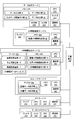
- FIG. 1 is a block diagram illustrating the overall configuration of the data processing system according to the first embodiment of the present invention.
- the data processing system 1 includes a data source server 2, an ETL (Extract Transform Load) server 3, a storage server 4, a meta information extraction server 5, a meta information search server 6, and a data processing server 7.
- ETL Extract Transform Load
- the data source server 2 is a device that manages images and documents.
- the data source server 2 includes a relational database (not shown) that manages drawings in association with IDs (identification information), and a file server (not shown) that stores text documents.
- the ETL server 3 has a function of storing image data and document data stored in the data source server 2 in the storage server 4. Here, conversion such as unifying the format of the image and the document is performed.
- the storage server 4 includes an image data storage unit 11 and a document data storage unit 12, and stores image data and document data collected from a plurality of data sources in a unified format.
- the meta information extraction server 5 includes an image dictionary unit 13, an image meta information extraction unit 14, a document dictionary unit 15, a document meta information extraction unit 16, a relationship dictionary unit 17, a meta information association unit 18, and a meta information database 19. And manages meta information extracted from data in the storage server 4.
- the meta information search server 6 includes a related meta information search unit 20, receives a search request, and returns a result of searching the meta information database 19.
- the data processing server 7 includes a data input unit 21, an input data association unit 22, a data processing unit 23, and a data output unit 24, and processes and outputs input data based on meta information.
- FIG. 2 is a block diagram illustrating a hardware configuration of the data processing system 1 according to the first embodiment of the present invention.
- the data source server 2 is a computer having a communication unit 221, a CPU (Central Processing Unit) 222, a memory 223, and a disk 224 that are connected to each other.
- a communication unit 221 a CPU (Central Processing Unit) 222, a memory 223, and a disk 224 that are connected to each other.
- CPU Central Processing Unit
- the communication unit 221 is an interface that is connected to the relay device 280 and communicates with other servers via the relay device 280.
- the CPU 222 is a processor that realizes a predetermined function by executing a program stored in the memory 223.
- the memory 223 and the disk 224 are storage devices that store programs executed by the CPU 222, data referred to by the CPU 222, and the like. These may be any type of storage device.
- the memory 223 is a relatively high-speed semiconductor memory such as a DRAM (Dynamic Random Access Memory), and the disk 224 is a hard disk. It is a relatively large capacity storage device such as a device.
- the ETL server 3 is a computer having a communication unit 231, a CPU 232, a memory 233, and a disk 234 connected to each other.
- the description of these units is the same as the description of the communication unit 221, the CPU 222, the memory 223, and the disk 224 of the data source server 2, and will be omitted.
- the storage server 4 is a computer having a communication unit 241, a CPU 242, a memory 243, and a disk 244 connected to each other.
- the description of these units is the same as the description of the communication unit 221, the CPU 222, the memory 223, and the disk 224 of the data source server 2, and will be omitted.
- the disk 244 includes an image data storage unit 11 that stores image data and a document data storage unit 12 that stores document data. Part or all of the data stored in the image data storage unit 11 and the document data storage unit 12 may be copied to the memory 243 as necessary.
- the meta information extraction server 5 is a computer having a communication unit 251, a CPU 252, a memory 253, and a disk 254 that are connected to each other.
- the description of these units is the same as the description of the communication unit 221, the CPU 222, the memory 223, and the disk 224 of the data source server 2, and will be omitted.
- the memory 253 includes an image meta information extraction unit 14, a document meta information extraction unit 16, and a meta information association unit 18. These are programs executed by the CPU 252.
- processing executed by the image meta information extraction unit 14, the document meta information extraction unit 16, or the meta information association unit 18 may be described. However, such processing is actually required by the CPU 252 according to the above program. Accordingly, the process is executed by controlling the memory 253, the disk 254, the communication unit 251, and the like. Processing executed by programs stored in a memory 263 and a memory 273, which will be described later, is actually executed by the CPU of each computer in the same manner as described above.
- the image meta information extraction unit 14, the document meta information extraction unit 16, and the meta information association unit 18 may be stored in the disk 254 and copied to the memory 253 as necessary. The same applies to programs stored in a memory 263 and a memory 273 described later.
- the meta information search server 6 is a computer having a communication unit 261, a CPU 262, a memory 263, and a disk 264 that are connected to each other.
- the description of these units is the same as the description of the communication unit 221, the CPU 222, the memory 223, and the disk 224 of the data source server 2, and will be omitted.
- the memory 263 includes the related meta information search unit 20. This is a program executed by the CPU 262.
- the data processing server 7 is a computer having a communication unit 271, a CPU 272, a memory 273, and a disk 274 that are connected to each other.
- the description of these units is the same as the description of the communication unit 221, the CPU 222, the memory 223, and the disk 224 of the data source server 2, and will be omitted.
- the memory 273 includes a data input unit 21, an input data association unit 22, a data processing unit 23, and a data output unit 24. These are programs executed by the CPU 272.
- the data processing server 7 further includes an input unit 275 and an output unit 276 that are connected to the CPU 272 and controlled by the data input unit 21 and the data output unit 24.
- the input unit 275 is an input device such as a keyboard and a pointing device
- the output unit 276 is an output device such as an image display device.
- each server other than the data processing server 7 constituting the data processing system 1 may have the same input unit and output unit as the data processing server 7.
- the relay device 280 is a device that is connected to the communication unit of each server and relays communication between servers.
- FIG. 2 shows an example of a hardware configuration realized by an independent computer in which each server includes one CPU and one or more storage devices.
- each server includes one CPU and one or more storage devices.
- the data processing system 1 may be realized by one computer including a storage device that stores all the programs and data described above and at least one CPU.
- the data source server 2 is realized by one computer
- the ETL server 3 and the storage server 4 are realized by another one computer
- the meta information extraction server 5, the meta information search server 6, and the data processing server 7 are further provided. It may be realized by another single computer.
- each server may be a virtual server generated using a virtualization technique.
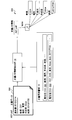
- FIG. 3 is a flowchart showing the operation of the meta information database construction process in Embodiment 1 of the present invention.
- the ETL server 3 acquires image data and document data from the data source server 2 (step S301). Subsequently, the ETL server 3 performs necessary conversion on the image data and the document data (step S302). For example, when the later-described image meta information extracting unit 14 accepts only a specific format of image data, a process of converting the format of the image data into the specific format is performed. Subsequently, the ETL server 3 stores the converted image data and document data in the image data storage unit 11 and the document data storage unit 12 of the storage server 4 (step S303).
- the meta information extraction server 5 acquires image data and document data from the storage server 4 (step S304).
- the image meta information extraction unit 14 of the meta information extraction server 5 extracts meta information for the image data based on the image dictionary unit 13 (step S305).
- FIG. 4 is a diagram illustrating details of the process (step S305 in FIG. 3) in which the image meta information extraction unit 14 extracts meta information for image data in the first embodiment of the present invention.
- the image dictionary unit 13 holds a model 401 for performing recognition and classification based on image shape / color information and the like.
- Each model 401 is associated with a label 402.
- “shape: tube” is associated as a label 402 with a model 401 corresponding to an image of a tube-shaped figure.
- the image meta information extraction unit 14 gives a label 402 to the image data 403 acquired from the image data storage unit 11 by an image recognition technique based on the image dictionary unit 13. Specifically, for example, the image meta information extraction unit 14 compares the similarity between the image data 403 and each model 401 by a known image recognition technique, and the label 402 corresponding to the model 401 having the highest similarity is displayed as an image. You may give to the data 403. In the example of FIG. 4, the image meta information extraction unit 14 assigns a label of “shape: tube” to the image data 403 and outputs the result as image meta information 404.
- the image meta information 404 is an expression indicating that “shape of C01.jpg is a tube”. For example, an expression of a ternary relationship such as “B of A is C” using RDF (Resource Description Framework). Can be described.
- step S 305 the document meta information extraction unit 16 extracts meta information for the document data based on the document dictionary unit 15.
- FIG. 5 is a diagram for explaining the details of the process (step S305) in which the document meta information extraction unit 16 extracts meta information for the document data in the first embodiment of the present invention.
- the document dictionary unit 15 holds an attribute name list 501 in which words suitable for attribute names are collected and an attribute value list 502 in which words suitable for attribute values are collected for the words in the document.
- the document meta information extraction unit 16 analyzes the structure of the document data 503 acquired from the document data storage unit 12 based on the document dictionary unit 15 and the result of analyzing the layout of the document, thereby obtaining the document meta information 504. Is generated.
- the document data 503 includes character strings such as “notification: C01” and “location: Tokyo”.
- the attribute name list 501 includes words such as “reference”, “location”, and “creator”, and the attribute value list 502 includes words such as “C01”, “C02”, “Tokyo”, and “Alice”.
- the document meta information extraction unit 16 extracts attribute names such as “reference” and “location” from the document data 503 based on the attribute name list 501, and “C01” and “ By extracting attribute values such as “Tokyo” and associating, for example, “reference” with “C01”, “location” with “Tokyo” based on the layout information that the words are arranged with a colon in between, As a result of the structuring, document meta information 504 is generated.
- the document meta information 504 can be described using RDF, similarly to the image meta information 404.
- the image meta information extraction unit 14 and the document meta information extraction unit 16 store the extracted meta information in the meta information database 19 (step S306).
- image meta information and document meta information can be managed in the same database.
- the meta information associating unit 18 uses the relevance dictionary unit 17 to give association to the meta information stored in the meta information database 19 (step S307).
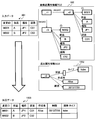
- FIG. 6 is a diagram for explaining the details of the process (step S307) in which the meta information association unit 18 assigns the association to the meta information in the first embodiment of the present invention.
- the relevancy dictionary unit 17 holds a synonym dictionary 601, and examples of synonym relationships include “drawing” and “reference”, “type” and “shape”, “C01” and “C01.jpg”, and the like. Pre-built by the system designer.
- the synonym dictionary 601 may hold a synonym relationship between words in different languages based on a translation dictionary prepared separately.
- the synonym dictionary may be any information as long as it is information defining information that can be replaced with certain meta information.
- the synonym dictionary is information indicating that information included in meta information of a modal and information included in meta information of another modal that is synonymous with the information can be replaced.
- a dictionary (see Example 2) that defines a synonym relationship between spoken words and written words may be used.
- the meta information associating unit 18 searches the meta information database 19 for a word existing in the synonym dictionary 601 and converts the word into changed meta information 602 in which the word is replaced with a word having a synonym relation. Update.
- the image meta information “shape of C01.jpg is tube” is searched for the word “shape” in the synonym dictionary 601.
- the meta information associating unit 18 replaces “shape” with “type” that is the synonym based on the synonym dictionary 601, whereby the searched image meta information is “type of C01.jpg is tube. Is converted to meta information.
- step S307 for example, according to the synonym relation, the word “shape” and the word “type” in the meta information database can be replaced, and the word “C01” and the word “C01.jpg” can be replaced.
- the meta information associating unit 18 replaces the searched meta information “shape of C01.jpg is tube” with the word “shape” and the word “shape” based on the synonym dictionary 601.
- Information indicating that the “type” can be replaced and information indicating that the word “C01” and the word “C01.jpg” can be replaced may be added to the meta information.
- the image meta information and the document meta information are associated with each other via “C01.jpg”. That is, “_: r1 drawing is C01.jpg and C01.jpg type is tube”, in other words, “_: r1 drawing type is tube”.
- “drawing-type” obtained by combining two attribute names “drawing” and “type” associated via the attribute value “C01.jpg” may be treated as a new attribute name (see FIG. 10).
- the meta information database 19 is constructed as described above.
- meta information extracted from multiple modal data contains the same (or related) concept, but different expressions are given to each modal meta information depending on the nature of the modal
- These expressions are unified by updating the meta information as described above or adding meta information that can be replaced. This makes it possible to search related meta information without omission in the processing described later.
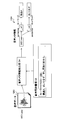
- FIG. 7 is a flowchart showing an operation of data processing in the first embodiment of the present invention.
- the data input unit 21 receives input of table data from the user (step S701).
- the table data input here (for example, input data 801 to be described later) is stored in advance in the data processing system 1 (or acquired from the outside of the data processing system 1 via, for example, the input unit 275 or the communication unit 271).
- Arbitrary structural data which is associated with unstructured data by the following process.
- the input data association unit 22 extracts attribute relationships from the received table (step S702).
- FIG. 8 is a diagram for explaining the details of the process (step S702) for extracting the attribute relationship from the table received by the input data association unit 22 in the first embodiment of the present invention.
- the input data association unit 22 extracts record information from the input data 801, extracts the relationship between attributes and attribute names, and outputs table structure attribute information 802.
- the table structure attribute information 802 can be described using RDF, similarly to the description of image meta information and document meta information.
- “M001”, “A”, “JP1”, and “C01” are included in one record of the input data 801 as values corresponding to the items “ID”, “part”, “location”, and “drawing”, respectively. If it is included, the record is identified as “_: r2”, “_: r2 ID is M001”, “_: r2 component is A”, “_: r2 location is JP1 Table structure attribute information 802 including RDF description such as “A certain” and “_: r2 drawing is C01” is output.
- the input data associating unit 22 assigns an association to the table structure attribute information 802 using the relevancy dictionary unit 17 (step S703).
- FIG. 9 is a diagram illustrating details of the process (step S703) in which the input data association unit 22 assigns association to the table structure attribute information 802 in the first embodiment of the present invention.
- the input data association unit 22 searches the table structure attribute information 802 for a word existing in the synonym dictionary 601 and replaces the word with a word having a synonym relationship with the word.
- Change attribute information 901 is generated, and the table structure attribute information 802 is changed based on the change attribute information 901.
- “_: r2 drawing is C01” is searched from the table structure attribute information 802 for the word “C01” in the synonym dictionary 601, and these are “C01” and “C01.
- the attribute information is changed to “_: r2 drawing is C01.jpg”.
- the input data association unit 22 can replace “C01” and “C01.jpg” instead of rewriting the table structure attribute information 802 with the change attribute information 901. May be added to the table structure attribute information 802.
- the related meta information search unit 20 searches the meta information database 19 using the table structure attribute information 802 (step S704).
- meta information having the same attribute relationship as the input is selected as an inquiry to the meta information database 19.
- the meta information database 19 includes information “_: r1 drawing is C01.jpg” (( It can be found as the same attribute relationship as the input. Similarly, “the location of _: r2 is Tokyo” can also be found for “the location of _: r2 is Tokyo”.
- the related meta-information search unit 20 can regard them as the same record when the attribute relationship of a plurality of records satisfies a predetermined condition. For example, if a plurality of records have two or more common attribute relationships (that is, a combination of a common attribute name and attribute value) and are regarded as the same record, in the above example, _: r1 _: R2 can be regarded as the same record.
- the condition for regarding two records as the same is not limited to the above example.
- a list of attribute names regarded as the same record is defined in advance, and the related meta information search unit 20 regards a plurality of records having the same attribute value corresponding to the attribute name included in the list as the same record. Good.
- the related meta information search unit 20 may estimate the same record from the search result of meta information.
- the related meta-information search unit 20 acquires the attribute relationship regarding _: r1, which is regarded as the same record as _: r2 included in the input data, from the meta-information database 19 (step S705).
- _: r1 which is regarded as the same record as _: r2 included in the input data
- the meta-information database 19 the meta-information database 19
- two pieces of meta information “the creator of _: r1 is Alice” and “the delivery date of _: r1 is 2012/7/30” can be acquired (see FIG. 6).
- the related meta-information search unit 20 further traces any attribute related to the attribute value, thereby saying that “_: r1 drawing (is C01.jpg and C01.jpg) is a tube”. Meta information can also be acquired.
- the related meta-information search unit 20 “_: r2 creator is Alice”, “_: r2 delivery date is 2012/7/30”, and “_: r2 drawing (C01. jpg and C01.jpg) is a tube "is determined as additional attribute information.
- the data processing unit 23 adds an attribute to the input data 801 based on the additional attribute information determined by the related meta information search unit 20 (step S706).
- FIG. 10 is a diagram illustrating processing (step S706) in which the data processing unit 23 adds an attribute to the input data 801 in the first embodiment of the present invention.
- the data processing unit 23 adds the additional attribute information 1002 to the table structure attribute information 802 and returns it to the table representation, whereby the processed data 1003 is obtained.
- “_: r2 creator is Alice
- “_: r2 delivery date is 2012/7/30”
- “_: r2 drawing (is C01.jpg, "C01.jpg) type is tube” is added in tabular form.
- another attribute name is associated with an attribute value corresponding to a certain attribute name as in the relationship between the above “drawing”, “C01.jpg”, and “type”
- the plurality of attribute names is connected and displayed as a new attribute name.
- Such processed data 1003 indicates the relationship between the input data 801, the image meta information 404, and the document meta information 504.
- the data output unit 24 outputs machining data 1003.
- the input table is extended based on a meta information database that has been constructed in advance.
- by expressing the meta information in RDF it is possible to associate data of different modalities such as a table, a document, and an image based on a single synonym dictionary.
- the meta information about the image type is used, but the result of other information extraction can be used.
- the extracted person name may be used as meta information using face image recognition.
- an example of a data processing system that presents information related to input text data based on a meta information database extracted from voice data and text data will be described.
- the system can be used, for example, to manage call recording voices and operator response logs stored in a call center.
- the system displays the related voice and the response log by using the recorded voice and the meta information extracted from the response log. This makes it possible to search for information efficiently without listening to all recorded audio.
- FIG. 11 is a block diagram illustrating the overall configuration of the data processing system according to the second embodiment of the present invention.
- the image data and document data in the first embodiment are replaced with audio data and text data, and a meta information database is constructed for each of the audio data and the text data. Instead of associating, the meta information is searched when it is associated.
- each part of the data processing system of the second embodiment has the same functions as the parts denoted by the same reference numerals of the first embodiment shown in FIG. Description of is omitted.
- the data processing system 1 includes the data source server 2, the ETL server 3, the storage server 4, the meta information extraction server 5, the meta information search server 6, and the data processing server 7 as in the first exemplary embodiment. .
- the data source server 2 is a device that manages voice and text, and includes a relational database that manages recorded voice data in association with an ID, and a file server that stores voice data files and text files.
- the ETL server 3 has a function of storing voice data and text data stored in the data source server 2 in the storage server 4. Here, conversion such as unifying the format of the audio data is performed.
- the storage server 4 includes an audio data storage unit 51 and a text data storage unit 52, and stores audio data and text data collected from a plurality of data sources in a unified format.
- the meta information extraction server 5 includes an audio dictionary unit 53, an audio meta information extraction unit 54, a text dictionary unit 55, a text meta information extraction unit 56, an audio meta information database 57, and a text meta information database 58.
- the meta information extracted from the data in is managed.
- the meta information search server 6 includes a relevancy dictionary unit 17, a meta information association unit 18, and a related meta information search unit 20.
- the meta information search server 6 receives the search request and searches the speech meta information database 57 and the text meta information database 58, respectively. return it.
- the data processing server 7 includes a data input unit 21, an input data association unit 22, a data processing unit 23, and a data output unit 24, and processes and outputs the input data based on the meta information.
- the hardware configuration of the data processing system 1 of the present embodiment is the same as the configuration of the first embodiment shown in FIG.
- the disk 244 of the storage server 4 includes an audio data storage unit 51 and a text data storage unit 52 instead of the image data storage unit 11 and the document data storage unit 12.
- the disk 254 of the meta information extraction server 5 is replaced with an audio dictionary unit 53, a text dictionary unit 55, an audio meta, instead of the image dictionary unit 13, the document dictionary unit 15, the relevance dictionary unit 17, and the meta information database 19.
- An information database 57 and a text meta information database 58 are included.
- the memory 253 of the meta information extraction server 5 includes an audio meta information extraction unit 54 and a text meta information extraction unit 56 instead of the image meta information extraction unit 14, the document meta information extraction unit 16, and the meta information association unit 18.
- the memory 263 of the meta information search server 6 includes the meta information association unit 18 in addition to the related meta information search unit 20, and the disk 264 includes the relevancy dictionary unit 17.
- the operation of the data processing system 1 is divided into a meta information database construction process and a data processing process.
- the meta information database construction process is the same as the meta information database construction process in the first embodiment shown in FIG. 3 except for the differences described below.
- the ETL server 3 acquires voice data and text data from the data source server 2 (step S301). Subsequently, the ETL server 3 performs necessary conversion on the voice data and the text data (step S302). Subsequently, the ETL server 3 stores the converted voice data and text data in the storage server 4 (step S303).
- the meta information extraction server 5 acquires voice data and text data from the storage server 4 (step S304).
- the audio meta information extraction unit 54 extracts meta information for the audio data based on the audio dictionary unit 53 (step S305).
- FIG. 12 is a diagram illustrating details of the process (step S305) in which the audio meta information extraction unit 54 extracts meta information for audio data in the second embodiment of the present invention.
- the voice dictionary unit 53 holds a keyword list 1201 that is a list of keywords detected from the voice.
- the speech meta information extraction unit 54 generates speech meta information 1204 by dividing the speech data 1203 into sentence units by using a speech recognition technique based on the speech dictionary unit 53 and adding keywords appearing therein.
- two keywords “product A” and “will go” are extracted from the audio data 1203.
- the audio meta-information 1204 includes “W01.wav sentence has _: s1”, “W01.wav sentence has _: s2”, and “_: s1 keyword has“ product A ”. "There is” and "_: s2 keyword has” I will "will be described.
- step S305 the text meta information extraction unit 56 extracts meta information for the text data based on the text dictionary unit 55.
- FIG. 13 is a diagram for explaining the details of the process (step S305) in which the text meta information extraction unit 56 extracts meta information for text data in the second embodiment of the present invention.
- the text dictionary unit 55 holds a keyword list 1301 extracted from the text.
- the text meta information extraction unit 56 generates text meta information 1304 by analyzing the text data 1303 based on the text dictionary unit 55 and the result of the morphological analysis. In the example of FIG. 13, three keywords “product A”, “claim”, and “visit” are extracted from the text data 1303.
- the text meta information 1304 can be described using RDF, like the audio meta information 1204.
- the audio meta information extraction unit 54 stores the extracted audio meta information in the audio meta information database 57 (step S306).
- the text meta information extraction unit 56 stores the extracted text meta information in the text meta information database 58.
- the extracted meta information is stored as a database separated by each modal.
- step S307 for associating meta information is not performed after storing meta information (step S306).
- FIG. 14 is a flowchart showing the data processing operation in the second embodiment of the present invention.
- the data input unit 21 receives input of text data from the user (step S1401).
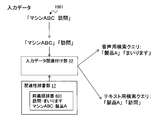
- the input data association unit 22 extracts keywords from the received text data (step S1402).
- a case where “machine ABC visit” is input as text data and the keywords “machine ABC” and “visit” are extracted will be described as an example.
- the input data association unit 22 may extract the keyword using morphological analysis or the like.
- the input data association unit 22 uses the association dictionary unit 17 to associate the extracted keywords (step S1403).
- FIG. 15 is a diagram for explaining the details of the process (step S1403) for assigning the keyword extracted by the input data association unit 22 in the second embodiment of the present invention.
- a synonym dictionary 601 including information for converting between spoken words and written words is built in advance. This makes it possible to associate “visit” with “will go”.
- the synonym dictionary 601 illustrated in FIG. 15 further includes information that associates “machine ABC” with “product A”.
- “Machine ABC” and “Product A” are aliases of the same product (for example, one is identification information used inside the manufacturer and the other is a product name used for the customer). It is.
- the input data association unit 22 uses the keywords “machine ABC” and “visit” extracted from the input text data 1501 as “product A” and “ Can be associated with.
- the meta information associating unit 18 develops the extracted keywords based on the result of the association using the relevancy dictionary unit 17 (step S1404). Specifically, the meta information association unit 18 uses the extracted keywords “machine ABC” and “visit” as keywords for searching the audio meta information database 57 (that is, a search query for audio) “product A” and “ Will expand. Similarly, the meta information association unit 18 uses the extracted keywords “machine ABC” and “visit” as keywords for searching the text meta information database 58 (that is, a text search query) “product A” and “visit”. Expand to.
- the related meta-information search unit 20 searches the speech meta-information database 57 using the keywords “product A” and “will go”, and further searches the text meta-information database 58 using the keywords “product A” and “visit”. (Step S1405).
- the data processing unit 23 associates the audio meta information searched by the related meta information search unit 20 with the text meta information (step S1406).
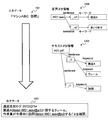
- FIG. 16 is a diagram illustrating processing (step S1406) in which the data processing unit 23 associates audio meta information and text meta information in the second embodiment of the present invention.
- step 1401 when the text data 1501 “machine ABC visit” is input in step 1401 and the audio meta information 1204 and the text meta information 1304 are searched in step S 1405, the data processing unit 23 stores the text data corresponding to the text meta information 1304.
- Processing data 1601 is generated by associating 1303 with audio data 1203 corresponding to the audio meta information 1204.
- the data processing unit 23 applies the keywords “product A” and “visit” included in the audio data 1203 to the keywords “product A” and “visit” included in the text data 1303, respectively.
- Processing data 1601 is generated by adding links (“listen W01.wav@s1” and “listen W01.wav@s2” in the example of FIG. 16), respectively.
- the processed data 1601 is information indicating a relationship between a keyword corresponding to the input keyword included in the text data 1303 and a portion of the audio data 1203 corresponding to the keyword.
- the data output unit 24 outputs the processed data 1601 (step S1407).
- the speech meta information database 57 and the text meta information database 58 are not associated in advance. Therefore, these databases may contain information on the same or related concepts, given different expressions depending on the modal (for example, expressions such as spoken and written).
- the input keyword is expanded based on the relevance dictionary unit 17 to convert the input keyword into an expression that matches each modal feature, whether each modal feature (for example, spoken or written) is included. ) Can be searched for.
- processing such as generating a link of related voice data on the text of the call answering record.
- a dictionary that defines a combination of replaceable words such as a synonym dictionary or a spoken word conversion dictionary, as a relevance dictionary that is the same as the word association in the meta information database and the word association in the input table.
- Information extracted from multimodal data such as data, image data, and audio data can be associated with the input data.
- various functions of the data processing system are realized by a program executed on the CPU of each server.
- some or all of them include electronic components such as integrated circuits. It may be realized by the hardware used.
- the present invention is not limited to the above-described embodiment, and includes various modifications.
- a table generation system for data mining and a voice log analysis system for call centers are assumed.
- a system for managing electronic medical record data and medical image data, a broadcast data editing system, etc. It can be applied to various systems for managing modal data.
- Information such as a program, a table, and a file that realize each function of the above embodiment is a storage device such as a nonvolatile semiconductor memory, a hard disk drive, an SSD (Solid State Drive), or an IC card, an SD card, a DVD, or the like. It can be stored on a computer readable non-transitory data storage medium.
- a storage device such as a nonvolatile semiconductor memory, a hard disk drive, an SSD (Solid State Drive), or an IC card, an SD card, a DVD, or the like. It can be stored on a computer readable non-transitory data storage medium.
- the present invention is not limited to the above-described embodiment, and includes various modifications.
- the above-described embodiment has been described in detail for easy understanding of the present invention, and is not necessarily limited to one having all the configurations described.
- a part of the configuration of an embodiment can be replaced with the configuration of another embodiment, and the configuration of another embodiment can be added to the configuration of an embodiment.
Landscapes
- Engineering & Computer Science (AREA)
- Theoretical Computer Science (AREA)
- Databases & Information Systems (AREA)
- General Engineering & Computer Science (AREA)
- Physics & Mathematics (AREA)
- General Physics & Mathematics (AREA)
- Data Mining & Analysis (AREA)
- Business, Economics & Management (AREA)
- General Business, Economics & Management (AREA)
- Computer Hardware Design (AREA)
- Information Retrieval, Db Structures And Fs Structures Therefor (AREA)
Abstract
Description
Claims (13)
- 一つ以上のプロセッサと、前記一つ以上のプロセッサに接続される一つ以上の記憶装置と、を有するデータ加工システムであって、
複数の種類のデータからメタ情報を抽出する条件を定義するメタ情報抽出用辞書情報と、前記複数の種類のデータから抽出されたメタ情報を関連付ける条件を定義する関連性辞書情報と、を保持し、
前記複数の種類のデータから、前記メタ情報抽出用辞書情報に基づいて前記メタ情報を抽出し、
入力されたデータからメタ情報を抽出し、
前記関連性辞書情報に基づいて、前記入力されたデータから抽出されたメタ情報と前記複数の種類のデータから抽出されたメタ情報とを関連付け、
前記関連付けの結果に基づいて、前記複数の種類のデータと、前記入力されたデータと、それらのデータから抽出されたメタ情報と、のいずれかの組み合わせの関連を示す情報を出力することを特徴とするデータ加工システム。 - 請求項1に記載のデータ加工システムであって、
前記複数の種類のデータは、第1の種類のデータおよび第2の種類のデータを含み、
前記メタ情報抽出用辞書情報は、前記第1の種類のデータから第1のメタ情報を抽出する条件を定義する第1のメタ情報抽出用辞書情報と、前記第2の種類のデータから第1のメタ情報を抽出する条件を定義する第2のメタ情報抽出用辞書情報と、を含み、
前記関連性辞書情報は、メタ情報と置換可能な情報を定義する情報を含み、
前記データ加工システムは、
前記第1の種類のデータおよび前記第2の種類のデータから、それぞれ、前記第1のメタ情報抽出用辞書情報および前記第2のメタ情報抽出用辞書情報に基づいて、前記第1のメタ情報および前記第2のメタ情報を抽出し、
入力されたデータから第3のメタ情報を抽出し、
前記関連性辞書情報に基づいて、前記第1のメタ情報と置換可能な情報、前記第2のメタ情報と置換可能な情報、および前記第3のメタ情報と置換可能な情報の少なくとも一つを特定し、
前記第3のメタ情報または前記第3のメタ情報と置換可能な情報を用いて、前記第1のメタ情報または前記第1のメタ情報と置換可能な情報、および、前記第2のメタ情報または前記第2のメタ情報と置換可能な情報を検索し、
前記検索の結果に基づいて、前記第3のメタ情報または前記第3のメタ情報と置換可能な情報と、前記第1のメタ情報または前記第1のメタ情報と置換可能な情報と、前記第2のメタ情報または前記第2のメタ情報と置換可能な情報と、を関連付けることを特徴とするデータ加工システム。 - 請求項2に記載のデータ加工システムであって、
前記関連性辞書情報に基づいて、前記第1のメタ情報と置換可能な情報を特定し、前記関連性辞書情報に基づいて、前記第2のメタ情報と置換可能な情報を特定し、前記特定された置換可能な情報と前記第1のメタ情報と前記第2のメタ情報とが所定の条件を満たすか否かの判定に基づいて、前記第1のメタ情報と前記第2のメタ情報とを関連付け、
前記関連性辞書情報に基づいて、前記第3のメタ情報と置換可能な情報を特定し、
前記第1のメタ情報または前記第1のメタ情報と置換可能な情報が検索結果として取得された場合、前記第3のメタ情報または前記第3のメタ情報と置換可能な情報と、前記第1のメタ情報または前記第1のメタ情報と置換可能な情報と、前記第1のメタ情報に関連付けられた前記第2のメタ情報または前記第2のメタ情報と置換可能な情報と、を関連付けることを特徴とするデータ加工システム。 - 請求項2に記載のデータ加工システムであって、
前記関連性辞書情報に基づいて、前記第1のメタ情報と置換可能な情報を特定する手順、および、前記関連性辞書情報に基づいて、前記第2のメタ情報と置換可能な情報を特定する手順を実行せず、前記関連性辞書情報に基づいて、前記第3のメタ情報と置換可能な情報を特定することを特徴とするデータ加工システム。 - 請求項2に記載のデータ加工システムであって、
前記関連性辞書情報は、前記メタ情報に含まれる単語と同義の他の単語を定義する情報を含むことを特徴とするデータ加工システム。 - 請求項2に記載のデータ加工システムであって、
前記関連性辞書情報は、前記メタ情報に含まれる書き言葉の単語と同義の話し言葉の単語を定義する情報、および、前記メタ情報に含まれる話し言葉の単語と同義の書き言葉の単語を定義する情報を含むことを特徴とするデータ加工システム。 - 請求項2に記載のデータ加工システムであって、
前記関連性辞書情報は、前記メタ情報に含まれる第1の言語の単語と同義の第2の言語の単語を定義する情報を含むことを特徴とするデータ加工システム。 - 請求項2に記載のデータ加工システムであって、
前記メタ情報は、三項関係を含む情報であり、
前記関連性辞書情報は、抽出されたメタ情報が三項関係に係る所定の条件に合致するときに、合致した三項関係を利用して新たな三項関係を生成するための規則を含むことを特徴とするデータ加工システム。 - 請求項2に記載のデータ加工システムであって、
前記第1の種類のデータは、テキスト、表構造、音声、画像または文書のいずれかである第1のモーダルのデータであり、
前記第2の種類のデータは、テキスト、表構造、音声、画像または文書のうち、前記第1のモーダルとは異なる第2のモーダルのデータであり、
前記関連性辞書情報は、異なるモーダル間で置換される情報を定義する情報を含むことを特徴とするデータ加工システム。 - 一つ以上のプロセッサと、前記一つ以上のプロセッサに接続される一つ以上の記憶装置と、を有する計算機システムによるデータ加工方法であって、
前記計算機システムは、複数の種類のデータからメタ情報を抽出する条件を定義するメタ情報抽出用辞書情報と、前記複数の種類のデータから抽出されたメタ情報を関連付ける条件を定義する関連性辞書情報と、を保持し、
前記データ加工方法は、
前記複数の種類のデータから、前記メタ情報抽出用辞書情報に基づいて前記メタ情報を抽出する第1手順と、
入力されたデータからメタ情報を抽出する第2手順と、
前記関連性辞書情報に基づいて、前記入力されたデータから抽出されたメタ情報と前記複数の種類のデータから抽出されたメタ情報とを関連付ける第3手順と、
前記関連付けの結果に基づいて、前記複数の種類のデータと、前記入力されたデータと、それらのデータから抽出されたメタ情報と、のいずれかの組み合わせの関連を示す情報を出力する第4手順と、を含むことを特徴とするデータ加工方法。 - 請求項10に記載のデータ加工方法であって、
前記複数の種類のデータは、第1の種類のデータと、第2の種類のデータと、を含み、
前記メタ情報抽出用辞書情報は、前記第1の種類のデータから第1のメタ情報を抽出する条件を定義する第1のメタ情報抽出用辞書情報と、前記第2の種類のデータから第1のメタ情報を抽出する条件を定義する第2のメタ情報抽出用辞書情報と、を含み、
前記関連性辞書情報は、メタ情報と置換可能な情報を定義する情報を含み、
前記第1手順は、前記第1の種類のデータおよび前記第2の種類のデータから、それぞれ、前記第1のメタ情報抽出用辞書情報および前記第2のメタ情報抽出用辞書情報に基づいて、前記第1のメタ情報および前記第2のメタ情報を抽出する第5手順を含み、
前記第2手順は、入力されたデータから第3のメタ情報を抽出する第6手順を含み、
前記第3手順は、
前記関連性辞書情報に基づいて、前記第1のメタ情報と置換可能な情報、前記第2のメタ情報と置換可能な情報、および前記第3のメタ情報と置換可能な情報の少なくとも一つを特定する第7手順と、
前記第3のメタ情報または前記第3のメタ情報と置換可能な情報を用いて、前記第1のメタ情報または前記第1のメタ情報と置換可能な情報、および、前記第2のメタ情報または前記第2のメタ情報と置換可能な情報を検索する第8手順と、
前記検索の結果に基づいて、前記第3のメタ情報または前記第3のメタ情報と置換可能な情報と、前記第1のメタ情報または前記第1のメタ情報と置換可能な情報と、前記第2のメタ情報または前記第2のメタ情報と置換可能な情報と、を関連付ける第9手順と、を含むことを特徴とするデータ加工方法。 - 請求項11に記載のデータ加工方法であって、
前記第7手順は、
前記関連性辞書情報に基づいて、前記第1のメタ情報と置換可能な情報を特定し、前記関連性辞書情報に基づいて、前記第2のメタ情報と置換可能な情報を特定し、前記特定された置換可能な情報と前記第1のメタ情報と前記第2のメタ情報とが所定の条件を満たすか否かの判定に基づいて、前記第1のメタ情報と前記第2のメタ情報とを関連付ける手順と、
前記関連性辞書情報に基づいて、前記第3のメタ情報と置換可能な情報を特定する手順と、を含み、
前記第9手順は、前記第8手順において前記第1のメタ情報または前記第1のメタ情報と置換可能な情報が検索結果として取得された場合、前記第3のメタ情報または前記第3のメタ情報と置換可能な情報と、前記第1のメタ情報または前記第1のメタ情報と置換可能な情報と、前記第1のメタ情報に関連付けられた前記第2のメタ情報または前記第2のメタ情報と置換可能な情報と、を関連付ける手順を含むことを特徴とするデータ加工方法。 - 請求項11に記載のデータ加工方法であって、
前記第7手順は、
前記関連性辞書情報に基づいて、前記第1のメタ情報と置換可能な情報を特定する手順、および、前記関連性辞書情報に基づいて、前記第2のメタ情報と置換可能な情報を特定する手順を含まず、
前記関連性辞書情報に基づいて、前記第3のメタ情報と置換可能な情報を特定する手順を含むことを特徴とするデータ加工方法。
Priority Applications (3)
| Application Number | Priority Date | Filing Date | Title |
|---|---|---|---|
| US14/649,762 US20150324436A1 (en) | 2012-12-28 | 2012-12-28 | Data processing system and data processing method |
| JP2014553983A JP5903171B2 (ja) | 2012-12-28 | 2012-12-28 | データ加工システムおよびデータ加工方法 |
| PCT/JP2012/084007 WO2014102992A1 (ja) | 2012-12-28 | 2012-12-28 | データ加工システムおよびデータ加工方法 |
Applications Claiming Priority (1)
| Application Number | Priority Date | Filing Date | Title |
|---|---|---|---|
| PCT/JP2012/084007 WO2014102992A1 (ja) | 2012-12-28 | 2012-12-28 | データ加工システムおよびデータ加工方法 |
Publications (1)
| Publication Number | Publication Date |
|---|---|
| WO2014102992A1 true WO2014102992A1 (ja) | 2014-07-03 |
Family
ID=51020143
Family Applications (1)
| Application Number | Title | Priority Date | Filing Date |
|---|---|---|---|
| PCT/JP2012/084007 Ceased WO2014102992A1 (ja) | 2012-12-28 | 2012-12-28 | データ加工システムおよびデータ加工方法 |
Country Status (3)
| Country | Link |
|---|---|
| US (1) | US20150324436A1 (ja) |
| JP (1) | JP5903171B2 (ja) |
| WO (1) | WO2014102992A1 (ja) |
Families Citing this family (2)
| Publication number | Priority date | Publication date | Assignee | Title |
|---|---|---|---|---|
| US11715151B2 (en) * | 2020-01-31 | 2023-08-01 | Walmart Apollo, Llc | Systems and methods for retraining of machine learned systems |
| US20220351814A1 (en) * | 2021-05-03 | 2022-11-03 | Udo, LLC | Stitching related healthcare data together |
Citations (4)
| Publication number | Priority date | Publication date | Assignee | Title |
|---|---|---|---|---|
| JP2008134954A (ja) * | 2006-11-29 | 2008-06-12 | Canon Inc | 情報処理装置、その制御方法、及びプログラム |
| JP2008192102A (ja) * | 2007-02-08 | 2008-08-21 | Sony Computer Entertainment Inc | メタデータ生成装置およびメタデータ生成方法 |
| JP2008226110A (ja) * | 2007-03-15 | 2008-09-25 | Seiko Epson Corp | 情報処理装置、情報処理方法および制御プログラム |
| JP2008236373A (ja) * | 2007-03-20 | 2008-10-02 | Nippon Hoso Kyokai <Nhk> | メタ情報付加装置及びメタ情報付加プログラム |
Family Cites Families (10)
| Publication number | Priority date | Publication date | Assignee | Title |
|---|---|---|---|---|
| US7117199B2 (en) * | 2000-02-22 | 2006-10-03 | Metacarta, Inc. | Spatially coding and displaying information |
| JP2002221980A (ja) * | 2001-01-25 | 2002-08-09 | Oki Electric Ind Co Ltd | テキスト音声変換装置 |
| US20050209849A1 (en) * | 2004-03-22 | 2005-09-22 | Sony Corporation And Sony Electronics Inc. | System and method for automatically cataloguing data by utilizing speech recognition procedures |
| US20060009966A1 (en) * | 2004-07-12 | 2006-01-12 | International Business Machines Corporation | Method and system for extracting information from unstructured text using symbolic machine learning |
| US20070088549A1 (en) * | 2005-10-14 | 2007-04-19 | Microsoft Corporation | Natural input of arbitrary text |
| US8615707B2 (en) * | 2009-01-16 | 2013-12-24 | Google Inc. | Adding new attributes to a structured presentation |
| JP5525529B2 (ja) * | 2009-08-04 | 2014-06-18 | 株式会社東芝 | 機械翻訳装置および翻訳プログラム |
| US8935259B2 (en) * | 2011-06-20 | 2015-01-13 | Google Inc | Text suggestions for images |
| CN102955773B (zh) * | 2011-08-31 | 2015-12-02 | 国际商业机器公司 | 用于在中文文档中识别化学名称的方法及系统 |
| US9741344B2 (en) * | 2014-10-20 | 2017-08-22 | Vocalzoom Systems Ltd. | System and method for operating devices using voice commands |
-
2012
- 2012-12-28 US US14/649,762 patent/US20150324436A1/en not_active Abandoned
- 2012-12-28 WO PCT/JP2012/084007 patent/WO2014102992A1/ja not_active Ceased
- 2012-12-28 JP JP2014553983A patent/JP5903171B2/ja not_active Expired - Fee Related
Patent Citations (4)
| Publication number | Priority date | Publication date | Assignee | Title |
|---|---|---|---|---|
| JP2008134954A (ja) * | 2006-11-29 | 2008-06-12 | Canon Inc | 情報処理装置、その制御方法、及びプログラム |
| JP2008192102A (ja) * | 2007-02-08 | 2008-08-21 | Sony Computer Entertainment Inc | メタデータ生成装置およびメタデータ生成方法 |
| JP2008226110A (ja) * | 2007-03-15 | 2008-09-25 | Seiko Epson Corp | 情報処理装置、情報処理方法および制御プログラム |
| JP2008236373A (ja) * | 2007-03-20 | 2008-10-02 | Nippon Hoso Kyokai <Nhk> | メタ情報付加装置及びメタ情報付加プログラム |
Also Published As
| Publication number | Publication date |
|---|---|
| JP5903171B2 (ja) | 2016-04-13 |
| JPWO2014102992A1 (ja) | 2017-01-12 |
| US20150324436A1 (en) | 2015-11-12 |
Similar Documents
| Publication | Publication Date | Title |
|---|---|---|
| US12032915B2 (en) | Creating and interacting with data records having semantic vectors and natural language expressions produced by a machine-trained model | |
| US9720944B2 (en) | Method for facet searching and search suggestions | |
| US10394851B2 (en) | Methods and systems for mapping data items to sparse distributed representations | |
| US12541543B2 (en) | Large language model-based information retrieval for large datasets | |
| US10073840B2 (en) | Unsupervised relation detection model training | |
| US10025819B2 (en) | Generating a query statement based on unstructured input | |
| CN108268600B (zh) | 基于ai的非结构化数据管理方法及装置 | |
| CN108475289A (zh) | 用于基于文档的内容向写作者建议内容的系统和方法 | |
| US20170177180A1 (en) | Dynamic Highlighting of Text in Electronic Documents | |
| US20160239504A1 (en) | Method for entity enrichment of digital content to enable advanced search functionality in content management systems | |
| JP6775935B2 (ja) | 文書処理装置、方法、およびプログラム | |
| CN106164890A (zh) | 用于消除非结构化文本中的特征的歧义的方法 | |
| US20140195532A1 (en) | Collecting digital assets to form a searchable repository | |
| AU2016204573A1 (en) | Common data repository for improving transactional efficiencies of user interactions with a computing device | |
| US20120179709A1 (en) | Apparatus, method and program product for searching document | |
| US20230409624A1 (en) | Multi-modal hierarchical semantic search engine | |
| JPWO2016151690A1 (ja) | 文書検索装置、方法及びプログラム | |
| JP2018185716A (ja) | データ処理システム、データ処理方法、およびデータ構造 | |
| US20210109960A1 (en) | Electronic apparatus and controlling method thereof | |
| NL2016846B1 (en) | Computer implemented and computer controlled method, computer program product and platform for arranging data for processing and storage at a data storage engine. | |
| JP7685921B2 (ja) | 情報処理システム、情報処理方法、および情報処理プログラム | |
| JP5903171B2 (ja) | データ加工システムおよびデータ加工方法 | |
| US20160085850A1 (en) | Knowledge brokering and knowledge campaigns | |
| JP4900475B2 (ja) | 電子文書管理装置及び電子文書管理プログラム | |
| JP6905724B1 (ja) | 情報提供システム及び情報提供方法 |
Legal Events
| Date | Code | Title | Description |
|---|---|---|---|
| 121 | Ep: the epo has been informed by wipo that ep was designated in this application |
Ref document number: 12890659 Country of ref document: EP Kind code of ref document: A1 |
|
| ENP | Entry into the national phase |
Ref document number: 2014553983 Country of ref document: JP Kind code of ref document: A |
|
| WWE | Wipo information: entry into national phase |
Ref document number: 14649762 Country of ref document: US |
|
| NENP | Non-entry into the national phase |
Ref country code: DE |
|
| 122 | Ep: pct application non-entry in european phase |
Ref document number: 12890659 Country of ref document: EP Kind code of ref document: A1 |