WO2014098299A1 - 생체 정보 스캐너를 이용한 ieee 11073 에이전트 사용자를 인증하는 방법 - Google Patents
생체 정보 스캐너를 이용한 ieee 11073 에이전트 사용자를 인증하는 방법 Download PDFInfo
- Publication number
- WO2014098299A1 WO2014098299A1 PCT/KR2012/011588 KR2012011588W WO2014098299A1 WO 2014098299 A1 WO2014098299 A1 WO 2014098299A1 KR 2012011588 W KR2012011588 W KR 2012011588W WO 2014098299 A1 WO2014098299 A1 WO 2014098299A1
- Authority
- WO
- WIPO (PCT)
- Prior art keywords
- ieee
- manager
- user
- user authentication
- authentication
- Prior art date
- Legal status (The legal status is an assumption and is not a legal conclusion. Google has not performed a legal analysis and makes no representation as to the accuracy of the status listed.)
- Ceased
Links
Images




Classifications
-
- H—ELECTRICITY
- H04—ELECTRIC COMMUNICATION TECHNIQUE
- H04L—TRANSMISSION OF DIGITAL INFORMATION, e.g. TELEGRAPHIC COMMUNICATION
- H04L9/00—Cryptographic mechanisms or cryptographic arrangements for secret or secure communications; Network security protocols
- H04L9/32—Cryptographic mechanisms or cryptographic arrangements for secret or secure communications; Network security protocols including means for verifying the identity or authority of a user of the system or for message authentication, e.g. authorization, entity authentication, data integrity or data verification, non-repudiation, key authentication or verification of credentials
- H04L9/3226—Cryptographic mechanisms or cryptographic arrangements for secret or secure communications; Network security protocols including means for verifying the identity or authority of a user of the system or for message authentication, e.g. authorization, entity authentication, data integrity or data verification, non-repudiation, key authentication or verification of credentials using a predetermined code, e.g. password, passphrase or PIN
- H04L9/3231—Biological data, e.g. fingerprint, voice or retina
-
- H—ELECTRICITY
- H04—ELECTRIC COMMUNICATION TECHNIQUE
- H04L—TRANSMISSION OF DIGITAL INFORMATION, e.g. TELEGRAPHIC COMMUNICATION
- H04L9/00—Cryptographic mechanisms or cryptographic arrangements for secret or secure communications; Network security protocols
- H04L9/32—Cryptographic mechanisms or cryptographic arrangements for secret or secure communications; Network security protocols including means for verifying the identity or authority of a user of the system or for message authentication, e.g. authorization, entity authentication, data integrity or data verification, non-repudiation, key authentication or verification of credentials
-
- G—PHYSICS
- G06—COMPUTING OR CALCULATING; COUNTING
- G06V—IMAGE OR VIDEO RECOGNITION OR UNDERSTANDING
- G06V40/00—Recognition of biometric, human-related or animal-related patterns in image or video data
- G06V40/10—Human or animal bodies, e.g. vehicle occupants or pedestrians; Body parts, e.g. hands
- G06V40/12—Fingerprints or palmprints
-
- G—PHYSICS
- G06—COMPUTING OR CALCULATING; COUNTING
- G06V—IMAGE OR VIDEO RECOGNITION OR UNDERSTANDING
- G06V40/00—Recognition of biometric, human-related or animal-related patterns in image or video data
- G06V40/10—Human or animal bodies, e.g. vehicle occupants or pedestrians; Body parts, e.g. hands
- G06V40/18—Eye characteristics, e.g. of the iris
-
- H—ELECTRICITY
- H04—ELECTRIC COMMUNICATION TECHNIQUE
- H04L—TRANSMISSION OF DIGITAL INFORMATION, e.g. TELEGRAPHIC COMMUNICATION
- H04L63/00—Network architectures or network communication protocols for network security
- H04L63/08—Network architectures or network communication protocols for network security for authentication of entities
-
- H—ELECTRICITY
- H04—ELECTRIC COMMUNICATION TECHNIQUE
- H04L—TRANSMISSION OF DIGITAL INFORMATION, e.g. TELEGRAPHIC COMMUNICATION
- H04L65/00—Network arrangements, protocols or services for supporting real-time applications in data packet communication
- H04L65/40—Support for services or applications
-
- H—ELECTRICITY
- H04—ELECTRIC COMMUNICATION TECHNIQUE
- H04L—TRANSMISSION OF DIGITAL INFORMATION, e.g. TELEGRAPHIC COMMUNICATION
- H04L9/00—Cryptographic mechanisms or cryptographic arrangements for secret or secure communications; Network security protocols
- H04L9/32—Cryptographic mechanisms or cryptographic arrangements for secret or secure communications; Network security protocols including means for verifying the identity or authority of a user of the system or for message authentication, e.g. authorization, entity authentication, data integrity or data verification, non-repudiation, key authentication or verification of credentials
- H04L9/321—Cryptographic mechanisms or cryptographic arrangements for secret or secure communications; Network security protocols including means for verifying the identity or authority of a user of the system or for message authentication, e.g. authorization, entity authentication, data integrity or data verification, non-repudiation, key authentication or verification of credentials involving a third party or a trusted authority
-
- H—ELECTRICITY
- H04—ELECTRIC COMMUNICATION TECHNIQUE
- H04L—TRANSMISSION OF DIGITAL INFORMATION, e.g. TELEGRAPHIC COMMUNICATION
- H04L2209/00—Additional information or applications relating to cryptographic mechanisms or cryptographic arrangements for secret or secure communication H04L9/00
- H04L2209/88—Medical equipments
Definitions
- the present invention relates to a method for authenticating an IEEE 11073 agent user using a biometric scanner. More specifically, in order to recognize the user of the IEEE 11073 agent, the IEEE 11073 manager is equipped with a biometric scan data generation function through scanning a specific part of the human body for identification, and uses a scanner agent that operates as an agent of the IEEE 11073 standard. The present invention relates to a user authentication method compatible with the IEEE 11073 international standard.
- ISO / IEEE 11073 PHD Personal Health Device
- ISO / IEEE 11073 PHD Personal Health Device
- the 11073-20601 Optimized Exchange Protocol defines a communication protocol between an IEEE 11073 agent (hereinafter referred to as "agent") and an IEEE 11073 manager (hereinafter referred to as “manager”).
- agent an IEEE 11073 agent
- manager an IEEE 11073 manager
- the 11073-20601 standard defines the communication method at the application level. It does not define the physical communication method, but uses near field communication such as Serial, IrDA, Bluetooth, USB, and ZigBee.
- IEEE 11073 standard provides a device-specific substandard according to each type of biometric information measuring apparatus.
- IEEE 11073-10407 is a standard for blood pressure monitors
- IEEE 11073-10417 is a standard for blood glucose meters
- IEEE 11073-10406 is a standard for heart rate monitors
- IEEE 11073-10415 is a standard for weight scales.
- biometric information measuring devices may be used exclusively by a specific user for a certain period of time, such as the heart rate monitor, or may be shared and used by several users, such as the scale.
- the agent since the agent sends the agent's ID to the manager, when a certain user exclusively uses it for a certain period of time, such as the heart rate monitor, the U-Health server determines that the measured data is the user's data. I can see if it is.
- the biometric information measuring device such as the scale, it is difficult to match the ID of the agent and a specific user, and the u-health server has a problem in that it is difficult to determine which user's data is measured data. .
- IEEE 11073-20601 does not define any process for user authentication.
- Korean Patent Publication No. 2012-0096287 discloses a dynamic valid session based mutual authentication method for secure biometric information transmission in u-health.
- the method includes a connection establishment step in which the gateway receives the encrypted text by using the shared key and the encryption algorithm, includes it in the connection request signal, and performs the initial authentication process.
- a valid session resetting step wherein the gateway generates a random number when the u-health device moves or the elapsed time elapses, and the u-health device transmits an authentication key value using the index value of the random number. It features.
- Korean Patent Laid-Open No. 2012-0096287 improves the safety of data and prevents biometric information by subdividing transmission sessions and periodically renewing each session in the process of transmitting the biometric information of an individual wirelessly.
- the effect of minimizing the transmission overhead for authentication by applying the dynamic effective session technique according to the measurement cycle can be expected, but the authentication method of the agent user based on the IEEE 11073 international standard cannot be derived.
- the technical problem to be solved by the present invention is to provide an authentication method of an agent user compliant with the IEEE 11073 standard.
- biometric scan data generated by the IEEE 11073 manager having a function of generating biometric scan data by scanning a specific part of the human body for identification, and receiving the biometric scan data received from a scanner agent operating as an agent of the IEEE 11073 standard.
- a scanner agent operating as an agent of the IEEE 11073 standard.
- Another technical problem to be solved by the present invention is a scanner agent having a function of generating bioscan data through scanning of a specific part of a human body for identity recognition, and a scanner agent operating as an agent of the IEEE 11073 standard, using a feature code from the bioscan data. After the extraction, if the feature code is provided to the IEEE 11073 manager, the IEEE 11073 manager provides an authentication method of an agent user performing user authentication using the feature code.
- a user authentication method using IEEE 11073-based biometric information includes a biometric scan data generation function through scanning of a specific body part for identification.
- a scanner agent operating as an agent of the IEEE 11073 standard transmitting an association request message including the biometric scan data to an IEEE 11073 manager; Sending, by the IEEE 11073 manager, the biometric scan data to a user authentication server in response to receiving the association request message; And receiving, by the IEEE 11073 manager, authentication result information based on the biometric scan data from the user authentication server.
- the user authentication method may use a manufacturer-defined protocol described in the IEEE 11073-20601 standard in the association process between the scanner agent and the IEEE 11073 manager. That is, the step of transmitting the association request message to the IEEE 11073 manager, by setting the data-proto-id parameter value of the association request message to the data-proto-id-external (65535), the scanner agent and the IEEE 11073 Generating an association request message allowing a manufacturer specific protocol to be used between managers; And transmitting the generated association request message.
- a manufacturer-defined protocol described in the IEEE 11073-20601 standard in the association process between the scanner agent and the IEEE 11073 manager that is, the step of transmitting the association request message to the IEEE 11073 manager, by setting the data-proto-id parameter value of the association request message to the data-proto-id-external (65535), the scanner agent and the IEEE 11073 Generating an association request message allowing a manufacturer specific protocol to be used between managers; And transmitting the generated association request message.
- the data_proto_info parameter of the association request message may include a registration mode flag item indicating whether to register biometric scan data or authentication biometric scan data, and a bioscan data array item including the biometric scan data.
- the data_proto_info parameter of the association request message may further include an optionlist item of an AttributList type in which a user identifier is stored.
- the IEEE 11073 manager may further receive user identification information from the user authentication server when user authentication by the user authentication server is successful.
- the user identification information is added when the biometric information measurement data received from the IEEE 11073 agent is transmitted to the u-health server, so that the u-health server can identify which user's data is the biometric information measurement data. That is, the receiving of the authentication result information may include receiving user identification information from the user authentication server upon successful authentication by the user authentication server.
- the manager may set the user identification information as an associated user key. That is, the step of receiving the user identification information further includes, when the user authentication succeeds as a result of the determination, the IEEE 11073 manager transitioning to an associated state; And setting the associated user key managed by the IEEE 11073 manager as the received user identification information.
- the associated user key is a valid user key only while the association between the manager and the scanner agent is maintained. Accordingly, the manager adds the associated user key to the U-health server by adding the associated user key to the biometric information measurement data received from the IEEE 11073 agent having the biometric information measurement function while the association between the manager and the scanner agent is maintained.
- the u-health server may identify which user's data is biometric data. That is, the user authentication method comprises the steps of: receiving, by the IEEE 11073 manager, biometric information measurement data from an IEEE 11073 agent; The IEEE 11073 manager may further include transmitting the biometric information measurement data to a u-health server but attaching the associated user key.
- the setting of the associated user key as the received user identification information may include: a state of the IEEE manager is a disassociating state or a language associated state.
- the method may include initializing the associated user key.
- a user authentication method using biometric information based on IEEE 11073 has a biometric scan data generation function through scanning of a specific part of the human body for identity recognition, IEEE Extracting, by the scanner agent operating as an agent of the 11073 standard, the feature code from the biometric scan data; Sending, by the scanner agent, an Association Request message including the property code to an IEEE 11073 manager; Sending the feature code to a user authentication server in response to the IEEE 11073 manager receiving the association request message; And receiving, by the IEEE 11073 manager, authentication result information of authentication based on the characteristic code from the user authentication server.
- the scanner agent may set the property code in the optionlist parameter of the association request message and transmit the feature code to the IEEE 11073 manager. That is, the transmitting of the association request message to the IEEE 11073 manager may include: generating an association request message containing an optionlist parameter having the property code set; And transmitting the generated association request message to the IEEE 11073 manager.
- the method may include transmitting the characteristic code to the user authentication server.
- the IEEE 11073 manager may set whether the user authentication using the characteristic code succeeds to a parameter of an association response message and transmit it to the scanner agent. That is, the user authentication method may include generating, by the IEEE 11073 manager, an Association Response message including a result parameter, wherein the result parameter value is set according to the received authentication result information; And transmitting, by the IEEE 11073 manager, the generated association response message to the scanner agent.
- the sending of the association response message to the scanner agent may include analyzing the received authentication result information to determine whether authentication is successful; Setting the result parameter value to accepted (0) when the authentication is determined to be successful, and setting the result parameter value to rejected-unknown (6) when it is determined that the authentication has failed. ; And transmitting an association response message including the result parameter to the scanner agent.
- an authentication failure code can be set in the optionlist parameter. That is, in the step of transmitting the association response message to the scanner agent, when it is determined that the authentication has failed, the received authentication result information is analyzed to generate an authentication failure code, and includes the authentication failure code. generating the association response message further containing an optionlist parameter; And transmitting an association response message including the result parameter and the optionlist parameter to the scanner agent.
- the feature code may be stored in the IEEE 11073 manager, and the stored feature code may be transmitted to the u-health server in addition to the biometric information measured by the IEEE 11073 agent.
- the feature code may be stored in the IEEE 11073 manager only while an association between the IEEE 11073 manager and the scanner agent is maintained. That is, the user authentication method includes the steps of: the IEEE 11073 manager analyzing the received authentication result information to determine whether authentication is successful; And storing, by the IEEE 11073 manager, the characteristic code when it is determined that authentication is successful.
- the storing of the biometric scan data may include: state of the IEEE manager is changed from an associated state to a disassociating state or a language associated state.
- the method may further include deleting the stored feature code.
- the user authentication method may further include receiving, by the IEEE 11073 manager, biometric information measurement data from an IEEE 11073 agent; And transmitting, by the IEEE 11073 manager, the biometric information measurement data to a u-health server, and attaching the stored characteristic code.
- the receiving of the authentication result information may further include receiving user identification information from the user authentication server when authentication by the user authentication server is successful; And storing the user identification information.
- the user identification information may be identification information recognized by the u-health server and used for identifying the user.
- the receiving of the user identification information may further include: when the determination results in user authentication success, the IEEE 11073 manager transitioning to an associated state; And setting the associated user key managed by the IEEE 11073 manager as the received user identification information.
- the user identification information may be set to an associated user key indicating identification information of the user in association with the IEEE manager and the scanner agent.
- the associated user key may be initialized as the state of the IEEE 11073 manager is switched from an associated state to another state. That is, the setting of the associated user key as the received user identification information may include a state of the IEEE manager being a disassociating state or an unassociated state. In the case of switching, the method may include initializing the associated user key.
- the associated user key may be attached to the biometric measurement data received from the IEEE 11073 agent and transmitted to the u-health server. That is, in the user authentication method, the IEEE 11073 manager receives biometric information measurement data from an IEEE 11073 agent, and the IEEE 11073 manager transmits the biometric information measurement data to a u-health server, but the associated user key. Attaching may further comprise the step of transmitting.
- the U-health server when providing the biometric information measurement data measured by the IEEE 11073 agent to the U-health server that provides the U-health service, by providing the authentication information, for example, identification information to the user who has completed the user authentication, the U-health server There is an effect that helps to collect the biometric information measurement data for each user.
- the user information is stored in the manager only while association between the IEEE 11073 manager and the agent is performed, and when the association is terminated, the user information is immediately deleted by deleting the user information so that other user's information is leaked or the biometric information measurement data is different. There is an effect that can be prevented from being wrongly processed.
- FIG. 1 is a block diagram of an IEEE 11073 based u-health system according to an embodiment of the present invention.
- FIG. 2 is a first configuration diagram of a u-health system in which a user authentication method using biometric information based on IEEE 11073 is performed according to an embodiment of the present invention.
- FIG. 3 is a second configuration diagram of a u-health system in which a user authentication method using biometric information based on IEEE 11073 is performed according to an embodiment of the present invention.
- FIG. 4 is a signal flowchart of a user authentication method using IEEE 11073 based biometric information according to an embodiment of the present invention.
- FIG. 5 is a signal flow diagram of a method of performing user registration and user authentication by partially modifying the method shown in FIG. 4.
- FIG. 6 is a state machine diagram of an IEEE 11073 manager in accordance with the IEEE 11073-20601 international standard.
- FIG. 7 is a signal flowchart related to user authentication according to an embodiment of the present invention reflecting the state switching shown in FIG. 6.
- FIG. 8 is a signal flowchart related to measurement data transmission according to an embodiment of the present invention.
- FIG. 9 is a signal flowchart of a user registration method using IEEE 11073 based biometric information according to another embodiment of the present invention.
- FIG. 10 is a first signal flowchart of a user authentication method after user registration illustrated in FIG. 9.
- FIG. 11 is a second signal flowchart of a user authentication method after user registration illustrated in FIG. 9.
- These computer program instructions may be stored in a computer usable or computer readable memory that can be directed to a computer or other programmable data processing equipment to implement functionality in a particular manner, and thus the computer usable or computer readable memory. It is also possible for the instructions stored in to produce an article of manufacture containing instruction means for performing the functions described in the flowchart block (s). Computer program instructions may also be mounted on a computer or other programmable data processing equipment, such that a series of operating steps may be performed on the computer or other programmable data processing equipment to create a computer-implemented process to create a computer or other programmable data. Instructions for performing the processing equipment may also provide steps for performing the functions described in the flowchart block (s).
- FIG. 1 is a block diagram of an IEEE 11073 based u-health system according to an embodiment of the present invention.
- the u-health system according to the present embodiment is similar in configuration to the u-health system proposed by the existing IEEE 11073. That is, the u-health system according to the present embodiment may be configured by using a system configured based on IEEE 11073 as it is.
- the IEEE 11073 agent 10 is a node that collects and provides personal health data to a manager having an association, which is a device defined through the IEEE 11073 international standard.
- the IEEE 11073 agent 10 will be abbreviated as agent 10 throughout the present specification.
- the agent 10 is, for example, a device according to "IEEE P11073-10404 TM Dev specialization-Pulse oximeter", a device according to "IEEE P11073-10406 TM Dev specialization-Heart rate monitor", "IEEE P11073-10407 TM Dev specialization” ?
- the agent 10 may be a device additionally defined through the 104XX device special rule through the IEEE 11073 standard, in addition to the above device.
- the IEEE 11073 manager 20 is a node that receives data from one or more IEEE 11073 agents 10.
- the IEEE 11073 manager 20 may be, for example, a mobile phone, a health device, a set top box or a computer system.
- the IEEE 11073 manager 20 is also a device defined through the IEEE 11073 international standard. Hereinafter, the IEEE 11073 manager 20 will be abbreviated as manager 20.
- the IEEE 11073-20601 protocol includes, for example, a short-range communication method such as Serial, IrDA, Bluetooth, USB, ZigBee, or WLAN. Physical layer may be used.
- the u-health server 30 receives the biometric information measured by the agent 10 from the manager 20 to manage and analyze the u-health service, thereby providing the u-health service to the u-health service user.
- the u-health server 30 may perform all operations of the u-health server defined by the u-health service reference model (TTAK.KO-10.0463), which is the Korean telecommunication standard.
- TTAK.KO-10.0463 the u-health service reference model
- the scanner agent 50 communicates with the manager 20 as an agent in accordance with the IEEE 11073-20601 standard. Unlike the general agent 10 for measuring biometric information such as blood pressure, heart rate, and blood sugar, the scanner agent 50 has a function of generating bioscan data through scanning of a specific body part for identification. For example, the scanner agent 50 may be provided with functions such as iris recognition, fingerprint recognition, and face recognition.
- the biometric scan data is data scanned by the scanner agent 50, and may be, for example, data such as a iris scan image or a fingerprint scan image.
- the scanner agent 50 transmits the biometric scan data to the manager 20 as it is.
- the biometric scan data is transferred to the manager 20 according to a method described in the IEEE 11073-20601 standard for using a manufacturer-defined protocol. Can be sent to Hereinafter, the manufacturer-defined protocol will be described in detail.
- the scanner agent 50 may further have a function of generating a characteristic code from the biometric scan data.
- the scanner agent 50 according to the present embodiment transmits the property code to the manager 20 instead of the biometric scan data.
- the feature code may be set in a parameter of the association request message and transmitted according to the IEEE 11073-20601 standard.
- the property code may have a predetermined length according to the type of the scanner agent 50.
- the feature code may be a value output by inputting the biometric scan data to a predefined feature code generation function.
- the characteristic code generation function will be different from each other according to the characteristics of the scan data, and the present invention is not limited to using a specific characteristic code generation function.
- FIG. 2 is a conceptual diagram illustrating that the u-health server recognizes the biometric information measurement data provider through the system illustrated in FIG. 1.
- the manager 20 receives information for user authentication from the scanner agent 50 and performs user authentication using the received information.
- the current user of the agent 10 can be recognized. 2 conceptually illustrates this object and effect of the present invention.
- 3 is a configuration diagram of an IEEE 11073 based u-health system according to an embodiment of the present invention.
- 3 shows a user authentication server 40 in addition to the system shown in FIGS. That is, in the u-health system according to the present embodiment, the user authentication server 40 is additionally provided in the agent 10, the manager 20, the u-health server 30, and the scanner agent 50.
- the scanner agent 50 requests the user registration while transmitting biometric scan data and user personal information to the manager 20, and the manager 20 provides the biometric scan data and personal information to the user authentication server 40. Pass the user registration request. After user registration is made in the user authentication server 40, the scanner agent 50 requests user authentication while transmitting biometric scan data to the manager 20, and the manager 20 transmits the biometric scan data to the user authentication server. 40 to request user authentication and receive the result. At this time, according to some embodiments, the user registration and user authentication may be performed based on the feature code extracted from the biometric scan data by the scanner agent 50.
- the user authentication server 40 stores the personal information and the biometric scan data provided with the membership request from the scanner agent 50 and generates one user identifying key corresponding to the subscriber of the personal information.
- the generated user identification information may be provided to the manager 20, and stored and managed as profile information of the subscriber together with the personal information.
- the personal information may be modified at the request of the user, but the user identification information is preferably not shown or modified by the user.
- the user identification information is stored in the manager 20 during an association between the scanner agent 50 and the manager 20, and when biometric data is received from the agent 10, the biometric information is added to the biometric data. And is delivered to the u-health server 30.
- the u-health server 30 may identify which user the biometric information measurement data is using the user identification information added to the biometric information measurement data.
- the user identification information may be, for example, an authentication key having a predetermined length.
- FIG. 4 is a signal flowchart of a user authentication method using IEEE 11073 based biometric information according to an embodiment of the present invention.
- the scanner agent 50 transmits an association request message (AARQ) including biometric scan data to the manager 20 (S100), and the manager 20 transmits the user authentication information to the user authentication server.
- AARQ association request message
- the manager 20 transmits the user authentication information to the user authentication server.
- the user authentication server performs user authentication using the user authentication information received from the manager 20 (S104), and the result of the user authentication to the manager 20 What is provided is described.
- the agent 10 transmitting the user authentication information to the manager 20 is performed as part of an association procedure defined in IEEE 11073-20601. That is, according to IEEE 11073-20601, in order for the agent 10 to transmit biometric information measurement data to the manager 20, the agent 10 must go through an association with the manager 20, during which the user authentication information is stored. Is sent to 20. That is, according to the present embodiment, there is no separate process for transmitting the user authentication information, and the user authentication information is transmitted within an association procedure defined by IEEE 11073-20601.
- the AARQ message format defined in IEEE 11073-20601 is constructed using the data structures shown in Tables 1 to 4 below. The following data structure is described in Annex G of IEEE 11073-20601.
- the agent 10 generates an AARQ message in the form of the AARQ_apdu structure shown in Table 1 and transmits it to the manager 20.
- the AARQ message includes a data_proto_list parameter of type DataProtoList, the data_proto_list parameter again includes a value parameter of type DataProto, and the value parameter again includes a data_proto_info parameter, as shown in Table 3.
- the type of the data_proto_info parameter is not limited, and the type of the data_proto_info parameter is described in 8.7.3.1.2 of IEEE 11073-20601 First edition (2010-05-01) when using the standard protocol specified in IEEE 11073-20601. It is defined to be the illustrated PhdAssociationInformation.
- the manufacturer-specific protocol may be used between the scanner agent and the IEEE 11073 manager by setting the data-proto-id parameter value of the association request message to data-proto-id-external 65535.
- 8.7.3.1.3 description of IEEE 11073-20601 First edition (2010-05-01) specifies that the type of the data_proto_info parameter is ManufSpecAssociationInformation shown in Table 5 when the manufacturer-specific protocol is used.
- ITU-T Rec. Create a UUID (UUID_SCAN_PROTOCOL) of the manufacturer-specific protocol for the transmission of biometric scan data in a manner compliant with X.667 and use the data structure (UserAuthScannerAssociationInformation) of Table 6 below that matches the UUID as the data_proto_info_ext shown in Table 5 above. Can be.
- UUID_SCAN_PROTOCOL UUID_SCAN_PROTOCOL
- UUID_SCAN_PROTOCOL the manufacturer-specific protocol for the transmission of biometric scan data in a manner compliant with X.667 and use the data structure (UserAuthScannerAssociationInformation) of Table 6 below that matches the UUID as the data_proto_info_ext shown in Table 5 above. Can be.
- the data-proto-id parameter value of the association request message is set to data-proto-id-external 65535 and using a structure as shown in Table 5 corresponding to the UUID (UUID_SCAN_PROTOCOL) of the manufacturer-specific protocol.
- UUID_SCAN_PROTOCOL UUID_SCAN_PROTOCOL
- IEEE 11073-20601 suggests that it can be used during the association process.
- the scanner agent 50 may transmit a flag (registration_flag) indicating the registration request or the authentication request and the biometric scan data (scandata) to the manager 20.
- the maximum size of the scan data may be previously defined as a value in bytes (BYTE) in MAX_DATA_SIZE.
- the scanner agent 50 may transmit the biometric scan data and the user identifier to the manager 20.
- the user identifier may be, for example, a user ID used in the u-health service.
- the user identifier may be included in an optionList parameter of the UserAuthScannerAssociationInformation structure.
- the optionList parameter is of type AttributeList, and the AttributeList structure is defined as shown in Table 7 above. As shown in Table 7, the AttributeList includes a count parameter that indicates the number of values, a length parameter that indicates the length of the value, and a value parameter of AVA_Type. In addition, the format of AVA_Type is shown in Table 8 below. The user identifier may be included in attribute_value in more detail.
- AVA_Type is a structure including attribute_id of OID (Object Identifier) and its attribute_value.
- the length of the user identifier is 10 digits
- 1 will be set to count and 10 to length of the optionList parameter.
- the user identifier will be included in the value parameter of the AVA_Type type. More specifically, the predefined ID may be set in the attribute_id of the AVA_Type, or the value of the attribute_id of the AVA_Type may be ignored, and the user identifier may be included in the attribute_value parameter of the AVA_Type. Will be set.
- FIG. 5 is a signal flow diagram of a method of performing user registration and user authentication by partially modifying the method shown in FIG. 4.
- the scanner agent 50 may transmit the biometric scan data and a flag indicating the type of request to the manager 20 through the AARQ message (S200).
- the manager 20 transmits the received biometric scan data to the user authentication server 40, requesting user registration.
- the notifying flag is transmitted together (S204).
- the user authentication server 40 processes the user registration requested by the manager 20, generates and stores user identification information for the corresponding user (S206), and notifies the manager 20 whether the user registration is successful. (S208).
- the manager 20 transmits the received biometric scan data to the user authentication server 40, thereby performing user authentication.
- a flag indicating that the request is transmitted is transmitted together (S210).
- the user authentication server 40 processes the user authentication requested by the manager 20 and notifies the manager 20 of the result (S214).
- the user authentication server 40 performs the user authentication by comparing the biometric scan data received from the manager 20 with a list of previously registered biometric scan data and checking whether there is already registered biometric scan data determined to be the same. can do.
- the manager 20 may transmit an association response message (AARE) in which the result parameter is set to rejected-unknown to the scanner agent 50 to notify that the user authentication has failed.
- AARE association response message
- the manager 20 generates an AARE message in the form of the AARE_apdu structure shown in Table 9 and transmits it to the agent 10.
- the AARE message includes a result parameter of type Associate_result.
- the manager 20 according to the present embodiment sets the value of the result parameter to REJECTED_UNKNOWN (6) shown in Table 10 when the user authentication fails.
- the AARE message includes the selected_data_proto parameter of the DataProto type, and the selected_data_proto parameter again includes the data_proto_info parameter.
- Table 3 there is no restriction on the type of the data_proto_info parameter, and IEEE 11073-20601 First edition (2010-05- 01), in 8.7.3.1.2, specifies that the type of the data_proto_info parameter is PhdAssociationInformation shown in Table 4 when using the standard protocol specified in IEEE 11073-20601.
- an authentication failure code indicating a reason for a user authentication error may be set in an optionList parameter of the PhdAssociationInformation structure.
- the manager 20 transmits an AARE message with the result parameter set to ACCEPTED to the agent 10.
- the user authentication server 40 transmits to the manager 20 user identification information (USER IDENTIFYING INFO) generated and stored in the user registration step (S206).
- the manager 20 sets the user identification information to an associated user key (S220).
- the associated user key is transmitted to the u-health server 30 in addition to the biometric data received from the agent 10 and used for user identification purposes.
- the manager 20 may be described as an operation of a state machine.
- the manager 20 may be classified into a disconnected state 210 and a connected state 200.
- the connected state 200 may include a disassociating state ( 202, languaged state 204, associated state 206, and associated state 208.
- the manager 20 must be in the associated state 208 in order to provide an operating service that receives biometric data from the agent 10.
- FIG. 7 is a signal flowchart related to user authentication according to an embodiment of the present invention reflecting the state switching shown in FIG. 6.
- the manager 20 switches (TRANSITION) from the disconnected state 210 to the connected state 200 (S402).
- the manager 20 switches to an associating state (S406). If switching to the associating state fails (S408), the manager 20 sends an associating response message (AARE) with the result parameter set to rejected to the scanner agent 50 without requesting user authentication ( S410).
- AARE associating response message
- the manager 20 If it is successful in switching to the associating state (S408), the manager 20 provides the biometric scan data received from the scanner agent 50 to the user authentication server 40 (S410) to perform user authentication (S412). By request, the user authentication result is provided (S414). As shown in FIG. 5, the manager 20 may notify the scanner agent 50 of a user authentication result through an AARE message transmission. In addition, as shown in FIG. 5, when the authentication is successful (S415), the user authentication server may transmit the user identification information (USER IDENTIFYING INFO) of the authenticated user to the manager 20 (S416), and the manager 20. ) May set the received user identification information to the associated user key (S418).
- the user authentication server may transmit the user identification information (USER IDENTIFYING INFO) of the authenticated user to the manager 20 (S416), and the manager 20. ) May set the received user identification information to the associated user key (S418).
- the manager 20 maintains the associated user key only while the association between the scanner agent 50 and the manager 20 is maintained. That is, when the state of the manager 20 is switched to the dissociating state S420 or switched to the dissociated state S422, the stored associated user key is initialized (S424).
- FIG. 8 is a signal flowchart related to measurement data transmission according to an embodiment of the present invention. Unlike FIG. 7, FIG. 8 further illustrates that the associated user key managed by the manager 20 is transmitted to the u-health server 30 in addition to the received biometric information measurement data S502. .
- the u-health server 30 may identify a user through the associated user key, that is, user identification information issued from the user authentication server 40. Thus, the u-health server 30 may process the received biometric information measurement data for the user.
- the u-health server 30 may not be able to recognize the received associated user key. In this case, the u-health server 30 may query the user authentication server 40 with the received associated user key to identify the user.
- FIGS. 9 to 11 a user registration method using IEEE 11073 based biometric information according to another embodiment of the present invention will be described with reference to FIGS. 9 to 11.
- a manufacturer specific protocol was used for the scanner agent 50 to transmit the biometric scan data having a relatively large data size to the manager 20 as it is.
- the scanner agent since the scanner agent extracts a characteristic code of a predetermined length from the biometric scan data and transmits the characteristic code to the manager 20, the manufacturer-specific protocol does not have to be used.
- the scanner agent 50 scans biometric information such as a fingerprint or iris to confirm identity (S600), and generates biometric scan data (S602).
- the scanner agent 50 extracts the feature code from the biometric scan data (S603).
- the property code may have a predetermined length according to the type of the scanner agent 50.
- the feature code may be a value output by inputting the biometric scan data to a predefined feature code generation function.
- the characteristic code generation function will be different from each other according to the characteristics of the scan data, and the present invention is not limited to using a specific characteristic code generation function.
- the scanner agent 50 transmits the characteristic code and a flag (REGISTRATION_FLAG) indicating request for registration in the optionlist parameter of the PhdAssociationInformation structure of the AARQ message to the manager 20 (S604).
- the data-proto-id parameter value of the association request message is set to data-proto-id-empty (0).
- 2 is set to the count value of the optionlist parameter.
- the manager 20 receives a flag indicating request for registration from the scanner agent 50, and transfers the received characteristic code to the user authentication server 40 (S606).
- the user authentication server 40 registers the feature code to perform user registration (S608), and notifies the manager of the registration result (S610).
- the manager transmits an AARE message in which the registration result is set in the result parameter to the scanner agent 50 (S612).
- FIG. 10 is a signal flowchart of a user authentication method after user registration illustrated in FIG. 9.
- the scanner agent 50 scans biometric information such as a fingerprint or iris for identification (S700) and generates biometric scan data. (S702). In addition, the scanner agent 50 extracts the feature code from the biometric scan data (S703). Next, the scanner agent 50 transmits an AARQ message in which the flag indicating the feature code and the authentication request is set in the optionlist parameter (S704).
- the manager 20 receives a flag indicating request for authentication from the scanner agent 50 and transfers the received characteristic code to the user authentication server 40 (S706).
- the user authentication server 40 registers the characteristic code to perform user registration (S708), and notifies the manager 20 of the authentication result (failure) (S712). 9 illustrates a case where authentication fails. At this time, the manager 20 transmits an AARE message with the rejected-unknown value set to the result parameter to the scanner agent 50 (S714).
- FIG. 11 is a case where the user authentication (S708) is successful, unlike shown in FIG.
- the user authentication server 40 notifies the manager 20 of the authentication result (success) (S713).
- the manager receives the authentication result (success), and transmits an AARE message with the accepted value set to the result parameter to the scanner agent 50 (S715).
- the manager 20 stores the characteristic code for which user authentication is successful (S716).
- the characteristic code stored in the manager 20 may be transmitted to the u-health server 40 in addition to the biometric data received from the agent 10 and used for identifying the agent 10 user.
- the user of the IEEE 11073 agent can be authenticated in a manner compatible with the IEEE 11073 international standard used in the industry.
Landscapes
- Engineering & Computer Science (AREA)
- Computer Security & Cryptography (AREA)
- Signal Processing (AREA)
- Computer Networks & Wireless Communication (AREA)
- Multimedia (AREA)
- Theoretical Computer Science (AREA)
- General Health & Medical Sciences (AREA)
- Physics & Mathematics (AREA)
- Health & Medical Sciences (AREA)
- Human Computer Interaction (AREA)
- General Physics & Mathematics (AREA)
- Life Sciences & Earth Sciences (AREA)
- Ophthalmology & Optometry (AREA)
- Biodiversity & Conservation Biology (AREA)
- Biomedical Technology (AREA)
- Computer Hardware Design (AREA)
- Computing Systems (AREA)
- General Engineering & Computer Science (AREA)
- Measuring And Recording Apparatus For Diagnosis (AREA)
Abstract
본 발명은 IEEE 11073 매니저가 IEEE 11073 에이전트의 사용자를 인식할 수 있도록, 신원 인식을 위한 인체 특정 부위의 스캐닝을 통한 생체 스캔 데이터 생성 기능을 구비하고, IEEE 11073 규격의 에이전트로써 동작하는 스캐너 에이전트를 이용하여 사용자를 인증하는 방식의, IEEE 11073 국제 표준에 호환되는 사용자 인증 방법에 관한 것이다.
Description
본 발명은 생체 정보 스캐너를 이용한 IEEE 11073 에이전트 사용자를 인증하는 방법에 관한 것이다. 보다 자세하게는 IEEE 11073 매니저가 IEEE 11073 에이전트의 사용자를 인식할 수 있도록, 신원 인식을 위한 인체 특정 부위의 스캐닝을 통한 생체 스캔 데이터 생성 기능을 구비하고, IEEE 11073 규격의 에이전트로써 동작하는 스캐너 에이전트를 이용하여 사용자를 인증하는 방식의, IEEE 11073 국제 표준에 호환되는 사용자 인증 방법에 관한 것이다.
ISO/IEEE 11073 PHD (Personal Health Device) 국제 표준은 혈압계, 혈당계, 심박계 등 생체 정보를 측정하는 에이전트와 상기 에이전트로부터 수신된 데이터를 취합하여 유헬스 서버 등에 전달하는 역할을 수행하는 매니저 사이의 표준화된 통신방식에 관한 것이다.
IEEE 11073 표준의 하위 규격 중, 11073-20601 Optimized Exchange Protocol은 IEEE 11073 에이전트(이하, '에이전트'라 함)와 IEEE 11073 매니저(이하, '매니저'라 함) 사이의 통신 프로토콜을 정의한다. 11073-20601 규격은 어플리케이션 레벨에서의 통신 방식을 정의하고 있는 것으로, 물리적 통신 방식 등은 정의하고 있지 않으며, Serial, IrDA, Bluetooth, USB, ZigBee 등의 근거리 통신을 이용하도록 하고 있다.
한편, 측정 대상 생체 정보에 따라 다양한 종류의 생체 정보 측정 장치가 제공되고 있고, IEEE 11073 표준은 각 종류의 생체 정보 측정 장치에 따라 장치 특화적인 하위 규격을 제공한다. 예를 들어, IEEE 11073-10407은 혈압계에 관한 규격이고, IEEE 11073-10417은 혈당계에 관한 규격이며, IEEE 11073-10406은 심박수 모니터에 관한 규격이고, IEEE 11073-10415는 체중계에 관한 규격이다.
생체 정보 측정 장치 중에는 상기 심박수 모니터와 같이 특정 사용자가 일정 기간 동안 독점하여 사용하는 것도 있을 것이나, 상기 체중계와 같이 여러 사용자가 공유하여 사용하는 것도 있을 것이다. IEEE 11073-20601 규격에 따르면, 에이전트가 매니저에 에이전트의 ID를 송부하도록 되어 있으므로, 상기 심박수 모니터와 같이 특정 사용자가 일정 기간 동안 독점하여 사용하는 경우, 유헬스 서버는 측정된 데이터가 어떤 사용자의 데이터인지 파악할 수 있다. 그러나, 상기 체중계와 같이 생체 정보 측정 장치를 여러 사용자가 공유하여 사용하는 경우에는 에이전트의 ID와 특정 사용자를 매칭하기 어렵고, 유헬스 서버는 측정된 데이터가 어떤 사용자의 데이터인지 파악하기 어려운 문제점이 있다.
그럼에도 불구하고, IEEE 11073-20601에는 사용자 인증(User authentication)을 위한 어떠한 프로세스도 정의하고 있지 않다.
한국 공개 특허 2012-0096287호는 유헬스에서 안전한 생체정보전송을 위한 동적인 유효세션기반의 상호인증 방법을 공개한다. 이 방법은 유헬스 기기가 공유 키와 암호화 알고리즘을 이용하여 텍스트를 암호화하고 연결 요청 신호에 포함시켜 전송하면 게이트웨이가 이를 수신하여 상호 초기 인증 과정을 수행하는 연결 설정 단계; 상기 게이트웨이가 유헬스 기기별로 유지하는 인증키 세트를 전송하고 상기 유헬스 기기가 상기 인증키 세트를 수신하는 데이터 전송 단계; 상기 유헬스 기기가 이동하거나 유효시간이 경과된 경우 상기 게이트웨이가 임의의 난수를 생성하고, 상기 유헬스 기기가 상기 난수의 인덱스 값을 이용하여 인증키 값을 전송하는 유효세션 재설정단계를 포함하는 것을 특징으로 한다.
상기 한국 공개 특허 2012-0096287호에 기재된 기술은 개인의 생체정보가 무선으로 전송되는 과정에서 전송세션을 세분화하고 각 세션을 주기적으로 갱신하여 생체정보 침해를 차단함으로써 데이터의 안전성을 향상시키고 생체정보의 측정주기에 따른 동적인 유효세션기법을 적용하여 인증을 위한 전송오버헤드를 최소화시킬 수 있는 효과는 기대할 수 있을 것이나, IEEE 11073 국제 표준에 기반한 에이전트 사용자의 인증 방법은 여전히 도출할 수 없다.
본 발명이 해결하고자 하는 기술적 과제는 IEEE 11073 규격에 호환되는 에이전트 사용자의 인증 방법을 제공하는 것이다.
본 발명이 해결하고자 하는 다른 기술적 과제는 IEEE 11073 매니저가 신원 인식을 위한 인체 특정 부위의 스캐닝을 통한 생체 스캔 데이터 생성 기능을 구비하고, IEEE 11073 규격의 에이전트로써 동작하는 스캐너 에이전트로부터 수신한 생체 스캔 데이터를 사용자 인증 서버에 조회함으로써, 사용자 인증을 수행하는 에이전트 사용자의 인증 방법을 제공하는 것이다.
본 발명이 해결하고자 하는 다른 기술적 과제는 신원 인식을 위한 인체 특정 부위의 스캐닝을 통한 생체 스캔 데이터 생성 기능을 구비하고, IEEE 11073 규격의 에이전트로써 동작하는 스캐너 에이전트가, 상기 생체 스캔 데이터로부터 특성 코드를 추출한 후, IEEE 11073 매니저에 상기 특성 코드를 제공하면, 상기 IEEE 11073 매니저가 상기 특성 코드를 이용하여 사용자 인증을 수행하는 에이전트 사용자의 인증 방법을 제공하는 것이다.
본 발명의 기술적 과제들은 이상에서 언급한 기술적 과제들로 제한되지 않으며, 언급되지 않은 또 다른 기술적 과제들은 아래의 기재로부터 당업자에게 명확하게 이해 될 수 있을 것이다.
상기 기술적 과제를 달성하기 위한 본 발명의 일 태양(ASPECT)에 따른 IEEE 11073 기반의 생체 정보를 이용한 사용자 인증 방법은, 신원 인식을 위한 인체 특정 부위의 스캐닝을 통한 생체 스캔 데이터 생성 기능을 구비하고, IEEE 11073 규격의 에이전트로써 동작하는 스캐너 에이전트가, 상기 생체 스캔 데이터를 포함하는 어소시에이션 요청(Association Request) 메시지를 IEEE 11073 매니저에 송신하는 단계; 상기 IEEE 11073 매니저가, 상기 어소시에이션 요청 메시지를 수신한 것에 응답하여 상기 생체 스캔 데이터를 사용자 인증 서버에 송신하는 단계; 및 상기 IEEE 11073 매니저가 상기 사용자 인증 서버로부터 상기 생체 스캔 데이터에 기반한 인증 결과 정보를 수신하는 단계를 포함한다.
일 실시예에 따르면, 상기 사용자 인증 방법은 상기 스캐너 에이전트와 상기 IEEE 11073 매니저 사이의 어소시에이션 과정에 IEEE 11073-20601 표준에 기재되어 있는, 제조자 특정 프로토콜(manufacturer-defined protocol)을 사용할 수 있다. 즉, 상기 어소시에이션 요청 메시지를 IEEE 11073 매니저에 송신하는 단계는, 상기 어소시에이션 요청 메시지의 data-proto-id 파라미터 값을 data-proto-id-external(65535)로 설정하여, 상기 스캐너 에이전트와 상기 IEEE 11073 매니저 간에 제조자 특정 프로토콜이 사용될 수 있도록 하는 어소시에이션 요청 메시지를 생성하는 단계; 및 상기 생성된 어소시에이션 요청 메시지를 송신하는 단계를 포함할 수 있다.
일 실시예에 따르면, 상기 어소시에이션 요청 메시지의 data_proto_info 파라미터에는 등록용 생체 스캔 데이터인지 인증용 생체 스캔 데이터인지를 나타내는 등록 모드 플래그 항목, 상기 생체 스캔 데이터가 포함되는 생체 스캔 데이터 어레이 항목이 포함될 수 있다. 또한, 상기 어소시에이션 요청 메시지의 data_proto_info 파라미터에는 사용자 식별자가 수납된 AttributList 타입의 optionlist 항목이 더 포함될 수도 있다. 또한, 사용자 인증 서버에 송신되는 생체 스캔 데이터가 등록을 위한 것인지 아니면 인증을 위한 것인지 상기 사용자 인증 서버에 알리기 위하여, 상기 생체 스캔 데이터를 사용자 인증 서버에 송신하는 단계는, 상기 등록 모드 플래그 항목에 할당된 값에 따라, 상기 사용자 인증 서버에 등록 및 인증 중 하나의 모드를 가리키는 플래그를 더 송신하는 단계를 포함할 수도 있다.
일 실시예에 따르면, 상기 IEEE 11073 매니저는 상기 사용자 인증 서버에 의한 사용자 인증이 성공한 경우, 상기 사용자 인증 서버로부터 사용자 식별 정보를 더 수신할 수 있다. 상기 사용자 식별 정보는 IEEE 11073 에이전트로부터 수신되는 생체 정보 측정 데이터를 유헬스 서버에 전달할 때 부가되어, 상기 생체 정보 측정 데이터가 어떠한 사용자의 데이터인지 상기 유헬스 서버가 식별할 수 있도록 해준다. 즉, 상기 인증 결과 정보를 수신하는 단계는, 상기 사용자 인증 서버에 의한 인증 성공 시, 상기 사용자 인증 서버로부터 사용자 식별 정보를 더 수신하는 단계를 포함할 수 있다.
상기 매니저가 상기 사용자 인증 서버로부터 사용자 식별 정보를 더 수신하는 실시예에 따르면, 상기 매니저가 상기 사용자 식별 정보를 어소시에이티드 사용자 키로 세팅할 수도 있다. 즉, 상기 사용자 식별 정보를 더 수신하는 단계는, 상기 판정 결과 사용자 인증 성공 시, 상기 IEEE 11073 매니저가 어소시에이티드 스테이트(Associated state)로 전환하는 단계; 및 상기 IEEE 11073 매니저가 관리하는 어소시에이티드 사용자 키를 상기 수신된 사용자 식별 정보로 설정하는 단계를 포함할 수 있다. 상기 어소시에이티드 사용자 키는 상기 매니저와 상기 스캐너 에이전트 간의 어소시에이션이 유지되는 동안에만 유효한 사용자 키이다. 따라서, 상기 매니저는, 상기 매니저와 상기 스캐너 에이전트 간의 어소시에이션이 유지되는 동안 생체 정보 측정 기능을 구비한 IEEE 11073 에이전트로부터 수신된 생체 정보 측정 데이터에 상기 어소시에이티드 사용자 키를 덧붙여 유헬스 서버에 송신함으로써, 상기 유헬스 서버가 생체 정보 측정 데이터가 어떠한 사용자의 데이터인지 식별할 수 있도록 한다. 즉, 상기 사용자 인증 방법은 상기 IEEE 11073 매니저가 IEEE 11073 에이전트로부터 생체 정보 측정 데이터를 수신하는 단계; 상기 IEEE 11073 매니저가 유헬스 서버에 상기 생체 정보 측정 데이터를 송신하되, 상기 어소시에이티드 사용자 키를 첨부하여 송신하는 단계를 더 포함할 수 있다.
일 실시예에 따르면, 상기 어소시에이티드 사용자 키를 상기 수신된 사용자 식별 정보로 설정하는 단계는, 상기 IEEE 매니저의 스테이트(state)가 디스어소시에이팅 스테이트(disassociating state) 또는 언어소시에이티드 스테이트(Unassociated state)로 전환하는 경우, 상기 어소시에이티드 사용자 키를 초기화하는 단계를 포함할 수 있다.
상기 기술적 과제를 달성하기 위한 본 발명의 다른 태양(ASPECT)에 따른 IEEE 11073 기반의 생체 정보를 이용한 사용자 인증 방법은 신원 인식을 위한 인체 특정 부위의 스캐닝을 통한 생체 스캔 데이터 생성 기능을 구비하고, IEEE 11073 규격의 에이전트로써 동작하는 스캐너 에이전트가, 상기 생체 스캔 데이터로부터 특성 코드를 추출하는 단계; 상기 스캐너 에이전트가 상기 특성 코드를 포함하는 어소시에이션 요청(Association Request) 메시지를 IEEE 11073 매니저에 송신하는 단계; 상기 IEEE 11073 매니저가 상기 어소시에이션 요청 메시지를 수신한 것에 응답하여 상기 특성 코드를 사용자 인증 서버에 송신하는 단계; 및 상기 IEEE 11073 매니저가 상기 사용자 인증 서버로부터 상기 특성 코드에 기반한 인증의 인증 결과 정보를 수신하는 단계를 포함한다.
상기 스캐너 에이전트는 상기 어소시에이션 요청 메시지의 optionlist 파라미터에 상기 특성 코드를 세팅하여 상기 IEEE 11073 매니저에 송신할 수 있다. 즉, 상기 어소시에이션 요청 메시지를 IEEE 11073 매니저에 송신하는 단계는, 상기 특성 코드가 세팅된 optionlist 파라미터가 수납된 어소시에이션 요청 메시지를 생성하는 단계; 및 상기 생성된 어소시에이션 요청 메시지를 상기 IEEE 11073 매니저에 송신하는 단계를 포함할 수 있다.
일 실시예에 따르면, 상기 특성 코드를 사용자 인증 서버에 송신하는 단계는, 상기 어소시에이션 요청 메시지를 수신한 것에 응답하여 어소시에이팅 스테이트(Associating state)를 거쳐 어소시에이티드 스테이트(Associated state)로 전환한 경우에 한하여 상기 특성 코드를 사용자 인증 서버에 송신하는 단계를 포함할 수 있다.
한편, 상기 IEEE 11073 매니저는, 상기 특성 코드를 이용한 사용자 인증의 성공 여부를 어소시에이션 응답 메시지의 파라미터에 세팅 하여 상기 스캐너 에이전트에 송신할 수 있다. 즉, 상기 사용자 인증 방법은 상기 IEEE 11073 매니저가 result 파라미터를 포함하는 어소시에이션 응답(Association Response) 메시지를 생성하되, 상기 result 파라미터 값은 상기 수신된 인증 결과 정보에 따라 설정하는 단계; 및 상기 IEEE 11073 매니저가 상기 생성된 어소시에이션 응답 메시지를 상기 스캐너 에이전트에 송신하는 단계를 더 포함할 수 있다. 이 때, 상기 어소시에이션 응답 메시지를 상기 스캐너 에이전트에 송신하는 단계는, 상기 수신된 인증 결과 정보를 분석하여 인증 성공 여부를 판정하는 단계; 상기 판정 결과 인증이 성공한 것으로 판정된 경우, 상기 result 파라미터 값을 accepted(0)으로 설정하고, 상기 판정 결과 인증이 실패한 것으로 판정된 경우, 상기 result 파라미터 값을 rejected-unknown(6)으로 설정하는 단계; 및 상기 result 파라미터를 포함하는 어소시에이션 응답 메시지를 상기 스캐너 에이전트에 송신하는 단계를 포함할 수 있다. 인증 실패 시에는 인증 실패 코드가 optionlist 파라미터에 세팅될 수 있다. 즉, 상기 어소시에이션 응답 메시지를 상기 스캐너 에이전트에 송신하는 단계는, 상기 판정 결과 인증이 실패한 것으로 판정된 경우, 상기 수신된 인증 결과 정보를 분석하여 인증 실패 코드를 생성하고, 상기 인증 실패 코드를 포함하는 optionlist 파라미터가 더 수납된 상기 어소시에이션 응답 메시지를 생성하는 단계; 및 상기 result 파라미터 및 상기 optionlist 파라미터를 포함하는 어소시에이션 응답 메시지를 상기 스캐너 에이전트에 송신하는 단계를 포함할 수 있다.
일 실시예에 따르면, 사용자 인증 성공 시, 상기 특성 코드가 IEEE 11073 매니저에 저장되고, 저장된 특성 코드가 IEEE 11073 에이전트로부터 수신된 생체 정보 측정 데이터에 덧붙여져서 유헬스 서버에 송신될 수 있다. 상기 특성 코드는 상기 IEEE 11073 매니저와 상기 스캐너 에이전트 사이의 어소시에이션이 유지되는 동안에만 상기 IEEE 11073 매니저에 저장될 수 있다. 즉, 상기 사용자 인증 방법은 상기 IEEE 11073 매니저가 상기 수신된 인증 결과 정보를 분석하여 인증 성공 여부를 판정하는 단계; 및 상기 IEEE 11073 매니저가 상기 판정 결과 인증이 성공한 것으로 판정된 경우, 상기 특성 코드를 저장하는 단계를 더 포함할 수 있다. 또한, 상기 생체 스캔 데이터를 저장하는 단계는, 상기 IEEE 매니저의 스테이트(state)가 어소시에이티드 스테이트(associated state)에서 디스어소시에이팅 스테이트(disassociating state) 또는 언어소시에이티드 스테이트(Unassociated state)로 전환하는 경우, 상기 저장된 특성 코드를 삭제하는 단계를 더 포함할 수 있다. 또한, 상기 사용자 인증 방법은 상기 IEEE 11073 매니저가 IEEE 11073 에이전트로부터 생체 정보 측정 데이터를 수신하는 단계; 및 상기 IEEE 11073 매니저가 유헬스 서버에 상기 생체 정보 측정 데이터를 송신하되, 상기 저장된 특성 코드를 첨부하여 송신하는 단계를 더 포함할 수 있다.
일 실시예에 따르면, 상기 인증 결과 정보를 수신하는 단계는, 상기 사용자 인증 서버에 의한 인증 성공 시, 상기 사용자 인증 서버로부터 사용자 식별 정보를 더 수신하는 단계; 및 상기 사용자 식별 정보를 저장하는 단계를 포함할 수 있다. 예를 들어, 상기 사용자 식별 정보는 유헬스 서버에 의하여 인식되어, 상기 사용자를 식별하는 용도로 사용하는 식별 정보일 수 있다.
상기 사용자 식별 정보를 더 수신하는 단계는, 상기 판정 결과 사용자 인증 성공 시, 상기 IEEE 11073 매니저가 어소시에이티드 스테이트(Associated state)로 전환하는 단계; 및 상기 IEEE 11073 매니저가 관리하는 어소시에이티드 사용자 키를 상기 수신된 사용자 식별 정보로 설정하는 단계를 포함할 수 있다. 즉, 상기 사용자 식별 정보는 상기 IEEE 매니저와 상기 스캐너 에이전트 사이의 어소시에이션이 맺어진 상태에서 사용자의 식별정보를 가리키는 어소시에이티드 사용자 키로 세팅될 수 있다. 한편, 상기 어소시에이티드 사용자 키는 상기 IEEE 11073 매니저의 스테이트가 어소시에이티드 스테이트에서 다른 스테이트로 전환됨에 따라 초기화될 수 있다. 즉, 상기 어소시에이티드 사용자 키를 상기 수신된 사용자 식별 정보로 설정하는 단계는, 상기 IEEE 매니저의 스테이트(state)가 디스어소시에이팅 스테이트(disassociating state) 또는 언어소시에이티드 스테이트(Unassociated state)로 전환하는 경우, 상기 어소시에이티드 사용자 키를 초기화하는 단계를 포함할 수 있다.
상기 어소시에이티드 사용자 키는 상기 IEEE 11073 에이전트로부터 수신된 생체 정보 측정 데이터에 첨부되어 유헬스 서버에 송신될 수 있다. 즉, 상기 사용자 인증 방법은 상기 IEEE 11073 매니저가 IEEE 11073 에이전트로부터 생체 정보 측정 데이터를 수신하는 단계, 및 상기 IEEE 11073 매니저가 유헬스 서버에 상기 생체 정보 측정 데이터를 송신하되, 상기 어소시에이티드 사용자 키를 첨부하여 송신하는 단계를 더 포함할 수 있다.
상기와 같은 본 발명에 따르면, 기존의 IEEE 11073 국제 표준에 호환되는 방식으로 IEEE 11073 에이전트의 사용자를 인증할 수 있는 효과가 있다.
또한, IEEE 11073 에이전트에 의하여 측정된 생체 정보 측정 데이터를 유헬스 서비스를 제공하는 유헬스 서버에 제공할 때, 사용자 인증이 완료된 사용자에 인증 정보, 예를 들어 식별정보를 함께 제공함으로써, 유헬스 서버가 사용자 별로 생체 정보 측정 데이터를 취합하는데 도움이 되는 효과가 있다.
또한, IEEE 11073 매니저와 에이전트 사이의 어소시에이션이 이뤄지는 동안만 매니저에 사용자 정보를 저장하고, 상기 어소시에이션이 끊기는 경우, 바로 상기 사용자 정보를 삭제함으로써, 다른 사용자의 정보가 유출되거나 생체 정보 측정 데이터가 다른 사용자의 것으로 잘못 처리되는 것을 방지할 수 있는 효과가 있다.
도 1은 본 발명의 일 실시예에 따른 IEEE 11073 기반 유헬스 시스템의 구성도이다.
도 2는 본 발명의 일 실시예에 따른 IEEE 11073 기반의 생체 정보를 이용한 사용자 인증 방법이 수행되는 유헬스 시스템의 제1 구성도이다.
도 3은 본 발명의 일 실시예에 따른 IEEE 11073 기반의 생체 정보를 이용한 사용자 인증 방법이 수행되는 유헬스 시스템의 제2 구성도이다.
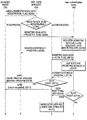
도 4는 본 발명의 일 실시예에 따른 IEEE 11073 기반의 생체 정보를 이용한 사용자 인증 방법의 신호 흐름도이다.
도 5는 도 4에 도시된 방법을 일부 변형하여, 사용자 등록 및 사용자 인증을 수행하는 방법의 신호 흐름도이다.
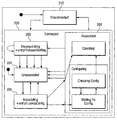
도 6은 IEEE 11073-20601 국제 표준에 따른 IEEE 11073 매니저의 스테이트 머신 다이어그램이다.
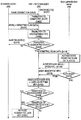
도 7은 도 6에 도시된 스테이트 전환을 반영한, 본 발명의 일 실시예에 따른 사용자 인증 관련 신호 흐름도이다.
도 8은 본 발명의 일 실시예에 따른 측정 데이터 전달 관련 신호 흐름도이다.
도 9는 본 발명의 다른 실시예에 따른 IEEE 11073 기반의 생체 정보를 이용한 사용자 등록 방법의 신호 흐름도이다.
도 10은 도 9에 도시된 사용자 등록 이후의 사용자 인증 방법의 제1 신호 흐름도이다.
도 11은 도 9에 도시된 사용자 등록 이후의 사용자 인증 방법의 제2 신호 흐름도이다.
이하, 첨부된 도면을 참조하여 본 발명의 바람직한 실시예를 상세히 설명한다. 본 발명의 이점 및 특징, 그리고 그것들을 달성하는 방법은 첨부되는 도면과 함께 상세하게 후술되어 있는 실시 예들을 참조하면 명확해질 것이다. 그러나 본 발명은 이하에서 게시되는 실시 예들에 한정되는 것이 아니라 서로 다른 다양한 형태로 구현될 수 있으며, 단지 본 실시 예들은 본 발명의 게시가 완전하도록 하고, 본 발명이 속하는 기술분야에서 통상의 지식을 가진 자에게 발명의 범주를 완전하게 알려주기 위해 제공되는 것이며, 본 발명은 청구항의 범주에 의해 정의될 뿐이다. 명세서 전체에 걸쳐 동일 참조 부호는 동일 구성 요소를 지칭한다.
다른 정의가 없다면, 본 명세서에서 사용되는 모든 용어(기술 및 과학적 용어를 포함)는 본 발명이 속하는 기술분야에서 통상의 지식을 가진 자에게 공통적으로 이해될 수 있는 의미로 사용될 수 있을 것이다. 또 일반적으로 사용되는 사전에 정의되어 있는 용어들은 명백하게 특별히 정의되어 있지 않는 한 이상적으로 또는 과도하게 해석되지 않는다.
이하, 본 발명의 일 실시예에 따른 IEEE 11073 기반 사용자 인증 방법에 관한 시스템 구성도 또는 처리 흐름도에 대한 도면들을 참고하여 본 발명에 대해 설명하도록 한다. 이 때, 처리 흐름도 도면들의 각 블록과 흐름도 도면들의 조합들은 컴퓨터 프로그램 인스트럭션들에 의해 수행될 수 있음을 이해할 수 있을 것이다. 이들 컴퓨터 프로그램 인스트럭션들은 범용 컴퓨터, 특수용 컴퓨터 또는 기타 프로그램 가능한 데이터 프로세싱 장비의 프로세서에 탑재될 수 있으므로, 컴퓨터 또는 기타 프로그램 가능한 데이터 프로세싱 장비의 프로세서를 통해 수행되는 그 인스트럭션들이 흐름도 블록(들)에서 설명된 기능들을 수행하는 수단을 생성하게 된다. 이들 컴퓨터 프로그램 인스트럭션들은 특정 방식으로 기능을 구현하기 위해 컴퓨터 또는 기타 프로그램 가능한 데이터 프로세싱 장비를 지향할 수 있는 컴퓨터 이용 가능 또는 컴퓨터 판독 가능 메모리에 저장되는 것도 가능하므로, 그 컴퓨터 이용가능 또는 컴퓨터 판독 가능 메모리에 저장된 인스트럭션들은 흐름도 블록(들)에서 설명된 기능을 수행하는 인스트럭션 수단을 내포하는 제조 품목을 생산하는 것도 가능하다. 컴퓨터 프로그램 인스트럭션들은 컴퓨터 또는 기타 프로그램 가능한 데이터 프로세싱 장비 상에 탑재되는 것도 가능하므로, 컴퓨터 또는 기타 프로그램 가능한 데이터 프로세싱 장비 상에서 일련의 동작 단계들이 수행되어 컴퓨터로 실행되는 프로세스를 생성해서 컴퓨터 또는 기타 프로그램 가능한 데이터 프로세싱 장비를 수행하는 인스트럭션들은 흐름도 블록(들)에서 설명된 기능들을 실행하기 위한 단계들을 제공하는 것도 가능하다.
도 1은 본 발명의 일 실시예에 따른 IEEE 11073 기반 유헬스 시스템의 구성도이다. 도 1에 도시된 바와 같이, 본 실시예에 따른 유헬스 시스템은 기존의 IEEE 11073에서 제시하는 유헬스 시스템과 그 구성이 유사하다. 즉, 본 실시예에 따른 유헬스 시스템은 IEEE 11073에 기반하여 구성된 시스템을 그대로 이용하여 구성될 수 있다.
IEEE 11073 에이전트(10)는, 어소시에이션(ASSOCIATION)을 맺은 매니저에게 개인 건강 데이터를 수집하여 제공하는 노드로써, IEEE 11073 국제 표준을 통하여 정의된 장치이다. 이하, 본 명세서를 통하여 IEEE 11073 에이전트(10)는 에이전트(10)로 약칭하기로 한다. 에이전트(10)는, 예를 들어 "IEEE P11073-10404™ Dev specialization ? Pulse oximeter"에 따른 장치, "IEEE P11073-10406™ Dev specialization ? Heart rate monitor"에 따른 장치, "IEEE P11073-10407™ Dev specialization ? Blood pressure monitor"에 따른 장치, "IEEE P11073-10408™ Dev specialization ? Thermometer"에 따른 장치, "IEEE P11073-10415™ Dev specialization ? Weighing scale"에 따른 장치, "IEEE P11073-10417™ Dev specialization ? Glucose Meter"에 따른 장치, "IEEE P11073-10441™ Dev specialization ? Cardiovascular"에 따른 장치, "IEEE P11073-10442™ Dev specialization ? Strength"에 따른 장치, "IEEE P11073-10471™ Dev specialization ? Activity hub"에 따른 장치, "IEEE P11073-10472™ Dev specialization ? Medication monitor"에 따른 장치 중 하나일 수 있다. 다만, 에이전트(10)는, 상기 장치 이외에도, IEEE 11073 표준을 통하여 104XX 장치 특별 규정을 통하여 추가 규정되는 장치일 수 있다.
IEEE 11073 매니저(20)는, 하나 이상의 IEEE 11073 에이전트(10)로부터 데이터를 수신하는 노드이다. IEEE 11073 매니저(20)는 예를 들어 휴대 전화, 건강 기기, 셋탑 박스 또는 컴퓨터 시스템일 수 있다. IEEE 11073 매니저(20) 역시 IEEE 11073 국제 표준을 통하여 정의된 장치이다. 이하, IEEE 11073 매니저(20)는 매니저(20)로 약칭하기로 한다.
에이전트(10)와 매니저(20)는 IEEE 11073-20601 Optimized Exchange Protocol을 통하여 통신하며, IEEE 11073-20601 프로토콜에는, 예를 들어 Serial, IrDA, Bluetooth, USB, ZigBee, 무선랜 등의 근거리 통신 방식의 Physical layer가 사용될 수 있다.
유헬스 서버(30)는 에이전트(10)에 의하여 측정된 생체 정보를 매니저(20)로부터 제공 받아 이를 관리하고 분석함으로써, 유헬스 서비스 사용자에게 유헬스 서비스를 제공한다. 유헬스 서버(30)는, 예를 들어 대한민국의 정보통신단체 표준인 유헬스 서비스 참조모델(TTAK.KO-10.0463)에 의하여 정의된 유헬스 서버의 동작을 모두 수행하는 것일 수 있다.
스캐너 에이전트(50)는 IEEE 11073-20601 표준에 따라 에이전트로서 매니저(20)와 통신한다. 혈압, 심박수, 혈당 등 생체 정보를 측정하는 일반 에이전트(10)와 달리, 스캐너 에이전트(50)는 신원 인식을 위한 인체 특정 부위의 스캐닝을 통한 생체 스캔 데이터 생성 기능을 구비한 것이다. 예를 들어, 스캐너 에이전트(50)는 홍체 인식, 지문 인식, 얼굴 인식 등의 기능을 구비한 것일 수 있다. 상기 생체 스캔 데이터는 스캐너 에이전트(50)에 의하여 스캔된 데이터로, 예를 들어 홍체 스캔 이미지, 지문 스캔 이미지 등의 데이터일 수 있다.
일 실시예에 따른 스캐너 에이전트(50)는 상기 생체 스캔 데이터를 그대로 매니저(20)에 송신한다. 이 때, 스캐너 에이전트(50)와 매니저(20) 사이의 어소시에이션 설립단계에서, manufacturer-defined protocol을 사용하기 위해 IEEE 11073-20601 규격에 기재되어 있는 방식에 따라, 상기 생체 스캔 데이터를 매니저(20)에 송신할 수 있다. 상기 manufacturer-defined protocol과 관련하여 이후 상세하게 설명한다.
다른 실시예에 따른 스캐너 에이전트(50)는 상기 생체 스캔 데이터로부터 특성 코드(Characteristic code)를 생성하는 기능을 더 구비한 것일 수 있다. 본 실시예에 따른 스캐너 에이전트(50)는 상기 생체 스캔 데이터 대신 상기 특성 코드를 매니저(20)에 송신한다. 본 실시예에서는 IEEE 11073-20601 규격에 따라 상기 특성 코드를 상기 어소시에이션 요청 메시지의 파라미터에 세팅 하여 송신할 수 있다.
상기 특성 코드는 스캐너 에이전트(50)의 종류에 따라 기 지정된 길이를 가진 것일 수 있다. 상기 특성 코드는 상기 생체 스캔 데이터를 기 정의된 특성 코드 생성 함수에 입력하여 출력된 값일 수 있다. 상기 특성 코드 생성 함수는 스캔 데이터의 특성에 따라 서로 달라질 것이고, 본 발명은 특정한 특성 코드 생성 함수를 사용하는 것으로 한정되지 않는다.
도 2는 도 1에 도시된 시스템을 통하여 유헬스 서버가 생체 정보 측정 데이터 제공자를 인지하는 것을 나타낸 개념도이다. 이미 설명한 바와 같이, 본 발명은 매니저(20)가 스캐너 에이전트(50)로부터 사용자 인증을 위한 정보를 제공 받고, 상기 제공 받은 정보를 이용하여 사용자 인증을 수행함으로써, 결과적으로 유헬스 서버(30)가 에이전트(10)의 현재 사용자를 인지할 수 있도록 하는 것이다. 도 2는 이러한 본 발명의 목적 및 효과를 개념적으로 도시한다.
도 3은 본 발명의 일 실시예에 따른 IEEE 11073 기반 유헬스 시스템의 구성도이다. 도 3에는 도 1 내지 2에 도시된 시스템에 추가하여, 사용자 인증 서버(40)가 도시되어 있다. 즉, 본 실시예에 따른 유헬스 시스템은 에이전트(10), 매니저(20), 유헬스 서버(30), 스캐너 에이전트(50)에 사용자 인증 서버(40)가 추가로 구비된다.
스캐너 에이전트(50)는 매니저(20)에 생체 스캔 데이터 및 사용자 개인 정보를 송신하면서, 사용자 등록을 요청하고, 매니저(20)는 상기 생체 스캔 데이터 및 개인 정보를 사용자 인증 서버(40)에 제공하여 사용자 등록 요청을 전달한다. 사용자 인증 서버(40)에 사용자 등록이 이뤄진 후, 스캐너 에이전트(50)는 매니저(20)에 생체 스캔 데이터를 송신하면서, 사용자 인증을 요청하고, 매니저(20)는 상기 생체 스캔 데이터를 사용자 인증 서버(40)에 제공하여 사용자 인증을 요청하고 그 결과를 제공 받는다. 이 때, 일부 실시예에 따르면, 스캐너 에이전트(50)에 의하여 상기 생체 스캔 데이터로부터 추출한 특성 코드를 바탕으로 상기 사용자 등록 및 사용자 인증이 이뤄질 수도 있다.
사용자 인증 서버(40)는 스캐너 에이전트(50)로부터 회원 가입 요청과 함께 제공된 개인 정보 및 상기 생체 스캔 데이터를 저장하고, 상기 개인 정보의 가입자에 대응하는 하나의 사용자 식별 정보(user identifying key)를 생성하며, 생성된 사용자 식별 정보를 매니저(20)에 제공하는 동시에, 상기 개인 정보와 함께 상기 가입자의 프로필 정보로써 저장하여 관리할 수 있다. 상기 개인 정보는 사용자의 요청에 따라 수정될 수 있으나, 상기 사용자 식별 정보는 사용자에게 보여지거나 수정되지 않는 것이 바람직하다.
상기 사용자 식별 정보는 스캐너 에이전트(50)와 매니저(20) 사이에 어소시에이션이 맺어지는 동안 매니저(20)에 저장되고, 에이전트(10)로부터 생체 정보 측정 데이터가 수신되면, 상기 생체 정보 측정 데이터에 덧붙여져서 유헬스 서버(30)에 전달된다. 유헬스 서버(30)는 상기 생체 정보 측정 데이터에 덧붙여진 상기 사용자 식별 정보를 이용하여 상기 생체 정보 측정 데이터가 어떤 사용자의 것인지 식별할 수 있다.
상기 사용자 식별 정보는, 예를 들어 기 지정된 길이의 인증 키일 수 있다.
이하, 본 발명의 일 실시예에 따른 IEEE 11073 기반 사용자 인증 방법에 대하여 도 4를 참조하여 설명한다. 도 4는 본 발명의 일 실시예에 따른 IEEE 11073 기반의 생체 정보를 이용한 사용자 인증 방법의 신호 흐름도이다.
도 4에는 스캐너 에이전트(50)가 생체 스캔 데이터를 포함하는 어소시에이션 요청 메시지(Association Require message; AARQ)를 매니저(20)에 송신하고(S100), 매니저(20)는 상기 사용자 인증 정보를 사용자 인증 서버(40)에 전달하여 인증을 요청하며(S102), 사용자 인증 서버는 매니저(20)로부터 수신된 사용자 인증 정보를 이용하여 사용자 인증을 수행하고(S104), 사용자 인증의 결과를 매니저(20)에 제공하는 것이 기재되어 있다.
에이전트(10)가 상기 사용자 인증 정보를 매니저(20)에 송신하는 것은, IEEE 11073-20601에 규정된 어소시에이션 절차의 일환으로써 수행된다. 즉, IEEE 11073-20601에 따르면, 에이전트(10)가 매니저(20)에 생체 정보 측정 데이터를 송신하기 위하여는 매니저(20)와 어소시에이션을 맺는 절차를 거쳐야 하는데, 그 절차 중에 상기 사용자 인증 정보가 매니저(20)에 송신된다. 즉, 본 실시예에 따르면 상기 사용자 인증 정보가 전송되기 위한 별도의 프로세스가 존재하지 않고, IEEE 11073-20601에서 규정하는 어소시에이션 절차 내에서 상기 사용자 인증 정보가 전송된다.
IEEE 11073-20601에 규정된 AARQ 메시지 포맷은 아래의, 표 1 내지 4에 표시된 데이터 구조를 이용하여 구성된다. 하기 데이터 구조는 IEEE 11073-20601의 Annex G에 기재된 것이다.
[규칙 제91조에 의한 정정 20.02.2013]
표 1 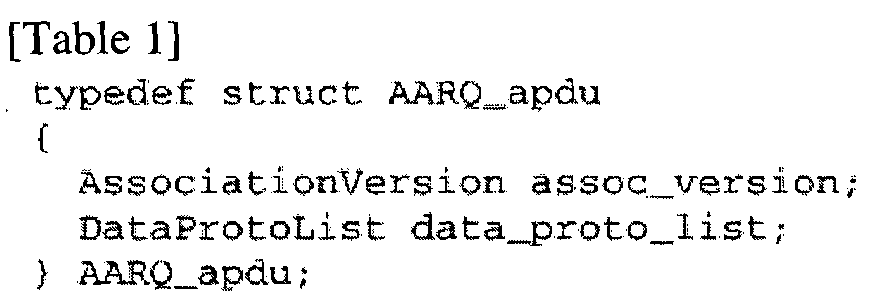
표 1
[규칙 제91조에 의한 정정 20.02.2013]
표 2 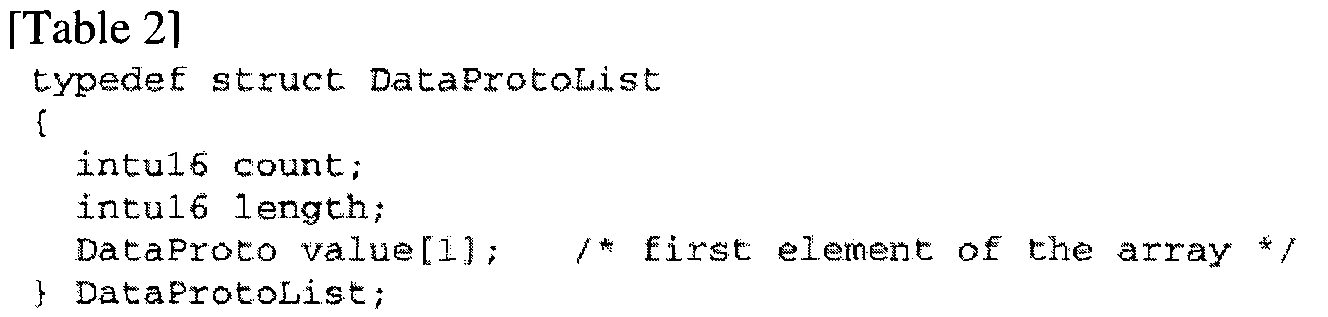
표 2
[규칙 제91조에 의한 정정 20.02.2013]
d표 3 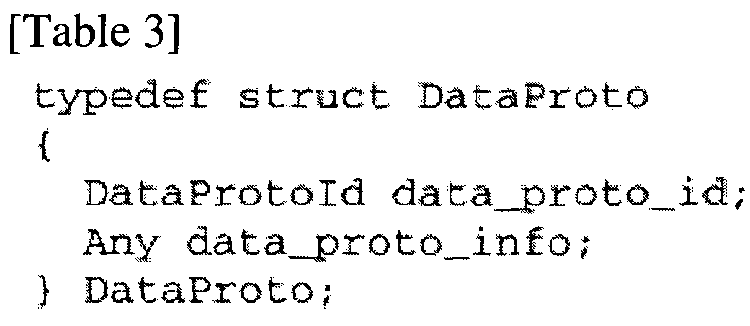
d표 3
[규칙 제91조에 의한 정정 20.02.2013]
표 4 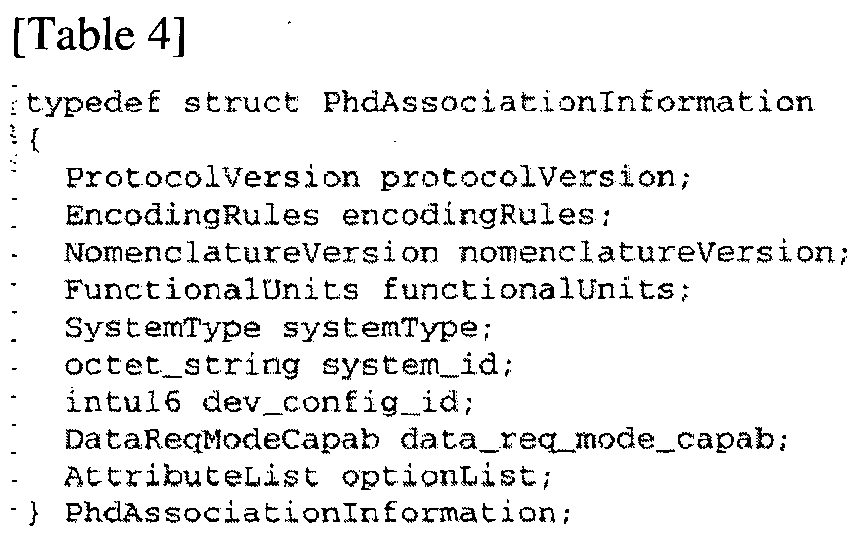
표 4
에이전트(10)는 표 1에 도시된 AARQ_apdu 구조체의 형식으로 AARQ 메시지를 생성하여, 매니저(20)에 송신한다. 표 1 내지 4에 의하면, AARQ 메시지는 DataProtoList 타입의 data_proto_list 파라미터를 포함하고, data_proto_list 파라미터는 다시 DataProto 타입의 value 파라미터를 포함하고, value 파라미터는 다시 data_proto_info 파라미터를 포함하는데, 표 3에 표시된 바와 같이 data_proto_info 파라미터의 타입에는 제한이 없으며, IEEE 11073-20601 First edition(2010-05-01)의 8.7.3.1.2 기재에는 IEEE 11073-20601에 규정된 표준 프로토콜을 사용하는 경우 상기 data_proto_info 파라미터의 타입은 표 4에 도시된 PhdAssociationInformation인 것으로 규정하고 있다.
다만 본 실시예에 따르면, 상기 어소시에이션 요청 메시지의 data-proto-id 파라미터 값을 data-proto-id-external(65535)로 설정하여, 상기 스캐너 에이전트와 상기 IEEE 11073 매니저 간에 제조자 특정 프로토콜을 사용할 수 있다. 또한, IEEE 11073-20601 First edition(2010-05-01)의 8.7.3.1.3 기재에는 상기 제조자 특정 프로토콜을 사용하는 경우, 상기 data_proto_info 파라미터의 타입은 표 5에 도시된 ManufSpecAssociationInformation 인 것으로 규정하고 있다.
[규칙 제91조에 의한 정정 20.02.2013]
표 5 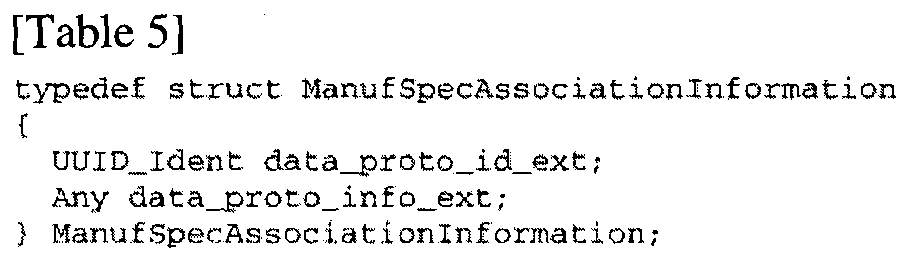
표 5
본 실시예에 따르면, ITU-T Rec. X.667 규정에 따른 방식으로 생체 스캔 데이터의 송신을 위한 제조자 특정 프로토콜의 UUID(UUID_SCAN_PROTOCOL)를 생성하고, 상기 UUID에 매치되는 아래 표 6의 데이터 구조체(UserAuthScannerAssociationInformation)를 상기 표 5에 표시된 data_proto_info_ext로 사용할 수 있다.
[규칙 제91조에 의한 정정 20.02.2013]
표 6 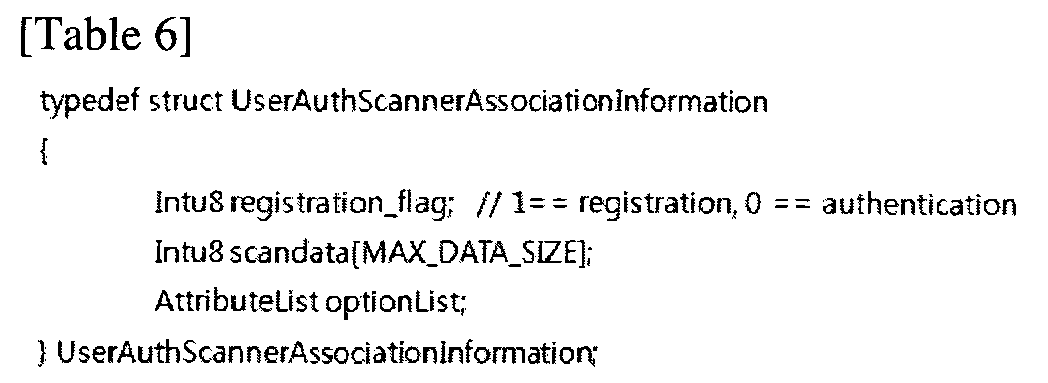
표 6
즉, 상기 어소시에이션 요청 메시지의 data-proto-id 파라미터 값을 data-proto-id-external(65535)로 설정하고, 제조자 특정 프로토콜의 UUID(UUID_SCAN_PROTOCOL)에 대응하는 표 5에 표시된 것과 같은 구조체를 이용하여, IEEE 11073-20601에서 어소시에이션 과정 중에 사용될 수 있다고 제시한 제조자 특정 프로토콜을 이용할 수 있다.
상기 제조자 특정 프로토콜을 통하여, 스캐너 에이전트(50)는 등록 요청인지, 인증 요청인지 여부를 가리키는 플래그(registration_flag)와 생체 스캔 데이터(scandata)를 매니저(20)에 송신할 수 있다. 상기 스캔 데이터의 최대 크기는 미리 MAX_DATA_SIZE에 바이트(BYTE) 단위의 값으로 정의될 수 있다.
본 발명의 일 실시에 따르면, 스캐너 에이전트(50)는 생체 스캔 데이터와 사용자 식별자를 더 매니저(20)에 송신할 수 있다. 상기 사용자 식별자는, 예를 들어 유헬스 서비스에서 사용되는 사용자 아이디일 수 있다. 상기 사용자 식별자는 상기 UserAuthScannerAssociationInformation 구조체의 optionList 파라미터에 포함될 수 있다.
[규칙 제91조에 의한 정정 20.02.2013]
표 7 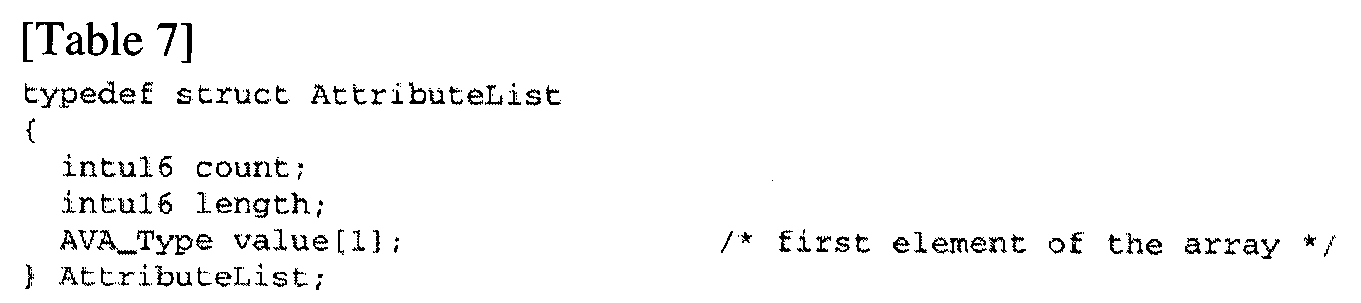
표 7
상기 optionList 파라미터는 AttributeList 타입인데, AttributeList 구조체는 상기 표 7과 같이 정의되어 있다. 표 7에 표시된 바와 같이, AttributeList에는 value의 개수를 의미하는 count 파라미터, value의 길이를 의미하는 length 파라미터, AVA_Type의 value 파라미터가 포함된다. 또한, AVA_Type의 형식은 아래 표 8과 같다. 상기 사용자 식별자는, 보다 자세하게는 attribute_value에 포함될 것이다. AVA_Type은 OID(Object Identifier) 형태의 attribute_id와 그 attribute_value를 포함하는 구조체이다.
[규칙 제91조에 의한 정정 20.02.2013]
표 8 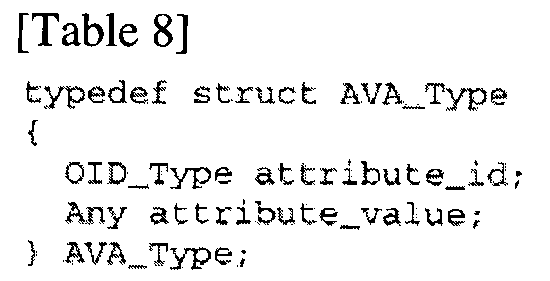
표 8
따라서, 예를 들어, 상기 사용자 식별자의 길이가 10자리라면, 상기 optionList 파라미터의 count에는 1, length에는 10이 세트 될 것이다. 또한, AVA_Type 타입의 value 파라미터에 상기 사용자 식별자가 포함될 것인데, 보다 자세하게는 AVA_Type의 attribute_id에는 기정의된 ID가 세트되거나, AVA_Type의 attribute_id의 값은 무시될 수 있고, AVA_Type의 attribute_value 파라미터에 상기 사용자 식별자가 세트 될 것이다.
도 5는 도 4에 도시된 방법을 일부 변형하여, 사용자 등록 및 사용자 인증을 수행하는 방법의 신호 흐름도이다.
상기 설명한 바와 같이, 스캐너 에이전트(50)는 생체 스캔 데이터 및 요청의 종류를 나타내는 플래그를 AARQ 메시지를 통하여 매니저(20)에 송신할 수 있다(S200).
먼저, 스캐너 에이전트(50)로부터 사용자 등록을 요청하는 플래그가 수신되는 경우(S202), 매니저(20)는 상기 수신된 생체 스캔 데이터를 사용자 인증 서버(40)에 송신하면서, 사용자 등록을 요청하는 것임을 알리는 플래그를 같이 송신한다(S204). 사용자 인증 서버(40)는 매니저(20)에 의하여 요청된 사용자 등록을 처리하고, 해당 사용자에 대한 사용자 식별 정보를 생성하여 저장하며(S206), 사용자 등록의 성공 여부를 매니저(20)에 통지한다(S208).
다음으로, 스캐너 에이전트(50)로부터 사용자 인증을 요청하는 것임을 알리는 플래그가 수신되는 경우(S202), 매니저(20)는 상기 수신된 생체 스캔 데이터를 사용자 인증 서버(40)에 송신하면서, 사용자 인증을 요청하는 것임을 알리는 플래그를 같이 송신한다(S210). 사용자 인증 서버(40)는 매니저(20)에 의하여 요청된 사용자 인증을 처리하고, 그 결과를 매니저(20)에 통지한다(S214). 사용자 인증 서버(40)는 매니저(20)로부터 수신된 생체 스캔 데이터를 기 등록 된 생체 스캔 데이터의 리스트와 비교하고 동일한 것으로 판정된 기 등록 생체 스캔 데이터가 존재하는지 확인하는 방식으로 상기 사용자 인증을 수행할 수 있다.
매니저(20)는 사용자 인증이 실패한 경우(S215), 스캐너 에이전트(50)에 result 파라미터가 rejected-unknown으로 세팅된 어소시에이팅 응답 메시지(AARE)를 송신하여, 사용자 인증이 실패했음을 통지할 수 있다.
IEEE 11073-20601 규정에 정의되어 있는 AARE 메시지의 포맷은 표 9와 같다.
[규칙 제91조에 의한 정정 20.02.2013]
표 9 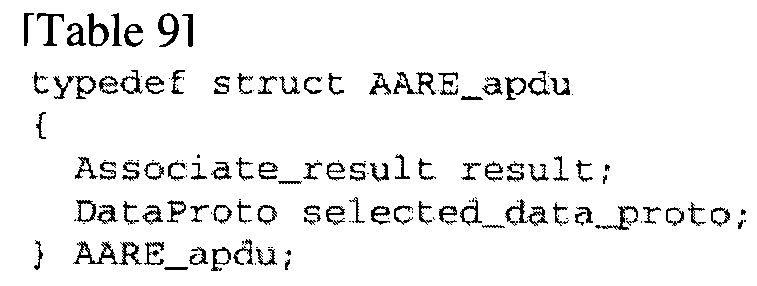
표 9
[규칙 제91조에 의한 정정 20.02.2013]
표 10 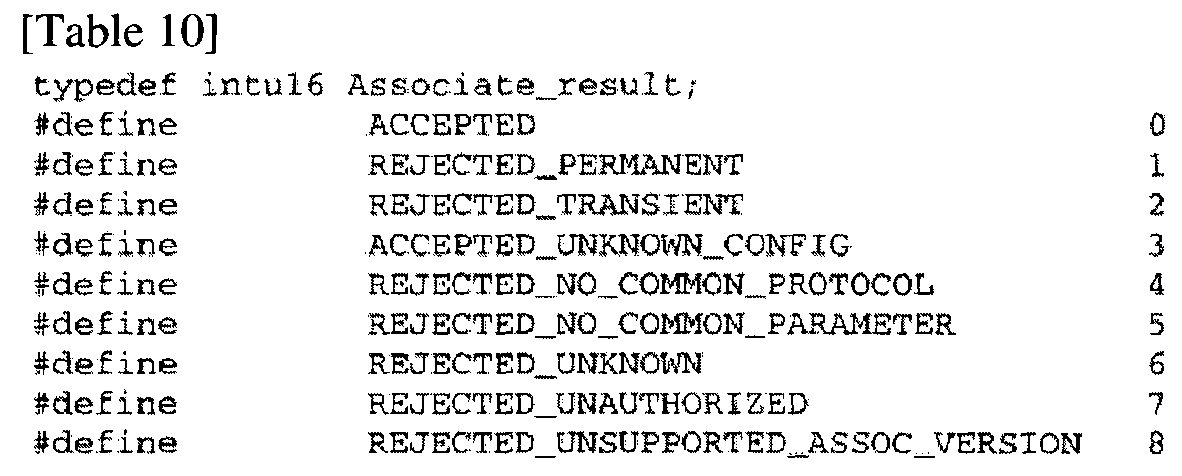
표 10
매니저(20)는 표 9에 도시된 AARE_apdu 구조체의 형식으로 AARE 메시지를 생성하여, 에이전트(10)에 송신한다. 표 9에 의하면, AARE 메시지는 Associate_result 타입의 result 파라미터를 포함한다. 본 실시예에 따른 매니저(20)는 사용자 인증의 실패 시, 상기 result 파라미터의 값을 표 10에 표시된 REJECTED_UNKNOWN(6)으로 세팅한다.
한편, AARE 메시지는 DataProto 타입의 selected_data_proto 파라미터를 포함하고, selected_data_proto 파라미터는 다시 data_proto_info 파라미터를 포함하는데, 표 3에 표시된 바와 같이 data_proto_info 파라미터의 타입에는 제한이 없으며, IEEE 11073-20601 First edition(2010-05-01)의 8.7.3.1.2 기재에는 IEEE 11073-20601에 규정된 표준 프로토콜을 사용하는 경우 상기 data_proto_info 파라미터의 타입은 표 4에 도시된 PhdAssociationInformation인 것으로 규정하고 있다. 본 실시예에 따르면, 사용자 인증 오류의 이유를 나타내는 인증 실패 코드가 상기 PhdAssociationInformation 구조체의 optionList 파라미터에 세팅될 수 있다.
한편, 사용자 인증이 성공한 경우(S120), 매니저(20)는 result 파라미터가 ACCEPTED로 세팅된 AARE 메시지를 에이전트(10)에 송신한다.
한편, 사용자 인증 서버(40)는 상기 사용자 인증이 성공한 경우(S218), 사용자 등록 단계(S206)에서 생성되어 저장되었던 사용자 식별 정보(USER IDENTIFYING INFO)를 매니저(20)에 송신한다. 매니저는(20)는 상기 사용자 식별 정보를 어소시에이티드 사용자 키로 세팅 한다(S220). 상기 어소시에이티드 사용자 키는 에이전트(10)로부터 수신된 생체 정보 측정 데이터에 덧붙여져서 유헬스 서버(30)에 송신되어, 사용자 식별의 용도로 사용된다.
도 6은 IEEE 11073-20601 규격에 따른 IEEE 11073 매니저의 스테이트 머신 다이어그램이다. 매니저(20)는 스테이트 머신으로 그 동작이 설명될 수 있는데, 크게 디스커넥티드 스테이트(210)와 커넥티드 스테이트(200)으로 스테이트가 구별되며, 커넥티드 스테이트(200)에는 디스어소시에이팅 스테이트(202), 언어소시에이티드 스테이트(204), 어소시에이팅 스테이트(206) 및 어소시에이티드 스테이트(208)가 포함된다.
도 6에 도시된 바와 같이, 매니저(20)가 에이전트(10)로부터 생체 정보 측정 데이터를 수신하는 operating 서비스를 제공하기 위하여는, 어소시에이티드 스테이트(208)에 있어야 한다.
도 7은 도 6에 도시된 스테이트 전환을 반영한, 본 발명의 일 실시예에 따른 사용자 인증 관련 신호 흐름도이다. 먼저, 스캐너 에이전트(50)가 매니저(20)에 커넥션을 요청하면(S400), 매니저(20)는 디스커넥티드 스테이트(210)에서 커넥티드 스테이트(200)로 전환(TRANSITION)한다(S402). 다음으로, 에이전트(10)로부터 생체 스캔 데이터가 포함된 AARQ 메시지가 수신되면(S404), 매니저(20)는 어소시에이팅 스테이트로 전환한다(S406). 어소시에이팅 스테이트로 전환하는 것이 실패한 경우(S408), 매니저(20)는 사용자 인증을 요청하지 않고 스캐너 에이전트(50)에 result 파라미터가 rejected로 세팅된 어소시에이팅 응답 메시지(AARE)를 송신한다(S410).
어소시에이팅 스테이트로 전환하는 것에 성공한 경우(S408), 매니저(20)는 스캐너 에이전트(50)로부터 수신된 상기 생체 스캔 데이터를 사용자 인증 서버(40)에 제공(S410)하여 사용자 인증(S412)을 요청하여, 사용자 인증 결과를 제공 받는다(S414). 도 5에 도시된 바와 같이, 매니저(20)는 사용자 인증 결과를 AARE 메시지 전송을 통해 스캐너 에이전트(50)에 통지할 수 있다. 또한, 도 5에 도시된 바와 같이, 사용자 인증 서버는 인증 성공 시(S415), 인증된 사용자의 사용자 식별 정보(USER IDENTIFYING INFO)를 매니저(20)에 송신할 수 있고(S416), 매니저(20)는 수신된 사용자 식별 정보를 어소시에이티드 사용자 키로 세팅할 수 있다(S418).
매니저(20)는 상기 어소시에이티드 사용자 키를, 스캐너 에이전트(50)와 매니저(20) 사이의 어소시에이션이 유지되는 동안에만 유지한다. 즉, 매니저(20)의 스테이트가 디스어소시에이팅 스테이트(S420)로 전환(TRANSITION)되거나, 디스어소시에이티드 스테이트(S422)로 전환되면, 상기 저장된 어소시에이티드 사용자 키는 초기화된다(S424).
도 8은 본 발명의 일 실시예에 따른 측정 데이터 전달 관련 신호 흐름도이다. 도 8에는 도 7과는 달리, 매니저(20)가 관리하는 어소시에이티드 사용자 키를 수신된 생체 정보 측정 데이터(S502)에 덧붙여서 유헬스 서버(30)에 송신(S504)하는 점이 더 도시되어 있다. 유헬스 서버(30)는 상기 어소시에이티드 사용자 키, 즉 사용자 인증 서버(40)로부터 발급된 사용자 식별 정보를 통하여 사용자를 식별할 수 있다. 따라서, 유헬스 서버(30)는 수신된 생체 정보 측정 데이터를 상기 사용자를 위하여 처리할 수 있다.
일 실시예에 따르면, 유헬스 서버(30)가 상기 수신된 어소시에이티드 사용자 키를 인식할 수 없을 수 있다. 이 때에는 유헬스 서버(30)가 사용자 인증 서버(40)에 상기 수신된 어소시에이티드 사용자 키를 조회하여, 사용자를 식별할 수 있다.
이하, 본 발명의 다른 실시예에 따른 IEEE 11073 기반의 생체 정보를 이용한 사용자 등록 방법을 도 9 내지 11을 참조하여 설명하기로 한다. 도 4 내지 8을 참조하여 설명된 실시예에 따르면 스캐너 에이전트(50)가 데이터 사이즈가 비교적 큰 생체 스캔 데이터를 그대로 매니저(20)에 송신하기 위하여, 제조자 특정 프로토콜이 사용되었다. 그러나, 본 실시예에 따르면, 스캐너 에이전트가 생체 스캔 데이터로부터 기 지정된 길이의 특성 코드를 추출하고, 상기 특성 코드를 매니저(20)에 송신하므로, 상기 제조자 특정 프로토콜이 사용되지 않아도 된다.
먼저, 도 9를 참조하여, 본 실시예에 따른 IEEE 11073 기반의 생체 정보를 이용한 사용자 등록 방법을 설명한다. 스캐너 에이전트(50)가 신원 확인을 위하여 지문 또는 홍체 등 생체 정보를 스캔하고(S600), 생체 스캔 데이터를 생성한다(S602).
또한 스캐너 에이전트(50)는 상기 생체 스캔 데이터로부터 특성 코드를 추출한다(S603). 상기 특성 코드는 스캐너 에이전트(50)의 종류에 따라 기 지정된 길이를 가진 것일 수 있다. 상기 특성 코드는 상기 생체 스캔 데이터를 기 정의된 특성 코드 생성 함수에 입력하여 출력된 값일 수 있다. 상기 특성 코드 생성 함수는 스캔 데이터의 특성에 따라 서로 달라질 것이고, 본 발명은 특정한 특성 코드 생성 함수를 사용하는 것으로 한정되지 않는다.
스캐너 에이전트(50)는 AARQ 메시지의 PhdAssociationInformation 구조체의 optionlist 파라미터에 상기 특성 코드 및 등록을 요청하는 것을 가리키는 플래그(REGISTRATION_FLAG)를 포함시켜 매니저(20)에 송신한다(S604). 본 실시예에 따르면 IEEE 11073-20601의 표준 통신 프로토콜을 사용해도 되므로, 상기 어소시에이션 요청 메시지의 data-proto-id 파라미터 값을 data-proto-id-empty(0)로 설정한다. 한편, optionlist 파라미터에 포함되어야 하는 값이 2개이므로, optionlist 파라미터의 count 값에는 2를 세팅한다.
매니저(20)는 스캐너 에이전트(50)로부터 등록을 요청하는 것을 가리키는 플래그를 수신하여, 사용자 인증 서버(40)에 수신된 상기 특성 코드를 전달한다(S606). 사용자 인증 서버(40)는 상기 특성 코드를 등록하여 사용자 등록을 수행하고(S608), 등록 결과를 매니저에 통지한다(S610). 매니저는 상기 등록 결과를 result 파라미터에 세팅한 AARE 메시지를 스캐너 에이전트(50)에 송신한다(S612).
도 10은 도 9에 도시된 사용자 등록 이후의 사용자 인증 방법의 신호 흐름도이다.
사용자 등록을 완료한 사용자가 스캐너 에이전트(50)를 통하여 사용자 인증을 시도하는 경우, 스캐너 에이전트(50)가 신원 확인을 위하여 지문 또는 홍체 등 생체 정보를 스캔하고(S700), 생체 스캔 데이터를 생성한다(S702). 또한 스캐너 에이전트(50)는 상기 생체 스캔 데이터로부터 특성 코드를 추출한다(S703). 다음으로, 스캐너 에이전트(50)는 상기 특성 코드 및 인증을 요청하는 것임을 나타내는 플래그를 optionlist 파라미터에 세팅한 AARQ 메시지를 송신한다(S704). 매니저(20)는 스캐너 에이전트(50)로부터 인증을 요청하는 것을 가리키는 플래그를 수신하여, 사용자 인증 서버(40)에 수신된 상기 특성 코드를 전달한다(S706). 사용자 인증 서버(40)는 상기 특성 코드를 등록하여 사용자 등록을 수행하고(S708), 인증 결과(실패)를 매니저(20)에 통지한다(S712). 도 9에서는 인증이 실패한 경우를 예로 들고 있다. 이 때, 매니저(20)는 rejected-unknown 값을 result 파라미터에 세팅한 AARE 메시지를 스캐너 에이전트(50)에 송신한다(S714).
한편, 도 11은 도 10에 도시된 것과 달리 사용자 인증(S708)이 성공한 경우이다. 이 경우, 사용자 인증 서버(40)가 인증 결과(성공)를 매니저(20)에 통지한다(S713). 매니저는 상기 인증 결과(성공)을 수신하여, accepted 값을 result 파라미터에 세팅한 AARE 메시지를 스캐너 에이전트(50)에 송신한다(S715). 또한, 매니저(20)는 사용자 인증이 성공된 상기 특성 코드를 저장한다(S716). 매니저(20)에 저장된 상기 특성 코드는 에이전트(10)로부터 수신된 생체 정보 측정 데이터에 덧붙여져서 유헬스 서버(40)에 전달됨으로써, 에이전트(10) 사용자를 식별하는 용도로 사용될 수 있다.
이상 첨부된 도면을 참조하여 본 발명의 실시예들을 설명하였지만, 본 발명이 속하는 기술분야에서 통상의 지식을 가진 자는 본 발명이 그 기술적 사상이나 필수적인 특징을 변경하지 않고서 다른 구체적인 형태로 실시될 수 있다는 것을 이해할 수 있을 것이다. 그러므로 이상에서 기술한 실시예들은 모든 면에서 예시적인 것이며 한정적이 아닌 것으로 이해해야만 한다.
본 발명에 따르면, 산업상 이용되는 IEEE 11073 국제 표준에 호환되는 방식으로 IEEE 11073 에이전트의 사용자를 인증할 수 있다.
Claims (22)
- 신원 인식을 위한 인체 특정 부위의 스캐닝을 통한 생체 스캔 데이터 생성 기능을 구비하고, IEEE 11073 규격의 에이전트로써 동작하는 스캐너 에이전트가, 상기 생체 스캔 데이터를 포함하는 어소시에이션 요청(Association Request) 메시지를 IEEE 11073 매니저에 송신하는 단계;상기 IEEE 11073 매니저가, 상기 어소시에이션 요청 메시지를 수신한 것에 응답하여 상기 생체 스캔 데이터를 사용자 인증 서버에 송신하는 단계; 및상기 IEEE 11073 매니저가 상기 사용자 인증 서버로부터 상기 생체 스캔 데이터에 기반한 인증 결과 정보를 수신하는 단계를 포함하는,IEEE 11073 기반의 생체 정보를 이용한 사용자 인증 방법.
- 제1 항에 있어서,상기 어소시에이션 요청 메시지를 IEEE 11073 매니저에 송신하는 단계는,상기 어소시에이션 요청 메시지의 data-proto-id 파라미터 값을 data-proto-id-external(65535)로 설정하여, 상기 스캐너 에이전트와 상기 IEEE 11073 매니저 간에 제조자 특정 프로토콜이 사용될 수 있도록 하는 어소시에이션 요청 메시지를 생성하는 단계; 및상기 생성된 어소시에이션 요청 메시지를 송신하는 단계를 포함하는,IEEE 11073 기반의 생체 정보를 이용한 사용자 인증 방법.
- 제2 항에 있어서,상기 어소시에이션 요청 메시지의 data_proto_info 파라미터에는 등록용 생체 스캔 데이터인지 인증용 생체 스캔 데이터인지를 나타내는 등록 모드 플래그 항목, 상기 생체 스캔 데이터가 포함되는 생체 스캔 데이터 어레이 항목이 포함되는,IEEE 11073 기반의 생체 정보를 이용한 사용자 인증 방법.
- 제3 항에 있어서,상기 어소시에이션 요청 메시지의 data_proto_info 파라미터에는 사용자 식별자가 수납된 AttributList 타입의 optionlist 항목이 더 포함되는,IEEE 11073 기반의 생체 정보를 이용한 사용자 인증 방법.
- 제3 항에 있어서,상기 생체 스캔 데이터를 사용자 인증 서버에 송신하는 단계는,상기 등록 모드 플래그 항목에 할당된 값에 따라, 상기 사용자 인증 서버에 등록 및 인증 중 하나의 모드를 가리키는 플래그를 더 송신하는 단계를 포함하는,IEEE 11073 기반의 생체 정보를 이용한 사용자 인증 방법.
- 제1 항에 있어서,상기 인증 결과 정보를 수신하는 단계는,상기 사용자 인증 서버에 의한 인증 성공 시, 상기 사용자 인증 서버로부터 사용자 식별 정보를 더 수신하는 단계를 포함하는,IEEE 11073 기반의 생체 정보를 이용한 사용자 인증 방법.
- 제6 항에 있어서,상기 사용자 식별 정보를 더 수신하는 단계는,상기 판정 결과 사용자 인증 성공 시, 상기 IEEE 11073 매니저가 어소시에이티드 스테이트(Associated state)로 전환하는 단계; 및상기 IEEE 11073 매니저가 관리하는 어소시에이티드 사용자 키를 상기 수신된 사용자 식별 정보로 설정하는 단계를 포함하는,IEEE 11073 기반의 생체 정보를 이용한 사용자 인증 방법.
- 제7 항에 있어서,상기 어소시에이티드 사용자 키를 상기 수신된 사용자 식별 정보로 설정하는 단계는,상기 IEEE 매니저의 스테이트(state)가 디스어소시에이팅 스테이트(disassociating state) 또는 언어소시에이티드 스테이트(Unassociated state)로 전환하는 경우, 상기 어소시에이티드 사용자 키를 초기화하는 단계를 포함하는,IEEE 11073 기반의 생체 정보를 이용한 사용자 인증 방법.
- 제7 항에 있어서,상기 IEEE 11073 매니저가 IEEE 11073 에이전트로부터 생체 정보 측정 데이터를 수신하는 단계;상기 IEEE 11073 매니저가 유헬스 서버에 상기 생체 정보 측정 데이터를 송신하되, 상기 어소시에이티드 사용자 키를 첨부하여 송신하는 단계를 더 포함하는,IEEE 11073 기반의 생체 정보를 이용한 사용자 인증 방법.
- 제1 항에 있어서,신원 인식을 위한 인체 특정 부위의 스캐닝을 통한 생체 스캔 데이터 생성 기능을 구비하고, IEEE 11073 규격의 에이전트로써 동작하는 스캐너 에이전트가, 상기 생체 스캔 데이터로부터 특성 코드를 추출하는 단계;상기 스캐너 에이전트가 상기 특성 코드를 포함하는 어소시에이션 요청(Association Request) 메시지를 IEEE 11073 매니저에 송신하는 단계;상기 IEEE 11073 매니저가 상기 어소시에이션 요청 메시지를 수신한 것에 응답하여 상기 특성 코드를 사용자 인증 서버에 송신하는 단계; 및상기 IEEE 11073 매니저가 상기 사용자 인증 서버로부터 상기 특성 코드에 기반한 인증의 인증 결과 정보를 수신하는 단계를 포함하는,IEEE 11073 기반의 생체 정보를 이용한 사용자 인증 방법.
- 제10 항에 있어서,상기 어소시에이션 요청 메시지를 IEEE 11073 매니저에 송신하는 단계는,상기 특성 코드가 세팅된 optionlist 파라미터가 수납된 어소시에이션 요청 메시지를 생성하는 단계; 및상기 생성된 어소시에이션 요청 메시지를 상기 IEEE 11073 매니저에 송신하는 단계를 포함하는,IEEE 11073 기반의 생체 정보를 이용한 사용자 인증 방법.
- 제10 항에 있어서,상기 특성 코드를 사용자 인증 서버에 송신하는 단계는,상기 어소시에이션 요청 메시지를 수신한 것에 응답하여 어소시에이팅 스테이트(Associating state)를 거쳐 어소시에이티드 스테이트(Associated state)로 전환한 경우에 한하여 상기 특성 코드를 사용자 인증 서버에 송신하는 단계를 포함하는,IEEE 11073 기반의 생체 정보를 이용한 사용자 인증 방법.
- 제10 항에 있어서,상기 IEEE 11073 매니저가 result 파라미터를 포함하는 어소시에이션 응답(Association Response) 메시지를 생성하되, 상기 result 파라미터 값은 상기 수신된 인증 결과 정보에 따라 설정하는 단계; 및상기 IEEE 11073 매니저가 상기 생성된 어소시에이션 응답 메시지를 상기 스캐너 에이전트에 송신하는 단계를 더 포함하는,IEEE 11073 기반의 생체 정보를 이용한 사용자 인증 방법.
- 제13 항에 있어서,상기 어소시에이션 응답 메시지를 상기 스캐너 에이전트에 송신하는 단계는,상기 수신된 인증 결과 정보를 분석하여 인증 성공 여부를 판정하는 단계;상기 판정 결과 인증이 성공한 것으로 판정된 경우, 상기 result 파라미터 값을 accepted(0)으로 설정하고, 상기 판정 결과 인증이 실패한 것으로 판정된 경우, 상기 result 파라미터 값을 rejected-unknown(6)으로 설정하는 단계; 및상기 result 파라미터를 포함하는 어소시에이션 응답 메시지를 상기 스캐너 에이전트에 송신하는 단계를 포함하는,IEEE 11073 기반의 생체 정보를 이용한 사용자 인증 방법.
- 제14 항에 있어서,상기 어소시에이션 응답 메시지를 상기 스캐너 에이전트에 송신하는 단계는,상기 판정 결과 인증이 실패한 것으로 판정된 경우, 상기 수신된 인증 결과 정보를 분석하여 인증 실패 코드를 생성하고, 상기 인증 실패 코드를 포함하는 optionlist 파라미터가 더 수납된 상기 어소시에이션 응답 메시지를 생성하는 단계; 및상기 result 파라미터 및 상기 optionlist 파라미터를 포함하는 어소시에이션 응답 메시지를 상기 스캐너 에이전트에 송신하는 단계를 더 포함하는,IEEE 11073 기반의 생체 정보를 이용한 사용자 인증 방법.
- 제10 항에 있어서,상기 IEEE 11073 매니저가 상기 수신된 인증 결과 정보를 분석하여 인증 성공 여부를 판정하는 단계; 및상기 IEEE 11073 매니저가 상기 판정 결과 인증이 성공한 것으로 판정된 경우, 상기 특성 코드를 저장하는 단계를 더 포함하는,IEEE 11073 기반의 생체 정보를 이용한 사용자 인증 방법.
- 제16 항에 있어서,상기 생체 스캔 데이터를 저장하는 단계는,상기 IEEE 매니저의 스테이트(state)가 어소시에이티드 스테이트(associated state)에서 디스어소시에이팅 스테이트(disassociating state) 또는 언어소시에이티드 스테이트(Unassociated state)로 전환하는 경우, 상기 저장된 특성 코드를 삭제하는 단계를 더 포함하는,IEEE 11073 기반의 생체 정보를 이용한 사용자 인증 방법.
- 제16 항에 있어서,상기 IEEE 11073 매니저가 IEEE 11073 에이전트로부터 생체 정보 측정 데이터를 수신하는 단계; 및상기 IEEE 11073 매니저가 유헬스 서버에 상기 생체 정보 측정 데이터를 송신하되, 상기 저장된 특성 코드를 첨부하여 송신하는 단계를 더 포함하는,IEEE 11073 기반의 생체 정보를 이용한 사용자 인증 방법.
- 제10 항에 있어서,상기 인증 결과 정보를 수신하는 단계는,상기 사용자 인증 서버에 의한 인증 성공 시, 상기 사용자 인증 서버로부터 사용자 식별 정보를 더 수신하는 단계; 및상기 사용자 식별 정보를 저장하는 단계를 포함하는,IEEE 11073 기반의 생체 정보를 이용한 사용자 인증 방법.
- 제19 항에 있어서,상기 사용자 식별 정보를 더 수신하는 단계는,상기 판정 결과 사용자 인증 성공 시, 상기 IEEE 11073 매니저가 어소시에이티드 스테이트(Associated state)로 전환하는 단계; 및상기 IEEE 11073 매니저가 관리하는 어소시에이티드 사용자 키를 상기 수신된 사용자 식별 정보로 설정하는 단계를 포함하는,IEEE 11073 기반의 생체 정보를 이용한 사용자 인증 방법.
- 제20 항에 있어서,상기 어소시에이티드 사용자 키를 상기 수신된 사용자 식별 정보로 설정하는 단계는,상기 IEEE 매니저의 스테이트(state)가 디스어소시에이팅 스테이트(disassociating state) 또는 언어소시에이티드 스테이트(Unassociated state)로 전환하는 경우, 상기 어소시에이티드 사용자 키를 초기화하는 단계를 포함하는,IEEE 11073 기반의 생체 정보를 이용한 사용자 인증 방법.
- 제20 항에 있어서,상기 IEEE 11073 매니저가 IEEE 11073 에이전트로부터 생체 정보 측정 데이터를 수신하는 단계; 및상기 IEEE 11073 매니저가 유헬스 서버에 상기 생체 정보 측정 데이터를 송신하되, 상기 어소시에이티드 사용자 키를 첨부하여 송신하는 단계를 더 포함하는,IEEE 11073 기반의 생체 정보를 이용한 사용자 인증 방법.
Applications Claiming Priority (2)
| Application Number | Priority Date | Filing Date | Title |
|---|---|---|---|
| KR10-2012-0148799 | 2012-12-18 | ||
| KR1020120148799A KR101474249B1 (ko) | 2012-12-18 | 2012-12-18 | 생체 정보 스캐너를 이용한 ieee 11073 에이전트 사용자를 인증하는 방법 |
Publications (1)
| Publication Number | Publication Date |
|---|---|
| WO2014098299A1 true WO2014098299A1 (ko) | 2014-06-26 |
Family
ID=50978593
Family Applications (1)
| Application Number | Title | Priority Date | Filing Date |
|---|---|---|---|
| PCT/KR2012/011588 Ceased WO2014098299A1 (ko) | 2012-12-18 | 2012-12-27 | 생체 정보 스캐너를 이용한 ieee 11073 에이전트 사용자를 인증하는 방법 |
Country Status (2)
| Country | Link |
|---|---|
| KR (1) | KR101474249B1 (ko) |
| WO (1) | WO2014098299A1 (ko) |
Cited By (1)
| Publication number | Priority date | Publication date | Assignee | Title |
|---|---|---|---|---|
| WO2022081658A1 (en) * | 2020-10-14 | 2022-04-21 | Mastercard International Incorporated | Efficient updates of biometric data for remotely connected devices |
Families Citing this family (1)
| Publication number | Priority date | Publication date | Assignee | Title |
|---|---|---|---|---|
| KR20180041508A (ko) * | 2016-10-14 | 2018-04-24 | 한라대학교산학협력단 | 유헬스 환경에서의 에이전트와 데이터매니저간의 상호 인증방법 |
Citations (4)
| Publication number | Priority date | Publication date | Assignee | Title |
|---|---|---|---|---|
| KR20090112730A (ko) * | 2007-01-24 | 2009-10-28 | 콸콤 인코포레이티드 | 모바일 전화 기반의 인증 및 허가 시스템 및 센시티브 개인 기록들을 관리하기 위한 프로세스 |
| KR20110115670A (ko) * | 2010-04-16 | 2011-10-24 | 경북대학교 산학협력단 | 의료정보 공유장치 |
| US20120065993A1 (en) * | 2009-05-21 | 2012-03-15 | Yoko Arimitsu | Biological information management device, health care system using biological information management device and method of reading health care information therein, and biological information management program |
| KR20120113969A (ko) * | 2011-04-06 | 2012-10-16 | 계명대학교 산학협력단 | 개인건강기록 백업 시스템 및 방법 |
-
2012
- 2012-12-18 KR KR1020120148799A patent/KR101474249B1/ko active Active
- 2012-12-27 WO PCT/KR2012/011588 patent/WO2014098299A1/ko not_active Ceased
Patent Citations (4)
| Publication number | Priority date | Publication date | Assignee | Title |
|---|---|---|---|---|
| KR20090112730A (ko) * | 2007-01-24 | 2009-10-28 | 콸콤 인코포레이티드 | 모바일 전화 기반의 인증 및 허가 시스템 및 센시티브 개인 기록들을 관리하기 위한 프로세스 |
| US20120065993A1 (en) * | 2009-05-21 | 2012-03-15 | Yoko Arimitsu | Biological information management device, health care system using biological information management device and method of reading health care information therein, and biological information management program |
| KR20110115670A (ko) * | 2010-04-16 | 2011-10-24 | 경북대학교 산학협력단 | 의료정보 공유장치 |
| KR20120113969A (ko) * | 2011-04-06 | 2012-10-16 | 계명대학교 산학협력단 | 개인건강기록 백업 시스템 및 방법 |
Non-Patent Citations (1)
| Title |
|---|
| NA, JAE UK ET AL., JOURNAL OF KICS, vol. 29, no. 10, October 2012 (2012-10-01), pages 66 - 73 * |
Cited By (2)
| Publication number | Priority date | Publication date | Assignee | Title |
|---|---|---|---|---|
| WO2022081658A1 (en) * | 2020-10-14 | 2022-04-21 | Mastercard International Incorporated | Efficient updates of biometric data for remotely connected devices |
| US11823240B2 (en) | 2020-10-14 | 2023-11-21 | Mastercard International Incorporated | Efficient updates of biometric data for remotely connected devices |
Also Published As
| Publication number | Publication date |
|---|---|
| KR101474249B1 (ko) | 2014-12-18 |
| KR20140079152A (ko) | 2014-06-26 |
Similar Documents
| Publication | Publication Date | Title |
|---|---|---|
| WO2012060646A1 (en) | Method and apparatus for connecting wireless network in a digital device | |
| KR101694773B1 (ko) | 디지털 기기에서 무선 네트워크 연결 방법 및 장치 | |
| WO2021002692A1 (en) | Method for providing virtual asset service based on decentralized identifier and virtual asset service providing server using them | |
| WO2021003975A1 (zh) | 网关接口测试方法、终端设备、存储介质及装置 | |
| WO2010019020A2 (ko) | 이동 통신 시스템의 보안화된 비계층 프로토콜 처리 방법 | |
| WO2011081311A2 (ko) | 이동 통신 시스템에서 보안을 지원하는 방법 및 시스템 | |
| WO2014088318A1 (en) | Method and apparatus for allocating an internet protocol address to a client device | |
| WO2015065165A1 (ko) | 이동 통신 시스템 환경에서 프락시미티 기반 서비스 단말 간 발견 및 통신을 지원하기 위한 보안 방안 및 시스템 | |
| WO2022145966A1 (ko) | 공개키 기반 구조를 이용한 출입 통제 시스템 | |
| WO2012099330A2 (ko) | Cpns 환경에서 사용자 인증을 위한 인증키 발급 시스템 및 방법 | |
| WO2013089349A1 (en) | Apparatus and method for identifying wireless network provider in wireless communication system | |
| WO2019146956A1 (ko) | 디바이스의 정보 획득 장치 및 방법 | |
| CN107333260A (zh) | 一种获取终端的真实mac地址的方法及装置 | |
| WO2012044072A2 (ko) | 융합형 네트워크에서 사용자 키를 할당하기 위한 방법 | |
| WO2020004805A1 (ko) | Nan 프로토콜에 기반한 네트워크 환경에서 데이터 통신을 위한 장치 및 방법 | |
| WO2020042464A1 (zh) | 数据交互方法、装置、设备及可读存储介质 | |
| WO2021145555A1 (ko) | 블록 체인을 기반으로 한 다중 노드 인증 방법 및 이를 위한 장치 | |
| WO2018070740A1 (ko) | 캐퍼빌리티 노출 기능과 네트워크 기능들을 연결하는 방법 및 장치 | |
| WO2022010134A1 (ko) | 메시지의 암호화 방법 및 전자 장치 | |
| WO2021040283A1 (ko) | 무선 ap 접속 정보에 기초하여 근태 관리를 수행할 수 있는 근태 관리 시스템 서버 및 그 동작 방법 | |
| US20090113027A1 (en) | Personal network management method and personal network management apparatus | |
| JP5240055B2 (ja) | 通信サーバ装置、通信端末装置及び通信方法 | |
| WO2016148483A1 (ko) | 홈에너지 관리 시스템에서 비콘을 이용한 홈에너지 관리 장치 및 방법 | |
| WO2014163347A1 (en) | Method and apparatus for discovering peer-to-peer devices in wi-fi communication system | |
| WO2014098299A1 (ko) | 생체 정보 스캐너를 이용한 ieee 11073 에이전트 사용자를 인증하는 방법 |
Legal Events
| Date | Code | Title | Description |
|---|---|---|---|
| 121 | Ep: the epo has been informed by wipo that ep was designated in this application |
Ref document number: 12890324 Country of ref document: EP Kind code of ref document: A1 |
|
| NENP | Non-entry into the national phase |
Ref country code: DE |
|
| 122 | Ep: pct application non-entry in european phase |
Ref document number: 12890324 Country of ref document: EP Kind code of ref document: A1 |