WO2014093723A2 - Group-assistant-purification (gap) synthesis of velcade, dimeric analogs, and amino compounds - Google Patents
Group-assistant-purification (gap) synthesis of velcade, dimeric analogs, and amino compounds Download PDFInfo
- Publication number
- WO2014093723A2 WO2014093723A2 PCT/US2013/074830 US2013074830W WO2014093723A2 WO 2014093723 A2 WO2014093723 A2 WO 2014093723A2 US 2013074830 W US2013074830 W US 2013074830W WO 2014093723 A2 WO2014093723 A2 WO 2014093723A2
- Authority
- WO
- WIPO (PCT)
- Prior art keywords
- compound
- formula
- reacting
- nme
- iia
- Prior art date
- Legal status (The legal status is an assumption and is not a legal conclusion. Google has not performed a legal analysis and makes no representation as to the accuracy of the status listed.)
- Ceased
Links
- 0 *[C@@]1P(*)CCC1 Chemical compound *[C@@]1P(*)CCC1 0.000 description 7
- KYQCOXFCLRTKLS-UHFFFAOYSA-N c1nccnc1 Chemical compound c1nccnc1 KYQCOXFCLRTKLS-UHFFFAOYSA-N 0.000 description 3
- FOQJHZPURACERJ-UHFFFAOYSA-N CB1OC(C)(C)C(C)(C)O1 Chemical compound CB1OC(C)(C)C(C)(C)O1 FOQJHZPURACERJ-UHFFFAOYSA-N 0.000 description 1
- YDLQUWHNEBZJEA-UHFFFAOYSA-N CC(CCC1)P1=O Chemical compound CC(CCC1)P1=O YDLQUWHNEBZJEA-UHFFFAOYSA-N 0.000 description 1
- RWGJVMFILBWTGJ-UHFFFAOYSA-N CNC(CCc1ccccc1)=O Chemical compound CNC(CCc1ccccc1)=O RWGJVMFILBWTGJ-UHFFFAOYSA-N 0.000 description 1
- NOOOMJZHMKSKBF-UHFFFAOYSA-N O=CNCCc1ccccc1 Chemical compound O=CNCCc1ccccc1 NOOOMJZHMKSKBF-UHFFFAOYSA-N 0.000 description 1
- CUUXUKHYSPDVJR-ZEQRLZLVSA-N OP([C@@H](CC1)c2cccc3ccccc23)[C@@H]1c1cccc2c1cccc2 Chemical compound OP([C@@H](CC1)c2cccc3ccccc23)[C@@H]1c1cccc2c1cccc2 CUUXUKHYSPDVJR-ZEQRLZLVSA-N 0.000 description 1
Classifications
-
- C—CHEMISTRY; METALLURGY
- C07—ORGANIC CHEMISTRY
- C07F—ACYCLIC, CARBOCYCLIC OR HETEROCYCLIC COMPOUNDS CONTAINING ELEMENTS OTHER THAN CARBON, HYDROGEN, HALOGEN, OXYGEN, NITROGEN, SULFUR, SELENIUM OR TELLURIUM
- C07F9/00—Compounds containing elements of Groups 5 or 15 of the Periodic Table
- C07F9/02—Phosphorus compounds
- C07F9/547—Heterocyclic compounds, e.g. containing phosphorus as a ring hetero atom
- C07F9/6564—Heterocyclic compounds, e.g. containing phosphorus as a ring hetero atom having phosphorus atoms, with or without nitrogen, oxygen, sulfur, selenium or tellurium atoms, as ring hetero atoms
- C07F9/6581—Heterocyclic compounds, e.g. containing phosphorus as a ring hetero atom having phosphorus atoms, with or without nitrogen, oxygen, sulfur, selenium or tellurium atoms, as ring hetero atoms having phosphorus and nitrogen atoms with or without oxygen or sulfur atoms, as ring hetero atoms
- C07F9/6584—Heterocyclic compounds, e.g. containing phosphorus as a ring hetero atom having phosphorus atoms, with or without nitrogen, oxygen, sulfur, selenium or tellurium atoms, as ring hetero atoms having phosphorus and nitrogen atoms with or without oxygen or sulfur atoms, as ring hetero atoms having one phosphorus atom as ring hetero atom
- C07F9/65848—Cyclic amide derivatives of acids of phosphorus, in which two nitrogen atoms belong to the ring
-
- A—HUMAN NECESSITIES
- A61—MEDICAL OR VETERINARY SCIENCE; HYGIENE
- A61P—SPECIFIC THERAPEUTIC ACTIVITY OF CHEMICAL COMPOUNDS OR MEDICINAL PREPARATIONS
- A61P35/00—Antineoplastic agents
-
- C—CHEMISTRY; METALLURGY
- C07—ORGANIC CHEMISTRY
- C07F—ACYCLIC, CARBOCYCLIC OR HETEROCYCLIC COMPOUNDS CONTAINING ELEMENTS OTHER THAN CARBON, HYDROGEN, HALOGEN, OXYGEN, NITROGEN, SULFUR, SELENIUM OR TELLURIUM
- C07F9/00—Compounds containing elements of Groups 5 or 15 of the Periodic Table
- C07F9/02—Phosphorus compounds
- C07F9/547—Heterocyclic compounds, e.g. containing phosphorus as a ring hetero atom
- C07F9/6564—Heterocyclic compounds, e.g. containing phosphorus as a ring hetero atom having phosphorus atoms, with or without nitrogen, oxygen, sulfur, selenium or tellurium atoms, as ring hetero atoms
- C07F9/6568—Heterocyclic compounds, e.g. containing phosphorus as a ring hetero atom having phosphorus atoms, with or without nitrogen, oxygen, sulfur, selenium or tellurium atoms, as ring hetero atoms having phosphorus atoms as the only ring hetero atoms
- C07F9/65685—Heterocyclic compounds, e.g. containing phosphorus as a ring hetero atom having phosphorus atoms, with or without nitrogen, oxygen, sulfur, selenium or tellurium atoms, as ring hetero atoms having phosphorus atoms as the only ring hetero atoms the ring phosphorus atom being part of a phosphine oxide or thioxide
Definitions
- GROUP-ASSISTANT-PURIFICATION SYNTHESIS OF VELCADE, DIMERIC ANALOGS, AND AMINO COMPOUNDS
- the GAP approach allows the reactions to be purified without chromatography or recrystallization and can avoid the disadvantage of solid phase synthesis to ease the scale-up of reactions.
- novel phosphonyl halide, phosphonyl amide, and phosphonyl amino acid compounds including biphalin and phosphinyl protected amino acids.
- the phosphonyl and phosphinyl halide compounds are useful as protecting groups for amino acid sequencing.
- the phosphonyl and phosphinyl amide compounds are useful in GAP synthesis methods.
- the phosphonyl and phosphinyl halide compounds simplify purification methods and can be utilized to synthesize biologically active peptides and proteins.
- the phosphonyl and phosphinyl halide compounds are particularly useful to protect amino acid esters and synthesize peptides using environmentally friendly purification methods. Also provided herein are methods for the synthesis of the phosphonyl halide compounds, phosphonyl and phosphinyl amide compounds, synthesis of protected amino acid esters and poly peptides.
- novel methods of GAP synthesis of Velcade, Velcade analogs and amino compounds involve organic syntheses with chiral auxiliaries which allow pure products, often pure isomers, to be obtained simply by washing crude products with organic solvents.
- the crude products themselves are pure or optically pure enough due to excellent reactivity, chemoselectivity, and asymmetric induction of GAP methods.
- chiral auxiliaries can be recycled easily after deprotection, in some cases without racemization of the chiral auxiliaries.
- the "Group" in GAP methods can be, but is not limited to, phosphonyl or phosphinyl auxiliaries.
- the phosphonyl and phosphinyl auxiliaries can provide efficient asymmetric induction and control in organic transformations. Additionally, corresponding chiral products, mostly solidified, can be utilized to synthesize Velcade, Velcade analogs and amino compounds. Also provided herein are novel dimeric Velcade analogs and methods of synthesis thereof, which have potential use as alternatives to Velcade monomer cancer therapeutics.
- GAP Group Assistant Purification
- Velcade (bortezomib) is used to treat people with multiple myeloma or mantle cell lymphoma. Velcade is in a class of medications called antineoplastic agents which kill cancer cells. While the structure of Velcade is not complicated, there are only a few methods to synthesize this compound. The key step in these synthetic methods is to produce a chiral amino boric ester center.
- An example of asymmetric catalysis is disclosed in PCT international application publication no. WO 2010/146176 A2. However, other synthesis require at least one chiral auxiliary, usually (15, 25, 3R, 55)- (+)-2,3-Pinanediol. See, U.S. patent no.
- new N-protection groups have been developed to avoid traditional column chromatography and assist the GAP technique, which is more economic and environmental friendly.
- a novel methodology of synthesis of N- protected amino acid esters and peptides via GAP chemistry was developed. Therefore, provided herein are novel phosphonyl and phosphinyl halides, for example phosphonyl and phosphinyl chlorides and bromides, and methods of synthesizing the same, which can be utilized to protect amino acid esters and to synthesize peptides.
- each Ri is independently hydrogen, alkyl, aryl or arylalkyl
- ring A is a carbocyclic ring or absent
- each Q is nitrogen, carbon, or oxygen
- each G is carbon; or when ring A is absent and Q is oxygen, then G is absent
- Y is hydroxyl, halogen, amide, imine, an amino acid sequence or an amino acid, or ester thereof.
- each R 1 is independently aryl or arylalkyl; and Y is hydroxyl, halogen, amine, or imine.
- n is independently a positive integer.
- Z is chloro or bromo; and each R 1 is independently aryl or arylalkyl.
- R R 1 (COCI) 2 or POBr 3
- each R 1 is independently aryl or arylalkyl; R 2 is hydrogen; and R 3 is Ci-Cs alkyl, C 3 -C 8 cycloalkyl, or C 6 -Ci 2 aryl.
- each R 1 is independently aryl or arylalkyl; R 2 is hydrogen; and R 3 is C ⁇ -C % alkyl, C3-C8 cycloalkyl, or C6-C12 aryl.
- Z is chloro or bromo; and each R 1 is independently aryl or arylalkyl.
- a method of synthesizing a compound of Formula 1010 comprising reacting a compound of Formula (ix) with Lp:
- N J is -(CH 2 ) n - -(CH 2 -CHO) n -, -(CH 2 -CH-NH) n -, -0-(CH 2
- each Ri is independently hydrogen, alkyl, aryl or aryl alkyl; ring A is a carbocyclic ring or absent; each Q is nitrogen, carbon, or oxygen; each G is carbon; or when ring A is absent and Q is oxygen, then G is absent; and Y is halogen, amide, an amino acid sequence or an amino acid, or ester thereof.
- each Ri is independently hydrogen, alkyl, aryl or aryl alkyl; and each AA is an amino acid sequence, or ester thereof.
- each Ri is independently hydrogen, alkyl, aryl or aryl alkyl; and each AA is an amino acid sequence, or ester thereof.
- a method of protecting an amino acid comprising reacting an amino acid with a compound of formula VIlii to form a protected amino acid of formula IXii:
- a method of producing a protected amino acid sequence comprising: (a) hydrogenating a compound of Formula IXii in the presence of a hydrogenation catalyst to form a compound of Formula XVIIIii: G-G 9
- each Q is nitrogen, carbon, or oxygen; each G is carbon; or when ring A is absent and Q is oxygen, then G is absent; AA is an amino acid sequence; PG is protecting group attached to the carboxyl terminal of AA; ring A is a carbocyclic ring or absent each Ri is independently hydrogen, alkyl, aryl or aryl alkyl; R 2 is alkyl; R 3 is a side chain of a natural or unnatural amino acid; and R4 is hydrogen; or, in the alternative, R 3 and R 4 combine to form a 5-membered ring.
- a method of producing a protected amino acid sequence comprising: (a) hydrogenating a compound of Formula IXii in the presence of a hydrogenation catalyst to form a compound of Formula XVIIIii:
- each Q is nitrogen, carbon, or oxygen; each G is carbon; or when ring A is absent and Q is oxygen, then G is absent; AA is an amino acid sequence; PG is protecting group attached to the carboxyl terminal of AA; ring A is a carbocyclic ring or absent each Ri is independently hydrogen, alkyl, aryl or aryl alkyl; R2 is alkyl; R3 is a side chain of a natural or unnatural amino acid; and R4 is hydrogen; or, in the alternative, R3 and R4 combine to form a 5-membered ring.
- a method of synthesizing a compound of Formula Villi comprising: (a) reacting a compound of Formula XXi with Ri- C(0)H to form a compound of Formula XXIi:
- each Ri is independently hydrogen, alkyl, aryl or aryl alkyl; and ring A is a carbocyclic ring or absent.
- the ammonium salt is NH 4 C1 or ( EU ⁇ SC ⁇ .
- the ammonium salt is NH 4 CI.
- the ammonium salt is ( H 4 ) 2 S0 4 .
- a method of synthesizing a compound of Formula VII comprising: (a) reacting a compound of Formula XX with Ri- C(0)H to form a compound of Formula XXI:
- XXII (vn) .
- X is halogen
- each Ri is independently hydrogen, alkyl, aryl or aryl alkyl
- ring A is a carbocyclic ring or absent.
- the phosphonyl amines described herein are useful, for example, in GAP imine chemistry.
- the phosphonyl amides can be used to synthesis phosphonyl imines which can be converted to ⁇ -amino-ketone or ⁇ -amino-acid esters.
- An example is provided in the scheme below:
- novel phosphonyl halide and phosphonyl amide compounds are also provided herein. Also provided herein are methods of synthesizing the novel phosphonyl halide and phosphonyl amide compounds.
- the novel phosphonyl halide compounds are useful, for example, as protecting groups in the synthesis of amino acid sequences, peptides, and proteins.
- the phosphonyl amide compounds are useful, for example in GAP imine chemistry.
- GAP the abbreviation of Group-Assisted Purification
- the methods involve organic syntheses with chiral auxiliaries which allow pure products, often pure isomers, to be obtained simply by washing crude products with organic solvents.
- the crude products themselves are pure or optically pure enough due to excellent reactivity, chemoselectivity, and asymmetric induction of GAP methods.
- chiral auxiliaries can be recycled easily after deprotection, in some cases without racemization of the chiral auxiliaries.
- the "Group” in GAP methods can be, but is not limited to, phosphonyl or phosphinyl auxiliaries.
- the phosphonyl and phosphinyl auxiliaries can provide efficient asymmetric induction and control in organic transformations. Additionally, corresponding chiral products, mostly solidified, can be utilized to synthesize Velcade, Velcade analogs and amino compounds. Also provided herein are novel dimeric Velcade analogs and methods of synthesis thereof, which have potential use as alternatives to Velcade monomer cancer therapeutics.
- alkyl refers to a saturated straight or branched hydrocarbon.
- the alkyl group is a primary, secondary, or tertiary hydrocarbon.
- the alkyl group includes one to ten carbon atoms, i.e., Ci to C 10 alkyl.
- the alkyl group is selected from the group consisting of methyl, CF 3 , CCI 3 , CFCI2, CF 2 C1, ethyl, CH2CF 3 , CF2CF 3 , propyl, isopropyl, butyl, isobutyl, secbutyl, t-butyl, pentyl, isopentyl, neopentyl, hexyl, isohexyl, 3-methylpentyl, 2,2-dimethylbutyl, and 2,3-dimethylbutyl.
- the term includes both substituted and unsubstituted alkyl groups, including halogenated alkyl groups.
- the alkyl group is a fluorinated alkyl group.
- moieties with which the alkyl group can be substituted are selected from the group consisting of halogen (fluoro, chloro, bromo or iodo), hydroxyl, amino, alkylamino, arylamino, alkoxy, aryloxy, nitro, cyano, sulfonic acid, sulfate, phosphonic acid, phosphate, or phosphonate, either unprotected, or protected as necessary, as known to those skilled in the art, for example, as taught in Greene, et al., Protective Groups in Organic Synthesis, John Wiley and Sons, Second Edition, 1991 , hereby incorporated by reference.
- lower alkyl refers to a saturated straight or branched hydrocarbon having one to six carbon atoms, i.e., Ci to Ce alkyl.
- the lower alkyl group is a primary, secondary, or tertiary hydrocarbon. The term includes both substituted and unsubstituted moieties.
- cycloalkyl and “carbocyclic”, as used herein, unless otherwise specified, refers to a saturated cyclic hydrocarbon.
- the cycloalkyl group may be a saturated, and/or bridged, and/or non-bridged, and/or a fused bicyclic group.
- the cycloalkyl group includes three to ten carbon atoms, i.e., C3 to Cio cycloalkyl.
- the cycloalkyl has from 3 to 15 (C3-15), from 3 to 10 (C 3 _io), or from 3 to 7 (C 3 _ 7 ) carbon atoms.
- the cycloalkyl group is cyclopropyl, cyclobutyl, cyclopentyl, cyclohexyl, cyclohexylmethyl, cycloheptyl, bicyclo[2.1.1]hexyl, bicyclo[2.2.1 ]heptyl, decalinyl, or adamantyl.
- cycloalkenyl refers to an unsaturated cyclic hydrocarbon.
- cycloalkenyl refers to mono- or multicyclic ring systems that include at least one double bond.
- the cycloalkenyl group may be a bridged, non-bridged, and/or a fused bicyclic group.
- the cycloalkyl group includes three to ten carbon atoms, i.e., C3 to C 10 cycloalkyl.
- the cycloalkenyl has from 3 to 7 (C3-10), or from 4 to 7 (C 3 _ 7) carbon atoms.
- Alkylene refers to divalent saturated aliphatic hydrocarbon groups particularly having from one to eleven carbon atoms which can be straight-chained or branched. In certain embodiments, the alkylene group contains 1 to 10 carbon atoms. The term includes both substituted and unsubstituted moieties. This term is exemplified by groups such as methylene (-(3 ⁇ 4-), ethylene (-CH 2 CH 2 -), the propylene isomers (e.g., - CH 2 CH 2 CH 2 - and -CH(CH 3 )CH 2 -) and the like.
- alkenyl refers to monovalent olefinically unsaturated hydrocarbon groups, in certain embodiment, having up to about 11 carbon atoms, from 2 to 8 carbon atoms, or from 2 to 6 carbon atoms, which can be straight-chained or branched and having at least 1 or from 1 to 2 sites of olefinic unsaturation. The term includes both substituted and unsubstituted moieties.
- Alkynyl refers to acetylenically unsaturated hydrocarbon groups, in certain embodiments, having up to about 11 carbon atoms or from 2 to 6 carbon atoms which can be straight-chained or branched and having at least 1 or from 1 to 2 sites of alkynyl unsaturation.
- alkynyl groups include acetylenic, ethynyl (-C ⁇ CH), propargyl (-CH 2 C ⁇ CH), and the like.
- aryl refers to a cyclic aromatic hydrocarbon.
- aryl is furanyl, pyridinyl, phenyl, biphenyl, or naphthyl.
- the term includes both substituted and unsubstituted moieties.
- An aryl group can be substituted with any described moiety, including, but not limited to, one or more moieties selected from the group consisting of halogen (fluoro, chloro, bromo or iodo), alkyl, haloalkyl, hydroxyl, amino, alkylamino, arylamino, alkoxy, aryloxy, nitro, cyano, sulfonic acid, sulfate, phosphonic acid, phosphate, or phosphonate, either unprotected, or protected as necessary, as known to those skilled in the art, for example, as taught in Greene, et al., Protective Groups in Organic Synthesis, John Wiley and Sons, Second Edition, 1991.
- halogen fluoro, chloro, bromo or iodo
- Alkoxy refers to the group -OR' where R' is alkyl or cycloalkyl. Alkoxy groups include, by way of example, methoxy, ethoxy, n-propoxy, isopropoxy, n-butoxy, tert- butoxy, sec-butoxy, n-pentoxy, n-hexoxy, 1,2-dimethylbutoxy, and the like.
- Alkoxycarbonyl refers to a radical -C(0)-alkoxy where alkoxy is as defined herein.
- Amino refers to the radical -NH 2 .
- Carboxyl or “carboxy” refers to the radical -C(0)OH.
- alkylamino or “arylamino” refers to an amino group that has one or two alkyl or aryl substituents, respectively.
- the alkyl substituent is lower alkyl.
- the alkyl or lower alkyl is unsubstituted.
- Halogen or "halo” refers to chloro, bromo, fluoro or iodo.
- “Monoalkylamino” refers to the group alkyl-NR'-, wherein R' is selected from hydrogen and alkyl or cycloalkyl.
- Thioalkoxy refers to the group -SR' where R' is alkyl or cycloalkyl.
- heterocyclyl refers to a monovalent monocyclic non-aromatic ring system and/or multicyclic ring system that contains at least one non- aromatic ring, wherein one or more of the non-aromatic ring atoms are heteroatoms independently selected from O, S, or N; and the remaining ring atoms are carbon atoms.
- the heterocyclyl or heterocyclic group has from 3 to 20, from 3 to 15, from 3 to 10, from 3 to 8, from 4 to 7, or from 5 to 6 ring atoms.
- Heterocyclyl groups are bonded to the rest of the molecule through the non-aromatic ring.
- the heterocyclyl is a monocyclic, bicyclic, tricyclic, or tetracyclic ring system, which may include a fused or bridged ring system, and in which the nitrogen or sulfur atoms may be optionally oxidized, the nitrogen atoms may be optionally quaternized, and some rings may be partially or fully saturated, or aromatic.
- the heterocyclyl may be attached to the main structure at any heteroatom or carbon atom which results in the creation of a stable compound.
- heterocyclic radicals include, but are not limited to, azepinyl, benzodioxanyl, benzodioxolyl, benzofuranonyl, benzopyranonyl, benzopyranyl, benzotetrahydrofuranyl, benzotetrahydrothienyl, benzothiopyranyl, benzoxazinyl, ⁇ - carbolinyl, chromanyl, chromonyl, cinnolinyl, coumarinyl, decahydroisoquinolinyl, dihydrobenzisothiazinyl, dihydrobenzisoxazinyl, dihydrofuryl, dihydroisoindolyl, dihydropyranyl, dihydropyrazolyl, dihydropyrazinyl, dihydropyridinyl, dihydropyrimidinyl, dihydropyrrolyl, dioxolanyl, 1,4-dithianyl
- heteroaryl refers to refers to a monovalent monocyclic aromatic group and/or multicyclic aromatic group that contain at least one aromatic ring, wherein at least one aromatic ring contains one or more heteroatoms independently selected from O, S, and N in the ring. Heteroaryl groups are bonded to the rest of the molecule through the aromatic ring.
- Each ring of a heteroaryl group can contain one or two O atoms, one or two S atoms, and/or one to four N atoms, provided that the total number of heteroatoms in each ring is four or less and each ring contains at least one carbon atom.
- the heteroaryl has from 5 to 20, from 5 to 15, or from 5 to 10 ring atoms.
- monocyclic heteroaryl groups include, but are not limited to, furanyl, imidazolyl, isothiazolyl, isoxazolyl, oxadiazolyl, oxadiazolyl, oxazolyl, pyrazinyl, pyrazolyl, pyridazinyl, pyridyl, pyrimidinyl, pyrrolyl, thiadiazolyl, thiazolyl, thienyl, tetrazolyl, triazinyl, and triazolyl.
- bicyclic heteroaryl groups include, but are not limited to, benzofuranyl, benzimidazolyl, benzoisoxazolyl, benzopyranyl, benzothiadiazolyl, benzothiazolyl, benzothienyl, benzotriazolyl, benzoxazolyl, furopyridyl, imidazopyridinyl, imidazothiazolyl, indolizinyl, indolyl, indazolyl, isobenzofuranyl, isobenzothienyl, isoindolyl, isoquinolinyl, isothiazolyl, naphthyridinyl, oxazolopyridinyl, phthalazinyl, pteridinyl, purinyl, pyridopyridyl, pyrrolopyridyl, quinolinyl, quinoxalinyl, quinazolinyl, thiadiazolopyrimi
- tricyclic heteroaryl groups include, but are not limited to, acridinyl, benzindolyl, carbazolyl, dibenzofuranyl, perimidinyl, phenanthrolinyl, phenanthridinyl, phenarsazinyl, phenazinyl, phenothiazinyl, phenoxazinyl, and xanthenyl.
- heteroaryl may also be optionally substituted as described herein.
- alkylaryl refers to an aryl group with an alkyl substituent.
- aralkyl or “arylalkyl” includes an alkyl group with an aryl substituent.
- alkylheterocyclyl refers to a heterocyclyl group with an alkyl substituent.
- alkylheterocyclyl includes an alkyl group with a heterocyclyl substituent.
- alkylheteroaryl refers to a heteroaryl group with an alkyl substituent.
- alkylheteroaryl includes an alkyl group with a heteroaryl substituent.
- protecting group refers to a group that is added to an oxygen, nitrogen, or phosphorus atom to prevent its further reaction or for other purposes.
- oxygen and nitrogen protecting groups are known to those skilled in the art of organic synthesis.
- amino acid refers to naturally occurring and non-naturally occurring amino acids, as well as amino acids such as proline, amino acid analogs and amino acid mimetics that function in a manner similar to naturally occurring amino acids.
- amino acids refers to naturally occurring and synthetic ⁇ , ⁇ , ⁇ or ⁇ amino acids.
- the term includes, but is not limited to, amino acids found in proteins, i.e.
- glycine Gly
- alanine Al
- valine Val
- leucine Leu
- isoleucine He
- methionine Met
- phenylalanine Phe
- tryptophan Trp
- proline Pro
- serine threonine
- Thr cysteine
- Cys tyrosine
- Asparagine Asn
- glutamine Gin
- aspartate Asp
- Glu glutamate
- Glu lysine
- Arg arginine
- His histidine
- the amino acid is in the L-configuration.
- the amino acid can be a derivative of alanyl, valinyl, leucinyl, isoleuccinyl, prolinyl, phenylalaninyl, tryptophanyl, methioninyl, glycinyl, serinyl, threoninyl, cysteinyl, tyrosinyl, asparaginyl, glutaminyl, aspartoyl, glutamyl, lysinyl, argininyl, histidinyl, ⁇ -alanyl, ⁇ -valinyl, ⁇ -leucinyl, ⁇ -isoleuccinyl, ⁇ -prolinyl, ⁇ -phenylalaninyl, ⁇ -tryptophanyl, ⁇ -methioninyl, ⁇ - glycinyl, ⁇ -serinyl, ⁇ -threoninyl, ⁇ -cystein
- Naturally encoded amino acids are the proteinogenic amino acids known to those of skill in the art. They include the 20 common amino acids (alanine, arginine, asparagine, aspartic acid, cysteine, glutamine, glutamic acid, glycine, histidine, isoleucine, leucine, lysine, methionine, phenylalanine, proline, serine, threonine, tryptophan, tyrosine, and valine) and the less common pyrrolysine and selenocysteine.
- Naturally encoded amino acids include post-translational variants of the 22 naturally occurring amino acids such as prenylated amino acids, isoprenylated amino acids, myrisoylated amino acids, palmitoylated amino acids, N-linked glycosylated amino acids, O-linked glycosylated amino acids, phosphorylated amino acids and acylated amino acids.
- modified amino acid refers to an amino acid that is not a proteinogenic amino acid, or a post-translationally modified variant thereof.
- the term refers to an amino acid that is not one of the 20 common amino acids or pyrrolysine or selenocysteine, or post-translationally modified variants thereof.
- polypeptide refers to a polymer of amino acid residues. That is, a description directed to a polypeptide applies equally to a description of a peptide and a description of a protein, and vice versa. The terms apply to naturally occurring amino acid polymers as well as amino acid polymers in which one or more amino acid residues is a modified amino acid. Additionally, such "polypeptides,” “peptides” and “proteins” include amino acid chains of any length, including full length proteins, wherein the amino acid residues are linked by covalent peptide bonds.
- acyl refers to a group of the formula C(0)R', wherein R' is alkyl or cycloalkyl (including lower alkyl), carboxylate reside of amino acid, aryl including phenyl, alkaryl, arylalkyl including benzyl, alkoxyalkyl including methoxymethyl, aryloxyalkyl such as phenoxymethyl; or substituted alkyl (including lower alkyl), aryl including phenyl optionally substituted with chloro, bromo, fluoro, iodo, CI to C4 alkyl or CI to C4 alkoxy, sulfonate esters such as alkyl or arylalkyl sulphonyl including methanesulfonyl, the mono, di or triphosphate ester, trityl or monomethoxy-trityl, substituted benzyl, alkaryl, arylalkyl
- Aryl groups in the esters optimally comprise a phenyl group.
- acyl groups include acetyl, trifluoroacetyl, methylacetyl, cyclpropylacetyl, propionyl, butyryl, hexanoyl, heptanoyl, octanoyl, neo-heptanoyl, phenylacetyl, 2-acetoxy-2-phenylacetyl, diphenylacetyl, a-methoxy-a-trifluoromethyl- phenylacetyl, bromoacetyl, 2-nitro-benzeneacetyl, 4-chloro-benzeneacetyl, 2-chloro-2,2- diphenylacetyl, 2-chloro-2-phenylacetyl, trimethylacetyl, chlorodifluoroacetyl, perfluoroacetyl, fluoroacetyl, bromodiflu
- compositions that include at least 85% or 90% by weight, in certain embodiments 95%, 98%, 99% or 100% by weight, of a designated enantiomer of a compound.
- the compounds are substantially free of enantiomers.
- the term "isolated" with respect to a composition refers to a composition that includes at least 85%, 90%, 95%, 98%, 99% or 100% by weight, of a compound, the remainder comprising other chemical species or enantiomers.
- diastereomerically pure refers to a compound that includes at least 85% or 90% by weight, in certain embodiments 95%, 98%, 99% or 100% by weight of the designated diastereomer.
- Isotopic composition refers to the amount of each isotope present for a given atom
- naturally occurring isotopic composition refers to the naturally occurring isotopic composition or abundance for a given atom
- Atoms containing their natural isotopic composition may also be referred to herein as "non-enriched" atoms.
- the atoms of the compounds recited herein are meant to represent any stable isotope of that atom. For example, unless otherwise stated, when a position is designated specifically as “H” or “hydrogen”, the position is understood to have hydrogen at its natural isotopic composition.
- Isotopic enrichment refers to the percentage of incorporation of an amount of a specific isotope at a given atom in a molecule in the place of that atom's natural isotopic abundance. For example, deuterium enrichment of 1% at a given position means that 1% of the molecules in a given sample contain deuterium at the specified position. Because the naturally occurring distribution of deuterium is about 0.0156%, deuterium enrichment at any position in a compound synthesized using non-enriched starting materials is about 0.0156%.
- the isotopic enrichment of the compounds provided herein can be determined using conventional analytical methods known to one of ordinary skill in the art, including mass spectrometry and nuclear magnetic resonance spectroscopy.
- “Isotopically enriched” refers to an atom having an isotopic composition other than the natural isotopic composition of that atom. “Isotopically enriched” may also refer to a compound containing at least one atom having an isotopic composition other than the natural isotopic composition of that atom.
- alkyl As used herein, “alkyl,” “cycloalkyl,” “alkenyl,” “cycloalkenyl,” “alkynyl,” “aryl,” “alkoxy,” “alkoxycarbonyl,” “amino,” “carboxyl,” “alkylamino,” “arylamino,” “thioalkyoxy,” “heterocyclyl,” “heteroaryl,” “alkylheterocyclyl,” “alkylheteroaryl,” “acyl,” “aralkyl,” “alkaryl,” “purine,” “pyrimidine,” “carboxyl” and “amino acid” groups optionally comprise deuterium at one or more positions where hydrogen atoms are present, and wherein the deuterium composition of the atom or atoms is other than the natural isotopic composition.
- alkyl cycloalkyl
- alkenyl cycloalkenyl
- alkynyl aryl
- alkoxy alkoxycarbonyl
- carbboxyl alkylamino
- arylamino thioalkyoxy
- heterocyclyl heteroaryl
- alkylheterocyclyl alkylheteroaryl
- acyl amino acid
- amino acid amino acid
- protected refers to a group that is added to an oxygen, nitrogen or phosphorus atom to prevent its further reaction or for other purposes.
- oxygen, nitrogen and phosphorus protecting groups are known to those skilled in the art of organic synthesis.
- suitable protecting groups include, but not limited to, benzoyl; substituted or unsubstituted alkyl groups, substituted or unsubstituted aryl groups, substituted or unsubstituted silyl groups; substituted or unsubstituted aromatic or aliphatic esters, such as, for example, aromatic groups like benzoyl, toluoyls (e.g.
- the protecting groups are substituted by groups not affected by the reducing agent of choice, such as Red-Al.
- groups not affected by the reducing agent of choice such as Red-Al.
- ethers as protective groups
- a derivative may be any chemical substance structurally related to another chemical substance and at least theoretically derivable from it.
- An analog may be a chemical or biological species that is similar enough to a parent species that it may substitute for the parent species in at least one set of chemical or biochemical interactions.
- a method of protecting an amino acid comprising reacting an amino acid with a compound of formula VII to form a protected amino acid of formula IX:
- X is halogen
- ring A is a carbocyclic ring or absent
- each Ri is independently hydrogen, alkyl, aryl or aryl alkyl
- R2 is hydrogen or alkyl
- R 3 is a side chain of a natural or unnatural amino acid
- R4 is hydrogen; or, in the alternative, R 3 and R4 combine to form a 5-membered ring.
- a method of producing a protected amino acid sequence comprising: (a) hydrogenating a compound of Formula IX in the presence of a hydrogenation catalyst to form a compound of Formula XVIII:
- AA is an amino acid sequence
- PG is protecting group attached to the carboxyl terminal of AA
- ring A is a carbocyclic ring or absent each Ri is independently hydrogen, alkyl, aryl or aryl alkyl
- R2 is alkyl
- R 3 is a side chain of a natural or unnatural amino acid
- R4 is hydrogen; or, in the alternative, R 3 and R4 combine to form a 5-membered ring.
- the hydrogenation catalyst comprises palladium.
- the method further comprises repeating steps (a) and (b) starting from a compound of Formula XIX.
- the steps are repeated to synthesize an amino acid sequence.
- the steps are repeated to synthesize a peptide.
- the steps are repeated to synthesize a protein.
- R2 is methyl or benzyl;
- R 3 is hydrogen, -CH 3 , -CH(CH 3 ) 2 , -CH 2 CH(CH 3 ) 2 , ; and
- R 4 is
- a method of synthesizing a compound of Formula VIII comprising: (a) reacting a compound of Formula XX with Ri- C(0)H to form a compound of Formula XXI:
- each Ri is independently hydrogen, alkyl, aryl or aryl alkyl; and ring A is a carbocyclic ring or absent.
- the ammonium salt is NH4CI or ( F ⁇ SC ⁇ .
- the ammonium salt is NH 4 CI.
- the ammonium salt is ( H 4 ) 2 S0 4 .
- a method of synthesizing a compound of Formula VII comprising: (a) reacting a compound of Formula XX with 3 ⁇ 4- C(0)H to form a compound of Formula XXI:
- X is halogen
- each Ri is independently hydrogen, alkyl, aryl or aryl alkyl
- ring A is a carbocyclic ring or absent.
- the Reducing Agent is NaBH 4 .
- X is chloro or bromo. In certain embodiments, X is chloro. In certain embodiments, X is bromo.
- a method of producing a protected amino acid sequence comprising: (a) hydrogenating a compound of Formula IXi in the presence of a hydrogenation catalyst to form a compound of Formula XVIIIi:
- AA is an amino acid sequence
- each Ri is independently hydrogen, alkyl, aryl or aryl alkyl
- R2 is alkyl
- R 3 is a side chain of a natural or unnatural amino acid
- R4 is hydrogen; or, in the alternative, R 3 and R4 combine to form a 5-membered ring.
- each Ri is the same and selected from alkyl, aryl and aryl alkyl. In certain embodiments of the methods described herein, each Ri is the same and is alkyl. In certain embodiments of the methods described herein, each Ri is the same and is aryl alkyl. In certain embodiments of the methods described herein, each Ri is the same and is aryl. In certain embodiments of the methods described herein, each Ri is the same and is isopropyl. In certain embodiments of the methods described herein, each Ri is the same and is naphthyl. In certain embodiments of the methods described herein, each Ri is the same and is phenyl. In certain embodiments of the methods described herein, each Ri is the same and is hydrogen.
- each Y is independently chloro or bromo. In certain embodiments of the methods described herein, each Y is chloro. In certain embodiments of the methods described herein, each Y is bromo. In certain embodiments of the methods described herein, each X is independently chloro or bromo. In certain embodiments of the methods described herein, each X is chloro. In certain embodiments of the methods described herein, each X is bromo.
- ring A is a carbocyclic ring. In certain embodiments of the methods described herein, ring A is a six- membered carbocyclic ring. In certain embodiments of the methods described herein, ring A is a cyclohexane ring. In certain embodiments of the methods described herein, ring A is absent.
- each R 1 is independently aryl or arylalkyl; R 2 is hydrogen; and R 3 is Ci-Cs alkyl, C3-C8 cycloalkyl, or C6-C12 aryl.
- each R 1 is independently aryl or arylalkyl; R 2 is hydrogen; and R 3 is C ⁇ -C % alkyl, C3-C8 cycloalkyl, or C6-C12 aryl.
- Z is chloro or bromo; and each R 1 is independently aryl or arylalkyl.
- the method of synthesizing Velcade further comprises recycling the chiral auxiliary by using the compound of Formula (iiic) produced in step (i) in step (e).
- a method of synthesizing Velcade comprising: (a) reacting 1 ⁇ ' with Me 2 PCl 2 to form a compound of Formula (ia): 1 Me 2 NPCI 2 R 1 p R 1
- Z is chloro or bromo; and each R 1 is independently aryl or arylalkyl.
- the method of synthesizing Velcade further comprises recycling the chiral auxiliary by using the compound of Formula (iiid) produced in step (i) in step (e).
- a method of synthesizing a compound of Formula 1010 comprising reacting a compound of Formula (ix) with Lp: w herein: L is or or ; J is -(CH 2 ) n - -(CH 2 -CHO) n -, -(CH 2 -CH-NH) n -, -0-(CH 2 -
- each n is independently a positive integer selected from 1 to 10.
- each Ri is independently hydrogen, alkyl, aryl or aryl alkyl; ring A is a carbocyclic ring or absent; each Q is nitrogen, carbon, or oxygen; each G is carbon; or when ring A is absent and Q is oxygen, then G is absent; and Y is halogen, amide, an amino acid sequence or an amino acid, or ester thereof.
- ring A is a six-membered carbocyclic ring.
- ring A is a cyclohexane ring.
- a compound is provided according to Formula II, III, or lV:
- a compound is provided according to Formula V or VI:
- a compound is provided according to any of Formulas Va-Vd:
- a compound is provided according to Formula Vlli, Villi, IXi, or Xi:
- a compound is provided according to Formula VII, VIII, IX, or X:
- Ri and ring A are as described in the context of Formula I, X is halogen; R2 is hydrogen or alkyl; R 3 is a side chain of a natural or unnatural amino acid; and R 4 is hydrogen; or, in the alternative, R 3 and R 4 combine to form a 5-membered ring.
- Ri and ring A are as described in the context of Formula I, R2 is hydrogen, methyl or benzyl; R 3 is hydrogen, -CH 3 , -CH(CH 3 ) 2 , -CH 2 CH(CH 3 ) 2 , , or ; and R4 is hydrogen; or, in the alternative, R 3 and R4 combine to form >
- each Ri is independently hydrogen, alkyl, aryl or aryl alkyl; ring A is a carbocyclic ring or absent; each Q is nitrogen, carbon, or oxygen; each G is carbon; or when ring A is absent and Q is oxygen, then G is absent; and each AA is independently an amino acid, an amino acid sequence, or ester thereof.
- a compound of Formula XXXIII is provided wherein each Ri is aryl.
- a compound of Formula XXXIII is provided wherein each Ri is phenyl.
- a compound of Formula XXXIII is provided wherein each Q is nitrogen.
- a compound of Formula XXXIII is provided wherein each ring A is absent.
- Ri and AA are as described in the context of Formula XXXIII.
- a compound of any of Formulas I- VI, Va-Vd, Vlli- Xi, VII-XI or XXXIII-XXXIV is provided wherein each Ri is the same and selected from alkyl, aryl and aryl alkyl.
- a compound of any of Formulas I- VI, Va- Vd, Vlli-Xi, VII-XI or XXXIII-XXXIV is provided wherein each Ri is the same and is alkyl.
- a compound of any of Formulas I- VI, Va-Vd, Vlli-Xi, VII-XI or XXXIII-XXXIV is provided wherein each Ri is the same and is aryl alkyl.
- a compound of any of Formulas I- VI, Va-Vd, Vlli-Xi, VII-XI or XXXIII- XXXIV is provided wherein each Ri is the same and is aryl.
- a compound of any of Formulas I-VI, Va-Vd, Vlli-Xi, VII-XI or XXXIII-XXXIV is provided wherein each Ri is the same and is hydrogen.
- a compound is provided according to Formula XII, XIII, or XXX:
- a compound is provided according to Formula XIV, XV or XXXI:
- R2, R3 and R4 are as described in the context of Formula XI and ring A is as described in the context of Formula I.
- a compound of Formula IX or IXi is provided, wherein: R 2 is hydrogen, methyl or benzyl; R 3 is hydrogen, -CH 3 , -CH(CH 3 ) 2 , -
- a compound of any of Formulas I- VI, Va-Vd, XII, XIII, or XXX is provided, wherein each Y is independently chloro or bromo.
- a compound of any of Formulas I- VI, Va-Vd, XII, XIII, or XXX is provided, wherein each Y is chloro.
- a compound of any of Formulas I- VI, Va- Vd, XII, XIII, or XXX is provided, wherein each Y is bromo.
- a compound of any of Formulas VII, VIIi, XIV, XV, or XXXI is provided, wherein each X is independently chloro or bromo.
- a compound of any of Formulas VII, VIIi, XIV, XV, or XXXI is provided, wherein each X is chloro.
- a compound of any of Formulas VII, VIIi, XIV, XV, or XXXI is provided, wherein each X is bromo.
- a compound according to any of Formulas I, Vlli-Xi, VII- X, XII-XVII or XXX-XXXIII is provided wherein ring A is a carbocyclic ring.
- a compound according to any of Formulas I, Vlli-Xi, VII-X, XII-XVII or XXX-XXIII is provided wherein ring A is a six-membered carbocyclic ring.
- a compound according to any of Formulas I, VIIi-Xi, VII-X, XII-XVII or XXX-XXIII is provided wherein ring A is a cyclohexane ring.
- provided herein is a process for the preparation of a compound as described herein, e.g., of any of Formula I-XXXIII, Va-Vd, or VIIi-Xi as described in more detail elsewhere herein.
- each Ri is independently hydrogen, alkyl, aryl or arylalkyl
- ring A is a carbocyclic ring or absent
- each Q is nitrogen, carbon, or oxygen
- each G is carbon; or when ring A is absent and Q is oxygen, then G is absent
- Y is hydroxyl, halogen, amide, imine, an amino acid sequence or an amino acid, or ester thereof.
- each R 1 is independently aryl or arylalkyl; and Y is hydroxyl, halogen, amine, or imine.
- R 1 and Y are as described in the context of Formula 1001.
- R 2 is hydrogen or Ci-Cs alkyl
- R 3 is Ci-Cs alkyl, C3-C8 cycloalkyl, or C6-C 12 aryl
- R 4 is hydroxyl or halogen
- R 1 is as described in the context of Formula 1001.
- R 1 is as described in the context of Formula 1001 and R 2 , R 3 and R 4 are as described in the context of Formulas 1002-1004.
- R 1 is as described in the context of Formula 1001 and R 2 , R 3 and R 4 are as described in the context of Formulas 1002-1004.
- each R 1 is independently phenyl, l'-naphthyl, 5',6',7',8'-tetrahydronaphthalen-l-yl, 2',4',6'-trimethylphenyl, 4'-biphenyl, or 2',6'-di-tert- butyl-phenyl.
- each R 3 is independently Ci-Cs alkyl. In certain embodiments provided herein are compounds according to any of Formulas 1003-1003d, wherein each R 3 is -CH 2 CH(CH 3 ) 2 . In certain embodiments provided herein are compounds according to any of Formulas 1003 -1003 d, wherein R 2 is hydrogen and R 3 is Ci-Cs alkyl.
- L is J is -(CH 2 ) n -
- n is independently a positive integer.
- n is as described in the context of Formula 1010.
- n is independently a positive integer selected from 1 to 10.
- provided herein is a process for the preparation of a compound as described herein, e.g., of any of Formula I-XXXIII, Va-Vd, Vlli-Xi, 1001- 1004d, 1010 or 101-104 as described in more detail elsewhere herein.
- Optically Active Compounds [000132] It is appreciated that compounds provided herein have several chiral centers and are prepared or isolated in optically active forms, for example diastereomerically pure forms. Some compounds may exhibit polymorphism. It is well known in the art how to prepare optically active forms of the diastereomerically pure compounds provided herein, for example, by resolution of the racemic form by recrystallization techniques, by synthesis from optically-active starting materials, by chiral synthesis, or by chromatographic separation using a chiral stationary phase, such as high-performance liquid chromatography.
- Diastereomerically pure compounds of any of Formulas I-XXXIII, Va-Vd, Vlli-Xi, 1001-1004d, 1010 or 101-104 and purified compositions comprising the diastereomerically pure compounds of any of Formulas I-XXXIII, Va-Vd, Vlli-Xi, 1001- 1004d, 1010 or 101-104 can be prepared according to techniques known to those of skill in the art. Examples of methods to obtain diastereomerically pure materials are known in the art, and include at least the following:
- chiral liquid chromatography - a technique whereby the enantiomers of a racemate are separated in a liquid mobile phase by virtue of their differing interactions with a stationary phase.
- the stationary phase can be made of chiral material or the mobile phase can contain an additional chiral material to provoke the differing interactions;
- chiral gas chromatography - a technique whereby the racemate is volatilized and enantiomers are separated by virtue of their differing interactions in the gaseous mobile phase with a column containing a fixed non-racemic chiral adsorbent phase;
- m) transport across chiral membranes - a technique whereby a racemate is placed in contact with a thin membrane barrier.
- the barrier typically separates two miscible fluids, one containing the racemate, and a driving force such as concentration or pressure differential causes preferential transport across the membrane barrier. Separation occurs as a result of the non-racemic chiral nature of the membrane which allows only one enantiomer of the racemate to pass through.
- compositions of stereoisomerically pure compounds of any of Formulas I-XXXIII, Va-Vd, Vlli-Xi, 1001-1004d, 1010 or 101-104 that are substantially free of a designated stereoisomer of that compound.
- the compounds are substantially free of other stereoisomers.
- a composition includes a compound that is at least 85%, 90%, 95%, 98%, 99% or 100% by weight, of the compound, the remainder comprising other chemical species or stereoisomers.
- isotopically enriched compounds including but not limited to isotopically enriched compounds of any of Formulas I-XXXIII, Va-Vd, Vlli-Xi, 1001-1004d, 1010 or 101-104.
- KIE Kinetic Isotope Effect
- DKIE Deuterium Kinetic Isotope Effect
- the magnitude of the DKIE can be expressed as the ratio between the rates of a given reaction in which a C-H bond is broken, and the same reaction where deuterium is substituted for hydrogen.
- the DKIE can range from about 1 (no isotope effect) to very large numbers, such as 50 or more, meaning that the reaction can be fifty, or more, times slower when deuterium is substituted for hydrogen.
- High DKIE values may be due in part to a phenomenon known as tunneling, which is a consequence of the uncertainty principle. Tunneling is ascribed to the small mass of a hydrogen atom, and occurs because transition states involving a proton can sometimes form in the absence of the required activation energy.
- tritium As compared with deuterium, a lesser amount of tritium must be consumed before it reaches a hazardous level. Substitution of tritium ("T") for hydrogen results in yet a stronger bond than deuterium and gives numerically larger isotope effects. Similarly, substitution of isotopes for other elements, including, but not limited to, 13C or 14C for carbon, 33S, 34S, or 36S for sulfur, 15N for nitrogen, and 170 or 180 for oxygen, may lead to a similar kinetic isotope effect.
- the DKIE was used to decrease the hepatotoxicity of halothane by presumably limiting the production of reactive species such as trifluoroacetyl chloride.
- this method may not be applicable to all drug classes.
- deuterium incorporation can lead to metabolic switching.
- the concept of metabolic switching asserts that xenogens, when sequestered by Phase I enzymes, may bind transiently and re -bind in a variety of conformations prior to the chemical reaction (e.g., oxidation). This hypothesis is supported by the relatively vast size of binding pockets in many Phase I enzymes and the promiscuous nature of many metabolic reactions. Metabolic switching can potentially lead to different proportions of known metabolites as well as altogether new metabolites. This new metabolic profile may impart more or less toxicity.
- one or more protection or deprotection steps may be included in the methods of preparation described in Exemplary Preparation Schemes la- Id.
- provided herein is a compound prepared according to the above Exemplary Preparation Schemes la-Id.
- one or more protection or deprotection steps may be included in the methods of preparation described in Exemplary Preparation Schemes 1 and 2.
- provided herein is a compound prepared according to the above Exemplary Preparation Schemes 1 or 2.
- the symmetrical (E,E)- 1,4-diaryl- 1,3 -butadienes 1 were synthesized according to literature method (Hintermann, et al. Advanced Synthesis & Catalysis 2010, 352, 241 1-2415).
- the cis (Is, 2R, 5S)-2, 5-diaryl-l- (dimethylamino)-2, 5-dihydro-lH-phosphole 1 -oxide 2 was synthesized from the diene and N, N-dimethylaminophosphinodichloridite, in which the two aryl groups and the dimethylamino group are on the same side.
- the following step is the hydrogenation reaction with Pd/C or ⁇ (3 ⁇ 4 or other catalyst in methanol or other solvents.
- ⁇ (3 ⁇ 4 was proved as the preferable catalyst and DCM or THF or other solvents should be added to increase solubility.
- Extended reacting time can cause further reducing on the naphthyl group to produce the (Is, 2R, 55)- 1 -(dimethylamino)-2, 5-bis(5, 6, 7, 8-tetrahydronaphthalen-l-yl)phospholane 1 -oxide.
- Sodium methanolate was proved as an efficient racemization reagent in the following step.
- THF was added to increase the solubility or heating was necessary.
- 6 ⁇ aqueous HC1 was usually good enough to give the acid product as a white suspending solid. But for several cases, heating and extended reacting time were necessary.
- Quinine was proved as an efficient reagent for almost all the phosphinic acids.
- the (25, 55 * )-phosphinic acids can be separated as the precipitates, which were the related Quinine salt. Strong base like sodium was added to extract the acid to aqueous layer as its sodium salt from the Quinine salt DCM solution.
- the Examples below provide methods of synthesis of phosphonyl chlorides and bromides without purification of chromatography or recrystallization, which is named the GAP (group assistant purification) process (scheme 1).
- the method also affords the protection of amino acid esters with the phosphonyl chlorides with GAP process.
- the method also provides, using similar synthetic approach, several peptides, such as N-protected proline- based peptides which can be synthesized with GAP process (scheme 2).
- the synthesis of phosphonyl amides from phosphonyl bromides using GAP process is provided, as the prior phosphonyl chlorides-NaN 3 approach was not safe in the industrial process.
- Phosphonyl chlorides and bromides were synthesized starting from cyclohexyl diamine la, as shown in the scheme 1.
- Diamine la was converted into diimine lb, which was then reduced with NaBH 4 to produce diamine lc.
- Diamine lc was treated with POCI3 or POBr3 in presence of triethyl amine to produce chloride 2a or bromide 2e. All the products were purified by simple washing with appropriate solvent.
- N-phosphonyl proline benzyl ester (0.643 g, 1.0 mmol) was charged with Pd/C (10%, 0.2g) in THF solution. The reaction proceeded under hydrogen for 4 hours. The reaction mixture was filtered through celite and the filtrate cake was washed by THF three times. All filtrates were collected, dried over a 2 S04, and evaporated to give the N-phosphonyl proline.
- N-phosphonyl proline, glycine methyl ester hydrochloride, hydroxybenzotriazole (HOBt) and N-(3-dimethylaminopropyl)-N'-ethylcarbodiimide hydrochloride (EDC) was dissolved in dichloromethane, and diisopropyl ethylamine was added to the reaction mixture. The solution was stirred for 12 hours and washed with 1 M HCl solution, 1M NaOH solution and brine. Solids were dried over Na 2 S0 4 and evaporated to give the N-phosphonyl proline-glycine methyl ester.
- N-phosphonyl proline-glycine methyl ester was dissolved in THF and treated with LiOH (4 ⁇ ) solution at 0°C for 2 hours. The solution was neutralized by addition of 1 M HCl. The aqueous phase was extracted with DCM three times. All organic phases were combined and evaporated to give the N-phosphonyl proline-glycine.
Landscapes
- Chemical & Material Sciences (AREA)
- Organic Chemistry (AREA)
- Health & Medical Sciences (AREA)
- Life Sciences & Earth Sciences (AREA)
- General Health & Medical Sciences (AREA)
- Molecular Biology (AREA)
- Biochemistry (AREA)
- Medicinal Chemistry (AREA)
- Pharmacology & Pharmacy (AREA)
- Animal Behavior & Ethology (AREA)
- Nuclear Medicine, Radiotherapy & Molecular Imaging (AREA)
- Public Health (AREA)
- Veterinary Medicine (AREA)
- General Chemical & Material Sciences (AREA)
- Chemical Kinetics & Catalysis (AREA)
- Organic Low-Molecular-Weight Compounds And Preparation Thereof (AREA)
Description
GROUP-ASSISTANT-PURIFICATION (GAP) SYNTHESIS OF VELCADE, DIMERIC ANALOGS, AND AMINO COMPOUNDS
CROSS-REFERENCE TO RELATED APPLICATION
[0001] This application claims priority to U.S. provisional patent application No.
61/736,357 filed on December 12, 2012 and entitled "GROUP-ASSISTANT- PURIFICATION (GAP) SYNTHESIS OF PROTECTED AMINO ACID AND PEPTIDE DERIVATIVES," and U.S. provisional patent application No. 61/761,131 filed on February 5, 2013 and entitled "GAP SYNTHESIS OF VELCADE, DIMERIC ANALOGS, AND AMINO COMPOUNDS;" each of which is hereby incorporated by reference herein in its entirety.
STATEMENT REGARDING FEDERALLY SPONSORED RESEARCH OR
DEVELOPMENT
[0002] This invention was made with government support under R21DA031860-01 awarded by the National Institutes of Health. The government has certain rights in the invention.
FIELD
[0003] Provided herein are methods to synthesize polypeptides with GAP (Group-
Assistant-Purification) approach. The GAP approach allows the reactions to be purified without chromatography or recrystallization and can avoid the disadvantage of solid phase synthesis to ease the scale-up of reactions. Also provided herein are novel phosphonyl halide, phosphonyl amide, and phosphonyl amino acid compounds, including biphalin and phosphinyl protected amino acids. The phosphonyl and phosphinyl halide compounds are useful as protecting groups for amino acid sequencing. The phosphonyl and phosphinyl amide compounds are useful in GAP synthesis methods. The phosphonyl and phosphinyl halide compounds simplify purification methods and can be utilized to synthesize biologically active peptides and proteins. The phosphonyl and phosphinyl halide compounds are particularly useful to protect amino acid esters and synthesize peptides using environmentally friendly purification methods. Also provided herein are methods for the synthesis of the phosphonyl halide compounds, phosphonyl and phosphinyl amide compounds, synthesis of protected amino acid esters and poly peptides.
[0004] Provided herein are novel methods of GAP synthesis of Velcade, Velcade analogs and amino compounds. The methods involve organic syntheses with chiral auxiliaries
which allow pure products, often pure isomers, to be obtained simply by washing crude products with organic solvents. In some embodiments, the crude products themselves are pure or optically pure enough due to excellent reactivity, chemoselectivity, and asymmetric induction of GAP methods. In preferred embodiments, chiral auxiliaries can be recycled easily after deprotection, in some cases without racemization of the chiral auxiliaries. The "Group" in GAP methods can be, but is not limited to, phosphonyl or phosphinyl auxiliaries. The phosphonyl and phosphinyl auxiliaries can provide efficient asymmetric induction and control in organic transformations. Additionally, corresponding chiral products, mostly solidified, can be utilized to synthesize Velcade, Velcade analogs and amino compounds. Also provided herein are novel dimeric Velcade analogs and methods of synthesis thereof, which have potential use as alternatives to Velcade monomer cancer therapeutics.
BACKGROUND
[0005] Chemical synthesis of proteins is a powerful tool for the investigation of biomedical activity of peptides and protection of amino acids is an initial step in the peptide synthesis process. Isidro-LIobet, A.; Alvarez, M.; Albericio, F. Chem. Rev. 2009, 109, 2455. Development of new protecting groups has been deeply tied to peptide chemistry. Protecting group development is based on three general criterions: (1) it is readily introduced into the functional groups and accessible to be removed safely when required; (2) it is tolerable to a wide range of reaction conditions; (3) two or more independent types of protecting groups can be removed by distinct mechanisms. Isidro-LIobet, A.; Alvarez, M.; Albericio, F. Chem. Rev. 2009, 109, 2455; Bergmann, M.; Zervas, L. Ber. Deut. Chem. Ges. 1932, 65B, 1 192; Barany, G.; Merrifield, R. B. J. Am. Chem. Soc. 1977, 99, 7363; Barany, G.; Albericio, F. J. Am. Chem. Soc. 1985, 107, 4936.
[0006] Most of the modern protecting groups are developed from aforementioned consideration of group reactivity. Isidro-LIobet, A.; Alvarez, M.; Albericio, F. Chem. Rev. 2009, 109, 2455; Shinohara, Y.; Kudo, F.; Eguchit, T. J. Am. Chem. Soc. 2011, 133, 18134; Yamamoto, N.; Tanabe, Y.; Okamoto, R.; Dawson, P. E.; Kajihara, Y. J. Am. Chem. Soc. 2008, 130, 501. From an experimental manipulation perspective, protecting groups with convenience of purification and with economic and environmentally friendly methodology have not generally been developed in amino acid protection and peptide synthesis. Schreiber, S. L. Science. 2000, 287, 1964; Frederic, L. -M.; Thierry, C; Jean, R. J. Am. Chem. Soc. 2005, 127, 17176; Trost, B. M. Science 1991, 254, 1471; Wender, P. A.; Gamber, G. G.; Hubbard, R. D.; Pham, S. M.; Zhang, L. J. Am. Chem. Soc. 2005, 127, 2836; Snyder, S. A.;
Breazzano, S. P.; Lin, R. Y.; Zografos, A. L. J. Am. Chem. Soc. 2009, 131, 1753; Li, C.-J. Acc. Chem. Res. 2010, 43, 581 ; Li, C.-J.; Trost, B. M. Proc. Natl. Acad. Sci. U. S. A. 2008, 105, 13197.
[0007] Recently, chiral N-phosphonyl imines were developed and utilized in several asymmetric nucleophilic addition reactions such as aza-Henry, aza-Darzen, etc. to achieve excellent diastereoselectivities. A. Kattuboina, P. Kaur, T. Ai, G. Li, Chem. Biol. & Drug Design,200S, 71, 216; A. Kattuboina, G. Li, Tetrahedron Lett.200%, 49, 1573. Later research focused on further simplifying the imine chemistry by means of easy purification methods. In this process, a concept named Group Assistant Purification (GAP) was developed in which the addition reaction products are purified by simple washing with minimum amounts of solvents such as pentane, hexanes, heptane, ethyl acetate, etc. or a mixture of solvents, depending on the solubility nature of the impurities and side products. Kaur, P.; Nguyen, T.; Li, G. Eur. J. Org. Chem.2009, 912; Han, J.; Ai, T.; Li, G. Synthesis200S, 16, 2519; Han, J.; Chen, Z. -X.; Ai, T.; Li, G. Chem. Biol. Drug Des. 2009,73, 203; Chen, Z. -X.; Ai, T.; Kaur, P.; Li, G. Tetrahedron Lett. 2009, 50, 1079; Ai, T.; Li, G. Bioorg. Med. Chem. Lett.2009, 19, 3967;Kaur, P.; Shakya, G.; Sun, H.; Pan, Y.; Li, G. Org. Biomol. Chem.2010, 8, 1091; Ai, T.; Han, J.; Chen, Z. X.; Li, G. Chem. Biol. Drug. Des.2009, 73, 203 ;Kattuboina, A.; Kaur, P.; Ai, T.; Li, G. Chem. Biol. Drug Des.200$, 71, 216; Ai, T.; Pindi, S.; Kattamuri, P. V.; Li, G. Sci. China Series B: Chem.2010, 53, 125; Pindi, S.; Kaur, P.; Shakya, G.; Li, G. Chem. Biol. Drug Design, 2011, 75, 20; Kattamuri, P. V.; Ai, T.; Pindi, S.; Sun, Y.; Gu, P.; Shi, M.; Li, G. J. Org. Chem. 2011, 76, 2792. However, almost all the phosphonyl imines developed were aromatic imines until development of a phosphinyl auxiliary (Pindi, et al., Chem. Biol. Drug Design, 2011, 75, 20), which made available aliphatic imines. Nevertheless, the sulfinyl auxiliary, developed by Davis (see, Davis, et al., J. Org. Chem. 1997, 62, 2555) and Ellman (see, Liu, et al., J. Am. Chem. Soc. 1997, 119, 9913.; and Robak, et al., Chem. Rev. 2010, 110, 3600), could achieve good to excellent asymmetric induction. Usually, column chromatography was necessary to purify the products, which is disfavored in the pharmaceutical industry.
[0008] Velcade (bortezomib) is used to treat people with multiple myeloma or mantle cell lymphoma. Velcade is in a class of medications called antineoplastic agents which kill cancer cells. While the structure of Velcade is not complicated, there are only a few methods to synthesize this compound. The key step in these synthetic methods is to produce a chiral amino boric ester center. An example of asymmetric catalysis is disclosed in PCT
international application publication no. WO 2010/146176 A2. However, other synthesis require at least one chiral auxiliary, usually (15, 25, 3R, 55)- (+)-2,3-Pinanediol. See, U.S. patent no. 6,617,317 Bl; U.S. patent application publication no. 2005/107307 Al; and Zhu, et al., J. Med. Chem. 2009, 52, 4192. However, the auxiliary was expensive and not able to be recycled.

Bortizomib (Velcade) key intermediate (is, 2S, 3R, 5S (+)-2,3-Pinanediol
[0009] In 2008, Ellman and et al. reported a new methodology to produce the chiral amino boric ester intermediate (see, Beenen, et al., J. Am. Chem. Soc. 2008, 130, 6910-6911) with a copper-catalyzed borylation reaction and a chiral sulfinyl auxiliary. Ellman reported good diastereoselectivity (dr > 98:2), however the auxiliary is not recyclable due to racemization on the auxiliary. The product separation reported by Ellman was also difficult (dual column chromatography on deactivated silica gel was used, which is costly and not suitable for industrial production). This is likely due to the high polarity of the product.
'Βυ

catalyst
[00010] Additionally, traditional organic synthesis, such as drug synthesis, generally involves purification processes including chromatography and/or recrystallization. Chromatography makes use of the interaction between the synthesis product and the chromatography medium, which interaction can sometimes cause damages to the product, for example, epimerization of the chiral center so as to cause a reduction of stereoselectivity to the product since the chromatography medium such as silica gel is acidic and acts as a Lewis acid which can facilitate many organic reactions such as epimerization. Recrystallization is a product purification process that notoriously known for its laborious nature as well as inefficiency, not to mention the solvent wastes caused by recrystallization. To illustrate the
inefficiency nature of recrystallization, a 90% yield of recrystallization step, which is generally regarded as a high yield rate, would cause the synthesis product to lose 10% yield. Two or more recrystallization steps (n steps), which are often required to achieve satisfactory purity of the synthesis product, would cause a loss of (1-0.9") portion of the synthesis product (if n = 3, the product loss equals 0.271 of the total synthesis product). Additionally, solvent wastes, which are often toxic and environmentally damaging, can cause substantial environment damages.
SUMMARY
[00011] The embodiments disclosed below address the above identified issues and needs and illustrate the unique advantages and utilities of the present invention over prior art.
[00012] In some embodiments, new N-protection groups have been developed to avoid traditional column chromatography and assist the GAP technique, which is more economic and environmental friendly. As part of this discovery, a novel methodology of synthesis of N- protected amino acid esters and peptides via GAP chemistry was developed. Therefore, provided herein are novel phosphonyl and phosphinyl halides, for example phosphonyl and phosphinyl chlorides and bromides, and methods of synthesizing the same, which can be utilized to protect amino acid esters and to synthesize peptides. Also provided herein are methods to synthesize phosphonyl and phosphinyl amides, which are widely used in GAP imine chemistry, from phosphonyl and phosphinyl bromides, where the former method requires sodium azide, an explosive chemical compound.
[00013] For example, to avoid the above disadvantages in the asymmetric borylation reaction, provided herein is a new methodology using a chiral phosphinic auxiliary in the GAP concept, in which no column chromatography is required and the auxiliary can be recycled after deprotection. Also provided herein are novel analogs of Velcade and synthetic routes to the analogs.
[00014] To further expand the scope of substrates and assist the GAP technique, which is more economic and environmental friendly, novel phosphinic amides and their imines were designed and synthesized. Several are provided below, more are provided in U.S. provisional patent application number 61/736,357 filed 12 December 2012 entitled "Group-Assistant- Purification (Gap) Synthesis of Protected Amino Acid and Peptide Derivatives," which is hereby incorporated by reference as if fully set forth herein.
R R R R
\ Ph Ph Ph \ / Ph
R' NN ^N-R' R' Nx ^N-R' p
P P O NH2 6' NH,
O NH2 O NH2
phosphonyl amides phosphinic amides
[00015] In certain embodiments, provided herein are compounds according to Formula I:
A G G
i Q Q i
O P Y
(i);
wherein: each Ri is independently hydrogen, alkyl, aryl or arylalkyl; ring A is a carbocyclic ring or absent; each Q is nitrogen, carbon, or oxygen; each G is carbon; or when ring A is absent and Q is oxygen, then G is absent; and Y is hydroxyl, halogen, amide, imine, an amino acid sequence or an amino acid, or ester thereof.
[00016] The in certain embodiments, provided herein are compounds according to Formula 1001:
R1 — R1
O P Y
(1001);
wherein: each R1 is independently aryl or arylalkyl; and Y is hydroxyl, halogen, amine, or imine.
[00017] In certain embodiments, provided herein are compounds according to Formula 1010:

(1010);
or a pharmaceutically acceptable salt, solvate, prodrug, stereoisomer^ form, tautomeric form
or polymorphic form thereof; wherein: L is N or
 ; J is -(CH2)„-
-(CH2-CHO)n- -(CH2-CH-NH)n- -0-(CH2-CHO)„-, -NH-(CH2-CH-NH)n-, -NH-(CH2- CHO)n- -0-(CH2-CH-NH)n- or -(amino acid residue)n-; and each n is independently a positive integer.
[00018] In certain embodiments provided herein is a method of synthesizing a compound of Formula 1002 comprising:
1 /R1
(a) reacting with Me2NPCl2 to form a compound of Formula (ia):
1 Me2NPCI2 R1 p R1
Ri /R O NMe2
(ia)
(b) hydrogenating the compound of Formula (ia) to form a compound of Formula (iia): r1 PN r1 Hydrogenation R1 p "*R1
0 NMe2 0* NMe2
,. , (iia)
(ia)
(c) reacting the compound of Formula (iia) with MeONa to form a compound of Formula (ii):
R1 p R1 MeONa R1 p ^R1
O NMe2 *■ O NMe2
(iia) (ii)
(d) reacting the compound of Formula (ii) with a strong acid in the presence of an alcohol or water to form a compound of Formula (iii) and resolving the compound of Formula (iii) by reaction with quinine to a compound of Formula (iiic):
R1 Strong Acid Ri --Ri Quinine
'NMe2 0'-P OH Resolve
(ii) (iii) (iiic)
(e) reacting the compound of Formula (iiic) with (COCl)2 or POBr3 to form a compound of Formula (ivc):
R1 p R1 (COCI)2 or POBr3 Ri "<R1
O 3 Ό OH
(iiic)
(i c)
(f) reacting the compound of Formula (ivc) with NH3 to form a compound of Formula
R1 p R1 N H3 R1 p R1
O Nz O'' NH2
(1002c): (ivC) (1002c)
wherein: Z is chloro or bromo; and each R1 is independently aryl or arylalkyl.
[00019] In certain embodiments provided herein is a method of synthesizing a compound of Formula 1002 comprising:
(a) reacting R 1 R1 with Me2 PCl2 to form a compound of Formula (ia):
1 Me2NPCI2 R1 p R1
R1 /R *■ O NNMe2
(ia)
(b) hydrogenating the compound of Formula (ia) to form a compound of Formula (iia):
R1 Ps r1 Hydrogenation R1 P "^R1
0 NMe2 O' ΝΜθ2
( ria \) (iia) '
(c) reacting the compound of Formula (iia) with MeONa to form a compound of Formula (ii):
R1 p R1 MeONa R1 p "^R1
O NMe2 *■ O NMe2
(iia) (ii)
(d) reacting the compound of Formula (ii) with a strong acid in the presence of an alcohol or water to form a compound of Formula (iii) and resolving the compound of Formula (iii) by reaction with quinine to a compound of Formula (iiid):
1 p R1 Strong Acid R1 -~R1 Quinine R - R1
O NMe2 * o \H ResQ|ve O* OH
(ϋ) (iii) (iiid)
(e) reacting the compound of Formula (iiid) with (COCl)2 or POBr3 to form a compound of Formula (ivd):
R R1 (COCI)2 or POBr3
0» Ό P
OH
O Z
(iiid)
(ivd)
(f) reacting the compound of Formula (ivd) with H3 to form a compound of Formula (1002d):

(ivd) (1002d) wherein: Z is chloro or bromo; and each R1 is independently aryl or arylalkyl.
[00020] In certain embodiments provided herein is a method of synthesizing a ccoommppoouunndd ooff FFoorrmmuullaa 11000033 cc ccoommpprriissiinngg rreeaacting a compound of Formula 1002c with R3 CHO to form a compound of Formula 1003c:
R1
R1_ R1 R3-CHO p
P. O N
O NH2
(1002c)
' (1003c) wherein: each R1 is independently aryl or arylalkyl; R2 is hydrogen; and R3 is Ci-Cs alkyl, C3-C8 cycloalkyl, or C6-Ci2 aryl.
[00021] In certain embodiments provided herein is a method of synthesizing a ccoommppoouunndd ooff FFoorrmmuullaa 11000033 dd ccoommppririssiinngg rreeeacting a compound of Formula 1002d with R3 CHO to form a compound of Formula 1003d:
R.-0 R1 R3-CH0 R1'" P' R1
P O N
O NH2
(1002d)
} (1003d) wherein: each R1 is independently aryl or arylalkyl; R2 is hydrogen; and R3 is C\-C% alkyl, C3-C8 cycloalkyl, or C6-C12 aryl.
[00022] In certain embodiments provided herein is a method of synthesizing Velcade comprising:
1 R1
(a) reacting R Cl2 to form a compound of Formula (ia):

(ia)
(b) h drogenating the compound of Formula (ia) to form a compound of Formula (iia):
R1

,. , (iia)
(ia)
(c) reacting the compound of Formula (iia) with MeONa to form a compound of Formula (ii):
R1 p R1 MeONa R1 p ~" 1
O NMe2 *" O NMe2
(iia) (ii)
(d) reacting the compound of Formula (ii) with a strong acid in the presence of an alcohol or water to form a compound of Formula (iii) and resolving the compound of Formula (iii) by reaction with quinine to a compound of Formula (iiic):
Strong Acid R1 -- R1 Quinine
° NM¾ O* OH Resolve °' 0H
(II) (iii) (iiic)
(e) reacting the compound of Formula (iiic) with (COCl)2 or POBr3 to form a compound of Formula (ivc):
R1 R R1 (COCI)2 or POBr3 Ri -"R1
03 Ό OH
(iiic) (i c)
(f) reacting the compound of Formula (ivc) with NH3 to form a compound of Formula (1002c):
R1 p R1 N H3 R1 p R1
O Nz O'' NH2
(ivc) (1002c)
(g) reacting the compound of Formula 1002c with HC(0)CH2CH(CH3)2 to form a compound of Formula vc:
Ri HC(0)CH2CH(CH3)2 R1 p "R1
0 R NH2 0/ NN
(1002c) H
(vc)
(h) reacting a compound of Formula (vc) with ICyCu¾u to form a compound of Formula (vie):
1 1 R1 ""R1
R1 P R ICyCuO'Bu 0 PN N H
H O
(vc) (vie)
(i) deprotecting the compound of Formula (vie) to form a compound of Formula (vii) and a compound of Formula (iiic):
R1
R1

(j) reacting the compound of Formula (vii) with BnCH(NHBoc)C(0)OH to form a compound of Formula (viii):

(vii) (viii)
(k) reacting the compound of Formula (viii) with HCl to form a compound of Formula (ix):
BocHN

H CI H3N N
Bn H
(viii) B„ w
C02H
(1) reacting the compound of Formula (ix) with o N to form a compound of Formula
(x) :

(m) reacting the compound of Formula (x) with (OH)2BCH2CH(CH3)2 to form Velcade:
M ° B ° HO OH
H N 0 B
N (OH)2BCH2CH(CH3)2 H
M SN N M
n H N u
° Bn O Bn H
^ Velcade
wherein: Z is chloro or bromo; and each R1 is independently aryl or arylalkyl.
[00023] In certain embodiments, provided herein is a method of synthesizing Velcade comprising:
(a) reacting R with Me2 PCl2 to form a compound of Formula (ia):

(ia)
(b) hydrogenating the compound of Formula (ia) to form a compound of Formula (iia): r1 Ps r1 Hydrogenation R1 P "*R1
0 NMe2 O* NMe2
.. , (iia)
(ia)
(c) reacting the compound of Formula (iia) with MeONa to form a compound of Formula (ii):
R1 p R1 MeONa R1 p """R1
O NMe2 ** 0 NMe2
(iia) (ii)
(d) reacting the compound of Formula (ii) with a strong acid in the presence of an alcohol or water to form a compound of Formula (iii) and resolving the compound of Formula (iii) by reaction with quinine to a compound of Formula (iiid):
R1 p R1 Strong Acid Ri ^Ri Quinine Ri p Ri
0 Nnm¾ ΟΓ' OH Resolve °" 0H
(ϋ) (iii) (iiid)
(e) reacting the compound of Formula (iiid) with (COCl)2 or POBr3 to form a compound of Formula (ivd):

(iiid) (ivd)
(f) reacting the compound of Formula (ivd) with H3 to form a compound of Formula (1002d):
R p R1 N H3 R1 p R1
O O- NH2
(ivd) (1002d)
(g) reacting the compound of Formula 1002d with HC(0)CH2CH(CH3)2 to form a compound of Formula vd:
R1 p R1 HC(0)CH2CH(CH3)2 R1 —R1
0 NH2 O ' N
(1002d) |_| "
(vd)
(h) reacting a compound of Formula (vd) with ICyCu^Bu to form a compound of Formula (vid):
R — R
R1 p R1 ICyCuO¾u 0 R NH
0 B
H 0
(vd) (vid)
(i) deprotecting the compound of Formula (vid) to form a compound of Formula (vii) and a compound of Formula (iiid):
R1 R1 NH3CI
P. Deprotection RI RI
0 NH O B p
0 B 0 0 0H
O (vii) (iiid)
(vid)
(j) reacting the compound of Formula (vii) with BnCH(NHBoc)C(0)OH to form a compound of Formula (viii):

(vii) (viii)
(k) reacting the compound of Formula (viii) with HCl to form a compound of Formula (ix):
0 0
„ B 0 0
0 HCl o B
BocHN
H CI H3N N
Bn H
(viii) B„
(1) reacting the compound of Formula (ix) with
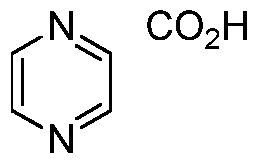 to form a compound of Formula
(x) :

(m) reacting the compound of Formula (x) with (OH)2BCH2CH(CH3)2 to form Velcade:
M ° B ° HO OH
H N 0 B
N (OH)2BCH2CH(CH3)2 H
M N
n H N
° Bn O Bn H
^ Velcade
wherein: Z is chloro or bromo; and each R1 is independently aryl or arylalkyl.
[00024] In certain embodiments, provided herein is a method of synthesizing a compound of Formula 1010 comprising reacting a compound of Formula (ix) with Lp:

wherein: L is
 or
or
0,C CO
N J is -(CH2)n- -(CH2-CHO)n-, -(CH2-CH-NH)n-, -0-(CH2
CHO)„- -NH-(CH2-CH-NH)n-, -NH-(CH2-CHO)„-, -0-(CH2-CH-NH)n- or -(amino acid residue)n-; and each n is independently a positive integer.
[00025] In certain embodiments, provided herein is a compound according to Formula I:
■
G-G
R.,-0. Q R-\
o p
(i);
wherein: each Ri is independently hydrogen, alkyl, aryl or aryl alkyl; ring A is a carbocyclic ring or absent; each Q is nitrogen, carbon, or oxygen; each G is carbon; or when ring A is absent and Q is oxygen, then G is absent; and Y is halogen, amide, an amino acid sequence or an amino acid, or ester thereof.
[00026] In certain embodiments, provided herein is a protected amino acid sequence of Formula XXXIII:

(XXXIII);
wherein: each Ri is independently hydrogen, alkyl, aryl or aryl alkyl; and each AA is an amino acid sequence, or ester thereof.
[00027] In certain embodiments, provided herein is a compound according to Formula XXXIV:
R.,-0 O R, R- O n O-R*
Ps P- 0 AA N2H2-AA 0
(XXXIV);
wherein: each Ri is independently hydrogen, alkyl, aryl or aryl alkyl; and each AA is an amino acid sequence, or ester thereof.
[00028] In certain embodiments, provided herein is a method of protecting an amino acid comprising reacting an amino acid with a compound of formula VIlii to form a protected amino acid of formula IXii:

wherein: X is halogen; ring A is a carbocyclic ring or absent; each Q is nitrogen or carbon, or oxygen; each G is carbon; or when ring A is absent and Q is oxygen, then G is absent; each Ri is independently hydrogen, alkyl, aryl or aryl alkyl; R2 is hydrogen or alkyl; R3 is a side chain of a natural or unnatural amino acid; and Rt is hydrogen; or, in the alternative, R3 and R4 combine to form a 5-membered ring.
[00029] In certain embodiments, provided herein is a method of producing a protected amino acid sequence, comprising: (a) hydrogenating a compound of Formula IXii in the presence of a hydrogenation catalyst to form a compound of Formula XVIIIii:
G-G 9
Q Q-R1 R1 Q P'Q-R1
O P „ Catalyst, H2 0 N R4
N R4
OH
0
(IXii) (XVIIIii) ; and
(b) reacting the compound of Formula XVIIIii with an amino acid ester to form a protected amino acid sequence of Formula XlXii:
Q Q-R RI Q Q_RI o M p + Amino n \
R4 0 AA PG
„u Acid Ester
R
O (XIX")
(XVIIIii) wherein: each Q is nitrogen, carbon, or oxygen; each G is carbon; or when ring A is absent and Q is oxygen, then G is absent; AA is an amino acid sequence; PG is protecting group attached to the carboxyl terminal of AA; ring A is a carbocyclic ring or absent each Ri is independently hydrogen, alkyl, aryl or aryl alkyl; R2 is alkyl; R3 is a side chain of a natural or unnatural amino acid; and R4 is hydrogen; or, in the alternative, R3 and R4 combine to form a 5-membered ring.
[00030] In certain embodiments, provided herein is a method of producing a protected amino acid sequence, comprising: (a) hydrogenating a compound of Formula IXii in the presence of a hydrogenation catalyst to form a compound of Formula XVIIIii:
G-G G G
O Q P v "-«< Catalyst, H2 R,"o Px N R
N R4
OH
, 3 R2 O
o
(IXii) (XVIIIii)
(b) reacting the compound of Formula XVIIIii with an amino acid ester to form a protected amino acid sequence of Formula XXXIII:
A Λ A
G G GA , G-G
RI Q p Q-Ri N2H2 RI-Q Q Rl Ri-Q Q Ri
O B + Amir|o P ,P.
N * Acid Ester 0 "AA N2H2 AA O
R3
0 (XXXIII)
(XVIIIii) wherein: each Q is nitrogen, carbon, or oxygen; each G is carbon; or when ring A is absent and Q is oxygen, then G is absent; AA is an amino acid sequence; PG is protecting group attached to the carboxyl terminal of AA; ring A is a carbocyclic ring or absent each Ri is independently hydrogen, alkyl, aryl or aryl alkyl; R2 is alkyl; R3 is a side chain of a natural or unnatural amino acid; and R4 is hydrogen; or, in the alternative, R3 and R4 combine to form a 5-membered ring.
[00031 ] In certain embodiments, provided herein is a method of synthesizing a compound of Formula Villi, comprising: (a) reacting a compound of Formula XXi with Ri- C(0)H to form a compound of Formula XXIi:
A A
R C(0)H
H2N NH2 R N N R
(xx) (xxi)
(b) reducing the compound of Formula XXI to form a compound of Formula XXII:
A A
Reducing Agent
R R Ri NH HN R<
Ri N N— Ri 1 1
(XXI) (XXI I)
(c) reacting the compound of formula XXII with POBr3 to form a compound of Formula XXIII:
POBr3, Et3N
R. NH HN , R1- N R,
R O P"Br
(XXII) (XXm) ; and
(d) reacting the compound of Formula XXIII with an ammonium salt to form a compound of Formula VIII:
_ „, „, _ Ammonium
R ~N p 1 Salt Ri N N R,
° "Br *~ o NH2
(XXIII) (VTTT) . wherein: each Ri is independently hydrogen, alkyl, aryl or aryl alkyl; and ring A is a carbocyclic ring or absent. In an embodiment, the ammonium salt is NH4C1 or ( EU^SC^. In an embodiment, the ammonium salt is NH4CI. In an embodiment, the ammonium salt is ( H4)2S04.
[00032] In certain embodiments, provided herein is a method of synthesizing a compound of Formula VII, comprising: (a) reacting a compound of Formula XX with Ri- C(0)H to form a compound of Formula XXI:
A A
R C(0)H
H2N NH2 R1 N Ri
(xx) (xxi)
(b) reducing the compound of Formula XXI to form a compound of Formula XXII:

(xxi) (χχπ) . and
(c) reacting the compound of formula XXII with POX3 to form a compound of Formula VII:
POX3, Et3N
R. NH HN .D Ri-N ,
(XXII) (vn) . wherein: X is halogen; each Ri is independently hydrogen, alkyl, aryl or aryl alkyl; and ring A is a carbocyclic ring or absent.
[00033] The phosphonyl amines described herein are useful, for example, in GAP imine chemistry. The phosphonyl amides can be used to synthesis phosphonyl imines which can be converted to β-amino-ketone or β-amino-acid esters. An example is provided in the scheme below:

(V) Ph R(or OR^ 0
DESCRIPTION OF EXEMPLARY EMBODIMENTS
[00034] Provided herein are novel phosphonyl halide and phosphonyl amide compounds. Also provided herein are methods of synthesizing the novel phosphonyl halide and phosphonyl amide compounds. The novel phosphonyl halide compounds are useful, for example, as protecting groups in the synthesis of amino acid sequences, peptides, and proteins. The phosphonyl amide compounds are useful, for example in GAP imine chemistry.
[00035] Provided herein are novel methods of GAP synthesis of Velcade, Velcade analogs and amino compounds. GAP, the abbreviation of Group-Assisted Purification, refers to synthesis methods which avoid or minimize the use of traditional purification methods such as chromatography and recrystallization. The methods involve organic syntheses with chiral auxiliaries which allow pure products, often pure isomers, to be obtained simply by washing crude products with organic solvents. In some embodiments, the crude products themselves are pure or optically pure enough due to excellent reactivity, chemoselectivity, and asymmetric induction of GAP methods. In preferred embodiments, chiral auxiliaries can be recycled easily after deprotection, in some cases without racemization of the chiral auxiliaries. The "Group" in GAP methods can be, but is not limited to, phosphonyl or phosphinyl auxiliaries. The phosphonyl and phosphinyl auxiliaries can provide efficient asymmetric induction and control in organic transformations. Additionally, corresponding chiral products, mostly solidified, can be utilized to synthesize Velcade, Velcade analogs and amino compounds. Also provided herein are novel dimeric Velcade analogs and methods of synthesis thereof, which have potential use as alternatives to Velcade monomer cancer therapeutics.
Definitions
[00036] When referring to the compounds provided herein, the following terms have the following meanings unless indicated otherwise. Unless defined otherwise, all technical and scientific terms used herein have the same meaning as is commonly understood by one of
ordinary skill in the art. In the event that there is a plurality of definitions for a term herein, those in this section prevail unless stated otherwise.
[00037] The term "alkyl", as used herein, unless otherwise specified, refers to a saturated straight or branched hydrocarbon. In certain embodiments, the alkyl group is a primary, secondary, or tertiary hydrocarbon. In certain embodiments, the alkyl group includes one to ten carbon atoms, i.e., Ci to C10 alkyl. In certain embodiments, the alkyl group is selected from the group consisting of methyl, CF3, CCI3, CFCI2, CF2C1, ethyl, CH2CF3, CF2CF3, propyl, isopropyl, butyl, isobutyl, secbutyl, t-butyl, pentyl, isopentyl, neopentyl, hexyl, isohexyl, 3-methylpentyl, 2,2-dimethylbutyl, and 2,3-dimethylbutyl. The term includes both substituted and unsubstituted alkyl groups, including halogenated alkyl groups. In certain embodiments, the alkyl group is a fluorinated alkyl group. Non-limiting examples of moieties with which the alkyl group can be substituted are selected from the group consisting of halogen (fluoro, chloro, bromo or iodo), hydroxyl, amino, alkylamino, arylamino, alkoxy, aryloxy, nitro, cyano, sulfonic acid, sulfate, phosphonic acid, phosphate, or phosphonate, either unprotected, or protected as necessary, as known to those skilled in the art, for example, as taught in Greene, et al., Protective Groups in Organic Synthesis, John Wiley and Sons, Second Edition, 1991 , hereby incorporated by reference.
[00038] The term "lower alkyl", as used herein, and unless otherwise specified, refers to a saturated straight or branched hydrocarbon having one to six carbon atoms, i.e., Ci to Ce alkyl. In certain embodiments, the lower alkyl group is a primary, secondary, or tertiary hydrocarbon. The term includes both substituted and unsubstituted moieties.
[00039] The terms "cycloalkyl" and "carbocyclic", as used herein, unless otherwise specified, refers to a saturated cyclic hydrocarbon. In certain embodiments, the cycloalkyl group may be a saturated, and/or bridged, and/or non-bridged, and/or a fused bicyclic group. In certain embodiments, the cycloalkyl group includes three to ten carbon atoms, i.e., C3 to Cio cycloalkyl. In some embodiments, the cycloalkyl has from 3 to 15 (C3-15), from 3 to 10 (C3_io), or from 3 to 7 (C3_7) carbon atoms. In certain embodiments, the cycloalkyl group is cyclopropyl, cyclobutyl, cyclopentyl, cyclohexyl, cyclohexylmethyl, cycloheptyl, bicyclo[2.1.1]hexyl, bicyclo[2.2.1 ]heptyl, decalinyl, or adamantyl.
[00040] The term "cycloalkenyl", as used herein, unless otherwise specified, refers to an unsaturated cyclic hydrocarbon. In certain embodiments, cycloalkenyl refers to mono- or multicyclic ring systems that include at least one double bond. In certain embodiments, the
cycloalkenyl group may be a bridged, non-bridged, and/or a fused bicyclic group. In certain embodiments, the cycloalkyl group includes three to ten carbon atoms, i.e., C3 to C10 cycloalkyl. In some embodiments, the cycloalkenyl has from 3 to 7 (C3-10), or from 4 to 7 (C3_ 7) carbon atoms.
[00041] "Alkylene" refers to divalent saturated aliphatic hydrocarbon groups particularly having from one to eleven carbon atoms which can be straight-chained or branched. In certain embodiments, the alkylene group contains 1 to 10 carbon atoms. The term includes both substituted and unsubstituted moieties. This term is exemplified by groups such as methylene (-(¾-), ethylene (-CH2CH2-), the propylene isomers (e.g., - CH2CH2CH2- and -CH(CH3)CH2-) and the like.
[00042] "Alkenyl" refers to monovalent olefinically unsaturated hydrocarbon groups, in certain embodiment, having up to about 11 carbon atoms, from 2 to 8 carbon atoms, or from 2 to 6 carbon atoms, which can be straight-chained or branched and having at least 1 or from 1 to 2 sites of olefinic unsaturation. The term includes both substituted and unsubstituted moieties. Exemplary alkenyl groups include ethenyl (i.e., vinyl, or -CH=CH2), n-propenyl (-CH2CH=CH2), isopropenyl (-C(CH3)=CH2), and the like.
[00043] "Alkenylene" refers to divalent olefinically unsaturated hydrocarbon groups, in certain embodiments, having up to about 11 carbon atoms or from 2 to 6 carbon atoms which can be straight-chained or branched and having at least 1 or from 1 to 2 sites of olefinic unsaturation. This term is exemplified by groups such as ethenylene (-CH=CH-), the propenylene isomers (e.g., -CH=CHCH2- and -C(CH3)=CH- and -CH=C(CH3)-) and the like.
[00044] "Alkynyl" refers to acetylenically unsaturated hydrocarbon groups, in certain embodiments, having up to about 11 carbon atoms or from 2 to 6 carbon atoms which can be straight-chained or branched and having at least 1 or from 1 to 2 sites of alkynyl unsaturation. Non-limiting examples of alkynyl groups include acetylenic, ethynyl (-C≡CH), propargyl (-CH2C≡CH), and the like.
[00045] The term "aryl", as used herein, and unless otherwise specified, refers to a cyclic aromatic hydrocarbon. In certain embodiments, aryl is furanyl, pyridinyl, phenyl, biphenyl, or naphthyl. The term includes both substituted and unsubstituted moieties. An aryl group can be substituted with any described moiety, including, but not limited to, one or more moieties selected from the group consisting of halogen (fluoro, chloro, bromo or iodo),
alkyl, haloalkyl, hydroxyl, amino, alkylamino, arylamino, alkoxy, aryloxy, nitro, cyano, sulfonic acid, sulfate, phosphonic acid, phosphate, or phosphonate, either unprotected, or protected as necessary, as known to those skilled in the art, for example, as taught in Greene, et al., Protective Groups in Organic Synthesis, John Wiley and Sons, Second Edition, 1991.
[00046] "Alkoxy" refers to the group -OR' where R' is alkyl or cycloalkyl. Alkoxy groups include, by way of example, methoxy, ethoxy, n-propoxy, isopropoxy, n-butoxy, tert- butoxy, sec-butoxy, n-pentoxy, n-hexoxy, 1,2-dimethylbutoxy, and the like.
[00047] "Alkoxycarbonyl" refers to a radical -C(0)-alkoxy where alkoxy is as defined herein.
[00048] "Amino" refers to the radical -NH2.
[00049] "Carboxyl" or "carboxy" refers to the radical -C(0)OH.
[00050] The term "alkylamino" or "arylamino" refers to an amino group that has one or two alkyl or aryl substituents, respectively. In certain embodiments, the alkyl substituent is lower alkyl. In another embodiment, the alkyl or lower alkyl is unsubstituted.
[00051] "Halogen" or "halo" refers to chloro, bromo, fluoro or iodo.
[00052] "Monoalkylamino" refers to the group alkyl-NR'-, wherein R' is selected from hydrogen and alkyl or cycloalkyl.
[00053] "Thioalkoxy" refers to the group -SR' where R' is alkyl or cycloalkyl.
[00054] The term "heterocyclyl" or "heterocyclic" refers to a monovalent monocyclic non-aromatic ring system and/or multicyclic ring system that contains at least one non- aromatic ring, wherein one or more of the non-aromatic ring atoms are heteroatoms independently selected from O, S, or N; and the remaining ring atoms are carbon atoms. In certain embodiments, the heterocyclyl or heterocyclic group has from 3 to 20, from 3 to 15, from 3 to 10, from 3 to 8, from 4 to 7, or from 5 to 6 ring atoms. Heterocyclyl groups are bonded to the rest of the molecule through the non-aromatic ring. In certain embodiments, the heterocyclyl is a monocyclic, bicyclic, tricyclic, or tetracyclic ring system, which may include a fused or bridged ring system, and in which the nitrogen or sulfur atoms may be optionally oxidized, the nitrogen atoms may be optionally quaternized, and some rings may be partially or fully saturated, or aromatic. The heterocyclyl may be attached to the main structure at any heteroatom or carbon atom which results in the creation of a stable compound. Examples of such heterocyclic radicals include, but are not limited to, azepinyl,
benzodioxanyl, benzodioxolyl, benzofuranonyl, benzopyranonyl, benzopyranyl, benzotetrahydrofuranyl, benzotetrahydrothienyl, benzothiopyranyl, benzoxazinyl, β- carbolinyl, chromanyl, chromonyl, cinnolinyl, coumarinyl, decahydroisoquinolinyl, dihydrobenzisothiazinyl, dihydrobenzisoxazinyl, dihydrofuryl, dihydroisoindolyl, dihydropyranyl, dihydropyrazolyl, dihydropyrazinyl, dihydropyridinyl, dihydropyrimidinyl, dihydropyrrolyl, dioxolanyl, 1,4-dithianyl, furanonyl, imidazolidinyl, imidazolinyl, indolinyl, isobenzotetrahydrofuranyl, isobenzotetrahydrothienyl, isochromanyl, isocoumarinyl, isoindolinyl, isothiazolidinyl, isoxazolidinyl, morpholinyl, octahydroindolyl, octahydroisoindolyl, oxazolidinonyl, oxazolidinyl, oxiranyl, piperazinyl, piperidinyl, 4- piperidonyl, pyrazolidinyl, pyrazolinyl, pyrrolidinyl, pyrrolinyl, quinuclidinyl, tetrahydrofuryl, tetrahydroisoquinolinyl, tetrahydropyranyl, tetrahydrothienyl, thiamorpholinyl, thiazolidinyl, tetrahydroquinolinyl, and 1,3,5-trithianyl. In certain embodiments, heterocyclic may also be optionally substituted as described herein.
[00055] The term "heteroaryl" refers to refers to a monovalent monocyclic aromatic group and/or multicyclic aromatic group that contain at least one aromatic ring, wherein at least one aromatic ring contains one or more heteroatoms independently selected from O, S, and N in the ring. Heteroaryl groups are bonded to the rest of the molecule through the aromatic ring. Each ring of a heteroaryl group can contain one or two O atoms, one or two S atoms, and/or one to four N atoms, provided that the total number of heteroatoms in each ring is four or less and each ring contains at least one carbon atom. In certain embodiments, the heteroaryl has from 5 to 20, from 5 to 15, or from 5 to 10 ring atoms. Examples of monocyclic heteroaryl groups include, but are not limited to, furanyl, imidazolyl, isothiazolyl, isoxazolyl, oxadiazolyl, oxadiazolyl, oxazolyl, pyrazinyl, pyrazolyl, pyridazinyl, pyridyl, pyrimidinyl, pyrrolyl, thiadiazolyl, thiazolyl, thienyl, tetrazolyl, triazinyl, and triazolyl. Examples of bicyclic heteroaryl groups include, but are not limited to, benzofuranyl, benzimidazolyl, benzoisoxazolyl, benzopyranyl, benzothiadiazolyl, benzothiazolyl, benzothienyl, benzotriazolyl, benzoxazolyl, furopyridyl, imidazopyridinyl, imidazothiazolyl, indolizinyl, indolyl, indazolyl, isobenzofuranyl, isobenzothienyl, isoindolyl, isoquinolinyl, isothiazolyl, naphthyridinyl, oxazolopyridinyl, phthalazinyl, pteridinyl, purinyl, pyridopyridyl, pyrrolopyridyl, quinolinyl, quinoxalinyl, quinazolinyl, thiadiazolopyrimidyl, and thienopyridyl. Examples of tricyclic heteroaryl groups include, but are not limited to, acridinyl, benzindolyl, carbazolyl, dibenzofuranyl, perimidinyl, phenanthrolinyl,
phenanthridinyl, phenarsazinyl, phenazinyl, phenothiazinyl, phenoxazinyl, and xanthenyl. In certain embodiments, heteroaryl may also be optionally substituted as described herein.
[00056] The term "alkylaryl" refers to an aryl group with an alkyl substituent. The term "aralkyl" or "arylalkyl" includes an alkyl group with an aryl substituent.
[00057] The term "alkylheterocyclyl" refers to a heterocyclyl group with an alkyl substituent. The term alkylheterocyclyl includes an alkyl group with a heterocyclyl substituent.
[00058] The term "alkylheteroaryl" refers to a heteroaryl group with an alkyl substituent. The term alkylheteroaryl includes an alkyl group with a heteroaryl substituent.
[00059] The term "protecting group" as used herein and unless otherwise defined refers to a group that is added to an oxygen, nitrogen, or phosphorus atom to prevent its further reaction or for other purposes. A wide variety of oxygen and nitrogen protecting groups are known to those skilled in the art of organic synthesis.
[00060] The term "amino acid" refers to naturally occurring and non-naturally occurring amino acids, as well as amino acids such as proline, amino acid analogs and amino acid mimetics that function in a manner similar to naturally occurring amino acids. The term refers to naturally occurring and synthetic α, β, γ or δ amino acids. The term includes, but is not limited to, amino acids found in proteins, i.e. glycine (Gly), alanine (Ala), valine (Val), leucine (Leu), isoleucine (He), methionine (Met), phenylalanine (Phe), tryptophan (Trp), proline (Pro), serine, threonine (Thr), cysteine (Cys), tyrosine (Tyr), asparagine (Asn), glutamine (Gin), aspartate (Asp), glutamate (Glu), lysine (Lys), arginine (Arg) and histidine (His). In certain embodiments, the amino acid is in the L-configuration. Alternatively, the amino acid can be a derivative of alanyl, valinyl, leucinyl, isoleuccinyl, prolinyl, phenylalaninyl, tryptophanyl, methioninyl, glycinyl, serinyl, threoninyl, cysteinyl, tyrosinyl, asparaginyl, glutaminyl, aspartoyl, glutamyl, lysinyl, argininyl, histidinyl, β-alanyl, β-valinyl, β-leucinyl, β-isoleuccinyl, β-prolinyl, β-phenylalaninyl, β -tryptophanyl, β-methioninyl, β- glycinyl, β-serinyl, β-threoninyl, β-cysteinyl, β-tyrosinyl, β -asparaginyl, β-glutaminyl, β- aspartoyl, β-glutaroyl, β-lysinyl, β-argininyl or β-histidinyl.
[00061] Naturally encoded amino acids are the proteinogenic amino acids known to those of skill in the art. They include the 20 common amino acids (alanine, arginine, asparagine, aspartic acid, cysteine, glutamine, glutamic acid, glycine, histidine, isoleucine,
leucine, lysine, methionine, phenylalanine, proline, serine, threonine, tryptophan, tyrosine, and valine) and the less common pyrrolysine and selenocysteine. Naturally encoded amino acids include post-translational variants of the 22 naturally occurring amino acids such as prenylated amino acids, isoprenylated amino acids, myrisoylated amino acids, palmitoylated amino acids, N-linked glycosylated amino acids, O-linked glycosylated amino acids, phosphorylated amino acids and acylated amino acids.
[00062] The term "modified amino acid" refers to an amino acid that is not a proteinogenic amino acid, or a post-translationally modified variant thereof. In particular, the term refers to an amino acid that is not one of the 20 common amino acids or pyrrolysine or selenocysteine, or post-translationally modified variants thereof.
[00063] The terms "polypeptide," "peptide" and "protein" are used interchangeably herein to refer to a polymer of amino acid residues. That is, a description directed to a polypeptide applies equally to a description of a peptide and a description of a protein, and vice versa. The terms apply to naturally occurring amino acid polymers as well as amino acid polymers in which one or more amino acid residues is a modified amino acid. Additionally, such "polypeptides," "peptides" and "proteins" include amino acid chains of any length, including full length proteins, wherein the amino acid residues are linked by covalent peptide bonds.
[00064] The term "acyl" or "O-linked ester" refers to a group of the formula C(0)R', wherein R' is alkyl or cycloalkyl (including lower alkyl), carboxylate reside of amino acid, aryl including phenyl, alkaryl, arylalkyl including benzyl, alkoxyalkyl including methoxymethyl, aryloxyalkyl such as phenoxymethyl; or substituted alkyl (including lower alkyl), aryl including phenyl optionally substituted with chloro, bromo, fluoro, iodo, CI to C4 alkyl or CI to C4 alkoxy, sulfonate esters such as alkyl or arylalkyl sulphonyl including methanesulfonyl, the mono, di or triphosphate ester, trityl or monomethoxy-trityl, substituted benzyl, alkaryl, arylalkyl including benzyl, alkoxyalkyl including methoxymethyl, aryloxyalkyl such as phenoxymethyl. Aryl groups in the esters optimally comprise a phenyl group. In particular, acyl groups include acetyl, trifluoroacetyl, methylacetyl, cyclpropylacetyl, propionyl, butyryl, hexanoyl, heptanoyl, octanoyl, neo-heptanoyl, phenylacetyl, 2-acetoxy-2-phenylacetyl, diphenylacetyl, a-methoxy-a-trifluoromethyl- phenylacetyl, bromoacetyl, 2-nitro-benzeneacetyl, 4-chloro-benzeneacetyl, 2-chloro-2,2- diphenylacetyl, 2-chloro-2-phenylacetyl, trimethylacetyl, chlorodifluoroacetyl, perfluoroacetyl, fluoroacetyl, bromodifluoroacetyl, methoxyacetyl, 2-thiopheneacetyl,
chlorosulfonylacetyl, 3-methoxyphenylacetyl, phenoxyacetyl, tert-butylacetyl, trichloroacetyl, monochloro-acetyl, dichloroacetyl, 7H-dodecafluoro-heptanoyl, perfluoro- heptanoyl, 7H-dodeca-fluoroheptanoyl, 7-chlorododecafluoro-heptanoyl, 7-chloro- dodecafluoro-heptanoyl, 7H-dodecafluoroheptanoyl, 7H-dodeca-fluoroheptanoyl, nona- fluoro-3,6-dioxa-heptanoyl, nonafluoro-3,6-dioxaheptanoyl, perfluoroheptanoyl, methoxybenzoyl, methyl 3-amino-5-phenylthiophene-2-carboxyl, 3,6-dichloro-2-methoxy- benzoyl, 4-(l,l,2,2-tetrafluoro-ethoxy)-benzoyl, 2-bromo-propionyl, omega-aminocapryl, decanoyl, n-pentadecanoyl, stearyl, 3-cyclopentyl-propionyl, 1 -benzene-carboxyl, O- acetylmandelyl, pivaloyl acetyl, 1 -adamantane-carboxyl, cyclohexane-carboxyl, 2,6- pyridinedicarboxyl, cyclopropane-carboxyl, cyclobutane-carboxyl, perfluorocyclohexyl carboxyl, 4-methylbenzoyl, chloromethyl isoxazolyl carbonyl, perfluorocyclohexyl carboxyl, crotonyl, 1 -methyl- lH-indazole-3 -carbonyl, 2-propenyl, isovaleryl, 1 -pyrrolidinecarbonyl, 4- phenylbenzoyl.
[00065] The term "substantially free of or "substantially in the absence of with respect to a composition refers to a composition that includes at least 85% or 90% by weight, in certain embodiments 95%, 98%, 99% or 100% by weight, of a designated enantiomer of a compound. In certain embodiments, in the methods and compounds provided herein, the compounds are substantially free of enantiomers.
[00066] Similarly, the term "isolated" with respect to a composition refers to a composition that includes at least 85%, 90%, 95%, 98%, 99% or 100% by weight, of a compound, the remainder comprising other chemical species or enantiomers.
[00067] Similarly, the term "diastereomerically pure" with respect to a compound refers to a compound that includes at least 85% or 90% by weight, in certain embodiments 95%, 98%, 99% or 100% by weight of the designated diastereomer.
[00068] "Isotopic composition" refers to the amount of each isotope present for a given atom, and "natural isotopic composition" refers to the naturally occurring isotopic composition or abundance for a given atom. Atoms containing their natural isotopic composition may also be referred to herein as "non-enriched" atoms. Unless otherwise designated, the atoms of the compounds recited herein are meant to represent any stable isotope of that atom. For example, unless otherwise stated, when a position is designated specifically as "H" or "hydrogen", the position is understood to have hydrogen at its natural isotopic composition.
[00069] "Isotopic enrichment" refers to the percentage of incorporation of an amount of a specific isotope at a given atom in a molecule in the place of that atom's natural isotopic abundance. For example, deuterium enrichment of 1% at a given position means that 1% of the molecules in a given sample contain deuterium at the specified position. Because the naturally occurring distribution of deuterium is about 0.0156%, deuterium enrichment at any position in a compound synthesized using non-enriched starting materials is about 0.0156%. The isotopic enrichment of the compounds provided herein can be determined using conventional analytical methods known to one of ordinary skill in the art, including mass spectrometry and nuclear magnetic resonance spectroscopy.
[00070] "Isotopically enriched" refers to an atom having an isotopic composition other than the natural isotopic composition of that atom. "Isotopically enriched" may also refer to a compound containing at least one atom having an isotopic composition other than the natural isotopic composition of that atom.
[00071] As used herein, "alkyl," "cycloalkyl," "alkenyl," "cycloalkenyl," "alkynyl," "aryl," "alkoxy," "alkoxycarbonyl," "amino," "carboxyl," "alkylamino," "arylamino," "thioalkyoxy," "heterocyclyl," "heteroaryl," "alkylheterocyclyl," "alkylheteroaryl," "acyl," "aralkyl," "alkaryl," "purine," "pyrimidine," "carboxyl" and "amino acid" groups optionally comprise deuterium at one or more positions where hydrogen atoms are present, and wherein the deuterium composition of the atom or atoms is other than the natural isotopic composition.
[00072] Also as used herein, "alkyl," "cycloalkyl," "alkenyl," "cycloalkenyl," "alkynyl," "aryl," "alkoxy," "alkoxycarbonyl," "carboxyl," "alkylamino," "arylamino," "thioalkyoxy," "heterocyclyl," "heteroaryl," "alkylheterocyclyl," "alkylheteroaryl," "acyl," "aralkyl," "alkaryl," "purine," "pyrimidine," "carboxyl" and "amino acid" groups optionally comprise carbon- 13 at an amount other than the natural isotopic composition.
[00073] The term "protected", as used herein and unless specified otherwise, refers to a group that is added to an oxygen, nitrogen or phosphorus atom to prevent its further reaction or for other purposes. A wide variety of oxygen, nitrogen and phosphorus protecting groups are known to those skilled in the art of organic synthesis.
[00074] Examples of suitable protecting groups include, but not limited to, benzoyl; substituted or unsubstituted alkyl groups, substituted or unsubstituted aryl groups, substituted or unsubstituted silyl groups; substituted or unsubstituted aromatic or aliphatic esters, such as,
for example, aromatic groups like benzoyl, toluoyls (e.g. p-toluoyl), nitrobenzoyl, chlorobenzoyl; ether groups such as, for example, -C-O-aralkyl, -C-O-alkyl, or -C-O-aryl; and aliphatic groups like acyl or acetyl groups, including any substituted or unsubstituted aromatic or aliphatic acyl, -(C=0)-aralkyl, -(C=0)-alkyl, or -(C=0)-aryl; wherein the aromatic or aliphatic moiety of the acyl group can be straight-chained or branched; all of which may be further optionally substituted by groups not affected by the reactions comprising the improved synthesis (see Greene et al., Protective Groups in Organic Synthesis, John Wiley and Sons, 2nd Edition, 1991). For example, in one embodiment of the invention, the protecting groups are substituted by groups not affected by the reducing agent of choice, such as Red-Al. For the use of ethers as protective groups, attention is directed to U.S. Pat. No. 6,229,008 to Saischek et al., herein incorporated by reference, wherein it is reported that the use of an ether as a protective group may offer significant advantages for stability toward reagents and process conditions. This affords an ultimate advantage for separation, isolation, and purification of the desired product and thus, on the product's percent yield.
[00075] "Derivative," "analog," "chemical derivative," "derivatizing," and similar terms are given their ordinary meanings as well-known in the fields of chemistry, biochemistry, and/or biology. A derivative may be any chemical substance structurally related to another chemical substance and at least theoretically derivable from it. An analog may be a chemical or biological species that is similar enough to a parent species that it may substitute for the parent species in at least one set of chemical or biochemical interactions.
Synthetic Methods
[00076] In certain embodiments, provided herein is a method of protecting an amino acid comprising reacting an amino acid with a compound of formula VII to form a protected amino acid of formula IX:

[00077] In certain embodiments, provided herein is a method of producing a protected amino acid sequence, comprising: (a) hydrogenating a compound of Formula IX in the presence of a hydrogenation catalyst to form a compound of Formula XVIII:
'P\N R4 Catalyst, H2 0 N R ■,4
O OH
O O
(IX) (xviii) ; and
(b) reacting the compound of Formula XVIII with an amino acid ester to form a protected amino acid sequence of Formula XIX:

R,-N p N R, Ri_N ^ N_Ri
D + Amino n''P\
N K44 + w AA
0H AAcciidd EEsstteerr
O (XIX)
(XVIII) wherein: AA is an amino acid sequence; PG is protecting group attached to the carboxyl terminal of AA; ring A is a carbocyclic ring or absent each Ri is independently hydrogen, alkyl, aryl or aryl alkyl; R2 is alkyl; R3 is a side chain of a natural or unnatural amino acid; and R4 is hydrogen; or, in the alternative, R3 and R4 combine to form a 5-membered ring.
[00078] In certain embodiments, the hydrogenation catalyst comprises palladium.
[00079] In certain embodiments, the method further comprises repeating steps (a) and (b) starting from a compound of Formula XIX. In an embodiment, the steps are repeated to synthesize an amino acid sequence. In an embodiment, the steps are repeated to synthesize a peptide. In an embodiment, the steps are repeated to synthesize a protein.
[00080] In certain embodiments, of the methods, R2 is methyl or benzyl; R3 is hydrogen, -CH3, -CH(CH3)2, -CH2CH(CH3)2,
 ; and R4 is
hydrogen; or, in the alternative, R3 and R4 combine to form

[00081] In certain embodiments, provided herein is a method of synthesizing a compound of Formula VIII, comprising: (a) reacting a compound of Formula XX with Ri- C(0)H to form a compound of Formula XXI:

(xx) (xxi)
(b) reducing the compound of Formula XXI to form a compound of Formula XXII:

(XXI) (XXI I)
(c) reacting the compound of formula XXII with POBr3 to form a compound of Formula XXIII:
(A ) ©
) { POBr3, Et3N
Rl-NH HN R Ri-N p N R,
(XXTI) (χχΐ") ; and
(d) reacting the compound of Formula XXIII with an ammonium salt to form a compound of Formula VIII:
Ri 1 N p N Ri 1 Amm Soan|†ium i N i
O Br o K NH2
(ΧΧΠΙ) (VTTT) . wherein: each Ri is independently hydrogen, alkyl, aryl or aryl alkyl; and ring A is a carbocyclic ring or absent. In an embodiment, the ammonium salt is NH4CI or ( F^^SC^. In
an embodiment, the ammonium salt is NH4CI. In an embodiment, the ammonium salt is ( H4)2S04.
[00082] In certain embodiments, provided herein is a method of synthesizing a compound of Formula VII, comprising: (a) reacting a compound of Formula XX with ¾- C(0)H to form a compound of Formula XXI:

(xx) (xxi)
(b) reducing the compound of Formula XXI to form a compound of Formula XXII:

(xxi) (χχι') ; and
(c) reacting the compound of formula XXII with POX3 to form a compound of Formula VII: to
POX3, Et3N
R NH HN ._ R1-N p N R1
R o'-P x
(xxi!) (vn) wherein: X is halogen; each Ri is independently hydrogen, alkyl, aryl or aryl alkyl; and ring A is a carbocyclic ring or absent.
[00083] In certain embodiments of the methods, the Reducing Agent is NaBH4.
[00084] In certain embodiments of the methods, X is chloro or bromo. In certain embodiments, X is chloro. In certain embodiments, X is bromo.
[00085] In certain embodiments, provided herein is a method of producing a protected amino acid sequence, comprising: (a) hydrogenating a compound of Formula IXi in the presence of a hydrogenation catalyst to form a compound of Formula XVIIIi:

; and
(b) reacting the compound of Formula XVIIIi with an amino acid ester to form a protected amino acid sequence of Formula XXXIIIi:
R1 0 p 0 R1 N2H2 , o O-Ri R1_0 \ R1 o M p + Amino ^ P P
N 4 0H Acid Ester °* AA N^ AA 0 RS o (XVIIIi) (XXXIIIi) wherein: AA is an amino acid sequence; each Ri is independently hydrogen, alkyl, aryl or aryl alkyl; R2 is alkyl; R3 is a side chain of a natural or unnatural amino acid; and R4 is hydrogen; or, in the alternative, R3 and R4 combine to form a 5-membered ring.
[00086] In certain embodiments of the methods described herein, each Ri is the same and selected from alkyl, aryl and aryl alkyl. In certain embodiments of the methods described herein, each Ri is the same and is alkyl. In certain embodiments of the methods described herein, each Ri is the same and is aryl alkyl. In certain embodiments of the methods described herein, each Ri is the same and is aryl. In certain embodiments of the methods described herein, each Ri is the same and is isopropyl. In certain embodiments of the methods described herein, each Ri is the same and is naphthyl. In certain embodiments of the methods described herein, each Ri is the same and is phenyl. In certain embodiments of the methods described herein, each Ri is the same and is hydrogen.
[00087] In certain embodiments of the methods described herein, each Y is independently chloro or bromo. In certain embodiments of the methods described herein, each Y is chloro. In certain embodiments of the methods described herein, each Y is bromo. In certain embodiments of the methods described herein, each X is independently chloro or bromo. In certain embodiments of the methods described herein, each X is chloro. In certain embodiments of the methods described herein, each X is bromo.
[00088] In certain embodiments of the methods described herein, ring A is a carbocyclic ring. In certain embodiments of the methods described herein, ring A is a six- membered carbocyclic ring. In certain embodiments of the methods described herein, ring A is a cyclohexane ring. In certain embodiments of the methods described herein, ring A is absent.
[00089] In certain embodiments provided herein is a method of synthesizing a compound of Formula 1002 comprising:
(a) reacting R /R1 with Me2 PCl2 to form a compound of Formula (ia):

(ia)
(b) hydrogenating the compound of Formula (ia) to form a compound of Formula (iia): r1 P. r1 Hydrogenation R1 p ^R1
0 NMe2 O NMe2
,. , (iia)
(ia)
(c) reacting the compound of Formula (iia) with MeONa to form a compound of Formula (ii):
R1 p "*R1 MeONa R1 p """R1
0 NMe2 0 NMe2
(iia) (ii)
(d) reacting the compound of Formula (ii) with a strong acid in the presence of an alcohol or water to form a compound of Formula (iii) and resolving the compound of Formula (iii) by reaction with quinine to a compound of Formula (iiic):
R p R Strong Acid Ri -.Ri Quinine Ri p Ri
° 'N ME2 O* OH Resolve °* 0H
(II) (iii) (iiic)
(e) reacting the compound of Formula (iiic) with (COCl)2 or POBr3 to form a compound of Formula (ivc):
(COCI)2 or POBr3
P
0 OH
(iiic)
(i c)
(f) reacting the compound of Formula (ivc) with H3 to form a compound of Formula (1002c):

(ivc) (1002c)
wherein: Z is chloro or bromo; and each R1 is independently aryl or arylalkyl.
[00090] In certain embodiments provided herein is a method of synthesizing a compound of Formula 1002 comprising:
(a) reacting R with Me2 PCl2 to form a compound of Formula (ia):
1 Me2NPCI2 R1 p R1
R1 /R O NMe2
(ia)
(b) hydrogenating the compound of Formula (ia) to form a compound of Formula (iia):
R1 Ps r1 Hydrogenation R1 P "*R1
0 NMe2 0* NMe2
.. , (iia)
(ia) '
(c) reacting the compound of Formula (iia) with MeONa to form a compound of Formula (ii):
R1 p R1 MeONa R1 P "~R1
O NMe2 O NMe2
(iia) (ii)
(d) reacting the compound of Formula (ii) with a strong acid in the presence of an alcohol or water to form a compound of Formula (iii) and resolving the compound of Formula (iii) by reaction with quinine to a compound of Formula (iiid):
R1 p R1 Strong Acid Ri --Ri Quinine Ri p Ri
0 Snm¾ 0"POH Resolve °" 0H
(ϋ) (iii) (iiid)
(e) reacting the compound of Formula (iiid) with (COCl)2 or POBr3 to form a compound of Formula (ivd):

(iiicJ) (ivd)
(f) reacting the compound of Formula (ivd) with NH3 to form a compound of Formula (1002d):
R1 v p R1 N H3 R1 p R
O O'' NH2
(ivd) (1002d) wherein: Z is chloro or bromo; and each R1 is independently aryl or arylalkyl.
[00091] In certain embodiments provided herein is a method of synthesizing a compound of Formula 1003 c comprising reacting a compound of Formula 1002c with R3- CHO to form a compound of Formula 1003c:
R1- R1 R3-CHO * p
R O N
O NH2
R2 ^R3
(1002c)
(1003c) wherein: each R1 is independently aryl or arylalkyl; R2 is hydrogen; and R3 is Ci-Cs alkyl, C3-C8 cycloalkyl, or C6-C12 aryl.
[00092] In certain embodiments provided herein is a method of synthesizing a compound of Formula 1003 d comprising reacting a compound of Formula 1002d with R3- CHO to form a compound of Formula 1003d:
R1 R1 R3-CHO *-0 -p-
P d" N
O NH2
(1002d) (, 003d) wherein: each R1 is independently aryl or arylalkyl; R2 is hydrogen; and R3 is C\-C% alkyl, C3-C8 cycloalkyl, or C6-C12 aryl.
[00093] In certain embodiments provided herein is a method of synthesizing Velcade comprising:
1 R1
(a) reacting R with Me2 PCl2 to form a compound of Formula (ia): Me2NPCI2 R1 *" p R1
1 O NMe2
(ia)
(b) h drogenating the compound of Formula (ia) to form a compound of Formula (iia): r1

(c) reacting the compound of Formula (iia) with MeONa to form a compound of Formula (ii):
R1 p R1 MeONa R1 p ^R1
O NMe2 ** 0 NMe2
(iia) (ii)
(d) reacting the compound of Formula (ii) with a strong acid in the presence of an alcohol or water to form a compound of Formula (iii) and resolving the compound of Formula (iii) by reaction with quinine to a compound of Formula (iiic):
R1 p R1 Strong Acid Ri ^Ri Quinine Ri p Ri
° 'ΝΜ¾ °*P OH Resolve °" 0H
00 (iii) (me)
(e) reacting the compound of Formula (iiic) with (COCl)2 or POBr3 to form a compound of Formula (ivc):
(COCI)2 or POBr3
P
0 OH
(iiic)
(ivc)
(f) reacting the compound of Formula (ivc) with H3 to form a compound of Formula (1002c):

(ivc) (1002c)
(g) reacting the compound of Formula 1002c with HC(0)CH2CH(CH3)2 to form a compound of Formula vc:

(vc)
(h) reacting a compound of Formula (vc) with ICyCu^Bu to form a compound of Formula (vie):
R1 P R1 ICyCuO'Bu 0 PNN H
H 0
(vc) (vie)
(i) deprotecting the compound of Formula (vie) to form a compound of Formula (vii) and a compound of Formula (iiic):

(j) reacting the compound of Formula (vii) with BnCH(NHBoc)C(0)OH to form a compound of Formula (viii):
NHBoc
OH Λ B
NH3CI Bn 0 = j
O O BocHN N "
I H
0 Bn
(vii) (viii)
(k) reacting the compound of Formula (viii) with HCl to form a compound of Formula (ix):
0 HCI o B
BocHN
H CI H3N N
Bn H
(viii) B„ w
(1) reacting the compound of Formula (ix) with
 to form a compound of Formula
(x) :

(m) reacting the compound of Formula (x) with (OH)2BCH2CH(CH3)2 to form Velcade:

Velcade
wherein: Z is chloro or bromo; and each R1 is independently aryl or arylalkyl.
[00094] In certain embodiments, the method of synthesizing Velcade further comprises recycling the chiral auxiliary by using the compound of Formula (iiic) produced in step (i) in step (e).
In certain embodiments, provided herein is a method of synthesizing Velcade comprising: (a) reacting 1^^^^ ' with Me2 PCl2 to form a compound of Formula (ia):
1 Me2NPCI2 R1 p R1
O NMe,
(ia)
(b) hydrogenating the compound of Formula (ia) to form a compound of Formula (iia): r1 P. r1 Hydrogenation R1 P "*R1
0 NMe2 0 NMe2
.. , (iia)
(ia) '
(c) reacting the compound of Formula (iia) with MeONa to form a compound of Formula (ii)
R1 p ^R1 MeONa R1 P "^R1
O NMe2 O NMe2
(iia) (ii)
(d) reacting the compound of Formula (ii) with a strong acid in the presence of an alcohol or water to form a compound of Formula (iii) and resolving the compound of Formula (iii) by reaction with quinine to a compound of Formula (iiid):
R1 R1 Strong Acid R1 ^R1 Quinine R1 p R1
0 "NM¾ 0'- OH Resolve °* 0H
(ϋ) (iii) (iiid)
(e) reacting the compound of Formula (iiid) with (COCl)2 or POBr3 to form a compound of Formula (ivd):
(COCI)2 or POBr3
(iiid)
(f) reacting the compound of Formula (ivd) with NH3 to form a compound of Formula (1002d):

(ivd) (1002d)
(g) reacting the compound of Formula 1002d with HC(0)CH2CH(CH3)2 to form a compound of Formula vd:

(vd)
(h) reacting a compound of Formula (vd) with ICyCu^Bu to form a compound of Formula (vid):
R — R
R1 p R1 'CyCuO'Bu 0 R NH
0 B
H O
(vd) (vid)
(i) deprotecting the compound of Formula (vid) to form a compound of Formula (vii) and a compound of Formula (iiid):
R1 R1 NH3CI
P. Deprotection RI RI
0 NH O B p
0 B O 0 0H
O (vii) (iiid)
(vid)
(j) reacting the compound of Formula (vii) with BnCH(NHBoc)C(0)OH to form a compound of Formula (viii):
NHBoc
^OH
NH3CI Bn
O O BocHN^ N
I H
0 Bn
(vii) (viii)
(k) reacting the compound of Formula (viii) with HC1 to form a compound of Formula (ix):
0 HCI o B
BocHN
H CI H3N N
Bn H
(viii) B„ w
(1) reacting the compound of Formula (ix) with
 to form a compound of Formula
(x) :

(m) reacting the compound of Formula (x) with (OH)2BCH2CH(CH3)2 to form Velcade:

^ Velcade
wherein: Z is chloro or bromo; and each R1 is independently aryl or arylalkyl.
[00095] In certain embodiments, the method of synthesizing Velcade further comprises recycling the chiral auxiliary by using the compound of Formula (iiid) produced in step (i) in step (e).
[00096] In certain embodiments, provided herein is a method of synthesizing a compound of Formula 1010 comprising reacting a compound of Formula (ix) with Lp:
w
 herein: L is or or
 ; J is -(CH2)n- -(CH2-CHO)n-, -(CH2-CH-NH)n-, -0-(CH2-
CHO)„- -NH-(CH2-CH-NH)n-, -NH-(CH2-CHO)„-, -0-(CH2-CH-NH)n- or -(amino acid residue)n-; and each n is independently a positive integer.
[00097] In certain embodiments, a method of synthesizing a compound of Formula
1010 is provided wherein

02C

certain embodiments, a method of synthesizing a compound of Formula 1010 is provided
wherein Lp is wherei
or
 . In certain embodiments, each n is independently a positive integer selected from 1 to 10.
Compounds
[00098] In certain embodiments, provided herein is a compound according to Formula I:
A
G G
R.,-Q Q R1
(i);
wherein: each Ri is independently hydrogen, alkyl, aryl or aryl alkyl; ring A is a carbocyclic ring or absent; each Q is nitrogen, carbon, or oxygen; each G is carbon; or when ring A is absent and Q is oxygen, then G is absent; and Y is halogen, amide, an amino acid sequence or an amino acid, or ester thereof. In certain embodiments, ring A is a six-membered carbocyclic ring. In certain embodiments, ring A is a cyclohexane ring.
[00099] In certain embodiments, a compound is provided according to Formula II, III, or lV:

(II) (III) (IV);
wherein Q, Ri and Y are as described in the context of Formula I.
[000100] In certain embodiments, a compound is provided according to Formula V or VI:

(V) (VI);
wherein Ri and Y are as described in the context of Formula I.
[000101] In certain embodiments, a compound is provided according to any of Formulas Va-Vd:

R<-N N R..-N N R1 R..-N N R1 R<-N N R1
P P P P
0 O Y O Y O Y
(Va) (Vb) (Vc) (Vd); wherein Ri and Y are as described in the context of Formula I. In an embodiment, a compound according to Formula Va is provided.
[000102] In certain embodiments, a compound is provided according to Formula Vlli, Villi, IXi, or Xi:
Ri
®
R -Q Q Λ R Q Q-Ri R.,-Q Q R1
P P
O 0"-P NH2 o
(Vlli) (Villi) (IXi) (¾); wherein: Q, Ri and ring A are as described in the context of Formula I, X is halogen; R2 is hydrogen or alkyl; R3 is a side chain of a natural or unnatural amino acid; and R4 is hydrogen; or, in the alternative, R3 and R4 combine to form a 5-membered ring.
[000103] In certain embodiments, a compound is provided according to Formula VII, VIII, IX, or X:
Ri N N-R!
(A) ® o P R4 W
Rl-N N Rl i-N N Rl R3^° R2 RL" X N RL
O'-^X O "NH2 0 0 AA
(VII) (VIII) (IX) (X); wherein: Ri and ring A are as described in the context of Formula I, X is halogen; R2 is hydrogen or alkyl; R3 is a side chain of a natural or unnatural amino acid; and R4 is hydrogen; or, in the alternative, R3 and R4 combine to form a 5-membered ring.
[000104] In certain embodiments, a compound is provided according to Formula IX:

(ix);
wherein: Ri and ring A are as described in the context of Formula I, R2 is hydrogen, methyl or benzyl; R3 is hydrogen, -CH3, -CH(CH3)2, -CH2CH(CH3)2,
 , or
, or
 ; and R4 is hydrogen; or, in the alternative, R3 and R4 combine to form >
CM
[000105] In certain embodiments, provided herein is a compound according to Formula XXXIII:
■ ^
G-G G G
R.|-Q Q ^ R1 Q Q_R1
O P^AA-N2H2-AA
(XXXIII);
wherein: each Ri is independently hydrogen, alkyl, aryl or aryl alkyl; ring A is a carbocyclic ring or absent; each Q is nitrogen, carbon, or oxygen; each G is carbon; or when ring A is absent and Q is oxygen, then G is absent; and each AA is independently an amino acid, an amino acid sequence, or ester thereof. In some embodiments, a compound of Formula XXXIII is provided wherein each Ri is aryl. In some embodiments, a compound of Formula XXXIII is provided wherein each Ri is phenyl. In some embodiments, a compound of Formula XXXIII is provided wherein each Q is nitrogen. In some embodiments, a compound of Formula XXXIII is provided wherein each ring A is absent.
[000106] In certain embodiments, provided herein is a protected amino acid sequence of Formula XXXIV:
R1-O O Ri RI O p O-R,
P
O A AA A Μ N2.ΜH2.--AΔAΔ' O
(XXXIV);
wherein: Ri and AA are as described in the context of Formula XXXIII.
[000107] In certain embodiments, a compound of any of Formulas I- VI, Va-Vd, Vlli- Xi, VII-XI or XXXIII-XXXIV is provided wherein each Ri is the same and selected from alkyl, aryl and aryl alkyl. In certain embodiments, a compound of any of Formulas I- VI, Va- Vd, Vlli-Xi, VII-XI or XXXIII-XXXIV is provided wherein each Ri is the same and is alkyl. In certain embodiments, a compound of any of Formulas I- VI, Va-Vd, Vlli-Xi, VII-XI or XXXIII-XXXIV is provided wherein each Ri is the same and is aryl alkyl. In certain embodiments, a compound of any of Formulas I- VI, Va-Vd, Vlli-Xi, VII-XI or XXXIII- XXXIV is provided wherein each Ri is the same and is aryl. In certain embodiments, a compound of any of Formulas I-VI, Va-Vd, Vlli-Xi, VII-XI or XXXIII-XXXIV is provided wherein each Ri is the same and is hydrogen.
[000108] In certain embodiments, a compound is provided according to Formula XII, XIII, or XXX:

(XII) (XIII) (XXX); wherein Y and ring A are as described in the context of Formula I.
[000109] In certain embodiments, a compound is provided according to Formula XIV, XV or XXXI:

(XIV) (XV) (XXXI); wherein X is as described in the context of Formula VII and ring A is as described in the context of Formula I.
In certain embodiments, a compound is provided according to Formula XVI,

(XVI) (XVII) (XXXII);
wherein R2, R3 and R4 are as described in the context of Formula XI and ring A is as described in the context of Formula I.
[000111] In certain embodiments, a compound of Formula IX or IXi is provided, wherein: R2 is hydrogen, methyl or benzyl; R3 is hydrogen, -CH3, -CH(CH3)2, -
CH2CH(CH3)2,
 ; and R4 is hydrogen; or, in the alternative,
R3 and R4 combine to form

[000112] In certain embodiments, a compound of any of Formulas I- VI, Va-Vd, XII, XIII, or XXX is provided, wherein each Y is independently chloro or bromo. In certain embodiments, a compound of any of Formulas I- VI, Va-Vd, XII, XIII, or XXX is provided, wherein each Y is chloro. In certain embodiments, a compound of any of Formulas I- VI, Va- Vd, XII, XIII, or XXX is provided, wherein each Y is bromo. In certain embodiments, a compound of any of Formulas VII, VIIi, XIV, XV, or XXXI is provided, wherein each X is independently chloro or bromo. In certain embodiments, a compound of any of Formulas VII, VIIi, XIV, XV, or XXXI is provided, wherein each X is chloro. In certain embodiments, a compound of any of Formulas VII, VIIi, XIV, XV, or XXXI is provided, wherein each X is bromo.
[000113] In an embodiment, a compound according to any of Formulas I, Vlli-Xi, VII- X, XII-XVII or XXX-XXXIII is provided wherein ring A is a carbocyclic ring. In an embodiment, a compound according to any of Formulas I, Vlli-Xi, VII-X, XII-XVII or XXX-XXXIII is provided wherein ring A is a six-membered carbocyclic ring. In an
embodiment, a compound according to any of Formulas I, VIIi-Xi, VII-X, XII-XVII or XXX-XXXIII is provided wherein ring A is a cyclohexane ring.
[000114] In some embodiments, provided herein is a process for the preparation of a compound as described herein, e.g., of any of Formula I-XXXIII, Va-Vd, or VIIi-Xi as described in more detail elsewhere herein.
[000115] In certain embodiments, provided herein are compounds according to Formula I:
G-G
R-, Q Q-R-i
0 R Y
(i);
wherein: each Ri is independently hydrogen, alkyl, aryl or arylalkyl; ring A is a carbocyclic ring or absent; each Q is nitrogen, carbon, or oxygen; each G is carbon; or when ring A is absent and Q is oxygen, then G is absent; and Y is hydroxyl, halogen, amide, imine, an amino acid sequence or an amino acid, or ester thereof.
[000116] The in certain embodiments, provided herein are compounds according to Formula 1001:

(1001);
wherein: each R1 is independently aryl or arylalkyl; and Y is hydroxyl, halogen, amine, or imine.
[000117] In certain embodiments, provided herein are compounds according to any of Formulas 1001a, 1001b, 1001c or lOOld:
R1- R1 R R1 R
P 1 "' R1 R1- p p 1 "' p ) R1 o'- O O* > O
(1001a) (1001b) (1001c) (lOOld);
wherein R1 and Y are as described in the context of Formula 1001.
[000118] In certain embodiments, provided herein are compounds according to any of Formulas 1001 -100 Id, wherein: each Y is independently hydroxyl, chloro, bromo, -NH2 or - N=CH-R3; and R3 is Ci-Cg alkyl, C3-C8 cycloalkyl, or C6-Cn aryl.
[000119] In certain embodiments, provided herein are compounds according to any of Formulas 1002, 1003, or 1004:

(1002) (1003) (1004); wherein: R2 is hydrogen or Ci-Cs alkyl; R3 is Ci-Cs alkyl, C3-C8 cycloalkyl, or C6-C12 aryl; and R4 is hydroxyl or halogen; where R1 is as described in the context of Formula 1001.
[000120] In certain embodiments, provided herein are compounds according to any of Formulas 1002a-1004d:

(1002a) (1002b) (1002c) (1002d)

R2 R2 ^R3 R2 " R2 ^R3
(1003a) (1003b) (1003c) (1003d)

(1004a) (1004b) (1004c) (1004d);
where R1 is as described in the context of Formula 1001 and R2, R3 and R4 are as described in the context of Formulas 1002-1004.
[000121] In certain embodiments, provided herein are compounds according to any of Formulas 1002c-1004d:

(1002c) (1002d) (1003c) (1003d)
R1 "r1 R1
P -r1
o' R4 o' R4
(1004c) (1004d);
where R1 is as described in the context of Formula 1001 and R2, R3 and R4 are as described in the context of Formulas 1002-1004.
[000122] In an embodiment, provided herein are compounds according to any of Formulas 1002c- 1004c:

(1002c) (1003c) (1004c); where R1 is as described in the context of Formula 1001 and R2, R3 and R4 are as described in the context of Formulas 1002-1004.
[000123] In certain embodiments, provided herein are compounds according to any of Formulas 1002d-1004d:

(1002d) (1003d) (1004d); where R1 is as described in the context of Formula 1001 and R2, R3 and R4 are as described in the context of Formulas 1002-1004.
[000124] In certain embodiments provided herein are compounds according to any of Formulas 1001 and 1001-1004d, wherein each R1 is independently phenyl, l'-naphthyl,
5',6',7',8'-tetrahydronaphthalen-l-yl, 2',4',6'-trimethylphenyl, 4'-biphenyl, or 2',6'-di-tert- butyl-phenyl.
[000125] In certain embodiments provided herein are compounds according to any of Formulas 1004-1004d, wherein R4 is hydroxyl, chloro, or bromo.
[000126] In certain embodiments provided herein are compounds according to any of Formulas 1003-1003d, wherein each R3 is independently Ci-Cs alkyl. In certain embodiments provided herein are compounds according to any of Formulas 1003-1003d, wherein each R3 is -CH2CH(CH3)2. In certain embodiments provided herein are compounds according to any of Formulas 1003 -1003 d, wherein R2 is hydrogen and R3 is Ci-Cs alkyl.
[000127] In certain embodiments, provided herein are compounds according to Formula 1010:

(1010);
or a pharmaceutically acceptable salt, solvate, prodrug, stereoisomeric form, tautomeric form
or polymorphic form thereof; wherein: L is
 J is -(CH2)n-
-(CH2-CHO)„-, -(CH2-CH-NH)n- -0-(CH2-CHO)„-, -NH-(CH2-CH-NH)n-, -NH-(CH2- CHO)n- -0-(CH2-CH-NH)n- or -(amino acid residue)n-; and each n is independently a positive integer.
[000128] In certain embodiments provided herein are compounds according to Formula
1010, wherein L 1 iSs
 , or °( ^ N Λ
N N ; where n is as described in the context of Formula 1010.
[000129] In certain embodiments provided herein are compounds according of any of Formulas 101-104:

(101)

(102)

(103)

(104);
or a pharmaceutically acceptable salt, solvate, prodrug, stereoisomeric form, tautomeric form or polymorphic form thereof; where n is as described in the context of Formula 1010.
[000130] In certain embodiments provided herein are compounds according to any of Formulas 1010, 103 or 104, wherein each n is independently a positive integer selected from 1 to 10.
[000131] In some embodiments, provided herein is a process for the preparation of a compound as described herein, e.g., of any of Formula I-XXXIII, Va-Vd, Vlli-Xi, 1001- 1004d, 1010 or 101-104 as described in more detail elsewhere herein.
Optically Active Compounds
[000132] It is appreciated that compounds provided herein have several chiral centers and are prepared or isolated in optically active forms, for example diastereomerically pure forms. Some compounds may exhibit polymorphism. It is well known in the art how to prepare optically active forms of the diastereomerically pure compounds provided herein, for example, by resolution of the racemic form by recrystallization techniques, by synthesis from optically-active starting materials, by chiral synthesis, or by chromatographic separation using a chiral stationary phase, such as high-performance liquid chromatography.
[000133] Diastereomerically pure compounds of any of Formulas I-XXXIII, Va-Vd, Vlli-Xi, 1001-1004d, 1010 or 101-104 and purified compositions comprising the diastereomerically pure compounds of any of Formulas I-XXXIII, Va-Vd, Vlli-Xi, 1001- 1004d, 1010 or 101-104 can be prepared according to techniques known to those of skill in the art. Examples of methods to obtain diastereomerically pure materials are known in the art, and include at least the following:
a) physical separation of crystals - a technique whereby macroscopic crystals of the individual enantiomers are manually separated. This technique can be used if crystals of the separate enantiomers exist, i.e., the material is a conglomerate, and the crystals are visually distinct;
b) simultaneous crystallization - a technique whereby the individual enantiomers are separately crystallized from a solution of the racemate, possible only if the latter is a conglomerate in the solid state;
c) enzymatic resolutions - a technique whereby partial or complete separation of a racemate by virtue of differing rates of reaction for the enantiomers with an enzyme; d) enzymatic asymmetric synthesis - a synthetic technique whereby at least one step of the synthesis uses an enzymatic reaction to obtain an enantiomerically pure or enriched synthetic precursor of the desired enantiomer;
e) chemical asymmetric synthesis - a synthetic technique whereby the desired enantiomer is synthesized from an achiral precursor under conditions that produce asymmetry (i.e., chirality) in the product, which may be achieved using chiral catalysts or chiral auxiliaries;
f) diastereomer separations - a technique whereby a racemic compound is reacted with an enantiomerically pure reagent (the chiral auxiliary) that converts the individual enantiomers to diastereomers. The resulting diastereomers are then
separated by chromatography or crystallization by virtue of their now more distinct structural differences and the chiral auxiliary later removed to obtain the desired enantiomer;
g) first- and second-order asymmetric transformations - a technique whereby diastereomers from the racemate equilibrate to yield a preponderance in solution of the diastereomer from the desired enantiomer or where preferential crystallization of the diastereomer from the desired enantiomer perturbs the equilibrium such that eventually in principle all the material is converted to the crystalline diastereomer from the desired enantiomer. The desired enantiomer is then released from the diastereomer;
h) kinetic resolutions - this technique refers to the achievement of partial or complete resolution of a racemate (or of a further resolution of a partially resolved compound) by virtue of unequal reaction rates of the enantiomers with a chiral, non-racemic reagent or catalyst under kinetic conditions;
i) enantiospecific synthesis from non-racemic precursors - a synthetic technique whereby the desired enantiomer is obtained from non-chiral starting materials and where the stereochemical integrity is not or is only minimally compromised over the course of the synthesis;
j) chiral liquid chromatography - a technique whereby the enantiomers of a racemate are separated in a liquid mobile phase by virtue of their differing interactions with a stationary phase. The stationary phase can be made of chiral material or the mobile phase can contain an additional chiral material to provoke the differing interactions; k) chiral gas chromatography - a technique whereby the racemate is volatilized and enantiomers are separated by virtue of their differing interactions in the gaseous mobile phase with a column containing a fixed non-racemic chiral adsorbent phase;
1) extraction with chiral solvents - a technique whereby the enantiomers are separated by virtue of preferential dissolution of one enantiomer into a particular chiral solvent;
m) transport across chiral membranes - a technique whereby a racemate is placed in contact with a thin membrane barrier. The barrier typically separates two miscible fluids, one containing the racemate, and a driving force such as concentration or pressure differential causes preferential transport across the membrane barrier.
Separation occurs as a result of the non-racemic chiral nature of the membrane which allows only one enantiomer of the racemate to pass through.
[000134] In some embodiments, provided are compositions of stereoisomerically pure compounds of any of Formulas I-XXXIII, Va-Vd, Vlli-Xi, 1001-1004d, 1010 or 101-104 that are substantially free of a designated stereoisomer of that compound. In certain embodiments, in the methods and compounds of this invention, the compounds are substantially free of other stereoisomers. In some embodiments, a composition includes a compound that is at least 85%, 90%, 95%, 98%, 99% or 100% by weight, of the compound, the remainder comprising other chemical species or stereoisomers.
Isotopically Enriched Compounds
[000135] Also provided herein are isotopically enriched compounds, including but not limited to isotopically enriched compounds of any of Formulas I-XXXIII, Va-Vd, Vlli-Xi, 1001-1004d, 1010 or 101-104.
[000136] Replacement of an atom for one of its isotopes often will result in a change in the reaction rate of a chemical reaction. This phenomenon is known as the Kinetic Isotope Effect ("KIE"). For example, if a C-H bond is broken during a rate-determining step in a chemical reaction (i.e. the step with the highest transition state energy), substitution of a deuterium for that hydrogen will cause a decrease in the reaction rate and the process will slow down. This phenomenon is known as the Deuterium Kinetic Isotope Effect ("DKIE"). (See, e.g., Foster et al., Adv. Drug Res., vol. 14, pp. 1-36 (1985); Kushner et al., Can. J. Physiol. Pharmacol., vol. 77, pp. 79-88 (1999)).
[000137] The magnitude of the DKIE can be expressed as the ratio between the rates of a given reaction in which a C-H bond is broken, and the same reaction where deuterium is substituted for hydrogen. The DKIE can range from about 1 (no isotope effect) to very large numbers, such as 50 or more, meaning that the reaction can be fifty, or more, times slower when deuterium is substituted for hydrogen. High DKIE values may be due in part to a phenomenon known as tunneling, which is a consequence of the uncertainty principle. Tunneling is ascribed to the small mass of a hydrogen atom, and occurs because transition states involving a proton can sometimes form in the absence of the required activation energy. Because deuterium has more mass than hydrogen, it statistically has a much lower probability of undergoing this phenomenon.
[000138] Tritium ("T") is a radioactive isotope of hydrogen, used in research, fusion reactors, neutron generators and radiopharmaceuticals. Tritium is a hydrogen atom that has 2 neutrons in the nucleus and has an atomic weight close to 3. It occurs naturally in the environment in very low concentrations, most commonly found as T20. Tritium decays slowly (half-life = 12.3 years) and emits a low energy beta particle that cannot penetrate the outer layer of human skin. Internal exposure is the main hazard associated with this isotope, yet it must be ingested in large amounts to pose a significant health risk. As compared with deuterium, a lesser amount of tritium must be consumed before it reaches a hazardous level. Substitution of tritium ("T") for hydrogen results in yet a stronger bond than deuterium and gives numerically larger isotope effects. Similarly, substitution of isotopes for other elements, including, but not limited to, 13C or 14C for carbon, 33S, 34S, or 36S for sulfur, 15N for nitrogen, and 170 or 180 for oxygen, may lead to a similar kinetic isotope effect.
[000139] For example, the DKIE was used to decrease the hepatotoxicity of halothane by presumably limiting the production of reactive species such as trifluoroacetyl chloride. However, this method may not be applicable to all drug classes. For example, deuterium incorporation can lead to metabolic switching. The concept of metabolic switching asserts that xenogens, when sequestered by Phase I enzymes, may bind transiently and re -bind in a variety of conformations prior to the chemical reaction (e.g., oxidation). This hypothesis is supported by the relatively vast size of binding pockets in many Phase I enzymes and the promiscuous nature of many metabolic reactions. Metabolic switching can potentially lead to different proportions of known metabolites as well as altogether new metabolites. This new metabolic profile may impart more or less toxicity.
Preparation of Compounds
[000140] The compounds provided herein can be prepared, isolated or obtained as described herein. Exemplary methods of preparation are described in detail in the examples below. In certain embodiments, compounds provided herein can be prepared according to Exemplary Preparation Schemes la-Id, as discussed further below.
Exemplary Preparation Scheme la

(xx) (xxi)

(XXI) (XXII) ft
N MHH HHNN „ N N- Ri o p x (XXII) (VII)
Exemplary Preparation Scheme lb
A
R C(0)H
H2N NH2 N N
(XX) (XXI)
Reducing Agent
—NHHN
=N N
(XXII)
(XXI)

(XXII)
(XXI11)

N N Ri NH I
P -N N Ri
O Br P
O NH2 (XX1I1) (VIII)
Exemplary Preparation Scheme lc
R2
 Exemplary Preparation Scheme Id
A
/ \
Ft,-N¾ „N Ri Rl N p-N_R
°^ΡχΝ 4 Catalyst, H2 0 N R. 4
OH
0 „ R
R 2
O O
(IX) (xviii)
R.,-N N Ri-NN ,N-R
,P
Amino n^p\
AA
OH Acid Ester
o (XIX)
(XVIII)
[000141] In certain embodiments, one or more protection or deprotection steps may be included in the methods of preparation described in Exemplary Preparation Schemes la- Id. In certain embodiments, provided herein is a compound prepared according to the above Exemplary Preparation Schemes la-Id.
[000142] The compounds provided herein can be prepared, isolated or obtained as described herein. Exemplary methods of preparation are described in detail in the examples below. In certain embodiments, compounds provided herein can be prepared according to Exemplary Preparation Schemes 1 and 2, as discussed further below.
Exemplary Preparation Scheme 1
Me2NPCI2, AICI3
^^i^5^- ΑΓ ~ ~ " ,-, ΑΓ Ar r ^ DCM, rt Mr R MeOH, or MeOH/DCM, Ar R
O NMe2 or MeOH/THF 0 NMe2
1 2 3
Method A: 6 N HCI
MeONa . MeOH or MeOH/THF
MeOH or MeOH/THF
N Me Method B: H2S04/AcOH
2 H20, reflux
Quinine (COCI)2 or POBr3
MeOH or MeOH/DCM Ar P. + Ar*" P
DCM
0 OH
Resolution O VOH
(S, S)-5 (R, R)-5
Ar

(S, S)-6 or 6" (R, R)-6 or 6" (S, S)-l (R, R)-|
For (Is, 2R, 5S)-l-(dimethylamino)-2, 5-bis(5,6, 7,8-tetrahydronaphthalen-l-yl) phospholane l-oxide:
H2 (70 psi)
Pd/C or Pt02
P
MeOH/DCM
or MeOH/THF NMe2
• 8 days
Exemplary Preparation Scheme 2

[000143] In certain embodiments, one or more protection or deprotection steps may be included in the methods of preparation described in Exemplary Preparation Schemes 1 and 2. In certain embodiments, provided herein is a compound prepared according to the above Exemplary Preparation Schemes 1 or 2.
[000144] Provided herein are methods of synthesis of chiral phosphinic amides (Formula 1001) and their enantiomers (Exemplary Preparation Scheme 1). The synthetic
route was according to the literature. See Guillen, et al. Tetrahedron, 2002, 58, 5895-5904 and Pindi, et al. Chem Biol Drug Des, 2011, 77, 20-29.
[000145] The symmetrical (E,E)- 1,4-diaryl- 1,3 -butadienes 1 were synthesized according to literature method (Hintermann, et al. Advanced Synthesis & Catalysis 2010, 352, 241 1-2415). The cis (Is, 2R, 5S)-2, 5-diaryl-l- (dimethylamino)-2, 5-dihydro-lH-phosphole 1 -oxide 2 was synthesized from the diene and N, N-dimethylaminophosphinodichloridite, in which the two aryl groups and the dimethylamino group are on the same side. For those dienes possessing steric hindrance groups, more reacting time was necessary for complete conversion. To reduce the unsaturated double bond, the following step is the hydrogenation reaction with Pd/C or Ρί(¾ or other catalyst in methanol or other solvents. For the 1 '-naphthyl substituted substrate, Ρί(¾ was proved as the preferable catalyst and DCM or THF or other solvents should be added to increase solubility. Extended reacting time can cause further reducing on the naphthyl group to produce the (Is, 2R, 55)- 1 -(dimethylamino)-2, 5-bis(5, 6, 7, 8-tetrahydronaphthalen-l-yl)phospholane 1 -oxide.
[000146] Sodium methanolate was proved as an efficient racemization reagent in the following step. In some cases, THF was added to increase the solubility or heating was necessary. For the hydrolysis step, 6 Ν aqueous HC1 was usually good enough to give the acid product as a white suspending solid. But for several cases, heating and extended reacting time were necessary. In the resolution step, Quinine was proved as an efficient reagent for almost all the phosphinic acids. The (25, 55*)-phosphinic acids can be separated as the precipitates, which were the related Quinine salt. Strong base like sodium was added to extract the acid to aqueous layer as its sodium salt from the Quinine salt DCM solution. After acidification with concentrated HC1, the optically pure acid was precipitated from the water solution. For the (2R, 5R)-phosphinic acids, similar operations were performed after concentration of the filtrate and re-dissolving in DCM. At least one of recrystallization in methanol was necessary to give the optically pure (2R, 5R)-phosphinic acids. With the optically pure phosphinic acids in hand, acyl halogenation and amination reactions were conducted successively to give the desired (2R, 5R)-l-amino-2,5-diaryl-phospholane 1-oxides and their (25, 55)-enantiomers.
Synthesis of phosphinic imines
RCHO
Ti(OEt)4 or Ti(0 Pr)4 or TiCI4
or MgS04 or CaS04 Ar P. Ar
α 0 or its (R, R)-enantiomer Molecule Sieves, DCM N

(s< SH R = Alkyl, Aryl, etc. H R
MgS04 or CaS04
(S) p
Molecule Sieves, DCM
0 NH2
5 days
H
[000147] With the optically pure l-amino-2, 5-diaryl-phospholane 1-oxides in hand, aliphatic and the aromatic imines were synthesized. For the aromatic imines, most of the condensing conditions can be used because of the good stability of this kind of imines. On the other hand, only the mildest condition can be suitable for the aliphatic imines especially those possessing an adjacent CH2 group. When strong condensation reagents were used, the byproducts increased quickly. With MgS04 or CaS04 for the condensation reagent, the aliphatic imine formed slowly and full conversion can be achieved after 8 or more days. To purify the aliphatic imine should be careful performed under dry conditions, in which all the solvent and the stationary phase must be dried before use. The aliphatic imine was not stable in air or moisture. Thus the storage must be conducted in an extremely dry condition. The best way is to use the aliphatic imine as soon as it is obtained. Purification was not necessary.
Asymmetric borylation of the phosphinic imines
Ar p ~""Ar B2Pin2, Cu catalyst Ar R Ar
0 Toluene or DCM N H
Molecule Sieves O B R
wash with
p 2 eq B2Pin2, 20 mol% ICyCuO'Bu O N H Hexanes
O N dr > 99:1
Toluene, MS, 3 days 0 B
H O
dr = 7.7 : 1 for the
crude product
[000148] In the asymmetric borylation step, similar results were obtained with the crude imine and the purified imine. A lot of copper(I) catalyst can be used in the catalytic borylation reactions. The catalyst with NHC ligand, ICyCuO'Bu, had been proved as an
efficient catalyst in this kind of reaction. (Laitar, et al., J. Am. Chem. Soc, 2006, 128, 1 1036- 1 1037; Beenen, et al. J. Am. Chem. Soc, 2008, 130, 6910-691 1) Here, for the phenyl phosphic imine with isobutyl group, a good diastereoselectivity was obtained (dr = 7.7: 1) with ICyCuO^Bu. The dr value can be easily improved to more than 99% after wash with hexanes. Most of the byproducts and unreacted boron compound can be removed in the meantime. The desired optically pure a-amino boronic ester, the precursor of the key intermediate of Velcade, was obtained in 90-95% purity.
Deprotection of the amide and recycling of the chiral auxiliary

[000149] To deprotect the amino boronic ester, the method of Beenen was used: one equivalent HCI in the mixture of methanol and dioxane. This method produced a complex mixture according to the crude 31P and JH NMR. Next ¾0 and MeOH (2: 1) were used as the solvent. With 1.5 equivalents of HCI, the protection reaction was completed after 16 hours. The pure phosphinic acid was recycled by simple filtration in quantitative yield. The amine salt was obtained (92% yield) as a white solid by condensing the filtrate, followed by extracting with DCM from the residue.
Synthesis of Velcade
NHBocc
OOHH
CIH3N o
O BocHN HCI (4N in Dioxane)
(Pin)B NEt3, TBTU, DCM Bn H DCM
O B(Pin) N C¾H N
CIH3N N H O B(Pin) 1 N HC| HO B
Bn H NEt3, DCM, TBTU N N N pentane, MeOH
O Bn H
N HO OH
O °
H N
N n
O Bn
Velcade
83% for 4 steps
0150] Velcade was synthesized according to Ellman in 83% yield after 4 steps. The NMR and 13C NMR were consistent with literature.
Synthesis of the analogs of Velcade
N C02H Bn O
O B(Pin)
CIH3N H02C N O B(Pin)
N H H NEt3, DCM, TBTU N
Bn B(Pin) O
O Bn
OH Bn O
H
1 N HCI, HO B N N HO „ OH
O B
pentane, MeOH H
B O N HO OH N
O Bn
IV
CIH N

OH
HO.D OH N HO_ OH
1 N HCI, HO B B O O B
H
pentane, MeOH ! H
N N H
Bn O O Bn
o
0 BPin N
II " N 0H H N o
CIH3N " \,N.
N J
NEt3, DCM, TBTU " I* j N


VII
[000151] Also provided herein are new analogs of Velcade and methods of synthesizing the same which were similar as the route to Velcade.
EXAMPLES
[000152] As used herein, the symbols and conventions used in these processes, schemes and examples, regardless of whether a particular abbreviation is specifically defined, are consistent with those used in the contemporary scientific literature, for example, the Journal of the American Chemical Society. Specifically, but without limitation, the following abbreviations may be used in the examples and throughout the specification: g (grams); mg (milligrams); mL (milliliters); μΕ (microliters); mM (millimolar); μΜ (micromolar); Hz (Hertz); MHz (megahertz); mmol (millimoles); hr or hrs (hours); min (minutes); MS (mass spectrometry or molecular sieve); 4A MS (4A aperture molecular sieve); ESI (electrospray ionization); TLC (thin layer chromatography); HPLC (high pressure liquid chromatography or high performance liquid chromatography); THF (tetrahydrofuran); RT, rt, or r.t. (room temperature); CDC13 (deuterated chloroform); AcOH (acetic acid); DCM (dichloromethane);
sulfoxide); DMSO-d6 (deuterated dimethylsulfoxide); OMe (-OCH3); OBn
 EtOAc (ethyl acetate); MeOH (methanol); and BOC (t-butyloxycarbonyl).
[000153] For all of the following examples, standard work-up and purification methods known to those skilled in the art can be utilized. Unless otherwise indicated, all temperatures are expressed in °C (degrees Centigrade). All reactions are conducted at room temperature unless otherwise noted. Synthetic methodologies illustrated herein are intended to exemplify the applicable chemistry through the use of specific examples and are not indicative of the scope of the disclosure.
[000154] The Examples below provide methods of synthesis of phosphonyl chlorides and bromides without purification of chromatography or recrystallization, which is named the GAP (group assistant purification) process (scheme 1). The method also affords the protection of amino acid esters with the phosphonyl chlorides with GAP process. The method also provides, using similar synthetic approach, several peptides, such as N-protected proline- based peptides which can be synthesized with GAP process (scheme 2). In addition, the synthesis of phosphonyl amides from phosphonyl bromides using GAP process is provided, as the prior phosphonyl chlorides-NaN3 approach was not safe in the industrial process.
Example 1
Synthesis of (3aR, 7aR)-2-chloro-l,3-bis(naphthalen-l-ylmethyl)octahydro-lH- benzo len-l-

2a 2e
Scheme 1

1c 2a or 2e
[000155] Phosphonyl chlorides and bromides were synthesized starting from cyclohexyl diamine la, as shown in the scheme 1. Diamine la was converted into diimine lb, which was then reduced with NaBH4 to produce diamine lc. Diamine lc was treated with POCI3 or POBr3 in presence of triethyl amine to produce chloride 2a or bromide 2e. All the products were purified by simple washing with appropriate solvent.
1. Synthesis of diimine lb
[000156] To a cyclohexanediamine MeOH solution (10 g cyclohexanediamine in 200 ml MeOH) in 500 ml single-necked flask, 28 g 1-naphthaldehyde was added with stirring vigorously. (A small amount of excess of aldehyde is necessary because the removal of diamine is difficult during work-up). The reaction solution was heated and refluxed overnight. The reaction mixture was cooled to r.t. and filtered through a clean Buchner funnel and solids in the Buchner funnel was washed with MeOH twice and hexanes three times. 22 g yellowish solid was obtained as the diimine lb.
2. Synthesis of diamine lc
[000157] To the diimine lb EtOH solution (19.5 g diimine in 150 ml absolute EtOH) in 500 ml single-necked flask, 5 g NaBH4 was slowly added with stirring vigorously at 0°C. The reaction solution is stirred at r.t. for one day. Water was added to the reaction mixture slowly and the mixture was stirred at r.t. for another day. The white solid-liquid mixture was filtered through Celite in a Buchner funnel, and the filtrate cake was washed by EtOH three times. All filtrates were collected and evaporated to nearly only water on a rotavap. DCM was added to the residue and separated in two phases. The organic phase was dried over Na2S04 and evaporated on a rotavap to give 16 g of pale yellow oil as the diamine lc.
3. Synthesis of chloride 2a
[000158] To a diamine lc toluene solution (12 g lc in 120 ml toluene) in a 500 ml single-necked flask at 0°C, 4 ml POCI3 followed by 10.1 ml Et3N were slowly added with stirring vigorously. The reaction solution was stirred at refluxing until the reaction finished. The reaction mixture was filtered through celite in a Buchner funnel and the filtrate cake was washed by toluene three times. All filtrates were collected and evaporated on a rotavap. DCM was added to dissolve the residue and washed with 1 M HCl solution and brine. Solids were dried over Na2S04 and evaporated. The solid obtained was purified by simple washing with a hexanes/DCM solution. 13 g of chloride 2a was obtained as white solid.
Compound 2a: = - 53.6 0 (c = 1.0, CH2C12); !H NMR (CDC13, 400 MHz): δ = 8.25 (d, J = 8.5 Hz, 1H), 8.02 (d, J = 8.4 Hz, 1H), 7.88 (dd, J = 8.0, 1.3 Hz, 2H), 7.76 (ddd, J = 23.1, 1 1.9, 5.0 Hz, 4H), 7.55 - 7.40 (m, 6H), 5.10 (dd, J = 16.5, 12.1 Hz, 1H), 4.93 (t, J = 15.1 Hz, 1H), 4.63 (dd, J = 16.7, 1 1.7 Hz, 1H), 4.24 (dd, J = 15.7, 8.8 Hz, 1H), 3.27 (dd, J = 14.3, 6.6 Hz, 1H), 3.05 (dd, J = 13 , 7.4 Hz, 1H), 1.72 (d, J = 1 1.8 Hz, 1H), 1.59 (dd, J = 22.6, 12.5 Hz, 3H), 1.31- 1.12 (m, 2H), 1.1 1 - 0.92 (m, 2H). 13C MR (CDC13, 101 MHz): δ = 133.75 (d, J = 1 1.8 Hz), 132.82, 132.73, 132.71, 131.38, 130.96, 128.88 (d, J = 10.7 Hz), 128.51, 128.07, 126.57, 126.41 (d, J = 8.8 Hz), 125.88 (d, J = 8.3 Hz), 125.47, 125.25, 123.57, 122.78, 64.91 (d, J = 9.2 Hz), 63.39 (d, J = 10.1 Hz), 46.65 (d, J = 3.1 Hz), 44.75 (d, J = 5.0 Hz), 29.34 (d, J = 7.1 Hz), 28.85 (d, J= 13.3 Hz), 24.26, 23.90. 31P NMR (CDC13, 162 MHz) 31P NMR (CDCI3, 162 MHz) δ = 35.06.
4. Synthesis of bromide 2e
[000159] To a diamine lc toluene solution (12 g diamine lc in 120 ml toluene) in 500 ml single-necked flask at 0°C, 6 g POBr3 followed by 10.1 ml Et3N were slowly added with stirring vigorously. The reaction solution was stirred at 0°C until the reaction finished. The reaction mixture was filtered through celite in a Buchner funnel and the filtrate cake was washed by toluene three times. All filtrates were collected and evaporated on a rotavap. DCM was added to dissolve the residue and washed with 1 M HCl solution and brine. Solids were dried over Na2S04 and evaporated. The solid was purified by simple washing with hexanes/DCM solution. 9 g of bromide 2e was obtained as brownish solid.
[000160] Compound 2e: = - 42.6 0 (c = 1.0, CH2C12); ¾ NMR (CDC13, 400 MHz): δ = 8.28 (d, J = 8.5 Hz, 1H), 8.07 (d, J = 8.4 Hz, 1H), 7.88 (dd, J = 8.0, 1.3 Hz, 2H),
7.76 (ddd, J = 23.1, 1 1.9, 5.0 Hz, 4H), 7.64 - 7.40 (m, 6H), 5.10 (dd, J = 16.5, 12.1 Hz, 1H), 4.93 (t, J = 15.1 Hz, 1H), 4.63 (dd, J = 16.7, 1 1.7 Hz, 1H), 4.24 (dd, J = 15.7, 8.8 Hz, 1H), 3.27 (dd, J = 14.3, 6.6 Hz, 1H), 3.05 (dd, J = 13.7, 7.4 Hz, 1H), 1.72 (d, J = 1 1.8 Hz, 1H), 1.59 (dd, J= 22.6, 12.5 Hz, 3H), 1.34 - 1.12 (m, 2H), 1.10 - 0.92 (m, 2H). 13 C NMR (CDCI3, 101 MHz): δ = 133.75 (d, J = 1 1.8 Hz), 132.82, 132.73, 132.71, 131.38, 130.96, 128.88 (d, J = 10.7 Hz), 128.51, 128.07, 126.57, 126.41 (d, J = 8.8 Hz), 125.88 (d, J = 8.3 Hz), 125.47, 125.25, 123.57, 122.78, 64.91 (d, J = 9.2 Hz), 63.39 (d, J = 10.1 Hz), 46.65 (d, J = 3.1 Hz), 44.75 (d, J = 5.0 Hz), 29.34 (d, J = 7.1 Hz), 28.85 (d, J = 13.3 Hz), 24.26, 23.90. 31P NMR (CDCI3, 162 MHz) δ = 25.03.
Example 2
General procedure for the protection of amino acid esters
Scheme 2

[000161] To a flame dried flask, chloride (2a, 2b, or 2d, 0.474 g, 1.0 mmol), amino acid ester (1.2-1.5 mmol), triethyl amine (0.42 ml, 3 mmol), 4A MS (0.5 g) and dichloromethane (10 mL) was added in sequence. The reaction flask was sealed and stirred at 90°C until the chloride was consumed. After cooling to room temperature, the reaction mixture was filtered through celite and the filtrate cake was washed by three times. All filtrates were collected and washed with 1 M HCl solution and brine. Solids were dried over Na2S04 and evaporated. The solid obtained was purified by simple washing with Hexane/DCM solution.
[000162] Results are provided in Table 1.
Table 1:GAP Protection of amino acid esters

4 2a Phe-OMe-HCl 3d 86
5 2d Gly-OMe-HCl 3e 86
6 2d Phe-OMe-HCl 3f 82
7 2b Gly-OMe-HCl 3g 98
8 2b Gly-OBn-HCl 3h 95
9 2b Phe-OMe-HCl 3i 92
10 2b Pro-OBn-HCl 3j 98
1 1 2b D-Ala-OMe-HCl 3k 96
12 2b Val-OBn-HCl 31 90
13 2b Tyr-OBn-HCl 3m 90
14 2b Leu-OBn-HCl 3n 88
[000163] Compound 3a: = - 132.9 ° (c = 1.0, CH2C12); ¾ NMR (CDC13, 400 MHz): δ = 8.30 - 8.16 (m, 2H), 7.93 - 7.79 (m, 5H), 7.75 (d, J= 8.1 Hz, 1H), 7.60 - 7.41 (m, 6H), 7.13 - 6.97 (m, 5H), 5.36 - 5.16 (m, 2H), 4.82 (dd, J = 30.5, 12.4 Hz, 2H), 4.52 (ddd, J = 20.1, 18.7, 10.1 Hz, 2H), 4.16 (dd, J = 16.7, 7.0 Hz, 1H), 3.23 (dt, J = 7.6, 3.6 Hz, 1H), 3.19 - 3.08 (m, 1H), 3.00 (dd, J = 14.9, 5.9 Hz, 1H), 2.91 - 2.68 (m, 2H), 2.40 (d, J = 1 1.9 Hz, 1H), 1.87 (d, J = 13.0 Hz, 2H), 1.69 - 1.47 (m, 3H), 1.44 - 1.17 (m, 4H), 1.03 (dd, J = 1 1.6, 8.8 Hz, 1H), 0.69 - 0.40 (m, 2H). 13C NMR (CDC13, 101 MHz): δ = 174.47, 136.32 (d, J = 5.4 Hz), 135.79, 133.72, 133.46 (d, J = 10.6 Hz), 132.15, 131.04, 128.98, 128.49 (d, J = 3.0 Hz), 128.14 (d, J = 12.0 Hz), 127.83, 127.62, 127.00, 125.66, 125.64, 125.61, 125.55, 125.43, 125.22, 124.13, 123.35, 66.17, 65.62 (d, J= 10.5 Hz), 63.43 (d, J= 8.1 Hz), 60.06 (d, J = 6.4 Hz), 46.07, 44.77 (d, J = 4.7 Hz), 44.43 (d, J = 4.7 Hz), 30.35 (d, J = 8.5 Hz), 29.85 (d, J = 7.4 Hz), 28.95 (d, J = 10.3 Hz), 24.35, 24.22 (d, J = 8.2 Hz). 31P NMR (CDC13, 162 MHz) δ = 27.10.
[000164] Compound 3b: = - 82.8 ° (c = 1.0, CH2C12); ¾ NMR (CDC13, 400 MHz): δ = 8.14 (dd, J = 8.3, 2.3 Hz, 2H), 7.87 - 7.70 (m, 6H), 7.56 - 7.41 (m, 6H), 4.80 (dd, J = 16.6, 1 1.2 Hz, 1H), 4.68 (dd, J = 14.5, 9.4 Hz, 1H), 4.58 - 4.47 (m, 1H), 4.33 (dd, J = 16.6, 8.6 Hz, 1H), 3.45 (s, 3H), 3.24 (ddd, J = 17.8, 9.3, 6.3 Hz, 1H), 3.17 - 2.93 (m, 3H),
2.62 (dd, J = 5.7, 3.9 Hz, IH), 2.02 (d, J = 1 1.7 Hz, IH), 1.71 (d, J = 1 1.4 Hz, IH), 1.59 (t, J = 12.5 Hz, 2H), 1.38 - 1.06 (m, 4H). 13C NMR (CDC13, 101 MHz): δ = 171.20 (d, J = 8.7 Hz), 135.22 (d, J = 4.7 Hz), 133.76, 133.67, 133.63, 131.62, 131.04, 128.78, 128.07, 127.56, 127.26, 126.07 (d, J = 1.8 Hz), 125.58 (dd, J = 7.6, 4.1 Hz), 125.41, 123.48, 123.05, 65.26 (d, J = 10.1 Hz), 63.71 (d, J = 8.8 Hz), 53.60, 52.04, 45.39 (d, J = 2.0 Hz), 44.51 (d, J = 4.5 Hz), 42.61 (d, J = 1.7 Hz), 29.93 (d, J = 8.3 Hz), 29.37 (d, J = 10.6 Hz), 24.36 (d, J = 9.9 Hz). 31P NMR (CDC13, 162 MHz) δ = 27.59.
[000165] Compound 3c: = - 67.2 0 (c = 1.0, CH2C12); ¾ NMR (CDC13, 400 MHz): δ = 8.17 - 8.07 (m, 2H), 7.89 - 7.71 (m, 6H), 7.57 - 7.43 (m, 6H), 4.82 - 4.68 (m, 2H), 4.51 (t, J = 15.0 Hz, IH), 4.26 (dd, J = 16.8, 8.4 Hz, IH), 3.69 - 3.53 (m, 4H), 3.16 - 2.96 (m, 2H), 2.79 (t, J = 9.7 Hz, IH), 1.94 (dd, J = 1 1.5, 9.1 Hz, IH), 1.68 (s, IH), 1.56 (d, J = 10.0 Hz, 2H), 1.36 (s, IH), 1.20 (dd, J= 4.9, 3.2 Hz, 2H), 1.14 - 0.95 (m, IH), 0.82 (d, J = 7.0 Hz, 3H). 13C NMR (CDCI3, 101 MHz): δ = 174.81 (d, J= 5.3 Hz), 135.38 (d, J= 5.0 Hz), 134.03 (d, J = 3.9 Hz), 133.69 (d, J = 12.8 Hz), 131.67 , 130.97, 128.82 (d, J = 9.1 Hz), 127.89, 127.48, 126.72, 126.16 (d, J = 13.9 Hz), 125.61 (dd, J = 15.6, 9.5 Hz, 9H), 125.27, 123.38, 122.82, 64.80 (d, J = 10.2 Hz), 64.08 (d, J = 8.7 Hz), 52.21, 49.90, 45.26 (d, J = 2.2 Hz), 44.42 (d, J = 4.8 Hz), 29.98 (d, J = 8.3 Hz), 29.56 (d, J = 10.4 Hz), 24.38 (d, J = 1 1.4 Hz), 21.07 (d, J= 4.8 Hz). 31P NMR (CDC13, 162 MHz) δ = 27.10.
[000166] Compound 3d: = - 13.5 0 (c = 1.0, CH2C12); ¾ NMR (CDC13, 400 MHz): δ = 8.11 (dd, J = 13.7, 8.4 Hz, 2H), 7.92 - 7.71 (m, 6H), 7.61 - 7.43 (m, 6H), 7.09 - 6.99 (m, 3H), 6.81 (dd, J = 7.4, 1.8 Hz, 2H), 4.74 (td, J = 15.9, 1 1.7 Hz, 2H), 4.43 (dd, J = 16.4, 9.7 Hz, IH), 4.35 - 4.15 (m, 2H), 3.35 (s, 3H), 3.05 (dt, J = 9.4, 4.9 Hz, 2H), 2.89 (t, J = 10.3 Hz, IH), 2.79 (dd, J = 13.5, 6.3 Hz, IH), 2.59 (dd, J = 13.5, 5.4 Hz, IH), 1.69 (d, J = 1 1.4 Hz, IH), 1.63 - 1.48 (m, 3H), 1.34 - 0.96 (m, 4H). 13C NMR (CDC13, 101 MHz): δ = 173.97 (d, J = 3.4 Hz), 136.10, 135.48 (d, J = 5.5 Hz), 134.46 (d, J = 5.6 Hz), 133.68 (d, J = 10.4 Hz), 131.36, 131.04, 129.47, 128.86 (d, J = 15.8 Hz), 128.43, 127.55 (d, J = 17.7 Hz), 126.92, 126.07 (d, J = 19.5 Hz), 125.73, 125.60 (d, J = 3.9 Hz), 125.41 (d, J = 6.9 Hz), 125.29, 123.15 (d, J = 16.1 Hz), 64.71 (d, J = 9.9 Hz), 64.42 (d, J = 9.1 Hz), 55.76, 51.95, 44.74 (dd, J = 18.6, 3.8 Hz), 40.98 (d, J = 5.1 Hz), 29.90 (dd, J = 9.3, 6.4 Hz), 24.36 (d, J = 12.8 Hz). 31P NMR (CDC13, 162 MHz) δ = 27.40.
[000167] Compound 3e: *H NMR (CDC13, 400 MHz): δ = 3.66 - 3.47 (m, 3H), 3.48 - 3.23 (m, 4H), 3.04 - 2.77 (m, 5H), 1.09 - 0.78 (m, 12H). 13C NMR (CDC13, 101 MHz): δ =
172.05, 51.92, 43.84, 43.31, 38.42 (d, J = 13.6 Hz, 2H), 20.97.31P NMR (CDC13, 162 MHz) 5 = 21.55.
[000168] Compound 3f: ^ = - 4.3 ° (c = 1.0, CH2C12); ¾ NMR (CDC13, 400 MHz): 5 = 7.21 (ddt,J=8.8, 6.4, 4.4 Hz, 3H), 7.11 (d, J=6.1 Hz, 2H), 4.00-3.85 (m, 1H), 3.69 - 3.53 (m, 3H), 3.44 - 3.24 (m, 2H), 3.15 - 2.77 (m, 7H), 1.22 - 0.88 (m, 12H).13C NMR (CDC13, 101 MHz): 5= 174.10 (d,J= 2.7 Hz), 136.32, 129.47, 128.55, 127.04, 56.02,51.85, 43.83 (dd, J= 9.5, 5.3 Hz), 41.37 (d, J= 6.3 Hz), 38.09 (dd, J= 21.8, 13.9 Hz), 21.29 (dd, J = 12.6, 6.1 Hz), 21.01 (d, J= 27.9 Hz).31P NMR (CDC13, 162 MHz) 5 = 21.30.
[000169] Compound 3g: *H NMR (CDC13, 400 MHz): 5 = 8.23 (d, J = 8.3 Hz, 2H), 7.84 (d, J = 7.7 Hz, 2H), 7.77 (d, J = 8.1 Hz, 2H), 7.56 - 7.38 (m, 8H), 4.65 - 4.51 (m, 4H), 3.65 - 3.52 (m, 5H), 3.39 - 3.29 (m, 1H), 3.06 - 2.92 (m, 4H).13C NMR (CDC13, 101 MHz): 5 = 171.79 (d, J= 7.6 Hz), 133.91, 133.02 (d, J= 7.2 Hz), 131.79, 128.73, 128.41, 126.46 (d, J = 11.5 Hz), 125.92, 125.36, 123.62, 52.26, 46.81 (d,J=5.1 Hz), 44.76 (d,J=12.4 Hz), 43.16. 31P NMR (CDCI3, 162 MHz) 5 = 24.90.
[000170] Compound 3h: *H NMR (CDC13, 400 MHz): 5 = 8.25 (d, J = 8.2 Hz, 2H), 7.79 (dt, J= 24.3, 12.1 Hz, 4H), 7.68 - 7.18 (m, 13H), 5.08 (s, 2H), 4.58 (d, J= 6.1 Hz, 4H), 3.63 (dd, J= 9.8, 6.2 Hz, 2H), 3.51 (dt, J= 11.8, 6.1 Hz, 1H), 2.95 (dd, J= 9.2, 4.8 Hz, 4H). 13C NMR (CDCI3, 101 MHz): 5 = 171.19 (d, J= 8.0 Hz), 135.32, 133.94, 133.09 (d, J= 7.2 Hz), 131.83, 128.75 (d, J= 1.9 Hz), 128.65, 128.59, 128.43, 126.50 (d, J= 15.0 Hz), 125.95, 125.39, 123.68, 67.16, 46.84 (d, J= 5.1 Hz), 44.76 (d, J= 12.3 Hz), 43.38.31P NMR (CDC13, 162 MHz) 5 = 24.82.
[000171] Compound 3i: ^ = 5.10 (c = 1.0, CH2C12); ¾ NMR (CDC13, 400 MHz): 5 = 8.26 (d, J= 8.4 Hz, 1H), 8.13 (d, J= 8.3 Hz, 1H), 7.85 (d, J= 8.0 Hz, 2H), 7.78 (d, J= 8.4 Hz, 2H), 7.54 (ddd, J= 16.7, 9.9, 5.6 Hz, 5H), 7.46 - 7.40 (m, 3H), 7.22 - 7.07 (m, 5H), 4.57 - 4.44 (m, 2H), 4.38 - 4.19 (m, 3H), 3.52 (s, 3H), 3.21 - 3.08 (m, 1H), 3.07 - 2.87 (m, 6H). 13C NMR (CDCI3, 101 MHz): 5 = 174.26 (d, J= 2.4 Hz, 1H), 136.48, 133.84 (d, J= 5.3 Hz), 133.10 (dd,J= 10.0,7.5 Hz), 131.76 (d,J= 17.0 Hz), 129.57, 128.72 (d,J=4.1 Hz), 128.66, 128.30, 128.04, 127.14, 126.38 (d, J= 2.7 Hz), 126.24, 125.92 (d,J=2.0Hz), 125.41 (d,J = 1.8 Hz), 125.16, 123.82, 123.45, 56.25, 52.21, 46.27 (dd, J= 17.5, 5.1 Hz), 44.53 (dd, J = 12.2, 3.4 Hz), 41.02 (d, J= 6.7 Hz).31P NMR (CDC13, 162 MHz) 5 = 24.21.
[000172] Compound 3j: ^ = - 71.9 ° (c = 1.0, CH2C12); ¾ NMR (CDC13, 400 MHz): δ = 8.49 (d, J= 8.1 Hz, 1H), 8.21 (d, J = 8.0 Hz, 1H), 8.03 - 7.70 (m, 4H), 7.48 (dd, J= 37.9,
21.8 Hz, 8H), 7.25 (dd, J = 28.0, 6.7 Hz, 5H), 5.26 - 4.99 (m, 2H), 4.89 (dt, J = 17.4, 8.7 Hz, 1H), 4.61 - 4.31 (m, 3H), 4.12 (d, J = 6.8 Hz, 1H), 3.25 - 2.67 (m, 6H), 1.78 (s, 2H), 1.32 (s, 2H). 13C NMR (CDC13, 101 MHz): δ = 175.02, 136.05, 133.96 (t, J = 8.0 Hz), 133.42 (d, J =
5.6 Hz), 132.12 (d, J = 12.9 Hz), 128.78, 128.58, 128.50, 128.22 (d, J = 8.5 Hz), 127.34, 126.97, 126.27, 125.95 (d, J= 6.7 Hz), 125.46 (d, J= 21.5 Hz), 124.59, 124.00, 66.67, 64.57, 60.71 (d, J = 5.9 Hz), 47.76, 46.94 (d, J = 5.4 Hz), 45.81 (d, J = 12.7 Hz), 44.73 (d, J = 12.4 Hz), 31.05 (d, J = 9.4 Hz), 25.11 (d, J = 9.5 Hz), 22.86. 31P NMR (CDC13, 162 MHz) δ = 22.96.
[000173] Compound 3k: = - 30.1 0 (c = 1.0, CH2C12); ¾ NMR (CDC13, 400 MHz): δ = 8.24 (dd, J= 23.0, 8.4 Hz, 2H), 7.85 (d, J= 8.1 Hz, 2H), 7.78 (dd, J = 8.0, 3.5 Hz, 2H), 7.60 - 7.48 (m, 5H), 7.47 - 7.38 (m, 3H), 7.31 (dddd, J = 7.9, 5.2, 4.8, 0.9 Hz, 4H), 7.25 - 7.21 (m, 1H), 5.07 (d, J = 13.1 Hz, 3H), 4.65 - 4.50 (m, 3H), 4.41 (dd, J = 15.1, 6.3 Hz, 1H), 4.06 (td, J= 9.6, 7.2 Hz, 1H), 3.32 (t, J= 10.1 Hz, 1H), 3.07 - 2.87 (m, 4H), 1.36 (d, J = 7.1 Hz, 3H). 13C NMR (CDC13, 101 MHz): δ = 174.60 (d, J = 4.3 Hz), 135.44, 133.87 (d, J =
2.7 Hz), 133.05 (t, J= 7.5 Hz), 131.82 (d, J= 4.6 Hz), 128.70 (d, J= 2.6 Hz), 128.49, 128.29 (t, J= 5.3 Hz), 126.41 (d, J= 2.3 Hz), 126.31, 126.00, 125.95, 125.90, 125.39, 123.66 (d, J =
12.9 Hz), 67.10, 50.45, 46.88 (d, J = 3.8 Hz), 46.51 (d, J = 5.1 Hz), 44.60 (dd, J = 30.9, 12.1 Hz), 21.69 (d, J= 5.5 Hz). 31P NMR (CDC13, 162 MHz) δ = 23.99.
[000174] Compound 31: = - 11.9 0 (c = 1.0, CH2C12); ¾ NMR (CDC13, 400 MHz): δ = 8.24 (dd, J = 29.7, 8.3 Hz, 2H), 7.86 (d, J = 7.8 Hz, 2H), 7.78 (dd, J = 8.0, 3.0 Hz, 2H), 7.61 - 7.39 (m, 8H), 7.30 - 7.16 (m, 5H), 4.99 (q, J = 12.2 Hz, 2H), 4.64 (ddd, J= 27.1, 15.3, 5.6 Hz, 2H), 4.53 - 4.41 (m, 2H), 4.00 - 3.90 (m, 1H), 3.18 (dd, J= 13.5, 6.2 Hz, 1H), 3.09 - 2.87 (m, 4H), 2.06 (dd, J = 12.7, 6.3 Hz, 1H), 0.93 (dd, J = 26.8, 6.8 Hz, 6H). 13C NMR (CDCI3, 101 MHz): δ = 173.89 (d, J = 2.1 Hz), 135.39, 133.84 (d, J = 2.6 Hz), 133.00 (dd, J = 7.6, 6.3 Hz), 131.79 (d, J = 10.2 Hz), 128.70 (d, J = 5.0 Hz), 128.63, 128.50, 128.47, 128.20 (d, J = 13.6 Hz), 126.41 (d, J = 5.8 Hz), 126.13, 125.90 (d, J = 2.1 Hz), 125.58, 125.36 (d, J = 6.8 Hz), 123.72, 123.51, 66.99, 60.17, 46.62 (dd, J = 20.2, 5.2 Hz), 44.49 (dd, J= 11.5, 7.4 Hz), 32.68 (d, J= 6.4 Hz), 19.02, 17.97. 31P NMR (CDC13, 162 MHz) δ = 25.05.
[000175] Compound 3m: = - 71.9 ° (c = 1.0, CH2C12); ¾ NMR (CDC13, 400 MHz): δ = 8.93 (s, 1H), 8.20 - 8.12 (m, 1H), 8.10 - 8.01 (m, 1H), 7.93 - 7.67 (m, 4H), 7.63 - 7.32 (m, 8H), 7.32 - 7.09 (m, 5H), 6.74 (d, J = 8.5 Hz, 4H), 4.99 - 4.85 (m, 2H), 4.49 (dd, J = 12.1, 3.3 Hz, 2H), 4.36 - 4.10 (m, 3H), 3.19 (t, J = 10.2 Hz, 1H), 3.07 - 2.72 (m, 7H). 13C NMR (CDC13, 101 MHz): δ = 173.72, 156.75, 135.19, 133.82 (d, J = 2.1 Hz), 132.78 (d, J = 7.4 Hz), 131.72 (d, J= 8.5 Hz), 130.53, 128.72, 128.64 (d, J= 6.3 Hz), 128.54, 128.23 (d, J = 19.5 Hz), 126.58, 126.41 (d, J = 8.3 Hz), 126.04 (d, J = 17.4 Hz), 125.41, 123.70, 123.48, 115.86, 67.23, 56.26, 46.15 (d, J = 18.6 Hz), 44.50 (dd, J = 28.6, 15.1 Hz), 40.03. 31P NMR (CDCI3, 162 MHz) δ = 24.47.
[000176] Compound 3n: = - 32.9 0 (c = 1.0, CH2C12); ¾ NMR (CDC13, 400 MHz): δ = 8.28 (dd, J = 19.9, 8.4 Hz, 2H), 7.94 - 7.78 (m, 4H), 7.66 - 7.41 (m, 9H), 7.28 - 7.22 (m, 4H), 5.12 - 5.00 (m, 2H), 4.76 - 4.39 (m, 4H), 4.16 - 3.99 (m, 1H), 3.16 - 2.90 (m, 5H), 1.79 - 1.40 (m, 3H), 0.89 (dd, J = 9.6, 6.4 Hz, 6H). 13C NMR (CDC13, 101 MHz): δ = 174.78 (d, J = 2.5 Hz), 135.39, 133.85 (d, J = 4.2 Hz), 133.05 (t, J = 7.4 Hz), 131.81 (d, J = 10.1 Hz), 128.44 (dt, J= 19.6, 8.7 Hz), 126.41 (d, J= 8.0 Hz), 126.24, 125.90 (d, J= 2.2 Hz), 125.82, 125.36 (d, J = 1.3 Hz), 123.63 (d, J = 18.3 Hz), 66.99, 53.56, 46.68 (d, J = 5.1 Hz), 46.41 (d, J = 5.2 Hz), 44.72, 44.60, 44.47, 44.38, 44.35, 44.31, 24.82, 22.51 (d, J = 11.2 Hz). 31P NMR (CDCI3, 162 MHz) δ = 24.33.
Example 3
General procedure for phosphonyl amide synthesis
Scheme 3

80%
NH4CI, Et3N
DCM, 90 °C H \ H
24 N„ ,N
, P
O' NH2
4
95%
[000177] To a flame dried flask, bromide 2e (0.519 g, 1.0 mmol), ammonium chloride (2 mmol), triethyl amine (0.42 ml, 3 mmol), 4A MS (0.5 g) and dichloromethane (10 mL) was added in sequence. The reaction flask was sealed and stirred at 90°C until the bromide
was consumed . After cooling to room temperature, the reaction mixture was filtered through celite and the filtrate cake was washed by dichloromethane three times. All filtrates were collected and washed with 1 M HCl solution and brine. Solids were dried over Na2S04 and evaporated. The solid was purified by simple washing with hexanes/DCM solution.
[000178] Compound 4: = - 78.9 ° (c = 1.0, CH2C12); ¾ NMR (CDC13, 400 MHz): δ = 8.16 (dd, J = 15.1, 8.2 Hz, 2H), 7.85 (t, J = 7.8 Hz, 2H), 7.75 (dd, J = 12.6, 6.4 Hz, 4H), 7.57 - 7.40 (m, 6H), 4.86 (ddd, J= 17.2, 1 1.1, 6.1 Hz, 2H), 4.55 - 4.43 (m, 1H), 4.35 (dd, J = 16.5, 8.0 Hz, 1H), 3.08 (dd, J = 12.9, 6.4 Hz, 1H), 2.95 (t, J = 9.9 Hz, 1H), 2.31 (d, J = 3.9 Hz, 2H), 1.84 (d, J = 8.1 Hz, 1H), 1.70 - 1.50 (m, 3H), 1.15 (ddd, J = 49.0, 21.0, 12.3 Hz, 5H). 13C NMR (CDC13, 101 MHz): δ = 135.08 (d, J = 5.3 Hz), 134.56 (d, J = 4.9 Hz), 133.68 (d, J = 3.0 Hz), 131.46, 131.18, 128.80 (d, J = 7.7 Hz), 127.83, 127.60, 126.08 (d, J = 3.5 Hz), 125.63 (d, J = 7.5 Hz), 125.46 (d, J = 2.4 Hz), 125.40, 123.23 (d, J = 9.4 Hz), 100.00, 64.68 (d, J = 9.8 Hz), 63.96 (d, J = 8.9 Hz), 45.15 (dd, J = 1 1.5, 3.5 Hz), 29.63 (dd, J = 9.8, 6.2 Hz), 24.33 (d, J = 2.6 Hz). 31P MR (CDC13, 162 MHz) δ = 28.32.
Example 4
General procedure for deprotection of benzyl esters, coupling reaction for peptide synthesis, and deprotection of methyl esters
Scheme 4

Gly-OMeHCI
Pd/C H DIPEA' H0Bt
Aux-Pro-OBn ' 2 Aux-Pro-OH EDC' DCM Aux-Pro-Gly-OMe

Phe-OMeHCI
DIPEA, HOBt
Aux-Pro-Gly-Phe-OMe EDC' DCM Aux-Pro-Gly-OH
8 7
92% 98%
[000179] To a flask, N-phosphonyl proline benzyl ester (0.643 g, 1.0 mmol) was charged with Pd/C (10%, 0.2g) in THF solution. The reaction proceeded under hydrogen for 4 hours. The reaction mixture was filtered through celite and the filtrate cake was washed by
THF three times. All filtrates were collected, dried over a2S04, and evaporated to give the N-phosphonyl proline.
[000180] Compound 5: = - 89.9 ° (c = 1.0, CH2C12); ¾ NMR (CDC13, 400 MHz): δ = 8.22 - 8.14 (m, 1H), 7.99 (d, J = 8.1 Hz, 1H), 7.91 - 7.79 (m, 3H), 7.74 (d, J = 1.5 Hz, 3H), 7.56 - 7.40 (m, 6H), 4.67 (dd, J = 28.3, 12.4 Hz, 1H), 4.53 (dd, J = 16.5, 1 1.0 Hz, 1H), 4.36 - 4.24 (m, 2H), 3.21 - 3.10 (m, 1H), 3.04 - 2.94 (m, 1H), 2.73 - 2.61 (m, 1H), 2.57 - 2.40 (m, 2H), 2.31 (ddd, J = 8.3, 6.7, 3.0 Hz, 1H), 1.90 (d, J = 13.4 Hz, 1H), 1.75 (ddd, J = 16.2, 7.0, 3.7 Hz, 1H), 1.69 - 1.52 (m, 3H), 1.47 - 1.18 (m, 3H), 1.06 (qd, J = 12.1, 3.5 Hz, 1H), 0.76 - 0.64 (m, 1H), 0.02 - -0.13 (m, 1H). 13C NMR (CDC13, 101 MHz): δ = 174.29, 133.90 (d, J = 13.8 Hz), 132.67, 131.89, 131.79 (d, J = 20.2 Hz), 130.36 (dd, J = 287.7, 13.5 Hz), 129.17 (ddd, J = 226.5, 160.9, 56.3 Hz), 125.52, 125.14, 123.74 (d, J = 6.0 Hz), 60.60 (d, J = 4.6 Hz), 48.58 (d, J= 3.2 Hz), 46.61 (d, J = 1 1.5 Hz), 46.11 (t, J = 4.9 Hz), 44.24 (d, J = 13.8 Hz), 30.40, 28.32 (d, J= 7.3 Hz), 25.16 (d, J= 8.9 Hz). 31P NMR (CDC13, 162 MHz) δ = 29.81.
[000181] The N-phosphonyl proline, glycine methyl ester hydrochloride, hydroxybenzotriazole (HOBt) and N-(3-dimethylaminopropyl)-N'-ethylcarbodiimide hydrochloride (EDC) was dissolved in dichloromethane, and diisopropyl ethylamine was added to the reaction mixture. The solution was stirred for 12 hours and washed with 1 M HCl solution, 1M NaOH solution and brine. Solids were dried over Na2S04 and evaporated to give the N-phosphonyl proline-glycine methyl ester.
[000182] Compound 6: = - 102.1 ° (c = 0.1, CH2C12); ¾ NMR (CDC13, 400 MHz): δ = 8.29 - 8.1 1 (m, 2H), 7.93 - 7.74 (m, 6H), 7.57 - 7.45 (m, 6H), 4.70 (ddd, J= 34.4, 21.5, 12.0 Hz, 2H), 4.43 (dd, J = 12.7, 7.0 Hz, 1H), 4.27 (dd, J = 17.1, 9.8 Hz, 1H), 3.33 (dd, J = 17.9, 5.7 Hz, 1H), 3.25 - 3.13 (m, 5H), 3.10 - 2.94 (m, 2H), 2.69 (ddd, J = 12.6, 7.3, 4.8 Hz, 2H), 2.45 (d, J = 1 1.2 Hz, 1H), 1.95 - 1.09 (m, 11H), 0.81 (dd, J = 7.4, 3.5 Hz, 1H). 13C NMR (CDC13, 101 MHz): δ = 174.18, 169.94, 136.74 (d, J= 5.3 Hz), 133.72, 133.37, 133.04, 131.48, 130.53, 128.34 (d, J= 1 1.8 Hz), 127.81 (d, J = 12.6 Hz), 126.79, 125.83, 125.68 (d, J = 3.9 Hz), 125.45, 125.27 (d, J = 10.0 Hz), 124.89, 123.85, 123.53, 64.66 (d, J = 10.2 Hz), 63.10 (d, J = 8.0 Hz), 59.91 (d, J = 5.6 Hz), 54.90, 51.32, 45.36, 44.67, 43.76, 40.23, 30.08 (d, J = 8.8 Hz), 28.90 (d, J = 7.1 Hz), 28.48 (d, J = 10.0 Hz), 24.10 (d, J = 8.3 Hz), 23.79 (d, J = 10.1 Hz). 31P NMR (CDC13, 162 MHz) δ = 30.78.
[000183] Compound 8: ^ = - 104.1 ° (c = 0.05, CH2C12); !H NMR (CDC13, 400 MHz): δ = 8.28 (dd, J = 43.7, 6.7 Hz, 2H), 8.06 - 7.64 (m, 5H), 7.65 - 7.40 (m, 5H), 7.36 (t, J = 1.1 Hz, 2H), 7.16 (dt, J = 17.8, 6.8 Hz, 5H), 5.10 (dd, J = 16.8, 12.0 Hz, 1H), 4.57 (dd, J = 21.4, 13.7 Hz, 1H), 4.42 - 4.18 (m, 2H), 3.64 - 3.22 (m, 9H), 3.14 - 2.64 (m, 6H), 2.22 (s, 1H), 1.70 (s, 1H), 1.34 (ddd, J= 48.4, 32.8, 14.2 Hz, 9H), 0.81 (dd, J= 17.1, 9.6 Hz, 2H). 13C NMR (CDC13, 101 MHz): δ = 173.99, 171.61, 168.87, 137.03, 136.72 (d, J= 5.6 Hz), 133.86, 133.39, 133.04, 131.36, 130.44, 129.04, 128.38 (d, J = 6.5 Hz), 128.12, 127.78, 127.51, 126.70, 126.43, 125.85, 125.70 (d, J= 4.6 Hz), 125.46, 125.13, 124.55, 123.79, 123.37, 64.76 (d, J = 10.3 Hz), 62.97 (d, J = 8.1 Hz), 60.48 (d, J = 5.8 Hz), 53.85, 51.61, 45.25, 44.89, 43.57, 41.48, 36.65, 30.14 (d, J= 8.9 Hz), 29.74 (d, J= 1.1 Hz), 28.51 (d, J= 10.0 Hz), 24.52 (d, J= 8.5 Hz), 23.77. 31P NMR (CDC13, 162 MHz) δ = 27.84.
[000184] The N-phosphonyl proline-glycine methyl ester was dissolved in THF and treated with LiOH (4Ν) solution at 0°C for 2 hours. The solution was neutralized by addition of 1 M HCl. The aqueous phase was extracted with DCM three times. All organic phases were combined and evaporated to give the N-phosphonyl proline-glycine.
[000185] Compound 7: = - 75.2 0 (c = 0.05, CH2C12); ¾ NMR (CDC13, 400 MHz): δ = 8.13 (dt, J= 21.5, 10.1 Hz, 2H), 7.82 (ddd, J= 23.7, 17.3, 8.1 Hz, 5H), 7.44 (ddd, J = 57.7, 19.3, 12.7 Hz, 7H), 4.89 - 4.15 (m, 3H), 3.40 - 3.10 (m, 4H), 3.02 (s, 2H), 2.83 - 2.36 (m, 3H), 2.00 - 1.02 (m, 10H), 0.86 (d, J = 32.2 Hz, 1H), -0.05 (s, 1H). 13C NMR (CDCI3, 101 MHz): δ = 173.94, 170.96, 136.73 (d, J = 5.5 Hz), 133.73, 133.38, 133.08, 131.47, 130.59, 128.35 (d, J = 11.9 Hz), 127.80 (d, J= 15.0 Hz), 126.85, 125.77 (d, J = 16.6 Hz), 125.27 (dd, J= 30.8, 17.4 Hz), 123.84, 123.61, 64.66 (d, J= 10.2 Hz), 63.11 (d, J= 8.0 Hz), 60.03 (d, J = 5.4 Hz), 54.90, 45.36, 44.72, 43.87, 40.36, 30.10 (d, J = 8.7 Hz), 28.95, 28.48 (d, J = 9.9 Hz), 24.18 (d, J = 8.3 Hz), 23.78 (d, J = 7.4 Hz). 31P NMR (CDC13, 162 MHz) δ = 28.76.
Example 5
General procedure for synthesis of biphalines
D-Ala-OBn-pTSA,
Pd/C, H2 TBTU, Et3N
Aux-O-Boc-N-Tyrosine-OBn Aux-O-Boc-N-Tyrosine-OH Aux-O-Boc-N-Tyrosine-D-Ala-OBn
9b 9c
9a
91% 91%
Pd/C, H2
Gly-OBn-pTSA,
Pd/C, H2 TBTU, Et3N
Aux-O-Boc-N-Tyrosine-D-Ala-Gly-OH Aux-O-Boc-N-Tyrosine-D-Ala-Gly-OBn Aux-O-Boc-N-Tyrosine-D-Ala-OH
9f 9e 9d
95% 88% 98%
Phe-NHNH-Phe,
TBTU, Et3N
O p'0H
(Aux-0-Boc-N-Tyrosine-D-Ala-Gly-Phe-NH)2 TFA.DCM
^M3
NH,
911

[000186] 12g of 9a was added to a mixture of dichloromethane (90 mL) and methanol (10 mL), followed by the addition of 1.5 g of 10% Pd/C. The mixture was stirred under H2 atmosphere (1 atm) for 12 hours before filtered through a pack of celite. The filtrate was evaporated. The residue was then dissolved in a mixture of EtOAc (90 mL) and hexanes (60 mL). The solution was extracted by sat. aqueous NaHC03 (75 mL*3 ). The aqueous phase was acidified with citric acid to pH~2, and extracted by dichloromethane (100 mlx4). The dichloromethane phase was dried over a2S04, filtered, evaporated to give 9b as a white solid, 9.4 g, 91 % yield.
[000187] Compound 9b: a white solid, 9.4 g, 91 % yield. ¾ NMR (400 MHz, DMSO- d6): δ 7.42 (t, J = 7.80 Hz, 4 H), 7.27 (d, J = 7.80 Hz, 4 H), 7.08 (t, J = 6.88 Hz, 4 H), 6.52 (d, J = 7.32 Hz, 2 H), 4.02-3.95 (m, 1 H), 3.80-3.73 (m, 2 H), 3.35-3.26 (m, 2 H), 2.94-2.87 (m, 1 H), 2.75-2.67 (m, 1 H), 1.29 (s, 9 H). 13C MR (100 MHz, DMSO-d6): 174.0, 155.8, 149.2, 149.1, 141.2, 141.1, 136.0, 131.0, 130.5, 130.0, 122.4, 120.6, 116.6, 115.4, 78.5, 55.6, 42.1, 36.2, 28.7. 31P NMR (162 MHz, DMSO-d6): 7.46. ESI-HRMS calcd. for C28H32 306P ([M+Na]+): 560.1921; found: 560.1932.
[000188] Et3N (2.2 mmol, 0.31 mL), D-Ala-OBn-PTSA (1 mmol, 0.54 g) and 9b (1 mmol, 0.18 g) were dissolved in 5 mL of dry dichloromethane. The mixture was cooled to 0 °C. TBTU (1.1 mmol, 0.35 g) was added in portion at 0 °C. The resulting mixture was stirred at 0 °C for 2 hours and room temperature for 10 hours. The mixture was then washed by 5%
citric acid aqueous solution, sat. aHC03 aqueous solution, H20 and then brine. The organic phase was dried over a2S04, filtered and evaporated to give 9c as a white solid, 0.63 g, 91% yield.
[000189] Compound 9c: a white solid, 0.63 g, 91% yield. !H NMR (400 MHz, DMSO- d6): δ 8.35 (d, J = 7.32 Hz, 1 H), 7.41 (t, J = 8.24 Hz, 4 H), 7.36-7.31 (m, 5 H), 7.27 (d, J = 8.24 Hz, 4 H), 7.08 (t, J = 7.36 Hz, 4 H), 6.82 (d, J = 8.72 Hz, 1 H), 6.51 (d, J = 7.32 Hz, 2 H), 5.1 1 (s, 2 H), 4.32-4.24 (m, 1 H), 4.18-4.12 (m, 1 H), 3.80-3.73 (m, 2 H), 3.32-3.25 (m, 2 H), 2.84-2.76 (m, 1 H), 2.67-2.60 (m, 1 H), 1.27 (s, 9 H), 1.21 (d, J = 7.32 Hz, 3 H). 13C NMR (100 MHz, DMSO-d6): δ 172.8, 171.8, 170.9, 155.5, 149.2, 149.1, 141.2, 141.1, 136.5, 135.8, 131.0, 130.0, 128.9, 128.5, 128.2, 122.4, 120.5, 1 16.6, 78.5, 66.4, 60.3, 55.7, 48.2, 42.1, 42.0, 37.8, 28.6, 28.3, 21.3, 17.6, 14.6. 31P NMR (162 MHz, DMSO-d6): δ 7.43. ESI-HRMS calcd. for C38H43N4O7P ([M+Na]+): 721.2762; found: 721.2775.
[000190] To a mixture of 4 mL of dichloromethane and 1 mL of methanol was added 700 mg of 9c, followed by the addition of 80 mg of 10% Pd/C. The resulting mixture was stirred under H2 atmosphere (1 atm) at room temperature for 12 hours. The mixture was then filtered through a pack of celite. The filtrate was evaporated to give 9d as a white solid, 598 mg, 98% yield.
[000191] Compound 9d: a white solid, 598 mg, 98% yield. *H NMR (400 MHz, DMSO-d6): δ 8.15 (d, J = 7.32 Hz, 1 H), 7.42 (t, J = 8.28 Hz, 4 H), 7.27 (d, J = 8.24 Hz, 4 H), 7.08 (t, J = 7.40 Hz, 4 H), 6.81 (d, J = 9.16 Hz, 1 H), 6.51 (d, J = 7.80 Hz, 2 H), 4.21-4.11 (m, 2 H), 3.81-7.30 (m, 2 H), 3.34-3.26 (m, 2 H), 2.86-2.80 (m, 1 H), 2.67-2.61 (m, 1 H), 1.28 (s, 9 H), 1.18 (d, J = 8.28 Hz, 3 H). 13C NMR (100 MHz, DMSO-d6): δ 174.5, 171.5, 170.9, 155.5, 149.2, 149.1, 141.2, 141.1, 135.9, 131.0, 130.0, 122.4, 120.5, 1 16.6, 78.5, 60.3, 55.7, 48.0, 42.1, 42.0, 37.7, 28.6, 28.3, 21.3, 18.0, 14.6. 31P NMR (162 MHz, DMSO-d6): δ 7.45. ESI-HRMS calcd. for C31H37N4O7P ([M+Na]+): 631.2293; found: 631.2307.
[000192] Et3N (2.2 mmol, 0.31 mL), 9d (1 mmol, 0.61 g) and Gly-OBn-PTSA (1.05 mmol, 0.35 g) were dissolved in 5 mL of dry dichloromethane. The mixture was cooled to 0 °C. TBTU (1.1 mmol, 0.35 g) was added in portion at 0 °C. The resulting mixture was stirred at 0 °C for 2 hours and room temperature for 10 hours. The mixture was then washed by 5% citric acid aqueous solution, sat. NaHC03 aqueous solution, H20 and then brine. The organic phase was dried over Na2S04, filtered and evaporated to give 9e as a white solid, 0.67 g, 88% yield.
[000193] Compound 9e: a white solid, 0.67 g, 88% yield. *H NMR (400 MHz, DMSO- d6): δ 8.33 (t, J = 5.96 Hz, 1 H), 8.12 (d, J = 7.76 Hz, 1 H), 7.44-7.26 (m, 13 H), 7.10-7.07 (m, 4 H), 6.95 (d, J = 8.24 Hz, 1 H), 6.52 (d, J = 7.32 Hz, 2 H), 5.12 (s, 2 H), 4.32-4.24 (m, 1 H), 4.12-4.08 (m, 1 H), 3.92-3.86 (m, 2 H), 3.80-3.74 (m, 2 H), 3.32-3.26 (m, 2 H), 2.85-2.79 (m, 1 H), 2.65-2.62 (m, 1 H), 1.27 (s, 9 H), 1.09 (d, J = 7.32 Hz, 3 H). 13C NMR (100 MHz, DMSO-d6): δ 173.1, 171.5, 170.1, 170.0, 165.1, 155.8, 149.2, 149.1, 141.2, 141.1, 136.4, 135.8, 131.0, 130.0, 128.9, 128.6, 128.5, 122.4, 120.5, 116.6, 78.7, 66.4, 56.1, 48.3, 42.2, 42.1, 41.2, 38.8, 37.3, 28.6, 28.3, 18.8. 31P NMR (162 MHz, DMSO-d6): δ 7.43. ESI-HRMS calcd. for C40H46N5O8P ([M+Na]+): 778.2977; found: 778.2994.
[000194] To a mixture of 4 mL of dichloromethane and 1 mL of methanol was added 756 mg of 9e, followed by the addition of 80 mg of 10% Pd/C. The resulting mixture was stirred under ¾ atmosphere (1 atm) at room temperature for 12 hours. The mixture was then filtered through a pack of celite. The filtrate was evaporated to give 9f as a white solid, 632 mg, 95% yield.
[000195] Compound 9f: a white solid, 632 mg, 95% yield. *H NMR (400 MHz, DMSO- d6): δ 8.17 (t, J = 5.92 Hz, 1 H), 8.10 (d, J = 7.80 Hz, 1 H), 7.42 (t, J = 8.24 Hz, 4 H), 7.27 (d, J = 8.24 Hz, 4 H), 7.08 (t, J = 6.88 Hz, 4 H), 6.96 (d, J = 7.80 Hz, 1 H), 6.51 (d, J = 7.32 Hz, 2 H), 4.30-4.23 (m, 1 H), 4.1 1-4.06 (m, 1 H), 3.80-3.72 (m, 4 H), 3.35-3.26 (m, 2 H), 2.86-2.78 (m, 1 H), 2.68-2.62 (m, 1 H), 1.28 (s, 9 H), 1.10 (d, J = 6.88 Hz, 3 H). 13C NMR (100 MHz, DMSO-d6): δ 172.8, 171.5, 171.4, 165.1, 155.8, 149.2, 149.1, 141.2, 141.1, 135.8, 131.0, 130.0, 122.4, 120.5, 1 16.6, 78.7, 56.2, 48.3, 42.1, 42.0, 41.1, 38.8, 37.2, 28.6, 28.3, 18.9. 31P NMR (162 MHz, DMSO-d6): δ 7.43. ESI-HRMS calcd. for C33H40N5O8P ([M+H]+): 666.2687; found: 666.2701.
[000196] The Phe-NHNH-Phe (0.5mmol) was added 5 mL of dichloromethane, followed by the addition of 9f (1 mmol, 666 mg) and Et3N (1.6 mmol, 0.22 mL). The mixture was cooled to 0 °C. To this mixture was added TBTU (1.1 mmol, 353 mg) at 0 °C. The resulting mixture was stirred at 0 °C for 2 hours and room temperature for 10 hours. 5 mL dichloromethane was added to the reaction mixture, the solution was then washed by H20, 0.5 M HC1, sat. aqueous NaHC03 and brine, 5 mL each, respectively. The organic phase was dried over Na2S04, filtered, and evaporated. The residue was washed by dichloromethane/hexanes (5 : 1, v/v) to give 9g as a white solid, 632 mg, 78% yield. No further purification needed.
[000197] Compound 9g: a white solid, 632 mg, 78% yield. No further purification needed. *H NMR (400 MHz, DMSO-d6): δ 10.20 (s, 2 H), 8.15 (d, J = 8.24 Hz, 2 H), 8.06- 8.01 (m, 4 H), 7.41 (t, J = 7.80 Hz, 8 H), 7.32-7.16 (m, 20 H), 7.13-7.04 (m, 8 H), 6.90 (d, J = 7.76 Hz, 2 H), 6.50 (d, J = 7.80 Hz, 4 H), 4.63-4.54 (m, 2 H), 4.55-4.20 (m, 2 H), 4.12-4.05 (m, 2 H), 3.80-3.68 (m, 6 H), 3.58-3.51 (m, 2 H), 3.31-3.26 (m, 4 H), 3.06-3.01 (m, 2 H), 2.85-2.76 (m, 4 H), 2.66-2.60 (m, 2 H), 1.25 (s, 18 H), 1.07 (d, J = 7.32 Hz, 6 H). 31P NMR (162 MHz, DMSO-d6): δ 7.43. ESI-HRMS calcd. for C84H98N14016P2 ([M+H]+): 1621.6833; found: 1621.6852.
[000198] 9g (150 mg) was dissolved in TFA (1 mL) and DCM (1 mL). The mixture was stirred at 23 °C for 24 hours. The reaction mixture was then evaporated and 5 ml of H 0 was added. The mixture was then extracted by DCM (10 mLx5). The aqueous phase was evaporated under reduced pressure to give 9h as a white solid, 103 mg, 88% yield.
[000199] Compound 9h: a white solid, 103 mg, 88% yield. *H NMR (400 MHz, DMSO-d6/D20 = 10/1 (v/v)): δ 7.33-7.17 (m, 14 H), 7.09 (d, J = 7.80 Hz, 4 H), 4.58-4.54 (m, 2 H), 4.27-4.22 (m, 2 H), 4.00 (t, J = 6.88 Hz, 2 H), 3.73 (d, J = 16.96 Hz, 2 H), 3.56 (d, J = 16.96 Hz, 2 H), 3.58-2.96 (m, 6 H), 2.82-2.76 (m, 2 H), 1.03 (d, J = 7.36 Hz, 6 H). 31P NMR (162 MHz, DMSO-d6/D20 = 10/1 (v/v)): δ -5.93. ESI-HRMS calcd. for C46H58NioOi6P2 ([M-2TFA+H]+): 1069.3580; found: 1069.3605.
Example 6
Synthesis of (25, 55)-l-amino-2, 5-di(naphthalen-l-yl)phospholane 1-oxide and its

[000200] To an argon-filled dry 1 L three-necked round bottle with mounted reflux condenser containing magnesium turnings (99.98% purity; 8.1 g, 333 mmol), dry Et20 (50 mL) and iodine (2-3 crystals), a solution of 1 -bromonaphthalene (69.0 g, 333 mmol) in Et20 (100 mL) was added with stirring at a rate sufficient to maintain the exothermal reaction
without becoming too vigorous. After completion of the addition, stirring was continued until the reaction mixture had solidified and cooled to room temperature. Dry degassed toluene (500 mL) was added. A solution of NiCl2(PCy3)2 (2.6 g, 3.8 mmol) and thiophene (10.0 mL, 125 mmol) in dry toluene (100 mL) was transferred under argon to the reaction mixture with a steel bridge. The reaction mixture was heated to 80 °C for 48 h with vigorous stirring. After cooling, the dark brown reaction mixture was carefully added saturated aq NH4C1 (~ 200 mL). The mixture was filtered through Celite pad, then transferred to a 2 L separatory funnel. The organic phase was separated and the aqueous phase extracted with CH2C12 (3 x 100 mL). The combined organic phase was washed with 2 M HC1, followed by 2 M NaOH aq and water (1 x200 mL each). The organic phase was dried (MgS04), filtered and evaporated. The residue was taken up in (¾(¾ (100 mL) with stirring. The pure product (32.9 g, 86%) was obtained after filtration and drying in high vacuum as yellow solid.
[000201] *H NMR (400 MHz, CDC13): δ 7.14-7.25 (m, 2H), 7.48-7.58 (m, 8H), 7.76- 7.82 (m, 4H), 7.86-7.88 (m, 2H), 8.22 (d, J = 8.4 Hz, 2H).
Step 2 (Is, 2R, 5S)-l-(dimethylamino)-2, 5-di(naphthalen-l-yl)-2, 5-dihydro-lH-phosphole
-oxide

[000202] To an argon-filled dry 1 L three-necked round was added AICI3 (10.4 g, 77.7 mmol) and 100 mL anhydrous CH2CI2, followed by addition of N, N- dimethylaminophosphinodichloridite (12.0 g, 82.2 mmol). After stirring for 30 minutes at room temperature, 400 mL CH2CI2 was added and the solution was placed in an ice bath. (IE, 3E)-l , 4-di(naphthalen- l-yl)buta- l , 3-diene (23.0 g, 75 mmol) was then slowly added in portions. The reaction mixture was stirred at 0 °C under argon for 48 hours, then poured in to a 400 mL of aqueous EDTA-Na4 (0.2 M) at 0 °C in portions. After 30 minutes, saturated aHCOs (400 mL) was added cautiously in portions to the stirring mixture. The bath was then removed, and the mixture was allowed to warm to RT. After 3h, the reaction mixture was filtered through Celite pad, washed with 500 mL (¾(¾. The two layers was separated and the aqueous layer was extracted with CH2CI2 twice. The organic layers combined were washed with saturated aHCOs, 1 M HC1 and brine, then dried over MgS04 and concentrated under vacuum. The resulting yellow solid was treated with CH2CI2 (50 mL).
The slightly yellowish precipitate of (Is, 2R, 55)-l-(dimethylamino)-2, 5-di(naphthalen-l-yl)- 2, 5-dihydro-lH-phosphole 1 -oxide was collected by filtration. After drying under vacuum, the pure product (28.3 g, 95%) was obtained.
[000203] ¾ NMR (400 MHz, CDC13): δ 1.14 (s, CH3, 3H), 1.17 (s, CH3, 3H), 4.91 (d, J = 20.4 Hz, PCH, 2H), 6.86 (d, J= 29 Hz, CH=CH, 2H), 7.38-7.66 (m, 6H), 7.74 (d, J= 8.1 Hz, 2H), 7.83 (d, J = 8.1 Hz, 2H), 8.38 (d, J = 8.4 Hz, 2H). 31P NMR (122 MHz, CDC13): δ 63.2 (s).
Step 3 (Is, 2R, 5S)-l-(dimethylamino)-2, 5-di(naphthalen-l-yl)phospholane l-oxide

[000204] A pressure reactor was charged with (Is, 2R, 55)-l-(dimethylamino)-2, 5- di(naphthalen-l-yl)-2, 5-dihydro-lH-phosphole l-oxide (8.0 g, 20.1 mmol), Pt02 (1.0 g, 4.4 mmol), methanol (200 mL) and CH2CI2 (100 mL). The reactor was purged with hydrogen, then pressurized to 70 psi of hydrogen. After 94 hours, the reacting mixture was checked by crude NMR. If the reaction was not complete, another more 24 hours was needed for this reaction. The reaction mixture was filtered through Celite pad and the solvent was removed in vacuo, giving 8.2 g of white solid, which was washed by 20 mL methanol. The solid was collected by filtration and dried in vacuum to give 7.9 g of pure product (98%).
[000205] ¾ NMR (400 MHz, CDC13): δ 1.16 (s, CH3, 3H), 1.18 (s, CH3, 3H), 2.72- 2.88 (m, CH2, 2H), 2.98-3.12 (m, CH2, 2H), 4.29^1.41 (m, PCH, 2H), 7.39-7.63 (m, 8H), 7.73 (d, J = 7.8 Hz, 2H), 7.82 (d, J = 7.8 Hz, 2H), 8.51 (d, J = 8.4 Hz, 2H). 31P NMR (122 MHz, CDC13): 5 67.1 (s).
Step 4 trans- l-(dimethylamino)-2, 5-di(naphthalen-l-yl)phospholane l-oxide

[000206] To a 500 mL round-bottom flask was added (Is, 2R, 55)- 1 -(dimethylamino)-2, 5-di(naphthalen-l-yl)phospholane l-oxide (7.0 g, 17.5 mmol), methanol (200 mL) and THF (100 mL). Sodium methanolate (4.75 g, 88.0 mmol) was added at once. The resulting
suspension was stirred for 5 hours at room temperature and then heated to reflux for overnight. The reaction mixture was placed in an ice bath and slowly poured into 400 mL HCl (2 M). The solid was collected by filtration. After drying in vacuo, a white solid product (6.8 g, 97%) was obtained.
[000207] !H NMR (400 MHz, CDC13): δ 2.02 (s, CH3, 3H), 2.04 (s, CH3, 3H), 2.60- 2.70 (m, CH2, 4H), 4.20-4.51 (m, PCH, 2H), 7.47-7.62 (m, 7H), 7.80-7.84 (m, 2H), 7.89- 7.93 (m, 4H), 8.72 (d, J= 7.8 Hz, 1H). 31P NMR (122 MHz, CDC13): δ 60.2 (s).
Step 5 trans- l-hydroxy-2,5-di(naphthalen-l-yl)phospholane 1 -oxide

[000208] To a 500 mL round-bottom flask was added CH3C02H (60 mL), H20 (180 mL), cone. H2SO4 (120 mL). /raws-l-(dimethylamino)-2, 5-di(naphthalen-l-yl)phospholane 1 -oxide (6.5 g, 16.3 mmol) was added to the mixture. The resulting suspension was heated to reflux overnight. The solid was collected by filtration and washed with H20 for several times. After drying in vacuo, the white solid product (5.5 g, 90%) was obtained.
[000209] !H NMR (400 MHz, CD30D/CDC13): δ 2.53-2.67 (m, CH2, 4H), 4.28-4.38 (m, PCH, 2H), 7.50-7.61 (m, 6H), 7.72-7.91 (m, 6H), 8.40 (d, J = 6.9 Hz, 1H). 31P NMR (122 MHz, CD30D/CDC13 = 1/1): δ 62.3 (s).
Step 6 Resolution of trans- l-hydroxy-2,5-di(naphthalen-l-yl)phospholane 1 -oxide

[000210] To a 1 L round-bottom flask was added (rac)-trans- l-hydroxy-2, 5- di(naphthalen-l-yl)phospholane 1 -oxide (5.0 g, 13.4 mmol) and MeOH (500 mL). The suspension was heated to reflux. The least amount of DCM was added until the solution became clear. Quinine (4.4 g, 13.4 mmol) was added to the solution. The oil bath was removed and the solution cooled to room temperature in air. The resulting suspension was filtered. The solid was dried and added slowly to 6 M HCl (200 mL). The mixture was stirred vigorously for 3 hours, then filtered to give the crude (S, S)- l-hydroxy-2, 5-di(naphthalen-l- yl)phospholane 1 -oxide. After treatment with MeOH (20 mL) and drying in high vacuo, the
pure (5, 5)- 1 -hydroxy-2, 5-di(naphthalen-l-yl)phospholane 1-oxide (1.9 g, 74%, 99.3% ee) was obtained. To determine the ee value, the corresponding methyl ester was made. HPLC conditions: AD, 1 ml/min, 254 nm, 'PrOH / Hexane = 10:90, tR,R = 11.9 min, ts,s = 13.0 min.
[000211] To obtain optically pure (R, R)- 1 -hydroxy-2, 5-di(naphthalen-l- yl)phospholane 1-oxide, Quinidine was used as the resolution reagent. Similar procedures was performed. The pure (R, R)-l -hydroxy-2, 5-di(naphthalen-l-yl)phospholane 1-oxide (1.4 g, 56%, 99.5% ee) was obtained.
Step 7 (2S, 5S)-l-amino-2, 5-di(naphthalen-l-yl)phospholane 1-oxide or its enantiomer
\S) \R)
(Si R and m R
0 NH2 0 NH2
[000212] The crude product of step 6 was re-dissolved in anhydrous DCM (30 mL). The flask was equipped with a Dewar condenser. The solution was cooled to -78 °C, ammonia gas was condensed using the Dewar condenser and approximately 2 mL was added. The reaction mixture was stirred at -78 °C for 5 h, allowed to warm slowly to room temperature and stirred overnight. The solution was diluted with dichloromethane and filtered through celite pad with the solvent evaporated under vacuum. A pale yellow solid was obtained and washed with ethyl acetate to afford (25, 55)-l-amino-2, 5-di(naphthalen-l-yl)phospholane 1-oxide (0.95g, 95%) or its (2R, 5R) enantiomer as white cottony crystals.
[000213] !H NMR (400 MHz, CDC13): δ 2.51-2.84 (m, CH2, 4H), 4.58^1.70 (m, PCH, 2H), 7.50-7.89 (m, 12 H), 8.19 (d, J= 8.4 Hz, 1H ), 8.42 (d, J= 8.4 Hz, 1H ). 31P NMR (122 MHz, CDC13): δ 80.0 (s).
Step 8 (2S, 5S)-l-amino-2, 5-di(naphthalen-l-yl)phospholane 1-oxide or its enantiomer

[000214] The crude product of step 7 was re-dissolved in anhydrous DCM (30 mL). The flask was equipped with a Dewar condenser. The solution was cooled to -78 °C, and ammonia gas was condensed using the Dewar condenser and approximately 2 mL was added. The reaction mixture was stirred at -78 °C for 5 h and allowed to warm slowly to room
temperature and stirred overnight. The solution was diluted with dichloromethane and filtered through celite pad and solvent evaporated under vacuum. A pale yellow solid was obtained, and washed with ethyl acetate to afford (25, 55)- 1 -amino-2, 5-di(naphthalen-l- yl)phospholane 1 -oxide (0.95g, 95%) or its (2R, 5R) enantiomer as white cottony crystals.
[000215] !H NMR (400 MHz, CDC13): δ 2.27 (br, NH2, 2H), 2.48-2.70 (m, CH2, 4H), 4.02-4.12 (m, PCH, 1H), 4.32-4.42 (m, PCH, 1H), 7.42-7.58 (m, 7 H), 7.75-7.86 (m, 5 H), 8.07-8.09 (m, 1H ), 8.53 (d, J= 8.7 Hz, 1H ). 31P NMR (122 MHz, CDC13): δ 54.5 (s).
[000216] All publications, patents, and patent applications cited in this specification are herein incorporated by reference as if each individual publication, patent, or patent application were specifically and individually indicated to be incorporated by reference. While the claimed subject matter has been described in terms of various embodiments, the skilled artisan will appreciate that various modifications, substitutions, omissions, and changes may be made without departing from the spirit thereof. Accordingly, it is intended that the scope of the claimed subject matter is limited solely by the scope of the following claims, including equivalents thereof.
Claims
1. A compound according to Formula I:
G-G
- i

wherein:
each Ri is independently hydrogen, alkyl, aryl or arylalkyl;
ring A is a carbocyclic ring or absent;
each Q is nitrogen, carbon, or oxygen;
each G is carbon; or when ring A is absent and Q is oxygen, then G is absent; and
Y is hydroxyl, halogen, amide, imine, an amino acid sequence or an amino acid, or ester thereof.
2. The compound of claim 1 according to Formula 1001 :

(1001);
wherein:
each R1 is independently aryl or arylalkyl; and
Y is hydroxyl, halogen, amine, or imine.
3. The compound of any of claims 1-2 according to any of Formulas 1001a, 1001b, 1001c or
100 Id:

(1001a) (1001b) (1001c) (lOOld).
4. The compound according to any of claims 1-3, wherein:
each Y is independently hydroxyl, chloro, bromo, -NH2 or -N=CH-R3; and
R3 is Ci-Cs alkyl, C3-C8 cycloalkyl, or C6-C12 aryl.
5. The compound of any of claims 1-2 according to any of Formulas 1002, 1003, or 1004:

(1002) (1003) (1004);
wherein:
R2 is hydrogen or Ci-Cs alkyl;
R3 is Ci-Cs alkyl, C3-C8 cycloalkyl, or C6-C12 aryl; and R4 is hydroxyl or halogen.
6. The compound of claim 5, according to any of Formulas 1002a- 1004d:

R2 ^R3 R2 ^R3 R2 ^R3 R2
(

(1004a) (1004b) (1004c) (1004d).
7. The compound of claim 5, according to any of Formulas 1002c- 1004d:
(

(1004c) (1004d).
8. The compound of claim 5, according to any of Formulas 1002c- 1004c:

(1002c) (1003c) (1004c).
9. The compound of claim 5, according to any of Formulas 1002d-1004d:

(1002d) (1003d) (1004d).
10. The compound of any of claims 1-9, wherein each R1 is independently phenyl, naphthyl, 5',6',7',8'-tetrahydronaphthalen-l-yl, 2',4',6'-trimethylphenyl, 4'-biphenyl, 2',6'-di-tert-butyl-phenyl.
1 1. The compound of any of claims 5-10, wherein R4 is hydroxyl, chloro, or bromo.
12. The compound of any of claims 4-1 1, wherein each R3 is independently Ci-Cs alkyl.
13. The compound of any of claims 4-1 1, wherein each R3 is -CH2CH(CH3)2.
14. The compound of any of claims 5-9, wherein R2 is hydrogen and R3 is C\-C% alkyl.
15. A compound according to Formula 1010:

(1010);
or a pharmaceutically acceptable salt, solvate, prodrug, stereoisomeric form, tautomeric form or polymorphic form thereof; wherein:

J is -(CH2)„- -(CH2-CHO)„-, -(CH2-CH-NH)„-, -0-(CH2-CHO)„-, -NH-(CH2-CH- H)n- - H-(CH2-CHO)n- -0-(CH2-CH-NH)n- and -(amino acid residue)„-; and
each n is independently a positive integi
16. The compound of claim 15, wherein L is


17. The compound of claim 15 according of any of Formulas 101-104:

(104);
or a pharmaceutically acceptable salt, solvate, prodrug, stereoisomeric form, tautomeric form or polymorphic form thereof.
18. The compound of any of claims 15-17 wherein each n is independently a positive integer selected from 1 to 10.
19. A method of synthesizing a compound of Formula 1002 comprising:
1 /R1
(a) reacting R with Me2 PCl2 to form a compound of Formula (ia):

(ia)
(b) hydrogenating the compound of Formula (ia) to form a compound of Formula (iia): r1 P. r1 Hydrogenation R1 P ^R1
0 NMe2 O NMe2
,. . (iia)
(ia)
(c) reacting the compound of Formula (iia) with MeONa to form a compound of Formula
(ii) :
R1 p "*R1 MeONa R1 P "~-R1
0 NMe2 0 NMe2
(iia) (ii)
(d) reacting the compound of Formula (ii) with a strong acid in the presence of an alcohol or water to form a compound of Formula (iii) and resolving the compound of Formula
(iii) by reaction with quinine to a compound of Formula (iiic):
R1 p R1 Strong Acid R1 -.R1 °-UININE R1 P R1
° 'N ME2 OH Resolve °* 0H
(II) (iii) (iiic)
(e) reacting the compound of Formula (iiic) with (COCl)2 or POBr3 to form a compound of Formula (ivc): R1
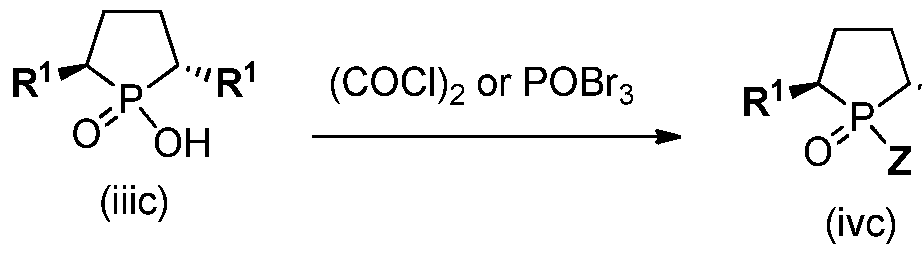
(f) reacting the compound of Formula (ivc) with H3 to form a compound of Formula (1002c):
R1 ^ p R1 N H3 R p R1
O Nz O* NH2
(ivc) (1002c) wherein:
Z is chloro or bromo; and
each R1 is independently aryl or arylalkyl.
20. A method of synthesizing a compound of Formula 1002 comprising:
1 R1
(a) reacting R with Me2 PCl2 to form a compound of Formula (ia):
1 Me2NPCI2 R1 p R1
R1 /R O SNMe2
(ia)
(b) hydrogenating the compound of Formula (ia) to form a compound of Formula (iia): r1 P r1 Hydrogenation R1 P ^ R1
0 NMe2 O* NMe2
.. , (iia)
(ia)
(c) reacting the compound of Formula (iia) with MeONa to form a compound of Formula
(ii) :
R1 p R1 MeONa R1 p "~-R1
O NMe2 ** 0 NMe2
(iia) (ii)
(d) reacting the compound of Formula (ii) with a strong acid in the presence of an alcohol or water to form a compound of Formula (iii) and resolving the compound of Formula
(iii) by reaction with quinine to a compound of Formula (iiid):
R1 p R1 Strong Acid R1 -.R1 °-U ININE R1 P R1
0 'N Me2 O" OH Resolve °" 0H
(ϋ) (iii) (iiid)
(e) reacting the compound of Formula (iiid) with (COCl)2 or POBr3 to form a compound of Formula (ivd):

(iiid) (ivd)
(f) reacting the compound of Formula (ivd) with NH3 to form a compound of Formula (1002d):
R1 p R1 N H3 R1 p R1
O °' NH2
(ivd) (1002d) wherein:
Z is chloro or bromo; and
each R1 is independently aryl or arylalkyl.
21. A method of synthesizing a compound of Formula 1003c comprising reacting a compound of Formula 1002c with R3-CHO to form a compound of Formula 1003c:
R1- R1 R3-CHO K p
R O N
O NH2
R2 "R3
(1002c)
(1003c)
wherein:
each R1 is independently aryl or arylalkyl;
R2 is hydrogen; and
R3 is Ci-Cs alkyl, C3-C8 cycloalkyl, or C6-C12 aryl.
22. A method of synthesizing a compound of Formula 1003d comprising reacting a compound of Formula 1002d with R3-CHO to form a compound of Formula 1003d:

each R1 is independently aryl or arylalkyl;
R2 is hydrogen; and
R3 is Ci-C8 alkyl, C3-C8 cycloalkyl, or C6-Ci2 aryl.
23. A method of synthesizing Velcade comprising:
(a) reacting 1 /R1
R with Me2 PCl2 to form a compound of Formula (ia):
1 Me2NPCI2 R1 p R1
R1 /R O SNMe2
(ia)
(b) hydrogenating the compound of Formula (ia) to form a compound of Formula (iia):
R1 P r1 Hydrogenation R1 P "* R1
0 NMe2 O' NMe2
.. , (iia)
(ia) '
(c) reacting the compound of Formula (iia) with MeONa to form a compound of Formula
(ii) :
R1 p R1 MeONa R1 P "~-R1
0 NMe2 ■* 0 NMe2
(iia) (ii)
(d) reacting the compound of Formula (ii) with a strong acid in the presence of an alcohol or water to form a compound of Formula (iii) and resolving the compound of Formula
(iii) by reaction with quinine to a compound of Formula (iiic):
R1 p R1 Strong Acid R1 -.R1 °-U ININE R1 P R1
° 'N ME2 O* OH Resolve °* 0H
(II) (iii) (iiic)
(e) reacting the compound of Formula (iiic) with (COCl)2 or POBr3 to form a compound of Formula (ivc):

(ivc)
(f) reacting the compound of Formula (ivc) with NH3 to form a compound of Formula (1002c): p R1 N H3 R1 p
O Nz O* NH
(ivc) (1002c)
(g) reacting the compound of Formula 1002c with HC(0)CH2CH(CH3)2 to form a compound of Formula vc:
Ri HC(0)CH2CH(CH3)2 R1 p ' "R1
0 R NH2 0/ NN
(1002c) H
(vc)
(h) reacting a compound of Formula (vc) with ICyCu'Bu to form a compound of Formula (vie):
R1 ..>„R1
R1 P R1 ICyCuO'Bu 0 PNN H
H o
(vc) (vie)
(i) deprotecting the compound of Formula (vie) to form a compound of Formula (vii) and a compound of Formula (iiic):
R1
RI

(vie)
(j) reacting the compound of Formula (vii) with BnCH(NHBoc)C(0)OH to form a compound of Formula (viii):
NHBoc
/\ OH
NH3CI Βη'
O BocHN " N
H
0 Bn
(vii) (viii)
(k) reacting the compound of Formula (viii) with HCl to form a compound of Formula
BocHN

H CI H3N N
Bn H
(viii) Bn w
(1) reacting the compound of Formula (ix) with
 to form a compound of
Formula (x) :

(m) reacting the compound of Formula (x) with (OH)2BCH2CH(CH3)2 to form Velcade:

(x) Velcade wherein:
Z is chloro or bromo; and
each R1 is independently aryl or arylalkyl.
24. The method of claim 23, further comprising using the compound of Formula (iiic) produced in step (i) in step (e).
25. A method of synthesizing Velcade comprising:
1 /R1
(a) reacting R with Me2 PCl2 to form a compound of Formula (ia):

(ia)
(b) hydrogenating the compound of Formula (ia) to form a compound of Formula (iia): r1 Pv r1 Hydrogenation R1 p ^R1
0 NMe2 θ'" MMe2
,. , (iia)
(ia)
(c) reacting the compound of Formula (iia) with MeONa to form a compound of Formula
(ii) :
R1 p R1 MeONa R1 p ~"R1
O NMe2 *- O NMe2
(iia) (ii)
(d) reacting the compound of Formula (ii) with a strong acid in the presence of an alcohol or water to form a compound of Formula (iii) and resolving the compound of Formula
(iii) by reaction with quinine to a compound of Formula (iiid):
R1 p R1 Strong Acid R1 ^R1 Quinine Ri p R1
° 'NMe2 0"P OH Resolve °" 0H
00 (iii) (iiid)
(e) reacting the compound of Formula (iiid) with (COCl)2 or POBr3 to form a compound of Formula (ivd):

(iiid) (ivd)
(f) reacting the compound of Formula (ivd) with NH3 to form a compound of Formula (1002d):
R1 p R1 N H3 R1 p R1
O Nz O* NH2
(ivd) (1002d)
(g) reacting the compound of Formula 1002d with HC(0)CH2CH(CH3)2 to form a compound of Formula vd:
R1 p R1 HC(0)CH2CH(CH3)2 R1 — R1
0 NH2 o ' N
(1002d) |_| "
(vd)
(h) reacting a compound of Formula (vd) with ICyCu^Bu to form a compound of Formula (vid):
ICyCuO'Bu
H 0
(vd) (vid)
(i) deprotecting the compound of Formula (vid) to form a compound of Formula (vii) and a compound of Formula (iiid): R1

(vid)
(j) reacting the compound of Formula (vii) with BnCH(NHBoc)C(0)OH to form a compound of Formula (viii):
NHBoc
/\ OH
NH3CI Βη'
O BocHN " N
H
0 Bn
(vii) (viii)
(k) reacting the compound of Formula (viii) with HCl to form a compound of Formula
BocHN

H CI H3N N
Bn H
(viii) Bn w
(1) reacting the compound of Formula (ix) with
 to form a compound of
Formula (x) :

(m) reacting the compound of Formula (x) with (OH)2BCH2CH(CH3)2 to form Velcade:

(x) Velcade wherein:
Z is chloro or bromo; and
each R1 is independently aryl or arylalkyl.
26. The method of claim 25, further comprising using the compound of Formula (iiid) produced in step (i) in step (e).
27. The method of any of claims 19-26, wherein each R1 is independently phenyl, Γ- naphthyl, 5',6',7',8'-tetrahydronaphthalen-l-yl, 2',4',6'-trimethylphenyl, 4'-biphenyl, or 2',6'-di-tert-butyl-phenyl.
28. The method of any of claims 19-22, wherein each R3 is independently Ci-Cs alkyl.
29. The method of any of claims 19-22 or 28, wherein each R3 is -CH2CH(CH3)2.
30. A method of synthesizing a compound of Formula 1010 comprising reacting a compound of Formula (ix) with Lp:
CIH N


J is -(CH2)„- -(CH2-CHO)„-, -(CH2-CH-NH)n-, -0-(CH2-CHO)n- -NH-(CH2-CH- NH)n-, -NH-(CH2-CHO)n- -0-(CH2-CH-NH)n- and -(amino acid residue)„-; and
each n is independently a positive integer.
3 1. The method of claim 30, wherein Lp is

02C N

32. The method of claim 30, wherein L is

33. The method of any of claims 30-32, wherein each n is independently a positive integer selected from 1 to 10.
Applications Claiming Priority (4)
| Application Number | Priority Date | Filing Date | Title |
|---|---|---|---|
| US201261736357P | 2012-12-12 | 2012-12-12 | |
| US61/736,357 | 2012-12-12 | ||
| US201361761131P | 2013-02-05 | 2013-02-05 | |
| US61/761,131 | 2013-02-05 |
Publications (1)
| Publication Number | Publication Date |
|---|---|
| WO2014093723A2 true WO2014093723A2 (en) | 2014-06-19 |
Family
ID=50935083
Family Applications (1)
| Application Number | Title | Priority Date | Filing Date |
|---|---|---|---|
| PCT/US2013/074830 Ceased WO2014093723A2 (en) | 2012-12-12 | 2013-12-12 | Group-assistant-purification (gap) synthesis of velcade, dimeric analogs, and amino compounds |
Country Status (1)
| Country | Link |
|---|---|
| WO (1) | WO2014093723A2 (en) |
Cited By (7)
| Publication number | Priority date | Publication date | Assignee | Title |
|---|---|---|---|---|
| WO2018232315A1 (en) * | 2017-06-16 | 2018-12-20 | The Board Of Regents Of The Nevada System Of Higher Education On Behalf Of The University Of Nevada, Las Vegas | Chiral n-heterocyclic phosphorodiamidic acids (nhpas) and derivatives as novel bronsted acid catalysts |
| WO2019231760A1 (en) | 2018-05-31 | 2019-12-05 | Gap Peptides Llc | Method for solution-phase peptide synthesis and protecting strategies therefore |
| WO2020123613A1 (en) * | 2018-12-14 | 2020-06-18 | Texas Tech University System | Chiral organic sandwich and multi-layer chirality of molecules and achiral derivatives |
| CN111689993A (en) * | 2019-03-11 | 2020-09-22 | 凯特立斯(深圳)科技有限公司 | Novel preparation method of chiral alpha-amino boric acid ester as key intermediate of boron-containing zomib drug |
| EP4079737A1 (en) | 2015-12-21 | 2022-10-26 | Texas Tech University System | System and method for solution phase gap peptide synthesis |
| US11827660B2 (en) | 2019-02-01 | 2023-11-28 | Sederma | Synthesis strategy for gap protecting group |
| US12024537B2 (en) | 2018-05-31 | 2024-07-02 | Sederma | Compositions and methods for chemical synthesis |
-
2013
- 2013-12-12 WO PCT/US2013/074830 patent/WO2014093723A2/en not_active Ceased
Cited By (17)
| Publication number | Priority date | Publication date | Assignee | Title |
|---|---|---|---|---|
| EP4079737A1 (en) | 2015-12-21 | 2022-10-26 | Texas Tech University System | System and method for solution phase gap peptide synthesis |
| US11873315B2 (en) | 2017-06-16 | 2024-01-16 | The Board Of Regents Of The Nevada System Of Higher Education On Behalf Of The University Of Nevada, Las Vegas | Chiral n-heterocyclic phosphorodiamidic acids (NHPAS) and derivatives as novel Brønsted acid catalysts |
| US11248014B2 (en) | 2017-06-16 | 2022-02-15 | The Board Of Regents Of The Nevada System Of Higher Education On Behalf Of The University Of Nevada, Las Vegas | Chiral n-heterocyclic phosphorodiamidic acids (NHPAS) and derivatives as novel bronsted acid catalysts |
| WO2018232315A1 (en) * | 2017-06-16 | 2018-12-20 | The Board Of Regents Of The Nevada System Of Higher Education On Behalf Of The University Of Nevada, Las Vegas | Chiral n-heterocyclic phosphorodiamidic acids (nhpas) and derivatives as novel bronsted acid catalysts |
| US12024537B2 (en) | 2018-05-31 | 2024-07-02 | Sederma | Compositions and methods for chemical synthesis |
| CN112236436A (en) * | 2018-05-31 | 2021-01-15 | Gap肽有限责任公司 | A method for solution-phase peptide synthesis and its protection strategy |
| KR20210015816A (en) * | 2018-05-31 | 2021-02-10 | 갭 펩티드 엘엘씨 | Method for synthesizing solution-phase peptides and their protection strategy |
| JP2021531326A (en) * | 2018-05-31 | 2021-11-18 | ギャップ ペプチド エルエルシーGap Peptides Llc | Methods for Liquid Phase Peptide Synthesis and Their Protection Strategies |
| KR102826649B1 (en) | 2018-05-31 | 2025-06-30 | 쎄데르마 | Solution-phase peptide synthesis method and corresponding protection strategy |
| JP2023052381A (en) * | 2018-05-31 | 2023-04-11 | セデルマ | A method for solution-phase peptide synthesis and its protection strategy |
| WO2019231760A1 (en) | 2018-05-31 | 2019-12-05 | Gap Peptides Llc | Method for solution-phase peptide synthesis and protecting strategies therefore |
| CN112236436B (en) * | 2018-05-31 | 2024-03-29 | 赛德玛公司 | Method for synthesizing solution phase peptide and protection strategy thereof |
| US12503481B2 (en) | 2018-12-14 | 2025-12-23 | Texas Tech University System | Three-dimensional organic sandwich chirality and its synthetic assembly |
| WO2020123613A1 (en) * | 2018-12-14 | 2020-06-18 | Texas Tech University System | Chiral organic sandwich and multi-layer chirality of molecules and achiral derivatives |
| US11827660B2 (en) | 2019-02-01 | 2023-11-28 | Sederma | Synthesis strategy for gap protecting group |
| CN111689993B (en) * | 2019-03-11 | 2023-04-14 | 凯特立斯(深圳)科技有限公司 | A new preparation method of chiral α-amino boronate, a key intermediate of boron-containing Zomib drugs |
| CN111689993A (en) * | 2019-03-11 | 2020-09-22 | 凯特立斯(深圳)科技有限公司 | Novel preparation method of chiral alpha-amino boric acid ester as key intermediate of boron-containing zomib drug |
Similar Documents
| Publication | Publication Date | Title |
|---|---|---|
| WO2014093723A2 (en) | Group-assistant-purification (gap) synthesis of velcade, dimeric analogs, and amino compounds | |
| EP1117669B1 (en) | Antiviral purine derivatives | |
| CN112513025B (en) | Chemical method for preparing phenylpiperidinyl indole derivatives | |
| CA2931458A1 (en) | Nucleotides for the treatment of liver cancer | |
| KR101429300B1 (en) | Method for producing HIV protease inhibitor | |
| EP3394057A1 (en) | SYNTHETIC METHODS FOR PREPARATION OF (S)-(2R,3R,11BR)-3-ISOBUTYL-9,10-DIMETHOXY-2,3,4,6,7,11B-HEXAHYDRO-1H-PYRIDO[2,1,-A]lSOQUINOLIN-2-YL 2-AMINO-3-METHYLBUTANOATE DI(4-METHYLBENZENESULFONATE) | |
| WO2012045999A1 (en) | Phosphoramidite derivatives of gemcitabine for use in the treatment cancer | |
| EP3995486A1 (en) | Peptide and method for manufacturing same | |
| KR20190112182A (en) | System and method for solution phase gap peptide synthesis | |
| CN107311907A (en) | A kind of preparation method of vildagliptin isomer impurities | |
| CN107663170A (en) | The method for preparing besifloxacin midbody compound | |
| Holý | Synthesis of 3-amino-and 3-azidoanalogs of 9-(3-hydroxy-2-phosphonylmethoxypropyl) adenine (HPMPA) | |
| CN107827916B (en) | Synthesis method of (R) - (1-amino-3-methyl) butyl-1-pinanediol borate | |
| US9216953B2 (en) | Chiral 2-arylpropyl-2-sulfinamide and chiral N-2-arylpropyl-2-sulfinylimines and synthesis thereof | |
| JP7115669B2 (en) | Polymerizable compound, compound, and method for producing boranophosphate oligomer | |
| CN117186100B (en) | A method for preparing a vinylcyclopropane nucleoside analog | |
| KR101327797B1 (en) | Glycosylated Tricyclo compounds derivatives | |
| CN117186101B (en) | A method for preparing a monohydroxymethylcyclopropane nucleoside analog | |
| JP7433684B1 (en) | Pseudo solid-phase protecting group, method for producing nucleoside or oligonucleotide protector, oligoamidite precursor using the same | |
| JP4643156B2 (en) | Novel fosmidosine analogues having N-acylsulfonamide bonds | |
| US20140275582A1 (en) | Chiral 2-arylpropyl-2-sulfinamide and chiral n-2-arylpropyl-2-sulfinylimines and synthesis thereof | |
| CN113173957A (en) | Synthesis method and application of vidarabine monophosphate | |
| CN115772192A (en) | Preparation method of fosfomycin trometamol EP impurity C | |
| HK1242331B (en) | Asymmetric auxiliary group | |
| WO2020142825A1 (en) | Reagents based on a tertiary amine backbone to introduce chemical functionality in nucleic acids and sequence-controlled polymers |
Legal Events
| Date | Code | Title | Description |
|---|---|---|---|
| 121 | Ep: the epo has been informed by wipo that ep was designated in this application |
Ref document number: 13862715 Country of ref document: EP Kind code of ref document: A2 |
|
| NENP | Non-entry into the national phase |
Ref country code: DE |
|
| 122 | Ep: pct application non-entry in european phase |
Ref document number: 13862715 Country of ref document: EP Kind code of ref document: A2 |