WO2014092544A1 - A sensor for determining calcium ions - Google Patents
A sensor for determining calcium ions Download PDFInfo
- Publication number
- WO2014092544A1 WO2014092544A1 PCT/MY2013/000245 MY2013000245W WO2014092544A1 WO 2014092544 A1 WO2014092544 A1 WO 2014092544A1 MY 2013000245 W MY2013000245 W MY 2013000245W WO 2014092544 A1 WO2014092544 A1 WO 2014092544A1
- Authority
- WO
- WIPO (PCT)
- Prior art keywords
- group
- hydroxyl
- amine
- hydrogen
- compound
- Prior art date
- Legal status (The legal status is an assumption and is not a legal conclusion. Google has not performed a legal analysis and makes no representation as to the accuracy of the status listed.)
- Ceased
Links
Classifications
-
- C—CHEMISTRY; METALLURGY
- C07—ORGANIC CHEMISTRY
- C07D—HETEROCYCLIC COMPOUNDS
- C07D491/00—Heterocyclic compounds containing in the condensed ring system both one or more rings having oxygen atoms as the only ring hetero atoms and one or more rings having nitrogen atoms as the only ring hetero atoms, not provided for by groups C07D451/00 - C07D459/00, C07D463/00, C07D477/00 or C07D489/00
- C07D491/02—Heterocyclic compounds containing in the condensed ring system both one or more rings having oxygen atoms as the only ring hetero atoms and one or more rings having nitrogen atoms as the only ring hetero atoms, not provided for by groups C07D451/00 - C07D459/00, C07D463/00, C07D477/00 or C07D489/00 in which the condensed system contains two hetero rings
- C07D491/10—Spiro-condensed systems
-
- C—CHEMISTRY; METALLURGY
- C07—ORGANIC CHEMISTRY
- C07D—HETEROCYCLIC COMPOUNDS
- C07D493/00—Heterocyclic compounds containing oxygen atoms as the only ring hetero atoms in the condensed system
- C07D493/02—Heterocyclic compounds containing oxygen atoms as the only ring hetero atoms in the condensed system in which the condensed system contains two hetero rings
- C07D493/10—Spiro-condensed systems
-
- C—CHEMISTRY; METALLURGY
- C07—ORGANIC CHEMISTRY
- C07D—HETEROCYCLIC COMPOUNDS
- C07D498/00—Heterocyclic compounds containing in the condensed system at least one hetero ring having nitrogen and oxygen atoms as the only ring hetero atoms
- C07D498/02—Heterocyclic compounds containing in the condensed system at least one hetero ring having nitrogen and oxygen atoms as the only ring hetero atoms in which the condensed system contains two hetero rings
- C07D498/10—Spiro-condensed systems
-
- G—PHYSICS
- G01—MEASURING; TESTING
- G01N—INVESTIGATING OR ANALYSING MATERIALS BY DETERMINING THEIR CHEMICAL OR PHYSICAL PROPERTIES
- G01N27/00—Investigating or analysing materials by the use of electric, electrochemical, or magnetic means
- G01N27/26—Investigating or analysing materials by the use of electric, electrochemical, or magnetic means by investigating electrochemical variables; by using electrolysis or electrophoresis
- G01N27/28—Electrolytic cell components
- G01N27/30—Electrodes, e.g. test electrodes; Half-cells
- G01N27/305—Electrodes, e.g. test electrodes; Half-cells optically transparent or photoresponsive electrodes
Definitions
- the present invention relates to a sensor for determining calcium ions in a sample and a method of preparing optical-chemical sensor for determining calcium ions in a sample.
- Biosensors are devices which utilize biological reactions to identify biological-relevant analytes such as glucose, deoxyribonucleic acid (DNA), proteins, hormones, or even microorganisms. These devices couple a biological recognition element, called the probe, with the physiochemical transducer which translates the biorecognition event into a measurable signal.
- the probes in these systems take advantage of the selectivity and specificity (affinity) of biomolecular interactions such as DNA-DNA hybridization in gene chips or antibody- antigen interactions in immunoassays.
- affinity specificity
- fluorescence is an absolute measurement, it possesses an inherent sensitivity that is among the highest of all analytical instruments.
- the high sensitivity of fluorescence spectroscopy for biochemically interesting molecules has led to an increasing popularity in biomedical and life science research.
- Ion selective electrodes have been used for determining calcium ions in body fluids for many years. Serious drawbacks of electrochemical measuring arrangements are the requirement of a reference element, sensitivity towards electrical potentials and electromagnetic interference. While ion-selective electrodes are rugged and reliable, they are expensive to use in a disposable device application. In addition, these electrodes require an electrical connection of the sample measurement device to the instrument.
- a sensor for determining calcium ions in a sample particularly optical- chemical sensor which does not require a reference element and a method of preparing optical-chemical sensor for determining calcium ions in a sample.
- the present invention further introduces calcium sensing receptor active compounds having fluorescence properties.
- the present invention provides a considerable reduction of materials with even greater efficiency and economically during operation.
- the present invention provides compound selected from the group consisting of a compound having the general formula I:
- X and Z are heteroatoms selected from a group at least or combination of oxygen, nitrogen, sulphur;
- Y is heteroatom selected from a group at least or combination of oxygen and nitrogen;
- M is selected from a group consisting of alkyl having 0-12 carbon atoms
- R. ! is selected from a group consisting of hydrogen, hydroxyl, methyl, methoxy, and ethoxy;
- R 2 is selected from a group consisting of hydrogen, hydroxyl and amine;
- R 3 is selected from a group consisting of hydrogen, amine, thiocyanate, methylamine and ethylamine;
- R 4 is selected from a group consisting of hydroxyl, amine, dimethylamine and diethylamine.
- An optical-chemical sensor for determining calcium ions in a sample comprising a substrate, a carbon layer as conductor layer provided on the substrate, a transducer layer for converting a chemical activity to an electrical signal; and a sensing membrane for detecting calcium ions having a matrix comprising a compound having a luminophoric moiety.
- the transducer is an electrochemical transducer and deposited on the carbon layer and luminophoric moiety is diglycolic fluorescein derivative.
- At least 0.1 weight percent of diglycolic fluorescein derivative as a sensing membrane cocktail and at least 0.2 microliter of the sensing cocktail on the transducer layer comprising depositing an electrochemical transducer on a carbon layer placed on a substrate, preparing and purifying a luminophoric moiety having diglycolic fluorescein derivative having a compound selected from the group consisting of a compound having the general formula I:
- X and Z are heteroatoms selected from a group at least or combination of oxygen, nitrogen, sulphur;
- Y is heteroatom selected from a group at least or combination of oxygen and nitrogen;
- M is selected from a group consisting of alkyl having 0-12 carbon atoms
- F? ! is selected from a group consisting of hydrogen, hydroxyl, methyl, methoxy, and ethoxy;
- R.2 is selected from a group consisting of hydrogen, hydroxyl and amine;
- R 3 is selected from a group consisting of hydrogen, amine, thiocyanate, methylamine and ethylamine;
- R 4 is selected from a group consisting of hydroxyl, amine, dimethylamine and diethylamine; preparing a sensing membrane cocktail having at least 0.1 weight of the luminophoric moiety in a polymer matrix solution, dispersing at least 0.2 microliter of the sensing membrane cocktail on the electrochemical transducer layer; and testing a characteristic of the sensor on the detection of calcium ions.
- the diglycolic fluorescein derivative having compound selected from the group consisting of a compound having the general formula I:
- X and Z are heteroatoms selected from a group at least or combination of oxygen, nitrogen, sulphur;
- Y is heteroatom selected from a group at least or combination of oxygen and nitrogen;
- M is selected from a group consisting of alkyl having 0-12 carbon atoms
- Ri is selected from a group consisting of hydrogen, hydroxyl, methyl, methoxy, and ethoxy;
- R 2 is selected from a group consisting of hydrogen, hydroxyl and amine
- R 3 is selected from a group consisting of hydrogen, amine, thiocyanate, methylamine and ethylamine;
- R 4 is selected from a group consisting of hydroxyl, amine, dimethylamine and diethylamine; is prepared according to the following method comprising alkylating a phenol hydroxyl group with a hydrocarbon chain having heteroatom, adding diglycoiic anhydride to an intermediate formation in an organic base, isolating the diglycoiic from the formation in an organic acid buffer; andexchanging the oxygen heteroatom Y in general formula I with at least one of the reagents selected from hydroxylamine, hydrazine, methylamine and ethylamine.
- the organic acid buffer is selected at least one of citric acid, formic acid, oxalic acid and acetic acid.
- the electrochemical transducer is selected at least one or in combination of silver-silver chloride, polypyrrole and polythiophene.
- Figure l illustratesa schematic diagram of calcium sensor in accordance of the present invention.
- Figure 2 illustratesa flow chart for process flow of the preparation of calcium sensor in accordance of the present invention.
- ions such as calcium, magnesium, and sodium play an important physiological role in regulating a wide variety of cellular functions. For a better understanding of that role, it is necessary to measure the ion concentrations inside living cells. Calcium, magnesium, sodium, and similar species do not naturally fluoresce. They can be measured indirectly, however, by complexing them with fluorescent molecules. Molecules that bestow fluorescence properties on non-fluorescent species are called probes, indicators, or dyes. Fluorescent probes can be designed to exhibit a high affinity for a specific ion. Thus, calcium and other ions can be quantitatively measured by rationing the fluorescence intensity of the calcium-bound dye and that of the calcium-free dye.
- the present invention relates to a sensor for determining calcium ions in a sample particularly optical-chemical sensor which does not require a reference element and a method of preparing optical-chemical sensor for determining calcium ions in a sample.
- a novel calcium sensing receptor active compounds which is use as optical-chemical sensor for detecting calcium ions in a sample by an optical change due to a fluorescence properties possess by the compound of general Formula I.
- X and Z are heteroatoms selected from a group at least or combination of oxygen, nitrogen, sulphur; Y is heteroatom selected from a group at least or combination of oxygen and nitrogen; M is selected from a group consisting of alkyl having 0-12 carbon atoms;
- Ri is selected from a group consisting of hydrogen, hydroxyl, methyl, methoxy, and ethoxy;
- R 2 is selected from a group consisting of hydrogen, hydroxyl and amine
- R 3 is selected from a group consisting of hydrogen, amine, thiocyanate, methylamine and ethylamine;
- R 4 is selected from a group consisting of hydroxyl, amine, dimethylamine and diethylamine.
- the construction of the said compound is based on the mixing of a fluorescence molecule with the biological recognition elements/sensors active ingredient and is dissolved in an organic solvent and isolated with organic acid.
- the compound of general Formula I is prepared according to the following method comprising by first alkylating a p eno) hydroxyl group with a hydrocarbon chain having heteroatom. Then, diglycolic anhydride is added to an intermediate formation in the previous reaction in an organic base.
- organic bases is selected from pyridine, 4-dimethylaminopyridine, triethylamine and 1 ,8- diazabicycloundec-7-ene.
- the following example illustrates functionalization of the lipophilic alcohol intermediate with diglycolic moiety.
- the organic acid buffer is selected at least one of citric acid, formic acid, oxalic acid and acetic acid.
- the oxygen heteroatom Y in general formula l is exchanged with at least one of the reagents selected from hydroxylamine, hydrazine, methylamine and ethylamine.
- FIG. 1 illustrates a schematic diagram of calcium sensorin accordance of the present invention.
- the calcium sensor of the present invention is an optical-chemical sensor(100) for determining calcium ions in a sample.
- This optical-chemical sensor (l OO) comprising a substrate (102), a carbon layer (103) as conductor layer provided on the substrate (102), a transducer layer (104) for converting a chemical activity to an electrical signal and a sensing membrane (105) for detecting calcium ions having a matrix comprising a compound having a luminophoric moiety.
- the substrate (102) of the optical-chemical sensor(100) is used to provide mechanical strength to the sensor tip. Meanwhile, an electrochemical transducer is used and deposited on the carbon layer.
- the electrochemical transducer is selected at least one or in combination of silver-silver chloride, polypyrrole and polythiophene.
- the luminophoric moiety of the optical-chemical sensor (100)of the present invention is diglycolic fluorescein derivative having a compound selected from the group consisting of a compound having the general Formula I as mentioned above.
- the sensing membrane (105) of the optical-chemical sensor (100) of the present invention at least 0.1 weight percent of diglycolic fluorescein derivative is provided as a sensing membrane cocktail and at least 0.2 microliter of the sensing cocktail is provided on the transducer layer(104).
- Figure 2 illustrates a flow chart for process flow of the preparation of calcium sensor of the present invention.
- a method of preparing optical-chemical sensor for determining calcium ions in a sample of the present invention comprising by depositing an electrochemical transducer on a carbon layer placed on a substrate. Then, a luminophoric moiety having diglycolic fluorescein derivative having a compound selected from the group consisting of a compound having the general Formula I is prepared and purified. A sensing membrane cocktail having at least 0.1 weight of the luminophoric moiety in a polymer matrix solution is then prepared accordingly. Next, at least 0.2 microliter of the sensing membrane cocktail is dispersed on the electrochemical transducer layer. Finally, a characteristic of the sensor on the detection of calcium ions is tested in different concentration.
- the preparation of the calcium sensor having a compound having the general Formula I as the calcium recognizing agent is as follow:
- Carbon paste (100 micrometer dry thickness, 0.4mm diameter) is printed on 1-mm thick FR4 board and cured by heat treatment at 120 °C for 30 minutes.
- a compound having the general Formula I (1 mg) and potassium para-chloro tetraphenyl borate (1mg) are added into a tetrahydrofuran solution of 40mg polyvinyl chloride and 60mg dioctyl sebacate.
- the calcium sensor cocktail (10microliter) is dispensed on the carbon electrode, already pre- deposited with chloride doped polypyrrole. The solvent is evaporated under continuous flow of nitrogen.
- the sensor coupled with Orion double-junction reference electrode (lithium acetate external junction) is immersed into calcium chloride solutions (10 "1 to 10 “4 M) and the potential difference readings are recorded.
- the plot of sensor response (mV) versus logarithmic of analyte concentration shows that the sensor based on a compound having the general Formula I gives desirable response towards calcium ion and sufficient linear range.
- One of the advantages of the present invention provides a sensor for determining calcium ions in a sample particularly optical-chemical sensor which does not require a reference element. Another advantage of the present invention is that it introduces calcium sensing receptor active compounds having fluorescence properties. In further advantages of this invention include fluorescent and lipophilic calcium receptor molecule that can be used as calcium ion recognizing agent in electrochemical and opto-chemical sensor.
Landscapes
- Chemical & Material Sciences (AREA)
- Organic Chemistry (AREA)
- Health & Medical Sciences (AREA)
- Life Sciences & Earth Sciences (AREA)
- Molecular Biology (AREA)
- Chemical Kinetics & Catalysis (AREA)
- Electrochemistry (AREA)
- Physics & Mathematics (AREA)
- Analytical Chemistry (AREA)
- Biochemistry (AREA)
- General Health & Medical Sciences (AREA)
- General Physics & Mathematics (AREA)
- Immunology (AREA)
- Pathology (AREA)
- Investigating Or Analysing Biological Materials (AREA)
- Investigating Or Analyzing Non-Biological Materials By The Use Of Chemical Means (AREA)
- Investigating Or Analysing Materials By The Use Of Chemical Reactions (AREA)
Abstract
The present invention relates to a sensor for determining calcium ions in a sample and a method of preparing optical-chemical sensor for determining calcium ions in a sample. One of the advantages of the present invention provides a sensor for determining calcium ions in a sample particularly optical-chemical sensor which does not require a reference element. Another advantage of the present invention is that it introduces calcium sensing receptor active compounds having fluorescence properties. In further advantages of this invention include fluorescent and lipophilic calcium receptor molecule that can be used as calcium ion recognizing agent in electrochemical and opto-chemical sensor.
Description
A SENSOR FOR DETERMINING CALCIUM IONS
FIELD OF THE INVENTION
The present invention relates to a sensor for determining calcium ions in a sample and a method of preparing optical-chemical sensor for determining calcium ions in a sample.
BACKGROUND OF THE INVENTION
Biosensors are devices which utilize biological reactions to identify biological-relevant analytes such as glucose, deoxyribonucleic acid (DNA), proteins, hormones, or even microorganisms. These devices couple a biological recognition element, called the probe, with the physiochemical transducer which translates the biorecognition event into a measurable signal. The probes in these systems take advantage of the selectivity and specificity (affinity) of biomolecular interactions such as DNA-DNA hybridization in gene chips or antibody- antigen interactions in immunoassays. The current trend toward creating point-of-care molecular diagnostic biosensors and massively parallel biorecognition arrays (i.e., microarrays) has introduced new technical challenges for the probes, transducers, and their detection apparatus. Today, an ideal biosensor platform is required to be not only miniaturized and cost-efficient but also capable of simultaneous detection of multiple analytes. Electronic biosensors, which use a combination of electrochemical transduction and electronic sensing, are considered to be one of the promising technologies for the next generation of high-performance biosensors. However, because of the low efficiency of their transduction process, electrode-electrolyte interfacial variations, and high ionic interference, they have not yet outperformed the specifications of conventional optical methods (e.g., sensitivity of fluorescence or chemiluminescence spectroscopy techniques). The basis for such a high expectation is their inherent scalability and their cost-efficiency in terms of fabrication and detection reagents.
Because fluorescence is an absolute measurement, it possesses an inherent sensitivity that is among the highest of all analytical instruments. The high sensitivity of fluorescence
spectroscopy for biochemically interesting molecules has led to an increasing popularity in biomedical and life science research.
Calcium ion regulates many biological processes including neuronal signaling, muscle contraction, and cell development and proliferation. Measurement of extracellular ionized calcium is an essential part of medical diagnostics. The measurement of ionized calcium, blood gases and potassium is mandatory to allow for the maintenance of good cardiac function during liver transplant operations or other operations that require bypassing the heart and lung functions and using artificial life support.
Ion selective electrodes (ISE) have been used for determining calcium ions in body fluids for many years. Serious drawbacks of electrochemical measuring arrangements are the requirement of a reference element, sensitivity towards electrical potentials and electromagnetic interference. While ion-selective electrodes are rugged and reliable, they are expensive to use in a disposable device application. In addition, these electrodes require an electrical connection of the sample measurement device to the instrument.
Therefore, there is a sensor for determining calcium ions in a sample particularly optical- chemical sensor which does not require a reference element and a method of preparing optical-chemical sensor for determining calcium ions in a sample. The present invention further introduces calcium sensing receptor active compounds having fluorescence properties. The present invention provides a considerable reduction of materials with even greater efficiency and economically during operation.
SUMMARY OF THE INVENTION
The present invention provides compound selected from the group consisting of a compound having the general formula I:
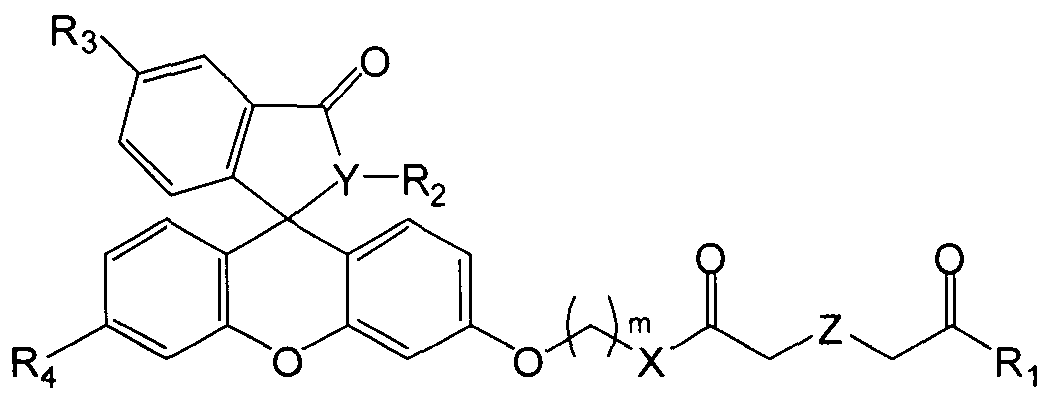
wherein X and Z are heteroatoms selected from a group at least or combination of oxygen, nitrogen, sulphur;
Y is heteroatom selected from a group at least or combination of oxygen and nitrogen;
M is selected from a group consisting of alkyl having 0-12 carbon atoms;
R.! is selected from a group consisting of hydrogen, hydroxyl, methyl, methoxy, and ethoxy; R2 is selected from a group consisting of hydrogen, hydroxyl and amine;
R3 is selected from a group consisting of hydrogen, amine, thiocyanate, methylamine and ethylamine; and
R4 is selected from a group consisting of hydroxyl, amine, dimethylamine and diethylamine.
An optical-chemical sensor for determining calcium ions in a sample comprising a substrate, a carbon layer as conductor layer provided on the substrate, a transducer layer for converting a chemical activity to an electrical signal; and a sensing membrane for detecting calcium ions having a matrix comprising a compound having a luminophoric moiety.
In one embodiment of the present invention, the transducer is an electrochemical transducer and deposited on the carbon layer and luminophoric moiety is diglycolic fluorescein derivative.
In yet another embodiment of the present invention, at least 0.1 weight percent of diglycolic fluorescein derivative as a sensing membrane cocktail and at least 0.2 microliter of the sensing cocktail on the transducer layer.
A method of preparing optical-chemical sensor for determining calcium ions in a sample comprising depositing an electrochemical transducer on a carbon layer placed on a substrate, preparing and purifying a luminophoric moiety having diglycolic fluorescein derivative having a compound selected from the group consisting of a compound having the general formula I:

wherein X and Z are heteroatoms selected from a group at least or combination of oxygen, nitrogen, sulphur;
Y is heteroatom selected from a group at least or combination of oxygen and nitrogen;
M is selected from a group consisting of alkyl having 0-12 carbon atoms;
F?! is selected from a group consisting of hydrogen, hydroxyl, methyl, methoxy, and ethoxy; R.2 is selected from a group consisting of hydrogen, hydroxyl and amine;
R3 is selected from a group consisting of hydrogen, amine, thiocyanate, methylamine and ethylamine; and
R4 is selected from a group consisting of hydroxyl, amine, dimethylamine and diethylamine; preparing a sensing membrane cocktail having at least 0.1 weight of the luminophoric moiety in a polymer matrix solution, dispersing at least 0.2 microliter of the sensing membrane cocktail on the electrochemical transducer layer; and testing a characteristic of the sensor on the detection of calcium ions.
In one embodiment of the present invention, the diglycolic fluorescein derivative having compound selected from the group consisting of a compound having the general formula I:
(I)

X and Z are heteroatoms selected from a group at least or combination of oxygen, nitrogen, sulphur;
Y is heteroatom selected from a group at least or combination of oxygen and nitrogen;
M is selected from a group consisting of alkyl having 0-12 carbon atoms;
Ri is selected from a group consisting of hydrogen, hydroxyl, methyl, methoxy, and ethoxy;
R2 is selected from a group consisting of hydrogen, hydroxyl and amine;
R3 is selected from a group consisting of hydrogen, amine, thiocyanate, methylamine and ethylamine; and
R4 is selected from a group consisting of hydroxyl, amine, dimethylamine and diethylamine; is prepared according to the following method comprising alkylating a phenol hydroxyl group with a hydrocarbon chain having heteroatom, adding diglycoiic anhydride to an intermediate formation in an organic base, isolating the diglycoiic from the formation in an organic acid buffer; andexchanging the oxygen heteroatom Y in general formula I with at least one of the reagents selected from hydroxylamine, hydrazine, methylamine and ethylamine.
In another embodiment of the present invention, the organic acid buffer is selected at least one of citric acid, formic acid, oxalic acid and acetic acid.
In one embodiment of the present invention, the electrochemical transducer is selected at least one or in combination of silver-silver chloride, polypyrrole and polythiophene. BRIEF DESCRIPTION OF THE DRAWINGS
The accompanying drawings, which are incorporated in and constitute a part of the specification, illustrate embodiments of the invention and, together with the description, serve to explain the principles of the invention.
Figure lillustratesa schematic diagram of calcium sensor in accordance of the present invention.
Figure 2illustratesa flow chart for process flow of the preparation of calcium sensor in accordance of the present invention.
DETAILED DESCRIPTIONS OF THE INVENTION
The present invention will now be described in detail in connection with specific embodiments with reference to the accompanying drawings.
It has long been recognized that ions such as calcium, magnesium, and sodium play an important physiological role in regulating a wide variety of cellular functions. For a better understanding of that role, it is necessary to measure the ion concentrations inside living cells. Calcium, magnesium, sodium, and similar species do not naturally fluoresce. They can be measured indirectly, however, by complexing them with fluorescent molecules. Molecules that bestow fluorescence properties on non-fluorescent species are called probes, indicators, or dyes. Fluorescent probes can be designed to exhibit a high affinity for a specific ion. Thus, calcium and other ions can be quantitatively measured by rationing the fluorescence intensity of the calcium-bound dye and that of the calcium-free dye.
The present invention relates to a sensor for determining calcium ions in a sample particularly optical-chemical sensor which does not require a reference element and a method of preparing optical-chemical sensor for determining calcium ions in a sample. A novel calcium sensing receptor active compounds which is use as optical-chemical sensor for detecting calcium ions in a sample by an optical change due to a fluorescence properties possess by the compound of general Formula I.

Formula I wherein
X and Z are heteroatoms selected from a group at least or combination of oxygen, nitrogen, sulphur; Y is heteroatom selected from a group at least or combination of oxygen and nitrogen; M is selected from a group consisting of alkyl having 0-12 carbon atoms;
Ri is selected from a group consisting of hydrogen, hydroxyl, methyl, methoxy, and ethoxy;
R2 is selected from a group consisting of hydrogen, hydroxyl and amine;
R3 is selected from a group consisting of hydrogen, amine, thiocyanate, methylamine and ethylamine; and
R4 is selected from a group consisting of hydroxyl, amine, dimethylamine and diethylamine.
The construction of the said compound is based on the mixing of a fluorescence molecule with the biological recognition elements/sensors active ingredient and is dissolved in an organic solvent and isolated with organic acid. Generally, the compound of general Formula I is prepared according to the following method comprising by first alkylating a p eno) hydroxyl group with a hydrocarbon chain having heteroatom. Then, diglycolic anhydride is added to an intermediate formation in the previous reaction in an organic base. Examples or organic bases is selected from pyridine, 4-dimethylaminopyridine, triethylamine and 1 ,8- diazabicycloundec-7-ene.
Example
The following example illustrates functionalization of the lipophilic alcohol intermediate with diglycolic moiety.
Reaction of lipophilic alcohol intermediate with dilgvcolic anhydride
A solution of diglycolic anhydride in CH2CI2 was drop wise added to a mixture of Et3N, 4- dimethylaminopyridine and the lipophilic alcohol intermediate in CH2CI2 (15 ml) at 0 °C (ice bath) under an argon atmosphere. After addition was complete (10 min) the ice bath was removed and the reaction mixture was stirred at room temperature for an hour. The reaction mixture was diluted with CH2CI2 and washed with 5% aqueous citric acid and saturated brine. The organic layer was dried (MgS04) and evaporated off solvent.
Next, the diglycolic is isolated from the formation in the previous reaction in an organic acid buffer. The organic acid buffer is selected at least one of citric acid, formic acid, oxalic acid and acetic acid. Finally, the oxygen heteroatom Y in general formula lis exchanged with at least one of the reagents selected from hydroxylamine, hydrazine, methylamine and ethylamine.
Figure 1 illustrates a schematic diagram of calcium sensorin accordance of the present invention. The calcium sensor of the present invention is an optical-chemical sensor(100) for determining calcium ions in a sample. This optical-chemical sensor (l OO)comprising a substrate (102), a carbon layer (103) as conductor layer provided on the substrate (102), a transducer layer (104) for converting a chemical activity to an electrical signal and a sensing membrane (105) for detecting calcium ions having a matrix comprising a compound having a luminophoric moiety. The substrate (102) of the optical-chemical sensor(100) is used to provide mechanical strength to the sensor tip. Meanwhile, an electrochemical transducer is used and deposited on the carbon layer. The electrochemical transducer is selected at least one or in combination of silver-silver chloride, polypyrrole and polythiophene. The luminophoric moiety of the optical-chemical sensor (100)of the present invention is diglycolic fluorescein derivative having a compound selected from the group consisting of a compound having the general Formula I as mentioned above. During the formation of the sensing membrane (105) of the optical-chemical sensor (100) of the present invention, at least 0.1 weight percent of diglycolic fluorescein derivative is provided as a sensing membrane cocktail and at least 0.2 microliter of the sensing cocktail is provided on the transducer layer(104).
Figure 2 illustrates a flow chart for process flow of the preparation of calcium sensor of the present invention. A method of preparing optical-chemical sensor for determining calcium ions in a sample of the present invention comprising by depositing an electrochemical transducer on a carbon layer placed on a substrate. Then, a luminophoric moiety having diglycolic fluorescein derivative having a compound selected from the group consisting of a compound having the general Formula I is prepared and purified. A sensing membrane cocktail having at least 0.1 weight of the luminophoric moiety in a polymer matrix solution is then prepared accordingly. Next, at least 0.2 microliter of the sensing membrane cocktail is dispersed on the electrochemical transducer layer. Finally, a characteristic of the sensor on the detection of calcium ions is tested in different concentration.
The preparation of the calcium sensor having a compound having the general Formula I as the calcium recognizing agent is as follow:
Preparation of Calcium Sensor
Carbon paste (100 micrometer dry thickness, 0.4mm diameter) is printed on 1-mm thick FR4 board and cured by heat treatment at 120 °C for 30 minutes. A compound having the general Formula I (1 mg) and potassium para-chloro tetraphenyl borate (1mg) are added into a tetrahydrofuran solution of 40mg polyvinyl chloride and 60mg dioctyl sebacate. The calcium sensor cocktail (10microliter) is dispensed on the carbon electrode, already pre- deposited with chloride doped polypyrrole. The solvent is evaporated under continuous flow of nitrogen. The sensor, coupled with Orion double-junction reference electrode (lithium acetate external junction) is immersed into calcium chloride solutions (10"1 to 10"4 M) and the potential difference readings are recorded. The plot of sensor response (mV) versus logarithmic of analyte concentration shows that the sensor based on a compound having the general Formula I gives desirable response towards calcium ion and sufficient linear range.
One of the advantages of the present invention provides a sensor for determining calcium ions in a sample particularly optical-chemical sensor which does not require a reference element. Another advantage of the present invention is that it introduces calcium sensing receptor active compounds having fluorescence properties. In further advantages of this invention include fluorescent and lipophilic calcium receptor molecule that can be used as calcium ion recognizing agent in electrochemical and opto-chemical sensor. The foregoing embodiment and advantages are merely exemplary and are not to be construed as limiting the present invention. The description of the embodiments of the present invention is intended to be illustrative and not to limit the scope of the claims and many alternatives, modifications and variations will be apparent to those skilled in the art.
Claims
1. Compound selected from the group consisting of a compound having the general formula I:

wherein
X and Z are heteroatoms selected from a group at least or combination of oxygen, nitrogen, sulphur;
Y is heteroatom selected from a group at least or combination of oxygen and nitrogen;
M is selected from a group consisting of alkyl having 0-12 carbon atoms;
Ri is selected from a group consisting of hydrogen, hydroxyl, methyl, methoxy, and ethoxy;
R2 is selected from a group consisting of hydrogen, hydroxyl and amine;
R3 is selected from a group consisting of hydrogen, amine, thiocyanate, methylamine and ethylamine; and
R4 is selected from a group consisting of hydroxyl, amine, dimethylamine and diethylamine.
2. An optical-chemical sensor for determining calcium ions in a sample comprising a substrate;
a carbon layer as conductor layer provided on the substrate;
a transducer layer for converting a chemical activity to an electrical signal; and a sensing membrane for detecting calcium ions having a matrix comprising a compound having a luminophoric moiety.
3. The optical-chemical sensor as claimed in Claim 2 wherein the transducer is an electrochemical transducer and deposited on the carbon layer.
4. The optical-chemical sensor as claimed in Claim 2 wherein luminophoric moiety is diglycolic fluorescein derivative having a compound selected from the group consisting of a compound having the general formula I:
wherein
X and Z are heteroatoms selected from a group at least or combination of oxygen, nitrogen, sulphur;
Y is heteroatom selected from a group at least or combination of oxygen and nitrogen;
M is selected from a group consisting of alkyl having 0-12 carbon atoms; is selected from a group consisting of hydrogen, hydroxyl, methyl, methoxy, and ethoxy; R2 is selected from a group consisting of hydrogen, hydroxyl and amine;
R3 is selected from a group consisting of hydrogen, amine, thiocyanate, methylamine and ethylamine; and
R4 is selected from a group consisting of hydroxyl, amine, dimethylamine and diethylamine.
5. The optical-chemical sensor as claimed in Claim 4 wherein at least 0.1 weight percent of diglycolic fluorescein derivative as a sensing membrane cocktail and at least 0.2 microliter of the sensing cocktail on the transducer layer.
6. A method of preparing optical-chemical sensor for determining calcium ions in a sample comprising depositing an electrochemical transducer on a carbon layer placed on a substrate;
preparing and purifying a luminophoric moiety having diglycolic fluorescein derivative having a compound selected from the group consisting of a compound having the general formula I:

wherein
X and Z are heteroatoms selected from a group at least or combination of oxygen, nitrogen, sulphur;
Y is heteroatom selected from a group at least or combination of oxygen and nitrogen;
M is selected from a group consisting of alkyl having 0-12 carbon atoms;
is selected from a group consisting of hydrogen, hydroxyl, methyl, methoxy, and ethoxy;
R2 is selected from a group consisting of hydrogen, hydroxyl and amine;
R3 is selected from a group consisting of hydrogen, amine, thiocyanate, methylamine and ethylamine; and
R4 is selected from a group consisting of hydroxyl, amine, dimethylamine and diethylamine; preparing a sensing membrane cocktail having at least 0.1 weight of the luminophoric moiety in a polymer matrix solution;
dispersing at least 0.2 microliter of the sensing membrane cocktail on the electrochemical transducer layer; and
testing a characteristic of the sensor on the detection of calcium ions.
7. The method as claimed in Claim 6 wherein the diglycolic fluorescein derivative having a compound selected from the group consisting of a compound having the general formula

wherein
X and Z are heteroatoms selected from a group at least or combination of oxygen, nitrogen, sulphur; Y is heteroatom selected from a group at least or combination of oxygen and nitrogen;
is selected from a group consisting of alkyl having 0-12 carbon atoms;
Ri is selected from a group consisting of hydrogen, hydroxyl, methyl, methoxy, and ethoxy;
R2 is selected from a group consisting of hydrogen, hydroxyl and amine;
R3 is selected from a group consisting of hydrogen, amine, thiocyanate, methylamine and ethylamine; and
R4 is selected from a group consisting of hydroxyl, amine, dimethylamine and diethylamine; is prepared according to the following method comprising
(i) alkylating a phenol hydroxyl group with a hydrocarbon chain having heteroatom;
(ii) adding diglycolic anhydride to an intermediate formation in step (i) in an organic base; (iii) isolating the diglycolic from the formation in step (ii) in an organic acid buffer; and
(iv) exchanging the oxygen heteroatom Y in general formula I with at least one of the reagents selected from hydroxylamine, hydrazine, methylamine and ethylamine.
8. The method as claimed in Claim 7 wherein the organic acid buffer is selected at least one of citric acid, formic acid, oxalic acid and acetic acid.
9. The method as claimed in Claim 7 wherein the electrochemical transducer is selected at least one or in combination of silver-silver chloride, polypyrrole and polythiophene.
Applications Claiming Priority (2)
| Application Number | Priority Date | Filing Date | Title |
|---|---|---|---|
| MYPI2012005346 | 2012-12-11 | ||
| MYPI2012005346 | 2012-12-11 |
Publications (1)
| Publication Number | Publication Date |
|---|---|
| WO2014092544A1 true WO2014092544A1 (en) | 2014-06-19 |
Family
ID=50137973
Family Applications (1)
| Application Number | Title | Priority Date | Filing Date |
|---|---|---|---|
| PCT/MY2013/000245 Ceased WO2014092544A1 (en) | 2012-12-11 | 2013-12-10 | A sensor for determining calcium ions |
Country Status (1)
| Country | Link |
|---|---|
| WO (1) | WO2014092544A1 (en) |
Citations (1)
| Publication number | Priority date | Publication date | Assignee | Title |
|---|---|---|---|---|
| WO2006130551A2 (en) * | 2005-05-31 | 2006-12-07 | Promega Corporation | Luminogenic and fluorogenic compounds and methods to detect molecules or conditions |
-
2013
- 2013-12-10 WO PCT/MY2013/000245 patent/WO2014092544A1/en not_active Ceased
Patent Citations (1)
| Publication number | Priority date | Publication date | Assignee | Title |
|---|---|---|---|---|
| WO2006130551A2 (en) * | 2005-05-31 | 2006-12-07 | Promega Corporation | Luminogenic and fluorogenic compounds and methods to detect molecules or conditions |
Non-Patent Citations (2)
| Title |
|---|
| SHORTREED M ET AL: "FLUORESCENT FIBER-OPTIC CALCIUM SENSOR FOR PHYSIOLOGICAL MEASUREMENTS", ANALYTICAL CHEMISTRY, AMERICAN CHEMICAL SOCIETY, US, vol. 68, no. 8, 15 April 1996 (1996-04-15), pages 1414 - 1418, XP000584513, ISSN: 0003-2700, DOI: 10.1021/AC950944K * |
| SONIA TAKTAK ET AL: "Electrode Chemistry Yields a Nanoparticle-Based NMR Sensor for Calcium", LANGMUIR, vol. 24, no. 14, 1 July 2008 (2008-07-01), pages 7596 - 7598, XP055005336, ISSN: 0743-7463, DOI: 10.1021/la8006298 * |
Similar Documents
| Publication | Publication Date | Title |
|---|---|---|
| Shi et al. | Self-powered dual-mode sensing strategy based on graphdiyne and DNA nanoring for sensitive detection of tumor biomarker | |
| Low et al. | Smartphone-based portable electrochemical biosensing system for detection of circulating microRNA-21 in saliva as a proof-of-concept | |
| Zuaznabar-Gardona et al. | A wide-range solid state potentiometric pH sensor based on poly-dopamine coated carbon nano-onion electrodes | |
| Fan et al. | Competitive smartphone-based portable electrochemical aptasensor system based on an MXene/cDNA-MB probe for the determination of Microcystin-LR | |
| Sahudin et al. | Regenerable and selective histamine impedimetric sensor based on hydroxyl functionalised Schiff base complex electrode | |
| Yang et al. | Selective detection of silver ions using mushroom-like polyaniline and gold nanoparticle nanocomposite-based electrochemical DNA sensor | |
| Zhang et al. | Simultaneous voltammetric detection of dopamine, ascorbic acid and uric acid using a poly (2-(N-morpholine) ethane sulfonic acid)/RGO modified electrode | |
| CN113866235B (en) | An electrochemiluminescence-colorimetric dual-mode sensing and detection device based on closed bipolar electrodes and its construction method and application | |
| Asl et al. | Highly sensitive molecularly imprinted polymer-based electrochemical sensor for voltammetric determination of Adenine and Guanine in real samples using gold screen-printed electrode | |
| CN107024520A (en) | A kind of modified electrode that ATP is detected based on carbon point and preparation method thereof | |
| Abdallah et al. | Selective and sensitive electrochemical sensors based on an ion imprinting polymer and graphene oxide for the detection of ultra-trace Cd (ii) in biological samples | |
| Mandli et al. | Impedimetric genosensor for miRNA-34a detection in cell lysates using polypyrrole | |
| Kaewket et al. | Electrochemical detection of creatinine: exploiting copper (ii) complexes at Pt microelectrode arrays | |
| CN113092554A (en) | Preparation method and application of sensing electrode for glucose detection | |
| Li et al. | A sensitive non-enzyme sensing platform for glucose based on boronic acid–diol binding | |
| Shi et al. | A smartphone-based electrochemical POCT for CEA based on signal amplification of Zr 6 MOFs | |
| CN119086680A (en) | A low trigger potential electrochemiluminescent enzyme biosensor for detecting glucose and its construction method and application | |
| Mashat et al. | Development of non-enzymatic screen-printed carbon electrode sensor for glucose using cyclic voltammetry | |
| CN103439319A (en) | Method for measuring bleomycins by utilizing electrochemical luminescence of carbon nanoparticle modified electrode | |
| Soleymanpour et al. | Liquid membrane/polyaniline film coated glassy carbon sensor for highly sensitive and selective determination of fluvoxamine in pharmaceutical and biological samples | |
| Porfir’eva et al. | An Electrochemical DNA Sensor for Doxorubicin Based on Graphene Oxide, Electropolymerized Azure A, and Methylene Green Composites | |
| CN109682877A (en) | It is a kind of for detecting the electrochemical sensor of glucose | |
| WO2014092544A1 (en) | A sensor for determining calcium ions | |
| CN116875656A (en) | A method for quantitatively detecting cobalt sulfate | |
| Li et al. | In situ generated CdTe quantum dot-encapsulated hafnium polymer membrane to boost electrochemiluminescence analysis of tumor biomarkers |
Legal Events
| Date | Code | Title | Description |
|---|---|---|---|
| 121 | Ep: the epo has been informed by wipo that ep was designated in this application |
Ref document number: 13830190 Country of ref document: EP Kind code of ref document: A1 |
|
| NENP | Non-entry into the national phase |
Ref country code: DE |
|
| 122 | Ep: pct application non-entry in european phase |
Ref document number: 13830190 Country of ref document: EP Kind code of ref document: A1 |