WO2014088145A1 - 전단농화유체 및 이를 포함하는 방탄재 - Google Patents
전단농화유체 및 이를 포함하는 방탄재 Download PDFInfo
- Publication number
- WO2014088145A1 WO2014088145A1 PCT/KR2012/011203 KR2012011203W WO2014088145A1 WO 2014088145 A1 WO2014088145 A1 WO 2014088145A1 KR 2012011203 W KR2012011203 W KR 2012011203W WO 2014088145 A1 WO2014088145 A1 WO 2014088145A1
- Authority
- WO
- WIPO (PCT)
- Prior art keywords
- fluid
- shear thickening
- molecular weight
- thickening fluid
- dispersion
- Prior art date
- Legal status (The legal status is an assumption and is not a legal conclusion. Google has not performed a legal analysis and makes no representation as to the accuracy of the status listed.)
- Ceased
Links
Images
Classifications
-
- F—MECHANICAL ENGINEERING; LIGHTING; HEATING; WEAPONS; BLASTING
- F41—WEAPONS
- F41H—ARMOUR; ARMOURED TURRETS; ARMOURED OR ARMED VEHICLES; MEANS OF ATTACK OR DEFENCE, e.g. CAMOUFLAGE, IN GENERAL
- F41H1/00—Personal protection gear
- F41H1/02—Armoured or projectile- or missile-resistant garments; Composite protection fabrics
-
- D—TEXTILES; PAPER
- D06—TREATMENT OF TEXTILES OR THE LIKE; LAUNDERING; FLEXIBLE MATERIALS NOT OTHERWISE PROVIDED FOR
- D06M—TREATMENT, NOT PROVIDED FOR ELSEWHERE IN CLASS D06, OF FIBRES, THREADS, YARNS, FABRICS, FEATHERS OR FIBROUS GOODS MADE FROM SUCH MATERIALS
- D06M15/00—Treating fibres, threads, yarns, fabrics, or fibrous goods made from such materials, with macromolecular compounds; Such treatment combined with mechanical treatment
- D06M15/19—Treating fibres, threads, yarns, fabrics, or fibrous goods made from such materials, with macromolecular compounds; Such treatment combined with mechanical treatment with synthetic macromolecular compounds
- D06M15/37—Macromolecular compounds obtained otherwise than by reactions only involving carbon-to-carbon unsaturated bonds
- D06M15/53—Polyethers
-
- B—PERFORMING OPERATIONS; TRANSPORTING
- B32—LAYERED PRODUCTS
- B32B—LAYERED PRODUCTS, i.e. PRODUCTS BUILT-UP OF STRATA OF FLAT OR NON-FLAT, e.g. CELLULAR OR HONEYCOMB, FORM
- B32B17/00—Layered products essentially comprising sheet glass, or glass, slag, or like fibres
- B32B17/02—Layered products essentially comprising sheet glass, or glass, slag, or like fibres in the form of fibres or filaments
- B32B17/04—Layered products essentially comprising sheet glass, or glass, slag, or like fibres in the form of fibres or filaments bonded with or embedded in a plastic substance
-
- B—PERFORMING OPERATIONS; TRANSPORTING
- B32—LAYERED PRODUCTS
- B32B—LAYERED PRODUCTS, i.e. PRODUCTS BUILT-UP OF STRATA OF FLAT OR NON-FLAT, e.g. CELLULAR OR HONEYCOMB, FORM
- B32B27/00—Layered products comprising a layer of synthetic resin
- B32B27/02—Layered products comprising a layer of synthetic resin in the form of fibres or filaments
-
- D—TEXTILES; PAPER
- D06—TREATMENT OF TEXTILES OR THE LIKE; LAUNDERING; FLEXIBLE MATERIALS NOT OTHERWISE PROVIDED FOR
- D06M—TREATMENT, NOT PROVIDED FOR ELSEWHERE IN CLASS D06, OF FIBRES, THREADS, YARNS, FABRICS, FEATHERS OR FIBROUS GOODS MADE FROM SUCH MATERIALS
- D06M11/00—Treating fibres, threads, yarns, fabrics or fibrous goods made from such materials, with inorganic substances or complexes thereof; Such treatment combined with mechanical treatment, e.g. mercerising
- D06M11/32—Treating fibres, threads, yarns, fabrics or fibrous goods made from such materials, with inorganic substances or complexes thereof; Such treatment combined with mechanical treatment, e.g. mercerising with oxygen, ozone, ozonides, oxides, hydroxides or percompounds; Salts derived from anions with an amphoteric element-oxygen bond
- D06M11/36—Treating fibres, threads, yarns, fabrics or fibrous goods made from such materials, with inorganic substances or complexes thereof; Such treatment combined with mechanical treatment, e.g. mercerising with oxygen, ozone, ozonides, oxides, hydroxides or percompounds; Salts derived from anions with an amphoteric element-oxygen bond with oxides, hydroxides or mixed oxides; with salts derived from anions with an amphoteric element-oxygen bond
- D06M11/46—Oxides or hydroxides of elements of Groups 4 or 14 of the Periodic Table; Titanates; Zirconates; Stannates; Plumbates
-
- D—TEXTILES; PAPER
- D06—TREATMENT OF TEXTILES OR THE LIKE; LAUNDERING; FLEXIBLE MATERIALS NOT OTHERWISE PROVIDED FOR
- D06M—TREATMENT, NOT PROVIDED FOR ELSEWHERE IN CLASS D06, OF FIBRES, THREADS, YARNS, FABRICS, FEATHERS OR FIBROUS GOODS MADE FROM SUCH MATERIALS
- D06M11/00—Treating fibres, threads, yarns, fabrics or fibrous goods made from such materials, with inorganic substances or complexes thereof; Such treatment combined with mechanical treatment, e.g. mercerising
- D06M11/73—Treating fibres, threads, yarns, fabrics or fibrous goods made from such materials, with inorganic substances or complexes thereof; Such treatment combined with mechanical treatment, e.g. mercerising with carbon or compounds thereof
- D06M11/74—Treating fibres, threads, yarns, fabrics or fibrous goods made from such materials, with inorganic substances or complexes thereof; Such treatment combined with mechanical treatment, e.g. mercerising with carbon or compounds thereof with carbon or graphite; with carbides; with graphitic acids or their salts
-
- D—TEXTILES; PAPER
- D06—TREATMENT OF TEXTILES OR THE LIKE; LAUNDERING; FLEXIBLE MATERIALS NOT OTHERWISE PROVIDED FOR
- D06M—TREATMENT, NOT PROVIDED FOR ELSEWHERE IN CLASS D06, OF FIBRES, THREADS, YARNS, FABRICS, FEATHERS OR FIBROUS GOODS MADE FROM SUCH MATERIALS
- D06M11/00—Treating fibres, threads, yarns, fabrics or fibrous goods made from such materials, with inorganic substances or complexes thereof; Such treatment combined with mechanical treatment, e.g. mercerising
- D06M11/77—Treating fibres, threads, yarns, fabrics or fibrous goods made from such materials, with inorganic substances or complexes thereof; Such treatment combined with mechanical treatment, e.g. mercerising with silicon or compounds thereof
- D06M11/79—Treating fibres, threads, yarns, fabrics or fibrous goods made from such materials, with inorganic substances or complexes thereof; Such treatment combined with mechanical treatment, e.g. mercerising with silicon or compounds thereof with silicon dioxide, silicic acids or their salts
-
- F—MECHANICAL ENGINEERING; LIGHTING; HEATING; WEAPONS; BLASTING
- F41—WEAPONS
- F41H—ARMOUR; ARMOURED TURRETS; ARMOURED OR ARMED VEHICLES; MEANS OF ATTACK OR DEFENCE, e.g. CAMOUFLAGE, IN GENERAL
- F41H5/00—Armour; Armour plates
- F41H5/007—Reactive armour; Dynamic armour
-
- F—MECHANICAL ENGINEERING; LIGHTING; HEATING; WEAPONS; BLASTING
- F41—WEAPONS
- F41H—ARMOUR; ARMOURED TURRETS; ARMOURED OR ARMED VEHICLES; MEANS OF ATTACK OR DEFENCE, e.g. CAMOUFLAGE, IN GENERAL
- F41H5/00—Armour; Armour plates
- F41H5/02—Plate construction
- F41H5/04—Plate construction composed of more than one layer
- F41H5/0471—Layered armour containing fibre- or fabric-reinforced layers
Definitions
- the present invention relates to a shear thickening fluid and a bulletproof material including the same. More specifically, by using a mixed fluid of two or more components having different molecular weights as a dispersion fluid included in the shear thickening fluid, shear thickening while maintaining the properties of the fluid It relates to a shear thickening fluid, a ballistic material comprising the same, and a method for manufacturing the same, which can maximize energy absorption due to shear stress during development.
- Body armor one of the products using bulletproof materials, should be light in weight, have excellent fire and heat shock resistance, have low structural deformation, and be well ventilated. Therefore, the fibers included in the body armor and the like have high strength, high elasticity, high heat resistance, low specific gravity, pain-resistant fibers.
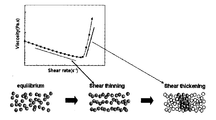
- shear thickening fluid shows shear thinning when shear stress or shear rate is applied to the fluid, but when the shear shear rate is reached, the viscosity sharply increases and shear Refers to a non-Newtonian fluid exhibiting shear thickening (see FIG. 1).
- the shear thickening fluid is in the form of a suspension such as a colloid in which solid particles are dispersed in a liquid dispersion medium.
- the particulate form represents inorganic particles (eg, silica particles), and the empty space is filled with a dispersion fluid (eg, polyethylene glycol).
- the shear thickening fluid plays a role of preventing the external shock from penetrating into the interior as the phase change occurs from the liquid phase to the solid phase when a sudden impact is applied from the outside with bullets. .
- the shear thickening fluid exhibits a bulletproof or anti-sword effect that can protect the body from impacts such as bullets.
- hydrophilic polyethylene glycol PEG
- a molecular weight of about 200 is used.
- the shear thickening characteristics are different, and the amount of impact energy absorbed by the shear thickening fluid is expressed by the area of the rheological characteristic curve representing the shear thickening characteristics.
- the present invention has been made to solve the problems of the prior art as described above, shear thickening fluid that can be usefully applied as a ballistic material and the like by maximizing the shock absorption effect while maintaining the properties as a fluid, the greater viscosity during shear thickening phenomenon and It is a technical problem to provide a bulletproof material including the same.
- the present invention includes an inorganic particle and a dispersion fluid, the dispersion fluid provides a shear thickening fluid (Shear Thickening Fluid; STF), characterized in that the mixed fluid of two or more components having different molecular weights do.
- STF Shear Thickening Fluid
- a ballistic material and body armor
- a fiber made of a high strength yarn and the shear thickening fluid (STF) of the present invention impregnated in the fiber.
- STF shear thickening fluid
- the step of preparing a mixed fluid of two or more components having different molecular weight as a dispersion fluid Preparing a shear thickening fluid (STF) by stirring the dispersion fluid and the inorganic particles; And impregnating the shear thickening fluid into a fiber body made of high strength yarn.
- STF shear thickening fluid
- the shear thickening fluid of the present invention uses a mixed dispersion fluid in which a predetermined amount of a relatively high molecular weight is added to a component having a low molecular weight, and when applied to a body armor, the shear thickening fluid has a higher viscosity when shear thickening occurs. It can be expressed to maximize the impact energy absorption by the shear stress.
- 1 is a graph showing the shear thickening behavior of a conventional shear thickening fluid.
- Shear Thickening Fluid (STF) of the present invention comprises inorganic particles and a dispersion fluid, the dispersion fluid is characterized in that the mixed fluid of two or more components (average) molecular weight different from each other.
- STF Shear Thickening Fluid
- the dispersion fluid is characterized in that the mixed fluid of two or more components (average) molecular weight different from each other.
- the effect of the fluid is not lost and at the same time, the shock absorbing effect is more improved than the shear thickening fluid using only the low molecular weight component alone.
- the dispersion fluid in the present invention is a mixture of two or more components having different molecular weights, and the number of components is not necessarily limited.
- a two-component dispersion fluid composed of a low molecular weight component and a high molecular weight component or a three-component dispersion fluid composed of a low molecular weight component, a medium molecular weight component and a high molecular weight component can be used.
- the shear thickening fluid of the present invention is a form in which inorganic particles (eg, silica particles in powder form) are filled in a dispersion fluid, and the dispersion fluid is non-volatile, non-toxic, and maintains the shear thickening property of the shear thickening fluid.
- inorganic particles eg, silica particles in powder form
- dispersion fluid is non-volatile, non-toxic, and maintains the shear thickening property of the shear thickening fluid.
- PEGs polyethylene glycols
- EG ethylene glycol
- polyethylene glycol may be used as the high molecular weight component.
- the dispersion fluid may be a fluid in which a low molecular weight component having a molecular weight of 200 to 600 and a high molecular weight component having a molecular weight of 1000 to 8000 are mixed.
- a mixed fluid of a low molecular weight component having a molecular weight of about 200 and a high molecular weight component having a molecular weight of about 1000, 2000 or 4000 is used.
- the mixing ratio of the low molecular weight component and the high molecular weight component in the dispersion fluid is not particularly limited as long as it maintains its properties as a fluid and at the same time it can express a large viscosity during shear thickening.
- a mixed fluid containing 80 to 95% by weight of the low molecular weight component and 5 to 20% by weight of the high molecular weight component is used. If the low molecular weight component is less than 80% by weight or the high molecular weight component is more than 20% by weight, the relative content of the high molecular weight component is too high, so that the characteristic of fluid disappears and the shear thickening phenomenon does not occur, and the low molecular weight component is 95 weight percent. If the content exceeds 2% or less than 5% by weight of the high molecular weight component, the relative content of the high molecular weight component may be too low, resulting in insufficient viscosity increase during shear thickening, thereby minimizing the impact energy absorption effect due to the shear stress.
- silica particles one or more selected from silica, titanium dioxide, and nano carbon tubes may be used.
- silica particles are used.
- primary particles made from sparks are connected to each other by collisions, forming secondary particles, which form three-dimensional aggregates (Aggregates, Agglomerates).
- fumed silica and / or spherical silica may be used as the silica particles.
- fumed silica is formed by the following reaction by hydrolysis in a flame of 1,000 ° C. or higher.
- the primary particles of the fumed silica have the advantages of being very small in size, light in weight, wide in surface area, and low in cost, compared to spherical silica particles or colloidal silica particles.
- the dispersion in a uniform state is very difficult compared to the spherical silica particles having the same size of the primary particles and the secondary particles.
- the diameter of the silica particles is 10 ⁇ 1000nm, preferably 10 ⁇ 500nm, more preferably 10 ⁇ 300nm, most preferably 10 ⁇ 100nm level is appropriate in terms of ballistic performance.
- the shear thickening fluid of the present invention may be 10 to 90% by weight of inorganic particles and 10 to 90% by weight of the dispersion fluid.
- the content of the inorganic particles is less than 10% by weight may lower the ballistic performance, if the content exceeds 90% by weight may increase the weight and thickness of the body armor, etc. may cause inconvenience to the wearer's movement.
- the shear thickening fluid of the present invention may further include a dispersant.
- the dispersant may be used alone or in combination with ethanol and methanol, but is not necessarily limited thereto.
- the method for preparing the shear thickening fluid of the present invention is not particularly limited, and may be prepared according to a conventional method in the art using a mixed fluid of two or more components having different molecular weights as a dispersion fluid.
- the shear thickening fluid of the present invention may be prepared by including a mixed fluid and inorganic particles having two or more different molecular weights and stirring using a mixing device or a homogenizer.
- the stirring speed is preferably maintained at 120rpm or more, for example, 120 ⁇ 3000rpm level for smooth mixing of the inorganic particles and the dispersion fluid.
- a (nanofused) ballistic material comprising a fiber made of a high strength yarn, and the shear thickening fluid (STF) of the present invention impregnated in the fiber.
- STF shear thickening fluid
- the antiballistic material of the present invention uses a shear thickening fluid in which inorganic particles are dispersed and filled in a mixed fluid of two or more components having different molecular weights, and the shear thickening fluid is subjected to shear stress in the shear thickening phenomenon as long as the shear thickening fluid maintains fluid characteristics. By maximizing the energy absorption by the ballistic performance can be greatly improved.
- the method for producing the antiballistic material of the present invention is not particularly limited and may be prepared according to conventional methods in the art.
- preparing a mixed fluid of two or more components having different molecular weight as a dispersion fluid Preparing a shear thickening fluid (STF) by stirring the dispersion fluid and the inorganic particles; And impregnating the shear thickening fluid into a fibrous body made of high-strength yarn.
- STF shear thickening fluid
- the shear thickening fluid may be impregnated with 10 to 80% by weight, preferably 20 to 50% by weight relative to the total weight of the fiber.
- the shear thickening fluid When impregnated with shear thickening fluid less than 10% by weight, it may be difficult to achieve ballistic performance.
- shear thickening fluid When impregnating more than 80% by weight, shear thickening fluid is separated from the fiber and flowed out due to the weight of the shear thickening fluid itself. It can be greatly reduced.
- the fiber may be in the form of a fabric selected from a woven fabric, a nonwoven fabric, and a paper.
- the type of the fiber may be aramid fiber, polyimide fiber, polybenzoxazole fiber or wholly aromatic. It may be one kind selected from polyester fiber body, high strength polyethylene fiber body, high strength polyamide fiber body, and high strength polyester fiber body.
- the fiber body preferably has a high strength of 7000 ⁇ 20000N / 5cm tensile strength.
- the high-strength yarn constituting the fiber may be composed of 400 to 1000 monofilaments having a single yarn fineness of 0.7 to 1.6 denier, and may also be a tensile strength of 22g / d or more.
- the structure of the fiber body made of such a high strength yarn may be any one selected from plain weave and basket weave, wherein the high-strength yarn is preferably 5 / m or less.
- the anti-ballistic material of the present invention can be used for the production of body armor, bulletproof hat, bulletproof miscellaneous goods, and the like, and particularly useful in the production of body armor.
- Example 1 (Sample 7)
- inorganic particles (fumed silica particles and spherical silica particles) having a particle size of 10 to 100 nm, 82% by weight of a dispersion fluid, and methanol with a dispersant are mixed, and agitated for 15 minutes at a stirring speed of 150 rpm using a mechanical stirrer.
- Thickening fluid was prepared.
- a mixed fluid consisting of 95% by weight of polyethylene glycol (PEG 1) having a molecular weight of 200 and 5% by weight of polyethylene glycol (PEG 2) having a molecular weight of 1000 was used.
- dispersion fluid shear thickening was carried out in the same manner as in Example 1, except that 90 wt% of polyethylene glycol (PEG 1) having a molecular weight of 200 and 10 wt% of polyethylene glycol (PEG 2) having a molecular weight of 1000 were used. Fluid was prepared.
- PEG 1 polyethylene glycol
- PEG 2 polyethylene glycol
- Example 3 (Sample 9)
- Example 4 (Sample 10)
- Shear thickening was carried out in the same manner as in Example 1, except that 80 wt% of polyethylene glycol (PEG 1) having a molecular weight of 200 and 20 wt% of polyethylene glycol (PEG 2) having a molecular weight of 1000 were used as the dispersion fluid. Fluid was prepared.
- Shear thickening fluid was prepared in the same manner as in Example 1 except that only polyethylene glycol (PEG 1) having a molecular weight of 200 was used as the dispersion fluid.
- PEG 1 polyethylene glycol having a molecular weight of 200
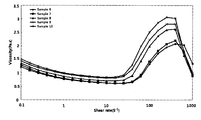
- Shear stress was applied to the shear thickening fluids prepared according to Examples and Comparative Examples, and the shear thickening degree was measured. The results are shown in FIG. 2.
- the anti-ballistic performance is also greatly improved when the liquid body armor was prepared using a shear thickening fluid to which two or more dispersion fluids having different molecular weights were applied according to the present invention.
Landscapes
- Engineering & Computer Science (AREA)
- Textile Engineering (AREA)
- General Engineering & Computer Science (AREA)
- Ceramic Engineering (AREA)
- Chemical & Material Sciences (AREA)
- Chemical Kinetics & Catalysis (AREA)
- Compositions Of Macromolecular Compounds (AREA)
- Chemical Or Physical Treatment Of Fibers (AREA)
- Laminated Bodies (AREA)
Abstract
본 발명은 전단농화유체 및 이를 포함하는 방탄재에 관한 것으로, 더욱 상세하게는 전단농화유체에 포함되는 분산유체로서 분자량이 서로 다른 2성분 이상의 혼합유체를 사용함으로써, 유체의 특성을 유지하면서 전단농화현상시 전단응력에 의한 에너지 흡수를 극대화할 수 있는 전단농화유체, 이를 포함하는 방탄재 및 그 제조방법에 관한 것이다.
Description
본 발명은 전단농화유체 및 이를 포함하는 방탄재에 관한 것으로, 더욱 상세하게는 전단농화유체에 포함되는 분산유체로서 분자량이 서로 다른 2성분 이상의 혼합유체를 사용함으로써, 유체의 특성을 유지하면서 전단농화현상시 전단응력에 의한 에너지 흡수를 극대화할 수 있는 전단농화유체, 이를 포함하는 방탄재 및 그 제조방법에 관한 것이다.
본 발명을 지원한 국가연구개발사업
과제고유번호: EO-12-0005
관계부처명: 기획재정부
연구사업명: 기관고유임무형사업 (세부사업: 대표과제)
연구과제명: 나노융합 3-D 입체 섬유기술 개발
주관기관: 한국생산기술연구원
연구기간: 2012년 01월 01일 ~ 2012년 12월 31일
방탄재를 이용한 제품 중 하나인 방탄복은 총탄으로부터 사람을 보호하는 옷으로서 우선 무게가 가벼워야 하고, 우수한 사격 및 열 충격 저항능력을 가져야 하며, 구조적 변형이 작아야 하고, 통풍성이 좋아야 한다. 따라서 방탄복 등에 포함되는 섬유는 고강력, 고탄성, 고내열, 저비중, 고통풍성의 섬유가 사용되고 있다.
이러한 방탄복 등에 이용되는 방탄재에는 종래 고강도 폴리에틸렌 시트가 널리 사용되어 왔으나 제조원가가 비싸고 제조가 어려운 문제가 있어, 또 다른 종류로서 세라믹 판과 아라미드 직물을 여러 매로 적층시킨 아라미드 직물 적층체가 널리 사용되어 왔다. 최근에는 또 다른 방탄재로서 전단농화유체(Shear Thickening Fluid; STF)가 함침된 아라미드 직물이 여러 매 겹쳐져 있는 아라미드 직물 적층체가 사용되고 있다.
일반적으로 전단농화유체란 유체에 전단응력(Shear stress)또는 전단속도(Shear rate)가 가해졌을 때 초기에는 전단담화(Shear thinning)현상을 보이다가 임계전단속도에 도달하게 되면 점도가 급격히 증가하면서 전단농화(Shear thickening)현상을 보이는 비뉴턴 유체를 말한다(도 1 참조). 상기 전단농화유체는 액상 분산매에 고체 입자가 분산되어 있는 콜로이드와 같은 현탁액 형태이다. 구체적으로, 도 1에서 입자상은 무기 입자(예컨대, 실리카 입자)를 나타내며, 그 빈 공간을 분산유체(예컨대, 폴리에틸렌글리콜)가 채우고 있는 형태이다.
이러한 전단농화유체를 섬유에 함침하는 경우, 전단농화유체는 총탄 등으로 외부에서 급격한 충격이 가해지면 액상에서 고상으로 상변화가 일어나 딱딱해지면서 외부충격이 내부로 침투하는 것을 방지하는 역할을 수행한다. 그 결과 전단농화유체는 탄환 등의 충격으로부터 신체를 보호할 수 있는 방탄 내지 방검 효과를 발휘하게 된다.
종래 실리카 입자와 분산유체를 함유하는 전단농화유체의 경우 분산유체로는 주로 친수성의 폴리에틸렌글리콜(Polyethylene glycol; PEG)이 사용되어 왔다. 여기서, 폴리에틸렌글리콜로는 유체의 특성을 충분히 발현하기 위해 분자량 200 정도의 것을 사용하게 된다. 사용되는 실리카의 종류나 함량에 따라 전단농화특성은 달라지게 되며, 이때 전단농화유체가 흡수할 수 있는 충격에너지의 양은 전단농화특성을 나타내는 레올로지 특성 곡선의 면적으로 표현된다.
방탄성능과 관련하여, 전단농화유체의 구성성분 중 하나인 분산유체(예컨대, PEG)의 분자량을 증가시키면 전단농화현상이 발현되는 임계전단응력이 낮아지고 농화현상의 점도값을 상승시킬 수 있다. 그러나 어느 정도 이상의 분자량에서는 유체로서의 특성이 없어져 전단농화현상 자체가 상실되는 더 큰 문제가 발생하게 된다.
이에, 유체의 특성을 유지하면서도 전단농화현상시 전단응력에 의한 충격에너지 흡수를 최대화할 수 있는 전단농화유체에 개발이 요구되는 실정이다.
본 발명은 상기와 같은 종래기술의 문제점을 해결하고자 한 것으로, 유체로서의 특성은 유지하면서도 전단농화현상시 더욱 큰 점도 발현으로 충격흡수효과가 극대화되어 방탄재 등으로 유용하게 적용될 수 있는 전단농화유체 및 이를 포함하는 방탄재를 제공하는 것을 기술적 과제로 한다.
상기한 기술적 과제를 달성하고자, 본 발명은 무기 입자 및 분산유체를 포함하며, 상기 분산유체는 분자량이 서로 다른 2성분 이상의 혼합유체인 것을 특징으로 하는 전단농화유체(Shear Thickening Fluid; STF)를 제공한다.
또한, 본 발명의 다른 측면으로, 고강력 원사로 이루어진 섬유체, 및 상기 섬유체에 함침된 본 발명의 전단농화유체(Shear Thickening Fluid; STF)를 포함하는 방탄재(및 방탄복)를 제공한다.
또한, 본 발명의 또 다른 측면으로, 분산유체로서 분자량이 서로 다른 2성분 이상의 혼합유체를 제조하는 단계; 상기 분산유체 및 무기 입자를 교반하여 전단농화유체(Shear Thickening Fluid; STF)를 제조하는 단계; 및 상기 전단농화유체를 고강력 원사로 이루어진 섬유체에 함침하는 단계;를 포함하는 방탄재의 제조방법을 제공한다.
본 발명의 전단농화유체는 분자량이 낮은 성분에 상대적으로 분자량이 높은 성분을 소정량 첨가한 혼합 분산유체를 사용함으로써, 이를 방탄복 등에 적용할 경우 유체로서의 특성은 유지되면서 전단농화현상시 더욱 큰 점도가 발현되어 전단응력에 의한 충격에너지 흡수를 최대화할 수 있다.
도 1은 통상적인 전단농화유체의 전단농화 거동을 나타내는 그래프이다.
도 2는 실시예 및 비교예에 따른 전단농화유체의 전단농화 거동을 나타내는 그래프이다.
이하, 본 발명에 대해 상세히 설명한다.
본 명세서에서 사용된 용어는 특정 실시예를 설명하기 위하여 사용되며, 본 발명을 제한하기 위한 것이 아니다. 본 명세서에서 사용된 바와 같이, 단수 형태는 문맥상 다른 경우를 분명히 지적하는 것이 아니라면, 복수의 형태를 포함할 수 있다. 또한, 본 명세서에서 사용되는 경우 "포함한다(comprise)" 및/또는 "포함하는(comprising)"은 언급한 형상들, 숫자, 단계, 동작, 부재, 요소 및/또는 이들 그룹의 존재를 특정하는 것이며, 하나 이상의 다른 형상, 숫자, 동작, 부재, 요소 및/또는 그룹들의 존재 또는 부가를 배제하는 것이 아니다.
전단농화유체
본 발명의 전단농화유체(Shear Thickening Fluid; STF)는 무기 입자 및 분산유체를 포함하는 것으로서, 상기 분산유체는 (평균)분자량이 서로 다른 2성분 이상의 혼합유체인 것을 특징으로 한다. 본 발명에서는 저분자량 성분에 고분자량 성분을 첨가하여 분산유체의 조성을 변화(개질)시킴으로써, 유체의 성질을 잃지 않게 함과 동시에 종래 저분자량 성분만을 단독 사용하는 전단농화유체 대비 더욱 개선된 충격흡수효과를 발현한다.
본 발명에서의 분산유체는 분자량이 서로 다른 2성분 이상이 혼합된 것이며, 그 성분의 개수가 반드시 한정되는 것은 아니다. 예를 들어, 저분자량 성분 및 고분자량 성분으로 구성된 2성분계 분산유체, 또는 저분자량 성분, 중분자량 성분 및 고분자량 성분으로 구성된 3성분계 분산유체를 사용할 수 있다.
본 발명의 전단농화유체는 무기 입자(예컨대, 분말 형태의 실리카 입자)가 분산유체에 충진되어 있는 형태이며, 상기 분산유체로는 비휘발성이고 무독성이며 전단농화유체의 전단농화특성을 유지시켜주는 것이라면 특별한 제한없이 사용할 수 있다. 바람직하게는, 분산유체로서 분자량이 서로 다른 2종 이상의 폴리에틸렌글리콜(Polyethylene Glycol; PEG)을 사용한다. 또한, 경우에 따라 저분자량 성분으로서 에틸렌글리콜(Ethylene Glycol; EG)과 고분자량 성분으로서 폴리에틸렌글리콜을 혼합하여 사용할 수도 있다.
일 구체예에서, 상기 분산유체는 분자량이 200 ~ 600인 저분자량 성분 및 분자량이 1000 ~ 8000인 고분자량 성분이 혼합된 유체일 수 있다. 바람직하게는, 분자량이 200 정도인 저분자량 성분 및 분자량이 1000, 2000 또는 4000 정도인 고분자량 성분의 혼합유체를 사용한다.
상기 분산유체에 있어 저분자량 성분과 고분자량 성분의 혼합비는 유체로서의 특성을 유지함과 동시에 전단농화현상시 큰 점도를 발현할 수 있는 수준이라면 특별히 제한되는 것은 아니다.
바람직하게는, 저분자량 성분 80 ~ 95 중량% 및 고분자량 성분 5 ~ 20 중량%를 포함하는 혼합유체를 사용한다. 저분자량 성분이 80 중량% 미만이거나 고분자량 성분이 20 중량%를 초과하면 고분자량 성분의 상대적 함량이 지나치게 높아져 유체로서의 특성이 사라지면서 전단농화현상 자체가 일어나지 않을 수 있으며, 저분자량 성분이 95 중량%를 초과하거나 고분자량 성분이 5 중량% 미만이면 고분자량 성분의 상대적 함량이 지나치게 낮아져 전단농화현상시 점도 상승이 부족하게 일어나 전단응력에 의한 충격에너지 흡수효과가 미미해질 수 있다.
상기 무기 입자로는 실리카, 이산화티탄 및 나노 카본튜브 중에서 선택된 1종 이상을 사용할 수 있으며, 바람직하게는 실리카 입자를 사용한다. 실리카 입자의 경우, 불꽃에서 만들어진 1차 입자가 충돌로 인해 서로 연결되어 2차 입자를 형성하며, 이것이 3차원의 응집체(Aggregates, Agglomerate)를 형성한다.
상기 실리카 입자로는 흄드 실리카(Fumed silica) 및/또는 구형 실리카(Spherical silica)를 사용할 수 있다. 이 중 흄드 실리카는 1,000℃ 이상의 불꽃 내에서 가수분해됨으로써 아래와 같은 반응에 의하여 형성된다.
SiCl4 + 2H2 + O2 → SiO2 + 4HCl
상기 흄드 실리카의 1차 입자는 구형 실리카 입자나 콜로이달 실리카 입자에 비하여 그 크기가 매우 작고 가벼우며 표면적이 넓고 비용이 저렴하다는 장점을 지닌다. 반면, 흄드 실리카 입자들 간의 응집으로 인하여 1차 입자와 2차 입자의 크기가 동일한 구형 실리카 입자들에 비해 균일한 상태로의 분산이 매우 어려운 단점이 있다. 이러한 측면에서, 상기 실리카 입자로는 흄드 실리카 및 구형 실리카를 모두 포함하는 2종의 실리카를 사용하는 것이 바람직하다.
상기 실리카 입자의 직경은 10 ~ 1000nm, 바람직하게는 10 ~ 500nm, 더욱 바람직하게는 10 ~ 300nm, 가장 바람직하게는 10 ~ 100nm 수준인 것이 방탄성능 측면에서 적절하다.
일 구체예에서, 본 발명의 전단농화유체는 무기 입자 10 ~ 90 중량% 및 분산유체 10 ~ 90 중량%를 포함하는 것일 수 있다. 무기 입자의 함량이 10 중량% 미만이면 방탄성능이 저하될 수 있으며, 그 함량이 90 중량%를 초과하면 방탄복 등의 무게 및 두께가 증가하여 착용자의 움직임에 불편을 초래할 수 있다.
본 발명의 전단농화유체는 분산제를 더 포함하는 것일 수 있다. 상기 분산제로는 에탄올 및 메탄올을 단독으로 또는 혼합하여 사용할 수 있으나, 반드시 이에 한정되는 것은 아니다.
본 발명의 전단농화유체를 제조하는 방법은 특별히 제한되지 않으며, 분자량이 서로 다른 2성분 이상의 혼합유체를 분산유체로 사용하여 당분야의 통상적인 방법에 따라 제조할 수 있다.
예를 들어, 분자량이 서로 다른 2성분 이상의 혼합유체와 무기 입자를 포함시켜 믹싱(Mixing) 장치 또는 호모게나이저(Homogenizer)를 이용하여 교반함으로써 본 발명의 전단농화유체를 제조할 수 있다. 이때 교반속도는 무기 입자와 분산유체의 원활한 혼합을 위해 120rpm 이상, 예를 들어 120 ~ 3000rpm 수준으로 유지함이 바람직하다.
방탄재
본 발명의 다른 측면에 따르면, 고강력 원사로 이루어진 섬유체, 및 상기 섬유체에 함침된 본 발명의 전단농화유체(Shear Thickening Fluid; STF)를 포함하는 (나노융합) 방탄재가 제공된다.
본 발명의 방탄재는 분자량이 서로 다른 2성분 이상의 혼합유체에 무기 입자가 분산, 충진된 전단농화유체를 사용하는바, 상기 전단농화유체가 유체의 특성을 유지하는 한도에서 전단농화현상시 전단응력에 의한 에너지 흡수를 최대화하여 방탄성능을 크게 향상시킬 수 있다.
본 발명의 방탄재를 제조하는 방법은 특별히 제한되지 않으며, 당분야의 통상적인 방법에 따라 제조할 수 있다.
예를 들어, 분산유체로서 분자량이 서로 다른 2성분 이상의 혼합유체를 제조하는 단계; 상기 분산유체 및 무기 입자를 교반하여 전단농화유체(Shear Thickening Fluid; STF)를 제조하는 단계; 및 상기 전단농화유체를 고강력 원사로 이루어진 섬유체에 함침하는 단계;를 거쳐 본 발명의 방탄재를 제조할 수 있다.
이때, 상기 전단농화유체는 섬유체의 전체 중량 대비 10 ~ 80 중량%, 바람직하게는 20 ~ 50 중량%로 함침될 수 있다. 전단농화유체에 10 중량% 미만으로 함침되면 방탄성능을 발휘하기 어려울 수 있으며, 80 중량%를 초과하여 함침되면 전단농화유체 자체의 무게로 인하여 전단농화유체가 섬유체로부터 이탈되어 흘러내려 방탄성능이 크게 저하될 수 있다.
상기 섬유체의 형태는 직물 형태, 부직포 형태 및 종이 형태 중에서 선택된 1종의 형태인 것일 수 있으며, 상기 섬유체의 종류로는 아라미드 섬유체, 폴리이미드 섬유체, 폴리벤즈옥사졸 섬유체, 전방향족 폴리에스테르 섬유체, 고강력 폴리에틸렌 섬유체, 고강력 폴리아미드 섬유체 및 고강력 폴리에스테르 섬유체 중에서 선택된 1종인 것일 수 있다.
상기 섬유체는 인장강도가 7000 ~ 20000N/5cm인 높은 강도를 갖는 것이 바람직하다. 이를 위하여 상기 섬유체를 구성하는 고강력 원사는 단사 섬도가 0.7 ~ 1.6 데니어인 모노필라멘트 400 ~ 1000개로 구성되는 것일 수 있으며, 또한 인장강도가 22g/d 이상인 것일 수 있다.
이러한 고강도 원사로 이루어진 섬유체의 조직은 평직 및 바스켓직 중에서 선택된 어느 하나일 수 있고, 이때 고강력 원사의 꼬임수는 5개/m 이하인 것이 바람직하다.
본 발명의 방탄재는 방탄복, 방탄모자, 방탄잡화 등의 제조에 이용될 수 있으며, 특히 방탄복의 제조에 유용하게 이용될 수 있다.
이하, 실시예를 통해 본 발명을 보다 구체적으로 설명한다. 그러나 이들 실시예는 본 발명의 이해를 돕기 위한 것일 뿐 어떠한 의미로든 본 발명의 범위가 이들 실시예로 한정되는 것은 아니다.
실시예 1(Sample 7)
입자크기가 10 ~ 100nm인 무기 입자(흄드 실리카 입자 및 구형 실리카 입자) 18 중량%와 분산유체 82 중량% 및 분산제로 메탄올을 혼합하고, Mechanical stirrer를 이용하여 150rpm의 교반속도로 15분간 교반하여 전단농화유체를 제조하였다.
이때, 분산유체로는 분자량이 200인 폴리에틸렌글리콜(PEG 1) 95 중량%와 분자량이 1000인 폴리에틸렌글리콜(PEG 2) 5 중량%로 이루어진 혼합유체를 사용하였다.
실시예 2(Sample 8)
분산유체로서 분자량이 200인 폴리에틸렌글리콜(PEG 1) 90 중량%와 분자량이 1000인 폴리에틸렌글리콜(PEG 2) 10 중량%로 이루어진 혼합유체를 사용한 것을 제외하고는, 실시예 1과 동일한 방법으로 전단농화유체를 제조하였다.
실시예 3(Sample 9)
분산유체로서 분자량이 200인 폴리에틸렌글리콜(PEG 1) 85 중량%와 분자량이 1000인 폴리에틸렌글리콜(PEG 2) 15 중량%로 이루어진 혼합유체를 사용한 것을 제외하고는, 실시예 1과 동일한 방법으로 전단농화유체를 제조하였다.
실시예 4(Sample 10)
분산유체로서 분자량이 200인 폴리에틸렌글리콜(PEG 1) 80 중량%와 분자량이 1000인 폴리에틸렌글리콜(PEG 2) 20 중량%로 이루어진 혼합유체를 사용한 것을 제외하고는, 실시예 1과 동일한 방법으로 전단농화유체를 제조하였다.
비교예(Sample 6)
분산유체로서 분자량이 200인 폴리에틸렌글리콜(PEG 1)만을 사용한 것을 제외하고는, 실시예 1과 동일한 방법으로 전단농화유체를 제조하였다.
[표 1] 실시예 및 비교예의 분산유체 구성

실험예
실시예 및 비교예에 따라 제조된 전단농화유체에 전단응력을 가하여 각각의 전단농화 정도를 측정하였으며, 그 결과를 하기 도 2에 나타내었다.
도 2를 참조하면, 본 발명에 따른 전단농화유체의 경우 분자량이 서로 다른 2성분의 혼합유체를 분산유체로 사용함으로써, 저분자량 성분만을 사용한 비교예 대비 전단농화현상시 더욱 큰 점도가 발현되어 충격흡수효과가 극대화됨을 확인하였다.
아울러, 본 발명에 따라 분자량이 서로 다른 2성분 이상의 분산유체를 적용한 전단농화유체를 이용하여 액체형 방탄복을 제작하였을 경우 방탄성능 또한 크게 향상됨을 확인하였다.
Claims (14)
- 무기 입자 및 분산유체를 포함하며,상기 분산유체는 분자량이 서로 다른 2성분 이상의 혼합유체인 것을 특징으로 하는 전단농화유체(Shear Thickening Fluid; STF).
- 제1항에 있어서,상기 분산유체는 폴리에틸렌글리콜(PEG)인 것을 특징으로 하는 전단농화유체.
- 제2항에 있어서,상기 분산유체는 분자량이 200 ~ 600인 저분자량 성분 및 분자량이 1000 ~ 8000인 고분자량 성분의 혼합유체인 것을 특징으로 하는 전단농화유체.
- 제3항에 있어서,상기 분산유체는 분자량이 200인 저분자량 성분 및 분자량이 1000, 2000 또는 4000인 고분자량 성분의 혼합유체인 것을 특징으로 하는 전단농화유체.
- 제3항에 있어서,상기 분산유체는 저분자량 성분 80 ~ 95 중량% 및 고분자량 성분 5 ~ 20 중량%를 포함하는 것을 특징으로 하는 전단농화유체.
- 제1항에 있어서,상기 무기 입자는 실리카, 이산화티탄 및 나노 카본튜브 중에서 선택된 1종 이상인 것을 특징으로 하는 전단농화유체.
- 제6항에 있어서,상기 무기 입자는 실리카인 것을 특징으로 하는 전단농화유체.
- 제7항에 있어서,상기 무기 입자는 흄드 실리카 및 구형 실리카를 포함하는 2종의 실리카인 것을 특징으로 하는 전단농화유체.
- 제1항에 있어서,상기 전단농화유체는 무기 입자 10 ~ 90 중량% 및 분산유체 10 ~ 90 중량%를 포함하는 것을 특징으로 하는 전단농화유체.
- 제1항에 있어서,상기 전단농화유체는 분산제를 더 포함하는 것을 특징으로 하는 전단농화유체.
- 제10항에 있어서,상기 분산제는 에탄올 및 메탄올 중에서 선택된 1종 이상인 것을 특징으로 하는 전단농화유체.
- 고강력 원사로 이루어진 섬유체, 및 상기 섬유체에 함침된 제1항 내지 제11항 중 어느 한 항에 따른 전단농화유체(Shear Thickening Fluid; STF)를 포함하는 방탄재.
- 분산유체로서 분자량이 서로 다른 2성분 이상의 혼합유체를 제조하는 단계;상기 분산유체 및 무기 입자를 교반하여 전단농화유체(Shear Thickening Fluid; STF)를 제조하는 단계; 및상기 전단농화유체를 고강력 원사로 이루어진 섬유체에 함침하는 단계;를 포함하는 방탄재의 제조방법.
- 제12항에 따른 방탄재를 이용하여 제조되는 것을 특징으로 하는 방탄복.
Applications Claiming Priority (2)
| Application Number | Priority Date | Filing Date | Title |
|---|---|---|---|
| KR10-2012-0140919 | 2012-12-06 | ||
| KR1020120140919A KR101404591B1 (ko) | 2012-12-06 | 2012-12-06 | 전단농화유체 및 이를 포함하는 방탄재 |
Publications (1)
| Publication Number | Publication Date |
|---|---|
| WO2014088145A1 true WO2014088145A1 (ko) | 2014-06-12 |
Family
ID=50883552
Family Applications (1)
| Application Number | Title | Priority Date | Filing Date |
|---|---|---|---|
| PCT/KR2012/011203 Ceased WO2014088145A1 (ko) | 2012-12-06 | 2012-12-20 | 전단농화유체 및 이를 포함하는 방탄재 |
Country Status (2)
| Country | Link |
|---|---|
| KR (1) | KR101404591B1 (ko) |
| WO (1) | WO2014088145A1 (ko) |
Cited By (9)
| Publication number | Priority date | Publication date | Assignee | Title |
|---|---|---|---|---|
| CN104047162A (zh) * | 2014-06-26 | 2014-09-17 | 浙江理工大学 | 一种新型剪切增稠流体的制备方法 |
| CN104864025A (zh) * | 2015-04-01 | 2015-08-26 | 武汉理工大学 | 智能防护复合材料 |
| CN107503149A (zh) * | 2017-08-23 | 2017-12-22 | 武汉纺织大学 | 一种剪切增稠液体及其制备方法和其应用 |
| WO2018142293A1 (en) * | 2017-02-06 | 2018-08-09 | Kendurkar Chinmay | A shear-thickening fluid based system and method thereof |
| CN110541299A (zh) * | 2019-10-24 | 2019-12-06 | 泉州师范学院(石狮)生态智能织物工程技术研究院 | 一种抗冲击的剪切增稠液体非织造布复合材料的制备方法 |
| CN110760102A (zh) * | 2018-07-27 | 2020-02-07 | 南京理工大学 | 剪切增稠液/细菌纤维素-二氧化硅复合材料及其制备方法 |
| CN112391691A (zh) * | 2020-09-21 | 2021-02-23 | 江苏六甲科技有限公司 | 一种超高分子量聚乙烯纤维/剪切增稠流体复合纤维制备的防弹材料 |
| CN112659583A (zh) * | 2020-12-17 | 2021-04-16 | 江苏集萃复合材料装备研究所有限公司 | 一种新型防弹结构及制造工艺 |
| CN113715442A (zh) * | 2021-09-01 | 2021-11-30 | 子城(厦门)新材料科技有限公司 | 一种多功能纺熔非织造布及其制备方法 |
Families Citing this family (2)
| Publication number | Priority date | Publication date | Assignee | Title |
|---|---|---|---|---|
| KR101797957B1 (ko) | 2014-10-31 | 2017-12-13 | 한국생산기술연구원 | 전단농화유체 캡슐 및 이를 이용한 고분자 복합체 |
| CN115386338A (zh) * | 2022-08-19 | 2022-11-25 | 中山莱圃新材料有限公司 | 一种超高浓度剪切增稠流体及其制备方法和应用 |
Citations (5)
| Publication number | Priority date | Publication date | Assignee | Title |
|---|---|---|---|---|
| WO2004103231A1 (en) * | 2003-05-19 | 2004-12-02 | University Of Delaware | Advanced body armor utilizing shear thickening fluids |
| WO2006121411A1 (en) * | 2005-05-13 | 2006-11-16 | Protectron Nanocomposites Pte Ltd | Improved colloidal gel for protective fabric, improved protective fabric and method of producing both |
| EP2324910A2 (en) * | 2006-09-07 | 2011-05-25 | University Of Delaware | Shear thickening fluid containtment in polymer composites |
| KR20110114008A (ko) * | 2010-04-12 | 2011-10-19 | (주)엘지하우시스 | 전단농화유체를 이용한 방탄복 |
| KR20120122387A (ko) * | 2011-04-29 | 2012-11-07 | 한국생산기술연구원 | 방탄성능이 개선된 전단농화유체 및 이의 제조방법 |
-
2012
- 2012-12-06 KR KR1020120140919A patent/KR101404591B1/ko active Active
- 2012-12-20 WO PCT/KR2012/011203 patent/WO2014088145A1/ko not_active Ceased
Patent Citations (5)
| Publication number | Priority date | Publication date | Assignee | Title |
|---|---|---|---|---|
| WO2004103231A1 (en) * | 2003-05-19 | 2004-12-02 | University Of Delaware | Advanced body armor utilizing shear thickening fluids |
| WO2006121411A1 (en) * | 2005-05-13 | 2006-11-16 | Protectron Nanocomposites Pte Ltd | Improved colloidal gel for protective fabric, improved protective fabric and method of producing both |
| EP2324910A2 (en) * | 2006-09-07 | 2011-05-25 | University Of Delaware | Shear thickening fluid containtment in polymer composites |
| KR20110114008A (ko) * | 2010-04-12 | 2011-10-19 | (주)엘지하우시스 | 전단농화유체를 이용한 방탄복 |
| KR20120122387A (ko) * | 2011-04-29 | 2012-11-07 | 한국생산기술연구원 | 방탄성능이 개선된 전단농화유체 및 이의 제조방법 |
Cited By (11)
| Publication number | Priority date | Publication date | Assignee | Title |
|---|---|---|---|---|
| CN104047162A (zh) * | 2014-06-26 | 2014-09-17 | 浙江理工大学 | 一种新型剪切增稠流体的制备方法 |
| CN104047162B (zh) * | 2014-06-26 | 2016-03-23 | 浙江理工大学 | 一种新型剪切增稠流体的制备方法 |
| CN104864025A (zh) * | 2015-04-01 | 2015-08-26 | 武汉理工大学 | 智能防护复合材料 |
| WO2018142293A1 (en) * | 2017-02-06 | 2018-08-09 | Kendurkar Chinmay | A shear-thickening fluid based system and method thereof |
| CN107503149A (zh) * | 2017-08-23 | 2017-12-22 | 武汉纺织大学 | 一种剪切增稠液体及其制备方法和其应用 |
| CN110760102A (zh) * | 2018-07-27 | 2020-02-07 | 南京理工大学 | 剪切增稠液/细菌纤维素-二氧化硅复合材料及其制备方法 |
| CN110541299A (zh) * | 2019-10-24 | 2019-12-06 | 泉州师范学院(石狮)生态智能织物工程技术研究院 | 一种抗冲击的剪切增稠液体非织造布复合材料的制备方法 |
| CN112391691A (zh) * | 2020-09-21 | 2021-02-23 | 江苏六甲科技有限公司 | 一种超高分子量聚乙烯纤维/剪切增稠流体复合纤维制备的防弹材料 |
| CN112391691B (zh) * | 2020-09-21 | 2024-05-14 | 江苏六甲科技有限公司 | 一种超高分子量聚乙烯/剪切增稠流体复合纤维制备的防弹材料 |
| CN112659583A (zh) * | 2020-12-17 | 2021-04-16 | 江苏集萃复合材料装备研究所有限公司 | 一种新型防弹结构及制造工艺 |
| CN113715442A (zh) * | 2021-09-01 | 2021-11-30 | 子城(厦门)新材料科技有限公司 | 一种多功能纺熔非织造布及其制备方法 |
Also Published As
| Publication number | Publication date |
|---|---|
| KR101404591B1 (ko) | 2014-06-27 |
Similar Documents
| Publication | Publication Date | Title |
|---|---|---|
| WO2014088145A1 (ko) | 전단농화유체 및 이를 포함하는 방탄재 | |
| Mahesh et al. | An experimental study on ballistic impact response of jute reinforced polyethylene glycol and nano silica based shear thickening fluid composite | |
| CA2596739C (en) | Conformable ballistic resistant and protective composite materials composed of shear thickening fluids reinforced by fillers such as fibers | |
| Chawla | Composite materials: science and engineering | |
| EP1651806B1 (en) | Cellulosic fibers having enhanced reversible thermal properties and methods of forming thereof | |
| KR101234525B1 (ko) | 방탄성능이 개선된 전단농화유체 및 이의 제조방법 | |
| Deeraj et al. | Electrospun ZrO2@ carbon nanofiber mats and their epoxy composites as effective EMI shields in Ku band | |
| CN111910436B (zh) | 剪切增稠防护液及其应用 | |
| CN103808210A (zh) | 一种低成本高强度柔性防护材料及其制备方法 | |
| DE112010005835T5 (de) | Nanofaser aus Polyimidgemisch und deren Verwendung in Batterieseparatoren | |
| CN105482163B (zh) | 一种高耐热微胶囊阻燃剂及其制备方法 | |
| CN107503149A (zh) | 一种剪切增稠液体及其制备方法和其应用 | |
| Song et al. | Nacre-inspired aramid nanofibers/basalt fibers composite paper with excellent flame retardance and thermal stability by constructing an organic–inorganic fiber alternating layered structure | |
| Chamola et al. | Recent developments in shear thickening fluid-impregnated synthetic and natural fiber-reinforced composites for ballistic applications: a review | |
| Chen et al. | Gradient shear thickening gel/Kevlar fabric multi-layer armor with enhanced impact attenuation property | |
| WO2015068895A1 (ko) | 전단농화유체를 이용한 고분자 복합체 | |
| WO2024059682A1 (en) | Aerogel composition for thermal insulation | |
| Gong et al. | Advances in Micro/Nanofiber‐Based Porous Materials for High‐Performance Thermal Insulation | |
| Cao et al. | A sol-gel strategy for constructing a hydroxyapatite nanowire/aramid nanofiber electric insulating composite with excellent flame retardancy and mechanical property | |
| CN111909615B (zh) | 一种用于耐火棉纺织绳的水性阻燃涂料 | |
| WO2021219976A1 (en) | Fire retardant paper | |
| CN113122959B (zh) | 一种防弹复合纤维材料及其制备方法 | |
| US20240110067A1 (en) | Inorganic coating composition | |
| US20250297076A1 (en) | Heat-insulating material | |
| CN112648885A (zh) | 一种纤维织物复合防护结构 |
Legal Events
| Date | Code | Title | Description |
|---|---|---|---|
| 121 | Ep: the epo has been informed by wipo that ep was designated in this application |
Ref document number: 12889447 Country of ref document: EP Kind code of ref document: A1 |
|
| NENP | Non-entry into the national phase |
Ref country code: DE |
|
| 122 | Ep: pct application non-entry in european phase |
Ref document number: 12889447 Country of ref document: EP Kind code of ref document: A1 |