WO2014078778A2 - Antiviral azasugar-containing nucleosides - Google Patents

Antiviral azasugar-containing nucleosides Download PDF

Info

Publication number
WO2014078778A2
WO2014078778A2 PCT/US2013/070537 US2013070537W WO2014078778A2 WO 2014078778 A2 WO2014078778 A2 WO 2014078778A2 US 2013070537 W US2013070537 W US 2013070537W WO 2014078778 A2 WO2014078778 A2 WO 2014078778A2
Authority
WO
WIPO (PCT)
Prior art keywords
group
alkyl
independently
virus
alkynyl
Prior art date
Legal status (The legal status is an assumption and is not a legal conclusion. Google has not performed a legal analysis and makes no representation as to the accuracy of the status listed.)
Ceased
Application number
PCT/US2013/070537
Other languages
French (fr)
Other versions
WO2014078778A3 (en
Inventor
Yarlagadda S. Babu
Pravin L. Kotian
Shanta Bantia
Minwan Wu
V. Satish Kumar
Current Assignee (The listed assignees may be inaccurate. Google has not performed a legal analysis and makes no representation or warranty as to the accuracy of the list.)
Biocryst Pharmaceuticals Inc
Original Assignee
Biocryst Pharmaceuticals Inc
Priority date (The priority date is an assumption and is not a legal conclusion. Google has not performed a legal analysis and makes no representation as to the accuracy of the date listed.)
Filing date
Publication date
Priority to HK16100301.6A priority Critical patent/HK1212235A1/en
Priority to JP2015542870A priority patent/JP2016504284A/en
Priority to MX2015005949A priority patent/MX2015005949A/en
Priority to AU2013344422A priority patent/AU2013344422A1/en
Priority to US14/441,762 priority patent/US20150291596A1/en
Priority to CA2890905A priority patent/CA2890905A1/en
Priority to EP13855441.5A priority patent/EP2919785A4/en
Application filed by Biocryst Pharmaceuticals Inc filed Critical Biocryst Pharmaceuticals Inc
Publication of WO2014078778A2 publication Critical patent/WO2014078778A2/en
Publication of WO2014078778A3 publication Critical patent/WO2014078778A3/en
Priority to IL238785A priority patent/IL238785A0/en
Anticipated expiration legal-status Critical
Priority to US15/475,507 priority patent/US20170267681A1/en
Ceased legal-status Critical Current

Links

Classifications

    • CCHEMISTRY; METALLURGY
    • C07ORGANIC CHEMISTRY
    • C07DHETEROCYCLIC COMPOUNDS
    • C07D487/00Heterocyclic compounds containing nitrogen atoms as the only ring hetero atoms in the condensed system, not provided for by groups C07D451/00 - C07D477/00
    • C07D487/02Heterocyclic compounds containing nitrogen atoms as the only ring hetero atoms in the condensed system, not provided for by groups C07D451/00 - C07D477/00 in which the condensed system contains two hetero rings
    • C07D487/04Ortho-condensed systems
    • AHUMAN NECESSITIES
    • A61MEDICAL OR VETERINARY SCIENCE; HYGIENE
    • A61KPREPARATIONS FOR MEDICAL, DENTAL OR TOILETRY PURPOSES
    • A61K31/00Medicinal preparations containing organic active ingredients
    • A61K31/33Heterocyclic compounds
    • A61K31/395Heterocyclic compounds having nitrogen as a ring hetero atom, e.g. guanethidine or rifamycins
    • A61K31/495Heterocyclic compounds having nitrogen as a ring hetero atom, e.g. guanethidine or rifamycins having six-membered rings with two or more nitrogen atoms as the only ring heteroatoms, e.g. piperazine or tetrazines
    • A61K31/505Pyrimidines; Hydrogenated pyrimidines, e.g. trimethoprim
    • A61K31/519Pyrimidines; Hydrogenated pyrimidines, e.g. trimethoprim ortho- or peri-condensed with heterocyclic rings
    • AHUMAN NECESSITIES
    • A61MEDICAL OR VETERINARY SCIENCE; HYGIENE
    • A61PSPECIFIC THERAPEUTIC ACTIVITY OF CHEMICAL COMPOUNDS OR MEDICINAL PREPARATIONS
    • A61P1/00Drugs for disorders of the alimentary tract or the digestive system
    • A61P1/16Drugs for disorders of the alimentary tract or the digestive system for liver or gallbladder disorders, e.g. hepatoprotective agents, cholagogues, litholytics
    • AHUMAN NECESSITIES
    • A61MEDICAL OR VETERINARY SCIENCE; HYGIENE
    • A61PSPECIFIC THERAPEUTIC ACTIVITY OF CHEMICAL COMPOUNDS OR MEDICINAL PREPARATIONS
    • A61P31/00Antiinfectives, i.e. antibiotics, antiseptics, chemotherapeutics
    • A61P31/12Antivirals
    • AHUMAN NECESSITIES
    • A61MEDICAL OR VETERINARY SCIENCE; HYGIENE
    • A61PSPECIFIC THERAPEUTIC ACTIVITY OF CHEMICAL COMPOUNDS OR MEDICINAL PREPARATIONS
    • A61P31/00Antiinfectives, i.e. antibiotics, antiseptics, chemotherapeutics
    • A61P31/12Antivirals
    • A61P31/14Antivirals for RNA viruses
    • AHUMAN NECESSITIES
    • A61MEDICAL OR VETERINARY SCIENCE; HYGIENE
    • A61PSPECIFIC THERAPEUTIC ACTIVITY OF CHEMICAL COMPOUNDS OR MEDICINAL PREPARATIONS
    • A61P31/00Antiinfectives, i.e. antibiotics, antiseptics, chemotherapeutics
    • A61P31/12Antivirals
    • A61P31/14Antivirals for RNA viruses
    • A61P31/16Antivirals for RNA viruses for influenza or rhinoviruses
    • AHUMAN NECESSITIES
    • A61MEDICAL OR VETERINARY SCIENCE; HYGIENE
    • A61PSPECIFIC THERAPEUTIC ACTIVITY OF CHEMICAL COMPOUNDS OR MEDICINAL PREPARATIONS
    • A61P43/00Drugs for specific purposes, not provided for in groups A61P1/00-A61P41/00
    • CCHEMISTRY; METALLURGY
    • C07ORGANIC CHEMISTRY
    • C07DHETEROCYCLIC COMPOUNDS
    • C07D401/00Heterocyclic compounds containing two or more hetero rings, having nitrogen atoms as the only ring hetero atoms, at least one ring being a six-membered ring with only one nitrogen atom
    • C07D401/02Heterocyclic compounds containing two or more hetero rings, having nitrogen atoms as the only ring hetero atoms, at least one ring being a six-membered ring with only one nitrogen atom containing two hetero rings
    • C07D401/04Heterocyclic compounds containing two or more hetero rings, having nitrogen atoms as the only ring hetero atoms, at least one ring being a six-membered ring with only one nitrogen atom containing two hetero rings directly linked by a ring-member-to-ring-member bond
    • CCHEMISTRY; METALLURGY
    • C07ORGANIC CHEMISTRY
    • C07DHETEROCYCLIC COMPOUNDS
    • C07D403/00Heterocyclic compounds containing two or more hetero rings, having nitrogen atoms as the only ring hetero atoms, not provided for by group C07D401/00
    • C07D403/02Heterocyclic compounds containing two or more hetero rings, having nitrogen atoms as the only ring hetero atoms, not provided for by group C07D401/00 containing two hetero rings
    • C07D403/04Heterocyclic compounds containing two or more hetero rings, having nitrogen atoms as the only ring hetero atoms, not provided for by group C07D401/00 containing two hetero rings directly linked by a ring-member-to-ring-member bond
    • YGENERAL TAGGING OF NEW TECHNOLOGICAL DEVELOPMENTS; GENERAL TAGGING OF CROSS-SECTIONAL TECHNOLOGIES SPANNING OVER SEVERAL SECTIONS OF THE IPC; TECHNICAL SUBJECTS COVERED BY FORMER USPC CROSS-REFERENCE ART COLLECTIONS [XRACs] AND DIGESTS
    • Y02TECHNOLOGIES OR APPLICATIONS FOR MITIGATION OR ADAPTATION AGAINST CLIMATE CHANGE
    • Y02ATECHNOLOGIES FOR ADAPTATION TO CLIMATE CHANGE
    • Y02A50/00TECHNOLOGIES FOR ADAPTATION TO CLIMATE CHANGE in human health protection, e.g. against extreme weather
    • Y02A50/30Against vector-borne diseases, e.g. mosquito-borne, fly-borne, tick-borne or waterborne diseases whose impact is exacerbated by climate change

Definitions

  • RNA-dependent RNA polymerase is an essential protein encoded in the genomes of all RNA-containing viruses with no DNA stage that have negative-sense RNA. The enzyme catalyzes synthesis of the RNA strand complementary to a given RNA template. Because replication of the virus depends on RNA polymerase, this enzyme is a promising target in the development of new anti-viral compounds.
  • the invention provides compounds represented by the formula R s -B, wherein R s is an azasugar, and B is a heterocyclic base, including pharmaceutically acceptable salts thereof.
  • the compounds are suitable for use in inhibiting viral RNA polymerase activity or viral replication, and treating viral infections.
  • the compounds are characterized, in part, by favorable pharmacokinetics for the active pharmaceutical ingredient, particularly in conjunction with enteral administration, including, in particular, oral administration.
  • the invention also provides pharmaceutical compositions comprising one or more compounds represented by formula R s -B, or pharmaceutically acceptable salts thereof, as well as methods for preparing same. Also provided are methods for inhibiting viral RNA polymerase activity, viral replication, and treating viral infections.
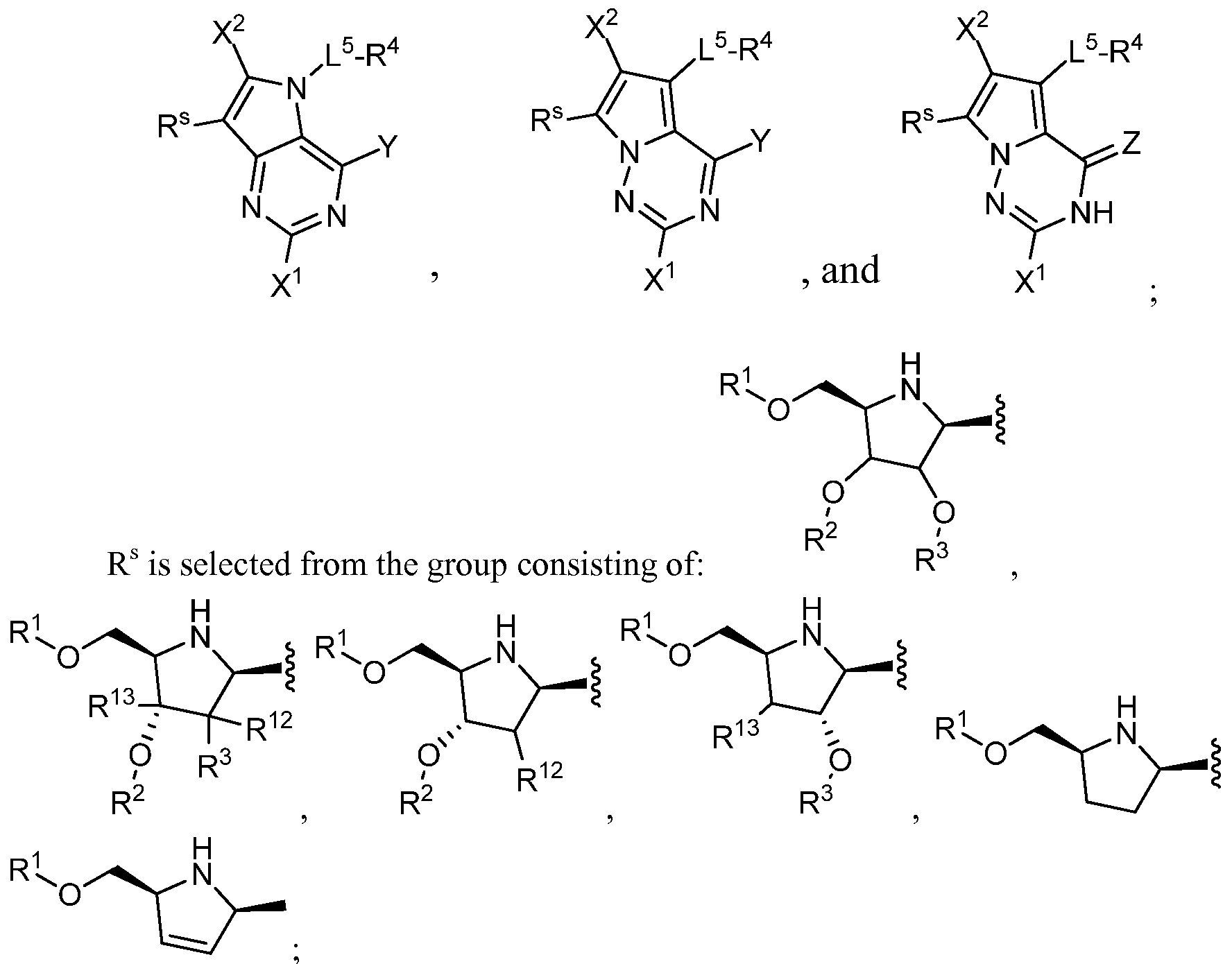
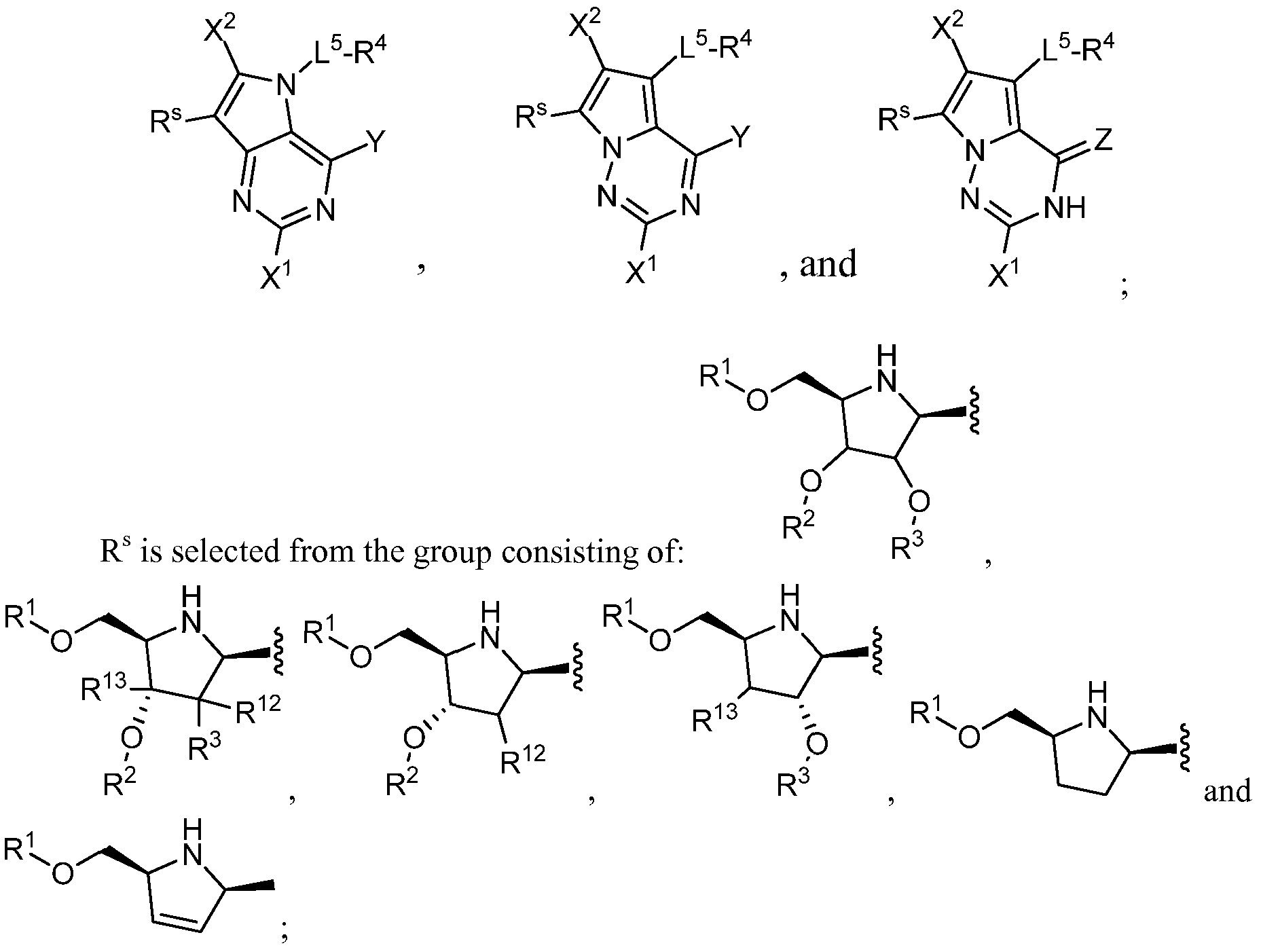
  • R s -B is selected from the group consisting of:
  • X is selected from the group consisting of O, S, and NR ;
  • R 10 independently for each occurrence, is selected from the group consisting of H, Ci-C 6 alkyl, aryl, heteroaryl, aralkyl, and heteroaralkyl;
  • R x is selected from the group consisting of H, Ci-C 6 alkyl, OR 0 , Ci-C 6 alkenyl, Ci- C 6 alkynyl, CN, N(R°) 2 , N0 2 , azide, halide, aryl, and heteroaryl;
  • independently for each occurrence, is H or Ci-Cealkyl
  • R y is selected from the group consisting of H, Ci-C 6 alkyl, OR 0 , Ci-C 6 alkenyl, Ci- C 6 alkynyl, CN, N(R°) 2 , and halide;
  • Y is selected from the group consisting of O and S;
  • Z is selected from the group consisting of O and S;
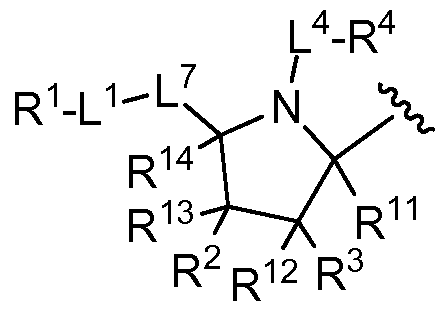
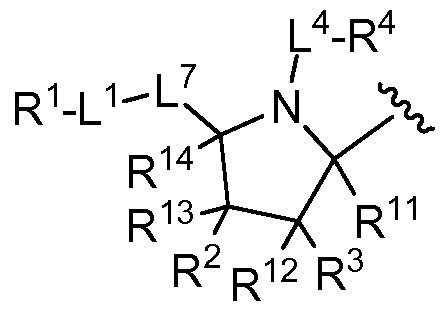
  • R s is represented by the formula:
  • L 1 and L 4 are a bond or -C(R°) 2 -0-;
  • L 5 is a bond, O, -C(R°) 2 -0-, -C(R°) 2 -S-, or -C(R°) 2 -NH-;
  • R is selected from the group consisting of H, Ci-C 6 alkyl, aminoacyl, aminothionyl, Ci-C 6 acyl, R 10 OC(O)-, phosphoryl, and aminophosphoryl;
  • R 2 and R 3 are each independently H, halide, azide, Ci-C 6 alkyl, Ci-C 6 alkenyl, Ci- Cealkynyl, CN, OR 0 , R 10 OC(O)-, or SR°; or R 1 and R 2 , taken together, or R 2 and R 3 , taken together, may be selected from the group consisting of -OC(0)0-, -OC(S)0-, phosphoryl, and Ci-C 6 alkylphosphoryl; or R 2 and R 3 , taken together, may form a bond between the carbon atoms to which they are attached;
  • R 4 is, independently for each occurrence, selected from the group consisting of H, Ci-
  • R 11 is selected from the group consisting of H, Ci-C 6 alkyl, Ci-C 6 alkenyl, Ci- C 6 alkynyl, OR 0 , and CN;
  • R 12 and R 13 are each independently selected from the group consisting of H, Ci- C 6 alkyl, OR 0 , Ci-C 6 alkenyl, Ci-C 6 alkynyl, CN, azide, and halide; and
  • R 14 is selected from the group consisting of H, Ci-C 6 alkyl, OR 0 , Ci-C 6 alkynyl, CN, azide, and halide.
  • One aspect of the invention relates to a compound represented by R s -B, or a pharmaceutically acceptable salt thereof, wherein:
  • R s -B is selected from the group consisting of:
  • W independently for each occurrence, is CR X or N;
  • X is selected from the group consisting of O, S, and NR 10 ;
  • R 10 independently for each occurrence, is selected from the group consisting of H, Ci-C 6 alkyl, aryl, heteroaryl, aralkyl, and heteroaralkyl;
  • R x is selected from the group consisting of H, Ci-C 6 alkyl, OR , Ci-C 6 alkenyl, Ci- C 6 alkynyl, CN, N(R°) 2 , N0 2 , azide, halide, aryl, and heteroaryl;
  • independently for each occurrence, is H or Ci-Cealkyl
  • R y is selected from the group consisting of H, Ci-C 6 alkyl, OR 0 , Ci-C 6 alkenyl, Ci- C 6 alkynyl, CN, N(R°) 2 , and halide;
  • Y is selected from the group consisting of O and S;
  • Z is selected from the group consisting of O and S;
  • R s is represented by the formula:
  • L 1 and L 4 are a bond or -C(R°) 2 -0-;
  • L 5 is a bond, O, -C(R°) 2 -0-, -C(R°) 2 -S-, or -C(R°) 2 -NH-;
  • R 1 is selected from the group consisting of H, Ci-C 6 alkyl, aminoacyl, aminothionyl, Ci-C 6 acyl, R 10 OC(O)-, phosphoryl, and aminophosphoryl;
  • R 2 and R 3 are each independently H, halide, azide, Ci-C 6 alkyl, Ci-C 6 alkenyl, Ci- C 6 alkynyl, CN, OR 0 , R 10 OC(O)-, or SR°; or R 1 and R 2 , taken together, or R 2 and R 3 , taken together, may be selected from the group consisting of -OC(0)0-, -OC(S)0-, phosphoryl, and Ci-Cealkylphosphoryl; or R 2 and R 3 , taken together, may form a bond between the carbon atoms to which they are attached;
  • R 4 is, independently for each occurrence, selected from the group consisting of H, Ci- C 6 alkyl, Cs-Cgcycloalkyl, Ci-C 6 alkenyl, Ci-C 6 alkynyl, Ci-C 6 acyl, phosphoryl, aryl, aralkyl, heteroaryl, and heteroaralkyl;
  • R 11 is selected from the group consisting of H, Ci-C 6 alkyl, Ci-C 6 alkenyl, Ci- C 6 alkynyl, OR 0 , and CN;
  • R 12 and R 13 are each independently selected from the group consisting of H, Ci- C 6 alkyl, Ci-C 6 alkenyl, Ci-C 6 alkynyl, OR 0 , CN, azide, and halide; and R is selected from the group consisting of H, Ci-C 6 alkyl, OR , Ci-C 6 alkynyl, CN, azide, and halide.
  • One aspect of the invention relates to a compound represented by R s -B, or a pharmaceutically acceptable salt thereof, wherein:
  • R s -B is selected from the group consisting of:
  • X is selected from the group consisting of O, S, and NR ;
  • R 10 independently for each occurrence, is selected from the group consisting of H, Ci-C 6 alkyl, aryl, heteroaryl, aralkyl, and heteroaralkyl;
  • R x is selected from the group consisting of H, Ci-C 6 alkyl, OR 0 , Ci-C 6 alkenyl, Ci- C 6 alkynyl, CN, N(R°) 2 , N0 2 , azide, halide, aryl, and heteroaryl;
  • independently for each occurrence, is H or Ci-Cealkyl
  • R y is selected from the group consisting of H, Ci-C 6 alkyl, OR 0 , Ci-C 6 alkenyl, Ci- C 6 alkynyl, CN, N(R°) 2 , and halide;
  • Y is selected from the group consisting of O and S;
  • R 1 is selected from the group consisting of H, Ci-C 6 alkyl, aminoacyl, aminothionyl, Ci-C 6 acyl, R 10 OC(O)-, phosphoryl, and aminophosphoryl;
  • R 2 and R ? are each independently H, Ci-C 6 alkyl, Ci-C 6 alkenyl, or Ci-C 6 alkynyl;
  • R 12 and R 13 are each independently selected from the group consisting of H, Ci- C 6 alkyl, Ci-C 6 alkenyl, Ci-C 6 alkynyl, OR 0 , CN, azide, and halide.
  • R s is selected from the group consisting of:
  • R s is selected from the group consisting of:
  • R s is selected from the group consisting of:
  • Still yet another embodiment of the invention relates to any one of the compounds described above, wherein R s is selected from the group consisting of:
  • R s is selected from the group consisting of:
  • Another aspect of the invention relates to any one of the compounds described above, wherein R is H, methyl, or ethyl.
  • R 1 is phosphate, pyrophosphate, phosphoramidite, phosphite, or phosphonate.
  • Another embodiment of the invention relates to any one of the compounds as decribed above, wherein R is phosphoryl or aminophosphoryl.
  • R 51 is H or Ci-Cealkyl
  • R 60 and R 61 each independently are H or Ci-C 6 alkyl
  • R 62 is selected from the group consisting of H, Ci-C 6 alkyl, aryl, aralkyl, heteroaryl, and heteroaralkyl.
  • R s -B is selected from the group consisting of:
  • Another embodiment of the invention relates to any one of the compounds described above, wherein R x is F, CI, Br, or I.
  • Yet another embodiment of the invention relates to any one of the compounds described above, wherein R x is H, methyl, ethyl, or propyl.
  • Still yet another embodiment of the invention relates to any one of the compounds described above, wherein R x is ethenyl or ethynyl.
  • Another embodiment of the invention relates to any one of the compounds described above, wherein R x is CN, NH 2 , or aminoalkyl.
  • One aspect of the invention relates to a compound represented by R s -B, or a pharmaceutically acceptable salt thereof, wherein:
  • R s -B is selected from the group consisting of:
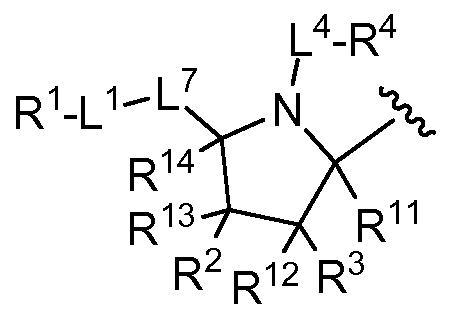
  • R s is represented by the formula:
  • L 1 is a bond
  • L 4 , L 5 , and L 6 are a bond or -C(R°) 2 -0-;
  • L 7 is O, -CH 2 -, -CH(Ci-C 6 alkyl)-, -C(R°) 2 -S-, or -C(R°) 2 -NH-;
  • independently for each occurrence, is H or Ci-C 6 alkyl;
  • R 1 is selected from the group consisting of H, Ci-C 6 alkyl, aminoacyl, aminothionyl, Ci-C 6 acyl, R 10 OC(O)-, phosphoryl, and aminophosphoryl;
  • R 2 and R 3 are each independently H, halide, Ci-C 6 alkyl, Ci-C 6 alkenyl, Ci-C 6 alkynyl, CN, OR 0 , R 10 OC(O)-, or SR°; or R 1 and R 2 , taken together, or R 2 and R 3 , taken together, may be selected from the group consisting of -OC(0)0-, -OC(S)0-, phosphoryl, and Ci-Cealkylphosphoryl; or R 2 and R 3 , taken together, may form a bond between the carbon atoms to which they are attached;
  • R 4 is, independently for each occurrence, selected from the group consisting of H, Ci- C 6 alkyl, Cs-Cgcycloalkyl, Ci-C 6 alkenyl, Ci-C 6 alkynyl, Ci-C 6 acyl, phosphoryl, aryl, aralkyl, heteroaryl, and heteroaralkyl;
  • R 10 independently for each occurrence, is selected from the group consisting of H, Ci-C 6 alkyl, aryl, heteroaryl, aralkyl, and heteroaralkyl;
  • R 20 and R 21 are selected from the group consisting of H, Ci- C 6 alkyl, amino, aryl, heteroaryl, aralkyl, and heteroaralkyl;
  • R 11 is selected from the group consisting of H, Ci-C 6 alkyl, Ci-C 6 alkenyl, Ci- C 6 alkynyl, OR 0 , CN, and halide;
  • R 12 and R 13 are each independently selected from the group consisting of H, Ci- C 6 alkyl, Ci-C 6 alkenyl, Ci-C 6 alkynyl, OR 0 , CN, azide, and halide; and
  • R 14 is selected from the group consisting of H, Ci-C 6 alkyl, OR 0 , Ci-C 6 alkynyl, CN, azide, and halide.
  • One aspect of the invention relates to a compound represented by R s -B, or a pharmaceutically acceptable salt thereof, wherein:
  • R s -B is selected from the group consisting of:
  • R s is represented by the formula:
  • L 1 , L 4 , L 5 , and L 6 are a bond or -C(R°) 2 -0-;
  • L 7 is a bond, O, -C(R°) 2 -0-, -C(R°) 2 -S-, or -C(R°) 2 -NH-;
  • independently for each occurrence, is H or Ci-C 6 alkyl;
  • R 1 is selected from the group consisting of H, Ci-C 6 alkyl, aminoacyl, aminothionyl, Ci-C 6 acyl, R 10 OC(O)-, phosphoryl, and aminophosphoryl;
  • R 2 and R 3 are each independently H, halide, Ci-C 6 alkyl, Ci-C 6 alkenyl, Ci-C 6 alkynyl, CN, OR 0 , R 10 OC(O)-, or SR°; or R 1 and R 2 , taken together, or R 2 and R 3 , taken together, may be selected from the group consisting of -OC(0)0-, -OC(S)0-, phosphoryl, and Ci-Cealkylphosphoryl; or R 2 and R 3 , taken together, may form a bond between the carbon atoms to which they are attached;
  • R 4 is, independently for each occurrence, selected from the group consisting of H, Ci- C 6 alkyl, Cs-Cgcycloalkyl, Ci-C 6 alkenyl, Ci-C 6 alkynyl, Ci-C 6 acyl, phosphoryl, aryl, aralkyl, heteroaryl, and heteroaralkyl;
  • R 10 independently for each occurrence, is selected from the group consisting of H, Ci-C 6 alkyl, aryl, heteroaryl, aralkyl, and heteroaralkyl;
  • R 5 and R 6 are, each independently, selected from the group consisting of H, Ci- C 6 alkyl, Cs-Cscycloalkyl, alkenyl, alkynyl, Ci-C 6 acyl, alkylthio, aryl, aralkyl, heteroaryl, and heteroaralkyl; or R 5 may be absent;
  • R 20 and R 21 are selected from the group consisting of H, Ci- C 6 alkyl, amino, aryl, heteroaryl, aralkyl, and heteroaralkyl;
  • R 11 is selected from the group consisting of Ci-C 6 alkyl, Ci-C 6 alkenyl, Ci-C 6 alkynyl, OR 0 , and CN;
  • R 12 and R 13 are each independently selected from the group consisting of H, Ci- C 6 alkyl, Ci-C 6 alkenyl, Ci-C 6 alkynyl, OR 0 , CN, azide, and halide; and
  • R 14 is selected from the group consisting of H, Ci-C 6 alkyl, OR 0 , Ci-C 6 alkynyl, CN, azide, and halide.
  • One aspect of the invention relates to a compound represented by R s -B, or a pharmaceutically acceptable salt thereof, wherein:
  • R s -B is selected from the group consisting of:
  • R s is represented by the formula:
  • L 1 , L 4 , L 5 , and L 6 are a bond or -C(R°) 2 -0-;
  • L 7 is a bond, O, -C(R°) 2 -0-, -C(R°) 2 -S-, or -C(R°) 2 -NH-;
  • independently for each occurrence, is H or Ci-C 6 alkyl;
  • R 1 is selected from the group consisting of H, Ci-C 6 alkyl, aminoacyl, aminothionyl, Ci-C 6 acyl, R 10 OC(O)-, phosphoryl, and aminophosphoryl;
  • R 2 is H, halide, Ci-C 6 alkyl, Ci-C 6 alkenyl, Ci-C 6 alkynyl, CN, OR 0 , R 10 OC(O)-, or
  • R 3 is H, halide, Ci-C 6 alkyl, Ci-C 6 alkenyl, Ci-C 6 alkynyl, CN, R 10 OC(O)-, or SR°; or R 1 and R 2 , taken together, or R 2 and R 3 , taken together, may be selected from the group consisting of -OC(0)0-, -OC(S)0-, phosphoryl, and Ci-C 6 alkylphosphoryl; or R 2 and R 3 , taken together, may form a bond between the carbon atoms to which they are attached;
  • R 4 is, independently for each occurrence, selected from the group consisting of H, Ci- C 6 alkyl, C 3 -C 8 cycloalkyl, Ci-C 6 alkenyl, Ci-C 6 alkynyl, Ci-C 6 acyl, phosphoryl, aryl, aralkyl, heteroaryl, and heteroaralkyl;
  • R 10 independently for each occurrence, is selected from the group consisting of H, Ci-C 6 alkyl, aryl, heteroaryl, aralkyl, and heteroaralkyl;
  • R 5 and R 6 are, each independently, selected from the group consisting of H, Ci- C 6 alkyl, C 3 -Cgcycloalkyl, alkenyl, alkynyl, Ci-C 6 acyl, alkylthio, aryl, aralkyl, heteroaryl, and heteroaralkyl; or R 5 may be absent;
  • R 20 and R 21 are selected from the group consisting of H, Ci- C 6 alkyl, amino, aryl, heteroaryl, aralkyl, and heteroaralkyl;
  • R 11 is selected from the group consisting of H, Ci-C 6 alkyl, Ci-C 6 alkenyl, Ci- C 6 alkynyl, OR 0 , and CN;
  • R is selected from the group consisting of H, Ci-C 6 alkyl, Ci-C 6 alkenyl, Ci- C 6 alkynyl, CN, azide, and halide;
  • R 13 is selected from the group consisting of H, Ci-C 6 alkyl, Ci-C 6 alkenyl, Ci- C 6 alkynyl, OR 0 , CN, azide, and halide;
  • R 14 is selected from the group consisting of H, Ci-C 6 alkyl, OR 0 , Ci-C 6 alkynyl, CN, azide, and halide.
  • One aspect of the invention relates to a compound represented by R s -B, or a pharmaceutically acceptable salt thereof, wherein:
  • R s -B is selected from the group consisting of:
  • R s is represented by the formula:
  • L 1 , L 4 , L 5 , and L 6 are a bond or -C(R°) 2 -0-; is a bond, O, -C(R u ) 2 -0-, -C(R U ) 2 -S-, or -C(R U ) 2 -NH-; R°, independently for each occurrence, is H or Ci-C 6 alkyl;
  • R is selected from the group consisting of H, Ci-C 6 alkyl, aminoacyl, aminothionyl, Ci-C 6 acyl, R 10 OC(O)-, phosphoryl, and aminophosphoryl;
  • R 2 is H, halide, Ci-C 6 alkyl, Ci-C 6 alkenyl, Ci-C 6 alkynyl, CN, R 10 OC(O)-, or SR°;
  • R 3 is H, halide, Ci-C 6 alkyl, Ci-C 6 alkenyl, Ci-C 6 alkynyl, CN, OR 0 , R 10 OC(O)-, or
  • R 1 and R 2 , taken together, or R 2 and R 3 , taken together, may be selected from the group consisting of -OC(0)0-, -OC(S)0-, phosphoryl, and Ci-Cealkylphosphoryl; or R 2 and R 3 , taken together, may form a bond between the carbon atoms to which they are attached;
  • R 4 is, independently for each occurrence, selected from the group consisting of H, Ci- C 6 alkyl, C 3 -C 8 cycloalkyl, Ci-C 6 alkenyl, Ci-C 6 alkynyl, Ci-C 6 acyl, phosphoryl, aryl, aralkyl, heteroaryl, and heteroaralkyl;
  • R 10 independently for each occurrence, is selected from the group consisting of H, Ci-C 6 alkyl, aryl, heteroaryl, aralkyl, and heteroaralkyl;
  • R 5 and R 6 are, each independently, selected from the group consisting of H, Ci- C 6 alkyl, C 3 -C 8 cycloalkyl, Ci-C 6 alkenyl, Ci-C 6 alkynyl, Ci-C 6 acyl, alkylthio, aryl, aralkyl, heteroaryl, and heteroaralkyl; or R 5 may be absent;
  • R 20 and R 21 are selected from the group consisting of H, Ci- C 6 alkyl, amino, aryl, heteroaryl, aralkyl, and heteroaralkyl;
  • R 11 is selected from the group consisting of H, Ci-C 6 alkyl, Ci-C 6 alkenyl, Ci- C 6 alkynyl, OR 0 , and CN;
  • R 12 is selected from the group consisting of Ci-C 6 alkyl, OR 0 , alkynyl, CN, azide, and halide;
  • R 13 is selected from the group consisting of H, Ci-C 6 alkyl, Ci-C 6 alkenyl, Ci- C 6 alkynyl, CN, azide, and halide;
  • R 14 is selected from the group consisting of H, Ci-C 6 alkyl, OR 0 , Ci-C 6 alkynyl, CN, azide, and halide.
  • One aspect of the invention relates to a compound represented by R s -B, or a pharmaceutically acceptable salt thereof, wherein:
  • R s -B is selected from the group consisting of:
  • R 1 is selected from the group consisting of H, Ci-C 6 alkyl, aminoacyl, aminothionyl, Ci-C 6 acyl, R 10 OC(O)-, phosphoryl, and aminophosphoryl;
  • R 2 and R 3 are each independently H, Ci-C 6 alkyl, Ci-C 6 alkenyl, or Ci-C 6 alkynyl;
  • R 10 independently for each occurrence, is selected from the group consisting of H, Ci-C 6 alkyl, aryl, heteroaryl, aralkyl, and heteroaralkyl;
  • R 12 and R 13 are each independently selected from the group consisting of H, Ci- C 6 alkyl, Ci-C 6 alkenyl, Ci-C 6 alkynyl, OR 0 , CN, azide, and halide;
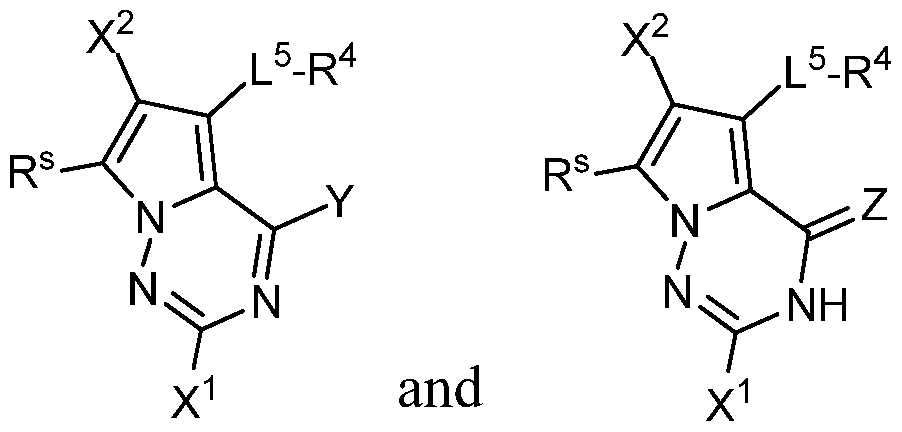
  • L 5 is a bond or -C(R°) 2 -0-;
  • independently for each occurrence, is H or Ci-C 6 alkyl
  • R 4 is selected from the group consisting of Ci-C 6 alkyl, alkenyl, alkynyl, aryl, heteroaryl, aralkyl, heteroaralkyl, Ci-C 6 acyl, or carboxyl; or R 4 may be absent;
  • X 1 is selected from the group consisting of H, N(R°) 2 , SH, thioalkyl, OR 0 , alkenyl, alkynyl, CN, and halide;
  • X 2 is selected from the group consisting of H, N(R°) 2 , SH, thioalkyl, OR 0 , O-aryl, O- heteroaryl, alkenyl, alkynyl, Ci-C 6 acyl, carboxyl, CN, azide, and halide;
  • Y is selected from the group consisting of H, OR 0 , N(R 5 )(R 6 ), SH, thioalkyl, O-aryl, O-heteroaryl, and halide;
  • R 5 and R 6 are, each independently, selected from the group consisting of H, Ci- C 6 alkyl, Cs-Cgcycloalkyl, Ci-C 6 alkenyl, Ci-C 6 alkynyl, Ci-C 6 acyl, alkylthio, aryl, aralkyl, heteroaryl, and heteroaralkyl; or
  • R 20 and R 21 are selected from the group consisting of H, Ci- C 6 alkyl, amino, aryl, heteroaryl, aralkyl, and heteroaralkyl.
  • One aspect of the invention relates to a compound represented by R s -B, or a pharmaceutically acceptable salt thereof, wherein:
  • R s -B is selected from the group consisting of:
  • R 1 is selected from the group consisting of H, Ci-C 6 alkyl, aminoacyl, aminothionyl, Ci-C 6 acyl, R 10 OC(O)-, phosphoryl, and aminophosphoryl;
  • R 2 and R 3 are each independently H, Ci-C 6 alkyl, Ci-C 6 alkenyl, or Ci-C 6 alkynyl; R , independently for each occurrence, is selected from the group consisting of H, Ci-C 6 alkyl, aryl, heteroaryl, aralkyl, and heteroaralkyl;
  • R 12 and R 13 are each independently selected from the group consisting of H, Ci- C 6 alkyl, Ci-C 6 alkenyl, Ci-C 6 alkynyl, OR 0 , CN, azide, and halide;
  • L 5 is a bond or -C(R°) 2 -0-;
  • independently for each occurrence, is H or Ci-C 6 alkyl
  • R 4 is selected from the group consisting of Ci-C 6 alkyl, alkenyl, alkynyl, aryl, heteroaryl, aralkyl, heteroaralkyl, Ci-C 6 acyl, or carboxyl; or R 4 may be absent;
  • X 1 is selected from the group consisting of H, N(R°) 2 , SH, thioalkyl, OR 0 , alkenyl, alkynyl, CN, and halide;
  • X 2 is selected from the group consisting of H, N(R°) 2 , SH, thioalkyl, OR 0 , O-aryl, O- heteroaryl, alkenyl, alkynyl, Ci-C 6 acyl, carboxyl, CN, azide, and halide;
  • Y is selected from the group consisting of H, OR 0 , N(R 5 )(R 6 ), SH, thioalkyl, O-aryl, O-heteroaryl, and halide;
  • Z is selected from the group consisting of O and S;
  • R 5 and R 6 are, each independently, selected from the group consisting of H, Ci- C 6 alkyl, C 3 -C 8 cycloalkyl, Ci-C 6 alkenyl, Ci-C 6 alkynyl, Ci-C 6 acyl, alkylthio, aryl, aralkyl, heteroaryl, and heteroaralkyl, provided that both R 5 and R 6 are not H.
  • One aspect of the invention relates to a compound represented by R s -B, or a pharmaceutically acceptable salt thereof, wherein:
  • R s -B is selected from the group consisting of:
  • R 1 is selected from the group consisting of H, Ci-C 6 alkyl, aminoacyl, aminothionyl, Ci-C 6 acyl, R 10 OC(O)-, phosphoryl, and aminophosphoryl;
  • R 10 independently for each occurrence, is selected from the group consisting of H, Ci-C 6 alkyl, aryl, heteroaryl, aralkyl, and heteroaralkyl;
  • R 2 and R 3 are each independently H, Ci-C 6 alkyl, Ci-C 6 alkenyl, or Ci-C 6 alkynyl;
  • R 12 and R 13 are each independently selected from the group consisting of H, Ci- C 6 alkyl, Ci-C 6 alkenyl, Ci-C 6 alkynyl, OR 0 , CN, azide, and halide;
  • independently for each occurrence, is H or Ci-Cealkyl
  • L 5 is a bond or -C(R°) 2 -0-;
  • R 4 is selected from the group consisting of Ci-C 6 alkyl, alkenyl, alkynyl, aryl, heteroaryl, aralkyl, heteroaralkyl, Ci-C 6 acyl, or carboxyl; or R 4 may be absent;
  • X 1 is selected from the group consisting of H, N(R°) 2 , SH, thioalkyl, OR 0 , alkenyl, alkynyl, CN, and halide;
  • X 2 is selected from the group consisting of N(R°) 2 , SH, thioalkyl, OR 0 , O-aryl, O- heteroaryl, alkenyl, alkynyl, Ci-C 6 acyl, carboxyl, CN, azide, and halide;
  • Y is selected from the group consisting of H, OR 0 , N(R 5 )(R 6 ), SH, thioalkyl, O-aryl, O-heteroaryl, and halide;
  • Z is selected from the group consisting of O and S;
  • R 5 and R 6 are, each independently, selected from the group consisting of H, Ci- C 6 alkyl, Cs-Cgcycloalkyl, Ci-C 6 alkenyl, Ci-C 6 alkynyl, Ci-C 6 acyl, alkylthio, aryl, aralkyl, heteroaryl, and heteroaralkyl; or
  • R 20 and R 21 are selected from the group consisting of H, Ci- C 6 alkyl, amino, aryl, heteroaryl, aralkyl, and heteroaralkyl.
  • One aspect of the invention relates to a compound represented by R s -B, or a pharmaceutically acceptable salt thereof, wherein:
  • s-B is selected from the group consisting of:
  • R 1 is selected from the group consisting of H, Ci-C 6 alkyl, aminoacyl, aminothionyl, Ci-C 6 acyl, R 10 OC(O)-, phosphoryl, and aminophosphoryl;
  • R 2 and R 3 are each independently H, Ci-C 6 alkyl, Ci-C 6 alkenyl, or Ci-C 6 alkynyl; R , independently for each occurrence, is selected from the group consisting of H, Ci-C 6 alkyl, aryl, heteroaryl, aralkyl, and heteroaralkyl;
  • R 12 and R 13 are each independently selected from the group consisting of H, Ci- C 6 alkyl, Ci-C 6 alkenyl, Ci-C 6 alkynyl, OR 0 , CN, azide, and halide;
  • independently for each occurrence, is H or Ci-C 6 alkyl
  • L 5 is a bond or -C(R°) 2 -0-;
  • R 4 is selected from the group consisting of Ci-C 6 alkyl, alkenyl, alkynyl, aryl, heteroaryl, aralkyl, heteroaralkyl, Ci-C 6 acyl, or carboxyl; or R 4 may be absent;
  • X 1 is selected from the group consisting of N(R°) 2 , SH, thioalkyl, OR 0 , alkenyl, alkynyl, CN, and halide;
  • X 2 is selected from the group consisting of H, N(R°) 2 , SH, thioalkyl, OR 0 , O-aryl, O- heteroaryl, alkenyl, alkynyl, Ci-C 6 acyl, carboxyl, CN, azide, and halide;
  • Y is selected from the group consisting of H, OR 0 , N(R 5 )(R 6 ), SH, thioalkyl, O-aryl, O-heteroaryl, and halide;
  • Z is selected from the group consisting of O and S;
  • R 5 and R 6 are, each independently, selected from the group consisting of H, Ci- C 6 alkyl, C 3 -C 8 cycloalkyl, Ci-C 6 alkenyl, Ci-C 6 alkynyl, Ci-C 6 acyl, alkylthio, aryl, aralkyl, heteroaryl, and heteroaralkyl; or
  • R 20 and R 21 are selected from the group consisting of H, Ci- C 6 alkyl, amino, aryl, heteroaryl, aralkyl, and heteroaralkyl.
  • R s is selected from the group consisting of:
  • R s is selected from the group consisting of:
  • R s is selected from the group consisting of:
  • Still yet another embodiment of the invention relates to a compound as described above, wherein R s is selected from the group consisting of:
  • One embodiment of the invention relates to a compound as described above, wherein L 5 -R 5 is H.
  • One embodiment of the invention relates to a compound as described above, wherein L 4 -R 4 is H.
  • One embodiment of the invention relates to a compound as described above, wherein L 7 is -CH(Ci-C 6 alkyl)-.
  • One embodiment of the invention relates to a compound as described above, wherein R U , R 12 , R 13 , and R 14 are H.
  • One embodiment of the invention relates to a compound as described above, wherein R 12 , R 13 , and R 14 are H.
  • R 1 is selected from the group consisting of phosphate, pyrophosphate, phosphoramidite, phosphite, and phosphonate.
  • Another embodiment of the invention relates to a compound as described above, wherein R 1 is phosphoryl or aminophosphoryl.
  • Yet another embodiment of the invention relates to a compound as described above, wherein R 1 is aminophosphoryl
  • n 1 or 2;
  • R 51 is H or Ci-Cealkyl
  • R 60 and R 61 each independently are H or Ci-C 6 alkyl
  • R 62 is selected from the group consisting of H, Ci-C 6 alkyl, aryl, aralkyl, heteroaryl, and heteroaralkyl.
  • One embodiment of the invention relates to a compound as described above, wherein R 50 is H.
  • Another embodiment of the invention relates to a compound as described above, wherein R 50 is aryl.
  • One embodiment of the invention relates to a compound as described above, wherein m is 2.
  • One embodiment of the invention relates to a compound as described above, wherein R 51 is H.
  • One embodiment of the invention relates to a compound as described above, wherein R 52 is aralkyl.
  • One embodiment of the invention relates to a compound as described above, wherein R 60 is H; R 61 is (Ci-C 6 )alkyl; and R 62 is (Ci-C 6 )alkyl.
  • One embodiment of the invention relates to a compound as described above, wherein selected from the group consisting of:
  • R 15 is selected from the group consisting of H, Ci-C 6 alkyl, Ci-C 6 haloalkyl, aminoalkyl, thioalkyl, Q-Cgcycloalkyl, C 2 -C 7 heterocyclyl, aryl, heteroaryl, aralkyl, heteroaralkyl, and naturally-occurring amino acid side chains;
  • R 16 is, independently for each occurrence, selected from the group consisting of H,
  • C 6 alkyl, Ci-C 6 haloalkyl, aminoalkyl, thioalkyl, C 3 -C 8 cycloalkyl, C 2 -C 7 heterocyclyl, aryl, heteroaryl, aralkyl, and heteroaralkyl; or R 16 taken together with the oxygen to which it is bonded may be a naturally-occurring amino acid;
  • R 17 is, independently for each occurrence, selected from the group consisting of H,
  • R 18 is, independently for each occurrence, selected from the group consisting of H,
  • R 17 and R 18 taken together, may form a 4-, 5-, or 6-membered ring;
  • R 19 is, independently for each occurrence, selected from the group consisting of H, C 6 alkyl, Ci-Cehaloalkyl, aminoalkyl, thioalkyl, Cs-Cgcycloalkyl, C2-Cyheterocyclyl, aryl, heteroaryl, aralkyl, and heteroaralkyl.
  • Another aspect of the invention is a compound selected from the group consisting of:
  • R s is selected from the group consisting of:
  • Another aspect of the invention is a compound, or a pharmaceutically acceptable salt thereof, selected from the group consisting of:
  • R 16 is, independently for each occurrence, selected from the group consisting of H,
  • C 6 alkyl, Ci-C 6 haloalkyl, aminoalkyl, thioalkyl, C 3 -Cgcycloalkyl, C 2 -Cyheterocyclyl, aryl, heteroaryl, aralkyl, and heteroaralkyl; or R 16 taken together with the oxygen to which it is bonded may be a naturally-occurring amino acid;
  • R 18 is, independently for each occurrence, selected from the group consisting of H,
  • R 19 is, independently for each occurrence, selected from the group consisting of H, Ci- C 6 alkyl, Ci-Cehaloalkyl, aminoalkyl, thioalkyl, C 3 -Cgcycloalkyl, C 2 -Cyheterocyclyl, aryl, heteroaryl, aralkyl, and heteroaralkyl;
  • R 22 is, independently for each occurrence, selected from the group consisting of H,
  • C 6 alkyl, Ci-C 6 haloalkyl, C 3 -Cgcycloalkyl, C 2 -Cyheterocyclyl, aryl, heteroaryl, aralkyl, and heteroaralkyl; or R 17 and R 22 , taken together, may form a 4-, 5-, or 6-membered ring; and
  • B is selected from the group consisting of:
  • An aspect of the invention is a pharmaceutical composition
  • a pharmaceutical composition comprising a compound of the invention, or a pharmaceutically acceptable salt thereof, and a pharmaceutically acceptable carrier.
  • An aspect of the invention is a method of preparing a pharmaceutical composition.
  • the method includes the step of combining a compound of the invention, or a
  • Compounds of the invention are useful for inhibiting nucleic acid polymerase activity of certain viruses. Compounds of the invention are also useful for inhibiting viral replication or treating viral infections.
  • RNA viruses are classified into three distinct groups based on their genome and mode of replication (and the numerical groups based on the older Baltimore classification): Double-stranded (ds) RNA viruses (Baltimore classification Group III) contain from one to a dozen different RNA molecules, each of which codes for one or more viral proteins. Examples of dsRNA viruses include reoviridae.
  • Positive-sense single-stranded (ss) RNA viruses (Baltimore classification Group IV) have their genome directly utilized as if it were mRNA, producing a single protein which is modified by host and viral proteins to form the various proteins needed for replication.
  • One of these includes RNA-dependent RNA polymerase, which copies the viral RNA to form a double-stranded replicative form, which in turn directs the formation of new virions.
  • positive-sense ssRNA viruses include togaviridae, flaviviridae, calciviridae, coronaviridae, picornaviridae, and togaviridae.
  • Negative-sense ssRNA viruses (Baltimore classification Group V) must have their genome copied by an RNA polymerase to form positive-sense RNA. This means that the virus must bring along with it the RNA-dependent RNA polymerase enzyme. The positive- sense RNA molecule then acts as viral mRNA, which is translated into proteins by the host ribosomes. The resultant protein goes on to direct the synthesis of new virions, such as capsid proteins and RNA replicase, which is used to produce new negative-sense RNA molecules. Negative-sense ssRNA viruses include bornaviridae, filoviridae, orthomyxoviridae, paramyxoviridae, rhabdoviridae, arenaviridae, and bunyaviridae.
  • Retroviruses (Baltimore classification Group VI) have a single-stranded RNA genome but are generally not considered RNA viruses because they use DNA intermediates to replicate.
  • Reverse transcriptase a viral enzyme that comes from the virus itself after it is uncoated, converts the viral RNA into a complementary strand of DNA, which is copied to produce a double stranded molecule of viral DNA. After this DNA is integrated, expression of the encoded genes may lead the formation of new virions.
  • Retroviruses include without limitation HIV- 1 and HIV-2.
  • An aspect of the invention is a method of inhibiting viral nucleic acid polymerase activity of a virus.
  • the method includes the step of contacting a viral nucleic acid polymerase of the virus with an effective amount of a compound of the invention, or a pharmaceutically acceptable salt thereof.
  • the viral nucleic acid polymerase is a DNA polymerase.
  • the viral nucleic acid polymerase is an RNA polymerase.
  • the virus is selected from the group consisting of R A viruses.
  • the virus is selected from the group consisting of orthomyxoviridae, paramyxoviridae, arenaviridae, bunyaviridae, flaviviridae, filoviridae, togaviridae, picornaviridae, and coronaviridae.
  • the virus is selected from the group consisting of adenovirus, rhinovirus, hepatitis A virus, hepatitis C virus, polio virus, measles virus, Ebola virus, Coxsackie virus, West Nile virus, smallpox virus, yellow fever virus, Dengue Fever virus, influenza A virus, influenza B virus, lassa virus, lymphocytic choriomeningitis virus, Junin virus, machuppo virus, guanarito virus, hantavirus, Rift Valley Fever virus, La Crosse virus, California encephalitis virus, Crimean-Congo virus, Marburg virus, Japanese encephalitis virus, Kyasanur Forest virus, Venezuelan equine encephalitis virus, Eastern equine encephalitis virus, Western equine encephalitis virus, severe acute respiratory syndrome (SARS) virus, parainfluenza virus, respiratory syncytial virus, Punta Toro virus, Tacaribe virus, and Pichin
  • the virus is selected from the group consisting of adenovirus, Dengue Fever virus, Ebola virus, Marburg virus, influenza A virus, influenza B virus, Junin virus, measles virus, parainfluenza virus, Pichinde virus, Punta Toro virus, respiratory syncytial virus, rhinovirus, Rift Valley Fever virus, SARS virus, Tacaribe virus, Venezuelan equine encephalitis virus, West Nile virus, and yellow fever virus.
  • adenovirus Dengue Fever virus, Ebola virus, Marburg virus, influenza A virus, influenza B virus, Junin virus, measles virus, parainfluenza virus, Pichinde virus, Punta Toro virus, respiratory syncytial virus, rhinovirus, Rift Valley Fever virus, SARS virus, Tacaribe virus, Venezuelan equine encephalitis virus, West Nile virus, and yellow fever virus.
  • the virus is selected from the group consisting of Ebola virus, yellow fever virus, Marburg virus, influenza A virus, and influenza B virus.
  • An aspect of the invention is a method of inhibiting replication of a virus.
  • the method includes the step of contacting a virus with an effective amount of a compound of the invention, or a pharmaceutically acceptable salt thereof, thereby inhibiting replication of the virus.
  • the virus is selected from the group consisting of RNA viruses.
  • the virus is selected from the group consisting of orthomyxoviridae, paramyxoviridae, arenaviridae, bunyaviridae, flaviviridae, filoviridae, togaviridae, picornaviridae, and coronaviridae.
  • the virus is selected from the group consisting of adenovirus, rhinovirus, hepatitis A virus, hepatitis C virus, polio virus, measles virus, Ebola virus, Coxsackie virus, West Nile virus, smallpox virus, yellow fever virus, Dengue Fever virus, influenza A virus, influenza B virus, lassa virus, lymphocytic choriomeningitis virus, Junin virus, machuppo virus, guanarito virus, hantavirus, Rift Valley Fever virus, La Crosse virus, California encephalitis virus, Crimean-Congo virus, Marburg virus, Japanese encephalitis virus, Kyasanur Forest virus, Venezuelan equine encephalitis virus, Eastern equine encephalitis virus, Western equine encephalitis virus, severe acute respiratory syndrome (SARS) virus, parainfluenza virus, respiratory syncytial virus, Punta Toro virus, Tacaribe virus, and Pichin
  • the virus is selected from the group consisting of adenovirus, Dengue Fever virus, Ebola virus, Marburg virus, influenza A virus, influenza B virus, Junin virus, measles virus, parainfluenza virus, Pichinde virus, Punta Toro virus, respiratory syncytial virus, rhinovirus, Rift Valley Fever virus, SARS virus, Tacaribe virus, Venezuelan equine encephalitis virus, West Nile virus, and yellow fever virus.
  • adenovirus Dengue Fever virus, Ebola virus, Marburg virus, influenza A virus, influenza B virus, Junin virus, measles virus, parainfluenza virus, Pichinde virus, Punta Toro virus, respiratory syncytial virus, rhinovirus, Rift Valley Fever virus, SARS virus, Tacaribe virus, Venezuelan equine encephalitis virus, West Nile virus, and yellow fever virus.
  • the virus is selected from the group consisting of Ebola virus, yellow fever virus, Marburg virus, influenza A virus, and influenza B virus.
  • An aspect of the invention is a method of treating a viral infection in a subject.
  • the method includes the step of administering to a subject in need thereof an effective amount of a compound of the invention, or a pharmaceutically acceptable salt thereof.
  • the virus is selected from the group consisting of RNA viruses.
  • the virus is selected from the group consisting of orthomyxoviridae, paramyxoviridae, arenaviridae, bunyaviridae, flaviviridae, filoviridae, togaviridae, picornaviridae, and coronaviridae.
  • the virus is selected from the group consisting of adenovirus, rhinovirus, hepatitis A virus, hepatitis C virus, polio virus, measles virus, Ebola virus, Coxsackie virus, West Nile virus, smallpox virus, yellow fever virus, Dengue Fever virus, influenza A virus, influenza B virus, lassa virus, lymphocytic choriomeningitis virus, Junin virus, machuppo virus, guanarito virus, hantavirus, Rift Valley Fever virus, La Crosse virus, California encephalitis virus, Crimean-Congo virus, Marburg virus, Japanese encephalitis virus, Kyasanur Forest virus, Venezuelan equine encephalitis virus, Eastern equine encephalitis virus, Western equine encephalitis virus, severe acute respiratory syndrome (SARS) virus, parainfluenza virus, respiratory syncytial virus, Punta Toro virus, Tacaribe virus, and Pichin
  • the virus is selected from the group consisting of adenovirus, Dengue Fever virus, Ebola virus, Marburg virus, influenza A virus, influenza B virus, Junin virus, measles virus, parainfluenza virus, Pichinde virus, Punta Toro virus, respiratory syncytial virus, rhinovirus, Rift Valley Fever virus, SARS virus, Tacaribe virus, Venezuelan equine encephalitis virus, West Nile virus, and yellow fever virus.
  • adenovirus Dengue Fever virus, Ebola virus, Marburg virus, influenza A virus, influenza B virus, Junin virus, measles virus, parainfluenza virus, Pichinde virus, Punta Toro virus, respiratory syncytial virus, rhinovirus, Rift Valley Fever virus, SARS virus, Tacaribe virus, Venezuelan equine encephalitis virus, West Nile virus, and yellow fever virus.
  • the virus is selected from the group consisting of Ebola virus, yellow fever virus, Marburg virus, influenza A virus, and influenza B virus.
  • alkyl as used herein is a term of art and refers to saturated aliphatic groups, including straight-chain alkyl groups, branched-chain alkyl groups, cycloalkyl (alicyclic) groups, alkyl substituted cycloalkyl groups, and cycloalkyl substituted alkyl groups.
  • a straight chain or branched chain alkyl has about 30 or fewer carbon atoms in its backbone (e.g., C 1 -C30 for straight chain, C3-C30 for branched chain), and alternatively, about 20 or fewer.
  • cycloalkyls have from about 3 to about 10 carbon atoms in their ring structure, and alternatively about 5, 6 or 7 carbons in the ring structure.
  • amino is a term of art and as used herein refers to both unsubstituted and substituted amines, e.g., a moiety that may be represented by the general formulas:
  • R a , R b , and R ⁇ each independently represent a hydrogen, an alkyl, an alkenyl, -(CH 2 ) X -R d , or R a and R b , taken together with the N atom to which they are attached complete a heterocycle having from 4 to 8 atoms in the ring structure;
  • R d represents an aryl, a cycloalkyl, a cycloalkenyl, a heterocyclyl or a polycyclyl; and
  • x is zero or an integer in the range of 1 to 8.
  • R a or R b may be a carbonyl, e.g., R a , R b , and the nitrogen together do not form an imide.
  • R a and R b (and optionally R c ) each independently represent a hydrogen, an alkyl, an alkenyl, or -(CH 2 ) X -R d .
  • acyl is a term of art and as used herein refers to any group or radical of the form RCO- where R is any organic group, e.g., alkyl, aryl, heteroaryl, aralkyl, and heteroaralkyl.
  • R is any organic group, e.g., alkyl, aryl, heteroaryl, aralkyl, and heteroaralkyl.
  • Representative acyl groups include acetyl, benzoyl, and malonyl.
  • aminoalkyl refers to an alkyl group substituted with one or more one amino groups.
  • aminoacyl is a term of art and as used herein refers to an acyl group substituted with one or more amino groups.
  • aminothionyl refers to an analog of an aminoacyl in which the O of RC(O)- has been replaced by sulfur, hence is of the form RC(S)-.
  • phosphoryl is a term of art and as used herein may in general be represented by the formula:
  • Q50 represents S or O
  • R59 represents hydrogen, a lower alkyl or an aryl; for example, -P(0)(OMe)- or -P(0)(OH) 2 .
  • the phosphoryl group of the phosphorylalkyl may be represented by the general formulas:
  • Q50 and R59 each independently, are defined above, and Q51 represents O, S or N; for example, -0-P(0)(OH)OMe or -NH-P(0)(OH) 2 .
  • Q50 is S
  • the phosphoryl moiety is a "phosphorothioate.”
  • aminophosphoryl refers to a phosphoryl group substituted with at least one amino group, as defined herein; for example, -P(0)(OH)NMe 2 .
  • carbonyl refers to -C(O)-.
  • thiocarbonyl refers to -C(S)-.
  • alkylphosphoryl refers to a phosphoryl group substituted with at least one alkyl group, as defined herein; for example, -P(0)(OH)Me.
  • alkylthio refers to alkyl-S-.
  • aryl is a term of art and as used herein refers to includes monocyclic, bicyclic and polycyclic aromatic hydrocarbon groups, for example, benzene, naphthalene, anthracene, and pyrene.
  • the aromatic ring may be substituted at one or more ring positions with one or more substituents, such as halogen, azide, alkyl, aralkyl, alkenyl, alkynyl, cycloalkyl, hydroxyl, alkoxyl, amino, nitro, sulfhydryl, imino, amido, phosphonate, phosphinate, carbonyl, carboxyl, silyl, ether, alkylthio, sulfonyl, sulfonamido, ketone, aldehyde, ester, heterocyclyl, aromatic or heteroaromatic moieties, fluoroalkyl (such as trifluromethyl), cyano, or the like.
  • substituents such as halogen, azide, alkyl, aralkyl, alkenyl, alkynyl, cycloalkyl, hydroxyl, alkoxyl, amino, nitro, sulfhydryl, im
  • aryl also includes polycyclic ring systems having two or more cyclic rings in which two or more carbons are common to two adjoining rings (the rings are "fused rings") wherein at least one of the rings is an aromatic hydrocarbon, e.g., the other cyclic rings may be cycloalkyls, cycloalkenyls, cycloalkynyls, aryls, heteroaryls, and/or heterocyclyls.
  • heteroatom is art-recognized, and includes an atom of any element other than carbon or hydrogen.
  • Illustrative heteroatoms include boron, nitrogen, oxygen, phosphorus, sulfur and selenium, and alternatively oxygen, nitrogen or sulfur.
  • heteroaryl is a term of art and as used herein refers to a monocyclic, bicyclic and polycyclic aromatic group having one or more heteroatoms in the ring structure, for example, pyrrole, furan, thiophene, imidazole, oxazole, thiazole, triazole, pyrazole, pyridine, pyrazine, pyridazine and pyrimidine, and the like.
  • heteroaryl may be substituted at one or more ring positions with one or more substituents such as halogen, azide, alkyl, aralkyl, alkenyl, alkynyl, cycloalkyl, hydroxyl, alkoxyl, amino, nitro, sulfhydryl, imino, amido, phosphonate, phosphinate, carbonyl, carboxyl, silyl, ether, alkylthio, sulfonyl, sulfonamido, ketone, aldehyde, ester, heterocyclyl, aromatic or heteroaromatic moieties, fluoroalkyl (such as trifluromethyl), cyano, or the like.
  • substituents such as halogen, azide, alkyl, aralkyl, alkenyl, alkynyl, cycloalkyl, hydroxyl, alkoxyl, amino, nitro, sulfhydryl, imino
  • heteroaryl also includes polycyclic ring systems having two or more cyclic rings in which two or more carbons are common to two adjoining rings (the rings are "fused rings") wherein at least one of the rings is an aromatic group having one or more heteroatoms in the ring structure, e.g., the other cyclic rings may be cycloalkyls, cycloalkenyls, cycloalkynyls, aryls, heteroaryls, and/or heterocyclyls.
  • aralkyl is a term of art and as used herein refers to an alkyl group substituted with an aryl group.
  • heteroarylkyl is a term of art and as used herein refers to an alkyl group substituted with a heteroaryl group.
  • compositions of the present invention may exist in particular geometric or stereoisomeric forms.
  • compounds of the present invention may also be optically active.
  • the present invention contemplates all such compounds, including cis- and trans-isomers, (R)- and (5)-enantiomers, diastereoisomers, (D)-isomers, (L)-isomers, the racemic mixtures thereof, and other mixtures thereof, as falling within the scope of the invention.
  • Additional asymmetric carbon atoms may be present in a substituent such as an alkyl group. All such isomers, as well as mixtures thereof, are intended to be included in this invention.
  • a particular enantiomer of compound of the present invention may be prepared by asymmetric synthesis, or by derivation with a chiral auxiliary, where the resulting diastereomeric mixture is separated and the auxiliary group cleaved to provide the pure desired enantiomers.
  • the molecule contains a basic functional group, such as amino, or an acidic functional group, such as carboxyl, diastereomeric salts are formed with an appropriate optically-active acid or base, followed by resolution of the diastereomers thus formed by fractional crystallization or chromatographic means well known in the art, and subsequent recovery of the pure enantiomers.
  • substitution or “substituted with” includes the implicit proviso that such substitution is in accordance with permitted valence of the substituted atom and the substituent, and that the substitution results in a stable compound, e.g., which does not spontaneously undergo transformation such as by rearrangement, fragmentation, decomposition, cyclization, elimination, or other reaction.
  • substituted is also contemplated to include all permissible substituents of organic compounds.
  • the permissible substituents include acyclic and cyclic, branched and unbranched, carbocyclic and heterocyclic, aromatic and nonaromatic substituents of organic compounds.
  • Illustrative substituents include, for example, those described herein above.
  • the permissible substituents may be one or more and the same or different for appropriate organic compounds.
  • the heteroatoms such as nitrogen may have hydrogen substituents and/or any permissible substituents of organic compounds described herein which satisfy the valences of the heteroatoms. This invention is not intended to be limited in any manner by the permissible substituents of organic compounds.
  • protecting group temporary substituents which protect a potentially reactive functional group from undesired chemical transformations.
  • protecting groups include esters of carboxylic acids and boronic acids, ethers of alcohols, and acetals and ketals of aldehydes and ketones.
  • N- terminal protecting group or “amino-protecting group” as used herein refers to various amino-protecting groups which can be employed to protect the N-terminus of an amino acid or peptide against undesirable reactions during synthetic procedures.
  • acyl protecting groups such as, to illustrate, formyl, dansyl, acetyl, benzoyl, trifluoroacetyl, succinyl, and methoxysuccinyl
  • aromatic urethane protecting groups as, for example, benzyloxycarbonyl (Cbz)
  • aliphatic urethane protecting groups such as t- butoxycarbonyl (Boc) or 9-Fluorenylmethoxycarbonyl (Fmoc).
  • amino-protecting group or "N-terminal protecting group” refers to those groups intended to protect the ⁇ -N-terminal of an amino acid or peptide or to otherwise protect the amino group of an amino acid or peptide against undesirable reactions during synthetic procedures. Commonly used N-protecting groups are disclosed in Greene, Protective Groups In Organic Synthesis, (John Wiley & Sons, New York (1981)), which is hereby incorporated by reference. Additionally, protecting groups can be used as pro-drugs which are readily cleaved in vivo, for example, by enzymatic hydrolysis, to release the biologically active parent.
  • ⁇ -N-protecting groups comprise lower alkanoyl groups such as formyl, acetyl ("Ac"), propionyl, pivaloyl, t-butylacetyl and the like; other acyl groups include 2-chloroacetyl, 2-bromoacetyl, trifluoroacetyl, trichloroacetyl, phthalyl, o- nitrophenoxyacetyl, -chlorobutyryl, benzoyl, 4-chlorobenzoyl, 4-bromobenzoyl, 4- nitrobenzoyl and the like; sulfonyl groups such as benzenesulfonyl, p-toluenesulfonyl and the like; carbamate forming groups such as benzyloxycarbonyl, p-chlorobenzyloxycarbonyl, p- methoxybenzyloxycarbonyl, p-nitrobenzyloxycarbonyl
  • Still other examples include theyl, succinyl, methoxysuccinyl, subery, adipyl, azelayl, dansyl, benzyloxycarbonyl, methoxyazelaly, methoxyadipyl, methoxysuberyl, and 2,4-dinitrophenyl.
  • carboxy protecting group or "C-terminal protecting group” refers to a carboxylic acid protecting ester or amide group employed to block or protect the carboxylic acid functionality while the reactions involving other functional sites of the compound are performed.
  • Carboxy protecting groups are disclosed in Greene, Protective Groups in Organic Synthesis pp. 152-186 (1981), which is hereby incorporated by reference. Additionally, a carboxy protecting group can be used as a pro-drug whereby the carboxy protecting group can be readily cleaved in vivo, for example by enzymatic hydrolysis, to release the biologically active parent.
  • carboxy protecting groups are well known to those skilled in the art, having been extensively used in the protection of carboxyl groups in the penicillin and cephalosporin fields as described in U.S. Pat. Nos. 3,840,556 and 3,719,667, the disclosures of which are hereby incorporated herein by reference.
  • carboxy protecting groups are Ci -Cg loweralkyl (e.g., methyl, ethyl or t-butyl and the like); arylalkyl such as phenethyl or benzyl and substituted derivatives thereof such as alkoxybenzyl or nitrobenzyl groups and the like; arylalkenyl such as phenylethenyl and the like; aryl and substituted derivatives thereofsuch as 5-indanyl and the like; dialkylaminoalkyl such as dimethylaminoethyl and the like); alkanoyloxyalkyl groups such as acetoxymethyl, butyryloxymethyl, valeryloxymethyl, isobutyryloxymethyl, isovaleryloxymethyl, 1- (propionyloxy)- 1 -ethyl, 1 -(pivaloyloxyl)- 1 -ethyl, 1 -methyl- 1 -(propionyloxy)- 1 -ethyl,
  • amide carboxy protecting groups are aminocarbonyl and lower alkylaminocarbonyl groups.
  • aspartic acid may be protected at the a- C-terminal by an acid labile group (e.g., t-butyl) and protected at the ⁇ -C-terminal by a hydrogenation labile group (e.g., benzyl) then deprotected selectively during synthesis.
  • an acid labile group e.g., t-butyl
  • a hydrogenation labile group e.g., benzyl
  • the protected carboxy group may also be a loweralkyl, cycloalkyl or arylalkyl ester, for example, methyl ester, ethyl ester, propyl ester, isopropyl ester, butyl ester, sec-butyl ester, isobutyl ester, amyl ester, isoamyl ester, octyl ester, cyclohexyl ester, phenylethyl ester and the like or an alkanoyloxyalkyl, cycloalkanoyloxyalkyl, aroyloxyalkyl or an arylalkylcarbonyloxyalkyl ester.
  • amino acid as used herein is a term of art and refers to alpha- and beta- aminocarboxylic acids, including so-called naturally occurring alpha-amino acids and non- naturally occurring amino acids.
  • Naturally occurring alpha-amino acids specifically include alanine (Ala), arginine (Arg), asparagine (Asn), aspartic acid (Asp), cysteine (Cys), glutamic acid (Glu), glutamine (Gin), glycine (Gly), histidine (His), isoleucine (He), leucine (Leu), lysine (Lys), methionine (Met), ornithine (Orn), phenylalanine (Phe), proline (Pro), selenocysteine, serine (Ser), taurine, threonine (Thr), tryptophan (Trp), tyrosine (Tyr), and valine (Val).
  • Polar naturally occurring alpha-amino acids include arginine, asparagine, aspartic acid, cysteine, glutamic acid, glutamine, histidine, lysine, ornithine, serine, threonine, and tyrosine.
  • Nonpolar naturally occurring alpha-amino acids include alanine, glycine, isoleucine, leucine, methionine, phenylalanine, proline, tryptophan, and valine.
  • Non-naturally occurring amino acids include, but are not limited to, D-amino acids (i.e., an amino acid of an opposite chirality to the naturally occurring form), N-a-methyl amino acids, C-a-methyl amino acids, ⁇ -methyl amino acids, ⁇ -alanine ( ⁇ -Ala), norvaline (Nva), norleucine (Nle), 4-aminobutyric acid ( ⁇ -Abu), 2-aminoisobutyric acid (Aib), 6- aminohexanoic acid ( ⁇ -Ahx), ornithine (orn), hydroxyproline (Hyp), sarcosine, citrulline, cysteic acid, cyclohexylalanine, a-amino isobutyric acid, t-butylglycine, t-butylalanine, 3- aminopropionic acid, 2,3-diaminopropionic acid (2,3-diaP), D- or L-phenylglycine, D- or
  • D- or L-2-indole(alkyl)alanines and D- or L-alkylalanines wherein alkyl is substituted or unsubstituted methyl, ethyl, propyl, hexyl, butyl, pentyl, isopropyl, iso-butyl, or iso-pentyl, and phosphono- or sulfated (e.g., -SO3H) non-carboxylate amino acids.
  • non-naturally occurring amino acids include 3-(2-chlorophenyl)- alanine, 3-chloro-phenylalanine, 4-chloro-phenylalanine, 2-fluoro-phenylalanine, 3-fluoro- phenylalanine, 4-fluoro-phenylalanine, 2-bromo-phenylalanine, 3-bromo-phenylalanine, 4- bromo-phenylalanine, homophenylalanine, 2-methyl-phenylalanine, 3-methyl-phenylalanine, 4-methyl-phenylalanine, 2,4-dimethyl-phenylalanine, 2-nitro-phenylalanine, 3-nitro- phenylalanine, 4-nitro-phenylalanine, 2,4-dinitro-phenylalanine, 1,2,3,4-
  • Beta-amino acids include, without limitation, beta-alanine (3-aminopropanoic acid).
  • salts derived from inorganic or organic acids including, for example, hydrochloric, hydrobromic, sulfuric, nitric, perchloric, phosphoric, formic, acetic, lactic, maleic, fumaric, succinic, tartaric, glycolic, salicylic, citric, methanesulfonic, benzenesulfonic, benzoic, malonic, trifluoroacetic, trichloroacetic, naphthalene-2-sulfonic, and other acids.
  • Pharmaceutically acceptable salt forms can include forms wherein the ratio of molecules comprising the salt is not 1 : 1.
  • the salt may comprise more than one inorganic or organic acid molecule per molecule of base, such as two hydrochloric acid molecules per molecule of compound of Formula I.
  • the salt may comprise less than one inorganic or organic acid molecule per molecule of base, such as two molecules of compound of Formula I per molecule of tartaric acid.
  • carrier and “pharmaceutically acceptable carrier” as used herein refer to a diluent, adjuvant, excipient, or vehicle with which a compound is administered or formulated for administration.
  • pharmaceutically acceptable carriers include liquids, such as water, saline, and oils; and solids, such as gum acacia, gelatin, starch paste, talc, keratin, colloidal silica, urea, and the like.
  • auxiliary, stabilizing, thickening, lubricating, flavoring, and coloring agents may be used.
  • suitable pharmaceutical carriers are described in Remington 's Pharmaceutical Sciences by E.W. Martin, herein incorporated by reference in its entirety.
  • treat means prevent, halt or slow the progression of, or eliminate a disease or condition in a subject. In one embodiment “treat” means halt or slow the progression of, or eliminate a disease or condition in a subject. In one embodiment, “treat” means reduce at least one objective manifestation of a disease or condition.
  • an effective amount refers to an amount that is sufficient to bring about a desired biological effect.
  • inhibitor means decrease by an objectively measurable amount or extent. In various embodiments “inhibit” means decrease by at least 5, 10, 20, 30, 40, 50, 60, 70, 80, 90, or 95 percent compared to relevant control. In one embodiment “inhibit” means decrease 100 percent, i.e, halt or eliminate.
  • subject refers to a mammal. In various embodiments, a subject is a mouse, rat, rabbit, cat, dog, pig, sheep, horse, cow, or non-human primate. In one embodiment a subject is a human.
  • Heterocycles and heteroaryls can be prepared from known methods as reported in the literature (a. Ring system handbook, published by American Chemical Society edition 1993 and subsequent supplements, b. The Chemistry of Heterocyclic Compounds; Weissberger, A., Ed.; Wiley: New York, 1962. c. Nesynov, E. P.; Grekov, A. P. The chemistry of 1,3,4- oxadiazole derivatives. Russ. Chem. Rev. 1964, 33, 508-515. d. Advances in Heterocyclic Chemistry; Katritzky, A. R., Boulton, A. J., Eds.; Academic Press: New York, 1966. e. In Comprehensive Heterocyclic Chemistry; Potts, K.
  • Reference for preparation of 12m Addition of lithiated 9-deazapurine derivatives to a carbohydrate cyclicimine: Convergent synthesis of the aza-C-nucleoside immucillins; Evans, G. B.; Furneaux, R. H.; Hutchinson, T. L.; Kezar, H. S.; Morris, P. E. Jr.; Schramm, V. L.; Tyler, P. C; J. Org. Chem. 2001, 66, 5723-5730.
  • Reference for preparation of 12k Exploring Structure -Activity Relationships of Transition State Analogues of Human Purine Nucleoside Phosphorylase; Gary B. Evans, Richard H. Furneaux, Andrzej Lewandowicz, Vern L. Schramm, and Peter C. Tyler; J. Med. Chem. 2003, 46, 3412-3423.
  • Nanomolar Potency Pyrimido-pyrrolo-quinoxalinedione CFTR Inhibitor Reduces Cyst Size in a Polycystic Kidney Disease Model; Tradtrantip, Lukmanee et al.;
  • the compounds of the invention can be formulated as pharmaceutical compositions and administered to a mammalian host, such as a human patient, in a variety of forms adapted to the chosen route of administration, e.g., orally or parenterally, by intravenous, intraperitoneal, intramuscular, topical or subcutaneous routes.
  • the present compounds may be systemically administered, e.g., orally, in combination with a pharmaceutically acceptable vehicle such as an inert diluent or an assimilable edible carrier. They may be enclosed in hard or soft shell gelatin capsules, may be compressed into tablets, or may be incorporated directly with the food of the patient's diet.
  • a pharmaceutically acceptable vehicle such as an inert diluent or an assimilable edible carrier.
  • the active compound may be combined with one or more excipients and used in the form of ingestible tablets, buccal tablets, troches, capsules, elixirs, suspensions, syrups, wafers, and the like.
  • Such compositions and preparations should contain at least 0.1% of active compound.
  • the percentage of the compositions and preparations may, of course, be varied and may conveniently be between about 2% to about 60% of the weight of a given unit dosage form.
  • the amount of active compound in such therapeutically useful compositions is such that an effective dosage level will be obtained
  • the tablets, troches, pills, capsules, and the like may also contain the following diluents and carriers: binders such as gum tragacanth, acacia, corn starch or gelatin; excipients such as dicalcium phosphate; a disintegrating agent such as corn starch, potato starch, alginic acid and the like; a lubricant such as magnesium stearate; and a sweetening agent such as sucrose, fructose, lactose or aspartame or a flavoring agent such as peppermint, oil of wintergreen, or cherry flavoring may be added.
  • binders such as gum tragacanth, acacia, corn starch or gelatin
  • excipients such as dicalcium phosphate
  • a disintegrating agent such as corn starch, potato starch, alginic acid and the like
  • a lubricant such as magnesium stearate
  • a sweetening agent such as sucrose, fructose, lactos
  • the unit dosage form When the unit dosage form is a capsule, it may contain, in addition to materials of the above type, a liquid carrier, such as a vegetable oil or a polyethylene glycol. Various other materials may be present as coatings or to otherwise modify the physical form of the solid unit dosage form. For instance, tablets, pills, or capsules may be coated with gelatin, wax, shellac or sugar and the like.
  • a syrup or elixir may contain the active compound, sucrose or fructose as a sweetening agent, methyl and propylparabens as preservatives, a dye and flavoring such as cherry or orange flavor.
  • any material used in preparing any unit dosage form should be pharmaceutically acceptable and substantially non-toxic in the amounts employed.
  • the active compound may be incorporated into sustained-release preparations and devices.
  • the active compound may also be administered intravenously or intraperitoneally by infusion or injection.
  • Solutions of the active compound or its salts can be prepared in water or physiologically acceptable aqueous solution, optionally mixed with a nontoxic surfactant.
  • Dispersions can also be prepared in glycerol, liquid polyethylene glycols, triacetin, and mixtures thereof and in oils. Under ordinary conditions of storage and use, these preparations contain a preservative to prevent the growth of microorganisms.
  • the pharmaceutical dosage forms suitable for injection or infusion can include sterile aqueous solutions or dispersions or sterile powders comprising the active ingredient which are adapted for the extemporaneous preparation of sterile injectable or infusible solutions or dispersions, optionally encapsulated in liposomes.
  • the ultimate dosage form should be sterile, fluid and stable under the conditions of manufacture and storage.
  • the liquid carrier or vehicle can be a solvent or liquid dispersion medium comprising, for example, water, ethanol, a polyol (for example, glycerol, propylene glycol, liquid polyethylene glycols, and the like), vegetable oils, nontoxic glyceryl esters, and suitable mixtures thereof.
  • the proper fluidity can be maintained, for example, by the formation of liposomes, by the maintenance of the required particle size in the case of dispersions or by the use of surfactants.
  • the prevention of the action of microorganisms can be brought about by various antibacterial and antifungal agents, for example, parabens, chlorobutanol, phenol, sorbic acid, thimerosal, and the like. In many cases, it will be preferable to include isotonic agents, for example, sugars, buffers or sodium chloride. Prolonged absorption of the injectable compositions can be brought about by the use in the compositions of agents delaying absorption, for example, aluminum monostearate and gelatin.
  • Sterile injectable solutions are prepared by incorporating the active compound in the required amount in the appropriate solvent with various of the other ingredients enumerated above, as required, followed by filter sterilization.
  • methods of preparation can include vacuum drying and the freeze drying techniques, which yield a powder of the active ingredient plus any additional desired ingredient present in the previously sterile-filtered solutions.
  • the present compounds may be applied in pure form, i.e., when they are liquids. However, it will generally be desirable to administer them to the skin as compositions or formulations, in combination with a dermatologically acceptable carrier, which may be a solid or a liquid.
  • Useful solid carriers include finely divided solids such as talc, clay, microcrystalline cellulose, silica, alumina and the like.
  • Useful liquid carriers include water, alcohols or glycols or water-alcohol/glycol blends, in which the present compounds can be dissolved or dispersed at effective levels, optionally with the aid of non-toxic surfactants.
  • Adjuvants such as fragrances and additional antimicrobial agents can be added to optimize the properties for a given use.
  • the resultant liquid compositions can be applied from absorbent pads, used to impregnate bandages and other dressings, or sprayed onto the affected area using pump-type or aerosol sprayers.
  • Thickeners such as synthetic polymers, fatty acids, fatty acid salts and esters, fatty alcohols, modified celluloses or modified mineral materials can also be employed with liquid carriers to form spreadable pastes, gels, ointments, soaps, and the like, for application directly to the skin of the user.
  • Examples of useful dermatological compositions which can be used to deliver the compounds of Formula I to the skin are known to the art; for example, see Jacquet et al. (U.S. Pat. No. 4,608,392; incorporated by reference), Geria (U.S. Pat. No. 4,992,478; incorporated by reference), Smith et al. (U.S. Pat. No. 4,559,157; incorporated by reference), and Wortzman (U.S. Pat. No. 4,820,508; incorporated by reference).
  • Useful dosages of the compounds of the invention can be determined by comparing their in vitro activity and in vivo activity in animal models. Methods for the extrapolation of effective dosages in mice, and other animals, to humans are known to the art; for example, see U.S. Pat. No. 4,938,949 (incorporated by reference).
  • the amount of the compound, or an active salt or derivative thereof, required for use in treatment will vary not only with the particular compound or salt selected but also with the route of administration, the nature of the condition being treated, and the age and condition of the patient and will be ultimately at the discretion of the attendant physician or clinician.
  • a suitable dose will be in the range of from about 0.5 to about 100 mg/kg body weight of the recipient per day, e.g., from about 3 to about 90 mg/kg of body weight per day, from about 6 to about 75 mg per kilogram body weight per day, from about of 10 to about 60 mg/kg/day, or from about 15 to about 50 mg/kg/day.
  • Compounds of the invention can be conveniently formulated in unit dosage form; for example, containing 5 to 1000 mg, 10 to 750 mg, or 50 to 500 mg of active ingredient per unit dosage form.
  • the invention provides a composition comprising a compound of the invention formulated in such a unit dosage form.
  • the desired dose may conveniently be presented in a single dose or as divided doses to be administered at appropriate intervals, for example, as two, three, four or more sub-doses per day.
  • the sub- dose itself may be further divided, e.g., into a number of discrete loosely spaced administrations, such as multiple inhalations from an insufflator or by application of a plurality of drops into the eye.
  • Compounds of the invention can also be administered in combination with other therapeutic agents, for example, other agents that are useful for treating a viral infection.
  • the invention also provides a kit comprising a compound of the invention, or a pharmaceutically acceptable salt thereof:, at least one other therapeutic agent, packaging material, and instructions for administering the compound of the invention or the pharmaceutically acceptable salt thereof and the other therapeutic agent or agents to a mammal to treat a viral infection in the mammal.
  • the mammal is a human.
  • a 50-L jacketed reaction vessel was charged with D-ribono- 1,4-lactone (lb) (3.0 kg, 20.27 mol), and 30 L of ACS grade acetone.
  • the reaction mixture was stirred at room temperature for 1 h.
  • the internal temperature of the reaction vessel was lowered to 10 °C and cone, sulfuric acid (49 mL) was added slowly to the reaction mixture. Upon addition of the sulfuric acid the internal reaction temperature was allowed to warm up slowly.
  • the reaction mixture was stirred at this temperature for 2.5 - 3 h.
  • the reaction mixture was neutralized by addition of solid sodium bicarbonate (-500 g) till the pH was neutral.
  • reaction mixture was filtered over a funnel.
  • the solid residue containing inorganic salts was washed with acetone (3 L).
  • the filtrate was transferred to a 20-L evaporation flask and evaporated to dryness (50 °C, 10 mm Hg) to give a semi-solid compound.
  • the residue was taken in ethyl acetate (3 L) and stirred at room temperature for 4 h on rotary evaporator.
  • the solid 2,3-O- isopropylidene D-Ribono-l,4-lactone (lc) was collected by filtration and dried in a vacuum oven for 16 h at 40 °C (0.1 mm Hg).
  • Step 5 Preparation of 2,3-O-isopropylidene 5-O-tertbutyldimethylsilyl L Lyxono-l,4-lactone (If)
  • Step 6 Preparation of 2-(tert-Butyldimethylsilanoxy)-l-(5-hydroxymethyl-2,2-dimethyl- [l,3]dioxolano-4-yl)-ethanol (lg)
  • Step 7 Preparation of Methanesulfonic acid 2-(tertbutyldimethylsilayloxy)- 1-1(5 - methanesulfonyloxymethyl-2,2-dimethyl-[ 1 ,3]dioxolan-4-yl)-ethyl ester (lh)
  • Step 8 Preparation of 5-0-tertbutyldimethylsilyl-l,4-N-benzylimino-2,3-0-ispropylidene-D- ribitol (li)
  • Step 9 Preparation of 5-0-tertbutyldiemthylsilyl-l ,4-imino-2,3-0-ispropylidene-D-ribitol (lj)
  • Step 10 Preparation of (3aR,4R,6aS)-4-(((tert-butyldimethylsilyl)oxy)methyl)-2,2-dimethyl- 4,6a-dihydro-3aH-[l,3]dioxolo[4,5-c]pyrrole (lk)
  • the succinimide by-product is removed by filtration and the filtered solution charged directly to a 60%> potassium hydroxide solution (458 g, 8175 mmol in 305 mL of water) containing tetrabutylammonium bromide (10.53 g, 32.7 mmol).
  • the reaction mixture is stirred at -5 to 5°C for 17 h.
  • Step 11 Preparation of lS-5-0-tert-butyldimethylsilyl-l,4-dideoxy-l-C-[(4- methyoxypyrrolo[3,2- ]pyrimidin-9-N-(benzyloxomethyl)-7-yl)]-l,4-imino-2,3-0- isopropylidine-D-ribitol (4b)
  • 6-Methoxy-N-(benzyloxymethyl)-9-deazahypoxanthine (4a) (271.0 g, 0.775 mole) was added to a 22 L 3 -neck round-bottom flask containing anhydrous anisole (1.7 L) under a N 2 atmosphere. This mixture was heated gently until the mixture became homogenous (3 ⁇ 4 45 °C). The mixture was cooled to ambient temperature and anhydrous ether (2.9 L) was added. The reaction flask was placed into a cooling bath and cooled to -70 °C using dry ice/acetone. At 3 ⁇ 4-20 °C, the bromide started precipitating as a fine white solid.
  • reaction mixture was allowed to warm to -2 °C and TLC (40% EtOAc/hexane, visualized with Ehrlichs reagent) showed no remaining (3aR,4R,6aS)-4-(((tert- butyldimethylsilyl)oxy)methyl)-2,2-dimethyl-4,6a-dihydro-3aH-[l,3]dioxolo[4,5-c]pyrrole (lk).
  • the reaction was quenched with H 2 0 (2 L) and extracted with ether (2 x 2 L).
  • Step 12 Preparation of lS-N-tert-butoxycarbonyl-5-0-tert-butyldimethylsilyl-l,4-dideoxy-l- C-[(4-methyoxypyrrolo[3,2-d]pyrimidin-9-N-(benzyloxomethyl)-7-yl)]-l,4-imino-2,3-0- isopropylidine-D-ribitol (11a)
  • Step 13 Preparation of (2S,3S,4R,5R)-tert-butyl 2-(5-(benzyloxymethyl)-4-methoxy-5H- pyrrolo [3 ,2- ]pyrimidin-7-yl)-3 ,4-dihydroxy-5 -(hydroxymethyl)pyrrolidine- 1 -carboxylate (4c)
  • Step 14 (6aR,8S,9S,9aR)-tert-Butyl 8-(5-(benzyloxymethyl)-4-methoxy-5H-pyrrolo[3,2- ]pyrimidin-7-yl)-9-hydroxy-2,2,4,4-tetraisopropyltetrahydro-[l,3,5,2,4]trioxadisilocino[7,6- 3 ⁇ 4]pyrrole-7(8H)-carboxylate (11c)
  • Step 15 (6aR,8S,9R,9aR)-tert-Butyl 8-(5-(benzyloxymethyl)-4-methoxy-5H-pyrrolo[3,2- ]pyrimidin-7-yl)-9-hydroxy-2,2,4,4-tetraisopropyltetrahydro-[l,3,5,2,4]trioxadisilocino[7,6- 3 ⁇ 4]pyrrole-7(8H)-carboxylate (lid)
  • Step 16 7-((2 l S,3i?,4i?,5i?)-3,4-Dihydroxy-5-(hydroxymethyl)pyrrolidin-2-yl)-3H- pyrrolo[3,2-d]pyrimidin-4(5H)-one hydrochloride (lie).
  • Step 17 (2R,3R,4R,5S)-tert-butyl 3,4-dihydroxy-2-(hydroxymethyl)-5-(4-oxo-4,5-dihydro- 3H-pyrrolo[3,2-d]pyrimidin-7-yl)pyrrolidine-l-carboxylate (llf) To a suspension of 7-((2S,3R,4R,5R)-3,4-dihydroxy-5-(hydroxymethyl)pyrrolidin-2-yl)-3H- pyrrolo[3,2-d]pyrimidin-4(5H)-one dihydrochloride (lie) (0.37 g, 1.091 mmol) in a methanol (5 mL), water (5.00 mL) was added triethylamine (0.456 mL, 3.27 mmol) at room temperature followed by di-tert-butyl dicarbonate (0.731 g, 3.35 mmol).
  • Step 18 (2R,3R,4R,5S)-2-(acetoxymethyl)-l-(tert-butoxycarbonyl)-5-(4-oxo-4,5-dihydro- 3H-pyrrolo[3,2-d]pyrimidin-7-yl)pyrrolidine-3,4-diyl diacetate (llg)
  • Step 19 (2R,3R,4R,5 S)-2-(acetoxymethyl)- 1 -(tert-butoxycarbonyl)-5-(4-chloro-5H- pyrrolo[3,2-d]pyrimidin-7-yl)pyrrolidine-3,4-diyl diacetate (llh)
  • Step 20 Preparation of (2S,3R,4R,5R)-tert-butyl 2-(4-amino-5H-pyrrolo[3,2-d]pyrimidin-7- yl)-3 ,4-dihydroxy-5-(hydroxymethyl)pyrrolidine- 1 -carboxylate (Hi)
  • Step 1 Preparation of Dimethyl 3-amino-lH-pyrrole-2,4-dicarboxylate (32b) To a solution of diethyl aminomalonate (370.4 g, 1.75 mol) in methanol (3.6 L) at room temperature was added a 5.4 M solution of NaOMe (975 mL, 5.25 mole) in one portion (the reaction mixture was light brown in color). To the reaction mixture was added ethyl (ethoxymethylene)cyanoacetate (32a) (296 g, 1.75 mol) in three portions (not much temperature change was observed during the addition ⁇ 1 °C change, the reaction color changes from light brown to dark brown).
  • reaction mixture was heated at refluxed for 48 hours (TLC analysis 50 % ethyl acetate in hexane was done to check disappearance of starting material).
  • the reaction mixture was neutralized by the addition of AcOH (210 mL, 3.5 mole) to pH 6.
  • the reaction mixture was concentrated in vacuum to furnish brown residue. Residue was triturated with water (3 L), filtered, washed with water (500 mL) and hexanes. It was air-dried for 48 h and in vacuum oven at 60 °C to furnish dimethyl 3-amino- lH-pyrrole-2,4-dicarboxylate (32b) 287 g (83%) as a brown solid. It was used as such for next step.
  • the reaction mixture was cooled to 4°C and quenched carefully with sodium meth oxide (93 mL, 5.4 M solution in methanol, 500 mmol).
  • the mixture was allowed to warm to ambient temperature overnight and neutralized with glacial acetic acid (30 mL, 500 mmol) to pH 6.
  • the mixture was concentrated and the residue triturated with water (2 x 400 mL).
  • the aqueous layer was decanted and the residue dried in vacuum.
  • the residue was taken in ethyl acetate (250 mL) and boiled to reflux and filtered through a fluted filter paper.
  • Step 6 Preparation of 6-Methoxy-N-(benzyloxymethyl)-9-bromo-9-deazahypoxanthine (4a)
  • 6-Methoxy-N- (benzyloxymethyl)-9-deazahypoxanthine (32f) 59.81 g, 222 mmol
  • dichloromethane 225 mL
  • NBS 40.3 g, 224 mol
  • the mixture was stirred at 0 °C for 15 mins and allowed to warm to room temperature over 15 mins (TLC analysis 50% ethyl acetate in hexane).
  • the reaction mixture was vacuum filtered to remove insoluble succinimide.
  • the filtrate was washed with water (2 x 250 mL) and brine (200 mL), dried (Na 2 S0 4 ), filtered and concentrated in vacuum to furnish product as a light brown solid.
  • the solid was dissolved by boiling in ethyl acetate (200 mL) and diluted with hexane (200 mL). The solution was boiled to reflux and filtered hot very quickly (to avoid solid crystallizing out). The filtrate was then boiled and added hexane in increments of 200 mL (total volume of hexane 1600 mL).
  • the hot solution was decanted if needed to remove insoluble residues (The product is soluble in hot 10 % ethyl acetate in hexane).
  • the hot filtrate was allowed to cool to room temperature and then kept in freezer overnight.
  • the solid obtained was collected by filtration and washed with hexane and dried in vacuum at room temperature to furnish 6-methoxy-N-(benzyloxymethyl)-9-bromo-9- deazahypoxanthine (4a) (59.6 g, 77%), as a light yellow solid: MP 103 - 108° C; 1H NMR (DMSO- ⁇ 5 ) ⁇ 8.51 (s, 1H), 8.12 (s, 1H), 7.31 - 7.22 (m, 5H), 5.74 (s, 2H), 4.52 (s, 2H), 4.07 (s, 3H).
  • Step 1 Preparation of (2S,3S,4R,5R)-tert-butyl 2-(5-((benzyloxy)methyl)-4-methoxy-5H- pyrrolo [3 ,2-d]pyrimidin-7-yl)-3 ,4-dihydroxy-5 -((trityloxy)methyl)pyrrolidine- 1 -carboxylate (4d)
  • reaction mixture was stirred for 16h and additional trityl chloride (2.87 g, 10.3 mmol) was added and continued stirring for 6h.
  • the reaction mixture was washed with water (2 x 100 mL).
  • the water layer was extracted with chloroform (100 mL) and the organic layers were combined.
  • the organic layer was washed with saturated aqueous NaHC03 (2 x 100 mL), dried, filtered and concentrated in vacuum to dryness.
  • Step 2 preparation of (2S,3S,4R,5R)-tert-butyl 2-(5-((benzyloxy)methyl)-4-methoxy-5H- pyrrolo[3,2-d]pyrimidin-7-yl)-4-hydroxy-3-((4-methoxybenzyl)oxy)-5- ((trityloxy)methyl)pyrrolidine- 1 -carboxylate (6a)
  • Step 3 Preparation of (2S,3S,4S,5R)-tert-butyl 2-(5-((benzyloxy)methyl)-4-methoxy-5H- pyrrolo[3,2-d]pyrimidin-7-yl)-4-hydroxy-3-((4-methoxybenzyl)oxy)-5- ((trityloxy)methyl)pyrrolidine- 1 -carboxylate (31 a)
  • Step 4 Preparation of 7-((25',35',45',5i?)-3,4-Dihydroxy-5-(hydroxymethyl)pyrrolidin-2-yl)- 3H-pyrrolo[3,2-d]pyrimidin-4(5H)-one hydrochloride (31b)
  • Step 5 Preparation of (2R,3S,4S,5S)-tert-butyl 3,4-dihydroxy-2-(hydroxymethyl)-5-(4-oxo- 4,5-dihydro-3H-pyrrolo[3,2-d]pyrimidin-7-yl)pyrrolidine-l-carboxylate (31c)
  • Step 6 Preparation of (2R,3S,4S,5S)-2-(acetoxymethyl)-l-(tert-butoxycarbonyl)-5-(4-oxo- 4,5-dihydro-3H-pyrrolo[3,2-d]pyrimidin-7-yl)pyrrolidine-3,4-diyl diacetate (31d)
  • Step 7 Preparation of (2R,3S,4S,5S)-2-(acetoxymethyl)-l-(tert-butoxycarbonyl)-5-(4-chloro- 5H-pyrrolo[3,2-d]pyrimidin-7-yl)pyrrolidine-3,4-diyl diacetate (31e)
  • Step 8 Preparation of (2S,3S,4S,5R)-tert-butyl 2-(4-amino-5H-pyrrolo[3,2-d]pyrimidin-7- yl)-3 ,4-dihydroxy-5 -(hydroxymethyl)pyrrolidine- 1 -carboxylate (31 f)
  • Step 1 Preparation of tert-butyl 2-((3aS,4S,6R,6aR)-6-(((tert- butyldimethylsilyl)oxy)methyl)-2,2-dimethyltetrahydro-3 aH- [1,3] dioxolo [4,5 -c]pyrrol-4- yl)acetate (13a)
  • Step 2 Preparation of (3aS,6R,6aR)-tert-butyl 4-(2-(tert-butoxy)-2-oxoethyl)-6-
  • reaction was monitored by TLC and on completion n-tetrabutylammonium fluoride (55.8 mL, 55.8 mmol) 1 M in THF (1.0 M) was added dropwise and the resulting solution left to stir for 14 h.TLC shows reaction was only 50% completed additional tetrabutylammonium fluoride trihydrate (17.60 g, 55.8 mmol) was added and stirred for additional 5 h. TLC shows not much change and new lower spot being formed. The reaction was concentrated in vacuum to remove methanol and THF. The residue obtained was taken in water (200 mL) and extracted twice with ethyl acetate (100 mL).
  • Step 3 Preparation of (3aR,4R,6S,6aS)-tert-butyl 4-((benzyloxy)methyl)-6-(2-(tert-butoxy)- 2-oxoethyl)-2,2-dimethyldihydro-3aH-[l,3]dioxolo[4,5-c]pyrrole-5(4H)-carboxylate (13d)
  • To a solution of (3aS,6R,6aR)-tert-Butyl 4-(2-tert-butoxy-2-oxoethyl)-6-(hydroxymethyl)- 2,2-dimethyldihydro-3aH-[l,3]dioxolo[4,5-c]pyrrole-5(4H)-carboxylate (13c) (9.3 g, 24.00 mmol) in DMF (25 mL) and benzyl bromide (11.48 mL, 96 mmol) at 0 °C was added sodium
  • reaction mixture was allowed to warm to room temperature and stirred for 2 h. TLC (20% E/H) showed reaction complete.
  • the mixture was diluted with toluene (300 mL), washed with water, brine (150 mL), dried over MgSC ⁇ and concentrated to dryness to give crude mixture (25 g) as light yellow oil, which contained all the left over BnBr.
  • Step 4 preparation of (3aR,4R,6S,6aS)-tert-butyl 4-((benzyloxy)methyl)-6-((Z)-3-(tert- butoxy)-l-hydroxy-3-oxoprop-l-en-2-yl)-2,2-dimethyldihydro-3aH-[l,3]dioxolo[4,5- c]pyrrole-5(4H)-carboxylate (13e)
  • Step 5 Preparation of (3aR,4R,6S,6aS)-tert-butyl 4-((benzyloxy)methyl)-6-((Z)-3-(tert- butoxy)-l -methoxy-3-oxoprop- 1 -en-2-yl)-2,2-dimethyldihydro-3aH-[ 1 ,3]dioxolo[4,5- c]pyrrole-5(4H)-carboxylate (13f)
  • Guanidine hydrochloride (0.594 g, 6.16 mmol) was added to freshly prepared NaOEt solution in Ethanol (prepared by dissolving 0.151g of Na in 30 mL of absolute Ethanol) and stirred for 10 min at room temperature.
  • reaction mixture was filtered through Celite and the filtrate was added to (3aR,4R,6S,6aS)-tert-butyl 4-((benzyloxy)methyl)-6-((Z)-3-(tert-butoxy)-l- methoxy-3-oxoprop-l-en-2-yl)-2,2-dimethyldihydro-3aH-[l,3]dioxolo[4,5-c]pyrrole-5(4H)- carboxylate (13f) (1.6 g, 3.08 mmol). The reaction mixture was heated at reflux overnight and concentrated in vacuum to dryness.
  • Step 7 Preparation of (3aS,4S,6R,6aR)-tert-butyl 4-(2-amino-6-oxo-l,6-dihydropyrimidin-5- yl)-6-(hydroxymethyl)-2,2-dimethyldihydro-3aH-[l,3]dioxolo[4,5-c]pyrrole-5(4H)- carboxylate (13h)
  • Step 3 Preparation of 2-((3aS,4S,6R,6aR)-6-(((tert-butyldimethylsilyl)oxy)methyl)-2,2- dimethyltetrahydro-3 aH- [1,3] dioxolo [4,5 -c]pyrrol-4-yl)acetonitrile (2b)
  • Residue obtained was dissolved in ethyl acetate (25 mL), washed with saturated NaHC0 3 (25 mL), dried, filtered and concentrated in vacuum to dryness to furnish 2-((3aS,4S,6R,6aR)-6- (((tert-butyldimethylsilyl)oxy)methyl)-2,2-dimethyltetrahydro-3aH-[l,3]dioxolo[4,5- c]pyrrol-4-yl)acetonitrile (2b) (1.1 gm, 100%) as a brown oil, which was pure enough to be used as such in next step.
  • Step 4 Preparation of (3aR,4R,6S,6aS)-tert-butyl 4-(((tert-butyldimethylsilyl)oxy)methyl)-6- (cyanomethyl)-2,2-dimethyldihydro-3aH-[ 1 ,3]dioxolo[4,5-c]pyrrole-5(4H)-carboxylate (2c)
  • Step 5 preparation of (3aR,4R,6S,6aS)-tert-butyl 4-(((tert-butyldimethylsilyl)oxy)methyl)-6- ((E/Z)-l-cyano-2-(dimethylamino)vinyl)-2,2-dimethyldihydro-3aH-[l,3]dioxolo[4,5- c]pyrrole-5(4H)-carboxylate (2d)
  • reaction mixture was cooled to room temperature diluted with toluene (25 mL), washed with water (2 x 25 mL), dried filtered and concentrated in vacuum to furnish product containing a mixture of (3aR,4R,6S,6aS)-tert-butyl 4-(((tert-butyldimethylsilyl)oxy)methyl)-6-((E/Z)-l-cyano-2- (dimethylamino)vinyl)-2,2-dimethyldihydro-3aH-[l,3]dioxolo[4,5-c]pyrrole-5(4H)- carboxylate (2d) and (3aR,4R,6S,6aS)-tert-butyl 4-(((tert-butyldimethylsilyl)oxy)methyl)-6- ((E/Z)-l-cyano-2-hydroxyvinyl)-2,2-dimethyldihydro-3aH-[l,3]dioxol
  • Step 6 Preparation of (3aR,4R,6S,6aS)-tert-butyl 4-(((tert-butyldimethylsilyl)oxy)methyl)-6- ((E/Z)-l-cyano-2-hydroxyvinyl)-2,2-dimethyldihydro-3aH-[l,3]dioxolo[4,5-c]pyrrole-5(4H)- carboxylate (2e)
  • Step 7 Preparation of 1-benzyl 2-ethyl 3-amino-4-((3aS,4S,6R,6aR)-5-(tert-butoxycarbonyl)- 6-(((tert-butyldimethylsilyl)oxy)methyl)-2,2-dimethyltetrahydro-3 aH- [1,3] dioxolo [4,5 - c]pyrrol-4-yl)- 1 H-pyrrole- 1 ,2-dicarboxylate (2f)
  • Step 8 Preparation of (3aS,4S,6R,6aR)-tert-butyl 4-(4-amino-5-(ethoxycarbonyl)-lH-pyrrol- 3-yl)-6-(((tert-butyldimethylsilyl)oxy)methyl)-2,2-dimethyldihydro-3aH-[l,3]dioxolo[4,5- c]pyrrole-5(4H)-carboxylate (2 ) To a solution of 1 -benzyl 2-ethyl 3-amino-4-((3aS,4S,6R,6aR)-5-(tert-butoxycarbonyl)-6- (((tert-butyldimethylsilyl)oxy)methyl)-2,2-dimethyltetrahydro-3aH-[l,3]dioxo
  • Step 10 Preparation of (3aS,4S,6R,6aR)-tert-butyl 4-(2-amino-4-oxo-4,5-dihydro-3H- pyrrolo[3,2-d]pyrimidin-7-yl)-6-(((tert-butyldimethylsilyl)oxy)methyl)-2,2-dimethyldihydro- 3 aH- [1,3] dioxolo [4,5 -c]pyrrole-5 (4H)-carboxylate (2i)
  • reaction mixture was concentrated in vacuum to remove pyridine and residue was purified by flash column chromatography (silica gel, eluting 0-100% ethylacetate in hexane) to furnish N- (pyrrolo[2,l-fJ[l,2,4]triazin-4-yl)pivalamide (30b) (23.2 gm, 59.6%) as a light yellow solid.
  • N-(7-bromopyrrolo[2,l-f][l,2,4]triazin-4-yl)pivalamide (30b) (16.8 gm, 77 mmol) in chloroform (840 mL) at 0-5 °C was added NBS (13.7 gm, 77 mmol) in portions of 1 gm every 10 mins.
  • NBS 13.7 gm, 77 mmol
  • Step 3 Preparation of N-(7-((3aS,4S,6R,6aR)-6-(((tert-butyldimethylsilyl)oxy)methyl)-2,2- dimethyltetrahydro-3aH-[l,3]dioxolo[4,5-c]pyrrol-4-yl)pyrrolo[2,l-f][l,2,4]triazin-4- yl)pivalamide (30e)
  • N-(7-bromopyrrolo[l,2-f][l,2,4]triazin-4-yl)pivalamide (30c) (1.783 g, 6.00 mmol) in THF (30 mL) cooled to -78 °C was added dropwise n-butyl lithium (1.6 M in hexanes, 12.40 mL, 19.84 mmol) and stirred at -78 °C for 1 h.
  • reaction mixture was quenched with saturated aqueous NH 4 C1 (120 mL), extracted with ethyl acetate (200 mL, 100 mL). The combined organic extracts were washed with brine (100 mL), dried over MgS0 4 , filtrated and concentrated in vacuum to furnish crude residue.
  • Step 4 Preparation of 7-((3aS,4S,6R,6aR)-6-(((tert-butyldimethylsilyl)oxy)methyl)-2,2- dimethyltetrahydro-3aH-[l,3]dioxolo[4,5-c]pyrrol-4-yl)pyrrolo[2,l-f][l,2,4]triazin-4-amine
  • 2,6-Dimethoxypyridine (17a) (7.38 g, 0.053 mol), N-bromosuccinimide (9.43 g, 0.053 mol) and 133 mL of dry acetonitrile were placed in a one-neck flask (250 mL) and stirred at reflux for 10 h. After this time acetonitrile was distilled off under reduced pressure using a rotary evaporator (60 °C 160/mbar) and 100 mL of saturated aqueous solution of sodium metabisulfite was added and the total content was shaken.
  • Step 2 Preparation of (3aR,4R,6S,6aS)-4-(((tert-butyldimethylsilyl)oxy)methyl)-6-(2,6- dimethoxypyridin-3-yl)-2,2-dimethyltetrahydro-3aH-[l,3]dioxolo[4,5-c] (17d)
  • reaction was cooled to -78 °C and added additional boron tribromide (1 M solution in dichloromethane) (4.16 mL, 4.16 mmol) and warmed to room temperature.
  • the reaction mixture was stirred for additional 16 h cooled to 0 °C and quenched with methanol (30 mL) and water (2 mL).
  • the reaction mixture was refluxed for 2 h and concentrated in vacuum to dryness. To the residue was added methanol (50 mL) and concentrated in vacuum to dryness, this operation was repeated 3 times.
  • Serial blood samples will be obtained at time 0, 15 min, 30 min, 1 hr, 2 hr, 4 hr, 8 hr, 12 hr, and 24 hr. All samples will be transferred to microcentrifuge tubes and centrifuged at 14,000 rpm for 3 min. Plasma from each tube will be removed and transferred to a pre-labeled microcentrifuge tube and put on dry ice until samples are transferred to -80 °C freezer for storage until analysis. Individual samples will then be analyzed for compound. Plasma concentration-versus-time data will be analyzed by non-compartmental approaches using the WinNonlin software program.
  • Example 10 Effects of Viral RNA Polymerase Inhibitors on Replication of Measles Virus in African Green Monkey Kidney Cells
  • Vero-76 cells African green monkey kidney cells
  • ATCC American Type Culture Collection
  • VA American Type Culture Collection
  • the cells will be routinely passed in minimal essential medium (MEM with 0.15% NaHCOs; Hyclone Laboratories, Logan, UT, USA) supplemented with 5% fetal bovine serum (FBS, Hyclone).
  • FBS fetal bovine serum
  • the serum will be reduced to a final concentration of 2.5 %, and gentamicin added to the test medium to a final concentration of 50 ⁇ g/mL.
  • Measles virus (MV), strain Chicago will be obtained from the Centers for Disease Control (Atlanta, GA).
  • Cells will be seeded to 96-well flat-bottomed tissue culture plates (Corning Glass Works, Corning, NY), 0.2 mL/well, at the proper cell concentration, and incubated overnight at 37 °C in order to establish a cell monolayer.
  • the growth medium will be decanted and the various dilutions of test compound added to each well (3 wells/dilution, 0.1 mL/well).
  • Compound diluent medium will be added to cell and virus control wells (0.1 mL/well).
  • Virus, diluted in test medium will be added to compound test wells (3 wells/dilution of compound) and to virus control wells (6 wells) at 0.1 mL/well.
  • CPE cytopathic effect
  • the cells in the toxicity control wells will be observed microscopically for morphologic changes attributed to cytotoxicity. This cytotoxicity (cell destruction and/or morphology change) will be also graded at 100% toxicity, 80%> cytotoxicity), 60%> cytotoxicity, 40%> cytotoxicity, 20%> cytotoxicity, and 0 (normal cells).
  • the 50%) effective dose (EC 50 ) and 50%> cytotoxic dose (IC 50 ) will be calculated by regression analysis of the virus CPE data and the toxicity control data, respectively.
  • NR uptake was chosen as the dye quantitation method for evaluating antiviral drugs based on the findings of Smee et al. (Virol. Methods 2002, 106: 71-79; herein incorporated by reference in its entirety). This assay will be done on the same CPE inhibition test plates described above to verify the inhibitory activity and the cytotoxicity observed by visual observation. The NR assay will be performed using a modified method of Cavenaugh et al. (Invest. New Drugs 1990, 8:347-354; herein incorporated by reference in its entirety) as described by Barnard et al. (Antiviral Chem. Chemother. 2001, 12:220-231; herein incorporated by reference in its entirety).
  • Virus yield reduction assays will be performed using the cell culture 50% infectious dose (CCID 50 ) assay essentially as described previously (Antimicrob. Agents Chemother. 1992, 3: 1837-1842; herein incorporated by reference in its entirety). Briefly, supernatants from each will be serially diluted in triplicate wells of 96-well plates containing Vero-76 cells. Plates will be incubated for 6 days and then checked for virus- induced CPE. Quantitation of virus yield titers will be by the endpoint method of Reed and Muench (Am. J. Hyg. 1938, 27:493-498; herein incorporated by reference in its entirety). The EC 90 value will be calculated using linear regression to estimate the concentration necessary to inhibit virus yield by 90% or a one log 10 decrease in virus titer.
  • Example 11 Effects of Viral RNA Polymerase Inhibitor (Compound 12i) on Replication of Various RNA Viruses
  • African green monkey kidney cells may be obtained from Whitaker MA Bioproducts, Walkersville, MD, USA). All Vera cells (African green monkey kidney cells, human carcinoma of the larynx cells (A-549), and Madin-Darby canine kidney cells may be obtained from the American Type Culture Collection (ATCC, Manassas, VA). A-549 cells will be cultured in Dulbecco's minimal essential medium (DMEM) supplemented with 0.15 %> NaHC0 3 (Hyclone Laboratories, Logan, UT, USA) and with 10%> fetal bovine serum (FBS, Hyclone). The remaining cells will be routinely passed in minimal essential medium (MEM with 0.15% NaHC0 3 ; Hyclone Laboratories, Logan, UT, USA) supplemented with 5% fetal bovine serum (FBS, Hyclone).
  • DMEM Dulbecco's minimal essential medium
  • FBS fetal bovine serum
  • test medium for influenza assays will consist of MEM without serum, 0.18% NaHC0 3 , 20 ⁇ g trypsin/mL, 2.0 ⁇ g EDTA/mL, and 50 ⁇ g gentamicin/mL.
  • cytotoxicity will be evaluated by determining the total number of cells as reflected by a NR uptake assay after a 3-day exposure to several concentrations of compound.
  • a NR uptake assay For evaluation of toxicity in actively growing cells, cytotoxicity will be evaluated by determining the total number of cells as reflected by a NR uptake assay after a 3-day exposure to several concentrations of compound.
  • plates To quantitate cell growth at 72 h in the presence or absence of drug, plates will be seeded with 1 x 10 3 MDCK cells, and after 4 h (allowed all cells to attach plate wells) exposed to selected concentrations of drug in MEM or MEM. After 72 h the plates will be treated as described above for the NR assay. Absorbance values will be evaluated as percent of untreated controls and CC50 values were calculated by regression analysis.
  • Dengue virus 2 (DV-2), strain New Guinea C, Respiratory syncytial virus (RSV) A2, Rhinovirus 2 (RV-2), strain HOP, Tacaribe virus (TCV), strain TRVL 11573, Venezuelan equine encephalitis virus (VEE), and Yellow fever virus (YFV), strain 17D, may be purchased from American Type Culture Collection (ATCC; Manassas, VA). All influenza viruses, Measles virus (MV), strain Chicago, SARS corona virus (SARS-CoV), strain Urbani, and West Nile virus (WNV), prototypic New York 1999 isolate designated strain 996625, may be obtained from the Centers for Disease Control (Atlanta, GA).
  • Punta Toro virus (PTV), Adames strain, may be obtained from Dr. Andrea Pifat of the U. S. Army Medical Research Institute for Infectious Diseases, Ft. Detrick (Frederick, MD).
  • Pichinde virus (PICV), strain An 4763 have been provided by Dr. David Gangemi (Clemson University, Clemson, South Carolina).
  • Parainfluenza virus type 3 (PIV-3), strain 14702/5/95, may be obtained from Jacquelin Boivin (Hospitale St. Justin, Montreal, Canada).
  • Adenovirus (AV-1) type 1 strain Chicago/95, was isolated from the tracheal washings of a pediatric patient and was provided by M.F. Smaron (Department of Medicine, University of Chicago, Chicago IL).
  • Cytopathic Effect inhibition Assay (Visual Assay): Cells will be seeded to 96-well flat-bottomed tissue culture plates (Corning Glass Works, Corning, NY), 0.2 mL/well, at the proper cell concentration, and incubated overnight at 37 °C in order to establish a cell monolayer. When the monolayer has been established, the growth medium is decanted and the various dilutions of test compound added to each well (3 wells/dilution, 0.1 mL/well). Compound diluent medium will be added to cell and virus control wells (0.1 mL/well).
  • Virus diluted in test medium, will be added to compound test wells (3 wells/dilution of compound) and to virus control wells (6 wells) at 0.1 mL/well.
  • Test medium without virus will be added to all toxicity control wells (2 wells/dilution of each test compound) and to cell control wells (6 wells) at 0.1 mL/well.
  • the plates will be incubated at 37 °C in a humidified incubator with 5% C0 2 , 95% air atmosphere until virus control wells have adequate cytopathic effect (CPE) readings (80-100% cell destruction). This is expected to be achieved from 4-11 days after virus exposure to cells, depending on the virus.
  • CPE cytopathic effect
  • Neutral Red (NR) Uptake Assay of CPE Inhibition and Compound Cytotoxicity NR uptake was chosen as the dye quantitation method for evaluating antiviral drugs based on the findings of Smee et al. ⁇ supra). This assay was done on the same CPE inhibition test plates described above to verify the inhibitory activity and the cytotoxicity observed by visual observation. The NR assay will be performed using a modified method of Cavenaugh et al. ⁇ supra) as described by Barnard et al. ⁇ supra).
  • Zaire Ebola virus
  • Treatment dose will be 100 mg/kg i.p., BID for 7 days.
  • Study endpoints are morality at 21 days, weight measured on days 0, 3, 5, and 6; serum and liver virus titers (day 4, compound 12i at -4 h, and vehicle at -4 h), and ALT and AST on day 6.

Landscapes

  • Chemical & Material Sciences (AREA)
  • Organic Chemistry (AREA)
  • Health & Medical Sciences (AREA)
  • Life Sciences & Earth Sciences (AREA)
  • General Health & Medical Sciences (AREA)
  • Medicinal Chemistry (AREA)
  • Pharmacology & Pharmacy (AREA)
  • Animal Behavior & Ethology (AREA)
  • Public Health (AREA)
  • Veterinary Medicine (AREA)
  • Virology (AREA)
  • Nuclear Medicine, Radiotherapy & Molecular Imaging (AREA)
  • Chemical Kinetics & Catalysis (AREA)
  • General Chemical & Material Sciences (AREA)
  • Oncology (AREA)
  • Communicable Diseases (AREA)
  • Epidemiology (AREA)
  • Bioinformatics & Cheminformatics (AREA)
  • Molecular Biology (AREA)
  • Engineering & Computer Science (AREA)
  • Pulmonology (AREA)
  • Gastroenterology & Hepatology (AREA)
  • Pharmaceuticals Containing Other Organic And Inorganic Compounds (AREA)
  • Nitrogen Condensed Heterocyclic Rings (AREA)
  • Plural Heterocyclic Compounds (AREA)

Abstract

Disclosed are compounds comprising an azasugar attached to a heterocyclic base, including pharmaceutically acceptable salts thereof, suitable for use in inhibiting viral RNA polymerase activity or viral replication, and treating viral infections. The compounds are characterized, in part, by favorable pharmacokinetics for the active pharmaceutical ingredient, particularly in conjunction with enteral administration, including, in particular, oral administration. Also disclosed are pharmaceutical compositions comprising one or more compounds mentioned above, or pharmaceutically acceptable salts thereof, as well as methods for preparing same. Also provided are methods for inhibiting viral RNA polymerase activity, viral replication, and treating viral infections.

Description

Antiviral Azasugar-Containing Nucleosides
RELATED APPLICATIONS
This application claims the benefit of priority to United States Provisional Patent Application serial number 61/727,468, filed November 16, 2012.
BACKGROUND OF THE INVENTION
Viruses are responsible for many infectious diseases in animals, including mammals and humans in particular. Unlike infections with bacteria, relatively few agents are effective for the prevention and treatment of viral infections. The biology of viral diseases is now well understood, including viral genome transcription, translation, and replication. In RNA- containing viruses an important enzyme is RNA-dependent RNA polymerase, which is responsible for viral genome replication. RNA-dependent RNA polymerase is an essential protein encoded in the genomes of all RNA-containing viruses with no DNA stage that have negative-sense RNA. The enzyme catalyzes synthesis of the RNA strand complementary to a given RNA template. Because replication of the virus depends on RNA polymerase, this enzyme is a promising target in the development of new anti-viral compounds.
SUMMARY OF THE INVENTION
The invention provides compounds represented by the formula Rs-B, wherein Rs is an azasugar, and B is a heterocyclic base, including pharmaceutically acceptable salts thereof. The compounds are suitable for use in inhibiting viral RNA polymerase activity or viral replication, and treating viral infections. The compounds are characterized, in part, by favorable pharmacokinetics for the active pharmaceutical ingredient, particularly in conjunction with enteral administration, including, in particular, oral administration. The invention also provides pharmaceutical compositions comprising one or more compounds represented by formula Rs-B, or pharmaceutically acceptable salts thereof, as well as methods for preparing same. Also provided are methods for inhibiting viral RNA polymerase activity, viral replication, and treating viral infections.
DETAILED DESCRIPTION OF THE INVENTION
One aspect of the invention relates to a compound represented by Rs-B, or a pharmaceutically acceptable salt thereof, wherein: Rs-B is selected from the group consisting
Figure imgf000003_0001
Figure imgf000003_0002
Y , and
X is selected from the group consisting of O, S, and NR ;
R10, independently for each occurrence, is selected from the group consisting of H, Ci-C6alkyl, aryl, heteroaryl, aralkyl, and heteroaralkyl;
Rx is selected from the group consisting of H, Ci-C6alkyl, OR0, Ci-C6alkenyl, Ci- C6alkynyl, CN, N(R°)2, N02, azide, halide, aryl, and heteroaryl;
R°, independently for each occurrence, is H or Ci-Cealkyl;
Ry is selected from the group consisting of H, Ci-C6alkyl, OR0, Ci-C6alkenyl, Ci- C6alkynyl, CN, N(R°)2, and halide;
Y is selected from the group consisting of O and S;
Z is selected from the group consisting of O and S;
Rs is represented by the formula:
Figure imgf000003_0003
L1 and L4, each independently, are a bond or -C(R°)2-0-; L5 is a bond, O, -C(R°)2-0-, -C(R°)2-S-, or -C(R°)2-NH-;
R is selected from the group consisting of H, Ci-C6alkyl, aminoacyl, aminothionyl, Ci-C6acyl, R10OC(O)-, phosphoryl, and aminophosphoryl; R2 and R3 are each independently H, halide, azide, Ci-C6alkyl, Ci-C6alkenyl, Ci- Cealkynyl, CN, OR0, R10OC(O)-, or SR°; or R1 and R2, taken together, or R2 and R3, taken together, may be selected from the group consisting of -OC(0)0-, -OC(S)0-, phosphoryl, and Ci-C6alkylphosphoryl; or R2 and R3, taken together, may form a bond between the carbon atoms to which they are attached;
R4 is, independently for each occurrence, selected from the group consisting of H, Ci-
C6alkyl, Cs-Cgcycloalkyl, Ci-C6alkenyl, Ci-C6alkynyl, Ci-C6acyl, phosphoryl, aryl, aralkyl, heteroaryl, and heteroaralkyl;
R11 is selected from the group consisting of H, Ci-C6alkyl, Ci-C6alkenyl, Ci- C6alkynyl, OR0, and CN;
R12 and R13 are each independently selected from the group consisting of H, Ci- C6alkyl, OR0, Ci-C6alkenyl, Ci-C6alkynyl, CN, azide, and halide; and
R14 is selected from the group consisting of H, Ci-C6alkyl, OR0, Ci-C6alkynyl, CN, azide, and halide.
One aspect of the invention relates to a compound represented by Rs-B, or a pharmaceutically acceptable salt thereof, wherein:
Rs-B is selected from the group consisting of:
Figure imgf000004_0001
Figure imgf000004_0002
W, independently for each occurrence, is CRX or N;
X is selected from the group consisting of O, S, and NR10;
R10, independently for each occurrence, is selected from the group consisting of H, Ci-C6alkyl, aryl, heteroaryl, aralkyl, and heteroaralkyl; Rx is selected from the group consisting of H, Ci-C6alkyl, OR , Ci-C6alkenyl, Ci- C6alkynyl, CN, N(R°)2, N02, azide, halide, aryl, and heteroaryl;
R°, independently for each occurrence, is H or Ci-Cealkyl;
Ry is selected from the group consisting of H, Ci-C6alkyl, OR0, Ci-C6alkenyl, Ci- C6alkynyl, CN, N(R°)2, and halide;
Y is selected from the group consisting of O and S;
Z is selected from the group consisting of O and S;
Rs is represented by the formula:
Figure imgf000005_0001
L1 and L4, each independently, are a bond or -C(R°)2-0-; L5 is a bond, O, -C(R°)2-0-, -C(R°)2-S-, or -C(R°)2-NH-;
R1 is selected from the group consisting of H, Ci-C6alkyl, aminoacyl, aminothionyl, Ci-C6acyl, R10OC(O)-, phosphoryl, and aminophosphoryl;
R2 and R3 are each independently H, halide, azide, Ci-C6alkyl, Ci-C6alkenyl, Ci- C6alkynyl, CN, OR0, R10OC(O)-, or SR°; or R1 and R2, taken together, or R2 and R3, taken together, may be selected from the group consisting of -OC(0)0-, -OC(S)0-, phosphoryl, and Ci-Cealkylphosphoryl; or R2 and R3, taken together, may form a bond between the carbon atoms to which they are attached;
R4 is, independently for each occurrence, selected from the group consisting of H, Ci- C6alkyl, Cs-Cgcycloalkyl, Ci-C6alkenyl, Ci-C6alkynyl, Ci-C6acyl, phosphoryl, aryl, aralkyl, heteroaryl, and heteroaralkyl;
R11 is selected from the group consisting of H, Ci-C6alkyl, Ci-C6alkenyl, Ci- C6alkynyl, OR0, and CN;
R12 and R13 are each independently selected from the group consisting of H, Ci- C6alkyl, Ci-C6alkenyl, Ci-C6alkynyl, OR0, CN, azide, and halide; and R is selected from the group consisting of H, Ci-C6alkyl, OR , Ci-C6alkynyl, CN, azide, and halide.
One aspect of the invention relates to a compound represented by Rs-B, or a pharmaceutically acceptable salt thereof, wherein:
Rs-B is selected from the group consisting of:
Figure imgf000006_0001
X is selected from the group consisting of O, S, and NR ;
R10, independently for each occurrence, is selected from the group consisting of H, Ci-C6alkyl, aryl, heteroaryl, aralkyl, and heteroaralkyl;
Rx is selected from the group consisting of H, Ci-C6alkyl, OR0, Ci-C6alkenyl, Ci- C6alkynyl, CN, N(R°)2, N02, azide, halide, aryl, and heteroaryl;
R°, independently for each occurrence, is H or Ci-Cealkyl;
Ry is selected from the group consisting of H, Ci-C6alkyl, OR0, Ci-C6alkenyl, Ci- C6alkynyl, CN, N(R°)2, and halide;
Y is selected from the group consisting of O and S;
Z is selected from the group consisting of O and S; s is selected from the group consisting of:
Figure imgf000007_0001
Figure imgf000007_0002
R1 is selected from the group consisting of H, Ci-C6alkyl, aminoacyl, aminothionyl, Ci-C6acyl, R10OC(O)-, phosphoryl, and aminophosphoryl;
R2 and R? are each independently H, Ci-C6alkyl, Ci-C6alkenyl, or Ci-C6alkynyl; and
R12 and R13 are each independently selected from the group consisting of H, Ci- C6alkyl, Ci-C6alkenyl, Ci-C6alkynyl, OR0, CN, azide, and halide.
One embodiment of the invention relates to any one of the compounds described above, wherein Rs is selected from the group consisting of:
Figure imgf000007_0003
Another embodiment of the invention relates to any one of the compounds described above, wherein Rs is selected from the group consisting of:
Figure imgf000008_0001
Yet another embodiment of the invention relates to any one of the compounds described above, wherein Rs is selected from the group consisting of:
Figure imgf000008_0002
Still yet another embodiment of the invention relates to any one of the compounds described above, wherein Rs is selected from the group consisting of:
Figure imgf000008_0003
Another embodiment of the invention relates to any one of the compounds described above, wherein Rs is selected from the group consisting of:
Figure imgf000009_0001
Another aspect of the invention relates to any one of the compounds described above, wherein R is H, methyl, or ethyl.
Another aspect of the invention relates to any one of the compounds described above, wherein R1 is phosphate, pyrophosphate, phosphoramidite, phosphite, or phosphonate.
Another embodiment of the invention relates to any one of the compounds as decribed above, wherein R is phosphoryl or aminophosphoryl.
Yet another embodiment of the invention relates to any one of the compounds described above, wherein R1 is aminophosphoryl; aminophosphoryl is -P(=O)(OR50)NR51R52;
R50 is selected from the group consisting of H, (Ci-C6)alkyl, aryl, arylalkyl, heteroaryl, heteroaralkyl, and -(CH2)mSC(=0)C(CH3)2CH2OH; m is 1 or 2;
R51 is H or Ci-Cealkyl;
R52 is selected from the group consisting of H, Ci-C6alkyl, aryl, aralkyl, heteroaryl, heteroaralkyl, and -CR60R61C(=O)OR62;
R60 and R61 each independently are H or Ci-C6alkyl; and
R62 is selected from the group consisting of H, Ci-C6alkyl, aryl, aralkyl, heteroaryl, and heteroaralkyl.
One embodiment of the invention relates to any one of the compounds described above, wherein Rs-B is selected from the group consisting of:
Figure imgf000010_0001
C6alkynyl, CN, NH2, aminoalkyl, N02, azide, halide, aryl, and heteroaryl.
Another embodiment of the invention relates to any one of the compounds described above, wherein Rx is F, CI, Br, or I.
Yet another embodiment of the invention relates to any one of the compounds described above, wherein Rx is H, methyl, ethyl, or propyl.
Still yet another embodiment of the invention relates to any one of the compounds described above, wherein Rx is ethenyl or ethynyl.
Another embodiment of the invention relates to any one of the compounds described above, wherein Rx is CN, NH2, or aminoalkyl.
One aspect of the invention relates to a compound represented by Rs-B, or a pharmaceutically acceptable salt thereof, wherein:
Rs-B is selected from the group consisting of:
Figure imgf000011_0001
Rs is represented by the formula:
Figure imgf000011_0002
L1 is a bond;
L4, L5, and L6, each independently, are a bond or -C(R°)2-0-; L7 is O, -CH2-, -CH(Ci-C6alkyl)-, -C(R°)2-S-, or -C(R°)2-NH-; R°, independently for each occurrence, is H or Ci-C6alkyl;
R1 is selected from the group consisting of H, Ci-C6alkyl, aminoacyl, aminothionyl, Ci-C6acyl, R10OC(O)-, phosphoryl, and aminophosphoryl;
R2 and R3 are each independently H, halide, Ci-C6alkyl, Ci-C6alkenyl, Ci-C6alkynyl, CN, OR0, R10OC(O)-, or SR°; or R1 and R2, taken together, or R2 and R3, taken together, may be selected from the group consisting of -OC(0)0-, -OC(S)0-, phosphoryl, and Ci-Cealkylphosphoryl; or R2 and R3, taken together, may form a bond between the carbon atoms to which they are attached;
R4 is, independently for each occurrence, selected from the group consisting of H, Ci- C6alkyl, Cs-Cgcycloalkyl, Ci-C6alkenyl, Ci-C6alkynyl, Ci-C6acyl, phosphoryl, aryl, aralkyl, heteroaryl, and heteroaralkyl;
R10, independently for each occurrence, is selected from the group consisting of H, Ci-C6alkyl, aryl, heteroaryl, aralkyl, and heteroaralkyl;
R5 and R6 are, each independently, selected from the group consisting of H, Ci- C6alkyl, Cs-Cscycloalkyl, alkenyl, alkynyl, Ci-C6acyl, alkylthio, aryl, aralkyl, heteroaryl, and heteroaralkyl; or R5 may be absent; R7 is H; or R6, R7, and the nitrogen to which they are bonded, taken together, represent -N=CR20R21;
R20 and R21, each independently, are selected from the group consisting of H, Ci- C6alkyl, amino, aryl, heteroaryl, aralkyl, and heteroaralkyl;
R11 is selected from the group consisting of H, Ci-C6alkyl, Ci-C6alkenyl, Ci- C6alkynyl, OR0, CN, and halide;
R12 and R13 are each independently selected from the group consisting of H, Ci- C6alkyl, Ci-C6alkenyl, Ci-C6alkynyl, OR0, CN, azide, and halide; and
R14 is selected from the group consisting of H, Ci-C6alkyl, OR0, Ci-C6alkynyl, CN, azide, and halide.
One aspect of the invention relates to a compound represented by Rs-B, or a pharmaceutically acceptable salt thereof, wherein:
Rs-B is selected from the group consisting of:
Figure imgf000012_0001
Rs is represented by the formula:
Figure imgf000012_0002
L1, L4, L5, and L6, each independently, are a bond or -C(R°)2-0-; L7 is a bond, O, -C(R°)2-0-, -C(R°)2-S-, or -C(R°)2-NH-; R°, independently for each occurrence, is H or Ci-C6alkyl;
R1 is selected from the group consisting of H, Ci-C6alkyl, aminoacyl, aminothionyl, Ci-C6acyl, R10OC(O)-, phosphoryl, and aminophosphoryl;
R2 and R3 are each independently H, halide, Ci-C6alkyl, Ci-C6alkenyl, Ci-C6alkynyl, CN, OR0, R10OC(O)-, or SR°; or R1 and R2, taken together, or R2 and R3, taken together, may be selected from the group consisting of -OC(0)0-, -OC(S)0-, phosphoryl, and Ci-Cealkylphosphoryl; or R2 and R3, taken together, may form a bond between the carbon atoms to which they are attached;
R4 is, independently for each occurrence, selected from the group consisting of H, Ci- C6alkyl, Cs-Cgcycloalkyl, Ci-C6alkenyl, Ci-C6alkynyl, Ci-C6acyl, phosphoryl, aryl, aralkyl, heteroaryl, and heteroaralkyl;
R10, independently for each occurrence, is selected from the group consisting of H, Ci-C6alkyl, aryl, heteroaryl, aralkyl, and heteroaralkyl;
R5 and R6 are, each independently, selected from the group consisting of H, Ci- C6alkyl, Cs-Cscycloalkyl, alkenyl, alkynyl, Ci-C6acyl, alkylthio, aryl, aralkyl, heteroaryl, and heteroaralkyl; or R5 may be absent;
R7 is H; or R6, R7, and the nitrogen to which they are bonded, taken together, represent -N=CR20R21;
R20 and R21, each independently, are selected from the group consisting of H, Ci- C6alkyl, amino, aryl, heteroaryl, aralkyl, and heteroaralkyl;
R11 is selected from the group consisting of Ci-C6alkyl, Ci-C6alkenyl, Ci-C6alkynyl, OR0, and CN;
R12 and R13 are each independently selected from the group consisting of H, Ci- C6alkyl, Ci-C6alkenyl, Ci-C6alkynyl, OR0, CN, azide, and halide; and
R14 is selected from the group consisting of H, Ci-C6alkyl, OR0, Ci-C6alkynyl, CN, azide, and halide.
One aspect of the invention relates to a compound represented by Rs-B, or a pharmaceutically acceptable salt thereof, wherein:
Rs-B is selected from the group consisting of:
Figure imgf000013_0001
Rs is represented by the formula:
Figure imgf000014_0001
L1, L4, L5, and L6, each independently, are a bond or -C(R°)2-0-; L7 is a bond, O, -C(R°)2-0-, -C(R°)2-S-, or -C(R°)2-NH-; R°, independently for each occurrence, is H or Ci-C6alkyl;
R1 is selected from the group consisting of H, Ci-C6alkyl, aminoacyl, aminothionyl, Ci-C6acyl, R10OC(O)-, phosphoryl, and aminophosphoryl;
R2 is H, halide, Ci-C6alkyl, Ci-C6alkenyl, Ci-C6alkynyl, CN, OR0, R10OC(O)-, or
SR°;
R3 is H, halide, Ci-C6alkyl, Ci-C6alkenyl, Ci-C6alkynyl, CN, R10OC(O)-, or SR°; or R1 and R2, taken together, or R2 and R3, taken together, may be selected from the group consisting of -OC(0)0-, -OC(S)0-, phosphoryl, and Ci-C6alkylphosphoryl; or R2 and R3, taken together, may form a bond between the carbon atoms to which they are attached;
R4 is, independently for each occurrence, selected from the group consisting of H, Ci- C6alkyl, C3-C8cycloalkyl, Ci-C6alkenyl, Ci-C6alkynyl, Ci-C6acyl, phosphoryl, aryl, aralkyl, heteroaryl, and heteroaralkyl;
R10, independently for each occurrence, is selected from the group consisting of H, Ci-C6alkyl, aryl, heteroaryl, aralkyl, and heteroaralkyl;
R5 and R6 are, each independently, selected from the group consisting of H, Ci- C6alkyl, C3-Cgcycloalkyl, alkenyl, alkynyl, Ci-C6acyl, alkylthio, aryl, aralkyl, heteroaryl, and heteroaralkyl; or R5 may be absent;
R7 is H; or R6, R7, and the nitrogen to which they are bonded, taken together, represent -N=CR20R21;
R20 and R21, each independently, are selected from the group consisting of H, Ci- C6alkyl, amino, aryl, heteroaryl, aralkyl, and heteroaralkyl;
R11 is selected from the group consisting of H, Ci-C6alkyl, Ci-C6alkenyl, Ci- C6alkynyl, OR0, and CN; R is selected from the group consisting of H, Ci-C6alkyl, Ci-C6alkenyl, Ci- C6alkynyl, CN, azide, and halide;
R13 is selected from the group consisting of H, Ci-C6alkyl, Ci-C6alkenyl, Ci- C6alkynyl, OR0, CN, azide, and halide; and
R14 is selected from the group consisting of H, Ci-C6alkyl, OR0, Ci-C6alkynyl, CN, azide, and halide.
One aspect of the invention relates to a compound represented by Rs-B, or a pharmaceutically acceptable salt thereof, wherein:
Rs-B is selected from the group consisting of:
Figure imgf000015_0001
Rs is represented by the formula:
Figure imgf000015_0002
L1, L4, L5, and L6, each independently, are a bond or -C(R°)2-0-; is a bond, O, -C(Ru)2-0-, -C(RU)2-S-, or -C(RU)2-NH-; R°, independently for each occurrence, is H or Ci-C6alkyl;
R is selected from the group consisting of H, Ci-C6alkyl, aminoacyl, aminothionyl, Ci-C6acyl, R10OC(O)-, phosphoryl, and aminophosphoryl;
R2 is H, halide, Ci-C6alkyl, Ci-C6alkenyl, Ci-C6alkynyl, CN, R10OC(O)-, or SR°;
R3 is H, halide, Ci-C6alkyl, Ci-C6alkenyl, Ci-C6alkynyl, CN, OR0, R10OC(O)-, or
SR°; or R1 and R2, taken together, or R2 and R3, taken together, may be selected from the group consisting of -OC(0)0-, -OC(S)0-, phosphoryl, and Ci-Cealkylphosphoryl; or R2 and R3, taken together, may form a bond between the carbon atoms to which they are attached;
R4 is, independently for each occurrence, selected from the group consisting of H, Ci- C6alkyl, C3-C8cycloalkyl, Ci-C6alkenyl, Ci-C6alkynyl, Ci-C6acyl, phosphoryl, aryl, aralkyl, heteroaryl, and heteroaralkyl;
R10, independently for each occurrence, is selected from the group consisting of H, Ci-C6alkyl, aryl, heteroaryl, aralkyl, and heteroaralkyl;
R5 and R6 are, each independently, selected from the group consisting of H, Ci- C6alkyl, C3-C8cycloalkyl, Ci-C6alkenyl, Ci-C6alkynyl, Ci-C6acyl, alkylthio, aryl, aralkyl, heteroaryl, and heteroaralkyl; or R5 may be absent;
R7 is H; or R6, R7, and the nitrogen to which they are bonded, taken together, represent -N=CR20R21;
R20 and R21, each independently, are selected from the group consisting of H, Ci- C6alkyl, amino, aryl, heteroaryl, aralkyl, and heteroaralkyl;
R11 is selected from the group consisting of H, Ci-C6alkyl, Ci-C6alkenyl, Ci- C6alkynyl, OR0, and CN;
R12 is selected from the group consisting of Ci-C6alkyl, OR0, alkynyl, CN, azide, and halide;
R13 is selected from the group consisting of H, Ci-C6alkyl, Ci-C6alkenyl, Ci- C6alkynyl, CN, azide, and halide; and
R14 is selected from the group consisting of H, Ci-C6alkyl, OR0, Ci-C6alkynyl, CN, azide, and halide.
One aspect of the invention relates to a compound represented by Rs-B, or a pharmaceutically acceptable salt thereof, wherein:
Rs-B is selected from the group consisting of:
Figure imgf000016_0001
Figure imgf000017_0001
R1 is selected from the group consisting of H, Ci-C6alkyl, aminoacyl, aminothionyl, Ci-C6acyl, R10OC(O)-, phosphoryl, and aminophosphoryl;
R2 and R3 are each independently H, Ci-C6alkyl, Ci-C6alkenyl, or Ci-C6alkynyl;
R10, independently for each occurrence, is selected from the group consisting of H, Ci-C6alkyl, aryl, heteroaryl, aralkyl, and heteroaralkyl;
R12 and R13 are each independently selected from the group consisting of H, Ci- C6alkyl, Ci-C6alkenyl, Ci-C6alkynyl, OR0, CN, azide, and halide;
L5 is a bond or -C(R°)2-0-;
R°, independently for each occurrence, is H or Ci-C6alkyl;
R4 is selected from the group consisting of Ci-C6alkyl, alkenyl, alkynyl, aryl, heteroaryl, aralkyl, heteroaralkyl, Ci-C6acyl, or carboxyl; or R4 may be absent;
X1 is selected from the group consisting of H, N(R°)2, SH, thioalkyl, OR0, alkenyl, alkynyl, CN, and halide;
X2 is selected from the group consisting of H, N(R°)2, SH, thioalkyl, OR0, O-aryl, O- heteroaryl, alkenyl, alkynyl, Ci-C6acyl, carboxyl, CN, azide, and halide;
Y is selected from the group consisting of H, OR0, N(R5)(R6), SH, thioalkyl, O-aryl, O-heteroaryl, and halide;
Z is selected from the group consisting of O and S; R5 and R6 are, each independently, selected from the group consisting of H, Ci- C6alkyl, Cs-Cgcycloalkyl, Ci-C6alkenyl, Ci-C6alkynyl, Ci-C6acyl, alkylthio, aryl, aralkyl, heteroaryl, and heteroaralkyl; or
R5, R6, and the nitrogen to which they are bonded, taken together,
represent -N=CR20R21; and
R20 and R21, each independently, are selected from the group consisting of H, Ci- C6alkyl, amino, aryl, heteroaryl, aralkyl, and heteroaralkyl.
One aspect of the invention relates to a compound represented by Rs-B, or a pharmaceutically acceptable salt thereof, wherein:
Rs-B is selected from the group consisting of:
Figure imgf000018_0001
R1 is selected from the group consisting of H, Ci-C6alkyl, aminoacyl, aminothionyl, Ci-C6acyl, R10OC(O)-, phosphoryl, and aminophosphoryl;
R2 and R3 are each independently H, Ci-C6alkyl, Ci-C6alkenyl, or Ci-C6alkynyl; R , independently for each occurrence, is selected from the group consisting of H, Ci-C6alkyl, aryl, heteroaryl, aralkyl, and heteroaralkyl;
R12 and R13 are each independently selected from the group consisting of H, Ci- C6alkyl, Ci-C6alkenyl, Ci-C6alkynyl, OR0, CN, azide, and halide;
L5 is a bond or -C(R°)2-0-;
R°, independently for each occurrence, is H or Ci-C6alkyl;
R4 is selected from the group consisting of Ci-C6alkyl, alkenyl, alkynyl, aryl, heteroaryl, aralkyl, heteroaralkyl, Ci-C6acyl, or carboxyl; or R4 may be absent;
X1 is selected from the group consisting of H, N(R°)2, SH, thioalkyl, OR0, alkenyl, alkynyl, CN, and halide;
X2 is selected from the group consisting of H, N(R°)2, SH, thioalkyl, OR0, O-aryl, O- heteroaryl, alkenyl, alkynyl, Ci-C6acyl, carboxyl, CN, azide, and halide;
Y is selected from the group consisting of H, OR0, N(R5)(R6), SH, thioalkyl, O-aryl, O-heteroaryl, and halide;
Z is selected from the group consisting of O and S; and
R5 and R6 are, each independently, selected from the group consisting of H, Ci- C6alkyl, C3-C8cycloalkyl, Ci-C6alkenyl, Ci-C6alkynyl, Ci-C6acyl, alkylthio, aryl, aralkyl, heteroaryl, and heteroaralkyl, provided that both R5 and R6 are not H.
One aspect of the invention relates to a compound represented by Rs-B, or a pharmaceutically acceptable salt thereof, wherein:
Rs-B is selected from the group consisting of:
Figure imgf000019_0001
Figure imgf000020_0001
R1 is selected from the group consisting of H, Ci-C6alkyl, aminoacyl, aminothionyl, Ci-C6acyl, R10OC(O)-, phosphoryl, and aminophosphoryl;
R10, independently for each occurrence, is selected from the group consisting of H, Ci-C6alkyl, aryl, heteroaryl, aralkyl, and heteroaralkyl;
R2 and R3 are each independently H, Ci-C6alkyl, Ci-C6alkenyl, or Ci-C6alkynyl;
R12 and R13 are each independently selected from the group consisting of H, Ci- C6alkyl, Ci-C6alkenyl, Ci-C6alkynyl, OR0, CN, azide, and halide;
R°, independently for each occurrence, is H or Ci-Cealkyl;
L5 is a bond or -C(R°)2-0-;
R4 is selected from the group consisting of Ci-C6alkyl, alkenyl, alkynyl, aryl, heteroaryl, aralkyl, heteroaralkyl, Ci-C6acyl, or carboxyl; or R4 may be absent;
X1 is selected from the group consisting of H, N(R°)2, SH, thioalkyl, OR0, alkenyl, alkynyl, CN, and halide;
X2 is selected from the group consisting of N(R°)2, SH, thioalkyl, OR0, O-aryl, O- heteroaryl, alkenyl, alkynyl, Ci-C6acyl, carboxyl, CN, azide, and halide;
Y is selected from the group consisting of H, OR0, N(R5)(R6), SH, thioalkyl, O-aryl, O-heteroaryl, and halide; Z is selected from the group consisting of O and S;
R5 and R6 are, each independently, selected from the group consisting of H, Ci- C6alkyl, Cs-Cgcycloalkyl, Ci-C6alkenyl, Ci-C6alkynyl, Ci-C6acyl, alkylthio, aryl, aralkyl, heteroaryl, and heteroaralkyl; or
R5, R6, and the nitrogen to which they are bonded, taken together,
represent -N=CR20R21; and
R20 and R21, each independently, are selected from the group consisting of H, Ci- C6alkyl, amino, aryl, heteroaryl, aralkyl, and heteroaralkyl.
One aspect of the invention relates to a compound represented by Rs-B, or a pharmaceutically acceptable salt thereof, wherein:
s-B is selected from the group consisting of:
Figure imgf000021_0001
R1 is selected from the group consisting of H, Ci-C6alkyl, aminoacyl, aminothionyl, Ci-C6acyl, R10OC(O)-, phosphoryl, and aminophosphoryl;
R2 and R3 are each independently H, Ci-C6alkyl, Ci-C6alkenyl, or Ci-C6alkynyl; R , independently for each occurrence, is selected from the group consisting of H, Ci-C6alkyl, aryl, heteroaryl, aralkyl, and heteroaralkyl;
R12 and R13 are each independently selected from the group consisting of H, Ci- C6alkyl, Ci-C6alkenyl, Ci-C6alkynyl, OR0, CN, azide, and halide;
R°, independently for each occurrence, is H or Ci-C6alkyl;
L5 is a bond or -C(R°)2-0-;
R4 is selected from the group consisting of Ci-C6alkyl, alkenyl, alkynyl, aryl, heteroaryl, aralkyl, heteroaralkyl, Ci-C6acyl, or carboxyl; or R4 may be absent;
X1 is selected from the group consisting of N(R°)2, SH, thioalkyl, OR0, alkenyl, alkynyl, CN, and halide;
X2 is selected from the group consisting of H, N(R°)2, SH, thioalkyl, OR0, O-aryl, O- heteroaryl, alkenyl, alkynyl, Ci-C6acyl, carboxyl, CN, azide, and halide;
Y is selected from the group consisting of H, OR0, N(R5)(R6), SH, thioalkyl, O-aryl, O-heteroaryl, and halide;
Z is selected from the group consisting of O and S;
R5 and R6 are, each independently, selected from the group consisting of H, Ci- C6alkyl, C3-C8cycloalkyl, Ci-C6alkenyl, Ci-C6alkynyl, Ci-C6acyl, alkylthio, aryl, aralkyl, heteroaryl, and heteroaralkyl; or
R5, R6, and the nitrogen to which they are bonded, taken together,
represent -N=CR20R21; and
R20 and R21, each independently, are selected from the group consisting of H, Ci- C6alkyl, amino, aryl, heteroaryl, aralkyl, and heteroaralkyl.
One embodiment of the invention relates to a compound as described above, wherein Rs is selected from the group consisting of:
Figure imgf000023_0001
Another embodiment of the invention relates to a compound as described above, wherein Rs is selected from the group consisting of:
Figure imgf000023_0002
Yet another embodiment of the invention relates to a compound as described above, wherein Rs is selected from the group consisting of:
Figure imgf000024_0001
Still yet another embodiment of the invention relates to a compound as described above, wherein Rs is selected from the group consisting of:
Figure imgf000024_0002
One embodiment of the invention relates to a compound as described above, wherein L5-R5 is H.
One embodiment of the invention relates to a compound as described above, wherein L4-R4 is H.
One embodiment of the invention relates to a compound as described above, wherein L7 is -CH(Ci-C6alkyl)-.
One embodiment of the invention relates to a compound as described above, wherein RU, R12, R13, and R14 are H. One embodiment of the invention relates to a compound as described above, wherein R12, R13, and R14 are H.
One embodiment of the invention relates to a compound as described above, wherein R1 is selected from the group consisting of phosphate, pyrophosphate, phosphoramidite, phosphite, and phosphonate.
Another embodiment of the invention relates to a compound as described above, wherein R1 is phosphoryl or aminophosphoryl.
Yet another embodiment of the invention relates to a compound as described above, wherein R1 is aminophosphoryl;
aminophosphoryl is -P(=O)(OR50)NR51R52;
R50 is selected from the group consisting of H, (Ci-C6)alkyl, aryl, arylalkyl, heteroaryl, heteroaralkyl, and -(CH2)mSC(=0)C(CH3)2CH2OH;
m is 1 or 2;
R51 is H or Ci-Cealkyl;
R52 is selected from the group consisting of H, Ci-C6alkyl, aryl, aralkyl, heteroaryl, heteroaralkyl, and -CR60R61C(=O)OR62;
R60 and R61 each independently are H or Ci-C6alkyl; and
R62 is selected from the group consisting of H, Ci-C6alkyl, aryl, aralkyl, heteroaryl, and heteroaralkyl.
One embodiment of the invention relates to a compound as described above, wherein R50 is H.
Another embodiment of the invention relates to a compound as described above, wherein R50 is aryl.
Yet another embodiment of the invention relates to a compound as described above, wherein R50 is -(CH2)mSC(=0)C(CH3)2CH2OH.
One embodiment of the invention relates to a compound as described above, wherein m is 2.
One embodiment of the invention relates to a compound as described above, wherein R51 is H.
One embodiment of the invention relates to a compound as described above, wherein R52 is aralkyl.
Another embodiment of the invention relates to a compound as described above, wherein R52 is -CR60R61C(=O)OR62. One embodiment of the invention relates to a compound as described above, wherein R60 is H; R61 is (Ci-C6)alkyl; and R62 is (Ci-C6)alkyl.
One embodiment of the invention relates to a compound as described above, wherein selected from the group consisting of:
Figure imgf000026_0001
wherein:
R15 is selected from the group consisting of H, Ci-C6alkyl, Ci-C6haloalkyl, aminoalkyl, thioalkyl, Q-Cgcycloalkyl, C2-C7heterocyclyl, aryl, heteroaryl, aralkyl, heteroaralkyl, and naturally-occurring amino acid side chains;
R16 is, independently for each occurrence, selected from the group consisting of H,
C6alkyl, Ci-C6haloalkyl, aminoalkyl, thioalkyl, C3-C8cycloalkyl, C2-C7heterocyclyl, aryl, heteroaryl, aralkyl, and heteroaralkyl; or R16 taken together with the oxygen to which it is bonded may be a naturally-occurring amino acid;
R17 is, independently for each occurrence, selected from the group consisting of H,
C6alkyl, Ci-C6haloalkyl, C3-C8cycloalkyl, C2-Cyheterocyclyl, aryl, heteroaryl, aralkyl, heteroaralkyl, and acyl;
R18 is, independently for each occurrence, selected from the group consisting of H,
C6alkyl, Ci-C6haloalkyl, aminoalkyl, thioalkyl, C3-Cgcycloalkyl, C2-Cyheterocyclyl, aryl, heteroaryl, aralkyl, heteroaralkyl, and naturally-occurring amino acid side chains; or R17 and R18, taken together, may form a 4-, 5-, or 6-membered ring; and
R19 is, independently for each occurrence, selected from the group consisting of H, C6alkyl, Ci-Cehaloalkyl, aminoalkyl, thioalkyl, Cs-Cgcycloalkyl, C2-Cyheterocyclyl, aryl, heteroaryl, aralkyl, and heteroaralkyl.
Another aspect of the invention is a compound selected from the group consisting of:
Figure imgf000027_0001
wherein Rs is selected from the group consisting of:
Figure imgf000028_0001
or a pharmaceutically acceptable salt thereof.
Another aspect of the invention is a compound, or a pharmaceutically acceptable salt thereof, selected from the group consisting of:
Figure imgf000028_0002
Figure imgf000029_0001
Figure imgf000029_0002
Figure imgf000029_0003
wherein:
R16 is, independently for each occurrence, selected from the group consisting of H,
C6alkyl, Ci-C6haloalkyl, aminoalkyl, thioalkyl, C3-Cgcycloalkyl, C2-Cyheterocyclyl, aryl, heteroaryl, aralkyl, and heteroaralkyl; or R16 taken together with the oxygen to which it is bonded may be a naturally-occurring amino acid;
R18 is, independently for each occurrence, selected from the group consisting of H,
C6alkyl, Ci-C6haloalkyl, aminoalkyl, thioalkyl, C3-Cgcycloalkyl, C2-Cyheterocyclyl, aryl, heteroaryl, aralkyl, heteroaralkyl, and naturally-occurring amino acid side chains;
R19 is, independently for each occurrence, selected from the group consisting of H, Ci- C6alkyl, Ci-Cehaloalkyl, aminoalkyl, thioalkyl, C3-Cgcycloalkyl, C2-Cyheterocyclyl, aryl, heteroaryl, aralkyl, and heteroaralkyl;
R22 is, independently for each occurrence, selected from the group consisting of H,
C6alkyl, Ci-C6haloalkyl, C3-Cgcycloalkyl, C2-Cyheterocyclyl, aryl, heteroaryl, aralkyl, and heteroaralkyl; or R17 and R22, taken together, may form a 4-, 5-, or 6-membered ring; and
B is selected from the group consisting of:
Figure imgf000030_0001
Figure imgf000031_0001
Figure imgf000032_0001
Figure imgf000032_0002
Figure imgf000032_0003
and pharmaceutically acceptable salts thereof.
An aspect of the invention is a pharmaceutical composition comprising a compound of the invention, or a pharmaceutically acceptable salt thereof, and a pharmaceutically acceptable carrier.
An aspect of the invention is a method of preparing a pharmaceutical composition. The method includes the step of combining a compound of the invention, or a
pharmaceutically acceptable salt thereof, with a pharmaceutically acceptable carrier.
Compounds of the invention are useful for inhibiting nucleic acid polymerase activity of certain viruses. Compounds of the invention are also useful for inhibiting viral replication or treating viral infections.
Animal RNA viruses are classified into three distinct groups based on their genome and mode of replication (and the numerical groups based on the older Baltimore classification): Double-stranded (ds) RNA viruses (Baltimore classification Group III) contain from one to a dozen different RNA molecules, each of which codes for one or more viral proteins. Examples of dsRNA viruses include reoviridae.
Positive-sense single-stranded (ss) RNA viruses (Baltimore classification Group IV) have their genome directly utilized as if it were mRNA, producing a single protein which is modified by host and viral proteins to form the various proteins needed for replication. One of these includes RNA-dependent RNA polymerase, which copies the viral RNA to form a double-stranded replicative form, which in turn directs the formation of new virions. Examples of positive-sense ssRNA viruses include togaviridae, flaviviridae, calciviridae, coronaviridae, picornaviridae, and togaviridae.
Negative-sense ssRNA viruses (Baltimore classification Group V) must have their genome copied by an RNA polymerase to form positive-sense RNA. This means that the virus must bring along with it the RNA-dependent RNA polymerase enzyme. The positive- sense RNA molecule then acts as viral mRNA, which is translated into proteins by the host ribosomes. The resultant protein goes on to direct the synthesis of new virions, such as capsid proteins and RNA replicase, which is used to produce new negative-sense RNA molecules. Negative-sense ssRNA viruses include bornaviridae, filoviridae, orthomyxoviridae, paramyxoviridae, rhabdoviridae, arenaviridae, and bunyaviridae.
Retroviruses (Baltimore classification Group VI) have a single-stranded RNA genome but are generally not considered RNA viruses because they use DNA intermediates to replicate. Reverse transcriptase, a viral enzyme that comes from the virus itself after it is uncoated, converts the viral RNA into a complementary strand of DNA, which is copied to produce a double stranded molecule of viral DNA. After this DNA is integrated, expression of the encoded genes may lead the formation of new virions. Retroviruses include without limitation HIV- 1 and HIV-2.
An aspect of the invention is a method of inhibiting viral nucleic acid polymerase activity of a virus. The method includes the step of contacting a viral nucleic acid polymerase of the virus with an effective amount of a compound of the invention, or a pharmaceutically acceptable salt thereof.
In one embodiment, the viral nucleic acid polymerase is a DNA polymerase.
In one embodiment the viral nucleic acid polymerase is an RNA polymerase. In one embodiment, the virus is selected from the group consisting of R A viruses.
In one embodiment, the virus is selected from the group consisting of orthomyxoviridae, paramyxoviridae, arenaviridae, bunyaviridae, flaviviridae, filoviridae, togaviridae, picornaviridae, and coronaviridae.
In one embodiment, the virus is selected from the group consisting of adenovirus, rhinovirus, hepatitis A virus, hepatitis C virus, polio virus, measles virus, Ebola virus, Coxsackie virus, West Nile virus, smallpox virus, yellow fever virus, Dengue Fever virus, influenza A virus, influenza B virus, lassa virus, lymphocytic choriomeningitis virus, Junin virus, machuppo virus, guanarito virus, hantavirus, Rift Valley Fever virus, La Crosse virus, California encephalitis virus, Crimean-Congo virus, Marburg virus, Japanese encephalitis virus, Kyasanur Forest virus, Venezuelan equine encephalitis virus, Eastern equine encephalitis virus, Western equine encephalitis virus, severe acute respiratory syndrome (SARS) virus, parainfluenza virus, respiratory syncytial virus, Punta Toro virus, Tacaribe virus, and Pichinde virus.
In one embodiment, the virus is selected from the group consisting of adenovirus, Dengue Fever virus, Ebola virus, Marburg virus, influenza A virus, influenza B virus, Junin virus, measles virus, parainfluenza virus, Pichinde virus, Punta Toro virus, respiratory syncytial virus, rhinovirus, Rift Valley Fever virus, SARS virus, Tacaribe virus, Venezuelan equine encephalitis virus, West Nile virus, and yellow fever virus.
In one embodiment, the virus is selected from the group consisting of Ebola virus, yellow fever virus, Marburg virus, influenza A virus, and influenza B virus.
An aspect of the invention is a method of inhibiting replication of a virus. The method includes the step of contacting a virus with an effective amount of a compound of the invention, or a pharmaceutically acceptable salt thereof, thereby inhibiting replication of the virus.
In one embodiment, the virus is selected from the group consisting of RNA viruses.
In one embodiment, the virus is selected from the group consisting of orthomyxoviridae, paramyxoviridae, arenaviridae, bunyaviridae, flaviviridae, filoviridae, togaviridae, picornaviridae, and coronaviridae.
In one embodiment, the virus is selected from the group consisting of adenovirus, rhinovirus, hepatitis A virus, hepatitis C virus, polio virus, measles virus, Ebola virus, Coxsackie virus, West Nile virus, smallpox virus, yellow fever virus, Dengue Fever virus, influenza A virus, influenza B virus, lassa virus, lymphocytic choriomeningitis virus, Junin virus, machuppo virus, guanarito virus, hantavirus, Rift Valley Fever virus, La Crosse virus, California encephalitis virus, Crimean-Congo virus, Marburg virus, Japanese encephalitis virus, Kyasanur Forest virus, Venezuelan equine encephalitis virus, Eastern equine encephalitis virus, Western equine encephalitis virus, severe acute respiratory syndrome (SARS) virus, parainfluenza virus, respiratory syncytial virus, Punta Toro virus, Tacaribe virus, and Pichinde virus.
In one embodiment, the virus is selected from the group consisting of adenovirus, Dengue Fever virus, Ebola virus, Marburg virus, influenza A virus, influenza B virus, Junin virus, measles virus, parainfluenza virus, Pichinde virus, Punta Toro virus, respiratory syncytial virus, rhinovirus, Rift Valley Fever virus, SARS virus, Tacaribe virus, Venezuelan equine encephalitis virus, West Nile virus, and yellow fever virus.
In one embodiment, the virus is selected from the group consisting of Ebola virus, yellow fever virus, Marburg virus, influenza A virus, and influenza B virus.
An aspect of the invention is a method of treating a viral infection in a subject. The method includes the step of administering to a subject in need thereof an effective amount of a compound of the invention, or a pharmaceutically acceptable salt thereof.
In one embodiment, the virus is selected from the group consisting of RNA viruses.
In one embodiment, the virus is selected from the group consisting of orthomyxoviridae, paramyxoviridae, arenaviridae, bunyaviridae, flaviviridae, filoviridae, togaviridae, picornaviridae, and coronaviridae.
In one embodiment, the virus is selected from the group consisting of adenovirus, rhinovirus, hepatitis A virus, hepatitis C virus, polio virus, measles virus, Ebola virus, Coxsackie virus, West Nile virus, smallpox virus, yellow fever virus, Dengue Fever virus, influenza A virus, influenza B virus, lassa virus, lymphocytic choriomeningitis virus, Junin virus, machuppo virus, guanarito virus, hantavirus, Rift Valley Fever virus, La Crosse virus, California encephalitis virus, Crimean-Congo virus, Marburg virus, Japanese encephalitis virus, Kyasanur Forest virus, Venezuelan equine encephalitis virus, Eastern equine encephalitis virus, Western equine encephalitis virus, severe acute respiratory syndrome (SARS) virus, parainfluenza virus, respiratory syncytial virus, Punta Toro virus, Tacaribe virus, and Pichinde virus.
In one embodiment, the virus is selected from the group consisting of adenovirus, Dengue Fever virus, Ebola virus, Marburg virus, influenza A virus, influenza B virus, Junin virus, measles virus, parainfluenza virus, Pichinde virus, Punta Toro virus, respiratory syncytial virus, rhinovirus, Rift Valley Fever virus, SARS virus, Tacaribe virus, Venezuelan equine encephalitis virus, West Nile virus, and yellow fever virus.
In one embodiment, the virus is selected from the group consisting of Ebola virus, yellow fever virus, Marburg virus, influenza A virus, and influenza B virus.
Definitions
The term "alkyl" as used herein is a term of art and refers to saturated aliphatic groups, including straight-chain alkyl groups, branched-chain alkyl groups, cycloalkyl (alicyclic) groups, alkyl substituted cycloalkyl groups, and cycloalkyl substituted alkyl groups. In certain embodiments, a straight chain or branched chain alkyl has about 30 or fewer carbon atoms in its backbone (e.g., C1-C30 for straight chain, C3-C30 for branched chain), and alternatively, about 20 or fewer. Likewise, cycloalkyls have from about 3 to about 10 carbon atoms in their ring structure, and alternatively about 5, 6 or 7 carbons in the ring structure.
The term "amino" is a term of art and as used herein refers to both unsubstituted and substituted amines, e.g., a moiety that may be represented by the general formulas:
Figure imgf000036_0001
wherein Ra, Rb, and R^ each independently represent a hydrogen, an alkyl, an alkenyl, -(CH2)X-Rd, or Ra and Rb, taken together with the N atom to which they are attached complete a heterocycle having from 4 to 8 atoms in the ring structure; Rd represents an aryl, a cycloalkyl, a cycloalkenyl, a heterocyclyl or a polycyclyl; and x is zero or an integer in the range of 1 to 8. In certain embodiments, only one of Ra or Rb may be a carbonyl, e.g., Ra, Rb, and the nitrogen together do not form an imide. In other embodiments, Ra and Rb (and optionally Rc) each independently represent a hydrogen, an alkyl, an alkenyl, or -(CH2)X-Rd.
The term "acyl" is a term of art and as used herein refers to any group or radical of the form RCO- where R is any organic group, e.g., alkyl, aryl, heteroaryl, aralkyl, and heteroaralkyl. Representative acyl groups include acetyl, benzoyl, and malonyl.
The term "aminoalkyl" as used herein refers to an alkyl group substituted with one or more one amino groups.
The term "aminoacyl" is a term of art and as used herein refers to an acyl group substituted with one or more amino groups. The term "aminothionyl" as used herein refers to an analog of an aminoacyl in which the O of RC(O)- has been replaced by sulfur, hence is of the form RC(S)-.
The term "phosphoryl" is a term of art and as used herein may in general be represented by the formula:
Q50
II
p
OR59
wherein Q50 represents S or O, and R59 represents hydrogen, a lower alkyl or an aryl; for example, -P(0)(OMe)- or -P(0)(OH)2. When used to substitute, e.g., an alkyl, the phosphoryl group of the phosphorylalkyl may be represented by the general formulas:
Figure imgf000037_0001
wherein Q50 and R59, each independently, are defined above, and Q51 represents O, S or N; for example, -0-P(0)(OH)OMe or -NH-P(0)(OH)2. When Q50 is S, the phosphoryl moiety is a "phosphorothioate."
The term "aminophosphoryl" as used herein refers to a phosphoryl group substituted with at least one amino group, as defined herein; for example, -P(0)(OH)NMe2.
The term "carbonyl" as used herein refers to -C(O)-.
The term "thiocarbonyl" as used herein refers to -C(S)-.
The term "alkylphosphoryl" as used herein refers to a phosphoryl group substituted with at least one alkyl group, as defined herein; for example, -P(0)(OH)Me.
The term "alkylthio" as used herein refers to alkyl-S-.
The term "aryl" is a term of art and as used herein refers to includes monocyclic, bicyclic and polycyclic aromatic hydrocarbon groups, for example, benzene, naphthalene, anthracene, and pyrene. The aromatic ring may be substituted at one or more ring positions with one or more substituents, such as halogen, azide, alkyl, aralkyl, alkenyl, alkynyl, cycloalkyl, hydroxyl, alkoxyl, amino, nitro, sulfhydryl, imino, amido, phosphonate, phosphinate, carbonyl, carboxyl, silyl, ether, alkylthio, sulfonyl, sulfonamido, ketone, aldehyde, ester, heterocyclyl, aromatic or heteroaromatic moieties, fluoroalkyl (such as trifluromethyl), cyano, or the like. The term "aryl" also includes polycyclic ring systems having two or more cyclic rings in which two or more carbons are common to two adjoining rings (the rings are "fused rings") wherein at least one of the rings is an aromatic hydrocarbon, e.g., the other cyclic rings may be cycloalkyls, cycloalkenyls, cycloalkynyls, aryls, heteroaryls, and/or heterocyclyls.
The term "heteroatom" is art-recognized, and includes an atom of any element other than carbon or hydrogen. Illustrative heteroatoms include boron, nitrogen, oxygen, phosphorus, sulfur and selenium, and alternatively oxygen, nitrogen or sulfur.
The term "heteroaryl" is a term of art and as used herein refers to a monocyclic, bicyclic and polycyclic aromatic group having one or more heteroatoms in the ring structure, for example, pyrrole, furan, thiophene, imidazole, oxazole, thiazole, triazole, pyrazole, pyridine, pyrazine, pyridazine and pyrimidine, and the like. The "heteroaryl" may be substituted at one or more ring positions with one or more substituents such as halogen, azide, alkyl, aralkyl, alkenyl, alkynyl, cycloalkyl, hydroxyl, alkoxyl, amino, nitro, sulfhydryl, imino, amido, phosphonate, phosphinate, carbonyl, carboxyl, silyl, ether, alkylthio, sulfonyl, sulfonamido, ketone, aldehyde, ester, heterocyclyl, aromatic or heteroaromatic moieties, fluoroalkyl (such as trifluromethyl), cyano, or the like. The term "heteroaryl" also includes polycyclic ring systems having two or more cyclic rings in which two or more carbons are common to two adjoining rings (the rings are "fused rings") wherein at least one of the rings is an aromatic group having one or more heteroatoms in the ring structure, e.g., the other cyclic rings may be cycloalkyls, cycloalkenyls, cycloalkynyls, aryls, heteroaryls, and/or heterocyclyls.
The term "aralkyl" is a term of art and as used herein refers to an alkyl group substituted with an aryl group.
The term "heteroaralkyl" is a term of art and as used herein refers to an alkyl group substituted with a heteroaryl group.
Certain compounds contained in compositions of the present invention may exist in particular geometric or stereoisomeric forms. In addition, compounds of the present invention may also be optically active. The present invention contemplates all such compounds, including cis- and trans-isomers, (R)- and (5)-enantiomers, diastereoisomers, (D)-isomers, (L)-isomers, the racemic mixtures thereof, and other mixtures thereof, as falling within the scope of the invention. Additional asymmetric carbon atoms may be present in a substituent such as an alkyl group. All such isomers, as well as mixtures thereof, are intended to be included in this invention. If, for instance, a particular enantiomer of compound of the present invention is desired, it may be prepared by asymmetric synthesis, or by derivation with a chiral auxiliary, where the resulting diastereomeric mixture is separated and the auxiliary group cleaved to provide the pure desired enantiomers. Alternatively, where the molecule contains a basic functional group, such as amino, or an acidic functional group, such as carboxyl, diastereomeric salts are formed with an appropriate optically-active acid or base, followed by resolution of the diastereomers thus formed by fractional crystallization or chromatographic means well known in the art, and subsequent recovery of the pure enantiomers.
It will be understood that "substitution" or "substituted with" includes the implicit proviso that such substitution is in accordance with permitted valence of the substituted atom and the substituent, and that the substitution results in a stable compound, e.g., which does not spontaneously undergo transformation such as by rearrangement, fragmentation, decomposition, cyclization, elimination, or other reaction.
The term "substituted" is also contemplated to include all permissible substituents of organic compounds. In a broad aspect, the permissible substituents include acyclic and cyclic, branched and unbranched, carbocyclic and heterocyclic, aromatic and nonaromatic substituents of organic compounds. Illustrative substituents include, for example, those described herein above. The permissible substituents may be one or more and the same or different for appropriate organic compounds. For purposes of this invention, the heteroatoms such as nitrogen may have hydrogen substituents and/or any permissible substituents of organic compounds described herein which satisfy the valences of the heteroatoms. This invention is not intended to be limited in any manner by the permissible substituents of organic compounds.
For purposes of the invention, the chemical elements are identified in accordance with the Periodic Table of the Elements, CAS version, Handbook of Chemistry and Physics, 67th Ed., 1986-87, inside cover.
Other chemistry terms herein are used according to conventional usage in the art, as exemplified by The McGraw-Hill Dictionary of Chemical Terms (ed. Parker, S., 1985), McGraw-Hill, San Francisco, incorporated herein by reference). Unless otherwise defined, all technical and scientific terms used herein have the same meaning as commonly understood by one of ordinary skill in the art to which this invention pertains.
The term "protecting group" as used herein temporary substituents which protect a potentially reactive functional group from undesired chemical transformations. Examples of such protecting groups include esters of carboxylic acids and boronic acids, ethers of alcohols, and acetals and ketals of aldehydes and ketones. For instance, the phrase "N- terminal protecting group" or "amino-protecting group" as used herein refers to various amino-protecting groups which can be employed to protect the N-terminus of an amino acid or peptide against undesirable reactions during synthetic procedures. Examples of suitable groups include acyl protecting groups such as, to illustrate, formyl, dansyl, acetyl, benzoyl, trifluoroacetyl, succinyl, and methoxysuccinyl; aromatic urethane protecting groups as, for example, benzyloxycarbonyl (Cbz); and aliphatic urethane protecting groups such as t- butoxycarbonyl (Boc) or 9-Fluorenylmethoxycarbonyl (Fmoc).
The term "amino-protecting group" or "N-terminal protecting group" refers to those groups intended to protect the α-N-terminal of an amino acid or peptide or to otherwise protect the amino group of an amino acid or peptide against undesirable reactions during synthetic procedures. Commonly used N-protecting groups are disclosed in Greene, Protective Groups In Organic Synthesis, (John Wiley & Sons, New York (1981)), which is hereby incorporated by reference. Additionally, protecting groups can be used as pro-drugs which are readily cleaved in vivo, for example, by enzymatic hydrolysis, to release the biologically active parent. α-N-protecting groups comprise lower alkanoyl groups such as formyl, acetyl ("Ac"), propionyl, pivaloyl, t-butylacetyl and the like; other acyl groups include 2-chloroacetyl, 2-bromoacetyl, trifluoroacetyl, trichloroacetyl, phthalyl, o- nitrophenoxyacetyl, -chlorobutyryl, benzoyl, 4-chlorobenzoyl, 4-bromobenzoyl, 4- nitrobenzoyl and the like; sulfonyl groups such as benzenesulfonyl, p-toluenesulfonyl and the like; carbamate forming groups such as benzyloxycarbonyl, p-chlorobenzyloxycarbonyl, p- methoxybenzyloxycarbonyl, p-nitrobenzyloxycarbonyl, 2-nitrobenzyloxycarbonyl, p- bromobenzyloxycarbonyl, 3,4-dimethoxybenzyloxycarbonyl, 3,5- dimethoxybenzyloxycarbonyl, 2,4-dimethoxybenzyloxycarbonyl, 4- ethoxybenzyloxycarbonyl, 2-nitro-4,5-dimethoxybenzyloxycarbonyl, 3,4,5- trimethoxybenzyloxycarbonyl, 1 -(p-biphenylyl)- 1 -methylethoxycarbonyl, a,a-dimethyl-3 ,5- dimethoxybenzyloxycarbonyl, benzhydryloxycarbonyl, t-butyoxycarbonyl, diisopropylmethoxycarbonyl, isopropyloxycarbonyl, ethoxycarbonyl, methoxycarbonyl, allyloxycarbonyl, 2,2,2,-trichloroethoxycarbonyl, phenoxycarbonyl, 4-nitrophenoxycarbonyl, fluorenyl-9-methoxycarbonyl, cyclopentyloxycarbonyl, adamantyloxycarbonyl, cyclohexyloxycarbonyl, phenylthiocarbonyl and the like; arylalkyl groups such as benzyl, triphenylmethyl, benzyloxymethyl, 9-fluorenylmethyloxycarbonyl (Fmoc) and the like and silyl groups such as trimethylsilyl and the like. Still other examples include theyl, succinyl, methoxysuccinyl, subery, adipyl, azelayl, dansyl, benzyloxycarbonyl, methoxyazelaly, methoxyadipyl, methoxysuberyl, and 2,4-dinitrophenyl.
The term "carboxy protecting group" or "C-terminal protecting group" refers to a carboxylic acid protecting ester or amide group employed to block or protect the carboxylic acid functionality while the reactions involving other functional sites of the compound are performed. Carboxy protecting groups are disclosed in Greene, Protective Groups in Organic Synthesis pp. 152-186 (1981), which is hereby incorporated by reference. Additionally, a carboxy protecting group can be used as a pro-drug whereby the carboxy protecting group can be readily cleaved in vivo, for example by enzymatic hydrolysis, to release the biologically active parent. Such carboxy protecting groups are well known to those skilled in the art, having been extensively used in the protection of carboxyl groups in the penicillin and cephalosporin fields as described in U.S. Pat. Nos. 3,840,556 and 3,719,667, the disclosures of which are hereby incorporated herein by reference. Representative carboxy protecting groups are Ci -Cg loweralkyl (e.g., methyl, ethyl or t-butyl and the like); arylalkyl such as phenethyl or benzyl and substituted derivatives thereof such as alkoxybenzyl or nitrobenzyl groups and the like; arylalkenyl such as phenylethenyl and the like; aryl and substituted derivatives thereofsuch as 5-indanyl and the like; dialkylaminoalkyl such as dimethylaminoethyl and the like); alkanoyloxyalkyl groups such as acetoxymethyl, butyryloxymethyl, valeryloxymethyl, isobutyryloxymethyl, isovaleryloxymethyl, 1- (propionyloxy)- 1 -ethyl, 1 -(pivaloyloxyl)- 1 -ethyl, 1 -methyl- 1 -(propionyloxy)- 1 -ethyl, pivaloyloxymethyl, propionyloxymethyl and the like; cycloalkanoyloxyalkyl groups such as cyclopropylcarbonyloxymethyl, cyclobutylcarbonyloxymethyl, cyclopentylcarbonyloxymethyl, cyclohexylcarbonyloxymethyl and the like; aroyloxyalkyl such as benzoyloxymethyl, benzoyloxyethyl and the like; arylalkylcarbonyloxyalkyl such as benzylcarbonyloxymethyl, 2-benzylcarbonyloxyethyl and the like; alkoxycarbonylalkyl or cycloalkyloxycarbonylalkyl such as methoxycarbonylmethyl, cyclohexyloxycarbonylmethyl, 1-methoxycarbonyl-l -ethyl and the like; alkoxycarbonyloxyalkyl or cycloalkyloxycarbonyloxyalkyl such as methoxycarbonyloxymethyl, t- butyloxycarbonyloxymethyl, 1 -ethoxycarbonyloxy- 1 -ethyl, 1 -cyclohexyloxycarbonyloxy- 1 - ethyl and the like; aryloxycarbonyloxyalkyl such as 2-(phenoxycarbonyloxy)ethyl, 2-(5- indanyloxycarbonyloxy)ethyl and the like; alkoxyalkylcarbonyloxyalkyl such as 2-(l- methoxy-2-methylpropan-2-oyloxy)ethyl and like; arylalkyloxycarbonyloxyalkyl such as 2- (benzyloxycarbonyloxy)ethyl and the like; arylalkenyloxycarbonyloxyalkyl such as 2-(3- phenylpropen-2-yloxycarbonyloxy)ethyl and the like; alkoxycarbonylaminoalkyl such as t- butyloxycarbonylaminomethyl and the like; alkylaminocarbonylaminoalkyl such as methylaminocarbonylaminomethyl and the like; alkanoylaminoalkyl such as acetylaminomethyl and the like; heterocycliccarbonyloxyalkyl such as 4- methylpiperazinylcarbonyloxymethyl and the like; dialkylaminocarbonylalkyl such as dimethylaminocarbonylmethyl, diethylaminocarbonylmethyl and the like; (5-(loweralkyl)-2- oxo-l,3-dioxolen-4-yl)alkyl such as (5-t-butyl-2-oxo-l,3-dioxolen-4-yl)methyl and the like; and (5-phenyl-2-oxo-l,3-dioxolen-4-yl)alkyl such as (5-phenyl-2-oxo-l,3-dioxolen-4- yl)methyl and the like. Representative amide carboxy protecting groups are aminocarbonyl and lower alkylaminocarbonyl groups. For example, aspartic acid may be protected at the a- C-terminal by an acid labile group (e.g., t-butyl) and protected at the β-C-terminal by a hydrogenation labile group (e.g., benzyl) then deprotected selectively during synthesis. As mentioned above, the protected carboxy group may also be a loweralkyl, cycloalkyl or arylalkyl ester, for example, methyl ester, ethyl ester, propyl ester, isopropyl ester, butyl ester, sec-butyl ester, isobutyl ester, amyl ester, isoamyl ester, octyl ester, cyclohexyl ester, phenylethyl ester and the like or an alkanoyloxyalkyl, cycloalkanoyloxyalkyl, aroyloxyalkyl or an arylalkylcarbonyloxyalkyl ester.
The term "amino acid" as used herein is a term of art and refers to alpha- and beta- aminocarboxylic acids, including so-called naturally occurring alpha-amino acids and non- naturally occurring amino acids. Naturally occurring alpha-amino acids specifically include alanine (Ala), arginine (Arg), asparagine (Asn), aspartic acid (Asp), cysteine (Cys), glutamic acid (Glu), glutamine (Gin), glycine (Gly), histidine (His), isoleucine (He), leucine (Leu), lysine (Lys), methionine (Met), ornithine (Orn), phenylalanine (Phe), proline (Pro), selenocysteine, serine (Ser), taurine, threonine (Thr), tryptophan (Trp), tyrosine (Tyr), and valine (Val). Polar naturally occurring alpha-amino acids include arginine, asparagine, aspartic acid, cysteine, glutamic acid, glutamine, histidine, lysine, ornithine, serine, threonine, and tyrosine. Nonpolar naturally occurring alpha-amino acids include alanine, glycine, isoleucine, leucine, methionine, phenylalanine, proline, tryptophan, and valine.
Non-naturally occurring amino acids include, but are not limited to, D-amino acids (i.e., an amino acid of an opposite chirality to the naturally occurring form), N-a-methyl amino acids, C-a-methyl amino acids, β-methyl amino acids, β-alanine (β-Ala), norvaline (Nva), norleucine (Nle), 4-aminobutyric acid (γ-Abu), 2-aminoisobutyric acid (Aib), 6- aminohexanoic acid (ε-Ahx), ornithine (orn), hydroxyproline (Hyp), sarcosine, citrulline, cysteic acid, cyclohexylalanine, a-amino isobutyric acid, t-butylglycine, t-butylalanine, 3- aminopropionic acid, 2,3-diaminopropionic acid (2,3-diaP), D- or L-phenylglycine, D- or L-2- naphthylalanine (2-Nal), l,2,3,4-tetrahydroisoquinoline-3-carboxylic acid (Tic), D- or L-2- thienylalanine (Thi), D- or L-3-thienylalanine, D- or L-1-, 2-, 3- or 4-pyrenylalanine, D- or L- (2-pyridinyl)-alanine, D- or L-(3-pyridinyl)-alanine, D- or L-(2-pyrazinyl)-alanine, D- or L-(4- isopropyl)-phenylglycine, D-(trifluoromethyl)-phenylglycine, D-(trifluoromethyl)- phenylalanine, D-p-fluorophenylalanine, D- or L-p-biphenylalanine, D- or L-p- methoxybiphenylalanine, methionine sulphoxide (MSO) and homoarginine (Har). Other examples include D- or L-2-indole(alkyl)alanines and D- or L-alkylalanines, wherein alkyl is substituted or unsubstituted methyl, ethyl, propyl, hexyl, butyl, pentyl, isopropyl, iso-butyl, or iso-pentyl, and phosphono- or sulfated (e.g., -SO3H) non-carboxylate amino acids.
Other examples of non-naturally occurring amino acids include 3-(2-chlorophenyl)- alanine, 3-chloro-phenylalanine, 4-chloro-phenylalanine, 2-fluoro-phenylalanine, 3-fluoro- phenylalanine, 4-fluoro-phenylalanine, 2-bromo-phenylalanine, 3-bromo-phenylalanine, 4- bromo-phenylalanine, homophenylalanine, 2-methyl-phenylalanine, 3-methyl-phenylalanine, 4-methyl-phenylalanine, 2,4-dimethyl-phenylalanine, 2-nitro-phenylalanine, 3-nitro- phenylalanine, 4-nitro-phenylalanine, 2,4-dinitro-phenylalanine, 1,2,3,4-
Tetrahydroisoquinoline-3-carboxylic acid, l,2,3,4-tetrahydronorharman-3-carboxylic acid, 1- naphthylalanine, 2-naphthylalanine, pentafluorophenylalanine, 2,4-dichloro-phenylalanine, 3,4-dichloro-phenylalanine, 3,4-difluoro-phenylalanine, 3,5-difluoro-phenylalanine, 2,4,5- trifluoro-phenylalanine, 2-trifluoromethyl-phenylalanine, 3-trifluoromethyl-phenylalanine, 4- trifluoromethyl-phenylalanine, 2-cyano-phenyalanine, 3-cyano-phenyalanine, 4-cyano- phenyalanine, 2-iodo-phenyalanine, 3-iodo-phenyalanine, 4-iodo-phenyalanine, 4- methoxyphenylalanine, 2-aminomethyl-phenylalanine, 3-aminomethyl-phenylalanine, 4- aminomethyl-phenylalanine, 2-carbamoyl-phenylalanine, 3 -carbamoyl -phenylalanine, 4- carbamoyl-phenylalanine, m-tyrosine, 4-amino-phenylalanine, styrylalanine, 2-amino-5- phenyl-pentanoic acid, 9-anthrylalanine, 4-tert-butyl-phenylalanine, 3,3-diphenylalanine, 4,4'-diphenylalanine, benzoylphenylalanine, a-methyl-phenylalanine, a-methyl-4-fluoro- phenylalanine, 4-thiazolylalanine, 3-benzothienylalanine, 2-thienylalanine, 2-(5- bromothienyl)-alanine, 3-thienylalanine, 2-furylalanine, 2-pyridylalanine, 3-pyridylalanine, 4-pyridylalanine, 2,3-diaminopropionic acid, 2,4-diaminobutyric acid, allylglycine, 2-amino- 4-bromo-4-pentenoic acid, propargylglycine, 4-aminocyclopent-2-enecarboxylic acid, 3- ammocyclopentanecarboxylic acid, 7-amino-heptanoic acid, dipropylglycine, pipecolic acid, azetidine-3-carboxylic acid, cyclopropylglycine, cyclopropylalanine, 2-methoxy- phenylglycine, 2-thienylglycine, 3-thienylglycine, a-benzyl-proline, a-(2-fluoro-benzyl)- proline, a-(3-fluoro-benzyl)-proline, a-(4-fluoro-benzyl)-proline, a-(2-chloro-benzyl)-proline, a-(3-chloro-benzyl)-proline, a-(4-chloro-benzyl)-proline, a-(2-bromo-benzyl)-proline, a-(3- bromo-benzyl)-proline, a-(4-bromo-benzyl)-proline, a-phenethyl-proline, a-(2-methyl- benzyl)-proline, a-(3-methyl-benzyl)-proline, a-(4-methyl-benzyl)-proline, a-(2-nitro- benzyl)-proline, a-(3-nitro-benzyl)-proline, a-(4-nitro-benzyl)-proline, a-(l- naphthalenylmethyl)-proline, a-(2-naphthalenylmethyl)-proline, a-(2,4-dichloro-benzyl)- proline, a-(3,4-dichloro-benzyl)-proline, a-(3,4-difluoro-benzyl)-proline, a-(2- trifluoromethyl-benzyl)-proline, a-(3 -trifluoromethyl-benzyl)-proline, a-(4-trifluoromethyl- benzyl)-proline, a-(2-cyano-benzyl)-proline, a-(3-cyano-benzyl)-proline, a-(4-cyano-benzyl)- proline, a-(2-iodo-benzyl)-proline, a-(3-iodo-benzyl)-proline, a-(4-iodo-benzyl)-proline, a- (3-phenyl-allyl)-proline, a-(3-phenyl-propyl)-proline, a-(4-tert-butyl-benzyl)-proline, a- benzhydryl-proline, a-(4-biphenylmethyl)-proline, a-(4-thiazolylmethyl)-proline, a-(3- benzo [b]thiophenylmethyl)-proline, a-(2-thiophenylmethyl)-proline, a-(5 -bromo-2- thiophenylmethyl)-proline, a-(3-thiophenylmethyl)-proline, a-(2-furanylmethyl)-proline, a- (2-pyridinylmethyl)-proline, a-(3-pyridinylmethyl)-proline, a-(4-pyridinylmethyl)-proline, a- allyl-proline, a-propynyl-proline, γ-benzyl-proline, Y-(2-fluoro-benzyl)-proline, y-(3-fluoro- benzyl)-proline, Y-(4-fluoro-benzyl)-proline, Y-(2-chloro-benzyl)-proline, y-(3-chloro- benzyl)-proline, Y-(4-chloro-benzyl)-proline, Y-(2-bromo-benzyl)-proline, Y-(3-bromo- benzyl)-proline, Y-(4-bromo-benzyl)-proline, Y-(2-methyl-benzyl)-proline, Y-(3-methyl- benzyl)-proline, Y-(4-methyl-benzyl)-proline, Y-(2-nitro-benzyl)-proline, Y-(3-nitro-benzyl)- proline, Y-(4-nitro-benzyl)-proline, Y-(l-naphthalenylmethyl)-proline, Y-(2- naphthalenylmethyl)-proline, Y-(2,4-dichloro-benzyl)-proline, γ-(3 ,4-dichloro-benzyl)- proline, Y-(3,4-difluoro-benzyl)-proline, Y-(2-trifluoromethyl-benzyl)-proline, γ-(3- trifluoromethyl-benzyl)-proline, Y-(4-trifluoromethyl-benzyl)-proline, Y-(2-cyano-benzyl)- proline, Y-(3-cyano-benzyl)-proline, Y-(4-cyano-benzyl)-proline, Y-(2-iodo-benzyl)-proline, γ- (3-iodo-benzyl)-proline, Y-(4-iodo-benzyl)-proline, Y-(3-phenyl-allyl-benzyl)-proline, γ-(3- phenyl-propyl-benzyl)-proline, Y-(4-tert-butyl-benzyl)-proline, γ-benzhydryl-proline, γ-(4- biphenylmethyl)-proline, Y-(4-thiazolylmethyl)-proline, Y-(3-benzothioienylmethyl)-proline, Y-(2-thienylmethyl)-proline, Y-(3-thienylmethyl)-proline, Y-(2-furanylmethyl)-proline, γ-(2- pyridinylmethyl)-proline, Y-(3-pyridinylmethyl)-proline, Y-(4-pyridinylmethyl)-proline, γ- allyl-proline, γ-propynyl-proline, trans-4-phenyl-pyrrolidine-3-carboxylic acid, trans-4-(2- fluoro-phenyl)-pyrrolidine-3 -carboxylic acid, trans-4-(3 -fluoro-phenyl)-pyrrolidine-3 - carboxylic acid, trans-4-(4-fluoro-phenyl)-pyrrolidine-3 -carboxylic acid, trans-4-(2-chloro- phenyl)-pyrrolidine-3 -carboxylic acid, trans-4-(3-chloro-phenyl)-pyrrolidine-3 -carboxylic acid, trans-4-(4-chloro-phenyl)-pyrrolidine-3 -carboxylic acid, trans-4-(2-bromo-phenyl)- pyrrolidine-3 -carboxylic acid, trans-4-(3-bromo-phenyl)-pyrrolidine-3 -carboxylic acid, trans- 4-(4-bromo-phenyl)-pyrrolidine-3 -carboxylic acid, trans-4-(2-methyl-phenyl)-pyrrolidine-3- carboxylic acid, trans-4-(3-methyl-phenyl)-pyrrolidine-3 -carboxylic acid, trans-4-(4-methyl- phenyl)-pyrrolidine-3 -carboxylic acid, trans-4-(2-nitro-phenyl)-pyrrolidine-3 -carboxylic acid, trans-4-(3 -nitro-phenyl)-pyrrolidine-3 -carboxylic acid, trans-4-(4-nitro-phenyl)-pyrrolidine- 3 -carboxylic acid, trans-4-(l-naphthyl)-pyrrolidine-3 -carboxylic acid, trans-4-(2-naphthyl)- pyrrolidine-3 -carboxylic acid, trans-4-(2,5-dichloro-phenyl)-pyrrolidine-3-carboxylic acid, trans-4-(2,3-dichloro-phenyl)-pyrrolidine-3-carboxylic acid, trans-4-(2-trifluoromethyl- phenyl)-pyrrolidine-3 -carboxylic acid, trans-4-(3 -trifluoromethyl-phenyl)-pyrrolidine-3 - carboxylic acid, trans-4-(4-trifluoromethyl-phenyl)-pyrrolidine-3 -carboxylic acid, trans-4-(2- cyano-phenyl)-pyrrolidine-3 -carboxylic acid, trans-4-(3-cyano-phenyl)-pyrrolidine-3- carboxylic acid, trans-4-(4-cyano-phenyl)-pyrrolidine-3 -carboxylic acid, trans-4-(2-methoxy- phenyl)-pyrrolidine-3 -carboxylic acid, trans-4-(3-methoxy-phenyl)-pyrrolidine-3 -carboxylic acid, trans-4-(4-methoxy-phenyl)-pyrrolidine-3 -carboxylic acid, trans-4-(2-hydroxy-phenyl)- pyrrolidine-3 -carboxylic acid, trans-4-(3-hydroxy-phenyl)-pyrrolidine-3 -carboxylic acid, trans-4-(4-hydroxy-phenyl)-pyrrolidine-3-carboxylic acid, trans-4-(2,3-dimethoxy-phenyl)- pyrrolidine-3 -carboxylic acid, trans-4-(3,4-dimethoxy-phenyl)-pyrrolidine-3 -carboxylic acid, trans-4-(3,5-dimethoxy-phenyl)-pyrrolidine-3-carboxylic acid, trans-4-(2-pyridinyl)- pyrrolidine-3 -carboxylic acid, trans-4-(3-pyridinyl)-pyrrolidine-3 -carboxylic acid, trans-4-(6- methoxy-3 -pyridinyl)-pyrrolidine-3 -carboxylic acid, trans-4-(4-pyridinyl)-pyrrolidine-3 - carboxylic acid, trans-4-(2-thienyl)-pyrrolidine-3 -carboxylic acid, trans-4-(3-thienyl)- pyrrolidine-3 -carboxylic acid, trans-4-(2-furanyl)-pyrrolidine-3 -carboxylic acid, trans-4- isopropyl-pyrrolidine-3 -carboxylic acid, 4-phosphonomethyl-phenylalanine, benzyl- phosphothreonine, (1 '-amino-2-phenyl-ethyl)oxirane, (1 '-amino-2-cyclohexyl-ethyl)oxirane, (1 '-amino-2-[3-bromo-phenyl]ethyl)oxirane, (1 '-amino-2-[4-
(benzyloxy)phenyl]ethyl)oxirane, (1 '-amino-2-[3,5-difluoro-phenyl]ethyl)oxirane, (1 '-amino- 2-[4-carbamoyl-phenyl]ethyl)oxirane, (1 '-amino-2-[benzyloxy-ethyl])oxirane, (1 '-amino-2- [4-nitro-phenyl]ethyl)oxirane, (1 '-amino-3-phenyl-propyl)oxirane, (1 '-amino-3-phenyl- propyl)oxirane, and/or salts and/or protecting group variants thereof.
Beta-amino acids include, without limitation, beta-alanine (3-aminopropanoic acid).
The term "pharmaceutically acceptable salt" as used herein includes salts derived from inorganic or organic acids including, for example, hydrochloric, hydrobromic, sulfuric, nitric, perchloric, phosphoric, formic, acetic, lactic, maleic, fumaric, succinic, tartaric, glycolic, salicylic, citric, methanesulfonic, benzenesulfonic, benzoic, malonic, trifluoroacetic, trichloroacetic, naphthalene-2-sulfonic, and other acids. Pharmaceutically acceptable salt forms can include forms wherein the ratio of molecules comprising the salt is not 1 : 1. For example, the salt may comprise more than one inorganic or organic acid molecule per molecule of base, such as two hydrochloric acid molecules per molecule of compound of Formula I. As another example, the salt may comprise less than one inorganic or organic acid molecule per molecule of base, such as two molecules of compound of Formula I per molecule of tartaric acid.
The terms "carrier" and "pharmaceutically acceptable carrier" as used herein refer to a diluent, adjuvant, excipient, or vehicle with which a compound is administered or formulated for administration. Non-limiting examples of such pharmaceutically acceptable carriers include liquids, such as water, saline, and oils; and solids, such as gum acacia, gelatin, starch paste, talc, keratin, colloidal silica, urea, and the like. In addition, auxiliary, stabilizing, thickening, lubricating, flavoring, and coloring agents may be used. Other examples of suitable pharmaceutical carriers are described in Remington 's Pharmaceutical Sciences by E.W. Martin, herein incorporated by reference in its entirety.
The term "treat" as used herein means prevent, halt or slow the progression of, or eliminate a disease or condition in a subject. In one embodiment "treat" means halt or slow the progression of, or eliminate a disease or condition in a subject. In one embodiment, "treat" means reduce at least one objective manifestation of a disease or condition.
The term "effective amount" as used herein refers to an amount that is sufficient to bring about a desired biological effect.
The term "inhibit" as used herein means decrease by an objectively measurable amount or extent. In various embodiments "inhibit" means decrease by at least 5, 10, 20, 30, 40, 50, 60, 70, 80, 90, or 95 percent compared to relevant control. In one embodiment "inhibit" means decrease 100 percent, i.e, halt or eliminate. The term "subject" as used herein refers to a mammal. In various embodiments, a subject is a mouse, rat, rabbit, cat, dog, pig, sheep, horse, cow, or non-human primate. In one embodiment a subject is a human.
General Methods of Preparation of Compounds of the Invention
Heterocycles and heteroaryls can be prepared from known methods as reported in the literature (a. Ring system handbook, published by American Chemical Society edition 1993 and subsequent supplements, b. The Chemistry of Heterocyclic Compounds; Weissberger, A., Ed.; Wiley: New York, 1962. c. Nesynov, E. P.; Grekov, A. P. The chemistry of 1,3,4- oxadiazole derivatives. Russ. Chem. Rev. 1964, 33, 508-515. d. Advances in Heterocyclic Chemistry; Katritzky, A. R., Boulton, A. J., Eds.; Academic Press: New York, 1966. e. In Comprehensive Heterocyclic Chemistry; Potts, K. T., Ed.; Pergamon Press: Oxford, 1984. f. Eloy, F. A review of the chemistry of 1,2,4-oxadiazoles. Fortschr. Chem. Forsch. 1965, 4, pp 807-876. g. Adv. Heterocycl. Chem. 1976. h. Comprehensive Heterocyclic Chemistry; Potts, K. T., Ed.; Pergamon Press: Oxford, 1984. i. Chem. Rev. 1961 61, 87-127. j. 1,2,4- Triazoles; John Wiley & Sons: New York, 1981; Vol 37). Functional groups during the synthesis may need to be protected and subsequently deprotected. Examples of suitable protecting groups can be found in Protective Groups in Organic Synthesis, fourth edition, edited by Greene and Wuts.
Representative processes which can be used to prepare compounds of the invention and intermediates useful for preparing same are shown in the following Schemes.
Scheme 1
Figure imgf000048_0001
-I, 11
Scheme 2
TBDMS
(
Figure imgf000049_0001
2c 2d
NaH, HCQ2Et
Figure imgf000049_0002
Figure imgf000050_0001
Figure imgf000050_0002
-49- Scheme 4
Figure imgf000051_0001
Figure imgf000051_0002
Figure imgf000051_0003
Scheme 6
Figure imgf000052_0001
Reference for preparation of 5a, 6a, 5b and 6b: Exploring Structure-Activity Relationships of Transition State Analogues of Human Purine Nucleoside Phosphorylase; Gary B. Evans, Richard H. Furneaux, Andrzej Lewandowicz, Vern L. Schramm, and Peter C. Tyler; J. Med. Chem. 2003, 46, 3412-3423.
Scheme 7
Figure imgf000053_0001
Scheme 8
Figure imgf000054_0001
Scheme 9
Figure imgf000055_0001
9f
Scheme 10
Figure imgf000056_0001
Figure imgf000056_0002
Scheme 11
BOM
Figure imgf000057_0001
Figure imgf000057_0002
Figure imgf000057_0003
Figure imgf000057_0004
Figure imgf000057_0005
Scheme 12
.OH NaHC03, BnBr MS
DMSO/THF (4/1)
Η2Ν,' C02Me e
12a
Figure imgf000058_0001
Figure imgf000058_0002
Ac20, Pyridine
Figure imgf000059_0001
Figure imgf000059_0002
12p 12q
1. N-chlorosuccinimide
Figure imgf000059_0003
12g 12r 12s
Figure imgf000059_0004
Reference for preparation of 12m: Addition of lithiated 9-deazapurine derivatives to a carbohydrate cyclicimine: Convergent synthesis of the aza-C-nucleoside immucillins; Evans, G. B.; Furneaux, R. H.; Hutchinson, T. L.; Kezar, H. S.; Morris, P. E. Jr.; Schramm, V. L.; Tyler, P. C; J. Org. Chem. 2001, 66, 5723-5730. Reference for preparation of 12k: Exploring Structure -Activity Relationships of Transition State Analogues of Human Purine Nucleoside Phosphorylase; Gary B. Evans, Richard H. Furneaux, Andrzej Lewandowicz, Vern L. Schramm, and Peter C. Tyler; J. Med. Chem. 2003, 46, 3412-3423.
Scheme 13
Figure imgf000060_0001
Scheme 14
1. mCPBA, CH2CI2,
Figure imgf000061_0001
Zhou, Changyou et al From PCT Int. Appl., 2011133444, 27 Oct 2011
Figure imgf000061_0002
Scheme 15
EtO
Figure imgf000062_0001
1. Boehme, Roswitha M. From e-EROS Encyclopedia of Reagents for Organic Synthesis; 2001
2. Tasker, Andrew et al; U.S., 7759337, 20 Jul 2010
TBD
Figure imgf000062_0002
Scheme 16
Figure imgf000063_0001
Figure imgf000063_0002
Figure imgf000064_0001
11 16g 16h
Journal of the Chemical Society, Chemical Communications, (19), 1422-3; 1987
Figure imgf000064_0002
Figure imgf000064_0003
16k 16b
Figure imgf000065_0001
16q 16r
16b
H202
NH4OH
Figure imgf000065_0002
Figure imgf000065_0003
Reference for transformation similar to 16b to 16c: Synthesis and Cross-Coupling Reactions of 7-Azaindoles via a New Donor- Acceptor Cyclopropane; Zheng, Xiaomei; Kerr, Michael A.; Organic Letters (2006), 8(17), 3777-3779.
References for transformation similar to 16a to 16d:
1. A novel pyrimidine to pyridine ring transformation reaction. A facile synthesis of 2,6- dihydroxypyridines; Hirota, Kosaku et al.; Journal of the American Chemical Society, (1979), 101(15), 4423-5.
2. Preparation of pyridines and pyridine N-oxides as modulators of thrombin for
treatment of disease related to thrombin activity; Player, Mark R.; Lu, Tianbao; Hu, Huaping; Zhu, Xizhen; Teleha, Christopher; Kreutter, Kevin; PCT Int. Appl. (2007), 89 pp, WO 2007109459 (incorporated by reference).
3. Synthesis of 5-fluorouracil derivatives containing an inhibitor of 5-fluorouracil
degradation; Hirohashi, Mitsuru; Kido, Masaru; Yamamoto, Yoshihito; Kojima, Yutaka; Jitsukawa, Koichiro; Fujii, Setsuro; Chemical & Pharmaceutical Bulletin (1993), 41(9), 1498-506.
4. Boron-containing small molecules; Jarnagin, Kurt and Akama, Tsutomu; PCT Int.
Appl, 2011094450 (incorporated by reference), 04 Aug 2011.
heme 17
Figure imgf000067_0001
17f
Figure imgf000068_0001
Figure imgf000068_0002
Reference for preparation of 3-bromo-2,6-dimethoxypyridine (17b): Noncryogenic synthesis of functionalized 2-methoxypyridines by halogen-magnesium exchange using lithium dibutyl(isopropyl)magnesate(l-) and lithium chloride; Struk, Lukasz and Sosnicki, Jacek G; Synthesis, 44(5), 735-746; 2012.
Reference for preparation of 2,6-bis(benzyloxy)-3-bromopyridine (17h): Approaches to the synthesis of 1-deazauridine and 2'-deoxy-l-deazauridine; Mertes, Mathias P.; Zielinski, James; Pillar, Conrad; Journal of Medicinal Chemistry (1967), 10(2), 320-5.
Figure imgf000069_0001
Reference for transformation similar to 13d to 18a: Synthesis of 2'-Fluoro and 2',4'-Dimethyl Pyrimidine C-Nucleoside Analogs as Potential Anti-HCV Agents; Liu, Lian Jin; Hong, Joon Hee.; Nucleosides, Nucleotides & Nucleic Acids (2010), 29(3), 216-227.
Figure imgf000070_0001
19c
19a
Figure imgf000070_0002
19b/19c
Reference for synthesis of 5-bromo-2,4-di-tert-butoxypyrimidine (19b): First synthesis of 1- deazacytidine, the C-nucleoside analogue of Cytidine Matthieu Sollogoub, Keith R. Fox, Vicki E. C. Powersa and Tom Brown; Tetrahedron Letters, 43 (2002) 3121-3123.
References for synthesis of 5-bromo-2,4-di-tert-butoxypyrimidine (19c):
1. Synthesis and coordination chemistry of pyrimidine-substituted phosphine ligands;
Nixon, Tracy D. et al.; Inorganica Chimica Acta, 380, 252-260; 2012.
2. Spiro compounds, processes for preparing them, pharmaceutical compositions
containing them, and their use as as modulators of dopamine D3 receptors; Bertani, Barbara et al; PCT Int. AppL, 2007125061 (incorporated by reference), 08 Nov 2007.
3. "Molecular Chameleons." Design and Synthesis of a Second Series of Flexible
Nucleosides; Seley, Katherine L. et al; Journal of Organic Chemistry, 70(5), 1612- 1619; 2005. 4. Synthesis of 5-(dihydroxyboryl)-2'-deoxyuridine and related boron-containing pyrimidines; Schinazi, Raymond F. and Prusoff, William H; Journal of Organic Chemistry, 50(6), 841-7; 1985.
Scheme 20
Figure imgf000071_0001
20a 20b
By Strekowski, Lucjan From Roczniki Chemii, 49(5), 1017-24; 1975
Figure imgf000071_0002
20b
Scheme 21
Figure imgf000072_0001
21g, R = H 16e, R = H
21 h, R = CN 21 k, R = CN
21 i, R = CH3 211, R = CH3
Reference for transformation similar to compound 16 a to compounds 2 Id, 21e and 21f: A novel Pyrimidine to pyridine ring transformation reaction. A facile synthesis of 2,6- dihydroxypyridines; Hirota, Kosaku; Kitade, Yukio; Senda, Shigeo; Halat, Michael J.; Watanabe, Kyoichi A.; Fox, Jack J; Journal of the American Chemical Society (1979), 101(15), 4423-5.
References for synthesis of l,3-Dimethyl-6-cyanouracil (21b):
1. Hydrocyanation of conjugated carbonyl compounds, Nagata, Wataru and Yoshioka, Mitsuru; From Organic Reactions (Hoboken, NJ, United States), 25, No pp. given; 1977
2. 6-Cyanouracils from 5-diazouracils; Kloetzer, Wilhelm and Romani, Sigrun; From Liebigs Annalen der Chemie, (8), 1429-32; 1981.
3. Photoinduced reactions. 122. Intermolecular photoaddition involving 1 ,4-transfer of cyano group. 2. Photoaddition of 6-cyano-l,3-dimethyluracil with acetylenic compounds; By Saito, Isao et al; Tetrahedron Letters, 21(24), 2317-20; 1980.
4. Pyrimidine derivatives and related compounds. XXVII. Reaction of 6-cyano-l,3- dimethyluracil with nucleophiles; By Senda, Shigeo et al; Chemical &
Pharmaceutical Bulletin, 23(8), 1708-13; 1975. References for synthesis of l,3,6-Trimethylpyrimidine-2,4(lH,3H)-dione (21c):
1. Preparation of pyridopyrimidinylacetamide derivatives for use as TRPAl modulators;
By Kumar, Sukkeerthi et al.; From PCT Int. AppL, 2011132017 (incorporated by reference), 27 Oct 2011.
2. Nanomolar Potency Pyrimido-pyrrolo-quinoxalinedione CFTR Inhibitor Reduces Cyst Size in a Polycystic Kidney Disease Model; Tradtrantip, Lukmanee et al.;
Journal of Medicinal Chemistry, 52(20), 6447-6455; 2009.
Scheme 22
1. Hydrolysis
2. Decarboxylation
Figure imgf000073_0001
Scheme 23
Figure imgf000074_0001
Tetrahedron letters 43, 3121 , 2002
Figure imgf000074_0002
11 23g 23c
Reference for transformation similar to compound 23e to compounds 23f: First synthesis of 1-deazacytidine, the C-nucleoside analogue of Cytidine Matthieu Sollogoub, Keith R. Fox, Vicki E. C. Powersa and Tom Brown; Tetrahedron Letters, 43 (2002) 3121-3123.
Scheme 24
Figure imgf000075_0001
Figure imgf000075_0002
Figure imgf000075_0003
Scheme 26
Figure imgf000075_0004
24a 26a 26b
Figure imgf000076_0001
- 75 - Scheme 29
Figure imgf000077_0001
References for preparation of 29b:
1. A novel Pyrimidine-based stable-isotope labeling reagent and its application to quantitative analysis using matrix-assisted laser desorption/ionization mass spectrometry; Zhang, Jing et al; Journal of Mass Spectrometry, 42(11), 1514-1521; 2007.
2. A facile synthesis of [14C]pyrithiobac-sodium; Ravi, S. et al, Journal of Labelled Compounds and Radiopharmaceuticals, 49(4), 339-343; 2006. 3. Novel Benzo[l,4]diazepin-2-one Derivatives as Endothelin Receptor Antagonists Bolli, Martin H. et al; From Journal of Medicinal Chemistry, 47(11), 2776-2795; 2004.
Reference for preparation of 29c: Synthesis, characterization and biological activity of some new 5-halo-4,6-dimethoxy-2-(alkoxy or aryloxy)pyrimidines; Paniraj, A. S. et al. Pharma Chemica, 3(3), 63-72; 2011.
Figure imgf000078_0001
References for preparation of compound 30a:
1. Preparation of substituted 4-amino-pyrrolotriazine derivatives useful for treating hyper-proliferative disorders and diseases associated with angiogenesis; By Dixon, Julie et al, PCT Int. AppL, 2007064931 (incorporated by reference), 07 Jun 2007.
2. Synthesis of pyrrolo[2,l-f][l,2,4]triazine congeners of nucleic acid purines via the N-amination of 2-substituted pyrroles; Patil, Shirish A. et al., From Journal of Heterocyclic Chemistry, 31(4), 781-6; 1994.
Scheme 31
Figure imgf000079_0001
31 d 31e
Figure imgf000079_0002
Scheme 32
Figure imgf000080_0001
Figure imgf000080_0002
Scheme 33
Figure imgf000081_0001
Reference for transformation similar to 6b to 33e using 33d: Method of fluorination using N,N-diethyl-a ,a -difluorobenzylamines; Hara, Shoji; Fukuhara, Tsuyoshi; PCT Int. Appl. (2004), 50 pp. WO 2004050676 Al (incorporated by reference) 20040617. Application: WO 2003-JP15336 (20031201). Scheme 34
Figure imgf000082_0001
Reference for transformation similar to 6b to 34a: Direct and convenient conversion of alcohols to fluorides; Yin, Jingjun; Zarkowsky, Devin S.; Thomas, David W.; Zhao, Matthew M.; Huffman, Mark A; Organic Letters (2004), 6(9), 1465-1468.
Scheme 35
Figure imgf000083_0001
Preparation of compound 35k is reported in:
1. Synthetic approaches to imino sugar (2R,3R,4S)-2-(hydroxymethyl)-4- methylpyrrolidine-3,4-diol from naturally occurring sugar and amino acid; otian, Pravin L. et al.; Tetrahedron Letters, 52(3), 365-368; 201 1.
2. Preparation of aza nucleoside analogs and their use as antiviral agents and inhibiting viral RNA polymerases; Babu, Yarlagadda S. et al; PCT Int. AppL, 2006002231 (incorporated by reference), 05 Jan 2006. Scheme 36
Figure imgf000084_0001
351 Reference for making compound similar to compound 36c: Tetrahydronaphthyridine derivatives as cholesteryl ester transferase protein inhibitors and a process for preparing them; Kubota, Hitoshi et al; U.S. Pat. Appl. Publ, 20070032485 (incorporated by reference), 08 Feb 2007.
Scheme 37
Figure imgf000085_0001
Scheme 38
TBDMSO
Figure imgf000086_0001
Scheme 39
Figure imgf000086_0002
Scheme 40
Figure imgf000087_0001
Reference for approach similar to conversion of compound 35g to compound 40d: An Efficient and Diastereoselective Synthesis of PSI-6130: A Clinically Efficacious Inhibitor of HCV NS5B Polymerase; Wang, Peiyuan et al.; Journal of Organic Chemistry, 74(17), 6819-6824; 2009. Scheme 41
Figure imgf000088_0001
Scheme 42
Figure imgf000089_0002
Figure imgf000089_0003
purification
43b The compounds of the invention can be formulated as pharmaceutical compositions and administered to a mammalian host, such as a human patient, in a variety of forms adapted to the chosen route of administration, e.g., orally or parenterally, by intravenous, intraperitoneal, intramuscular, topical or subcutaneous routes.
Thus, the present compounds may be systemically administered, e.g., orally, in combination with a pharmaceutically acceptable vehicle such as an inert diluent or an assimilable edible carrier. They may be enclosed in hard or soft shell gelatin capsules, may be compressed into tablets, or may be incorporated directly with the food of the patient's diet. For oral therapeutic administration, the active compound may be combined with one or more excipients and used in the form of ingestible tablets, buccal tablets, troches, capsules, elixirs, suspensions, syrups, wafers, and the like. Such compositions and preparations should contain at least 0.1% of active compound. The percentage of the compositions and preparations may, of course, be varied and may conveniently be between about 2% to about 60% of the weight of a given unit dosage form. The amount of active compound in such therapeutically useful compositions is such that an effective dosage level will be obtained.
The tablets, troches, pills, capsules, and the like may also contain the following diluents and carriers: binders such as gum tragacanth, acacia, corn starch or gelatin; excipients such as dicalcium phosphate; a disintegrating agent such as corn starch, potato starch, alginic acid and the like; a lubricant such as magnesium stearate; and a sweetening agent such as sucrose, fructose, lactose or aspartame or a flavoring agent such as peppermint, oil of wintergreen, or cherry flavoring may be added. When the unit dosage form is a capsule, it may contain, in addition to materials of the above type, a liquid carrier, such as a vegetable oil or a polyethylene glycol. Various other materials may be present as coatings or to otherwise modify the physical form of the solid unit dosage form. For instance, tablets, pills, or capsules may be coated with gelatin, wax, shellac or sugar and the like. A syrup or elixir may contain the active compound, sucrose or fructose as a sweetening agent, methyl and propylparabens as preservatives, a dye and flavoring such as cherry or orange flavor. Of course, any material used in preparing any unit dosage form should be pharmaceutically acceptable and substantially non-toxic in the amounts employed. In addition, the active compound may be incorporated into sustained-release preparations and devices.
The active compound may also be administered intravenously or intraperitoneally by infusion or injection. Solutions of the active compound or its salts can be prepared in water or physiologically acceptable aqueous solution, optionally mixed with a nontoxic surfactant. Dispersions can also be prepared in glycerol, liquid polyethylene glycols, triacetin, and mixtures thereof and in oils. Under ordinary conditions of storage and use, these preparations contain a preservative to prevent the growth of microorganisms.
The pharmaceutical dosage forms suitable for injection or infusion can include sterile aqueous solutions or dispersions or sterile powders comprising the active ingredient which are adapted for the extemporaneous preparation of sterile injectable or infusible solutions or dispersions, optionally encapsulated in liposomes. In all cases, the ultimate dosage form should be sterile, fluid and stable under the conditions of manufacture and storage. The liquid carrier or vehicle can be a solvent or liquid dispersion medium comprising, for example, water, ethanol, a polyol (for example, glycerol, propylene glycol, liquid polyethylene glycols, and the like), vegetable oils, nontoxic glyceryl esters, and suitable mixtures thereof. The proper fluidity can be maintained, for example, by the formation of liposomes, by the maintenance of the required particle size in the case of dispersions or by the use of surfactants. The prevention of the action of microorganisms can be brought about by various antibacterial and antifungal agents, for example, parabens, chlorobutanol, phenol, sorbic acid, thimerosal, and the like. In many cases, it will be preferable to include isotonic agents, for example, sugars, buffers or sodium chloride. Prolonged absorption of the injectable compositions can be brought about by the use in the compositions of agents delaying absorption, for example, aluminum monostearate and gelatin.
Sterile injectable solutions are prepared by incorporating the active compound in the required amount in the appropriate solvent with various of the other ingredients enumerated above, as required, followed by filter sterilization. In the case of sterile powders for the preparation of sterile injectable solutions, methods of preparation can include vacuum drying and the freeze drying techniques, which yield a powder of the active ingredient plus any additional desired ingredient present in the previously sterile-filtered solutions.
For topical administration, the present compounds may be applied in pure form, i.e., when they are liquids. However, it will generally be desirable to administer them to the skin as compositions or formulations, in combination with a dermatologically acceptable carrier, which may be a solid or a liquid.
Useful solid carriers include finely divided solids such as talc, clay, microcrystalline cellulose, silica, alumina and the like. Useful liquid carriers include water, alcohols or glycols or water-alcohol/glycol blends, in which the present compounds can be dissolved or dispersed at effective levels, optionally with the aid of non-toxic surfactants. Adjuvants such as fragrances and additional antimicrobial agents can be added to optimize the properties for a given use. The resultant liquid compositions can be applied from absorbent pads, used to impregnate bandages and other dressings, or sprayed onto the affected area using pump-type or aerosol sprayers.
Thickeners such as synthetic polymers, fatty acids, fatty acid salts and esters, fatty alcohols, modified celluloses or modified mineral materials can also be employed with liquid carriers to form spreadable pastes, gels, ointments, soaps, and the like, for application directly to the skin of the user.
Examples of useful dermatological compositions which can be used to deliver the compounds of Formula I to the skin are known to the art; for example, see Jacquet et al. (U.S. Pat. No. 4,608,392; incorporated by reference), Geria (U.S. Pat. No. 4,992,478; incorporated by reference), Smith et al. (U.S. Pat. No. 4,559,157; incorporated by reference), and Wortzman (U.S. Pat. No. 4,820,508; incorporated by reference).
Useful dosages of the compounds of the invention can be determined by comparing their in vitro activity and in vivo activity in animal models. Methods for the extrapolation of effective dosages in mice, and other animals, to humans are known to the art; for example, see U.S. Pat. No. 4,938,949 (incorporated by reference).
The amount of the compound, or an active salt or derivative thereof, required for use in treatment will vary not only with the particular compound or salt selected but also with the route of administration, the nature of the condition being treated, and the age and condition of the patient and will be ultimately at the discretion of the attendant physician or clinician.
In general, however, a suitable dose will be in the range of from about 0.5 to about 100 mg/kg body weight of the recipient per day, e.g., from about 3 to about 90 mg/kg of body weight per day, from about 6 to about 75 mg per kilogram body weight per day, from about of 10 to about 60 mg/kg/day, or from about 15 to about 50 mg/kg/day.
Compounds of the invention can be conveniently formulated in unit dosage form; for example, containing 5 to 1000 mg, 10 to 750 mg, or 50 to 500 mg of active ingredient per unit dosage form. In one embodiment, the invention provides a composition comprising a compound of the invention formulated in such a unit dosage form. The desired dose may conveniently be presented in a single dose or as divided doses to be administered at appropriate intervals, for example, as two, three, four or more sub-doses per day. The sub- dose itself may be further divided, e.g., into a number of discrete loosely spaced administrations, such as multiple inhalations from an insufflator or by application of a plurality of drops into the eye.
Compounds of the invention can also be administered in combination with other therapeutic agents, for example, other agents that are useful for treating a viral infection.
The invention also provides a kit comprising a compound of the invention, or a pharmaceutically acceptable salt thereof:, at least one other therapeutic agent, packaging material, and instructions for administering the compound of the invention or the pharmaceutically acceptable salt thereof and the other therapeutic agent or agents to a mammal to treat a viral infection in the mammal. In one embodiment, the mammal is a human.
EXAMPLES
The invention now being generally described, it will be more readily understood by reference to the following examples, which are included merely for purposes of illustration of certain aspects of the present invention, and are not intended to limit the invention.
Example 1 : (2S,3R,4R,5R)-2-(4-amino-5H-pyrrolor3,2-d1pyrimidin-7-yl)-5-
(hydroxymethyl)pyrrolidine-3,4-diol (llj)
Figure imgf000093_0001
To a solution of (2S,3R,4R,5R)-tert-butyl 2-(4-amino-5H-pyrrolo[3,2-d]pyrimidin-7-yl)-3,4- dihydroxy-5-(hydroxymethyl)pyrrolidine-l-carboxylate Hi (0.018 g, 0.049 mmol) in ethanol (5 mL) was added 6 N aqueous HC1 (0.107 mL, 0.640 mmol). The reaction mixture was stirred at room temperature for 30 min and concentrated to dryness in vacuum. The residue obtained was recrystallized from ethanol to afford (2S,3R,4R,5R)-2-(4-amino-5H- pyrrolo[3,2-d]pyrimidin-7-yl)-5-(hydroxymethyl)pyrrolidine-3,4-diol llj (0.002 g, 15.30 % yield) as an off-white solid; 1H NMR (300 MHz, DMSO-d6) δ 8.59 (s, 1H), 8.09 (s, 1H), 5.05 (s, 1H), 4.08 - 4.05 (m, 1H), 4.01 - 3.98 (m, 1H), 3.83 - 3.70 (m, 3H); MS (ES+) 266.1 (M+l), (ES-) 263.8 (M-l). Preparation of (2S,3R,4R,5R)-tert-butyl 2-(4-amino-5H-pyrrolo[3,2-d]pyrimidin-7-yl)-3,4- dihydroxy-5-(hydroxymethyl)pyrrolidine- 1 -carboxylate (1 li)
Step 1 : Preparation of D-Ribono lactone (lb)
A 22-L three-neck flask fitted with a mechanical stirrer, a 1 L pressure-equalizing addition funnel, and an efficient condenser was charged with D-ribose (la) (2.0 kg, 13.33 mol) solid sodium bicarbonate (2.24 kg, 26.66 mole) and water (12 L). The reaction mixture was stirred at room temperature for 1 h at which time most of the solid disappeared. The reaction vessel was placed in an ice-bath with the internal temperature maintained at 5 ± 1 °C. The addition funnel was filled with bromine (710 mL, 13.86 mol) and the bromine was added to the vigorously stirred aqueous solution at a rate of about 5 mL/min such that the temperature was maintained between 5-10 °C. When the addition was completed (about 2.5 h) the resulting orange solution was stirred for an additional 3 h. To the reaction mixture was added solid sodium hydrogen sulfite (~ 75 g) in small lots until the orange color was completely discharged. The clear aqueous solution was transferred to a 20-L evaporating flask, and evaporated to dryness on a rotary evaporator (80 °C, 10 mm Hg) over a period of 4 h, to leave a semi-solid residue. To the residue was added ethyl alcohol (~ 4 L) and stirred at 40 °C for 1 h. The mixture was cooled down and filtered over a funnel to remove most of the insoluble inorganic salts. The solid residue was washed with ethyl alcohol (1 L). The filtrate was transferred to a 20-L evaporating flask and concentrated to dryness on a rotary evaporator (50 °C, 10 mm Hg) to furnish a solid residue. To this residue was added ethyl alcohol (~ 3 L) and the slurry was stirred at room temperature for 12 h. The solid was collected by filtration and washed with ethyl alcohol (750 mL). The product D-Ribono lactone (lb) was dried in a vacuum oven at 40 °C (0.1 mm Hg). Yield 1.28 kg (65%); M.P. 77 - 80 °C; 1H NMR (D20) δ 4.72 (d, 1 H), 4.57 (t, 1 H), 4.42 (d, 1 H), 3.80 (m, 2 H).
Step 2: Preparation of 2,3-O-isopropylidene D-Ribono- 1,4-lactone (lc)
A 50-L jacketed reaction vessel was charged with D-ribono- 1,4-lactone (lb) (3.0 kg, 20.27 mol), and 30 L of ACS grade acetone. The reaction mixture was stirred at room temperature for 1 h. The internal temperature of the reaction vessel was lowered to 10 °C and cone, sulfuric acid (49 mL) was added slowly to the reaction mixture. Upon addition of the sulfuric acid the internal reaction temperature was allowed to warm up slowly. The reaction mixture was stirred at this temperature for 2.5 - 3 h. The reaction was monitored by TLC (TLC; 9: 1, methylenechloride: methyl alcohol, R/ = 0.75). The reaction mixture was neutralized by addition of solid sodium bicarbonate (-500 g) till the pH was neutral. The reaction mixture was filtered over a funnel. The solid residue containing inorganic salts was washed with acetone (3 L). The filtrate was transferred to a 20-L evaporation flask and evaporated to dryness (50 °C, 10 mm Hg) to give a semi-solid compound. The residue was taken in ethyl acetate (3 L) and stirred at room temperature for 4 h on rotary evaporator. The solid 2,3-O- isopropylidene D-Ribono-l,4-lactone (lc), was collected by filtration and dried in a vacuum oven for 16 h at 40 °C (0.1 mm Hg). Yield: 1.819 kg (48%); MP 136 -140 °C; 1H NMR (CDCls) δ 4.8 (dd, 2 H), 4.6 (s, 1 H), 3.85 (dd, 2 H), 1.5 (s, 3 H), 1.4 (s, 3 H).
Step 3: Preparation of 2,3-O-isopropylidene 5-O-methanesulfonyl D Ribono-l,4-lactone (Id)
A solution of 2,3-O-isopropylidene D-Ribono-l,4-lactone (lc) (4.3 kg, 22.96 mol) in ACS grade pyridine (20 L) was stirred in a 50 L reaction vessel at room temperature for 15 min till complete dissolution. The internal temperature of the reaction vessel was lowered to -15 °C followed by slow addition of methane sulfonylchloride (1.96 L, 25.26 mol) over a period of 2 h. The internal temperature was maintained at 0 - 5 °C. The reaction was stirred at 0 °C for ~ 2 h under inert atmosphere till the reaction TLC showed no SM (TLC; 7:3 ethyl acetate:hexane, R/ = 0.85). Upon completion of the reaction DCM (10 L) was added and extracted with 3 N HC1 (4 times, pH = 3), [Back extract the aqueous layer with DCM (5 L) each time] followed by quick saturated NaHC03 wash. The organic fraction was dried over sodium sulfate, filtered and evaporated to syrup. Yield: 4.89 kg (80 %). The product 2,3-O- isopropylidene 5-O-methanesulfonyl D Ribono-l,4-lactone (Id) was taken to the next step without any further purification; 1H NMR (CDC13) δ 4.8 (m, 3H), 4.5 (m, 2H), 3.08 (s, 3H), 1.5 (s, 3H), 1.4 (s, 3H).
Step 4: Preparation of 2,3-O-isopropylidene L Lyxono-l,4-lactone (le)
To 2,3-O-isopropylidene 5-O-methanesulfonyl D Ribono-l,4-lactone (Id) (3.04 kg, 11.37 mol) was added water (10 L), followed by slow addition of solid KOH (1.83 kg, 32.77 mol). [Caution: The compound goes into solution upon addition of solid KOH. The reaction is exothermic while adding KOH so the reaction vessel has to be placed in an ice-bath]. By the time the addition of KOH was complete the reaction temperature had reached 45 °C. The reaction mixture was stirred at ~ RT for 3 h. The solution was again cooled down in ice-bath and then acidified to pH =3 (exact) using cone. HCl solution. The reaction mixture was evaporated to give a solid brown residue. The residue was stirred twice with boiling acetone (~ 5 L) for 1 h. and the organics was decanted. The remaining salts were then dissolved in minimum amount of water and pH adjusted to 3 using cone. HCl (~ 200 mL). The aqueous solution was concentrated and the solid residue was extracted with acetone (~5 L). The organic layer was dried, filtered, and evaporated to give white needles of 2,3-O- isopropylidene L Lyxono-l,4-lactone (le). Crystallization can be carried in hot acetone. Yield: 1.6 kg (75%); 1H NMR (D20) δ 5.00 (m, 2H), 3.8 (m, 3H), 1.5 (s, 3H), 1.4 (s, 3H).
Step 5: Preparation of 2,3-O-isopropylidene 5-O-tertbutyldimethylsilyl L Lyxono-l,4-lactone (If)
A 22-L 3-neck flask fitted with mechanical stirrer was added 2,3-O-isopropylidene L Lyxono-l,4-lactone (le) (2.0 kg, 10.63 mol), DMAP (-25 g), Imidazole (1.60 kg, 23.40 mol, 2.2 equiv.) and stirred in ACS grade DMF (8 L) for 1 h. The reaction temperature was lowered to 0 °C using ice-bath. To the reaction mixture was added TBDMSC1 (2.08 kg, 13.81 mol, 1.3 equiv.) slowly over a period of 2 h. The reaction mixture was stirred at room temperature under inert atmosphere for 14 h. Upon completion of the reaction as indicated by TLC (7:3, EtOAc: hexane, R/ = 0.80), the reaction mixture was poured in ice water and extracted with EtOAc (x 2). The organic layer was separated, dried and filtered to give an oily residue. The reaction vessel, which contains the product, was placed in an ice-bath followed by addition of hexanes (~3 L). The compound does crystallize in hexane. Filter the crystals and wash the crystals with minimal amount of hexanes and place the product in vacuum oven at 40 °C overnight to furnish 2,3-O-isopropylidene 5-O-tertbutyldimethylsilyl L Lyxono-l,4-lactone (If) 3.01 kg (93%); 1H NMR (CDC13) δ 4.8 (s, 2H), 4.5 (m, 1H), 3.9 (m, 2H), 1.5 (s, 3H), 1.4 (s, 3H), 0.9 (s, 9H), 0.0 (s, 6H).
Step 6: Preparation of 2-(tert-Butyldimethylsilanoxy)-l-(5-hydroxymethyl-2,2-dimethyl- [l,3]dioxolano-4-yl)-ethanol (lg)
A solution of 2,3-O-isopropylidene 5-O-tertbutyldimethylsilyl L Lyxono-l,4-lactone (If) (3.00 kg, 9.93 mol) in THF:MeOH (9: 1 v/v mixture, 15 L) was stirred at RT for 0.5 h till complete dissolution was observed. The internal temperature of the reaction vessel was lowered to -5 °C. Sodium borohydride (751 g, 19.86 mol) was added in small portions such that the temperature did not exceed 15-17 °C. Addition of the reagent was completed over a period of 1 h. Allow the reaction to attain room temperature over a period of 3 h and then continue stirring at this temperature for 18 h. The reaction mixture was monitored by TLC (3:7, ethylacetate: hexane, R = 0.15). Upon completion of the reaction the solution was diluted with EtOAc (5 L), and washed with 1 N HC1 solution (2 times). The organic layer was washed with water, dried and evaporated to give an oily residue. To this add ~ 3 L of hexanes and cool the evaporating flask in ice-bath. The crystals will crash out of the solution. Filter the crystals and wash with -250 mL of hexanes. Dry in vacuum oven at 40 °C for 24 h, to furnish 2-(tert-Butyldimethylsilanoxy)- 1 -(5-hydroxymethyl-2,2-dimethyl-[ 1 ,3]dioxolano- 4-yl)-ethanol (lg) Yield: 2.32 kg (77%); 1H NMR (CDC13) δ 4.2 (m, 2H), 3.7 (m, 5H), 1.5 (s, 3H), 1.4 (s, 3H), 0.9 (s, 9H), 0.0 (s, 6H).
Step 7: Preparation of Methanesulfonic acid 2-(tertbutyldimethylsilayloxy)- 1-1(5 - methanesulfonyloxymethyl-2,2-dimethyl-[ 1 ,3]dioxolan-4-yl)-ethyl ester (lh)
A 500 mL 3-neck flask was charged with dry pyridine (20 mL), catalytic amount of DMAP followed by addition of methane sulfonyl chloride (4.98 mL, 64.4 mmol) at 0 °C. 2-(tert- Butyldimethylsilanoxy)- 1 -(5-hydroxymethyl-2,2-dimethyl-[ 1 ,3]dioxolano-4-yl)-ethanol (lg) (5.0 g, 16.3 mmol) dissolved in dry pyridine (20 mL) was added slowly to the reaction vessel. The reaction was stirred under inert atmosphere for 4 h at this temperature. (TLC; 1 :9 ethylacetate:hexane, R = 0.85). Upon completion of the reaction, add 1ml of water and 100 mL EtOAc and stir. Extract the organic layer with water, dry and evaporate to give syrup of methanesulfonic acid 2-(tertbutyldimethylsilayloxy)- 1-1 (5-methanesulfonyloxymethyl-2,2- dimethyl-[l,3]dioxolan-4-yl)-ethyl ester (lh). Yield: 8.7 g (90%). The crude was taken to the next step without any further purification.
Step 8: Preparation of 5-0-tertbutyldimethylsilyl-l,4-N-benzylimino-2,3-0-ispropylidene-D- ribitol (li)
To methanesulfonic acid 2-(tertbutyldimethylsilayloxy)- 1 - 1 (5 -methanesulfonyloxymethyl- 2,2-dimethyl-[l,3]dioxolan-4-yl)-ethyl ester (lh) (8.6 g) was added neat benzylamine (10 mL) and the reaction was heated to 70 °C for 48 h. TLC (4: 1 hexane: EtOAc, Rf = 0.68) showed that the reaction was complete. The reaction mixture was cooled down and brine was added to the reaction mixture. Extract the reaction mixture with dichloromethane, wash with water, dry and evaporate to furnish syrup which contained a lot of the amine reagent. The residue was taken up in toluene and to that dry ice chips were added so as to precipitate out the salts. Filter the solid and evaporate the filtrate to furnish the desired product 5-0- tertbutyldimethylsilyl-l,4-N-benzylimino-2,3-0-ispropylidene-D-ribitol (li) (5.6 g, 92%). This was taken directly to the next step without any further purification, 1H NMR (CDCI3) δ 7.2 - 7.4 (m, 5H), 4.65 (m, 1H), 4.55 (dd, 1H), 4.0 (d, 1H), 3.6 - 3.8 (m, 3H), 3.1 (dd, 1H), 3.0 (m, 1H), 2.75 (dd, 1H), 1.5 (s, 3H), 1.34 (s, 3H), 0.9 (s, 9H), 0.0 (s, 6H).
Step 9: Preparation of 5-0-tertbutyldiemthylsilyl-l ,4-imino-2,3-0-ispropylidene-D-ribitol (lj)
To 5-0-tertbutyldimethylsilyl-l,4-N-benzylimino-2,3-0-ispropylidene-D-ribitol (li) (5.93 g, 15.74 mmol) in ethanol (15 mL) was added Pd/C (50 mg) and the reaction was hydrogenated at 80 psi for 5 h, or until TLC (3:2, hexane: EtOAc, R/ = 0.18) showed the reaction to be complete. The reaction mixture was filtered over Celite pad and the Celite pad was washed with ethanol (25 mL). The filtrate was passed through a Millipore filter (0.25 μ) to remove traces of the catalyst and evaporated to furnish 5-0-tertbutyldiemthylsilyl-l,4-imino-2,3-0- ispropylidene-D-ribitol (lj) as a syrup. Yield: 3.5 g (75% - steps); 1H NMR (CDC13) δ 4.65 (m, 2H), 3.60 (dd, 2H), 3.24 (t, 1H), 3.00 (d, 2H), 1.5 (s, 3H), 1.34 (s, 3H), 0.9 (s, 9H), 0.0 (s, 6H).
Step 10: Preparation of (3aR,4R,6aS)-4-(((tert-butyldimethylsilyl)oxy)methyl)-2,2-dimethyl- 4,6a-dihydro-3aH-[l,3]dioxolo[4,5-c]pyrrole (lk)
A solution of 5-0-tertbutyldiemthylsilyl-l,4-imino-2,3-0-ispropylidene-D-ribitol (lj) (94 g, 327 mmol) in toluene (470 mL) is added to a suspension of N-Chlorosuccinimide (54.6 g, 408.8 mmol) in toluene (470 mL) at 17 to 23°C over a period of 60 to 90 minutes. The reaction mixture was stirred at 17 to 23 °C for 1 hour, chilled to -3 to 3°C and stirred for additional hour. The succinimide by-product is removed by filtration and the filtered solution charged directly to a 60%> potassium hydroxide solution (458 g, 8175 mmol in 305 mL of water) containing tetrabutylammonium bromide (10.53 g, 32.7 mmol). The reaction mixture is stirred at -5 to 5°C for 17 h. Water (700 mL) is then added to the two-phase mixture to dissolve inorganic precipitates and the toluene product solution is washed with an ammonium acetate buffer (pH ~4.5), buffered brine solution (700 mL) and stabilized with triethylamine prior to drying by circulation through magnesium sulphate and then by charging magnesium sulphate to the reactor. The dried solution containing (3aR,4R,6aS)-4- (((tert-butyldimethylsilyl)oxy)methyl)-2,2-dimethyl-4,6a-dihydro-3aH-[l,3]dioxolo[4,5- c]pyrrole (lk) in toluene is used as such immediately for next step. Step 11 : Preparation of lS-5-0-tert-butyldimethylsilyl-l,4-dideoxy-l-C-[(4- methyoxypyrrolo[3,2- ]pyrimidin-9-N-(benzyloxomethyl)-7-yl)]-l,4-imino-2,3-0- isopropylidine-D-ribitol (4b)
6-Methoxy-N-(benzyloxymethyl)-9-deazahypoxanthine (4a) (271.0 g, 0.775 mole) was added to a 22 L 3 -neck round-bottom flask containing anhydrous anisole (1.7 L) under a N2 atmosphere. This mixture was heated gently until the mixture became homogenous (¾ 45 °C). The mixture was cooled to ambient temperature and anhydrous ether (2.9 L) was added. The reaction flask was placed into a cooling bath and cooled to -70 °C using dry ice/acetone. At ¾-20 °C, the bromide started precipitating as a fine white solid. To the suspension was added nBuLi (1.6 N, 486 mL, 0.778 mol) over a 1.2 h period via a dropping funnel such that the internal temperature was maintained < -50 °C. After the last addition, TLC (30% EtOAc/hexane) analysis indicated < 2% of the bromide remained. (3aR,4R,6aS)-4-(((tert- butyldimethylsilyl)oxy)methyl)-2,2-dimethyl-4,6a-dihydro-3aH-[l,3]dioxolo[4,5-c]pyrrole (lk) (183 g, 0.642 mole) in toluene was added over a 15 minute period via an addition funnel maintaining the internal temperature below -50 °C. The reaction mixture was a pale-amber color. The reaction flask was removed from the cooling bath and allowed to warm. The reaction mixture was allowed to warm to -2 °C and TLC (40% EtOAc/hexane, visualized with Ehrlichs reagent) showed no remaining (3aR,4R,6aS)-4-(((tert- butyldimethylsilyl)oxy)methyl)-2,2-dimethyl-4,6a-dihydro-3aH-[l,3]dioxolo[4,5-c]pyrrole (lk). The reaction was quenched with H20 (2 L) and extracted with ether (2 x 2 L). The combined organic layers were dried (MgSC^) and concentrated in vacuum (high vacuum at 60 °C was used to remove anisole) to give a crude dark oil of lS-5-O-tert-butyldimethylsilyl- 1 ,4-dideoxy- 1 -C-[(4-methyoxypyrrolo[3,2-<i]pyrimidin-9-N-(benzyloxomethyl)-7-yl)]- 1 ,4- imino-2,3-O-isopropylidine-D-ribitol (4b) which was suitable for use in the next step: yield 284 g (79%)). A small amount (5 g) of the crude mixture was purified by flash column chromatography (silica gel, eluting with 0-40% ethyl acetate in hexane) to furnish 1S-5-0- tert-butyldimethylsilyl-l,4-dideoxy-l-C-[(4-methyoxypyrrolo[3,2-(i]pyrimidin-9-N- (benzyloxomethyl)-7-yl)]-l,4-imino-2,3-O-isopropylidine-D-ribitol (4b) as an orange syrup (3.4 g); 1H NMR (DMSO-<¾) δ 0.02 (s, 3 H), 0.03 (s, 3 H), 0.8 (s, 9 H), 1.25 (s, 3 H), 1.48 (s, 3 H), 3.11-3.20 (m, 1 H), 3.60-3.71 (m, 2 H), 4.05 (s, 3 H), 4.26 (d, 1 H, J = 4.7 Hz), 4.49 (s, 2 H), 4.52-4.56 (m, 1 H), 4.81-4.85 (m, 1 H), 5.71 (s, 2 H), 7.21-7.32 (m, 5 H), 7.80 (s, 1 H), 8.40 (s, 1 H); 13C NMR (CDC13) δ -5.46, -5.43, 18.30, 25.53, 25.88, 27.63, 53.43, 61.59, 62.54, 66.14, 70.14, 76.93, 82.32, 86.40, 114.43, 116.22, 116.56, 127.67, 127.93, 128.43, 130.55, 136.93, 149.61, 149.82, 156.16; IR 3420, 1610 cm"1; MS (ES+) m/z 555.3; Analysis Calculated for C29H42N405Si: C, 62.79; H, 7.63; N, 10.10; Found :C, 62.95; H, 7.59; N, 9.95.
Step 12: Preparation of lS-N-tert-butoxycarbonyl-5-0-tert-butyldimethylsilyl-l,4-dideoxy-l- C-[(4-methyoxypyrrolo[3,2-d]pyrimidin-9-N-(benzyloxomethyl)-7-yl)]-l,4-imino-2,3-0- isopropylidine-D-ribitol (11a)
Crude lS-5-O-tert-butyldimethylsilyl-l,4-dideoxy-l-C-[(4-methyoxypyrrolo[3,2- ]pyrimidin-9-A-(benzyloxomethyl)-7-yl)]- 1 ,4-imino-2,3-O-isopropylidine-D-ribitol (4b) (275 g, 0.496 mole) was taken up in CH2CI2 (1.4 L) and cooled to 5 °C in an ice/water bath. To this cooled mixture was added Boc20 (168.5 g, 0.772 mole) in four portions such that the reaction mixture temperature was maintained < 10 °C. After 30 min, TLC (40% ethyl acetate/hexane) showed no starting material remained. The crude mixture was absorbed on Si02 (700 g) and purified by flash chromatography (silica gel 1.5 Kg, eluting with 10%> ethyl acetate in hexane). The appropriate fractions were pooled and concentrated in vacuum to give 1 S-N-tert-butoxycarbonyl-5-O-tert-butyldimethylsilyl- 1 ,4-dideoxy- 1 -C-[(4- methyoxypyrrolo[3,2-d]pyrimidin-9-N-(benzyloxomethyl)-7-yl)]-l,4-imino-2,3-0- isopropylidine-D-ribitol (11a) (272 g, 84%) as a yellow syrup; 1H NMR (CDC13) δ 0.02 (s, 3 H), 0.03 (s, 3 H), 0.82 (s, 9 H), 1.31-1.58 (m, 15 H) 2.05-2.09 (m, 1 H); 3.58-3.80 (m, 2 H), 4.08 (s, 3 H), 4.17-4.32 (m, 1 H), 4.44 (s, 2 H), 4.84-5.71 (m, 4 H), 7.19-7.33 (m, 5 H), 7.46 (s, 1 H), 8.51 (s, 1 H); 13C NMR (CDC13) δ -5.31, -5.20, 14.10, 14.20, 18.32, 21.01, 22.64, 25.56, 25.93, 27.46, 28.46, 31.58, 53.44, 60.34, 62.48, 70.08, 76.96, 79.84, 111.69, 115.89, 127.67, 127.93, 128.43, 136.90, 148.62, 149.90, 154.38, 156.19; IR 1692, 1608 cm"1; MS (ES+) m z 655.3; Analysis Calculated for C34H5oN407Si: C, 62.43; H, 7.65; N, 8.56;Found: C, 62.79; H, 7.89; N, 8.47.
Step 13: Preparation of (2S,3S,4R,5R)-tert-butyl 2-(5-(benzyloxymethyl)-4-methoxy-5H- pyrrolo [3 ,2- ]pyrimidin-7-yl)-3 ,4-dihydroxy-5 -(hydroxymethyl)pyrrolidine- 1 -carboxylate (4c)
To a solution of lS-N-tert-butoxycarbonyl-5-0-tert-butyldimethylsilyl-l,4-dideoxy-l-C-[(4- methyoxypyrrolo[3,2-d]pyrimidin-9-N-(benzyloxomethyl)-7-yl)]-l,4-imino-2,3-0- isopropylidine-D-ribitol (11a) (65.6 g, 100 mmol) in methanol (260 mL) at 35 °C was added 1 N aqueous HC1 (145 mL) slowly with stirring. After stirring for 1 h, the heating was suspended and the reaction was stirred for 24h at room temperature. After cooling with ice, ammonium hydroxide was used to adjust pH to about 9. The reaction mixture was concentrated in vacuum and the residue obtained was purified by flash column chromatography eluting with ethyl acetate to afford (2S,3S,4R,5R)-tert-butyl 2-(5- (benzyloxymethyl)-4-methoxy-5H-pyrrolo [3 ,2- ]pyrimidin-7-yl)-3 ,4-dihydroxy-5 - (hydroxymethyl)pyrrolidine-l-carboxylate (4c) (47.5 g, 95 % yield); 1H NMR: (DMSO- 6) δ 8.43 (s, 1Η), 7.80 (s, 1Η), 7.23-7.32 (m, 5Η), 5.70 (m, 3Η), 5.06 (m, 1Η), 4.91 (m, 1Η), 4.68 (m, 1Η), 4.39 (s, 2Η), 4.37 (m, 1Η), 4.05 (s, 3Η), 3.98 (m, 2Η), 3.58 (m, 2Η), 1.02-1.41 (m, 9H); MS (ES+) 501.5 (M+l).
Step 14: (6aR,8S,9S,9aR)-tert-Butyl 8-(5-(benzyloxymethyl)-4-methoxy-5H-pyrrolo[3,2- ]pyrimidin-7-yl)-9-hydroxy-2,2,4,4-tetraisopropyltetrahydro-[l,3,5,2,4]trioxadisilocino[7,6- ¾]pyrrole-7(8H)-carboxylate (11c)
To the solution of (2S, S,4R,5R)-tert-butyl 2-(5-(benzyloxymethyl)-4-methoxy-5H- pyrrolo [3 ,2- ]pyrimidin-7-yl)-3 ,4-dihydroxy-5 -(hydroxymethyl)pyrrolidine- 1 -carboxylate (4c) (10 g, 20 mmol) and imidazole (5.45 g, 80 mmol) in DMF (50 mL) at 0 °C was added dropwise l,3-Dichloro-l,l,3,3-tetraisopropyl-disiloxane (7.04 mL, 22 mmol) and stirred at room temperature overnight. The reaction mixture was diluted with ethyl acetate and then washed with water, dried, and concentrated to drynesss. The residue was purified by flash column chromatography eluting with hexanes in ethyl acetate (2: 1) to afford (6aR,%S,9S,9aR)-tert-Butyl 8-(5-(benzyloxymethyl)-4-methoxy-5H-pyrrolo[3,2-<i]pyrimidin- 7-yl)-9-hydroxy-2,2,4,4-tetraisopropyltetrahydro-[l,3,5,2,4]trioxadisilocino[7,6-¾]pyrrole- 7(8H)-carboxylate (11c) (8.3 g, 56%) as a foam; 1H NMR: (DMSO-d6) δ 8.41 (s, 1Η), 7.56 (s, 1Η), 7.16-7.29 (m, 5Η), 5.76 (br, 1Η), 5.65 (d, J = 9.0Hz, 1H), 5.30 (d, J = 3.0Hz, 1H), 4.96 (s, 1H), 4.55 (dd, J= 12.0, 3.0Hz, 1H), 4.43 (s, 2H), 4.30 (br, 1H), 4.04 (s, 3H), 3.64 (m, 1H), 1.20-1.43 (m, 9H), 0.85-1.02 (m, 30H). MS (ES+) 744 (M+l).
Step 15: (6aR,8S,9R,9aR)-tert-Butyl 8-(5-(benzyloxymethyl)-4-methoxy-5H-pyrrolo[3,2- ]pyrimidin-7-yl)-9-hydroxy-2,2,4,4-tetraisopropyltetrahydro-[l,3,5,2,4]trioxadisilocino[7,6- ¾]pyrrole-7(8H)-carboxylate (lid)
A solution of DMSO (2.5 mL, 35 mmol) in DCM (60 mL) was cooled down to -70 °C, and trifluoroacetic anhydride (2.5 mL, 18 mmol) was added to the stirred solution. After stirring for 10 min, a solution of (6aR,%S,9S,9aR)-tert-Butyl 8-(5-(benzyloxymethyl)-4-methoxy-5H- pyrrolo[3,2-(i]pyrimidin-7-yl)-9-hydroxy-2,2,4,4-tetraisopropyltetrahydro- [l ,3,5,2,4]trioxadisilocino[7,6-¾]pyrrole-7(8H)-carboxylate (11c) (2.3 g, 3.1 mmol) in DCM (50 mL) was added followed by triethylamine (3.7 mL, 50 mmol). After stirring for 15 min, the solution was allowed to warm up room temperature and washed with water, dried, and then concentrated in vacuum to give the intermediate ketone, which was directly applied to the next step without purification. The ketone obtained was dissolved in methanol (100 mL) and cooled to 0 °C. Sodium borohydride (1.2 g, 30 mmol) was added to this solution and the reaction mixture was stirred for 30 min. The reaction mixture was concentrated and diluted with ethyl acetate and then washed with water, dried, and concentrated to drynesss. The residue was purified by chromatography eluting with hexanes in ethyl acetate (2: 1) to afford (6aR,%S,9R,9aR)-tert-Butyl 8-(5-(benzyloxymethyl)-4-methoxy-5H-pyrrolo[3,2-<i]pyrimidin- 7-yl)-9-hydroxy-2,2,4,4-tetraisopropyltetrahydro-[l ,3,5,2,4]trioxadisilocino[7,6-¾]pyrrole- 7(8H)-carboxylate (lid) as a syrup (2.2 g, 96%); 1H NMR: (DMSO-d6) δ 8.35 (s, 1Η), 7.62 (s, 1Η), 7.19-7.29 (m, 5Η), 5.75 (d, J = 12.0Hz, 1H), 5.71 (d, J = 12.0Hz, 1H), 5.27 (d, J = 6.0Hz, 1H), 5.15 (d, J = 6.0Hz, 1H), 4.96 (m, 1H), 4.48 (d, J = 12.0Hz, 1H), 4.40 (d, J = 12.0Hz, 1H), 4.24 (m, 2H), 4.12 (m, 1H), 4.04 (s, 3H), 3.51 (m, 2H), 3.37 (dd, J = 15.0, 6.0Hz, 1H), 1.31 (s, 9H), 0.83-1.02 (m, 27H). MS (ES+) 744.0 (M+l).
Step 16: 7-((2lS,3i?,4i?,5i?)-3,4-Dihydroxy-5-(hydroxymethyl)pyrrolidin-2-yl)-3H- pyrrolo[3,2-d]pyrimidin-4(5H)-one hydrochloride (lie).
A solution of (6aR,8S,9R,9aR)-tert-Butyl 8-(5-(benzyloxymethyl)-4-methoxy-5H- pyrrolo[3,2-(i]pyrimidin-7-yl)-9-hydroxy-2,2,4,4-tetraisopropyltetrahydro- [l ,3,5,2,4]trioxadisilocino[7,6-¾]pyrrole-7(8H)-carboxylate (lid) (2.4 g, 3.22 mmol) in cone. HC1 (20 mL) was heated at reflux with stirring for 1 hour. The solution was then concentrated in vacuum to dryness, redissolved in water, and decolorized with activated carbon. After filtering over diatomaceous earth, the product was crystallized by the addition of ethanol to give 7-((25',3i?,4i?,5i?)-3,4-Dihydroxy-5-(hydroxymethyl)pyrrolidin-2-yl)-3H-pyrrolo[3,2- ]pyrimidin-4(5H)-one hydrochloride (lie) as white solid (0.42 g, 43%); 1H NMR (D20) δ 7.95 (s, 1Η), 7.73 (s, 1Η), 5.1 1 (d, J = 3.0Hz, 1H), 4.35 (m, 1H), 4.17 (s, 1H), 3.97 (dd, J = 12.0, 6.0Hz, 1H), 3.85 (dd, J = 12.0, 9.0Hz, 1H), 3.67 (m, 1H). 13C NMR: δ 155.12, 143.39, 142.49, 130.21 , 1 17.36, 105.34, 76.37, 75.91 , 67.12, 59.60, 57.51 ; HRMS: Calculated for CiiHi5N404 (M+H+): 267.1088; Found: 267.1081.
Step 17: (2R,3R,4R,5S)-tert-butyl 3,4-dihydroxy-2-(hydroxymethyl)-5-(4-oxo-4,5-dihydro- 3H-pyrrolo[3,2-d]pyrimidin-7-yl)pyrrolidine-l-carboxylate (llf) To a suspension of 7-((2S,3R,4R,5R)-3,4-dihydroxy-5-(hydroxymethyl)pyrrolidin-2-yl)-3H- pyrrolo[3,2-d]pyrimidin-4(5H)-one dihydrochloride (lie) (0.37 g, 1.091 mmol) in a methanol (5 mL), water (5.00 mL) was added triethylamine (0.456 mL, 3.27 mmol) at room temperature followed by di-tert-butyl dicarbonate (0.731 g, 3.35 mmol). The reaction mixture was stirred at room temperature overnight. The reaction mixture was concentrated in vacuum and the residue obtained was purified by flash column chromatography (silica gel 12 g, eluting with 0-100% (9: 1) ethyl acetate/methanol in hexane) to furnish (2R,3R,4R,5S)-tert- butyl 3,4-dihydroxy-2-(hydroxymethyl)-5-(4-oxo-4,5-dihydro-3H-pyrrolo[3,2-d]pyrimidin-7- yl)pyrrolidine-l-carboxylate (llf) (0.289 g, 0.789 mmol, 72.3 % yield) as a white solid; 1H NMR (300 MHz, DMSO, 300K) δ 11.83 (s, 1H), 11.77 (d, J = 3.5 Hz, 1H), 7.76 (d, J = 3.5 Hz, 1H), 7.15 (d, J = 2.9 Hz, 1H), 5.36 - 5.26 (m, 1H), 5.23 - 5.16 (m, 2H), 5.08 - 4.90 (m, 1H), 4.08 (s, 1H), 3.85 (dd, J = 11.0, 5.4 Hz, 2H), 3.70 - 3.60 (m, 1H), 3.58 - 3.52 (m, 1H), 1.03 (bs, 9H); 1H NMR (300 MHz, DMSO, 370K) δ 11.50 (s, 1H), 11.41 (s, 1H), 7.70 (s, 1H), 7.13 (d, J = 3.0 Hz, 1H), 5.20 (d, J = 6.0 Hz, 1H), 5.08 - 4.75 (m, 2H), 4.74 - 4.50 (m, 1H), 4.08 (d, J = 2.7 Hz, 1H), 3.95 - 3.80 (m, 2H), 3.69 (dd, J = 10.6, 3.7 Hz, 1H), 3.63 - 3.54 (m, 1H), 1.16 (s, 9H); MS (ES+) 389.0 (M+Na); (ES-) 365.0 (M-l).
Step 18: (2R,3R,4R,5S)-2-(acetoxymethyl)-l-(tert-butoxycarbonyl)-5-(4-oxo-4,5-dihydro- 3H-pyrrolo[3,2-d]pyrimidin-7-yl)pyrrolidine-3,4-diyl diacetate (llg)
To a suspension of (2R,3R,4R,5S)-tert-butyl 3,4-dihydroxy-2-(hydroxymethyl)-5-(4-oxo-4,5- dihydro-3H-pyrrolo[3,2-d]pyrimidin-7-yl)pyrrolidine-l-carboxylate (llf) (0.275 g, 0.751 mmol) in pyridine (2 mL, 24.73 mmol) and dichloromethane (2.5 mL) was added DMAP (0.030 g, 0.247 mmol) and acetic anhydride (0.758 mL, 8.04 mmol) at room temperature. The reaction mixture was concentrated in vacuum and the residue obtained was purified by flash column chromatography [silica gel, 0-100% (9: 1) ethyl acetate/methanol in hexane] to furnish (2R,3R,4R,5S)-2-(acetoxymethyl)-l-(tert-butoxycarbonyl)-5-(4-oxo-4,5-dihydro-3H- pyrrolo[3,2-d]pyrimidin-7-yl)pyrrolidine-3,4-diyl diacetate (llg) (0.225 g, 0.457 mmol, 60.8 % yield) as a white solid; 1H NMR (300 MHz, DMSO, 300K) δ 12.05 (s, 1H), 11.88 (s, 1H), 7.78 (s, 1H), 7.24 (s, 1H), 5.37 (d, J = 5.5 Hz, 1H), 5.31 (s, 2H), 4.47 (d, J = 6.8 Hz, 2H), 4.00 (t, J= 6.4 Hz, 1H), 2.10 (s, 3H), 2.06 (s, 3H), 1.74 (s, 3H), 1.15 (s, 9H); MS (ES+) 492.9 (M+l), 514.9 (M+Na), (ES-) 981.8 (2M-1); MS (ES+) 492.9 (M+l), 514.9 (M+Na), (ES-) 981.8 (2M-1). Step 19 : (2R,3R,4R,5 S)-2-(acetoxymethyl)- 1 -(tert-butoxycarbonyl)-5-(4-chloro-5H- pyrrolo[3,2-d]pyrimidin-7-yl)pyrrolidine-3,4-diyl diacetate (llh)
To a solution of (2R,3R,4R,5S)-2-(acetoxymethyl)-l-(tert-butoxycarbonyl)-5-(4-oxo-4,5- dihydro-3H-pyrrolo[3,2-d]pyrimidin-7-yl)pyrrolidine-3,4-diyl diacetate (llg) (0.22 g, 0.45 mmol) in acetonitrile (5 mL) was added benzyltriethylammonium chloride (205 mg, 0.9 mmol, 2 equiv.), dimethylaniline (0.09 mL, 0.68 mmol, 1.5 equiv.), followed by POCI3 (0.25 mL, 2.7 mmol, 6 equiv.) at room temperature. A clear light yellow colored solution was obtained. The reaction mixture was slowly heated up to 80 °C and held at this temperature for 10 minutes. TLC in 9: 1 chloroform: methanol shows that the reaction is >98% completed. The reaction mixture was allowed to slowly cool down to 50.0 °C and added silica gel (1 gm). The reaction mixture was concentrated under vacuum to dryness and slurry obtained was purified by flash column chromatography (silica gel 12 g, eluting with 0-100% (9: 1) ethyl acetate/methanol in hexane) to furnish (2R,3R,4R,5S)-2-(acetoxymethyl)-l-(tert- butoxycarbonyl)-5-(4-chloro-5H-pyrrolo[3,2-d]pyrimidin-7-yl)pyrrolidine-3,4-diyl diacetate (llh) (0.1 gm, 44%) as a white solid; 1H NMR (300 MHz, DMSO) a 12.45 (s, 1H), 8.63 (s, 1H), 7.86 (s, 1H), 5.52 (d, J = 5.6 Hz, 1H), 5.41 - 5.32 (m, 2H), 4.53 (d, J = 6.7 Hz, 2H), 4.08 - 4.03 (m, lH), 2.12 (s, 3H), 2.07 (s, 3H), 1.68 (s, 3H), 1.11 (s, 9H); MS (ES+) 511.961, (ES- ) 508.758.
Step 20: Preparation of (2S,3R,4R,5R)-tert-butyl 2-(4-amino-5H-pyrrolo[3,2-d]pyrimidin-7- yl)-3 ,4-dihydroxy-5-(hydroxymethyl)pyrrolidine- 1 -carboxylate (Hi)
Ammonia (30 mL, 1386 mmol) was condensed into Ethanol (30 mL) at -50°C and added to a solution of (2R,3R,4R,5S)-2-(acetoxymethyl)-l-(tert-butoxycarbonyl)-5-(4-chloro-5H- pyrrolo[3,2-d]pyrimidin-7-yl)pyrrolidine-3,4-diyl diacetate (llh) (0.1 g, 0.196 mmol) in ethanol (10.0 mL) in a autoclave and heated at 80°C for 24 h. The pressure rises to 200 psi. The reaction was cooled to -50°C and concentrated in vacuum to dryness. The residue obtained was purified twice by flash column chromatography (silica gel 4 g, eluting with 0- 100% methanol in chloroform) to furnish (2S,3R,4R,5R)-tert-butyl 2-(4-amino-5H- pyrrolo [3 ,2-d]pyrimidin-7-yl)-3 ,4-dihydroxy-5 -(hydroxymethyl)pyrrolidine- 1 -carboxylate (Hi) (0.018 g, 25.2 %) as a white solid; MS (ES+) 366.0 (M+l); (ES-) 364.1 (M-l).
Preparation of Methoxy-N-(benzyloxymethyl)-9-bromo-9-deazahypoxanthine (4a)
Step 1 : Preparation of Dimethyl 3-amino-lH-pyrrole-2,4-dicarboxylate (32b) To a solution of diethyl aminomalonate (370.4 g, 1.75 mol) in methanol (3.6 L) at room temperature was added a 5.4 M solution of NaOMe (975 mL, 5.25 mole) in one portion (the reaction mixture was light brown in color). To the reaction mixture was added ethyl (ethoxymethylene)cyanoacetate (32a) (296 g, 1.75 mol) in three portions (not much temperature change was observed during the addition ~1 °C change, the reaction color changes from light brown to dark brown). The reaction mixture was heated at refluxed for 48 hours (TLC analysis 50 % ethyl acetate in hexane was done to check disappearance of starting material). The reaction mixture was neutralized by the addition of AcOH (210 mL, 3.5 mole) to pH 6. The reaction mixture was concentrated in vacuum to furnish brown residue. Residue was triturated with water (3 L), filtered, washed with water (500 mL) and hexanes. It was air-dried for 48 h and in vacuum oven at 60 °C to furnish dimethyl 3-amino- lH-pyrrole-2,4-dicarboxylate (32b) 287 g (83%) as a brown solid. It was used as such for next step.
Step 2: Preparation of 3H,5H-Pyrrolo[3,2-d]pyrimidin-4-one (32c)
A mixture of dimethyl 3-amino-lH-pyrrole-2,4-dicarboxylate (32b) (286 g, 1.44 mole) and formamidine acetate (45 lg, 4.33 mole) in ethanol (2.8 L, 2 mL/mmole) was heated at reflux overnight. The reaction mixture was not homogenous initially but after couple of hours of reflux seems homogenous and dark brown in color (the stirring becomes difficult as solid starts falling out of solution). TLC analysis of an aliquot (50% ethyl acetate in hexane) indicates still some unreacted starting material was present. The reaction mixture was continued to heat at reflux for additional 24 hours and cooled to room temperature. The solid obtained was collected by filtration washed with water and hexane and dried in vacuum to furnish 3H,5H-Pyrrolo[3,2-d]pyrimidin-4-one (32c) (223 g, 80%>) as a light brown solid. The material was used as such without purification.
Step 3: Preparation of 3H,5H-Pyrrolo[3,2-d]pyrimidin-4-one (32d)
A mixture of 3H,5H-Pyrrolo[3,2-d]pyrimidin-4-one (32c) (130.4 g, 0.675 mole) in 2 N KOH (1.35 L, 2.7 mole) was heated at gentle reflux for 40 h. The reaction mixture was cooled to 60 °C and cautiously neutralized with glacial acetic acid (162 mL, 2.7 mole) to pH 6 (foaming due to decarboxylation was observed and the color of the reaction mixture was black). The reaction mixture was cooled to room temperature and the solid obtained was collected by filtration washed with water (2 x 250 mL) air dried and the dried in high vacuum over P205 to furnish product as a blackish gray solid (145 g, 159%). NMR of the product indicates lot of acetic acid or its salt so the yield is higher TLC shows clean product plus some product in the baseline using CMA-80 as solvent system). The product was triturated with water (400 mL) and neutralized with saturated aqueous NaHC03 till no effervescence and pH is around 7-8). The blackish gray solid was collected by filtration and washed with water to furnish on air drying for 48 hour, 67.62 g (74%) of product. The product was further dried in vacuum at ethanol reflux temperature to give 3H,5H-Pyrrolo[3,2-d]pyrimidin-4-one (32d) as a blackish gray powder; MP of an analytically pure sample > 250°C; 1HNMR (360 MHz, DMSO-<¾) δ 12.05 (s, D20 exchangeable, 1H), 11.82 (s, D20 exchangeable, 1H), 7.77 (s, 1H), 7.36 (s, 1H), 6.35 (s, 1H). 13C-NMR (DMSO-d6) 153.88, 144.80, 141.66, 127.51, 117.92, 103.10; IR (KBr) 3107, 3030 and 1674 cm"1; MS (ES+) 136.2 (M+l); Analysis Calculated for C6H5N30: C, 53.33; H, 3.73; N, 31.10; Found: C, 53.38; H, 3.77; N, 31.11.
Step 4: Preparation of 4-Chloropyrrolo[3,2-d]Pyrimidine (32e)
To a sample of 3H,5H-Pyrrolo[3,2-d]pyrimidin-4-one (32d) (31.08 g, 230 mmol) under N2 was added phosphorus oxy chloride (60 mL, 644 mol). The mixture was heated at reflux for 1 h during which time the reaction became black homogenous. The reaction was cooled in an ice-water bath and then poured into chipped ice (775 mL) with stirring. The pH of the aqueous solution was slowly adjusted to ~ pH 8 with concentrated NH4OH (225 mL) with continued cooling of the mixture. The resulting precipitate was collected by vacuum filtration and washed with water. The solid was transferred to a drying tray and dried in vacuum at 110 °C to furnish 4-Chloropyrrolo[3,2-d]Pyrimidine (32e) (31.48 g, 89%) as a dark gray solid. An analytical sample was obtained by column chromatography (Silica gel, EtOAc-hexanes, 35:65) followed by evaporation of the relevant fractions. Trituration of the solid with EtOAc-MeOH afforded 4-Chloropyrrolo[3,2-d]Pyrimidine (32e) as an off-white solid, MP >150 °C (dec); 1H NMR (DMSO-< 5) δ 12.43 (s, D20 exchangeable, 1H), 8.61 (s, 1H), 7.97 (dd, J = 2.8, 2.8 Hz; D20 exchange collapse to d, 1H), 6.72 (dd, J = 1.7, 3.5 Hz; D20 exchange collapse to d, 1H). 13C-NMR (DMSO-d6) 151.30, 149.58, 142.12, 134.83, 124.32, 102.70; IR (neat) 3128, 3078, 2979, 1621 cm"1; MS (ES+) 154.01 (100%, M+l) and 156.01 (33%); Analysis calculated for C6H4N3C1: C, 46.93; H, 2.63; N, 27.36; CI, 23.09; Found: C, 47.10; H, 2.79; N, 27.15; CI, 22.93. Step 5 : Preparation of 6-Methoxy-N-(benzyloxymethyl)-9-deazahypoxanthine (32f)
To the suspension of pre -washed NaH (20 g, 500 mmol, 60% oil dispersion, washed with hexanes 2 times) in anhydrous THF (1.0 L) cooled to 4 °C was added portion wise solid 4- Chloropyrrolo[3,2-d]Pyrimidine (32e) (61.4 g, 400 mmol) cautiously with stirring under N2 in portions over 10-15 min such that H2 gas evolution was controlled. After about an hour gas evolution ceased and benzyl chloromethyl ether (61 mL, 440 mmol) was added drop wise over 45 min at 4°C (additional gas evolution was observed). The resulting mixture was allowed to warm to ambient temperature and stir for 1 h. The reaction mixture was cooled to 4°C and quenched carefully with sodium meth oxide (93 mL, 5.4 M solution in methanol, 500 mmol). The mixture was allowed to warm to ambient temperature overnight and neutralized with glacial acetic acid (30 mL, 500 mmol) to pH 6. The mixture was concentrated and the residue triturated with water (2 x 400 mL). The aqueous layer was decanted and the residue dried in vacuum. The residue was taken in ethyl acetate (250 mL) and boiled to reflux and filtered through a fluted filter paper. The residue was boiled with ethyl acetate (2 x 100 mL) and filtered (the residue left behind is unwanted compound and doesn't move in TLC analysis 50% ethyl acetate in hexane). The filtrates were combined concentrated in vacuum to 250 mL and kept in refrigerator overnight. The brown crystals obtained was collected by filtration washed with ice cold ethyl acetate/hexane (2 x 100 mL) and dried in vacuum to furnish 6-Methoxy-N-(benzyloxymethyl)-9-deazahypoxanthine (32f) (46.64 g, 43%) as a orange brown solid, an analytical sample was prepared by recrystallization from ethyl acetate; MP 123 - 127 °C; 1H NMR (DMSO-<¾) δ 8.44 (s, 1H), 7.86 (d, J = 3.1 Hz, 1 H), 7.31 - 7.22 (m, 5 H), 6.62 (d, J = 3.6 Hz, 1 H), 5.75 (s, 2 H), 4.49 (s, 2 H), 4.05 (s, 3 H); 13C- NMR (DMSO-<¾) 156.11, 151.59, 150.09, 137.82, 134.80, 128.53, 127.87, 127.77, 114.99, 103.08, 77.55, 69.95, 53.73; IR (KBr) 1602 cm"1; MS (ES+) 269.97 (M+l); Analysis calculated for Ci5Hi5N302: C, 66.90; H, 5.61; N, 15.60; Found: C, 67.09; H, 5.60; N, 15.60.
Step 6: Preparation of 6-Methoxy-N-(benzyloxymethyl)-9-bromo-9-deazahypoxanthine (4a) To a solution of 6-Methoxy-N- (benzyloxymethyl)-9-deazahypoxanthine (32f) (59.81 g, 222 mmol) in dichloromethane (225 mL) under N2 cooled to 4°C (homogenous reaction mixture) was added NBS (40.3 g, 224 mol) in portions over 30 min such that the reaction temperature remained below 15°C. The mixture was stirred at 0 °C for 15 mins and allowed to warm to room temperature over 15 mins (TLC analysis 50% ethyl acetate in hexane). The reaction mixture was vacuum filtered to remove insoluble succinimide. The filtrate was washed with water (2 x 250 mL) and brine (200 mL), dried (Na2S04), filtered and concentrated in vacuum to furnish product as a light brown solid. The solid was dissolved by boiling in ethyl acetate (200 mL) and diluted with hexane (200 mL). The solution was boiled to reflux and filtered hot very quickly (to avoid solid crystallizing out). The filtrate was then boiled and added hexane in increments of 200 mL (total volume of hexane 1600 mL). The hot solution was decanted if needed to remove insoluble residues (The product is soluble in hot 10 % ethyl acetate in hexane). The hot filtrate was allowed to cool to room temperature and then kept in freezer overnight. The solid obtained was collected by filtration and washed with hexane and dried in vacuum at room temperature to furnish 6-methoxy-N-(benzyloxymethyl)-9-bromo-9- deazahypoxanthine (4a) (59.6 g, 77%), as a light yellow solid: MP 103 - 108° C; 1H NMR (DMSO-< 5) δ 8.51 (s, 1H), 8.12 (s, 1H), 7.31 - 7.22 (m, 5H), 5.74 (s, 2H), 4.52 (s, 2H), 4.07 (s, 3H). 13C-NMR (DMSO-de) 156.19, 150.66, 148.14, 137.59, 133.45, 128.38, 127.80, 127.67, 1 15.02, 90.90, 77.79, 70.25, 54.07; IR (KBr) 3078, 1602, 1542 cm"1; MS (ES+) 348.27 (100%), 350.28 (98%); Analysis Calculated for Ci5Hi4N302Br: C, 51.74; H, 4.05; N, 12.07; Found: C, 51.72; H, 4.04; N, 12.06.
Example 2: (2S,3S,4S,5R)-2-(4-amino-5H-pyrrolor3,2-d1pyrimidin-7-yl)-5-
(hvdroxymethvDpyrrolidine-3 ,4-diol (31 g)
Figure imgf000108_0001
To a solution of (2S,3S,4S,5R)-tert-butyl 2-(4-amino-5H-pyrrolo[3,2-d]pyrimidin-7-yl)-3,4- dihydroxy-5-(hydroxymethyl)pyrrolidine-l-carboxylate (31f) (0.010 g, 0.027 mmol) dissolved in ethanol (4 mL) was added 6 N aqueous hydrogen chloride (0.059 mL, 0.356 mmol). The reaction mixture was stirred at room temperature for 30 min and concentrated in vacuum to dryness. The residue obtained was recrystallized from ethanol to afford (2S,3S,4S,5R)-2-(4-amino-5H-pyrrolo[3,2-d]pyrimidin-7-yl)-5-(hydroxymethyl)pyrrolidine- 3,4-diol (31 g) (0.004 g, 55 % ) as a off-white solid; 1H NMR (300 MHz, OMSO-d6) δ 14.43 (s, 1H, D20 exchangeable), 13.02 (s, 1H, D20 exchangeable), 10.1 1 (s, 1H, D20 exchangeable), 9.03 (s, 3H, D20 exchangeable), 8.63 (s, 1H), 7.99 (d, J = 3.2 Hz, 1H), 6.03 (s, 1H, D20 exchangeable), 4.74 (s, 1H), 4.41 (dd, J = 3.9, 2.0 Hz, 1H), 4.16 (d, J = 2.8 Hz, 1H), 3.88 - 3.62 (m, 3H); 1H NMR (300 MHz, OMSO-d6 D20) δ 8.62 (s, 1H), 7.98 (s, 1H), 4.74 (d, J = 3.8 Hz, 1H, ), 4.39 (dd, J = 3.8, 2.1 Hz, 1H), 4.16 (t, J = 2.7 Hz, 1H), 3.88 - 3.67 (m, 3H).MS (ES+): MS (ES+) 266.07 (M+l), (ES-) 263.94 (M-l).
Preparation of (2S,3S,4S,5R)-tert-butyl 2-(4-amino-5H-pyrrolo[3,2-d]pyrimidin-7-yl)-3,4- dihydroxy-5 -(hydroxymethyl)pyrrolidine- 1 -carboxylate (31 f)
Step 1 : Preparation of (2S,3S,4R,5R)-tert-butyl 2-(5-((benzyloxy)methyl)-4-methoxy-5H- pyrrolo [3 ,2-d]pyrimidin-7-yl)-3 ,4-dihydroxy-5 -((trityloxy)methyl)pyrrolidine- 1 -carboxylate (4d)
To a solution of (2S,3S,4R,5R)-tert- utyl 2-(5-(benzyloxymethyl)-4-methoxy-5H- pyrrolo [3 ,2- ]pyrimidin-7-yl)-3 ,4-dihydroxy-5 -(hydroxymethyl)pyrrolidine- 1 -carboxylate (4c) (5 g, 10 mmol) in dichloromethane (85 mL) was added at room temperature trityl chloride (3.36 g, 12 mmol), DMAP (0.4 g, 3 mmol) and triethylamine (7 mL, 40 mmol). The reaction mixture was stirred for 16h and additional trityl chloride (2.87 g, 10.3 mmol) was added and continued stirring for 6h. The reaction mixture was washed with water (2 x 100 mL). The water layer was extracted with chloroform (100 mL) and the organic layers were combined. The organic layer was washed with saturated aqueous NaHC03 (2 x 100 mL), dried, filtered and concentrated in vacuum to dryness. The residue obtained was purified by flash column chromatography (silica gel 200gm, eluting with 20 to 30% ethyl acetate in hexane) to furnish (2S,3S,4R,5R)-tert-butyl 2-(5-((benzyloxy)methyl)-4-methoxy-5H- pyrrolo [3 ,2-d]pyrimidin-7-yl)-3 ,4-dihydroxy-5 -((trityloxy)methyl)pyrrolidine- 1 -carboxylate (4d) (5.0 g, 67%>) as a white solid which was used as such for next step. Analytical data matches as reported in literature for compound 4d (J. Med. Chem. 2003, 46, 3412-3423).
Step 2: preparation of (2S,3S,4R,5R)-tert-butyl 2-(5-((benzyloxy)methyl)-4-methoxy-5H- pyrrolo[3,2-d]pyrimidin-7-yl)-4-hydroxy-3-((4-methoxybenzyl)oxy)-5- ((trityloxy)methyl)pyrrolidine- 1 -carboxylate (6a)
To a solution of (2S,3S,4R,5R)-tert-butyl 2-(5-((benzyloxy)methyl)-4-methoxy-5H- pyrrolo [3 ,2-d]pyrimidin-7-yl)-3 ,4-dihydroxy-5 -((trityloxy)methyl)pyrrolidine- 1 -carboxylate (4d) (5 g, 6.73 mmol) in benzene (100 mL) was added dibutyltin oxide (1.68 g, 6.75 mmol) and heated in a Dean-Stark apparatus for 1 h. To the reaction was added tetrabutylammonium bromide (2.16 g, 6.7 mmol), 4-methoxybenzyl chloride (2.08 g, 13.3 mmol) and continued heating for 18 h. The reaction mixture was concentrated in vacuum to dryness and the residue obtained was suspended in ethyl acetate. The suspension was diluted with hexanes and filtered through Celite and filter cake was washed with ethyl acetate. The filtrate was concentrated in vacuum to dryness to furnish crude residue which was purified by flash column chromatography (silica gel 100 gm, eluting with 0 to 50% ethyl acetate in hexane) to furnish (2S,3S,4R,5R)-tert-butyl 2-(5-((benzyloxy)methyl)-4-methoxy-5H-pyrrolo[3,2- d]pyrimidin-7-yl)-4-hydroxy-3 -((4-methoxybenzyl)oxy)-5 -((trityloxy)methyl)pyrrolidine- 1 - carboxylate (6a) (3 g, 52%), followed by (2S,3S,4R,5R)-tert-butyl 2-(5-((benzyloxy)methyl)- 4-methoxy-5H-pyrrolo[3,2-d]pyrimidin-7-yl)-3-hydroxy-4-((4-methoxybenzyl)oxy)-5- ((trityloxy)methyl)pyrrolidine-l -carboxylate (6b) (0.793 g, 14%); MS (ES+) 864 (M+l). Analytical data matches as reported in literature for compound 6a and 6d (J. Med. Chem. 2003, 46, 3412-3423.
Step 3: Preparation of (2S,3S,4S,5R)-tert-butyl 2-(5-((benzyloxy)methyl)-4-methoxy-5H- pyrrolo[3,2-d]pyrimidin-7-yl)-4-hydroxy-3-((4-methoxybenzyl)oxy)-5- ((trityloxy)methyl)pyrrolidine- 1 -carboxylate (31 a)
A solution of DMSO (2.5 mL, 35 mmol) in DCM (60 mL) was cooled down to -70 °C, and trifluoroacetic anhydride (2.5 mL, 18 mmol) was added to the stirred solution. After stirring for 10 min, a solution of (2S,3S,4R,5R)-tert-butyl 2-(5-((benzyloxy)methyl)-4-methoxy-5H- pyrrolo[3,2-d]pyrimidin-7-yl)-4-hydroxy-3-((4-methoxybenzyl)oxy)-5- ((trityloxy)methyl)pyrrolidine-l -carboxylate (6a) (3.1 g, 2.7 mmol) in DCM (50 mL) was added followed by triethylamine (3.7 mL, 50 mmol). T reaction mixture was stirred for 15 min, allowed to warm up to room temperature and washed with water, dried, and then concentrated to give the intermediate ketone, which was directly applied to the next step without purification. The above ketone was dissolved in methanol (100 mL) and cooled to 0 °C. Sodium borohydride (1.2 g, 30 mmol) was added to this solution and the reaction mixture was stirred for 30 min. The reaction mixture was concentrated and diluted with ethyl acetate and then washed with water, dried, and concentrated to drynesss. The residue was purified by chromatography using hexanes and ethyl acetate (2: 1) to afford (2S,3S,4S,5R)-tert-butyl 2- (5-((benzyloxy)methyl)-4-methoxy-5H-pyrrolo[3,2-d]pyrimidin-7-yl)-4-hydroxy-3-((4- methoxybenzyl)oxy)-5-((trityloxy)methyl)pyrrolidine-l -carboxylate (31a) (2.45 g, 79%) as a syrup; 1H NMR: (DMSO-d6) δ 8.32 (s, 1H), 7.06-7.44 (m, 23H), 6.73 (d, J = 9.0Hz, 2H), 5.60 (d, J = 6.0Hz, 1H), 5.58 (s, 1H), 5.25 (br, 1H), 4.93 (d, J = 6.0Hz, 1H), 4.45 (m, 2H), 4.31 (m, 2H), 4.17 (m, 1H), 4.03 (s, 3H), 3.67 (s, 3H), 3.56 (dd, 1H), 3.39 (m, 1H), 1.15-1.20 (m, 9H). MS (ES+) 864 (M+l).
Step 4: Preparation of 7-((25',35',45',5i?)-3,4-Dihydroxy-5-(hydroxymethyl)pyrrolidin-2-yl)- 3H-pyrrolo[3,2-d]pyrimidin-4(5H)-one hydrochloride (31b)
(2S,3S,4S,5R)-tert-butyl 2-(5-((benzyloxy)methyl)-4-methoxy-5H-pyrrolo[3,2-d]pyrimidin- 7-yl)-4-hydroxy-3 -((4-methoxybenzyl)oxy)-5 -((trityloxy)methyl)pyrrolidine- 1 -carboxylate (31a) (2.3 g, 2.67 mmol) was suspended in cone. HC1 (20 mL). The mixture was heated to reflux and stirred for 1 hour. The solution was then concentrated to dryness, redissolved in water, and decolorized with activated carbon. After filtering over diatomaceous earth, the product was crystallized by the addition of ethanol to give 7-((25',35',45',5i?)-3,4-Dihydroxy-5- (hydroxymethyl)pyrrolidin-2-yl)-3H-pyrrolo[3,2-(i]pyrimidin-4(5H)-one hydrochloride (31b) (0.62 g, 76%) as white solid; 1H NMR: (D20) δ 7.97 (s, 1Η), 7.64 (s, 1Η), 4.74 (d, J= 6.0Hz, 1H), 4.62 (dd, J = 6.0, 3.0Hz, 1H), 4.34 (dd, J = 6.0, 3.0Hz, 1H), 3.85-3.95 (m, 3H). 13C NMR: δ 155.03, 143.11, 142.68, 129.38, 117.76, 108.27, 79.44, 74.58, 62.79, 58.94, 57.06; MS (ES+) 267.12 (M+l).
Step 5: Preparation of (2R,3S,4S,5S)-tert-butyl 3,4-dihydroxy-2-(hydroxymethyl)-5-(4-oxo- 4,5-dihydro-3H-pyrrolo[3,2-d]pyrimidin-7-yl)pyrrolidine-l-carboxylate (31c)
To a suspension of 7-((25',35',45',5i?)-3,4-Dihydroxy-5-(hydroxymethyl)pyrrolidin-2-yl)-3H- pyrrolo[3,2-d]pyrimidin-4(5H)-one hydrochloride (31b) (0.56 g, 1.651 mmol) in a Methanol (5 mL), Water (5.00 mL) was added triethylamine (0.690 mL, 4.95 mmol) at room temperature followed by di-tert-butyl dicarbonate (1.106 g, 5.07 mmol). The reaction mixture was stirred at room temperature overnight. The reaction mixture was concentrated in vacuum and the residue obtained was purified by flash column chromatography (silica gel 12 g, eluting with 0-100% (9: 1) ethyl acetate/methanol in hexane) to furnish (2R,3S,4S,5S)-tert- butyl 3,4-dihydroxy-2-(hydroxymethyl)-5-(4-oxo-4,5-dihydro-3H-pyrrolo[3,2-d]pyrimidin-7- yl)pyrrolidine-l -carboxylate (31c) (0.411 g, 1.122 mmol, 67.9 %> yield) as a white solid; 1H NMR (300 MHz, DMSO-<¾, 300K) δ 11.50 (s, 2H), 7.73 (s, 1H), 7.16 (s, 1H), 4.86 (s, 3H), 4.54 (d, J = 5.8 Hz, 1H), 4.23 (t, J = 6.2 Hz, 1H), 4.04 (t, J = 6.7 Hz, 1H), 3.93 - 3.82 (m, 2H), 3.74 (d, J= 7.2 Hz, 1H), 1.18 (s, 9H); 1H NMR (300 MHz, DMSO-<¾, 370K) δ 11.50 (s, 2H), 7.73 (s, 1H), 7.16 (s, 1H), 4.86 (s, 3H), 4.54 (d, J= 5.8 Hz, 1H), 4.23 (t, J= 6.2 Hz, 1H), 4.04 (t, J = 6.7 Hz, 1H), 3.93 - 3.82 (m, 2H), 3.74 (d, J = 7.2 Hz, 1H), 1.18 (s, 9H); MS (ES+) 754.9 (2M+Na); (ES-) 365.3 (M-l).
Step 6: Preparation of (2R,3S,4S,5S)-2-(acetoxymethyl)-l-(tert-butoxycarbonyl)-5-(4-oxo- 4,5-dihydro-3H-pyrrolo[3,2-d]pyrimidin-7-yl)pyrrolidine-3,4-diyl diacetate (31d)
To a suspension of (2R,3S,4S,5S)-tert-butyl 3,4-dihydroxy-2-(hydroxymethyl)-5-(4-oxo-4,5- dihydro-3H-pyrrolo[3,2-d]pyrimidin-7-yl)pyrrolidine-l-carboxylate (31c) (0.4 g, 1.092 mmol) in pyridine (2 mL, 24.73 mmol) and dichloromethane (2.5 mL) was added N,N- dimethylpyridin-4-amine (0.030 g, 0.247 mmol) and acetic anhydride (0.758 mL, 8.04 mmol) at room temperature. The reaction mixture was concentrated in vacuum and the residue obtained was purified by flash column chromatography [silica gel, 0-100% (9: l)ethyl acetate/methanol in hexane] to furnish (2R,3S,4S,5S)-2-(acetoxymethyl)-l-(tert- butoxycarbonyl)-5-(4-oxo-4,5-dihydro-3H-pyrrolo[3,2-d]pyrimidin-7-yl)pyrrolidine-3,4-diyl diacetate (31d) (0.462 g, 0.938 mmol, 86 % yield) as a white solid; 1H NMR (300 MHz, OMSO-d6) δ 12.02 (s, 1H), 11.91 (s, 1H), 7.81 (s, 1H), 7.22 (s, 1H), 5.93 - 5.81 (m, 1H), 5.37 (t, J = 6.7 Hz, 1H), 4.88 (d, J = 5.7 Hz, 1H), 4.46 - 4.31 (m, 3H), 1.99 (s, 3H), 1.95 (s, 3H), 1.91 (s, 3H), 1.24 (s, 9H); MS (ES+) 493 (M+l), 514.9 (M+Na); (ES-) 983 (2M-1).
Step 7: Preparation of (2R,3S,4S,5S)-2-(acetoxymethyl)-l-(tert-butoxycarbonyl)-5-(4-chloro- 5H-pyrrolo[3,2-d]pyrimidin-7-yl)pyrrolidine-3,4-diyl diacetate (31e)
To a solution of (2R,3S,4S,5S)-2-(acetoxymethyl)-l-(tert-butoxycarbonyl)-5-(4-oxo-4,5- dihydro-3H-pyrrolo[3,2-d]pyrimidin-7-yl)pyrrolidine-3,4-diyl diacetate (31d) (460 mg, 0.93 mmol, 1.0 equiv.) in acetonitrile (10 mL) was added benzyltriethylammonium chloride (424 mg, 1.86 mmol, 2.0 equiv.), dimethylaniline (0.18 mL, 1.4 mmol, 1.5 equiv.), followed by POCI3 (0.51 mL, 5.6 mmol, 6 equiv.) at room temperature. A clear light yellow colored solution was obtained. The reaction mixture was slowly heated up to 80 °C and held at this temperature for 10 minutes. TLC in 9: 1 chloroform: methanol shows that the reaction is >98% completed. The reaction mixture was allowed to slowly cool down to 50.0 °C and added silica gel (1 gm). The reaction mixture was concentrated under vacuum to dryness and slurry obtained was purified by flash column chromatography (silica gel 12 g, eluting with 0- 100% (9:1) ethyl acetate/methanol in hexane) to furnish (2R,3S,4S,5S)-2-(acetoxymethyl)-l- (tert-butoxycarbonyl)-5-(4-chloro-5H-pyrrolo[3,2-d]pyrimidin-7-yl)pyrrolidine-3,4-diyl diacetate (31e) (0.2 g, 42% ) as a white solid; 1H NMR (300 MHz, DMSO-<¾) δ 12.42 (s, 1H), 8.64 (s, 1H), 7.84 (s, 1H), 5.93 (t, J = 6.6 Hz, 1H), 5.44 (t, J = 7.1 Hz, 1H), 5.01 (d, J =
- I l l - 6.0 Hz, 1H), 4.48 - 4.35 (m, 3H), 1.99 (s, 3H), 1.95 (s, 3H), 1.92 (s, 3H), 1.22 (s, 9H); MS (ES+) 511.96, (ES-) 508.773.
Step 8: Preparation of (2S,3S,4S,5R)-tert-butyl 2-(4-amino-5H-pyrrolo[3,2-d]pyrimidin-7- yl)-3 ,4-dihydroxy-5 -(hydroxymethyl)pyrrolidine- 1 -carboxylate (31 f)
Ammonia (30 mL, 1386 mmol) was condensed into Ethanol (30 mL) at -50°C and added to a solution of (2R,3S,4S,5S)-2-(acetoxymethyl)-l-(tert-butoxycarbonyl)-5-(4-chloro-5H- pyrrolo[3,2-d]pyrimidin-7-yl)pyrrolidine-3,4-diyl diacetate (31e) (0.185 g, 0.362 mmol) in Ethanol (10.0 mL) in a autoclave and heated at 80°C for 24 h. The pressure rises to 200 psi. The reaction was cooled to -50°C and concentrated in vacuum to dryness. The residue obtained was purified twice by flash column chromatography (silica gel 4g, eluting with 0- 100% methanol in chloroform) to furnish (2S,3S,4S,5R)-tert-butyl 2-(4-amino-5H- pyrrolo [3 ,2-d]pyrimidin-7-yl)-3 ,4-dihydroxy-5 -(hydroxymethyl)pyrrolidine- 1 -carboxylate (31f) (0.01 g, 0.027 mmol, 7.56 % yield) as a white solid; 1H NMR (300 MHz, DMSO-<¾) δ 10.79 (s, 1H), 8.00 (d, J = 17.7 Hz, 1H), 7.39 (s, 1H), 6.85 (s, 2H), 5.25 (d, J = 4.4 Hz, 1H), 5.21 - 5.12 (m, 1H), 4.37 - 4.23 (m, 2H), 4.03 - 3.86 (m, 2H), 3.75 (dd, J = 9.6, 7.4 Hz, 1H), 3.65 (d, J = 10.6 Hz, 1H), 0.95 (bs, 9H); MS (ES+) 366.0 (M+l); (ES-) 363.8 (M-l).
Example 3 : 2-amino-5-((2S,3S,4R,5R)-3,4-dihvdroxy-5-(hvdroxymethyl)pyrrolidin-2- yl)pyrimidin-4(3H)-one dihydrochloride (13i)
Figure imgf000113_0001
13i
(3aS,4S,6R,6aR)-tert-butyl 4-(2-amino-6-oxo- 1 ,6-dihydropyrimidin-5-yl)-6-
(hydroxymethyl)-2,2-dimethyldihydro-3aH-[l,3]dioxolo[4,5-c]pyrrole-5(4H)-carboxylate (13h) (0.120 g, 0.314 mmol) was suspended in the 3.5 M aqueous HC1 (0.897 mL, 3.14 mmol). The reaction mixture was stirred at room temperature for 3h and then concentrated in vacuum to dryness. The residue was crystallized from ethanol/water to furnish 2-amino-5- ((2S,3S,4R,5R)-3,4-dihydroxy-5-(hydroxymethyl)pyrrolidin-2-yl)pyrimidin-4(3H)-one (13i) (0.05 g, 0.159 mmol, 50.6 % yield) as a white solid; 1H NMR (300 MHz, DMSO-<¾) δ 9.97 (s, 1H), 8.22 (s, 1H), 7.95 (s, 2H), 7.81 (s, 1H), 5.30 (bs, 3H), 4.29 (dd, J = 8.4, 4.6 Hz, 1H), 4.16 (dd, J = 15.2, 7.6 Hz, 1H), 4.10 - 4.04 (m, 1H), 3.65 (d, J = 5.3 Hz, 2H), 3.48 - 3.40 (m, 1H); 1H NMR (300 MHz, DMSO-<¾/D20) δ 7.80 (s, 1H), 4.30 (dd, J = 8.4, 4.7 Hz, 1H), 4.18 (d, J = 8.5 Hz, 1H), 4.11 - 4.04 (t, J = 4 Hz, 1H), 3.46 (d, J = 3.3 Hz, 1H), 3.49 - 3.44 (m, 1H); MS (ES+) 243.1; (ES-) 240.9 (M-l); Analysis, Calculated for: C9H14N4O4.2HCI.O.5H2O: C, 33.35; H, 5.29; CI, 21.87; N, 17.28; Found: C, 33.37; H, 5.32; CI, 21.88; N, 17.22.
Preparation of (3aS,4S,6R,6aR)-tert-butyl 4-(2-amino-6-oxo-l,6-dihydropyrimidin-5-yl)-6-
(hydroxymethyl)-2,2-dimethyldihydro-3aH-[l,3]dioxolo[4,5-c]pyrrole-5(4H)-carboxylate
(13h)
Step 1 : Preparation of tert-butyl 2-((3aS,4S,6R,6aR)-6-(((tert- butyldimethylsilyl)oxy)methyl)-2,2-dimethyltetrahydro-3 aH- [1,3] dioxolo [4,5 -c]pyrrol-4- yl)acetate (13a)
Tert-butyl acetate (54.0 mL, 400 mmol) was added dropwise to a stirred solution of LDA (200 mL, 400 mmol) in THF such that the reaction temperature was maintained below -65 °C. The resulting solution was left to stir for 20 min after which time a solution of freshly prepared (3aR,4R,6aS)-4-(((tert-butyldimethylsilyl)oxy)methyl)-2,2-dimethyl-4,6a-dihydro- 3aH-[l,3]dioxolo[4,5-c]pyrrole (lk) (22.84 g, 80 mmol) in toluene was added at such a rate that the reaction temperature was maintained below -65 °C, and the resulting solution was then allowed to warm to room temperature over a period of 2 h. The reaction was quenched by the addition of saturated aqueous ammonium chloride (200 mL), and the organic layer was separated washed with brine (100 mL), dried filtered and concentrated in vacuum. This gave 58 gm of crude product. Crude was purified by flash column chromatography eluting with 0- 50% ethyl acetate in hexane to furnish tert-butyl 2-((3aS,4S,6R,6aR)-6-(((tert- butyldimethylsilyl)oxy)methyl)-2,2-dimethyltetrahydro-3 aH- [1,3] dioxolo [4,5 -c]pyrrol-4- yl)acetate (13a) (22.916 g, 57.1 mmol, 71.3 % yield) as a yellow oil; 1H NMR (300 MHz, CDCI3) δ 4.32 (dd, J = 7.0, 4.6 Hz, 1H), 4.18 (dd, J = 7.0, 5.2 Hz, 1H), 3.71 (dd, J = 10.2, 4.1 Hz, 1H), 3.57 (dd, J = 10.2, 5.8 Hz, 1H), 3.32 (dt, J = 8.3, 5.0 Hz, 1H), 3.15 (dd, J = 10.0, 4.4 Hz, 1H), 2.55 (dd, J = 15.9, 4.8 Hz, 1H), 2.35 (dd, J = 16.0, 8.3 Hz, 1H), 1.45 (s, 3H), 1.38 (s, 9H), 1.25 (s, 3H), 0.83 (s, 9H), -0.00 (s, 6H); 1H NMR (300 MHz, DMSO) δ 4.26 (dd, J = 6.7, 3.8 Hz, 1H), 4.16 (dd, J = 6.7, 4.4 Hz, 1H), 3.53 - 3.44 (m, 2H), 3.20 (dt, J= 8.0, 5.5 Hz, 1H), 3.02 (dd, J= 9.5, 5.6 Hz, 1H), 2.64 (s, 1H), 2.38 (dd, J= 15.1, 5.7 Hz, 1H), 2.20 (dd, J = 15.1, 8.1 Hz, 1H), 1.35 (s, 12H), 1.18 (s, 3H), 0.83 (s, 9H), -0.00 (s, 6H) MS (ES+) 402.0 (M+l); 803.0 (2M+1).
Step 2: Preparation of (3aS,6R,6aR)-tert-butyl 4-(2-(tert-butoxy)-2-oxoethyl)-6-
(hydroxymethyl)-2,2-dimethyldihydro-3aH-[l,3]dioxolo[4,5-c]pyrrole-5(4H)-carboxylate
(13c)
Di-tertbutyl dicarbonate (19.42 mL, 84 mmol) was added, portionwise, to a stirred solution of-butyl 2-((3aS,6R,6aR)-6-((tert-butyldimethylsilyloxy)methyl)-2,2-dimethyltetrahydro- 3aH-[l,3]dioxolo[4,5-c]pyrrol-4-yl)acetate (BCX-6491, 22.4 g, 55.8 mmol) in methanol (100 mL) at room temperature overnight. The reaction was monitored by TLC and on completion n-tetrabutylammonium fluoride (55.8 mL, 55.8 mmol) 1 M in THF (1.0 M) was added dropwise and the resulting solution left to stir for 14 h.TLC shows reaction was only 50% completed additional tetrabutylammonium fluoride trihydrate (17.60 g, 55.8 mmol) was added and stirred for additional 5 h. TLC shows not much change and new lower spot being formed. The reaction was concentrated in vacuum to remove methanol and THF. The residue obtained was taken in water (200 mL) and extracted twice with ethyl acetate (100 mL). The organic layers were combined washed with water, dried, filtered and concentrated in vacuum. The residue was purified by flash column chromatography (silica gel 600 gm, eluting with 0- 100% ethyl acetate in hexane) to furnish (3aS,4S,6R,6aR)-tert-butyl 4-(2-(tert-butoxy)-2- oxoethyl)-6-(((tert-butyldimethylsilyl)oxy)methyl)-2,2-dimethyldihydro-3aH- [l,3]dioxolo[4,5-c]pyrrole-5(4H)-carboxylate (13b) (8.73, 17.40 mmol, 31.2 % yield) as a colorless oil. Further elution gave (3aS,6R,6aR)-tert-Butyl 4-(2-tert-butoxy-2-oxoethyl)-6- (hydroxymethyl)-2,2-dimethyldihydro-3aH-[l,3]dioxolo[4,5-c]pyrrole-5(4H)-carboxylate (13c) (9.356 g, 24.15 mmol, 43.3 % yield) as colorless oil; 1H NMR (300 MHz, DMSC ¾) δ 5.04 (dd, J = 9.4, 4.6 Hz, 1H), 4.65 (d, J = 5.8 Hz, 1H), 4.44 (t, J = 6.1 Hz, 1H), 4.06 - 3.96 (m, 1H), 3.87 - 3.71 (m, 1H), 3.54 - 3.44 (m, 1H), 3.34 - 3.28 (m, 1H), 2.59 - 2.52 (m, 1H), 2.48 - 2.41 (m, 1H), 1.40 (s, 9H), 1.39 (s, 9H), 1.34 (d, J = 4.0 Hz, 3H), 1.24 (s, 3H); MS (ES+) 388.095 (M+l), 410.05 (M+Na); (ES-) 386.065 (M-l).
Step 3: Preparation of (3aR,4R,6S,6aS)-tert-butyl 4-((benzyloxy)methyl)-6-(2-(tert-butoxy)- 2-oxoethyl)-2,2-dimethyldihydro-3aH-[l,3]dioxolo[4,5-c]pyrrole-5(4H)-carboxylate (13d) To a solution of (3aS,6R,6aR)-tert-Butyl 4-(2-tert-butoxy-2-oxoethyl)-6-(hydroxymethyl)- 2,2-dimethyldihydro-3aH-[l,3]dioxolo[4,5-c]pyrrole-5(4H)-carboxylate (13c) (9.3 g, 24.00 mmol) in DMF (25 mL) and benzyl bromide (11.48 mL, 96 mmol) at 0 °C was added sodium hydride 60% in mineral oil (1.248 g, 31.2 mmol) portionwise at 0 °C. The reaction mixture was allowed to warm to room temperature and stirred for 2 h. TLC (20% E/H) showed reaction complete. The mixture was diluted with toluene (300 mL), washed with water, brine (150 mL), dried over MgSC^ and concentrated to dryness to give crude mixture (25 g) as light yellow oil, which contained all the left over BnBr. The mixture was purified by 120g flash column chromatography (silica gel 120 g, eluting with 0-50% ethyl acetate in hexane) to afford (3aR,4R,6S,6aS)-tert-butyl 4-((benzyloxy)methyl)-6-(2-(tert-butoxy)-2-oxoethyl)- 2,2-dimethyldihydro-3aH-[l,3]dioxolo[4,5-c]pyrrole-5(4H)-carboxylate (13d) (11.296 g, 23.65 mmol, 99 % yield) as colorless oil; 1H NMR (300 MHz, OMSO-d6) δ 7.42 - 7.23 (m, 5H), 4.70 (m, 1H), 4.50 (m, 3H), 4.08 - 3.90 (m, 2H), 3.56 - 3.40 (m, 2H), 2.57 - 2.38 (m, 2H), 1.49 - 1.29 (m, 21H), 1.25 (s, 3H); MS (ES+) 478.0 (M+l), 500.0 (M+Na).
Step 4: preparation of (3aR,4R,6S,6aS)-tert-butyl 4-((benzyloxy)methyl)-6-((Z)-3-(tert- butoxy)-l-hydroxy-3-oxoprop-l-en-2-yl)-2,2-dimethyldihydro-3aH-[l,3]dioxolo[4,5- c]pyrrole-5(4H)-carboxylate (13e)
To a solution of (3aR,4R,6S,6aS)-tert-butyl 4-((benzyloxy)methyl)-6-(2-(tert-butoxy)-2- oxoethyl)-2,2-dimethyldihydro-3aH-[l,3]dioxolo[4,5-c]pyrrole-5(4H)-carboxylate (13d) (3.79 g, 7.94 mmol) in DMF (10 mL) cooled in ice-water bath was added sodium hydride (60% in mineral oil, 0.984 g, 24.6 mmol) portion wise over a period of 20 min. The reaction mixture was stirred at room temperature for 1 h and then again cooled in ice-water bath. To the cold solution was treated with ethyl formate (1.923 mL, 23.81 mmol) slowly to control evolution of gases. The reaction was stirred at room temperature overnight. TLC (E/H, 25%) showed no SM. The product (3aR,4R,6S,6aS)-tert-butyl 4-((benzyloxy)methyl)-6-((Z)-3- (tert-butoxy)-l-hydroxy-3-oxoprop-l-en-2-yl)-2,2-dimethyldihydro-3aH-[l,3]dioxolo[4,5- c]pyrrole-5(4H)-carboxylate (13e) was used as such for the next step.
Step 5: Preparation of (3aR,4R,6S,6aS)-tert-butyl 4-((benzyloxy)methyl)-6-((Z)-3-(tert- butoxy)-l -methoxy-3-oxoprop- 1 -en-2-yl)-2,2-dimethyldihydro-3aH-[ 1 ,3]dioxolo[4,5- c]pyrrole-5(4H)-carboxylate (13f)
The crude product (3aR,4R,6S,6aS)-tert-butyl 4-((benzyloxy)methyl)-6-((Z)-3-(tert-butoxy)- 1 -hydroxy-3-oxoprop- 1 -en-2-yl)-2,2-dimethyldihydro-3aH-[ 1 ,3]dioxolo[4,5-c]pyrrole-5(4H)- carboxylate (13e) from above step-4 was cooled in ice-water bath and iodo methane (1.48 mL, 23.73 mmol) was added over a period of 10 min and the resulting mixture was stirred at room temperature for 4 h. The reaction mixture was quenched carefully with water (50 mL) and extracted with ethyl acetate (3 x 50 mL). The combined organic were washed with water, brine, dried over MgS04 and concentrated to dryness to give crude (3aR,4R,6S,6aS)- tert-butyl 4-((benzyloxy)methyl)-6-((Z)-3-(tert-butoxy)- 1 -methoxy-3-oxoprop- 1 -en-2-yl)-2,2- dimethyldihydro-3aH-[l,3]dioxolo[4,5-c]pyrrole-5(4H)-carboxylate (13f) (3.76 g, 7.24 mmol, 91 % yield) as dark black oil, which was used as such for the next step.
Step 6 Preparation of (3aS,4S,6R,6aR)-tert-butyl 4-(2-amino-6-oxo-l,6-dihydropyrimidin-5- yl)-6-((benzyloxy)methyl)-2,2-dimethyldihydro-3aH-[l,3]dioxolo[4,5-c]pyrrole-5(4H)- carboxylate (13g)
Guanidine hydrochloride (0.594 g, 6.16 mmol) was added to freshly prepared NaOEt solution in Ethanol (prepared by dissolving 0.151g of Na in 30 mL of absolute Ethanol) and stirred for 10 min at room temperature. Then reaction mixture was filtered through Celite and the filtrate was added to (3aR,4R,6S,6aS)-tert-butyl 4-((benzyloxy)methyl)-6-((Z)-3-(tert-butoxy)-l- methoxy-3-oxoprop-l-en-2-yl)-2,2-dimethyldihydro-3aH-[l,3]dioxolo[4,5-c]pyrrole-5(4H)- carboxylate (13f) (1.6 g, 3.08 mmol). The reaction mixture was heated at reflux overnight and concentrated in vacuum to dryness. The residue obtained was purified by flash column chromatography [silica gel 25 g, eluting with (ethyl acetate/methanol 9: 1) in hexane, 0-100%] to furnish (3aS,4S,6R,6aR)-tert-butyl 4-(2-amino-6-oxo-l,6-dihydropyrimidin-5-yl)-6- ((benzyloxy)methyl)-2,2-dimethyldihydro-3aH-[l,3]dioxolo[4,5-c]pyrrole-5(4H)-carboxylate (13g) (0.426 g, 29.3 % yield) as a oil; 1H NMR (300 MHz, DMSO-<¾) δ 10.93 (bs, 1H, exchangeable), 7.32 (m, 6H), 6.41 (bs, 2H, exchangeable), 4.69 (dd, J = 12.0, 6.5 Hz, 2H), 4.48 (m,3H), 4.05 - 3.95 (m, 1H), 3.65 - 3.44 (m, 2H), 1.39 (s, 3H), 1.32 (s, 9H), 1.24 (s, 3H); MS (ES+) 473.0 (M+l), 495.0 (M+Na); (ES-) 470.9 (M-l).
Step 7: Preparation of (3aS,4S,6R,6aR)-tert-butyl 4-(2-amino-6-oxo-l,6-dihydropyrimidin-5- yl)-6-(hydroxymethyl)-2,2-dimethyldihydro-3aH-[l,3]dioxolo[4,5-c]pyrrole-5(4H)- carboxylate (13h)
To a solution of (3aS,4S,6R,6aR)-tert-butyl 4-(2-amino-6-oxo-l,6-dihydropyrimidin-5-yl)-6- ((benzyloxy)methyl)-2,2-dimethyldihydro-3aH-[l,3]dioxolo[4,5-c]pyrrole-5(4H)-carboxylate (13g) (0.45 g, 0.952 mmol) dissolved in MeOH (20 mL) was added Pd(OH)2 (20% on Carbon, 0.223 g). The slurry was hydrogenated at 50 psi for 36 hr. (TLC CMA80, showed reaction was not complete). Additional Pd(OH)2 (200 mg) was added and hydrogenated at 50 psi overnight. The catalyst was removed by filtration through a Celite pad. The filtrate was concentrated in vacuum to dryness and the residue obtained was purified by flash column chromatography (silica gel 4 g, eluting with CMA80 in CHC13, 0-100%) to give (3aS,6R,6aR)-tert-butyl (3aS,4S,6R,6aR)-tert-butyl 4-(2-amino-6-oxo- 1 ,6-dihydropyrimidin- 5-yl)-6-(hydroxymethyl)-2,2-dimethyldihydro-3aH-[l,3]dioxolo[4,5-c]pyrrole-5(4H)- carboxylate (13h) (156 mg, 42.8 % yield) as a foam; 1H NMR (300 MHz, DMSO-<¾) δ 10.98 (s, 1H), 7.42 (s, 1H), 6.51 (s, 2H), 4.96 (t, J = 5.5 Hz, 1H), 4.76 - 4.58 (m, 2H), 4.56 - 4.40 (m, 1H), 3.83 (s, 1H), 3.62 - 3.47 (m, 2H), 1.40 (s, 3H), 1.32 (s, 9H), 1.24 (s, 3H);MS (ES+) 383.1 (M+l); (ES-) 380.9 (M-l).
Example 4: 5-amino-3-((2S,3S,4R,5R)-3,4-dihydroxy-5-(hydroxymethyl)pyrrolidin-2-yl)- lH-pyrrolo[2,3-clpyridin-7(6H)-one dihydrochloride (2j)
Figure imgf000118_0001
To a solution of (3aS,4S,6R,6aR)-tert-butyl 4-(2-amino-4-oxo-4,5-dihydro-3H-pyrrolo[3,2- d]pyrimidin-7-yl)-6-(((tert-butyldimethylsilyl)oxy)methyl)-2,2-dimethyldihydro-3aH- [l,3]dioxolo[4,5-c]pyrrole-5(4H)-carboxylate (2i) (0.1 g, 0.187 mmol) in methanol (2 mL) was added concentrated HCl (0.8 mL, 9.6 mmol) and heated at 50 °C for 1 h. The reaction mixture was concentrated in vacuum to dryness and the solid obtained was triturated with ethanol and collected by filtration to afford on drying in vacuum 5-amino-3-((2S,3S,4R,5R)- 3,4-dihydroxy-5-(hydroxymethyl)pyrrolidin-2-yl)-lH-pyrrolo[2,3-c]pyridin-7(6H)-one (2j) (0.04 g, 76%) as a white solid; 1H NMR (300 MHz, D20) δ 7.40 (s, 1H), 4.35 (dd, J = 9.2, 5.0 Hz, 1H), 4.10 (dd, J= 4.9, 3.2 Hz, 1H), 3.64 (d, J= 4.6 Hz, 2H), 3.56 (q, J= 4.2 Hz, 1H); MS (ES+) 282.47 (M+l); (ES-) 280.45 (M-l)
Preparation of (3aS,4S,6R,6aR)-tert-butyl 4-(2-amino-4-oxo-4,5-dihydro-3H-pyrrolo[3,2- d]pyrimidin-7-yl)-6-(((tert-butyldimethylsilyl)oxy)methyl)-2,2-dimethyldihydro-3aH- [1,3] dioxolo [4,5 -c]pyrrole-5 (4H)-carboxylate (2i) Step 1 : Preparation of (3aR,4S,6aS)-4-((tert-butyldimethylsilyl)methyl)-2,2-dimethyl-4,6a- dihydro-3aH-[l ,3]dioxolo[4,5-c]pyrrole 5-oxide (11)
To a stirred solution of (3aR,4S,6aS)-4-((tert-butyldimethylsilyl)methyl)-2,2- dimethyltetrahydro-3aH-[l ,3]dioxolo[4,5-c]pyrrole (lj) (33.0 g, 122 mmol) and Selenium Dioxide (0.634 g, 5.71 mmol) in acetone (100 mL) at 0° C was added slowly hydrogen peroxide (20 mL, 228 mmol) and stirred at 0° C for 5 h. The reaction mixture was diluted with chloroform (250 mL) and washed with water (3 x 50 mL). The organic layers were combined dried, filtered and concentrated in vacuum. The compound solidified on standing at room temperature overnight.
Add hexane (100 mL) and filter solid this gave on filtering and drying (3aS,4S,6R,6aR)-tert- butyl (3aR,4S,6aS)-4-((tert-butyldimethylsilyl)methyl)-2,2-dimethyl-4,6a-dihydro-3aH- [l ,3]dioxolo[4,5-c]pyrrole 5-oxide (11) (1 1.361 gm, 33%). The filtrate was concentrated in vacuum to dryness and triturated with hexane and solid was collected by filtration to furnish a second crop (1.772 gm, 5%) of (3aR,4S,6aS)-4-((tert-butyldimethylsilyl)methyl)-2,2- dimethyl-4,6a-dihydro-3aH-[l ,3]dioxolo[4,5-c]pyrrole 5-oxide (11). The filtrate was further dried and triturated in hexane and solid was collected by filtration to furnish (3aR,4S,6aS)-4- ((tert-butyldimethylsilyl)methyl)-2,2-dimethyl-4,6a-dihydro-3 aH- [1 ,3] dioxolo [4,5 -c]pyrrole 5-oxide (11) as a third crop (1.709 gm, 5%). The filtrate was purified on silica gel column eluting with 0-50% ethyl acetate in hexane to furnish (3aR,4S,6aS)-4-((tert- butyldimethylsilyl)methyl)-2,2-dimethyl-4,6a-dihydro-3aH-[ 1 ,3]dioxolo[4,5-c]pyrrole 5- oxide (11) (6.71 g, 23.51 mmol, 20.58 %> yield) as a light yellow solid, overall yield (66 %>); 1H NMR (300 MHz, OMSO-d6) δ 7.06 (d, J = 1.4 Hz, 1H), 5.03 (dt, J = 6.2, 1.5 Hz, 1H), 4.75 (d, J = 6.2 Hz, 1H), 4.03 - 3.79 (m, 3H), 1.32 (s, 3H), 1.27 (s, 3H), 0.79 (s, 9H), -0.00 (s, 3H), -0.03 (s, 3H); MS (ES+) 302.322 (M+l).
Step 2 Preparation of 2-((3aS,6R,6aR)-6-(((tert-butyldimethylsilyl)oxy)methyl)-5-hydroxy- 2,2-dimethyltetrahydro-3aH-[l ,3]dioxolo[4,5-c]pyrrol-4-yl)acetonitrile (2a)
To a solution of n-BuLi (10.3 mL, 16.5 mmol) in THF (30 mL) at -78 °C was added dropwise acetonitrile (0.9 mL, 17.33 mmol) and stirred for 30 mins at -78°C. To the precipitate of lithiated acetonitrile was added dropwise a solution of (3aR,4R,6aS)-4-((tert- butyldimethylsilyloxy)methyl)-2,2-dimethyl-4,6a-dihydro-3aH-[l ,3]dioxolo[4,5-c]pyrrole 5- oxide (11) (1 g, 3.3 mmol) in THF (5 mL) at -78°C and stirred for 1 h at -78°C. The reaction mixture was quenched with water (10 mL), allowed to warm to room temperature and diluted with hexanes (50 mL). The organic layer was separated dried, filtered and concentrated in vacuum to furnish 2-((3aS,6R,6aR)-6-(((tert-butyldimethylsilyl)oxy)methyl)-5-hydroxy-2,2- dimethyltetrahydro-3aH-[l,3]dioxolo[4,5-c]pyrrol-4-yl)acetonitrile (2a) (1.25 g, 110%) as a brown oil which was pure enough to use as such for next step, 1H NMR (300 MHz, Chloroform-;/) δ 5.42 (s, 1H), 4.32 (q, J = 7.5, 5.2 Hz, 2H), 3.93 - 3.71 (m, 3H), 3.65 (t, J = 6.7 Hz, 1H), 2.76 (qd, J = 17.1, 4.6 Hz, 2H), 1.52 (s, 3H), 1.31 (s, 3H), 0.91 (s, 9H), 0.10 (s, 6H).
Step 3: Preparation of 2-((3aS,4S,6R,6aR)-6-(((tert-butyldimethylsilyl)oxy)methyl)-2,2- dimethyltetrahydro-3 aH- [1,3] dioxolo [4,5 -c]pyrrol-4-yl)acetonitrile (2b)
To 2-((3aS,6R,6aR)-6-(((tert-butyldimethylsilyl)oxy)methyl)-5-hydroxy-2,2- dimethyltetrahydro-3aH-[l,3]dioxolo[4,5-c]pyrrol-4-yl)acetonitrile (2a) (1.25 gm, 3.3 mmol) obtained from above step was added glacial acetic acid (7 mL) and zinc dust (2 g). The reaction mixture was stirred at room temperature for 6 h and filtered through a pad of Celite. The filter cake wash with ethyl acetate and filtrate was concentrated in vacuum to dryness. Residue obtained was dissolved in ethyl acetate (25 mL), washed with saturated NaHC03 (25 mL), dried, filtered and concentrated in vacuum to dryness to furnish 2-((3aS,4S,6R,6aR)-6- (((tert-butyldimethylsilyl)oxy)methyl)-2,2-dimethyltetrahydro-3aH-[l,3]dioxolo[4,5- c]pyrrol-4-yl)acetonitrile (2b) (1.1 gm, 100%) as a brown oil, which was pure enough to be used as such in next step. 1H NMR (300 MHz, Chloroform-^) δ 4.48 (dd, J = 6.5, 3.7 Hz, 1H), 4.31 (dd, J = 6.1 Hz, 1H), 3.71 (qd, J = 10.5, 9.8, 4.4 Hz, 2H), 3.40 (q, J = 5.7, 5.1 Hz, 1H), 3.32 (p, J = 4.3 Hz, 1H), 2.77 - 2.54 (m, 2H), 2.12 (s, 1H), 1.53 (d, J = 7.8 Hz, 3H), 1.33 (s, 3H), 0.91 (s, 9H), 0.08 (s, 6H).
Step 4: Preparation of (3aR,4R,6S,6aS)-tert-butyl 4-(((tert-butyldimethylsilyl)oxy)methyl)-6- (cyanomethyl)-2,2-dimethyldihydro-3aH-[ 1 ,3]dioxolo[4,5-c]pyrrole-5(4H)-carboxylate (2c)
To a solution of 2-((3aS,4S,6R,6aR)-6-(((tert-butyldimethylsilyl)oxy)methyl)-2,2- dimethyltetrahydro-3aH-[l,3]dioxolo[4,5-c]pyrrol-4-yl)acetonitrile (2b) obtained from above step (1.1 g, 3.3 mmol) in chloroform was added Boc anhydride ( 0.75 g, 3.44 mmol) and stirred at room temperature for 3 h. The reaction mixture was concentrated in vacuum to dryness and the residue obtained was purified by flash column chromatography eluting with (0-50%) ethyl acetate in hexane to furnish (3aR,4R,6S,6aS)-tert-butyl 4-(((tert- butyldimethylsilyl)oxy)methyl)-6-(cyanomethyl)-2,2-dimethyldihydro-3aH-[l,3]dioxolo[4,5- c]pyrrole-5(4H)-carboxylate (2c) (1.0 g, 71%) as an oil; 1H NMR (300 MHz, Chloroform-^/); 1H NMR (300 MHz, Chloroform-; ) δ 4.62 - 4.55 (m, 1H), 4.53 - 4.40 (m, 1H), 4.07 (d, J = 2.6 Hz, 1H), 3.62 (q, J = 3.0 Hz, 2H), 2.77 - 2.54 (m, 2H), 1.44 (s, 3H), 1.39 (d, J = 2.9 Hz, 9H), 1.25 (s, 3H), 0.82 (s, 9H), 0.00 (s, 6H).
Step 5: preparation of (3aR,4R,6S,6aS)-tert-butyl 4-(((tert-butyldimethylsilyl)oxy)methyl)-6- ((E/Z)-l-cyano-2-(dimethylamino)vinyl)-2,2-dimethyldihydro-3aH-[l,3]dioxolo[4,5- c]pyrrole-5(4H)-carboxylate (2d)
To a solution of furnish (3aR,4R,6S,6aS)-tert-butyl 4-(((tert-butyldimethylsilyl)oxy)methyl)- 6-(cyanomethyl)-2,2-dimethyldihydro-3aH-[l,3]dioxolo[4,5-c]pyrrole-5(4H)-carboxylate (2c) (0.88 g, 2.06 mmol) in DMF (12 mL) was added l-tert-butoxy-N,N,N*,N*- tetramethylmethanediamine (1.5 mL, 7.24 mmol) and heated at 70 °C for 3 h. The reaction mixture was cooled to room temperature diluted with toluene (25 mL), washed with water (2 x 25 mL), dried filtered and concentrated in vacuum to furnish product containing a mixture of (3aR,4R,6S,6aS)-tert-butyl 4-(((tert-butyldimethylsilyl)oxy)methyl)-6-((E/Z)-l-cyano-2- (dimethylamino)vinyl)-2,2-dimethyldihydro-3aH-[l,3]dioxolo[4,5-c]pyrrole-5(4H)- carboxylate (2d) and (3aR,4R,6S,6aS)-tert-butyl 4-(((tert-butyldimethylsilyl)oxy)methyl)-6- ((E/Z)-l-cyano-2-hydroxyvinyl)-2,2-dimethyldihydro-3aH-[l,3]dioxolo[4,5-c]pyrrole-5(4H)- carboxylate (2e) as a brown oil.
Step 6: Preparation of (3aR,4R,6S,6aS)-tert-butyl 4-(((tert-butyldimethylsilyl)oxy)methyl)-6- ((E/Z)-l-cyano-2-hydroxyvinyl)-2,2-dimethyldihydro-3aH-[l,3]dioxolo[4,5-c]pyrrole-5(4H)- carboxylate (2e)
To a mixture containing (3aR,4R,6S,6aS)-tert-butyl 4-(((tert-butyldimethylsilyl)oxy)methyl)- 6-((E/Z)-l-cyano-2-(dimethylamino)vinyl)-2,2-dimethyldihydro-3aH-[l,3]dioxolo[4,5- c]pyrrole-5(4H)-carboxylate (2d) and (3aR,4R,6S,6aS)-tert-butyl 4-(((tert- butyldimethylsilyl)oxy)methyl)-6-((Z)-l-cyano-2-hydroxyvinyl)-2,2-dimethyldihydro-3aH- [l,3]dioxolo[4,5-c]pyrrole-5(4H)-carboxylate (2e) from above (2.06 mmol) was added THF, acetic acid and water (1 : 1 : 1, 20 mL) and stirred at room temperature for 4 h. The reaction mixture was extracted with chloroform (2 x 25 mL). The organic layers were combined washed with saturated aqueous NaHC03 , dried, filtered and concentrated in vacuum to furnish (3aR,4R,6S,6aS)-tert-butyl 4-(((tert-butyldimethylsilyl)oxy)methyl)-6-((E/Z)- 1 - cyano-2-hydroxyvinyl)-2,2-dimethyldihydro-3aH-[l,3]dioxolo[4,5-c]pyrrole-5(4H)- carboxylate (2e) (0.9 g, 96%) as an oil. 1H NMR (300 MHz, Chloroform-^/) δ 11.50 (s, 1H), 7.13 (d, J = 9.1 Hz, 1H), 4.92 (d, J = 5.7 Hz, 1H), 4.86 - 4.82 (m, 1H), 4.77 (s, 1H), 4.00 (ddd, J = 9.4, 5.3, 1.5 Hz, 1H), 3.66 (dd, J = 10.1, 5.2 Hz, 1H), 3.54 (t, J = 9.7 Hz, 1H), 1.49 (s, 9H), 1.47 (s, 3H), 1.34 (s, 3H), 0.91 (d, J= 1.9 Hz, 9H), 0.09 (d, J= 2.8 Hz, 6H); MS (ES- ) 453.39 (M-l).
Step 7: Preparation of 1-benzyl 2-ethyl 3-amino-4-((3aS,4S,6R,6aR)-5-(tert-butoxycarbonyl)- 6-(((tert-butyldimethylsilyl)oxy)methyl)-2,2-dimethyltetrahydro-3 aH- [1,3] dioxolo [4,5 - c]pyrrol-4-yl)- 1 H-pyrrole- 1 ,2-dicarboxylate (2f)
To a solution of (3aR,4R,6S,6aS)-tert-butyl 4-(((tert-butyldimethylsilyl)oxy)methyl)-6- ((E/Z)-l-cyano-2-hydroxyvinyl)-2,2-dimethyldihydro-3aH-[l,3]dioxolo[4,5-c]pyrrole-5(4H)- carboxylate (2e) (2.5 g, 5.48 mmol) in methanol (50 mL) was added ethyl glycinate hydrochloride (3.3 g, 23.6 mmol), sodium acetate (3.9 g, 47.6 mmol) and stirred at room temperature for 16 h. The reaction mixture was concentrated in vacuum and the residue obtained was dissolved in dichloromethane (50 mL) and washed with water (25 mL). The organic layer was dried filtered and concentrated in vacuum. The residue obtained was purified by flash column chromatography
to afford N-tert-butoxycarbonyl-7-0-tert-butyldimethylsilyl-2-cyano- 1 ,2,3 ,6-tetradeoxy- 1 -N- (ethoxycarbonylmethylamino)-3,6-imino-4,5-0-isopropylidene-d-allo-hept-l-enitol as a mixture of isomers. To a solution of this mixture of isomers in dichloromethane (50 mL) was added l,8-diazabicyclo[5.4.0]undec-7-ene (11.74 mL,75.6 mmol) and benzyl chloroformate (5.74 mL, 28 mmol) and heated at reflux for 4 h. The reaction mixture was cooled to room temperature and washed with dilute aqueous HC1 (25 mL), aqueous sodium bicarbonate (25 mL), dried, filtered and concentrated in vacuum. The residue obtained was purified by flash column chromatography to furnish 1-benzyl 2-ethyl 3-amino-4-((3aS,4S,6R,6aR)-5-(tert- butoxycarbonyl)-6-(((tert-butyldimethylsilyl)oxy)methyl)-2,2-dimethyltetrahydro-3aH- [l,3]dioxolo[4,5-c]pyrrol-4-yl)-lH-pyrrole-l,2-dicarboxylate (2f) (2.4 g, 65 %) as a colorless oil.
Step 8: Preparation of (3aS,4S,6R,6aR)-tert-butyl 4-(4-amino-5-(ethoxycarbonyl)-lH-pyrrol- 3-yl)-6-(((tert-butyldimethylsilyl)oxy)methyl)-2,2-dimethyldihydro-3aH-[l,3]dioxolo[4,5- c]pyrrole-5(4H)-carboxylate (2 ) To a solution of 1 -benzyl 2-ethyl 3-amino-4-((3aS,4S,6R,6aR)-5-(tert-butoxycarbonyl)-6- (((tert-butyldimethylsilyl)oxy)methyl)-2,2-dimethyltetrahydro-3aH-[l,3]dioxo
c]pyrrol-4-yl)-lH-pyrrole-l,2-dicarboxylate (2f) (2.4 g, 3.56 mmol) in ethanol (100 mL) was added 10% Pd/C
(0.3 g) and hydrogenated at 45 psi for 4h. The reaction mixture was filtered through Celite and concentrated in vacuum to afford of (3aS,4S,6R,6aR)-tert-butyl 4-(4-amino-5- (ethoxycarbonyl)-lH-pyrrol-3-yl)-6-(((tert-butyldimethylsilyl)oxy)methyl)-2,2- dimethyldihydro-3aH-[l,3]dioxolo[4,5-c]pyrrole-5(4H)-carboxylate (2g) (1.7 g, 70which was pure enough to be taken for next step.
Step 9: Preparation of (3aS,4S,6R,6aR)-tert-butyl 4-(4-((E)-
(benzamido(methylthio)methylene)amino)-5 -(ethoxycarbonyl)- 1 H-pyrrol-3 -yl)-6-(((tert- butyldimethylsilyl)oxy)methyl)-2,2-dimethyldihydro-3 aH-[ 1 ,3 ] dioxolo [4,5 -c]pyrrole-5 (4H)- carboxylate (2h)
To a solution of A solution of (3aS,4S,6R,6aR)-tert-butyl 4-(4-amino-5-(ethoxycarbonyl)- lH-pyrrol-3-yl)-6-(((tert-butyldimethylsilyl)oxy)methyl)-2,2-dimethyldihydro-3aH- [l,3]dioxolo[4,5-c]pyrrole-5(4H)-carboxylate (2g) (1.7 g, 3.15 mmol) in dichloromethane (100 mL) at 0 °C was added benzoyl isothiocyanate (0.57 g, 3.46 mmol) and stirred for 30 min. The reaction mixture was warmed to room temperature and added 1,8- diazabicyclo[5.4.0]undec-7-ene (1.13 mL, 7.58 mmol), methyl iodide (1.4 mL, 22.5 mmol) were added. The reaction mixture was stirred at room temperature overnight and concentrated in vacuum. The residue obtained was purified by flash column chromatography (silica gel, eluting with 0-50% ethyl acetate in hexane) to furnish (3aS,4S,6R,6aR)-tert-butyl 4-(4-((E)- (benzamido(methylthio)methylene)amino)-5 -(ethoxycarbonyl)- 1 H-pyrrol-3 -yl)-6-(((tert- butyldimethylsilyl)oxy)methyl)-2,2-dimethyldihydro-3 aH-[ 1 ,3 ] dioxolo [4,5 -c]pyrrole-5 (4H)- carboxylate (2h) (1.328 g, 58%) as an oil, MS (ES+) 717.42 (M+l), (ES-) 715.45 (M-l .)
Step 10: Preparation of (3aS,4S,6R,6aR)-tert-butyl 4-(2-amino-4-oxo-4,5-dihydro-3H- pyrrolo[3,2-d]pyrimidin-7-yl)-6-(((tert-butyldimethylsilyl)oxy)methyl)-2,2-dimethyldihydro- 3 aH- [1,3] dioxolo [4,5 -c]pyrrole-5 (4H)-carboxylate (2i)
Ammonia was bubbled at room temperature to a solution of (3aS,4S,6R,6aR)-tert-butyl 4-(4- ((E)-(benzamido(methylthio)methylene)amino)-5 -(ethoxycarbonyl)- 1 H-pyrrol-3 -yl)-6-(((tert- butyldimethylsilyl)oxy)methyl)-2,2-dimethyldihydro-3 aH-[ 1 ,3 ] dioxolo [4,5 -c]pyrrole-5 (4H)- carboxylate (2h) (1.3 g, 1.81 mmol) in methanol (100 mL) at room temperature in an autoclave for 20 mins. The vessel was sealed and heated at 95 °C for 18 h. The reaction mixture was concentrated in vacuum and the residue obtained was purified by flash column chromatography (silica gel, eluting with 0-25% methanol in chloroform) to furnish (3aS,4S,6R,6aR)-tert-butyl 4-(2-amino-4-oxo-4,5-dihydro-3H-pyrrolo[3,2-d]pyrimidin-7-yl)- 6-(((tert-butyldimethylsilyl)oxy)methyl)-2,2-dimethyldihydro-3 aH- [1,3] dioxolo [4,5 - c]pyrrole-5(4H)-carboxylate (2i) (0.56 g, 58%); MS (ES+) 536.68 (M+l), (ES-) 534.51 (M- 1)
Example 5: (2S,3S,4R,5R -2-(4-aminopyrrolor2J-f][l,2,41triazin-7-vn-5-
(hvdroxymethyl)pyrrolidine-3,4-diol dihydrochloride (30g)
Figure imgf000124_0001
30g
To a solution of 7-((3aS,6R,6aR)-6-((tert-butyldimethylsilyloxy)methyl)-2,2- dimethyltetrahydro-3 aH- [ 1 ,3 ] dioxolo [4,5 -c]pyrrol-4-yl)pyrrolo [ 1 ,2-f] [ 1 ,2,4]triazin-4-amine (30f) (51 mg, 0.122 mmol) in acetonitrile (6 mL) was added 2 N hydrogen chloride (0.260 mL, 0.519 mmol) and stirred at room temperature for 15 h. The solid obtained was collected by filtration washed with acetonitrile and dried under vacuum to furnish (2S,3S,4R,5R)-2-(4- aminopyrrolo[2,l-f][l,2,4]triazin-7-yl)-5-(hydroxymethyl)pyrrolidine-3,4-diol (30g) (24 mg, 54%) as an off white solid; 1H NMR (300 MHz, DMSO-<¾) δ 10.38 (s, 1H), 9.13 (s, 1H), 8.67 (s, 2H), 8.15 (s, 1H), 7.25 (d, J = 4.7 Hz, 1H), 6.98 (d, J = 4.6 Hz, 1H), 4.97 - 4.83 (m, 1H), 4.57 (dd, J = 7.8, 4.4 Hz, 1H), 4.15 (t, J = 4.1 Hz, 1H), 3.72 - 3.60 (m, 2H), 3.60 - 3.50 (m, 1H); 1H NMR (300 MHz, DMSO-d6/D20) d 8.12 (s, 1H), 7.20 (d, J = 4.6 Hz, 1H), 6.97 (d, J = 4.7 Hz, 1H), 4.91 (d, J = 8.0 Hz, 1H), 4.60 (dd, J = 8.0, 4.4 Hz, 1H), 4.16 (t, J = 4.0 Hz, 1H), 3.80-3.54 (m,3H); MS (ES+): 266.3 (M+l).
Preparation of 7-((3aS,4S,6R,6aR)-6-(((tert-butyldimethylsilyl)oxy)methyl)-2,2- dimethyltetrahydro-3aH-[l,3]dioxolo[4,5-c]pyrrol-4-yl)pyrrolo[2,l-f][l,2,4]triazin-4-amine
(300 Step 1 : Preparation of N-(pyrrolo[2,l-f][l,2,4]triazin-4-yl)pivalamide (30b)
To a solution of pyrrolo[2,l-f][l,2,4]triazin-4-amine (30a) (23.9 gm, 178.2 mmol) in pyridine (120 mL, 5 mL/gm) at room temperature was added pivaloyl chloride (32.88 mL, 267.3 mmol) and stirred at room temperature until reaction was complete (2.5 h). The reaction mixture was concentrated in vacuum to remove pyridine and residue was purified by flash column chromatography (silica gel, eluting 0-100% ethylacetate in hexane) to furnish N- (pyrrolo[2,l-fJ[l,2,4]triazin-4-yl)pivalamide (30b) (23.2 gm, 59.6%) as a light yellow solid. 1H NMR (300 MHz, DMSO-d6) δ 10.28 (s, 1H), 8.29 (s, 1H), 8.01 (dd, J = 2.6, 1.5 Hz, 1H), 6.96 (dd, J = 4.6, 1.5 Hz, 1H), 6.90 (dd, J = 4.7, 2.6 Hz, 1H), 1.29 (s, 9H); MS (ES+) 241.2 (M+Na), (ES-) 217.3 (M-l).
Step 2: Preparation of N-(7-Bromopyrrolo[2,l-f][l,2,4]triazin-4-yl)pivalamide (30c)
To a solution of furnish N-(7-bromopyrrolo[2,l-f][l,2,4]triazin-4-yl)pivalamide (30b) (16.8 gm, 77 mmol) in chloroform (840 mL) at 0-5 °C was added NBS (13.7 gm, 77 mmol) in portions of 1 gm every 10 mins. The reaction mixture was stirred for 1 h after the addition of NBS was completed. The reaction mixture was filtered and the filtrate was concentrated in vacuum and purified by flash column chromatography eluting with 0-100% ethyl acetate in hexane to furnish N-(7-Bromopyrrolo[2,l-f][l,2,4]triazin-4-yl)pivalamide (30c) (13.95 gm, 61%) as a yellow solid.; 1H NMR (300 MHz, DMSO-d6) δ 10.43 (s, 1H), 8.43 (s, 1H), 7.10 (m, 2H), 1.29 (s, 9H); MS (ES+) 321.1 (M+Na), (ES-) 295.1, 297.1 (M-l); Analysis Calculated for CnHi3BrN40: C, 44.46; H, 4.41; Br, 26.89; N, 18.85; Found: C, 44.47; H, 4.41; Br, 26.72; N, 18.71.
Step 3: Preparation of N-(7-((3aS,4S,6R,6aR)-6-(((tert-butyldimethylsilyl)oxy)methyl)-2,2- dimethyltetrahydro-3aH-[l,3]dioxolo[4,5-c]pyrrol-4-yl)pyrrolo[2,l-f][l,2,4]triazin-4- yl)pivalamide (30e)
To a solution of N-(7-bromopyrrolo[l,2-f][l,2,4]triazin-4-yl)pivalamide (30c) (1.783 g, 6.00 mmol) in THF (30 mL) cooled to -78 °C was added dropwise n-butyl lithium (1.6 M in hexanes, 12.40 mL, 19.84 mmol) and stirred at -78 °C for 1 h. To the anion formed was added a freshly prepared solution of N-(7-((3aS,6R,6aR)-6-((tert- butyldimethylsilyloxy)methyl)-2,2-dimethyltetrahydro-3aH-[l,3]dioxolo[4,5-c]pyrrol-4- yl)pyrrolo[l,2-f][l,2,4]triazin-4-yl)pivalamide (lk) (6 mmol) in toluene (25 mL) dropwise at -78 °C and warmed to room temperature over a period of 1 h. The reaction mixture was quenched with saturated aqueous NH4C1 (120 mL), extracted with ethyl acetate (200 mL, 100 mL). The combined organic extracts were washed with brine (100 mL), dried over MgS04, filtrated and concentrated in vacuum to furnish crude residue. The residue was purified by flash column chromatography (silica gel 48 gm, eluting with 0-35% ethyl acetate in hexane) to furnish N-(7-((3aS,4S,6R,6aR)-6-(((tert-butyldimethylsilyl)oxy)methyl)-2,2- dimethyltetrahydro-3aH-[l,3]dioxolo[4,5-c]pyrrol-4-yl)pyrrolo[2,l-f [l,2,4]triazin-4- yl)pivalamide (30e) (0.243 g, 8%) as a brown solid; 1H NMR (300 MHz, DMSO-d6) δ 10.27 (s, 1H), 8.30 (s, 1H), 6.93 (d, J = 4.6 Hz, 2H), 4.82 (dd, J = 6.6, 4.4 Hz, 1H), 4.62 (s, 1H), 4.51 (dd, J = 6.8, 3.2 Hz, 1H), 3.57 (d, J = 5.4 Hz, 2H), 3.29 - 3.19 (m, 2H), 1.48 (s, 3H), 1.28 (s, 9H), 1.27 (s, 3H), 0.86 (s, 9H), 0.03 (s, 6H); MS (ES+) 504.4 (M+l).
Step 4: Preparation of 7-((3aS,4S,6R,6aR)-6-(((tert-butyldimethylsilyl)oxy)methyl)-2,2- dimethyltetrahydro-3aH-[l,3]dioxolo[4,5-c]pyrrol-4-yl)pyrrolo[2,l-f][l,2,4]triazin-4-amine
(300
To a solution of N-(7-((3aS,6R,6aR)-6-((tert-butyldimethylsilyloxy)methyl)-2,2- dimethyltetrahydro-3aH-[l,3]dioxolo[4,5-c]pyrrol-4-yl)pyrrolo[l,2-f][l,2,4]triazin-4- yl)pivalamide (30e) (103 mg, 0.204 mmol) in MeOH (8 mL) was added with sodium ethanolate (0.170 mL, 0.456 mmol) and stirred at 50 °C for 4 h. The reaction mixture was neutralized with aqueous 1 N HC1 and concentrated in vacuum to dryness. The residue was purified by flash column chromatography [silica gel 4 g, eluting with chloroform/methanol (1 :0 to 19: 1)] to afford 7-((3aS,4S,6R,6aR)-6-(((tert-butyldimethylsilyl)oxy)methyl)-2,2- dimethyltetrahydro-3aH-[l,3]dioxolo[4,5-c]pyrrol-4-yl)pyrrolo[2,l-f][l,2,4]triazin-4-amine (30f) (60 mg, 70%) as an off-white solid; 1H NMR (300 MHz, DMSO-d6) δ 7.78 (s, 1H), 7.67 (s, 2H), 6.79 (d, J= 4.4 Hz, 1H), 6.58 (d, J= 4.4 Hz, 1H), 4.78 (dd, J= 6.8, 4.8 Hz, 1H), 4.51 - 4.41 (m, 2H), 3.57 (s, 2H), 3.14 (s, 2H), 1.44 (s, 3H), 1.24 (s, 3H), 0.84 (s, 9H), -0.00 (s, 6H); MS (ES+) 420.3 (M+l).
Example 6: (2S,3S,4R,5R)-2-(2,6-dimethoxypyridin-3-yl)-5-(hydroxymethyl)pyrrolidine-
3.4-diol (lie)
Figure imgf000127_0001
17e
To a stirred solution of (3aR,4R,6S,6aS)-4-(((tert-butyldimethylsilyl)oxy)methyl)-6-(2,6- dimethoxypyridin-3-yl)-2,2-dimethyltetrahydro-3aH-[l,3]dioxolo[4,5-c] (17d) (1.2g, 2.83 mmol) in acetonitrile (30 mL) at room temperature was added 3 M hydrochloric acid (3.77 mL, 11.30 mmol) and stirred for 24 h. The reaction mixture was concentrated in vacuum and the residue obtained was azeotroped with ethanol (4 x 50 mL). The residue obtained was purified by flash column chromatography [silica gel, 25 g, eluting with CMA 80 in chloroform 0 to 100%] to afford (3S,4R,5R)-2-(2,6-dimethoxypyridin-3-yl)-5- (hydroxymethyl)pyrrolidine-3,4-diol (17e) (590 mg, 77 %) as a light brown syrup; 1H NMR (300 MHz, DMSO-de) δ 7.73 (d, J = 8.1 Hz, 1H), 6.34 (d, J = 8.0 Hz, 1H), 4.52 (dd, J = 5.0, 2.1 Hz, 3H, D20 exchangeable), 4.08 (d, J = 5.4 Hz, 1H), 3.86 (s, 3H), 3.83 (s, 3H), 3.69 - 3.59 (m, 2H), 3.52 - 3.37 (m, 2H), 3.32 (s, 1H, D20 exchangeable), 2.98 (q, J = 4.8 Hz, 1H). MS (ES+) 271.3 (M+l), (ES-) 269.5 (M-l).
Preparation of (3aR,4R,6S,6aS)-4-(((tert-butyldimethylsilyl)oxy)methyl)-6-(2,6- dimethoxypyridin-3-yl)-2,2-dimethyltetrahydro-3aH-[l,3]dioxolo[4,5-c] (17d)
Step 1 : Preparation of 3-bromo-2,6-dimethoxypyridine (17b)
2,6-Dimethoxypyridine (17a) (7.38 g, 0.053 mol), N-bromosuccinimide (9.43 g, 0.053 mol) and 133 mL of dry acetonitrile were placed in a one-neck flask (250 mL) and stirred at reflux for 10 h. After this time acetonitrile was distilled off under reduced pressure using a rotary evaporator (60 °C 160/mbar) and 100 mL of saturated aqueous solution of sodium metabisulfite was added and the total content was shaken. The suspension was extracted with ethyl acetate (2 x 100 mL) and the combined organic extracts were washed with 100 mL of 1 M NaOH, dried over anhydrous MgS04 filtered and concentrated in vacuum to dryness yielding 3-bromo-2,6-dimethoxypyridine (17b) (11 g, 50.4 mmol, 95 % yield) as a colorless oil; which was used as such for next step. 1H NMR (300 MHz, OMSO-d6) δ 7.86 (d, J = 8.3 Hz, 1H), 6.37 (d, J = 8.3 Hz, 1H), 3.93 (s, 3H), 3.87 (s, 3H); 1H NMR (300 MHz, Chloroform-d) δ 7.64 (d, J = 8.3 Hz, 1H), 6.24 (d, J = 8.3 Hz, 1H), 4.00 (s, 3H), 3.91 (s, 3H).
Step 2: Preparation of (3aR,4R,6S,6aS)-4-(((tert-butyldimethylsilyl)oxy)methyl)-6-(2,6- dimethoxypyridin-3-yl)-2,2-dimethyltetrahydro-3aH-[l,3]dioxolo[4,5-c] (17d)
To a stirred solution of 3-bromo-2,6-dimethoxypyridine (17b) (2.73 g, 12.50 mmol) in Tetrahydrofuran (30 mL) was added n-Butyl lithium (1.6 M solution in hexanes, 7.81 mL, 12.50 mmol) at -78 °C and stirred at the same temperature for 1 hr. To the anion formed at - 78 °C was added a freshly prepared solution of (3aR,4R,6aS)-4-((tert- butyldimethylsilyloxy)methyl)-2,2-dimethyl-4,6a-dihydro-3aH-[l,3]dioxolo[4,5-c]pyrrole (lk) (2.85 g, 10 mmol) in toluene (1.2 molar solution) over a period of 15 minutes. The reaction stirred for 30 minutes at -78 °C, quenched with water (50 mL) and extracted with ethyl acetate (3 x 100 mL). The combined organic layers were washed with water (50 mL), brine (50 mL) dried, filtered and concentrated in vacuum. The crude residue was purified by flash column chromatography (silica gel 40 g, eluting with 0-100% ethyl acetate in hexanes) to afford (3aR,4R,6aS)-4-((tert-butyldimethylsilyloxy)methyl)-6-(2,6-dimethoxypyridin-3- yl)-2,2-dimethyltetrahydro-3aH-[l,3]dioxolo[4,5-c]pyrrole (17d) (1.35 g, 31.8 % yield) as a light brown syrup.
1H NMR (300 MHz, DMSO-d6) δ 7.64 (d, J = 8.1 Hz, 1H), 6.29 (d, J = 8.0 Hz, 1H), 4.42 - 4.28 (m, 2H), 4.09 (d, J = 4.3 Hz, 1H), 3.82 (s, 3H), 3.79 (s, 3H), 3.57 (d, J = 5.0 Hz, 2H), 3.05 (d, J = 4.8 Hz, 1H), 2.85 (s, 1H, D20 exchangeable), 1.40 (s, 3H), 1.17 (s, 3H), 0.82 (s, 9H), -0.00 (d, J= 1.3 Hz, 6H). Mass spec (ES+) 425.1 (M+l).
Example 7: 3-((2S,3S,4R,5R)-3,4-dihvdroxy-5-(hvdroxymethyl)pyrrolidin-2-yl)-6- methoxypyridin-2(lH)-one (17f)
Figure imgf000128_0001
17f
To a stirred solution of afford (3aR,4R,6aS)-4-((tert-butyldimethylsilyloxy)methyl)-6-(2,6- dimethoxypyridin-3-yl)-2,2-dimethyltetrahydro-3aH-[l ,3]dioxolo[4,5-c]pyrrole (17d) (0.45 g, 1.665 mmol) in dichloromethane (20 mL) was added boron tribromide (1M solution in dichloromethane) (4.16 mL, 4.16 mmol) at -78 °C over a period of 30 minutes. The reaction was allowed to warm to room temperature overnight. The reaction was cooled to -78 °C and added additional boron tribromide (1 M solution in dichloromethane) (4.16 mL, 4.16 mmol) and warmed to room temperature. The reaction mixture was stirred for additional 16 h cooled to 0 °C and quenched with methanol (30 mL) and water (2 mL). The reaction mixture was refluxed for 2 h and concentrated in vacuum to dryness. To the residue was added methanol (50 mL) and concentrated in vacuum to dryness, this operation was repeated 3 times. The residue obtained was purified by flash column chromatography (silica gel 12 g, eluting with 0 to 100% CMA 80 in chloroform) to afford 3-((2S,3S,4R,5R)-3,4-dihydroxy-5- (hydroxymethyl)pyrrolidin-2-yl)-6-methoxypyridin-2(lH)-one (17f) (70 mg, 16.41 % yield) as a light brown solid.
1H NMR (300 MHz, DMSO-d6) δ 7.33 (d, J = 8.0 Hz, 1H), 6.10 (d, J = 7.9 Hz, 1H), 4.90 (s, 3H, D20 exchangeable), 4.03 (d, J= 7.9 Hz, 1H), 3.79 - 3.74 (m, 2H), 3.73 (s, 3H), 3.67 (d, J = 5.7 Hz, 1H), 3.43 (d, J= 5.7 Hz, 2H), 3.12 (dt, J= 8.4, 4.0 Hz, 1H, D20 exchangeable). Mass spec (ES+) 257.2 (M+l), 255.1 (M-l).
Example 8: 5-((2S,3S,4R,5R)-3,4-dihvdroxy-5-(hvdroxymethyl)pyrrolidin-2-yl)-6- hydroxypyridin-2(lH)-one (16f)
Figure imgf000129_0001
16f
To a stirred solution of afford (3aR,4R,6aS)-4-((tert-butyldimethylsilyloxy)methyl)-6-(2,6- dimethoxypyridin-3-yl)-2,2-dimethyltetrahydro-3aH-[l ,3]dioxolo[4,5-c]pyrrole (17d) (0.77 g, 0.285 mmol) in methanol (5 mL) was added cone HC1 (4.25 mL, 140 mmol) and heated at reflux for 5 h. The reaction mixture weas cooled to room temperature and concentrated in vacuum to dryness. The residue obtained was triturated with hot ethanol and solid obtained was collected removed by filtration. The filtrate was concentrated in vacuum and the residue obtained was purified by flash column chromatography (silica gel 4 g, eluting with 0-100% methanol in chloroform) to furnish 5-((2S,3S,4R,5R)-3,4-dihydroxy-5- (hydroxymethyl)pyrrolidin-2-yl)-6-hydroxypyridin-2(lH)-one (16f); MS (ES+) 243.1(M+1), 241.1 (M-l). Example 9: General Procedures for Antiviral and Pharmacokinetics Testing
Healthy 8-to-10-week-old male Sprague-Dawley rats will be randomly assigned to control and experimental groups, N = 4 per group. All animals will be housed and fed in standard manner. On the day of the experiment, all animals will be isolated and fasted approximately 15 hours prior to dose in metabolic cages. Food will be returned to animals two hours post dose with control or experimental agent. Water will be delivered ad libitum. After each animal is weighed, all control animals will be administered 10 mg/kg body weight of carrier or placebo by oral gavage at time 0, while all experimental animals will be administered 10 mg/kg body weight compound by oral gavage at time 0. Serial blood samples will be obtained at time 0, 15 min, 30 min, 1 hr, 2 hr, 4 hr, 8 hr, 12 hr, and 24 hr. All samples will be transferred to microcentrifuge tubes and centrifuged at 14,000 rpm for 3 min. Plasma from each tube will be removed and transferred to a pre-labeled microcentrifuge tube and put on dry ice until samples are transferred to -80 °C freezer for storage until analysis. Individual samples will then be analyzed for compound. Plasma concentration-versus-time data will be analyzed by non-compartmental approaches using the WinNonlin software program. Pharmacokinetic parameter Tmax, Cmax, T½, AUC(0-last), AUC(0-inf), MRT(0_inf) and graphs of plasma and liver concentrations versus time profile were obtained.
Example 10: Effects of Viral RNA Polymerase Inhibitors on Replication of Measles Virus in African Green Monkey Kidney Cells
Materials and Methods
Vero-76 cells (African green monkey kidney cells) will be obtained from the American Type Culture Collection (ATCC, Manassas, VA). The cells will be routinely passed in minimal essential medium (MEM with 0.15% NaHCOs; Hyclone Laboratories, Logan, UT, USA) supplemented with 5% fetal bovine serum (FBS, Hyclone). When evaluating compounds, the serum will be reduced to a final concentration of 2.5 %, and gentamicin added to the test medium to a final concentration of 50 μg/mL. Measles virus (MV), strain Chicago, will be obtained from the Centers for Disease Control (Atlanta, GA).
Antiviral Testing Procedures
Cytopathic Effect Inhibition Assay (Visual Assay)
Cells will be seeded to 96-well flat-bottomed tissue culture plates (Corning Glass Works, Corning, NY), 0.2 mL/well, at the proper cell concentration, and incubated overnight at 37 °C in order to establish a cell monolayer. When the monolayer has been established, the growth medium will be decanted and the various dilutions of test compound added to each well (3 wells/dilution, 0.1 mL/well). Compound diluent medium will be added to cell and virus control wells (0.1 mL/well). Virus, diluted in test medium, will be added to compound test wells (3 wells/dilution of compound) and to virus control wells (6 wells) at 0.1 mL/well. Virus (viral MOI = 0.001) will be added approximately 5 min after compound. Test medium without virus will be added to all toxicity control wells (2 wells/dilution of each test compound) and to cell control wells (6 wells) at 0.1 mL/well. The plates will be incubated at 37 °C in a humidified incubator with 5% C02, 95% air atmosphere until virus control wells have adequate cytopathic effect (CPE) readings (80-100% cell destruction). This is expected to be achieved from 4-11 days after virus exposure to cells, depending on the virus. Cells will be examined microscopically for CPE, this being scored from 0 (normal cells) to 4 (maximal, 100%, CPE). The cells in the toxicity control wells will be observed microscopically for morphologic changes attributed to cytotoxicity. This cytotoxicity (cell destruction and/or morphology change) will be also graded at 100% toxicity, 80%> cytotoxicity), 60%> cytotoxicity, 40%> cytotoxicity, 20%> cytotoxicity, and 0 (normal cells). The 50%) effective dose (EC50) and 50%> cytotoxic dose (IC50) will be calculated by regression analysis of the virus CPE data and the toxicity control data, respectively. The selective index (SI) for each compound tested will be calculated using the formula: SI =
Neutral Red (NR) Uptake Assay of CPE Inhibition
NR uptake was chosen as the dye quantitation method for evaluating antiviral drugs based on the findings of Smee et al. (Virol. Methods 2002, 106: 71-79; herein incorporated by reference in its entirety). This assay will be done on the same CPE inhibition test plates described above to verify the inhibitory activity and the cytotoxicity observed by visual observation. The NR assay will be performed using a modified method of Cavenaugh et al. (Invest. New Drugs 1990, 8:347-354; herein incorporated by reference in its entirety) as described by Barnard et al. (Antiviral Chem. Chemother. 2001, 12:220-231; herein incorporated by reference in its entirety). Briefly, medium will be removed from each well of a plate scored for CPE from a CPE inhibition assay, 0.034% NR was added to each well of the plate and the plate incubated for 2 hr at 37 °C in the dark. The NR solution will then be removed from the wells. After rinsing (sometimes cells slough from the plate causing erroneous low up of neutral red) and aspirating to dryness, the remaining dye will be extracted for 30 min at room temperature in the dark from the cells using absolute ethanol buffered with Sorenson citrate buffer. Absorbances at 540 nm/405 nm will then be read with a microplate reader (Opsys MR™ Dynex Technologies, Chantilly, VA, USA). Absorbance values are expressed as percents of untreated controls and EC50, CC50 and SI values were calculated as described above.
Virus Yield Reduction Assay:
Virus yield reduction assays will be performed using the cell culture 50% infectious dose (CCID50) assay essentially as described previously (Antimicrob. Agents Chemother. 1992, 3: 1837-1842; herein incorporated by reference in its entirety). Briefly, supernatants from each will be serially diluted in triplicate wells of 96-well plates containing Vero-76 cells. Plates will be incubated for 6 days and then checked for virus- induced CPE. Quantitation of virus yield titers will be by the endpoint method of Reed and Muench (Am. J. Hyg. 1938, 27:493-498; herein incorporated by reference in its entirety). The EC90 value will be calculated using linear regression to estimate the concentration necessary to inhibit virus yield by 90% or a one log 10 decrease in virus titer.
Example 11 : Effects of Viral RNA Polymerase Inhibitor (Compound 12i) on Replication of Various RNA Viruses
Materials and Methods
African green monkey kidney cells (MA- 104) may be obtained from Whitaker MA Bioproducts, Walkersville, MD, USA). All Vera cells (African green monkey kidney cells, human carcinoma of the larynx cells (A-549), and Madin-Darby canine kidney cells may be obtained from the American Type Culture Collection (ATCC, Manassas, VA). A-549 cells will be cultured in Dulbecco's minimal essential medium (DMEM) supplemented with 0.15 %> NaHC03 (Hyclone Laboratories, Logan, UT, USA) and with 10%> fetal bovine serum (FBS, Hyclone). The remaining cells will be routinely passed in minimal essential medium (MEM with 0.15% NaHC03; Hyclone Laboratories, Logan, UT, USA) supplemented with 5% fetal bovine serum (FBS, Hyclone).
When evaluating compounds, the serum will be reduced to a final concentration of 2.5%, and gentamicin added to the test medium to a final concentration of 50 μg/mL. Test medium for influenza assays will consist of MEM without serum, 0.18% NaHC03, 20 μg trypsin/mL, 2.0 μg EDTA/mL, and 50 μg gentamicin/mL.
For evaluation of toxicity in actively growing cells, cytotoxicity will be evaluated by determining the total number of cells as reflected by a NR uptake assay after a 3-day exposure to several concentrations of compound. To quantitate cell growth at 72 h in the presence or absence of drug, plates will be seeded with 1 x 10³ MDCK cells, and after 4 h (allowed all cells to attach plate wells) exposed to selected concentrations of drug in MEM or MEM. After 72 h the plates will be treated as described above for the NR assay. Absorbance values will be evaluated as percent of untreated controls and CC50 values were calculated by regression analysis.
Dengue virus 2 (DV-2), strain New Guinea C, Respiratory syncytial virus (RSV) A2, Rhinovirus 2 (RV-2), strain HOP, Tacaribe virus (TCV), strain TRVL 11573, Venezuelan equine encephalitis virus (VEE), and Yellow fever virus (YFV), strain 17D, may be purchased from American Type Culture Collection (ATCC; Manassas, VA). All influenza viruses, Measles virus (MV), strain Chicago, SARS corona virus (SARS-CoV), strain Urbani, and West Nile virus (WNV), prototypic New York 1999 isolate designated strain 996625, may be obtained from the Centers for Disease Control (Atlanta, GA). Punta Toro virus (PTV), Adames strain, may be obtained from Dr. Dominique Pifat of the U. S. Army Medical Research Institute for Infectious Diseases, Ft. Detrick (Frederick, MD). Rift Valley fever virus (RVFV) vaccine strain, MP- 12, and Junin virus (JUNV) vaccine strain, Candid 1, have been kindly provided by Dr. Robert Tesh (World Reference Center for Emerging and Viruses and Arboviruses, University of Texas Medical Branch, Galveston, TX). Pichinde virus (PICV), strain An 4763, have been provided by Dr. David Gangemi (Clemson University, Clemson, South Carolina). Parainfluenza virus type 3 (PIV-3), strain 14702/5/95, may be obtained from Jacquelin Boivin (Hospitale St. Justin, Montreal, Canada). Adenovirus (AV-1) type 1, strain Chicago/95, was isolated from the tracheal washings of a pediatric patient and was provided by M.F. Smaron (Department of Medicine, University of Chicago, Chicago IL).
Antiviral Testing Procedure
Cytopathic Effect inhibition Assay (Visual Assay): Cells will be seeded to 96-well flat-bottomed tissue culture plates (Corning Glass Works, Corning, NY), 0.2 mL/well, at the proper cell concentration, and incubated overnight at 37 °C in order to establish a cell monolayer. When the monolayer has been established, the growth medium is decanted and the various dilutions of test compound added to each well (3 wells/dilution, 0.1 mL/well). Compound diluent medium will be added to cell and virus control wells (0.1 mL/well). Virus, diluted in test medium, will be added to compound test wells (3 wells/dilution of compound) and to virus control wells (6 wells) at 0.1 mL/well. Virus (viral MOT = 0.001) will be added approximately 5 min after compound. Test medium without virus will be added to all toxicity control wells (2 wells/dilution of each test compound) and to cell control wells (6 wells) at 0.1 mL/well. The plates will be incubated at 37 °C in a humidified incubator with 5% C02, 95% air atmosphere until virus control wells have adequate cytopathic effect (CPE) readings (80-100% cell destruction). This is expected to be achieved from 4-11 days after virus exposure to cells, depending on the virus. Cells will then be examined microscopically for CPE, this being scored from 0 (normal cells) to 4 (maximal, 100 %) CPE. The cells in the toxicity control wells will be observed microscopically for morphologic changes attributed to cytotoxicity. This cytotoxicity (cell destruction and/or morphology change) will also be graded at 100% toxicity, 80%> cytotoxicity), 60%> cytotoxicity, 40%> cytotoxicity, 20%> cytotoxicity, and 0 (normal cells). The 50%> effective dose (EC50) and 50%> cytotoxic dose (IC50) were calculated by regression analysis of the virus CPE data and the toxicity control data, respectively. The selective index (SI) for each compound tested will be calculated using the formula: SI = CC50/EC50.
Neutral Red (NR) Uptake Assay of CPE Inhibition and Compound Cytotoxicity NR uptake was chosen as the dye quantitation method for evaluating antiviral drugs based on the findings of Smee et al. {supra). This assay was done on the same CPE inhibition test plates described above to verify the inhibitory activity and the cytotoxicity observed by visual observation. The NR assay will be performed using a modified method of Cavenaugh et al. {supra) as described by Barnard et al. {supra). In these procedures, medium was removed from each well of a plate scored for CPE from a CPE inhibition assay, 0.034% NR was added to each well of the plate and the plate incubated for 2 hr at 37 °C in the dark. The NR solution was then removed from the wells. After rinsing (sometimes cells slough from the plate causing erroneous low up of neutral red) and aspirating to dryness, the remaining dye was extracted for 30 min at room temperature in the dark from the cells using absolute ethanol buffered with Sorenson citrate buffer. Absorbances at 540 nm/405 nm are read with a microplate reader (Opsys MR™' Dynex Technologies, Chantilly, VA, USA). Absorbance values were expressed as percents of untreated controls and EC50, CC50 and SI values were calculated as described above.
Example 12: Ebola Virus Mouse Prophylaxis Study
A testing compound will be administered i.p., i.m., and orally (300 mg/kg/day, BID) to 8-12 week old C57BL/6 mice (N = 10 per group, 4 groups— one saline- and three drug- treated groups). Eight days of treatment starting 4 h prior to infection. Mouse-adapted Ebola virus (Zaire) challenge will be administered intraperitoneally. Mortality and weight were monitored for 14 days post-infection.
Saline-treated mice infected with Ebola virus all die by day 8. The survival of mice treated with test compounds will be evaluated by comparison.
Saline-treated mice infected with Ebola virus exhibit overall weight loss until day 8 (all control mice are dead by day 8). Mice treated intraperitoneally or intramuscularly with test compounds will be compared with this control.
Example 13: Yellow Fever Virus (YFV) Time Window Golden Hamster Study
Yellow fever virus (Jimenez strain) will be injected i.p. into female Syrian golden hamsters (99 g) at 20 CCID50 per hamster (~ 6.25 x LD50). Groups will be divided as follows: 1) test compound administered beginning -4 h (N = 15); 2) test compound administered beginning 1 dpi (days post-infection) (N = 10); 3) test compound administered beginning 2 dpi (N = 10); 4) test compound administered 3 dpi (N = 10); 5) test compound administered 4 dpi (N = 10); 6) ribavirin administered beginning -4h (N = 10); 7) saline vehicle beginning -4 h (N = 16); 8) uninfected hamsters administered test compound beginning -4 h (N = 3); 9) uninfected hamsters administered saline vehicle beginning -4 h (N = 3); and 10) uninfected, untreated normal controls (N = 3). Treatment dose will be 100 mg/kg i.p., BID for 7 days. Study endpoints are morality at 21 days, weight measured on days 0, 3, 5, and 6; serum and liver virus titers (day 4, compound 12i at -4 h, and vehicle at -4 h), and ALT and AST on day 6.
Example 14: Pharmaceutical Dosage Forms
The following illustrate representative pharmaceutical dosage forms, containing a compound of the invention ('Compound X'), for therapeutic or prophylactic use in humans.
(ϊ) Tablet 1 mg/tablet
Compound X 100.0
Lactose 77.5
Povidone 15.0
Croscarmellose sodium 12.0
Microcrystalline cellulose 92.5
Magnesium stearate 3.0
300.0
Cif) Tablet 2 mg/tablet
Compound X 20.0
Microcrystalline cellulose 410.0 Starch 50.0
Sodium starch glycolate 15.0
Magnesium stearate 5.0
500.0
(Hi) Capsule mg/capsule
Compound X 10.0
Colloidal silicon dioxide 1.5
Lactose 465.5
Pregelatinized starch 120.0
Magnesium stearate 3J)
600.0
(iv) Injection 1 (1 rng/mL) mg/mL
Compound X (free acid form) 1.0
Dibasic sodium phosphate 12.0
Monobasic sodium phosphate 0.7
Sodium chloride 4.5
1.0 N Sodium hydroxide solution
(pH adjustment to 7.0-7.5) q.s.
Water for injection q.s. ad 1 mL
(v) Injection 2 (10 mg/mL) mg/mL
Compound X (free acid form) 10.0
Monobasic sodium phosphate 0.3
Dibasic sodium phosphate 1.1
Polyethylene glycol 400 200.0
1.0 N Sodium hydroxide solution
(pH adjustment to 7.0-7.5) q.s.
Water for injection q.s. ad 1 mL
(vi) Aerosol mg/can
Compound X 20.0
Oleic acid 10.0
Trichloromonofluoromethane 5,000.0
Dichlorodifluoromethane 10,000.0
Dichlorotetrafluoroethane 5,000.0
The above formulations may be obtained by conventional procedures well known in the pharmaceutical art.
INCORPORATION BY REFERENCE
All of the US and PCT published patent applications and US patents cited herein are incorporated by reference. EQUIVALENTS
The invention has been described with reference to various specific and preferred embodiments and techniques. However, it should be understood that many variations and modifications may be made while remaining within the spirit and scope of the invention.

Claims

We claim:
1. A compound represented by Rs-B, or a pharmaceutically acceptable salt thereof, wherein:
Rs-B is selected from the group consisting of:
Figure imgf000138_0001
Figure imgf000138_0002
X is selected from the group consisting of O, S, and NR ;
R10, independently for each occurrence, is selected from the group consisting of H, Ci-C6alkyl, aryl, heteroaryl, aralkyl, and heteroaralkyl;
Rx is selected from the group consisting of H, Ci-C6alkyl, OR0, Ci-C6alkenyl, Ci- C6alkynyl, CN, N(R°)2, N02, azide, halide, aryl, and heteroaryl;
R°, independently for each occurrence, is H or Ci-C6alkyl;
Ry is selected from the group consisting of H, Ci-C6alkyl, OR0, Ci-C6alkenyl, Ci- C6alkynyl, CN, N(R°)2, and halide;
Y is selected from the group consisting of O and S;
Z is selected from the group consisting of O and S;
Rs is represented by the formula:
Figure imgf000138_0003
R1 is selected from the group consisting of H, Ci-C6alkyl, aminoacyl, aminothionyl, Ci-C6acyl, R10OC(O)-, phosphoryl, and aminophosphoryl;
R2 and R3 are each independently H, halide, azide, Ci-C6alkyl, Ci-C6alkenyl, Ci- C6alkynyl, CN, OR0, R10OC(O)-, or SR°;
or R1 and R2, taken together, or R2 and R3, taken together, may be selected from the group consisting of -OC(0)0-, -OC(S)0-, phosphoryl, and Ci-Cealkylphosphoryl;
or R2 and R3, taken together, may form a bond between the carbon atoms to which they are attached;
R4 is, independently for each occurrence, selected from the group consisting of H, Ci- C6alkyl, Cs-Cgcycloalkyl, Ci-C6alkenyl, Ci-C6alkynyl, Ci-C6acyl, phosphoryl, aryl, aralkyl, heteroaryl, and heteroaralkyl;
R11 is selected from the group consisting of H, Ci-C6alkyl, Ci-C6alkenyl, Ci- C6alkynyl, OR0, and CN;
R12 and R13 are each independently selected from the group consisting of H, Ci- C6alkyl, OR0, Ci-C6alkenyl, Ci-C6alkynyl, CN, azide, and halide; and
R14 is selected from the group consisting of H, Ci-C6alkyl, OR0, Ci-C6alkynyl, CN, azide, and halide.
2. A compound represented by Rs-B, or a pharmaceutically acceptable salt thereof, wherein:
s-B is selected from the group consisting of:
Figure imgf000139_0001
Figure imgf000139_0002
W, independently for each occurrence, is CRX or N;
X is selected from the group consisting of O, S, and NR10;
R10, independently for each occurrence, is selected from the group consisting of H, Ci -Cealkyl, aryl, heteroaryl, aralkyl, and heteroaralkyl; Rx is selected from the group consisting of H, Ci-C6alkyl, OR0, Ci-C6alkenyl, Ci- C6alkynyl, CN, N(R°)2, N02, azide, halide, aryl, and heteroaryl;
R°, independently for each occurrence, is H or Ci-Cealkyl;
Ry is selected from the group consisting of H, Ci-C6alkyl, OR0, Ci-C6alkenyl, Ci- C6alkynyl, CN, N(R°)2, and halide;
Y is selected from the group consisting of O and S;
Z is selected from the group consisting of O and S;
Rs is represented by the formula:
Figure imgf000140_0001
L1 and L4, each independently, are a bond or -C(R°)2-0-; L5 is a bond, O, -C(R°)2-0-, -C(R°)2-S-, or -C(R°)2-NH-;
R1 is selected from the group consisting of H, Ci-C6alkyl, aminoacyl, aminothionyl, Ci-C6acyl, R10OC(O)-, phosphoryl, and aminophosphoryl;
R2 and R3 are each independently H, halide, azide, Ci-C6alkyl, Ci-C6alkenyl, Ci- C6alkynyl, CN, OR0, R10OC(O)-, or SR°;
or R1 and R2, taken together, or R2 and R3, taken together, may be selected from the group consisting of -OC(0)0-, -OC(S)0-, phosphoryl, and Ci-Cealkylphosphoryl;
or R2 and R3, taken together, may form a bond between the carbon atoms to which they are attached;
R4 is, independently for each occurrence, selected from the group consisting of H, Ci- C6alkyl, C3-C8cycloalkyl, Ci-C6alkenyl, Ci-C6alkynyl, Ci-C6acyl, phosphoryl, aryl, aralkyl, heteroaryl, and heteroaralkyl;
R11 is selected from the group consisting of H, Ci-C6alkyl, Ci-C6alkenyl, Ci- C6alkynyl, OR0, and CN;
R12 and R13 are each independently selected from the group consisting of H, Ci- C6alkyl, Ci-C6alkenyl, Ci-C6alkynyl, OR0, CN, azide, and halide; and
R14 is selected from the group consisting of H, Ci-C6alkyl, OR0, Ci-C6alkynyl, CN, azide, and halide.
3. A compound represented by Rs-B, or a pharmaceutically acceptable salt thereof, wherein:
s-B is selected from the group consisting of:
Figure imgf000141_0001
Figure imgf000141_0002
X is selected from the group consisting of O, S, and NR ;
R10, independently for each occurrence, is selected from the group consisting of H, Ci-C6alkyl, aryl, heteroaryl, aralkyl, and heteroaralkyl;
Rx is selected from the group consisting of H, Ci-C6alkyl, OR0, Ci-C6alkenyl, Ci- C6alkynyl, CN, N(R°)2, N02, azide, halide, aryl, and heteroaryl;
R°, independently for each occurrence, is H or Ci-Cealkyl;
Ry is selected from the group consisting of H, Ci-C6alkyl, OR0, Ci-C6alkenyl, Ci- C6alkynyl, CN, N(R°)2, and halide;
Y is selected from the group consisting of O and S;
Z is selected from the group consisting of O and S;
Figure imgf000141_0003
R1 is selected from the group consisting of H, Ci-C6alkyl, aminoacyl, aminothionyl, Ci-C6acyl, R10OC(O)-, phosphoryl, and aminophosphoryl;
R2 and R3 are each independently H, Ci-C6alkyl, Ci-C6alkenyl, or Ci-C6alkynyl; and
R12 and R13 are each independently selected from the group consisting of H, Ci- C6alkyl, Ci-C6alkenyl, Ci-C6alkynyl, OR0, CN, azide, and halide.
4. The compound of any one of claims 1-3, wherein Rs is selected from the group consisting of:
Figure imgf000142_0001
5. The compound of any one of claims 1-3, wherein Rs is selected from the group consisting of:
Figure imgf000142_0002
6. The compound of any one of claims 1-3, wherein Rs is selected from the group consisting of:
Figure imgf000143_0001
Figure imgf000143_0002
8. The compound of any one of claims 1-3, wherein Rs is selected from the group consisting of:
Figure imgf000143_0003
9. The compound of any one of claims 1-8, wherein R1 is H, methyl, or ethyl.
10. The compound of any one of claims 1-8, wherein R1 is phosphate, pyrophosphate, phosphoramidite, phosphite, or phosphonate.
11. The compound of any one of claims 1-8, wherein R1 is phosphoryl or
aminophosphoryl.
12. The compound of claim 11, wherein R1 is aminophosphoryl;
aminophosphoryl is -P(=O)(OR50)NR51R52;
R50 is selected from the group consisting of H, (Ci-C6)alkyl, aryl, arylalkyl, heteroaryl, heteroaralkyl, and -(CH2)mSC(=0)C(CH3)2CH2OH;
m is 1 or 2; R is H or Ci-Cealkyl;
R is selected from the group consisting of H, Ci-C6alkyl, aryl, aralkyl, heteroaryl, heteroaralkyl, and -CR60R61C(=O)OR62;
R and R .0611 each independently are H or Ci-C6alkyl; and
Roz is selected from the group consisting of H, Ci-C6alkyl, aryl, aralkyl, heteroaryl, and heteroaralkyl.
The compound of any one of the preceding claims, wherein Rs-B is selected from the consisting of:
Figure imgf000144_0001
Rx is selected from the group consisting of H, Ci-C6alkyl, OR , Ci-C6alkenyl, Ci- C6alkynyl, CN, NH2, aminoalkyl, N02, azide, halide, aryl, and heteroaryl.
14. The compound of any one of claims 1-13, wherein Rx is F, CI, Br, or I.
15. The compound of any one of claims 1-13, wherein Rx is H, methyl, ethyl, or propyl.
16. The compound of any one of claims 1-13, wherein Rx is ethenyl or ethynyl.
17. The compound of any one of claims 1-13, wherein Rx is CN, NH2, or aminoalkyl.
18. A compound represented by Rs-B, or a pharmaceutically acceptable salt thereof, wherein:
Rs-B is selected from the group consisting of:
Figure imgf000145_0001
Rs is represented by the formula:
Figure imgf000145_0002
L1 is a bond;
L4, L5, and L6, each independently, are a bond or -C(R°)2-0-;
L7 is O, -CH2-, -CH(Ci-C6alkyl)-, -C(R°)2-S-, or -C(R°)2-NH-;
R°, independently for each occurrence, is H or Ci-C6alkyl;
R1 is selected from the group consisting of H, Ci-C6alkyl, aminoacyl, aminothionyl, Ci-C6acyl, R10OC(O)-, phosphoryl, and aminophosphoryl;
R2 and R3 are each independently H, halide, Ci-C6alkyl, Ci-C6alkenyl, Ci-C6alkynyl, CN, OR0, R10OC(O)-, or SR°;
or R1 and R2, taken together, or R2 and R3, taken together, may be selected from the group consisting of -OC(0)0-, -OC(S)0-, phosphoryl, and Ci-Cealkylphosphoryl;
or R2 and R3, taken together, may form a bond between the carbon atoms to which they are attached;
R4 is, independently for each occurrence, selected from the group consisting of H, Ci- C6alkyl, Cs-Cgcycloalkyl, Ci-C6alkenyl, Ci-C6alkynyl, Ci-C6acyl, phosphoryl, aryl, aralkyl, heteroaryl, and heteroaralkyl;
R10, independently for each occurrence, is selected from the group consisting of H, Ci-C6alkyl, aryl, heteroaryl, aralkyl, and heteroaralkyl;
R5 and R6 are, each independently, selected from the group consisting of H, Ci- C6alkyl, Cs-Cscycloalkyl, alkenyl, alkynyl, Ci-C6acyl, alkylthio, aryl, aralkyl, heteroaryl, and heteroaralkyl; or R5 may be absent; R7 is H; or R6, R7, and the nitrogen to which they are bonded, taken together, represent -N=CR20R21;
R20 and R21, each independently, are selected from the group consisting of H, Ci- C6alkyl, amino, aryl, heteroaryl, aralkyl, and heteroaralkyl;
R11 is selected from the group consisting of H, Ci-C6alkyl, Ci-C6alkenyl, Ci- C6alkynyl, OR0, CN, and halide;
R12 and R13 are each independently selected from the group consisting of H, Ci- C6alkyl, Ci-C6alkenyl, Ci-C6alkynyl, OR0, CN, azide, and halide; and
R14 is selected from the group consisting of H, Ci-C6alkyl, OR0, Ci-C6alkynyl, CN, azide, and halide.
19. A compound represented by Rs-B, or a pharmaceutically acceptable salt thereof, wherein:
Rs-B is selected from the group consisting of:
Figure imgf000146_0001
Rs is represented by the formula:
Figure imgf000146_0002
L1, L4, L5, and L6, each independently, are a bond or -C(R°)2-0-;
L7 is a bond, O, -C(R°)2-0-, -C(R°)2-S-, or -C(R°)2-NH-;
R°, independently for each occurrence, is H or Ci-C6alkyl;
R1 is selected from the group consisting of H, Ci-C6alkyl, aminoacyl, aminothionyl, Ci-C6acyl, R10OC(O)-, phosphoryl, and aminophosphoryl;
R2 and R3 are each independently H, halide, Ci-C6alkyl, Ci-C6alkenyl, Ci-C6alkynyl, CN, OR0, R10OC(O)-, or SR°;
or R1 and R2, taken together, or R2 and R3, taken together, may be selected from the group consisting of -OC(0)0-, -OC(S)0-, phosphoryl, and Ci-Cealkylphosphoryl; or R2 and R3, taken together, may form a bond between the carbon atoms to which are attached;
R4 is, independently for each occurrence, selected from the group consisting of H, Ci-
C6alkyl, Cs-Cgcycloalkyl, Ci-C6alkenyl, Ci-C6alkynyl, Ci-C6acyl, phosphoryl, aryl, aralkyl, heteroaryl, and heteroaralkyl;
R10, independently for each occurrence, is selected from the group consisting of H, Ci -Cealkyl, aryl, heteroaryl, aralkyl, and heteroaralkyl;
R5 and R6 are, each independently, selected from the group consisting of H, Ci-
C6alkyl, Cs-Cscycloalkyl, alkenyl, alkynyl, Ci-C6acyl, alkylthio, aryl, aralkyl, heteroaryl, and heteroaralkyl; or R5 may be absent;
R7 is H; or R6, R7, and the nitrogen to which they are bonded, taken together, represent -N=CR20R21;
R20 and R21, each independently, are selected from the group consisting of H, Ci- C6alkyl, amino, aryl, heteroaryl, aralkyl, and heteroaralkyl;
R11 is selected from the group consisting of Ci-C6alkyl, Ci-C6alkenyl, Ci-C6alkynyl, OR0, and CN;
R12 and R13 are each independently selected from the group consisting of H, Ci- C6alkyl, Ci-C6alkenyl, Ci-C6alkynyl, OR0, CN, azide, and halide; and
R14 is selected from the group consisting of H, Ci-C6alkyl, OR0, Ci-C6alkynyl, CN, azide, and halide.
20. A compound represented by Rs-B, or a pharmaceutically acceptable salt thereof, wherein:
Rs-B is selected from the group consisting of:
Figure imgf000147_0001
Rs is represented by the formula:
Figure imgf000147_0002
L1, L4, L5, and L6, each independently, are a bond or -C(R°)2-0-; is a bond, O, -C(R°)2-0-, -C(R°)2-S-, or -C(R°)2-NH-;
R°, independently for each occurrence, is H or Ci-C6alkyl;
R1 is selected from the group consisting of H, Ci-C6alkyl, aminoacyl, aminothionyl, Ci-C6acyl, R10OC(O)-, phosphoryl, and aminophosphoryl;
R2 is H, halide, Ci-C6alkyl, Ci-C6alkenyl, Ci-C6alkynyl, CN, OR0, R10OC(O)-, or
SR°;
R3 is H, halide, Ci-C6alkyl, Ci-C6alkenyl, Ci-C6alkynyl, CN, R10OC(O)-, or SR°; or R1 and R2, taken together, or R2 and R3, taken together, may be selected from the group consisting of -OC(0)0-, -OC(S)0-, phosphoryl, and Ci-Cealkylphosphoryl;
or R2 and R3, taken together, may form a bond between the carbon atoms to which they are attached;
R4 is, independently for each occurrence, selected from the group consisting of H, Ci- C6alkyl, Cs-Cgcycloalkyl, Ci-C6alkenyl, Ci-C6alkynyl, Ci-C6acyl, phosphoryl, aryl, aralkyl, heteroaryl, and heteroaralkyl;
R10, independently for each occurrence, is selected from the group consisting of H, Ci -Cealkyl, aryl, heteroaryl, aralkyl, and heteroaralkyl;
R5 and R6 are, each independently, selected from the group consisting of H, Ci- C6alkyl, Cs-Cscycloalkyl, alkenyl, alkynyl, Ci-C6acyl, alkylthio, aryl, aralkyl, heteroaryl, and heteroaralkyl; or R5 may be absent;
R7 is H; or R6, R7, and the nitrogen to which they are bonded, taken together, represent -N=CR20R21;
R20 and R21, each independently, are selected from the group consisting of H, Ci- C6alkyl, amino, aryl, heteroaryl, aralkyl, and heteroaralkyl;
R11 is selected from the group consisting of H, Ci-C6alkyl, Ci-C6alkenyl, Ci- C6alkynyl, OR0, and CN;
R12 is selected from the group consisting of H, Ci-C6alkyl, Ci-C6alkenyl, Ci- C6alkynyl, CN, azide, and halide;
R13 is selected from the group consisting of H, Ci-C6alkyl, Ci-C6alkenyl, Ci- C6alkynyl, OR0, CN, azide, and halide; and
R14 is selected from the group consisting of H, Ci-C6alkyl, OR0, Ci-C6alkynyl, CN, azide, and halide.
21. A compound represented by Rs-B, or a pharmaceutically acceptable salt thereof, wherein: Rs-B is selected from the group consisting of:
Figure imgf000149_0001
Rs is represented by the formula:
Figure imgf000149_0002
L1, L4, L5, and L6, each independently, are a bond or -C(R°)2-0-;
L7 is a bond, O, -C(R°)2-0-, -C(R°)2-S-, or -C(R°)2-NH-;
R°, independently for each occurrence, is H or Ci-C6alkyl;
R1 is selected from the group consisting of H, Ci-C6alkyl, aminoacyl, aminothionyl, Ci-C6acyl, R10OC(O)-, phosphoryl, and aminophosphoryl;
R2 is H, halide, Ci-C6alkyl, Ci-C6alkenyl, Ci-C6alkynyl, CN, R10OC(O)-, or SR°;
R3 is H, halide, Ci-C6alkyl, Ci-C6alkenyl, Ci-C6alkynyl, CN, OR0, R10OC(O)-, or
SR°;
or R1 and R2, taken together, or R2 and R3, taken together, may be selected from the group consisting of -OC(0)0-, -OC(S)0-, phosphoryl, and Ci-Cealkylphosphoryl;
or R2 and R3, taken together, may form a bond between the carbon atoms to which they are attached;
R4 is, independently for each occurrence, selected from the group consisting of H, Ci- C6alkyl, Cs-Cgcycloalkyl, Ci-C6alkenyl, Ci-C6alkynyl, Ci-C6acyl, phosphoryl, aryl, aralkyl, heteroaryl, and heteroaralkyl;
R10, independently for each occurrence, is selected from the group consisting of H, Ci-C6alkyl, aryl, heteroaryl, aralkyl, and heteroaralkyl;
R5 and R6 are, each independently, selected from the group consisting of H, Ci- C6alkyl, C3-C8cycloalkyl, Ci-C6alkenyl, Ci-C6alkynyl, Ci-C6acyl, alkylthio, aryl, aralkyl, heteroaryl, and heteroaralkyl; or R5 may be absent;
R7 is H; or R6, R7, and the nitrogen to which they are bonded, taken together, represent -N=CR20R21; R20 and R21, each independently, are selected from the group consisting of H, Ci- C6alkyl, amino, aryl, heteroaryl, aralkyl, and heteroaralkyl;
R11 is selected from the group consisting of H, Ci-C6alkyl, Ci-C6alkenyl, Ci- C6alkynyl, OR0, and CN;
R12 is selected from the group consisting of Ci-C6alkyl, OR0, alkynyl, CN, azide, and halide;
R13 is selected from the group consisting of H, Ci-C6alkyl, Ci-C6alkenyl, Ci- C6alkynyl, CN, azide, and halide; and
R14 is selected from the group consisting of H, Ci-C6alkyl, OR0, Ci-C6alkynyl, CN, azide, and halide.
22. A compound represented by Rs-B, or a pharmaceutically acceptable salt thereof, wherein:
s-B is selected from the group consisting of:
Figure imgf000150_0001
R1 is selected from the group consisting of H, Ci-C6alkyl, aminoacyl, aminothionyl, Ci-C6acyl, R10OC(O)-, phosphoryl, and aminophosphoryl;
R2 and R3 are each independently H, Ci-C6alkyl, Ci-C6alkenyl, or Ci-C6alkynyl; R , independently for each occurrence, is selected from the group consisting of H, Ci -Cealkyl, aryl, heteroaryl, aralkyl, and heteroaralkyl;
R12 and R13 are each independently selected from the group consisting of H, Ci- C6alkyl, Ci-C6alkenyl, Ci-C6alkynyl, OR0, CN, azide, and halide;
L5 is a bond or -C(R°)2-0-;
R°, independently for each occurrence, is H or Ci-C6alkyl;
R4 is selected from the group consisting of Ci-C6alkyl, alkenyl, alkynyl, aryl, heteroaryl, aralkyl, heteroaralkyl, Ci-C6acyl, or carboxyl; or R4 may be absent;
X1 is selected from the group consisting of H, N(R°)2, SH, thioalkyl, OR0, alkenyl, alkynyl, CN, and halide;
X2 is selected from the group consisting of H, N(R°)2, SH, thioalkyl, OR0, O-aryl, O- heteroaryl, alkenyl, alkynyl, Ci-C6acyl, carboxyl, CN, azide, and halide;
Y is selected from the group consisting of H, OR0, N(R5)(R6), SH, thioalkyl, O-aryl, O-heteroaryl, and halide;
Z is selected from the group consisting of O and S;
R5 and R6 are, each independently, selected from the group consisting of H, Ci- C6alkyl, Cs-Cgcycloalkyl, Ci-C6alkenyl, Ci-C6alkynyl, Ci-C6acyl, alkylthio, aryl, aralkyl, heteroaryl, and heteroaralkyl; or
R5, R6, and the nitrogen to which they are bonded, taken together,
represent -N=CR20R21; and
R20 and R21, each independently, are selected from the group consisting of H, Ci- C6alkyl, amino, aryl, heteroaryl, aralkyl, and heteroaralkyl.
23. A compound represented by Rs-B, or a pharmaceutically acceptable salt thereof, wherein:
Rs-B is selected from the group consisting of:
Figure imgf000151_0001
Figure imgf000152_0001
R1 is selected from the group consisting of H, Ci-C6alkyl, aminoacyl, aminothionyl, Ci-C6acyl, R10OC(O)-, phosphoryl, and aminophosphoryl;
R2 and R3 are each independently H, Ci-C6alkyl, Ci-C6alkenyl, or Ci-C6alkynyl;
R10, independently for each occurrence, is selected from the group consisting of H, Ci-C6alkyl, aryl, heteroaryl, aralkyl, and heteroaralkyl;
R12 and R13 are each independently selected from the group consisting of H, Ci- C6alkyl, Ci-C6alkenyl, Ci-C6alkynyl, OR0, CN, azide, and halide;
L5 is a bond or -C(R°)2-0-;
R°, independently for each occurrence, is H or Ci-C6alkyl;
R4 is selected from the group consisting of Ci-C6alkyl, alkenyl, alkynyl, aryl, heteroaryl, aralkyl, heteroaralkyl, Ci-C6acyl, or carboxyl; or R4 may be absent;
X1 is selected from the group consisting of H, N(R°)2, SH, thioalkyl, OR0, alkenyl, alkynyl, CN, and halide;
X2 is selected from the group consisting of H, N(R°)2, SH, thioalkyl, OR0, O-aryl, O- heteroaryl, alkenyl, alkynyl, Ci-C6acyl, carboxyl, CN, azide, and halide;
Y is selected from the group consisting of H, OR0, N(R5)(R6), SH, thioalkyl, O-aryl, O-heteroaryl, and halide;
Z is selected from the group consisting of O and S; and
R5 and R6 are, each independently, selected from the group consisting of H, Ci- C6alkyl, C3-C8cycloalkyl, Ci-C6alkenyl, Ci-C6alkynyl, Ci-C6acyl, alkylthio, aryl, aralkyl, heteroaryl, and heteroaralkyl, provided that both R5 and R6 are not H.
Figure imgf000153_0001
R1 is selected from the group consisting of H, Ci-C6alkyl, aminoacyl, aminothionyl, Ci-C6acyl, R10OC(O)-, phosphoryl, and aminophosphoryl;
R10, independently for each occurrence, is selected from the group consisting of H, Ci-C6alkyl, aryl, heteroaryl, aralkyl, and heteroaralkyl;
R2 and R3 are each independently H, Ci-C6alkyl, Ci-C6alkenyl, or Ci-C6alkynyl;
R12 and R13 are each independently selected from the group consisting of H, Ci- C6alkyl, Ci-C6alkenyl, Ci-C6alkynyl, OR0, CN, azide, and halide;
R°, independently for each occurrence, is H or Ci-Cealkyl;
L5 is a bond or -C(R°)2-0-;
R4 is selected from the group consisting of Ci-C6alkyl, alkenyl, alkynyl, aryl, heteroaryl, aralkyl, heteroaralkyl, Ci-C6acyl, or carboxyl; or R4 may be absent;
X1 is selected from the group consisting of H, N(R°)2, SH, thioalkyl, OR0, alkenyl, alkynyl, CN, and halide; X2 is selected from the group consisting of N(R°)2, SH, thioalkyl, OR0, O-aryl, O- heteroaryl, alkenyl, alkynyl, Ci-C6acyl, carboxyl, CN, azide, and halide;
Y is selected from the group consisting of H, OR0, N(R5)(R6), SH, thioalkyl, O-aryl, O-heteroaryl, and halide;
Z is selected from the group consisting of O and S;
R5 and R6 are, each independently, selected from the group consisting of H, d- C6alkyl, C3-C8cycloalkyl, Ci-C6alkenyl, Ci-C6alkynyl, Ci-C6acyl, alkylthio, aryl, aralkyl, heteroaryl, and heteroaralkyl; or
R5, R6, and the nitrogen to which they are bonded, taken together,
represent -N=CR20R21; and
R20 and R21, each independently, are selected from the group consisting of H, Ci- C6alkyl, amino, aryl, heteroaryl, aralkyl, and heteroaralkyl.
25. A compound represented by Rs-B, or a pharmaceutically acceptable salt thereof, wherein:
s-B is selected from the group consisting of:
Figure imgf000154_0001
R1 is selected from the group consisting of H, Ci-C6alkyl, aminoacyl, aminothionyl, Ci-C6acyl, R10OC(O)-, phosphoryl, and aminophosphoryl; R2 and R3 are each independently H, Ci-C6alkyl, Ci-C6alkenyl, or Ci-C6alkynyl;
R10, independently for each occurrence, is selected from the group consisting of H, Ci-C6alkyl, aryl, heteroaryl, aralkyl, and heteroaralkyl;
R12 and R13 are each independently selected from the group consisting of H, Ci- C6alkyl, Ci-C6alkenyl, Ci-C6alkynyl, OR0, CN, azide, and halide;
R°, independently for each occurrence, is H or Ci-C6alkyl;
L5 is a bond or -C(R°)2-0-;
R4 is selected from the group consisting of Ci-C6alkyl, alkenyl, alkynyl, aryl, heteroaryl, aralkyl, heteroaralkyl, Ci-C6acyl, or carboxyl; or R4 may be absent;
X1 is selected from the group consisting of N(R°)2, SH, thioalkyl, OR0, alkenyl, alkynyl, CN, and halide;
X2 is selected from the group consisting of H, N(R°)2, SH, thioalkyl, OR0, O-aryl, O- heteroaryl, alkenyl, alkynyl, Ci-C6acyl, carboxyl, CN, azide, and halide;
Y is selected from the group consisting of H, OR0, N(R5)(R6), SH, thioalkyl, O-aryl, O-heteroaryl, and halide;
Z is selected from the group consisting of O and S;
R5 and R6 are, each independently, selected from the group consisting of H, Ci- C6alkyl, C3-C8cycloalkyl, Ci-C6alkenyl, Ci-C6alkynyl, Ci-C6acyl, alkylthio, aryl, aralkyl, heteroaryl, and heteroaralkyl; or
R5, R6, and the nitrogen to which they are bonded, taken together,
represent -N=CR20R21; and
R20 and R21, each independently, are selected from the group consisting of H, Ci- C6alkyl, amino, aryl, heteroaryl, aralkyl, and heteroaralkyl.
26. The compound of any one of claims 18-25, wherein Rs is selected from the group consisting of:
Figure imgf000156_0001
27. The compound of any one of claims 18-25, wherein Rs is selected from the group consisting of:
Figure imgf000156_0002
28. The compound of any one of claims 18-25, wherein Rs is selected from the group consisting of:
Figure imgf000157_0001
Figure imgf000157_0002
30. The compound of any one of claims 18-25, wherein Rs is selected from the group consisting of:
Figure imgf000157_0003
31. The compound of any one of claims 18-21 , wherein L5-R5 is H.
32. The compound of any one of claims 18-21 , wherein L4-R4 is H.
33. The compound of any one of claims 18-21 , wherein L7 is -CH(Ci-Cealkyl)-.
34. The compound of any one of claims 18, 20, or 21 , wherein R11, R12, R13, and R14 are H.
35. The compound of claim 19, wherein R12, R13, and R14 are H.
36. The compound of any one of claims 18-21 , wherein R1 is selected from the group consisting of phosphate, pyrophosphate, phosphoramidite, phosphite, and phosphonate.
37. The compound of any one of claims 18-21, wherein R1 is phosphoryl or aminophosphoryl.
38. The compound of claim 36, wherein R1 is aminophosphoryl;
aminophosphoryl is -P(=O)(OR50)NR51R52;
R50 is selected from the group consisting of H, (Ci-C6)alkyl, aryl, arylalkyl, heteroaryl, heteroaralkyl, and -(CH2)mSC(=0)C(CH3)2CH2OH;
m is 1 or 2;
R51 is H or Ci-C6alkyl;
R52 is selected from the group consisting of H, Ci-C6alkyl, aryl, aralkyl, heteroaryl, heteroaralkyl, and -CR60R61C(=O)OR62;
R60 and R61 each independently are H or Ci-C6alkyl; and
R62 is selected from the group consisting of H, Ci-C6alkyl, aryl, aralkyl, heteroaryl, and heteroaralkyl.
39. The compound of any one of the preceding claims, wherein R50 is H.
40. The compound of any one of the preceding claims, wherein R50 is aryl.
41. The compound of any one of the preceding claims, wherein R50 is - (CH2)mSC(=0)C(CH3)2CH2OH.
42. The compound of any one of the preceding claims, wherein m is 2.
43. The compound of any one of the preceding claims, wherein R51 is H.
44. The compound of any one of the preceding claims, wherein R52 is aralkyl.
45. The compound of any one of the preceding claims, wherein R52 is - CR60R61C(=O)OR62.
46. The compound of any one of the preceding claims, wherein R60 is H; R61 is (Ci- C6)alkyl; and R62 is (Ci-C6)alkyl.
47. The compound of any one of the preceding claims, wherein R1 is selected from the group consisting of:
Figure imgf000158_0001
wherein:
R15 is selected from the group consisting of H, Ci-C6alkyl, Ci-C6haloalkyl, aminoalkyl, thioalkyl, C3-Cgcycloalkyl, C2-Cyheterocyclyl, aryl, heteroaryl, aralkyl, heteroaralkyl, and naturally-occurring amino acid side chains;
R16 is, independently for each occurrence, selected from the group consisting of H,
C6alkyl, Ci-C6haloalkyl, aminoalkyl, thioalkyl, C3-Cgcycloalkyl, C2-Cyheterocyclyl, aryl, heteroaryl, aralkyl, and heteroaralkyl; or R16 taken together with the oxygen to which it is bonded may be a naturally-occurring amino acid;
R17 is, independently for each occurrence, selected from the group consisting of H,
C6alkyl, Ci-C6haloalkyl, C3-Cgcycloalkyl, C2-Cyheterocyclyl, aryl, heteroaryl, aralkyl, heteroaralkyl, and acyl;
R18 is, independently for each occurrence, selected from the group consisting of H,
C6alkyl, Ci-C6haloalkyl, aminoalkyl, thioalkyl, C3-Cgcycloalkyl, C2-Cyheterocyclyl, aryl, heteroaryl, aralkyl, heteroaralkyl, and naturally-occurring amino acid side chains; or R17 and R18, taken together, may form a 4-, 5-, or 6-membered ring; and
R19 is, independently for each occurrence, selected from the group consisting of H,
C6alkyl, Ci-C6haloalkyl, aminoalkyl, thioalkyl, C3-Cgcycloalkyl, C2-Cyheterocyclyl, aryl, heteroaryl, aralkyl, and heteroaralkyl.
48. A compound selected from the group consisting of:
Figure imgf000159_0001
wherein Rs is selected from the group consisting of:
Figure imgf000160_0001
or a pharmaceutically acceptable salt thereof.
49. A compound, or a pharmaceutically acceptable salt thereof, selected from the group consisting of:
Figure imgf000160_0002
Figure imgf000161_0001
Figure imgf000161_0002
wherein:
R16 is, independently for each occurrence, selected from the group consisting of H,
C6alkyl, Ci-C6haloalkyl, aminoalkyl, thioalkyl, C3-Cgcycloalkyl, C2-Cyheterocyclyl, aryl, heteroaryl, aralkyl, and heteroaralkyl; or R16 taken together with the oxygen to which it is bonded may be a naturally-occurring amino acid;
R18 is, independently for each occurrence, selected from the group consisting of H,
C6alkyl, Ci-C6haloalkyl, aminoalkyl, thioalkyl, C3-Cgcycloalkyl, C2-Cyheterocyclyl, aryl, heteroaryl, aralkyl, heteroaralkyl, and naturally-occurring amino acid side chains;
R19 is, independently for each occurrence, selected from the group consisting of H, C6alkyl, Ci-Cehaloalkyl, aminoalkyl, thioalkyl, C3-Cgcycloalkyl, C2-Cyheterocyclyl, aryl, heteroaryl, aralkyl, and heteroaralkyl;
R22 is, independently for each occurrence, selected from the group consisting of H,
C6alkyl, Ci-C6haloalkyl, C3-Cgcycloalkyl, C2-Cyheterocyclyl, aryl, heteroaryl, aralkyl, and heteroaralkyl; or R17 and R22, taken together, may form a 4-, 5-, or 6-membered ring; and B is selected from the group consisting of:
Figure imgf000162_0001
Figure imgf000163_0001
Figure imgf000163_0002
Figure imgf000164_0001
Figure imgf000164_0002
Figure imgf000164_0003
and pharmaceutically acceptable salts thereof.
52. A pharmaceutical composition, comprising a compound of any one of claims 1-51, or a pharmaceutically acceptable salt thereof, and a pharmaceutically acceptable carrier.
53. A method of inhibiting replication of a virus, comprising
contacting a virus with an effective amount of a compound of any one of claims 1-51.
54. A method of treating a viral infection in a subject, comprising
administering to a subject in need thereof an effective amount of a compound of any one of claims 1-51.
55. The method of claim 53 or 54, wherein the virus is selected from the group consisting of R A viruses.
56. The method of claim 55, wherein the virus is selected from the group consisting of orthomyxoviridae, paramyxoviridae, arenaviridae, bunyaviridae, flaviviridae, filoviridae, togaviridae, picornaviridae, and coronaviridae.
57. The method of claim 55, wherein the virus is selected from the group consisting of adenovirus, rhinovirus, hepatitis A virus, hepatitis C virus, polio virus, measles virus, Ebola virus, Coxsackie virus, West Nile virus, smallpox virus, yellow fever virus, Dengue Fever virus, influenza A virus, influenza B virus, lassa virus, lymphocytic choriomeningitis virus, Junin virus, machuppo virus, guanarito virus, hantavirus, Rift Valley Fever virus, La Crosse virus, California encephalitis virus, Crimean-Congo virus, Marburg virus, Japanese encephalitis virus, Kyasanur Forest virus, Venezuelan equine encephalitis virus, Eastern equine encephalitis virus, Western equine encephalitis virus, severe acute respiratory syndrome (SARS) virus, parainfluenza virus, respiratory syncytial virus, Punta Toro virus, Tacaribe virus, and Pichinde virus.
58. The method of claim 57, wherein the virus is selected from the group consisting of adenovirus, Dengue Fever virus, Marburg virus, influenza A virus, influenza B virus, Junin virus, measles virus, parainfluenza virus, Pichinde virus, Punta Toro virus, respiratory syncytial virus, rhinovirus, Rift Valley Fever virus, SARS virus, Tacaribe virus, Venezuelan equine encephalitis virus, West Nile virus, and yellow fever virus.
59. The method of claim 58, wherein the virus is selected from the group consisting of Ebola virus, yellow fever virus, Marburg virus, influenza A virus, and influenza B virus.
PCT/US2013/070537 2012-11-16 2013-11-18 Antiviral azasugar-containing nucleosides Ceased WO2014078778A2 (en)

Priority Applications (9)

Application Number Priority Date Filing Date Title
JP2015542870A JP2016504284A (en) 2012-11-16 2013-11-18 Nucleosides containing antiviral azasugars
MX2015005949A MX2015005949A (en) 2012-11-16 2013-11-18 Antiviral azasugar-containing nucleosides.
AU2013344422A AU2013344422A1 (en) 2012-11-16 2013-11-18 Antiviral azasugar-containing nucleosides
US14/441,762 US20150291596A1 (en) 2012-11-16 2013-11-18 Antiviral azasugar-containing nucleosides
CA2890905A CA2890905A1 (en) 2012-11-16 2013-11-18 Antiviral azasugar-containing nucleosides
HK16100301.6A HK1212235A1 (en) 2012-11-16 2013-11-18 Antiviral azasugar-containing nucleosides
EP13855441.5A EP2919785A4 (en) 2012-11-16 2013-11-18 Antiviral azasugar-containing nucleosides
IL238785A IL238785A0 (en) 2012-11-16 2015-05-13 Antiviral azasugar-containing nucleosides
US15/475,507 US20170267681A1 (en) 2012-11-16 2017-03-31 Antiviral azasugar-containing nucleosides

Applications Claiming Priority (2)

Application Number Priority Date Filing Date Title
US201261727468P 2012-11-16 2012-11-16
US61/727,468 2012-11-16

Related Child Applications (2)

Application Number Title Priority Date Filing Date
US14/441,762 A-371-Of-International US20150291596A1 (en) 2012-11-16 2013-11-18 Antiviral azasugar-containing nucleosides
US15/475,507 Continuation US20170267681A1 (en) 2012-11-16 2017-03-31 Antiviral azasugar-containing nucleosides

Publications (2)

Publication Number Publication Date
WO2014078778A2 true WO2014078778A2 (en) 2014-05-22
WO2014078778A3 WO2014078778A3 (en) 2014-10-09

Family

ID=50731836

Family Applications (1)

Application Number Title Priority Date Filing Date
PCT/US2013/070537 Ceased WO2014078778A2 (en) 2012-11-16 2013-11-18 Antiviral azasugar-containing nucleosides

Country Status (9)

Country Link
US (2) US20150291596A1 (en)
EP (2) EP3251674A3 (en)
JP (1) JP2016504284A (en)
AU (1) AU2013344422A1 (en)
CA (1) CA2890905A1 (en)
HK (1) HK1212235A1 (en)
IL (1) IL238785A0 (en)
MX (1) MX2015005949A (en)
WO (1) WO2014078778A2 (en)

Cited By (28)

* Cited by examiner, † Cited by third party
Publication number Priority date Publication date Assignee Title
WO2017049060A1 (en) * 2015-09-16 2017-03-23 Gilead Sciences, Inc. Methods for treating arenaviridae and coronaviridae virus infections
US9981975B2 (en) 2016-03-28 2018-05-29 Incyte Corporation Pyrrolotriazine compounds as tam inhibitors
US10251898B2 (en) 2014-10-29 2019-04-09 Gilead Sciences, Inc. Methods for treating Filoviridae virus infections
US10370342B2 (en) 2016-09-02 2019-08-06 Gilead Sciences, Inc. Toll like receptor modulator compounds
US10640499B2 (en) 2016-09-02 2020-05-05 Gilead Sciences, Inc. Toll like receptor modulator compounds
US10669261B2 (en) 2015-12-16 2020-06-02 Bristl-Myers Squibb Company Heteroarylhydroxypyrimidinones as agonists of the APJ receptor
US10675296B2 (en) 2017-07-11 2020-06-09 Gilead Sciences, Inc. Compositions comprising an RNA polymerase inhibitor and cyclodextrin for treating viral infections
US10682368B2 (en) 2017-03-14 2020-06-16 Gilead Sciences, Inc. Methods of treating feline coronavirus infections
US10696679B2 (en) 2010-07-22 2020-06-30 Gilead Sciences, Inc. Methods and compounds for treating paramyxoviridae virus infections
US10836787B2 (en) 2017-05-01 2020-11-17 Gilead Sciences, Inc. Crystalline forms of (S)-2-ethylbutyl 2-(((S)-(((2R,3S,4R,5R)-5- (4-aminopyrrolo[2,1-f] [1,2,4]triazin-7-yl)-5-cyano-3,4-dihydroxytetrahydrofuran-2-yl)methoxy)(phenoxy) phosphoryl)amino)propanoate
US10988498B2 (en) 2009-09-21 2021-04-27 Gilead Sciences, Inc. Processes and intermediates for the preparation of 1′-substituted carba-nucleoside analogs
CN113666941A (en) * 2021-09-01 2021-11-19 浙江珲达生物科技有限公司 Recrystallization method of 2, 3-O-isopropylidene-D-ribonic acid-gamma-lactone
WO2022022376A1 (en) * 2020-07-30 2022-02-03 四川大学 Method for preparing forodesine
US11286257B2 (en) 2019-06-28 2022-03-29 Gilead Sciences, Inc. Processes for preparing toll-like receptor modulator compounds
US11396509B2 (en) 2019-04-17 2022-07-26 Gilead Sciences, Inc. Solid forms of a toll-like receptor modulator
US11491169B2 (en) 2020-05-29 2022-11-08 Gilead Sciences, Inc. Remdesivir treatment methods
US11583531B2 (en) 2019-04-17 2023-02-21 Gilead Sciences, Inc. Solid forms of a toll-like receptor modulator
WO2023022216A1 (en) 2021-08-20 2023-02-23 塩野義製薬株式会社 Nucleoside derivatives and prodrugs thereof having viral growth inhibitory action
US11613553B2 (en) 2020-03-12 2023-03-28 Gilead Sciences, Inc. Methods of preparing 1′-cyano nucleosides
US11660307B2 (en) 2020-01-27 2023-05-30 Gilead Sciences, Inc. Methods for treating SARS CoV-2 infections
US11701372B2 (en) 2020-04-06 2023-07-18 Gilead Sciences, Inc. Inhalation formulations of 1'-cyano substituted carba-nucleoside analogs
US11780844B2 (en) 2022-03-02 2023-10-10 Gilead Sciences, Inc. Compounds and methods for treatment of viral infections
US11814406B2 (en) 2020-08-27 2023-11-14 Gilead Sciences, Inc. Compounds and methods for treatment of viral infections
US11939347B2 (en) 2020-06-24 2024-03-26 Gilead Sciences, Inc. 1′-cyano nucleoside analogs and uses thereof
US12274700B1 (en) 2020-10-30 2025-04-15 Accencio LLC Methods of treating symptoms of coronavirus infection with RNA polymerase inhibitors
US12357577B1 (en) 2024-02-02 2025-07-15 Gilead Sciences, Inc. Pharmaceutical formulations and uses thereof
US12377100B2 (en) 2015-03-04 2025-08-05 Gilead Sciences, Inc. Toll like receptor modulator compounds
US12552827B2 (en) * 2022-01-21 2026-02-17 Biocryst Pharmaceuticals, Inc. Synthesis of an antiviral azasugar triphosphate

Families Citing this family (4)

* Cited by examiner, † Cited by third party
Publication number Priority date Publication date Assignee Title
CN106834546A (en) * 2017-03-20 2017-06-13 杭州迪安医学检验中心有限公司 A kind of primer for detecting various respiratory road virus simultaneously based on melting curve method single tube and its application
CN109053788A (en) * 2018-09-20 2018-12-21 山东谛爱生物技术有限公司 A kind of preparation method of pyrazole compound
CN114588159A (en) * 2020-12-07 2022-06-07 成都傲科新技术有限责任公司 Compound for treating feline coronavirus infection and application thereof
US20240327392A1 (en) * 2021-06-25 2024-10-03 Albius Sciences Alpha Private Limited Heterocycloalkyl-substituted polyheteroazole derivatives as medicaments for treating and/or preventing rs virus infections

Family Cites Families (30)

* Cited by examiner, † Cited by third party
Publication number Priority date Publication date Assignee Title
US3719667A (en) 1970-08-24 1973-03-06 Lilly Co Eli Epimerization of 6-acylamido and 6-imido penicillin sulfoxide esters
US3840556A (en) 1971-05-28 1974-10-08 Lilly Co Eli Penicillin conversion by halogen electrophiles and anti-bacterials derived thereby
US4559157A (en) 1983-04-21 1985-12-17 Creative Products Resource Associates, Ltd. Cosmetic applicator useful for skin moisturizing
LU84979A1 (en) 1983-08-30 1985-04-24 Oreal COSMETIC OR PHARMACEUTICAL COMPOSITION IN AQUEOUS OR ANHYDROUS FORM WHOSE FATTY PHASE CONTAINS OLIGOMER POLYETHER AND NEW OLIGOMER POLYETHERS
US4820508A (en) 1987-06-23 1989-04-11 Neutrogena Corporation Skin protective composition
US4992478A (en) 1988-04-04 1991-02-12 Warner-Lambert Company Antiinflammatory skin moisturizing composition and method of preparing same
US4938949A (en) 1988-09-12 1990-07-03 University Of New York Treatment of damaged bone marrow and dosage units therefor
WO1994004547A1 (en) * 1992-08-26 1994-03-03 Japan Tobacco Inc. Novel nicotine derivative
US7098334B2 (en) * 2002-03-25 2006-08-29 Industrial Research Limited 4-amino-5H-pyrrolo[3,2-d]pyrimidine inhibitors of nucleoside phosphorylases and nucleosidases
AU2003233667A1 (en) * 2002-05-23 2003-12-12 Biocryst Pharmaceuticals, Inc. Enhancing the efficacy of reverse transcriptase and dna polymerase inhibitors (nucleoside analogs) using pnp inhibitors and/or 2'-deoxyguanosine and/or prodrug thereof
WO2004007713A1 (en) * 2002-07-17 2004-01-22 Riken Nucleoside or nucleotide having novel unnatural base and utilization of the same
WO2004050676A1 (en) 2002-12-04 2004-06-17 Mitsubishi Gas Chemical Company, Inc. Method of fluorination
US6780993B1 (en) * 2003-02-19 2004-08-24 Biocryst Pharmaceuticals, Inc. Preparation of deazaguanine analog
TWI345568B (en) 2004-04-02 2011-07-21 Mitsubishi Tanabe Pharma Corp Tetrahydronaphthyridine derivatives and a process for preparing the same
US7560434B2 (en) * 2004-06-22 2009-07-14 Biocryst Pharmaceuticals, Inc. AZA nucleosides, preparation thereof and use as inhibitors of RNA viral polymerases
AU2005302448B2 (en) * 2004-10-29 2012-07-19 Biocryst Pharmaceuticals, Inc. Therapeutic furopyrimidines and thienopyrimidines
PL1891038T3 (en) * 2005-05-13 2009-04-30 Lilly Co Eli Substituted n-arylpyrrolidines as selective androgen receptor modulators
WO2007020193A2 (en) * 2005-08-15 2007-02-22 F. Hoffmann-La Roche Ag Antiviral phosphoramidates of 4 ' -substituted pronucleotides
CA2630117A1 (en) * 2005-11-22 2007-05-31 Smithkline Beecham Corporation Calcilytic compounds
WO2007064931A2 (en) 2005-12-02 2007-06-07 Bayer Healthcare Llc Substituted 4-amino-pyrrolotriazine derivatives useful for treating hyper-proliferative disorders and diseases associated with angiogenesis
WO2007109459A2 (en) 2006-03-21 2007-09-27 Janssen Pharmaceutica, Nv Pyridines and pyridine n-oxides as modulators of thrombin
WO2007125061A1 (en) 2006-04-27 2007-11-08 Glaxo Group Limited Spirocompounds useful as modulators for dopamine d3 receptors
MX2009007333A (en) * 2007-01-12 2009-08-31 Biocryst Pharm Inc Antiviral nucleoside analogs.
HRP20120914T1 (en) * 2007-05-10 2012-12-31 Biocryst Pharmaceuticals, Inc. Tetrahydrofuro[3 4-d]dioxolane compounds for use in the treatment of viral infections and cancer
WO2010002877A2 (en) * 2008-07-03 2010-01-07 Biota Scientific Management Bycyclic nucleosides and nucleotides as therapeutic agents
US20110190265A1 (en) * 2008-09-22 2011-08-04 Schramm Vern L Methods and compositions for treating bacterial infections by inhibiting quorum sensing
WO2011094450A1 (en) 2010-01-27 2011-08-04 Anacor Pharmaceuticals, Inc Boron-containing small molecules
WO2011132017A1 (en) 2010-04-19 2011-10-27 Glenmark Pharmaceuticals S.A. Pyrido[3,4-d]pyrimidinyl acetamide derivatives as trpa1 modulators
DK2898885T3 (en) * 2010-10-15 2018-02-05 Biocryst Pharm Inc PYRROLOPYRIMIDINE DERIVATIVES FOR USE IN TREATMENT OF VIRUS INFECTIONS
AR090699A1 (en) * 2012-04-18 2014-12-03 Biocryst Pharm Inc INHIBITING COMPOUNDS OF VIRAL POLYMERASE RNA ACTIVITY

Cited By (62)

* Cited by examiner, † Cited by third party
Publication number Priority date Publication date Assignee Title
US10988498B2 (en) 2009-09-21 2021-04-27 Gilead Sciences, Inc. Processes and intermediates for the preparation of 1′-substituted carba-nucleoside analogs
US11492353B2 (en) 2010-07-22 2022-11-08 Gilead Sciences, Inc. Methods and compounds for treating Paramyxoviridae virus infections
US12509466B2 (en) 2010-07-22 2025-12-30 Gilead Sciences, Inc. Methods and compounds for treating paramyxoviridae virus infections
US10696679B2 (en) 2010-07-22 2020-06-30 Gilead Sciences, Inc. Methods and compounds for treating paramyxoviridae virus infections
US10695357B2 (en) 2014-10-29 2020-06-30 Gilead Sciences, Inc. Methods for treating filoviridae virus infections
US11344565B2 (en) 2014-10-29 2022-05-31 Gilead Sciences, Inc. Methods for the preparation of ribosides
US11266666B2 (en) 2014-10-29 2022-03-08 Gilead Sciences, Inc. Methods for treating Filoviridae virus infections
US10251898B2 (en) 2014-10-29 2019-04-09 Gilead Sciences, Inc. Methods for treating Filoviridae virus infections
US12377100B2 (en) 2015-03-04 2025-08-05 Gilead Sciences, Inc. Toll like receptor modulator compounds
US11007208B2 (en) 2015-09-16 2021-05-18 Gilead Sciences, Inc. Methods for treating arenaviridae and coronaviridae virus infections
US10251904B2 (en) 2015-09-16 2019-04-09 Gilead Sciences, Inc. Methods for treating arenaviridae and coronaviridae virus infections
WO2017049060A1 (en) * 2015-09-16 2017-03-23 Gilead Sciences, Inc. Methods for treating arenaviridae and coronaviridae virus infections
US11382926B2 (en) 2015-09-16 2022-07-12 Gilead Sciences, Inc. Methods for treating Arenaviridae and Coronaviridae virus infections
US10695361B2 (en) 2015-09-16 2020-06-30 Gilead Sciences, Inc. Methods for treating arenaviridae and coronaviridae virus infections
CN108348526A (en) * 2015-09-16 2018-07-31 吉利德科学公司 Method of treating arenaviridae and coronaviridae viral infections
CN114366745A (en) * 2015-09-16 2022-04-19 吉利德科学公司 Methods of treating arenaviridae and coronaviridae virus infections
CN115887465A (en) * 2015-09-16 2023-04-04 吉利德科学公司 Method of treating arenaviridae and coronaviridae viral infections
EA038141B1 (en) * 2015-09-16 2021-07-13 Джилид Сайэнс, Инк. Methods for treating arenaviridae and coronaviridae virus infections
JP2018531227A (en) * 2015-09-16 2018-10-25 ギリアード サイエンシーズ, インコーポレイテッド Methods for treating viral infections of arenaviridae and coronaviridae
US10669261B2 (en) 2015-12-16 2020-06-02 Bristl-Myers Squibb Company Heteroarylhydroxypyrimidinones as agonists of the APJ receptor
US9981975B2 (en) 2016-03-28 2018-05-29 Incyte Corporation Pyrrolotriazine compounds as tam inhibitors
US10370342B2 (en) 2016-09-02 2019-08-06 Gilead Sciences, Inc. Toll like receptor modulator compounds
US11827609B2 (en) 2016-09-02 2023-11-28 Gilead Sciences, Inc. Toll like receptor modulator compounds
US12522570B2 (en) 2016-09-02 2026-01-13 Gilead Sciences, Inc. Toll like receptor modulator compounds
US11124487B2 (en) 2016-09-02 2021-09-21 Gilead Sciences, Inc. Toll like receptor modulator compounds
US10640499B2 (en) 2016-09-02 2020-05-05 Gilead Sciences, Inc. Toll like receptor modulator compounds
US10682368B2 (en) 2017-03-14 2020-06-16 Gilead Sciences, Inc. Methods of treating feline coronavirus infections
US11260070B2 (en) 2017-03-14 2022-03-01 Gilead Sciences, Inc. Methods of treating feline coronavirus infections
US10836787B2 (en) 2017-05-01 2020-11-17 Gilead Sciences, Inc. Crystalline forms of (S)-2-ethylbutyl 2-(((S)-(((2R,3S,4R,5R)-5- (4-aminopyrrolo[2,1-f] [1,2,4]triazin-7-yl)-5-cyano-3,4-dihydroxytetrahydrofuran-2-yl)methoxy)(phenoxy) phosphoryl)amino)propanoate
US12030906B2 (en) 2017-05-01 2024-07-09 Gilead Sciences, Inc. Crystalline forms of (s)-2-ethylbutyl 2-(((s)-(((2r,3s,4r,5r)-5-(4-aminopyrrolo[2,1-f] [1,2,4]triazin-7-yl)-5-cyano-3,4-dihydroxytetrahydrofuran-2-yl)methoxy) (phenoxy) phosphoryl)amino)propanoate
US11597742B2 (en) 2017-05-01 2023-03-07 Gilead Sciences, Inc. Crystalline forms of (S)-2-ethylbutyl 2-(((S)-(((2R,3S,4R,5R)-5-(4-aminopyrrolo[2,1-f] [1,2,4]triazin-7-yl)-5-cyano-3,4-dihydroxytetrahydrofuran-2-yl)methoxy) (phenoxy) phosphoryl)amino)propanoate
US11266681B2 (en) 2017-07-11 2022-03-08 Gilead Sciences, Inc. Compositions comprising an RNA polymerase inhibitor and cyclodextrin for treating viral infections
US11975017B2 (en) 2017-07-11 2024-05-07 Gilead Sciences, Inc. Compositions comprising an RNA polymerase inhibitor and cyclodextrin for treating viral infections
US10675296B2 (en) 2017-07-11 2020-06-09 Gilead Sciences, Inc. Compositions comprising an RNA polymerase inhibitor and cyclodextrin for treating viral infections
US11583531B2 (en) 2019-04-17 2023-02-21 Gilead Sciences, Inc. Solid forms of a toll-like receptor modulator
US11396509B2 (en) 2019-04-17 2022-07-26 Gilead Sciences, Inc. Solid forms of a toll-like receptor modulator
US11286257B2 (en) 2019-06-28 2022-03-29 Gilead Sciences, Inc. Processes for preparing toll-like receptor modulator compounds
US12590089B2 (en) 2019-06-28 2026-03-31 Gilead Sciences, Inc. Processes for preparing toll-like receptor modulator compounds
US11660307B2 (en) 2020-01-27 2023-05-30 Gilead Sciences, Inc. Methods for treating SARS CoV-2 infections
US11613553B2 (en) 2020-03-12 2023-03-28 Gilead Sciences, Inc. Methods of preparing 1′-cyano nucleosides
US12012431B2 (en) 2020-03-12 2024-06-18 Gilead Sciences, Inc. Methods of preparing 1′-cyano nucleosides
US11701372B2 (en) 2020-04-06 2023-07-18 Gilead Sciences, Inc. Inhalation formulations of 1'-cyano substituted carba-nucleoside analogs
US11491169B2 (en) 2020-05-29 2022-11-08 Gilead Sciences, Inc. Remdesivir treatment methods
US11903953B2 (en) 2020-05-29 2024-02-20 Gilead Sciences, Inc. Remdesivir treatment methods
US11975012B2 (en) 2020-05-29 2024-05-07 Gilead Sciences, Inc. Remdesivir treatment methods
US12404289B2 (en) 2020-06-24 2025-09-02 Gilead Sciences, Inc. 1′-cyano nucleoside analogs and uses thereof
US11939347B2 (en) 2020-06-24 2024-03-26 Gilead Sciences, Inc. 1′-cyano nucleoside analogs and uses thereof
WO2022022376A1 (en) * 2020-07-30 2022-02-03 四川大学 Method for preparing forodesine
US12297226B2 (en) 2020-08-27 2025-05-13 Gilead Sciences, Inc. Compounds and methods for treatment of viral infections
US11926645B2 (en) 2020-08-27 2024-03-12 Gilead Sciences, Inc. Compounds and methods for treatment of viral infections
US11814406B2 (en) 2020-08-27 2023-11-14 Gilead Sciences, Inc. Compounds and methods for treatment of viral infections
US12274700B1 (en) 2020-10-30 2025-04-15 Accencio LLC Methods of treating symptoms of coronavirus infection with RNA polymerase inhibitors
WO2023022216A1 (en) 2021-08-20 2023-02-23 塩野義製薬株式会社 Nucleoside derivatives and prodrugs thereof having viral growth inhibitory action
KR20240050362A (en) 2021-08-20 2024-04-18 시오노기 앤드 컴파니, 리미티드 Nucleoside derivatives and their prodrugs with virus growth inhibition activity
CN113666941A (en) * 2021-09-01 2021-11-19 浙江珲达生物科技有限公司 Recrystallization method of 2, 3-O-isopropylidene-D-ribonic acid-gamma-lactone
CN113666941B (en) * 2021-09-01 2023-03-10 浙江珲达生物科技有限公司 Recrystallization method of 2,3-O-isopropylidene-D-ribonic acid-gamma-lactone
US12552827B2 (en) * 2022-01-21 2026-02-17 Biocryst Pharmaceuticals, Inc. Synthesis of an antiviral azasugar triphosphate
US11845755B2 (en) 2022-03-02 2023-12-19 Gilead Sciences, Inc. Compounds and methods for treatment of viral infections
US12180217B2 (en) 2022-03-02 2024-12-31 Gilead Sciences, Inc. Compounds and methods for treatment of viral infections
US12448383B2 (en) 2022-03-02 2025-10-21 Gilead Sciences, Inc. Compounds and methods for treatment of viral infections
US11780844B2 (en) 2022-03-02 2023-10-10 Gilead Sciences, Inc. Compounds and methods for treatment of viral infections
US12357577B1 (en) 2024-02-02 2025-07-15 Gilead Sciences, Inc. Pharmaceutical formulations and uses thereof

Also Published As

Publication number Publication date
EP3251674A2 (en) 2017-12-06
US20170267681A1 (en) 2017-09-21
WO2014078778A3 (en) 2014-10-09
JP2016504284A (en) 2016-02-12
CA2890905A1 (en) 2014-05-22
EP3251674A3 (en) 2018-02-21
MX2015005949A (en) 2015-09-08
HK1212235A1 (en) 2016-06-10
EP2919785A4 (en) 2016-10-05
AU2013344422A1 (en) 2015-07-02
EP2919785A2 (en) 2015-09-23
US20150291596A1 (en) 2015-10-15
IL238785A0 (en) 2015-06-30

Similar Documents

Publication Publication Date Title
WO2014078778A2 (en) Antiviral azasugar-containing nucleosides
KR102409853B1 (en) Compositions and methods for inhibiting viral polymerase
KR102002886B1 (en) 2’-fluoro-6’-methylene carbocyclic nucleosides and methods of treating viral infections
CN101475594B (en) Liver-targeting antiviral prodrug cyclic phosphate ester and application thereof
TR201906416T4 (en) Phosphonate analogs of HIV inhibitor compounds.
US9216960B2 (en) Spiro[2.4]heptanes for treatment of Flaviviridae infections
CA2890676A1 (en) Phosphonucleosides useful in the treatment of viral disorders
KR20240121760A (en) Methods and compositions for targeting PD-L1
HUP0501070A2 (en) Nucleosides preparation thereof and use as inhibitors of rna viral polymerases
ES2218216T3 (en) ANALOGS OF DIOXOLAN NUCLEOSIDS FOR THE TREATMENT OR PREVENTION OF VIRIC INFECTIONS.
HK1206627B (en) Compositions and methods for inhibiting viral polymerase

Legal Events

Date Code Title Description
121 Ep: the epo has been informed by wipo that ep was designated in this application

Ref document number: 13855441

Country of ref document: EP

Kind code of ref document: A2

ENP Entry into the national phase

Ref document number: 2890905

Country of ref document: CA

WWE Wipo information: entry into national phase

Ref document number: 14441762

Country of ref document: US

WWE Wipo information: entry into national phase

Ref document number: MX/A/2015/005949

Country of ref document: MX

WWE Wipo information: entry into national phase

Ref document number: 238785

Country of ref document: IL

ENP Entry into the national phase

Ref document number: 2015542870

Country of ref document: JP

Kind code of ref document: A

REEP Request for entry into the european phase

Ref document number: 2013855441

Country of ref document: EP

WWE Wipo information: entry into national phase

Ref document number: 2013855441

Country of ref document: EP

ENP Entry into the national phase

Ref document number: 2013344422

Country of ref document: AU

Date of ref document: 20131118

Kind code of ref document: A

121 Ep: the epo has been informed by wipo that ep was designated in this application

Ref document number: 13855441

Country of ref document: EP

Kind code of ref document: A2