WO2014073003A1 - Single-step process for the preparation of aryl olefins - Google Patents
Single-step process for the preparation of aryl olefins Download PDFInfo
- Publication number
- WO2014073003A1 WO2014073003A1 PCT/IN2013/000688 IN2013000688W WO2014073003A1 WO 2014073003 A1 WO2014073003 A1 WO 2014073003A1 IN 2013000688 W IN2013000688 W IN 2013000688W WO 2014073003 A1 WO2014073003 A1 WO 2014073003A1
- Authority
- WO
- WIPO (PCT)
- Prior art keywords
- group
- prop
- benzene
- step process
- aryl
- Prior art date
- Legal status (The legal status is an assumption and is not a legal conclusion. Google has not performed a legal analysis and makes no representation as to the accuracy of the status listed.)
- Ceased
Links
Classifications
-
- C—CHEMISTRY; METALLURGY
- C07—ORGANIC CHEMISTRY
- C07C—ACYCLIC OR CARBOCYCLIC COMPOUNDS
- C07C1/00—Preparation of hydrocarbons from one or more compounds, none of them being a hydrocarbon
- C07C1/20—Preparation of hydrocarbons from one or more compounds, none of them being a hydrocarbon starting from organic compounds containing only oxygen atoms as heteroatoms
- C07C1/207—Preparation of hydrocarbons from one or more compounds, none of them being a hydrocarbon starting from organic compounds containing only oxygen atoms as heteroatoms from carbonyl compounds
- C07C1/2076—Preparation of hydrocarbons from one or more compounds, none of them being a hydrocarbon starting from organic compounds containing only oxygen atoms as heteroatoms from carbonyl compounds by a transformation in which at least one -C(=O)- moiety is eliminated
-
- C—CHEMISTRY; METALLURGY
- C07—ORGANIC CHEMISTRY
- C07B—GENERAL METHODS OF ORGANIC CHEMISTRY; APPARATUS THEREFOR
- C07B37/00—Reactions without formation or introduction of functional groups containing hetero atoms, involving either the formation of a carbon-to-carbon bond between two carbon atoms not directly linked already or the disconnection of two directly linked carbon atoms
- C07B37/04—Substitution
-
- C—CHEMISTRY; METALLURGY
- C07—ORGANIC CHEMISTRY
- C07C—ACYCLIC OR CARBOCYCLIC COMPOUNDS
- C07C17/00—Preparation of halogenated hydrocarbons
- C07C17/26—Preparation of halogenated hydrocarbons by reactions involving an increase in the number of carbon atoms in the skeleton
- C07C17/263—Preparation of halogenated hydrocarbons by reactions involving an increase in the number of carbon atoms in the skeleton by condensation reactions
-
- C—CHEMISTRY; METALLURGY
- C07—ORGANIC CHEMISTRY
- C07C—ACYCLIC OR CARBOCYCLIC COMPOUNDS
- C07C201/00—Preparation of esters of nitric or nitrous acid or of compounds containing nitro or nitroso groups bound to a carbon skeleton
- C07C201/06—Preparation of nitro compounds
- C07C201/12—Preparation of nitro compounds by reactions not involving the formation of nitro groups
-
- C—CHEMISTRY; METALLURGY
- C07—ORGANIC CHEMISTRY
- C07C—ACYCLIC OR CARBOCYCLIC COMPOUNDS
- C07C205/00—Compounds containing nitro groups bound to a carbon skeleton
- C07C205/06—Compounds containing nitro groups bound to a carbon skeleton having nitro groups bound to carbon atoms of six-membered aromatic rings
-
- C—CHEMISTRY; METALLURGY
- C07—ORGANIC CHEMISTRY
- C07C—ACYCLIC OR CARBOCYCLIC COMPOUNDS
- C07C25/00—Compounds containing at least one halogen atom bound to a six-membered aromatic ring
- C07C25/24—Halogenated aromatic hydrocarbons with unsaturated side chains
-
- C—CHEMISTRY; METALLURGY
- C07—ORGANIC CHEMISTRY
- C07C—ACYCLIC OR CARBOCYCLIC COMPOUNDS
- C07C253/00—Preparation of carboxylic acid nitriles
- C07C253/30—Preparation of carboxylic acid nitriles by reactions not involving the formation of cyano groups
-
- C—CHEMISTRY; METALLURGY
- C07—ORGANIC CHEMISTRY
- C07C—ACYCLIC OR CARBOCYCLIC COMPOUNDS
- C07C255/00—Carboxylic acid nitriles
- C07C255/49—Carboxylic acid nitriles having cyano groups bound to carbon atoms of six-membered aromatic rings of a carbon skeleton
- C07C255/50—Carboxylic acid nitriles having cyano groups bound to carbon atoms of six-membered aromatic rings of a carbon skeleton to carbon atoms of non-condensed six-membered aromatic rings
-
- C—CHEMISTRY; METALLURGY
- C07—ORGANIC CHEMISTRY
- C07C—ACYCLIC OR CARBOCYCLIC COMPOUNDS
- C07C41/00—Preparation of ethers; Preparation of compounds having groups, groups or groups
- C07C41/01—Preparation of ethers
- C07C41/18—Preparation of ethers by reactions not forming ether-oxygen bonds
- C07C41/30—Preparation of ethers by reactions not forming ether-oxygen bonds by increasing the number of carbon atoms, e.g. by oligomerisation
-
- C—CHEMISTRY; METALLURGY
- C07—ORGANIC CHEMISTRY
- C07C—ACYCLIC OR CARBOCYCLIC COMPOUNDS
- C07C43/00—Ethers; Compounds having groups, groups or groups
- C07C43/02—Ethers
- C07C43/20—Ethers having an ether-oxygen atom bound to a carbon atom of a six-membered aromatic ring
- C07C43/215—Ethers having an ether-oxygen atom bound to a carbon atom of a six-membered aromatic ring having unsaturation outside the six-membered aromatic rings
-
- C—CHEMISTRY; METALLURGY
- C07—ORGANIC CHEMISTRY
- C07D—HETEROCYCLIC COMPOUNDS
- C07D333/00—Heterocyclic compounds containing five-membered rings having one sulfur atom as the only ring hetero atom
- C07D333/02—Heterocyclic compounds containing five-membered rings having one sulfur atom as the only ring hetero atom not condensed with other rings
- C07D333/04—Heterocyclic compounds containing five-membered rings having one sulfur atom as the only ring hetero atom not condensed with other rings not substituted on the ring sulphur atom
- C07D333/06—Heterocyclic compounds containing five-membered rings having one sulfur atom as the only ring hetero atom not condensed with other rings not substituted on the ring sulphur atom with only hydrogen atoms, hydrocarbon or substituted hydrocarbon radicals, directly attached to the ring carbon atoms
- C07D333/08—Hydrogen atoms or radicals containing only hydrogen and carbon atoms
-
- C—CHEMISTRY; METALLURGY
- C07—ORGANIC CHEMISTRY
- C07B—GENERAL METHODS OF ORGANIC CHEMISTRY; APPARATUS THEREFOR
- C07B2200/00—Indexing scheme relating to specific properties of organic compounds
- C07B2200/09—Geometrical isomers
-
- C—CHEMISTRY; METALLURGY
- C07—ORGANIC CHEMISTRY
- C07C—ACYCLIC OR CARBOCYCLIC COMPOUNDS
- C07C2531/00—Catalysts comprising hydrides, coordination complexes or organic compounds
- C07C2531/02—Catalysts comprising hydrides, coordination complexes or organic compounds containing organic compounds or metal hydrides
- C07C2531/04—Catalysts comprising hydrides, coordination complexes or organic compounds containing organic compounds or metal hydrides containing carboxylic acids or their salts
-
- C—CHEMISTRY; METALLURGY
- C07—ORGANIC CHEMISTRY
- C07C—ACYCLIC OR CARBOCYCLIC COMPOUNDS
- C07C2603/00—Systems containing at least three condensed rings
- C07C2603/02—Ortho- or ortho- and peri-condensed systems
- C07C2603/04—Ortho- or ortho- and peri-condensed systems containing three rings
- C07C2603/22—Ortho- or ortho- and peri-condensed systems containing three rings containing only six-membered rings
- C07C2603/24—Anthracenes; Hydrogenated anthracenes
Definitions
- the present invention relates to the single step process for the synthesis of aryl olefins of Formula 1.
- process for synthesis of compound of formula 1 comprises, reaction of aryl aldehyde with aliphatic aldehyde in presence of malononitrile and acid or base or salt, optionally in presence of solvent to afford aryl olefin compounds of formula 1 in good yield with trans selectivity.
- Aryl olefins are useful intermediates in organic synthesis as well as medicinal chemistry. Further the aryl olefins were studied for various biological activities such as hypolipidemic and antiplatelet activities of aryl olefins particularly a-asarone is reported in J. Med. Chem., 2000, 43 (20), pp 3671-3676 by Janusz Poplawski et al.; whereas anticonvulsant activity of aryl olefins is disclosed in Biological & Pharmaceutical Bulletin. 10/2012 by Qi-Xiong Chen et al. Various metal catalyzed processes for the synthesis of aryl olefins or alkenes are reported in the state of arts.
- US4965361 (Edgar Kevin et al.) relates to the preparation of 4-substituted aryl olefins by contacting a 4-substituted aryl iodide with an olefin in an ester solvent in the presence of a catalyst system comprising a palladium compound and a Bronsted base.
- US7282618 (David Milstein et al.) describes a method for the production of an aryl alkene, comprising reacting an arene with an olefin in the presence of a Ru or Os compound as catalyst, such that an aryl alkene is produced.
- US3674884 (Ichiro Moritani et al.) discloses process for the preparation of aromatic hydrocarbon compounds containing monoethylenically unsaturated radicals, which comprises reacting a monoethylenically unsaturated compound with an aromatic hydrocarbon compound in the presence of a palladium salt. Further cobalt (I)-catalyzed stereoselective olefmation of alkylzinc reagents with aldehydes is reported by J.-X. Wang et al., in SYNTHESIS, 2003, 1506-1510.
- the process of the current invention involves the reaction of easily available aldehydes as such to obtain the substituted olefins in single-step without any need of special catalyst so the efforts were made to increase the yield of aryl olefins with significant trans selectivity.
- the main object of the present invention is to provide a process for the synthesis of aryl olefins of Formula 1 by reacting aryl aldehydes with alkyl aldehydes in presence of malononitrile and an acid or a base or a salt, optionally in presence of solvent.
- Another object of the present invention is to provide novel aryl olefin compounds of Formula- 1.
- the present invention provides, a single-step process for the synthesis of aryl olefins of Formula 1, wherein the process comprising the step of reacting of aryl aldehydes with alkyl aldehydes, at temperature in between -10 tol50°C in presence of malononitrile and acid or base or salt,
- 'Ar' is selected from the group consisting of (un)substituted phenyl, naphthyl, anthracenyl or heteroaryl ring, substituted with (un)protected hydroxyl group, halogen selected from the group consisting of fluorine, chlorine, bromine and iodine, nitro or cyano group, linear or branched chain of 1 to 20 carbon atoms;
- n 0-20 and;
- the single-step process is optionally carried out in presence of organic solvent selected from the group consisting of acetonitrile, dimethyl formamide, 1,4-dioxane, ethanol, methanol, dimethyl sulfoxide, toluene or combinations thereof, preferably solvent is acetonitrile.
- organic solvent selected from the group consisting of acetonitrile, dimethyl formamide, 1,4-dioxane, ethanol, methanol, dimethyl sulfoxide, toluene or combinations thereof, preferably solvent is acetonitrile.
- the aryl aldehyde is selected from the group consisting of 3,4,5-trimethoxybenzaldehyde, anisaldehyde, 1 -naphthaldehyde, thiophene-2-carboxaldehyde, 4-nitrobenzaldehyde, 4-cyanobenzaldehyde, 4-allyloxy benzaldehyde, 4-prop-2-yn- 1 -yloxybenzaldehyde, 4-(methoxybenzyloxy) benzaldehyde, anthracene-9-carboxaldehyde, 4-fluorobenzaldehyde, 2,4-dichlorobenzaldehyde, and 4- methoxybenzaldehyde .
- the molar concentration of aryl aldehyde is in the range of 2- 15 mmole.
- the alkyl aldehyde or aliphatic aldehyde is selected from the group consisting of propanal, hexanal, heptanal, octanal, dodecyl aldehyde.
- the molar concentration of alkyl aldehyde is in the range of 2-20 mmole.
- the molar ratio of aryl aldehyde to alkyl aldehyde is in the range of 1 : 1.0 to 1 : 1.6.
- the acid is selected from the group consisting of acetic acid, propionic acid, formic acid, p-toluenesulfonic acid, hydrochloric acid, proline, alanine.
- the base is selected from the group consisting of morpholine, triethyl amine, pyrrolidine, piperidine, pyridine, potassium carbonate, potassium hydroxide, sodium methoxide, and the salt is selected from the group consisting of ammonium acetate, ammonium formate.
- the acid or base or salt is present either alone or combination thereof.
- the acid-base/salt combination is acetic acid and ammonium acetate.
- the molar ratio of acid and base/salt combination used in the reaction is between 1 : 1 to 2: 1.
- the molar concentration of malononitrile ranges from 3 to 40 mmole, preferably 5 to 35 mmole.
- the aryl olefin compounds of Formula- 1 are selected from the group consisting of;
- novel aryl olefin compounds of formula- 1 are selected from, the group consisting of
- the present invention provides the single-step process for synthesis of aryl olefins of Formula 1 , which comprises reacting aryl aldehydes with aliphatic/alky aldehydes at suitable temperature, in presence of malononitrile and acid or base or salt, optionally in presence of solvent, as depicted in Scheme 2.
- 'Ar' represents (un)substituted phenyl, naphthyl, anthracenyl or heteroaryl ring, substituted with (un)protected hydroxyl group, halogen selected from the group consisting of fluorine, chlorine, bromine and iodine, nitro or cyano group, linear or branched chain of 1 to 20 carbon atoms;
- n 0-20 and; ⁇ .
- the aryl aldehyde is selected from the group consisting of 3,4,5-trimethoxybenzaldehyde, anisaldehyde, 1 -naphthaldehyde, thiophene-2-carboxaldehyde, 4-nitrobenzaldehyde, 4- cyanobenzaldehyde, 4-allyloxybenzaldehyde, 4-prop-2-yn-l-yloxybenzaldehyde, 4- (methoxybenzyloxy) benzaldehyde, anthracene-9-carboxaldehyde, 4-fluorobenzaldehyde, 2,4-dichlorobenzaldehyde, and 4-methoxybenzaldehyde.
- the aryl aldehyde employed in the present invention is not limited to the aldehydes mentioned above.
- alkyl aldehyde or aliphatic aldehyde employed in the invention is selected from but not limited to propanal, hexanal, heptanal, octanal, dodecyl aldehyde.
- the molar ratio of aryl aldehyde to alkyl aldehyde is in the range of 1 : 1 to 1 :2, preferably 1 : 1.1 to 1 : 1.4.
- the acid or base or salt used in the reaction is either alone or combinations thereof, where acid is selected from the group consisting of acetic acid, propionic acid, formic acid, p-toluenesulfonic acid, hydrochloric acid, proline, alanine, and base is selected from the group consisting of morpholine, triethyl amine, pyrrolidine, piperidine, pyridine, potassium carbonate, potassium hydroxide, sodium methoxide and salt is selected from the group consisting of ammonium acetate, ammonium formate or combinations thereof, preferably combination of acetic acid and ammonium acetate.
- the instant reaction is essentially carried out in presence of malononitrile.
- the molar ratio of aryl aldehyde to malononitrile is in the range of 1 :2 to 1 : 3 preferably 1 :2.5.
- the solvent used in the reaction is selected from the group consisting of acetonitrile, dimethyl formamide, 1,4-dioxane, ethanol, methanol, dimethyl sulfoxide, toluene or combinations thereof, preferably solvent is acetonitrile.
- solvent is optional, where the reaction can be carried out in absence of organic solvent by stirring the reaction mixture of reactants at suitable temperature (-10°C to 150°C) preferably 80°C but corresponding Knoevenagel product is obtained in substantial amount.
- the volume of solvent used depends on concentration of reactants.
- the reaction mixture is stirred at -10 °C to 150 °C preferably 70°- 80 °C or subjected to microwave irradiation.
- the process leads to synthesis of trans isomers or (E) isomers of compounds of Formula 1.
- the aryl olefins obtained by the instant process have trans selectivity and cis isomer is undetectable.
- the invention provides library of novel aryl olefin compounds of Formula 1 , prepared by the novel process of the invention.
- Table 1 enlists the compounds prepared by the novel process of the invention and the yields of the products.
- aAcid-base-salt used: A— Acetic acid, ammonium acetate; B— Alanine, ammonium acetate; C— Proline, ammonium acetate.
- B Alanine, ammonium acetate
- C Proline, ammonium acetate.
- the yields are given for the isolated desired products.
- the corresponding Knoevenagel products and dicyanoanilines were isolated in minor amounts in varying yields.
- the process of the invention led to novel aryl olefin compounds of formula- 1 selected from, but not limited to (E)-5 -(dodec- 1 -en- 1-yl)- 1 ,2,3- trimethoxybenzene [1-h], (E)-l -(dodec- 1 -en- l-yl)-4-nitrobenzene [1-k], (E)-4-(dodec-l-en- l-yl)benzonitrile [1-n], (E)-l-(prop-l-en-l-yl)-4-(prop-2-yn-l-yloxy)benzene [1-p] and (£)- 2,4-dichloro- 1 -(hept- 1 -en- 1 -yl)benzene [1-t] .
- the obtained compounds of formula- 1 are characterized by spectral techniques such as IR, 13 C NMR spectroscopy, 1H NMR spectroscopy, High- resolution mass spectrometry HRMS as exemplified herein. Further the aryl olefins of Formula- 1 are useful as intermediates for the synthesis of active and new molecules.
- the present invention provides a pharmaceutical composition
- a pharmaceutical composition comprising aryl olefins of formula- 1 or its pharmaceutically acceptable salts, along with pharmaceutically acceptable excipients or carriers, to decrease platelet aggregation or for the treatment of hyperlipidemias.
- the composition may be formulated into preparations like solid, semi-solid, liquid or gaseous forms, such as tablets, capsules, powders, granules, ointments, syrup, solutions, injections, gels and microspheres etc.
- the dosage ⁇ forms can also be prepared as sustained, controlled, modified and immediate dosage forms.
- the present invention relates to administering 'an effective amount' of the 'composition of invention' to the subject suffering from cardiovascular disesase.
- compound of the invention and pharmaceutical compositions containing them may be administered using any amount, any form of pharmaceutical composition via any route of administration effective for treating the disease.
- Typical routes of administering such pharmaceutical compositions include, without limitation, oral, topical, transdermal, inhalation, parenteral, sublingual, buccal, rectal, vaginal, and intranasal.
- excipients or carriers are selected from the group such as diluents, disintegrants, crosslinked polymers, binders, glidants, surfactants, sweetners, lubricants, coatings layer.
- This compound was prepared from anisaldehyde and propionaldehyde following the procedure similar to the one described in Example 1.
- This compound was prepared from anisaldehyde and hexyl aldehyde following the procedure similar to the one described in Example 1.
- This compound was prepared from anisaldehyde and dodecyl aldehyde following procedure similar to the one described in Example 1.
- This compound was prepared from 1 -naphthaldehyde and propionaldehyde following the procedure similar to the one described in Example 1.
- This compound was prepared from thiophene-2-carboxaldehyde and dodecyl aldehyde following the procedure similar to the one described in Example 1. Colorless liquid; Yield: 39%; IR (chloroform): 1464, 1687, 2853, 2924, 3070 cm "1 .
- This compound was prepared from 3,4,5-trimethoxybenzaldehyde and propionaldehyde following the procedure similar to the one described in Example 1.
- This compound was prepared from 3,4,5-trimethoxybenzaldehyde and dodecyl aldehyde following the procedure similar to the one described in Example 1.
- This compound was prepared from 4-nitrobenzaldehyde and propionaldehyde following the procedure similar to the one described in Example 1.
- This compound was prepared from 4-nitrobenzaldehyde and hexyl aldehyde following the procedure similar to the one described in Example 1.
- This compound was prepared from 4-nitrobenzaldehyde and dodecyl aldehyde following procedure similar to the one described in Example 1.
- This compound was prepared from 4-cyanobenzaldehyde and propionaldehyde following the procedure similar to the one described in Example 1.
- This compound was prepared from 4-cyanobenzaldehyde and hexyl aldehyde following the procedure similar to the one described in Example 1.
- This compound was prepared from 4-cyanobenzaldehyde and dodecyl aldehyde following the procedure similar to the one described in Example 1.
- This compound was prepared from 4-allyloxybenzaldehyde and propionaldehyde following the procedure similar to the one described in Example 1.
- This compound was prepared from 4-prop-2-yn- 1 -yloxybenzaldehyde and propionaldehyde following the procedure similar to the one described in Example 1.
- This compound was prepared from 4-(methoxybenzyloxy) benzaldehyde propionaldehyde following the procedure similar to the one described in Example 1.
- This compound was prepared from anthracene-9-carboxaldehyde and propionaldehyde following the procedure similar to the one described in Example 1.
- This compound was prepared from 4-fluorobenzaldehyde and heptaldehyde following the procedure similar to the one described in Example 1.
- ADVANTAGES OF INVENTION The process of the invention yields aryl olefins of Formula- 1 that can serve as intermediates for many other compounds having biological activity.
- the present invention does not use inert atmosphere, dry solvents, and cryogenic conditions.
- the hazardous chemicals and strong bases are avoided and the easily available starting materials lead to aryl olefins in single step with a variety of substituent with good yield and trans selectivity. Additionally the desired aryl olefins can be easily separated from other products formed.
Landscapes
- Chemical & Material Sciences (AREA)
- Organic Chemistry (AREA)
- Chemical Kinetics & Catalysis (AREA)
- Organic Low-Molecular-Weight Compounds And Preparation Thereof (AREA)
Abstract
The present invention relates to the single-step process for the synthesis of aryl olefin compounds of Formula (1) by reacting aryl aldehydes with alkyl aldehydes in presence of malononitrile and acid or base or salt, optionally in presence of solvent.
Description
"SINGLE-STEP PROCESS FOR THE PREPARATION OF ARYL OLEFINS"
The following specification particularly describes the invention and the manner in which it is to be performed:
FIELD OF THE INVENTION:
The present invention relates to the single step process for the synthesis of aryl olefins of Formula 1.

Further the process for synthesis of compound of formula 1 comprises, reaction of aryl aldehyde with aliphatic aldehyde in presence of malononitrile and acid or base or salt, optionally in presence of solvent to afford aryl olefin compounds of formula 1 in good yield with trans selectivity. BACKGROUND OF THE INVENTION:
Aryl olefins are useful intermediates in organic synthesis as well as medicinal chemistry. Further the aryl olefins were studied for various biological activities such as hypolipidemic and antiplatelet activities of aryl olefins particularly a-asarone is reported in J. Med. Chem., 2000, 43 (20), pp 3671-3676 by Janusz Poplawski et al.; whereas anticonvulsant activity of aryl olefins is disclosed in Biological & Pharmaceutical Bulletin. 10/2012 by Qi-Xiong Chen et al. Various metal catalyzed processes for the synthesis of aryl olefins or alkenes are reported in the state of arts.
US4965361 (Edgar Kevin et al.) relates to the preparation of 4-substituted aryl olefins by contacting a 4-substituted aryl iodide with an olefin in an ester solvent in the presence of a catalyst system comprising a palladium compound and a Bronsted base.
US7282618 (David Milstein et al.) describes a method for the production of an aryl alkene, comprising reacting an arene with an olefin in the presence of a Ru or Os compound as catalyst, such that an aryl alkene is produced.
US3674884 (Ichiro Moritani et al.) discloses process for the preparation of aromatic hydrocarbon compounds containing monoethylenically unsaturated radicals, which comprises
reacting a monoethylenically unsaturated compound with an aromatic hydrocarbon compound in the presence of a palladium salt. Further cobalt (I)-catalyzed stereoselective olefmation of alkylzinc reagents with aldehydes is reported by J.-X. Wang et al., in SYNTHESIS, 2003, 1506-1510.
A three-component, single-step method for the synthesis of 4-alkyl-3-aryl-2,6- dicyanoanilines involving reaction of alkyl aldehyde, malononitrile and aryl aldehyde in presence of morpholine is reported by H. B. Borate et al. in Tetrahedron Lett. 201 1, 52, 5491-5493 cf below Scheme 1).

77% 8%
Scheme 1.
Additionally, there are a number of methods reported to synthesize aryl olefin compounds which mainly include Wittig reaction (Mangold and Hanna in J. Med Chem 25, 630, 1982), (Tuntiwachwuttikul et al. in Phytochemistry 20, 1 164, 1981); Grignard reaction followed by dehydration is reported by Sharma et al. in Bull Chem Soc Jpn 77, 2231 , 2004; coupling of alkenyl alkyl ethers with aryl Grignard reagent by Xie and Wang in Chem Eur J 2011, 17, 4972. Suzuki cross-coupling and Suzuki-Miyaura cross coupling reported in (E. Peyroux, et al in Eur. J. Org. Chem. 1075 2004), (Zhang et al. in SYNLETT 2012, 23, 1221-1224) respectively.
Further synthesis of aryl olefins is reported by isomerization of allyl benzenes (Alexander Canadian Journal of Chemistry 43, 3437, 1965; Mayer et al. ChemCatChem 3, 1567, 201 1); and modified Julia olefmation (Daniela Mirk, et al. SYNLETT 2006, No. 8, pp 1255-1259). Though these methods have their own advantages, some of these methods are accompanied by certain disadvantages such as requirement of bases like phenyllifhium, catalysts which are either expensive or not easily available, preparation of intermediates like Grignard reagent or Wittig salts, less easily available starting materials like alkenyl- or arylboronic acids or 4- nitrophenyl sulfones etc. and some of the methods require multistep synthesis of starting materials. The main disadvantage of the known process pertains to poor yield and trans selectivity of aryl olefins.
Therefore the cost effective, simple and single-step process for synthesis of functionalized aryl olefins is needed.
However, there is no report in the art for the synthesis of aryl olefins by reacting aryl aldehydes with alkyl aldehydes in presence of malononitrile and an acid or a base or a salt in presence or absence of solvent.
The process of the current invention involves the reaction of easily available aldehydes as such to obtain the substituted olefins in single-step without any need of special catalyst so the efforts were made to increase the yield of aryl olefins with significant trans selectivity.
OBJECT OF THE INVENTION:
The main object of the present invention is to provide a process for the synthesis of aryl olefins of Formula 1 by reacting aryl aldehydes with alkyl aldehydes in presence of malononitrile and an acid or a base or a salt, optionally in presence of solvent.
Another object of the present invention is to provide novel aryl olefin compounds of Formula- 1. SUMMARY OF THE INVENTION:
Accordingly the present invention provides, a single-step process for the synthesis of aryl olefins of Formula 1, wherein the process comprising the step of reacting of aryl aldehydes with alkyl aldehydes, at temperature in between -10 tol50°C in presence of malononitrile and acid or base or salt,

wherein 'Ar' is selected from the group consisting of (un)substituted phenyl, naphthyl, anthracenyl or heteroaryl ring, substituted with (un)protected hydroxyl group, halogen selected from the group consisting of fluorine, chlorine, bromine and iodine, nitro or cyano group, linear or branched chain of 1 to 20 carbon atoms;
n=0-20 and;
'Rr and 'R2 may be same or different and independently selected from the group consisting of hydrogen, alkyl group of linear or branched chain of 1 to 20 carbon atoms
optionally substituted with aryl group, alkoxy group -OR (wherein R= alkyl group with 1 to 4 carbon atoms), hydroxyl group, halogen selected from fluorine, chlorine, bromine and iodine, nitro or (un)substituted amino group.
In an embodiment of the present invention, the single-step process is optionally carried out in presence of organic solvent selected from the group consisting of acetonitrile, dimethyl formamide, 1,4-dioxane, ethanol, methanol, dimethyl sulfoxide, toluene or combinations thereof, preferably solvent is acetonitrile.
In still another embodiment of the present invention, the aryl aldehyde is selected from the group consisting of 3,4,5-trimethoxybenzaldehyde, anisaldehyde, 1 -naphthaldehyde, thiophene-2-carboxaldehyde, 4-nitrobenzaldehyde, 4-cyanobenzaldehyde, 4-allyloxy benzaldehyde, 4-prop-2-yn- 1 -yloxybenzaldehyde, 4-(methoxybenzyloxy) benzaldehyde, anthracene-9-carboxaldehyde, 4-fluorobenzaldehyde, 2,4-dichlorobenzaldehyde, and 4- methoxybenzaldehyde .
In yet another embodiment of the present invention, the molar concentration of aryl aldehyde is in the range of 2- 15 mmole.
In still another embodiment of the present invention, the alkyl aldehyde or aliphatic aldehyde is selected from the group consisting of propanal, hexanal, heptanal, octanal, dodecyl aldehyde.
In yet another embodiment of the present invention, the molar concentration of alkyl aldehyde is in the range of 2-20 mmole.
In still another embodiment of the present invention, the molar ratio of aryl aldehyde to alkyl aldehyde is in the range of 1 : 1.0 to 1 : 1.6.
In yet another embodiment of the present invention, the acid is selected from the group consisting of acetic acid, propionic acid, formic acid, p-toluenesulfonic acid, hydrochloric acid, proline, alanine.
In still another embodiment of the present invention, the base is selected from the group consisting of morpholine, triethyl amine, pyrrolidine, piperidine, pyridine, potassium carbonate, potassium hydroxide, sodium methoxide, and the salt is selected from the group consisting of ammonium acetate, ammonium formate.
In yet another embodiment of the present invention, the acid or base or salt is present either alone or combination thereof.
In still another embodiment of the present invention, the acid-base/salt combination is acetic acid and ammonium acetate.
In yet another embodiment of the present invention, the molar ratio of acid and base/salt combination used in the reaction is between 1 : 1 to 2: 1.
In still another embodiment of the present invention, the molar concentration of malononitrile ranges from 3 to 40 mmole, preferably 5 to 35 mmole.
In yet another embodiment of the present invention, the aryl olefin compounds of Formula- 1, are selected from the group consisting of;
(E)- 1 -methoxy-4-(prop- 1 -en- 1 -yl)benzene ( 1 -a) ;
(E)- 1 -(hex- 1 -en- 1 -yl)-4-methoxybenzene (1-b);
(E)- 1 -(dodec- 1 -en- 1 -yl)-4-methoxybenzene (1-c);
(E)- 1 -(prop- 1 -en- 1 -yl)naphthalene (1-d) ;
(E)-2-(dodec- 1 -en- 1 -yl)thiophene (1-e);
(E)-l,2,3-trimethoxy-5-(prop-l-en-l-yl)benzene (1-f);
(E)-5-(hex-l-en-l-yl)-l,2,3-trimethoxybenzene(l-g);
(E)-5-(dodec-l-en-l-yl)-l ,2,3-trimethoxybenzene (1-h);
(E)- 1 -nitro-4-(prop- 1 -en- 1 -yl) benzene (1-i);
(E)- 1 -(hex- 1 -en- 1 -yl)-4^nitrobenzene (1-j);
(E)-l -(dodec- 1 -en- l-yl)-4-nitrobenzene (1-k);
(E)-4-(prop-l-en-l-yl) benzonitrile (1-1);
(E)-4-(hex- 1 -en- 1 -yl) benzonitrile (1 -m) ;
(E)-4-(dodec- 1 -en- 1-yl) benzonitrile (1-n);
(E)- 1 -(allyloxy)-4-(prop- 1 -en- 1 -yl) benzene (l-o);
(E)- 1 -(prop- 1 -en- 1 -yl)-4-(prop-2-yn- 1 -yloxy) benzene (1-p);
(E)- 1 -methoxy-4-((4-(prop- 1 -en- 1 -yl)phenoxy)methyl) benzene (1-q);
(E)-9-(prop-l-en-l-yl)anthracene (1-r);
(E)-4-fluoro-l-(hept-l-en-l-yl) benzene (1-s);
(E)-2,4-dichloro- 1 -(hept- 1 -en- 1 -yl)benzene (1-t);
(E)-4-(hept- 1 -en- 1 -yl)- 1 -methoxybenzene (1-u)
In still another embodiment of the present invention, novel aryl olefin compounds of formula- 1 , are selected from, the group consisting of

Form ula !
(E)-5-(dodec-l -en-l-yl)- l ,2,3-trimethoxybenzene [1-h],
(E)-l -(dodec-l-en-l-yl)-4-nitrobenzene [1-k],
(E)-4-(dodec-l -en-l-yl)benzonitrile [1-n],
(£)-l -(prop-l -en-l -yl)-4-(prop-2-yn-l-yloxy)benzene [1-p] and
(E)-2,4-dichloro-l -(hept-l -en-l -yl)benzene [1-t].
DETAILED DESCRIPTION:
The present invention provides the single-step process for synthesis of aryl olefins of Formula 1 , which comprises reacting aryl aldehydes with aliphatic/alky aldehydes at suitable temperature, in presence of malononitrile and acid or base or salt, optionally in presence of solvent, as depicted in Scheme 2.
Scheme 2.

Alkyl aldehyde Formula 1 Knoevenagel product Minor
Aryl olefin Substituted
dicyanoaniline wherein 'Ar' represents (un)substituted phenyl, naphthyl, anthracenyl or heteroaryl ring, substituted with (un)protected hydroxyl group, halogen selected from the group consisting of fluorine, chlorine, bromine and iodine, nitro or cyano group, linear or branched chain of 1 to 20 carbon atoms;
n=0-20 and; · .
Rl and R2 may be same or different and independently selected from the group consisting of hydrogen alkyl group of linear or branched chain of 1 to 20 carbon atoms optionally substituted with aryl group, alkoxy group -OR (wherein R= alkyl group with 1 to 4 carbon atoms), hydroxyl group, halogen selected from fluorine, chlorine, bromine and iodine, nitro or (un)substituted amino group.
The aryl aldehyde is selected from the group consisting of 3,4,5-trimethoxybenzaldehyde, anisaldehyde, 1 -naphthaldehyde, thiophene-2-carboxaldehyde, 4-nitrobenzaldehyde, 4- cyanobenzaldehyde, 4-allyloxybenzaldehyde, 4-prop-2-yn-l-yloxybenzaldehyde, 4- (methoxybenzyloxy) benzaldehyde, anthracene-9-carboxaldehyde, 4-fluorobenzaldehyde, 2,4-dichlorobenzaldehyde, and 4-methoxybenzaldehyde. The aryl aldehyde employed in the present invention is not limited to the aldehydes mentioned above.
Further the alkyl aldehyde or aliphatic aldehyde employed in the invention is selected from but not limited to propanal, hexanal, heptanal, octanal, dodecyl aldehyde. The molar ratio of aryl aldehyde to alkyl aldehyde is in the range of 1 : 1 to 1 :2, preferably 1 : 1.1 to 1 : 1.4.
In another embodiment of the invention, the acid or base or salt used in the reaction is either alone or combinations thereof, where acid is selected from the group consisting of acetic acid, propionic acid, formic acid, p-toluenesulfonic acid, hydrochloric acid, proline, alanine, and base is selected from the group consisting of morpholine, triethyl amine, pyrrolidine, piperidine, pyridine, potassium carbonate, potassium hydroxide, sodium methoxide and salt is selected from the group consisting of ammonium acetate, ammonium formate or combinations thereof, preferably combination of acetic acid and ammonium acetate. Further the instant reaction is essentially carried out in presence of malononitrile. The molar ratio of aryl aldehyde to malononitrile is in the range of 1 :2 to 1 : 3 preferably 1 :2.5. In optional embodiment of the invention, the solvent used in the reaction is selected from the group consisting of acetonitrile, dimethyl formamide, 1,4-dioxane, ethanol, methanol, dimethyl sulfoxide, toluene or combinations thereof, preferably solvent is acetonitrile. The use of solvent is optional, where the reaction can be carried out in absence of organic solvent by stirring the reaction mixture of reactants at suitable temperature (-10°C to 150°C) preferably 80°C but corresponding Knoevenagel product is obtained in substantial amount. The volume of solvent used depends on concentration of reactants.
In another embodiment of the invention, the reaction mixture is stirred at -10 °C to 150 °C preferably 70°- 80 °C or subjected to microwave irradiation.
In yet another preferred embodiment of the invention, the process leads to synthesis of trans isomers or (E) isomers of compounds of Formula 1. The aryl olefins obtained by the instant process have trans selectivity and cis isomer is undetectable.
A preferred embodiment of the process of the invention is depicted herein in Scheme 3.
Scheme 3.

Major Minor Minor
According to the Scheme 3, mixture of anisaldehyde and propionaldehyde in suitable ratio (1 : 1.1 to 1 : 1.4) and malononitrile is added to organic solvent preferably acetonitrile (10-50 ml), followed by the addition of acetic acid and then ammonium acetate. The reaction mixture is stirred at 70-80 °C for 8 h, subsequently allowed to cool at room temperature, filtered and the filtrate is concentrated on rotavapor. Further extracted in presence of aqueous and organic phase, the organic layer is concentrated and purified by column chromatography to get the desired product of formula 1. It is found that in the absence of ammonium acetate, only the corresponding Knoevenagel product is formed and the olefinic product is not obtained. Ammonium acetate can be replaced with ammonium formate, while acetic acid can be replaced with proline or alanine affording similar yields.
In another embodiment, the invention provides library of novel aryl olefin compounds of Formula 1 , prepared by the novel process of the invention.
Table 1 enlists the compounds prepared by the novel process of the invention and the yields of the products.
Table 1. Synthesis of olefins


According to Table 1, the aryl olefins of Formula- 1, synthesized by instant process are namely;
i. (E)- 1 -methoxy-4-(prop- 1 -en- 1 -yl)benzene ( 1 -a)
ii. (E)-l-(hex-l-en-l-yl)-4-methoxybenzene (1-b) iii. (E)-l-(dodec-l-en-l-yl)-4-methoxybenzene (1-c)
iv. (E) - 1 -(prop- 1 -en- 1 -yl)naphthalene (1-d) v. (E) -2-(dodec- 1 -en- 1 -yl)thiophene (1-e) vi. (E) - 1 ,2,3 -trimethoxy-5 -(prop- 1 -en- 1 -yl)benzene (1-f) vii. (E) -5-(hex- 1 -en- 1 -yl)- 1 ,2,3 -trimethoxybenzene (1-g) viii. (E) -5-(dodec- 1 -en- 1 -yl)- 1 ,2,3-trimethoxybenzene (1-h) ix. (E) -l-nitro-4-(prop-l-en-l-yl) benzene (1-i)
X. (E) - 1 -(hex- 1 -en- 1 -yl)-4-nitrobenzene (1-j) xi. (E) - 1 -(dodec- 1 -en- 1 -yl)-4-nitrobenzene (1-k) xii. (E) -4-(prop- 1 -en- 1 -yl) benzonitrile (1-1) xiii. (E) -4-(hex-l-en-l-yl) benzonitrile (1-m) xiv. (E) -4-(dodec- 1 -en- 1 -yl) benzonitrile (1-n)
XV. (E) -l-(allyloxy)-4-(prop-l-en-l-yl) benzene (l-o) xvi. (E) -l-(prop-l-en-l-yl)-4-(prop-2-yn-l-yloxy) benzene (1-p) xvii. (E) - 1 -methoxy-4-((4-(prop- 1 -en- 1 -yl)phenoxy)methyl)benzene (1-q) xviii. (E) -9-(prop- 1 -en- 1 -yl)anthracene (1-r) xix. (E) -4-fluoro- l-(hept-l -en- 1-yl) benzene (1-s)
XX. (E) -2,4-dichloro- 1 -(hept- 1 -en- 1 -yl)benzene (1-t) xxi. (E) -4-(hept- 1 -en- 1 -yl)- 1 -methoxybenzene (1-u)
In another preferred embodiment, the process of the invention led to novel aryl olefin compounds of formula- 1 selected from, but not limited to (E)-5 -(dodec- 1 -en- 1-yl)- 1 ,2,3- trimethoxybenzene [1-h], (E)-l -(dodec- 1 -en- l-yl)-4-nitrobenzene [1-k], (E)-4-(dodec-l-en- l-yl)benzonitrile [1-n], (E)-l-(prop-l-en-l-yl)-4-(prop-2-yn-l-yloxy)benzene [1-p] and (£)- 2,4-dichloro- 1 -(hept- 1 -en- 1 -yl)benzene [1-t] . In yet another embodiment, the obtained compounds of formula- 1 are characterized by spectral techniques such as IR, 13C NMR spectroscopy, 1H NMR spectroscopy, High- resolution mass spectrometry HRMS as exemplified herein.
Further the aryl olefins of Formula- 1 are useful as intermediates for the synthesis of active and new molecules.
In another embodiment, the present invention provides a pharmaceutical composition comprising aryl olefins of formula- 1 or its pharmaceutically acceptable salts, along with pharmaceutically acceptable excipients or carriers, to decrease platelet aggregation or for the treatment of hyperlipidemias. Further the composition may be formulated into preparations like solid, semi-solid, liquid or gaseous forms, such as tablets, capsules, powders, granules, ointments, syrup, solutions, injections, gels and microspheres etc. The dosage^ forms can also be prepared as sustained, controlled, modified and immediate dosage forms.
In another embodiment, the present invention relates to administering 'an effective amount' of the 'composition of invention' to the subject suffering from cardiovascular disesase. Accordingly, compound of the invention and pharmaceutical compositions containing them may be administered using any amount, any form of pharmaceutical composition via any route of administration effective for treating the disease. Typical routes of administering such pharmaceutical compositions include, without limitation, oral, topical, transdermal, inhalation, parenteral, sublingual, buccal, rectal, vaginal, and intranasal.
The excipients or carriers are selected from the group such as diluents, disintegrants, crosslinked polymers, binders, glidants, surfactants, sweetners, lubricants, coatings layer.
EXAMPLES The following examples are given by way of illustrating the present invention and should not be construed to limit the scope of the present invention:
Example 1:
Preparation of (E)-5-(hex-l-en-l-yl)-l,2,3-trimethoxybenzene: (1-g)

To a mixture of 3,4,5-trimethoxybenzaldehyde (0.784 g, 0.004 mol), hexanal (0.5 g, 0.005 mol) and malononitrile (0.66 g, 0.01 mol), was added 30 ml of acetonitrile followed by the addition of glacial acetic acid (0.42 ml 0.0075 mol). The reaction mixture was stirred for 10 min and then ammonium acetate (0.385 g, 0.005 mol) was added. The reaction was stirred at
80 °C for 8 h. The mixture was then allowed to come to room temperature, filtered through Whatmann filter paper and the filtrate was concentrated on rotavapor. The residual oil was then partitioned between water and ethyl acetate and the organic extract was dried over sodium sulfate, concentrated and purified over silica gel using ethyl acetate - pet ether (3% ethyl acetate in pet ether) as an eluent to give (E)-5-(hex-l-en-l- yl)-l,2,3-trimethoxybenzene as a colourless liquid (0.6 g, 60%); IR (chloroform): 810, 925, 1377, 1506, 1582, 1651, 2929, 2989 cm-1. 1H NMR (200 MHz, CDC13) : δ 0.93 (t, J - 7Hz, 3H), 1.30-1.56 (m, 4H), 2.27 (q, J = 7Hz, 2H), 3.84 (s, 3H), 3.88 (s, 6H), 6.14 (dt, J = 16, 7 Ηζ,ΙΗ), 6.32 (d, J = 16 Hz, 1H), 6.58 (s, 2H); l3C NMR (50 MHz, CDC13): δ 13.7, 22.0, 31.3, 32.4, 55.7 (2C), 60.6, 102.6 (2C), 129.4, 130.5, 133.5, 136.9, 153.0 (2C); HRMS (ESI) m/z calcd for [C15H2203 + Na]+: 273.1461, found 273.1462; [Ci5H2203 + H]+: 251.1642, found 251.1642.
The following compounds were prepared by using the procedure given for the preparation of (E)-5-(hex-l-en-l-yl)-l,2,3-trimethoxybenzene (lg) described in Example 1.
Example 2: (£ -l-Methoxy-4-(prop-l-en-l-yl) benzene ( 1-a)

This compound was prepared from anisaldehyde and propionaldehyde following the procedure similar to the one described in Example 1.
Colorless liquid; Yield: 49 %; IR (Neat): 1036, 1 175, 1282, 1509, 1608, 2835, 2957, 3023 cm"1. 1H NMR (200 MHz, CDC13) : δ 1.89 (d, J = 6 Hz, 3H), 3.82 (s, 3H), 6.12 (dq, J = 16, 6 Hz, 1H), 6.38 (d, J = 16 Hz, 1H), 6.86 (d, J = 8 Hz, 2H), 7.29 (d, J = 8 Hz, 2H); I3C NMR (50 MHz, CDC13): δ 18.3, 55.0, 1 13.7 (2C), 123.2, 126.7 (2C), 130.2, 130.6, 158.4.
Example 3:
(£)-l-(Hex-i-en-l-yl)-4-methoxybenzene (1-b)

This compound was prepared from anisaldehyde and hexyl aldehyde following the procedure similar to the one described in Example 1.
Colorless liquid; Yield: 46%; IR (chloroform): 1037, 1174, 1248, 1509, 1608, 2929, 2957, 3016 cm"1. 1H NMR (200 MHz, CDCI3) : δ 0.98 (t, J = 8 Hz, 3H), 1.34-1.53 (m, 4H), 2.24 (q, J= 8 Hz, 2H), 3.85 (s, 3H), 6.13 (dt, J= 16, 7 Hz, 1H), 6.38 (d, J = 16 Hz, 1H), 6.88 (d, J = 8 Hz, 2H), 7.33 (d, J = 8 Hz, 2H); 13C NMR (50 MHz, CDCI3): δ 13.9, 22.2, 31.6, 32.6, 55.1, 113.8 (2C), 126.9 (2C), 128.9 (2C), 130.7, 158.5.
Example 4:
(E)-l-(Dodec-l-en-l-yl)-4-methoxybenzene (1-c)

This compound was prepared from anisaldehyde and dodecyl aldehyde following procedure similar to the one described in Example 1.
White low melting solid, Yield: 38%; IR (chloroform): 784, 837, 1034, 1250, 1465, 1577, 1608, 2851, 2950 cm'1. 1H NMR (200 MHz, CDC13) : δ 0.90 (t, J = 6 Hz, 3H), 1.20-1.55 (m, 16H), 2.19 (q, J = 6 Hz, 2H), 3.81 (s, 3H), 6.09 (dt, J - 16, 6 Hz, 1H), 6.34 (d, J = 16 Hz, 1H), 6.85 (d, J = 8 Hz, 2H), 7.29 (d, J = 8 Hz, 2H); 13C NMR (50 MHz, CDC13): δ 14.1, 22.6, 29.2, 29.3, 29.5 (2C), 29.6 (2C), 31.9, 33.0, 55.1, 1 13.8 (2C), 126.9 (2C), 128.9 (2C), 130.7, 158.5.
Example 5:
(E)-l-(Prop-l-en-l-yl) naphthalene (1-d)

This compound was prepared from 1 -naphthaldehyde and propionaldehyde following the procedure similar to the one described in Example 1.
Colorless liquid; Yield: 51%; IR (chloroform): 1508, 1590, 3016 cm 1H NMR (200 MHz, CDCI3) : δ 2.04 (dd, J = 6, 2 Hz, 3H), 6.29 (dq, J = 16, 6 Hz, 1H), 7.17 (dd, J = 16, 2 Hz, 1H), 7.41-7.61 (m, 4H), 7.75-7.91 (m, 2H), 8.14-8.22 (m, 1H); 13C NMR (50 MHz, CDC13): δ 18.9, 123.4, 123.9, 125.5, 125.6, 125.7, 127.1, 128.1, 128.3, 128.8, 131.0, 133.5, 135.6. Example 6:
(£ 2-(Dodec-l-en-l-yl) thiophene (1-e)

This compound was prepared from thiophene-2-carboxaldehyde and dodecyl aldehyde following the procedure similar to the one described in Example 1. Colorless liquid; Yield: 39%; IR (chloroform): 1464, 1687, 2853, 2924, 3070 cm"1. 1H NMR (200 MHz, CDCI3) : S 0.89 (t, J - 6Hz, 3H), 1.17-1.54 (m, 16H), 2.17 (q, J = 7Hz, 2H), 6.07 (dt, 7= 16, 7 Hz, 1H), 6.5.1 (d, J= 16 Hz, 1H), 6.83-6.97 (m, 2H), 7.08 (d, J= 6 Hz, 1H); 13C NMR (50 MHz, CDC13): δ 14.1, 22.7, 29.2 (2C), 29.3, 29.5, 29.6 (2C), 31.9, 32.8, 122.9 (2C), 124.0, 127.1 , 131.1, 143.1. Example 7:
(E)-l,2,3-Trimethoxy-5-(prop-l-en-l-yl) benzene (1-f)
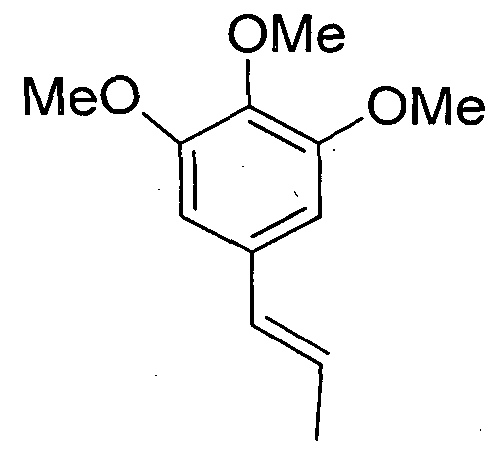
Colorless liquid; Yield: 33%; IR (neat): 1010, 1126, 1238, 1273, 1506, 1582 1692, 2838, 2938 cm'1. 1H NMR (200 MHz, CDC13) : δ 1.87 (d, J= 6 Hz, 3H), 3.83 (s, 3H), 3.86 (s, 6H), 6.13 (dq, J = 16, 6 Ηζ,ΙΗ), 6.33 (d, J = 16 Hz, 1H), 6.55 (s, 2H). 13C NMR (50 MHz, CDCI3): δ 18.0, 55.6 (2C), 60.5, 102.4 (2C), 124.8, 130.6, 133.4, 136.7, 152.9 (2C).
Example 8:
(E)-5-(Dodec-l-en-l-yl)-l,2,3-trimethoxybenzene (1-h)

This compound was prepared from 3,4,5-trimethoxybenzaldehyde and dodecyl aldehyde following the procedure similar to the one described in Example 1.
Colorless liquid; Yield: 51%; IR (chloroform): 1 130, 1215, 1326, 1464, 1583, 2855, 2928, 3019 cm'1. 1H NMR (200 MHz, CDC13): δ 0.89 (t, J = 7 Hz, 3H), 1.20-1.52 (m, 16H), 2.20 (q, 7 Hz, 2H), 3.84 (s, 3H), 3.88 (s, 6H), 6.14 (dt, J= 16, 7 Hz, 1H), 6.32 (d, 16 Hz, 1H), 6.58 (s, 2H).
Example 9:
(£)-l-Nitro-4-(prop-l-en-l-yI) benzene (1-i)

This compound was prepared from 4-nitrobenzaldehyde and propionaldehyde following the procedure similar to the one described in Example 1.
Yellow solid; Yield: 22%; IR (chloroform): 1047, 1243, 1346, 1520, 1596, 1655, 2985, 3024 cm'1 . 1H NMR (200 MHz, CDC13): δ 1.85-2.05 (m, 3H), 6.36-6.58 (m, 2H), 7.44 (d, J= 8Hz,
2H), 8.16 (d, J = 8Hz, 2H); 13C NMR (50 MHz, CDC13): δ 18.5, 123.7 (2C), 126.0 (2C), 129.2, 131.1, 144.2, 146.1.
Example 10:
(E)-l-(Hex-l-en-l-yl)-4-nitrobenzene (1-j)

This compound was prepared from 4-nitrobenzaldehyde and hexyl aldehyde following the procedure similar to the one described in Example 1.
Yellowish semisolid; Yield: 37%; IR (chloroform): 1339, 1512, 1597, 2928 cm"1. 1H NMR (200 MHz, CDC13): δ 0.94 (t, J = 6Hz, 3H), 1.30-1.55 (m, 4H), 2.20-2.34 (m, 2H), 6.40-6.48 (m, 2H), 7.45 (d, J = 8Hz, 2H), 8.15 (d, J = 8Hz, 2H). 13C NMR (50 MHz, CDC13): δ 13.7, 22.1, 30.9, 32.7, 123.7 (2C), 126.1 (2C), 127.8, 136.5, 144.3, 146.1.
Example 11:
(E)-l-(Dodec-l-en-l-yl)-4-nitrobenzene (1-k)

This compound was prepared from 4-nitrobenzaldehyde and dodecyl aldehyde following procedure similar to the one described in Example 1.
Pale yellow low melting solid; Yield: 52 %; IR (chloroform): 967, 1 109, 1342, 1465, 1518, 1597, 1649, 2854, 2925 cm"1. 1H NMR (200 MHz, CDC13): S 0.88 (t, J = 6 Hz, 3H), 1.24- 1.40 (m, 16H), 2.21-2.32 (m, 2H), 6.42-6.48 (m, 2H), 7.46 (d, J = 8Hz, 2H), 8.16 (d, J = 8Hz, 2H). I3C MR: (50 MHz, CDC13): δ 14.0, 22.6, 28.9, 29.1, 29.2, 29.4, 29.5 (2C), 31.8, 33.1, 123.8 (2C), 126.2 (2C), 127.9, 136.6, 144.3, 146.2.
Example 12:
(jE)-4-(Prop-l-en-l-yl) benzonitrile (1-1)

This compound was prepared from 4-cyanobenzaldehyde and propionaldehyde following the procedure similar to the one described in Example 1.
Colorless liquid; Yield: 24%; IR (chloroform): 966, 1445, 1501 , 1604, 1652, 2224, 2853, 2965, 3026 cm"1.
lH NMR (200 MHz, CDC13): δ 1.93 (d, J = 5Hz, 3H), 6.29-6.51 (m, 2H), 7.39 (d, J = 8Hz, 2H), 7.57 (d, J = 8Hz, 2H); 13C NMR (50 MHz, CDC13): δ 18.4, 109.6, 118.9, 126.0 (2C), 129.5, 130.0, 132.1 (2C), 142.1.
Example 13:
(E)-4-(Hex-l-en-l-yl) benzonitrile (1-m)

This compound was prepared from 4-cyanobenzaldehyde and hexyl aldehyde following the procedure similar to the one described in Example 1.
Colorless liquid; Yield: 56%;
IR (Chloroform): 968, 1503, 1605, 1650, 2225, 2859, 2958 cm" \
Ή NMR (200MHz, CDC13): δ 0.93· (t, J = 6Hz, 3H), 1.25-1.54 (m, 4H), 2.19-2.32 (m, 2H), 6.29-6.48(m, 2H), 7.41(d, J = 8Hz, 2H), 7.57(d, J = 8Hz, 2H). 13C NMR (50 MHz, CDC13): S 13.7, 22.1 , 31.0, 32.6, 109.7, 1 19.0, 126.2 (2C), 128.2, 132.1 (2C), 135.4, 142.3.
Example 14:
(E)-4-(Dodec-l-en-l-yl) benzonitrile (1-n)

This compound was prepared from 4-cyanobenzaldehyde and dodecyl aldehyde following the procedure similar to the one described in Example 1.
Low melting solid; Yield: 31%; IR (chloroform): 758, 1520, 1605, 2227, 2855, 2928, 3020 cm'MH NMR (200 MHz, CDC13): δ 0.88 (t, J= 6Hz, 3H), 1.19-1.55 (m, 16H), 2.18-2.30 (m, 2H), 6.29-6.48 (m, 2H), 7.41 (d, J = 8Hz, 2H), 7.57 (d, J = 8Hz, 2H); t3C NMR (50 MHz, CDC13): S 14.0, 22.6, 28.9, 29.1, 29.2, 29.4, 29.5 (2C), 31.8, 33.0, 109.8, 1 19.1, 126.2 (2C), 128.3, 132.2 (2C), 135.5, 142.3. ,
Example 15:
(E)-l-(Allyloxy)-4-(prop-l-en-l-yl) benzene (l-o)

This compound was prepared from 4-allyloxybenzaldehyde and propionaldehyde following the procedure similar to the one described in Example 1.
Colorless low melting solid; Yield: 39 %; IR (chloroform): 787, 1022, 1 176, 1283, 1509, 1574, 1605, 1649, 2851 , 2959, 3021, 3087cm"1. lH NMR (200 MHz, CDCl3): δ 1.90 (d, J = 6Hz, 3H), 4.57 (d, J = 6Hz, 2H), 5.27-5.53 (m, 2H), 5.99-6.24 (m, 2H), 6.39 (d, J = 17Hz, 1H), 6.89 (d, J= 8Hz, 2H), 7.29 (d, J = 8Hz, 2H); 13C NMR (50 MHz, CDC13): 6 18.3, 68.5, 114.5 (2C), 1 17.3, 123.2, 126.7 (2C), 130.2, 130.7, 133.2, 157.4.
Example 16:
(E)-l-(Prop-l-en-l-yl)-4-(prop-2-yn-l-yIoxy) benzene (1-p)

This compound was prepared from 4-prop-2-yn- 1 -yloxybenzaldehyde and propionaldehyde following the procedure similar to the one described in Example 1.
White solid, Yield: 38%, IR (chloroform): 1023, 1279, 1508, 1604, 2131, 2923, 3273 cm"1 1H NMR (400 MHz, CDC13): δ 1.86 (d, J = 6 Hz, 3H), 2.53 (s,lH), 4.69 (s,2H), 6.09 -6.15 (m, 1H), 6.36 (d, J = 16 Ηζ,ΙΗ), 6.90 (d, J = 8 Hz, 2H), 7.28 (d, J = 8 Hz„ 2H); 13C NMR (100 MHz, CDCI3 ): δ 18.31, 55.7, 75.4, 78.5, 1 14.8 (2C), 123.9, 126.7 (2C), 130.1, 131.6, 156.3.
Example 17:
(E)-l-Methoxy-4-((4-(prop-l-en-l-yI) phenoxy) methyl) benzene (1-q)

This compound was prepared from 4-(methoxybenzyloxy) benzaldehyde propionaldehyde following the procedure similar to the one described in Example 1.
White solid; Yield: 42%; lH NMR (200 MHz, CDC13): δ 1.87 (dd, J = 6, 2 Hz, 3H), 3.83 (s, 3H), 4.99 (s, 2H), 6.10 ( dq, J = 16, 6 Hz, 1H), 6.35 (dd, J = 16, 2 Hz, 1H), 6.90 (d, J = 10 Hz, 2H ), 6.93 (d, J = 10 Hz, 2H), 7.26 (d, J = 10 Hz, 2H), 7.36 (d, J = 10 Hz, 2H); C13 NMR ( 50 MHz, CDC13) : δ 18.3, 55.1, 69.7, 1 13.9 (2C), 1 14.8 (2C), 123.4, 126.8 (2C), 128.9, 129.1 (2C), 130.2, 130.8, 157.7, 159.3.
Example 18:
(£ -9-(Prop-l-en-l-yl) anthracene ( -r)

This compound was prepared from anthracene-9-carboxaldehyde and propionaldehyde following the procedure similar to the one described in Example 1.
Colorless liquid; Yield: 18%; IR (chloroform): 1655, 2846, 2922, 3043 cm"1. * 1H NMR (200 MHz, CDCI3): δ 2.18 (d, J= 6 Hz, 3H), 6.06 (dq, J= 16, 6 Hz, 1H), 7.16 (d, J= 16 Hz, 1H), 7.42-7.52 (m, 4H), 7.98-8.05 (m, 2H), 8.31-8.45 (m, 3Η)÷
Example 19: (E)-4-Fluoro-l-(hept-l-en-l-yl) benzene 1-s)

This compound was prepared from 4-fluorobenzaldehyde and heptaldehyde following the procedure similar to the one described in Example 1.
Yield: 23%; 1H NMR (200 MHz, CDC13): δ 0.93 (t, J = 6 Hz, 3H), 1.25-1.53 (m, 6 H), 2.15- 2.27 (m, 2 H), 6. 15 (dt, J = 16, 6 Hz, 1H), 6.36 (d, J= 16 Hz, 1H), 6.93-7.06 (m, 2H), 7.27- 7.37 (m, 2H).
Example 20:
(E)-2,4-DichIoro-l-(hept-l-en-l-yl)benzene (1-t)

This compound was prepared from 2,4-dichlorobenzaldehyde and heptaldehyde following the procedure similar to the one described in Example 1.
Colorless liquid; Yield: 21%; IR (neat): 965, 1470, 1586 1649, 2855, 2926, 2961, 3038 cm'1; 1H NMR (200 MHz, CDC13): δ 0.92 (t, J = 6 Hz, 3H), 1.27-1.58 (m, 6 H), 2.21-2.32 (m, 2 H), 6. 21 (dt, J= 16, 6 Hz, 1H), 6.69 (d, J = 16 Hz, 1H), 7.18 (dd, J= 8, 2 Hz, 1H), 7.35 (d, J = 2 Hz, 1H), 7.43 (dd, J = 8, 2 Hz, 1H); 13C NMR (50 MHz, CDC13): δ 14.0, 22.5, 28.8, 31.4, 33.1, 124.9, 126.9, 127.2, 129.1, 132.5, 132.9, 134.5, 134.6.
Example 21: Preparation of (jE)-5-(hex-l-en-l-yI)-l,2,3-trimethoxybenzene (l-g)

To a mixture of 3,4,5-trimethoxybenzaldehyde (1.56 g, 0.008 mole), hexanal (1.0 g, 0.01 mole) and malononitrile (1.32 g, 0.02 mole), was added 50 ml of dioxan followed by the addition of glacial acetic acid (1.15 ml 0.02 mole). The reaction mixture was stirred for 10 min and then ammonium acetate (0.77 g, 0.01 mole) was added. The reaction was stirred at 75 °C for 14 h. The mixture was then diluted with water (100 ml) and extracted with ethyl acetate (3 x 50 ml). The combined organic layer was dried over sodium sulphate and concentrated on rotavapor and purified over silica using ethyl acetate-pet ether (3 % ethyl acetate in pet ether) as an eluent to give (E)-5-(hex-l-en-l-yl)-l,2,3-trimethoxybenzene as a colourless liquid (0.468 g, 22% ).
Example 22: Preparation of (E)-l,2,3-trimethoxy-5-(prop-l-en-l-yl)benzene (1-f)

A mixture of 3,4,5-trimethoxybenzaldehyde (1.34 g, 0.0069 mole), propionaldehyde (0.61 ml, 0.5 g, 0.0086 mol), malononitrile (1.13 g, 0.017 mole), acetonitrile (20 ml), ammonium formate (0.54 g, 0.0086 mol) and acetic acid (0.77 g, .012 mol) was stirred at 75 °C for 10 hr. It was then concentrated on rotavapor, diluted with water (50 ml), ethyl acetate (100 ml) was added and the shaken well. It was then filtered through Whatmann filter paper and the filtrate
was taken in separating funnel to separate the layers. The organic layer was concentrated and purified by column chromatography to get the product (355 mg, 25%).
Example 23: Preparation of (E)-5-(hex-l-en-l-yl)-l,2,3-trimethoxybenzene (1-g)

To a mixture of 3,4,5-trimethoxybenzaldehyde (0.470 g, 2.4 mmol), hexanal (0.3 g, 3 mmol) and malononitrile (0.396 g, 6 mmol), was added 10 ml of acetonitrile followed by the addition of L-proline (0.517 g, 4.5 mmol). The reaction mixture was stirred for 10 min and then ammonium acetate (0.231 g, 3 mmol) was added. The reaction was stirred at 80 °C for 8 h. The mixture was then allowed to come to room temperature, filtered through Whatman filter paper and the filtrate was concentrated on rotavapor. The residual oil was then partitioned between water and ethyl acetate and the organic extract was dried over sodium sulfate, concentrated and purified over silica gel using ethyl acetate: pet ether (3% ethyl acetate in pet ether) as an eluent to give (E)-5-(hex-l-en-l- yl)-l ,2,3-trimethoxybenzene as a colourless liquid (0.350 g, 58%).
Example 24: Preparation of (£)-l-(hex-l-en-l-yl)-4-nitrobenzene

To a mixture of 4-nitrobenzaldehyde (0.362 g, 2.4 mmol), hexanal (0.3 g, 3 mmol) and malononitrile (0.396 g, 6 mmol), was added 10 ml of acetonitrile followed by the addition of β-alanine (0.667 g, 7.5 mmol). The reaction mixture was stirred for 10 min and then ammonium acetate (0.392 g, 5.1 mmol) was added. The reaction was stirred at 80 °C for 8 h. The mixture was then allowed to come to room temperature, filtered through Whatman filter paper and the filtrate was concentrated on rotavapor. The residual oil was then partitioned between water and ethyl acetate and the organic extract was dried over sodium sulfate, concentrated and purified over silica gel using ethyl acetate : pet ether (3% ethyl acetate in
pet ether) as an eluent to give (E)-l-(hex-l-enyl)-4-nitrobenzene as a colourless liquid (0.238 g, 48%).
Example 25: Preparation of f£ -4-Fluoro-l-(hept-l-en-l-yl)benzeiie (1-s)

To a mixture of 4-fluorobenzaldehyde (0.870 g, 7 mmol), heptanal (1 g, 8.7 mmol) and malononitrile (1.157 g, 17.5 mmol), acetic acid (0.789 g, 13 mmol) was added. The reaction mixture was stirred for 10 min and then ammonium acetate (0.675 g, 8.7 mmol) was added. The reaction was stirred at 80°C for 12 h. The mixture was then allowed to come to room temperature and diluted with ethyl acetate, then filtered through Whatman filter paper and the filtrate was extracted with water and the organic extract was dried over sodium sulfate, concentrated and purified over silica gel using ethyl acetate: pet ether (3% ethyl acetate in pet ether) as an eluent to give (E)-l-fluoro-4-(hept-l -enyl) benzene as a colourless liquid (0.310 g, 23%).
Example 26: (£)-4-(Hept-l-e -l-yl)-l-methoxybenzene (1-u)

To a mixture of 4-methoxybenzaldehyde (0.286 g, 2.1 mmol), heptanal (0.300 g, 2.6 mmol) and malononitrile (0.347 g, 5.2 mmol), was added 15 ml of dimethylformamide followed by the addition of glacial acetic acid (0.22 ml, 3.9 mmol). The reaction mixture was stirred for 10 minutes and then ammonium acetate (0.202 g, 2.6 mmol) was added. The reaction mixture was stirred at 80 °C for 8 h. The reaction was then allowed to come to room temperature, filtered through Whatman filter paper and the filtrate was concentrated on rotavapor. The residual oil was partionated between water and ethyl acetate and the organic extract was dried over sodium sulphate, concentrated and purified over silica gel using ethyl acetate-pet ether (3 % ethyl acetate in pet ether) as an eluent to give (E)-4-(hept-l-en-l-yl)-l-methoxybenzene as yellowish liquid (0.087 g, 20%).
Example 27: Preparation of (E)-l-methoxy-4-(prop-l-en-l-yl) benzene (1-a)

To a mixture of 4-methoxybenzaldehyde (1.87 g, 13 mmol), propanal (1 g, 17 mmol) and malononitrile (2.27 g, 34 mmol), was added 25 ml of ethanol followed by the addition of glacial acetic acid (1.4 ml, 25 mmol). The reaction mixture was stirred for 10 min and then ammonium acetate (1.32 g, 17 mmol) was added. The reaction mixture was stirred at 80 °C for 8 h. The mixture was then allowed to come to room temperature, filtered through Whatman filter paper and the filtrate was concentrated on rotavapor. The residual oil was partitioned between water and ethyl acetate and the organic extract was dried over sodium sulphate, concentrated and purified over silica gel using ethyl acetate-pet ether (3 % ethyl acetate in pet ether) as an eluent to give (E)-l-methoxy-4-(prop-l-en-l-yl) benzene as colourless liquid (0.095 g, 10%).
Example 28: Preparation of (E)-l-methoxy-4-(prop-l-en-l-yl)benzene (1-a)

To a mixture of 4-methoxybenzaldehyde (0.563 g, 4.14 mmol), propanal (0.3 g, 5.17 mmol) and malononitrile (0.682 g, 10.34 mmol), was added 10 ml of N,N-dimethylformamide followed by the addition of formic acid (0.356 g, 7.76 mmol). The reaction mixture was stirred for 10 min and then ammonium acetate (0.398 g, 5.17 mmol) was added. The reaction was stirred at 80 °C for 8 h. The mixture was then allowed to come to room temperature, filtered through Whatman filter paper and the filtrate was concentrated on rotavapor. The residual oil was then partitioned between water and ethyl acetate and the organic extract was dried over sodium sulfate, concentrated and purified over silica gel using ethyl acetate; pet ether (3% ethyl acetate in pet ether) as an eluent to give (E)-l-methoxy-4-(prop-l-en-l - yl)benzene as a colourless liquid (0.170 g, 24%).
Example 29: Preparation of (E)-l-methoxy-4-(prop-l-en-l-yl) benzene (1-a)

To a mixture of 4-methoxybenzaldehyde (0.563 g, 4 mmol), propanal (0.3 g, 5 mmol) and malononitrile (0.682 g, 10 mmol), was added 10 ml of N,N-dimethylformamide followed by the addition of propanoic acid (0.574 g, 7.76 mmol). The reaction mixture was stirred for 10 min and then ammonium acetate (0.398 g, 5.17 mmol) was added. The reaction was stirred at 80 °C for 8 h. The mixture was then allowed to come to room temperature, filtered through Whatman filter paper and the filtrate was concentrated on rotavapor. The residual oil was then partitioned between water and ethyl acetate and the organic extract was dried over sodium sulfate, concentrated and purified over silica gel using ethyl acetate: pet ether (3% ethyl acetate in pet ether) as an eluent to give (E)-l-methoxy-4-(prop-l-en-l-yl)benzene as a colourless liquid (0.133 g, 21%).
Example 30: Preparation of (£)-l-methoxy-4-(prop-l-en-l-yI)benzene (1-a)

To a mixture of 4-methoxybenzaldehyde (0.937 g, 6.8 mmol), propanal (0.500 g, 8 mmol) and malononitrile (1.13 g, 17 mmol), was added 15 ml of dimethylformamide. The reaction mixture was stirred for 10 min and then morpholine (0.748 g, 8.6 mmol) was added. The reaction mixture was kept in microwave for 10 minutes. The mixture was then filtered through Whatman filter paper and the filtrate was concentrated on rotavapor. The residual oil was partitioned between water and ethyl acetate and the organic extract was dried over sodium sulphate, concentrated and purified over silica gel using ethyl acetate-pet ether (3 % ethyl acetate in pet ether) as an eluent to give (E)-l-methoxy-4-(prop-l-en-l-yl)benzene as colourless liquid (0.220 g, 21%).
It will be evident to those skilled in the art that the invention is not limited to the details of the foregoing illustrative examples and that the present invention may be embodied in other specific forms without departing from the essential attributes thereof, and it is therefore desired that the present embodiments and examples be considered in all respects as illustrative and not restrictive, reference being made to the appended claims, rather than to the foregoing description, and all changes which come within the meaning and range of equivalency of the claims are therefore intended to be embraced therein.
ADVANTAGES OF INVENTION: The process of the invention yields aryl olefins of Formula- 1 that can serve as intermediates for many other compounds having biological activity.
The present invention does not use inert atmosphere, dry solvents, and cryogenic conditions. In the instant process the hazardous chemicals and strong bases are avoided and the easily available starting materials lead to aryl olefins in single step with a variety of substituent with good yield and trans selectivity. Additionally the desired aryl olefins can be easily separated from other products formed.
Claims
1. A single-step process for the synthesis of aryl olefins of Formula 1, wherein the process comprising the step of reacting of aryl aldehydes with alkyl aldehydes, at temperature ranging between -10 tol 50°C in presence of malononitrile and acid or base or salt,

Formula 1
wherein 'Ar' is selected from the group consisting of (un)substituted phenyl, naphthyl, anthracenyl or heteroaryl ring, substituted with (un)protected hydroxyl group, halogen selected from the group consisting of fluorine, chlorine, bromine and iodine, nitro or cyano group, linear or branched chain of 1 to 20 carbon atoms;
n=0-20 and;
'R1 and 'R may be same or different and independently selected from the group consisting of hydrogen alkyl group of linear or branched chain of 1 to 20 carbon atoms optionally substituted with aryl group, alkoxy group -OR (wherein R= alkyl group with 1 to 4 carbon atoms), hydroxyl group, halogen selected from fluorine, chlorine, bromine and iodine, nitro or (un)substituted amino group.
2. The single-step process according to claim 1 , wherein the process is optionally carried out in presence of organic solvent selected from the group consisting of acetonitrile, dimethyl formamide, 1,4-dioxane, ethanol, methanol, dimethyl sulfoxide, toluene or combinations thereof, preferably solvent is acetonitrile.
3. The single-step process according to claim 1 , wherein the aryl aldehyde is selected from the group consisting of 3,4,5-trimethoxybenzaldehyde, anisaldehyde, 1 -naphthaldehyde, thiophene-2-carboxaldehyde, 4-nitrobenzaldehyde, 4-cyanobenzaldehyde, 4-allyloxy benzaldehyde, 4-prop-2-yn-l-yloxybenzaldehyde, 4-(methoxybenzyloxy) benzaldehyde, anthracene-9-carboxaldehyde, 4-fluorobenzaldehyde, 2,4-dichlorobenzaldehyde, and 4- methoxybenzaldehyde .
4. The single-step process according to claim 1, wherein the molar concentration of . aryl aldehyde is in the range of 2-15 mmole.
5. The single-step process according to claim 1, wherein the alkyl aldehyde or aliphatic aldehyde is selected from the group consisting of propanal, hexanal, heptanal, octanal, dodecyl aldehyde.
6. The single-step process according to claim 1, wherein the molar concentration of alkyl aldehyde is in the range of 2-20 mmole.
7. The single-step process according to claim 1, wherein the molar ratio of aryl aldehyde to alkyl aldehyde is in the range of 1 : 1.0 to 1 : 1.6.
8. The single-step process according to claim 1, wherein the acid is selected from the group consisting of acetic acid, propionic acid, formic acid, p-toluenesulfonic acid, hydrochloric acid, proline, alanine.
9. The single-step process according to claim 1 , wherein the base is selected from the group consisting of morpholine, triethyl amine, pyrrolidine, piperidine, pyridine, potassium carbonate, potassium hydroxide, sodium methoxide, and the salt is selected from the group consisting of ammonium acetate, ammonium formate.
10. The single-step process according to claim 1, wherein the acid or base or salt is present either alone or combination thereof.
11. The single-step process according to claim 10, wherein the acid-base/salt combination is acetic acid and ammonium acetate.
12. The single-step process according to- claim 10, wherein the molar ratio of acid and base/salt combination used in the reaction is between 1 : 1 to 2: 1.
13. The single-step process according to claim 1 , wherein the molar concentration of malononitrile ranges from 3 to 40 mmole, preferably 5 to 35 mmole.
14. The single-step process according to claim 1, wherein the aryl olefin compounds of Formula- 1, are selected from the group consisting of;
(E)-l-methoxy-4-(prop-l-en-l-yl)benzene ( 1-a);
(E)- 1 -(hex- 1 -en- 1 -yl)-4-methoxybenzene (1-b);
(E)-l-(dodec-l-en-l-yl)-4-methoxybenzene (1-c);
(E)- 1 -(prop- 1 -en- 1 -yl)naphthalene (1-d);
(E)-2-(dodec- 1 -en- 1 -yl)thiophene (1 -e) ;
(E)-l,2,3-trimethoxy-5-(prop-l-en-l-yl)benzene (1-f);
(E)-5-(hex- 1 -en- 1 -yl)- 1 ,2,3-trimethoxybenzene(l-g);
(E)-5-(dodec-l-en-l-yl)-l ,2,3-trimethoxybenzene (1-h);
(E)-l-nitro-4-(prop-l-en-l-yl) benzene (1-i);
(E)-l-(hex-l-en- l -yl)-4-nitrobenzene (1-j);
(E)- 1 -(dodec- 1 -en- 1 -yl)-4-nitrobenzene (1-k);
(E)-4-(prop-l -en-l -yl) benzonitrile (1-1);
(E)-4-(hex-l -en-l -yl) benzonitrile (1-m);
(E)-4-(dodec- 1 -en- 1-yl) benzonitrile (1-n);
(E)-l-(allyloxy)-4-(prop-l -en-l-yl) benzene (l-o);
(E)-l -(prop- l -en-l -yl)-4-(prop-2-yn-l-yloxy) benzene (1-p);
(E)- 1 -methoxy-4-((4-(prop- 1 -en- 1 -yl)phenoxy)methyl) benzene (1-q);
(E)-9-(prop-l -en-l -yl)anthracene (1-r);
(E)-4-fluoro- l -(hept-l -en- 1-yl) benzene (1-s);
(E)-2,4-dichloro- l -(hept- l -en-l-yl)benzene (1-t);
(E)-4-(hept- 1 -en- 1 -yl)- 1 -methoxybenzene (1-u)
15. Novel aryl olefin compounds of formula- 1 , are selected from, the group consisting of

(E)-5-(dodec- 1 -en-1 -yl)- 1 ,2,3-trimethoxybenzene [1-h],
(E)- 1 -(dodec- 1 -en- 1 -yl)-4-nitrobenzene [1-k],
(£)-4-(dodec- 1 -en- 1 -yl)benzonitrile [1-n],
(E)- 1 -(prop- 1 -en- 1 -yl)-4-(prop-2-yn- 1 -yloxy)benzene [l-i
(E)-2,4-dichloro- 1 -(hept- 1 -en- 1 -yl)benzene [1-t] .
Applications Claiming Priority (2)
| Application Number | Priority Date | Filing Date | Title |
|---|---|---|---|
| IN3486DE2012 | 2012-11-09 | ||
| IN3486/DEL/2012 | 2012-11-09 |
Publications (1)
| Publication Number | Publication Date |
|---|---|
| WO2014073003A1 true WO2014073003A1 (en) | 2014-05-15 |
Family
ID=49883172
Family Applications (1)
| Application Number | Title | Priority Date | Filing Date |
|---|---|---|---|
| PCT/IN2013/000688 Ceased WO2014073003A1 (en) | 2012-11-09 | 2013-11-08 | Single-step process for the preparation of aryl olefins |
Country Status (1)
| Country | Link |
|---|---|
| WO (1) | WO2014073003A1 (en) |
Cited By (4)
| Publication number | Priority date | Publication date | Assignee | Title |
|---|---|---|---|---|
| CN111253207A (en) * | 2020-03-05 | 2020-06-09 | 苏州大学 | Preparation method of visible light catalyzed double-chlorine addition product of aromatic olefin |
| CN114195610A (en) * | 2022-01-05 | 2022-03-18 | 海南大学 | Synthetic method of E-type internal olefin compound |
| CN116655459A (en) * | 2023-05-30 | 2023-08-29 | 河南大学 | Synthetic method for selectively synthesizing 4-aryl-2-hexanone |
| WO2024184360A1 (en) | 2023-03-07 | 2024-09-12 | Givaudan Sa | Fragrance precursors |
Citations (3)
| Publication number | Priority date | Publication date | Assignee | Title |
|---|---|---|---|---|
| US3674884A (en) | 1967-08-04 | 1972-07-04 | Ube Industries | Process for the preparation of aromatic hydrocarbons containing monoethylenic unsaturated radicals |
| US4965361A (en) | 1989-02-27 | 1990-10-23 | Eastman Kodak Company | Preparation of 4-substituted aryl olefins |
| US7282618B2 (en) | 2000-12-13 | 2007-10-16 | Yeda Research And Development Co., Ltd. | Method for the production of aryl alkenes |
-
2013
- 2013-11-08 WO PCT/IN2013/000688 patent/WO2014073003A1/en not_active Ceased
Patent Citations (3)
| Publication number | Priority date | Publication date | Assignee | Title |
|---|---|---|---|---|
| US3674884A (en) | 1967-08-04 | 1972-07-04 | Ube Industries | Process for the preparation of aromatic hydrocarbons containing monoethylenic unsaturated radicals |
| US4965361A (en) | 1989-02-27 | 1990-10-23 | Eastman Kodak Company | Preparation of 4-substituted aryl olefins |
| US7282618B2 (en) | 2000-12-13 | 2007-10-16 | Yeda Research And Development Co., Ltd. | Method for the production of aryl alkenes |
Non-Patent Citations (19)
| Title |
|---|
| ALEXANDER, CANADIAN JOURNAL OF CHEMISTRY, vol. 43, 1965, pages 3437 |
| B. GREEN ET AL: "Unusual Knoevenagel condensations of 16a-substituted-16-methylene-17-keto-steroids", TETRAHEDRON, vol. 32, no. 24, 1 January 1976 (1976-01-01), pages 2997 - 3001, XP055104545, ISSN: 0040-4020, DOI: 10.1016/0040-4020(76)80158-5 * |
| DANIELA MIRK ET AL., SYNLETT, vol. 8, 2006, pages 1255 - 1259 |
| E. PEYROUX ET AL., EUR. J ORG. CHEM., 2004, pages 1075 |
| FELIPE GÁNDARA ET AL: "Two-Dimensional Hybrid Germanium Zeotype Formed by Selective Coordination of the trans -1,2-Diaminocyclohexane Isomer to the Ge Atom: Heterogeneous Acid-Base Bifunctional Catalyst", INORGANIC CHEMISTRY, vol. 47, no. 15, 1 August 2008 (2008-08-01), pages 6791 - 6795, XP055104207, ISSN: 0020-1669, DOI: 10.1021/ic8004097 * |
| H. B. BORATE ET AL., TETRAHEDRON LETT., vol. 52, 2011, pages 5491 - 5493 |
| HANUMANT B. BORATE ET AL: "One-step method for the synthesis of aryl olefins from aryl aldehydes and aliphatic aldehydes", TETRAHEDRON LETTERS, vol. 54, no. 12, 1 March 2013 (2013-03-01), pages 1528 - 1530, XP055103874, ISSN: 0040-4039, DOI: 10.1016/j.tetlet.2013.01.008 * |
| J.-X. WANG ET AL., SYNTHESIS, 2003, pages 1506 - 1510 |
| JANUSZ POPLAWSKI ET AL: "Synthesis and Hypolipidemic and Antiplatelet Activities of [alpha]-Asarone Isomers in Humans (in Vitro), Mice (in Vivo), and Rats (in Vivo)", JOURNAL OF MEDICINAL CHEMISTRY, vol. 43, no. 20, 1 October 2000 (2000-10-01), pages 3671 - 3676, XP055104555, ISSN: 0022-2623, DOI: 10.1021/jm000905n * |
| JANUSZ POPLAWSKI, J. MED. CHEM., vol. 43, no. 20, 2000, pages 3671 - 3676 |
| LIU J-T ET AL: "One-pot synthesis of trans-beta-alkylstyrenes", TETRAHEDRON LETTERS, PERGAMON, GB, vol. 42, no. 35, 27 August 2001 (2001-08-27), pages 6147 - 6150, XP004298202, ISSN: 0040-4039, DOI: 10.1016/S0040-4039(01)01185-6 * |
| MANGOLD; HANNA, J. MED CHEM, vol. 25, 1982, pages 630 |
| MAYER ET AL., CHEMCATCHEM, vol. 3, 2011, pages 1567 |
| QI-XIONG CHEN, BIOLOGICAL & PHARMACEUTICAL BULLETIN, October 2012 (2012-10-01) |
| SANGMESHWER P SAWARGAVE ET AL: "One-step synthesis of 4-alkyl-3-aryl-2,6-dicyanoanilines and their use in the synthesis of highly functionalized 2,3,5,6,7- and 2,3,4,5,7-substituted indoles", TETRAHEDRON LETTERS, PERGAMON, GB, vol. 52, no. 42, 10 August 2011 (2011-08-10), pages 5491 - 5493, XP028293801, ISSN: 0040-4039, [retrieved on 20110818], DOI: 10.1016/J.TETLET.2011.08.064 * |
| SHARMA ET AL., BULL CHEM SOC JPN, vol. 77, 2004, pages 2231 |
| TUNTIWACHWUTTIKUL ET AL., PHYTOCHEMISTRY, vol. 20, 1981, pages 1164 |
| XIE; WANG, CHEM EUR J, vol. 17, 2011, pages 4972 |
| ZHANG ET AL., SYNLETT, vol. 23, 2012, pages 1221 - 1224 |
Cited By (6)
| Publication number | Priority date | Publication date | Assignee | Title |
|---|---|---|---|---|
| CN111253207A (en) * | 2020-03-05 | 2020-06-09 | 苏州大学 | Preparation method of visible light catalyzed double-chlorine addition product of aromatic olefin |
| CN111253207B (en) * | 2020-03-05 | 2022-04-01 | 苏州大学 | Preparation method of visible light catalyzed double-chlorine addition product of aromatic olefin |
| CN114195610A (en) * | 2022-01-05 | 2022-03-18 | 海南大学 | Synthetic method of E-type internal olefin compound |
| WO2024184360A1 (en) | 2023-03-07 | 2024-09-12 | Givaudan Sa | Fragrance precursors |
| CN116655459A (en) * | 2023-05-30 | 2023-08-29 | 河南大学 | Synthetic method for selectively synthesizing 4-aryl-2-hexanone |
| CN116655459B (en) * | 2023-05-30 | 2025-05-09 | 河南大学 | Synthetic method for selectively synthesizing 4-aryl-2-hexanone |
Similar Documents
| Publication | Publication Date | Title |
|---|---|---|
| Xu et al. | Palladium-catalyzed direct ortho-ethoxycarbonylation of azobenzenes and azoxybenzenes with diethyl azodicarboxylate | |
| Si et al. | Efficient cross-coupling of aryl/alkenyl triflates with acyclic secondary alkylboronic acids | |
| Lu et al. | Pd-Catalyzed decarboxylative cross-coupling reactions of epoxides with α, β-unsaturated carboxylic acids | |
| WO2014073003A1 (en) | Single-step process for the preparation of aryl olefins | |
| HUT75179A (en) | Process for the preparation of 2-(methoxy-imino)-2-aryl-acetic ester derivatives via palladium-catalyzed cross coupling reaction, boron acides intermediates thereof and use of the latter | |
| CN105732249A (en) | Synthesis method of aryl alcohol compound and Escitalopram | |
| KR20170081189A (en) | Method for producing biphenylamines from azobenzoles by ruthenium catalysis | |
| TWI399363B (en) | Process | |
| JP2012188414A (en) | Improvement of method for preparing 1-(6-methylpyridin-3-yl)-2-[4-(methylsulfonyl)phenyl]ethanone, intermediate of etoricoxib | |
| Lin et al. | Synthesis of esters from aldehydes or carboxylic acids with dichloromethane, dichloroethane or dichloropropane under mild conditions | |
| CN105646416A (en) | Method for synthesizing 2,3-dihydrobenzofuran derivative under catalysis of palladium | |
| JP2004535443A (en) | Zirconium-catalyzed hydroxylation of β-dicarbonyl | |
| CN104591959A (en) | Preparation method of toluylene compounds | |
| CN109320503B (en) | Metal-free one-pot synthesis method of benzimidazole alkynamines | |
| JP2005008633A (en) | Method for producing fluorine-containing acetophenone and use of the same | |
| KR101109942B1 (en) | Method for producing aromatic unsaturated compound | |
| CN106946641A (en) | A kind of method for preparing trans diphenylethlene class compound | |
| Ponra et al. | Practical synthesis of polysubstituted naphthalene derivatives via HNTf2-catalyzed benzannulation reaction | |
| KR20060136357A (en) | Method for producing aromatic unsaturated compound | |
| CN106795080A (en) | Process for the preparation of halogenated trifluoroacetophenones | |
| Zhao | Studies in Radical-Mediated Trifluoromethyl-Difunctionalization Reactions | |
| JP4257977B2 (en) | 1-Indanone production method | |
| CN106146306B (en) | Utilize the method for tertiary amine organic micromolecule synthesis axial chirality biaryl hydrocarbon compound | |
| KR101214005B1 (en) | Novel indene derivatives and its preparation method | |
| JP4147302B2 (en) | 1-Indanone production method |
Legal Events
| Date | Code | Title | Description |
|---|---|---|---|
| 121 | Ep: the epo has been informed by wipo that ep was designated in this application |
Ref document number: 13814242 Country of ref document: EP Kind code of ref document: A1 |
|
| NENP | Non-entry into the national phase |
Ref country code: DE |
|
| 122 | Ep: pct application non-entry in european phase |
Ref document number: 13814242 Country of ref document: EP Kind code of ref document: A1 |