WO2014072903A1 - Novel aminomethyl-phenol derivatives as antimalarial agents - Google Patents
Novel aminomethyl-phenol derivatives as antimalarial agents Download PDFInfo
- Publication number
- WO2014072903A1 WO2014072903A1 PCT/IB2013/059913 IB2013059913W WO2014072903A1 WO 2014072903 A1 WO2014072903 A1 WO 2014072903A1 IB 2013059913 W IB2013059913 W IB 2013059913W WO 2014072903 A1 WO2014072903 A1 WO 2014072903A1
- Authority
- WO
- WIPO (PCT)
- Prior art keywords
- dipropylaminomethyl
- ylamino
- pyridin
- hydroxy
- benzyl
- Prior art date
- Legal status (The legal status is an assumption and is not a legal conclusion. Google has not performed a legal analysis and makes no representation as to the accuracy of the status listed.)
- Ceased
Links
- 0 COc1c(C*)cccc1* Chemical compound COc1c(C*)cccc1* 0.000 description 10
- KVIZYCBDCWXNOQ-UHFFFAOYSA-N CC(NCc(cc1)ccc1O)=O Chemical compound CC(NCc(cc1)ccc1O)=O KVIZYCBDCWXNOQ-UHFFFAOYSA-N 0.000 description 1
- ADGRYYARNGJCIR-UHFFFAOYSA-N CS(c1nccc(-c(cc2)ccc2Cl)n1)(=O)=O Chemical compound CS(c1nccc(-c(cc2)ccc2Cl)n1)(=O)=O ADGRYYARNGJCIR-UHFFFAOYSA-N 0.000 description 1
- GOXDPARPMAHJSL-UHFFFAOYSA-N CSc1nccc(-c(cc2)ccc2Cl)n1 Chemical compound CSc1nccc(-c(cc2)ccc2Cl)n1 GOXDPARPMAHJSL-UHFFFAOYSA-N 0.000 description 1
- UCERVHYBSTYCQS-UHFFFAOYSA-N Cc1nc(SC)ncc1 Chemical compound Cc1nc(SC)ncc1 UCERVHYBSTYCQS-UHFFFAOYSA-N 0.000 description 1
- XQXPVVBIMDBYFF-UHFFFAOYSA-N OC(Cc(cc1)ccc1O)=O Chemical compound OC(Cc(cc1)ccc1O)=O XQXPVVBIMDBYFF-UHFFFAOYSA-N 0.000 description 1
- WBESFPHVVMNRPE-UHFFFAOYSA-N Oc1ccc(CC(OCC(c(cc2)ccc2Br)=O)=O)cc1 Chemical compound Oc1ccc(CC(OCC(c(cc2)ccc2Br)=O)=O)cc1 WBESFPHVVMNRPE-UHFFFAOYSA-N 0.000 description 1
- NBJNIMFMEPEGDN-UHFFFAOYSA-N Oc1ccc(Cc2nc(-c(cc3)ccc3Br)c[nH]2)cc1 Chemical compound Oc1ccc(Cc2nc(-c(cc3)ccc3Br)c[nH]2)cc1 NBJNIMFMEPEGDN-UHFFFAOYSA-N 0.000 description 1
Classifications
-
- C—CHEMISTRY; METALLURGY
- C07—ORGANIC CHEMISTRY
- C07C—ACYCLIC OR CARBOCYCLIC COMPOUNDS
- C07C237/00—Carboxylic acid amides, the carbon skeleton of the acid part being further substituted by amino groups
- C07C237/28—Carboxylic acid amides, the carbon skeleton of the acid part being further substituted by amino groups having the carbon atom of at least one of the carboxamide groups bound to a carbon atom of a non-condensed six-membered aromatic ring of the carbon skeleton
- C07C237/34—Carboxylic acid amides, the carbon skeleton of the acid part being further substituted by amino groups having the carbon atom of at least one of the carboxamide groups bound to a carbon atom of a non-condensed six-membered aromatic ring of the carbon skeleton having the nitrogen atom of the carboxamide group bound to an acyclic carbon atom of a hydrocarbon radical substituted by nitrogen atoms not being part of nitro or nitroso groups
-
- A—HUMAN NECESSITIES
- A61—MEDICAL OR VETERINARY SCIENCE; HYGIENE
- A61P—SPECIFIC THERAPEUTIC ACTIVITY OF CHEMICAL COMPOUNDS OR MEDICINAL PREPARATIONS
- A61P33/00—Antiparasitic agents
- A61P33/02—Antiprotozoals, e.g. for leishmaniasis, trichomoniasis, toxoplasmosis
- A61P33/06—Antimalarials
-
- C—CHEMISTRY; METALLURGY
- C07—ORGANIC CHEMISTRY
- C07D—HETEROCYCLIC COMPOUNDS
- C07D205/00—Heterocyclic compounds containing four-membered rings with one nitrogen atom as the only ring hetero atom
- C07D205/02—Heterocyclic compounds containing four-membered rings with one nitrogen atom as the only ring hetero atom not condensed with other rings
- C07D205/04—Heterocyclic compounds containing four-membered rings with one nitrogen atom as the only ring hetero atom not condensed with other rings having no double bonds between ring members or between ring members and non-ring members
-
- C—CHEMISTRY; METALLURGY
- C07—ORGANIC CHEMISTRY
- C07D—HETEROCYCLIC COMPOUNDS
- C07D211/00—Heterocyclic compounds containing hydrogenated pyridine rings, not condensed with other rings
- C07D211/04—Heterocyclic compounds containing hydrogenated pyridine rings, not condensed with other rings with only hydrogen or carbon atoms directly attached to the ring nitrogen atom
- C07D211/06—Heterocyclic compounds containing hydrogenated pyridine rings, not condensed with other rings with only hydrogen or carbon atoms directly attached to the ring nitrogen atom having no double bonds between ring members or between ring members and non-ring members
- C07D211/36—Heterocyclic compounds containing hydrogenated pyridine rings, not condensed with other rings with only hydrogen or carbon atoms directly attached to the ring nitrogen atom having no double bonds between ring members or between ring members and non-ring members with hetero atoms or with carbon atoms having three bonds to hetero atoms with at the most one bond to halogen, e.g. ester or nitrile radicals, directly attached to ring carbon atoms
- C07D211/56—Nitrogen atoms
- C07D211/58—Nitrogen atoms attached in position 4
-
- C—CHEMISTRY; METALLURGY
- C07—ORGANIC CHEMISTRY
- C07D—HETEROCYCLIC COMPOUNDS
- C07D213/00—Heterocyclic compounds containing six-membered rings, not condensed with other rings, with one nitrogen atom as the only ring hetero atom and three or more double bonds between ring members or between ring members and non-ring members
- C07D213/02—Heterocyclic compounds containing six-membered rings, not condensed with other rings, with one nitrogen atom as the only ring hetero atom and three or more double bonds between ring members or between ring members and non-ring members having three double bonds between ring members or between ring members and non-ring members
- C07D213/04—Heterocyclic compounds containing six-membered rings, not condensed with other rings, with one nitrogen atom as the only ring hetero atom and three or more double bonds between ring members or between ring members and non-ring members having three double bonds between ring members or between ring members and non-ring members having no bond between the ring nitrogen atom and a non-ring member or having only hydrogen or carbon atoms directly attached to the ring nitrogen atom
- C07D213/60—Heterocyclic compounds containing six-membered rings, not condensed with other rings, with one nitrogen atom as the only ring hetero atom and three or more double bonds between ring members or between ring members and non-ring members having three double bonds between ring members or between ring members and non-ring members having no bond between the ring nitrogen atom and a non-ring member or having only hydrogen or carbon atoms directly attached to the ring nitrogen atom with hetero atoms or with carbon atoms having three bonds to hetero atoms with at the most one bond to halogen, e.g. ester or nitrile radicals, directly attached to ring carbon atoms
- C07D213/72—Nitrogen atoms
- C07D213/74—Amino or imino radicals substituted by hydrocarbon or substituted hydrocarbon radicals
-
- C—CHEMISTRY; METALLURGY
- C07—ORGANIC CHEMISTRY
- C07D—HETEROCYCLIC COMPOUNDS
- C07D215/00—Heterocyclic compounds containing quinoline or hydrogenated quinoline ring systems
- C07D215/02—Heterocyclic compounds containing quinoline or hydrogenated quinoline ring systems having no bond between the ring nitrogen atom and a non-ring member or having only hydrogen atoms or carbon atoms directly attached to the ring nitrogen atom
- C07D215/16—Heterocyclic compounds containing quinoline or hydrogenated quinoline ring systems having no bond between the ring nitrogen atom and a non-ring member or having only hydrogen atoms or carbon atoms directly attached to the ring nitrogen atom with hetero atoms or with carbon atoms having three bonds to hetero atoms with at the most one bond to halogen, e.g. ester or nitrile radicals, directly attached to ring carbon atoms
- C07D215/38—Nitrogen atoms
-
- C—CHEMISTRY; METALLURGY
- C07—ORGANIC CHEMISTRY
- C07D—HETEROCYCLIC COMPOUNDS
- C07D215/00—Heterocyclic compounds containing quinoline or hydrogenated quinoline ring systems
- C07D215/02—Heterocyclic compounds containing quinoline or hydrogenated quinoline ring systems having no bond between the ring nitrogen atom and a non-ring member or having only hydrogen atoms or carbon atoms directly attached to the ring nitrogen atom
- C07D215/16—Heterocyclic compounds containing quinoline or hydrogenated quinoline ring systems having no bond between the ring nitrogen atom and a non-ring member or having only hydrogen atoms or carbon atoms directly attached to the ring nitrogen atom with hetero atoms or with carbon atoms having three bonds to hetero atoms with at the most one bond to halogen, e.g. ester or nitrile radicals, directly attached to ring carbon atoms
- C07D215/38—Nitrogen atoms
- C07D215/42—Nitrogen atoms attached in position 4
- C07D215/44—Nitrogen atoms attached in position 4 with aryl radicals attached to said nitrogen atoms
-
- C—CHEMISTRY; METALLURGY
- C07—ORGANIC CHEMISTRY
- C07D—HETEROCYCLIC COMPOUNDS
- C07D295/00—Heterocyclic compounds containing polymethylene-imine rings with at least five ring members, 3-azabicyclo [3.2.2] nonane, piperazine, morpholine or thiomorpholine rings, having only hydrogen atoms directly attached to the ring carbon atoms
- C07D295/16—Heterocyclic compounds containing polymethylene-imine rings with at least five ring members, 3-azabicyclo [3.2.2] nonane, piperazine, morpholine or thiomorpholine rings, having only hydrogen atoms directly attached to the ring carbon atoms acylated on ring nitrogen atoms
- C07D295/18—Heterocyclic compounds containing polymethylene-imine rings with at least five ring members, 3-azabicyclo [3.2.2] nonane, piperazine, morpholine or thiomorpholine rings, having only hydrogen atoms directly attached to the ring carbon atoms acylated on ring nitrogen atoms by radicals derived from carboxylic acids, or sulfur or nitrogen analogues thereof
- C07D295/182—Radicals derived from carboxylic acids
- C07D295/192—Radicals derived from carboxylic acids from aromatic carboxylic acids
-
- C—CHEMISTRY; METALLURGY
- C07—ORGANIC CHEMISTRY
- C07D—HETEROCYCLIC COMPOUNDS
- C07D401/00—Heterocyclic compounds containing two or more hetero rings, having nitrogen atoms as the only ring hetero atoms, at least one ring being a six-membered ring with only one nitrogen atom
- C07D401/02—Heterocyclic compounds containing two or more hetero rings, having nitrogen atoms as the only ring hetero atoms, at least one ring being a six-membered ring with only one nitrogen atom containing two hetero rings
- C07D401/12—Heterocyclic compounds containing two or more hetero rings, having nitrogen atoms as the only ring hetero atoms, at least one ring being a six-membered ring with only one nitrogen atom containing two hetero rings linked by a chain containing hetero atoms as chain links
-
- C—CHEMISTRY; METALLURGY
- C07—ORGANIC CHEMISTRY
- C07D—HETEROCYCLIC COMPOUNDS
- C07D403/00—Heterocyclic compounds containing two or more hetero rings, having nitrogen atoms as the only ring hetero atoms, not provided for by group C07D401/00
- C07D403/02—Heterocyclic compounds containing two or more hetero rings, having nitrogen atoms as the only ring hetero atoms, not provided for by group C07D401/00 containing two hetero rings
- C07D403/12—Heterocyclic compounds containing two or more hetero rings, having nitrogen atoms as the only ring hetero atoms, not provided for by group C07D401/00 containing two hetero rings linked by a chain containing hetero atoms as chain links
-
- C—CHEMISTRY; METALLURGY
- C07—ORGANIC CHEMISTRY
- C07D—HETEROCYCLIC COMPOUNDS
- C07D413/00—Heterocyclic compounds containing two or more hetero rings, at least one ring having nitrogen and oxygen atoms as the only ring hetero atoms
- C07D413/02—Heterocyclic compounds containing two or more hetero rings, at least one ring having nitrogen and oxygen atoms as the only ring hetero atoms containing two hetero rings
- C07D413/12—Heterocyclic compounds containing two or more hetero rings, at least one ring having nitrogen and oxygen atoms as the only ring hetero atoms containing two hetero rings linked by a chain containing hetero atoms as chain links
-
- C—CHEMISTRY; METALLURGY
- C07—ORGANIC CHEMISTRY
- C07D—HETEROCYCLIC COMPOUNDS
- C07D471/00—Heterocyclic compounds containing nitrogen atoms as the only ring hetero atoms in the condensed system, at least one ring being a six-membered ring with one nitrogen atom, not provided for by groups C07D451/00 - C07D463/00
- C07D471/02—Heterocyclic compounds containing nitrogen atoms as the only ring hetero atoms in the condensed system, at least one ring being a six-membered ring with one nitrogen atom, not provided for by groups C07D451/00 - C07D463/00 in which the condensed system contains two hetero rings
- C07D471/04—Ortho-condensed systems
-
- Y—GENERAL TAGGING OF NEW TECHNOLOGICAL DEVELOPMENTS; GENERAL TAGGING OF CROSS-SECTIONAL TECHNOLOGIES SPANNING OVER SEVERAL SECTIONS OF THE IPC; TECHNICAL SUBJECTS COVERED BY FORMER USPC CROSS-REFERENCE ART COLLECTIONS [XRACs] AND DIGESTS
- Y02—TECHNOLOGIES OR APPLICATIONS FOR MITIGATION OR ADAPTATION AGAINST CLIMATE CHANGE
- Y02A—TECHNOLOGIES FOR ADAPTATION TO CLIMATE CHANGE
- Y02A50/00—TECHNOLOGIES FOR ADAPTATION TO CLIMATE CHANGE in human health protection, e.g. against extreme weather
- Y02A50/30—Against vector-borne diseases, e.g. mosquito-borne, fly-borne, tick-borne or waterborne diseases whose impact is exacerbated by climate change
Definitions
- the invention relates to novel compounds of the formula I.
- the invention also concerns related aspects including processes for the preparation of the compounds, pharmaceutical compositions containing one or more compounds of the formula I and especially their use as medicaments to treat or prevent malaria infections or to treat or prevent other protozoal diseases like sleeping sickness, Chagas disease, amebiasis, giardiasis, trichomoniasis, toxoplasmosis, and leishmaniasis.
- Malaria is one of the most serious and complex health problems affecting civilization in the 21 st century. The disease affects about 300 million people worldwide, killing 1 to 1 .5 million people every year. Malaria is an infectious disease caused by four species of the protozoan parasite Plasmodium, P. falciparum being the most severe of the four. All attempts to develop vaccines against P. falciparum have failed so far. Therefore, therapies and preventive measures against malaria are confined to drugs.
- P. falciparum enters the human body by way of bites of the female anophelino mosquito (it may also be transmitted by blood transfusion from asymptotic donors; almost all infected blood components including red cells, platelet concentrates, white cells, cryoprecipitates and fresh plasma can transmit malaria).
- the Plasmodium parasite initially populates the liver, and during later stages of the infectious cycle reproduces in red blood cells. During this stage, the parasite degrades hemoglobin and uses the degradation products as nutrients for growth.
- the present invention relates to the identification of novel low molecular weight, non-peptidic, non-quinoline compounds of formula I which are useful in the treatment and/or prevention of protozoal infections, especially in the treatment and/or prevention of malaria, in particular Plasmodium falciparum malaria. 1 ) A first embodiment of the present invention relates to novel compounds of the formula I:
- the group -NR 3 R 4 is attached to the phenyl group in meta- or para-position to the point of attachment of group A;
- R 1 and R 2 represents OH, and the other of R 1 and R 2 represents -CH 2 -NR 5 R 6 ; and X represents hydrogen; or, in case R 1 represents OH, X represents hydrogen or -CH 2 - NR 7 R 8 ; ⁇ B represents -CH 2 -; and A represents * -NR 9 -CO-, wherein the asterisk indicates the bond that is attached to B, wherein R 9 represents hydrogen or (Ci -4 )alkyl; or
- B represents -CH 2 -; and A represents a group selected from the group consising of:
- ⁇ B represents -CH 2 -; and the fra ment: represen ,ts a group ,
- Y represents O, S, or NH
- B represents a direct bond, -CH 2 -, or -CH 2 -NH- * , wherein the asterisk indicates the bond that is attached to A; and A represents a 5- or 6-membered heteroarylene ring, wherein the group B and the phenyl ring carrying the -NR 3 R 4 group are attached in meta arrangement to said 5- or 6-membered heteroarylene ring; wherein said 5- or 6- membered heteroarylene ring is unsubstituted, or mono-substituted with methyl which in turn is optionally further substituted with a group -NR 10 R 11 ; or
- R 4 represents hydrogen or C 1-4 -alkyl
- R 3 represents phenyl or 6- to 10-membered heteroaryl, wherein said phenyl or 6- to 10- membered heteroaryl independently is unsubstituted, or mono-, or di-substituted wherein the substituents are independently selected from the group consisting of (C 1-6 )alkyl, halogen, (C 1-3 )fluoroalkyl, and -NR 12 R 13 , wherein R 12 and R 13 independently represent hydrogen or (C 1-6 )alkyl, or R 12 and R 13 together with the nitrogen atom to which they are attached to form a 5- or 6-membered ring selected from pyrrolidinyl, morpholinyl, piperidinyl, and piperazinyl optionally substituted at the vacant nitrogen atom with (Chalky!;
- R 3 and R 4 together with the nitrogen atom to which they are attached to represent a 1-methyl-piperidin-4-yl or a 2,2,6,6-tetramethyl-piperidin-4-yl group;
- R 5 and R 6 independently represent (Ci -6 )alkyl, or R 5 and R 6 together with the nitrogen atom to which they are attached to form a pyrrolidine, a piperidine, or an azepane ring;
- R 7 and R 8 independently represent (Ci -6 )alkyl, or R 7 and R 8 together with the nitrogen atom to which they are attached to form a pyrrolidine, a piperidine, or an azepane ring;
- R 10 and R 11 independently represent (Ci -6 )alkyl, or R 10 and R 11 together with the nitrogen atom to which they are attached to form a pyrrolidine, a piperidine, or an azepane ring. Where the plural form is used for compounds, salts, pharmaceutical compositions, diseases and the like, this is intended to mean also a single compound, salt, or the like.
- salts refers to non-toxic, inorganic or organic acid and/or base addition salts. Reference can be made to "Salt selection for basic drugs", Int. J. Pharm. 1986, 33, 201 -17.
- the present invention also includes isotopically labelled, especially 2 H (deuterium) labelled compounds of formula I or II, which compounds are identical to the compounds of formula I or II except that one or more atoms have each been replaced by an atom having the same atomic number but an atomic mass different from the atomic mass usually found in nature.
- Isotopically labelled, especially 2 H (deuterium) labelled compounds of formula I or II and salts thereof are within the scope of the present invention. Substitution of hydrogen with the heavier isotope 2 H (deuterium) may lead to greater metabolic stability, resulting e.g. in increased in vivo half-life or reduced dosage requirements, or may lead to reduced inhibition of cytochrome P450 enzymes, resulting e.g. in an improved safety profile.
- the compounds of formula I are not isotopically labelled, or they are labelled only with one or more deuterium atoms. In a sub-embodiment, the compounds of formula I or II are not isotopically labelled at all. Isotopically labelled compounds of formula I or II may be prepared in analogy to the methods described hereinafter, but using the appropriate isotopic variation of suitable reagents or starting materials.
- said group is either the group
- halogen refers to fluorine, chlorine, or bromine, preferably fluorine or chlorine.
- alkyl used alone or in combination, refers to a saturated straight or branched chain alkyl group containing one to six carbon atoms.
- (C x-y )alkyl (x and y each being an integer), refers to an alkyl group as defined before, containing x to y carbon atoms.
- a (Ci-4)alkyl group contains from one to four carbon atoms.
- alkyl groups are methyl, ethyl, propyl, isopropyl, n-butyl, isobutyl, sec. -butyl and tert.- butyl.
- Preferred are methyl and ethyl. Most preferred is methyl.
- alkoxy refers to an alkyl-O- group wherein the alkyl group is as defined before.
- (C x-y )alkoxy (x and y each being an integer) refers to an alkoxy group as defined before containing x to y carbon atoms.
- a (C 1-4 )alkoxy group means a group of the formula (C 1-4 )alkyl-0- in which the term "(C 1-4 )alkyl” has the previously given significance.
- alkoxy groups are methoxy, ethoxy, n- propoxy, isopropoxy, n-butoxy, isobutoxy, sec.-butoxy and tert.-butoxy. Preferred are ethoxy and especially methoxy.
- fluoroalkyi refers to an alkyl group as defined before containing one to three carbon atoms in which one or more (and possibly all) hydrogen atoms have been replaced with fluorine.
- (C x-y )fluoroalkyl (x and y each being an integer) refers to a fluoroalkyi group as defined before containing x to y carbon atoms.
- a (Ci -3 )fluoroalkyl group contains from one to three carbon atoms in which one to seven hydrogen atoms have been replaced with fluorine.
- fluoroalkyi groups include trifluoromethyl, 2-fluoroethyl, 2,2-difluoroethyl and 2,2,2-trifluoroethyl. Preferred are (C-i)fluoroalkyl groups such as trifluoromethyl.
- fluoroalkoxy refers to an alkoxy group as defined before containing one to three carbon atoms in which one or more (and possibly all) hydrogen atoms have been replaced with fluorine.
- (C x-y )fluoroalkoxy (x and y each being an integer) refers to a fluoroalkoxy group as defined before containing x to y carbon atoms.
- a (Ci -3 )fluoroalkoxy group contains from one to three carbon atoms in which one to seven hydrogen atoms have been replaced with fluorine.
- fluoroalkoxy groups include trifluoromethoxy, difluoromethoxy, 2-fluoroethoxy, 2,2-difluoroethoxy and 2,2,2-trifluoroethoxy.
- Preferred groups R 3 representing a phenyl group are those wherein the phenyl is unsubstituted, or mono-, or di-substituted wherein the substituents are independently selected from the group consisting of (Ci -6 )alkyl, halogen, and (Ci -3 )fluoroalkyl.
- Examples of such groups R 3 representing a phenyl group are 4-chloro-phenyl, 4-methyl-phenyl, 3,4- dichloro-phenyl, 3,4-dimethyl-phenyl, 3-trifluoromethyl-phenyl, 4-trifluoromethyl-phenyl, and 4-tert. butyl-phenyl.
- heteroaryl refers to a 5- to 10-membered monocyclic, or bicyclic aromatic ring containing 1 to a maximum of 3 heteroatoms independently selected from oxygen, nitrogen and sulfur.
- heteroaryl groups are 5-membered monocyclic heteroaryl groups such as furanyl, oxazolyl, isoxazolyl, oxadiazolyl, thienyl, thiazolyl, isothiazolyl, thiadiazolyl, pyrrolyl, imidazolyl, pyrazolyl, and triazolyl; 6-membered monocyclic heteroaryl such as pyridyl, pyrimidyl, pyridazinyl, and pyrazinyl; and 8- to 10-membered bicyclic heteroaryl such as indolyl, isoindolyl, benzofuranyl, isobenzofuranyl, benzothiophenyl, indazoly
- heteroarylene is notably an 5- membered heteroarylene ring containing at least one nitrogen ring atom and, in addition, one or two further heteroatoms independently selected from oxygen and nitrogen; or such heteroarylene is an unsubstituted 6-membered heteroarylene ring containing one or two nitrogen ring atoms; wherein the group B and the phenyl ring carrying the -NR 3 R 4 group are attached in meta arrangement to ring carbon atoms of said 5- or 6-membered heteroarylene ring.
- Examples of such 5- or 6-membered heteroarylene groups are furan- diyl, oxazol-diyl, isoxazol-diyl, oxadiazol-diyl, thiophen-diyl, thiazol-diyl, isothiazol-diyl, thiadiazol-diyl, pyrrol-diyl, imidazol-diyl, pyrazol-diyl, [1 ,2,4]-triazol-diyl, pyridin-diyl, pyrimidin-diyl, pyridazin-diyl, and pyrazin-diyl.
- examples are oxazol-diyl (notably oxazol-2,4-diyl), oxadiazol-diyl (notably oxadiazol-3,5-diyl), imidazol-diyl (notably 1 H- imidazol-2,4-diyl, 1 H-imidazol-1 ,4-diyl), and pyrimidin-diyl (notably pyrimidin-2,4-diyl).
- oxazol-diyl notably oxazol-2,4-diyl
- oxadiazol-diyl notably oxadiazol-3,5-diyl
- imidazol-diyl notably 1 H- imidazol-2,4-diyl, 1 H-imidazol-1 ,4-diyl
- pyrimidin-diyl notably pyrimidin-2,4-diyl
- R 3 represents 6- to 10-membered heteroaryl
- such 6- to 10-membered heteroaryl is notably unsubstituted, or mono- or di-substituted wherein the substituents are independently selected from the group consisting of (C 1-6 )alkyl, halogen, (C 1-3 )fluoroalkyl, and -NR 12 R 13 , wherein R 12 and R 13 independently represent hydrogen or (Ci -6 )alkyl, or R 12 and R 13 together with the nitrogen atom to which they are attached to form a 5- or 6- membered ring selected from pyrrolidinyl, morpholinyl, piperidinyl, and piperazinyl optionally substituted at the vacant nitrogen atom with (Ci -4 )alkyl.
- 6- to 10- membered heteroaryl groups are pyridinyl (especially pyridine-4-yl, 2-methyl-pyridin-4-yl, 2,6-dimethyl-pyridin-4-yl, 2-dimethylamino-pyridin-4-yl, 2-propylamino-pyridin-4-yl, 2- dipropylamino-pyridin-4-yl, 5-ethyl-2-methyl-pyridin-4-yl, 5-trifluoromethyl-pyridin-2-yl, 3- trifluoromethyl-pyridin-4-yl, 2-(pyrrolidin-1 -yl)-pyridin-4-yl, 2-(piperidin-1 -yl)-pyridin-4-yl, 2-(4- methyl-piperazin-1 -yl)-pyridin-4-yl, 3-fluoro-pyridin-4-yl); naphthyridinyl (especially [1 ,5]naphthyridin-4-yl
- a second embodiment of the invention relates to compounds of the formula I according to embodiment 1 ), wherein the group -NR 3 R 4 is attached to the phenyl group in para- position to the point of attachment of group A.
- a further embodiment relates to compounds according to embodiments 1 ) or 2), wherein R 1 represents OH; R 2 represents -CH 2 -NR 5 R 6 ; and X represents hydrogen or -CH 2 -NR 7 R 8 .
- a further embodiment relates to compounds according to embodiments 1 ) or 2), wherein R 1 represents OH; R 2 represents -CH 2 -NR 5 R 6 ; and X represents hydrogen.
- a further embodiment relates to compounds according to embodiments 1 ) or 2), wherein R 1 represents OH; R 2 represents -CH 2 -NR 5 R 6 ; and X represents -CH 2 -NR 7 R 8 .
- a further embodiment relates to compounds according to embodiments 1 ) or 2), wherein R 1 represents -CH 2 -NR 5 R 6 ; R 2 represents OH; and X represents hydrogen.
- a further embodiment relates to compounds according to any one of embodiments 1 ) to 6), wherein
- ⁇ B represents -CH 2 -; and A represents * -NR 9 -CO-, wherein the asterisk indicates the bond that is attached to B, wherein R 9 represents hydrogen or (C 1-4 )alkyl; or
- Y represents O, or NH
- B represents a direct bond, -CH 2 -, or -CH 2 -NH- * , wherein the asterisk indicates the bond that is attached to A;
- A represents a 5-membered heteroarylene ring containing at least one nitrogen ring atom and, in addition, one or two further heteroatoms independently selected from oxygen, sulfur, and nitrogen (especially selected from oxygen and nitrogen), or
- A represents a 6-membered heteroarylene ring containing one or two nitrogen ring atoms; wherein the group B and the phenyl ring carrying the -NR 3 R 4 group are attached in meta arrangement to said 5- or 6-membered heteroarylene ring; wherein said 5- or 6- membered heteroarylene ring is unsubstituted, or in case it is 1 H-imidazol-2,4-diyl, it is unsubstituted or mono-substituted with methyl which in turn is optionally further substituted with a group -NR 10 R 11 ; or
- a further embodiment relates to compounds according to any one of embodiments 1 ) to 6), wherein
- ⁇ B represents -CH 2 -; and A represents * -NR 9 -CO-, wherein the asterisk indicates the bond that is attached to B, wherein R 9 represents hydrogen or (Ci -4 )alkyl; or
- ⁇ B represents -CH 2 -; and the fragment: represents a group
- Y represents O or NH
- B represents a direct bond or -CH 2 -; and A represents 5-membered heteroarylene ring selected from oxadiazol-diyl, oxazol-diyl, and imidazol-diyl, wherein the group B and the phenyl ring carrying the -NR 3 R 4 group are attached in meta arrangement to said 5- membered heteroarylene ring; wherein said 5-membered heteroarylene ring is unsubstituted; or in case it is 1 H-imidazol-2,4-diyl, it is unsubstituted or mono- substituted with methyl which in turn is optionally further substituted with a group -NR 10 R 11 ; or
- ⁇ B represents -CH 2 -NH- * , wherein the asterisk indicates the bond that is attached to A;
- A represents an unsubstituted 6-membered heteroarylene ring containing one or two ring nitrogen atoms (especially pyrimidin-2,4-diyl); wherein the group B and the phenyl ring carrying the -NR 3 R 4 group are attached in meta arrangement to ring carbon atoms of said 6-membered heteroarylene ring; wherein at least one of said nitrogen ring atoms is in alpha position to the point of attachment of group B; or • B represents -CO-NH- * ; and A represents -CH 2 -, wherein the asterisk indicates the bond that is attached to A.
- a further embodiment relates to compounds according to any one of embodiments 1 ) to 6), wherein
- B represents -CH 2 -; and A represents * -NR 9 -CO-, wherein the asterisk indicates the bond that is attached to B, wherein R 9 represents hydrogen or (Ci -4 )alkyl; or
- B represents -CH 2 -; and A represents a group selected from the group consising of:
- ⁇ B represents -CH 2 -; and the fragment: represents a group
- Y represents O, or NH
- B represents a direct bond or -CH 2 -; and A represents an unsubstituted 5-membered heteroarylene ring selected from oxadiazole-3,5-diyl, and oxazol-2,4-diyl; or
- ⁇ B represents -CH 2 -; and A represents unsubstituted 1 H-imidazol-1 ,4-diyl or 1 H- imidazol-2,4-diyl; or
- B represents a -CH 2 -; and A represents 1 H-imidazol-2,4-diyl, mono-substituted in position 5 with a group -CH 2 -NR 10 R 11 ; or
- B represents -CH 2 -NH- * , wherein the asterisk indicates the bond that is attached to A; and A represents unsubstituted pyrimidin-2,4-diyl attached to B in position 2; or
- a further embodiment relates to compounds according to any one of embodiments 1 ) to 6), wherein
- ⁇ B represents -CH 2 -; and A represents * -NR 9 -CO-, wherein the asterisk indicates the bond that is attached to B, wherein R 9 represents hydrogen or (Ci -4 )alkyl; or
- B represents a direct bond or -CH 2 -; and A represents an unsubstituted 5-membered heteroarylene ring selected from oxadiazole-3,5-diyl, and oxazol-2,4-diyl; or
- B represents -CH 2 -; and A represents unsubstituted 1 H-imidazol-1 ,4-diyl or 1 H- imidazol-2,4-diyl; or • B represents a -CH 2 -; and A represents 1 H-imidazol-2,4-diyl, mono-substituted in position 5 with a group -CH 2 -NR 10 R 11 ; or
- B represents -CH 2 -NH- * , wherein the asterisk indicates the bond that is attached to A; and A represents unsubstituted pyrimidin-2,4-diyl attached to B in position 2.
- a further embodiment relates to compounds according to any one of embodiments 1 ) to 6), wherein
- B represents -CH 2 -; and A represents * -NR 9 -CO-, wherein the asterisk indicates the bond that is attached to B, wherein R 9 represents hydrogen or (Ci-4)alkyl.
- a further embodiment relates to compounds according to any one of embodiments 1 ) to 6), wherein
- B represents a direct bond or -CH 2 -; and A represents an unsubstituted 5-membered heteroarylene ring selected from oxadiazole-3,5-diyl, and oxazol-2,4-diyl.
- a further embodiment relates to compounds according to any one of embodiments 1 ) to 6), wherein
- B represents -CH 2 -NH- * , wherein the asterisk indicates the bond that is attached to A; and A represents unsubstituted pyrimidin-2,4-diyl attached to B in position 2.
- a further embodiment relates to compounds according to any one of embodiments 1 ) to 6), wherein
- B represents a -CH 2 -; and A represents 1 H-imidazol-2,4-diyl, mono-substituted in position 5 with a group -CH 2 -NR 10 R 11 .
- a further embodiment relates to compounds according to any one of embodiments 1 ) to 6), wherein
- B represents -CH 2 -; and A represents a group selected from the group consising of:
- a further embodiment relates to compounds according to any one of embodiments 1 ) to 6), wherein B represents -CH 2 -; and the fragment: represents a group
- a further embodiment relates to compounds according to any one of embodiments 1 ) to 6), wherein
- a further embodiment relates to compounds according to any one of embodiments 1 ) to 17), wherein
- R 3 represents phenyl which is unsubstituted, or mono-, or di-substituted wherein the substituents are independently selected from the group consisting of (Ci-4)alkyl, halogen, and (Ci -3 )fluoroalkyl; or
- R 3 represents 6-membered heteroaryl (especially pyridinyl), wherein said 6- membered heteroaryl independently is unsubstituted, or mono-, or di-substituted wherein the substituents are independently selected from the group consisting of (C 1-4 )alkyl, (C 1-3 )fluoroalkyl, halogen, and -NR 12 R 13 , wherein R 12 and R 13 independently represent hydrogen or (C 1-4 )alkyl, or R 12 and R 13 together with the nitrogen atom to which they are attached to form a 5- or 6-membered ring selected from pyrrolidinyl, piperidinyl, and piperazinyl optionally substituted at the vacant nitrogen atom with (C 1-4 )alkyl; or
- R 3 represents 10-membered heteroaryl containing one or two ring nitrogen atoms (especially quinolinyl or naphthyridinyl), wherein said 10-membered heteroaryl is unsubstituted, or mono-substituted wherein the substituent is selected from
- a further embodiment relates to compounds according to any one of embodiments 1 ) to 17), wherein R 3 represents 6-membered heteroaryl (especially pyridinyl), wherein said 6- membered heteroaryl independently is unsubstituted, or mono-, or di-substituted wherein the substituents are independently selected from the group consisting of (Ci -4 )alkyl, (Ci -3 )fluoroalkyl and -NR 12 R 13 , wherein R 12 and R 13 independently represent hydrogen or (Ci -4 )alkyl, or R 12 and R 13 together with the nitrogen atom to which they are attached to form a 5- or 6-membered ring selected from pyrrolidinyl, piperidinyl, and piperazinyl optionally substituted at the vacant nitrogen atom with (Ci -4 )alkyl.
- R 3 represents 6-membered heteroaryl (especially pyridinyl), wherein said 6- membered heteroaryl independently is unsubstituted
- a further embodiment relates to compounds according to any one of embodiments 1 ) to 17), wherein R 3 represents 6-membered heteroaryl (especially pyridinyl), wherein said 6- membered heteroaryl independently is unsubstituted, or mono-, or di-substituted wherein the substituents are independently selected from the group consisting of (C 1-4 )alkyl, (Ci -3 )fluoroalkyl and -NR 12 R 13 , wherein R 12 and R 13 independently represent (Ci -4 )alkyl, or R 12 and R 13 together with the nitrogen atom to which they are attached to form a 5- or 6- membered ring selected from pyrrolidinyl, piperidinyl, and piperazinyl optionally substituted at the vacant nitrogen atom with (C 1-4 )alkyl.
- R 3 represents 6-membered heteroaryl (especially pyridinyl), wherein said 6- membered heteroaryl independently is unsubstituted, or mono-
- a further embodiment relates to compounds according to any one of embodiments 1 ) to 20), wherein R 4 represents hydrogen.
- a further embodiment relates to compounds according to any one of embodiments 1 ) to 20), wherein R 4 represents C-M-alkyl (especially methyl).
- a further embodiment relates to compounds according to any one of embodiments 1 ) to 17), wherein R 3 and R 4 together with the nitrogen atom to which they are attached to represent a 1 -methyl-piperidin-4-yl or a 2,2,6,6-tetramethyl-piperidin-4-yl group.
- a further embodiment relates to compounds according to any one of embodiments 1 ) to 23), wherein R 5 and R 6 independently represent (Ci -4 )alkyl, or R 5 and R 6 together with the nitrogen atom to which they are attached to form a pyrrolidine, a piperidine, or an azepane ring.
- a further embodiment relates to compounds according to any one of embodiments 1 ) to 23), wherein R 5 and R 6 both are the same and represent a group selected from (C 2 - 4 )alkyl; or R 5 and R 6 together with the nitrogen atom to which they are attached to form a pyrrolidine, a piperidine, or an azepane ring.
- a further embodiment relates to compounds according to any one of embodiments 1 ) to 23), wherein R 5 and R 6 both are the same and represent ethyl, n-propyl, or n-butyl; or R 5 and R 6 together with the nitrogen atom to which they are attached to form a pyrrolidine, a piperidine, or an azepane ring.
- a further embodiment relates to compounds according to any one of embodiments 1 ) to 23), wherein R 5 and R 6 both are the same and represent a group selected from (C 2-4 )alkyl.
- a further embodiment relates to compounds according to any one of embodiments 1 ) to 23), wherein R 5 and R 6 together with the nitrogen atom to which they are attached to form a pyrrolidine, a piperidine, or an azepane ring.
- a further embodiment relates to compounds according to any one of embodiments 1 ) to 28), wherein R 7 and R 8 , if present, independently represent (Ci -4 )alkyl.
- a further embodiment relates to compounds according to any one of embodiments 1 ) to 28), wherein R 7 and R 8 , if present, both are the same and represent a group selected from
- a further embodiment relates to compounds according to any one of embodiments 1 ) to 28), wherein R 7 and R 8 , if present, both represent n-propyl.
- a further embodiment relates to compounds according to any one of embodiments 1 ) to 28), wherein, if present, R 7 is the same as R 5 , and R 8 is the same as R 6 .
- a further embodiment relates to compounds according to any one of embodiments 1 ) to 32), wherein R 10 and R 11 , if present, independently represent (Ci-4)alkyl.
- a further embodiment relates to compounds according to any one of embodiments 1 ) to 32), wherein R 10 and R 11 , if present, both are the same and represent a group selected from (C 2 -4)alkyl.
- a further embodiment relates to compounds according to any one of embodiments 1 ) to 32), wherein R 10 and R 11 , if present, both represent n-propyl.
- a further embodiment relates to compounds according to any one of embodiments 1 ) to 32), wherein, if present, R 10 is the same as R 5 , and R 11 is the same as R 6 .
- a further embodiment of the invention relates to compounds according to embodiment 1 ), which are also compounds of formula II:
- R 1 represents OH
- R 2 represents -CH 2 -NR 5 R 6
- X represents hydrogen or -CH 2 -NR 7 R 8 ;
- B represents -CH 2 -; and A represents * -NR 9 -CO-, wherein the asterisk indicates the bond that is attached to B, wherein R 9 represents hydrogen or (Ci -4 )alkyl; or
- B represents -CH 2 -; and A represents a group selected from the group consising of:
- B represents -CH 2 -; and the fragment: wherein Y represents O, S, or NH; or
- B represents a direct bond, -CH 2 -, or -CH 2 -NH- * , wherein the asterisk indicates the bond that is attached to A;
- A represents a 5-membered heteroarylene ring containing at least one nitrogen ring atom and, in addition, one or two further heteroatoms independently selected from oxygen, sulfur, and nitrogen (especially selected from oxygen and nitrogen), or
- A represents a 6-membered heteroarylene ring containing one or two nitrogen ring atoms
- group B and the phenyl ring carrying the -NR 3 R 4 group are attached in meta arrangement to said 5- or 6-membered heteroarylene ring; wherein said 5- or 6-membered heteroarylene ring is unsubstituted, or in case it is 1 H- imidazol-2,4-diyl, it is unsubstituted or mono-substituted with methyl which in turn is optionally further substituted with a group -NR 10 R 11 ; or
- R 3 represents phenyl which is unsubstituted, or mono-, or di-substituted wherein the substituents are independently selected from the group consisting of (C 1-4 )alkyl, halogen, and (Ci -3 )fluoroalkyl; or
- R 3 represents 6-membered heteroaryl (especially pyridinyl), wherein said 6-membered heteroaryl independently is unsubstituted, or mono-, or di-substituted wherein the substituents are independently selected from the group consisting of (Ci_4)alkyl, (Ci -3 )fluoroalkyl and -NR 12 R 13 , wherein R 12 and R 13 independently represent hydrogen or (Ci-4)alkyl, or R 12 and R 13 together with the nitrogen atom to which they are attached to form a 5- or 6-membered ring selected from pyrrolidinyl, piperidinyl, and piperazinyl optionally substituted at the vacant nitrogen atom with (Ci -4 )alkyl; or
- R 3 represents 10-membered heteroaryl containing one or two ring nitrogen atoms (especially quinolinyl or naphthyridinyl), wherein said 10-membered heteroaryl is unsubstituted, or mono-substituted wherein the substituent is selected from (C 1-4 )alkyl;
- R 5 and R 6 both are the same and represent a group selected from (C 2-4 )alkyl; or R 5 and R 6 together with the nitrogen atom to which they are attached to form a pyrrolidine, a piperidine, or an azepane ring;
- R 7 and R 8 both are the same and represent a group selected from (C 2-4 )alkyl; or R 7 and R 8 together with the nitrogen atom to which they are attached to form a pyrrolidine, a piperidine, or an azepane ring; and R 10 and R 11 both are the same and represent a group selected from (C 2- 4)alkyl; or R 10 and R 11 together with the nitrogen atom to which they are attached to form a pyrrolidine, a piperidine, or an azepane ring;
- a further embodiment relates to compounds according to embodiment 1 ), selected from the group consisting of:
- a further embodiment relates to compounds according to embodiment 1 ), selected from the group consisting of:
- the compounds of formula I and II and their pharmaceutically acceptable salts can be used as medicaments, e.g. in the form of pharmaceutical compositions for enteral (such especially oral) or parenteral administration (including topical application or inhalation), and are suitable for the treatment and/or prevention of the diseases mentioned herein, such as malaria infections, or other protozoal diseases like sleeping sickness, Chagas disease, amebiasis, giardiasis, trichomoniasis, toxoplasmosis, and leishmaniasis; especially malaria.
- diseases mentioned herein such as malaria infections, or other protozoal diseases like sleeping sickness, Chagas disease, amebiasis, giardiasis, trichomoniasis, toxoplasmosis, and leishmaniasis; especially malaria.
- compositions can be effected in a manner which will be familiar to any person skilled in the art (see for example Remington, The Science and Practice of Pharmacy, 21 st Edition (2005), Part 5, "Pharmaceutical Manufacturing” [published by Lippincott Williams & Wilkins]) by bringing the described compounds of formula I or their pharmaceutically acceptable salts, optionally in combination with other therapeutically valuable substances, into a galenical administration form together with suitable, non-toxic, inert, pharmaceutically acceptable solid or liquid carrier materials and, if desired, usual pharmaceutical adjuvants.
- the invention relates to a method for the treatment or prevention of the diseases mentioned herein, such as especially malaria, said method comprising administering to a subject a pharmaceutically active amount of a compound of formula I.
- the administered amount is comprised between 1 mg and 1000 mg per day, particularly between 5 mg and 500 mg per day, more particularly between 25 mg and 400 mg per day, especially between 50 mg and 200 mg per day.
- the compounds of formula I or the above-mentioned pharmaceutical compositions may also be used in combination with one or more other therapeutically useful substances e.g. with other antimalarials like quinolines (e.g. quinine, chloroquine, amodiaquine, mefloquine, primaquine, and tafenoquine), peroxide antimalarials (e.g. artemisinin, artemether, and artesunate), pyrimethamine-sulfadoxine antimalarials (e.g. Fansidar®), hydroxynaphtoquinones (e.g. atovaquone), acroline-type antimalarials (e.g.
- quinolines e.g. quinine, chloroquine, amodiaquine, mefloquine, primaquine, and tafenoquine
- peroxide antimalarials e.g. artemisinin, artemether, and artesunate
- pyronaridine pyronaridine
- antiprotozoal agents like ethylstibamine, hydroxystilbamidine, pentamidine, stilbamidine, quinapyramine, puromycine, propamidine, nifurtimox, melarsoprol, nimorazole, nifuroxime, aminitrozole and the like.
- the present invention also relates to the use of a compound of formula I for the preparation of a pharmaceutical composition, optionally for use in combination with one or more other therapeutically useful substances such as those mentioned in the preceding paragraph, for the prevention and/or treatment of the diseases mentioned herein, such as especially malaria.
- Compounds of formula I can be manufactured by the methods given below, by the methods given in the examples or by analogous methods. Optimum reaction conditions may vary with the particular reactants or solvents used, but such conditions can be determined by a person skilled in the art by routine optimization procedures.
- Compounds of formula I of the present invention can be prepared according to the general sequence of reactions outlined below wherein, if not explicitly stated otherwise, R 1 to R 13 , X, A and B are as defined for formula I.
- the hydroxy-benzyl-amine 1 can be coupled with bromo-benzoic acids 2 via peptidic coupling using activating agents such as HATU in the presence of a base such as NEM in DMSO or DMF at r.t. to afford intermediates 3.
- activating agents such as HATU in the presence of a base such as NEM in DMSO or DMF at r.t.
- 3 can be functionalized via a Mannich type reaction using for example aqueous formaldehyde and an appropriate amine in water/EtOH or EtOH to afford intermediates 4.
- Excess Mannich reagent or a sequence using a second Mannich reaction can be used to obtain compounds 4 wherein X is -CH 2 -NR 7 R 8 .
- intermediate 4 is then reacted with an appropriate amine under Buchwald-Hartwig reaction conditions, typically using Pd 2 (dba) 3 and X-Phos as a catalyst system, NaO f Bu as a base and dioxane as a solvent, to afford final compounds 6.
- intermediate 4 can be alkylated using for example an iodoalkyl in the presence of a base such as NaH in a solvent such as THF to afford intermediate 5 which is then reacted with an amine under Buchwald-Hartwig reaction conditions, typically using Pd 2 (dba) 3 and X-Phos as a catalyst system, NaO f Bu as a base and dioxane as a solvent, to afford final compounds 6.
- Hydroxy-benzyl amine 1 is protected using for example acetyl chloride in THF.
- the protected amine 7 is functionalized via a Mannich type reaction using for example aqueous formaldehyde and an appropriate amine in water/EtOH or EtOH to afford intermediates 8.
- 8 is then deacetylated in acidic conditions using typically HCI 10% in water.
- the dichloride salt 9 can be coupled with a carboxylic acid derivative 11 via peptidic coupling using activating agents such as HATU in the presence of a base such as NEM in DMSO or DMF at r.t. to afford final compounds 6.
- hydroxy-benzyl-amine 1 can be coupled with acarboxylic acid derivative 11 via peptidic coupling using activating agents such as HATU in the presence of a base such as NEM in DMSO or DMF at r.t. to afford intermediates 10.
- activating agents such as HATU in the presence of a base such as NEM in DMSO or DMF at r.t.
- 10 can be functionalized via a Mannich type reaction using for example aqueous formaldehyde and an amine in water/EtOH or EtOH to afford final compounds 6.
- 4-Hydroxy-benzoate 13 can be functionalized via a Mannich type reaction using for example aqueous formaldehyde and an amine in water/EtOH or EtOH to afford intermediates 14 which can be saponified by using for example an aqueous solution of NaOH 1 N and MeOH as a solvent to afford carboxylic acids 15.
- 15 can be coupled with amine 16 via peptidic coupling using activating agents such as HATU in the presence of a base such as NEM in DMSO or DMF at r.t. to afford intermediates 17.
- 4-chloro-2-(methylthio)pyrimidine is coupled with 4-chloro-benzoic acid by Suzuki coupling using for example Pd(PPh 3 ) 4 as a catalyst, Na 2 C0 3 as a base and a mixture of toluene, ethanol and water as solvent.
- the sulfur atom of 19 is then oxidized to the sulfone by reaction with mCPBA in DCM.
- the methyl-sulfone of 20 is then displaced by 4-hydroxy- benzyl-amine in the presence of a base, as triethylamine, in 2-propanol to afford intermediate 21.
- 21 can be functionalized via a Mannich type reaction using for example aqueous formaldehyde and an amine in water/EtOH or EtOH to afford intermediates 22.
- 22 is then reacted with an amine under Buchwald-Hartwig reaction conditions, typically using Pd 2 (dba) 3 and X-Phos as a catalyst system, NaO f Bu as a base and dioxane as a solvent, to afford final compounds 24.
- 21 can be reacted with an amine under Buchwald- Hartwig reaction conditions, typically using Pd 2 (dba) 3 and X-Phos as a catalyst system, NaO f Bu as a base and dioxane as a solvent, to afford intermediates 23.
- 23 can be functionalized via a Mannich type reaction using for example aqueous formaldehyde and an amine in water/EtOH or EtOH to afford final compound 24.
- intermediate 29 can be functionalized via a Mannich type reaction using for example aqueous formaldehyde and an amine in water/EtOH or EtOH to afford intermediate 29 which is then reacted with an amine under Buchwald-Hartwig reaction conditions, typically using Pd 2 (dba) 3 and X-Phos as a catalyst system, NaO f Bu as a base and dioxane as a solvent, to afford final compounds 30.
- Mannich type reaction using for example aqueous formaldehyde and an amine in water/EtOH or EtOH to afford intermediate 29 which is then reacted with an amine under Buchwald-Hartwig reaction conditions, typically using Pd 2 (dba) 3 and X-Phos as a catalyst system, NaO f Bu as a base and dioxane as a solvent, to afford final compounds 30.
- final compounds 30 can be synthesized starting from oxazole 31 by reaction with an amine under Buchwald-Hartwig reaction conditions, typically using Pd 2 (dba) 3 and X- Phos as a catalyst system, NaO f Bu as a base and dioxane as a solvent, to afford intermediate 32.
- 32 can be functionalized by a similar method to the one described in the literature (E. Ferrer Flegeau, M. E. Popkin, M. F. Greaney, Org. Lett.
- intermediate 34 is then debenzylated using for example Pd/C in the presence of ammonium formate in MeOH as a solvent to afford intermediate 35.
- 35 can be functionalized via a Mannich type reaction using for example aqueous formaldehyde and an amine in water/EtOH or EtOH to afford final compounds 30.
- Carboxylic acid 35 and bromide 25 are reacted at r.t. in the presence of a base such as K 2 C0 3 in a solvent such as acetonitrile to afford intermediate 37 which is cyclized to the imidazole 38 using ammonium acetate in a solvent such as toluene.
- the phenol of 38 is then protected with for example a ferf-butyldimethyl-silyl protecting group using a silylating agent such as TBSCI and a base such as triethylamine in a solvent such as THF.
- the nitrogen of the imidazole is then protected using for example trityl chloride in the presence of a base such as triethylamine in a solvent such as acetonitrile.
- Intermediate 39 is obtained by deprotection of the silyl group using for example TBAF in THF.
- 39 can be functionalized via a Mannich type reaction using for example aqueous formaldehyde and an amine in water/EtOH or EtOH to afford intermediate 40A which can be reacted with an amine under Buchwald-Hartwig reaction conditions, typically using Pd 2 (dba) 3 and X-Phos as a catalyst system, NaO f Bu as a base and dioxane as a solvent, to afford final compounds 41.
- intermediate 38 can be functionalized via a Mannich type reaction using for example aqueous formaldehyde and an amine in water/EtOH or EtOH to afford intermediate 40B which can be reacted with an amine under Buchwald-Hartwig reaction conditions, typically using Pd 2 (dba) 3 and X-Phos as a catalyst system, NaO f Bu as a base and dioxane as a solvent, to afford final compounds 41.
- Mannich type reaction using for example aqueous formaldehyde and an amine in water/EtOH or EtOH to afford intermediate 40B which can be reacted with an amine under Buchwald-Hartwig reaction conditions, typically using Pd 2 (dba) 3 and X-Phos as a catalyst system, NaO f Bu as a base and dioxane as a solvent, to afford final compounds 41.
- Imidazole 42 can be functionalized using benzyl chloride 43 in the presence of a base such as NaH in a solvent such as THF to afford 44.
- Intermediate 44 is reacted with an amine under Buchwald-Hartwig reaction conditions, typically using Pd 2 (dba) 3 and X-Phos as a catalyst system, NaO f Bu as a base and dioxane as a solvent, to afford intermediate 45 which is then debenzylated using for example Pd/C in the presence of ammonium formate in MeOH as a solvent to afford intermediates 46.
- 46 can be functionalized via a Mannich type reaction using for example aqueous formaldehyde and an amine in water/EtOH or EtOH to afford final compounds 47.
- Compound of formula I wherein B represents a direct bond and A is an [1 ,2,4]oxadiazol- 3,5-diyl group are prepared according to Scheme 9 .
- 53 can then be coupled with a carboxylic acid using activating agents such as HATU in the presence of a base such as NEM in DMSO at r.t. to afford intermediates 54.
- the cyclization of 54 to 55 can be done by heating in a solvent such as dioxane.
- Boc-piperazine 57 can be coupled with a carboxylic acid via peptidic coupling using activating agents such as HATU in the presence of a base such as NEM in DMSO or DMF at r.t. to afford intermediates 58.
- Boc-deprotection is usually achieved by reacting 58 with a solution of HCI 4 N in dioxane using DCM as a solvent to give intermediates 59.
- Reductive amination between the free amine of 59 and aldehyde 60 in a solvent such as MeOH in the presence of a reducing agent such as NaBH(OAc) 3 affords final compounds 61.
- Reductive amination between Boc-piperazine 57 and aldehyde 62 in a solvent such as DCM in the presence of a reducing agent such as NaBH(OAc) 3 affords intermediate 63 which can be functionalized via a Mannich type reaction using for example aqueous formaldehyde and an amine in water/EtOH or EtOH to afford intermediates 64.
- Boc- deprotection is usually achieved by reacting 64 with a solution of HCI 4 N in dioxane using DCM as a solvent to give intermediates 65.
- 65 can be coupled with a carboxylic acid via peptidic coupling using activating agents such as HATU in the presence of a base such as NEM in DMSO or DMF at r.t.
- intermediates 66 which can be reacted with an amine under Buchwald-Hartwig reaction conditions, typically using Pd 2 (dba) 3 and X-Phos as a catalyst system, NaO f Bu as a base and dioxane as a solvent to afford final compounds 61.
- Boc-amino azetidine 67 can be coupled with a carboxylic acid via peptidic coupling using activating agents such as HATU in the presence of a base such as NEM in DMSO or DMF at r.t. to afford intermediates 68.
- Boc-deprotection is usually achieved by reacting 68 with a solution of HCI 4 N in dioxane using DCM as a solvent to give intermediates 69.
- Reductive amination between the free amine of 69 and aldehyde 60 in a solvent such as MeOH in the presence of a reducing agent such as NaBH(OAc) 3 affords final compounds 70.
- Boc-amino piperidine 71 can be coupled with a carboxylic acid via peptidic coupling using activating agents such as HATU in the presence of a base such as NEM in DMSO or DMF at r.t. to afford intermediates 72.
- activating agents such as HATU
- a base such as NEM in DMSO or DMF at r.t.
- Boc-deprotection is usually achieved by reacting 72 with a solution of HCI 4 N in dioxane using DCM as a solvent to give intermediates 73.
- Reductive amination between the free amine of 73 and aldehyde 60 in a solvent such as MeOH in the presence of a reducing agent such as NaBH(OAc) 3 affords final compounds 74.
- aniline derivatives 75 can be coupled with acid 36 via peptidic coupling using activating agents such as HATU in the presence of a base such as NEM in DMSO or DMF at r.t. followed by cyclization by heating in an acid such as acetic acid to afford intermediates 76.
- 76 can be functionalized via a Mannich type reaction using for example aqueous formaldehyde and an amine in water/EtOH or EtOH to afford intermediates 77.
- 77 can be reacted with an amine under Buchwald-Hartwig reaction conditions, typically using Pd 2 (dba) 3 and X-Phos as a catalyst system, NaO f Bu as a base and dioxane as a solvent, to afford final compounds 78.
- 4-Amino-pyridine derivatives 81 can be prepared according to scheme 15:
- 79 is reacted with an amine in the presence of a base such as NaHC0 3 in a solvent such as EtOH at 50°C to afford intermediates 80.
- 80 is then hydrogenated using for example Pd/C and ammonium formate in a solvent such as MeOH to afford intermediates 81.
- Aldehydes 60 are prepared from 4-hydroxybenzaldehyde 62, functionalized via a Mannich type reaction using for example aqueous formaldehyde and an appropriate amine in water/EtOH or EtOH.
- Carboxylic acid derivatives 11 can be prepared according to Scheme 16:
- Ethyl 4-fluorobenzoate 82 can be reacted with an appropriate amine in the presence of a base such as Na 2 C0 3 in a solvent such as DMSO to afford the intermediate ester 83 which can be saponified to carboxylic acid derivatives 1 1 using for example aqueous NaOH and MeOH.
- the enantiomers can be separated using methods known to one skilled in the art: e.g. by formation and separation of diastereomeric salts or by HPLC over a chiral stationary phase such as a Regis Whelk-01 (R,R) (10 ⁇ ) column, a Daicel ChiralCel OD-H (5-10 ⁇ ) column, or a Daicel ChiralPak IA (10 ⁇ ), IC (5 ⁇ ) or AD-H (5 ⁇ ) column.
- a chiral stationary phase such as a Regis Whelk-01 (R,R) (10 ⁇ ) column, a Daicel ChiralCel OD-H (5-10 ⁇ ) column, or a Daicel ChiralPak IA (10 ⁇ ), IC (5 ⁇ ) or AD-H (5 ⁇ ) column.
- Typical conditions of chiral HPLC are an isocratic mixture of eluent A (EtOH, in presence or absence of an amine such as triethylamine or diethylamine) and eluent B (heptane), at a flow rate of 0.8 to 150 mL/min.
- eluent A EtOH, in presence or absence of an amine such as triethylamine or diethylamine
- eluent B heptane
- LC-MS-conditions Analytical. Pump: Waters Acquity Binary, Solvent Manager, MS: Waters SQ Detector, DAD: Acquity UPLC PDA Detector, ELSD: Acquity UPLC ELSD.
- Method Gradient: 2% B 98% B over 2.0 min. Flow: 1.0 mL/min. Detection: UV 214nm and ELSD, and MS, RT is given in min.
- LC-MS 2 Agilent 1 100 with UV/Vis and MS detection (MS: Thermo Finnigan single quadrupole).
- LC-MS 3 Agilent 1 100 with UV/Vis and MS detection (MS: Thermo Finnigan single quadrupole).
- LC-MS 4 Agilent 1 100 with UV/Vis and MS detection (MS: Thermo Finnigan single quadrupole).
- LC-MS 5 Agilent 1 100 with UV/Vis and MS detection (MS: Thermo Finnigan single quadrupole).
- Flash chromatography purifications are performed using Si0 2 60 (230-400 mesh, particle size 40-63 ⁇ ) from Fluka.
- TrCI triphenylmethylchloride
- 4-chloro-2-methylthiopyrimidine 18 (0.24 mL, 2.0 mmol, 2.0 eq) is added to 4-chlorophenylboronic acid (156 mg, 1 mmol, 1 .0 eq), Na 2 C0 3 (530 mg, 5 mmol, 5.0 eq) and tetrakis(triphenylphosphine) palladium (0) (57.8 mg, 0.05 mmol, 0.05 eq) in a degassed mixture of toluene (4 mL), EtOH (0.8 mL) and H 2 0 (0.2 mL). The reaction is heated at 90°C for 18 h.
- Triethylamine (57 ⁇ , 0.41 mmol, 1.1 eq) is added to intermediate 20 (100 mg, 0.38 mmol, 1.0 eq) and 4-hydroxybenzylamine (46 mg, 0.38 mmol, 1 .0 eq) in 2-propanol (0.75 ml_).
- the reaction is heated at 90°C for 3 h. After cooling 2-propanol is evaporated under reduced pressure and the residue is dissolved in EtOAc.
- the organic layer is washed with an aqueous saturated solution of NaHC0 3 , is dried over anhydrous Na 2 S0 4 and evaporated under reduced pressure.
- the residue is purified by flash chromatography (Heptane/EtOAc 4:1 to 2:1 ) to afford intermediate 21.
- LC-MS conditions LC-MS 5.
- terf-Butyldimethylsilyl chloride (863 mg, 5.7 mmol, 5 eq) and triethylamine (0.80 mL, 5.7 mmol, 5 eq) are added to intermediate 38 (377 mg, 1 .1 mmol, 1 eq) in THF (4.6 mL).
- the reaction is stirred at r.t. for 18 h and diluted with water and EtOAc.
- the aqueous layer is extracted with EtOAc.
- the combined organic layers are dried over anhydrous Na 2 S0 4 and evaporated under reduced pressure.
- step 2A The crude product of step 2A is suspended in dioxane (43 mL) and heated at 90°C for 18 h. Solvent is evaporated and the product is purified by column chromatography (Heptane/EtOAc 50:1 to 10:1 ) to afford intermediate 51. LC-MS conditions: LC-MS 5.
- Example 86 The following final compound is obtained in analogy to the preparation of Example 45.
- LC- MS conditions LC-MS 1 TFA.
- Carboxylic acids 11 are commercially available or can be prepared as follows:
- Plasmodium falciparum in vitro assay Plasmodium falciparum in vitro assay:
- [ 3 H]-hypoxanthine (0.5 ⁇ ) is added to each well of a plate.
- the plates are incubated for a further 24 hours under the same conditions then harvested with a Betaplate cell harvester (Wallac) and washed with distilled water.
- the dried filters are inserted into a plastic foil with 10 mL of scintillation fluid and counted in a Betaplate liquid scintillation counter.
- IC 50 values are calculated from sigmoidal inhibition curves using Microsoft Excel.
Landscapes
- Chemical & Material Sciences (AREA)
- Organic Chemistry (AREA)
- Health & Medical Sciences (AREA)
- Tropical Medicine & Parasitology (AREA)
- Veterinary Medicine (AREA)
- Chemical Kinetics & Catalysis (AREA)
- General Chemical & Material Sciences (AREA)
- Medicinal Chemistry (AREA)
- Nuclear Medicine, Radiotherapy & Molecular Imaging (AREA)
- Pharmacology & Pharmacy (AREA)
- Life Sciences & Earth Sciences (AREA)
- Animal Behavior & Ethology (AREA)
- General Health & Medical Sciences (AREA)
- Public Health (AREA)
- Pharmaceuticals Containing Other Organic And Inorganic Compounds (AREA)
Abstract
The invention relates to novel aminomethyl-phenol derivatives of formula I wherein R1 to R4, X, A and B are as defined for formula I and their use as active ingredients in the preparation of pharmaceutical compositions. The invention also concerns related aspects including pharmaceutical compositions containing one or more of those compounds and their use as medicaments for the treatment or prevention of protozoal infections, such as especially malaria.
Description
NOVEL AMINOMETHYL-PHENOL DERIVATIVES AS ANTIMALARIAL AGENTS
The invention relates to novel compounds of the formula I. The invention also concerns related aspects including processes for the preparation of the compounds, pharmaceutical compositions containing one or more compounds of the formula I and especially their use as medicaments to treat or prevent malaria infections or to treat or prevent other protozoal diseases like sleeping sickness, Chagas disease, amebiasis, giardiasis, trichomoniasis, toxoplasmosis, and leishmaniasis.
Numerous serious diseases affecting humans as well as domestic and livestock animal are caused by protozoal organisms such as kinetoplastida, apicomplexa, anaerobic protozoa, microsporidia and Plasmodium, for example. The clinically most relevant of these diseases is malaria.
Malaria is one of the most serious and complex health problems affecting humanity in the 21 st century. The disease affects about 300 million people worldwide, killing 1 to 1 .5 million people every year. Malaria is an infectious disease caused by four species of the protozoan parasite Plasmodium, P. falciparum being the most severe of the four. All attempts to develop vaccines against P. falciparum have failed so far. Therefore, therapies and preventive measures against malaria are confined to drugs. Various classes of antimalarial drugs exist. The most widely used are the quinoline antimalarials, e.g. chloroquine which has been an especially effective drug for both prophylaxis and therapy. However, resistance to many of the currently available antimalarial drugs is spreading rapidly, threatening people in areas where malaria is endemic. Reports of multi-drug resistant strains of malaria parasites render the search for new antimalarial agents especially urgent.
P. falciparum enters the human body by way of bites of the female anophelino mosquito (it may also be transmitted by blood transfusion from asymptotic donors; almost all infected blood components including red cells, platelet concentrates, white cells, cryoprecipitates and fresh plasma can transmit malaria). The Plasmodium parasite initially populates the liver, and during later stages of the infectious cycle reproduces in red blood cells. During this stage, the parasite degrades hemoglobin and uses the degradation products as nutrients for growth.
The limitations of the current antiprotozoal chemotherapeutic arsenal underscore the need for new drugs in this therapeutic area. The present invention relates to the identification of novel low molecular weight, non-peptidic, non-quinoline compounds of formula I which are useful in the treatment and/or prevention of protozoal infections, especially in the treatment and/or prevention of malaria, in particular Plasmodium falciparum malaria.
1 ) A first embodiment of the present invention relates to novel compounds of the formula I:

Formula I
wherein
the group -NR3R4 is attached to the phenyl group in meta- or para-position to the point of attachment of group A;
one of R1 and R2 represents OH, and the other of R1 and R2 represents -CH2-NR5R6; and X represents hydrogen; or, in case R1 represents OH, X represents hydrogen or -CH2- NR7R8; · B represents -CH2-; and A represents *-NR9-CO-, wherein the asterisk indicates the bond that is attached to B, wherein R9 represents hydrogen or (Ci-4)alkyl; or
• B represents -CH2-; and A represents a group selected from the group consising of:

wherein the asterisks indicate the bond that is attached to B; or
· B represents -CH2-; and the fra ment:
 represen ,ts a group ,
wherein Y represents O, S, or NH; or
• B represents a direct bond, -CH2-, or -CH2-NH-*, wherein the asterisk indicates the bond that is attached to A; and A represents a 5- or 6-membered heteroarylene ring, wherein the group B and the phenyl ring carrying the -NR3R4 group are attached in meta arrangement to said 5- or 6-membered heteroarylene ring; wherein said 5- or 6- membered heteroarylene ring is unsubstituted, or mono-substituted with methyl which in turn is optionally further substituted with a group -NR10R11; or
• B represents -CO-NH-*; and A represents -CH2-, wherein the asterisk indicates the bond that is attached to A;
R4 represents hydrogen or C1-4-alkyl; and
R3 represents phenyl or 6- to 10-membered heteroaryl, wherein said phenyl or 6- to 10- membered heteroaryl independently is unsubstituted, or mono-, or di-substituted wherein
the substituents are independently selected from the group consisting of (C1-6)alkyl, halogen, (C1-3)fluoroalkyl, and -NR12R13, wherein R12 and R13 independently represent hydrogen or (C1-6)alkyl, or R12 and R13 together with the nitrogen atom to which they are attached to form a 5- or 6-membered ring selected from pyrrolidinyl, morpholinyl, piperidinyl, and piperazinyl optionally substituted at the vacant nitrogen atom with (Chalky!;
or R3 and R4 together with the nitrogen atom to which they are attached to represent a 1-methyl-piperidin-4-yl or a 2,2,6,6-tetramethyl-piperidin-4-yl group;
R5 and R6 independently represent (Ci-6)alkyl, or R5 and R6 together with the nitrogen atom to which they are attached to form a pyrrolidine, a piperidine, or an azepane ring;
R7 and R8 independently represent (Ci-6)alkyl, or R7 and R8 together with the nitrogen atom to which they are attached to form a pyrrolidine, a piperidine, or an azepane ring;
R10 and R11 independently represent (Ci-6)alkyl, or R10 and R11 together with the nitrogen atom to which they are attached to form a pyrrolidine, a piperidine, or an azepane ring. Where the plural form is used for compounds, salts, pharmaceutical compositions, diseases and the like, this is intended to mean also a single compound, salt, or the like.
Any reference hereinbefore or hereinafter to a compound of formula I or II is to be understood as referring also to salts, especially pharmaceutically acceptable salts, of a compound of formula I, as appropriate and expedient.
The term "pharmaceutically acceptable salts" refers to non-toxic, inorganic or organic acid and/or base addition salts. Reference can be made to "Salt selection for basic drugs", Int. J. Pharm. 1986, 33, 201 -17.
The present invention also includes isotopically labelled, especially 2H (deuterium) labelled compounds of formula I or II, which compounds are identical to the compounds of formula I or II except that one or more atoms have each been replaced by an atom having the same atomic number but an atomic mass different from the atomic mass usually found in nature. Isotopically labelled, especially 2H (deuterium) labelled compounds of formula I or II and salts thereof are within the scope of the present invention. Substitution of hydrogen with the heavier isotope 2H (deuterium) may lead to greater metabolic stability, resulting e.g. in increased in vivo half-life or reduced dosage requirements, or may lead to reduced inhibition of cytochrome P450 enzymes, resulting e.g. in an improved safety profile. In one embodiment of the invention, the compounds of formula I are not isotopically labelled, or they are labelled only with one or more deuterium atoms. In a sub-embodiment, the compounds of formula I or II are not isotopically labelled at all. Isotopically labelled
compounds of formula I or II may be prepared in analogy to the methods described hereinafter, but using the appropriate isotopic variation of suitable reagents or starting materials.
In this patent application, a bond drawn as a dotted line shows the point of attachment of the radical drawn. For example, the radical drawn below

is the 1 H-benzoimidazol-2,5-diyl group.
It is understood that in case the fragment:
 wherein the group -NR3R4 is attached to the phenyl group in meta- or para-position to the point of attachment of group A,
said group is either the group

The following definitions are intended to apply uniformly to the compounds of formula I according to embodiment 1 ) and compounds of formula II according to embodiment 37), and, mutatis mutandis, throughout the description and the claims unless an otherwise expressly set out definition provides a broader or narrower definition. It is well understood that a definition or preferred definition of a term defines and may replace the respective term independently of (and in combination with) any definition or preferred definition of any or all other terms as defined herein.
The term "halogen" refers to fluorine, chlorine, or bromine, preferably fluorine or chlorine. The term "alkyl", used alone or in combination, refers to a saturated straight or branched chain alkyl group containing one to six carbon atoms. The term "(Cx-y)alkyl" (x and y each being an integer), refers to an alkyl group as defined before, containing x to y carbon atoms. For example a (Ci-4)alkyl group contains from one to four carbon atoms. Examples of alkyl groups are methyl, ethyl, propyl, isopropyl, n-butyl, isobutyl, sec. -butyl and tert.- butyl. Preferred are methyl and ethyl. Most preferred is methyl.
The term "alkoxy", used alone or in combination, refers to an alkyl-O- group wherein the alkyl group is as defined before. The term "(Cx-y)alkoxy" (x and y each being an integer) refers to an alkoxy group as defined before containing x to y carbon atoms. For example a
(C1-4)alkoxy group means a group of the formula (C1-4)alkyl-0- in which the term "(C1-4)alkyl" has the previously given significance. Examples of alkoxy groups are methoxy, ethoxy, n- propoxy, isopropoxy, n-butoxy, isobutoxy, sec.-butoxy and tert.-butoxy. Preferred are ethoxy and especially methoxy.
The term "fluoroalkyi" refers to an alkyl group as defined before containing one to three carbon atoms in which one or more (and possibly all) hydrogen atoms have been replaced with fluorine. The term "(Cx-y)fluoroalkyl" (x and y each being an integer) refers to a fluoroalkyi group as defined before containing x to y carbon atoms. For example a (Ci-3)fluoroalkyl group contains from one to three carbon atoms in which one to seven hydrogen atoms have been replaced with fluorine. Representative examples of fluoroalkyi groups include trifluoromethyl, 2-fluoroethyl, 2,2-difluoroethyl and 2,2,2-trifluoroethyl. Preferred are (C-i)fluoroalkyl groups such as trifluoromethyl.
The term "fluoroalkoxy" refers to an alkoxy group as defined before containing one to three carbon atoms in which one or more (and possibly all) hydrogen atoms have been replaced with fluorine. The term "(Cx-y)fluoroalkoxy" (x and y each being an integer) refers to a fluoroalkoxy group as defined before containing x to y carbon atoms. For example a (Ci-3)fluoroalkoxy group contains from one to three carbon atoms in which one to seven hydrogen atoms have been replaced with fluorine. Representative examples of fluoroalkoxy groups include trifluoromethoxy, difluoromethoxy, 2-fluoroethoxy, 2,2-difluoroethoxy and 2,2,2-trifluoroethoxy. Preferred are (C-i)fluoroalkoxy groups such as trifluoromethoxy and difluoromethoxy.
Preferred groups R3 representing a phenyl group are those wherein the phenyl is unsubstituted, or mono-, or di-substituted wherein the substituents are independently selected from the group consisting of (Ci-6)alkyl, halogen, and (Ci-3)fluoroalkyl. Examples of such groups R3 representing a phenyl group are 4-chloro-phenyl, 4-methyl-phenyl, 3,4- dichloro-phenyl, 3,4-dimethyl-phenyl, 3-trifluoromethyl-phenyl, 4-trifluoromethyl-phenyl, and 4-tert. butyl-phenyl.
The term "heteroaryl", if not explicitly stated otherwise, refers to a 5- to 10-membered monocyclic, or bicyclic aromatic ring containing 1 to a maximum of 3 heteroatoms independently selected from oxygen, nitrogen and sulfur. Examples of such heteroaryl groups are 5-membered monocyclic heteroaryl groups such as furanyl, oxazolyl, isoxazolyl, oxadiazolyl, thienyl, thiazolyl, isothiazolyl, thiadiazolyl, pyrrolyl, imidazolyl, pyrazolyl, and triazolyl; 6-membered monocyclic heteroaryl such as pyridyl, pyrimidyl, pyridazinyl, and pyrazinyl; and 8- to 10-membered bicyclic heteroaryl such as indolyl, isoindolyl, benzofuranyl, isobenzofuranyl, benzothiophenyl, indazolyl, benzimidazolyl, benzoxazolyl (or
benzooxazolyl), benzisoxazolyl, benzothiazolyl, benzoisothiazolyl, benzotriazolyl, benzoxadiazolyl, benzothiadiazolyl, quinolinyl, isoquinolinyl, naphthyridinyl, cinnolinyl, quinazolinyl, quinoxalinyl, phthalazinyl, pyrazolo[1 ,5-a]pyridyl, pyrazolo[1 ,5-a]pyrimidyl, imidazo[1 ,2-a]pyridyl, 1 H-pyrrolo[3,2-b]pyridyl, 1 H-pyrrolo[2,3-b]pyridyl, pyrrolo[3,2- d]pyrimidinyl, pyrrolo[2,3-d]pyrimidinyl, 4H-furo[3,2-b]pyrrolyl, pyrrolo[2, 1-b]thiazolyl, imidazo[2, 1-b]thiazolyl and purinyl.
In case A represents 5- or 6-membered heteroarylene, such heteroarylene is notably an 5- membered heteroarylene ring containing at least one nitrogen ring atom and, in addition, one or two further heteroatoms independently selected from oxygen and nitrogen; or such heteroarylene is an unsubstituted 6-membered heteroarylene ring containing one or two nitrogen ring atoms; wherein the group B and the phenyl ring carrying the -NR3R4 group are attached in meta arrangement to ring carbon atoms of said 5- or 6-membered heteroarylene ring. Examples of such 5- or 6-membered heteroarylene groups are furan- diyl, oxazol-diyl, isoxazol-diyl, oxadiazol-diyl, thiophen-diyl, thiazol-diyl, isothiazol-diyl, thiadiazol-diyl, pyrrol-diyl, imidazol-diyl, pyrazol-diyl, [1 ,2,4]-triazol-diyl, pyridin-diyl, pyrimidin-diyl, pyridazin-diyl, and pyrazin-diyl. Especially, examples are oxazol-diyl (notably oxazol-2,4-diyl), oxadiazol-diyl (notably oxadiazol-3,5-diyl), imidazol-diyl (notably 1 H- imidazol-2,4-diyl, 1 H-imidazol-1 ,4-diyl), and pyrimidin-diyl (notably pyrimidin-2,4-diyl).
In case R3 represents 6- to 10-membered heteroaryl, such 6- to 10-membered heteroaryl is notably unsubstituted, or mono- or di-substituted wherein the substituents are independently selected from the group consisting of (C1-6)alkyl, halogen, (C1-3)fluoroalkyl, and -NR12R13, wherein R12 and R13 independently represent hydrogen or (Ci-6)alkyl, or R12 and R13 together with the nitrogen atom to which they are attached to form a 5- or 6- membered ring selected from pyrrolidinyl, morpholinyl, piperidinyl, and piperazinyl optionally substituted at the vacant nitrogen atom with (Ci-4)alkyl. Examples of such 6- to 10- membered heteroaryl groups are pyridinyl (especially pyridine-4-yl, 2-methyl-pyridin-4-yl, 2,6-dimethyl-pyridin-4-yl, 2-dimethylamino-pyridin-4-yl, 2-propylamino-pyridin-4-yl, 2- dipropylamino-pyridin-4-yl, 5-ethyl-2-methyl-pyridin-4-yl, 5-trifluoromethyl-pyridin-2-yl, 3- trifluoromethyl-pyridin-4-yl, 2-(pyrrolidin-1 -yl)-pyridin-4-yl, 2-(piperidin-1 -yl)-pyridin-4-yl, 2-(4- methyl-piperazin-1 -yl)-pyridin-4-yl, 3-fluoro-pyridin-4-yl); naphthyridinyl (especially [1 ,5]naphthyridin-4-yl); pyrimidinyl (especially pyrimidin-4-yl); and quinolinyl (especially 2- methyl-quinolin-4-yl, 7-chloro-quinolin-4-yl).
Further embodiments of the invention are presented hereinafter:
2) A second embodiment of the invention relates to compounds of the formula I according to embodiment 1 ), wherein the group -NR3R4 is attached to the phenyl group in para- position to the point of attachment of group A.
3) A further embodiment relates to compounds according to embodiments 1 ) or 2), wherein R1 represents OH; R2 represents -CH2-NR5R6; and X represents hydrogen or -CH2-NR7R8.
4) A further embodiment relates to compounds according to embodiments 1 ) or 2), wherein R1 represents OH; R2 represents -CH2-NR5R6; and X represents hydrogen.
5) A further embodiment relates to compounds according to embodiments 1 ) or 2), wherein R1 represents OH; R2 represents -CH2-NR5R6; and X represents -CH2-NR7R8.
6) A further embodiment relates to compounds according to embodiments 1 ) or 2), wherein R1 represents -CH2-NR5R6; R2 represents OH; and X represents hydrogen.
7) A further embodiment relates to compounds according to any one of embodiments 1 ) to 6), wherein
· B represents -CH2-; and A represents *-NR9-CO-, wherein the asterisk indicates the bond that is attached to B, wherein R9 represents hydrogen or (C1-4)alkyl; or
• B the group consising of:

wherein the asterisks indicate the bond that is attached to B; or

wherein Y represents O, or NH; or
B represents a direct bond, -CH2-, or -CH2-NH-*, wherein the asterisk indicates the bond that is attached to A; and
> A represents a 5-membered heteroarylene ring containing at least one nitrogen ring atom and, in addition, one or two further heteroatoms independently selected from oxygen, sulfur, and nitrogen (especially selected from oxygen and nitrogen), or
> A represents a 6-membered heteroarylene ring containing one or two nitrogen ring atoms;
wherein the group B and the phenyl ring carrying the -NR3R4 group are attached in meta arrangement to said 5- or 6-membered heteroarylene ring; wherein said 5- or 6- membered heteroarylene ring is unsubstituted, or in case it is 1 H-imidazol-2,4-diyl, it is unsubstituted or mono-substituted with methyl which in turn is optionally further substituted with a group -NR10R11; or
• B represents -CO-NH-*; and A represents -CH2-, wherein the asterisk indicates the bond that is attached to A.
8) A further embodiment relates to compounds according to any one of embodiments 1 ) to 6), wherein
· B represents -CH2-; and A represents *-NR9-CO-, wherein the asterisk indicates the bond that is attached to B, wherein R9 represents hydrogen or (Ci-4)alkyl; or
• B represents -CH2-; and A re resents a roup selected from the group consising of:

wherein the asterisks indicate the bond that is attached to B; or
· B represents -CH2-; and the fragment:
 represents a group
wherein Y represents O or NH; or
• B represents a direct bond or -CH2-; and A represents 5-membered heteroarylene ring selected from oxadiazol-diyl, oxazol-diyl, and imidazol-diyl, wherein the group B and the phenyl ring carrying the -NR3R4 group are attached in meta arrangement to said 5- membered heteroarylene ring; wherein said 5-membered heteroarylene ring is unsubstituted; or in case it is 1 H-imidazol-2,4-diyl, it is unsubstituted or mono- substituted with methyl which in turn is optionally further substituted with a group -NR10R11; or
· B represents -CH2-NH-*, wherein the asterisk indicates the bond that is attached to A;
and A represents an unsubstituted 6-membered heteroarylene ring containing one or two ring nitrogen atoms (especially pyrimidin-2,4-diyl); wherein the group B and the phenyl ring carrying the -NR3R4 group are attached in meta arrangement to ring carbon atoms of said 6-membered heteroarylene ring; wherein at least one of said nitrogen ring atoms is in alpha position to the point of attachment of group B; or
• B represents -CO-NH-*; and A represents -CH2-, wherein the asterisk indicates the bond that is attached to A.
9) A further embodiment relates to compounds according to any one of embodiments 1 ) to 6), wherein
• B represents -CH2-; and A represents *-NR9-CO-, wherein the asterisk indicates the bond that is attached to B, wherein R9 represents hydrogen or (Ci-4)alkyl; or
• B represents -CH2-; and A represents a group selected from the group consising of:

wherein the asterisks indicate the bond that is attached to B; or
· B represents -CH2-; and the fragment:
 represents a group
wherein Y represents O, or NH; or
• B represents a direct bond or -CH2-; and A represents an unsubstituted 5-membered heteroarylene ring selected from oxadiazole-3,5-diyl, and oxazol-2,4-diyl; or
· B represents -CH2-; and A represents unsubstituted 1 H-imidazol-1 ,4-diyl or 1 H- imidazol-2,4-diyl; or
• B represents a -CH2-; and A represents 1 H-imidazol-2,4-diyl, mono-substituted in position 5 with a group -CH2-NR10R11; or
• B represents -CH2-NH-*, wherein the asterisk indicates the bond that is attached to A; and A represents unsubstituted pyrimidin-2,4-diyl attached to B in position 2; or
• B represents -CO-NH-*; and A represents -CH2-, wherein the asterisk indicates the bond that is attached to A.
10) A further embodiment relates to compounds according to any one of embodiments 1 ) to 6), wherein
· B represents -CH2-; and A represents *-NR9-CO-, wherein the asterisk indicates the bond that is attached to B, wherein R9 represents hydrogen or (Ci-4)alkyl; or
• B represents a direct bond or -CH2-; and A represents an unsubstituted 5-membered heteroarylene ring selected from oxadiazole-3,5-diyl, and oxazol-2,4-diyl; or
• B represents -CH2-; and A represents unsubstituted 1 H-imidazol-1 ,4-diyl or 1 H- imidazol-2,4-diyl; or
• B represents a -CH2-; and A represents 1 H-imidazol-2,4-diyl, mono-substituted in position 5 with a group -CH2-NR10R11; or
• B represents -CH2-NH-*, wherein the asterisk indicates the bond that is attached to A; and A represents unsubstituted pyrimidin-2,4-diyl attached to B in position 2.
1 1 ) A further embodiment relates to compounds according to any one of embodiments 1 ) to 6), wherein
• B represents -CH2-; and A represents *-NR9-CO-, wherein the asterisk indicates the bond that is attached to B, wherein R9 represents hydrogen or (Ci-4)alkyl.
12) A further embodiment relates to compounds according to any one of embodiments 1 ) to 6), wherein
• B represents a direct bond or -CH2-; and A represents an unsubstituted 5-membered heteroarylene ring selected from oxadiazole-3,5-diyl, and oxazol-2,4-diyl.
13) A further embodiment relates to compounds according to any one of embodiments 1 ) to 6), wherein
• B represents -CH2-NH-*, wherein the asterisk indicates the bond that is attached to A; and A represents unsubstituted pyrimidin-2,4-diyl attached to B in position 2.
14) A further embodiment relates to compounds according to any one of embodiments 1 ) to 6), wherein
• B represents a -CH2-; and A represents 1 H-imidazol-2,4-diyl, mono-substituted in position 5 with a group -CH2-NR10R11.
15) A further embodiment relates to compounds according to any one of embodiments 1 ) to 6), wherein
• B represents -CH2-; and A represents a group selected from the group consising of:

wherein the asterisks indicate the bond that is attached to B.
16) A further embodiment relates to compounds according to any one of embodiments 1 ) to 6), wherein B represents -CH2-; and the fragment:
 represents a group
wherein Y represents O, or NH.
17) A further embodiment relates to compounds according to any one of embodiments 1 ) to 6), wherein
• B represents -CO-NH-*; and A represents -CH2-, wherein the asterisk indicates the bond that is attached to A.
18) A further embodiment relates to compounds according to any one of embodiments 1 ) to 17), wherein
• R3 represents phenyl which is unsubstituted, or mono-, or di-substituted wherein the substituents are independently selected from the group consisting of (Ci-4)alkyl, halogen, and (Ci-3)fluoroalkyl; or
· R3 represents 6-membered heteroaryl (especially pyridinyl), wherein said 6- membered heteroaryl independently is unsubstituted, or mono-, or di-substituted wherein the substituents are independently selected from the group consisting of (C1-4)alkyl, (C1-3)fluoroalkyl, halogen, and -NR12R13, wherein R12 and R13 independently represent hydrogen or (C1-4)alkyl, or R12 and R13 together with the nitrogen atom to which they are attached to form a 5- or 6-membered ring selected from pyrrolidinyl, piperidinyl, and piperazinyl optionally substituted at the vacant nitrogen atom with (C1-4)alkyl; or
• R3 represents 10-membered heteroaryl containing one or two ring nitrogen atoms (especially quinolinyl or naphthyridinyl), wherein said 10-membered heteroaryl is unsubstituted, or mono-substituted wherein the substituent is selected from
(Ci-4)alkyl.
19) A further embodiment relates to compounds according to any one of embodiments 1 ) to 17), wherein R3 represents 6-membered heteroaryl (especially pyridinyl), wherein said 6- membered heteroaryl independently is unsubstituted, or mono-, or di-substituted wherein the substituents are independently selected from the group consisting of (Ci-4)alkyl, (Ci-3)fluoroalkyl and -NR12R13, wherein R12 and R13 independently represent hydrogen or (Ci-4)alkyl, or R12 and R13 together with the nitrogen atom to which they are attached to form a 5- or 6-membered ring selected from pyrrolidinyl, piperidinyl, and piperazinyl optionally substituted at the vacant nitrogen atom with (Ci-4)alkyl.
20) A further embodiment relates to compounds according to any one of embodiments 1 ) to 17), wherein R3 represents 6-membered heteroaryl (especially pyridinyl), wherein said 6- membered heteroaryl independently is unsubstituted, or mono-, or di-substituted wherein the substituents are independently selected from the group consisting of (C1-4)alkyl, (Ci-3)fluoroalkyl and -NR12R13, wherein R12 and R13 independently represent (Ci-4)alkyl, or R12 and R13 together with the nitrogen atom to which they are attached to form a 5- or 6-
membered ring selected from pyrrolidinyl, piperidinyl, and piperazinyl optionally substituted at the vacant nitrogen atom with (C1-4)alkyl.
21 ) A further embodiment relates to compounds according to any one of embodiments 1 ) to 20), wherein R4 represents hydrogen.
22) A further embodiment relates to compounds according to any one of embodiments 1 ) to 20), wherein R4 represents C-M-alkyl (especially methyl).
23) A further embodiment relates to compounds according to any one of embodiments 1 ) to 17), wherein R3 and R4 together with the nitrogen atom to which they are attached to represent a 1 -methyl-piperidin-4-yl or a 2,2,6,6-tetramethyl-piperidin-4-yl group.
24) A further embodiment relates to compounds according to any one of embodiments 1 ) to 23), wherein R5 and R6 independently represent (Ci-4)alkyl, or R5 and R6 together with the nitrogen atom to which they are attached to form a pyrrolidine, a piperidine, or an azepane ring.
25) A further embodiment relates to compounds according to any one of embodiments 1 ) to 23), wherein R5 and R6 both are the same and represent a group selected from (C2-4)alkyl; or R5 and R6 together with the nitrogen atom to which they are attached to form a pyrrolidine, a piperidine, or an azepane ring.
26) A further embodiment relates to compounds according to any one of embodiments 1 ) to 23), wherein R5 and R6 both are the same and represent ethyl, n-propyl, or n-butyl; or R5 and R6 together with the nitrogen atom to which they are attached to form a pyrrolidine, a piperidine, or an azepane ring.
27) A further embodiment relates to compounds according to any one of embodiments 1 ) to 23), wherein R5 and R6 both are the same and represent a group selected from (C2-4)alkyl.
28) A further embodiment relates to compounds according to any one of embodiments 1 ) to 23), wherein R5 and R6 together with the nitrogen atom to which they are attached to form a pyrrolidine, a piperidine, or an azepane ring.
29) A further embodiment relates to compounds according to any one of embodiments 1 ) to 28), wherein R7 and R8, if present, independently represent (Ci-4)alkyl.
30) A further embodiment relates to compounds according to any one of embodiments 1 ) to 28), wherein R7 and R8, if present, both are the same and represent a group selected from
(C2-4)alkyl.
31 ) A further embodiment relates to compounds according to any one of embodiments 1 ) to 28), wherein R7 and R8, if present, both represent n-propyl.
32) A further embodiment relates to compounds according to any one of embodiments 1 ) to 28), wherein, if present, R7 is the same as R5, and R8 is the same as R6.
33) A further embodiment relates to compounds according to any one of embodiments 1 ) to 32), wherein R10 and R11, if present, independently represent (Ci-4)alkyl.
34) A further embodiment relates to compounds according to any one of embodiments 1 ) to 32), wherein R10 and R11, if present, both are the same and represent a group selected from (C2-4)alkyl.
35) A further embodiment relates to compounds according to any one of embodiments 1 ) to 32), wherein R10 and R11, if present, both represent n-propyl.
36) A further embodiment relates to compounds according to any one of embodiments 1 ) to 32), wherein, if present, R10 is the same as R5, and R11 is the same as R6.
37) A further embodiment of the invention relates to compounds according to embodiment 1 ), which are also compounds of formula II:

Formula II
wherein
R1 represents OH; R2 represents -CH2-NR5R6; and X represents hydrogen or -CH2-NR7R8;
• B represents -CH2-; and A represents *-NR9-CO-, wherein the asterisk indicates the bond that is attached to B, wherein R9 represents hydrogen or (Ci-4)alkyl; or
• B represents -CH2-; and A represents a group selected from the group consising of:

wherein the asterisks indicate the bond that is attached to B; or
B represents -CH2-; and the fragment:
 wherein Y represents O, S, or NH; or
• B represents a direct bond, -CH2-, or -CH2-NH-*, wherein the asterisk indicates the bond that is attached to A; and
> A represents a 5-membered heteroarylene ring containing at least one nitrogen ring atom and, in addition, one or two further heteroatoms independently selected from oxygen, sulfur, and nitrogen (especially selected from oxygen and nitrogen), or
> A represents a 6-membered heteroarylene ring containing one or two nitrogen ring atoms;
wherein the group B and the phenyl ring carrying the -NR3R4 group are attached in meta arrangement to said 5- or 6-membered heteroarylene ring; wherein said 5- or 6-membered heteroarylene ring is unsubstituted, or in case it is 1 H- imidazol-2,4-diyl, it is unsubstituted or mono-substituted with methyl which in turn is optionally further substituted with a group -NR10R11; or
• B represents -CO-NH-*; and A represents -CH2-, wherein the asterisk indicates the bond that is attached to A;
• R3 represents phenyl which is unsubstituted, or mono-, or di-substituted wherein the substituents are independently selected from the group consisting of (C1-4)alkyl, halogen, and (Ci-3)fluoroalkyl; or
• R3 represents 6-membered heteroaryl (especially pyridinyl), wherein said 6-membered heteroaryl independently is unsubstituted, or mono-, or di-substituted wherein the substituents are independently selected from the group consisting of (Ci_4)alkyl, (Ci-3)fluoroalkyl and -NR12R13, wherein R12 and R13 independently represent hydrogen or (Ci-4)alkyl, or R12 and R13 together with the nitrogen atom to which they are attached to form a 5- or 6-membered ring selected from pyrrolidinyl, piperidinyl, and piperazinyl optionally substituted at the vacant nitrogen atom with (Ci-4)alkyl; or
• R3 represents 10-membered heteroaryl containing one or two ring nitrogen atoms (especially quinolinyl or naphthyridinyl), wherein said 10-membered heteroaryl is unsubstituted, or mono-substituted wherein the substituent is selected from (C1-4)alkyl;
R5 and R6 both are the same and represent a group selected from (C2-4)alkyl; or R5 and R6 together with the nitrogen atom to which they are attached to form a pyrrolidine, a piperidine, or an azepane ring;
R7 and R8 both are the same and represent a group selected from (C2-4)alkyl; or R7 and R8 together with the nitrogen atom to which they are attached to form a pyrrolidine, a piperidine, or an azepane ring; and
R10 and R11 both are the same and represent a group selected from (C2-4)alkyl; or R10 and R11 together with the nitrogen atom to which they are attached to form a pyrrolidine, a piperidine, or an azepane ring;
wherein all characteristics disclosed in embodiments 3) to 36) are intended to apply mutatis mutandis also to the compounds formula I I according to embodiment 37); wherein especially the following embodiments are thus possible and intended and herewith specifically disclosed in individualized form: 37+30, 37+32, 37+34, 37+36, 37+30+34, 37+32+36, 37+8, 37+30+8, 37+32+8, 37+34+8, 37+36+8, 37+30+34+8, 37+30+36+8, 37+32+36+8, 37+9, 37+30+9, 37+32+9, 37+34+9, 37+36+9, 37+30+34+9, 37+30+36+9, 37+32+36+9, 37+10, 37+30+10, 37+32+10, 37+34+10, 37+36+10, 37+30+34+10, 37+30+36+10 and 37+32+36+10.
In the list above the numbers refer to the embodiments according to their numbering provided hereinabove whereas "+" indicates the dependency from another embodiment. The different individualized embodiments are separated by commas. In other words, "37+32+36" for example refers to embodiment 36) depending on embodiment 32) depending on embodiment 37), i.e. embodiment "37+32+36" corresponds to embodiment
37) further limited by the features of embodiments 32) and 36).
38) A further embodiment relates to compounds according to embodiment 1 ), selected from the group consisting of:
N-(3-Dipropylaminomethyl-4-hydroxy-benzyl)-4-(2-methyl-pyridin-4-ylamino)-benzamide;
N-(3-Dipropylaminomethyl-4-hydroxy-benzyl)-4-(methyl-pyridin-4-yl-amino)-benzamide;
N-(3-Dipropylaminomethyl-4-hydroxy-benzyl)-4-([1 ,5]naphthyridin-4-ylamino)-benzamide;
4-(4-Chloro-phenylamino)-N-(3-dipropylaminomethyl-4-hydroxy-benzyl)-benzamide;
4-(3,4-Dichloro-phenylamino)-N-(3-dipropylaminomethyl-4-hydroxy-benzyl)-benzamide;
4-(3,4-Dimethyl-phenylamino)-N-(3-dipropylaminomethyl -hydroxy-benzyl)-benzamide;
4-(2,6-Dimethyl-pyridin-4-ylamino)-N-(3-dipropylaminomethyl-4-hydroxy-benzyl)-benzamide;
N-(3-Dipropylaminomethyl -hydroxy-benzyl)-3-(2-methyl-pyridin -ylamino)-benzamide;
N-(3-Dipropylaminomethyl-4-hydroxy-benzyl)-4-(2,2,6,6-tetramethyl-piperidin-4-ylamino)-benzamide;
4-(4-tert-Butyl-phenylamino)-N-(3-dipropylaminomethyl -hydroxy-benzyl)-benzamide;
N-(3-Dipropylaminomethyl-4-hydroxy-benzyl)-3-(pyridin-4-ylamino)-benzamide;
N-(3-Dipropylaminomethyl -hydroxy-benzyl)-4-(3-trifluoromethyl-phenylamino)-benzamide;
N-(3-Azepan-1-ylmethyl-4-hydroxy-benzyl)-4-(2-methyl-pyridin-4-ylamino)-benzamide;
N-(3-Dipropylaminomethyl-4-hydroxy-benzyl)-4-p-tolylamino-benzamide;
N-(3-Dipropylaminomethyl-4-hydroxy-benzyl)-4-(4-trifluoromethyl-phenylamin
N-(3-Azepan-1-ylmethyl-4-hydroxy-benzyl)-4-(pyridin-4-ylamino)-benzamide;
N-(3-Dipropylaminomethyl-4-hydroxy-benzyl)-4-(5-trifluoromethyl-pyridin-2-ylamino)-benzamide;
N-(3-Dipropylaminomethyl-4-hydroxy-benzyl)-4-(2-methyl-quinolin-4-ylamino)-benzam
N-(3-Dipropylaminomethyl-4-hydroxy-benzyl)-4-(5-ethyl-2-methyl-pyridin-4-ylamino)-benzami N-(3-Dipropylaminomethyl-4-hydroxy-benzyl)-4-(2-pyrrolidin-1-yl-pyridin-4-ylamino)-benzamide; N-(3-Dipropylaminomethyl-4-hydroxy-benzyl)-4-(2-dipropylamino-pyridin-4-ylamino)-benzam N-(3-Dipropylaminomethyl-4-hydroxy-benzyl)-4-[2-(4-methyl-piperazin-1-yl)-pyridin-4-ylamino N-(3-Dipropylaminomethyl-4-hydroxy-benzyl)-4-(3,4,5,6-tetrahydro-2H-[1,2']bipyridinyl-4'-ylami 4-(2-Dimethylamino-pyridin-4-ylamino)-N-(3-dipropylaminomethyl-4-hydroxy-benzyl)-benza^ N-(3-Dipropylaminomethyl -hydroxy-benzyl) -(2-propylamino^yridin -ylam
N-(3-Dibutylaminomethyl-4-hydroxy-benzyl)-4-(pyridin-4-ylamino)-benzamide;
N-(3-Dibutylaminomethyl -hydroxy-benzyl^
N-(3-Dipropylaminomethyl -hydroxy-benzyl)-N-methyl -(2-methyl^yridin -ylamino)
N-(3-Dipropylaminomethyl-4-hydroxy-benzyl)-4-(pyridin-4-ylamino)-benzarnide;
N-(3-Dipropylaminomethyl -hydroxy-benzyl) -(1-methyl-piperidin -ylamino)-benzam
N-(3,5-Bis-dipropylaminomethyl-4-hydroxy-benzyl)-4-(pyridin-4-ylamino)-benzairiide;
N-(3-Diethylaminomethyl-4-hydroxy-benzyl)-4-(pyridin-4-ylamino)-benzairiide;
N-(4-Hydroxy-3-pyrrolidin-1-ylmethyl-benzyl)-4-(pyridin-4-ylamino)-benzamide;
N-(4-Hydroxy-3-piperidin-1-ylmethyl-benzyl)-4-(pyridin-4-ylamino)-benzamide;
N-(4-Dipropylaminomethyl-3-hydroxy-benzyl)-4-(pyridin-4-ylamino)-benzamide;
3-Dipropylaminomethyl -hydroxy-N-[4-(2-me
3-Dipropylaminomethyl-4-hydroxy-N-[4-(pyndin-4-ylamino)-benzyl]-benzarnide;
3-Dipropylaminomethyl -hydroxy-N-[4-(methyl^yridin -yl-amino)-benzyl]-benzamid
2-Dipropylaminomethyl-4-({4-[4-(2-pyrrolidin-1-yl-pyridin-4-ylamino)-phenyl]-pyrimidin
phenol;
2-Dipropylaminomethyl-4-({4-[4-(3-fluoro-pyridin-4-ylamino)-phenyl]-pyrimidin-2-ylam
2-Dipropylaminomethyl-4-({4-[4-(3-trifluoromethyl-pyridin-4-ylamino)-phenyl]-pyrimid
phenol;
2-Dipropylaminomethyl-4-({4-[4-(2-methyl-quinolin-4-ylamino)-phenyl]-pyrimidin^
2-Dipropylaminomethyl-4-({4-[4-(pyrimidin-4-ylamino)-phenyl]-pyrimidin-2-ylami
2-Dipropylaminomethyl-4-({4-[4-(2-methyl-pyridin-4-ylamino)-phenyl]-pyrimidin-^
2-Dipropylaminomethyl-4-{4-[4-(2-pyrrolidin-1-yl-pyridin-4-ylamino)-phenyl]-oxazol-2-yl}-phen 2-Dipropylaminomethyl-4-{4-[4-(2-methyl-pyridin-4-ylamino)-phenyl]-oxazol-2-yl}-phenol;
2,6-Bis-dipropylaminomethyl-4-{4-[4-(2-methyl-pyridin-4-ylamino)-phenyl]-oxazol-2-yl}-phen 2-Dipropylaminomethyl-4-{4-[4-(2-methyl-pyndin-4-ylamino)-phenyl]-1 H-imidazol-2-ylmethyl}-phenol; 2-Dipropylaminomethyl-4-{4-[4-(pyridin-4-ylamino)-phenyl]-1 H-imidazol-2-ylmethyl}-phenol;
2-Dipropylaminomethyl-4-{5-dipropylaminomethyl-4-[4-(2-methyl-pyridin-4-ylamino)-ph
ylmethylj-phenol;
2-Dipropylaminomethyl-4-{4-[4-(pyridin-4-ylamino)-phenyl]-imidazol-1-ylmeth
2-Dipropylaminomethyl-4-{5-[4-(2-methyl-pyridin-4-ylamino)-phenyl]-[1 ,2,4]oxadiazol-3-yl}-phenol;
2-Dipropylaminomethyl-4-(5-{4-[2-(4-methyl-piperazin-1-yl)-pyridin-4-ylamin
phenol;
2-Dipropylaminomethyl-4-{5-[4-(2-pyrrolidin-1-yl-pyridin -ylamino)-phenyl]-[1 ,2
2-Dipropylaminomethyl-4-{5-[4-(2-methyl-quinolin-4-ylamino)-phenyl]-[1,2,4^
2-Dipropylaminomethyl-4-{5-[4-(pyridin-4-ylamino)-phenyl]-[1,2,4]oxadiazol-3-yl}-phe
4-{5-[4-(7-Chloro-quinolin-4-ylamino)-phenyl]-[1 ,2,4]oxadiazol-3-yl}-2-dipropylaminomethyl-phenol;
2,6-Bis-dipropylaminomethyl-4-{5-[4-(2-methyl-pyridin-4-ylamino)-phenyl]- ,2,4]oxadiazol-3-yl}-phenol;
2,6-Bis-dipropylaminomethyl-4-{5-[4-(pyridin-4-ylamino)-phenyl]-[1 ,2,4]oxadiazol-3-yl}-phenol;
2,6-Bis-dipropylaminomethyl-4-{5-[4-(2-pyrrolidin-1-yl-pyridin-4-ylamino)-ph
2,6-Bis-dipropylaminomethyl-4-(5-{4-[2-(4-methyl-piperazin-1-yl)-pyridin-4-ylam ,2,4]oxadiazol-3- yl)-phenol;
2-Dipropylaminomethyl-4-{5-[4-(pyridin-4-ylamino)-phenyl]-[1 ,2,4]oxadiazol-3-ylmethyl}-phenol;
2-Dipropylaminomethyl-4-{5-[4-(2-methyl-pyridin-4-ylamino)-phenyl]-[ ,2,4]oxadiazol-3-ylmethyl}-phenol;
2-Dipropylaminomethyl-4-{5-[4-(2-pyrrolidin-1-yl-pyridin-4-ylamino)-phenyl]- ,2,4]oxadiazol-3-ylmethyl}-phenol;
[4-(3-Dipropylaminomethyl-4-hydroxy-benzyl)-piperazin-1-yl]-[4-(pyridin-4-ylamm
[4-(3-Diethylaminomethyl-4-hydroxy-benzyl)-piperazin-1-yl]-[4-(pyridin-4-ylam
[4-(4-Hydroxy-3-pyrrolidin-1-ylmethyl-benzyl)-piperazin-1-yl]-[4-(pyridin-4-ylamino
[4-(4-Hydroxy-3-piperidin-1-ylmethyl-benzyl)-piperazin-1-yl]-[4-(pyridin-4-ylamin
[4-(3-Dipropylaminomethyl-4-hydroxy-benzyl)-piperazin-1-yl]-[4-(2-methyl-pyridin -y^
methanone;
[4-(3-Dipropylaminomethyl-4-hydroxy-benzyl)-piperazin-1-yl]-[4-(2-pyrrolidin-1-yl-pyrid
methanone;
[4-(3-Dipropylaminomethyl-4-hydroxy-benzyl)-piperazin-1-yl]-[4-(4-trifluoromethyl-ph
methanone;
[4-(4-Chloro-phenylamino)-phenyl]-[4-(3-dipropylaminomethyl-4-hydroxy-benzyl)-piperazin-1-yl]-methanone; N-[1-(3-Dipropylaminomethyl-4-hydroxy-benzyl)-azetidin-3-yl]-4-(pyridin-4-ylamino)-benzamide;
N-[1-(3-Diethylaminomethyl-4-hydroxy-benzyl)-piperidin-4-yl]-4-(pyridin-4-ylamino)-benzamide;
N-[1-(4-Hydroxy-3-pyrrolidin-1-ylmethyl-benzyl)-piperidin-4-yl]-4-(pyridin-4-ylamin
2-Dipropylaminomethyl-4-[6-(2-methyl-pyridin-4-ylamino)-1 H-benzoimidazol-2-ylmethyl]-phenol; and
2-Dipropylaminomethyl-4-[6-(2-methyl-pyridin-4-ylamino)-benzooxazol-2-ylmethyl]-phenol.
39) A further embodiment relates to compounds according to embodiment 1 ), selected from the group consisting of:
N-(3-Dipropylaminomethyl-4-hydroxy-benzyl)-4-(quinolin-3-ylamino)-benzamide;
4-(2,5-Dimethyl-pyridin-4-ylamino)-N-(3-dipropylaminomethyl-4-hydroxy-benzyl)-benzamide;
N-(3-Dipropylaminomethyl -hydroxy-benzyl) -(quinolin-4-ylamino)-benzamide;
N-(3-Dipropylaminomethyl -hydroxy-benzyl) -(quinolin-5-ylamino)-benzamide;
N-(3-Dipropylaminomethyl-4-hydroxy-benzyl)-4-(2-methyl-quinolin-6-ylamin
N-(3,5-Bis-(dipropylaminomethyl)-4-hydroxy-benzyl)-4-(2-methyl-pyridin-4-ylami
[4-(4-Dipropylaminomethyl-3-hydroxy-benzyl)-piperazin-1-yl]-[4-(pyridin-4-ylamino)
2-Dipropylaminomethyl-4-{4-[4-(2-methyl-pyridin-4-ylamino)-phenyl]-im and
2-Dipropylaminomethyl-4-{5-dipropylaminomethyl-4-[4-(2-methyl-pyridin-4-ylami
The compounds of formula I and II and their pharmaceutically acceptable salts can be used as medicaments, e.g. in the form of pharmaceutical compositions for enteral (such especially oral) or parenteral administration (including topical application or inhalation), and are suitable for the treatment and/or prevention of the diseases mentioned herein, such as malaria infections, or other protozoal diseases like sleeping sickness, Chagas disease, amebiasis, giardiasis, trichomoniasis, toxoplasmosis, and leishmaniasis; especially malaria.
The production of the pharmaceutical compositions can be effected in a manner which will be familiar to any person skilled in the art (see for example Remington, The Science and Practice of Pharmacy, 21 st Edition (2005), Part 5, "Pharmaceutical Manufacturing" [published by Lippincott Williams & Wilkins]) by bringing the described compounds of formula I or their pharmaceutically acceptable salts, optionally in combination with other therapeutically valuable substances, into a galenical administration form together with suitable, non-toxic, inert, pharmaceutically acceptable solid or liquid carrier materials and, if desired, usual pharmaceutical adjuvants.
In one embodiment, the invention relates to a method for the treatment or prevention of the diseases mentioned herein, such as especially malaria, said method comprising administering to a subject a pharmaceutically active amount of a compound of formula I. In a preferred embodiment of the invention, the administered amount is comprised between 1 mg and 1000 mg per day, particularly between 5 mg and 500 mg per day, more particularly between 25 mg and 400 mg per day, especially between 50 mg and 200 mg per day.
For avoidance of any doubt, if compounds are described as useful for the prevention or treatment of certain diseases, such compounds are likewise suitable for use in the preparation of a medicament for the prevention or treatment of said diseases.
The compounds of formula I or the above-mentioned pharmaceutical compositions may also be used in combination with one or more other therapeutically useful substances e.g. with other antimalarials like quinolines (e.g. quinine, chloroquine, amodiaquine, mefloquine, primaquine, and tafenoquine), peroxide antimalarials (e.g. artemisinin, artemether, and
artesunate), pyrimethamine-sulfadoxine antimalarials (e.g. Fansidar®), hydroxynaphtoquinones (e.g. atovaquone), acroline-type antimalarials (e.g. pyronaridine), and other antiprotozoal agents like ethylstibamine, hydroxystilbamidine, pentamidine, stilbamidine, quinapyramine, puromycine, propamidine, nifurtimox, melarsoprol, nimorazole, nifuroxime, aminitrozole and the like.
The present invention also relates to the use of a compound of formula I for the preparation of a pharmaceutical composition, optionally for use in combination with one or more other therapeutically useful substances such as those mentioned in the preceding paragraph, for the prevention and/or treatment of the diseases mentioned herein, such as especially malaria.
Compounds of formula I can be manufactured by the methods given below, by the methods given in the examples or by analogous methods. Optimum reaction conditions may vary with the particular reactants or solvents used, but such conditions can be determined by a person skilled in the art by routine optimization procedures. Compounds of formula I of the present invention can be prepared according to the general sequence of reactions outlined below wherein, if not explicitly stated otherwise, R1 to R13, X, A and B are as defined for formula I.
Whenever in the schemes below a rest R2 being -CH2-NR5R6 is introduced by means of a Mannich reaction, alternatively, the use of excess Mannich reagent or a sequence using a second Mannich reaction leads to the corresponding compounds wherein X is -CH2-NR7R8.
Compounds of formula I wherein B is -CH2- and A is -NR9-CO- can be prepared according to Scheme 1.

Scheme 1
The hydroxy-benzyl-amine 1 can be coupled with bromo-benzoic acids 2 via peptidic coupling using activating agents such as HATU in the presence of a base such as NEM in DMSO or DMF at r.t. to afford intermediates 3. 3 can be functionalized via a Mannich type reaction using for example aqueous formaldehyde and an appropriate amine in water/EtOH or EtOH to afford intermediates 4. Excess Mannich reagent or a sequence using a second Mannich reaction can be used to obtain compounds 4 wherein X is -CH2-NR7R8. 4 is then reacted with an appropriate amine under Buchwald-Hartwig reaction conditions, typically using Pd2(dba)3 and X-Phos as a catalyst system, NaOfBu as a base and dioxane as a solvent, to afford final compounds 6. Alternatively, intermediate 4 can be alkylated using for example an iodoalkyl in the presence of a base such as NaH in a solvent such as THF to afford intermediate 5 which is then reacted with an amine under Buchwald-Hartwig reaction conditions, typically using Pd2(dba)3 and X-Phos as a catalyst system, NaOfBu as a base and dioxane as a solvent, to afford final compounds 6.
Alternatively, compounds of formula I wherein B is -CH2- and A is -NH-CO- can be prepared according to Scheme 2.

Scheme 2
Hydroxy-benzyl amine 1 is protected using for example acetyl chloride in THF. The protected amine 7 is functionalized via a Mannich type reaction using for example aqueous formaldehyde and an appropriate amine in water/EtOH or EtOH to afford intermediates 8. 8 is then deacetylated in acidic conditions using typically HCI 10% in water. The dichloride salt 9 can be coupled with a carboxylic acid derivative 11 via peptidic coupling using activating agents such as HATU in the presence of a base such as NEM in DMSO or DMF at r.t. to afford final compounds 6. Alternatively, hydroxy-benzyl-amine 1 can be coupled with acarboxylic acid derivative 11 via peptidic coupling using activating agents such as HATU in the presence of a base such as NEM in DMSO or DMF at r.t. to afford intermediates 10. 10 can be functionalized via a Mannich type reaction using for example aqueous formaldehyde and an amine in water/EtOH or EtOH to afford final compounds 6.
Alternatively, compounds of formula I wherein B is -CH2- and A is -NH-CO- are prepared according to Scheme 3.
4-Hydroxy-benzoate 13 can be functionalized via a Mannich type reaction using for example aqueous formaldehyde and an amine in water/EtOH or EtOH to afford intermediates 14 which can be saponified by using for example an aqueous solution of NaOH 1 N and MeOH as a solvent to afford carboxylic acids 15. 15 can be coupled with amine 16 via peptidic coupling using activating agents such as HATU in the presence of a base such as NEM in DMSO or DMF at r.t. to afford intermediates 17. 17 is then reacted with an amine under Buchwald-Hartwig reaction conditions, typically using Pd2(dba)3 and X- Phos as a catalyst system, NaOfBu as a base and dioxane as a solvent, to afford final compounds 12.

Scheme 3
Compounds of formula I wherein B is -CH2-NH- and A represents a pyrimidin-2,4-diyl group are prepared according to Scheme 4.

Scheme 4
4-chloro-2-(methylthio)pyrimidine is coupled with 4-chloro-benzoic acid by Suzuki coupling using for example Pd(PPh3)4 as a catalyst, Na2C03 as a base and a mixture of toluene, ethanol and water as solvent. The sulfur atom of 19 is then oxidized to the sulfone by reaction with mCPBA in DCM. The methyl-sulfone of 20 is then displaced by 4-hydroxy- benzyl-amine in the presence of a base, as triethylamine, in 2-propanol to afford intermediate 21. 21 can be functionalized via a Mannich type reaction using for example aqueous formaldehyde and an amine in water/EtOH or EtOH to afford intermediates 22. 22
is then reacted with an amine under Buchwald-Hartwig reaction conditions, typically using Pd2(dba)3 and X-Phos as a catalyst system, NaOfBu as a base and dioxane as a solvent, to afford final compounds 24. Alternatively, 21 can be reacted with an amine under Buchwald- Hartwig reaction conditions, typically using Pd2(dba)3 and X-Phos as a catalyst system, NaOfBu as a base and dioxane as a solvent, to afford intermediates 23. 23 can be functionalized via a Mannich type reaction using for example aqueous formaldehyde and an amine in water/EtOH or EtOH to afford final compound 24.
Compounds of formula I wherein B represents a direct bond and A is an oxazol-2,4-diyl group are prepared according to Scheme 5 or 6.

Scheme 5
Compound 25 and 26 are reacted in the presence of a base such as DBU in a solvent such as acetonitrile or DMF to afford intermediate 27. Reaction of 27 with acetamide, in the presence of an activating agent such as BF3.OEt2 in for example toluene as a solvent, affords intermediates 28. 28 can be functionalized via a Mannich type reaction using for example aqueous formaldehyde and an amine in water/EtOH or EtOH to afford intermediate 29 which is then reacted with an amine under Buchwald-Hartwig reaction conditions, typically using Pd2(dba)3 and X-Phos as a catalyst system, NaOfBu as a base and dioxane as a solvent, to afford final compounds 30.
Alternatively, final compounds 30 can be synthesized starting from oxazole 31 by reaction with an amine under Buchwald-Hartwig reaction conditions, typically using Pd2(dba)3 and X- Phos as a catalyst system, NaOfBu as a base and dioxane as a solvent, to afford intermediate 32. 32 can be functionalized by a similar method to the one described in the literature (E. Ferrer Flegeau, M. E. Popkin, M. F. Greaney, Org. Lett. 2008, 10(13), 2717) using Pd(dppf)CI2 as a catalyst, triphenylphosphine as a ligand and Ag2C03 as a base to afford intermediate 34 which is then debenzylated using for example Pd/C in the presence of ammonium formate in MeOH as a solvent to afford intermediate 35. 35 can be
functionalized via a Mannich type reaction using for example aqueous formaldehyde and an amine in water/EtOH or EtOH to afford final compounds 30.

Scheme 6
Compounds of formula I wherein B is -CH2- and A is an 1 H-imidazol-2,4-diyl group are prepared according to Scheme 7.
Carboxylic acid 35 and bromide 25 are reacted at r.t. in the presence of a base such as K2C03 in a solvent such as acetonitrile to afford intermediate 37 which is cyclized to the imidazole 38 using ammonium acetate in a solvent such as toluene. The phenol of 38 is then protected with for example a ferf-butyldimethyl-silyl protecting group using a silylating agent such as TBSCI and a base such as triethylamine in a solvent such as THF. The nitrogen of the imidazole is then protected using for example trityl chloride in the presence of a base such as triethylamine in a solvent such as acetonitrile. Intermediate 39 is obtained by deprotection of the silyl group using for example TBAF in THF. 39 can be functionalized via a Mannich type reaction using for example aqueous formaldehyde and an amine in water/EtOH or EtOH to afford intermediate 40A which can be reacted with an amine under Buchwald-Hartwig reaction conditions, typically using Pd2(dba)3 and X-Phos as a catalyst system, NaOfBu as a base and dioxane as a solvent, to afford final compounds 41. Alternatively, intermediate 38 can be functionalized via a Mannich type reaction using for example aqueous formaldehyde and an amine in water/EtOH or EtOH to afford intermediate 40B which can be reacted with an amine under Buchwald-Hartwig reaction conditions, typically using Pd2(dba)3 and X-Phos as a catalyst system, NaOfBu as a base and dioxane as a solvent, to afford final compounds 41.


Scheme 7
Compounds of formula I wherein B is -CH2- and A is an 1 H-imidazol-1 ,4-diyl group are prepared accordin to Scheme 8.

Scheme 8
Imidazole 42 can be functionalized using benzyl chloride 43 in the presence of a base such as NaH in a solvent such as THF to afford 44. Intermediate 44 is reacted with an amine under Buchwald-Hartwig reaction conditions, typically using Pd2(dba)3 and X-Phos as a catalyst system, NaOfBu as a base and dioxane as a solvent, to afford intermediate 45 which is then debenzylated using for example Pd/C in the presence of ammonium formate in MeOH as a solvent to afford intermediates 46. 46 can be functionalized via a Mannich type reaction using for example aqueous formaldehyde and an amine in water/EtOH or EtOH to afford final compounds 47.
Compound of formula I wherein B represents a direct bond and A is an [1 ,2,4]oxadiazol- 3,5-diyl group are prepared according to Scheme 9 .

Scheme 9
Oxadiazole 51 is prepared in 3 steps from hydroxyl-benzonitrile 48 by reacting 48 (n = 0) with hydroxylamine hydrochloride in the presence of a base such as potassium tert- butoxide in a solvent such as MeOH to afford intermediate 49. 49 can then coupled with a carboxylic acid using activating agents such as HATU in the presence of a base such as NEM in DMSO at r.t. to afford intermediate 50. The cydization of 50 to 51 can be done by heating in a solvent such as dioxane. 51 can be functionalized via a Mannich type reaction using for example aqueous formaldehyde and an amine in water/EtOH or EtOH to afford intermediates 55.
Alternatively, compounds 48 (n = 0 or 1 ) can be functionalized via a Mannich type reaction using for example aqueous formaldehyde and an amine in water/EtOH or EtOH to afford intermediates 52 which can be reacted with hydroxylamine hydrochloride in the presence of a base such as potassium ferf-butoxide in a solvent such as MeOH to afford intermediates 53. 53 can then be coupled with a carboxylic acid using activating agents such as HATU in the presence of a base such as NEM in DMSO at r.t. to afford intermediates 54. The cyclization of 54 to 55 can be done by heating in a solvent such as dioxane. 55 can then be reacted with an amine under Buchwald-Hartwig reaction conditions, typically using Pd2(dba)3 and X-Phos as a catalyst system, NaOfBu as a base and dioxane as a solvent, to afford final compounds 56.
Compound of formula I wherein B is -CH2- and A is a piperazin-carbonyl group are prepared according to Scheme 10.
Boc-piperazine 57 can be coupled with a carboxylic acid via peptidic coupling using activating agents such as HATU in the presence of a base such as NEM in DMSO or DMF at r.t. to afford intermediates 58. Boc-deprotection is usually achieved by reacting 58 with a solution of HCI 4 N in dioxane using DCM as a solvent to give intermediates 59. Reductive amination between the free amine of 59 and aldehyde 60 in a solvent such as MeOH in the presence of a reducing agent such as NaBH(OAc)3 affords final compounds 61.

Scheme 10
Alternatively, compounds of formula I wherein B is -CH2- and A is a -piperazin-carbonyl- group are prepared according to Scheme 1 1 .
Reductive amination between Boc-piperazine 57 and aldehyde 62 in a solvent such as DCM in the presence of a reducing agent such as NaBH(OAc)3 affords intermediate 63 which can be functionalized via a Mannich type reaction using for example aqueous formaldehyde and an amine in water/EtOH or EtOH to afford intermediates 64. Boc- deprotection is usually achieved by reacting 64 with a solution of HCI 4 N in dioxane using DCM as a solvent to give intermediates 65. 65 can be coupled with a carboxylic acid via
peptidic coupling using activating agents such as HATU in the presence of a base such as NEM in DMSO or DMF at r.t. to afford intermediates 66 which can be reacted with an amine under Buchwald-Hartwig reaction conditions, typically using Pd2(dba)3 and X-Phos as a catalyst system, NaOfBu as a base and dioxane as a solvent to afford final compounds 61.

Scheme 11
Compounds of formula I wherein B is -CH2- and A is an -azetidin-amino-carbonyl- group are pre

Scheme 12
Boc-amino azetidine 67 can be coupled with a carboxylic acid via peptidic coupling using activating agents such as HATU in the presence of a base such as NEM in DMSO or DMF at r.t. to afford intermediates 68. Boc-deprotection is usually achieved by reacting 68 with a solution of HCI 4 N in dioxane using DCM as a solvent to give intermediates 69. Reductive amination between the free amine of 69 and aldehyde 60 in a solvent such as MeOH in the presence of a reducing agent such as NaBH(OAc)3 affords final compounds 70.
Compounds of formula I wherein B is -CH2- and A is a -piperidin-amino-carbonyl- group are prepared according to Scheme 13.

Scheme 13
Boc-amino piperidine 71 can be coupled with a carboxylic acid via peptidic coupling using activating agents such as HATU in the presence of a base such as NEM in DMSO or DMF at r.t. to afford intermediates 72. Boc-deprotection is usually achieved by reacting 72 with a solution of HCI 4 N in dioxane using DCM as a solvent to give intermediates 73. Reductive amination between the free amine of 73 and aldehyde 60 in a solvent such as MeOH in the presence of a reducing agent such as NaBH(OAc)3 affords final compounds 74.
Compounds of formula I where wherein B is -CH2- and the fra ment

Scheme 14
Commercially available aniline derivatives 75 can be coupled with acid 36 via peptidic coupling using activating agents such as HATU in the presence of a base such as NEM in DMSO or DMF at r.t. followed by cyclization by heating in an acid such as acetic acid to afford intermediates 76. 76 can be functionalized via a Mannich type reaction using for example aqueous formaldehyde and an amine in water/EtOH or EtOH to afford intermediates 77. 77 can be reacted with an amine under Buchwald-Hartwig reaction
conditions, typically using Pd2(dba)3 and X-Phos as a catalyst system, NaOfBu as a base and dioxane as a solvent, to afford final compounds 78.
Starting materials and intermediates used in the methods described above are commercially available or can be prepared acording to well known literature methods, the methods described below, or by procedures analogous to those described in the experimental part.
4-Amino-pyridine derivatives 81 can be prepared according to scheme 15:

79 80 81
Scheme 15
Using a procedure similar to the literature (WO2007/057775), 79 is reacted with an amine in the presence of a base such as NaHC03 in a solvent such as EtOH at 50°C to afford intermediates 80. 80 is then hydrogenated using for example Pd/C and ammonium formate in a solvent such as MeOH to afford intermediates 81.
Aldehydes 60 are prepared from 4-hydroxybenzaldehyde 62, functionalized via a Mannich type reaction using for example aqueous formaldehyde and an appropriate amine in water/EtOH or EtOH.

Scheme 15
Carboxylic acid derivatives 11 can be prepared according to Scheme 16:

82 83 11
Scheme 16
Ethyl 4-fluorobenzoate 82 can be reacted with an appropriate amine in the presence of a base such as Na2C03 in a solvent such as DMSO to afford the intermediate ester 83 which can be saponified to carboxylic acid derivatives 1 1 using for example aqueous NaOH and MeOH.
Whenever the compounds of formula I are obtained in the form of mixtures of enantiomers, the enantiomers can be separated using methods known to one skilled in the art: e.g. by
formation and separation of diastereomeric salts or by HPLC over a chiral stationary phase such as a Regis Whelk-01 (R,R) (10 μιη) column, a Daicel ChiralCel OD-H (5-10 μιη) column, or a Daicel ChiralPak IA (10 μηη), IC (5 μηη) or AD-H (5 μηη) column. Typical conditions of chiral HPLC are an isocratic mixture of eluent A (EtOH, in presence or absence of an amine such as triethylamine or diethylamine) and eluent B (heptane), at a flow rate of 0.8 to 150 mL/min.
Experimental part
The following examples illustrate the present invention. All temperatures are stated in degrees Celsius and pressures in mbar. Unless mentioned otherwise, the reactions take place at r.t. The ratio of amounts of solvents to one another is always stated in parts by volume.
General conditions:
Analytical HPLC conditions:
LC-MS 1:
LC-MS-conditions: Analytical. Pump: Waters Acquity Binary, Solvent Manager, MS: Waters SQ Detector, DAD: Acquity UPLC PDA Detector, ELSD: Acquity UPLC ELSD. Column: Acquity UPLC BEH C18 1 .7 urn 2.1 x50 mm from Waters, thermostated in the Acquity UPLC Column Manager at 60°C. Eluents: A: H20 + 0.05% formic acid or TFA; B: MeCN + 0.045% formic acid or TFA. Method: Gradient: 2% B 98% B over 2.0 min. Flow: 1.0 mL/min. Detection: UV 214nm and ELSD, and MS, RT is given in min.
LC-MS 1 FA: Eluents: A: H20 + 0.05% formic acid; B: MeCN + 0.045% formic acid
LC-MS 1 TFA: Eluents: A: H20 + 0.05% TFA; B: MeCN + 0.045% TFA
LC-MS 2-5:
LC-MS 2: Agilent 1 100 with UV/Vis and MS detection (MS: Thermo Finnigan single quadrupole). Columns (4.6x50 mm, 5 μηη): Waters X-Bridge C18. Eluents: A: MeCN B: concentrated NH3 in water (1 .0 mL/L). Gradient 5 to 95% A over 1 .5 min. Flow rate: 4.5 mL/min.
LC-MS 3: Agilent 1 100 with UV/Vis and MS detection (MS: Thermo Finnigan single quadrupole). Columns (4.6x50 mm, 5 μηη): Waters X-Bridge C18. Eluents: A: water + 0.04% TFA, B: MeCN. Gradient 5 to 95% over 1.5 min. Flow rate 4.5 mL/min.
LC-MS 4: Agilent 1 100 with UV/Vis and MS detection (MS: Thermo Finnigan single quadrupole). Columns (4.6x50 mm, 5 μηη): Agilent Zorbax SB-Aq. Eluents: A: MeCN B: concentrated NH3 in water (1 .0 mL/L). Gradient 5 to 95% A over 1 .5 min. Flow rate: 4.5 mL/min.
LC-MS 5: Agilent 1 100 with UV/Vis and MS detection (MS: Thermo Finnigan single quadrupole). Columns (4.6x50 mm, 5 μηη): Agilent Zorbax SB-Aq. eluents: A: water + 0.04% TFA, B: MeCN. Gradient 5 to 95% over 1.5 min. Flow rate 4.5 mL/min.
Preparative HPLC conditions:
Gilson with UV/Vis + MS detection. Basic conditions: eluents A: MeCN, B: H20 + 0.5 % NH3 (25% aqueous). Acidic conditions: eluents A: MeCN B: H20 + 0.5% formic acid. Waters X- Bridge column, 30x75 mm, 10 μηη.
Flash chromatography
Flash chromatography purifications are performed using Si02 60 (230-400 mesh, particle size 40-63 μηη) from Fluka.
Abbreviations (as used herein and in the description above):
% w/w % weight to weight
Ac acetyl
AcOH acetic acid
aq aqueous
Bn benzyl
Boc tert-butyloxycarbonyl
DBU 1 ,8-diazabicyclo[5.4.0]undec-7-ene
DCM dichloromethane
DMF N,N-dimethylformamide
DMSO dimethylsulfoxide
dppf 1 , 1 '-bis(diphenylphosphino)ferrocene
eq equivalent(s)
Et ethyl
EtOAc ethyl acetate
EtOH ethanol
h hour (s)
HATU 0-(7-azabenzotriazol-1-yl)-N,N,N',N'-tetramethyluronium hexafluorophosphate
HPLC high performance liquid chromatography
LC-MS liquid chromatography - mass spectroscopy
mCPBA 3-chloroperbenzoic acid
Me methyl
MeCN acetonitrile
MeOH methanol
min minute(s)
MS mass spectroscopy
NaBH(OAc)3 Sodium triacetoxyborohydride
NEM N-methyl-morpholine
Pd/C palladium on carbon
Pd2(dba)3 tris(dibenzylideneacetone)dipalladium(0)
Pr propyl
quant. quantitative
r.t. room temperature
RT retention time
TBAF tetra-n-butylammonium fluoride
TBSCI tert-butyldimethylsilyl chloride
TFA trifluoroacetic acid
THF tetrahydrofuran
Tr triphenylmethyl, such as in TrCI: triphenylmethylchloride
UV ultraviolet
Vis visible
X-Phos 2-dicyclohexylphosphino-2',4',6'-triisopropylbiphenyl
General methods and examples
General method A : Amide coupling
o ° ,
R'-NH2 ♦ R ,A0H R"AN-R To a stirred solution of 1 mmol of amine and 1 mmol of acid in 5 mL dry DMSO (or DMF) under nitrogen are successively added 1.1 mmol of HATU and 2.2 mmol of NEM. The reaction mixture is stirred at r.t. for 16 h, diluted with EtOAc and quenched with a saturated aqueous solution of NaHC03. The aqueous phase is extracted with EtOAc (2x) and the combined organic layers are washed with water, dried over anhydrous Na2S04, filtered and concentrated under reduced pressure. The residue is purified by flash chromatography to afford the title compound.
General method B: Mannich reaction

In a sealed vial under nitrogen, 1 mmol of amine and an equal amount of formaldehyde (37% w/w in water) are successively added to 1 mmol of phenol in a mixture of 1 mL of
water and 0.25 mL of EtOH. The reaction is heated at 100°C for 16 h. After cooling, the reaction is diluted with water and EtOAc. The layers are separated and the aqueous layer is extracted with EtOAc (2x). The combined organics layers are washed with water and dried over anhydrous Na2S04, filtered and concentrated under reduced pressure. The residue is purified by flash chromatography to afford the title compound.
General method C: Buchwald-Hartwiq reaction
H R3
Ar-L + R3 NL r4 - Ar-N
R
L1 = Br, CI
In a dry sealed vial under nitrogen, 6.25 mL of degassed dry dioxane is added to 1 mmol of aryl halide, 1 .1 mmol of amine, 1.25 mmol of sodium ferf-butoxide, 0.05 mmol of X-Phos and 0.025 mmol of Pd2(dba)3. The reaction is then heated at 1 10°C for 18 h. After cooling, the reaction mixture is diluted with EtOAc, filtered and concentrated under reduced pressure. The residue is purified by either flash chromatography or by preparative HPLC to afford the title compound.
Preparation of compounds of formula I via pathway depicted in Scheme 1
- General procedures and examples:
Step 1:

Following the general method A starting from 1 mmol of 4-hydroxy-benzylamine and 1 mmol of bromobenzoic acid affords intermediates 3. LC-MS conditions: LC-MS 5.

Sfeo 2:


Step 3B:

At 0°C, sodium hydride (60% in mineral oil, 21 mg, 2.2 eq) and iodomethane (18 μΙ, 1 .2 eq) are added to intermediate 4 (0.24 mmol, 1 eq) in THF (1.2 mL). The reaction is stirred at 0°C for 2 h and a saturated solution of NaHC03 is added. The reaction mixture is extracted with EtOAc. The combined organic layers are dried over anhydrous Na2S04 and evaporated under reduced pressure. Purification by column chromatography (heptanes/EtOAc 2:1 to 1 :1 ) affords intermediate 5. LC-MS conditions: LC-MS 4.

Step 3A/4B:

Following general method C using 1 mmol of aryl halide 4 (or respectively intermediate 5) and 1 mmol of amine affords the final compounds 6. LC-MS conditions: LC-MS 1TFA.
LC-MS
Example Chemical name
RT (min) [M+1 ]+
N-(3-Dipropylaminomethyl-4-hydroxy-benzyl)-4-(2-
1 0.51 447.5 methyl-pyridin-4-ylamino)-benzamide
N-(3-Dipropylaminomethyl-4-hydroxy-benzyl)-4-(methyl-
2 0.52 447.5 pyridin-4-yl-amino)-benzamide
N-(3-Dipropylaminomethyl-4-hydroxy-benzyl)-4-
3 0.53 484.5
([1 ,5]naphthyridin-4-ylamino)-benzamide
4-(4-Chloro-phenylamino)-N-(3-dipropylaminomethyl-4-
4 0.91 466.4 hydroxy-benzyl)-benzamide
4-(3,4-Dichloro-phenylamino)-N-(3-dipropylaminomethyl-
5 0.97 500.4
4-hydroxy-benzyl)-benzamide
4-(3,4-Dimethyl-phenylamino)-N-(3-dipropylaminomethyl-
6 0.93 460.5
4-hydroxy-benzyl)-benzamide
4-(2,6-Dimethyl-pyridin-4-ylamino)-N-(3-
7 0.54 461.5 dipropylaminomethyl-4-hydroxy-benzyl)-benzamide
N-(3-Dipropylaminomethyl-4-hydroxy-benzyl)-3-(2-
8 0.52 447.5 methyl-pyridin-4-ylamino)-benzamide
N-(3-Dipropylaminomethyl-4-hydroxy-benzyl)-4-(2, 2,6,6-
9 0.54 495.7 tetramethyl-piperidin-4-ylamino)-benzamide
4-(4-tert-Butyl-phenylamino)-N-(3-dipropylaminomethyl-
10 1.04 488.5
4-hydroxy-benzyl)-benzamide
N-(3-Dipropylaminomethyl-4-hydroxy-benzyl)-3-(pyridin-
11 0.50 433.4
4-ylamino)-benzamide
N-(3-Dipropylaminomethyl-4-hydroxy-benzyl)-4-(3-
12 0.94 500.4 trifluoromethyl-phenylamino)-benzamide
N-(3-Azepan-1-ylmethyl-4-hydroxy-benzyl)-4-(2-methyl-
13 0.49 445.3 pyridin-4-ylamino)-benzamide
N-(3-Dipropylaminomethyl-4-hydroxy-benzyl)-4-p-
14 0.89 446.5 tolylamino-benzamide
N-(3-Dipropylaminomethyl-4-hydroxy-benzyl)-4-(4-
15 0.95 500.4 trifluoromethyl-phenylamino)-benzamide
N-(3-Azepan-1-ylmethyl-4-hydroxy-benzyl)-4-(pyridin-4-
16 0.47 431.5 ylamino)-benzamide
N-(3-Dipropylaminomethyl-4-hydroxy-benzyl)-4-(5-
17 0.88 501.5 trifluoromethyl-pyridin-2-ylamino)-benzamide
N-(3-Dipropylaminomethyl-4-hydroxy-benzyl)-4-(2-
18 0.58 497.4 methyl-quinolin-4-ylamino)-benzamide
N-(3-Dipropylaminomethyl-4-hydroxy-benzyl)-4-(5-ethyl-
19 0.56 475.5
2-methyl-pyridin-4-ylamino)-benzamide
N-(3-Dipropylaminomethyl-4-hydroxy-benzyl)-4-(2-
20 0.59 502.5 pyrrolidin-1-yl-pyridin-4-ylamino)-benzamide
N-(3-Dipropylaminomethyl-4-hydroxy-benzyl)-4-(2-
21 0.69 532.3 dipropylamino-pyridin-4-ylamino)-benzamide
N-(3-Dipropylaminomethyl-4-hydroxy-benzyl)-4-[2-(4-
22 0.46 531.4 methyl-piperazin-1 -yl)-pyridin-4-ylamino]-benzamide
N-(3-Dipropylaminomethyl-4-hydroxy-benzyl)-4-(3, 4,5,6-
23 0.62 516.6 tetrahydro-2H-[1 ,2']bipyridinyl-4'-ylamino)-benzamide
4-(2-Dimethylamino-pyridin-4-ylamino)-N-(3-
24 0.55 476.6 dipropylaminomethyl-4-hydroxy-benzyl)-benzamide
N-(3-Dipropylaminomethyl-4-hydroxy-benzyl)-4-(2-
25 0.60 490.6 propylamino-pyridin-4-ylamino)-benzamide
N-(3-Dibutylaminomethyl-4-hydroxy-benzyl)-4-(pyridin-4-
26 0.58 461.5 ylamino)-benzamide
N-(3-Dibutylaminomethyl-4-hydroxy-benzyl)-4-(2-methyl-
27 0.60 475.5 pyridin-4-ylamino)-benzamide
N-(3-Dipropylaminomethyl-4-hydroxy-benzyl)-N-methyl-
28 0.53 461.6
4-(2-methyl-pyridin-4-ylamino)-benzamide
Preparation of compounds of formula I via pathway depicted in Scheme 2
- General procedures and examples:
Step 1A:

Acetyl chloride (72 μΙ, 1 .0 mmol, 1 eq) is added to 4-hydroxybenzylamine (250 mg, 2.0 mmol, 2 eq) in THF (7 mL). The reaction is stirred at r.t. for 2 h and diluted with MeOH. Solvent is evaporated and the residue is purified by column chromatography (Heptane/EtOAc 2/1 to EtOAc) affording intermediate 8 in 72% yield. LC-MS conditions: LC-MS 3.
LC-MS
Chemical name
RT (min) [M+1 ]+
N-(4-hydroxybenzyl)acetamide 0.28 166.16
Step 2A:

Following general method B using 1 mmol of acetylated amine 8 and 1 mmol n- dipropylamine affords intermediate 9. LC-MS conditions: LC-MS 3.

Step 3 A:

An aqueous solution of HCI (10% w/w; 1 .1 mL) is added to intermediate 9a (108 mg, 0.39 mmol, 1 eq) and the reaction mixture is heated to reflux for 6 h. After cooling, the reaction is diluted with MeOH and the solvents are evaporated affording intermediate 10a which is used without purification. LC-MS conditions: LC-MS 3.
LC-MS
Chemical name
RT (min) [M+1 ]+
4-Aminomethyl-2-dipropylaminomethyl-phenol dihydrochloride 0.28 237.31
4-(aminomethyl)-2,6-bis((dipropylamino)methyl)phenol
0.43 350.44 trihydrochloride

Following general method A using 1 mmol of amine 10, 1 mmol of acid 11 affords final compounds 6. LC-MS conditions: LC-MS 1TFA.


Following general method A using hydroxy-benzylamine 7 (250 mg, 2 mmol, 1 eq) and 4- (pyridine-4-ylamino)benzoic acid (850 mg, 2.2 mmol, 1.1 eq) affords intermedidates 10 after purification by flash chromatography. LC-MS conditions: LC-MS 5.
LC-MS
Chemical name
RT (min) [M+1]+
N-(4-Hydroxy-benzyl)-4-(pyridin-4-ylamino)-benzamide 0.51 320.14
N-(3-Hydroxy-benzyl)-4-(pyridin-4-ylamino)-benzamide 0.52 320.12

10
Following general method B using 1 mmol of intermediate 10 and 1 mmol amine affords final compounds 6 . LC-MS conditions: LC-MS 1 TFA.

Preparation of compounds of formula I via pathway depicted in Scheme 3
- General procedures and examples:

13 14
Following general method B using 6.0 mmol of ethyl 4-hydroxy-benzoate 13 and 6.0 mmol n-dipropylamine affords intermediate 14a after purification by flash chromatography
(Heptane/EtOAc 9:1 ). LC-MS conditions: LC-MS 5.
LC-MS
Chemical name
RT (min) [M+1 ]+
ethyl 3-((dipropylamino)methyl)-4-hydroxybenzoate 0.62 280.19
Step 2:

14 15
NaOH 1 M (13.5 ml_, 5 eq) is added to a solution of 14a (752 mg, 1 eq) in MeOH (13.5 ml_). The reaction is heated at 50°C for 16 h. After cooling, the reaction mixture is neutralized to pH 5 with HCI 2 M. Solvents are removed under reduced pressure and the residue is washed with THF and filtered. The filtrate is evaporated under reduced pressure to give intermediate 15a. LC-MS conditions: LC-MS 2.


15 16 17
Following general method A using acid 15a (1.5 mmol, 1 eq) and 4-bromobenzylamine 16 (334 mg, 1.8 mmol, 1.2 eq) affords intermediate 17a after purification by flash chromatography (EtOAc/MeOH/NH3(aq) (25%) 4:1 :0.02). LC-MS conditions: LC-MS 2.


Following general method C using 0.24 mmol of intermediate 17a and 0.26 mmol of amines affords final compounds 12 after purification by preparative HPLC. LC-MS conditions: LC- MS 1 TFA.
LC-MS
Example Chemical name
RT (min) [M+1 ]+
3-Dipropylaminomethyl-4-hydroxy-N-[4-(2-methyl-
36 0.52 447.5 pyridin-4-ylamino)-benzyl]-benzamide
3-Dipropylaminomethyl-4-hydroxy-N-[4-(pyridin-4-
37 0.50 433.4 ylamino)-benzyl]-benzamide
3- Dipropylaminomethyl-4-hydroxy-N-[4-(methyl-pyridin-
38 0.52 447.4
4- yl-amino)-benzyl]-benzamide
Preparation of compounds of formula I via pathway depicted in Scheme 4
- General procedures and examples:
Step 1:

In a sealed vial under nitrogen, 4-chloro-2-methylthiopyrimidine 18 (0.24 mL, 2.0 mmol, 2.0 eq) is added to 4-chlorophenylboronic acid (156 mg, 1 mmol, 1 .0 eq), Na2C03 (530 mg, 5 mmol, 5.0 eq) and tetrakis(triphenylphosphine) palladium (0) (57.8 mg, 0.05 mmol, 0.05 eq) in a degassed mixture of toluene (4 mL), EtOH (0.8 mL) and H20 (0.2 mL). The reaction is heated at 90°C for 18 h. After cooling, the reaction is diluted with water and EtOAc and the aqueous layer is acidified by HCI 1 N to pH 3-4 before being extracted with EtOAc. The combined organic layers are dried over anhydrous Na2S04 and evaporated under reduced pressure. The residue is purified by flash chromatography (Heptane/EtOAc 50:1 ) to afford intermediate 19. LC-MS conditions: LC-MS 5.


At 0°C, mCPBA (70% w/w; 483 mg, 2.02 mmol, 2.2 eq) is added portionwise to intermediate 19 (217 mg, 0.92 mmol, 1.0 eq) in DCM (5 mL). The reaction is stirred at r.t.
for 2 h and the solid is filtered and washed with DCM. The organics is washed with saturated aqueous solution of NaHC03 and dried over anhydrous Na2S04. The solvent evaporated under reduced pressure to afford intermediate 20. LC-MS conditions: LC-MS 5


Triethylamine (57 μΙ, 0.41 mmol, 1.1 eq) is added to intermediate 20 (100 mg, 0.38 mmol, 1.0 eq) and 4-hydroxybenzylamine (46 mg, 0.38 mmol, 1 .0 eq) in 2-propanol (0.75 ml_). The reaction is heated at 90°C for 3 h. After cooling 2-propanol is evaporated under reduced pressure and the residue is dissolved in EtOAc. The organic layer is washed with an aqueous saturated solution of NaHC03, is dried over anhydrous Na2S04 and evaporated under reduced pressure. The residue is purified by flash chromatography (Heptane/EtOAc 4:1 to 2:1 ) to afford intermediate 21. LC-MS conditions: LC-MS 5.


Following general method B using 1.6 mmol of intermediate 21 and 1 .9 mmol of n- dipropylamine affords intermediate 22a after purification by flash chromatography (Heptane/EtOAc 3:2). LC-MS conditions: LC-MS 5.
LC-MS
Chemical name
RT (min) [M+1 ]+
4-{[4-(4-Chloro-phenyl)-pyrimidin-2-ylamino]-methyl}-2-
0.71 425.26 dipropylaminomethyl-phenol
tep 4B:

Following general method C using 0.22 mmol of intermediate 21 and 0.24 mmol 4-amino-2- methyl-pyridine affords intermediate 23a after purification by flash chromatography (EtOAc then EtOAc/MeOH 10/1 ). LC-MS conditions: LC-MS 5.

Step 5A:

MS UFA.
LC-MS
Example Chemical name
RT (min) [M+1 ]+
2-Dipropylaminomethyl-4-({4-[4-(2-pyrrolidin-1-yl-pyridin-4-
39 0.60 552.4 ylamino)-phenyl]-pyrimidin-2-ylamino}-methyl)-phenol
2-Dipropylaminomethyl-4-({4-[4-(3-fluoro-pyridin-4-
40 0.52 501.4 ylamino)-phenyl]-pyrimidin-2-ylamino}-methyl)-phenol
2-Dipropylaminomethyl-4-({4-[4-(3-trifluoromethyl-pyridin-
41 0.57 551.5
4-ylamino)-phenyl]-pyrimidin-2-ylamino}-methyl)-phenol
2-Dipropylaminomethyl-4-({4-[4-(2-methyl-quinolin-4-
42 0.60 547.6 ylamino)-phenyl]-pyrimidin-2-ylamino}-methyl)-phenol
2-Dipropylaminomethyl-4-({4-[4-(pyrimidin-4-ylamino)-
43 0.51 484.5 phenyl]-pyrimidin-2-ylamino}-methyl)-phenol
tep 5B:

Following general method B using 0.31 mmol of intermediate 23a and 0.46 mmol of n- dipropylamine affords final compound 24a after purification by preparative HPLC. LC-MS conditions: LC-MS UFA.

Preparation of compounds of formula I via pathway depicted in Scheme 5
- General procedures and examples:
Step 1:

25 26 27
DBU (0.54 mL, 3.6 mmol, 2.0 eq) is added to 4-hydroxybenzoic acid 26 (250 mg, 1 .8 mmol, 1.0 eq) and 2,4'-dibromoacetophenone (616 mg, 2.2 mmol, 1.2 eq) in MeCN (9 mL). The reaction is heated at 80°C for 2 h. After cooling, EtOAc is added and the organic layer is washed with a saturated solution of NaHC03. The aqueous layer is extracted with EtOAc and the organic layer is washed with a saturated solution of NH4CI and brine. The organic phase is dried over anhydrous Na2S04 and evaporated under reduced pressure. The residue is purified by flash chromatography (Heptane/EtOAc 9:1 to 2:1 ) to afford intermediate 27. LC-MS conditions: LC-MS 5.
LC-MS
Chemical name
RT (min) [M+1 ]+
4-Hydroxy-benzoic acid 2-(4-bromo-phenyl)-2-oxo-ethyl ester 0.85 -
tep 2:

In a dry sealed vial under nitrogen, BF3.OEt2 (42 μΙ, 0.33 mmol, 1 .1 eq) is added to intermediate 27 (100 mg, 0.30 mmol, 1 .0 eq) and acetamide (176 mg, 3.0 mmol, 10 eq) in toluene (3 mL). The reaction is heated at 1 10°C for 18 h and quenched with water. EtOAc is added and the layers are separated. The aqueous layer is extracted with EtOAc. The combined organics are dried over anhydrous Na2S04 and evaporated under reduced pressure. Purification by flash chromatography (Heptane/EtOAc 9:1 ) affords intermediate 28. LC-MS conditions: LC-MS 5.

Step 3:

Following general method B using 0.37 mmol of intermediate 28, 0.93 mmol of amine and 0.93 mmol of formaldehyde (37% w/w in water) affords intermediate 29. LC-MS conditions: LC-MS 5.

Step 4:


Preparation of compounds of formula I via pathway depicted in Scheme 6
- General procedures and examples:
Step 1:

Following general method C using 1 .14 mmol of 31 and 1.25 mmol 4-amino-2- methylpyridine affords intermediate 32a after purification by flash chromatography (EtOAc/MeOH 4:1 ). LC-MS conditions: LC-MS 5.

Ste 2:

Intermediate 34a is prepared following the procedure described by E. Ferrer Flegeau et al. (Ferrer Flegeau, E; Popkin, M.E.; Greaney, M. F.; Org. Lett. 2008, 10(13), 2717). In a sealed vial under nitrogen, water (2 mL) is added to a stirred mixture of 32a (100 mg, 0.40 mmol, 1 eq), triphenylphosphine (10.5 mg, 0.04 mmol, 0.1 eq), PdCI2dppf.CH2CI2 (16.2 mg, 0.02 mmol, 0.05 eq), Ag2C03 (219 mg, 0.80 mmol, 2 eq) and 1-benzyloxy-4-iodobenzene (148 mg, 0.48 mmol, 1.2 eq). The reaction is heated at 70°C for 16 h. After cooling, the
reaction is diluted with DCM and brine and the aqueous layer is extracted with DCM and EtOAc. The combined organic layers are dried over anhydrous Na2S04 and evaporated under reduced pressure. The crude is used without purification in Step 3. LC-MS conditions: LC-MS 5.

Step 3:

In a flask with a reflux condenser under nitrogen, MeOH (1.85 mL) is added to the crude 34a (0.37 mmol, 1 eq), ammonium formate (1 17 mg, 1.85 mmol, 5 eq) and Pd/C (10% w/w, 19.7 mg, 0.02 mmol, 0.05 eq). The reaction is heated at 50°C during 16 h. After cooling, the reaction mixture is filtered and the solvent is evaporated under reduced pressure. The residue is dissolved in EtOAc and washed with water. The organic layer is dried over anhydrous Na2S04 and evaporated under reduced pressure. Intermediate 35a is obtained after purification by preparative HPLC. LC-MS conditions: LC-MS 5.


Following general method B using 0.1 1 mmol of intermediate 35a, 0.13 mmol of amine affords final compounds 30. LC-MS conditions: LC-MS 1TFA.
LC-MS
Example Chemical name
RT (min) [M+1]+
46 2-Dipropylaminomethyl-4-{4-[4-(2-methyl-pyridin-4- 0.56 457.5
ylamino)-phenyl]-oxazol-2-yl}-phenol
2,6-Bis-dipropylaminomethyl-4-{4-[4-(2-methyl-pyridin-4-
47 0.54 570.5 ylamino)-phenyl]-oxazol-2-yl}-phenol
Preparation of compounds of formula I via pathway depicted in Scheme 7
- General procedures and examples:
Step 1:

A mixture of 4-hydroxyphenylacetic acid 25 (1 .0 g, 6.6 mmol, 1 eq), 2,4'- dibromoacetophenone 35 (2.05 g, 7.2 mmol, 1.1 eq) and K2C03 (1.09 g, 7.9 mmol, 1 .2 eq) in MeCN (12.8 mL) is stirred at r.t. for 4 days. The reaction is diluted with EtOAc and the organic layer is washed with water, dried over anhydrous Na2S04 and evaporated under reduced pressure. Intermediate 37 is obtained after purification by flash chromatography (DCM to DCM/EtOAc 98:2). LC-MS conditions: LC-MS 5.

Step 2:

37
Intermediate 38 is obtained using a similar procedure described by A. Nagle et al. (A. Nagele et al. J. Med. Chem. 2012, 55, 4244-4273) A mixture of intermediate 37 (1.15 g, 3.3 mmol, 1 eq) and ammonium acetate (2.54 g, 32.9 mmol, 10 eq) in toluene (13 mL) is heated to reflux for 2 days. After cooling, the reaction is diluted with water and EtOAc. The layers are separated and organic layer is dried over anhydrous Na2S04 and evaporated under reduced pressure. Intermediate 38 is obtained after purification by flash chromatography (Heptane/EtOAc 2:1 to 1 :1 ). LC-MS conditions: LC-MS 5.
LC-MS
Chemical name
RT (min) [M+1 ]+
4-[4-(4-Bromo-phenyl)-1 H-imidazol-2-ylmethyl]-phenol 0.63 329.13
Step 3 A:

terf-Butyldimethylsilyl chloride (863 mg, 5.7 mmol, 5 eq) and triethylamine (0.80 mL, 5.7 mmol, 5 eq) are added to intermediate 38 (377 mg, 1 .1 mmol, 1 eq) in THF (4.6 mL). The reaction is stirred at r.t. for 18 h and diluted with water and EtOAc. The aqueous layer is extracted with EtOAc. The combined organic layers are dried over anhydrous Na2S04 and evaporated under reduced pressure. The residue is dissolved in MeCN (3.8 mL) and tritylchloride (480 mg, 1.7 mmol, 1 .5 eq) is added followed by triethylamine (0.32 mL, 2.3 mmol, 2 eq). The reaction is stirred at r.t. for 16 h and diluted with water and EtOAc. The aqueous layer is extracted with EtOAc. The combined organic layers are dried over anhydrous Na2S04 and evaporated under reduced pressure. The residue is dissolved in THF (3.4 mL) and tetrabutylammonium fluoride (1.0 M in THF, 2.3 mL, 2.3 mmol, 2 eq) is added. The reaction is stirred at r.t. for 24 h before water is added. The aqueous layer is extracted with EtOAc. The combined organic layers is dried over anhydrous Na2S04 and evaporated under reduced pressure. Intermediate 39 is obtained after purification by flash chromatography (heptane/EtOAc 4:1 to 2:1 ). LC-MS conditions: LC-MS 5.

Step 4A:


Following general method C using 1 mmol of 40A and 1 .2 mmol amine affords a residue that is diluted in EtOH (5 mL). A solution of HCI (4 M in dioxane, 1 mmol) is added and the reaction is stirred at r.t. for 18 h. A saturated solution of NaHC03 is added and the aqueous layer is extracted with EtOAc. The organic layers are dried over anhydrous Na2S04 and evaporated under reduced pressure. Final compounds 41 are obtained after purification by flash chromatography. * LC-MS conditions: LC-MS UFA. + LC-MS conditions: LC-MS 5.

Step 3B:
Following general method B using 1 mmol of 38 and 1.2 mmol amine affords intermediate -MS conditions: LC-MS 5.

Z = H or CH2NR10R1 1
LC-MS
Chemical name
RT (min) [M+1 ]+
4-[4-(4-Bromo-phenyl)-1 H-imidazol-2-ylmethyl]-
0.62 555.32
2,6-bis-dipropylaminomethyl-phenol
4-[4-(4-Bromo-phenyl)-1 H-imidazol-2-ylmethyl]-
0.63 442.26
2-dipropylaminomethyl-phenol
Step 4B:
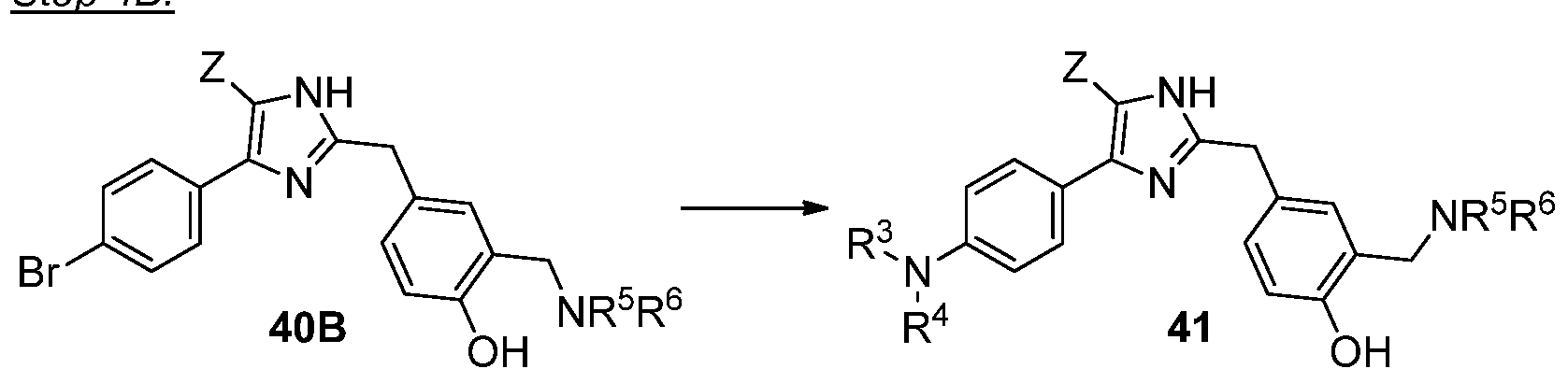
Z = H or CH2NR10R
Following general method C using 1 mmol of 40B and 1.2 mmol 4-amino-2-methyl-pyridine affords final compound 41a after purification by preparative HPLC. LC-MS conditions: LC- MS UFA.

Preparation of compounds of formula I via pathway depicted in Scheme 8
- General procedures and examples:
Step 1:

Intermediate 44 is prepared using a similar procedure as described by N. M. Shukla et al. (N. M. Shukla et al. Bioorg. Med. Chem. 2011 , 19, 3801 ). In a dry flask under nitrogen, a solution of 4-(4-bromophenyl)-1 H-imidazole 42 (750 mg, 3.4 mmol, 1 eq) in THF (7 mL) is added to NaH (161 mg, 4.0 mmol, 1 .2 eq) in THF (2.5 mL). The reaction is stirred at r.t. for 1 h and a solution of 4-benzyloxy-benzylchlorid (939 mg, 4.0 mmol, 1 .2 eq) in THF (7 mL) is added. The reaction is stirred at r.t. for 16 h and quenched with water. The aqueous layer is
extracted with EtOAc and the combined organic layers are dried over anhydrous Na2S04 and evaporated under reduced pressure. Intermediate 44 is obtained after purification by flash chromatography (heptane/EtOAc 3:1 to 1 :1 ). LC-MS conditions: LC-MS 5.

Step 2:

44
45
Following general method C using 0.12 mmol of 44 and 0.13 mmol of 4-amnio-pyridine affords intermediate 45a. LC-MS conditions: LC-MS 5.

Ste 3:

In a flask with a reflux condenser under nitrogen, MeOH (0.7 mL) is added to intermediate 45a (31 mg, 0.072 mmol, 1 eq), Pd/C (10% w/w, 7.6 mg, 0.0072 mmol, 0.1 eq) and ammonium formate (22 mg, 0.36 mmol, 5 eq). The reaction is heated at 50°C for 3 h, filtered over celite and evaporated under reduced pressure. The residue is dissolved in EtOAc and washed with a saturated solution of NaHC03 and with water. The organic layers are dried over anhydrous Na2S04 and evaporated under reduced pressure to afford intermediate 46a. LC-MS conditions: LC-MS 5.
LC-MS
Chemical name
RT (min) [M+1]+
4-{4-[4-(Pyridin-4-ylamino)-phenyl]-imidazol-1 -ylmethyl}-phenol 0.47 343.25

Following general method B using 0.058 mmol of intermediate 46a, 0.058 mmol of n- dipropylamine affords final compound 47a after purification by preparative HPLC. LC-MS conditions: LC-MS UFA.

Preparation of compounds of formula I via pathway depicted in Scheme 9
- General procedures and examples:
Step 1A:

Under nitrogen, potassium ferf-butoxide (4.13 g, 35 mmol, 3.5 eq) is dissolved in MeOH (35 mL), then hydroxylamine hydrochloride (2. 08 g, 30 mmol, 3 eq) is added and the mixture is stirred for 15 min. 4-Cyanophenol 48 (1 191 mg, 10 mmol, 1 eq) is then added and the reaction is heated at 65°C for 48 h. After cooling, the reaction is quenched with HCI 1 M and extracted with DCM. Aqueous layer is basified with KOH 2 M to pH = 10; and then extracted with EtOAc. The combined organic layers are dried over anhydrous Na2S04 and evaporated under reduced pressure to afford intermediate 49. LC-MS conditions: LC-MS 5.

Step 2A:


The crude product of step 2A is suspended in dioxane (43 mL) and heated at 90°C for 18 h. Solvent is evaporated and the product is purified by column chromatography (Heptane/EtOAc 50:1 to 10:1 ) to afford intermediate 51. LC-MS conditions: LC-MS 5.

Step 4A:

51 55
Following general method B using 1 mmol of intermediate 51 and 1.1 mmol (X = H) respectively 5 mmol (X = CH2NR10R11) of amine affords intermediates 55. LC-MS conditions: LC-MS 5.
LC-MS
Chemical name
RT (min) [M+1]+
4-[5-(4-Bromo-phenyl)-[1 ,2,4]oxadiazol-3-yl]-2-dipropylaminomethyl-
0.80 430.06 phenol
4-[5-(4-Bromo-phenyl)-[1 ,2,4]oxadiazol-3-yl]-2,6-bis-
0.82 543.28 dipropylaminomethyl-phenol

48 52
Following general method B using 1 mmol of 4-hydroxycyanophenol 48 (n = 0, 1 ), 1.5 mmol (X = H) respectively 9 mmol (X = CH2N(n-propyl)2) of n-dipropylamine affords intermediates 52 after purification by column chromatography. LC-MS conditions: LC-MS 5.

Step 2B:

52 53
Following procedure described for 49 using intermediates 52 in place of 4-cyanophenol affords intermediates 53 which are used without further purification. LC-MS conditions: LC- MS 5.
LC-MS
Chemical name
RT (min) [M+1]+
3-Dipropylaminomethyl-4,N-dihydroxy-benzamidine 0.37 266.4
3,5-Bis-dipropylaminomethyl-4,N-dihydroxy-benzamidine 0.49 379.46
2-(3-((dipropylamino)methyl)-4-hydroxyphenyl)-N-
0.39 280.37 hydroxyacetimidamide
tep 3B:

53 54
Following general method A using 1.1 mmol of intermediate 53 and 1 .1 mmol of 4- bromobenzoic acid affords intermediates 54 which are used without further purification. LC- MS conditions: LC-MS 5.


54 55
Following procedure for 51 using 1 mmol of intermediate 54 in place of 50 affords intermediates 55 after purification by flash chromatography. LC-MS conditions: LC-MS 5.
LC-MS
Chemical name
RT (min) [M+1]+
4-[5-(4-Bromo-phenyl)-[1 ,2,4]oxadiazol-3-yl]-2-dipropylaminomethyl-
0.8 430.24 phenol
4-[5-(4-Bromo-phenyl)-[1 ,2,4]oxadiazol-3-yl]-2,6-bis-
0.82 543.3 dipropylaminomethyl-phenol
4-((5-(4-bromophenyl)-1 ,2,4-oxadiazol-3-yl)methyl)-2-
0.77 444.22 ((dipropylamino)methyl)phenol
tep 5:

55 56
Following general method C using 1 mmol of 55 and 1.1 mmol of amine affords final compounds 56. LC-MS conditions: LC-MS 1 TFA.
LC-MS
Example Chemical name
RT (min) [M+1 ]+
2-Dipropylaminomethyl-4-{5-[4-(2-methyl-pyridin-4-
52 0.61 458.4 ylamino)-phenyl]-[1 ,2,4]oxadiazol-3-yl}-phenol
2-Dipropylaminomethyl-4-(5-{4-[2-(4-methyl-piperazin-1 -
53 0.53 542.6 yl)-pyridin-4-ylamino]-phenyl}-[1 ,2,4]oxadiazol-3-yl)-phenol
2-Dipropylaminomethyl-4-{5-[4-(2-pyrrolidin-1-yl-pyridin-4-
54 0.69 513.5 ylamino)-phenyl]-[1 ,2,4]oxadiazol-3-yl}-phenol
2-Dipropylaminomethyl-4-{5-[4-(2-methyl-quinolin-4-
55 0.67 508.4 ylamino)-phenyl]-[1 ,2,4]oxadiazol-3-yl}-phenol
2-Dipropylaminomethyl-4-{5-[4-(pyridin-4-ylamino)-
56 0.58 444.5 phenyl]-[1 ,2,4]oxadiazol-3-yl}-phenol
4-{5-[4-(7-Chloro-quinolin-4-ylamino)-phenyl]-
57 0.68 528.3
[1 ,2,4]oxadiazol-3-yl}-2-dipropylaminomethyl-phenol
2,6-Bis-dipropylaminomethyl-4-{5-[4-(2-methyl-pyridin-4-
58 0.68 571.5 ylamino)-phenyl]-[1 ,2,4]oxadiazol-3-yl}-phenol
2,6-Bis-dipropylaminomethyl-4-{5-[4-(pyridin-4-ylamino)-
59 0.66 557.5 phenyl]-[1 ,2,4]oxadiazol-3-yl}-phenol
2,6-Bis-dipropylaminomethyl-4-{5-[4-(2-pyrrolidin-1-yl-
60 0.75 626.7 pyridin-4-ylamino)-phenyl]-[1 ,2,4]oxadiazol-3-yl}-phenol
2,6-Bis-dipropylaminomethyl-4-(5-{4-[2-(4-methyl-
61 piperazin-1-yl)-pyridin-4-ylamino]-phenyl}-[1 ,2,4]oxadiazol- 0.61 655.5
3-yl)-phenol
2-((dipropylamino)methyl)-4-((5-(4-(pyridin-4-
62 0.57 458.32 ylamino)phenyl)-1 ,2,4-oxadiazol-3-yl)methyl)phenol
2-((dipropylamino)methyl)-4-((5-(4-((2-methylpyridin-4-
63 0.59 472.29 yl)amino)phenyl)-1 ,2,4-oxadiazol-3-yl)methyl)phenol
2-((dipropylamino)methyl)-4-((5-(4-((2-(pyrrolidin-1-
64 yl)pyridin-4-yl)amino)phenyl)-1 ,2,4-oxadiazol-3- 0.65 527.34 yl)methyl)phenol
Preparation of compounds of formula I via pathway depicted in Scheme 10
- General procedures and examples:
Step 1:

57 58
Following general method A using 2.6 mmol of Boc-piperazine 57 and 2.9 mmol of 4- (pyridine-4-yl-amino)benzoic acid affords intermediate 58a after purification by flash chromatography (EtOAc/MeOH/NH3 aq (25%) 20/1/0.01 ). LC-MS conditions: LC-MS 5.


A solution of HCI (4 M in dioxane, 2.2 mL, 8.7 mmol, 5 eq) is added to intermediate 58a (665 mg, 1 .74 mmol, 1 eq) in DCM (17 mL). The reaction is stirred at r.t for 3 h and diluted with MeOH. Solvents are evaporated to afford intermediate 59a. LC-MS conditions: LC-MS
LC-MS
Chemical name
RT (min) [M+1 ]+
Piperazin-1 -yl-[4-(pyridin-4-ylamino)-phenyl]-
0.31 283.18
methanone hydrochloride

1.1 mmol of triethylamine is added to a solution of 1 mmol of intermediates 59a in MeOH (5 mL). The mixture is stirred at r.t. for 5 min and then 1 mmol of intermediates 60 and 1 mmol of AcOH are added. The reaction is heated at 50°C for 2 h and then sodiumtriacetoxyborohydnde (2 mmol) is added. The reaction is heated at 50°C for 18 h and then quenched with a saturated solution of NaHC03. The aqueous layer is extracted with EtOAc and the combined organic layers are dried over anhydrous Na2S04 and evaporated under reduced pressure. Purification by preparative HPLC affords final compounds 61. LC-MS conditions: LC-MS 1 TFA.

Preparation of compounds of formula I via pathway depicted in Scheme 11
- General procedures and examples:

Acetic acid (90 μΙ, 1.6 mmol, 0.3 eq) and sodiumtriacetoxyborohydnde (3.34 g, 15.8 mmol, 3 eq) are added to 1-Boc-piperazine 57 (1.00 g, 5.2 mmol, 1 eq) and 4-hydroxy- benzaldehyde 62 (1 .28 g, 10.5 mmol, 2 eq) in DCM (10.4 mL). The reaction is heated at
40°C for 48 h and quenched with a saturated solution of NaHC03. The aqueous layer is extracted with EtOAc. The combined organics layers are dried over anhydrous Na2S04 and evaporated to afford intermediate 63 after purification by flash chromatography (heptanes/EtOAc 4:1 to 1 :1 ). LC-MS conditions: LC-MS 5.

Step 2:

64
Following general method B using 1.6 mmol of intermediate 63 and 1 .6 mmol of n- propylamine affords intermediates 64a after purification by column chromatography (Heptane/EtOAc 1 :1 ). LC-MS conditions: LC-MS 5.

Step 3:

Following the procedure described for 59 using intermediate 64a instead of intermediate 58 affords intermediates 65a which is used without purification. LC-MS conditions: LC-MS 5.
LC-MS
Chemical name
RT (min) [M+1]+
2-Dipropylaminomethyl-4-piperazin-1 -
0.34 306.06
ylmethyl-phenol hydrochloride

Following general method A using 0.8 mmol of intermediate 65a and 0.80 mmol of 4- bromobenzoic acid affords intermediates 66a after purification by flash chromatography (EtOAc to EtOAc/MeOH 10:1 ). LC-MS conditions: LC-MS 5.

Step 5:

Following general method C using 1 mmol of 66a and 1 .1 mmol of amine affords final compounds 61. LC-MS conditions: LC-MS UFA.
LC-MS
Example Chemical name
RT (min) [M+1]+
[4-(3-Dipropylaminomethyl-4-hydroxy-benzyl)-piperazin-1 -
69 0.43 516.4 yl]-[4-(2-methyl-pyridin-4-ylamino)-phenyl]-methanone
[4-(3-Dipropylaminomethyl-4-hydroxy-benzyl)-piperazin-1 -
70 yl]-[4-(2-pyrrolidin-1-yl-pyridin-4-ylamino)-phenyl]- 0.49 571 .5 methanone
[4-(3-Dipropylaminomethyl-4-hydroxy-benzyl)-piperazin-1 -
71 0.77 569.4 yl]-[4-(4-trifluoromethyl-phenylamino)-phenyl]-methanone
[4-(4-Chloro-phenylamino)-phenyl]-[4-(3-
72 dipropylaminomethyl-4-hydroxy-benzyl)-piperazin-1 -yl]- 0.73 535.4 methanone
Preparation of compounds of formula I via pathway depicted in Scheme 12
- General procedures and examples:
Step 1:

Following general method A using 1 mmol of 1-boc-3-amino-azetidine 67 and 1 mmol of 4- (pyridine-4-ylamino)benzoic acid affords intermediate 68a which is used without further purification. LC-MS conditions: LC-MS 5.


Following the procedure described for 59 using intermediate 68 instead of intermediate 58 affords intermediate 69a which is used without purification. LC-MS conditions: LC-MS 5.

Step 3:

69 60 70
Following procedure described for 63 using intermediate 69a in place of 57 and aldehyde 60a in place of 62 affords final product 70a after purification by preparative HPLC. LC-MS conditions: LC-MS UFA.

- General procedures and examples:
Step 1:

Following general method A using 2.6 mmol of 1-N-Boc-4-amino-piperidine 71 and 2.9 mmol of 4-(pyridine-4-ylamino)benzoic acid affords intermediate 72a after purification by flash chromatography (EtOAc/MeOH/NH3 aq (25%) 20/1/0.01 ). LC-MS conditions: LC-MS 5.
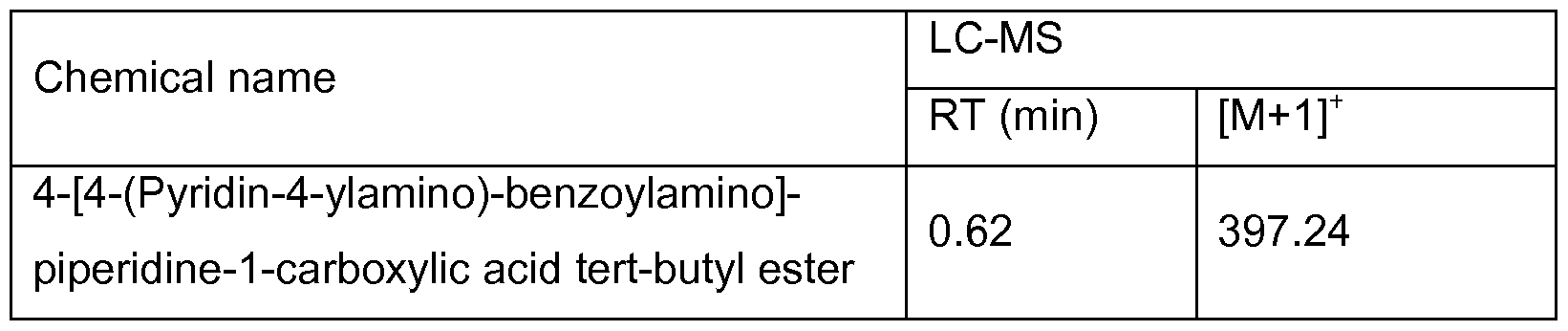
Step 2:

Following the procedure described for 59 using intermediate 72a instead of intermediate 58 affords intermediate 73a which is used without purification. LC-MS conditions: LC-MS 2.
LC-MS
Chemical name
RT (min) [M+1]+
N-Piperidin-4-yl-4-(pyridin-4-ylamino)-
0.58 297.1 1
benzamide hydrochloride
tep 3:

Following procedure described for 61 using intermediate 73a instead of 59 and intermediate 60 affords final compounds 74 after purification by preparative HPLC. LC-MS conditions: LC-MS UFA.

Preparation of compounds of formula I via pathway depicted in Scheme 14
- General procedures and examples:

75 36 76
Intermediates 76 (Y = NH, O) are prepared using a modified procedure described by McCauley et al. (McCauley, J. A. et al. J. Med. Chem. 2004, 47, 2089). Following general method A using 1.2 mmol of 75 (Y = NH or O) and 1 mmol of 4-hydroxy-phenylacetic acid affords a crude product that is dissolved in acetic acid (0.15 M) and heated to reflux for 18 h. After cooling, acetic acid is evaporated and the residue is neutralized with NaOH 1 M and extracted with EtOAc. The organic layer is dried over anhydrous Na2S04 and evaporated under reduced pressure. Purification by flash chromatography affords intermediates 76. LC- MS conditions: LC-MS 5.
LC-MS
Chemical name
RT (min) [M+1 ]+
4-(6-Bromo-1 H-benzoimidazol-2-ylmethyl)-phenol 0.57 303.16
4-(6-Bromo-benzooxazol-2-ylmethyl)-phenol 0.84 304.12
tep 2:

76 77
Following general method B using 1 mmol of intermediate 76 and 1 .2 mmol of affords intermediates 77. LC-MS conditions: LC-MS 5.


Following general method C using 1 mmol of 77 and 1.1 mmol of amine affords final compounds 78. LC-MS conditions: LC-MS UFA.

Preparation of compounds of Formula I


Preparation of compound of Formula I: Example 84
The following final compound is obtained in analogy to the preparation of Example 65, but starting from 4-dipropylaminomethyl-3-hydroxy-benzaldehyde. LC-MS conditions: LC-MS 1 FA.

Preparation of compound of Formula I: Example 85
The following final compound is obtained in analogy to the preparation of Example 51 . LC-
MS conditions: LC-MS 1 FA.

Preparation of compound of Formula I: Example 86
The following final compound is obtained in analogy to the preparation of Example 45. LC- MS conditions: LC-MS 1 TFA.

Preparation of intermediates 81

Scheme 17

In a sealed vial, 1 .05 mmol of amine is added to 1 mmol of 2-chloro-4-nitropyridine N-oxide and 1 .15 eq of NaHC03 in EtOH (3.4 mL) and the reaction is heated at 50°C for 18 h. After cooling, the reaction is diluted with water and EtOAc and the aqueous layer is extracted with EtOAc. The organic layers are dried over anhydrous Na2S04 and evaporated under reduced pressure. Intermediates 80 are used without further purification. LC-MS conditions: LC-MS 5.

H,N NR 1'2^oR13
 In a flask with a reflux condenser under nitrogen, MeOH (9 mL) is added to 1 mmol of intermediate 79, 5 mmol of ammonium formate and 0.05 mmol of Pd/C (10% w/w). The reaction is heated at 50°C during 16 h. After cooling, the reaction mixture is filtered and the solvent is evaporated under reduced pressure. The residue is purified by flash chromatography affording intermediates 81. *LC-MS conditions: LC-MS 5. +LC-MS conditions: LC-MS 2.

Preparation of intermediates 60

Intermediates 60 are prepared following general method B using 1 mmol of intermediate 62 and 1 .2 mmol of amine affording the desired product. LC-MS conditions: LC-MS 3.

Preparation of 4-DiDroDylaminomethyl-3-hvdroxy-benzaldehvde
In a sealed vial, 3-hydroxybenzaldehyde (500 mg, 4.09 mmol, 1 eq) is dissolved in water (2.89 mL)/EtOH (0.73 mL). Formaldehyde (37% wt aq solution, 0.30 mL, 3.89 mmol, 0.95 eq) and dipropylamine (0.56 mL, 4.09 mmol, 1 eq) are added in sequence. The reaction mixture is stirred at 90°C for one week. The reaction mixture is allowed to cool to r.t., diluted with water, and extracted with EtOAc. The combined organic phases are washed once with water and once with brine, dried over dry Na2C03 and concentrated in vacuo. The crude product is purified by silica gel column chromatography(hept/EtOAc, 8:2) and further by preparative HPLC (basic conditions) to give the title compound as a yellow oil.
LC-MS conditions: LC-MS 5.

Preparation of Carboxylic acids 11
Carboxylic acids 11 are commercially available or can be prepared as follows:
Step 1:

In a sealed vial, 1 mmol of ethyl-4-fluorobenzoate, 1 mmol of amine and 1.5 mmol of Na2C03 in 1 ml. of DMSO are heated at 120°C during 2 h. After cooling, the reaction mixture is diluted with water and EtOAc. The layers are separated and the organic layer are dried over anhydrous Na2S04 and evaporated under reduced pressure. Purification by flash chromatography afforded intermediate 83. LC-MS conditions: LC-MS 3.

Step 2:

A mixture of 1 mmol of 83 in 5 mL of MeOH and 5 mL NaOH 1 M is stirred at r.t. for 16 h. The solvent is evaporated and the residue is acidified with HCI 1 M. Purification by flash chromatography affords intermediate 11. LC-MS conditions: LC-MS 3.

In vitro antimalarial activity: Plasmodium falciparum in vitro assay:
In vitro activity against erythrocytic stages of P. falciparum in human red blood cells is determined using a [3H]-hypoxanthine incorporation assay. One strain sensitive to all drugs
(P. falciparum NF54) is used in this assay and all tested compounds are compared for activity with the standard drugs chloroquine (sigma C6628) and artesunate (sigma 36, 159- 3). Compounds, tested in duplicates, are serially diluted with screening medium [RPMI 1640 medium, supplemented with HEPES (5.94 g/L), NaHC03 (2.1 g/L), neomycin (100 U/mL) and human serum (50% final concentration)] in 96-well microtiter plates within an appropriate concentration range. Thereafter, the parasite cultures incubated in screening medium containing washed human red blood cells at 2.5% hematocrit (0.3% parasitemia) are added to the serially diluted compounds and incubated in a humidifying atmosphere at 37°C, 4% CO2, 3% 02 and 93% N2. After 48 hours, [3H]-hypoxanthine (0.5 μθί) is added to each well of a plate. The plates are incubated for a further 24 hours under the same conditions then harvested with a Betaplate cell harvester (Wallac) and washed with distilled water. The dried filters are inserted into a plastic foil with 10 mL of scintillation fluid and counted in a Betaplate liquid scintillation counter. IC50 values are calculated from sigmoidal inhibition curves using Microsoft Excel.
ICm values (nM) for example compounds:
Compound ICso on NF54 Compound ICso on NF54 Compound ICso on NF54 of Example (with 50% of Example (with 50% of Example (with 50% serum) serum) serum)
1 42 30 373 59 42
2 1 12 31 10 60 60
3 1 16 32 209 61 42
4 338 33 297 62 51
5 175 34 84 63 35
6 449 35 168 64 27
7 45 36 86 65 40
8 66 37 99 66 87
9 261 38 173 67 163
10 325 39 28 68 46
11 82 40 310 69 21
12 358 41 397 70 20
13 42 42 21 71 94
14 498* 43 168 72 194
15 136 44 10 73 241
16 48 45 39 74 82
17 175 46 149 75 228
18 12 47 13 76 176
19 33 48 40 77 100
20 19 49 26 78 466
21 93 50 1 1 79 41
22 42 51 26 80 16.3
23 94 52 24 81 371
24 42 53 47 82 298
25 19 54 42 83 10
26 130 55 54 84 85
27 91 56 45 85 19
28 92 57 67 86 13
29 75 58 39
Chloroquine 6.8 Artesunate 0.8
* tested twice, one value above the limit of del ection of 500 nM
Claims
1. A compound of the formula I:

Formula I
wherein
the group -NR3R4 is attached to the phenyl group in meta- or para-position to the point of attachment of group A;
one of R1 and R2 represents OH, and the other of R1 and R2 represents -CH2-NR5R6; and X represents hydrogen; or, in case R1 represents OH, X represents hydrogen or -CH2-
NR7R8;
• B represents -CH2-; and A represents *-NR9-CO-, wherein the asterisk indicates the bond that is attached to B, wherein R9 represents hydrogen or (Ci-4)alkyl; or
• B represents -CH2-; and A represents a group selected from the group consising of:

wherein the asterisks indicate the bond that is attached to B; or
• B re resents -CH2-; and the fragment:
 represents a group ,
wherein Y represents O, S, or NH; or
· B represents a direct bond, -CH2-, or -CH2-NH-*, wherein the asterisk indicates the bond that is attached to A; and A represents a 5- or 6-membered heteroarylene ring, wherein the group B and the phenyl ring carrying the -NR3R4 group are attached in meta arrangement to said 5- or 6-membered heteroarylene ring; wherein said 5- or 6- membered heteroarylene ring is unsubstituted, or mono-substituted with methyl which in turn is optionally further substituted with a group -NR10R11; or
• B represents -CO-NH-*; and A represents -CH2-, wherein the asterisk indicates the bond that is attached to A;
R4 represents hydrogen or Ci-4-alkyl; and
R3 represents phenyl or 6- to 10-membered heteroaryl, wherein said phenyl or 6- to 10- membered heteroaryl independently is unsubstituted, or mono-, or di-substituted wherein the substituents are independently selected from the group consisting of (C1-6)alkyl, halogen, (Ci-3)fluoroalkyl, and -NR12R13, wherein R12 and R13 independently represent hydrogen or (Ci-6)alkyl, or R12 and R13 together with the nitrogen atom to which they are attached to form a 5- or 6-membered ring selected from pyrrolidinyl, morpholinyl, piperidinyl, and piperazinyl optionally substituted at the vacant nitrogen atom with (d. 4)alkyl;
or R3 and R4 together with the nitrogen atom to which they are attached to represent a 1-methyl-piperidin-4-yl or a 2,2,6,6-tetramethyl-piperidin-4-yl group;
R5 and R6 independently represent (Ci-6)alkyl, or R5 and R6 together with the nitrogen atom to which they are attached to form a pyrrolidine, a piperidine, or an azepane ring;
R7 and R8 independently represent (Ci-6)alkyl, or R7 and R8 together with the nitrogen atom to which they are attached to form a pyrrolidine, a piperidine, or an azepane ring;
R10 and R11 independently represent (Ci-6)alkyl, or R10 and R11 together with the nitrogen atom to which they are attached to form a pyrrolidine, a piperidine, or an azepane ring; or a pharmaceutically acceptable salt of such a compound.
2. A compound according to claim 1 , wherein the group -NR3R4 is attached to the phenyl group in para-position to the point of attachment of group A;
or a pharmaceutically acceptable salt of such a compound.
3. A compound according to claims 1 or 2, wherein wherein R1 represents OH; R2 represents -CH2-NR5R6; and X represents hydrogen or -CH2-NR7R8;
or a pharmaceutically acceptable salt of such a compound.
4. A compound according to any one of claims 1 to 3, wherein
• B represents -CH2-; and A represents *-NR9-CO-, wherein the asterisk indicates the bond that is attached to B, wherein R9 represents hydrogen or (Ci-4)alkyl; or
· B represents -CH2-; and A represents a group selected from the group consising of:

wherein the asterisks indicate the bond that is attached to B; or
•

wherein Y represents O or NH; or
• B represents a direct bond or -CH2-; and A represents 5-membered heteroarylene ring selected from oxadiazol-diyl, oxazol-diyl, and imidazol-diyl, wherein the group B and the phenyl ring carrying the -NR3R4 group are attached in meta arrangement to said 5- membered heteroarylene ring; wherein said 5-membered heteroarylene ring is unsubstituted; or in case it is 1 H-imidazol-2,4-diyl, it is unsubstituted or mono- substituted with methyl which in turn is optionally further substituted with a group -NR10R11; or
• B represents -CH2-NH-*, wherein the asterisk indicates the bond that is attached to A;
and A represents an unsubstituted 6-membered heteroarylene ring containing one or two ring nitrogen atoms; wherein the group B and the phenyl ring carrying the -NR3R4 group are attached in meta arrangement to ring carbon atoms of said 6-membered heteroarylene ring; wherein at least one of said nitrogen ring atoms is in alpha position to the point of attachment of group B; or
• B represents -CO-NH-*; and A represents -CH2-, wherein the asterisk indicates the bond that is attached to A;
or a pharmaceutically acceptable salt of such a compound.
5. A compound according to any one of claims 1 to 4, wherein
• R3 represents phenyl which is unsubstituted, or mono-, or di-substituted wherein the substituents are independently selected from the group consisting of (Ci-4)alkyl, halogen, and (Ci-3)fluoroalkyl; or
· R3 represents 6-membered heteroaryl, wherein said 6-membered heteroaryl independently is unsubstituted, or mono-, or di-substituted wherein the substituents are independently selected from the group consisting of (Ci-4)alkyl, (Ci-3)fluoroalkyl, halogen, and -NR12R13, wherein R12 and R13 independently represent hydrogen or (C1-4)alkyl, or R12 and R13 together with the nitrogen atom to which they are attached to form a 5- or 6-membered ring selected from pyrrolidinyl, piperidinyl, and piperazinyl optionally substituted at the vacant nitrogen atom with (C1-4)alkyl; or
• R3 represents 10-membered heteroaryl containing one or two ring nitrogen atoms, wherein said 10-membered heteroaryl is unsubstituted, or mono-substituted wherein the substituent is selected from (Ci-4)alkyl;
or a pharmaceutically acceptable salt of such a compound.
6. A compound according to any one of claims 1 to 4, wherein R3 represents 6-membered heteroaryl, wherein said 6-membered heteroaryl independently is unsubstituted, or mono-, or di-substituted wherein the substituents are independently selected from the group consisting of (Ci-4)alkyl, (Ci-3)fluoroalkyl and -NR12R13, wherein R12 and R13 independently represent hydrogen or (Ci-4)alkyl, or R12 and R13 together with the nitrogen atom to which they are attached to form a 5- or 6-membered ring selected from pyrrolidinyl, piperidinyl, and piperazinyl optionally substituted at the vacant nitrogen atom with (Ci-4)alkyl;
or a pharmaceutically acceptable salt of such a compound.
7. A compound according to any one of claims 1 to 6, wherein R4 represents hydrogen; or a pharmaceutically acceptable salt of such a compound.
8. A compound according to any one of claims 1 to 7, wherein R5 and R6 both are the same and represent a group selected from (C2-4)alkyl; or R5 and R6 together with the nitrogen atom to which they are attached to form a pyrrolidine, a piperidine, or an azepane ring;
or a pharmaceutically acceptable salt of such a compound.
9. A compound according to claim 8, wherein, if present, R7 is the same as R5, and R8 is the same as R6; and, if present, R10 is the same as R5, and R11 is the same as R6;
or a pharmaceutically acceptable salt of such a compound.
10. A compound according to claim 1 , selected from the group consisting of:
N-(3-Dipropylaminomethyl-4-hydroxy-benzyl)-4-(2-methyl-pyridin-4-ylamino)-benzamide;
N-(3-Dipropylaminomethyl-4-hydroxy-benzyl)-4-(methyl-pyridin-4-yl-amino)-benzamide;
N-(3-Dipropylaminomethyl-4-hydroxy-benzyl)-4-([1 ,5]naphthyridin-4-ylamino)-benzamide;
4-(4-Chloro-phenylamino)-N-(3-dipropylaminomethyl -hydroxy-benzyl)-benzamid
4-(3,4-Dichloro-phenylamino)-N-(3-dipropylaminomethyl -hydroxy-benzyl)-benzamide;
4-(3,4-Dimethyl^henylamino)-N-(3-dipropylaminomethyl -hydroxy-benzyl)-benzamide^
4-(2,6-Dimethyl-pyridin-4-ylamino)-N-(3-dipropylaminomethyl-4-hydroxy-benzyl)-benzamide;
N-(3-Dipropylaminomethyl -hydroxy-benzyl)-3-(2-methyl-pyridin -ylamino)-benzami^
N-(3-Dipropylaminomethyl-4-hydroxy-benzyl)-4-(2,2,6,6-tetramethyl-piperidin-4-ylamino 4-(4-tert-Butyl-phenylamino)-N-(3-dipropylaminomethyl-4-hydroxy-benzyl)-benzamide;
N-(3-Dipropylaminomethyl -hydroxy-benzyl)-3-(pyridin -ylamino)-benzami
N-(3-Dipropylaminomethyl -hydroxy-benzyl) -(3 rifluoromethyl^henylamino)-benzam N-(3-Azepan-1-ylmethyl -hydroxy-benzyl) -(2-methyl-pyridin -ylamino)-benzamide;
N-(3-Dipropylaminomethyl-4-hydroxy-benzyl)-4-p-tolylamino-benzarnide;
N-(3-Dipropylaminomethyl -hydroxy-benzyl) -(4 rifluoromethyl^henylamino)-be
N-(3-Azepan-1-ylmethyl-4-hydroxy-benzyl)-4-(pyridin-4-ylamino)-benzamide;
N-(3-Dipropylaminomethyl-4-hydroxy-benzyl)-4-(5-trifluoromethyl-pyridin-2-ylamino)-benzami N-(3-Dipropylaminomethyl -hydroxy-benzyl) -(2-methyl-quinolin -ylamino)-benzam
N-(3-Dipropylaminomethyl-4-hydroxy-benzyl)-4-(5-ethyl-2-methyl-pyridin-4-ylamino)-benzamide^ N-(3-Dipropylaminomethyl-4-hydroxy-benzyl)-4-(2-pyrrolidin-1-yl-pyridin-4-ylamino)-benzamid N-(3-Dipropylaminomethyl-4-hydroxy-benzyl)-4-(2-dipropylamino-pyridin-4-ylamino)-benzam N-(3-Dipropylaminomethyl-4-hydroxy-benzyl)-4-[2-(4-methyl-piperazin-1-yl)-pyridin-4-ylamin N-(3-Dipropylaminomethyl-4-hydroxy-benzyl)-4-(3,4,5,6-tetrahydro-2H-[1,2']bipyridinyl-4'-ylamin 4-(2-Dimethylamino^yridin -ylamino)-N-(3-dipropylaminomethyl -hydroxy-benz
N-(3-Dipropylaminomethyl -hydroxy-benzyl) -(2-prop
N-(3-Dibutylaminomethyl-4-hydroxy-benzyl)-4-(pyridin-4-ylamino)-benzamide;
N-(3-Dibutylaminomethyl -hydroxy-benzyl^
N-(3-Dipropylaminomethyl -hydroxy-benzyl)-N-methyl -(2-methyl^yridin -ylamino) N-(3-Dipropylaminomethyl-4-hydroxy-benzyl)-4-(pyridin-4-ylamino)-benzarnide;
N-(3-Dipropylaminomethyl -hydroxy-benzyl) -(1-methyl-piperidin -ylamino)-benzam N-(3,5-Bis-dipropylaminomethyl-4-hydroxy-benzyl)-4-(pyridin-4-ylamino)-benzairiide;
N-(3-Diethylaminomethyl-4-hydroxy-benzyl)-4-(pyridin-4-ylarriino)-benzairiide;
N-(4-Hydroxy-3-pyrrolidin-1-ylmethyl-benzyl)-4-(pyridin-4-ylamino)-benzamide;
N-(4-Hydroxy-3-piperidin-1-ylmethyl-benzyl)-4-(pyridin-4-ylamino)-benzamide;
N-(4-Dipropylaminomethyl-3-hydroxy-benzyl)-4-(pyridin-4-ylamino)-benzamide;
3-Dipropylaminomethyl -hydroxy-N-[4-(2-methyl-pyridin -ylamino)-benzyl]-benzam
3-Dipropylaminomethyl-4-hydroxy-N-[4-(pyridin-4-ylamino)-benzyl]-benzamide;
3-Dipropylaminomethyl -hydroxy-N-[4-(methyl^yridin -yl-amino)-benzyl]-benzamid
2-Dipropylaminomethyl-4-({4-[4-(2-pyrrolidin-1-yl-pyridin-4-ylamino)-phenyl]-pyrimidin phenol;
2-Dipropylaminomethyl-4-({4-[4-(3-fluoro-pyridin-4-ylamino)-phenyl]-pyrimidin-2-ylam
2-Dipropylaminomethyl-4-({4-[4-(3-trifluoromethyl-pyridin-4-ylamino)-phenyl]-pyrimi phenol;
2-Dipropylaminomethyl -({4-[4-(2-methyl-qum
2-Dipropylaminomethyl-4-({4-[4-(pyrimidin-4-ylamino)-phenyl]-pyrimidin
2-Dipropylaminomethyl-4-({4-[4-(2-methyl-pyridin-4-ylamino)-phenyl]-pyrim
2-Dipropylaminomethyl-4-{4-[4-(2-pyrrolidin-1-yl-pyridin-4-ylamino)-phenyl]-oxazol^
2-Dipropylaminomethyl-4-{4-[4-(2-methyl-pyridin-4-ylamino)-phenyl]-oxazol-2-yl}-phenol;
2,6-Bis-dipropylaminomethyl-4-{4-[4-(2-methyl-pyridin-4-ylamino)-phenyl]-oxazol-2-yl}-phen
2-Dipropylaminomethyl-4-{4-[4-(2-methyl-pyridin-4-ylamino)-phenyl]-1 H-imidazol-2-ylmethyl}-phenol;
2-Dipropylaminomethyl-4-{4-[4-(pyridin-4-ylamino)-phenyl]-1 H-imidazol-2-ylmethyl}-phenol;
2-Dipropylaminomethyl-4-{5-dipropylaminomethyl-4-[4-(2-methyl-pyridin-4-ylamino)-ph
ylmethyl}-phenol;
2-Dipropylaminomethyl-4-{4-[4-(pyridin-4-ylamino)-phenyl]-imidazol-1-ylmethyl}-phen
2-Dipropylaminomethyl-4-{5-[4-(2-methyl-pyridin-4-ylamino)-phenyl]-[1 ,2,4]oxadiazol-3-yl}-phenol;
2-Dipropylaminomethyl-4-(5-{4-[2-(4-methyl-piperazin-1-yl)-pyridin-4-ylamino]-phenyl}-[1 ,2,4]oxadiazol-3-yl)- phenol;
2-Dipropylaminomethyl-4-{5-[4-(2-pyrrolidin-1-yl-pyridin-4-ylamino)-phenyl]-[1 ,2,4]oxadiazol-3-yl}-phenol; 2-Dipropylaminomethyl-4-{5-[4-(2-methyl-quinolin-4-ylamino)-phenyl]-[1,2,4]oxadiazol-3-yl}^
2-Dipropylaminomethyl-4-{5-[4-(pyridin-4-ylamino)-phenyl]-[1,2,4]oxadiazol-3-yl}-phenol;
4-{5-[4-(7-Chloro-quinolin-4-ylamino)-phenyl]-[1 ,2,4]oxadiazol-3-yl}-2-dipropylaminomethyl-phenol;
2,6-Bis-dipropylaminomethyl-4-{5-[4-(2-methyl-pyndin-4-ylamino)-phenyl]-[1 ,2,4]oxadiazol-3-yl}-phenol;
2,6-Bis-dipropylaminornethyl-4-{5-[4-(pyridin-4-ylamino)-phenyl]-[1 ,2,4]oxadiazol-3-yl}-phenol;
2,6-Bis-dipropylaminomethyl-4-{5-[4-(2-pyrrolidin-1-yl-pyridin-4-ylamino)-phenyl]-[1,2,4]oxadi
2,6-Bis-dipropylaminomethyl-4-(5-{4-[2-(4-methyl-piperazin-1-yl)-pyridin-4-ylamino]-phenyl^ ,2,4]oxadiazol-3- yl)-phenol;
2-Dipropylaminomethyl-4-{5-[4-(pyridin-4-ylamino)-phenyl]-[ ,2,4]oxadiazol-3-ylmethyl}-phenol;
2-Dipropylaminomethyl-4-{5-[4-(2-methyl-pyridin-4-ylairiino)-phenyl]-[1 ,2,4]oxadiazol-3-ylmethyl}-phenol; 2-Dipropylaminomethyl-4-{5-[4-(2-pyrrolidin-1-yl-pyridin-4-ylarnino)-phenyl]-[1 ,2,4]oxadiazol-3-ylmethyl}-phenol;
[4-(3-Dipropylaminomethyl-4-hydroxy-benzyl)-piperazin-1-yl]-[4-(pyridin-4-ylamino)-phenyl]-m
[4-(3-Diethylaminomethyl-4-hydroxy-benzyl)-piperazin-1-yl]-[4-(pyridin-4-ylamino)-pheny^
[4-(4-Hydroxy-3-pyrrolidin-1-ylmethyl-benzyl)-piperazin-1-yl]-[4-(pyridin-4-ylamino)-phenyl]-me
[4-(4-Hydroxy-3-piperidin-1-ylmethyl-benzyl)-piperazin-1-yl]-[4-(pyridin-4-ylamino)-phenyl]-m
[4-(3-Dipropylaminomethyl-4-hydroxy-benzyl)-piperazin-1-yl]-[4-(2-methyl-pyridin-4-ylamino
methanone;
[4-(3-Dipropylaminomethyl-4-hydroxy-benzyl)-piperazin-1-yl]-[4-(2-pyrrolidin-1-yl-pyridin-4-ylam
methanone;
[4-(3-Dipropylaminomethyl-4-hydroxy-benzyl)-piperazin-1-yl]-[4-(4-trifluoromethyl-phenylami
methanone;
[4-(4-Chloro-phenylamino)-phenyl]-[4-(3-dipropylaminomethyl-4-hydroxy-benzyl)-piperazin-1-yl]-methanone;
N-[1-(3-Dipropylaminomethyl-4-hydroxy-benzyl)-azetidin-3-yl]-4-(pyridin-4-ylam
N-[1-(3-Diethylaminomethyl-4-hydroxy-benzyl)-piperidin-4-yl]-4-(pyridin-4-ylami
N-[1-(4-Hydroxy-3-pyrrolidin-1-ylmethyl-benzyl)-piperidin-4-yl]-4-(pyridin-4-ylam
2-Dipropylaminomethyl-4-[6-(2-methyl-pyridin-4-ylamino)-1 H-benzoimidazol-2-ylmethyl]-phenol; and
2-Dipropylaminomethyl-4-[6-(2-methyl-pyridin-4-ylamino)-benzooxazol-2-ylmeth
or a pharmaceutically acceptable salt of such a compound.
1 1 . A compound according to claim 1 , selected from the group consisting of:
N-(3-Dipropylaminomethyl -hydroxy-benzyl) -(quinolin-3-ylamino)-benzamid
4-(2,5-Dimethyl-pyridin-4-ylamino)-N-(3-dipropylaminomethyl-4-hydroxy-benzyl)-benzamide;
N-(3-Dipropylaminomethyl -hydroxy-benzyl) -(quinolin -ylamino)-benzamide;
N-(3-Dipropylaminomethyl -hydroxy-benzyl) -(quinolin-5-ylamino)-benzamide;
N-(3-Dipropylaminomethyl-4-hydroxy-benzyl)-4-(2-methyl-quinolin-6-ylamino)-benzamide;
N-(3,5-Bis-(dipropylaminomethyl)-4-hydroxy-benzyl)-4-(2-methyl-pyridin-4-ylamino)-benzamide;
[4-(4-Dipropylaminomethyl-3-hydroxy-benzyl)-piperazin-1-yl]-[4-(pyridin-4-ylamino)-phenyl]-methanone;
2-Dipropylaminomethyl-4-{4-[4-(2-methyl-pyridin-4-ylamino)-phenyl]-imidazol-1-ylmethyl}-phenol; and
2-Dipropylaminomethyl-4-{5-dipropylaminomethyl-4-[4-(2-methyl-pyridin-4-ylamino)-phenyl]-oxazol-2-yl}-phenol; or a pharmaceutically acceptable salt of such a compound.
12. A pharmaceutical composition comprising a compound according to any one of claims 1 to 1 1 , or a pharmaceutically acceptable salt thereof, and at least one pharmaceutically acceptable carrier material.
13. A compound according to any one of claims 1 to 1 1 , or a pharmaceutically acceptable salt thereof, for use as a medicament.
14. A compound according to any one of claims 1 to 1 1 , or a pharmaceutically acceptable salt thereof, for use in the treatment and/or prevention of protozoal infections.
15. A compound according to any one of claims 1 to 1 1 , or a pharmaceutically acceptable salt thereof, for use in the treatment and/or prevention of malaria.
16. Use of a compound according to any one of claims 1 to 1 1 , or a pharmaceutically acceptable salt thereof, for the preparation of a pharmaceutical composition for the treatment and/or prevention of protozoal infections.
Applications Claiming Priority (2)
| Application Number | Priority Date | Filing Date | Title |
|---|---|---|---|
| EP12191403 | 2012-11-06 | ||
| EP12191403.0 | 2012-11-06 |
Publications (1)
| Publication Number | Publication Date |
|---|---|
| WO2014072903A1 true WO2014072903A1 (en) | 2014-05-15 |
Family
ID=47148650
Family Applications (1)
| Application Number | Title | Priority Date | Filing Date |
|---|---|---|---|
| PCT/IB2013/059913 Ceased WO2014072903A1 (en) | 2012-11-06 | 2013-11-05 | Novel aminomethyl-phenol derivatives as antimalarial agents |
Country Status (1)
| Country | Link |
|---|---|
| WO (1) | WO2014072903A1 (en) |
Cited By (2)
| Publication number | Priority date | Publication date | Assignee | Title |
|---|---|---|---|---|
| WO2018224455A1 (en) | 2017-06-07 | 2018-12-13 | Basf Se | Substituted cyclopropyl derivatives |
| WO2022081995A1 (en) * | 2020-10-16 | 2022-04-21 | Rheos Medicines, Inc. | Malt1 modulators and uses thereof |
Citations (2)
| Publication number | Priority date | Publication date | Assignee | Title |
|---|---|---|---|---|
| WO2007057775A1 (en) | 2005-11-21 | 2007-05-24 | Pfizer Limited | Spiropiperidine derivatives |
| WO2011083413A1 (en) * | 2010-01-05 | 2011-07-14 | Actelion Pharmaceuticals Ltd | Piperazines as antimalarial agents |
-
2013
- 2013-11-05 WO PCT/IB2013/059913 patent/WO2014072903A1/en not_active Ceased
Patent Citations (2)
| Publication number | Priority date | Publication date | Assignee | Title |
|---|---|---|---|---|
| WO2007057775A1 (en) | 2005-11-21 | 2007-05-24 | Pfizer Limited | Spiropiperidine derivatives |
| WO2011083413A1 (en) * | 2010-01-05 | 2011-07-14 | Actelion Pharmaceuticals Ltd | Piperazines as antimalarial agents |
Non-Patent Citations (8)
| Title |
|---|
| "Salt selection for basic drugs", INT. J. PHARM., vol. 33, 1986, pages 201 - 17 |
| A. NAGELE ET AL., J. MED. CHEM., vol. 55, 2012, pages 4244 - 4273 |
| E. FERRER FLEGEAU; M. E. POPKIN; M. F. GREANEY, ORG. LETT., vol. 10, no. 13, 2008, pages 2717 |
| FERRER FLEGEAU, E; POPKIN, M.E.; GREANEY, M. F., ORG. LETT., vol. 10, no. 13, 2008, pages 2717 |
| MCCAULEY, J. A. ET AL., J. MED. CHEM., vol. 47, 2004, pages 2089 |
| N. M. SHUKLA ET AL., BIOORG. MED. CHEM., vol. 19, 2011, pages 3801 |
| O. CORMINBOEUF, ET AL.: "Inhibitors of Plasmepsin II-potential antimalarial agents", BIOORGANIC & MEDICINAL CHEMISTRY LETTERS, vol. 16, no. 24, 15 December 2006 (2006-12-15), Elsevier Science Publishers, Oxford, GB, pages 6194 - 6199, XP027965990, ISSN: 0960-894X, DOI: 10.1016/j.bmcl.2006.09.027 * |
| REMINGTON: "The Science and Practice of Pharmacy", 2005, LIPPINCOTT WILLIAMS & WILKINS, article "Pharmaceutical Manufacturing" |
Cited By (2)
| Publication number | Priority date | Publication date | Assignee | Title |
|---|---|---|---|---|
| WO2018224455A1 (en) | 2017-06-07 | 2018-12-13 | Basf Se | Substituted cyclopropyl derivatives |
| WO2022081995A1 (en) * | 2020-10-16 | 2022-04-21 | Rheos Medicines, Inc. | Malt1 modulators and uses thereof |
Similar Documents
| Publication | Publication Date | Title |
|---|---|---|
| US10807982B2 (en) | Bromodomain inhibitors | |
| US10604504B2 (en) | Indole carboxamide compounds | |
| CN103038229B (en) | Heteroaryl compounds and methods of use thereof | |
| JP2005521698A (en) | New tricyclic compounds | |
| EP3810598A1 (en) | Cyanotriazole compounds and uses thereof | |
| WO2014072903A1 (en) | Novel aminomethyl-phenol derivatives as antimalarial agents | |
| KR101455484B1 (en) | Piperazines as antimalarial agents | |
| US20110281869A1 (en) | Tetrahydroisoquinolines as antimalarial agents | |
| US9637473B2 (en) | Acrylamide derivatives as antimalarial agents | |
| JP2518965B2 (en) | Novel pyridine derivative and antitumor effect enhancer containing the same as an active ingredient | |
| WO2015028989A1 (en) | Novel heterocyclic compounds as antimalarial agents | |
| KR20260040225A (en) | Plasmodium palsiparum blood phase inhibitor | |
| KR20240066906A (en) | Isoindolinone compounds with substituted quinoline amide and use thereof | |
| JP2025509917A (en) | Pyrazinamide Derivatives | |
| KR20260039692A (en) | Tetrahydroacridinone analogs for the treatment and prevention of malaria | |
| JP2024511617A (en) | Novel indoleamine-2,3-dioxygenase inhibitor, method for producing the same, and pharmaceutical composition containing the same | |
| JP2025524371A (en) | Substituted biaryl endotin-like quinolones with enhanced antiparasitic activity | |
| WO2026067615A1 (en) | Modular molecular glue compound library, construction method therefor and use thereof |
Legal Events
| Date | Code | Title | Description |
|---|---|---|---|
| 121 | Ep: the epo has been informed by wipo that ep was designated in this application |
Ref document number: 13792499 Country of ref document: EP Kind code of ref document: A1 |
|
| NENP | Non-entry into the national phase |
Ref country code: DE |
|
| 122 | Ep: pct application non-entry in european phase |
Ref document number: 13792499 Country of ref document: EP Kind code of ref document: A1 |