WO2014070155A1 - Multifunctional melamine epoxy resins, methylols and amines - Google Patents
Multifunctional melamine epoxy resins, methylols and amines Download PDFInfo
- Publication number
- WO2014070155A1 WO2014070155A1 PCT/US2012/062708 US2012062708W WO2014070155A1 WO 2014070155 A1 WO2014070155 A1 WO 2014070155A1 US 2012062708 W US2012062708 W US 2012062708W WO 2014070155 A1 WO2014070155 A1 WO 2014070155A1
- Authority
- WO
- WIPO (PCT)
- Prior art keywords
- compound
- formula
- melamine
- contacting
- produce
- Prior art date
- Legal status (The legal status is an assumption and is not a legal conclusion. Google has not performed a legal analysis and makes no representation as to the accuracy of the status listed.)
- Ceased
Links
- 0 *N(*)c1nc(N(*)I)nc(N(*)I)n1 Chemical compound *N(*)c1nc(N(*)I)nc(N(*)I)n1 0.000 description 7
- PPMWQZUJYPPBGY-UHFFFAOYSA-N C(C1OC1)N(CC1OC1)CN(CN(CC1OC1)CC1OC1)c1nc(N(CN(CC2OC2)CC2OC2)CN(CC2OC2)CC2OC2)nc(N(CN(CC2OC2)CC2OC2)CN(CC2OC2)CC2OC2)n1 Chemical compound C(C1OC1)N(CC1OC1)CN(CN(CC1OC1)CC1OC1)c1nc(N(CN(CC2OC2)CC2OC2)CN(CC2OC2)CC2OC2)nc(N(CN(CC2OC2)CC2OC2)CN(CC2OC2)CC2OC2)n1 PPMWQZUJYPPBGY-UHFFFAOYSA-N 0.000 description 1
- MWTJGOWRTOWINZ-UHFFFAOYSA-N C(C1OC1)N(CC1OC1)c1nc(N(CC2OC2)c2nc(N(CC3OC3)c3nc(N(CC4OC4)CC4OC4)nc(N(CC4OC4)CC4OC4)n3)nc(N(CC3OC3)c3nc(N(CC4OC4)CC4OC4)nc(N(CC4OC4)CC4OC4)n3)n2)nc(N(CC2OC2)CC2OC2)n1 Chemical compound C(C1OC1)N(CC1OC1)c1nc(N(CC2OC2)c2nc(N(CC3OC3)c3nc(N(CC4OC4)CC4OC4)nc(N(CC4OC4)CC4OC4)n3)nc(N(CC3OC3)c3nc(N(CC4OC4)CC4OC4)nc(N(CC4OC4)CC4OC4)n3)n2)nc(N(CC2OC2)CC2OC2)n1 MWTJGOWRTOWINZ-UHFFFAOYSA-N 0.000 description 1
- LSJMRHYJDODZGP-UHFFFAOYSA-N Cc1nc(N(CC2OC2)CC2OC2)nc(N(CC2OC2)CC2OC2)n1 Chemical compound Cc1nc(N(CC2OC2)CC2OC2)nc(N(CC2OC2)CC2OC2)n1 LSJMRHYJDODZGP-UHFFFAOYSA-N 0.000 description 1
- NJYZCEFQAIUHSD-UHFFFAOYSA-N Cc1nc(N)nc(N)n1 Chemical compound Cc1nc(N)nc(N)n1 NJYZCEFQAIUHSD-UHFFFAOYSA-N 0.000 description 1
- GIUJYDLTAOAFEU-UHFFFAOYSA-N NCN(CN)c1nc(N(CN)CN)nc(N(CN)CN)n1 Chemical compound NCN(CN)c1nc(N(CN)CN)nc(N(CN)CN)n1 GIUJYDLTAOAFEU-UHFFFAOYSA-N 0.000 description 1
- JMOSMMLLUNTPBX-UHFFFAOYSA-N Nc1nc(Nc2nc(Nc3nc(N)nc(N)n3)nc(Nc3nc(N)nc(N)n3)n2)nc(N)n1 Chemical compound Nc1nc(Nc2nc(Nc3nc(N)nc(N)n3)nc(Nc3nc(N)nc(N)n3)n2)nc(N)n1 JMOSMMLLUNTPBX-UHFFFAOYSA-N 0.000 description 1
Classifications
-
- C—CHEMISTRY; METALLURGY
- C08—ORGANIC MACROMOLECULAR COMPOUNDS; THEIR PREPARATION OR CHEMICAL WORKING-UP; COMPOSITIONS BASED THEREON
- C08K—Use of inorganic or non-macromolecular organic substances as compounding ingredients
- C08K5/00—Use of organic ingredients
- C08K5/16—Nitrogen-containing compounds
- C08K5/34—Heterocyclic compounds having nitrogen in the ring
- C08K5/3467—Heterocyclic compounds having nitrogen in the ring having more than two nitrogen atoms in the ring
- C08K5/3477—Six-membered rings
- C08K5/3492—Triazines
- C08K5/34922—Melamine; Derivatives thereof
-
- C—CHEMISTRY; METALLURGY
- C07—ORGANIC CHEMISTRY
- C07D—HETEROCYCLIC COMPOUNDS
- C07D251/00—Heterocyclic compounds containing 1,3,5-triazine rings
- C07D251/02—Heterocyclic compounds containing 1,3,5-triazine rings not condensed with other rings
- C07D251/12—Heterocyclic compounds containing 1,3,5-triazine rings not condensed with other rings having three double bonds between ring members or between ring members and non-ring members
- C07D251/26—Heterocyclic compounds containing 1,3,5-triazine rings not condensed with other rings having three double bonds between ring members or between ring members and non-ring members with only hetero atoms directly attached to ring carbon atoms
- C07D251/40—Nitrogen atoms
- C07D251/54—Three nitrogen atoms
- C07D251/70—Other substituted melamines
-
- C—CHEMISTRY; METALLURGY
- C07—ORGANIC CHEMISTRY
- C07D—HETEROCYCLIC COMPOUNDS
- C07D405/00—Heterocyclic compounds containing both one or more hetero rings having oxygen atoms as the only ring hetero atoms, and one or more rings having nitrogen as the only ring hetero atom
- C07D405/14—Heterocyclic compounds containing both one or more hetero rings having oxygen atoms as the only ring hetero atoms, and one or more rings having nitrogen as the only ring hetero atom containing three or more hetero rings
-
- C—CHEMISTRY; METALLURGY
- C08—ORGANIC MACROMOLECULAR COMPOUNDS; THEIR PREPARATION OR CHEMICAL WORKING-UP; COMPOSITIONS BASED THEREON
- C08G—MACROMOLECULAR COMPOUNDS OBTAINED OTHERWISE THAN BY REACTIONS ONLY INVOLVING UNSATURATED CARBON-TO-CARBON BONDS
- C08G18/00—Polymeric products of isocyanates or isothiocyanates
- C08G18/02—Polymeric products of isocyanates or isothiocyanates of isocyanates or isothiocyanates only
-
- C—CHEMISTRY; METALLURGY
- C08—ORGANIC MACROMOLECULAR COMPOUNDS; THEIR PREPARATION OR CHEMICAL WORKING-UP; COMPOSITIONS BASED THEREON
- C08G—MACROMOLECULAR COMPOUNDS OBTAINED OTHERWISE THAN BY REACTIONS ONLY INVOLVING UNSATURATED CARBON-TO-CARBON BONDS
- C08G59/00—Polycondensates containing more than one epoxy group per molecule; Macromolecules obtained by polymerising compounds containing more than one epoxy group per molecule using curing agents or catalysts which react with the epoxy groups
- C08G59/18—Macromolecules obtained by polymerising compounds containing more than one epoxy group per molecule using curing agents or catalysts which react with the epoxy groups ; e.g. general methods of curing
- C08G59/20—Macromolecules obtained by polymerising compounds containing more than one epoxy group per molecule using curing agents or catalysts which react with the epoxy groups ; e.g. general methods of curing characterised by the epoxy compounds used
- C08G59/32—Epoxy compounds containing three or more epoxy groups
- C08G59/3236—Heterocylic compounds
- C08G59/3245—Heterocylic compounds containing only nitrogen as a heteroatom
-
- C—CHEMISTRY; METALLURGY
- C08—ORGANIC MACROMOLECULAR COMPOUNDS; THEIR PREPARATION OR CHEMICAL WORKING-UP; COMPOSITIONS BASED THEREON
- C08G—MACROMOLECULAR COMPOUNDS OBTAINED OTHERWISE THAN BY REACTIONS ONLY INVOLVING UNSATURATED CARBON-TO-CARBON BONDS
- C08G59/00—Polycondensates containing more than one epoxy group per molecule; Macromolecules obtained by polymerising compounds containing more than one epoxy group per molecule using curing agents or catalysts which react with the epoxy groups
- C08G59/18—Macromolecules obtained by polymerising compounds containing more than one epoxy group per molecule using curing agents or catalysts which react with the epoxy groups ; e.g. general methods of curing
- C08G59/68—Macromolecules obtained by polymerising compounds containing more than one epoxy group per molecule using curing agents or catalysts which react with the epoxy groups ; e.g. general methods of curing characterised by the catalysts used
- C08G59/686—Macromolecules obtained by polymerising compounds containing more than one epoxy group per molecule using curing agents or catalysts which react with the epoxy groups ; e.g. general methods of curing characterised by the catalysts used containing nitrogen
-
- C—CHEMISTRY; METALLURGY
- C08—ORGANIC MACROMOLECULAR COMPOUNDS; THEIR PREPARATION OR CHEMICAL WORKING-UP; COMPOSITIONS BASED THEREON
- C08G—MACROMOLECULAR COMPOUNDS OBTAINED OTHERWISE THAN BY REACTIONS ONLY INVOLVING UNSATURATED CARBON-TO-CARBON BONDS
- C08G65/00—Macromolecular compounds obtained by reactions forming an ether link in the main chain of the macromolecule
-
- C—CHEMISTRY; METALLURGY
- C08—ORGANIC MACROMOLECULAR COMPOUNDS; THEIR PREPARATION OR CHEMICAL WORKING-UP; COMPOSITIONS BASED THEREON
- C08K—Use of inorganic or non-macromolecular organic substances as compounding ingredients
- C08K5/00—Use of organic ingredients
- C08K5/16—Nitrogen-containing compounds
- C08K5/34—Heterocyclic compounds having nitrogen in the ring
- C08K5/3467—Heterocyclic compounds having nitrogen in the ring having more than two nitrogen atoms in the ring
- C08K5/3477—Six-membered rings
- C08K5/3492—Triazines
- C08K5/34926—Triazines also containing heterocyclic groups other than triazine groups
-
- C—CHEMISTRY; METALLURGY
- C08—ORGANIC MACROMOLECULAR COMPOUNDS; THEIR PREPARATION OR CHEMICAL WORKING-UP; COMPOSITIONS BASED THEREON
- C08K—Use of inorganic or non-macromolecular organic substances as compounding ingredients
- C08K7/00—Use of ingredients characterised by shape
- C08K7/02—Fibres or whiskers
- C08K7/04—Fibres or whiskers inorganic
- C08K7/06—Elements
-
- Y—GENERAL TAGGING OF NEW TECHNOLOGICAL DEVELOPMENTS; GENERAL TAGGING OF CROSS-SECTIONAL TECHNOLOGIES SPANNING OVER SEVERAL SECTIONS OF THE IPC; TECHNICAL SUBJECTS COVERED BY FORMER USPC CROSS-REFERENCE ART COLLECTIONS [XRACs] AND DIGESTS
- Y10—TECHNICAL SUBJECTS COVERED BY FORMER USPC
- Y10T—TECHNICAL SUBJECTS COVERED BY FORMER US CLASSIFICATION
- Y10T428/00—Stock material or miscellaneous articles
- Y10T428/249921—Web or sheet containing structurally defined element or component
- Y10T428/249924—Noninterengaged fiber-containing paper-free web or sheet which is not of specified porosity
- Y10T428/24994—Fiber embedded in or on the surface of a polymeric matrix
- Y10T428/249942—Fibers are aligned substantially parallel
- Y10T428/249945—Carbon or carbonaceous fiber
Definitions
- Multi-functional epoxy resins for composite materials, methods of making, and uses thereof are provided.
- Epoxy resins are used as the predominant ingredient in the fabrication of composite parts and can be utilized both as matrix resin and as crosslinking agents.
- the degree of functionality of the resin is critical in determining the final properties and the range of end-use applications. Accordingly, production of new resins with enhanced functionality and improved toughness will have a wide range of applications in various fields of composites, coatings, paints, and Interpenetrating Polymer Networks (IPNs).
- New resins must not only have the requisite properties, but also can be obtained from non-petrochemical sources and have a demonstrably lower materials life cycle cost.
- the majority of polyfunctional epoxies are sourced from petrochemicals such as, for example, those based on Novolac epoxy.
- Ri and R 2 are each independently selected from the group consisting of:
- the compound has the formula of:
- compositions comprising one or more of the compounds having the formula of Formula III:
- Ri and R2 are each independently selected from the group consisting of: H, -CH 2 OH, -CH 2 OR 3 , -CH 2 N(CH 2 CH 2 OH) 2 , -CH 2 N(CH 2 CH 2 NH 2 ) 2 ,
- R 2 is not H or -CH 2 OH.
- epoxy resins are provided, the epoxy resins comprising a compound having the structure of Formula III:
- Ri and R 2 are each independently selected from the group consisting epoxy groups of:
- carbon fiber composites comprising a cured epoxy resin of an epoxy resin and amino hardeners, wherein the epoxy resin is a compound of Formula III
- the composites comprises an epoxy resin having a Formula of
- cross-linked isocyanate terminated polyurethanes, polyesters, or silicones wherein the isocyanate terminated polyurethanes, polyester, or silicone are cross-linked with a compound of Formula III
- Ri and R 2 are independently selected from the group consisting of H, CH 2 OH CH 2 NH 2 , and melaminyl, or are cross-linked with a compound having a formula of
- composites comprising one or more a cured epoxy resins of an epoxy resin of Formula III, wherein the epoxy resin is a compound of Formula III
- methods of curing epoxy resins comprising contacting an epoxy resin disclosed herein with amine compounds, a compound of Formula III
- Ri and R 2 are independently selected from the group consisting of CH 2 NH 2 , and mel
- methods of making a compound of Formula III comprising contacting hexamethylol melamine with ammonia to produce a compound of Formula IV
- methods of making a compound of Formula V comprising contacting melamine with epichlorohydrine and a strong base to produce a compound of Formula V
- methods of making a compound of Formula VI comprising contacting a compound of Formula II
- the method is performed in the presence of a catalyst and co-catalyst.
- a catalyst includes, a lewis acid catalyst.
- the lewis acid catalyst can be, for example, Lanthanium trifluoro- methanesulphonate. Other examples of lewis acid catalysts are known to one of skill in the art.
- the co-catalyst can be, for example, tetramethylammonium chloride.
- the co-catalyst can be provided in an aqueous solution, such as a 50 % solution in water. Other suitable co- catalysts can also be used.
- methods of making a compound of Formula VII comprising contacting a compound of Formula IV (iv) with epichlorohydrine and a strong base at a temperature of about 0-80 °C to produce a compound of Formula VII
- methods of making a compound of Formula IX comprising contacting a compound of Formula VIII with excess formaldehyde and a strong base to produce a compound of Formula IX
- methods of making a compound of Formula X comprising contacting a compound of Formula VIII with epichlorohydrine and a strong base at a temperature of about 0-80 °C to produce a compound of Formula X
- methods of making a compound of Formula XI comprising contacting a compound of Formula IX with an excess of epichlorohydrine and a strong base at a temperature of about 50-60 °C to produce a compound of Formula XI
- methods of making a compound of Formula XII comprising contacting a compound of Formula II with diethanol amine to produce a compound of Formula XII
- methods of making a compound of Formula XIII comprising contacting a compound of Formula XII with ammonia or an aliphatic amine under a pressure of about 1-2 atm to produce a compound of Formula XIII
- methods of producing glycidyl ether derivatives of a compound of Formula XII or glycidylamines from any melamine amino derivatives, a compound of formula XIII comprising contacting a compound of Formula XII or XIII with respectively with epichlorohydrine and a strong base at a temperature sufficient to produce a glycidyl ether derivative from compound of Formula XII or glycidylamines from compound of formula XIII.
- compositions comprising further generations of melamine derived epoxy resins are provided, the resins prepared by method described herein.
- the methods comprise contacting a melamine methylol of Formula II, IX or Formula XII with an amine to produce a melamine amino derivatives; and optionally contacting the melamine amino derivative with an epichlorohydrine to yield glycidylamine derivative; or contacting the melamine amino derivative with formaldehyde and a strong base to yield a methylol derivatives.
- compositions, methods, and devices are described in terms of “comprising” various components or steps (interpreted as meaning “including, but not limited to”), the compositions, methods, and devices can also “consist essentially of” or “consist of” the various components and steps, and such terminology should be interpreted as defining essentially closed-member groups.
- Melamine represents a starting material from which, various resins can be custom designed for many applications including, but not limited to, in various fields of composites, coatings, paints, and Interpenetrating Polymer Networks (IPNs).
- IPNs Interpenetrating Polymer Networks
- Melamine has several distinct advantages over existing starting materials.
- Melamine is a heterocyclic aromatic amine structure, which has been classified as Generally Accepted As Safe (GAAS) (for human uses in industrial applications). All other aromatic amines have been confirmed as carcinogenic to humans and are gradually being phased out of use in Europe and the USA. Additional functionality of the molecule may be achieved with the methods described herein, which will provide the opportunity to use the compounds in many applications and in future uses of resins.
- GAS Generally Accepted As Safe
- Another advantage of the methods and compounds described herein is that natural sources of melamine exist, which reduces the reliance on petrochemical resources. Therefore, the embodiments provided herein provide an opportunity to utilize melamine obtained from highly industrialized non-petrochemical processes and increase the functionality of the base molecule(s), allowing a range of new possible applications of melamine-based materials.
- the compounds and methods described herein are related to the preparation, characterization and evaluation of a series of multifunctional epoxies derived from melamine (Formula I, described herein), methylol melamines (Formula II &XII, described herein), melamine cyanurate (Formula VIII, described herein), methylolic derivatives of melamine cyanurate (Formula IX, described herein) and melamine amine derivatives (Formula IV &XIII, described herein).
- Some of these have the advantage of being water soluble, which allows them to be used in important applications, such as but not limited to, concrete and water based paint industries.
- the multi-functional epoxies also show very high reactivity, which make them highly suitable, such as but not limited to, for photo curing, increasing the degree of crosslinking of commercial epoxy resins, powder coating, and to enhance the epoxy equivalent of ligno epoxy resins.
- the multi-functional amine derivatives of these raw materials have several outstanding applications, including but not limited to: hardeners, activators, crosslinking agents for polyurethane, silicones, and amino resins.
- Other advantages, for example, are related to their fire retardant characteristics, high thermal stability, and high glass transition temperatures.
- the natural and cost efficient sources of melamine that exist can be exploited that will reduce reliance on petrochemicals and avoid their harmful derivatives.
- Melamine can be obtained from any source. It can also be obtained at a relatively reduced cost from urea.
- Urea for example, can be industrially produced from synthetic ammonia and CO 2 .
- the ammonia by-products of producing melamine from urea can be recycled for production of urea again if desired.
- Melamine can also, for example, be sourced from, calcium cyanamide.
- the hydrolysis of calcium cyanamide in the presence of equal moles of CO 2 forms cyanamide, which polymerizes on heating to produce melamine. This process also has an advantage of consuming CO 2 .
- the compounds and methods described herein can be converted through uncomplicated and cost effective syntheses into a multifunctional epoxies, amines , glycidyl amines and glycidyl amine ethers.
- the products are valuable multi-functional epoxy resins and hardeners for, but not limited to, composite materials with carbon fibres and /or as cross linking agents for commercial epoxy ,polyurethanes ,polyesters, and silicones.
- the methods, compounds, and compositions provide the following unexpected and surprising advantages over previous compounds used for similar purposes.
- the compounds and compositions provides herein include, but are not limited to, epoxy resins with multi-functionality that have more than three epoxy groups per molecules and have improved physical, mechanical, and application properties.
- the multi-functional epoxy resins have a higher degree of crosslinking that can lead to higher glass transition and improved resistant to solvents and corrosive chemicals.
- the Multifunctional epoxy (MFE) based on melamine are self-extinguishing products with outstanding fire retardant properties due to presence of melamine structures. These products are different from melamine formaldehyde resins.
- Some of the MFE epoxy amino derivatives or amino hardeners also have improved water miscibility than common aromatic epoxy. Therefore, these resins are suitable for applications in humid environments, wet surfaces, and water based epoxy for construction and water based paints. However, when they are cured with suitable hardeners they are completely water and solvent resistant .
- the compounds and compositions described herein have expanded uses as compared to the prior art.
- the compounds and compositions described herein can also be used as improved cross linking agents and/or fire retardants.
- Ri and R 2 are each independently selected from the group consisting of: H, -CH 2 OH, -CH 2 OR 3 , -CH2N(CH 2 CH 2 OH)2, -
- R 2 when Ri is H, R 2 is not H or -CH 2 OH. [0036] In some embodiments, when Ri is -CH 2 OH, -CH2OR3,
- R 2 is not -CH 2 OR 3 .
- Ri and R 2 are the same.
- composition comprising one or more of the compounds having the formula of Formula III are provided:
- R 2 are each independently selected from the jroup consisting of: H, -CH 2 OH, -CH 2 OR 3 , -CH2N(CH 2 CH 2 OH)2, -CH 2 N(CH 2 CH2NH2)2,
- R 2 is not H or -CH 2 OH.
- Rl is -CH 2 OH, -CH 2 OR 3 , -
- R2 does not comprise a terminal amino group.
- an epoxy resin is provided.
- the epoxy resin comprises a compound having the structure of Formula III:
- Ri and R2 are each independently selected from the
- R is [0046] In some embodiments, when Ri is H, R 2 is not H or -CH 2 OH. In some embodiments, when Ri is H, R 2 is not H or -CH 2 OH. In some embodiments, when Ri is H, R 2 is not H or -CH 2 OH. In some embodiments, when Ri is H, R 2 is not H or -CH 2 OH. In some
- Rj is -CH 2 OH, -CH 2 OR 3 , -CH 2 N(CH 2 CH 2 OH) 2 ,
- carbon fibers or carbon fiber composites are provided.
- the fiber or composite comprises a cured epoxy resin, which comprises an epoxy resin and amino hardeners.
- the carbon fiber comprises a cured epoxy resin with suitable hardeners.
- the epoxy resin is a compound of Formula III
- Ri and R2 are independently selected from the group consisting of
- the carbon fiber composite has an epoxy resin that has a Formula of wherein R3 is
- the hardener has a compound of Formula III.
- the resin comprises any melamine amino derivatives such as, but not limited to, a compound of Formula IV, VIII, or XIII.
- cross-linked polyurethanes, polyester, or silicone are provided, wherein the polyurethane, polyester, or silicone are cross-linked with a compound of Formula III
- Ri and R2 are independently selected from the group consisting of H, CH2OH CH2NH2, and melaminyl, or are cross-linked with a compound having a formula of
- a composite comprising one or more of a cured epoxy resins with suitable hardeners, wherein the epoxy resin is a compound of Formula III
- Ri and Q are provided. In some embodiments, Ri and Q are provided.
- R 2 are independently selected from the group consisting of:
- the epoxy resin has a Formula
- methods of curing an epoxy resin comprise contacting the epoxy resin or the polyurethane resins terminated with isocyanate groups such as polyester polyol terminated with isocyanate active groups with an amine compound, a compound of Formula III
- Ri and R 2 are independently selected from the group consisting of H, CH 2 OH CH 2 NH 2 , and melaminyl, a compound having a formula of
- methods of making a compound of Formula III are provided.
- the method comprises contacting hexamethylol melamine
- methods of making a compound of Formula V are provided.
- the methods comprises contacting melamine with epichlorohydrine and a strong base (e.g. sodium hydroxide or potassium hydroxide) to produce a compound of Formula V
- a strong base e.g. sodium hydroxide or potassium hydroxide
- the method is performed at a temperature of about 0-80 °C.
- the method of making a compound of Formula V is performed at three temperature stages: a temperature of aboutO- 10 °C for the initial reaction of epichlorohydrine with melamine and its derivatives for the first stage, about 40- 80 °C for the second stage and about 50-65°C for final dehydrochlorination stage.
- the method of making a compound of Formula V is performed at a temperature from about 0-80 °C.
- methods of making a compound of Formula VI comprise contacting a compound of Formula II epichlorohydrine and a strong base (e.g.
- the method is performed at temperature of about 50-60 °C.
- methods of making a compound of Formula VII comprise contacting a compound of Formula IV (iv) with epichlorohydrine a strong base (e.g. sodium hydroxide potassium hydroxide, and the like) at a temperature of about 0-80 °C, including, for example, at three different temperature stages as described herein, to produce a compound of Formula VII
- a strong base e.g. sodium hydroxide potassium hydroxide, and the like
- the method comprises contacting melamine with cyanuryl chloride to produce a compound of Formula VIII.
- methods of making a compound of Formula IX comprise contacting a compound of Formula VIII with excess formaldehyde with a strong base (e.g. sodium hydroxide potassium hydroxide, and the like)to produce a compound of Formula IX
- a strong base e.g. sodium hydroxide potassium hydroxide, and the like
- methods of making a compound of Formula X comprise contacting a compound of Formula VIII with epichlorohydnne and a strong base, such as, but not limited to, sodium hydroxide or potassium hydroxide at a temperature of about 0-80°C, including, for example, at three different temperature stages as described herein to produce a compound of Formula X
- methods of making a compound of Formula XI comprise contacting a compound of Formula IX with an excess of epichlorohydrine and a strong base (e.g. sodium hydroxide potassium hydroxide, and the like) at a temperature of about 50-60 °C to produce a compound of Formula XI
- a strong base e.g. sodium hydroxide potassium hydroxide, and the like
- methods of making a compound of Formula XII are provided.
- the methods comprise contacting a compound of Formula II with diethanol amine to produce a compound of Formula XII
- methods of making a compound of Formula XIII are provided.
- the method comprises contacting a compound of Formula XII with ammonia or an aliphatic amine under a pressure of about 1-2 atm to produce a compound of Formula XIII
- methods of producing glycidyl ether derivatives from a melamine methylol derivative such as but not limited to Formula XII or glycidylamines from a melamine amino derivatives, such as a compound of formula XIII (as an example of any melamine amino derivatives ) are provided.
- the methods comprise contacting a compound of, for example, Formula XII or XIII, respectively, with epichlorohydrine and a strong base (e.g. sodium hydroxide potassium hydroxide, and the like) at a temperature sufficient to produce a glycidyl ether derivative from compound of Formula XII or glycidylamines from compound of formula XIII.
- a strong base e.g. sodium hydroxide potassium hydroxide, and the like
- a composition comprising further generations of melamine derived epoxy resin, the resin prepared by a method, the method comprising contacting a compound melamine methylols of formula II, IX or Formula XII or other melamine methylols with an ammonia or an amine to produce new melamine amino derivatives which could be either transferred to glycidylamine derivatives similar to V, VII, or X, as an example, by their direct reactions with an epichlorohydrine or to be transferred to new generation of methylol derivatives by their reaction with formaldehyde and a strong base similar to II, IX and XII, as an example.
- the new generation of methylols could be either transferred to their glycidylether derivatives or transferred to amino groups again to form the next generation of melamine amino derivatives.
- This can be continued for several sequences mainly for producing powder solid epoxy for spray powder technology coating with epoxy resins.
- the limit of the sequence of generations is when the product is insoluble and/or infusible.
- Hexamethylolmelamine was prepared and characterized according to (Manley,T.R, Thermalstability of hexamethylolmelamine, Polymer,J.4, (1)111-113, 1972) Three necked reaction vessel fitted with reflux, thermometer condenser and mechanical stirrer. The reaction vessel was charged with 126 g melamine ( 1 mole ), and 650 g (8 moles ) forlmaline solutionm 37%. 10% sodium carbonate solution was added (pH 8.5-9). The solution was heated to 65-70 °C for 3 hours with continuous efficient mixing after 3 hours the reaction mixture became transparent indicating that all melamine was transfered to its methylolic resins. The product was cooled to room temperature and excess of non reacted formaldehyde was removed. The solid product was used in the preparation of the new melamine derivatives of this invention. A modified procedure was also used by using sodium hydroxide as basic medium for the reaction.
- a two liter auto clave system from Analis -Belgium fitted with mechanical stirrer, and controlled temperature and pressure was charged with 306 g hexamethylol melamine prepared in Example 1 and 500ml of methyl alcohol.
- the system was secured and connected to ammonia gas cylinder.
- the system was flashed with N2,mixed for 10 minutes to dissolve the methylol resin.
- Ammonia gas was fed to the autoclave until the pressure reached 2 atm.
- the reaction temperature was controlled at 50-60 °C via the cooling jacket of the autoclave. The reaction was continued until no further increase in temperature was observed.
- the system was cooled to room temperature.
- the system was flushed with N2 gas to remove the unreacted ammonia gas.
- the white milky syrup product was evaporated and dried under vacuum.
- the solid product with a decomposition temperature of 387 °C was obtained.
- the product characterized by CHN analysis and molecular weight determination.
- the obtained degree of amination as found from CHN analysis was 87%.
- the obtained resin was used in the preparation of glycidyl melamine resins as an epoxy hardener, as a crosslinking agent for polyurethane, as curing agent for: methylol melamine, resol, ,resolack, and as starting material for the second generation of melamine methylol derivatives compounds XII and XIII (Example 10).
- Example 3 Preparation of N- glycidyl melamine resins: Resin III where R1,R2 are glycidyl groups Compound (V).
- a reactor consisting flanged top five necked reaction vessel fitted with: a mechanical stirrer, condenser, thermometer, dropping funnel, gas inlet tube, immersed in thermo stated oil bath.
- the reaction vessel was charged with 63 g melamine (0.5 mole) dissolved inlOO DMF one gram of Mg (CIO 4 ) dissolved in 5 ml 2-methoxy ethanol was added as catalyst.
- the system was flashed with nitrogen for 10 minutes and the reaction mixture was cooled to 10 °C.
- the epoxy layer was separated, dissolved in toluene, filtered from any salt residue and washed with 40% solution of sodium chloride in water containing 1% acetic acid, dried with molecular sieves, evaporated under vacuum and dried under vacuum at 0.1mm Hg at 40 °C for 6 hours. A dark colored viscous resin was obtained. The epoxy equivalent of the resin was determined and found to be 5.34
- Example 4 Effect of metal salt catalysts.
- Example 1 The procedure of Example 1 was repeated in the absence of catalyst and in the presence of LiCl ,LiOH, and LiC10 4 catalysts. No appreciable changes were found in the yield of epoxy equivalent and viscosity by changing the catalyst. The absence of catalysts reduces the epoxy equivalent to 4.5 equivalent /kg and increases the viscosity of 110 Pa s.
- Example :5 Effect of phase transfer co catalyst.
- Example 1 was repeated in the presence of several phase transfer catalysts , e.g.benzyltrimethylammonium bromide, cetyltrimethylammonium bromide,
- Example-6 Effect of temperature.
- Example 3 The reaction set up used in Example 3 was used.
- the reaction vessel was charged with 153 g (0.5 mole)hexamethylol melamine prepared in Example 1 and 250ml of n-butanol.
- the mixture was neutralized with benzene sulphonic acid to pH-7-7.5.
- the system was flashed with N2 for 10 minutes.0.75 g
- Lanthaniumtrifluoro- methanesulphonate was added as lewis acid catalyst and 5 g of tetra methylammonium chloride as a 50 % solution in water.
- the system was heated to 50 °C. 323.8 g (3.5 mole) of epichlorohydrine was added within 2 hours and then the mixture was heated to 75 °C for one hour.
- the mixture was cooled to 60 °C and then 280 g (3.5 mole) of 50% sodium hydroxide solution was added portionwise within one hour with continuous azeotropic removal of water from the system and with continuous mixing for further one hour at 60 C.
- the reaction mixture was cooled to room temperature .
- the solid residue was found to be crosslinked melamine resin and salt. Butanol was evaporated under vacuum. Highly viscous resin was obtained ( epoxy equivalent 5.56 mol/kg, chlorine content was 1.9%,yield based on melaminehexamethylol resin was 72%).
- Example 1 The set up and procedure of Example 1 is used in the preparation of resin IX by using molar ratio of formaldehyde/amino as 2.2:1 using the same catalysts and reaction conditions.
- the expected melamine cyanurate methylol resin is waxy solid product.
- Example 12 Curing of glycidyl melamine resin.
- the post cured sample had a glass transition temperature of 187°C.C)10 g of glycidylmelamine(IV) was cured with 2.5g of amino melamine (VII).
- the sample underwent curing at room temperature and at 60 °C.
- the post cured sample had a glass transition temperature of 174°C.D)10 g of glycidyl melamine (IV) was cured with 3.5g of Huntsman commercial curing agent 1203, the resin cured to solid product at room temperature.
- the post cured sample had a glass transition temperature of 175 °C.
- Examplel4 Crosslinking and catalytic efficiency of melamine amino derivatives and melamine methylol resins.
Landscapes
- Chemical & Material Sciences (AREA)
- Organic Chemistry (AREA)
- Health & Medical Sciences (AREA)
- Chemical Kinetics & Catalysis (AREA)
- Medicinal Chemistry (AREA)
- Polymers & Plastics (AREA)
- Phenolic Resins Or Amino Resins (AREA)
- Epoxy Resins (AREA)
Abstract
Multifunctional melamine epoxy resins, methylols and amines are provided. Methods of making multifunctional melamine epoxy resins, methylols and amines are also provided. An advantage of the methods and compounds described herein is that natural sources of melamine exist, which reduces the reliance on petrochemical resources. Therefore, the embodiments provided herein provide an opportunity to utilize melamine obtained from highly industrialized non-petrochemical processes and increase the functionality of the base molecule(s), allowing a range of new possible applications of melamine-based materials.
Description
MULTIFUNCTIONAL MELAMINE EPOXY RESINS, METHYLOLS AND AMINES FIELD
[0001] Multi-functional epoxy resins for composite materials, methods of making, and uses thereof are provided.
BACKGROUND
[0002] Epoxy resins are used as the predominant ingredient in the fabrication of composite parts and can be utilized both as matrix resin and as crosslinking agents. The degree of functionality of the resin is critical in determining the final properties and the range of end-use applications. Accordingly, production of new resins with enhanced functionality and improved toughness will have a wide range of applications in various fields of composites, coatings, paints, and Interpenetrating Polymer Networks (IPNs). New resins must not only have the requisite properties, but also can be obtained from non-petrochemical sources and have a demonstrably lower materials life cycle cost. The majority of polyfunctional epoxies are sourced from petrochemicals such as, for example, those based on Novolac epoxy. There are others based on polyhydroxy compounds such as glycerol, and epoxy esters derived from polycarboxylic acids as alterative multi-functional epoxy resins. Several melamine formaldehyde resins are known compounds and produced industrially such as :melamine oil, melamine hexamethylol esters .
[0003] There is still a need for improved melamine resins and for new uses and applications of the same with increased functionality. The present application fulfills these needs as well as others.
SUMMARY OF THE INVENTION
[0004] In some embodiments, compounds having the structure of Formula III:

In some embodiments, Ri and R2 are each independently selected from the group consisting of:
-CH2OH, -CH2OR3, -CH2N(CH2CH2OH)2, -CH2N(CH2CH2NH2)2,

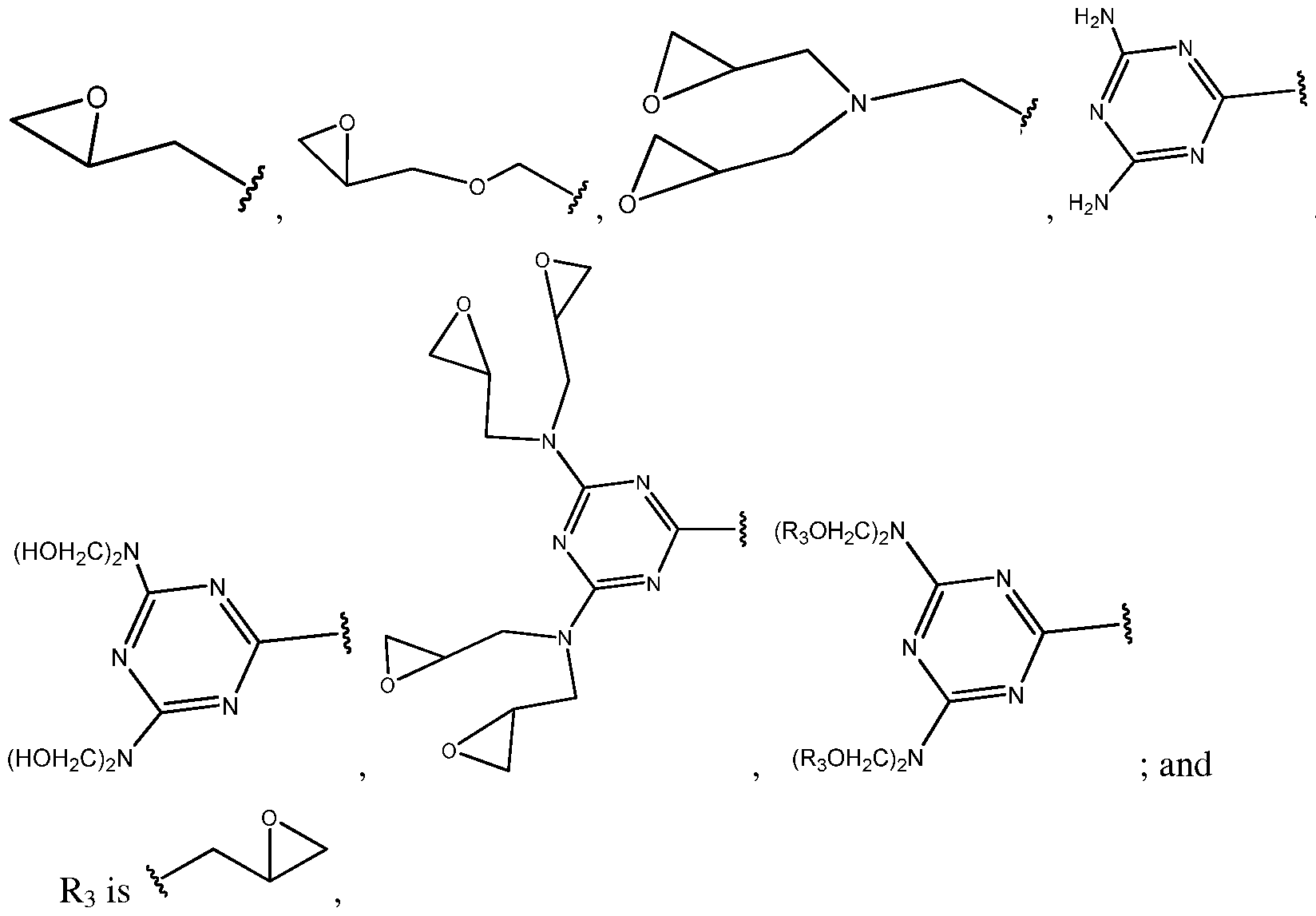
provided that when Ri is H, R2 is not H or -CH2OH are provided.
[0005] In some embodiments, the compound has the formula of:


[(HOH2CH2C)2NH2C]2N CH2N(CH2CH2OH)2]2
 H2OH)2]2 Xft or
[(H2NH2CH2C)2NH2C]2N N[CH2N(CH2CH2NH2)2]2
N[CH2N(CH2CH2NH2)2]2 XIII.
[0006] In some embodiments, compositions are provided, the compositions comprising one or more of the compounds having the formula of Formula III:

in,
wherein Ri and R2 are each independently selected from the group consisting of:
H, -CH2OH, -CH2OR3, -CH2N(CH2CH2OH)2, -CH2N(CH2CH2NH2)2,


provided that when Ri is H, R2 is not H or -CH2OH.
[0007] In some embodiments, epoxy resins are provided, the epoxy resins comprising a compound having the structure of Formula III:

in,
wherein Ri and R2 are each independently selected from the group consisting epoxy groups of:

[0008] In some embodiments, carbon fiber composites are provided, the composites comprising a cured epoxy resin of an epoxy resin and amino hardeners, wherein the epoxy resin is a compound of Formula III

[0009] In some embodiments, the composites comprises an epoxy resin having a Formula of


[0010] In some embodiments cross-linked isocyanate terminated polyurethanes, polyesters, or silicones, wherein the isocyanate terminated polyurethanes, polyester, or silicone are cross-linked with a compound of Formula III

wherein Ri and R2 are independently selected from the group consisting of H, CH2OH CH2NH2, and melaminyl, or are cross-linked with a compound having a formula of

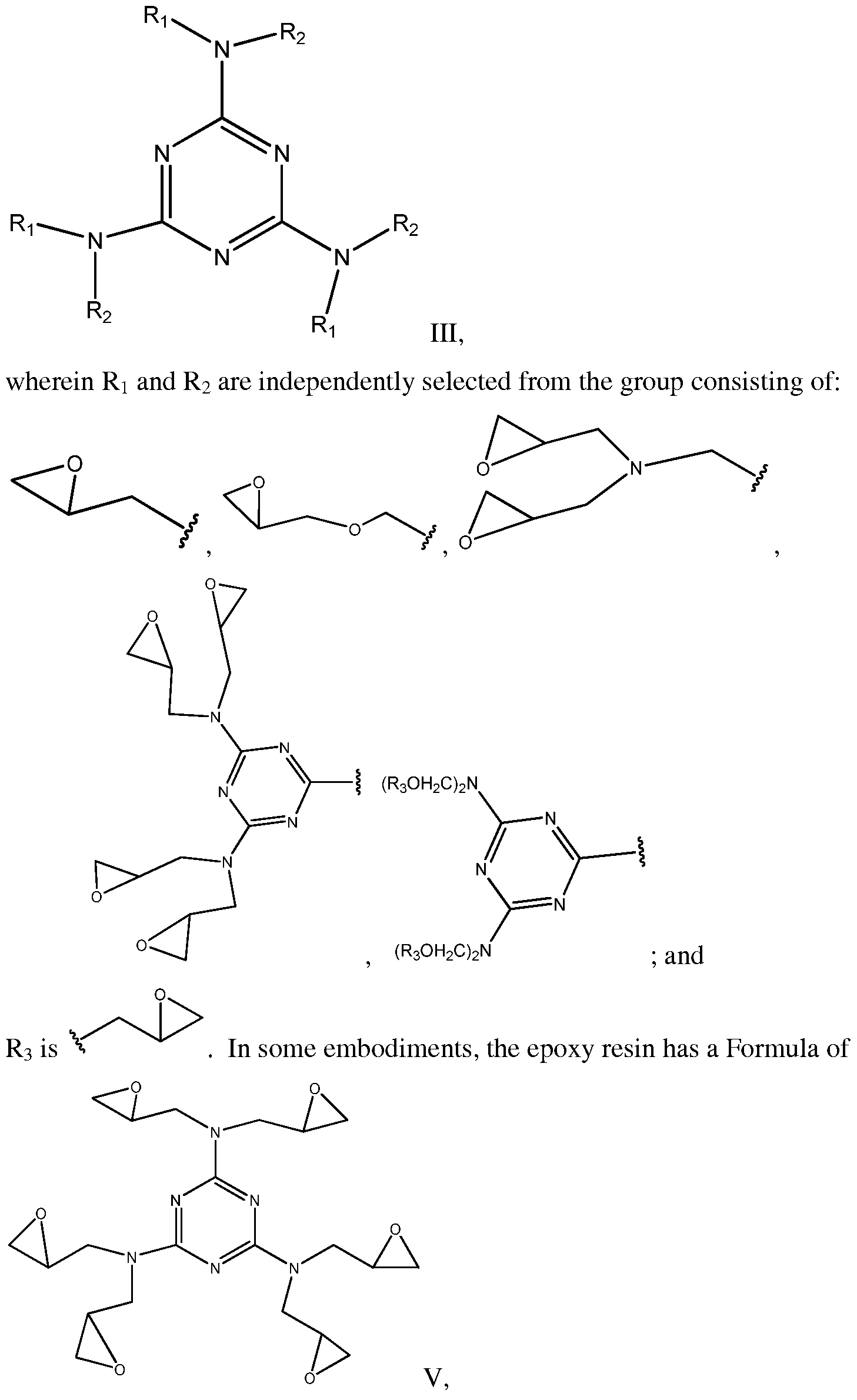

[0012] In some embodiments, methods of curing epoxy resins are provided, the methods comprising contacting an epoxy resin disclosed herein with amine compounds, a compound of Formula III

wherein Ri and R2 are independently selected from the group consisting of CH2NH2, and mel

or with one or more hardeners under conditions sufficient to cure the epoxy resins.
[0013] In some embodiments, methods of making a compound of Formula III are provided, the methods comprising contacting hexamethylol melamine with ammonia to produce a compound of Formula IV


[0015] In some embodiments, methods of making a compound of Formula VI are provided, the methods comprising contacting a compound of Formula II


In some embodiments, the method is performed in the presence of a catalyst and co-catalyst. Examples of a catalyst includes, a lewis acid catalyst. The lewis acid catalyst can be, for example, Lanthanium trifluoro- methanesulphonate. Other examples of lewis acid catalysts are known to one of skill in the art. The co-catalyst can be, for example, tetramethylammonium chloride. The co-catalyst can be provided in an aqueous solution, such as a 50 % solution in water. Other suitable co- catalysts can also be used.
[0016] In some embodiments, methods of making a compound of Formula VII are provided, the methods comprising contacting a compound of Formula IV
 (iv) with epichlorohydrine and a strong base at a temperature of about 0-80 °C to produce a compound of Formula VII

[0017] In some embodiments, methods of making a compound of Formula IX are provided, the methods comprising contacting a compound of Formula VIII with excess formaldehyde and a strong base to produce a compound of Formula IX

[0018] In some embodiments, methods of making a compound of Formula X are provided, the methods comprising contacting a compound of Formula VIII with epichlorohydrine and a strong base at a temperature of about 0-80 °C to produce a compound of Formula X

[0019] In some embodiments, methods of making a compound of Formula XI are provided, the methods comprising contacting a compound of Formula IX with an excess of epichlorohydrine and a strong base at a temperature of about 50-60 °C to produce a compound of Formula XI

[0020] In some embodiments, methods of making a compound of Formula XII are provided, the methods comprising contacting a compound of Formula II with diethanol amine to produce a compound of Formula XII


[0022] In some embodiments, methods of producing glycidyl ether derivatives of a compound of Formula XII or glycidylamines from any melamine amino derivatives, a compound of formula XIII are provided, the methods comprising contacting a compound of Formula XII or XIII with respectively with epichlorohydrine and a strong base at a temperature sufficient to produce a glycidyl ether derivative from compound of Formula XII or glycidylamines from compound of formula XIII.
[0023] In some embodiments, compositions comprising further generations of melamine derived epoxy resins are provided, the resins prepared by method described herein. In some embodiments, the methods comprise contacting a melamine methylol of Formula II, IX or Formula XII with an amine to produce a melamine amino derivatives; and optionally contacting the melamine amino derivative with an epichlorohydrine to yield glycidylamine derivative; or contacting the melamine amino derivative with formaldehyde and a strong base to yield a methylol derivatives.
DETAILED DESCRIPTION
[0024] This description is not limited to the particular processes, compositions, or methodologies described, as these may vary. The terminology used in the description is for the purpose of describing the particular versions or embodiments only, and it is not intended to limit the scope of the embodiments described herein. Unless defined otherwise, all
technical and scientific terms used herein have the same meanings as commonly understood by one of ordinary skill in the art. In some cases, terms with commonly understood meanings are defined herein for clarity and/or for ready reference, and the inclusion of such definitions herein should not necessarily be construed to represent a substantial difference over what is generally understood in the art. However, in case of conflict, the patent specification, including definitions, will prevail.
[0025] It must also be noted that as used herein and in the appended claims, the singular forms "a", "an", and "the" include plural reference unless the context clearly dictates otherwise.
[0026] As used in this document, terms "comprise," "have," and "include" and their conjugates, as used herein, mean "including but not limited to." While various compositions, methods, and devices are described in terms of "comprising" various components or steps (interpreted as meaning "including, but not limited to"), the compositions, methods, and devices can also "consist essentially of" or "consist of" the various components and steps, and such terminology should be interpreted as defining essentially closed-member groups.
[0027] Melamine represents a starting material from which, various resins can be custom designed for many applications including, but not limited to, in various fields of composites, coatings, paints, and Interpenetrating Polymer Networks (IPNs). Melamine has several distinct advantages over existing starting materials. Melamine is a heterocyclic aromatic amine structure, which has been classified as Generally Accepted As Safe (GAAS) (for human uses in industrial applications). All other aromatic amines have been confirmed as carcinogenic to humans and are gradually being phased out of use in Europe and the USA. Additional functionality of the molecule may be achieved with the methods described herein,
which will provide the opportunity to use the compounds in many applications and in future uses of resins.
[0028] Another advantage of the methods and compounds described herein is that natural sources of melamine exist, which reduces the reliance on petrochemical resources. Therefore, the embodiments provided herein provide an opportunity to utilize melamine obtained from highly industrialized non-petrochemical processes and increase the functionality of the base molecule(s), allowing a range of new possible applications of melamine-based materials.
[0029] The compounds and methods described herein are related to the preparation, characterization and evaluation of a series of multifunctional epoxies derived from melamine (Formula I, described herein), methylol melamines (Formula II &XII, described herein), melamine cyanurate (Formula VIII, described herein), methylolic derivatives of melamine cyanurate (Formula IX, described herein) and melamine amine derivatives (Formula IV &XIII, described herein). Some of these have the advantage of being water soluble, which allows them to be used in important applications, such as but not limited to, concrete and water based paint industries.
[0030] The multi-functional epoxies also show very high reactivity, which make them highly suitable, such as but not limited to, for photo curing, increasing the degree of crosslinking of commercial epoxy resins, powder coating, and to enhance the epoxy equivalent of ligno epoxy resins. Furthermore, the multi-functional amine derivatives of these raw materials have several outstanding applications, including but not limited to: hardeners, activators, crosslinking agents for polyurethane, silicones, and amino resins. Other advantages, for example, are related to their fire retardant characteristics, high thermal stability, and high glass transition temperatures. Thus, the natural and cost efficient sources of
melamine that exist can be exploited that will reduce reliance on petrochemicals and avoid their harmful derivatives.
[0031] Melamine can be obtained from any source. It can also be obtained at a relatively reduced cost from urea. Urea, for example, can be industrially produced from synthetic ammonia and CO2. The ammonia by-products of producing melamine from urea can be recycled for production of urea again if desired.
[0032] Melamine can also, for example, be sourced from, calcium cyanamide. The hydrolysis of calcium cyanamide in the presence of equal moles of CO2 forms cyanamide, which polymerizes on heating to produce melamine. This process also has an advantage of consuming CO2.
[0033] Melamine combined with formaldehyde has been demonstrated industrially to produce melamine formaldehyde resins, which is a durable thermoset used in various applications. Melamine and melamine polyphosphate are also known and used as excellent fire retardant and smoke suppressant additives in paints, plastics and paper. Melamine formaldehyde sulphonate resin (SMF) resins are known to be efficient concrete super-plasticizers. Hexamethylol melamine and its esters and ethers are also known as "melamine oils" are used also as effective crosslinking agents. The following reactions and schema represent novel and non-obvious opportunities for enhancing the properties of melamine based resins and additives and therefore extending its range of use. The compounds and methods described herein can be converted through uncomplicated and cost effective syntheses into a multifunctional epoxies, amines , glycidyl amines and glycidyl amine ethers. The products are valuable multi-functional epoxy resins and hardeners for, but not limited to, composite materials with carbon fibres and /or as cross linking agents for commercial epoxy ,polyurethanes ,polyesters, and silicones.
[0034] The methods, compounds, and compositions provide the following unexpected and surprising advantages over previous compounds used for similar purposes. For example, the compounds and compositions provides herein include, but are not limited to, epoxy resins with multi-functionality that have more than three epoxy groups per molecules and have improved physical, mechanical, and application properties. Additionally, some of the compounds and compositions can be made without the use of petrochemicals. The multi-functional epoxy resins have a higher degree of crosslinking that can lead to higher glass transition and improved resistant to solvents and corrosive chemicals. The Multifunctional epoxy (MFE) based on melamine are self-extinguishing products with outstanding fire retardant properties due to presence of melamine structures. These products are different from melamine formaldehyde resins. Some of the MFE epoxy amino derivatives or amino hardeners also have improved water miscibility than common aromatic epoxy. Therefore, these resins are suitable for applications in humid environments, wet surfaces, and water based epoxy for construction and water based paints. However, when they are cured with suitable hardeners they are completely water and solvent resistant . Thus, the compounds and compositions described herein have expanded uses as compared to the prior art. The compounds and compositions described herein can also be used as improved cross linking agents and/or fire retardants.
[0035] Accordingly, in some embodiments, compounds having the structure of Formula III

are provided. In some embodiments, Ri and R2 are each independently selected from the group consisting of: H, -CH2OH, -CH2OR3, -CH2N(CH2CH2OH)2, -

In some embodiments, when Ri is H, R2 is not H or -CH2OH.
[0036] In some embodiments, when Ri is -CH2OH, -CH2OR3,

[0038] In some embodiments, when Ri is H, R2 is not -CH2OR3.
[0039] In some embodiments, Ri and R2 are the same.
[0040] In some embodiments, compounds having the formula of:


-23-
 ΐ are provided.
[0041] In some embodiments, a composition comprising one or more of the compounds having the formula of Formula III are provided:

[0042] In some embodiments, and R2 are each independently selected from the jroup consisting of: H, -CH2OH, -CH2OR3, -CH2N(CH2CH2OH)2, -CH2N(CH2CH2NH2)2,


R2 is not H or -CH2OH.
[0043] In some embodiments, when Rl is -CH2OH, -CH2OR3, -


embodiments, R2 does not comprise a terminal amino group.
[0044] In some embodiments, an epoxy resin is provided. In some embodiments, the epoxy resin comprises a compound having the structure of Formula III:

[0045] In some embodiments, Ri and R2 are each independently selected from the
consisting of epoxy groups


embodiments, when Rj is -CH2OH, -CH2OR3, -CH2N(CH2CH2OH)2,


[0047] In some embodiments, carbon fibers or carbon fiber composites are provided. In some embodiments, the fiber or composite comprises a cured epoxy resin, which comprises an epoxy resin and amino hardeners. In some embodiments, the carbon fiber comprises a cured epoxy resin with suitable hardeners. In some embodiments, the epoxy resin is a compound of Formula III


[0048] In some embodiments, the carbon fiber composite has an epoxy resin that has a Formula of

 wherein R3 is
[0049] In some embodiments, the hardener has a compound of Formula III. In some embodiments, the resin comprises any melamine amino derivatives such as, but not limited to, a compound of Formula IV, VIII, or XIII.
[0050] In some embodiments, cross-linked polyurethanes, polyester, or silicone are provided, wherein the polyurethane, polyester, or silicone are cross-linked with a compound of Formula III


[0051] In some embodiments, a composite comprising one or more of a cured epoxy resins with suitable hardeners, wherein the epoxy resin is a compound of Formula III

R2 are independently selected from the group consisting of:

[0052] In some embodiments, the epoxy resin has a Formula

[0053] In some embodiments methods of curing an epoxy resin are provided. In some embodiments, the method comprises contacting the epoxy resin or the polyurethane
resins terminated with isocyanate groups such as polyester polyol terminated with isocyanate active groups with an amine compound, a compound of Formula III


[(H2NH2CH2C)2NH2C]2N- ^N[CH2N(CH2CH2NH2)2]2
N^N
N[CH2N(CH2CH2NH2)2]2 XIII, or with one or more commercial hardeners under conditions sufficient to cure the epoxy resin.
[0054] In some embodiments, methods of making a compound of Formula III are provided. In some embodiments, the method comprises contacting hexamethylol melamine
II with ammonia to produce a compound of Formula IV

[0055] In some embodiments, methods of making a compound of Formula V are provided. In some embodiments, the methods comprises contacting melamine with epichlorohydrine and a strong base (e.g. sodium hydroxide or potassium hydroxide) to produce a compound of Formula V

[0056] In some embodiments, the method is performed at a temperature of about 0-80 °C. In some embodiments, the method of making a compound of Formula V is performed at three temperature stages: a temperature of aboutO- 10 °C for the initial reaction of epichlorohydrine with melamine and its derivatives for the first stage, about 40- 80 °C for the second stage and about 50-65°C for final dehydrochlorination stage. In some embodiments, the method of making a compound of Formula V is performed at a temperature from about 0-80 °C.
[0057] In some embodiments, methods of making a compound of Formula VI are provided. In some embodiments, the methods comprise contacting a compound of Formula II
 epichlorohydrine and a strong base (e.g.
hydroxide potassium hydroxide, and the like) to produce a compound of Formula VI

[0058] In some embodiments, methods of making a compound of Formula VII are provided. In some embodiments, the methods comprise contacting a compound of Formula IV
 (iv) with epichlorohydrine a strong base (e.g. sodium hydroxide potassium hydroxide, and the like) at a temperature of about 0-80 °C, including, for example, at three different temperature stages as described herein, to produce a compound of Formula VII


[0059] In some embodiments, methods of making a compound of Formula IX are provided. In some embodiments, the methods comprise contacting a compound of Formula VIII with excess formaldehyde with a strong base (e.g. sodium hydroxide potassium hydroxide, and the like)to produce a compound of Formula IX

[0060] In some embodiments, methods of making a compound of Formula X are provided. In some embodiments, the methods comprise contacting a compound of Formula
VIII with epichlorohydnne and a strong base, such as, but not limited to, sodium hydroxide or potassium hydroxide at a temperature of about 0-80°C, including, for example, at three different temperature stages as described herein to produce a compound of Formula X

[0061] In some embodiments, methods of making a compound of Formula XI are provided. In some embodiments, the methods comprise contacting a compound of Formula IX with an excess of epichlorohydrine and a strong base (e.g. sodium hydroxide potassium hydroxide, and the like) at a temperature of about 50-60 °C to produce a compound of Formula XI

[0062] In some embodiments, methods of making a compound of Formula XII are provided. In some embodiments, the methods comprise contacting a compound of Formula II with diethanol amine to produce a compound of Formula XII


[0064] In some embodiments, methods of producing glycidyl ether derivatives from a melamine methylol derivative, such as but not limited to Formula XII or glycidylamines from a melamine amino derivatives, such as a compound of formula XIII (as an example of any melamine amino derivatives ) are provided. In some embodiments, the methods comprise contacting a compound of, for example, Formula XII or XIII, respectively, with epichlorohydrine and a strong base (e.g. sodium hydroxide potassium hydroxide, and the like) at a temperature sufficient to produce a glycidyl ether derivative from compound of Formula XII or glycidylamines from compound of formula XIII.
[0065] A composition comprising further generations of melamine derived epoxy resin, the resin prepared by a method, the method comprising contacting a compound melamine methylols of formula II, IX or Formula XII or other melamine methylols with an ammonia or an amine to produce new melamine amino derivatives which could be either transferred to glycidylamine derivatives similar to V, VII, or X, as an example, by their direct reactions with an epichlorohydrine or to be transferred to new generation of methylol derivatives by their reaction with formaldehyde and a strong base similar to II, IX and XII, as an example. The new generation of methylols could be either transferred to their glycidylether derivatives or transferred to amino groups again to form the next generation of melamine amino derivatives. This can be continued for several sequences mainly for
producing powder solid epoxy for spray powder technology coating with epoxy resins. The limit of the sequence of generations is when the product is insoluble and/or infusible.
EXAMPLES
Example 1: Preparation of Resin II: Hexa methylol melamine.
[0066] Hexamethylolmelamine was prepared and characterized according to (Manley,T.R, Thermalstability of hexamethylolmelamine, Polymer,J.4, (1)111-113, 1972) Three necked reaction vessel fitted with reflux, thermometer condenser and mechanical stirrer.The reaction vessel was charged with 126 g melamine ( 1 mole ), and 650 g (8 moles ) forlmaline solutionm 37%. 10% sodium carbonate solution was added (pH 8.5-9). The solution was heated to 65-70 °C for 3 hours with continuous efficient mixing after 3 hours the reaction mixture became transparent indicating that all melamine was transfered to its methylolic resins. The product was cooled to room temperature and excess of non reacted formaldehyde was removed. The solid product was used in the preparation of the new melamine derivatives of this invention. A modified procedure was also used by using sodium hydroxide as basic medium for the reaction.
Eample 2: preparation of hexa aminomelamine: Resin III where R1,R2 are NH2 (Compound IV),
[0067] A two liter auto clave system from Analis -Belgium fitted with mechanical stirrer, and controlled temperature and pressure was charged with 306 g hexamethylol melamine prepared in Example 1 and 500ml of methyl alcohol. The system was secured and connected to ammonia gas cylinder. The system was flashed with N2,mixed for 10 minutes to dissolve the methylol resin. Ammonia gas was fed to the autoclave until the pressure reached 2 atm. The reaction temperature was controlled at 50-60 °C via the cooling jacket of the autoclave. The reaction was continued until no further increase in temperature was observed. The system was cooled to room temperature. The system was
flushed with N2 gas to remove the unreacted ammonia gas. The white milky syrup product was evaporated and dried under vacuum. The solid product with a decomposition temperature of 387 °C was obtained. The product characterized by CHN analysis and molecular weight determination.
[0068] The obtained degree of amination as found from CHN analysis was 87%. The obtained resin was used in the preparation of glycidyl melamine resins as an epoxy hardener, as a crosslinking agent for polyurethane, as curing agent for: methylol melamine, resol, ,resolack, and as starting material for the second generation of melamine methylol derivatives compounds XII and XIII (Example 10).
Example 3 : Preparation of N- glycidyl melamine resins: Resin III where R1,R2 are glycidyl groups Compound (V).
[0069] A reactor consisting flanged top five necked reaction vessel fitted with: a mechanical stirrer, condenser, thermometer, dropping funnel, gas inlet tube, immersed in thermo stated oil bath. The reaction vessel was charged with 63 g melamine (0.5 mole) dissolved inlOO DMF one gram of Mg (CIO4) dissolved in 5 ml 2-methoxy ethanol was added as catalyst. The system was flashed with nitrogen for 10 minutes and the reaction mixture was cooled to 10 °C. 350 ml of epichlorohydrine was added to the reaction mixture portion wise over one hour with continuous mixing for another 60 min then the temperature was increased gradually up to 60°C and the reaction was continued for an additional three hours with the temperature controlled between 60-80 °C. The reaction mixture was cooled to 65 °C. 12 g of tetra butyl ammonium chloride dissolved in 25 ml water was added with mixing followed by the addition of 250 ml of 50% sodium hydroxide solution, which was added portion wise with continuous efficient mixing over two hours. The mixture was heated to 70 °C for two hours. The reaction mixture was cooled to room temperature then the formed resin was separated by addition of 100-200 ml of water with mixing to ensure that all the
epoxy product is separated from DMF. The epoxy layer was separated, dissolved in toluene, filtered from any salt residue and washed with 40% solution of sodium chloride in water containing 1% acetic acid, dried with molecular sieves, evaporated under vacuum and dried under vacuum at 0.1mm Hg at 40 °C for 6 hours. A dark colored viscous resin was obtained. The epoxy equivalent of the resin was determined and found to be 5.34
equivalent/kg, viscosity at 40 °C was 91.4 Pa s, and active chlorine content (0.3%).
Example 4 : Effect of metal salt catalysts.
[0070] The procedure of Example 1 was repeated in the absence of catalyst and in the presence of LiCl ,LiOH, and LiC104 catalysts. No appreciable changes were found in the yield of epoxy equivalent and viscosity by changing the catalyst. The absence of catalysts reduces the epoxy equivalent to 4.5 equivalent /kg and increases the viscosity of 110 Pa s.
Example :5 : Effect of phase transfer co catalyst.
[0071] Example 1 was repeated in the presence of several phase transfer catalysts ,e.g.benzyltrimethylammonium bromide, cetyltrimethylammonium bromide,
tetrabutylammonium hydroxide. No appreciable changes were found in the : yield, epoxy equivalent and viscosity. The absence of phase transfer catalyst reduces the epoxy equivalent of the resin to 4.1 equivalent/kg and increases the viscosity to 95 Pa s.
Example-6: Effect of temperature.
[0072] Several reaction schemes were implemented at various temperatures from zero to 100 °C. It was found that the initial stage of addition of epichlorohydrine to melamine solutions in the presence of catalysts was highly exothermic when the reaction was fulfilled at temperatures above 50 °C which lead to formation of water soluble polymelamine epichlorohydrine polycondensate. The three stage temperature control presented in Example 1
was found to give the highest epoxy equivalent, lowest viscosity and lowest active chlorine content (0.3%).
Example 7: Preparation of hexamethylolmelamineglycidyl ether (compound VI).
[0073] The reaction set up used in Example 3 was used. The reaction vessel was charged with 153 g (0.5 mole)hexamethylol melamine prepared in Example 1 and 250ml of n-butanol. The mixture was neutralized with benzene sulphonic acid to pH-7-7.5. The system was flashed with N2 for 10 minutes.0.75 g Lanthaniumtrifluoro- methanesulphonate was added as lewis acid catalyst and 5 g of tetra methylammonium chloride as a 50 % solution in water. The system was heated to 50 °C. 323.8 g (3.5 mole) of epichlorohydrine was added within 2 hours and then the mixture was heated to 75 °C for one hour. The mixture was cooled to 60 °C and then 280 g (3.5 mole) of 50% sodium hydroxide solution was added portionwise within one hour with continuous azeotropic removal of water from the system and with continuous mixing for further one hour at 60 C. The reaction mixture was cooled to room temperature .The solid residue was found to be crosslinked melamine resin and salt. Butanol was evaporated under vacuum. Highly viscous resin was obtained ( epoxy equivalent 5.56 mol/kg, chlorine content was 1.9%,yield based on melaminehexamethylol resin was 72%).
Example 8:Preparation of the second generation of glycidyl melamine amino resins
(CompoundVII).
[0074] The same procedure used in example 3 is implemented but replacing melamine by hexaaminomelamine(resin IV) doubling the molar ratio of epichlorohydrine, catalyst, co-catalyst, and sodium hydroxide. The catalyst and co-catalyst are the same as were used in Example 7. The expected reaction product is solid epoxy resin with much higher epoxy equivalent than resin (V).
Example -9: Preparation of the N- glycidyl melamine cyanurate(Compound X).
[0075] The same procedure used in example 3 is implemented but replacing melamine by melamine cyanurate(resin VIII) using the molar ratio of epichlorohydrine, catalyst , co catalyst, and sodium hydroxide equivalent to the number of the amino groups present in resin VIII. The catalyst and co-catalyst are the same as were used in Example 7. The expected reaction product is solid epoxy resin with much higher epoxy equivalent than resin (V).
Example 10. Preparation of melamine cyanuratemethylol resin : (Compound IX).
[0076] The set up and procedure of Example 1 is used in the preparation of resin IX by using molar ratio of formaldehyde/amino as 2.2:1 using the same catalysts and reaction conditions. The expected melamine cyanurate methylol resin is waxy solid product.
Example 11 Preparation of melamine cyanurateglycidyl ether : (Compound XI)
[0077] (Proffitic )The set up and chemicals used in Example 7 for preparation of melamine derivative glycidylether (compound VI ) are used in the preparation of the melamine cyanurate glycidylether (compound XI) by replacing resin II by resin IX implementing the same procedure at the same reaction conditions and using the same molar ratio of epichlorohydrin: methylol :NaOH taking into consideration the number of methylol groups in compound IX. The product epoxy resin is solid with higher epoxy equivalent.
Example 12: Curing of glycidyl melamine resin.
[0078] A) 10 g of glycidylmelamine (IV) was cured with 3.5 grams of melamine mixed and cured at 80 °C for 16 hours. The resin was found cure to solid tough product with a glass transition temperature of 172 °C as measured by DSC. The sample at room temperature did not cure completely but the viscosity increased remarkably, which is an indication for partial curing at ambient temperature. B)10 g of glycidylmelamine (IV) was
cured with 2.5g of hexa amino melamine (III). The sample underwent curing at room temperature and at 60 °C. The post cured sample had a glass transition temperature of 187°C.C)10 g of glycidylmelamine(IV) was cured with 2.5g of amino melamine (VII). The sample underwent curing at room temperature and at 60 °C. The post cured sample had a glass transition temperature of 174°C.D)10 g of glycidyl melamine (IV) was cured with 3.5g of Huntsman commercial curing agent 1203, the resin cured to solid product at room temperature. The post cured sample had a glass transition temperature of 175 °C.
Example 13: Curing of melamine glycidylether (VI).
[0079] 10 g of melaminehexamethylolglycidyl ether (VI) was cured with equivalent ratios of the amino resins tested in Example 12. Compounds I, III, VII and Huntsman 1203 is a standard commercial hardener, which have hardener equivalent weights of 114 g/equivalent. The sample underwent curing at room temperature and at 60 °C with all curing agents except with compound I. The glass transition for the post cured sample Compound VI in the presence of compounds I, III, VII or Huntsman 1203 of wasl68, 175, 177 and 168°C, respectively as measured by DSC at 10 degrees/minute.
Examplel4: Crosslinking and catalytic efficiency of melamine amino derivatives and melamine methylol resins.
[0080] A) Commercial polyether polyol terminated with isocyanate (10 g) liquid component was mixed with one gram of melamine amino resins IV. A solid polyurethane foam was formed instantly. The density of the foamed product, which is very important in polyurethane technology, can be controlled by the ratio of the aminocrosslinking agent added. B) Commercial polyether polyol terminated with isocyanate (10 g) liquid component was mixed with one gram of melamine methylol resins II. A flexible polyurethane foam was formed instantly.
Claims
What is claimed is:
1. A compound having the structure of Formula III:

wherein Ri and R2 are each independently selected from the group consisting of:
H, -CH -CH2OR3, -CH2N(CH2CH2OH)2, -CH2N(CH2CH2NH2)2,


provided that when Ri is H, R2 is not H or -CH2OH.
2. The compound of claim 1, provided that when Ri is -CH2OH, -CH2OR3,

3. The compound of claim 1, provided that when Ri is H, R2 is not -CH2OR3.
4. The compound of claim 1, wherein Ri and R2 are the same.
5. The compound of claim 1, wherein the compound has the formula of:


[(HOH2CH2C)2NH2C]2N CH2N(CH2CH2OH)2]2

[(H2NH2CH2C)2NH2C]2N N[CH2N(CH2CH2NH2)2]2
N[CH2N(CH2CH2NH2)2]2 XIII.
6. A composition comprising one or more of the compounds having the formula of Formula III:

wherein Ri and R2 are each independently selected from the group consisting of:

provided that when Ri is H, R2 is not H or -CH2OH.
7. The composition of claim 6, provided that when Rl is -CH2OH, -CH2OR3, -
 R2 is not
 or comprise a terminal amino group.
8. An epoxy resin comprising a compound having the structure of Formula III:

in,
wherein Ri and R2 are each independently selected from the group consisting epoxy

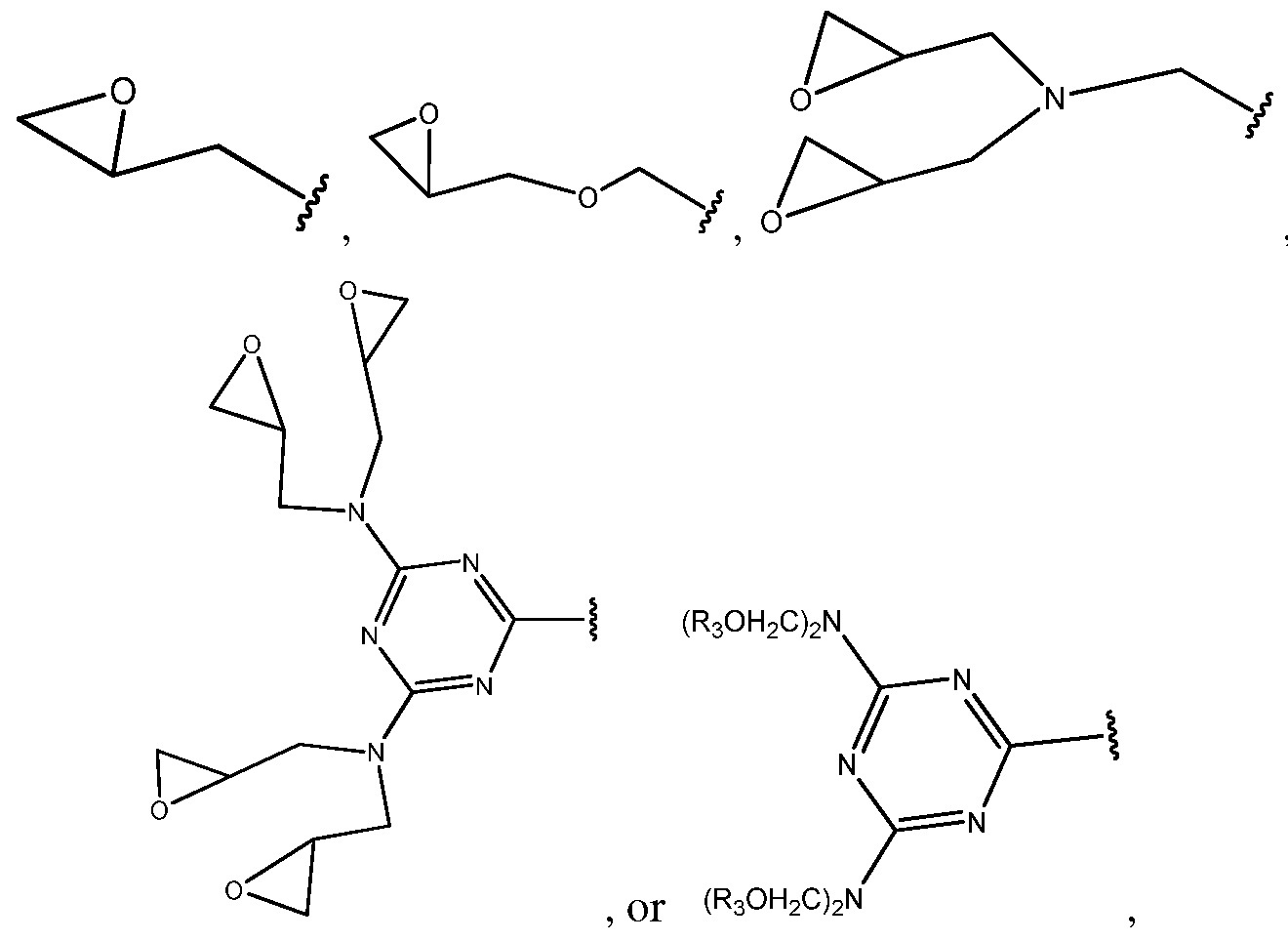
9. A carbon fiber composite comprising a cured epoxy resin of an epoxy resin and amino hardeners, wherein the epoxy resin is a compound of Formula III
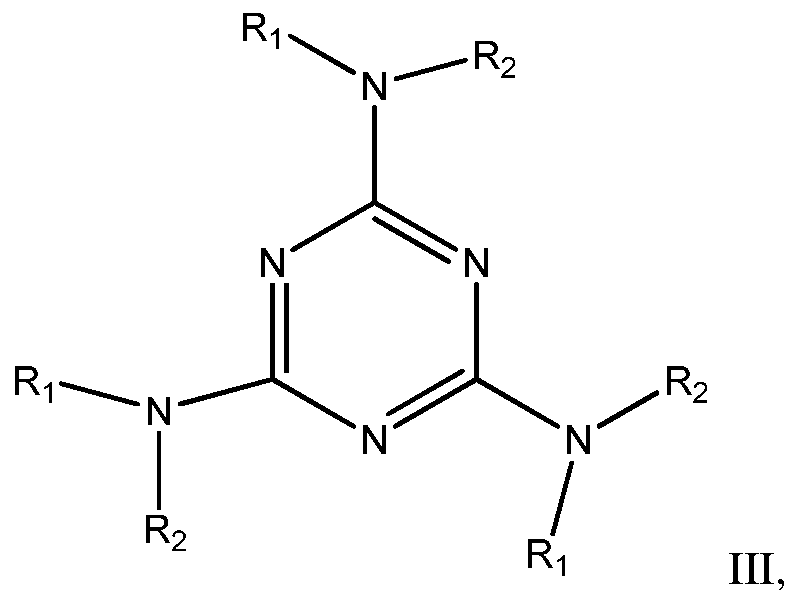
wherein Ri and R2 are independently selected from the group consisting of:


-53-

11. The carbon fiber composite of claim 9, wherein the amine hardener has a Formula of III, wherein Rl and R2 are any melamine amino derivatives.
12. cross-linked polyurethane, polyester, or silicone, wherein the isocyanate terminated polyurethane, polyester, or silicone are cross-linked with a compound of Formula III

wherein Ri and R2 are independently selected from the group consisting of H, CH2OH CH2NH2, and melaminyl, or are cross-linked with a compound having a formula of

[(H2NH2CH2C)2NH2C]2N- -N[CH2N(CH2CH2NH2)2]2
N[CH2N(CH2CH2NH2)2]2 XIII.
13. A composite comprising one or more a cured epoxy resins of an epoxy resin of Formula III, wherein the epoxy resin is a compound of Formula III
of:

The composition of claim 13, wherein the epoxy resin has a Formula of

-57-
15. A method of curing an epoxy resin the method comprising contacting an epoxy resin of claim 13 and 14with amine compounds, a compound of Formula III

wherein Ri and R2 are independently selected from the group consisting of CH2NH2, and melaminyl, a compound having a formula of

[(H2NH2CH2C)2NH2C]2N- -N[CH2N(CH2CH2NH2)2]2
N[CH2N(CH2CH2NH2)2]2 XIII,
or with one or more hardeners under conditions sufficient to cure the epoxy resins.
16. A method of making a compound of Formula III, the method comprising contacting hexamethylol melamine with ammonia to produce a compound of Formula IV

17. A method of making a compound of Formula V, the method comprising contacting melamine with epichlorohydrine and a strong base to produce a compound of Formula V

The method of claim 17, wherein the method is performed at a temperature of about
0-80 °C.
19. The method of claim 18, wherein the method is performed at three different temperature of about 0-10°C, about 40-80°C,and about 50-60 °C.
20. A method of making a compound of Formula VI, the method comprising contacting a compound of Formula II


21. The method of claim 19, wherein the method is performed at temperature of about 50-60 °C.
22. A method of making a compound of Formula VII, the method comprising contacting a compound of Formula IV

e a compound of Formula VII

23. A method of making a compound of Formula IX, the method comprising contacting a compound of Formula VIII with excess formaldehyde and a strong base to produce a compound of Formula IX

24. A method of making a compound of Formula X, the method comprising contacting a compound of Formula VIII with epichlorohydrine and a strong base at a temperature of about 0-80 °C to produce a compound of Formula X

25. A method of making a compound of Formula XI, the method comprising contacting a compound of Formula IX with an excess of epichlorohydrine and a strong base at a temperature of about 50-60 °C to produce a compound of Formula XI


26. A method of making a compound of Formula XII, the method comprising contacting a compound of Formula II with diethanol amine to produce a compound of Formula XII

27. A method of making a compound of Formula XIII, the method comprising contacting a compound of Formula XII with ammonia or an aliphatic amine under a pressure of about 1-2 atm to produce a compound of Formula XIII 2NH2CH2C)2NH [CH2N(CH2CH2NH2)2]2 2)2]2 XIII.
28. A method of producing glycidyl ether derivatives of a compound of Formula XII or glycidylamines from any melamine amino derivatives, a compound of formula XIII the method comprising contacting a compound of Formula XII or XIII with respectively with epichlorohydrine and a strong base at a temperature sufficient to produce a glycidyl ether derivative from compound of Formula XII or glycidylamines from compound of formula XIII.
29. A composition comprising further generations of melamine derived epoxy resin, the resin prepared by a method, the method comprising contacting a melamine methylol of Formula II, IX or Formula XII with an amine to produce a melamine amino derivatives; and optionally contacting the melamine amino derivative with an epichlorohydrine to yield glycidylamine derivative; or contacting the melamine amino derivative with formaldehyde and a strong base to yield a methylol derivatives.
Priority Applications (4)
| Application Number | Priority Date | Filing Date | Title |
|---|---|---|---|
| US13/879,289 US8911858B2 (en) | 2012-10-31 | 2012-10-31 | Multifunctional melamine epoxy resins, methylols and amines |
| PCT/US2012/062708 WO2014070155A1 (en) | 2012-10-31 | 2012-10-31 | Multifunctional melamine epoxy resins, methylols and amines |
| CN201280076688.0A CN104755532B (en) | 2012-10-31 | 2012-10-31 | Multifunctional melamine epoxy resins, methylols and amines |
| US14/548,223 US9221960B2 (en) | 2012-10-31 | 2014-11-19 | Multifunctional melamine epoxy resins, methylols and amines |
Applications Claiming Priority (1)
| Application Number | Priority Date | Filing Date | Title |
|---|---|---|---|
| PCT/US2012/062708 WO2014070155A1 (en) | 2012-10-31 | 2012-10-31 | Multifunctional melamine epoxy resins, methylols and amines |
Related Child Applications (2)
| Application Number | Title | Priority Date | Filing Date |
|---|---|---|---|
| US13/879,289 A-371-Of-International US8911858B2 (en) | 2012-10-31 | 2012-10-31 | Multifunctional melamine epoxy resins, methylols and amines |
| US14/548,223 Continuation US9221960B2 (en) | 2012-10-31 | 2014-11-19 | Multifunctional melamine epoxy resins, methylols and amines |
Publications (1)
| Publication Number | Publication Date |
|---|---|
| WO2014070155A1 true WO2014070155A1 (en) | 2014-05-08 |
Family
ID=50627852
Family Applications (1)
| Application Number | Title | Priority Date | Filing Date |
|---|---|---|---|
| PCT/US2012/062708 Ceased WO2014070155A1 (en) | 2012-10-31 | 2012-10-31 | Multifunctional melamine epoxy resins, methylols and amines |
Country Status (3)
| Country | Link |
|---|---|
| US (2) | US8911858B2 (en) |
| CN (1) | CN104755532B (en) |
| WO (1) | WO2014070155A1 (en) |
Cited By (1)
| Publication number | Priority date | Publication date | Assignee | Title |
|---|---|---|---|---|
| CN113372549A (en) * | 2021-08-03 | 2021-09-10 | 中建西部建设建材科学研究院有限公司 | Vinyl-terminated hyperbranched polymer, viscosity-reducing polycarboxylate superplasticizer with hyperbranched structure and preparation method of viscosity-reducing polycarboxylate superplasticizer |
Families Citing this family (8)
| Publication number | Priority date | Publication date | Assignee | Title |
|---|---|---|---|---|
| US8911858B2 (en) * | 2012-10-31 | 2014-12-16 | Empire Technology Development Llc | Multifunctional melamine epoxy resins, methylols and amines |
| CN103923296B (en) * | 2014-04-09 | 2016-03-02 | 中国海洋石油总公司 | A kind of crude oil demulsifier and preparation method thereof |
| CN104592138B (en) * | 2015-01-08 | 2017-05-17 | 重庆大学 | Method of increasing hydroxymethyl content of hexahydroxymethyl melamine |
| CN105440261B (en) * | 2015-11-30 | 2017-10-10 | 中南民族大学 | A kind of degradable self-crosslinking hyperbranched epoxy resin and preparation method thereof |
| CN109824302B (en) * | 2017-11-23 | 2022-08-30 | 中国石油化工股份有限公司 | Water plugging composition, water plugging agent and preparation method thereof |
| CN111039934B (en) * | 2018-10-15 | 2022-08-09 | 中国石油化工股份有限公司 | Amino compound, preparation method thereof and application of amino compound as flame retardant |
| CN111777842B (en) * | 2020-07-29 | 2023-06-23 | 四川省玻纤集团有限公司 | Resin-based laminated board with excellent water resistance and preparation method thereof |
| CN119823058B (en) * | 2024-11-19 | 2025-11-18 | 湖南科技大学 | Star-shaped heavy metal chelating agent with melamine as core, and preparation method and application thereof |
Citations (2)
| Publication number | Priority date | Publication date | Assignee | Title |
|---|---|---|---|---|
| US2980676A (en) * | 1957-07-24 | 1961-04-18 | Ciba Ltd | Glycidyl ethers of n-methylolamino-1:3:5-triazines |
| US4661568A (en) * | 1984-01-31 | 1987-04-28 | The Dow Chemical Company | Epoxy resin composition and process for preparing laminates therefrom |
Family Cites Families (11)
| Publication number | Priority date | Publication date | Assignee | Title |
|---|---|---|---|---|
| US3726835A (en) * | 1971-01-12 | 1973-04-10 | Thiokol Chemical Corp | Polyurethane prepolymers cured with melamine or dicyandiamide |
| CH614978A5 (en) | 1974-05-13 | 1979-12-28 | Inventa Ag | |
| US4623701A (en) | 1985-07-10 | 1986-11-18 | The Dow Chemical Company | Multifunctional epoxy resins |
| DE4440491A1 (en) | 1994-11-12 | 1996-05-15 | Basf Ag | Fire protection blankets made from melamine-formaldehyde resin fibers |
| DE19530178A1 (en) | 1995-08-17 | 1997-02-20 | Basf Ag | Modified melamine formaldehyde resins |
| DE19617634A1 (en) | 1996-05-02 | 1997-11-06 | Basf Ag | Flame retardant fabric based on melamine resin fibers |
| CN1206223C (en) * | 2001-12-05 | 2005-06-15 | 长春人造树脂厂股份有限公司 | Nitrogen-containing flame retardant epoxy resin and composition thereof |
| EP2149572A1 (en) * | 2008-07-15 | 2010-02-03 | Johannes Kepler Universität Linz | Melamine epoxides |
| WO2012043245A1 (en) * | 2010-09-29 | 2012-04-05 | 日本カーバイド工業株式会社 | Melamine epoxy resin monomer and resin composition |
| CN102731768A (en) * | 2012-06-12 | 2012-10-17 | 四川金象赛瑞化工股份有限公司 | Method for preparing polyether glycol by using melamine as initiator |
| US8911858B2 (en) * | 2012-10-31 | 2014-12-16 | Empire Technology Development Llc | Multifunctional melamine epoxy resins, methylols and amines |
-
2012
- 2012-10-31 US US13/879,289 patent/US8911858B2/en not_active Expired - Fee Related
- 2012-10-31 CN CN201280076688.0A patent/CN104755532B/en not_active Expired - Fee Related
- 2012-10-31 WO PCT/US2012/062708 patent/WO2014070155A1/en not_active Ceased
-
2014
- 2014-11-19 US US14/548,223 patent/US9221960B2/en not_active Expired - Fee Related
Patent Citations (2)
| Publication number | Priority date | Publication date | Assignee | Title |
|---|---|---|---|---|
| US2980676A (en) * | 1957-07-24 | 1961-04-18 | Ciba Ltd | Glycidyl ethers of n-methylolamino-1:3:5-triazines |
| US4661568A (en) * | 1984-01-31 | 1987-04-28 | The Dow Chemical Company | Epoxy resin composition and process for preparing laminates therefrom |
Non-Patent Citations (2)
| Title |
|---|
| CASTRO ET AL.: "Melamine/epichlorohydrin prepolymers: syntheses and characterization", POLYMER, vol. 46, 2005, pages 1766 - 1774, XP004755168, DOI: doi:10.1016/j.polymer.2004.12.046 * |
| LUBCZAK.: "Polyhydroxyalkyl derivatives and polyetherols obtained from azacyclic compounds", POLIMERY, vol. 56, no. 6, 2011, pages 452 - 459 * |
Cited By (2)
| Publication number | Priority date | Publication date | Assignee | Title |
|---|---|---|---|---|
| CN113372549A (en) * | 2021-08-03 | 2021-09-10 | 中建西部建设建材科学研究院有限公司 | Vinyl-terminated hyperbranched polymer, viscosity-reducing polycarboxylate superplasticizer with hyperbranched structure and preparation method of viscosity-reducing polycarboxylate superplasticizer |
| CN113372549B (en) * | 2021-08-03 | 2023-04-11 | 中建西部建设建材科学研究院有限公司 | Vinyl-terminated hyperbranched polymer, viscosity-reducing polycarboxylate superplasticizer with hyperbranched structure and preparation method of viscosity-reducing polycarboxylate superplasticizer |
Also Published As
| Publication number | Publication date |
|---|---|
| US9221960B2 (en) | 2015-12-29 |
| CN104755532B (en) | 2017-05-03 |
| US8911858B2 (en) | 2014-12-16 |
| US20140179838A1 (en) | 2014-06-26 |
| US20150073103A1 (en) | 2015-03-12 |
| CN104755532A (en) | 2015-07-01 |
Similar Documents
| Publication | Publication Date | Title |
|---|---|---|
| WO2014070155A1 (en) | Multifunctional melamine epoxy resins, methylols and amines | |
| US11905228B2 (en) | Salts of diaminoacetals and diaminoketals and their synthesis, and their transformations to diaminoacetals and diaminoketals | |
| JP5680108B2 (en) | Etheramines and their use as intermediates in polymer synthesis | |
| JP3003115B2 (en) | Thermosetting resin | |
| US3385908A (en) | Flame retardant phenolic polyglycidyl ether resin compositions | |
| JP5095405B2 (en) | Benzooxazine compound derived from phenolphthalein having flame retardancy and process for producing the same | |
| KR20170082993A (en) | Phthalonitrile resin | |
| US3145207A (en) | Process for preparing epoxy alkyloxymethylamino-s-triazines | |
| JP6492070B2 (en) | Ether amines and their use as curing agents or intermediates for polymer synthesis | |
| JP2009538943A (en) | Method for preparing hydroxy aromatic resin, hydroxy aromatic resin, and modification thereof | |
| JPS62292823A (en) | Thermoplastic polymer compositions with thermoset processing properties | |
| JP3368680B2 (en) | Novel epoxy compound and method for producing the same | |
| JP2016534987A (en) | Ether amines with enhanced thermal stability and their use as curing agents or intermediates for polymer synthesis | |
| JP2014516111A (en) | Production of cured epoxy resins with flame retardant phosphonates. | |
| JP2024096358A (en) | Addition and condensation polymers prepared from halogenated reactants | |
| US9890130B2 (en) | Phenolic epoxy compounds | |
| WO2023057568A1 (en) | High-performance benzoxazine derivatives vitrimers | |
| Rotaru et al. | Synthesis of a new mannich polyether polyol with isocyanuric structure | |
| KR20160057929A (en) | Polyalkylene carbonate resin with improved thermal stability | |
| JP3184617B2 (en) | New diguanamine and method for producing the same | |
| US20030162934A1 (en) | Phosphorus-containing epoxy monomer and hardening agent and composition thereof | |
| CN104995268B (en) | New uses of condensation resins | |
| US2352942A (en) | Reaction product of aldehydes and triazine derivatives | |
| KR20000002410A (en) | Macromolecule bisphenol-sulfon epoxy resin having improved heat resistance and fire retardancy | |
| JPH01316368A (en) | Melamine-diamino condensate and curing of 1, 2-epoxy resin using the same |
Legal Events
| Date | Code | Title | Description |
|---|---|---|---|
| WWE | Wipo information: entry into national phase |
Ref document number: 13879289 Country of ref document: US |
|
| 121 | Ep: the epo has been informed by wipo that ep was designated in this application |
Ref document number: 12887514 Country of ref document: EP Kind code of ref document: A1 |
|
| NENP | Non-entry into the national phase |
Ref country code: DE |
|
| 122 | Ep: pct application non-entry in european phase |
Ref document number: 12887514 Country of ref document: EP Kind code of ref document: A1 |