WO2014064809A1 - 葉たばこの種類の判別方法 - Google Patents
葉たばこの種類の判別方法 Download PDFInfo
- Publication number
- WO2014064809A1 WO2014064809A1 PCT/JP2012/077637 JP2012077637W WO2014064809A1 WO 2014064809 A1 WO2014064809 A1 WO 2014064809A1 JP 2012077637 W JP2012077637 W JP 2012077637W WO 2014064809 A1 WO2014064809 A1 WO 2014064809A1
- Authority
- WO
- WIPO (PCT)
- Prior art keywords
- species
- leaf tobacco
- tobacco
- burley
- extract
- Prior art date
- Legal status (The legal status is an assumption and is not a legal conclusion. Google has not performed a legal analysis and makes no representation as to the accuracy of the status listed.)
- Ceased
Links
Images

Classifications
-
- A—HUMAN NECESSITIES
- A24—TOBACCO; CIGARS; CIGARETTES; SIMULATED SMOKING DEVICES; SMOKERS' REQUISITES
- A24B—MANUFACTURE OR PREPARATION OF TOBACCO FOR SMOKING OR CHEWING; TOBACCO; SNUFF
- A24B3/00—Preparing tobacco in the factory
- A24B3/16—Classifying or aligning leaves
-
- A—HUMAN NECESSITIES
- A24—TOBACCO; CIGARS; CIGARETTES; SIMULATED SMOKING DEVICES; SMOKERS' REQUISITES
- A24B—MANUFACTURE OR PREPARATION OF TOBACCO FOR SMOKING OR CHEWING; TOBACCO; SNUFF
- A24B15/00—Chemical features or treatment of tobacco; Tobacco substitutes, e.g. in liquid form
- A24B15/18—Treatment of tobacco products or tobacco substitutes
- A24B15/24—Treatment of tobacco products or tobacco substitutes by extraction; Tobacco extracts
-
- G—PHYSICS
- G01—MEASURING; TESTING
- G01N—INVESTIGATING OR ANALYSING MATERIALS BY DETERMINING THEIR CHEMICAL OR PHYSICAL PROPERTIES
- G01N21/00—Investigating or analysing materials by the use of optical means, i.e. using sub-millimetre waves, infrared, visible or ultraviolet light
- G01N21/17—Systems in which incident light is modified in accordance with the properties of the material investigated
- G01N21/25—Colour; Spectral properties, i.e. comparison of effect of material on the light at two or more different wavelengths or wavelength bands
- G01N21/31—Investigating relative effect of material at wavelengths characteristic of specific elements or molecules, e.g. atomic absorption spectrometry
-
- G—PHYSICS
- G01—MEASURING; TESTING
- G01N—INVESTIGATING OR ANALYSING MATERIALS BY DETERMINING THEIR CHEMICAL OR PHYSICAL PROPERTIES
- G01N30/00—Investigating or analysing materials by separation into components using adsorption, absorption or similar phenomena or using ion-exchange, e.g. chromatography or field flow fractionation
- G01N30/02—Column chromatography
- G01N30/88—Integrated analysis systems specially adapted therefor, not covered by a single one of the groups G01N30/04 - G01N30/86
-
- G—PHYSICS
- G01—MEASURING; TESTING
- G01N—INVESTIGATING OR ANALYSING MATERIALS BY DETERMINING THEIR CHEMICAL OR PHYSICAL PROPERTIES
- G01N31/00—Investigating or analysing non-biological materials by the use of the chemical methods specified in the subgroup; Apparatus specially adapted for such methods
- G01N31/22—Investigating or analysing non-biological materials by the use of the chemical methods specified in the subgroup; Apparatus specially adapted for such methods using chemical indicators
-
- G—PHYSICS
- G01—MEASURING; TESTING
- G01N—INVESTIGATING OR ANALYSING MATERIALS BY DETERMINING THEIR CHEMICAL OR PHYSICAL PROPERTIES
- G01N30/00—Investigating or analysing materials by separation into components using adsorption, absorption or similar phenomena or using ion-exchange, e.g. chromatography or field flow fractionation
- G01N30/02—Column chromatography
- G01N30/04—Preparation or injection of sample to be analysed
- G01N30/06—Preparation
- G01N2030/062—Preparation extracting sample from raw material
-
- G—PHYSICS
- G01—MEASURING; TESTING
- G01N—INVESTIGATING OR ANALYSING MATERIALS BY DETERMINING THEIR CHEMICAL OR PHYSICAL PROPERTIES
- G01N30/00—Investigating or analysing materials by separation into components using adsorption, absorption or similar phenomena or using ion-exchange, e.g. chromatography or field flow fractionation
- G01N30/02—Column chromatography
- G01N30/88—Integrated analysis systems specially adapted therefor, not covered by a single one of the groups G01N30/04 - G01N30/86
- G01N2030/8809—Integrated analysis systems specially adapted therefor, not covered by a single one of the groups G01N30/04 - G01N30/86 analysis specially adapted for the sample
- G01N2030/884—Integrated analysis systems specially adapted therefor, not covered by a single one of the groups G01N30/04 - G01N30/86 analysis specially adapted for the sample organic compounds
-
- G—PHYSICS
- G01—MEASURING; TESTING
- G01N—INVESTIGATING OR ANALYSING MATERIALS BY DETERMINING THEIR CHEMICAL OR PHYSICAL PROPERTIES
- G01N30/00—Investigating or analysing materials by separation into components using adsorption, absorption or similar phenomena or using ion-exchange, e.g. chromatography or field flow fractionation
- G01N30/02—Column chromatography
- G01N30/62—Detectors specially adapted therefor
- G01N30/72—Mass spectrometers
- G01N30/7206—Mass spectrometers interfaced to gas chromatograph
Definitions
- the present invention relates to a method for discriminating the type of leaf tobacco.
- the present invention relates to a method for discriminating whether the type of leaf tobacco is an Orient species or a native species, a Burley species, or a yellow species.
- Non-Patent Document 3 describes a method of quantifying a phenol substance by combining a foreign thiocult method and reverse phase high performance liquid chromatography.
- Slinkard and Singleton methods for quantifying total phenol are known.
- Kramling and Singleton methods for quantifying flavonoids and non-flavonoid phenols are also known.
- Non-Patent Document 4 describes that 3-methylvaleric acid is specifically high in the Orient species.
- the method of discriminating from the appearance based on the above-mentioned experience is subjective and is likely to make different judgments depending on the judge. Moreover, it is difficult to pass on the judgment technique acquired as experience to others.
- Non-Patent Document 1 i) takes a considerable time (for example, several days) until discrimination, ii) special knowledge such as operation method is required. Iii) costly to create markers, etc. iv) cannot be analyzed depending on the quality or quantity of extracted DNA, and v) the sample must be destroyed and the same sample can be reused for other analysis There are problems such as being unable to do so.
- Non-Patent Document 3 In the method described in Non-Patent Document 3, reversed-phase high performance liquid chromatography is expensive and time-consuming. Note that Non-Patent Document 3 does not describe analyzing tobacco at all.
- the present invention has been made in view of the above-mentioned problems, and the object of the present invention is to easily and quickly determine whether one leaf tobacco is an oriental species, a native species, a Burley species, or a yellow species. It is to provide a method for discriminating between them.
- a discrimination method is a discrimination method for discriminating whether a leaf tobacco type is an Orient species or a native species, a Burley species, and a yellow species, An extraction step of obtaining an extract of the leaf tobacco by immersing in methanol, ethanol or a mixture thereof or a mixture of these with water, and a part of the extract is subjected to GC / MS analysis.
- a detection step for detecting herbic acid a first discrimination step for discriminating whether or not the leaf tobacco type is an oriental species or a native species based on the detection result in the detection step;
- the type of leaf tobacco is a Burley species based on the color development step of mixing a part of the foreign thiocarte reagent and a base and the color development in the reaction solution obtained in the color development step.
- a second discriminating step a discrimination method comprising to determine whether.
- the discrimination method is a discrimination method for discriminating whether a leaf tobacco type is an Orient species or a native species, a Burley species, and a yellow species,
- An extraction step of immersing the leaf tobacco in methanol, ethanol or a mixture thereof or a mixture of these with water to obtain the leaf tobacco extract;
- a detection step in which a part of the extract is subjected to GC / MS analysis to detect 3-methylvaleric acid; Based on the detection result in the detection step, a first determination step of determining whether the type of leaf tobacco is an oriental species or a native species, A color development step of mixing the other part of the extract with a foreign thiocult reagent and a base to develop a color;
- a second discrimination step of discriminating whether or not the leaf tobacco type is a Burley species based on the color development in the reaction solution obtained in the color development step.
- the form of the leaf cigarette that is the object of the discrimination method according to the present invention is not particularly limited.
- it may be a laminar (deboned leaf part) of a raw material leaf cigarette or a cigarette carved of lamina. It may be in powder form.
- the tobacco engraving may be included in the tobacco product, or may be prepared by carving the leaf tobacco in the raw material or the tobacco tobacco during the production of the tobacco product.
- the leaf tobacco is in the form of tobacco or powder.
- the discriminating method according to the present invention can be suitably applied particularly to tobacco engraving contained in tobacco products.
- Leaf tobacco determined not to be an Orient species or a native species is a species other than the Orient species and the native species such as, for example, a yellow species and a Burley species.
- leaf tobacco refers to tobacco leaves contained in tobacco products, and tobacco leaves (dried leaves) that are used as raw materials for producing tobacco products.
- the size of the leaf tobacco is not particularly limited. For example, it may be a tobacco cut having a width of 0.1 to 1.5 mm and a length of 0.5 to 10 mm.
- type of leaf tobacco refers to Burley species, yellow species, Orient species, and native species.
- the extraction step is a step of obtaining the leaf tobacco extract by immersing the target leaf tobacco in methanol, ethanol or a mixture thereof, or a mixture of these and water.
- the concentration of methanol is preferably 70% (v / v) or more and 99% (v / v) or less, preferably 80% (v / v) or more. Is preferably 90% (v / v) or less, and more preferably 80% (v / v).
- the concentration of ethanol is preferably 70% (v / v) or more and 99% (v / v) or less, and 80% (v / v).
- the concentration of ethanol is preferably 70% (v / v) or more and 99% (v / v) or less, and 80% (v / v).
- the concentration of ethanol is preferably 70% (v / v) or more and 99% (v / v) or less, and 80% (v / v).
- the leaf tobacco is preferably immersed in a mixed solution of methanol and water or methanol, and more preferably immersed in a mixed solution of methanol or water containing methanol or 70% (v / v) or more of methanol.
- the other liquid may be contained in the liquid mixture or methanol of methanol and water.
- the immersion time is not particularly limited, but for example, it is 5 minutes or more and 12 hours or less, preferably 1 hour or more and 5 hours or less, more preferably 2 hours or more and 3 hours or less.
- Detection process In the detection step, a part of the extract obtained in the extraction step is subjected to GC / MS analysis to detect 3-methylvaleric acid.
- the amount of the extract used in the detection process is not particularly limited as long as a part of the extract obtained in the extraction process is used. Further, the extract may be used after being diluted, but it can also be used without being diluted. From the viewpoint of simplicity, the extract is preferably used without dilution.
- the measuring apparatus and measuring conditions in the GC / MS analysis are not particularly limited as long as 3-methylvaleric acid can be detected.
- 3-methylvaleric acid can be carried out with a measuring apparatus and measuring conditions generally used for detection.
- Examples of measurement conditions for GC / MS analysis include the conditions shown in Table 1.
- the EI method can be used as the ionization method.
- the shape of the GC / MS spectrum is greatly different between the oriental species and the native species and other types. Therefore, the presence or absence of a peak of 3-methylvaleric acid can be easily determined. Further, as shown in FIG. 1 (a), isovaleric acid is detected before 3-methylvaleric acid is detected, and glycerin is detected after 3-methylvaleric acid is detected. So, for example, based on the intensity of the peak of 3-methylvaleric acid compared to the intensity of the peak of isovaleric acid and the peak of glycerin, the type of leaf tobacco of interest is an oriental or native species It may be determined whether or not.
- the peak of 3-methylvaleric acid in known types of leaf tobacco may be used as a reference and compared with the peak of 3-methylvaleric acid in the target leaf tobacco.
- leaf tobacco that is known to be an Orient species and leaf tobacco that is known to be other types may be used as a reference.
- the intensity of the standard 3-methylvaleric acid peak varies depending on various conditions in the extraction process and the detection process. Therefore, it is preferable to analyze in parallel the leaf tobacco and the leaf tobacco whose types are known.
- the peak of 3-methylvaleric acid is less intense in the native species.
- the peak intensity of 3-methylvaleric acid when performed under the conditions of Example 1 described later, when the peak intensity of 3-methylvaleric acid is 40000 or less, it can be determined that the target leaf tobacco type is a native species, and more than 40000 If so, it can be determined that the leaf tobacco type of the subject is an Orient species.
- the orientation species When performed under the conditions of Example 1 described later, the orientation species basically have a peak intensity of 3-methylvaleric acid of 100,000 or more. For this reason, it is possible to easily distinguish between the orientation species and the native species.
- the color development step is a step in which another part of the extract obtained in the extraction step, a foreign thiocult reagent and a base are mixed to cause color development.
- the amount of the extract used in the color development step is not particularly limited as long as a part of the extract obtained in the extraction step is used. Further, the extract may be used after being diluted, but it can also be used without being diluted. From the viewpoint of simplicity, the extract is preferably used without dilution.
- FC reagent is a mixed aqueous solution of disodium tungstate, sodium molybdate, lithium sulfate, phosphoric acid, hydrochloric acid and bromine. Since the FC reagent is also used for detection of phenol, it is also called a phenol reagent. FC reagent develops a blue-violet color when it reacts with phenolic hydroxyl groups.
- the FC reagent a commercially available one may be used, or one prepared by itself may be used.
- the amount of the FC reagent is not particularly limited, but for example, it is preferably 1 to 100 times and 1 to 30 times that of the extract used in the color development step.
- the FC reagent may be diluted, but it can also be used as it is. From the viewpoint of simplicity, the FC reagent is preferably used as it is.
- the base is not particularly limited, and examples thereof include bases generally used in the FC method such as potassium hydroxide, sodium hydroxide, potassium carbonate, or sodium carbonate.
- the base may be added as an aqueous solution.
- the amount of the base is not particularly limited.
- a 1M base may be used in an amount of 10 to 50 times the sum of the volume of the extract to be used and the volume of the FC reagent.
- the order of mixing the extract, FC reagent, and base is not particularly limited.
- the base may be added to the mixture of the extract and the FC reagent, the FC reagent may be added to the mixture of the extract and the base, or the extract is added to the mixture of the FC reagent and the base. It may be added.
- the color development time is not particularly limited, but from the viewpoint of preventing fading, for example, it is 1 second or more and 60 minutes or less, preferably 1 second or more and 20 minutes or less, and 1 second or more and 10 minutes or less. Is more preferable.
- the temperature of the coloring process is not particularly limited, but is preferably 1 ° C. or higher and 40 ° C. or lower, more preferably 5 ° C. or higher and 30 ° C. or lower. From the viewpoint of carrying out more easily, room temperature is preferable.
- the extract obtained in the extraction step contains phenols
- the phenols react with the foreign thiocult reagent, and the reaction solution turns blue-violet.
- leaf tobacco of a type other than Burley species such as yellow species and Orient species develops a blue-purple color.
- Burley leaf tobacco does not basically develop blue-violet color. Therefore, when the reaction liquid obtained in the color development step does not show blue-violet color development, it can be determined that the target leaf tobacco type is a Burley species.
- the reaction solution obtained in the color development step when blue-violet color development is recognized, it can be determined that the target leaf tobacco type is not a Burley species.
- Leaf tobacco determined not to be a Burley species is a type other than a Burley species, such as a yellow species, an Orient species, and a native species. Although the Burley species may develop a slightly blue-violet color, it is a very weak coloration, and those skilled in the art can easily distinguish it from other types of colors other than the Burley species.
- the intensity of blue-violet color development is greatly different between Burley species and other types. Therefore, based on observation with the naked eye, it can be determined whether or not the target leaf tobacco type is a Burley species. That is, in the discrimination step, the blue-violet color can be confirmed with the naked eye. If the determination is performed with the naked eye, a simpler determination can be realized.
- the intensity of color development in a known type of leaf tobacco may be compared with the intensity of color development in the target leaf tobacco.
- leaf tobacco that is known to be Burley species and leaf tobacco that is known to be other types may be used as a reference.
- the intensity of blue-violet color development as a reference varies depending on various conditions in the extraction process and the color development process. Therefore, it is preferable to analyze in parallel the leaf tobacco and the leaf tobacco whose types are known.
- the leaf tobacco that is determined not to be an oriental species or a native species in the first discrimination step and that is not a Burley species in the second discrimination step can be determined to be a yellow species.
- the liquid used in the extraction step is methanol, ethanol, a mixed solution thereof, or a mixed solution of these and water. Therefore, if methanol, ethanol, and water are evaporated from leaf tobacco after the extraction process, the same leaf tobacco can be reused for other analyses. In particular, components insoluble in methanol remain in leaf tobacco without being extracted. In the method of extracting DNA as described in Non-Patent Document 1 and Non-Patent Document 2, it is necessary to destroy the target leaf tobacco and it cannot be reused.
- the conventional method using a DNA marker takes about 1 to 2 days for one sample.
- one sample can be determined within 4 hours.
- the time required for determination can be drastically reduced, and determination can be made quickly.
- the procedure of the discrimination method according to the present invention is simple and can be easily performed.
- FC method coloring step using an FC reagent is as described below.
- leaf tobacco is known to contain many components, and it was inferred that it is essential to separate the extract into each component.
- the present inventors have surprisingly found that it is possible to determine whether or not the type of leaf tobacco is a Burley species by the FC method without separating the extract into each component.
- the present invention made based on this discovery, it is possible to easily and quickly determine whether or not the type of leaf tobacco is a Burley species.
- the color development step of the discrimination method according to the present invention there is a large difference in blue-violet color between the Burley species and other types, and the color development difference can be sufficiently observed with the naked eye. Therefore, it is possible to determine with high accuracy whether or not the type of the target leaf tobacco is a Burley species by observation with the naked eye without measuring the absorbance using an instrument. For this reason, the determination can be made more simply and at low cost.
- the color development step of the discrimination method according to the present invention it is not necessary to prepare a special reagent or the like, and discrimination can be performed without using an instrument, so that the cost is low.
- the determination method according to the present invention may further include a third determination step of determining whether the type of leaf tobacco is an oriental species or a native species based on the detection result in the detection step.
- the leaf unit In addition, if a leaf tobacco contained in a leaf unit in the manufacturing process of the tobacco product or a large number of tobacco time contained in the tobacco product is analyzed using the discrimination method according to the present invention, the leaf unit. Alternatively, it is possible to calculate the blending ratio (leaf composition) of each of oriental or native species, Burley species, and yellow species of leaf tobacco in the tobacco product.
- a plurality (for example, 100) of cigarettes included in a tobacco product are taken out at random. Place each cigarette in a 1500 ⁇ L tube, add 150 ⁇ L of 80% (v / v) ethanol, and allow to stand at room temperature for 2-3 hours. Next, 50 ⁇ L of the extract from each cigarette is subjected to GC / MS analysis under the measurement conditions shown in Table 1 above.
- a sample that is determined to be a species other than the Orient species or the native species and is determined to be other than the Burley species is a yellow species. That is, when the peak of 3-methylvaleric acid is not detected and a blue-violet color is observed, it is determined that the tobacco is a yellow leaf tobacco. Divide the number of samples in which the peak of 3-methylvaleric acid is not detected and blue-violet coloration is recognized by the number of all tobacco samples analyzed to calculate the proportion of yellow leaf tobacco in tobacco products. Can do.
- the same operation as described above was performed in parallel for the tobacco of a known type (control). Also good.
- the tobacco product is known to consist of Burley, Yellow and Orient tobacco, Burley, Yellow and Orient tobacco may be used as a control.
- the intensity (reference) of the peak of 3-methylvaleric acid that serves as a boundary between the Orient species and the other species can be determined.
- the same operation as described above may be performed in parallel on a cigarette (control) whose type is known in order to determine the intensity of the blue-violet color that serves as a reference.
- a cigarette control
- the tobacco product is known to consist of Burley, Yellow and Orient tobacco, Burley, Yellow and Orient tobacco may be used as a control.
- the intensity (standard) of blue-violet color development that serves as a boundary between Burley species and other types can be determined.
- the blending ratio of each type of leaf tobacco can be calculated with higher accuracy. If combined with other analysis methods, the blending ratio of each type of leaf tobacco can be calculated with higher accuracy.
- Example 1 ⁇ Method> (1) Each cigarette (5 mm length ⁇ 0.8 mm width) was placed in a 1500 ⁇ L Eppendorf tube, and 150 ⁇ L of 80% (v / v) methanol was added. Extraction was performed by allowing to stand at room temperature for 2 to 3 hours.
- FIG. (A) of FIG. 1 is a GC / MS spectrum of an oriental species.
- FIG. 1 (b) is a GC / MS spectrum of a yellow species.
- FIG. 1C is a GC / MS spectrum of Burley species.
- Example 2 ⁇ Method> (1) 10 ⁇ L of a stock solution of foreign thiocult reagent (manufactured by Wako Pure Chemical Industries, Ltd., foreign & thiocult, phenol reagent) was placed in each well of a 96-well microplate.
- foreign thiocult reagent manufactured by Wako Pure Chemical Industries, Ltd., foreign & thiocult, phenol reagent
- the discrimination probability for the Burley species was 90.6%.
- the discrimination probability in the yellow species and the orientation species was 100%.
- the present invention can be used for quality control in the manufacture of cigarettes.
Landscapes
- Life Sciences & Earth Sciences (AREA)
- Physics & Mathematics (AREA)
- Health & Medical Sciences (AREA)
- Chemical & Material Sciences (AREA)
- Pathology (AREA)
- Analytical Chemistry (AREA)
- Biochemistry (AREA)
- General Health & Medical Sciences (AREA)
- General Physics & Mathematics (AREA)
- Immunology (AREA)
- Spectroscopy & Molecular Physics (AREA)
- General Chemical & Material Sciences (AREA)
- Chemical Kinetics & Catalysis (AREA)
- Biophysics (AREA)
- Molecular Biology (AREA)
- Manufacture Of Tobacco Products (AREA)
Abstract
葉たばこの種類がオリエント種または在来種、バーレー種、および黄色種の何れであるかを判別する判別方法であって、葉たばこの抽出液を得る抽出工程と、抽出液の一部をGC/MS分析に供し、3-メチル吉草酸の検出を行う検出工程と、その検出結果に基づき、オリエント種または在来種であるか否かを判別する第一の判別工程と、抽出液の他の一部とフォーリン・チオカルト試薬と塩基とを混合して発色させる発色工程と、その発色に基づき、バーレー種であるか否かを判別する第二の判別工程とを含む。
Description
本発明は、葉たばこの種類を判別する方法に関するものである。特には、葉たばこの種類がオリエント種または在来種、バーレー種、および黄色種の何れであるかを判別する方法に関するものである。
たばこ製品の多くは、複数の種類の葉たばこがブレンドされて製造されている。たばこ製品およびその原料について、品質保持および品質管理等を目的として、葉たばこの種類ごとの配合割合(葉組組成)を確認する場合がある。葉たばこの種類を特定する方法として、例えば、経験に基づいてたばこ刻の外観から判別する方法が挙げられる。また、非特許文献1および非特許文献2には、DNAマーカーを用いて葉たばこの品種を判別する方法が記載されている。
ところで、非特許文献3には、フォーリン・チオカルト法と逆相系高速液体クロマトグラフィーとを組み合わせてフェノール物質を定量する方法が記載されている。なお、フォーリン・チオカルト法以外の分析方法として、総フェノールを定量するSlinkardとSingletonの方法が知られている。また、フラボノイドおよび非フラボノイド型フェノールを定量するKramlingとSingletonの方法が知られている。
非特許文献4には、3-メチル吉草酸がオリエント種で特異的に高いことが記載されている。
"Microsatellite Markers For Tobacco Genetic Fingerprinting And Variety Identification", Plant & Animal Genomes XIII Conference, January 15-19, 2005, Town & Country Convention Center, San Diego, CAP136 : SSR, Gregor Bindler, Florian Martin, Louis Renaud, Etienne Kaelin, Paolo Donini, Ferruccio Gadani, Luca Rossi.
"Determination of Local Tobacco Cultivars Using ISSR Molecular Markaer", Jessada Denduangboripant et al., Chang Mai J. Sci. 2010;37(2):293-303.
「フォーリン・チオカルト法を用いた逆相系高速液体クロマトグラフィーによるフェノール化合物の分析-フェノールとフォーリン・シオカルト試薬との反応条件の至適化」, J.ASEV Jpn Vol.12 No.1 pp.21-28(2001).
"CHEMICAL CONSTITUTIONS OF TOBACCO LEAF AND DIFFERNCES AMONG TOBACCO TYPES", John C. Leffingwell,Ph. D, Leffingwell Reports, Vol.1(No.2), February, 2001.
しかし、上述の経験に基づいて外観から判別する方法は、主観的であり、判断者によって異なる判断をする可能性が高い。また、経験として習得した判断技術を他者に引き継ぐことは困難である。
また、非特許文献1および非特許文献2に記載されたDNAを用いる方法では、i)判別までに相当な時間(例えば、数日)がかかる、ii)操作方法などの特別な知識を必要とする、iii)マーカーの作成などにコストがかかる、iv)抽出したDNAの質または量によっては解析できない、および、v)サンプルを破壊する必要があり同一サンプルを他の解析に再利用することができない、などの問題点がある。
非特許文献3に記載の方法は、逆相系高速液体クロマトグラフィーが高価であり、かつ手間がかかる。なお、非特許文献3には、たばこを分析することは一切記載されていない。
本発明は、上記問題点に鑑みてなされたものであり、その目的は、1つの葉たばこについて、その種類がオリエント種または在来種、バーレー種、および黄色種の何れであるかを簡便かつ迅速に判別する方法等を提供することである。
上記課題を解決するために、本発明に係る判別方法は、葉たばこの種類がオリエント種または在来種、バーレー種、および黄色種の何れであるかを判別する判別方法であって、葉たばこを、メタノール、エタノールもしくはこれらの混合液またはこれらと水との混合液に浸漬して、当該葉たばこの抽出液を得る抽出工程と、上記抽出液の一部をGC/MS分析に供し、3-メチル吉草酸の検出を行う検出工程と、上記検出工程における検出結果に基づき、上記葉たばこの種類がオリエント種または在来種であるか否かを判別する第一の判別工程と、上記抽出液の他の一部とフォーリン・チオカルト試薬と塩基とを混合して発色させる発色工程と、上記発色工程で得られた反応液における発色に基づき、上記葉たばこの種類がバーレー種であるか否かを判別する第二の判別工程とを含む判別方法である。
本発明によって、1つの葉たばこについて、その種類がオリエント種または在来種、バーレー種、および黄色種の何れであるかを簡便かつ迅速に判別することができる。
本発明に係る判別方法について説明すれば以下の通りである。
本発明に係る判別方法は、葉たばこの種類がオリエント種または在来種、バーレー種、および黄色種の何れであるかを判別する判別方法であって、
葉たばこを、メタノール、エタノールもしくはこれらの混合液またはこれらと水との混合液に浸漬して、当該葉たばこの抽出液を得る抽出工程と、
上記抽出液の一部をGC/MS分析に供し、3-メチル吉草酸の検出を行う検出工程と、
上記検出工程における検出結果に基づき、上記葉たばこの種類がオリエント種または在来種であるか否かを判別する第一の判別工程と、
上記抽出液の他の一部とフォーリン・チオカルト試薬と塩基とを混合して発色させる発色工程と、
上記発色工程で得られた反応液における発色に基づき、上記葉たばこの種類がバーレー種であるか否かを判別する第二の判別工程とを含む。
葉たばこを、メタノール、エタノールもしくはこれらの混合液またはこれらと水との混合液に浸漬して、当該葉たばこの抽出液を得る抽出工程と、
上記抽出液の一部をGC/MS分析に供し、3-メチル吉草酸の検出を行う検出工程と、
上記検出工程における検出結果に基づき、上記葉たばこの種類がオリエント種または在来種であるか否かを判別する第一の判別工程と、
上記抽出液の他の一部とフォーリン・チオカルト試薬と塩基とを混合して発色させる発色工程と、
上記発色工程で得られた反応液における発色に基づき、上記葉たばこの種類がバーレー種であるか否かを判別する第二の判別工程とを含む。
本発明に係る判別方法の対象となる葉たばこの形態は、特に限定されず、例えば、原料の葉たばこのラミナ(除骨葉部分)であってもよいし、ラミナを刻んだたばこ刻であってもよいし、粉末状であってもよい。また、たばこ刻は、たばこ製品に含まれているものでもよいし、原料の葉たばこまたはたばこ製品の製造途中における葉たばこを刻んで用意したものでもよい。好ましくは、葉たばこは、たばこ刻または粉末状である。本発明に係る判別方法は、特にたばこ製品に含まれているたばこ刻に好適に適用され得る。
本発明に係る判別方法では、1つの葉たばこについて、その種類がオリエント種または在来種であるか否かを判別する。オリエント種または在来種でないと判別された葉たばこは、例えば、黄色種およびバーレー種など、オリエント種および在来種以外の種類である。
なお、本明細書において「葉たばこ」とは、たばこ製品に含まれているたばこの葉、およびたばこ製品を製造するための原料となるたばこの葉(乾燥済みの葉)を指す。葉たばこの大きさは特に限定されないが、例えば、幅が0.1~1.5mm、長さが0.5~10mmのたばこ刻であり得る。
なお、本明細書において「葉たばこの種類」とは、バーレー種、黄色種、オリエント種、および在来種などを指す。
本発明に係る判別方法の各工程の詳細を説明する。
(抽出工程)
抽出工程は、対象とする葉たばこを、メタノール、エタノールもしくはこれらの混合液またはこれらと水との混合液に浸漬して、当該葉たばこの抽出液を得る工程である。
抽出工程は、対象とする葉たばこを、メタノール、エタノールもしくはこれらの混合液またはこれらと水との混合液に浸漬して、当該葉たばこの抽出液を得る工程である。
葉たばこをメタノールと水との混合液に浸漬する場合、メタノールの濃度は、70%(v/v)以上で99%(v/v)以下であることが好ましく、80%(v/v)以上で90%(v/v)以下であることがより好ましく、80%(v/v)であることがさらに好ましい。また、葉たばこをエタノールと水との混合液に浸漬する場合、エタノールの濃度は、70%(v/v)以上で99%(v/v)以下であることが好ましく、80%(v/v)以上で90%(v/v)以下であることがより好ましく、80%(v/v)であることがさらに好ましい。葉たばこを、メタノールと水との混合液またはメタノールに浸漬することが好ましく、メタノールまたは70%(v/v)以上のメタノール含んでいるメタノールと水との混合液に浸漬することがより好ましい。なお、本発明の効果が得られる限り、メタノールと水との混合液またはメタノールに、他の物質が含まれていてもよい。
メタノールと水との混合液またはメタノールの体積は特に限定されないが、例えば、葉たばこの体積の10倍以上で10000倍以下であることが好ましく、500倍以上で2000倍以下であることがより好ましい。
浸漬する時間は特に限定されないが、例えば、5分以上で12時間以内であり、1時間以上で5時間以内であることが好ましく、2時間以上で3時間以内であることがより好ましい。
抽出工程の温度は特に限定されないが、1℃以上で40℃以下であることが好ましく、5℃以上で30℃以下であることがより好ましい。より簡便に行うという観点からは、室温であることが好ましい。
対象とする葉たばこを上述の液体に浸漬することによって、葉たばこ中に含まれていた、当該液体に可溶な物質(3-メチル吉草酸、およびフェノール類など)が溶出する。このようにして、葉たばこの抽出液を得ることができる。
抽出工程では、後述の検出工程で用いる抽出液と後述の発色工程で用いる抽出液とを、まとめて抽出する。すなわち、本抽出工程を得られた抽出液の一部が検出工程で用いられ、他の一部が発色工程で用いられる。
(検出工程)
検出工程は、抽出工程で得られた抽出液の一部をGC/MS分析に供し、3-メチル吉草酸の検出を行う工程である。
検出工程は、抽出工程で得られた抽出液の一部をGC/MS分析に供し、3-メチル吉草酸の検出を行う工程である。
検出工程で用いる抽出液の量は、抽出工程で得られた抽出液の一部を用いる限り、特に限定されない。また、抽出液は希釈して用いてもよいが、希釈せずに用いることもできる。簡便性の観点からは、抽出液は希釈せずに用いることが好ましい。
GC/MS分析における測定装置および測定条件は、3-メチル吉草酸が検出可能なものである限り、特に限定されない。3-メチル吉草酸が検出において一般的に用いられている測定装置および測定条件で行うことができる。GC/MS分析の測定条件の一例としては、表1に示される条件が挙げられる。イオン化法としては、EI法を用いることができる。

(第一の判別工程)
第一の判別工程は、検出工程における検出結果に基づき、上記葉たばこの種類がオリエント種または在来種であるか否かを判別する工程である。
第一の判別工程は、検出工程における検出結果に基づき、上記葉たばこの種類がオリエント種または在来種であるか否かを判別する工程である。
オリエント種および在来種の葉たばこでは、3-メチル吉草酸のピークが検出される(後述する実施例1も参照)。一方、バーレー種および黄色種などのオリエント種および在来種以外の葉たばこでは、3-メチル吉草酸のピークが検出されない。したがって、検出工程で得られたスペクトルにおいて3-メチル吉草酸のピークが検出された場合、対象の葉たばこの種類はオリエント種または在来種であると判定できる。一方、検出工程で得られたスペクトルにおいて3-メチル吉草酸のピークが検出されなかった場合、対象の葉たばこの種類はオリエント種および在来種ではないと判定できる。オリエント種および在来種ではないと判定された葉たばこは、例えば、バーレー種および黄色種などの、オリエント種および在来種以外の種類である。
後述する実施例1に示されるように、オリエント種および在来種とそれ以外の種類とでは、GC/MSのスペクトルの形状が大きく異なる。そのため、3-メチル吉草酸のピークの有無は容易に判断し得る。また、図1の(a)に示されるように、3-メチル吉草酸が検出される前にイソ吉草酸が検出され、3-メチル吉草酸が検出された後にグリセリンが検出される。そのため、例えば、イソ吉草酸のピークの強度およびグリセリンのピークの強度と比較した場合の、3-メチル吉草酸のピークの強度に基づいて、対象の葉たばこの種類がオリエント種または在来種であるか否かを判別してもよい。
より正確に判別を行うために、種類が既知の葉たばこにおける3-メチル吉草酸のピークを基準として、対象の葉たばこにおける3-メチル吉草酸のピークと比較してもよい。例えば、オリエント種であることが既知の葉たばこおよびそれ以外の種類(例えば、黄色種およびバーレー種など)であることが既知の葉たばこを基準とすればよい。基準となる3-メチル吉草酸のピークの強度は、抽出工程および検出工程における種々の条件によって異なる。そのため、対象の葉たばこと種類が既知の葉たばことを並行して分析することが好ましい。
さらに、オリエント種と在来種とを判別することもできる。オリエント種と比較して在来種では3-メチル吉草酸のピークの強度が小さい。例えば、後述する実施例1の条件で行った場合、3-メチル吉草酸のピークの強度が40000以下である場合に、対象の葉たばこの種類は在来種であると判定し得、40000よりも大きい場合に、対象の葉たばこの種類はオリエント種であると判定し得る。後述する実施例1の条件で行った場合、オリエント種では、基本的に3-メチル吉草酸のピークの強度が100000以上である。そのため、オリエント種と在来種との判別は容易に行うことができる。
(発色工程)
発色工程は、抽出工程で得られた抽出液の他の一部とフォーリン・チオカルト試薬と塩基とを混合して発色させる工程である。
発色工程は、抽出工程で得られた抽出液の他の一部とフォーリン・チオカルト試薬と塩基とを混合して発色させる工程である。
発色工程で用いる抽出液の量は、抽出工程で得られた抽出液の一部を用いる限り、特に限定されない。また、抽出液は希釈して用いてもよいが、希釈せずに用いることもできる。簡便性の観点からは、抽出液は希釈せずに用いることが好ましい。
フォーリン・チオカルト試薬(Folin-Ciocalteu試薬、以下「FC試薬」という)は、タングステン酸二ナトリウム、モリブデン酸ナトリウム、硫酸リチウム、リン酸、塩酸および臭素の混合水溶液である。FC試薬は、フェノールの検出にも用いられるため、フェノール試薬とも称される。FC試薬は、フェノール性水酸基と反応すると青紫色に発色する。
本発明において、FC試薬は、市販のものを用いてもよいし、自ら調製したものを用いてもよい。FC試薬の量は特に限定されないが、例えば、発色工程で用いる抽出液の1倍以上で100倍以下であり、1倍以上で30倍以下であることが好ましい。また、FC試薬は希釈してもよいが、原液のまま用いることもできる。簡便性の観点からは、FC試薬は原液のまま用いることが好ましい。
塩基は特に限定されないが、例えば、水酸化カリウム、水酸化ナトリウム、炭酸カリウム、または炭酸ナトリウムなど、FC法において一般的に用いられる塩基が挙げられる。塩基は水溶液として添加すればよい。
塩基の量は特に限定されないが、例えば、1Mの塩基を、用いる抽出液の体積とFC試薬の体積との合計の10倍以上で50倍以下の量を用いればよい。
抽出液とFC試薬と塩基とを混合する順序は、特に限定されない。抽出液とFC試薬との混合液に塩基を添加してもよいし、抽出液と塩基との混合液にFC試薬を添加してもよいし、FC試薬と塩基との混合液に抽出液を添加してもよい。
発色させる時間は特に限定されないが、退色を防ぐ観点から、例えば、1秒以上で60分以内であり、1秒以上で20分以内であることが好ましく、1秒以上で10分以内であることがより好ましい。
発色工程の温度は特に限定されないが、1℃以上で40℃以下であることが好ましく、5℃以上で30℃以下であることがより好ましい。より簡便に行うという観点からは、室温であることが好ましい。
抽出工程で得られた抽出液にフェノール類が含まれている場合には、当該フェノール類とフォーリン・チオカルト試薬とが反応し、反応液が青紫色に発色する。
(第二の判別工程)
第二の判別工程は、発色工程で得られた反応液における発色に基づき、対象の葉たばこの種類がバーレー種であるか否かを判別する工程である。
第二の判別工程は、発色工程で得られた反応液における発色に基づき、対象の葉たばこの種類がバーレー種であるか否かを判別する工程である。
後述する実施例2に示されるように、黄色種およびオリエント種などのバーレー種以外の種類の葉たばこでは、青紫色に発色する。一方、バーレー種の葉たばこでは、基本的に青紫色に発色しない。したがって、発色工程で得られた反応液において、青紫色の発色が認められない場合、対象の葉たばこの種類はバーレー種であると判定できる。一方、発色工程で得られた反応液において、青紫色の発色が認められる場合、対象の葉たばこの種類はバーレー種ではないと判定できる。バーレー種ではないと判定された葉たばこは、例えば、黄色種、オリエント種、および在来種などのバーレー種以外の種類である。なお、バーレー種においてわずかに青紫色に発色する場合もあるが、非常に弱い発色であるため、当業者はバーレー種以外の種類における発色と容易に区別し得る。
後述する実施例2に示されるように、バーレー種とそれ以外の種類とでは、青紫色の発色の強度が大きく異なる。そのため、肉眼による観察に基づいて、対象の葉たばこの種類がバーレー種であるか否かを判別し得る。すなわち、判別工程において、青紫色の発色は肉眼で確認し得る。肉眼で確認して判別を行えば、より簡便な判別を実現することができる。
より正確に判別を行うために、種類が既知の葉たばこにおける発色の強度を基準として、対象の葉たばこにおける発色の強度と比較してもよい。例えば、バーレー種であることが既知の葉たばこおよびそれ以外の種類(例えば、黄色種およびオリエント種など)であることが既知の葉たばこを基準とすればよい。基準となる青紫色の発色の強度は、抽出工程および発色工程における種々の条件によって異なる。そのため、対象の葉たばこと種類が既知の葉たばことを並行して分析することが好ましい。
さらに正確に判別を行うために、分光光度計を用いて380nm~495nm付近の吸光度を測定してもよい。例えば、96穴のマイクロプレートを用いて発色工程を行っている場合、マイクロプレートリーダーを用いて吸光度を測定することができる。吸光度を測定する場合、吸光度が基準値未満である場合に、対象の葉たばこの種類をバーレー種であると判定する。基準値は、種類が既知の葉たばこにおける吸光度に基づいて設定してもよいし、種類が既知の葉たばこにおける吸光度に基づくことなく設定してもよいし。バーレー種とそれ以外の種類とでは、青紫色の発色の強度が大きく異なるため、吸光度も大きく異なる。そのため、種類が既知の葉たばこにおける吸光度に基づくことなく、基準値を容易に設定し得る。
第一の判別工程でオリエント種または在来種ではないと判別され、かつ第二の判別工程でバーレー種ではないと判別された葉たばこは、黄色種であると判別できる。
なお、検出工程および第一の判別工程と、発色工程および第二の判別工程とは、何れを先に行ってもよいし、並行して行ってもよい。
(本発明に係る判別方法の利点)
本発明に係る判別方法における抽出工程では、検出工程で用いる抽出液と発色工程で用いる抽出液とを、まとめて抽出する。そのため、葉たばこの種類を迅速に判別することができる。
本発明に係る判別方法における抽出工程では、検出工程で用いる抽出液と発色工程で用いる抽出液とを、まとめて抽出する。そのため、葉たばこの種類を迅速に判別することができる。
また、本発明に係る判別方法では、抽出工程で用いる液体がメタノール、エタノールもしくはこれらの混合液またはこれらと水との混合液である。そのため、抽出工程後の葉たばこから、メタノール、エタノールおよび水を蒸発させれば、同一の葉たばこを他の分析に再利用できる。特にメタノールに対して不溶な成分は、抽出されずに葉たばこ中に残存する。非特許文献1および非特許文献2に記載されているようなDNAを抽出する方法では、対象の葉たばこを破壊する必要があり、再利用することができない。
また、従来のDNAマーカーによる方法では、1つのサンプルについて1~2日程度かかる。一方、本発明に係る判別方法では、1つのサンプルについて4時間以内に判別することができる。このように、本発明に係る判別方法では判別するまでに要する時間が飛躍的に短縮され、迅速に判別することができる。
また、従来のDNAマーカーによる方法では、DNAの抽出およびDNAマーカーの検出の手順が複雑であり、技術が必要である。一方、本発明に係る判別方法の手順はシンプルであり、容易に行うことができる。
さらに、FC試薬を用いるFC法(発色工程)については、以下に述べるとおりである。
FC試薬を用いるFC法では、FC試薬がフェノール性水酸基を有する物質に対して反応するため、一般的に、芳香族アミノ酸などの夾雑物の影響を非常に受けやすいという欠点があることが知られている。それゆえ、複雑なマトリックスを含む試料においては、フェノール性物質のみの有無の分析(定性)、または、フェノール性物質のみの定量を行うことはない。複雑なマトリックスを含む試料中のフェノール性物質のみの定性または定量を行う場合、通常は、クロマトグラフィーまたは遠心分離などによって各成分に分離した後にFC法を行う。
特に葉たばこには多数の成分が含まれていることが知られており、抽出液を各成分に分離することが必須であると推察された。しかしながら、本発明者は、驚くべきことに、抽出液を各成分に分離することなく、FC法により葉たばこの種類がバーレー種であるか否かを判別可能であることを見出した。この発見に基づいてなされた本発明により、葉たばこの種類がバーレー種であるか否かを簡便かつ迅速に判別することができる。
本発明に係る判別方法の発色工程では、バーレー種とそれ以外の種類とで、青紫色の発色の差が大きく、肉眼によって十分にその発色の差が観察可能である。そのため、機器を用いて吸光度を測定しなくても、肉眼による観察で対象の葉たばこの種類がバーレー種であるか否かを、高精度で判別することが可能である。そのため、より簡便かつ低コストで判別することができる。
また、本発明に係る判別方法の発色工程では、抽出液およびFC試薬を希釈する必要がないため、短時間で行うことができる。
また、本発明に係る判別方法の発色工程では、特別な試薬などを作製する必要がなく、また機器を用いることなく判別し得るため、低コストである。
(本発明に係る判別方法の応用例)
上述のように、オリエント種と在来種とでは、3-メチル吉草酸のピークの強度が大きく異なる。そのため、本発明に係る判別方法は、検出工程における検出結果に基づき、葉たばこの種類がオリエント種および在来種の何れであるかを判別する第三の判別工程を、さらに含んでいてもよい。
上述のように、オリエント種と在来種とでは、3-メチル吉草酸のピークの強度が大きく異なる。そのため、本発明に係る判別方法は、検出工程における検出結果に基づき、葉たばこの種類がオリエント種および在来種の何れであるかを判別する第三の判別工程を、さらに含んでいてもよい。
また、たばこ製品の製造過程における葉組単位に含まれている葉たばこ、またはたばこ製品中に含まれている多数のたばこ刻を、本発明に係る判別方法を用いて分析すれば、当該葉組単位または当該たばこ製品における、オリエント種または在来種、バーレー種、および黄色種の葉たばこのそれぞれの配合割合(葉組組成)を算出することができる。
以下に、たばこ製品におけるオリエント種または在来種、バーレー種、および黄色種の葉たばこのそれぞれの配合割合を、本発明に係る判別方法を用いて算出する方法の一例を説明する。
まず、たばこ製品中に含まれるたばこ刻をランダムに複数個(例えば、100個)取り出す。各たばこ刻を1500μLのチューブに入れ、80%(v/v)エタノールを150μL入れて、2~3時間室温に静置する。次いで、各たばこ刻からの抽出液50μLを、上記表1に示される測定条件でGC/MS分析に供する。
3-メチル吉草酸のピークが検出された場合には、たばこ刻はオリエント種または在来種であると判定する。3-メチル吉草酸のピークが検出されなかった場合には、たばこ刻はオリエント種または在来種以外の種類であると判定する。ピークが検出されたサンプルの個数を、分析した全たばこ刻の個数で割れば、たばこ製品におけるオリエント種または在来種の配合割合を算出することができる。
また、96穴プレートの各ウェルにFC試薬の原液を10μL入れる。各たばこ刻からの抽出液10μLを、上記96穴プレートの各ウェルに入れる。さらに各ウェルに1MのKOHを250μL入れる。3分後、各ウェルの発色を観察する。
青紫色の発色が認められない場合、そのウェルのたばこ刻はバーレー種の葉たばこであると判定する。一方、青紫色の発色が認められる場合、そのウェルのたばこ刻はバーレー種の葉たばこではないと判定する。青紫色の発色が認められないサンプルの個数を数え、当該個数を、分析した全たばこ刻の個数で割れば、たばこ製品におけるバーレー種の葉たばこの配合割合を算出することができる。
さらに、オリエント種または在来種以外の種類であると判定され、かつバーレー種以外であると判定されたサンプルは黄色種であると判定する。すなわち、3-メチル吉草酸のピークが検出されず、かつ青紫色の発色が認められる場合には、そのたばこ刻は黄色種の葉たばこであると判定する。3-メチル吉草酸のピークが検出されず、かつ青紫色の発色が認められるサンプルの個数を、分析した全たばこ刻の個数で割れば、たばこ製品における黄色種の葉たばこの配合割合を算出することができる。
なお、上述のように、基準となる3-メチル吉草酸のピークの強度を決定するために、種類が既知のたばこ刻(コントロール)に対しても、並行して上記と同様の操作を行ってもよい。例えば、たばこ製品がバーレー種、黄色種およびオリエント種のたばこ刻からなることがわかっている場合、バーレー種、黄色種およびオリエント種のたばこ刻をコントロールとして用いればよい。コントロールにおける3-メチル吉草酸のピークの強度に基づいて、オリエント種とそれ以外の種類との境界となる3-メチル吉草酸のピークの強度(基準)を決定し得る。
また、上述のように、基準となる青紫色の発色の強度を決定するために、種類が既知のたばこ刻(コントロール)に対しても、並行して上記と同様の操作を行ってもよい。例えば、たばこ製品がバーレー種、黄色種およびオリエント種のたばこ刻からなることがわかっている場合、バーレー種、黄色種およびオリエント種のたばこ刻をコントロールとして用いればよい。コントロールにおける青紫色の発色の強度に基づいて、バーレー種とそれ以外の種類との境界となる青紫色の発色の強度(基準)を決定し得る。
なお、より多くのたばこ刻を分析すれば、各種類の葉たばこの配合割合を、より高い精度で算出することができる。また、他の分析方法と組み合わせれば、各種類の葉たばこの配合割合を、さらに高い精度で算出することができる。
以下に実施例を示し、本発明の実施の形態についてさらに詳しく説明する。もちろん、本発明は以下の実施例に限定されるものではなく、細部については様々な態様が可能であることはいうまでもない。さらに、本発明は上述した実施形態に限定されるものではなく、請求項に示した範囲で種々の変更が可能であり、それぞれ開示された技術的手段を適宜組み合わせて得られる実施形態についても本発明の技術的範囲に含まれる。また、本明細書中に記載された文献の全てが参考として援用される。
種類が既知である(バーレー種、黄色種またはオリエント種)複数のたばこ刻を、下記の方法で分析した。これらのたばこ刻は、最終製品に含まれているものである。
〔実施例1〕
<方法>
(1)各たばこ一刻(長さ5mm×幅0.8mm)を1500μLのエッペンドルフチェーブに入れ、80%(v/v)メタノールを150μL入れた。2~3時間室温に静置して、抽出を行った。
<方法>
(1)各たばこ一刻(長さ5mm×幅0.8mm)を1500μLのエッペンドルフチェーブに入れ、80%(v/v)メタノールを150μL入れた。2~3時間室温に静置して、抽出を行った。
(2)上記(1)で得られた各抽出液50μLを、GC/MSを用いて分析した。GC/MSの測定条件は、上記表1に示される条件と同一である。
<結果>
各種類の代表的なGC/MSスペクトルを図1に示す。図1の(a)は、オリエント種のGC/MSスペクトルである。図1の(b)は、黄色種のGC/MSスペクトルである。図1の(c)は、バーレー種のGC/MSスペクトルである。
各種類の代表的なGC/MSスペクトルを図1に示す。図1の(a)は、オリエント種のGC/MSスペクトルである。図1の(b)は、黄色種のGC/MSスペクトルである。図1の(c)は、バーレー種のGC/MSスペクトルである。
図1の(a)に示されるように、オリエント種では、開始から約8分経過後に、3-メチル吉草酸の特異なピークが検出された。他のオリエント種のサンプル全てにおいても同様に、開始から約8分経過後に、3-メチル吉草酸の特異なピークが検出された。
一方、図1の(b)および(c)に示されるように、黄色種およびバーレー種では、3-メチル吉草酸のピークは検出されなかった。他の黄色種およびバーレー種のサンプルの全てにおいても同様に、3-メチル吉草酸のピークは検出されなかった。
このように、葉たばこを入手した国および品種によらず、オリエント種と、黄色種およびバーレー種とでは、3-メチル吉草酸のピークの大きさに明らかな差があった。
〔実施例2〕
<方法>
(1)96穴マイクロプレートの各ウェルにフォーリン・チオカルト試薬(和光純薬工業(株)製、フォーリン&チオカルト,フェノール試薬)の原液を10μL入れた。
<方法>
(1)96穴マイクロプレートの各ウェルにフォーリン・チオカルト試薬(和光純薬工業(株)製、フォーリン&チオカルト,フェノール試薬)の原液を10μL入れた。
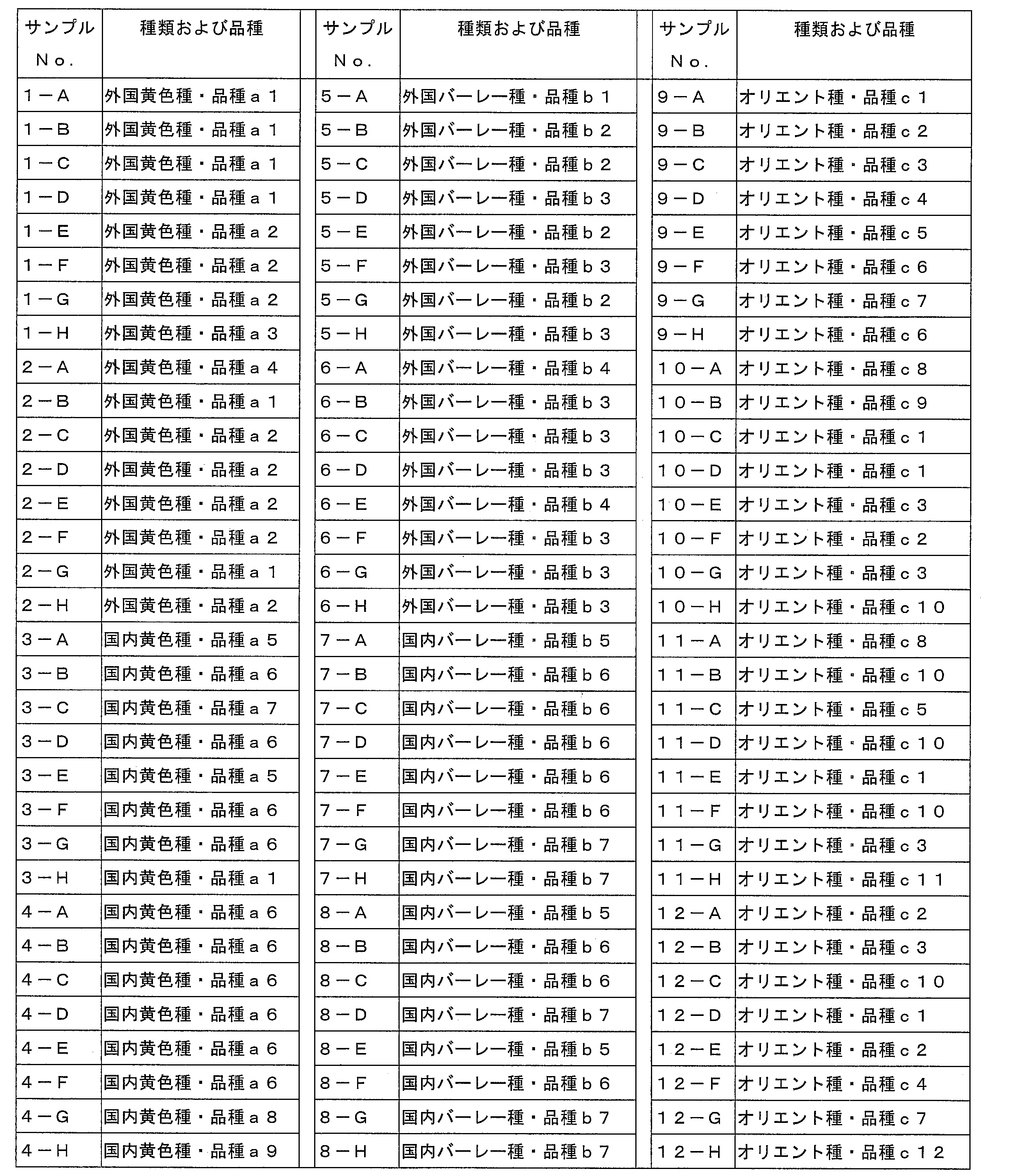
(2)実施例1の(1)で得られた各抽出液10μLを、上記96穴マイクロプレートの各ウェルに入れた。各ウェルにおけるたばこの種類は下記の表1に示すとおりである。
(3)各ウェルに1MのKOHを250μL入れた。
(4)3分後、各ウェルの発色を肉眼で観察した。
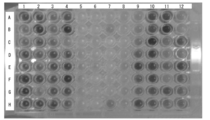
<結果>
上記(4)における各ウェルの写真を図2に示す。左側4列(黄色種)および右側4列(オリエント種)は、各32ウェルの全てで青紫色に発色した。一方、中央4列(バーレー種)は、32ウェル中29ウェルで白色または黄色に発色し、3ウェルでわずかに青紫色に発色した。
上記(4)における各ウェルの写真を図2に示す。左側4列(黄色種)および右側4列(オリエント種)は、各32ウェルの全てで青紫色に発色した。一方、中央4列(バーレー種)は、32ウェル中29ウェルで白色または黄色に発色し、3ウェルでわずかに青紫色に発色した。
青紫色に発色していないサンプルをバーレー種であると判別した場合、バーレー種における判別確率は90.6%であった。黄色種およびオリエント種における判別確率は100%であった。
このように、葉たばこを入手した国および品種によらず、バーレー種と、黄色種およびオリエント種とでは、青紫色の発色に明らかな差があった。
本発明は、紙巻たばこの製造における品質管理に利用することができる。
Claims (3)
- 葉たばこの種類がオリエント種または在来種、バーレー種、および黄色種の何れであるかを判別する判別方法であって、
葉たばこを、メタノール、エタノールもしくはこれらの混合液またはこれらと水との混合液に浸漬して、当該葉たばこの抽出液を得る抽出工程と、
上記抽出液の一部をGC/MS分析に供し、3-メチル吉草酸の検出を行う検出工程と、
上記検出工程における検出結果に基づき、上記葉たばこの種類がオリエント種または在来種であるか否かを判別する第一の判別工程と、
上記抽出液の他の一部とフォーリン・チオカルト試薬と塩基とを混合して発色させる発色工程と、
上記発色工程で得られた反応液における発色に基づき、上記葉たばこの種類がバーレー種であるか否かを判別する第二の判別工程とを含む判別方法。 - 上記抽出工程において、葉たばこを、メタノールまたは70%(v/v)以上のメタノール含んでいるメタノールと水との混合液に浸漬する、請求項1に記載の判別方法。
- 上記葉たばこは、たばこ刻または粉末状である、請求項1または2に記載の判別方法。
Priority Applications (1)
| Application Number | Priority Date | Filing Date | Title |
|---|---|---|---|
| PCT/JP2012/077637 WO2014064809A1 (ja) | 2012-10-25 | 2012-10-25 | 葉たばこの種類の判別方法 |
Applications Claiming Priority (1)
| Application Number | Priority Date | Filing Date | Title |
|---|---|---|---|
| PCT/JP2012/077637 WO2014064809A1 (ja) | 2012-10-25 | 2012-10-25 | 葉たばこの種類の判別方法 |
Publications (1)
| Publication Number | Publication Date |
|---|---|
| WO2014064809A1 true WO2014064809A1 (ja) | 2014-05-01 |
Family
ID=50544206
Family Applications (1)
| Application Number | Title | Priority Date | Filing Date |
|---|---|---|---|
| PCT/JP2012/077637 Ceased WO2014064809A1 (ja) | 2012-10-25 | 2012-10-25 | 葉たばこの種類の判別方法 |
Country Status (1)
| Country | Link |
|---|---|
| WO (1) | WO2014064809A1 (ja) |
Cited By (8)
| Publication number | Priority date | Publication date | Assignee | Title |
|---|---|---|---|---|
| CN105606723A (zh) * | 2015-12-18 | 2016-05-25 | 浙江中烟工业有限责任公司 | 气相色谱法测定卷烟滤棒中水分的方法 |
| CN106343606A (zh) * | 2016-10-12 | 2017-01-25 | 湖北中烟工业有限责任公司 | 一种利用蛛形图弥合法进行卷烟叶组配方维护的方法 |
| CN106858696A (zh) * | 2017-04-14 | 2017-06-20 | 江西中烟工业有限责任公司 | 一种模块分组二次复烤提升久龄烟叶可用性的工业化方法 |
| CN109507325A (zh) * | 2018-12-20 | 2019-03-22 | 陕西中烟工业有限责任公司 | 一种烟用爆珠水分含量检测方法 |
| CN109640708A (zh) * | 2016-07-04 | 2019-04-16 | 英美烟草(投资)有限公司 | 用于将烟草样本分类为一组预定口味类别中的一个的设备和方法 |
| CN110736718A (zh) * | 2019-10-16 | 2020-01-31 | 浙江中烟工业有限责任公司 | 一种烤烟烟丝的产地及等级识别方法 |
| CN111679008A (zh) * | 2020-06-20 | 2020-09-18 | 中国烟草总公司郑州烟草研究院 | 一种同时检测烟叶、烟丝中挥发及半挥发酸、醇、酚的gc-ms-ms方法 |
| CN113945526A (zh) * | 2021-10-25 | 2022-01-18 | 江苏鑫源烟草薄片有限公司 | 一种再造烟叶基片匀度的评价方法 |
Citations (1)
| Publication number | Priority date | Publication date | Assignee | Title |
|---|---|---|---|---|
| JPH04286924A (ja) * | 1991-03-15 | 1992-10-12 | Japan Tobacco Inc | 色彩検出型種別装置 |
-
2012
- 2012-10-25 WO PCT/JP2012/077637 patent/WO2014064809A1/ja not_active Ceased
Patent Citations (1)
| Publication number | Priority date | Publication date | Assignee | Title |
|---|---|---|---|---|
| JPH04286924A (ja) * | 1991-03-15 | 1992-10-12 | Japan Tobacco Inc | 色彩検出型種別装置 |
Non-Patent Citations (2)
| Title |
|---|
| JESSADA DENDUANGBORIPANT ET AL.: "Determination of Local Tobacco Cultivars Using ISSR Molecular Markaer", CHIANG MAI J. SCI., vol. 37, no. 2, May 2010 (2010-05-01), pages 293 - 303 * |
| KOKI YOKOTSUKA: "Analytical Reversed-Phase HPLC of Phenols Using the Folin-Ciocalteu Method: Optimization of Conditions for Reaction between Phenols and the Reagent", J. ASEV, vol. 12, no. 1, January 2001 (2001-01-01), pages 21 - 28 * |
Cited By (10)
| Publication number | Priority date | Publication date | Assignee | Title |
|---|---|---|---|---|
| CN105606723A (zh) * | 2015-12-18 | 2016-05-25 | 浙江中烟工业有限责任公司 | 气相色谱法测定卷烟滤棒中水分的方法 |
| CN109640708A (zh) * | 2016-07-04 | 2019-04-16 | 英美烟草(投资)有限公司 | 用于将烟草样本分类为一组预定口味类别中的一个的设备和方法 |
| CN106343606A (zh) * | 2016-10-12 | 2017-01-25 | 湖北中烟工业有限责任公司 | 一种利用蛛形图弥合法进行卷烟叶组配方维护的方法 |
| CN106858696A (zh) * | 2017-04-14 | 2017-06-20 | 江西中烟工业有限责任公司 | 一种模块分组二次复烤提升久龄烟叶可用性的工业化方法 |
| CN106858696B (zh) * | 2017-04-14 | 2019-01-18 | 江西中烟工业有限责任公司 | 一种模块分组二次复烤提升久龄烟叶可用性的工业化方法 |
| CN109507325A (zh) * | 2018-12-20 | 2019-03-22 | 陕西中烟工业有限责任公司 | 一种烟用爆珠水分含量检测方法 |
| CN110736718A (zh) * | 2019-10-16 | 2020-01-31 | 浙江中烟工业有限责任公司 | 一种烤烟烟丝的产地及等级识别方法 |
| CN110736718B (zh) * | 2019-10-16 | 2022-07-19 | 浙江中烟工业有限责任公司 | 一种烤烟烟丝的产地及等级识别方法 |
| CN111679008A (zh) * | 2020-06-20 | 2020-09-18 | 中国烟草总公司郑州烟草研究院 | 一种同时检测烟叶、烟丝中挥发及半挥发酸、醇、酚的gc-ms-ms方法 |
| CN113945526A (zh) * | 2021-10-25 | 2022-01-18 | 江苏鑫源烟草薄片有限公司 | 一种再造烟叶基片匀度的评价方法 |
Similar Documents
| Publication | Publication Date | Title |
|---|---|---|
| Bajoub et al. | Comparing two metabolic profiling approaches (liquid chromatography and gas chromatography coupled to mass spectrometry) for extra-virgin olive oil phenolic compounds analysis: A botanical classification perspective | |
| Liu et al. | An integrated approach combining HPLC, GC/MS, NIRS, and chemometrics for the geographical discrimination and commercial categorization of saffron | |
| Zhou et al. | Floral classification of honey using liquid chromatography–diode array detection–tandem mass spectrometry and chemometric analysis | |
| CN105203672B (zh) | 一种优质草莓的品质保障及品种鉴定方法 | |
| Chen et al. | Tissue-specific metabolites profiling and quantitative analyses of flavonoids in the rhizome of Belamcanda chinensis by combining laser-microdissection with UHPLC-Q/TOF-MS and UHPLC–QqQ-MS | |
| Lesiak et al. | Application of ambient ionization high resolution mass spectrometry to determination of the botanical provenance of the constituents of psychoactive drug mixtures | |
| Masson et al. | Oxygenated heterocyclic compounds to differentiate Citrus spp. essential oils through metabolomic strategies | |
| KR20180024293A (ko) | 한국산과 중국산 백미 판별용 Biomarker 및 이를 이용한 판별 모델 | |
| CN106483215B (zh) | 木瓜药材中天然抗氧化剂在线发现及综合抗氧化活性评价方法 | |
| Xie et al. | Rapid authentication of agarwood by using liquid extraction surface analysis mass spectrometry (LESA‐MS) | |
| KR20110113531A (ko) | 크로마토그래피―질량분석을 이용한 인삼 연근 판별 방법 | |
| Zhang et al. | Phytochemical profiles and antioxidant activities of different varieties of Chimonanthus Praecox | |
| Schäffer et al. | Forensic profiling of sassafras oils based on comprehensive two-dimensional gas chromatography | |
| WO2017059647A1 (zh) | 一种动物皮张的鉴定方法 | |
| Pillai et al. | Validated high performance thin layer chromatography method for the quantification of bioactive marker compounds in Draksharishta, an ayurvedic polyherbal formulation | |
| Zhu et al. | Profiling of phenolic compounds in domestic and imported extra virgin olive oils in China by high performance liquid chromatography-electrochemical detection | |
| WO2013002455A1 (ko) | 가공인삼의 원산지 또는 연령 판별용 표준 마커, 이의 확립방법 또는 이를 이용한 원산지 또는 연령 판별방법 | |
| KR20160053101A (ko) | Lc-ms/ms와 전자코 분석기기를 병용한 시판 홍삼 농축액의 원산지 판별방법 | |
| Brown et al. | Quantitative estimates of sinking sea ice particulate organic carbon based on the biomarker IP25 | |
| CN115586283A (zh) | 一种基于特征代谢物的干姜产地溯源方法 | |
| Augustyn et al. | Metabolic profiling of mango cultivars to identify biomarkers for resistance against Fusarium infection | |
| Duchesne et al. | Comparing GC× GC-TOFMS-Based metabolomic profiling and wood anatomy for forensic identification of five meliaceae (Mahogany) species | |
| CN108169376A (zh) | 一种快速鉴定武夷岩茶及其茶香精品质的方法 | |
| WO2014064808A1 (ja) | 葉たばこの種類の判別方法 | |
| KR20190140622A (ko) | 고성능 액체 크로마토그래피-질량분석기를 이용한 금전초의 원산지 판별 방법 |
Legal Events
| Date | Code | Title | Description |
|---|---|---|---|
| 121 | Ep: the epo has been informed by wipo that ep was designated in this application |
Ref document number: 12887095 Country of ref document: EP Kind code of ref document: A1 |
|
| NENP | Non-entry into the national phase |
Ref country code: DE |
|
| 122 | Ep: pct application non-entry in european phase |
Ref document number: 12887095 Country of ref document: EP Kind code of ref document: A1 |
|
| NENP | Non-entry into the national phase |
Ref country code: JP |