WO2014064808A1 - 葉たばこの種類の判別方法 - Google Patents
葉たばこの種類の判別方法 Download PDFInfo
- Publication number
- WO2014064808A1 WO2014064808A1 PCT/JP2012/077636 JP2012077636W WO2014064808A1 WO 2014064808 A1 WO2014064808 A1 WO 2014064808A1 JP 2012077636 W JP2012077636 W JP 2012077636W WO 2014064808 A1 WO2014064808 A1 WO 2014064808A1
- Authority
- WO
- WIPO (PCT)
- Prior art keywords
- leaf tobacco
- tobacco
- burley
- species
- leaf
- Prior art date
- Legal status (The legal status is an assumption and is not a legal conclusion. Google has not performed a legal analysis and makes no representation as to the accuracy of the status listed.)
- Ceased
Links
Images
Classifications
-
- A—HUMAN NECESSITIES
- A24—TOBACCO; CIGARS; CIGARETTES; SIMULATED SMOKING DEVICES; SMOKERS' REQUISITES
- A24B—MANUFACTURE OR PREPARATION OF TOBACCO FOR SMOKING OR CHEWING; TOBACCO; SNUFF
- A24B3/00—Preparing tobacco in the factory
- A24B3/16—Classifying or aligning leaves
-
- A—HUMAN NECESSITIES
- A24—TOBACCO; CIGARS; CIGARETTES; SIMULATED SMOKING DEVICES; SMOKERS' REQUISITES
- A24B—MANUFACTURE OR PREPARATION OF TOBACCO FOR SMOKING OR CHEWING; TOBACCO; SNUFF
- A24B15/00—Chemical features or treatment of tobacco; Tobacco substitutes, e.g. in liquid form
- A24B15/18—Treatment of tobacco products or tobacco substitutes
- A24B15/24—Treatment of tobacco products or tobacco substitutes by extraction; Tobacco extracts
Definitions
- the present invention relates to a method for discriminating the type of leaf tobacco.
- the present invention relates to a method for determining whether or not the type of leaf tobacco is Burley.
- Non-Patent Document 1 and Non-Patent Document 2 describe a method for discriminating the variety of leaf tobacco using a DNA marker.
- Non-Patent Document 3 describes a method of quantifying a phenol substance by combining a foreign thiocult method and reverse phase high performance liquid chromatography.
- Slinkard and Singleton methods for quantifying total phenol are known.
- Kramling and Singleton methods for quantifying flavonoids and non-flavonoid phenols are also known.
- the method of discriminating from the appearance based on the above-mentioned experience is subjective and is likely to make different judgments depending on the judge. Moreover, it is difficult to pass on the judgment technique acquired as experience to others.
- Non-Patent Document 1 i) takes a considerable time (for example, several days) until discrimination, ii) special knowledge such as operation method is required. Iii) costly to create markers, etc. iv) cannot be analyzed depending on the quality or quantity of extracted DNA, and v) the sample must be destroyed and the same sample can be reused for other analysis There are problems such as being unable to do so.
- Non-Patent Document 3 In the method described in Non-Patent Document 3, reversed-phase high performance liquid chromatography is expensive and time-consuming. Note that Non-Patent Document 3 does not describe analyzing tobacco at all.
- the present invention has been made in view of the above problems, and an object of the present invention is to provide a method for easily and quickly discriminating whether or not a leaf tobacco is a Burley species.
- a discrimination method is a discrimination method for discriminating whether or not a leaf tobacco type is a Burley species, and the leaf tobacco is converted into methanol, ethanol, water or a mixture thereof. Based on the extraction step of immersing and obtaining the leaf tobacco extract, the color development step of mixing the extract, the foreign thiocult reagent and the base, and the color development in the reaction solution obtained in the color development step, And a discrimination step of discriminating whether or not the type of leaf tobacco is a Burley species.
- a discrimination method is a discrimination method for discriminating whether or not a leaf tobacco type is a Burley species, An extraction step of immersing the leaf tobacco in methanol, ethanol or water or a mixture thereof to obtain an extract of the leaf tobacco; A coloring step of mixing the extract, the foreign thiocult reagent and a base to develop a color; A discriminating step for discriminating whether or not the type of the leaf tobacco is a Burley species based on the color development in the reaction solution obtained in the color development step.
- the form of the leaf cigarette that is the object of the discrimination method according to the present invention is not particularly limited.
- it may be a laminar (deboned leaf part) of a raw material leaf cigarette or a cigarette carved with lamina. It may be in powder form.
- the tobacco engraving may be included in the tobacco product, or may be prepared by carving the leaf tobacco in the raw material or the tobacco tobacco during the production of the tobacco product.
- the leaf tobacco is in the form of tobacco or powder.
- the discriminating method according to the present invention can be suitably applied particularly to tobacco engraving contained in tobacco products.
- the leaf tobacco determined not to be a Burley species is a type other than the Burley species, such as a yellow species, an Orient species, or a native species.
- leaf tobacco refers to tobacco leaves contained in tobacco products, and tobacco leaves (dried leaves) that are used as raw materials for producing tobacco products.
- the size of the leaf tobacco is not particularly limited. For example, it may be a tobacco cut having a width of 0.1 to 1.5 mm and a length of 0.5 to 10 mm.
- type of leaf tobacco refers to Burley species, yellow species, Orient species, and native species.
- the extraction step is a step of immersing the target leaf tobacco in methanol, ethanol or water or a mixture thereof to obtain the leaf tobacco extract.
- the concentration of methanol is preferably 10% (v / v) or more and less than 100% (v / v), and 70% (v / v) or more. And more preferably 99% (v / v) or less.
- the concentration of ethanol is preferably 10% (v / v) or more and 100% (v / v) or less, and 70% (v / v). ) And more preferably 99% (v / v) or less.
- the leaf tobacco it is preferable to immerse the leaf tobacco in a mixed solution of methanol and water or methanol, and more preferably 80% (v / v) of methanol.
- the extract obtained in this step is also used for analysis by other methods (that is, in the case of sharing with the extraction step in other methods)
- the extraction of the present invention is performed in consideration of the other methods.
- the composition of the liquid used in the process can be appropriately selected.
- another substance may be contained in methanol, ethanol, water, or these liquid mixture.
- the volume of methanol, ethanol or water or a mixture thereof is not particularly limited, but is preferably 10 times or more and 10,000 times or less, more preferably 500 times or more and 2000 times or less of the leaf tobacco volume, for example. .
- the immersion time is not particularly limited, but for example, it is 5 minutes or more and 12 hours or less, preferably 1 hour or more and 5 hours or less, more preferably 2 hours or more and 3 hours or less.
- the temperature of the extraction step is not particularly limited, but is preferably 1 ° C or higher and 40 ° C or lower, more preferably 5 ° C or higher and 30 ° C or lower. From the viewpoint of carrying out more easily, room temperature is preferable.
- the color development step is a step in which the extract obtained in the extraction step, the foreign thiocult reagent, and a base are mixed to cause color development.
- the amount of the extract used in the coloring process is not particularly limited.
- the total amount of the extract obtained in the extraction step may be used, or a part thereof may be used.
- the extract may be used after being diluted, but it can also be used without being diluted. From the viewpoint of simplicity, the extract is preferably used without dilution.
- FC reagent is a mixed aqueous solution of disodium tungstate, sodium molybdate, lithium sulfate, phosphoric acid, hydrochloric acid and bromine. Since the FC reagent is also used for detection of phenol, it is also called a phenol reagent. FC reagent develops a blue-violet color when it reacts with phenolic hydroxyl groups.
- the FC reagent a commercially available one may be used, or one prepared by itself may be used.
- the amount of the FC reagent is not particularly limited, but for example, it is preferably 1 to 100 times and 1 to 30 times that of the extract used in the color development step.
- the FC reagent may be diluted, but it can also be used as it is. From the viewpoint of simplicity, the FC reagent is preferably used as it is.
- the base is not particularly limited, and examples thereof include bases generally used in the FC method such as potassium hydroxide, sodium hydroxide, potassium carbonate, or sodium carbonate.
- the base may be added as an aqueous solution.
- the amount of the base is not particularly limited.
- a 1M base may be used in an amount of 10 to 50 times the sum of the volume of the extract to be used and the volume of the FC reagent.
- the order of mixing the extract, FC reagent, and base is not particularly limited.
- the base may be added to the mixture of the extract and the FC reagent, the FC reagent may be added to the mixture of the extract and the base, or the extract is added to the mixture of the FC reagent and the base. It may be added.
- the color development time is not particularly limited, but from the viewpoint of preventing fading, for example, it is 1 second or more and 60 minutes or less, preferably 1 second or more and 20 minutes or less, and 1 second or more and 10 minutes or less. Is more preferable.
- the temperature of the coloring process is not particularly limited, but is preferably 1 ° C. or higher and 40 ° C. or lower, more preferably 5 ° C. or higher and 30 ° C. or lower. From the viewpoint of carrying out more easily, room temperature is preferable.
- the extract obtained in the extraction step contains phenols
- the phenols react with the foreign thiocult reagent, and the reaction solution turns blue-violet.
- the discrimination step is a step of discriminating whether or not the target leaf tobacco type is Burley based on the color development in the reaction solution obtained in the color development step.
- leaf tobacco of a type other than Burley species such as yellow species and Orient species develops a blue-purple color.
- Burley leaf tobacco does not basically develop blue-violet color. Therefore, when the reaction liquid obtained in the color development step does not show blue-violet color development, it can be determined that the target leaf tobacco type is a Burley species.
- the reaction solution obtained in the color development step when blue-violet color development is recognized, it can be determined that the target leaf tobacco type is not a Burley species.
- Leaf tobacco determined not to be a Burley species is a type other than a Burley species, such as a yellow species, an Orient species, and a native species. Although the Burley species may develop a slightly blue-violet color, it is a very weak coloration, and those skilled in the art can easily distinguish it from other types of colors other than the Burley species.
- the intensity of blue-violet color development is greatly different between Burley species and other types. Therefore, based on observation with the naked eye, it can be determined whether or not the target leaf tobacco type is a Burley species. That is, in the discrimination step, the blue-violet color can be confirmed with the naked eye. If the determination is performed with the naked eye, a simpler determination can be realized.
- the intensity of color development in a known type of leaf tobacco may be compared with the intensity of color development in the target leaf tobacco.
- leaf tobacco that is known to be Burley species and leaf tobacco that is known to be other types may be used as a reference.
- the intensity of blue-violet color development as a reference varies depending on various conditions in the extraction process and the color development process. Therefore, it is preferable to analyze in parallel the leaf tobacco and the leaf tobacco whose types are known.
- the absorbance in the vicinity of 380 nm to 495 nm may be measured using a spectrophotometer.
- the absorbance can be measured using a microplate reader.
- the type of the target leaf tobacco is determined to be a Burley species.
- the reference value may be set based on the absorbance of leaf tobacco with a known type, or may be set without being based on the absorbance of leaf tobacco with a known type. Since the intensity of blue-violet coloration differs greatly between Burley species and other types, the absorbance also varies greatly. Therefore, the reference value can be easily set without being based on the absorbance of leaf tobacco of a known type.
- leaf tobacco is known to contain many components, and it was inferred that it is essential to separate the extract into each component.
- the present inventors have surprisingly found that it is possible to determine whether or not the type of leaf tobacco is a Burley species by the FC method without separating the extract into each component.
- the present invention made based on this discovery, it is possible to easily and quickly determine whether or not the type of leaf tobacco is a Burley species.
- the discrimination method according to the present invention further has the following advantages.
- the difference in blue-violet coloration is large between the Burley species and other types, and the coloration difference can be sufficiently observed with the naked eye. Therefore, it is possible to determine with high accuracy whether or not the type of the target leaf tobacco is a Burley species by observation with the naked eye without measuring the absorbance using an instrument. For this reason, the determination can be made more simply and at low cost.
- the determination method according to the present invention it is not necessary to dilute the extract and the FC reagent, so that the determination can be performed in a short time.
- the determination method according to the present invention is low in cost because it is not necessary to prepare a special reagent or the like and the determination can be performed without using an instrument.
- the liquid used in the extraction step is methanol, ethanol, or water. Therefore, if these liquids are evaporated from leaf tobacco after the extraction process, the same leaf tobacco can be reused for other analyses. In particular, components insoluble in these liquids remain in the leaf tobacco without being extracted. In the method of extracting DNA as described in Non-Patent Document 1 and Non-Patent Document 2, it is necessary to destroy the target cigarette and it cannot be reused.
- the conventional DNA marker method takes about 2 to 3 days for about 100 samples.
- the discrimination method according to the present invention as shown in an example described later, about 100 samples can be discriminated within 4 hours. As described above, according to the present invention, the time required for the determination can be drastically reduced, and the determination can be made quickly.
- the procedure of the present invention is simple and can be easily performed.
- a plurality (for example, 100) of cigarettes included in a tobacco product are taken out at random. Place each cigarette in a 1500 ⁇ L tube, add 150 ⁇ L of 80% (v / v) ethanol, and allow to stand at room temperature for 2-3 hours.
- 10 ⁇ L of the FC reagent stock solution is placed in each well of the 96-well plate.
- 10 ⁇ L of extract from each cigarette is placed in each well of the 96-well plate.
- the same as described above is applied in parallel to burley species and other tobacco types (controls) known to be other types.
- An operation may be performed.
- the tobacco product is known to consist of Burley, Yellow and Orient tobacco, Burley, Yellow and Orient tobacco may be used as a control.
- the intensity (standard) of blue-violet color development that serves as a boundary between Burley species and other types can be determined.
- the blending ratio of Burley leaf tobacco can be calculated with higher accuracy. If combined with other analysis methods, the blending ratio (leaf composition) for each type of leaf tobacco can be calculated.
- a plurality of cigarettes of known types (Burley, yellow or oriental) were analyzed by the following method. These cigarettes are included in the final product.
- the discrimination probability in Burley species was 90.6%.
- the discrimination probability in the yellow species and the orientation species was 100%.
- the present invention can be used for quality control in the manufacture of cigarettes.
Landscapes
- Chemical & Material Sciences (AREA)
- Chemical Kinetics & Catalysis (AREA)
- General Chemical & Material Sciences (AREA)
- Manufacture Of Tobacco Products (AREA)
Abstract
葉たばこの種類がバーレー種であるか否かを判別する判別方法であって、葉たばこを、メタノール、エタノールもしくは水またはこれらの混合液に浸漬して、葉たばこの抽出液を得る抽出工程と、抽出液とフォーリン・チオカルト試薬と塩基とを混合して発色させる発色工程と、発色工程で得られた反応液における発色に基づき、葉たばこの種類がバーレー種であるか否かを判別する判別工程とを含む。
Description
本発明は、葉たばこの種類を判別する方法に関するものである。特には、葉たばこの種類がバーレー種であるか否かを判別する方法に関するものである。
たばこ製品の多くは、複数の種類の葉たばこがブレンドされて製造されている。たばこ製品およびその原料について、品質保持および品質管理等を目的として、葉たばこの種類ごとの配合割合(葉組組成)を確認する場合がある。
葉たばこの種類を特定する方法として、例えば、経験に基づいてたばこ刻の外観から判別する方法が挙げられる。また、非特許文献1および非特許文献2には、DNAマーカーを用いて葉たばこの品種を判別する方法が記載されている。
ところで、非特許文献3には、フォーリン・チオカルト法と逆相系高速液体クロマトグラフィーとを組み合わせてフェノール物質を定量する方法が記載されている。なお、フォーリン・チオカルト法以外の分析方法として、総フェノールを定量するSlinkardとSingletonの方法が知られている。また、フラボノイドおよび非フラボノイド型フェノールを定量するKramlingとSingletonの方法が知られている。
"Microsatellite Markers For Tobacco Genetic Fingerprinting And Variety Identification", Plant & Animal Genomes XIII Conference, January 15-19, 2005, Town & Country Convention Center, San Diego, CAP136 : SSR, Gregor Bindler, Florian Martin, Louis Renaud, Etienne Kaelin, Paolo Donini, Ferruccio Gadani, Luca Rossi.
"Determination of Local Tobacco Cultivars Using ISSR Molecular Markaer", Jessada Denduangboripant et al., Chang Mai J. Sci. 2010;37(2):293-303.
「フォーリン・チオカルト法を用いた逆相系高速液体クロマトグラフィーによるフェノール化合物の分析-フェノールとフォーリン・シオカルト試薬との反応条件の至適化」, J.ASEV Jpn Vol.12 No.1 pp.21-28(2001).
しかし、上述の経験に基づいて外観から判別する方法は、主観的であり、判断者によって異なる判断をする可能性が高い。また、経験として習得した判断技術を他者に引き継ぐことは困難である。
また、非特許文献1および非特許文献2に記載されたDNAを用いる方法では、i)判別までに相当な時間(例えば、数日)がかかる、ii)操作方法などの特別な知識を必要とする、iii)マーカーの作成などにコストがかかる、iv)抽出したDNAの質または量によっては解析できない、および、v)サンプルを破壊する必要があり同一サンプルを他の解析に再利用することができない、などの問題点がある。
非特許文献3に記載の方法は、逆相系高速液体クロマトグラフィーが高価であり、かつ手間がかかる。なお、非特許文献3には、たばこを分析することは一切記載されていない。
本発明は、上記問題点に鑑みてなされたものであり、その目的は、1つの葉たばこについて、その種類がバーレー種であるか否かを簡便かつ迅速に判別する方法を提供することである。
上記課題を解決するために、本発明に係る判別方法は、葉たばこの種類がバーレー種であるか否かを判別する判別方法であって、葉たばこを、メタノール、エタノールもしくは水またはこれらの混合液に浸漬して、当該葉たばこの抽出液を得る抽出工程と、上記抽出液とフォーリン・チオカルト試薬と塩基とを混合して発色させる発色工程と、上記発色工程で得られた反応液における発色に基づき、上記葉たばこの種類がバーレー種であるか否かを判別する判別工程とを含む判別方法である。
本発明によって、1つの葉たばこについて、その種類がバーレー種であるか否かを簡便かつ迅速に判別することができる。
本発明に係る判別方法について説明すれば以下の通りである。
本発明に係る判別方法は、葉たばこの種類がバーレー種であるか否かを判別する判別方法であって、
葉たばこを、メタノール、エタノールもしくは水またはこれらの混合液に浸漬して、当該葉たばこの抽出液を得る抽出工程と、
上記抽出液とフォーリン・チオカルト試薬と塩基とを混合して発色させる発色工程と、
上記発色工程で得られた反応液における発色に基づき、上記葉たばこの種類がバーレー種であるか否かを判別する判別工程とを含む。
葉たばこを、メタノール、エタノールもしくは水またはこれらの混合液に浸漬して、当該葉たばこの抽出液を得る抽出工程と、
上記抽出液とフォーリン・チオカルト試薬と塩基とを混合して発色させる発色工程と、
上記発色工程で得られた反応液における発色に基づき、上記葉たばこの種類がバーレー種であるか否かを判別する判別工程とを含む。
本発明に係る判別方法の対象となる葉たばこの形態は、特に限定されず、例えば、原料の葉たばこのラミナ(除骨葉部分)であってもよいし、ラミナを刻んだたばこ刻であってもよいし、粉末状であってもよい。また、たばこ刻は、たばこ製品に含まれているものでもよいし、原料の葉たばこまたはたばこ製品の製造途中における葉たばこを刻んで用意したものでもよい。好ましくは、葉たばこは、たばこ刻または粉末状である。本発明に係る判別方法は、特にたばこ製品に含まれているたばこ刻に好適に適用され得る。
本発明に係る判別方法では、1つの葉たばこについて、その種類がバーレー種であるか否かを判別する。バーレー種でないと判別された葉たばこは、例えば、黄色種、オリエント種、在来種などバーレー種以外の種類である。
なお、本明細書において「葉たばこ」とは、たばこ製品に含まれているたばこの葉、およびたばこ製品を製造するための原料となるたばこの葉(乾燥済みの葉)を指す。葉たばこの大きさは特に限定されないが、例えば、幅が0.1~1.5mm、長さが0.5~10mmのたばこ刻であり得る。
また、本明細書において「葉たばこの種類」とは、バーレー種、黄色種、オリエント種、および在来種などを指す。
本発明に係る判別方法の各工程の詳細を説明する。
(抽出工程)
抽出工程は、対象とする葉たばこを、メタノール、エタノールもしくは水またはこれらの混合液に浸漬して、当該葉たばこの抽出液を得る工程である。
抽出工程は、対象とする葉たばこを、メタノール、エタノールもしくは水またはこれらの混合液に浸漬して、当該葉たばこの抽出液を得る工程である。
葉たばこをメタノールと水との混合液に浸漬する場合、メタノールの濃度は、10%(v/v)以上で100%(v/v)未満であることが好ましく、70%(v/v)以上で99%(v/v)以下であることがより好ましい。また、葉たばこをエタノールと水との混合液に浸漬する場合、エタノールの濃度は、10%(v/v)以上で100%(v/v)以下であることが好ましく、70%(v/v)以上で99%(v/v)以下であることがより好ましい。葉たばこを、メタノールと水との混合液またはメタノールに浸漬することが好ましく、メタノールが80%(v/v)であることがより好ましい。また、本工程で得られた抽出液を他の方法による分析にも利用する場合(すなわち、他の方法における抽出工程と共通化する場合)、当該他の方法を考慮して、本発明の抽出工程で用いる液体の組成を適宜選択し得る。なお、本発明の効果が得られる限り、メタノール、エタノールもしくは水またはこれらの混合液に、他の物質が含まれていてもよい。
メタノール、エタノールもしくは水またはこれらの混合液の体積は特に限定されないが、例えば、葉たばこの体積の10倍以上で10000倍以下であることが好ましく、500倍以上で2000倍以下であることがより好ましい。
浸漬する時間は特に限定されないが、例えば、5分以上で12時間以内であり、1時間以上で5時間以内であることが好ましく、2時間以上で3時間以内であることがより好ましい。
抽出工程の温度は特に限定されないが、1℃以上で40℃以下であることが好ましく、5℃以上で30℃以下であることがより好ましい。より簡便に行うという観点からは、室温であることが好ましい。
対象とする葉たばこを上述の液体に浸漬することによって、葉たばこ中に含まれていた、当該液体に可溶な物質(フェノール類など)が溶出する。このようにして、葉たばこの抽出液を得ることができる。
(発色工程)
発色工程は、抽出工程で得られた抽出液とフォーリン・チオカルト試薬と塩基とを混合して発色させる工程である。
発色工程は、抽出工程で得られた抽出液とフォーリン・チオカルト試薬と塩基とを混合して発色させる工程である。
発色工程で用いる抽出液の量は特に限定されない。抽出工程で得られた抽出液の全量を用いてもよいし、一部を用いてもよい。また、抽出液は希釈して用いてもよいが、希釈せずに用いることもできる。簡便性の観点からは、抽出液は希釈せずに用いることが好ましい。
フォーリン・チオカルト試薬(Folin-Ciocalteu試薬、以下「FC試薬」という)は、タングステン酸二ナトリウム、モリブデン酸ナトリウム、硫酸リチウム、リン酸、塩酸および臭素の混合水溶液である。FC試薬は、フェノールの検出にも用いられるため、フェノール試薬とも称される。FC試薬は、フェノール性水酸基と反応すると青紫色に発色する。
本発明において、FC試薬は、市販のものを用いてもよいし、自ら調製したものを用いてもよい。FC試薬の量は特に限定されないが、例えば、発色工程で用いる抽出液の1倍以上で100倍以下であり、1倍以上で30倍以下であることが好ましい。また、FC試薬は希釈してもよいが、原液のまま用いることもできる。簡便性の観点からは、FC試薬は原液のまま用いることが好ましい。
塩基は特に限定されないが、例えば、水酸化カリウム、水酸化ナトリウム、炭酸カリウム、または炭酸ナトリウムなど、FC法において一般的に用いられる塩基が挙げられる。塩基は水溶液として添加すればよい。
塩基の量は特に限定されないが、例えば、1Mの塩基を、用いる抽出液の体積とFC試薬の体積との合計の10倍以上で50倍以下の量を用いればよい。
抽出液とFC試薬と塩基とを混合する順序は、特に限定されない。抽出液とFC試薬との混合液に塩基を添加してもよいし、抽出液と塩基との混合液にFC試薬を添加してもよいし、FC試薬と塩基との混合液に抽出液を添加してもよい。
発色させる時間は特に限定されないが、退色を防ぐ観点から、例えば、1秒以上で60分以内であり、1秒以上で20分以内であることが好ましく、1秒以上で10分以内であることがより好ましい。
発色工程の温度は特に限定されないが、1℃以上で40℃以下であることが好ましく、5℃以上で30℃以下であることがより好ましい。より簡便に行うという観点からは、室温であることが好ましい。
抽出工程で得られた抽出液にフェノール類が含まれている場合には、当該フェノール類とフォーリン・チオカルト試薬とが反応し、反応液が青紫色に発色する。
(判別工程)
判別工程は、発色工程で得られた反応液における発色に基づき、対象の葉たばこの種類がバーレー種であるか否かを判別する工程である。
判別工程は、発色工程で得られた反応液における発色に基づき、対象の葉たばこの種類がバーレー種であるか否かを判別する工程である。
後述する実施例に示されるように、黄色種およびオリエント種などのバーレー種以外の種類の葉たばこでは、青紫色に発色する。一方、バーレー種の葉たばこでは、基本的に青紫色に発色しない。したがって、発色工程で得られた反応液において、青紫色の発色が認められない場合、対象の葉たばこの種類はバーレー種であると判定できる。一方、発色工程で得られた反応液において、青紫色の発色が認められる場合、対象の葉たばこの種類はバーレー種ではないと判定できる。バーレー種ではないと判定された葉たばこは、例えば、黄色種、オリエント種、および在来種などのバーレー種以外の種類である。なお、バーレー種においてわずかに青紫色に発色する場合もあるが、非常に弱い発色であるため、当業者はバーレー種以外の種類における発色と容易に区別し得る。
後述する実施例に示されるように、バーレー種とそれ以外の種類とでは、青紫色の発色の強度が大きく異なる。そのため、肉眼による観察に基づいて、対象の葉たばこの種類がバーレー種であるか否かを判別し得る。すなわち、判別工程において、青紫色の発色は肉眼で確認し得る。肉眼で確認して判別を行えば、より簡便な判別を実現することができる。
より正確に判別を行うために、種類が既知の葉たばこにおける発色の強度を基準として、対象の葉たばこにおける発色の強度と比較してもよい。例えば、バーレー種であることが既知の葉たばこおよびそれ以外の種類(例えば、黄色種およびオリエント種など)であることが既知の葉たばこを基準とすればよい。基準となる青紫色の発色の強度は、抽出工程および発色工程における種々の条件によって異なる。そのため、対象の葉たばこと種類が既知の葉たばことを並行して分析することが好ましい。
さらに正確に判別を行うために、分光光度計を用いて380nm~495nm付近の吸光度を測定してもよい。例えば、96穴のマイクロプレートを用いて発色工程を行っている場合、マイクロプレートリーダーを用いて吸光度を測定することができる。吸光度を測定する場合、吸光度が基準値未満である場合に、対象の葉たばこの種類をバーレー種であると判定する。基準値は、種類が既知の葉たばこにおける吸光度に基づいて設定してもよいし、種類が既知の葉たばこにおける吸光度に基づくことなく設定してもよいし。バーレー種とそれ以外の種類とでは、青紫色の発色の強度が大きく異なるため、吸光度も大きく異なる。そのため、種類が既知の葉たばこにおける吸光度に基づくことなく、基準値を容易に設定し得る。
(本発明に係る判別方法の利点)
FC試薬を用いるFC法では、FC試薬がフェノール性水酸基を有する物質に対して反応するため、一般的に、芳香族アミノ酸などの夾雑物の影響を非常に受けやすいという欠点があることが知られている。それゆえ、複雑なマトリックスを含む試料においては、フェノール性物質のみの有無の分析(定性)、または、フェノール性物質のみの定量を行うことはない。複雑なマトリックスを含む試料中のフェノール性物質のみの定性または定量を行う場合、通常は、クロマトグラフィーまたは遠心分離などによって各成分に分離した後にFC法を行う。
FC試薬を用いるFC法では、FC試薬がフェノール性水酸基を有する物質に対して反応するため、一般的に、芳香族アミノ酸などの夾雑物の影響を非常に受けやすいという欠点があることが知られている。それゆえ、複雑なマトリックスを含む試料においては、フェノール性物質のみの有無の分析(定性)、または、フェノール性物質のみの定量を行うことはない。複雑なマトリックスを含む試料中のフェノール性物質のみの定性または定量を行う場合、通常は、クロマトグラフィーまたは遠心分離などによって各成分に分離した後にFC法を行う。
特に葉たばこには多数の成分が含まれていることが知られており、抽出液を各成分に分離することが必須であると推察された。しかしながら、本発明者は、驚くべきことに、抽出液を各成分に分離することなく、FC法により葉たばこの種類がバーレー種であるか否かを判別可能であることを見出した。この発見に基づいてなされた本発明により、葉たばこの種類がバーレー種であるか否かを簡便かつ迅速に判別することができる。
本発明に係る判別方法は、さらに以下のような利点を有している。
本発明に係る判別方法では、バーレー種とそれ以外の種類とで、青紫色の発色の差が大きく、肉眼によって十分にその発色の差が観察可能である。そのため、機器を用いて吸光度を測定しなくても、肉眼による観察で対象の葉たばこの種類がバーレー種であるか否かを、高精度で判別することが可能である。そのため、より簡便かつ低コストで判別することができる。
また、本発明に係る判別方法では、抽出液およびFC試薬を希釈する必要がないため、短時間で行うことができる。
また、本発明に係る判別方法では、特別な試薬などを作製する必要がなく、また機器を用いることなく判別し得るため、低コストである。
また、本発明に係る判別方法では、抽出工程で用いる液体がメタノール、エタノールまたは水である。そのため、抽出工程後の葉たばこから、これら液体を蒸発させれば、同一の葉たばこを他の分析に再利用できる。特にこれら液体に対して不溶な成分は、抽出されずに葉たばこ中に残存する。非特許文献1および非特許文献2に記載されているようなDNAを抽出する方法では、対象のたばこ刻を破壊する必要があり、再利用することができない。
また、従来のDNAマーカーによる方法では、約100サンプルで2~3日程度かかる。一方、本発明に係る判別方法では、後述する実施例に示されるように、約100サンプルについて4時間以内に判別することができる。このように、本発明では判別するまでに要する時間が飛躍的に短縮され、迅速に判別することができる。
また、従来のDNAマーカーによる方法では、DNAの抽出およびDNAマーカーの検出の手順が複雑であり、技術が必要である。一方、本発明の手順はシンプルであり、容易に行うことができる。
(本発明に係る判別方法の応用例)
たばこ製品の製造過程における葉組単位に含まれている葉たばこ、またはたばこ製品中に含まれている多数のたばこ刻を、本発明に係る判別方法を用いて分析すれば、当該葉組単位または当該たばこ製品におけるバーレー種の葉たばこの配合割合を算出することができる。
たばこ製品の製造過程における葉組単位に含まれている葉たばこ、またはたばこ製品中に含まれている多数のたばこ刻を、本発明に係る判別方法を用いて分析すれば、当該葉組単位または当該たばこ製品におけるバーレー種の葉たばこの配合割合を算出することができる。
以下に、たばこ製品におけるバーレー種の葉たばこの配合割合を、本発明に係る判別方法を用いて算出する方法の一例を説明する。
まず、たばこ製品中に含まれるたばこ刻をランダムに複数個(例えば、100個)取り出す。各たばこ刻を1500μLのチューブに入れ、80%(v/v)エタノールを150μL入れて、2~3時間室温に静置する。次いで、96穴プレートの各ウェルにFC試薬の原液を10μL入れる。各たばこ刻からの抽出液10μLを、上記96穴プレートの各ウェルに入れる。さらに各ウェルに1MのKOHを250μL入れる。3分後、各ウェルの発色を観察する。
青紫色の発色が認められない場合、そのウェルのたばこ刻はバーレー種の葉たばこであると判定する。一方、青紫色の発色が認められる場合、そのウェルのたばこ刻はバーレー種の葉たばこではないと判定する。青紫色の発色が認められないサンプルの個数を数え、当該個数を、分析した全たばこ刻の個数で割れば、たばこ製品におけるバーレー種の葉たばこの配合割合を算出することができる。
上述のように、基準となる青紫色の発色の強度を決定するために、バーレー種およびそれ以外の種類であることが既知のたばこ刻(コントロール)に対しても、並行して上記と同様の操作を行ってもよい。例えば、たばこ製品がバーレー種、黄色種およびオリエント種のたばこ刻からなることがわかっている場合、バーレー種、黄色種およびオリエント種のたばこ刻をコントロールとして用いればよい。コントロールにおける青紫色の発色の強度に基づいて、バーレー種とそれ以外の種類との境界となる青紫色の発色の強度(基準)を決定し得る。
なお、より多くのたばこ刻を分析すれば、バーレー種の葉たばこの配合割合を、より高い精度で算出することができる。さらに他の分析方法と組み合わせれば、葉たばこの種類ごとの配合割合(葉組組成)を算出し得る。
以下に実施例を示し、本発明の実施の形態についてさらに詳しく説明する。もちろん、本発明は以下の実施例に限定されるものではなく、細部については様々な態様が可能であることはいうまでもない。さらに、本発明は上述した実施形態に限定されるものではなく、請求項に示した範囲で種々の変更が可能であり、それぞれ開示された技術的手段を適宜組み合わせて得られる実施形態についても本発明の技術的範囲に含まれる。また、本明細書中に記載された文献の全てが参考として援用される。
種類が既知である(バーレー種、黄色種またはオリエント種)複数のたばこ刻を、下記の方法で分析した。これらのたばこ刻は、最終製品に含まれているものである。
<方法>
(1)各たばこ一刻(長さ5mm×幅0.8mm)を1500μLのエッペンドルフチェーブに入れ、80%(v/v)メタノールを150μL入れた。2~3時間室温に静置して、抽出を行った。
(1)各たばこ一刻(長さ5mm×幅0.8mm)を1500μLのエッペンドルフチェーブに入れ、80%(v/v)メタノールを150μL入れた。2~3時間室温に静置して、抽出を行った。
(2)96穴マイクロプレートの各ウェルにフォーリン・チオカルト試薬(和光純薬工業(株)製、フォーリン&チオカルト,フェノール試薬)の原液を10μL入れた。
(3)上記(1)で得られた各抽出液10μLを、上記96穴マイクロプレートの各ウェルに入れた。各ウェルにおけるたばこの種類は下記の表1に示すとおりである。
(4)各ウェルに1MのKOHを250μL入れた。
(5)3分後、各ウェルの発色を肉眼で観察した。

<結果>
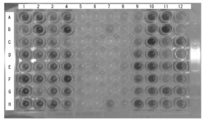
上記(5)における各ウェルの写真を図1に示す。左側4列(黄色種)および右側4列(オリエント種)は、各32ウェルの全てで青紫色に発色した。一方、中央4列(バーレー種)は、32ウェル中29ウェルで白色または黄色に発色し、3ウェルでわずかに青紫色に発色した。
上記(5)における各ウェルの写真を図1に示す。左側4列(黄色種)および右側4列(オリエント種)は、各32ウェルの全てで青紫色に発色した。一方、中央4列(バーレー種)は、32ウェル中29ウェルで白色または黄色に発色し、3ウェルでわずかに青紫色に発色した。
青紫色に発色していないサンプルをバーレー種の葉たばこであると判別した場合、バーレー種における判別確率は90.6%であった。黄色種およびオリエント種における判別確率は100%であった。
このように、葉たばこを入手した国および品種によらず、バーレー種と、黄色種およびオリエント種とでは、青紫色の発色に明らかな差があった。
本発明は、紙巻たばこの製造における品質管理に利用することができる。
Claims (3)
- 葉たばこの種類がバーレー種であるか否かを判別する判別方法であって、
葉たばこを、メタノール、エタノールもしくは水またはこれらの混合液に浸漬して、当該葉たばこの抽出液を得る抽出工程と、
上記抽出液とフォーリン・チオカルト試薬と塩基とを混合して発色させる発色工程と、
上記発色工程で得られた反応液における発色に基づき、上記葉たばこの種類がバーレー種であるか否かを判別する判別工程とを含む、判別方法。 - 上記抽出工程において、上記葉たばこを、メタノールと水との混合液またはメタノールに浸漬する、請求項1に記載の判別方法。
- 上記葉たばこは、たばこ刻または粉末状である、請求項1または2に記載の判別方法。
Priority Applications (1)
| Application Number | Priority Date | Filing Date | Title |
|---|---|---|---|
| PCT/JP2012/077636 WO2014064808A1 (ja) | 2012-10-25 | 2012-10-25 | 葉たばこの種類の判別方法 |
Applications Claiming Priority (1)
| Application Number | Priority Date | Filing Date | Title |
|---|---|---|---|
| PCT/JP2012/077636 WO2014064808A1 (ja) | 2012-10-25 | 2012-10-25 | 葉たばこの種類の判別方法 |
Publications (1)
| Publication Number | Publication Date |
|---|---|
| WO2014064808A1 true WO2014064808A1 (ja) | 2014-05-01 |
Family
ID=50544205
Family Applications (1)
| Application Number | Title | Priority Date | Filing Date |
|---|---|---|---|
| PCT/JP2012/077636 Ceased WO2014064808A1 (ja) | 2012-10-25 | 2012-10-25 | 葉たばこの種類の判別方法 |
Country Status (1)
| Country | Link |
|---|---|
| WO (1) | WO2014064808A1 (ja) |
Citations (1)
| Publication number | Priority date | Publication date | Assignee | Title |
|---|---|---|---|---|
| JPH04286924A (ja) * | 1991-03-15 | 1992-10-12 | Japan Tobacco Inc | 色彩検出型種別装置 |
-
2012
- 2012-10-25 WO PCT/JP2012/077636 patent/WO2014064808A1/ja not_active Ceased
Patent Citations (1)
| Publication number | Priority date | Publication date | Assignee | Title |
|---|---|---|---|---|
| JPH04286924A (ja) * | 1991-03-15 | 1992-10-12 | Japan Tobacco Inc | 色彩検出型種別装置 |
Non-Patent Citations (2)
| Title |
|---|
| JESSADA DENDUANGBORIPANT ET AL.: "Determination of Local Tobacco Cultivars Using ISSR Molecular Markaer", CHIANG MAI J. SCI., vol. 37, no. 2, May 2010 (2010-05-01), pages 293 - 303 * |
| KOKI YOKOTSUKA: "Analytical Reversed-Phase HPLC of Phenols Using the Folin-Ciocalteu Method: Optimization of Conditions for Reaction between Phenols and the Reagent", JOURNAL OF ASEV JAPAN, vol. 12, no. 1, 2001, pages 21 - 28 * |
Similar Documents
| Publication | Publication Date | Title |
|---|---|---|
| WO2014064809A1 (ja) | 葉たばこの種類の判別方法 | |
| Livingston et al. | Cannabis glandular trichomes alter morphology and metabolite content during flower maturation | |
| Espinoza et al. | Forensic analysis of CITES-protected Dalbergia timber from the Americas | |
| Tahir et al. | Discrimination of honeys using colorimetric sensor arrays, sensory analysis and gas chromatography techniques | |
| Sales et al. | Olive oil quality classification and measurement of its organoleptic attributes by untargeted GC–MS and multivariate statistical-based approach | |
| Liu et al. | An integrated approach combining HPLC, GC/MS, NIRS, and chemometrics for the geographical discrimination and commercial categorization of saffron | |
| Comandini et al. | Tannin analysis of chestnut bark samples (Castanea sativa Mill.) by HPLC-DAD–MS | |
| KR101965293B1 (ko) | 한국산과 중국산 백미 판별용 Biomarker 및 이를 이용한 판별 모델 | |
| JP7564110B2 (ja) | 化合物の凝縮物に関連する特性を特性評価する方法およびその使用 | |
| Yoshida et al. | Single‐cell analysis clarifies mosaic color development in purple hydrangea sepal | |
| Chen et al. | Tissue-specific metabolites profiling and quantitative analyses of flavonoids in the rhizome of Belamcanda chinensis by combining laser-microdissection with UHPLC-Q/TOF-MS and UHPLC–QqQ-MS | |
| Pu et al. | The comprehensive evaluation of safflowers in different producing areas by combined analysis of color, chemical compounds, and biological activity | |
| CN105203672A (zh) | 一种优质草莓的品质保障及品种鉴定方法 | |
| Rossel et al. | Comparison of rapid biodiversity assessment of meiobenthos using MALDI-TOF MS and metabarcoding | |
| Drevinskas et al. | Confirmation of the antiviral properties of medicinal plants via chemical analysis, machine learning methods and antiviral tests: a methodological approach | |
| CN108169376A (zh) | 一种快速鉴定武夷岩茶及其茶香精品质的方法 | |
| WO2014064808A1 (ja) | 葉たばこの種類の判別方法 | |
| Ren et al. | Rolling forms the diversities of small molecular nonvolatile metabolite profile and consequently shapes the bacterial community structure for Keemun black tea | |
| Duchesne et al. | Comparing GC× GC-TOFMS-Based metabolomic profiling and wood anatomy for forensic identification of five meliaceae (Mahogany) species | |
| Skočajić et al. | Analysis of phenolic compounds for the determination of grafts (in) compatibility using in vitro callus cultures of Sato-Zakura cherries | |
| KR20090095102A (ko) | 인삼의 근령 분석 방법 | |
| Thangaraj | Quantification of secondary metabolites | |
| Roemer et al. | Characterization of a gap-junctional intercellular communication (GJIC) assay using cigarette smoke | |
| Ross et al. | The rapid evaporative ionisation mass spectrometry metabolite fingerprint of Leptospermum honey is strongly associated with geographic origin | |
| Grohar et al. | Color variation and secondary metabolites’ footprint in a taxonomic complex of Phyteuma sp.(Campanulaceae) |
Legal Events
| Date | Code | Title | Description |
|---|---|---|---|
| 121 | Ep: the epo has been informed by wipo that ep was designated in this application |
Ref document number: 12887107 Country of ref document: EP Kind code of ref document: A1 |
|
| NENP | Non-entry into the national phase |
Ref country code: DE |
|
| 122 | Ep: pct application non-entry in european phase |
Ref document number: 12887107 Country of ref document: EP Kind code of ref document: A1 |
|
| NENP | Non-entry into the national phase |
Ref country code: JP |