WO2014055032A1 - Use of iodine-containing compositions for pathogen reduction during food processing - Google Patents
Use of iodine-containing compositions for pathogen reduction during food processing Download PDFInfo
- Publication number
- WO2014055032A1 WO2014055032A1 PCT/SE2013/051171 SE2013051171W WO2014055032A1 WO 2014055032 A1 WO2014055032 A1 WO 2014055032A1 SE 2013051171 W SE2013051171 W SE 2013051171W WO 2014055032 A1 WO2014055032 A1 WO 2014055032A1
- Authority
- WO
- WIPO (PCT)
- Prior art keywords
- antimicrobial
- foodstuff
- antimicrobial composition
- iodine
- range
- Prior art date
- Legal status (The legal status is an assumption and is not a legal conclusion. Google has not performed a legal analysis and makes no representation as to the accuracy of the status listed.)
- Ceased
Links
Classifications
-
- A—HUMAN NECESSITIES
- A23—FOODS OR FOODSTUFFS; TREATMENT THEREOF, NOT COVERED BY OTHER CLASSES
- A23B—PRESERVATION OF FOODS, FOODSTUFFS OR NON-ALCOHOLIC BEVERAGES; CHEMICAL RIPENING OF FRUIT OR VEGETABLES
- A23B2/00—Preservation of foods or foodstuffs, in general
- A23B2/70—Preservation of foods or foodstuffs, in general by treatment with chemicals
- A23B2/725—Preservation of foods or foodstuffs, in general by treatment with chemicals in the form of liquids or solids
- A23B2/788—Inorganic compounds
-
- A—HUMAN NECESSITIES
- A23—FOODS OR FOODSTUFFS; TREATMENT THEREOF, NOT COVERED BY OTHER CLASSES
- A23B—PRESERVATION OF FOODS, FOODSTUFFS OR NON-ALCOHOLIC BEVERAGES; CHEMICAL RIPENING OF FRUIT OR VEGETABLES
- A23B2/00—Preservation of foods or foodstuffs, in general
- A23B2/70—Preservation of foods or foodstuffs, in general by treatment with chemicals
- A23B2/725—Preservation of foods or foodstuffs, in general by treatment with chemicals in the form of liquids or solids
- A23B2/729—Organic compounds; Microorganisms; Enzymes
-
- A—HUMAN NECESSITIES
- A23—FOODS OR FOODSTUFFS; TREATMENT THEREOF, NOT COVERED BY OTHER CLASSES
- A23B—PRESERVATION OF FOODS, FOODSTUFFS OR NON-ALCOHOLIC BEVERAGES; CHEMICAL RIPENING OF FRUIT OR VEGETABLES
- A23B4/00—Preservation of meat, sausages, fish or fish products
- A23B4/02—Preserving by means of inorganic salts
-
- A—HUMAN NECESSITIES
- A23—FOODS OR FOODSTUFFS; TREATMENT THEREOF, NOT COVERED BY OTHER CLASSES
- A23B—PRESERVATION OF FOODS, FOODSTUFFS OR NON-ALCOHOLIC BEVERAGES; CHEMICAL RIPENING OF FRUIT OR VEGETABLES
- A23B4/00—Preservation of meat, sausages, fish or fish products
- A23B4/14—Preserving with chemicals not covered by groups A23B4/02 or A23B4/12
- A23B4/18—Preserving with chemicals not covered by groups A23B4/02 or A23B4/12 in the form of liquids or solids
- A23B4/20—Organic compounds; Microorganisms; Enzymes
-
- A—HUMAN NECESSITIES
- A23—FOODS OR FOODSTUFFS; TREATMENT THEREOF, NOT COVERED BY OTHER CLASSES
- A23B—PRESERVATION OF FOODS, FOODSTUFFS OR NON-ALCOHOLIC BEVERAGES; CHEMICAL RIPENING OF FRUIT OR VEGETABLES
- A23B4/00—Preservation of meat, sausages, fish or fish products
- A23B4/14—Preserving with chemicals not covered by groups A23B4/02 or A23B4/12
- A23B4/18—Preserving with chemicals not covered by groups A23B4/02 or A23B4/12 in the form of liquids or solids
- A23B4/24—Inorganic compounds
-
- A—HUMAN NECESSITIES
- A23—FOODS OR FOODSTUFFS; TREATMENT THEREOF, NOT COVERED BY OTHER CLASSES
- A23B—PRESERVATION OF FOODS, FOODSTUFFS OR NON-ALCOHOLIC BEVERAGES; CHEMICAL RIPENING OF FRUIT OR VEGETABLES
- A23B7/00—Preservation of fruit or vegetables; Chemical ripening of fruit or vegetables
- A23B7/14—Preserving or ripening with chemicals not covered by group A23B7/08 or A23B7/10
- A23B7/153—Preserving or ripening with chemicals not covered by group A23B7/08 or A23B7/10 in the form of liquids or solids
- A23B7/157—Inorganic compounds
-
- A—HUMAN NECESSITIES
- A23—FOODS OR FOODSTUFFS; TREATMENT THEREOF, NOT COVERED BY OTHER CLASSES
- A23V—INDEXING SCHEME RELATING TO FOODS, FOODSTUFFS OR NON-ALCOHOLIC BEVERAGES AND LACTIC OR PROPIONIC ACID BACTERIA USED IN FOODSTUFFS OR FOOD PREPARATION
- A23V2002/00—Food compositions, function of food ingredients or processes for food or foodstuffs
Definitions
- One or more embodiments of the present invention generally relate to the field of pathogen reduction during the processing of foodstuffs. More particularly, embodiments of the present invention relate to methods of reducing microbial contamination of animal- and plant-based materials being processed to provide edible food products.
- Control of microbial contamination is a primary concern of the food processing industry. Bound both by stringent regulatory requirements and consumer demands, facility operators have long searched for effective methods of reducing or eliminating harmful and undesirable microorganisms, such as Escherichia coli, Salmonella, and Listeria monocytogenes, without adversely affecting the quality of the final product.
- One method for controlling microbial contamination of food during processing includes contacting the surface of the food with water or chemical washes to reduce microbial content and/or prevent microbial growth. While more effective than water washes at controlling contamination, most chemical washes are formulated to include harsh antimicrobial agents, such as acid and ammonia-based compounds, which can degrade the quality of the food being treated. In addition, many of the chemical wash formulations require on-the-spot mixing, which, along with the operational safeguards required for working with such materials, increases capital and operating costs for the processing facility.
- One embodiment of the present invention concerns a method of treating a foodstuff so as to prevent or reduce the level of microbial contamination thereof.
- the method comprises the steps of (a) providing a foodstuff; (b) treating the foodstuff provided in step (a) with an antimicrobial composition having an iodine content in the range of from about 1 to about 50 parts per million by weight (ppmw) based on the total weight of the composition; and (c) processing at least a portion of the foodstuff treated in step (b) to provide at least one edible food product.
- Another embodiment of the present invention concerns a method for preventing or reducing the level of microbial contamination of meat during processing.
- the method comprises the steps of (a) providing at least a portion of an animal carcass; (b) applying an iodine-containing antimicrobial composition to the animal carcass to thereby provide a treated carcass portion, wherein the iodine is the primary active biocidal agent of the antimicrobial composition; and (c) processing at least a portion of the treated carcass portion to thereby provide at least one edible meat product.
- Yet another embodiment of the present invention concerns a method for preventing or reducing the level of microbial contamination of produce during processing.
- the method comprises the following steps: (a) providing one or more produce items to be processed; (b) transporting the produce items to a processing zone; (c) during at least a portion of the transporting of step (b), contacting the produce items with an iodine-containing antimicrobial flume and/or spray having an iodine content in the range of from about 1 to about 50 parts per million by weight (ppmw) to thereby provide one or more treated produce items; and (d) processing at least a portion of the treated produce items to thereby provide at least one edible produce item.
- ppmw parts per million by weight
- FIG. 1 a graph comparing the efficacy of three different antimicrobial compositions against E. coli on beef as tested in Example 4;
- FIG. 2 is a graph comparing the efficacy of three different antimicrobial compositions against E. coli on chicken as tested in Example 5; and [0010]
- FIG. 3 is a graph comparing the efficacy of three different antimicrobial compositions against Salmonella on chicken as tested in Example 5.
- the treatment of a foodstuff with an iodine-containing antimicrobial composition can be effective to substantially reduce the levels of and/or prevent the growth of certain microorganisms (e.g., bacteria, fungi, etc.) on the food surface, while preserving the taste, texture, smell, and color of the final edible product.
- certain microorganisms e.g., bacteria, fungi, etc.
- the present invention is applicable to the processing of a wide variety of foodstuffs, including meat, poultry, fish, seafood, and produce, and can be easily and economically implemented into existing food processing facilities. Various embodiments of the present invention will be described in detail below.
- the first step of the inventive method is to provide a foodstuff for processing.
- the term "foodstuff” refers to any food item or precursor to food item which can ultimately be made into an edible food product.
- the foodstuff can comprise at least a portion of a slaughtered animal.
- Animals suitable for processing can include, but are not limited to, cattle, pigs, sheep, goats, chickens, turkey, ducks, game foul, deer, bison, fish, and other animals.
- the foodstuff can be selected from the group consisting of beef, pork, mutton, goat meat, venison, bison, and poultry; while, in other embodiments, the foodstuff can be fish and/or seafood.
- the term "poultry” is intended to encompass chicken, turkey, ducks, game foul, and bird species, while the term “seafood” refers to a wide class of aquatic food animals, such as fish, crabs, lobsters, mussels, and scallops.
- the foodstuff can include one or more types of fruits and vegetables.
- the foodstuff provided for treatment can be a whole animal carcass, while, in other embodiments, the foodstuff can be a partial animal carcass that has previously undergone some treatment or processing. Examples of such prior treatment or processing include stunning, bleeding, dehairing, dehiding, defeathering, scalding, washing, drying, antimicrobial treatments, removal of head or feet, evisceration, and combinations thereof.
- the foodstuff being treated includes produce
- the foodstuff provided can have undergone one or more previous processing steps, such as, for example, sorting, picking, cutting, coring, peeling, cooking, steaming, and combinations thereof.
- the step of preparing or processing the foodstuff to be provided for treatment can include dicing, cutting, chopping, grinding, trimming, cooking, stuffing or encasing, and combinations thereof.
- the foodstuff can be contacted with one or more antimicrobial compositions to reduce, eliminate, and/or prevent the growth of bacteria and other microorganisms.
- antimicrobial refers to a substance capable of killing or inhibiting the growth of one or more types of microorganisms.
- the composition is a "sanitizing" or “sanitization” solution.
- the antimicrobial composition When the antimicrobial composition is formulated to destroy or irreversibly inactivate microorganisms, but not necessarily their spores, and prevent them from growing, the composition is a "disinfectant" or “disinfecting” solution. When the composition can be formulated to kill all microorganisms present, including spores, it can be referred to as a "sterilizing” or “sterilization” solution.
- Antimicrobial compositions as described herein can include sanitizing and disinfecting characteristics. According to one embodiment of the present invention, the antimicrobial composition employed during treatment can be effective to reduce the microbial levels of the foodstuff being treated by at least about 1 log, at least 2 log, or at least about 3 log, while maintaining the quality of the final edible product.
- treatments according to embodiments of the present invention can minimize or prevent growth of microorganisms, such as Salmonella, E. coll, and Lysteria, during subsequent processing of the foodstuff.
- the antimicrobial compositions described herein can first be prepared as a concentrate before being diluted to form a final use antimicrobial composition suitable for application to the foodstuff, although, in some embodiments, it may be desirable to apply the concentrate directly to the foodstuff.
- the composition can comprise iodine in the range of from about 0.5 to about 60 weight percent, about 1 to about 30 weight percent, about 2 to about 28 weight percent, or about 3 to about 25 weight percent, based on the total composition.
- suitable diluents can include, but are not limited to, water, alcohols, or other non-toxic and carriers, preferably those approved for human consumption and can be present in the composition in an amount suitable to achieve a desired iodine content.
- the final use solution can have an iodine concentration or content in the range of from about 1 part per million by weight (ppmw) to about 50 ppmw, about 2 ppmw to about 35 ppmw, about 5 ppmw to about 25 ppmw or is less than about 50 ppmw, less than about 40 ppmw, less than about 30 ppmw, less than about 25 ppmw, or less than about 20 ppmw, based on the total weight of the composition.
- the final use solution can have a concentrate to diluent weight ratio in the range of from about 1:700 to about 1:45,000, about 1:1000 to about 1:10,000, or about 1:1500 to about 1:6500.
- Antimicrobial compositions as described herein include at least one source of iodine.
- iodine is the primary or sole active biocidal agent of the antimicrobial composition, although it is also within the scope of the present invention for the antimicrobial composition to comprise a mixture of antimicrobial agents.
- the antimicrobial composition does not include any additional biocidal agents and is substantially free of components such as carboxylic acids including peracetic acid, peroxyoctanoic acid, germicidal fatty acids, and lactic acid; nitrogen-containing compounds, such as chloramines or ammonia; and other germicidal agents including, for example, ozone or EDTA.
- the antimicrobial composition can include one or more solubilizing agents for complexing the iodine to form stable compositions having desirable iodine content.
- the solubilizing agent can comprise at least one of iodide ions, halogen ions, and other complexing agents such as alcohols, polyols, and surfactants, polyvinyl pyrrolidone, and combinations thereof.
- the antimicrobial composition can include an iodide solubilizing agent derived from alkali metal iodides, such as Nal or Kl, or hydriodic acid.
- the solubilizing agent can be a solubilizing halide ion, such as chlorine or bromine, derived from an alkali earth metal compound such as NaBr and/or NaCI, or acids such as HBr, and/or HCI.
- a solubilizing halide ion such as chlorine or bromine
- an alkali earth metal compound such as NaBr and/or NaCI
- acids such as HBr, and/or HCI.
- iodine can be complexed with a solubilizing agent selected from the group consisting of oxygen-containing organic compounds such as alcohols, diols, polyols, and non-ionic surfactants.
- a solubilizing agent selected from the group consisting of oxygen-containing organic compounds such as alcohols, diols, polyols, and non-ionic surfactants.
- suitable solubilizing or complexing agents can include, but are not limited to, alkylphenol ethoxylates, alcohol ethoxylates, alcohol alkoxylates, polyalkylene glycol ethers, polyoxyethylene sorbitan monolaurate and monopalmitate, polyvinylpyrrolidone, polyethoxylated polyoxypropylenes, and mixtures thereof.
- the complexing agent can comprise at least one of nonylphenol ethoxylates, alcohol ethoxylates, polyvinylpyrrolidone, and glycerin.
- the complexing agent may be a non-ionic surfactant having the general formula:
- R represents the residue of an organic compound containing an active hydrogen or hydroxide and R' represents hydrogen of a C 2 -C 4 alkyl group and n is an integer ranging from 3 to 212.
- exemplary non-ionic surfactants of this type include those from the PLURONIC family (commercially available from BASF), especially those with a molecular weight of at least about 1,000 grams per mole (g/mol), at least about 1,500 g/mol, or at least about 2,000 g/mol.
- the iodine solubilizing agent can be present in the antimicrobial composition in an amount in the range of from about 0.15 to about 30 weight percent, about 1 to about 20 weight percent, about 2 to about 15 weight percent, or about 5 to about 10 weight percent, based on the total weight of the concentrate. In another embodiment, one or more of the solubilizing agents listed above can be present in an amount of from about 20 to about 70 weight percent, about 25 to about 60 weight percent, or about 35 to about 55 weight percent, based on the total weight of the concentrate.
- the antimicrobial composition can include at least one of glycerin, at least one non-ionic surfactant, and a solubilizing halide ion.
- antimicrobial compositions described herein have a suitable shelf-life or stability over time.
- antimicrobial compositions utilized by the present invention can be stable for a period of at least about 3 months, at least about 6 months, at least about 9 months, or at least about 1 year at room temperature (i.e., about 25°C).
- stable means that the concentrates remain as substantially single phase, homogenous solutions throughout a given storage period at room temperature and at least about 90 percent of the starting iodine concentration remains.
- the iodine concentration of the antimicrobial composition after such a storage period can be in the range of from about 0.00005 weight percent to about 0.5 weight percent, about 0.0001 weight percent to about 0.05 weight percent, or about 0.0005 weight percent to about 0.005 weight percent, based on the total final use composition.
- the antimicrobial composition may also include one or more other types of additives to impart various desirable properties to the final use composition.
- the composition can include one or more dispersants to enhance the coverage of the antimicrobial composition once applied.
- suitable dispersants include those surfactants listed above.
- a portion of the dispersant can function to complex/solubilize at least a portion of the iodine.
- suitable additives include buffering agents, wetting agents, thickening agents, or hydrotropes. Specific species suitable for use as each of these types of additives are provided in U.S. Patent No. 5,885,620, the disclosure of which is incorporated herein by reference in its entirety.
- the antimicrobial compositions described herein can be formulated in the absence of these additives such that the final composition is substantially free of one or more of buffering agent, wetting agents, thickening agents, and/or hydrotropes.
- the antimicrobial composition can be applied to the foodstuff being processed in any suitable manner.
- the delivery method for applying the antimicrobial composition can comprise one or more of spraying, dipping, immersing, fogging, and/or steaming.
- the specific type of treatment, as well as the conditions of application can depend on the specific foodstuff being processed, as well as the desired microbial load reduction.
- the delivery method for the antimicrobial composition includes spraying, the temperature of the antimicrobial composition upon initial application to the foodstuff can be approximately ambient or can be slightly warmer or cooler.
- the temperature of the antimicrobial composition during a spray application can be in the range of from about 0°C to about 50°C, about 5°C to about 45°C, or about 10°C to about 35°C.
- the spray can be applied intermittently or continuously for an overall duration in the range of from about 1 second to about 5 minutes, about 2 seconds to about 2 minutes, or about 5 seconds to about 1 minute, in the range of from about 1 second to about 1 minute, about 2 seconds to about 45 seconds, or about 5 seconds to about 30 seconds.
- the antimicrobial compositions described herein can be contacted with at least about 75 percent, at least about 85 percent, at least about 90 percent, or at least about 95 percent of the total surface area of the foodstuff for at least about 2 seconds, at least about 3 seconds, at least about 5 seconds, or at least about 10 seconds.
- the amount of weight gained by the foodstuff during a spray application can be substantially lower than those experienced with conventional washes.
- the amount of weight gained by the foodstuff being treated by spray, fog, or steam application with the antimicrobial compositions herein can be less than about 0.049 weight percent, while still achieving the microbial reduction discussed previously.
- the foodstuff can be at least partially immersed in one or more liquid baths containing the antimicrobial composition.
- the temperature of the antimicrobial composition can be approximately ambient or can be heated or cooled slightly.
- the immersion baths can be chiller baths having a temperature in the range of from about 4°C to about 25°C, about 4°C to about 20°C, or about 8°C to about 15°C.
- the contacting time for this type of application can be in the range of from about 1 second to about 4 hours, about 1 minute to about 2 hours, or about 5 minutes to about 30 minutes, depending on the foodstuff being processed, the strength of the composition being used, and the desired efficacy.
- the immersion baths are typically static, in some embodiments, foodstuffs submerged or immersed in water may simultaneously be transported from one location within the facility to another, such as, for example flume water transport systems used in produce processing.
- the antimicrobial compositions described herein can be applied in a single application or, more preferably, as a series of consecutive applications.
- the antimicrobial composition when applied via two or more separate application stages, can be applied at different times in the process such that one or more food processing steps (e.g., cutting, chopping, etc.) can be carried out between the applications.
- each application when the antimicrobial composition is applied in two or more separate application stages, each application can be applied sim ultaneously in consecutive treatments conducted at approximately the same stage of the process.
- the time between subsequent applications can be about 5 seconds to about 4 hours, about 10 seconds to about 1 hour, or about 30 seconds to about 30 minutes.
- each stage when the antimicrobial composition is applied via two or more separate stages, each stage can be conducted at approximately the same temperature, pressure, and/or for the same duration, while, in other embodiments, at least one of the temperature, pressure, and duration of treatment can be different.
- the delivery methods of serial applications can be of the same type (e.g., consecutive sprays) or can be different types (e.g., a spray followed by an immersion bath). Exemplary embodiments of specific processing configurations will be described in detail shortly.
- the foodstuff can then be further processed.
- this additional processing can include at least one of dicing, cutting, chopping, grinding, trimming, cooking, stuffing or encasing, and combinations thereof and/or coring, peeling, cooking, steaming, and combinations thereof.
- the further processing can include grinding or trimmi ng the meat to produce ground beef and/or prime cuts.
- one or more additional antimicrobial treatments can be applied to the processed foodstuffs (e.g., the ground beef or prime cuts) using one or more methods and/or compositions as described above.
- the processing can include cutting or chopping and the resulting processed food items can be contacted with an antimicrobial composition as discussed above before being packaged or otherwise used.
- the foodstuffs treated according to the present invention can then be provided as an edible food product.
- food products treated in accordance with the present invention do not exhibit any negative organoleptic properties, including taste, color, smell, and texture, as detectable by the unaided human senses.
- treated food products exhibit similar organoleptic properties as untreated food products, and are practically indistinguishable therefrom, with the exception of having reduced microbial levels.
- the antimicrobial compositions described herein do not have a lasting effect on the foodstuff. Accordingly, foodstuffs processed as described herein exhibit substantially lower levels of microbial contamination while maintaining regulatory requirements and providing a high quality final product.
- an iodine- containing antimicrobial composition as described above can be applied to beef at various stages within a beef processing facility. Once the cattle have been slaughtered and have undergone a preliminary wash, the carcass is dehided to expose the meat. Thereafter, the exposed meat can be treated with one or more sequential applications of the antimicrobial composition discharged from medium- to high-pressure spray nozzles aimed to contact the inside and outside of the carcass at a pressure of between 15 and 50 psig. Each application can have a duration of between about 5 to about 15 seconds and can optionally include hot water rinses occurring in the interim between antimicrobial composition applications.
- the resulting carcass can exhibit a reduction in microbial load of between about 0.5 to about 2 log without signs of adverse organoleptic effects.
- the treated carcass can be cut into portions, which can be routed to various areas of the facility for conversion into prime cuts, trim, organs, and ground meat.
- one or more antimicrobial treatments can be applied during these processing steps to reduce or minimize microbial contamination of the final beef product.
- the beef products After being packaged or otherwise prepared for storage, the beef products can be cooled, stored, and/or shipped to customers or final end users.
- Beef products produced as described herein exhibit no adverse taste, color, smell, or texture resulting from the antimicrobial composition treatments and have substantially lower levels of microbial contamination.
- the poultry is slaughtered and the carcasses are washed, defeathered, and eviscerated. Thereafter, the resulting poultry foodstuff can be washed in a series of antimicrobial treatments utilizing an iodine-containing composition as described herein.
- the antimicrobial treatments can include a whole carcass spray wash followed by submersion in a series of antimicrobial chiller baths.
- the whole carcass spray can be carried out at a pressure of between about 20 psig and about 150 psig for a duration of between about 2 to about 30 seconds per carcass.
- the resulting treated carcass can then optionally be split into upper and lower segments before being sent to sequential chiller baths, which can number between 2 and 6.
- the chiller baths can have a temperature of between about 4°C to about 10°C, and the carcasses can have a dwell time in each bath of between about 5 minutes to about 4 hours.
- the treated carcass or carcass portions can be removed from the bath and can be further processed and/or treated to provide the final poultry product.
- Poultry treated according to embodiments of the present invention exhibits no discoloration or adverse odor or taste.
- poultry treated as described herein exhibits minimal loss of water during processing, thereby increasing marginal value of the products produced.
- one or more antimicrobial compositions as described herein may be used to treat various types of fruits and/or vegetables in a produce processing facility.
- fruits and vegetables may be provided for processing via delivery to an unloading zone of a processing facility.
- the produce may be delivered as fresh produce, pre-chilled or refrigerated produce, or combinations thereof.
- the produce items may be loaded into a flume water transport system for moving the fruits and/or vegetables from the unloading zone to a downstream processing zone. If the produce is refrigerated, the fruit and/or vegetable items may be loaded into a primary flume, which both rinses and transports the produce passing therein. If the produce is fresh, a three-flume transport system may be employed with a primary flume moving the produce into the processing plant and a secondary, or transportation, flume moving the produce onto a conveyor. From the conveyor, the treated produce can then be moved to a tertiary, or rinsing, flume and can thereafter be reloaded onto a conveyor belt for moving the rinsed produced to the processing zone.
- the produce items can be further processed and may be, for example, chopped, sliced, steamed, mixed, juiced, peeled, mashed, sorted, or combinations thereof.
- the resulting produce product may then be packaged for further storage, transport, or sale.
- At least one of the flumes used to transport produce may have an iodine content in the range of from about 0.5 to about 20 ppmw, at least about 1 to about 10 ppmw, or at least about 2 to about 8 ppmw. Such concentrations of iodine may be obtained utilizing an antimicrobial composition according to one or more embodiments described herein.
- the produce typically remains in each flume, including the iodine-containing flume, for a contact time in the range of from about 15 seconds to about 15 minutes.
- the temperature of the water during flume transport may be in the range of from about 40°F to about 95°F, about 50°F to about 90°F, or about 60°F to about 85°F.
- the iodine-containing flume can be the tertiary flume and it may have an iodine content within the ranges described above.
- the multi-flume transport system may be a cascade system, such that the water from the tertiary flume is recycled to the secondary flume and the secondary flume water is reused in the primary flume.
- the secondary and/or primary flumes may also have at least trace amounts of iodine as well.
- the produce items may be treated with one or more antimicrobial washes during at least a portion of its transporting between the unloading zone and the processing zone.
- the antimicrobial wash may be applied on the first conveyor, as the produce passes between the secondary and tertiary flumes.
- the produce items may be contacted with an antimicrobial wash once removed from the single transport/rinse flume, but prior to being processed as described above.
- one or more of the produce items may also be treated with an antimicrobial wash after processing, but prior to packaging.
- the antimicrobial wash can be formulated as described herein and may have an iodine content in the range of from about 5 to about 60 ppmw, about 10 to about 50 ppmw, or about 15 to about 45 ppmw.
- the temperature of the antimicrobial wash or spray when applied to the produce can be in the range of from about 35°F to about 75°F, about 40°F to about 70°F, or about 45°F to about 65°F and may be applied by any known device, such as, for example, a spray bar.
- the contact time of the antimicrobial spray can vary from about 15 seconds to about 10 minutes, about 20 seconds to about 8 minutes, or about 30 seconds to about 5 minutes and may be applied in at least 1, at least 2, or at least 3 separate applications.
- Example 1 several antimicrobial compositions including varying iodine contents were prepared.
- Examples 2 and 3 beef and chicken were treated with several of the compositions prepared in Example 1, and the impact of the treatment on the organoleptic properties of the meat was studied.
- Examples 4 and 5 the efficacy of several compositions prepared in Example 1 against E. coll and Salmonella on beef and chicken was determined and the results were compared to those of meats treated with a commercially available antimicrobial solution including peracetic acid as the active ingredient.
- Examples 6 and 7 describe the efficacy of inventive antimicrobial solutions for treating produce via spray and submersion techniques, while Prophetic Example 8 is included to provide details regarding several antimicrobial compositions that have been contemplated. As shown in the Examples below, use of lower levels of an antimicrobial agent in compositions as described herein can minimize or prevent adverse organoleptic effects without a reduction in efficacy.
- Example 1 Preparation of Several Antimicrobial Compositions
- Table 1 summarizes the composition of an exemplary antimicrobial concentrate suitable for use in the present invention. Preparation of the concentrate is described below.
- the sodium iodide (57%) was added to the tank along with the remainder of the tap water, which had a temperature between 10°C and 26°C. The contents of the tank were then allowed to stir for approximately 90 minutes, while the temperature inside the tank was maintained at less than 45°C. If the temperature of the mixture exceeded 45°C, the solution was allowed to cool before proceeding.
- iodine was added to the solution as reaction grade, although a similar amount of non-reaction grade iodine would have been equally suitable.
- the solution was vigorously agitated with the flow direction toward the bottom of the tank.
- a recirculation pump was sporadically used in addition to the heater to maintain the temperature.
- the scrubber was turned off and the tank was sealed to maintain the temperature of the solution between 45°C and 50°C while it was agitated.
- the phosphoric acid FG (75%) and sulfuric acid (93%, 66° Be) were added to the solution.
- the resulting solution was quality checked, approved, and then filtered via passage through a 25-50 micron filter.
- compositions 1--7 each having a different iodine content.
- Composition 1 was diluted to an iodine content of 25 ppm by weight by combining 1 fluid ounce of the antimicrobial concentrate described above with 13 gallons of water.
- Compositions 2-7 were formulated by adding 1 fluid ounce of antimicrobial concentrate to a certain amount of water in order to provide antimicrobial compositions of varying iodine concentration.
- Table 2, below summarizes the iodine contents, volume of water required, and dilution ratios for each of antimicrobial Compositions 1-7, produced from the concentrate listed in Table 1.
- Table 2 Iodine Content of Various Antimicrobial Compositions from Concentrate in Table 1
- each of the chickens was placed on ice to simulate cool storage after processing. After 2 hours, the chilled birds were removed and visually inspected.
- the chickens soaked in Compositions 5 (5 ppm iodine) and 3 (10 ppm iodine) did not show any discoloration or staining of the meat, but the feather follicles and skin of these birds exhibited minor yellow staining.
- the chicken exposed to Composition 1 (25 ppm iodine) exhibited extreme yellow staining of the skin and feather follicles, but showed no staining of the meat.
- Each of the chickens were then cooked to an internal temperature of 160°F and visually inspected.
- the chicken that had been exposed to Composition 1 25 ppm iodine
- had slightly darker skin which was not observed in the specimen subjected to treatment with Compositions 3 (10 ppm) or 5 (5 ppm).
- Samples of the cooked birds were smelled and tasted and no unpleasant odor or flavor was observed.
- the inoculated samples were then submerged in 500 mL of various antimicrobial compositions at 40°F.
- a control sample was submerged in a sterile water bath and another sample was treated with Composition A (100 ppm PAA).
- Two other samples were treated in baths including Compositions 3 (10 ppm iodine) and 5 (5 ppm iodine).
- the samples were removed from the respective baths and placed in 100 mL of an appropriate neutralizer solution.
- the samples were removed and the concentration of bacteria recovered from the neutralizing solutions was determined using standard microbiological methods. As depicted graphically in FIGS.
- Composition A 100 ppm PAA
- Composition 3 10 ppm iodine
- both Compositions 3 (10 ppm iodine) and 5 (5 ppm iodine) achieved similar efficacy as Composition A (100 ppm PAA) against Salmonella on chilled poultry.
- the first sample set included 2 small onions and 3 green grapes, and the second set included 2 small onions, 3 green grapes, and 3 pieces of cut honey dew melon without rind.
- the components of each sample set were inoculated for 5 minutes with a 100 ml solution containing 1 xlO 6 CFU/mL of E. coli. After 5 minutes, the produce was removed and allowed to air dry for 20 minutes.
- the first sample set was sprayed with approximately 1 mL ⁇ e.g., approximately 5 pumps from a spray bottle) of Composition 7 (50 ppmw iodine) prepared in Example 1, above, for a total contact time of approximately 30 seconds. After the appropriate contact time had expired, the sprayed samples were placed in 10 mL of peroxide neutralizing solution and the solution was analyzed for microorganisms using the Most Probable Number (MPIM) technique.
- MPIM Most Probable Number
- compositions 8 and 9 Two additional exemplary antimicrobial compositions (Compositions 8 and 9) are prepared in a similar manner as disclosed in Example 1, above. Table 6, below, summarizes the key components of each of Compositions 8 and 9. Table 6: Additional Antimicrobial Concentrate Formulations
- Each of the concentrates listed in Table 6 above have an iodine content of 28.5 weight percent. Each are then diluted to include an iodine content in the range of 1 to 50 ppmw, according to the dilution ratios summarized in Table 7, below. The diluted solutions are then used as described herein to prevent or reduce microbial contamination of foodstuffs, including meat and produce, during processing.
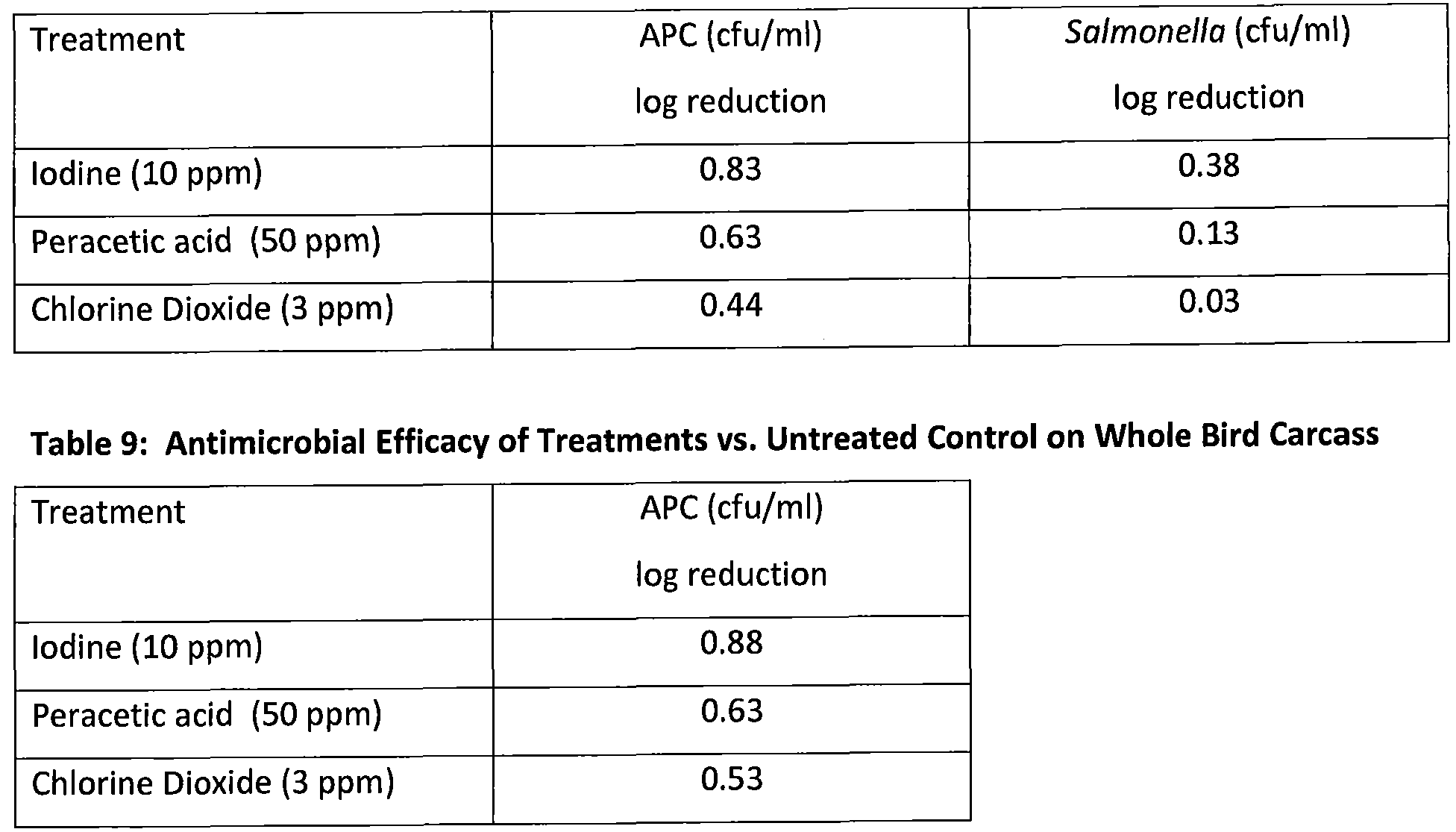
- Example 9 Efficacy of Antimicrobial Compositions on Poultry Treated Via Spray Application
- the antimicrobial compositions were applied by spraying through nozzles disposed so that the spray would contact the carcass outer surface.
- a first control chicken carcass was sprayed with pure water only and a second control carcass was left untreated.
- the bird carcasses were sprayed for 5 seconds at 4°C and 30 psi.
- the iodine- containing treatment used was Composition 3 from Table 2 above, containing 10 ppm iodine.
- the peracetic acid solution used comprised a mixture of between 14.7-15.5% peroxyacetic acid, 4.5-5.8% hydrogen peroxide, and 30-40% acetic acid, available as DeLasan MP, which was diluted with water to give a peracetic acid level of 50 ppm.
- the chlorine dioxide solution comprised a 3000 ppm chlorine dioxide in water solution, available as Redi-Ox from DeLaval Manufacturing, that was diluted with water to a final chlorine dioxide concentration of 3 ppm.
- the treated carcasses were analyzed for aerobic plate count (APC) levels and Salmonella levels (vs. water only), and a log reduction value was calculated relative to the controls. The results are listed in Tables 8 and 9, below.
- Example 10 Efficacy of Antimicrobial Compositions on Poultry Treated Via Immersion
- the iodine treatment exhibited results on par with high levels of peracetic acid and chlorine dioxide. Even at the shorter contact time of 60 minutes, the iodine treatment exhibited relatively high APC log reduction, and Salmonella log reductions on par with peracetic acid (25 ppm) and chlorine dioxide treatments.
- Example 11 Efficacy of Antimicrobial Compositions on Beef Treated Via Spray Application
- compositions according to the present invention (20 and 25 ppm iodine) was compared with treatments comprising peracetic acid (100 and 200 ppm) and lactic acid (3.0 and 3.5 wt%) solutions.
- the antimicrobial compositions were applied to the samples using a spray bar equipped with six generally downwardly directed nozzles.
- the spray bar was connected to a water pump having an adjustable pressure output.
- the samples were placed underneath the spray bar and the spraying bar and samples were then enclosed in a plexiglass box to contain the spray to the inside of the chamber and avoid contamination on other surfaces.
- the samples were sprayed with the antimicrobial and control compositions for 5, 10, or 15 sec at 40 psi from a distance of 4 in from the nozzles.
- the treatment solutions were applied at 25°C.
- the concentrate from Table 1 was diluted at a dilution ratio of 1:2200 to prepare the 20 ppm iodine treatment.
- the 25 ppm iodine treatment is Composition 1 from Table 2, above.
- the peracetic acid solutions were prepared by dilution of the peracetic acid composition described in Example 9 to a peracetic acid level of 200 ppm and 100 ppm respectively.
- the lactic acid solutions were also prepared via dilution of a stock lactic acid composition to lactic acid levels of 3 and 3.5% by weight, respectively.
- Example 12 In Vitro Efficacy of Antimicrobial Compositions
- the test procedure employed known bacterial concentrations, ranging between 1.5-5e+7 cfu/ml, were exposed to a known concentration of an antimicrobial composition in hard water, simulating actual field conditions.
- the cells were prepared in a 24 hr liquid cell culture. 1 ml samples of the cell cultures were combined with 8 ml of the antimicrobial composition in the presence of 1 ml of an interfering substance.
- the interfering substance comprised 0.3% bovine serum albumin (BSA), which provides a proxy for protein soils.
- the interfering substance comprised 1% BSA and 1% yeast extract (YE), which provides a proxy for protein, fats, and sugars.
- Both soils simulate soils left on surfaces, such as those encountered on food processing surfaces, and in particular, meat and poultry surfaces.
- the antimicrobial compositions tested were: 20 ppm iodine solution, 100 ppm and 200 ppm peracetic acid solutions, and 3.5 wt% lactic acid solutions prepared as described in Example 11 above, and a 280 ppm HBr in water solution.
- the present invention can be described according to the following:
- a method of treating a foodstuff so as to prevent or reduce the level of microbial contamination thereof comprising:
- step (a) providing a foodstuff;
- step (b) treating said foodstuff provided in step (a) with an antimicrobial composition having an iodine content in the range of from about 1 to about 50 parts per million by weight (ppmw) based on the total weight of said composition; and
- step (c) processing at least a portion of said foodstuff treated in step (b) to provide at least one edible food product.
- step (b) The method of paragraphs [0073] or [0074], wherein said treating of step (b) is effective to reduce the level of microbial contamination of said foodstuff provided in step (a) by at least 1 log.
- step (b) comprises two or more treatment stages, wherein each of said treatment stages is effective to reduce the level of microbial contamination of said foodstuff being treated by at least 0.5 log.
- said antimicrobial composition further comprises at least one of glycerin and one or more non-ionic surfactants.
- said antimicrobial composition further comprises at least one source of solubilizing halide ions.
- said antimicrobial composition comprises a diluted antimicrobial concentrate, wherein said antimicrobial concentrate comprises in the range of from about 20 to about 70 weight percent of glycerin, a non-ionic surfactant, or combination thereof.
- said antimicrobial concentrate comprises in the range of from about 2 to about 15 weight percent of a solubilizing halide ion.
- step (b) does not substantially adversely affect the organoleptic characteristics of the treated foodstuff.
- step (b) is carried out for a time period in the range of from about 1 to about 30 seconds.
- step (b) is carried out for a time period in the range of from about 1 to about 30 seconds.
- step (b) includes spraying at least a portion of one surface of said foodstuff with said antimicrobial composition.
- step (b) comprises at least partially immersing said foodstuff into a solution comprising said antimicrobial composition.
- step (b) comprises both spraying said foodstuff with said antimicrobial composition and at least partially immersing said foodstuff in a solution comprising said antimicrobial composition.
- a method for preventing or reducing the level of microbial contamination of meat during processing comprising:
- step (c) processing at least a portion of said treated carcass portion to thereby provide at least one edible meat product.
- step (b) is effective to reduce the level of microbial contamination of said carcass by at least 1 log.
- step (b) comprises two or more separate application stages, wherein each of said stages is operable to reduce the level of microbial contamination of said carcass by at least 0.5 log.
- said antimicrobial composition further comprises at least one of glycerin, at least one non-ionic surfactant, and at least one source of solubilizing halide ions.
- said antimicrobial composition comprises a diluted antimicrobial concentrate, wherein said antimicrobial concentrate comprises in the range of from about 20 to about 70 weight percent of glycerin, a non-ionic surfactant, or combination thereof.
- said antimicrobial composition comprises a diluted antimicrobial concentrate, wherein said antimicrobial concentrate comprises in the range of from about 2 to about 15 weight percent of a solubilizing halide ion.
- step (b) comprises at least one of immersing and flume transport.
- step (b) comprises at least one of spraying, misting, fogging, steaming, and combinations thereof.
- step (a) includes at least one of stunning, slaughtering, bleeding, dehairing, dehiding, defeathering, eviscerating, cutting, chopping, grinding, trimming, cooking, and combinations thereof.
- a method for preventing or reducing the level of microbial contamination of produce during processing comprising:
- step (b) contacting said produce items with an iodine-containing antimicrobial spray having an iodine content in the range of from about 1 to about 50 parts per million by weight (ppmw) to thereby provide one or more treated produce items; and
- step (b) is carried out using a flume water transport system.
- said flume water system comprises at least one flume having an iodine content in the range of from about 1 ppmw to about 10 ppmw.
- step (c) comprises spraying said produce items with an antimicrobial wash having an iodine content in the range of from about 10 ppmw to about 50 ppmw.
- step (c) is effective to reduce the level of microbial contamination of said produce items by at least 0.5 log.
Landscapes
- Life Sciences & Earth Sciences (AREA)
- Engineering & Computer Science (AREA)
- Chemical & Material Sciences (AREA)
- Polymers & Plastics (AREA)
- Wood Science & Technology (AREA)
- Zoology (AREA)
- Food Science & Technology (AREA)
- General Chemical & Material Sciences (AREA)
- Chemical Kinetics & Catalysis (AREA)
- Inorganic Chemistry (AREA)
- Microbiology (AREA)
- Food Preservation Except Freezing, Refrigeration, And Drying (AREA)
- Agricultural Chemicals And Associated Chemicals (AREA)
Description




Claims
Priority Applications (3)
| Application Number | Priority Date | Filing Date | Title |
|---|---|---|---|
| BR112015007099A BR112015007099A2 (en) | 2012-10-05 | 2013-10-04 | use of iodine containing compositions for pathogen reduction during food processing |
| CN201380052014.1A CN104703476A (en) | 2012-10-05 | 2013-10-04 | Use of iodine-containing compositions for pathogen reduction during food processing |
| US14/433,126 US20150272198A1 (en) | 2012-10-05 | 2013-10-04 | Use of iodine-containing compositions for pathogen reduction during food processing |
Applications Claiming Priority (2)
| Application Number | Priority Date | Filing Date | Title |
|---|---|---|---|
| US201261710434P | 2012-10-05 | 2012-10-05 | |
| US61/710,434 | 2012-10-05 |
Publications (1)
| Publication Number | Publication Date |
|---|---|
| WO2014055032A1 true WO2014055032A1 (en) | 2014-04-10 |
Family
ID=49474670
Family Applications (1)
| Application Number | Title | Priority Date | Filing Date |
|---|---|---|---|
| PCT/SE2013/051171 Ceased WO2014055032A1 (en) | 2012-10-05 | 2013-10-04 | Use of iodine-containing compositions for pathogen reduction during food processing |
Country Status (4)
| Country | Link |
|---|---|
| US (1) | US20150272198A1 (en) |
| CN (1) | CN104703476A (en) |
| BR (1) | BR112015007099A2 (en) |
| WO (1) | WO2014055032A1 (en) |
Citations (7)
| Publication number | Priority date | Publication date | Assignee | Title |
|---|---|---|---|---|
| US3958026A (en) * | 1973-09-14 | 1976-05-18 | Ciba-Geigy Corporation | Disinfection and sterilisation of mussels, crustacea and fish |
| WO1989012399A1 (en) * | 1988-06-22 | 1989-12-28 | Public Health Research Institute Of The City Of Ne | Nisin compositions for use as enhanced, broad range bactericides |
| WO1994009635A1 (en) * | 1992-10-26 | 1994-05-11 | Edward Shanbrom | Starch-iodine-peroxide preservation of foods |
| WO1998004143A2 (en) * | 1996-07-26 | 1998-02-05 | The Dow Chemical Company | A process for the decontamination of meats |
| WO1998055404A1 (en) * | 1997-06-02 | 1998-12-10 | Iosolutions Incorporated | Method of disinfecting water and food stuff preservation with iodine species |
| US5885620A (en) | 1997-04-02 | 1999-03-23 | West Agro, Inc. | Stable glycerin iodine concentrate compositions |
| US6120812A (en) * | 1998-02-18 | 2000-09-19 | Iosolutions Incorporated | Foodstuff preservation with iodinated ice |
Family Cites Families (1)
| Publication number | Priority date | Publication date | Assignee | Title |
|---|---|---|---|---|
| WO2004083252A2 (en) * | 2003-03-13 | 2004-09-30 | Mionix Corporation | Acidic composition and its uses |
-
2013
- 2013-10-04 CN CN201380052014.1A patent/CN104703476A/en active Pending
- 2013-10-04 US US14/433,126 patent/US20150272198A1/en not_active Abandoned
- 2013-10-04 BR BR112015007099A patent/BR112015007099A2/en not_active IP Right Cessation
- 2013-10-04 WO PCT/SE2013/051171 patent/WO2014055032A1/en not_active Ceased
Patent Citations (7)
| Publication number | Priority date | Publication date | Assignee | Title |
|---|---|---|---|---|
| US3958026A (en) * | 1973-09-14 | 1976-05-18 | Ciba-Geigy Corporation | Disinfection and sterilisation of mussels, crustacea and fish |
| WO1989012399A1 (en) * | 1988-06-22 | 1989-12-28 | Public Health Research Institute Of The City Of Ne | Nisin compositions for use as enhanced, broad range bactericides |
| WO1994009635A1 (en) * | 1992-10-26 | 1994-05-11 | Edward Shanbrom | Starch-iodine-peroxide preservation of foods |
| WO1998004143A2 (en) * | 1996-07-26 | 1998-02-05 | The Dow Chemical Company | A process for the decontamination of meats |
| US5885620A (en) | 1997-04-02 | 1999-03-23 | West Agro, Inc. | Stable glycerin iodine concentrate compositions |
| WO1998055404A1 (en) * | 1997-06-02 | 1998-12-10 | Iosolutions Incorporated | Method of disinfecting water and food stuff preservation with iodine species |
| US6120812A (en) * | 1998-02-18 | 2000-09-19 | Iosolutions Incorporated | Foodstuff preservation with iodinated ice |
Also Published As
| Publication number | Publication date |
|---|---|
| BR112015007099A2 (en) | 2017-07-04 |
| US20150272198A1 (en) | 2015-10-01 |
| CN104703476A (en) | 2015-06-10 |
Similar Documents
| Publication | Publication Date | Title |
|---|---|---|
| US10188121B2 (en) | Bacteriophage treatment for reducing and preventing bacterial contamination | |
| US20070269563A1 (en) | Compositions and methods for reducing microbial contamination in meat processing | |
| JP2005296021A (en) | Disinfectant composition | |
| US11793208B2 (en) | Antimicrobial treatment of animal carcasses and food products | |
| GB2087724A (en) | Bactericide or foods and food processing machines or utensils | |
| US20080213444A1 (en) | Compositions and methods for reducing microbial contamination in meat processing | |
| EP1198179B1 (en) | Antimicrobial polyphosphates in food processing | |
| WO2007145783A2 (en) | Compositions and methods for reducing microbial contamination in meat processing | |
| US20120070549A1 (en) | Method of treating a food product with an antimicrobial agent composition and a treated food product | |
| US20080279996A1 (en) | Method of reducing pathogens during processing or post-processing of beef and other non-poultry meats | |
| US20150272198A1 (en) | Use of iodine-containing compositions for pathogen reduction during food processing | |
| US20160242428A1 (en) | Antimicrobial formulations and methods for sanitizing meat products | |
| US20040175476A1 (en) | Methods for reducing meat discoloration | |
| JP2003225049A (en) | Method for sterilization of meat | |
| Kadim et al. | Postharvest handling of red meat | |
| Monu et al. | Use of Antimicrobials as Processing Aids in Food Processing | |
| US20220160000A1 (en) | Alkaline antimicrobial methods | |
| Márquez‐González et al. | Interventions for hazard control in foods during harvesting | |
| US20240099319A1 (en) | Meat treatment | |
| US20240108020A1 (en) | Meat treatment | |
| US20200205427A1 (en) | Meat treatment | |
| Ellebracht | Evaluation of peroxyacetic acid as a potential pre-grinding treatment for control of enteric pathogens on fresh beef trim | |
| JPH0231946B2 (en) | ||
| JPS5917971A (en) | Germicide for foods or device for processing food, and its use |
Legal Events
| Date | Code | Title | Description |
|---|---|---|---|
| 121 | Ep: the epo has been informed by wipo that ep was designated in this application |
Ref document number: 13780232 Country of ref document: EP Kind code of ref document: A1 |
|
| WWE | Wipo information: entry into national phase |
Ref document number: 14433126 Country of ref document: US |
|
| NENP | Non-entry into the national phase |
Ref country code: DE |
|
| REG | Reference to national code |
Ref country code: BR Ref legal event code: B01A Ref document number: 112015007099 Country of ref document: BR |
|
| 122 | Ep: pct application non-entry in european phase |
Ref document number: 13780232 Country of ref document: EP Kind code of ref document: A1 |
|
| ENP | Entry into the national phase |
Ref document number: 112015007099 Country of ref document: BR Kind code of ref document: A2 Effective date: 20150330 |