WO2014052482A1 - Mesoporous metal oxides and processes for preparation thereof - Google Patents
Mesoporous metal oxides and processes for preparation thereof Download PDFInfo
- Publication number
- WO2014052482A1 WO2014052482A1 PCT/US2013/061736 US2013061736W WO2014052482A1 WO 2014052482 A1 WO2014052482 A1 WO 2014052482A1 US 2013061736 W US2013061736 W US 2013061736W WO 2014052482 A1 WO2014052482 A1 WO 2014052482A1
- Authority
- WO
- WIPO (PCT)
- Prior art keywords
- metal
- mesoporous
- surfactant
- precursors
- temperature
- Prior art date
- Legal status (The legal status is an assumption and is not a legal conclusion. Google has not performed a legal analysis and makes no representation as to the accuracy of the status listed.)
- Ceased
Links
Classifications
-
- C—CHEMISTRY; METALLURGY
- C01—INORGANIC CHEMISTRY
- C01B—NON-METALLIC ELEMENTS; COMPOUNDS THEREOF; METALLOIDS OR COMPOUNDS THEREOF NOT COVERED BY SUBCLASS C01C
- C01B13/00—Oxygen; Ozone; Oxides or hydroxides in general
- C01B13/14—Methods for preparing oxides or hydroxides in general
- C01B13/32—Methods for preparing oxides or hydroxides in general by oxidation or hydrolysis of elements or compounds in the liquid or solid state or in non-aqueous solution, e.g. sol-gel process
- C01B13/328—Methods for preparing oxides or hydroxides in general by oxidation or hydrolysis of elements or compounds in the liquid or solid state or in non-aqueous solution, e.g. sol-gel process by processes making use of emulsions, e.g. the kerosine process
-
- B—PERFORMING OPERATIONS; TRANSPORTING
- B82—NANOTECHNOLOGY
- B82Y—SPECIFIC USES OR APPLICATIONS OF NANOSTRUCTURES; MEASUREMENT OR ANALYSIS OF NANOSTRUCTURES; MANUFACTURE OR TREATMENT OF NANOSTRUCTURES
- B82Y30/00—Nanotechnology for materials or surface science, e.g. nanocomposites
-
- C—CHEMISTRY; METALLURGY
- C01—INORGANIC CHEMISTRY
- C01B—NON-METALLIC ELEMENTS; COMPOUNDS THEREOF; METALLOIDS OR COMPOUNDS THEREOF NOT COVERED BY SUBCLASS C01C
- C01B19/00—Selenium; Tellurium; Compounds thereof
- C01B19/004—Oxides; Hydroxides
-
- C—CHEMISTRY; METALLURGY
- C01—INORGANIC CHEMISTRY
- C01B—NON-METALLIC ELEMENTS; COMPOUNDS THEREOF; METALLOIDS OR COMPOUNDS THEREOF NOT COVERED BY SUBCLASS C01C
- C01B33/00—Silicon; Compounds thereof
- C01B33/113—Silicon oxides; Hydrates thereof
-
- C—CHEMISTRY; METALLURGY
- C01—INORGANIC CHEMISTRY
- C01B—NON-METALLIC ELEMENTS; COMPOUNDS THEREOF; METALLOIDS OR COMPOUNDS THEREOF NOT COVERED BY SUBCLASS C01C
- C01B33/00—Silicon; Compounds thereof
- C01B33/113—Silicon oxides; Hydrates thereof
- C01B33/12—Silica; Hydrates thereof, e.g. lepidoic silicic acid
- C01B33/124—Preparation of adsorbing porous silica not in gel form and not finely divided, i.e. silicon skeletons, by acidic treatment of siliceous materials
-
- C—CHEMISTRY; METALLURGY
- C01—INORGANIC CHEMISTRY
- C01B—NON-METALLIC ELEMENTS; COMPOUNDS THEREOF; METALLOIDS OR COMPOUNDS THEREOF NOT COVERED BY SUBCLASS C01C
- C01B35/00—Boron; Compounds thereof
- C01B35/08—Compounds containing boron and nitrogen, phosphorus, oxygen, sulfur, selenium or tellurium
- C01B35/10—Compounds containing boron and oxygen
- C01B35/1027—Oxides
-
- C—CHEMISTRY; METALLURGY
- C01—INORGANIC CHEMISTRY
- C01B—NON-METALLIC ELEMENTS; COMPOUNDS THEREOF; METALLOIDS OR COMPOUNDS THEREOF NOT COVERED BY SUBCLASS C01C
- C01B37/00—Compounds having molecular sieve properties but not having base-exchange properties
- C01B37/02—Crystalline silica-polymorphs, e.g. silicalites dealuminated aluminosilicate zeolites
-
- C—CHEMISTRY; METALLURGY
- C01—INORGANIC CHEMISTRY
- C01G—COMPOUNDS CONTAINING METALS NOT COVERED BY SUBCLASSES C01D OR C01F
- C01G1/00—Methods of preparing compounds of metals not covered by subclasses C01B, C01C, C01D, or C01F, in general
- C01G1/02—Oxides
-
- C—CHEMISTRY; METALLURGY
- C01—INORGANIC CHEMISTRY
- C01G—COMPOUNDS CONTAINING METALS NOT COVERED BY SUBCLASSES C01D OR C01F
- C01G23/00—Compounds of titanium
- C01G23/04—Oxides; Hydroxides
- C01G23/047—Titanium dioxide
- C01G23/053—Producing by wet processes, e.g. hydrolysing titanium salts
-
- C—CHEMISTRY; METALLURGY
- C01—INORGANIC CHEMISTRY
- C01G—COMPOUNDS CONTAINING METALS NOT COVERED BY SUBCLASSES C01D OR C01F
- C01G25/00—Compounds of zirconium
- C01G25/02—Oxides
-
- C—CHEMISTRY; METALLURGY
- C01—INORGANIC CHEMISTRY
- C01G—COMPOUNDS CONTAINING METALS NOT COVERED BY SUBCLASSES C01D OR C01F
- C01G3/00—Compounds of copper
- C01G3/02—Oxides; Hydroxides
-
- C—CHEMISTRY; METALLURGY
- C01—INORGANIC CHEMISTRY
- C01G—COMPOUNDS CONTAINING METALS NOT COVERED BY SUBCLASSES C01D OR C01F
- C01G45/00—Compounds of manganese
- C01G45/02—Oxides
-
- C—CHEMISTRY; METALLURGY
- C01—INORGANIC CHEMISTRY
- C01G—COMPOUNDS CONTAINING METALS NOT COVERED BY SUBCLASSES C01D OR C01F
- C01G49/00—Compounds of iron
- C01G49/02—Oxides; Hydroxides
- C01G49/06—Ferric oxide [Fe2O3]
-
- C—CHEMISTRY; METALLURGY
- C01—INORGANIC CHEMISTRY
- C01G—COMPOUNDS CONTAINING METALS NOT COVERED BY SUBCLASSES C01D OR C01F
- C01G51/00—Compounds of cobalt
- C01G51/04—Oxides
-
- C—CHEMISTRY; METALLURGY
- C01—INORGANIC CHEMISTRY
- C01P—INDEXING SCHEME RELATING TO STRUCTURAL AND PHYSICAL ASPECTS OF SOLID INORGANIC COMPOUNDS
- C01P2002/00—Crystal-structural characteristics
- C01P2002/70—Crystal-structural characteristics defined by measured X-ray, neutron or electron diffraction data
- C01P2002/72—Crystal-structural characteristics defined by measured X-ray, neutron or electron diffraction data by d-values or two theta-values, e.g. as X-ray diagram
-
- C—CHEMISTRY; METALLURGY
- C01—INORGANIC CHEMISTRY
- C01P—INDEXING SCHEME RELATING TO STRUCTURAL AND PHYSICAL ASPECTS OF SOLID INORGANIC COMPOUNDS
- C01P2004/00—Particle morphology
- C01P2004/01—Particle morphology depicted by an image
- C01P2004/03—Particle morphology depicted by an image obtained by SEM
-
- C—CHEMISTRY; METALLURGY
- C01—INORGANIC CHEMISTRY
- C01P—INDEXING SCHEME RELATING TO STRUCTURAL AND PHYSICAL ASPECTS OF SOLID INORGANIC COMPOUNDS
- C01P2004/00—Particle morphology
- C01P2004/01—Particle morphology depicted by an image
- C01P2004/04—Particle morphology depicted by an image obtained by TEM, STEM, STM or AFM
-
- C—CHEMISTRY; METALLURGY
- C01—INORGANIC CHEMISTRY
- C01P—INDEXING SCHEME RELATING TO STRUCTURAL AND PHYSICAL ASPECTS OF SOLID INORGANIC COMPOUNDS
- C01P2004/00—Particle morphology
- C01P2004/60—Particles characterised by their size
- C01P2004/64—Nanometer sized, i.e. from 1-100 nanometer
-
- C—CHEMISTRY; METALLURGY
- C01—INORGANIC CHEMISTRY
- C01P—INDEXING SCHEME RELATING TO STRUCTURAL AND PHYSICAL ASPECTS OF SOLID INORGANIC COMPOUNDS
- C01P2006/00—Physical properties of inorganic compounds
- C01P2006/12—Surface area
-
- C—CHEMISTRY; METALLURGY
- C01—INORGANIC CHEMISTRY
- C01P—INDEXING SCHEME RELATING TO STRUCTURAL AND PHYSICAL ASPECTS OF SOLID INORGANIC COMPOUNDS
- C01P2006/00—Physical properties of inorganic compounds
- C01P2006/14—Pore volume
-
- C—CHEMISTRY; METALLURGY
- C01—INORGANIC CHEMISTRY
- C01P—INDEXING SCHEME RELATING TO STRUCTURAL AND PHYSICAL ASPECTS OF SOLID INORGANIC COMPOUNDS
- C01P2006/00—Physical properties of inorganic compounds
- C01P2006/16—Pore diameter
-
- C—CHEMISTRY; METALLURGY
- C01—INORGANIC CHEMISTRY
- C01P—INDEXING SCHEME RELATING TO STRUCTURAL AND PHYSICAL ASPECTS OF SOLID INORGANIC COMPOUNDS
- C01P2006/00—Physical properties of inorganic compounds
- C01P2006/16—Pore diameter
- C01P2006/17—Pore diameter distribution
Definitions
- This disclosure relates to mesoporous metal oxides and processes for making mesoporous metal ox ides, in particular, tire synthesis of thermally stable mesoporous metal oxides with controllable nano-sized wall crystallinity and mesoporosity.
- This disclosure also relates to a method of tuning structural properties of mesoporous metal oxides, and a method of controlling nano-sized wall crystallinity and mesoporosit in mesoporous metal oxides.
- Porous transition metal oxides consist of micropores ( ⁇ 2 tint), mesopores (2-50 .ran), macropores (> 50 nra ) and sometimes combinations of these.
- Nano-size materials can have markedly different properties than similar compositions that are bulk size ( ⁇ and above).
- Control of morphologies of porous transition metal oxides such as hollow spheres, rods, helices, spirals, and many other shapes has been a major focus of researchers over at least the last 10 years.
- Such control comes from specific synthetic methods suc as use of templates, structure directors, surfactants, core shell, self assembly, epitaxial growth, size reduction, capping agents, sol gel, and other methods.
- Morphologies can be controlled by compositions including dopants. The conditions during syntheses such as use of heat, light, pB, point of zero charge, stirring, high pressure, and others are also important. - 7 ⁇
- MTMO transition metal oxide
- groups i-IV including Y, Ti, Hf, Zr, V, Nb, Ta, Cr, Mo, and W. These have low angle X-ray diffraction peaks indicative of mesostractural ordering and Type IV isotherms.
- These syntheses have focused on use of water or water plus a base or urea with various amine and earboxyl containing surfactants (S).
- S amine and earboxyl containing surfactants
- Other syntheses have been conducted in an alcohol (mainly ethanol) and in the presence of either an acid (mainly hydrochloric acid) or a base.
- Water content is a critical parameter with the synthesis of porous transition metal oxides. Water competes with ethoxy and other alkoxy groups for
- DG,n is the formation energy of the mesostructured material
- DG is the surfactant-surfactant interaction
- DGj is the metal-metal interaction
- DGi nter is the surfactant-metal interaction
- DG 3 ⁇ 4 ,i is the solvent interaction.
- This disciosiire relates in part to tfiermaliy stable mesoporous metal oxide materials, and to controlling physicochemical properties of the mesoporous metal oxide materials by the use of co-surfactants, organic and inorganic additives, mixed metal oxides, solvents and solvent mixtures, and acid mixtures, in the synthesis thereof.
- the mesoporous metal oxide materials ca be prepared by mixing one or more transition metal precursors (Mm Fe, Co, Ni, Cu, Zn, Ti, Zr), metalloids (Si, Al) and/or lanthanides (Ce) in any ratio (OJ-100%) with one or more of the co-surfactants, organic and inorganic additives, solvents and solvent mixtures, and acid mixtures.
- transition metal precursors Mm Fe, Co, Ni, Cu, Zn, Ti, Zr
- metalloids Si, Al
- Ce lanthanides
- .raesostructure type, and surface morphol ogy can be controlled by the use of co- surfactants, organic and inorganic additives, mixed metal oxides, solvents and solvent mixtures, and acid mixtures.
- These mesoporous metal oxide materials preserve their u ique properties such as crystalline wall structure, pore size, and unit cell expansion, upon heat treatment.
- the inverted micelle controlled formation of the mesoporous metal oxide materials of this disclosure makes the tuning of physicochemicai properties of the materials possible by controlling micellization and inter-micellar interaction using additives, i.e., co-surfactants, organic and inorganic additives, mixed metal oxides, solvents and solvent mixtures, and acid mixtures.
- additives i.e., co-surfactants, organic and inorganic additives, mixed metal oxides, solvents and solvent mixtures, and acid mixtures.
- This disclosure also relates m part to a process for preparing a mesoporous metal oxide, said process comprising:
- a rniceilar solution comprising one or more metal precursors, one or more surfactants, one or more interface modifiers, one or more hydrotropic ion precursors, and optionally one or more organic and/or inorganic additives; wherein said rniceilar solution comprises a dispersion of miceiles in which at !east a portion of said one or more metal precursors are solubiiized in the micelles; and heating the rniceilar solution at a temperature and for a period of time sufficient to form the mesoporous metal oxide.
- This disclosure further relates in part to a mesoporous metal oxide produced by a process comprising;
- a rniceilar solution comprising one or more metal precursors, one or more surfactants, one or more interface modifiers, one or more hydrotropic ion precursors, and optionally one or more organic and or inorganic additives; wherei said rniceilar solution comprises a dispersion of micelles in which at least a portion of said one or more metal precursors are solubiiized in the miceiles; and heating the rniceilar solution at a temperature and for a period of time sufficient to form the mesoporous metal oxide.
- This disclosure yet further relates in part to a method of controlling nano- sized wall crystal linity and mesoporosity in mesoporous metal oxides, said method comprising:
- mice liar solution comprising one or more metal precursors, one or more surfactants, one or more interface modifiers, one or more hydrotropic ion precursors, and optionally one or more organic and/or inorganic additives; wherein said rniceilar solution comprises a dispersion of micelles in which at least a portion of said one or more metal precursors are solubiiized in the micelles; and heating the rniceilar solution at a temperature and for a period of time sufficient to control nano-si ed wall crystallinity and mesoporosity in the mesoporous metal oxides.
- This disclosure yet further relates in part to a mesoporous .metal oxide particulate having nano-sized wall crystallmiiy, a particle size between about 1 and about 500 ran, a BET surface area between about 50 and about 1000 m 2 /g, a pore volume (Bill) between about 0.05 and about 2 cm g, a monomodal pore size (BJH desorption) distribution between about 1 and 25 run, and optionally a wall thickness ( 2d/v3 - ⁇ PD, where d is the d-spacing and PD is the pore diameter) between about 2 and about 20 tim; wherein the mesoporous metal oxide particulate exhibits thermal stability up to a temperature of about 800°C.
- This disclosure also relates in part to method of tuning structural properties of mesoporous metal, oxides, said method comprising:
- miceSlar solution comprising said one or more metal precursors, one or more surfactants, one or more interface modifiers, one or more hydrotropic ton precursors, and optionally one or more organic and/or inorganic additi ves; wherein said mieeHar sol ution comprises a dispersion of micelles in which at least a portion of said one or more metal precursors are solubilized in the micelles; and
- micellar solution heated at a temperature and for a period of time sufficient to form the mesoporous metal oxides.
- This disclosure provides a unique approach and method for the synthesis of thermally stable mesoporous metal (e.g., Mrs. Fe, Co, Ni, Cii, Zn, Ti, Zr, Si, Ce, Sni and Gd) oxides with controllable mesopore size (e.g.. 2 nm ⁇ 13 nm) and nano-sized crystalline walls for various sorptive, conducti ve, structural, catalytic, magnetic and optical applications.
- mesoporous metal e.g., Mrs. Fe, Co, Ni, Cii, Zn, Ti, Zr, Si, Ce, Sni and Gd
- This disclosure not onl makes the synthesis of mesoporous (metal, transition metal, Lantbanide metal, post-transition metal, metalloid) oxides possible, but also allows one to precisely tune the structural properties of synthesized porous materials by the use of co-surfactants, organic and inorganic additives, mixed metal oxides, solvents and solvent mixtures, and acid mixtures, in the synthesis thereof, and with simple heat treatment cycles. Moreover, the method of this disclosure is applicable to all transition metals, Lanthanide metals, post-transition metals and metalloids with modifications as appropriate in the synthesis procedure.
- the hi gh surface are mesoporoiss metal oxides of this di sclosure can have applications in catalysis, drug delivery systems, electrochemistry, HPLC optica! materials, semiconductors, and the like.
- the performance of a mesoporous metal oxide material in various applications does not only depend on the metal system or systems used but also physicochemical properties of these materials such as mesostructure, pore size and pore volume. These physicochemical properties of mesoporous materials are the main determinants in performance.
- the physicochemical properties of the mesoporous metal oxide materials such as unit cell size, pore size, pore type, pore volume, mesostructure type, and surface morphology, can be controlled by the use of co- surfactants, organic and inorganic additives, mixed metal oxides, solvents and solvent mixtures, and acid mixtures.
- mesoporous metal oxide materials of this disclosure have totally different porous structures than the typical 2D hexagonal and cubic Si and Ti oxide systems, and are more stable for calcination.
- the mesoporous metal oxide materials of this disclosure are formed by assembly of nanoparticles.
- the mesoporous metal oxide materials of this disclosure have crystalline walls in which crystal tinity can be controlled by various calcination procedures by preserving porosity.
- the mesoporous metal oxide materials of this disclosure exhibit pore expansion by calcination, thermal stability, and ability to incorporate various metals by preserving porosity a d mesosiructure.
- Fig. 1 depicts (a) low angle powder X ⁇ ray diffraction (PXRD) of as synthesized ⁇ fresh) and mesoporous MnjOj materials heated at different
- Fig. 2 depicts wide angle PXRD of mesoporous M0 2 O samples recorded for powders at different final heat treatment temperatures, as prepared in
- Fig. 3 depicts (a) nitroge sorption isotherms of mesoporous Mi3 ⁇ 4(3 ⁇ 4 materials heated to different final temperatures., and (b) a BiH desorpfion pore size distribution graph of corresponding samples, as prepared in Examples 1 and 2.
- Fig, 4 depicts scanning electron microscope (SEM) images of mesoporous M3 ⁇ 403 samples with final heat treatment temperature of 450°C, as prepared in Examples 1 and 2.
- Fig. 5 depicts the nitrogen sorption isotherm of mesoporous ⁇ 3 ⁇ 4(3 ⁇ 4 synthesized with Piuronie® F127 surfactant prepared in Example 3.
- Fig. 6 depicts the Barret-Joyner-Halenda ( BJH) desotption pore size distribution of mesoporous sO.? synthesized with Pturonic® F127 surfactant prepared in Example 3,
- Fig. 7 depicts the low angle powder X-ray diffractio (PXRD) pattern of niesoporous Mn 2 ( 3 ⁇ 4 synthesized with Pkrronic ⁇ F127 surfactant prepared in Exam le 3.
- PXRD low angle powder X-ray diffractio
- Fig. 8 depicts the low angle powder X-ray difitaction (PXRD) pattern of niesoporous M3 ⁇ 40;3 ⁇ 4 synthesized with Pkironic® F127 surfactant prepared in Example 3 (a :::: 1 2).
- PXRD powder X-ray difitaction
- Fig. 9 depicts the low angle powder X-ray difi action (PXRD) pattern of niesoporous Mi3 ⁇ 403 synthesized with Plutonic® FI27 surfactant prepared in
- Fig, iO depicts the powder X-ray diffraction (PXRD) pattern of
- Fig. i 1 depicts a high resolution transmission, electron microscope (TE ) image of niesoporous n 2 0 ? synthesized with Pluronic® F127 surfactant prepared in Example 3.
- TE transmission, electron microscope
- Fig, 12 depicts a high resolution transmission electron microscope (TEM) image of niesoporous MnaO* synthesized with Pluronic® FI27 surfactant prepared in Example 3,
- Fig. 13 depicts the low angle powder .X-ray diffraction (PXRD) pattern of mesoporotts Z.0C2O4 synthesized with Plutonic® P123 surfactant prepared hi Example 3 (surface area :::: 70 m g).
- Fig. 14 depicts the powder X-ray diffraction (PXRD) pattern of
- Fig. 15 depicts the nitrogen sorption isotherm of mesoporous ⁇ 3 ⁇ 4 €>4 synthesized with Pluronic ⁇ PI 23 surfactant prepared in Example 3 (surface area ⁇ 70 nr/g).
- Fig. 16 depicts the low angle powder X-ray diffraction (PXRD) pattern of mesoporous CuO synthesized with Pluronic® PI 23 surfactant prepared in
- Example 3 The mesoporous CuO has a surface area (BET) of 47.5 m'/g at 150°C and 21.8 m 2 /g at 250 C, The CuO is mesostructured but not porous. The pores are likely blocked.
- BET surface area
- Fig. 17 depicts the powder X-ray diffraction (PXRD) pattern of mesoporous CuO synthesized with Pluronic® PI 23 surfactant prepared in
- the mesoporous CuO has a surface area (BET) of 47.5 m ' g at .150°C and 21.8 m 2 /g at 250°C.
- BET surface area
- the CuO is .mesostructured but not porous. The pores are likely blocked.
- Fig. 18 depicts the nitrogen sorption isotherm of mesoporous CuO synthesized with P!uronie® P123 surfactant prepared in Example 3,
- the mesoporous CuO has a surface area (BET) of 47.5 rnVg at i S0°C and 21.8 m'/g at 250X.
- the CuO is mesosiructured but not porous. The pores are likely blocked.
- Fig. 1 depicts the low angle powder X-ray diffraction (PXRD) pattern of mesoporous CeOz synthesized with Pluronic® P123 surfactant prepared in Example 3.
- PXRD low angle powder X-ray diffraction
- Fig. 20 depicts the nano-particle size of mesoporous CeOj synthesized with Pluronic® PI 23 surfactant versus heat treatment prepared in Example 3.
- the particle size was calculated by the Scherrer equation and the low angle powder X- ray signal position.
- Fig. 21 depicts the powder X-ray diffraction (PXRD) pattern of mesoporous CeOz synthesized with Piuronic® PI 23 surfactant prepared in Example 3.
- PXRD powder X-ray diffraction
- Fig. 22 depicts the nitrogen sorption isotherm of mesoporous CeOj synthesized with Plutonic® P123 surfactant prepared in Example 3,
- the mesoporous CeOa has a surface area (BET) of 97.5 m'/g at 150°C S 152.3 nr/g at 250°C, 173.4 m 2 /g at 350°C ⁇ 1 9.9 m 2 /g at 450°C, 127.3 m 2 /g at 550°C, and 71.6 m 2 /g at 600°C,
- Fig, 23 depicts the Barret-Joyner-Halenda (BJH) desertion pore size distribution of mesoporous Ce(1 ⁇ 2 synthesized with Plutonic® PI 23 surfactant prepared in Example 3,
- the mesoporous CeOj. has a surface area (BET) of 97.5 m 2 /g at ISCFC, 152.3 ra 2 /g at 250°C, 173.4 ro 2 /g at 350 o C, 149.9 m 2 /g at 50°C, 127.3 m 2 /g at 550°C, and 71 ,6 m 2 /g at 600°C.
- Fig. 24 depicts the low angle powder X-ray diffraction (PXRD) pattern of mesoporous TiOj synthesized with Plnronie® Pi 23 surfactant prepared in
- Fig. 25 depicts the powder X-ray diffractio (PXRD) pattern of mesoporous TiOi synthesized with Piuronic® PI 23 surfactant prepared in
- Fig. 26 depicts the nitrogen sorption isotherm of mesoporou TiCb synthesized with Plutonic® PI 23 surfactant prepared in Example 3.
- Fig. 27 depicts the Barret-Joyner-Halenda (BJH) desorption pore size distribution of mesoporous TiOs synthesized with Plutonic® PI 23 surfactant prepared in Example 3.
- Fig. 28 depicts the low angle powder X-ray diffraction (PXRD) pattern of mesoporous Si ⁇ 1 ⁇ 4 synthesized with Pluronic® PI 23 surfactafit prepared in
- Fig. 29 depicts the powder X-ray diffraction (PXRD) pattern of
- Fig. 30 depicts the nitrogen sorption isotherm of mesoporous SiOj
- the mesoporous Sii3 ⁇ 4 had a surface area of 434.9 m 2 /g.
- Fig. 1 depicts the density functional theory (DFT) pore size distribution of mesoporous SiO? synthesized with Pluronic® P123 surfactant prepared in
- Fig. 32 depicts the low angle powder X-ray diffraction (PXRD) pattern of niicroporous aluminosilicate (Al;Si ⁇ 1 :5) synthesized with Pluronic® PI 23 surfactant prepared in Example 3,
- Fig. 33 depicts the powder X-ray diffraction (PXRD) pattern of
- microporous aluminosilicate (AhSi :::: 1 :5) synthesized wit Pluronic ⁇ PI 23 surfactant prepared in Example 3.
- Fig. 34 depicts the nitrogen sorption isotherm of microporous
- the microporous aluminosilicate had a surface area of 384,9 nr/g.
- Fig. 35 depicts the densit functional theory (OFT) pore size distribution of microoporoiis aluminosilicate synthesized with Pluronic ⁇ PI 23 surfactant prepared in Example 3.
- Fig. 36 depicts pore size distribution data (left) and field emission scanning electron microscopy (FESEM) micrograph (right) for mesoporous Fe2 ⁇ 3 ⁇ 4 prepared in Example 3.
- Fig. 37 depicts low angle (left) and high angle (right) X-ray diffraction (XRD) data for mesoporous C03O4 prepared in Example 3.
- Fig. 38 depicts the sol gel micelle process for preparing well ordered metal oxide mesporous materials with monomodal uniform pore sizes in accordance with this disclosure.
- Fig. 39 depicts a proposed mechanism for the formation of highly ordered mesoporous 112O3 in accordance with this disclosure.
- Fig. 40 depicts data showing properties of mesoporous zirconium oxide in comparison with sulfated mesoporous zirconium oxide.
- Fig. 42 depicts a proposed mechanism for the formation of highl y ordered mesoporous metal oxide in accordance with this disclosure.
- Fig. 43 depicts the low angle powder X-ray diffraction (PXRD) pattern of mesoporous Mn ⁇ O * materials (OCT- 19 ⁇ synthesized with Pluronic® PI 23 surfactant o-surfactairt prepared in Example 4. - !4 -
- Fig. 44 depicts 2 sorption isotherms and corresponding BJH desorptioa pore size distributions of mesoporous MmO.? materials (UCT-J ) synthesized with Prurome® PI 23 surfactant o-surfactant prepared in Example 4.
- Fig. 45 is a schematic description of the effect of co-surfactant on the micelle formation and pore structure of the mesoporous material.
- Fig. 46 shows scanning electron microscope (SEM) images of Piuromc® PI 23surfactant only system (UCT-l) and Piuromc® Pi 23 surfactantco-sarfactant systems (UCT-l 9) prepared in Example 4.
- Fig. 47 shows an illustrative list of ionic surfactant, types which can be used in the synthesis of mesoporous metal oxides of this disclosure, as either a co- surfactant or major surfactant,
- Fig. 48 shows an illustrative list of eaiiomc surfactant types which can be used in the synthesis of mesoporous metal oxides of this disclosure , as either a co- surfactant or major surfactant.
- Fig. 49 shows an illustrative list of anionic surfactant types which can be used in the synthesis of mesoporous metal oxides of this disclosure, as either a co- surfactant or major surfactant.
- the anionic surfactant types are the same type of surfactants as in the cationic surfactants, except A : is replaced by A " and B " is replac ed by B ' .
- Fig. 50 shows an illustrative list of nonionic surfactant types whic can be used in the synthesis of mesoporous metal oxides of this disclosure, as either a co- surfactant or major surfactant.
- Fig. 51 depicts the low angle powder X-ray diffraction (PX D) pattern of mesoporous Mn 3 (3 ⁇ 4 materials (UCT-20, UCT-2J and UCT-22) synthesized with Piurcmie® P I 23 surf aciant; co-surfactant and different solvent and solvent mixtures prepared i» Example 5.
- the final heating temperature was i Si ' C.
- Fig. 52 depicts scanning electron microscope (SEM) images of
- Fig. 53(a) depicts the low angle powder X-ray diffraction (PXRD) pattern of mesoporous mixed metal materials ( UCT-23, lJCT-24 and lJCT-25) prepared in Example 6. The final heating temperature was 250 0.
- Fig. 53(b) depicts the high angle powder X-ray diffraction (PXRD) pattern of mesoporous mixed metal materials (UCT-23, UCT-24 and UCT-25) prepared m Example 6.
- Fig, 54 shows SEM images of mesoporous metal oxides having mixed metal systems of this disc losure with a final heating temperature of 250°C, as prepared in Example 6,
- Fig, 55 shows nitrate decomposition and f consumption reactions along with the color change and pH change diagrams for the reaction sequences of Example 7.
- Fig, 56 shows the low angle powder X-ray diffraction (PXRD) patterns of mesoporous metal oxide materials of this disclosure (UCT-26) synthesized with different HNQjiHCI volume ratios prepared in Example 7,
- Fig. 57 shows SEM images of mesoporous metal oxide having mixed acid systems of this disclosure with a final heating temperature of 250"C, as prepared in Example 7.
- Fig. 58 shows the low angle powder X-ray diffraction (PXRD) patterns of mesoporous metal oxide materials of this disclosure (lJCT-27) synthesized with orgatiic additives prepared m Example 8.
- Fig. 58(a) shows low angle PXRD di ffraction of as synthesized OCT- 1 and UCT-27 (TMB).
- Fig. 58(b) shows low angle PXRD diffraction of UCT-27 (TMB) after various heating cycles,
- Fig. 59 depicts N 2 sorption isotherms and corresponding BJFi desorption pore size distributions of mesoporous mC materials (UCT-27) synthesized with TMB prepared in Example 8.
- Fig. 59(a) depicts N? sorption isotherms of mesoporous Mn 2 03 ⁇ 4 TMB materials (UCT-27) heated to different final
- Fig, 59(b) depicts BJH desorption pore size distributions of mesoporous MibGj TMB materials (UCT-27) heated to different final
- Fig. 60 is a. schematic depiction of the effect of TMB on micel le assembly .
- Fig. 61 sho ws high resolution transmission electros microscopy (TEM) images of man ganese oxide TM B based mesoporous materi als heated to two different final temperatures.
- Fig. 61(a) shows TEM images of manganese oxide TMB based mesoporous materials heated to 50°C.
- Fig, 61(b) shows TEM images of manganese oxide TMB based mesoporous materials heated to 250 C C.
- Fig. 62 depicts a benzyl alcohol oxidation reaction catalyzed by manganese based mesoporous metal oxide materials of this disclosure, and sets forth the resulis from the oxidation reaction,
- Fig. 63 depicts a Hantzsch reaction catalyzed by mesoporous iron oxide.
- Fig, 64 sets forth the conditions and results generated from the Hantzsch reaction catalyzed by mesoporous iron oxide depicted in Fig. 63.
- Fig. 65 depicts an adamantane oxidation reaction catalyzed by mesoporous manganese oxide.
- Fig. 66 sets forth the conditions and results generated from the adamantane oxidation reaction catalyzed by mesoporous manganese oxide depicted in Fig. 65.
- Fig. 6? depicts a hydration reaction catalyzed by mesoporous cerium oxide.
- Fig. 68 sets forth the conditions and results generated from the hydration reaction catalyzed by mesoporous cerium oxide depicted in Fig, 67.
- Fig. 69 depicts a hydro geiiation reaction of methyl levulinate catalyzed by mesoporous cerium oxide supported nano-nobei metals.
- Fig, 70 depicts the conversion of a sugar (i.e., D-fructoforanose) to methyl !evulinate.
- Fig. 71 sets forth the conditions and results generated from the conversion reaction depicted i» Fig, 70.
- the process of the present disclosure for making mesoporous metal ox ides affords a high degree of con trol with respec t to nano-sized wal l crystal Unity and mesoporosity.
- the mesoporous metal oxides are useful in various applications including., but not limited to, catalytic, magnetic and optical applications.
- the mesoporous metal oxides are useful as catalysts, sensors, batteries and energy production, optica! displays, environmental and sorbent applications.
- This disclosure offers a new type of porous metal oxide family.
- metals e.g., transition metals, Laiithanide metals, post-transition metals and metalloids, but also provides more control on the structural properties of synthesized mesoporous metal oxides.
- the method of this disclosure eliminates contribution of critical thermodynamic parameters s uch as strength of interaction at interface, hydrol ysi s and condensation rates of metal precursor and water content of reaction medium, thereby yielding totally reproducible porous metal oxides. For example, thennodynamically solvation by water is eliminated or minimized by eliminating or minimizing the amount of water in the system. This in turn limits hydrolysis,
- the present disclosure provides a simple wet-chemical process thai enables the synthesis of nanometer-sized particles (50-300 ran) with tunable pore sizes in the range of 2-30 nm, preferably 2-20 nm, and more preferably 2- 13 am.
- This surfactant-mediated synthesis may be generalized to achieve various pore structures, including 3-D cubic Intkn, 3-D cubic FrnSrn, 2-D hexagonal P6m, foam -like and worm-like pores, as well as different material compositions.
- the synthesis can produce uhrafine particles with well-defined mesopores, regular particle morphology and excellent pore accessibility.
- the mesopores are adjustable in size and have high structurai ordering.
- the process uses a surfactant that may act as a snpramolecular template for formation of the periodic
- One of the unique features of the porous materials synthesized with this method is the tunable porosity.
- the pore diameter can be controlled between the super micropore range (e.g., about 2 nm) and the mid-mesopore range (e.g., about 13 nm) without losing available pore volume.
- a pore size of 13 nm is quite unusual for the mesoporous materials synthesized with various surfactant systems.
- the pore size of the synthesized materials increases with heat treatments applied which is also a. unique discovery of this disclosure. This is a contradiction of pore size by heat treatment because of further condensation of wall structure and collapse of the structure with increased heat treatment duration and temperature applied. Tunable pore size might be useful for various catalytic applications in terms of size selecti ve reactions and enhanced ion mobility for battery
- Another unique ad vantage of this method is controlling the crystal struc ture of the nano-sized metal oxi de walls. For instance, amorphous, bixbyite, hausmann te and manganite structures can be obtained for the manganese system. That makes possible the synthesis of target crystal structures for specific applications. Different crystal structures of metals sho different optical, magnetic and catalytic properties which indicate that the method described herein is highly desirable for designing unique porous materials,
- nano-sized metal oxide walls include, tor example, Ce ⁇ 3 ⁇ 4, ⁇ 3 ⁇ 4 ⁇ 3 ⁇ 4 ; Cut), ⁇ 3 ⁇ 41 ⁇ 4
- the method of this disclosure provides for controllable nano-sized wall erystallimty and the synthesis of target crystal structures for specific applications.
- well ordered crystalline mesoporo s metal oxide systems can be prepared that can result in enhanced sorpt ve, conductive, structural, catalytic, magnetic and optica! properties, in particular, enhanced catalytic activity and selectivity from better transport- properties.
- the process of this disclosure involves sol-gel micelle based method as depicted in Fig. 38.
- the process for preparing MnaOs uses H Os at low pH to increase metal precursor solubility, stabilize lower oxidation states, and hydrate the core of the micelles, Mn oxo clusters are stabilized in the 2 V oxidation state. Stronger hydrogen bonding interactions with surfactants occur,
- the surfactant species is Piuranie® P I 23 surfactant which is also the reaction medium. Minimization of water in these syntheses limits the aggregation of metal oxide clusters and confines the entire reaction to the core.
- CMC critical micelle concentration
- a €% ier (everything is in the micelle) and G m ) (no solvent) are not a concern
- AGi is controlled (confinement in the micelle), and AGo!" is adjusted with NCV and butanol.
- the NO3 ⁇ 4 * ion is critical and can be monitored with Fourier Transform infrared (FOR) spectroscopy.
- FOR Fourier Transform infrared
- surfactant C-0 stretching mode is between 1050 cm '1 -! 200 cm '1 .
- the carboxyl groups are formed due to oxidat ion of the surfactant at long reac tion times. These carboxyl groups are oxidized at I50X wi th a concomitant color change of the solution from black to brown. O ions do not fully disappear util 20G"C. The carboxyi groups need to be removed to preserve the mesoporous structure.
- the d- spacings increase.
- the unit cell expands during heat treatment.
- the exact posi tion of the df 100) peak depends on the heating temperature and time.
- the BET surface area of the metal oxide mesoporous material compositions prepared in accordance with the process of this disclosure can be controlled by heat treatment as shown in Table 6 of Example 3 herein below.
- the surface area of a metal oxide mesoporous material composition is dependent on the particular temperature of the heat treatment and also on the particular material and its structure. At different heat treatment temperatures, different properties can be obtained, e.g., different pore sizes, stabilities, and the like, enabling the metal oxide mesoporous material compositions of this disclosure to be used for different reactions and applications.
- thermal stability means no, or essentially no, degradation of structure at a designated temperature
- Fig. 39 a proposed mechanism of formation of ordered mesopores is shown. There is pore expansion up to 350X. Mesopores merge to form larger ordered mesoporous materials between 350°C and 450"C. The crystalline walls are made up of nanoparticles of manganese oxide that order as observed by X-ra diffraction (XRD), transmission electron microscopy (TEM), and electron diffraction (ED) methods.
- XRD X-ra diffraction
- TEM transmission electron microscopy
- ED electron diffraction
- Fig. 40 depicts data showing properties of mesoporous zirconium oxide in comparison with sulfated mesoporous zirconium oxide.
- the sulfated mesoporous zirconium oxide leads to a stable material. Sulfating often enhances acidity.
- the mi cellar solution may comprise water, and may be an aqueous solution. This may also be a solution, a dispersion or an emulsion, and may be a microemuision. This solution may have a pH between about 0.5 and about 5, or between about 1 and about 3.
- the surfactant may be anionic, cationic, non-ionic, zwitterionic, or mixtures thereof This may be a polymeric surfactant, and may e a copolymer surfactant, for example a block copolymer surfactant.
- the surfactant may be an alkylene oxide block copolymer surfactant, e.g. an EO/PO block copolymer surfactant.
- the surfactant may be miscible or immiscible with the interface modifier.
- the metal precursors -useful in the processes of this disclosure can be any water soluble metal salt, preferably metal salts with hydrotropic counter anions and alkoxide sources of any metal.
- the metal precursors also exhibit moderate alcohol solubility.
- the metal precursors are conventional materials known in the art and are commercially available,
- One or more metal precursors are useful in the processes of this disclosure.
- Physteoeheraical properties of the mesoporous metal oxide materials of this disclosure can be controlled by the use of mixed metal oxides in the synthesis thereof.
- the in verted micelle controlled formation of the mesoporous metal oxide materials of this disclosure makes the tuning of physicochemical properties of the materials possible by control ling micell.izat.ion and mter-niicellar interaction using additives such as mixed metal oxides.
- Illustrative metal precursors include, for example, metal nitrates, metal alkoxides, metal halid.es, metal phosphates, metal acetates, and M x O y oxides that ar capable of dissolving in H ' NOs. More particularly, metal precursors include, for example, M( 0 3 ) x .yl3 ⁇ 40 (M ⁇ Mn, Fe, Co, Cu, Zn, Si), tetraethyl orthosilicate (TEOS), tetramettryl orthosilicate (TMOS), titanium butoxide, zirconium n-propoxide, zirconium butoxide, Ce( Oi);r6H 2 0, Gd(N ( 1 ⁇ 4 ? ⁇ 6 ⁇ 2 ⁇ ), Sm( Oijs '6H 2 0 5 and the like,
- metal precursors useful in the process of this disclosure include, for example, metal Cf, f, SCN " , SO1 ⁇ 4 2" , F salts, and the like.
- metal and metal oxide which HNO 3 can dissolve can be used.
- Any metal salt which does not form insoluble nitrate salts can be used,
- the metal precursors useful in the process of this disclosure include precursors of transition metals, Lanthanide metals, post-transition metals, metalloids, and mixtures thereof.
- the transition metal precursors comprise Group 3-12 transition .metal precursors, in particular, Sc, Y, La, Ti, Zr, Hf, V, Nb, Ta, Cr, Mo, W, Mn, Te, Re, Fe, Ru, Os, Co, Rh, Er, i, Pd, Pt, Cu, Ag, Aa, Zn, Cd and Hg precursors.
- the transition metal precursors are selected from Group 6- 12 transition metal precursors including Cr, Mo, W, Mn, Te, Re, Fe, Ru, Os, Co, Rh, Ir, i, Pd, Pt, Co, Ag, An, Z», Cd and Hg precursors .
- the Group 6-1.2 transition metal precursors include Mn, Fe, Co, ⁇ , Cu and Zn precursors.
- the Lanthanide metal precursors include La, Ce, Pr Nd, Pm, Sm, EIL Gd, lb, Dy, Ho, Er TUL Yb and Lu precursors, or any mixture thereof.
- the post- transition metal precursors include AL Ga, In. II, Sn, Pb and Bi precursors, or any mixture thereof.
- the metalloid precursors include 8, Si, Ge. As. Sb, Te, Po and At precursors, or any mixture thereof.
- the concentration of the metal precursors used m the process of this disclosure can vary over wide range and need only be a concentration sufficient to form the mesoporous metal oxides.
- the metal precursors can be present in a molar concentration ratio of from about 1 x iO '2 to about 1 M, preferably frooi about 1 x 10 " ' M to about 5 M, and more preferably from about 5 x 1 Q "! M to about i M (based on a total volume of 10 milliliters),
- the interface modifiers useful in the processes of this disclosure can be any aliphatic, alicyctic or aromatic hydrocarbons of between about .1 and about 20 carbon atoms, e.g., butanoL
- the interface modifiers are conventional materials known in the art. and are commercially available. Any organic solvents that allow the surfactant to organize itself into inverse micelles are useful in the processes of this disclosure.
- One or more interface modifiers are useful in the processes of this disclosure.
- Physicochemical properties of the mesoporous metal oxide materials of this disclosure can be controlled by the use of mixed interface modifiers in the synthesis thereof.
- the inverted micelle controlled formation of the mesoporous metal oxide materials of this disclosure makes the toning of physicochemical properties of the material possible by controlling ffiice!ii ation and inter-mieellar interaction using additives such as mixed interface modifiers.
- Illustrative interface modifiers include, for e am le, aliphatic, aiicyciic and aromatic hydrocarbons of between about I and about 20 carbon atoms, including mixtures thereof.
- the aliphatic hydrocarbons may be branched or straight chain.
- the aliphatic, aiicyciic and aromatic hydrocarbons include, for example, n-butanol. pentanol, hexanol, higher carbon-containing alcohols, tmnethyl benzene (1 MB), acetylacetonate, kuric acid, toluene, benzene, eyelohexene, any carboxyKc group containing organic molecule such as glucose, terpene, terpenoid hydrocarbons, citrus terpenes, d-limonene. and the like, and mixtures thereof.
- the aliphatic, aiicyciic and aromatic hydrocarbons may have betwee I and 20, 1 and I S, I and 16, I and 12, 1 and 10, or I and 8 carbon atoms.
- butanol in different solvent systems can be replaced with other smaller alcohols, water, or a hydrotropic ion.
- the main purpose of butanol is to increase the surfac tant solubility.
- Pluronic® surfactants are not fully soluble in higher order alcohols.
- pentanol ic solution meaning that in a certain ratio mixing butanol and hexanol the solution behaves like pentanol
- butanol can be added to the system as a co- surfactant and hydrolysis-condensation regulator.
- the use of butanol is essential for Pluronic® surfactant systems in solvents or solvent mixtures, since butanol satisfies three critical roles in a given transition metal- Pluronic® surfactant system.
- butanol is an alcohol and helps controlling sol-gel chemistry of the transition metal.
- butanol has a role as solvent to form an inverse micelle.
- the third role is being a co-surfactant in Pluronic® systems. Simply, butanol makes the micelle more thermodynamicaliy stable which is also known as a geometric requirement.
- boiling point of butanol is jus above the reaction temperatures. Chaotic environments created by boiling of sol ents generally result in inhomogeneous condensation rates and perturbs the liquid crystal phase. Pressure- temperature relationships may be useful to eliminate boiling when using a high boiling point sol vent.
- butanol in the synthesis of the mesoporous metal oxide materials of this disclosure as long as the new system satisfies the following requirements: the role of butanol as a co-surfactant can be replaced with a different alcohol or smaller chain length surfactant; the role as solvent, can be replaced with any organic solvent as long as a suitable alcohol is picked (for sol-gel chemistry) and reactio temperature adjusted considering the new sol vent; and the use of a different surfactant which does not require co- surfactant or another co-surfactant to fulfill this requrrement.
- the concentration of the interface modifiers used in the process of this disclosure can vary over a wide range and need only be a concentration sufficient to form the mesoporous metal oxides.
- the interface modifiers can be present in a molar concentration ratio of from about 1 M to about 40 M s preferably from about 2 M to about 15 M 5 and more preferably from about 5 M to about 1.0 M. (based on a total volume of 10 mi iii liters).
- the concentration of the interface modifiers used in the process of this disclosure can vary over a wide range depending on the interface modifier type. More bydrotropic ions should be used n smaller amounts of interface modifiers and vice versa. This ratio can reach 5-50 M since the interface modifier is evaporated and its upper limit can be varied. Also, scaling up the reaction can be done by varying this ratio.
- hydrotropic ion precursors e.g., acids
- useful in the processes of this disclosure can be any bydrotropic anion beyond ch loride in the Hoffmeister series, including mixtures thereof.
- the hydrotropic ion precursors are
- Suitable acids include, for example, nitric acid, hydrochloric acid, sulfuric acid, and mixtures thereof
- One or more hydrotropic ion precursors are useful in the processes of this disclosure, Piiysicochemical properties of the mesoporous metal oxide materials of this disclosure can be controlled by the use of mixed hydrotropic ion precursors in the synthesis thereo
- the inverted miceHe controlled formation of the mesoporous metal oxide materials of this disclosure makes the tuning of physicoc.hem.ical properties of the materials possible by controlling oiieellization and inier-niicellar interaction using additives such as mixed hydrotropic ion precursors.
- the acid is one of the mam components of the -method for the synthesis of mesoporous metal oxide .materials of this disclosure.
- the main role of the acid is to keep metals in their lowest possible oxidation state and prevent the condensation reaction until an intermediate liquid crystal phase has been achieved. Controlling the pH allows one to decide the path of condensation. The reactions conducted below the point of zero charge follow the cationic route and the pH values above this poi nt follow t he ani onic route.
- the use of the acidic route is more pronounced then the basic route in synthesis of porous materials of transition metals by sol-gel chemistry, in principle, the synthesis of mesoporous metal oxide materials of this disclosure is possible by following the basic route if a controlled condensation reaction environment is achieved.
- the rate control can be achieved by temperature decrease, aging times prior to the heating step, co- solvent, and some organic and inorsamc additives,
- Nitrate ion is another important and essentia! component of the method for the synthesis of mesoporous metal oxide materials of this disclosure.
- Nitrate has multiple roles in the synthesis. The first role is the hydrotropic nature of this ion. Hydrotropic nitrate ions increase the surfactant solubilit b hydrating the core ofthe inverted Pluronie® surfactant so the metal precursors use this water rich environment in the core either satisfying its water coordination or enhancing solvation of the oxo-metal clusters.
- the use of other metal sources with different counter anions rather than nitrate decreases the surfactant solubility and destroys the micelles. However, the use of more soluble smaller surfactants allows one to use other metal salts.
- the second role of nitrate is to adjust the pH ofthe reaction media.
- the right combinations of an acid source and hydrotropic ions can be chosen to mimic the same effect
- the method allows the use of other acids such as HC1, ⁇ 2 $0 4 ,
- HCI0 4 or combination and other hydrotropic anions such as SCN " , CICV or ion combinations.
- the other parameter which can also effect the possible acid and ion combinations and amounts is the surfactant type and amount. This is so since, even in same class of surfactants or surfactant combinations the critical micelle concentration (CMC) and critical micelle temperature (CMT) vary.
- CMC critical micelle concentration
- CMT critical micelle temperature
- Illustrative hydrotropic ion precursors include, for example, HNOj, aNO ? , MOs, metal halides (e.g., metal iodides), metal thiocyanides, and the like.
- Illustrative hydrotropic ions include, for example, Nt3 ⁇ 4 ⁇ SCN " , Br " , ⁇ , an organic modifier such as ethylene glycol, and the like.
- a modifier can be used to modify the hydrotropic part such as F " , 3 5 > 5'-tetramethylbenzidine (TMB), aromatic compounds, L ' l, SO4 2" , and the like.
- the concentration of the hydrotropic ion precursors used in the process of this disclosure can v ary over a wide range and need only be a concentration sufficient to form the mesoporous metal oxides.
- the hydrotropic ion prec ursors can be present in a molar concentration ratio of from about 1 x 10 *2 M to about 15 , preferably from about 1 x 10 * ' to about 10 M, and more preferably from about 1 M to about 5 M (based on a total volume of 10
- the s urfactants useful in the processes of this disclosure can be any anionic, eationic, non-ionic, zwitterionic surfactant, or mixtures thereof
- the surfactants are conventional materials know in the art and are commercially available.
- One or more surfactants are useful in the processes of this disclosure
- Physicochemical properties of the mesoporous metal oxide materials of this disclosure can be controlled by the use of mixed surfactants in the synthesis thereof.
- the inverted micelle controlled • formation of the mesoporous metal oxide materials of this disclosure makes the tuning of physicochemical properties of the materials possible by controlling micelHzation and inter-micellar interaction using additives such as mixed surfactants.
- co-surfactants also satisfy the geometrical requirement, and also limit the interface volume by increasing the hydrophiiic-hydrophobic gradient between the core and. outer corona region. Limiting the interface volume and swelling the core region results in bigger and monodisperse nano-crystals which can be realized from the position and relative sharpness of the low angle diffraction patterns.
- Illustrative surfactants include, tor example, anionic, eationie, non- ionic, zw itterionic, or mixtures thereof. This may be a polymeric surfactant, and may be copolymer surfactant.
- the copolymer surfactant may be a block copolymer, or may be a random copolymer, an alternating copolymer or some other type of copolymer.
- the block copolymer may be a diblock, triblock or other copolymer.
- the block coplymer may have between 2 and 5 blocks or more tha 5 blocks. The material ma have an odd or an even number of blocks, and may have 2, 3, 4 or 5 blocks.
- the block copolymer may have hydrophiiie blocks alternating with hydrophobic blocks.
- the terminal blocks may be hydrophobic, or may be hydrophiiie, or one may be hydrophiiie and one hydrophobic.
- the copolymer surfactant may have 2, 3, 4 tine 5 or more than 5 different types of blocks (i.e. different monomers).
- the material may be an alky!ene oxide block copolymer surfactant.
- the system may be a BO. PC) copolymer surfactant, e.g. an EO/PO block copolymer surfactant.
- Suitable surfactants include Pluronic® P65 (HO(C3 ⁇ 4CH 2 0) 2 o(CH 2 CH(CH3)0) 3 o(C3 ⁇ 4CH 2 O oH) or (EO20PO30.EO20), Pluronic® P85 ⁇ HO ⁇ CH 2 CH 2 0 . )2s(CH 2 CH ⁇ C3 ⁇ 4)0)4o(CH 2 CH 2 0)2 ⁇ > H) or
- the surfactant may be miscible or immiscible, o may be partially iniscible, with the interface modifier.
- Preferred surfactants useful in the process of this disclosure can be represented by the formula (HOCCH ⁇ O CHaCHiCHj CHaCHaO i) wherein m is a value from about 10 to about. 150, preferably from about 20 to about 100, and more preferably form about 20 to about 70. and n is a value from about 5 to about 150, preferably from about 10 to about 70, and more preferably form about 10 to about 30.
- PPO polypropylene oxide
- PEG polyethylene oxide
- x, y and z are values sufficient for the surfactant to have a . hydroph.ilic-lipoph.ilic balance (HLB) from about 1 to about 18, preferably from about 1 to about 12, and more preferably .from about 3 to about 7.
- HLB . hydroph.ilic-lipoph.ilic balance
- illustrative surfactants useful in the process of this disclosure include, for example, a Triton® surfactant, a Tween® surfactant, glucose, or an AB or BC polymer surfactant, wherein A is polyisoprene butylene, B is styrene, and C is selected from glucose, amine, carboxyl group-containing compound, and polyethylene glycol (PEG).
- Still other illustrative surfactants include an ethoxyiated castor oil, an ethoxyiated coconut fatty acid, or an amidified, ethoxyiated coconut fatty acid.
- An ethoxyiated castor oil can include, for example, a
- polyoxyethylene (20) casto oil CAS No. 61791 -12-6
- PEG polyethylene glycol
- PBG-20 castor oil PEG-3 castor oil
- PEG-40 castor oil PEG-50 castor oil
- PEG-60 castor oil POE (poSyoxyethylene) (10) castor oil, - . ⁇ > .-> -
- An ethoxylated coconut tatty acid can include, for example, CAS No. 39287-84-8, CAS No. 61791-29-5, CAS No. 68921-12-0, CAS No. 8051 -46- 5, CAS No. 8051-92-1.
- ethoxylated coconnt tatty acid polyethylene glycol ester of coconut fatty acid, ethoxylated coconut oil acid, polyethylene glycol monoester of coconut oil fatty acid, ethoxylated coco fatty acid, PEG- 15 cocoate, PEG-5 cocoate, PEG-8 cocoate, polyethylene glycol (15) monococoate, polyethylene glycol (5) nionococoate, polyethylene glycol 400 monococoate, polyethylene glycol monococonut ester, monococonate polyethylene glycol, monococonut oil fatty acid ester of polyethylene glycol, polyoxyethylene (15) monococoate, polyoxyethylene (5) monococoate, or polyoxyethyiene (8) -monococoate.
- An amidifled. ethoxylated coconut fatty acid can include, for example, CAS No. 6.1791-08-0, ethoxylated reaction products of coco fatt acids with etlianolamine, PEG- 11 cocamide, PEG-20 cocamide, PEG-3 cocamide, PEG- 5 cocamide, PEG-6 cocamide, PEG-7 cocamide, polyethylene glycol (1 1) coconut amide, polyethylene glycol (3) coconut amide, polyethylene glycol (5) coconut amide, polyethylene glycol (7) coconut amide, polyethylene glycol 1000 coconut amide, polyethylene giycoi 300 coconut amide, polyoxyethylene (1 1 coconut amide, polyoxyethyiene (20) coconut tmiide, polyoxyethylene (3) coconut amide, polyoxyethylene (5) coconut amide, polyoxyethylene (6) coconut amide, or polyoxyethylene (7) coconut amide.
- the surfactant can be, for example, one or .more of Alfoterra® 123- 8S, Alfoterra ⁇ I45-8S, Alfoterra® L167-7S, Ethox® IiCO-5, Ethox® HCO-25, Ethox® CO-40, Ethox® ML-5, Ethal® LA-4, AG-6202, AG-6206, Ethox® CO- 36, Ethox® CO-81, Ethox® CO-25, Ethox ⁇ TO- 16, Ethsorbox® L-20, Ethox® MO- 14, S-MAZ 80K, T- AZ 60 K 60, Tetgitol® L-64, Dowf x® 8390,
- the surfactant can be, for example, one or more of castor oil , cocoa oil, cocoa buiter, coconut oil, soy oil, tallow oil, cotton seed oil, a naturally occurring plant oi! and a plant extract. Further, the surfactant can be, for example, one or more of an alkyl polyglucoside or an alkyl polyglucoside-hased surfactant, a decyi polyglucoside or an alkyl decyipoiyglucoside-based surfactant.
- the mesoporous metal oxides of this disclosure are unique types of materials that can be prepared by a. synthesis using various surfactants and surfactant mixtures for fine tuning physicochemical properties of final
- Fig. 47 shows an illustrative list of ionic surfactant types which can be used in the synthesis of mesoporous metal oxides of this disclosure, as either a co-surfactant or major surfactant.
- non ionic surfactants are preferred over ionic surfactants due to their well established and wide range phase diagrams.
- ionic surfactants do not have well defined inverse micelle phases in their phase diagrams and they generally form vesicle like structures or layered materials in hydrophobic environments.
- the sizes of inverted micelles are smaller compared to the ones created by nomomc ones which can he considered as a problem for stabilizing the formed nano-particles.
- Table 2 shows the list of hydrophilic head groups and hydrophobic chains.
- Fig. 48 shows an illustrative list of cationic surfactant types which can be used in the synthesis of mesoporous metal oxides of this disclosure, as either a co-surfactant or major surfactant.
- Fig. 49 shows an illustrative list of anionic surfactant types which can be used in the synthesis o f mes oporous metal oxides of this disclosure, as either a co-surfactant or major surfactant.
- the anionic surfactant types are the same type of surfactants as in the cationic surfactants, except A ⁇ is replaced by A * and B * is replaced by B ⁇
- Fig, 50 shows an illustrative list of 110n.ion.ic surfactant types which ca be used in the synthesis of mesoporous metal oxides of this disclosure, as either a co-surfactant or major surfactant.
- Surfactant types useful in this disclosure can synthetically be created by combination of nonionic and ionic functional groups mentioned above, A. combination of ionic surfactants (anionic and cationic) can be useful in ibis disclosure since they may have different phase behavior. Multiple, strong hydrogen bonding interaction between two nonionic surfactants can yield a new type of nonionic surfactant having different phase behaviors than the behaviors of the individual surfactants used to form the new nonionic surfactant. A
- ionic liquids and ionic surfactants can also yield a new type of surfactant useful in this disclosure.
- Ionic surfactants have been found to be more effective for increasing the hydropliilic interaction since ionic character of the surfactants sucks more water into the core region.
- co-surfactants With the method of this disclosure, one can easily control the physico heraicai parameters and the nano-crystal size and shape by using co-surfactants.
- ionic surfactants also increase the obtained yield for the metal systems such as Fe, Mn, and Co.
- surfactant, solubility and the metal source solubilizing potential of the surfactant are important parameters in this disclosure. Since, as long as the metal source is solubili ed in the formed Plutonic® micelles a mesostructured material can be obtained. Regardless of the surfactant combination or metal mixture or solvent or acid source used, erne can synthesize mesostruetured materials with the method as long as a clear rmcellar solution, is obtained before the reaction, 00156]
- the concentration of the surfactant used .in the process of this disclosure can vary over a wide range and need only be a concentration sufficient to form the mesoporous metal oxides.
- the surfactant can be present in a molar concentration ratio of from about 1 x JO '" M to about 1 M, preferably from about I x I 0 '4 M to about 1 x iO '1 M, and more preferably from about 1 x I T' M to about I 1 M (based on a total volume of 10 milliliters).
- the organic and inorganic additives useful in the processes of this disclosure can be any suitable organic or inorganic additives, including mixtures thereof.
- the organic and inorganic additives are conventional materials known in the art and are commercially available.
- One or more organic and/or inorganic additives are useful in the processes of this disclosure, Physicochemkal properties of the mesoporous metal oxide materials of this discl osure can be con trolled by the use of mixed organic or inorganic additives in the synthesis thereof.
- the inverted micelle controlled formation of the mesoporous metal oxide materials of this disclosure makes the timing of physicochemica! properties of the materials possible by controlling mkelHzatkm and mter-micellar interaction using additives such as mixed organic and/or inorganic additives.
- Illustrative organic additives include, for example, urea, hydrocarbons (decane, octane etc), benzene, mesitviene or trimethyl benzene (1MB), substituted benzene (tri-isopropylene, ethy (benzene, etc. ), polyethylene glycol, thiourea, ethylene diamime, styrene. pyrene. naphthalene, azobenzene,.
- aromatic dye molecules brilliant green, methylene blue, methyl orange, per lene bisi ide, co.ngo red etc
- naphthalene naphthalene
- phenolic compounds formaldehyde, PPO, PEO, sugars (D ⁇ fructose, glucose, sucrose, cellulose, starch, etc.), citric acid, phenol, aromatic alcohols (benzyl alcohol, etc-), alcohols (pentanol, hexanol, 2 ⁇ propanol, etc.), carboxylic acids (heptanic acid), phosphates (iriniethyi
- illustrative organic additi ves include, for example, aliphatic, alicyclic and aromatic hydrocarbons of between about 1 and about 20 carbon atoms, including mixtures thereof.
- the aliphatic hydrocarbons may be branched or straight chain.
- the aliphatic, alicyclic and aromatic hydrocarbons include, for example, n-butanol, pentanol, hexanol, higher carbon-containing alcohols, TMB, acetylacetonate, lauric acid, toluene, benzene, cyclohexene, any carboxylic group containing organic molecule such as glucose, terpene, terpenoid hydrocarbons, citrus terpenes, d-limonene, and the like, and mixtures thereof
- the aliphatic, alicyclic and aromatic hydrocarbons may have between 1 and 20, ⁇ and 18, 1 and 16, 1 and 12, I and 10, or 1 and 8 carbon atoms.
- TMB [00161 J Mesitylene (1 ,3,5-trimethylbenzene) (TMB) and other benzene organic derivati ves can be used in the synthesis of mesoporous materials as pore swell ing agent and increasing the meso-order of the synthes ized Plutonic® surfactant based mesoporous materials.
- Organic additives might vary depending on the surfactant system. The key in selecting an organic additive is synergy between the additive and surfactant.
- Aromatic molecules are known to have a strong interaction with the relatively hydrophobic polypropylene oxide group (PPO) of the Plutonic® surfactants.
- PPO polypropylene oxide group
- TMB can be replaced with another benzene derivative or any organic molecule containing an aromatic ring includin dye molecules.
- Another surfactant having different hydrophilic-hydrophobic groups or different types of surfactants such as star type, bis, charged surfactants can use other types of organic addi tives such as
- organic additives have an effect different than regular systems.
- the outer swelled outer region of the inverted, micelles leads them to pack in a different mesostr cture.
- they have significantly higher pore volume. This is because packing of inverted micelles move from random hexagonal packing to the least effective packing which is body centered cubic (bcc) packing.
- the micelle formation and interniieeliar interaction can be controlled or modified easily by additives.
- the key is to choose appropriate additi es for each surfactant system studied.
- the used organic additive for manipulation of surfactant packing and interaction is strictly surfactant dependent.
- Organic additives are generally effective on non-ionic surfactants, on the other hand ionic surfactant packing or interaction control can more easily be done by inorganic additives. Inorganic additives are not onl effective for controlling the ionic surfactants but also they are found to be very effective in non-to ic surfactant assembly.
- the effect of inorganic additives on non-ionic surfactant assembly is generally known as the Hoffmeister effect created by Hoffmeister series ions.
- the Hoffmeister series is a series of anions and cations which are sorted by their ability to increase surfactant solubility (hydrotroptc) or decrease surfactant solubility (iyotropic).
- Illustrative inorganic additives include, for example, aprotic and orotic ionic liquids (eth l ammonium nitrate (BAN), ethano I ammonium nitrate (EOAN), diethanolanimonium formate (DEOAF),
- aprotic and orotic ionic liquids eth l ammonium nitrate (BAN), ethano I ammonium nitrate (EOAN), diethanolanimonium formate (DEOAF)
- TSE capping agent
- H ⁇ 4R-ammomum. ammonium, K, ⁇ , Na , Lt , Mg Ca * ' , guamdmium, , OS0 3 " .
- S0 3 " OPOi, F, CI " , B , F, acetate, N ⁇ 1 ⁇ 4 ⁇ and Ci0 4 * .
- the concentration of the organic or inorganic additi ves used in the process of this disclosure can vary over a wide range and need only be a concentration sufficient to form the mesoporous metal oxides.
- the organic or inorganic additives can be present in a molar concentration ratio of from about I x iO ' ⁇ M to about 15 M, preferably from about 1 x. 1£ ⁇ M to about 10 M, and more preferably from about 1 M to about 5 M (based on a total volume of 10 milliliters), 00166]
- the step of preparing the micellar solution may comprise
- the media may be a solution, a microemu!sion, an emulsion, a dispersion or some other type of mixture.
- the precursor to surfactant may be between about 1: 100 and about 1 ;2 on a w/w, v/v or w/v basis, and may be about 1 :20.
- the micellar solution maybe agitated, e.g. shaken, stirred, swirled, sonicated or otherwise agitated.
- the mixture may have a pH between about 0.5 and about 5, or between about 1 and abou t 3.
- the metal precursor, interface modifier, hydrotropic km precursor, and surfactant may be added to the micellar solution in any combination or at any stage during the process of preparing the micellar solution.
- the metal precursor, interface modifier, hydrotropic ion precursor, and surfactant may be added with or without agitation.
- Ti and Zr are exceptions. In these preparations, HN ⁇ 3 ⁇ 4 is first diluted in butanol.
- the process may comprise the step of agitating the micellar solution to form a solution, a dispersion or an emulsion.
- the emulsion may be a microemulsion.
- the agitating may be vigorous, moderate or mild. This mixing may comprise shaking, stirring, sonicating, ultrasonicating, swirlin or some other form of agitation.
- the step of reacting may comprise the step of agitatin the micellar solution or the step of agitating the micellar solution may be a separate step conducted before the step of reacting.
- the micellar solution is heated at a temperature and for a period of time sufficient to form the mesoporous metal oxide.
- the micellar solution is heated at temperature and for a period of time sufficient to form a dried powder.
- the dried powder is first washed with an alcohol, e.g., eihanoi, to remove organic components, e.g., surfactant, and then heated at a temperature and for a period of time sufficient to form the niesoporous transition metal oxide.
- the heating may be in air, or in some other gas, for example, oxygen, nitrogen, carbon dioxide, helium, argon or a mixture of any two or more of these.
- Hie micellar solution ca be first heated at a temperature from about 75°C to about 150°C, preferably from about 85°C to about 140°C, and more preferably from abou 90°C to about 130°C, for a period from about 1 to about 12 hours, preferably from about 1 to about S O hours, and more preferably from about i to about 8 hours.
- micellar solution can be heated at a temperature from about 40°C to about 80°C, preferably from about 45°C to about 75 °C, and more preferably from about 50°C to about 70°C, for a period from about 1 to about 12 hours, preferably from about 1 to about 10 hours, and more preferably from about i to about 8 hours, to form the dried powder.
- the material is washed with ethanol to remove surfactant.
- This sequential heating is carried out in manner sufficient to remove chemisorbed and/or physisorbe NCV and any left over NO x .
- the second heating step at the lower temperature is for removing the NO x species
- the dried powder is heated sequentially in the following manner. Firstly, the dried powder is heated at a temperature from about i00°C to about 200°C, preferably from about 125°C to about 175°C, and more preferably from about 1 0°C to about 160°C, for a period from about 2 to about 20 hours, preferably from about 4 to about 18 hours, and more preferably from about 6 to about 16 hours.
- the dried powder is heated at a temperature from about 200*C to about 3CK C preferably from about 225°C to about 275*C, and more preferably from about 24()°C to about 2 ⁇ 0° €, for a period from about 1 to about 10 hours, preferably from about 2 to about 8 hours, and more preferably from about 2 to about 6 hours.
- the dried powder is heated at a temperature from about 300°C to about 400°C, preferably from about 325°C to about 375°C, and more preferably from about 340°C to about 360°C, for a period from about 1 to about 8 hours, preferably from about 1 to about ? hours, and more preferably from about 1 to about 6 hours.
- the dried powder is heated at a temperature from about 400°C to about 500°C, preferably from about 425°C to about 47S°C, and more preferably from about 440°C to aboirt 460°C, for a period from about 0,5 to aboirt 5 hours, preferably from about I to about 4 hours, and more preferably from about 1 to about 3 hours.
- the dried powder is heated at a temperature from aboirt 500°C to about 600°C, preferably from aboirt 525°C to about 575°C, and more preferably from about 540°C to about SiW , for a period from about 0.1 to about 2 hours, preferably from about 0.25 to about 2 hours, and more preferably from about 0.5 to about 2 hours.
- the mieellar solution is heated sequentially as follows: at a temperature of about 100°C-120°C for a period of about 2-7 hours; and at a temperature of about 60°C for a period of about 8-12 hours (e.g., overnight).
- the dried powder is heated sequentially as follows: at a temperature of about I 50°C for a period of about 12 hours; at a temperature of about 250°C for a period of about 4 hours; at a temperature of about 350°C for a period of about 3 hours; at a temperature of about 450°C for a period of about 2 hours; and a a. temperature of about 550°C for a period of about 1 hour.
- the process of this disclosure can be conducted at a pressure sufficient to form the mesoporous metal oxide materials.
- Positive or negati e pressures may be useful in the process of this disclosure.
- Suitable combinations of pressure, temperature and con tact time may be employed in the process of this disclosure, in particular, temperature-pressure relationships that gi ve mesoporous metal oxide materials having desired properties and/or characteristics.
- the pressure may range between about ambient and about 50 atmospheres, preferably between about ambient to about 40 atmospheres, and more preferably between about ambient to about 25 atmospheres. Normally the process is carried out at ambient pressure.
- the process may additionally comprise washing the dried powder, e.g., nanoparticulates, tor a period of time sufficient to remove organic components therefrom.
- the washing liquid may be water, or an aqueous liquid, or with a non-aqueous liquid, or an organic liquid (e.g., ethanoS), or some combination of these.
- the particl es may be washed once or more than once, and may be washed between 1 and about 10 times or more. Each wash may be with the same washing liquid as any other wash, or may be with a different washing liquid.
- the washing may comprise exposing the nanoparticalates to the washing liquid, e.g. suspending the nanoparticulates in the washing liquid, and then separating the nanoparticulates from the washing liquid, using any of the
- the dried powder is washed with ethanol for a period of time sufficient to remove surfactant theref om.
- the process may additionally comprise at least partially separating the nanoparticulates from a fluid (e.g., washing fluid) in which they are located (optionally suspended or dispersed).
- a fluid e.g., washing fluid
- This may comprise filtering, settling, decanting, centrifuging, vacuum filtering, dialysis, membrane filtering, magnetic separation, or some other suitable process, and may comprise more than one of these.
- the mesoporous metal oxides can be
- nanoparticulates having a particle size between about 1 and about 500 nm, or between about 50 and about 300 nm, and a mean pore size between about 1 and about 50 nm, or between about 1 and about 30 nm or greater than 2 nm, or between about 2 and 13 nm.
- the nanoparticulates may have a 3-D cubic or 3-D foam-like mesostructirre, or may have a 2-D hexagonal or wormlike mesosiructure.
- the mesoporous nanoparticulates may comprise mesoporous transition metal oxides, Lantharaide metal oxides, post-transition metal oxides and metalloid oxides.
- the mesoporous metal oxides may be doped with oilier elements, for example titanium, aluminum or zirconium.
- the mesoporous nanoparticulates may be spherical or some other regular shape. There is also provided a pl uralit of mesoporous nanoparticulates.
- the mean particle size of the nanoparticulates may be between about 1 and about 500 run.
- the particle size distribution may be broad or narrow. There may be less than about 50% of nanoparticulates having a particle size more than 10% different from (greater than or less than) the mean particle size.
- the mesoporous metal oxides prepared by the process of this disclosure include oxides of transition metals, Lant anide metals, post-transitio metals, metalloids, and mixtures thereof.
- the transitio metal oxides comprise Group 3-12 transition metal oxides, in particular, Sc, Y, La, Ti, Zr, Hf, V, Nb, Ta, Cr, Mo, W, Mn, Tc, Re, Fe, Ru, Os, Co, Rh, Ir, Hi, Pd, Ft, Cu, Ag, Au, Zn, Cd and fig oxides, in an embodiment, the transition metal oxides are selected from Group 6-12 transition metal oxides including Cr, Mo, W, Mn, Tc, Re.
- the Group 6- 12 transition metal oxides include Mn. Fe, Co, Ni, Cu and Zn oxides.
- the Lanthanide metal oxides include La, Ce, Pr, Nd, Pm, Sm, Ew, Gel, Tb, Dy, Ho, Er, Tin. Yb and Lu oxides, or any mixture thereof.
- the post-transition metal oxides include Al, Ga, In, TI, Sii, Ph and Bi oxides, or any mixture thereof.
- the metalloid oxides include 8, Si, Ge, As, Sb, Te, Po and At oxides, or any mixture thereof.
- the surface area of the mesoporous metal oxide particulates maybe between about 50 and about 1000 m 2 /g, and may be between about 60 and 500, 70 and 200 and 80 and 190, mA''g, and may be about 50, 75, J 00, 125, 150, 175 or 200 n Vg.
- the pore volume (BJH) may be between about 0.05 and about 2 cnrVg, or between, about 0.075 and 2, and 0.1 and 2 e ' V ' g, and may be about 0.05, 0.1 , 0.15, 0.2 o .25 cm 3 /g.
- the pore size (diameter), e.g., BJH desorptson, may be between about 1 and 50 mn, or between about 1.5 and 50 am, 1.5 and 20 am, 2 and 15 am, and 2 and 13 mn, and may be about 2.0, 2,5, 3,0, 3.5, 4.0. 4.5. .5,0, 5,5 and 6 nm
- the wall thickness (2d ⁇ ? 3 - ⁇ PD, where d is the d-spaeing and PD is the pore diameter) may be between about 2 and about 20 nm, or between about 3 and about 16 am, 4 and 14 nm, or 5 and 12 am. and may be about 5.0 5.5, 6.0, 6.5, 7.0, 7.5, 8.0, 8.5, 9.0, 9.5 and 10.0 sim.
- the formula applies to 2-dimensional hexagonal materials,
- the crystal structures of the nano-sized metal oxide walls include, for example, CeCb, MtfeOj, Mna j. Fe? ⁇ 3 ⁇ 4, ZnO, CuO, TiOj (Anatase),
- the mesoporous particulates may be round or spherical , or may be oblate spherical, rod-like, aggregated, ellipsoid, ovoid, a modified oval shape, dome shaped, hemispherical; a round ended cylinder, capsule shaped, discoid, prismatic, acicuiar or polyhedral ⁇ either regular or irregular) such as a cube, a rectangular prism, a rectangular parallelepiped, a triangular prism, a hexagonal prism, rhomboid or a polyhedron with between 4 and 60 or more faces, or may be some oilier shape, for example an irregular shape.
- the mesoporous metal oxides of th s disclosure exhibit properties that are advantageous for specific applications.
- the mesoporous metal oxides can exhibit thermal stabilit up to a temperature of about 350°C, preferably up to a temperature of about 450°C, and more preferably up to a temperature of about 550°C or greater (e.g. , 800*C).
- the mesoporous metal oxides can exhibit high pore volume after heat treatment cycles. For example, the unit cell expansion, and pore-size increase do not cause a significant change at pore volume.
- the mesoporous metal oxides can exhibit physicochemicai properties after catalytic reactions under high pressure and temperature. For example, catalytic tests done on meso ZrO? and Ce0 2 under 20 bar pressure of 2 or 3 ⁇ 4 at 150°C did not cause any change at physicochemicai properties of the materials.
- the mesoporous metal oxide nanopartieu!ates, or a plurality thereof, can be useful for a variety of applications including, for example, catalysis, gas adsorption, synthesis of quantum dots and magnetic nanoparticles in functional materials and bioimaging applications, and as carriers for drags, genes and proteins for biomedical applications, in particular, the mesoporous metal oxides are useful as catalysts, sensors, batteries and energy production, optical displays, environmental and sorbeni applications.
- ⁇ is not a concern, i principle the process is applicable to all transition metals, Lanthanide metals, port- transition metals and metalloids, different types of surfactants can be used, gelation is not required, the crystal structure (i.e. , for manganese oxides, Hausmannite, Pyrolusite, Bixbyite) can ail be formed, thickness of walls can be controlled, fine tuning of magnetic and optical properties is possible, and pore expansion on heat treatment of the mesoporous maierials occurs.
- the mesostructure of synthesized and heat treated materials was determined by low angle powder X-ray diffraction (PXRD).
- the crystal structure of materials was characterized by PXRD techniques. Pore structural properties were determined by nitrogen sorption. Surface areas were determined by BET (Brunauer-Emmett-Teller) methods and pore sizes are determined from, the desorption branch of the corresponding isotherm by the BJH (Barrei-Joyuer- Haienda) method. SEM (scanning electron microscopy) and ⁇ (transmission electron microscopy) were collected in order to determine particle size, surface morphologies and mesopores respectively.
- Fig. I. shows the low angle PXRD data of Mesoporous Manganese Oxide (MMO) and unit cell expansion by heat treatment. As seen from the data, diffraction lines gets sharper and shift to Sower angle throughout heat treatment indicating an mcrease in order of mesoporous material and expansion in unit cell dimensions.
- Fig. 2 shows the wide angle PXRD patterns of M MO materials treated at different final temperatures. Up to 450°C diffraction patterns show- broad diffraction lines indicating thai materials are not welt ordered (or amorphous) or consist of nano-sized crystalline domains. However, MMO maierials have a well defined crystal structure above this temperature.
- Fig. 3 shows nitrogen sorption isotherm of MMO samples with different final heat treatment temperatures and corresponding BJH desorption pore size distributions.
- Ail MMO materials have type IV isothenns regardless of the final heat treatment temperature applied.
- pore size expands constantly with increased temperature.
- Fig. 4 shows scanning electron microscope (SEM ) images of MMO samples with fmal heat treatment temperature of 450"C.
- UCT-I represents amorphous manganese oxide materials that have controllable pore sizes.
- UCT- 1 -1.50, ' UCT- 1.-250, and UCT-350 representing materials with the same basic amorphous structure but with different pore sizes.
- UCT-2 represents mesoporous crystalline M3 ⁇ 4Os materials. Table 3 shows that UCT-2-450 heated to 450°C has the M3 ⁇ 4 1 ⁇ 4 structure with specific pore diameter of 5.3 nm and surface area of 100 m*/g.
- UCT-2-550 has the same
- UCTs synthesized by co-surfactant are designated UCT-1 .
- the co- surfactant, molecular weight (MW), surfactant: co-surfactant ratio, and amoimt of co-surfactant are given in Table 7.
- Brij 56® is polyethylene glycol hexadecyl ether or polyethylene [10] eetyl ether.
- Brij 58® is
- Fig. 43 shows the low angle PXRD patterns of UCTs synthesized with PluronicfD P123 surfactant - co-surfactant mixtures. Pluronie ⁇ PI 23;co- surfactant mole ratio is 1:1 in all systems. Regardless of the type of the co- surfactant (anionic, cationic.
- low angle PXRD patterns have a diffraction Sine which is lower than the Pluronie ⁇ P123 surfactant only system (Sample 0 in Fig. 43).
- the low angle diffractio peaks obtained by bi-surfactant system are sharper indicating either a more ordered mesostraeture o more uniform nano-particie size distribution. All materials have amorphous nature op to 400T (not shown).
- Type II adsorption isotherms and T pe HI desorption isotherms for Pluronie® PI 23 surfactantxo-surfactant systems suggest a slit type pore system, in which tvvo dimensions rl and x2 are significantly different than each other (see Fig. 44), The change of the pore type .from cylindrical to slit like causes a decrease in the surface area, however the pore volumes obtained are almost doubled for the Pluronie® PI 23 surfactantxo-surfactant systems (see Table 8).
- Table 8 shows the physieoeheniieal parameters for a Pluronie® PI 23 surfactant only system and Pluronie® P123 surfactantxo-surfactant systems.
- co-surfactants also satisfy the geometrical requirement and also limit the interfacia! volume by increasing the hydrophilic-hydrophobie gradient between the core and outer corona region.
- Fig. 45 is a
- ionic surfactants also increase the obtained yield for the metal systems such as Pe, Mn, and Co. Hie increased hydrophilic interaction can be realized from surface morphologies obtained from the high magnification SEM images (see Fig. 46), A Piuronic® I 23 surfactant only system shows mostly assembled roiraded particles, however addition of non-ionic surfactant Brsj 58® yields more elongated aggregates on the micron sized spherical particle surfaces.
- Fig. 46 are scanning electron microscope (SEM) images of Pkironie® P123surfacta.it only system (IJC ' f-l ) and Pluronic® PI 23 surfactantxcvsurfactaot systems (UCT-1 ).
- Dry powders were heated in an oven at the following temperatures and time intervals; 150 (' C (12 hours), 250°C (4 hours), 350°C (3 hours), 450°C (2 hours) and finally at 550°C (1 hour) (all heating steps applied in this order),
- the additives can be both inorganic (such as soluble or micelle solublized inorganic salts) or organic (such as benzene and benzene derivatives) and can also be included in solvent preparation.
- Fig, 51 sho ws the low angle P XRD pa tterns of mesoporous
- Example 5 manganese oxide samples synthesized in Example 5 wit different alcohol and alcohol mixtures and heated for 12 hours at I50° €. In Example 5 ⁇ the butanol amount is also varied and used as a co-surfactant.
- the use of butanol as a co- surfactant helps all Pluronic® surfactants to be in uniform inverse micellar form by increasing its solubility, it is aiso possible to replace butanol by either charged or neutral co-surfactants in various solvent systems to increase Pluronic® surfactant solubility. See Example 4 for more details about the rob of co- surfactant.
- Benzyl alcohol was used as solvent and butanol was also added to the same system as a co-surfactant (Sample 10 in Fig. 51 ).
- PPO group of the Pluronic ⁇ surfactant A strong interaction exists between aromatic rings with the hydrophobic part of the polypropylene oxide (PPO group of the Pluronic ⁇ surfactant.
- Fig, 51 depicts the low angle powder X-ray diffraction (PX D) pattern of mesoporous Mn ⁇ Os materials (UCT-20, UCT-21. and lJCT-22) synthesized with Plutonic ⁇ P123 surfactant: co-surfactant and different solvent and solvent mixtures prepared in Example 5. The final heating temperature was 150°C.
- Fig. 53(a) shows the low angle PXRD diffractions of mixed metal mesoporous materials of this disclosure. All materials show one low angle diffraction except Sample 13 ( n:Fe:Co). Sample 13 shows two low angle diffraction lines indicating either a mixed phase materia! or a mesostructure different than hexagonal packing. The high angle PXRD diffraction patterns of mixed metal systems do not show any distinct diffraction lines suggesting an amorphous nature of the mixed metal systems which can be accepted as further evidence for homogeneous dispersion of metals (see Fig. 53(b)).
- the mesoporous metal oxide materials of this disclosure can be prepared by mixing any number of metals in any ratio. In traditional methods, due to the different rate of hydrolysis- condensation rates of the metals used and different metal-surfactant interaction, the mixed metal systems are limited to low % doping of a metal in a host system.
- Fig. 53(a) depicts the low angle powder X-ray diffraction (FXRD) pattern of mesoporous mixed metal materials (UCT-23, UCT-24 and UCT-25) prepared in this Example 6. The final heating temperature was 250 > C.
- Fig. 53(b) depicts the high angle powder X-ray diffraction (PX D) pattern of mesoporous mixed metal materials (UCT-23, UCT-24 and UCT-25) prepared in this Example 6.
- the scanning electron microscope (SE ) images of mixed metai mesoporous materials prepared in this Example 6 have totally different surface morphologies than the surface morphologies of the individual single metal mesoporous oxide materials, Fe-Mn (Sample 12) and Mn-Fe-Co (Sample 13) have needle like surface morphology which is significantly different than the mesoporous surface morphology of Mn, Co, and Fe oxides (see Fig. 54).
- Fig. 54 shows SEM images of mesoporous metal oxides having mixed metal systems of this disclosure. The final heating was 25G°C.
- Dry powders were heated in an oven at the following temperatures and time intervals; 150X (12 hours), 250X (4 hours), 350X (3 hours), 450 (2 hours) and finally at 550' ' C (1 hour) (all heating steps applied in this order).
- Nitrate ion is another important and essential component of the method for the synthesi s of mesoporous metal oxide materials of this discl osure. Nitrate has raultiple roles in the synthesis. The first role is the hydrotropic nature of this ion. Hydrorropie nitrate ions increase the surfactant solubility by hydrating the core of the inverted Phironie® surfactant so the metal precursors use this water rich environment in the core either satisfying its water coordination or enhancing solvation of the oxo-metal clusters. The use of other metal sources with different counter anions rather than nitrate decreases the surfactant solubility and destroys the micelles.
- Fig. 55 illustrates the reaction sequences and visual observations during the reaction. Decomposition of nitrate by heat yields the formation ofNOxs which can be realized easily from the deep yellow color. Further heating causes the further decomposition of Ox by consuming the IT ' in the environment. Fig. 55 shows nitrate decomposition and H " consumption reactions along with the color change and pH change diagrams for the reaction sequences of Example 7.
- Fig, 56 shows the low angle PXRD patterns of mesoporous metal oxide materials of this disclosure synthesized with di fferent HNC3 ⁇ 4; HCi volume ratios. Regardless of the acid ratio (from 1:0 to 1:3 HNOy.HCI) all materials gi ve similar low angle diffraction patterns with small shifts in the peak position.
- the availability of various acid types and mixtures suggests the use of other acids.
- the system is not sensitive to the acid type used.
- this acid type msensitivity to the nature of the current synthetic approach is further confirmed by SEM data (see Fig. 57). No observable change is seen from both low angle high magnification SEM images.
- the general morphology consists of rounded micron sized particles.
- the preparation of the mesoporous metal oxide materials of this disclosure with various acids or acids mixtures can effect of counter anion of the acid source on the solubility and the micellization of the surfactant svstems.
- Fia. 57 depicts SEM images of mesoporous .metal oxides having mixed acid systems. The final heating was 25 (fC,
- Dry powders were heated in an oven at the following temperatures and time intervals; 50°C (.12 hours), 250°C (4 hours), 5 ⁇ C (3 hours), 450°C (2 hours) and finally at 55(fC (I hour) (all heating steps applied in this order).
- Fig. 58(a) shows the low angle PX D patterns of as synthesized UCT-1 and UCT-27 (TMB).
- UCT-l shows only one symmetric diffraction Sine centered around 3 degrees. This is believed to give the nano-particie size under the circumstances of random hexagonal packing.
- UCT-27 (TMB) shows two distinct low angle diffraction lines in die same region suggesting a c hange in the mesostructure upon use of TMB.
- the formed -mesostructure preserves its structure after several consecutive heating cycles (Fig. 58(b)).
- UCT-2 also preserves one of the unique features of the mesoporous metal oxide materials of this disclosure, which is mesostructure and mesopore expansion upon heat treatments. This suggests that the use of an organic additive to the mesoporous metal oxide material synthesis results in a different member of the same family.
- thermodynamtcally most stable phase in packing of moaodispersed spherical particles Ideally, two identical systems having rhp and bcc mesostructures should have similar surface area values but different mesopore volumes. Since, the close packed spherical particles touches the neighboring particles in one infinite small point, the way the monodispersed spherical particles pack should not be affecting the obtained surface area.
- Fig. 59(a) shows N 3 ⁇ 4 sorption isotherms for ' UCT-27 (TMB) samples heated to two different final temperatures. Both materials show type ' IV adsorption isotherms which are characteristic of mesoporous materials.
- the adsorption step is shi fted to higher relative pressure for the sample heated up to 250"C indicating a pore expansion.
- the mesopore size distributions of this material are further examined by plotting BJH desorption size distributions for these samples (see Fig. 59(b)). Heating the UCT-2?
- TMB mesopore diameter
- Fig. 60 illustrates the effect of addition of TMB in an inverse micelle containing a liquid crystal phase.
- TMB is positioned in intermicellar spacing mainly occupied by hydrophobic PPO groups of Pluronic® surfactants.
- TMB increases the hydrophobic volume in the system (system is formed by hydrophiiic and hydrophobic volumes) and forces micelles to get organized in a cubic mesostructure.
- Fig. 61 shows the high resolution transmission electron microscopy (TEM) images of manganese oxide TMB based mesoporous materials heated to two different final temperatures.
- Fig. 61(a) shows TEM images of manganese oxide TMB based mesoporous materials heated to 150°C.
- Fig. 61(b) shows TEM images of manganese oxide TMB based mesoporous materials heated to 250°C. From the images, the materials are formed by assembly of nano-partic es. The raesopores of the sample heated to 250 ca easily be realized (see Fig. 61 (b)).
- Table 14 below lists the ingredients for the mesoporous metal oxide materials prepared in the Examples.
- the catalytic performance of porous materials shows strong dependency on physicochemieal properties of the materials such as pore size, shape, and volume.
- the catalytic performance of manganese based mesoporous metal oxide materials was tested for benzyl alcohol oxidation.
- Manganese oxides are known to be good oxidation catalysts, therefore the potential of manganese based mesoporous metal oxide materials as an oxidation catalyst were tested for this reaction.
- Fig. 62 shows the reaction conditions and results for manganese based mesoporous metal oxide materials.
- UCT-1 having the highest surface area compared to UCT-19 (SDS) and UCT-27 (TMB)
- this material shows lower activity.
- Fig. 63 depicts a Hantzseh reaction catalyzed by mesoporous iron oxide. The Hantzseh reaction was conducted in accordance with the conditions set forth in Fig. 64. Conversions and seieetivities ate set forth in Fig. 64.
- Compound 1 is a pharmaceutical compound.
- Fig. 65 depicts an adamantane oxidation reactio catalyzed by mesoporous manganese oxide.
- the adamaiitane oxidation reaction was conducted in accordance with the conditions set forth in Fig, 66. Conversions and
- Fig. 66 depicts hydration reaction catalyzed by mesoporous cerium oxide. The hydration reaction was conducted in accordance with the conditions set forth in Fig. 68. Conversions and seieetivities are set forth in Fig. 68.
- Fig, 69 depicts a hydrogenation reaction of methyl SevuSinaie catalyzed by mesoporous cerium oxide supported nano-noble metal.
- the noble metal loading was about 2%. The conversion was 100%.
- the selectivity to ⁇ - valerolacetone (GVL) was 52% and the selectivity to 5-hydroxypentan-2-one was 42%.
- the noble metal was added by deposition to the mesoporous material. Enhanced activity was observed in this biomass conversion reaction.
- Fig, 70 depicts the conversion of a sugar (i.e., D-fhictofuranose) to methyl Jevulinate. The conversion was conducted in accordance with the
- Fig. 71 The particular catalyst, temperature, conversions, seieetivities and yields are set forth in Fig. 71.
- the mesoporous catalysts maintained high activity with no leaching of metal or sulfate into solution.
Landscapes
- Chemical & Material Sciences (AREA)
- Organic Chemistry (AREA)
- Inorganic Chemistry (AREA)
- Engineering & Computer Science (AREA)
- Nanotechnology (AREA)
- Geology (AREA)
- General Life Sciences & Earth Sciences (AREA)
- Life Sciences & Earth Sciences (AREA)
- Physics & Mathematics (AREA)
- Materials Engineering (AREA)
- Crystallography & Structural Chemistry (AREA)
- General Physics & Mathematics (AREA)
- Condensed Matter Physics & Semiconductors (AREA)
- Composite Materials (AREA)
- Dispersion Chemistry (AREA)
- Environmental & Geological Engineering (AREA)
- Inorganic Compounds Of Heavy Metals (AREA)
Description
MESOPOROUS METAL OXIDES AND
PROCESSES FOR PREPARATION THEREOF
BACKGROUND
1. Field of the Disclosure
[0001 ] This disclosure relates to mesoporous metal oxides and processes for making mesoporous metal ox ides, in particular, tire synthesis of thermally stable mesoporous metal oxides with controllable nano-sized wall crystallinity and mesoporosity. This disclosure also relates to a method of tuning structural properties of mesoporous metal oxides, and a method of controlling nano-sized wall crystallinity and mesoporosit in mesoporous metal oxides.
2. Discussion of the Background Art
[0002] Porous transition metal oxides consist of micropores (< 2 tint), mesopores (2-50 .ran), macropores (> 50 nra ) and sometimes combinations of these.
Considerable in terest in the control of pore sizes and pore size distributions of such materials has been a focus for quite some time. The control of particle size in particular in the nanometer regime in the synthesis of nano-size metal oxides is also currently being pursued. Nano-size materials can have markedly different properties than similar compositions that are bulk size (μηι and above). Control of morphologies of porous transition metal oxides such as hollow spheres, rods, helices, spirals, and many other shapes has been a major focus of researchers over at least the last 10 years. 0003] Such control comes from specific synthetic methods suc as use of templates, structure directors, surfactants, core shell, self assembly, epitaxial growth, size reduction, capping agents, sol gel, and other methods. Morphologies can be controlled by compositions including dopants. The conditions during syntheses such as use of heat, light, pB, point of zero charge, stirring, high pressure, and others are also important.
- 7 ~
[0004] Mesoporous materials with varied pore sizes and pore size distributions can be obtained for some systems such as silicon and titanium based oxide materials. However, control of pore size distributions to make single size pores and to systematically control such pore sizes and uniformity is difficult, especiall with transition metal oxide systems. Control of the structure of the material is also an issue. Many systems have both micropores and mesopores and pore interconnectiviry is of interest with these materials. Enhanced mass transport for catalytic reactions might be realized by fine-tuning the porosity of such systems. Incorporation of biomoiecules larger than the micropore regime also might be done using well ordered crystalline mesoporous materials.
[0005] Most studies of mesoporous transition metal oxide (MTMO) materials have focused on groups i-IV including Y, Ti, Hf, Zr, V, Nb, Ta, Cr, Mo, and W. These have low angle X-ray diffraction peaks indicative of mesostractural ordering and Type IV isotherms. These syntheses have focused on use of water or water plus a base or urea with various amine and earboxyl containing surfactants (S). Other syntheses have been conducted in an alcohol (mainly ethanol) and in the presence of either an acid (mainly hydrochloric acid) or a base. There are either strong Coulombic interactions (S\ f : ST' ; S'XT: S'X'F) or strooa iiuand metal interactions (I;S < 2, very thin walls), and such systems have limited thermal stability and amorphous wails, where I ~ inorganic species, and X is a mediator. Such syntheses are open to air and various aging times and
environmental conditions ca influence the porosity of these materials.
[0006] Water content is a critical parameter with the synthesis of porous transition metal oxides. Water competes with ethoxy and other alkoxy groups for
coordination to the metal and also significantly affects hydrolysis and
condensation rates. Since most syntheses are open to the air the water content is very difficult to control. On the other hand, water is essential for reaction. When the number of water molecules per metal atom (H) is > 1 then phase separation
and nonporous oxides result. When H is < 1 , ordered mesoporous materials are formed wheo the metal has empty t2g orbitais. These materials obtain water from the environment during synthesis. When H is « 1 , strong suxfactant'transition metal interactions occur with weak surfactant surfactant interactions and there is no reaction.
[0007] Themiodynamic interactions in such syntheses and factors influencing each term are given in Table 1 below. Table ! sets forth thermodynamic parameters of surfactant (S) transition metal (M) mesopore syntheses.
Table 1

[0008 j In Equation 1 above, DG,n is the formation energy of the mesostructured material; DG is the surfactant-surfactant interaction; DGj is the metal-metal interaction; DGinter is the surfactant-metal interaction; and DG¾,i is the solvent interaction. It would be desirable to develop a process that minimizes the last 2 terms, DG½lsr and DC ,;, in order to make well ordered MTMO materials. The absence of totally empty d orbitais restricts the strong interaction between surfactant and metal (ligand to metal charge transfer) which is generally accepted as essential for the formation of ordered materials. Filled ί2| orbitais such as in systems containing Mn, Fe, Co, and others are difficult to make with the above methods since charge transfer reactions do not occur.
[0009] The present disclosure provides many advantages over the prior art, which shall become apparent as described below.
SUMMARY Q¥ THE DISCLOSURE
[0010] This disciosiire relates in part to tfiermaliy stable mesoporous metal oxide materials, and to controlling physicochemical properties of the mesoporous metal oxide materials by the use of co-surfactants, organic and inorganic additives, mixed metal oxides, solvents and solvent mixtures, and acid mixtures, in the synthesis thereof. The mesoporous metal oxide materials ca be prepared by mixing one or more transition metal precursors (Mm Fe, Co, Ni, Cu, Zn, Ti, Zr), metalloids (Si, Al) and/or lanthanides (Ce) in any ratio (OJ-100%) with one or more of the co-surfactants, organic and inorganic additives, solvents and solvent mixtures, and acid mixtures. Physicochemica! properties of the mesoporous metal oxide materials such as unit cell size, pore size, pore type, pore volume,
.raesostructure type, and surface morphol ogy, can be controlled by the use of co- surfactants, organic and inorganic additives, mixed metal oxides, solvents and solvent mixtures, and acid mixtures. These mesoporous metal oxide materials preserve their u ique properties such as crystalline wall structure, pore size, and unit cell expansion, upon heat treatment.
[001 1 ] The inverted micelle controlled formation of the mesoporous metal oxide materials of this disclosure makes the tuning of physicochemicai properties of the materials possible by controlling micellization and inter-micellar interaction using additives, i.e., co-surfactants, organic and inorganic additives, mixed metal oxides, solvents and solvent mixtures, and acid mixtures. This disclosure
demonstrates fine tuning of these parameters by the use of co-surfactants, organic and inorganic additives, mixed metal oxides, sol ents and solvent mixtures, and acid mixtures, in the synthesis of the mesoporous metal oxide materials.
[0012] This disclosure also relates m part to a process for preparing a mesoporous metal oxide, said process comprising:
providing a rniceilar solution comprising one or more metal precursors, one or more surfactants, one or more interface modifiers, one or more hydrotropic ion precursors, and optionally one or more organic and/or inorganic additives; wherein said rniceilar solution comprises a dispersion of miceiles in which at !east a portion of said one or more metal precursors are solubiiized in the micelles; and heating the rniceilar solution at a temperature and for a period of time sufficient to form the mesoporous metal oxide.
[0013] This disclosure further relates in part to a mesoporous metal oxide produced by a process comprising;
providing a rniceilar solution comprising one or more metal precursors, one or more surfactants, one or more interface modifiers, one or more hydrotropic ion precursors, and optionally one or more organic and or inorganic additives; wherei said rniceilar solution comprises a dispersion of micelles in which at least a portion of said one or more metal precursors are solubiiized in the miceiles; and heating the rniceilar solution at a temperature and for a period of time sufficient to form the mesoporous metal oxide.
[0014] This disclosure yet further relates in part to a method of controlling nano- sized wall crystal linity and mesoporosity in mesoporous metal oxides, said method comprising:
providing a mice liar solution comprising one or more metal precursors, one or more surfactants, one or more interface modifiers, one or more hydrotropic ion precursors, and optionally one or more organic and/or inorganic additives; wherein said rniceilar solution comprises a dispersion of micelles in which at least a portion of said one or more metal precursors are solubiiized in the micelles; and heating the rniceilar solution at a temperature and for a period of time sufficient to control nano-si ed wall crystallinity and mesoporosity in the mesoporous metal oxides.
[0015] This disclosure yet further relates in part to a mesoporous .metal oxide particulate having nano-sized wall crystallmiiy, a particle size between about 1 and about 500 ran, a BET surface area between about 50 and about 1000 m2/g, a pore volume (Bill) between about 0.05 and about 2 cm g, a monomodal pore size (BJH desorption) distribution between about 1 and 25 run, and optionally a wall thickness ( 2d/v3 -■ PD, where d is the d-spacing and PD is the pore diameter) between about 2 and about 20 tim; wherein the mesoporous metal oxide particulate exhibits thermal stability up to a temperature of about 800°C.
[0016] This disclosure also relates in part to method of tuning structural properties of mesoporous metal, oxides, said method comprising:
selecting one or more meta precursors, one or more surfactan s, one or more interface modifiers, and one or more hydrotropic ion precursors;
providing a miceSlar solution comprising said one or more metal precursors, one or more surfactants, one or more interface modifiers, one or more hydrotropic ton precursors, and optionally one or more organic and/or inorganic additi ves; wherein said mieeHar sol ution comprises a dispersion of micelles in which at least a portion of said one or more metal precursors are solubilized in the micelles; and
heating the micellar solution at a temperature and for a period of time sufficient to form the mesoporous metal oxides.
[0017] Several advantages result from the processes of this disclosure. This disclosure provides a unique approach and method for the synthesis of thermally stable mesoporous metal (e.g., Mrs. Fe, Co, Ni, Cii, Zn, Ti, Zr, Si, Ce, Sni and Gd) oxides with controllable mesopore size (e.g.. 2 nm ··· 13 nm) and nano-sized crystalline walls for various sorptive, conducti ve, structural, catalytic, magnetic and optical applications. This disclosure not onl makes the synthesis of mesoporous (metal, transition metal, Lantbanide metal, post-transition metal, metalloid) oxides possible, but also allows one to precisely tune the structural
properties of synthesized porous materials by the use of co-surfactants, organic and inorganic additives, mixed metal oxides, solvents and solvent mixtures, and acid mixtures, in the synthesis thereof, and with simple heat treatment cycles. Moreover, the method of this disclosure is applicable to all transition metals, Lanthanide metals, post-transition metals and metalloids with modifications as appropriate in the synthesis procedure.
[0018 j The hi gh surface are mesoporoiss metal oxides of this di sclosure can have applications in catalysis, drug delivery systems, electrochemistry, HPLC optica! materials, semiconductors, and the like. The performance of a mesoporous metal oxide material in various applications does not only depend on the metal system or systems used but also physicochemical properties of these materials such as mesostructure, pore size and pore volume. These physicochemical properties of mesoporous materials are the main determinants in performance. In accordance with this disclosure, the physicochemical properties of the mesoporous metal oxide materials such as unit cell size, pore size, pore type, pore volume, mesostructure type, and surface morphology, can be controlled by the use of co- surfactants, organic and inorganic additives, mixed metal oxides, solvents and solvent mixtures, and acid mixtures.
[001 ] In comparison with conventional mesoporous silica such as MCM- 1, it has been surprisingly found that the mesoporous metal oxide materials of this disclosure have totally different porous structures than the typical 2D hexagonal and cubic Si and Ti oxide systems, and are more stable for calcination.
Traditional Si and Ti oxide materials have long tube channels, whereas the mesoporous metal oxide materials of this disclosure are formed by assembly of nanoparticles. For Ti materials, the mesoporous metal oxide materials of this disclosure have crystalline walls in which crystal tinity can be controlled by various calcination procedures by preserving porosity. In comparison with conventional mesoporous silica such as MCM-41, the mesoporous metal oxide materials of this disclosure exhibit pore expansion by calcination, thermal
stability, and ability to incorporate various metals by preserving porosity a d mesosiructure.
[0020] Further objects, features and advantages of the present disclosure will be understood by reference to the following drawings and detailed description.
BRI EF DESCRI PTIO OF THE DRAWINGS
[002! j Fig. 1 depicts (a) low angle powder X~ray diffraction (PXRD) of as synthesized {fresh) and mesoporous MnjOj materials heated at different
temperatures, and (b) a graph showing change of unit cell dimensions by heat treatment, as prepared in Examples 1 and 2.
[0022] Fig. 2 depicts wide angle PXRD of mesoporous M02O samples recorded for powders at different final heat treatment temperatures, as prepared in
Examples 1 and 2.
[0023] Fig. 3 depicts (a) nitroge sorption isotherms of mesoporous Mi¾(¾ materials heated to different final temperatures., and (b) a BiH desorpfion pore size distribution graph of corresponding samples, as prepared in Examples 1 and 2.
[0024] Fig, 4 depicts scanning electron microscope (SEM) images of mesoporous M¾03 samples with final heat treatment temperature of 450°C, as prepared in Examples 1 and 2.
[0025] Fig. 5 depicts the nitrogen sorption isotherm of mesoporous ι¾(¾ synthesized with Piuronie® F127 surfactant prepared in Example 3.
[0026] Fig. 6 depicts the Barret-Joyner-Halenda ( BJH) desotption pore size distribution of mesoporous sO.? synthesized with Pturonic® F127 surfactant prepared in Example 3,
[0027] Fig. 7 depicts the low angle powder X-ray diffractio (PXRD) pattern of niesoporous Mn2 (¾ synthesized with Pkrronic© F127 surfactant prepared in Exam le 3.
[0028] Fig. 8 depicts the low angle powder X-ray difitaction (PXRD) pattern of niesoporous M¾0;¾ synthesized with Pkironic® F127 surfactant prepared in Example 3 (a :::: 1 2).
[0029] Fig. 9 depicts the low angle powder X-ray difi action (PXRD) pattern of niesoporous Mi¾03 synthesized with Plutonic® FI27 surfactant prepared in
Example 3 (a ~ 130).
[0030] Fig, iO depicts the powder X-ray diffraction (PXRD) pattern of
niesoporous Mt Os synthesized with Plutonic® F127 surfactant prepared in Example 3.
[0031 ] Fig. i 1 depicts a high resolution transmission, electron microscope (TE ) image of niesoporous n20? synthesized with Pluronic® F127 surfactant prepared in Example 3.
[0032] Fig, 12 depicts a high resolution transmission electron microscope (TEM) image of niesoporous MnaO* synthesized with Pluronic® FI27 surfactant prepared in Example 3,
[0033] Fig. 13 depicts the low angle powder .X-ray diffraction (PXRD) pattern of mesoporotts Z.0C2O4 synthesized with Plutonic® P123 surfactant prepared hi Example 3 (surface area :::: 70 m g).
[0034] Fig. 14 depicts the powder X-ray diffraction (PXRD) pattern of
.mesoporous ZrxC-zQ* synthesized with Pluronic® PI 23 surfactant prepared in Example 3 (surface area = 70 m~/g). 0035] Fig. 15 depicts the nitrogen sorption isotherm of mesoporous Ζη<¾€>4 synthesized with Pluronic© PI 23 surfactant prepared in Example 3 (surface area ~ 70 nr/g).
[0036] Fig. 16 depicts the low angle powder X-ray diffraction (PXRD) pattern of mesoporous CuO synthesized with Pluronic® PI 23 surfactant prepared in
Example 3. The mesoporous CuO has a surface area (BET) of 47.5 m'/g at 150°C and 21.8 m2/g at 250 C, The CuO is mesostructured but not porous. The pores are likely blocked.
[0037] Fig. 17 depicts the powder X-ray diffraction (PXRD) pattern of mesoporous CuO synthesized with Pluronic® PI 23 surfactant prepared in
Example 3. The mesoporous CuO has a surface area (BET) of 47.5 m 'g at .150°C and 21.8 m2/g at 250°C. The CuO is .mesostructured but not porous. The pores are likely blocked.
[0038] Fig. 18 depicts the nitrogen sorption isotherm of mesoporous CuO synthesized with P!uronie® P123 surfactant prepared in Example 3, The mesoporous CuO has a surface area (BET) of 47.5 rnVg at i S0°C and 21.8 m'/g at 250X. The CuO is mesosiructured but not porous. The pores are likely blocked. 0039] Fig. 1 depicts the low angle powder X-ray diffraction (PXRD) pattern of mesoporous CeOz synthesized with Pluronic® P123 surfactant prepared in Example 3.
[0040] Fig. 20 depicts the nano-particle size of mesoporous CeOj synthesized with Pluronic® PI 23 surfactant versus heat treatment prepared in Example 3. The
particle size was calculated by the Scherrer equation and the low angle powder X- ray signal position.
[0041] Fig. 21 depicts the powder X-ray diffraction (PXRD) pattern of mesoporous CeOz synthesized with Piuronic® PI 23 surfactant prepared in Example 3.
[0042J Fig. 22 depicts the nitrogen sorption isotherm of mesoporous CeOj synthesized with Plutonic® P123 surfactant prepared in Example 3, The mesoporous CeOa has a surface area (BET) of 97.5 m'/g at 150°CS 152.3 nr/g at 250°C, 173.4 m2/g at 350°C\ 1 9.9 m2/g at 450°C, 127.3 m2/g at 550°C, and 71.6 m2/g at 600°C,
[0043] Fig, 23 depicts the Barret-Joyner-Halenda (BJH) desertion pore size distribution of mesoporous Ce(½ synthesized with Plutonic® PI 23 surfactant prepared in Example 3, The mesoporous CeOj. has a surface area (BET) of 97.5 m2/g at ISCFC, 152.3 ra2/g at 250°C, 173.4 ro2/g at 350oC, 149.9 m2/g at 50°C, 127.3 m2/g at 550°C, and 71 ,6 m2/g at 600°C.
[0044] Fig. 24 depicts the low angle powder X-ray diffraction (PXRD) pattern of mesoporous TiOj synthesized with Plnronie® Pi 23 surfactant prepared in
Exam le 3.
[0045] Fig. 25 depicts the powder X-ray diffractio (PXRD) pattern of mesoporous TiOi synthesized with Piuronic® PI 23 surfactant prepared in
Example 3.
[0046] Fig. 26 depicts the nitrogen sorption isotherm of mesoporou TiCb synthesized with Plutonic® PI 23 surfactant prepared in Example 3.
[0047] Fig. 27 depicts the Barret-Joyner-Halenda (BJH) desorption pore size distribution of mesoporous TiOs synthesized with Plutonic® PI 23 surfactant prepared in Example 3. 0048] Fig. 28 depicts the low angle powder X-ray diffraction (PXRD) pattern of mesoporous Si<¼ synthesized with Pluronic® PI 23 surfactafit prepared in
Example 3.
[0049] Fig. 29 depicts the powder X-ray diffraction (PXRD) pattern of
mesoporous Sii¾ synthesized with Pluronic'® PI 23 surfactant prepared in
Example 3.
[0050] Fig. 30 depicts the nitrogen sorption isotherm of mesoporous SiOj
synthesized with Pluronic® F 123 surfactant prepared in Example 3. The mesoporous Sii¾ had a surface area of 434.9 m2/g.
[0051] Fig. 1 depicts the density functional theory (DFT) pore size distribution of mesoporous SiO? synthesized with Pluronic® P123 surfactant prepared in
Example 3.
[0052] Fig. 32 depicts the low angle powder X-ray diffraction (PXRD) pattern of niicroporous aluminosilicate (Al;Si ~ 1 :5) synthesized with Pluronic® PI 23 surfactant prepared in Example 3,
[0053] Fig. 33 depicts the powder X-ray diffraction (PXRD) pattern of
microporous aluminosilicate (AhSi :::: 1 :5) synthesized wit Pluronic© PI 23 surfactant prepared in Example 3.
[0054] Fig. 34 depicts the nitrogen sorption isotherm of microporous
alumiosilicate synthesized with Pjuronie® PI 23 surfactant prepared in Example 3. The microporous aluminosilicate had a surface area of 384,9 nr/g.
[0055] Fig. 35 depicts the densit functional theory (OFT) pore size distribution of microoporoiis aluminosilicate synthesized with Pluronic© PI 23 surfactant prepared in Example 3.
[0056] Fig. 36 depicts pore size distribution data (left) and field emission scanning electron microscopy (FESEM) micrograph (right) for mesoporous Fe2<¾ prepared in Example 3.
[0057] Fig. 37 depicts low angle (left) and high angle (right) X-ray diffraction (XRD) data for mesoporous C03O4 prepared in Example 3.
[0058] Fig. 38 depicts the sol gel micelle process for preparing well ordered metal oxide mesporous materials with monomodal uniform pore sizes in accordance with this disclosure.
[0059] Fig. 39 depicts a proposed mechanism for the formation of highly ordered mesoporous 112O3 in accordance with this disclosure.
[0060] Fig. 40 depicts data showing properties of mesoporous zirconium oxide in comparison with sulfated mesoporous zirconium oxide.
[006! j Fig, 41 depicts what is believed to be the mechanism for HNO3 activity.
[0062] Fig. 42 depicts a proposed mechanism for the formation of highl y ordered mesoporous metal oxide in accordance with this disclosure.
[0063] Fig. 43 depicts the low angle powder X-ray diffraction (PXRD) pattern of mesoporous Mn^O* materials (OCT- 19} synthesized with Pluronic® PI 23 surfactant o-surfactairt prepared in Example 4.
- !4 -
[0064] Fig. 44 depicts 2 sorption isotherms and corresponding BJH desorptioa pore size distributions of mesoporous MmO.? materials (UCT-J ) synthesized with Prurome® PI 23 surfactant o-surfactant prepared in Example 4.
[0065 ] Fig. 45 is a schematic description of the effect of co-surfactant on the micelle formation and pore structure of the mesoporous material.
[0066] Fig. 46 shows scanning electron microscope (SEM) images of Piuromc® PI 23surfactant only system (UCT-l) and Piuromc® Pi 23 surfactantco-sarfactant systems (UCT-l 9) prepared in Example 4.
[0067] Fig. 47 shows an illustrative list of ionic surfactant, types which can be used in the synthesis of mesoporous metal oxides of this disclosure, as either a co- surfactant or major surfactant,
[0068] Fig. 48 shows an illustrative list of eaiiomc surfactant types which can be used in the synthesis of mesoporous metal oxides of this disclosure , as either a co- surfactant or major surfactant.
[0069] Fig. 49 shows an illustrative list of anionic surfactant types which can be used in the synthesis of mesoporous metal oxides of this disclosure, as either a co- surfactant or major surfactant. The anionic surfactant types are the same type of surfactants as in the cationic surfactants, except A : is replaced by A" and B" is replac ed by B ' .
[0070] Fig. 50 shows an illustrative list of nonionic surfactant types whic can be used in the synthesis of mesoporous metal oxides of this disclosure, as either a co- surfactant or major surfactant.
[0071] Fig. 51 depicts the low angle powder X-ray diffraction (PX D) pattern of mesoporous Mn3(¾ materials (UCT-20, UCT-2J and UCT-22) synthesized with
Piurcmie® P I 23 surf aciant; co-surfactant and different solvent and solvent mixtures prepared i» Example 5. The final heating temperature was i Si 'C.
[0072] Fig. 52 depicts scanning electron microscope (SEM) images of
mesoporous Mn?(¾ samples as prepared using different solvent systems in Example 5.
[0073] Fig. 53(a) depicts the low angle powder X-ray diffraction (PXRD) pattern of mesoporous mixed metal materials ( UCT-23, lJCT-24 and lJCT-25) prepared in Example 6. The final heating temperature was 250 0. Fig. 53(b) depicts the high angle powder X-ray diffraction (PXRD) pattern of mesoporous mixed metal materials (UCT-23, UCT-24 and UCT-25) prepared m Example 6.
[0074] Fig, 54 shows SEM images of mesoporous metal oxides having mixed metal systems of this disc losure with a final heating temperature of 250°C, as prepared in Example 6,
[0075] Fig, 55 shows nitrate decomposition and f consumption reactions along with the color change and pH change diagrams for the reaction sequences of Example 7.
[0076] Fig, 56 shows the low angle powder X-ray diffraction (PXRD) patterns of mesoporous metal oxide materials of this disclosure (UCT-26) synthesized with different HNQjiHCI volume ratios prepared in Example 7,
[0077] Fig. 57 shows SEM images of mesoporous metal oxide having mixed acid systems of this disclosure with a final heating temperature of 250"C, as prepared in Example 7.
[0078] Fig. 58 shows the low angle powder X-ray diffraction (PXRD) patterns of mesoporous metal oxide materials of this disclosure (lJCT-27) synthesized with
orgatiic additives prepared m Example 8. Fig. 58(a) shows low angle PXRD di ffraction of as synthesized OCT- 1 and UCT-27 (TMB). Fig. 58(b) shows low angle PXRD diffraction of UCT-27 (TMB) after various heating cycles, 0079] Fig. 59 depicts N2 sorption isotherms and corresponding BJFi desorption pore size distributions of mesoporous mC materials (UCT-27) synthesized with TMB prepared in Example 8. Fig. 59(a) depicts N? sorption isotherms of mesoporous Mn20¾ TMB materials (UCT-27) heated to different final
temperatures. Fig, 59(b) depicts BJH desorption pore size distributions of mesoporous MibGj TMB materials (UCT-27) heated to different final
temperatures.
[0080] Fig. 60 is a. schematic depiction of the effect of TMB on micel le assembly .
[0081 j Fig. 61 sho ws high resolution transmission electros microscopy (TEM) images of man ganese oxide TM B based mesoporous materi als heated to two different final temperatures. Fig. 61(a) shows TEM images of manganese oxide TMB based mesoporous materials heated to 50°C. Fig, 61(b) shows TEM images of manganese oxide TMB based mesoporous materials heated to 250CC.
[0082] Fig. 62 depicts a benzyl alcohol oxidation reaction catalyzed by manganese based mesoporous metal oxide materials of this disclosure, and sets forth the resulis from the oxidation reaction,
[0083] Fig. 63 depicts a Hantzsch reaction catalyzed by mesoporous iron oxide. 0084] Fig, 64 sets forth the conditions and results generated from the Hantzsch reaction catalyzed by mesoporous iron oxide depicted in Fig. 63.
[0085] Fig. 65 depicts an adamantane oxidation reaction catalyzed by mesoporous manganese oxide.
[0086] Fig. 66 sets forth the conditions and results generated from the adamantane oxidation reaction catalyzed by mesoporous manganese oxide depicted in Fig. 65. 0087] Fig. 6? depicts a hydration reaction catalyzed by mesoporous cerium oxide.
[0088] Fig. 68 sets forth the conditions and results generated from the hydration reaction catalyzed by mesoporous cerium oxide depicted in Fig, 67.
[0089] Fig. 69 depicts a hydro geiiation reaction of methyl levulinate catalyzed by mesoporous cerium oxide supported nano-nobei metals.
[0090] Fig, 70 depicts the conversion of a sugar (i.e., D-fructoforanose) to methyl !evulinate.
[00 1] Fig. 71. sets forth the conditions and results generated from the conversion reaction depicted i» Fig, 70.
DETAILED 'DESCRIPTION OF THE PREFERRED EMBODIMENT
[0092] Ail nimiericai values within the detailed description and the claims herein are modified by "about" or "approximately" the indicated value, and take into account experimental error and variations that would be expected by a person having ordinary skill in the art..
[0093] The process of the present disclosure for making mesoporous metal ox ides affords a high degree of con trol with respec t to nano-sized wal l crystal Unity and mesoporosity. The mesoporous metal oxides are useful in various applications including., but not limited to, catalytic, magnetic and optical applications. In particular, the mesoporous metal oxides are useful as catalysts, sensors, batteries and energy production, optica! displays, environmental and sorbent applications.
[0094] This disclosure offers a new type of porous metal oxide family. It not only makes use of wide range of metals, e.g., transition metals, Laiithanide metals, post-transition metals and metalloids, but also provides more control on the structural properties of synthesized mesoporous metal oxides.
[0095] The method of this disclosure eliminates contribution of critical thermodynamic parameters s uch as strength of interaction at interface, hydrol ysi s and condensation rates of metal precursor and water content of reaction medium, thereby yielding totally reproducible porous metal oxides. For example, thennodynamically solvation by water is eliminated or minimized by eliminating or minimizing the amount of water in the system. This in turn limits hydrolysis,
[0096] The present disclosure provides a simple wet-chemical process thai enables the synthesis of nanometer-sized particles (50-300 ran) with tunable pore sizes in the range of 2-30 nm, preferably 2-20 nm, and more preferably 2- 13 am. This surfactant-mediated synthesis may be generalized to achieve various pore structures, including 3-D cubic Intkn, 3-D cubic FrnSrn, 2-D hexagonal P6m, foam -like and worm-like pores, as well as different material compositions. The synthesis can produce uhrafine particles with well-defined mesopores, regular particle morphology and excellent pore accessibility. The mesopores are adjustable in size and have high structurai ordering. The process uses a surfactant that may act as a snpramolecular template for formation of the periodic
.mesosiructufe. 0097] One of the unique features of the porous materials synthesized with this method is the tunable porosity. The pore diameter can be controlled between the super micropore range (e.g., about 2 nm) and the mid-mesopore range (e.g., about 13 nm) without losing available pore volume. A pore size of 13 nm is quite unusual for the mesoporous materials synthesized with various surfactant systems. The pore size of the synthesized materials increases with heat treatments applied
which is also a. unique discovery of this disclosure. This is a contradiction of pore size by heat treatment because of further condensation of wall structure and collapse of the structure with increased heat treatment duration and temperature applied. Tunable pore size might be useful for various catalytic applications in terms of size selecti ve reactions and enhanced ion mobility for battery
applications, etc,
[0098] Another unique ad vantage of this method is controlling the crystal struc ture of the nano-sized metal oxi de walls. For instance, amorphous, bixbyite, hausmann te and manganite structures can be obtained for the manganese system. That makes possible the synthesis of target crystal structures for specific applications. Different crystal structures of metals sho different optical, magnetic and catalytic properties which indicate that the method described herein is highly desirable for designing unique porous materials,
[0099] Other illustrative crystal structures of the nano-sized metal oxide walls include, tor example, Ce<¾, Μτ¾{¾;
 Cut), Τ¾¼
(Anatase), ZrC , iOOH, and the like. The method of this disclosure provides for controllable nano-sized wall erystallimty and the synthesis of target crystal structures for specific applications.
[00100] In accordance with this disclosure, well ordered crystalline mesoporo s metal oxide systems can be prepared that can result in enhanced sorpt ve, conductive, structural, catalytic, magnetic and optica! properties, in particular, enhanced catalytic activity and selectivity from better transport- properties.
[00101] The process of this disclosure involves sol-gel micelle based method as depicted in Fig. 38. In an embodiment, the process for preparing MnaOs uses H Os at low pH to increase metal precursor solubility, stabilize lower oxidation states, and hydrate the core of the micelles, Mn oxo clusters are
stabilized in the 2V oxidation state. Stronger hydrogen bonding interactions with surfactants occur, In Fig. 38, the surfactant species is Piuranie® P I 23 surfactant which is also the reaction medium. Minimization of water in these syntheses limits the aggregation of metal oxide clusters and confines the entire reaction to the core. An interface modifier like butanol hinders the condensation and limits oxidation of surfactant molecules present in the micelle once the critical micelle concentration (CMC) has been reached. The hydrotropie nitrate ion increases solubility of the Pluronic® P I 23 surfactant, penetrates into the micelle and decreases the aggregation number (AN), pulls the positively charged manganese oxide clusters into the micelle and balances charge. Referring to Equation 1 hereinabove, in these syntheses, A€%ier (everything is in the micelle) and Gm) (no solvent) are not a concern, AGi is controlled (confinement in the micelle), and AGo!" is adjusted with NCV and butanol. The NO¾* ion is critical and can be monitored with Fourier Transform infrared (FOR) spectroscopy. On
coordination of NCV t ΜηΛ'", symmetr ' is lowered from D¾, to Cjv, the asymmetric stretching mode (Ε') splits and a stretching mode at 1060 cm"f appears that is also Raman active. In f ee nitrate, the asymmetric stretching mode of water is near 1360 cm"1. In solid environments, nitrate ions balance positive charges and shift the band to lower frequencies. Nitrate ions also bring a further stability to formed nano-crystals by covering the surface of these particles.
[00102] During this process, surfactant is oxidized at long reaction times and formed carboxyl groups coordinate to oxomanganese clusters and compete with nitrate to exist in the micelles, although in some systems this is not the case. All samples regarSess of reaction time show thermal stability up to 250"C\ During the synthesis, carboxylate bands increase while nitrate bands decrease. Spectra are normalized with respect to the Mn-0 stretching band (584 cm*1). The
surfactant C-0 stretching mode is between 1050 cm'1-! 200 cm'1. The carboxyl groups are formed due to oxidat ion of the surfactant at long reac tion times. These carboxyl groups are oxidized at I50X wi th a concomitant color change of the solution from black to brown. O ions do not fully disappear util 20G"C. The
carboxyi groups need to be removed to preserve the mesoporous structure.
Failure to remove the carboxylaie groups leads to unstable mesoporous materials. Depending on reaction conditions, different manganese oxide structures
(crystalline walls) can be formed.
[00.103] in accordance with this disclosure, during thermal treatment the d- spacings increase. The unit cell expands during heat treatment. The exact posi tion of the df 100) peak depends on the heating temperature and time.
Corresponding BET surface area ( 1 0-200 m2/g), pore size distributions, and pore volumes (up to 0.22 cc/g) show that mesporous materials are produced with excellent control of pore size distributions (monomodaJ). These materials are stable up to 800*0. Such control of pore size distribution, enhanced pore volumes, and thermal stabilities are significant advantages afforded with metal oxide mesoporous material compositions prepared in accordance with the process of this disclosure.
[00104] The BET surface area of the metal oxide mesoporous material compositions prepared in accordance with the process of this disclosure can be controlled by heat treatment as shown in Table 6 of Example 3 herein below. The surface area of a metal oxide mesoporous material composition is dependent on the particular temperature of the heat treatment and also on the particular material and its structure. At different heat treatment temperatures, different properties can be obtained, e.g., different pore sizes, stabilities, and the like, enabling the metal oxide mesoporous material compositions of this disclosure to be used for different reactions and applications.
[00105] As used herein, "thermal stability" means no, or essentially no, degradation of structure at a designated temperature, As used herein,
"monomodaT means one, or essentially one, mode as in pore size distribution. As used herein, "control of mesoporosi ty" means uniform, or essentially uniform, control of pore size, pore size distribution, and shape.
[00106] Referring to Fig. 39, a proposed mechanism of formation of ordered mesopores is shown. There is pore expansion up to 350X. Mesopores merge to form larger ordered mesoporous materials between 350°C and 450"C. The crystalline walls are made up of nanoparticles of manganese oxide that order as observed by X-ra diffraction (XRD), transmission electron microscopy (TEM), and electron diffraction (ED) methods.
[00107] Fig. 40 depicts data showing properties of mesoporous zirconium oxide in comparison with sulfated mesoporous zirconium oxide. The sulfated mesoporous zirconium oxide leads to a stable material. Sulfating often enhances acidity.
[00108] Fig, 41 depicts what is believed to be the mechanism for H (¾ acti vity. Fig. 42 depicts a proposed mechanism for the formation of highly ordered mesoporous metal oxide in accordance with this disclosure. 00109] In the process of this disclosure, the mi cellar solution may comprise water, and may be an aqueous solution. This may also be a solution, a dispersion or an emulsion, and may be a microemuision. This solution may have a pH between about 0.5 and about 5, or between about 1 and about 3. The surfactant may be anionic, cationic, non-ionic, zwitterionic, or mixtures thereof This may be a polymeric surfactant, and may e a copolymer surfactant, for example a block copolymer surfactant. The surfactant may be an alkylene oxide block copolymer surfactant, e.g. an EO/PO block copolymer surfactant. The surfactant may be miscible or immiscible with the interface modifier.
[001 10] The metal precursors -useful in the processes of this disclosure can be any water soluble metal salt, preferably metal salts with hydrotropic counter anions and alkoxide sources of any metal. The metal precursors also exhibit
moderate alcohol solubility. The metal precursors are conventional materials known in the art and are commercially available,
[001 1 i i One or more metal precursors are useful in the processes of this disclosure. Physteoeheraical properties of the mesoporous metal oxide materials of this disclosure can be controlled by the use of mixed metal oxides in the synthesis thereof. The in verted micelle controlled formation of the mesoporous metal oxide materials of this disclosure makes the tuning of physicochemical properties of the materials possible by control ling micell.izat.ion and mter-niicellar interaction using additives such as mixed metal oxides.
[001 12] Illustrative metal precursors include, for example, metal nitrates, metal alkoxides, metal halid.es, metal phosphates, metal acetates, and MxOy oxides that ar capable of dissolving in H'NOs. More particularly, metal precursors include, for example, M( 03)x.yl¾0 (M~ Mn, Fe, Co, Cu, Zn, Si), tetraethyl orthosilicate (TEOS), tetramettryl orthosilicate (TMOS), titanium butoxide, zirconium n-propoxide, zirconium butoxide, Ce( Oi);r6H20, Gd(N(¼ ? ·6Η2<), Sm( Oijs '6H205 and the like,
[001 13j Other metal precursors useful in the process of this disclosure include, for example, metal Cf, f, SCN", SO¼2", F salts, and the like. Preferably, an metal and metal oxide which HNO3 can dissolve can be used. Any metal salt which does not form insoluble nitrate salts can be used,
[001 14] The metal precursors useful in the process of this disclosure include precursors of transition metals, Lanthanide metals, post-transition metals, metalloids, and mixtures thereof. For example, the transition metal precursors comprise Group 3-12 transition .metal precursors, in particular, Sc, Y, La, Ti, Zr, Hf, V, Nb, Ta, Cr, Mo, W, Mn, Te, Re, Fe, Ru, Os, Co, Rh, Er, i, Pd, Pt, Cu, Ag, Aa, Zn, Cd and Hg precursors. In an embodiment, the transition metal precursors are selected from Group 6- 12 transition metal precursors including Cr, Mo, W,
Mn, Te, Re, Fe, Ru, Os, Co, Rh, Ir, i, Pd, Pt, Co, Ag, An, Z», Cd and Hg precursors . Preferably, the Group 6-1.2 transition metal precursors include Mn, Fe, Co, Νί, Cu and Zn precursors. The Lanthanide metal precursors include La, Ce, Pr Nd, Pm, Sm, EIL Gd, lb, Dy, Ho, Er TUL Yb and Lu precursors, or any mixture thereof. The post- transition metal precursors include AL Ga, In. II, Sn, Pb and Bi precursors, or any mixture thereof. The metalloid precursors include 8, Si, Ge. As. Sb, Te, Po and At precursors, or any mixture thereof.
[00 I I 5} The concentration of the metal precursors used m the process of this disclosure can vary over wide range and need only be a concentration sufficient to form the mesoporous metal oxides. The metal precursors can be present in a molar concentration ratio of from about 1 x iO'2 to about 1 M, preferably frooi about 1 x 10"' M to about 5 M, and more preferably from about 5 x 1 Q"! M to about i M (based on a total volume of 10 milliliters),
[001 16] The interface modifiers useful in the processes of this disclosure can be any aliphatic, alicyctic or aromatic hydrocarbons of between about .1 and about 20 carbon atoms, e.g., butanoL The interface modifiers are conventional materials known in the art. and are commercially available. Any organic solvents that allow the surfactant to organize itself into inverse micelles are useful in the processes of this disclosure.
[00! Γ7] One or more interface modifiers, e.g., organic solvents, are useful in the processes of this disclosure. Physicochemical properties of the mesoporous metal oxide materials of this disclosure can be controlled by the use of mixed interface modifiers in the synthesis thereof. The inverted micelle controlled formation of the mesoporous metal oxide materials of this disclosure makes the toning of physicochemical properties of the material possible by controlling ffiice!ii ation and inter-mieellar interaction using additives such as mixed interface modifiers.
[001 18] Illustrative interface modifiers include, for e am le, aliphatic, aiicyciic and aromatic hydrocarbons of between about I and about 20 carbon atoms, including mixtures thereof. The aliphatic hydrocarbons may be branched or straight chain. The aliphatic, aiicyciic and aromatic hydrocarbons include, for example, n-butanol. pentanol, hexanol, higher carbon-containing alcohols, tmnethyl benzene (1 MB), acetylacetonate, kuric acid, toluene, benzene, eyelohexene, any carboxyKc group containing organic molecule such as glucose, terpene, terpenoid hydrocarbons, citrus terpenes, d-limonene. and the like, and mixtures thereof. The aliphatic, aiicyciic and aromatic hydrocarbons may have betwee I and 20, 1 and I S, I and 16, I and 12, 1 and 10, or I and 8 carbon atoms.
[001 1 ] The role of buta.no! is multiple and one role is to occupy the interface, since the butanol occupation is thermodynamic ally favored in the hydrophobic-hydrophilic interface of Pluronic® surfactants. However, an interface modifier (or co-surfactant in this context) may not be required and can be replaced by another surfactant.
[00120] In accordance with this disclosure, the use of butanol in different solvent systems can be replaced with other smaller alcohols, water, or a hydrotropic ion. The main purpose of butanol is to increase the surfac tant solubility. In the absence of butanol. Pluronic® surfactants are not fully soluble in higher order alcohols. One can avoid the use of other additives to see the solvent effect and prevent possible confusion about observed physicoclieniical properties which can also be affected by additives.
[00121 J Using higher orde alcohols than ethano! yields formation of inverse micelles for the Pluronic® type surfactants. Considering that the inverse micel le formation is essential for mesoporous metal oxide materials of ibis disclosure, one can use higher order alcohols or alcohol mixtures as solvents for the synthesis of the mesoporous metal oxide materials, m theory, one can choose
any organic solvent or solvent mixture or modified solvents yielding Pluromc® in verse micelles to synthesize the mesoporous metal oxide materials of th is disclosure, 00122] The use ofbutanol as a co-surfactant helps all Pluronk® surfactants to be in uniform inverse micellar form by increasing its solubility- It is also possible to replace butanol b either charged or neutral co-surfactants in various solvent systems to increase Plurooic® surfactant solubility. Addition of more butanol to the system reverses the effect of pentan l since butanol is mennodynamically more stable in the interface. The necessity of the co- surfactant role can be satisfied by adding more butanol into the hexanol system, Butanoi-hexanol mixtures can be considered as . pentanol ic solution meaning that in a certain ratio mixing butanol and hexanol the solution behaves like pentanol
[00.123] in different solvents, butanol can be added to the system as a co- surfactant and hydrolysis-condensation regulator. The use of butanol is essential for Pluronic® surfactant systems in solvents or solvent mixtures, since butanol satisfies three critical roles in a given transition metal- Pluronic® surfactant system. First, butanol is an alcohol and helps controlling sol-gel chemistry of the transition metal. Secondly, butanol has a role as solvent to form an inverse micelle. The third role is being a co-surfactant in Pluronic® systems. Simply, butanol makes the micelle more thermodynamicaliy stable which is also known as a geometric requirement. Further, the boiling point of butanol is jus above the reaction temperatures. Chaotic environments created by boiling of sol ents generally result in inhomogeneous condensation rates and perturbs the liquid crystal phase. Pressure- temperature relationships may be useful to eliminate boiling when using a high boiling point sol vent.
[00.124] One can eliminate or replace the use of butanol in the synthesis of the mesoporous metal oxide materials of this disclosure as long as the new system satisfies the following requirements: the role of butanol as a co-surfactant can be
replaced with a different alcohol or smaller chain length surfactant; the role as solvent, can be replaced with any organic solvent as long as a suitable alcohol is picked (for sol-gel chemistry) and reactio temperature adjusted considering the new sol vent; and the use of a different surfactant which does not require co- surfactant or another co-surfactant to fulfill this requrrement.
[00125] The concentration of the interface modifiers used in the process of this disclosure can vary over a wide range and need only be a concentration sufficient to form the mesoporous metal oxides. The interface modifiers can be present in a molar concentration ratio of from about 1 M to about 40 Ms preferably from about 2 M to about 15 M5 and more preferably from about 5 M to about 1.0 M. (based on a total volume of 10 mi iii liters).
[00126] The concentration of the interface modifiers used in the process of this disclosure can vary over a wide range depending on the interface modifier type. More bydrotropic ions should be used n smaller amounts of interface modifiers and vice versa. This ratio can reach 5-50 M since the interface modifier is evaporated and its upper limit can be varied. Also, scaling up the reaction can be done by varying this ratio.
[00127] The hydrotropic ion precursors;, e.g., acids, useful in the processes of this disclosure can be any bydrotropic anion beyond ch loride in the Hoffmeister series, including mixtures thereof. The hydrotropic ion precursors are
conventional materials known in the art and are commercially available. Suitable acids include, for example, nitric acid, hydrochloric acid, sulfuric acid, and mixtures thereof
[00128] One or more hydrotropic ion precursors are useful in the processes of this disclosure, Piiysicochemical properties of the mesoporous metal oxide materials of this disclosure can be controlled by the use of mixed hydrotropic ion precursors in the synthesis thereo The inverted miceHe controlled formation of
the mesoporous metal oxide materials of this disclosure makes the tuning of physicoc.hem.ical properties of the materials possible by controlling oiieellization and inier-niicellar interaction using additives such as mixed hydrotropic ion precursors.
[00.129] The acid is one of the mam components of the -method for the synthesis of mesoporous metal oxide .materials of this disclosure. The main role of the acid is to keep metals in their lowest possible oxidation state and prevent the condensation reaction until an intermediate liquid crystal phase has been achieved. Controlling the pH allows one to decide the path of condensation. The reactions conducted below the point of zero charge follow the cationic route and the pH values above this poi nt follow t he ani onic route. The use of the acidic route is more pronounced then the basic route in synthesis of porous materials of transition metals by sol-gel chemistry, in principle, the synthesis of mesoporous metal oxide materials of this disclosure is possible by following the basic route if a controlled condensation reaction environment is achieved. The rate control can be achieved by temperature decrease, aging times prior to the heating step, co- solvent, and some organic and inorsamc additives,
[00130] Nitrate ion is another important and essentia! component of the method for the synthesis of mesoporous metal oxide materials of this disclosure. Nitrate has multiple roles in the synthesis. The first role is the hydrotropic nature of this ion. Hydrotropic nitrate ions increase the surfactant solubilit b hydrating the core ofthe inverted Pluronie® surfactant so the metal precursors use this water rich environment in the core either satisfying its water coordination or enhancing solvation of the oxo-metal clusters. The use of other metal sources with different counter anions rather than nitrate decreases the surfactant solubility and destroys the micelles. However, the use of more soluble smaller surfactants allows one to use other metal salts. The second role of nitrate is to adjust the pH ofthe reaction media.
[001313 In accordance with this disclosure, the right combinations of an acid source and hydrotropic ions can be chosen to mimic the same effect In other words, the method allows the use of other acids such as HC1, Η2$04,
HCI04 or combination and other hydrotropic anions such as SCN", CICV or ion combinations. The other parameter which can also effect the possible acid and ion combinations and amounts is the surfactant type and amount. This is so since, even in same class of surfactants or surfactant combinations the critical micelle concentration (CMC) and critical micelle temperature (CMT) vary.
[00.132] The effect of nitrate on control of the pH can also be mimicked by careful titration or supplying oxygen or sulfur or selenide or hydrogen sulfide or air (any gas oxidizes the metal, helping to speed up the condensation reaction) reaction media to promote the condensation reaction yielding the final
mesoporous material .
[00133] Illustrative hydrotropic ion precursors include, for example, HNOj, aNO?, MOs, metal halides (e.g., metal iodides), metal thiocyanides, and the like. Illustrative hydrotropic ions include, for example, Nt¾\ SCN", Br", Γ, an organic modifier such as ethylene glycol, and the like. A modifier can be used to modify the hydrotropic part such as F", 3 5>5'-tetramethylbenzidine (TMB), aromatic compounds, L'l, SO42", and the like.
[0 134] The concentration of the hydrotropic ion precursors used in the process of this disclosure can v ary over a wide range and need only be a concentration sufficient to form the mesoporous metal oxides. The hydrotropic ion prec ursors can be present in a molar concentration ratio of from about 1 x 10*2 M to about 15 , preferably from about 1 x 10*' to about 10 M, and more preferably from about 1 M to about 5 M (based on a total volume of 10
.milliliters).
[00135] The replacement of nitrate ions with a material that can gradually decrease the pB under process conditions may be useful, in the process of this disclosure. Atmospheres of urea vapor or ammonia or other volatile bases may be useful in accomplishing the above, Hydrocyanation may be used, or BF or other acids. The concepts of the use of an acid or a base and controlling pH are embodiments of this disclosure.
[00136] The s urfactants useful in the processes of this disclosure can be any anionic, eationic, non-ionic, zwitterionic surfactant, or mixtures thereof The surfactants are conventional materials know in the art and are commercially available.
[00137] One or more surfactants, e.g. , a surfactant and co-surfactant, are useful in the processes of this disclosure, Physicochemical properties of the mesoporous metal oxide materials of this disclosure can be controlled by the use of mixed surfactants in the synthesis thereof. The inverted micelle controlled •formation of the mesoporous metal oxide materials of this disclosure makes the tuning of physicochemical properties of the materials possible by controlling micelHzation and inter-micellar interaction using additives such as mixed surfactants.
[00138] The use of a co-surfactant in the synthesis of mesoporous metal oxide materials synthesized with Pluronic® Pi 23 surfactantxo-surfactant significantly affects the inverted micelles obtained as well as the physicochemical properties obtained for the resulting mesoporous materials. Addition of a co- surfactant which is smaller than the major surfactant Pluronic® PI 23 mostly affects the hydrophilic interactions inside the micelle. The increase in the hydrophilic interactio converts the spherical micelles to elongated micelles. The increase in the hydrophilic interaction in the core region is not the onl
contribution of the co-surfactants. The smaller co-surfactants also satisfy the geometrical requirement, and also limit the interface volume by increasing the
hydrophiiic-hydrophobic gradient between the core and. outer corona region. Limiting the interface volume and swelling the core region results in bigger and monodisperse nano-crystals which can be realized from the position and relative sharpness of the low angle diffraction patterns.
[00.139] Illustrative surfactants include, tor example, anionic, eationie, non- ionic, zw itterionic, or mixtures thereof. This may be a polymeric surfactant, and may be copolymer surfactant. The copolymer surfactant may be a block copolymer, or may be a random copolymer, an alternating copolymer or some other type of copolymer. The block copolymer may be a diblock, triblock or other copolymer. The block coplymer may have between 2 and 5 blocks or more tha 5 blocks. The material ma have an odd or an even number of blocks, and may have 2, 3, 4 or 5 blocks. The block copolymer may have hydrophiiie blocks alternating with hydrophobic blocks. The terminal blocks may be hydrophobic, or may be hydrophiiie, or one may be hydrophiiie and one hydrophobic. The copolymer surfactant may have 2, 3, 4„ 5 or more than 5 different types of blocks (i.e. different monomers). The material may be an alky!ene oxide block copolymer surfactant. The system may be a BO. PC) copolymer surfactant, e.g. an EO/PO block copolymer surfactant. Suitable surfactants include Pluronic® P65 (HO(C¾CH20)2o(CH2CH(CH3)0)3o(C¾CH2O oH) or (EO20PO30.EO20), Pluronic® P85 {HO{CH2CH20.)2s(CH2CH{C¾)0)4o(CH2CH20)2<>H) or
(EG26PO40EO26), Pluronic® 25R4 (P01 E033P019), Pluronic® F108
(HO(CH2CH20)i¾{CH2CH(C¾)0)s6(CH2CH20)mH) or (EO 129P056EO 129), Pluronic® P123 (HO(Cl¾CI¾0)2»iCTI2CBiC Η3)0)7ο(α¾€Η20> οΗ) or
(EO20PO70EO20) and Pluronic® Fi27
(HOCCHaCHsOJ^CCHsC^CHs CHaCHsO^H or (E097P069E097). The surfactant may be miscible or immiscible, o may be partially iniscible, with the interface modifier.
[00140] Preferred surfactants useful in the process of this disclosure can be represented by the formula
(HOCCH^O CHaCHiCHj CHaCHaO i) wherein m is a value from about 10 to about. 150, preferably from about 20 to about 100, and more preferably form about 20 to about 70. and n is a value from about 5 to about 150, preferably from about 10 to about 70, and more preferably form about 10 to about 30.
[00141 ] Other preferred surfactants useful in the process of this discl sure can be represented by the formula
(PPO)>;tPEO},.(PPO)., wherein PPO is polypropylene oxide, PEG is polyethylene oxide, and x, y and z are values sufficient for the surfactant to have a . hydroph.ilic-lipoph.ilic balance (HLB) from about 1 to about 18, preferably from about 1 to about 12, and more preferably .from about 3 to about 7.
[00142] Other illustrative surfactants useful in the process of this disclosure include, for example, a Triton® surfactant, a Tween® surfactant, glucose, or an AB or BC polymer surfactant, wherein A is polyisoprene butylene, B is styrene, and C is selected from glucose, amine, carboxyl group-containing compound, and polyethylene glycol (PEG).
[00143] Still other illustrative surfactants include an ethoxyiated castor oil, an ethoxyiated coconut fatty acid, or an amidified, ethoxyiated coconut fatty acid.
[00144] An ethoxyiated castor oil can include, for example, a
polyoxyethylene (20) casto oil, CAS No. 61791 -12-6, PEG (polyethylene glycol)- 10 castor oil, PBG-20 castor oil, PEG-3 castor oil, PEG-40 castor oil, PEG-50 castor oil, PEG-60 castor oil, POE (poSyoxyethylene) (10) castor oil,
- .·> .-> -
POE(20) castor oil; POE (20) castor oil (ether, ester); POE(3) castor oil POE(40) castor oil, K)E(50) castor oil, K)E(60) castor oil of polyoxyethylene (20) castor oil (ether, ester). 001 51 An ethoxylated coconut tatty acid can include, for example, CAS No. 39287-84-8, CAS No. 61791-29-5, CAS No. 68921-12-0, CAS No. 8051 -46- 5, CAS No. 8051-92-1. ethoxylated coconnt tatty acid, polyethylene glycol ester of coconut fatty acid, ethoxylated coconut oil acid, polyethylene glycol monoester of coconut oil fatty acid, ethoxylated coco fatty acid, PEG- 15 cocoate, PEG-5 cocoate, PEG-8 cocoate, polyethylene glycol (15) monococoate, polyethylene glycol (5) nionococoate, polyethylene glycol 400 monococoate, polyethylene glycol monococonut ester, monococonate polyethylene glycol, monococonut oil fatty acid ester of polyethylene glycol, polyoxyethylene (15) monococoate, polyoxyethylene (5) monococoate, or polyoxyethyiene (8) -monococoate.
[0 146] An amidifled. ethoxylated coconut fatty acid can include, for example, CAS No. 6.1791-08-0, ethoxylated reaction products of coco fatt acids with etlianolamine, PEG- 11 cocamide, PEG-20 cocamide, PEG-3 cocamide, PEG- 5 cocamide, PEG-6 cocamide, PEG-7 cocamide, polyethylene glycol (1 1) coconut amide, polyethylene glycol (3) coconut amide, polyethylene glycol (5) coconut amide, polyethylene glycol (7) coconut amide, polyethylene glycol 1000 coconut amide, polyethylene giycoi 300 coconut amide, polyoxyethylene (1 1 coconut amide, polyoxyethyiene (20) coconut tmiide, polyoxyethylene (3) coconut amide, polyoxyethylene (5) coconut amide, polyoxyethylene (6) coconut amide, or polyoxyethylene (7) coconut amide.
[001 7] The surfactant can be, for example, one or .more of Alfoterra® 123- 8S, Alfoterra© I45-8S, Alfoterra® L167-7S, Ethox® IiCO-5, Ethox® HCO-25, Ethox® CO-40, Ethox® ML-5, Ethal® LA-4, AG-6202, AG-6206, Ethox® CO- 36, Ethox® CO-81, Ethox® CO-25, Ethox© TO- 16, Ethsorbox® L-20, Ethox®
MO- 14, S-MAZ 80K, T- AZ 60 K 60, Tetgitol® L-64, Dowf x® 8390,
AlfoterralD LI67-4S, Arfoterra® L123-4S, and Alfoterra® L145-4S.
[00148] The surfactant can be, for example, one or more of castor oil , cocoa oil, cocoa buiter, coconut oil, soy oil, tallow oil, cotton seed oil, a naturally occurring plant oi! and a plant extract. Further, the surfactant can be, for example, one or more of an alkyl polyglucoside or an alkyl polyglucoside-hased surfactant, a decyi polyglucoside or an alkyl decyipoiyglucoside-based surfactant.
[00.149} The mesoporous metal oxides of this disclosure are unique types of materials that can be prepared by a. synthesis using various surfactants and surfactant mixtures for fine tuning physicochemical properties of final
mesoporous materials. Fig. 47 shows an illustrative list of ionic surfactant types which can be used in the synthesis of mesoporous metal oxides of this disclosure, as either a co-surfactant or major surfactant. However, non ionic surfactants are preferred over ionic surfactants due to their well established and wide range phase diagrams. Generally speaking, ionic surfactants do not have well defined inverse micelle phases in their phase diagrams and they generally form vesicle like structures or layered materials in hydrophobic environments. Moreover, the sizes of inverted micelles are smaller compared to the ones created by nomomc ones which can he considered as a problem for stabilizing the formed nano-particles. Table 2 shows the list of hydrophilic head groups and hydrophobic chains.
Another possible problem that might arise by the use of solely ionic surfactants is the risk of forming precipi tates with metals and introducing a counter ion causing complications. 00150] Fig. 48 shows an illustrative list of cationic surfactant types which can be used in the synthesis of mesoporous metal oxides of this disclosure, as either a co-surfactant or major surfactant.
[00151] Fig. 49 shows an illustrative list of anionic surfactant types which can be used in the synthesis o f mes oporous metal oxides of this disclosure, as either a co-surfactant or major surfactant. The anionic surfactant types are the same type of surfactants as in the cationic surfactants, except A~ is replaced by A* and B* is replaced by B \
[00152j Fig, 50 shows an illustrative list of 110n.ion.ic surfactant types which ca be used in the synthesis of mesoporous metal oxides of this disclosure, as either a co-surfactant or major surfactant.
[001533 Surfactant types useful in this disclosure can synthetically be created by combination of nonionic and ionic functional groups mentioned above, A. combination of ionic surfactants (anionic and cationic) can be useful in ibis disclosure since they may have different phase behavior. Multiple, strong hydrogen bonding interaction between two nonionic surfactants can yield a new type of nonionic surfactant having different phase behaviors than the behaviors of the individual surfactants used to form the new nonionic surfactant. A
combination of ionic liquids and ionic surfactants can also yield a new type of surfactant useful in this disclosure.
[00154]: Ionic surfactants have been found to be more effective for increasing the hydropliilic interaction since ionic character of the surfactants sucks more water into the core region. With the method of this disclosure, one can easily control the physico heraicai parameters and the nano-crystal size and shape by using co-surfactants. Moreover, ionic surfactants also increase the obtained yield for the metal systems such as Fe, Mn, and Co.
[00155j Surfactant, solubility and the metal source solubilizing potential of the surfactant are important parameters in this disclosure. Since, as long as the metal source is solubili ed in the formed Plutonic® micelles a mesostructured material can be obtained. Regardless of the surfactant combination or metal
mixture or solvent or acid source used, erne can synthesize mesostruetured materials with the method as long as a clear rmcellar solution, is obtained before the reaction, 00156] The concentration of the surfactant used .in the process of this disclosure can vary over a wide range and need only be a concentration sufficient to form the mesoporous metal oxides. The surfactant can be present in a molar concentration ratio of from about 1 x JO'" M to about 1 M, preferably from about I x I 0'4 M to about 1 x iO'1 M, and more preferably from about 1 x I T' M to about I 1 M (based on a total volume of 10 milliliters).
[00157] The organic and inorganic additives useful in the processes of this disclosure can be any suitable organic or inorganic additives, including mixtures thereof. The organic and inorganic additives are conventional materials known in the art and are commercially available.
[00158] One or more organic and/or inorganic additives are useful in the processes of this disclosure, Physicochemkal properties of the mesoporous metal oxide materials of this discl osure can be con trolled by the use of mixed organic or inorganic additives in the synthesis thereof. The inverted micelle controlled formation of the mesoporous metal oxide materials of this disclosure makes the timing of physicochemica! properties of the materials possible by controlling mkelHzatkm and mter-micellar interaction using additives such as mixed organic and/or inorganic additives.
[00159] Illustrative organic additives include, for example, urea, hydrocarbons (decane, octane etc), benzene, mesitviene or trimethyl benzene (1MB), substituted benzene (tri-isopropylene, ethy (benzene, etc. ), polyethylene glycol, thiourea, ethylene diamime, styrene. pyrene. naphthalene, azobenzene,. aromatic dye molecules (brilliant green, methylene blue, methyl orange, per lene bisi ide, co.ngo red etc), naphthalene, phenolic compounds, formaldehyde, PPO,
PEO, sugars (D~fructose, glucose, sucrose, cellulose, starch, etc.), citric acid, phenol, aromatic alcohols (benzyl alcohol, etc-), alcohols (pentanol, hexanol, 2~ propanol, etc.), carboxylic acids (heptanic acid), phosphates (iriniethyi
phosphate), oleyl ether, lysine, glycine, glutamic acid, tosylate, and carbox l.
[00160] In particular, illustrative organic additi ves include, for example, aliphatic, alicyclic and aromatic hydrocarbons of between about 1 and about 20 carbon atoms, including mixtures thereof. The aliphatic hydrocarbons may be branched or straight chain. The aliphatic, alicyclic and aromatic hydrocarbons include, for example, n-butanol, pentanol, hexanol, higher carbon-containing alcohols, TMB, acetylacetonate, lauric acid, toluene, benzene, cyclohexene, any carboxylic group containing organic molecule such as glucose, terpene, terpenoid hydrocarbons, citrus terpenes, d-limonene, and the like, and mixtures thereof The aliphatic, alicyclic and aromatic hydrocarbons may have between 1 and 20, Ϊ and 18, 1 and 16, 1 and 12, I and 10, or 1 and 8 carbon atoms.
[00161 J Mesitylene (1 ,3,5-trimethylbenzene) (TMB) and other benzene organic derivati ves can be used in the synthesis of mesoporous materials as pore swell ing agent and increasing the meso-order of the synthes ized Plutonic® surfactant based mesoporous materials. Organic additives might vary depending on the surfactant system. The key in selecting an organic additive is synergy between the additive and surfactant. Aromatic molecules are known to have a strong interaction with the relatively hydrophobic polypropylene oxide group (PPO) of the Plutonic® surfactants. TMB can be replaced with another benzene derivative or any organic molecule containing an aromatic ring includin dye molecules. Another surfactant having different hydrophilic-hydrophobic groups or different types of surfactants such as star type, bis, charged surfactants can use other types of organic addi tives such as polyethylene glycol, and n-alcohols.
[00162] In the mesoporous metal oxide materials of this disclosure, organic additives have an effect different than regular systems. The outer swelled outer
region of the inverted, micelles leads them to pack in a different mesostr cture. Despite the resulting materials not showing any surface area enhancement, they have significantly higher pore volume. This is because packing of inverted micelles move from random hexagonal packing to the least effective packing which is body centered cubic (bcc) packing. The micelle formation and interniieeliar interaction can be controlled or modified easily by additives. The key is to choose appropriate additi es for each surfactant system studied. The used organic additive for manipulation of surfactant packing and interaction is strictly surfactant dependent.
[00163] Organic additives are generally effective on non-ionic surfactants, on the other hand ionic surfactant packing or interaction control can more easily be done by inorganic additives. Inorganic additives are not onl effective for controlling the ionic surfactants but also they are found to be very effective in non-to ic surfactant assembly. The effect of inorganic additives on non-ionic surfactant assembly is generally known as the Hoffmeister effect created by Hoffmeister series ions. The Hoffmeister series is a series of anions and cations which are sorted by their ability to increase surfactant solubility (hydrotroptc) or decrease surfactant solubility (iyotropic).
[00164] Illustrative inorganic additives include, for example, aprotic and orotic ionic liquids (eth l ammonium nitrate (BAN), ethano I ammonium nitrate (EOAN), diethanolanimonium formate (DEOAF),

(TESE, capping agent), H \ 4R-ammomum., ammonium, K,\, Na , Lt , Mg Ca* ' , guamdmium, , OS03 ". S03 ", OPOi, F, CI", B , F,
 acetate, N<¼\ and Ci04 *.
[00165] The concentration of the organic or inorganic additi ves used in the process of this disclosure can vary over a wide range and need only be a concentration sufficient to form the mesoporous metal oxides. The organic or inorganic additives can be present in a molar concentration ratio of from about I x
iO'^ M to about 15 M, preferably from about 1 x. 1£Γ M to about 10 M, and more preferably from about 1 M to about 5 M (based on a total volume of 10 milliliters), 00166] The step of preparing the micellar solution may comprise
combining the metal precursor with an interface modifier, a hydrotropic ion precursor, and a surfactant. The media may be a solution, a microemu!sion, an emulsion, a dispersion or some other type of mixture. The ratio of metal
precursor to surfactant may be between about 1: 100 and about 1 ;2 on a w/w, v/v or w/v basis, and may be about 1 :20. Before, during and or after the combining, the micellar solution maybe agitated, e.g. shaken, stirred, swirled, sonicated or otherwise agitated. The mixture may have a pH between about 0.5 and about 5, or between about 1 and abou t 3.
[00.167] The metal precursor, interface modifier, hydrotropic km precursor, and surfactant may be added to the micellar solution in any combination or at any stage during the process of preparing the micellar solution. The metal precursor, interface modifier, hydrotropic ion precursor, and surfactant may be added with or without agitation. Ti and Zr are exceptions. In these preparations, HN<¾ is first diluted in butanol.
[0 168] The process may comprise the step of agitating the micellar solution to form a solution, a dispersion or an emulsion. The emulsion may be a microemulsion. The agitating may be vigorous, moderate or mild. This mixing may comprise shaking, stirring, sonicating, ultrasonicating, swirlin or some other form of agitation. The step of reacting may comprise the step of agitatin the micellar solution or the step of agitating the micellar solution may be a separate step conducted before the step of reacting.
[00169] In accordance with the process of this disclosure, the micellar solution is heated at a temperature and for a period of time sufficient to form the
mesoporous metal oxide. In particular, the micellar solution is heated at temperature and for a period of time sufficient to form a dried powder. The dried powder is first washed with an alcohol, e.g., eihanoi, to remove organic components, e.g., surfactant, and then heated at a temperature and for a period of time sufficient to form the niesoporous transition metal oxide. The heating may be in air, or in some other gas, for example, oxygen, nitrogen, carbon dioxide, helium, argon or a mixture of any two or more of these.
[00170; The mice! iar solution is heated sequentially in the following manner. Hie micellar solution ca be first heated at a temperature from about 75°C to about 150°C, preferably from about 85°C to about 140°C, and more preferably from abou 90°C to about 130°C, for a period from about 1 to about 12 hours, preferably from about 1 to about S O hours, and more preferably from about i to about 8 hours. Thereafter, the micellar solution can be heated at a temperature from about 40°C to about 80°C, preferably from about 45°C to about 75 °C, and more preferably from about 50°C to about 70°C, for a period from about 1 to about 12 hours, preferably from about 1 to about 10 hours, and more preferably from about i to about 8 hours, to form the dried powder. Then the material is washed with ethanol to remove surfactant. This sequential heating is carried out in manner sufficient to remove chemisorbed and/or physisorbe NCV and any left over NOx. The second heating step at the lower temperature is for removing the NOx species,
[00171 j The dried powder is heated sequentially in the following manner. Firstly, the dried powder is heated at a temperature from about i00°C to about 200°C, preferably from about 125°C to about 175°C, and more preferably from about 1 0°C to about 160°C, for a period from about 2 to about 20 hours, preferably from about 4 to about 18 hours, and more preferably from about 6 to about 16 hours. Secondly, the dried powder is heated at a temperature from about 200*C to about 3CK C preferably from about 225°C to about 275*C, and more preferably from about 24()°C to about 2ό0°€, for a period from about 1 to about
10 hours, preferably from about 2 to about 8 hours, and more preferably from about 2 to about 6 hours. Thirdly, the dried powder is heated at a temperature from about 300°C to about 400°C, preferably from about 325°C to about 375°C, and more preferably from about 340°C to about 360°C, for a period from about 1 to about 8 hours, preferably from about 1 to about ? hours, and more preferably from about 1 to about 6 hours. Fourthly, the dried powder is heated at a temperature from about 400°C to about 500°C, preferably from about 425°C to about 47S°C, and more preferably from about 440°C to aboirt 460°C, for a period from about 0,5 to aboirt 5 hours, preferably from about I to about 4 hours, and more preferably from about 1 to about 3 hours. Fifthly, the dried powder is heated at a temperature from aboirt 500°C to about 600°C, preferably from aboirt 525°C to about 575°C, and more preferably from about 540°C to about SiW , for a period from about 0.1 to about 2 hours, preferably from about 0.25 to about 2 hours, and more preferably from about 0.5 to about 2 hours.
[001 2] In an embodiment, the mieellar solution is heated sequentially as follows: at a temperature of about 100°C-120°C for a period of about 2-7 hours; and at a temperature of about 60°C for a period of about 8-12 hours (e.g., overnight). In another embodiment, the dried powder is heated sequentially as follows: at a temperature of about I 50°C for a period of about 12 hours; at a temperature of about 250°C for a period of about 4 hours; at a temperature of about 350°C for a period of about 3 hours; at a temperature of about 450°C for a period of about 2 hours; and a a. temperature of about 550°C for a period of about 1 hour. 001731 The process of this disclosure can be conducted at a pressure sufficient to form the mesoporous metal oxide materials. Positive or negati e pressures ma be useful in the process of this disclosure. Suitable combinations of pressure, temperature and con tact time may be employed in the process of this disclosure, in particular, temperature-pressure relationships that gi ve mesoporous metal oxide materials having desired properties and/or characteristics. The
pressure may range between about ambient and about 50 atmospheres, preferably between about ambient to about 40 atmospheres, and more preferably between about ambient to about 25 atmospheres. Normally the process is carried out at ambient pressure.
[00.1 74] The process may additionally comprise washing the dried powder, e.g., nanoparticulates, tor a period of time sufficient to remove organic components therefrom. The washing liquid may be water, or an aqueous liquid, or with a non-aqueous liquid, or an organic liquid (e.g., ethanoS), or some combination of these. The particl es may be washed once or more than once, and may be washed between 1 and about 10 times or more. Each wash may be with the same washing liquid as any other wash, or may be with a different washing liquid. The washing may comprise exposing the nanoparticalates to the washing liquid, e.g. suspending the nanoparticulates in the washing liquid, and then separating the nanoparticulates from the washing liquid, using any of the
separating processes described herein. In particular, the dried powder is washed with ethanol for a period of time sufficient to remove surfactant theref om.
[00175] The process may additionally comprise at least partially separating the nanoparticulates from a fluid (e.g., washing fluid) in which they are located (optionally suspended or dispersed). This may comprise filtering, settling, decanting, centrifuging, vacuum filtering, dialysis, membrane filtering, magnetic separation, or some other suitable process, and may comprise more than one of these. 00176]: hi an embodiment, the mesoporous metal oxides can be
nanoparticulates having a particle size between about 1 and about 500 nm, or between about 50 and about 300 nm, and a mean pore size between about 1 and about 50 nm, or between about 1 and about 30 nm or greater than 2 nm, or between about 2 and 13 nm. The nanoparticulates may have a 3-D cubic or 3-D foam-like mesostructirre, or may have a 2-D hexagonal or wormlike
mesosiructure. The mesoporous nanoparticulates may comprise mesoporous transition metal oxides, Lantharaide metal oxides, post-transition metal oxides and metalloid oxides. The mesoporous metal oxides may be doped with oilier elements, for example titanium, aluminum or zirconium. The mesoporous nanoparticulates may be spherical or some other regular shape. There is also provided a pl uralit of mesoporous nanoparticulates. The mean particle size of the nanoparticulates ma be between about 1 and about 500 run. The particle size distribution may be broad or narrow. There may be less than about 50% of nanoparticulates having a particle size more than 10% different from (greater than or less than) the mean particle size. OO S 77 ] The mesoporous metal oxides prepared by the process of this disclosure include oxides of transition metals, Lant anide metals, post-transitio metals, metalloids, and mixtures thereof. For example, the transitio metal oxides comprise Group 3-12 transition metal oxides, in particular, Sc, Y, La, Ti, Zr, Hf, V, Nb, Ta, Cr, Mo, W, Mn, Tc, Re, Fe, Ru, Os, Co, Rh, Ir, Hi, Pd, Ft, Cu, Ag, Au, Zn, Cd and fig oxides, in an embodiment, the transition metal oxides are selected from Group 6-12 transition metal oxides including Cr, Mo, W, Mn, Tc, Re. Fe, Ru, Os, Co, h, Ir, Ni, Pd, Pi, Cu, Ag, Aw, Zn, Cd and Hg oxides. Preferably, the Group 6- 12 transition metal oxides include Mn. Fe, Co, Ni, Cu and Zn oxides. The Lanthanide metal oxides include La, Ce, Pr, Nd, Pm, Sm, Ew, Gel, Tb, Dy, Ho, Er, Tin. Yb and Lu oxides, or any mixture thereof. The post-transition metal oxides include Al, Ga, In, TI, Sii, Ph and Bi oxides, or any mixture thereof. The metalloid oxides include 8, Si, Ge, As, Sb, Te, Po and At oxides, or any mixture thereof. 00178] The surface area of the mesoporous metal oxide particulates, e.g. BET surface area, maybe between about 50 and about 1000 m2/g, and may be between about 60 and 500, 70 and 200 and 80 and 190, mA''g, and may be about 50, 75, J 00, 125, 150, 175 or 200 n Vg.
[00179] The pore volume (BJH) may be between about 0.05 and about 2 cnrVg, or between, about 0.075 and 2, and 0.1 and 2 e 'V'g, and may be about 0.05, 0.1 , 0.15, 0.2 o .25 cm3/g. 00180] The pore size (diameter), e.g., BJH desorptson, may be between about 1 and 50 mn, or between about 1.5 and 50 am, 1.5 and 20 am, 2 and 15 am, and 2 and 13 mn, and may be about 2.0, 2,5, 3,0, 3.5, 4.0. 4.5. .5,0, 5,5 and 6 nm
[00181 ] The wall thickness (2d \?3 -· PD, where d is the d-spaeing and PD is the pore diameter) may be between about 2 and about 20 nm, or between about 3 and about 16 am, 4 and 14 nm, or 5 and 12 am. and may be about 5.0 5.5, 6.0, 6.5, 7.0, 7.5, 8.0, 8.5, 9.0, 9.5 and 10.0 sim. The formula applies to 2-dimensional hexagonal materials,
[00182] The crystal structures of the nano-sized metal oxide walls include, for example, CeCb, MtfeOj, Mna j. Fe?<¾,
 ZnO, CuO, TiOj (Anatase),
Zr02, NiOOe, and the like.
[00183] The mesoporous particulates may be round or spherical , or may be oblate spherical, rod-like, aggregated, ellipsoid, ovoid, a modified oval shape, dome shaped, hemispherical; a round ended cylinder, capsule shaped, discoid, prismatic, acicuiar or polyhedral {either regular or irregular) such as a cube, a rectangular prism, a rectangular parallelepiped, a triangular prism, a hexagonal prism, rhomboid or a polyhedron with between 4 and 60 or more faces, or may be some oilier shape, for example an irregular shape.
[00184] The mesoporous metal oxides of th s disclosure exhibit properties that are advantageous for specific applications. For example, the mesoporous metal oxides can exhibit thermal stabilit up to a temperature of about 350°C, preferably up to a temperature of about 450°C, and more preferably up to a temperature of about 550°C or greater (e.g. , 800*C). Also, the mesoporous metal
oxides can exhibit high pore volume after heat treatment cycles. For example, the unit cell expansion, and pore-size increase do not cause a significant change at pore volume. In other words, ideally for a given material, one can change the pore size front super micropore region (about 2»m) to mid mesopore region (about 20 nra) by preserving pore volume. Further, the mesoporous metal oxides can exhibit physicochemicai properties after catalytic reactions under high pressure and temperature. For example, catalytic tests done on meso ZrO? and Ce02 under 20 bar pressure of 2 or ¾ at 150°C did not cause any change at physicochemicai properties of the materials.
[00185] The mesoporous metal oxide nanopartieu!ates, or a plurality thereof, can be useful for a variety of applications including, for example, catalysis, gas adsorption, synthesis of quantum dots and magnetic nanoparticles in functional materials and bioimaging applications, and as carriers for drags, genes and proteins for biomedical applications, in particular, the mesoporous metal oxides are useful as catalysts, sensors, batteries and energy production, optical displays, environmental and sorbeni applications.
[00186] There are several advantages afforded by the method of this disclosure including, for example, control of the crystal structure of the wall during heating, the possibility of synthesis without surfactant, precise control of pore size, and the method can be extended to a variety of transition metal oxides, Lant atiide oxides, post-transition metal oxides and metalloid oxides. The Pluronic® P123 surfactant is non-ionic and low foaming. Other advantages of the process of this disc losure for t he synthesis of mesoporous metal oxides are that ΉΓ is not a concern, i principle the process is applicable to all transition metals, Lanthanide metals, port- transition metals and metalloids, different types of surfactants can be used, gelation is not required, the crystal structure (i.e. , for manganese oxides, Hausmannite, Pyrolusite, Bixbyite) can ail be formed, thickness of walls can be controlled, fine tuning of magnetic and optical properties is possible, and pore expansion on heat treatment of the mesoporous
maierials occurs. Highly optically pure glass materials, light, sensitive lenses and ultra violet absorbing lenses for plastic or glass materials may be made in accordance with the process of this disclosure, 00187] In the above detailed description, the specific embodiments of this disclosure have been described in connection with its preferred embodiments. However, to the extent that the above description is specific to a particular embodiment or a particular use of this disclosure, this is intended to be illustrati ve only and merely provides a concise description of the exemplary embodiments. Accordingly, the disclosure is not limited to the specific embodiments described above, but rather, the disclosure includes all alternatives, modifications, and equivalents falling within the true scope of the appended claims. Various modifications and variations of this disclosure will be obvious to a worker skilled in the art and it is to he understood that such modifications and variations are to he included within the purview of this appl ication and the spirit and scope of the claims. 00188] All. reactions in the following examples were performed using as- received starting materials without any purification.
Example 1
Synthesis of Mesoporous Transition Metal Oxides
[00189] Various transition metal oxides were synthesized by the following procedure. 0.01 mol M(N03)s.y¾0 ( ™ Mn, Fe, Co, Cu, Zn)? 0.09-0.18 mol n- butanol (7-14 grams), 0. 1 -0,032 mol HNO¾ (1 -2 grams) and 1 gram of surfactant (Pluronic® Pi 23 surfactant or Plutonic® FI27 surfactant) were mixed in a 50 milliliter beaker and homogenized b stirring at room temperature. The resu.lii.ng clear sol tion was directly put. in an oven running at 100l,C~! 20°C (depending on the particular metal system) and kept a that temperature for 2-7
hours (variations of concentrations, temperature and d ura tion of ex periment depend on the particular metal system). Synthesized materials were washed with ethanol several times to remove organic components and dried in an oven running at 60"C overnight.
[00.1 0] Dry powders were heated in an oven at the following temperatures and time intervals; 150°C (12 hours), 250°C (4 hours), 350ftC (3 hours), 450"C (2 hours) and finally at 550°C (1 hour) (all heating steps applied in this order).
Ex mple
Characterization of Nanocomposite Materials
[001913 The mesostructure of synthesized and heat treated materials was determined by low angle powder X-ray diffraction (PXRD). The crystal structure of materials was characterized by PXRD techniques. Pore structural properties were determined by nitrogen sorption. Surface areas were determined by BET (Brunauer-Emmett-Teller) methods and pore sizes are determined from, the desorption branch of the corresponding isotherm by the BJH (Barrei-Joyuer- Haienda) method. SEM (scanning electron microscopy) and ΎΈΜ (transmission electron microscopy) were collected in order to determine particle size, surface morphologies and mesopores respectively.
[001 2] Fig. I. shows the low angle PXRD data of Mesoporous Manganese Oxide (MMO) and unit cell expansion by heat treatment. As seen from the data, diffraction lines gets sharper and shift to Sower angle throughout heat treatment indicating an mcrease in order of mesoporous material and expansion in unit cell dimensions. Fig. 2 shows the wide angle PXRD patterns of M MO materials treated at different final temperatures. Up to 450°C diffraction patterns show- broad diffraction lines indicating thai materials are not welt ordered (or amorphous) or consist of nano-sized crystalline domains. However, MMO
maierials have a well defined crystal structure above this temperature. Diffraction lines for these materials can be indexed to the ΜΠΪΟΗ (Bixbyi!e) crystal structure. Fig, 3 shows nitrogen sorption isotherm of MMO samples with different final heat treatment temperatures and corresponding BJH desorption pore size distributions. Ail MMO materials have type IV isothenns regardless of the final heat treatment temperature applied. As seen from the pore size distributions, pore size expands constantly with increased temperature. As stated before pore size expansion has not been observed for either heat treated or calcined samples. Fig. 4 shows scanning electron microscope (SEM ) images of MMO samples with fmal heat treatment temperature of 450"C.
[00193] The structural parameters of the MMO samples obtained by combining the PXR D and nitrogen sorption data are given in Table 1 below.
Table 1

Wall Thickness :::: (2d/v'3 - PD, where d is the d-spacing and PD is the pore diameter)
[00194] Other .mesoporous trausttiou metal oxides were prepared in a maimer similar to MMO in Example 1. The conditions for the preparation of these mesoporous transition metal oxides are set forth in Table 2 below. As used in Table 2, TEOS is tetraethyl oithostHcate S.i(OC2Hs)4 and Ti(OCH(CHs)2)4 is tetra-isopropoxide titanium or titanium isopropoxide.
Table 2

[001 5] Mesoporous transition metal oxides were prepared in accordance with the conditions set forth in Table 2. A listing of the prepared mesoporous transition metal oxides is set forth in Table 3 below including properties exhibited by these mesoporous transition metal oxides. Figs. 5-35 depict properties exhibited by these mesoporous transition metal oxides.
Fable

T pore ss e distribution. Cylindrical pore model nitrogen on carbon.
4= Direct calcination to final temperature with !°C min heating rate.
[001963 Table 3 above describes 16 new families of materials identified with acronyms UCT-#. For example, UCT-I represents amorphous manganese oxide materials that have controllable pore sizes. One can further delineate these materials from Table 3 as UCT- 1 -1.50, 'UCT- 1.-250, and UCT-350 representing materials with the same basic amorphous structure but with different pore sizes. UCT-2 represents mesoporous crystalline M¾Os materials. Table 3 shows that UCT-2-450 heated to 450°C has the M¾ ¼ structure with specific pore diameter of 5.3 nm and surface area of 100 m*/g. UCT-2-550 has the same
structure but different surface properties. The other materials from UCT-3 through UCT- 16 are summarized accordingly in Table 3,
[001 7 ] Referring to Figs, 5 and 6, a comparison of structural parameters of mesoporous Mii20.¾ synthesized with two different Piuronic© surfactants
(Piuronic® PI 23 surfactant or Piuronic© F127 surfactant) is set forth in Table 4 below.
Table 4

[00198] Referring to Figs. 16-18, a comparison of surface area ( BET) of mesoporous CuO at different temperatures is set forth n Table 5 below.
Table 5
Δ (max) SA (BET)
150 C 47.5 2\g
250 C° 21.8 m2\g
[001 9] Referring to Figs. 22 and 23, a comparison of surface area (BET) of mesopotous CeO? at different temperatitres is set forth in Table 6 below.
Table 6
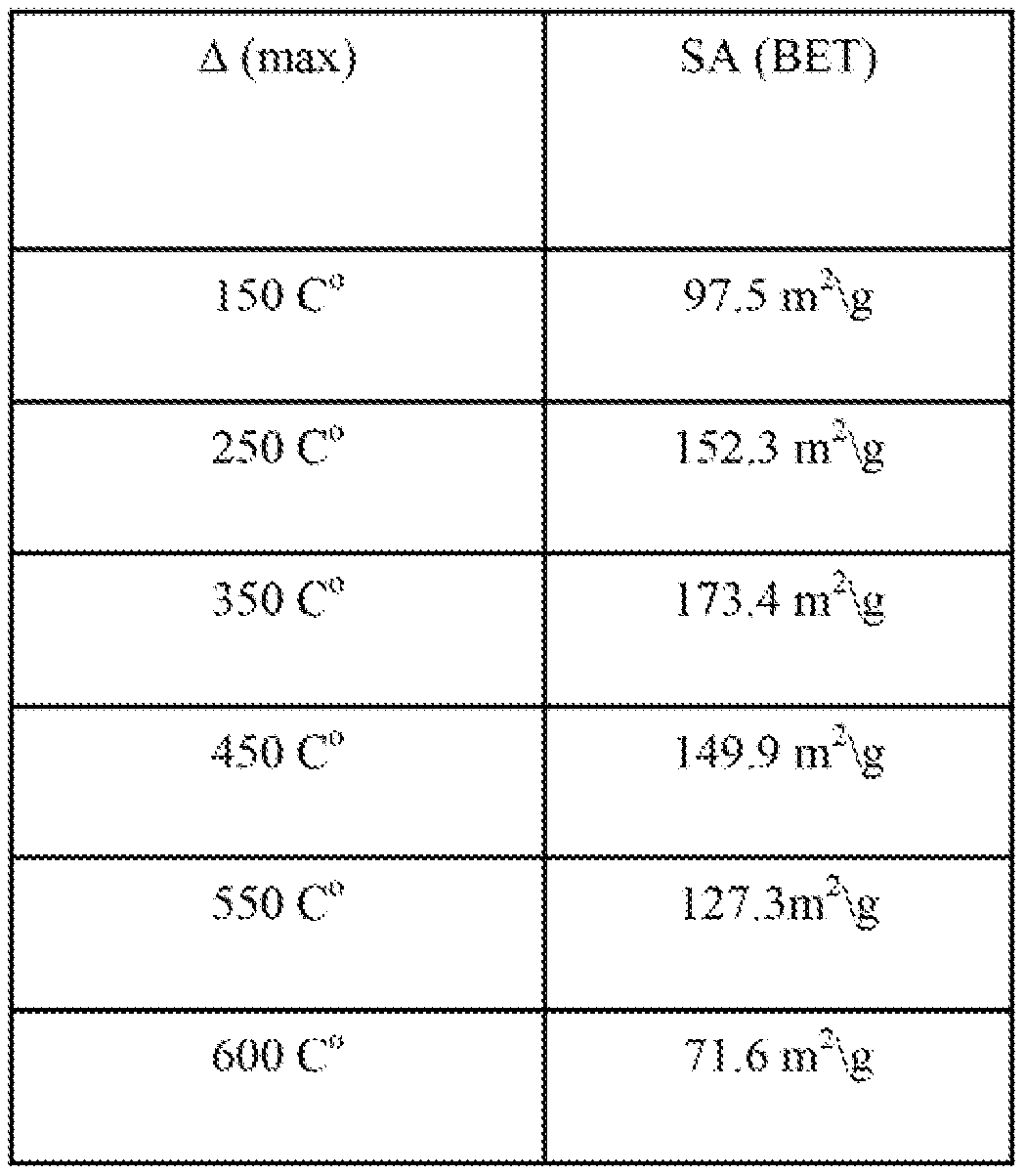
Example 4
Synthesis of Mesoporoiis Transition Metal Oxides Using Surfactants and Co- Surfactants
[00200] Various transition metal oxides were synthesized by the following procedure. 0.01 mot Μ( Ό.?)χ-νΗ2θ (M~ Mn, Fe, Co, Ni, Cu, Zn, Tl Zr, Si, Ce, Gd, Sm, Al), 0.09-0J 8 mol n-butanol (7-14 grams), 0,016-0,032 mo I HN03 (1-2 osrams), Pluronic© PI 23 surfactant or Pluronic® F127 surfactant and 1.7* 10*4 mol of co-surfactant identified in Table 7 below were mixed in a 50 milliliter beaker and homogenized by stirring at room temperature. The resulting clear solution was directly put in an oven running at iOO°C~12G°C (depending on the particular metal system) and kept at that temperature for 2-7 hours (variations of
concentrations, temperature and duration of experiment depended on the particular metal system). Synthesized materials were washed with ethanol several times to remove organic components and dried in an oven running at 6(fC
overnight. UCTs synthesized by co-surfactant are designated UCT-1 . The co- surfactant, molecular weight (MW), surfactant: co-surfactant ratio, and amoimt of co-surfactant are given in Table 7. As used in Table 7. Brij 56® is polyethylene glycol hexadecyl ether or polyethylene [10] eetyl ether. Brij 58® is
polyoxyethylene acyl ether.
Table 7

[00203] 2 sorption isotherms and BJH desorption pore size distributions of mesoporous M¾03 materials (UCT-19) synthesized with Pluronie® P123 surfactanf.co-surf ctani are given in Fig. 44. Use of eo~suri¾ctant transforms the adsorption isotherm from Type I V to Type II and Type I hysteresis loop to Type III. The transformations suggest a change in the nature of micelle assisted nano particles. Type II adsorption isotherms and T pe HI desorption isotherms for Pluronie® PI 23 surfactantxo-surfactant systems suggest a slit type pore system, in which tvvo dimensions rl and x2 are significantly different than each other (see Fig. 44), The change of the pore type .from cylindrical to slit like causes a decrease in the surface area, however the pore volumes obtained are almost doubled for the Pluronie® PI 23 surfactantxo-surfactant systems (see Table 8). Table 8 shows the physieoeheniieal parameters for a Pluronie® PI 23 surfactant only system and Pluronie® P123 surfactantxo-surfactant systems.
Table 8
IJCT- Sample Co- BET Pore Β.Π Ι Pore j 11 Pore
19 No: Surfactant Surface Volume Diameter Diameter
Area (ntV'g) (cc/g) (am) (mn)
(Adsorption) (Desorption)
0 PI 23 only 200 0.16 2,9 2.8
1 BrijS6 123 0.32 5.7 3.8
2 BrijSS — — — —
3 CTABr 154 0.33 6.0 3.7
4 AOT — — — —
5 SDS 178 0.32 5.5 3/7
[00204] The use of a co-surfactant in the synthesis ofmesoporous MJBO? materials (UCT-I .) synthesized with Pluronic P323 surf ctantrco-siirfactant significantly affects the inverted micelles obtained as well as the physicochemicai properties obtained for the resulting mesoporous materials (see Fig. 45). Addition of a co-surfactant which is smaller than the major surfactant Pluronie® PI 23 mostly affects the bydrophilic interactions inside the micelle. The increase in the bydrophilic interaction converts the spherical micelles to elongated micelles. The increase in the hydrophilic interaction in the core region is not the only
contribution of the co-surfactants. The smaller co-surfactants also satisfy the geometrical requirement and also limit the interfacia! volume by increasing the hydrophilic-hydrophobie gradient between the core and outer corona region.
Limiting the interfacial volume and swelling the core region results in bigger and monodisperse nano-crystals which can be realized from the position and relative sharpnes of the low angle diffraction patterns (see Fig. 43). Fig. 45 is a
schematic description of the effect of co-surfactant on the micelle formation and pore structure of the mesoporous material.
[00205] Ionic surfactants have been found to be more effective for
increasing the hydrophi lic interaction since ionic character of the surfactants sucks more water into the core region. With the method of this disclosure, one can easily control the physicochemicai parameters and the nano-crystal size and shape by using co-surfactants. Moreover, ionic surfactants also increase the obtained yield for the metal systems such as Pe, Mn, and Co. Hie increased hydrophilic interaction can be realized from surface morphologies obtained from the high magnification SEM images (see Fig. 46), A Piuronic® I 23 surfactant only
system shows mostly assembled roiraded particles, however addition of non-ionic surfactant Brsj 58® yields more elongated aggregates on the micron sized spherical particle surfaces. Use of SDS makes the most observable change on the surface of mesoporous manganese oxides. For SDS samples surfaces are mostly formed by liano-fihers, yielding bigger pore openings. The fibers observed on the surface appear to have identical thickness. Fig. 46 are scanning electron microscope (SEM) images of Pkironie® P123surfacta.it only system (IJC'f-l ) and Pluronic® PI 23 surfactantxcvsurfactaot systems (UCT-1 ).
Example 5
Synthesis of Mesoporous Transition Metal Oxides Using Solvents or Solvent Mixtures
[00206] Various transition metal oxides were synthesized by the following procedure. 0.01 .mo I M{NQ3)x.yH20 (M = MB, Fe, Co, Ni, Cu, Zn, Ti, Zt, Si, Ce, Od, Sm, AS), 14 grams of alcohol identified in Table 9 below, .1.3* 10~2 - 6.7* 10"2 moi n-butanol (1 -5 grams), 0.01 -0.032 mol HNC¾ (1-2 grams), Pluronic® PI 23 surfactant or Piurome® F127 surfactant and 1.7* 10"'? mol of co-surfactant were mixed in a 50 mill iliter beaker and homogenized by stirring at room temperature. The resulting clear solution was directly put in an oven running at 100"C-i20°C (depending on the particular metal system) and kept at that temperature for 2-7 hours ( varia tions of concentrations, temperature and duration of experiment depended on the particular metal system). Synthesized materials were wa hed with ethanol several times to remove organic components and dried in an oven running at 60"C overnight. UCTs synthesized by solvent and co-surfactant are designated lJCT-20, UCT-21 and UCT-22. The sol ent, co-surfactant, and amount of solvent and co-surfactant are given in Table 9.
Table 9
Nomenclature Sample No: Solvent Solvent Butanol (g)
Amount (g (Co-Surfactant)
UCT-20 6 Pentanol 14 1
7 Pentanol 14 4
UCT-21 8 Hexanol 14 3
9 Hexanol 14 5
UC'T-22 10 Benzyl Alcohol 14 4
[00207] Dry powders were heated in an oven at the following temperatures and time intervals; 150('C (12 hours), 250°C (4 hours), 350°C (3 hours), 450°C (2 hours) and finally at 550°C (1 hour) (all heating steps applied in this order),
[00208]: Using higher order alcohols than ethanol yields formation of inverse micelles for the Piuroiiie® type surfactants. Considering thai the inverse micelle formation is essential for mesoporous metal oxide materials of this disclosure, one can use igher order alcohols or alcohol mixtures as solvents for the synthesis of the mesoporous metal oxide materials. In theory, one ca chose any organic solvent or solvent mixture or modified solvents yielding Plirfonic® inverse micelles to synthesize the mesoporous metal oxide materials of this
disclosure. The additives can be both inorganic (such as soluble or micelle solublized inorganic salts) or organic (such as benzene and benzene derivatives) and can also be included in solvent preparation. 00209] Fig, 51 sho ws the low angle P XRD pa tterns of mesoporous
manganese oxide samples synthesized in Example 5 wit different alcohol and alcohol mixtures and heated for 12 hours at I50°€. In Example 5÷ the butanol amount is also varied and used as a co-surfactant. The use of butanol as a co- surfactant helps all Pluronic® surfactants to be in uniform inverse micellar form by increasing its solubility, it is aiso possible to replace butanol by either charged or neutral co-surfactants in various solvent systems to increase Pluronic®
surfactant solubility. See Example 4 for more details about the rob of co- surfactant. Replacing butanol with pentanol shifts the low angle diffraction peak to a lower angle and the line shape gets sharper indicating that pentanol can also occupy the interface and swells the relatively hydrophilic core part. Addition of more butanol to the system reverses the effect of pentanol since butanol is thermodynamically more stable in the interface (Fig. 51 ). However, use of a higher order alcohol hexanol results in a relatively poorly ordered structure, because hexanol cannot mim ic the dual role of butanol in the Piuronie® system of Example 5. For a different Pluronic© system, hexanol can play a dual role and one can obtain well ordered niesostructures.
[00210] The necessity of the co-surfactant role can be satisfied by adding more butanol into the hexanol system. ButanoS-hexanol mixtures can be considered as a pentanolic solution meaning that in a certain ratio mixing biitanoi and hexanol the solution behaves like pentanol. Therefore, Sample 9 (hexanol- butanol) in Table 9 has a very similar diffraction pattern with Sample 6 in Table 9 (see Fig. 51). More different types of solvents can also be used in the synthesis of UCTs in the presence of a co-surfactant such as butanol. Therefore, an aromatic alcohol (benzyl alcohol) was used as solvent and butanol was also added to the same system as a co-surfactant (Sample 10 in Fig. 51 ). A strong interaction exists between aromatic rings with the hydrophobic part of the polypropylene oxide (PPO group of the Pluronic© surfactant. Fig, 51 depicts the low angle powder X-ray diffraction (PX D) pattern of mesoporous Mn^Os materials (UCT-20, UCT-21. and lJCT-22) synthesized with Plutonic© P123 surfactant: co-surfactant and different solvent and solvent mixtures prepared in Example 5. The final heating temperature was 150°C.
[0021 1 j The effect of using different sol ents and solvent, mixtures can also be real ized from the morphology of the synthesized micron sized partic les and surface morphology of these particles. Morphological effects of different solvent systems were investigated by scanning electron microscopy (see Fig. 52). Use of
pentanol as a solvent (Samples 6 and 7 of this Example 5) results in formati on of perfectly spherical particles with a smooth surface morphology. Higher magnification images of thes samples suggest that these micron sized perfectly spherical samples are formed by regular packing of monodispersed nano particles. On the other hand, use of hexanoi as a sol vent (Samples 8 and 9 of this Example 5) results in aggregated or sintered spherical particles despite high magnification images of these samples showing similarities to the pentanol system. Different from the small carbon chain alcohols, the aromatic alcohol (benzyl alcohol) gives significantly different particle morphology. The micron size particles obtained from the benzyl alcohol system ha ve sharp comers (Sample 10 of this Example 5), Fig. 52 depicts scanning electron microscope (SEM) images of mesoporons
samples as prepared using different solvent systems in Example 5,
Exam le 6
Synthesis of Mesoporous Transition Metal Oxides Using Mixed Metal Oxides 00212] Various transition metal oxides were synthesized by the following procedure. Multiple metal nitrate salts Μ( Ο:ΐ)χ.>Ή20 (M ::: Mn, Fe, Co, Ni, Co, Zn, Ti, Zr, Si, Ce, Gd. Sm5 AS) mixed in the metal ratios given in Table 10 below (0.01-100 ffio i) and keeping the total amotmt of metal constant (0.01 mol), 14 grams of I-butanoL 1.3*10*2™· 6.7*!ϋ*2 mol n-butanol ( 1-5 grams), 0.016-0.032 mol H Os (1-2 grams), Pluronic® PI.23 surfactant or Pluronic® F1.27 surfactant, and 1.7*10"* mol of co-surfactant were mixed in a 50 milliliter beaker and homogenized by stirring at room temperature. The resulting clear solution was directly put in an oven running at 100"C-120°C (depending on the particular metal system) and kept at that temperature for 2-7 hours ( variations of concentrations, temperature and duratio of experiment depended on the particular metal system). Synthesized materials were washed with ethanol several times to remove organic components and dried in an oven running at 60 'C overnight. U Ts synthesized by solvent and co-surfactant are designated lJCT-23, UCT-24 and UCT-25. The
metal mixtures, metal ratios and co-surfactant arc givers in Table 10. SDS Is sodium dodecyl sulfate.
Table 10

[00213j Dry powders were heated in an oven at the following temperatures and time intervals; 150°C (12 hours), 250°C (4 hours), 350°C (3 hours), 450°C (2 hours) and finally at 550"C (1 hour) (all heating steps applied in this order).
[00214] Fig. 53(a) shows the low angle PXRD diffractions of mixed metal mesoporous materials of this disclosure. All materials show one low angle diffraction except Sample 13 ( n:Fe:Co). Sample 13 shows two low angle diffraction lines indicating either a mixed phase materia! or a mesostructure different than hexagonal packing. The high angle PXRD diffraction patterns of mixed metal systems do not show any distinct diffraction lines suggesting an amorphous nature of the mixed metal systems which can be accepted as further evidence for homogeneous dispersion of metals (see Fig. 53(b)). Further heating of these samples can yield either a phase separation by the ion migration or a crystalline mixed metal oxide structure depending on the mixing ratio and the heat treatment temperature, in either chase, desired materials for specific applications can be synthesized. Low temperature catalytic reactions with amorphous materials exist. Unlike traditional mesoporous systems, the mesoporous metal oxide materials of this disclosure can be prepared by mixing any number of metals in any ratio. In traditional methods, due to the different rate of hydrolysis-
condensation rates of the metals used and different metal-surfactant interaction, the mixed metal systems are limited to low % doping of a metal in a host system.
Even low amounts have been achieved in various systems. Generally these materials have lower meso-order and porosity than the host material.
[00215] The metals used in the synthesis of the mesoporous mixed metal materials of this disclosure ha ve different optimum reaction temperatures and times when they are synthesized as single metal systems. Therefore, in the synthesis of mixed metai systems SDS is used as a co-surfactant which helps the metals to form oxides at the same time. Fig. 53(a) depicts the low angle powder X-ray diffraction (FXRD) pattern of mesoporous mixed metal materials (UCT-23, UCT-24 and UCT-25) prepared in this Example 6. The final heating temperature was 250>C. Fig. 53(b) depicts the high angle powder X-ray diffraction (PX D) pattern of mesoporous mixed metal materials (UCT-23, UCT-24 and UCT-25) prepared in this Example 6.
[00216] The scanning electron microscope (SE ) images of mixed metai mesoporous materials prepared in this Example 6 have totally different surface morphologies than the surface morphologies of the individual single metal mesoporous oxide materials, Fe-Mn (Sample 12) and Mn-Fe-Co (Sample 13) have needle like surface morphology which is significantly different than the mesoporous surface morphology of Mn, Co, and Fe oxides (see Fig. 54). Fig. 54 shows SEM images of mesoporous metal oxides having mixed metal systems of this disclosure. The final heating was 25G°C.
Example 7
Synthesis of Mesoporous Transition Metal Ox ides Using Acid Mixtures
[00217] Various transition metal oxides were synthesized by following procedure. 0,01 mo M(N03) y¾0 (M = Mn, Fe, Co, Ni, Cu, Z Ti, Zr, Si, Ce,
Get Sm, AI)t 14 grams of 1-butanol, 1.3*10*2 - 6.7* 10*2 mo1 n-botano! ( 1-5 grams), 0.016-0.032 mo I BN(¾ and acid mixtures shown in Table 11 below (1 niil-3 mils), Pkironic© P 123 surfactant or Plurome® F127 surfactant and 1.7*10 mol of SOS co-surfactant were mixed in a 50 milliliter beaker and homogenized by stirring at room temperature. The resulting clear solution was directly put in an oven running at 100"C~120"C (depending on the particular metal system and kept at that temperature for 2-7 hours (variations of concentrations, tempera ture and duration of experiment depended on the particular metal system).
Synthesized materials were washed with ethano! several times to remove organic components and dried in an oven running at 60°C overnight. UCTs synthesized by acid mixtures are designated UCT-26. The acid source, acid source ratio and metal system are given in Table 11,
Table 1 1
Nomenclature Sample Acid-Soyrce Add Source J* Metal System

[00218] Dry powders were heated in an oven at the following temperatures and time intervals; 150X (12 hours), 250X (4 hours), 350X (3 hours), 450 (2 hours) and finally at 550''C (1 hour) (all heating steps applied in this order).
[00219] Nitrate ion is another important and essential component of the method for the synthesi s of mesoporous metal oxide materials of this discl osure. Nitrate has raultiple roles in the synthesis. The first role is the hydrotropic nature
of this ion. Hydrorropie nitrate ions increase the surfactant solubility by hydrating the core of the inverted Phironie® surfactant so the metal precursors use this water rich environment in the core either satisfying its water coordination or enhancing solvation of the oxo-metal clusters. The use of other metal sources with different counter anions rather than nitrate decreases the surfactant solubility and destroys the micelles. However, the use of more soluble smaller surfac tants may allow one to use other metal salts. The second ro!e of nitrate is to adjust the pH of the reaction media. Fig. 55 illustrates the reaction sequences and visual observations during the reaction. Decomposition of nitrate by heat yields the formation ofNOxs which can be realized easily from the deep yellow color. Further heating causes the further decomposition of Ox by consuming the IT' in the environment. Fig. 55 shows nitrate decomposition and H" consumption reactions along with the color change and pH change diagrams for the reaction sequences of Example 7.
[00220] Fig, 56 shows the low angle PXRD patterns of mesoporous metal oxide materials of this disclosure synthesized with di fferent HNC¾; HCi volume ratios. Regardless of the acid ratio (from 1:0 to 1:3 HNOy.HCI) all materials gi ve similar low angle diffraction patterns with small shifts in the peak position. The availability of various acid types and mixtures suggests the use of other acids. The system is not sensitive to the acid type used. Moreover, this acid type msensitivity to the nature of the current synthetic approach is further confirmed by SEM data (see Fig. 57). No observable change is seen from both low angle high magnification SEM images. The general morphology consists of rounded micron sized particles. The preparation of the mesoporous metal oxide materials of this disclosure with various acids or acids mixtures can effect of counter anion of the acid source on the solubility and the micellization of the surfactant svstems. Fia. 57 depicts SEM images of mesoporous .metal oxides having mixed acid systems. The final heating was 25 (fC,
Exam le 8
Synthesis of Mesoporous Transition Metal Oxides Using Organic Additives
[00221 ] Various transition metal oxides were synthesized by following procedure. 0.01 mot M(NO.?)x.y¾0 (M :::: Mn, Fe, Co, Ni, Cu. Zn. Ti, Zr, Si, Ce. Gd, Sm, Al), 0.09-0.18 mol n-butanol (7-14 grams), 0,016-0,032 mo I HN03> Pkiroiuc® P123 surfactant or Piuronie® F127 surfactant (1-2 grams), 8.3- 16.6* 10"' mol of co-surfactant, and (0.1-0,2 grams) mesitylene (1,3,5- triniethylbenzene) (TMB) were mixed in a 50 miliiiiter beaker and homogenized by stirring at room temperature. The resulting clear solution was directly put in an oven running at 100°C-120°C (depending on the particular metal system) and kept at that temperature for 2-7 hours (variations of concentrations, temperature and duration of experiment depended on the particular metal system).
Synthesized materials were washed with ethanol several times to remove organic components and dried in an oven running at 60"C overnight. UCTs synthesized by organic additives are designated t!CT-27. The organic additive, organic additi e amount and metal system are given in Table 12.
Table 12

[00222] Dry powders were heated in an oven at the following temperatures and time intervals; 50°C (.12 hours), 250°C (4 hours), 5< C (3 hours), 450°C (2 hours) and finally at 55(fC (I hour) (all heating steps applied in this order).
[00223] Fig. 58(a) shows the low angle PX D patterns of as synthesized UCT-1 and UCT-27 (TMB).. UCT-l shows only one symmetric diffraction Sine
centered around 3 degrees. This is believed to give the nano-particie size under the circumstances of random hexagonal packing. However UCT-27 (TMB) shows two distinct low angle diffraction lines in die same region suggesting a c hange in the mesostructure upon use of TMB. The formed -mesostructure preserves its structure after several consecutive heating cycles (Fig. 58(b)). In addition, UCT-2 (TMB) also preserves one of the unique features of the mesoporous metal oxide materials of this disclosure, which is mesostructure and mesopore expansion upon heat treatments. This suggests that the use of an organic additive to the mesoporous metal oxide material synthesis results in a different member of the same family.
[00224] Referring to Fig. 58, in the absence of TMB, one symmetric low angle diffraction can be attributed to random hexagonal packing (rhp) which is one of the thermodynarnically stable phases in packing of nano sized rounded partic les . The existence of TMB causes two observable, distinct low angle diffractions. The observed diffraction pattern for UCT-27 (TMB) samples is attributed to the body centered cubic (bcc) mesostructure, which is the
thermodynamtcally most stable phase in packing of moaodispersed spherical particles. Ideally, two identical systems having rhp and bcc mesostructures should have similar surface area values but different mesopore volumes. Since, the close packed spherical particles touches the neighboring particles in one infinite small point, the way the monodispersed spherical particles pack should not be affecting the obtained surface area.
[00225] For further confirmation of the existence of a mesophase transition, 's sorption experiments were conducted (see Fig. 59 ). Fig. 59(a) shows N¾ sorption isotherms for 'UCT-27 (TMB) samples heated to two different final temperatures. Both materials show type 'IV adsorption isotherms which are characteristic of mesoporous materials. The adsorption step is shi fted to higher relative pressure for the sample heated up to 250"C indicating a pore expansion. The mesopore size distributions of this material are further examined by plotting
BJH desorption size distributions for these samples (see Fig. 59(b)). Heating the UCT-2? (TMB) sample from 1 SO' C to 250°C increases the mesopore diameter by 1 am. Despite UCT-i and UCT-27 (TMB) having similar surface areas and pore sizes, the pore volumes of the UCT-27 (1MB) samples are signi ficantly higher than the "1MB free counterpart (see Table 13 .
Table 13

[00226] Fig. 60 illustrates the effect of addition of TMB in an inverse micelle containing a liquid crystal phase. TMB is positioned in intermicellar spacing mainly occupied by hydrophobic PPO groups of Pluronic® surfactants. TMB increases the hydrophobic volume in the system (system is formed by hydrophiiic and hydrophobic volumes) and forces micelles to get organized in a cubic mesostructure.
[00227] Fig. 61 shows the high resolution transmission electron microscopy (TEM) images of manganese oxide TMB based mesoporous materials heated to two different final temperatures. Fig. 61(a) shows TEM images of manganese oxide TMB based mesoporous materials heated to 150°C. Fig. 61(b) shows TEM images of manganese oxide TMB based mesoporous materials heated to 250°C. From the images, the materials are formed by assembly of nano-partic es. The raesopores of the sample heated to 250 ca easily be realized (see Fig. 61 (b)).
[00228] Table 14 below lists the ingredients for the mesoporous metal oxide materials prepared in the Examples.
Table 14

[00229] Table 15 below lists properties for the mesoporous metal oxide materials prepared in the Examples,
Table 15

additi ve &
heated to
250°C
Effect of Pore Volume and Shape on Catalysis
[00230| The catalytic performance of porous materials shows strong dependency on physicochemieal properties of the materials such as pore size, shape, and volume. The catalytic performance of manganese based mesoporous metal oxide materials was tested for benzyl alcohol oxidation. Manganese oxides are known to be good oxidation catalysts, therefore the potential of manganese based mesoporous metal oxide materials as an oxidation catalyst were tested for this reaction. Fig. 62 shows the reaction conditions and results for manganese based mesoporous metal oxide materials. Despite UCT-1 having the highest surface area compared to UCT-19 (SDS) and UCT-27 (TMB), this material shows lower activity. The higher activity for UCT-19 (SDS) and UCT-27 (TMB) is attributed to the slit like pore structure and higher pore volume respectively. All mesoporous metal oxide materials show much higher activit than nonporous manganese oxide materials,
[00231 ] Fig. 63 depicts a Hantzseh reaction catalyzed by mesoporous iron oxide. The Hantzseh reaction was conducted in accordance with the conditions set forth in Fig. 64. Conversions and seieetivities ate set forth in Fig. 64.
Compound 1 is a pharmaceutical compound.
[00232] Fig. 65 depicts an adamantane oxidation reactio catalyzed by mesoporous manganese oxide. The adamaiitane oxidation reaction was conducted in accordance with the conditions set forth in Fig, 66. Conversions and
seieetivities are set forth in Fig. 66.
[00233] Fig. 67 depicts hydration reaction catalyzed by mesoporous cerium oxide. The hydration reaction was conducted in accordance with the conditions set forth in Fig. 68. Conversions and seieetivities are set forth in Fig. 68.
[00234] Fig, 69 depicts a hydrogenation reaction of methyl SevuSinaie catalyzed by mesoporous cerium oxide supported nano-noble metal. The noble metal loading was about 2%. The conversion was 100%. The selectivity to γ- valerolacetone (GVL) was 52% and the selectivity to 5-hydroxypentan-2-one was 42%. The noble metal was added by deposition to the mesoporous material. Enhanced activity was observed in this biomass conversion reaction.
[00235] Fig, 70 depicts the conversion of a sugar ( i.e., D-fhictofuranose) to methyl Jevulinate. The conversion was conducted in accordance with the
conditions set forth in Fig. 71. The particular catalyst, temperature, conversions, seieetivities and yields are set forth in Fig. 71. The mesoporous catalysts maintained high activity with no leaching of metal or sulfate into solution.
[00236]: All patents and patent applications, test procedures (such as ASTM methods, UL methods, and the like), and other documents cited herein are fully incorporated by reference to the extent such disclosure is not inconsistent with this disclosure and for all jurisdictions in which such incorporation is permi tted,
[00237] When numerical lower limits and numerical upper limits are listed herein, ranges from any lower limit to any upper limit are contemplated. While the illustrati ve embodiments of the disc losure have been described with particularity, it will be understood that various other modifications will be apparent to and can be readil made by those skilled in the art without departing from the spirit and scope of the disclosure. Accordingly, it is not intended that the scope of the claims appended hereto be limited to the examples and descriptions
set forth herein but rather that the claims be construed as encompassing all the features of patentable no velty which reside in the present disclosure, incl uding ail features which would be treated as equivalents thereof by those skilled in the art to whic the disclosure pertains.
[00238] The present disclosure has been described above with reference to numerous embodiments and specific examples. Many variations will suggest themselves t those skilled in this art in light of the above detailed description. All such obvious variations are within the full intended scope of the appended claims. Also, the subject matter of the appended dependent claims is within the full intended scope of all appended independent claims.
Claims
WHAT IS CLAI MED IS:
1 . A process for preparing a mesoporous metal oxide, said process comprising:
providing a micel!ar solution comprising one or more metal precursors, one or more surfactants, one or more interface modifiers, one or more hydrotropie ion precursors, and optionally one or more organic and/or inorganic additives; wherein said miceilar solution comprises a dispersion of micelles in which at least a portion of said one or more metal precursors are solubi Sized in the miceiles; and heating the miceilar solution at a temperature and for a period of time sufficient to form the mesoporous metal oxide.
"2. The process of claim 1 which is a sol-gel micelle based process.
3. The process of claim 1 in which mice!ii ation and inter-rnkellar interaction are controlled by said one or more metal precursors, one or more surfactants, one or more interface modifiers, one or more hydrotropie ion precursors., and optionally one or more organic and/or inorganic additives.
4. The process of claim 1 , wherein the heating step comprises:
heating the miceilar solution at a temperature and for a period of time sufficient to form a dried powder; and
heating the dried powder at a temperature and for & period of time sufficient to form the mesoporous metal oxide.
5. The process of claim 4. wherein the miceilar solution is heated
sequentially as follows: at a temperature from about 7S°C to about 150°C for a period from about I to about 12 hours; and at a temperature from about 40°C to about 80ftC for a period from about 1 to about 12 hours.
6. The process of claim 4, wherein the dried powder is heated sequentially as follows: at a temperature from about IQOX to about 200°C for a period from abtuit 2 to about 20 hours; at a temperature from about 200X to about 300°C for a period from about 1 to aboui 10 hours; at a temperature from about 300°C to about 400°C for a period from about 1 to about 8 hours; at a temperature from about 400°C to about 500°C for a period from about 0.5 to about 4 hours; and at a temperature from about 500°C to about 600°C for a period from about 0, 1 to about 2 hours.
7. The process of clai m 4, wherein the dried powder is heated sequentially as follows; at a temperature of about 15 OX for a period of about 1.2 hours; at a temperature of about 250X for a period of about 4 hours; at a temperature of about 50X for a period of about 3 hours; at a temperature of about 450X for a period of about 2 hours; and at a temperature of about 550X for a period of about 1 hour.
8. The process of claim 4. further comprising washing the dried powder with an alcohol for a period of time sufficient to remove organic components
therefrom.
9. The process of claim 1, wherein the one or more metal prec ursors are selected from the group consisting of a transition metal precursor, a Lanthanide metal precursor, a post-transition metal precursor, a metalloid precursor, and mixtures thereof.
10. The process of claim 9, wherein the transition metal precursor comprises a Group 3-12 transition metal precursor selected from the group consisting of a Sc, Y, La, Ti, Zr, Hf, V, Nh, Ta, Cr, Mo, W, Mn, Tc, Re, Fe, R.u, Os, Co, Rh, ir, Ni, Pd, Pt, Cu, Ag, An, Zn, Cd and Bg precursor.
1 ί . The process of claim 9, wherein the Lan amde metal precursor is selected from the group consisting of a La, Ce, Pr, Nd, Pm, Sra, Eu. Gd, Tb, Dy, Ho, Er, Tm, Yb and Lu precursor.
12. The process of claim 9, wherein the post-transition metal precursor s selected from the group consisting of an Al, Ga, In, Tl, Sn, Pb and Bi precursor.
13. The process of claim 9, wherein the metalloid precursor is selected from the group consisting of a B, Si, Ge, As, Sb, Te, Po and At precursor.
14. The process of claim 1 , wherei the one o more metal precursors are selected from the group consisting of metal nitrates, metal alkoxides, metal halides, metal phosphates, metal acetates, and yxOy oxides that are capable of dissolving in HNOs.
15. The process of claim 1. wherein the one or more metal precursors are selected from the group consisting of M(N03)x. ¾0 ( ~: Mo, Fe, Co, Co, Zn), tetraethyi orthosiHcate (TEOS), tetramethyl orthosiiieate (TMOS), titanium butoxide, zirconium n-propoxide, zirconium butoxide, Ce(NO;i)s -6H2Os
Gd(N03)r6H20, and Sm(N<¼V6¾0.
16. The process of claim 1 , wherein the one or more interface modifiers comprise an aliphatic, al (cyclic or aromatic hydrocarbon, oxygenated hydrocarbon or terpenoid hydrocarbon, of between about 1 and about 20 carbon atoms, or mixtures thereof, that allows the surfactant to organize itself into inverse micelles.
17. The process of claim 1 , wherein the one or more hydrotrop c ion precursors comprise HNC)?, NaN(¾, KNO3, metal ha!ides, metal thiocyanides, hydrochloric acid, sulfuric acid, or mixtures thereof.
18. The process of claim 1„ wherein the one or more surfactants comprise an anionic, cationic, non-ionic, or zwitterionk surfactant, or mixtures thereof.
1 . The process of claim 1 , wherein the one or more surfactants comprise an EO/PO copolymer surfactant, or a surfactant represented by the formula
(HO(CH2C¾.0)»(CH2CH(CH3)0)„t(CH2CH20)«H) wherein m and n are the same or different, m is a value from about 10 to about ISO, and n is a value from about 5 to about 150, or a surfactant represented by the formula
(l>PO),(PEO)y(PPO)z wherein PPO is olypropyleue oxide, PEO is polyethylene oxide, and x, y and z are values sufficient for the surfactant to have a ydrophilic-lipophiiic balance (BLB) from about 1 to about 18.
20. The process of claim 1 , wherein the one or more surfactants comprise iHOiCH3CH20)2o(CH2CH(CH )0)¾(CH2CH20)3( H)5
(HO(CH2CH20)2«(C¾CH(CHj)0)4 (CH2C-¾0)26H),
(HO(CH2CH20)i29(CB2CH(CH3)0)56(CH2CB20)i29H),
(ΗΟ(€Η2ΟΗ20)2ο(ΟΗ2€Η(ΟΗ. Ο}?ο(ΟΗ2€¾0)2ϋΗ), or
(HOCC ^H^O^CCHaCBCCHa ^^CHaCHaO^jH).
2 . The process of claim 1 , wherem the one or more surfactants comprise a Triton® surfactant, a T ween© surfactant, glucose, or an AB or BC polymer surfactant, wherei A is polyisoprene butylene, B is styrene, and C is selected from glucose, amine, carboxyl group-containing compound, and polyethylene glycol (PEG).
22. The process of claim 1 , wherein the one or more organic additives comprise urea, decane, octane, benzene, trimethyi benzene or mesitylene (TMB), substituted benzene, polyethylene glycol, thiourea, ethylene diamine, styrene, pyrene, naphthalene, azobenzene, aromatic dye molecules, naphthalene, phenolic compounds, formaldehyde, PPO. PEO. D-fructose, glucose, sucrose, cellulose, starch, citric acid, phenol, aromatic alcohols, aliphatic alcohols, carboxylic acids, phosphates, oleyl ether, lysine, glycine, glutamic acid, tosylate, earboxyl, acetylaeetonate, 1 auric acid, toluene, cyclohexeiie. terpene, terpenoid
hydrocarbons, citrus terpenes, d-limonene, or mixtures thereof.
23. The process of claim 1 , wherein the one or more inorganic additi ves comprise aptotic and protic ionic liquids, ethyl amnion t urn nitrate (BAN), ethanolanunoinurn nitrate (EOAN), diethanolammoniuni formate (DEO.AF), laponite, [C?¾Si(QC2Hs (TESE, capping agent), HH , 4R-ammonium, ammonium, K \ Na\ if, Mg2" Ca! \ guanidinium, , OS03 *, SO , OPQ/, F, CT, Br", Γ, SO SC , HPO4 2', acetate, NO/, C10 ', or mixtures thereof.
24. The process of claim 1 , wherein the mesoporotis metal oxide has a pore size (diameter) between about 1,5 nanometers and about SO nanometers.
25. The process of claim 1 which is conducted under process conditions sufficient to control pore size and pore size distribution of the metal oxide and crystal structure of nano-sized metal oxide walls.
26. The process of claim 1 , wherein the mesoporous metal oxide is selected from the group consisting of a transition metal oxide, a Lanthanide metal ox ide, a post-transition metal oxide, a metalloid oxide, and mixtures thereof
27. The process of claim 26, wherein the transition metal oxide comprises a Group 3-12 transition metal oxide selected .from ie group consisting of a Sc, Y,
La, Ti, Zr, Hf V, Nb, Ta, Cr, Mo, W., Mnf Tc, Re, Fe, «, Os, Co, Rh, Ir, Ni, Pd< Pt, Cu, Ag, Au, n, Cd and Kg oxide.
28. The process of claim 26, wherein the Lanthanide metal oxide is selected from the group consisting of a La, Ce, Pr, Nd, Pro, Sm, En, Gd, Tb, Dy, Ho, Er, Tm, Yb and La oxide.
29. The process of cl aim 26, wherein the post-transition metal oxide is selected from the group consisting of an Al, Ga, In, Tl, Sn, Pb and Bi oxide,
30. The process of claim 26, wherein the metalloid oxide is selected from the group consisting of a B, Si, Ge, As, Sb, Te, Po and At oxide.
31. A mesoporoi!S metal oxide produced by a process comprising:
providing a micellar solution comprising one or more metal precursors, one or more surfactants, one or more interface modifiers, one or more hvdrotropic ion precursors, and optionally one or more organic and/or inorganic additives; wherein said micellar solution comprises a dispersion of micelles in which at least a portion of said one or more metal precursors are solubilized in the micelles; and heating the micellar solution at a temperature and for a period of time sufficient to form the mesoporous metal oxide.
32. The mesoporous metal oxide of claim 31 in which the process is a sol-gel micelle based process.
33. The mesoporous metal oxide of claim 31 in which micelii ation and inter- micellar interaction in said process are controlled by said one or more metal precursors, one or more surfactants, one or more interface modifiers, one or more hydrotropic ion precursors, and optionally one or more organic and/or inorganic additives.
34. A method of controlling nano-sized wall orystaHinity and mesoporoslty in mesoporous metal oxides, said method comprising:
providing a miceilar solution comprising one or more metal precursors, one or more surfactants, one or more interface modifiers, one or more hydrotropic ion precursors, and optionally one or more organic and/or inorganic additives; wherein said miceilar solution comprises a dispersion of micelles in which at !east a portion of said one or more metal precursors are soiubilized in the micelles; and heating the miceilar solution at a temperature and for a period of time sufficient to control nano-sized wall crystallimty and mesoporosity in the mesoporous metal oxides.
35 , The method of claim 34 which is a sol - gel micelle based method.
36. The method of claim 34 in which mice! ligation and inier-micellar interaction in said method are controlled by said one or more metal precursors, one or more surfactants, one or more interface modifiers, one or more hydrotropic ion precursors, and optionally one or more organic and/or inorganic additives.
37. A mesoporous metal oxide particulate having nano-sized wall
crystallimty, a particle size between about and about 500 tim, a BET surface area between about 50 and about 1000 m g5 a pore volume (BIH) between about 0,05 and about 2 crn/Vg, a monomodal pore size (BJH desorption) distribution between about I and 25 rati, and optionally a wall thickness (2d/\f3 - PD, where d is the d-spacing and PD is the pore diameter) between about 2 and about 20 ran; wherein the mesoporous metal oxide particulate exhibits thermal stability up to a temperature of about 800°C.
38. The mesoporous metal oxide particulate of claim 37 havin a particle size between about 50 and about 300 nm, a BET surface area between about 60 and about 500 m2/g, a pore volume (BJH) between about. 0.075 and about 2 cnrVg, a monomodal pore size (BIH desorption) distribution between about 2 and 13 nm.
and optionally a wail thickness (2d/\J3 - PD, where d is the d-spacing and PD is the pore diameter) between about 4 and about 1.4 imi
39. A method of tuning structural properties of mesoporous .metal oxides, said method comprising:
selecting one or more metal precursors, one or more surfactants, one or more interface modifiers, and one or more hydrotropic io precursors;
providing a micellar solution comprising said one or more metal
precursors, one or more surfactants, one or more interfac modifiers, one or more hydrotropic ion precursors, and optionally one or more organic and/or inorganic additives; wherein said micellar solution comprises a dispersion of micelles in which at least a portion of said one or more metal precursors are solubilized in the micelles; and
heating the mi cellar solution at a temperature and for a period of tim sufficient to form the mesoporous metai oxides.
40. Tire method of claim 39, wherein the structural properties are selected from the group consisting of unit cell size, pore size, pore type, pore volume, mesostructure type, and surface morphology.
41. The method of claim 39 which is a sol-gel micelle based method.
42. The method of claim 39 in which micellization and mter-micellar interaction in. said method are controlled by said one or more metal precursors, one or more surfactants, one or more interface modifiers, one or more hydrotropic ion precursors, and optionally one or more organic and/or inorganic additives.
Applications Claiming Priority (2)
| Application Number | Priority Date | Filing Date | Title |
|---|---|---|---|
| US201261705372P | 2012-09-25 | 2012-09-25 | |
| US61/705,372 | 2012-09-25 |
Publications (1)
| Publication Number | Publication Date |
|---|---|
| WO2014052482A1 true WO2014052482A1 (en) | 2014-04-03 |
Family
ID=50388940
Family Applications (1)
| Application Number | Title | Priority Date | Filing Date |
|---|---|---|---|
| PCT/US2013/061736 Ceased WO2014052482A1 (en) | 2012-09-25 | 2013-09-25 | Mesoporous metal oxides and processes for preparation thereof |
Country Status (2)
| Country | Link |
|---|---|
| US (1) | US9452933B2 (en) |
| WO (1) | WO2014052482A1 (en) |
Cited By (5)
| Publication number | Priority date | Publication date | Assignee | Title |
|---|---|---|---|---|
| CN105268452A (en) * | 2015-11-12 | 2016-01-27 | 西安石油大学 | Mesoporous supported copper-manganese compound oxide catalyst and preparation and catalysis methods |
| CN109748250A (en) * | 2019-02-27 | 2019-05-14 | 深圳大学 | A kind of tellurium selenium nano material and its preparation method and application |
| CN110304648A (en) * | 2019-07-17 | 2019-10-08 | 哈尔滨理工大学 | A kind of preparation method of multi-metal doped compound semiconductor formaldehyde sensitive material |
| CN110921715A (en) * | 2019-09-26 | 2020-03-27 | 国网浙江省电力有限公司湖州供电公司 | A kind of preparation method of mesoporous CoO lithium battery anode material |
| CN119793430A (en) * | 2025-01-06 | 2025-04-11 | 中国科学院过程工程研究所 | A multi-stage pore catalyst for carbonyl sulfide hydrolysis and its preparation method and use |
Families Citing this family (16)
| Publication number | Priority date | Publication date | Assignee | Title |
|---|---|---|---|---|
| US10046313B2 (en) * | 2013-05-13 | 2018-08-14 | University Of Connecticut | Mesoporous materials and processes for preparation thereof |
| WO2015012264A1 (en) * | 2013-07-23 | 2015-01-29 | 旭化成株式会社 | Copper and/or copper oxide dispersion, and electroconductive film formed using dispersion |
| US10807071B2 (en) | 2016-05-05 | 2020-10-20 | University Of Connecticut | Mesoporous metal doped cerium oxide catalyst |
| WO2019054399A1 (en) * | 2017-09-14 | 2019-03-21 | 住友化学株式会社 | Mesoporous humidity-control material, method for producing mesoporous humidity-control material, and humidity-control device |
| US11433359B1 (en) * | 2018-01-29 | 2022-09-06 | Arrowhead Center, Inc. | Antimicrobial filtration membranes |
| KR102180500B1 (en) * | 2018-11-30 | 2020-11-19 | 한국생산기술연구원 | Processes for preparation Mesoporous copper oxide |
| US11638911B2 (en) | 2019-02-19 | 2023-05-02 | University Of Connecticut | Mesoporous metal titanates as multifunctional catalysts |
| CN110510657B (en) * | 2019-09-11 | 2022-12-23 | 山东理工大学 | Copper oxide microsphere structure, hydrogen sulfide gas sensor and preparation method thereof |
| CN111220610B (en) * | 2020-02-05 | 2022-10-28 | 江苏大学 | As based on iron alkoxide nanoenzyme 5+ Colorimetric detection method |
| CN114275740B (en) * | 2020-09-17 | 2023-06-30 | 中国科学院大连化学物理研究所 | Preparation method of porous oxide |
| CN112978794B (en) * | 2021-04-21 | 2022-03-29 | 珠海复旦创新研究院 | A kind of method for synthesizing mesoporous titanium dioxide material in water phase |
| CN113277519B (en) * | 2021-06-22 | 2022-09-16 | 清华大学 | Silicon dioxide mesoporous material using waste glass as raw material and preparation method and application thereof |
| CN113277520B (en) * | 2021-06-22 | 2022-09-16 | 清华大学 | Silicon dioxide mesoporous material and preparation method and application thereof |
| CN113620334B (en) * | 2021-08-20 | 2022-08-09 | 武汉大学 | Dendritic ordered mesoporous copper oxide nano material and preparation method and application thereof |
| US12290799B2 (en) * | 2022-07-05 | 2025-05-06 | Saudi Arabian Oil Company | Hierarchically ordered crystalline microporous materials with long-range mesoporous order having hexagonal symmetry |
| TWI894494B (en) * | 2022-11-16 | 2025-08-21 | 財團法人工業技術研究院 | Oxidation catalyst and method of forming the same and method of treating flue gas |
Citations (5)
| Publication number | Priority date | Publication date | Assignee | Title |
|---|---|---|---|---|
| US5958367A (en) * | 1995-04-03 | 1999-09-28 | Massachusetts Institute Of Technology | Methods for preparing porous metal oxides |
| US6752979B1 (en) * | 2000-11-21 | 2004-06-22 | Very Small Particle Company Pty Ltd | Production of metal oxide particles with nano-sized grains |
| US20060292062A1 (en) * | 2005-06-24 | 2006-12-28 | Fusao Hojo | Metal oxide materials, production method thereof, and application thereof |
| US20100196237A1 (en) * | 2009-01-30 | 2010-08-05 | General Electric Company | Templated catalyst composition and associated method |
| US20100254890A1 (en) * | 2009-04-06 | 2010-10-07 | Nanyang Technological University | Method of forming a particulate porous metal oxide or metalloid oxide |
-
2013
- 2013-09-25 WO PCT/US2013/061736 patent/WO2014052482A1/en not_active Ceased
- 2013-09-25 US US14/037,107 patent/US9452933B2/en not_active Expired - Fee Related
Patent Citations (5)
| Publication number | Priority date | Publication date | Assignee | Title |
|---|---|---|---|---|
| US5958367A (en) * | 1995-04-03 | 1999-09-28 | Massachusetts Institute Of Technology | Methods for preparing porous metal oxides |
| US6752979B1 (en) * | 2000-11-21 | 2004-06-22 | Very Small Particle Company Pty Ltd | Production of metal oxide particles with nano-sized grains |
| US20060292062A1 (en) * | 2005-06-24 | 2006-12-28 | Fusao Hojo | Metal oxide materials, production method thereof, and application thereof |
| US20100196237A1 (en) * | 2009-01-30 | 2010-08-05 | General Electric Company | Templated catalyst composition and associated method |
| US20100254890A1 (en) * | 2009-04-06 | 2010-10-07 | Nanyang Technological University | Method of forming a particulate porous metal oxide or metalloid oxide |
Cited By (6)
| Publication number | Priority date | Publication date | Assignee | Title |
|---|---|---|---|---|
| CN105268452A (en) * | 2015-11-12 | 2016-01-27 | 西安石油大学 | Mesoporous supported copper-manganese compound oxide catalyst and preparation and catalysis methods |
| CN109748250A (en) * | 2019-02-27 | 2019-05-14 | 深圳大学 | A kind of tellurium selenium nano material and its preparation method and application |
| CN109748250B (en) * | 2019-02-27 | 2022-06-28 | 深圳大学 | A kind of tellurium selenium nanomaterial and its preparation method and application |
| CN110304648A (en) * | 2019-07-17 | 2019-10-08 | 哈尔滨理工大学 | A kind of preparation method of multi-metal doped compound semiconductor formaldehyde sensitive material |
| CN110921715A (en) * | 2019-09-26 | 2020-03-27 | 国网浙江省电力有限公司湖州供电公司 | A kind of preparation method of mesoporous CoO lithium battery anode material |
| CN119793430A (en) * | 2025-01-06 | 2025-04-11 | 中国科学院过程工程研究所 | A multi-stage pore catalyst for carbonyl sulfide hydrolysis and its preparation method and use |
Also Published As
| Publication number | Publication date |
|---|---|
| US9452933B2 (en) | 2016-09-27 |
| US20140286846A1 (en) | 2014-09-25 |
Similar Documents
| Publication | Publication Date | Title |
|---|---|---|
| WO2014052482A1 (en) | Mesoporous metal oxides and processes for preparation thereof | |
| US10046313B2 (en) | Mesoporous materials and processes for preparation thereof | |
| US9908103B2 (en) | Mesoporous metal oxides and processes for preparation thereof | |
| Lee et al. | Morphology-selective synthesis of mesoporous SBA-15 particles over micrometer, submicrometer and nanometer scales | |
| Anderson et al. | Surfactant-templated silica mesophases formed in water: cosolvent mixtures | |
| Liu et al. | Microemulsion synthesis, characterization of bismuth oxyiodine/titanium dioxide hybrid nanoparticles with outstanding photocatalytic performance under visible light irradiation | |
| US11638911B2 (en) | Mesoporous metal titanates as multifunctional catalysts | |
| US20130034714A1 (en) | Porous silicon | |
| Soltani et al. | Fundamentals and recent progress relating to the fabrication, functionalization and characterization of mesostructured materials using diverse synthetic methodologies | |
| Supakanapitak et al. | Synthesis of nanocrystalline CeO2 particles by different emulsion methods | |
| Katsoulidis et al. | Ordered mesoporous CoOx/MCM-41 materials exhibiting long-range self-organized nanostructured morphology | |
| Qi et al. | Hierarchical porous hydroxyapatite microspheres: synthesis and application in water treatment | |
| Ulfa et al. | Investigating the hydrophilicity of zinc oxide nanoparticles using xylene and water for ibuprofen adsorption | |
| JP2006069824A (en) | Mesoporous silica nanoparticles having micropores and method for producing the same | |
| Hadi et al. | Novel synthesis of high surface area nano-CeZrO2: transformation of the microstructure and textural properties as the effect of calcination | |
| CN103101955A (en) | A method for preparing CeO2 nanometer solid spheres using CTAB as a soft template | |
| Dilebo | A mini review on factors affecting particle size, sphericity and pore size of mesoporous silica nanoparticles | |
| Kachbouri et al. | Synthesis and characterization of a new silica nanoparticles using APG/CTAB as modified agent | |
| US20160121303A1 (en) | Processes for the preparation of mesoporous metal oxides | |
| Housaindokht et al. | Precipitation of hematite nanoparticles via reverse microemulsion process | |
| Léonard et al. | Highly ordered mesoporous and hierarchically nanostructured meso-macroporous materials for nanotechnology, biotechnology, information technology and medical applications | |
| Chesneau et al. | Templating Strategies for the Synthesis of Stimuli-Responsive Porous Cerium Oxide Nanoparticles for pH-Triggered Cargo Encapsulation | |
| Kumar | Synthesis routes of ZnO nanocrystallites | |
| Li et al. | One-pot synthesis of aminated bimodal mesoporous silica nanoparticles as antibacterial nanocarrier and CO2 capture sorbent | |
| Nikhila et al. | P123 and solvent-assisted synthesis of titania nanocuboids with co-exposed {101} and {001} planes |
Legal Events
| Date | Code | Title | Description |
|---|---|---|---|
| 121 | Ep: the epo has been informed by wipo that ep was designated in this application |
Ref document number: 13840627 Country of ref document: EP Kind code of ref document: A1 |
|
| NENP | Non-entry into the national phase |
Ref country code: DE |
|
| 122 | Ep: pct application non-entry in european phase |
Ref document number: 13840627 Country of ref document: EP Kind code of ref document: A1 |