WO2014035872A1 - Tricyclic alkynes that interact with glucokinase regulatory protein - Google Patents
Tricyclic alkynes that interact with glucokinase regulatory protein Download PDFInfo
- Publication number
- WO2014035872A1 WO2014035872A1 PCT/US2013/056593 US2013056593W WO2014035872A1 WO 2014035872 A1 WO2014035872 A1 WO 2014035872A1 US 2013056593 W US2013056593 W US 2013056593W WO 2014035872 A1 WO2014035872 A1 WO 2014035872A1
- Authority
- WO
- WIPO (PCT)
- Prior art keywords
- propyn
- piperazinyl
- sulfonyl
- pharmaceutically acceptable
- compound
- Prior art date
- Legal status (The legal status is an assumption and is not a legal conclusion. Google has not performed a legal analysis and makes no representation as to the accuracy of the status listed.)
- Ceased
Links
- 0 CC(C)(C)OC(NC(*C(S(NCC(C#CC)NC(*=C)=C)(=O)=O)=*)=NC)=O Chemical compound CC(C)(C)OC(NC(*C(S(NCC(C#CC)NC(*=C)=C)(=O)=O)=*)=NC)=O 0.000 description 2
- LWZMTGWLMGMBPQ-UHFFFAOYSA-N CC#CC(C1)NCCN1P Chemical compound CC#CC(C1)NCCN1P LWZMTGWLMGMBPQ-UHFFFAOYSA-N 0.000 description 1
- AZDQLQDPQUZKDC-DIMJTDRSSA-N CC#C[C@@H](CNS(c(cc1)cnc1N)(=O)=O)Nc1ccc(C(CC#C)(C(F)(F)F)O)cc1 Chemical compound CC#C[C@@H](CNS(c(cc1)cnc1N)(=O)=O)Nc1ccc(C(CC#C)(C(F)(F)F)O)cc1 AZDQLQDPQUZKDC-DIMJTDRSSA-N 0.000 description 1
- WQKHADFFXQBZQY-UHFFFAOYSA-N CC(C)(C)OC(Nc(nc1)ccc1S(Cl)(=O)=O)=O Chemical compound CC(C)(C)OC(Nc(nc1)ccc1S(Cl)(=O)=O)=O WQKHADFFXQBZQY-UHFFFAOYSA-N 0.000 description 1
- AOHCPZRIKIAEBY-KRWDZBQOSA-N CC(C)(C)OC(Nc(nc1)ccc1S(N(CC1)C[C@H](C#CC)N1c1ncc(C(C)=C)[s]1)(=O)=O)=O Chemical compound CC(C)(C)OC(Nc(nc1)ccc1S(N(CC1)C[C@H](C#CC)N1c1ncc(C(C)=C)[s]1)(=O)=O)=O AOHCPZRIKIAEBY-KRWDZBQOSA-N 0.000 description 1
- WADRAANHPUUQJW-INIZCTEOSA-N CC(C)(c1cnc(N(CCN(C2)OC(c3ccccc3)=O)[C@H]2C#CC)[s]1)O Chemical compound CC(C)(c1cnc(N(CCN(C2)OC(c3ccccc3)=O)[C@H]2C#CC)[s]1)O WADRAANHPUUQJW-INIZCTEOSA-N 0.000 description 1
- DKZNZIYYVBTNLN-AWEZNQCLSA-N CC(c1cnc(N(CCN(C2)S(c3ccc(N)nc3)(=O)=O)[C@H]2C#CC)[s]1)=C Chemical compound CC(c1cnc(N(CCN(C2)S(c3ccc(N)nc3)(=O)=O)[C@H]2C#CC)[s]1)=C DKZNZIYYVBTNLN-AWEZNQCLSA-N 0.000 description 1
- HVEHJDHHLVBQMG-KRWDZBQOSA-N CCS(c(cc1)ccc1N(CCN(C1)S(c(cc2)cnc2N)(=O)=O)[C@H]1C#CC)(=O)=O Chemical compound CCS(c(cc1)ccc1N(CCN(C1)S(c(cc2)cnc2N)(=O)=O)[C@H]1C#CC)(=O)=O HVEHJDHHLVBQMG-KRWDZBQOSA-N 0.000 description 1
- NJFLKBVUSGIKBF-FQEVSTJZSA-N CCS(c(cc1)ccc1N(CCN(C1)S(c(cc2)cnc2NC(OC(C)(C)C)=O)(=O)=O)[C@H]1C#CC)(=O)=O Chemical compound CCS(c(cc1)ccc1N(CCN(C1)S(c(cc2)cnc2NC(OC(C)(C)C)=O)(=O)=O)[C@H]1C#CC)(=O)=O NJFLKBVUSGIKBF-FQEVSTJZSA-N 0.000 description 1
Classifications
-
- C—CHEMISTRY; METALLURGY
- C07—ORGANIC CHEMISTRY
- C07D—HETEROCYCLIC COMPOUNDS
- C07D401/00—Heterocyclic compounds containing two or more hetero rings, having nitrogen atoms as the only ring hetero atoms, at least one ring being a six-membered ring with only one nitrogen atom
- C07D401/02—Heterocyclic compounds containing two or more hetero rings, having nitrogen atoms as the only ring hetero atoms, at least one ring being a six-membered ring with only one nitrogen atom containing two hetero rings
- C07D401/12—Heterocyclic compounds containing two or more hetero rings, having nitrogen atoms as the only ring hetero atoms, at least one ring being a six-membered ring with only one nitrogen atom containing two hetero rings linked by a chain containing hetero atoms as chain links
-
- A—HUMAN NECESSITIES
- A61—MEDICAL OR VETERINARY SCIENCE; HYGIENE
- A61P—SPECIFIC THERAPEUTIC ACTIVITY OF CHEMICAL COMPOUNDS OR MEDICINAL PREPARATIONS
- A61P3/00—Drugs for disorders of the metabolism
-
- C—CHEMISTRY; METALLURGY
- C07—ORGANIC CHEMISTRY
- C07D—HETEROCYCLIC COMPOUNDS
- C07D401/00—Heterocyclic compounds containing two or more hetero rings, having nitrogen atoms as the only ring hetero atoms, at least one ring being a six-membered ring with only one nitrogen atom
- C07D401/14—Heterocyclic compounds containing two or more hetero rings, having nitrogen atoms as the only ring hetero atoms, at least one ring being a six-membered ring with only one nitrogen atom containing three or more hetero rings
-
- C—CHEMISTRY; METALLURGY
- C07—ORGANIC CHEMISTRY
- C07D—HETEROCYCLIC COMPOUNDS
- C07D403/00—Heterocyclic compounds containing two or more hetero rings, having nitrogen atoms as the only ring hetero atoms, not provided for by group C07D401/00
- C07D403/02—Heterocyclic compounds containing two or more hetero rings, having nitrogen atoms as the only ring hetero atoms, not provided for by group C07D401/00 containing two hetero rings
- C07D403/12—Heterocyclic compounds containing two or more hetero rings, having nitrogen atoms as the only ring hetero atoms, not provided for by group C07D401/00 containing two hetero rings linked by a chain containing hetero atoms as chain links
-
- C—CHEMISTRY; METALLURGY
- C07—ORGANIC CHEMISTRY
- C07D—HETEROCYCLIC COMPOUNDS
- C07D413/00—Heterocyclic compounds containing two or more hetero rings, at least one ring having nitrogen and oxygen atoms as the only ring hetero atoms
- C07D413/14—Heterocyclic compounds containing two or more hetero rings, at least one ring having nitrogen and oxygen atoms as the only ring hetero atoms containing three or more hetero rings
-
- C—CHEMISTRY; METALLURGY
- C07—ORGANIC CHEMISTRY
- C07D—HETEROCYCLIC COMPOUNDS
- C07D417/00—Heterocyclic compounds containing two or more hetero rings, at least one ring having nitrogen and sulfur atoms as the only ring hetero atoms, not provided for by group C07D415/00
- C07D417/14—Heterocyclic compounds containing two or more hetero rings, at least one ring having nitrogen and sulfur atoms as the only ring hetero atoms, not provided for by group C07D415/00 containing three or more hetero rings
Definitions
- the present invention relates to tricyclic alkynes, or pharmaceutically acceptable salts thereof, as defined herein, that interact with glucokinase regulatory protein.
- the present invention relates to methods of treating type 2 diabetes, and other diseases and/or conditions where glucokinase regulatory protein is involved using the compounds, or the pharmaceutically acceptable salts thereof, and pharmaceutical compositions that contain the compounds, or pharmaceutically acceptable salts thereof.
- Glucokinase is a member of a family of four hexokinases that are critical in the cellular metabolism of glucose. Specifically GK, also known as hexokinase IV or hexokinase D, facilitates glucose induced insulin secretion from pancreatic ⁇ -cells as well as glucose conversion into glycogen in the liver. GK has a unique catalytic activity that enables the enzyme to be active within the physiological range of glucose (from 5mM glucose to lOmM glucose).
- mice lacking both copies of the GK gene die soon after birth from severe hyperglycemia, whereas mice lacking only one copy of the GK gene present with only mild diabetes. Mice that are made to overexpress the GK gene in their livers are hypoglycemic.
- GK activity in the liver is transiently regulated by glucokinase regulatory protein (GKRP).
- GK catalytic activity is inhibited when GK is bound to GKRP. This interaction is antagonized by increasing concentrations of both glucose and fructose -1 -phosphate (F1P).
- the complex of the two proteins is localized primarily to the nuclear compartment of a cell. Post prandially as both glucose and fructose levels rise, GK released from GKRP translocates to the cytoplasm. Cytoplasmic GK is now free of the inhibitory effects of GKRP and able to kinetically respond to glucose. Evidence from the Zucker diabetic fatty rat (ZDF) indicates that their glucose intolerance may be a result of this mechanism failing to function properly.
- ZDF Zucker diabetic fatty rat
- a compound that acts directly on GKRP to disrupt its interaction with GK and hence elevate levels of cytoplasmic GK is a viable approach to modulate GK activity. Such an approach would avoid the unwanted hypoglycemic effects of over stimulation of GK catalytic activity, which has been seen in the
- GK activators A compound having such an effect would be useful in the treatment of diabetes and other diseases and/or conditions in which GKRP and/or GK plays a role.
- the present invention provides compounds that bind GKRP and disrupts its interaction with GK.
- the present invention provides compounds of Formula I, or pharmaceutically acceptable salts thereof,
- X 1 is N or CR a ;
- X 2 is N or CH
- X 3 is N or CH, provided that no more than one of X 1 , X 2 or X 3 is N;
- R a is hydrogen, -CH 3 , -CF 3 or -F,
- R 1 is -CH 3 , -CF 3 , C 3 _gcylcoalkyl or -Ci_ 6 alkylC 3 _ 8 Cycloalkyl;
- R is hydrogen or -CH 3 ;
- R 3 is hydrogen or Ci_ 6 alkyl;
- R 4 is hydrogen, Ci_ 6 alkyl or -OCi_ 6 alkyl
- each R 5 is independently selected from hydrogen, C 3 _ 8 Cycloalkyl, - CH 2 CF 3i Ci_ 6 alkyl or -Ci_ 6 alkylC 3 _ 8 cycloalkyl;
- R 6 is hydrogen or Ci_ 6 alkyl
- R 7 is hydrogen or -CH 3 ;
- X 4 is N or CH
- X 5 is N or CH
- X 6 is N or CH;
- X 7 is N or CH, provided that no more that two of X 4 , X 5 , X 6 and X 7 are
- the present invention provides compounds, or pharmaceutically acceptable salts thereof, in accordance with embodiment 1 wherein X 1 is CH.
- the present invention provides compounds, or pharmaceutically acceptable salts thereof, in accordance with embodiment 1 wherein X 1 is N.
- the present invention provides compounds, or pharmaceutically acceptable salts thereof, in accordance with any one of embodiments 1 to 3 wherein X 2 is CH.
- the present invention provides compounds, or pharmaceutically acceptable salts thereof, in accordance with any one of embodiments 1 to 3 wherein X 2 is N.
- the present invention provides compounds, or pharmaceutically acceptable salts thereof, in accordance with any one of embodiments 1 to 5 wherein X 3 is CH. In embodiment 7, the present invention provides compounds, or pharmaceutically acceptable salts thereof, in accordance with any one of embodiments 1 to 5 wherein X 3 is N.
- the present invention provides compounds, or pharmaceutically acceptable salts thereof, in accordance with any one of embodiments 1 to 7 wherein Y is
- the present invention provides compounds, or pharmaceutically acceptable salts thereof, in accordance with embodiment 8 wherein X 4 is CH.
- the present invention provides compounds, or pharmaceutically acceptable salts thereof, in accordance with embodiment 8 wherein X 4 is N.
- the present invention provides compounds, or pharmaceutically acceptable salts thereof, in accordance with any one of embodiments 8 to 10 wherein X 5 is CH.
- the present invention provides compounds, or pharmaceutically acceptable salts thereof, in accordance with any one of embodiments 8 to 10 wherein X 5 is N.
- the present invention provides compounds, or pharmaceutically acceptable salts thereof, in accordance with any one of embodiments 8 to 12 wherein X 6 is N. In embodiment 14, the present invention provides compounds, or pharmaceutically acceptable salts thereof, in accordance with any one of embodiments 8 to 12 wherein X 6 is CH.
- the present invention provides compounds, or pharmaceutically acceptable salts thereof, in accordance with any one of embodiments 8 to 14 wherein X is N.
- the present invention provides compounds, or pharmaceutically acceptable salts thereof, in accordance with any one of embodiments 8 to 14 wherein X is CH.
- the present invention provides compounds, or pharmaceutically acceptable salts thereof, in accordance with any one of embodiments 1 to 7 wherein Y is
- the present invention provides compounds, or pharmaceutically acceptable salts thereof, in accordance with any one of embodiments 1 to 17 wherein Q is
- the present invention provides compounds, or pharmaceutically acceptable salts thereof, in accordance with embodiment 18 wherein R 1 is -CH 3 .
- the present invention provides compounds, or pharmaceutically acceptable salts thereof, in accordance with embodiment 18 wherein R 1 is -CF 3 .
- the present invention provides compounds, or pharmaceutically acceptable salts thereof, in accordance with embodiment 18 wherein R 1 is C 3 _ 8 Cycloalkyl.
- the present invention provides compounds, or pharmaceutically acceptable salts thereof, in accordance with embodiment 18 wherein R 1 is -Ci_ 6 alkylC 3 _8cycloalkyl.
- the present invention provides compounds, or pharmaceutically acceptable salts thereof, in accordance with any one of embodiments 18 to 22 wherein R 2 is hydrogen.
- the present invention provides compounds, or pharmaceutically acceptable salts thereof, in accordance with any one of embodiments 18 to 22 wherein R 2 is -CH 3 .
- the present invention provides compounds, or pharmaceutically acceptable salts thereof, in accordance with any one of embodiments 1 to 17 wherein Q is
- the present invention provides compounds, or pharmaceutically acceptable salts thereof, in accordance with embodiment 25 wherein R 7 is hydrogen.
- the present invention provides compounds, or pharmaceutically acceptable salts thereof, in accordance with embodiment 25 wherein R 7 is -CH 3 .
- the present invention provides compounds, or pharmaceutically acceptable salts thereof, in accordance with any one of embodiments 1 to 17 wherein Q is
- the present invention provides compounds, or pharmaceutically acceptable salts thereof, in accordance with any one of embodiments 1 to 17 wherein Q is
- the present invention provides compounds, or pharmaceutically acceptable salts thereof, in accordance with any one of embodiments 1 to 17 wherein Q is
- the present invention provides compounds, or pharmaceutically acceptable salts thereof, in accordance with any one of embodiments 1 to 17 wherein Q is
- the present invention provides compounds, or pharmaceutically acceptable salts thereof, in accordance with any one of embodiments 1 to 17 wherein Q is
- the present invention provides compounds, or pharmaceutically acceptable salts thereof, in accordance with any one of embodiments 1 to 17 wherein Q is -S0 2 Ci_ 6 alkyl.
- the present invention provides compounds, or pharmaceutically acceptable salts thereof, in accordance with any one of embodiments 1 to 17 wherein Q is C 2 - 6 alkenyl.
- the present invention provides compounds, or pharmaceutically acceptable salts thereof, in accordance with any one of embodiments 1 to 17 wherein Q is -CH(CF 3 ) 2 .
- the present invention provides compounds, or pharmaceutically acceptable salts thereof, in accordance with any one of embodiments 1 to 17 wherein Q is -CH(CH 3 )(CF 3 );
- the present invention provides compounds, or pharmaceutically acceptable salts thereof, in accordance with any one of embodiments 1 to 17 wherein Q is -S0 2 R 3 .
- the present invention provides compounds, or pharmaceutically acceptable salts thereof, in accordance with embodiment 38 wherein R 3 is hydrogen.
- the present invention provides compounds, or pharmaceutically acceptable salts thereof, in accordance with embodiment 38 wherein R 3 is Ci_ 6 alkyl.
- the present invention provides compounds, or pharmaceutically acceptable salts thereof, in accordance with any one of embodiments 38 to 40 wherein R 4 is hydrogen.
- the present invention provides compounds, or pharmaceutically acceptable salts thereof, in accordance with any one of embodiments 1 to 17 wherein Q is -S0 2 NR 5 R 6 .
- the present invention provides compounds, or pharmaceutically acceptable salts thereof, in accordance with embodiment 42 wherein R 5 is hydrogen.
- the present invention provides compounds, or pharmaceutically acceptable salts thereof, in accordance with embodiment 42 wherein R 5 is Ci_ 6 alkyl.
- the present invention provides compounds, or pharmaceutically acceptable salts thereof, in accordance with any one of embodiments 42 to 44 wherein R 6 is hydrogen.
- the present invention provides compounds, or pharmaceutically acceptable salts thereof, in accordance with any one of embodiments 42 to 44 wherein R 6 is Ci_ 6 alkyl.
- the present invention provides compounds, or pharmaceutically acceptable salts thereof, in accordance with embodiment 1 wherein X 1 , X 2 and X 3 are CH and Y is
- the present invention provides compounds, or pharmaceutically acceptable salts thereof, in accordance with embodiment 1 wherein X 3 is N X 1 and X 2 are CH and Y is In embodiment 49, the present invention provides compounds, or pharmaceutically acceptable salts thereof, in accordance with any one of embodimentss 47 to 48 wherein
- the present invention provides compounds, or pharmaceutically acceptable salts thereof, in accordance with embodiment 1 , the compound selected from:
- the present invention provides methods of treating type 2 diabetes, hyperglycemia, impaired glucose tolerance, insulin resistance, retinopathy, nephropathy, neuropathy, cataracts, glaucoma, Syndrome X, or polycystic ovarian syndrome, the method comprising administering to a patient in need thereof a therapeutically effective amount of a compound in accordance with any one of embodiments 1 to 51 , or a pharmaceutically acceptable salt thereof.
- the present invention provides a method of embodiment 51 wherein the treatment is for type 2 diabetes.
- the present invention provides a pharmaceutical composition comprising a compound in accordance with any one of
- embodiments 1 to 50 or a pharmaceutically acceptable salt thereof, and a pharmaceutically acceptable excipient.
- the present invention provides tricyclic alkynes compounds, as defined above, or pharmaceutically acceptable salts thereof.
- the present invention also provides pharmaceutical compositions comprising a compound of the present invention, or pharmaceutically acceptable salts thereof, and methods of treating diseases and/or conditions, such as diabetes, using compounds of the present invention, or pharmaceutically acceptable salts thereof.
- alkyl means a straight or branched chain hydrocarbon.
- alkyl groups include methyl, ethyl, propyl, isopropyl, butyl, isobutyl, tert-butyl, sec-butyl, pentyl and hexyl.
- Typical alkyl groups are alkyl groups having from 1 to 8 carbon atoms, which groups are commonly represented as Ci-galkyl.
- alkoxy means an alkyl group bonded to an oxygen atom.
- Representative examples of alkoxy groups include methoxy, ethoxy, tert-butoxy, propoxy and isobutoxy.
- Common alkoxy groups are Ci-galkoxy.
- alkenyl means a branched or straight chain hydrocarbon having one or more carbon-carbon double bonds. Representative examples alkenyl groups include ethenyl, propenyl, allyl, butenyl and 4-methylbutenyl. Common alkenyl groups are C 2 - 8 alkenyl.
- alkynyl means a branched or straight chain hydrocarbon having one or more carbon-carbon triple bonds.
- Representative examples of alkynyl groups include ethynyl, propynyl (propargyl) and butynyl.
- Common alkynyl groups are C 2 -g alkynyl.
- cycloalkyl means a cyclic, nonaromatic hydrocarbon.
- cycloalkyl groups include cyclopropyl, cyclobutyl, cyclopentyl, cyclohexyl and cycloheptyl.
- a cycloalkyl group can contain one or more double bond.
- Examples of cycloalkyl groups that contain double bonds include cyclopentenyl, cyclohexenyl, cyclohexadienyl and cyclobutadienyl.
- Common cycloalkyl groups are C 3 - 8 cycloalkyl groups.
- perfluoroalkyl means an alkyl group in which all of the hydrogen atoms have been replaced with fluorine atoms.
- perfluoroalkyl groups are Ci-sperfluoroalkyl.
- An example of a common perfluoroalkyl group is CF 3 .
- acyl means a group derived from an organic acid by removal of the hydroxy group (-OH).
- aryl means a cyclic, aromatic hydrocarbon. Examples of aryl groups include phenyl and naphthyl. Common aryl groups are six to thirteen membered rings.
- heteroatom as used herein means an oxygen, nitrogen or sulfur atom.
- heteroaryl means a cyclic, aromatic hydrocarbon in which one or more carbon atoms of an aryl group have been replaced with a heteroatom. If the heteroaryl group contains more than one heteroatom, the heteroatoms may be the same or different.
- heteroaryl groups include pyridyl, pyrimidinyl, imidazolyl, thienyl, furyl, pyrazinyl, pyrrolyl, indolyl, triazolyl, pyridazinyl, indazolyl, purinyl, quinolizinyl, isoquinolyl, quinolyl,
- heteroaryl groups are five to thirteen membered rings that contain from 1 to 4 heteroatoms. Heteroaryl groups that are five and six membered rings that contain 1 to 3 heterotaoms are particularly common.
- heterocycloalkyl means a cycloalkyl group in which one or more of the carbon atoms has been replaced with a heteroatom.
- heterocycloalkyl group contains more than one heteroatom, the heteroatoms may be the same or different.
- heterocycloalkyl groups include tetrahydrofuryl, morpholinyl, piperazinyl, piperidinyl and pyrrolidinyl. It is also possible for the heterocycloalkyl group to have one or more double bonds, but is not aromatic. Examples of heterocycloalkyl groups containing double bonds include dihydrofuran.
- Common heterocycloalkyl groups are three to ten membered rings containing from 1 to 4 heteroatoms. Heterocycloalkyl groups that are five and six membered rings that contain 1 to 2 heterotaoms are particularly common.
- cyclic ring groups i.e., aryl, heteroaryl, cycloalkyl, and heterocycloalkyl, can comprise more than one ring.
- the naphthyl group is a fused bicyclic ring system.
- the present invention include ring groups that have bridging atoms, or ring groups that have a spiro orientation.
- five to six membered aromatic rings are phenyl, furyl, thienyl, pyrrolyl, oxazolyl, thiazolyl, imidazolyl, pyrazolyl, isoxazolyl, isothiazolyl, pyridinyl, pyridiazinyl, pyrimidinyl, and pyrazinyl.
- Representative examples of partially saturated, fully saturated or fully unsaturated five to eight membered rings, optionally having one to three heteroatoms, are cyclopentyl, cyclohexyl, cycloheptyl, cyclooctyl and phenyl.
- Further exemplary five membered rings are furyl, thienyl, pyrrolyl, 2-pyrrolinyl, 3-pyrrolinyl, pyrrolidinyl, 1,3-dioxolanyl, oxazolyl, thiazolyl, imidazolyl, 2H- imidazolyl, 2-imidazolinyl, imidazolidinyl, pyrazolyl, 2-pyrazolinyl,
- FIG. 1 For exemplary six membered rings are 2H-pyranyl, 4H-pyranyl, pyridinyl, piperidinyl, 1 ,2-dioxinyl, 1,3-dioxinyl, 1 ,4-dioxanyl, morpholinyl, 1,4- dithianyl, thiomorpholinyl, pyndazinyl, pyrimidinyl, pyrazinyl, piperazinyl, 1,3,5-triazinyl, 1,2,4-triazinyl, 1,2,3-triazinyl, 1,3,5-trithianyl, 4H-l,2-oxazinyl, 2H-l,3-oxazinyl, 6H-l,3-oxazinyl, 6H-l,2-oxazinyl, 1 ,4-oxazinyl, 2H-1,2- oxazinyl, 4H-l,4-oxazinyl
- exemplary seven membered rings are azepinyl, oxepinyl, thiepinyl and 1,2,4-triazepinyl.
- FIG. 1 Further exemplary eight membered rings are cyclooctyl, cyclooctenyl and cyclooctadienyl.
- Exemplary bicyclic rings consisting of two fused partially saturated, fully saturated or fully unsaturated five and/or six membered rings, optionally having one to four heteroatoms, are indolizinyl, indolyl, isoindolyl, indolinyl, cyclopenta(b)pyridinyl, pyrano(3,4-b)pyrrolyl, benzofuryl, isobenzofuryl, benzo(b)thienyl, benzo(c)thienyl, lH-indazolyl, indoxazinyl, benzoxazolyl, anthranilyl, benzimidazolyl, benzthiazolyl, purinyl, quinolinyl, isoquinolinyl, cinnolinyl, phthalazinyl, quinazolinyl, quinoxalinyl, 1,8-naphthyridinyl, pteridinyl, indenyl, is
- a cyclic ring group may be bonded to another group in more than one way. If no particular bonding arrangement is specified, then all possible arrangements are intended.
- pyridyl includes 2-, 3-, or 4- pyridyl
- thienyl includes 2-, or 3-thienyl.
- substituted means that a hydrogen atom on a molecule or group is replaced with a group or atom.
- a group or atom that replaces a hydrogen atom is also called a substituent.
- Any particular molecule or group can have one or more substituent depending on the number of hydrogen atoms that can be replaced.
- the symbol "-" represents a covalent bond and can also be used in a radical group to indicate the point of attachment to another group. In chemical structures, the symbol is commonly used to represent a methyl group in a molecule.
- terapéuticaally effective amount means an amount of a compound that ameliorates, attenuates or eliminates one or more symptom of a particular disease or condition, or prevents or delays the onset of one of more symptom of a particular disease or condition.
- patient means animals, such as dogs, cats, cows, horses, sheep and humans. Particular patients are mammals.
- patient includes males and females.
- pharmaceutically acceptable means that the referenced substance, such as a compound of the present invention or a formulation containing a compound of the present invention, or a particular excipent, are suitable for administration to a patient.
- treating include preventative (e.g., prophylactic) and palliative treatment.
- patient in need thereof means a patient who has or is at risk of having a GKRP/GK mediated disease or condition, such as type 2 diabetes.
- excipient means any pharmaceutically acceptable additive, carrier, diluent, adjuvant, or other ingredient, other than the active
- the compounds of the present invention are administered to a patient in a therapeutically effective amount.
- the compounds can be administered alone or as part of a pharmaceutically acceptable composition or formulation.
- the compounds or compositions can be administered all at once, as for example, by a bolus injection, multiple times, such as by a series of tablets, or delivered substantially uniformly over a period of time, as for example, using transdermal delivery. It is also noted that the dose of the compound can be varied over time.
- the compounds of the present invention can be administered alone, in combination with other compounds of the present invention, or with other pharmaceutically active compounds.
- the other pharmaceutically active compounds can be intended to treat the same disease or condition as the compounds of the present invention or a different disease or condition. If the patient is to receive or is receiving multiple pharmaceutically active compounds, the compounds can be administered simultaneously, or sequentially.
- the active compounds may be found in one tablet or in separate tablets, which can be administered at once or sequentially in any order.
- the compositions may be different forms. For example, one or more compound may be delivered via a tablet, while another is administered via injection or orally as a syrup. All combinations, delivery methods and administration sequences are contemplated.
- the compounds of the present invention may be used in the manufacture of a medicament for the treatment of a disease and/or condition mediated by GK P/GK, such as type 2 diabetes.
- the compounds of the present invention may be used in combination with other pharmaceutically active compounds. It is noted that the term
- pharmaceutically active compounds can include biologies, such as proteins, antibodies and peptibodies.
- examples of other pharmaceutically active compounds include, but are not limited to: (a) dipeptidyl peptidase IV (DPP-IV) inhibitors such as Vildagliptin (Novartis), Sitagliptin (Merck&Co.), Saxagliptin (BMS) Alogliptin (Takeda); (b) insulin sensitizers including (i) PPARy agonists such as the glitazones (e.g., troglitazone, pioglitazone, edaglitazone, rosiglitazone, and the like) and other PPAR ligands, including PPARa/ ⁇ dual agonists such as muraglitazar (BMS) and tesaglitazar (AstraZeneca), and PPARa agonists such as fenofibric acid derivatives (gemfibrozil
- dialkylaminoalkyl derivatives of a cross-linked dextran (iii) nicotinyl alcohol, nicotinic acid or a salt thereof, (iv) PPARa agonists such as fenofibric acid derivatives (gemfibrozil, clofibrate, fenofibrate and bezafibrate), (v) PPARa/ ⁇ dual agonists such as muraglitazar (BMS) and tesaglitazar (AstraZeneca), (vi) inhibitors of cholesterol absorption, such as beta-sitosterol and ezetimibe, (vii) acyl CoAxholesterol acyltransferase inhibitors such as avasimibe, and (viii) antioxidants such as probucol; (j) PPAR5 agonists such as GW-501516 from GSK; (k) anti-obesity compounds such as fenfluramine, dexfenflur
- glucokinase activators that can be used in combination with the compounds of the present invention include those set forth in published PCT patent application no. WO 2009/042435, published April 2, 2009.
- ILl-Rl compounds set forth in U.S. patent no. 7,438,910.
- a particular disease that can be treated with the combination is type 2 diabetes.
- the compounds of the present invention can also be used in combination with FGF-21 compounds, and particularly for the treatment of type 2 diabetes.
- FGF-21 compounds are disclosed in U.S. patent no. 7,671,180; U.S. patent no. 7,667,008; U.S. patent no. 7,459,540; U.S. patent no. 7,696,172; PCT application publication no. WO 2010/042747; and PCT application publication no. WO 2009/149171.
- the compounds of the present invention can be also be used in combination with anakinra, particularly for the treatment of type 2 diabetes.
- the compounds of the present invention may be used in combination with metformin.
- the compounds of the present invention are used in the treatment diseases or symptoms mediated by GKRP and/or GK (GKRP/GK).
- diseases or symptoms mediated by GKRP/GK include, but are not limited to, Type II (type 2) diabetes and related disorders, such as hyperglycemia, low or impaired glucose tolerance, insulin resistance, obesity, lipid disorders such as
- dyslipidemia hyperlipidemia, hypertriglyceridemia, hypercholesterolemia, low HDL levels, high LDL levels, atherosclerosis, and vascular restenosis, irritable bowel syndrome, inflammatory bowel disease, including Crohn's disease and ulcerative colitis, other inflammatory conditions, pancreatitis, abdominal obesity, neurodegenerative disease, retinopathy, nephropathy, neuropathy, cataracts, glaucoma, glomerulosclerosis, foot ulcerations and ulcerative colitis, altered gastrointestinal motility, Syndrome X, ovarian hyperandrogenism, polycystic ovarian syndrome, premenstrual syndrome, other disorders where insulin resistance is a component.
- Syndrome X also known as Metabolic Syndrome
- obesity is thought to promote insulin resistance, diabetes, dyslipidemia, hypertension, and increased cardiovascular risk, growth hormone deficiency, neutropenia, neuronal disorders, tumor invasion and metastasis, benign prostatic hypertrophy, gingivitis, osteoporosis, frailty of aging, intestinal injury, benign prostatic hypertrophy (BPH), and sperm motility/male contraception.
- BPH benign prostatic hypertrophy
- cardiovascular diseases or damages e.g. cardiac hypertrophy, cardiac remodeling after myocardial infarction, pulmonary congestion and cardiac fibrosis in dilated or in hypertrophic cardiomyopathy, cardiomyopathy such as dilated cardiomyopathy or hypertrophic
- cardiomyopathy mesanglial hypertrophy, or diabetic cardiomyopathy, left or right ventricular hypertrophy, arrhythmia, cardiac dysrhythmia, syncopy, angina pectoris, cardiac bypass reocclusion, intermittent claudication, diastolic and/or systolic dysfunction, diabetic myopathy, stroke prevention in congestive heart failure, hypertrophic medial thickening in arteries and/or large vessels, mesenteric vasculature hypertrophy or atherosclerosis, preferably atherosclerosis in mammalian patients with hypertension of diabetes; (ii) renal diseases or damages like renal hyperfiltration such as after portal renal ablation, proteinuria in chronic renal disease, renal arteriopathy as a consequence of hypertension, nephrosclerosis, hypertensive nephrosclerosis or mesanglial hypertrophy; (iii) Heart Failure to be treated is secondary to idiopathic dilated cardiomyopathy and/or coronary ischemic disease.
- the compounds of the present invention can also be used for the prevention, the delay of the onset, the delay of progression or the treatment of neurodegenerative disorders, cognitive disorders and for improving memory (both short term and long term) and learning ability wherein the (i)
- neurodegenerative disorder is dementia, senile dementia, schizophrenia, mild cognitive impairment, Alzheimer related dementia, Huntington's chores, tardive dyskinesia, hyperkinesias, mania, Morbus Parkinson, Steel-Richard syndrome, Down's syndrome, myasthenia gravis, nerve and brain trauma, vascular amyloidosis, cerebral hemorrhage I with amyloidosis, brain inflammation, Friedrich ataxia, acute confusion disorders, acute confusion disorders with apoptotic necrocytosis, amyotrophic lateral sclerosis, glaucoma, and Alzheimer's disease; (ii) cognitive disorders like cognitive deficits associated with
- the compounds of the present invention can also be used for stimulating an immune response in a subject having or at risk of having cancer wherein the cancer is selected from the group consisting of basal cell carcinomas including cancers of the binary tract, bladder, urinary system, bone, brain, breast, cervical, endometrial, ovarian, uterine, choriocarcinoma, central nervous system, colon and rectal cancers, connective tissue cancer, cancer of the digestive system, esophageal, gastric, stomach, larynx, liver, pancreatic, colorectal, renal cancers; cancers of the urinary system; cancers of eye, head and neck, oral cavity, skin, prostate; cancers of biliary tract, testicular, thyroid; intra- epithelial neoplasm, leukemia, acute myeloid leukemia, acute lymphoid leukemia, chronic myeloid leukemia, chronic lymphoid leukemia; and other cancers of the respiratory system, lung, small cell lung, non-small cell lung; lymphom
- rhabdomyosarcoma and other cancers including neoplastic conditions, adipose cell tumors, adipose cell carcinomas, such as liposarcoma.
- the compounds of the present invention can also be used for the treatment or prophylaxis of chronic inflammatory diseases such as autoimmune disorders like rheumatoid arthritis, systemic lupus erythematosus, multiple sclerosis, psoriasis, allergies or asthma.
- chronic inflammatory diseases such as autoimmune disorders like rheumatoid arthritis, systemic lupus erythematosus, multiple sclerosis, psoriasis, allergies or asthma.
- the compounds of the present invention can also be used in the treatment of pain, neuropathic pain, rheumatoid pain, osteoarthritis pain, anesthesia adjunct in mammalian patients undergoing surgery, chronic pain in advanced cancer, treatment of refractory diarrhea, biliary pain caused by gallstones.
- the compounds of the present invention can also be used for the treatment of mammalian patients undergoing islet/pancreas transplantation, for the prevention or the delay of transplant rejection, or allograft rejection in transplantation, for improving pancreatic function by increasing the number and size of pancreatic beta-cells in the treatment of Type 1 diabetes patients, and for improving pancreatic function by increasing the number and size of pancreatic beta-cells in general.
- the compounds of the present invention can be used for the treatment of mammalian patients with acne, skin disorders (e.g. pigmentation disorders or psoriasis), scleroderma, mycoses; anxiety, anxiety neurosis, major depression disorder, drug abuse, alcohol addiction, insomnia, chronic fatigue, sleep apnea; anorexia nervosa; epilepsy; migraine; encephalomyelitis;
- osteoarthritis osteoporosis, calcitonin-induced osteoporosis; male and female sexual dysfunction, infertility; Type 1 diabetes; immunosuppression, HIV infection; hematopoiesis, anemia; and for weight reduction.
- the compounds of the present invention are useful for the prevention, delay of progression or treatment of (i) bacterial infections from Escherichia coli, Staphylococcus, Streptoococcus, Pseudomonas, Clostridium difficile infection, Legionella, Pneumococcus, Haemophilus, Klebsiella,
- cryptococcosis aspergillosis, chromomycosis, mycetoma infections
- kits comprises two separate pharmaceutical compositions: a compound of the present invention, and a second pharmaceutical compound.
- the kit comprises a container for containing the separate compositions such as a divided bottle or a divided foil packet.
- kits include syringes, boxes and bags.
- the kit comprises directions for the use of the separate components.
- the kit form is particularly advantageous when the separate components are preferably administered in different dosage forms (e.g., oral and parenteral), are
- Blister packs are well known in the packaging industry and are being widely used for the packaging of pharmaceutical unit dosage forms (tablets, capsules, and the like). Blister packs generally consist of a sheet of relatively stiff material covered with a foil of a preferably transparent plastic material. During the packaging process recesses are formed in the plastic foil. The recesses have the size and shape of the tablets or capsules to be packed. Next, the tablets or capsules are placed in the recesses and the sheet of relatively stiff material is sealed against the plastic foil at the face of the foil which is opposite from the direction in which the recesses were formed. As a result, the tablets or capsules are sealed in the recesses between the plastic foil and the sheet. Preferably the strength of the sheet is such that the tablets or capsules can be removed from the blister pack by manually applying pressure on the recesses whereby an opening is formed in the sheet at the place of the recess. The tablet or capsule can then be removed via said opening.
- a memory aid on the kit, e.g., in the form of numbers next to the tablets or capsules whereby the numbers correspond with the days of the regimen which the tablets or capsules so specified should be ingested.
- a memory aid is a calendar printed on the card, e.g., as follows "First Week, Monday, Tuesday, . . . etc . . . Second Week, Monday, Tuesday, . . . " etc.
- a “daily dose” can be a single tablet or capsule or several pills or capsules to be taken on a given day.
- a daily dose of a compound of the present invention can consist of one tablet or capsule, while a daily dose of the second compound can consist of several tablets or capsules and vice versa.
- the memory aid should reflect this and aid in correct administration of the active agents.
- a dispenser designed to dispense the daily doses one at a time in the order of their intended use.
- the dispenser is equipped with a memory-aid, so as to further facilitate compliance with the regimen.
- a memory-aid is a mechanical counter which indicates the number of daily doses that has been dispensed.
- a battery-powered microchip memory coupled with a liquid crystal readout, or audible reminder signal which, for example, reads out the date that the last daily dose has been taken and/or reminds one when the next dose is to be taken.
- the compounds of the present invention and other pharmaceutically active compounds can be administered to a patient either orally, rectally, parenterally, (for example, intravenously, intramuscularly, or subcutaneously) intracisternally, intravaginally, intraperitoneally, intravesically, locally (for example, powders, ointments or drops), or as a buccal or nasal spray. All methods that are used by those skilled in the art to administer a patient.
- compositions suitable for parenteral injection may comprise
- aqueous and nonaqueous carriers, diluents, solvents, or vehicles include water, ethanol, polyols (propylene glycol, polyethylene glycol, glycerol, and the like), suitable mixtures thereof, vegetable oils (such as olive oil) and injectable organic esters such as ethyl oleate.
- a coating such as lecithin
- surfactants for reconstitution into sterile injectable solutions or dispersions.
- compositions may also contain adjuvants such as preserving, wetting, emulsifying, and dispersing agents.
- adjuvants such as preserving, wetting, emulsifying, and dispersing agents.
- Microorganism contamination can be prevented by adding various antibacterial and antifungal agents, for example, parabens, chlorobutanol, phenol, sorbic acid, and the like.
- isotonic agents for example, sugars, sodium chloride, and the like.
- Prolonged absorption of injectable pharmaceutical compositions can be brought about by the use of agents delaying absorption, for example, aluminum monostearate and gelatin.
- Solid dosage forms for oral administration include capsules, tablets, powders, and granules.
- the active compound is admixed with at least one inert customary excipient (or carrier) such as sodium citrate or dicalcium phosphate or
- fillers or extenders as for example, starches, lactose, sucrose, mannitol, and silicic acid;
- binders as for example, carboxymethylcellulose, alginates, gelatin, polyvinylpyrrolidone, sucrose, and acacia;
- humectants as for example, glycerol;
- disintegrating agents as for example, agar-agar, calcium carbonate, potato or tapioca starch, alginic acid, certain complex silicates, and sodium carbonate;
- solution retarders as for example, paraffin;
- absorption accelerators as for example, quaternary ammonium compounds;
- wetting agents as for example, paraffin
- compositions of a similar type may also be used as fillers in soft and hard filled gelatin capsules using such excipients as lactose or milk sugar, as well as high molecular weight polyethylene glycols, and the like.
- Solid dosage forms such as tablets, dragees, capsules, pills, and granules can be prepared with coatings and shells, such as enteric coatings and others well known in the art. They may also contain opacifying agents, and can also be of such composition that they release the active compound or compounds in a certain part of the intestinal tract in a delayed manner. Examples of embedding compositions that can be used are polymeric substances and waxes. The active compounds can also be in micro-encapsulated form, if appropriate, with one or more of the above-mentioned excipients.
- Liquid dosage forms for oral administration include pharmaceutically acceptable emulsions, solutions, suspensions, syrups, and elixirs.
- the liquid dosage form may contain inert diluents commonly used in the art, such as water or other solvents, solubilizing agents and emulsifiers, as for example, ethyl alcohol, isopropyl alcohol, ethyl carbonate, ethyl acetate, benzyl alcohol, benzyl benzoate, propylene glycol, 1,3-butylene glycol, dimethylformamide, oils, in particular, cottonseed oil, groundnut oil, corn germ oil, olive oil, castor oil, and sesame seed oil, glycerol, tetrahydrofurfuryl alcohol, polyethylene glycols and fatty acid esters of sorbitan, or mixtures of these substances, and the like.
- inert diluents commonly used in the art, such as water or other solvents, solubilizing
- the composition can also include adjuvants, such as wetting agents, emulsifying and suspending agents, sweetening, flavoring, and perfuming agents.
- adjuvants such as wetting agents, emulsifying and suspending agents, sweetening, flavoring, and perfuming agents.
- Suspensions in addition to the active compound, may contain suspending agents, as for example, ethoxylated isostearyl alcohols, polyoxyethylene sorbitol and sorbitan esters, microcrystalline cellulose, aluminum metahydroxide, bentonite, agar-agar, and tragacanth, or mixtures of these substances, and the like.
- compositions for rectal administration are preferable suppositories, which can be prepared by mixing the compounds of the present invention with suitable non-irritating excipients or carriers such as cocoa butter, polyethylene glycol or a suppository wax, which are solid at ordinary room temperature, but liquid at body temperature, and therefore, melt in the rectum or vaginal cavity and release the active component.
- suitable non-irritating excipients or carriers such as cocoa butter, polyethylene glycol or a suppository wax, which are solid at ordinary room temperature, but liquid at body temperature, and therefore, melt in the rectum or vaginal cavity and release the active component.
- Dosage forms for topical administration of a compound of the present invention include ointments, powders, sprays and inhalants.
- the active compound or fit compounds are admixed under sterile condition with a physiologically acceptable carrier, and any preservatives, buffers, or propellants that may be required.
- Opthalmic formulations, eye ointments, powders, and solutions are also contemplated as being within the scope of this invention.
- the compounds of the present invention can be administered to a patient at dosage levels in the range of about 0.1 to about 3,000 mg per day.
- dosage levels in the range of about 0.1 to about 3,000 mg per day.
- a dosage in the range of about 0.01 to about 100 mg per kilogram body weight is typically sufficient.
- the specific dosage and dosage range that can be used depends on a number of factors, including the requirements of the patient, the severity of the condition or disease being treated, and the pharmacological activity of the compound being administered. The determination of dosage ranges and optimal dosages for a particular patient is within the ordinary skill in the art.
- the compounds of the present invention can be administered as pharmaceutically acceptable salts, esters, amides or prodrugs.
- salts refers to inorganic and organic salts of compounds of the present invention.
- the salts can be prepared in situ during the final isolation and purification of a compound, or by separately reacting a purified compound in its free base or acid form with a suitable organic or inorganic base or acid and isolating the salt thus formed.
- Representative salts include the hydrobromide, hydrochloride, sulfate, bisulfate, nitrate, acetate, oxalate, palmitiate, stearate, laurate, borate, benzoate, lactate, phosphate, tosylate, citrate, maleate, fumarate, succinate, tartrate, naphthylate, mesylate, glucoheptonate, lactobionate, and laurylsulphonate salts, and the like.
- the salts may include cations based on the alkali and alkaline earth metals, such as sodium, lithium, potassium, calcium, magnesium, and the like, as well as non-toxic ammonium, quaternary ammonium, and amine cations including, but not limited to, ammonium, tetramethylammonium,
- esters of the compounds of the present invention include Ci-Cg alkyl esters. Acceptable esters also include C5-C7 cycloalkyl esters, as well as arylalkyl esters such as benzyl. C 1 -C4 alkyl esters are commonly used. Esters of compounds of the present invention may be prepared according to methods that are well known in the art.
- Examples of pharmaceutically acceptable amides of the compounds of the present invention include amides derived from ammonia, primary Ci-Cs alkyl amines, and secondary Ci-Cg dialkyl amines. In the case of secondary amines, the amine may also be in the form of a 5 or 6 membered heterocycloalkyl group containing at least one nitrogen atom. Amides derived from ammonia, C 1 -C3 primary alkyl amines and C 1 -C 2 dialkyl secondary amines are commonly used. Amides of the compounds of the present invention may be prepared according to methods well known to those skilled in the art.
- prodrug means compounds that are transformed in vivo to yield a compound of the present invention. The transformation may occur by various mechanisms, such as through hydrolysis in blood.
- a discussion of the use of prodrugs is provided by T. Higuchi and W. Stella, "Pro-drugs as Novel Delivery Systems,” Vol. 14 of the A.C.S. Symposium Series, and in
- a prodrug can comprise an ester formed by the replacement of the hydrogen atom of the acid group with a group such as (Ci-Cg alkyl, (C 2 - Cl 2 )alkanoyloxymethyl, l-(alkanoyloxy)ethyl having from 4 to 9 carbon atoms, 1 -methyl- l-(alkanoyloxy)ethyl having from 5 to 10 carbon atoms,
- alkoxycarbonyloxymethyl having from 3 to 6 carbon atoms
- a prodrug can be formed by the replacement of the hydrogen atom of the alcohol group with a group such as (Ci-C6)alkanoyloxymethyl, 1- ((C i -C6)alkanoyloxy)ethyl, 1 -methyl- 1 -((C i -C6)alkanoyloxy)ethyl, (C i- C6)alkoxycarbonyloxymethyl, N-(Ci-C6)alkoxycarbonylaminomethyl, succinoyl, (Ci-C 6 )alkanoyl, a-amino(Ci-C4)alkanoyl, arylacyl and a-aminoacyl, or a- aminoacyl-a-aminoacyl, where each a-aminoacyl group is independently selected from the naturally occurring L-amino acids, -P(0)(OH) 2 , -P(0)(0(Ci)
- the compounds of the present invention may contain asymmetric or chiral centers, and therefore, exist in different stereoisomeric forms. It is contemplated that all stereoisomeric forms of the compounds as well as mixtures thereof, including racemic mixtures, form part of the present invention. In addition, the present invention contemplates all geometric and positional isomers. For example, if the compound contains a double bond, both the cis and trans forms (designated as S and E, respectively), as well as mixtures, are
- stereoisomers such as diastereomeric mixtures
- Mixture of stereoisomers can be separated into their individual stereochemical components on the basis of their physical chemical differences by known methods such as chromatography and/or fractional crystallization.
- Enantiomers can also be separated by converting the enantiomeric mixture into a diasteromeric mixture by reaction with an
- optically active compound e.g., an alcohol
- separating the diastereomers and converting (e.g., hydrolyzing) the individual diastereomers to the corresponding pure enantiomers e.g., an alcohol
- converting e.g., hydrolyzing
- the compounds of the present invention may exist in unsolvated as well as solvated forms with pharmaceutically acceptable solvents such as water (hydrate), ethanol, and the like.
- pharmaceutically acceptable solvents such as water (hydrate), ethanol, and the like.
- the present invention contemplates and encompasses both the solvated and unsolvated forms.
- compounds of the present invention may exist in different tautomeric forms. All tautomers of compounds of the present invention are contemplated. For example, all of the tautomeric forms of the tetrazole moiety are included in this invention. Also, for example, all keto-enol or imine- enamine forms of the compounds are included in this invention.
- the present invention encompass compounds that are synthesized in vitro using laboratory techniques, such as those well known to synthetic chemists; or synthesized using in vivo techniques, such as through metabolism, fermentation, digestion, and the like. It is also contemplated that the compounds of the present invention may be synthesized using a combination of in vitro and in vivo techniques.
- the present invention also includes isotopically-labeled compounds, which are identical to those recited herein, but for the fact that one or more atoms are replaced by an atom having an atomic mass or mass number different from the atomic mass or mass number usually found in nature.
- isotopes that can be incorporated into compounds of the invention include isotopes of hydrogen, carbon, nitrogen, oxygen, phosphorous, fluorine and chlorine, such as 2 H, 3 H, 13 C, 14 C, 15 N, 16 0, 17 0, 31 P, 32 P, 35 S, 18 F, and 36 C1.
- the compounds of the present invention contain one or more deuterium atoms (2H) in place of one or more hydrogen atoms.
- Tritiated, i.e., 3 H, and carbon-14, i.e., 14 C, isotopes are particularly preferred for their ease of preparation and detection. Further, substitution with heavier isotopes such as deuterium, i.e., 2 H, can afford certain therapeutic advantages resulting from greater metabolic stability, for example increased in vivo half-life or reduced dosage requirements and, hence, may be preferred in some
- Isotopically labeled compounds of this invention can generally be prepared by substituting a readily available isotopically labeled reagent for a non- isotopically labeled reagent.
- the compounds of the present invention may exist in various solid states including crystalline states and as an amorphous state.
- crystalline states also called polymorphs, and the amorphous states of the present compounds are contemplated as part of this invention.
- LG generally refer to groups that are displaceable by a nucleophile.
- Such leaving groups are known in the art.
- Examples of leaving groups include, but are not limited to, halides (e.g., I, Br, F, CI), sulfonates (e.g., mesylate, tosylate), sulfides (e.g., SCH 3 ), N- hydroxsuccinimide, N-hydroxybenzotriazole, and the like.
- nucleophiles include, but are not limited to, amines, thiols, alcohols, Grignard reagents, anionic species (e.g., alkoxides, amides, carbanions) and the like.
- percent (%) refers to a percent by weight or volume with respect to the total. When a percent is given with respect to a liquid, it is percent by volume. When percent is given with respect to a solid, it is percent by weight.
- GKRP LC MS/MS Biochemical Assay This assay is used to directly measure the formation of 13 C-glucose-6- phosphate from 13 C-glucose by liquid chromatography-mass spectrometry (LC MS/MS).
- CB Compound Buffer
- EB Enzyme Buffer
- EB 50mM Tris, pH 7.5 / 4mM MgCl 2 / 6% DMSO / fresh 0.1% BSA / fresh 0.01% Brij-35 (10% BSA and 1% Brij-35 stock).
- GK (Glucokinase) Working Stock (5X): Dilute human His-hepatic GK to 30nM in EB buffer.
- Substrate Working Stock (1.47X): Dilute 13C-D-glucose (Sigma-Aldrich, St. Louis, MO) to 7.35mM from 1M stock (1M 13 C-D-glucose 186.1 1 mg/ml in 50mM Tris pH 7.5, 4mM MgCl 2 ) and dilute ATP (EMD Chemical Inc., Gibbstown, NJ) to 0.3528mM from frozen lOOmM stock and dilute 20mM fructose-6-phosphate (F6P) (Sigma-Aldrich, St.
- GKRP Glucokinase Regulatory Protein
- G6P glucose-6-phosphate
- Assay format is the same as for GKRP LC MS/MS Biochemical Assay with the following exceptions.
- This assay is used to directly measure the interaction between glucokinase (GK) and glucokinase regulatory protein (GKRP). Begin by preparing the following solutions. Assay Buffer: 20mM Tris, pH 7.5 / 0.05% BSA / ImM
- This assay is used to directly measure the formation of 13 C-glucose-6- phosphate from 13 C-glucose by LC MS/MS.
- CB Compound Buffer
- EB Enzyme Buffer
- EB 50mM Tris, pH 7.5 / 4mM MgCl 2 / 6% DMSO / fresh 0.1% BSA / fresh 0.01% Brij-35 (10% BSA and 1% Brij-35 stock).
- GK (Glucokinase) Working Stock (5X): Dilute human His-hepatic GK to 30nM in EB buffer.
- Substrate Working Stock (1.47X): Dilute 13 C-D-glucose (Sigma-Aldrich, St. Louis, MO) to 7.35mM from 1M stock and dilute ATP (EMD Chemical, Gibbstown, NJ) to 0.3528mM from frozen lOOmM stock in CB buffer (1M 13 C-D-glucose 186.1 1 mg/ml in water).
- Dilute 20mM fructose-6-phosphate (F6P) (Sigma-Aldrich, St. Louis, MO) to 441 ⁇ in the substrate working stock.
- GKRP Glucokinase Regulatory Protein
- Pd 2 dba 3 or Pd 2 (dba) 3 tris(dibenzylideneacetone)dipalladium(0)
- the N-arylation can be conducted using a variety of bases (such as NaOt-Bu, K 3 PO 4 or LiHMDS), catalyst (such as Pd 2 (dba) 3 , Pd(OAc) 2 or
- Pd(PPh 3 ) 4 catalyst ligands (such as RuPhos, BINAP or SPhos), catalyst-ligand complex (such as RuPhos palladacycle) and solvents (such as toluene or dioxane) under an inert atmosphere.
- the amino group can be revealed after removal of protection group (such as 1-chloroethyl chlorocarbonate followed by MeOH for a Bn group or triflic acid in TFA for Cbz group).
- the sulfonamide can be synthesized by the reaction of an amine with a Boc protected amino substituted aryl sulfonyl chloride in an anhydrous solvent (such as CH 2 CI 2 , THF or diethyl ether) in the presence of a base (either inorganic or amine) such as Et 3 N, DIPEA, K 2 C0 3 , Na 2 C0 3 , or NaOH.
- a base either inorganic or amine
- the deprotection in the case of a Boc group can be achieved with treatment of the compounds with acid (such as TFA, HC1) in an anhydrous solvent (such as CH 2 C1 2 , THF, 1,4-dioxane or diethyl ether).
- the diol can be synthesized from corresponding ketone by converting carbonyl group to alkene using appropriate phosphorous ylids in the presence of base (such as nBuLi) in an anhydrous solvent (such as THF) under an inert atmosphere followed by dihydroxylation using osmium tetroxide in the presence of N-methylmorpholine N-oxide in a solvent system (such as acetone and water).
- the diol can be protected, such as by an acetonide, by treating the diol with 2,2- dimethoxypropane in the presence of an acid (such as TsOH) in an anhydrous solvent (such as acetone, DCM, and THF) under an inert atmosphere.
- the N- arylation can be conducted using a variety of bases (such as NaOt-Bu, K 3 PO 4 or LiHMDS), catalyst (such as Pd 2 (dba) 3 , Pd(OAc) 2 or Pd(PPh 3 ) 4 ), catalyst ligands (such as RuPhos, BINAP or SPhos), catalyst-ligand complex (such as RuPhos palladacycle) and solvents (such as toluene or dioxane) under inert atmosphere.
- bases such as NaOt-Bu, K 3 PO 4 or LiHMDS
- catalyst such as Pd 2 (dba) 3 , Pd(OAc) 2 or Pd(PPh 3 ) 4
- catalyst ligands such as RuPhos, BINAP or SPhos
- catalyst-ligand complex such as RuPhos palladacycle
- solvents such as toluene or dioxane
- the sulfonamide can be synthesized by the reaction of an amine with a Boc protected amino substituted aryl sulfonyl chloride in an anhydrous solvent (such as CH 2 CI 2 , THF or diethyl ether) in the presence of a base (either inorganic or amine) such as Et 3 N, DIPEA, K 2 CO 3 , Na 2 C03, or NaOH.
- anhydrous solvent such as CH 2 CI 2 , THF or diethyl ether
- a base either inorganic or amine
- the diol can be converted to the epoxide by converting the primary hydroxyl group to a leaving group (such as tosylate and mesylate) followed by intramolecular substitution reaction in the presence of base ((either inorganic or amine) such as Et 3 N, DIPEA, K 2 CO 3 , Na 2 C03, or NaOH in an in an anhydrous solvent (such as CH 2 C1 2 , THF or diethyl ether). Finally the epoxide can be opened with various nuclephiles (such as NaOMe, KCN, NaN 3 , alkyl lithium, and NH 3 ) in appropriate solvents (such as THF and DMF).
- bases (either inorganic or amine) such as Et 3 N, DIPEA, K 2 CO 3 , Na 2 C03, or NaOH
- an anhydrous solvent such as CH 2 C1 2 , THF or diethyl ether.
- nuclephiles such as NaOMe, KCN, NaN
- tert-butyl (5-nitro-2- pyridinyl)carbamate 96.4 g, 403 mmol
- Zinc 105 g, 1610 mmol, Strem Chemical Inc, Newburyport, MA
- the filtrate was concentrated and then diluted with EtOAc and washed with water.
- the organic extracts were dried over MgS0 4 , filtered, and concentrated.
- the resulting solid was recrystallized from MeOH to give tert-butyl(5-amino-2-pyridinyl)carbamate (38.6 g) as a light-yellow solid.
- STEP 3 TERT-BUTYL (5-(CHLOROSULFONYL)-2- PYRIDINYL)CARBAMATE
- sodium nitrite (15.3 g, 221 mmol, J. T. Baker, Philipsburg, NJ)
- MeCN MeCN
- hydrochloric acid (231 mL, 2770 mmol) was slowly added keeping the internal temperature below 10 °C.
- tert-butyl (5-amino-2-pyridinyl)carbamate 38.6 g, 184 mmol was added as a suspension in MeCN (200 mL). The mixture was stirred for 30 min, then 150 mL of AcOH, copper(ii) chloride (12.4 g, 92.2 mmol, Sigma-Aldrich, St. Louis, MO), and copper(i) chloride (0.183 g, 1.85 mmol, Strem Chemical Inc,
- STEP 1 (35)-l-((6-CHLORO-3-PYRIDINYL)SULFONYL)-3-(l-PROPYN-l- YL)PIPERAZINE
- benzyl (35)-3-(l-propyn-l-yl)-l- piperazinecarboxylate (2.51 g, 9.71 mmol, Intermediate E) in TFA (20 mL) in 250-mL round-bottomed flask
- trifluoromethanesulfonic acid (2.59 mL, 29.1 mmol, Alfa Aesar, Ward Hill, MA) was added slowly at rt.
- step 1 step 2
- methyl phenylphosphonium bromide (25.4 g, 71.1 mmol, Sigma- Aldrich, St. Louis, MO) and toluene (75 mL). The resulting mixture was stirred for 5 min then concentrated and dried under high vacuum for 30 min. To this residue was added THF (300 mL) followed by n-butyllithium (2.5 M in hexanes, 29.0 mL, 71.1 mmol, Aldrich, St. Louis, MO) dropwise via an addition funnel.
- the reaction mixture was degassed by bubbling N 2 through the solution for 5 min, then the vial was capped. The reaction mixture was heated at 80 °C for 30 min then allowed to cool to rt and partitioned between EtOAc (70 mL) and water (40 mL). The aqueous layer was extracted with EtOAc (1 x 50 mL). The combined organic layers were dried over MgS0 4 , filtered, and concentrated.
- STEP 5 rEi?r-BUTYL(5-(((35)-3-(l-PROPYN-l-YL)-4-(4-(2,2,2- TRIFLUORO- 1 -HYDROXY- 1 -(HYDROXYMETH YL)ETHYL)PHENYL)- 1 - PIPERAZINYL)SULFONYL)-2-PYRIDINYL)CARBAMATE
- Triethylamine (2.20 mL, 16.0 mmol, Sigma- Aldrich, St. Louis, MO) and tert-butyl (5-(chlorosulfonyl)-2-pyridinyl)carbamate (1.04 g, 3.60 mmol, Intermediate A) were added.
- the reaction mixture was stirred at rt for 1 h then partitioned between DCM (70 mL) and water (30 mL). The aqueous layer was extracted with DCM (2 x 40 mL). The combined organic layers were dried over MgS0 4 , filtered, and concentrated.
- the crude product was purified by column chromatography (120 g of silica, 10% to 40% acetone in hexanes) to afford tert-butyl (5-(((35)-3-(l-propyn-l-yl)-4-(4-(2,2,2-trifiuoro-l- hydroxy- 1 -(hydroxymethyl)ethyl)phenyl)- 1 -piperazinyl)sulfonyl)-2- pyridinyl)carbamate (1.0 g) as a yellow foam.
- the crude product was purified by column chromatography (40 g of silica, 10 to 40%> acetone in hexanes) to afford tert-butyl (5-(((35)-3-(l-propyn-l-yl)-4-(4-(2- (trifluoromethyl)-2-oxiranyl)phenyl)- 1 -piperazinyl)sulfonyl)-2- pyridinyl)carbamate (0.240 g) as an off-white solid.
- the resulting white cloudy mixture was stirred at about 1 °C for 6 h.
- the reaction mixture was allowed to warm up to rt slowly and stirred for overnight at rt.
- 2 M K 3 PO 4 50 mL was added slowly to the reaction mixture.
- the mixture was extracted with EtOAc (2 x 50 mL), and the combined organic phases were washed with water (60 mL) and saturated aqueous sodium chloride (60 mL). The organic phase was dried over sodium sulfate, filtered, and concentrated under a vacuum.
- thiourea (0.33 g, 4.4 mmol, Sigma-Aldrich, St. Louis, MO)
- acetone 20 mL
- tert-butyl (6- chloropyridazin-3-yl)carbamate
- Trifluoromethanesulfonic acid (0.250 mL, 2.82 mmol, Alfa Aesar, Ward Hill, MA) was added slowly and the mixture was stirred at rt for 2 min.
- the reaction mixture was added to ice water (70 mL) and 10 N NaOH (about 4 mL) was added slowly while stirring the mixture.
- the aqueous phase was extracted with EtOAc (2 x 50 mL).
- the combined organic phases were washed with water (50 mL) and saturated aqueous sodium chloride (50 mL). The organic phase was dried over sodium sulfate, filtered and concentrated under a vacuum.
- the aqueous phase was extracted with EtOAc (20 mL). The combined organic phases were washed with saturated aqueous NaHC0 3 (2 x 40 mL), water (40 mL), and saturated aqueous sodium chloride (40 mL). The organic phase was dried over sodium sulfate, filtered and concentrated under a vacuum. Upon addition of DCM to this residue, white precipitate came out of solution.
- the individual diastereomers were isolated using chiral SFC.
- the method used was as follows: Chiralpak ® AS-H (Daicel Inc., Fort Lee, NX) (250 x 21 mm, 5 ⁇ ) using 29% (20 mM NH 3 in methanol) in supercritical C0 2 (total flow was 75 mL/min) at 40 °C.
- the first eluting peak was repurified using the following method: Chiralcel ® OJ-H Sepax (150 x 21 mm, 5 ⁇ ) using 25% (20 mM NH 3 in methanol) in supercritical C0 2 (total flow was 75 mL/min) at 40 °C. This produced the two diastereomers with diastereomeric excesses greater than 99%.
- EXAMPLE 2 4-((2S)-4-((6-AMINO-3-PYRIDINYL)SULFONYL)-2-(l- PROP YN- 1 - YL)- 1 -PIPERAZINYL)BENZENESULFONAMIDE
- reaction mixture was diluted with ice-cold water (10 mL) and extracted with EtOAc (20 mL x 3). The combined organic extracts were washed with brine, dried over anhydrous Na 2 S0 4 , filtered, and concentrated under reduced pressure. The residue was purified by silica gel (100 to 200 mesh) column chromatography (elution 30% EtOAc-hexanes) to give 4-bromo-N- (cyclopropylmethyl)benzenesulfonamide (0.80 g) as a brown solid.
- benzyl (35)-3-(l-propyn-l-yl)-l- piperazinecarboxylate (440 mg, 1.73 mmol, Intermediate E)
- 4-bromo-N- (cyclopropylmethyl)benzenesulfonamide 500 mg, 1.73 mmol
- 1,4-dioxane 5 mL
- the solution was degassed by purging with argon gas for 20 min.
- STEP 4 TERT-EUTYL (5 -(((3S)-3-(l -PROPYN- 1- YL)-4-(4- SULF AMO YLPHENYL)- 1 -PIPERAZINYL)SULFONYL)-2- PYRIDINYL)CARBAMATE
- the reaction mixture was diluted with water (30 mL) and DCM (30 mL). The organic layer was separated, washed with water and brine, dried over anhydrous Na 2 S0 4 and filtered. The filtrate was concentrated under reduced pressure and the residue obtained was purified by silica gel (60 to 120 mesh) column chromatography (eluent, 30% EtOAc-hexanes) to give tert-butyl (5-(((35)-3-(l-propyn-l-yl)-4-(4- sulfamoylphenyl)-l-piperazinyl)sulfonyl)-2-pyridinyl)carbamate (60 mg) as a white solid.
- STEP 5 4-((25)-4-((6-AMINO-3-PYPJDINYL)SULFONYL)-2-(l-PROPYN-l- YL)- 1 -PIPERAZINYL)BENZENESULFONAMIDE
- tert-butyl (5-(((35)-3-(l-propyn-l-yl)- 4-(4-sulfamoylphenyl)- 1 -piperazinyl)sulfonyl)-2-pyridinyl)carbamate (60 mg, 0.098 mmol) was dissolved in DCM (1.2 mL) and trifluoroacetic acid (0.6 mL, Spectrochem, India) was added at 0 °C. The reaction mixture was allowed to gradually warm to rt and stirred at rt for 2 h.
- STEP 2 4-((25)-4-BENZYL-2-(l-PROPYN-l-YL)-l-PIPERAZINYL)-N- CYCLOPROPYLBENZENESULFONAMIDE
- 35)-l-benzyl-3-(l-propyn-l- yl)piperazine 460 mg, 2.18 mmol
- 4-bromo-N- cyclopropylbenzenesulfonamide 500 mg, 1.81 mmol
- the solution was degassed by purging with argon gas at rt for 20 min.
- RuPhos 42 mg, 0.090 mmol, Sigma- Aldrich, India
- RuPhos palladacycle 42 mg, 0.055 mmol, Sigma- Aldrich, India
- sodium tert- butoxide 440 mg, 4.54 mmol, Spectrochem, India
- the reaction mixture was heated at 110 °C for 4 h.
- the reaction mixture was allwed to cool to rt and filtered through a diatomaceous earth pad.
- the filtrate was diluted with cold water (30 mL) and ethyl acetate (30 mL).
- STEP 3 N-C YCLOPROP YL-4-((2iS)-2-( 1 -PROPYN- 1 - YL)- 1 - PIPERAZINYL)BENZENESULFONAMIDE
- 4-((25)-4-benzyl-2-(l -propyn- l-yl)-l - piperazinyl)-N-cyclopropylbenzenesulfonamide 350 mg, 0.855 mmol
- DCM 3.5 mL
- STEP 5 4-((25)-4-((6-AMINO-3-PYRIDINYL)SULFONYL)-2-(l-PROPYN-l- YL)- 1 -PIPERAZINYL)-N-CYCLOPROPYLBENZENESULFONAMIDE
- tert-butyl (5-(((35)-4-(4- (cyclopropylsulfamoyl)phenyl)-3 -( 1 -propyn- 1 -yl)- 1 -piperazinyl)sulfonyl)-2- pyridinyl)carbamate (200 mg, 0.347 mmol) was dissolved in DCM (4.0 mL) and trifluoroacetic acid (2.0 mL, Spectrochem, India) was added at 0 °C. The reaction mixture was gradually warmed to rt and stirred at rt for 2 h.
- STEP 4 TERT-EUTYL (5-(((3S)-4-(4-(METHYLSULFINYL)PHENYL)-3-(l- PROP YN- 1 - YL)- 1 -PIPERAZINYL)SULFONYL)-2- PYRIDINYL)CAPvBAMATE
- the resulting reaction mixture was stirred at rt under nitrogen atmosphere for 2 h.
- the reaction mixture was diluted with cold water (20 mL) and DCM (50 mL).
- the organic layer was separated, washed with water and brine, dried over anhydrous Na 2 S0 4 , filtered and concentrated under reduced pressure.
- STEP 5 5-(((35)-4-(4-(S-METHYLSULFONIMIDOYL)PHENYL)-3-(l- PPvOPYN- 1 -YL)- 1 -PIPERAZINYL)SULFONYL)-2-PYRIDIN AMINE
- tert-butyl 5-(((3S)-4-(4-)
- reaction mixture was diluted with ice-cold water (20 mL) and neutralized with Na 2 C0 3 solution (10%, 10 mL), before extracting with CHC1 3 (50 mL x 3).
- the combined organic extracts were washed with water and brine, dried over anhydrous Na 2 S0 4 , filtered, and concentrated under reduced pressure.
- the reaction mixture was diluted with ice-cold water (100 mL) and neutralized with Na 2 C0 3 solution (10%, 100 mL), before extracting with CHC1 3 (200 mL x 3).
- the combined organic extracts were washed with water and brine, dried over anhydrous Na 2 S0 4 , filtered, and concentrated under reduced pressure.
- the solid residue obtained was
- STEP 6 5-(((35)-4-(4-(N ⁇ -DIMETHYLSULFONIMIDOYL)PHENYL)-3-(l- PROPYN- 1 -YL)- 1 -PIPERAZINYL)SULFONYL)-2-PYPJDIN AMINE
- tert-butyl 5-(((3S)-4-(4-(NS- dimethylsulfonimidoyl)phenyl)-3 -( 1 -propyn- 1 -yl)- 1 -piperazinyl)sulfonyl)-2- pyridinyl)carbamate (0.36 g, 0.66 mmol) was dissolved in DCM (20 mL) and the solution was cooled to 0 °C.
- Trifluoroacetic acid (1.2 mL, Spectrochem, India) was added to the above solution. The resulting mixture was warmed to rt and stirred at rt for 2 h. The reaction mixture was concentrated under reduced pressure. The residue obtained was neutralized with 10% Na 2 C03 solution and extracted with DCM (100 mL three times). The combined organic extract was washed with water and brine, dried over anhydrous Na 2 S0 4 , filtered, and concentrated under reduced pressure.
- RuPhos (16 mg, 0.034 mmol, Sigma-Aldrich, India), Pd 2 (dba) 3 (55 mg, 0.058 mmol, Sigma-Aldrich, India) and sodium tert-butoxide (220 mg, 2.3 mmol, Spectrochem, India) were added sequentially to the above solution at rt under argon atmosphere.
- the reaction tube was sealed under an argon atmosphere and resulting reaction mixture was heated at 100 °C for 2 h.
- the reaction mixture was cooled to rt and filtered through a diatomaceous earth pad. The filtrate was diluted with cold water (30 mL) and ethyl acetate (30 mL).
- (2S)-l-(4-(N-methyl-S- (trifluoromethyl)sulfonimidoyl)phenyl)-2-( 1 -propyn- 1 -yl)piperazine (220 mg, 0.636 mmol) was dissolved in THF (15 mL) at rt under nitrogen atmosphere.
- Triethylamine (0.2 mL, SD Fine-Chem, India) and tert-butyl (5-(chlorosulfonyl)-
- tert-butyl (5-(((3S)-4-(4-(N-methyl-S- (trifluoromethyl)sulfonimidoyl)phenyl)-3 -( 1 -propyn- 1 -yl)- 1 - piperazinyl)sulfonyl)-2-pyridinyl)carbamate (0.15 g, 0.25 mmol) was dissolved in DCM (10 mL) at rt. TFA (1 mL, Aldrich, India) was added to the above solution at rt. The resulting reaction mixture was stirred at rt for 2 h.
- reaction mixture was diluted with ice-cold water (20 mL) and neutralized with saturated Na 2 C03 solution before extracting with EtOAc (50 mL x 3).
- EtOAc 50 mL x 3
- the combined organic extract was washed with water and brine, dried over anhydrous Na 2 S0 4 , filtered and concentrated under reduced pressure.
- the filtrate was diluted with cold water (30 mL) and ethyl acetate (30 mL). The organic layer was separated, washed with water and brine, dried over anhydrous Na 2 S0 4 , and filtered. The filtrate was concentrated under reduced pressure and the residue obtained was purified by silica gel (60 to 120 mesh) column chromatography (eluent, 1% EtOAc-hexanes) to give of l-bromo-4- (cyclopropylsulfanyl)benzene (300 mg) as a white solid.
- the reaction mixture was cooled to rt and filtered through a diatomaceous earth pad.
- the filtrate was diluted with cold water (30 mL) and ethyl acetate (30 mL).
- the organic layer was separated, washed with water and brine, dried over anhydrous Na 2 S0 4 , and filtered.
- the filtrate was concentrated under reduced pressure and the residue obtained was purified by silica gel (60 to 120 mesh) column chromatography (eluent, 10% EtOAc-hexanes) to give of (25)-4-benzyl-l-(4- (cyclopropylsulfanyl)phenyl)-2-(l-propyn-l-yl)piperazine (350 mg) as a white solid.
- the resulting reaction mixture was stirred at 0 °C for 30 min and at rt for further 1 h.
- the reaction mixture was diluted with saturated NaHC0 3 solution (30 mL) and EtOAc (30 mL). The organic layer was separated, washed with water and brine, dried over anhydrous Na 2 S0 4 , and filtered.
- tert-butyl (5-(((3S)-4-(4- (cyclopropylsulfinyl)phenyl)-3 -( 1 -propyn- 1 -yl)- 1 -piperazinyl)sulfonyl)-2- pyridinyl)carbamate (0.1 g, 0.2 mmol) in CHC1 3 (2 mL) was treated with NaN 3 (20 mg, 0.29 mmol, Spectrochem, India) at rt. The resulting mixture was cooled to 0 °C and cone.
- H 2 S0 4 (95 mg, 0.97 mmol, Rankem, India) was added dropwise to the above solution.
- the reaction mixture was allowed to warm to rt and stirred at rt for 6 h.
- the reaction mixture was diluted with ice-cold water (20 mL) and neutralized with Na 2 C0 3 solution (10%, 10 mL) before extracting with EtOAc (50 mL x 3).
- the combined organic extract was washed with water and brine, dried over anhydrous Na 2 S0 4 , filtered and concentrated under reduced pressure.
- EXAMPLE 8 4-((2S)-4-((6-AMINO-3-PYRIDINYL)SULFONYL)-2-(l- PROP YN- 1 - YL)- 1 -PIPERAZINYL)-N- (CYCLOPROPYLMETHYL)BENZENESULFONAMIDE
- STEP 1 4-((2S)-4-BENZYL-2-(l-PROPYN-l-YL)-l-PIPERAZINYL)-N- (CYCLOPPvOPYLMETHYL)BENZENESULFONAMIDE
- ((35)-l-benzyl-3-(l- propyn-l-yl)piperazine (440 mg, 2.08 mmol, Intermediate B) and 4-bromo-N- (cyclopropylmethyl)benzenesulfonamide (500 mg, 1.73 mmol, Example 2, Step 1) were dissolved in 1,4-dioxane (10 mL) at rt.
- the solution was degassed by purging with argon gas at rt for 20 min.
- RuPhos 40 mg, 0.086 mmol, Sigma- Aldrich, India
- RuPhos palladacycle 40 mg, 0.051 mmol, Sigma-Aldrich, India
- sodium tert-butoxide 330 mg, 3.46 mmol, Spectrochem, India
- the reaction mixture was heated at 110 °C for 4 h.
- the reaction mixture was cooled to rt and filtered through a diatomaceous earth pad.
- the filtrate was diluted with cold water (30 mL) and ethyl acetate (30 mL).
- STEP 3 TERT-EUTYL (5-(((3S)-4-(4- ((C YCLOPROP YLMETHYL)SULF AMO YL)PHENYL)-3 -( 1 -PROPYN- 1 - YL)- l-PIPERAZINYL)SULFONYL)-2-PYRIDINYL)CARBAMATE
- N-(cyclopropylmethyl)-4-((25)-2-(l- propyn-l-yl)-l-piperazinyl)benzenesulfonamide 150 mg, 0.45 mmol
- DCM 5 mL
- Pyridine (0.75 mL, SD Fine-Chem, India
- tert-butyl 5-(chlorosulfonyl)-2-pyridinyl)carbamate (197 mg, 0.67 mmol, Intermediate A) were added sequentially to the above solution at rt under nitrogen atmosphere.
- the resulting reaction mixture was stirred at rt under nitrogen atmosphere for 1 h.
- STEP 4 4-((2S)-4-BENZYL-2-(l -PROPYN- 1-YL)-1 -PIPERAZINYL)-N- (CYCLOPROPYLMETHYL)BENZENESULFONAMIDE
- tert-butyl 5-(((3S)-4-(4-)
- the reaction mixture was cooled to rt and filtered through a diatomaceous earth pad.
- the filtrate was diluted with cold water (40 mL) and ethyl acetate (40 mL).
- the organic layer was separated, washed with water and brine, dried over anhydrous Na 2 S0 4 , and filtered.
- the filtrate was concentrated under reduced pressure and the residue obtained was purified by silica gel (60 to 120 mesh) column chromatography (eluent, 25% EtOAc-hexanes) to give of (25)-4-benzyl-l-(4-(ethylsulfonyl)phenyl)-2-(l- propyn-l-yl)piperazine (400 mg) as an off-white solid.
- (2S)-4-benzyl-l-(4- (ethylsulfonyl)phenyl)-2-(l-propyn-l-yl)piperazine (490 mg, 1.28 mmol) was dissolved in DCM (4.0 mL) at 0 °C.
- K 2 C0 3 177 mg, 1.28 mmol, Spectrochem, India
- 1-chloroethyl chlorocarbonate (0.42 mL, 3.8 mmol, Sigma- Aldrich, India) were added to the above solution at the same temperature.
- the resulting reaction mixture was stirred at rt for 12 h.
- the reaction mixture was diluted with water (50 mL) and DCM (50 mL). The organic layer was separated, washed with water and brine, dried over anhydrous Na 2 S0 4 , and filtered. The filtrate was concentrated under reduced pressure and the residue obtained was purified by silica gel (60 to 120 mesh) column chromatography (eluent, 20% EtOAc-hexanes) to give tert-butyl (5-(((3S)-4-(4- (ethylsulfonyl)phenyl)-3 -( 1 -propyn- 1 -yl)- 1 -piperazinyl)sulfonyl)-2- pyridinyl)carbamate (470 mg) as a white solid.
- STEP 4 5-(((3S)-4-(4-(ETHYLSULFONYL)PHENYL)-3-(l-PROPYN-l-YL)- l-PIPERAZINYL)SULFONYL)-2-PYRIDINAMINE
- tert-butyl 5-(((3S)-4-(4-(ETHYLSULFONYL)PHENYL)-3-(l-PROPYN-l-YL)- l-PIPERAZINYL)SULFONYL)-2-PYRIDINAMINE
- the reaction mixture was diluted with ice cold water (10 mL) and DCM (25 mL). The organic layer was separated, washed with water and brine, dried over anhydrous Na 2 S0 4 , and filtered. The filtrate was concentrated under reduced pressure, and the solid obtained was washed with n-pentane to give to give 4-bromo-N-(2,2,2- trifluoroethyl)benzenesulfonamide (1 g) as a white solid.
- STEP 3 4-(2-(l-PROPYN-l-YL)-l-PIPERAZINYL)-N-(2,2,2- TRIFLUOROETHYL)BENZENESULFONAMIDE
- benzyl 3-(l-propyn-l-yl)-4-(4-((2,2,2- trifluoroethyl)sulfamoyl)phenyl)-l -piperazinecarboxylate 280 mg, 0.56 mmol
- CHC1 3 (2 mL, Rankem, India
- STEP 4 TERT-EUTYL (5-((3-(l-PROPYN-l-YL)-4-(4-((2,2,2- TRIFLUOROETHYL)SULF AMO YL)PHENYL)- 1 - PIPERAZINYL)SULFONYL)-2-PYRIDINYL)CARBAMATE
- the resulting reaction mixture was stirred at rt under a nitrogen atmosphere for 2 h.
- the reaction mixture was concentrated under reduced pressure.
- the residue obtained was diluted with water (10 mL) and EtOAc (30 mL).
- the organic layer was separated, washed with water and brine, dried over anhydrous Na 2 S0 4 , and filtered.
- STEP 5 4-(4-((6-AMINO-3-PYRIDINYL)SULFONYL)-2-(l-PROPYN-l-YL)- l-PIPERAZINYL)-N-(2,2,2-TRIFLUOROETHYL)BENZENESULFONAMIDE
- tert-butyl (5-((3-(l-propyn-l-yl)-4-(4- ((2,2,2-trifluoroethyl)sulfamoyl)phenyl)-l-piperazinyl)sulfonyl)-2- pyridinyl)carbamate (200 mg, 0.32 mmol) was dissolved in DCM (4 mL) at rt and solution was cooled to 0 °C. TFA (2 mL, Spectrochem, India) was added to the above solution at the same temperature. The reaction mixture was allowed to gradually warm to rt and stirred at rt for 3 h.
- RuPhos (59 mg, 0.13 mmol, Sigma-Aldrich, India), RuPhos palladacycle (61 mg, 0.75 mmol, Sigma-Aldrich, India) and sodium tert-butoxide (485 mg, 5.00 mmol, Spectrochem, India) were added sequentially to the above solution at rt under an argon atmosphere.
- the reaction tube was sealed under an argon atmosphere and resulting reaction mixture was heated at 110 °C for 4 h.
- the reaction mixture was cooled to rt and filtered through a diatomaceous earth pad. The filtrate was diluted with cold water (35 mL) and ethyl acetate (35 mL).
- STEP 3 TERT-BUTYL (5 -(((35)-4-(4- ACETYLPHEN YL)-3 -( 1 -PROPYN- 1 - YL)- 1 -PIPERAZINYL)SULFONYL)-2-PYRIDINYL)C ARBAMATE
- the reaction mixture was diluted with water (30 mL) and DCM (30 mL). The organic layer was separated, washed with water and brine, dried over anhydrous Na 2 S0 4 and filtered. The filtrate was concentrated under reduced pressure and the residue obtained was purified by silica gel (60 to 120 mesh) column chromatography (eluent, 30% EtOAc-hexanes) to give tert- butyl (5-(((3S)-4-(4-acetylphenyl)-3-(l -propyn- 1 -yl)- 1 -piperazinyl)sulfonyl)-2- pyridinyl)carbamate (75 mg) as a white solid.
- tert-bvXy ⁇ (5-(((35)-4-(4-acetylphenyl)- 3-(l-propyn-l-yl)-l-piperazinyl)sulfonyl)-2-pyridinyl)carbamate (75 mg, 0.15 mmol) was dissolved in DCM (2 mL) and trifluoroacetic acid (2 mL,
- the individual diastereomers were isolated using chiral SFC.
- the method used was as follows: Chiralpak ® AS-H column (Daicel Inc., Fort Lee, NJ) (21 x 250 mm, 5 ⁇ ) using 30% (240 mM NH 3 in methanol) in supercritical C0 2 (total flow was 70 mL/min). This produced the two diastereomers with diastereomeric and enanteomeric excesses greater than 98%.
- Peak l STEP 2 / STEP S STEP 1 l-BROMO-4-((S)-5-
- STEP 2 (2S)-4-BENZYL-2-(l -PROPY -l-YL)-l-(4-(S)-(5- (TRIFLUOROMETHYL)SULFONIMIDOYL)PHENYL)PIPERAZINE OR (25)-4-BENZ YL-2-( 1 -PROP YN- 1 - YL)- 1 -(4-(S)-(S- (TRIFLUOROMETHYL)SULFONIMIDOYL)PHENYL)PIPERAZINE
- STEP 3 TERT-EUTYL (5-(((3S)-3-(l -PROPYN- l-YL)-4-(4-(S)-(5- (TRIFLUOROMETHYL)SULFONIMIDOYL)PHENYL)- 1 - PIPERAZINYL)SULFONYL)-2-PYRIDINYL)CARBAMATE
- TERT- BUTYL (5-((3S)-3-(l-PROPYN-l-YL)-4-(4-(R)-(5-
- TEA t- vXy ⁇ (5-(chlorosulfonyl)-2- pyridinyl)carbamate (9.18 g, 31.4 mmol, Intermediate A) in potions.
- the ice-bath was removed and the mixture was stirred at rt for 1.5 h.
- TEA 10 mL
- tert- vXy ⁇ (5-(chlorosulfonyl)-2-pyridinyl)carbamate (0.804 g, 2.74 mmol, Intermediate A) were added at rt and the stirring at rt continued for additional 50 min.
- the reaction mixture was diluted with water and the phases were separated.
- the aqueous phase was extracted with DCM (200 mL). The combined organic phases were washed with water (400 mL) and saturated aqueous sodium chloride (400 mL). The organic phase was dried over sodium sulfate, filtered and concentrated in vacuo.
- tert-butyl (5-(((3S)-3-(l- propyn- 1 -yl)-4-(4-(5)-(5 , -(trifluoromethyl)sulfonimidoyl)phenyl)- 1 - piperazinyl)sulfonyl)-2-pyridinyl)carbamate or tert-butyl (5-(((35)-3-(l-propyn- 1 -yl)-4-(4-(i?)-(5'-(trifluoromethyl)sulfonimidoyl)phenyl)- 1 - piperazinyl)sulfonyl)-2-pyridinyl)carbamate (16.5 g, 28.0 mmol), TFA (75 mL, 973 mmol) and DCM (150 mL).
- the mixture was stirred at rt for 1 h.
- the volume of the reaction mixture was reduced to about 100 mL under reduced pressure.
- the mixture was placed on an ice bath and 5 N NaOH (about 100 mL) was added slowly (pH about 10).
- the mixture was partitioned between water (100 mL) and EtOAc (200 mL).
- the aqueous phase was extracted with EtOAc (400 mL).
- the combined organic phases were washed with water (300 mL) and saturated aqueous sodium chloride (300 mL).
- the organic phase was dried over sodium sulfate, filtered and concentrated in vacuo.
- STEP 3 TERT-BUTYL (5-(((3S)-4-(4-(METHYLSULFAMOYL)PHENYL)-3- ( 1 -PROPYN- 1 - YL)- 1 -PIPERAZINYL)SULFONYL)-2- PYRIDINYL)CARBAMATE
- EXAMPLE 14 4-(4-((6-AMINO-3-PYRIDINYL)SULFONYL)-2-(l-PROPYN- 1 - YL)- 1 -PIPERAZINYL)-N-METHYLBENZENESULFONAMIDE
- benzyl 3-(l-propyn-l-yl)-l- piperazinecarboxylate 500 mg, 1.93 mmol, Intermediate E, Step 3
- 4- bromo-N-methylbenzenesulfonamide 482 mg, 1.93 mmol
- RuPhos (10 mg, 0.019 mmol, Sigma-Aldrich, India), RuPhos palladacycle (20 mg, 0.019 mmol, Sigma-Aldrich, India) and sodium tert- butoxide (560 mg, 5.79 mmol, Sigma-Aldrich, India) were added sequentially to the above solution at rt under argon atmosphere.
- the reaction tube was sealed under argon and the reaction mixture was heated at 80 °C for 10 h.
- the reaction mixture was cooled to rt and filtered through a diatomaceous earth pad. The filtrate was diluted with cold water (20 mL) and ethyl acetate (50 mL).
- N-methyl-4-(2-(l-propyn-l-yl)-l- piperazinyl)benzenesulfonamide 300 mg, 1.02 mmol
- DCM 10 mL
- Triethylamine 0.4 mL, 3.1 mmol, SD Fine-Chem, India
- tert-butyl (5-(chlorosulfonyl)pyridin-2-yl)carbamate 300 mg, 1.02 mmol, Intermediate A
- reaction mixture was diluted with water (20 mL) and DCM (30 mL). The organic layer was separated, washed with water and brine, dried over anhydrous Na 2 S0 4 and filtered. The filtrate was concentrated under reduced pressure and residue obtained was purified by silica gel (60 to 120 mesh) column chromatography (eluent, 25% EtOAc-hexanes) to give tert-butyl (5-((4-(4-(methylsulfamoyl)phenyl)-3-(l -propyn-1 -yl)- 1 -piperazinyl)sulfonyl)-2- pyridinyl)carbamate (200 mg) as a white solid.
- STEP 5 4-(4-((6-AMINO-3-PYRIDINYL)SULFONYL)-2-(l-PROPYN-l-YL)- l-PIPERAZINYL)-N-METHYLBENZENESULFONAMIDE
- tert-butyl (5-((4-(4- (methylsulfamoyl)phenyl)-3 -( 1 -propyn- 1 -yl)- 1 -piperazinyl)sulfonyl)-2- pyridinyl)carbamate (200 mg, 0.36 mmol) was dissolved in DCM (5 mL) and TFA (2 mL, Spectrochem, India) was added at 0 °C. The reaction mixture was gradually warmed to rt and stirred at rt for 1 h. The reaction mixture was neutralized with saturated NaHCOs solution and diluted with ethyl acetate (20 mL).
- EXAMPLE 15 6-((2S)-4-((6-AMINO-3-PYRIDINYL)SULFONYL)-2-(l- PROPYN- 1 -YL)- 1 -PIPERAZINYL)-N-METHYL-3 - PYRIDINESULFONAMIDE
- the crude product was purified by column chromatography (50 g of silica, 20 to 100% EtOAc in hexanes) followed by preparative HPLC (Phenomenex, Gemini NX 10 micron C18 100 x 50mm (Phenomenex, Torrance, CA), 10 to 100 % CH 3 CN w/ 0.1 % TFA/H 2 O w/ 0.1 % TFA in 15 min) to afford benzyl (3S)-4-(5- (methylsulfamoyl)-2-pyridinyl)-3 -( 1 -propyn- 1 -yl)- 1 -piperazinecarboxylate (0.309 g) as a white solid after free-basing the material.
- STEP 3 6-((2S)-4-((6-AMINO-3-PYRIDINYL)SULFONYL)-2-(l-PROPYN-l- YL)- 1 -PIPERAZINYL)-N-METHYL-3-PYRIDINESULFONAMIDE
- TEA tert-butyl (5- (chlorosulfonyl)pyridin-2-yl)carbamate (0.0865 g, 0.295 mmol, Intermediate A) was added. The mixture was stirred at room temperature for 5 min. The reaction mixture was concentrated under a vacuum and redissolved into DCM (2 mL). TFA (1 mL) was added and the mixture was stirred at room temperature for 30 min. At that time, additional TFA (1 mL) was added. After 1 h 20 min of total stirring, the reaction mixture was concentrated under a vacuum.
- EXAMPLE 16 4-(4-((6-AMINO-3-PYRIDINYL)SULFONYL)-2-(l-PROPYN- 1 -YL)- 1 -PIPERAZINYL)-N-ETHYLBENZENESULFONAMIDE
- RuPhos (8 mg, 0.015 mmol, Sigma- Aldrich, India), RuPhos palladacycle (16 mg, 0.015 mmol, Sigma- Aldrich, India) and sodium tert- butoxide (500 mg, 4.65 mmol, Sigma- Aldrich, India) were added sequentially to the above solution at rt under argon atmosphere.
- the reaction tube was sealed under an argon atmosphere and resulting reaction mixture was heated at 80 °C for 10 h.
- the reaction mixture was cooled to rt and filtered through a diatomaceous earth pad. The filtrate was diluted with cold water (30 mL) and ethyl acetate (30 mL).
- STEP 4 TERT-BUTYL (5-((4-(4-(ETHYLSULFAMOYL)PHENYL)-3-(l- PROPYN- 1 -YL)- 1 -PIPERAZINYL)SULFONYL)-2- PYRIDINYL)CARBAMATE
- N-ethyl-4-(2-(l-propyn-l-yl)-l- piperazinyl)benzenesulfonamide 100 mg, 0.32 mmol
- DCM 5 mL
- Triethylamine 0.9 mL, 0.6 mmol, SD Fine- Chem, India
- tert-butyl (5-(chlorosulfonyl)pyridin-2-yl)carbamate 95 mg, 0.32 mmol, Intermediate A
- the resulting reaction mixture was stirred at rt under nitrogen atmosphere for 2 h.
- the reaction mixture was diluted with water (30 mL) and DCM (30 mL).
- the organic layer was separated, washed with water and brine, dried over anhydrous Na 2 S0 4 and filtered.
- the filtrate was
- STEP 5 4-(4-((6-AMINO-3-PYRIDINYL)SULFONYL)-2-(l-PROPYN-l-YL)- l-PIPERAZINYL)-N-ETHYLBENZENESULFONAMIDE
- tert-butyl (5-((4-(4- (ethylsulfamoyl)phenyl)-3 -( 1 -propyn- 1 -yl)- 1 -piperazinyl)sulfonyl)-2- pyridinyl)carbamate (100 mg, 0.17 mmol) was dissolved in DCM (1 mL) and TFA (1 mL, Spectrochem, India) was added at 0 °C. The reaction mixture was gradually warmed to rt and stirred at rt for 1 h.
- reaction mixture was neutralized with saturated NaHCOs solution and diluted with ethyl acetate (20 mL). The organic layer was separated, washed with water and brine, dried over anhydrous Na 2 S0 4 and filtered. The filtrate was concentrated under reduced pressure.
- EXAMPLE 18 4-(4-((6-AMINO-3-PYRIDINYL)SULFONYL)-2-(l-PROPYN- 1 -YL)- 1 -PIPERAZINYL)-N-(1 -METHYLETHYL)BENZENESULFONAMIDE
- STEP 5 4-(4-((6-AMINO-3-PYRIDINYL)SULFONYL)-2-(l-PROPYN-l-YL)- l-PIPERAZINYL)-N-(l-METHYLETHYL)BENZENESULFONAMIDE
- tert-butyl (5-((4-(4-((l- methylethyl)sulfamoyl)phenyl)-3 -( 1 -propyn- 1 -yl)- 1 -piperazinyl)sulfonyl)-2- pyridinyl)carbamate (150 mg, 0.25 mmol) was dissolved in DCM (3 mL) at rt and the solution was cooled to 0 °C. TFA (1.5 mL, Spectrochem, India) was added to the above solution at the same temperature. The reaction mixture was gradually warmed to rt and stirred at rt for 3 h.
- reaction mixture was neutralized with saturated NaHC0 3 solution and diluted with ethyl acetate (25 mL). The organic layer was separated, washed with water and brine, dried over anhydrous Na 2 S0 4 and filtered. The filtrate was concentrated under reduced pressure.
- EXAMPLE 19 4-(4-((6-AMINO-3-PYRIDINYL)SULFONYL)-2-(l-PROPYN- 1 - YL)- 1 -PIPERAZINYL)-N,N-DIMETHYLBENZENESULFONAMIDE
- benzyl (3S)-3-(l-propyn-l-yl)-l- piperazinecarboxylate (273 mg, 1.15 mmol, Intermediate E, Step 3) was dissolved in toluene (10 mL) at rt. The solution was degassed by purging with argon gas at rt for 30 min.
- the reaction mixture was cooled to rt and filtered through a diatomaceous earth pad.
- the filtrate was diluted with cold water (30 mL) and ethyl acetate (30 mL).
- the organic layer was separated, washed with water and brine, dried over anhydrous Na 2 S0 4 and filtered.
- the filtrate was concentrated under reduced pressure and the residue obtained was purified by silica gel (60 to 120 mesh) column chromatography (eluent, 20% EtOAc- hexanes) to give benzyl 4-(4-(dimethylsulfamoyl)phenyl)-3-(l-propyn-l-yl)-l- piperazinecarboxylate (200 mg) as a white solid.
- STEP 4 TERT-BUTYL (5-((4-(4-(DIMETHYLSULFAMOYL)PHENYL)-3-(l- PPvOPYN- 1 -YL)- 1 -PIPERAZINYL)SULFONYL)-2- PYRIDINYL)CAPvBAMATE
- N,N-dimethyl-4-(2-(l-propyn-l-yl)-l- piperazinyl)benzenesulfonamide 250 mg, 0.81 mmol
- DCM 10 mL
- Triethylamine 0.3 mL, 2 mmol, SD Fine-Chem, India
- tert-butyl 5-(chlorosulfonyl)-2-pyridinyl)carbamate
- STEP 5 4-(4-((6-AMINO-3-PYRIDINYL)SULFONYL)-2-(l-PROPYN-l-YL)- l-PIPERAZINYL)-N,N-DIMETHYLBENZENESULFONAMIDE
- tert-butyl (5-((4-(4- (dimethylsulfamoyl)phenyl)-3 -( 1 -propyn- 1 -yl)- 1 -piperazinyl)sulfonyl)-2- pyridinyl)carbamate (150 mg, 0.26 mmol) was dissolved in DCM (5 mL) and TFA (2 mL, Spectrochem, India) was added at 0 °C. The reaction mixture was gradually warmed to rt and stirred at rt for 1 h. The reaction mixture was neutralized with saturated NaHCOs solution and diluted with ethyl acetate (20 mL).
- STEP 5 TERT-BUTYL (4-(((3S)-4-(5-(METHYLSULFAMOYL)-l,3- THIAZOL-2-YL)-3-(l -PROPYN- 1 -YL)- 1 - PIPERAZINYL)SULFONYL)PHENYL)CARBAMATE
- EXAMPLE 22 5-(((3S)-4-(5-(l-METHYLETHENYL)-l,3-THIAZOL-2-YL)-3- (1 -PROPYN- 1 - YL)- 1 -PIPERAZINYL)SULFONYL)-2-PYRIDIN AMINE
- STEP 4 TERT-BUTYL (5-(((3S)-4-(5-(l-METHYLETHENYL)-l,3- THIAZOL-2- YL)-3 -( 1 -PROPYN- 1 - YL)- 1 -PIPERAZINYL)SULFONYL)-2- PYRIDINYL)CARBAMATE
- STEP 1 2-(4-((2S)-4-BENZYL-2-(l-PROPYN-l-YL)-l- PIPERAZINYL)PHENYL)-1 , 1 ,1 ,3,3,3-HEXAFLUORO-2-PROPANOL
- a 20-mL vial was charged with (3S)-l-benzyl-3-(l-propyn-l- yl)piperazine (2.143 g, 10 mmol, Intermediate B), 2-(4-bromophenyl)- 1,1,1, 3,3, 3-hexafluoropropan-2-ol (3.09 g, 11.5 mmol, Bioorg. Med. Chem. Lett.
- STEP 2 l,l,l,3,3,3-HEXAFLUORO-2-(4-((2S)-2-(l-PROPYN-l-YL)-l- PIPERAZINYL)PHENYL)-2-PROPANOL
- STEP 3 TERT-BUTYL (5-(((3S)-3-(l-PROPYN-l-YL)-4-(4-(2,2,2- TRIFLUORO- 1 -HYDROXY- 1 -(TRIFLUOROMETHYL)ETHYL)PHENYL)- 1 - PIPERAZINYL)SULFONYL)-2-PYRIDINYL)CARBAMATE
- STEP 2 2-(4-((2S)-4-((6-AMINO-3-PYRIDINYL)SULFONYL)-2-(l- PROP YN- 1 -YL)- 1 -PIPERAZINYL)PHENYL)- 1,1,1 -TRIFLUORO-4-PENT YN- 2-OL
Landscapes
- Chemical & Material Sciences (AREA)
- Organic Chemistry (AREA)
- Health & Medical Sciences (AREA)
- Engineering & Computer Science (AREA)
- Bioinformatics & Cheminformatics (AREA)
- Diabetes (AREA)
- Hematology (AREA)
- Obesity (AREA)
- Chemical Kinetics & Catalysis (AREA)
- General Chemical & Material Sciences (AREA)
- Medicinal Chemistry (AREA)
- Nuclear Medicine, Radiotherapy & Molecular Imaging (AREA)
- Pharmacology & Pharmacy (AREA)
- Life Sciences & Earth Sciences (AREA)
- Animal Behavior & Ethology (AREA)
- General Health & Medical Sciences (AREA)
- Public Health (AREA)
- Veterinary Medicine (AREA)
- Pharmaceuticals Containing Other Organic And Inorganic Compounds (AREA)
Description
TRICYCLIC ALKYNES THAT INTERACT WITH
GLUCOKINASE REGULATORY PROTEIN
FIELD OF THE INVENTION
The present invention relates to tricyclic alkynes, or pharmaceutically acceptable salts thereof, as defined herein, that interact with glucokinase regulatory protein. In addition, the present invention relates to methods of treating type 2 diabetes, and other diseases and/or conditions where glucokinase regulatory protein is involved using the compounds, or the pharmaceutically acceptable salts thereof, and pharmaceutical compositions that contain the compounds, or pharmaceutically acceptable salts thereof.
BACKGROUND OF THE INVENTION
Glucokinase (GK) is a member of a family of four hexokinases that are critical in the cellular metabolism of glucose. Specifically GK, also known as hexokinase IV or hexokinase D, facilitates glucose induced insulin secretion from pancreatic β-cells as well as glucose conversion into glycogen in the liver. GK has a unique catalytic activity that enables the enzyme to be active within the physiological range of glucose (from 5mM glucose to lOmM glucose).
Genetically modified mouse models support the role of GK playing an important role in glucose homeostasis. Mice lacking both copies of the GK gene die soon after birth from severe hyperglycemia, whereas mice lacking only one copy of the GK gene present with only mild diabetes. Mice that are made to overexpress the GK gene in their livers are hypoglycemic.
Numerous human mutations in the GK gene have been identified, with the vast majority of them resulting in proteins with impaired or absent enzymatic activity. These loss-of-function mutations are thought to contribute to the hyperglycemia seen with maturity-onset diabetes of the young type II (MODY- 2). A small fraction of these mutations result in a GK with increased catalytic function. These individuals present with moderate to severe hypoglycemia.
GK activity in the liver is transiently regulated by glucokinase regulatory protein (GKRP). GK catalytic activity is inhibited when GK is bound to GKRP. This interaction is antagonized by increasing concentrations of both glucose and fructose -1 -phosphate (F1P). The complex of the two proteins is localized primarily to the nuclear compartment of a cell. Post prandially as both glucose and fructose levels rise, GK released from GKRP translocates to the cytoplasm. Cytoplasmic GK is now free of the inhibitory effects of GKRP and able to kinetically respond to glucose. Evidence from the Zucker diabetic fatty rat (ZDF) indicates that their glucose intolerance may be a result of this mechanism failing to function properly.
A compound that acts directly on GKRP to disrupt its interaction with GK and hence elevate levels of cytoplasmic GK is a viable approach to modulate GK activity. Such an approach would avoid the unwanted hypoglycemic effects of over stimulation of GK catalytic activity, which has been seen in the
development of GK activators. A compound having such an effect would be useful in the treatment of diabetes and other diseases and/or conditions in which GKRP and/or GK plays a role. The present invention provides compounds that bind GKRP and disrupts its interaction with GK.
SUMMARY OF THE INVENTION
In embodiment 1, the present invention provides compounds of Formula I, or pharmaceutically acceptable salts thereof,

X1 is N or CRa;
X2 is N or CH;
X3 is N or CH, provided that no more than one of X1, X2 or X3 is N; Ra is hydrogen, -CH3, -CF3 or -F,
Y is

Q is

C1-6alkylO.

-S02R3, -S02NR5R6, -C(=0)Ci_6alkyl, -C(=0)NR4R5, C2_6alkenyl, -CH(CF3)2 or -CH(CH3)(CF3);
R1 is -CH3, -CF3, C3_gcylcoalkyl or -Ci_6alkylC3_8Cycloalkyl;
R is hydrogen or -CH3;
R3 is hydrogen or Ci_6alkyl;
R4 is hydrogen, Ci_6alkyl or -OCi_6alkyl;
each R5 is independently selected from hydrogen, C3_8Cycloalkyl, - CH2CF3i Ci_6alkyl or -Ci_6alkylC3_8cycloalkyl;
R6 is hydrogen or Ci_6alkyl;
R7 is hydrogen or -CH3;
X4 is N or CH;
X5 is N or CH;
X6 is N or CH; or
X7 is N or CH, provided that no more that two of X4, X5, X6 and X7 are
N.
In embodiment 2, the present invention provides compounds, or pharmaceutically acceptable salts thereof, in accordance with embodiment 1 wherein X1 is CH.
In embodiment 3, the present invention provides compounds, or pharmaceutically acceptable salts thereof, in accordance with embodiment 1 wherein X1 is N.
In embodiment 4, the present invention provides compounds, or pharmaceutically acceptable salts thereof, in accordance with any one of embodiments 1 to 3 wherein X2 is CH.
In embodiment 5, the present invention provides compounds, or pharmaceutically acceptable salts thereof, in accordance with any one of embodiments 1 to 3 wherein X2 is N.
In embodiment 6, the present invention provides compounds, or pharmaceutically acceptable salts thereof, in accordance with any one of embodiments 1 to 5 wherein X3 is CH.
In embodiment 7, the present invention provides compounds, or pharmaceutically acceptable salts thereof, in accordance with any one of embodiments 1 to 5 wherein X3 is N.
In embodiment 8, the present invention provides compounds, or pharmaceutically acceptable salts thereof, in accordance with any one of embodiments 1 to 7 wherein Y is

In embodiment 9, the present invention provides compounds, or pharmaceutically acceptable salts thereof, in accordance with embodiment 8 wherein X4 is CH.
In embodiment 10, the present invention provides compounds, or pharmaceutically acceptable salts thereof, in accordance with embodiment 8 wherein X4 is N.
In embodiment 11 , the present invention provides compounds, or pharmaceutically acceptable salts thereof, in accordance with any one of embodiments 8 to 10 wherein X5 is CH.
In embodiment 12, the present invention provides compounds, or pharmaceutically acceptable salts thereof, in accordance with any one of embodiments 8 to 10 wherein X5 is N.
In embodiment 13, the present invention provides compounds, or pharmaceutically acceptable salts thereof, in accordance with any one of embodiments 8 to 12 wherein X6 is N.
In embodiment 14, the present invention provides compounds, or pharmaceutically acceptable salts thereof, in accordance with any one of embodiments 8 to 12 wherein X6 is CH.
In embodiment 15, the present invention provides compounds, or pharmaceutically acceptable salts thereof, in accordance with any one of embodiments 8 to 14 wherein X is N.
In embodiment 16, the present invention provides compounds, or pharmaceutically acceptable salts thereof, in accordance with any one of embodiments 8 to 14 wherein X is CH.
In embodiment 17, the present invention provides compounds, or pharmaceutically acceptable salts thereof, in accordance with any one of embodiments 1 to 7 wherein Y is

In embodiment 18, the present invention provides compounds, or pharmaceutically acceptable salts thereof, in accordance with any one of embodiments 1 to 17 wherein Q is
O R1
N
\ R2
In embodiment 19, the present invention provides compounds, or pharmaceutically acceptable salts thereof, in accordance with embodiment 18 wherein R1 is -CH3.
In embodiment 20, the present invention provides compounds, or pharmaceutically acceptable salts thereof, in accordance with embodiment 18 wherein R1 is -CF3.
In embodiment 21, the present invention provides compounds, or pharmaceutically acceptable salts thereof, in accordance with embodiment 18 wherein R1 is C3_8Cycloalkyl.
In embodiment 22, the present invention provides compounds, or pharmaceutically acceptable salts thereof, in accordance with embodiment 18 wherein R1 is -Ci_6alkylC3_8cycloalkyl.
In embodiment 23, the present invention provides compounds, or pharmaceutically acceptable salts thereof, in accordance with any one of embodiments 18 to 22 wherein R2 is hydrogen.
In embodiment 24, the present invention provides compounds, or pharmaceutically acceptable salts thereof, in accordance with any one of embodiments 18 to 22 wherein R2 is -CH3.
In embodiment 25, the present invention provides compounds, or pharmaceutically acceptable salts thereof, in accordance with any one of embodiments 1 to 17 wherein Q is

In embodiment 27, the present invention provides compounds, or pharmaceutically acceptable salts thereof, in accordance with embodiment 25 wherein R7 is -CH3.
In embodiment 28, the present invention provides compounds, or pharmaceutically acceptable salts thereof, in accordance with any one of embodiments 1 to 17 wherein Q is

In embodiment 29, the present invention provides compounds, or pharmaceutically acceptable salts thereof, in accordance with any one of embodiments 1 to 17 wherein Q is

In embodiment 30, the present invention provides compounds, or pharmaceutically acceptable salts thereof, in accordance with any one of embodiments 1 to 17 wherein Q is

In embodiment 31 , the present invention provides compounds, or pharmaceutically acceptable salts thereof, in accordance with any one of embodiments 1 to 17 wherein Q is
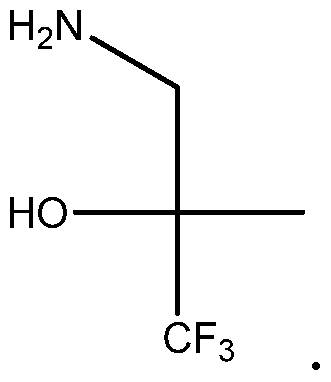
In embodiment 32, the present invention provides compounds, or pharmaceutically acceptable salts thereof, in accordance with any one of embodiments 1 to 17 wherein Q is

In embodiment 33, the present invention provides compounds, or pharmaceutically acceptable salts thereof, in accordance with any one of embodiments 1 to 17 wherein Q is -S02Ci_6alkyl.
In embodiment 34, the present invention provides compounds, or pharmaceutically acceptable salts thereof, in accordance with any one of embodiments 1 to 17 wherein Q is -C(=0)Ci_6alkyl or -C(=0)NR4R5 .
In embodiment 35, the present invention provides compounds, or pharmaceutically acceptable salts thereof, in accordance with any one of embodiments 1 to 17 wherein Q is C2-6alkenyl.
In embodiment 36, the present invention provides compounds, or pharmaceutically acceptable salts thereof, in accordance with any one of embodiments 1 to 17 wherein Q is -CH(CF3)2.
In embodiment 37, the present invention provides compounds, or pharmaceutically acceptable salts thereof, in accordance with any one of embodiments 1 to 17 wherein Q is -CH(CH3)(CF3);
In embodiment 38, the present invention provides compounds, or pharmaceutically acceptable salts thereof, in accordance with any one of embodiments 1 to 17 wherein Q is -S02R3.
In embodiment 39, the present invention provides compounds, or pharmaceutically acceptable salts thereof, in accordance with embodiment 38 wherein R3 is hydrogen. In embodiment 40, the present invention provides compounds, or pharmaceutically acceptable salts thereof, in accordance with embodiment 38 wherein R3 is Ci_6alkyl.
In embodiment 41, the present invention provides compounds, or pharmaceutically acceptable salts thereof, in accordance with any one of embodiments 38 to 40 wherein R4 is hydrogen.
In embodiment 42, the present invention provides compounds, or pharmaceutically acceptable salts thereof, in accordance with any one of embodiments 1 to 17 wherein Q is -S02NR5R6.
In embodiment 43, the present invention provides compounds, or pharmaceutically acceptable salts thereof, in accordance with embodiment 42 wherein R5 is hydrogen.
In embodiment 44, the present invention provides compounds, or pharmaceutically acceptable salts thereof, in accordance with embodiment 42 wherein R5 is Ci_6alkyl.
In embodiment 45, the present invention provides compounds, or pharmaceutically acceptable salts thereof, in accordance with any one of embodiments 42 to 44 wherein R6 is hydrogen.
In embodiment 46, the present invention provides compounds, or pharmaceutically acceptable salts thereof, in accordance with any one of embodiments 42 to 44 wherein R6 is Ci_6alkyl.
In embodiment 47, the present invention provides compounds, or pharmaceutically acceptable salts thereof, in accordance with embodiment 1 wherein X1, X2 and X3 are CH and Y is

In embodiment 48, the present invention provides compounds, or pharmaceutically acceptable salts thereof, in accordance with embodiment 1 wherein X3 is N X1 and X2 are CH and Y is
 In embodiment 49, the present invention provides compounds, or pharmaceutically acceptable salts thereof, in accordance with any one of embodimentss 47 to 48 wherein
Q is

-SO2NH2, -SO2NHCH3 or -S02NHcyclopropyl.
In embodiment 50, the present invention provides compounds, or pharmaceutically acceptable salts thereof, in accordance with embodiment 1 , the compound selected from:
6-(((3 S)-3 -( 1 -propyn- 1 -yl)-4-(4-((trifluoromethyl)sulfonimidoyl)phenyl)-
1 -piperazinyl)sulfonyl)-3 -pyridazinamine;
4-((2S)-4-((6-amino-3-pyridinyl)sulfonyl)-2-( 1 -propyn- 1 -yl)- 1 - piperazinyl)benzenesulfonamide;
4- ((2S)-4-((6-amino-3-pyridinyl)sulfonyl)-2-( 1 -propyn- 1 -yl)- 1 - piperazinyl)-N-cyclopropylbenzenesulfonamide;
5 - (((3S)-4-(4-(methylsulfonimidoyl)phenyl)-3-(l -propyn- l-yl)-l- piperazinyl)sulfonyl)-2-pyridinamine;
5-(((35)-4-(4-(N^-dimethylsulfonimidoyl)phenyl)-3-(l -propyn- 1 -yl)- 1 - piperazinyl)sulfonyl)-2-pyridinamine;
5 -(((35)-4-(4-(N-methyl-5*-(trifluoromethyl)sulfonimidoyl)phenyl)-3 -( 1 - propyn- 1 -yl)- 1 -piperazinyl)sulfonyl)-2-pyridinamine;
5 -(((35)-4-(4-(5'-cyclopropylsulfonimidoyl)phenyl)-3-(l -propyn- 1 -yl)- 1 - piperazinyl)sulfonyl)-2-pyridinamine;
4- ((25)-4-((6-amino-3-pyridinyl)sulfonyl)-2-( 1 -propyn- 1 -yl)- 1 - piperazinyl)-N-(cyclopropylmethyl)benzenesulfonamide;
5- (((35)-4-(4-(ethylsulfonyl)phenyl)-3-(l -propyn- 1 -yl)- 1 - piperazinyl)sulfonyl)-2-pyridinamine;
4- (4-((6-amino-3-pyridinyl)sulfonyl)-2-( 1 -propyn- 1 -yl)- 1 -piperazinyl)-N (2,2,2-trifluoroethyl)benzenesulfonamide;
1 -(4-((2S)-4-((6-amino-3 -pyridinyl)sulfonyl)-2-( 1 -propyn- 1 -yl)- 1 - piperazinyl)phenyl)ethanone;
5- (((3 S)-3-( 1 -propyn- 1 -yl)-4-(4-(S- (trifluoromethyl)sulfonimidoyl)phenyl)-l -piperazinyl)sulfonyl)-2-pyridinamm
4-((2S)-4-((6-amino-3 -pyridinyl)sulfonyl)-2-( 1 -propyn- 1 -yl)- 1 - piperazinyl)-N-methylbenzenesulfonamide;
6- ((2S)-4-((6-amino-3 -pyridinyl)sulfonyl)-2-( 1 -propyn- 1 -yl)- 1 - piperazinyl)-N-methyl-3-pyridinesulfonamide;
4-(4-((6-amino-3-pyridinyl)sulfonyl)-2-( 1 -propyn- 1 -yl)- 1 -piperazinyl)-N ethylbenzenesulfonamide;
1 -(4-((2S)-4-((6-amino-3 -pyridinyl)sulfonyl)-2-( 1 -propyn- 1 -yl)- 1 - piperazinyl)phenyl)- 1 -propanone;
4-(4-((6-amino-3-pyridinyl)sulfonyl)-2-( 1 -propyn- 1 -yl)- 1 -piperazinyl)-N ( 1 -methylethyl)benzenesulfonamide;
4-(4-((6-amino-3 -pyridinyl)sulfonyl)-2-( 1 -propyn- 1 -yl)- 1 -piperazinyl)- N,N-dimethylbenzenesulfonamide;
2-((2S)-4-((6-amino-3 -pyridinyl)sulfonyl)-2-( 1 -propyn- 1 -yl)- 1 - piperazinyl)-N-methyl-l ,3-thiazole-5-sulfonamide;
2-((2S)-4-((6-amino-3 -pyridinyl)sulfonyl)-2-( 1 -propyn- 1 -yl)- 1 - piperazinyl)-N-methoxy-N-methyl- 1 ,3-thiazole-5-carboxamide;
5-(((3S)-4-(5-(l-methylethenyl)-l ,3-thiazol-2-yl)-3-(l-propyn-l-yl)-l- piperazinyl)sulfonyl)-2-pyridinamine;
5-(((3 S)-3-( 1 -propyn- 1 -yl)-4-(4-(l ,2,2,2-tetrafhioro- 1 - (trifluoromethyl)ethyl)phenyl)-l-piperazinyl)sulfonyl)-2-pyridinamine;
2-(4-((2S)-4-((6-amino-3 -pyridinyl)sulfonyl)-2-( 1 -propyn- 1 -yl)- 1 - piperazinyl)phenyl)- 1,1,1 -trifluoro-4-pentyn-2-ol;
2-(4-((2S)-4-((6-amino-3 -pyridinyl)sulfonyl)-2-( 1 -propyn- 1 -yl)- 1 - piperazinyl)phenyl)- 1,1,1 -trifluoro-4-hexyn-2-ol;
2- (4-((2S)-4-((6-amino-3 -pyridinyl)sulfonyl)-2-( 1 -propyn- 1 -yl)- 1 - piperazinyl)phenyl)-3-azido- 1,1,1 -trifiuoro-2-propanol;
2-(4-((2S)-4-((6-amino-3 -pyridinyl)sulfonyl)-2-( 1 -propyn- 1 -yl)- 1 - piperazinyl)phenyl)- 1,1,1 -trifluoro-3-methoxy-2-propanol;
5-(4-((2S)-4-((6-amino-3-pyridinyl)sulfonyl)-2-( 1 -propyn- 1 -yl)- 1 - piperazinyl)phenyl)-5-(trifiuoromethyl)- 1 ,3-oxazolidin-2-one;
3- amino-2-(4-((2S)-4-((6-amino-3-pyridinyl)sulfonyl)-2-(l-propyn-l-yl)- 1 -piperazinyl)phenyl)- 1,1,1 -trifiuoro-2-propanol;
3-(4-((2S)-4-((6-amino-3-pyridinyl)sulfonyl)-2-( 1 -propyn- 1 -yl)- 1 - piperazinyl)phenyl)-4,4,4-trifluoro-3-hydroxybutanenitrile;
2-(6-((2S)-4-((6-amino-3 -pyridinyl)sulfonyl)-2-( 1 -propyn- 1 -yl)- 1 - piperazinyl)-3 -pyridinyl)- 1,1,1 -trifiuoro-3 -pentyn-2-ol; or
5 -(((3 S)-3 -( 1 -propyn- 1 -yl)-4-(4-(2,2,2-trifluoro- 1 -methylethyl)phenyl)- 1 - piperazinyl)sulfonyl)-2-pyridinamine.
In embodiment 51 , the present invention provides methods of treating type 2 diabetes, hyperglycemia, impaired glucose tolerance, insulin resistance, retinopathy, nephropathy, neuropathy, cataracts, glaucoma, Syndrome X, or polycystic ovarian syndrome, the method comprising administering to a patient in need thereof a therapeutically effective amount of a compound in accordance with any one of embodiments 1 to 51 , or a pharmaceutically acceptable salt thereof.
In embodiment 52, the present invention provides a method of embodiment 51 wherein the treatment is for type 2 diabetes.
In embodiment 53, the present invention provides a pharmaceutical composition comprising a compound in accordance with any one of
embodiments 1 to 50, or a pharmaceutically acceptable salt thereof, and a pharmaceutically acceptable excipient.
DETAILED DESCRIPTION
The present invention provides tricyclic alkynes compounds, as defined above, or pharmaceutically acceptable salts thereof. The present invention also provides pharmaceutical compositions comprising a compound of the present invention, or pharmaceutically acceptable salts thereof, and methods of treating diseases and/or conditions, such as diabetes, using compounds of the present invention, or pharmaceutically acceptable salts thereof.
The term "alkyl" means a straight or branched chain hydrocarbon.
Representative examples of alkyl groups include methyl, ethyl, propyl, isopropyl, butyl, isobutyl, tert-butyl, sec-butyl, pentyl and hexyl. Typical alkyl groups are alkyl groups having from 1 to 8 carbon atoms, which groups are commonly represented as Ci-galkyl.
The term "alkoxy" means an alkyl group bonded to an oxygen atom. Representative examples of alkoxy groups include methoxy, ethoxy, tert-butoxy, propoxy and isobutoxy. Common alkoxy groups are Ci-galkoxy.
The term "halogen" or "halo" means chlorine, fluorine, bromine or iodine. The term "alkenyl" means a branched or straight chain hydrocarbon having one or more carbon-carbon double bonds. Representative examples alkenyl groups include ethenyl, propenyl, allyl, butenyl and 4-methylbutenyl. Common alkenyl groups are C2-8alkenyl.
The term "alkynyl" means a branched or straight chain hydrocarbon having one or more carbon-carbon triple bonds. Representative examples of
alkynyl groups include ethynyl, propynyl (propargyl) and butynyl. Common alkynyl groups are C2-g alkynyl.
The term "cycloalkyl" means a cyclic, nonaromatic hydrocarbon.
Examples of cycloalkyl groups include cyclopropyl, cyclobutyl, cyclopentyl, cyclohexyl and cycloheptyl. A cycloalkyl group can contain one or more double bond. Examples of cycloalkyl groups that contain double bonds include cyclopentenyl, cyclohexenyl, cyclohexadienyl and cyclobutadienyl. Common cycloalkyl groups are C3-8 cycloalkyl groups.
The term "perfluoroalkyl" means an alkyl group in which all of the hydrogen atoms have been replaced with fluorine atoms. Common
perfluoroalkyl groups are Ci-sperfluoroalkyl. An example of a common perfluoroalkyl group is CF3.
The term "acyl" means a group derived from an organic acid by removal of the hydroxy group (-OH). For example, the acyl group CH3C(=0)- is formed by the removal of the hydroxy group from CH3C(=0)OH .
The term "aryl" means a cyclic, aromatic hydrocarbon. Examples of aryl groups include phenyl and naphthyl. Common aryl groups are six to thirteen membered rings.
The term "heteroatom" as used herein means an oxygen, nitrogen or sulfur atom.
The term "heteroaryl" means a cyclic, aromatic hydrocarbon in which one or more carbon atoms of an aryl group have been replaced with a heteroatom. If the heteroaryl group contains more than one heteroatom, the heteroatoms may be the same or different. Examples of heteroaryl groups include pyridyl, pyrimidinyl, imidazolyl, thienyl, furyl, pyrazinyl, pyrrolyl, indolyl, triazolyl, pyridazinyl, indazolyl, purinyl, quinolizinyl, isoquinolyl, quinolyl,
naphthyridinyl, quinoxalinyl, isothiazolyl and benzo[b]thienyl. Common heteroaryl groups are five to thirteen membered rings that contain from 1 to 4 heteroatoms. Heteroaryl groups that are five and six membered rings that contain 1 to 3 heterotaoms are particularly common.
The term "heterocycloalkyl" means a cycloalkyl group in which one or more of the carbon atoms has been replaced with a heteroatom. If the
heterocycloalkyl group contains more than one heteroatom, the heteroatoms may be the same or different. Examples of heterocycloalkyl groups include tetrahydrofuryl, morpholinyl, piperazinyl, piperidinyl and pyrrolidinyl. It is also possible for the heterocycloalkyl group to have one or more double bonds, but is not aromatic. Examples of heterocycloalkyl groups containing double bonds include dihydrofuran. Common heterocycloalkyl groups are three to ten membered rings containing from 1 to 4 heteroatoms. Heterocycloalkyl groups that are five and six membered rings that contain 1 to 2 heterotaoms are particularly common.
It is also noted that the cyclic ring groups, i.e., aryl, heteroaryl, cycloalkyl, and heterocycloalkyl, can comprise more than one ring. For example, the naphthyl group is a fused bicyclic ring system. It is also intended that the present invention include ring groups that have bridging atoms, or ring groups that have a spiro orientation.
Representative examples of five to six membered aromatic rings, optionally having one or two heteroatoms, are phenyl, furyl, thienyl, pyrrolyl, oxazolyl, thiazolyl, imidazolyl, pyrazolyl, isoxazolyl, isothiazolyl, pyridinyl, pyridiazinyl, pyrimidinyl, and pyrazinyl.
Representative examples of partially saturated, fully saturated or fully unsaturated five to eight membered rings, optionally having one to three heteroatoms, are cyclopentyl, cyclohexyl, cycloheptyl, cyclooctyl and phenyl. Further exemplary five membered rings are furyl, thienyl, pyrrolyl, 2-pyrrolinyl, 3-pyrrolinyl, pyrrolidinyl, 1,3-dioxolanyl, oxazolyl, thiazolyl, imidazolyl, 2H- imidazolyl, 2-imidazolinyl, imidazolidinyl, pyrazolyl, 2-pyrazolinyl,
pyrazolidinyl, isoxazolyl, isothiazolyl, 1 ,2-dithiolyl, 1,3-dithiolyl, 3H-1,2- oxathiolyl, 1,2,3-oxadizaolyl, 1,2,4-oxadiazolyl, 1,2,5-oxadiazolyl,
l,3,4oxadiazolyl, 1 ,2,3-triazolyl, 1,2,4-trizaolyl, 1,3,4-thiadiazolyl, 3H-1,2,3- dioxazolyl, 1,2,4-dioxazolyl, 1,3,2-dioxazolyl, 1,3,4-dioxazolyl, 5H-1,2,5- oxathiazolyl, and 1,3-oxathiolyl.
Further exemplary six membered rings are 2H-pyranyl, 4H-pyranyl, pyridinyl, piperidinyl, 1 ,2-dioxinyl, 1,3-dioxinyl, 1 ,4-dioxanyl, morpholinyl, 1,4- dithianyl, thiomorpholinyl, pyndazinyl, pyrimidinyl, pyrazinyl, piperazinyl, 1,3,5-triazinyl, 1,2,4-triazinyl, 1,2,3-triazinyl, 1,3,5-trithianyl, 4H-l,2-oxazinyl, 2H-l,3-oxazinyl, 6H-l,3-oxazinyl, 6H-l,2-oxazinyl, 1 ,4-oxazinyl, 2H-1,2- oxazinyl, 4H-l,4-oxazinyl, 1,2,5-oxathiazinyl, 1 ,4-oxazinyl, o-isoxazinyl, p- isoxazinyl, 1,2,5-oxathiazinyl, l,2,6-(3 oxathiazinyl, and 1,4,2-oxadiazinyl.
Further exemplary seven membered rings are azepinyl, oxepinyl, thiepinyl and 1,2,4-triazepinyl.
Further exemplary eight membered rings are cyclooctyl, cyclooctenyl and cyclooctadienyl.
Exemplary bicyclic rings consisting of two fused partially saturated, fully saturated or fully unsaturated five and/or six membered rings, optionally having one to four heteroatoms, are indolizinyl, indolyl, isoindolyl, indolinyl, cyclopenta(b)pyridinyl, pyrano(3,4-b)pyrrolyl, benzofuryl, isobenzofuryl, benzo(b)thienyl, benzo(c)thienyl, lH-indazolyl, indoxazinyl, benzoxazolyl, anthranilyl, benzimidazolyl, benzthiazolyl, purinyl, quinolinyl, isoquinolinyl, cinnolinyl, phthalazinyl, quinazolinyl, quinoxalinyl, 1,8-naphthyridinyl, pteridinyl, indenyl, isoindenyl, naphthyl, tetralinyl, decalinyl, 2H-1- benzopyranyl, pyrido(3,4-b)pyridinyl, pyrido(3,2-b)pyridinyl, pyrido(4,3-b)- pyridinyl, 2H-l,3-benzoxazinyl, 2H-l,4-benzoxazinyl, lH-2,3-benzoxazinyl, 4H- 3,1-benzoxazinyl, 2H-l,2-benzoxazinyl and 4H-l,4-benzoxazinyl.
A cyclic ring group may be bonded to another group in more than one way. If no particular bonding arrangement is specified, then all possible arrangements are intended. For example, the term "pyridyl" includes 2-, 3-, or 4- pyridyl, and the term "thienyl" includes 2-, or 3-thienyl.
The term "substituted" means that a hydrogen atom on a molecule or group is replaced with a group or atom. Typical substitutents include: halogen, Ci-8alkyl, hydroxyl, Ci-8alkoxy, -NRXRX, nitro, cyano, halo or perhaloCi-8alkyl, C2-8alkenyl, C2-8alkynyl, -SRX, -S(=0)2Rx, -C(=0)ORx, -C(=0)Rx, wherein each Rx is independently hydrogen or Ci-C8 alkyl. It is noted that when the
substituent is -NRXRX, the Rx groups may be joined together with the nitrogen atom to form a ring.
The term "oxo", when used as a substituent, means the =0 group, which is typically attached to a carbon atom.
A group or atom that replaces a hydrogen atom is also called a substituent.
Any particular molecule or group can have one or more substituent depending on the number of hydrogen atoms that can be replaced.
The symbol "-" represents a covalent bond and can also be used in a radical group to indicate the point of attachment to another group. In chemical structures, the symbol is commonly used to represent a methyl group in a molecule.
The term "therapeutically effective amount" means an amount of a compound that ameliorates, attenuates or eliminates one or more symptom of a particular disease or condition, or prevents or delays the onset of one of more symptom of a particular disease or condition.
The term "patient" means animals, such as dogs, cats, cows, horses, sheep and humans. Particular patients are mammals. The term patient includes males and females.
The term "pharmaceutically acceptable" means that the referenced substance, such as a compound of the present invention or a formulation containing a compound of the present invention, or a particular excipent, are suitable for administration to a patient.
The terms "treating", "treat" or "treatment" and the like include preventative (e.g., prophylactic) and palliative treatment.
The term "patient in need thereof means a patient who has or is at risk of having a GKRP/GK mediated disease or condition, such as type 2 diabetes.
The term "excipient" means any pharmaceutically acceptable additive, carrier, diluent, adjuvant, or other ingredient, other than the active
pharmaceutical ingredient (API), which is typically included for formulation and/or administration to a patient.
The compounds of the present invention are administered to a patient in a therapeutically effective amount. The compounds can be administered alone or as part of a pharmaceutically acceptable composition or formulation. In addition, the compounds or compositions can be administered all at once, as for example, by a bolus injection, multiple times, such as by a series of tablets, or delivered substantially uniformly over a period of time, as for example, using transdermal delivery. It is also noted that the dose of the compound can be varied over time.
In addition, the compounds of the present invention can be administered alone, in combination with other compounds of the present invention, or with other pharmaceutically active compounds. The other pharmaceutically active compounds can be intended to treat the same disease or condition as the compounds of the present invention or a different disease or condition. If the patient is to receive or is receiving multiple pharmaceutically active compounds, the compounds can be administered simultaneously, or sequentially. For example, in the case of tablets, the active compounds may be found in one tablet or in separate tablets, which can be administered at once or sequentially in any order. In addition, it should be recognized that the compositions may be different forms. For example, one or more compound may be delivered via a tablet, while another is administered via injection or orally as a syrup. All combinations, delivery methods and administration sequences are contemplated.
The compounds of the present invention may be used in the manufacture of a medicament for the treatment of a disease and/or condition mediated by GK P/GK, such as type 2 diabetes.
The compounds of the present invention may be used in combination with other pharmaceutically active compounds. It is noted that the term
"pharmaceutically active compounds" can include biologies, such as proteins, antibodies and peptibodies. Examples of other pharmaceutically active compounds include, but are not limited to: (a) dipeptidyl peptidase IV (DPP-IV) inhibitors such as Vildagliptin (Novartis), Sitagliptin (Merck&Co.), Saxagliptin (BMS) Alogliptin (Takeda); (b) insulin sensitizers including (i) PPARy agonists such as the glitazones (e.g., troglitazone, pioglitazone, edaglitazone,
rosiglitazone, and the like) and other PPAR ligands, including PPARa/γ dual agonists such as muraglitazar (BMS) and tesaglitazar (AstraZeneca), and PPARa agonists such as fenofibric acid derivatives (gemfibrozil, clofibrate, fenofibrate and bezafibrate), (ii) biguanides such as metformin and phenformin, and (iii) protein tyrosine phosphatase-lB (PTP-1B) inhibitors; (c) insulin or insulin mimetics; (d) incretin and incretin mimetics such as (i) Exenatide available from Amylin Pharmaceuticals, (i) amylin and amylin mimetics such as pramlintide acetate, available as Symlin®, (iii) GLP-1, GLP-1 mimetics, and GLP-1 receptor agonists, (iv) GIP, GIP mimetics and GIP receptor agonists; (e) sulfonylureas and other insulin secretagogues, such as tolbutamide, glyburide, gliclazide, glipizide, glimepiride, meglitinides, and repaglinide; (f) a-glucosidase inhibitors (such as acarbose and miglitol); (g) glucagon receptor antagonists; (h) PACAP, PACAP mimetics, and PACAP receptor agonists; (i) cholesterol lowering agents such as (i) HMG-CoA reductase inhibitors (lovastatin, simvastatin, pravastatin, cerivastatin, fluvastatin, atorvastatin, itavastatin, and rosuvastatin, and other statins), (ii) sequestrants such as cholestyramine, colestipol and
dialkylaminoalkyl derivatives of a cross-linked dextran, (iii) nicotinyl alcohol, nicotinic acid or a salt thereof, (iv) PPARa agonists such as fenofibric acid derivatives (gemfibrozil, clofibrate, fenofibrate and bezafibrate), (v) PPARa/γ dual agonists such as muraglitazar (BMS) and tesaglitazar (AstraZeneca), (vi) inhibitors of cholesterol absorption, such as beta-sitosterol and ezetimibe, (vii) acyl CoAxholesterol acyltransferase inhibitors such as avasimibe, and (viii) antioxidants such as probucol; (j) PPAR5 agonists such as GW-501516 from GSK; (k) anti-obesity compounds such as fenfluramine, dexfenfluramine, phentemine, sibutramine, orlistat, neuropeptide Yl or Y5 antagonists, MTP inhibitors, squalene synthase inhibitor, lipoxygenase inhibitor, AC AT inhibitor,
Neuropeptide Cannabinoid CB-1 receptor antagonists, CB-1 receptor inverse agonists and antagonists, fatty acid oxidation inhibitors, appetite suppressants (1) adrenergic receptor agonists, melanocortin receptor agonists, in particular melanocortin-4 receptor agonists, ghrelin antagonists, and melanin- concentrating hormone (MCH) receptor antagonists; (m) ileal bile acid transporter inhibitors;
(n) agents intended for use in inflammatory conditions such as aspirin, non steroidal anti-inflammatory drugs, glucocorticoids, azalfidine, and selective cyclooxygenase-2 inhibitors; (o) antihypertensive agents such as ACE inhibitors (enalapril, lisinopril, captopril, quinapril, fosinoprol, ramipril, spirapril, tandolapril), angiotensin-II (AT-1) receptor blockers (losartan, candesartan, irbesartan, valsartan, telmisartan, eprosartan), beta blockers and calcium channel blockers; and (p) glucokinase activators (GKAs); (q) agents which can be used for the prevention, delay of progression or treatment of neurodegenerative disorders, cognitive disorders or a drug for improving memory such as antiinflammatory drugs, antioxidants, neuroprotective agents, glutamate receptor antagonists, acetylcholine esterase inhibitors, butyrylcholinesterase inhibitors, MAO inhibitors, dopamine agonists or antagonists, inhibitors of gamma and beta secretases, inhibitors of amyloid aggregation, amyloid beta peptide, antibodies to amyloid beta peptide, inhibitors of acetylcholinesterase, glucokinase activators, agents directed at modulating GABA, NMD A, cannabinoid, AMP A, kainate, phosphodiesterase (PDE), PKA, PKC, CREB or nootropic systems; ( r ) leukocyte growth promotors intended for the treatment and prevention of reduced bone marrow production, infectious diseases, hormone dependent disorders, inflammatory diseases, HIV, allergies, leukocytopenia, and rheumatism; (s) SGLT2 inhibitor; (t) glycogen phosphorylase inhibitor; (u) aP2 inhibitors; (v) aminopeptidase N inhibitor (w) vasopeptidase inhibitors like neprilysin inhibitors and/or ACE inhibitors or dual NEP/ACE inhibitor; (x) growth hormone secretagogue for enhancing growth hormone levels and for treating growth retardation / dwarfism or metabolic disorders or where the disorder is an injury, or a wound in need of healing, or a mammalian patient recovering from surgery; (y) 5-HT 3 or 5-HT 4 receptor modulators (tegaserod, cisapride, nor-cisapride, renzapride, zacopride, mosapride, prucalopride, buspirone, norcisapride, cilansetron, ramosetron, azasetron, ondansetron, etc.); (Za) aldose reductase inhibitors; (Zb) sorbitol dehydrogenase inhibitors; (Zc) AGE inhibitors; (Zd) erythropoietin agonist such as EPO, EPO mimetics, and EPO receptor agonists.
The compounds of the present invention may also be used in combination with GPR40 agonists.
Examples of glucokinase activators that can be used in combination with the compounds of the present invention include those set forth in published PCT patent application no. WO 2009/042435, published April 2, 2009. Examples of specific compounds, or pharmaceutically acceptable salts thereof, disclosed in the published application that may be used in combination with the compounds of the present invention, or pharmaceutically acceptable salts thereof, include compounds selected from:
(S)- 1 -(5-(5-bromo-3-(2-methylpyridin-3-yloxy)pyridin-2-ylamino)- 1 ,2,4- thiadiazol-3-yl)ethane-l,2-diol;
(S)-l-(5-(5 -trifluoromethyl-3 -(2-methylpyridin-3 -yloxy)pyridin-2- ylamino)-l,2,4-thiadiazol-3-yl)ethane-l,2-diol;
(S)-l-(5-(5 -phenylthio-3 -(2-methylpyridin-3 -yloxy)pyridin-2-ylamino)- 1 ,2,4-thiadiazol-3-yl) ethane- 1 ,2-diol;
(S)-l-(5-(5-phenylthio-3-(pyridin-3-yloxy)pyridin-2-ylamino)-l,2,4- thiadiazol-3-yl)piperidin-l-yl)ethane-l,2-diol;
(S)- 1 -(5 -(3 -(2-methy lpyridin-3 -yloxy)-5 -(pyridin-2-y lthio)pyridin-2- ylamino)-l,2,4-thiadiazol-3-yl)ethane-l,2-diol;
(S)- 1 -(5 -(5 (2hydroxyethylthio)-3 -(2-methylpyridin-3 -yloxy)pyridin-2- ylamino)-l,2,4-thiadiazol-3-yl)ethane-l,2-diol;
(S)- 1 -(5-(4-fluorophenoxy)-5-pyridin-2-ylthio)pyridin-2-ylamino)- 1 ,2,4- thiadiazol-3-yl) ethane- 1 ,2-diol;
(R)-l-(2-(5-bromo-3-(4-fluorophenoxy)pyridin-2-ylamino)thiazol-4- yl)ethane- 1 ,2-diol;
(S)-l-(2-(5-bromo-3-(4-fluorophenoxy)pyridin-2-ylamino)thiazol-4- yl)ethane- 1 ,2-diol;
(R)- 1 -(2-(3 -(4-fluorophenoxy)-5 -(pyridin-2-ylthio)pyridin-2- ylamino)thiazol-4-yl)-ethane- 1 ,2-diol;
(lS)-l-(5-(5-bromo-3-(5,6,7,8-tetrahydroquinolin-5-yloxy)pyridin-2- ylamino)-l,2,4-thiadiazol-3-yl)ethane-l,2-diol;
(S)- 1 -(5 -(5 -bromo-3-(l -(2-hydroxyethyl)- 1 H-pyrazol-4-yloxy )pyridin-2- ylamino)-l,2,4-thiadiazol-3-yl)ethane-l,2-diol;
(R)- 1 -(2-(5 -bromo-3 -(2 -methylpyridin-3 -yloxy)pyridin-2- ylamino)thiazol-4-yl)-ethane- 1 ,2-diol;
(S)- 1 -(5 -(5 -(2-hydroxyethylthio)-3 -(pyridin-3 -yloxy)pyridin-2-ylamino)- 1 ,2,4-thiadiazol-3-yl)ethane- 1 ,2-diol;
(S)-l -(5 -(5 -bromo-3 -(1 -methyl- lH-pyrazol-4-yloxy)pyridin-2-ylamino)- 1 ,2,4-thiadiazol-3-yl)ethane- 1 ,2-diol;
(S)- 1 -(5-(3-(l -methyl- lH-pyrazol-4-yloxy)-5 -(2 -methylpyridin-3 - ylthio)pyridin-2-ylamino)-l,2,4-thiadiazol-3-yl)ethane-l,2-diol;
(S)-l-(5-(5-(2-methylpyridin-3-ylthio)-3-(l,3,5-trimethyl-lH-pyrazol-4- yloxy)-pyridin-2-ylamino)- 1 ,2,4-thiadiazol-3-yl)ethane- 1 ,2-diol;


-25 -

-26-

-27-

-28-

-29-

-30-

-31 -


-34-


5


-40-


-42-

(S)-l-(5-(3-(2-methylpyridin-3-yloxy)-5-(pyridin-2-ylthio)pyridin-2- ylamino)-l,2,4-thiadiazol-3-yl)ethane-l,2-diol;
(S)- 1 -(5 -(3 -(2,6-dimethylpyridin-3 -yloxy)-5 -(pyridin-2-ylthio)pyridin-2- ylamino)-l,2,4-thiadiazol-3-yl)ethane-l,2-diol;
(S)- 1 -(5 -(5 -(cyclopropylmethylthio)-3 -(2-methylpyridin-3 -yloxy)pyridin- 2-yl-amino)-l,2,4-thiadiazol-3-yl)ethane-l,2-diol;
(S)-l-(5-(3-(2-ethylpyridin-3-yloxy)-5-(pyridin-2-ylthio)pyridin-2- ylamino)-l,2,4-thiadiazol-3-yl)ethane-l,2-diol;
(S)- 1 -(5 -(5 -(3 -methoxypropylthio)-3 -(2-methylpyridin-3 -yloxy)pyridin-2- ylamino)-l,2,4-thiadiazol-3-yl)ethane-l,2-diol;
(S)-l-(5-(3-(l-Ethyl-lH-pyrazol-5-yloxy)-5-(pyridin-2-ylthio)pyridin-2- ylamino)-l,2,4-thiadiazol-3-yl)ethane-l,2-diol;
(S)-l-(5-(3-(l-ethyl-lH-pyrazol-5-yloxy)-5-(pyridin-2-ylthio)pyridin-2- ylamino)- 1 ,2,4-thiadiazol-3-yl)-2-methylpropane- 1 ,2-diol;
(S)- 1 -(5 -(5 -(3 -methylpyridin-2-ylthio)-3 -(2-methylpyridin-3 - yloxy)pyridin-2-yl-amino)-l,2,4-thiadiazol-3-yl)ethane-l,2-diol;
(S)- 1 -(5 -(3 -(2,4-dimethylpyridin-3 -yloxy)-5 -(pyridin-2-ylthio)pyridin-2- ylamino)-l,2,4-thiadiazol-3-yl)ethane-l,2-diol;
(S)-2-methyl- 1 -(5-(3-(2-methylpyridin-3-yloxy)-5-(pyridin-2- ylthio)pyridin-2-ylamino)-l,2,4-thiadiazol-3-yl)propane-l,2-diol;
(S)- 1 -(5 -(5 -(2-methoxyethylthio)-3 -(2-methylpyridin-3 -yloxy)pyridin-2- ylamino)-l,2,4-thiadiazol-3-yl)ethane-l,2-diol;
(lS,2S)-l-(5-(3-(2-ethylpyridin-3-yloxy)-5-(pyridin-2-ylthio)pyridin-2- ylamino)- 1 ,2,4-thiadiazol-3-yl)-3-methoxypropane- 1 ,2-diol;
(S)-2-methyl 5-(5-(pyridin-2-ylthio)-3-(l,3,5-trimethyl-lH-pyrazol-4- yloxy)-pyridin-2-ylamino)- 1 ,2,4-thiadiazol-3 -yl)propane- 1 ,2-diol;
(S)-l-(5-(5-(pyridin-2-ylthio)-3-(l,3,5-trimethyl-lH-pyrazol-4- yloxy)pyridin-2-yl-amino)-l,2,4-thiadiazol-3-yl)ethane-l,2-diol;
(S)-l-(5-(5-(2-methoxyethylthio)-3-(l,3,5-trimethyl-lH-pyrazol-4- yloxy)pyridin-2-yl-amino)-l,2,4-thiadiazol-3-yl)ethane-l,2-diol;
(R)- 1 -(5 -(3 -(2-methylpyridin-3 -yloxy)-5 -(pyridin-2-ylthio)pyridin-2- ylamino)-l,2,4-thiadiazol-3-yl)ethane-l,2-diol;
(S)-2-(5-(3-(2-methylpyridin-3-yloxy)-5-(pyridin-2-ylthio)pyridin-2- ylamino)- 1 ,2,4-thiadiazol-3-yl)propane- 1 ,2-diol; or
(R)-2-(5 -(3 -(2-methylpyridin-3 -yloxy)-5 -(pyridin-2-ylthio)pyridin-2- ylamino)- 1 ,2,4-thiadiazol-3-yl)propane- 1 ,2-diol, or the pharmaceutically acceptable salts thereof.
Other compounds that may be used in combination with the compounds of the present invention include the ILl-Rl compounds set forth in U.S. patent no. 7,438,910. A particular disease that can be treated with the combination is type 2 diabetes.
The compounds of the present invention can also be used in combination with FGF-21 compounds, and particularly for the treatment of type 2 diabetes. Examples of FGF-21 compounds are disclosed in U.S. patent no. 7,671,180; U.S. patent no. 7,667,008; U.S. patent no. 7,459,540; U.S. patent no. 7,696,172; PCT application publication no. WO 2010/042747; and PCT application publication no. WO 2009/149171.
The compounds of the present invention can be also be used in combination with anakinra, particularly for the treatment of type 2 diabetes.
In one particular aspect, the compounds of the present invention may be used in combination with metformin.
The compounds of the present invention are used in the treatment diseases or symptoms mediated by GKRP and/or GK (GKRP/GK). Examples of diseases or symptoms mediated by GKRP/GK include, but are not limited to, Type II (type 2) diabetes and related disorders, such as hyperglycemia, low or impaired glucose tolerance, insulin resistance, obesity, lipid disorders such as
dyslipidemia, hyperlipidemia, hypertriglyceridemia, hypercholesterolemia, low HDL levels, high LDL levels, atherosclerosis, and vascular restenosis, irritable bowel syndrome, inflammatory bowel disease, including Crohn's disease and ulcerative colitis, other inflammatory conditions, pancreatitis, abdominal obesity, neurodegenerative disease, retinopathy, nephropathy, neuropathy, cataracts, glaucoma, glomerulosclerosis, foot ulcerations and ulcerative colitis, altered gastrointestinal motility, Syndrome X, ovarian hyperandrogenism, polycystic ovarian syndrome, premenstrual syndrome, other disorders where insulin resistance is a component. In Syndrome X, also known as Metabolic Syndrome, obesity is thought to promote insulin resistance, diabetes, dyslipidemia, hypertension, and increased cardiovascular risk, growth hormone deficiency, neutropenia, neuronal disorders, tumor invasion and metastasis, benign prostatic hypertrophy, gingivitis, osteoporosis, frailty of aging, intestinal injury, benign prostatic hypertrophy (BPH), and sperm motility/male contraception.
The compounds of the present invention are also useful for the prevention, delay of progression or the treatment of an early cardiac or early cardiovascular diseases or damages, renal diseases or damages, heart Failure, or heart Failure associated diseases like (i) cardiovascular diseases or damages e.g. cardiac hypertrophy, cardiac remodeling after myocardial infarction, pulmonary congestion and cardiac fibrosis in dilated or in hypertrophic cardiomyopathy, cardiomyopathy such as dilated cardiomyopathy or hypertrophic
cardiomyopathy, mesanglial hypertrophy, or diabetic cardiomyopathy, left or right ventricular hypertrophy, arrhythmia, cardiac dysrhythmia, syncopy, angina pectoris, cardiac bypass reocclusion, intermittent claudication, diastolic and/or systolic dysfunction, diabetic myopathy, stroke prevention in congestive heart failure, hypertrophic medial thickening in arteries and/or large vessels,
mesenteric vasculature hypertrophy or atherosclerosis, preferably atherosclerosis in mammalian patients with hypertension of diabetes; (ii) renal diseases or damages like renal hyperfiltration such as after portal renal ablation, proteinuria in chronic renal disease, renal arteriopathy as a consequence of hypertension, nephrosclerosis, hypertensive nephrosclerosis or mesanglial hypertrophy; (iii) Heart Failure to be treated is secondary to idiopathic dilated cardiomyopathy and/or coronary ischemic disease.
The compounds of the present invention can also be used for the prevention, the delay of the onset, the delay of progression or the treatment of neurodegenerative disorders, cognitive disorders and for improving memory (both short term and long term) and learning ability wherein the (i)
neurodegenerative disorder is dementia, senile dementia, schizophrenia, mild cognitive impairment, Alzheimer related dementia, Huntington's chores, tardive dyskinesia, hyperkinesias, mania, Morbus Parkinson, Steel-Richard syndrome, Down's syndrome, myasthenia gravis, nerve and brain trauma, vascular amyloidosis, cerebral hemorrhage I with amyloidosis, brain inflammation, Friedrich ataxia, acute confusion disorders, acute confusion disorders with apoptotic necrocytosis, amyotrophic lateral sclerosis, glaucoma, and Alzheimer's disease; (ii) cognitive disorders like cognitive deficits associated with
schizophrenia, age-induced memory impairment, cognitive deficits associated with psychosis, cognitive impairment associated with diabetes, cognitive deficits associated with post-stroke, memory defects associated hypoxia, cognitive and attention deficits associated with senile dementia, attention deficits disorders, memory problems associated with mild cognitive impairment, impaired cognitive function associated with vascular dementia, cognitive problems associated with brain tumors, Pick's disease, cognitive deficits due to autism, cognitive deficits post electroconvulsive therapy, cognitive deficits associated with traumatic brain injury, amnesic disorders, deliriums, vitamin deficiency, dementias, impaired cognitive function associated with Parkinson's disease, attention-deficit disorders; (iii) prevention of memory impairment as a result of Alzheimer disease, Creutzfeld- Jakob disease, Pick disease, Huntington disease, AIDS, brain
injury, brain aneurysm, epilepsy, stroke, toxicant exposure, mental retardation in children, Huntington's disease; (iv) to improve learning speed and potential in educational and rehabilitation contexts.
The compounds of the present invention can also be used for stimulating an immune response in a subject having or at risk of having cancer wherein the cancer is selected from the group consisting of basal cell carcinomas including cancers of the binary tract, bladder, urinary system, bone, brain, breast, cervical, endometrial, ovarian, uterine, choriocarcinoma, central nervous system, colon and rectal cancers, connective tissue cancer, cancer of the digestive system, esophageal, gastric, stomach, larynx, liver, pancreatic, colorectal, renal cancers; cancers of the urinary system; cancers of eye, head and neck, oral cavity, skin, prostate; cancers of biliary tract, testicular, thyroid; intra- epithelial neoplasm, leukemia, acute myeloid leukemia, acute lymphoid leukemia, chronic myeloid leukemia, chronic lymphoid leukemia; and other cancers of the respiratory system, lung, small cell lung, non-small cell lung; lymphoma, Hodgkin's lymphoma, Non-Hodgkin's lymphoma; melanoma, myeloma, neuroblastoma, retinoblastoma, fibrosarcoma (bone or connective tissue sarcoma),
rhabdomyosarcoma; and other cancers including neoplastic conditions, adipose cell tumors, adipose cell carcinomas, such as liposarcoma.
The compounds of the present invention can also be used for the treatment or prophylaxis of chronic inflammatory diseases such as autoimmune disorders like rheumatoid arthritis, systemic lupus erythematosus, multiple sclerosis, psoriasis, allergies or asthma.
The compounds of the present invention can also be used in the treatment of pain, neuropathic pain, rheumatoid pain, osteoarthritis pain, anesthesia adjunct in mammalian patients undergoing surgery, chronic pain in advanced cancer, treatment of refractory diarrhea, biliary pain caused by gallstones.
The compounds of the present invention can also be used for the treatment of mammalian patients undergoing islet/pancreas transplantation, for the prevention or the delay of transplant rejection, or allograft rejection in transplantation, for improving pancreatic function by increasing the number and
size of pancreatic beta-cells in the treatment of Type 1 diabetes patients, and for improving pancreatic function by increasing the number and size of pancreatic beta-cells in general.
Furthermore, the compounds of the present invention can be used for the treatment of mammalian patients with acne, skin disorders (e.g. pigmentation disorders or psoriasis), scleroderma, mycoses; anxiety, anxiety neurosis, major depression disorder, drug abuse, alcohol addiction, insomnia, chronic fatigue, sleep apnea; anorexia nervosa; epilepsy; migraine; encephalomyelitis;
osteoarthritis, osteoporosis, calcitonin-induced osteoporosis; male and female sexual dysfunction, infertility; Type 1 diabetes; immunosuppression, HIV infection; hematopoiesis, anemia; and for weight reduction.
Additionally, the compounds of the present invention are useful for the prevention, delay of progression or treatment of (i) bacterial infections from Escherichia coli, Staphylococcus, Streptoococcus, Pseudomonas, Clostridium difficile infection, Legionella, Pneumococcus, Haemophilus, Klebsiella,
Enterobacter, Citrobacter, Neisseria, Shigella, Salmonella, Listeria, Pasteurella, StreptobaciUus, Spirillum, Treponema, Actinomyces, Borrelia, Corynebacterium, Nocardia, Gardnerella, Campylobacter, Spirochaeta, Proteus, Bacteriodes, Helicobacter pylori, and anthrax infection; (ii) mycobacterial infection from tuberculosis and leprosy; (iii) viral infection from HIV, Herpes simplex virus 1 , Herpes simplex virus 2, Cytomegalovirus, hepatitis A virus, hepatitis B virus, hepatitis C virus, human papilloma virus, Epstein Barr virus, rotavirus, adenovirus, influenza A virus, respiratory syncytial virus, varicella-zoster virus, small pox, monkey pox and SARS; (iv) fungal infection from candidiasis, ringworm, histoplasmosis, blastomycosis, paracoccidioidomycosis,
cryptococcosis, aspergillosis, chromomycosis, mycetoma infections,
pseudallescheriasis, Tinea versicolor infection; (v) parasite infection from amebiasis, Trypanosoma cruzi, Fascioliasis, Leishmaniasis, Plasmodium, Onchocerciasis, Paragonimiasis, Trypanosoma brucei, Pneumocystis,
Trichomonas vaginalis, Taenia, Hymenolepsis, Echinococcus, Schistosomiasis, neurocysticerosis, Necator americanus, and Trichuris trichuria.
Since one aspect of the present invention contemplates the treatment of the disease/conditions with a combination of pharmaceutically active compounds that may be administered separately, the invention further relates to combining separate pharmaceutical compositions in kit form. The kit comprises two separate pharmaceutical compositions: a compound of the present invention, and a second pharmaceutical compound. The kit comprises a container for containing the separate compositions such as a divided bottle or a divided foil packet.
Additional examples of containers include syringes, boxes and bags. Typically, the kit comprises directions for the use of the separate components. The kit form is particularly advantageous when the separate components are preferably administered in different dosage forms (e.g., oral and parenteral), are
administered at different dosage intervals, or when titration of the individual components of the combination is desired by the prescribing physician or veterinarian.
An example of such a kit is a so-called blister pack. Blister packs are well known in the packaging industry and are being widely used for the packaging of pharmaceutical unit dosage forms (tablets, capsules, and the like). Blister packs generally consist of a sheet of relatively stiff material covered with a foil of a preferably transparent plastic material. During the packaging process recesses are formed in the plastic foil. The recesses have the size and shape of the tablets or capsules to be packed. Next, the tablets or capsules are placed in the recesses and the sheet of relatively stiff material is sealed against the plastic foil at the face of the foil which is opposite from the direction in which the recesses were formed. As a result, the tablets or capsules are sealed in the recesses between the plastic foil and the sheet. Preferably the strength of the sheet is such that the tablets or capsules can be removed from the blister pack by manually applying pressure on the recesses whereby an opening is formed in the sheet at the place of the recess. The tablet or capsule can then be removed via said opening.
It may be desirable to provide a memory aid on the kit, e.g., in the form of numbers next to the tablets or capsules whereby the numbers correspond with the days of the regimen which the tablets or capsules so specified should be ingested.
Another example of such a memory aid is a calendar printed on the card, e.g., as follows "First Week, Monday, Tuesday, . . . etc . . . Second Week, Monday, Tuesday, . . . " etc. Other variations of memory aids will be readily apparent. A "daily dose" can be a single tablet or capsule or several pills or capsules to be taken on a given day. Also, a daily dose of a compound of the present invention can consist of one tablet or capsule, while a daily dose of the second compound can consist of several tablets or capsules and vice versa. The memory aid should reflect this and aid in correct administration of the active agents.
In another specific embodiment of the invention, a dispenser designed to dispense the daily doses one at a time in the order of their intended use is provided. Preferably, the dispenser is equipped with a memory-aid, so as to further facilitate compliance with the regimen. An example of such a memory-aid is a mechanical counter which indicates the number of daily doses that has been dispensed. Another example of such a memory-aid is a battery-powered microchip memory coupled with a liquid crystal readout, or audible reminder signal which, for example, reads out the date that the last daily dose has been taken and/or reminds one when the next dose is to be taken.
The compounds of the present invention and other pharmaceutically active compounds, if desired, can be administered to a patient either orally, rectally, parenterally, (for example, intravenously, intramuscularly, or subcutaneously) intracisternally, intravaginally, intraperitoneally, intravesically, locally (for example, powders, ointments or drops), or as a buccal or nasal spray. All methods that are used by those skilled in the art to administer a
pharmaceutically active agent are contemplated.
Compositions suitable for parenteral injection may comprise
physiologically acceptable sterile aqueous or nonaqueous solutions, dispersions, suspensions, or emulsions, and sterile powders for reconstitution into sterile injectable solutions or dispersions. Examples of suitable aqueous and nonaqueous carriers, diluents, solvents, or vehicles include water, ethanol, polyols (propylene glycol, polyethylene glycol, glycerol, and the like), suitable mixtures thereof, vegetable oils (such as olive oil) and injectable organic esters such as ethyl
oleate. Proper fluidity can be maintained, for example, by the use of a coating such as lecithin, by the maintenance of the required particle size in the case of dispersions, and by the use of surfactants.
These compositions may also contain adjuvants such as preserving, wetting, emulsifying, and dispersing agents. Microorganism contamination can be prevented by adding various antibacterial and antifungal agents, for example, parabens, chlorobutanol, phenol, sorbic acid, and the like. It may also be desirable to include isotonic agents, for example, sugars, sodium chloride, and the like. Prolonged absorption of injectable pharmaceutical compositions can be brought about by the use of agents delaying absorption, for example, aluminum monostearate and gelatin.
Solid dosage forms for oral administration include capsules, tablets, powders, and granules. In such solid dosage forms, the active compound is admixed with at least one inert customary excipient (or carrier) such as sodium citrate or dicalcium phosphate or (a) fillers or extenders, as for example, starches, lactose, sucrose, mannitol, and silicic acid; (b) binders, as for example, carboxymethylcellulose, alginates, gelatin, polyvinylpyrrolidone, sucrose, and acacia; (c) humectants, as for example, glycerol; (d) disintegrating agents, as for example, agar-agar, calcium carbonate, potato or tapioca starch, alginic acid, certain complex silicates, and sodium carbonate; (a) solution retarders, as for example, paraffin; (f) absorption accelerators, as for example, quaternary ammonium compounds; (g) wetting agents, as for example, cetyl alcohol and glycerol monostearate; (h) adsorbents, as for example, kaolin and bentonite; and (i) lubricants, as for example, talc, calcium stearate, magnesium stearate, solid polyethylene glycols, sodium lauryl sulfate, or mixtures thereof. In the case of capsules, and tablets, the dosage forms may also comprise buffering agents.
Solid compositions of a similar type may also be used as fillers in soft and hard filled gelatin capsules using such excipients as lactose or milk sugar, as well as high molecular weight polyethylene glycols, and the like.
Solid dosage forms such as tablets, dragees, capsules, pills, and granules can be prepared with coatings and shells, such as enteric coatings and others well
known in the art. They may also contain opacifying agents, and can also be of such composition that they release the active compound or compounds in a certain part of the intestinal tract in a delayed manner. Examples of embedding compositions that can be used are polymeric substances and waxes. The active compounds can also be in micro-encapsulated form, if appropriate, with one or more of the above-mentioned excipients.
Liquid dosage forms for oral administration include pharmaceutically acceptable emulsions, solutions, suspensions, syrups, and elixirs. In addition to the active compounds, the liquid dosage form may contain inert diluents commonly used in the art, such as water or other solvents, solubilizing agents and emulsifiers, as for example, ethyl alcohol, isopropyl alcohol, ethyl carbonate, ethyl acetate, benzyl alcohol, benzyl benzoate, propylene glycol, 1,3-butylene glycol, dimethylformamide, oils, in particular, cottonseed oil, groundnut oil, corn germ oil, olive oil, castor oil, and sesame seed oil, glycerol, tetrahydrofurfuryl alcohol, polyethylene glycols and fatty acid esters of sorbitan, or mixtures of these substances, and the like.
Besides such inert diluents, the composition can also include adjuvants, such as wetting agents, emulsifying and suspending agents, sweetening, flavoring, and perfuming agents. Suspensions, in addition to the active compound, may contain suspending agents, as for example, ethoxylated isostearyl alcohols, polyoxyethylene sorbitol and sorbitan esters, microcrystalline cellulose, aluminum metahydroxide, bentonite, agar-agar, and tragacanth, or mixtures of these substances, and the like.
Compositions for rectal administration are preferable suppositories, which can be prepared by mixing the compounds of the present invention with suitable non-irritating excipients or carriers such as cocoa butter, polyethylene glycol or a suppository wax, which are solid at ordinary room temperature, but liquid at body temperature, and therefore, melt in the rectum or vaginal cavity and release the active component.
Dosage forms for topical administration of a compound of the present invention include ointments, powders, sprays and inhalants. The active
compound or fit compounds are admixed under sterile condition with a physiologically acceptable carrier, and any preservatives, buffers, or propellants that may be required. Opthalmic formulations, eye ointments, powders, and solutions are also contemplated as being within the scope of this invention.
The compounds of the present invention can be administered to a patient at dosage levels in the range of about 0.1 to about 3,000 mg per day. For a normal adult human having a body weight of about 70 kg, a dosage in the range of about 0.01 to about 100 mg per kilogram body weight is typically sufficient. The specific dosage and dosage range that can be used depends on a number of factors, including the requirements of the patient, the severity of the condition or disease being treated, and the pharmacological activity of the compound being administered. The determination of dosage ranges and optimal dosages for a particular patient is within the ordinary skill in the art.
The compounds of the present invention can be administered as pharmaceutically acceptable salts, esters, amides or prodrugs. The term "salts" refers to inorganic and organic salts of compounds of the present invention. The salts can be prepared in situ during the final isolation and purification of a compound, or by separately reacting a purified compound in its free base or acid form with a suitable organic or inorganic base or acid and isolating the salt thus formed. Representative salts include the hydrobromide, hydrochloride, sulfate, bisulfate, nitrate, acetate, oxalate, palmitiate, stearate, laurate, borate, benzoate, lactate, phosphate, tosylate, citrate, maleate, fumarate, succinate, tartrate, naphthylate, mesylate, glucoheptonate, lactobionate, and laurylsulphonate salts, and the like. The salts may include cations based on the alkali and alkaline earth metals, such as sodium, lithium, potassium, calcium, magnesium, and the like, as well as non-toxic ammonium, quaternary ammonium, and amine cations including, but not limited to, ammonium, tetramethylammonium,
tetraethylammonium, methylamine, dimethylamine, trimethylamine,
triethylamine, ethylamine, and the like. See, for example, S. M. Berge, et al., "Pharmaceutical Salts," J Pharm Sci, 66: 1-19 (1977).
Examples of pharmaceutically acceptable esters of the compounds of the present invention include Ci-Cg alkyl esters. Acceptable esters also include C5-C7 cycloalkyl esters, as well as arylalkyl esters such as benzyl. C1-C4 alkyl esters are commonly used. Esters of compounds of the present invention may be prepared according to methods that are well known in the art.
Examples of pharmaceutically acceptable amides of the compounds of the present invention include amides derived from ammonia, primary Ci-Cs alkyl amines, and secondary Ci-Cg dialkyl amines. In the case of secondary amines, the amine may also be in the form of a 5 or 6 membered heterocycloalkyl group containing at least one nitrogen atom. Amides derived from ammonia, C1-C3 primary alkyl amines and C1-C2 dialkyl secondary amines are commonly used. Amides of the compounds of the present invention may be prepared according to methods well known to those skilled in the art.
The term "prodrug" means compounds that are transformed in vivo to yield a compound of the present invention. The transformation may occur by various mechanisms, such as through hydrolysis in blood. A discussion of the use of prodrugs is provided by T. Higuchi and W. Stella, "Pro-drugs as Novel Delivery Systems," Vol. 14 of the A.C.S. Symposium Series, and in
Bioreversible Carriers in Drug Design, ed. Edward B. Roche, American
Pharmaceutical Association and Pergamon Press, 1987.
To illustrate, if the compound of the invention contains a carboxylic acid functional group, a prodrug can comprise an ester formed by the replacement of the hydrogen atom of the acid group with a group such as (Ci-Cg alkyl, (C2- Cl2)alkanoyloxymethyl, l-(alkanoyloxy)ethyl having from 4 to 9 carbon atoms, 1 -methyl- l-(alkanoyloxy)ethyl having from 5 to 10 carbon atoms,
alkoxycarbonyloxymethyl having from 3 to 6 carbon atoms, 1-
(alkoxycarbonyloxy)ethyl having from 4 to 7 carbon atoms, 1 -methyl- 1 - (alkoxycarbonyloxy)ethyl having from 5 to 8 carbon atoms, N- (alkoxycarbonyl)aminomethyl having from 3 to 9 carbon atoms, 1-(N- (alkoxycarbonyl)aminomethyl having from 4 to 10 carbon atoms, 3-phthalidyl, 4- crotonolactonyl, gamma-butyrolacton-4-yl, di-N,N-(Ci-C2)alkylamino(C2-
C3)alkyl (such as β-dimethylaminoethyl), carbamoyl-(Ci-C2)alkyl, N,N-di(C1- C2)alkylcarbamoyl-(Ci-C2)alkyl and piperidino-, pyrrolidino- or morpholino(C2- 3)alkyl.
Similarly, if a compound of the present invention comprises an alcohol functional group, a prodrug can be formed by the replacement of the hydrogen atom of the alcohol group with a group such as (Ci-C6)alkanoyloxymethyl, 1- ((C i -C6)alkanoyloxy)ethyl, 1 -methyl- 1 -((C i -C6)alkanoyloxy)ethyl, (C i- C6)alkoxycarbonyloxymethyl, N-(Ci-C6)alkoxycarbonylaminomethyl, succinoyl, (Ci-C6)alkanoyl, a-amino(Ci-C4)alkanoyl, arylacyl and a-aminoacyl, or a- aminoacyl-a-aminoacyl, where each a-aminoacyl group is independently selected from the naturally occurring L-amino acids, -P(0)(OH)2, -P(0)(0(Ci-C6)alkyl)2 or glycosyl (the radical resulting from the removal of a hydroxyl group of the hemiacetal form of a carbohydrate).
The compounds of the present invention may contain asymmetric or chiral centers, and therefore, exist in different stereoisomeric forms. It is contemplated that all stereoisomeric forms of the compounds as well as mixtures thereof, including racemic mixtures, form part of the present invention. In addition, the present invention contemplates all geometric and positional isomers. For example, if the compound contains a double bond, both the cis and trans forms (designated as S and E, respectively), as well as mixtures, are
contemplated.
Mixture of stereoisomers, such as diastereomeric mixtures, can be separated into their individual stereochemical components on the basis of their physical chemical differences by known methods such as chromatography and/or fractional crystallization. Enantiomers can also be separated by converting the enantiomeric mixture into a diasteromeric mixture by reaction with an
appropriate optically active compound (e.g., an alcohol), separating the diastereomers and converting (e.g., hydrolyzing) the individual diastereomers to the corresponding pure enantiomers. Also, some compounds may be
atropisomers (e.g., substituted biaryls).
The compounds of the present invention may exist in unsolvated as well as solvated forms with pharmaceutically acceptable solvents such as water (hydrate), ethanol, and the like. The present invention contemplates and encompasses both the solvated and unsolvated forms.
It is also possible that compounds of the present invention may exist in different tautomeric forms. All tautomers of compounds of the present invention are contemplated. For example, all of the tautomeric forms of the tetrazole moiety are included in this invention. Also, for example, all keto-enol or imine- enamine forms of the compounds are included in this invention.
Those skilled in the art will recognize that the compound names and structures contained herein may be based on a particular tautomer of a compound. While the name or structure for only a particular tautomer may be used, it is intended that all tautomers are encompassed by the present invention, unless stated otherwise.
It is also intended that the present invention encompass compounds that are synthesized in vitro using laboratory techniques, such as those well known to synthetic chemists; or synthesized using in vivo techniques, such as through metabolism, fermentation, digestion, and the like. It is also contemplated that the compounds of the present invention may be synthesized using a combination of in vitro and in vivo techniques.
The present invention also includes isotopically-labeled compounds, which are identical to those recited herein, but for the fact that one or more atoms are replaced by an atom having an atomic mass or mass number different from the atomic mass or mass number usually found in nature. Examples of isotopes that can be incorporated into compounds of the invention include isotopes of hydrogen, carbon, nitrogen, oxygen, phosphorous, fluorine and chlorine, such as 2H, 3H, 13C, 14C, 15N, 160, 170, 31P, 32P, 35S, 18F, and 36C1. In another aspect, the compounds of the present invention contain one or more deuterium atoms (2H) in place of one or more hydrogen atoms.
Compounds of the present invention that contain the aforementioned isotopes and/or other isotopes of other atoms are within the scope of this
invention. Certain isotopically-labeled compounds of the present invention, for example those into which radioactive isotopes such as 3H and 14C are
incorporated, are useful in drug and/or substrate tissue distribution assays.
Tritiated, i.e., 3H, and carbon-14, i.e., 14C, isotopes are particularly preferred for their ease of preparation and detection. Further, substitution with heavier isotopes such as deuterium, i.e., 2H, can afford certain therapeutic advantages resulting from greater metabolic stability, for example increased in vivo half-life or reduced dosage requirements and, hence, may be preferred in some
circumstances. Isotopically labeled compounds of this invention can generally be prepared by substituting a readily available isotopically labeled reagent for a non- isotopically labeled reagent.
The compounds of the present invention may exist in various solid states including crystalline states and as an amorphous state. The different crystalline states, also called polymorphs, and the amorphous states of the present compounds are contemplated as part of this invention.
In synthesizing compounds of the present invention, it may be desirable to use certain leaving groups. The term "leaving groups" ("LG") generally refer to groups that are displaceable by a nucleophile. Such leaving groups are known in the art. Examples of leaving groups include, but are not limited to, halides (e.g., I, Br, F, CI), sulfonates (e.g., mesylate, tosylate), sulfides (e.g., SCH3), N- hydroxsuccinimide, N-hydroxybenzotriazole, and the like. Examples of nucleophiles include, but are not limited to, amines, thiols, alcohols, Grignard reagents, anionic species (e.g., alkoxides, amides, carbanions) and the like.
It is noted that percent (%) refers to a percent by weight or volume with respect to the total. When a percent is given with respect to a liquid, it is percent by volume. When percent is given with respect to a solid, it is percent by weight.
All patents and other publications recited herein are hereby incorporated by reference in their entirety.
The examples presented below illustrate specific embodiments of the present invention. These examples are meant to be representative and are not intended to limit the scope of the claims in any manner.
EXAMPLES
BIOLOGICAL ASSAYS
GKRP LC MS/MS Biochemical Assay This assay is used to directly measure the formation of 13C-glucose-6- phosphate from 13C-glucose by liquid chromatography-mass spectrometry (LC MS/MS). Begin by preparing the following solutions: Compound Buffer (CB): 50mM Tris, pH 7.5 / 4mM MgCl2 / 6% DMSO / fresh lOmM DTT from 1M frozen stock. Enzyme Buffer (EB): 50mM Tris, pH 7.5 / 4mM MgCl2 / 6% DMSO / fresh 0.1% BSA / fresh 0.01% Brij-35 (10% BSA and 1% Brij-35 stock). GK (Glucokinase) Working Stock (5X): Dilute human His-hepatic GK to 30nM in EB buffer. Substrate Working Stock (1.47X): Dilute 13C-D-glucose (Sigma-Aldrich, St. Louis, MO) to 7.35mM from 1M stock (1M 13C-D-glucose = 186.1 1 mg/ml in 50mM Tris pH 7.5, 4mM MgCl2) and dilute ATP (EMD Chemical Inc., Gibbstown, NJ) to 0.3528mM from frozen lOOmM stock and dilute 20mM fructose-6-phosphate (F6P) (Sigma-Aldrich, St. Louis, MO) to 441 μΜ in CB buffer. GKRP (Glucokinase Regulatory Protein) (1 OX): Dilute GKRP to Ι μΜ from 33.366mM stock in EB buffer. Combine the following reagents in a 96-well polypropylene plate: 34μ1 of Substrate Working Stock (1.47X), 5μ1 of Ι μΜ GKRP (10X), and Ι μΐ of compound or DMSO. Seal the plate and incubate for 30 minutes at room temperature while mixing. After 30 minutes add ΙΟμΙ of GK Working Stock (5X). Re-seal the plate and incubate for another 30 minutes at room temperature while mixing. After the second 30 minutes, stop the reaction by the addition of 50μ1 of 100% acetonitrile, seal, and mix for 5-10 minutes. Run ΙΟμΙ of this sample through the LC MS/MS (API 3200, Applied Biosystems Inc., Carlsbad, CA). Detection settings are for 265.2/78.8 atomic mass units.
GKRP NADPH Coupled Assay
This assay is used as an indirect measure of glucose-6-phosphate (G6P) formed from glucose due to the enzymatic activity of glucokinase. Assay format is the same as for GKRP LC MS/MS Biochemical Assay with the following exceptions. GK Working Stock (5X): Dilute human His-hepatic GK to 20nM in EB buffer. Stop & Detection Reagent (2X): Dilute β -nicotinamide adenine dinucleotide phosphate sodium salt (β-NADP) (Aldrich- Sigma, St. Louis, MO) to 2mM from lOOmM stock ( stock in lOmM Tris, pH 9.2) and dilute glucoses- phosphate dehydrogenase (Aldrich- Sigma, St. Louis, MO) to 0.041Ιηή7μ1 from lOUnit/μΙ ( stock in lOmM Tris pH 7.5 / 0.05% Brij-35) in 0.2 M Tris, pH 9.2 / 8% DMSO. After the initial 30 minute incubation add ΙΟμΙ of 20nM GK diluted in EB (5X). Re-seal the plate and incubate for another 1 hour at room
temperature while mixing. After 1 hour remove the seal and add 50μ1 of Stop & Detection Reagent and incubate for 5 minutes at room temperature while mixing. After 5 minutes read the plate using an Infinite Ml 000 (Tecan Systems Inc., San Jose CA) with the following detection settings: Mode: Fluorescence Top
Reading, Excitation Wavelength: 340nm, Emission Wavelength: 450nm, Excitation Bandwidth: 20nm, Emission Bandwidth: 20nm, Gain: 95, Number of Flashes: 10, Flash Frequency: 400Hz, Integration Time: 20μ8.
GK-GKRP Binding Assay Protocol
This assay is used to directly measure the interaction between glucokinase (GK) and glucokinase regulatory protein (GKRP). Begin by preparing the following solutions. Assay Buffer: 20mM Tris, pH 7.5 / 0.05% BSA / ImM
DTT / ΙμΜ sorbitol-6-phosphate. Assay Procedure: Dilute avi-tagged GKRP to 10.7 nM in assay buffer. Combine the following reagents in a white 96-well half area plate. Pipette 14μ1 of the diluted avi-tagged GKRP into each well. Add Ιμΐ of compound to be tested and incubate at room temperature for 20 minutes. After 20 minutes, add 5μ1 of assay buffer containing 6nM GK- fluorescein. Add ΙΟμΙ
of AlphaScreen beads (Perkin Elmer, Waltham MA) that have been diluted 1 :333 in assay buffer. Incubate in a dark room for 2 hours at room temperature. After 2 hours read the plate using an Envision plate reader (Perkin Elmer, Waltham MA). GKRP LC MS/MS-2 Biochemical Assay
This assay is used to directly measure the formation of 13C-glucose-6- phosphate from 13C-glucose by LC MS/MS. Begin by preparing the following solutions: Compound Buffer (CB): 50mM Tris, pH 7.5 / 4mM MgCl2 / 6% DMSO / fresh lOmM DTT from 1M frozen stock. Enzyme Buffer (EB): 50mM Tris, pH 7.5 / 4mM MgCl2 / 6% DMSO / fresh 0.1% BSA / fresh 0.01% Brij-35 (10% BSA and 1% Brij-35 stock). GK (Glucokinase) Working Stock (5X): Dilute human His-hepatic GK to 30nM in EB buffer. Substrate Working Stock (1.47X): Dilute 13C-D-glucose (Sigma-Aldrich, St. Louis, MO) to 7.35mM from 1M stock and dilute ATP (EMD Chemical, Gibbstown, NJ) to 0.3528mM from frozen lOOmM stock in CB buffer (1M 13C-D-glucose = 186.1 1 mg/ml in water). Dilute 20mM fructose-6-phosphate (F6P) (Sigma-Aldrich, St. Louis, MO) to 441 μΜ in the substrate working stock. GKRP (Glucokinase Regulatory Protein) (10X): Dilute GKRP to 280nM from 33.366mM stock in EB buffer. Combine the following reagents in a 96-well polypropylene plate: 34μΙ^ of Substrate Working Stock (1.47X), 5μ1 of 280nM GKRP (10X), and Ι μΐ of compound or DMSO. Seal the plate and incubate for 30 minutes at room temperature while mixing. After 30 minutes add ΙΟμΙ of GK Working Stock (5X). Re-seal the plate and incubate for another 30 minutes at room temperature while mixing. After the second 30 minutes, stop the reaction by the addition of 50μ1 of 100% acetonitrile, seal, and mix for 5-10 minutes. Run ΙΟμΙ of this sample through the LC MS/MS (API 3200, Applied Biosystems, Carlsbad, CA). Detection settings are for 265.2/78.8 atomic mass units.
Results for compounds tested in these biological assays are set forth in the numbered examples below.
The following abbreviations may be used herein:
HATU [dimethylamino(triazolo [4,5 -b]pyridin-3 - yloxy)methylidene]-dimethylazanium
Hunig's base or DIPEA diisopropylethylamine
dppf Ι,Γ- bis(diphenylphosphanyl) ferrocene dba 1 ,5-diphenylpenta- 1 ,4-dien-3-one
LAH lithium aluminum hydride
TMS trimethylsilyl
EDC 3-(ethyliminomethyleneamino)- N,N-dimethyl- propan-1 -amine
HOBt 1 -hydroxybenzotriazole
TLC thin layer chromatography
MHz megahertz
br broad
s singlet
d doublet
t triplet
dt doublet of triplet
dd doublet of doublet
quin quintuplet
q quartet
about about
+ve or pos. ion positive ion
Δ heat
Ac acetyl
AcOH acetic acid
Ac20 acetic anhydride
ACN acetonitrile
A-phos, Am-Phos (bis[4-di-tert-butylphosphino)- N,N-dimethylaniline] palladium dichloride)
Aq aqueous
ATP adenosine 5 '-triphosphate
BOC or Boc tert-butyloxycarbonyl
Bu butyl
Bn benzyl
Calcd or Calc'd calculated
cbz carbobenzyloxy
Cone. concentrated
DCE 1 ,2-dichloroethane
DCM dichloromethane
DEA diethylamine
DIE A or DIPEA or Hunig's
base diisopropylethylamine
DMAP 4-dimethylaminopyridine
DME dimethoxyl ethyl ether
DMF N,N-dimethylformamide
DMSO dimethyl sulfoxide
DTT dithiothreitol
ESI or ES electrospray ionization
Et ethyl
Et20 diethyl ether
Et3N triethylamine
EtOAc ethyl acetate
EtOH ethyl alcohol
FBS fetal bovine serum
g grams
hour
HC02H formic acid
Hex hexanes
HOAc acetic acid
HPLC high pressure liquid chromatography
IPA or iPrOH isopropyl alcohol
'PrMgCl isopropyl magnesium chloride z'Pr2NEt N-ethyl diisopropylamine
KOAc potassium acetate
LC MS, LC-MS or LC/MS liquid chromatography mass spectroscopy LDA lithium diisopropylamide
LHMDS or LiHMDS lithium hexamethyldisilazide
LiTMP lithium tetramethylpiperidide
m/z mass divided by charge
mCPBA or MCPBA m-chloroperoxybenzoic acid
Me methyl
MeCN acetonitrile
Mel iodomethane
MeOD deuterated methyl alcohol
MeOH methyl alcohol
mg milligrams
min minutes
mL milliliters
MS mass spectra
MsCl Mesylchloride
NaBH4 sodium borohydride
NaHMDS sodium hexamethyldisilazide
NaOtBu sodium tert-butoxide
NBS N-bromosuccinimide
ft-BuLi n-butyllithium
NMO N-methylmorpholine-N-oxide
NMP 1 -methyl-2-pyrrolidinone
NMR nuclear magnetic resonance
Pd2dba3 or Pd2(dba)3 tris(dibenzylideneacetone)dipalladium(0)
PMB paramethoxybenzyl
RFB round-bottomed flask
PvT or rt room temperature
RuPhos 2-dicyclohexyl(2',6'-diisopropoxybiphenyl-2- yl)phosphine
RuPhos Palladacycle chloro(2-dicyclohexylphosphino-2',6'-di-i- propoxy- 1 , 1 '-biphenyl)[2-(2- aminoethylphenyl)]palladium(II), methyl-t- butylether adduct
Sat. or sat'd or satd saturated
SFC supercritical fluid chromatography
Sphos 2-dicyclohexylphosphino-2',6'-dimethoxybiphenyl
TEA triethylamine
TFA trifluoroacetic acid
TfOH or triflic acid trifluoromethanesulfonic acid
THF tetrahydrofuran
Ti(0-iPr)4 titanium isopropoxide
TPAP tetrapropylammonium perruthenate
Tris tris(hydroxymethyl)aminomethane
xantphos (9,9-dimethyl-9H-xanthene-4,5- diyl)bis(diphenylphosphine)
X-Phos 2-dicyclohexylphosphino-2 ' ,4 ' ,6 ' -triisopropyl- 1 , 1 '■ biphenyl
Johnphos 2-biphenylyl(di-tert-butyl)phosphane
BINAP 2,2'-bis(diphenylphosphino)- 1 , 1 '-binaphthyl
NCS 1 -chloro-2,5-pyrrolidinedione
Rochelle's salt potassium sodium tartrate
XtalFluor-E (diethylamino)dif uorosulfonium
tetrafluoroborate
1 -iodo-2,5-pyrrolidinedione
2'-(diphenylphosphino)- NN-dimethyl- [ 1 , Γ biphenyl] -2-amine
10
General Synthetic Schemes
Scheme 1


Similarly
NHBoc


The N-arylation can be conducted using a variety of bases (such as NaOt-Bu, K3PO4 or LiHMDS), catalyst (such as Pd2(dba)3, Pd(OAc)2 or
Pd(PPh3)4), catalyst ligands (such as RuPhos, BINAP or SPhos), catalyst-ligand complex (such as RuPhos palladacycle) and solvents (such as toluene or dioxane) under an inert atmosphere. The amino group can be revealed after removal of protection group (such as 1-chloroethyl chlorocarbonate followed by MeOH for a Bn group or triflic acid in TFA for Cbz group). The sulfonamide can be
synthesized by the reaction of an amine with a Boc protected amino substituted aryl sulfonyl chloride in an anhydrous solvent (such as CH2CI2, THF or diethyl ether) in the presence of a base (either inorganic or amine) such as Et3N, DIPEA, K2C03, Na2C03, or NaOH. The deprotection in the case of a Boc group can be achieved with treatment of the compounds with acid (such as TFA, HC1) in an anhydrous solvent (such as CH2C12, THF, 1,4-dioxane or diethyl ether).
Scheme 2

The diol can be synthesized from corresponding ketone by converting carbonyl group to alkene using appropriate phosphorous ylids in the presence of base (such as nBuLi) in an anhydrous solvent (such as THF) under an inert atmosphere followed by dihydroxylation using osmium tetroxide in the presence of N-methylmorpholine N-oxide in a solvent system (such as acetone and water). The diol can be protected, such as by an acetonide, by treating the diol with 2,2- dimethoxypropane in the presence of an acid (such as TsOH) in an anhydrous solvent (such as acetone, DCM, and THF) under an inert atmosphere. The N- arylation can be conducted using a variety of bases (such as NaOt-Bu, K3PO4 or LiHMDS), catalyst (such as Pd2(dba)3, Pd(OAc)2 or Pd(PPh3)4), catalyst ligands (such as RuPhos, BINAP or SPhos), catalyst-ligand complex (such as RuPhos
palladacycle) and solvents (such as toluene or dioxane) under inert atmosphere. Global deprotection of Cbz and acetonide can be achieved by treating the compounds with triflic acid in TFA. The sulfonamide can be synthesized by the reaction of an amine with a Boc protected amino substituted aryl sulfonyl chloride in an anhydrous solvent (such as CH2CI2, THF or diethyl ether) in the presence of a base (either inorganic or amine) such as Et3N, DIPEA, K2CO3, Na2C03, or NaOH. The diol can be converted to the epoxide by converting the primary hydroxyl group to a leaving group (such as tosylate and mesylate) followed by intramolecular substitution reaction in the presence of base ((either inorganic or amine) such as Et3N, DIPEA, K2CO3, Na2C03, or NaOH in an in an anhydrous solvent (such as CH2C12, THF or diethyl ether). Finally the epoxide can be opened with various nuclephiles (such as NaOMe, KCN, NaN3, alkyl lithium, and NH3) in appropriate solvents (such as THF and DMF).
INTERMEDIATE A: TERT-EUTYL (5-(CHLOROSULFONYL)-2- PYRIDINYL)CARBAMATE
0,N

STEP 1 : TERT-BUTY (5-NITRO-2-PYRIDINYL)CARBAMATE
A 3-L round-bottomed flask was charged with 5-nitro-2-pyridinamine (75.0 g, 539 mmol, Alfa Aesar, Ward Hill, MA) and 500 mL of DCM. To this was added triethylamine (82 g, 810 mmol), di-tert-butyl dicarbonate (129 g, 593 mmol, Sigma-Aldrich, St. Louis, MO), and N,N-dimethylpyridin-4-amine (32.9 g, 270 mmol, Sigma-Aldrich, St. Louis, MO). After stirring at rt for 18 h, the mixture was diluted with water and the solid was collected by filtration. The yellow solid was washed with MeOH to give tert-butyl (5-nitro-2- pyridinyl)carbamate (94.6 g) as a light yellow solid.
STEP 2: TERT-BUTY (5 - AMINO-2-P YRIDINYL)C ARB AM ATE
A 3-L round-bottomed flask was charged with tert-butyl (5-nitro-2- pyridinyl)carbamate (96.4 g, 403 mmol), 500 mL of MeOH, 500 mL of THF, and 100 mL of sat aq NH4Cl. Zinc (105 g, 1610 mmol, Strem Chemical Inc, Newburyport, MA) was slowly added (over 10 min) to this solution. The mixture was stirred at room temperature for 12 h, then filtered. The filtrate was concentrated and then diluted with EtOAc and washed with water. The organic extracts were dried over MgS04, filtered, and concentrated. The resulting solid was recrystallized from MeOH to give tert-butyl(5-amino-2-pyridinyl)carbamate (38.6 g) as a light-yellow solid.
STEP 3: TERT-BUTYL (5-(CHLOROSULFONYL)-2- PYRIDINYL)CARBAMATE A 3-L round-bottomed flask was charged with sodium nitrite (15.3 g, 221 mmol, J. T. Baker, Philipsburg, NJ), 100 mL of water and 500 mL of MeCN. After cooling to 0 °C, cone, hydrochloric acid (231 mL, 2770 mmol) was slowly added keeping the internal temperature below 10 °C. After stirring at 0 °C for 10 min, tert-butyl (5-amino-2-pyridinyl)carbamate (38.6 g, 184 mmol) was added as a suspension in MeCN (200 mL). The mixture was stirred for 30 min, then 150 mL of AcOH, copper(ii) chloride (12.4 g, 92.2 mmol, Sigma-Aldrich, St. Louis, MO), and copper(i) chloride (0.183 g, 1.85 mmol, Strem Chemical Inc,
Newburyport, MA) were added. S02 gas (Sigma-Aldrich, St. Louis, MO) was bubbled through the solution for 15 min. The mixture was stirred at 0 °C for 30 min, then about 500 mL of ice-cold water was added. The resulting precipitate was collected by filtration and dried over MgS04 to give tert-butyl (5- (chlorosulfonyl)-2-pyridinyl)carbamate (15.5 g) as a white solid.
1H NMR (400MHz, CDC13) δ ppm 8.93 (br s, 1 H), 8.63 - 8.42 (m, 1 H), 8.35 - 7.94 (m, 2 H), 1.58 (s, 9 H).
INTERMEDIATE B: (3S)-l-BENZYL-3-(l-PROPYN-l-YL)PIPERAZINE

A 1-L round-bottoemd flask was charged with (S)-2-((tert- butoxycarbonyl)amino)pent-4-ynoic acid (42.0 g, 197 mmol, AK Scientific, Union City, CA), ethyl 2-(benzylamino)acetate (40.0 g, 207 mmol, Sigma- Aldrich, St. Louis, MO), HATU (90 g, 240 mmol, Oakwood Products, West Columbia, SC) and 200 mL of DMF. To this was added N-ethyl-N- isopropylpropan-2-amine (51.5 ml, 296 mmol, Sigma-Aldrich, St. Louis, MO). After 15 min of stirring at rt, the mixture was diluted with water 300 mL and extracted with 1 L of 20% EtOAc in diethyl ether. The layers were separated and the organic was washed with 2 M HCl, water, sat. aq. NaHC03 and brine. The extracts were dried and concentrated to give an off-white solid. To this was added 200 mL of DCM and TFA (152 ml, 1970 mmol, Sigma-Aldrich, St. Louis, MO). After stirring at rt for 30 min, the mixture was concentrated and then azetroped with 100 mL toluene (twice). To the brown oil obtained was added ammonia (2 M in MeOH, 394 ml, 789 mmol, Sigma-Aldrich, St. Louis, MO). The mixture was stirred at rt for 30 min. The mixture was concentrated, dissolved in EtOAc, and washed with water. The organics were dried (MgS04), filtered, and concentrated to give a white solid that was triturated with diethyl ether to give (S)-l-benzyl-3-(prop-2-yn-l-yl)piperazine-2,5-dione (37.3 g) as a white solid.
STEP 2: (3S)-l-BENZYL-3-(2-PROPYN-l-YL)PIPERAZINE
A 1-L round-bottomed flask was charged with (S)-l-benzyl-3-(prop-2-yn- l-yl)piperazine-2,5-dione (37.3 g, 154 mmol) and 150 mL of THF. To this was slowly added aluminum (III) lithium hydride (1M in THF, 539 ml, 539 mmol, Sigma-Aldrich, St. Louis, MO). After the addition was complete the mixture was heated at 80 °C for 12 h. The mixture was then cooled to 0 °C and solid sodium sulfate decahydrate was added until bubbling ceased. The mixture was filtered and the filtrate was concentrated to give (S)-l-benzyl-3-(prop-2-yn-l- yl)piperazine (18.1 g) as a yellow oil. STEP 3: (35)-l-BENZYL-3-(l-PROPYN-l-YL)PIPERAZINE
To a solution of (35)-l-benzyl-3-(2-propyn-l-yl)piperazine (2.3 g, 11 mmol) in THF (50 mL) was added potassium t-butoxide (2.41 g, 21.5 mmol, Sigma-Aldrich, St. Louis, MO). The reaction mixture was stirred at rt for 30 min, then quenched with water (200 mL) and EtOAc (300 mL) was added. The organic phase was dried over sodium sulfate, filtered and concentrated under a vacuum to give a solid that was purified by silica gel column chromatography (0 to 10% MeOH in CH2CI2) and then recrystallized from hexanes to afford (35)- 1- benzyl-3-(l-propyn-l-yl)piperazine (2.16 g) as an off-white solid.
1H NMR (400MHz, CD3OD) δ ppm 7.42 - 7.21 (m, 5 H), 3.59 - 3.49 (m, 3 H), 2.93 (td, J= 2.9, 12.4 Hz, 1 H), 2.86 - 2.73 (m, 2 H), 2.68 (d, J= 11.3 Hz, 1 H), 2.22 - 2.04 (m, 2 H), 1.80 (d, J= 2.3 Hz, 3 H). INTERMEDIATE C: N,N-BIS(4-METHOXYBENZYL)-5-(((35)-3-(l- PROPYN- 1 - YL)- 1 -PIPERAZINYL)SULFONYL)-2-PYRIDIN AMINE

STEP 1 : (35)-l-((6-CHLORO-3-PYRIDINYL)SULFONYL)-3-(l-PROPYN-l- YL)PIPERAZINE To a stirred solution of benzyl (35)-3-(l-propyn-l-yl)-l- piperazinecarboxylate (2.51 g, 9.71 mmol, Intermediate E) in TFA (20 mL) in 250-mL round-bottomed flask, trifluoromethanesulfonic acid (2.59 mL, 29.1 mmol, Alfa Aesar, Ward Hill, MA) was added slowly at rt. After stirring at room temperature for 3 min, the reaction mixture was concentrated to dryness under a vacuum. DCM (20 mL) was added to the residue followed by triethylamine (13.5 mL, 97 mmol). After the material went into solution, the mixture was cooled to 0 °C and 6-chloro-3-pyridinesulfonyl chloride (2.06 g, 9.73 mmol, Organic Process Research & Development 2009, 13, 875) was added portion-wise. After 5 min of stirring at 0 °C, water (40 mL) was added at that temperature and the layers were separated. The aqueous phase was extracted with DCM (2 x 50 mL). The combined organic phases were washed with saturated aqueous sodium chloride (60 mL). The organic phase was dried over sodium sulfate, filtered and concentrated under a vacuum. The crude product was purified by column chromatography (100 g of silica, 30 to 90% EtOAc in hexanes) to afford (35)- 1- ((6-chloro-3-pyridinyl)sulfonyl)-3-(l-propyn-l-yl)piperazine (2.61 g) as an off- white solid.
STEP 2: N,N-BIS(4-METHOXYBENZYL)-5-(((35)-3-(l-PROPYN-l-YL)-l- PIPERAZINYL)SULFONYL)-2-PYRIDIN AMINE
A mixture of (35)-l-((6-chloro-3-pyridinyl)sulfonyl)-3-(l-propyn-l- yl)piperazine (2.6 g, 8.7 mmol), N-(4-methoxybenzyl)-l-(4- methoxyphenyl)methanamine (2.40 g, 9.33 mmol, WO2007/109810A2), and DIPEA (2.4 mL, 14 mmol) in z'-BuOH (8.0 mL) was heated at 132 °C using a microwave reactor for 3 h. This reaction was run three times (total starting material amount was 7.2 g). The mixtures from the three runs were combined and partitioned between EtOAc (200 mL) and aqueous NaHC03 (half saturated, 50 mL). The organic layer was washed with aqueous NaHC03 (3 x 50 mL), dried over Na2S04, filtered, and concentrated. The residue was purified (5-times total) by chromatography on silica using MeOH:DCM:EtOAc:hexane
(4:20:20:60) as eluent to give N,N-bis(4-methoxybenzyl)-5-(((3S)-3-(l-propyn-i- yl)-l-piperazinyl)sulfonyl)-2-pyridinamine (6.6 g) as a white foam.
1H NMR (400MHz ,CDC13) δ ppm 8.55 (d, J= 2.3 Hz, 1 H), 7.64 (dd, J= 2.5, 9.0 Hz, 1 H), 7.13 (d, J= 8.6 Hz, 4 H), 6.91 - 6.81 (m, 4 H), 6.47 (d, J= 9.0 Hz, 1 H), 4.75 (s, 4 H), 3.80 (s, 6 H), 3.68 - 3.61 (m, 1 H), 3.57 (d, J= 11.2 Hz, 1 H), 3.41 (d, J= 11.3 Hz, 1 H), 3.07 (td, J= 3.3, 12.1 Hz, 1 H), 2.87 (ddd, J= 2.9, 9.7, 12.2 Hz, 1 H), 2.63 - 2.47 (m, 2 H), 1.80 (d, J= 2.2 Hz, 3 H). One exchangeable proton was not observed, m/z (ESI, +ve ion) 521.2 (M+H)+. INTERMEDIATE D: rEi?r-BUTYL(5-(((35)-3-(l-PROPYN-l-YL)-4-(4-(2- (TRIFLUOROMETHYL)-2-OXIRANYL)PHENYL)- 1 - PIPERAZINYL)SULFONYL)-2-PYRIDINYL)CARBAMATE

step 1 step 2

STEP 1 : l-BR0M0-4-(l-(TRIFLU0R0METHYL)ETHENYL)BENZENE
To a 1-L round-bottomed flask was added methyl phenylphosphonium bromide (25.4 g, 71.1 mmol, Sigma- Aldrich, St. Louis, MO) and toluene (75 mL). The resulting mixture was stirred for 5 min then concentrated and dried under high vacuum for 30 min. To this residue was added THF (300 mL) followed by n-butyllithium (2.5 M in hexanes, 29.0 mL, 71.1 mmol, Aldrich, St. Louis, MO) dropwise via an addition funnel. After being stirred for 1 h at rt, a solution of l-(4-bromophenyl)-2,2,2-trifluoroethanone (15.0 g, 59.3 mmol, Matrix Scientific, Columbia, SC) in THF (20 mL) was added to the reaction mixture dropwise via an addition funnel. The reaction mixture was stirred at rt for 2 h. The reaction was quenched with saturated aqueous NH4C1 and the mixture was concentrated. The residue was partitioned between diethyl ether (150 mL) and saturated aqueous NH4C1 (80 mL). The organic layer was washed with water and brine, dried over MgS04, filtered, and concentrated. The resulting crude product was purified by column chromatography (330 g of silica gel, 2 to 5% EtOAc in hexanes) to afford l-bromo-4-(l- (trifluoromethyl)ethenyl)benzene (14.0 g) as a brown liquid.
STEP 2: 2-(4-BROMOPHENYL)-3,3,3-TRIFLUORO-l,2-PROPANEDIOL
To a solution of l-bromo-4-(l-(trifluoromethyl)ethenyl)benzene (13.5 g, 53.8 mmol) in acetone (100 mL) and water (100 mL) was added NMO (6.90 g, 59.2 mmol, Sigma- Aldrich, St. Louis, MO) and osmium tetroxide (0.140 mL, 2.70 mmol, Sigma-Aldrich, St. Louis, MO). The resulting mixture was stirred at rt for 6 h. The reaction mixture was filtered and the filtrate was concentrated. The residue was partitioned between EtOAc (100 mL) and water (30 mL). The aqueous layer was extracted with EtOAc (2 x 75 mL). The combined organic layers were dried over MgS04, filtered, and concentrated. The resulting product was purified by column chromatography (330 g of silica gel, 0 to 8% MeOH in DCM) to afford 2-(4-bromophenyl)-3,3,3-trifluoro-l,2-propanediol (14.5 g) as an off-white solid.
STEP 3: 4-(4-BROMOPHENYL)-2,2-DIMETHYL-4-(TRIFLUOROMETHYL)- 1,3-DIOXOLANE
To a solution of 2-(4-bromophenyl)-3,3,3-trifluoro-l,2-propanediol (14.5 g, 51.0 mmol) in acetone (200 mL) was added 2,2-dimethoxypropane (19.0 mL, 153 mmol, Sigma-Aldrich, St. Louis, MO) and /?-toluenesulfonic acid (0.485 g, 2.54 mmol, Sigma-Aldrich, St. Louis, MO). The resulting mixture was stirred at rt for 20 h. Additional 2,2-dimethoxypropane (19.0 mL, 153 mmol, Sigma- Aldrich, St. Louis, MO) and /?-toluenesulfonic acid (0.485 g, 2.54 mmol, Sigma- Aldrich, St. Louis, MO) were added and the reaction was stirred for another 20 h. The reaction was quenched with saturated aqueous NaHC03 (10 mL). The reaction mixture was concentrated and the residue was partitioned between
EtOAc (100 mL) and saturated aqueous NaHC03 (60 mL). The aqueous layer was extracted with EtOAc (2 x 50 mL). The combined organic layers were dried over MgS04, filtered, and concentrated. The resulting product was purified by column chromatography (330 g of silica gel, 0 to 8% EtOAc in hexanes) to afford
4-(4-bromophenyl)-2,2-dimethyl-4-(trifluoromethyl)-l,3-dioxolane (15.7 g) as a colorless liquid.
STEP 4: BENZYL (3S)-4-(4-(2,2-DIMETHYL-4-(TRIFLUOROMETHYL)-l,3- DIOXOLAN-4-YL)PHENYL)-3-(l -PROPYN- 1 -YL)- 1 - PIPERAZINECAPvBOXYLATE
To a 20-mL vial was added benzyl (3S)-3-(l -propyn- l-yl)-l- piperazinecarboxylate (1.0 g, 3.87 mmol, Intermediate E), RuPhos Palladacycle (0.250 g, 0.310 mmol, Strem Chemical, Newburyport, MA), 4-(4-bromophenyl)- 2,2-dimethyl-4-(trifluoromethyl)-l,3-dioxolane (2.50 g, 7.74 mmol), dioxane (15.0 mL), and sodium t-butoxide (0.740 g, 7.74 mmol, Sigma-Aldrich, St.
Louis, MO). The reaction mixture was degassed by bubbling N2 through the solution for 5 min, then the vial was capped. The reaction mixture was heated at 80 °C for 30 min then allowed to cool to rt and partitioned between EtOAc (70 mL) and water (40 mL). The aqueous layer was extracted with EtOAc (1 x 50 mL). The combined organic layers were dried over MgS04, filtered, and concentrated. The crude product was purified by column chromatography (80 g of silica, 5% to 30% EtOAc in hexanes) to afford benzyl (35)-4-(4-(2,2-dimethyl- 4-(trifluoromethyl)- 1 ,3-dioxolan-4-yl)phenyl)-3-(l -propyn- 1 -yl)- 1 - piperazinecarboxylate (1.6 g) as a yellow foam.
STEP 5: rEi?r-BUTYL(5-(((35)-3-(l-PROPYN-l-YL)-4-(4-(2,2,2- TRIFLUORO- 1 -HYDROXY- 1 -(HYDROXYMETH YL)ETHYL)PHENYL)- 1 - PIPERAZINYL)SULFONYL)-2-PYRIDINYL)CARBAMATE
To a 150-mL round-bottomed flask was added benzyl (3S)-4-(4-(2,2- dimethyl-4-(trifluoromethyl)- 1 ,3 -dioxolan-4-yl)phenyl)-3 -( 1 -propyn- 1 -yl)- 1 - piperazinecarboxylate (1.60 g, 3.18 mmol) and TFA (20 mL, Sigma-Aldrich, St. Louis, MO). After the substrate was completely dissolved in TFA,
trifluoromethanesulfonic acid (0.850 mL, 9.55 mmol, Alfa Aesar, Ward Hill,
MA) was added and the resulting mixture was stirred at rt for 1.5 h. The reaction mixture was slowly poured into a 300-mL beaker which contained 100 mL ice water. The resulting mixture was stirred while NaOH pellets (11.0 g) were slowly added to adjust the pH to 7. The solution was extracted with EtOAc (2 x 70 mL) and 10% IPA in CHCI3 (2 x 40 mL). The combined organic layers were dried over MgS04, filtered, and concentrated. The resulting intermediate was redissolved in DCM (60 mL). Triethylamine (2.20 mL, 16.0 mmol, Sigma- Aldrich, St. Louis, MO) and tert-butyl (5-(chlorosulfonyl)-2-pyridinyl)carbamate (1.04 g, 3.60 mmol, Intermediate A) were added. The reaction mixture was stirred at rt for 1 h then partitioned between DCM (70 mL) and water (30 mL). The aqueous layer was extracted with DCM (2 x 40 mL). The combined organic layers were dried over MgS04, filtered, and concentrated. The crude product was purified by column chromatography (120 g of silica, 10% to 40% acetone in hexanes) to afford tert-butyl (5-(((35)-3-(l-propyn-l-yl)-4-(4-(2,2,2-trifiuoro-l- hydroxy- 1 -(hydroxymethyl)ethyl)phenyl)- 1 -piperazinyl)sulfonyl)-2- pyridinyl)carbamate (1.0 g) as a yellow foam.
STEP 6: rEi?r-BUTYL(5-(((35)-3-(l-PROPYN-l-YL)-4-(4-(2- (TRIFLUOROMETHYL)-2-OXIRANYL)PHENYL)- 1 - PIPERAZINYL)SULFONYL)-2-PYRIDINYL)CARBAMATE
To a solution of tert-butyl (5-(((35)-3-(l-propyn-l-yl)-4-(4-(2,2,2- trifiuoro- 1 -hydroxy- 1 -(hydroxymethyl)ethyl)phenyl)- 1 -piperazinyl)sulfonyl)-2- pyridinyl)carbamate (0.300 g, 0.513 mmol) in DCM (5 mL) was added triethylamine (0.400 mL, 2.88 mmol, Sigma-Aldrich, St. Louis, MO) and p- toluenesulfonyl chloride (0.108 g, 0.564 mmol, Sigma-Aldrich, St. Louis, MO). The resulting mixture was heated at reflux (50 °C) under N2 for 2 h. The reaction mixture was cooled to rt and partitioned between sat. NaHCOs (30 mL) and DCM (70 mL). The aqueous layer was extracted with DCM (2 x 40 mL). The combined organic layers were dried over MgS04, filtered, and concentrated. The crude product was purified by column chromatography (40 g of silica, 10 to 40%>
acetone in hexanes) to afford tert-butyl (5-(((35)-3-(l-propyn-l-yl)-4-(4-(2- (trifluoromethyl)-2-oxiranyl)phenyl)- 1 -piperazinyl)sulfonyl)-2- pyridinyl)carbamate (0.240 g) as an off-white solid.
1H NMR (400MHz, CDC13) δ ppm 8.66 (dd, J= 0.6, 2.3 Hz, 1 H), 8.20 - 8.10 (m, 1 H), 8.04 (dd, J= 2.2, 8.9 Hz, 1 H), 7.63 (s, 1 H), 7.41 (d, J= 8.6 Hz, 2 H), 6.94 (d, J= 8.8 Hz, 2 H), 4.42 (d, J= 2.2 Hz, 1 H), 3.89 - 3.67 (m, 2 H), 3.38 (d, J = 5.3 Hz, 3 H), 2.97 - 2.83 (m, 2 H), 2.80 - 2.60 (m, 1 H), 1.78 (dd, J= 0.8, 2.0 Hz, 3 H), 1.55 (s, 9 H). m/z (ESI, +ve ion) 567.2 (M+H)+.
ALTERNATIVE ROUTE TO 2-(4-BROMOPHENYL)-3,3,3-TRIFLUORO-l,2- PROPANEDIOL (INTERMEDIATE D STEP 2):
F3

step 1
STEP 1 : 2-(4-BROMOPHENYL)-2-(TRIFLUOROMETHYL)OXIRANE
To a flame-dried, 50-mL, round-bottomed flask was added potassium t- butoxide (0.450 g, 4.01 mmol, Sigma- Aldrich, St. Louis, MO), DMSO (5.0 mL) and trimethylsulfoxonium iodide (1.00 g, 4.54 mmol, Sigma- Aldrich, St. Louis, MO). The resulting mixture was stirred at rt for 40 min. To this reaction mixture was added l-(4-bromophenyl)-2,2,2-trifluoroethanone (1.0 g, 4.0 mmol, Matrix Scientific, Columbia, SC) in DMSO (5.0 mL) dropwise via an addition funnel. The reaction mixture was stirred at rt for 30 min then quenched with water (1 mL) and partitioned between EtOAc (70 mL) and water (30 mL). The organic layer was washed with water (4 x 30 mL), dried over MgS04, filtered, and concentrated. The crude product was purified by column chromatography (40 g of silica, 10 to 20% acetone in hexanes) to afford 2-(4-bromophenyl)-2- (trifluoromethyl)oxirane (0.610 g) as a pale-yellow liquid.
STEP 2: 2-(4-BROMOPHENYL)-3,3,3-TRIFLUORO-l,2-PROPANEDIOL
To a 20-mL vial was added 2-(4-bromophenyl)-2- (trifluoromethyl)oxirane (0.200 g, 0.750 mmol), dioxane (2.0 mL), and water (3.0 mL). The resulting mixture was heated at 85 °C for 24 h. The reaction mixture was cooled to rt and extracted with EtOAc (3 x 50 mL). The combined organic layers were dried over MgS04, filtered and concentrated. The crude product was purified by column chromatography (40 g of silica, 10 to 30% acetone in hexanes) to afford 2-(4-bromophenyl)-3,3,3-trifluoro-l,2-propanediol (2.0 g) as a white solid.
INTERMEDIATE E: BENZYL (3S)-3-(l-PROPYN-l-YL)-l- PIPERAZINECARBOXYLATE
-Cbz

STEP 1 : 4-BENZYL 1 - TER Γ-BUT YL 2-0X0-1,4- PIPERAZINEDICARBOXYLATE
A 2-L Erlenmeyer flask was charged with 2-piperazinone (36.5 g, 364 mmol, Sigma-Aldrich, St. Louis, MO), sodium carbonate (116 g, 1090 mmol, J. T. Baker, Philipsburg, NJ), 600 mL of dioxane, and 150 mL of water. To this was slowly added benzyl chloroformate (62.1 g, 364 mmol, Sigma-Aldrich, St. Louis, MO) at rt over 20 min. After the addition was complete, the mixture was stirred for 2 h and then diluted with water and extracted with EtOAc (2 L). The
combined organic extracts were dried (MgS04), filtered, and concentrated to give a white solid. To this solid was added 500 mL of DCM, triethylamine (128 mL, 911 mmol, Sigma-Aldrich, St. Louis, MO), DMAP (4.45 g, 36.4 mmol, Sigma- Aldrich, St. Louis, MO), and di-tert-butyl dicarbonate (119 g, 546 mmol, Sigma- Aldrich, St. Louis, MO). After stirring at room temperature for 1 h, the mixture was diluted with water and the organics were separated. The organics were dried (MgS04), filtered, and concentrated to give a brown oil. To this oil was added 100 mL of DCM followed by 1 L of hexane. The resulting white solid was collected by filtration to give 4-benzyl 1-tert-butyl 2-oxo-l,4- piperazinedicarboxylate (101 g).
STEP 2: BENZYL (2-((7¾'i?J,-BUTOXYCARBONYL)AMINO)ETHYL)(2- OXO-3 -PENT YN- 1 - YL)C ARB AMATE
A 150-mL round-bottomed flask was charged with 4-benzyl 1-tert-butyl 2-oxo- 1 ,4-piperazinedicarboxylate (1.41 g, 4.22 mmol) and THF (5 mL). 1- Propynylmagnesium bromide (0.5 M in THF, 20.0 mL, 10.0 mmol, Sigma- Aldrich, St. Louis, MO) was added at 0 °C slowly. The mixture was stirred at 0 °C for 2 h. Saturated aqueous NH4C1 (40 mL) was added and the aqueous phase was extracted with EtOAc (200 mL, then 2 x 100 mL). The combined organic phases were dried over sodium sulfate, filtered and concentrated under a vacuum. The crude product was purified by column chromatography (50 g of silica, 0 to 50% EtOAc in hexanes) to afford benzyl (2- tert- butoxycarbonyl)amino)ethyl)(2-oxo-3-pentyn-l-yl)carbamate (1.55 g) as a clear oil.
STEP 3: BENZYL 3-(l-PROPYN-l-YL)-l-PIPERAZINECARBOXYLATE
A 3-L round-bottomed flask was charged with 2-((tert- butoxycarbonyl)amino)ethyl)(2-oxo-3-pentyn-l-yl)carbamate (82.17 g, 219 mmol) and 300 mL of DCM. After cooling to -10 °C, TFA (169 mL, 2200
mmol) was added and the resulting dark solution was stirred at rt for 15 min.
Sodium triacetoxyborohydride (186 g, 878 mmol, Sigma- Aldrich, St. Louis, MO) was then added portion- wise over 10 min. After 2 h, the mixture was
concentrated, diluted with EtOAc (1 L), and neutralized with 5 N NaOH. The layers were separated and the organic extracts were washed with brine, dried (MgS04), filtered and concentrated. The resulting orange oil was purified via column chromatography (750 g of silica gel, 0 to 4.5 % MeOH/DCM) to give benzyl 3 -(l-propyn-l-yl)-l -piperazmecarboxylate (43.67 g) as a brown foam.
STEP 4: 4-BENZYL 1 - TER Γ-BUT YL 2-(l -PROP YN-l-YL)- 1,4- PIPERAZINEDICARBOXYLATE
A 20-mL vial was charged with benzyl 3-(l-propyn-l-yl)-l- piperazinecarboxylate (0.616 g, 2.38 mmol), di-tert-butyl dicarbonate (0.979 g, 4.49 mmol, Sigma-Aldrich, St. Louis, MO), DMAP (0.0287 g, 0.235 mmol, Sigma-Aldrich, St. Louis, MO), TEA (0.90 mL, 6.5 mmol) and DCM (8 mL). The mixture was stirred at rt for 30 min. The reaction mixture was partitioned between water (20 mL) and EtOAc (20 mL). The aqueous phase was extracted with EtOAc (20 mL). The organic phase was washed with saturated aqueous sodium chloride (40 mL), dried over sodium sulfate, filtered, and concentrated under a vacuum. The crude product was purified by column chromatography (25 g of silica, 0 to 50% EtOAc in hexanes) to afford 4-benzyl 1-tert-butyl 2-(l- propyn-l-yl)-l,4-piperazinedicarboxylate (0.488 g) as a colorless oil.
STEP 5: 4-BENZYL 1 - TER Γ-BUT YL (2S)-2-( 1 -PROP YN-l-YL)- 1,4- PIPERAZINEDICARBOXYLATE
The individual enantiomers of 4-benzyl 1-tert-butyl 2-(l-propyn-l-yl)- 1 ,4-piperazinedicarboxylate were isolated using chiral SFC. The method used was as follows: Chiralpak® ADH column (Daicel Inc., Fort Lee, NJ) (30 x 250 mm, 5 μιη) using 12% ethanol in supercritical C02 (total flow was 170 mL/min).
This separated the two enantiomers with enantiomeric excesses greater than 98%. The first eluting peak was subsequently identified as 4-benzyl 1-tert-butyl (2S)-2- (l-propyn-l-yl)-l,4-piperazinedicarboxylate and used in the next step.
STEP 6: BENZYL (3S)-3-(l-PROPY -l-YL)-l- PIPERAZINECAPvBOXYLATE
A 100-mL round-bottomed flask was charged with 4-benzyl 1-tert-butyl (25)-2-(l-propyn-l-yl)-l,4-piperazinedicarboxylate (0.145 g, 0.405 mmol), TFA (1.0 mL, 13 mmol) and DCM (2 mL). The mixture was stirred at rt for 40 min. The mixture was concentrated and solid NaHC03 was added followed by saturated aqueous NaHC03. The aqueous phase was extracted with EtOAc (2 x 20 mL). The combined organic phases were washed with IN NaOH (40 mL), saturated aqueous NaHC03 (40 mL), water (40 mL) and saturated aqueous sodium chloride (40 mL). The organic phase was dried over sodium sulfate, filtered, and concentrated under a vacuum to afford benzyl (35)-3-(l-propyn-l- yl)-l-piperazinecarboxylate (0.100 g) as a pale yellow clear oil which solidified upon standing to give a pale yellow solid.
1H NMR (400MHz, MeOD) δ ppm 7.47 - 7.13 (m, 5 H), 5.27 - 5.00 (m, 2 H), 3.88 - 3.58 (m, 3 H), 3.48 - 3.33 (m, 2 H), 3.22 - 3.02 (m, 1 H), 2.89 - 2.63 (m, 1 H), 1.80 (s, 3 H). m/z (ESI, +ve ion) 259.1 (M+H)+.
INTERMEDIATE F: l-BROMO-4-(S- (TRIFLUOROMETHYL)SULFONIMIDOYL)BENZENE

A 250-mL 3 -necked round-bottomed flask equipped with thermometer was charged with l-bromo-4-((trifluoromethyl)sulfanyl)benzene (5.00 g, 19.5 mmol, Combi-Blocks, San Diego, CA) and toluene (50 mL). The solution was cooled to 1 to 2 °C in ice-water bath. 3-Chlorobenzoperoxoic acid (4.81 g, 21.5 mmol, Sigma-Aldrich, St. Louis, MO) was added portion- wise over a 15 min period, using total of 10 mL of toluene for rinsing. The internal temperature stayed under 3 °C during the addition. The resulting white cloudy mixture was stirred at about 1 °C for 6 h. The reaction mixture was allowed to warm up to rt slowly and stirred for overnight at rt. 2 M K3PO4 (50 mL) was added slowly to the reaction mixture. The mixture was extracted with EtOAc (2 x 50 mL), and the combined organic phases were washed with water (60 mL) and saturated aqueous sodium chloride (60 mL). The organic phase was dried over sodium sulfate, filtered, and concentrated under a vacuum. The crude product was purified by column chromatography (150 g of silica, 0 to 10% EtOAc in hexanes) to afford l-bromo-4-((trifluoromethyl)sulfinyl)benzene (4.29 g) as glassy white solid.
STEP 2: l-BROMO-4-(S-
(TRIFLUOROMETHYL)SULFONIMIDOYL)BENZENE
A 20-mL vial was charged with l-bromo-4- ((trifluoromethyl)sulfinyl)benzene (2.03 g, 7.42 mmol) and acetonitrile (0.600 mL, 11.5 mmol, Sigma-Aldrich, St. Louis, MO). The mixture was cooled to - 15 °C and trifluoromethanesulfonic anhydride (1.90 mL, 11.31 mmol, Sigma- Aldrich, St. Louis, MO) was added dropwise. The mixture was stirred at - 15 °C for overnight. To the mixture, H20 (7.4 mL) was added followed by sodium hydroxide (0.594 g, 14.8 mmol, J. T. Baker, Philipsburg, NJ) and potassium permanganate (1.17 g, 7.38 mmol, Fisher Scientific, Fairlawn, NJ). The vial was capped and the dark mixture was stirred at 110 °C under N2 for 2 h. The mixture was cooled to rt and extracted with DCM (3 x 30 mL). The combined organic
phases were dried over sodium sulfate, filtered, and concentrated under a vacuum. The crude product was purified by column chromatography (100 g of silica, 0 to 10% EtOAc in hexanes) to afford l-bromo-4-(5'- (trifiuoromethyl)sulfonimidoyl)benzene (1.04 g) as a white solid. 1H NMR (300MHz, CDC13) δ ppm 8.01 (d, J= 8.6 Hz, 2 H), 7.84 - 7.74 (m, 2 H), 3.64 (br. s., 1 H). m/z (ESI, +ve ion) 287.9 (M+H)+.
INTERMEDIATE G: TERT-BOTY (6-(CHLOROSULFONYL)-3- PYRIDAZINYL)CARBAMATE

STEP 1 : TERT-BUTYL (6-(CARBAMIMIDOYLSULFANYL)-3- PYRIDAZINYL)CARBAMATE
To a 100-mL round-bottomed flask was added thiourea (0.33 g, 4.4 mmol, Sigma-Aldrich, St. Louis, MO), acetone (20 mL) and tert-butyl (6- chloropyridazin-3-yl)carbamate (1.0 g, 4.4 mmol, Frontier Scientific, Logan, UT). The solution was stirred at reflux for 2 d. After cooling to rt, the solution was filtered and the filtercake was washed with acetone and dried by passing air through the filtercake to afford tert-butyl (6-(carbamimidoylsulfanyl)-3- pyridazinyl)carbamate (0.37 g) as a brown solid that was used without further purification.
STEP 2: TERT-BUTYL (6-THIOXO-l,6-DIHYDRO-3- PYRIDAZINYL)CARBAMATE
To a resealable vial containing tert-butyl (6-(carbamimidoylsulfanyl)-3- pyridazinyl)carbamate (0.37 g, 1.4 mmol) was added aq. sodium hydroxide (4 mL of a solution of 0.5 g NaOH in 10 mL H20). The solution was stirred at rt for 5 min and then poured into water (100 mL) and extracted with EtOAc (3 x 75 mL). The combined extracts were washed with brine (50 mL) and then dried (Na2S04) and concentrated onto silica. Purification by silica gel chromatography (10 to 70% EtOAc/hexane) afforded tert-butyl (6-thioxo-l,6-dihydro-3- pyridazinyl)carbamate (0.13 g) as a yellow solid.
STEP 3: tert-butyl (6-(chlorosulfonyl)-3-pyridazinyl)carbamate
To a 100-mL round-bottomed flask was added tert-butyl (6-thioxo-l,6- dihydro-3-pyridazinyl)carbamate (0.13 g, 0.57 mmol), water (30 mL), and acetic acid (3.0 mL). The solution was cooled to 0 °C and chlorine was bubbled into the stirred reaction mixture at a minimal rate with the internal temperature being kept below 5 °C. Chlorine was added for 1 h and then the reaction was stirred for an additional 15 min. The reaction mixture was filtered and the filtercake was washed with cold water and dried under vacuum to afford tert-butyl (6- (chlorosulfonyl)-3-pyridazinyl)carbamate (0.15 g) as a white solid.
1H NMR (400 MHz, CDC13) δ ppm 1.57 (s, 9 H), 8.09 - 8.20 (m, 2 H), 8.53 (d, J = 9.8 Hz, 1 H). EXAMPLE 1 : 6-(((3S)-3-(l-PROPYN-l-YL)-4-(4-
((TRIFLUOROMETHYL)SULFONIMIDOYL)PHENYL)- 1 - PIPERAZINYL)SULFONYL)-3-PYRIDAZIN AMINE

STEP 1 : BENZYL (3S)-3-(l-PROPYN-l-YL)-4-(4- ((TRIFLUOROMETHYL)SULFONIMIDOYL)PHENYL)- 1 - PIPERAZINECARBOXYLATE
A 20-mL vial was charged with l-bromo-4- (trifluoromethylsulfonimidoyl)benzene (0.797 g, 2.77 mmol, Intermediate F), benzyl (3S)-3-(l-propyn-l-yl)-l-piperazinecarboxylate (0.702 g, 2.72 mmol, Intermediate E), RuPhos (0.131 g, 0.281 mmol, Strem Chemical Inc,
Newburyport, MA), RuPhos palladacycle (0.201 g, 0.276 mmol, Sigma- Aldrich, St. Louis, MO), sodium 2-methylpropan-2-olate (0.667 g, 6.94 mmol, Sigma- Aldrich, St. Louis, MO) and 1 ,4-dioxane (8 mL). The mixture was degassed by bubbling Ar through the mixture for 5 min. The vial was sealed and the reaction mixture was stirred at 75 °C for 45 min. The reaction mixture was partitioned between water (60 mL) and EtOAc (60 mL). The aqueous phase was extracted with EtOAc (60 mL). The combined organic phases were washed with saturated aqueous sodium chloride (60 mL). The organic phase was dried over sodium sulfate, filtered and concentrated under a vacuum. The crude product was purified by column chromatography (100 g of silica, 5 to 50% EtOAc in hexanes) to afford benzyl (35)-3-(l-propyn-l-yl)-4-(4-
((trifluoromethyl)sulfonimidoyl)phenyl)-l-piperazinecarboxylate (0.907 g) as a light yellow foam. STEP 2: 6-((35)-3-(l-PROPYN-l-YL)-4-(4-
((TRIFLUOROMETHYL)SULFONIMIDOYL)PHENYL)- 1 - PIPERAZINYL)SULFONYL)-3-PYRIDAZIN AMINE
A 150-mL round-bottomed flask was charged with benzyl (3S)-3-(l- propyn- 1 -yl)-4-(4-((trifluoromethyl)sulfonimidoyl)phenyl)- 1 - piperazinecarboxylate (0.425 g, 0.913 mmol) and TFA (3 mL).
Trifluoromethanesulfonic acid (0.250 mL, 2.82 mmol, Alfa Aesar, Ward Hill, MA) was added slowly and the mixture was stirred at rt for 2 min. The reaction mixture was added to ice water (70 mL) and 10 N NaOH (about 4 mL) was added slowly while stirring the mixture. The aqueous phase was extracted with EtOAc (2 x 50 mL). The combined organic phases were washed with water (50 mL) and saturated aqueous sodium chloride (50 mL). The organic phase was dried over sodium sulfate, filtered and concentrated under a vacuum. To this residue, DCM (5 mL) was added followed by triethylamine (0.400 mL, 2.87 mmol). Then tert-butyl (6-(chlorosulfonyl)-3-pyridazinyl)carbamate (0.311 g, 1.06 mmol, Intermediate G) was added in portions and the mixture was stirred at rt for 1 h. The reaction mixture was concentrated under a vacuum. To this residue, DCM (5 mL) was added followed by TFA (5 mL). The mixture was stirred at rt for 40 min. Solid NaHC03 was added slowly followed by saturated aqueous NaHC03 to bring the pH to about 7. EtOAc (20 mL) was added and the layers were separated. The aqueous phase was extracted with EtOAc (20 mL). The combined organic phases were washed with saturated aqueous NaHC03 (2 x 40 mL), water (40 mL), and saturated aqueous sodium chloride (40 mL). The organic phase was dried over sodium sulfate, filtered and concentrated under a vacuum. Upon addition of DCM to this residue, white precipitate came out of solution. The precipitate was collected via filtration and the filter cake was washed with DCM and dried in a vacuum oven to afford 6-((3S)-3-(l-propyn-l- yl)-4-(4-((trifluoromethyl)sulfonimidoyl)phenyl)- 1 -piperazinyl)sulfonyl)-3 - pyridazinamine (0.378 g) as a white solid that was a mixture of two
diastereomers.
1H NMR (400MHz, CD3OD) δ ppm 7.91 (d, J= 9.0 Hz, 2 H), 7.74 (d, J= 9.4 Hz, 1 H), 7.19 (d, J= 9.2 Hz, 2 H), 6.99 (s, 1 H), 4.92 - 4.88 (m, 1 H), 4.01 - 3.91
(m, 2 H), 3.83 (d, J= 11.9 Hz, 1 H), 3.42 - 3.35 (m, 1 H), 3.18 (dd, J= 3.4, 12.2 Hz, 1 H), 3.05 - 2.96 (m, 1 H), 1.76 (d, J= 1.6 Hz, 3 H). m/z (ESI, +ve ion) 489.1 (M+H)+. GK-GKRP IC50 (Binding) = 0.088 μΜ.
The individual diastereomers were isolated using chiral SFC. The method used was as follows: Chiralpak® AS-H (Daicel Inc., Fort Lee, NX) (250 x 21 mm, 5 μιη) using 29% (20 mM NH3 in methanol) in supercritical C02 (total flow was 75 mL/min) at 40 °C. The first eluting peak was repurified using the following method: Chiralcel® OJ-H Sepax (150 x 21 mm, 5 μπι) using 25% (20 mM NH3 in methanol) in supercritical C02 (total flow was 75 mL/min) at 40 °C. This produced the two diastereomers with diastereomeric excesses greater than 99%.

6-(((3S)-3-(l -propyn-1 -yl)-4-(4-(S)-S-(trifluoromethyl)sulfonimidoyl)phenyl)- 1 - piperazinyl)sulfonyl)-3- pyridazinamine and 6-(((3S)-3-(l -propyn-1 -yl)-4-(4-(R)- (^-(trifluoromethy^sulfonimidoy^phenyl)- 1 -piperazinyl)sulfonyl)-3 - pyridazinamine
FIRST ELUTING PEAK (PEAK #1)
1H NMR (300MHz, CD3OD) δ ppm 7.91 (d, J = 9.1 Hz, 2 H), 7.74 (d, J= 9.4 Hz, 1 H), 7.19 (d, J= 9.4 Hz, 2 H), 6.98 (d, J= 9.4 Hz, 1 H), 4.88 (br. s., 1 H), 4.03 - 3.90 (m, 2 H), 3.83 (d, J= 13.3 Hz, 1 H), 3.44 - 3.35 (m, 1 H), 3.18 (dd, J = 3.4, 12.2 Hz, 1 H), 3.01 (dt, J= 3.4, 12.1 Hz, 1 H), 1.76 (d, J= 2.0 Hz, 3 H). m/z (ESI, +ve ion) 489.1 (M+H)+. GK-GKRP IC50 (Binding) = 0.333 μΜ.
SECOND ELUTING PEAK (PEAK #2)
1H NMR (300MHz, CD3OD) δ ppm 7.91 (d, J= 9.1 Hz, 2 H), 7.73 (d, J= 9.4 Hz, 1 H), 7.18 (d, J = 9.2 Hz, 2 H), 6.98 (d, J= 9.4 Hz, 1 H), 4.92 - 4.86 (m, 1 H), 4.02 - 3.90 (m, 2 H), 3.82 (d, J= 12.7 Hz, 1 H), 3.43 - 3.34 (m, 1 H), 3.18 (dd, J= 3.4, 12.4 Hz, 1 H), 3.00 (dt, J= 3.4, 12.1 Hz, 1 H), 1.75 (d, J= 2.0 Hz, 3 H). m/z (ESI, +ve ion) 489.1 (M+H)+. GK-GKRP IC50 (Binding) = 0.038 μΜ.
EXAMPLE 2: 4-((2S)-4-((6-AMINO-3-PYRIDINYL)SULFONYL)-2-(l- PROP YN- 1 - YL)- 1 -PIPERAZINYL)BENZENESULFONAMIDE

STEP 1 : 4-BROMO-N-
(CYCLOPROPYLMETHYL)BENZENESULFONAMIDE In a 50-mL round-bottomed flask, 1-cyclopropylmethanamine (0.28 g, 3.9 mmol, Sigma-Aldrich, India) was dissolved in DCM (10 mL) under nitrogen atmosphere and maintained at 0 °C. Et3N (1.13 mL, 7.84 mmol, Spectrochem, India) and 4-bromobenzenesulfonyl chloride (1.0 g, 3.9 mmol, Sigma-Aldrich,
India) were sequentially added to the above reaction mixture at the same temperature under nitrogen atmosphere. The reaction mixture was stirred at rt for 1 h. The reaction mixture was diluted with ice-cold water (10 mL) and extracted with EtOAc (20 mL x 3). The combined organic extracts were washed with brine, dried over anhydrous Na2S04, filtered, and concentrated under reduced pressure. The residue was purified by silica gel (100 to 200 mesh) column chromatography (elution 30% EtOAc-hexanes) to give 4-bromo-N- (cyclopropylmethyl)benzenesulfonamide (0.80 g) as a brown solid.
STEP 2: BENZYL (3S)-4-(4- ((C YCLOPROP YLMETHYL)SULF AMO YL)PHENYL)-3 -( 1 -PROPYN- 1 - YL)- 1 -PIPERAZINECARBOXYLATE
In a 50-mL re-sealable reaction tube, benzyl (35)-3-(l-propyn-l-yl)-l- piperazinecarboxylate (440 mg, 1.73 mmol, Intermediate E), and 4-bromo-N- (cyclopropylmethyl)benzenesulfonamide (500 mg, 1.73 mmol) were dissolved in 1,4-dioxane (5 mL). The solution was degassed by purging with argon gas for 20 min. Johnphos (25 mg, 0.086 mmol, Sigma-Aldrich, India), Pd2(dba)3 (47 mg, 0.051 mmol, Sigma-Aldrich, India) and sodium tert-butoxide (330 mg, 3.46 mmol, Spectrochem, India) were added sequentially to the above solution at rt under an argon atmosphere. The reaction tube was sealed and resulting reaction mixture was heated at 110 °C for 4 h. The reaction mixture was cooled to rt and filtered through a diatomaceous earth pad. The filtrate was diluted with cold water (30 mL) and ethyl acetate (30 mL). The organic layer was separated, washed with water, brine and dried over anhydrous Na2S04, and filtered. The filtrate was concentrated under reduced pressure and the residue was purified by silica gel (60 to 120 mesh) column chromatography (eluent, 30% EtOAc- hexanes) to give of benzyl (35)-4-(4-((cyclopropylmethyl)sulfamoyl)phenyl)-3- (l-propyn-l-yl)-l-piperazinecarboxylate (270 mg) as a white solid.
STEP 3 : 4-((2S)-2-( 1 -PROP YN- 1 - YL) - 1 -
PIPERAZINYL)BENZENESULFONAMIDE
In a 25-mL round-bottomed flask, benzyl (35)-4-(4- ((cyclopropylmethyl)sulfamoyl)phenyl)-3 -( 1 -propyn- 1 -yl)- 1 - piperazinecarboxylate (270 mg, 0.58 mmol) was dissolved in chloroform (2.7 mL) at 0 °C. H2SO4 (cone, 0.3 mL, 4.6 mmol, SD Fine-Chem, India) was added to the above solution at the same temperature. The resulting reaction mixture was stirred at 0 °C for 3 h. The reaction mixture was neutralized with saturated NaHC03 solution and diluted with EtOAc (20 mL). The organic layer was separated, washed with water, brine and dried over anhydrous Na2S04, and filtered. The filtrate was concentrated under reduced pressure to give 4-((25)-2- (1 -propyn- l-yl)-l-piperazinyl)benzenesulfonamide as a pale brown solid, which was carried forward to next step without further purification.
STEP 4: tert-butyl (5 -(((3S)-3-(l -propyn- l-yl)-4-(4-sulfamoylphenyl)-l- piperazinyl)sulfonyl)-2-pyridinyl)carbamate
STEP 4: TERT-EUTYL (5 -(((3S)-3-(l -PROPYN- 1- YL)-4-(4- SULF AMO YLPHENYL)- 1 -PIPERAZINYL)SULFONYL)-2- PYRIDINYL)CARBAMATE
In a 25-mL round-bottomed flask, 4-((25)-2-(l -propyn- l-yl)-l- piperazinyl)benzenesulfonamide (100 mg, 0.35 mmol) was dissolved in DCM (2 mL) at rt under nitrogen atmosphere. Pyridine (1 mL, SD Fine-Chem, India) and tert-butyl (5-(chlorosulfonyl)-2-pyridinyl)carbamate (156 mg, 0.53 mmol, Intermediate A) were added sequentially to the above solution. The resulting reaction mixture was stirred at rt under a nitrogen atmosphere for 2 h. The reaction mixture was diluted with water (30 mL) and DCM (30 mL). The organic layer was separated, washed with water and brine, dried over anhydrous Na2S04 and filtered. The filtrate was concentrated under reduced pressure and the residue obtained was purified by silica gel (60 to 120 mesh) column chromatography
(eluent, 30% EtOAc-hexanes) to give tert-butyl (5-(((35)-3-(l-propyn-l-yl)-4-(4- sulfamoylphenyl)-l-piperazinyl)sulfonyl)-2-pyridinyl)carbamate (60 mg) as a white solid.
STEP 5: 4-((25)-4-((6-AMINO-3-PYPJDINYL)SULFONYL)-2-(l-PROPYN-l- YL)- 1 -PIPERAZINYL)BENZENESULFONAMIDE
In a 25 -mL round-bottomed flask, tert-butyl (5-(((35)-3-(l-propyn-l-yl)- 4-(4-sulfamoylphenyl)- 1 -piperazinyl)sulfonyl)-2-pyridinyl)carbamate (60 mg, 0.098 mmol) was dissolved in DCM (1.2 mL) and trifluoroacetic acid (0.6 mL, Spectrochem, India) was added at 0 °C. The reaction mixture was allowed to gradually warm to rt and stirred at rt for 2 h. The reaction mixture was neutralized with saturated NaHCOs solution and diluted with ethyl acetate (20 mL). The organic layer was separated, washed with water and brine, dried over anhydrous Na2S04 and filtered. The filtrate was concentrated under reduced pressure. The residue obtained was purified by preparative TLC using silica gel(eluent, 50% EtOAc-hexanes) to give 4-((25)-4-((6-amino-3- pyridinyl)sulfonyl)-2-( 1 -propyn- 1 -yl)- 1 -piperazinyl)benzenesulfonamide (10 mg) as a white solid. 1H NMR (400 MHz, DMSO-d6) δ ppm 8.26 (d, J= 2.5 Hz, 1H), 7.70 - 7.63 (m, 3H), 7.16 (s, 2H), 7.08 (d, J= 8.8 Hz, 2H), 6.56 (d, J= 8.9 Hz, 1H), 4.94 (s, 1H), 3.72 - 3.59 (m, 4H), 3.17-3.04 (m, 1H), 2.45 - 2.32 (m, 2H), 1.77 (d, J= 2.1 Hz, 3H). Note: one proton was obscured under solvent peaks, m/z (ESI, +ve ion) 436.1 (M+H)+. GK-GKRP IC50 (Binding) = 0.048 μΜ.
EXAMPLE 3: 4-((2S)-4-((6-AMINO-3-PYRIDINYL)SULFONYL)-2-(l- PROP YN- 1 -YL)- 1 -PIPERAZIN YL)-N- CYCLOPROPYLBENZENESULFONAMIDE
 Step-1 A Step-2 A

STEP 1 : 4-BROMO-N-CYCLOPROPYLBENZENESULFONAMIDE In a 50-mL round-bottomed flask, cyclopropylamine (0.22g, 3.9 mmol,
Sigma- Aldrich, India) was dissolved in DCM (10 mL) under nitrogen atmosphere and maintained at 0 °C. Et3N (1.13 mL, 7.84 mmol, Spectrochem, India) and 4- bromobenzenesulfonyl chloride (1.0 g, 3.9 mmol, Sigma-Aldrich, India) were sequentially added to the above reaction mixture at the same temperature under nitrogen atmosphere. The reaction mixture was stirred at rt for 1 h under nitrogen atmosphere. The reaction mixture was diluted with ice-cold water (10 mL) and extracted with EtOAc (20 mL x 3). The combined organic extract was washed with brine, dried over anhydrous Na2S04, filtered, and concentrated under reduced pressure. The residue obtained was purified by silica gel (100 to 200 mesh) column chromatography (elution 30% EtOAc-hexanes) to give 4-bromo- N-cyclopropylbenzenesulfonamide (0.80 g) as a brown solid.
STEP 2: 4-((25)-4-BENZYL-2-(l-PROPYN-l-YL)-l-PIPERAZINYL)-N- CYCLOPROPYLBENZENESULFONAMIDE
In a 25 -mL two-neck round-bottomed flask, (35)-l-benzyl-3-(l-propyn-l- yl)piperazine (460 mg, 2.18 mmol, Intermediate B) and 4-bromo-N- cyclopropylbenzenesulfonamide (500 mg, 1.81 mmol) were dissolved in 1,4- dioxane (10 mL) at rt. The solution was degassed by purging with argon gas at rt for 20 min. RuPhos (42 mg, 0.090 mmol, Sigma- Aldrich, India), RuPhos palladacycle (42 mg, 0.055 mmol, Sigma- Aldrich, India) and sodium tert- butoxide (440 mg, 4.54 mmol, Spectrochem, India) were added sequentially to the above solution at rt under argon atmosphere. The reaction mixture was heated at 110 °C for 4 h. The reaction mixture was allwed to cool to rt and filtered through a diatomaceous earth pad. The filtrate was diluted with cold water (30 mL) and ethyl acetate (30 mL). The organic layer was separated, washed with water, brine, and dried over anhydrous Na2S04. The mixture was filtered and concentrated under reduced pressure. The residue was purified by silica gel (60- 120 mesh) column chromatography (eluent, 20% EtOAc-hexanes) to give of 4- ((2iS)-4-benzyl-2-( 1 -propyn- 1 -yl)- 1 -piperazinyl)-N- cyclopropylbenzenesulfonamide (350 mg) as a white solid.
STEP 3: N-C YCLOPROP YL-4-((2iS)-2-( 1 -PROPYN- 1 - YL)- 1 - PIPERAZINYL)BENZENESULFONAMIDE In a 50-mL round-bottomed flask, 4-((25)-4-benzyl-2-(l -propyn- l-yl)-l - piperazinyl)-N-cyclopropylbenzenesulfonamide (350 mg, 0.855 mmol) was dissolved in DCM (3.5 mL) at 0 °C. K2C03 (110 mg, 0.855 mmol, Spectrochem, India) and 1-chloroethyl chlorocarbonate (0.36 g, 2.56 mmol, Sigma-Aldrich, India) was added to the above solution at the same temperature. The resulting reaction mixture was stirred at room temp for 12 h under a nitrogen atmosphere. MeOH was added to the above reaction mixture and heated at 80 °C for 2 h. The volatiles were distilled off under reduced pressure to obtain N-cyclopropyl-4- ((2iS)-2-(l -propyn- l-yl)-l-piperazinyl)benzenesulfonamide (0.25 g) as a pale- brown residue that was carried forward to the next step without further purification.
STEP 4: TERT-BUTYL (5-(((3S)-4-(4-
(C YCLOPROP YLSULF AMO YL)PHENYL)-3 -( 1 -PROP YN- 1 - YL)- 1 - PIPERAZINYL)SULFONYL)-2-PYRIDINYL)CARBAMATE In a 25-mL round-bottomed flask, N-cyclopropyl-4-((2S)-2-(l-propyn-l- yl)-l-piperazinyl)benzenesulfonamide (250 mg, 0.783 mmol) was dissolved in DCM (5 mL) at rt under nitrogen atmosphere. Pyridine (1.2 mL, SD Fine-Chem, India) and tert-butyl (5-(chlorosulfonyl)-2-pyridinyl)carbamate (340 mg, 1.17 mmol) were added sequentially to the above solution. The resulting reaction mixture was stirred at rt under nitrogen atmosphere for 1 h. The reaction mixture was diluted with water (30 mL) and DCM (30 mL). The organic layer was separated, washed with water, brine, and dried over anhydrous Na2S04. The solution was filtered and concentrated under reduced pressure. The residue was purified by silica gel (60 to 120 mesh) column chromatography (eluent, 30% EtOAc-hexanes) to give tert-butyl (5-(((3S)-4-(4-(cyclopropylsulfamoyl)phenyl)- 3-(l-propyn-l-yl)-l-piperazinyl)sulfonyl)-2-pyridinyl)carbamate (200 mg) as a white solid.
STEP 5: 4-((25)-4-((6-AMINO-3-PYRIDINYL)SULFONYL)-2-(l-PROPYN-l- YL)- 1 -PIPERAZINYL)-N-CYCLOPROPYLBENZENESULFONAMIDE
In a 25-mL round-bottomed flask, tert-butyl (5-(((35)-4-(4- (cyclopropylsulfamoyl)phenyl)-3 -( 1 -propyn- 1 -yl)- 1 -piperazinyl)sulfonyl)-2- pyridinyl)carbamate (200 mg, 0.347 mmol) was dissolved in DCM (4.0 mL) and trifluoroacetic acid (2.0 mL, Spectrochem, India) was added at 0 °C. The reaction mixture was gradually warmed to rt and stirred at rt for 2 h. The reaction mixture was neutralized with saturated NaHCOs solution and diluted with ethyl acetate (20 mL). The organic layer was separated, washed with water, brine and dried over anhydrous Na2S04. The mixture was filtered and concentrated under reduced pressure. The residue obtained was purified by preparative TLC using
silica gel (eluent, 50% EtOAc-hexanes) to give 4-((2S)-4-((6- pyridinyl)sulfonyl)-2-( 1 -propyn- 1 -yl)- 1 -piperazinyl)-N- cyclopropylbenzenesulfonamide (100 mg) as a white solid.
1H NMR (400 MHz, DMSO-d6) δ ppm 8.24 (d, J= 2.5 Hz, 1H), 7.68 - 7.58 (m, 4H), 7.12 - 7.02 (m, 4H), 6.53 (d, J= 8.9 Hz, 1H), 4.99 - 4.87 (m, 1H), 3.76 - 3.53 (m, 3H), 3.19 - 3.06 (m, 1H), 2.37 (td, J= 11.9, 11.5, 3.0 Hz, 2H), 2.02 (dq, J= 6.8, 3.4 Hz, 1H), 1.75 (d, J= 2.1 Hz, 3H), 0.43 (dt, J= 6.4, 3.1 Hz, 2H), 0.37 - 0.28 (m, 2H). m/z (ESI, +ve ion) 476.1 (M+l)+. GK-GKRP IC50 (Binding) = 0.049 μΜ.
EXAMPLE 4: 5-(((35)-4-(4-(METHYLSULFONIMIDOYL)PHENYL)-3-(l- PPvOPYN- 1 -YL)- 1 -PIPERAZINYL)SULFONYL)-2-PYRIDIN AMINE

STEP 1 : l-BPvOMO-4-(METHYLSULFINYL)BENZENE
In a 250-mL round-bottomed flask, a stirred solution of l-bromo-4- (methylsulfanyl)benzene (17 g, 84 mmol, Apollo Scientific, UK) in acetic acid (20mL) maintained at 0 °C was treated with H202 (35%, 12 mL, 125 mmol,
Rankem, India) over period of 10 min. The mixture was gradually warmed to rt and stirred for overnight at rt. The reaction mixture was neutralized with NaOH (12 N, 35 mL) solution at 0 °C and extracted with DCM (100 mL x 3).The
combined organic extract was washed with water and brine, dried over anhydrous Na2S04, filtered and concentrated under a vacuum to give l-bromo-4- (methylsulfinyl)benzene (16.5 g) as a white solid.
STEP 2: BENZYL (3S)-4-(4-(METHYLSULFINYL)PHENYL)-3-(l-PROPYN- 1 -YL)- 1 -PIPERAZINEC ARBOXYLATE
In a 100-mL round-bottomed flask, a solution of benzyl (35)-3-(l- propyn-l-yl)-l-piperazinecarboxylate (0.5 g, 2 mmol, Intermediate E) and 1- bromo-4-(methylsulfinyl)benzene (0.63 g, 2.9 mmol) in 1,4-dioxane (20 mL) was degassed by purging with argon gas for 10 min. Sodium tert-butoxide (0.372 g, 3.87 mmol, Spectrochem, India), Pd2(dba)3 (0.089 g, 0.096 mmol, Sigma- Aldrich, India) and 2'-(diphenylphosphino)- A ,N-dimethyl-[l,l'-biphenyl]-2- amine (DavePhos) (0.037 g, 0.096 mmol, Sigma-Aldrich, India) was added sequentially to the above solution at rt under argon atmosphere. The reaction mixture was heated at 100 °C under argon atmosphere for 18 h. The reaction mixture was cooled to rt and filtered through a diatomaceous earth pad. The filtrate was diluted with cold water (100 mL) and extracted with EtOAc (100 mL x 3). The combined organic extracts were washed with water and brine, dried over anhydrous Na2S04, filtered, and concentrated under reduced pressure. The residue was purified by silica gel (60 to 120 mesh) column chromatography
(elution 70% EtOAc-hexanes) to give benzyl (3S)-4-(4-(methylsulfmyl)phenyl)- 3-(l-propyn-l-yl)-l-piperazinecarboxylate (0.75 g) as a pale-brown gummy solid. STEP 3: (2S)-l-(4-(METHYLSULFINYL)PHENYL)-2-(l-PROPYN-l- YL)PIPERAZINE
In a 100-mL round-bottomed flask, a solution benzyl (35)-4-(4- (methylsulfinyl)phenyl)-3-(l-propyn-l-yl)-l-piperazinecarboxylate (0.75 g, 1.9 mmol) in CHC13 (20 mL), maintained at ice-bath temperature, was treated with
H2SO4 (cone, 1.5 mL, SD Fine-Chem, India). The resulting reaction mixture was warmed to rt and stirred at rt for 1 h. The reaction mixture was neutralized with cold Na2C03 solution (10%, 50 mL) and extracted with CHC13 (100 mL three times). The combined organic extract was washed with water and brine, dried over anhydrous Na2S04, filtered, and concentrated under reduced pressure. The residue was purified by silica gel (60 to 120 mesh) column chromatography (elution 5% MeOH-DCM) to give (25)-l-(4-(methylsulfmyl)phenyl)-2-(l- propyn-l-yl)piperazine (0.4 g) as a brown viscous liquid.
STEP 4: TERT-EUTYL (5-(((3S)-4-(4-(METHYLSULFINYL)PHENYL)-3-(l- PROP YN- 1 - YL)- 1 -PIPERAZINYL)SULFONYL)-2- PYRIDINYL)CAPvBAMATE
In a 100-mL round-bottomed flask, a solution of (2S)- 1 -(4- (methylsulfinyl)phenyl)-2-(l-propyn-l-yl)piperazine (0.4 g, 1.5 mmol) and tert- butyl (5-(chlorosulfonyl)-2-pyridinyl)carbamate (0.67 g, 2.3 mmol, Intermediate A) in DCM (20 mL) was maintained at rt under a nitrogen atmosphere. Et3N (0.6 mL, 3.8 mmol, Spectrochem, India) was added to the above solution at rt under nitrogen atmosphere. The resulting reaction mixture was stirred at rt under nitrogen atmosphere for 2 h. The reaction mixture was diluted with cold water (20 mL) and DCM (50 mL). The organic layer was separated, washed with water and brine, dried over anhydrous Na2S04, filtered and concentrated under reduced pressure. The residue obtained was purified by silica gel (100 to 200 mesh) column chromatography (elution 70% EtOAc-hexanes) to obtain tert-butyl (5- (((3 S)-4-(4-(methylsulfmyl)phenyl)-3 -( 1 -propyn- 1 -yl)- 1 -piperazinyl)sulfonyl)-2- pyridinyl)carbamate (0.35 g) as a brown solid.
STEP 5: 5-(((35)-4-(4-(S-METHYLSULFONIMIDOYL)PHENYL)-3-(l- PPvOPYN- 1 -YL)- 1 -PIPERAZINYL)SULFONYL)-2-PYRIDIN AMINE
In a 100-mL round-bottomed flask, tert-butyl (5-(((3S)-4-(4-
(methylsulfinyl)phenyl)-3 -( 1 -propyn- 1 -yl)- 1 -piperazinyl)sulfonyl)-2- pyridinyl)carbamate (0.25 g, 0.48 mmol) in CHCI3 (20 mL) maintained at rt was treated with NaN3 (0.035 g, 0.53 mmol, Spectrochem, India). The resulting mixture was cooled to 0 °C and H2SO4 (cone, 530 mg, Rankem, India) was added dropwise to the above solution. The reaction mixture was warmed to rt and stirred at rt for 6 h. The reaction mixture was diluted with ice-cold water (20 mL) and neutralized with Na2C03 solution (10%, 10 mL), before extracting with CHC13 (50 mL x 3). The combined organic extracts were washed with water and brine, dried over anhydrous Na2S04, filtered, and concentrated under reduced pressure. The residue obtained was purified by silica gel preparative TLC using silica gel (eluent 3% MeOH-DCM) to give 5-(((3S)-4-(4-(S- methylsulfonimidoyl)phenyl)-3 -( 1 -propyn- 1 -yl)- 1 -piperazinyl)sulfonyl)-2- pyridinamine (75 mg) as a mixture of diastereomers.

5-(((35)-4-(4-(5)-(lS-methylsulfonimidoyl)phenyl)-3-(l -propyn- 1 -yl)- 1 - piperazinyl)sulfonyl)-2-pyridinamine and 5-(((35)-4-(4-(i?)-(S- methylsulfonimidoyl)phenyl)-3 -( 1 -propyn- 1 -yl)- 1 -piperazinyl)sulfonyl)-2- pyridinamine
1H NMR (400 MHz, DMSO-d6) δ ppm 8.24 (d, J= 2.4 Hz 1H), 7.74 (d, J= 8.8 Hz, 2H), 7.64 (dd, J= 8.8, 2.4 Hz 1H,), 7.08 (d, J= 8.8 Hz, 2H), 7.04 (s, 2H), 6.53 (d, J=8.8Hz, 1H), 4.93 (s, 1H), 3.96 (d, J=4.8 Hz, 1H), 3.72-3.60 (m, 3H),
3.17-3.12 (m, 2H), 2.99 (s, 3H), 2.40-2.33 (m, 1H), 1.76(d, J= 1.6 Hz, 3H). m/z (ESI, +ve ion) 434.1 (M+H)+. GK-GKRP IC50 (Binding) = 0.514 μΜ.
EXAMPLE 5 : 5-(((3S)-4-(4-(N,S-DIMETHYLSULFONIMIDOYL)PHENYL)- 3-(l -PROPYN- 1 -YL)- 1 -PIPERAZINYL)SULFONYL)-2-PYRIDIN AMINE

STEP 1 : l-BROMO-4-(5'-METHYLSULFONIMIDOYL)BENZENE
In a 500-mL round-bottomed flask, l-bromo-4-(methylsulfinyl)benzene (1 1 g, 50 mmol, Example 4, Step 1) in CHCI3 (100 mL) maintained at rt was treated with NaN3 (3.6 g, 55 mmol, Spectrochem, India). The resulting mixture was cooled to 0 °C and H2S04 (cone, 23.4 g, SD Fine-Chem, India) was added dropwise (10-15 min) to the above solution. The reaction mixture was warmed to rt and stirred overnight at rt. The reaction mixture was diluted with ice-cold water (100 mL) and neutralized with Na2C03 solution (10%, 100 mL), before extracting with CHC13 (200 mL x 3). The combined organic extracts were washed with water and brine, dried over anhydrous Na2S04, filtered, and concentrated under reduced pressure. The solid residue obtained was
recrystallized from diethyl ether (100 mL) to give l-bromo-4-(5'- methylsulfonimidoyl)benzene (8.5 g) as a white solid.
STEP 2: l-BROMO-4-(N^-DIMETHYLSULFONIMIDOYL)BENZENE
In a 25 -mL round-bottomed flask, l-bromo-4-(5'- methylsulfonimidoyl)benzene (1.0 g, 4.27 mmol) was carefully dissolved in H2SO4 (cone, 4 mL, Rankem, India) at rt. Paraformaldehyde (0.186 g, 6.38 mmol, SD Fine-Chem, India) and formic acid (90%, 2.5 mL, SD Fine-Chem, India) were added sequentially to the above solution at rt. The resulting mixture was heated at 100 °C for 36 h. The reaction mixture was cooled to rt and concentrated under reduced pressure. The residue was neutralized with saturated Na2C03 solution (20 mL) and extracted with EtOAc (50 mL x 3). The combined organic extracts were washed with water and brine, dried over anhydrous
Na2S04, filtered, and concentrated under reduced pressure. The residue obtained was purified by silica gel (60 to 120 mesh) column chromatography (elution 50% EtOAc-hexanes) to give l-bromo-4-(N,5'-dimethylsulfonimidoyl)benzene (0.6 g) as a pale-brown solid.
STEP 3 : BENZYL (3S)-4-(4-(N,S-DIMETHYLSULFONIMIDOYL)PHENYL)- 3-(l -PPvOPYN- 1 - YL)- 1 -PIPERAZINEC ARBOXYLATE
In a 100-mL round-bottomed flask, a solution of benzyl (3S)-3-(l- propyn-l -yl)-l-piperazinecarboxylate (0.35 g, 1.4 mmol, Intermediate E) and 1- bromo-4-(NS-dimethylsulfonimidoyl)benzene (0.338 g, 1.35 mmol) in 1 ,4- dioxane (20 mL) was degassed by purging with argon gas for 10 min. Sodium tert-butoxide (0.261 g, 2.71 mmol, Spectrochem, India), Pd2(dba)3 (0.062 g, 0.067 mmol, Sigma- Aldrich, India) and Johnphos (0.021 g, 0.067 mmol, Sigma- Aldrich, India) were added sequentially to the above solution. The reaction mixture was heated to 100 °C under argon atmosphere for 18 h. The reaction mixture was cooled to rt and filtered through a diatomaceous earth pad. The filtrate was diluted with cold water (10 mL) and extracted with EtOAc (50 mL x 3). The combined organic extract was washed with water and brine, dried over anhydrous Na2S04, filtered, and concentrated under reduced pressure. The
residue was purified by silica gel (60 to 120 mesh) column chromatography (elution 5% MeOH-DCM) to give benzyl (3S)-4-(4-(N,S- dimethylsulfonimidoyl)phenyl)-3-( 1 -propyn- 1 -yl)- 1 -piperazmecarboxylate (0.36 g) as a pale-brown gummy solid. STEP 4: (25)-l-(4-(N^-DIMETHYLSULFONIMIDOYL)PHENYL)-2-(l- PROP YN- 1 -YL)PIPERAZINE
In a 100-mL round-bottomed flask, the solution of benzyl (3S)-4-(4-(N,S- dimethylsulfonimidoyl)phenyl)-3-( 1 -propyn- 1 -yl)- 1 -piperazmecarboxylate (0.36 g, 0.84 mmol) in CHCI3 (20 mL), maintained at ice bath temperature, was treated with H2SO4 (cone, 1.1 mL, Rankem, India). The resulting reaction mixture was warmed to rt and stirred at rt for 1 h. The reaction mixture was neutralized with cold Na2C03 solution (10%, 50 mL) and extracted with CHC13 (50 mL three times). The combined organic extract was washed with water and brine, dried over anhydrous Na2S04i and filtered. The filtrate was concentrated under reduced pressure to give (2S)-l-(4-(N,S-dimethylsulfonimidoyl)phenyl)-2-(l -propyn- 1- yl)piperazine as a pale-brown gum, which was taken forward to the next step without purification. STEP 5: TE RT-BUTY (5-(((35)-4-(4-(N,S-
DIMETHYLSULFONIMIDO YL)PHENYL)-3 -( 1 -PROPYN- 1 - YL)- 1 - PIPERAZINYL)SULFONYL)-2-PYRIDINYL)CARBAMATE
In a 100-mL round-bottomed flask, the (2S)-\-(4-(N,S- dimethylsulfonimidoyl)phenyl)-2-(l -propyn- l-yl)piperazine (0.32 g, 1.09 mmol) and tert-butyl (5-(chlorosulfonyl)-2-pyridinyl)carbamate (0.38 g, 1.3 mmol, Intermediate A) in DCM (20 mL) was maintained at rt under nitrogen
atmosphere. Et3N (0.4 mL, 2.7 mmol, Spectrochem, India) was added to the above solution. The resulting reaction mixture was stirred at rt under nitrogen atmosphere for 2 h. The reaction mixture was diluted with cold water (20 mL)
and DCM (50 mL). The organic layer was separated, washed with water and brine, dried over anhydrous Na2S04, filtered, and concentrated under reduced pressure. The residue obtained was purified by silica gel (100 to 200 mesh) column chromatography (elution 5% MeOH-DCM) to give tert-butyl (5-(((3S)-4- (4-(N,5'-dimethylsulfonimidoyl)phenyl)-3-( 1 -propyn- 1 -yl)- 1 - piperazinyl)sulfonyl)-2-pyridinyl)carbamate (0.36 g) as a pale-brown liquid.
STEP 6: 5-(((35)-4-(4-(N^-DIMETHYLSULFONIMIDOYL)PHENYL)-3-(l- PROPYN- 1 -YL)- 1 -PIPERAZINYL)SULFONYL)-2-PYPJDIN AMINE In a 100-mL round-bottomed flask, tert-butyl (5-(((3S)-4-(4-(NS- dimethylsulfonimidoyl)phenyl)-3 -( 1 -propyn- 1 -yl)- 1 -piperazinyl)sulfonyl)-2- pyridinyl)carbamate (0.36 g, 0.66 mmol) was dissolved in DCM (20 mL) and the solution was cooled to 0 °C. Trifluoroacetic acid (1.2 mL, Spectrochem, India) was added to the above solution. The resulting mixture was warmed to rt and stirred at rt for 2 h. The reaction mixture was concentrated under reduced pressure. The residue obtained was neutralized with 10% Na2C03 solution and extracted with DCM (100 mL three times). The combined organic extract was washed with water and brine, dried over anhydrous Na2S04, filtered, and concentrated under reduced pressure. The residue obtained was purified using silica gel preparative TLC using silica gel (eluent 3% MeOH-DCM) to give 5- (((3S)-4-(4-(N S-dimethylsulfonimidoyl)phenyl)-3 -( 1 -propyn- 1 -yl)- 1 - piperazinyl)sulfonyl)-2-pyridinamine (60 mg) as a white solid that is a mixture of two diastereomers.

1H NMR (400 MHz, CDC13) δ ppm 8.50 (d, J= 2 Hz, 1H), 7.79-7.75 (m, 3H), 7.01 (d, J = 8.8 Hz, 2H), 6.54 (d, J = 8.8 Hz, 1H), 4.98 (s, 2H), 4.54 (s, 1H), 3.82 (t, J = 12.0 Hz, 2H,), 3.56-3.42 (m, 2H), 3.07 (s, 3H), 2.79 (dd, J = 10.8, 3.2 Hz, 1H), 2.64 (d, J = 2.4 Hz, 4H), 1.80 (s, 3H). m/z (ESI, +ve ion) 448.1 (M+H)+. GK-GKRP ICso (Binding) = 0.127 μΜ.
EXAMPLE 6: 5-(((35)-4-(4-(N-METHYL-5"-
(TRIFLUOROMETHYL)SULFONIMIDOYL)PHENYL)-3-( 1 -PROPYN- 1 -YL)- l-PIPERAZINYL)SULFONYL)-2-PYRIDINAMINE

STEP 1 : l-BROMO-4-(N-METHYL-S- (TRIFLUOROMETHYL)SULFONIMIDOYL)BENZENE In a 20-mL re-sealable reaction tube, a solution of l-bromo-4-(5'-
(trifluoromethyl) sulfonimidoyl)benzene (0.5 g, 1.7 mmol, Intermediate F) in THF (10 mL) was treated with potassium carbonate (1.2 g, 8.7 mmol, Rankem India) at rt under a nitrogen atmosphere and stirred for 10 min. Methyl iodide (0.55 mL, 8.7 mmol, Spectrochem, India) was added to the above solution at rt. The reaction tube was sealed and reaction mixture was heated at 80 °C for 12 h. The reaction mixture was cooled to rt and diluted with water and extracted with ethyl acetate (100 mL twice). The combined organic extracts were washed with water and brine, dried over anhydrous Na2S04 and filtered. The filtrate was concentrated under reduced pressure to give of l-bromo-4-(N-methyl-5'- (trifluoromethyl)sulfonimidoyl)benzene (350 mg) as a white solid.
STEP 2 : (25)-4-BENZ YL-2-(PROP- 1 - YN- 1 - YL) - 1 -(4-(N-METHYL-S- (TRIFLUOROMETHYL) SULFONIMIDOYL)PHENYL)PIPERAZINE
In a 20-mL re-sealable reaction tube, l-bromo-4-(N-methyl-5'- (trifluoromethyl)sulfonimidoyl)benzene (350 mg, 1.15 mmol) and (3S)-l-benzyl- 3-(l-propyn-l-yl)piperazine (250 mg, 1.15 mmol, Intermediate B) were dissolved in 1 ,4-dioxane (10 mL) at rt. The solution was degassed by purging with argon gas at rt for 20 min. RuPhos (16 mg, 0.034 mmol, Sigma-Aldrich, India), Pd2(dba)3 (55 mg, 0.058 mmol, Sigma-Aldrich, India) and sodium tert-butoxide (220 mg, 2.3 mmol, Spectrochem, India) were added sequentially to the above solution at rt under argon atmosphere. The reaction tube was sealed under an argon atmosphere and resulting reaction mixture was heated at 100 °C for 2 h. The reaction mixture was cooled to rt and filtered through a diatomaceous earth pad. The filtrate was diluted with cold water (30 mL) and ethyl acetate (30 mL). The organic layer was separated, washed with water and brine, dried over anhydrous Na2S04 and filtered. The filtrate was concentrated under reduced pressure and the residue was purified by silica gel (60 to 120 mesh) column chromatography (eluent, 20% EtOAc-hexanes) to give (25)-4-benzyl-2-(prop-l- yn- 1 -yl)- 1 -(4-(N-methyl-S-(trifluoromethyl)sulfonimidoyl)phenyl)piperazine (300 mg) as a white solid.
STEP 3 : (2S)-l-(4-(N-METHYL-S-
(TRIFLUOROMETHYL)SULFONIMIDOYL)PHENYL)-2-( 1 -PROPYN- 1 - YL)PIPERAZINE In a 50-mL round bottom flask, (25)-4-benzyl-2-(prop-l-yn-l-yl)-l-(4-
(N-methyl-^-^rifluoromethy^sulfonimidoy^pheny^piperazine (300 mg, 0.690 mmol) was dissolved in DCM (10 mL) at rt under nitrogen atmosphere. K2C03 (100 mg, 0.690 mmol, Spectrochem, India) and 1-chloroethyl chlorocarbonate (0.25 mL, 2.1 mmol, Sigma-Aldrich, India) were added to the above solution at 0 °C. The resulting reaction mixture was stirred at rt for 12 h. MeOH was added to
the above reaction mixture and heated at 80 °C for 2 h. The volatiles were removed under reduced pressure. The white solid residue of (25)-l-(4-(N-methyl- 5,-(trifluoromethyl)sulfonimidoyl)phenyl)-2-(l-propyn-l-yl)piperazine (0.2 g) was obtained, which was used in the next step without further purification. STEP 4: TERT-BUTYL (5-(((3S)-4-(4-( -METHYL-S-
(TRIFLUOROMETHYL)SULFONIMIDOYL)PHENYL)-3-( 1 -PROPYN- 1 -YL)-
1- PIPERAZINYL)SULFONYL)-2-PYRIDINYL)CARBAMATE
In a 50-mL round-bottomed flask, (2S)-l-(4-(N-methyl-S- (trifluoromethyl)sulfonimidoyl)phenyl)-2-( 1 -propyn- 1 -yl)piperazine (220 mg, 0.636 mmol) was dissolved in THF (15 mL) at rt under nitrogen atmosphere. Triethylamine (0.2 mL, SD Fine-Chem, India) and tert-butyl (5-(chlorosulfonyl)-
2- pyridinyl)carbamate (190 mg, 0.636 mmol, Intermediate A) were added sequentially to the above solution at rt under a nitrogen atmosphere. The resulting reaction mixture was stirred at rt under a nitrogen atmosphere for 2 h. The reaction mixture was diluted with water (30 mL) and extracted with EtOAc. The organic layer was separated, washed with water and brine, dried over anhydrous Na2S04 and filtered. The filtrate was concentrated under reduced pressure and the residue obtained was purified by silica gel (60 to 120 mesh) column chromatography (eluent, 20% EtOAc-hexanes) to give tert-butyl (5-(((35)-4-(4- (N-methyl-S-(trifluoromethyl)sulfonimidoyl)phenyl)-3-(l -propyn-1 -yl)- 1 - piperazinyl)sulfonyl)-2-pyridinyl)carbamate (250 mg) as a white solid.
STEP 5: 5-(((3S)-4-(4-(N-METHYL-S- (TRIFLUOROMETHYL)SULFONIMIDOYL)PHENYL)-3-(l -PROPYN- 1 -YL)- l-PIPERAZINYL)SULFONYL)-2-PYRIDINAMINE
In a 50-mL round-bottomed flask, tert-butyl (5-(((3S)-4-(4-(N-methyl-S- (trifluoromethyl)sulfonimidoyl)phenyl)-3 -( 1 -propyn- 1 -yl)- 1 - piperazinyl)sulfonyl)-2-pyridinyl)carbamate (0.15 g, 0.25 mmol) was dissolved
in DCM (10 mL) at rt. TFA (1 mL, Aldrich, India) was added to the above solution at rt. The resulting reaction mixture was stirred at rt for 2 h. The reaction mixture was diluted with ice-cold water (20 mL) and neutralized with saturated Na2C03 solution before extracting with EtOAc (50 mL x 3). The combined organic extract was washed with water and brine, dried over anhydrous Na2S04, filtered and concentrated under reduced pressure. The residue obtained was purified by triturating with diethyl ether to give 5-(((3S)-4-(4-(N-methyl-S- (trifluoromethyl)sulfonimidoyl)phenyl)-3 -( 1 -propyn- 1 -yl)- 1 - piperazinyl)sulfonyl)-2-pyridinamine (45 mg) as a mixture of two diastereomers.

5-(((35)-4-(4-(5)-(N-methyl-lS-(trifluoromethyl)sulfonimidoyl)phenyl)-3-(l- propyn-l-yl)-l-piperazinyl)sulfonyl)-2-pyridinamine and 5-(((3S)-4-(4-(R)-(N- methyl-S-(trifluoromethyl)sulfonimidoyl)phenyl)-3-( 1 -propyn- 1 -yl)- 1 - piperazinyl)sulfonyl)-2-pyridinamine
1H NMR (400 MHz, CDC13) δ ppm 8.51 (d, J = 2.4 Hz, 1H), 7.91 (d, J = 8.8Hz, 2H), 7.78 (dd, J = 8.8, 2Hz, 1H), 6.99 (d, J = 8.0 Hz, 2H), 6.55 (d, J = 8.8 Hz, 1H), 5.03 (s, 2H), 4.59 (bs, 1H), 3.88-3.82 (m, 2H), 3.7-3.63 (m, 1H), 3.53-3.46 (m, 1H), 3.07 (s, 3H), 2.8 (dd, J = 1 1.2, 3.2 Hz, 1H), 2.71-2.63 (m, 1H), 1.81 (d, J = 2Hz, 3H). m/z (ESI, +ve ion) 502 (M+H)+. GK-GKRP IC50 (Binding) = 0.170 μΜ.
EXAMPLE 7: 5-(((3S)-4-(4-(5-
C YCLOPROP YLSULFONIMIDO YL)PHENYL)-3 -( 1 -PROPYN- 1 - YL)- 1 - PIPERAZINYL)SULFONYL)-2-PYRIDIN AMINE

Step-1 Step-2

STEP 1 : l-BROMO-4-(CYCLOPROPYLSULFANYL)BENZENE
In a 20-mL re-sealable reaction tube, a mixture of 4-bromobenzenethiol (0.5g, 2.6 mmol) and potassium tert-butoxide (0.6 g, 5.3 mmol, Spectrochem, India) in DMSO (5 mL) were stirred at rt for 10 minutes. Bromocyclopropane (0.35 g, 2.9 mmol, Sigma-Aldrich, India) was added to the above mixture at rt under nitrogen atmosphere. The reaction tube was sealed under an argon atmosphere and resulting reaction mixture was heated at 100 °C for 12 h. The reaction mixture was cooled to rt and filtered through a diatomaceous earth pad. The filtrate was diluted with cold water (30 mL) and ethyl acetate (30 mL). The
organic layer was separated, washed with water and brine, dried over anhydrous Na2S04, and filtered. The filtrate was concentrated under reduced pressure and the residue obtained was purified by silica gel (60 to 120 mesh) column chromatography (eluent, 1% EtOAc-hexanes) to give of l-bromo-4- (cyclopropylsulfanyl)benzene (300 mg) as a white solid.
STEP 2: (2S)-4-BENZYL-l-(4-(CYCLOPROPYLSULFANYL)PHENYL)-2-(l- PROP YN- 1 - YL)PIPERAZINE
In a 20-mL re-sealable reaction tube, ((3S)-l-benzyl-3-(l-propyn-l- yl)piperazine (510 mg, 2.41 mmol, Intermediate B) and l-bromo-4-
(cyclopropylsulfanyl)benzene (500 mg, 2.19 mmol) were dissolved in 1,4- dioxane (10 mL) at rt. The solution was degassed by purging with argon gas at rt for 20 min. RuPhos (51 mg, 0.11 mmol, Sigma- Aldrich, India), Pd2(dba)3 (60 mg, 0.066 mmol, Sigma-Aldrich, India) and sodium tert-butoxide (420 mg, 4.38 mmol, Spectrochem, India) were added sequentially to the above solution at rt under argon atmosphere. The reaction tube was sealed under an argon atmosphere and resulting reaction mixture was heated at 100 °C for 4 h. The reaction mixture was cooled to rt and filtered through a diatomaceous earth pad. The filtrate was diluted with cold water (30 mL) and ethyl acetate (30 mL). The organic layer was separated, washed with water and brine, dried over anhydrous Na2S04, and filtered. The filtrate was concentrated under reduced pressure and the residue obtained was purified by silica gel (60 to 120 mesh) column chromatography (eluent, 10% EtOAc-hexanes) to give of (25)-4-benzyl-l-(4- (cyclopropylsulfanyl)phenyl)-2-(l-propyn-l-yl)piperazine (350 mg) as a white solid.
STEP 3: (25)-l-(4-(CYCLOPROPYLSULFANYL)PHENYL)-2-(l-PROPYN-l- YL)PIPERAZINE
In a 50-mL round-bottomed flask, (25)-4-benzyl-l-(4-
(cyclopropylsulfanyl)phenyl)-2-(l-propyn-l-yl)piperazine (350 mg, 0.690 mmol) was dissolved in DCM (3.5 mL) at 0 °C. K2C03 (130 mg, 0.690 mmol,
Spectrochem, India) and 1-chloroethyl chlorocarbonate (290 mg, 2.07 mmol, Sigma- Aldrich, India) were added to the above solution at the same temperature. The resulting reaction mixture was stirred at rt for 12 h. MeOH was added to the above reaction mixture and heated at 80 °C for 2 h. The volatiles were removed under reduced pressure. The pale-brown residue of (2S)- 1 -(4- (cyclopropylsulfanyl)phenyl)-2-(l-propyn-l-yl)piperazine (0.4 g) was carried forward to the next step without further purification.
STEP 4: TERT-BUTYL (5-(((35)-4-(4-
(CYCLOPROPYLSULFANYL)PHENYL)-3-(l -PROPYN- 1 -YL)-1 - PIPERAZINYL)SULFONYL)-2-PYRIDINYL)CARBAMATE In a 25-mL round-bottomed flask, (2S)- 1 -(4-
(cyclopropylsulfanyl)phenyl)-2-(l-propyn-l-yl)piperazine (400 mg, 1.47 mmol) was dissolved in DCM (8 mL) at rt under nitrogen atmosphere. Pyridine (2.0 mL, SD Fine-Chem, India) and tert-butyl (5-(chlorosulfonyl)-2-pyridinyl)carbamate (510 mg, 1.76 mmol, Intermediate A) were added sequentially to the above solution at rt under a nitrogen atmosphere. The resulting reaction mixture was stirred at rt under nitrogen atmosphere for 1 h. The reaction mixture was diluted with water (30 mL) and DCM (30 mL). The organic layer was separated, washed with water and brine, dried over anhydrous Na2S04, and filtered. The filtrate was concentrated under reduced pressure, and the residue obtained was purified by silica gel (60 to 120 mesh) column chromatography (eluent, 20% EtOAc- hexanes) to give tert-butyl (5-(((35)-4-(4-(cyclopropylsulfanyl)phenyl)-3-(l- propyn-l-yl)-l-piperazinyl)sulfonyl)-2-pyridinyl)carbamate (260 mg) as a white solid.
- I l l -
STEP 5: TERT-BUTY (5-(((3S)-4-(4-
(C YCLOPROP YLSULFINYL)PHENYL)-3 -( 1 -PROP YN- 1 - YL)- 1 - PIPERAZINYL)SULFONYL)-2-PYRIDINYL)CARBAMATE
In a 100-mL round-bottomed flask, to a solution of tert-butyl (5-(((3S)-4- (4-(cyclopropylsulfanyl)phenyl)-3 -( 1 -propyn- 1 -yl)- 1 -piperazinyl)sulfonyl)-2- pyridinyl)carbamate (0.26 g, 0.49 mmol) in acetic acid (2.6 mL) at 0 °C, H202 (30% ,75 mg , 0.74 mmol, SD Fine-Chem, India) was added dropwise over a period of 5 minutes at the same temperature. The resulting reaction mixture was stirred at 0 °C for 30 min and at rt for further 1 h. The reaction mixture was diluted with saturated NaHC03 solution (30 mL) and EtOAc (30 mL). The organic layer was separated, washed with water and brine, dried over anhydrous Na2S04, and filtered. The filtrate was concentrated under reduced pressure and the residue was purified by silica gel (60 to 120 mesh) column chromatography (eluent, 70% EtOAc-hexanes) to give tert-butyl (5-(((3<S)-4-(4- (cyclopropylsulfinyl)phenyl)-3 -( 1 -propyn- 1 -yl)- 1 -piperazinyl)sulfonyl)-2- pyridinyl)carbamate (150 mg) as a pale-brown viscous solid.
STEP 6: 5-(((3S)-4-(4-(S-CYCLOPROPYLSULFONIMIDOYL)PHENYL)-3- ( 1 -PROPYN- 1 - YL)- 1 -PIPERAZINYL)SULFONYL)-2-PYRIDIN AMINE
In a 100-mL round-bottomed flask, tert-butyl (5-(((3S)-4-(4- (cyclopropylsulfinyl)phenyl)-3 -( 1 -propyn- 1 -yl)- 1 -piperazinyl)sulfonyl)-2- pyridinyl)carbamate (0.1 g, 0.2 mmol) in CHC13 (2 mL) was treated with NaN3 (20 mg, 0.29 mmol, Spectrochem, India) at rt. The resulting mixture was cooled to 0 °C and cone. H2S04 (95 mg, 0.97 mmol, Rankem, India) was added dropwise to the above solution. The reaction mixture was allowed to warm to rt and stirred at rt for 6 h. The reaction mixture was diluted with ice-cold water (20 mL) and neutralized with Na2C03 solution (10%, 10 mL) before extracting with EtOAc (50 mL x 3). The combined organic extract was washed with water and brine, dried over anhydrous Na2S04, filtered and concentrated under reduced pressure.
The residue obtained was purified by silica gel (60 to 120 mesh) column chromatography (eluent, 10% MeOH-DCM) to give 5-(((3S)-4-(4-(S- cyclopropylsulfonimidoyl)phenyl)-3 -( 1 -propyn- 1 -yl)- 1 -piperazinyl)sulfonyl)-2- pyridinamine as a mixture of two diastereomers.

5 -(((35)-4-(4-(5)-(5'-cyclopropylsulfonimidoyl)phenyl)-3-(l -propyn- 1 -yl)- 1 - piperazinyl)sulfonyl)-2-pyridinamin and 5-(((3S)-4-(4-(R)-(S- cyclopropylsulfonimidoyl)phenyl)-3 -( 1 -propyn- 1 -yl)- 1 -piperazinyl)sulfonyl)-2- pyridinamine
1H NMR (400 MHz, CD3OD) δ ppm 8.20 (d, J= 2.4 Hz, 1H), 7.72 - 7.57 (m, 3H), 7.01 (d, J= 8.8 Hz, 2H), 6.52 (d, J= 9.0 Hz, 1H), 4.71 (s, 1H), 3.67 (bd, J 11.2 Hz, 2H), 3.57 (d, J= 12.4 Hz, 1H), 2.69 - 2.38 (m, 3H), 1.66 (dd, J= 2.2, 0.9 Hz, 3H), 1.13 (q, J= 6.5 Hz, 2H), 0.96 (tt, J= 9.5, 4.7 Hz, 2H). Note: one proton is obscured under solvent peaks, m/z (ESI, +ve ion) 459.9 (M+H)+. GK- GKRP IC50 (Binding) = 0.173 μΜ.
EXAMPLE 8: 4-((2S)-4-((6-AMINO-3-PYRIDINYL)SULFONYL)-2-(l- PROP YN- 1 - YL)- 1 -PIPERAZINYL)-N- (CYCLOPROPYLMETHYL)BENZENESULFONAMIDE


STEP 1 : 4-((2S)-4-BENZYL-2-(l-PROPYN-l-YL)-l-PIPERAZINYL)-N- (CYCLOPPvOPYLMETHYL)BENZENESULFONAMIDE In a 25 -mL two-necked round-bottomed flask, ((35)-l-benzyl-3-(l- propyn-l-yl)piperazine (440 mg, 2.08 mmol, Intermediate B) and 4-bromo-N- (cyclopropylmethyl)benzenesulfonamide (500 mg, 1.73 mmol, Example 2, Step 1) were dissolved in 1,4-dioxane (10 mL) at rt. The solution was degassed by purging with argon gas at rt for 20 min. RuPhos (40 mg, 0.086 mmol, Sigma- Aldrich, India), RuPhos palladacycle (40 mg, 0.051 mmol, Sigma-Aldrich, India) and sodium tert-butoxide (330 mg, 3.46 mmol, Spectrochem, India) were added sequentially to the above solution at rt under argon atmosphere. The reaction mixture was heated at 110 °C for 4 h. The reaction mixture was cooled to rt and filtered through a diatomaceous earth pad. The filtrate was diluted with cold water (30 mL) and ethyl acetate (30 mL). The organic layer was separated, washed with water and brine, dried over anhydrous Na2SO, and filtered. The filtrate was concentrated under reduced pressure and the residue obtained was
purified by silica gel (60-120 mesh) column chromatography (eluent, 20%
EtOAc-hexanes) to give of (4-((25)-4-benzyl-2-(l-propyn-l-yl)-l-piperazinyl)- N-(cyclopropylmethyl)benzenesulfonamide (300 mg) as a white solid.
STEP 2: N-(CYCLOPROPYLMETHYL)-4-((2S)-2-(l-PROPYN-l-YL)-l- PIPERAZINYL)BENZENESULFONAMIDE
In a 50-mL round-bottomed flask, (4-((25)-4-benzyl-2-(l-propyn-l-yl)-l- piperazinyl)-N-(cyclopropylmethyl)benzenesulfonamide (200 mg, 0.47 mmol) was dissolved in DCM (2.0 mL) at 0 °C. K2C03 (65 mg, 0.47 mmol,
Spectrochem, India) and 1-chloroethyl chlorocarbonate (0.2 g, 1.4 mmol, Sigma- Aldrich, India) were added to the above solution at the same temperature. The resulting reaction mixture was stirred at rt for 12 h. MeOH was added to the above reaction mixture and the solution was heated at 80 °C for 2 h. The volatiles were removed under reduced pressure to obtain crude N-(cyclopropylmethyl)-4- ((2iS)-2-( 1 -propyn- 1 -yl)- 1 -piperazinyl)benzenesulfonamide as a pale-brown residue. This material was carried forward to the next step without further purification.
STEP 3: TERT-EUTYL (5-(((3S)-4-(4- ((C YCLOPROP YLMETHYL)SULF AMO YL)PHENYL)-3 -( 1 -PROPYN- 1 - YL)- l-PIPERAZINYL)SULFONYL)-2-PYRIDINYL)CARBAMATE
In a 25 -mL round-bottomed flask, N-(cyclopropylmethyl)-4-((25)-2-(l- propyn-l-yl)-l-piperazinyl)benzenesulfonamide (150 mg, 0.45 mmol) was dissolved in DCM (5 mL) at rt under nitrogen atmosphere. Pyridine (0.75 mL, SD Fine-Chem, India) and tert-butyl (5-(chlorosulfonyl)-2-pyridinyl)carbamate (197 mg, 0.67 mmol, Intermediate A) were added sequentially to the above solution at rt under nitrogen atmosphere. The resulting reaction mixture was stirred at rt under nitrogen atmosphere for 1 h. The reaction mixture was diluted with water (30 mL) and DCM (30 mL). The organic layer was separated, washed
with water and brine, dried over anhydrous Na2S04, and filtered. The filtrate was concentrated under reduced pressure and the residue obtained was purified by silica gel (60 to 120 mesh) column chromatography (eluent, 30% EtOAc- hexanes) to give tert-butyl (5-(((3S)-4-(4- ((cyclopropylmethyl)sulfamoyl)phenyl)-3 -( 1 -propyn- 1 -yl)- 1 - piperazinyl)sulfonyl)-2-pyridinyl)carbamate (110 mg) as a white solid.
STEP 4: 4-((2S)-4-BENZYL-2-(l -PROPYN- 1-YL)-1 -PIPERAZINYL)-N- (CYCLOPROPYLMETHYL)BENZENESULFONAMIDE In a 25 -mL round-bottomed flask, tert-butyl (5-(((3S)-4-(4-
((cyclopropylmethyl)sulfamoyl)phenyl)-3 -( 1 -propyn- 1 -yl)- 1 - piperazinyl)sulfonyl)-2-pyridinyl)carbamate (110 mg, 0.186 mmol) was dissolved in DCM (1.2 mL) and trifluoroacetic acid (1.1 mL, Spectrochem, India) was added at 0 °C. The reaction mixture was gradually warmed to rt and stirred at rt for 2 h. The reaction mixture was neutralized with saturated NaHC03 solution and diluted with ethyl acetate (20 mL). The organic layer was separated, washed with water and brine, dried over anhydrous Na2S04 and filtered. The filtrate was concentrated under reduced pressure. The residue obtained was purified by preparative TLC using silica gel eluent, 50% EtOAc-hexanes) to give 4-((2iS)-4-benzyl-2-( 1 -propyn- 1 -yl)- 1 -piperazinyl)-N-
(cyclopropylmethyl)benzenesulfonamide (50 mg) as a white solid.
1H NMR (400 MHz, DMSO- 6) δ ppm 8.26 (d, J= 2.6 Hz, 1H), 7.69 - 7.60 (m, 3H), 7.48 (s, 1H), 7.12 - 7.02 (m, 4H), 6.61 - 6.52 (m, 1H), 4.94 (s, 1H), 3.77 - 3.56 (m, 3H), 3.13 (td, J= 12.1, 3.0 Hz, 1H), 2.59 (td, J= 6.7, 3.4 Hz, 2H), 2.46 - 2.32 (m, 2H), 1.77 (d, J= 2.1 Hz, 3H), 0.84 - 0.72 (m, 1H), 0.39 - 0.28 (m, 2H), 0.08 - 0.03 (m, 2H). m/z (ESI, +ve ion) 489.9 (M+l)+. GK-GKRP IC50 (Binding) = 0.223 μΜ.
EXAMPLE 9: 5-(((3S)-4-(4-(ETHYLSULFONYL)PHENYL)-3-(l-PROPYN-l- YL)- 1 -PIPERAZINYL)SULFONYL)-2-PYRIDIN AMINE


STEP 1 : (2S)-4-BENZYL-l-(4-(ETHYLSULFONYL)PHENYL)-2-(l- PROP YN- 1 - YL)PIPERAZINE
In a 50-mL round-bottomed flask, ((3S)-l-benzyl-3-(l-propyn-l- yl)piperazine (400 mg, 1.87 mmol, Intermediate B) and l-bromo-4-
(ethylsulfonyl)benzene (559 mg, 2.24 mmol, Sigma-Aldrich, India) were dissolved in 1,4-dioxane (15 mL) at rt. The solution was degassed by purging with argon gas at rt for 20 min. DavePhos (73.5 mg, 0.186 mmol, Sigma-Aldrich, India), Pd2(dba)3 (171 mg, 0.186 mmol, Sigma-Aldrich, India), and sodium tert- butoxide (359 mg, 3.73 mmol, Spectrochem, India) were added sequentially to the above solution at rt under an argon atmosphere. The resulting reaction mixture was heated at 100 °C for 12 h. The reaction mixture was cooled to rt and filtered through a diatomaceous earth pad. The filtrate was diluted with cold water (40 mL) and ethyl acetate (40 mL). The organic layer was separated,
washed with water and brine, dried over anhydrous Na2S04, and filtered. The filtrate was concentrated under reduced pressure and the residue obtained was purified by silica gel (60 to 120 mesh) column chromatography (eluent, 25% EtOAc-hexanes) to give of (25)-4-benzyl-l-(4-(ethylsulfonyl)phenyl)-2-(l- propyn-l-yl)piperazine (400 mg) as an off-white solid.
STEP 2: (2S)-l-(4-(ETHYLSULFONYL)PHENYL)-2-(l-PROPYN-l- YL)PIPERAZINE
In a 50-mL round-bottomed flask, (2S)-4-benzyl-l-(4- (ethylsulfonyl)phenyl)-2-(l-propyn-l-yl)piperazine (490 mg, 1.28 mmol) was dissolved in DCM (4.0 mL) at 0 °C. K2C03 (177 mg, 1.28 mmol, Spectrochem, India) and 1-chloroethyl chlorocarbonate (0.42 mL, 3.8 mmol, Sigma- Aldrich, India) were added to the above solution at the same temperature. The resulting reaction mixture was stirred at rt for 12 h. MeOH was added to the above reaction mixture and heated at 80 °C for 2h. The volatiles were removed under reduced pressure. The pale brown residue of (25)-l-(4-(ethylsulfonyl)phenyl)-2- (l-propyn-l-yl)piperazine (360 mg) obtained was carried forward to the next step without further purification. STEP 3: TERT-EUTYL (5-(((3S)-4-(4-(ETHYLSULFONYL)PHENYL)-3-(l- PROPYN- 1 -YL)- 1 -PIPERAZINYL)SULFONYL)-2- PYRIDINYL)CARBAMATE
In a 50-mL round-bottomed flask, (2S)-l-(4-(ethylsulfonyl)phenyl)-2-(l- propyn-l-yl)piperazine (360 mg, 1.23 mmol) was dissolved in DCM (10 mL) at rt under nitrogen atmosphere. Et3N (1.8 mL, Ran-Chem, India) and tert-butyl (5- (chlorosulfonyl)-2-pyridinyl)carbamate (720 mg, 2.46 mmol, Intermediate A) were added sequentially to the above solution at rt under a nitrogen atmosphere. The resulting reaction mixture was stirred at rt under a nitrogen atmosphere for 1 h. The reaction mixture was diluted with water (50 mL) and DCM (50 mL). The
organic layer was separated, washed with water and brine, dried over anhydrous Na2S04, and filtered. The filtrate was concentrated under reduced pressure and the residue obtained was purified by silica gel (60 to 120 mesh) column chromatography (eluent, 20% EtOAc-hexanes) to give tert-butyl (5-(((3S)-4-(4- (ethylsulfonyl)phenyl)-3 -( 1 -propyn- 1 -yl)- 1 -piperazinyl)sulfonyl)-2- pyridinyl)carbamate (470 mg) as a white solid.
STEP 4: 5-(((3S)-4-(4-(ETHYLSULFONYL)PHENYL)-3-(l-PROPYN-l-YL)- l-PIPERAZINYL)SULFONYL)-2-PYRIDINAMINE In a 50-mL round-bottomed flask, tert-butyl (5-(((3S)-4-(4-
(ethylsulfonyl)phenyl)-3 -( 1 -propyn- 1 -yl)- 1 -piperazinyl)sulfonyl)-2- pyridinyl)carbamate (470 mg, 0.85 mmol) was dissolved in DCM (3 mL) and trifluoroacetic acid (3 mL, Spectrochem, India) was added at 0 °C. The reaction mixture was gradually warmed to rt and stirred at rt for 3 h. The reaction mixture was neutralized with saturated NaHCOs solution and diluted with ethyl acetate (20 mL). The organic layer was separated, washed with water and brine, dried over anhydrous Na2S04, and filtered. The filtrate was concentrated under reduced pressure. The residue obtained was purified by silica gel (100 to 200 mesh) column chromatography (eluent, 40% EtOAc-hexanes) to give 5-(((3S)-4-(4- (ethylsulfonyl)phenyl)-3 -( 1 -propyn- 1 -yl)- 1 -piperazinyl)sulfonyl)-2-pyridinamine (60 mg) as a white solid.
1H NMR (400 MHz, DMSO-<¾) δ ppm 8.24 (d, J= 2.0 Hz, 1H), 7.69 - 7.63 (m, 3H), 7.14 -7.04 (m, 4H), 6.55 (d, J= 9.2 Hz, 1H), 4.97 (s, 1H), 3.79 (d, J= 12.4 Hz, 1H), 3.65 - 3.60 (m, 2H), 3.21 - 3.12 (m, 4H), 2.40 - 2.38 (m, 1H), 1.76 (d, J = 1.9 Hz, 3H), 1.08 - 1.05 (t, J= 7.2 Hz, 3H). m/z (ESI, +ve ion) 448.9 (M+l)+. GK-GKRP IC50 (Binding) = 0.312 μΜ.
EXAMPLE 10: 4-(4-((6-AMINO-3-PYRIDINYL)SULFONYL)-2-(l-PROPYN- 1 -YL)- 1 -PIPERAZINYL)-N-(2,2,2- TRIFLUOROETHYL)BENZENESULFONAMIDE

STEP 1 : 4-BROMO-N-(2,2,2- TRIFLUOROETHYL)BENZENESULFONAMIDE In a 100-mL round-bottomed flask, 4-bromobenzenesulfonyl chloride (1 g, 4 mmol, Sigma-Aldrich, India) was dissolved in DCM (10 mL) at rt under nitrogen atmosphere. Pyridine (5 mL, SD Fine-Chem, India) and 2,2,2- trifluoroethanamine (390 mg, 3.92 mmol, Sigma-Aldrich, India) were added sequentially to the above solution at rt under nitrogen atmosphere. The reaction mixture was stirred at rt for 1 h under nitrogen atmosphere. The reaction mixture was diluted with ice cold water (10 mL) and DCM (25 mL). The organic layer was separated, washed with water and brine, dried over anhydrous Na2S04, and filtered. The filtrate was concentrated under reduced pressure, and the solid obtained was washed with n-pentane to give to give 4-bromo-N-(2,2,2- trifluoroethyl)benzenesulfonamide (1 g) as a white solid.
STEP 2: BENZYL 3-(l-PROPYN-l-YL)-4-(4-((2,2,2- TRIFLUOROETHYL)SULF AMO YL)PHENYL)- 1 - PIPERAZINECAPvBOXYLATE
In a 20-mL re-sealable reaction tube, 4-bromo-N-(2,2,2- trifluoroethyl)benzenesulfonamide (400 mg, 1.26 mmol) and benzyl 3 -(1 - propyn-l-yl)-l-piperazinecarboxylate (320 mg, 1.26 mmol, Intermediate E, Step 4) were dissolved in 1 , 4-dioxane (5 mL) at rt. The solution was degassed by purging with argon gas at rt for 30 min. Johnphos (18 mg, 0.063 mmol, Sigma- Aldrich, India), Pd2(dba)3 (34 mg, 0.03 mmol, Sigma-Aldrich, India) and sodium tert-butoxide (300 mg, 3.15 mmol, Spectrochem, India) were added sequentially to the above solution at rt under an argon atmosphere. The reaction tube was sealed under an argon atmosphere and reaction mixture was heated at 110 °C for 4 h. The reaction mixture was allowed to cool to rt and filtered through a diatomaceous earth pad. The filtrate was diluted with cold water (10 mL) and ethyl acetate (30 mL). The organic layer was separated, washed with water and brine, dried over anhydrous Na2S04, and filtered. The filtrate was concentrated under reduced pressure and the residue obtained was purified by silica gel (60 to 120 mesh) column chromatography (eluent, 30% EtOAc-hexanes) to give benzyl 3-(l -propyn-1 -yl)-4-(4-((2,2,2-trifluoroethyl)sulfamoyl)phenyl)- 1 - piperazinecarboxylate (280 mg) as a white solid.
STEP 3: 4-(2-(l-PROPYN-l-YL)-l-PIPERAZINYL)-N-(2,2,2- TRIFLUOROETHYL)BENZENESULFONAMIDE In a 25-mL round-bottomed flask, benzyl 3-(l-propyn-l-yl)-4-(4-((2,2,2- trifluoroethyl)sulfamoyl)phenyl)-l -piperazinecarboxylate (280 mg, 0.56 mmol) was dissolved in CHC13 (2 mL, Rankem, India) at 0 °C. Sulfuric acid (cone, 0.3 mL, SD Fine-Chem, India) was added to the above solution at the same temperature under a nitrogen atmosphere. The resulting reaction mixture was stirred at 0 °C for 3 h. The mixture was neutralized with saturated NaHC03
solution at rt and diluted with EtOAc (20 mL). The organic layer was separated, washed with water and brine, dried over anhydrous Na2S04 and filtered. The filtrate was concentrated under reduced pressure and the residue obtained was washed with diethyl ether to give 4-(2-(l-propyn-l-yl)-l-piperazinyl)-N-(2,2,2- trif uoroethyl)benzenesulfonamide (180 mg) as a pale brown solid, which was carried forward without further purification.
STEP 4: TERT-EUTYL (5-((3-(l-PROPYN-l-YL)-4-(4-((2,2,2- TRIFLUOROETHYL)SULF AMO YL)PHENYL)- 1 - PIPERAZINYL)SULFONYL)-2-PYRIDINYL)CARBAMATE
In a 25 -mL round-bottomed flask, 4-(2-(l-propyn-l-yl)-l-piperazinyl)-N- (2,2,2-trifluoroethyl)benzenesulfonamide (180 mg, 0.49 mmol) was dissolved in DCM (12 mL) at rt under nitrogen atmosphere. Pyridine (0.36 mL, 4.4 mmol, SD Fine-Chem, India) and tert-butyl (5-(chlorosulfonyl)pyridin-2-yl)carbamate (170 mg, 0.59 mmol, Intermediate A) were added sequentially to the above solution at rt under an nitrogen atmosphere. The resulting reaction mixture was stirred at rt under a nitrogen atmosphere for 2 h. The reaction mixture was concentrated under reduced pressure. The residue obtained was diluted with water (10 mL) and EtOAc (30 mL). The organic layer was separated, washed with water and brine, dried over anhydrous Na2S04, and filtered. The filtrate was concentrated under reduced pressure and residue obtained was purified by silica gel (60 to 120 mesh) column chromatography (eluent 30% EtOAc-hexanes) to give tert-butyl (5-((3- ( 1 -propyn- 1 -yl)-4-(4-((2,2,2-trifluoroethyl)sulfamoyl)phenyl)- 1 - piperazinyl)sulfonyl)-2-pyridinyl)carbamate (200 mg) as a pale-yellow solid.
STEP 5: 4-(4-((6-AMINO-3-PYRIDINYL)SULFONYL)-2-(l-PROPYN-l-YL)- l-PIPERAZINYL)-N-(2,2,2-TRIFLUOROETHYL)BENZENESULFONAMIDE
In a 25 -mL round-bottomed flask, tert-butyl (5-((3-(l-propyn-l-yl)-4-(4- ((2,2,2-trifluoroethyl)sulfamoyl)phenyl)-l-piperazinyl)sulfonyl)-2-
pyridinyl)carbamate (200 mg, 0.32 mmol) was dissolved in DCM (4 mL) at rt and solution was cooled to 0 °C. TFA (2 mL, Spectrochem, India) was added to the above solution at the same temperature. The reaction mixture was allowed to gradually warm to rt and stirred at rt for 3 h. The mixture was neutralized with saturated NaHCOs solution and diluted with ethyl acetate (25 mL). The organic layer was separated, washed with water and brine, dried over anhydrous Na2S04, and filtered. The filtrate was concentrated under reduced pressure and the residue was purified by silica gel (60 to 120 mesh) column chromatography (eluent 50% EtOAc-hexanes) to give 4-(4-((6-amino-3-pyridinyl)sulfonyl)-2-(l-propyn-l-yl)- l-piperazinyl)-N-(2,2,2-trifluoroethyl)benzenesulfonamide (100 mg) as a mixture of two enantiomers.

4-((2S)-4-((6-amino-3 -pyridinyl)sulfonyl)-2-( 1 -propyn- 1 -yl)- 1 -piperazinyl)-N- (2,2,2-trifluoroethyl)benzenesulfonamide and 4-((2R)-4-((6-amino-3- pyridinyl)sulfonyl)-2-( 1 -propyn- 1 -yl)- 1 -piperazinyl)-N-(2,2,2- trifluoroethyl)benzenesulfonamide
1H NMR (400 MHz, DMSO-d6) δ ppm 8.35 (br s, 1H), 8.26 (d, J= 2.6 Hz, 1H), 7.71 - 7.62 (m, 3H), 7.14 - 7.04 (m, 4H), 6.56 (d, J= 9.0 Hz, 1H), 4.95 (br s,
1H), 3.74 (d, J= 12.3 Hz, 1H), 3.63 (m, 5H), 3.14 (td, J= 12.1, 3.1 Hz, 1H), 2.39 (td, J= 11.4, 2.9 Hz, 1H), 1.78 (d, J= 2.2 Hz, 3H). m/z (ESI, +ve ion) 518.0 (M+H)+. GK-GKRP IC50 (Binding) = 0.375 μΜ.
EXAMPLE 11 : l-(4-((2S)-4-((6-AMINO-3-PYRIDINYL)SULFONYL)-2-(l- PROP YN- 1 - YL)- 1 -PIPERAZINYL)PHENYL)ETH ANONE


In a 50-mL round-bottomed flask, ((35)-l-benzyl-3-(l-propyn-l- yl)piperazine (500 mg, 2.52 mmol, Intermediate B) and l-(4- bromophenyl)ethanone (540 mg, 2.52 mmol, Sigma-Aldrich, India) were dissolved in 1,4-dioxane (10 mL) at rt. The solution was degassed by purging with argon gas at rt for 20 min. RuPhos (59 mg, 0.13 mmol, Sigma-Aldrich, India), RuPhos palladacycle (61 mg, 0.75 mmol, Sigma-Aldrich, India) and sodium tert-butoxide (485 mg, 5.00 mmol, Spectrochem, India) were added sequentially to the above solution at rt under an argon atmosphere. The reaction tube was sealed under an argon atmosphere and resulting reaction mixture was
heated at 110 °C for 4 h. The reaction mixture was cooled to rt and filtered through a diatomaceous earth pad. The filtrate was diluted with cold water (35 mL) and ethyl acetate (35 mL). The organic layer was separated, washed with water and brine, dried over anhydrous Na2S04, and filtered. The filtrate was concentrated under reduced pressure and the residue was purified by silica gel (60 to 120 mesh) column chromatography (eluent, 20% EtOAc-hexanes) to give 1 -(4-((2S)-4-benzyl-2-( 1 -propyn- 1 -yl)- 1 -piperazinyl)pheny l)ethanone (120 mg) as an off-white solid.
STEP 2: 1 -(4-((2S)-2-(l -PROPYN- 1-YL)-1 - PIPERAZINYL)PHENYL)ETHANONE
In a 50-mL round-bottomed flask, l-(4-((25)-4-benzyl-2-(l -propyn- 1-yl)- l-piperazinyl)phenyl)ethanone (130 mg, 0.39 mmol) was dissolved in DCM (2.0 mL) at 0 °C. K2C03 (54 mg, 0.39 mmol, Spectrochem, India) and 1-chloroethyl chlorocarbonate (0.126 g, 1.17 mmol, Sigma-Aldrich, India) was added to the above solution at the same temperature. The resulting reaction mixture was stirred at room temp for 12 h. MeOH was added to the above reaction mixture and heated at 80 °C for 2 h. The volatiles were removed under reduced pressure. The pale brown residue of 1 -(4-((2S)-2-(l -propyn- l-yl)-l- piperazinyl)phenyl)ethanone (90 mg) obtained was carried forward to the next step without further purification.
STEP 3: TERT-BUTYL (5 -(((35)-4-(4- ACETYLPHEN YL)-3 -( 1 -PROPYN- 1 - YL)- 1 -PIPERAZINYL)SULFONYL)-2-PYRIDINYL)C ARBAMATE
In a 25-mL round-bottomed flask, 1 -(4-((2S)-2-(l -propyn- l-yl)-l- piperazinyl)phenyl)ethanone (90 mg, 0.37 mmol) was dissolved in DCM (5 mL) at rt under nitrogen atmosphere. Pyridine (0.15 mL, SD Fine-Chem, India) and tert-butyl (5-(chlorosulfonyl)pyridin-2-yl)carbamate (217 mg, 0.74 mmol, Intermediate A) were added sequentially to the above solution at rt under a
nitrogen atmosphere. The resulting reaction mixture was stirred at rt under a nitrogen atmosphere for 1 h. The reaction mixture was diluted with water (30 mL) and DCM (30 mL). The organic layer was separated, washed with water and brine, dried over anhydrous Na2S04 and filtered. The filtrate was concentrated under reduced pressure and the residue obtained was purified by silica gel (60 to 120 mesh) column chromatography (eluent, 30% EtOAc-hexanes) to give tert- butyl (5-(((3S)-4-(4-acetylphenyl)-3-(l -propyn- 1 -yl)- 1 -piperazinyl)sulfonyl)-2- pyridinyl)carbamate (75 mg) as a white solid.
STEP 4: l-(4-((25)-4-((6-AMINO-3-PYRIDINYL)SULFONYL)-2-(l-PROPYN- 1 - YL)- 1 -PIPERAZINYL)PHENYL)ETHANONE
In a 25 -mL round-bottomed flask, tert-bvXy\ (5-(((35)-4-(4-acetylphenyl)- 3-(l-propyn-l-yl)-l-piperazinyl)sulfonyl)-2-pyridinyl)carbamate (75 mg, 0.15 mmol) was dissolved in DCM (2 mL) and trifluoroacetic acid (2 mL,
Spectrochem, India) was added at 0 °C. The reaction mixture was allowed to gradually warm to rt and stirred at rt for 2 h. The reaction mixture was neutralized with saturated NaHCOs solution and diluted with ethyl acetate (20 mL). The organic layer was separated, washed with water and brine, dried over anhydrous Na2S04, and filtered. The filtrate was concentrated under reduced pressure. The residue obtained was purified by preparative TLC using silica gel (50% EtOAc-hexanes) to give l-(4-((25)-4-((6-amino-3-pyridinyl)sulfonyl)-2-(l- propyn-l-yl)-l-piperazinyl)phenyl)ethanone (30 mg) as an off- white solid.
1H NMR (400 MHz, DMSO-<¾ δ ppm 8.23 (d, J= 2.5 Hz, 1H), 7.83 - 7.81 (m, 2H), 7.64 -7.61 (m, 1H), 7.03 - 6.99 (m, 4H), 6.53 (d, J= 8.9 Hz, 1H), 4.96 (s, 1H), 3.74 (d, J= 11.6 Hz, 1H), 3.64 - 3.59 (m, 2H), 3.12 - 3.11 (m, 1H), 2.54 (d, J= 3.6 Hz, 1H), 2.49 (s, 3H), 2.39 - 2.37 (m, 1H), 1.74 (d, J= 1.9 Hz, 3H). m/z (ESI, +ve ion) 399.0 (M+l)+. GK-GKRP IC50 (Binding) = 0.788 μΜ.
EXAMPLE 12: 5-(((3S)-3-(l-PROPYN-l-YL)-4-(4-(S-
(TRIFLUOROMETHYL)SULFONIMIDOYL)PHENYL)- 1 - PIPERAZINYL)SULFONYL)-2-PYRIDIN AMINE
Intermediate E

STEP 1 : BENZYL (3S)-3-(l-PROPYN-l-YL)-4-(4-(S-
(TRIFLUOROMETHYL)SULFONIMIDOYL)PHENYL)- 1 - PIPERAZINECARBOXYLATE
A 20-mL vial was charged with l-bromo-4-(S- (trifluoromethyl)sulfonimidoyl)benzene (0.759 g, 2.63 mmol, Intermediate F), benzyl (3S)-3-(l-propyn-l-yl)-l-piperazinecarboxylate (0.683 g, 2.65 mmol, Intermediate E), RuPhos (0.123 g, 0.263 mmol, Strem Chemical Inc,
Newburyport, MA), RuPhos palladacycle (0.214 g, 0.262 mmol, Strem Chemical Inc, Newburyport, MA), sodium 2-methylpropan-2-olate (0.766 g, 7.97 mmol, Sigma- Aldrich, St. Louis, MO) and 1,4-dioxane (12 mL). The mixture was degassed by bubbling Ar through for 5 min. The vial was sealed and the mixture was stirred at 80 °C for 30 min. The reaction mixture was partitioned between water (100 mL) and EtOAc (100 mL). The aqueous phase was extracted with EtOAc (50 mL). The combined organic phases were washed with water (80 mL) and saturated aqueous sodium chloride (80 mL). The organic phase was dried
over sodium sulfate, filtered and concentrated under a vacuum. The crude product was purified by column chromatography (50 g of silica, 10 to 50% EtOAc in hexanes) to afford benzyl (3S)-3-(l-propyn-l-yl)-4-(4-(S- (trifluoromethyl)sulfonimidoyl)phenyl)-l-piperazinecarboxylate (0.891 g) as a light yellow foam.
STEP 2: 5-(((3S)-3-(l-PROPYN-l-YL)-4-(4-(S-(
TRIFLUOROMETHYL)SULFONIMIDOYL)PHENYL)- 1 - PIPERAZINYL)SULFONYL)-2-PYRIDIN AMINE A 100-mL round-bottomed flask was charged with (3 S)-3 -( 1 -propyn- 1 - yl)-4-(4-(S-(trifluoromethyl)sulfonimidoyl)phenyl)-l-piperazinecarboxylate (0.890 g, 1.91 mmol) and TFA (5 mL). Trifluoromethanesulfonic acid (0.500 mL, 5.63 mmol, Alfa Aesar, Ward Hill, MA) was added dropwise at rt. After 2 min stirring at rt, the mixture was concentrated under a vacuum. The residue was taken into DCM (8 mL) and triethylamine (2.7 mL, 19 mmol, Sigma-Aldrich, St. Louis, MO) was added. After the material went into solution, tert-butyl (5- (chlorosulfonyl)pyridin-2-yl)carbamate (0.627 g, 2.14 mmol, Intermediate A) was added potionwise using a plastic funnel along with N2 flow. DCM (2 mL) was used to rinse the wall of the funnel. After 5 min of stirring at rt, the mixture was concentrated under a vacuum and the residue was dissolved into DCM (10 mL). TFA (5 mL) was added and the mixture was stirred at rt for 50 min. After which time, additional TFA (5 mL) was added and the mixture was stirred at rt. After a total of 2.5 h of stirring at rt, the reaction mixture was concentrated under a vacuum. Solid NaHC03 was added to the residue followed by aqueous saturated NaHC03 (100 mL). The aqueous phase was extracted with EtOAc (2 x 100 mL). The combined organic phases were washed with saturated aqueous sodium bicarbonate (2 x 100 mL), water (100 mL) and saturated aqueous sodium chloride (100 mL). The organic phase was dried over sodium sulfate, filtered and concentrated under a vacuum. The crude product was purified by column chromatography (total 100 g of silica, 40 to 100% EtOAc in hexanes) to afford 5-
(((3 S)-3 -( 1 -propyn- 1 -yl)-4-(4-(S-(trifluoromethyl)sulfonimidoyl)phenyl)- 1 - piperazinyl)sulfonyl)-2-pyridinamine (0.886 g) as a mixture of two
diastereomers.
1H NMR (300MHz, CDC13) δ ppm 8.48 (d, J= 2.2 Hz, 1 H), 7.95 (d, J= 9.1 Hz, 2 H), 7.76 (dd, J= 2.3, 8.8 Hz, 1 H), 6.99 (d, J= 9.1 Hz, 2 H), 6.52 (d, J= 8.8 Hz, 1 H), 5.03 (s, 2 H), 4.58 (br. s., 1 H), 3.90 - 3.75 (m, 2 H), 3.66 (br. s., 1 H), 3.54 - 3.37 (m, 2 H), 2.78 (dd, J= 3.4, 11.5 Hz, 1 H), 2.66 (dt, J= 3.0, 11.6 Hz, 1 H), 1.79 (d, J = 1.8 Hz, 3 H). m/z (ESI, +ve ion) 488.1 (M+H)+. GK-GKRP IC50 (Binding) = 0.024 μΜ.
The individual diastereomers were isolated using chiral SFC. The method used was as follows: Chiralpak® AS-H column (Daicel Inc., Fort Lee, NJ) (21 x 250 mm, 5 μιη) using 30% (240 mM NH3 in methanol) in supercritical C02 (total flow was 70 mL/min). This produced the two diastereomers with diastereomeric and enanteomeric excesses greater than 98%.

5 -(((3 S)-3 -( 1 -propyn- 1 -yl)-4-(4-(S)-(S-(trifluoromethyl)sulfonimidoyl)phenyl)- 1 - piperazinyl)sulfonyl)-2-pyridinamine and 5-(((3S)-3-(l-propyn-l-yl)-4-(4-(R)- (S-(trifluoromethyl)sulfonimidoyl)phenyl)-l-piperazinyl)sulfonyl)-2- pyridinamine
FIRST ELUTING PEAK (PEAK #1)
1H NMR (300MHz, CDC13) δ ppm 8.48 (d, J= 2.2 Hz, 1 H), 7.95 (d, J= 9.1 Hz, 2 H), 7.77 (d, J= 2.5 Hz, 1 H), 6.99 (d, J= 9.2 Hz, 2 H), 6.52 (d, J= 8.9 Hz, 1 H), 5.00 (s, 2 H), 4.57 (br. s., 1 H), 3.91 - 3.76 (m, 2 H), 3.65 (d, J= 12.7 Hz, 1 H), 3.54 - 3.38 (m, 2 H), 2.78 (dd, J= 3.6, 11.5 Hz, 1 H), 2.66 (dt, J= 3.3, 11.6 Hz, 1 H), 1.79 (d, J= 2.0 Hz, 3 H). m/z (ESI, +ve ion) 488.1 (M+H)+. GK-GKRP ICso (Binding) = 0.175 μΜ.
SECOND ELUTING PEAK (PEAK #2)
1H NMR (300MHz, CDC13) δ ppm 8.51 (d, J= 2.2 Hz, 1 H), 7.97 (d, J= 9.1 Hz, 2 H), 7.78 (dd, J= 2.5, 8.8 Hz, 1 H), 7.01 (d, J= 9.2 Hz, 2 H), 6.54 (d, J= 8.8 Hz, 1 H), 5.02 (s, 2 H), 4.60 (br. s., 1 H), 3.93 - 3.77 (m, 2 H), 3.72 - 3.60 (m, 1 H), 3.56 - 3.40 (m, 2 H), 2.80 (dd, J= 3.6, 11.5 Hz, 1 H), 2.68 (dt, J= 3.4, 11.6 Hz, 1 H), 1.81 (d, J = 2.2 Hz, 3 H). m/z (ESI, +ve ion) 488.1 (M+H)+. GK-GKRP IC50 (Binding) = 0.019 μΜ.
ALTERNATIVE ROUTE TO EXAMPLE 12, PEAK #2

Peak 1 Peak 2

Peak l STEP 2 / STEP S
 STEP 1 : l-BROMO-4-((S)-5-
(TRIFLUOROMETHYL)SULFONIMIDOYL)BENZENE OR l-BROMO-4- ((i?)-5"-(TRIFLUOROMETHYL)SULFONIMIDOYL)BENZENE
The individual enantiomers of l-bromo-4- ((trifluoromethyl)sulfinyl)benzene (Intermediate F) were isolated using chiral SFC. The method used was as follows: Chiralpak® AD-H (Daicel Inc., Fort Lee, NJ) (250 x 30 mm, 5 μιη) using 20% (20 mM NH3 in methanol) in supercritical C02 (total flow was 120 mL/min). This produced the two enantiomers with enantiomeric excesses greater than 99%. The peak 1 was used for the following steps.
STEP 2: (2S)-4-BENZYL-2-(l -PROPY -l-YL)-l-(4-(S)-(5- (TRIFLUOROMETHYL)SULFONIMIDOYL)PHENYL)PIPERAZINE OR (25)-4-BENZ YL-2-( 1 -PROP YN- 1 - YL)- 1 -(4-(S)-(S- (TRIFLUOROMETHYL)SULFONIMIDOYL)PHENYL)PIPERAZINE
A 3 -neck 1-L round-bottomed flask equipped with a reflux condenser was charged with (35)-l-benzyl-3-(l-propyn-l-yl)piperazine (7.58 g, 35.4 mmol, Intermediate B), l-bromo-4-((5)-5'-(trifluoromethyl)sulfonimidoyl)benzene or 1- bromo-4-((i?)-5'-(trifluoromethyl)sulfonimidoyl)benzene (1 1.4 g, 39.4 mmol), dicyclohexyl(2',6'-diisopropoxy-[l , -biphenyl]-2-yl)phosphine (1.65 g, 3.54 mmol), RuPhos palladacycle (2.58 g, 3.54 mmol) and 1 ,4-dioxane (130 mL). While bubbling Ar gas through the mixture, sodium 2-methylpropan-2-olate (10.3 g, 107 mmol) was added through a plastic funnel. Additional 1 ,4-dioxane (20 mL) was used to rinse the funnel. The bubbling of Ar was resumed for 10 min then the mixture was heated up to 80 °C and stirred for 30 min. The reaction mixture was cooled to rt and partitioned between water (500 mL) and EtOAc (200 mL). The aqueous phase was extracted with EtOAc (200 mL). The combined organic phases were washed with water (300 mL) and saturated aqueous sodium chloride (300 mL). The organic phase was dried over sodium
sulfate, filtered and concentrated in vacuo. The crude product was purified column chromatography (340 g of silica, EtOAc in hexanes 0 to 40%) to afford (2S)-4-benzyl-2-( 1 -propyn- 1 -yl)- 1 -(4-(S)-(S-
(trifluoromethyl)sulfonimidoyl)phenyl)piperazine or (25)-4-benzyl-2-(l -propyn- l-yl)-l-(4-(5)-(5,-(trifluoromethyl)sulfonimidoyl)phenyl)piperazine (11.8 g) as a light brown foam.
STEP 3: TERT-EUTYL (5-(((3S)-3-(l -PROPYN- l-YL)-4-(4-(S)-(5- (TRIFLUOROMETHYL)SULFONIMIDOYL)PHENYL)- 1 - PIPERAZINYL)SULFONYL)-2-PYRIDINYL)CARBAMATE OR TERT- BUTYL (5-(((3S)-3-(l-PROPYN-l-YL)-4-(4-(R)-(5-
(TRIFLUOROMETHYL)SULFONIMIDOYL)PHENYL)- 1 - PIPERAZINYL)SULFONYL)-2-PYRIDINYL)CARBAMATE
A 2-L round-bottomed flask was charged with (2S)-4-benzyl-2-(l- propyn- 1 -yl)- 1 -(4-(5)-(5,-(trifluoromethyl)sulfonimidoyl)phenyl)piperazine or (2S)-4-benzyl-2-( 1 -propyn- 1 -yl)- 1 -(4-(S)-(S-
(trifluoromethyl)sulfonimidoyl)phenyl)piperazine (11.8 g, 28.0 mmol), potassium carbonate (11.9 g, 85.7 mmol), 1-chloroethyl chlorocarbonate (16.0 mL, 148 mmol) and DCM (300 mL). The mixture was stirred at rt for 2.5 h. The mixture was filtered to remove solids. The filtrate was concentrated to give a yellow oil. The residue was dissolved into MeOH (200 mL) and the mixture was stirred at 70 °C for 45 min. The mixture was concentrated in vacuo. The residue was taken into DCM (200 mL) and the mixture was cooled in an ice-water bath. TEA (30 mL) was added slowly followed by tert- vXy\ (5-(chlorosulfonyl)-2- pyridinyl)carbamate (9.18 g, 31.4 mmol, Intermediate A) in potions. The ice-bath was removed and the mixture was stirred at rt for 1.5 h. At that time, TEA (10 mL) and tert- vXy\ (5-(chlorosulfonyl)-2-pyridinyl)carbamate (0.804 g, 2.74 mmol, Intermediate A) were added at rt and the stirring at rt continued for additional 50 min. The reaction mixture was diluted with water and the phases were separated. The aqueous phase was extracted with DCM (200 mL). The
combined organic phases were washed with water (400 mL) and saturated aqueous sodium chloride (400 mL). The organic phase was dried over sodium sulfate, filtered and concentrated in vacuo. The crude product was purified by column chromatography (340 g of silica, EtOAc in hexanes 5 to 100%) to afford tert-butyl (5-(((3S)-3-(l-propyn-l-yl)-4-(4-(S)-(5- (trifluoromethyl)sulfonimidoyl)phenyl)- 1 -piperazinyl)sulfonyl)-2- pyridinyl)carbamate or tert-butyl (5-(((35)-3-(l-propyn-l-yl)-4-(4-(i?)-(5'- (trifluoromethyl)sulfonimidoyl)phenyl)-l-piperazinyl)sulfonyl)-2- pyridinyl)carbamate (18.02 g) as a brown foam. STEP 4: 5-(((3S)-3-(l-PROPY -l-YL)-4-(4-(S)-(5-
(TRIFLUOROMETHYL)SULFONIMIDOYL)PHENYL)- 1 - PIPERAZINYL)SULFONYL)-2-PYRIDINAMINE OR 5-(((3S)-3-(l-PROPYN- 1 -YL)-4-(4-(i?)-(,S-(TRIFLUOROMETHYL)SULFONIMIDOYL)PHENYL)- 1 - PIPERAZINYL)SULFONYL)-2-PYRIDIN AMINE
A 3-L round-bottomed flask was charged with tert-butyl (5-(((3S)-3-(l- propyn- 1 -yl)-4-(4-(5)-(5,-(trifluoromethyl)sulfonimidoyl)phenyl)- 1 - piperazinyl)sulfonyl)-2-pyridinyl)carbamate or tert-butyl (5-(((35)-3-(l-propyn- 1 -yl)-4-(4-(i?)-(5'-(trifluoromethyl)sulfonimidoyl)phenyl)- 1 - piperazinyl)sulfonyl)-2-pyridinyl)carbamate (16.5 g, 28.0 mmol), TFA (75 mL, 973 mmol) and DCM (150 mL). The mixture was stirred at rt for 1 h. The volume of the reaction mixture was reduced to about 100 mL under reduced pressure. The mixture was placed on an ice bath and 5 N NaOH (about 100 mL) was added slowly (pH about 10). The mixture was partitioned between water (100 mL) and EtOAc (200 mL). The aqueous phase was extracted with EtOAc (400 mL). The combined organic phases were washed with water (300 mL) and saturated aqueous sodium chloride (300 mL). The organic phase was dried over sodium sulfate, filtered and concentrated in vacuo. The crude product was purified by column chromatography (750 g of silica, EtOAc in hexanes 40 to 100%) to afford 5-(((3S)-3-(l -propyn- 1 -yl)-4-(4-(S)-(5-
(trifluoromethyl)sulfonimidoyl)phenyl)- 1 -piperazinyl)sulfonyl)-2-pyridinamine or 5-(((3S)-3-(l -propyn- 1 -yl)-4-(4-(R)-(5-
(trifluoromethyl)sulfonimidoyl)phenyl)-l-piperazinyl)sulfonyl)-2-pyridinamm (10.8 g) as an off white solid. EXAMPLE 13: 4-((2S)-4-((6-AMINO-3-PYRIDINYL)SULFONYL)-2-(l-
PPvOPYN- 1 -YL)- 1 -PIPERAZINYL)-N-METHYLBENZENESULFONAMIDE

To a stirring solution of 4-bromobenzenesulfonyl chloride (2.0 g, 7.8 mmol, Sigma-Aldrich, St. Louis, MO) and DIEA (1.50 mL, 8.61 mmol) in CH2C12 (25 mL) at 0 °C, was added methanamine (2 M in THF, 7.83 mL, 15.7 mmol, Sigma-Aldrich, St. Louis, MO). After 10 min, the reaction mixture was treated with 1 M KH2P04 (50 mL). The organic was concentrated under reduced pressure and then purified by silica gel chromatography (0 to 4% of
MeOH/CH2Cl2) to afford 4-bromo-N-methylbenzenesulfonamide (1.80 g) as a white solid.
STEP 2: BENZYL (3S)-4-(4-(METHYLSULFAMOYL)PHENYL)-3-(l- PROP YN- 1 - YL)- 1 -PIPERAZINEC ARBOXYL ATE
A suspension of benzyl (3S)-3-(l-propyn-l-yl)-l-piperazinecarboxylate
(1000 mg, 3.87 mmol, Intermediate E), 4-bromo-N-methylbenzenesulfonamide (1450 mg, 5.81 mmol), RuPhos palladacycle (158 mg, 0.194 mmol, Strem Chemicals, Newburyport, MA), RuPhos (90.0 mg, 0.194 mmol, Strem
Chemicals, Newburyport MA), sodium tert-butoxide (930 mg, 9.68 mmol, Sigma-Aldrich, St. Louis, MO) in 1,4-dioxane (10 mL) was sparged with argon for 1 min then heated to 100 °C. After 45 min, the reaction mixture was partitioned between EtOAc (50 mL) and 5% NaHC03 (20 mL). The organic was dried over MgS04, filtered and concentrated under reduced pressure then purified by silica gel chromatography (80 g, 10 to 70% EtOAc in hexanes)to afford benzyl (3 S)-4-(4-(methylsulfamoyl)phenyl)-3 -( 1 -propyn- 1 -yl)- 1 - piperazinecarboxylate (235 mg) as an amber oil.
STEP 3: TERT-BUTYL (5-(((3S)-4-(4-(METHYLSULFAMOYL)PHENYL)-3- ( 1 -PROPYN- 1 - YL)- 1 -PIPERAZINYL)SULFONYL)-2- PYRIDINYL)CARBAMATE
To a stirring solution of benzyl (3S)-4-(4-(methylsulfamoyl)phenyl)-3-(l- propyn-l-yl)-l -piperazinecarboxylate (235 mg, 0.550 mmol) in TFA (3 mL) at 0 °C under nitrogen was added trifluoromethanesulfonic acid (195 μί, 2.20 mmol, Sigma-Aldrich, St. Louis, MO). The solvents were then removed under reduced pressure, and the residue was dissolved in CH2CI2 (5 mL) with DIEA (1150 μί, 6.60 mmol). The solution was then chilled to 0 °C under nitrogen, and tert-butyl (5-(chlorosulfonyl)pyridin-2-yl)carbamate (241 mg, 0.825 mmol, Intermediate A) was added. After 20 minutes, the reaction was diluted with 9: 1 CHC13/IPA (20 mL) and washed with 5% NaHC03 (30 mL). The organic layer was separated and concentrated under reduced pressure then purified by silica gel
chromatography (30-80% EtOAc in hexane) to afford tert-butyl (5-(((3S)-4-(4- (methylsulfamoyl)phenyl)-3 -( 1 -propyn- 1 -yl)- 1 -piperazinyl)sulfonyl)-2- pyridinyl)carbamate (160 mg) as a white solid.
STEP 4: 4-((2S)-4-((6-AMINO-3-PYRIDINYL)SULFONYL)-2-(l-PROPYN-l- YL)- 1 -PIPERAZINYL)-N-METHYLBENZENESULFONAMIDE
A solution of tert-butyl (5-(((3S)-4-(4-(methylsulfamoyl)phenyl)-3-(l- propyn-l-yl)-l-piperazinyl)sulfonyl)-2-pyridinyl)carbamate (160 mg, 0.291 mmol) in TFA (3 mL) was stirred for 30 minutes at 20 °C. The solvent was then removed under reduced pressure, and the residue was partitioned between CH2CI2 (10 mL) and 5% NaHCOs (15 mL). The organic layer was then dried over MgS04, filtered and concentrated under reduced pressure to afford a yellow foam. The foam was then suspended in 1 : 1 MeCN/water (3 mL), frozen, then lyophilized to afford 4-((2S)-4-((6-amino-3-pyridinyl)sulfonyl)-2-(l-propyn-l- yl)-l-piperazinyl)-N-methylbenzenesulfonamide (61.8 mg) as an off white solid.
1H NMR (400 MHz, DMSO-d6) δ ppm 1.77 (d, J=1.96 Hz, 3 H), 2.32 - 2.46 (m, 4 H), 2.58 (dd, J=11.54, 3.33 Hz, 1 H), 3.09 - 3.19 (m, 1 H), 3.59 - 3.69 (m, 2 H), 3.72 (d, J=12.13 Hz, 1 H), 4.93 (br. s., 1 H), 6.57 (d, J=9.00 Hz, 1 H), 7.10 (d, J=9.00 Hz, 4 H), 7.17 (q, J=5.09 Hz, 1 H), 7.62 (d, J=9.00 Hz, 2 H), 7.67 (dd, J=8.80, 2.54 Hz, 1 H), 8.27 (d, J=2.35 Hz, 1 H). m/z (ESI, +ve ion) 450.0 (M+H)+. GK-GKRP IC50 (Binding) = 0.020 μΜ. EXAMPLE 14: 4-(4-((6-AMINO-3-PYRIDINYL)SULFONYL)-2-(l-PROPYN- 1 - YL)- 1 -PIPERAZINYL)-N-METHYLBENZENESULFONAMIDE

STEP 1 : 4-BROMO-N-METHYLBENZENESULFONAMIDE
In a 100-mL round-bottomed flask, 4-bromobenzenesulfonyl chloride (1 g, 4 mmol, Sigma-Aldrich, India) was dissolved in DCM (10 mL) at rt under nitrogen atmosphere. Triethylamine (1.7 mL, 7.8 mmol, SD Fine-Chem, India) and methylamine hydrochloride (350 mg, 5.46 mmol, Sigma-Aldrich, India) were added sequentially to the above solution at rt under nitrogen atmosphere. The reaction mixture was stirred at rt under nitrogen atmosphere for 2 h. The reaction mixture was diluted with ice-cold water (10 mL) and DCM (20 mL). The organic layer was separated, washed with water and brine, dried over anhydrous Na2S04 and filtered. The filtrate was concentrated under reduced pressure to give 4- bromo-N-methylbenzenesulfonamide (0.8 g) as a white solid. STEP 2: BENZYL 4-(4-(METHYLSULFAMOYL)PHENYL)-3-(l-PROPYN-l- YL)- 1 -PIPERAZINECARBOXYLATE
In a 100-mL re-sealable reaction tube, benzyl 3-(l-propyn-l-yl)-l- piperazinecarboxylate (500 mg, 1.93 mmol, Intermediate E, Step 3) and 4- bromo-N-methylbenzenesulfonamide (482 mg, 1.93 mmol) were dissolved in 1,4-dioxane (30 mL) at rt. The solution was degassed by purging with argon gas
at rt for 30 min. RuPhos (10 mg, 0.019 mmol, Sigma-Aldrich, India), RuPhos palladacycle (20 mg, 0.019 mmol, Sigma-Aldrich, India) and sodium tert- butoxide (560 mg, 5.79 mmol, Sigma-Aldrich, India) were added sequentially to the above solution at rt under argon atmosphere. The reaction tube was sealed under argon and the reaction mixture was heated at 80 °C for 10 h. The reaction mixture was cooled to rt and filtered through a diatomaceous earth pad. The filtrate was diluted with cold water (20 mL) and ethyl acetate (50 mL). The organic layer was separated, washed with water and brine, dried over anhydrous Na2S04 and filtered. The filtrate was concentrated under reduced pressure and the crude residue obtained was purified by silica gel (60 to 120 mesh) column chromatography (eluent, 20% EtOAc-hexanes) to give benzyl 4-(4-
(methylsulfamoyl)phenyl)-3 -( 1 -propyn- 1 -yl)- 1 -piperazinecarboxylate (400 mg) as a white solid.
STEP 3: N-METHYL-4-(2-( 1 -PROPYN- 1 -YL)- 1 - PIPERAZINYL)BENZENESULFONAMIDE
In a 25 -mL round-bottomed flask, benzyl 4-(4-(methylsulfamoyl)phenyl)-
3 - (1 -propyn- l-yl)-l -piperazinecarboxylate (400 mg, 0.93 mmol) was dissolved carefully in TFA (4 mL, Sigma-Aldrich, India) at 0 °C. Triflic acid (0.15 mL, 1.1 mmol, Sigma-Aldrich, India) was added to the above solution at the same temperature under a nitrogen atmosphere. The resulting reaction mixture was gradually warmed to rt and stirred at rt for 10 min. Additional triflic acid (0.15 mL, 1.1 mmol, Sigma-Aldrich, India) was added to the above reaction mixture and stirred at rt for another 15 min. The reaction mixture was neutralized with saturated NaHCOs solution and diluted with EtOAc (20 mL). The organic layer was separated, washed with water and brine, dried over anhydrous Na2S04 and filtered. The filtrate was concentrated under reduced pressure to give N-methyl-
4- (2-(l -propyn- l-yl)-l-piperazinyl)benzenesulfonamide (300 mg) as a pale brown color solid, which was carried forward without further purification.
STEP 4: TERT-BUTYL (5-((4-(4-(METHYLSULFAMOYL)PHENYL)-3-(l- PROPYN- 1 -YL)- 1 -PIPERAZINYL)SULFONYL)-2- PYRIDINYL)CARBAMATE
In a 25 mL round-bottomed flask, N-methyl-4-(2-(l-propyn-l-yl)-l- piperazinyl)benzenesulfonamide (300 mg, 1.02 mmol) was dissolved in DCM (10 mL) at rt under nitrogen atmosphere. Triethylamine (0.4 mL, 3.1 mmol, SD Fine-Chem, India) and tert-butyl (5-(chlorosulfonyl)pyridin-2-yl)carbamate (300 mg, 1.02 mmol, Intermediate A) were added to the above solution at rt under an nitrogen atmosphere. The resulting reaction mixture was stirred at rt under a nitrogen atmosphere for 2 h. The reaction mixture was diluted with water (20 mL) and DCM (30 mL). The organic layer was separated, washed with water and brine, dried over anhydrous Na2S04 and filtered. The filtrate was concentrated under reduced pressure and residue obtained was purified by silica gel (60 to 120 mesh) column chromatography (eluent, 25% EtOAc-hexanes) to give tert-butyl (5-((4-(4-(methylsulfamoyl)phenyl)-3-(l -propyn-1 -yl)- 1 -piperazinyl)sulfonyl)-2- pyridinyl)carbamate (200 mg) as a white solid.
STEP 5: 4-(4-((6-AMINO-3-PYRIDINYL)SULFONYL)-2-(l-PROPYN-l-YL)- l-PIPERAZINYL)-N-METHYLBENZENESULFONAMIDE
In a 25 mL round-bottomed flask, tert-butyl (5-((4-(4- (methylsulfamoyl)phenyl)-3 -( 1 -propyn- 1 -yl)- 1 -piperazinyl)sulfonyl)-2- pyridinyl)carbamate (200 mg, 0.36 mmol) was dissolved in DCM (5 mL) and TFA (2 mL, Spectrochem, India) was added at 0 °C. The reaction mixture was gradually warmed to rt and stirred at rt for 1 h. The reaction mixture was neutralized with saturated NaHCOs solution and diluted with ethyl acetate (20 mL). The organic layer was separated, washed with water, brine and dried over anhydrous Na2S04. The solution was concentrated under reduced pressure. The residue obtained was purified by preparative HPLC (separation method was as follows: Solvents; A = Water w/ 0.1% TFA B = 1 : 1 MeCN:MeOH; Gradient
(Time, % B): (0, 30), (2, 40), (7, 70) ; Column: Zorbax, Eclipse (Agilent Technologies, Santa Clara, CA), C-18) to give 4-(4-((6-amino-3- pyridinyl)sulfonyl)-2-( 1 -propyn- 1 -yl)- 1 -piperazinyl)-N- methylbenzenesulfonamide (20 mg) as a white solid that was a mixture of two enantiomers.

4-((2R)-4-((6-amino-3-pyridinyl)sulfonyl)-2-( 1 -propyn- 1 -yl)- 1 -piperazinyl)-N- methylbenzenesulfonamide and 4-((2S)-4-((6-amino-3 -pyridinyl)sulfonyl)-2-( 1 - propyn- 1 -yl)- 1 -piperazinyl)-N-methylbenzenesulfonamide.
1H NMR (400 MHz, DMSO-d6) δ ppm 8.24 (d, J= 2.6 Hz, 1H), 7.64 (dd, J = 8.9, 2.6 Hz, 1H), 7.62 - 7.57 (m, 2H), 7.18 (br s, 1H), 7.09 (d, J= 9.1 Hz, 2H), 7.04 (s, 2H), 6.53 (d, J= 8.9 Hz, 1H), 4.92 (s, 1H), 3.71 (d, J= 12.1 Hz, 1H), 3.62 (br t, J= 9.6 Hz, 2H), 3.19 - 3.05 (m, 2H), 2.40-2.35 (m, 1H), 2.35 (s, 3H), 1.76 (d, J= 2.2 Hz, 3H). m/z (ESI, +ve ion) 450.1 (M+H)+. GK-GKRP IC50 (Binding) = 0.043 μΜ.
EXAMPLE 15: 6-((2S)-4-((6-AMINO-3-PYRIDINYL)SULFONYL)-2-(l- PROPYN- 1 -YL)- 1 -PIPERAZINYL)-N-METHYL-3 - PYRIDINESULFONAMIDE

1. TfOH 2. TEA 3. TFA

STEP 1 : 6-CHLORO-N-METHYL-3-PYRIDINESULFONAMIDE
A 100-mL round-bottomed flask was charged with 6-chloro-3- pyridinesulfonyl chloride (0.526 g, 2.48 mmol, Organic Process Research & Development 2009, 13, 875), TEA (1.04 mL, 7.45 mmol), and DCM (10 mL). Methylamine (2.0 M solution in THF, 1.30 mL, 2.60 mmol, Sigma- Aldrich, St. Louis, MO) was added dropwise at room temperature. The mixture was stirred at rt for 15 min. The reaction mixture was partitioned between water (30 mL) and DCM (30 mL). The aqueous phase was extracted with DCM (30 mL). The combined organic phases were washed with saturated aqueous sodium chloride (50 mL). The organic phase was dried over sodium sulfate, filtered and concentrated under a vacuum. The crude product was purified by column chromatography (50 g of silica, 0 to 60% EtOAc in hexanes) to afford 6-chloro- N-methyl-3-pyridinesulfonamide (0.429 g) as a white solid.
STEP 2: BENZYL (3S)-4-(5-(METHYLSULFAMOYL)-2-PYRIDINYL)-3-(l- PROP YN- 1 - YL)- 1 -PIPERAZINEC ARBOXYL ATE A 20-mL vial was charged with 6-chloro-N-methyl-3- pyridinesulfonamide (0.501 g, 2.42 mmol), benzyl (35)-3-(l-propyn-l-yl)-l- piperazinecarboxylate (0.507 g, 1.96 mmol, Intermediate E), RuPhos/RuPhos
palladacycle (1 : 1) (0.235 g, 0.196 mmol, Strem Chemical Inc., Newburyport, MA), sodium 2-methylpropan-2-olate (0.398 g, 4.14 mmol, Sigma- Aldrich, St. Louis, MO) and 1,4-dioxane (5 mL). The vial was sealed and the reaction mixture was stirred at 60 °C for 1 h. The reaction mixture was partitioned between water (50 mL) and EtOAc (50 mL). The aqueous phase was extracted with EtOAc (50 mL). The combined organic phases were washed with saturated aqueous sodium chloride (100 mL). The organic phase was dried over sodium sulfate, filtered and concentrated under a vacuum. The crude product was purified by column chromatography (50 g of silica, 20 to 100% EtOAc in hexanes) followed by preparative HPLC (Phenomenex, Gemini NX 10 micron C18 100 x 50mm (Phenomenex, Torrance, CA), 10 to 100 % CH3CN w/ 0.1 % TFA/H2O w/ 0.1 % TFA in 15 min) to afford benzyl (3S)-4-(5- (methylsulfamoyl)-2-pyridinyl)-3 -( 1 -propyn- 1 -yl)- 1 -piperazinecarboxylate (0.309 g) as a white solid after free-basing the material. STEP 3: 6-((2S)-4-((6-AMINO-3-PYRIDINYL)SULFONYL)-2-(l-PROPYN-l- YL)- 1 -PIPERAZINYL)-N-METHYL-3-PYRIDINESULFONAMIDE
A 20-mL vial was charged with benzyl (3S)-4-(5-(methylsulfamoyl)-2- pyridinyl)-3-(l -propyn- l-yl)-l -piperazinecarboxylate (0.157 g, 0.366 mmol) and TFA (2 mL). Trifluoromethanesulfonic acid (0.100 mL, 1.13 mmol, Alfa Aesar, Ward Hill, MA) was added slowly at room temperature, and the mixture was stirred for 2 min. The reaction mixture was concentrated under a vacuum and taken into DCM (2 mL). TEA (0.500 mL, 3.59 mmol) was added and the mixture was stirred at room temperature for 10 min, then tert-butyl (5- (chlorosulfonyl)pyridin-2-yl)carbamate (0.0865 g, 0.295 mmol, Intermediate A) was added. The mixture was stirred at room temperature for 5 min. The reaction mixture was concentrated under a vacuum and redissolved into DCM (2 mL). TFA (1 mL) was added and the mixture was stirred at room temperature for 30 min. At that time, additional TFA (1 mL) was added. After 1 h 20 min of total stirring, the reaction mixture was concentrated under a vacuum. To the residue,
solid NaHC03 was added followed by saturated aqueous NaHC03 (20 mL). The aqueous phase was extracted with EtOAc (2 x 20 mL). The combined organic phases were washed with saturated aqueous sodium bicarbonate (40 mL), water (40 mL) and saturated aqueous sodium chloride (40 mL). The organic phase was dried over sodium sulfate, filtered and concentrated under a vacuum. The crude product was purified by preparative HPLC (Phenomenex, Gemini NX 10 micron CI 8 100 x 50 mm, (10 to 90 % CH3CN w/ 0.1 % TFA/H20 w/ 0.1 % TFA in 15 min). The corresponding pure fractions were collected and concentrated under a vacuum. The residue was taken into MeOH/DCM and passed through a carbonate cartridge (PL-HC03 MP SPE, 200 mg, Agilent Technology, Santa Clara, CA), to free-base. The filtrate was concentrated and the resulting solid was triturated with MeOH and dried in a vacuum oven to afford 6-((2S)-4-((6-amino- 3 -pyridinyl)sulfonyl)-2-( 1 -propyn- 1 -yl)- 1 -piperazinyl)-N-methyl-3 - pyridinesulfonamide (0.0247 g) as an off-white solid. 1H NMR (300MHz, DMSO-d6) δ ppm 8.44 (d, J= 2.3 Hz, 1 H), 8.23 (d, J= 2.3 Hz, 1 H), 7.86 (dd, J= 2.5, 9.1 Hz, 1 H), 7.63 (dd, J= 2.5, 8.9 Hz, 1 H), 7.30 (d, J= 3.4 Hz, 1 H), 6.99 (t, J= 4.4 Hz, 3 H), 6.52 (d, J= 8.9 Hz, 1 H), 5.48 (br. s., 1 H), 4.29 (d, J = 12.3 Hz, 1 H), 3.65 (d, J= 11.1 Hz, 2 H), 3.27 - 3.13 (m, 2 H), 2.44 - 2.24 (m, 4 H), 1.78 (d, J= 2.0 Hz, 3 H). m/z (ESI, +ve ion) 451.1 (M+H)+. GK-GKRP IC50 (Binding) = 0.065 μΜ.
EXAMPLE 16: 4-(4-((6-AMINO-3-PYRIDINYL)SULFONYL)-2-(l-PROPYN- 1 -YL)- 1 -PIPERAZINYL)-N-ETHYLBENZENESULFONAMIDE

STEP 1 : 4-BROMO-N-ETHYLBENZENESULFONAMIDE
In a 100-mL round-bottomed flask, 4-bromobenzene-l-sulfonyl chloride (1 g, 4 mmol, Sigma- Aldrich, India) was dissolved in DCM (10 mL) at rt under nitrogen atmosphere. Triethylamine (1.1 mL, 7.8 mmol, SD Fine-Chem, India) and ethylamine hydrochloride (415 mg, 5.14 mmol, Sigma- Aldrich, India) were added sequentially to the above solution at rt under for 1 h. The reaction mixture was diluted with ice-cold water (10 mL) and DCM (20 mL) at rt. The organic layer was separated, washed with water and brine, dried over anhydrous Na2S04, and filtered. The filtrate was concentrated under reduced pressure and the residue obtained was purified by silica gel (60 to 120 mesh) column chromatography (eluent, 15% EtOAc-hexanes) to give 4-bromo-N-ethylbenzenesulfonamide (0.9 g) as a white solid.
STEP 2: BENZYL 4-(4-(ETHYLSULFAMOYL)PHENYL)-3-(l-PROPYN-l- YL)- 1 -PIPERAZINECARBOXYLATE
In a 50-mL re-sealable reaction tube, benzyl 3-(l-propyn-l-yl)-l- piperazinecarboxylate (440 mg, 1.55 mmol, Intermediate E, Step 3) and 4- bromo-N-ethylbenzenesulfonamide (400 mg, 1.55 mmol) was dissolved in
toluene (20 mL) at rt. The solution was degassed by purging with argon gas at rt for 30 min. RuPhos (8 mg, 0.015 mmol, Sigma- Aldrich, India), RuPhos palladacycle (16 mg, 0.015 mmol, Sigma- Aldrich, India) and sodium tert- butoxide (500 mg, 4.65 mmol, Sigma- Aldrich, India) were added sequentially to the above solution at rt under argon atmosphere. The reaction tube was sealed under an argon atmosphere and resulting reaction mixture was heated at 80 °C for 10 h. The reaction mixture was cooled to rt and filtered through a diatomaceous earth pad. The filtrate was diluted with cold water (30 mL) and ethyl acetate (30 mL). The organic layer was separated, washed with water and brine, dried over anhydrous Na2S04 and filtered. The filtrate was concentrated under reduced pressure and the residue obtained was purified by silica gel (60 to 120 mesh) column chromatography (eluent, 20% EtOAc-hexanes) to give benzyl 4-(4- (ethylsulfamoyl)phenyl)-3-(l-propyn-l-yl)-l-piperazinecarboxylate (180 mg) as a white solid. STEP 3: N-ETHYL-4-(2-(l-PROPYN-l-YL)-l- PIPERAZINYL)BENZENESULFONAMIDE
In a 25 mL round-bottomed flask, benzyl 4-(4-(ethylsulfamoyl)phenyl)-3- (l-propyn-l-yl)-l-piperazinecarboxylate (180 mg, 0.39 mmol) was dissolved carefully in TFA (5 mL, Sigma- Aldrich, India) at 0 °C. Triflic acid (0.1 mL, 0.9 mmol, Sigma-Aldrich, India) was added to the above solution at the same temperature under nitrogen atmosphere. The resulting reaction mixture was gradually warmed to rt and stirred at rt for 10 min. Additional triflic acid (0.1 mL, 0.9 mmol, Sigma-Aldrich, India) was added to the above reaction mixture and stirred at rt for another 15 min. The reaction mixture was neutralized with saturated NaHCOs solution and diluted with EtOAc (20 mL). The organic layer was separated, washed with water and brine, dried over anhydrous Na2S04 and filtered. The filtrate was concentrated under reduced pressure to give N-ethyl-4- (2-(l-propyn-l-yl)-l-piperazinyl)benzenesulfonamide (100 mg) as a pale brown color solid, which was carried forward without further purification.
STEP 4: TERT-BUTYL (5-((4-(4-(ETHYLSULFAMOYL)PHENYL)-3-(l- PROPYN- 1 -YL)- 1 -PIPERAZINYL)SULFONYL)-2- PYRIDINYL)CARBAMATE
In 25 -mL round-bottomed flask, N-ethyl-4-(2-(l-propyn-l-yl)-l- piperazinyl)benzenesulfonamide (100 mg, 0.32 mmol) was dissolved in DCM (5 mL) at rt under nitrogen atmosphere. Triethylamine (0.9 mL, 0.6 mmol, SD Fine- Chem, India) and tert-butyl (5-(chlorosulfonyl)pyridin-2-yl)carbamate (95 mg, 0.32 mmol, Intermediate A) were added sequentially to the above solution at rt under a nitrogen atmosphere. The resulting reaction mixture was stirred at rt under nitrogen atmosphere for 2 h. The reaction mixture was diluted with water (30 mL) and DCM (30 mL). The organic layer was separated, washed with water and brine, dried over anhydrous Na2S04 and filtered. The filtrate was
concentrated under reduced pressure and the residue obtained was purified by silica gel (60 to 120 mesh) column chromatography (eluent, 20% EtOAc- hexanes) to give tert-butyl (5-((4-(4-(ethylsulfamoyl)phenyl)-3-(l-propyn-l-yl)- l-piperazinyl)sulfonyl)-2-pyridinyl)carbamate (100 mg) as a white solid.
STEP 5: 4-(4-((6-AMINO-3-PYRIDINYL)SULFONYL)-2-(l-PROPYN-l-YL)- l-PIPERAZINYL)-N-ETHYLBENZENESULFONAMIDE
In a 25 -mL round-bottomed flask, tert-butyl (5-((4-(4- (ethylsulfamoyl)phenyl)-3 -( 1 -propyn- 1 -yl)- 1 -piperazinyl)sulfonyl)-2- pyridinyl)carbamate (100 mg, 0.17 mmol) was dissolved in DCM (1 mL) and TFA (1 mL, Spectrochem, India) was added at 0 °C. The reaction mixture was gradually warmed to rt and stirred at rt for 1 h. The reaction mixture was neutralized with saturated NaHCOs solution and diluted with ethyl acetate (20 mL). The organic layer was separated, washed with water and brine, dried over anhydrous Na2S04 and filtered. The filtrate was concentrated under reduced pressure. The residue obtained was purified by preparative TLC using silica gel (Sigma- Aldrich, India; eluent, 50% EtOAc-hexanes) to give 4-(4-((6-amino-3-
pyridinyl)sulfonyl)-2-( 1 -propyn- 1 -yl)- 1 -piperazinyl)-N-ethylbenzenesulfonamide (18 mg) as a white solid that was a mixture of two enantiomers.

1H NMR (400 MHz, DMSO-d6) δ ppm 8.24 (d, J= 2.5 Hz, 1H), 7.68 - 7.57 (m, 3H), 7.29 (t, J= 5.8 Hz, 1H), 7.1 1 - 7.03 (m, 4H), 6.53 (d, J= 8.9 Hz, 1H), 4.92 (br s, 1H), 3.74 - 3.57 (m, 3H), 3.17 - 3.06 (m, 1H), 2.75 - 2.65 (m, 2H), 2.42 - 2.31 (m, 2H), 1.76 (d, J= 2.2 Hz, 3H), 0.94 (t, J= 7.2 Hz, 3H). m/z (ESI, +ve ion) 463.9 (M+H)+. GK-GKRP IC50 (Binding) = 0.35 μΜ. EXAMPLE 17: l-(4-((2S)-4-((6-AMINO-3-PYRIDINYL)SULFONYL)-2-(l- PROP YN- 1 - YL)- 1 -PIPERAZINYL)PHENYL)- 1 -PROP ANONE

A 5-mL vial was charged with N,N-bis(4-methoxybenzyl)-5-(((3S)-3-(l- propyn-l-yl)-l-piperazinyl)sulfonyl)-2-pyridinamine (0.128 g, 0.246 mmol, Intermediate C), RuPhos palladacycle/RuPhos (1 : 1) (0.033 g, 0.028 mmol, Strem Chemical Inc., Newburyport, MA), l-(4-bromophenyl)cyclopropanol (0.0903 g, 0.424 mmol, Bioorg. Med. Chem. Lett., 2010, 20, 887), sodium 2-methylpropan- 2-olate (0.0702 g, 0.730 mmol, Strem Chemical Inc., Newburyport, MA) and 1,4- dioxane (2 mL). The mixture was degassed by bubbling Ar through the mixture for 5 min. The vial was sealed and the mixture was heated at 100 °C for 55 min. The reaction mixture was partitioned between water (20 mL) and EtOAc (20 mL). The aqueous phase was extracted with EtOAc (20 mL). The combined organic phases were washed with saturated aqueous sodium chloride (40 mL). The organic phase was dried over sodium sulfate, filtered and concentrated under a vacuum. The crude product was purified by column chromatography (25 g of silica, 0 to 50% EtOAc in hexanes) to afford 0.0139 g of light yellow residue. A 5 mL microwave vial was charged with this residue (0.0139 g, 0.021 mmol), and TFA (0.5 mL). Trifluoromethanesulfonic acid (0.025 mL, 0.28 mmol, Alfa Aesar, Ward Hill, MA) was added and the mixture was stirred at room
temperature for 5 min. Solid NaHC03 was added followed by aqueous saturated NaHC03. The aqueous phase was extracted with EtOAc (2 x 3 mL). The combined organic phases were dried over sodium sulfate, filtered and
concentrated under a vacuum. The crude product was purified by column
chromatography (10 g of silica, 30 to 90% EtOAc in hexanes) to afford l-(4- ((2S)-4-((6-amino-3-pyridinyl)sulfonyl)-2-( 1 -propyn- 1 -yl)- 1 - piperazinyl)phenyl)-l-propanone (0.0070 g) as a white solid.
1H NMR (300MHz, CD3OD) δ ppm 8.30 (d, J= 2.3 Hz, 1 H), 7.89 (d, J= 9.1 Hz, 2 H), 7.73 (dd, J= 2.5, 9.1 Hz, 1 H), 7.00 (d, J= 9.1 Hz, 2 H), 6.61 (d, J = 8.9 Hz, 1 H), 4.78 (br. s., 1 H), 3.82 - 3.61 (m, 3 H), 3.24 (br. s., 1 H), 2.95 (q, J = 7.3 Hz, 2 H), 2.73 (dd, J= 3.2, 11.5 Hz, 1 H), 2.57 (dt, J= 3.1, 11.7 Hz, 1 H), 1.75 (d, J= 2.2 Hz, 3 H), 1.15 (t, J= 7.3 Hz, 3 H). m/z (ESI, +ve ion) 413.2 (M+H)+. GK-GKRP IC50 (Binding) = 0.353 μΜ.
EXAMPLE 18: 4-(4-((6-AMINO-3-PYRIDINYL)SULFONYL)-2-(l-PROPYN- 1 -YL)- 1 -PIPERAZINYL)-N-(1 -METHYLETHYL)BENZENESULFONAMIDE

STEP 1 : 4-BROMO-N-(l-METHYLETHYL)BENZENESULFONAMIDE
In a 100-mL round-bottomed flask, 4-bromobenzene-l-sulfonyl chloride (0.5 g, 2 mmol, Sigma-Aldrich, India) was dissolved in DCM (5 mL) at rt under
nitrogen atmosphere. Pyridine (2.5 mL, SD Fine-Chem, India) and isopropyl amine (140 mg, 2.35 mmol, SD Fine-Chem, India) were added sequentially to the above solution at rt under nitrogen atmosphere. The reaction mixture was stirred at rt under nitrogen atmosphere for 2 h. The reaction mixture was diluted with ice-cold water (10 mL) and DCM (20 mL) at rt. The organic layer was separated, washed with water and brine, dried over anhydrous Na2S04 and filtered. The filtrate was concentrated under reduced pressure to give 4-bromo-N-(l- methylethyl)benzenesulfonamide (0.54 g) as a white solid.
STEP 2: BENZYL 4-(4-(( 1 -METHYLETHYL)SULFAMO YL)PHENYL)-3 -( 1 - PROP YN- 1 - YL)- 1 -PIPERAZINEC ARBOXYL ATE
In a 20-mL re-sealable reaction tube, 4-bromo-N-(l- methylethyl)benzenesulfonamide (400 mg, 1.44 mmol) and benzyl (3S)-3-(l- propyn-l-yl)-l-piperazinecarboxylate (370 mg, 1.44 mmol, Intermediate E, Step 3) was dissolved in toluene (4 mL) at rt. The solution was degassed by purging with argon gas at rt for 30 min. Johnphos (21 mg, 0.072 mmol, Sigma- Aldrich, India), Pd2(dba)3 (40 mg, 0.043 mmol, Sigma-Aldrich, India) and sodium tert- butoxide (270 mg, 2.8 mmol, Spectrochem, India) were added sequentially to the above solution at rt under an argon atmosphere. The reaction tube was sealed under argon atmosphere, and the reaction mixture was heated at 110 °C for 4 h. The reaction mixture was cooled to rt and filtered through a diatomaceous earth pad. The filtrate was diluted with cold water (10 mL) and ethyl acetate (30 mL). The organic layer was separated, washed with water and brine, dried over anhydrous Na2S04 and filtered. The filtrate was concentrated under reduced pressure and the residue obtained was purified by silica gel (60-120 mesh) column chromatography (eluent, 25% EtOAc-hexanes) to give benzyl 4-(4-((l- methylethyl)sulfamoyl)phenyl)-3 -( 1 -propyn- 1 -yl)- 1 -piperazinecarboxylate (300 mg) as a white solid.
STEP 3 : N-( 1 -METHYLETHYL)-4-(2-( 1 -PROPYN- 1 - YL)- 1 - PIPERAZINYL)BENZENESULFONAMIDE
In a 25 -mL round-bottomed flask, benzyl 4-(4-((l- methylethyl)sulfamoyl)phenyl)-3 -( 1 -propyn- 1 -yl)- 1 -piperazinecarboxylate (300 mg, 0.65 mmol) was dissolved in TFA (2.4 mL, Spectrochem, India) at 0 °C. Triflic acid (0.15 mL, Sigma-Aldrich, India) was added to the above solution at the same temperature under nitrogen atmosphere. The resulting reaction mixture was gradually warmed to rt and stirred at rt for 15 min. The reaction mixture was neutralized with saturated NaHCOs solution and diluted with EtOAc (20 mL). The organic layer was separated, washed with water and brine, dried over anhydrous Na2S04 and filtered. The filtrate was concentrated under reduced pressure to give N-(l-methylethyl)-4-(2-(l -propyn- l-yl)-l- piperazinyl)benzenesulfonamide (0.2 g) as a pale brown solid, which was carried forward without further purification.
STEP 4: TERT-BUTYL (5-((4-(4-((l-
METHYLETHYL)SULFAMOYL)PHENYL)-3-( 1 -PROPYN- 1 -YL)- 1 - PIPERAZINYL)SULFONYL)-2-PYRIDINYL)CARBAMATE In a 25 -mL round-bottomed flask, N-( 1 -methylethyl)-4-(2-( 1 -propyn- 1 - yl)-l-piperazinyl)benzenesulfonamide (200 mg, 0.623 mmol) was dissolved in DCM (12 mL) at rt under nitrogen atmosphere. Pyridine (1 mL, 0.01 mol, SD Fine-Chem, India) and tert-butyl (5-(chlorosulfonyl)pyridin-2-yl)carbamate (200 mg, 0.68 mmol, Intermediate A) were added sequentially to the above solution at rt under an nitrogen atmosphere. The resulting reaction mixture was stirred at rt under nitrogen atmosphere for 1 h. The reaction mixture was concentrated under reduced pressure. The residue obtained was diluted with water (10 mL) and EtOAc (30 mL). The organic layer was separated, washed with water and brine, dried over anhydrous Na2S04 and filtered. The filtrate was concentrated under reduced pressure and the residue obtained was purified by silica gel (60 to 120
mesh) column chromatography (eluent 30% EtOAc-hexanes) to give tert-butyl (5-((4-(4-((l-methylethyl)sulfamoyl)phenyl)-3-(l-propyn-l-yl)-l- piperazinyl)sulfonyl)-2-pyridinyl)carbamate (150 mg) as a white solid.
STEP 5: 4-(4-((6-AMINO-3-PYRIDINYL)SULFONYL)-2-(l-PROPYN-l-YL)- l-PIPERAZINYL)-N-(l-METHYLETHYL)BENZENESULFONAMIDE
In a 25-mL round bottom flask, tert-butyl (5-((4-(4-((l- methylethyl)sulfamoyl)phenyl)-3 -( 1 -propyn- 1 -yl)- 1 -piperazinyl)sulfonyl)-2- pyridinyl)carbamate (150 mg, 0.25 mmol) was dissolved in DCM (3 mL) at rt and the solution was cooled to 0 °C. TFA (1.5 mL, Spectrochem, India) was added to the above solution at the same temperature. The reaction mixture was gradually warmed to rt and stirred at rt for 3 h. The reaction mixture was neutralized with saturated NaHC03 solution and diluted with ethyl acetate (25 mL). The organic layer was separated, washed with water and brine, dried over anhydrous Na2S04 and filtered. The filtrate was concentrated under reduced pressure. The residue obtained was purified by washing with 10% EtOAc- hexanes, followed by diethyl ether to give 4-(4-((6-amino-3-pyridinyl)sulfonyl)- 2-( 1 -propyn- 1 -yl)- 1 -piperazinyl)-N-( 1 -methylethyl)benzenesulfonamide (80 mg) as a white solid that was a mixture of two enantiomers.
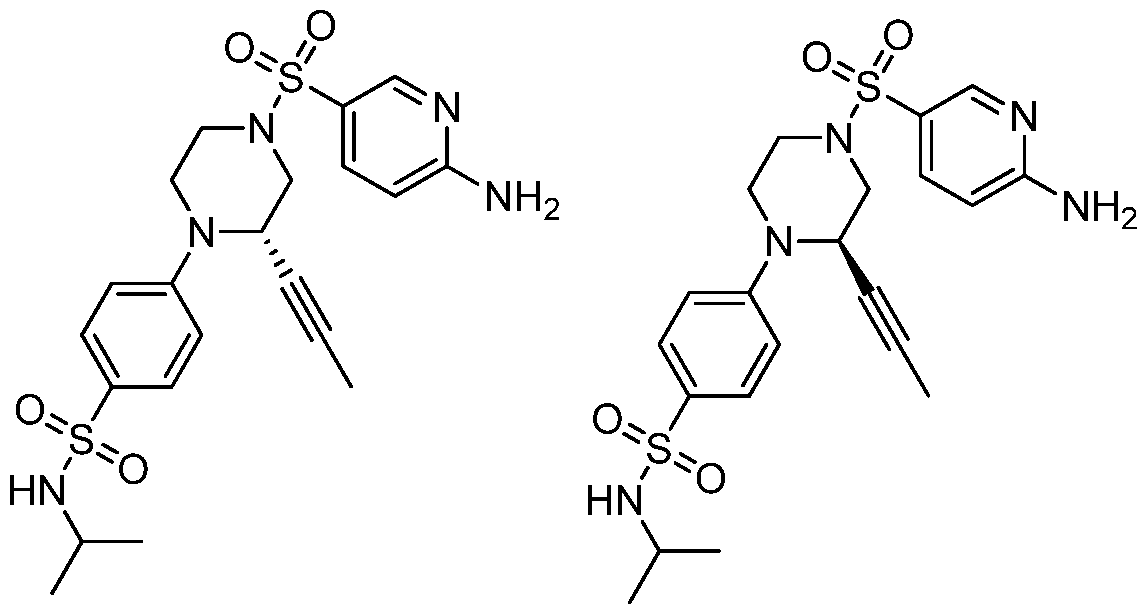
4-((2S)-4-((6-amino-3 -pyridinyl)sulfonyl)-2-( 1 -propyn- 1 -yl)- 1 -piperazinyl)-N- (l-methylethyl)benzenesulfonamide and 4-((2R)-4-((6-amino-3-
pyridinyl)sulfonyl)-2-( 1 -propyn- 1 -yl)- 1 -piperazinyl)-N-( 1 - methylethyl)benzenesulfonamide .
1H NMR (400 MHz, DMSO-d6) δ ppm 8.24 (d, J= 2.5 Hz, 1H), 7.68 - 7.57 (m, 3H), 7.31 (d, J= 7.1 Hz, 1H), 7.11 - 7.02 (m, 4H), 6.53 (d, J= 8.9 Hz, 1H), 4.92 (br s, 1H), 3.73 - 3.56 (m, 3H), 3.20 - 3.05 (m, 2H), 2.60-2.55 (m, 1H), 2.45- 2.35 (m, 1H), 1.74 (d, J= 2.2 Hz, 3H), 0.91 (d, J= 6.4 Hz, 6H). m/z (ESI, +ve ion) 478.1 (M+H)+. GK-GKRP IC50 (Binding) = 0.583 μΜ.
EXAMPLE 19: 4-(4-((6-AMINO-3-PYRIDINYL)SULFONYL)-2-(l-PROPYN- 1 - YL)- 1 -PIPERAZINYL)-N,N-DIMETHYLBENZENESULFONAMIDE

STEP 1 : 4-BROMO-N,N-DIMETHYLBENZENESULFONAMIDE In a 100-mL round-bottomed flask, 4-bromobenzenesulfonyl chloride (1 g, 4 mmol, Sigma-Aldrich, India) was dissolved in DCM (10 mL) at rt under nitrogen atmosphere. Triethylamine (1.2 mL, 7.8 mmol, SD Fine-Chem, India) and N, N- dimethylamine hydrochloride (444 mg, 5.48 mmol, Sigma-Aldrich, India) were added sequentially to the above solution at rt under nitrogen atmosphere. The reaction mixture was stirred at rt under nitrogen atmosphere for 2 h. The reaction mixture was diluted with ice-cold water (10 mL) and DCM (20 mL) at rt. The
organic layer was separated, washed with water and brine, dried over anhydrous Na2S04 and filtered. The filtrate was concentrated under reduced pressure to give 4-bromo-N,N-dimethylbenzenesulfonamide (0.8 g) as a white solid.
STEP 2: BENZYL 4-(4-(DIMETHYLSULFAMOYL)PHENYL)-3-(l-PROPYN- 1 -YL)- 1 -PIPERAZINEC ARBOXYLATE
In a 100-mL round-bottomed flask, benzyl (3S)-3-(l-propyn-l-yl)-l- piperazinecarboxylate (273 mg, 1.15 mmol, Intermediate E, Step 3) was dissolved in toluene (10 mL) at rt. The solution was degassed by purging with argon gas at rt for 30 min. BINAP (21 mg, 0.03 mmol, Sigma-Aldrich, India), Pd(OAc)2 (3 mg, 0.001 mmol, Sigma-Aldrich, India) and sodium tert-butoxide (230 mg, 2.3 mmol, Spectrochem, India) were added sequentially to the above solution at rt under argon atmosphere. The resulting mixture was homogenized by stirring at rt for 30 min and then treated with a solution of 4-bromo-N,N- dimethylbenzenesulfonamide (300 mg, 1.15 mmol) in degassed toluene (2 mL) at rt under argon atmosphere. The resulting reaction mixture was stirred overnight (12 h) at 80 °C. The reaction mixture was cooled to rt and filtered through a diatomaceous earth pad. The filtrate was diluted with cold water (30 mL) and ethyl acetate (30 mL). The organic layer was separated, washed with water and brine, dried over anhydrous Na2S04 and filtered. The filtrate was concentrated under reduced pressure and the residue obtained was purified by silica gel (60 to 120 mesh) column chromatography (eluent, 20% EtOAc- hexanes) to give benzyl 4-(4-(dimethylsulfamoyl)phenyl)-3-(l-propyn-l-yl)-l- piperazinecarboxylate (200 mg) as a white solid.
STEP 3: N,N-DIMETHYL-4-(2-(l-PROPYN-l-YL)-l- PIPERAZINYL)BENZENESULFONAMIDE
In a 25 -mL round-bottomed flask, benzyl 4-(4- (dimethylsulfamoyl)phenyl)-3 -( 1 -propyn- 1 -yl)- 1 -piperazinecarboxylate (200 mg,
0.45 mmol) was dissolved carefully in TFA (5 mL, Sigma-Aldrich, India) at 0 °C. Triflic acid (0.25 mL, 0.9 mmol, Sigma-Aldrich, India) was added to the above solution at the same temperature under nitrogen atmosphere. The resulting reaction mixture was gradually warmed to rt and stirred at rt for 10 min.
Additional triflic acid (0.25 mL, 0.9 mmol, Sigma-Aldrich, India) was added to the above reaction mixture and stirred at rt for another 15 min. The reaction mixture was neutralized with saturated NaHC03 solution and diluted with EtOAc (20 mL). The organic layer was separated, washed with water and brine, dried over anhydrous Na2S04 and filtered. The filtrate was concentrated under reduced pressure to give N,N-dimethyl-4-(2-(l-propyn-l-yl)-l- piperazinyl)benzenesulfonamide (250 mg) as a pale brown color solid, which was carried forward without further purification.
STEP 4: TERT-BUTYL (5-((4-(4-(DIMETHYLSULFAMOYL)PHENYL)-3-(l- PPvOPYN- 1 -YL)- 1 -PIPERAZINYL)SULFONYL)-2- PYRIDINYL)CAPvBAMATE
In a 25 -mL round-bottomed flask, N,N-dimethyl-4-(2-(l-propyn-l-yl)-l- piperazinyl)benzenesulfonamide (250 mg, 0.81 mmol) was dissolved in DCM (10 mL) at rt under nitrogen atmosphere. Triethylamine (0.3 mL, 2 mmol, SD Fine-Chem, India) and tert-butyl (5-(chlorosulfonyl)-2-pyridinyl)carbamate (240 mg, 0.81 mmol, Intermediate A) were added sequentially to the above solution at rt under nitrogen atmosphere. The resulting reaction mixture was stirred at rt under nitrogen atmosphere for 1 h. The reaction mixture was diluted with water (30 mL) and DCM (30 mL). The organic layer was separated, washed with water and brine, dried over anhydrous Na2S04 and filtered. The filtrate was
concentrated under reduced pressure and the residue obtained was purified by silica gel (60 to 120 mesh) column chromatography (eluent 25% EtOAc-hexanes) to give tert-butyl (5-((4-(4-(dimethylsulfamoyl)phenyl)-3-(l-propyn-l-yl)-l- piperazinyl)sulfonyl)-2-pyridinyl)carbamate (150 mg) as a white solid.
STEP 5: 4-(4-((6-AMINO-3-PYRIDINYL)SULFONYL)-2-(l-PROPYN-l-YL)- l-PIPERAZINYL)-N,N-DIMETHYLBENZENESULFONAMIDE
In a 2-mL round-bottomed flask, tert-butyl (5-((4-(4- (dimethylsulfamoyl)phenyl)-3 -( 1 -propyn- 1 -yl)- 1 -piperazinyl)sulfonyl)-2- pyridinyl)carbamate (150 mg, 0.26 mmol) was dissolved in DCM (5 mL) and TFA (2 mL, Spectrochem, India) was added at 0 °C. The reaction mixture was gradually warmed to rt and stirred at rt for 1 h. The reaction mixture was neutralized with saturated NaHCOs solution and diluted with ethyl acetate (20 mL). The organic layer was separated, washed with water and brine, dried over anhydrous Na2S04 and filtered. The filtrate was concentrated under reduced pressure. The residue obtained was purified by preparative TLC (eluent, 50% EtOAc-hexanes, Sigma-Aldrich, India) to give 4-(4-((6-amino-3- pyridinyl)sulfonyl)-2-( 1 -propyn- 1 -yl)- 1 -piperazinyl)-N,N- dimethylbenzenesulfonamide (50 mg) as a white solid that was a mixture of two enantiomers.

4-((2R)-4-((6-amino-3-pyridinyl)sulfonyl)-2-( 1 -propyn- 1 -yl)- 1 -piperazinyl)-N,N- dimethylbenzenesulfonamide and 4-((2S)-4-((6-amino-3-pyridinyl)sulfonyl)-2- ( 1 -propyn- 1 -yl)- 1 -piperazinyl)-N,N-dimethylbenzenesulfonamide.
1H NMR (400 MHz, DMSO-d6) δ ppm 8.24 (d, J= 2.5 Hz, 1H), 7.64 (dd, J = 8.8, 2.4 Hz, 1H), 7.57 (d, J= 9.2 Hz, 2H), 7.11 (d, J= 8.9 Hz, 2H), 7.03 (s, 2H), 6.53 (d, J= 9.0 Hz, 1H), 4.94 (s, 1H), 3.79-3.73 (m, 1H), 3.63 (br t, J= 10.8 Hz,
2H), 3.19-3.13 (m, 2H), 2.52 (s, 6H), 2.43 - 2.30 (m, 1H), 1.77 (d, J = 2.2 Hz, 3H). m/z (ESI, +ve ion) 464.1 (M+H)+. GK-GKRP IC50 (Binding) = 0.974 μΜ.
EXAMPLE 20: 2-((2S)-4-((6-AMINO-3-PYRIDINYL)SULFONYL)-2-(l-
PROPYN-l-YL)-l-PIPERAZINYL)-N-METHYL-l,3-THIAZOLE-5-
SULFONAMIDE

A suspension of benzyl (3S)-3-(l-propyn-l-yl)-l-piperazinecarboxylate (2.5 g, 9.7 mmol, Intermediate E), 2-chloro-l,3-thiazole (1.26 mL, 14.5 mmol, Sigma- Aldrich, St. Louis, MO), RuPhos palladaycle (0.198 g, 0.242 mmol, Strem Chemicals, Newburyport MA), RuPhos (0.113 g, 0.242 mmol, Strem Chemicals, Newburyport MA), sodium tert-butoxide (1.40 g, 14.5 mmol, Sigma-Aldrich, St.
Louis, MO) in toluene (12 mL) was sparged with argon for 2 minutes then heated to 100 °C for 2.5 h. The resulting mixture was then partitioned between EtOAc (75 mL) and 1 M K2HP04 (50 mL). The organic layer was then dried over MgS04, concentrated under reduced pressure, and purified by silica gel chromatography (120 g, 10 to 40% EtOAc in hexanes) to afford benzyl (3S)-3- (l-propyn-l-yl)-4-(l,3-thiazol-2-yl)-l-piperazinecarboxylate (1.54 g) as a colorless oil.
STEP 2: 2-((2S)-4-((BENZYLOXY)CARBONYL)-2-(l-PROPYN-l-YL)-l- PIPERAZINYL)-1 ,3-THIAZOLE-5-SULFONIC ACID
To a stirring solution of benzyl (3S)-3-(l-propyn-l-yl)-4-(l,3-thiazol-2- yl)-l-piperazinecarboxylate (750 mg, 2.20 mmol) in THF (5 mL) was added trimethylsilyl chlorosulfonate (1040 μί, 5.49 mmol, Sigma- Aldrich, St. Louis, MO). The reaction mixture was then heated to 55 °C for 18 h to produce a precipitate. The reaction was then diluted with diethyl ether (20 mL) and the precipitate was collected by filtration to afford 2-((2S)-4-((benzyloxy)carbonyl)- 2-(l-propyn-l-yl)-l-piperazinyl)-l, 3 -thiazole-5 -sulfonic acid (810 mg) as a grey solid. STEP 3: 2-((2S)-4-((BENZYLOXY)CARBONYL)-2-(l-PROPYN-l-YL)-l- PIPERAZINYL)-! ,3-THIAZOLE-5-SULFONYL CHLORIDE
To a stirring solution of 2-((2S)-4-((benzyloxy)carbonyl)-2-(l-propyn-l- yl)-l-piperazinyl)-l,3-thiazole-5-sulfonic acid (550 mg, 1.31 mmol) and DIEA (251 μΐ,, 1.440 mmol) in DMF (2.5 mL) at 20 °C was added thionyl chloride (190 μΐ, 2.61 mmol, Sigma-Aldrich, St. Louis, MO). The solution formed was then stirred at 20 °C for 5 min and then heated to 37 °C for 45 min. The resulting mixture was then partitioned between EtOAc (15 mL) and 1 M KH2P04 (40 mL). The separated aqueous layer was further extracted with EtOAc (10 mL). The combined organic layers were then dried over MgS04, filtered and concentrated
under reduced pressure, then purified by silica gel chromatography (0 to 40% EtOAc in hexanes) to afford 2-((2S)-4-((benzyloxy)carbonyl)-2-(l-propyn-l-yl)-
1- piperazinyl)-l,3-thiazole-5-sulfonyl chloride (220 mg) as a colorless film. STEP 4: benzyl (3S)-4-(5-(methylsulfamoyl)-l,3-thiazol-2-yl)-3-(l-propyn-l-yl)- 1 -piperazinecarboxylate
A solution of methanamine (2 M in THF, 250 μί, 0.500 mmol, Sigma- Aldrich, St. Louis, MO) was added to 2-((2S)-4-((benzyloxy)carbonyl)-2-(l- propyn-l-yl)-l-piperazinyl)-l,3-thiazole-5-sulfonyl chloride (220 mg, 0.500 mmol). A suspension was formed and the solvents were then removed under reduced pressure to afford benzyl (3S)-4-(5-(methylsulfamoyl)-l,3-thiazol-2-yl)-
3 - (l-propyn-l-yl)-l -piperazinecarboxylate as a purple film.
STEP 5: TERT-BUTYL (4-(((3S)-4-(5-(METHYLSULFAMOYL)-l,3- THIAZOL-2-YL)-3-(l -PROPYN- 1 -YL)- 1 - PIPERAZINYL)SULFONYL)PHENYL)CARBAMATE
To a stirring solution of benzyl (3S)-4-(5-(methylsulfamoyl)-l,3-thiazol-
2- yl)-3-(l-propyn-l-yl)-l -piperazinecarboxylate in TFA (4 mL) at 20 °C under nitrogen was added trifluoromethanesulfonic acid (177 μί, 2.00 mmol, Sigma- Aldrich, St. Louis, MO). The suspension was stirred at 20 °C for 30 min. The solvents were then removed under reduced pressure and the residue was dissolved in CH2C12 with DIEA (1050 μί, 5.99 mmol). To this solution at 0 °C was added tert-butyl (5-(chlorosulfonyl)-2-pyridinyl)carbamate (219 mg, 0.749 mmol, Intermediate A). The reaction was then partitioned between EtOAc (15 mL) and 1 M KH2P04 (20 mL). The organic was dried over MgS04, filtered and concentrated under reduced pressure, then purified by silica gel chromatography (40 g) eluting products with 20 to 80% EtO Ac/Hex to afford tert-butyl (4-(((3S)-
4- (5-(methylsulfamoyl)- 1 ,3-thiazol-2-yl)-3-(l -propyn- 1 -yl)- 1 - piperazinyl)sulfonyl)phenyl)carbamate (133 mg) as a white solid.
STEP 6: 2-((2S)-4-((6-AMINO-3-PYRIDINYL)SULFONYL)-2-(l-PROPYN-l- YL)- 1 -PIPERAZINYL)-N-METHYL- 1 ,3-THIAZOLE-5-SULFONAMIDE
To a stirring suspension of tert-butyl (4-(((3S)-4-(5-(methylsulfamoyl)- 1 ,3 -thiazol-2-yl)-3 -( 1 -propyn- 1 -yl)- 1 -piperazinyl)sulfonyl)phenyl)carbamate (130 mg, 0.234 mmol) in CH2C12 (4 mL) was added TFA (4 mL). The resulting solution was stirred for 1 h at 20 °C. The solvents were then removed under reduced pressure, and the residue was partitioned between 9: 1 CHC13/IPA (20 mL) and 1 M K2HP04 (20 mL). The organic layer was concentrated and purified by silica gel chromatography (40 g, 2 to 8% of 2 M NH3 in MeOH/CH2Cl2) to afford 2-((2S)-4-((6-amino-3-pyridinyl)sulfonyl)-2-(l -propyn- 1 -yl)- 1 - piperazinyl)-N-methyl-l,3-thiazole-5-sulfonamide (94 mg) as a white solid.
1H NMR (400 MHz, DMSO-d6) δ ppm 1.83 (d, J=2.15 Hz, 3 H), 2.49 (m, 4 H), 2.63 (dd, J=11.64, 3.42 Hz, 1 H), 3.33 - 3.45 (m, 1 H), 3.58 - 3.73 (m, 2 H), 3.80 (d, J=12.52 Hz, 1 H), 5.05 (br. s., 1 H), 6.55 (d, J=9.00 Hz, 1 H), 7.05 (br. s., 2 H), 7.57 - 7.68 (m, 3 H), 8.24 (d, J=2.35 Hz, 1 H). m/z (ESI, +ve ion) 457.0 (M+H)+. GK-GKRP IC50 (Binding) = 0.856 μΜ.
EXAMPLE 21 : 2-((2S)-4-((6-AMINO-3-PYRIDINYL)SULFONYL)-2-(l- PROPYN- 1 -YL)- 1 -PIPERAZINYL)-N-METHOXY-N-METHYL- 1 ,3- THIAZOLE-5-CARBOXAMIDE

STEP 1 : 2-CHLORO-N-METHOXY-N-METHYL-l,3-THIAZOLE-5- CARBOXAMIDE; 2-BROMO-N-METHOXY-N-METHYL-l ,3-THIAZOLE-5- CARBOXAMIDE
To a stirring suspension of a mixture of 2-chlorothiazole-5-carboxylic acid and 2-bromothiazole-5-carboxylic acid (4.1 g, Sigma- Aldrich, St. Louis, MO) and oxalyl chloride (8.8 mL, 99 mmol, Sigma-Aldrich, St. Louis, MO) in CH2CI2 (30 mL) at 0 °C was added a drop of DMF. The reaction warmed to 20 °C over 18 h period. The solvents were then removed under reduced pressure and the residue was re-dissolved in CH2CI2 (30 mL). To this was added N,N- diisopropylethylamine (10.3 mL, 59.1 mmol) and the reaction mixture was chilled to 5 °C. To the reaction mixture was added Ν,Ο-dimethylhydroxylamine hydrochloride (2.88 g, 29.6 mmol, Sigma-Aldrich, St. Louis, MO) portionwise over 2 min. The reaction mixture was stirred for 15 min then washed with 10% citric acid (50 mL) and 1 M NaOH (30 mL). The organic layer was then concentrated under reduced pressure and purified by silica gel chromatography (120 g , 0 to 40% EtOAc in hexanes) to afford a mixture of 2-chloro-N-methoxy- N-methyl-l,3-thiazole-5-carboxamide and 2-bromo-N-methoxy-N-methyl-l,3- thiazole-5-carboxamide (3.54 g) as a yellow solid.
STEP 2: BENZYL (3S)-4-(5-(METHOXY(METHYL)CARBAMOYL)-l,3- THIAZOL-2-YL)-3-(l-PROPYN-l-YL)-l-PIPERAZINECARBOXYLATE
A suspension of benzyl (3S)-3-(l-propyn-l-yl)-l-piperazinecarboxylate (1.0 g, 3.87 mmol, Intermediate E), a mixture of 2-chloro-N-methoxy-N-methyl- l,3-thiazole-5-carboxamide and 2-bromo-N-methoxy-N -methyl- 1,3 -thiazole-5- carboxamide (1.20 g, 5.81 mmol), DIEA (0.744 mL, 4.26 mmol) in DMF (5 mL) was heated to 105 °C. The reaction mixture was heated at 105 °C for a total of 28 h. The reaction mixture was then partitioned between EtOAc (50 mL) and 1 M KH2PO4 (80 mL). The organic layer was dried over MgS04, filtered and concentrated under reduced pressure, then purified by silica gel chromatography (80 g) eluting products with 0 to 30% MeCN/CH2Cl2 to afford benzyl (3S)-4-(5- (methoxy(methyl)carbamoyl)- 1 ,3 -thiazol-2-yl)-3 -( 1 -propyn- 1 -yl)- 1 - piperazinecarboxylate (1.46 g, 3.41 mmol) as an amber oil. STEP 3: TERT-BUTYL (5-(((3S)-4-(5-
(METHOXY(METHYL)C ARB AMO YL)- 1 ,3 -THIAZOL-2- YL)-3 -( 1 -PROP YN- 1 -YL)- 1 -PIPERAZINYL)SULFONYL)-2-PYRIDINYL)CARBAMATE
To a stirring solution of benzyl (3S)-4-(5-(methoxy(methyl)carbamoyl)- l,3-thiazol-2-yl)-3-(l-propyn-l-yl)-l-piperazinecarboxylate (217 mg, 0.499 mmol) in TFA (4 mL) at 20 °C under nitrogen was added
trifluoromethanesulfonic acid (177 μί, 2.00 mmol, Sigma-Aldrich, St. Louis, MO). The suspension was stirred at 20 °C for 30 min. The solvents were then removed under reduced pressure and the residue was dissolved in CH2C12 with DIEA (1050 μΐ,, 5.99 mmol, Sigma-Aldrich, St. Louis, MO). To this solution at 0 °C was added tert-butyl (5-(chlorosulfonyl)-2-pyridinyl)carbamate (219 mg, 0.749 mmol, Intermediate A). The reaction mixture was then partitioned between EtOAc (15 mL) and 1 M KH2P04 (20 mL). The organic layer was dried over MgS04, filtered and concentrated under reduced pressure, then purified by silica gel chromatography (40 g, 20 to 80% EtOAc in hexanes) to afford tert-
butyl (5-(((3S)-4-(5-(methoxy(methyl)carbamoyl)-l,3-thiazol-2-yl)-3-(l-propyn- l-yl)-l-piperazinyl)sulfonyl)-2-pyridinyl)carbamate (133 mg) as a white solid.
STEP 4: 2-((2S)-4-((6-AMINO-3-PYRIDINYL)SULFONYL)-2-(l-PROPYN-l- YL)- 1 -PIPERAZINYL)-N-METHOXY-N-METHYL- 1 ,3-THIAZOLE-5- CARBOXAMIDE
A solution of tert-butyl (5-(((3S)-4-(5-(methoxy(methyl)carbamoyl)-l,3- thiazol-2-yl)-3 -( 1 -propyn- 1 -yl)- 1 -piperazinyl)sulfonyl)-2-pyridinyl)carbamate (130 mg, 0.234 mmol) in CH2C12 (2 mL) was added TFA (2 mL). After 45 min the solvents were removed under reduced pressure. The residue was partitioned between 9: 1 CHC13/IPA (10 mL) and 1 M K2HP04 (5 mL). The organic was then dried over MgS04, filtered and concentrated under reduced pressure to afford desired product as a colorless film. The film was then dissolved in 1 : 1 MeCN/water (2 mL), frozen, and lyophilized to afford 2-((2S)-4-((6-amino-3- pyridinyl)sulfonyl)-2-( 1 -propyn- 1 -yl)- 1 -piperazinyl)-N-methoxy-N-methyl- 1,3- thiazole-5-carboxamide (27.7 mg) as white fluffy solid.
1H NMR (400 MHz, DMSO-d6) δ ppm 1.80 (d, J=2.15 Hz, 3 H), 2.45 (d, J=3.33 Hz, 1 H), 2.60 (d, J=8.22 Hz, 1 H),3.21 (s, 3 H), 3.29 - 3.41 (m, 1 H), 3.58 - 3.74 (m, 5 H), 3.80 (br. s., 1 H), 5.07 (br. s., 1 H), 6.53 (d, J=8.80 Hz, 1 H), 7.04 (br. s., 2 H), 7.62 (dd, J=9.00, 2.54 Hz, 1 H), 7.89 (s, 1 H), 8.23 (d, J=2.15 Hz, 1 H). m/z (ESI, +ve ion) 451.0 (M+H)+. GK-GKRP IC50 (Binding) = 0.897 μΜ.
EXAMPLE 22: 5-(((3S)-4-(5-(l-METHYLETHENYL)-l,3-THIAZOL-2-YL)-3- (1 -PROPYN- 1 - YL)- 1 -PIPERAZINYL)SULFONYL)-2-PYRIDIN AMINE

STEP 3 MeMgBr

STEP 1 : BENZYL (3S)-4-(5-(METHOXY(METHYL)CARBAMOYL)-l,3- THIAZOL-2-YL)-3-(l-PROPYN-l-YL)-l-PIPERAZINECARBOXYLATE A suspension of benzyl (3S)-3-(l-propyn-l-yl)-l-piperazinecarboxylate
(1.0 g, 3.9 mmol, Intermediate E), a mixture of 2-chloro-N-methoxy-N-methyl- 1 ,3-thiazole-5-carboxamide and 2-bromo-N-methoxy-N -methyl- 1 ,3-thiazole-5- carboxamide (1.20 g, 5.81 mmol, Example 21, Step 1), DIEA (0.744 mL, 4.26 mmol) in DMF (5 mL) was heated to 105 °C to create a solution. The reaction was heated at 105 °C for a total of 28 h. The reaction was then partitioned between EtOAc (50 mL) and 1 M KH2PO4 (80 mL). The organic layer was then dried over MgS04, concentrated under reduced pressure, then purified by silica gel chromatography (80 g, 0 to 30% MeCN/CH2Cl2) to afford benzyl (3S)-4-(5- (methoxy(methyl)carbamoyl)- 1 ,3 -thiazol-2-yl)-3 -( 1 -propyn- 1 -yl)- 1 - piperazinecarboxylate (1.46 g) as an amber oil.
STEP 2: BENZYL (3 S)-4-(5- ACETYL- 1,3 -THIAZOL-2-YL)-3-(l -PROPYN- 1- YL)- 1 -PIPERAZINECARBOXYLATE To a stirring solution of benzyl (3S)-4-(5-(methoxy(methyl)carbamoyl)- l,3-thiazol-2-yl)-3-(l-propyn-l-yl)-l-piperazinecarboxylate (1.4 g, 3.3 mmol) in THF (15 mL) at 0 °C under nitrogen was added methylmagnesium bromide (3.0
M solution in diethyl ether, 3.27 mL, 9.80 mmol, Sigma-Aldrich, St. Louis, MO) dropwise. The reaction mixture was then stirred for 45 min at 0 °C then slowly quenched with saturated NH4C1 (50 mL). The reaction was then extracted with EtOAc (50 mL). The separated organic layer was then dried over MgS04, filtered and concentrated under reduced pressure, then purified by silica gel chromatography (80 g, 20 to 60% of EtOAc in hexanes) to afford benzyl (3S)-4- (5-acetyl-l,3-thiazol-2-yl)-3-(l-propyn-l-yl)-l-piperazinecarboxylate (0.73 g) as a colorless film.
STEP 3: BENZYL (3 S)-4-(5-(l -HYDROXY- 1 -METHYLETHYL)- 1,3- THIAZOL-2-YL)-3-(l-PROPYN-l-YL)-l-PIPERAZINECARBOXYLATE
To a stirring solution of benzyl (3S)-4-(5-acetyl-l,3-thiazol-2-yl)-3-(l- propyn-l-yl)-l-piperazinecarboxylate (85 mg, 0.222 mmol) in THF (1 mL) at 0 °C under nitrogen was added methylmagnesium bromide (3.0 M solution in diethyl ether, 148 μί, 0.443 mmol, Sigma-Aldrich, St. Louis, MO). After 5 min the reaction was quenched with saturated NH4C1 (5 mL) and diluted with EtOAc (10 mL). The separated organic layer was dried over MgS04, filtered and concentrated under reduced pressure. The crude product was purified by silica gel chromatography (20 to 60% of EtOAc in hexanes) to afford benzyl (3S)-4-(5- (1 -hydroxy- 1 -methylethyl)- 1 ,3 -thiazol-2-yl)-3 -( 1 -propyn- 1 -yl)- 1 - piperazinecarboxylate (32 mg) as a colorless film.
STEP 4: TERT-BUTYL (5-(((3S)-4-(5-(l-METHYLETHENYL)-l,3- THIAZOL-2- YL)-3 -( 1 -PROPYN- 1 - YL)- 1 -PIPERAZINYL)SULFONYL)-2- PYRIDINYL)CARBAMATE
To a stirring solution of benzyl (3 S)-4-(5-(l -hydroxy- 1 -methylethyl)- 1,3 - thiazol-2-yl)-3-(l -propyn- l-yl)-l -piperazinecarboxylate (30 mg, 0.075 mmol) in TFA (1 mL) at 20 °C was added trifluoromethanesulfonic acid (13.3 μί, 0.150 mmol, Sigma-Aldrich, St. Louis, MO). After 2 min, the solvents were removed
under reduced pressure and the residue was dissolved in CH2CI2 (5 mL) followed by DIEA (131 μί, 0.751 mmol). To this solution at 20 °C was added tert-butyl (5-(chlorosulfonyl)-2-pyridinyl)carbamate (33.0 mg, 0.113 mmol, Intermediate A). After 10 min, the reaction was quenched with 1 M KH2PO4 (10 mL). The organic was then dried over MgS04, filtered and concentrated under reduced pressure. The crude product was purified by silica gel chromatography (4 g, 0- 30% of EtO Ac/in hexanes) to afford tert-butyl (5-(((3S)-4-(5-(l-methylethenyl)- 1 ,3-thiazol-2-yl)-3-(l -propyn- 1 -yl)- 1 -piperazinyl)sulfonyl)-2- pyridinyl)carbamate (23 mg) as a colorless film. STEP 5: 5-(((3S)-4-(5-(l-METHYLETHENYL)-l,3-THIAZOL-2-YL)-3-(l- PROPYN- 1 -YL)- 1 -PIPERAZINYL)SULFONYL)-2-PYRIDIN AMINE
A solution of tert-butyl (5-(((3S)-4-(5-(l-methylethenyl)-l,3-thiazol-2- yl)-3 -( 1 -propyn- 1 -yl)- 1 -piperazinyl)sulfonyl)-2-pyridinyl)carbamate (23 mg, 0.046 mmol) in CH2C12 (5 mL) and TFA (5 mL) was stirred for 2 h at 20 °C. The solvents were removed under reduced pressure and the residue was partitioned between 9: 1 CHCI3/IPA (10 mL) and 1 M K2HP04 (10 mL). The organic layer was then dried over MgS04, filtered and concentrated under reduced pressure. The residue was then dissolved in MeCN (1.2 mL) and diluted with water (1.2 mL). The solution was frozen and lyophilized to afford 5-(((3S)-4-(5-(l- methylethenyl)- 1 ,3 -thiazol-2-yl)-3 -( 1 -propyn- 1 -yl)- 1 -piperazinyl)sulfonyl)-2- pyridinamine (19 mg) as a fluffy white solid.
1H NMR (400 MHz, DMSO-d6) δ ppm 1.79 (d, J=2.15 Hz, 3 H), 2.01 (s, 3 H), 2.30 - 2.46 (m, 1 H), 2.53 - 2.61 (m, 1 H), 3.21 - 3.34 (m, 1 H), 3.54 - 3.78 (m, 3 H), 4.85 (s, 1 H), 4.95 (s, 2 H), 6.53 (d, J=9.00 Hz, 1 H), 7.02 (br. s., 2 H), 7.19 (s, 1 H), 7.57 - 7.65 (m, 1 H), 8.22 (d, J=2.35 Hz, 1 H). m/z (ESI, +ve ion) 404.0 (M+H)+. GK-GKRP IC50 (Binding) = 0.961 μΜ.
EXAMPLE 23: 5-(((3S)-3-(l-PROPYN-l-YL)-4-(4-(l,2,2,2-TETRAFLUORO- 1 -(TRIFLUOROMETHYL)ETHYL)PHENYL)- 1 - PIPERAZINYL)SULFONYL)-2-PYRIDIN AMINE

STEP 1 : 2-(4-((2S)-4-BENZYL-2-(l-PROPYN-l-YL)-l- PIPERAZINYL)PHENYL)-1 , 1 ,1 ,3,3,3-HEXAFLUORO-2-PROPANOL A 20-mL vial was charged with (3S)-l-benzyl-3-(l-propyn-l- yl)piperazine (2.143 g, 10 mmol, Intermediate B), 2-(4-bromophenyl)- 1,1,1, 3,3, 3-hexafluoropropan-2-ol (3.09 g, 11.5 mmol, Bioorg. Med. Chem. Lett. 2002, 12, 3009), sodium 2-methylpropan-2-olate (1.92 g, 20.0 mmol, Sigma- Aldrich, St. Louis, MO), dioxane (5 mL), RuPhos palladacycle (0.364 g, 0.500 mmol, Strem Chemical Inc., Newburyport, MA), and RuPhos (0.233 g, 0.500 mmol, Strem Chemical Inc., Newburyport, MA). The vial was sealed and heated at 100 °C for 1 h. The mixture was allowed to cool to rt, and diluted with water and extracted with EtOAc. The combined organic phases were dried over sodium sulfate, filtered and concentrated under a vacuum to give a solid that was purified by silica gel column chromatography (0 to 40% EtOAc in hexanes) to afford 2-(4-((2S)-4-benzyl-2-( 1 -propyn- 1 -yl)- 1 -piperazinyl)phenyl)- 1,1,1,3,3,3- hexafluoro-2-propanol (1.75 g) as a slightly yellow oil.
STEP 2: l,l,l,3,3,3-HEXAFLUORO-2-(4-((2S)-2-(l-PROPYN-l-YL)-l- PIPERAZINYL)PHENYL)-2-PROPANOL
A 250 mL round-bottomed flask was charged with 2-(4-((2S)-4-benzyl-2- ( 1 -propyn- 1 -yl)- 1 -piperazinyl)phenyl)- 1,1,1 ,3 ,3 ,3-hexafluoro-2-propanol (1.75 g, 4.35 mmol), potassium carbonate (2.40 g, 17.4 mmol, Sigma-Aldrich, St. Louis, MO), CH2CI2 (25 mL), and 1-chloroethyl chlorocarbonate (1.88 mL, 17.4 mmol, Sigma-Aldrich, St. Louis, MO). After 30 min at rt, the reaction was filtered and the filtrate was concentrated. To the resulting oil was added MeOH (25 mL). This mixture was heated at 75 °C for 1.5 h then concentrated. The residue was triturated with diethyl ether to give l,l,l,3,3,3-hexafluoro-2-(4-((2S)-2-(l- propyn-l-yl)-l-piperazinyl)phenyl)-2-propanol (1.44 g) as a white solid.
STEP 3: TERT-BUTYL (5-(((3S)-3-(l-PROPYN-l-YL)-4-(4-(2,2,2- TRIFLUORO- 1 -HYDROXY- 1 -(TRIFLUOROMETHYL)ETHYL)PHENYL)- 1 - PIPERAZINYL)SULFONYL)-2-PYRIDINYL)CARBAMATE
A 250-mL round-bottomed flask was charged with 1,1,1,3,3,3- hexaf uoro-2-(4-((2S)-2-( 1 -propyn- 1 -yl)- 1 -piperazinyl)phenyl)-2-propanol (18.9 g, 51.6 mmol) and DCM (150 mL) and cooled to 0 °C. TEA was added (14.4 mL, 103 mmol, Sigma-Aldrich, St. Louis, MO) followed by tert-butyl (5-
(chlorosulfonyl)pyridin-2-yl)carbamate (15.9 g, 54.2 mmol, Intermediate A) portionwise. After 10 min, the reaction mixture was diluted with water (100 mL) and the organic layer was separated, dried over Na2S04, filtered and concentrated under a vacuum to give a solid that was purified by silica gel column
chromatography (0 to 50% EtO Ac in hexanes) to afford tert-butyl (5 -(((3 S)-3 -( 1 - propyn- 1 -yl)-4-(4-(2,2,2-trifluoro- 1 -hydroxy- 1 -(trifluoromethyl)ethyl)phenyl)- 1 - piperazinyl)sulfonyl)-2-pyridinyl)carbamate (19.9 g) as a tan foam.
STEP 4: 5-(((3S)-3-(l-PROPYN-l-YL)-4-(4-(l,2,2,2-TETRAFLUORO-l-
(TRIFLUOROMETHYL)ETHYL)PHENYL)- 1 -PIPERAZINYL)SULFONYL)- 2-PYRIDIN AMINE
A 500-mL round-bottomed flask was charged with tert-butyl (5-(((3S)-3- (1 -propyn- 1 -yl)-4-(4-(2,2,2-trifluoro- 1 -hydroxy- 1 -
(trifluoromethyl)ethyl)phenyl)-l-piperazinyl)sulfonyl)-2-pyridinyl)carbamate (19.7 g, 31.6 mmol) and DCM (300 mL) and cooled to 0 °C.
(Diethylamino)sulfur trifluoride (4.18 mL, 31.6 mmol, Matrix Scientific, Columbia, SC) was added, and after 10 min, the reaction was diluted with water (250 mL) and DCM (200 mL). The organic layer was separated, dried over
Na2S04, filtered and concentrated under a vacuum. The resultant foam was taken up in DCM (200 mL) and cooled to 0 °C. TFA (100 mL, 1298 mmol) was added and the reaction mixture was warmed to rt for 1.5 h. The reaction was then re- cooled to 0 °C and solid sodium bicarbonate was added slowly until gas evolution ceased. The mixture was diluted with water (250 mL) and DCM (300 mL) and the organic layer was separated, dried over Na2S04, filtered and concentrated under a vacuum to give a solid that was purified by silica gel column chromatography (0 to 100% EtOAc in hexanes) to afford 5-(((3S)-3-(l- propyn- 1 -yl)-4-(4-( 1 ,2,2,2-tetrafluoro- 1 -(trifluoromethyl)ethyl)phenyl)- 1 - piperazinyl)sulfonyl)-2-pyridinamine (11.05 g) as a single enantiomer.
1H NMR (400MHz, CD3OD) δ ppm 8.31 (d, J= 2.2 Hz, 1 H), 7.74 (dd, J= 2.4, 8.9 Hz, 1 H), 7.47 (d, J = 8.8 Hz, 2 H), 7.12 (d, J = 9.0 Hz, 2 H), 6.63 (d, J= 8.8 Hz, 1 H), 4.76-4.70 (m, 1 H), 3.76 (dd, J= 1.9, 11.2 Hz, 2 H), 3.66 - 3.52 (m, 1 H), 3.29 - 3.20 (m, 1 H), 2.79 - 2.72 (m, 1 H), 2.66 - 2.53 (m, 1 H), 1.76 (d, J = 2.2 Hz, 3 H). m/z (ESI, +ve ion) 525.2 (M+H)+. GK-GKRP IC50 (Binding) = 0.187 μΜ.
EXAMPLE 24: 2-(4-((2S)-4-((6-AMINO-3-PYRIDINYL)SULFONYL)-2-(l- PROP YN- 1 -YL)- 1 -PIPERAZINYL)PHENYL)- 1,1,1 -TRIFLUORO-4-PENT YN- 2-OL


STEP 1 : TERT-BUTYL(5-(((3S)-4-(4-(l-HYDROXY-l-
(TRIFLUOROMETHYL)-3 -BUTYN- 1 - YL)PHENYL)-3 -( 1 -PROP YN- 1 - YL)- 1 - PIPERAZINYL)SULFONYL)-2-PYRIDINYL)CARBAMATE
To a flame-dry 50 mL 3 -neck round-bottomed flask was added ethynyltrimethylsilane (0.075 mL, 0.530 mmol, Sigma-Aldrich, St. Louis, MO) and THF (8 mL). The reaction mixtue was cooled to -78 °C and butyllithium solution (2.5 M in hexanes, 0.220 mL, 0.530 mmol, Sigma-Aldrich, St. Louis, MO) was added at that temperature. The resulting mixture was stirred for 30 min at -78 °C. Tert-butyl (5-(((3S)-3-(l-propyn-l-yl)-4-(4-(2-(trifluoromethyl)-2- oxiranyl)phenyl)-l-piperazinyl)sulfonyl)-2-pyridinyl)carbamate (0.150 g, 0.265 mmol, Intermediate D) in THF (5 mL) was added dropwise via an addition funnel. After the addition was complete, the reaction mixture was stirred at -78 °C for 10 min then warmed up to rt and stirred for an additional 20 h. The reaction was quenched with sat. aq. NH4C1 (3 mL). The reaction mixture was concentrated and the residue was dissolved in MeOH (10 mL) then treated with 2 M K2CO3 (3 mL) at rt for 2 h. The resulting mixture was partitioned between
EtOAc (60 mL) and water (30 mL). The aqueous layer was extracted with EtOAc (1 x 50 mL). The combined organic layers were dried over MgS04, filtered, and concentrated. The crude product was purified by column
chromatography (40 g of silica, 10 to 40% acetone in hexanes) to obtain tert- butyl(5 -(((3 S)-4-(4-( 1 -hydroxy- 1 -(trifiuoromethyl)-3 -butyn- 1 -yl)phenyl)-3 -( 1 - propyn-l-yl)-l-piperazinyl)sulfonyl)-2-pyridinyl)carbamate (0.090 g) as an off white solid.
STEP 2: 2-(4-((2S)-4-((6-AMINO-3-PYRIDINYL)SULFONYL)-2-(l- PROP YN- 1 -YL)- 1 -PIPERAZINYL)PHENYL)- 1,1,1 -TRIFLUORO-4-PENT YN- 2-OL
To a 20-mL scintillation vial was added tert-butyl (5-(((3S)-4-(4-(l- hydroxy- 1 -(trifluoromethyl)-3 -butyn- 1 -yl)phenyl)-3 -( 1 -propyn- 1 -yl)- 1 - piperazinyl)sulfonyl)-2-pyridinyl)carbamate (0.025 g, 0.042 mmol), DCM (3.0 mL), and trifluoroacetic acid (0.030 mL, 0.42 mmol, Sigma-Aldrich, St. Louis, MO). The vial was capped and the mixture was stirred at rt for 2 h. The reaction mixture was partitioned between sat. aq. NaHCOs (15 mL) and DCM (40 mL). The aqueous layer was then extracted with DCM (2 x 30 mL) and the combined organic layers were dried over MgS04, filtered, and concentrated. The crude product was purified by column chromatography (24 g of silica, 0 to 5% MeOH in DCM) to afford 2-(4-((2S)-4-((6-amino-3-pyridinyl)sulfonyl)-2-(l -propyn- 1 - yl)-l-piperazinyl)phenyl)-l,l,l-trifluoro-4-pentyn-2-ol (0.020 g) as a mixture of two diastereomers.

(2R)-2-(4-((2S)-4-((6-amino-3-pyridinyl)sulfonyl)-2-(l -propyn-1 -yl)- 1 - piperazinyl)phenyl)- 1,1,1 -trifluoro-4-pentyn-2-ol and (2S)-2-(4-((2S)-4-((6-
amino-3 -pyridinyl)sulfonyl)-2-( 1 -propyn- 1 -yl)- 1 -piperazinyl)phenyl)- 1,1,1- trifluoro-4-pentyn-2-ol.
1H NMR (300 MHz, CDC13) δ ppm 8.50 (d, J= 2.2 Hz, 1 H), 7.80 (dd, J= 2.3, 8.8 Hz, 1 H), 7.46 (d, J= 8.8 Hz, 2 H), 7.04 - 6.87 (m, 2 H), 6.56 (d, J= 8.8 Hz, 1 H), 5.15 (s, 2 H), 4.44 (br. s., 1 H), 3.84 - 3.63 (m, 2 H), 3.47 - 3.33 (m, 2 H), 3.17 - 2.99 (m, 3 H), 2.85 (dd, J= 3.4, 11.2 Hz, 1 H), 2.79 - 2.62 (m, 1 H), 2.13 - 2.01 (m, 1 H), 1.79 (d, J= 1.9 Hz, 3 H). m/z (ESI, +ve ion) 493.1 (M+H)+. GK- GKRP IC50 (Binding) = 0.002 μΜ. EXAMPLE 25: 2-(4-((2S)-4-((6-AMINO-3-PYRIDINYL)SULFONYL)-2-(l- PROP YN- 1 - YL)- 1 -PIPERAZINYL)PHENYL)- 1,1,1 -TRIFLUORO-4-HEXYN- 2-OL

STEP 1 : TERT-BUTYL (5-(((3S)-4-(4-(l-HYDROXY-l- (TRIFLUOROMETHYL)-3 -PENTYN- 1 -YL)PHENYL)-3-( 1 -PROPYN- 1 -YL)- l-PIPERAZINYL)SULFONYL)-2-PYRIDINYL)CARBAMATE
To a flame-dried 50-mL 3 -neck round-bottomed flask was added tert- butyl(5 -(((3 S)-4-(4-( 1 -hydroxy- 1 -(trifluoromethyl)-3 -butyn- 1 -yl)phenyl)-3 -( 1 - propyn- l-yl)-l-piperazinyl)sulfonyl)-2-pyridinyl)carbamate (0.060 g, 0.10 mmol, Example 24, Step 1) and THF (5.0 mL). The reaction mixture was cooled to 0 °C and butyllithium (2.5 M in hexanes, 0.100 mL, 0.242 mmol, Sigma- Aldrich, St.
Louis, MO) was added. The resulting mixture was stirred for 20 min and then iodomethane (0.020 mL, 0.29 mmol, Sigma-Aldrich, St. Louis, MO) was added. The reaction mixture was allowed to warm to rt and stirred for an additional 2 h. The reaction mixture was quenched with sat. aq. NH4C1 (3 mL), concentrated, and then partitioned between EtOAc (60 mL) and water (20 mL). The aqueous layer was extracted with EtOAc (2 x 30 mL) and the combined organic layers were dried over MgS04, filtered, and concentrated. The crude product was purified by column chromatography (24 g of silica, 0 to 40% EtOAc in hexanes) to afford tert-butyl (5-(((3S)-4-(4-(l-hydroxy-l-(trifluoromethyl)-3-pentyn-l- yl)phenyl)-3 -( 1 -propyn- 1 -yl)- 1 -piperazinyl)sulfonyl)-2-pyridinyl)carbamate (0.020 g) as an off white solid.
STEP 2: 2-(4-((2S)-4-((6-AMINO-3-PYRIDINYL)SULFONYL)-2-(l-
PROP YN- 1 - YL)- 1 -PIPERAZINYL)PHENYL)- 1,1,1 -TRIFLUORO-4-HEXYN-
2-OL
To a 20-mL scintillation vial, which contained tert-butyl (5-(((3S)-4-(4- ( 1 -hydroxy- 1 -(trifluoromethyl)-3 -pentyn- 1 -yl)phenyl)-3 -( 1 -propyn- 1 -yl)- 1 - piperazinyl)sulfonyl)-2-pyridinyl)carbamate (0.020 g, 0.033 mmol), was added DCM (2.0 mL) and trifluoroacetic acid (0.030 mL, 0.33 mmol, Sigma-Aldrich, St. Louis, MO). The vial was capped and stirred at rt for 1 h. The reaction mixture was partitioned between sat. aq. NaHCOs (15 mL) and DCM (40 mL). The aqueous layer was extracted with DCM (2 x 30 mL) and the combined organic layers were dried over MgS04, filtered, and concentrated. The crude product was purified by column chromatography (24 g of silica, 0 to 5% MeOH in DCM) to obtain 2-(4-((2S)-4-((6-amino-3-pyridinyl)sulfonyl)-2-(l-propyn-l- yl)-l-piperazinyl)phenyl)-l,l,l-trifluoro-4-hexyn-2-ol (0.015 g) as a mixture of two diastereomers.

(2R)-2-(4-((2S)-4-((6-amino-3-pyridinyl)sulfonyl)-2-(l -propyn-1 -yl)- 1 - piperazinyl)phenyl)- 1,1,1 -trifluoro-4-hexyn-2-ol and (2S)-2-(4-((2S)-4-((6- amino-3 -pyridinyl)sulfonyl)-2-( 1 -propyn- 1 -yl)- 1 -piperazinyl)phenyl)- 1,1,1- trifluoro-4-hexyn-2-ol.
1H NMR (300 MHz, CDC13) δ ppm 8.44 (s, 1 H), 7.87 (d, J= 7.2 Hz, 1 H), 7.46 (d, J= 8.6 Hz, 2 H), 6.95 (d, J= 8.8 Hz, 2 H), 6.76 (d, J= 8.9 Hz, 1 H), 6.11 (br. s., 2 H), 4.45 (br. s., 1 H), 3.76 (t, J= 10.3 Hz, 2 H), 3.46 - 3.33 (m, 2 H), 3.08 (dd, J= 2.5, 17.0 Hz, 2 H), 3.01 - 2.88 (m, 2 H), 2.78 (dd, J= 5.7, 10.4 Hz, 1 H), 1.79 (d, J= 1.8 Hz, 3 H), 1.75 (t, J= 2.3 Hz, 3 H). m/z (ESI, +ve ion) 507.2 (M+H)+. GK-GKRP IC50 (Binding) = 0.004 μΜ.
EXAMPLE 26: 2-(4-((2S)-4-((6-AMINO-3-PYRIDINYL)SULFONYL)-2-(l- PROPYN- 1 -YL)- 1 -PIPERAZINYL)PHENYL)-3-AZIDO- 1,1,1 -TRIFLUORO-2- PROPANOL

TRIFLUORO- 1 -HYDROXYETHYL)PHENYL)-3 -( 1 -PROPYN- 1 - YL)- 1 - PIPERAZINYL)SULFONYL)-2-PYRIDINYL)CARBAMATE
To a flame-dried 50-mL 3 -neck round-bottomed flask was added tert- butyl (5-(((3S)-3-(l -propyn- 1 -yl)-4-(4-(2-(trifiuoromethyl)-2-oxiranyl)phenyl)- 1 - piperazinyl)sulfonyl)-2-pyridinyl)carbamate (0.150 g, 0.265 mmol, Intermediate D), sodium azide (0.052 g, 0.79 mmol, Sigma-Aldrich, St. Louis, MO), ammonium chloride (0.050 g, 0.79 mmol, Sigma-Aldrich, St. Louis, MO), MeOH (5.0 mL), and DCM (3 mL). The reaction mixture was heated at 60 °C for 20 h and then allowed to cool to rt and concentrated. The residue was partitioned between EtOAc (60 mL) and water (20 mL) and the organic layer was dried over MgS04, filtered, and concentrated. The crude product was purified by column chromatography (40 g of silica, 10 to 40% EtOAc in hexanes) to afford tert-butyl (5-(((3 S)-4-(4-( 1 -(azidomethyl)-2,2,2-trifluoro- 1 - hydroxy ethyl)phenyl)-3 -( 1 -propyn- 1 -yl)- 1 -piperazinyl)sulfonyl)-2- pyridinyl)carbamate (0.135 g) as a white foam.
STEP 2: 2-(4-((2S)-4-((6-AMINO-3-PYRIDINYL)SULFONYL)-2-(l- PROPYN- 1 -YL)- 1 -PIPERAZINYL)PHENYL)-3-AZIDO- 1,1,1 -TRIFLUORO-2- PROPANOL
To a 20-mL scintillation vial, which contained tert-butyl (5-(((3S)-4-(4- ( 1 -(azidomethyl)-2,2,2-trifluoro- 1 -hydroxyethyl)phenyl)-3-( 1 -propyn- 1 -yl)- 1 - piperazinyl)sulfonyl)-2-pyridinyl)carbamate (0.020 g, 0.033 mmol), was added DCM (3.0 mL) and trifluoroacetic acid (0.030 mL, 0.33 mmol, Sigma-Aldrich, St. Louis, MO). The vial was capped and stirred at rt for 1 h. The reaction mixture was partitioned between sat. aq. NaHCOs (15 mL) and DCM (40 mL). The aqueous layer was extracted with DCM (2 x 30 mL) and the combined organic layers were dried over MgS04, filtered, and concentrated. The crude product was purified by column chromatography (16 g of silica, 0 to 5% MeOH
in DCM) to afford 2-(4-((2S)-4-((6-amino-3-pyridinyl)sulfonyl)-2-(l -propyn- 1 - yl)-l-piperazinyl)phenyl)-3-azido-l,l,l-trifluoro-2-propanol (0.010 g) as a mixture of two diastereomers.

(2S)-2-(4-((2S)-4-((6-amino-3-pyridinyl)sulfonyl)-2-( 1 -propyn- 1 -yl)- 1 - piperazinyl)phenyl)-3-azido- 1,1,1 -trifluoro-2-propanol and (2R)-2-(4-((2S)-4- ((6-amino-3 -pyridinyl)sulfonyl)-2-( 1 -propyn- 1 -yl)- 1 -piperazinyl)phenyl)-3 - azido- 1,1,1 -trifluoro-2-propanol.
1H NMR (300 MHz, CDC13) δ ppm 8.50 (d, J= 2.2 Hz, 1 H), 7.80 (dd, J= 2.3, 8.8 Hz, 1 H), 7.44 (d, J= 8.8 Hz, 2 H), 6.97 (d, J= 8.9 Hz, 2 H), 6.55 (d, J= 8.8 Hz, 1 H), 5.08 (s, 2 H), 4.44 (d, J= 1.9 Hz, 1 H), 4.03 - 3.91 (m, 1 H), 3.87 - 3.63 (m, 3 H), 3.50 - 3.34 (m, 2 H), 3.16 (br. s., 1 H), 2.85 (dd, J= 3.4, 11.1 Hz, 1 H), 2.78 - 2.62 (m, 1 H), 1.78 (d, J= 2.2 Hz, 3 H). m/z (ESI, +ve ion) 510.2 (M+H)+. GK-GKRP IC50 (Binding) = 0.008 μΜ.
EXAMPLE 27: 2-(4-((2S)-4-((6-AMINO-3-PYRIDINYL)SULFONYL)-2-(l- PROP YN- 1 -YL)- 1 -PIPERAZIN YL)PHENYL)- 1,1,1 -TRIFLUORO-3 - METHOXY-2-PROPANOL

STEP 1 : TERT-BUTYL (5-(((3S)-3-(l-PROPYN-l-YL)-4-(4-(2,2,2- TRIFLUORO- 1 -HYDROXY- 1 -(METHOXYMETHYL)ETHYL)PHENYL)- 1 - PIPERAZINYL)SULFONYL)-2-PYRIDINYL)CARBAMATE
To a flame-dried 50-mL 2-neck round-bottomed flask was added sodium methoxide (0.045 g, 0.85 mmol, Sigma-Aldrich, St. Louis, MO) and anhydrous MeOH (3 mL). To this solution mixture was added the suspension of tert-butyl (5 -(((3 S)-3 -( 1 -propyn- 1 -yl)-4-(4-(2-(trifluoromethyl)-2-oxiranyl)phenyl)- 1 - piperazinyl)sulfonyl)-2-pyridinyl)carbamate (0.080 g, 0.14 mmol, Intermediate D) in MeOH (3 mL) and 3 mL of DMF. The resulting mixture was heated at 70 °C for 24 h. The reaction mixture was then allowed to cool to rt and
concentrated. The residue was partitioned between EtOAc (60 mL) and water (30 mL) and the aqueous layer was extracted with EtOAc (1 x 30 mL). The combined organic layers were dried over MgS04, filtered, and concentrated. The crude product was purified by column chromatography (24 g of silica, 10% to 40% EtOAc in hexanes) to afford tert-butyl (5-(((3S)-3-(l-propyn-l-yl)-4-(4- (2,2,2-trifluoro- 1 -hydroxy- 1 -(methoxymethyl)ethyl)phenyl)- 1 - piperazinyl)sulfonyl)-2-pyridinyl)carbamate (0.045 mg) as a white foam.
STEP 2: 2-(4-((2S)-4-((6-AMINO-3-PYRIDINYL)SULFONYL)-2-(l- PROP YN- 1 - YL) - 1 -PIPERAZIN YL)PHENYL)- 1,1,1 -TRIFLUORO-3 - METHOXY-2-PROPANOL
To a 20-mL scintillation vial which contained tert-butyl (5-(((3S)-3-(l- propyn- 1 -yl)-4-(4-(2,2,2-trifluoro- 1 -hydroxy- 1 -(methoxymethyl)ethyl)phenyl)- 1 - piperazinyl)sulfonyl)-2-pyridinyl)carbamate (0.045 g, 0.075 mmol) was added DCM (3.0 mL) and trifiuoroacetic acid (0.024 mL, 0.33 mmol, Sigma- Aldrich, St. Louis, MO). The vial was sealed and stirred at rt for 1 h. After that time, the reaction mixture was partitioned between sat. NaHC03 (15 mL) and DCM (40 mL) and the aqueous layer was extracted with DCM (2 x 30 mL). The combined organic layers were dried over MgS04, filtered, and concentrated. The crude product was purified by column chromatography (16 g of silica, 0 to 5% MeOH in DCM) to afford 2-(4-((2S)-4-((6-amino-3-pyridinyl)sulfonyl)-2-(l-propyn-l- yl)- 1 -piperazinyl)phenyl)- 1,1,1 -trifluoro-3 -methoxy-2-propanol (30 mg) as a mixture of two diastereomers.

(2S)-2-(4-((2S)-4-((6-amino-3-pyridinyl)sulfonyl)-2-( 1 -propyn- 1 -yl)- 1 - piperazinyl)phenyl)- 1,1,1 -trifluoro-3-methoxy-2-propanol and (2R)-2-(4-((2S)-4- ((6-amino-3 -pyridinyl)sulfonyl)-2-( 1 -propyn- 1 -yl)- 1 -piperazinyl)phenyl)- 1,1,1- trifluoro-3-methoxy-2-propanol.
1H NMR (300 MHz, CDC13) δ ppm 8.49 (d, J= 2.0 Hz, 1 H), 7.82 (dd, J= 2.4, 8.8 Hz, 1 H), 7.44 (d, J= 8.8 Hz, 2 H), 6.95 (d, J= 8.9 Hz, 2 H), 6.59 (d, J= 8.9 Hz, 1 H), 5.27 (br. s., 2 H), 4.42 (br. s., 1 H), 4.02 (d, J= 9.9 Hz, 1 H), 3.82 - 3.68 (m, 2 H), 3.69 - 3.57 (m, 2 H), 3.45 (s, 3 H), 3.41 - 3.33 (m, 2 H), 2.87 (dd, J = 3.4, 11.1 Hz, 1 H), 2.72 (td, J= 7.1, 11.4 Hz, 1 H), 1.79 (d, J = 2.0 Hz, 3 H). m/z (ESI, +ve ion) 499.1 (M+H)+. GK-GKRP IC50 (Binding) = 0.012 M.
EXAMPLE 28: 5-(4-((2S)-4-((6-AMINO-3-PYRIDINYL)SULFONYL)-2-(l- PPvOPYN- 1 -YL)- 1 -PIPERAZINYL)PHENYL)-5 -(TRIFLUOROMETHYL)- 1 ,3- OXAZOLIDIN-2-ONE

STEP 1 : TERT-BUTYL (5-(((3S)-4-(4-(l-(AMINOMETHYL)-2,2,2- TRIFLUORO- 1 -HYDROXYETHYL)PHENYL)-3 -( 1 -PROPYN- 1 - YL)- 1 - PIPERAZINYL)SULFONYL)-2-PYRIDINYL)CARBAMATE
To a 50-mL round-bottomed flask was added tert-butyl (5-(((3S)-4-(4-(l- (azidomethyl)-2,2,2-trifluoro- 1 -hydroxyethyl)phenyl)-3 -( 1 -propyn- 1 -yl)- 1 - piperazinyl)sulfonyl)-2-pyridinyl)carbamate (0.110 g, 0.180 mmol, Example 26, Step 1), triphenylphosphine (0.095 g, 0.36 mmol, Sigma-Aldrich, St. Louis, MO), THF (3.0 mL), and water (0.040 mL, 1.8 mmol). The reaction mixture was heated at 50 °C for 2 h and then allowed to cool to rt and concentrated. The residue was then dissolved in EtOAc and washed with 1 N HCl (2 x 50 mL). The combined washes were neutralized with 5 N NaOH and the resulting aqueous layer was extracted with EtOAc (3 x 50 mL). The combined organic layers were dried over MgS04, filtered, and concentrated. The crude product was purified by column chromatography (24 g of silica, 10 to 40% acetone in hexanes) to afford tert-butyl (5-(((3 S)-4-(4-( 1 -(aminomethyl)-2,2,2-trifluoro- 1 - hydroxy ethyl)phenyl)-3 -( 1 -propyn- 1 -yl)- 1 -piperazinyl)sulfonyl)-2- pyridinyl)carbamate (0.040 g) as an off white solid.
STEP 2: TERT-BUTYL (5-(((3S)-4-(4-(2-OXO-5-(TRIFLUOROMETHYL)- 1 ,3-OXAZOLIDIN-5-YL)PHENYL)-3-( 1 -PROPYN- 1 -YL)- 1 - PIPERAZINYL)SULFONYL)-2-PYRIDINYL)CARBAMATE
To a solution of tert-butyl (5-(((3S)-4-(4-(l-(aminomethyl)-2,2,2- trifluoro- 1 -hydroxy ethyl)phenyl)-3 -( 1 -propyn- 1 -yl)- 1 -piperazinyl)sulfonyl)-2- pyridinyl)carbamate (0.035 g, 0.060 mmol) in DCM (3.0 mL) was added di-2- pyridinyl carbonate (0.013 g, 0.060 mmol). The reaction mixture was stirred at rt for 20 h. After that time, the mixture was partitioned between water (20 mL) and DCM (40 mL) and the aqueous layer was extracted with DCM (1 x 20 mL). The combined organic layers were dried over MgS04, filtered, and concentrated. The crude product was purified by column chromatography (16 g of silica, 10 to 40% acetone in hexanes) to afford tert-butyl (5-(((3S)-4-(4-(2-oxo-5-(trifluoromethyl)- 1 , 3 -oxazolidin-5-yl)phenyl)-3-(l -propyn- 1 -yl)- 1 -piperazinyl)sulfonyl)-2- pyridinyl)carbamate (0.015 g) as an off white solid.
STEP 3: 5-(4-((2S)-4-((6-AMINO-3-PYRIDINYL)SULFONYL)-2-(l- PROPYN- 1 -YL)- 1 -PIPERAZINYL)PHENYL)-5 -(TRIFLUOROMETHYL)- 1 ,3- OXAZOLIDIN-2-ONE To a 20-mL scintillation vial which contained tert-butyl (5-(((3S)-4-(4-(2- oxo-5 -(trifluoromethyl)- 1 ,3 -oxazolidin-5 -yl)phenyl)-3 -( 1 -propyn- 1 -yl)- 1 - piperazinyl)sulfonyl)-2-pyridinyl)carbamate (0.015 g, 0.025 mmol) was added DCM (3.0 mL) and trifluoroacetic acid (0.134 mL, 1.80 mmol, Sigma- Aldrich, St. Louis, MO). The vial was sealed and the resulting mixture was stirred at rt for 2 h and then concentrated under a vacuum. The residue was partitioned between EtOAc (50 mL) and sat. NaHCOs (20 mL) and the aqueous layer was extracted with EtOAc (2 x 30 mL). The combined organic layers were dried over MgS04, filtered, and concentrated. The crude product was purified by column chromatography (16 g of silica, 20 to 40% acetone in hexanes) to afford 5-(4- ((2S)-4-((6-amino-3-pyridinyl)sulfonyl)-2-(l -propyn- 1 -yl)- 1 -
piperazinyl)phenyl)-5-(trifluoromethyl)-l,3-oxazolidin-2-one (0.008 g) as a mixture of two diastereomers.
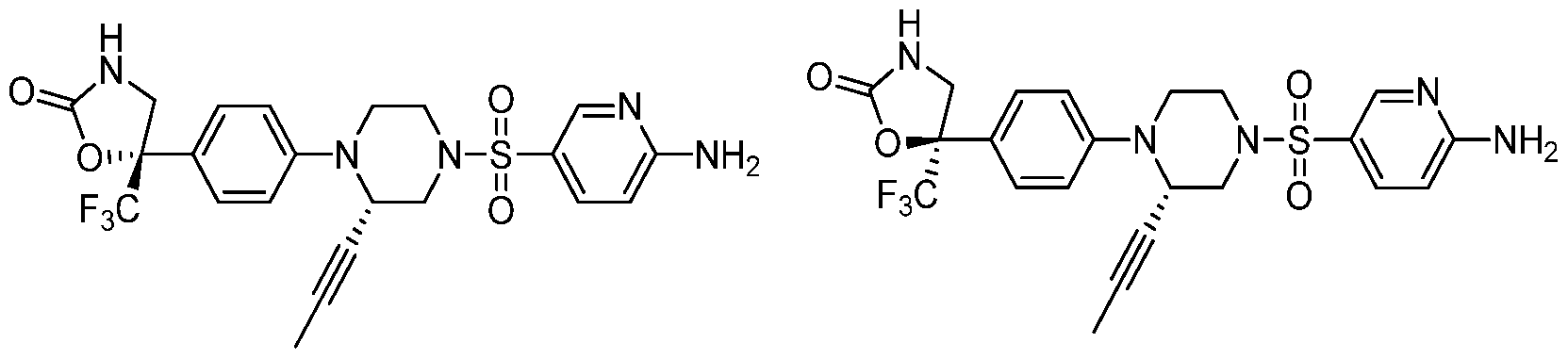
(5 S)-5 -(4-((2S)-4-((6-amino-3 -pyridinyl)sulfonyl)-2-( 1 -propyn- 1 -yl)- 1 - piperazinyl)phenyl)-5-(trifiuoromethyl)- 1 ,3-oxazolidin-2-one and (5R)-5-(4- ((2S)-4-((6-amino-3-pyridinyl)sulfonyl)-2-( 1 -propyn- 1 -yl)- 1 - piperazinyl)phenyl)-5-(trifluoromethyl)- 1 ,3-oxazolidin-2-one.
1H NMR (300 MHz, CDC13) δ ppm 8.50 (d, J= 2.2 Hz, 1 H), 7.79 (dd, J= 2.5, 8.8 Hz, 1 H), 7.38 (d, J= 8.8 Hz, 2 H), 6.97 (d, J= 8.9 Hz, 2 H), 6.55 (d, J= 8.8 Hz, 1 H), 5.31 (d, J= 3.4 Hz, 1 H), 5.11 (s, 2 H), 4.44 (br. s., 1 H), 4.21 (d, J = 9.1 Hz, 1 H), 3.90 (d, J= 9.2 Hz, 1 H), 3.77 (t, J= 10.3 Hz, 2 H), 3.48 - 3.29 (m, 2 H), 2.85 (dd, J= 3.3, 11.2 Hz, 1 H), 2.77 - 2.61 (m, 1 H), 1.79 (d, J= 1.3 Hz, 3 H). m/z (ESI, +ve ion) 510.1 (M+H)+. GK-GKRP IC50 (Binding) = 0.121 μΜ.
EXAMPLE 29: 3-AMINO-2-(4-((2S)-4-((6-AMINO-3- P YRIDINYL)SULFONYL)-2-( 1 -PROPYN- 1 - YL)- 1 - PIPERAZIN YL)PHENYL)- 1,1,1 -TRIFLUORO-2-PROP ANOL

To a 20-mL scintillation vial was added tert-butyl (5-(((3S)-3-(l-propyn- 1 -yl)-4-(4-(2-(trifluoromethyl)-2-oxiranyl)phenyl)- 1 -piperazinyl)sulfonyl)-2-
pyridinyl)carbamate (0.120 g, 0.212 mmol, Intermediate D), DMF (3.0 mL) and ammonium hydroxide (0.170 mL, 4.24 mmol, Sigma-Aldrich, St. Louis, MO). The vial was sealed and the reaction mixture was stirred at rt for 24 h. The reaction mixture was partitioned between EtOAc (60 mL) and water (30 mL) and the organic layer was washed with water (2 x 30 mL), dried over MgS04, filtered, and concentrated. To this crude intermediate was added DCM (10 mL) followed by adding trifiuoroacetic acid (0.160 mL, 2.12 mmol, Sigma-Aldrich, St. Louis, MO). The resulting mixture was stirred at rt for 2 h and then concentrated. The residue was partitioned between EtOAc (60 mL) and sat. NaHC03 (40 mL) and the aqueous layer was extracted with EtOAc (2 x 30 mL). The combined organic layers were dried over MgS04, filtered, and concentrated to afford 3-amino-2-(4-((2S)-4-((6-amino-3-pyridinyl)sulfonyl)-2-(l-propyn-l- yl)-l-piperazinyl)phenyl)-l,l,l-trifluoro-2-propanol (0.095 g) as a mixture of two diastereomers. The individual diastereomers were isolated using chiral SFC. The method used was as follows: Chiralpak® AD-H Sepax column (Daicel Inc., Fort Lee, NJ) (150 x 21 mm, 5 μιη) using 45% (20 mM NH3 in ethanol) in supercritical C02 (total flow was 75 mL/min). This produced the two compounds with
diastereomeric excess greater than 98%.

(2S)-3-amino-2-(4-((2S)-4-((6-amino-3-pyridinyl)sulfonyl)-2-(l -propyn- 1 -yl)- 1 - piperazinyl)phenyl)-l,l,l-trifluoro-2-propanol and (2R)-3-amino-2-(4-((2S)-4- ((6-amino-3 -pyridinyl)sulfonyl)-2-( 1 -propyn- 1 -yl)- 1 -piperazinyl)phenyl)- 1,1,1- trifluoro-2-propanol.
FIRST ELUENT PEAK (PEAK# 1)
1H NMR (300 MHz, CDC13) δ ppm 8.51 (d, J= 2.0 Hz, 1 H), 7.78 (dd, J= 2.1, 8.8 Hz, 1 H), 7.46 (d, J= 8.5 Hz, 2 H), 6.94 (d, J= 8.8 Hz, 2 H), 6.53 (d, J= 8.8 Hz, 1 H), 4.95 (br. s., 2 H), 4.41 (br. s., 1 H), 3.74 (t, J= 9.7 Hz, 2 H), 3.51 (d, J = 12.9 Hz, 1 H), 3.38 (d, J= 4.7 Hz, 2 H), 3.01 (d, J= 12.9 Hz, 1 H), 2.85 (d, J = 8.2 Hz, 1 H), 2.70 (d, J= 10.1 Hz, 1 H), 1.78 (d, J= 1.5 Hz, 3 H). 3
exchangeable protons were not observed, m/z (ESI, +ve ion) 484.1 (M+H)+. GK- GKRP IC50 (Binding) = 0.185 μΜ. SECOND ELUENT PEAK (PEAK# 2)
1H NMR (300 MHz, CDC13) δ ppm 8.51 (br. s., 1 H), 7.78 (d, J= 9.1 Hz, 1 H), 7.46 (d, J= 7.6 Hz, 2 H), 6.94 (d, J= 8.0 Hz, 2 H), 6.53 (d, J= 8.8 Hz, 1 H), 4.95 (br. s., 2 H), 4.41 (br. s., 1 H), 3.74 (t, J= 8.8 Hz, 2 H), 3.61 - 3.47 (m, 1 H), 3.37 (br. s., 2 H), 3.03 (br. s., 1 H), 2.85 (d, J= 8.9 Hz, 1 H), 2.70 (d, J= 10.5 Hz, 1 H), 1.79 (s, 3 H). 3 exchangeable protons were not observed, m/z (ESI, +ve ion) 484.1 (M+H)+. GK-GKRP IC50 (Binding) = 0.038 μΜ.
EXAMPLE 30: 3-(4-((2S)-4-((6-AMINO-3-PYRIDINYL)SULFONYL)-2-(l- PROPYN- 1 -YL)- 1 -PIPERAZINYL)PHENYL)-4,4,4-TRIFLUORO-3- HYDROXYBUTANENITRILE

(trifluoromethyl)-2-oxiranyl)phenyl)- 1 -piperazinyl)sulfonyl)-2- pyridinyl)carbamate (30 mg, 0.053 mmol, Intermediate D) in DMF (2 mL) was added water (0.3 mL) and KCN (10 mg, 0.154 mmol, J. T. Baker). The mixture was stirred at rt for 20 min and then partitioned between EtOAc (30 mL) and water (10 mL). The organic layer was washed with water (3x), saturated NaCl, dried over Na2S04, filtered, and concentrated to give a crystalline solid. This solid was dissolved in DCM (2.5 mL) and was treated with TFA (300 μί, 3.89 mmol). After 1 h, the mixture was concentrated and the residue was diluted with EtOAc (20 mL) and washed with 1 N aq. NaOH (5 mL), water (5 mL), and saturated NaCl (5 mL). The organic layer was dried over Na2S04, filtered, and concentrated. The residue was purified by chromatography on silica using EtOAc in hexanes (30-80%) as eluent to give 3-(4-((2S)-4-((6-amino-3- pyridinyl)sulfonyl)-2-( 1 -propyn- 1 -yl)- 1 -piperazinyl)phenyl)-4,4,4-trifluoro-3- hydroxybutanenitrile as a light-pink foam (25 mg, mixture of two
diastereomers).

(3R)-3-(4-((2S)-4-((6-amino-3-pyridinyl)sulfonyl)-2-(l -propyn-1 -yl)- 1 - piperazinyl)phenyl)-4,4,4-trifluoro-3-hydroxybutanenitrile and (3S)-3-(4-((2S)-4- ((6-amino-3-pyridinyl)sulfonyl)-2-( 1 -propyn- 1 -yl)- 1 -piperazinyl)phenyl)-4,4,4- trifluoro-3 -hydroxybutanenitrile 1H NMR (400 MHz, CDC13) δ ppm 1.79 (br. s., 3 H), 2.70 (t, J= 13.1 Hz, 1 H), 2.85 (d, J= 11.0 Hz, 1 H), 2.95 - 3.07 (m, 1 H), 3.17 (br. s., 2 H), 3.34 - 3.49 (m,
2 H), 4.07 - 4.18 (m, 1 H), 4.44 (br. s., 1 H), 5.10 (br. s., 2 H), 6.54 (d, J = 8.2 Hz, 1 H), 6.97 (d, J = 7.4 Hz, 2 H), 7.44 (d, J = 7.6 Hz, 2 H), 7.79 (d, J = 8.8 Hz, 1 H), 8.48 (br. s., 1 H). One exchangeable proton was not observed, m/z (ESI, +ve ion) 494.3 (M+H)+. GK-GKRP IC50 (Binding) = 0.026 μΜ. EXAMPLE 31 : 2-(6-((2S)-4-((6-AMINO-3-PYRIDINYL)SULFONYL)-2-(l- PROPYN- 1 -YL)- 1 -PIPERAZINYL)-3-PYPvIDINYL)-l , 1 , 1 -TRIFLUORO-3- PENTYN-2-OL

STEP 1 : l-(6-BROMO-3-PYRIDINYL)-2,2,2-TRIFLUOROETHANOL
To a solution of 6-bromo-3-pyridinecarbaldehyde (4.0 g, 22 mmol, Frontier Scientific, Newark, DE) in DME (60 mL) was added
trimethyl(trifluoromethyl)silane (4.80 mL, 32.3 mmol, Oakwood Products, West Columbia, SC) and cesium fluoride (0.660 g, 4.30 mmol, Alfa Aesar, Lawrence, KS). The reaction mixture was stirred at rt for 20 h and then quenched with 1 N HC1 (10 mL). After stirring at rt for 30 min, the volatiles were removed and the residue was partitioned between EtOAc (200 mL) and sat. aq. NaHC03 (100 mL). The aqueous layer was extracted with EtOAc (2 x 75 mL) and the combined organic layers were dried over MgS04, filtered and concentrated. The resulting product was purified by column chromatography (120 g of silica gel, 10
to 30% acetone in hexanes) to afford l-(6-bromo-3-pyridinyl)-2,2,2- trifluoroethanol (4.4 g) as a colorless oil.
STEP 2: TERT-BUTYL (5-(((3S)-3-(l-PROPYN-l-YL)-4-(5-(2,2,2- TRIFLUORO- 1 -HYDROXYETHYL)-2-PYRIDINYL)- 1 - PIPERAZINYL)SULFONYL)-2-PYRIDINYL)CARBAMATE
A mixture of RuPhos palladacycle (50 mg, 0.061 mmol, Sigma- Aldrich, St. Louis, MO), l-(6-bromo-3-pyridinyl)-2,2,2-trifluoroethanol (570 mg, 2.23 mmol), and benzyl (3S)-3-(l-propyn-l-yl)-l-piperazinecarboxylate (600 mg, 2.32 mmol, Intermediate E) in dioxane (5 mL) was sparged with a stream of N2 for 10 min before sodium tert-butoxide (650 mg, 6.76 mmol, Sigma- Aldrich, St. Louis, MO) was added. The mixture was heated at 90 °C for 2 h and then allowed to cool to rt. HC1 (5 N, 1 mL) was added and the resulting mixture was treated with Na2S04 (5 g) and filtered. The filtrate was concentrated to give an oil (1.3 g). This oil was added DCM (3 mL), trifluoroacetic acid (5.0 mL, 67.3 mmol), and triflic acid (0.1 mL, 1 mmol, Alfa Aesar, Ward Hill, MA). After 2 h, additional triflic acid (0.1 mL, 1 mmol) was added. The resulting cloudy mixture was quenched with MeOH (5 mL), concentrated, dissolved in MeOH (5 mL) and concentrated once more. Final traces of acid were removed by azeotropic distillation using toluene. The resulting residue was dissolved in DCM (20 mL) and triethylamine (5.0 mL, 36 mmol). Tert-butyl (5-(chlorosulfonyl)-2- pyridinyl)carbamate (652 mg, 2.23 mmol, Intermediate A) was added and after 30 min the mixture was concentrated and the residue was partitioned between EtOAc (80 mL) and water (30 mL). The organic phase was dried over Na2S04, filtered, and concentrated. The residue was purified by chromatography on silica using EtOAc in DCM (5-30%) as eluent to give tert-butyl (5-(((3S)-3-(l-propyn- 1 -yl)-4-(5-(2,2,2-trifluoro- 1 -hydroxyethyl)-2-pyridinyl)- 1 -piperazinyl)sulfonyl)- 2-pyridinyl)carbamate (700 mg) as a white foam.
STEP 3: TERT-BUTYL (5-(((3S)-3-(l-PROPYN-l-YL)-4-(5-
(TRIFLUOROACETYL)-2-PYRIDINYL)- 1 -PIPERAZINYL)SULFONYL)-2- PYRIDINYL)CARBAMATE
To a solution of tert-butyl (5-(((3S)-3-(l-propyn-l-yl)-4-(5-(2,2,2- trifluoro- 1 -hydroxy ethyl)-2-pyridinyl)- 1 -piperazinyl)sulfonyl)-2- pyridinyl)carbamate (700 mg, 1.26 mmol) in DCM (40 mL) was added manganese(IV) oxide (activated, 860 mg, 9.89 mmol, Sigma-Aldrich, St. Louis, MO). The mixture was stirred at rt for 22 h. After that time, additional manganese(IV) oxide (activated, 860 mg, 9.89 mmol) was added. The suspension was stirred at rt for an additional 5 h and then the mixture was filtered through a pad of diatomaceous earth and the filtrate was concentrated. The material was suspended in hot hexanes/EtOAc (7: 1, 20 mL) and allowed to cool. The resulting solid was collected by filtration and washed with hexanes/EtOAc (7: 1) to give tert-butyl (5-(((3S)-3-(l-propyn-l-yl)-4-(5-(trifluoroacetyl)-2- pyridinyl)-l-piperazinyl)sulfonyl)-2-pyridinyl)carbamate (565 mg) as a white powder.
STEP 4: 2-(6-((2S)-4-((6-AMINO-3-PYRIDINYL)SULFONYL)-2-(l- PROPYN- 1 -YL)- 1 -PIPERAZINYL)-3-PYRIDINYL)-l , 1 , 1 -TRIFLUORO-3- PENTYN-2-OL
To a solution of tert-butyl (5-(((3S)-3-(l-propyn-l-yl)-4-(5- (trifluoroacetyl)-2-pyridinyl)- 1 -piperazinyl)sulfonyl)-2-pyridinyl)carbamate (50 mg, 0.090 mmol) in a 25-mL round-bottomed flask was added 1- propynylmagnesium bromide (0.5 M solution in THF, 500 μί, 0.250 mmol, Sigma-Aldrich, St. Louis, MO) under N2. After 50 min, additional 1- propynylmagnesium bromide (1 mmol) was added. After 5 min, MeOH (0.1 mL) was added and the mixture was concentrated to dryness. The residue was suspended in DCM (4 mL) and was treated with TFA (800 μί, 10.4 mmol). After 20 min, EtOAc (20 mL) was added and the mixture was washed with
aqueous 1 N NaOH (10 mL). The aqueous layer was extracted (EtOAc) once and the combined organic phases were dried over Na2S04, filtered, and concentrated to give a film which was purified by chromatography on silica using MeOH in DCM (1 to 8%) as eluent to give 2-(6-((2S)-4-((6-amino-3-pyridinyl)sulfonyl)-2- ( 1 -propyn- 1 -yl)- 1 -piperazinyl)-3 -pyridinyl)- 1,1,1 -trifluoro-3 -pentyn-2-ol (41 mg) as a white powder (mixture of two diastereomers).

(2S)-2-(6-((2S)-4-((6-amino-3-pyridinyl)sulfonyl)-2-( 1 -propyn- 1 -yl)- 1 - piperazinyl)-3 -pyridinyl)- 1,1,1 -trifluoro-3 -pentyn-2-ol and (2R)-2-(6-((2S)-4-((6- amino-3 -pyridinyl)sulfonyl)-2-( 1 -propyn- 1 -yl)- 1 -piperazinyl)-3 -pyridinyl)- 1,1,1- trif uoro-3 -pentyn-2-ol 1H NMR (400 MHz, DMSO-d6) δ ppm 1.77 (d, J= 2.0 Hz, 3 H), 1.99 (d, J= 2.2 Hz, 3 H), 2.28 - 2.38 (m, 1 H), 2.49 (m, 1 H, overlapping with DMSO), 3.08 - 3.18 (m, 1 H), 3.61 - 3.72 (m, 2 H), 4.17 (d, J= 12.3 Hz, 1 H), 5.37 (br. s., 1 H), 6.54 (d, J= 8.8 Hz, 1 H), 6.89 (d, J= 8.8 Hz, 1 H), 7.00 (br. s, 2 H), 7.57 (s, 1 H), 7.65 (dd, J= 9.0, 2.3 Hz, 1 H), 7.77 (d, J= 8.0 Hz, 1 H), 8.25 (d, J= 2.3 Hz, 1 H), 8.38 (d, J= 2.3 Hz, 1 H). m/z (ESI, +ve ion) 494.1 (M+H)+. GK-GKRP IC50 (Binding) = 0.037 μΜ.
EXAMPLE 32: 5-(((3S)-3-(l-PROPYN-l-YL)-4-(4-(2,2,2-TRIFLUORO-l- METHYLETHYL)PHENYL)-l-PIPERAZINYL)SULFONYL)-2- PYRIDIN AMINE

STEP 1 : 2-(4-BROMOPHENYL)-l,l,l-TRIFLUORO-2-PROPANOL
A 500-mL round-bottomed flask was charged with 1 ,4-dibromobenzene (30.3 g, 128 mmol, Sigma-Aldrich, St. Louis, MO) and 200 mL of diethyl ether. After cooling to -78 °C, n-BuLi (2.5 M in hexanes, 59.0 mL, 148 mmol, Sigma- Aldrich, St. Louis, MO) was added. This mixture was stirred for 15 min at -78 °C, then l,l,l-trifluoro-2-propanone (24.2 mL, 257 mmol, Sigma-Aldrich, St. Louis, MO) was added. Stirring was continued at -78 °C for 30 min and then the mixture was quenched with 100 mL of saturated aqueous NH4CI. The mixture was extracted with EtOAc (250 mL), dried (MgS04), filtered and concentrated to give an oil. Purification via column chromatography (330 g of silica, 0 to 30% EtOAc in hexanes) gave 2-(4-bromophenyl)-l,l,l-trifluoro-2-propanol (21.5 g) as a colorless oil.
STEP 2: l-BROMO-4-(l-(TRIFLUOROMETHYL)ETHENYL)BENZENE;l- BROMO-4-( 1 -CHLORO-2,2,2-TRIFLUORO- 1 -METHYLETHYL)BENZENE
In a 50 mL round-bottomed flask was added 2-(4-bromophenyl)- 1,1,1- trifluoro-2-propanol (2.3 g, 8.6 mmol), SOCl2 (7.0 mL, 96 mmol, Sigma-Aldrich, St. Louis, MO), and pyridine (0.08 mL, 1.0 mmol). The mixture was heated to 70 °C for 70 min and then allowed to cool to rt. The mixture was concentrated and the residue was dissolved in EtOAc (30 mL), washed with sat. aq. NaHC03 (10 mL), dried over Na2S04, filtered, and concentrated to give a 2: 1 mixture (by 1H NMR) of l-bromo-4-(l-(trifluoromethyl)ethenyl)benzene and l-bromo-4-(l- chloro-2,2,2-trifluoro-l-methylethyl)benzene as a clear oil (2.3 g)
STEP 2a: 1 -BROMO-4-(2,2,2-TRIFLUORO- 1 -METHYLETHYL)BENZENE
A mixture of l-bromo-4-(l-(trifluoromethyl)ethenyl)benzene and 1- bromo-4-(l-chloro-2,2,2-trifluoro-l-methylethyl)benzene (2:1 ratio, 2.2 g, 4.1 mmol), triethylamine (1.0 mL, 7.2 mmol), and platinum(IV) oxide (120 mg, 0.528 mmol, Sigma-Aldrich, St. Louis, MO) in MeOH-EtOAc (1 : 1, 100 mL) was purged with a balloon of H2 (4x) and stirred at rt. After 23 h, more Pt02 (100 mg) was added. After an additional 23 h, the mixture was filtered through a pad of diatomaceous earth. The filtrate was washed with water, HC1 (1 N, 5 mL), and saturated NH4C1 (10 mL). The combined organic extracts were dried over MgS04, filtered, and concentrated to a clear oil (1.0 g). The oil was purified by chromatography on silica using hexanes as eluent to give l-bromo-4-(2,2,2- trifluoro-l-methylethyl)benzene (0.55 g) as a clear oil.
STEP 3: BENZYL (3S)-3-(l-PROPYN-l-YL)-4-(4-(2,2,2-TRIFLUORO-l- METH YLETHYL)PHENYL)- 1 -PIPERAZINEC ARBOXYLATE
A mixture of benzyl (35)-3-(l-propyn-l-yl)-l-piperazinecarboxylate (520 mg, 2.01 mmol, Intermediate E) and l-bromo-4-(2,2,2-trifluoro-l- methylethyl)benzene (470 mg, 1.86 mmol) in dioxane (10 mL) was sparged with a stream of N2 for 5 min. To this was added RuPhos palladacycle (65 mg, 0.080 mmol, Sigma-Aldrich, St. Louis, MO) and sodium tert-butoxide (400 mg, 4.16
mmol, Sigma- Aldrich, St. Louis, MO). The resulting dark mixture was heated at 100 °C under N2 for 30 min. After that time, the mixture was allowed to cool to rt and partitioned between EtOAc (40 mL) and water (20 mL). The organic layer was washed with saturated NH4C1 (10 mL), dried over Na2S04, filtered, and concentrated. The residue was purified by chromatography on silica using EtOAc in hexane (0-40%) as eluent to give benzyl (3S)-3-(l-propyn-l-yl)-4-(4- (2,2,2-trifluoro-l-methylethyl)phenyl)-l-piperazinecarboxylate (0.38 g) as a clear oil.
STEP 4: (2S)-2-(l-PROPYN-l-YL)-l-(4-(2,2,2-TRIFLUORO-l- METHYLETHYL)PHENYL)PIPERAZINE
To a solution of benzyl (3S)-3-(l-propyn-l-yl)-4-(4-(2,2,2-trifluoro-l- methylethyl)phenyl)-l-piperazinecarboxylate (0.38 g, 0.88 mmol) in DCM (3 mL) was added TFA (3 mL) followed by TfOH (0.1 mL, 1 mmol). After 10 min, the mixture was carefully quenched with MeOH (5 mL) and concentrated to dryness. The residue was dissolved with MeOH and concentrated. This sequence was repeated for an additional 3 times. The crude (2S)-2-(l-propyn-l- yl)-l-(4-(2,2,2-trifluoro-l-methylethyl)phenyl)piperazine (0.26 g) was used in the next step without further purification.
STEP 5: 5-(((3S)-3-(l-PROPYN-l-YL)-4-(4-(2,2,2-TRIFLUORO-l- METHYLETHYL)PHENYL)-l-PIPERAZINYL)SULFONYL)-2- PYRIDIN AMINE The crude (2S)-2-(l-propyn-l-yl)-l-(4-(2,2,2-trifluoro-l- methylethyl)phenyl)piperazine (0.26 g, 0.88 mmol) was mixed with triethylamine (600 μί, 4.30 mmol) in DCM (10 mL). Tert-butyl (5-(chlorosulfonyl)-2- pyridinyl)carbamate (300 mg, 1.03 mmol, Intermediate A) was then added. After 1.5 h, the mixture was concentrated to dryness and the residue was dissolved in DCM (10 mL) and TFA (3 mL). After 2 h, the mixture was quenched with
MeOH (2 mL) and concentrated. The residue was treated with EtOAc and saturated Na2C03 (about30 mL) until the pH reached about 8. The organic layer was washed with saturated NH4C1, dried over Na2S04, filtered, and concentrated. The residue was purified by chromatography on silica using EtOAc in DCM (5- 40%) as eluent to give 5-(((3S)-3-(l-propyn-l-yl)-4-(4-(2,2,2-trif uoro-l- methylethyl)phenyl)-l-piperazinyl)sulfonyl)-2-pyridinamine (0.315 g) as a light yellow foam, which is a mixture of two diastereomers.
1H NMR (400 MHz, CDC13) δ ppm 1.46 (d, J = 6.06 Hz, 3 H), 1.78 (br. s., 3 H), 2.71 (t, J= 10.56 Hz, 1 H), 2.86 (d, J= 11.35 Hz, 1 H), 3.27 - 3.43 (m, 3 H), 3.72 (t, J= 11.83 Hz, 2 H), 4.37 (br. s., 1 H), 5.03 (br. s., 2 H), 6.54 (d, J= 7.24 Hz, 1 H), 6.91 (d, J = 7.04 Hz, 2 H), 7.21 (d, J = 7.24 Hz, 2 H), 7.78 (d, J= 9.19 Hz, 1 H), 8.49 (br. s., 1 H). m/z (ESI, +ve ion) 453.2 (M+H)+. GK-GKRP IC50 (Binding) = 0.847 μΜ.

5 -(((3 S)-3 -( 1 -propyn- 1 -yl)-4-(4-(( 1 R)-2,2,2-trifiuoro- 1 -methylethyl)phenyl)- 1 - piperazinyl)sulfonyl)-2-pyridinamine and 5-(((3S)-3-(l-propyn-l-yl)-4-(4-((lS)- 2,2,2-trifluoro- 1 -methylethyl)phenyl)- 1 -piperazinyl)sulfonyl)-2-pyridinamine
The individual diastereomers were isolated using chiral SFC. The method used was as follows: The sample (290 mg) was dissolved in MeOH/EtOH/DCM 1/1/1 10 mL and separated on ODH (5 um, 20 x 250 mm, Phenomenex
Cellulose-01, Phenomenex, Torrance, CA). Flow rate = 70 mL/min, 25% iPrOH 0.2% DEA. T = 40 °C. Detection: 256 nm. The individual peaks collected were shown to be of >99%> diastereomeric excess.
FIRST ELUENT PEAK (PEAK# 1)
1H NMR (400 MHz, CDC13) δ ppm 1.46 (d, J=5.7 Hz, 3 H), 1.77 (br. s., 3 H), 2.70 (br. s., 1 H), 2.86 (d, J=10.4 Hz, 1 H), 3.34 (br. s., 3 H), 3.71 (t, J=11.3 Hz, 2 H), 4.37 (br. s., 1 H), 5.02 (br. s., 2 H), 6.53 (d, J=8.2 Hz, 1 H), 6.91 (d, J=6.7 Hz, 2 H), 7.20 (d, J=6.8 Hz, 2 H), 7.77 (d, J=7.8 Hz, 1 H), 8.49 (br. s., 1 H). m/z (ESI, +ve ion) 453.2 (M+H)+. GK-GKRP IC50 (Binding) = 0.761 μΜ.
SECOND ELUENT PEAK (PEAK# 2)
1H NMR (400 MHz, CDC13) δ ppm 1.46 (d, J=5.5 Hz, 3 H), 1.77 (br. s., 3 H), 2.70 (br. s., 1 H), 2.86 (d, J=10.8 Hz, 1 H), 3.34 (br. s., 3 H), 3.71 (t, J=11.4 Hz, 2 H), 4.37 (br. s., 1 H), 5.02 (br. s., 2 H), 6.53 (d, J=7.8 Hz, 1 H), 6.91 (d, J=6.8 Hz, 2 H), 7.20 (d, J=6.8 Hz, 2 H), 7.77 (d, J=8.6 Hz, 1 H), 8.49 (br. s., 1 H). m/z (ESI, +ve ion) 453.2 (M+H)+. GK-GKRP IC50 (Binding) = 0.588 μΜ.
Claims
1. A compound of Formula I, or a pharmaceutically acceptable salt thereof,

wherein:
X1 is N or CRa;
X2 is N or CH;
X3 is N or CH, provided that no more than one of X1, X2 or X3 is N;
Ra is hydrogen, -CH3, -CF3 or -F,

Q is

-SO2R3, -S02NR5R6, -C(=0)Ci-6alkyl, -C(=0)NR4R5, C2-6alkenyl, -CH(CF3)2 or -CH(CH )(CF3);
R1 is -CH3, -CF3, C3_gcylcoalkyl or -Ci_6alkylC3_8Cycloalkyl;
R2 is hydrogen or -CH3;
R3 is hydrogen or Ci_6alkyl;
R4 is hydrogen, Ci_6alkyl or -OCi_6alkyl;
each R5 is independently selected from hydrogen, C _8cycloalkyl, -CH2CF3! C1_6alkyl or -C1_6alkylC3-8cycloalkyl;
R6 is hydrogen or Ci_6alkyl;
R7 is hydrogen or -CH3;
X4 is N or CH;
X5 is N or CH;
X6 is N or CH; or
X7 is N or CH, provided that no more that two of X4, X5, X6 and X7 are
N.
2. A compound, or a pharmaceutically acceptable salt thereof, in accordance with claim 1 wherein X1 is CH.
3. A compound, or a pharmaceutically acceptable salt thereof, in accordance with claim 1 wherein X1 is N.
4. A compound, or a pharmaceutically acceptable salt thereof, in accordance with any one of claims 1 to 3 wherein X2 is CH.
5. A compound, or a pharmaceutically acceptable salt thereof, in accordance with any one of claims 1 to 3 wherein X2 is N.
6. A compound, or a pharmaceutically acceptable salt thereof, in accordance with any one of claims 1 to 5 wherein X3 is CH.
7. A compound, or a pharmaceutically acceptable salt thereof, in accordance with any one of claims 1 to 5 wherein X3 is N.
8. A compound, or a pharmaceutically acceptable salt thereof, in accordance with any one of claims 1 to 7 wherein Y is

9. A compound, or a pharmaceutically acceptable salt thereof, in accordance with claim 8 wherein X4 is CH.
10. A compound, or a pharmaceutically acceptable salt thereof, in accordance with claim 8 wherein X4 is N.
11. A compound, or a pharmaceutically acceptable salt thereof, in accordance with any one of claims 8 to 10 wherein X5 is CH.
12. A compound, or a pharmaceutically acceptable salt thereof, in accordance with any one of claims 8 to 10 wherein X5 is N.
13. A compound, or a pharmaceutically acceptable salt thereof, in accordance with any one of claims 8 to 12 wherein X6 is N.
14. A compound, or a pharmaceutically acceptable salt thereof, in accordance with any one of claims 8 to 12 wherein X6 is CH.
15. A compound, or a pharmaceutically acceptable salt thereof, in accordance with any one of claims 8 to 14 wherein X7 is N.
16. A compound, or a pharmaceutically acceptable salt thereof, in accordance with any one of claims 8 to 14 wherein X7 is CH.
17. A compound, or a pharmaceutically acceptable salt thereof, in accordance with any one of claims 1 to 7 wherein Y is

18. A compound, or a pharmaceutically acceptable salt thereof, in accordance with any one of claims 1 to 17 wherein Q is
O
S R1
N
\
19. A compound, or a pharmaceutically acceptable salt thereof, in accordance with claim 18 wherein R1 is -CH3.
20. A compound, or a pharmaceutically acceptable salt thereof, in accordance with claim 18 wherein R1 is -CF3.
21. A compound, or a pharmaceutically acceptable salt thereof, in accordance with claim 18 wherein R1 is C3_gcycloalkyl.
22. A compound, or a pharmaceutically acceptable salt thereof, in accordance with claim 18 wherein R1 is -Ci_6alkylC3_8cycloalkyl.
23. A compound, or a pharmaceutically acceptable salt thereof, in accordance with any one of claims 18 to 22 wherein R2 is hydrogen.
24. A compound, or a pharmaceutically acceptable salt thereof, in accordance with any one of claims 18 to 22 wherein R2 is -CH3.
25. A compound, or a pharmaceutically acceptable salt thereof, in accordance with any one of claims 1 to 17 wherein Q is

26. A compound, or a pharmaceutically acceptable salt thereof, in accordance with claim 25 wherein R7 is hydrogen.
27. A compound, or a pharmaceutically acceptable salt thereof, in accordance with claim 25 wherein R7 is -CH3.
28. A compound, or a pharmaceutically acceptable salt thereof, in accordance with any one of claims 1 to 17 wherein Q is

29. A compound, or a pharmaceutically acceptable salt thereof, in accordance with any one of claims 1 to 17 wherein Q is
C -6alkylO.

30. A compound, or a pharmaceutically acceptable salt thereof, in accordance with any one of claims 1 to 17 wherein Q is

31. A compound, or a pharmaceutically acceptable salt thereof, accordance with any one of claims 1 to 17 wherein Q is

32. A compound, or a pharmaceutically acceptable salt thereof, in accordance with any one of claims 1 to 17 wherein Q is

33. A compound, or a pharmaceutically acceptable salt thereof, in accordance with any one of claims 1 to 17 wherein Q is -S02Ci_6alkyl.
34. A compound, or a pharmaceutically acceptable salt thereof, in accordance with any one of claims 1 to 17 wherein Q is -C(=0)Ci_6alkyl or
-C(=0)NR4R5 .
35. A compound, or a pharmaceutically acceptable salt thereof, in accordance with any one of claims 1 to 17 wherein Q is C2-6alkenyl.
36. A compound, or a pharmaceutically acceptable salt thereof, in accordance with any one of claims 1 to 17 wherein Q is -CH(CF3)2.
37. A compound, or a pharmaceutically acceptable salt thereof, in accordance with any one of claims 1 to 17 wherein Q is -CH(CH3)(CF3).
38. A compound, or a pharmaceutically acceptable salt thereof, in accordance with any one of claims 1 to 17 wherein Q is -S02R3.
39. A compound, or a pharmaceutically acceptable salt thereof, in accordance with claim 38 wherein R3 is hydrogen.
40. A compound, or a pharmaceutically acceptable salt thereof, in accordance with claim 38 wherein R3 is Ci_6alkyl.
41. A compound, or a pharmaceutically acceptable salt thereof, in accordance with any one of claims 38 to 40 wherein R4 is hydrogen.
42. A compound, or a pharmaceutically acceptable salt thereof, in accordance with any one of claims 1 to 17 wherein Q is -S02NR5R6.
43. A compound, or a pharmaceutically acceptable salt thereof, in accordance with claim 42 wherein R5 is hydrogen.
44. A compound, or a pharmaceutically acceptable salt thereof, in accordance with claim 42 wherein R5 is Ci_6alkyl.
45. A compound, or a pharmaceutically acceptable salt thereof, in accordance with any one of claims 42 to 44 wherein R6 is hydrogen.
46. A compound, or a pharmaceutically acceptable salt thereof, in accordance with any one of claims 42 to 44 wherein R6 is Ci_6alkyl.
47. A compound, or a pharmaceutically acceptable salt thereof, in accordance with claim 1 wherein X1, X2 and X3 are CH and Y is

48. A compound, or a pharmaceutically acceptable salt thereof, in accordance with claim 1 wherein X3 is N, X1 and X2 are CH and Y is

49. A compound, or a pharmaceutically acceptable salt thereof, in accordance with any one of claims 47 to 48 wherein

-SO2NH2, -SO2NHCH3 or -S02NHcyclopropyl.
50. A compound, or a pharmaceutically acceptable salt thereof, in accordance with claim 1 , the compound selected from:
6-(((3 S)-3 -( 1 -propyn- 1 -yl)-4-(4-((trifluoromethyl)sulfonimidoyl)phi 1 -piperazinyl)sulfonyl)-3 -pyridazinamine;
4-((25)-4-((6-amino-3-pyridinyl)sulfonyl)-2-( 1 -propyn- 1 -yl)- 1 - piperazinyl)benzenesulfonamide;
4- ((25)-4-((6-amino-3-pyridinyl)sulfonyl)-2-( 1 -propyn- 1 -yl)- 1 - piperazinyl)-N-cyclopropylbenzenesulfonamide;
5 - (((3S)-4-(4-(methylsulfonimidoyl)phenyl)-3-(l -propyn- l-yl)-l- piperazinyl)sulfonyl)-2-pyridinamine;
5-(((35)-4-(4-(N^-dimethylsulfonimidoyl)phenyl)-3-(l -propyn- 1 -yl)- 1 - piperazinyl)sulfonyl)-2-pyridinamine;
5 -(((35)-4-(4-(N-methyl-lS*-(trifluoromethyl)sulfonimidoyl)phenyl)-3 -( 1 - propyn- 1 -yl)- 1 -piperazinyl)sulfonyl)-2-pyridinamine;
5 -(((35)-4-(4-(5'-cyclopropylsulfonimidoyl)phenyl)-3-(l -propyn- 1 -yl)- 1 - piperazinyl)sulfonyl)-2-pyridinamine;
4- ((25)-4-((6-amino-3-pyridinyl)sulfonyl)-2-( 1 -propyn- 1 -yl)- 1 - piperazinyl)-N-(cyclopropylmethyl)benzenesulfonamide;
5- (((35)-4-(4-(ethylsulfonyl)phenyl)-3-(l -propyn- 1 -yl)- 1 - piperazinyl)sulfonyl)-2-pyridinamine;
4- (4-((6-amino-3-pyridinyl)sulfonyl)-2-( 1 -propyn- 1 -yl)- 1 -piperazinyl)-N- (2,2,2-trifluoroethyl)benzenesulfonamide;
1 -(4-((2S)-4-((6-amino-3 -pyridinyl)sulfonyl)-2-( 1 -propyn- 1 -yl)- 1 - piperazinyl)phenyl)ethanone;
5- (((3 S)-3-( 1 -propyn- 1 -yl)-4-(4-(S- (trifluoromethyl)sulfonimidoyl)phenyl)-l -piperazinyl)sulfonyl)-2-pyridinamm
4-((2S)-4-((6-amino-3 -pyridinyl)sulfonyl)-2-( 1 -propyn- 1 -yl)- 1 - piperazinyl)-N-methylbenzenesulfonamide;
6- ((2S)-4-((6-amino-3 -pyridinyl)sulfonyl)-2-( 1 -propyn- 1 -yl)- 1 - piperazinyl)-N-methyl-3-pyridinesulfonamide;
4-(4-((6-amino-3-pyridinyl)sulfonyl)-2-( 1 -propyn- 1 -yl)- 1 -piperazinyl)-N- ethylbenzenesulfonamide;
1 -(4-((2S)-4-((6-amino-3 -pyridinyl)sulfonyl)-2-( 1 -propyn- 1 -yl)- 1 - piperazinyl)phenyl)- 1 -propanone;
4-(4-((6-amino-3-pyridinyl)sulfonyl)-2-( 1 -propyn- 1 -yl)- 1 -piperazinyl)-N- ( 1 -methylethyl)benzenesulfonamide;
4-(4-((6-amino-3 -pyridinyl)sulfonyl)-2-( 1 -propyn- 1 -yl)- 1 -piperazinyl)- N,N-dimethylbenzenesulfonamide;
2-((2S)-4-((6-amino-3 -pyridinyl)sulfonyl)-2-( 1 -propyn- 1 -yl)- 1 - piperazinyl)-N-methyl-l ,3-thiazole-5-sulfonamide;
2-((2S)-4-((6-amino-3 -pyridinyl)sulfonyl)-2-( 1 -propyn- 1 -yl)- 1 - piperazinyl)-N-methoxy-N-methyl- 1 ,3-thiazole-5-carboxamide;
5-(((3S)-4-(5-(l -methylethenyl)- 1 ,3 -thiazol-2-yl)-3-(l -propyn- 1 -yl)-l - piperazinyl)sulfonyl)-2-pyridinamine;
5-(((3 S)-3-( 1 -propyn- 1 -yl)-4-(4-(l ,2,2,2-tetrafluoro- 1 - (trifluoromethyl)ethyl)phenyl)-l-piperazinyl)sulfonyl)-2-pyridinamine;
2-(4-((2S)-4-((6-amino-3 -pyridinyl)sulfonyl)-2-( 1 -propyn- 1 -yl)- 1 - piperazinyl)phenyl)- 1,1,1 -trifluoro-4-pentyn-2-ol;
2-(4-((2S)-4-((6-amino-3 -pyridinyl)sulfonyl)-2-( 1 -propyn- 1 -yl)- 1 - piperazinyl)phenyl)- 1,1,1 -trifluoro-4-hexyn-2-ol;
2-(4-((2S)-4-((6-amino-3 -pyridinyl)sulfonyl)-2-( 1 -propyn- 1 -yl)- 1 - piperazinyl)phenyl)-3-azido- 1,1,1 -trifiuoro-2-propanol;
2- (4-((2S)-4-((6-amino-3 -pyridinyl)sulfonyl)-2-( 1 -propyn- 1 -yl)- 1 - piperazinyl)phenyl)- 1,1,1 -trifluoro-3-methoxy-2-propanol;
5-(4-((2S)-4-((6-amino-3-pyridinyl)sulfonyl)-2-( 1 -propyn- 1 -yl)- 1 - piperazinyl)phenyl)-5-(trifiuoromethyl)- 1 ,3-oxazolidin-2-one;
3- amino-2-(4-((2S)-4-((6-amino-3-pyridinyl)sulfonyl)-2-(l-propyn-l-yl)- 1 -piperazinyl)phenyl)- 1,1,1 -trifiuoro-2-propanol;
3-(4-((2S)-4-((6-amino-3-pyridinyl)sulfonyl)-2-( 1 -propyn- 1 -yl)- 1 - piperazinyl)phenyl)-4,4,4-trifluoro-3-hydroxybutanenitrile;
2-(6-((2S)-4-((6-amino-3 -pyridinyl)sulfonyl)-2-( 1 -propyn- 1 -yl)- 1 - piperazinyl)-3 -pyridinyl)- 1,1,1 -trifiuoro-3 -pentyn-2-ol; or
5 -(((3 S)-3 -( 1 -propyn- 1 -yl)-4-(4-(2,2,2-trifluoro- 1 -methylethyl)phenyl)- 1 - piperazinyl)sulfonyl)-2-pyridinamine.
51. A method of treating type 2 diabetes, hyperglycemia, impaired glucose tolerance, insulin resistance, retinopathy, nephropathy, neuropathy, cataracts, glaucoma, Syndrome X, or polycystic ovarian syndrome, the method comprising administering to a patient in need thereof a therapeutically effective amount of a compound in accordance with any one of claims 1 to 51 , or a pharmaceutically acceptable salt thereof.
52. The method of claim 51 wherein the treatment is for type 2 diabetes.
53. A pharmaceutical composition comprising a compound in accordance with any one of claims 1 to 50, or a pharmaceutically acceptable salt thereof, and a pharmaceutically acceptable excipient.
Applications Claiming Priority (2)
| Application Number | Priority Date | Filing Date | Title |
|---|---|---|---|
| US201261693629P | 2012-08-27 | 2012-08-27 | |
| US61/693,629 | 2012-08-27 |
Publications (1)
| Publication Number | Publication Date |
|---|---|
| WO2014035872A1 true WO2014035872A1 (en) | 2014-03-06 |
Family
ID=49117981
Family Applications (1)
| Application Number | Title | Priority Date | Filing Date |
|---|---|---|---|
| PCT/US2013/056593 Ceased WO2014035872A1 (en) | 2012-08-27 | 2013-08-26 | Tricyclic alkynes that interact with glucokinase regulatory protein |
Country Status (1)
| Country | Link |
|---|---|
| WO (1) | WO2014035872A1 (en) |
Cited By (1)
| Publication number | Priority date | Publication date | Assignee | Title |
|---|---|---|---|---|
| CN104557800A (en) * | 2014-12-31 | 2015-04-29 | 常州大学 | 2-phenoxyl tetrahydrofuran (tetrahydropyrane) derivatives and application thereof in synthesis of penoxsulam |
Citations (2)
| Publication number | Priority date | Publication date | Assignee | Title |
|---|---|---|---|---|
| WO2001083465A2 (en) * | 2000-05-03 | 2001-11-08 | F. Hoffmann-La Roche Ag | Alkynyl phenyl heteroaromatic glucokinase activators |
| WO2012027261A1 (en) * | 2010-08-23 | 2012-03-01 | Amgen Inc. | Sulfonylpiperazine derivatives that interact with glucokinase regulatory protein for the treatment of diabetes |
-
2013
- 2013-08-26 WO PCT/US2013/056593 patent/WO2014035872A1/en not_active Ceased
Patent Citations (2)
| Publication number | Priority date | Publication date | Assignee | Title |
|---|---|---|---|---|
| WO2001083465A2 (en) * | 2000-05-03 | 2001-11-08 | F. Hoffmann-La Roche Ag | Alkynyl phenyl heteroaromatic glucokinase activators |
| WO2012027261A1 (en) * | 2010-08-23 | 2012-03-01 | Amgen Inc. | Sulfonylpiperazine derivatives that interact with glucokinase regulatory protein for the treatment of diabetes |
Cited By (1)
| Publication number | Priority date | Publication date | Assignee | Title |
|---|---|---|---|---|
| CN104557800A (en) * | 2014-12-31 | 2015-04-29 | 常州大学 | 2-phenoxyl tetrahydrofuran (tetrahydropyrane) derivatives and application thereof in synthesis of penoxsulam |
Similar Documents
| Publication | Publication Date | Title |
|---|---|---|
| US9376425B2 (en) | Heterocyclic compounds as MDM2 inhibitors for the treatment of cancer | |
| US20230301974A1 (en) | Processes of making and crystalline forms of a mdm2 inhibitor | |
| JP6377123B2 (en) | Heteroaryl morpholinone compounds as MDM2 inhibitors for the treatment of cancer | |
| CA2901696C (en) | Cis-morpholinone and other compounds as mdm2 inhibitors for the treatment of cancer | |
| US8431563B2 (en) | Compounds that interact with glucokinase regulatory protein for the treatment of diabetes | |
| US12110299B2 (en) | Thiazole derivatives and pharmaceutically acceptable salts thereof | |
| WO2014035872A1 (en) | Tricyclic alkynes that interact with glucokinase regulatory protein | |
| WO2013123444A1 (en) | Sulfonyl compounds that interact with glucokinase regulatory protein | |
| EP2694491A1 (en) | Benzodioxepine and benzodioxine compounds that interact with glucokinase regulatory protein for the treatment of diabetes | |
| US11407721B2 (en) | CIS-morpholinone and other compounds as MDM2 inhibitors for the treatment of cancer | |
| WO2013173382A1 (en) | Benzothiophene sulfonamides and other compounds that interact with glucokinase regulatory protein |
Legal Events
| Date | Code | Title | Description |
|---|---|---|---|
| 121 | Ep: the epo has been informed by wipo that ep was designated in this application |
Ref document number: 13759088 Country of ref document: EP Kind code of ref document: A1 |
|
| NENP | Non-entry into the national phase |
Ref country code: DE |
|
| 122 | Ep: pct application non-entry in european phase |
Ref document number: 13759088 Country of ref document: EP Kind code of ref document: A1 |