WO2014035626A1 - Xylene isomerization process and catalyst therefor - Google Patents
Xylene isomerization process and catalyst therefor Download PDFInfo
- Publication number
- WO2014035626A1 WO2014035626A1 PCT/US2013/054070 US2013054070W WO2014035626A1 WO 2014035626 A1 WO2014035626 A1 WO 2014035626A1 US 2013054070 W US2013054070 W US 2013054070W WO 2014035626 A1 WO2014035626 A1 WO 2014035626A1
- Authority
- WO
- WIPO (PCT)
- Prior art keywords
- feedstream
- ppm
- less
- styrene
- phenol
- Prior art date
- Legal status (The legal status is an assumption and is not a legal conclusion. Google has not performed a legal analysis and makes no representation as to the accuracy of the status listed.)
- Ceased
Links
Classifications
-
- C—CHEMISTRY; METALLURGY
- C07—ORGANIC CHEMISTRY
- C07C—ACYCLIC OR CARBOCYCLIC COMPOUNDS
- C07C5/00—Preparation of hydrocarbons from hydrocarbons containing the same number of carbon atoms
- C07C5/22—Preparation of hydrocarbons from hydrocarbons containing the same number of carbon atoms by isomerisation
- C07C5/27—Rearrangement of carbon atoms in the hydrocarbon skeleton
- C07C5/2729—Changing the branching point of an open chain or the point of substitution on a ring
- C07C5/2732—Catalytic processes
- C07C5/2737—Catalytic processes with crystalline alumino-silicates, e.g. molecular sieves
-
- B—PERFORMING OPERATIONS; TRANSPORTING
- B01—PHYSICAL OR CHEMICAL PROCESSES OR APPARATUS IN GENERAL
- B01J—CHEMICAL OR PHYSICAL PROCESSES, e.g. CATALYSIS OR COLLOID CHEMISTRY; THEIR RELEVANT APPARATUS
- B01J29/00—Catalysts comprising molecular sieves
- B01J29/04—Catalysts comprising molecular sieves having base-exchange properties, e.g. crystalline zeolites
- B01J29/06—Crystalline aluminosilicate zeolites; Isomorphous compounds thereof
- B01J29/70—Crystalline aluminosilicate zeolites; Isomorphous compounds thereof of types characterised by their specific structure not provided for in groups B01J29/08 - B01J29/65
- B01J29/7038—MWW-type, e.g. MCM-22, ERB-1, ITQ-1, PSH-3 or SSZ-25
-
- C—CHEMISTRY; METALLURGY
- C07—ORGANIC CHEMISTRY
- C07C—ACYCLIC OR CARBOCYCLIC COMPOUNDS
- C07C2529/00—Catalysts comprising molecular sieves
- C07C2529/04—Catalysts comprising molecular sieves having base-exchange properties, e.g. crystalline zeolites, pillared clays
- C07C2529/06—Crystalline aluminosilicate zeolites; Isomorphous compounds thereof
- C07C2529/40—Crystalline aluminosilicate zeolites; Isomorphous compounds thereof of the pentasil type, e.g. types ZSM-5, ZSM-8 or ZSM-11
-
- Y—GENERAL TAGGING OF NEW TECHNOLOGICAL DEVELOPMENTS; GENERAL TAGGING OF CROSS-SECTIONAL TECHNOLOGIES SPANNING OVER SEVERAL SECTIONS OF THE IPC; TECHNICAL SUBJECTS COVERED BY FORMER USPC CROSS-REFERENCE ART COLLECTIONS [XRACs] AND DIGESTS
- Y02—TECHNOLOGIES OR APPLICATIONS FOR MITIGATION OR ADAPTATION AGAINST CLIMATE CHANGE
- Y02P—CLIMATE CHANGE MITIGATION TECHNOLOGIES IN THE PRODUCTION OR PROCESSING OF GOODS
- Y02P20/00—Technologies relating to chemical industry
- Y02P20/50—Improvements relating to the production of bulk chemicals
- Y02P20/52—Improvements relating to the production of bulk chemicals using catalysts, e.g. selective catalysts
Definitions
- the invention relates to a xylene isomerization process and catalyst therefor,
- An equilibrium mixture of xylenes contains about 24 wt% paraxylene (PX), 56 wt% metaxylene (MX), and 20 wt% orthoxylene (OX).
- PX is relatively high value as compared with MX and OX, since it is a starting material for polyester fibers and resins. Therefore it is advantageous to isomerize OX and'Or MX to PX, such as isomerizing a PX- leari stream (i.e., depleted from equilibrium value) to equilibrium for PX recovery. It is an active area of research.
- xylene streams found in chemical or petrochemical plants also contain ethylbenzene (EB).
- EB ethylbenzene
- Conventional isomerization technologies operating at high temperatures (e.g., 400°C) in vapor phase isomerize the xylenes and dealkylate EB to benzene.
- Other vapor-phase isomerization technologies convert EB to xylenes in addition to xylenes isomerization.
- liquid-phase isomerization technologies There are also liquid-phase isomerization technologies.
- U.S. Patent No. 6, 180,550 teaches ZSM-5 useful in the liquid phase isomerization of xylene.
- the zeolite used has a Si02/A1203 ratio of less than 20.
- U.S. Patent No. 6,448,459 teaches isomerization without hydrogen in a liquid phase diluted with toluene used as desorbent in a simulated moving bed adsorptive separation unit.
- the catalyst used in the liquid phase isomerization is said to foe zeolitic, for example ZSM-5, and in the example it is specified that there is no hydrogen.
- U.S. Patent No. 6,872,866 teaches a two stage, liquid or partially liquid phase isomerization process using a zeofitic-based catalyst system preferably based on zeolite beta and on pentasil-type zeolite.
- This patent also sets forth numerous examples of prior art catalyst systems, including ZSM-5.
- 0008] U.S. Patent No. 7,244,409 teaches small crystallite ZSM-5 which may be used for isomerization reactions.
- U.S. Patent No. 7,371,913 teaches a ZSM-5 mole sieve further comprising Ga used as an isomerization catalyst to provide an increased amount of PX in the liquid phase in the substantial absence of H 2 .
- the amount of !3 ⁇ 4 present is stated to be less than 0.05, preferably less than 0.01 , mole i i ⁇ m le feed.
- U.S. Patent No. 7,495, 137 teaches a two-stage isomerization system, the first zone operating in the absence of hydrogen (as in the above patent) using a platinum-free catalyst and the second zone using a catalyst comprising a molecular sieve and a platinum-group metal component.
- the catalyst in the first zone is preferably a Ga-MFI-type zeolite and it is preferred that the catalyst for the first zone has a Si:Al ratio greater than about 10.
- U.S. Patent No. 7,592,499 teaches a multi-stage process for co-producing PX and styrene from a feed of hydrocarbons comprising xylenes and EB.
- PX is separated from the feed by means of a simulated moving bed adsorptive separation column to produce a raffmate comprising EB, OX, and MX.
- EB in the raffinate is dehydrogenated to styrene.
- a stream containing unconverted EB, MX, and OX is obtained and contacted with an isomerization catalyst preferably in the liquid phase.
- the catalyst is zeolitic, such as ZSM-5.
- U.S. Patent No. 7,932,426 teaches a two-stage isomerization process, the first stage in the liquid phase in the substantial absence of H 2 to obtain an intermediate stream.
- the intermediate stream is mixed with a stream rich in naphthene, and contacted with an isomerization catalyst.
- substantially absence of H 2 is meant no free hydrogen is added to a feed mixture and any dissolved hydrogen from prior processing is substantially less than about 0.05 moles/mole of feed.
- the first isomerization catalyst includes a molecular sieve, typically an aluminosilicate having a Si:Al 2 ratio greater than about 10.
- a Ga source is used to make the catalysts for both the first and second isomerization steps.
- U.S. Publication No. 2010-0152508 (U.S. Application Serial No. 12/612,007, now allowed) teaches a process for isomerization that is at least partially in the liquid phase and includes a step of removal of C9 aromatic hydrocarbons from a feedstream including C8 and C9 aromatic hydrocarbons.
- U.S. Publication No. 201 1-0263918 teaches, in embodiments the process takes a PX-lean feedstream to produce a product having equilibrium or near equilibrium xylenes. In embodiments the process produces very low levels of by-products (such as ⁇ 0.3 wt.%).
- the present inventors have discovered a catalyst system for a liquid isomerization process that survives a low level of styrene and phenols.
- the process takes a PX-leaii feedstream comprising at least one of styrene and phenol to produce a product having equilibrium or near equilibrium xylenes.
- the technology can operate without the presence of any hydrogen or with only low ppm levels of dissolved hydrogen, making it a. simple and cost- effective process.
- the invention is directed to a xylenes isomerization process, including a liquid phase isomerization, for the production of equilibrium or near-equilibrium xylenes, comprising passing a paraxyiene-depleted aromatic hydrocarbon feedstream containing at least one of phenol and styrene in the amount of about 10 ppm phenol or less and/or 100 ppm styrene or less to a liquid isomerization process in the presence of an appropriate catalyst under suitable process conditions, including a temperature of less than 295°C, preferably less than 260°C (500°F) and a pressure sufficient to maintain the xylenes in liquid phase, to produce a product aromatic hydrocarbon process stream having an increased amount of paraxylene relative to said feedstream.
- a xylenes isomerization process including a liquid phase isomerization, for the production of equilibrium or near-equilibrium xylenes, comprising passing a paraxyiene-depleted aromatic hydrocarbon feed
- the amount of phenol in said feedstream is 5 ppm or less, and in other embodiments the amount of phenol is 2 ppm or less.
- the amount of styrene in said feedstream is 50 ppm or less, and in other embodiments the amount of styrene in said feedstream is 20 ppm or less.
- At least one step of purification of said feedstream upstream and/or downstream of said liquid isomerization process wherein said at least one step is selected from removal of at least a portion of styrene in said feedstream and/or removal of at least a portion of phenol in said feedstream.
- the liquid phase isomerization process utilizes a catalyst comprising ZSM-5 and/or MCM-49.
- the catalyst comprises ZSM-5 crystals in the protonated form (HZSM-5), and further characterized by a crystal size of ⁇ 0.1 micron and a Si0 2 /Al 2 03 molar ratio of about 20-100, preferably 20-50.
- the process can be operated in a continuous mode with low ppm levels of H 2 in the feed and in other embodiments in a cyclic mode without H 2 in feed but wit periodic regenerations of the catalyst.
- the process is operated in a continuous mode with from 4 to 10 ppm H 2 at a temperature of less than 295°C and total pressure sufficient to maintain the xylenes in the liquid phase.
- the process is operated in a cyclic mode without H 2 in the feed but with periodic regenerations using greater than 5 ppm H 2 in the feed, in embodiments at least 1 0 ppm H 2 in the feed, in other embodiments at least 20 ppm 3 ⁇ 4 in the feed,
- Figure 1 illustrates paraxylene yields for ZSM-5 crystals of various sizes for embodiments of the liquid phase xylene isomerization process according to the invention.
- Figure 2 is a comparison of liquid isomerization of different feeds, illustrating at least one advantage of the present invention.
- a process for the isomerization of a paraxylene-depleted aromatic hydrocarbon feedstream comprising at least one of phenol, styrene, and mixtures thereof, wherein phenol is present in the amount of 10 ppm or less, such as 5 ppm or less, or 2 ppm or less, and/or styrene is present in the amount of 100 ppm or less, such as 50 ppm or less, or 20 ppm or less, wherein said isomerization of a paraxylene- depleted feedstream is in the presence of a catalyst comprising MCM-49 and/or an HZSM-5 catalyst, wherein said HZSM-5 catalyst is characterized in embodiments by a crystal size of ⁇ 0.1 micron and a SiC AkOj molar ratio of about 20-100, preferably 20-50, in a reactor at a temperature of less than 295 ° C, preferably 260°C or less, and a pressure sufficient to
- the process may use low ppm levels of H 2 .
- the H 2 concentration in the liquid phase in said reactor is less than 100 ppm (wt% unless otherwise specified).
- the process is operated in a continuous mode with from 4 to 10 ppm H 2 .
- the process is operated in a cyclic mode without H 2 in the feed but with periodic regenerations using greater than 5 ppm H 2 in the feed, in embodiments at least 10 ppm H 2 in the feed, in other embodiments at least 20 ppm H 2 in the feed.
- a combination of the aforementioned continuous mode and cyclic modes may be utilized.
- the process utilizes a catalyst comprising ZSM-5 crystals along with a binder or the ZSM-5 crystals may be self-bound.
- the ZSM-5 catalyst if present, can be characterized in any of the embodiments of the invention by one or more of the following characteristics:
- the ZSM-5 is in the proton form (HZSM-5);
- the ZSM-5 has a crystal size of less than 0.1 microns
- the ZSM-5 has a mesoporous surface area (MSA) greater than 45 m 2 /g;
- the ZSM-5 has a zeolite surface area (ZSA) to mesoporous surface area (MSA) ratio of less than 9; and
- crystal size means average crystal size and is conveniently determined by electron microscopy, as is well-known per se in the art.
- the surface areas may also be determined by methods well-known in the art.
- the ZSM-5 catalyst can be formulated using various techniques such as extrusion, pelletization, oil dropping, spray drying, and the like, techniques which are per se well- known in the art.
- binder materials such as alumina, silica, clay, aluminosilicate, may be used in the formulation.
- the catalyst is characterized by one or more of the following properties with respect to the binder:
- the zeolite: binder weight ratio is from 1 :9 to 9: 1 ;
- the binder preferably comprises silica, alumina, and aluminosilicate
- the catalyst is preferably extruded using acetic acid as extrusion aid.
- the preferred reactor is fixed bed and the flow may be up or down.
- the process can be operated in a continuous mode with low ppm levels of H 2 dissolved in the feed and in other embodiments in a cyclic mode without the H 2 in feed but with periodic regenerations.
- ppm levels which one of ordinary skill in the art would express as “ppm”, generally below 100 ppm.
- ppm is weight ppm (wppm) unless otherwise specified,
- very low levels of by products are produced, such as less than 1 wt% or preferably less than 0.5 wt% of by products selected from non-aromatic compounds, benzene and A9+ (aromatic hydrocarbons having 9 or more carbon atoms), and mixtures thereof.
- the process comprises contacting a feedstream comprising C8 aromatic hydrocarbons with a catalyst suitable for isomerization, preferably a catalyst comprising MCM-49 and/or ZSM-5, preferably a catalyst comprising ZSM-5 and more preferably having one or more of the aforementioned properties and most preferably all of the aforementioned properties, at a temperature below 295°C, preferably below 280°C, and at a pressure sufficiently to keep the reactant in liquid phase.
- a catalyst suitable for isomerization preferably a catalyst comprising MCM-49 and/or ZSM-5, preferably a catalyst comprising ZSM-5 and more preferably having one or more of the aforementioned properties and most preferably all of the aforementioned properties, at a temperature below 295°C, preferably below 280°C, and at a pressure sufficiently to keep the reactant in liquid phase.
- a catalyst suitable for isomerization preferably a catalyst comprising MCM-49 and/or ZSM-5, preferably a catalyst comprising ZSM-5 and more
- WHSV wi-houriy space velocity
- a process for the isomerization of an aromatic hydrocarbon feedstream consisting essentially of a xylenes wherein the concentration of paraxylene is less than about 22 wt% relative to t e total C8 aromatic hydrocarbons in said feedstream, and at least one of phenol and styrene said process comprising: (a) treating said feedstream to reduce the amount of at least one of phenol and styrene relative to the amount of paraxylene in said aromatic hydrocarbon feedstream, wherein said treating comprises: (i) contact of said feedstream with, a material selective for the reduction of phenol relative to styrene and paraxylene; and/or (ii) contact of said feedstream with a material selective for the reduction of styrene relative to phenol and paraxylene, to produce a first product having a reduced concentration of phenol and/or styrene relative to said feedstream in (a), and then
- (b) isomerizmg said first product in the liquid phase in presence of an HZSM-5 catalyst, characterized in embodiments by a crystal size of ⁇ 0.1 micron and a Si0 2 /Al 2 0 3 molar ratio of about 20-100, in a reactor at a. temperature of less than 295°C, preferably 260°C or less, and a pressure sufficient to maintain the xylenes in liquid phase, to product a second product having an increased amount of paraxy lene relative to said feedstream in (a).
- the feedstream in (a) comprises paraxylene from reformate and/or imported paraxylene.
- said first product comprises at least one of phenol and styrene, and wherein the amount of phenol is less than 10 ppm, preferably less than 5 ppm, more preferably less than 2 ppm, and the amount of styrene is less than 100 ppm, preferably less than 50 ppm, more preferably less than 20 ppm.
- the term "selective for reduction of with respect to phenol and/or styrene” means that the specified species is removed or reduce, such as by adsorption, isomerization, and the like, in an amount greater than the removal (again, such as by adsorption, isomerization, and the like) of the other xylenes that the feedstream.
- the term “consists essentially of (or similar language) means species which affect the basic and novel features of the invention, e.g., styrene, phenol, and the xylene isomers.
- the crystals were ion exchanged to proton form and extruded into 1/20" (about .127 cm) extrudates with an alumina binder.
- the weight ratio of crystal to binder was 4.
- the extrudates were calcined at 538°C.
- the extrudates were evaluated using a feed of 13.28 wt% para-xylene, 63.72 wt% meia-xylene, 17.94 wt% ortho-xylene, 1.52 wt% ethylbenzene, 1.28 wt% toluene, and 2.25 wt% non-aromatics, and low levels of benzene and nine-carbon aromatic compounds.
- the tests were performed in a 1 ⁇ 4" (about .635 cm) stainless steel reactor with the feed going up flow through the catalyst bed. Test conditions are listed below in Table 2.
- Test results are shown in Figure I . It is seen that all three catalysts were able to isomerize meta- and ortho-xylene to para-xylene. However, the paraxylene yield decreased in the order of III > I > II and that the catalyst with crystal II delivered a near-equilibrium para- xylene yield (97-98% equilibrium).
- a comparison between Catalysts HI and II shows that lowering silica/alumina ratio from 60 to 25 raised para-xylene yield from about 20.2% to about 22.2% and between Catalysts III and I shows that reducing crystal size from 0.5 to ⁇ 0.1 micron raised para-xylene yield from an average of 21 .6% to 22.2%.
- compositions of the two feeds are 3.6 - 4.7 wt% paraxylene, 57.9 - 60.4 wt% metaxylene, 24.8 - 26.0 wt% orthoxylene, 8.7 - 9.5 wt% ethylbenzene, 0.15 - 0.19 wt% toluene, 1.2 - 2.8 wt.% non-aromatics, and low levels of benzene and nine-carbon aromatic compounds.
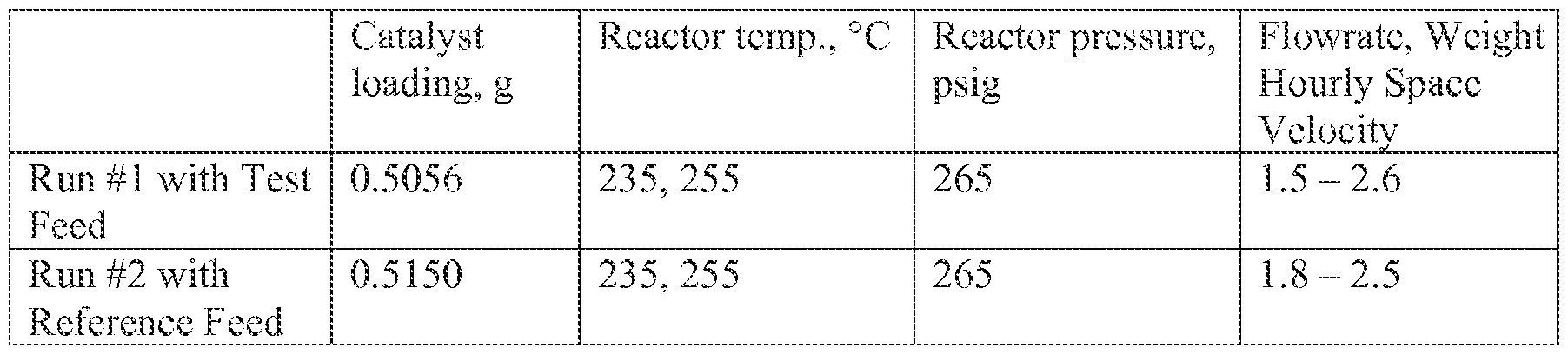
- Test Feeds contained 20 ppm styrene and 2 ppm phenol. 10048] Performance tests were conducted in a 1 ⁇ 4" (.635 cm) stainless steel reactor with the feed going up flow through a catalyst bed. Test conditions are listed below in Table 3.
- a. PX-lean xylenes feedstream is fed to at least one reactor.
- PX-lean for the purposes of the present invention, means less than equilibrium amount of paraxyiene, i.e., less than 24 mol% PX, based on 100 mol% xylene feedstream.
- the feedstream will comprise from 2 to 18 mo3% PX, based on 100 mol% xylene feedstream,
- the "H 2 -free" feedstream contain less than or equal to 4 ppm H 2 .
- Low ppm amounts of H 2 used in the continuous mode will be, preferably, greater than 4 ppm to about 10 ppm (equivalent to 0.00001 moles of H 2 per mole of xylenes). However, the amount of H 2 may be higher, such as 50 or 100 ppm.
- the reactor may be of any type, such as a fixed bed reactor, fluid bed reactor, dense bed reactor, and the like.
- the reactor could be a tubular fixed bed reactor packed with a catalyst suitable for isomerization of C8 aromatic hydrocarbons, more preferably a catalyst comprising HZSM-5 and/or MCM-49.
- the feedstream can flow through the reactor in either up-fiow or down-flow mode.
- a reactor can be operated at a temperature below 295°C, a flow rate within the range of 0.1 to 100 1 (WHSV), and a pressure sufficiently high to keep the feedstream at liquid phase inside the reactor and advantageously maintained so as to achieve the low byproducts yields.
- WHSV 0.1 to 100 1
- the person of ordinary skill in the art, in possession of the present disclosure, can achieve such conditions without more than routine experimentation.
- Once temperature is set those skilled in the art can determine what pressure to use to keep it in liquid phase based on xylenes VLE (vapor- liquid-equilibrium) data.
- the pressure may be above 100 psia, or preferably above 150 psia.
- the catalyst may exhibit a slow deactivation.
- Low ppm levels of dissolved hydrogen in the xylenes feed can completely mitigate such deactivation.
- H 2 is now purposefully added to the feed. Only low ppm levels are necessary.
- H 2 -free feedstream is defined as containing 0.00005 moles H 2 /mole xylenes or less, or 0.00001 moles H 2 /mole xylenes or less
- the H 2 -containmg xylene feed should have greater than 0.00005 moles H 2 /mole xylenes, or greater than 0.00001 moles H 2 /mole xylenes, respectively.
- the H 2 -containing xylene feed will regenerate the catalyst to recover the lost activity.
- the regeneration period can vary, such as from 1 day to a few weeks.
- an operator can replace the 3 ⁇ 4 -containing feed with the H 2 -free feed and resume the normal operation.
- This regeneration technique has at least several advantages. It is easy to implement and cost effective. Hydrogen can readily dissolve in xylenes at the required level. By way of example, at 160 psia, 71 ppm PI? will be dissolved in xylenes at room temperature. It does not require such expensive and complex process equipment as separator and recompressor that is required for the high H 2 partial pressure in converstionai vapor-phase isomerization technologies.
- the regeneration is done with a H 2 -containing xylene feed at the same conditions as that for the normal operation, which means that even during regeneration, the reactor is still producing equilibrium or near equilibrium xylenes; thus would be no productivity loss.
- the operator can increase the H 2 concentration during the regeneration to as high as 100% H 2 and 0% xylenes and still accomplish the objective.
- low ppm levels of H 2 such as 4 to 100 ppm, preferably 4 to 10 ppm (within the standard sampling error possible by current measurement techniques) are dissolved in the xylene feed and fed to the reactor continuously throughout the operation.
- the Ha at such levels will completely prevent the catalyst deactivation.
- this embodiment there is provided a process allowing for long, continuous operation without any need to stop for regeneration.
- a consistently high PX yield is possible at all times.
- Purification of the feedstream by removal of phenol and/or styrene may be done by any method known in the art. Methods of removal of phenol and/or styrene or other olefins have been disclosed in U.S. Publication Nos. 2012-0048780; 2012-0316375; U.S. Patent Application Nos. 13/618,21 1 ; 13/875,373 ; 13/875,402; and references discussed therein.
- the source of phenols and/or styrene are from an alkylation reactor process comprising the contact of methanol and/or dimethylether with benzene and or toluene in the presence of an acid-active catalyst, particularly a phosphorus-containing ZSM-5 catalyst that has been steamed at a temperature on the order of 1 00 F (538°C), such as from about 500 to about 650°C.
- acid-active catalyst particularly a phosphorus-containing ZSM-5 catalyst that has been steamed at a temperature on the order of 1 00 F (538°C), such as from about 500 to about 650°C.
- Preferred materials to remove at least a portion of phenol from the feedstream to the isomerization process of the present invention include alumina, silica, molecular sieves, zeolites, basic organic resins, and mixtures thereof; preferred material to remove at least a.
- styrene from the feedstream to the isomerization process of the present invention include MWW molecular sieves, clay, and mixtures thereof, such as at least one of MCM-22, MCM-36, MCM-49, MCM-56, EMM- 10 molecular sieves, and Engelhard F-24, Filtrol 24, Filtrol 25, and Filtrol 62 clays, Attapulgus clay and Tonsil clay.
- phenol and/or styrene can be present in numerous sources of paraxyiene.
- impurities may come from prior cargoes and may be present in imported paraxyiene, or it may come from other processes (other than alkylation in the presence of an acid active catalyst) such as reformaie.
- Reformaie may have, by way of example, on the order of 200-300 ppm styrene and on the order of 600-800 ppm styrenic species (including dimethyl styrene). These are merely a few of the many sources of paraxylene that need to be purified of phenol and/or styrene in order to become suitable feedstreams for the present process comprising liquid isomerization.
Landscapes
- Chemical & Material Sciences (AREA)
- Organic Chemistry (AREA)
- Crystallography & Structural Chemistry (AREA)
- Chemical Kinetics & Catalysis (AREA)
- Engineering & Computer Science (AREA)
- Materials Engineering (AREA)
- Organic Low-Molecular-Weight Compounds And Preparation Thereof (AREA)
- Low-Molecular Organic Synthesis Reactions Using Catalysts (AREA)
- Catalysts (AREA)
Description




Claims
Priority Applications (8)
| Application Number | Priority Date | Filing Date | Title |
|---|---|---|---|
| BR122016015199A BR122016015199B1 (en) | 2012-08-31 | 2013-08-08 | process for isomerization of para-xylene depleted aromatic hydrocarbon feed stream |
| MYPI2014703884A MY178398A (en) | 2012-08-31 | 2013-08-08 | Xylene isomerization process and catalyst therefor |
| SG11201408189SA SG11201408189SA (en) | 2012-08-31 | 2013-08-08 | Xylene isomerization process and catalyst therefor |
| KR1020147036077A KR101659203B1 (en) | 2012-08-31 | 2013-08-08 | Xylene isomerization process and catalyst therefor |
| CN201380034969.4A CN104395266B (en) | 2012-08-31 | 2013-08-08 | Process for isomerization of xylene and catalyst therefor |
| IN10781DEN2014 IN2014DN10781A (en) | 2012-08-31 | 2013-08-08 | |
| BR112014033014A BR112014033014B1 (en) | 2012-08-31 | 2013-08-08 | process for isomerization of para-xylene depleted aromatic hydrocarbon feed stream comprising phenol and catalyst therefor |
| JP2015520721A JP5933127B2 (en) | 2012-08-31 | 2013-08-08 | Xylene isomerization process and catalyst therefor |
Applications Claiming Priority (2)
| Application Number | Priority Date | Filing Date | Title |
|---|---|---|---|
| US201261695493P | 2012-08-31 | 2012-08-31 | |
| US61/695,493 | 2012-08-31 |
Publications (1)
| Publication Number | Publication Date |
|---|---|
| WO2014035626A1 true WO2014035626A1 (en) | 2014-03-06 |
Family
ID=50184127
Family Applications (1)
| Application Number | Title | Priority Date | Filing Date |
|---|---|---|---|
| PCT/US2013/054070 Ceased WO2014035626A1 (en) | 2012-08-31 | 2013-08-08 | Xylene isomerization process and catalyst therefor |
Country Status (9)
| Country | Link |
|---|---|
| US (2) | US9193645B2 (en) |
| JP (1) | JP5933127B2 (en) |
| KR (1) | KR101659203B1 (en) |
| CN (1) | CN104395266B (en) |
| BR (2) | BR112014033014B1 (en) |
| IN (1) | IN2014DN10781A (en) |
| MY (1) | MY178398A (en) |
| SG (2) | SG11201408189SA (en) |
| WO (1) | WO2014035626A1 (en) |
Cited By (5)
| Publication number | Priority date | Publication date | Assignee | Title |
|---|---|---|---|---|
| US9643897B2 (en) | 2015-03-03 | 2017-05-09 | Uop Llc | Enhanced propylene production in OTO process with modified zeolites |
| CN107029783A (en) * | 2017-05-08 | 2017-08-11 | 宁夏大学 | A kind of LPG is converted into catalyst of ethene, propylene and preparation method thereof |
| US10010878B2 (en) | 2015-03-03 | 2018-07-03 | Uop Llc | High meso-surface area, low Si/Al ratio pentasil zeolite |
| WO2021041021A1 (en) * | 2019-08-23 | 2021-03-04 | Exxonmobil Chemical Patents Inc. | Processes for isomerizing c8 aromatic hydrocarbons |
| WO2021041022A1 (en) * | 2019-08-23 | 2021-03-04 | Exxonmobil Chemical Patents Inc. | Processes for isomerizing c8 aromatic hydrocarbons using serial reactors |
Families Citing this family (2)
| Publication number | Priority date | Publication date | Assignee | Title |
|---|---|---|---|---|
| WO2017180509A1 (en) | 2016-04-14 | 2017-10-19 | Uop Llc | Liquid phase xylene isomerization in the absence of hydrogen |
| KR102889856B1 (en) * | 2020-09-30 | 2025-11-21 | 엑손모빌 케미칼 패턴츠 인코포레이티드 | Method for converting C8 aromatic hydrocarbons |
Citations (5)
| Publication number | Priority date | Publication date | Assignee | Title |
|---|---|---|---|---|
| US5043502A (en) * | 1990-03-16 | 1991-08-27 | Uop | Production of xylenes from light aliphatic hydrocarbons via dehydrocyclodimerization and methylation |
| US6207871B1 (en) * | 1997-12-19 | 2001-03-27 | Mobil Oil Corporation | High-purity meta-xylene production process |
| US20020082462A1 (en) * | 1996-01-25 | 2002-06-27 | Ferraro John Michael | Process for production of paraxylene |
| WO2011133326A2 (en) * | 2010-04-21 | 2011-10-27 | Exxonmobil Chemical Patents Inc. | Xylenes isomerization process and catalyst therefor |
| US20120108868A1 (en) * | 2010-10-29 | 2012-05-03 | Dana Lynn Pilliod | Process for the Production of Paraxylene |
Family Cites Families (22)
| Publication number | Priority date | Publication date | Assignee | Title |
|---|---|---|---|---|
| US6180550B1 (en) | 1998-12-22 | 2001-01-30 | Mobile Oil Corporation | Small crystal ZSM-5, its synthesis and use |
| FR2792632B1 (en) | 1999-04-22 | 2004-02-13 | Inst Francais Du Petrole | PROCESS FOR THE PRODUCTION OF PARAXYLENE INCLUDING AN ADSORPTION STAGE, A LIQUID PHASE ISOMERIZATION STAGE AND A GAS PHASE ISOMERIZATION STAGE WITH A ZEOLITH OF EU0 TYPE |
| DE19951781A1 (en) | 1999-10-27 | 2001-05-03 | Sued Chemie Ag | Process for the production of synthetic zeolites with MFI structure |
| FR2844790B1 (en) | 2002-09-20 | 2004-10-22 | Inst Francais Du Petrole | PARAXYLENE AND STYRENE CO-PRODUCTION PROCESS |
| US6872866B1 (en) | 2003-12-15 | 2005-03-29 | Uop Llc | Liquid phase process for C8 alkylaromatic isomerization |
| US7371913B2 (en) | 2005-06-30 | 2008-05-13 | Uop Llc | Selective aromatics isomerization process |
| US7368620B2 (en) | 2005-06-30 | 2008-05-06 | Uop Llc | Two-stage aromatics isomerization process |
| US7439412B2 (en) | 2006-04-25 | 2008-10-21 | Exxonmobil Chemical Patents Inc. | Process for producing para-xylene |
| US7932426B2 (en) | 2007-12-12 | 2011-04-26 | Uop Llc | Process for isomerizing a non-equilibrium alkylaromatic feed mixture and an aromatic production facility |
| US8273934B2 (en) | 2008-12-15 | 2012-09-25 | Exxonmobil Chemical Patents Inc. | Process for producing para-xylene |
| US8252967B2 (en) | 2009-04-14 | 2012-08-28 | Exxonmobil Chemical Patents Inc. | Process for the purification of paraxylene |
| US8344197B2 (en) | 2009-10-21 | 2013-01-01 | Exxonmobil Chemical Patents Inc. | Production of para-xylene by the methylation of benzene and/or toluene |
| US8399727B2 (en) | 2009-10-21 | 2013-03-19 | Exxonmobil Chemical Patents Inc. | Production of para-xylene by the methylation of benzene and/or toluene |
| KR101020998B1 (en) | 2009-11-12 | 2011-03-09 | 엘지이노텍 주식회사 | Light emitting device and manufacturing method |
| EP2632880A4 (en) * | 2010-10-29 | 2016-01-27 | Exxonmobil Chem Patents Inc | Process for the production of paraxylene |
| CN103596907B (en) | 2011-06-10 | 2016-04-27 | 埃克森美孚化学专利公司 | Production of p-xylene |
| CN103619786B (en) | 2011-07-11 | 2016-06-01 | 埃克森美孚化学专利公司 | Alkylation of Benzene and/or Toluene with Methanol |
| TWI495511B (en) | 2011-07-27 | 2015-08-11 | Exxonmobil Chem Patents Inc | Fluid bed reactor with staged baffles |
| WO2013052260A2 (en) | 2011-10-07 | 2013-04-11 | Exxonmobil Chemical Patents Inc. | Alkylation process |
| US9227888B2 (en) | 2012-04-17 | 2016-01-05 | Exxonmobil Chemical Patents Inc. | Liquid phase isomerization process |
| JP6317736B2 (en) * | 2012-05-31 | 2018-04-25 | エクソンモービル ケミカル パテンツ インコーポレイテッド | Removal of phenol in para-xylene recovery process |
| EP2855406A4 (en) * | 2012-05-31 | 2016-01-06 | Exxonmobil Chem Patents Inc | Styrene removal in paraxylene recovery process |
-
2013
- 2013-08-07 US US13/961,530 patent/US9193645B2/en active Active
- 2013-08-08 BR BR112014033014A patent/BR112014033014B1/en not_active IP Right Cessation
- 2013-08-08 MY MYPI2014703884A patent/MY178398A/en unknown
- 2013-08-08 SG SG11201408189SA patent/SG11201408189SA/en unknown
- 2013-08-08 WO PCT/US2013/054070 patent/WO2014035626A1/en not_active Ceased
- 2013-08-08 CN CN201380034969.4A patent/CN104395266B/en active Active
- 2013-08-08 KR KR1020147036077A patent/KR101659203B1/en not_active Expired - Fee Related
- 2013-08-08 JP JP2015520721A patent/JP5933127B2/en not_active Expired - Fee Related
- 2013-08-08 SG SG10201609679PA patent/SG10201609679PA/en unknown
- 2013-08-08 IN IN10781DEN2014 patent/IN2014DN10781A/en unknown
- 2013-08-08 BR BR122016015199A patent/BR122016015199B1/en not_active IP Right Cessation
-
2015
- 2015-10-23 US US14/921,464 patent/US9266794B1/en active Active
Patent Citations (5)
| Publication number | Priority date | Publication date | Assignee | Title |
|---|---|---|---|---|
| US5043502A (en) * | 1990-03-16 | 1991-08-27 | Uop | Production of xylenes from light aliphatic hydrocarbons via dehydrocyclodimerization and methylation |
| US20020082462A1 (en) * | 1996-01-25 | 2002-06-27 | Ferraro John Michael | Process for production of paraxylene |
| US6207871B1 (en) * | 1997-12-19 | 2001-03-27 | Mobil Oil Corporation | High-purity meta-xylene production process |
| WO2011133326A2 (en) * | 2010-04-21 | 2011-10-27 | Exxonmobil Chemical Patents Inc. | Xylenes isomerization process and catalyst therefor |
| US20120108868A1 (en) * | 2010-10-29 | 2012-05-03 | Dana Lynn Pilliod | Process for the Production of Paraxylene |
Cited By (6)
| Publication number | Priority date | Publication date | Assignee | Title |
|---|---|---|---|---|
| US9643897B2 (en) | 2015-03-03 | 2017-05-09 | Uop Llc | Enhanced propylene production in OTO process with modified zeolites |
| US10010878B2 (en) | 2015-03-03 | 2018-07-03 | Uop Llc | High meso-surface area, low Si/Al ratio pentasil zeolite |
| CN107029783A (en) * | 2017-05-08 | 2017-08-11 | 宁夏大学 | A kind of LPG is converted into catalyst of ethene, propylene and preparation method thereof |
| WO2021041021A1 (en) * | 2019-08-23 | 2021-03-04 | Exxonmobil Chemical Patents Inc. | Processes for isomerizing c8 aromatic hydrocarbons |
| WO2021041022A1 (en) * | 2019-08-23 | 2021-03-04 | Exxonmobil Chemical Patents Inc. | Processes for isomerizing c8 aromatic hydrocarbons using serial reactors |
| US12037314B2 (en) | 2019-08-23 | 2024-07-16 | ExxonMobil Engineering & Technology Company | Processes for isomerizing C8 aromatic hydrocarbons |
Also Published As
| Publication number | Publication date |
|---|---|
| IN2014DN10781A (en) | 2015-09-04 |
| BR112014033014B1 (en) | 2016-11-29 |
| CN104395266A (en) | 2015-03-04 |
| JP5933127B2 (en) | 2016-06-08 |
| US9266794B1 (en) | 2016-02-23 |
| MY178398A (en) | 2020-10-12 |
| SG11201408189SA (en) | 2015-01-29 |
| US20140066675A1 (en) | 2014-03-06 |
| US9193645B2 (en) | 2015-11-24 |
| KR101659203B1 (en) | 2016-09-22 |
| BR122016015199B1 (en) | 2016-12-20 |
| BR122016015199A2 (en) | 2016-10-11 |
| KR20150022882A (en) | 2015-03-04 |
| JP2015527989A (en) | 2015-09-24 |
| SG10201609679PA (en) | 2016-12-29 |
| CN104395266B (en) | 2016-08-24 |
| BR112014033014A2 (en) | 2016-07-26 |
| US20160039727A1 (en) | 2016-02-11 |
Similar Documents
| Publication | Publication Date | Title |
|---|---|---|
| CA2796341C (en) | Xylene isomerization process and catalyst therefor | |
| US9266794B1 (en) | Xylene isomerization process and catalyst therefor | |
| US20080249345A1 (en) | Process and Apparatus for Para-Xylene Production | |
| KR101974770B1 (en) | Method and apparatus for the production of para-xylene | |
| US9416072B1 (en) | Selective hydrogenation of styrene to ethylbenzene | |
| KR20190045933A (en) | Method for methylating aromatic hydrocarbons | |
| CN111448178A (en) | Xylene production method and system | |
| US9422208B2 (en) | Treatment of aromatic hydrocarbon stream | |
| JP7451684B2 (en) | C8 aromatic hydrocarbon isomerization method | |
| US20250128999A1 (en) | Xylene Isomer Separation Processes | |
| TW202413314A (en) | Production of p-xylene by liquid-phase isomerization and separation thereof | |
| BR112022000872B1 (en) | PROCESS FOR TREATING POLYALKYL OROMATIC HYDROCARBONS | |
| TW201422578A (en) | Low pressure transalkylation process |
Legal Events
| Date | Code | Title | Description |
|---|---|---|---|
| 121 | Ep: the epo has been informed by wipo that ep was designated in this application |
Ref document number: 13833856 Country of ref document: EP Kind code of ref document: A1 |
|
| ENP | Entry into the national phase |
Ref document number: 20147036077 Country of ref document: KR Kind code of ref document: A |
|
| ENP | Entry into the national phase |
Ref document number: 2015520721 Country of ref document: JP Kind code of ref document: A |
|
| NENP | Non-entry into the national phase |
Ref country code: DE |
|
| REG | Reference to national code |
Ref country code: BR Ref legal event code: B01A Ref document number: 112014033014 Country of ref document: BR |
|
| 122 | Ep: pct application non-entry in european phase |
Ref document number: 13833856 Country of ref document: EP Kind code of ref document: A1 |
|
| ENP | Entry into the national phase |
Ref document number: 112014033014 Country of ref document: BR Kind code of ref document: A2 Effective date: 20141230 |