WO2014033466A1 - Method and compositions for removing acid-labile protecting groups - Google Patents
Method and compositions for removing acid-labile protecting groups Download PDFInfo
- Publication number
- WO2014033466A1 WO2014033466A1 PCT/GB2013/052280 GB2013052280W WO2014033466A1 WO 2014033466 A1 WO2014033466 A1 WO 2014033466A1 GB 2013052280 W GB2013052280 W GB 2013052280W WO 2014033466 A1 WO2014033466 A1 WO 2014033466A1
- Authority
- WO
- WIPO (PCT)
- Prior art keywords
- acid
- group
- fmoc
- hfip
- composition
- Prior art date
- Legal status (The legal status is an assumption and is not a legal conclusion. Google has not performed a legal analysis and makes no representation as to the accuracy of the status listed.)
- Ceased
Links
- OTKXCALUHMPIGM-UHFFFAOYSA-N CC(C)(C)OC(CCC(C(O)=O)NC(OCC1c(cccc2)c2-c2c1cccc2)=O)=O Chemical compound CC(C)(C)OC(CCC(C(O)=O)NC(OCC1c(cccc2)c2-c2c1cccc2)=O)=O OTKXCALUHMPIGM-UHFFFAOYSA-N 0.000 description 1
- UMRUUWFGLGNQLI-UHFFFAOYSA-N CC(C)(C)OC(NCCCCC(C(O)=O)NC(OCC1c(cccc2)c2-c2c1cccc2)=O)=O Chemical compound CC(C)(C)OC(NCCCCC(C(O)=O)NC(OCC1c(cccc2)c2-c2c1cccc2)=O)=O UMRUUWFGLGNQLI-UHFFFAOYSA-N 0.000 description 1
- JAUKCFULLJFBFN-UHFFFAOYSA-N CC(C)(C)Oc1ccc(CC(C(O)=O)NC(OCC2c3ccccc3-c3c2cccc3)=O)cc1 Chemical compound CC(C)(C)Oc1ccc(CC(C(O)=O)NC(OCC2c3ccccc3-c3c2cccc3)=O)cc1 JAUKCFULLJFBFN-UHFFFAOYSA-N 0.000 description 1
- CBPJQFCAFFNICX-UHFFFAOYSA-N CC(C)CC(C(O)=O)NC(OCC1c2ccccc2-c2c1cccc2)=O Chemical compound CC(C)CC(C(O)=O)NC(OCC1c2ccccc2-c2c1cccc2)=O CBPJQFCAFFNICX-UHFFFAOYSA-N 0.000 description 1
- YRKFMPDOFHQWPI-UHFFFAOYSA-N NCCCCC(C(O)=O)NC(OCC1c2ccccc2-c2c1cccc2)=O Chemical compound NCCCCC(C(O)=O)NC(OCC1c2ccccc2-c2c1cccc2)=O YRKFMPDOFHQWPI-UHFFFAOYSA-N 0.000 description 1
- SWZCTMTWRHEBIN-UHFFFAOYSA-N OC(C(Cc(cc1)ccc1O)NC(OCC1c2ccccc2-c2ccccc12)=O)=O Chemical compound OC(C(Cc(cc1)ccc1O)NC(OCC1c2ccccc2-c2ccccc12)=O)=O SWZCTMTWRHEBIN-UHFFFAOYSA-N 0.000 description 1
- QEPWHIXHJNNGLU-UHFFFAOYSA-N OC(CCC(C(O)=O)NC(OCC1c2ccccc2-c2c1cccc2)=O)=O Chemical compound OC(CCC(C(O)=O)NC(OCC1c2ccccc2-c2c1cccc2)=O)=O QEPWHIXHJNNGLU-UHFFFAOYSA-N 0.000 description 1
Classifications
-
- C—CHEMISTRY; METALLURGY
- C07—ORGANIC CHEMISTRY
- C07K—PEPTIDES
- C07K1/00—General methods for the preparation of peptides, i.e. processes for the organic chemical preparation of peptides or proteins of any length
- C07K1/12—General methods for the preparation of peptides, i.e. processes for the organic chemical preparation of peptides or proteins of any length by hydrolysis, i.e. solvolysis in general
- C07K1/122—Hydrolysis with acids different from HF
-
- C—CHEMISTRY; METALLURGY
- C07—ORGANIC CHEMISTRY
- C07K—PEPTIDES
- C07K1/00—General methods for the preparation of peptides, i.e. processes for the organic chemical preparation of peptides or proteins of any length
- C07K1/06—General methods for the preparation of peptides, i.e. processes for the organic chemical preparation of peptides or proteins of any length using protecting groups or activating agents
- C07K1/061—General methods for the preparation of peptides, i.e. processes for the organic chemical preparation of peptides or proteins of any length using protecting groups or activating agents using protecting groups
-
- Y—GENERAL TAGGING OF NEW TECHNOLOGICAL DEVELOPMENTS; GENERAL TAGGING OF CROSS-SECTIONAL TECHNOLOGIES SPANNING OVER SEVERAL SECTIONS OF THE IPC; TECHNICAL SUBJECTS COVERED BY FORMER USPC CROSS-REFERENCE ART COLLECTIONS [XRACs] AND DIGESTS
- Y02—TECHNOLOGIES OR APPLICATIONS FOR MITIGATION OR ADAPTATION AGAINST CLIMATE CHANGE
- Y02P—CLIMATE CHANGE MITIGATION TECHNOLOGIES IN THE PRODUCTION OR PROCESSING OF GOODS
- Y02P20/00—Technologies relating to chemical industry
- Y02P20/50—Improvements relating to the production of bulk chemicals
- Y02P20/55—Design of synthesis routes, e.g. reducing the use of auxiliary or protecting groups
Definitions
- the invention relates to the field of organic chemistry, in particular, to organic synthesis, where the use of protecting groups to protect organic compounds is necessary.
- the invention relates to peptide chemistry, particularly to solid-phase peptide synthesis (SPPS) as well as to solution-phase peptide synthesis.
- SPPS solid-phase peptide synthesis
- Peptides are used extensively in medicine for drug design and drug discovery, and as probes for molecular imaging and disease diagnosis.
- Peptides and their derivatives such as hormones, neurotransmitters and neuromodulators act as signal molecules in diverse biological and medicinal applications and thus have attracted considerable synthetic attention both for industrial manufacturing and small-scale lab production.
- Boc SPPS remains a competitive method, especially for long peptides.
- the Boc chemistry is based on a combination of two types of acid-labile protecting groups with vastly different sensitivity to acid: a temporary f-butoxycarbonyl group (Boc) for / ⁇ -protection and a semipermanent protecting group for nucleophilic amino acid side-chains, usually a (substituted) benzyl ester or ether (Bzl, 2-CI-Bzl, 2,6-di-Br-Bzl), benzyloxycarbonyl (Z) and its derivatives, such as 2- chlorobenzyloxycarbonyl (2-CIZ), and other groups with comparable acid stability such as p-toluenesulphonyl (tosyl, Tos) for Arg [Isidro-Llobet, A.; Alvarez, M.; Albericio, F.
- Boc group is removed in each cycle of peptide elongation by a moderately strong acid, usually trifluoroacetic acid (TFA) at 10-100% concentration
- TFA trifluoroacetic acid
- Other protecting groups must be relatively TFA-resistant to prevent side-reactions resulting from premature unmasking of the amino acid side-chains.
- Inorganic acids such as 6N hydrochloric acid HCI [Naharissoa, H.; Sarrade, V.; Follet, M.; Calas, B. Pept. Res. 1992, 5, 293] or concentrated sulphuric acid H 2 S0 4 in 1 ,4-dioxane (1 :9 v/v) [Trivedi, H. S.; Anson, M.; Steel, P. G.; Worley, J. SynLett 2001 , 1932] have also been tried for the Boc group deprotection during solid-phase peptide synthesis but they have not gained popularity.
- 6N hydrochloric acid HCI Naharissoa, H.; Sarrade, V.; Follet, M.; Calas, B. Pept. Res. 1992, 5, 293
- concentrated sulphuric acid H 2 S0 4 in 1 ,4-dioxane (1 :9 v/v) Trivedi, H. S.; Anson,
- scavengers are usually employed such as anisole [Sakakibara, S.; Shimonishi, V. Bull.
- TFA trifluoroacetic acid
- the remaining 5-10% are usually water and various scavengers, in particular, sulphur-containing compounds such as thioanisole and 1 ,2- ethanedithiol [King, D. S.; Fields, C. G.; Fields, G. B. Int. J. Pept. Protein Res. 1989, 36, 255], or trialkylsilanes [Pearson, D. A.; Blanchette, M.; Baker, M. L; Guindon, C. A. Tetrahedron Lett. 1989, 30, 2739].
- Scavengers are used to suppress side-reactions occurring with sensitive amino acid side-chains such as Trp under the action of reactive cations generated by TFA from protecting groups.
- Trp [Fields, G. B. and Noble, R. L. Int. J. Peptide Prot. Res. 1990, 35, 161 ].
- TFA is used in copious quantities (usually 50-100% v/v) to remove the /V-terminal Boc group in every cycle of peptide assembly.
- TFA is considered a milder deprotecting agent than liquid HF, TFMSA in TFA or neat MSA.
- TFA is an aggressive, extremely corrosive chemical capable of inflicting bodily harm through inhalation as well as skin contact, leaving hard to heal chemical burns. It readily attacks or infiltrates many common materials, and is relatively expensive, both for the initial purchase and for its ultimate disposal, especially when large-scale peptide synthesis requires large amounts of the chemical.
- Sulphonic acids such as methanesulphonic acid (MSA) [Yajima, H.; Ogawa, H.; Fujii, N.; Funakoshi, S. Chem. Pharm. Bull. 1977, 25, 740; Kiso, Y.; Fujiwara, Y.; Kimura, T.; Nishitani, A.; Akaji, K. Int. J. Peptide Protein Res. 1992, 40, 308] and, in particular, p-toluenesulphonic acid (p-TSA) [Goodacre, J.; Ponsford, R. J.; Stirling, I.
- MSA methanesulphonic acid
- p-TSA p-toluenesulphonic acid
- the sulphonic acids have insufficient solubility in dichloromethane (DCM), which is a preferred solvent for low-crosslinked (1 - 2%) polystyrene resins usually employed as polymeric supports in the Boc SPPS. That requires addition of suboptimal solvents such as 1 ,4-dioxane to reach the necessarily high concentration of the acid.
- DCM dichloromethane
- the sulphonic acids are stronger acids than TFA and have been used at higher concentration, such as 100% MSA, for the full deprotection of peptides [Yajima, H.; Kiso, Y.; Ogawa, H.; Fujii, N.; Irie, H. Chem. Pharm. Bull. 1975, 23, 1 164].
- One aspect of the invention is the use of the method and compositions for full or partial removal of acid- labile protecting groups from a compound such as a protected peptide.
- Another aspect of the invention is the use of the method and compositions to cleave an acid-labile linker to a solid support used in solid-phase synthesis, such as solid-phase peptide synthesis (SPPS).
- SPPS solid-phase peptide synthesis
- the method of the present invention uses less hazardous and more environmentally friendly compositions than the currently used trifluoroacetic acid (TFA) or liquid hydrofluoric acid HF based cocktails.
- a method for removing acid-labile protecting groups from a protected compound that has one or more acid-labile protecting groups comprising: a. dissolving or dispersing the protected compound, or immersing a solid support to which the protected compound is attached, in a mixture comprising a fluoro alcohol, an acid and, optionally, an organic solvent and/or a scavenger; and b. maintaining the resulting solution or dispersion, or keeping the solid support immersed, for a period of time sufficient to ensure the removal of one or more acid-labile protecting groups from said protected compound, thereby producing a deprotected or partially protected compound.
- the deprotected or partially protected compound is recovered at the end of the method.
- the method is preferably performed at ambient temperature.
- a composition for use in a method for removing acid-labile protecting groups from a protected compound that has one or more acid-labile protecting groups comprising i) a fluoro alcohol, ii) an acid and, optionally, iii) an organic solvent and/or a scavenger.
- the composition contains at least one fluoro alcohol and at least one acid and, optionally, at least one organic solvent and/or at least one scavenger; but if desired may contain combinations of two or more different fluoro alcohols, acids, solvents and/or scavengers.
- the method involves the use of a mixture or composition that contains a combination of at least two key components.
- a fluoro alcohol such as 2,2,2-trifluoroethanol (TFE), 1 , 1 , 1 ,3,3,3- hexafluoroisopropanol (HFIP), 2,2,3,3,3-pentafluoro-1 -propanol, 2,2,3,3,4,4,4-heptafluoro-1 -butanol, nonafluoro-tert-butyl alcohol and the like, or a combination thereof, in a concentration of 0.01 -99.99% (v/v).
- the fluoro alcohol is preferably present in a concentration within the range of 5- 99% (v/v), and more preferably within the range of 10-30% (v/v).
- key component two is a protic (Br0nsted) acid such as hydrochloric acid HCI, hydrobromic acid HBr, sulphuric acid, benzenesulphonic acid, p-toluenesulphonic acid (p-TSA), methanesulphonic acid, ethanesulphonic acid, trifluoromethanesulphonic acid (TFMSA), trifluoroacetic acid (TFA), trichloroacetic acid (TCA), dichloroacetic acid (DCA), chloroacetic acid, formic acid, acetic acid and the like, or a combination thereof.
- protic (Br0nsted) acid such as hydrochloric acid HCI, hydrobromic acid HBr, sulphuric acid, benzenesulphonic acid, p-toluenesulphonic acid (p-TSA), methanesulphonic acid, ethanesulphonic acid, trifluoromethanesulphonic acid (TFMSA), tri
- key component two is a Lewis acid or a silicon compound such as chlorotrimethylsilane Me 3 SiCI, bromotrimethylsilane Me 3 SiBr, boron trifluoride BF 3 , boron trichloride BCI 3 , silicon tetrachloride SiCI 4 , trimethylsilyl trifluoromethane sulphonate (TMSOTf) and the like, or a combination thereof.
- a Lewis acid or a silicon compound such as chlorotrimethylsilane Me 3 SiCI, bromotrimethylsilane Me 3 SiBr, boron trifluoride BF 3 , boron trichloride BCI 3 , silicon tetrachloride SiCI 4 , trimethylsilyl trifluoromethane sulphonate (TMSOTf) and the like, or a combination thereof.
- key component two is a polymeric protic or Lewis acid or a silylated polymeric acid such as the sulphonated polystyrene resins, for example Dowex® or Amberlyst® resins, Nafion® resin or trimethylsilyl-Nafion® resin [Murata, S.; Noyori, R. Tetrahedron Lett. 1980, 21, 767] and the like.
- sulphonated polystyrene resins for example Dowex® or Amberlyst® resins, Nafion® resin or trimethylsilyl-Nafion® resin [Murata, S.; Noyori, R. Tetrahedron Lett. 1980, 21, 767] and the like.
- said key component two is selected from the group of polymeric protic acids in the H form.
- said key component two is an Amberlyst® resin in the H form.
- an organic solvent may be added such as dichloromethane (DCM), chloroform CHCI 3 , 1 ,2-dichloroethane (DCE), carbon tetrachloride CCI 4 , benzene C6H 6 , toluene CH 3 C6H 5 , pentane C5H12, hexane ⁇ and the like, or a combination thereof.
- DCM dichloromethane
- DCE 1,2-dichloroethane
- CCI 4 carbon tetrachloride
- benzene C6H 6 toluene CH 3 C6H 5
- pentane C5H12 hexane ⁇ and the like
- a scavenger may be added.
- scavengers examples include, but are not limited to, thioanisole (TA), dimethylsulphide (DMS), ethylmethylsulphide, tetrahydrothiophene, 1 ,2-ethanedithiol, 1 ,3- propanedithiol, benzylmercaptan, thiophenol, anisole, phenol, m-cresol, water, pentamethylbenzene, triethylsilane and triisopropylsilane, or a combination thereof.
- TA thioanisole
- DMS dimethylsulphide
- ethylmethylsulphide etrahydrothiophene
- 1 ,2-ethanedithiol 1 ,2-ethanedithiol
- 1 ,3- propanedithiol propanedithiol
- benzylmercaptan thiophenol
- anisole phenol
- phenol m-cresol
- water penta
- the concentration of a scavenger or scavengers is preferably within the range of 0.1 -95% (v/v), and more preferably within the range of 1 -50% (v/v).
- said protected compound is attached to a solid support for solid-phase synthesis.
- a protected compound attached to a solid support by a chemical bond that is non-cleavable using the method of this invention in the current embodiment will be deprotected or partially deprotected of acid-labile protecting groups by the method of this invention; but will remain attached to the solid support.
- the protected compound is attached to a solid support by an acid-labile linker (i.e. a cleavable bond using the method of this invention in the current embodiment) referred to herein as an acid- labile solid support; and the method then results in the production of a deprotected or partially protected compound that is detached from the solid support.
- an acid-labile linker i.e. a cleavable bond using the method of this invention in the current embodiment
- a composition which comprises hydrochloric acid, 1 , 1 , 1 , 3,3, 3-hexafluoroisopropanol and, optionally, a solvent and/or a scavenger or a combination of solvents and/or scavengers.
- a composition which comprises hydrochloric acid, 2,2,2-trifluoroethanol and, optionally, a solvent and/or a scavenger or a combination of solvents and/or scavengers.
- the concentration of hydrochloric acid is preferably within the range of 0.001 - 6N, and more preferably within the range of 0.05 - 1 N.
- a composition which comprises p- toluenesulphonic acid (p-TSA), 2,2,2-trifluoroethanol and, optionally, a solvent and/or a scavenger or a combination of solvents and/or scavengers.
- p-TSA p- toluenesulphonic acid
- 2,2,2-trifluoroethanol 2,2,2-trifluoroethanol
- solvent and/or a scavenger or a combination of solvents and/or scavengers.
- a composition which comprises p- toluenesulphonic acid (p-TSA), 1 , 1 , 1 ,3,3,3-hexafluoroisopropanol and, optionally, a solvent and/or a scavenger or a combination of solvents and/or scavengers.
- p-TSA p- toluenesulphonic acid
- 1 , 1 , 1 ,3,3,3-hexafluoroisopropanol optionally, a solvent and/or a scavenger or a combination of solvents and/or scavengers.
- the concentration of p-toluenesulphonic acid is preferably within the range of 0.001 - 2M, and more preferably within the range of 0.05 - 1 M.
- a composition which comprises benzenesulphonic acid, 2,2,2-trifluoroethanol and, optionally, a solvent and/or a scavenger or a combination of solvents and/or scavengers.
- a composition which comprises benzenesulphonic acid, 1 , 1 , 1 , 3,3, 3-hexafluoroisopropanol and, optionally, a solvent and/or a scavenger or a combination of solvents and/or scavengers.
- the concentration of benzenesulphonic acid is preferably within the range of 0.001 - 2M, and more preferably within the range of 0.05 - 1 M.
- a composition which comprises hydrobromic acid, 1 , 1 , 1 ,3,3,3-hexafluoroisopropanol and, optionally, a solvent and/or a scavenger or a combination of solvents and/or scavengers.
- a composition which comprises hydrobromic acid, 2,2,2-trifluoroethanol and, optionally, a solvent and/or a scavenger or a combination of solvents and/or scavengers.
- concentration of hydrobromic acid is preferably within the range of 0.001 - 6M, and more preferably within the range of 0.05 - 1 M.
- a composition which comprises methanesulphonic acid (MSA), 2,2,2-trifluoroethanol and, optionally, a solvent and/or a scavenger or a combination of solvents and/or scavengers.
- MSA methanesulphonic acid
- 2,2,2-trifluoroethanol 2,2,2-trifluoroethanol
- solvent and/or a scavenger or a combination of solvents and/or scavengers optionally, a solvent and/or a scavenger or a combination of solvents and/or scavengers.
- a composition which comprises methanesulphonic acid (MSA), 1 , 1 , 1 ,3,3,3-hexafluoroisopropanol and, optionally, a solvent and/or a scavenger or a combination of solvents and/or scavengers.
- MSA methanesulphonic acid
- 1 , 1 , 1 ,3,3,3-hexafluoroisopropanol optionally, a solvent and/or a scavenger or a combination of solvents and/or scavengers.
- the concentration of methanesulphonic acid is preferably within the range of 0.001 - 2M, and more preferably within the range of 0.05 - 1 M.
- a composition which comprises trifluoromethanesulphonic acid (TFMSA), 1 , 1 , 1 ,3,3,3-hexafluoroisopropanol and, optionally, a solvent and/or a scavenger or a combination of solvents and/or scavengers.
- TFMSA trifluoromethanesulphonic acid
- a composition which comprises trifluoromethanesulphonic acid, 2,2,2-trifluoroethanol and, optionally, a solvent and/or a scavenger or a combination of solvents and/or scavengers.
- the concentration of trifluoromethanesulphonic acid is preferably within the range of 0.001 - 2M, and more preferably within the range of 0.05 - 1 M.
- a composition which comprises sulphuric acid, 1 , 1 , 1 ,3,3,3-hexafluoroisopropanol and, optionally, a solvent and/or a scavenger or a combination of solvents and/or scavengers.
- a composition which comprises sulphuric acid, 2,2,2-trifluoroethanol and, optionally, a solvent and/or a scavenger or a combination of solvents and/or scavengers.
- the concentration of sulphuric acid is preferably within the range of 0.001 - 2M, and more preferably within the range of 0.05 - 1 M.
- a composition which comprises trifluoroacetic acid (TFA), 1 , 1 , 1 ,3,3,3-hexafluoroisopropanol and, optionally, a solvent and/or a scavenger or a combination of solvents and/or scavengers.
- TFA trifluoroacetic acid
- 1 , 1 , 1 ,3,3,3-hexafluoroisopropanol optionally, a solvent and/or a scavenger or a combination of solvents and/or scavengers.
- a composition which comprises trifluoroacetic acid, 2,2,2-trifluoroethanol and, optionally, a solvent and/or a scavenger or a combination of solvents and/or scavengers.
- concentration of trifluoroacetic acid is preferably within the range of 0.05 - 95 % (v/v), and more preferably within the range of 0.5 - 50 % (v/v).
- a composition is used, which comprises formic acid, 1 , 1 , 1 ,3,3,3-hexafluoroisopropanol and, optionally, a solvent and/or a scavenger or a combination of solvents and/or scavengers.
- a composition which comprises formic acid, 2,2,2-trifluoroethanol and, optionally, a solvent and/or a scavenger or a combination of solvents and/or scavengers.
- the concentration of formic acid is preferably within the range of 0.05 - 95 % (v/v), and more preferably within the range of 0.5 - 50 % (v/v).
- a composition which comprises acetic acid, 1 , 1 , 1 ,3,3,3-hexafluoroisopropanol and, optionally, a solvent and/or a scavenger or a combination of solvents and/or scavengers.
- a composition is used, which comprises acetic acid, 2,2,2-trifluoroethanol and, optionally, a solvent and/or a scavenger or a combination of solvents and/or scavengers.
- the concentration of acetic acid is preferably within the range of 0.05 - 95 % (v/v), and more preferably within the range of 0.5 - 50 % (v/v).
- a composition which comprises chlorotrimethylsilane Me 3 SiCI, 1 , 1 , 1 , 3,3, 3-hexafluoroisopropanol and, optionally, a solvent and/or a scavenger or a combination of solvents and/or scavengers.
- a composition is used, which comprises chlorotrimethylsilane, 2,2,2-trifluoroethanol and, optionally, a solvent and/or a scavenger or a combination of solvents and/or scavengers.
- the concentration of chlorotrimethylsilane is preferably within the range of 0.001 - 3M, and more preferably within the range of 0.05 - 1 M.
- a composition which comprises bromotnmethylsilane Me 3 SiBr, 1 , 1 , 1 ,3,3,3-hexafluoroisopropanol and, optionally, a solvent and/or a scavenger or a combination of solvents and/or scavengers.
- a composition which comprises bromotnmethylsilane, 2,2,2-trifluoroethanol and, optionally, a solvent and/or a scavenger or a combination of solvents and/or scavengers.
- the concentration of bromotrimethylsilane is preferably within the range of 0.001 - 3M, and more preferably within the range of 0.05 - 1 M.
- a composition which comprises trimethylsilyl trifluoromethanesulphonate (TMSOTf), 1 , 1 , 1 ,3,3,3- hexafluoroisopropanol and, optionally, a solvent and/or a scavenger or a combination of solvents and/or scavengers.
- TMSOTf trimethylsilyl trifluoromethanesulphonate
- a composition which comprises trimethylsilyl trifluoromethanesulphonate, 2,2,2-trifluoroethanol and, optionally, a solvent and/or a scavenger or a combination of solvents and/or scavengers.
- concentration of trimethylsilyl trifluoromethanesulphonate is preferably within the range of 0.001 - 3M, and more preferably within the range of 0.05 - 1 M.
- a composition which comprises an Amberlyst® resin in the H form, 1 , 1 , 1 ,3,3,3-hexafluoroisopropanol and, optionally, a solvent and/or a scavenger or a combination of solvents and/or scavengers.
- a composition which comprises an Amberlyst® resin in the H form, 2,2,2-trifluoroethanol and, optionally, a solvent and/or a scavenger or a combination of solvents and/or scavengers.
- a composition which comprises a Dowex® resin in the H form, 1 , 1 , 1 ,3,3,3-hexafluoroisopropanol and, optionally, a solvent and/or a scavenger or a combination of solvents and/or scavengers.
- a composition which comprises a Dowex® resin in the H form, 2,2,2-trifluoroethanol and, optionally, a solvent and/or a scavenger or a combination of solvents and/or scavengers.
- a composition which comprises a Nafion® resin, 1 , 1 , 1 ,3,3,3-hexafluoroisopropanol and, optionally, a solvent and/or a scavenger or a combination of solvents and/or scavengers.
- a composition which comprises a Nafion® resin, 2,2,2-trifluoroethanol and, optionally, a solvent and/or a scavenger or a combination of solvents and/or scavengers.
- a composition is used, which comprises a trimethylsilyl-Nafion® resin, 1 , 1 , 1 ,3,3,3-hexafluoroisopropanol and, optionally, a solvent and/or a scavenger or a combination of solvents and/or scavengers.
- a composition which comprises a trimethylsilyl-Nafion® resin, 2,2,2-trifluoroethanol and, optionally, a solvent and/or a scavenger or a combination of solvents and/or scavengers.
- mixture used in the method of this invention may be added as a pre-formed composition or, alternatively, one or more of the components may be added separately to the other component(s) during the performance of the method.
- the method and compositions can be used in organic synthesis to deprotect organic compounds protected by acid-labile protecting groups or cleave acid-labile linkers to solid supports in solid-phase synthesis.
- the method and compositions may be used in solid-phase peptide synthesis as well as in liquid-phase peptide synthesis to remove acid-labile protecting groups from protected peptides, and in solid-phase peptide synthesis to remove a fully deprotected or partially protected peptide from a solid support.
- the method and compositions of the invention replace currently used highly hazardous deprotection reagents trifluoroacetic acid (TFA) or liquid hydrofluoric acid HF.
- Fluoro alcohols such as 2,2,2-trifluoroethanol (TFE) or 1 , 1 , 1 ,3,3,3- hexafluoroisopropanol (HFIP) have been widely used as solvents and reagents in organic synthesis in general and in peptide chemistry in particular.
- Typical fluoro alcohols are acidic: pK A of TFE is 12.4 [Ballinger, P.; Long, F. A. J. Am. Chem. Soc. 1959, 81, 1050], pK A of HFIP is 9.3, and that of perfluoro-fe/f-butanol (CF 3 ) 3 COH is 5.2 [Filler, R.; Schure, R. M. J. Org. Chem.
- fluoro alcohols are good solubilising agents for peptides, especially those prone to form secondary structures [Yanagi, K.; Ashizaki, M.; Yagi, H.; Sakurai, K.; Lee,
- Cleavage of fully protected peptides from trityl ester resin may be effected by dilute HCI in aqueous DMF with optional TFE (up to 10% v/v)
- TFE up to 10% v/v
- the p-benzyloxybenzyl ester of the Fmoc-Leu-Wang resin was cleaved by 0.1 N HCI in HFIP - DCM (1 :4 v/v) mixture more slowly (91 .6% release after 3 h). It should be noted that the ratio of HCI to the polymeric ester was nearly equimolar: ca. 0.1 mmol (10 ⁇ of concentrated ca. 37% aqueous HCI per 1 cm 3 of the mixture) per ca. 0.095 mmol of the resin-bound amino acid (100 mg of the resin with the Fmoc group loading of 0.95 mmol g "1 ).
- the p-hydroxymethylphenoxyacetyl ester (Fmoc-Gly-HMPA-PEG-PS® resin) has slightly lower lability to 0.1 N HCI in HFIP (84.2% release after 3 h).
- the addition of 1 % v/v dimethylsulphide had no noticeable accelerating effect on the cleavage.
- the two common resins for peptide amides were cleaved even faster.
- Rink-NovaPEG® resin released 82% Fmoc-glycinamide after 2 h, and PAL-PEG-PS® lost 91 % of the same after 1 h of reaction.
- the type of the resin had no clear-cut influence on the rate of deprotection.
- a peptide Fmoc-Lys- Thr-Thr-Lys-Ser-OH was prepared by the Fmoc SPPS as described [Amblard, M.; Fehrentz, J-A.; Martinez, J.; Subra, G. Mol. Biotechnol. 2006, 3, 239] on TentaGel® S carboxytrityl ester-linked resin [Grubler, G.; Zimmermann, H.; Echner, H.; Stoeva, S.; Bernardi, E.; Pourrias, B.; Voelter, W.
- fluoro alcohols are poor swelling solvents for polystyrene resins.
- the latter can be improved by adding good swelling solvent such as DCM.
- DCM swelling solvent
- a mixture of just 10% (v/v) TFE in DCM is an excellent swelling medium for low crosslinked polystyrene supports such as MBHA or Merrifield resin used in the Boc SPPS.
- p-TSA non-volatile crystalline p-toluenesulphonic acid monohydrate
- the deprotected species in the case of ethanol was the corresponding ethyl ester H-Lys(Fmoc)-OEt detected as a dominant peak (intensity 100%) after 72 h of reaction in the HR-MS spectrum (m/z 397.2042) (Example 14).
- the corresponding trifluoroethyl ester was also detectable in the reaction mixture after 72 h of reaction as a low intensity peak in the HR-MS spectrum (m/z 452.1839) (Example 14).
- No trifluoroethyl ester side-product was seen on RP-HPLC within the time necessary for complete Boc deprotection (5 min). It should be noted that no such side-reaction of esterification of the free carboxyl group was ever observed with HFIP in our experiments.
- fluoro alcohol refers to compounds of the formula R 1 R 2 R 3 C-OH, where R 1 is a fluorinated lower alkyl, and R 2 and R 3 are each independently H or a fluorinated lower alkyl radical.
- exemplary fluoro alcohols include, without limitation, 2,2,2-trifluoroethanol CF 3 CH 2 OH ("TFE"), 1 , 1 , 1 ,3,3,3- hexafluoroisopropanol (CF 3 ) 2 CHOH (“HFIP”), 2,2,3,3-tetrafluoro-1 -propanol CHF 2 CF 2 CH 2 OH, 2,2,3,3,3-pentafluoro-1 -propanol CF 3 CF 2 CH 2 OH, 2,2,3,3,4,4,4-heptafluoro-1 -butanol CF3CF2CF2CH2OH, perfluoro-fe/f- butanol (CF 3 ) 3 COH and the like.
- lower alkyl refers to monovalent hydrocarbon radicals composed of carbon and hydrogen, and having no unsaturation. Lower alkyl radicals may be straight or branched, and contain from 1 to 6 carbon atoms, inclusive.
- fluorinated lower alkyl refers to a lower alkyl radical in which one or more hydrogen atoms have been replaced by fluorine. Exemplary fluorinated lower alkyl radicals include, without limitation, CF 3 - CHF 2 - CF 3 CF 2 - CF 3 CF 2 CF 2 - CHF 2 CF 2 - (CF 3 ) 3 C- and the like.
- non-hydrogen-bonding solvent refers to an organic solvent thatdoes not form strong hydrogen bonds.
- the term "acid” as used herein refers to a protic (Bransted) acid including, without limitation, hydrofluoric acid HF, hydrochloric acid HCI, hydrobromic acid HBr, sulphuric acid H 2 S0 4 , p-toluenesulphonic acid (p-TSA), methanesulphonic acid (MSA), trifluoromethanesulfonic acid (TFMSA), tetrafluoroboric acid HBF 4 , trifluoroacetic acid (TFA), formic acid HC0 2 H, acetic acid CH 3 C0 2 H and the like.
- p-TSA p-toluenesulphonic acid
- MSA methanesulphonic acid
- TFMSA trifluoromethanesulfonic acid
- TFA tetrafluoroboric acid
- an acid may comprise a Lewis acid including, without limitation, boron trifluoride BF 3 , boron trichloride BCI3, boron tribromide BBr 3 , aluminium chloride AICI3, tin chloride SnCI 4 , titanium chloride TiCI 4 and the like.
- an acid may comprise a polymer-supported protic or Lewis acid or a silylated polymeric acid including, without limitation, sulphonated polystyrene resins such as Dowex® or Amberlyst® resins, Nafion® resin or trimethylsilyl-Nafion® resin and the like.
- the term "acid” as used here may refer to a silicon compound including, without limitation, silicon tetrachloride SiCI 4 , chlorotrimethylsilane Me 3 SiCI, bromotrimethylsilane Me 3 SiBr, iodotrimethylsilane Me 3 Sil, trimethylsilyl trifluoromethanesulphonate (TMSOTf) and the like.
- an acid may comprise a combination thereof.
- acid-labile protecting group refers to a protecting group that is removable by acid.
- exemplary acid-labile protecting groups include, without limitation, trityl (Trt), tetrahydropyranyl (Thp), f-butoxycarbonyl (Boc), f-butyl ester and ether, benzyloxycarbonyl (Z), benzyl ester and ether, 2,2,4,6,7- pentamethyldihydrobenzofuran-5-sulphonyl (Pbf), p-toluenesulphonyl (Tos) and the like.
- acid-labile solid supports are regarded for present purposes essentially as polymeric acid-labile protecting groups.
- labile refers to the relative ease of removing an acid-labile protecting group.
- protecting group refers to a chemical group that is used to block temporarily a reactive site in a compound. A protecting group must be removable under specific conditions. Exemplary protecting groups include, without limitation, trityl (Trt), f-butoxycarbonyl (Boc), 9- fluorenylmethoxycarbonyl (Fmoc), 2,4-dinitrophenyl (Dnp), p- toluenesulphonyl (Tos) and the like. Examples of the protecting groups that are not removed by the method of the invention include, without limitation, 9-fluorenylmethoxycarbonyl group (Fmoc), ethyl ester and the like.
- acid-labile solid support refers to solid supports that incorporate acid-labile linkers.
- acid-labile solid supports include, without limitation, Wang resin, SASRIN® resin, o-chlorotrityl (Barlos) resin, Rink amide resin, Sieber resin and the like.
- acid-labile linker refers to a chemical group that links a compound to a solid support and is cleavable by acid to detach said compound from said solid support.
- acid-labile linkers include, without limitation, p-benzyloxybenzyl ester (Wang linker), p- hydroxymethylphenoxyacetyl ester (HMPA linker), 2,4-dialkoxybenzyl ester (SASRIN® linker), trialkoxybenzhydrylamide (Rink or Knorr linker), trialkoxybenzylamide (PAL® linker), alkoxy-xanthenyl amide (Sieber linker) and the like.
- solid support refers to a polymeric solid support used in solid- phase synthesis such as solid-phase peptide synthesis.
- Exemplary solid supports include, without limitation, polystyrene resins such as Wang resin, polystyrene-polyethylene glycol grafted resins such as PEG-PS® or TentaGel® resins, polyacrylamide resins such as PEGA® resin, or polyethylene glycol resins such as NovaPEG® resin.
- solid support as used herein also refers to non-resin types of solid supports used, for example, in combinatorial chemistry including, without limitation, multipin systems: SynPhaseTM crowns, SynPhaseTM lanterns [Parsons, J. G.; Sheehan, C. S.; Wu, Z.; James, I. W.; Bray, A. M. Methods Enzymol. 2003, 369, 39 and the references therein] and the like.
- protected compound refers to an organic compound, which incorporates one or more acid-labile protecting groups. It is possible for a protected compound to have several acid-labile protecting groups of different type simultaneously.
- deprotected compound refers to a compound from which one or more acid-labile protecting groups have been removed. Note that a deprotected compound within the scope of this invention may still retain other protecting groups, which are generally undisturbed by the method of this invention.
- partially protected compound refers to a compound that retains some protecting groups.
- scavenger refers to a compound that is used to avoid or minimise side-reactions.
- exemplary scavengers include, without limitation, water, thioanisole (TA), dimethylsulphide (DMS), ethylmethylsulphide, tetrahydrothiophene, 1 ,2-ethanedithiol, 1 ,3- propanedithiol, benzylmercaptan, thiophenol, anisole, phenol, m-cresol, indole, pentamethylbenzene, triethylsilane, triisopropylsilane and the like.
- ambient temperature refers to temperatures in the range of 16- 28°C, more preferably in the range of 20-25°C inclusive.
- Example 2 The experiments were carried out essentially as described in Example 1 . Two milligrams of the amino acid derivative were weighed into a screw-cap glass vial (1 cm 3 ), and 1 cm 3 of either 0.1 N HCI in HFIP or 1 N HCI in HFIP or 0.1 N HCI in HFIP in the presence of extra solvent was added. The nature and percentage of a solvent is indicated below. The solution was left standing for the period of time indicated below and then analysed by RP- HPLC.
- hydrogen-bonding solvents such as dimethylformamide (DMF) or /V-methylpyrrolidone-2 (NMP) had a markedly negative effect on the rate of Pbf deprotection.
- An important feature of the method of the present invention is a markedly suppressive effect of even small quantities of hydrogen-bonding solvents on the rate of deprotection of the acid-labile protecting groups.
- a presence of just 5% (v/v) of isopropanol /-PrOH has led to a noticeable slowdown of Pbf removal by 0.1 N HCI in HFIP (Fig. 3.4, grey) while the increase in the percentage of the solvent to 10% (v/v) and higher has resulted in a complete suppression of the deprotection (Fig. 3.4, black).
- Example 2 The experiments were carried out essentially as described in Example 1. Two milligrams of the amino acid derivative were weighed into a screw-cap glass vial (1 cm 3 ), and 1 cm 3 of either neat HFIP or 0.1 N HCI in HFIP or 0.1 N HCI in HFIP with 1 % (v/v) triisopropylsilane was added. The solution was left standing for the period of time indicated below and then analysed by RP-HPLC. The cysteine derivative was not completely soluble in HFIP at 2 mg cm The yellow colour of the trityl cation appeared instantly when HFIP was added to solid Fmoc-Cys(Trt)-OH.
- Example 1 1 .3 Removal of the i-butyl ether group from Fmoc-Tyr(tBu)-OH by Amberlyst 15/HFIP The experiment was carried out as described in Example 8.3. Fmoc- Tyr(tBu)-OH was deprotected rapidly and quantitatively by Amberlyst® 15 resin H form in HFIP within 30 min at ambient temperature (Fig. 1 1 .3). Notably, the resin-mediated deprotection in HFIP has shown high sensitivity to the nature and electronic environment of the protected group. The order of lability is the same as in the case of a thermal deprotection of the f-butyl ether by HFIP alone: Tyr > Thr > Ser.
- Example 2 The experiments were carried out essentially as described in Example 1. Two milligrams of the amino acid derivative were weighed into a screw-cap glass vial (1 cm 3 ), and 1 cm 3 of either 0.1 N HCI in HFIP or 1 N HCI in HFIP or 0.1 M p-toluenesulphonic acid (p-TSA) in TFE was added. The solution was left standing for the period of time indicated below and then analysed by RP-HPLC. Deprotection of the benzyloxycarbonyl group (Z) from the ⁇ - nitrogen of Lys was monitored by disappearance of the peak of the starting amino acid H-Lys(Z)-OH at either 0.1 N or 1 N HCI in HFIP.
- p-TSA p-toluenesulphonic acid
- the benzyl ester group of Fmoc-Glu(OBzl)-OH was relatively resistant to 1 N HCI in HFIP in the absence of any scavenger, the conditions that induce fast removal of the benzyloxycarbonyl group (Z) from Lys (Example 13). Less than 10% Bzl ester deprotection was detected after 4 h 10 min (Fig. 15.1.1 ).
- p-TSA p-toluenesulphonic acid
- benzyl esters and ethers are not affected by the conditions of rapid Boc deprotection: 0.1 M concentration of the acid, 10-15% (v/v) of TFE in DCM, 5-10 min of reaction.
- benzyl ester group of Fmoc-Glu(OBzl)-OH is stable to 0.1 M p-TSA in TFE for at least 2 h at ambient temperature (Fig. 15.2, black).
- the same ester could be removed at a higher concentration of the acid (1 M) in HFIP (Fig. 15.2, grey).
- Example 8.3 The experiment was carried out essentially as described in Example 8.3 except that 1 % (v/v) of dimethylsulphide was added. Likewise, the benzyl ester of Fmoc-Glu(OBzl)-OH was resistant to Amberlyst® 15 resin H form in HFIP in the presence of 1 % (v/v) of dimethylsulphide for at least 2 h at ambient temperature (Fig. 15.3).
- Example 14 The experiment was carried out essentially as described in Example 15.2 except that only 0.1 M p-TSA in TFE - DCM (1 :9 v/v) was used. Similarly, the benzyl ether of Fmoc-Thr(Bzl)-OH was resistant to 0.1 M p-TSA in TFE - DCM (1 :9 v/v) in the absence of a scavenger for at least 4 h 30 min at ambient temperature (Fig. 16.2). Under the same conditions the Boc group is removed within 5 min (Example 14).
- the tosyl (p-toluenesulphonyl) group on the guanidino function of Arg was not significantly affected by either 1 N HCI/HFIP + 1 % (v/v) thioanisole (TA) for 2.5 h (Fig. 17.1 , grey) or 1 M chlorotrimethylsilane (TMSCI) in HFIP for 12 h (Fig. 17.2).
- TMSCI chlorotrimethylsilane
- the latter reagent at 1 M concentration in a mixture with 3M phenol and DCM has been proposed for the removal of the Boc group in SPPS [Kaiser Sr, E.; Tarn, J. P.; Kubiak, T. M.; Merrifield, R. B. Tetrahedron Lett. 1988, 29, 303; Kaiser Sr, E.; Picart, F.; Kubiak, T.; Tarn, J. P.; Merrifield, R. B. J. Org. Chem. 1993, 58, 5167].
- Example 18 Cleavage of common resin linkers by 0.1 N HCI in the presence or absence of HFIP and a scavenger dimethylsulphide (DMS)
- a sample of an appropriate resin 100 mg was weighed into a 1.5 cm 3 Eppendorf polypropylene tube.
- a 1 cm 3 of a deprotection mixture consisting of 0.1 N HCI in an appropriate solvent or a mixture of solvents with or without a scavenger dimethylsulphide was added, and the reaction vessel was left standing with occasional agitation for 3 h at ambient temperature. Aliquots of the resin (ca.
- Fmoc-Leu-Wang resin (Novabiochem®) with the initial loading of 0.958 mmol g "1 was treated with a mixture of 10 ⁇ concentrated (ca. 37% w/v) aqueous HCI, 200 ⁇ HFIP and 790 ⁇ DCM. After 3 h of reaction, the extent of cleavage reached over 91 %.
- a peptide Fmoc-Lys-Thr-Thr-Lys-Ser-OH 19.1 was prepared by the Fmoc SPPS as described [Amblard, M.; Fehrentz, J-A.; Martinez, J.; Subra, G. Mol. Biotechnol.
- HATU 2-(7-Aza-1 /-/-benzotriazol-1 -yl)-1 , 1 ,3,3- tetramethyluronium hexafluorophosphate
- DIEA N,N- diisopropylethylamine
- NMP 1 -methylpyrrolidin-2-one
- the resin was agitated by a gentle stream of nitrogen for 1 h, then washed with NMP (25 cm 3 ) and DMF (50 cm 3 ), and the deprotection-coupling cycle was repeated until the last amino acid (Lys) was incorporated. After that the resin was washed with methanol (50 cm 3 ), dichloromethane (50 cm 3 ) and diethyl ether (25 cm 3 ) and dried in vacuo. A sample of pre-dried resin (0.6 g) was swollen in 0.1 N HCI/HFIP (5 cm 3 ) and left to cleave for 15 min at ambient temperature, washed twice by 0.1 N HCI/HFIP (5 cm 3 ), and the washings (ca.
- Palmitoyl-KTTKS ESI HR-MS calc. [M+H] + for C 39 H 76 N 7 Oi 0 802.5654 Da, obs. 802.5673 Da.
- Linoleyl-KTTKS MALDI-TOF calc. [M+H] + for C 4 i H 76 N 7 Oi 0 826.56 Da, obs. 826.16 Da.
Landscapes
- Chemical & Material Sciences (AREA)
- Organic Chemistry (AREA)
- General Health & Medical Sciences (AREA)
- Life Sciences & Earth Sciences (AREA)
- Biochemistry (AREA)
- Biophysics (AREA)
- Health & Medical Sciences (AREA)
- Genetics & Genomics (AREA)
- Medicinal Chemistry (AREA)
- Molecular Biology (AREA)
- Proteomics, Peptides & Aminoacids (AREA)
- Analytical Chemistry (AREA)
- Peptides Or Proteins (AREA)
Description
METHOD AND COMPOSITIONS FOR REMOVING ACID-LABILE
PROTECTING GROUPS
Background of invention
The invention relates to the field of organic chemistry, in particular, to organic synthesis, where the use of protecting groups to protect organic compounds is necessary. Specifically, the invention relates to peptide chemistry, particularly to solid-phase peptide synthesis (SPPS) as well as to solution-phase peptide synthesis. Peptides are used extensively in medicine for drug design and drug discovery, and as probes for molecular imaging and disease diagnosis. Peptides and their derivatives such as hormones, neurotransmitters and neuromodulators act as signal molecules in diverse biological and medicinal applications and thus have attracted considerable synthetic attention both for industrial manufacturing and small-scale lab production.
Many methods for peptide synthesis are described in the literature. The two most widely used methods are the Fmoc peptide synthesis [C.-D. Chang and J. Meienhofer, Int. J. Pept. Prot. Res., 1978, 1 1 , 246; E. Atherton, H. Fox, D. Harkiss and R. C. Sheppard, J. Chem. Soc. Chem. Commun., 1978, 537] used almost exclusively in the solid-phase version [E. Atherton and R. C. Sheppard, In Solid Phase Peptide Synthesis: A Practical Approach; IRL Press: Oxford, 1989 and the references therein; W. C. Chan and P. D. White, In Fmoc Solid Phase Peptide Synthesis: A Practical Approach, W. C. Chan and P. D. White, Eds; IRL Press: Oxford, 2000 and the references therein], and Boc peptide synthesis, which is equally useful both in solid-phase and solution-phase versions [R. B. Merrifield, In Meth. Enzymol., 1997, 289, 3; J. M. Stewart and J. D. Young, Solid Phase Peptide Synthesis, 2nd Ed; Pierce Chemical Co, 1984 and the references
therein].
The Fmoc solid-phase peptide synthesis has been established since the end of the 1970s as a most mild and convenient way of making peptides. As the Fmoc group [L. A. Carpino and G. J. Han, J. Am. Chem.Soc, 1970, 92, 5748; E. Atherton and R. C. Sheppard, In The Peptides: Analysis, Synthesis, Biology, S. Udenfriend and I. Meienhofer, Eds; Academic Press, Inc: New York, 1987; Vol. 9, Part 3, Chapter 1 , 1 and the references therein] is labile to bases, side-chain protecting groups for amino acids in Fmoc SPPS could be removed under much less stringent acidic conditions than in the Boc method.
Nevertheless, the Boc SPPS remains a competitive method, especially for long peptides. The Boc chemistry is based on a combination of two types of acid-labile protecting groups with vastly different sensitivity to acid: a temporary f-butoxycarbonyl group (Boc) for /^-protection and a semipermanent protecting group for nucleophilic amino acid side-chains, usually a (substituted) benzyl ester or ether (Bzl, 2-CI-Bzl, 2,6-di-Br-Bzl), benzyloxycarbonyl (Z) and its derivatives, such as 2- chlorobenzyloxycarbonyl (2-CIZ), and other groups with comparable acid stability such as p-toluenesulphonyl (tosyl, Tos) for Arg [Isidro-Llobet, A.; Alvarez, M.; Albericio, F. Chem. Rev. 2009, 109, 2455]. The Boc group is removed in each cycle of peptide elongation by a moderately strong acid, usually trifluoroacetic acid (TFA) at 10-100% concentration [Greene, T. W. and Wuts P. G. M., Protective Groups in Organic Synthesis, 3rd Ed, John Wiley & Sons, Inc. 1999, Chapter 7, 518 and references therein]. Other protecting groups must be relatively TFA-resistant to prevent side-reactions resulting from premature unmasking of the amino acid side-chains. An in situ activation method that uses brief treatment (2-5 min) with 100% TFA to remove the N°-Boc group has been developed for both manual and machine-assisted Boc SPPS [Schnolzer, M.; Alewood, P.; Jones, A.;
Alewood, D.; Kent, S. B. H. Int. J. Peptide Protein Res. 1992, 40, 180]. However, it was found that Boc removal by 55% (v/v) TFA/DCM for 30 min led to a higher yield of a cleaner peptide than 100% TFA for 5 min [Blondelle, S. E.; Houghten, R. A. Int. J. Pept. Protein Res. 1993, 41, 522]. Inorganic acids such as 6N hydrochloric acid HCI [Naharissoa, H.; Sarrade, V.; Follet, M.; Calas, B. Pept. Res. 1992, 5, 293] or concentrated sulphuric acid H2S04 in 1 ,4-dioxane (1 :9 v/v) [Trivedi, H. S.; Anson, M.; Steel, P. G.; Worley, J. SynLett 2001 , 1932] have also been tried for the Boc group deprotection during solid-phase peptide synthesis but they have not gained popularity.
Removal of the side-chain protecting groups (usually of benzyl or related type) in the Boc method usually requires strongly acidic treatment such as liquid HF [Sakakibara, S.; Shimonishi, V. Bull. Chem. Soc. Jpn. 1965, 38, 1412; Lenard, J.; Robinson, A. B. J. Am. Chem. Soc. 1967, 89, 181 ] or 1 M trifluoromethanesulphonic acid (TFMSA) in TFA [Yajima, H.; Fujii, N.;
Ogawa, H.; Kawatani, H. J. Chem. Soc. Chem. Commun. 1974, 107;
Yajima, H.; Fujii, N. J. Am. Chem. Soc. 1981 , 103, 5867; Fujii, N.;
Shimokura, M.; Nomizu, M.; Yajima, H.; Shono, F.; Tsuda, M.; Yoshitake, A. Chem. Pharm. Bull. 1984, 32, 520], or 100% methanesulphonic acid
(MSA) [Yajima, H.; Kiso, Y.; Ogawa, H.; Fujii, N.; Irie, H. Chem. Pharm.
Bull. 1975, 23, 1 164]. To prevent undesired side-reactions, scavengers are usually employed such as anisole [Sakakibara, S.; Shimonishi, V. Bull.
Chem. Soc. Jpn. 1965, 38, 1412], thioanisole [Yajima, H.; Fujii, N.; Ogawa, H.; Kawatani, H. J. Chem. Soc. Chem. Commun. 1974, 107] or dimethylsulphide [Tarn, J. P.; Heath, W. F.; Merrifield, R. B. Tetrahedron.
Lett. 1982, 23, 4435]. Similar acidic conditions are used in Boc SPPS for cleavage from solid supports such as 4-methylbenzhydrylamino resin
(MBHA) for peptide amides [Matsueda, G. R. and Stewart, J. M. Peptides 1981 , 2, 45] or phenylacetamido resin (Pam) for peptide acids [Mitchell, A.
R.; Erickson, B. W.; Ryabtsev, M. N.; Hodges, R. S.; Merrifield, R. B. J. Am.
Chem. Soc. 1976, 98, 7357].
For the Fmoc peptide synthesis, trifluoroacetic acid (TFA) is usually employed as a deprotecting agent at high concentration (90-95%) [E. Atherton and R. C. Sheppard, In Solid Phase Peptide Synthesis: A Practical Approach; IRL Press: Oxford, 1989, Chapter 1 1 , pp149 and the references therein; W. C. Chan and P. D. White, In Fmoc Solid Phase Peptide Synthesis: A Practical Approach, W. C. Chan and P. D. White, Eds; IRL Press: Oxford, 2000, Chapter 3, pp64 and the references therein]. The remaining 5-10% are usually water and various scavengers, in particular, sulphur-containing compounds such as thioanisole and 1 ,2- ethanedithiol [King, D. S.; Fields, C. G.; Fields, G. B. Int. J. Pept. Protein Res. 1989, 36, 255], or trialkylsilanes [Pearson, D. A.; Blanchette, M.; Baker, M. L; Guindon, C. A. Tetrahedron Lett. 1989, 30, 2739]. Scavengers are used to suppress side-reactions occurring with sensitive amino acid side-chains such as Trp under the action of reactive cations generated by TFA from protecting groups.
Most protecting groups used in the Fmoc method to mask the nucleophilic side-chains of amino acids belong to the i-butyl family: i-butyl ester for carboxylic acid groups of Asp and Glu, i-butyl ether for hydroxy groups of
Tyr, Ser and Thr, and Boc for the amino group of Lys and indole nitrogen of
Trp [Fields, G. B. and Noble, R. L. Int. J. Peptide Prot. Res. 1990, 35, 161 ].
Also widely employed are the triphenylmethyl (trityl, Trt) protecting groups for the amides of Asn and Gin, imidazole of His and thiol group of Cys
[Fields, G. B. and Noble, R. L. Int. J. Peptide Prot. Res. 1990, 35, 161 ].
Thirdly, electron-rich arenesulfonyl protecting groups such as 2,2,4,6,7- pentamethyldihydrobenzofuran-5-sulphonyl (Pbf) [Carpino, L. A.; Shroff, H.;
Triolo, S. A.; Mansour, E.-S. M.E.; Wenschuh, H.; Albericio, F. Tetrahedron Lett. 1993, 34, 7829] or 2,2,5,7,8-pentamethylchroman-6-sulphonyl (Pmc)
[Ramage, R.; Green, J. Tetrahedron. Lett. 1987, 28, 2287] are used for the
guanidino group of Arg. Finally, one should consider the anchoring groups that link the C-terminal amino acid to a polymer support. For the synthesis of peptide acids, common linkers are the p-benzyloxybenzyl ester (Wang resin) [Wang, S. S. J. Am. Chem. Soc. 1973, 95, 1328], p- hydroxymethylphenoxyacetyl ester (HMPA resin) [Atherton, E.; Gait, M. J.; Sheppard, R. C; Williams, B. J. Bioorg. Chem. 1979, 8, 351 ] and trityl ester [Barlos, K.; Gatos, D.; Kallitsis, J.: Papaphotiu, G.; Sotiriu, P.; Wenqing, Y.; Schafer, W. Tetrahedron Lett. 1989, 30, 3943; Barlos, K.; Chatzi, 0.; Gatos, D. ; Stavropoulos, G. Int. J. Peptide Protein Res. 1991 , 37, 513]. For the synthesis of peptide amides, common linkers are the Rink amide [Rink, H. Tetrahedron Lett. 1987, 28, 3787] and PAL [Albericio, F.; Barany, G. Int. J. Pept. Protein Res. 1987, 30, 206] linkers. All of the above linkers could be cleaved by TFA at various concentrations, from as low as 1 % TFA in DCM for trityl esters to up to 95% TFA for most of the others.
In the Boc peptide synthesis method, TFA is used in copious quantities (usually 50-100% v/v) to remove the /V-terminal Boc group in every cycle of peptide assembly. In the Fmoc method, TFA is considered a milder deprotecting agent than liquid HF, TFMSA in TFA or neat MSA. However, TFA is an aggressive, extremely corrosive chemical capable of inflicting bodily harm through inhalation as well as skin contact, leaving hard to heal chemical burns. It readily attacks or infiltrates many common materials, and is relatively expensive, both for the initial purchase and for its ultimate disposal, especially when large-scale peptide synthesis requires large amounts of the chemical. Peptides for medicinal use have to be freed from traces of TFA, which is often used as a component of HPLC buffers as well. In the latter case, the trifluoroacetate counterion has to be exchanged with a biologically benign counterpart such as chloride [Gaussier, H.; Morency, H; Lavoie, M.C.; Subirade, M. Appl. Environ. Microbiol. 2002, 68, 4803]. Therefore, the problem of replacing TFA in peptide synthesis with an equally or more effective equivalent which would be less hazardous, less
corrosive and less environmentally dangerous is worth investigating. Additionally, it may increase the popularity of the machine-assisted Boc SPPS, which is at the moment severely limited by the corrosive and volatile nature of TFA and harsher peptide deprotection and cleavage routines.
Many researchers have been looking for a milder and cheaper substitute for TFA for the Boc group removal in the Boc peptide synthesis. Sulphonic acids such as methanesulphonic acid (MSA) [Yajima, H.; Ogawa, H.; Fujii, N.; Funakoshi, S. Chem. Pharm. Bull. 1977, 25, 740; Kiso, Y.; Fujiwara, Y.; Kimura, T.; Nishitani, A.; Akaji, K. Int. J. Peptide Protein Res. 1992, 40, 308] and, in particular, p-toluenesulphonic acid (p-TSA) [Goodacre, J.; Ponsford, R. J.; Stirling, I. Tetrahedron Lett. 1975, 16, 3609; Suzuki, K.; Endo, N.; Nitta, K.; Sasaki, Y. Chem. Pharm. Bull. 1978, 26, 2198; Brinkman, H. R.; Landi Jr., J. J.; Paterson Jr., J. B.; Stone, P. J. Synth. Commun. 1991 , 459] have been investigated as TFA replacements. However, they have to be used at relatively high concentration (2M) to ensure that the kinetics of their deprotection corresponds to that of TFA. Alternatively, microwave irradiation has to be used [Suresh Babu, V. V.; Patil, B. S.; Vasanthakumar, G.-R. Synth. Commun. 2005, 35, 1795]. Additionally, the sulphonic acids have insufficient solubility in dichloromethane (DCM), which is a preferred solvent for low-crosslinked (1 - 2%) polystyrene resins usually employed as polymeric supports in the Boc SPPS. That requires addition of suboptimal solvents such as 1 ,4-dioxane to reach the necessarily high concentration of the acid. The sulphonic acids are stronger acids than TFA and have been used at higher concentration, such as 100% MSA, for the full deprotection of peptides [Yajima, H.; Kiso, Y.; Ogawa, H.; Fujii, N.; Irie, H. Chem. Pharm. Bull. 1975, 23, 1 164]. Thus, at concentrations as high as 2M there is a danger of premature removal of semi-permanent acid-sensitive protecting groups of the benzyl type. As a result, the use of sulphonic acids for the Boc group removal in the Boc SPPS has been limited.
Moreover, the replacement of even more harmful HF for the final deprotection of peptides in the Boc synthesis [Sakakibara, S.; Shimonishi, V. Bull. Chem. Soc. Jpn. 1965, 38, 1412; Lenard, J.; Robinson, A. B. J. Am. Chem. Soc. 1967, 89, 181 ] with a milder TFA-free reagent may expand the applicability of the Boc method and make it more available for a wider range of non-specialised academic laboratories. Re-evaluation of the Boc method in a TFA-free version is further supported by economic considerations as Boc amino acids are considerably cheaper than the Fmoc amino acids.
Summary of the invention
We have now invented a method and compositions for use therein for cleaving acid-labile protecting groups, including acid-labile linkers to solid supports, from protected organic compounds. One aspect of the invention is the use of the method and compositions for full or partial removal of acid- labile protecting groups from a compound such as a protected peptide. Another aspect of the invention is the use of the method and compositions to cleave an acid-labile linker to a solid support used in solid-phase synthesis, such as solid-phase peptide synthesis (SPPS). The method of the present invention uses less hazardous and more environmentally friendly compositions than the currently used trifluoroacetic acid (TFA) or liquid hydrofluoric acid HF based cocktails.
According to the present invention there is provided a method for removing acid-labile protecting groups from a protected compound that has one or more acid-labile protecting groups, said method comprising: a. dissolving or dispersing the protected compound, or immersing a solid support to which the protected compound is
attached, in a mixture comprising a fluoro alcohol, an acid and, optionally, an organic solvent and/or a scavenger; and b. maintaining the resulting solution or dispersion, or keeping the solid support immersed, for a period of time sufficient to ensure the removal of one or more acid-labile protecting groups from said protected compound, thereby producing a deprotected or partially protected compound. The deprotected or partially protected compound is recovered at the end of the method.
The method is preferably performed at ambient temperature. According to another aspect of the present invention there is provided a composition for use in a method for removing acid-labile protecting groups from a protected compound that has one or more acid-labile protecting groups, the composition comprising i) a fluoro alcohol, ii) an acid and, optionally, iii) an organic solvent and/or a scavenger. The composition contains at least one fluoro alcohol and at least one acid and, optionally, at least one organic solvent and/or at least one scavenger; but if desired may contain combinations of two or more different fluoro alcohols, acids, solvents and/or scavengers. The method involves the use of a mixture or composition that contains a combination of at least two key components. Key component one is a fluoro alcohol such as 2,2,2-trifluoroethanol (TFE), 1 , 1 , 1 ,3,3,3- hexafluoroisopropanol (HFIP), 2,2,3,3,3-pentafluoro-1 -propanol, 2,2,3,3,4,4,4-heptafluoro-1 -butanol, nonafluoro-tert-butyl alcohol and the like, or a combination thereof, in a concentration of 0.01 -99.99% (v/v). The fluoro alcohol is preferably present in a concentration within the range of 5-
99% (v/v), and more preferably within the range of 10-30% (v/v).
In one embodiment, key component two is a protic (Br0nsted) acid such as hydrochloric acid HCI, hydrobromic acid HBr, sulphuric acid, benzenesulphonic acid, p-toluenesulphonic acid (p-TSA), methanesulphonic acid, ethanesulphonic acid, trifluoromethanesulphonic acid (TFMSA), trifluoroacetic acid (TFA), trichloroacetic acid (TCA), dichloroacetic acid (DCA), chloroacetic acid, formic acid, acetic acid and the like, or a combination thereof.
In another embodiment, key component two is a Lewis acid or a silicon compound such as chlorotrimethylsilane Me3SiCI, bromotrimethylsilane Me3SiBr, boron trifluoride BF3, boron trichloride BCI3, silicon tetrachloride SiCI4, trimethylsilyl trifluoromethane sulphonate (TMSOTf) and the like, or a combination thereof.
In yet another embodiment, key component two is a polymeric protic or Lewis acid or a silylated polymeric acid such as the sulphonated polystyrene resins, for example Dowex® or Amberlyst® resins, Nafion® resin or trimethylsilyl-Nafion® resin [Murata, S.; Noyori, R. Tetrahedron Lett. 1980, 21, 767] and the like.
In a further embodiment, said key component two is selected from the group of polymeric protic acids in the H form.
In a further preferred embodiment, said key component two is an Amberlyst® resin in the H form.
Optionally, an organic solvent may be added such as dichloromethane (DCM), chloroform CHCI3, 1 ,2-dichloroethane (DCE), carbon tetrachloride CCI4, benzene C6H6, toluene CH3C6H5, pentane C5H12, hexane ΟΘΗΗ and
the like, or a combination thereof. The use of non-hydrogen-bonding solvents is preferred, but other types of solvents may also be used in the method of this invention. Optionally, a scavenger may be added. Examples of the scavengers include, but are not limited to, thioanisole (TA), dimethylsulphide (DMS), ethylmethylsulphide, tetrahydrothiophene, 1 ,2-ethanedithiol, 1 ,3- propanedithiol, benzylmercaptan, thiophenol, anisole, phenol, m-cresol, water, pentamethylbenzene, triethylsilane and triisopropylsilane, or a combination thereof.
The concentration of a scavenger or scavengers is preferably within the range of 0.1 -95% (v/v), and more preferably within the range of 1 -50% (v/v).
In one embodiment, said protected compound is attached to a solid support for solid-phase synthesis. A protected compound attached to a solid support by a chemical bond that is non-cleavable using the method of this invention in the current embodiment will be deprotected or partially deprotected of acid-labile protecting groups by the method of this invention; but will remain attached to the solid support.
In another embodiment, the protected compound is attached to a solid support by an acid-labile linker (i.e. a cleavable bond using the method of this invention in the current embodiment) referred to herein as an acid- labile solid support; and the method then results in the production of a deprotected or partially protected compound that is detached from the solid support. In a further embodiment, a composition is used which comprises hydrochloric acid, 1 , 1 , 1 , 3,3, 3-hexafluoroisopropanol and, optionally, a
solvent and/or a scavenger or a combination of solvents and/or scavengers.
In a further embodiment, a composition is used which comprises hydrochloric acid, 2,2,2-trifluoroethanol and, optionally, a solvent and/or a scavenger or a combination of solvents and/or scavengers.
The concentration of hydrochloric acid is preferably within the range of 0.001 - 6N, and more preferably within the range of 0.05 - 1 N.
In a further embodiment, a composition is used, which comprises p- toluenesulphonic acid (p-TSA), 2,2,2-trifluoroethanol and, optionally, a solvent and/or a scavenger or a combination of solvents and/or scavengers.
In a further embodiment, a composition is used, which comprises p- toluenesulphonic acid (p-TSA), 1 , 1 , 1 ,3,3,3-hexafluoroisopropanol and, optionally, a solvent and/or a scavenger or a combination of solvents and/or scavengers.
The concentration of p-toluenesulphonic acid (p-TSA) is preferably within the range of 0.001 - 2M, and more preferably within the range of 0.05 - 1 M. In a further embodiment, a composition is used, which comprises benzenesulphonic acid, 2,2,2-trifluoroethanol and, optionally, a solvent and/or a scavenger or a combination of solvents and/or scavengers.
In a further embodiment, a composition is used, which comprises benzenesulphonic acid, 1 , 1 , 1 , 3,3, 3-hexafluoroisopropanol and, optionally, a solvent and/or a scavenger or a combination of solvents and/or
scavengers.
The concentration of benzenesulphonic acid is preferably within the range of 0.001 - 2M, and more preferably within the range of 0.05 - 1 M.
In a further embodiment, a composition is used, which comprises hydrobromic acid, 1 , 1 , 1 ,3,3,3-hexafluoroisopropanol and, optionally, a solvent and/or a scavenger or a combination of solvents and/or scavengers.
In a further embodiment, a composition is used, which comprises hydrobromic acid, 2,2,2-trifluoroethanol and, optionally, a solvent and/or a scavenger or a combination of solvents and/or scavengers. The concentration of hydrobromic acid is preferably within the range of 0.001 - 6M, and more preferably within the range of 0.05 - 1 M.
In a further embodiment, a composition is used, which comprises methanesulphonic acid (MSA), 2,2,2-trifluoroethanol and, optionally, a solvent and/or a scavenger or a combination of solvents and/or scavengers.
In a further embodiment, a composition is used, which comprises methanesulphonic acid (MSA), 1 , 1 , 1 ,3,3,3-hexafluoroisopropanol and, optionally, a solvent and/or a scavenger or a combination of solvents and/or scavengers.
The concentration of methanesulphonic acid (MSA) is preferably within the range of 0.001 - 2M, and more preferably within the range of 0.05 - 1 M.
In a further embodiment, a composition is used, which comprises
trifluoromethanesulphonic acid (TFMSA), 1 , 1 , 1 ,3,3,3-hexafluoroisopropanol and, optionally, a solvent and/or a scavenger or a combination of solvents and/or scavengers. In a further embodiment, a composition is used, which comprises trifluoromethanesulphonic acid, 2,2,2-trifluoroethanol and, optionally, a solvent and/or a scavenger or a combination of solvents and/or scavengers. The concentration of trifluoromethanesulphonic acid is preferably within the range of 0.001 - 2M, and more preferably within the range of 0.05 - 1 M.
In a further embodiment, a composition is used, which comprises sulphuric acid, 1 , 1 , 1 ,3,3,3-hexafluoroisopropanol and, optionally, a solvent and/or a scavenger or a combination of solvents and/or scavengers.
In a further embodiment, a composition is used, which comprises sulphuric acid, 2,2,2-trifluoroethanol and, optionally, a solvent and/or a scavenger or a combination of solvents and/or scavengers.
The concentration of sulphuric acid is preferably within the range of 0.001 - 2M, and more preferably within the range of 0.05 - 1 M.
In a further embodiment, a composition is used, which comprises trifluoroacetic acid (TFA), 1 , 1 , 1 ,3,3,3-hexafluoroisopropanol and, optionally, a solvent and/or a scavenger or a combination of solvents and/or scavengers.
In a further embodiment, a composition is used, which comprises trifluoroacetic acid, 2,2,2-trifluoroethanol and, optionally, a solvent and/or a scavenger or a combination of solvents and/or scavengers.
The concentration of trifluoroacetic acid is preferably within the range of 0.05 - 95 % (v/v), and more preferably within the range of 0.5 - 50 % (v/v). In a further embodiment, a composition is used, which comprises formic acid, 1 , 1 , 1 ,3,3,3-hexafluoroisopropanol and, optionally, a solvent and/or a scavenger or a combination of solvents and/or scavengers.
In a further embodiment, a composition is used, which comprises formic acid, 2,2,2-trifluoroethanol and, optionally, a solvent and/or a scavenger or a combination of solvents and/or scavengers.
The concentration of formic acid is preferably within the range of 0.05 - 95 % (v/v), and more preferably within the range of 0.5 - 50 % (v/v).
In a further embodiment, a composition is used, which comprises acetic acid, 1 , 1 , 1 ,3,3,3-hexafluoroisopropanol and, optionally, a solvent and/or a scavenger or a combination of solvents and/or scavengers. In a further embodiment, a composition is used, which comprises acetic acid, 2,2,2-trifluoroethanol and, optionally, a solvent and/or a scavenger or a combination of solvents and/or scavengers.
The concentration of acetic acid is preferably within the range of 0.05 - 95 % (v/v), and more preferably within the range of 0.5 - 50 % (v/v).
In a further embodiment, a composition is used, which comprises chlorotrimethylsilane Me3SiCI, 1 , 1 , 1 , 3,3, 3-hexafluoroisopropanol and, optionally, a solvent and/or a scavenger or a combination of solvents and/or scavengers.
In a further embodiment, a composition is used, which comprises chlorotrimethylsilane, 2,2,2-trifluoroethanol and, optionally, a solvent and/or a scavenger or a combination of solvents and/or scavengers. The concentration of chlorotrimethylsilane is preferably within the range of 0.001 - 3M, and more preferably within the range of 0.05 - 1 M.
In a further embodiment, a composition is used, which comprises bromotnmethylsilane Me3SiBr, 1 , 1 , 1 ,3,3,3-hexafluoroisopropanol and, optionally, a solvent and/or a scavenger or a combination of solvents and/or scavengers.
In a further embodiment, a composition is used, which comprises bromotnmethylsilane, 2,2,2-trifluoroethanol and, optionally, a solvent and/or a scavenger or a combination of solvents and/or scavengers.
The concentration of bromotrimethylsilane is preferably within the range of 0.001 - 3M, and more preferably within the range of 0.05 - 1 M. In a further embodiment, a composition is used, which comprises trimethylsilyl trifluoromethanesulphonate (TMSOTf), 1 , 1 , 1 ,3,3,3- hexafluoroisopropanol and, optionally, a solvent and/or a scavenger or a combination of solvents and/or scavengers. In a further embodiment, a composition is used, which comprises trimethylsilyl trifluoromethanesulphonate, 2,2,2-trifluoroethanol and, optionally, a solvent and/or a scavenger or a combination of solvents and/or scavengers. The concentration of trimethylsilyl trifluoromethanesulphonate is preferably within the range of 0.001 - 3M, and more preferably within the range of
0.05 - 1 M.
In a further embodiment, a composition is used, which comprises an Amberlyst® resin in the H form, 1 , 1 , 1 ,3,3,3-hexafluoroisopropanol and, optionally, a solvent and/or a scavenger or a combination of solvents and/or scavengers.
In a further embodiment, a composition is used, which comprises an Amberlyst® resin in the H form, 2,2,2-trifluoroethanol and, optionally, a solvent and/or a scavenger or a combination of solvents and/or scavengers.
In a further embodiment, a composition is used, which comprises a Dowex® resin in the H form, 1 , 1 , 1 ,3,3,3-hexafluoroisopropanol and, optionally, a solvent and/or a scavenger or a combination of solvents and/or scavengers.
In a further embodiment, a composition is used, which comprises a Dowex® resin in the H form, 2,2,2-trifluoroethanol and, optionally, a solvent and/or a scavenger or a combination of solvents and/or scavengers.
In a further embodiment, a composition is used, which comprises a Nafion® resin, 1 , 1 , 1 ,3,3,3-hexafluoroisopropanol and, optionally, a solvent and/or a scavenger or a combination of solvents and/or scavengers.
In a further embodiment, a composition is used, which comprises a Nafion® resin, 2,2,2-trifluoroethanol and, optionally, a solvent and/or a scavenger or a combination of solvents and/or scavengers. In a further embodiment, a composition is used, which comprises a trimethylsilyl-Nafion® resin, 1 , 1 , 1 ,3,3,3-hexafluoroisopropanol and,
optionally, a solvent and/or a scavenger or a combination of solvents and/or scavengers.
In a further embodiment, a composition is used, which comprises a trimethylsilyl-Nafion® resin, 2,2,2-trifluoroethanol and, optionally, a solvent and/or a scavenger or a combination of solvents and/or scavengers.
It will be appreciated that the mixture used in the method of this invention may be added as a pre-formed composition or, alternatively, one or more of the components may be added separately to the other component(s) during the performance of the method.
The method and compositions can be used in organic synthesis to deprotect organic compounds protected by acid-labile protecting groups or cleave acid-labile linkers to solid supports in solid-phase synthesis. In particular, the method and compositions may be used in solid-phase peptide synthesis as well as in liquid-phase peptide synthesis to remove acid-labile protecting groups from protected peptides, and in solid-phase peptide synthesis to remove a fully deprotected or partially protected peptide from a solid support. The method and compositions of the invention replace currently used highly hazardous deprotection reagents trifluoroacetic acid (TFA) or liquid hydrofluoric acid HF.
While the present invention has been described with reference to the specific embodiments thereof, it should be understood by those skilled in the art that various changes may be made and equivalents substituted without departing from the true spirit and scope of the invention.
In addition, many modifications may be made to adapt a particular situation, material, composition of matter, process, process step or steps, to the objective spirit and scope of the present invention. All such
modifications are intended to be within the scope of the claims appended hereto.
Detailed description of the invention
Fluoro alcohols such as 2,2,2-trifluoroethanol (TFE) or 1 , 1 , 1 ,3,3,3- hexafluoroisopropanol (HFIP) have been widely used as solvents and reagents in organic synthesis in general and in peptide chemistry in particular. Typical fluoro alcohols are acidic: pKA of TFE is 12.4 [Ballinger, P.; Long, F. A. J. Am. Chem. Soc. 1959, 81, 1050], pKA of HFIP is 9.3, and that of perfluoro-fe/f-butanol (CF3)3COH is 5.2 [Filler, R.; Schure, R. M. J. Org. Chem. 1967, 32, 1217]. Fluoro alcohols form strong hydrogen bonds [Middleton, W. J.; Lindsey, R. V. J. Am. Chem. Soc. 1964, 86, 4948] and stabilise anions (HFIP surpasses TFA in this ability) [Farcasju, D.; Ghenciu, A.; Marino, G.; Kastrup, R. V. J. Mol. Cat. A: Chem. 1997, 126, 141 ]. Notably, TFE added to superacids whether protic, Lewis or polymeric like Nafion® makes the latter more "superacidic" [Taylor, S. K.; Dickinson, M. G.; May, S. A.; Pickering, D. A.; Sadek, P. C. Chemlnform 1998, 29, DOI: 10.1002/chin.199848091 ; Prakash, G. K. S.; Mathew, T.; Marinez, E. R.; Esteves, P. M.; Rasul, G.; Olah, G. A. J. Org. Chem. 2006, 71, 3952; Zhang, S.; Xin, J.; Zhang, Z.; Zhao, G.; Yan, D.; patent application CN 2010/1503827 priority from 12.10.2010].
Due to their peculiar set of physico-chemical properties, fluoro alcohols are good solubilising agents for peptides, especially those prone to form secondary structures [Yanagi, K.; Ashizaki, M.; Yagi, H.; Sakurai, K.; Lee,
Y.-H.; Goto, Y. J. Biol. Chem. 201 1 , 286, 23959; Shen, F.; Tang, S.; Liu, L.
Science China: Chemistry 201 1 , 54, 1 10; Miramon, H.; Cavelier, F.;
Martinez, J.; Cottet, H. Anal. Chem. 2010, 82, 394; Chaudhary, N.; Singh, S.; Nagaraj, R. J. Pept. Sci. 2009, 15, 675; Chatterjee, C; Gerig, J. T.
Biopolymers 2007 , 87, 1 15; Nilsson, M. R.; Nguyen, L. L; Raleigh, D. P.
Anal. Biochem. 2001 , 288, 76; Buck, M. Q. Rev. Biophys. 1998, 31 , 297]. Addition of 10-20% TFE to DCM has been shown to improve stepwise yields during solid-phase carbodiimide coupling [Yamashiro, D.; Blake, J.; Li, C. H. Tetrahedron Lett. 1976, 18, 1479; Santangelo, F.; Montecucchi, P. C; Gozzini, L; Henschen, A. Int. J. Pept. Prot. Res. 1983, 22, 348]. No premature Boc deprotection has been noted under those conditions. However, pre-formed HFIP esters of /V-Boc- or Z-protected amino acids were found to be only weak acylating agents about 103 times less reactive than the p-nitrophenyl esters [Trzupek, S.; Go, A.; Kopple, K. D. J. Org. Chem. 1979, 44, 4577]. Ester formation under the action of a potent coupling reagent (less prominent for less acidic TFE than for HFIP) was thus a major drawback of the use of fluoro alcohols in peptide coupling that may be alleviated by the addition of a co-solvent such as dimethylformamide (DMF) [Nishino, N.; Mihara, H.; Makinose, Y.; Fujimoto, T. Tetrahedron Lett. 1992, 33, 7007] or DCM [Kuroda, H.; Chen, Y. N.; Kimura, T.; Sakakibara, S. Int. J. Pept. Prot. Res. 1992, 40, 294; Hinou, H.; Hvugaji, K.; Garcia-Martin, F.; Nishimura, S.-l.; Albericio, F. RSC Advances 2012, 2, 2729]. Better success has been achieved by using fluoro alcohols for removal of some acid-labile protecting groups and cleavage from a polymer support. It was shown that some extremely acid-labile /V-protecting groups like dicyclopropylmethoxycarbonyl are removable by HFIP [Carpino, L. A. Acc. Chem. Res. 1973, 6, 191 ]. Then, it has been observed that the /V-trityl group could be cleaved off selectively in the presence of other acid-labile protecting groups such as p-biphenylyl-isopropoxycarbonyl (Bpoc) and phenylisopropoxycarbonyl (Ppoc) in 90% aqueous TFE by careful titration with concentrated aqueous HCI at ambient temperature [Riniker, B.; Kamber, B.; Sieber, P. Helv. Chlm. Acta 1975, 58, 1086] while Bpoc could be cleaved off under the same mildly acidic conditions at 60°C [Sieber, P.; Kamber, B.; Hartmann, A.; Johl, A.; Riniker, B.; Rittel, W. Helv. Chlm. Acta
1977, 60, 27]. A mixture of TFE and DCM with acetic acid (1 :8: 1 v/v) has been applied for cleaving fully protected peptides from extremely acid-labile Barlos resin [Barlos, K.; Gatos, D.; Kallitsis, J.: Papaphotiu, G.; Sotiriu, P.; Wenqing, Y.; Schafer, W. Tetrahedron Lett. 1989, 30, 3943; Barlos, K.; Chatzi, 0.; Gatos, D.; Stavropoulos, G. Int. J. Peptide Protein Res. 1991 , 37, 513]. Similarly, a 4: 1 v/v mixture of DCM and HFIP was found to cleave o-chlorotrityl ester within 15 min - 1 hour without appreciable damage to side-chain protecting groups of f-butyl type [Bollhagen, R.; Schmiedberger, M.; Barlos, K.; Grell, E. J. Chem. Soc. Chem. Commun. 1994, 2559]. The only protecting group affected to any significant extent was /Vlm-Trt on His. However, peptide antibiotics dissolved in HFIP were observed to lose f- butyl ester slowly over the period of 24 h at ambient temperature [Moretto, A.; Crisma, M.; Formaggio, F.; Kaptein, B.; Broxterman, Q. B.; Keiderling, T. A.; Toniolo, C. Biopolymers 2007, 88, 233]. Recently, both HFIP and TFE at elevated temperature (>100°C) or microwave irradiation (ca. 150°C) have been found to remove f-butyl ester or carbonate [Choy, J.; Jaime- Figueroa, S.; Lara-Jaime, T. Tetrahedron Lett. 2010, 51, 2244] and Boc group [Choy, J.; Jaime-Figueroa, S.; Jiang, L; Wagner, P. Synth. Commun. 2008, 38, 3849] from a range of compounds within several hours [Patent application WO 2010/142616, 2010, Deprotection of Boc-protected compounds, Choy, J.; Jaime-Figueroa, S., Hoffmann - La Roche AG]. Cleavage of fully protected peptides from trityl ester resin may be effected by dilute HCI in aqueous DMF with optional TFE (up to 10% v/v) [US Patent 8,022, 181 , 201 1 , WO 2007/130275, 2007, Composition and method for the release of protected peptides from a resin, Srivastava, K. S., Mallinckrodt LLC]. Thus, a considerable prior art exists on the use of fluoro alcohols to deprotect certain types of acid-labile protecting groups or cleave fully protected peptides from very acid-labile resins. After review of the prior art, we set out to investigate the applicability of fluoro alcohols such as HFIP or TFE as potential reagents or additives for
the cleavage of synthetic peptides from common types of acid-labile resins and/or deprotection of common acid-labile protecting groups to produce fully or partially unprotected peptides. First, we have checked if neat HFIP at elevated temperature would remove the f-butyl ether group from Tyr, Ser or Thr as well as /VE-Boc from Lys according to the published procedure [Choy, J.; Jaime-Figueroa, S.; Jiang, L; Wagner, P. Synth. Commun. 2008, 38, 3849; Choy, J.; Jaime-Figueroa, S.; Lara-Jaime, T. Tetrahedron Lett. 2010, 51, 2244]. We have found that in neat HFIP at 60°C the cleavage of the f-butyl group from Fmoc-Tyr(tBu)- OH was sluggish (3.4% conversion after 1 h, 7.6% after 3 h and 48% after 18 h of reaction). Some Fmoc cleavage was also evident (ca. 2% after 18 h at 60°C and 7% after 4 h at 100°C). Even slower was the unmasking of other protected amino acids: 4.8% for Fmoc-Lys(Boc)-OH, 2.1 % for Fmoc- Thr(tBu)-OH and only 0.7% for Fmoc-Ser(tBu)-OH after 4 h of reaction at 60°C. The use of HFIP at higher temperatures is discouraged by its low boiling point of 59°C and high volatility, which require special glassware such as tightly capped microwave tubes. We have found that conventional screw-cap polypropylene tubes with rubber O-ring known to withstand internal pressure produced by concentrated aqueous ammonia up to 90°C are unsuitable for HFIP. This has prompted us to look for a procedure for a fluoro alcohol deprotection that could be carried out at ambient temperature in a conventional glassware like QuickFit® readily available in any chemical laboratory.
We have found that the addition of as low as 0.1 N (ca. 0.37% w/v) hydrochloric acid to neat HFIP (10 μΙ of concentrated ca. 37% aqueous HCI per 990 μΙ HFIP) speeds up the removal of acid-labile protecting groups quite dramatically. For example, Fmoc-Ser(tBu)-OH, which is nearly resistant to neat HFIP at 60°C, gave 76.6% conversion to Fmoc-Ser-OH after just 5 min of the reaction, and after 1 h 30 min gave 95.7%
conversion. Similarly, all the protecting groups of the f-butyl and trityl families could be cleanly and rapidly removed from all the side-chain protected amino acid derivatives commonly used in the Fmoc SPPS (see Examples section of the present Application). TFE was also effective being only ca. 2-3 times slower than HFIP. With Fmoc-Ser(tBu)-OH, 0.1 N HCI in TFE gave 86.4% conversion after 2 h of reaction.
The observed rate-enhancing effect of fluoro alcohols on the deprotection of acid-labile protecting groups is highly sensitive to the presence of other solvents. In hydrogen-bonding solvents either protic (water, methanol, isopropanol) or aprotic (acetone, acetonitrile, 1 ,4-dioxane, tetrahydrofuran, dimethylformamide or 1 -methylpyrrolidin-2-one) 0.1 N HCI is nearly ineffective for the f-butyl group removal. For Fmoc-Ser(tBu)-OH, 0.1 N HCI in acetonitrile gave 3.3% conversion after 1 h of reaction, in isopropanol <1 .0% conversion after 1 h 30 min, in 1 ,4-dioxane <0.2% after 25 min, and in acetone less than 0.1 % conversion was observed after 25 min of reaction. Interestingly, the addition of even low quantities (e.g. 5% v/v) of such solvents to fluoro alcohols produced a considerable inhibiting effect. However, solvents with low hydrogen-bonding ability such as DCM showed no appreciable inhibiting effect on the rate of deprotection.
Next, we set out to elucidate if even the most TFA-stable acid-labile protecting group such as NG-2, 2,4,6, 7-pentamethyldihydrobenzofuran-5- sulphonyl (Pbf) on Arg [Carpino, L. A.; Shroff, H.; Triolo, S. A.; Mansour, E.- S. M.E.; Wenschuh, H.; Albericio, F. Tetrahedron Lett. 1993, 34, 7829] could be removed as well. With 0.1 N HCI/HFIP we have observed 60.6% deprotection after 30 min and 84% after 1 h 40 min of reaction, whereas 1 N HCI gave 92.4% conversion after 30 min and 95.3% after 2 h of reaction. Peptides with multiple Arg residues may require a prolonged treatment (18- 24 h) with low concentration of HCI in HFIP or a higher percentage of HCI (ca. 1 N) to remove all Pbf protecting groups quantitatively.
Finally, we have investigated the cleavage of common resin linkers for the Fmoc SPPS (Examples 18.1 -18.4 below). Cleavage of the trityl ester linker of TentaGel® S TRT resin by 0.1 N HCI/HFIP was nearly instantaneous and could be monitored visually by almost immediate appearance of orange-red colour of the resin-bound trityl cation upon the application of the deprotection mixture. In practice, a 15 min period was judged sufficient for the quantitative cleavage of a peptide from the trityl-linked resin. In the case of TFE no colour was observed probably due to a scavenging effect of the alcohol. However, the cleavage was complete within the same 15 min period as for HFIP. The p-benzyloxybenzyl ester of the Fmoc-Leu-Wang resin was cleaved by 0.1 N HCI in HFIP - DCM (1 :4 v/v) mixture more slowly (91 .6% release after 3 h). It should be noted that the ratio of HCI to the polymeric ester was nearly equimolar: ca. 0.1 mmol (10 μΙ of concentrated ca. 37% aqueous HCI per 1 cm3 of the mixture) per ca. 0.095 mmol of the resin-bound amino acid (100 mg of the resin with the Fmoc group loading of 0.95 mmol g"1). Interestingly, the substitution of isopropanol for HFIP in the mixture with HCI and DCM produced no appreciable cleavage of the Fmoc-Leu-Wang resin within 72 h. The addition of DCM was necessary for the swelling of Wang resin as HFIP alone is a poor swelling agent for low cross-linked polystyrene resins such as Wang resin or p-methylbenzhydrylamine (MBHA) resin. However, other types of resins such as PEG-PS®, TentaGel® or NovaPEG® have shown good swelling in HFIP or TFE. The p-hydroxymethylphenoxyacetyl ester (Fmoc-Gly-HMPA-PEG-PS® resin) has slightly lower lability to 0.1 N HCI in HFIP (84.2% release after 3 h). The addition of 1 % v/v dimethylsulphide had no noticeable accelerating effect on the cleavage. The two common resins for peptide amides were cleaved even faster. Rink-NovaPEG® resin released 82% Fmoc-glycinamide after 2 h, and PAL-PEG-PS® lost 91 % of the same after 1 h of reaction. The type of the resin had no clear-cut influence on the rate of deprotection.
To test a general applicability of the invented removal from resin and deprotection method in a standard peptide synthesis, a peptide Fmoc-Lys- Thr-Thr-Lys-Ser-OH was prepared by the Fmoc SPPS as described [Amblard, M.; Fehrentz, J-A.; Martinez, J.; Subra, G. Mol. Biotechnol. 2006, 3, 239] on TentaGel® S carboxytrityl ester-linked resin [Grubler, G.; Zimmermann, H.; Echner, H.; Stoeva, S.; Bernardi, E.; Pourrias, B.; Voelter, W. in "Innovation & Perspectives in Solid Phase Synthesis, 3rd International Symposium", R. Epton (Eds), Mayflower Worldwide Ltd., Birmingham, 1994, pp. 517] similar in its acid-lability to the Barlos o- chlorotrityl resin. After the completion of the assembly, a sample of the resin was treated with 0.1 N HCI/HFIP to cleave the peptide from the resin for 15 min and deprotect for 12 h at ambient temperature (Example 19). The crude peptide Fmoc-KTTKS-OH was obtained in high yield and purity, its integrity was confirmed by ESI HR-MS. Other peptide derivatives were prepared as well (Example 19). Notably, similar results were obtained with 0.1 N HCI/TFE for 12 h or 4 h at ambient temperature.
Next, we set out to investigate a fluoro alcohol based composition for the N°-Boc group removal in the Boc peptide synthesis. However, our compositions for deprotection/cleavage in the Fmoc SPPS, such as 0.1 N HCI in HFIP or TFE, seem less applicable to the machine-assisted Boc SPPS. Firstly, fluoro alcohols are relatively expensive: TFE costs around £18 and HFIP £45 per 250 cm3 (the cost of TFA is around £15) [www.f luorochem . co. uk]. This fact limits their use for resin washes during Boc deprotection. Secondly, HCI is volatile and corrosive, which could potentially damage sensitive electronics. Thirdly, fluoro alcohols are poor swelling solvents for polystyrene resins. The latter can be improved by adding good swelling solvent such as DCM. We have found that a mixture of just 10% (v/v) TFE in DCM is an excellent swelling medium for low crosslinked polystyrene supports such as MBHA or Merrifield resin used in
the Boc SPPS. A relatively cheap (around £20 per 0.5 kg [ .siqma- aldrich.cornl) non-volatile crystalline p-toluenesulphonic acid monohydrate (p-TSA) has been picked up as a prospective deprotection reagent for the N°-Boc group. Its hygroscopic nature was thought to be beneficial as water may act as a scavenger for f-butyl carbocations generated during Boc group cleavage. Although insoluble in DCM, it is easily soluble in TFE - DCM (1 :9 v/v) upon gentle heating and stirring up to at least 0.5M concentration. In daily practice, we have found that 15% (v/v) TFE in DCM is nearly optimal for preventing undesired precipitation of the acid that may potentially block liquid communications within a peptide synthesiser.
We have found that as low as 0.05M p-TSA in TFE - DCM (1 :9 v/v) was able to remove N°-Boc group from Boc-Lys(Fmoc)-OH cleanly and quantitatively within 5 min at ambient temperature. Even lower concentration of the acid (0.01 M, equivalent to ca. 2 mg cm"3) was still effective for removing the Boc group completely within 1 h 10 min (see Example 14). Replacing TFE with ethanol in the 0.1 M p-TSA and DCM deprotection mixture led to a dramatic slowdown of the reaction with no cleavage observed after 5 min. Notably, the deprotected species in the case of ethanol was the corresponding ethyl ester H-Lys(Fmoc)-OEt detected as a dominant peak (intensity 100%) after 72 h of reaction in the HR-MS spectrum (m/z 397.2042) (Example 14). In the case of TFE the corresponding trifluoroethyl ester was also detectable in the reaction mixture after 72 h of reaction as a low intensity peak in the HR-MS spectrum (m/z 452.1839) (Example 14). No trifluoroethyl ester side-product was seen on RP-HPLC within the time necessary for complete Boc deprotection (5 min). It should be noted that no such side-reaction of esterification of the free carboxyl group was ever observed with HFIP in our experiments.
That highlights the peculiar ability of a fluoro alcohol to potentiate the
effective strength of the acid. We ascribe this effect to the high hydrogen bonding power of fluoro alcohols [Middleton, W. J.; Lindsey, R. V. J. Am. Chem. Soc. 1964, 86, 4948] that results in a higher ionisation of the acid [Farcasiu, D.; Ghenciu, A.; Marino, G.; Kastrup, R. V. J. Mol. Cat. A: Chem. 1997, 126, 141 ; Riniker, B.; Kamber, B.; Sieber, P. Helv. Chim. Acta 1975, 58, 1086]. Notably, the conditions reported in this Application for the Boc group deprotection are significantly milder (lower acid concentration) and result in a more rapid Boc removal than in the methods recommended in the literature for selective deprotection of the Boc group in the presence of other acid-labile protecting groups: 1 M, 3M or saturated (ca. 7.5M) anhydrous HCI in ethylacetate [Stahl, G. L; Walter, R.; Smith, C. W. J. Org. Chem. 1978, 43, 2285; Gibson, F. S.; Bergmeier, S. C; Rapoport, H. J. Org. Chem. 1994, 59, 3216; Cavelier, F.; Enjalbal, C. Tetrahedron. Lett. 1996, 37, 5131 ], 4M anhydrous HCI in 1 ,4-dioxane [Han, G.; Tamaki, M.; Hruby, V. J. J. Pept. Res. 2001 , 58, 338], aqueous HCI in acetone [Coffey, D. S.; Hawk, M. K. N.; Pedersen, S. W.; Ghera, S. J.; Marler, P. G.; Dodson, P. N.; Lytle, M. L. Org. Proc. Res. Dev. 2004, 8, 945], aqueous 85% w/v phosphoric acid [Li, B.; Berliner, M.; Buzon, R.; Chiu, C. K.; Colgan, S. T.; Kaneko, T.; Keene, N.; Kissel, W.; Le, T.; Leeman, K. R.; Marquez, B.; Morris, R.; Newell, L; Wunderwald, S.; Witt, M.; Weaver, J.; Zhang, Z.; Zhang, Z. J. Org. Chem. 2006, 71 , 9045], or 100% anhydrous nitric acid HN03 in DCM [Strazzolini, P.; Melloni, T.; Giumanini, A. G. Tetrahedron 2001 , 57, 9033]. We have checked the lability of the protecting groups of the benzyl type using Fmoc-Glu(OBzl)-OH and Fmoc-Thr(Bzl)-OH. We have observed negligible loss of the benzyl ester with TFE. Less than 2% was cleaved after 2 h in 0.1 M p-TSA. No appreciable cleavage of the benzyl ether was evident under the same concentration of the acid even after 4.5 h. However, when HFIP was substituted for TFE and the concentration of p- TSA was raised to 1 M, the removal of the benzyl ester was appreciably
faster (>50% after 2 h). The latter conditions induced also some isomerisation of the γ-benzyl ester into the corresponding a-benzyl ester (see Example 15.2). However, the latter is also cleavable. We have concluded that with TFE as a co-solvent and p-toluenesulphonic acid (p- TSA) at 0.05-0.1 M concentration the removal of N°-Boc group could be achieved quantitatively within 5-10 min at ambient temperature with negligible loss of semi-permanent protecting groups of the benzyl type.
Next, we have investigated polymeric acids for removing acid-labile protecting groups. It is known that the Boc group can be removed selectively from amino acids or short peptides in the presence of f-butyl esters by an acidic cation-exchanger Zeo-Carb 225 H+ form for several hours at ambient temperature [Cray, C. J.; Khoujah, A. M. Tetrahedron Lett. 1969, 10, 2647]. An attempt to use polymeric silicic acid in the form of silica gel under microwave irradiation to remove acid-labile protecting groups from peptides required high power and long reaction time while giving unacceptable level of side-products [Sebestik, J.; Hlavacek, J.; Stibor, I. Chem. Listy 2001 , 95, 365]. It has been reported in the literature that sulphonated polystyrene resins such as Dowex® or Amberlyst® can catalyse the protection of compounds with some acid-labile protecting groups like methoxymethyl (Mom) or tetrahydropyranyl (Thp) as well as remove them under forcing conditions such as elevated temperature (40- 60°C) [Beier, R.; Mundy, B. P. Synth. Commun. 1979, 9, 271 ; Bongini, A.; Cardillo, G.; Orena, M.; Sandri, S. Synthesis 1979, 618; Seto, H.; Mander, L. N. Synth. Commun. 1992, 22, 2823]. However, no f-butyl group removal by sulphonated polystyrene resins such as Dowex® or Amberlyst® was described in the literature. We have found that Amberlyst® 15 resin hydrogen form (10 mg per mg of compound) in the presence of HFIP removes f-butyl ether (both aliphatic and phenolic) in between 5 min and 1 h at ambient temperature. Examples of Amberlyst® 15/HFIP deprotection for Fmoc-Tyr(tBu)-OH, Fmoc-Ser(tBu)-OH and Fmoc-Thr(tBu)-OH are
given in the Examples that follow below (Examples 1 1 .2, 8.2 and 9.2, respectively). Notably the benzyl ester and ether protecting groups on Fmoc-Glu(OBzl)-OH and Fmoc-Thr(Bzl)-OH are not significantly affected even after 2 h of reaction in the presence of 1 % (v/v) dimethylsulphide (Examples 15.3 and 16.3). The results comprise a much milder version of a polymer-supported removal of acid-labile protecting groups than that reported for the Boc peptide synthesis with Nafion® resin [Petrakis, K. S.; Kaiser, E. T.; Osapay, G. J. Chem. Soc. Chem. Commun. 1991 , 530] and even milder than the conditions recommended for the deprotection of more acid-labile groups such as MOM or Thp [Beier, R.; Mundy, B. P. Synth. Commun. 1979, 9, 271 ; Bongini, A.; Cardillo, G.; Orena, M.; Sandri, S. Synthesis 1979, 618; Seto, H.; Mander, L. N. Synth. Commun. 1992, 22, 2823]. One of the toughest acid-labile protecting groups is p-toluenesulphonyl (Tos) group for the guanidino group of Arg. It is usually removed in the Boc peptide synthesis by liquid HF as other reagents such as 1 M TFMSA in TFA do not deprotect Arg(Tos) [Novabiochem® Peptide Synthesis 2012/2013, Chapter 4.4, pp3.24]. We have found that with 1 M trifluoromethanesulphonic acid (TFMSA) in HFIP + 1 % (v/v) thioanisole (TA) the loss of over 50% of the /VG-Tos group was observed after just 3 min of reaction (Example 17). However, formation of some side-products has been detected under those conditions. Other compositions were not effective for the deprotection of Fmoc-Arg(Tos)-OH. Most of the starting material has remained unchanged in 1 N HCI/HFIP + 1 % TA after 2.5 h and in 1 M chlorotrimethylsilane (TMSCI) in HFIP after 12 h of reaction. The use of 1 M aqueous 48% HBr in HFIP has led to a considerable removal of the Fmoc group together with tosyl (Example 17). Definitions
Unless otherwise stated, the following terms used herein, including in the description and claims, have the definitions given below. It must be noted, as used in the specification and the claims, the singular forms "a", "an", and "the" include plural referents unless the context clearly dictates otherwise.
The term "fluoro alcohol" refers to compounds of the formula R1 R2R3C-OH, where R1 is a fluorinated lower alkyl, and R2 and R3 are each independently H or a fluorinated lower alkyl radical. Exemplary fluoro alcohols include, without limitation, 2,2,2-trifluoroethanol CF3CH2OH ("TFE"), 1 , 1 , 1 ,3,3,3- hexafluoroisopropanol (CF3)2CHOH ("HFIP"), 2,2,3,3-tetrafluoro-1 -propanol CHF2CF2CH2OH, 2,2,3,3,3-pentafluoro-1 -propanol CF3CF2CH2OH, 2,2,3,3,4,4,4-heptafluoro-1 -butanol CF3CF2CF2CH2OH, perfluoro-fe/f- butanol (CF3)3COH and the like. The term "lower alkyl" refers to monovalent hydrocarbon radicals composed of carbon and hydrogen, and having no unsaturation. Lower alkyl radicals may be straight or branched, and contain from 1 to 6 carbon atoms, inclusive. The term "fluorinated lower alkyl" refers to a lower alkyl radical in which one or more hydrogen atoms have been replaced by fluorine. Exemplary fluorinated lower alkyl radicals include, without limitation, CF3- CHF2- CF3CF2- CF3CF2CF2- CHF2CF2- (CF3)3C- and the like. The term "non-hydrogen-bonding solvent" refers to an organic solvent thatdoes not form strong hydrogen bonds. Exemplary non-hydrogen- bonding solvents include, without limitation, dichloromethane (DCM), chloroform CHCI3, carbon tetrachloride CCI4, 1 ,2-dichloroethane (DCE), 1 , 1 ,2,2-tetrachloroethane CHCI2CHCI2, tetrachloroethylene CCI2=CCI2, benzene C6H6, toluene CH3C6H5, hexane C6H 4 and the like.
The term "acid" as used herein refers to a protic (Bransted) acid including, without limitation, hydrofluoric acid HF, hydrochloric acid HCI, hydrobromic acid HBr, sulphuric acid H2S04, p-toluenesulphonic acid (p-TSA), methanesulphonic acid (MSA), trifluoromethanesulfonic acid (TFMSA), tetrafluoroboric acid HBF4, trifluoroacetic acid (TFA), formic acid HC02H, acetic acid CH3C02H and the like. Or, an acid may comprise a Lewis acid including, without limitation, boron trifluoride BF3, boron trichloride BCI3, boron tribromide BBr3, aluminium chloride AICI3, tin chloride SnCI4, titanium chloride TiCI4 and the like. Or, an acid may comprise a polymer-supported protic or Lewis acid or a silylated polymeric acid including, without limitation, sulphonated polystyrene resins such as Dowex® or Amberlyst® resins, Nafion® resin or trimethylsilyl-Nafion® resin and the like. Or, the term "acid" as used here may refer to a silicon compound including, without limitation, silicon tetrachloride SiCI4, chlorotrimethylsilane Me3SiCI, bromotrimethylsilane Me3SiBr, iodotrimethylsilane Me3Sil, trimethylsilyl trifluoromethanesulphonate (TMSOTf) and the like. Or, an acid may comprise a combination thereof.
The term "acid-labile protecting group" refers to a protecting group that is removable by acid. Exemplary acid-labile protecting groups include, without limitation, trityl (Trt), tetrahydropyranyl (Thp), f-butoxycarbonyl (Boc), f-butyl ester and ether, benzyloxycarbonyl (Z), benzyl ester and ether, 2,2,4,6,7- pentamethyldihydrobenzofuran-5-sulphonyl (Pbf), p-toluenesulphonyl (Tos) and the like. Note that acid-labile solid supports are regarded for present purposes essentially as polymeric acid-labile protecting groups.
The term "labile" as used herein refers to the relative ease of removing an acid-labile protecting group. The term "protecting group" refers to a chemical group that is used to block temporarily a reactive site in a compound. A protecting group must be
removable under specific conditions. Exemplary protecting groups include, without limitation, trityl (Trt), f-butoxycarbonyl (Boc), 9- fluorenylmethoxycarbonyl (Fmoc), 2,4-dinitrophenyl (Dnp), p- toluenesulphonyl (Tos) and the like. Examples of the protecting groups that are not removed by the method of the invention include, without limitation, 9-fluorenylmethoxycarbonyl group (Fmoc), ethyl ester and the like.
The term "acid-labile solid support" as used here refers to solid supports that incorporate acid-labile linkers. Examples of acid-labile solid supports include, without limitation, Wang resin, SASRIN® resin, o-chlorotrityl (Barlos) resin, Rink amide resin, Sieber resin and the like.
The term "acid-labile linker" as used herein refers to a chemical group that links a compound to a solid support and is cleavable by acid to detach said compound from said solid support. Examples of acid-labile linkers include, without limitation, p-benzyloxybenzyl ester (Wang linker), p- hydroxymethylphenoxyacetyl ester (HMPA linker), 2,4-dialkoxybenzyl ester (SASRIN® linker), trialkoxybenzhydrylamide (Rink or Knorr linker), trialkoxybenzylamide (PAL® linker), alkoxy-xanthenyl amide (Sieber linker) and the like.
The term "solid support" refers to a polymeric solid support used in solid- phase synthesis such as solid-phase peptide synthesis. Exemplary solid supports include, without limitation, polystyrene resins such as Wang resin, polystyrene-polyethylene glycol grafted resins such as PEG-PS® or TentaGel® resins, polyacrylamide resins such as PEGA® resin, or polyethylene glycol resins such as NovaPEG® resin. The term "solid support" as used herein also refers to non-resin types of solid supports used, for example, in combinatorial chemistry including, without limitation, multipin systems: SynPhase™ crowns, SynPhase™ lanterns [Parsons, J. G.; Sheehan, C. S.; Wu, Z.; James, I. W.; Bray, A. M. Methods Enzymol.
2003, 369, 39 and the references therein] and the like.
The term "protected compound" as used herein refers to an organic compound, which incorporates one or more acid-labile protecting groups. It is possible for a protected compound to have several acid-labile protecting groups of different type simultaneously.
The term "deprotected compound" refers to a compound from which one or more acid-labile protecting groups have been removed. Note that a deprotected compound within the scope of this invention may still retain other protecting groups, which are generally undisturbed by the method of this invention.
The term "partially protected compound" as used herein refers to a compound that retains some protecting groups.
The term "scavenger" as used herein refers to a compound that is used to avoid or minimise side-reactions. Exemplary scavengers include, without limitation, water, thioanisole (TA), dimethylsulphide (DMS), ethylmethylsulphide, tetrahydrothiophene, 1 ,2-ethanedithiol, 1 ,3- propanedithiol, benzylmercaptan, thiophenol, anisole, phenol, m-cresol, indole, pentamethylbenzene, triethylsilane, triisopropylsilane and the like.
The term "ambient temperature" refers to temperatures in the range of 16- 28°C, more preferably in the range of 20-25°C inclusive.
The present invention will now be illustrated by the following Examples and with reference to the accompanying Figures 1 to 19 (which present HPLC and MS data for the compounds and reaction mixtures described in Examples 1 to 19).
EXAMPLES
The individual compounds and reaction mixtures were analysed by reverse-phased (RP) HPLC on a Perkin-Elmer System 200 HPLC chromatograph at ambient temperature using a C18 Supelco column 250x22 mm and a linear gradient of 0 - 90% of 0.01 N aqueous HCI in acetonitrile (Buffer B) in 0.01 N aqueous HCI in water (Buffer A) [Gaussier, H.; Morency, H; Lavoie, M.C.; Subirade, M. Appl. Environ. Microbiol. 2002, 68, 4803] in 30 min and a flow rate of 4 cm3 min"1. The appropriate fractions were collected and analysed by ESI HR-MS (Thermo Scientific LTQ Orbitrap XL) or MALDI-TOF (Perseptive BioSystems Voyager DE workstation, 10 mg cm"3 a-cyano-4-hydroxycinnamic acid in 50% aqueous acetonitrile + 3% (v/v) TFA as a matrix) in a positive ion mode. Concentrations of amino acid deprotection samples were 2 mg cm"3. Volume of the samples was 1 cm3 each. The deprotection reactions were carried out at ambient temperature unless stated otherwise. All the amino acid derivatives tested except Fmoc-Cys(Trt)-OH have shown complete solubility in HFIP at 2 mg cm"3. Example 1 - Removal of the /V-trityl group from Fmoc-Asn(Trt)-OH by 0.1 N H

Two milligrams of the amino acid derivative were weighed into a screw-cap glass vial (1 cm3), and 1 cm3 of 0.1 N (ca. 0.37% w/v) hydrochloric acid in
HFIP (10 μΙ of ca. 37% aqueous HCI per 990 μΙ HFIP) was added. The solution was left standing for the period of time indicated below and then analysed by RP-HPLC. Judging by the appearance of intense yellow colour of the trityl cation, the removal of the /V-Trt group from Fmoc-Asn(Trt)-OH by 0.1 N HCI in HFIP was almost instantaneous. After 10 min of reaction, no trace of the starting material could be discerned by HPLC (Fig. 1 ).
ES+ TOF HR-MS [M+H]+ calculated for Fmoc-Asn-OH Ci9H19N205 355.1294, observed 355.1295.
Example 2 - Removal of the f-butyl ester group from Fmoc-Asp(OtBu)-OH by

ES+ TOF HR-MS [M+H]+ calc. for Fmoc-Asp-OH Ci9H18NO6 356.1 134, obs. 356.1 129.
Example 3 - Removal of the NG-2, 2,4,6, 7-pentamethyldihydrobenzofuran- 5-sulphonyl (Pbf) group from Fmoc-Arg(Pbf)-OH by 0.1 -1 N HCI/HFIP

The experiments were carried out essentially as described in Example 1 . Two milligrams of the amino acid derivative were weighed into a screw-cap glass vial (1 cm3), and 1 cm3 of either 0.1 N HCI in HFIP or 1 N HCI in HFIP or 0.1 N HCI in HFIP in the presence of extra solvent was added. The nature and percentage of a solvent is indicated below. The solution was left standing for the period of time indicated below and then analysed by RP- HPLC.
/VG-2,2,4,6,7-Pentamethyldihydrobenzofuran-5-sulphonyl (Pbf) group is one of the most difficult to remove acid-labile protecting group employed in the Fmoc SPPS [Carpino, L. A. ; Shroff, H. ; Triolo, S. A. ; Mansour, E.-S. M. E. ; Wenschuh, H. ; Albericio, F. Tetrahedron Lett. 1993, 34, 7829]. We have found that it could be removed from Fmoc-Arg(Pbf)-OH cleanly and quantitatively by 0.1 N HCI in HFIP within 3-4 h at ambient temperature (Fig. 3.1 ). If the concentration of HCI in HFIP was raised to 1 N, the removal was faster and was >98% complete within 30 min (Fig. 3.2).
ES+ TOF HR-MS [M+H]+ calc. for Fmoc-Arg-OH C2i H25N404 397.1876, obs. 397.1875.
Notably, hydrogen-bonding solvents such as dimethylformamide (DMF) or /V-methylpyrrolidone-2 (NMP) had a markedly negative effect on the rate of Pbf deprotection. An addition of just 10% (v/v) of any of the above solvents has led to a complete suppression of Pbf removal by 0.1 N HCI and HFIP within 1 h 10 min - 1 h 30 min (Fig. 3.3, grey and thin black lines,
respectively). However, a presence of 20% (v/v) of a non-hydrogen- bonding solvent dichloromethane (DCM) has resulted in a quantitative deprotection of Fmoc-Arg(Pbf)-OH by 0.1 N HCI and HFIP in 1 h 30 min (Fig. 3.3, solid black line, peak 2 is a non-amino acid material). Note that the presence of differing solvents in a sample has affected the retention time of the compounds.
An important feature of the method of the present invention is a markedly suppressive effect of even small quantities of hydrogen-bonding solvents on the rate of deprotection of the acid-labile protecting groups. A presence of just 5% (v/v) of isopropanol /-PrOH has led to a noticeable slowdown of Pbf removal by 0.1 N HCI in HFIP (Fig. 3.4, grey) while the increase in the percentage of the solvent to 10% (v/v) and higher has resulted in a complete suppression of the deprotection (Fig. 3.4, black).
Example 4 - Removal of the S-trityl group from Fmoc-Cys(Trt)-OH by 0.1 N HCI/HFIP with and without 1 % (v/v) triisopropylsilane (TIS)

ES+ TOF HR-MS [M+H]+ calc. for Fmoc-Cys-OH C18H18NO4S 344.0957, obs. 344.0973.
Example 5 - Removal of the /V-trityl group from Fmoc-Gln(Trt)-OH by 0.1 N H


The experiment was carried out as described in Example 1 . The f-butyl ester group was removed quantitatively from Fmoc-Glu(OtBu)-OH by 0.1 N HCI in HFIP within 4 h at ambient temperature (Fig. 6).
ES+ TOF HR-MS [M+H]+ calc. for Fmoc-Glu-OH C2oH2oN06 370.1291 , obs. 370.1275.
Example 7.1 - Removal of Boc group from Fmoc-Lys(Boc)-OH by HFIP alone at elevated temperature

A thermal removal of the Boc group from Boc-protected compounds in a fluoro alcohol has been reported [Choy, J.; Jaime-Figueroa, S.; Jiang, L;
Wagner, P. Synth. Commun. 2008, 38, 3849]. In our hands, the deprotection of Fmoc-Lys(Boc)-OH in neat HFIP was very sluggish, leading to less than 5% Boc removal after 4 h at 60°C (Fig. 7.1 ). Example 7.2 - Removal of the Boc group from Fmoc-Lys(Boc)-OH by 0.1 N HCI/HFIP at ambient temperature
The experiment was carried out as described in Example 1. We have observed clean and quantitative Boc removal from Fmoc-Lys(Boc)-OH by 0.1 N HCI in HFIP within 4 h at ambient temperature (Fig. 7.2).
ES+ TOF HR-MS [M+H]+ calc. for Fmoc-Lys-OH C2i H25N204 369.1814, obs. 369.1798. Example 8.1 - Removal of the i-butyl ether group from Fmoc-Ser(tBu)-OH by HFIP alone at elevated temperature

The experiment was carried out as described in Example 7.1. A thermal deprotection of the i-butyl ether group from Fmoc-Ser(tBu)-OH in neat HFIP at 60°C was extremely sluggish producing traces (>1 %) of the deprotected compound after 4 h of reaction (Fig. 8.1 ).
Example 8.2 - Removal of the i-butyl ether group from Fmoc-Ser(tBu)-OH by 0.1 N HCI/HFIP at ambient temperature
The experiments were carried out as described in Example 1. Two
milligrams of the amino acid derivative were weighed into a screw-cap glass vial (1 cm3), and 1 cm3 of either 0.1 N HCI in HFIP or 0.1 N HCI in acetonitrile was added. The solution was left standing for the period of time indicated below and then analysed by RP-HPLC. We have observed clean f-butyl ether removal from Fmoc-Ser(tBu)-OH by 0.1 N HCI in HFIP within 4 h at ambient temperature (Fig. 8.2.1 ). Over 75% of the protecting group was cleaved after 5 m in of reaction and after 1 h 30 min the conversion to the deprotected compound was over 95% complete (Fig. 8.2.2). ES+ TOF HR-MS [M+H]+ calc. for Fmoc-Ser-OH C18H18NO5 328.1 185, obs. 328.1 168.
When a hydrogen-bonding solvent acetonitrile MeCN was substituted for HFIP for the deprotection of Fmoc-Ser(tBu)-OH with 0.1 N HCI, the reaction rate dropped down quite dramatically producing ca. 3% f-butyl ether removal after 1 h (Fig. 8.2.3, black).
Example 8.3 - Removal of the f-butyl ether group from Fmoc-Ser(tBu)-OH by Amberlyst 15/HFIP
Two milligrams of the amino acid derivative and 20 mg of Amberlyst® 15 cation exchange resin H form were weighed into a screw-cap glass vial (1 cm3), and 1 cm3 of HFIP was added. The solution was left standing for the period of time indicated below and then analysed by RP-HPLC. Amberlyst® 15 resin in HFIP was able to remove the f-butyl ether group from Fmoc- Ser(tBu)-OH within 1 h at ambient temperature (Fig. 8.3).
Example 9.1 - Removal of the f-butyl ether group from Fmoc-Thr(tBu)-OH by HFIP alone at elevated temperature

The experiment was carried out as described in Example 7.1. A thermal deprotection of the f-butyl ether group from Fmoc-Thr(tBu)-OH in neat HFIP at 60°C was very sluggish producing ca. 2% of the deprotected compound after 4 h of reaction (Fig. 9.1 ).
Example 9.2 - Removal of f-butyl ether group from Fmoc-Thr(tBu)-OH by 0.1 N HCI/HFIP
The experiment was carried out as described in Example 1 . The f-butyl ether group was removed cleanly from Fmoc-Thr(OtBu)-OH by 0.1 N HCI in HFIP within 4 h at ambient temperature (Fig. 9.2). ES+ TOF HR-MS [M+H]+ calc. for Fmoc-Thr-OH C19H2oN05 342.1341 , obs. 342.1325.
Example 9.3 - Removal of f-butyl ether group from Fmoc-Thr(tBu)-OH by Amberlyst 15/HFIP
The experiment was carried out as described in Example 8.3. The f-butyl ether group from Fmoc-Thr(tBu)-OH was removed rapidly by Amberlyst® resin H form in HFIP at ambient temperature. Over 95% deprotection was achieved within 30 min (Fig. 9.3).
Example 10 - Removal of the /Vln-Boc group from Fmoc-Trp(Boc)-OH by 0.1 N HCI/HFIP

The experiments were carried out as described in Example 1. The N -Boc group was removed quantitatively from Fmoc-Trp(Boc)-OH by 0.1 N HCI in HFIP within 4 h at ambient temperature (Fig. 10.1 ). Twin peaks of the deprotected compound (Fig. 10.1 , grey) may be explained by the persistence of the intermediate product Fmoc-tryptophane /V-carboxylic acid in the buffer for the time of the experiment. The ESI HR-MS gives only one peak of the deprotected Fmoc-Trp-OH.
ES+ TOF HR-MS [M+H]+ calc. for Fmoc-Trp-OH C26H23N2O4 427.1658, obs. 427.1652.
The deprotection of the Boc group from Trp was fast and quantitative with no starting material remaining after 30 min of reaction (Fig. 10.2). Notably, no side-products resulting from f-butylation of the indole ring of Trp were detected even after 4 h of reaction in 0.1 N HCI/HFIP at ambient temperature. Example 1 1 .1 - Removal of the f-butyl ether group from Fmoc-Tyr(tBu)-OH by HFIP alone at elevated temperature
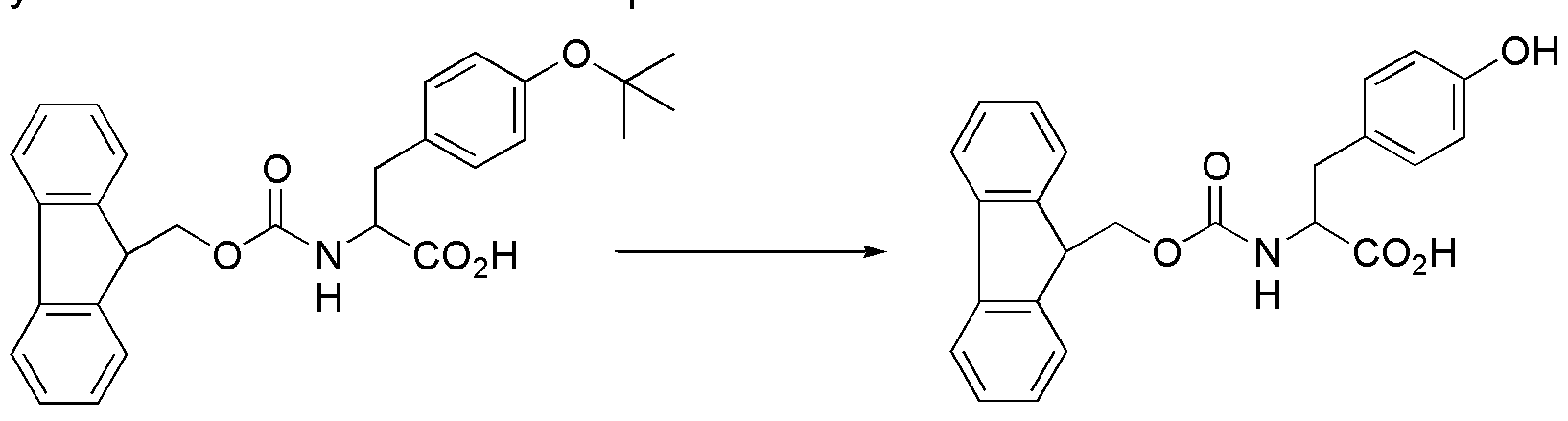
Two experiments were carried out essentially as described in Example 7.1
except that the temperature was 60°C in one case and 100°C in the other. A thermal removal of the i-butyl ether group from Fmoc-Tyr(tBu)-OH in neat HFIP at 60°C was slow (Fig. 1 1 .1 , thin black line). Prolonging reaction time was marginally successful: after 18 h of reaction at 60°C less than 50% of the deprotected compound was produced together with ca. 2% of a side- product associated with the concomitant Fmoc group cleavage (data not shown). Increasing the temperature to 100°C led to a marginal improvement (Fig. 1 1 .1 , grey line). At the same time the amount of the side-product has increased to 7% (Fig. 1 1 .1 , peak 3). As no encouraging results were obtained with the thermal removal of the acid-labile protecting groups of other amino acids (Lys, Ser and Thr) as well, the idea of peptide deprotection with a fluoro alcohol at elevated temperature (60-100°C) was abandoned. Example 1 1 .2 - Removal of i-butyl ether group from Fmoc-Tyr(tBu)-OH by 0.1 N HCI/HFIP
The experiment was carried out as described in Example 1 . The removal of the phenolic i-butyl ether from Fmoc-Tyr(tBu)-OH was quantitative within 4 h of reaction with 0.1 N HCI in HFIP at ambient temperature (Fig. 1 1 .2). Notably, no side-products resulting from f-butylation of the benzene ring of Tyr were observed.
ES+ TOF HR-MS [M+H]+ calc. for Fmoc-Tyr-OH C24H22N05 404.1498, obs. 404.1484.
Example 1 1 .3 - Removal of the i-butyl ether group from Fmoc-Tyr(tBu)-OH by Amberlyst 15/HFIP The experiment was carried out as described in Example 8.3. Fmoc- Tyr(tBu)-OH was deprotected rapidly and quantitatively by Amberlyst® 15
resin H form in HFIP within 30 min at ambient temperature (Fig. 1 1 .3). Notably, the resin-mediated deprotection in HFIP has shown high sensitivity to the nature and electronic environment of the protected group. The order of lability is the same as in the case of a thermal deprotection of the f-butyl ether by HFIP alone: Tyr > Thr > Ser.
Example 12 - Removal of the /Vlm-trityl group from H-His(Trt)-OH by 0.01 N

The experiment was carried out as described in Example 1 except that 0.01 N HCI in HFIP was used. The /Vlm-trityl group on His is one of the most sensitive acid-labile protecting groups in the Fmoc SPPS being partially removed even under such mild conditions as HFIP-DCM (1 :4 v/v) [Bollhagen, R.; Schmiedberger, M.; Barlos, K.; Grell, E. J. Chem. Soc. Chem. Commun. 1994, 2559]. A quantitative removal of the /Vlm-Trt group from H-His(Trt)-OH was achieved even by very dilute (0.01 N) HCI in HFIP within 30 min at ambient temperature (Fig. 12). Example 13 - Removal of the /VE-benzyloxycarbonyl group (Z) from H- Lys(Z)-OH by HCI/HFIP
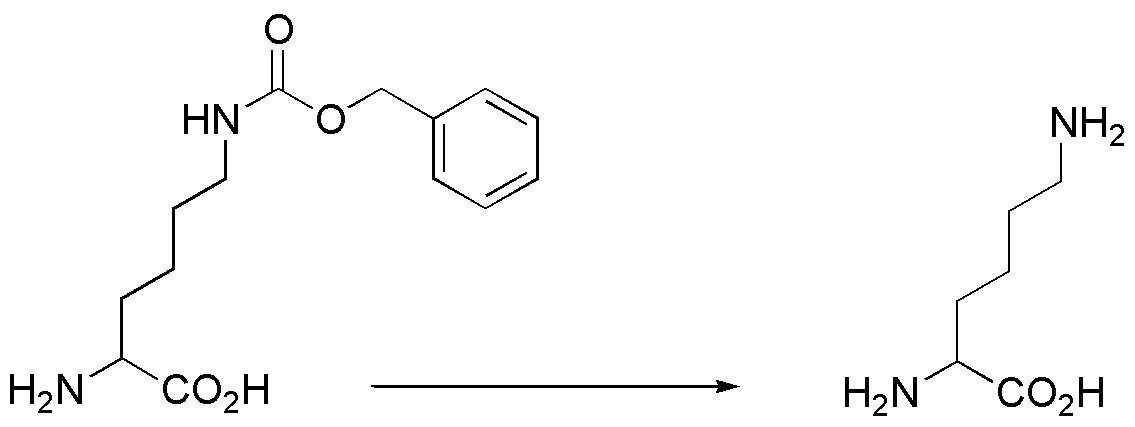
Example 14 - Removal of the f-Boc group from Boc-Lys(Fmoc)-OH by p- toluenesulphonic acid (p-TSA) in the mixture of TFE and DCM

Two milligrams of the amino acid derivative were weighed into a screw-cap glass vial (1 cm3), and 1 cm3 of either 0.01 M, 0.05M or 0.1 M p- toluenesulphonic acid (p-TSA) in TFE - DCM (1 :9 v/v) or 0.1 M p- toluenesulphonic acid (p-TSA) in EtOH - DCM (1 :9 v/v) was added. The solution was left standing for the period of time indicated below and then analysed by RP-HPLC. We have found that p-toluenesulphonic acid (p- TSA) in the mixture of TFE and DCM (1 :9 v/v) is an efficient reagent for the removal of the Λ/°-Βοο group from Boc-Lys(Fmoc)-OH. At 0.05-0.1 M concentration the time required for quantitative deprotection was just 5 min (Fig. 14.1 , solid black line). When ethanol EtOH was substituted for TFE in the deprotection mixture, no Boc removal was observed within 5 min of reaction (Fig. 14.1 , grey line). Notably, after 72 h of reaction in ethanol the only product detected in the HR-MS spectrum was the corresponding ethyl ester of /VE-Fmoc-lysine. Such a side-reaction was much less prominent in the case of TFE where the 2,2,2-trifluoroethyl ester was present in the HR- MS spectrum as only a minor component of the reaction mixture after 72 h. ES+ TOF HR-MS [M+H]+ calc. for H-Lys(Fmoc)-OH C21 H25N2O4 369.1814, obs. 369.1804; calc. for H-Lys(Fmoc)-OEt C23H29N2O4 397.2127, obs. 397.2042; calc. for H-l_ys(Fmoc)-OCH2CF3 C23H26F3N2O4 451.1845, obs. 451 .1839.
Even lower concentration of p-TSA (0.01 M) in TFE-DCM (1 :9 v/v) was also effective for the Boc group removal with over 90% deprotection observed after 30 min of reaction (Fig. 14.2, solid black line). After 1 h 10 min no starting compound was detected in the deprotection mixture (Fig. 14.2, grey line).
Example 15.1 - Removal of the benzyl ester group from Fmoc-Glu(OBzl)- OH

Two milligrams of the amino acid derivative were weighed into a screw-cap glass vial (1 cm3), and 1 cm3 of either 1 N HCI in HFIP or 1 N HCI in HFIP with 1 % (v/v) thioanisole (TA) was added. The solution was left standing for the period of time indicated below and then analysed by RP-HPLC.
The benzyl ester group of Fmoc-Glu(OBzl)-OH was relatively resistant to 1 N HCI in HFIP in the absence of any scavenger, the conditions that induce fast removal of the benzyloxycarbonyl group (Z) from Lys (Example 13). Less than 10% Bzl ester deprotection was detected after 4 h 10 min (Fig. 15.1.1 ).
However, when 1 % (v/v) of thioanisole (TA) was added to the mixture, much more rapid removal of the benzyl ester was observed with over 50% deprotection in 4 h (Fig. 15.1 .2, notice a partial overlap of the peaks for Fmoc-Glu-OH and TA). Example 15.2 - Removal of the benzyl ester group from Fmoc-Glu(OBzl)-
OH by p-toluenesulphonic acid (p-TSA) in a fluoro alcohol
Two milligrams of the amino acid derivative were weighed into a screw-cap glass vial (1 cm3), and 1 cm3 of either 0.1 M p-toluenesulphonic acid (p- TSA) in TFE or 1 M p-TSA in HFIP was added. The solution was left standing for the period of time indicated below and then analysed by RP- HPLC.
When p-toluenesulphonic acid (p-TSA) is employed for the removal of the N°-Boc group in the Boc peptide synthesis (see Example 14), it is essential that other acid-labile protecting groups such as benzyl esters and ethers are not affected by the conditions of rapid Boc deprotection: 0.1 M concentration of the acid, 10-15% (v/v) of TFE in DCM, 5-10 min of reaction. We have found that the benzyl ester group of Fmoc-Glu(OBzl)-OH is stable to 0.1 M p-TSA in TFE for at least 2 h at ambient temperature (Fig. 15.2, black). Notably, the same ester could be removed at a higher concentration of the acid (1 M) in HFIP (Fig. 15.2, grey).
Example 15.3 - Removal of the benzyl ester group from Fmoc-Glu(OBzl)- OH by Amberlyst® 15/HFIP + 1 % v/v dimethylsulphide
The experiment was carried out essentially as described in Example 8.3 except that 1 % (v/v) of dimethylsulphide was added. Likewise, the benzyl ester of Fmoc-Glu(OBzl)-OH was resistant to Amberlyst® 15 resin H form in HFIP in the presence of 1 % (v/v) of dimethylsulphide for at least 2 h at ambient temperature (Fig. 15.3).
Example 16.1 - Removal of the benzyl ether group from Fmoc-Thr(Bzl)-OH by 1 N HCI/HFIP

The experiment was carried out essentially as described in Example 15.1 except that only 1 N HCI in HFIP was used. The removal of the benzyl ether group from Fmoc-Thr(Bzl)-OH by 1 N HCI in HFIP at ambient temperature in the absence of a scavenger was sluggish (Fig. 16.1 ).
Example 16.2 - Removal of benzyl ether group from Fmoc-Thr(Bzl)-OH by 0.1 M p-toluenesulphonic acid (p-TSA) in TFE - DCM (1 :9 v/v)
The experiment was carried out essentially as described in Example 15.2 except that only 0.1 M p-TSA in TFE - DCM (1 :9 v/v) was used. Similarly, the benzyl ether of Fmoc-Thr(Bzl)-OH was resistant to 0.1 M p-TSA in TFE - DCM (1 :9 v/v) in the absence of a scavenger for at least 4 h 30 min at ambient temperature (Fig. 16.2). Under the same conditions the Boc group is removed within 5 min (Example 14).
Example 16.3 - Removal of the benzyl ether group from Fmoc-Thr(Bzl)-OH by Amberlyst® 15/HFIP + 1 % v/v dimethylsulphide
The experiment was carried out essentially as described in Example 8.3 except that 1 % (v/v) of dimethylsulphide was added. The removal of the benzyl ether of Fmoc-Thr(Bzl)-OH by Amberlyst® 15 resin H form in HFIP in the presence of 1 % (v/v) dimethylsulphide was <2% after 2 h at ambient temperature (Fig. 16.3).
Example 17.1 - Removal of the tosyl group from Fmoc-Arg(Tos)-OH

Two milligrams of the amino acid derivative were weighed into a screw-cap glass vial (1 cm3), and 1 cm3 of either 1 N HCI in HFIP with 1 % (v/v) thioanisole (TA), 1 M chlorotrimethylsilane in HFIP, 0.1 M or 1 M TFMSA in HFIP, 1 M TFMSA in HFIP with 1 % (v/v) TA or 1 N HBr in HFIP was added. The solution was left standing for the period of time indicated below and then analysed by RP-HPLC.
The tosyl (p-toluenesulphonyl) group on the guanidino function of Arg was not significantly affected by either 1 N HCI/HFIP + 1 % (v/v) thioanisole (TA) for 2.5 h (Fig. 17.1 , grey) or 1 M chlorotrimethylsilane (TMSCI) in HFIP for 12 h (Fig. 17.2). The latter reagent at 1 M concentration in a mixture with 3M phenol and DCM has been proposed for the removal of the Boc group in SPPS [Kaiser Sr, E.; Tarn, J. P.; Kubiak, T. M.; Merrifield, R. B. Tetrahedron Lett. 1988, 29, 303; Kaiser Sr, E.; Picart, F.; Kubiak, T.; Tarn, J. P.; Merrifield, R. B. J. Org. Chem. 1993, 58, 5167].
However, 1 M trifluoromethanesulphonic acid (TFMSA) in HFIP with 1 % (v/v) thioanisole rapidly cleaved off the tosyl group from Fmoc-Arg(Tos)-OH with >50% of deprotected product formation after just 3 min (Fig. 17.1 , black). Concomitant formation of two side-products was also detected. Breakdown of the peaks on the RP-HPLC (Fig. 17.1 , black): Peak 1 - side-product 1
peak 2 - deprotected product Fmoc-Arg-OH, ES+ TOF HR-MS [M+H]+ calc.
for C2iH25N404 397.1876, obs. 397.1849
peak 3 - thioanisole
peak 4 - side-product 2
peak 5 - unreacted Fmoc-Arg(Tos)-OH, ES+ TOF HR-MS [M+H]+ calc. for C28H3i N406S 551.1964, obs. 551.1949.
Even in the absence of thioanisole >50% deprotection of the tosyl group was observed after 3 min at 1 M TFMSA concentration in HFIP (Fig. 17.3, solid black line). After 1 h 20 min no trace of the starting Fmoc-Arg(Tos)- OH has remained (Fig. 17.3, thin black line). TFMSA was less effective at 0.1 M concentration (Fig. 17.3, grey line).
Deprotection of the tosyl group by 1 N aqueous 48% (w/v) hydrobromic acid HBr in HFIP has resulted in the formation of multiple products after 5 min of reaction (Fig. 17.4).
Example 18 - Cleavage of common resin linkers by 0.1 N HCI in the presence or absence of HFIP and a scavenger dimethylsulphide (DMS) A sample of an appropriate resin (100 mg) was weighed into a 1.5 cm3 Eppendorf polypropylene tube. A 1 cm3 of a deprotection mixture consisting of 0.1 N HCI in an appropriate solvent or a mixture of solvents with or without a scavenger dimethylsulphide was added, and the reaction vessel was left standing with occasional agitation for 3 h at ambient temperature. Aliquots of the resin (ca. 20 mg) were withdrawn at the intervals of 15 min, 30 min, 1 h, 2 h and 3 h, washed on a sintered glass filter with DMF (3x1 cm3), methanol (3x1 cm3), DCM (3x1 cm3) and diethyl ether (3x1 cm3), drained and dried in vacuo for a minimum of 1 h prior to analysis. A sample of a dried resin (ca. 5 mg) was weighed into a 1.5 cm3 Eppendorf polypropylene tube and treated with 1 cm3 of 20% (v/v) piperidine in DMF for a minimum of 10 min to cleave off the Fmoc group remaining on the
resin. A 50-100 ul aliquot of the solution was then diluted to 1 cm3 with 20% (v/v) piperidine in DMF and analysed in a UV-Vis spectrophotometer, and the absorbance value at the wavelength of 301 nm was recorded (ε30ι = 8,000). The results plotted against time are presented in Fig. 18.
Example 18.1 - Cleavage of Fmoc-Leu-Wang resin by 0.1 N HCI in HFIP -
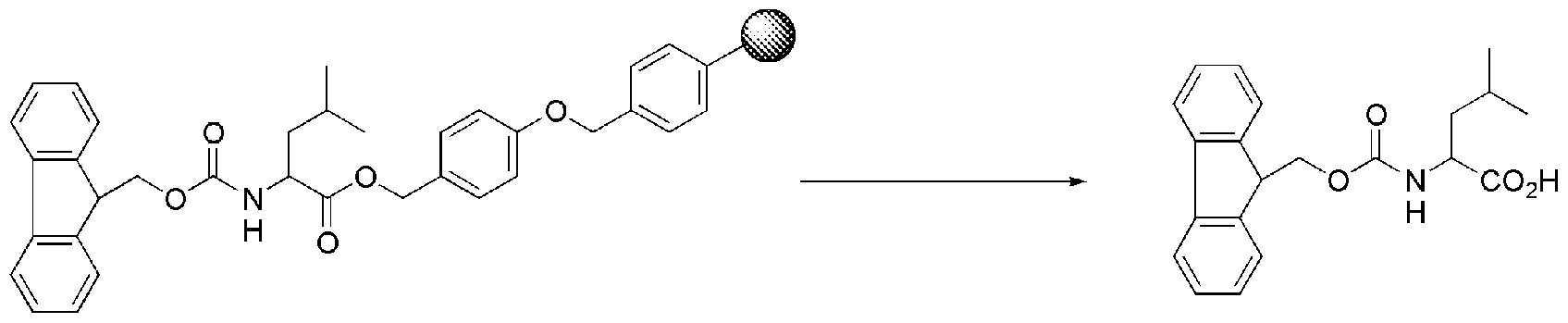
A sample of Fmoc-Leu-Wang resin (Novabiochem®) with the initial loading of 0.958 mmol g"1 was treated with a mixture of 10 μί concentrated (ca. 37% w/v) aqueous HCI, 200 μί HFIP and 790 μί DCM. After 3 h of reaction, the extent of cleavage reached over 91 %.
Example 18.2 - Cleavage of Fmoc-Leu-Wang resin by 0.1 N HCI in /-PrOH - DCM (1 :4 v/v)
In striking contrast to Example 18.1 , when isopropanol /-PrOH was substituted for HFIP in the cleavage mixture for Fmoc-Leu-Wang resin, no cleavage was detected after 3 h of reaction.
Example 18.3 - Cleavage of Fmoc-Gly-HMPA-PEG-PS resin by 0.1 N HCI/HFIP + 1 % v/v dimethylsulphide

A sample of Fmoc-Gly-PEG-PS resin (Applied BioSystems) with the initial
loading of 0.438 mmol g"1 was treated with a mixture of 10 μί concentrated (ca. 37% w/v) aqueous HCI, 980 μΙ_ HFIP and 10 μΙ_ dimethylsulphide (DMS) as a scavenger. After 3 h of reaction, the extent of cleavage was >84%.
Example 18.4 - Cleavage of Fmoc-Gly-PAL-PEG-PS resin by 0.1 N HCI/HFIP + 1 % v/v dimethylsulphide

Example 18.5 - Cleavage of Fmoc-Gly-Rink-NovaPEG resin by 0.1 N HCI/HFIP + 1 % v/v dimethylsulphide

Example 19 - Synthesis of a peptide Fmoc-Lys-Thr-Thr-Lys-Ser-OH on
TentaGel® S TRT resin tBu Boc
Fmoc— Lys-Thr-Thr-Lys-Ser- C-N- Fmoc— Lys-Thr-Thr-Lys Ser— OH Boc tBu tBu H
A peptide Fmoc-Lys-Thr-Thr-Lys-Ser-OH 19.1 was prepared by the Fmoc SPPS as described [Amblard, M.; Fehrentz, J-A.; Martinez, J.; Subra, G. Mol. Biotechnol. 2006, 3, 239] on TentaGel® S TRT resin (Rapp Polymere Gmbh) preloaded with Fmoc-Ser(tBu)-OH (0.24 mmol g"1) at a 1 .75 mmol scale (7 g of resin) using stepwise elongation protocol and five-fold excess of each of the A^-Fmoc-protected amino acids Fmoc-Thr(tBu)-OH and Fmoc-Lys(Boc)-OH (Novabiochem®). The Fmoc group removal was achieved by 20% (v/v) piperidine in dimethylformamide (DMF) for 10 min before each coupling. 2-(7-Aza-1 /-/-benzotriazol-1 -yl)-1 , 1 ,3,3- tetramethyluronium hexafluorophosphate (HATU) (4.75 equiv) with N,N- diisopropylethylamine (DIEA) (10 equiv) in 1 -methylpyrrolidin-2-one (NMP) were employed for activation of the Fmoc amino acids for 5 min at ambient temperature prior to addition to the Fmoc-deprotected resin. The resin was agitated by a gentle stream of nitrogen for 1 h, then washed with NMP (25 cm3) and DMF (50 cm3), and the deprotection-coupling cycle was repeated until the last amino acid (Lys) was incorporated. After that the resin was washed with methanol (50 cm3), dichloromethane (50 cm3) and diethyl ether (25 cm3) and dried in vacuo. A sample of pre-dried resin (0.6 g) was swollen in 0.1 N HCI/HFIP (5 cm3) and left to cleave for 15 min at ambient temperature, washed twice by 0.1 N HCI/HFIP (5 cm3), and the washings (ca. 15 cm3) were collected into a 50 cm3 QuickFit® round-bottom flask and left standing in the dark for 12 h at ambient temperature. After that the volatiles were removed on a rotary evaporator and a crude peptide 19.1 was obtained as off-white solid foam and analysed by RP-HPLC (Fig. 19) and ESI HR-MS as described.
Other /V-acylated KTTKS peptide derivatives such as myristoyl Ci3H27CO- KTTKS-OH 19.2, palmitoyl C15H3iCO-KTTKS-OH 19.3, stearoyl C17H35CO-KTTKS-OH 19.4, linoleyl (c/'s-9,c/'s-12-octadecadienoyl) CH3(CH2)4CH=CHCH2CH=CH(CH2)7CO-KTTKS-OH 19.5, conjugated linoleyl (a mixture of cis- and frans-9, 1 1 - and -10, 12-octadecadienoyl)-
KTTKS-OH 19.6 and 10, 12-pentacosadiynoyl CH3(CH2)nC≡C-
C≡C(CH2)8CO-KTTKS-OH 19.7 have also been synthesised, cleaved off the resin and deprotected analogously. MS data for peptides 19.1 -19.7
19.1 Fmoc-KTTKS: ESI HR-MS calculated [M+H]+ for C38H56N7On 786.4038 Da, observed 786.4032 Da.
19.2 Myristoyl-KTTKS: ESI HR-MS calc. [M+H]+ for C37H72N7O10 774.5341 Da, obs. 774.5331 Da.
19.3 Palmitoyl-KTTKS: ESI HR-MS calc. [M+H]+ for C39H76N7Oi0 802.5654 Da, obs. 802.5673 Da.
19.4 Stearoyl-KTTKS: ESI HR-MS calc. [M+H]+ for C41 H80N7O10 830.5967 Da, obs. 830.5968 Da.
19.5 Linoleyl-KTTKS: MALDI-TOF calc. [M+H]+ for C4i H76N7Oi0 826.56 Da, obs. 826.16 Da.
19.6 Conjugated linoleyl-KTTKS: MALDI-TOF calc. [M+H]+ for C41H76N7O10 826.56 Da, obs. 825.65 Da.
19.7 10, 12-Pentacosadiynoyl-KTTKS: MALDI-TOF calc. [M+H]+ for C48H86N7Oio 921 .24 Da, obs. 921 .66 Da.
No appreciable influence on the peptide yield or purity was observed in the experiments where deprotections were effected by 0.1 N HCI/TFE at ambient temperature for 12 h (peptide 19.5) or 4 h (peptide 19.6), respectively.
Claims
1 . A method for removing acid-labile protecting groups from a protected compound that has one or more acid-labile protecting groups, said method comprising: a. dissolving or dispersing the protected compound, or immersing a solid support to which the protected compound is attached, in a mixture comprising i) a fluoro alcohol, ii) an acid and, optionally, iii) an organic solvent and/or a scavenger; and b. maintaining the resulting solution or dispersion, or keeping the solid support immersed, for a period of time sufficient to ensure the removal of one or more acid-labile protecting groups from said protected compound, thereby producing a deprotected or partially protected compound.
2. The method of claim 1 , wherein the solid support to which the protected compound is attached is an acid-labile solid support, thereby producing a deprotected or partially protected compound detached from said support.
3. The method of claim 1 or claim 2, wherein said fluoro alcohol is selected from the group consisting of 1 , 1 , 1 ,3,3,3-hexafluoroisopropanol, 2,2,2-trifluoroethanol, 2,2,3,3,3-pentafluoro-1 -propanol, 2,2,3,3,4,4,4- heptafluoro-1 -butanol and nonafluoro-tert-butyl alcohol.
4. The method of any one of claims 1 to 3, wherein a combination of two or more fluoro alcohols is used.
5. The method of any one of claims 1 to 4, wherein said acid is a protic (Br0nsted) acid or a combination of two or more such acids.
6. The method of claim 5, wherein said acid is selected from the group of protic (Br0nsted) acids consisting of hydrochloric acid HCI, hydrobromic acid HBr, sulphuric acid, benzenesulphonic acid, p-toluenesulphonic acid (p-TSA), methanesulphonic acid, ethanesulphonic acid, trifluoromethanesulfonic acid (TFMSA), trifluoroacetic acid (TFA), trichloroacetic acid (TCA), dichloroacetic acid (DCA), chloroacetic acid, formic acid and acetic acid.
7. The method of any one of claims 1 to 4, wherein said acid is a Lewis acid or a silicon compound or a combination of two or more such acids and/or silicon compounds.
8. The method of claim 7, wherein said acid is selected from the group of Lewis acids or silicon compounds consisting of boron trifluoride BF3, boron trichloride BCI3, boron tribromide BBr3, aluminium chloride AICI3, tin chloride SnCI4, titanium chloride TiCI4, silicon tetrachloride SiCI4, chlorotrimethylsilane Me3SiCI (TMSCI), bromotrimethylsilane Me3SiBr (TMSBr) and trimethylsilyl trifluoromethanesulphonate (TMSOTf).
9. The method of any one of claims 1 to 4, wherein said acid is a polymeric protic or Lewis acid or a silylated polymeric acid or a combination of two or more such acids.
10. The method of claim 9, wherein said acid is selected from the group of polymeric acids in the H form or silylated polymeric acids consisting of sulphonated polystyrene resins such as Dowex® resins, Amberlyst® resins, and polyfluoro resins such as Nafion® resins and trimethylsilyl- Nafion® resins.
1 1 . The method of any one of claims 1 to 10, wherein a combination of two or more acids is used.
12. The method of any one of claims 1 to 1 1 , wherein said solvent is selected from the group of solvents consisting of dichloromethane (DCM), 1 ,2-dichloroethane (DCE), chloroform CHCI3, benzene C6H6, carbon tetrachloride CCI4, toluene CH3C6H5, pentane C5H12 and hexane ΟΘΗΗ.
13. The method of any one of claims 1 to 12, wherein a combination of two or more solvents is used.
14. The method of any one of claims 1 to 13, wherein said scavenger is selected from the group of compounds consisting of thioanisole (TA), dimethylsulphide (DMS), ethylmethylsulphide, tetrahydrothiophene, 1 ,2- ethanedithiol, 1 ,3-propanedithiol, benzylmercaptan, thiophenol, anisole, phenol, m-cresol, water, pentamethylbenzene, triethylsilane and triisopropylsilane.
15. The method of claim 14, wherein a combination of two or more scavengers is used.
16. The method of any one of claims 1 to 15, wherein said compound is a peptide.
17. The method substantially as described herein, in particular with reference to the foregoing examples.
18. A composition for use in a method as claimed in any one of claims 1 to 17, which comprises i) a fluoro alcohol, ii) an acid and, optionally, iii) an organic solvent and/or a scavenger.
19. A composition as claimed in claim 18, wherein said fluoro alcohol is selected from the group consisting of 1 , 1 , 1 ,3,3,3-hexafluoroisopropanol, 2,2,2-trifluoroethanol, 2,2,3,3,3-pentafluoro-1 -propanol, 2,2,3,3,4,4,4- heptafluoro-1 -butanol and nonafluoro-tert-butyl alcohol.
20. A composition as claimed in claim 18 or claim 19, which contains a combination of two or more fluoro alcohols.
21 . A composition as claimed in any one of claims 18 to 20, wherein said acid is a protic (Br0nsted) acid or a combination of two or more such acids.
22. A composition as claimed in claim 21 , wherein said acid is selected from the group of protic (Br0nsted) acids consisting of hydrochloric acid HCI, hydrobromic acid HBr, sulphuric acid, benzenesulphonic acid, p- toluenesulphonic acid (p-TSA), methanesulphonic acid, ethanesulphonic acid, trifluoromethanesulfonic acid (TFMSA), trifluoroacetic acid (TFA), trichloroacetic acid (TCA), dichloroacetic acid (DCA), chloroacetic acid, formic acid and acetic acid.
23. A composition as claimed in any one of claims 18 to 20, wherein said acid is a Lewis acid or a silicon compound or a combination of two or more such acids and/or silicon compounds.
24. A composition as claimed in claim 23, wherein said acid is selected from the group of Lewis acids or silicon compounds consisting of boron trifluoride BF3, boron trichloride BCI3, boron tribromide BBr3, aluminium chloride AICI3, tin chloride SnCI4, titanium chloride TiCI4, silicon tetrachloride SiCI4, chlorotrimethylsilane Me3SiCI (TMSCI), bromotrimethylsilane Me3SiBr (TMSBr) and trimethylsilyl trifluoromethanesulphonate (TMSOTf).
25. A composition as claimed in any one of claims 18 to 20, wherein said acid is a polymeric protic or Lewis acid or a silylated polymeric acid or a combination of two or more such acids.
26. A composition as claimed in claim 25, wherein said acid is selected from the group of polymeric acids in the H form or silylated polymeric acids consisting of sulphonated polystyrene resins such as Dowex® resins, Amberlyst® resins, and polyfluoro resins such as Nafion® resins and trimethylsilyl-Nafion® resins.
27. A composition as claimed in any one of claims 18 to 26, which contains a combination of two or more acids.
28. A composition as claimed in any one of claims 18 to 27, wherein said organic solvent is selected from the group of solvents consisting of dichloromethane (DCM), 1 ,2-dichloroethane (DCE), chloroform CHCI3, carbon tetrachloride CCI4, benzene C6H6, toluene CH3C6H5, pentane C5H 2 and hexane ΟΘΗΗ.
29. A composition as claimed in any one of claims 18 to 28, wherein said scavenger is selected from the group of compounds consisting of thioanisole (TA), dimethylsulphide (DMS), ethylmethylsulphide, tetrahydrothiophene, 1 ,2-ethanedithiol, 1 ,3-propanedithiol, benzylmercaptan, thiophenol, anisole, phenol, m-cresol, water, pentamethylbenzene, triethylsilane and triisopropylsilane.
30. A composition as claimed in any one of claims 18 to 29, which contains a combination of two or more organic solvents and/or two or more scavengers.
Applications Claiming Priority (2)
| Application Number | Priority Date | Filing Date | Title |
|---|---|---|---|
| GB1215538.8 | 2012-08-31 | ||
| GBGB1215538.8A GB201215538D0 (en) | 2012-08-31 | 2012-08-31 | Method and compositions for removing acid-labile protecting groups |
Publications (1)
| Publication Number | Publication Date |
|---|---|
| WO2014033466A1 true WO2014033466A1 (en) | 2014-03-06 |
Family
ID=47075058
Family Applications (1)
| Application Number | Title | Priority Date | Filing Date |
|---|---|---|---|
| PCT/GB2013/052280 Ceased WO2014033466A1 (en) | 2012-08-31 | 2013-08-30 | Method and compositions for removing acid-labile protecting groups |
Country Status (2)
| Country | Link |
|---|---|
| GB (1) | GB201215538D0 (en) |
| WO (1) | WO2014033466A1 (en) |
Cited By (12)
| Publication number | Priority date | Publication date | Assignee | Title |
|---|---|---|---|---|
| US20180065904A1 (en) * | 2015-02-16 | 2018-03-08 | B.G. Negev Technologies And Applications Ltd., At Ben-Gurion University | Introduction of alkyl substituents to aromatic compounds |
| WO2020111238A1 (en) | 2018-11-30 | 2020-06-04 | 中外製薬株式会社 | Deprotection method and resin removal method in solid-phase reaction for peptide compound or amide compound, and method for producing peptide compound |
| CN112218875A (en) * | 2018-06-05 | 2021-01-12 | 帝斯曼知识产权资产管理有限公司 | Method for synthesizing arginine-containing peptides |
| US11492369B2 (en) | 2017-12-15 | 2022-11-08 | Chugai Seiyaku Kabushiki Kaisha | Method for producing peptide, and method for processing bases |
| US11542299B2 (en) | 2017-06-09 | 2023-01-03 | Chugai Seiyaku Kabushiki Kaisha | Method for synthesizing peptide containing N-substituted amino acid |
| US11891457B2 (en) | 2011-12-28 | 2024-02-06 | Chugai Seiyaku Kabushiki Kaisha | Peptide-compound cyclization method |
| US12071396B2 (en) | 2019-03-15 | 2024-08-27 | Chugai Seiyaku Kabushiki Kaisha | Method for preparing aromatic amino acid derivative |
| US12163134B2 (en) | 2015-03-13 | 2024-12-10 | Chugai Seiyaku Kabushiki Kaisha | Modified aminoacyl-tRNA synthetase and use thereof |
| US12312297B2 (en) | 2018-11-07 | 2025-05-27 | Chugai Seiyaku Kabushiki Kaisha | O-substituted serine derivative production method |
| US12371454B2 (en) | 2019-11-07 | 2025-07-29 | Chugai Seiyaku Kabushiki Kaisha | Cyclic peptide compound having Kras inhibitory action |
| US12391971B2 (en) | 2017-01-31 | 2025-08-19 | Chugai Seiyaku Kabushiki Kaisha | Method for synthesizing peptides in cell-free translation system |
| WO2025264177A1 (en) * | 2024-06-21 | 2025-12-26 | Polypeptide Laboratories Holding (Ppl) Ab | Method for cleaving protecting groups and organic compounds from supports |
Citations (7)
| Publication number | Priority date | Publication date | Assignee | Title |
|---|---|---|---|---|
| WO2004060925A2 (en) * | 2002-12-30 | 2004-07-22 | Gryphon Therapeutics, Inc. | Multiplex polymer ligation |
| WO2007033383A2 (en) * | 2005-09-14 | 2007-03-22 | Novetide, Ltd. | Process for production of bivalirudin |
| WO2007130275A2 (en) | 2006-05-03 | 2007-11-15 | Mallinckrodt Inc. | Composition and method for the release of protected peptides from a resin |
| WO2008109079A2 (en) * | 2007-03-01 | 2008-09-12 | Novetide, Ltd. | High purity peptides |
| WO2010142616A2 (en) | 2009-06-09 | 2010-12-16 | F. Hoffmann-La Roche Ag | Deprotection of boc-protected compounds |
| US20120214968A1 (en) * | 2011-02-17 | 2012-08-23 | Baosheng Liu | Preparation of phalloidin and its derivatives |
| WO2013119184A1 (en) * | 2012-02-07 | 2013-08-15 | Nanyang Technological University | Method of synthesizing peptides, proteins and bioconjugates |
-
2012
- 2012-08-31 GB GBGB1215538.8A patent/GB201215538D0/en not_active Ceased
-
2013
- 2013-08-30 WO PCT/GB2013/052280 patent/WO2014033466A1/en not_active Ceased
Patent Citations (8)
| Publication number | Priority date | Publication date | Assignee | Title |
|---|---|---|---|---|
| WO2004060925A2 (en) * | 2002-12-30 | 2004-07-22 | Gryphon Therapeutics, Inc. | Multiplex polymer ligation |
| WO2007033383A2 (en) * | 2005-09-14 | 2007-03-22 | Novetide, Ltd. | Process for production of bivalirudin |
| WO2007130275A2 (en) | 2006-05-03 | 2007-11-15 | Mallinckrodt Inc. | Composition and method for the release of protected peptides from a resin |
| US8022181B2 (en) | 2006-05-03 | 2011-09-20 | Mallinckrodt Llc | Composition and method for the release of protected peptides from a resin |
| WO2008109079A2 (en) * | 2007-03-01 | 2008-09-12 | Novetide, Ltd. | High purity peptides |
| WO2010142616A2 (en) | 2009-06-09 | 2010-12-16 | F. Hoffmann-La Roche Ag | Deprotection of boc-protected compounds |
| US20120214968A1 (en) * | 2011-02-17 | 2012-08-23 | Baosheng Liu | Preparation of phalloidin and its derivatives |
| WO2013119184A1 (en) * | 2012-02-07 | 2013-08-15 | Nanyang Technological University | Method of synthesizing peptides, proteins and bioconjugates |
Non-Patent Citations (92)
| Title |
|---|
| ALBERICIO, F.; BARANY, G., INT. J. PEPT. PROTEIN RES., vol. 30, 1987, pages 206 |
| AMBLARD, M.; FEHRENTZ, J-A.; MARTINEZ, J.; SUBRA, G., MOL. BIOTECHNOL., vol. 3, 2006, pages 239 |
| ATHERTON, E.; GAIT, M. J.; SHEPPARD, R. C.; WILLIAMS, B., J. BIOORG. CHEM., vol. 8, 1979, pages 351 |
| BALLINGER, P.; LONG, F. A., J. AM. CHEM. SOC., vol. 81, 1959, pages 1050 |
| BARLOS, K.; CHATZI, 0.; GATOS, D.; STAVROPOULOS, G., INT. J. PEPTIDE PROTEIN RES., vol. 37, 1991, pages 513 |
| BARLOS, K.; GATOS, D.; KALLITSIS, J.; PAPAPHOTIU, G.; SOTIRIU, P.; WENQING, Y.; SCHÄFER, W., TETRAHEDRON LETT., vol. 30, 1989, pages 3943 |
| BEIER, R.; MUNDY, B. P., SYNTH. COMMUN., vol. 9, 1979, pages 271 |
| BLONDELLE, S. E.; HOUGHTEN, R. A., INT. J. PEPT. PROTEIN RES., vol. 41, 1993, pages 522 |
| BOLLHAGEN, R.; SCHMIEDBERGER, M.; BARLOS, K.; GRELL, E., J. CHEM. SOC. CHEM. COMMUN., 1994, pages 2559 |
| BONGINI, A.; CARDILLO, G.; ORENA, M.; SANDRI, S., SYNTHESIS, 1979, pages 618 |
| BRINKMAN, H. R.; LANDI JR., J. J.; PATERSON JR., J. B.; STONE, P. J., SYNTH. COMMUN., 1991, pages 459 |
| BUCK, M. Q., REV. BIOPHYS., vol. 31, 1998, pages 297 |
| C.-D. CHANG; J. MEIENHOFER, INT. J. PEPT. PROT. RES., vol. 11, 1978, pages 246 |
| CARPINO, L. A., ACC. CHEM. RES., vol. 6, 1973, pages 19 |
| CARPINO, L. A.; SHROFF, H.; TRIOLO, S. A.; MANSOUR, E.- S. M.E.; WENSCHUH, H.; ALBERICIO, F., TETRAHEDRON LETT., vol. 34, 1993, pages 7829 |
| CARPINO, L. A.; SHROFF, H.; TRIOLO, S. A.; MANSOUR, E.-S. M.E.; WENSCHUH, H.; ALBERICIO, F., TETRAHEDRON LETT., vol. 34, 1993, pages 7829 |
| CAVELIER, F.; ENJALBAL, C., TETRAHEDRON. LETT., vol. 37, 1996, pages 5131 |
| CHATTERJEE, C.; GERIG, J. T., BIOPOLYMERS, vol. 87, 2007, pages 115 |
| CHAUDHARY, N.; SINGH, S.; NAGARAJ, R., J. PEPT. SCI., vol. 15, 2009, pages 675 |
| CHOY, J.; JAIME- FIGUEROA, S.; LARA-JAIME, T., TETRAHEDRON LETT., vol. 51, 2010, pages 2244 |
| CHOY, J.; JAIME-FIGUEROA, S.; JIANG, L.; WAGNER, P., SYNTH. COMMUN., vol. 38, 2008, pages 3849 |
| CHOY, J.; JAIME-FIGUEROA, S.; LARA-JAIME, T., TETRAHEDRON LETT., vol. 51, 2010, pages 2244 |
| COFFEY, D. S.; HAWK, M. K. N.; PEDERSEN, S. W.; GHERA, S. J.; MARLER, P. G.; DODSON, P. N.; LYTLE, M. L., ORG. PROC. RES. DEV., vol. 8, 2004, pages 945 |
| CRAY, C. J.; KHOUJAH, A. M., TETRAHEDRON LETT., vol. 10, 1969, pages 2647 |
| E. ATHERTON; H. FOX; D. HARKISS; R. C. SHEPPARD, J. CHEM. SOC. CHEM. COMMUN., 1978, pages 537 |
| E. ATHERTON; R. C. SHEPPARD: "Solid Phase Peptide Synthesis: A Practical Approach", 1989, IRL PRESS |
| E. ATHERTON; R. C. SHEPPARD: "Solid Phase Peptide Synthesis: A Practical Approach", 1989, IRL PRESS, pages: 149 |
| E. ATHERTON; R. C. SHEPPARD: "The Peptides: Analysis, Synthesis, Biology", vol. 9, 1987, ACADEMIC PRESS, INC |
| FARCASIU, D.; GHENCIU, A.; MARINO, G.; KASTRUP, R. V., J. MOL. CAT. A: CHEM., vol. 126, 1997, pages 141 |
| FIELDS, G. B.; NOBLE, R. L., INT. J. PEPTIDE PROT. RES., vol. 35, 1990, pages 161 |
| FILLER, R.; SCHURE, R. M., J. ORG. CHEM., vol. 32, 1967, pages 1217 |
| FUJII, N.; SHIMOKURA, M.; NOMIZU, M.; YAJIMA, H.; SHONO, F.; TSUDA, M.; YOSHITAKE, A., CHEM. PHARM. BULL., vol. 32, 1984, pages 520 |
| GAUSSIER, H.; MORENCY, H; LAVOIE, M.C.; SUBIRADE, M., APPL. ENVIRON. MICROBIOL., vol. 68, 2002, pages 4803 |
| GIBSON, F. S.; BERGMEIER, S. C.; RAPOPORT, H., J. ORG. CHEM., vol. 59, 1994, pages 3216 |
| GOODACRE, J.; PONSFORD, R. J.; STIRLING, I., TETRAHEDRON LETT., vol. 16, 1975, pages 3609 |
| GREENE, T. W.; WUTS P. G. M.: "Protective Groups in Organic Synthesis, 3rd Ed,", 1999, JOHN WILEY & SONS, INC. |
| GRUBIER, G.; ZIMMERMANN, H.; ECHNER, H.; STOEVA, S.; BERNARDI, E.; POURRIAS, B.; VOELTER, W.: "3rd International Symposium", 1994, MAYFLOWER WORLDWIDE LTD., article "Innovation & Perspectives in Solid Phase Synthesis", pages: 517 |
| HAN, G.; TAMAKI, M.; HRUBY, V. J., J. PEPT. RES., vol. 58, 2001, pages 338 |
| HINOU, H.; HVUGAJI, K.; GARCIA-MARTIN, F.; NISHIMURA, S.-I.; ALBERICIO, F., RSC ADVANCES, vol. 2, 2012, pages 2729 |
| ISIDRO-LLOBET, A.; ALVAREZ, M.; ALBERICIO, F., CHEM. REV., vol. 109, 2009, pages 2455 |
| J. M. STEWART; J. D. YOUNG: "Solid Phase Peptide Synthesis, 2nd Ed;", 1984, PIERCE CHEMICAL CO |
| K. YANAGI ET AL: "Hexafluoroisopropanol Induces Amyloid Fibrils of Islet Amyloid Polypeptide by Enhancing Both Hydrophobic and Electrostatic Interactions", JOURNAL OF BIOLOGICAL CHEMISTRY, vol. 286, no. 27, 8 July 2011 (2011-07-08), pages 23959 - 23966, XP055087512, ISSN: 0021-9258, DOI: 10.1074/jbc.M111.226688 * |
| KAISER SR, E.; PICART, F.; KUBIAK, T.; TAM, J. P.; MERRIFIELD, R. B., J. ORG. CHEM., vol. 58, 1993, pages 5167 |
| KAISER SR, E.; TAM, J. P.; KUBIAK, T. M.; MERRIFIELD, R. B, TETRAHEDRON LETT., vol. 29, 1988, pages 303 |
| KING, D. S.; FIELDS, C. G.; FIELDS, G. B., INT. J. PEPT. PROTEIN RES., vol. 36, 1989, pages 255 |
| KISO, Y.; FUJIWARA, Y.; KIMURA, T.; NISHITANI, A.; AKAJI, K., INT. J. PEPTIDE PROTEIN RES., vol. 40, 1992, pages 308 |
| KURODA, H.; CHEN, Y. N.; KIMURA, T.; SAKAKIBARA, S., INT. J. PEPT. PROT. RES., vol. 40, 1992, pages 294 |
| L. A. CARPINO; G. J. HAN, J. AM. CHEM.SOC., vol. 92, 1970, pages 5748 |
| LENARD, J.; ROBINSON, A. B., J. AM. CHEM. SOC., vol. 89, 1967, pages 181 |
| LI, B.; BERLINER, M.; BUZON, R.; CHIU, C. K.; COLGAN, S. T.; KANEKO, T.; KEENE, N.; KISSEL, W.; LE, T.; LEEMAN, K. R., J. ORG. CHEM., vol. 71, 2006, pages 9045 |
| MATSUEDA, G. R.; STEWART, J. M., PEPTIDES, vol. 2, 1981, pages 45 |
| MIDDLETON, W. J.; LINDSEY, R. V., J. AM. CHEM. SOC., vol. 86, 1964, pages 4948 |
| MIRAMON, H.; CAVELIER, F.; MARTINEZ, J.; COTTET, H., ANAL. CHEM., vol. 82, 2010, pages 394 |
| MITCHELL, A. R; ERICKSON, B. W; RYABTSEV, M. N; HODGES, R. S; MERRIFIELD, R. B, J. AM. CHEM. SOC., vol. 98, 1976, pages 7357 |
| MORETTO, A.; CRISMA, M.; FORMAGGIO, F.; KAPTEIN, B.; BROXTERMAN, Q. B.; KEIDERLING, T. A.; TONIOLO, C., BIOPOLYMERS, vol. 88, 2007, pages 233 |
| MURATA, S.; NOYORI, R., TETRAHEDRON LETT., vol. 21, 1980, pages 767 |
| NAHARISSOA, H.; SARRADE, V.; FOLLET, M.; CALAS, B., PEPT. RES., vol. 5, 1992, pages 293 |
| NILSSON, M. R; NGUYEN, L. L.; RALEIGH, D. P., ANAL. BIOCHEM., vol. 288, 2001, pages 76 |
| NISHINO, N.; MIHARA, H.; MAKINOSE, Y.; FUJIMOTO, T., TETRAHEDRON LETT., vol. 33, 1992, pages 7007 |
| PARSONS, J. G.; SHEEHAN, C. S.; WU, Z.; JAMES, I. W.; BRAY, A. M., METHODS ENZYMOL., vol. 369, 2003, pages 39 |
| PASQUALE PALLADINO ET AL: "New TFA-Free Cleavage and Final Deprotection in Fmoc Solid-Phase Peptide Synthesis: Dilute HCl in Fluoro Alcohol", ORGANIC LETTERS, vol. 14, no. 24, 21 December 2012 (2012-12-21), pages 6346 - 6349, XP055087510, ISSN: 1523-7060, DOI: 10.1021/ol303124r * |
| PEARSON, D. A.; BLANCHETTE, M.; BAKER, M. L.; GUINDON, C. A., TETRAHEDRON LETT., vol. 30, 1989, pages 2739 |
| PETRAKIS, K. S.; KAISER, E. T.; OSAPAY, G. J., CHEM. SOC. CHEM. COMMUN., 1991, pages 530 |
| PRAKASH, G. K. S.; MATHEW, T.; MARINEZ, E. R.; ESTEVES, P. M.; RASUL, G.; OLAH, G. A., J. ORG. CHEM., vol. 71, 2006, pages 3952 |
| R. B. MERRIFIELD, METH. ENZYMOL., vol. 289, 1997, pages 3 |
| RAMAGE, R.; GREEN, J., TETRAHEDRON. LETT., vol. 28, 1987, pages 2287 |
| RINIKER, B.; KAMBER, B.; SIEBER, P., HELV. CHIM. ACTA, vol. 58, 1975, pages 1086 |
| RINK, H., TETRAHEDRON LETT., vol. 28, 1987, pages 3787 |
| SAKAKIBARA, S.; SHIMONISHI, V., BULL. CHEM. SOC. JPN., vol. 38, 1965, pages 1412 |
| SANTANGELO, F.; MONTECUCCHI, P. C.; GOZZINI, L.; HENSCHEN, A., INT. J. PEPT. PROT. RES., vol. 22, 1983, pages 348 |
| SCHNOIZER, M.; ALEWOOD, P.; JONES, A.; ALEWOOD, D.; KENT, S. B. H.: "Int. J. Peptide Protein Res.", vol. 40, 1992, pages: 180 |
| SEBESTIK, J.; HLAVACEK, J.; STIBOR, I., CHEM. LISTY, vol. 95, 2001, pages 365 |
| SETO, H.; MANDER, L. N., SYNTH. COMMUN., vol. 22, 1992, pages 2823 |
| SHEN, F.; TANG, S.; LIU, L., SCIENCE CHINA: CHEMISTRY, vol. 54, 2011, pages 110 |
| SIEBER, P.; KAMBER, B.; HARTMANN, A.; J6HL, A.; RINIKER, B.; RITTEL, W., HELV. CHIM. ACTA, vol. 60, 1977, pages 27 |
| STAHL, G. L.; WALTER, R.; SMITH, C. W., J. ORG. CHEM., vol. 43, 1978, pages 2285 |
| STRAZZOLINI, P.; MELLONI, T.; GIUMANINI, A. G., TETRAHEDRON, vol. 57, 2001, pages 9033 |
| SURESH BABU, V. V.; PATIL, B. S.; VASANTHAKUMAR, G.-R., SYNTH. COMMUN., vol. 35, 2005, pages 1795 |
| SUZUKI, K.; ENDO, N.; NITTA, K.; SASAKI, Y., CHEM. PHARM. BULL., vol. 26, 1978, pages 2198 |
| TAM, J. P.; HEATH, W. F.; MERRIFIELD, R. B., TETRAHEDRON. LETT., vol. 23, 1982, pages 4435 |
| TAYLOR, S. K.; DICKINSON, M. G.; MAY, S. A.; PICKERING, D. A.; SADEK, P. C., CHEMLNFORM, 1998, pages 29 |
| TRIVEDI, H. S.; ANSON, M.; STEEL, P. G.; WORLEY, J., SYNLETT, 2001, pages 1932 |
| TRZUPEK, S.; GO, A.; KOPPLE, K. D., J. ORG. CHEM., vol. 44, 1979, pages 4577 |
| W. C. CHAN; P. D. WHITE: "Fmoc Solid Phase Peptide Synthesis: A Practical Approach", 2000, IRL PRESS |
| W. C. CHAN; P. D. WHITE: "Fmoc Solid Phase Peptide Synthesis: A Practical Approach", 2000, IRL PRESS, pages: 64 |
| WANG, S. S., J. AM. CHEM. SOC., vol. 95, 1973, pages 1328 |
| YAJIMA, H.; FUJII, N., J. AM. CHEM. SOC., vol. 103, 1981, pages 5867 |
| YAJIMA, H.; FUJII, N.; OGAWA, H.; KAWATANI, H., J. CHEM. SOC. CHEM. COMMUN., 1974, pages 107 |
| YAJIMA, H.; KISO, Y.; OGAWA, H.; FUJII, N.; IRIE, H., CHEM. PHARM. BULL., vol. 23, 1975, pages 1164 |
| YAJIMA, H.; OGAWA, H.; FUJII, N.; FUNAKOSHI, S., CHEM. PHARM. BULL., vol. 25, 1977, pages 740 |
| YAMASHIRO, D.; BLAKE, J.; LI, C. H., TETRAHEDRON LETT., vol. 18, 1976, pages 1479 |
| YANAGI, K.; ASHIZAKI, M.; YAGI, H.; SAKURAI, K.; LEE, Y.-H.; GOTO, Y., J. BIOL. CHEM., vol. 286, 2011, pages 23959 |
Cited By (19)
| Publication number | Priority date | Publication date | Assignee | Title |
|---|---|---|---|---|
| US11891457B2 (en) | 2011-12-28 | 2024-02-06 | Chugai Seiyaku Kabushiki Kaisha | Peptide-compound cyclization method |
| US12415835B2 (en) | 2011-12-28 | 2025-09-16 | Chugai Seiyaku Kabushiki Kaisha | Peptide-compound cyclization method |
| US10351492B2 (en) * | 2015-02-16 | 2019-07-16 | B. G. Negev Technologies And Applications | Introduction of alkyl substituents to aromatic compounds |
| US20180065904A1 (en) * | 2015-02-16 | 2018-03-08 | B.G. Negev Technologies And Applications Ltd., At Ben-Gurion University | Introduction of alkyl substituents to aromatic compounds |
| US12163134B2 (en) | 2015-03-13 | 2024-12-10 | Chugai Seiyaku Kabushiki Kaisha | Modified aminoacyl-tRNA synthetase and use thereof |
| US12391971B2 (en) | 2017-01-31 | 2025-08-19 | Chugai Seiyaku Kabushiki Kaisha | Method for synthesizing peptides in cell-free translation system |
| US12281141B2 (en) | 2017-06-09 | 2025-04-22 | Chugai Seiyaku Kabushiki Kaisha | Method for synthesizing peptide containing N-substituted amino acid |
| US11787836B2 (en) | 2017-06-09 | 2023-10-17 | Chugai Seiyaku Kabushiki Kaisha | Method for synthesizing peptide containing N-substituted amino acid |
| US11542299B2 (en) | 2017-06-09 | 2023-01-03 | Chugai Seiyaku Kabushiki Kaisha | Method for synthesizing peptide containing N-substituted amino acid |
| US11492369B2 (en) | 2017-12-15 | 2022-11-08 | Chugai Seiyaku Kabushiki Kaisha | Method for producing peptide, and method for processing bases |
| CN112218875A (en) * | 2018-06-05 | 2021-01-12 | 帝斯曼知识产权资产管理有限公司 | Method for synthesizing arginine-containing peptides |
| US12312297B2 (en) | 2018-11-07 | 2025-05-27 | Chugai Seiyaku Kabushiki Kaisha | O-substituted serine derivative production method |
| US11732002B2 (en) | 2018-11-30 | 2023-08-22 | Chugai Seiyaku Kabushiki Kaisha | Deprotection method and resin removal method in solid-phase reaction for peptide compound or amide compound, and method for producing peptide compound |
| KR20210098476A (en) | 2018-11-30 | 2021-08-10 | 추가이 세이야쿠 가부시키가이샤 | A method for deprotecting a peptide compound or an amide compound and a dehydration method in a solid phase reaction, and a method for producing a peptide compound |
| US12331072B2 (en) | 2018-11-30 | 2025-06-17 | Chugai Seiyaku Kabushiki Kaisha | Deprotection method and resin removal method in solid-phase reaction for peptide compound or amide compound, and method for producing peptide compound |
| WO2020111238A1 (en) | 2018-11-30 | 2020-06-04 | 中外製薬株式会社 | Deprotection method and resin removal method in solid-phase reaction for peptide compound or amide compound, and method for producing peptide compound |
| US12071396B2 (en) | 2019-03-15 | 2024-08-27 | Chugai Seiyaku Kabushiki Kaisha | Method for preparing aromatic amino acid derivative |
| US12371454B2 (en) | 2019-11-07 | 2025-07-29 | Chugai Seiyaku Kabushiki Kaisha | Cyclic peptide compound having Kras inhibitory action |
| WO2025264177A1 (en) * | 2024-06-21 | 2025-12-26 | Polypeptide Laboratories Holding (Ppl) Ab | Method for cleaving protecting groups and organic compounds from supports |
Also Published As
| Publication number | Publication date |
|---|---|
| GB201215538D0 (en) | 2012-10-17 |
Similar Documents
| Publication | Publication Date | Title |
|---|---|---|
| AU723268B2 (en) | Improved solid-phase peptide synthesis and agent for use in such synthesis | |
| Albericio | Orthogonal protecting groups for Nα‐amino and C‐terminal carboxyl functions in solid‐phase peptide synthesis | |
| EP2057183A2 (en) | High purity peptides | |
| WO2000018789A1 (en) | Auxiliary for amide bond formation | |
| CN103717610A (en) | A process for extraction of peptides and its application in liquid phase peptide synthesis | |
| Stathopoulos et al. | C‐terminal N‐alkylated peptide amides resulting from the linker decomposition of the Rink amide resin. A new cleavage mixture prevents their formation | |
| Chiva et al. | An HPLC‐ESMS study on the solid‐phase assembly of C‐terminal proline peptides | |
| US20200002382A1 (en) | Method for manufacturing oxytocin by liquid-phase polypeptide synthesis | |
| EP2838915B1 (en) | Solid phase peptide synthesis of insulin using side chain anchored lysine | |
| WO2017019174A1 (en) | Method of producing bivalirudin | |
| CN101437836B (en) | Method for producing peptide thioester compound | |
| Decostaire et al. | Solid phase oxime ligations for the iterative synthesis of polypeptide conjugates | |
| Stewart | [3] Cleavage methods following Boc-based solid-phase peptide synthesis | |
| CN110878119B (en) | Solid-phase synthesis method of abamectin | |
| AU2015326947B2 (en) | Method for peptide synthesis and apparatus for carrying out a method for solid phase synthesis of peptides | |
| US7176282B1 (en) | Solid-phase peptide synthesis and agent for use in such synthesis | |
| KR102159138B1 (en) | Solid phase peptide synthesis via side chain attachment | |
| CN111217892A (en) | Synthesis method of carbetocin | |
| WO2023144292A1 (en) | Process for the preparation of linaclotide | |
| CA2807162C (en) | Solid phase peptide synthesis via side chain attachment | |
| CN101538317A (en) | Polypeptide hydrated salt of thrombin direct inhibitor and synthetic method | |
| ES2310492B1 (en) | PROCEDURE FOR THE DEVELOPMENT / DISPROTECTION OF SYNTHESIZED COMPOUNDS BY SOLID PHASE. | |
| Sabirov et al. | Fmoc-and Nsc-groups as a base labile N (a)-amino protection: a comparative study in the automated SPPS | |
| Mezö et al. | Synthesis of linear, branched, and cyclic peptide chimera | |
| Yusuf et al. | Solid-phase peptide synthesis of isotocin with amide of asparagine protected with 1-tetralinyl. Trifluoromethanesulphonic acid (TFMSA) deprotection, cleavage and air oxidation of mercapto groups to disulphide |
Legal Events
| Date | Code | Title | Description |
|---|---|---|---|
| 121 | Ep: the epo has been informed by wipo that ep was designated in this application |
Ref document number: 13760081 Country of ref document: EP Kind code of ref document: A1 |
|
| NENP | Non-entry into the national phase |
Ref country code: DE |
|
| 122 | Ep: pct application non-entry in european phase |
Ref document number: 13760081 Country of ref document: EP Kind code of ref document: A1 |