WO2014031971A1 - Herbicidal pyridazinones - Google Patents
Herbicidal pyridazinones Download PDFInfo
- Publication number
- WO2014031971A1 WO2014031971A1 PCT/US2013/056420 US2013056420W WO2014031971A1 WO 2014031971 A1 WO2014031971 A1 WO 2014031971A1 US 2013056420 W US2013056420 W US 2013056420W WO 2014031971 A1 WO2014031971 A1 WO 2014031971A1
- Authority
- WO
- WIPO (PCT)
- Prior art keywords
- compound
- alkyl
- haloalkyl
- methyl
- hydroxy
- Prior art date
- Legal status (The legal status is an assumption and is not a legal conclusion. Google has not performed a legal analysis and makes no representation as to the accuracy of the status listed.)
- Ceased
Links
- 0 O=C1*=CICC1 Chemical compound O=C1*=CICC1 0.000 description 12
- LBUJPTNKIBCYBY-UHFFFAOYSA-N C(C1)CNc2c1cccc2 Chemical compound C(C1)CNc2c1cccc2 LBUJPTNKIBCYBY-UHFFFAOYSA-N 0.000 description 1
- UWYZHKAOTLEWKK-UHFFFAOYSA-N C(CNC1)c2c1cccc2 Chemical compound C(CNC1)c2c1cccc2 UWYZHKAOTLEWKK-UHFFFAOYSA-N 0.000 description 1
- HEBMCVBCEDMUOF-UHFFFAOYSA-N C(COC1)c2c1cccc2 Chemical compound C(COC1)c2c1cccc2 HEBMCVBCEDMUOF-UHFFFAOYSA-N 0.000 description 1
- MKJLJAIDWBDOHI-PLNGDYQASA-N C/C(/N)=C/OC=C Chemical compound C/C(/N)=C/OC=C MKJLJAIDWBDOHI-PLNGDYQASA-N 0.000 description 1
- GSIKJBFNOXBMRT-KWRQCDRVSA-N C/C=C\OC(C)=N Chemical compound C/C=C\OC(C)=N GSIKJBFNOXBMRT-KWRQCDRVSA-N 0.000 description 1
- XELQUXMFZXUWFU-KWRQCDRVSA-N C/C=C\SC(C)=N Chemical compound C/C=C\SC(C)=N XELQUXMFZXUWFU-KWRQCDRVSA-N 0.000 description 1
- CXWXQJXEFPUFDZ-UHFFFAOYSA-N C1Cc2ccccc2CC1 Chemical compound C1Cc2ccccc2CC1 CXWXQJXEFPUFDZ-UHFFFAOYSA-N 0.000 description 1
- GDPHRCPVTXRJSL-UHFFFAOYSA-N C1c(cccc2)c2O[IH]C1 Chemical compound C1c(cccc2)c2O[IH]C1 GDPHRCPVTXRJSL-UHFFFAOYSA-N 0.000 description 1
- DUGWWAYAJWOODW-UHFFFAOYSA-N C1c(cccc2)c2S[IH]C1 Chemical compound C1c(cccc2)c2S[IH]C1 DUGWWAYAJWOODW-UHFFFAOYSA-N 0.000 description 1
- ZZQUQFZVCJWSER-UHFFFAOYSA-N C1c2ccccc2CSC1 Chemical compound C1c2ccccc2CSC1 ZZQUQFZVCJWSER-UHFFFAOYSA-N 0.000 description 1
- ONNRUJHVILSALB-UHFFFAOYSA-N CC(C)c1c[o]nc1C Chemical compound CC(C)c1c[o]nc1C ONNRUJHVILSALB-UHFFFAOYSA-N 0.000 description 1
- UUJTURNQWVRAJU-UHFFFAOYSA-N CC(C=C1)=C(C)S1(=O)=O Chemical compound CC(C=C1)=C(C)S1(=O)=O UUJTURNQWVRAJU-UHFFFAOYSA-N 0.000 description 1
- IENMDUVSEQQZQA-UHFFFAOYSA-N CC(C=C1)=C(C)S1=O Chemical compound CC(C=C1)=C(C)S1=O IENMDUVSEQQZQA-UHFFFAOYSA-N 0.000 description 1
- SJRJJKPEHAURKC-UHFFFAOYSA-N CN1CCOCC1 Chemical compound CN1CCOCC1 SJRJJKPEHAURKC-UHFFFAOYSA-N 0.000 description 1
- MCTWTZJPVLRJOU-UHFFFAOYSA-N C[n]1cncc1 Chemical compound C[n]1cncc1 MCTWTZJPVLRJOU-UHFFFAOYSA-N 0.000 description 1
- QMHIMXFNBOYPND-UHFFFAOYSA-N Cc1c[s]cn1 Chemical compound Cc1c[s]cn1 QMHIMXFNBOYPND-UHFFFAOYSA-N 0.000 description 1
- ITQTTZVARXURQS-UHFFFAOYSA-N Cc1cccnc1 Chemical compound Cc1cccnc1 ITQTTZVARXURQS-UHFFFAOYSA-N 0.000 description 1
- FKNQCJSGGFJEIZ-UHFFFAOYSA-N Cc1ccncc1 Chemical compound Cc1ccncc1 FKNQCJSGGFJEIZ-UHFFFAOYSA-N 0.000 description 1
- ZYMHCFYHVYGFMS-UHFFFAOYSA-N Cc1cnc[o]1 Chemical compound Cc1cnc[o]1 ZYMHCFYHVYGFMS-UHFFFAOYSA-N 0.000 description 1
- RLYUNPNLXMSXAX-UHFFFAOYSA-N Cc1cnc[s]1 Chemical compound Cc1cnc[s]1 RLYUNPNLXMSXAX-UHFFFAOYSA-N 0.000 description 1
Classifications
-
- C—CHEMISTRY; METALLURGY
- C07—ORGANIC CHEMISTRY
- C07D—HETEROCYCLIC COMPOUNDS
- C07D237/00—Heterocyclic compounds containing 1,2-diazine or hydrogenated 1,2-diazine rings
- C07D237/02—Heterocyclic compounds containing 1,2-diazine or hydrogenated 1,2-diazine rings not condensed with other rings
- C07D237/06—Heterocyclic compounds containing 1,2-diazine or hydrogenated 1,2-diazine rings not condensed with other rings having three double bonds between ring members or between ring members and non-ring members
- C07D237/10—Heterocyclic compounds containing 1,2-diazine or hydrogenated 1,2-diazine rings not condensed with other rings having three double bonds between ring members or between ring members and non-ring members with hetero atoms or with carbon atoms having three bonds to hetero atoms with at the most one bond to halogen, e.g. ester or nitrile radicals, directly attached to ring carbon atoms
- C07D237/14—Oxygen atoms
-
- A—HUMAN NECESSITIES
- A01—AGRICULTURE; FORESTRY; ANIMAL HUSBANDRY; HUNTING; TRAPPING; FISHING
- A01N—PRESERVATION OF BODIES OF HUMANS OR ANIMALS OR PLANTS OR PARTS THEREOF; BIOCIDES, e.g. AS DISINFECTANTS, AS PESTICIDES OR AS HERBICIDES; PEST REPELLANTS OR ATTRACTANTS; PLANT GROWTH REGULATORS
- A01N43/00—Biocides, pest repellants or attractants, or plant growth regulators containing heterocyclic compounds
- A01N43/48—Biocides, pest repellants or attractants, or plant growth regulators containing heterocyclic compounds having rings with two nitrogen atoms as the only ring hetero atoms
- A01N43/58—1,2-Diazines; Hydrogenated 1,2-diazines
-
- C—CHEMISTRY; METALLURGY
- C07—ORGANIC CHEMISTRY
- C07D—HETEROCYCLIC COMPOUNDS
- C07D401/00—Heterocyclic compounds containing two or more hetero rings, having nitrogen atoms as the only ring hetero atoms, at least one ring being a six-membered ring with only one nitrogen atom
- C07D401/02—Heterocyclic compounds containing two or more hetero rings, having nitrogen atoms as the only ring hetero atoms, at least one ring being a six-membered ring with only one nitrogen atom containing two hetero rings
- C07D401/04—Heterocyclic compounds containing two or more hetero rings, having nitrogen atoms as the only ring hetero atoms, at least one ring being a six-membered ring with only one nitrogen atom containing two hetero rings directly linked by a ring-member-to-ring-member bond
-
- C—CHEMISTRY; METALLURGY
- C07—ORGANIC CHEMISTRY
- C07D—HETEROCYCLIC COMPOUNDS
- C07D403/00—Heterocyclic compounds containing two or more hetero rings, having nitrogen atoms as the only ring hetero atoms, not provided for by group C07D401/00
- C07D403/02—Heterocyclic compounds containing two or more hetero rings, having nitrogen atoms as the only ring hetero atoms, not provided for by group C07D401/00 containing two hetero rings
- C07D403/04—Heterocyclic compounds containing two or more hetero rings, having nitrogen atoms as the only ring hetero atoms, not provided for by group C07D401/00 containing two hetero rings directly linked by a ring-member-to-ring-member bond
-
- C—CHEMISTRY; METALLURGY
- C07—ORGANIC CHEMISTRY
- C07D—HETEROCYCLIC COMPOUNDS
- C07D403/00—Heterocyclic compounds containing two or more hetero rings, having nitrogen atoms as the only ring hetero atoms, not provided for by group C07D401/00
- C07D403/02—Heterocyclic compounds containing two or more hetero rings, having nitrogen atoms as the only ring hetero atoms, not provided for by group C07D401/00 containing two hetero rings
- C07D403/06—Heterocyclic compounds containing two or more hetero rings, having nitrogen atoms as the only ring hetero atoms, not provided for by group C07D401/00 containing two hetero rings linked by a carbon chain containing only aliphatic carbon atoms
-
- C—CHEMISTRY; METALLURGY
- C07—ORGANIC CHEMISTRY
- C07D—HETEROCYCLIC COMPOUNDS
- C07D413/00—Heterocyclic compounds containing two or more hetero rings, at least one ring having nitrogen and oxygen atoms as the only ring hetero atoms
- C07D413/02—Heterocyclic compounds containing two or more hetero rings, at least one ring having nitrogen and oxygen atoms as the only ring hetero atoms containing two hetero rings
- C07D413/04—Heterocyclic compounds containing two or more hetero rings, at least one ring having nitrogen and oxygen atoms as the only ring hetero atoms containing two hetero rings directly linked by a ring-member-to-ring-member bond
-
- C—CHEMISTRY; METALLURGY
- C07—ORGANIC CHEMISTRY
- C07D—HETEROCYCLIC COMPOUNDS
- C07D417/00—Heterocyclic compounds containing two or more hetero rings, at least one ring having nitrogen and sulfur atoms as the only ring hetero atoms, not provided for by group C07D415/00
- C07D417/02—Heterocyclic compounds containing two or more hetero rings, at least one ring having nitrogen and sulfur atoms as the only ring hetero atoms, not provided for by group C07D415/00 containing two hetero rings
- C07D417/04—Heterocyclic compounds containing two or more hetero rings, at least one ring having nitrogen and sulfur atoms as the only ring hetero atoms, not provided for by group C07D415/00 containing two hetero rings directly linked by a ring-member-to-ring-member bond
Definitions
- This invention relates to certain pyridazinones, their salts and compositions, and methods of their use for controlling undesirable vegetation.
- the control of undesired vegetation is extremely important in achieving high crop efficiency. Achievement of selective control of the growth of weeds especially in such useful crops as rice, soybean, sugar beet, maize, potato, wheat, barley, tomato and plantation crops, among others, is very desirable. Unchecked weed growth in such useful crops can cause significant reduction in productivity and thereby result in increased costs to the consumer. The control of undesired vegetation in noncrop areas is also important. Many products are commercially available for these purposes, but the need continues for new compounds that are more effective, less costly, less toxic, environmentally safer or have different sites of action.
- This invention is directed to compounds of Formula 1 (including all stereoisomers), N-oxides, and salts thereof, agricultural compositions containing them and their use as herbicides:
- A is a radical selected from the roup consisting of
- B 1 and B 3 are each independently a radical selected from the group consisting of
- B 2 is a radical selected from the group consisting of
- R 1 is halogen, C j -Cg alkyl, C j -Cg haloalkyl, C 2 -C 6 alkenyl, C 2 -C 6 haloalkenyl, C 2 -C 6 alkynyl, C 2 -C 6 haloalkynyl, -Cg alkoxy, C j -Cg haloalkoxy, C 2 -C 6 alkenyloxy, C3-Cg haloalkenyloxy, C3-C7 alkynyloxy, C 2 -Cg alkoxyalkoxy, C 2 -Cg cyanoalkoxy, C 2 -C 6 alkylthioalkoxy, C j -Cg alkylthio, C j -Cg alkylsulfinyl, C j -Cg alkylsulfonyl, -Cg haloalkylthio,
- each R A is independently C1-C4 alkyl or C 2 -C4 haloalkyl
- each R B is independently C 1-C4 alkyl or C 2 -C4 haloalkyl
- R A and R B are taken together with the nitrogen atom to which they are both attached to form a 5- or 6-membered ring including ring members selected from -CH 2 -, -O- and -N-;
- R c is C r C 4 alkyl or C 2 -C 4 haloalkyl
- R D is C r C 3 alkylene
- cycloalkylalkyl C 6 -C 14 cycloalkylcycloalkyl, C 4 -C 10 halocycloalkylalkyl, C 5 -C 12 alkylcycloalkylalkyl, C 3 -C 8 cycloalkenyl, C 3 -C 8 halocycloalkenyl, C 2 -C 8 alkoxyalkyl, C 3 -C ⁇ o alkoxyalkenyl, C 4 -C ⁇ o cycloalkoxyalkyl, C 3 -C ⁇ o alkoxyalkoxyalkyl, C 2 -C 8 alkylthioalkyl, C 2 -Cg alkylthioalkoxy, C 2 -C 8 alkylsulfinylalkyl, C 2 -C 8 alkylsulfonylalkyl, C 2 -C 8 alkylaminoalkyl, C 3 -C ⁇ o dialkylaminoalkyl,
- dialkylaminocarbonyl C 4 -C ⁇ o cycloalkylaminocarbonyl, C 2 -C5 cyanoalkyl, C j -Cg hydroxyalkyl, C 4 -C 10 cycloalkenylalkyl, C 2 -C 8 haloalkoxyalkyl, C 2 -C 8 alkoxyhaloalkyl, C 2 -C 8 haloalkoxyhaloalkyl, C 4 -C ⁇ o halocycloalkoxyalkyl, C 4 -C 10 cycloalkenyloxyalkyl, C 4 -C 10 halocycloalkenyloxyalkyl, C 3 -C 10 dialkoxyalkyl, C 3 -C ⁇ o alkoxyalkylcarbonyl, C 3 -C ⁇ o alkoxycarbonylalkyl, C 2 -C 8 haloalkoxycarbonyl, C ⁇ -Cg alkoxy, C ⁇ -Cg
- haloalkylsulfinyl -Cg alkylsulfonyl, C j -Cg haloalkylsulfonyl, C 3 -C 8 cycloalkylsulfonyl, C 3 -C 8 trialkylsilyl, C 3 -C 8 cycloalkenyloxy, C 3 -C 8 halocycloalkenyloxy, C 2 -C 8 haloalkoxyalkoxy, C 2 -C 8 alkoxyhaloalkoxy, C 2 -C 8 haloalkoxyhaloalkoxy, C 3 -C ⁇ o alkoxycarbonylalkoxy, C 2 -C 8
- alkyl(thiocarbonyl)oxy C 2 -C 8 alkylcarbonylthio, C 2 -C 8 alkyl(thiocarbonyl)thio, C 3 -C 8 cycloalkylsulfmyl, -Cg alkylaminosulfonyl, C 2 -C 8
- dialkylaminosulfonyl C 3 -C ⁇ o halotrialkylsilyl, C ⁇ -Cg alkylamino, C 2 -C 8 dialkylamino, C ⁇ -Cg haloalkylamino, C 2 -C 8 halodialkylamino, C 3 -C 8 cycloalkylamino, C 2 -C 8 alkylcarbonylamino, C 2 -C 8 haloalkylcarbonylamino, C ⁇ -Cg alkylsulfonylamino, C ⁇ -Cg haloalkylsulfonylamino or C 4 -C ⁇ o
- R 2 are taken together with the atoms to which they are attached to form a 5-, 6- or 7-membered partially unsaturated or fully unsaturated ring along with ring members consisting of carbon atoms and up to 2 oxygen atoms, 2 nitrogen atoms and 2 sulfur atoms or up to two -S(O)-, -S(0) 2 - and -C(O)- groups, the ring optionally substituted on carbon atom ring members selected from halogen, cyano, C j -Cg alkyl, C 2 -C 6 alkenyl, C 2 -C 6 alkynyl, C j -Cg haloalkyl, C 3 -C 8 cycloalkyl and C 2 -C 8 alkoxyalkyl; and phenyl optionally substituted with up to 5 substituents selected from cyano, nitro, halogen, C j -Cg alkyl, C j -Cg alkoxy and
- C ⁇ -Cg haloalkoxy the ring optionally substituted on nitrogen ring members seleced from H and C j -Cg alkyl; and phenyl optionally substituted with up to 5 substituents selected from cyano, nitro, halogen, C j -Cg alkyl, C j -Cg alkoxy and C j -Cg haloalkoxy;
- W 1 is C j -Cg alkylene, C 2 -C 6 alkenylene, C 2 -C 6 alkynylene or C j ⁇ alkyleneoxy;
- W 2 is C j -Cg alkylene or C j ⁇ alkyleneoxy
- R 3 is H, C r C 4 alkyl, C r C 4 haloalkyl, C 2 -C 4 alkenyl, C 2 -C 4 alkynyl, C 3 -C 8
- cycloalkylalkoxy C 2 -C 6 alkenyloxy, C 2 -C 6 haloalkenyloxy, C 2 -C 6 alkynyloxy, C 3 -C 6 haloalkynyloxy, C 2 -C 8 alkoxyalkoxy, C 2 -C 8 alkylcarbonyloxy, C 2 -C 8 haloalkylcarbonyloxy, C 4 -C 10 cycloalkylcarbonyloxy, C 3 -C 10
- alkylsulfonyl -Cg haloalkylsulfonyl, C 3 -C 8 cycloalkylsulfonyl, C j -Cg alkylsulfonyloxy, C j -Cg alkylamino, C 2 -C 8 dialkylamino, C j -Cg
- haloalkylamino C 2 -C 8 halodialkylamino, C3-C 8 cycloalkylamino, C 2 -C 8 alkylcarbonylamino, C 2 -C 8 haloalkylcarbonylamino, C ⁇ -Cg alkylsulfonylamino or C ⁇ -Cg haloalkylsulfonylamino; or benzyloxy, phenyloxy, benzylcarbonyloxy, phenylcarbonyloxy, phenylsulfonyloxy, benzylsulfonyloxy, phenylthio, benzylthio, phenylsulfmyl, benzylsulfinyl, phenylsulfonyl or benzylsulfonyl, each optionally substituted on ring members with up to five substituents selected from R 21 ;
- M + is an alkali metal cation or an ammonium cation
- R 4 , R 5 , R 6 and R 7 are each independently H, halogen, hydroxy, C j -Cg alkyl, C 2 -C 6 alkenyl, C 2 -C 6 alkynyl, -Cg haloalkyl, C j -Cg alkoxy, C j -Cg haloalkoxy,
- R 8 is H, C r C 6 alkyl, C 2 -C 6 alkenyl, C 2 -C 6 alkynyl, C r C 6 haloalkyl, C 2 -C 6 haloalkenyl, C 2 -Cg haloalkynyl, C3-C 8 cycloalkyl or C3-C 8 halocycloalkyl; or benzyl optionally substituted on ring members with up to five substituents selected from R 21 ;
- R 9 is H, C r C 6 alkyl, C 2 -C 6 alkenyl, C 2 -C 6 alkynyl, C r C 6 haloalkyl, C 2 -C 6
- haloalkenyl C 2 -Cg haloalkynyl, C3-C 8 cycloalkyl, C3-C 8 halocycloalkyl, C 4 -C 10 alkylcycloalkyl, C 4 -C 10 cycloalkylalkyl, C 6 -C 14 cycloalkylcycloalkyl, C4-C10 halocycloalkylalkyl, C5-C ⁇ 2 alkylcycloalkylalkyl, C3-Cg cycloalkenyl, C 3 -C 8 halocycloalkenyl, C 2 -C 8 alkoxyalkyl, C 4 -C 10 cycloalkoxyalkyl, C 3 -C 10 alkoxyalkoxyalkyl or C 2 -C 8 alkylthioalkyl;
- R 10 is H, halogen, cyano, hydroxy, amino, nitro, SH, -S0 2 NH 2 , -S0 2 NHCN,
- R 1 1 is H, halogen, cyano, hydroxy, amino, C j -Cg alkyl, C 2 -C 6 alkenyl, C 2 -C 6 alkynyl, C j -Cg haloalkyl, C 2 -C 6 haloalkenyl, C 2 -C 6 haloalkynyl, C 3 -C 8 cycloalkyl, C 3 -C 8 halocycloalkyl, C 4 -C 10 alkylcycloalkyl, C 4 -C 10 cycloalkylalkyl, C 4 -C 10 halocycloalkylalkyl, C5-C ⁇ 2 alkylcycloalkylalkyl, C3-C 8 cycloalkenyl, C3-C 8 halocycloalkenyl, C 2 -C 8 alkoxyalkyl, C 4 -C 10 cycloalkoxyalkyl, C 3 -C 10
- R 12 is H, halogen, cyano, hydroxy, amino, C j -Cg alkyl, C 2 -C 6 alkenyl, C 2 -C 6 alkynyl, C j -Cg haloalkyl, C 2 -C 6 haloalkenyl, C 2 -C 6 haloalkynyl, C 3 -C 8 cycloalkyl, C 3 -C 8 halocycloalkyl, C 4 -C 10 alkylcycloalkyl, C 4 -C 10 cycloalkylalkyl, C 6 -C 14 cycloalkylcycloalkyl, C 4 -C ⁇ o halocycloalkylalkyl, C5-C ⁇ 2 alkylcycloalkylalkyl, C3"C 8 cycloalkenyl, C3-C 8 halocycloalkenyl or C 2 -C 8 alkoxycarbonylamino;
- R 13 is H, halogen, cyano, hydroxy, amino, nitro or C 2 -C 8 alkoxycarbonyl
- n 0, 1, or 2;
- each R 14 , R 15 , R 18 and R 19 is independently H, halogen, cyano, hydroxy or C j -Cg alkyl; or
- R 14 and R 18 is taken together as C 2 -Cg alkylene or C 2 -Cg alkenylene;
- R 20 is H, C j -Cg haloalkyl, C 2 -C 6 haloalkenyl, C j -Cg alkoxy, C j -Cg haloalkoxy, C 3 -C 8 cycloalkoxy, C j -Cg alkyl, C 2 -C 6 alkenyl, C 2 -C 6 alkynyl or C 3 -C 8 cycloalkyl; T is C j -Cg alkylene or C 2 -C 6 alkenylene; each G is independently a 5- or 6-membered heterocyclic ring or an 8-, 9- or
- cycloalkylalkyl C 3 -C 8 cycloalkenyl, C 3 -C 8 halocycloalkenyl, C 2 -C 8 alkoxyalkyl, C4-C10 cycloalkoxyalkyl, C 3 -C ⁇ Q alkoxyalkoxyalkyl, C 2 -C 8 alkylthioalkyl, C 2 -C 8 alkylsulfinylalkyl, C 2 -C 8 alkoxyhaloalkyl, C 2 -C5 cyanoalkyl, C j -Cg hydroxyalkyl, -Cg alkoxy, C j -Cg haloalkoxy, C 3 -C 8 cycloalkoxy, C 3 -C 8 halocycloalkoxy, C4-C10 cycloalkylalkoxy, C 2 -Cg alkenyloxy, C 2 -C 6 haloalkenyloxy, C 2
- alkylcarbonyloxy C ⁇ -Cg alkylthio, C ⁇ -Cg haloalkylthio, C 3 -C 8 cycloalkylthio, C j -Cg alkylsulfinyl, -Cg haloalkylsulfinyl, -Cg alkylsulfonyl, -Cg haloalkylsulfonyl, C 3 -C 8 cycloalkylsulfonyl, C j -Cg alkylamino, C 2 -C 8 dialkylamino, C ⁇ -Cg haloalkylamino, C 2 -C 8 halodialkylamino or C 3 -C 8 cycloalkylamino; and
- each R 22 is independently C j -Cg alkyl, C 2 -C 6 alkenyl, C 2 -C 6 alkynyl, -Cg
- haloalkyl C 3 -C 8 cycloalkyl or C 2 -C 8 alkoxyalkyl.
- this invention relates to a compound selected from Formula 1, an N-oxide, or a salt thereof.
- compositions comprising, “comprising,” “includes,” “including,” “has,” “having,” “contains”, “containing,” “characterized by” or any other variation thereof, are intended to cover a non-exclusive inclusion, subject to any limitation explicitly indicated.
- a composition, mixture, process or method that comprises a list of elements is not necessarily limited to only those elements but may include other elements not expressly listed or inherent to such composition, mixture, process or method.
- a condition A or B is satisfied by any one of the following: A is true (or present) and B is false (or not present), A is false (or not present) and B is true (or present), and both A and B are true (or present).
- seedling used either alone or in a combination of words means a young plant developing from the embryo of a seed.
- narrowleaf used either alone or in words such as “broadleaf weed” means dicot or dicotyledon, a term used to describe a group of angiosperms characterized by embryos having two cotyledons.
- alkyl used either alone or in compound words such as “alkylthio” or “haloalkyl” includes straight-chain or branched alkyl, such as, methyl, ethyl, n-propyl, /-propyl, or the different butyl, pentyl or hexyl isomers.
- Alkenyl includes straight-chain or branched alkenes such as ethenyl, 1-propenyl, 2-propenyl, and the different butenyl, pentenyl and hexenyl isomers.
- Alkenyl also includes polyenes such as 1 ,2-propadienyl and 2,4-hexadienyl.
- Alkynyl includes straight-chain or branched alkynes such as ethynyl, 1-propynyl, 2-propynyl and the different butynyl, pentynyl and hexynyl isomers.
- Alkynyl can also include moieties comprised of multiple triple bonds such as 2,5-hexadiynyl.
- Alkylene denotes a straight-chain or branched alkanediyl.
- alkylene examples include CH 2 , CH 2 CH 2 , CH(CH 3 ), CH 2 CH 2 CH 2 , CH 2 CH(CH 3 ) and the different butylene isomers.
- alkenylene denotes a straight-chain or branched alkenediyl containing one olefmic bond.
- Alkynylene denotes a straight-chain or branched alkynediyl containing one triple bond.
- alkynylene examples include C ⁇ C, CH 2 C ⁇ C, C ⁇ CCH 2 and the different butynylene isomers.
- alkyleneoxy dentotes a straight- chain or branched alkylen bonded through oxygen. Examples of alkyleneoxy include -CH 2 CH 2 0-, -CH(CH 3 )CH 2 0- and -CH 2 0- where the oxygen is bonded to the compound of Formula 1 , and the carbon is bonded to alkylene is bonded to the phenyl (i.e. when R 2 is W!Cphenyl)) or G (i.e. when R 2 is W 2 G).
- Alkoxy includes, for example, methoxy, ethoxy, n-propyloxy, isopropyloxy and the different butoxy, pentoxy and hexyloxy isomers.
- Alkoxyalkyl denotes alkoxy substitution on alkyl. Examples of “alkoxyalkyl” include CH 3 OCH 2 , CH 3 OCH 2 CH 2 , CH 3 CH 2 OCH 2 , CH 3 CH 2 CH 2 CH 2 OCH 2 and CH 3 CH 2 OCH 2 CH 2 .
- Alkoxyalkoxy denotes alkoxy substitution on alkoxy.
- Alkenyloxy includes straight-chain or branched alkenyloxy moieties.
- Alkenyloxyalkyl denotes alkenyloxy substitution on alkyl.
- Alkynyloxy includes straight-chain or branched alkynyloxy moieties. Examples of “alkynyloxy” include HC ⁇ CCH 2 0, CH 3 C ⁇ CCH 2 0 and CH 3 C ⁇ CCH 2 CH 2 0.
- Alkynyloxyalkyl denotes alkynyloxy substitution on alkyl.
- alkynyloxyalkyl examples include CH 3 C ⁇ CCH 2 OCH 2 and CH 3 C ⁇ CCH 2 CH 2 OCH 2 .
- Alkoxyalkoxyalkyl denotes alkoxyalkoxy substitution on alkyl. Examples of “alkoxyalkoxyalkyl” include CH 3 OCH 2 OCH 2 , CH 3 OCH 2 OCH 2 CH 2 , CH 3 CH 2 OCH 2 OCH 2 and
- alkoxyalkoxyalkoxyalkyl denotes alkoxyalkoxyalkoxy substitution on alkyl. Examples of “alkoxyalkoxyalkoxyalkyl” include
- Alkylthio includes branched or straight-chain alkylthio moieties such as methylthio, ethylthio, and the different propylthio, butylthio, pentylthio and hexylthio isomers.
- Alkylsulfmyl includes both enantiomers of an alkylsulfmyl group.
- alkylsulfmyl examples include CH 3 S(0)-, CH 3 CH 2 S(0)-, CH 3 CH 2 CH 2 S(0)-, (CH 3 ) 2 CHS(0)- and the different butylsulfmyl, pentylsulfmyl and hexylsulfinyl isomers.
- alkylsulfonyl examples include CH 3 S(0) 2 -, CH 3 CH 2 S(0) 2 -, CH 3 CH 2 CH 2 S(0) 2 -, (CH 3 ) 2 CHS(0) 2 -, and the different butylsulfonyl, pentylsulfonyl and hexylsulfonyl isomers.
- cycloalkylsulfinyl and “cycloalkylsulfonyl are defined analogously to the terms “alkylsulfmyl” and "alkylsulfonyl” above.
- Alkylthioalkyl denotes alkylthio substitution on alkyl.
- alkylthioalkyl include CH 3 SCH 2 , CH 3 SCH 2 CH 2 , CH 3 CH 2 SCH 2 , CH 3 CH 2 CH 2 CH 2 SCH 2 and CH 3 CH 2 SCH 2 CH 2 ;
- alkylsulfmylalkyl and “alkylsulfonylalkyl” include the corresponding sulfoxides and sulfones, respectively.
- Alkylthioalkoxy denotes alkylthio substitution on alkoxy. Examples of “alkylthioalkoxy” include CH 3 SCH 2 CH 2 0 and CH 3 CH 2 SCH 2 0.
- Alkylamino includes an NH radical substituted with straight-chain or branched alkyl
- alkylamino examples include CH 3 CH 2 NH, CH 3 CH 2 CH 2 NH, and (CH 3 ) 2 CHCH 2 NH.
- dialkylamino examples include (CH 3 ) 2 N, (CH 3 CH 2 CH 2 ) 2 N and CH 3 CH 2 (CH 3 )N.
- Alkylaminoalkyl denotes alkylamino substitution on alkyl.
- alkylaminoalkyl examples include CH 3 NHCH 2 , CH 3 NHCH 2 CH 2 , CH 3 CH 2 NHCH 2 , CH 3 CH 2 CH 2 CH 2 NHCH 2 and CH 3 CH 2 NHCH 2 CH 2 .
- dialkylaminoalkyl examples include ((CH 3 ) 2 CH) 2 NCH 2 , (CH 3 CH 2 CH 2 ) 2 NCH 2 and CH 3 CH 2 (CH 3 )NCH 2 CH 2 .
- Alkylcarbonylthio denotes a straight-chain or branched alkylcarbonyl attached to and linked through a sulfur atom.
- alkyl(thiocarbonyl)oxy denotes an alkyl group bonded to a thiocarbonyl moiety attached to and linked through an oxygen atom.
- alkyl(thiocarbonyl)thio refers to an alkyl group bonded to a thiocarbonyl moiety attached to and linked through a sulfur atom.
- Trialkylsilyl includes 3 branched and/or straight-chain alkyl radicals attached to and linked through a silicon atom, such as trimethylsilyl, triethylsilyl and tert-butyldimethylsilyl.
- Examples of “halotrialkylsilyl” include CF 3 (CH 3 ) 2 Si-, (CF 3 ) 3 Si-, and CH 2 Cl(CH 3 ) 2 Si-.
- “Hydroxyalkyl” denotes an alkyl group substituted with one hydroxy group. Examples of “hydroxyalkyl” include HOCH 2 CH 2 , CH 3 CH 2 (OH)CH and HOCH 2 CH 2 CH 2 CH 2 .
- Cyanoalkyl denotes an alkyl group substituted with one cyano group. Examples of “cyanoalkyl” include NCCH 2 , NCCH 2 CH 2 and CH 3 CH(CN)CH 2 . “Cyanoalkoxy” denotes an alkoxy group substituted by one cyano group. Examples of “cyanoalkoxy” include NCCH 2 CH 2 0 and CH 3 CH(CN)CH 2 0.
- Cycloalkyl includes, for example, cyclopropyl, cyclobutyl, cyclopentyl and cyclohexyl.
- cycloalkylalkyl denotes cycloalkyl substitution on an alkyl moiety. Examples of “cycloalkylalkyl” include cyclopropylmethyl, cyclopentylethyl and other cycloalkyl moieties bonded to straight-chain or branched alkyl groups.
- cycloalkoxy denotes cycloalkyl linked through an oxygen atom such as cyclopentyloxy and cyclohexyloxy.
- alkylcycloalkyl denotes alkyl substitution on a cycloalkyl moiety.
- alkylcycloalkyl include methylcyclopropyl, ethylcyclopentyl and other straight-chain or branched alkyl groups bonded to cycloalkyl moiety.
- Cycloalkylalkoxy denotes cycloalkylalkyl linked through an oxygen atom attached to the alkyl chain.
- Examples of “cycloalkylalkoxy” include cyclopropylmethoxy, cyclopentylethoxy and other cycloalkyl moieties bonded to straight-chain or branched alkoxy groups.
- Cycloalkenyl includes groups such as cyclopentenyl and cyclohexenyl as well as groups with more than one double bond such as 1,3- and 1,4-cyclohexadienyl.
- halogen either alone or in compound words such as “haloalkyl”, or when used in descriptions such as “alkyl substituted with halogen” includes fluorine, chlorine, bromine or iodine. Further, when used in compound words such as “haloalkyl”, or when used in descriptions such as “alkyl substituted with halogen” said alkyl may be partially or fully substituted with halogen atoms which may be the same or different. Examples of “haloalkyl” or “alkyl substituted with halogen” include F 3 C-, C1CH 2 -, CF 3 CH 2 - and CF 3 CC1 2 -.
- haloalkylcarbonyloxy is defined analogously to the term “haloalkyl”.
- haloalkoxy includes CF 3 0-, CC1 3 CH 2 0-, HCF 2 CH 2 CH 2 0- and CF 3 CH 2 0-.
- haloalkylthio include CC1 3 S-, CF 3 S-, CC1 3 CH 2 S- and C1CH 2 CH 2 CH 2 S-.
- haloalkylsulfmyl include CF 3 S(0)-, CC1 3 S(0)-, CF 3 CH 2 S(0)- and CF 3 CF 2 S(0)-.
- haloalkylsulfonyl examples include CF 3 S(0) 2 -, CC1 3 S(0) 2 -, CF 3 CH 2 S(0) 2 - and CF 3 CF 2 S(0) 2 -.
- haloalkylsulfonylamino examples include CF 3 S(0) 2 N, and CF 3 CH 2 S(0) 2 N.
- haloalkynyl examples include HC ⁇ CCHC1-, CF 3 C ⁇ C-, CC1 3 C ⁇ C- and FCH 2 C ⁇ CCH 2 -.
- haloalkoxyalkoxy examples include CF 3 OCH 2 0-, C1CH 2 CH 2 0CH 2 CH 2 0-, Cl 3 CCH 2 OCH 2 0- as well as branched alkyl derivatives.
- haloalkylamino examples include CF 3 (CH 3 )CHNH, (CF 3 ) 2 CHNH and CH 2 C1CH 2 NH.
- halodialkyl either alone or in compound words such as “halodialkylamino" means at least one of the two alkyl groups is substituted with at least one halogen atom, and independently each halogenated alkyl group may be partially or fully substituted with halogen atoms which may be the same or different.
- halodialkylamino examples include (BrCH 2 CH 2 ) 2 N and
- alkoxycarbonylalkyl denotes alkoxycarbonyl substitution of alkyl.
- alkoxycarbonylalkoxy denotes alkoxycarbonyl substitution of alkoxy.
- haloalkylcarbonyl haloalkoxycarbonyl
- alkoxyalkylcarbonyl alkoxyalkylcarbonyl
- cycloalkoxycarbonyl cycloalkylalkoxycarbonyl
- cycloalkylaminocarbonyl are defined analogously.
- alkylcarbonylalkoxy denotes alkylcarbonyl bonded to an alkoxy moiety.
- cycloalkylcarbonyloxy denotes a cycloalkylcarbonyl group bonded to oxygen.
- Examples of “cycloalkylcarbonyloxy” include cyclopropyl- C(0)0- and cyclohexyl-C(0)0-.
- Alkylsulfonylamino denotes an NH radical substituted with alkylsulfonyl.
- alkylsulfonyloxy denotes an alkylsulfonyl group bonded to an oxygen atom.
- cycloalkoxyalkyl denotes cycloalkoxy substitution on an alkyl moiety.
- examples of “cycloalkoxyalkyl” include cyclopropyloxymethyl, cyclopentyloxyethyl and other cycloalkoxy moieties bonded to straight-chain or branched alkyl groups.
- cycloalkylthio denotes cycloalkyl attached to and linked through a sulfur atom such as cyclopropylthio and cyclopentylthio;
- cycloalkylsulfonyl includes the corresponding sulfones.
- Alkylcycloalkylalkyl denotes an alkyl group substituted with alkylcycloalkyl.
- alkylcycloalkylalkyl include 1-, 2-, 3- or 4-methyl or -ethyl cyclohexylmethyl.
- cycloalkylcycloalkyl denotes cycloalkyl substitution on another cycloalkyl ring, wherein each cycloalkyl ring independently has from 3 to 7 carbon atom ring members.
- cycloalkylcycloalkyl examples include cyclopropylcyclopropyl (such as ⁇ , ⁇ -bicyclopropyl-l-yl, 1 , l'-bicyclopropyl-2-yl), cyclohexylcyclopentyl (such as 4-cyclopentylcyclohexyl) and cyclohexylcyclohexyl (such as ⁇ , ⁇ -bicyclohexyl-l-yl), and the different cis- and trans-cycloalkylcycloalkyl isomers, (such as (lR,2S)-l,l'-bicyclopropyl- 2-yl and (li?,2i?)-l,l'-bicyclopropyl-2-yl).
- cyclopropylcyclopropyl such as ⁇ , ⁇ -bicyclopropyl-l-yl, 1 , l'-bicyclopropyl-2-yl
- Dialkoxyalkyl denotes two independent alkoxy groups substituted on same carbon of the alkyl group. Examples of “dialkoxyalkyl” include (CH 3 0) 2 CH- and CH 3 CH 2 0(CH 3 0)CH-.
- Cycloalkylammo denotes an NH radical substituted with cycloalkyl. Examples of “cycloalkylammo” include cyclopropylamino and cyclohexylamino.
- Cycloalkyl(alkyl)amino means a cycloalkylammo group where the hydrogen atom is replaced by an alkyl radical.
- cycloalkyl(alkyl)amino examples include groups such as cyclopropyl(methyl)amino, cyclobutyl(butyl)amino, cyclopentyl(propyl)amino, cyclohexyl(methyl)amino and the like.
- cycloalkylaminoalkyl denotes cycloalkylammo substitution on an alkyl group.
- Examples of “cycloalkylaminoalkyl” include cyclopropylaminomethyl, cyclopentylaminoethyl, and other cycloalkylammo moieties bonded to straight-chain or branched alkyl groups.
- Examples of “cycloalkylalkoxycarbonyl” include cyclopropylethoxycarbonyl and cyclopentylmethoxycarbonyl.
- Cycloalkylcarbonyloxy denotes cycloalkylcarbonyl attached to and linked through an oxygen atom. Examples of “cycloalkylcarbonyloxy” include cyclohexylcarbonyloxy and cyclopentylcarbonyloxy.
- cycloalkenylalkyl denotes cycloalkenyl substitution on an alkyl moiety.
- cycloalkenylalkyl examples include cyclobutenylmethyl, cyclopentenylethyl, and other cycloalkenyl moieties bonded to straight-chain or branched alkyl groups.
- cycloalkenyloxy denotes cycloalkenyl linked through an oxygen atom such as cyclopentenyloxy and cyclohexenyloxy.
- cycloalkenyloxyalkyl denotes cycloalkenyloxy substitution on an alkyl moiety.
- cycloalkenyloxyalkyl examples include cyclobutenyloxymethyl, cyclopentenyloxyethyl, and other cycloalkenyloxy moieties bonded to straight-chain or branched alkyl groups.
- alkylaminosulfonyl denotes a straight-chain or branched alkylamino moiety bonded to a sulfonyl group.
- alkylaminosulfonyl examples include CH 3 NHS(0) 2 - or CH 3 CH 2 CH 2 NHS(0) 2 -.
- dialkylaminosulfonyl denotes a straight-chain or branched dialkylamino moiety bonded to a sulfonyl group.
- Examples of a “dialkylaminosulfonyl” group include (CH 3 ) 2 NS(0) 2 - or (CH 3 CH 2 CH 2 ) 2 NS(0) 2 -.
- C1-C4 alkylsulfonyl designates methylsulfonyl through butylsulfonyl
- C 2 alkoxyalkyl designates CH 3 OCH 2 -
- C 3 alkoxyalkyl designates, for example, CH 3 CH(OCH 3 )-, CH 3 OCH 2 CH 2 - or CH 3 CH 2 OCH 2 -
- C 4 alkoxyalkyl designates the various isomers of an alkyl group substituted with an alkoxy group containing a total of four carbon atoms, examples including CH 3 CH 2 CH 2 OCH 2 - and CH 3 CH 2 OCH 2 CH 2 -.
- said substituents are independently selected from the group of defined substituents, e.g., (R v ) r , r is 1, 2, 3, 4 or 5 in U-l of Exhibit 2.
- a group contains a substituent which can be hydrogen, for example R 2 , R 3 , R 3A , R 4 , R 5 , R 6 , R?, R 8 , Hi*, RlO, R11, Rl2 ? R13 ? R 14 R15 ? R18 ? R19 or R 20 ?
- a "ring” or “ring system” as a component of Formula 1 is carbocyclic or heterocyclic.
- the term “ring system” denotes two or more fused rings.
- the terms “bicyclic ring system” and “fused bicyclic ring system” denote a ring system consisting of two fused rings, in which either ring can be saturated, partially unsaturated or fully unsaturated unless otherwise indicated.
- carbocyclic ring denotes a ring or ring system wherein the atoms forming the ring backbone are selected only from carbon.
- a carbocyclic ring can be a saturated, partially unsaturated or fully unsaturated ring.
- saturated carbocyclic refers to a ring having a backbone consisting of carbon atoms linked to one another by single bonds; unless otherwise specified, the remaining carbon valences are occupied by hydrogen atoms.
- heterocyclic ring denotes a ring or ring system in which at least one atom forming the ring backbone is not carbon, e.g., nitrogen, oxygen or sulfur.
- a heterocyclic ring contains no more than 4 nitrogen atoms, no more than 2 oxygen atoms and no more than 2 sulfur atoms.
- a heterocyclic ring can be a saturated, partially unsaturated or fully unsaturated ring. When a fully unsaturated heterocyclic ring satisfies Huckel's rule, then said ring is also called a “heteroaromatic ring” or “aromatic heterocyclic ring”.
- heterocyclic rings and ring systems can be attached through any available carbon or nitrogen by replacement of a hydrogen on said carbon or nitrogen.
- Aromatic indicates that each of the ring atoms is essentially in the same plane and has a / ⁇ -orbital perpendicular to the ring plane, and that (4n + 2) ⁇ electrons, where n is a positive integer, are associated with the ring to comply with Huckel's rule.
- aromatic ring system denotes a carbocyclic or heterocyclic ring system in which at least one ring of the ring system is aromatic. As used herein, the following definitions shall apply unless otherwise indicated.
- the term “optionally substituted” is used interchangeably with the phrase “substituted or unsubstituted”. Unless otherwise indicated, an optionally substituted group may have a substituent at each substitutable position of the group, and each substitution is independent of the other.
- G may be attached to the remainder of Formula 1 through any available carbon or nitrogen ring atom, unless otherwise described.
- the ring or ring system of G may be saturated, partially saturated or fully unsaturated and is optionally substituted with up to 5 substituents selected from a group of substituents as defined in the Summary of the Invention.
- Examples of a 5- or 6-membered unsaturated aromatic heterocyclic ring optionally substituted with from up to 5 substituents include the rings Q-l through Q-60 illustrated in Exhibit 1 wherein R v is any substituent as defined in the Summary of the Invention for R 21 on carbon ring members or R 22 on nitrogen ring members, and r is an integer from 0 to 5, limited by the number of available positions on each Q group.
- Q-29, Q-30, Q-36, Q-37, Q-38, Q-39, Q-40, Q-41, Q-42 and Q-43 have only one available position, for these Q groups r is limited to the integers 0 or 1, and r being 0 means that the Q group is unsubstituted and a hydrogen is present at the position indicated by (R v ) r .
- G is an optionally substituted 5- or 6-membered non-aromatic heterocyclic ring
- one or two carbon ring members of the heterocycle can optionally be in the oxidized form of a carbonyl moiety.
- Examples of a 5- or 6-membered non-aromatic heterocyclic ring include the rings U-l through U-36 as illustrated in Exhibit 2. Note that when the attachment point on the U group is illustrated as floating, the U group can be attached to the remainder of Formula 1 through any available carbon or nitrogen of the U group by replacement of a hydrogen atom. The optional substituents corresponding to R v can be attached to any available carbon or nitrogen by replacing a hydrogen atom.
- r is an integer from 0 to 5, more typically 0 to 4, limited by the number of available positions on each U group.
- G comprises a ring selected from U-29 through U-36
- U 2 is selected from O, S or N.
- the nitrogen atom can complete its valence by substitution with either H or the substituents corresponding to R v as defined in the Summary of the Invention for U (i.e. R 21 or R 22 ).
- G can be (among others) an 8-, 9- or 10-membered fused bicyclic ring system optionally substituted with one or more substituents selected from a group of substituents as defined in the Summary of the Invention (i.e. R 21 or R 22 ).
- Examples of an 8-, 9- or 10-membered fused bicyclic ring system optionally substituted with from one or more substituents include the rings Q-81 through Q-123 illustrated in Exhibit 3 wherein R v is any substituent as defined in the Summary of the Invention for G (i.e. R 21 or R 22 ), and r is an integer from 0 to 5, more typically 0 to 4.
- R v groups are shown in the structures Q-1 through Q-60 and Q-81 through Q-123, it is noted that they do not need to be present since they are optional substituents.
- the nitrogen atoms that require substitution to fill their valence are substituted with H or R v .
- (R v ) r can be attached to any available carbon atom or nitrogen atom of the Q group.
- the Q group can be attached to the remainder of Formula 1 through any available carbon or nitrogen of the Q group by replacement of a hydrogen atom.
- some Q groups can only be substituted with less than 4 R v groups (e.g., Q-1 through Q-5, Q-7 through Q-48, and Q-52 through Q-60).
- R 1 and R 2 may also be taken together along with the atoms to which they are attached to form a 5-, 6- or 7-membered partially unsaturated or fully unsaturated ring fused to the pyridazinone ring.
- the fused ring includes as ring members the two atoms shared with the pyridazinone ring to which the R 1 and R 2 substituents are attached.
- the other 3, 4 or 5 ring members of the fused ring are provided by the R 1 and R 2 substituents taken together.
- the fused ring is optionally substituted on carbon atom ring members and on nitrogen atom ring members with groups as defined in the Summary of the Invention. Typically the total number of said substituents selected does not exceed 3.
- Exhibit 4 provides, as illustrative examples, fused rings formed by R 1 and R 2 taken together. As these rings are fused with the pyridazinone ring of Formula 1, a portion of the pyridazinone ring is shown and the truncated lines represent the ring bonds of the pyridazinone ring. The rings depicted are fused to the two adjacent carbon atoms of the pyridazinone ring.
- the optional substituents (R v ) r on carbon atom ring members e.g.
- halogen, cyano, i ⁇ C 6 alkyl, C 2 -C 6 alkenyl, C 2 -C 6 alkynyl, Ci ⁇ C 6 haloalkyl, C 3 -C 8 cycloalkyl and C 2 -C 8 alkoxyalkyl; and phenyl optionally substituted with up to 5 substituents selected from cyano, nitro, halogen, Ci ⁇ C 6 alkyl, Ci ⁇ C 6 alkoxy and i ⁇ C 6 haloalkoxy) and on nitrogen atom ring members (H and Ci-C ⁇ alkyl; and phenyl optionally substituted with up to 5 substituents selected from cyano, nitro, halogen, Ci ⁇ C 6 alkyl, Ci ⁇ C 6 alkoxy and Ci-C ⁇ haloalkoxy) are selected from groups as defined in the Summary of the Invention.
- Substituents are limited by the number of available positions on each T-ring. When the attachment point between (R v ) r and the T-ring is illustrated as floating, R v may be bonded to any available T-ring carbon or nitrogen atom.
- R v may be bonded to any available T-ring carbon or nitrogen atom.
- r is nominally an integer from 0 to 3
- some of the rings shown in Exhibit 4 have less than 3 available positions, and for these groups r is limited to the number of available positions.
- “r" is 0 this means the ring is unsubstituted and hydrogen atoms are present at all available positions. If r is 0 and (R v ) r is shown attached to a particular atom, then hydrogen is attached to that atom.
- Compounds of this invention can exist as one or more stereoisomers.
- the various stereoisomers include enantiomers, diastereomers, atropisomers and geometric isomers.
- one stereoisomer may be more active and/or may exhibit beneficial effects when enriched relative to the other stereoisomer(s) or when separated from the other stereoisomer(s). Additionally, the skilled artisan knows how to separate, enrich, and/or to selectively prepare said stereoisomers.
- the compounds of the invention may be present as a mixture of stereoisomers, individual stereoisomers or as an optically active form.
- a compound of Formula 1 when a compound of Formula 1 is identified by A being A-1, A-2 or A-3, and the R 3A variable being -SH, then said compound of Formula 1 can exist as a "di-keto thioketo" tautomer, a "di-keto thioenol” tautomer or a "keto thioketo enol” tautomer, or a combination thereof.
- acyclic enols e.g., the fragment A-7 in the definition of the variable A
- tautomers represent functionally equivalent species, and identification of a compound by one tautomer is to be considered reference to all possible tautomers of the compound unless otherwise indicated.
- Non-crystalline forms include embodiments which are solids such as waxes and gums as well as embodiments which are liquids such as solutions and melts.
- Crystalline forms include embodiments which represent essentially a single crystal type and embodiments which represent a mixture of polymorphs (i.e. different crystalline types).
- polymorph refers to a particular crystalline form of a chemical compound that can crystallize in different crystalline forms, these forms having different arrangements and/or conformations of the molecules in the crystal lattice.
- polymorphs can have the same chemical composition, they can also differ in composition due the presence or absence of co- crystallized water or other molecules, which can be weakly or strongly bound in the lattice. Polymorphs can differ in such chemical, physical and biological properties as crystal shape, density, hardness, color, chemical stability, melting point, hygroscopicity, suspensibility, dissolution rate and biological availability.
- a polymorph of a compound of Formula 1 can exhibit beneficial effects (e.g., suitability for preparation of useful formulations, improved biological performance) relative to another polymorph or a mixture of polymorphs of the same compound of Formula 1.
- Preparation and isolation of a particular polymorph of a compound of Formula 1 can be achieved by methods known to those skilled in the art including, for example, crystallization using selected solvents and temperatures.
- nitrogen-containing heterocycles can form N-oxides since the nitrogen requires an available lone pair for oxidation to the oxide; one skilled in the art will recognize those nitrogen-containing heterocycles which can form N-oxides.
- nitrogen-containing heterocycles which can form N-oxides.
- tertiary amines can form N-oxides.
- N-oxides of heterocycles and tertiary amines are very well known by one skilled in the art including the oxidation of heterocycles and tertiary amines with peroxy acids such as peracetic and m-chloroperbenzoic acid (MCPBA), hydrogen peroxide, alkyl hydroperoxides such as tert-bvXy ⁇ hydroperoxide, sodium perborate, and dioxiranes such as dimethyldioxirane.
- MCPBA peroxy acids
- alkyl hydroperoxides such as tert-bvXy ⁇ hydroperoxide
- sodium perborate sodium perborate
- dioxiranes such as dimethyldioxirane
- salts of chemical compounds are in equilibrium with their corresponding nonsalt forms, salts share the biological utility of the nonsalt forms.
- the salts of a compound of Formula 1 include acid-addition salts with inorganic or organic acids such as hydrobromic, hydrochloric, nitric, phosphoric, sulfuric, acetic, butyric, fumaric, lactic, maleic, malonic, oxalic, propionic, salicylic, tartaric, 4-toluenesulfonic or valeric acids.
- salts also include those formed with organic or inorganic bases such as pyridine, triethylamine or ammonia, or amides, hydrides, hydroxides or carbonates of sodium, potassium, lithium, calcium, magnesium or barium. Accordingly, the present invention comprises compounds selected from Formula 1, N-oxides and agriculturally suitable salts thereof.
- Embodiments of the present invention as described in the Summary of the Invention include (where Formula 1 as used in the following Embodiments includes N-oxides and salts thereof):
- Embodiment 1 A compound of Formula 1 (including all stereoisomers), N-oxides, and salts thereof, agricultural compositions containing them and their use as herbicides as described in the Summary of the Invention.
- Embodiment 2 A compound of Embodiment 1 wherein A is A-l, A-3, A-5 or A-6.
- Embodiment 3 A compound of Embodiment 2 wherein A is A-l, A-3 or A-5.
- Embodiment 4 A compound of Embodiment 3 wherein A is A-l or A-3.
- Embodiment 5 A compound of Embodiment 4 wherein A is A-l .
- Embodiment 6 A compound of Embodiment 4 wherein A is A-3.
- Embodiment 7 A compound of any one of Embodiments 1 through 5 wherein A is other than A-l .
- Embodiment 8 A compound of any one of Embodiments 1 through 7 wherein B 1 is C-l .
- Embodiment 9 A compound of any one of Embodiments 1 through 7 wherein B 1 is
- Embodiment 10 A compound of any one of Embodiments 1 through 9 wherein B 2 is C-3.
- Embodiment 1 1.
- Embodiment 12 A compound of any one of Embodiments 1 through 1 1 wherein B 3 is C-l .
- Embodiment 13 A compound of any one of Embodiments 1 through 1 1 wherein B 3 is
- Embodiment 14 A compound of any one of Embodiments 1 through 13 wherein R 1 is halogen, Ci ⁇ C 6 alkyl, Ci ⁇ C 6 haloalkyl, C 2 -C 6 alkenyl, C 2 -C 6 haloalkenyl, C 2 -C 6 alkynyl, C 2 -C 6 haloalkynyl, Ci ⁇ C 6 alkoxy, i ⁇ C 6 haloalkoxy, C 2 -C 6 alkenyloxy, C 3 -C 8 haloalkenyloxy, C3-C7 alkynyloxy, C 2 -C 6 alkoxyalkoxy, C 2 -C 6 cyanoalkoxy, C 2 -C 6 alkylthioalkoxy, i ⁇ C 6 alkylthio, i ⁇ C 6 alkylsulfinyl, Ci - C 6 alkylsulfonyl, Ci ⁇ C 6 haloalkylthio, i
- Embodiment 15 A compound of Embodiment 14 wherein R 1 is halogen, i-C ⁇ alkyl, Ci-C 6 haloalkyl, C 2 -C 6 alkenyl, C 2 -C 6 haloalkenyl, C 2 -C 6 alkynyl, C 2 -C 6 haloalkynyl, i-C ⁇ alkoxy, Ci-C ⁇ haloalkoxy or C 2 -C6 alkenyloxy.
- R 1 is halogen, i-C ⁇ alkyl, Ci-C 6 haloalkyl, C 2 -C 6 alkenyl, C 2 -C 6 haloalkenyl, C 2 -C 6 alkynyl, C 2 -C 6 haloalkynyl, i-C ⁇ alkoxy, Ci-C ⁇ haloalkoxy or C 2 -C6 alkenyloxy.
- Embodiment 16 A compound of Embodiment 15 wherein R 1 is halogen, i-C ⁇ alkyl, C ⁇ -C6 haloalkyl, i-C ⁇ alkoxy or i-C ⁇ haloalkoxy.
- Embodiment 17 A compound of Embodiment 16 wherein R 1 is chloro, methyl,
- Embodiment 18 A compound of Embodiment 17 wherein R 1 is methyl.
- Embodiment 18 A A compound of Embodiment 17 wherein R 1 is choro or methyl.
- Embodiment 19 A compound of any one of Embodiments 1 through 14 wherein each R A is independently Ci -C4 alkyl.
- Embodiment 20 A compound of any one of Embodiments 1 through 14 wherein each
- R B is independently C 1 -C4 alkyl.
- Embodiment 21 A compound of any one of Embodiments 1 through 14 wherein R A and R B are taken together with the nitrogen atom to which they are both attached to form a 6-membered ring including ring members selected from -CH 2 - and -0-.
- Embodiment 22 A compound of Embodiment 21 wherein R A and R B are taken
- a 6- membered ring including ring members selected from 4 -CH 2 - and 1 -O- (i.e. a morpholine moiety).
- Embodiment 23 A compound of Embodiment 21 wherein R A and R B are taken
- a 6- membered ring including ring members selected from 5 -CH 2 - (i.e. a piperidine ring).
- Embodiment 24 A compound of any one of Embodiments 1 through 14 wherein R c is C 1 -C4 alkyl.
- Embodiment 25 A compound of any one of Embodiments 1 through 14 wherein R D is Ci alkylene (i.e. -CH 2 -).
- cycloalkylalkyl C 6 -C 14 cycloalkylcycloalkyl, C 4 -C 10 halocycloalkylalkyl, C 5 -C 12 alkylcycloalkylalkyl, C 3 -C 8 cycloalkenyl, C 3 -C 8 halocycloalkenyl, C 2 -Cg alkoxyalkyl, C3-C10 alkoxyalkenyl, C 4 -C ⁇ o cycloalkoxyalkyl, C3-C10 alkoxyalkoxyalkyl, C 2 -C 8 alkylthioalkyl, C 2 -C6 alkylthioalkoxy, C 2 -C 8 alkylsulfinylalkyl, C 2 -C 8 alkylsulfonylalkyl, C 2 -Cg alkylaminoalkyl, C3-C10 dialkylaminoalkyl, C 2 -Cg
- dialkylaminocarbonyl C 4 -C ⁇ o cycloalkylaminocarbonyl, C 2 -C5 cyanoalkyl, Ci-Cfr hydroxyalkyl, C 4 -C 10 cycloalkenylalkyl, C 2 -C 8 haloalkoxyalkyl, C 2 -C 8 alkoxyhaloalkyl, C 2 -C 8 haloalkoxyhaloalkyl, C 4 -C ⁇ o halocycloalkoxyalkyl, C 4 -C 10 cycloalkenyloxyalkyl, C 4 -C 10 halocycloalkenyloxyalkyl, C 3 -C 10 dialkoxyalkyl, C3-C10 alkoxyalkylcarbonyl, C3-C10 alkoxycarbonylalkyl, C 2 -C 8 haloalkoxycarbonyl, i-C ⁇ alkoxy, Ci-C ⁇ haloalkoxy, C
- Embodiment 27 A compound of Embodiment 26 wherein R 2 is phenyl or
- -W 1 phenyl
- phenyl each optionally substituted on ring members with up to five substituents selected from R 21 ; or -G or -W 2 G; or Ci-C 6 alkyl, Ci ⁇ C 6 haloalkyl, C3"C 8 cycloalkyl, C 2 -C 8 alkoxyalkyl, i-C ⁇ alkoxy, i-C ⁇ haloalkoxy or C 2 -C 8 alkoxyalkoxy.
- Embodiment 28 A compound of Embodiment 27 wherein R 2 is phenyl optionally substituted with up to five substituents selected from R 21 ; or Ci-C 6 alkyl, Ci ⁇ C 6 haloalkyl, C3-C 8 cycloalkyl, C 2 -C 8 alkoxyalkyl, i-C ⁇ alkoxy, i-C ⁇
- Embodiment 28A A compound of Embodiment 27 wherein R 2 is Ci-C ⁇ alkyl, C3-C 8 cycloalkyl or i-C ⁇ haloalkoxy.
- Embodiment 28B A compound of Embodiment 28A wherein R 2 is n-propyl, c-hexyl or -OCH 2 CH 2 CF 3 .
- Embodiment 28C A compound of Embodiment 28B wherein R 2 is c-hexyl.
- Embodiment 29 A compound of Embodiment 28 wherein R 2 is phenyl; or i-C ⁇ alkyl.
- Embodiment 30 A compound of Embodiment 29 wherein R 2 is phenyl; or n-propyl.
- Embodiment 31 A compound of any one of Embodiments 1 through 13 wherein R 1 and R 2 are taken together with the atoms to which they are attached to form a 6-membered partially unsaturated ring along with ring members consisting of carbon atoms and up to 2 oxygen atoms, 2 sulfur atoms or up to two -S(0) 2 - groups, the ring optionally substituted on carbon atom ring members selected from halogen, cyano, i ⁇ C 6 alkyl, C 2 -C 6 alkenyl, C 2 -C 6 alkynyl, Ci ⁇ C 6 haloalkyl, C 3 -Cg cycloalkyl and C 2 -C ⁇ alkoxyalkyl; and phenyl optionally substituted with up to 5 substituents selected from cyano, nitro, halogen, Ci ⁇ C 6 alkyl
- Embodiment 32 A compound of Embodiment 31 wherein R 1 and R 2 are taken
- Ci-Cft alkyl Ci-Cft alkyl
- Embodiment 33 A compound of Embodiment 32 wherein R 1 and R 2 are taken
- Embodiment 35 A compound of Embodiment 34 wherein W 1 is -CH 2 -.
- Embodiment 36 A compound of any one of Embodiments 1 through 33 wherein W 2 is
- Embodiment 37 A compound of any one of Embodiments 1 through 36 wherin R 3 is H, C r C 4 alkyl, C r C 4 haloalkyl, C 2 -C 4 alkenyl, C 2 -C 4 alkynyl, C 3 -C 8 cycloalkyl, C 4 -C 10 cycloalkylalkyl, C 3 -C 8 halocycloalkyl, C j -C 4 cyanoalkyl, C 2 -C6 alkoxyalkyl or C 3 -C6 alkoxy carbonylalkyl.
- Embodiment 38 A compound of Embodiment 37 wherein R 3 is H, C j -C 4 alkyl, C j -C 4 haloalkyl, C 3 -C 8 cycloalkyl, C 4 -C 10 cycloalkylalkyl or C 3 -C 6
- Embodiment 39 A compound of Embodiment 38 wherein R 3 is C 1 -C4 alkyl or C3-Cg cycloalkyl.
- Embodiment 40 A compound of Embodiment 39 wherein R 3 is methyl or
- Embodiment 41 A compound of Embodiment 40 wherein R 3 is methyl.
- Embodiment 42 A compound of any one of Embodiments 1 through 41 wherein R 3A is H, hydroxy, -O M + , C 2 -C 8 alkylcarbonyloxy, C 2 -C 8 haloalkylcarbonyloxy, C4-C10 cycloalkylcarbonyloxy or C3-C10 alkylcarbonylalkoxy; or benzyloxy, phenyloxy, benzylcarbonyloxy, phenylcarbonyloxy, phenylsulfonyloxy or benzylsulfonyloxy, each optionally substituted on ring members with up to two substituents selected from R 21 .
- Embodiment 43 A compound of Embodiment 42 wherein R 3A is hydroxy, -O M + or C 2 -C 8 alkylcarbonyloxy; or phenylsulfonyloxy optionally substituted with up to two substituents selected from R 21 .
- Embodiment 44 A compound of Embodiment 43 wherein R 3A is hydroxy or C 2 -Cg alkylcarbonyloxy.
- Embodiment 45 A compound of Embodiment 44 wherein R 3A is hydroxy or
- Embodiment 46 A compound of Embodiment 43 wherein M + is a sodium or
- Embodiment 47 A compound of any one of Embodiments 1 , 2, 3, 7 and 14 through 46 wherein R 9 is Ci-C ⁇ alkyl.
- Embodiment 48 A compound of Embodiment 47 wherein R 9 is ethyl.
- Embodiment 49 A compound of any one of Embodiments 1 , 2, 3 7 and 14 through 48 wherein R 10 is H, halogen or i-C ⁇ alkyl.
- Embodiment 50 A compound of Embodiment 49 wherein R 10 is H or methyl.
- Embodiment 51 A compound of Embodiment 50 wherein R 10 is methyl.
- Embodiment 52 A compound any one of Embodiments 1 , 2 and 14 through 46
- R 1 1 is H or i-C ⁇ alkyl.
- Embodiment 53 A compound of any one of Embodiments 1 through 52 wherein when instances of R 14 and R 18 are taken alone (i.e. R 14 and R 18 are not taken together as alkylene or alkenylene), then independently said instances of R 14 and R 18 are
- Embodiment 54 A compound of Embodiment 53 wherein when instances of R 14 and R 18 are taken alone, then independently said instances of each R 14 and R 18 are H or methyl.
- Embodiment 55 A compound of Embodiment 54 wherein when instances of R 14 and R 18 are taken alone, then independently said instances of R 14 and R 18 are H.
- Embodiment 57 A compound of any one of Embodiments 1 through 55 wherein all instances of R 14 and R 18 are taken alone.
- Embodiment 58 A compound of any one of Embodiments 1 through 55 wherein
- each R 15 and R 19 is H or i-C ⁇ alkyl.
- Embodiment 59 A compound of Embodiment 58 wherein independently each R 15 and
- R 19 is H or methyl.
- Embodiment 60 A compound of Embodiment 59 wherein independently each R 15 and
- R 19 is H.
- Embodiment 61 A compound of Embodiment 57 and 59 wherein each R 14 , R 15 , R 18 and R 19 is H or methyl.
- Embodiment 62 A compound of Embodiment 61 wherein each R 14 , R 15 , R 18 and R 19 is H.
- Embodiment 63 A compound of any one of Embodiments 1 through 62 wherein R 20 is H, Ci-Cfr alkyl, C 2 -C 6 alkenyl or C 3 -C 8 cycloalkyl.
- Embodiment 64 A compound of Embodiment 63 wherein R 20 is H or CH 3 .
- Embodiment 66 A compound of Embodiment 65 wherein T is -CH 2 CH 2 -.
- Embodiment 67 A compound of any one of Embodiments 1 through 27 and 31
- each G is independently a 5- or 6-membered heterocyclic ring optionally substituted with up to five substituents selected from R 21 on carbon ring members and R 22 on nitrogen ring members.
- Embodiment 68 A compound of Embodiment 67 wherein G is
- G-21 r is 0, 1, 2 or 3.
- Embodiment 69 A compound of Embodiment 68 wherein G is G-2, G-3, G-9 or G-15.
- Embodiment 70 A compound of Embodiment 69 wherein G is G-2, G-3 or G-15.
- Embodiment 71 A compound of Embodiment 70 wherein G is G-2 or G-3.
- Embodiment 72 A compound of Embodiment 71 wherein G is G-2.
- Embodiment 73 A compound of Embodiment 70 wherein G is G-3.
- Embodiment 73 A compound of Embodiment 68 wherein G is G-21.
- Embodiment 73B A compound of Embodiment 68 wherein G is other than G-21.
- Embodiment 74 A compound of any one of Embodiments 68 through 73 wherein r is 0, 1 or 2.
- Embodiment 75 A compound Embodiment 74 wherein r is 0 or 1.
- Embodiment 76 A compound any one of Embodiments 1 through 75 wherein each R 21 is independently halogen, cyano, hydroxy, nitro, -CHO, -SH, Ci-C ⁇ , alkyl, C2-C6 alkenyl, C2-C6 alkynyl, Ci-C ⁇ , haloalkyl, C2-C6 haloalkenyl, C2-C6 haloalkynyl, C3-C8 cycloalkyl, C3-C8 halocycloalkyl, C4-C10 alkylcycloalkyl, C4-C10 cycloalkylalkyl, C3-C8 cycloalkenyl, C3-C8 halocycloalkenyl, C2-Cg alkoxyalkyl, C4-C10 cycloalkoxyalkyl, C3-C10 alkoxyalkoxyalkyl, C2-Cg alkylthioalkyl, C2-Cg al
- alkylcarbonyloxy C ⁇ -C6 alkylthio, C ⁇ -C6 haloalkylthio, C3-Cg cycloalkylthio, Ci-Cfr alkylsulfmyl, Ci ⁇ C 6 haloalkylsulfinyl, Ci ⁇ C 6 alkylsulfonyl, Ci ⁇ C 6 haloalkylsulfonyl or C3-Cg cycloalkylsulfonyl.
- Embodiment 77 A compound of Embodiment 76 wherein each R 21 is independently halogen, nitro, i ⁇ C 6 alkyl, Ci ⁇ C 6 haloalkyl, Ci ⁇ C 6 alkoxy, i ⁇ C 6 haloalkoxy or C r C 6 alkylthio.
- Embodiment 78 A compound of Embodiment 77 wherein each R 21 is independently fluorine, chlorine, bromine, methyl, trifluoromethyl, methoxy, trifluoromethoxy or thiomethoxy.
- Embodiment 79 A compound of Embodiments 1 through 78 wherein each R 22 is
- Embodiment 80 A compound of Embodiment 79 wherein each R 22 is independently methyl or -CH 2 CF 3 .
- Embodiments of the present invention as described in the Summary of the Invention and any of Embodiments 1 through 80 can be combinded in any way, and the descriptions of variables in the embodiments pertain not only to the compounds of Formula 1 but also to the starting compounds and intermediate compounds useful for preparing the compounds of Formula 1. Combined Embodiments from above can be illustrated as:
- Embodiment A A compound of Formula 1 (including all stereoisomers), N-oxides, and salts thereof, agricultural compositions containing them and their use as herbicides as described in the Summary of the Invention wherein
- A is A-l , A-3, A-5 or A-6;
- R 1 is halogen, Ci ⁇ C 6 alkyl, Ci ⁇ C 6 haloalkyl, C 2 -C 6 alkenyl, C 2 -C 6 haloalkenyl, C 2 -C 6 alkynyl, C 2 -C 6 haloalkynyl, Ci ⁇ C 6 alkoxy, i ⁇ C 6 haloalkoxy, C 2 -C 6 alkenyloxy, C3-Cg haloalkenyloxy, C3-C7 alkynyloxy, C 2 -C6 alkoxyalkoxy, C 2 -C6 cyanoalkoxy, C 2 -C6 alkylthioalkoxy, Ci-C ⁇ alkylthio, Ci-C ⁇ alkylthio, Ci-C ⁇ alkylsulfmyl,
- Ci-Cfr alkylsulfonyl Ci ⁇ C 6 haloalkylthio, i ⁇ C 6 haloalkylsulfinyl, Ci ⁇ C 6 haloalkylsulfonyl, (R A )(R B )N-, (R A )(R B )NS0 2 -, R c S0 2 N(R D )-, nitro or cyano; each R A is independently -C4 alkyl;
- each R B is independently Ci -C4 alkyl
- R A and R B are taken together with the nitrogen atom to which they are both attached to form a 6-membered ring including ring members selected from -CH 2 - and -0-;
- RC is C r C 4 alkyl
- R D is Ci alkylene
- cycloalkylalkyl C 6 -C 14 cycloalkylcycloalkyl, C 4 -C 10 halocycloalkylalkyl, C5-C12 alkylcycloalkylalkyl, C 3 -C 8 cycloalkenyl, C 3 -C 8 halocycloalkenyl, C2-Cg alkoxyalkyl, C3-C10 alkoxyalkenyl, C 4 -C ⁇ o cycloalkoxyalkyl, C3-C10 alkoxyalkoxyalkyl, C2-C 8 alkylthioalkyl, C2-C6 alkylthioalkoxy, C2-C 8 alkylsulfinylalkyl, C2-Cg alkylsulfonylalkyl, C2-Cg alkylaminoalkyl, C3-C10 dialkylaminoalkyl, C2-Cg haloalkylaminoalkyl, C 4
- R 1 and R 2 are taken together with the atoms to which they are attached to form a 6-membered partially unsaturated ring along with ring members consisting of carbon atoms and up to 2 oxygen atoms, 2 sulfur atoms or up to two -S(0) 2 - groups, the ring optionally substituted on carbon atom ring members selected from halogen, cyano, i ⁇ C 6 alkyl, C 2 -C 6 alkenyl, C 2 -C 6 alkynyl, Ci ⁇ C 6 haloalkyl, C3-C 8 cycloalkyl and C2-C 8 alkoxyalkyl; and phenyl optionally substituted with up to 5 substituents selected from cyano, nitro, halogen, Ci ⁇ C 6 alkyl, i-C ⁇ alkoxy and Ci-C ⁇ haloalkoxy;
- W 2 is -CH 2 - or -CH 2 0-;
- R 3 is H, C r C 4 alkyl, C r C 4 haloalkyl, C 2 -C 4 alkenyl, C 2 -C 4 alkynyl, C 3 -C 8
- cycloalkyl C 4 -C 10 cycloalkylalkyl, C 3 -C 8 halocycloalkyl, C 1 -C4 cyanoalkyl, C2-C6 alkoxyalkyl or C3-C6 alkoxycarbonylalkyl;
- R 3A is H, hydroxy, -O M + , C 2 -C 8 alkylcarbonyloxy, C 2 -C 8 haloalkylcarbonyloxy, C 4 -C ⁇ o cycloalkylcarbonyloxy or C3-C10 alkylcarbonylalkoxy; or benzyloxy, phenyloxy, benzylcarbonyloxy, phenylcarbonyloxy, phenylsulfonyloxy or benzylsulfonyloxy, each optionally substituted on ring members with up to two substituents selected from R 21 ;
- M + is a sodium or potassium metal cation
- R 9 is C r C 6 alkyl
- R 10 is H, halogen or Ci ⁇ C 6 alkyl
- R 1 1 is H or C r C 6 alkyl
- R 14 and R 18 are H or C r C 6 alkyl
- each R 15 and R 19 is H or C r C 6 alkyl
- R 20 is H, C r C 6 alkyl, C 2 -C 6 alkenyl or C 3 -C 8 cycloalkyl;
- G is independently a 5- or 6-membered heterocyclic ring optionally substituted with up to five substituents selected from R 21 on carbon ring members and R 22 on nitrogen ring members;
- each R 21 is independently halogen, cyano, hydroxy, nitro, -CHO, -SH, Ci ⁇ C 6 alkyl, C 2 -C 6 alkenyl, C 2 -C 6 alkynyl, Ci ⁇ C 6 haloalkyl, C 2 -C 6 haloalkenyl, C 2 -C 6 haloalkynyl, C 3 -C 8 cycloalkyl, C 3 -C 8 halocycloalkyl, C 4 -C 10 alkylcycloalkyl, C 4 -C 10 cycloalkylalkyl, C 3 -C 8 cycloalkenyl, C 3 -C 8 halocycloalkenyl, C 2 -C 8 alkoxyalkyl, C4-C10 cycloalkoxyalkyl, C 3 -C ⁇ Q alkoxyalkoxyalkyl, C 2 -C 8 alkylthioalkyl, C 2 -C 8 al
- each R 22 is independently i-C ⁇ alkyl or i-C ⁇ haloalkyl.
- Embodimenent B A compound of Embodiment A wherein
- A is A-l , A-3 or A-5;
- B 1 is C-l ;
- B 2 is C-3;
- B 3 is C-l ;
- R 1 is halogen, Ci ⁇ C 6 alkyl, Ci ⁇ C 6 haloalkyl, C 2 -C 6 alkenyl, C 2 -C 6 haloalkenyl, C 2 -C 6 alkynyl, C 2 -C 6 haloalkynyl, Ci ⁇ C 6 alkoxy, i ⁇ C 6 haloalkoxy or C 2 -C 6 alkenyloxy;
- R 2 is phenyl or -W 1 (phenyl), each optionally substituted on ring members with up to five substituents selected from R 21 ; or -G or -W 2 G; or Ci-C 6 alkyl, Ci ⁇ C 6 haloalkyl, C 3 -C 8 cycloalkyl, C 2 -C 8 alkoxyalkyl, Ci ⁇ C 6 alkoxy, i ⁇ C 6 haloalkoxy or C 2 -C 8 alkoxyalkoxy; or
- R 1 and R 2 are taken together with the atoms to which they are attached to form a
- 6-membered partially unsaturated ring along with ring members consisting of carbon atoms and 2 oxygen atoms, 2 sulfur atoms or two -S(0) 2 - groups, the ring optionally substituted on carbon atom ring members selected from halogen, cyano and i ⁇ C 6 alkyl;
- W 1 is -CH ;
- R 3 is H, C1-C4 alkyl, C1-C4 haloalkyl, C 3 -C 8 cycloalkyl, C 4 -C 10 cycloalkylalkyl or C3-C6 alkoxycarbonylalkyl;
- R 3A is hydroxy, -O M + or C2 ⁇ Cg alkylcarbonyloxy; or phenylsulfonyloxy optionally substituted with up to two substituents selected from R 21 ;
- R 9 is ethyl
- R 10 is H or methyl
- each R 14 , R 15 , R 18 and R 19 is H or methyl
- T is -CH 2 CH ;
- G-21 r is 0, 1 , 2 or 3;
- each R 21 is independently halogen, nitro, Ci-C ⁇ , alkyl, Ci-C ⁇ , haloalkyl, Ci-C ⁇ , alkoxy,
- each R 22 is independently methyl or -CH2CF3.
- Embodimenent C A compound of Embodiment B wherein
- A is A-l or A-3;
- R 1 is halogen, Ci-C ⁇ , alkyl, Ci-C ⁇ , haloalkyl, Ci-C ⁇ , alkoxy or Ci-C ⁇ , haloalkoxy;
- R 2 is phenyl optionally substituted with up to five substituents selected from R 21 ; or C j -C6 alkyl, Ci-C ⁇ , haloalkyl, C3-C8 cycloalkyl, C2-Cg alkoxyalkyl, Ci-C ⁇ , alkoxy, C ⁇ -C6 haloalkoxy or C2-Cg alkoxyalkoxy; or
- R 1 and R 2 are taken together with the atoms to which they are attached to form a
- 6-membered partially unsaturated ring along with ring members consisting of carbon atoms and two -S(0)2- groups, the ring optionally substituted on carbon atom ring members selected from halogen and C ⁇ -C6 alkyl;
- R 3 is C r C 4 alkyl or C 3 -C 8 cycloalkyl
- R 3A is hydroxy or C2-Cg alkylcarbonyloxy
- R 10 is methyl
- each R 14 , R 15 , R 18 and R 19 is H;
- each R 21 is independently fluorine, chlorine, bromine, methyl, trifluoromethyl,
- Embodimenent D A compound of Embodiment C wherein
- A is A-l ;
- R 1 is chloro, methyl, methoxy or trifluoromethyl
- R 2 is phenyl; or Ci-C ⁇ , alkyl
- R 3 is methyl or cyclopropyl
- Embodimenent E A compound of Embodiment D wherein
- R 1 is methyl
- R 2 is phenyl; or n-propyl
- R 3 is methyl
- Embodimenent F A compound of Embodiment C wherein
- A is A-l ;
- R 1 is choro or methyl
- R 2 is /? -propyl, c-hexyl or -OCH 2 CH 2 CF3;
- R 3 is methyl
- A is A-l ;
- B 1 is C-l ;
- B 2 is C-3;
- B 3 is C-l ;
- R 1 is CH 3 ;
- R 2 is -OCH 2 CH 2 CF 3 ;
- R 3 is CH 3 ;
- R 3A is hydroxy; each R 1 and R 15 is H; and each R 18 and R 19 is H (Compound 37).
- This invention also relates to a method for controlling undesired vegetation comprising applying to the locus of the vegetation a herbicidally effective amount of a compound of the invention (e.g., as a composition described herein).
- a herbicidally effective amount of a compound of the invention e.g., as a composition described herein.
- embodiments relating to methods of use are those involving the compounds of embodiments described above.
- This invention also includes a herbicidal mixture comprising (a) a compound selected from Formula 1, N-oxides, and salts thereof, and (b) at least one additional active ingredient selected from (bl) photosystem II inhibitors, (b2) acetohydroxy acid synthase (AHAS) inhibitors, (b3) acetyl-CoA carboxylase (ACCase) inhibitors, (b4) auxin mimics and (b5) 5 -enol-pyruvylshikimate-3 -phosphate (EPSP) synthase inhibitors, (b6) photosystem I electron diverters, (b7) protoporphyrinogen oxidase (PPO) inhibitors, (b8) glutamine synthetase (GS) inhibitors, (b9) very long chain fatty acid (VLCFA) elongase inhibitors, (blO) auxin transport inhibitors, (bl 1) phytoene desaturase (PDS) inhibitors, (bl2) 4-hydroxyphenyl-pyruv
- Photosystem II inhibitors are chemical compounds that bind to the D-l protein at the ( ⁇ -binding niche and thus block electron transport from Q A to Q B in the chloroplast thylakoid membranes.
- the electrons blocked from passing through photosystem II are transferred through a series of reactions to form toxic compounds that disrupt cell membranes and cause chloroplast swelling, membrane leakage, and ultimately cellular destruction.
- the Q B -binding niche has three different binding sites: binding site A binds the triazines such as atrazine, triazinones such as hexazinone, and uracils such as bromacil, binding site B binds the phenylureas such as diuron, and binding site C binds benzothiadiazoles such as bentazon, nitriles such as bromoxynil and phenyl-pyridazines such as pyridate.
- triazines such as atrazine
- triazinones such as hexazinone
- uracils such as bromacil
- binding site B binds the phenylureas such as diuron
- binding site C binds benzothiadiazoles such as bentazon, nitriles such as bromoxynil and phenyl-pyridazines such as pyridate.
- photosystem II inhibitors include ametryn, atrazine, cyanazine, desmetryne, dimethametryn, prometon, prometryne, propazine, simazine, simetryn, terbumeton, terbuthylazine, terbutryne, trietazine, hexazinone, metamitron, metribuzin, amicarbazone, bromacil, lenacil, terbacil, chloridazon, desmedipham, phenmedipham, chlorobromuron, chlorotoluron, chloroxuron, dimefuron, diuron, ethidimuron, fenuron, fluometuron, isoproturon, isouron, linuron, methabenzthiazuron, metobromuron, metoxuron, monolinuron, neburon, siduron, tebuthiuron, propanil, pentanochlor, bromof
- AH AS inhibitors are chemical compounds that inhibit acetohydroxy acid synthase (AHAS), also known as acetolactate synthase (ALS), and thus kill plants by inhibiting the production of the branched-chain aliphatic amino acids such as valine, leucine and isoleucine, which are required for DNA synthesis and cell growth.
- AHAS acetohydroxy acid synthase
- ALS acetolactate synthase
- AHAS inhibitors include amidosulfuron, azimsulfuron, bensulfuron-methyl, chlorimuron-ethyl, chlorsulfuron, cinosulfuron, cyclosulfamuron, ethametsulfuron-methyl, ethoxysulfuron, flazasulfuron, flupyrsulfuron-methyl (including sodium salt), foramsulfuron, halosulfuron-methyl, imazosulfuron, iodosulfuron-methyl (including sodium salt), mesosulfuron-methyl, metazosulfuron, metsulfuron-methyl, nicosulfuron, oxasulfuron, primisulfuron-methyl, propyrisulfuron, prosulfuron, pyrazosulfuron-ethyl, rimsulfuron, sulfometuron-methyl, sulfosulfuron, thifensulfuron-methyl,
- ACCase inhibitors are chemical compounds that inhibit the acetyl-CoA carboxylase enzyme, which is responsible for catalyzing an early step in lipid and fatty acid synthesis in plants. Lipids are essential components of cell membranes, and without them, new cells cannot be produced. The inhibition of acetyl CoA carboxylase and the subsequent lack of lipid production leads to losses in cell membrane integrity, especially in regions of active growth such as meristems. Eventually shoot and rhizome growth ceases, and shoot meristems and rhizome buds begin to die back.
- ACCase inhibitors include clodinafop, cyhalofop, diclofop, fenoxaprop, fluazifop, haloxyfop, propaquizafop, quizalofop, alloxydim, butroxydim, clethodim, cyclopyrimorate (6-chloro-3-(2-cyclopropyl- 6-methylphenoxy)-4-pyridazinyl 4-morpholinecarboxylate), cycloxydim, pinoxaden, profoxydim, sethoxydim, tepraloxydim and tralkoxydim, including resolved forms such as fenoxaprop-P, fluazifop-P, haloxyfop-P and quizalofop-P and ester forms such as clodinafop-propargyl, cyhalo fop-butyl, diclo fop-methyl and fenoxaprop-P-e
- auxin is a plant hormone that regulates growth in many plant tissues.
- auxin mimics are chemical compounds mimicking the plant growth hormone auxin, thus causing uncontrolled and disorganized growth leading to plant death in susceptible species.
- auxin mimics include aminocyclopyrachlor and its esters (e.g., methyl, ethyl) and salts (e.g., sodium, potassium), aminopyralid benazolin-ethyl, chloramben, clomeprop, clopyralid, dicamba, 2,4-D, 2,4-DB, dichlorprop, fluroxypyr, halauxifen (4-amino-3-chloro- 6-(4-chloro-2-fluoro-3-methoxyphenyl)-2-pyridinecarboxylic acid) and its esters (e.g., methyl, ethyl) and salts (e.g., sodium, potassium), mecoprop, MCPA, MCPB, 2,3,6-TBA, piclor
- EEPSP (5 -enol-pyruvylshikimate-3 -phosphate) synthase inhibitors) are chemical compounds that inhibit the enzyme, 5 -enol-pyruvylshikimate-3 -phosphate synthase, which is involved in the synthesis of aromatic amino acids such as tyrosine, tryptophan and phenylalanine.
- EPSP inhibitor herbicides are readily absorbed through plant foliage and translocated in the phloem to the growing points.
- Glyphosate is a relatively nonselective postemergence herbicide that belongs to this group.
- Glyphosate includes esters and salts such as ammonium, isopropylammonium, potassium, sodium (including sesquisodium) and trimesium (alternatively named sulfosate).
- Photosystem I electron diverters are chemical compounds that accept electrons from Photosystem I, and after several cycles, generate hydroxyl radicals. These radicals are extremely reactive and readily destroy unsaturated lipids, including membrane fatty acids and chlorophyll. This destroys cell membrane integrity, so that cells and organelles "leak", leading to rapid leaf wilting and desiccation, and eventually to plant death. Examples of this second type of photosynthesis inhibitor include paraquat and diquat.
- PPO inhibitors are chemical compounds that inhibit the enzyme protoporphyrinogen oxidase, quickly resulting in formation of highly reactive compounds in plants that rupture cell membranes, causing cell fluids to leak out.
- PPO inhibitors include acifluorfen-sodium, bifenox, chlomethoxyfen, fluoroglycofen-ethyl, fomesafen, halosafen, lactofen, oxyfluorfen, fluazolate, pyraflufen-ethyl, cinidon-ethyl, flumioxazin, flumiclorac-pentyl, fluthiacet-methyl, tiafenacil (methyl N-[2-[[2-chloro-5-[3, 6- dihydro-3-methyl-2,6-dioxo-4-(trifluoromethyl)-l(2/ ⁇
- oxopropyl]-P-alaninate thidiazimin, oxadiazon, oxadiargyl, saflufencil, azafenidin, carfentrazone carfentrazone-ethyl, sulfentrazone, pentoxazone, benzfendizone, butafenacil, pyraclonil, profluazol and flufenpyr-ethyl.
- GS (glutamine synthase) inhibitors are chemical compounds that inhibit the activity of the glutamine synthetase enzyme, which plants use to convert ammonia into glutamine. Consequently, ammonia accumulates and glutamine levels decrease. Plant damage probably occurs due to the combined effects of ammonia toxicity and deficiency of amino acids required for other metabolic processes.
- the GS inhibitors include glufosinate and its esters and salts such as glufosinate-ammonium and other phosphinothricin derivatives, glufosinate-P and bilanaphos.
- VLCFA very long chain fatty acid
- elongase inhibitors are herbicides having a wide variety of chemical structures, which inhibit the elongase.
- Elongase is one of the enzymes located in or near chloroplasts which are involved in biosynthesis of VLCFAs.
- very-long-chain fatty acids are the main constituents of hydrophobic polymers that prevent desiccation at the leaf surface and provide stability to pollen grains.
- Such herbicides include acetochlor, alachlor, butachlor, dimethachlor, dimethanamid, metazachlor, metolachlor, pethoxamid, pretilachlor, propachlor, propisochlor, pyroxasulfone, thenylchlor, diphenamid, napropamide, naproanilide, fenoxasulfone, flufenacet, indanofan, mefenacet, fentrazamide, anilofos, cafenstrole, piperophos including resolved forms such as S-metolachlor and chloroacetamides and oxyacetamides.
- auxin transport inhibitors are chemical substances that inhibit auxin transport in plants, such as by binding with an auxin-carrier protein.
- auxin transport inhibitors include naptalam (also known as N-(l-naphthyl)phthalamic acid and 2-[(l-naphthalenylamino)carbonyl]benzoic acid) and diflufenzopyr.
- PDS phytoene desaturase inhibitors
- bl l are chemical compounds that inhibit carotenoid biosynthesis pathway at the phytoene desaturase step.
- PDS inhibitors include norflurzon, diflufenican, picolinafen, beflubutamide, fluridone, flurochloridone and flurtamone.
- HPPD (4-hydroxyphenyl-pyruvate dioxygenase) inhibitors are chemical substances that inhibit the biosynthesis of synthesis of 4-hydroxyphenyl-pyruvate dioxygenase.
- HPPD inhibitors include fenquinotrione (2-[[8-chloro-3,4- dihydro-4-(4-methoxyphenyl)-3-oxo-2-quinoxalinyl]car-bonyl]-l,3-cyclohexanedione), mesotrione, sulcotrione, topramezone, tembotrione, tefuryltrione, isoxachlortole, isoxaflutole, benzofenap, pyrasulfatole, pyrazolynate, pyrazoxyfen, bicyclopyrone and benzobicyclon.
- HST homogentisate solenesyltransererase inhibitors
- HST inhibitors include haloxydine, pyriclor and the com ounds of Formulae A, B and C.
- HST inhibitors also include com ounds of Formulae D and E.
- Cellulose biosynthesis inhibitors inhibit the biosynthesis of cellulose in certain plants. They are most effective when using a pre-aplication or early post-application on young or rapidly growing plants. Examples of cellulose biosynthesis inhibitors include chlorthiamid, diclobenil, flupoxam, indaziflam, isoxaben and triaziflam.
- herbicides include herbicides that act through a variety of different modes of action such as mitotic disruptors (e.g., flamprop-M-methyl and flamprop-M-isopropyl) organic arsenicals (e.g., DSMA, and MSMA), 7,8-dihydropteroate synthase inhibitors, chloroplast isoprenoid synthesis inhibitors and cell-wall biosynthesis inhibitors.
- mitotic disruptors e.g., flamprop-M-methyl and flamprop-M-isopropyl
- organic arsenicals e.g., DSMA, and MSMA
- 7,8-dihydropteroate synthase inhibitors e.g., chloroplast isoprenoid synthesis inhibitors and cell-wall biosynthesis inhibitors.
- Other herbicides include those herbicides having unknown modes of action or do not fall into a specific category listed in (bl) through (bl4) or act through a combination of modes of action listed above.
- herbicides examples include aclonifen, asulam, amitrole, clomezone, fluometuron, difenzoquat, bromobutide, flurenol, cinmethylin, cumyluron, dazomet, dymron, methyldymron, methiozolon, ipfencarbazone, etobenzanid, fosamine, fosamine-ammonium, metam, oxaziclomefone, oleic acid, pelargonic acid and pyributicarb.
- Herbicide safeners (bl6) are substances added to a herbicide formulation to eliminate or reduce phytotoxic effects of the herbicide to certain crops.
- herbicide safeners include but are not limited to allidochlor, N-(aminocarbonyl)-2-methylbenzenesulfonamide, benoxacor, BCS (l-bromo-4-[(chloromethyl)sulfonyl]benzene), cloquintocet-mexyl, cumyluron, cyometrinil, cyprosulfamide, daimuron, dichlormid, 4-(dichloroacetyl)-l-oxa-4-azospiro[4.5]decane (MON 4660), 2-(dichloromethyl)-2-methyl-l,3-dioxolane (MG 191), dicyclonon, dietholate, dimepiperate, ethyl 1 ,6-dihydro- 1 -(2-methoxyphenyl)-6-oxo-2-phenyl
- compounds of Formula 1 wherein A is A-l, A-2, A-3 or A-5 can be prepared by reacting a compound of Formula 2 which is Ai-H wherein A 1 is
- X 1 is a nucleophilic reaction leaving group (i.e. nucleofuge), for example, halogen, alkylcarbonyloxy, haloalkyloxy, haloalkoxycarbonyloxy, 1-pyridinyl 1-imidazolyl group; in the presence of a base to form a compound of Formula 4,
- cyanide ion e.g., acetone cyanohydrin, potassium cyanide, sodium cyanide
- a base such as triethylamine or pyridine
- the intermediate compound of Formula 4a, 4b, 4c or 4d is then rearranged to the corresponding compound of Formula la, lb, lc or Id.
- a fluoride anion source such as potassium fluoride or cesium fluoride, optionally in the presence of a phase transfer catalyst (e.g., tetrabutyl ammonium bromide), can be used to cause this rearrangement.
- reaction is conducted in a solvent such as dimethylsulfoxide, N,N-dimethylformamide, acetonitrile or dichloromethane at temperatures ranging from ambient temperature to the reflux temperature of the solvent.
- a solvent such as dimethylsulfoxide, N,N-dimethylformamide, acetonitrile or dichloromethane
- compounds of Formula la, lb, lc or Id can be prepared by Process 2 (in Schemes la, lb, lc and Id respectively) by reacting a compound of Formula 2a, 2b, 2c or 2d with a compound of Formula 3 in the presence of a cyanide or fluoride anion source along with a base.
- a cyanide or fluoride anion source for reaction conditions for this general coupling methodology, see Edmunds, A. in Modern Crop Protection Compounds; Kramer, W. and Schirmer, U., Eds.; Wiley, Weinheim, 2007; Chapters 4.3 and 4.4, and references cited
- Compounds of Formula la, lb or lc can also be prepared as shown in Scheme 2, by reacting dione 2a, 2b or 2c with intermediate 3a (i.e. Formula 3 in which X 1 is -CN) in the presence of a base or Lewis acid.
- intermediate 3a i.e. Formula 3 in which X 1 is -CN
- a compound of Formulae 4a, 4b, 4c or 4d is useful as an intermediate in the method of Schemes la-Id and can also be prepared by reacting a compound of Formula 2a, 2b, 2c or 2d, respectively, with a carboxylic acid of Formula 5 in the presence of a dehydrating condensation agent such as 2-chloro-l-pyridinium iodide (known as the Mukaiyama coupling agent), dicyclohexyl carbodiimide (DCC) or the like and optionally in the presence of a base.
- a dehydrating condensation agent such as 2-chloro-l-pyridinium iodide (known as the Mukaiyama coupling agent), dicyclohexyl carbodiimide (DCC) or the like and optionally in the presence of a base.
- an intermediate compound of Formula 4a, 4b or 4c can also be made by the palladium-catalyzed carbonylation reaction of a halo compound of Formula 6 in the presence of a compound of Formula 2a, 2b or 2c, respectively.
- reaction conditions for this general enol ester forming methodology see Edmunds, A. in Modern Crop Protection Compounds; Kramer, W. and Schirmer, U., Eds.; Wiley, Weinheim, 2007; Chapter 4.3 and references cited therein.
- X 2 is CI.
- a compound of Formula le i.e. Formula 1 in which A is A-4) wherein R 3A is hydroxy
- a compound of Formula 7 i.e. Formula 1 in which A is A-4) wherein R 3A is hydroxy
- a strong base such as n-butyllithium or lithium diisopropylamide in an appropriate solvent such as tetrahydrofuran or diethyl ether.
- a strong base such as n-butyllithium or lithium diisopropylamide
- an appropriate solvent such as tetrahydrofuran or diethyl ether.
- a compound of Formula 1 wherein A is A-l, A-2, A-3, A-4 or A-5 and R 3A is bonded to the remainder of Formula 1 through a nitrogen, sulfur or carbon atom can be prepared by reacting a compound of Formula 1 wherein R 3 A is hydroxy with an appropriate halogenating agent to prepare a corresponding halo compound of Formula 1 wherein R 3A is halogen, followed by reacting the halo compound with an appropriate nucleophilic compound to replace the halogen with R 3A through displacement.
- reaction conditions for this general functionalization method see Edmunds, A. or Van Almsick A. in Modern Crop Protection Compounds; Kramer, W. and Schirmer, U., Eds.; Wiley, Weinheim, 2007; Chapter 4.3 or Chapter 4.4, and references cited therein.
- R is bonded R Jft is bonded providing R 3A bonded R is OH
- sulfur or carbon X 2 is CI, Br or I
- compounds of Formula lg i.e. Formula 1 in which A is A-6 and R 11 is H
- compounds of Formula 11 can be prepared by acylation of compounds of Formula 10 with a compound of Formula 3.
- Acylation on carbon can be achieved by using a magnesium enolate of the compound of Formula 10 produced using conditions previously described in Scheme 7.
- Removal of the ester can be conveniently carried out by heating the reaction product with a source of acid which cleaves the tert-butyl group and results in decarboxylation producing the compound of Formula 11.
- Acid sources such as hydrochloric acid, hydrobromic acid, sulfuric acid, trifluoroacetic acid and /?-toluenesulfonic acid as well as many others may be employed.
- the compound of Formula 11 is then reacted with an ortho formate ester or N,N-dimethylformamide dimethylacetal (DMF-DMA) to provide an intermediate compound of Formula 12.
- Reaction of the compound of Formula 12 with hydroxylamine hydrochloride salt in a solvent such as ethanol, acetonitrile, water or acetic acid provides the isoxazole compound of Formula lg.
- carboxylic acids of Formula 5 can be prepared by de- esterification of esters of Formula 13.
- the de-esterification can be accomplished by many well-known methods, for example, saponification procedures using alkali hydroxides such as LiOH, NaOH or KOH in a lower alkanol such methanol or ethanol or in mixtures of alkanols and water.
- a dealkylating agent such as lithium iodide or trimethylsilyl iodide can be used in the presence of a base in a solvent such as pyridine or ethyl acetate.
- boron tribromide (BBr 3 ) can be used to prepare a compound of Formula 5 from a compound of Formula 13 in a solvent such as dichloromethane, hexanes or toluene.
- a solvent such as dichloromethane, hexanes or toluene.
- a typical procedure using boron tribromide is disclosed in Bioorg. & Med. Chem. Lett. 2009, 19(16), 4733-4739. Additional reaction procedures for de-esterification can be found in PCT Patent Publication WO 2006/133242.
- R 30 is C j -Cg alkyl
- esters of Formula 13 can be prepared from the corresponding nitriles of Formula 14.
- a nitrile is converted into the ester of the alkanol.
- Suitable acids include, for example, hydrochloric, hydrobromic acid and sulfuric acid.
- R 30 is C i -C 6 alkyl
- Ci -C 6 alkanol is used.
- Lower (i.e. C 1 -C4) alkanols are preferred, and methanol is especially preferred for this method.
- the nitrile of Formula 14 is reacted with hydrochloric acid in the presence of methanol as a solvent.
- the reaction temperature can be from about 0 to 200 °C depending upon the alcohol used and whether the pressure is increased above ambient atmospheric pressure.
- An especially useful procedure to perform the reaction involves generating the hydrochloric acid by addition of thionyl chloride, trimethylsilyl chloride or acetyl chloride to methanol in the presence of the compound of Formula 14.
- esters of Formula 13 can also be prepared from corresponding halo compounds of Formula 6.
- the compound of Formula 6 is reacted with carbon monoxide and the appropriate Ci-C ⁇ alkanol in the presence of an acid acceptor and a transition metal catalyst.
- an acid acceptor and a transition metal catalyst typically lower alkanols such as methanol and ethanol are preferred in this transformation.
- Carbon monoxide can be present at pressures ranging from about 100 to 10000 kPa.
- suitable acid acceptors include tertiary amines such as triethylamine, alkali metal carbonates such as potassium carbonate, alkali metal phosphates, alkali metal acetates and alkali metal hydrogencarbonates. Tertiary amines are most preferred.
- Palladium catalysts are most preferred for use in this carbonylation reaction.
- a wide variety of commercially available ligands and palladium sources can be employed.
- the most useful catalysts are those generated from l ,3-bis(diphenylphosphino)propane (dppp) and l ,l'-bis(diphenylphosphino)ferrocene (dppf). These reactions can be performed at temperatures between about 0 and 200 °C; temperatures between about 50 and 100 °C are most commonly employed.
- Suitable solvents include polar aprotic solvents such as N,N-dimethylformamide, dimethylsulfoxide, N-methylpyrrolidinone and N,N-dimethylacetamide as well as ethers such as dioxane and tetrahydrofuran.
- polar aprotic solvents such as N,N-dimethylformamide, dimethylsulfoxide, N-methylpyrrolidinone and N,N-dimethylacetamide
- ethers such as dioxane and tetrahydrofuran.
- X 2 is CI, Br or I
- nitriles of Formula 14 can be prepared by cyanation of corresponding halo compounds of Formula 6. Cyanation reactions are well known in the art. A particularly useful cyanide source for this reaction is copper (I) cyanide. Heating a halide of Formula 6 with an excess of copper(I) cyanide in an aprotic polar solvent such as N,N-dimethylacetamide, N,N-dimethylformamide or N-methylpyrrolidinone forms the compound of Formula 14. The reaction can be perfomed at temperatures ranging from about 0 to 250 °C, but preferably at temperatures between 100 °C and 150 °C. This reaction may also be performed with the aid of a transition metal catalyst.
- X 2 is CI, Br or I
- Esters of Formula 13a can be prepared by reaction of hydroxypyridazinones of Formula 15 with halogenating agents as shown in Scheme 14.
- halogenating agents such as, but not limited to, POCl 3 , PC1 5 , SOCl 2 , SOBr 2 , PBr 3 and POBr 3 will accomplish this conversion.
- This reaction can be carried out in aprotic solvents which are compatible with the reagents for example, dichloromethane, chlorobenzene, toluene, dichloroethane and chloroform. Temperatures from 0 to 180 °C can be employed.
- a tertiary amine base can be helpful.
- Preferred amines for this purpose are N,N-dimethylaniline and N,N-diethylaniline.
- the halogens may be interconverted by reaction of alkali halides in solvents such as N,N-dimethylformamide, N,N-dimethylacetamide, acetonitrile or N-methylpyrrolidinone at temperatures from 80 to 200 °C.
- R is halogen
- Compounds of Formula 13b may be obtained by alkylation of compounds of Formula 15 with i-C ⁇ alkyl halides or sulfonates in the presence of an acid acceptor as shown in Scheme 15. The reaction may be conducted at temperatures between -20 and 150 °C.
- Useful solvents include, but are not limited to N,N-dimethylformamide, N,N-dimethylacetamide, acetonitrile, N-methylpyrrolidinone, dioxane, tetrahydrofuran or dimethylsulfoxide.
- Suitable acid acceptors include but are not limited to alkali carbonates, hydroxides, alkoxides and hydrides as well as cesium carbonate and alkali hexamethyldisilazides.
- a preferred set of conditions utilizes N,N-dimethylformamide as solvent with sodium hydride as acid acceptor.
- compounds of Formula 13c (, compounds of Formula 13 wherein R 1 is -C ⁇ alkylthio or (R A )(R B )N can be prepared by nucleophilic displacement reactions of compounds of Formula 13a with -C ⁇ alkanethiols or amines (R A )(R B )NH.
- Useful solvents include, but are not limited to N,N-dimethylformamide, N,N- dimethylacetamide, N-methylpyrrolidinone, dioxane, tetrahydrofuran or dimethylsulfoxide.
- the reaction may be conducted at temperatures between -20 and 150 °C.
- compounds of Formula 13b can be prepared in similar fashion by reaction of compounds of Formula 13a with C j -C ( , alcohols in the presence of a base.
- compounds of Formula 13e i.e. compounds of Formula 13 wherein R 1 is Ci-C ⁇ alkyl
- transition metal catalyzed reactions of compounds of Formula 13d i.e. compounds of Formula 13 wherein R 1 is a sulfonate such as trifluoromethanesulfonate
- R 1 is a sulfonate such as trifluoromethanesulfonate
- Various palladium catalyzed reactions are known to introduce functional groups in this way.
- E. Negishi Handbook of Organopalladium Chemistry for Organic Synthesis, John Wiley and Sons, Inc., New York, 2002; N. Miyaura, Cross-Coupling Reactions: A Practical Guide, Springer, New York, 2002; H. C.
- Sulfonate precursors of formula 13d can be made from the hydroxyl precursors of Formula 15 by the well known sulfonylation reaction outlined by Maes and Lemiere in Comprehensive Heterocyclic Chemistry III, Volume 8, Katritsky, Ramsden, Scriven and Taylor editors, and references cited therein.
- Scheme 18 shows the synthesis of compounds of Formula 15 by the cyclization of hydrazono esters of formula 16 in the presence of an acid acceptor.
- Suitable acid acceptors for the reaction include inorganic bases, such as alkali or alkaline earth metal (such as lithium, sodium, potassium and cesium) hydrides and alkoxides or organic bases, such as triethylamine, N,N-diisopropylethylamine and l,8-diazabicyclo[5.4.0]undec-7-ene.
- solvents are suitable for the reaction, including, for example but are not limited to aromatic hydrocarbons (such as toluene and xylenes), tetrahydrofuran, dioxane, dimethoxy ethane, N,N-dimethylformamide, N,N-dimethylacetamide, N-methylpyrrolidinone, and acetonitrile as well as mixtures of these solvents.
- aromatic hydrocarbons such as toluene and xylenes
- tetrahydrofuran dioxane
- dimethoxy ethane dimethoxy ethane
- N,N-dimethylformamide N,N-dimethylacetamide
- N-methylpyrrolidinone acetonitrile
- R 30 is -Cg alkyl
- Compounds of Formula 16 can be synthesized by the reaction of an activated acid derivative of Formula 20 with a hydrazone of Formula 19 in the presence of an acid acceptor as shown in Scheme 19.
- Suitable acid acceptors for the reaction include inorganic bases, such as alkali or alkaline earth metal (such as lithium, sodium, potassium, cesium) hydrides, alkoxides, carbonates, phosphates and hydroxides, and organic bases, such as triethylamine, N,N-diisopropylethylamine and l,8-diazabicyclo[5.4.0]undec-7-ene.
- Preferred acid acceptors are trialkylamines and potassium hydroxide.
- a wide variety of solvents are suitable for the reaction, including, for example but are not limited to tetrahydrofuran, dichloromethane, N,N-dimethylformamide, N,N-dimethylacetamide, N-methylpyrrolidinone, acetonitrile and acetone, as well as mixtures of these solvents.
- This reaction can be conducted between about -20 and 100 °C, and preferably between about 0 and 50 °C.
- Activated acid derivatives include, for example, but are not limited to acid chlorides, acid bromides, acylimidazoles, mixed anhydrides and acylcyanides. Examples of related chemistry can be found in U.S. Pat. No. 7,517,994.
- Hydrazones of Formula 19 can be prepared as shown in Scheme 19 by reaction of ketomalonates of Formula 17 with hydrazines of Formula 18. This reaction can be performed by methods disclosed in U.S. Pat. No. 7,517,994.
- Preferred catalysts include palladium tetrakis-(triphenylphosphine) and bis-(triphenylphospine) palladium dichloride.
- the zincation reaction may be carried out at temperatures from -20 to 150 °C and the coupling reaction from 0 to 120 °C.
- Ethereal solvents such as dioxane and tetrahydrofuran are preferred for this reaction, but other solvents which do not react with the zinc reagent may also be employed.
- the transition metal can be a copper (I) salt such as CuCl, Cul, CuBr or CuCN or a soluble version in which lithium chloride is used to increase the solubility of the salt.
- compounds of Formula 5 can be prepared by the reaction of zincated heterocycles with carbon dioxide in the presence of a transition metal catalyst.
- Pyridazinones of Formula 21 can be zincated as indicated in Scheme 21 and treated with carbon dioxide in the presence of palladium or nickel catalysts.
- Conditions and catalysts which are suitable for this transformation are disclosed in J. Am. Chem. Soc. 2008, 130, 7826-7827. Preferred conditions are from -10 to 30 °C using a catalyst prepared from Pd(OAc)2 and tricyclohexylphosphine in tetrahydrofuran as solvent.
- Mass spectra are reported as the molecular weight of the highest isotopic abundance parent ion (M+l) formed by addition of H + (molecular weight of 1) to the molecule, observed by mass spectrometry using atmospheric pressure chemical ionization (AP + ) where "amu” stands for atomic mass units. The presence of molecular ions containing one or more higher atomic weight isotopes of lower abundance (e.g., 37 C1, 81 Br) is not reported.
- Step A Preparation of l,3-diethyl-2-(2-methylhydrazinylidene)propanedioate (2- propanone 2-methylhydrazone- 1,3 -diethyl ester)
- Step B Preparation of ethyl l,6-dihydro-4-hydroxy-l-methyl-6-oxo-5-phenyl-3- pyridazinecarboxylate To a stirred solution of l,3-diethyl-2-(2-propanone 2-methylhydrazone)propanedioate (i.e.
- Step A (2-propanone 2-methylhydrazone- 1,3 -diethyl ester), 3.0 g, 14.9 mmol) in tetrahydrofuran (30 mL) was added lithium hexamethyldisilazide (1M solution in tetrahydrofuran, 32.7 mL, 32.7 mmol) at 0 °C over a period of 40 min. The mixture was stirred for an additional 40 min and subsequently treated dropwise with phenylacetyl chloride (2.75 g, 17.82 mmol). The reaction mixture was stirred at room temperature for 6 h, then cooled to 0 °C and the pH adjusted to approximately 2 by slow addition of IN hydrochloric acid (40 mL).
- IN hydrochloric acid 40 mL
- Step C Preparation of ethyl 4-chloro-l,6-dihydro-l-methyl-6-oxo-5-phenyl-3- pyridazinecarboxylate
- Step D Preparation of ethyl l,6-dihydro-l,4-dimethyl-6-oxo-5-phenyl-3- pyridazinecarboxylate
- Step F Preparation of 3-oxo-l-cyclohexen-l-yl l,6-dihydro-l,4-dimethyl-6-oxo-5- phenyl-3 -pyridazinecarboxylate
- the reaction mixture was diluted with water, acidified by slow addition of aqueous IN hydrochloric acid, and extracted with ethyl acetate. The organic layers were dried (Na 2 S04) and concentrated under reduced pressure. The crude material was purified by chromatography on silica gel eluting with 1 to 3% methanol in dichloromethane to provide the title compound (30%) as a light brown gum.
- Step G Preparation of 6-[(2-hydroxy-6-oxo-l-cyclohexen-l-yl)carbonyl]-2,5- dimethyl-4-phenyl-3(2H)-pyridazinone
- the reaction mixture was cooled to room temperature, partitioned between water and ethyl acetate (1 : 1, 30 mL) and filtered. The layers were separated, and the aqueous layer was extracted with ethyl acetate (15 mL). The combined organic extracts were washed with water and brine, dried (Na 2 S0 4 ) and concentrated under reduced pressure. The crude material was purified by chromatography on silica gel eluting with 10 to 15% ethyl acetate in hexanes to afford the title compound (71 mg) as a light brown oil.
- Step B Preparation of l,6-dihydro-l-methyl-6-oxo-5-phenyl-4-(trifluoromethyl)-3- pyridazinecarboxylic acid
- Step E ethyl l,6-dihydro-l-methyl-6-oxo-5-phenyl- 4-(trifluoromethyl)-3-pyridazinecarboxylate (i.e. the product of Step A) afforded the title compound (92%>) as a light brown solid.
- Step C Preparation of 3 -oxo-1 -cyclohexen- 1-yl l,6-dihydro-l-methyl-6-oxo-5- phenyl-4-(trifluoromethyl)-3-pyridazinecarboxylate
- Step F l,6-dihydro-l-methyl-6-oxo-5-phenyl-4- (trifluoromethyl)-3-pyridazinecarboxylic acid (i.e. the product of Step B) afforded the title compound (88%>) as a light brown gum.
- Step D Preparation of 6-[(2-hydroxy-6-oxo-l -cyclohexen- l-yl)carbonyl] -2-methyl-4- phenyl-4-(trifluoromethyl)-3(2H)-pyridazinone
- Step A Preparation of 4-chloro-l,6-dihydro-l-methyl-6-oxo-5-phenyl-3- pyridazinecarboxylic acid
- Step B Preparation of 3-oxo-l-cyclohexen-l-yl 4-chloro-l,6-dihydro-l-methyl-6- oxo-5 -phenyl-3 -pyridazinecarboxylate
- Step F 4-chloro-l,6-dihydro-l-methyl-6-oxo-5- phenyl-3-pyridazinecarboxylic acid (i.e. the product of Step A) afforded the title compound (72%) as a clear gum.
- Step C Preparation of 5-chloro-6-[(2-hydroxy-6-oxo-l-cyclohexen-l-yl)carbonyl]-2- methyl-4-phenyl-3(2H)-pyridazinone
- Step G 3-oxo-l-cyclohexen-l-yl 4-chloro-l,6- dihydro-l-methyl-6-oxo-5 -phenyl-3 -pyridazinecarboxylate (, the product of Step B) afforded the title compound (34%) as a light brown solid. MP 176-178 °C.
- Step A Preparation of 1 ,6-dihydro-4-methoxy- 1 -methyl-6-oxo-5 -phenyl-3 - pyridazinecarboxylic acid
- Step B Preparation of 3-oxo-l-cyclohexen-l-yl l,6-dihydro-4-methoxy-l-methyl-6- oxo-5 -phenyl-3 -pyridazinecarboxylate
- Step F l,6-dihydro-4-methoxy-l-methyl-6-oxo-5- phenyl-3-pyridazinecarboxylic acid (i.e. the product of Step A) afforded he title compound (88%) as a clear gum.
- Step C Preparation of 6-[(2-hydroxy-6-oxo-l-cyclohexen-l-yl)carbonyl]-5-methoxy-
- Step G 3-oxo-l-cyclohexen-l-yl l,6-dihydro-4- methoxy-l-methyl-6-oxo-5 -phenyl-3 -pyridazinecarboxylate (i.e. the product of Step B) afforded the title compound (18%) as a light brown solid. MP 205-207 °C.
- Step A Preparation of pentanoic acid l-methyl-2-(l-methylethylidene)hydrazide
- the reaction mixture was stirred for 6 h and warmed to room temperature during this time, then water (10 mL) was added and the mixture was extracted with ethyl acetate (3 X 30 mL). The combined organic extracts were dried (Na 2 S04) and concentrated under reduced pressure. The crude material was purified by chromatography on silica gel eluting with 10 to 15% ethyl acetate in hexanes to obtain the title compound (154 mg) as a light brown oil.
- Step B Preparation of ethyl l,6-dihydro-4-hydroxy-l-methyl-6-oxo-5-propyl-3- pyridazinecarboxylate
- a stirred solution of 1M lithium hexamethyldisilazide in tetrahydrofuran (59 mL, 59.0 mmol) at -78 °C was added dropwise a solution of pentanoic acid l-methyl-2-(l- methylethylidene)hydrazide (i.e. the product of Step A, 2.98 g, 14.8 mmol) in tetrahydrofuran (20 mL).
- the reaction mixture was warmed to -40 °C and stirred for 1.5 h.
- the reaction mixture was quenched with IN hydrochloric acid and extracted with ethyl acetate (3 X 30 mL).
- the combined organic extracts were dried (Na 2 S04) and concentrated under reduced pressure.
- the crude material was purified by chromatography on silica gel eluting with 5 to 10% ethyl acetate in hexanes to afford the title compound (1.85 g) as a light brown oil.
- Step C Preparation of ethyl 4-chloro- 1 ,6-dihydro- 1 -methyl-6-oxo-5-propyl-3- pyridazinecarboxylate
- Step C ethyl l,6-dihydro-4-hydroxy-l-methyl-6-oxo- 5-propyl-3-pyridazinecarboxylate (, the product of Step B) afforded the title compound (76%>) as a light-brown oil.
- Step D Preparation of ethyl l,6-dihydro-l,4-dimethyl-6-oxo-5-propyl-3- pyridazinecarboxylate
- Step E Preparation of 1 ,6-dihydro- 1 ,4-dimethyl-6-oxo-5 -propyl-3- pyridazinecarboxylic acid
- Step E ethyl l,6-dihydro-l,4-dimethyl-6-oxo-5- propyl-3 -pyridazinecarboxylate (i.e. the product of Step D) afforded the title compound (86%) as an off-white solid.
- Step F Preparation of 3-oxo-l-cyclohexen-l-yl l,6-dihydro-l,4-dimethyl-6-oxo-5- propyl-3 -pyridazinecarboxylate
- Step F l,6-dihydro-l,4-dimethyl-6-oxo-5-propyl-3- pyridazinecarboxylic acid (i.e. the product of Step E) afforded the title compound (77%>) as a light brown gum.
- Step G Preparation of 6-[(2-hydroxy-6-oxo-l-cyclohexen-l-yl)carbonyl]-2,5- dimethyl-4-propyl-3 (2H)-pyridazinone
- Step G 3-oxo-l-cyclohexen-l-yl l,6-dihydro-l,4- dimethyl-6-oxo-5-propyl-3-pyridazinecarboxylate (i.e. the product of Step F) afforded the title compound (56%) as an orange yellow oil.
- reaction mixture was then poured over 100 mL of an ice/water mixture and extracted into ethyl acetate.
- the organic layer was washed with brine, dried (MgS0 4 ) and absorbed onto silica gel. Chromatography through silica gel eluting with a gradient of 0 to 100% ethyl acetate in hexanes provided 1.76 g of the title product as a white solid.
- Step B Preparation of 5-chloro-6-iodo-4-(2-methoxyethoxy)-2-methyl-3(2H)- pyridazinone
- Step D Preparation of methyl 4-chloro-l,6-dihydro-5-(2-methoxyethoxy)-l-methyl-6- oxo-3 -pyridazinecarboxylate
- Step E Preparation of 4-chloro-l,6-dihydro-5-(2-methoxyethoxy)-l-methyl-6-oxo-3- pyridazinecarboxylic acid
- Step F Preparation of 3-oxo-l-cyclohexen-l-yl 4-chloro-l,6-dihydro-5-(2- methoxyethoxy)- 1 -methyl-6-oxo-3 -pyridazinecarboxylate
- Step G Preparation of 5-chloro-6[(2-hydroxy-6-oxo-l-cyclohexen-l-yl)carbonyl]-4-
- Step B Preparation of ethyl l,6-dihydro-4-hydroxy-5-methoxy-l-methyl-6-oxo-3- pyridazinecarboxylate
- Lithium hexamethyldisilazide (73.6 mL of a 1M solution in tetrahydrofuran, 73.6 mmol) was cooled to -78 °C and treated with a solution of 1,3-diethyl 2-[2-(2- methoxyacetyl)-2-methylhydrazinylidene]propanedioate (i.e. the product obtained in Step A) (12.6 g, 45.9 mmol) in tetrahydrofuran (50 mL), dropwise, over 1 h. The mixture was warmed to -45 °C and maintained at this temperature ( ⁇ 5 °C) for 1.5 h.
- the reaction was quenched with a previously prepared aqueous HCl solution (100 mL of a 2M solution in MeOH/water: prepared by diluting concentrated aqueous HCl (12N) with methanol), diluted with ethyl acetate (200 mL) and the precipitate was dissolved with water (100 mL).
- the separated aqueous layer was extracted with ethyl acetate (3 x 100 mL) and the combined organic extracts washed with water (100 mL), brine (100 mL), then dried (Na 2 S0 4 ), filtered and concentrated.
- the residue was chromatographed through 120 g silica gel eluting with a gradient of 0% to 100% ethyl acetate in hexanes to give the title compound as a light tan oil (6.62 g).
- Step C Preparation of ethyl l,6-dihydro-5-methoxy-l-methyl-6-oxo-4- [[(trifluoromethyl)sulfonyl]oxy]-3-pyridazinecarboxylate
- Step D Preparation of ethyl l,6-dihydro-5-methoxy-l,4-dimethyl-6-oxo-3- pyridazinecarboxylate
- Step F Preparation of ethyl l,6-dihydro-l,4-dimethyl-6-oxo-5-(2-propen-l-yloxy)-3- pyridazinecarboxylate
- Step G Preparation of 6-[(2-Hydroxy-6-oxo-l-cyclohexen-l-yl)carbonyl]-2,5- dimethyl-4-(2-propen-l-yloxy)-3(2H)-pyridazinone
- aqueous fraction was acidified with HC1 (5 mL of a IN aq. soln), extracted with dichoromethane/methanol (3 x 50 mL of a 4: 1 v/v solution), dried (Na2S04), filtered and concentrated to give l,6-dihydro-l,4-dimethyl-6-oxo-5-(2-propen-l-yloxy)-3- pyridazinecarboxylic acid as a white solid (204 mg). MS (ESI+) 225 (M+H).
- the carboxylic acid (204 mg, 0.911 mmol) obtained above was dissolved in tetrahydrofuran (5 mL), treated with 2-chloro-l-methylpyridin-l-ium iodide (349 mg, 1.37 mmol), 1,3-cyclohexanedione (112 mg, 1.00 mmol) and N,N-diisopropylethylamine (464 ⁇ , 2.73 mmol). The mixture was heated at 50 °C for 16 h, cooled to ambient temperature, diluted with water (10 mL) and extracted with ethyl acetate (3 x 50 mL).
- Step C Preparation of 6-[(2-hydroxy-6-oxo-l-cyclohexen-l-yl)carbonyl]-2,5- dimethy l-4-(4-morpholinyl)-3 (2H)-pyridazinone
- A is A-la and R1 is Me.
- the present disclosure also includes Tables 2 through 100, each of which is constructed the same as Table 1 above except that the row heading in Table 1 (i.e. "A is A- la and R 1 is Me.") is replaced with the respective row headings shown below.
- Table 2 the row heading is "A is A- la and R 1 is CL”, and R 2 is as defined in Table 1 above.
- the first entry in Table 2 specifically discloses 5-chloro-6-[(2-hydroxy-6-oxo- 1 -cyclohexen- 1 -yl)carbonyl]-2,4-dimethyl-3(2H)-pyridazinone.
- A- la R1 is Br. 53 A is A-3a, R 1 is SCH 2 CF 3 .
- R 4 A is A-la, R1 is F. 54 A is A-3a, R 1 is SCHF 2 .
- 6 A is A-la, R 1 is CF 3 . 56 A is A-3a, R 1 is S0 2 Me.
- R 7 A is A-la
- R 1 is OMe
- 57 A is A-3a
- R 1 is CH 2 OCH 2 CH 2 OMe.
- R 8 A is A-la
- R 1 is OCH 2 CF 3 .
- 58 A is A-3a
- R 1 is c-Pr.
- 9 A is A-la, R 1 is O-allyl. 59 A is A-3a, R 1 is NMe 2 .
- 10 A is A-la
- R 1 is OCH 2 CH 2 OMe
- 60 A is A-3a
- R 1 is N0 2 .
- 11 A is A-la, R 1 is OCH 2 CN. 61 A is A-5a, R 1 is Me.
- R 12 A is A-la
- R 1 is SMe
- 62 A is A-5a
- R 1 is CI.
- R 14 A is A-la, R 1 is SCHF 2 .
- 64 A is A-5a, R 1 is F.
- 16 A is A-la
- R 1 is S0 2 Me.
- 66 A is A-5a
- R 1 is CF 3 .
- 17 A is A-la
- R 1 is CH 2 OCH 2 CH 2 OMe.
- 67 A is A-5a
- R 1 is OMe.
- 18 A is A-la
- R1 is c-Pr.
- 68 A is A-5a
- R 1 is OCH 2 CF 3 .
- 19 A is A-la
- R 1 is NMe 2 .
- 69 A is A-5a
- R 1 is O-allyl.
- 20 A is A-la
- R 1 is N0 2 .
- 70 A is A-5a
- R 1 is OCH 2 CH 2 OMe. is OCH 2 CN.
- A is A- la, R1 is Me and R 3
- the present disclosure also includes Tables 102 through 140, each of which is constructed the same as Table 101 above except that the row heading in Table 1 (i.e. "A is A- la, R 1 is Me and R 3 is Et.") is replaced with the respective row headings shown below.
- Table 102 the row heading is "A is A- la, RHs Me and R 3 is n-Pr.”, and R 2 is as defined in Table 1 above.
- the first entry in Table 102 specifically discloses 6-[(2- hydroxy-6-oxo- 1 -cyclohexen- 1 -yl)carbonyl]-4,5-dimethyl-2-propyl-3 (2H)-pyridazinone.
- 102 A is A-la
- R 1 is Me
- R J is n-Pr
- 122 A is A-la
- R is CI
- R 3 is «-Pr.
- 103 A is A-la, R 1 is Me, R 3 is «-Bu.
- 123 A is A-la, R is CI, R 3 is «-Bu.
- 104 A is A-la, R 1 is Me, R 3 is c-Pr.
- 124 A is A-la, R is CI, R 3 is c-Pr.
- 105 A is A-la
- R1 is Me
- R 3 is c-hexyl
- 125 A is A-la
- R is CI
- R 3 is c-hexyl.
- 106 A is A-la, R 1 is Me, R 3 is CH 2 CF 3 .
- 126 A is A-la, R is C1, R 3 is CH 2 CF 3 .
- 107 A is A-la, R 1 is Me, R 3 is CH 2 CH 2 OMe.
- 127 A is A-la, R is CI, R 3 is CH 2 CH 2 OMe.
- 108 A is A-la, R 1 is Me, R 3 is allyl.
- 128 A is A-la, R is CI, R 3 is allyl.
- 109 A is A-la, R1 is Me, R 3 is propargyl.
- 129 A is A-la, R is CI, R 3 is propargyl.
- 110 A is A-la
- R 1 is Me
- R 3 is z ' -Pr
- 130 A is A-la
- R is CI
- R 3 is z ' -Pr.
- 111 A is A-la
- R 1 is CF 3
- R 3 is Et.
- 131 A is A-la
- R is OMe
- R 3 is Et.
- 112 A is A-la
- R 1 is CF 3
- R 3 is «-Pr
- 132 A is A-la
- R is OMe
- R 3 is «-Pr.
- 113 A is A-la
- R 1 is CF 3
- R J is «-Bu
- 133 A is A-la
- R is OMe
- R 3 is «-Bu.
- 114 A is A-la
- R 1 is CF 3
- R 3 is c-Pr
- 134 A is A-la
- R is OMe
- R 3 is c-Pr.
- 115 A is A-la
- R 1 is CF 3
- R 3 is c-hexyl
- 135 A is A-la
- R is OMe
- R 3 is c-hexyl.
- 116 A is A-la, R 1 is CF 3 , R 3 is CH 2 CF 3 .
- 136 A is A-la, R is OMe, R 3 is CH 2 CF 3 .
- 117 A is A-la, R 1 is CF 3 , R 3 is CH 2 CH 2 OMe.
- 137 A is A-la, R is OMe, R 3 is CH 2 CH 2 OMe.
- 118 A is A-la, R 1 is CF 3 , R 3 is allyl.
- 138 A is A-la, R is OMe, R 3 is allyl.
- 119 A is A-la
- R1 is CF 3
- R 3 is propargyl
- 139 A is A-la
- R is OMe
- R 3 is propargyl
- 120 A is A-la
- R 1 is CF 3
- R 3 is z ' -Pr
- 140 A is A-la
- R is OMe
- R 3 is z ' -Pr.
- 121 A is A-la, R 1 is CI, R 3 is Et.
- a compound of Formula 1 of this invention (including N-oxides and salts thereof) will generally be used as a herbicidal active ingredient in a composition, i.e. formulation, with at least one additional component selected from the group consisting of surfactants, solid diluents and liquid diluents, which serve as a carrier.
- the formulation or composition ingredients are selected to be consistent with the physical properties of the active ingredient, mode of application and environmental factors such as soil type, moisture and temperature.
- Useful formulations include both liquid and solid compositions.
- Liquid compositions include solutions (including emulsifiable concentrates), suspensions, emulsions (including microemulsions and/or suspoemulsions) and the like, which optionally can be thickened into gels.
- aqueous liquid compositions are soluble concentrate, suspension concentrate, capsule suspension, concentrated emulsion, microemulsion and suspo-emulsion.
- nonaqueous liquid compositions are emulsifiable concentrate, microemulsifiable concentrate, dispersible concentrate and oil dispersion.
- compositions are dusts, powders, granules, pellets, prills, pastilles, tablets, filled films (including seed coatings) and the like, which can be water-dispersible ("wettable") or water-soluble. Films and coatings formed from film- forming solutions or flowable suspensions are particularly useful for seed treatment.
- Active ingredient can be (micro)encapsulated and further formed into a suspension or solid formulation; alternatively the entire formulation of active ingredient can be encapsulated (or "overcoated”). Encapsulation can control or delay release of the active ingredient.
- An emulsifiable granule combines the advantages of both an emulsifiable concentrate formulation and a dry granular formulation. High-strength compositions are primarily used as intermediates for further formulation.
- Sprayable formulations are typically extended in a suitable medium before spraying. Such liquid and solid formulations are formulated to be readily diluted in the spray medium, usually water. Spray volumes can range from about from about one to several thousand liters per hectare, but more typically are in the range from about ten to several hundred liters per hectare. Sprayable formulations can be tank mixed with water or another suitable medium for foliar treatment by aerial or ground application, or for application to the growing medium of the plant. Liquid and dry formulations can be metered directly into drip irrigation systems or metered into the furrow during planting.
- the formulations will typically contain effective amounts of active ingredient, diluent and surfactant within the following approximate ranges which add up to 100 percent by weight.
- Solid diluents include, for example, clays such as bentonite, montmorillonite, attapulgite and kaolin, gypsum, cellulose, titanium dioxide, zinc oxide, starch, dextrin, sugars (e.g., lactose, sucrose), silica, talc, mica, diatomaceous earth, urea, calcium carbonate, sodium carbonate and bicarbonate, and sodium sulfate.
- Typical solid diluents are described in Watkins et al., Handbook of Insecticide Dust Diluents and Carriers, 2nd Ed., Dorland Books, Caldwell, New Jersey.
- Liquid diluents include, for example, water, N,N-dimethylalkanamides (e.g., N,N-dimethylformamide), limonene, dimethyl sulfoxide, N-alkylpyrrolidones (e.g., N-methylpyrrolidinone), ethylene glycol, triethylene glycol, propylene glycol, dipropylene glycol, polypropylene glycol, propylene carbonate, butylene carbonate, paraffins (e.g., white mineral oils, normal paraffins, isoparaffins), alkylbenzenes, alkylnaphthalenes, glycerine, glycerol triacetate, sorbitol, aromatic hydrocarbons, dearomatized aliphatics, alkylbenzenes, alkylnaphthalenes, ketones such as cyclohexanone, 2-heptanone, isophorone and 4-hydroxy- 4-methyl-2-pentan
- Liquid diluents also include glycerol esters of saturated and unsaturated fatty acids (typically C 6 -C 2 2), such as plant seed and fruit oils (e.g., oils of olive, castor, linseed, sesame, corn (maize), peanut, sunflower, grapeseed, safflower, cottonseed, soybean, rapeseed, coconut and palm kernel), animal-sourced fats (e.g., beef tallow, pork tallow, lard, cod liver oil, fish oil), and mixtures thereof.
- plant seed and fruit oils e.g., oils of olive, castor, linseed, sesame, corn (maize), peanut, sunflower, grapeseed, safflower, cottonseed, soybean, rapeseed, coconut and palm kernel
- animal-sourced fats e.g., beef tallow, pork tallow, lard, cod liver oil, fish oil
- Liquid diluents also include alkylated fatty acids (e.g., methylated, ethylated, butylated) wherein the fatty acids may be obtained by hydrolysis of glycerol esters from plant and animal sources, and can be purified by distillation.
- alkylated fatty acids e.g., methylated, ethylated, butylated
- Typical liquid diluents are described in Marsden, Solvents Guide, 2nd Ed., Interscience, New York, 1950.
- the solid and liquid compositions of the present invention often include one or more surfactants.
- surfactants also known as “surface-active agents”
- surface-active agents generally modify, most often reduce, the surface tension of the liquid.
- surfactants can be useful as wetting agents, dispersants, emulsifiers or defoaming agents.
- Nonionic surfactants useful for the present compositions include, but are not limited to: alcohol alkoxylates such as alcohol alkoxylates based on natural and synthetic alcohols (which may be branched or linear) and prepared from the alcohols and ethylene oxide, propylene oxide, butylene oxide or mixtures thereof; amine ethoxylates, alkanolamides and ethoxylated alkanolamides; alkoxylated triglycerides such as ethoxylated soybean, castor and rapeseed oils; alkylphenol alkoxylates such as octylphenol ethoxylates, nonylphenol ethoxylates, dinonyl phenol ethoxylates and dodecyl phenol ethoxylates (prepared from the phenols and ethylene oxide, propylene oxide, butylene oxide or mixtures thereof); block polymers prepared from ethylene oxide or propylene
- Useful anionic surfactants include, but are not limited to: alkylaryl sulfonic acids and their salts; carboxylated alcohol or alkylphenol ethoxylates; diphenyl sulfonate derivatives; lignin and lignin derivatives such as lignosulfonates; maleic or succinic acids or their anhydrides; olefin sulfonates; phosphate esters such as phosphate esters of alcohol alkoxylates, phosphate esters of alkylphenol alkoxylates and phosphate esters of styryl phenol ethoxylates; protein-based surfactants; sarcosine derivatives; styryl phenol ether sulfate; sulfates and sulfonates of oils and fatty acids; sulfates and sulfonates of ethoxylated alkylphenols; sulfates of alcohols; sulfates of e
- Useful cationic surfactants include, but are not limited to: amides and ethoxylated amides; amines such as N-alkyl propanediamines, tripropylenetriamines and dipropylenetetramines, and ethoxylated amines, ethoxylated diamines and propoxylated amines (prepared from the amines and ethylene oxide, propylene oxide, butylene oxide or mixtures thereof); amine salts such as amine acetates and diamine salts; quaternary ammonium salts such as quaternary salts, ethoxylated quaternary salts and diquaternary salts; and amine oxides such as alkyldimethylamine oxides and bis-(2-hydroxyethyl)-alkylamine oxides.
- amines such as N-alkyl propanediamines, tripropylenetriamines and dipropylenetetramines, and ethoxylated amine
- Nonionic, anionic and cationic surfactants and their recommended uses are disclosed in a variety of published references including McCutcheon 's Emulsifiers and Detergents, annual American and International Editions published by McCutcheon's Division, The Manufacturing Confectioner Publishing Co.; Sisely and Wood, Encyclopedia of Surface Active Agents, Chemical Publ. Co., Inc., New York, 1964; and A. S. Davidson and B. Milwidsky, Synthetic Detergents, Seventh Edition, John Wiley and Sons, New York, 1987.
- compositions of this invention may also contain formulation auxiliaries and additives, known to those skilled in the art as formulation aids (some of which may be considered to also function as solid diluents, liquid diluents or surfactants).
- formulation auxiliaries and additives may control: pH (buffers), foaming during processing (antifoams such polyorganosiloxanes), sedimentation of active ingredients (suspending agents), viscosity (thixotropic thickeners), in-container microbial growth (antimicrobials), product freezing (antifreezes), color (dyes/pigment dispersions), wash-off (film formers or stickers), evaporation (evaporation retardants), and other formulation attributes.
- Film formers include, for example, polyvinyl acetates, polyvinyl acetate copolymers, polyvinylpyrrolidone-vinyl acetate copolymer, polyvinyl alcohols, polyvinyl alcohol copolymers and waxes.
- formulation auxiliaries and additives include those listed in McCutcheon 's Volume 2: Functional Materials, annual International and North American editions published by McCutcheon's Division, The Manufacturing Confectioner Publishing Co.; and PCT Publication WO 03/024222.
- the compound of Formula 1 and any other active ingredients are typically incorporated into the present compositions by dissolving the active ingredient in a solvent or by grinding in a liquid or dry diluent.
- Solutions, including emulsifiable concentrates can be prepared by simply mixing the ingredients. If the solvent of a liquid composition intended for use as an emulsifiable concentrate is water-immiscible, an emulsifier is typically added to emulsify the active-containing solvent upon dilution with water.
- Active ingredient slurries, with particle diameters of up to 2,000 ⁇ can be wet milled using media mills to obtain particles with average diameters below 3 ⁇ .
- Aqueous slurries can be made into finished suspension concentrates (see, for example, U.S. 3,060,084) or further processed by spray drying to form water-dispersible granules. Dry formulations usually require dry milling processes, which produce average particle diameters in the 2 to 10 um range. Dusts and powders can be prepared by blending and usually grinding (such as with a hammer mill or fluid-energy mill). Granules and pellets can be prepared by spraying the active material upon preformed granular carriers or by agglomeration techniques.
- Pellets can be prepared as described in U.S. 4,172,714.
- Water-dispersible and water-soluble granules can be prepared as taught in U.S. 4,144,050, U.S. 3,920,442 and DE 3,246,493.
- Tablets can be prepared as taught in U.S. 5,180,587, U.S. 5,232,701 and U.S. 5,208,030.
- Films can be prepared as taught in GB 2,095,558 and U.S.
- Attapulgite granules low volatile matter, 0.71/0.30 mm;
- These compounds generally show highest activity for early postemergence weed control (i.e. applied when the emerged weed seedlings are still young) and preemergence weed control (i.e. applied before weed seedlings emerge from the soil). Many of them have utility for broad-spectrum pre- and/or postemergence weed control in areas where complete control of all vegetation is desired such as around fuel storage tanks, industrial storage areas, parking lots, drive-in theaters, air fields, river banks, irrigation and other waterways, around billboards and highway and railroad structures.
- Compounds of this invention may show tolerance to important agronomic crops including, but not limited to, alfalfa, barley, cotton, wheat, rape, sugar beets, corn (maize), sorghum, soybeans, rice, oats, peanuts, vegetables, tomato, potato, perennial plantation crops including coffee, cocoa, oil palm, rubber, sugarcane, citrus, grapes, fruit trees, nut trees, banana, plantain, pineapple, hops, tea and forests such as eucalyptus and conifers (e.g., loblolly pine), and turf species (e.g., Kentucky bluegrass, St. Augustine grass, Kentucky fescue and Bermuda grass).
- important agronomic crops including, but not limited to, alfalfa, barley, cotton, wheat, rape, sugar beets, corn (maize), sorghum, soybeans, rice, oats, peanuts, vegetables, tomato, potato, perennial plantation crops including coffee, cocoa, oil
- Compounds of the invention are particularly useful for selective control of weeds in wheat, barley, and particularly maize, soybean, cotton and perennial plantation crops such as sugarcane and citrus.
- Compounds of this invention can be used in crops genetically transformed or bred to incorporate resistance to herbicides, express proteins toxic to invertebrate pests (such as Bacillus thuringiensis toxin), and/or express other useful traits.
- invertebrate pests such as Bacillus thuringiensis toxin
- the subject compounds are useful to modify plant growth.
- the compounds of the invention have both postemergent and preemergent herbicidal activity, to control undesired vegetation by killing or injuring the vegetation or reducing its growth
- the compounds can be usefully applied by a variety of methods involving contacting a herbicidally effective amount of a compound of the invention, or a composition comprising said compound and at least one of a surfactant, a solid diluent or a liquid diluent, to the foliage or other part of the undesired vegetation or to the environment of the undesired vegetation such as the soil or water in which the undesired vegetation is growing or which surrounds the seed or other propagule of the undesired vegetation.
- a herbicidally effective amount of the compounds of this invention is determined by a number of factors. These factors include: formulation selected, method of application, amount and type of vegetation present, growing conditions, etc. In general, a herbicidally effective amount of a compound of this invention is about 0.001 to 20 kg/ha with a typical range of about 0.004 to 1 kg/ha. One skilled in the art can easily determine the herbicidally effective amount necessary for the desired level of weed control.
- Compounds of this invention can also be mixed with one or more other biologically active compounds or agents including herbicides, herbicide safeners, fungicides, insecticides, nematocides, bactericides, acaricides, growth regulators such as insect molting inhibitors and rooting stimulants, chemosterilants, semiochemicals, repellents, attractants, pheromones, feeding stimulants, plant nutrients, other biologically active compounds or entomopathogenic bacteria, virus or fungi to form a multi-component pesticide giving an even broader spectrum of agricultural protection.
- Mixtures of the compounds of the invention with other herbicides can broaden the spectrum of activity against additional weed species, and suppress the proliferation of any resistant biotypes.
- the present invention also pertains to a composition
- a composition comprising a compound of Formula 1 (in a herbicidally effective amount) and at least one additional biologically active compound or agent (in a biologically effective amount) and can further comprise at least one of a surfactant, a solid diluent or a liquid diluent.
- the other biologically active compounds or agents can be formulated in compositions comprising at least one of a surfactant, solid or liquid diluent.
- one or more other biologically active compounds or agents can be formulated together with a compound of Formula 1, to form a premix, or one or more other biologically active compounds or agents can be formulated separately from the compound of Formula 1, and the formulations combined together before application (e.g., in a spray tank) or, alternatively, applied in succession.
- a mixture of one or more of the following herbicides with a compound of this invention may be particularly useful for weed control: acetochlor, acifluorfen and its sodium salt, aclonifen, acrolein (2-propenal), alachlor, alloxydim, ametryn, amicarbazone, amidosulfuron, aminocyclopyrachlor and its esters (e.g., methyl, ethyl) and salts (e.g., sodium, potassium), 4-amino-3-chloro-6-(4-chloro-2-fluoro-3-methoxyphenyl)-2-pyridine- carboxylic acid and its esters (e.g., methyl) and salts (e.g., sodium, potassium), aminopyralid, amitrole, ammonium sulfamate, anilofos, asulam, atrazine, azimsulfuron, beflubutamid, benazolin, benazolin-ethy
- herbicides also include bioherbicides such as Alternaria destruens Simmons, Colletotrichum gloeosporiodes (Penz.) Penz. & Sacc, Drechsiera monoceras (MTB-951), Myrothecium verrucaria (Albertini & Schweinitz) Ditmar: Fries, Phytophthora palmivora (Butl.) Butl. and Puccinia thlaspeos Schub.
- bioherbicides such as Alternaria destruens Simmons, Colletotrichum gloeosporiodes (Penz.) Penz. & Sacc, Drechsiera monoceras (MTB-951), Myrothecium verrucaria (Albertini & Schweinitz) Ditmar: Fries, Phytophthora palmivora (Butl.) Butl. and Puccinia thlaspeos Schub.
- Compounds of this invention can also be used in combination with plant growth regulators such as aviglycine, N-(phenylmethyl)-lH-purin-6-amine, epocholeone, gibberellic acid, gibberellin A 4 and A 7 , harpin protein, mepiquat chloride, prohexadione calcium, prohydrojasmon, sodium nitrophenolate and trinexapac-methyl, and plant growth modifying organisms such as Bacillus cereus strain BP01.
- plant growth regulators such as aviglycine, N-(phenylmethyl)-lH-purin-6-amine, epocholeone, gibberellic acid, gibberellin A 4 and A 7 , harpin protein, mepiquat chloride, prohexadione calcium, prohydrojasmon, sodium nitrophenolate and trinexapac-methyl
- plant growth regulators such as aviglycine, N-(phenylmethyl)-lH-purin-6-
- the weight ratio of these various mixing partners (in total) to the compound of Formula 1 is typically between about 1 :3000 and about 3000: 1. Of note are weight ratios between about 1 :300 and about 300: 1 (for example ratios between about 1 :30 and about 30: 1).
- weight ratios between about 1 :300 and about 300: 1 for example ratios between about 1 :30 and about 30: 1).
- One skilled in the art can easily determine through simple experimentation the biologically effective amounts of active ingredients necessary for the desired spectrum of biological activity. It will be evident that including these additional components may expand the spectrum of weeds controlled beyond the spectrum controlled by the compound of Formula 1 alone.
- combinations of a compound of this invention with other biologically active (particularly herbicidal) compounds or agents (i.e. active ingredients) can result in a greater-than-additive (i.e. synergistic) effect on weeds and/or a less-than-additive effect (i.e. safening) on crops or other desirable plants. Reducing the quantity of active ingredients released in the environment while ensuring effective pest control is always desirable. Ability to use greater amounts of active ingredients to provide more effective weed control without excessive crop injury is also desirable.
- synergism of herbicidal active ingredients occurs on weeds at application rates giving agronomically satisfactory levels of weed control, such combinations can be advantageous for reducing crop production cost and decreasing environmental load.
- safening of herbicidal active ingredients occurs on crops, such combinations can be advantageous for increasing crop protection by reducing weed competition.
- a composition of the present invention can further comprise (in a herbicidally effective amount) at least one additional herbicidal active ingredient having a similar spectrum of control but a different site of action.
- herbicide safeners such as allidochlor, N-(aminocarbonyl)-2-methylbenzenesulfonamide, benoxacor, BCS (1- bromo-4-[(chloromethyl)sulfonyl]benzene), cloquintocet-mexyl, cumyluron, cyometrinil, cyprosulfonamide, daimuron, dichlormid, 4-(dichloroacetyl)-l-oxa-4-azospiro[4.5]decane (MON 4660), 2-(dichloromethyl)-2-methyl-l,3-dioxolane (MG 191), dicyclonon, dietholate, dimepiperate, ethyl 1 ,6-dihydro- 1 -(2-methoxyphenyl)-6-oxo-2-phenyl-5- pyrimidinecarboxylate, fenchlorazole-
- herbicide safeners such as allidoch
- Antidotally effective amounts of the herbicide safeners can be applied at the same time as the compounds of this invention, or applied as seed treatments. Therefore an aspect of the present invention relates to a herbicidal mixture comprising a compound of this invention and an antidotally effective amount of a herbicide safener. Seed treatment is particularly useful for selective weed control, because it physically restricts antidoting to the crop plants. Therefore a particularly useful embodiment of the present invention is a method for selectively controlling the growth of undesired vegetation in a crop comprising contacting the locus of the crop with a herbicidally effective amount of a compound of this invention wherein seed from which the crop is grown is treated with an antidotally effective amount of safener. Antidotally effective amounts of safeners can be easily determined by one skilled in the art through simple experimentation.
- composition comprising a compound of the invention (in a herbicidally effective amount), at least one additional active ingredient selected from the group consisting of other herbicides and herbicide safeners (in an effective amount), and at least one component selected from the group consisting of surfactants, solid diluents and liquid diluents.
- Preferred for better control of undesired vegetation e.g., lower use rate such as from synergism, broader spectrum of weeds controlled, or enhanced crop safety
- a herbicide selected from the group consisting of 2,4-D, ametryne, aminocyclopyrachlor, aminopyralid, atrazine, bromacil, bromoxynil, bromoxynil octanoate, carfentrazone-ethyl, chlorimuron-ethyl, chlorsulfuron, clopyralid, clopyralid-olamine, dicamba and its diglycolammonium, dimethylammonium, potassium and sodium salts, diflufenican, dimethenamid, dimethenamid-P, diuron, florasulam, flufenacet, flumetsulam, flumioxazin, flupyrsulfuron-
- a herbicide selected from the group consisting of 2,4-D, a
- Table Al lists specific combinations of a Component (a) with Component (b) illustrative of the mixtures, compositions and methods of the present invention.
- Compound 1 in the Component (a) column is identified in Index Table A.
- the second column of Table Al lists the specific Component (b) compound (e.g., "2,4-D" in the first line).
- the third, fourth and fifth columns of Table Al lists ranges of weight ratios for rates at which the Component (b) compound is typically applied to a field-grown crop relative to Component (a).
- the first line of Table Al specifically discloses the combination of Component (a) with 2,4-D is typically applied in a weight ratio between 1:192 to 6:1.
- the remaining lines of Table Al are to be construed similarly.
- Component (a) Component (b) Weiaht Ratio Weiaht Ratio Weiaht Ratio Weiaht Ratio
- Compound 1 Amitrole 1:768 to 2:1 1:256 to 1:2 1:96 to 1:11
- Compound 1 Anilofos 1:96 to 12:1 1:32 to 4:1 1:12 to 1:2
- Component (a) Component (b) Weiaht Ratio Weiaht Ratio Weiaht Ratio Weiaht Ratio
- Compound 1 Carfenstrole 1:192 to 6:1 1:64 to 2:1 1:24 to 1:3
- Component (a) Component (b) Weiaht Ratio Weiaht Ratio Weiaht Ratio Weiaht Ratio
- Compound 1 Diclosulam 1:10 to 112:1 1:3 to 38:1 1:1 to 7:1
- Compound 1 Fenoxaprop-ethyl 1:120 to 10:1 1:40 to 4:1 1:15 to 1:2
- Component (a) Component (b) Weiaht Ratio Weiaht Ratio Weiaht Ratio Weiaht Ratio
- Component (a) Component (b) Weiaht Ratio Weiaht Ratio Weiaht Ratio Weiaht Ratio
Landscapes
- Organic Chemistry (AREA)
- Chemical & Material Sciences (AREA)
- Life Sciences & Earth Sciences (AREA)
- Dentistry (AREA)
- Health & Medical Sciences (AREA)
- Engineering & Computer Science (AREA)
- Plant Pathology (AREA)
- General Health & Medical Sciences (AREA)
- Wood Science & Technology (AREA)
- Zoology (AREA)
- Environmental Sciences (AREA)
- Pest Control & Pesticides (AREA)
- Agronomy & Crop Science (AREA)
- Plural Heterocyclic Compounds (AREA)
- Agricultural Chemicals And Associated Chemicals (AREA)
Description
TITLE
HERBICIDAL PYRIDAZINONES
FIELD OF THE INVENTION
This invention relates to certain pyridazinones, their salts and compositions, and methods of their use for controlling undesirable vegetation.
BACKGROUND OF THE INVENTION
The control of undesired vegetation is extremely important in achieving high crop efficiency. Achievement of selective control of the growth of weeds especially in such useful crops as rice, soybean, sugar beet, maize, potato, wheat, barley, tomato and plantation crops, among others, is very desirable. Unchecked weed growth in such useful crops can cause significant reduction in productivity and thereby result in increased costs to the consumer. The control of undesired vegetation in noncrop areas is also important. Many products are commercially available for these purposes, but the need continues for new compounds that are more effective, less costly, less toxic, environmentally safer or have different sites of action.
SUMMARY OF THE INVENTION
This invention is directed to compounds of Formula 1 (including all stereoisomers), N-oxides, and salts thereof, agricultural compositions containing them and their use as herbicides:

1 wherein
A is a radical selected from the roup consisting

A-l A-2 A-3 A-4

A-6 A-7
B1 and B3 are each independently a radical selected from the group consisting of
R20
R><! and
C-l C-2
B2 is a radical selected from the group consisting of

C-3 C-4 C-5 C-6 C-7 R1 is halogen, Cj-Cg alkyl, Cj-Cg haloalkyl, C2-C6 alkenyl, C2-C6 haloalkenyl, C2-C6 alkynyl, C2-C6 haloalkynyl, -Cg alkoxy, Cj-Cg haloalkoxy, C2-C6 alkenyloxy, C3-Cg haloalkenyloxy, C3-C7 alkynyloxy, C2-Cg alkoxyalkoxy, C2-Cg cyanoalkoxy, C2-C6 alkylthioalkoxy, Cj-Cg alkylthio, Cj-Cg alkylsulfinyl, Cj-Cg alkylsulfonyl, -Cg haloalkylthio, Cj-Cg haloalkylsulfinyl, Cj-Cg haloalkylsulfonyl, (RA)(RB)N-, (RA)(RB)NS02-, RcS02N(RD)-, nitro, cyano,
C2-Cg alkoxyalkyl, C2-Cg haloalkoxyalkyl, C2-Cg alkylthioalkyl, C2-Cg alkylsulfmylalkyl, C2-C6 alkylsulfonylalkyl, C2-C6 cyanoalkyl, C2-C6 alkenyloxyalkyl, C2-Cg alkynyloxyalkyl, C3-C^2 alkoxyalkoxyalkyl, C3-C^2 haloalkoxyalkoxyalkyl, C/ C^ alkoxyalkoxyalkoxyalkyl, C3-Cg cycloalkyl, C3-C8 halocycloalkyl, C3-C10 cycloalkylalkyl or C3-C10 alkylcycloalkyl;
each RA is independently C1-C4 alkyl or C2-C4 haloalkyl;
each RB is independently C 1-C4 alkyl or C2-C4 haloalkyl; or
RA and RB are taken together with the nitrogen atom to which they are both attached to form a 5- or 6-membered ring including ring members selected from -CH2-, -O- and -N-;
Rc is CrC4 alkyl or C2-C4 haloalkyl;
RD is CrC3 alkylene;
R2 is phenyl or -W1 (phenyl), each optionally substituted on ring members with up to five substituents selected from R21; or -G or -W2G; or H, cyano, hydroxy,
amino, nitro, -CHO, -C(=0)OH, -C(=0)NH2, -C(=S)NH2, -C(=0)NHCN, -C(=0)NHOH, -SH, -S02NH2, -S02NHCN, -S02NHOH, -SF5, -NHCHO, -NHNH2, -NHOH, -NHCN, -NHC(=0)NH2, CrC6 alkyl, C2-C6 alkenyl, C2-C6 alkynyl, Cj-Cg haloalkyl, C2-C6 haloalkenyl, C2-C6 haloalkynyl, C3-C8 cycloalkyl, C3-C8 halocycloalkyl, C4-C10 alkylcycloalkyl, C4-C10
cycloalkylalkyl, C6-C14 cycloalkylcycloalkyl, C4-C10 halocycloalkylalkyl, C5-C12 alkylcycloalkylalkyl, C3-C8 cycloalkenyl, C3-C8 halocycloalkenyl, C2-C8 alkoxyalkyl, C3-C^o alkoxyalkenyl, C4-C^o cycloalkoxyalkyl, C3-C^o alkoxyalkoxyalkyl, C2-C8 alkylthioalkyl, C2-Cg alkylthioalkoxy, C2-C8 alkylsulfinylalkyl, C2-C8 alkylsulfonylalkyl, C2-C8 alkylaminoalkyl, C3-C^o dialkylaminoalkyl, C2-C8 haloalkylaminoalkyl, C4-C^o cycloalkylaminoalkyl, C2-C8 alkylcarbonyl, C2-C8 haloalkylcarbonyl, C4-C10 cycloalkylcarbonyl, C2-C8 alkoxycarbonyl, C4-C10 cycloalkoxycarbonyl, C5-C12
cycloalkylalkoxycarbonyl, C2-C8 alkylaminocarbonyl, C3-C^o
dialkylaminocarbonyl, C4-C^o cycloalkylaminocarbonyl, C2-C5 cyanoalkyl, Cj-Cg hydroxyalkyl, C4-C10 cycloalkenylalkyl, C2-C8 haloalkoxyalkyl, C2-C8 alkoxyhaloalkyl, C2-C8 haloalkoxyhaloalkyl, C4-C^o halocycloalkoxyalkyl, C4-C10 cycloalkenyloxyalkyl, C4-C10 halocycloalkenyloxyalkyl, C3-C10 dialkoxyalkyl, C3-C^o alkoxyalkylcarbonyl, C3-C^o alkoxycarbonylalkyl, C2-C8 haloalkoxycarbonyl, C^-Cg alkoxy, C^-Cg haloalkoxy, C3-C8 cycloalkoxy, C3-C8 halocycloalkoxy, C4-C10 cycloalkylalkoxy, C2-C6 alkenyloxy, C2-C6 haloalkenyloxy, C2-Cg alkynyloxy, C3-Cg haloalkynyloxy, C2-C8 alkoxyalkoxy, C2-C8 alkylcarbonyloxy, C2-C8 haloalkylcarbonyloxy, C4-C10
cycloalkylcarbonyloxy, C3-C10 alkylcarbonylalkoxy, Cj-Cg alkylthio, Cj-Cg haloalkylthio, C3-C8 cycloalkylthio, Cj-Cg alkylsulfmyl, -Cg
haloalkylsulfinyl, -Cg alkylsulfonyl, Cj-Cg haloalkylsulfonyl, C3-C8 cycloalkylsulfonyl, C3-C8 trialkylsilyl, C3-C8 cycloalkenyloxy, C3-C8 halocycloalkenyloxy, C2-C8 haloalkoxyalkoxy, C2-C8 alkoxyhaloalkoxy, C2-C8 haloalkoxyhaloalkoxy, C3-C^o alkoxycarbonylalkoxy, C2-C8
alkyl(thiocarbonyl)oxy, C2-C8 alkylcarbonylthio, C2-C8 alkyl(thiocarbonyl)thio, C3-C8 cycloalkylsulfmyl, -Cg alkylaminosulfonyl, C2-C8
dialkylaminosulfonyl, C3-C^o halotrialkylsilyl, C^-Cg alkylamino, C2-C8 dialkylamino, C^-Cg haloalkylamino, C2-C8 halodialkylamino, C3-C8 cycloalkylamino, C2-C8 alkylcarbonylamino, C2-C8 haloalkylcarbonylamino, C^-Cg alkylsulfonylamino, C^-Cg haloalkylsulfonylamino or C4-C^o
cycloalkyl(alkyl)amino; or
and R2 are taken together with the atoms to which they are attached to form a 5-, 6- or 7-membered partially unsaturated or fully unsaturated ring along with ring members consisting of carbon atoms and up to 2 oxygen atoms, 2 nitrogen atoms
and 2 sulfur atoms or up to two -S(O)-, -S(0)2- and -C(O)- groups, the ring optionally substituted on carbon atom ring members selected from halogen, cyano, Cj-Cg alkyl, C2-C6 alkenyl, C2-C6 alkynyl, Cj-Cg haloalkyl, C3-C8 cycloalkyl and C2-C8 alkoxyalkyl; and phenyl optionally substituted with up to 5 substituents selected from cyano, nitro, halogen, Cj-Cg alkyl, Cj-Cg alkoxy and
C^-Cg haloalkoxy; the ring optionally substituted on nitrogen ring members seleced from H and Cj-Cg alkyl; and phenyl optionally substituted with up to 5 substituents selected from cyano, nitro, halogen, Cj-Cg alkyl, Cj-Cg alkoxy and Cj-Cg haloalkoxy;
W1 is Cj-Cg alkylene, C2-C6 alkenylene, C2-C6 alkynylene or Cj^ alkyleneoxy;
W2 is Cj-Cg alkylene or Cj^ alkyleneoxy;
R3 is H, CrC4 alkyl, CrC4 haloalkyl, C2-C4 alkenyl, C2-C4 alkynyl, C3-C8
cycloalkyl, C4-C10 cycloalkylalkyl, C3-C8 halocycloalkyl, C1-C4 cyanoalkyl, C2-Cg alkoxyalkyl, C3-C6 alkoxycarbonylalkyl or C3-C6 alkylcarbonylalkyl; R3A is H, halogen, cyano, hydroxy, -O M+, amino, nitro, -CHO, -C(=0)OH,
-C(=0)NH2, -C(=S)NH2, -SH, -S02NH2, -S02NHCN, -S02NHOH, -OCN, -SCN, -SF5, -NHNH2, -NHOH, -N=C=0, -N=C=S, CrC6 alkoxy, CrC6 haloalkoxy, C3-C8 cycloalkoxy, C3-C8 halocycloalkoxy, C4-C^o
cycloalkylalkoxy, C2-C6 alkenyloxy, C2-C6 haloalkenyloxy, C2-C6 alkynyloxy, C3-C6 haloalkynyloxy, C2-C8 alkoxyalkoxy, C2-C8 alkylcarbonyloxy, C2-C8 haloalkylcarbonyloxy, C4-C10 cycloalkylcarbonyloxy, C3-C10
alkylcarbonylalkoxy, C^-Cg alkylthio, C^-Cg haloalkylthio, C3-C8
cycloalkylthio, Cj-Cg alkylsulfinyl, Cj-Cg haloalkylsulfinyl, -Cg
alkylsulfonyl, -Cg haloalkylsulfonyl, C3-C8 cycloalkylsulfonyl, Cj-Cg alkylsulfonyloxy, Cj-Cg alkylamino, C2-C8 dialkylamino, Cj-Cg
haloalkylamino, C2-C8 halodialkylamino, C3-C8 cycloalkylamino, C2-C8 alkylcarbonylamino, C2-C8 haloalkylcarbonylamino, C^-Cg alkylsulfonylamino or C^-Cg haloalkylsulfonylamino; or benzyloxy, phenyloxy, benzylcarbonyloxy, phenylcarbonyloxy, phenylsulfonyloxy, benzylsulfonyloxy, phenylthio, benzylthio, phenylsulfmyl, benzylsulfinyl, phenylsulfonyl or benzylsulfonyl, each optionally substituted on ring members with up to five substituents selected from R21;
M+ is an alkali metal cation or an ammonium cation;
R4, R5, R6 and R7 are each independently H, halogen, hydroxy, Cj-Cg alkyl, C2-C6 alkenyl, C2-C6 alkynyl, -Cg haloalkyl, Cj-Cg alkoxy, Cj-Cg haloalkoxy,
C3"C8 cycloalkoxy or C3-C8 halocycloalkoxy; or phenyl or benzyl, each optionally substituted on ring members with up to five substituents selected from R21;
R8 is H, CrC6 alkyl, C2-C6 alkenyl, C2-C6 alkynyl, CrC6 haloalkyl, C2-C6 haloalkenyl, C2-Cg haloalkynyl, C3-C8 cycloalkyl or C3-C8 halocycloalkyl; or benzyl optionally substituted on ring members with up to five substituents selected from R21;
R9 is H, CrC6 alkyl, C2-C6 alkenyl, C2-C6 alkynyl, CrC6 haloalkyl, C2-C6
haloalkenyl, C2-Cg haloalkynyl, C3-C8 cycloalkyl, C3-C8 halocycloalkyl, C4-C10 alkylcycloalkyl, C4-C10 cycloalkylalkyl, C6-C14 cycloalkylcycloalkyl, C4-C10 halocycloalkylalkyl, C5-C^2 alkylcycloalkylalkyl, C3-Cg cycloalkenyl, C3-C8 halocycloalkenyl, C2-C8 alkoxyalkyl, C4-C10 cycloalkoxyalkyl, C3-C10 alkoxyalkoxyalkyl or C2-C8 alkylthioalkyl;
R10 is H, halogen, cyano, hydroxy, amino, nitro, SH, -S02NH2, -S02NHCN,
-S02NHOH, -OCN, -SCN, -SF5, -NHCHO, -NHNH2, -N3, -NHOH, -NHCN, -NHC(=0)NH2, -N=C=0, -N=C=S, CrC6 alkyl, C2-C6 alkenyl, C2-C6 alkynyl, Cj-Cg haloalkyl, C2-C6 haloalkenyl, C2-C6 haloalkynyl, C3-C8 cycloalkyl, C3-C8 halocycloalkyl, C4-C10 alkylcycloalkyl, C4-C10 cycloalkylalkyl, C6-C14 cycloalkylcycloalkyl, C4-C^o halocycloalkylalkyl, C5-C^2 alkylcycloalkylalkyl, C3-C8 cycloalkenyl, C3-C8 halocycloalkenyl, C2-C8 alkoxyalkyl, C4-C10 cycloalkoxyalkyl, C3-C10 alkoxyalkoxyalkyl or C2-C8 alkylthioalkyl;
R1 1 is H, halogen, cyano, hydroxy, amino, Cj-Cg alkyl, C2-C6 alkenyl, C2-C6 alkynyl, Cj-Cg haloalkyl, C2-C6 haloalkenyl, C2-C6 haloalkynyl, C3-C8 cycloalkyl, C3-C8 halocycloalkyl, C4-C10 alkylcycloalkyl, C4-C10 cycloalkylalkyl, C4-C10 halocycloalkylalkyl, C5-C^2 alkylcycloalkylalkyl, C3-C8 cycloalkenyl, C3-C8 halocycloalkenyl, C2-C8 alkoxyalkyl, C4-C10 cycloalkoxyalkyl, C3-C10 alkoxyalkoxyalkyl, C2-C8 alkylthioalkyl, C2-C8 alkylsulfinylalkyl or C2-C8 alkylsulfonylalkyl; or phenyl optionally substituted with up to five substituents selected from R21;
R12 is H, halogen, cyano, hydroxy, amino, Cj-Cg alkyl, C2-C6 alkenyl, C2-C6 alkynyl, Cj-Cg haloalkyl, C2-C6 haloalkenyl, C2-C6 haloalkynyl, C3-C8 cycloalkyl, C3-C8 halocycloalkyl, C4-C10 alkylcycloalkyl, C4-C10 cycloalkylalkyl, C6-C14 cycloalkylcycloalkyl, C4-C^o halocycloalkylalkyl, C5-C^2 alkylcycloalkylalkyl, C3"C8 cycloalkenyl, C3-C8 halocycloalkenyl or C2-C8 alkoxycarbonylamino;
R13 is H, halogen, cyano, hydroxy, amino, nitro or C2-C8 alkoxycarbonyl;
n is 0, 1, or 2;
each R14, R15, R18 and R19 is independently H, halogen, cyano, hydroxy or Cj-Cg alkyl; or
a pair of R14 and R18 is taken together as C2-Cg alkylene or C2-Cg alkenylene;
R20 is H, Cj-Cg haloalkyl, C2-C6 haloalkenyl, Cj-Cg alkoxy, Cj-Cg haloalkoxy, C3-C8 cycloalkoxy, Cj-Cg alkyl, C2-C6 alkenyl, C2-C6 alkynyl or C3-C8 cycloalkyl; T is Cj-Cg alkylene or C2-C6 alkenylene;
each G is independently a 5- or 6-membered heterocyclic ring or an 8-, 9- or
10-membered fused bicyclic ring system, each ring or ring system optionally substituted with up to five substituents selected from R21 on carbon ring members and R22 on nitrogen ring members;
each R21 is independently halogen, cyano, hydroxy, amino, nitro, -CHO, -C(=0)OH, -C(=0)NH2, -C(=S)NH2, -C(=0)NHCN, -C(=0)NHOH, -SH, -S02NH2, -S02NHCN, -S02NHOH, -OCN, -SCN, -SF5, CrC6 alkyl, C2-C6 alkenyl, C2-C6 alkynyl, -Cg haloalkyl, C2-C6 haloalkenyl, C2-C6 haloalkynyl, C3-C8 cycloalkyl, C3-C8 halocycloalkyl, C4-C10 alkylcycloalkyl, C4-C10
cycloalkylalkyl, C3-C8 cycloalkenyl, C3-C8 halocycloalkenyl, C2-C8 alkoxyalkyl, C4-C10 cycloalkoxyalkyl, C3-C^Q alkoxyalkoxyalkyl, C2-C8 alkylthioalkyl, C2-C8 alkylsulfinylalkyl, C2-C8 alkoxyhaloalkyl, C2-C5 cyanoalkyl, Cj-Cg hydroxyalkyl, -Cg alkoxy, Cj-Cg haloalkoxy, C3-C8 cycloalkoxy, C3-C8 halocycloalkoxy, C4-C10 cycloalkylalkoxy, C2-Cg alkenyloxy, C2-C6 haloalkenyloxy, C2-C8 alkoxyalkoxy, C2-C8
alkylcarbonyloxy, C^-Cg alkylthio, C^-Cg haloalkylthio, C3-C8 cycloalkylthio, Cj-Cg alkylsulfinyl, -Cg haloalkylsulfinyl, -Cg alkylsulfonyl, -Cg haloalkylsulfonyl, C3-C8 cycloalkylsulfonyl, Cj-Cg alkylamino, C2-C8 dialkylamino, C^-Cg haloalkylamino, C2-C8 halodialkylamino or C3-C8 cycloalkylamino; and
each R22 is independently Cj-Cg alkyl, C2-C6 alkenyl, C2-C6 alkynyl, -Cg
haloalkyl, C3-C8 cycloalkyl or C2-C8 alkoxyalkyl.
More particularly this invention relates to a compound selected from Formula 1, an N-oxide, or a salt thereof.
DETAILS OF THE INVENTION
As used herein, the terms "comprises," "comprising," "includes," "including," "has," "having," "contains", "containing," "characterized by" or any other variation thereof, are intended to cover a non-exclusive inclusion, subject to any limitation explicitly indicated. For example, a composition, mixture, process or method that comprises a list of elements is not necessarily limited to only those elements but may include other elements not expressly listed or inherent to such composition, mixture, process or method.
The transitional phrase "consisting of excludes any element, step, or ingredient not specified. If in the claim, such would close the claim to the inclusion of materials other than those recited except for impurities ordinarily associated therewith. When the phrase "consisting of appears in a clause of the body of a claim, rather than immediately following the preamble, it limits only the element set forth in that clause; other elements are not excluded from the claim as a whole.
The transitional phrase "consisting essentially of is used to define a composition or method that includes materials, steps, features, components, or elements, in addition to those literally disclosed, provided that these additional materials, steps, features, components, or elements do not materially affect the basic and novel characteristic(s) of the claimed invention. The term "consisting essentially of occupies a middle ground between "comprising" and "consisting of.
Where applicants have defined an invention or a portion thereof with an open-ended term such as "comprising," it should be readily understood that (unless otherwise stated) the description should be interpreted to also describe such an invention using the terms "consisting essentially of or "consisting of."
Further, unless expressly stated to the contrary, "or" refers to an inclusive "or" and not to an exclusive "or". For example, a condition A or B is satisfied by any one of the following: A is true (or present) and B is false (or not present), A is false (or not present) and B is true (or present), and both A and B are true (or present).
Also, the indefinite articles "a" and "an" preceding an element or component of the invention are intended to be nonrestrictive regarding the number of instances (i.e. occurrences) of the element or component. Therefore "a" or "an" should be read to include one or at least one, and the singular word form of the element or component also includes the plural unless the number is obviously meant to be singular.
As referred to herein, the term "seedling", used either alone or in a combination of words means a young plant developing from the embryo of a seed.
As referred to herein, the term "broadleaf used either alone or in words such as "broadleaf weed" means dicot or dicotyledon, a term used to describe a group of angiosperms characterized by embryos having two cotyledons.
In the above recitations, the term "alkyl", used either alone or in compound words such as "alkylthio" or "haloalkyl" includes straight-chain or branched alkyl, such as, methyl, ethyl, n-propyl, /-propyl, or the different butyl, pentyl or hexyl isomers. "Alkenyl" includes straight-chain or branched alkenes such as ethenyl, 1-propenyl, 2-propenyl, and the different butenyl, pentenyl and hexenyl isomers. "Alkenyl" also includes polyenes such as 1 ,2-propadienyl and 2,4-hexadienyl. "Alkynyl" includes straight-chain or branched alkynes such as ethynyl, 1-propynyl, 2-propynyl and the different butynyl, pentynyl and hexynyl isomers. "Alkynyl" can also include moieties comprised of multiple triple bonds such as 2,5-hexadiynyl. "Alkylene" denotes a straight-chain or branched alkanediyl. Examples of "alkylene" include CH2, CH2CH2, CH(CH3), CH2CH2CH2, CH2CH(CH3) and the different butylene isomers. "Alkenylene" denotes a straight-chain or branched alkenediyl containing one olefmic bond. Examples of "alkenylene" include CH=CH, CH2CH=CH, CH=C(CH3) and the different butenylene isomers. "Alkynylene" denotes a straight-chain or branched alkynediyl containing one triple bond. Examples of "alkynylene" include C≡C, CH2C≡C, C≡CCH2 and the different butynylene isomers. The term "alkyleneoxy" dentotes a straight-
chain or branched alkylen bonded through oxygen. Examples of alkyleneoxy include -CH2CH20-, -CH(CH3)CH20- and -CH20- where the oxygen is bonded to the compound of Formula 1 , and the carbon is bonded to alkylene is bonded to the phenyl (i.e. when R2 is W!Cphenyl)) or G (i.e. when R2 is W2G).
"Alkoxy" includes, for example, methoxy, ethoxy, n-propyloxy, isopropyloxy and the different butoxy, pentoxy and hexyloxy isomers. "Alkoxyalkyl" denotes alkoxy substitution on alkyl. Examples of "alkoxyalkyl" include CH3OCH2, CH3OCH2CH2, CH3CH2OCH2, CH3CH2CH2CH2OCH2 and CH3CH2OCH2CH2. "Alkoxyalkoxy" denotes alkoxy substitution on alkoxy. "Alkenyloxy" includes straight-chain or branched alkenyloxy moieties. Examples of "alkenyloxy" include H2C=CHCH20, (CH3)2C=CHCH20, (CH3)CH=CHCH20, (CH3)CH=C(CH3)CH20 and CH2=CHCH2CH20.
"Alkenyloxyalkyl" denotes alkenyloxy substitution on alkyl. Examples of "alkenyloxyalkyl" include H2C=CHCH2OCH2 and (CH3)2C=CHCH2OCH2. "Alkynyloxy" includes straight-chain or branched alkynyloxy moieties. Examples of "alkynyloxy" include HC≡CCH20, CH3C≡CCH20 and CH3C≡CCH2CH20. "Alkynyloxyalkyl" denotes alkynyloxy substitution on alkyl. Examples of "alkynyloxyalkyl" include CH3C≡CCH2OCH2 and CH3C≡CCH2CH2OCH2. "Alkoxyalkenyl" includes straight-chain or branched alkenyl substituted by an alkoxy group. Examples of "alkoxyalkenyl" include CH3OCH=CH, CH3C(OCH3)=CH and CH3CH2OCH=CHCH2. "Alkoxyalkoxyalkyl" denotes alkoxyalkoxy substitution on alkyl. Examples of "alkoxyalkoxyalkyl" include CH3OCH2OCH2, CH3OCH2OCH2CH2, CH3CH2OCH2OCH2 and
CH3OCH3CH2OCH2CH2. "Alkoxyalkoxyalkoxyalkyl" denotes alkoxyalkoxyalkoxy substitution on alkyl. Examples of "alkoxyalkoxyalkoxyalkyl" include
CH3OCH2OCH2OCH2 and CH3OCH2OCH2CH2OCH2. "Alkylthio" includes branched or straight-chain alkylthio moieties such as methylthio, ethylthio, and the different propylthio, butylthio, pentylthio and hexylthio isomers. "Alkylsulfmyl" includes both enantiomers of an alkylsulfmyl group. Examples of "alkylsulfmyl" include CH3S(0)-, CH3CH2S(0)-, CH3CH2CH2S(0)-, (CH3)2CHS(0)- and the different butylsulfmyl, pentylsulfmyl and hexylsulfinyl isomers. Examples of "alkylsulfonyl" include CH3S(0)2-, CH3CH2S(0)2-, CH3CH2CH2S(0)2-, (CH3)2CHS(0)2-, and the different butylsulfonyl, pentylsulfonyl and hexylsulfonyl isomers. The terms "cycloalkylsulfinyl" and "cycloalkylsulfonyl are defined analogously to the terms "alkylsulfmyl" and "alkylsulfonyl" above.
"Alkylthioalkyl" denotes alkylthio substitution on alkyl. Examples of "alkylthioalkyl" include CH3SCH2, CH3SCH2CH2, CH3CH2SCH2, CH3CH2CH2CH2SCH2 and CH3CH2SCH2CH2; "alkylsulfmylalkyl" and "alkylsulfonylalkyl" include the corresponding sulfoxides and sulfones, respectively. "Alkylthioalkoxy" denotes alkylthio substitution on alkoxy. Examples of "alkylthioalkoxy" include CH3SCH2CH20 and CH3CH2SCH20. "Alkylamino" includes an NH radical substituted with straight-chain or branched alkyl, Examples of "alkylamino" include CH3CH2NH, CH3CH2CH2NH, and (CH3)2CHCH2NH.
Examples of "dialkylamino" include (CH3)2N, (CH3CH2CH2)2N and CH3CH2(CH3)N. "Alkylaminoalkyl" denotes alkylamino substitution on alkyl. Examples of "alkylaminoalkyl" include CH3NHCH2, CH3NHCH2CH2, CH3CH2NHCH2, CH3CH2CH2CH2NHCH2 and CH3CH2NHCH2CH2. Examples of "dialkylaminoalkyl" include ((CH3)2CH)2NCH2, (CH3CH2CH2)2NCH2 and CH3CH2(CH3)NCH2CH2. The term "alkylcarbonylamino" denotes alkyl bonded to a C(=0)NH moiety. Examples of "alkylcarbonylamino" include CH3CH2C(=0)NH and CH3CH2CH2C(=0)NH.
"Alkylcarbonylthio" denotes a straight-chain or branched alkylcarbonyl attached to and linked through a sulfur atom. Examples of "alkylcarbonylthio" include CH3C(=0)S, CH3CH2CH2C(=0)S and (CH3)2CHC(=0)S. The term "alkyl(thiocarbonyl)oxy" denotes an alkyl group bonded to a thiocarbonyl moiety attached to and linked through an oxygen atom. Examples of "alkyl(thiocarbonyl)oxy", include CH3CH2C(=S)0 and CH3CH2CH2C(=S)0. The term "alkyl(thiocarbonyl)thio" refers to an alkyl group bonded to a thiocarbonyl moiety attached to and linked through a sulfur atom. Examples "alkyl(thiocarbonyl)thio" include CH3CH2C(=S)S.
"Trialkylsilyl" includes 3 branched and/or straight-chain alkyl radicals attached to and linked through a silicon atom, such as trimethylsilyl, triethylsilyl and tert-butyldimethylsilyl. Examples of "halotrialkylsilyl" include CF3(CH3)2Si-, (CF3)3Si-, and CH2Cl(CH3)2Si-. "Hydroxyalkyl" denotes an alkyl group substituted with one hydroxy group. Examples of "hydroxyalkyl" include HOCH2CH2, CH3CH2(OH)CH and HOCH2CH2CH2CH2. "Cyanoalkyl" denotes an alkyl group substituted with one cyano group. Examples of "cyanoalkyl" include NCCH2, NCCH2CH2 and CH3CH(CN)CH2. "Cyanoalkoxy" denotes an alkoxy group substituted by one cyano group. Examples of "cyanoalkoxy" include NCCH2CH20 and CH3CH(CN)CH20.
"Cycloalkyl" includes, for example, cyclopropyl, cyclobutyl, cyclopentyl and cyclohexyl. The term "cycloalkylalkyl" denotes cycloalkyl substitution on an alkyl moiety. Examples of "cycloalkylalkyl" include cyclopropylmethyl, cyclopentylethyl and other cycloalkyl moieties bonded to straight-chain or branched alkyl groups. The term "cycloalkoxy" denotes cycloalkyl linked through an oxygen atom such as cyclopentyloxy and cyclohexyloxy. The term "alkylcycloalkyl" denotes alkyl substitution on a cycloalkyl moiety. Examples of "alkylcycloalkyl" include methylcyclopropyl, ethylcyclopentyl and other straight-chain or branched alkyl groups bonded to cycloalkyl moiety. "Cycloalkylalkoxy" denotes cycloalkylalkyl linked through an oxygen atom attached to the alkyl chain. Examples of "cycloalkylalkoxy" include cyclopropylmethoxy, cyclopentylethoxy and other cycloalkyl moieties bonded to straight-chain or branched alkoxy groups. "Cycloalkenyl" includes groups such as cyclopentenyl and cyclohexenyl as well as groups with more than one double bond such as 1,3- and 1,4-cyclohexadienyl.
The term "halogen", either alone or in compound words such as "haloalkyl", or when used in descriptions such as "alkyl substituted with halogen" includes fluorine, chlorine,
bromine or iodine. Further, when used in compound words such as "haloalkyl", or when used in descriptions such as "alkyl substituted with halogen" said alkyl may be partially or fully substituted with halogen atoms which may be the same or different. Examples of "haloalkyl" or "alkyl substituted with halogen" include F3C-, C1CH2-, CF3CH2- and CF3CC12-. The terms "halocycloalkyl", "haloalkoxy", "haloalkylthio", "haloalkylsulfmyl", "haloalkylsulfonyl", "haloalkenyloxy", "haloalkynyloxy" "haloalkenyl", "haloalkynyl", "haloalkoxyalkyl", "haloalkoxyalkoxy", "haloalkoxyalkoxyalkyl", "haloalkoxyhaloalkoxy", "haloalkoxyhaloalkyl", "haloalkylamino", "haloalkylaminoalkyl" "halocycloalkoxy", "halocycloalkoxyalkyl", "halocycloalkylalkyl", "halocycloalkenyl", "halocycloalkenyloxy", "halocycloalkenyloxyalkyl", "alkoxyhaloalkoxy", "alkoxyhaloalkyl",
"haloalkylcarbonyloxy", "haloalkylcarbonylamino" and the like, are defined analogously to the term "haloalkyl". Examples of "haloalkoxy" include CF30-, CC13CH20-, HCF2CH2CH20- and CF3CH20-. Examples of "haloalkylthio" include CC13S-, CF3S-, CC13CH2S- and C1CH2CH2CH2S-. Examples of "haloalkylsulfmyl" include CF3S(0)-, CC13S(0)-, CF3CH2S(0)- and CF3CF2S(0)-. Examples of "haloalkylsulfonyl" include CF3S(0)2-, CC13S(0)2-, CF3CH2S(0)2- and CF3CF2S(0)2-. Examples of "haloalkylsulfonylamino" include CF3S(0)2N, and CF3CH2S(0)2N. Examples of "haloalkenyl" include (C1)2C=CHCH2- and CF3CH2CH=CHCH2-. Examples of "haloalkynyl" include HC≡CCHC1-, CF3C≡C-, CC13C≡C- and FCH2C≡CCH2-. Examples of "haloalkoxyalkoxy" include CF3OCH20-, C1CH2CH20CH2CH20-, Cl3CCH2OCH20- as well as branched alkyl derivatives. Examples of "haloalkylamino" include CF3(CH3)CHNH, (CF3)2CHNH and CH2C1CH2NH. The term "halodialkyl", either alone or in compound words such as "halodialkylamino", means at least one of the two alkyl groups is substituted with at least one halogen atom, and independently each halogenated alkyl group may be partially or fully substituted with halogen atoms which may be the same or different. Examples of "halodialkylamino" include (BrCH2CH2)2N and
BrCH2CH2(ClCH2CH2)N.
"Alkylcarbonyl" denotes a straight-chain or branched alkyl moieties bonded to a C(=0) moiety. Examples of "alkylcarbonyl" include CH3C(=0)-, CH3CH2CH2C(=0)- and (CH3)2CHC(=0)-. "Alkylcarbonylalkyl" denotes alkylcarbonyl substitution on alkyl. Examples of "alkylcarbonylalkyl" include CH3C(=0)CH2 and CH3CH2CH2C(=0)CH2. Examples of "alkoxycarbonyl" include CH3OC(=0)-, CH3CH2OC(=0)-, CH3CH2CH2OC(=0)-, (CH3)2CHOC(=0)- and the different butoxy- or pentoxycarbonyl isomers. The term "alkoxycarbonylalkyl" denotes alkoxycarbonyl substitution of alkyl. Examples of "alkoxycarbonylalkyl" include CH3OC(=0)CH2 and CH3CH2CH2OC(=0)CH2. The term "alkoxycarbonylalkoxy" denotes alkoxycarbonyl substitution of alkoxy. Examples of "alkoxycarbonylalkoxy" include CH3OC(=0)CH20 and CH3CH2CH2OC(=0)CH2O.The terms "haloalkylcarbonyl" "haloalkoxycarbonyl",
"alkoxyalkylcarbonyl", "cycloalkoxycarbonyl", "cycloalkylalkoxycarbonyl" and "cycloalkylaminocarbonyl" are defined analogously.
The term "alkoxycarbonylamino" denotes a straight-chain or branched alkoxy moieties bonded to a C(=0) moiety of carbonylamino group. Examples of "alkoxycarbonylamino" include CH3OC(=0)NH- and CH3CH2OC(=0)NH-. Examples of "alkylaminocarbonyl" include CH3NHC(=0), CH3CH2NHC(=0), CH3CH2CH2NHC(=0), (CH3)2CHNHC(=0) and the different butylamino- or pentylaminocarbonyl isomers. Examples of "dialkylaminocarbonyl" include (CH3)2NC(=0), (CH3CH2)2NC(=0),
CH3CH2(CH3)NC(=0), (CH3)2CH(CH3)NC(=0) and CH3CH2CH2(CH3)NC(=0). The term "alkylcarbonyloxy" denotes straight-chain or branched alkyl bonded to a C(=0)0 moiety. Examples of "alkylcarbonyloxy" include CH3CH2C(=0)0 and (CH3)2CHC(=0)0. The term "alkylcarbonylalkoxy" denotes alkylcarbonyl bonded to an alkoxy moiety. Examples of "alkylcarbonylalkoxy" include CH3C(=0)CH2CH20 and CH3CH2C(=0)CH20. Examples of "alkoxycarbonyloxy" include CH3CH2CH2OC(=0)0 and (CH3)2CHOC(=0)0. The term "cycloalkylcarbonyloxy" denotes a cycloalkylcarbonyl group bonded to oxygen. Examples of "cycloalkylcarbonyloxy" include cyclopropyl- C(0)0- and cyclohexyl-C(0)0-.
"Alkylsulfonylamino" denotes an NH radical substituted with alkylsulfonyl. Examples of "alkylsulfonylamino" include CH3CH2S(=0)2NH- and (CH3)2CHS(=0)2NH-. The term "alkylsulfonyloxy" denotes an alkylsulfonyl group bonded to an oxygen atom. Examples of "alkylsulfonyloxy" include CH3S(=0)20-, CH3CH2S(=0)20-, CH3CH2CH2S(=0)20-, (CH3)2CHS(=0)20-, and the different butylsulfonyloxy, pentylsulfonyloxy and hexylsulfonyloxy isomers.
The term "cycloalkoxyalkyl" denotes cycloalkoxy substitution on an alkyl moiety. Examples of "cycloalkoxyalkyl" include cyclopropyloxymethyl, cyclopentyloxyethyl and other cycloalkoxy moieties bonded to straight-chain or branched alkyl groups. The term "cycloalkylthio" denotes cycloalkyl attached to and linked through a sulfur atom such as cyclopropylthio and cyclopentylthio; "cycloalkylsulfonyl" includes the corresponding sulfones. "Alkylcycloalkylalkyl" denotes an alkyl group substituted with alkylcycloalkyl. Examples of "alkylcycloalkylalkyl" include 1-, 2-, 3- or 4-methyl or -ethyl cyclohexylmethyl. The term "cycloalkylcycloalkyl" denotes cycloalkyl substitution on another cycloalkyl ring, wherein each cycloalkyl ring independently has from 3 to 7 carbon atom ring members. Examples of cycloalkylcycloalkyl include cyclopropylcyclopropyl (such as Ι,Γ-bicyclopropyl-l-yl, 1 , l'-bicyclopropyl-2-yl), cyclohexylcyclopentyl (such as 4-cyclopentylcyclohexyl) and cyclohexylcyclohexyl (such as Ι,Γ-bicyclohexyl-l-yl), and the different cis- and trans-cycloalkylcycloalkyl isomers, (such as (lR,2S)-l,l'-bicyclopropyl- 2-yl and (li?,2i?)-l,l'-bicyclopropyl-2-yl).
"Dialkoxyalkyl" denotes two independent alkoxy groups substituted on same carbon of the alkyl group. Examples of "dialkoxyalkyl" include (CH30)2CH- and
CH3CH20(CH30)CH-. "Cycloalkylammo" denotes an NH radical substituted with cycloalkyl. Examples of "cycloalkylammo" include cyclopropylamino and cyclohexylamino. "Cycloalkyl(alkyl)amino" means a cycloalkylammo group where the hydrogen atom is replaced by an alkyl radical. Examples of "cycloalkyl(alkyl)amino" include groups such as cyclopropyl(methyl)amino, cyclobutyl(butyl)amino, cyclopentyl(propyl)amino, cyclohexyl(methyl)amino and the like. The term "cycloalkylaminoalkyl" denotes cycloalkylammo substitution on an alkyl group. Examples of "cycloalkylaminoalkyl" include cyclopropylaminomethyl, cyclopentylaminoethyl, and other cycloalkylammo moieties bonded to straight-chain or branched alkyl groups.
"Cycloalkylcarbonyl" denotes cycloalkyl bonded to a C(=0) group including, for example, cyclopropylcarbonyl and cyclopentylcarbonyl. The term "cycloalkoxycarbonyl" means cycloalkoxy bonded to a C(=0) group, for example, cyclopropyloxycarbonyl and cyclopentyloxycarbonyl. "Cycloalkylaminocarbonyl" denotes cycloalkylammo bonded to a C(=0) group, for example, cyclopentylaminocarbonyl and cyclohexylaminocarbonyl. "Cycloalkylalkoxycarbonyl" denotes cycloalkylalkoxy bonded to a C(=0) group. Examples of "cycloalkylalkoxycarbonyl" include cyclopropylethoxycarbonyl and cyclopentylmethoxycarbonyl. "Cycloalkylcarbonyloxy" denotes cycloalkylcarbonyl attached to and linked through an oxygen atom. Examples of "cycloalkylcarbonyloxy" include cyclohexylcarbonyloxy and cyclopentylcarbonyloxy.
The term "cycloalkenylalkyl" denotes cycloalkenyl substitution on an alkyl moiety.
Examples of "cycloalkenylalkyl" include cyclobutenylmethyl, cyclopentenylethyl, and other cycloalkenyl moieties bonded to straight-chain or branched alkyl groups. The term "cycloalkenyloxy" denotes cycloalkenyl linked through an oxygen atom such as cyclopentenyloxy and cyclohexenyloxy. The term "cycloalkenyloxyalkyl" denotes cycloalkenyloxy substitution on an alkyl moiety. Examples of "cycloalkenyloxyalkyl" include cyclobutenyloxymethyl, cyclopentenyloxyethyl, and other cycloalkenyloxy moieties bonded to straight-chain or branched alkyl groups.
The term "alkylaminosulfonyl" denotes a straight-chain or branched alkylamino moiety bonded to a sulfonyl group. Examples of an "alkylaminosulfonyl" group include CH3NHS(0)2- or CH3CH2CH2NHS(0)2-. The term "dialkylaminosulfonyl" denotes a straight-chain or branched dialkylamino moiety bonded to a sulfonyl group. Examples of a "dialkylaminosulfonyl" group include (CH3)2NS(0)2- or (CH3CH2CH2)2NS(0)2-.
The total number of carbon atoms in a substituent group is indicated by the "Cj-Cj" prefix where i and j are numbers from 1 to 14. For example, C1-C4 alkylsulfonyl designates methylsulfonyl through butylsulfonyl; C2 alkoxyalkyl designates CH3OCH2-; C3 alkoxyalkyl designates, for example, CH3CH(OCH3)-, CH3OCH2CH2- or CH3CH2OCH2-; and C4 alkoxyalkyl designates the various isomers of an alkyl group substituted with an alkoxy group containing a total of four carbon atoms, examples including CH3CH2CH2OCH2- and CH3CH2OCH2CH2-.
When a compound is substituted with a substituent bearing a subscript that indicates the number of said substituents can exceed 1, said substituents (when they exceed 1) are independently selected from the group of defined substituents, e.g., (Rv)r, r is 1, 2, 3, 4 or 5 in U-l of Exhibit 2. When a group contains a substituent which can be hydrogen, for example R2, R3, R3A, R4, R5, R6, R?, R8, Hi*, RlO, R11, Rl2? R13? R14 R15? R18? R19 or R20? then when this substituent is taken as hydrogen, it is recognized that this is equivalent to said group being unsubstituted. When a variable group is shown to be optionally attached to a position, for example (Rv)r in Q-29 of Exhibit 1 then hydrogen may be at the position (i.e. when r is 0) even if not recited in the variable group definition. When one or more positions on a group are said to be "not substituted" or "unsubstituted", then hydrogen atoms are attached to take up any free valency.
Unless otherwise indicated, a "ring" or "ring system" as a component of Formula 1 (e.g., substituent G) is carbocyclic or heterocyclic. The term "ring system" denotes two or more fused rings. The terms "bicyclic ring system" and "fused bicyclic ring system" denote a ring system consisting of two fused rings, in which either ring can be saturated, partially unsaturated or fully unsaturated unless otherwise indicated. The term "ring member" refers to an atom or other moiety (e.g., C(=0), C(=S), S(O) or S(0)2) forming the backbone of a ring or ring system.
The terms "carbocyclic ring", "carbocycle" or "carbocyclic ring system" denote a ring or ring system wherein the atoms forming the ring backbone are selected only from carbon. Unless otherwise indicated, a carbocyclic ring can be a saturated, partially unsaturated or fully unsaturated ring. When a fully unsaturated carbocyclic ring satisfies Huckel's rule, then said ring is also called an "aromatic ring". "Saturated carbocyclic" refers to a ring having a backbone consisting of carbon atoms linked to one another by single bonds; unless otherwise specified, the remaining carbon valences are occupied by hydrogen atoms.
The terms "heterocyclic ring", "heterocycle" or "heterocyclic ring system" denote a ring or ring system in which at least one atom forming the ring backbone is not carbon, e.g., nitrogen, oxygen or sulfur. Typically a heterocyclic ring contains no more than 4 nitrogen atoms, no more than 2 oxygen atoms and no more than 2 sulfur atoms. Unless otherwise indicated, a heterocyclic ring can be a saturated, partially unsaturated or fully unsaturated ring. When a fully unsaturated heterocyclic ring satisfies Huckel's rule, then said ring is also called a "heteroaromatic ring" or "aromatic heterocyclic ring". Unless otherwise indicated, heterocyclic rings and ring systems can be attached through any available carbon or nitrogen by replacement of a hydrogen on said carbon or nitrogen.
"Aromatic" indicates that each of the ring atoms is essentially in the same plane and has a /^-orbital perpendicular to the ring plane, and that (4n + 2) π electrons, where n is a positive integer, are associated with the ring to comply with Huckel's rule. The term "aromatic ring system" denotes a carbocyclic or heterocyclic ring system in which at least one ring of the ring system is aromatic.
As used herein, the following definitions shall apply unless otherwise indicated. The term "optionally substituted" is used interchangeably with the phrase "substituted or unsubstituted". Unless otherwise indicated, an optionally substituted group may have a substituent at each substitutable position of the group, and each substitution is independent of the other.
G may be attached to the remainder of Formula 1 through any available carbon or nitrogen ring atom, unless otherwise described. The ring or ring system of G may be saturated, partially saturated or fully unsaturated and is optionally substituted with up to 5 substituents selected from a group of substituents as defined in the Summary of the Invention.
Examples of a 5- or 6-membered unsaturated aromatic heterocyclic ring optionally substituted with from up to 5 substituents include the rings Q-l through Q-60 illustrated in Exhibit 1 wherein Rv is any substituent as defined in the Summary of the Invention for R21 on carbon ring members or R22 on nitrogen ring members, and r is an integer from 0 to 5, limited by the number of available positions on each Q group. As Q-29, Q-30, Q-36, Q-37, Q-38, Q-39, Q-40, Q-41, Q-42 and Q-43 have only one available position, for these Q groups r is limited to the integers 0 or 1, and r being 0 means that the Q group is unsubstituted and a hydrogen is present at the position indicated by (Rv)r.
Exhibit 1

Q-l Q-2 Q-3 Q-4 Q-5

Q-l l Q-12 Q-13 Q-14 Q-15


Q-51 Q-52 Q-53 Q-55

Note that when G is an optionally substituted 5- or 6-membered non-aromatic heterocyclic ring, one or two carbon ring members of the heterocycle can optionally be in the oxidized form of a carbonyl moiety.
Examples of a 5- or 6-membered non-aromatic heterocyclic ring include the rings U-l through U-36 as illustrated in Exhibit 2. Note that when the attachment point on the U group is illustrated as floating, the U group can be attached to the remainder of Formula 1 through any available carbon or nitrogen of the U group by replacement of a hydrogen atom. The optional substituents corresponding to Rv can be attached to any available carbon or nitrogen by replacing a hydrogen atom. For these U rings, r is an integer from 0 to 5, more typically 0 to 4, limited by the number of available positions on each U group.
Note that when G comprises a ring selected from U-29 through U-36, U2 is selected from O, S or N. Note that when U2 is N, the nitrogen atom can complete its valence by substitution with either H or the substituents corresponding to Rv as defined in the Summary of the Invention for U (i.e. R21 or R22).
Exhibit 2

U-l U-2 U-3 U-4 U-5

U-6 U-7 U-8 U-9 U-10


U-16 U-17 U-18 u- U-20
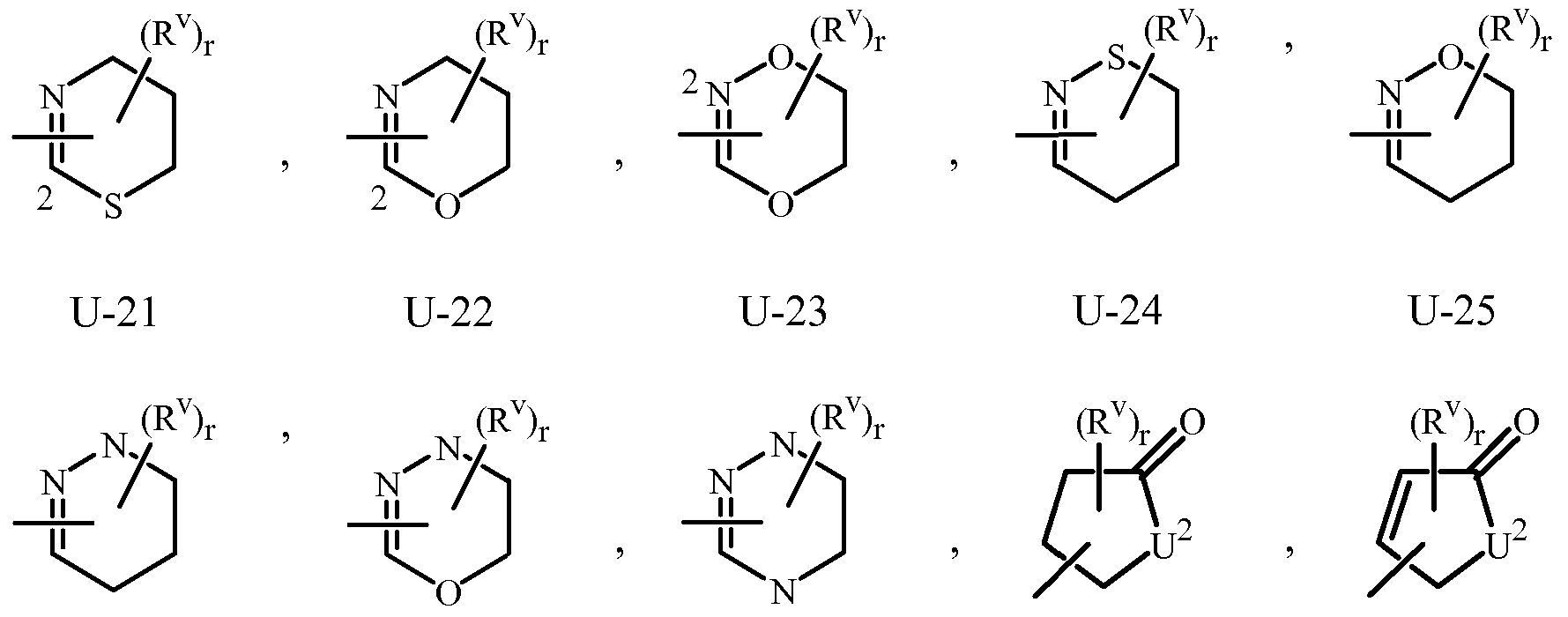
U-26 U-27 U-28 U-29 U-30

U-31 U-32 U-33 U-34 U-35

U-36
As noted above, G can be (among others) an 8-, 9- or 10-membered fused bicyclic ring system optionally substituted with one or more substituents selected from a group of substituents as defined in the Summary of the Invention (i.e. R21 or R22). Examples of an 8-, 9- or 10-membered fused bicyclic ring system optionally substituted with from one or more substituents include the rings Q-81 through Q-123 illustrated in Exhibit 3 wherein Rv
is any substituent as defined in the Summary of the Invention for G (i.e. R21 or R22), and r is an integer from 0 to 5, more typically 0 to 4.
Exhibit 3

Q-101 Q-102 Q-104

Q-109 Q-110 Q-l l l Q-112


Q-121 Q-122 Q-123
Although Rv groups are shown in the structures Q-1 through Q-60 and Q-81 through Q-123, it is noted that they do not need to be present since they are optional substituents. The nitrogen atoms that require substitution to fill their valence are substituted with H or Rv. Note that when the attachment point between (Rv)r and the Q group is illustrated as floating, (Rv)r can be attached to any available carbon atom or nitrogen atom of the Q group. Note that when the attachment point on the Q group is illustrated as floating, the Q group can be attached to the remainder of Formula 1 through any available carbon or nitrogen of the Q group by replacement of a hydrogen atom. Note that some Q groups can only be substituted with less than 4 Rv groups (e.g., Q-1 through Q-5, Q-7 through Q-48, and Q-52 through Q-60).
As noted in the Summary of the Invention, besides the possibility of R1 and R2 being separate substituents, they may also be taken together along with the atoms to which they are attached to form a 5-, 6- or 7-membered partially unsaturated or fully unsaturated ring fused to the pyridazinone ring. The fused ring includes as ring members the two atoms shared with the pyridazinone ring to which the R1 and R2 substituents are attached. The other 3, 4 or 5 ring members of the fused ring are provided by the R1 and R2 substituents taken together. These other ring members, up to 5 allowed by ring size, include carbon atoms and optionally up to 2 nitrogen atoms, up to 2 oxygen atoms and up to 2 sulfur atoms; or up to 2 ring members are selected from C(=0), -S(=0)- and -S(=0)2-. The fused ring is optionally substituted on carbon atom ring members and on nitrogen atom ring members with groups as defined in the Summary of the Invention. Typically the total number of said substituents selected does not exceed 3.
Exhibit 4 provides, as illustrative examples, fused rings formed by R1 and R2 taken together. As these rings are fused with the pyridazinone ring of Formula 1, a portion of the pyridazinone ring is shown and the truncated lines represent the ring bonds of the
pyridazinone ring. The rings depicted are fused to the two adjacent carbon atoms of the pyridazinone ring. The optional substituents (Rv)r on carbon atom ring members (e.g. selected from halogen, cyano, i~C6 alkyl, C2-C6 alkenyl, C2-C6 alkynyl, Ci~C6 haloalkyl, C3-C8 cycloalkyl and C2-C8 alkoxyalkyl; and phenyl optionally substituted with up to 5 substituents selected from cyano, nitro, halogen, Ci~C6 alkyl, Ci~C6 alkoxy and i~C6 haloalkoxy) and on nitrogen atom ring members (H and Ci-C^ alkyl; and phenyl optionally substituted with up to 5 substituents selected from cyano, nitro, halogen, Ci~C6 alkyl, Ci~C6 alkoxy and Ci-C^ haloalkoxy) are selected from groups as defined in the Summary of the Invention. Substituents are limited by the number of available positions on each T-ring. When the attachment point between (Rv)r and the T-ring is illustrated as floating, Rv may be bonded to any available T-ring carbon or nitrogen atom. One skilled in the art recognizes that while r is nominally an integer from 0 to 3, some of the rings shown in Exhibit 4 have less than 3 available positions, and for these groups r is limited to the number of available positions. When "r" is 0 this means the ring is unsubstituted and hydrogen atoms are present at all available positions. If r is 0 and (Rv)r is shown attached to a particular atom, then hydrogen is attached to that atom. The nitrogen atoms that require substitution to fill their valence are substituted with H or Rv. Furthermore, one skilled in the art recognizes that some of the rings shown in Exhibit 4 can form tautomers, and the particular tautomer depicted is representative of all the possible tautomers.
Exhibit 4

T-l T-2 T-3 T-4

T-5 T-6 T-7 T-8

T-9 T-10 T-l l T-12


T-41 T-42 T-44

A wide variety of synthetic methods are known in the art to enable preparation of aromatic and nonaromatic heterocyclic rings and ring systems; for extensive reviews see the eight volume set of Comprehensive Heterocyclic Chemistry, A. R. Katritzky and C. W. Rees editors-in-chief, Pergamon Press, Oxford, 1984 and the twelve volume set of Comprehensive Heterocyclic Chemistry II, A. R. Katritzky, C. W. Rees and E. F. V. Scriven editors-in-chief, Pergamon Press, Oxford, 1996.
Compounds of this invention can exist as one or more stereoisomers. The various stereoisomers include enantiomers, diastereomers, atropisomers and geometric isomers. One skilled in the art will appreciate that one stereoisomer may be more active and/or may exhibit beneficial effects when enriched relative to the other stereoisomer(s) or when separated from the other stereoisomer(s). Additionally, the skilled artisan knows how to separate, enrich, and/or to selectively prepare said stereoisomers. The compounds of the invention may be present as a mixture of stereoisomers, individual stereoisomers or as an optically active form.
One skilled in the art will recognize that many of the compounds of the invention as well as intermediate compounds for their preparation can exist in the form of multiple tautomers. For example, when a compound of Formula 1 is identified by A being A-1, A-2 or A-3, and the R3A variable being hydroxy or O M+, then said compound of Formula 1 can exist as a "triketone" tautomer or a "di-keto enol" tautomer, or a combination thereof. Likewise, when a compound of Formula 1 is identified by A being A-1, A-2 or A-3, and the R3A variable being -SH, then said compound of Formula 1 can exist as a "di-keto thioketo"
tautomer, a "di-keto thioenol" tautomer or a "keto thioketo enol" tautomer, or a combination thereof. Furthermore, acyclic enols (e.g., the fragment A-7 in the definition of the variable A) can exist as tautomers having E and Z configurations. In the context of the present invention, tautomers represent functionally equivalent species, and identification of a compound by one tautomer is to be considered reference to all possible tautomers of the compound unless otherwise indicated.
Compounds selected from Formula 1, stereoisomers, tautomers, N-oxides, and salts thereof, typically exist in more than one form, and Formula 1 thus includes all crystalline and non-crystalline forms of the compounds that Formula 1 represents. Non-crystalline forms include embodiments which are solids such as waxes and gums as well as embodiments which are liquids such as solutions and melts. Crystalline forms include embodiments which represent essentially a single crystal type and embodiments which represent a mixture of polymorphs (i.e. different crystalline types). The term "polymorph" refers to a particular crystalline form of a chemical compound that can crystallize in different crystalline forms, these forms having different arrangements and/or conformations of the molecules in the crystal lattice. Although polymorphs can have the same chemical composition, they can also differ in composition due the presence or absence of co- crystallized water or other molecules, which can be weakly or strongly bound in the lattice. Polymorphs can differ in such chemical, physical and biological properties as crystal shape, density, hardness, color, chemical stability, melting point, hygroscopicity, suspensibility, dissolution rate and biological availability. One skilled in the art will appreciate that a polymorph of a compound of Formula 1 can exhibit beneficial effects (e.g., suitability for preparation of useful formulations, improved biological performance) relative to another polymorph or a mixture of polymorphs of the same compound of Formula 1. Preparation and isolation of a particular polymorph of a compound of Formula 1 can be achieved by methods known to those skilled in the art including, for example, crystallization using selected solvents and temperatures.
One skilled in the art will appreciate that not all nitrogen-containing heterocycles can form N-oxides since the nitrogen requires an available lone pair for oxidation to the oxide; one skilled in the art will recognize those nitrogen-containing heterocycles which can form N-oxides. One skilled in the art will also recognize that tertiary amines can form N-oxides. Synthetic methods for the preparation of N-oxides of heterocycles and tertiary amines are very well known by one skilled in the art including the oxidation of heterocycles and tertiary amines with peroxy acids such as peracetic and m-chloroperbenzoic acid (MCPBA), hydrogen peroxide, alkyl hydroperoxides such as tert-bvXy\ hydroperoxide, sodium perborate, and dioxiranes such as dimethyldioxirane. These methods for the preparation of N-oxides have been extensively described and reviewed in the literature, see for example: T. L. Gilchrist in Comprehensive Organic Synthesis, vol. 7, pp 748-750, S. V. Ley, Ed., Pergamon Press; M. Tisler and B. Stanovnik in Comprehensive Heterocyclic Chemistry, vol.
3, p 18-20, A. J. Boulton and A. McKillop, Eds., Pergamon Press; M. R. Grimmett and B. R. T. Keene in Advances in Heterocyclic Chemistry, vol. 43, pp 149-161, A. R. Katritzky, Ed., Academic Press; M. Tisler and B. Stanovnik in Advances in Heterocyclic Chemistry, vol. 9, pp 285-291, A. R. Katritzky and A. J. Boulton, Eds., Academic Press; and G. W. H. Cheeseman and E. S. G. Werstiuk in Advances in Heterocyclic Chemistry, vol. 22, pp 390-392, A. R. Katritzky and A. J. Boulton, Eds., Academic Press.
One skilled in the art recognizes that because in the environment and under physiological conditions salts of chemical compounds are in equilibrium with their corresponding nonsalt forms, salts share the biological utility of the nonsalt forms. Thus a wide variety of salts of a compound of Formula 1 are useful for control of undesired vegetation (i.e. are agriculturally suitable). The salts of a compound of Formula 1 include acid-addition salts with inorganic or organic acids such as hydrobromic, hydrochloric, nitric, phosphoric, sulfuric, acetic, butyric, fumaric, lactic, maleic, malonic, oxalic, propionic, salicylic, tartaric, 4-toluenesulfonic or valeric acids. When a compound of Formula 1 contains an acidic moiety such as a carboxylic acid or phenol, salts also include those formed with organic or inorganic bases such as pyridine, triethylamine or ammonia, or amides, hydrides, hydroxides or carbonates of sodium, potassium, lithium, calcium, magnesium or barium. Accordingly, the present invention comprises compounds selected from Formula 1, N-oxides and agriculturally suitable salts thereof.
Embodiments of the present invention as described in the Summary of the Invention include (where Formula 1 as used in the following Embodiments includes N-oxides and salts thereof):
Embodiment 1. A compound of Formula 1 (including all stereoisomers), N-oxides, and salts thereof, agricultural compositions containing them and their use as herbicides as described in the Summary of the Invention.
Embodiment 2. A compound of Embodiment 1 wherein A is A-l, A-3, A-5 or A-6.
Embodiment 3. A compound of Embodiment 2 wherein A is A-l, A-3 or A-5.
Embodiment 4. A compound of Embodiment 3 wherein A is A-l or A-3.
Embodiment 5. A compound of Embodiment 4 wherein A is A-l .
Embodiment 6. A compound of Embodiment 4 wherein A is A-3.
Embodiment 7. A compound of any one of Embodiments 1 through 5 wherein A is other than A-l .
Embodiment 8. A compound of any one of Embodiments 1 through 7 wherein B1 is C-l .
Embodiment 9. A compound of any one of Embodiments 1 through 7 wherein B1 is
C-2.
Embodiment 10. A compound of any one of Embodiments 1 through 9 wherein B2 is C-3.
Embodiment 1 1. A compound of any one of Embodiments 1 through 9 wherein B2 is C-4.
Embodiment 12. A compound of any one of Embodiments 1 through 1 1 wherein B3 is C-l .
Embodiment 13. A compound of any one of Embodiments 1 through 1 1 wherein B3 is
C-2.
Embodiment 14. A compound of any one of Embodiments 1 through 13 wherein R1 is halogen, Ci~C6 alkyl, Ci~C6 haloalkyl, C2-C6 alkenyl, C2-C6 haloalkenyl, C2-C6 alkynyl, C2-C6 haloalkynyl, Ci~C6 alkoxy, i~C6 haloalkoxy, C2-C6 alkenyloxy, C3-C8 haloalkenyloxy, C3-C7 alkynyloxy, C2-C6 alkoxyalkoxy, C2-C6 cyanoalkoxy, C2-C6 alkylthioalkoxy, i~C6 alkylthio, i~C6 alkylsulfinyl, Ci - C6 alkylsulfonyl, Ci~C6 haloalkylthio, i~C6 haloalkylsulfinyl, Ci~C6
haloalkylsulfonyl, (RA)(RB)N-, (RA)(RB)NS02-, RcS02N(RD)-, nitro or cyano.
Embodiment 15. A compound of Embodiment 14 wherein R1 is halogen, i-C^ alkyl, Ci-C6 haloalkyl, C2-C6 alkenyl, C2-C6 haloalkenyl, C2-C6 alkynyl, C2-C6 haloalkynyl, i-C^ alkoxy, Ci-C^ haloalkoxy or C2-C6 alkenyloxy.
Embodiment 16. A compound of Embodiment 15 wherein R1 is halogen, i-C^ alkyl, C^-C6 haloalkyl, i-C^ alkoxy or i-C^ haloalkoxy.
Embodiment 17. A compound of Embodiment 16 wherein R1 is chloro, methyl,
methoxy or trifluoromethyl.
Embodiment 18. A compound of Embodiment 17 wherein R1 is methyl.
Embodiment 18 A. A compound of Embodiment 17 wherein R1 is choro or methyl.
Embodiment 19. A compound of any one of Embodiments 1 through 14 wherein each RA is independently Ci -C4 alkyl.
Embodiment 20. A compound of any one of Embodiments 1 through 14 wherein each
RB is independently C1 -C4 alkyl.
Embodiment 21. A compound of any one of Embodiments 1 through 14 wherein RA and RB are taken together with the nitrogen atom to which they are both attached to form a 6-membered ring including ring members selected from -CH2- and -0-. Embodiment 22. A compound of Embodiment 21 wherein RA and RB are taken
together with the nitrogen atom to which they are both attached to form a 6- membered ring including ring members selected from 4 -CH2- and 1 -O- (i.e. a morpholine moiety).
Embodiment 23. A compound of Embodiment 21 wherein RA and RB are taken
together with the nitrogen atom to which they are both attached to form a 6- membered ring including ring members selected from 5 -CH2- (i.e. a piperidine ring).
Embodiment 24. A compound of any one of Embodiments 1 through 14 wherein Rc is C1 -C4 alkyl.
Embodiment 25. A compound of any one of Embodiments 1 through 14 wherein RD is Ci alkylene (i.e. -CH2-).
Embodiment 26. A compound of any one of Embodiments 1 through 25 wherein R2 is phenyl or -W1 (phenyl), each optionally substituted on ring members with up to five substituents selected from R21; or -G or -W2G; or H, cyano, hydroxy, amino, nitro, -CHO, -C(=0)OH, -C(=0)NH2, -C(=S)NH2, -C(=0)NHCN, -C(=0)NHOH, -SH, -S02NH2, -S02NHCN, -S02NHOH, -SF5, -NHCHO, -NHNH2, -NHOH, -NHCN, -NHC(=0)NH2, CrC6 alkyl, C2-C6 alkenyl, C2-C6 alkynyl, i-C^ haloalkyl, C2-C6 haloalkenyl, C2-C6 haloalkynyl, C3-C8 cycloalkyl, C3-C8 halocycloalkyl, C4-C10 alkylcycloalkyl, C4-C10
cycloalkylalkyl, C6-C14 cycloalkylcycloalkyl, C4-C10 halocycloalkylalkyl, C5-C12 alkylcycloalkylalkyl, C3-C8 cycloalkenyl, C3-C8 halocycloalkenyl, C2-Cg alkoxyalkyl, C3-C10 alkoxyalkenyl, C4-C^o cycloalkoxyalkyl, C3-C10 alkoxyalkoxyalkyl, C2-C8 alkylthioalkyl, C2-C6 alkylthioalkoxy, C2-C8 alkylsulfinylalkyl, C2-C8 alkylsulfonylalkyl, C2-Cg alkylaminoalkyl, C3-C10 dialkylaminoalkyl, C2-Cg haloalkylaminoalkyl, C4-C^o cycloalkylaminoalkyl, C2-Cg alkylcarbonyl, C2-C8 haloalkylcarbonyl, C4-C10 cycloalkylcarbonyl, C2-C8 alkoxycarbonyl, C4-C10 cycloalkoxycarbonyl, C5-C12
cycloalkylalkoxycarbonyl, C2-Cg alkylaminocarbonyl, C3-C10
dialkylaminocarbonyl, C4-C^o cycloalkylaminocarbonyl, C2-C5 cyanoalkyl, Ci-Cfr hydroxyalkyl, C4-C10 cycloalkenylalkyl, C2-C8 haloalkoxyalkyl, C2-C8 alkoxyhaloalkyl, C2-C8 haloalkoxyhaloalkyl, C4-C^o halocycloalkoxyalkyl, C4-C10 cycloalkenyloxyalkyl, C4-C10 halocycloalkenyloxyalkyl, C3-C10 dialkoxyalkyl, C3-C10 alkoxyalkylcarbonyl, C3-C10 alkoxycarbonylalkyl, C2-C8 haloalkoxycarbonyl, i-C^ alkoxy, Ci-C^ haloalkoxy, C3-C8 cycloalkoxy, C3"C8 halocycloalkoxy, C4-C^o cycloalkylalkoxy, C2-C6 alkenyloxy, C2-C6 haloalkenyloxy, C2-C6 alkynyloxy, C3-C6 haloalkynyloxy or C2-C8
alkoxyalkoxy.
Embodiment 27. A compound of Embodiment 26 wherein R2 is phenyl or
-W1 (phenyl), each optionally substituted on ring members with up to five substituents selected from R21; or -G or -W2G; or Ci-C6 alkyl, Ci~C6 haloalkyl, C3"C8 cycloalkyl, C2-C8 alkoxyalkyl, i-C^ alkoxy, i-C^ haloalkoxy or C2-C8 alkoxyalkoxy.
Embodiment 28. A compound of Embodiment 27 wherein R2 is phenyl optionally substituted with up to five substituents selected from R21 ; or Ci-C6 alkyl, Ci~C6 haloalkyl, C3-C8 cycloalkyl, C2-C8 alkoxyalkyl, i-C^ alkoxy, i-C^
haloalkoxy or C2-C8 alkoxyalkoxy.
Embodiment 28A. A compound of Embodiment 27 wherein R2 is Ci-C^ alkyl, C3-C8 cycloalkyl or i-C^ haloalkoxy.
Embodiment 28B. A compound of Embodiment 28A wherein R2 is n-propyl, c-hexyl or -OCH2CH2CF3.
Embodiment 28C. A compound of Embodiment 28B wherein R2 is c-hexyl.
Embodiment 29. A compound of Embodiment 28 wherein R2 is phenyl; or i-C^ alkyl.
Embodiment 30. A compound of Embodiment 29 wherein R2 is phenyl; or n-propyl. Embodiment 31. A compound of any one of Embodiments 1 through 13 wherein R1 and R2 are taken together with the atoms to which they are attached to form a 6-membered partially unsaturated ring along with ring members consisting of carbon atoms and up to 2 oxygen atoms, 2 sulfur atoms or up to two -S(0)2- groups, the ring optionally substituted on carbon atom ring members selected from halogen, cyano, i~C6 alkyl, C2-C6 alkenyl, C2-C6 alkynyl, Ci~C6 haloalkyl, C3-Cg cycloalkyl and C2-C§ alkoxyalkyl; and phenyl optionally substituted with up to 5 substituents selected from cyano, nitro, halogen, Ci~C6 alkyl, i-C^ alkoxy and Ci-C^ haloalkoxy.
Embodiment 32. A compound of Embodiment 31 wherein R1 and R2 are taken
together with the atoms to which they are attached to form a 6-membered partially unsaturated ring along with ring members consisting of carbon atoms and 2 oxygen atoms, 2 sulfur atoms or two -S(0)2- groups, the ring optionally substituted on carbon atom ring members selected from halogen, cyano and
Ci-Cft alkyl.
Embodiment 33. A compound of Embodiment 32 wherein R1 and R2 are taken
together with the atoms to which they are attached to form a 6-membered partially unsaturated ring along with ring members consisting of carbon atoms and two -S(0)2- groups, the ring optionally substituted on carbon atom ring members selected from halogen and Ci-C^ alkyl.
Embodiment 34. A compound of any one of Embodiments 1 through 33 wherein W1 is -CH2-, -CH=CH- or -CH20-.
Embodiment 35. A compound of Embodiment 34 wherein W1 is -CH2-.
Embodiment 36. A compound of any one of Embodiments 1 through 33 wherein W2 is
-CH2- or -CH20-.
Embodiment 37. A compound of any one of Embodiments 1 through 36 wherin R3 is H, CrC4 alkyl, CrC4 haloalkyl, C2-C4 alkenyl, C2-C4 alkynyl, C3-C8 cycloalkyl, C4-C10 cycloalkylalkyl, C3-C8 halocycloalkyl, Cj-C4 cyanoalkyl, C2-C6 alkoxyalkyl or C3-C6 alkoxy carbonylalkyl.
Embodiment 38. A compound of Embodiment 37 wherein R3 is H, Cj-C4 alkyl, Cj-C4 haloalkyl, C3-C8 cycloalkyl, C4-C10 cycloalkylalkyl or C3-C6
alkoxy carbonylalkyl .
Embodiment 39. A compound of Embodiment 38 wherein R3 is C 1 -C4 alkyl or C3-Cg cycloalkyl.
Embodiment 40. A compound of Embodiment 39 wherein R3 is methyl or
cyclopropyl.
Embodiment 41. A compound of Embodiment 40 wherein R3 is methyl.
Embodiment 42. A compound of any one of Embodiments 1 through 41 wherein R3A is H, hydroxy, -O M+, C2-C8 alkylcarbonyloxy, C2-C8 haloalkylcarbonyloxy, C4-C10 cycloalkylcarbonyloxy or C3-C10 alkylcarbonylalkoxy; or benzyloxy, phenyloxy, benzylcarbonyloxy, phenylcarbonyloxy, phenylsulfonyloxy or benzylsulfonyloxy, each optionally substituted on ring members with up to two substituents selected from R21.
Embodiment 43. A compound of Embodiment 42 wherein R3A is hydroxy, -O M+ or C2-C8 alkylcarbonyloxy; or phenylsulfonyloxy optionally substituted with up to two substituents selected from R21.
Embodiment 44. A compound of Embodiment 43 wherein R3A is hydroxy or C2-Cg alkylcarbonyloxy.
Embodiment 45. A compound of Embodiment 44 wherein R3A is hydroxy or
-OC(=0)CH2CH(CH3)2.
Embodiment 46. A compound of Embodiment 43 wherein M+ is a sodium or
potassium metal cation.
Embodiment 47. A compound of any one of Embodiments 1 , 2, 3, 7 and 14 through 46 wherein R9 is Ci-C^ alkyl.
Embodiment 48. A compound of Embodiment 47 wherein R9 is ethyl.
Embodiment 49. A compound of any one of Embodiments 1 , 2, 3 7 and 14 through 48 wherein R10 is H, halogen or i-C^ alkyl.
Embodiment 50. A compound of Embodiment 49 wherein R10 is H or methyl.
Embodiment 51. A compound of Embodiment 50 wherein R10 is methyl.
Embodiment 52. A compound any one of Embodiments 1 , 2 and 14 through 46
wherein R1 1 is H or i-C^ alkyl.
Embodiment 53. A compound of any one of Embodiments 1 through 52 wherein when instances of R14 and R18 are taken alone (i.e. R14 and R18 are not taken together as alkylene or alkenylene), then independently said instances of R14 and R18 are
H or CrC6 alkyl.
Embodiment 54. A compound of Embodiment 53 wherein when instances of R14 and R18 are taken alone, then independently said instances of each R14 and R18 are H or methyl.
Embodiment 55. A compound of Embodiment 54 wherein when instances of R14 and R18 are taken alone, then independently said instances of R14 and R18 are H.
Embodiment 56. A compound any one of Embodiments 1 through 55 wherein when instances of R14 and R18 are taken together, then said instances of R14 and R18 are taken together as -CH2CH2CH2- or -CH=CHCH2-.
Embodiment 57. A compound of any one of Embodiments 1 through 55 wherein all instances of R14 and R18 are taken alone.
Embodiment 58. A compound of any one of Embodiments 1 through 55 wherein
independently each R15 and R19 is H or i-C^ alkyl.
Embodiment 59. A compound of Embodiment 58 wherein independently each R15 and
R19 is H or methyl.
Embodiment 60. A compound of Embodiment 59 wherein independently each R15 and
R19 is H.
Embodiment 61. A compound of Embodiment 57 and 59 wherein each R14, R15, R18 and R19 is H or methyl.
Embodiment 62. A compound of Embodiment 61 wherein each R14, R15, R18 and R19 is H.
Embodiment 63. A compound of any one of Embodiments 1 through 62 wherein R20 is H, Ci-Cfr alkyl, C2-C6 alkenyl or C3-C8 cycloalkyl.
Embodiment 64. A compound of Embodiment 63 wherein R20 is H or CH3.
Embodiment 65. A compound of any one of Embodiments 1, 2, 3, 4, 6, 10, 11 and 14 through 64 wherein T is -CH2CH2- or -CH=CH-.
Embodiment 66. A compound of Embodiment 65 wherein T is -CH2CH2-.
Embodiment 67. A compound of any one of Embodiments 1 through 27 and 31
through 66 wherein each G is independently a 5- or 6-membered heterocyclic ring optionally substituted with up to five substituents selected from R21 on carbon ring members and R22 on nitrogen ring members.
Embodiment 68. A compound of Embodiment 67 wherein G is

G-9 G-10

G-l l G-12 G-13 G-14 G-15

G-16 G-17 G-18 G-19 G-20

G-21 r is 0, 1, 2 or 3.
Embodiment 69. A compound of Embodiment 68 wherein G is G-2, G-3, G-9 or G-15. Embodiment 70. A compound of Embodiment 69 wherein G is G-2, G-3 or G-15. Embodiment 71. A compound of Embodiment 70 wherein G is G-2 or G-3.
Embodiment 72. A compound of Embodiment 71 wherein G is G-2.
Embodiment 73. A compound of Embodiment 70 wherein G is G-3.
Embodiment 73 A. A compound of Embodiment 68 wherein G is G-21.
Embodiment 73B. A compound of Embodiment 68 wherein G is other than G-21. Embodiment 74. A compound of any one of Embodiments 68 through 73 wherein r is 0, 1 or 2.
Embodiment 75. A compound Embodiment 74 wherein r is 0 or 1.
Embodiment 76. A compound any one of Embodiments 1 through 75 wherein each R21 is independently halogen, cyano, hydroxy, nitro, -CHO, -SH, Ci-C^, alkyl, C2-C6 alkenyl, C2-C6 alkynyl, Ci-C^, haloalkyl, C2-C6 haloalkenyl, C2-C6 haloalkynyl, C3-C8 cycloalkyl, C3-C8 halocycloalkyl, C4-C10 alkylcycloalkyl, C4-C10 cycloalkylalkyl, C3-C8 cycloalkenyl, C3-C8 halocycloalkenyl, C2-Cg alkoxyalkyl, C4-C10 cycloalkoxyalkyl, C3-C10 alkoxyalkoxyalkyl, C2-Cg alkylthioalkyl, C2-Cg alkylsulfinylalkyl, C2-Cg alkoxyhaloalkyl, C2-C5 cyanoalkyl, Ci-C^, hydroxyalkyl, Ci-C^, alkoxy, Ci-C^, haloalkoxy, C3-Cg cycloalkoxy, C3-Cg halocycloalkoxy, C4-C10 cycloalkylalkoxy, C2-C6 alkenyloxy, C2-C6 haloalkenyloxy, C2-Cg alkoxyalkoxy, C2-Cg
alkylcarbonyloxy, C^-C6 alkylthio, C^-C6 haloalkylthio, C3-Cg cycloalkylthio,
Ci-Cfr alkylsulfmyl, Ci~C6 haloalkylsulfinyl, Ci~C6 alkylsulfonyl, Ci~C6 haloalkylsulfonyl or C3-Cg cycloalkylsulfonyl.
Embodiment 77. A compound of Embodiment 76 wherein each R21 is independently halogen, nitro, i~C6 alkyl, Ci~C6 haloalkyl, Ci~C6 alkoxy, i~C6 haloalkoxy or CrC6 alkylthio.
Embodiment 78. A compound of Embodiment 77 wherein each R21 is independently fluorine, chlorine, bromine, methyl, trifluoromethyl, methoxy, trifluoromethoxy or thiomethoxy.
Embodiment 79. A compound of Embodiments 1 through 78 wherein each R22 is
independently i-C^ alkyl or i-C^ haloalkyl.
Embodiment 80. A compound of Embodiment 79 wherein each R22 is independently methyl or -CH2CF3.
Embodiments of the present invention as described in the Summary of the Invention and any of Embodiments 1 through 80 can be combinded in any way, and the descriptions of variables in the embodiments pertain not only to the compounds of Formula 1 but also to the starting compounds and intermediate compounds useful for preparing the compounds of Formula 1. Combined Embodiments from above can be illustrated as:
Embodiment A. A compound of Formula 1 (including all stereoisomers), N-oxides, and salts thereof, agricultural compositions containing them and their use as herbicides as described in the Summary of the Invention wherein
A is A-l , A-3, A-5 or A-6;
R1 is halogen, Ci~C6 alkyl, Ci~C6 haloalkyl, C2-C6 alkenyl, C2-C6 haloalkenyl, C2-C6 alkynyl, C2-C6 haloalkynyl, Ci~C6 alkoxy, i~C6 haloalkoxy, C2-C6 alkenyloxy, C3-Cg haloalkenyloxy, C3-C7 alkynyloxy, C2-C6 alkoxyalkoxy, C2-C6 cyanoalkoxy, C2-C6 alkylthioalkoxy, Ci-C^ alkylthio, Ci-C^ alkylsulfmyl,
Ci-Cfr alkylsulfonyl, Ci~C6 haloalkylthio, i~C6 haloalkylsulfinyl, Ci~C6 haloalkylsulfonyl, (RA)(RB)N-, (RA)(RB)NS02-, RcS02N(RD)-, nitro or cyano; each RA is independently -C4 alkyl;
each RB is independently Ci -C4 alkyl;
RA and RB are taken together with the nitrogen atom to which they are both attached to form a 6-membered ring including ring members selected from -CH2- and -0-;
RC is CrC4 alkyl;
RD is Ci alkylene;
R2 is phenyl or -W1 (phenyl), each optionally substituted on ring members with up to five substituents selected from R21; or -G or -W2G; or H, cyano, hydroxy, amino, nitro, -CHO, -C(=0)OH, -C(=0)NH2, -C(=S)NH2, -C(=0)NHCN, -C(=0)NHOH, -SH, -S02NH2, -S02NHCN, -S02NHOH, -SF5, -NHCHO, -NHNH2, -NHOH, -NHCN, -NHC(=0)NH2, CrC6 alkyl, C2-C6 alkenyl, C2-C6
alkynyl, Ci-C^ haloalkyl, C2-C6 haloalkenyl, C2-C6 haloalkynyl, C3-C8 cycloalkyl, C3-C8 halocycloalkyl, C4-C10 alkylcycloalkyl, C4-C10
cycloalkylalkyl, C6-C14 cycloalkylcycloalkyl, C4-C10 halocycloalkylalkyl, C5-C12 alkylcycloalkylalkyl, C3-C8 cycloalkenyl, C3-C8 halocycloalkenyl, C2-Cg alkoxyalkyl, C3-C10 alkoxyalkenyl, C4-C^o cycloalkoxyalkyl, C3-C10 alkoxyalkoxyalkyl, C2-C8 alkylthioalkyl, C2-C6 alkylthioalkoxy, C2-C8 alkylsulfinylalkyl, C2-Cg alkylsulfonylalkyl, C2-Cg alkylaminoalkyl, C3-C10 dialkylaminoalkyl, C2-Cg haloalkylaminoalkyl, C4-C^o cycloalkylaminoalkyl, C2-Cg alkylcarbonyl, C2-C8 haloalkylcarbonyl, C4-C10 cycloalkylcarbonyl, C2-C8 alkoxycarbonyl, C4-C10 cycloalkoxycarbonyl, C5-C12
cycloalkylalkoxycarbonyl, C2-Cg alkylaminocarbonyl, C3-C10
dialkylaminocarbonyl, C4-C^o cycloalkylaminocarbonyl, C2-C5 cyanoalkyl, Ci-Cfr hydroxyalkyl, C4-C10 cycloalkenylalkyl, C2-C8 haloalkoxyalkyl, C2-C8 alkoxyhaloalkyl, C2-C8 haloalkoxyhaloalkyl, C4-C^o halocycloalkoxyalkyl, C4-C10 cycloalkenyloxyalkyl, C4-C10 halocycloalkenyloxyalkyl, C3-C10 dialkoxyalkyl, C3-C10 alkoxyalkylcarbonyl, C3-C10 alkoxycarbonylalkyl, C2-C8 haloalkoxycarbonyl, i-C^ alkoxy, Ci-C^ haloalkoxy, C3-C8 cycloalkoxy, C3"C8 halocycloalkoxy, C4-C^o cycloalkylalkoxy, C2-C6 alkenyloxy, C2-C6 haloalkenyloxy, C2-C6 alkynyloxy, C3-C6 haloalkynyloxy or C2-C8
alkoxyalkoxy; or
R1 and R2 are taken together with the atoms to which they are attached to form a 6-membered partially unsaturated ring along with ring members consisting of carbon atoms and up to 2 oxygen atoms, 2 sulfur atoms or up to two -S(0)2- groups, the ring optionally substituted on carbon atom ring members selected from halogen, cyano, i~C6 alkyl, C2-C6 alkenyl, C2-C6 alkynyl, Ci~C6 haloalkyl, C3-C8 cycloalkyl and C2-C8 alkoxyalkyl; and phenyl optionally substituted with up to 5 substituents selected from cyano, nitro, halogen, Ci~C6 alkyl, i-C^ alkoxy and Ci-C^ haloalkoxy;
W1 is -CH2- -CH=CH- or -CH20-;
W2 is -CH2- or -CH20-;
R3 is H, CrC4 alkyl, CrC4 haloalkyl, C2-C4 alkenyl, C2-C4 alkynyl, C3-C8
cycloalkyl, C4-C10 cycloalkylalkyl, C3-C8 halocycloalkyl, C 1 -C4 cyanoalkyl, C2-C6 alkoxyalkyl or C3-C6 alkoxycarbonylalkyl;
R3A is H, hydroxy, -O M+, C2-C8 alkylcarbonyloxy, C2-C8 haloalkylcarbonyloxy, C4-C^o cycloalkylcarbonyloxy or C3-C10 alkylcarbonylalkoxy; or benzyloxy, phenyloxy, benzylcarbonyloxy, phenylcarbonyloxy, phenylsulfonyloxy or benzylsulfonyloxy, each optionally substituted on ring members with up to two substituents selected from R21;
M+ is a sodium or potassium metal cation;
R9 is CrC6 alkyl;
R10 is H, halogen or Ci~C6 alkyl;
R1 1 is H or CrC6 alkyl;
R14 and R18 are H or CrC6 alkyl; or
R14 and R18 are taken together as -CH2CH2CH2- or -CH=CHCH2-;
each R15 and R19 is H or CrC6 alkyl;
R20 is H, CrC6 alkyl, C2-C6 alkenyl or C3-C8 cycloalkyl;
T is -CH2CH2- or -CH=CH-;
G is independently a 5- or 6-membered heterocyclic ring optionally substituted with up to five substituents selected from R21 on carbon ring members and R22 on nitrogen ring members;
each R21 is independently halogen, cyano, hydroxy, nitro, -CHO, -SH, Ci~C6 alkyl, C2-C6 alkenyl, C2-C6 alkynyl, Ci~C6 haloalkyl, C2-C6 haloalkenyl, C2-C6 haloalkynyl, C3-C8 cycloalkyl, C3-C8 halocycloalkyl, C4-C10 alkylcycloalkyl, C4-C10 cycloalkylalkyl, C3-C8 cycloalkenyl, C3-C8 halocycloalkenyl, C2-C8 alkoxyalkyl, C4-C10 cycloalkoxyalkyl, C3-C^Q alkoxyalkoxyalkyl, C2-C8 alkylthioalkyl, C2-C8 alkylsulfinylalkyl, C2-C8 alkoxyhaloalkyl, C2-C5 cyanoalkyl, Ci~C6 hydroxyalkyl, Ci~C6 alkoxy, i~C6 haloalkoxy, C3-C8 cycloalkoxy, C3-C8 halocycloalkoxy, C4-C10 cycloalkylalkoxy, C2-C6 alkenyloxy, C2-C6 haloalkenyloxy, C2-C8 alkoxyalkoxy, C2-C8
alkylcarbonyloxy, Ci-C^ alkylthio, Ci-C^ haloalkylthio, C3-C8 cycloalkylthio, Ci-Cfr alkylsulfinyl, Ci~C6 haloalkylsulfmyl, Ci~C6 alkylsulfonyl, Ci~C6 haloalkylsulfonyl or C3-C8 cycloalkylsulfonyl; and
each R22 is independently i-C^ alkyl or i-C^ haloalkyl.
Embodimenent B. A compound of Embodiment A wherein
A is A-l , A-3 or A-5;
B1 is C-l ;
B2 is C-3;
B3 is C-l ;
R1 is halogen, Ci~C6 alkyl, Ci~C6 haloalkyl, C2-C6 alkenyl, C2-C6 haloalkenyl, C2-C6 alkynyl, C2-C6 haloalkynyl, Ci~C6 alkoxy, i~C6 haloalkoxy or C2-C6 alkenyloxy;
R2 is phenyl or -W1 (phenyl), each optionally substituted on ring members with up to five substituents selected from R21; or -G or -W2G; or Ci-C6 alkyl, Ci~C6 haloalkyl, C3-C8 cycloalkyl, C2-C8 alkoxyalkyl, Ci~C6 alkoxy, i~C6 haloalkoxy or C2-C8 alkoxyalkoxy; or
R1 and R2 are taken together with the atoms to which they are attached to form a
6-membered partially unsaturated ring along with ring members consisting of carbon atoms and 2 oxygen atoms, 2 sulfur atoms or two -S(0)2- groups, the ring
optionally substituted on carbon atom ring members selected from halogen, cyano and i~C6 alkyl;
W1 is -CH ;
R3 is H, C1-C4 alkyl, C1-C4 haloalkyl, C3-C8 cycloalkyl, C4-C10 cycloalkylalkyl or C3-C6 alkoxycarbonylalkyl;
R3A is hydroxy, -O M+ or C2~Cg alkylcarbonyloxy; or phenylsulfonyloxy optionally substituted with up to two substituents selected from R21;
R9 is ethyl;
R10 is H or methyl;
each R14, R15, R18 and R19 is H or methyl;
T is -CH2CH ;
G is

G-l G-2 G-3 G-4 G-5

G-6 G-7 G-8 G-9 G-10
(R21)R M (R21)r 6 (R21)r

G-l l G-12 G-13 G-14 G-15

G-16 G-17 G-18 G-19 G-20

G-21 r is 0, 1 , 2 or 3;
each R21 is independently halogen, nitro, Ci-C^, alkyl, Ci-C^, haloalkyl, Ci-C^, alkoxy,
Ci-Cft haloalkoxy or C^-C6 alkylthio; and
each R22 is independently methyl or -CH2CF3.
Embodimenent C. A compound of Embodiment B wherein
A is A-l or A-3;
R1 is halogen, Ci-C^, alkyl, Ci-C^, haloalkyl, Ci-C^, alkoxy or Ci-C^, haloalkoxy;
R2 is phenyl optionally substituted with up to five substituents selected from R21; or Cj-C6 alkyl, Ci-C^, haloalkyl, C3-C8 cycloalkyl, C2-Cg alkoxyalkyl, Ci-C^, alkoxy, C^-C6 haloalkoxy or C2-Cg alkoxyalkoxy; or
R1 and R2 are taken together with the atoms to which they are attached to form a
6-membered partially unsaturated ring along with ring members consisting of carbon atoms and two -S(0)2- groups, the ring optionally substituted on carbon atom ring members selected from halogen and C^-C6 alkyl;
R3 is CrC4 alkyl or C3-C8 cycloalkyl;
R3A is hydroxy or C2-Cg alkylcarbonyloxy;
R10 is methyl;
each R14, R15, R18 and R19 is H; and
each R21 is independently fluorine, chlorine, bromine, methyl, trifluoromethyl,
methoxy, trifluoromethoxy or thiomethoxy.
Embodimenent D. A compound of Embodiment C wherein
A is A-l ;
R1 is chloro, methyl, methoxy or trifluoromethyl;
R2 is phenyl; or Ci-C^, alkyl;
R3 is methyl or cyclopropyl; and
R3A is hydroxy or -OC(=0)CH2CH(CH3)2.
Embodimenent E. A compound of Embodiment D wherein
R1 is methyl;
R2 is phenyl; or n-propyl; and
R3 is methyl.
Embodimenent F. A compound of Embodiment C wherein
A is A-l ;
R1 is choro or methyl;
R2 is /? -propyl, c-hexyl or -OCH2CH2CF3;
R3 is methyl; and
R3A is hydroxy or -OC(=0)CH2CH(CH3)2.
Specific emobiments of the present invention include:
5-chloro-6-[(2-hydroxy-6-oxo- 1 -cyclohexen- 1 -yl)carbonyl]-2-methyl-4-phenyl-3(2H)- pyridazinone (Compound 1),
6-[(2-hydroxy-6-oxo- 1 -cyclohexen- 1 -yl)carbonyl]-2,5-dimethyl-4-propyl-3(2H)- pyridazinone (Compound 2),
6-[(2-hydroxy-6-oxo- 1 -cyclohexen- 1 -yl)carbonyl]-5-methoxy-2-methyl-4- phenyl- 3(2H)-pyridazinone (Compound 3),
6-[(2-hydroxy-6-oxo- 1 -cyclohexen- 1 -yl)carbonyl]-2,5-dimethyl-4-phenyl-3(2H)- pyridazinone (Compound 4) and
6-[(2-hydroxy-6-oxo- 1 -cyclohexen- 1 -yl)carbonyl]-2-methyl-4-phenyl-5- (trifluoromethyl)-3(2H)-pyridazinone (Compound 5).
Specific emobiments of the present invention also include a compound of Formula 1
wherein:
A is A-l ; B1 is C-l ; B2 is C-3; B3 is C-l ; R1 is CI; R2 is c-hexyl; R3 is CH3; R A is hydroxy; each R14 and R15 is H; and each R18 and R19 is H (Compound 22);
A is A-l ; B1 is C-l ; B2 is C-3; B3 is C-l ; R1 is CI; R2 is c-propyl; R3 is CH3; R A is hydroxy; each R14 and R15 is H; and each R18 and R19 is H (Compound 25); and
A is A-l ; B1 is C-l ; B2 is C-3; B3 is C-l ; R1 is CH3; R2 is -OCH2CH2CF3; R3 is CH3;
R3A is hydroxy; each R1 and R15 is H; and each R18 and R19 is H (Compound 37).
This invention also relates to a method for controlling undesired vegetation comprising applying to the locus of the vegetation a herbicidally effective amount of a compound of the invention (e.g., as a composition described herein). Of note as embodiments relating to methods of use are those involving the compounds of embodiments described above.
This invention also includes a herbicidal mixture comprising (a) a compound selected from Formula 1, N-oxides, and salts thereof, and (b) at least one additional active ingredient selected from (bl) photosystem II inhibitors, (b2) acetohydroxy acid synthase (AHAS) inhibitors, (b3) acetyl-CoA carboxylase (ACCase) inhibitors, (b4) auxin mimics and (b5) 5 -enol-pyruvylshikimate-3 -phosphate (EPSP) synthase inhibitors, (b6) photosystem I electron diverters, (b7) protoporphyrinogen oxidase (PPO) inhibitors, (b8) glutamine synthetase (GS) inhibitors, (b9) very long chain fatty acid (VLCFA) elongase inhibitors, (blO) auxin transport inhibitors, (bl 1) phytoene desaturase (PDS) inhibitors, (bl2) 4-hydroxyphenyl-pyruvate dioxygenase (HPPD) inhibitors, (bl3) homogentisate solenesyltransererase (HST) inhibitors, (bl4) cellulose biosynthesis inhibitors, (bl5) other herbicides including mitotic disruptors, organic arsenicals, asulam, difenzoquat, bromobutide, flurenol, cinmethylin, cumyluron, dazomet, dymron, methyldymron,
etobenzanid, fosamine, fosamine-ammonium, metam, oxaziclomefone, oleic acid, pelargonic acid and pyributicarb, and (bl6) herbicide safeners; and salts of compounds of (bl) through (bl6).
"Photosystem II inhibitors" (bl) are chemical compounds that bind to the D-l protein at the (^-binding niche and thus block electron transport from QA to QB in the chloroplast thylakoid membranes. The electrons blocked from passing through photosystem II are transferred through a series of reactions to form toxic compounds that disrupt cell membranes and cause chloroplast swelling, membrane leakage, and ultimately cellular destruction. The QB-binding niche has three different binding sites: binding site A binds the triazines such as atrazine, triazinones such as hexazinone, and uracils such as bromacil, binding site B binds the phenylureas such as diuron, and binding site C binds benzothiadiazoles such as bentazon, nitriles such as bromoxynil and phenyl-pyridazines such as pyridate. Examples of photosystem II inhibitors include ametryn, atrazine, cyanazine, desmetryne, dimethametryn, prometon, prometryne, propazine, simazine, simetryn, terbumeton, terbuthylazine, terbutryne, trietazine, hexazinone, metamitron, metribuzin, amicarbazone, bromacil, lenacil, terbacil, chloridazon, desmedipham, phenmedipham, chlorobromuron, chlorotoluron, chloroxuron, dimefuron, diuron, ethidimuron, fenuron, fluometuron, isoproturon, isouron, linuron, methabenzthiazuron, metobromuron, metoxuron, monolinuron, neburon, siduron, tebuthiuron, propanil, pentanochlor, bromofenoxim, bromoxynil, ioxynil, bentazon, pyridate and pyridafol.
"AH AS inhibitors" (b2) are chemical compounds that inhibit acetohydroxy acid synthase (AHAS), also known as acetolactate synthase (ALS), and thus kill plants by inhibiting the production of the branched-chain aliphatic amino acids such as valine, leucine and isoleucine, which are required for DNA synthesis and cell growth. Examples of AHAS inhibitors include amidosulfuron, azimsulfuron, bensulfuron-methyl, chlorimuron-ethyl, chlorsulfuron, cinosulfuron, cyclosulfamuron, ethametsulfuron-methyl, ethoxysulfuron, flazasulfuron, flupyrsulfuron-methyl (including sodium salt), foramsulfuron, halosulfuron-methyl, imazosulfuron, iodosulfuron-methyl (including sodium salt), mesosulfuron-methyl, metazosulfuron, metsulfuron-methyl, nicosulfuron, oxasulfuron, primisulfuron-methyl, propyrisulfuron, prosulfuron, pyrazosulfuron-ethyl, rimsulfuron, sulfometuron-methyl, sulfosulfuron, thifensulfuron-methyl, triasulfuron, tribenuron-methyl, trifloxysulfuron (including sodium salt), triflusulfuron-methyl, tritosulfuron, imazapic, imazamethabenz-methyl, imazamox, imazapyr, imazaquin, imazethapyr, cloransulam-methyl, diclosulam, florasulam, flumetsulam, metosulam, penoxsulam, bispyribac-sodium, pyribenzoxim, pyriftalid, pyrithiobac-sodium, pyriminobac-methyl, thiencarbazone, flucarbazone-sodium and propoxycarbazone-sodium.
"ACCase inhibitors" (b3) are chemical compounds that inhibit the acetyl-CoA carboxylase enzyme, which is responsible for catalyzing an early step in lipid and fatty acid synthesis in plants. Lipids are essential components of cell membranes, and without them,
new cells cannot be produced. The inhibition of acetyl CoA carboxylase and the subsequent lack of lipid production leads to losses in cell membrane integrity, especially in regions of active growth such as meristems. Eventually shoot and rhizome growth ceases, and shoot meristems and rhizome buds begin to die back. Examples of ACCase inhibitors include clodinafop, cyhalofop, diclofop, fenoxaprop, fluazifop, haloxyfop, propaquizafop, quizalofop, alloxydim, butroxydim, clethodim, cyclopyrimorate (6-chloro-3-(2-cyclopropyl- 6-methylphenoxy)-4-pyridazinyl 4-morpholinecarboxylate), cycloxydim, pinoxaden, profoxydim, sethoxydim, tepraloxydim and tralkoxydim, including resolved forms such as fenoxaprop-P, fluazifop-P, haloxyfop-P and quizalofop-P and ester forms such as clodinafop-propargyl, cyhalo fop-butyl, diclo fop-methyl and fenoxaprop-P-ethyl.
Auxin is a plant hormone that regulates growth in many plant tissues. "Auxin mimics" (b4) are chemical compounds mimicking the plant growth hormone auxin, thus causing uncontrolled and disorganized growth leading to plant death in susceptible species. Examples of auxin mimics include aminocyclopyrachlor and its esters (e.g., methyl, ethyl) and salts (e.g., sodium, potassium), aminopyralid benazolin-ethyl, chloramben, clomeprop, clopyralid, dicamba, 2,4-D, 2,4-DB, dichlorprop, fluroxypyr, halauxifen (4-amino-3-chloro- 6-(4-chloro-2-fluoro-3-methoxyphenyl)-2-pyridinecarboxylic acid) and its esters (e.g., methyl, ethyl) and salts (e.g., sodium, potassium), mecoprop, MCPA, MCPB, 2,3,6-TBA, picloram, triclopyr, quinclorac, quinmerac and amino-3-chloro-6-(4-chloro-2-fluoro-3- methoxyphenyl)-2-pyridinecarboxylic acid.
"EPSP (5 -enol-pyruvylshikimate-3 -phosphate) synthase inhibitors" (b5) are chemical compounds that inhibit the enzyme, 5 -enol-pyruvylshikimate-3 -phosphate synthase, which is involved in the synthesis of aromatic amino acids such as tyrosine, tryptophan and phenylalanine. EPSP inhibitor herbicides are readily absorbed through plant foliage and translocated in the phloem to the growing points. Glyphosate is a relatively nonselective postemergence herbicide that belongs to this group. Glyphosate includes esters and salts such as ammonium, isopropylammonium, potassium, sodium (including sesquisodium) and trimesium (alternatively named sulfosate).
"Photosystem I electron diverters" (b6) are chemical compounds that accept electrons from Photosystem I, and after several cycles, generate hydroxyl radicals. These radicals are extremely reactive and readily destroy unsaturated lipids, including membrane fatty acids and chlorophyll. This destroys cell membrane integrity, so that cells and organelles "leak", leading to rapid leaf wilting and desiccation, and eventually to plant death. Examples of this second type of photosynthesis inhibitor include paraquat and diquat.
"PPO inhibitors" (b7) are chemical compounds that inhibit the enzyme protoporphyrinogen oxidase, quickly resulting in formation of highly reactive compounds in plants that rupture cell membranes, causing cell fluids to leak out. Examples of PPO inhibitors include acifluorfen-sodium, bifenox, chlomethoxyfen, fluoroglycofen-ethyl, fomesafen, halosafen, lactofen, oxyfluorfen, fluazolate, pyraflufen-ethyl, cinidon-ethyl,
flumioxazin, flumiclorac-pentyl, fluthiacet-methyl, tiafenacil (methyl N-[2-[[2-chloro-5-[3, 6- dihydro-3-methyl-2,6-dioxo-4-(trifluoromethyl)-l(2/^
oxopropyl]-P-alaninate), thidiazimin, oxadiazon, oxadiargyl, saflufencil, azafenidin, carfentrazone carfentrazone-ethyl, sulfentrazone, pentoxazone, benzfendizone, butafenacil, pyraclonil, profluazol and flufenpyr-ethyl.
"GS (glutamine synthase) inhibitors" (b8) are chemical compounds that inhibit the activity of the glutamine synthetase enzyme, which plants use to convert ammonia into glutamine. Consequently, ammonia accumulates and glutamine levels decrease. Plant damage probably occurs due to the combined effects of ammonia toxicity and deficiency of amino acids required for other metabolic processes. The GS inhibitors include glufosinate and its esters and salts such as glufosinate-ammonium and other phosphinothricin derivatives, glufosinate-P and bilanaphos.
"VLCFA (very long chain fatty acid) elongase inhibitors" (b9) are herbicides having a wide variety of chemical structures, which inhibit the elongase. Elongase is one of the enzymes located in or near chloroplasts which are involved in biosynthesis of VLCFAs. In plants, very-long-chain fatty acids are the main constituents of hydrophobic polymers that prevent desiccation at the leaf surface and provide stability to pollen grains. Such herbicides include acetochlor, alachlor, butachlor, dimethachlor, dimethanamid, metazachlor, metolachlor, pethoxamid, pretilachlor, propachlor, propisochlor, pyroxasulfone, thenylchlor, diphenamid, napropamide, naproanilide, fenoxasulfone, flufenacet, indanofan, mefenacet, fentrazamide, anilofos, cafenstrole, piperophos including resolved forms such as S-metolachlor and chloroacetamides and oxyacetamides.
"Auxin transport inhibitors" (blO) are chemical substances that inhibit auxin transport in plants, such as by binding with an auxin-carrier protein. Examples of auxin transport inhibitors include naptalam (also known as N-(l-naphthyl)phthalamic acid and 2-[(l-naphthalenylamino)carbonyl]benzoic acid) and diflufenzopyr.
"PDS (phytoene desaturase inhibitors) (bl l) are chemical compounds that inhibit carotenoid biosynthesis pathway at the phytoene desaturase step. Examples of PDS inhibitors include norflurzon, diflufenican, picolinafen, beflubutamide, fluridone, flurochloridone and flurtamone.
"HPPD (4-hydroxyphenyl-pyruvate dioxygenase) inhibitors" (bl2) are chemical substances that inhibit the biosynthesis of synthesis of 4-hydroxyphenyl-pyruvate dioxygenase. Examples of HPPD inhibitors include fenquinotrione (2-[[8-chloro-3,4- dihydro-4-(4-methoxyphenyl)-3-oxo-2-quinoxalinyl]car-bonyl]-l,3-cyclohexanedione), mesotrione, sulcotrione, topramezone, tembotrione, tefuryltrione, isoxachlortole, isoxaflutole, benzofenap, pyrasulfatole, pyrazolynate, pyrazoxyfen, bicyclopyrone and benzobicyclon.
HST (homogentisate solenesyltransererase) inhibitors (bl3) disrupt a plant's ability to convert homogentisate to 2-methyl-6-solanyl-l,4-benzoquinone, thereby disrupting
carotenoid biosynthesis. Examples of HST inhibitors include haloxydine, pyriclor and the com ounds of Formulae A, B and C.

A B C
HST inhibitors also include com ounds of Formulae D and E.

D E
wherein Rdl is H, CI or CF3; Rd2 is H, CI or Br; Rd3 is H or CI; Rd4 is H, CI or CF3; Rd5 is CH3, CH2CH3 or CH2CHF2; and Rd6 is OH, or -OC(=0)-z-Pr; and Rel is H, F, CI, CH3 or CH2CH3; Re2 is H or CF3; Re3 is H, CH3 or CH2CH3; Re4 is H, F or Br; Re5 is CI, CH3, CF3, OCF3 or CH2CH3; Re6 is H, CH3, CH2CHF2 or C≡CH; Re? is OH,
-OC(=0)Et, -OC(=0)-z-Pr or -OC(=0)-t-Bu; and Ae8 is N or CH.
Cellulose biosynthesis inhibitors (bl4) inhibit the biosynthesis of cellulose in certain plants. They are most effective when using a pre-aplication or early post-application on young or rapidly growing plants. Examples of cellulose biosynthesis inhibitors include chlorthiamid, diclobenil, flupoxam, indaziflam, isoxaben and triaziflam.
Other herbicides (bl5) include herbicides that act through a variety of different modes of action such as mitotic disruptors (e.g., flamprop-M-methyl and flamprop-M-isopropyl) organic arsenicals (e.g., DSMA, and MSMA), 7,8-dihydropteroate synthase inhibitors, chloroplast isoprenoid synthesis inhibitors and cell-wall biosynthesis inhibitors. Other herbicides include those herbicides having unknown modes of action or do not fall into a specific category listed in (bl) through (bl4) or act through a combination of modes of action listed above. Examples of other herbicides include aclonifen, asulam, amitrole, clomezone, fluometuron, difenzoquat, bromobutide, flurenol, cinmethylin, cumyluron, dazomet, dymron, methyldymron, methiozolon, ipfencarbazone, etobenzanid, fosamine, fosamine-ammonium, metam, oxaziclomefone, oleic acid, pelargonic acid and pyributicarb.
"Herbicide safeners" (bl6) are substances added to a herbicide formulation to eliminate or reduce phytotoxic effects of the herbicide to certain crops. These compounds protect crops from injury by herbicides but typically do not prevent the herbicide from controlling undesired vegetation. Examples of herbicide safeners include but are not limited to allidochlor, N-(aminocarbonyl)-2-methylbenzenesulfonamide, benoxacor, BCS (l-bromo-4-[(chloromethyl)sulfonyl]benzene), cloquintocet-mexyl, cumyluron, cyometrinil, cyprosulfamide, daimuron, dichlormid, 4-(dichloroacetyl)-l-oxa-4-azospiro[4.5]decane (MON 4660), 2-(dichloromethyl)-2-methyl-l,3-dioxolane (MG 191), dicyclonon, dietholate, dimepiperate, ethyl 1 ,6-dihydro- 1 -(2-methoxyphenyl)-6-oxo-2-phenyl-5- pyrimidinecarboxylate, fenchlorazole-ethyl, fenclorim, flurazole, fluxofenim, furilazole, isoxadifen-ethyl, mefenpyr-diethyl, mephenate, methoxyphenone, naphthalic anhydride (1,8- naphthalic anhydride), oxabetrinil and 3-oxo-l-cyclohexen-l-yl l-(3,4-dimethylphenyl)-l,6- dihydro-6-oxo-2-phenyl-5-pyrimidinecarboxylate.
One or more of the following methods and variations as described in Schemes la-21 can be used to prepare the compounds of Formula 1. The definitions of A, B1, B2, B3, T, R1 , R2, R3, R3A, R4, R5, R6, R7, R8, R9, R10, R1 1 , R12 and R13 in the compounds of Formulae 1-21 below are as defined above in the Summary of the Invention unless otherwise noted. Formulae la-lg, 2a-2d, 3a, 4a-4d, and 13a-13e are various subsets of Formulae 1, 2, 3, 4 and 13, respectively. All substituents for Formulae la-lg are as defined above for Formula 1 unless otherwise noted.
As described in further detail below, compounds of Formula 1 wherein A is A-l, A-2, A-3 or A-5 can be prepared by reacting a compound of Formula 2 which is Ai-H wherein A1 is

A A!-2 Al-3 Al-5 with a compound of Formula 3


which, in the presence of a cyanide or fluoride ion source and base is rearranged to form the corresponding compound of Formula 1.
Thus compounds of Formula la, lb, lc or Id (i.e. Formula 1 in which A is A-1, A-2, A-3 or A-5, respectively) wherein R3A is hydroxy can be prepared via the two-step process shown in Schemes la, lb, lc and Id, respectively. Intermediate compounds of Formula 4a, 4b, 4c or 4d (i.e. Formula 4 wherein Al is A-1, A-2, A-3 or A-5, respectively) are prepared by reacting a compound of Formula 2a, 2b, 2c or 2d with a compound of Formula 3 in the presence of a base such as triethylamine. In the presence of an appropriate source of cyanide ion (e.g., acetone cyanohydrin, potassium cyanide, sodium cyanide) and a base such as triethylamine or pyridine, the intermediate compound of Formula 4a, 4b, 4c or 4d is then rearranged to the corresponding compound of Formula la, lb, lc or Id. Alternatively a fluoride anion source such as potassium fluoride or cesium fluoride, optionally in the presence of a phase transfer catalyst (e.g., tetrabutyl ammonium bromide), can be used to cause this rearrangement. Typically the reaction is conducted in a solvent such as dimethylsulfoxide, N,N-dimethylformamide, acetonitrile or dichloromethane at temperatures ranging from ambient temperature to the reflux temperature of the solvent. Alternatively, compounds of Formula la, lb, lc or Id can be prepared by Process 2 (in Schemes la, lb, lc and Id respectively) by reacting a compound of Formula 2a, 2b, 2c or 2d with a compound of Formula 3 in the presence of a cyanide or fluoride anion source along with a base. For reaction conditions for this general coupling methodology, see Edmunds, A. in Modern Crop Protection Compounds; Kramer, W. and Schirmer, U., Eds.; Wiley, Weinheim, 2007; Chapters 4.3 and 4.4, and references cited therein.
Scheme la

3, cyanide or fluoride source and base
Scheme lb

3, cyanide or fluoride source and base
Scheme lc

3, cyanide or fluoride anion source and base
Scheme Id

3, cyanide or fluoride
source and base
Compounds of Formula la, lb or lc can also be prepared as shown in Scheme 2, by reacting dione 2a, 2b or 2c with intermediate 3a (i.e. Formula 3 in which X1 is -CN) in the presence of a base or Lewis acid. For reaction conditions for this general coupling methodology, see Edmunds, A. in Modern Crop Protection Compounds; Kramer, W. and Schirmer, U., Eds.; Wiley, Weinheim, 2007; Chapter 4.3 and references cited therein.

2a, 2b or 2c ► la, lb or lc
base or Lewis acid
As shown in Scheme 3, a compound of Formulae 4a, 4b, 4c or 4d is useful as an intermediate in the method of Schemes la-Id and can also be prepared by reacting a compound of Formula 2a, 2b, 2c or 2d, respectively, with a carboxylic acid of Formula 5 in the presence of a dehydrating condensation agent such as 2-chloro-l-pyridinium iodide (known as the Mukaiyama coupling agent), dicyclohexyl carbodiimide (DCC) or the like and optionally in the presence of a base. For additional reaction conditions for this general enol ester coupling methodology, see Edmunds, A. in Modern Crop Protection Compounds; Kramer, W. and Schirmer, U., Eds.; Wiley, Weinheim, 2007; Chapter 4.3 and references cited therein.

2a, 2b, 2c or 2d ► 4a, 4b, 4c or 4d
dehydrating
condensation agent
As shown in Scheme 4, an intermediate compound of Formula 4a, 4b or 4c can also be made by the palladium-catalyzed carbonylation reaction of a halo compound of Formula 6 in the presence of a compound of Formula 2a, 2b or 2c, respectively. For reaction conditions for this general enol ester forming methodology, see Edmunds, A. in Modern Crop Protection Compounds; Kramer, W. and Schirmer, U., Eds.; Wiley, Weinheim, 2007; Chapter 4.3 and references cited therein.
Scheme 4

2a, 2b or 2c 4a, 4b or 4c
Pd, CO
X2 is CI. Br
As shown in Scheme 5, a compound of Formula le (i.e. Formula 1 in which A is A-4) wherein R3A is hydroxy can be prepared by reacting a compound of Formula 7 with a compound of Formula 3 in the presence of a strong base such n-butyllithium or lithium diisopropylamide in an appropriate solvent such as tetrahydrofuran or diethyl ether. For reaction conditions for this type of transformation, see JP 2003327580.
Scheme 5

Scheme 6
1. halogenating Ra-X2
agent
2. nucleophilic compound base
R is bonded RJft is bonded providing R3A bonded R is OH
through nitrogen, through oxygen through nitrogen,
sulfur or carbon
sulfur or carbon X2 is CI, Br or I
As shown in Scheme 7, compounds of Formula If (i.e. Formula 1 wherein A is A-7) can be prepared from corresponding compounds of Formulae 3 and 9. In this method, a compound of Formula 3 is reacted with a compound Formula 9 in the presence of a base that promotes carbon-centered acylation. Magnesium enolates, which can be formed by reaction of the compound of Formula 9 with magnesium metal or magnesium alcoholates such as magnesium ethoxide, are preferred for carbon-centered acylation. This type of acylation is well known in the literature and typical conditions which result in acylation on carbon can be found in U.S. Patents 4741769 and 4781750, and Van Almsick A. in Modern Crop Protection Compounds; Kramer, W. and Schirmer, U., Eds.; Wiley, Weinheim, 2007; Chapter 4.4, and references cited therein.
heme 7

As shown in Scheme 8, compounds of Formula lg (i.e. Formula 1 in which A is A-6 and R11 is H) can be prepared from diketones of Formula 11. Compounds of Formula 11 can be prepared by acylation of compounds of Formula 10 with a compound of Formula 3. Acylation on carbon can be achieved by using a magnesium enolate of the compound of Formula 10 produced using conditions previously described in Scheme 7. Removal of the ester can be conveniently carried out by heating the reaction product with a source of acid which cleaves the tert-butyl group and results in decarboxylation producing the compound of Formula 11. Acid sources such as hydrochloric acid, hydrobromic acid, sulfuric acid, trifluoroacetic acid and /?-toluenesulfonic acid as well as many others may be employed. The compound of Formula 11 is then reacted with an ortho formate ester or N,N-dimethylformamide dimethylacetal (DMF-DMA) to provide an intermediate compound of Formula 12. Reaction of the compound of Formula 12 with hydroxylamine hydrochloride salt in a solvent such as ethanol, acetonitrile, water or acetic acid provides the isoxazole compound of Formula lg. For reaction conditions for synthesis of 4-acyl isoxazoles, see European Patent Application EP 527036 and World Patent Application WO 99/02489 as well as Van Almsick A. in Modern Crop Protection Compounds; Kramer, W. and Schirmer, U., Eds.; Wiley, Weinheim, 2007; Chapter 4.4, and references cited therein.
Scheme 8

12 lg
Compounds of Formula 3 can be prepared by a wide variety of methods known in the art of synthetic organic chemistry. As shown in Scheme 9, acid chlorides of Formula 3a (i.e. Formula 3 wherein X1 is CI) are easily prepared from corresponding carboxylic acids of Formula 5 by numerous well-known methods. For example, reacting a carboxylic acid of Formula 5 with a chlorinating reagent such as oxalyl chloride or thionyl chloride in a solvent such as dichloromethane or toluene, optionally in the presence of a catalytic amount of N,N-dimethylformamide, provides the corresponding acid chloride of Formula 3a.
Scheme 9 chlorinating
agent

As shown in Scheme 10, carboxylic acids of Formula 5 can be prepared by de- esterification of esters of Formula 13. The de-esterification can be accomplished by many well-known methods, for example, saponification procedures using alkali hydroxides such as LiOH, NaOH or KOH in a lower alkanol such methanol or ethanol or in mixtures of alkanols and water. Alternatively, a dealkylating agent such as lithium iodide or trimethylsilyl iodide can be used in the presence of a base in a solvent such as pyridine or ethyl acetate. Alternatively, boron tribromide (BBr3) can be used to prepare a compound of Formula 5 from a compound of Formula 13 in a solvent such as dichloromethane, hexanes or toluene. A typical procedure using boron tribromide is disclosed in Bioorg. & Med. Chem. Lett. 2009, 19(16), 4733-4739. Additional reaction procedures for de-esterification can be found in PCT Patent Publication WO 2006/133242.
Scheme 10

13
R30 is Cj-Cg alkyl
As shown in Scheme 11, esters of Formula 13 can be prepared from the corresponding nitriles of Formula 14. As is well known in the art, in the presence of an acid and an alkanol, a nitrile is converted into the ester of the alkanol. Suitable acids include, for example,
hydrochloric, hydrobromic acid and sulfuric acid. To prepare an ester of Formula 13 wherein R30 is C i -C6 alkyl, the corresponding Ci -C6 alkanol is used. Lower (i.e. C 1 -C4) alkanols are preferred, and methanol is especially preferred for this method. In a typical reaction, the nitrile of Formula 14 is reacted with hydrochloric acid in the presence of methanol as a solvent. The reaction temperature can be from about 0 to 200 °C depending upon the alcohol used and whether the pressure is increased above ambient atmospheric pressure. An especially useful procedure to perform the reaction involves generating the hydrochloric acid by addition of thionyl chloride, trimethylsilyl chloride or acetyl chloride to methanol in the presence of the compound of Formula 14.
Scheme 1 1

As shown in Scheme 12, esters of Formula 13 can also be prepared from corresponding halo compounds of Formula 6. In this method the compound of Formula 6 is reacted with carbon monoxide and the appropriate Ci-C^ alkanol in the presence of an acid acceptor and a transition metal catalyst. Typically lower alkanols such as methanol and ethanol are preferred in this transformation. Carbon monoxide can be present at pressures ranging from about 100 to 10000 kPa. Examples of suitable acid acceptors include tertiary amines such as triethylamine, alkali metal carbonates such as potassium carbonate, alkali metal phosphates, alkali metal acetates and alkali metal hydrogencarbonates. Tertiary amines are most preferred. Palladium catalysts are most preferred for use in this carbonylation reaction. A wide variety of commercially available ligands and palladium sources can be employed. Among the most useful catalysts are those generated from l ,3-bis(diphenylphosphino)propane (dppp) and l ,l'-bis(diphenylphosphino)ferrocene (dppf). These reactions can be performed at temperatures between about 0 and 200 °C; temperatures between about 50 and 100 °C are most commonly employed. Suitable solvents include polar aprotic solvents such as N,N-dimethylformamide, dimethylsulfoxide, N-methylpyrrolidinone and N,N-dimethylacetamide as well as ethers such as dioxane and tetrahydrofuran. For examples of carbonylation of pyridazinones see Stevenson et al., J. Heterocyclic Chem. 2005, 42, 421. A useful carbonylation of halides without the need for carbon monoxide is described by Manabe and co-workers in Org. Lett. 2012, 14, 3100-3103.
Scheme 12
CO / catalyst
Cj-Cg alkanol
6 13
acid acceptor
X2 is CI, Br or I
As shown in Scheme 13, nitriles of Formula 14 can be prepared by cyanation of corresponding halo compounds of Formula 6. Cyanation reactions are well known in the art. A particularly useful cyanide source for this reaction is copper (I) cyanide. Heating a halide of Formula 6 with an excess of copper(I) cyanide in an aprotic polar solvent such as N,N-dimethylacetamide, N,N-dimethylformamide or N-methylpyrrolidinone forms the compound of Formula 14. The reaction can be perfomed at temperatures ranging from about 0 to 250 °C, but preferably at temperatures between 100 °C and 150 °C. This reaction may also be performed with the aid of a transition metal catalyst. For reagents, conditions and procedures for cyanation of activated heterocyclic halides see PCT Patent Publications WO 2008/070158, WO 2009/061991 and WO 2009/085816, and the references cited therein. Starting halides of Formula 6 can be prepared by methods disclosed in PCT Patent Publication WO 2009/086041 and Verhelst, T., Ph.D. thesis, University of Antwerp, 2012.
Scheme 13
Metal cyanide
6 14
X2 is CI, Br or I
Esters of Formula 13a (i.e. compounds of Formula 13 wherein R1 is halogen) can be prepared by reaction of hydroxypyridazinones of Formula 15 with halogenating agents as shown in Scheme 14. Many types of halogenating reagents such as, but not limited to, POCl3, PC15, SOCl2, SOBr2, PBr3 and POBr3 will accomplish this conversion. This reaction can be carried out in aprotic solvents which are compatible with the reagents for example, dichloromethane, chlorobenzene, toluene, dichloroethane and chloroform. Temperatures from 0 to 180 °C can be employed. In some cases the addition of a tertiary amine base can be helpful. Preferred amines for this purpose are N,N-dimethylaniline and N,N-diethylaniline. In addition the halogens may be interconverted by reaction of alkali halides in solvents such as N,N-dimethylformamide, N,N-dimethylacetamide, acetonitrile or N-methylpyrrolidinone at temperatures from 80 to 200 °C.
Scheme 14
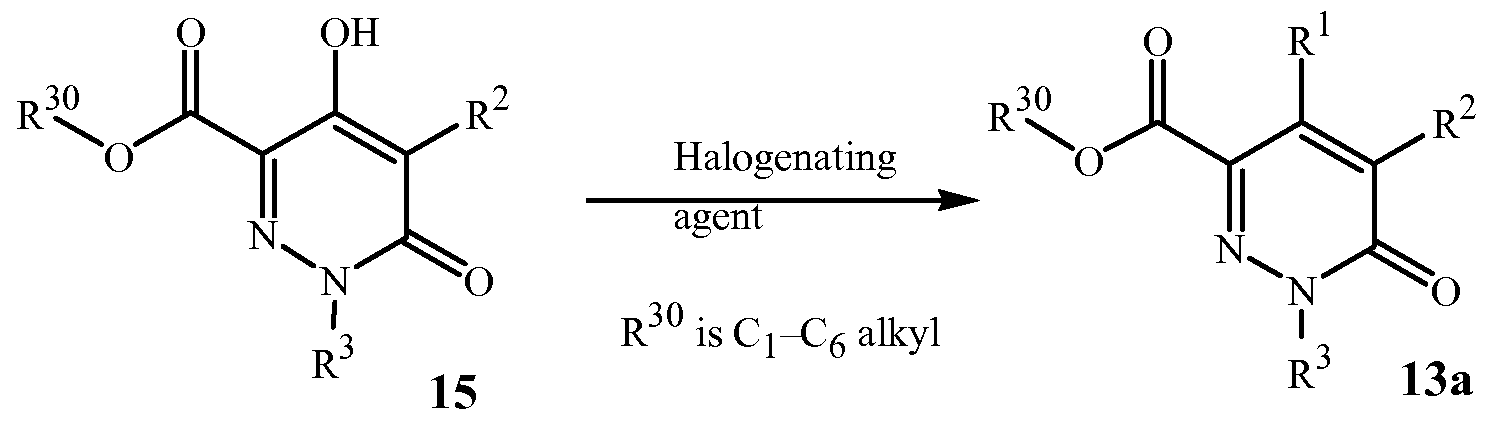
R is halogen
Compounds of Formula 13b (i.e. compounds of Formula 13 wherein R1 is Ci -C6 alkoxy) may be obtained by alkylation of compounds of Formula 15 with i-C^ alkyl halides or sulfonates in the presence of an acid acceptor as shown in Scheme 15. The reaction may be conducted at temperatures between -20 and 150 °C. Useful solvents include, but are not limited to N,N-dimethylformamide, N,N-dimethylacetamide, acetonitrile, N-methylpyrrolidinone, dioxane, tetrahydrofuran or dimethylsulfoxide. Suitable acid acceptors include but are not limited to alkali carbonates, hydroxides, alkoxides and hydrides as well as cesium carbonate and alkali hexamethyldisilazides. A preferred set of conditions utilizes N,N-dimethylformamide as solvent with sodium hydride as acid acceptor.
Scheme 15
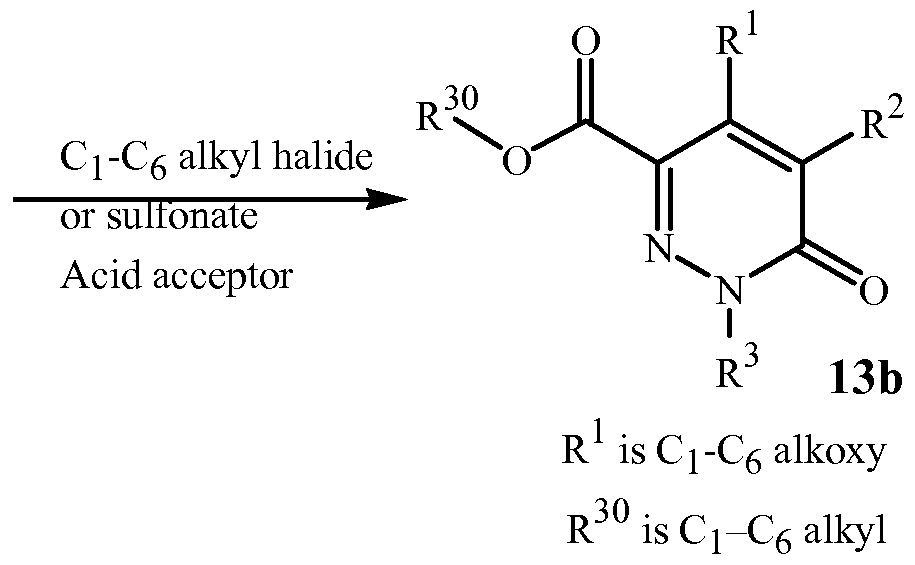
As shown in Scheme 16 compounds of Formula 13c (, compounds of Formula 13 wherein R1 is -C^ alkylthio or (RA)(RB)N can be prepared by nucleophilic displacement reactions of compounds of Formula 13a with -C^ alkanethiols or amines (RA)(RB)NH. Useful solvents include, but are not limited to N,N-dimethylformamide, N,N- dimethylacetamide, N-methylpyrrolidinone, dioxane, tetrahydrofuran or dimethylsulfoxide. The reaction may be conducted at temperatures between -20 and 150 °C. As also shown in Scheme 16, compounds of Formula 13b can be prepared in similar fashion by reaction of compounds of Formula 13a with Cj -C(, alcohols in the presence of a base.
Scheme 16

13b
As shown in Scheme 17, compounds of Formula 13e (i.e. compounds of Formula 13 wherein R1 is Ci-C^ alkyl) can be prepared by transition metal catalyzed reactions of compounds of Formula 13d (i.e. compounds of Formula 13 wherein R1 is a sulfonate such as trifluoromethanesulfonate), or with compounds of Formula 13a. Various palladium catalyzed reactions are known to introduce functional groups in this way. For reviews of this type of reaction see: E. Negishi, Handbook of Organopalladium Chemistry for Organic Synthesis, John Wiley and Sons, Inc., New York, 2002; N. Miyaura, Cross-Coupling Reactions: A Practical Guide, Springer, New York, 2002; H. C. Brown et al, Organic Synthesis via Boranes, Aldrich Chemical Co., Milwaukee, Vol. 3, 2002; Suzuki et al, Chemical Reviews 1995, 95, 2457-2483 and Molander et al, Accounts of Chemical Research 2007, 40, 275-286. Also see Gribble and Li Eds., Palladium in Heterocyclic Chemistry Volume I, Pergamon Press, Amsterdam, 2000 and Gribble and Li, Eds., Palladium in Heterocyclic Chemistry Volume 2, Pergamon Press, Amsterdam, 2007. For a review of Buchwald-Hartwig chemistry see Yudin and Hartwig, Catalyzed Carbon-Heteroatom Bond Formation, 2010, Wiley, New York. Copper catalyzed reactions are useful for introducing the CF3 group. For a comprehensive recent review of reagents for this reaction see Wu, Neumann and Beller in Chemistry: An Asian Journal 2012, ASAP, available at http://onlinelibrary.wiley.com/doi/10.1002/asia.201200211/pdf and references cited therein. Sulfonate precursors of formula 13d can be made from the hydroxyl precursors of Formula 15 by the well known sulfonylation reaction outlined by Maes and Lemiere in Comprehensive Heterocyclic Chemistry III, Volume 8, Katritsky, Ramsden, Scriven and Taylor editors, and references cited therein.
Scheme 17

Scheme 18 shows the synthesis of compounds of Formula 15 by the cyclization of hydrazono esters of formula 16 in the presence of an acid acceptor. Suitable acid acceptors for the reaction include inorganic bases, such as alkali or alkaline earth metal (such as lithium, sodium, potassium and cesium) hydrides and alkoxides or organic bases, such as triethylamine, N,N-diisopropylethylamine and l,8-diazabicyclo[5.4.0]undec-7-ene. A wide variety of solvents are suitable for the reaction, including, for example but are not limited to aromatic hydrocarbons (such as toluene and xylenes), tetrahydrofuran, dioxane, dimethoxy ethane, N,N-dimethylformamide, N,N-dimethylacetamide, N-methylpyrrolidinone, and acetonitrile as well as mixtures of these solvents. This reaction can be conducted between about -20 and 200 °C, and preferably between about 20 and 120 °C.
Scheme 18

16
R30 is -Cg alkyl
Compounds of Formula 16 can be synthesized by the reaction of an activated acid derivative of Formula 20 with a hydrazone of Formula 19 in the presence of an acid acceptor as shown in Scheme 19. Suitable acid acceptors for the reaction include inorganic bases, such as alkali or alkaline earth metal (such as lithium, sodium, potassium, cesium) hydrides, alkoxides, carbonates, phosphates and hydroxides, and organic bases, such as triethylamine, N,N-diisopropylethylamine and l,8-diazabicyclo[5.4.0]undec-7-ene. Preferred acid acceptors are trialkylamines and potassium hydroxide. A wide variety of solvents are suitable for the reaction, including, for example but are not limited to tetrahydrofuran, dichloromethane, N,N-dimethylformamide, N,N-dimethylacetamide, N-methylpyrrolidinone, acetonitrile and acetone, as well as mixtures of these solvents. This reaction can be
conducted between about -20 and 100 °C, and preferably between about 0 and 50 °C. Activated acid derivatives include, for example, but are not limited to acid chlorides, acid bromides, acylimidazoles, mixed anhydrides and acylcyanides. Examples of related chemistry can be found in U.S. Pat. No. 7,517,994. Hydrazones of Formula 19 can be prepared as shown in Scheme 19 by reaction of ketomalonates of Formula 17 with hydrazines of Formula 18. This reaction can be performed by methods disclosed in U.S. Pat. No. 7,517,994.
Scheme 19

Compounds of Formula 13 can be prepared by zincation of pyridazinones of Formula
21 and quenching with haloformates of Formula 22 as shown in Scheme 20. Reaction of a CH containing pyridazinone with a zincation reagent such as zinc chloro 2,2,6,6- tetramethylpiperidide lithium chloride complex (Zn(TMP)-LiCl, where TMP is 2,2,6,6- tetramethylpiperidine), produces a zincated intermediate which can be reacted with a halo formate of Formula 22 in the presence of a transition metal catalyst to produce compounds of Formula 13. The preferred metal for this process is palladium and the preferred catalysts contain phosphine ligands such as triphenylphosphine. Preferred catalysts include palladium tetrakis-(triphenylphosphine) and bis-(triphenylphospine) palladium dichloride. The zincation reaction may be carried out at temperatures from -20 to 150 °C and the coupling reaction from 0 to 120 °C. Ethereal solvents such as dioxane and tetrahydrofuran are preferred for this reaction, but other solvents which do not react with the zinc reagent may also be employed. Alternatively the transition metal can be a copper (I) salt such as CuCl, Cul, CuBr or CuCN or a soluble version in which lithium chloride is used to increase the solubility of the salt. For conditions, reagents and examples for zincation of pyridazinones, see Verhelst, T., Ph.D. thesis, University of Antwerp, 2012. For preparation of a variety of appropriate zincation reagents see Wunderlich, S. Ph.D. thesis, University of Munich, 2010 and references cited therein as well as PCT Patent Publications WO 2008/138946 and WO 2010/092096.
Scheme 20

As shown in Scheme 21, compounds of Formula 5 can be prepared by the reaction of zincated heterocycles with carbon dioxide in the presence of a transition metal catalyst. Pyridazinones of Formula 21 can be zincated as indicated in Scheme 21 and treated with carbon dioxide in the presence of palladium or nickel catalysts. Conditions and catalysts which are suitable for this transformation are disclosed in J. Am. Chem. Soc. 2008, 130, 7826-7827. Preferred conditions are from -10 to 30 °C using a catalyst prepared from Pd(OAc)2 and tricyclohexylphosphine in tetrahydrofuran as solvent.
Scheme 21
1. Zincation
reagent
21
2. C02
Pd or Ni catalyst
Compounds of Formula 21 are known in the literature or can be prepared by methods outlined by Maes and Lemiere in Comprehensive Heterocyclic Chemistry III Volume 8, Katritsky, Ramsden, Scriven and Taylor editors and references cited therein. See also Verhelst, Ph.D. thesis, University of Antwerp and references cited therein. Other methods of functional group transformations on pyridazinones which can be used to synthesize compounds of Formula 21 may be found in J. Heterocyclic Chem. 2005 42, 421. Chemistry leading to other pyridazinones can be found in U.S. Pat. No. 6,077,953. See also PCT Patent Publication WO 2009/086041 and references cited therein.
It is recognized that some reagents and reaction conditions described above for preparing compounds of Formula 1 may not be compatible with certain functionalities present in the intermediates. In these instances, the incorporation of protection/deprotection sequences or functional group interconversions into the synthesis will aid in obtaining the desired products. The use and choice of the protecting groups will be apparent to one skilled in chemical synthesis (see, for example, Greene, T. W.; Wuts, P. G. M. Protective Groups in Organic Synthesis, 2nd ed.; Wiley: New York, 1991). One skilled in the art will recognize that, in some cases, after the introduction of a given reagent as it is depicted in any individual scheme, it may be necessary to perform additional routine synthetic steps not described in detail to complete the synthesis of compounds of Formula 1. One skilled in the
art will also recognize that it may be necessary to perform a combination of the steps illustrated in the above schemes in an order other than that implied by the particular sequence presented to prepare the compounds of Formula 1.
One skilled in the art will also recognize that compounds of Formula 1 and the intermediates described herein can be subjected to various electrophilic, nucleophilic, radical, organometallic, oxidation, and reduction reactions to add substituents or modify existing substituents.
Without further elaboration, it is believed that one skilled in the art using the preceding description can utilize the present invention to its fullest extent. The following Synthesis Examples are, therefore, to be construed as merely illustrative, and not limiting of the disclosure in any way whatsoever. Steps in the following Synthesis Examples illustrate a procedure for each step in an overall synthetic transformation, and the starting material for each step may not have necessarily been prepared by a particular preparative run whose procedure is described in other Examples or Steps. Percentages are by weight except for chromatographic solvent mixtures or where otherwise indicated. Parts and percentages for chromatographic solvent mixtures are by volume unless otherwise indicated. ¾ NMR spectra are reported in ppm downfield from tetramethylsilane in CDCI3 at 400 MHz unless otherwise noted; "s" means singlet, "m" means multiplet, "br s" means broad singlet. Mass spectra (MS) are reported as the molecular weight of the highest isotopic abundance parent ion (M+l) formed by addition of H+ (molecular weight of 1) to the molecule, observed by mass spectrometry using atmospheric pressure chemical ionization (AP+) where "amu" stands for atomic mass units. The presence of molecular ions containing one or more higher atomic weight isotopes of lower abundance (e.g., 37C1, 81Br) is not reported.
SYNTHESIS EXAMPLE 1
Preparation of 6-[(2-hydroxy-6-oxo-l-cyclohexen-l-yl)carbonyl]-2,5-dimethyl-4-phenyl-
3(2H)-pyridazinone (Compound 4)
Step A: Preparation of l,3-diethyl-2-(2-methylhydrazinylidene)propanedioate (2- propanone 2-methylhydrazone- 1,3 -diethyl ester)
To a stirred solution of diethyl ketomalonate (2.00 g, 11.5 mmol) in ethanol (20 mL) was added methylhydrazine (0.580 g, 12.6 mmol). The reaction mixture was stirred at 60 °C for 6 h, then cooled to room temperature and concentrated under reduced pressure. The crude residue was purified by chromatography on silica gel eluting with 5 to 10% ethyl acetate in hexanes to afford the title compound (1.01 g) as a yellow oil.
!H NMR δ 1.36-1.31 (m, 6H), 3.40 (d, J= 3.9 Hz, 3H), 4.31-4.25 (m, 4H), 11.30 (br s, 1H). MS: 203 amu (AP+).
Step B: Preparation of ethyl l,6-dihydro-4-hydroxy-l-methyl-6-oxo-5-phenyl-3- pyridazinecarboxylate
To a stirred solution of l,3-diethyl-2-(2-propanone 2-methylhydrazone)propanedioate (i.e. the product of Step A, (2-propanone 2-methylhydrazone- 1,3 -diethyl ester), 3.0 g, 14.9 mmol) in tetrahydrofuran (30 mL) was added lithium hexamethyldisilazide (1M solution in tetrahydrofuran, 32.7 mL, 32.7 mmol) at 0 °C over a period of 40 min. The mixture was stirred for an additional 40 min and subsequently treated dropwise with phenylacetyl chloride (2.75 g, 17.82 mmol). The reaction mixture was stirred at room temperature for 6 h, then cooled to 0 °C and the pH adjusted to approximately 2 by slow addition of IN hydrochloric acid (40 mL). The mixture was then extracted with ethyl acetate (3 X 30 mL), and the combined organic extracts were washed with water and brine, dried (Na2S04) and concentrated under reduced pressure. The crude residue was purified by chromatography on silica gel eluting with 20% ethyl acetate in hexanes to afford the title compound (1.57 g) as an off-white solid.
!H NMR δ 10.81 (s, 1H), 7.60-7.58, (m, 2H), 7.47-7.41 (m, 3H), 4.52 (q, J = 7.1 Hz, 2H), 3.91 (s, 3H), 1.47 (t, J= 7.1, 3H). MS: 275 amu (AP+).
Step C: Preparation of ethyl 4-chloro-l,6-dihydro-l-methyl-6-oxo-5-phenyl-3- pyridazinecarboxylate
Ethyl 1 ,6-dihydro-4-hydroxy- 1 -methyl-6-oxo-5-phenyl-3-pyridazinecarboxylate (i.e. the product of Step B, 80 mg, 0.29 mmol) was treated with phosphorous oxychloride (2.0 mL, 21.4 mmol) and heated to 85 °C for 16 h. The reaction mixture was concentrated under reduced pressure and quenched with crushed ice. The pH was adjusted to approximately 7 by addition of saturated aqueous sodium bicarbonate (20 mL) and extracted with ethyl acetate (10 mL). The organic layer was dried (Na2S04) and concentrated under reduced pressure. The crude residue was purified by chromatography on silica gel eluting with 10%> ethyl acetate in hexanes to afford the title compound (36 mg) as a light brown oil.
!H NMR δ 7.49-7.43 (m, 3H), 7.41-7.38 (m, 2H), 4.45 (q, J= 7.1 Hz, 2H), 3.85 (s, 3H), 1.44 (t, J= 7.1 Hz, 3H). MS: 293 amu (AP+).
Step D: Preparation of ethyl l,6-dihydro-l,4-dimethyl-6-oxo-5-phenyl-3- pyridazinecarboxylate
To a degassed solution of ethyl 4-chloro-l,6-dihydro-l-methyl-6-oxo-5-phenyl-3- pyridazinecarboxylate (i.e. the product of Step C, 100 mg, 0.34 mmol) in toluene (2 mL) was added tetrakis(triphenylphosphine)palladium(0) (19.6 mg, 0.017 mmol) and 2M trimethylaluminum in toluene (0.18 mL, 0.376 mmol). The mixture was heated at reflux for 2 h, cooled to room temperature, diluted with water (10 mL) and extracted with ethyl acetate (10 mL). The organic layers were dried (Na2S04) and concentrated under reduced pressure. The crude material was purified by chromatography on silica gel eluting with 5 to 15% ethyl acetate in hexanes to afford the title compound (81 mg, 87%>) as a colorless gum.
!H NMR δ 7.47-7.38 (m, 3H), 7.23 (t, J= 1.2 Hz, 1H), 4.42 (q, J= 7.1 Hz, 2H), 3.86 (s, 3H), 2.22 (s, 3H), 1.42 (t, J= 7.1 Hz, 3H). MS: 273 amu (AP+).
Step E: Preparation of 1 ,6-dihydro-l ,4-dimethyl-6-oxo-5-phenyl-3- pyridazinecarboxylic acid
To a solution of ethyl l,6-dihydro-l,4-dimethyl-6-oxo-5-phenyl-3- pyridazinecarboxylate (i.e. the product of Step D, 1 equiv) in 1 ,4-dioxane/water (8:2), was added lithium hydroxide monohydrate (3.0 equiv.) and the mixture was stirred at room temperature for 4 h. The reaction mixture was concentrated and diluted with water. The pH was adjusted to approximately 2 by slow addition of IN hydrochloric acid and extracted with ethyl acetate. The combined organic extracts were washed with water and brine, dried (Na2S04) and concentrated under reduced pressure to afford the title compound (79%) as an off-white solid.
!H NMR δ 7.49-7.42 (m, 3H), 7.25-7.22 (m, 2H), 3.89 (s, 3H), 2.42 (s, 3H). MS: 245 amu (AP+).
Step F: Preparation of 3-oxo-l-cyclohexen-l-yl l,6-dihydro-l,4-dimethyl-6-oxo-5- phenyl-3 -pyridazinecarboxylate
To a stirred solution of l,6-dihydro-l,4-dimethyl-6-oxo-5-phenyl-3- pyridazinecarboxylic acid (i.e. the product of Step E, 1.0 equiv), N,N-diisopropylethylamine (3.0 equiv) in tetrahydrofuran was added cyclohexane-l,3-dione (1.1 equiv) at room temperature. The mixture was stirred for 30 min, 2-chloro-l-methylpyridinium iodide (1.5 equiv) was added and stirring was continued for 16 h. The reaction mixture was diluted with water, acidified by slow addition of aqueous IN hydrochloric acid, and extracted with ethyl acetate. The organic layers were dried (Na2S04) and concentrated under reduced pressure. The crude material was purified by chromatography on silica gel eluting with 1 to 3% methanol in dichloromethane to provide the title compound (30%) as a light brown gum. !H NMR 5 7.49-7.41 (m, 3H), 7.23 (t, J= 1.4 Hz, 1H), 6.03 (t, J= 1.0 Hz, 1H), 3.90 (s, 3H), 2.68 (t, J= 6.2 Hz, 2H), 2.47 (t, J= 7.1 Hz, 2H), 2.28 (s, 3H), 2.18-2.10 (m, 2H).
Step G: Preparation of 6-[(2-hydroxy-6-oxo-l-cyclohexen-l-yl)carbonyl]-2,5- dimethyl-4-phenyl-3(2H)-pyridazinone
To a stirred solution of 3-oxo-l-cyclohexen-l-yl l,6-dihydro-l,4-dimethyl-6-oxo-5- phenyl-3 -pyridazinecarboxylate (i.e. the product of Step F, 1.0 equiv) and triethylamine (1.0 equiv) in acetonitrile, was added potassium cyanide (1.0 equiv) at room temperature. The mixture was stirred for 3-4 h, concentrated under reduced pressure, diluted with water and the pH was adjusted to approximately 2 by slow addition of IN hydrochloric and extracted with ethyl acetate. The combined organic extracts were washed with water and brine, dried (Na2S04) and concentrated under reduced pressure. Purification of the crude material by reverse phase (C18) column chromatography eluting with acetonitrile/water (3:2 to 4: 1) afforded the title compound (15%>) as an off- white solid.
!H NMR δ 7.85 (br s, 2H), 7.46-7.36 (m, 3H), 3.67 (br s, 3H), 2.36-2.32 (m, 4H), 2.00-1.84 (m, 5H).
SYNTHESIS EXAMPLE 2
Preparation of 6-[(2-hydroxy-6-oxo- 1 -cyclohexen- 1 -yl)carbonyl]-2-methyl-4-phenyl-5- (trifluoromethyl)-3(2H)-pyridazinone (Compound 5) Step A: Preparation of ethyl l,6-dihydro-l-methyl-6-oxo-5-phenyl-4- (trifluoromethyl)-3 -pyridazinecarboxylate
To a degassed suspension of ethyl 4-chloro-l,6-dihydro-l-methyl-6-oxo-5-phenyl-3- pyridazinecarboxylate (i.e. the product of Example 1, Step C, 100 mg, 0.34 mmol), methyl difluoro(fluorosulfonyl)acetate (FS02CF2COOMe, 657 mg, 3.42 mmol), cuprous iodide (325 mg, 1.71 mmol) and triphenylarsine (41.8 mg, 0.40 mmol) in N,N-dimethylformamide (4.0 mL) was added tris(dibenzylideneacetone)dipalladium(0) (313 mg, 0.342 mmol) and the reaction mixture was heated at 90 °C for 24 h. The reaction mixture was cooled to room temperature, partitioned between water and ethyl acetate (1 : 1, 30 mL) and filtered. The layers were separated, and the aqueous layer was extracted with ethyl acetate (15 mL). The combined organic extracts were washed with water and brine, dried (Na2S04) and concentrated under reduced pressure. The crude material was purified by chromatography on silica gel eluting with 10 to 15% ethyl acetate in hexanes to afford the title compound (71 mg) as a light brown oil.
in NMR δ 7.48-7.44 (m, 3H), 7.33-7.31 (m, 2H), 4.43 (q, J = 7.1 Hz, 2H), 3.87 (s, 3H), 1.40 (t, J= 7.1 Hz, 2H). MS: 327 amu (AP+).
Step B: Preparation of l,6-dihydro-l-methyl-6-oxo-5-phenyl-4-(trifluoromethyl)-3- pyridazinecarboxylic acid
Using the method of Example 1, Step E, ethyl l,6-dihydro-l-methyl-6-oxo-5-phenyl- 4-(trifluoromethyl)-3-pyridazinecarboxylate (i.e. the product of Step A) afforded the title compound (92%>) as a light brown solid.
!H NMR δ 7.49-7.45 (m, 3H), 7.38-7.30 (m, 2H), 3.90 (s, 3H).
Step C: Preparation of 3 -oxo-1 -cyclohexen- 1-yl l,6-dihydro-l-methyl-6-oxo-5- phenyl-4-(trifluoromethyl)-3-pyridazinecarboxylate
Using the method of Example 1, Step F, l,6-dihydro-l-methyl-6-oxo-5-phenyl-4- (trifluoromethyl)-3-pyridazinecarboxylic acid (i.e. the product of Step B) afforded the title compound (88%>) as a light brown gum.
!H NMR δ 7.50-7.45 (m, 3H), 7.34-7.32 (m, 2H), 6.08 (t, J = 1.2 Hz, 1H), 3.91 (s, 3H), 2.68 (t, J= 6.2 Hz, 2H), 2.47 (t, J= 7.2 Hz, 2H), 2.17-2.11 (m, 2H). MS: 393 amu (AP+).
Step D: Preparation of 6-[(2-hydroxy-6-oxo-l -cyclohexen- l-yl)carbonyl] -2-methyl-4- phenyl-4-(trifluoromethyl)-3(2H)-pyridazinone
Using the method of Example 1, Step G, 3 -oxo-1 -cyclohexen- 1-yl 1,6-dihydro-l- methyl-6-oxo-5-phenyl-4-(trifluoromethyl)-3-pyridazinecarboxylate (i.e. the product of Step C) afforded the title compound (17%) as an off-white solid. MP 201-203 °C.
lH NMR (CD3OD) δ 7.45-7.44 (m, 3H), 7.34 (br s, 2H), 3.78 (s, 3H), 2.80 (t, J = 6.3 Hz, 2H), 2.48 (t, J= 6.5 Hz, 2H), 2.13-2.06 (m, 2H).
SYNTHESIS EXAMPLE 3
Preparation of 5-chloro-6-[(2-hydroxy-6-oxo-l-cyclohexen-l-yl)carbonyl]-2-methyl-4- phenyl-3(2H)-pyridazinone (Compound 1)
Step A: Preparation of 4-chloro-l,6-dihydro-l-methyl-6-oxo-5-phenyl-3- pyridazinecarboxylic acid
Using the method of Example 1, Step E, ethyl 4-chloro-l,6-dihydro-l-methyl-6-oxo-5- phenyl-3-pyridazinecarboxylate (i.e. the product of Example 1, Step C) afforded the title compound (88%) as an off-white solid.
in NMR δ 7.51-7.45 (m, 3H), 7.40-7.37 (m, 2H), 3.90 (s, 3H). MS: 265 amu (AP+).
Step B: Preparation of 3-oxo-l-cyclohexen-l-yl 4-chloro-l,6-dihydro-l-methyl-6- oxo-5 -phenyl-3 -pyridazinecarboxylate
Using the method of Example 1 , Step F, 4-chloro-l,6-dihydro-l-methyl-6-oxo-5- phenyl-3-pyridazinecarboxylic acid (i.e. the product of Step A) afforded the title compound (72%) as a clear gum.
!H NMR δ 7.51-7.45 (m, 3H), 7.41-7.39 (m, 2H), 3.89 (s, 3H), 2.69 (t, J = 2.6 Hz, 2H), 2.47 (t, J= 7.1 Hz, 2H), 2.17-2.11 (m, 2H). MS: 359 amu (AP+).
Step C: Preparation of 5-chloro-6-[(2-hydroxy-6-oxo-l-cyclohexen-l-yl)carbonyl]-2- methyl-4-phenyl-3(2H)-pyridazinone
Using the method of Example 1, Step G, 3-oxo-l-cyclohexen-l-yl 4-chloro-l,6- dihydro-l-methyl-6-oxo-5 -phenyl-3 -pyridazinecarboxylate (, the product of Step B) afforded the title compound (34%) as a light brown solid. MP 176-178 °C.
in NMR δ 7.46-7.41 (m, 5H), 3.78 (s, 3H), 2.81 (t, J= 6.3 Hz, 2H), 2.49 (t, J= 6.2 Hz, 2H), 2.12-2.05 (m, 2H).
SYNTHESIS EXAMPLE 4
Preparation of 6-[(2-hydroxy-6-oxo-l-cyclohexen-l-yl)carbonyl]-5-methoxy-2-methyl-4- phenyl-3(2H)-pyridazinone (Compound 3)
Step A: Preparation of 1 ,6-dihydro-4-methoxy- 1 -methyl-6-oxo-5 -phenyl-3 - pyridazinecarboxylic acid
(Prepared as described in Heterocycles 2012, 57(11), 2115-2158.) To a stirred solution of ethyl 4-chloro-l,6-dihydro-l-methyl-6-oxo-5-phenyl-3-pyridazinecarboxylate (i.e. the product of Example 1, Step C, 50 mg, 0.171 mmol) in 1,4-dioxane (2.0 mL) was added 4M methanolic sodium methoxide (0.11 mL, 1.88 mmol) and the reaction mixture was stirred at room temperature for 1 h, then concentrated under reduced pressure and diluted with water (3 mL). The pH was adjusted to approximately 2 by slow addition of IN hydrochloric acid (10 mL) and extracted with ethyl acetate (3 X 10 mL). The combined organic extracts were
washed with water and brine, dried (Na2S04) and concentrated under reduced pressure to obtain the title compound (31 mg) as a white solid.
!H NMR δ 7.52-7.42 (m, 5H), 3.90 (s, 3H), 3.55 (s, 3H). MS: 259 amu (AP+).
Step B: Preparation of 3-oxo-l-cyclohexen-l-yl l,6-dihydro-4-methoxy-l-methyl-6- oxo-5 -phenyl-3 -pyridazinecarboxylate
Using the method of Example 1, Step F, l,6-dihydro-4-methoxy-l-methyl-6-oxo-5- phenyl-3-pyridazinecarboxylic acid (i.e. the product of Step A) afforded he title compound (88%) as a clear gum.
!H NMR δ 7.52-7.41 (m, 5H), 6.05 (t, J= 1.2 Hz, 1H), 3.87 (s, 3H), 3.48 (s, 3H), 2.69 (t, J = 6.3 Hz, 2H), 2.47 (t, J= 7.2 Hz, 2H), 2.17-2.10 (m, 2H). MS: 355 amu (AP+).
Step C: Preparation of 6-[(2-hydroxy-6-oxo-l-cyclohexen-l-yl)carbonyl]-5-methoxy-
2-methyl-4-phenyl-3(2H)-pyridazinone
Using the method of Example 1, Step G, 3-oxo-l-cyclohexen-l-yl l,6-dihydro-4- methoxy-l-methyl-6-oxo-5 -phenyl-3 -pyridazinecarboxylate (i.e. the product of Step B) afforded the title compound (18%) as a light brown solid. MP 205-207 °C.
in NMR (DMSO-de at 340 °K) δ 7.38 (s, 5H), 3.55 (s, 3H), 3.32 (br s, 3H), 2.34 (br s, 4H), 1.88-1.76 (m, 2H).
SYNTHESIS EXAMPLE 5
Preparation of 6-[(2-hydroxy-6-oxo-l-cyclohexen-l-yl)carbonyl]-2,5-dimethyl-4-propyl-
3(2H)-pyridazinone (Compound 2)
Step A: Preparation of pentanoic acid l-methyl-2-(l-methylethylidene)hydrazide
To a stirred solution of 2-propanone 2-methylhydrazone (i.e. the product of Example 1, Step A, 200 mg, 0.99 mmol) in tetrahydrofuran (3.0 mL) at 0 °C was added 1M lithium hexamethyldisilazide in tetrahydrofuran (1.28 mL, 1.28 mmol) slowly over a period of 1 h. Stirring was continued at 0 °C for an additional 40 min and valeroyl chloride (0.14 mL, 1.19 mmol) was added dropwise at 0 °C. The reaction mixture was stirred for 6 h and warmed to room temperature during this time, then water (10 mL) was added and the mixture was extracted with ethyl acetate (3 X 30 mL). The combined organic extracts were dried (Na2S04) and concentrated under reduced pressure. The crude material was purified by chromatography on silica gel eluting with 10 to 15% ethyl acetate in hexanes to obtain the title compound (154 mg) as a light brown oil.
in NMR δ 4.38 (q, J= 7.2 Hz, 2H), 4.31 (q, J= 7.0 Hz, 2H), 3.32 (s, 3H), 2.83 (t, J= 7.7 Hz, 2H), 1.68-1.61 (m, 2H), 1.42-1.29 (m, 6H), 0.93 (t, J= 7.3 Hz, 3H). MS: 287 amu (AP+).
Step B: Preparation of ethyl l,6-dihydro-4-hydroxy-l-methyl-6-oxo-5-propyl-3- pyridazinecarboxylate
To a stirred solution of 1M lithium hexamethyldisilazide in tetrahydrofuran (59 mL, 59.0 mmol) at -78 °C was added dropwise a solution of pentanoic acid l-methyl-2-(l- methylethylidene)hydrazide (i.e. the product of Step A, 2.98 g, 14.8 mmol) in tetrahydrofuran (20 mL). The reaction mixture was warmed to -40 °C and stirred for 1.5 h. The reaction mixture was quenched with IN hydrochloric acid and extracted with ethyl acetate (3 X 30 mL). The combined organic extracts were dried (Na2S04) and concentrated under reduced pressure. The crude material was purified by chromatography on silica gel eluting with 5 to 10% ethyl acetate in hexanes to afford the title compound (1.85 g) as a light brown oil.
!H NMR δ 10.42 (s, 1H), 4.49 (q, J= 7.1 Hz, 2H), 3.85 (s, 3H), 2.62-2.56 (m, 2H), 1.66- 1.52 (m, 2H), 1.45 (t, J = 7.1 Hz, 3H), 0.96 (t, J = 7.3 Hz, 3H).
Step C : Preparation of ethyl 4-chloro- 1 ,6-dihydro- 1 -methyl-6-oxo-5-propyl-3- pyridazinecarboxylate
Using the method of Example 1, Step C, ethyl l,6-dihydro-4-hydroxy-l-methyl-6-oxo- 5-propyl-3-pyridazinecarboxylate (, the product of Step B) afforded the title compound (76%>) as a light-brown oil.
!H NMR δ 4.43 (q, J= 7.1 Hz, 2H), 3.80 (s, 3H), 2.77-2.74 (m, 2H), 1.65-1.57 (m, 2H), 1.41 (t, J = 7.1 Hz, 3H), 1.01 (t, J = 7.4 Hz, 3H). MS: 259 amu (AP+).
Step D: Preparation of ethyl l,6-dihydro-l,4-dimethyl-6-oxo-5-propyl-3- pyridazinecarboxylate
Using the method of Example 1, Step 1, ethyl 4-chloro- 1,6-dihydro-l -methyl-6-oxo-5- propyl-3 -pyridazinecarboxylate (i.e. the product of Step C) afforded the title compound (62%o) as a clear gum.
!H NMR δ 4.40 (q, J= 7.1 Hz, 2H), 3.81 (s, 3H), 2.66-2.62 (m, 2H), 2.32 (s, 3H), 1.55-1.50 (m, 2H), 1.40 (t, J= 7.1 Hz, 3H), 0.99 (t, J= 7.3 Hz, 3H). MS: 239 amu (AP+).
Step E: Preparation of 1 ,6-dihydro- 1 ,4-dimethyl-6-oxo-5 -propyl-3- pyridazinecarboxylic acid
Using the method of Example 1, Step E, ethyl l,6-dihydro-l,4-dimethyl-6-oxo-5- propyl-3 -pyridazinecarboxylate (i.e. the product of Step D) afforded the title compound (86%) as an off-white solid.
!H NMR δ 3.84 (s, 3H ), 2.69-2.66 (m, 2H), 2.55 (s, 3H), 1.57-1.48 (m, 2H), 1.00 (t, J= 7.3 Hz, 3H). MS: 211 amu (AP+).
Step F: Preparation of 3-oxo-l-cyclohexen-l-yl l,6-dihydro-l,4-dimethyl-6-oxo-5- propyl-3 -pyridazinecarboxylate
Using the method of Example 1, Step F, l,6-dihydro-l,4-dimethyl-6-oxo-5-propyl-3- pyridazinecarboxylic acid (i.e. the product of Step E) afforded the title compound (77%>) as a light brown gum.
!H NMR 5 6.01 (t, J= 1.1 Hz, 1H), 3.84 (s, 3H), 2.68-2.64 (m, 4H), 2.48-2.42 (m, 2H), 2.39 (s, 3H), 2.16-2.09 (m, 2H), 1.54-1.50 (m, 2H), 1.00 (t, J= 7.0 Hz, 3H). MS: 305 amu (AP+).
Step G: Preparation of 6-[(2-hydroxy-6-oxo-l-cyclohexen-l-yl)carbonyl]-2,5- dimethyl-4-propyl-3 (2H)-pyridazinone
Using the method of Example 1, Step G, 3-oxo-l-cyclohexen-l-yl l,6-dihydro-l,4- dimethyl-6-oxo-5-propyl-3-pyridazinecarboxylate (i.e. the product of Step F) afforded the title compound (56%) as an orange yellow oil.
Ή ΝΜΡ δ 3.70 (s, 3Η), 2.78 (t, J= 6.3 Hz, 2H), 2.64-2.60 (m, 2H), 2.46 (t, J= 6.4 Hz, 2H), 2.10-2.04 (m, 2H), 2.04 (s, 3H), 1.62-1.53 (m, 2H), 1.00 (t, J= 7.3 Hz).
SYNTHESIS EXAMPLE 6
Preparation of 5-chloro-6[(2-hydroxy-6-oxo-l-cyclohexen-l-yl)carbonyl]-4-(2- methoxyethoxy)-2-methyl-3(2H)-pyridazinone (Compound 6) Step A: Preparation of 5-chloro-4-(2-methoxyethoxy)-2-methyl-3(2H)-pyridazinone 4,5-Dichloro-2-methyl-3(2H)-pyridizinone (2.0 g, 11 mmol), 2-methoxyethanol (1.06 mL, 13.4 mmol) and sodium hydride (0.672 g, 16.8 mmol) were combined in 30 mL of dioxane and stirred at ambient temperature overnight. The reaction mixture was then poured over 100 mL of an ice/water mixture and extracted into ethyl acetate. The organic layer was washed with brine, dried (MgS04) and absorbed onto silica gel. Chromatography through silica gel eluting with a gradient of 0 to 100% ethyl acetate in hexanes provided 1.76 g of the title product as a white solid.
!H NMR (500 MHz) δ 7.69 (s, 1H), 4.71-4.77 (m, 2H), 3.75 (s, 3H), 3.69-3.72 (m, 2H), 3.39 (s, 3H).
Step B: Preparation of 5-chloro-6-iodo-4-(2-methoxyethoxy)-2-methyl-3(2H)- pyridazinone
5-Chloro-4-(2-methoxyethoxy)-2-methyl-3(2H)-pyridazinone (i.e. the product of Step A) (5.32g, 24.3 mmol) and zinc chloro 2,2,6,6-tetramethylpiperidide lithium chloride complex (1135881-09-9) (0.67M solution in tetrahydrofuran, 54.4 mL, 36.5 mmol) was allowed to stir in 150 mL of anhydrous tetrahydrofuran at ambient temperature under a blanket of nitrogen for 6 min. Iodine (9.26 g, 36.5 mmol) was then added and stirring under nitrogen continued for 30 min. Sodium bisulfite (20 g) dissolved in 100 mL of water was then added and the resulting mixture was extracted with ethyl acetate. The organic layer was dried (MgS04) and concentrated to give 8.6 g of the tilte compound as a tan solid.
!H NMR (500 MHz) δ 4.73-4.81 (m, 2H), 3.75 (s, 3H), 3.66-3.73 (m, 2H), 3.38 (s, 3H). Step C: Preparation of 4-chloro-l,6-dihydro-5-(2-methoxyethoxy)-l-methyl-6-oxo-3- pyridazinecarbonitrile
5-Chloro-6-iodo-4-(2-methoxyethoxy)-2-methyl-3(2H)-pyridazinone (i.e. the product obtained in Step B) (5.06 g, 14.7 mmol) and copper cyanide (1.45 g, 16.2 mmol) were
combined in dimethylacetamide and stirred at 120 °C for 3 h. After this time, the reaction mixture was cooled to room temperature and diluted with ethyl acetate and filtered. The filtrate was washed with water followed by brine. The organic layer was dried (MgS04) and absorbed onto silica gel. Chromatography through silica gel eluting with a gradient of 20 to 100% ethyl acetate in hexanes provided 2.7 g of the title product as a yellow solid.
!H NMR (500 MHz) δ 4.80-4.83 (m, 2H), 3.82 (s, 3H), 3.64-3.75 (m, 2H), 3.37 (s, 3H). Step D: Preparation of methyl 4-chloro-l,6-dihydro-5-(2-methoxyethoxy)-l-methyl-6- oxo-3 -pyridazinecarboxylate
4-Chloro-l,6-dihydro-5-(2-methoxyethoxy)-l-methyl-6-oxo-3-pyridazinecarbonitrile (i.e. the product of Step C) (2.7 g, 11.1 mmol) was dissolved in methanol and treated with the dropwise addition of thionyl chloride (3.0 mL, 41.1 mmol) and stirred at reflux for 2 h. The reaction was 50% complete by TLC, so an additional 6 mL of thionyl chloride was added and continued to stir at reflux overnight. The reaction mixture was then concentrated and the resulting residue was dissolved in ethyl acetate and washed with water then saturated NaCl solution. Chromatography through silica gelusing a gradient of 10 to 30% ethyl acetate in hexanes provided 1.38 g of the title compound.
!H NMR (500 MHz) δ 4.75-4.78 (m, 2H), 3.96 (s, 3H), 3.81 (s, 3H), 3.68-3.73 (m, 2H), 3.38 (s, 3H).
Step E: Preparation of 4-chloro-l,6-dihydro-5-(2-methoxyethoxy)-l-methyl-6-oxo-3- pyridazinecarboxylic acid
Methyl 4-chloro-l,6-dihydro-5-(2-methoxyethoxy)-l-methyl-6-oxo-3- pyridazinecarboxylate (i.e. the product of Step D) (1.38 g, 4.9 mmol) was dissolved in a dioxane/water solution (8:2). Lithium hydroxide (0.627 g, 14.9 mmol) was added in one portion and the reaction mixture was allowed to stir at room temperature for 2 h, then concentrated. The resulting residue was treated with water and adjusted to pH 2 with the dropwise addition of IN HC1. The aqueous layer was then extracted with ethyl acetate and concentrated to give 1.22 g of the title compound.
!H NMR (500 MHz) δ 4.77-4.81 (m, 2H), 3.84 (s, 3H), 3.66-3.76 (m, 2H), 3.39 (s, 3H). Step F: Preparation of 3-oxo-l-cyclohexen-l-yl 4-chloro-l,6-dihydro-5-(2- methoxyethoxy)- 1 -methyl-6-oxo-3 -pyridazinecarboxylate
4-Chloro-l,6-dihydro-5-(2-methoxyethoxy)-l-methyl-6-oxo-3-pyridazinecarboxylic acid (i.e. the product of Step E) (1.22 g, 5.34 mmol) was dissolved in a minimum amount of methylene chloride and treated with a drop of N,N-dimethylformamide followed by the addition of oxalyl chloride (0.688 mL, 8.02 mmol). This was allowed to stir at room temperature for one hour then concentrated. The residue was redissolved in methylene chloride and added to a stirred solution of cyclohexanedione (0.598 g, 5.34 mmol) and triethylamine (1.12 mL, 8.02 mmol) in dichloromethane and stirred at room temperature
overnight. Purification by silica gel chromatography using a gradient of 30 to 100% ethyl acetate in hexanes afforded 1.14 g of the title compound as a yellow oil.
!H NMR (500 MHz) δ 6.06 (s, 1H), 4.76-4.82 (m, 2H), 3.84 (s, 3H), 3.69-3.75 (m, 2H),
3.39 (s, 3H), 2.65-2.71 (m, 2H), 2.44-2.50 (m, 1H), 2.10-2.18 (m, 2H).
Step G: Preparation of 5-chloro-6[(2-hydroxy-6-oxo-l-cyclohexen-l-yl)carbonyl]-4-
(2-methoxyethoxy)-2-methyl-3(2H)-pyridazinone
3-Oxo- 1 -cyclohexen- 1 -yl 4-chloro- 1 ,6-dihydro-5-(2-methoxyethoxy)- 1 -methyl-6-oxo- 3-pyridazinecarboxylate (i.e. the product obtained in Step F) (1.14 g, 3.19 mmol) was dissolved in 15 mL of anhydrous acetonitrile and treated with 4 drops of acetone cyanohydrin. The solution was stirred at room temperature overnight. TLC showed very little product formed, so the reaction mixture was concentrated and re-dissolved in a minimum amount of anhydrous acetonitrile. Cesium fluoride (1.14 g, freshly milled) was added and the mixture was allowed to stir at ambient temperature overnight. The reaction mixture was filtered and washed with acetonitrile. The resulting filtrate was concentrated and absorbed onto silica gel. Chromatography through silica gel eluting with a gradient of 0-50% methanol in dichloromethane afforded 0.050 g of title compound as a yellow solid. !H NMR (DMSO-d6) δ 4.53-4.63 (m, 2H), 3.58-3.62 (m, 2H), 3.57 (s, 3H), 3.27 (s, 3H),
2.48-2.52 (m, 2H), 2.33-2.39 (m, 2H), 1.77-1.87 (m, 2H).
SYNTHESIS EXAMPLE 7
Preparation of 6-[(2-hydroxy-6-oxo-l-cyclohexen-l-yl)carbonyl]-2,5-dimethyl-4-(2- propen-l-yloxy)-3(2H)-pyridazinone (Compound 30) Step A: Preparation of 1,3 -diethyl 2-[2-(2-methoxyacetyl)-2- methylhydrazinylidene]propanedioate
An ice-cold solution of l,3-diethyl-2-(2-methylhydrazinylidene)propanedioate (15.0 g, 75.3 mmol) in tetrahydrofuran (300 mL) was treated with a solution of lithium hexamethyldisilazide (97 mL of a 1.0 M soln in THF, 97.0 mmol), dropwise over 0.5 h. The mixture was maintained at 0 °C for 1 h, and methoxyacetylchloride (8.2 mL, 90.4 mmol) was added in one portion and the mixture allowed to warm to ambient temperature over 16 h. The reaction was quenched with saturated aqueous ammonium chloride solution (100 mL), extracted with ethyl acetate (3 x 100 mL) and the combined organic extracts were washed with water (100 mL), brine (100 mL) then dried (Na2S04), filtered and concentrated to give the title compound as a brown oil (12.3 g):
!H NMR δ 4.60 (s, 1H), 4.39 (q, 2H, J= 7.1 Hz), 4.32 (q, 2H, J= 7.1 Hz) 3.49 (s, 3H), 3.35
(s, 3H), 1.37 (t, 3H, J= 7.1 Hz), 1.34 (t, 3H, J= 7.1 Hz). MS (ESI+) 275 (M+H).
Step B: Preparation of ethyl l,6-dihydro-4-hydroxy-5-methoxy-l-methyl-6-oxo-3- pyridazinecarboxylate
Lithium hexamethyldisilazide (73.6 mL of a 1M solution in tetrahydrofuran, 73.6 mmol) was cooled to -78 °C and treated with a solution of 1,3-diethyl 2-[2-(2-
methoxyacetyl)-2-methylhydrazinylidene]propanedioate (i.e. the product obtained in Step A) (12.6 g, 45.9 mmol) in tetrahydrofuran (50 mL), dropwise, over 1 h. The mixture was warmed to -45 °C and maintained at this temperature (±5 °C) for 1.5 h. The reaction was quenched with a previously prepared aqueous HCl solution (100 mL of a 2M solution in MeOH/water: prepared by diluting concentrated aqueous HCl (12N) with methanol), diluted with ethyl acetate (200 mL) and the precipitate was dissolved with water (100 mL). The separated aqueous layer was extracted with ethyl acetate (3 x 100 mL) and the combined organic extracts washed with water (100 mL), brine (100 mL), then dried (Na2S04), filtered and concentrated. The residue was chromatographed through 120 g silica gel eluting with a gradient of 0% to 100% ethyl acetate in hexanes to give the title compound as a light tan oil (6.62 g).
!H NMR 5 10.21 (s, 1H), 4.51 (q, 2H, J= 7.1 Hz), 4.13 (s, 3H), 3.86 (s, 3H), 1.46 (t, 3H, J = 7.1 Hz). MS (ESI+) 229 (M+H).
Step C: Preparation of ethyl l,6-dihydro-5-methoxy-l-methyl-6-oxo-4- [[(trifluoromethyl)sulfonyl]oxy]-3-pyridazinecarboxylate
A solution of ethyl l,6-dihydro-4-hydroxy-5-methoxy-l-methyl-6-oxo-3- pyridazinecarboxylate (i.e. the product obtained in Step B) (6.62 g, 29.0 mmol) in dichloromethane (100 mL) was cooled to 0 °C and treated with N,N-diisopropylethylamine
(12.0 mL, 34.8 mmol) and trifluoromethanesulfonic anhydride (6.3 mL, 37.7 mmol). The mixture was allowed to gradually warm to ambient temperature over 16 h, concentrated and chromatographed through 120 g silica gel eluting with, 20% ethyl acetate in hexanes to provide the title compound as a light brown oil (8.48 g).
!H NMR 5 4.44 (q, 2H, J= 7.1 Hz), 4.35 (s, 3H), 3.86 (s, 3H), 1.41 (t, 3H, J= 7.1 Hz). MS (ESI+) 361 (M+H).
Step D: Preparation of ethyl l,6-dihydro-5-methoxy-l,4-dimethyl-6-oxo-3- pyridazinecarboxylate
A solution of ethyl l,6-dihydro-5-methoxy-l-methyl-6-oxo-4- [[(trifluoromethyl)sulfonyl]oxy]-3-pyridazinecarboxylate (i.e. the product obtained in the Step C) (8.48 g, 23.6 mmol) in toluene (50 mL) was treated with tetrakistriphenylphosphine (1.32 g, 1.15 mmol) and dimethyl zinc (26 mL of a 1.0 M solution in tetrahydrofuran, 26.0 mmol) and heated at 80 °C for 1 h. The mixture was washed with saturated aqueous sodium bicarbonate solution (50 mL), extracted with ethyl acetate (3 x 100 mL) and the combined organic extracts were combined and washed with water (100 mL), brine (100 mL), dried (Na2S04), filtered and concentrated. The residue was chromatographed through 80 g silica gel eluting with a gradient of 0% to 40% ethyl acetate in hexanes to provide the title compound as a brown oil (4.7 g).
!H NMR δ 4.40 (q, 2H, J= 7.1 Hz), 4.13 (s, 3H), 3.82 (s, 3H), 2.28 (s, 3H), 1.40 (t, 3H, J = 7.1 Hz). MS (ESI+) 227 (M+H).
Step E: Preparation of ethyl l,6-dihydro-5-hydroxy-l,4-dimethyl-6-oxo-3- pyridazinecarboxylate
A solution of ethyl l,6-dihydro-5-methoxy-l,4-dimethyl-6-oxo-3- pyridazinecarboxylate (i.e. the product obtained in the Step D) (134 mg, 0.593 mmol) in dichloromethane (6 mL) was cooled to 0 °C and treated dropwise with boron tribromide (0.712 mL of a 1.0 M solution in dichloromethane, 0.712 mmol). The mixture was maintained at 0 °C for 1 h, quenched with saturated aqueous sodium bicarbonate (10 mL) and extracted with dichloromethane (3 x 50 mL). The combined organic fractions were dried (Na2S04), filtered, concentrated and the resulting residue chromatographed through 12 g silica gel eluting with 0% to 100% ethyl acetate in hexanes to provide the title compound as as an off- white solid (68.7 mg).
!H NMR 5 4.41 (q, 2H, J= 7.1 Hz), 3.87 (s, 3H), 2.31 (s, 3H), 1.41 (t, 3H, J= 7.1 Hz). MS (ESI+) 213 (M+H).
Step F: Preparation of ethyl l,6-dihydro-l,4-dimethyl-6-oxo-5-(2-propen-l-yloxy)-3- pyridazinecarboxylate
A solution of ethyl 1 ,6-dihydro-5 -hydroxy- l,4-dimethyl-6-oxo-3- pyridazinecarboxylate (i.e. the product obtained in the Step E) (68.7 mg, 0.324 mmol) in acetone (10 mL) was treated with potassium carbonate (134 mg, 0.972 mmol) and allyl bromide (56 μί, 0.648 mmol). The mixture was heated to reflux for 3 h, cooled to ambient temperature, diluted with dichloromethane (50 mL) and water (50 mL). The separated organic fraction was washed with water (50 mL), dried (Na2S04), filtered and concentrated to give the title compound as a light brown oil (68.7 mg).
!H NMR δ 6.06-5.96 (m, 1H), 5.38-5.33 (m, 1H), 5.26-5.22 (m, 1H), 4.98-4.96 (m, 1H), 4.39 (q, 2H, J= 7.1 Hz), 3.82 (s, 3H), 2.30 (s, 3H), 1.40 (t, 3H, J= 7.1 Hz). MS (ESI+) 253 (M+H).
Step G: Preparation of 6-[(2-Hydroxy-6-oxo-l-cyclohexen-l-yl)carbonyl]-2,5- dimethyl-4-(2-propen-l-yloxy)-3(2H)-pyridazinone
A solution of ethyl l,6-dihydro-l,4-dimethyl-6-oxo-5-(2-propen-l-yloxy)-3- pyridazinecarboxylate (i.e. the product obtained in the Step F) (278 mg, 1.10 mmol) in tetrahydrofuran (2.2 mL) was diluted with methanol (2.2 mL) and treated with sodium hydroxide (2.2 mL of a IN aqueous solution). The mixture was stirred at ambient temperature for 1 h, diluted with water (50 mL) and washed with ethyl acetate (10 mL). The aqueous fraction was acidified with HC1 (5 mL of a IN aq. soln), extracted with dichoromethane/methanol (3 x 50 mL of a 4: 1 v/v solution), dried (Na2S04), filtered and concentrated to give l,6-dihydro-l,4-dimethyl-6-oxo-5-(2-propen-l-yloxy)-3- pyridazinecarboxylic acid as a white solid (204 mg). MS (ESI+) 225 (M+H).
The carboxylic acid (204 mg, 0.911 mmol) obtained above was dissolved in tetrahydrofuran (5 mL), treated with 2-chloro-l-methylpyridin-l-ium iodide (349 mg, 1.37
mmol), 1,3-cyclohexanedione (112 mg, 1.00 mmol) and N,N-diisopropylethylamine (464 μί, 2.73 mmol). The mixture was heated at 50 °C for 16 h, cooled to ambient temperature, diluted with water (10 mL) and extracted with ethyl acetate (3 x 50 mL). The combined organic extracts were washed with water (50 mL), brine (50 mL), dried (Na2S04), filtered and concentrated to give a residue which was chromatographed through 12 g silica-gel eluting with 0% to 50% ethyl acetate in hexanes to give 215 mg of 3-oxo-l-cylohexen-l-yl l,6-dihydro-l,4-dimethyl-6-oxo-5-(2-propen-l-yloxy)-3-pyridazinecarboxylate as a yellow oil.
!H NMR δ 6.07-5.96 (m, 2H), 5.40-5.34 (m, 1H), 5.28-5.24 (m, 1H), 5.00 (d, 2H, J = 15.7 Hz), 3.86 (s, 3H), 2.69-2.63 (m, 2H), 2.48-2.44 (m, 2H), 2.36 (s, 3H), 2.17-2.09 (m, 2H). MS (ESI+) 319 (M+H).
The enol ester (215 mg, 0.676 mmol) thus obtained was dissolved in acetonitrile (5 mL) and treated with potassium cyanide (44 mg, 0.676 mmol), triethylamine (94 μί) and acetone (2 drops). The mixture was stirred at ambient temperature for 2 h and the precipitated solids dissolved in methanol (1 mL). The resulting solution was concentrated onto silica-gel and chromatographed through 12 g silica gel eluting with 0% to 20% methanol in dichloromethane to give a residue which was further purified by CI 8 chromatography to obtain the title compound, a compound of the present invention as a yellow gum (101 mg).
!H NMR δ 6.09 (m, 1H), 5.41-5.34 (m, 1H), 5.26-5.22 (m, 1H), 5.02-4.96 (m, 2H), 3.71 (s, 3H), 2.61 (br s, 4H), 2.11 (m, 2H), 2.02 (s, 3H). MS (ESI+) 319 (M+H).
SYNTHESIS EXAMPLE 8
Preparation of 6-[(2-hydroxy-6-oxo- 1 -cyclohexen- 1 -yl)carbonyl]-2,5-dimethyl-4-(4- morpholinyl)-3(2H)-pyridazinone (Compound 42) Step A: Preparation of ethyl l ,6-dihydro-l,4-dimethyl-6-oxo-5-
[[(trifluoromethyl)sulfonyl]oxy]-3-pyridazinecarboxylate
A solution of ethyl 1 ,6-dihydro-5 -hydroxy- l,4-dimethyl-6-oxo-3- pyridazinecarboxylate (i.e. the product obtained in Step E in Synthesis Example 7 above) (800 mg, 3.77 mmol) in dichloromethane (20 mL) was cooled to 0 °C and treated with trifluoromethanesulfonic anhydride (824 μί, 4.91 mmol) and N,N-diisopropylethylamine (1.6 mL, 4.52 mmol). The mixture was maintained at 0 °C for 4 h, concentrated and chromatographed through 40 g silica gel eluting with 20% ethyl acetate in hexanes to give the title compound as a brown oil (1.05 g).
!H NMR 5 4.30 (q, 2H, J= 7.1 Hz), 3.92 (s, 3H), 2.47 (s, 3H), 1.42 (t, 3H, J= 7.1 Hz). MS (AP+) 345 (M+H).
Ste B: Preparation of ethyl l,6-dihydro-l,4-dimethyl-5-(4-morpholinyl)-6-oxo-3- pyridazinecarboxylate
A solution of ethyl l,6-dihydro-l,4-dimethyl-6-oxo-5-
[[(trifluoromethyl)sulfonyl]oxy]-3-pyridazinecarboxylate (939 mg, 2.73 mmol) in toluene (10 mL) was treated with morpholine (476 μί, 5.52 mmol), palladium acetate (60 mg, 0.27 mmol) and 2-dicyclohexylphosphino-2',4',6'-triisopropylbiphenyl (X-Phos) (258 mg, 0.54 mmol). The mixture was heated at 66 °C for 16 h and cooled to ambient temperature. The mixture was washed with saturated aqueous sodium bircarbonate solution (5 mL), water (5 mL) and brine (5 mL) then dried (Na2S04), filtered and concentrated. The residue was chromatographed through 80 g silica-gel eluting with 0% to 50% ethyl acetate in hexanes to give the title compound as a brown oil (382 mg).
!H NMR δ 4.40 (q, 2H, J= 7.1 Hz), 3.81-3.77 (m, 4H), 3.78 (s, 3H), 3.31 (t, 4H, J= 4.7
Hz), 2.29 (s, 3H), 1.40 (t, 3H, J= 7.1 Hz). MS (ESI+) 282 (M+H).
Step C: Preparation of 6-[(2-hydroxy-6-oxo-l-cyclohexen-l-yl)carbonyl]-2,5- dimethy l-4-(4-morpholinyl)-3 (2H)-pyridazinone
The title compound was prepared using the procedure described in Step G in Synthesis Example 7 through intermediate 3-oxo-l-cyclohexen-l-yl l,6-dihydro-l,4-dimethyl-5-(4- morpholinyl)-6-oxo-3-pyridazinecarboxylate to isolate the title compound, a compound of the present invention.
in NMR δ 3.79 (t, 4H, J= 4.5 Hz), 3.68 (s, 3H), 3.32 (t, 4H, J= 4.5 Hz), 2.81-2.76 (m, 2H), 2.49-2.43 (m, 2H), 2.11-2.04 (m, 2H), 2.02 (s, 3H). MS (ESI+) 348 (M+H).
By the procedures described herein together with methods known in the art, the following compounds of Tables 1 to 140 can be prepared. The following abbreviations are used in the Tables which follow: Me means methyl, Et means ethyl, n-Pr means normal propyl, z'-Pr means isopropyl, n-Bu means normal butyl, z'-Bu means isobutyl, s-Bu means secondary butyl, z-Bu means tertiary butyl, Ph means phenyl, OMe means methoxy, OEt means ethoxy, SMe means methylthio, SEt means ethylthio, thp means tetrahydropyran, thtp means tetrahydrothiopyran, thf means tetrahydrofuran, -CN means cyano, -NO2 means nitro, SC"2 means sulfonyl and SC^Me means methylsulfonyl. The structures of individual "A" substituents in the Tables are depicted in Exhibit 5.
Exhibit 5

A- la A- lb A-3a A-5a A-5b

A is A-la and R1 is Me.


The present disclosure also includes Tables 2 through 100, each of which is constructed the same as Table 1 above except that the row heading in Table 1 (i.e. "A is A- la and R1 is Me.") is replaced with the respective row headings shown below. For example, in Table 2 the row heading is "A is A- la and R1 is CL", and R2 is as defined in Table 1 above. Thus, the first entry in Table 2 specifically discloses 5-chloro-6-[(2-hydroxy-6-oxo- 1 -cyclohexen- 1 -yl)carbonyl]-2,4-dimethyl-3(2H)-pyridazinone.
TABLES 2-100
Table Row Heading Table Row Heading
2 A is A- la, R1 is CI. 52 A is A-3a, R1 is SMe.
3 A is A- la, R1 is Br. 53 A is A-3a, R1 is SCH2CF3.
4 A is A-la, R1 is F. 54 A is A-3a, R1 is SCHF2.
5 A is A-la, R1 is Et. 55 A is A-3a, R1 is SOMe.
6 A is A-la, R1 is CF3. 56 A is A-3a, R1 is S02Me.
7 A is A-la, R1 is OMe. 57 A is A-3a, R1 is CH2OCH2CH2OMe.
8 A is A-la, R1 is OCH2CF3. 58 A is A-3a, R1 is c-Pr.
9 A is A-la, R1 is O-allyl. 59 A is A-3a, R1 is NMe2.
10 A is A-la, R1 is OCH2CH2OMe. 60 A is A-3a, R1 is N02.
11 A is A-la, R1 is OCH2CN. 61 A is A-5a, R1 is Me.
12 A is A-la, R1 is SMe. 62 A is A-5a, R1 is CI.
13 A is A-la, R1 is SCH2CF3. 63 A is A-5a, R1 is Br.
14 A is A-la, R1 is SCHF2. 64 A is A-5a, R1 is F.
15 A is A-la, R1 is SOMe. 65 A is A-5a, R1 is Et.
16 A is A-la, R1 is S02Me. 66 A is A-5a, R1 is CF3.
17 A is A-la, R1 is CH2OCH2CH2OMe. 67 A is A-5a, R1 is OMe.
18 A is A-la, R1 is c-Pr. 68 A is A-5a, R1 is OCH2CF3.
19 A is A-la, R1 is NMe2. 69 A is A-5a, R1 is O-allyl.
20 A is A-la, R1 is N02. 70 A is A-5a, R1 is OCH2CH2OMe.
is OCH2CN.
is SMe.
is SCH2CF3.
is SCHF2.
is SOMe.
is S02Me.
is CH2OCH2CH2OMe. is c-Pr.
is NMe2.
is N02.
is Me.
is CI.
is Br.
is F.
is Et.
is CF3.
is OMe.
is OCH2CF3.
is O-allyl.
is OCH2CH2OMe. is OCH2CN.
is SMe.
is SCH2CF3.
is SCHF2.
is SOMe.
is S02Me.
is CH2OCH2CH2OMe. is c-Pr.
is NMe2.
is N02.


O-w-pentyl 1 -pyrrolidinyl
O-w-hexyl
1 -morpholino
The present disclosure also includes Tables 102 through 140, each of which is constructed the same as Table 101 above except that the row heading in Table 1 (i.e. "A is A- la, R1 is Me and R3 is Et.") is replaced with the respective row headings shown below. For example, in Table 102 the row heading is "A is A- la, RHs Me and R3 is n-Pr.", and R2 is as defined in Table 1 above. Thus, the first entry in Table 102 specifically discloses 6-[(2- hydroxy-6-oxo- 1 -cyclohexen- 1 -yl)carbonyl]-4,5-dimethyl-2-propyl-3 (2H)-pyridazinone.
Table Row Heading Table Row Heading
102 A is A-la, R1 is Me, RJ is n-Pr. 122 A is A-la, R is CI, R3 is «-Pr.
103 A is A-la, R1 is Me, R3 is «-Bu. 123 A is A-la, R is CI, R3 is «-Bu.
104 A is A-la, R1 is Me, R3 is c-Pr. 124 A is A-la, R is CI, R3 is c-Pr.
105 A is A-la, R1 is Me, R3 is c-hexyl. 125 A is A-la, R is CI, R3 is c-hexyl.
106 A is A-la, R1 is Me, R3 is CH2CF3. 126 A is A-la, R is C1, R3 is CH2CF3.
107 A is A-la, R1 is Me, R3 is CH2CH2OMe. 127 A is A-la, R is CI, R3 is CH2CH2OMe. 108 A is A-la, R1 is Me, R3 is allyl. 128 A is A-la, R is CI, R3 is allyl.
109 A is A-la, R1 is Me, R3 is propargyl. 129 A is A-la, R is CI, R3 is propargyl.
110 A is A-la, R1 is Me, R3 is z'-Pr. 130 A is A-la, R is CI, R3 is z'-Pr.
111 A is A-la, R1 is CF3, R3 is Et. 131 A is A-la, R is OMe, R3 is Et.
112 A is A-la, R1 is CF3, R3 is «-Pr. 132 A is A-la, R is OMe, R3 is «-Pr.
113 A is A-la, R1 is CF3, RJ is «-Bu. 133 A is A-la, R is OMe, R3 is «-Bu.
114 A is A-la, R1 is CF3, R3 is c-Pr. 134 A is A-la, R is OMe, R3 is c-Pr.
115 A is A-la, R1 is CF3, R3 is c-hexyl. 135 A is A-la, R is OMe, R3 is c-hexyl.
116 A is A-la, R1 is CF3, R3 is CH2CF3. 136 A is A-la, R is OMe, R3 is CH2CF3. 117 A is A-la, R1 is CF3, R3 is CH2CH2OMe. 137 A is A-la, R is OMe, R3 is CH2CH2OMe. 118 A is A-la, R1 is CF3, R3 is allyl. 138 A is A-la, R is OMe, R3 is allyl.
119 A is A-la, R1 is CF3, R3 is propargyl. 139 A is A-la, R is OMe, R3 is propargyl. 120 A is A-la, R1 is CF3, R3 is z'-Pr. 140 A is A-la, R is OMe, R3 is z'-Pr.
121 A is A-la, R1 is CI, R3 is Et.
Formulation/Utility
A compound of Formula 1 of this invention (including N-oxides and salts thereof) will generally be used as a herbicidal active ingredient in a composition, i.e. formulation, with at least one additional component selected from the group consisting of surfactants, solid diluents and liquid diluents, which serve as a carrier. The formulation or composition ingredients are selected to be consistent with the physical properties of the active ingredient, mode of application and environmental factors such as soil type, moisture and temperature.
Useful formulations include both liquid and solid compositions. Liquid compositions include solutions (including emulsifiable concentrates), suspensions, emulsions (including microemulsions and/or suspoemulsions) and the like, which optionally can be thickened into gels. The general types of aqueous liquid compositions are soluble concentrate, suspension concentrate, capsule suspension, concentrated emulsion, microemulsion and suspo-emulsion. The general types of nonaqueous liquid compositions are emulsifiable concentrate, microemulsifiable concentrate, dispersible concentrate and oil dispersion.
The general types of solid compositions are dusts, powders, granules, pellets, prills, pastilles, tablets, filled films (including seed coatings) and the like, which can be water-dispersible ("wettable") or water-soluble. Films and coatings formed from film- forming solutions or flowable suspensions are particularly useful for seed treatment. Active ingredient can be (micro)encapsulated and further formed into a suspension or solid formulation; alternatively the entire formulation of active ingredient can be encapsulated (or "overcoated"). Encapsulation can control or delay release of the active ingredient. An emulsifiable granule combines the advantages of both an emulsifiable concentrate formulation and a dry granular formulation. High-strength compositions are primarily used as intermediates for further formulation.
Sprayable formulations are typically extended in a suitable medium before spraying. Such liquid and solid formulations are formulated to be readily diluted in the spray medium, usually water. Spray volumes can range from about from about one to several thousand liters per hectare, but more typically are in the range from about ten to several hundred liters per hectare. Sprayable formulations can be tank mixed with water or another suitable medium for foliar treatment by aerial or ground application, or for application to the growing medium of the plant. Liquid and dry formulations can be metered directly into drip irrigation systems or metered into the furrow during planting.
The formulations will typically contain effective amounts of active ingredient, diluent and surfactant within the following approximate ranges which add up to 100 percent by weight.
Weight Percent
Active
Ingredient Diluent Surfactant
Water-Dispersible and Water-soluble 0.001-90 0-99.999 0-15
Granules, Tablets and Powders
Oil Dispersions, Suspensions, 1-50 40-99 0-50
Emulsions, Solutions (including
Emulsifiable Concentrates)
Dusts 1-25 70-99 0-5
Granules and Pellets 0.001-99 5-99.999 0-15
High Strength Compositions 90-99 0-10 0-2
Solid diluents include, for example, clays such as bentonite, montmorillonite, attapulgite and kaolin, gypsum, cellulose, titanium dioxide, zinc oxide, starch, dextrin, sugars (e.g., lactose, sucrose), silica, talc, mica, diatomaceous earth, urea, calcium carbonate, sodium carbonate and bicarbonate, and sodium sulfate. Typical solid diluents are described in Watkins et al., Handbook of Insecticide Dust Diluents and Carriers, 2nd Ed., Dorland Books, Caldwell, New Jersey.
Liquid diluents include, for example, water, N,N-dimethylalkanamides (e.g., N,N-dimethylformamide), limonene, dimethyl sulfoxide, N-alkylpyrrolidones (e.g., N-methylpyrrolidinone), ethylene glycol, triethylene glycol, propylene glycol, dipropylene glycol, polypropylene glycol, propylene carbonate, butylene carbonate, paraffins (e.g., white mineral oils, normal paraffins, isoparaffins), alkylbenzenes, alkylnaphthalenes, glycerine, glycerol triacetate, sorbitol, aromatic hydrocarbons, dearomatized aliphatics, alkylbenzenes, alkylnaphthalenes, ketones such as cyclohexanone, 2-heptanone, isophorone and 4-hydroxy- 4-methyl-2-pentanone, acetates such as isoamyl acetate, hexyl acetate, heptyl acetate, octyl acetate, nonyl acetate, tridecyl acetate and isobornyl acetate, other esters such as alkylated lactate esters, dibasic esters and γ-butyrolactone, and alcohols, which can be linear, branched, saturated or unsaturated, such as methanol, ethanol, n-propanol, isopropyl alcohol, n-butanol, isobutyl alcohol, n-hexanol, 2-ethylhexanol, n-octanol, decanol, isodecyl alcohol, isooctadecanol, cetyl alcohol, lauryl alcohol, tridecyl alcohol, oleyl alcohol, cyclohexanol, tetrahydrofurfuryl alcohol, diacetone alcohol and benzyl alcohol. Liquid diluents also include glycerol esters of saturated and unsaturated fatty acids (typically C6-C22), such as plant seed and fruit oils (e.g., oils of olive, castor, linseed, sesame, corn (maize), peanut, sunflower, grapeseed, safflower, cottonseed, soybean, rapeseed, coconut and palm kernel), animal-sourced fats (e.g., beef tallow, pork tallow, lard, cod liver oil, fish oil), and mixtures thereof. Liquid diluents also include alkylated fatty acids (e.g., methylated, ethylated, butylated) wherein the fatty acids may be obtained by hydrolysis of glycerol esters from plant and animal sources, and can be purified by distillation. Typical liquid diluents are described in Marsden, Solvents Guide, 2nd Ed., Interscience, New York, 1950.
The solid and liquid compositions of the present invention often include one or more surfactants. When added to a liquid, surfactants (also known as "surface-active agents") generally modify, most often reduce, the surface tension of the liquid. Depending on the nature of the hydrophilic and lipophilic groups in a surfactant molecule, surfactants can be useful as wetting agents, dispersants, emulsifiers or defoaming agents.
Surfactants can be classified as nonionic, anionic or cationic. Nonionic surfactants useful for the present compositions include, but are not limited to: alcohol alkoxylates such as alcohol alkoxylates based on natural and synthetic alcohols (which may be branched or linear) and prepared from the alcohols and ethylene oxide, propylene oxide, butylene oxide or mixtures thereof; amine ethoxylates, alkanolamides and ethoxylated alkanolamides;
alkoxylated triglycerides such as ethoxylated soybean, castor and rapeseed oils; alkylphenol alkoxylates such as octylphenol ethoxylates, nonylphenol ethoxylates, dinonyl phenol ethoxylates and dodecyl phenol ethoxylates (prepared from the phenols and ethylene oxide, propylene oxide, butylene oxide or mixtures thereof); block polymers prepared from ethylene oxide or propylene oxide and reverse block polymers where the terminal blocks are prepared from propylene oxide; ethoxylated fatty acids; ethoxylated fatty esters and oils; ethoxylated methyl esters; ethoxylated tristyrylphenol (including those prepared from ethylene oxide, propylene oxide, butylene oxide or mixtures thereof); fatty acid esters, glycerol esters, lanolin-based derivatives, polyethoxylate esters such as polyethoxylated sorbitan fatty acid esters, polyethoxylated sorbitol fatty acid esters and polyethoxylated glycerol fatty acid esters; other sorbitan derivatives such as sorbitan esters; polymeric surfactants such as random copolymers, block copolymers, alkyd peg (polyethylene glycol) resins, graft or comb polymers and star polymers; polyethylene glycols (pegs); polyethylene glycol fatty acid esters; silicone-based surfactants; and sugar-derivatives such as sucrose esters, alkyl polyglycosides and alkyl polysaccharides.
Useful anionic surfactants include, but are not limited to: alkylaryl sulfonic acids and their salts; carboxylated alcohol or alkylphenol ethoxylates; diphenyl sulfonate derivatives; lignin and lignin derivatives such as lignosulfonates; maleic or succinic acids or their anhydrides; olefin sulfonates; phosphate esters such as phosphate esters of alcohol alkoxylates, phosphate esters of alkylphenol alkoxylates and phosphate esters of styryl phenol ethoxylates; protein-based surfactants; sarcosine derivatives; styryl phenol ether sulfate; sulfates and sulfonates of oils and fatty acids; sulfates and sulfonates of ethoxylated alkylphenols; sulfates of alcohols; sulfates of ethoxylated alcohols; sulfonates of amines and amides such as N,N-alkyltaurates; sulfonates of benzene, cumene, toluene, xylene, and dodecyl and tridecylbenzenes; sulfonates of condensed naphthalenes; sulfonates of naphthalene and alkyl naphthalene; sulfonates of fractionated petroleum; sulfosuccinamates; and sulfosuccinates and their derivatives such as dialkyl sulfosuccinate salts.
Useful cationic surfactants include, but are not limited to: amides and ethoxylated amides; amines such as N-alkyl propanediamines, tripropylenetriamines and dipropylenetetramines, and ethoxylated amines, ethoxylated diamines and propoxylated amines (prepared from the amines and ethylene oxide, propylene oxide, butylene oxide or mixtures thereof); amine salts such as amine acetates and diamine salts; quaternary ammonium salts such as quaternary salts, ethoxylated quaternary salts and diquaternary salts; and amine oxides such as alkyldimethylamine oxides and bis-(2-hydroxyethyl)-alkylamine oxides.
Also useful for the present compositions are mixtures of nonionic and anionic surfactants or mixtures of nonionic and cationic surfactants. Nonionic, anionic and cationic surfactants and their recommended uses are disclosed in a variety of published references including McCutcheon 's Emulsifiers and Detergents, annual American and International
Editions published by McCutcheon's Division, The Manufacturing Confectioner Publishing Co.; Sisely and Wood, Encyclopedia of Surface Active Agents, Chemical Publ. Co., Inc., New York, 1964; and A. S. Davidson and B. Milwidsky, Synthetic Detergents, Seventh Edition, John Wiley and Sons, New York, 1987.
Compositions of this invention may also contain formulation auxiliaries and additives, known to those skilled in the art as formulation aids (some of which may be considered to also function as solid diluents, liquid diluents or surfactants). Such formulation auxiliaries and additives may control: pH (buffers), foaming during processing (antifoams such polyorganosiloxanes), sedimentation of active ingredients (suspending agents), viscosity (thixotropic thickeners), in-container microbial growth (antimicrobials), product freezing (antifreezes), color (dyes/pigment dispersions), wash-off (film formers or stickers), evaporation (evaporation retardants), and other formulation attributes. Film formers include, for example, polyvinyl acetates, polyvinyl acetate copolymers, polyvinylpyrrolidone-vinyl acetate copolymer, polyvinyl alcohols, polyvinyl alcohol copolymers and waxes. Examples of formulation auxiliaries and additives include those listed in McCutcheon 's Volume 2: Functional Materials, annual International and North American editions published by McCutcheon's Division, The Manufacturing Confectioner Publishing Co.; and PCT Publication WO 03/024222.
The compound of Formula 1 and any other active ingredients are typically incorporated into the present compositions by dissolving the active ingredient in a solvent or by grinding in a liquid or dry diluent. Solutions, including emulsifiable concentrates, can be prepared by simply mixing the ingredients. If the solvent of a liquid composition intended for use as an emulsifiable concentrate is water-immiscible, an emulsifier is typically added to emulsify the active-containing solvent upon dilution with water. Active ingredient slurries, with particle diameters of up to 2,000 μιη can be wet milled using media mills to obtain particles with average diameters below 3 μιη. Aqueous slurries can be made into finished suspension concentrates (see, for example, U.S. 3,060,084) or further processed by spray drying to form water-dispersible granules. Dry formulations usually require dry milling processes, which produce average particle diameters in the 2 to 10 um range. Dusts and powders can be prepared by blending and usually grinding (such as with a hammer mill or fluid-energy mill). Granules and pellets can be prepared by spraying the active material upon preformed granular carriers or by agglomeration techniques. See Browning, "Agglomeration", Chemical Engineering, December 4, 1967, pp 147-48, Perry 's Chemical Engineer's Handbook, 4th Ed., McGraw-Hill, New York, 1963, pages 8-57 and following, and WO 91/13546. Pellets can be prepared as described in U.S. 4,172,714. Water-dispersible and water-soluble granules can be prepared as taught in U.S. 4,144,050, U.S. 3,920,442 and DE 3,246,493. Tablets can be prepared as taught in U.S. 5,180,587, U.S. 5,232,701 and U.S. 5,208,030. Films can be prepared as taught in GB 2,095,558 and U.S. 3,299,566.
For further information regarding the art of formulation, see T. S. Woods, "The Formulator's Toolbox - Product Forms for Modern Agriculture" in Pesticide Chemistry and Bioscience, The Food-Environment Challenge, T. Brooks and T. R. Roberts, Eds., Proceedings of the 9th International Congress on Pesticide Chemistry, The Royal Society of Chemistry, Cambridge, 1999, pp. 120-133. See also U.S. 3,235,361, Col. 6, line 16 through Col. 7, line 19 and Examples 10-41; U.S. 3,309,192, Col. 5, line 43 through Col. 7, line 62 and Examples 8, 12, 15, 39, 41, 52, 53, 58, 132, 138-140, 162-164, 166, 167 and 169-182; U.S. 2,891,855, Col. 3, line 66 through Col. 5, line 17 and Examples 1-4; Klingman, Weed Control as a Science, John Wiley and Sons, Inc., New York, 1961, pp 81-96; Hance et al, Weed Control Handbook, 8th Ed., Blackwell Scientific Publications, Oxford, 1989; and Developments in formulation technology, PJB Publications, Richmond, UK, 2000.
In the following Examples, all percentages are by weight and all formulations are prepared in conventional ways. Compound numbers refer to compounds in Index Table A. Without further elaboration, it is believed that one skilled in the art using the preceding description can utilize the present invention to its fullest extent. The following Examples are, therefore, to be construed as merely illustrative, and not limiting of the disclosure in any way whatsoever. Percentages are by weight except where otherwise indicated.
Example A: High Strength Concentrate
Compound 1 98.5%
silica aerogel 0.5%
synthetic amorphous fine silica 1.0%
Example B: Wettable Powder
Compound 2 65.0%
dodecylphenol polyethylene glycol ether 2.0%
sodium ligninsulfonate 4.0%>
sodium silicoaluminate 6.0%>
montmorillonite (calcined) 23.0%
Example C: Granule
Compound 3 10.0%
attapulgite granules (low volatile matter, 0.71/0.30 mm;
U.S.S. No. 25-50 sieves) 90.0%
Example D: Extruded Pellet
Compound 4 25.0%
anhydrous sodium sulfate 10.0%
crude calcium ligninsulfonate 5.0%>
sodium alkylnaphthalenesulfonate 1.0%
calcium/magnesium bentonite 59.0%
Example E: Emulsifiable Concentrate
Compound 5 10.0%
polyoxyethylene sorbitol hexoleate 20.0%
C6-C10 fatty acid methyl ester 70.0%
Example F: Microemulsion
Compound 1 5.0% polyvinylpyrrolidone -vinyl acetate copolymer 30.0% alkylpolyglycoside 30.0%> glyceryl monooleate 15.0%
Water 20.0%
These compounds generally show highest activity for early postemergence weed control (i.e. applied when the emerged weed seedlings are still young) and preemergence weed control (i.e. applied before weed seedlings emerge from the soil). Many of them have utility for broad-spectrum pre- and/or postemergence weed control in areas where complete control of all vegetation is desired such as around fuel storage tanks, industrial storage areas, parking lots, drive-in theaters, air fields, river banks, irrigation and other waterways, around billboards and highway and railroad structures. Many of the compounds of this invention, by virtue of selective metabolism in crops versus weeds, or by selective activity at the locus of physiological inhibition in crops and weeds, or by selective placement on or within the environment of a mixture of crops and weeds, are useful for the selective control of grass and broadleaf weeds within a crop/weed mixture. One skilled in the art will recognize that the preferred combination of these selectivity factors within a compound or group of compounds can readily be determined by performing routine biological and/or biochemical assays. Compounds of this invention may show tolerance to important agronomic crops including, but not limited to, alfalfa, barley, cotton, wheat, rape, sugar beets, corn (maize), sorghum, soybeans, rice, oats, peanuts, vegetables, tomato, potato, perennial plantation crops including coffee, cocoa, oil palm, rubber, sugarcane, citrus, grapes, fruit trees, nut trees, banana, plantain, pineapple, hops, tea and forests such as eucalyptus and conifers (e.g., loblolly pine), and turf species (e.g., Kentucky bluegrass, St. Augustine grass, Kentucky fescue and Bermuda grass). Compounds of the invention are particularly useful for selective control of weeds in wheat, barley, and particularly maize, soybean, cotton and perennial plantation crops such as sugarcane and citrus. Compounds of this invention can be used in crops genetically transformed or bred to incorporate resistance to herbicides, express proteins toxic to invertebrate pests (such as Bacillus thuringiensis toxin), and/or express other useful traits. Those skilled in the art will appreciate that not all compounds are equally effective against all weeds. Alternatively, the subject compounds are useful to modify plant growth.
As the compounds of the invention have both postemergent and preemergent herbicidal activity, to control undesired vegetation by killing or injuring the vegetation or reducing its growth, the compounds can be usefully applied by a variety of methods
involving contacting a herbicidally effective amount of a compound of the invention, or a composition comprising said compound and at least one of a surfactant, a solid diluent or a liquid diluent, to the foliage or other part of the undesired vegetation or to the environment of the undesired vegetation such as the soil or water in which the undesired vegetation is growing or which surrounds the seed or other propagule of the undesired vegetation.
A herbicidally effective amount of the compounds of this invention is determined by a number of factors. These factors include: formulation selected, method of application, amount and type of vegetation present, growing conditions, etc. In general, a herbicidally effective amount of a compound of this invention is about 0.001 to 20 kg/ha with a typical range of about 0.004 to 1 kg/ha. One skilled in the art can easily determine the herbicidally effective amount necessary for the desired level of weed control.
Compounds of this invention can also be mixed with one or more other biologically active compounds or agents including herbicides, herbicide safeners, fungicides, insecticides, nematocides, bactericides, acaricides, growth regulators such as insect molting inhibitors and rooting stimulants, chemosterilants, semiochemicals, repellents, attractants, pheromones, feeding stimulants, plant nutrients, other biologically active compounds or entomopathogenic bacteria, virus or fungi to form a multi-component pesticide giving an even broader spectrum of agricultural protection. Mixtures of the compounds of the invention with other herbicides can broaden the spectrum of activity against additional weed species, and suppress the proliferation of any resistant biotypes. Thus the present invention also pertains to a composition comprising a compound of Formula 1 (in a herbicidally effective amount) and at least one additional biologically active compound or agent (in a biologically effective amount) and can further comprise at least one of a surfactant, a solid diluent or a liquid diluent. The other biologically active compounds or agents can be formulated in compositions comprising at least one of a surfactant, solid or liquid diluent. For mixtures of the present invention, one or more other biologically active compounds or agents can be formulated together with a compound of Formula 1, to form a premix, or one or more other biologically active compounds or agents can be formulated separately from the compound of Formula 1, and the formulations combined together before application (e.g., in a spray tank) or, alternatively, applied in succession.
A mixture of one or more of the following herbicides with a compound of this invention may be particularly useful for weed control: acetochlor, acifluorfen and its sodium salt, aclonifen, acrolein (2-propenal), alachlor, alloxydim, ametryn, amicarbazone, amidosulfuron, aminocyclopyrachlor and its esters (e.g., methyl, ethyl) and salts (e.g., sodium, potassium), 4-amino-3-chloro-6-(4-chloro-2-fluoro-3-methoxyphenyl)-2-pyridine- carboxylic acid and its esters (e.g., methyl) and salts (e.g., sodium, potassium), aminopyralid, amitrole, ammonium sulfamate, anilofos, asulam, atrazine, azimsulfuron, beflubutamid, benazolin, benazolin-ethyl, bencarbazone, benfluralin, benfuresate, bensulfuron-methyl, bensulide, bentazone, benzobicyclon, benzofenap, bicyclopyrone,
bifenox, bilanafos, bispyribac and its sodium salt, bromacil, bromobutide, bromofenoxim, bromoxynil, bromoxynil octanoate, butachlor, butafenacil, butamifos, butralin, butroxydim, butylate, cafenstrole, carbetamide, carfentrazone-ethyl, catechin, chlomethoxyfen, chloramben, chlorbromuron, chlorflurenol-methyl, chloridazon, chlorimuron-ethyl, chlorotoluron, chlorpropham, chlorsulfuron, chlorthal-dimethyl, chlorthiamid, cinidon-ethyl, cinmethylin, cinosulfuron, clacyfos (l-(dimethoxyphosphinyl)ethyl 2-(2,4- dichlorophenoxy)acetate), clefoxydim, clethodim, clodinafop-propargyl, clomazone, clomeprop, clopyralid, clopyralid-olamine, cloransulam-methyl, cumyluron, cyanazine, cycloate, cyclopyrimorate (6-chloro-3-(2-cyclopropyl-6-methylphenoxy)-4-pyridazinyl 4- morpholinecarboxylate), cyclosulfamuron, cycloxydim, cyhalo fop-butyl, 2,4-D and its butotyl, butyl, isoctyl and isopropyl esters and its dimethylammonium, diolamine and trolamine salts, daimuron, dalapon, dalapon-sodium, dazomet, 2,4-DB and its dimethylammonium, potassium and sodium salts, desmedipham, desmetryn, dicamba and its diglycolammonium, dimethylammonium, potassium and sodium salts, dichlobenil, dichlorprop, diclo fop-methyl, diclosulam, difenzoquat metilsulfate, diflufenican, diflufenzopyr, dimefuron, dimepiperate, dimethachlor, dimethametryn, dimethenamid, dimethenamid-P, dimethipin, dimethylarsinic acid and its sodium salt, dinitramine, dinoterb, diphenamid, diquat dibromide, dithiopyr, diuron, DNOC, endothal, EPTC, esprocarb, ethalfluralin, ethametsulfuron-methyl, ethiozin, ethofumesate, ethoxyfen, ethoxysulfuron, etobenzanid, fenoxaprop-ethyl, fenoxaprop-P-ethyl, fenoxasulfone, fenquinotrione (2-[[8- chloro-3,4-dihydro-4-(4-methoxyphenyl)-3-oxo-2-quinoxalinyl]car-bonyl]-l ,3- cyclohexanedione), fentrazamide, fenuron, fenuron-TCA, flamprop-methyl, flamprop-M-isopropyl, flamprop-M-methyl, flazasulfuron, florasulam, fluazifop-butyl, fluazifop-P-butyl, fluazolate, flucarbazone, flucetosulfuron, fluchloralin, flufenacet, flufenpyr, flufenpyr-ethyl, flumetsulam, flumiclorac-pentyl, flumioxazin, fluometuron, fluoroglycofen-ethyl, flupoxam, flupyrsulfuron-methyl and its sodium salt, flurenol, flurenol-butyl, fluridone, flurochloridone, fluroxypyr, flurtamone, fluthiacet-methyl, fomesafen, foramsulfuron, fosamine-ammonium, glufosinate, glufosinate-ammonium, glyphosate and its salts such as ammonium, isopropylammonium, potassium, sodium (including sesquisodium) and trimesium (alternatively named sulfosate), halauxifen (4- amino-3-chloro-6-(4-chloro-2-fluoro-3-methoxyphenyl)-2-pyridinecarboxylic acid) and its esters (e.g., methyl, ethyl) and salts (e.g., sodium, potassium), halosulfuron-methyl, haloxyfop-etotyl, haloxyfop-methyl, hexazinone, 5-[(2-hydroxy-6-oxo-l-cyclohexen-l- yl)carbonyl]-2-(3-methoxyphenyl)-3-(3-methoxypropyl)-4(3H)-pyrimidinone,
imazamethabenz-methyl, imazamox, imazapic, imazapyr, imazaquin, imazaquin-ammonium, imazethapyr, imazethapyr-ammonium, imazosulfuron, indanofan, iodosulfuron-methyl, ioxynil, ioxynil octanoate, ioxynil-sodium, isoproturon, isouron, isoxaben, isoxaflutole, isoxachlortole, lactofen, lenacil, linuron, maleic hydrazide, MCPA and its salts (e.g., MCPA- dimethylammonium, MCPA-potassium and MCPA-sodium, esters (e.g., MCPA-
2-ethylhexyl, MCPA-butotyl) and thioesters (e.g., MCPA-thioethyl), MCPB and its salts (e.g., MCPB-sodium) and esters (e.g., MCPB-ethyl), mecoprop, mecoprop-P, mefenacet, mefluidide, mesosulfuron-methyl, mesotrione, metam-sodium, metamifop, metamitron, metazachlor, metazosulfuron, methabenzthiazuron, methylarsonic acid and its calcium, monoammonium, monosodium and disodium salts, methyldymron, metobenzuron, metobromuron, metolachlor, S-metolachlor, metosulam, metoxuron, metribuzin, metsulfuron-methyl, molinate, monolinuron, naproanilide, napropamide, naptalam, neburon, nicosulfuron, norflurazon, orbencarb, orthosulfamuron, oryzalin, oxadiargyl, oxadiazon, oxasulfuron, oxaziclomefone, oxyfluorfen, paraquat dichloride, pebulate, pelargonic acid, pendimethalin, penoxsulam, pentanochlor, pentoxazone, perfluidone, pethoxamid, pethoxyamid, phenmedipham, picloram, picloram-potassium, picolinafen, pinoxaden, piperophos, pretilachlor, primisulfuron-methyl, prodiamine, profoxydim, prometon, prometryn, propachlor, propanil, propaquizafop, propazine, propham, propisochlor, propoxycarbazone, propyzamide, prosulfocarb, prosulfuron, pyraclonil, pyraflufen-ethyl, pyrasulfotole, pyrazogyl, pyrazolynate, pyrazoxyfen, pyrazosulfuron-ethyl, pyribenzoxim, pyributicarb, pyridate, pyriftalid, pyriminobac-methyl, pyrimisulfan, pyrithiobac, pyrithiobac-sodium, pyroxasulfone, pyroxsulam, quinclorac, quinmerac, quinoclamine, quizalofop-ethyl, quizalofop-P-ethyl, quizalofop-P-tefuryl, rimsulfuron, saflufenacil, sethoxydim, siduron, simazine, simetryn, sulcotrione, sulfentrazone, sulfometuron-methyl, sulfosulfuron, 2,3,6-TBA, TCA, TCA-sodium, tebutam, tebuthiuron, tefuryltrione, tembotrione, tepraloxydim, terbacil, terbumeton, terbuthylazine, terbutryn, thenylchlor, thiazopyr, thiencarbazone, thifensulfuron-methyl, thiobencarb, tiafenacil (methyl N-[2-[[2- chloro-5-[3,6-dihydro-3-methyl-2,6-dioxo-4-(trifluoromethyl)-l(2H)-pyrimidinyl]-4- fluorophenyl]thio]-l-oxopropyl]-P-alaninate), tiocarbazil, topramezone, tralkoxydim, tri-allate, triasulfuron, triaziflam, tribenuron-methyl, triclopyr, triclopyr-butotyl, triclopyr- triethylammonium, tridiphane, trietazine, trifloxysulfuron, trifluralin, triflusulfuron-methyl, tritosulfuron and vernolate. Other herbicides also include bioherbicides such as Alternaria destruens Simmons, Colletotrichum gloeosporiodes (Penz.) Penz. & Sacc, Drechsiera monoceras (MTB-951), Myrothecium verrucaria (Albertini & Schweinitz) Ditmar: Fries, Phytophthora palmivora (Butl.) Butl. and Puccinia thlaspeos Schub.
Compounds of this invention can also be used in combination with plant growth regulators such as aviglycine, N-(phenylmethyl)-lH-purin-6-amine, epocholeone, gibberellic acid, gibberellin A4 and A7, harpin protein, mepiquat chloride, prohexadione calcium, prohydrojasmon, sodium nitrophenolate and trinexapac-methyl, and plant growth modifying organisms such as Bacillus cereus strain BP01.
General references for agricultural protectants (i.e. herbicides, herbicide safeners, insecticides, fungicides, nematocides, acaricides and biological agents) include The Pesticide Manual, 13th Edition, C. D. S. Tomlin, Ed., British Crop Protection Council, Farnham,
Surrey, U.K., 2003 and The BioPesticide Manual, 2nd Edition, L. G. Copping, Ed., British Crop Protection Council, Farnham, Surrey, U.K., 2001.
For embodiments where one or more of these various mixing partners are used, the weight ratio of these various mixing partners (in total) to the compound of Formula 1 is typically between about 1 :3000 and about 3000: 1. Of note are weight ratios between about 1 :300 and about 300: 1 (for example ratios between about 1 :30 and about 30: 1). One skilled in the art can easily determine through simple experimentation the biologically effective amounts of active ingredients necessary for the desired spectrum of biological activity. It will be evident that including these additional components may expand the spectrum of weeds controlled beyond the spectrum controlled by the compound of Formula 1 alone.
In certain instances, combinations of a compound of this invention with other biologically active (particularly herbicidal) compounds or agents (i.e. active ingredients) can result in a greater-than-additive (i.e. synergistic) effect on weeds and/or a less-than-additive effect (i.e. safening) on crops or other desirable plants. Reducing the quantity of active ingredients released in the environment while ensuring effective pest control is always desirable. Ability to use greater amounts of active ingredients to provide more effective weed control without excessive crop injury is also desirable. When synergism of herbicidal active ingredients occurs on weeds at application rates giving agronomically satisfactory levels of weed control, such combinations can be advantageous for reducing crop production cost and decreasing environmental load. When safening of herbicidal active ingredients occurs on crops, such combinations can be advantageous for increasing crop protection by reducing weed competition.
Of note is a combination of a compound of the invention with at least one other herbicidal active ingredient. Of particular note is such a combination where the other herbicidal active ingredient has different site of action from the compound of the invention. In certain instances, a combination with at least one other herbicidal active ingredient having a similar spectrum of control but a different site of action will be particularly advantageous for resistance management. Thus, a composition of the present invention can further comprise (in a herbicidally effective amount) at least one additional herbicidal active ingredient having a similar spectrum of control but a different site of action.
Compounds of this invention can also be used in combination with herbicide safeners such as allidochlor, N-(aminocarbonyl)-2-methylbenzenesulfonamide, benoxacor, BCS (1- bromo-4-[(chloromethyl)sulfonyl]benzene), cloquintocet-mexyl, cumyluron, cyometrinil, cyprosulfonamide, daimuron, dichlormid, 4-(dichloroacetyl)-l-oxa-4-azospiro[4.5]decane (MON 4660), 2-(dichloromethyl)-2-methyl-l,3-dioxolane (MG 191), dicyclonon, dietholate, dimepiperate, ethyl 1 ,6-dihydro- 1 -(2-methoxyphenyl)-6-oxo-2-phenyl-5- pyrimidinecarboxylate, fenchlorazole-ethyl, fenclorim, flurazole, fluxofenim, furilazole, isoxadifen-ethyl, mefenpyr-diethyl, mephenate, methoxyphenone ((4-methoxy- 3-methylphenyl)(3-methylphenyl)methanone), naphthalic anhydride (1,8-naphthalic
anhydride), oxabetrinil and 3-oxo-l-cyclohexen-l-yl l-(3,4-dimethylphenyl)-l,6-dihydro-6- oxo-2-phenyl-5-pyrimidinecarboxylate to increase safety to certain crops. Antidotally effective amounts of the herbicide safeners can be applied at the same time as the compounds of this invention, or applied as seed treatments. Therefore an aspect of the present invention relates to a herbicidal mixture comprising a compound of this invention and an antidotally effective amount of a herbicide safener. Seed treatment is particularly useful for selective weed control, because it physically restricts antidoting to the crop plants. Therefore a particularly useful embodiment of the present invention is a method for selectively controlling the growth of undesired vegetation in a crop comprising contacting the locus of the crop with a herbicidally effective amount of a compound of this invention wherein seed from which the crop is grown is treated with an antidotally effective amount of safener. Antidotally effective amounts of safeners can be easily determined by one skilled in the art through simple experimentation.
Of note is a composition comprising a compound of the invention (in a herbicidally effective amount), at least one additional active ingredient selected from the group consisting of other herbicides and herbicide safeners (in an effective amount), and at least one component selected from the group consisting of surfactants, solid diluents and liquid diluents.
Preferred for better control of undesired vegetation (e.g., lower use rate such as from synergism, broader spectrum of weeds controlled, or enhanced crop safety) or for preventing the development of resistant weeds are mixtures of a compound of this invention with a herbicide selected from the group consisting of 2,4-D, ametryne, aminocyclopyrachlor, aminopyralid, atrazine, bromacil, bromoxynil, bromoxynil octanoate, carfentrazone-ethyl, chlorimuron-ethyl, chlorsulfuron, clopyralid, clopyralid-olamine, dicamba and its diglycolammonium, dimethylammonium, potassium and sodium salts, diflufenican, dimethenamid, dimethenamid-P, diuron, florasulam, flufenacet, flumetsulam, flumioxazin, flupyrsulfuron-methyl, flupyrsulfuron-methyl-sodium, fluroxypyr, glyphosate (particularly glyphosate-isopropylammonium, glyphosate-sodium, glyphosate-potassium, glyphosate- trimesium), hexazinone, imazamethabenz-methyl, imazaquin, imazethapyr, iodosulfuron- methyl, lactofen, lenacil, linuron, MCPA and its dimethylammonium, potassium and sodium salts, MCPA-isoctyl, MCPA-thioethyl, mesosulfuron-methyl, S-metolachlor, metribuzin, metsulfuron-methyl, nicosulfuron, oxyfluorfen, pendimethalin, pinoxaden, pronamide, prosulfuron, pyroxasulfone, pyroxsulam, quinclorac, rimsulfuron, saflufenacil, sulfentrazone, thifensulfuron-methyl, triasulfuron, tribenuron-methyl, triclopyr, triclopyr-butotyl, and triclopyr-triethylammonium.
Table Al lists specific combinations of a Component (a) with Component (b) illustrative of the mixtures, compositions and methods of the present invention. Compound 1 in the Component (a) column is identified in Index Table A. The second column of Table
Al lists the specific Component (b) compound (e.g., "2,4-D" in the first line). The third, fourth and fifth columns of Table Al lists ranges of weight ratios for rates at which the Component (b) compound is typically applied to a field-grown crop relative to Component (a). Thus, for example, the first line of Table Al specifically discloses the combination of Component (a) with 2,4-D is typically applied in a weight ratio between 1:192 to 6:1. The remaining lines of Table Al are to be construed similarly.
TABLE Al
Typical More Typical Most Typical
Component (a) Component (b) Weiaht Ratio Weiaht Ratio Weiaht Ratio
Compound 1 2,4-D 1:192 to 6:1 1:64 to 2:1 1:24 to 1:3
4 - amino - 3 - chloro - 6 - (4 - chloro - 2-fluoro-3 -methoxyphenyl)-
Compound 1 1:20 to 56:1 1:6 to 19:1 1:2 to 4:1
2-pyridinecarboxylic acid
(halauxifen)
4 - amino - 3 - chloro - 6 - (4 - chloro - 2-fluoro-3 -methoxyphenyl)-
Compound 1 2-pyridinecarboxylic acid 1:20 to 56:1 1:6 to 19:1 1:2 to 4:1 methyl ester (halauxifen
methyl)
Compound 1 Acetochlor 1:768 to 2:1 1:256 to 1:2 1:96 to 1:11
Compound 1 Acifluorfen 1:96 to 12:1 1:32 to 4:1 1:12 to 1:2
Compound 1 Aclonifen 1:857 to 2:1 1:285 to 1:3 1:107 to 1:12
Compound 1 Alachlor 1:768 to 2:1 1:256 to 1:2 1:96 to 1:11
Compound 1 Ametryn 1:384 to 3:1 1:128 to 1:1 1:48 to 1:6
Compound 1 Amicarbazone 1:192 to 6:1 1:64 to 2:1 1:24 to 1:3
Compound 1 Amidosulfuron 1:6 to 168:1 1:2 to 56:1 1:1 to 11:1
Compound 1 Aminocyclopyrachlor 1:48 to 24:1 l:16to8:l 1:6 to 2:1
Compound 1 Aminopyralid 1:20 to 56:1 1:6 to 19:1 1:2 to 4:1
Compound 1 Amitrole 1:768 to 2:1 1:256 to 1:2 1:96 to 1:11
Compound 1 Anilofos 1:96 to 12:1 1:32 to 4:1 1:12 to 1:2
Compound 1 Asulam 1:960 to 2:1 1:320 to 1:3 1:120 to 1:14
Compound 1 Atrazine 1:192 to 6:1 1:64 to 2:1 1:24 to 1:3
Compound 1 Azimsulfuron 1:6 to 168:1 1:2 to 56:1 1:1 to 11:1
Compound 1 Beflubutamid 1:342 to 4:1 1:114 to 2:1 1:42 to 1:5
Compound 1 Benfuresate 1:617 to 2:1 1:205 to 1:2 1:77 to 1:9
Compound 1 Bensulfuron-methyl 1:25 to 45:1 1:8 to 15:1 1:3 to 3:1
Compound 1 Bentazon 1:192 to 6:1 1:64 to 2:1 1:24 to 1:3
Compound 1 Benzobicyclon 1:85 to 14:1 1:28 to 5:1 1:10 to 1:2
Typical More Typical Most Typical
Component (a) Component (b) Weiaht Ratio Weiaht Ratio Weiaht Ratio
Compound 1 Benzofenap 1:257 to 5:1 1:85 to 2:1 1:32 to 1:4
Compound 1 Bicyclopyrone 1:42 to 27:1 1:14 to 9:1 1:5 to 2:1
Compound 1 Bifenox 1:257 to 5:1 1:85 to 2:1 1:32 to 1:4
Compound 1 Bispyribac-sodium 1:10 to 112:1 1:3 to 38:1 1:1 to 7:1
Compound 1 Bromacil 1:384 to 3:1 1:128 to 1:1 1:48 to 1:6
Compound 1 Bromobutide 1:384 to 3:1 1:128 to 1:1 1:48 to 1:6
Compound 1 Bromoxynil 1:96 to 12:1 1:32 to 4:1 1:12 to 1:2
Compound 1 Butachlor 1:768 to 2:1 1:256 to 1:2 1:96 to 1:11
Compound 1 Butafenacil 1:42 to 27:1 1:14 to 9:1 1:5 to 2:1
Compound 1 Butylate 1:1542 to 1:2 1:514 to 1:5 1:192 to 1:22
Compound 1 Carfenstrole 1:192 to 6:1 1:64 to 2:1 1:24 to 1:3
Compound 1 C arfentrazone- ethyl 1:128 to 9:1 1:42 to 3:1 1:16 to 1:2
Compound 1 Chlorimuron- ethyl 1:8 to 135:1 1:2 to 45:1 1:1 to 9:1
Compound 1 Chlorotoluron 1:768 to 2:1 1:256 to 1:2 1:96 to 1:11
Compound 1 Chlorsulfuron 1:6 to 168:1 1:2 to 56:1 1:1 to 11:1
Compound 1 Cincosulfuron 1:17 to 68:1 1:5 to 23:1 1:2 to 5:1
Compound 1 Cinidon-ethyl 1:384 to 3:1 1:128 to 1:1 1:48 to 1:6
Compound 1 Cinmethylin 1:34 to 34:1 1:11 to 12:1 1:4 to 3:1
Compound 1 Clacyfos 1:34 to 34:1 1:11 to 12:1 1:4 to 3:1
Compound 1 Clethodim 1:48 to 24:1 l:16to8:l 1:6 to 2:1
Compound 1 Clodinafop-propargyl 1:20 to 56:1 1:6 to 19:1 1:2 to 4:1
Compound 1 Clomazone 1:384 to 3:1 1:128 to 1:1 1:48 to 1:6
Compound 1 Clomeprop 1:171 to 7:1 1:57 to 3:1 1:21 to 1:3
Compound 1 Clopyralid 1:192 to 6:1 1:64 to 2:1 1:24 to 1:3
Compound 1 Cloransulam 1:12 to 96:1 1:4 to 32:1 1:1 to 6:1
Compound 1 Cumyluron 1:384 to 3:1 1:128 to 1:1 1:48 to 1:6
Compound 1 Cyanazine 1:384 to 3:1 1:128 to 1:1 1:48 to 1:6
Compound 1 Cyclopyrimorate 1:17 to 68:1 1:5 to 23:1 1:2 to 5:1
Compound 1 Cyclosulfamuron 1:17 to 68:1 1:5 to 23:1 1:2 to 5:1
Compound 1 Cycloxydim 1:96 to 12:1 1:32 to 4:1 1:12 to 1:2
Compound 1 Cyhalofop 1:25 to 45:1 1:8 to 15:1 1:3 to 3:1
Compound 1 Daimuron 1:192 to 6:1 1:64 to 2:1 1:24 to 1:3
Compound 1 Desmedipham 1:322 to 4:1 1:107 to 2:1 1:40 to 1:5
Compound 1 Dicamba 1:192 to 6:1 1:64 to 2:1 1:24 to 1:3
Compound 1 Dichlobenil 1:1371 to 1:2 1:457 to 1:4 1:171 to 1:20
Typical More Typical Most Typical
Component (a) Component (b) Weiaht Ratio Weiaht Ratio Weiaht Ratio
Compound 1 Dichlorprop 1:925 to 2:1 1:308 to 1:3 1:115 to 1:13
Compound 1 Diclofop-methyl 1:384 to 3:1 1:128 to 1:1 1:48 to 1:6
Compound 1 Diclosulam 1:10 to 112:1 1:3 to 38:1 1:1 to 7:1
Compound 1 Difenzoquat 1:288 to 4:1 1:96 to 2:1 1:36 to 1:4
Compound 1 Diflufenican 1:857 to 2:1 1:285 to 1:3 1:107 to 1:12
Compound 1 Diflufenzopyr 1:12 to 96:1 1:4 to 32:1 1:1 to 6:1
Compound 1 Dimethachlor 1:768 to 2:1 1:256 to 1:2 1:96 to 1:11
Compound 1 Dimethametryn 1:192 to 6:1 1:64 to 2:1 1:24 to 1:3
Compound 1 Dimethenamid-P 1:384 to 3:1 1:128 to 1:1 1:48 to 1:6
Compound 1 Dithiopyr 1:192 to 6:1 1:64 to 2:1 1:24 to 1:3
Compound 1 Diuron 1:384 to 3:1 1:128 to 1:1 1:48 to 1:6
Compound 1 EPTC 1:768 to 2:1 1:256 to 1:2 1:96 to 1:11
Compound 1 Esprocarb 1:1371 to 1:2 1:457 to 1:4 1:171 to 1:20
Compound 1 Ethalfluralin 1:384 to 3:1 1:128 to 1:1 1:48 to 1:6
Compound 1 Ethametsulfuron-methyl 1:17 to 68:1 1:5 to 23:1 1:2 to 5:1
Compound 1 Ethoxyfen 1:8 to 135:1 1:2 to 45:1 1:1 to 9:1
Compound 1 Ethoxysulfuron 1:20 to 56:1 1:6 to 19:1 1:2 to 4:1
Compound 1 Etobenzanid 1:257 to 5:1 1:85 to 2:1 1:32 to 1:4
Compound 1 Fenoxaprop-ethyl 1:120 to 10:1 1:40 to 4:1 1:15 to 1:2
Compound 1 Fenoxasulfone 1:85 to 14:1 1:28 to 5:1 1:10 to 1:2
Compound 1 Fenquinotrione 1:17 to 68:1 1:5 to 23:1 1:2 to 5:1
Compound 1 Fentrazamide 1:17 to 68:1 1:5 to 23:1 1:2 to 5:1
Compound 1 Flazasulfuron 1:17 to 68:1 1:5 to 23:1 1:2 to 5:1
Compound 1 Florasulam 1:2 to 420:1 1:1 to 140:1 2:1 to 27:1
Compound 1 Fluazifop-butyl 1:192 to 6:1 1:64 to 2:1 1:24 to 1:3
Compound 1 Flucarbazone 1:8 to 135:1 1:2 to 45:1 1:1 to 9:1
Compound 1 Flucetosulfuron 1:8 to 135:1 1:2 to 45:1 1:1 to 9:1
Compound 1 Flufenacet 1:257 to 5:1 1:85 to 2:1 1:32 to 1:4
Compound 1 Flumetsulam 1:24 to 48:1 1:8 to 16:1 1:3 to 3:1
Compound 1 Flumiclorac-pentyl 1:10 to 112:1 1:3 to 38:1 1:1 to 7:1
Compound 1 Flumioxazin 1:25 to 45:1 1:8 to 15:1 1:3 to 3:1
Compound 1 Fluometuron 1:384 to 3:1 1:128 to 1:1 1:48 to 1:6
Compound 1 Flupyrsulfuron-methyl 1:3 to 336:1 1:1 to 112:1 2:1 to21:l
Compound 1 Fluridone 1:384 to 3:1 1:128 to 1:1 1:48 to 1:6
Compound 1 Fluroxypyr 1:96 to 12:1 1:32 to 4:1 1:12 to 1:2
Typical More Typical Most Typical
Component (a) Component (b) Weiaht Ratio Weiaht Ratio Weiaht Ratio
Compound 1 Flurtamone 1:857 to 2:1 1:285 to 1:3 1:107 to 1:12
Compound 1 Fluthiac et-methyl 1:48 to 42:1 1:16 to 14:1 1:3 to 3:1
Compound 1 Fomesafen 1:96 to 12:1 1:32 to 4:1 1:12 to 1:2
Compound 1 Foramsulfuron 1:13 to 84:1 1:4 to 28:1 1:1 to 6:1
Compound 1 Glufosinate 1:288 to 4:1 1:96 to 2:1 1:36 to 1:4
Compound 1 Glyphosate 1:288 to 4:1 1:96 to 2:1 1:36 to 1:4
Compound 1 Halosulfuron 1:17 to 68:1 1:5 to 23:1 1:2 to 5:1
Compound 1 Haloxyfop-methyl 1:34 to 34:1 1:11 to 12:1 1:4 to 3:1
Compound 1 Hexazinone 1:192 to 6:1 1:64 to 2:1 1:24 to 1:3
Compound 1 Imazamox 1:13 to 84:1 1:4 to 28:1 1:1 to 6:1
Compound 1 Imazapic 1:20 to 56:1 1:6 to 19:1 1:2 to 4:1
Compound 1 Imazapyr 1:85 to 14:1 1:28 to 5:1 l:10to 1:2
Compound 1 Imazaquin 1:34 to 34:1 1:11 to 12:1 1:4 to 3:1
Compound 1 Imazethabenz 1:171 to 7:1 1:57 to 3:1 1:21 to 1:3
Compound 1 Imazethapyr 1:24 to 48:1 1:8 to 16:1 1:3 to 3:1
Compound 1 Imazosulfuron 1:27 to 42:1 1:9 to 14:1 1:3 to 3:1
Compound 1 Indanofan 1:342 to 4:1 1:114 to 2:1 1:42 to 1:5
Compound 1 Indaziflam 1:25 to 45:1 1:8 to 15:1 1:3 to 3:1
Compound 1 lodosulfuron-methyl 1:3 to 336:1 1:1 to 112:1 2:1 to 21:1
Compound 1 Ioxynil 1:192 to 6:1 1:64 to 2:1 1:24 to 1:3
Compound 1 Ipfencarbazone 1:85 to 14:1 1:28 to 5:1 1:10 to 1:2
Compound 1 Isoproturon 1:384 to 3:1 1:128 to 1:1 1:48 to 1:6
Compound 1 Isoxaben 1:288 to 4:1 1:96 to 2:1 1:36 to 1:4
Compound 1 Isoxaflutole 1:60 to 20:1 1:20 to 7:1 1:7 to 2:1
Compound 1 Lactofen 1:42 to 27:1 1:14 to 9:1 1:5 to 2:1
Compound 1 Lenacil 1:384 to 3:1 1:128 to 1:1 1:48 to 1:6
Compound 1 Linuron 1:384 to 3:1 1:128 to 1:1 1:48 to 1:6
Compound 1 MCPA 1:192 to 6:1 1:64 to 2:1 1:24 to 1:3
Compound 1 MCPB 1:288 to 4:1 1:96 to 2:1 1:36 to 1:4
Compound 1 Mecoprop 1:768 to 2:1 1:256 to 1:2 1:96 to 1:11
Compound 1 Mefenacet 1:384 to 3:1 1:128 to 1:1 1:48 to 1:6
Compound 1 Mefluidide 1:192 to 6:1 1:64 to 2:1 1:24 to 1:3
Compound 1 Mesosulfuron-methyl 1:5 to 224:1 1:1 to 75:1 1:1 to 14:1
Compound 1 Mesotrione 1:42 to 27:1 1:14 to 9:1 1:5 to 2:1
Compound 1 Metamifop 1:42 to 27:1 1:14 to 9:1 1:5 to 2:1
Typical More Typical Most Typical
Component (a) Component (b) Weiaht Ratio Weiaht Ratio Weiaht Ratio
Compound 1 Metazachlor 1:384 to 3:1 1:128 to 1:1 1:48 to 1:6
Compound 1 Metazosulfuron 1:25 to 45:1 1:8 to 15:1 1:3 to 3:1
Compound 1 Methabenzthiazuron 1:768 to 2:1 1:256 to 1:2 1:96 to 1:11
Compound 1 Metolachlor 1:768 to 2:1 1:256 to 1:2 1:96 to 1:11
Compound 1 S-Metolachlor 1:768 to 2:1 1:256 to 1:2 1:96 to 1:11
Compound 1 Metosulam 1:8 to 135:1 1:2 to 45:1 1:1 to 9:1
Compound 1 Metribuzin 1:192 to 6:1 1:64 to 2:1 1:24 to 1:3
Compound 1 Metsulfuron-methyl 1:2 to 560:1 1:1 to 187:1 3:1 to 35:1
Compound 1 Molinate 1:1028 to 2:1 1:342 to 1:3 1:128 to 1:15
Compound 1 Napropamide 1:384 to 3:1 1:128 to 1:1 1:48 to 1:6
Compound 1 Naptalam 1:192 to 6:1 1:64 to 2:1 1:24 to 1:3
Compound 1 Nicosulfuron 1:12 to 96:1 1:4 to 32:1 1:1 to 6:1
Compound 1 Norflurazon 1:1152 to 1:1 1:384 to 1:3 1:144 to 1:16
Compound 1 Orbencarb 1:1371 to 1:2 1:457 to 1:4 1:171 to 1:20
Compound 1 Orthosulfamuron 1:20 to 56:1 1:6 to 19:1 1:2 to 4:1
Compound 1 Oryzalin 1:514 to 3:1 1:171 to 1:2 1:64 to 1:8
Compound 1 Oxadiargyl 1:384 to 3:1 1:128 to 1:1 1:48 to 1:6
Compound 1 Oxadiazon 1:548 to 3:1 1:182 to 1:2 1:68 to 1:8
Compound 1 Oxasulfuron 1:27 to 42:1 1:9 to 14:1 1:3 to 3:1
Compound 1 Oxaziclomefone 1:42 to 27:1 1:14 to 9:1 1:5 to 2:1
Compound 1 Oxyfluorfen 1:384 to 3:1 1:128 to 1:1 1:48 to 1:6
Compound 1 Paraquat 1:192 to 6:1 1:64 to 2:1 1:24 to 1:3
Compound 1 Pendimethalin 1:384 to 3:1 1:128 to 1:1 1:48 to 1:6
Compound 1 Penoxsulam 1:10 to 112:1 1:3 to 38:1 1:1 to 7:1
Compound 1 Penthoxamid 1:384 to 3:1 1:128 to 1:1 1:48 to 1:6
Compound 1 Pentoxazone 1:102 to 12:1 1:34 to 4:1 1:12 to 1:2
Compound 1 Phenmedipham 1:102 to 12:1 1:34 to 4:1 1:12 to 1:2
Compound 1 Picloram 1:96 to 12:1 1:32 to 4:1 1:12 to 1:2
Compound 1 Picolinafen 1:34 to 34:1 1:11 to 12:1 1:4 to 3:1
Compound 1 Pinoxaden 1:25 to 45:1 1:8 to 15:1 1:3 to 3:1
Compound 1 Pretilachlor 1:192 to 6:1 1:64 to 2:1 1:24 to 1:3
Compound 1 Primisulfuron-methyl 1:8 to 135:1 1:2 to 45:1 1:1 to 9:1
Compound 1 Prodiamine 1:384 to 3:1 1:128 to 1:1 1:48 to 1:6
Compound 1 Profoxydim 1:42 to 27:1 1:14 to 9:1 1:5 to 2:1
Compound 1 Prometryn 1:384 to 3:1 1:128 to 1:1 1:48 to 1:6
Typical More Typical Most Typical
Component (a) Component (b) Weiaht Ratio Weiaht Ratio Weiaht Ratio
Compound 1 Propachlor 1:1152 to 1:1 1:384 to 1:3 1:144 to 1:16
Compound 1 Propanil 1:384 to 3:1 1:128 to 1:1 1:48 to 1:6
Compound 1 Propaquizafop 1:48 to 24:1 l:16to8:l 1:6 to 2:1
Compound 1 Propoxycarbazone 1:17 to 68:1 1:5 to 23:1 1:2 to 5:1
Compound 1 Propyrisulfuron 1:17 to 68:1 1:5 to 23:1 1:2 to 5:1
Compound 1 Propyzamide 1:384 to 3:1 1:128 to 1:1 1:48 to 1:6
Compound 1 Prosulfocarb 1:1200 to 1:2 1:400 to 1:4 1:150 to 1:17
Compound 1 Prosulfuron 1:6 to 168:1 1:2 to 56:1 1:1 to 11:1
Compound 1 Pyraclonil 1:42 to 27:1 1:14 to 9:1 1:5 to 2:1
Compound 1 Pyrafluf en- ethyl 1:5 to 224:1 1:1 to 75:1 1:1 to 14:1
Compound 1 Pyrasulfotole 1:13 to 84:1 1:4 to 28:1 1:1 to 6:1
Compound 1 Pyrazolynate 1:857 to 2:1 1:285 to 1:3 1:107 to 1:12
Compound 1 Pyrazosulfuron-ethyl 1:10 to 112:1 1:3 to 38:1 1:1 to 7:1
Compound 1 Pyrazoxyfen 1:5 to 224:1 1:1 to 75:1 1:1 to 14:1
Compound 1 Pyribenzoxim 1:10 to 112:1 1:3 to 38:1 1:1 to 7:1
Compound 1 Pyributicarb 1:384 to 3:1 1:128 to 1:1 1:48 to 1:6
Compound 1 Pyridate 1:288 to 4:1 1:96 to 2:1 1:36 to 1:4
Compound 1 Pyriftalid 1:10 to 112:1 1:3 to 38:1 1:1 to 7:1
Compound 1 Pyriminobac-methyl 1:20 to 56:1 1:6 to 19:1 1:2 to 4:1
Compound 1 Pyrimisulfan 1:17 to 68:1 1:5 to 23:1 1:2 to 5:1
Compound 1 Pyrithiobac 1:24 to 48:1 1:8 to 16:1 1:3 to 3:1
Compound 1 Pyroxasulfone 1:85 to 14:1 1:28 to 5:1 1:10 to 1:2
Compound 1 Pyroxsulam 1:5 to 224:1 1:1 to 75:1 1:1 to 14:1
Compound 1 Quinclorac 1:192 to 6:1 1:64 to 2:1 1:24 to 1:3
Compound 1 Quizalofop-ethyl 1:42 to 27:1 1:14 to 9:1 1:5 to 2:1
Compound 1 Rimsulfuron 1:13 to 84:1 1:4 to 28:1 1:1 to 6:1
Compound 1 Saflufenacil 1:25 to 45:1 1:8 to 15:1 1:3 to 3:1
Compound 1 Sethoxydim 1:96 to 12:1 1:32 to 4:1 1:12 to 1:2
Compound 1 Simazine 1:384 to 3:1 1:128 to 1:1 1:48 to 1:6
Compound 1 Sulcotrione 1:120 to 10:1 1:40 to 4:1 1:15 to 1:2
Compound 1 Sulfentrazone 1:147 to 8:1 1:49 to 3:1 1:18 to 1:3
Compound 1 Sulfometuron-methyl 1:34 to 34:1 1:11 to 12:1 1:4 to 3:1
Compound 1 Sulfosulfuron 1:8 to 135:1 1:2 to 45:1 1:1 to 9:1
Compound 1 Tebuthiuron 1:384 to 3:1 1:128 to 1:1 1:48 to 1:6
Compound 1 Tefuryltrione 1:42 to 27:1 1:14 to 9:1 1:5 to 2:1
Typical More Typical Most Typical
Component (a) Component (b) Weiaht Ratio Weiaht Ratio Weiaht Ratio
Compound 1 Tembotrione 1:31 to 37:1 1:10 to 13:1 1:3 to 3:1
Compound 1 Tepraloxydim 1:25 to 45:1 1:8 to 15:1 1:3 to 3:1
Compound 1 Terbacil 1:288 to 4:1 1:96 to 2:1 1:36 to 1:4
Compound 1 Terbuthylatrazine 1:857 to 2:1 1:285 to 1:3 1:107 to 1:12
Compound 1 Terbutryn 1:192 to 6:1 1:64 to 2:1 1:24 to 1:3
Compound 1 Thenylchlor 1:85 to 14:1 1:28 to 5:1 1:10 to 1:2
Compound 1 Thiazopyr 1:384 to 3:1 1:128 to 1:1 1:48 to 1:6
Compound 1 Thiencarbazone 1:3 to 336:1 1:1 to 112:1 2:1 to21:l
Compound 1 Thifensulfuron-methyl 1:5 to 224:1 1:1 to 75:1 1:1 to 14:1
Compound 1 Thiobencarb 1:768 to 2:1 1:256 to 1:2 1:96 to 1:11
Compuond 1 Tiafenacil 1:17 to 68:1 1:5 to 23:1 1:2 to 5:1
Compound 1 Topramazone 1:6 to 168:1 1:2 to 56:1 1:1 to 11:1
Compound 1 Tralkoxydim 1:68 to 17:1 1:22 to 6:1 1:8 to 2:1
Compound 1 Triallate 1:768 to 2:1 1:256 to 1:2 1:96 to 1:11
Compound 1 Triasulfuron 1:5 to 224:1 1:1 to 75:1 1:1 to 14:1
Compound 1 Triaziflam 1:171 to 7:1 1:57 to 3:1 1:21 to 1:3
Compound 1 Tribenuron-methyl 1:3 to 336:1 1:1 to 112:1 2:1 to 21:1
Compound 1 Triclopyr 1:192 to 6:1 1:64 to 2:1 1:24 to 1:3
Compound 1 Trifloxysulfuron 1:2 to 420:1 1:1 to 140:1 2:1 to 27:1
Compound 1 Trifluralin 1:288 to 4:1 1:96 to 2:1 1:36 to 1:4
Compound 1 Triflusulfuron-methyl 1:17 to 68:1 1:5 to 23:1 1:2 to 5:1
Compound 1 Tritosulfuron 1:13 to 84:1 1:4 to 28:1 1:1 to 6:1
The present disclosure also includes Tables A2 through A5 which are each constructed the same as Table Al above except that entries below the "Component (a)" column heading are replaced with the respective Component (a) Column Entry shown below. Compound numbers refer to compounds in Index Table A. Thus, for example, in Table A2 the entries below the "Component (a)" column heading all recite "Compound 2", and the first line below the column headings in Table A2 specifically discloses a mixture of Compound 2 with 2,4-D. Tables A3 through A5 are constructed similarly.
Table Number Component (a) Column Entries Table Number Component (a) Column Entries
A2 Compound 2 A22 Compound 22 A3 Compound 3 A23 Compound 23 A4 Compound 4 A24 Compound 24 A5 Compound 5 A25 Compound 25 A6 Compound 6 A26 Compound 26
A7 Compound 7 A27 Compound 27
A8 Compound 8 A28 Compound 28
A9 Compound 9 A29 Compound 29
A10 Compound 10 A30 Compound 30
Al l Compound 11 A31 Compound 31
A12 Compound 12 A32 Compound 32
A13 Compound 13 A33 Compound 33
A14 Compound 14 A34 Compound 34
A15 Compound 15 A35 Compound 35
A16 Compound 16 A36 Compound 36
A17 Compound 17 A37 Compound 37
A18 Compound 18 A38 Compound 38
A19 Compound 19 A39 Compound 39
A20 Compound 20 A40 Compound 40
A21 Compound 21 A41 Compound 41
A42 Compound 42
The following abbreviations are used in the Index Table A which follows: "Cmpd" means Compound, Me is methyl (-CH3), n-Pr is n-propyl, thf is tetrahydrofuran, Ph is phenyl and OMe is methoxy. The abbreviation "Ex." stands for "Example" and is followed by a number indicating in which example the compound is prepared. Mass spectra (M.S.) are reported as the molecular weight of the highest isotopic abundance parent ion (M+1) formed by addition of H+ (molecular weight of 1) to the molecule, observed by mass spectrometry using atmospheric pressure chemical ionization (AP+). The presence of molecular ions containing one or more higher atomic weight isotopes of lower abundance (e.g., 37C1 , 81Br) is not reported.
INDEX TABLE A

Cmpd Rl R2 R3 M.P. (°C) M.S.
1 (Ex. 3) CI Ph Me * 359
2 (Ex. 5) Me n-Pr Me ** 305
3 (Ex. 4) OMe Ph Me * 355
4 (Ex. 1) Me Ph Me ** 339
Cmpd Rl R2 R3 M.P. (°C) M.S. (Ex. 2) CF3 Ph Me * 393 (Ex. 6) CI OCH2CH2OMe Me ** 357
7 OMe Ph(4-Cl) Me 77-79
8 Me Ph(4-Cl) Me 84-86
9 CI «-Bu Me 339
10 OMe «-Bu Me 335
11 OMe Me Me 293
12 Me c-hex Me 169-170
13 Me «-Bu Me 319
14 CF3 «-Bu Me 373
15 Me OCH2Me Me 307
16 CF3 Ph(4-OMe) Me 78-80
17 OMe Ph(4-OMe) Me 132-134
18 Me Ph(4-OMe) Me 180-182
19 CI Ph(4-OMe) Me 181-183
20 CF3 c-hex Me 144-150
21 OMe c-hex Me 361
22 CI c-hex Me 138-139
23 OMe «-Pr Me 321
24 CF3 «-Pr Me 146-147
25 CI «-Pr Me 325
26 OMe Ph(3,4-diOMe) Me 68-70
27 CF3 Ph(3,4-diOMe) Me 76-78
28 Me Ph(3,4-diOMe) Me 72-74
29 Me OMe Me 293 (Ex. 7) Me OCH2CH=CH2 Me ** 319
31 OMe CH2OMe Me 323
32 Me OCH2CH2Me Me 321
33 Me 0(CH2)3OMe Me 351
34 Me 0-«-Bu Me 335
35 OMe CH2OCH2CF3 Me 391
36 Me 0(CH2)3CH(Me)2 Me 363
37 Me OCH2CH2CF3 Me 111-112 375
38 Me OCH2CH2SMe Me 353
39 Me OCH2Ph Me 369
40 Me OCH2CH2OMe Me 337
41 Me OCH2(thf-2-yl) Me 363
Cmpd R1 R2 R3 M.P. (°C) M.S.
42 (Ex. 8) Me N-morpholinyl Me 164-165** 348
* NMR and melting point data are found in the Synthesis Examples.
**1H NMR data are found in the Synthesis Examples.
BIOLOGICAL EXAMPLES OF THE INVENTION
TEST A
Seeds of plant species selected from barnyardgrass {Echinochloa crus-galli), crabgrass, large (large crabgrass, Digitaria sanguinalis), foxtail, giant (giant foxtail, Setaria faberii), morningglory (Ipomoea spp.), pigweed (redroot pigweed, Amaranthus retroflexus), velvetleaf (Abutilon theophrasti), wheat (winter wheat, Triticum aestivum) and corn (Zea mays) were planted into a blend of loam soil and sand and treated preemergence with a directed soil spray using test chemicals formulated in a non-phytotoxic solvent mixture which included a surfactant. At the same time these species were also treated with postemergence applications of test compounds formulated in the same manner.
Plants ranged in height from 2 to 10 cm and were in the one- to two-leaf stage for the postemergence treatment. Treated plants and untreated controls were maintained in a greenhouse for approximately 10 days, after which time all treated plants were visually compared to untreated controls and visually evaluated for injury. Plant response ratings, summarized in Table A, are based on a 0 to 100 scale where 0 is no effect and 100 is complete control.
Table A Compounds Table A Compounds
1000 g ai/ha 1 3 4 1000 g ai/ha 1 3 4
Postemergence Preemergence
Barnyardgrass 100 90 100 Barnyardgrass 100 90 100
Corn 10 0 40 Corn 0 0 0
Crabgrass, Large 60 30 90 Crabgrass, Large 60 20 90
Foxtail, Giant 90 70 90 Foxtail, Giant 90 60 90
Morningglory 100 100 100 Morningglory 90 90 90
Pigweed 70 100 90 Pigweed 100 100 100
Velvetleaf 100 100 100 Velvetleaf 100 100 100
Wheat 70 0 50 Wheat 40 20 40
Table A Compounds
500 g ai/ha 2 5 6 7 8 9 10 11 12 13 14 15 16 17 Postemergence
Barnyardgrass 90 100 100 100 100 100 90 90 90 90 90 90 90 90
Corn 50 0 80 0 60 80 10 0 0 30 10 - 0 0
Crabgrass, Large 100 60 90 90 90 90 90 70 90 80 70 90 40 80
Foxtail, Giant 90 90 90 90 90 90 70 60 90 70 70 90 40 70
Morningglory 100 100 - - - 90 90 90 100 90 90 90 80 90
Pigweed 100 100 100 100 100 100 100 50 100 90 90 100 90 100
Velvetleaf 100 100 100 100 100 100 100 100 100 90 90 100 100 90
Wheat 80 10 90 90 90 60 50 10 60 20 20 70 10 20
Table A Compounds
500 g ai/ha 18 19 20 21 22 23 24 25 26 27 28 29 30 31
Postemergence
Barnyardgrass 100 100 90 90 90 90 100 100 100 90 90 90 100 80
Corn 0 0 0 0 40 20 50 80 20 0 0 20 40 0
Crabgrass, Large 80 80 70 70 90 80 80 100 80 70 80 90 90 40
Foxtail, Giant 60 90 80 60 90 50 80 100 70 70 60 80 90 60
Morningglory 90 90 90 90 90 90 90 100 80 80 70 90 100 70
Pigweed 90 90 100 90 100 100 100 100 90 90 90 80 100 100
Velvetleaf 100 100 90 80 100 90 100 100 90 90 90 100 100 100
Wheat 50 50 20 0 70 50 70 80 20 20 20 50 60 0
Table A Compounds
500 g ai/ha 32 33 34 35 36 37 38 41
Postemergence
Barnyardgrass 100 100 100 90 90 100 90 90
Corn 90 60 50 20 0 60 20 30
Crabgrass, Large 100 100 90 90 90 100 90 100
Foxtail, Giant 100 70 90 80 30 90 60 60
Morningglory 100 100 100 90 100 100 90 100
Pigweed 100 90 100 90 90 100 70 90
Velvetleaf 100 100 100 100 100 100 100 100
Wheat 90 80 90 30 50 90 40 50
Table A Compounds
125 g ai/ha 2 5 6 7 8 9 10 11 12 13 14 15 16 17
Postemergence
Barnyardgrass 90 90 90 90 90 100 90 50 90 80 90 90 80 90
Corn 0 0 20 0 30 40 0 0 0 0 0 - 0 0
Crabgrass, Large 90 30 90 30 80 90 60 40 80 70 50 80 20 40
Foxtail, Giant 70 80 90 40 70 50 50 20 90 50 30 60 20 50
Morningglory 100 100 - - - 90 90 80 90 90 80 90 50 90
Pigweed 90 100 90 100 70 100 100 10 90 80 70 100 70 80
Velvetleaf 100 100 100 100 100 100 100 100 100 90 90 90 80 80
Wheat 30 0 60 60 30 10 0 0 30 0 0 40 0 0
Table A Compounds
125 g ai/ha 18 19 20 21 22 23 24 25 26 27 28 29 30 31
Postemergence
Barnyardgrass 100 100 60 80 90 40 100 100 90 80 90 90 90 0
Corn 0 0 0 0 0 0 20 20 20 0 0 20 10 0
Crabgrass, Large 60 40 30 30 90 50 60 100 50 30 60 80 90 0
Foxtail, Giant 20 40 40 40 90 20 60 90 50 50 20 60 80 0
Morningglory 90 80 90 90 90 80 90 90 70 60 60 90 90 20
Pigweed 60 70 80 50 100 90 90 100 70 90 70 70 100 80
Velvetleaf 100 100 90 70 100 90 100 100 90 90 90 90 100 100
Wheat 0 10 0 0 60 20 40 80 20 0 0 0 40 0
Table A Compounds
125 g ai/ha 32 33 34 35 36 37 38 40 41
Postemergence
Barnyardgrass 100 100 90 50 30 100 90 90 90
Corn 30 20 20 0 0 10 0 20 10
Crabgrass, Large 100 100 90 60 70 100 50 90 100
Foxtail, Giant 90 40 50 50 10 80 30 70 50
Morningglory 90 100 .00 90 90 100 80 90 90
Pigweed 100 80 90 80 70 90 50 80 70
Velvetleaf 100 100 .00 100 100 100 100 100 100
Wheat 80 70 50 0 20 70 0 40 0
Table A Compound Table A Compound
31 g ai/ha 40 31 g ai/ha 40
Postemergence Preemergence
Barnyardgrass 90 Barnyardgrass 60
Corn 10 Corn 0
Crabgrass, Large 70 Crabgrass, Large 40
Foxtail, Giant 50 Foxtail, Giant 10
Morningglory 80 Morningglory 10
Pigweed 60 Pigweed 10
Velvetleaf 100 Velvetleaf 50
Wheat 0 Wheat 0
Table A Compounds
500 g ai/ha 2 5 6 7 8 9 10 11 12 13 14 15 16 17
Preemergence
Barnyardgrass 100 100 100 100 100 100 90 70 90 100 100 100 100 100
Corn 20 10 30 0 20 20 20 0 0 20 0 0 0 20
Crabgrass, Large 100 70 90 90 100 100 80 80 90 100 100 90 80 90
Foxtail, Giant 90 80 90 90 90 90 60 40 90 70 50 80 50 70
Morningglory 90 100 50 50 70 90 70 30 80 80 80 70 70 60
Pigweed 100 100 100 100 90 100 100 20 100 100 100 100 100 100
Velvetleaf 100 100 100 100 100 100 100 100 100 100 100 100 100 90
Wheat 70 20 80 30 50 40 40 10 0 10 10 30 0 20
Table A Compounds
500 g ai/ha 18 19 20 21 22 23 24 25 26 27 28 29 30 31
Preemergence
Barnyardgrass 100 100 100 80 100 60 100 100 80 90 70 90 100 20
Corn 0 0 0 0 0 20 20 30 0 0 0 10 30 0
Crabgrass, Large 90 80 100 80 100 90 90 100 90 60 80 100 100 50
Foxtail, Giant 60 90 90 60 100 50 70 100 60 80 60 80 90 0
Morningglory 60 70 70 70 80 60 80 90 40 60 20 60 - 0
Pigweed 100 90 100 90 100 100 100 100 100 100 90 100 100 20
Velvetleaf 100 100 100 70 100 90 100 100 0 100 60 100 100 100
Wheat 10 40 20 0 30 0 20 80 0 0 0 0 50 0
Table A Compounds
500 g ai/ha 32 33 34 35 36 37 38 41
Preemergence
Barnyardgrass 100 100 100 80 80 100 30 100
Corn 0 0 40 0 0 30 0 0
Crabgrass, Large 100 100 100 100 80 100 70 100
Foxtail, Giant 100 70 80 80 30 90 30 60
Morningglory - 80 100 80 70 90 50 70
Pigweed 100 80 100 100 90 100 70 60
Velvetleaf 100 100 100 100 90 100 70 100
Wheat 80 40 60 50 10 50 0 10
Table A Compounds
125 g ai/ha 2 5 6 7 8 9 10 11 12 13 14 15 16 17
Preemergence
Barnyardgrass 90 80 90 80 90 100 50 0 80 90 90 90 90 70
Corn 0 0 10 0 10 0 0 0 0 0 0 0 0 0
Crabgrass, Large 90 10 90 20 90 100 50 20 90 90 90 80 20 70
Foxtail, Giant 80 60 60 0 50 50 30 0 80 40 30 40 10 50
Morningglory 90 90 50 10 30 80 40 0 70 80 70 50 20 20
Pigweed 100 70 90 80 20 100 80 0 80 100 90 100 90 80
Velvetleaf 100 100 100 100 100 100 100 70 100 80 100 100 90 80
Wheat 10 0 20 30 0 0 0 0 0 0 0 10 0 0
Table A Compounds
125 g ai/ha 18 19 20 21 22 23 24 25 26 27 28 29 30 31
Preemergence
Barnyardgrass 90 70 80 50 90 10 90 100 50 50 50 80 90 0
Corn 0 0 0 0 0 0 0 0 0 0 0 0 0 0
Crabgrass, Large 80 60 70 50 100 70 90 100 70 20 60 100 90 0
Foxtail, Giant 10 50 70 20 100 0 60 100 20 50 10 20 80 0
Morningglory 20 10 10 20 70 20 70 60 10 20 0 30 - 0
Pigweed 50 70 70 60 90 80 100 100 50 100 30 60 90 0
Velvetleaf 80 90 80 50 90 70 80 60 0 70 50 90 100 20
Wheat 0 0 0 0 10 0 0 20 0 0 0 0 0 0
Table A Compounds
125 g ai/ha 32 33 34 35 36 37 38 40 41
Preemergence
Barnyardgrass 100 80 90 50 30 80 0 90 90
Corn 0 0 0 0 0 0 0 0 0
Crabgrass, Large 100 100 100 80 70 100 10 100 100
Foxtail, Giant 80 30 60 50 0 80 0 60 30
Morningglory 50 70 80 60 50 80 10 60 50
Pigweed 100 40 90 90 70 30 0 50 0
Velvetleaf 100 100 100 100 70 100 0 100 90
Wheat 30 20 40 10 0 20 0 0 0
TEST B
Seeds of plant species selected from blackgrass (Alopecurus myosuroides), bromegrass, downy (downy bromegrass, Bromus tectorum), foxtail, green (green foxtail, Setaria viridis), ryegrass, Italian (Italian ryegrass, Lolium multiflorum), wheat, winter (winter wheat, Triticum aestivum), oat, wild (wild oat, Avena fatua), galium (catchweed bedstraw, Galium aparine), bermudagrass (Cynodon dactylon), Surinam grass (Brachiaria decumbens), cocklebur (common cocklebur, Xanthium strumarium), corn (Zea mays), crabgrass, large (large crabgrass, Digitaria sanguinalis), cupgrass, woolly (woolly cupgrass, Eriochloa villosa), foxtail, giant (giant foxtail, Setaria faberii), goosegrass (Eleusine indica), johnsongrass (Sorghum halepense), kochia (Kochia scoparia), lambsquarters (common lambsquarters, Chenopodium album), morningglory (Ipomoea coccinea), nightshade (eastern black nightshade, Solarium ptycanthum), nutsedge, yellow (yellow nutsedge, Cyperus esculentus), pigweed (redroot pigweed, Amaranthus retroflexus), ragweed (common ragweed, Ambrosia elatior), soybean (Glycine max), sunflower (common (oilseed)
sunflower, Helianthus annuus), Russian thistle (Salsola kali), and velvetleaf (Abutilon theophrasti).
At the same time, barley, (winter barley, Hordeum vulgare), canarygrass (littleseed canarygrass, Phalaris minor), chickweed (common chickweed, Stellaria media), windgrass (Apera spica-venti), and deadnettle (henbit deadnettle, Lamium amplexicaule) were planted in pots containing a planting medium comprising spaghnum peat moss, vermiculite, wetting agent and starter nutrients and treated with postemergence applications of the test chemicals formulated in a non-phytotoxic solvent mixture which included a surfactant. Plants ranged in height from 2 to 18 cm (1- to 4-leaf stage) for postemergence treatments.
Plant species in the flooded paddy test consisted of rice (Oryza sativa), sedge, umbrella (small-flower umbrella sedge, Cyperus difformis), ducksalad (Heteranthera limosa), and barnyardgrass (Echinochloa crus-galli) grown to the 2-leaf stage for testing. At time of treatment, test pots were flooded to 3 cm above the soil surface, treated by application of test compounds directly to the paddy water, and then maintained at that water depth for the duration of the test.
Treated plants and controls were maintained in a greenhouse for 13 to 15 days, after which time all species were visually compared to controls and visually evaluated. Plant response ratings, summarized in Table B, are based on a scale of 0 to 100 where 0 is no effect and 100 is complete control. A dash (-) response means no test result.
Table B Compounds Table B Compounds
250 g ai/ha 1 3 29 30 62 g ai/ha 1 3 29 30
Flood Flood
Barnyardgrass 40 0 40 75 Barnyardgrass 0 0 0 20
Ducksalad 65 40 45 75 Ducksalad 45 30 0 40
Rice 30 0 15 15 Rice 0 0 15 0
Sedge, Umbrella 75 60 80 90 Sedge , Umbrella 70 20 75 40
Table B Compounds
250 g ai/ha 5 6 10 12 13 15 17 20 22 25
Postemergence
Barley 0 65 55 90 90 60 35 45 85 50
Bermudagrass 90 95 90 98 95 98 80 75 90 90
Blackgrass 60 85 45 60 80 70 55 50 80 70
Bromegrass, Downy 10 98 35 45 50 80 50 10 70 60
Canarygrass 70 95 80 95 95 100 70 70 95 90
Chickweed 98 100 100 100 100 100 100 : 100 98 100
Cocklebur 98 98 100 95 98 98 95 85 100 95
Corn 35 90 65 50 90 65 5 15 75 80
Crabgrass, Large 65 100 100 100 100 98 50 90 95 100
Cupgrass, Woolly 75 98 50 95 85 85 50 55 95 90
Deadnettle 100 100 100 100 100 100 100 100 100 100
Foxtail, Giant 85 95 75 98 95 95 75 90 95 90
Foxtail, Green 98 100 80 100 100 100 98 100 98 100
Galium 95 98 90 95 95 95 95 85 95 95
Goosegrass 90 80 90 95 98 98 80 85 90 75
Johnsongrass 50 70 65 55 55 75 35 0 55 75
Kochia 100 100 98 100 100 100 98 90 98 100
Lambsquarters 100 100 100 100 100 100 100 100 98 100
Morningglory 100 100 98 100 100 100 98 100 98 98
Nutsedge, Yellow 85 60 25 75 55 50 70 40 80 45
Oat, Wild 40 85 55 55 55 50 30 10 90 70
Pigweed 98 98 98 100 100 98 85 98 98 98
Ragweed 98 100 95 98 98 100 98 98 98 95
Ryegrass, Italian 5 80 20 50 75 85 50 5 70 65
Soybean 75 100 90 98 98 75 98 80 98 98
Surinam Grass 65 98 75 98 85 98 95 35 90 95
Velvetleaf 98 98 100 100 100 100 98 90 95 98
Wheat 25 80 45 50 40 70 45 45 70 90
Windgrass 80 85 80 100 100 100 60 70 90 80
Table B Compounds
125 g ai/ha 2 5 6 9 10 12 13 15 17 20 22 25
Postemergence
Barley 30 0 45 50 30 60 65 40 10 35 85 45
Bermudagrass 85 80 85 95 90 95 90 98 80 65 85 85
Blackgrass 55 35 65 70 45 60 65 70 55 40 60 40
Bromegrass, Downy 40 5 85 50 30 35 45 55 40 5 60 55
Canarygrass 80 25 95 100 55 95 95 90 60 50 95 85
Chickweed 98 98 100 100 100 100 100 100 98 98 98 100
Cocklebur 98 90 98 100 100 - 98 98 90 70 98 95
Corn 15 15 75 85 - 50 80 60 0 5 60 75
Crabgrass, Large 95 40 98 100 95 100 100 85 35 65 95 98
Cupgrass, Woolly 75 65 95 50 40 85 75 80 50 50 85 85
Deadnettle 100 100 100 100 90 100 100 100 95 - 100 100
Foxtail, Giant 80 80 90 70 65 95 85 85 45 80 95 80
Foxtail, Green 80 90 95 100 80 98 80 95 80 90 90 98
Galium 85 90 90 90 90 95 95 95 90 70 95 95
Goosegrass 75 80 70 95 90 85 85 85 80 70 85 60
Johnsongrass 40 30 50 65 30 45 50 65 20 - 55 55
Kochia 100 98 100 100 85 100 100 100 98 80 98 100
Lambsquarters 98 100 100 100 100 100 100 100 100 100 98 100
Morningglory 100 100 98 100 98 98 100 98 95 98 98 98
Nutsedge, Yellow 55 75 55 30 15 75 40 35 70 40 70 35
Oat, Wild 60 10 70 40 10 55 55 40 30 10 50 70
Pigweed 90 85 98 100 95 100 100 98 85 98 95 95
Ragweed 95 95 100 98 95 98 98 100 95 85 98 95
Ryegrass, Italian 55 5 60 60 5 50 60 80 40 5 60 50
Soybean 95 70 98 98 90 98 98 70 90 65 95 95
Surinam Grass 50 60 90 70 - 70 80 95 85 25 85 85
Velvetleaf 98 95 98 100 98 100 100 100 98 90 95 98
Wheat 55 25 75 50 40 50 15 50 30 15 60 80
Windgrass 80 50 85 100 35 95 90 90 60 60 90 55
Table B Compounds
62 g ai/ha 2 3 5 6 9 10 12 13 15 17 20 22 25
Postemergence
Barley 10 5 0 35 50 10 45 60 25 5 20 60 35
Bermudagrass 75 45 75 75 85 80 95 85 90 70 55 85 85
Blackgrass 35 5 25 55 50 5 45 40 45 45 30 55 35
Bromegrass, Downy 30 5 0 75 40 10 25 5 50 40 5 5 5
Canarygrass 70 25 25 85 95 50 85 80 90 50 15 95 80
Chickweed 98 80 98 98 100 100 98 80 100 95 90 80 100
Cocklebur 98 95 90 98 98 98 - - 98 90 70 98 95
Corn 15 20 10 55 70 55 25 75 55 0 5 45 65
Crabgrass, Large 80 20 30 90 100 75 98 100 60 25 35 90 98
Cupgrass, Woolly 70 20 60 85 40 35 70 50 70 40 50 80 70
Deadnettle 100 100 100 98 100 90 100 100 100 90 85 - 100
Foxtail, Giant 75 35 75 70 55 55 80 65 65 45 55 85 70
Foxtail, Green 50 5 80 95 90 80 80 80 95 80 50 90 98
Galium 85 80 85 85 90 90 85 95 95 85 65 90 95
Goosegrass 55 35 65 50 80 75 85 80 65 40 70 80 50
Johnsongrass 20 5 10 25 50 - 5 50 45 5 0 35 25
Kochia 100 65 98 100 100 80 100 98 98 80 55 98 100
Lambsquarters 98 95 100 100 100 100 100 100 100 100 98 98 100
Morningglory 98 98 100 95 98 95 95 95 98 85 98 98 98
Nutsedge, Yellow 20 55 60 40 25 0 70 20 15 45 15 70 25
Oat, Wild 30 0 10 40 40 5 25 10 35 25 5 45 35
Pigweed 75 70 70 60 100 95 98 98 98 - 98 95 90
Ragweed 95 90 95 98 98 90 95 98 98 95 70 98 95
Ryegrass, Italian 20 0 5 50 60 5 15 40 60 10 0 20 10
Soybean 80 75 60 98 98 90 90 98 45 85 55 90 95
Surinam Grass 45 30 60 75 60 50 70 55 90 80 15 65 85
Velvetleaf 98 90 95 98 98 90 100 100 100 65 80 95 98
Wheat 40 5 5 75 30 30 35 10 35 15 10 25 55
Windgrass 55 20 5 75 90 10 70 90 70 55 55 70 15
Table B Compounds
31 g ai/ha 2 3 5 6 9 10 12 13 15 17 20 22 25
Postemergence
Barley 10 0 0 20 40 0 20 40 5 0 5 45 30
Bermudagrass 60 35 70 70 80 75 85 85 80 55 10 75 75
Blackgrass 35 5 5 45 35 5 30 15 35 40 5 50 35
Bromegrass, Downy 20 0 0 65 15 0 0 0 30 15 0 0 5
Canarygrass 45 0 5 75 90 5 85 70 85 35 10 85 70
Chickweed 95 80 95 98 98 98 98 80 100 85 80 80 98
Cocklebur 95 95 60 98 98 98 85 - 98 85 10 60 90
Corn 5 10 5 55 60 0 0 55 55 0 0 45 65
Crabgrass, Large 55 20 15 85 95 55 95 100 45 15 20 85 80
Cupgrass, Woolly 60 20 50 80 25 20 55 15 50 35 40 60 45
Deadnettle 100 95 98 98 90 80 80 95 100 90 70 100 98
Foxtail, Giant 50 - 70 60 15 30 65 40 55 20 45 75 55
Foxtail, Green 45 5 70 85 60 80 80 80 30 80 5 85 30
Galium 85 10 60 85 80 70 85 90 80 80 5 85 90
Goosegrass 25 10 60 50 40 60 60 60 55 20 55 55 10
Johnsongrass 10 5 10 20 40 5 0 45 25 5 0 20 25
Kochia 98 55 80 98 90 70 95 98 98 80 50 98 98
Lambsquarters 98 95 98 98 100 90 100 100 100 98 95 98 100
Morningglory 98 95 98 90 98 85 85 85 98 85 95 85 98
Nutsedge, Yellow 10 50 50 30 0 0 60 10 10 15 15 70 10
Oat, Wild 15 0 5 25 35 0 5 5 35 10 0 40 15
Pigweed 75 50 70 55 100 80 85 98 98 75 85 85 85
Ragweed 90 85 80 98 85 90 95 98 98 85 55 98 95
Ryegrass, Italian 15 0 0 30 55 0 10 10 55 5 0 10 0
Soybean 75 55 40 98 98 75 80 98 40 80 45 90 90
Surinam Grass 25 20 45 70 25 15 50 45 60 50 10 55 55
Velvetleaf 98 85 75 90 98 85 98 98 100 65 70 90 98
Wheat 35 0 5 5 20 20 0 10 5 5 20 40
Windgrass 35 0 0 85 5 5 50 45 50 5 50 15
Table B Compounds Table B Compound
16 g ai/ha 2 3 9 8 g ai/ha 3
Postemergence Postemergence
Barley 5 0 25 Barley 0
Bermudagrass 50 20 75 Bermudagrass 10
Blackgrass 25 0 5 Blackgrass 0
Bromegrass, Downy 5 0 0 Bromegrass, Downy 0
Canarygrass 30 0 80 Canarygrass 0
Chickweed 90 70 98 Chickweed 50
Cocklebur 85 90 98 Cocklebur 75
Corn 5 5 30 Corn 5
Crabgrass, Large 30 15 85 Crabgrass, Large 0
Cupgrass, Woolly 50 5 25 Cupgrass, Woolly 5
Deadnettle 90 85 70 Deadnettle 70
Foxtail, Giant 50 15 10 Foxtail, Giant 10
Foxtail, Green 40 5 50 Foxtail, Green 0
Galium 45 10 80 Galium 5
Goosegrass 25 5 15 Goosegrass 5
Johnsongrass 10 5 0 Johnsongrass 0
Kochia 40 40 80 Kochia 20
Lambsquarters 98 45 100 Lambsquarters 40
Morningglory 95 85 90 Morningglory 80
Nutsedge, Yellow 10 30 0 Nutsedge, Yellow 15
Oat, Wild 10 0 10 Oat, Wild 0
Pigweed 60 35 98 Pigweed 25
Ragweed 85 70 85 Ragweed 60
Ryegrass, Italian 5 0 15 Ryegrass, Italian 0
Soybean 65 30 95 Soybean 15
Surinam Grass 25 15 5 Surinam Grass 5
Velvetleaf 80 65 98 Velvetleaf 55
Wheat 30 0 5 Wheat 0
Windgrass 25 0 60 Windgrass 0
Table B Compounds Table B Compounds 125 g ai/ha 29 30 31 g ai/ha 29 30 Flood Flood
Barnyardgrass 0 50 Barnyardgrass 0 0
Ducksalad 0 70 Ducksalad 0 0
Rice 15 10 Rice 0 0
Sedge, Umbrella 75 75 Sedge, Umbrella 0 0
Table B Compounds Table B Compounds
250 g ai/ha 12 13 22 25 125 g ai/ha 9 12 13 22 25
Preemergence Preemergence
Bermudagrass 98 98 98 98 Bermudagrass 100 98 98 98 98
Blackgrass 60 50 75 60 Blackgrass 45 30 25 60 20
Bromegrass, Downy • 5 30 40 45 Bromegrass, Downy 5 0 30 10 10
Cocklebur 85 95 100 95 Cocklebur 90 80 85 95 95
Corn 15 15 5 - Corn 55 10 0 0 35
Crabgrass, Large 100 100 100 98 Crabgrass, Large 98 100 98 100 98
Cupgrass, Woolly 90 75 95 85 Cupgrass, Woolly 65 85 65 85 85
Foxtail, Giant 98 95 100 95 Foxtail, Giant 55 85 60 98 85
Foxtail, Green 95 95 98 90 Foxtail, Green 95 95 90 95 85
Galium 100 100 100 98 Galium 98 95 95 98 98
Goosegrass 100 100 100 98 Goosegrass 95 98 95 100 95
Johnsongrass 5 10 35 75 Johnsongrass 20 5 10 35 70
Kochia 85 85 95 98 Kochia 90 75 85 85 85
Lambsquarters 98 98 98 100 Lambsquarters 98 98 98 98 95
Morningglory 98 98 100 98 Morningglory 98 95 95 98 95
Nightshade 98 100 95 98 Nightshade 98 95 100 95 98
Nutsedge, Yellow 98 85 98 85 Nutsedge, Yellow 55 95 70 98 65
Oat, Wild 30 50 30 85 Oat, Wild 45 0 30 20 30
Pigweed 100 98 100 100 Pigweed 100 98 98 100 100
Ragweed 85 90 90 90 Ragweed 90 80 85 85 85
Russian Thistle - - 0 - Russian Thistle 90 - - - -
Ryegrass, Italian 35 40 55 55 Ryegrass, Italian 45 25 30 40 40
Soybean 60 60 85 80 Soybean 85 55 50 70 65
Sunflower 90 95 95 90 Sunflower 90 85 95 85 85
Surinam Grass 95 98 100 100 Surinam Grass 70 95 85 98 98
Velvetleaf 100 100 100 100 Velvetleaf 100 100 100 100 100
Wheat 5 10 45 30 Wheat 0 0 0 20 20
Table B Compounds Table B Compounds
62 g ai/ha 9 12 13 22 25 31 g ai/ha 9 12 13 22 25
Preemergence Preemergence
Bermudagrass 100 98 98 98 98 Bermudagrass 100 98 98 98 98
Blackgrass 35 30 20 5 20 Blackgrass 5 5 5 0 5
Bromegrass, Downy 0 0 0 0 0 Bromegrass, Downy 0 0 0 0 0
Cocklebur 85 55 85 - 90 Cocklebur 85 5 70 95 -
Corn 25 10 0 0 0 Corn 15 0 0 0 0
Crabgrass, Large 95 98 95 100 95 Crabgrass, Large 85 98 95 98 95
Cupgrass, Woolly 60 80 45 80 80 Cupgrass, Woolly 60 40 40 50 65
Foxtail, Giant 50 80 5 85 75 Foxtail, Giant 15 30 5 35 65
Foxtail, Green 80 90 85 95 85 Foxtail, Green 30 50 40 90 75
Galium 95 80 95 98 98 Galium 90 80 80 80 95
Goosegrass 80 80 75 90 90 Goosegrass 80 60 70 85 75
Johnsongrass 10 0 0 20 55 Johnsongrass 0 0 0 5 35
Kochia 80 70 75 75 85 Kochia 75 15 70 50 75
Lambsquarters 95 95 98 98 90 Lambsquarters 95 90 95 98 90
Morningglory 95 85 85 90 95 Morningglory 85 45 60 85 90
Nightshade 98 95 98 95 95 Nightshade 98 85 95 85 90
Nutsedge, Yellow 50 90 40 95 30 Nutsedge, Yellow 30 80 30 80 5
Oat, Wild 25 0 0 5 0 Oat, Wild 0 0 0 0 0
Pigweed 98 98 90 100 100 Pigweed 95 85 90 98 98
Ragweed 85 75 80 85 80 Ragweed 75 65 75 80 80
Ryegrass, Italian 40 20 20 5 25 Russian Thistle - - - 0 -
Soybean 80 35 45 65 55 Ryegrass, Italian 0 0 0 0 5
Sunflower 85 85 85 - 85 Soybean 55 35 40 30 55
Surinam Grass 35 85 75 98 80 Sunflower 85 80 80 80 80
Velvetleaf 100 100 100 100 100 Surinam Grass 10 70 35 55 80
Wheat 0 0 0 5 5 Velvetleaf 100 60 100 100 100
Wheat 0 0 0 0 0
Table B Compound Table B Compound
16 g ai/ha 9 16 g ai/ha 9
Preemergence Preemergence
Bermudagrass 90 Morningglory 60
Blackgrass 5 Nightshade 95
Bromegrass, Downy 0 Nutsedge, Yellow 30
Cocklebur 80 Oat, Wild 0
Corn 15 Pigweed 90
Crabgrass, Large 55 Ragweed 65
Cupgrass, Woolly 55 Russian Thistle 90
Foxtail, Giant 10 Ryegrass, Italian 0
Foxtail, Green 5 Soybean 40
Galium 80 Sunflower 80
Goosegrass 50 Surinam Grass 0
Johnsongrass 0 Velvetleaf 85
Kochia 65 Wheat 0
Lambsquarters 90
TEST C
Plant species in the flooded paddy test selected from rice (Oryza sativa), small-flower umbrella sedge (Cyperus difformis), duck salad (Heteranthera limosa), and barnyardgrass {Echinochloa crus-galli) were grown to the 2-leaf stage for testing. At time of treatment, test pots were flooded to 3 cm above the soil surface, treated by application of test compounds directly to the paddy water, and then maintained at that water depth for the duration of the test.
Treated plants and controls were maintained in a greenhouse for 13 to 15 days, after which time all species were compared to controls and visually evaluated. Plant response ratings, summarized in Table B, are based on a scale of 0 to 100 where 0 is no effect and 100 is complete control. A dash (-) response means no test result.
Table C Compounds
250 g ai/ha 6 7 8 9 10 11 12 13 14 15 16 17 18 19
Flood
Barnyardgrass 85 35 80 85 0 0 70 65 60 80 65 65 70 60
Ducksalad 85 20 30 90 0 0 20 80 70 90 75 70 75 75
Rice 70 15 0 85 0 0 50 65 25 60 30 0 30 20
Sedge, Umbrella 85 70 90 90 20 0 90 85 85 90 70 75 85 90
Table C Compounds
250 g ai/ha 20 21 22 23 24 25 26 27 28 29 30 31 32 Flood
Barnyardgrass 40 20 80 30 75 - 0 20 35 70 100 0 75
Ducksalad 0 50 85 0 0 80 45 70 70 85 100 0 80
Rice 15 15 85 15 70 80 0 35 0 10 10 0 60
Sedge, Umbrella 70 70 85 0 60 65 60 80 90 85 100 0 80
TEST D
Seeds of plant species selected from bluegrass (annual bluegrass, Poa annua), blackgrass (Alopecurus myosuroides), canarygrass (Phalaris minor), chickweed (common chickweed, Stellaria media), bromegrass, downy (downy bromegrass Bromus tectorum), field poppy (Papaver rhoeas), field violet (Viola arvensis), foxtail, green (green foxtail
Setaria viridis), deadnettle (henbit deadnettle, Lamium amplexicaule), ryegrass, Italian (Italian ryegrass, Lolium multiflorum), kochia (Kochia scoparia), lambsquarters (Chenopodium album), oilseed rape (Brassica napus), pigweed (Amaranthus retroflexus), Russian thistle (Salsola iberica), chamomile (scentless chamomile, Matricaria inodora), speedwell (bird's-eye speedwell, Veronica persica), barley, spring (spring barley, Hordeum vulgare), wheat, spring (spring wheat, Triticum aestivum), buckwheat, wild (wild buckwheat, Polygonum convolvulus), mustard, wild (wild mustard, Sinapis arvensis), oat, wild (wild oat Avena fatua), radish, wild (wild radish Raphanus raphanistrum), windgrass (Apera spica-venti), barley, winter (winter barley, Hordeum vulgare), and wheat, winter (winter wheat, Triticum aestivum) were planted into a silt loam soil and treated preemergence with test chemicals formulated in a non-phytotoxic solvent mixture which included a surfactant. At the same time, plants selected from these crop and weed species and also galium (catchweed bedstraw, Galium aparine) were planted in pots containing a planting medium comprising spaghnum peat moss, vermiculite, wetting agent and starter nutrients and treated with postemergence applications of the test chemicals formulated in the same manner. Plants ranged in height from 2 to 18 cm (1- to 4-leaf stage).
Treated plants and controls were maintained in a controlled growth environment for 14 to 21 days after which time all species were compared to controls and visually evaluated. Plant response ratings, summarized in Table D, are based on a scale of 0 to 100 where 0 is no effect and 100 is complete control. A dash (-) response means no test result.
Table D Compound Table D Compound
125 g ai/ha 25 62 g ai/ha 25
Postemergence Postemergence
Barley, Spring 15 Barley, Spring 15
Barley, Winter 25 Barley, Winter 15
Blackgrass 25 Blackgrass 15
Bluegrass 5 Bluegrass 5
Bromegrass, Downy 30 Bromegrass, Downy 25
Buckwheat, Wild 100 Buckwheat, Wild 100
Canarygrass 70 Canarygrass 65
Chamomile 100 Chamomile 100
Chickweed 85 Chickweed 95
Deadnettle 100 Deadnettle 95
Field Poppy 55 Field Poppy 15
Field Violet 80 Field Violet 75
Foxtail, Green 75 Foxtail, Green 75
Galium 95 Galium 95
Kochia 85 Kochia 90
Lambsquarters 95 Lambsquarters 95
Mustard, Wild 100 Mustard, Wild 100
Oat, Wild 30 Oat, Wild 20
Oilseed Rape 100 Oilseed Rape 100
Pigweed 95 Pigweed 80
Russian Thistle 70 Russian Thistle 85
Ryegrass, Italian 40 Ryegrass, Italian 15
Speedwell 100 Speedwell 75
Wheat, Spring 35 Wheat, Spring 25
Wheat, Winter 50 Wheat, Winter 25
Windgrass 55 Windgrass 30
Table D Compound Table D Compound
31 g ai/ha 25 16 g ai/ha 25
Postemergence Postemergence
Barley, Spring 5 Barley, Spring 0
Barley, Winter 10 Barley, Winter 0
Blackgrass 10 Blackgrass 5
Bluegrass 0 Bluegrass 5
Bromegrass, Downy 15 Bromegrass, Downy 10
Buckwheat, Wild 80 Buckwheat, Wild 75
Canarygrass 25 Canarygrass 15
Chamomile 95 Chamomile 85
Chickweed 90 Chickweed 95
Deadnettle 70 Deadnettle 70
Field Poppy 20 Field Poppy 0
Field Violet 35 Field Violet 20
Foxtail, Green 55 Foxtail, Green 30
Galium 90 Galium 80
Kochia 90 Kochia 80
Lambsquarters 90 Lambsquarters 85
Mustard, Wild 100 Mustard, Wild 85
Oat, Wild 10 Oat, Wild 5
Oilseed Rape 100 Oilseed Rape 85
Pigweed 75 Pigweed 50
Russian Thistle 100 Russian Thistle 85
Ryegrass, Italian 10 Ryegrass, Italian 0
Speedwell 70 Speedwell 50
Wheat, Spring 15 Wheat, Spring 10
Wheat, Winter 15 Wheat, Winter 15
Windgrass 15 Windgrass 0
Table D Compound Table D Compound
125 g ai/ha 25 62 g ai/ha 25
Preemergence Preemergence
Barley, Spring 0 Barley, Spring 0
Barley, Winter 5 Barley, Winter 0
Blackgrass 20 Blackgrass 0
Bluegrass 5 Bluegrass 0
Bromegrass, Downy 15 Bromegrass, Downy 10
Buckwheat, Wild 90 Buckwheat, Wild 15
Canarygrass 20 Canarygrass 5
Chamomile 100 Chamomile 90
Chickweed 100 Chickweed 45
Deadnettle 100 Deadnettle 60
Field Poppy 5 Field Poppy 15
Field Violet 75 Field Violet 65
Foxtail, Green 35 Foxtail, Green 10
Kochia 100 Kochia 90
Lambsquarters 100 Lambsquarters 100
Mustard, Wild 75 Mustard, Wild 35
Oat, Wild 15 Oat, Wild 20
Oilseed Rape 50 Oilseed Rape 20
Pigweed 75 Pigweed 30
Radish, Wild 100 Radish, Wild 25
Russian Thistle 85 Russian Thistle 35
Ryegrass, Italian 10 Ryegrass, Italian 10
Speedwell 100 Speedwell 80
Wheat, Spring 15 Wheat, Spring 5
Wheat, Winter 5 Wheat, Winter 0
Windgrass 10 Windgrass 5
Table D Compound Table D Compound
31 g ai/ha 25 16 g ai/ha 25
Preemergence Preemergence
Barley, Spring 0 Barley, Spring 0
Barley, Winter 5 Barley, Winter 0
Blackgrass 0 Blackgrass 10
Bluegrass 0 Bluegrass 0
Bromegrass, Downy 5 Bromegrass, Downy 0
Buckwheat, Wild 15 Buckwheat, Wild 20
Canarygrass 0 Canarygrass 0
Chamomile 85 Chamomile 70
Chickweed 20 Chickweed 5
Deadnettle 5 Deadnettle 0
Field Poppy 5 Field Poppy 0
Field Violet 30 Field Violet 20
Foxtail, Green 0 Foxtail, Green 0
Kochia 60 Kochia 10
Lambsquarters 90 Lambsquarters 100
Mustard, Wild 10 Mustard, Wild 5
Oat, Wild 10 Oat, Wild 15
Oilseed Rape 10 Oilseed Rape 5
Pigweed 25 Pigweed 15
Radish, Wild 20 Radish, Wild 10
Russian Thistle 15 Russian Thistle 0
Ryegrass, Italian 0 Ryegrass, Italian 0
Speedwell 30 Speedwell 25
Wheat, Spring 5 Wheat, Spring 0
Wheat, Winter 5 Wheat, Winter 5
Windgrass 0 Windgrass 0
TEST E
Seeds of plant species selected from corn (Zea mays), soybean (Glycine max), velvetleaf (Abutilon theophrasti), lambsquarters (Chenopodium album), poinsettia, wild (wild poinsettia, Euphorbia heterophylla), pigweed, palmer (palmer pigweed, Amaranthus palmeri), waterhemp (common waterhemp, Amaranthus rudis), Surinam grass (Brachiaria decumbens), crabgrass, large (large crabgrass, Digitaria sanguinalis), foxtail, giant (giant foxtail, Setaria faberii), foxtail, green (green foxtail, Setaria viridis), goosegrass (Eleusine indica), ragweed (common ragweed, Ambrosia elatior), barnyardgrass (Echinochloa crus- galli), sandbur (southern sandbur, Cenchrus echinatus), arrowleaf sida (Sida rhombifolia), ryegrass, Italian (Italian ryegrass, Lolium multiflorum), dayflower, VA (Virginia dayflower, Commelina virginica), field bindweed (Convolvulus arvensis), cocklebur (common cocklebur, Xanthium strumarium), morningglory (Ipomoea coccinea), nightshade (eastern black nightshade, Solanum ptycanthum), kochia (Kochia scoparia), nutsedge, yellow (yellow
nutsedge, Cyperus esculentus) and beggarticks (hairy beggarticks, Bidens pilosa), were planted into a silt loam soil and treated preemergence with test chemicals formulated in a non-phytotoxic solvent mixture which included a surfactant. At the same time, plants selected from these crop and weed species and also smartweed (ladysthumb smartweed, Polygonum persicaria), crabgrass, Brazil (Brazilian crabgrass, Digitaria horizontalis), fall panicum {Panicum dichotomiflorum), waterhemp RESl (ALS/Triazine resistant common waterhemp, Amaranthus rudis) and waterhemp_RES2 (ALS/HPPD resistant common waterhemp, Amaranthus rudis) were planted in pots containing a planting medium comprising spaghnum peat moss, vermiculite, wetting agent and starter nutrients and treated with postemergence applications of some of the test chemicals formulated in the same manner. Plants ranged in height from 2 to 18 cm for postemergence treatments (1- to 4-leaf stage).
Treated plants and controls were maintained in a greenhouse for 14 to 21 days, after which time all species were compared to controls and visually evaluated. Plant response ratings, summarized in Table E, are based on a scale of 0 to 100 where 0 is no effect and 100 is complete control. A dash (-) response means no test result.
Table E Compounds Table E Compounds
250 g ai/ha 10 12 13 17 20 250 g ai/ha 10 12 13 17 20
Postemergence Postemergence
Arrowleaf Sida 65 80 85 80 50 Pigweed, Palmer 95 100 100 - -
Barnyardgrass 85 95 98 100 90 Poinsettia, Wild - 100 100 90 90
Beggarticks 80 85 70 Ryegrass , Italian 30 50 70 60 30
Corn 50 10 60 - - Sandbur 30 60 60 50 50
Crabgrass, Brazil 75 95 98 50 50 Soybean 95 95 95 95 80
Dayflower, VA 70 85 80 70 50 Waterhemp 100 - - 95 95
Field Bindweed 85 85 90 90 85 Waterhemp RES 2 70 - - 70 95
Panicum, Fall 100 95 80
Table E Compounds
125 g ai/ha 5 10 12 13 17 20 22 25
Postemergence
Arrowleaf Sida 55 60 70 80 65 40 75 90
Barnyardgrass 100 75 95 95 100 85 90 100
Beggarticks 90 70 - - 75 60 85 80
Corn 10 0 0 35 - 20 0
Crabgrass, Brazil 50 70 95 95 45 40 95 95
Dayflower, VA 60 30 75 60 60 40 85 85
Field Bindweed 85 80 80 90 85 70 90 90
Panicum, Fall 90 90 - - 95 50 95 95
Pigweed, Palmer 100 80 80 95 - - 100 -
Poinsettia, Wild 90 70 90 95 90 85 - 95
Ryegrass, Italian 0 10 40 50 50 10 55 60
Sandbur 20 20 50 50 40 40 50 80
Smartweed 90 - - - - - - -
Soybean 55 80 95 95 95 70 95 98
Waterhemp 100 90 - - 85 95 100 98
Waterhemp RESl - - - - - - 100 40
Waterhemp RES2 80 50 - - 50 80 100 90
Table E Compounds
62 g ai/ha 5 10 12 13 17 22 25
Postemergence
Arrowleaf Sida 50 10 70 70 60 65 85
Barnyardgrass 98 70 95 90 98 90 95
Beggarticks 80 60 - - 70 75 60
Corn 5 0 0 0 - 10 0
Crabgrass, Brazil 50 50 90 90 40 95 90
Dayflower, VA 40 10 55 50 50 70 75
Field Bindweed 80 80 70 85 85 85 90
Panicum, Fall 90 80 - - 90 95 90
Pigweed, Palmer 90 70 80 90 - 100 -
Poinsettia, Wild 75 70 85 90 80 100 95
Ryegrass, Italian 0 0 30 40 50 35 50
Sandbur 20 20 40 50 20 40 60
Smartweed 80 - - - - - -
Soybean 55 75 95 95 95 95 98
Waterhemp 100 75 - - 75 100 95
Waterhemp RESl - - - - - 95 35
Waterhemp RES2 70 40 - - 30 98 80
Table E Compounds
31 g ai/ha 5 10 12 13 17 22 25
Postemergence
Arrowleaf Sida 35 0 60 60 35 50 70
Barnyardgrass 80 60 90 90 90 90 95
Beggarticks 70 40 - - 70 75 50
Corn 0 0 0 0 - 0 0
Crabgrass, Brazil 50 30 75 85 30 90 85
Dayflower, VA 40 0 30 30 10 40 60
Field Bindweed 70 60 60 80 75 85 90
Panicura, Fall 50 80 - - 90 90 90
Pigweed, Palmer 90 60 70 85 - 100 -
Poinsettia, Wild 70 60 85 90 80 80 90
Ryegrass, Italian 0 0 10 30 20 35 10
Sandbur 20 0 30 40 10 30 40
Smartweed 80 - - - - - -
Soybean 45 70 85 95 90 95 95
Waterhemp 90 70 - - 60 95 85
Waterhemp RESl - - - - - 95 0
Waterhemp RES2 60 - - - 20 95 75
Table E Compounds
16 g ai/ha 5 10 12 13 17 22 25
Postemergence
Arrowleaf Sida 30 0 30 30 30 50 60
Barnyardgrass 70 40 90 85 80 80 95
Beggarticks 60 30 - - 50 60 50
Corn 0 0 0 0 - 0 0
Crabgrass, Brazil 40 0 70 80 10 85 65
Dayflower, VA 30 0 20 20 0 10 40
Field Bindweed 65 50 50 75 60 70 80
Panicum, Fall 15 60 - - 50 60 70
Pigweed, Palmer 75 50 50 75 - 90 -
Poinsettia, Wild 60 50 80 80 80 50 80
Ryegrass, Italian 0 0 10 10 0 30 0
Sandbur 15 0 15 40 0 25 20
Smartweed 60 - - - - - -
Soybean 30 50 60 90 85 95 95
Waterhemp 60 70 - - 60 90 80
Waterhemp RESl - - - - - 85 0
Waterhemp RES2 15 0 - - 10 80 70
Table E Compounds Table E Compounds
250 g ai/ha 12 13 125 g ai/ha 12 13 Preemergence Preemergence
Arrowleaf Sida 0 20 Arrowleaf Sida 0 0
Barnyardgrass 100 100 Barnyardgrass 100 75
Beggarticks 90 95 Beggarticks 90 90
Cocklebur 90 Cocklebur 50
Corn 0 0 Corn 0 0
Crabgrass, Large 98 - Crabgrass, Large 90 95
Dayflower, VA 75 75 Dayflower, VA 40 50
Field Bindweed 70 98 Field Bindweed 50 95
Foxtail, Giant 65 75 Foxtail, Giant - 65
Foxtail, Green 65 75 Foxtail, Green 25 65
Goosegrass 98 50 Goosegrass 30 50
Kochia 80 - Kochia 80 95
Lambsquarters 98 - Morningglory 95 95
Morningglory 98 95 Nightshade 98 98
Nightshade 98 98 Nutsedge, Yellow 85 -
Nutsedge, Yellow 95 35 Pigweed, Palmer 100 100
Pigweed, Palmer 100 100 Poinsettia, Wild - 75
Poinsettia, Wild 95 - Ragweed 90 98
Ragweed 95 98 Ryegrass, Italian - 40
Sandbur 25 40 Sandbur 0 40
Soybean 60 60 Soybean 30 50
Surinam Grass 70 70 Surinam Grass 30 70
Velvetleaf 100 - Velvetleaf 100 -
Waterhemp 98 98 Waterhemp 98 98
Table E < Compounds Table E Compounds
62 g ai/ha 12 13 31 g ai/ha 12 13
Preemergence Preemergence
Arrowleaf Sida 0 0 Arrowleaf Sida 0 0
Barnyardgrass 35 - Barnyardgrass 0 -
Beggarticks 0 0 Beggarticks 0 0
Corn 0 0 Cocklebur 0 0
Crabgrass, Large 65 35 Corn 0 0
Dayflower, VA 0 0 Crabgrass, Large 0 0
Field Bindweed 0 80 Dayflower, VA 0 -
Foxtail, Giant 0 35 Field Bindweed 0 0
Foxtail, Green 20 40 Foxtail, Giant 0 0
Goosegrass 0 35 Foxtail, Green 0 35
Lambsquarters 98 - Goosegrass 0 0
Morningglory 90 - Kochia 0 50
Nightshade - 98 Lambsquarters 98 -
Nutsedge, Yellow 75 10 Morningglory 65 -
Pigweed, Palmer 25 98 Nightshade 0 98
Ragweed 90 95 Nutsedge, Yellow 25 0
Sandbur 0 0 Pigweed, Palmer 25 75
Soybean 20 35 Poinsettia, Wild 0
Surinam Grass 20 10 Ragweed 30 70
Velvetleaf 80 - Ryegrass, Italian 0
Waterhemp 0 70 Sandbur 0 0
Soybean 0
Surinam Grass 0
Waterhemp 0
Table E Compounds Table E Compounds
16 g ai/ha 12 13 16 g ai/ha 12 13
Preemergence Preemergence
Arrowleaf Sida 0 0 Morningglory 0 0
Barnyardgrass 0 0 Nightshade 0 90
Beggarticks 0 0 Nutsedge, Yellow - 0
Corn 0 0 Pigweed, Palmer - 40
Crabgrass, Large 0 0 Poinsettia, Wild 0 20
Dayflower, VA 0 0 Ragweed 0 70
Field Bindweed 0 0 Sandbur 0 0
Foxtail, Giant 0 0 Soybean 0 0
Foxtail, Green 0 0 Surinam Grass 0 0
Goosegrass - 0 Velvetleaf 0 -
Kochia 0 0 Waterhemp 0 0
Claims
1. A compound selected from Formula 1 N-oxides, and salts thereof,

1 wherein
A is a radical selected from the roup consisting

A-6 A-7
B1 and B3 are each inde endently a radical selected from the group consisting of

C-2
B2 is a radical selected from the roup consisting of
 R1 is halogen, Ci~C6 alkyl, Ci~C6 haloalkyl, C2-C6 alkenyl, C2-C6 haloalkenyl, C2-C6 alkynyl, C2-C6 haloalkynyl, Ci~C6 alkoxy, i~C6 haloalkoxy, C2-C6 alkenyloxy, C3-Cg haloalkenyloxy, C3-C7 alkynyloxy, C2-C6 alkoxyalkoxy, C2-C6 cyanoalkoxy, C2-C6 alkylthioalkoxy, Ci-C^ alkylthio, Ci-C^ alkylsulfinyl,
Ci-Cfr alkylsulfonyl, Ci~C6 haloalkylthio, i~C6 haloalkylsulfinyl, Ci~C6 haloalkylsulfonyl, (RA)(RB)N-, (RA)(RB)NS02-, RcS02N(RD)-, nitro, cyano, C2-C6 alkoxyalkyl, C2-C6 haloalkoxyalkyl, C2-C6 alkylthioalkyl, C2-C6 alkylsulfinylalkyl, C2-C6 alkylsulfonylalkyl, C2-C6 cyanoalkyl, C2-C6 alkenyloxyalkyl, C2-C alkynyloxyalkyl, C3-C^2 alkoxyalkoxyalkyl, C3-C^2 haloalkoxyalkoxyalkyl, C4-C^2 alkoxyalkoxyalkoxyalkyl, C3-C8 cycloalkyl, C3-C8 halocycloalkyl, C3-C10 cycloalkylalkyl or C3-C10 alkylcycloalkyl;
each RA is independently C1-C4 alkyl or C2-C4 haloalkyl;
each RB is independently C1-C4 alkyl or C2-C4 haloalkyl; or
RA and RB are taken together with the nitrogen atom to which they are both attached to form a 5- or 6-membered ring including ring members selected from -CH2-, -O- and -N-;
Rc is CrC4 alkyl or C2-C4 haloalkyl;
RD is CrC3 alkylene;
R2 is phenyl or -W1 (phenyl), each optionally substituted on ring members with up to five substituents selected from R21; or -G or -W2G; or H, cyano, hydroxy, amino, nitro, -CHO, -C(=0)OH, -C(=0)NH2, -C(=S)NH2, -C(=0)NHCN, -C(=0)NHOH, -SH, -S02NH2, -S02NHCN, -S02NHOH, -SF5, -NHCHO, -NHNH2, -NHOH, -NHCN, -NHC(=0)NH2, CrC6 alkyl, C2-C6 alkenyl, C2-C6 alkynyl, i-C^ haloalkyl, C2-C6 haloalkenyl, C2-C6 haloalkynyl, C3-C8 cycloalkyl, C3-C8 halocycloalkyl, C4-C10 alkylcycloalkyl, C4-C10
cycloalkylalkyl, C6-C14 cycloalkylcycloalkyl, C4-C10 halocycloalkylalkyl, C5-C12 alkylcycloalkylalkyl, C3-C8 cycloalkenyl, C3-C8 halocycloalkenyl, C2-Cg alkoxyalkyl, C3-C10 alkoxyalkenyl, C4-C10 cycloalkoxyalkyl, C3-C10 alkoxyalkoxyalkyl, C2-C8 alkylthioalkyl, C2-C6 alkylthioalkoxy, C2-Cg alkylsulfinylalkyl, C2-Cg alkylsulfonylalkyl, C2-Cg alkylaminoalkyl, C3-C10 dialkylaminoalkyl, C2-Cg haloalkylaminoalkyl, C4-C10 cycloalkylaminoalkyl, C2-Cg alkylcarbonyl, C2-C8 haloalkylcarbonyl, C4-C10 cycloalkylcarbonyl, C2-C8 alkoxycarbonyl, C4-C10 cycloalkoxycarbonyl, C5-C12
cycloalkylalkoxycarbonyl, C2-Cg alkylaminocarbonyl, C3-C10
dialkylaminocarbonyl, C4-C10 cycloalkylaminocarbonyl, C2-C5 cyanoalkyl, Ci-Cfr hydroxyalkyl, C4-C10 cycloalkenylalkyl, C2-C8 haloalkoxyalkyl, C2-C8 alkoxyhaloalkyl, C2-C8 haloalkoxyhaloalkyl, C4-C10 halocycloalkoxyalkyl, C4-C10 cycloalkenyloxyalkyl, C4-C10 halocycloalkenyloxyalkyl, C3-C10 dialkoxyalkyl, C3-C10 alkoxyalkylcarbonyl, C3-C10 alkoxycarbonylalkyl, C2-C8
haloalkoxycarbonyl, Ci-C^ alkoxy, i-C^ haloalkoxy, C3-C8 cycloalkoxy, C3-C8 halocycloalkoxy, C4-CIQ cycloalkylalkoxy, C2-C6 alkenyloxy, C2-C6 haloalkenyloxy, C2-C6 alkynyloxy, C3-C6 haloalkynyloxy, C2-C8 alkoxyalkoxy, C2-C8 alkylcarbonyloxy, C2-C8 haloalkylcarbonyloxy, C4-C10
cycloalkylcarbonyloxy, C3-C10 alkylcarbonylalkoxy, i~C6 alkylthio, i~C6 haloalkylthio, C3-C8 cycloalkylthio, i~C6 alkylsulfmyl, Ci~C6
haloalkylsulfinyl, Ci~C6 alkylsulfonyl, Ci~C6 haloalkylsulfonyl, C3-C8 cycloalkylsulfonyl, C3-C8 trialkylsilyl, C3-C8 cycloalkenyloxy, C3-C8 halocycloalkenyloxy, C2-C8 haloalkoxyalkoxy, C2-C8 alkoxyhaloalkoxy, C2-C8 haloalkoxyhaloalkoxy, C3-C^o alkoxycarbonylalkoxy, C2-C8
alkyl(thiocarbonyl)oxy, C2-C8 alkylcarbonylthio, C2-C8 alkyl(thiocarbonyl)thio, C3-C8 cycloalkylsulfmyl, Ci~C6 alkylaminosulfonyl, C2-C8
dialkylaminosulfonyl, C3-C^o halotrialkylsilyl, Ci-C^ alkylamino, C2-C8 dialkylamino, Ci-C^ haloalkylamino, C2-C8 halodialkylamino, C3-C8 cycloalkylamino, C2-C8 alkylcarbonylamino, C2-C8 haloalkylcarbonylamino,
C^-C6 alkylsulfonylamino, Ci-C^ haloalkylsulfonylamino or C4-C IQ
cycloalkyl(alkyl)amino; or
R1 and R2 are taken together with the atoms to which they are attached to form a 5-, 6- or 7-membered partially unsaturated or fully unsaturated ring along with ring members consisting of carbon atoms and up to 2 oxygen atoms, 2 nitrogen atoms and 2 sulfur atoms or up to two -S(O)-, -S(0)2- and -C(O)- groups, the ring optionally substituted on carbon atom ring members selected from halogen, cyano, i~C6 alkyl, C2-C6 alkenyl, C2-C6 alkynyl, Ci~C6 haloalkyl, C3-C8 cycloalkyl and C2-C8 alkoxyalkyl; and phenyl optionally substituted with up to 5 substituents selected from cyano, nitro, halogen, Ci~C6 alkyl, Ci~C6 alkoxy and
C^-C6 haloalkoxy; the ring optionally substituted on nitrogen ring members seleced from H and Ci-C6 alkyl; and phenyl optionally substituted with up to 5 substituents selected from cyano, nitro, halogen, Ci~C6 alkyl, Ci~C6 alkoxy and Ci-Cfr haloalkoxy;
W1 is Ci-Cfr alkylene, C2-C6 alkenylene, C2-C6 alkynylene or Cj^ alkyleneoxy;
W2 is Ci-Cfr alkylene or Cj^ alkyleneoxy;
R3 is H, CrC4 alkyl, CrC4 haloalkyl, C2-C4 alkenyl, C2-C4 alkynyl, C3-C8
cycloalkyl, C4-C10 cycloalkylalkyl, C3-C8 halocycloalkyl, C1-C4 cyanoalkyl, C2-C6 alkoxyalkyl, C3-C6 alkoxycarbonylalkyl or C3-C6 alkylcarbonylalkyl; R3A is H, halogen, cyano, hydroxy, -ΟΜ+, amino, nitro, -CHO, -C(=0)OH,
-C(=0)NH2, -C(=S)NH2, -SH, -S02NH2, -S02NHCN, -S02NHOH, -OCN, -SCN, -SF5, -NHNH2, -NHOH, -N=C=0, -N=C=S, CrC6 alkoxy, CrC6 haloalkoxy, C3-C8 cycloalkoxy, C3-C8 halocycloalkoxy, C4-C^o
cycloalkylalkoxy, C2-C6 alkenyloxy, C2-C6 haloalkenyloxy, C2-C6 alkynyloxy,
C3-C6 haloalkynyloxy, C2-C8 alkoxyalkoxy, C2-C8 alkylcarbonyloxy, C2-C8 haloalkylcarbonyloxy, C4-C10 cycloalkylcarbonyloxy, C3-C10
alkylcarbonylalkoxy, Ci-C^ alkylthio, Ci-C^ haloalkylthio, C3-C8
cycloalkylthio, i~C6 alkylsulfmyl, Ci~C6 haloalkylsulfinyl, Ci~C6
alkylsulfonyl, Ci~C6 haloalkylsulfonyl, C3-C8 cycloalkylsulfonyl, Ci~C6 alkylsulfonyloxy, i~C6 alkylamino, C2-C8 dialkylamino, i~C6
haloalkylamino, C2-C8 halodialkylamino, C3-C8 cycloalkylamino, C2-C8 alkylcarbonylamino, C2-C8 haloalkylcarbonylamino, Ci-C^ alkylsulfonylamino or Ci-Cft haloalkylsulfonylamino; or benzyloxy, phenyloxy, benzylcarbonyloxy, phenylcarbonyloxy, phenylsulfonyloxy, benzylsulfonyloxy, phenylthio, benzylthio, phenylsulfmyl, benzylsulfmyl, phenylsulfonyl or benzylsulfonyl, each optionally substituted on ring members with up to five substituents selected from R21;
M+ is an alkali metal cation or an ammonium cation;
R4, R5, R6 and R7 are each independently H, halogen, hydroxy, i~C6 alkyl, C2-C6 alkenyl, C2-C6 alkynyl, Ci~C6 haloalkyl, Ci~C6 alkoxy, i~C6 haloalkoxy, C3"C8 cycloalkoxy or C3-C8 halocycloalkoxy; or phenyl or benzyl, each optionally substituted on ring members with up to five substituents selected from R21;
R8 is H, CrC6 alkyl, C2-C6 alkenyl, C2-C6 alkynyl, CrC6 haloalkyl, C2-C6
haloalkenyl, C2-C6 haloalkynyl, C3-C8 cycloalkyl or C3-C8 halocycloalkyl; or benzyl optionally substituted on ring members with up to five substituents selected from R21;
R9 is H, CrC6 alkyl, C2-C6 alkenyl, C2-C6 alkynyl, CrC6 haloalkyl, C2-C6
haloalkenyl, C2-C6 haloalkynyl, C3-C8 cycloalkyl, C3-C8 halocycloalkyl, C4-C10 alkylcycloalkyl, C4-C10 cycloalkylalkyl, C6-C14 cycloalkylcycloalkyl, C4-C^o halocycloalkylalkyl, C5-C^2 alkylcycloalkylalkyl, C3-C8 cycloalkenyl, C3-C8 halocycloalkenyl, C2-C8 alkoxyalkyl, C4-C10 cycloalkoxyalkyl, C3-C10 alkoxyalkoxyalkyl or C2-C8 alkylthioalkyl;
R10 is H, halogen, cyano, hydroxy, amino, nitro, SH, -S02NH2, -S02NHCN,
-S02NHOH, -OCN, -SCN, -SF5, -NHCHO, -NHNH2, -N3, -NHOH, -NHCN, -NHC(=0)NH2, -N=C=0, -N=C=S, CrC6 alkyl, C2-C6 alkenyl, C2-C6 alkynyl, Ci-Cfr haloalkyl, C2-C6 haloalkenyl, C2-C6 haloalkynyl, C3-C8 cycloalkyl, C3-C8 halocycloalkyl, C4-C10 alkylcycloalkyl, C4-C10 cycloalkylalkyl, C6-C14 cycloalkylcycloalkyl, C4-C^o halocycloalkylalkyl, C5-C^2 alkylcycloalkylalkyl, C3-C8 cycloalkenyl, C3-C8 halocycloalkenyl, C2-C8 alkoxyalkyl, C4-C10 cycloalkoxyalkyl, C3-C10 alkoxyalkoxyalkyl or C2-C8 alkylthioalkyl;
R1 1 is H, halogen, cyano, hydroxy, amino, i~C6 alkyl, C2-C6 alkenyl, C2-C6 alkynyl, Ci-Cfr haloalkyl, C2-C6 haloalkenyl, C2-C6 haloalkynyl, C3-C8 cycloalkyl,
C3-C8 halocycloalkyl, C4-C10 alkylcycloalkyl, C4-C10 cycloalkylalkyl, C4-C10 halocycloalkylalkyl, C5-C 12 alkylcycloalkylalkyl, C3-C8 cycloalkenyl, C3-C8 halocycloalkenyl, C2-C8 alkoxyalkyl, C4-C10 cycloalkoxyalkyl, C3-C10 alkoxyalkoxyalkyl, C2-C8 alkylthioalkyl, C2-C8 alkylsulfinylalkyl or C2-Cg alkylsulfonylalkyl; or phenyl optionally substituted with up to five substituents selected from R21;
R12 is H, halogen, cyano, hydroxy, amino, i~C6 alkyl, C2-C6 alkenyl, C2-C6 alkynyl, Ci-Cfr haloalkyl, C2-C6 haloalkenyl, C2-C6 haloalkynyl, C3-C8 cycloalkyl, C3-C8 halocycloalkyl, C4-C10 alkylcycloalkyl, C4-C10 cycloalkylalkyl, C6-C14 cycloalkylcycloalkyl, C4-C^o halocycloalkylalkyl, C5-C 12 alkylcycloalkylalkyl, C3-C8 cycloalkenyl, C3-Cg halocycloalkenyl or C2-Cg alkoxycarbonylamino;
R13 is H, halogen, cyano, hydroxy, amino, nitro or C2-C8 alkoxycarbonyl;
n is 0, 1 , or 2;
each R14, R15, R18 and R19 is independently H, halogen, cyano, hydroxy or Ci~C6 alkyl; or
a pair of R14 and R18 is taken together as C2-C6 alkylene or C2-C6 alkenylene;
R20 is H, Ci-Cfr haloalkyl, C2-C6 haloalkenyl, Ci~C6 alkoxy, i~C6 haloalkoxy, C3-C8 cycloalkoxy, i~C6 alkyl, C2-C6 alkenyl, C2-C6 alkynyl or C3-C8 cycloalkyl; T is Ci-Cfr alkylene or C2-C6 alkenylene;
each G is independently a 5- or 6-membered heterocyclic ring or an 8-, 9- or
10-membered fused bicyclic ring system, each ring or ring system optionally substituted with up to five substituents selected from R21 on carbon ring members and R22 on nitrogen ring members;
each R21 is independently halogen, cyano, hydroxy, amino, nitro, -CHO, -C(=0)OH, -C(=0)NH2, -C(=S)NH2, -C(=0)NHCN, -C(=0)NHOH, -SH, -S02NH2, -S02NHCN, -S02NHOH, -OCN, -SCN, -SF5, CrC6 alkyl, C2-C6 alkenyl, C2-C6 alkynyl, Ci~C6 haloalkyl, C2-C6 haloalkenyl, C2-C6 haloalkynyl, C3-C8 cycloalkyl, C3-C8 halocycloalkyl, C4-C10 alkylcycloalkyl, C4-C10
cycloalkylalkyl, C3-C8 cycloalkenyl, C3-C8 halocycloalkenyl, C2-C8
alkoxyalkyl, C4-C^Q cycloalkoxyalkyl, C3-C^Q alkoxyalkoxyalkyl, C2-C8 alkylthioalkyl, C2-C8 alkylsulfinylalkyl, C2-C8 alkoxyhaloalkyl, C2-C5 cyanoalkyl, Ci~C6 hydroxyalkyl, Ci~C6 alkoxy, i~C6 haloalkoxy, C3-C8 cycloalkoxy, C3-C8 halocycloalkoxy, C4-C^o cycloalkylalkoxy, C2-C6 alkenyloxy, C2-C haloalkenyloxy, C2-C8 alkoxyalkoxy, C2-C8
alkylcarbonyloxy, C^-C6 alkylthio, C^-C6 haloalkylthio, C3-C8 cycloalkylthio, Ci-Cfr alkylsulfinyl, Ci~C6 haloalkylsulfinyl, Ci~C6 alkylsulfonyl, Ci~C6 haloalkylsulfonyl, C3-C8 cycloalkylsulfonyl, Ci~C6 alkylamino, C2-C8 dialkylamino, C^-C6 haloalkylamino, C2-C8 halodialkylamino or C3-C8 cycloalkylamino; and
each R22 is independently Ci~C6 alkyl, C2-C6 alkenyl, C2-C6 alkynyl, Ci~C6
haloalkyl, C3-C8 cycloalkyl or C2-C8 alkoxyalkyl.
2. A compound of Claim 1 wherein
A is A-l, A-3, A-5 or A-6;
R1 is halogen, Ci~C6 alkyl, Ci~C6 haloalkyl, C2-C6 alkenyl, C2-C6 haloalkenyl, C2-C6 alkynyl, C2-C6 haloalkynyl, Ci~C6 alkoxy, i~C6 haloalkoxy, C2-C6 alkenyloxy, C3-Cg haloalkenyloxy, C3-C7 alkynyloxy, C2-C6 alkoxyalkoxy, C2-C6 cyanoalkoxy, C2-C6 alkylthioalkoxy, Ci-C^ alkylthio, Ci-C^ alkylsulfinyl,
Ci-Cfr alkylsulfonyl, Ci~C6 haloalkylthio, i~C6 haloalkylsulfinyl, Ci~C6 haloalkylsulfonyl, (RA)(RB)N-, (RA)(RB)NS02-, RcS02N(RD)-, nitro or cyano; each RA is independently -C4 alkyl;
each RB is independently C1-C4 alkyl;
RA and RB are taken together with the nitrogen atom to which they are both attached to form a 6-membered ring including ring members selected from -CH2- and -0-;
RC is CrC4 alkyl;
RD is Ci alkylene;
R2 is phenyl or -W1 (phenyl), each optionally substituted on ring members with up to five substituents selected from R21; or -G or -W2G; or H, cyano, hydroxy, amino, nitro, -CHO, -C(=0)OH, -C(=0)NH2, -C(=S)NH2, -C(=0)NHCN, -C(=0)NHOH, -SH, -S02NH2, -S02NHCN, -S02NHOH, -SF5, -NHCHO, -NHNH2, -NHOH, -NHCN, -NHC(=0)NH2, CrC6 alkyl, C2-C6 alkenyl, C2-C6 alkynyl, i-C^ haloalkyl, C2-C6 haloalkenyl, C2-C6 haloalkynyl, C3-C8 cycloalkyl, C3-C8 halocycloalkyl, C4-C10 alkylcycloalkyl, C4-C10
cycloalkylalkyl, C6-C14 cycloalkylcycloalkyl, C4-C10 halocycloalkylalkyl, C5-C12 alkylcycloalkylalkyl, C3-C8 cycloalkenyl, C3-C8 halocycloalkenyl, C2-Cg alkoxyalkyl, C3-C10 alkoxyalkenyl, C4-C^o cycloalkoxyalkyl, C3-C10 alkoxyalkoxyalkyl, C2-C8 alkylthioalkyl, C2-C6 alkylthioalkoxy, C2-Cg alkylsulfinylalkyl, C2-Cg alkylsulfonylalkyl, C2-Cg alkylaminoalkyl, C3-C10 dialkylaminoalkyl, C2-Cg haloalkylaminoalkyl, C4-C^o cycloalkylaminoalkyl, C2-Cg alkylcarbonyl, C2-C8 haloalkylcarbonyl, C4-C10 cycloalkylcarbonyl, C2-C8 alkoxycarbonyl, C4-C10 cycloalkoxycarbonyl, C5-C12
cycloalkylalkoxycarbonyl, C2-Cg alkylaminocarbonyl, C3-C10
dialkylaminocarbonyl, C4-C^o cycloalkylaminocarbonyl, C2-C5 cyanoalkyl, Ci-Cfr hydroxyalkyl, C4-C10 cycloalkenylalkyl, C2-C8 haloalkoxyalkyl, C2-C8 alkoxyhaloalkyl, C2-C8 haloalkoxyhaloalkyl, C4-C^o halocycloalkoxyalkyl, C4-C10 cycloalkenyloxyalkyl, C4-C10 halocycloalkenyloxyalkyl, C3-C10 dialkoxyalkyl, C3-C10 alkoxyalkylcarbonyl, C3-C10 alkoxycarbonylalkyl, C2-C8
haloalkoxycarbonyl, Ci-C^ alkoxy, i-C^ haloalkoxy, C3-C8 cycloalkoxy, C3-Cg halocycloalkoxy, C4-CIQ cycloalkylalkoxy, C2-C6 alkenyloxy, C2-C6 haloalkenyloxy, C2-C6 alkynyloxy, C3-C6 haloalkynyloxy or C2-Cg
alkoxyalkoxy; or
R1 and R2 are taken together with the atoms to which they are attached to form a
6-membered partially unsaturated ring along with ring members consisting of carbon atoms and up to 2 oxygen atoms, 2 sulfur atoms or up to two -S(0)2- groups, the ring optionally substituted on carbon atom ring members selected from halogen, cyano, i~C6 alkyl, C2-C6 alkenyl, C2-C6 alkynyl, Ci~C6 haloalkyl, C3-Cg cycloalkyl and C2-Cg alkoxyalkyl; and phenyl optionally substituted with up to 5 substituents selected from cyano, nitro, halogen, Ci~C6 alkyl, i-C^ alkoxy and Ci-C^ haloalkoxy;
W1 is -CH2-, -CH=CH- or -CH20-;
W2 is -CH2- or -CH20-;
R3 is H, CrC4 alkyl, CrC4 haloalkyl, C2-C4 alkenyl, C2-C4 alkynyl, C3-C8
cycloalkyl, C4-C10 cycloalkylalkyl, C3-C8 halocycloalkyl, C 1 -C4 cyanoalkyl, C2-C6 alkoxyalkyl or C3-C6 alkoxycarbonylalkyl;
R3A is H, hydroxy, -O M+, C2-C8 alkylcarbonyloxy, C2-C8 haloalkylcarbonyloxy, C4-C^o cycloalkylcarbonyloxy or C3-C 10 alkylcarbonylalkoxy; or benzyloxy, phenyloxy, benzylcarbonyloxy, phenylcarbonyloxy, phenylsulfonyloxy or benzylsulfonyloxy, each optionally substituted on ring members with up to two substituents selected from R21;
M+ is a sodium or potassium metal cation;
R9 is CrC6 alkyl;
R10 is H, halogen or CrC6 alkyl;
R1 1 is H or CrC6 alkyl;
R14 and R18 are H or CrC6 alkyl; or
R14 and R18 are taken together as -CH2CH2CH2- or -CH=CHCH2-;
each R15 and R19 is H or CrC6 alkyl;
R20 is H, CrC6 alkyl, C2-C6 alkenyl or C3-C8 cycloalkyl;
T is -CH2CH2- or -CH=CH-;
G is independently a 5- or 6-membered heterocyclic ring optionally substituted with up to five substituents selected from R21 on carbon ring members and R22 on nitrogen ring members;
each R21 is independently halogen, cyano, hydroxy, nitro, -CHO, -SH, Ci~C6 alkyl,
C2-C6 alkenyl, C2-C6 alkynyl, Ci~C6 haloalkyl, C2-C6 haloalkenyl, C2-C6 haloalkynyl, C3-C8 cycloalkyl, C3-C8 halocycloalkyl, C4-C10 alkylcycloalkyl, C4-C10 cycloalkylalkyl, C3-C8 cycloalkenyl, C3-C8 halocycloalkenyl, C2-C8 alkoxyalkyl, C4-C^Q cycloalkoxyalkyl, C3-C10 alkoxyalkoxyalkyl, C2-C8
alkylthioalkyl, C2-Cg alkylsulfinylalkyl, C2-Cg alkoxyhaloalkyl, C2-C5 cyanoalkyl, Ci~C6 hydroxyalkyl, Ci~C6 alkoxy, i~C6 haloalkoxy, C3-C8 cycloalkoxy, C3-Cg halocycloalkoxy, C4-C10 cycloalkylalkoxy, C2-C6 alkenyloxy, C2-C haloalkenyloxy, C2-Cg alkoxyalkoxy, C2-Cg
alkylcarbonyloxy, Ci-C^ alkylthio, Ci-C^ haloalkylthio, C3-Cg cycloalkylthio,
Ci-Cfr alkylsulfinyl, Ci~C6 haloalkylsulfinyl, Ci~C6 alkylsulfonyl, Ci~C6 haloalkylsulfonyl or C3-C8 cycloalkylsulfonyl; and
each R22 is independently i-C^ alkyl or i-C^ haloalkyl.
3. A compound of Claim 2 wherein
A is A-l , A-3 or A-5;
B1 is C-l ;
B2 is C-3;
B3 is C-l ;
R1 is halogen, Ci~C6 alkyl, Ci~C6 haloalkyl, C2-C6 alkenyl, C2-C6 haloalkenyl, C2-C6 alkynyl, C2-C6 haloalkynyl, Ci~C6 alkoxy, i~C6 haloalkoxy or C2-C6 alkenyloxy;
R2 is phenyl or -W1 (phenyl), each optionally substituted on ring members with up to five substituents selected from R21; or -G or -W2G; or Ci-C6 alkyl, Ci~C6 haloalkyl, C3-Cg cycloalkyl, C2-Cg alkoxyalkyl, i-C^ alkoxy, i-C^
haloalkoxy or C2-Cg alkoxyalkoxy; or
R1 and R2 are taken together with the atoms to which they are attached to form a
6-membered partially unsaturated ring along with ring members consisting of carbon atoms and 2 oxygen atoms, 2 sulfur atoms or two -S(0)2- groups, the ring optionally substituted on carbon atom ring members selected from halogen, cyano and i~C6 alkyl;
W1 is -CH2-;
R3 is H, C1 -C4 alkyl, C 1 -C4 haloalkyl, C3-C8 cycloalkyl, C4-C10 cycloalkylalkyl or
C3-C6 alkoxycarbonylalkyl;
R3A is hydroxy, -0~M+ or C2-Cg alkylcarbonyloxy; or phenylsulfonyloxy optionally substituted with up to two substituents selected from R21;
R9 is ethyl;
R10 is H or methyl;
each R14, R15, R18 and R19 is H or methyl;
T is -CH2CH2-;
G is

G-6 G-7 G-8 G-9 G-10

G-16 G-17 G-18 G-19 G-20

G-21 r is 0, 1 , 2 or 3;
each R21 is independently halogen, nitro, Ci-C^, alkyl, Ci-C^, haloalkyl, Ci-C^, alkoxy,
Ci-Cft haloalkoxy or C^-C6 alkylthio; and
each R22 is independently methyl or -CH2CF3.
4. A compound of Claim 3 wherein
A is A-l or A-3;
R1 is halogen, Ci-C^, alkyl, Ci-C^, haloalkyl, Ci-C^, alkoxy or Ci-C^, haloalkoxy; R2 is phenyl optionally substituted with up to five substituents selected from R21; or
Cj-C6 alkyl, Ci-C^, haloalkyl, C3-C8 cycloalkyl, C2-Cg alkoxyalkyl, Ci-C^, alkoxy, C^-C6 haloalkoxy or C2-Cg alkoxyalkoxy; or
R1 and R2 are taken together with the atoms to which they are attached to form a 6-membered partially unsaturated ring along with ring members consisting of carbon atoms and two -S(0)2- groups, the ring optionally substituted on carbon atom ring members selected from halogen and Ci-C^ alkyl;
R3 is Ci -C4 alkyl or C3-C8 cycloalkyl;
R3A is hydroxy or C2-C8 alkylcarbonyloxy;
R10 is methyl;
each R14, R15, R18 and R19 is H; and
each R21 is independently fluorine, chlorine, bromine, methyl, trifluoromethyl,
methoxy, trifluoromethoxy or thiomethoxy.
5. A compound of Claim 4 wherein
A is A-l ;
R1 is chloro, methyl, methoxy or trifluoromethyl;
R2 is phenyl; or Ci~C6 alkyl;
R3 is methyl or cyclopropyl; and
R3A is hydroxy or -OC(=0)CH2CH(CH3)2.
6. A compound of Claim 5 wherein
R1 is methyl;
R2 is phenyl; or n-propyl; and
R3 is methyl.
7. A compound of Claim 1 that is selected from the group:
5- chloro-6-[(2-hydroxy-6-oxo- 1 -cyclohexen- 1 -yl)carbonyl]-2-methyl-4-phenyl-3(2H)- pyridazinone,
6- [(2-hydroxy-6-oxo- 1 -cyclohexen- 1 -yl)carbonyl]-2,5-dimethyl-4-propyl-3(2H)- pyridazinone,
6-[(2-hydroxy-6-oxo- 1 -cyclohexen- 1 -yl)carbonyl]-5-methoxy-2-methyl-4- phenyl- 3 (2H)-pyridazinone,
6-[(2-hydroxy-6-oxo- 1 -cyclohexen- 1 -yl)carbonyl]-2,5-dimethyl-4-phenyl-3(2H)- pyridazinone and
6-[(2-hydroxy-6-oxo- 1 -cyclohexen- 1 -yl)carbonyl]-2-methyl-4-phenyl-5- (trifluoromethyl)-3 (2H)-pyridazinone .
8. A compound of Claim 4 wherein
A is A-l ;
R1 is choro or methyl;
R2 is /? -propyl, c-hexyl or -OCH2CH2CF3;
R3 is methyl; and
R3A is hydroxy or -OC(=0)CH2CH(CH3)2.
9. A compound of Claim 1 that is selected from the group:
a compound of Formula 1 wherein A is A-l; B1 is C-l; B2 is C-3; B3 is C-l; R1 is CI;
R2 is c-hexyl; R3 is CH3; R3A is hydroxy; each R^4 and R^ is H; and each R^8 and R19 is H;
a compound of Formula 1 wherein A is A-l; B1 is C-l; B2 is C-3; B3 is C-l; R1 is CI;
R2 is c-propyl; R3 is CH3; R3A is hydroxy; each R14 and R15 is H; and each R18 and R19 is H; and
a compound of Formula 1 wherein A is A-l; B1 is C-l; B2 is C-3; B3 is C-l; R1 is
CH3; R2 is -OCH2CH2CF3; R3 is CH3; R A is hydroxy; each R14 and R15 is H; and each R18 and R19 is H.
10. A herbicidal composition comprising a compound of Claim 1 and at least one component selected from the group consisting of surfactants, solid diluents and liquid diluents.
11. A herbicidal composition comprising a compound of Claim 1 , at least one additional active ingredient selected from the group consisting of other herbicides and herbicide safeners, and at least one component selected from the group consisting of surfactants, solid diluents and liquid diluents.
12. A method for controlling the growth of undesired vegetation comprising contacting the vegetation or its environment with a herbicidally effective amount of a compound of Claim 1.
Applications Claiming Priority (2)
| Application Number | Priority Date | Filing Date | Title |
|---|---|---|---|
| US201261693017P | 2012-08-24 | 2012-08-24 | |
| US61/693,017 | 2012-08-24 |
Publications (1)
| Publication Number | Publication Date |
|---|---|
| WO2014031971A1 true WO2014031971A1 (en) | 2014-02-27 |
Family
ID=49083809
Family Applications (1)
| Application Number | Title | Priority Date | Filing Date |
|---|---|---|---|
| PCT/US2013/056420 Ceased WO2014031971A1 (en) | 2012-08-24 | 2013-08-23 | Herbicidal pyridazinones |
Country Status (1)
| Country | Link |
|---|---|
| WO (1) | WO2014031971A1 (en) |
Cited By (14)
| Publication number | Priority date | Publication date | Assignee | Title |
|---|---|---|---|---|
| CN104430500A (en) * | 2014-11-17 | 2015-03-25 | 南京华洲药业有限公司 | Mixed herbicide containing glyphosate |
| WO2015168010A1 (en) | 2014-04-29 | 2015-11-05 | E. I. Du Pont De Nemours And Company | Pyridazinone herbicides |
| WO2017001408A1 (en) * | 2015-07-02 | 2017-01-05 | Syngenta Participations Ag | Pyridazinones as herbicidal compounds |
| WO2017032786A1 (en) * | 2015-08-26 | 2017-03-02 | Syngenta Participations Ag | Herbicidal compounds |
| WO2017042259A1 (en) | 2015-09-11 | 2017-03-16 | Bayer Cropscience Aktiengesellschaft | Hppd variants and methods of use |
| WO2017074992A1 (en) | 2015-10-28 | 2017-05-04 | E. I. Du Pont De Nemours And Company | Novel pyrdazinone herbicides |
| WO2017087323A1 (en) * | 2015-11-18 | 2017-05-26 | Fmc Corporation | Process for the synthesis of intermediates useful for preparing 1,3,4-triazine derivatives |
| WO2018183432A1 (en) | 2017-03-28 | 2018-10-04 | Fmc Corporation | Novel pyridazinone herbicides |
| WO2019005484A1 (en) | 2017-06-30 | 2019-01-03 | Fmc Corporation | 4-(3,4-dihydronaphth-1-yl or 2h-chromen-4-yl)-5-hydroxy-2h-pyradizin-3-ones as herbicides |
| WO2019143757A1 (en) | 2018-01-21 | 2019-07-25 | Fmc Corporation | Pyridazinone-substituted ketoximes as herbicides |
| CN110396083A (en) * | 2018-04-24 | 2019-11-01 | 沈阳中化农药化工研发有限公司 | Butylene lactone compound of ketone group containing pyridazine and application thereof |
| US10913719B2 (en) | 2015-10-28 | 2021-02-09 | Fmc Corporation | Intermediates to prepare pyridazinone herbicides, and a process to prepare them |
| US11180770B2 (en) | 2017-03-07 | 2021-11-23 | BASF Agricultural Solutions Seed US LLC | HPPD variants and methods of use |
| WO2022229055A1 (en) | 2021-04-27 | 2022-11-03 | Bayer Aktiengesellschaft | Substituted pyridazinones, salts or n-oxides thereof and their use as herbicidally active substances |
Citations (4)
| Publication number | Priority date | Publication date | Assignee | Title |
|---|---|---|---|---|
| EP1982987A1 (en) * | 2007-04-16 | 2008-10-22 | Laboratorios del Dr. Esteve S.A. | Spiro-pyrano-pyrazole derivatives |
| WO2009086041A1 (en) * | 2007-12-21 | 2009-07-09 | E. I. Du Pont De Nemours And Company | Herbicidal pyridazinone derivatives |
| WO2011031658A1 (en) * | 2009-09-09 | 2011-03-17 | E. I. Du Pont De Nemours And Company | Herbicidal pyrimidone derivatives |
| WO2011045271A1 (en) * | 2009-10-15 | 2011-04-21 | Bayer Cropscience Ag | Herbicidally active, heterocyclyl-substituted pyridazinones |
-
2013
- 2013-08-23 WO PCT/US2013/056420 patent/WO2014031971A1/en not_active Ceased
Patent Citations (4)
| Publication number | Priority date | Publication date | Assignee | Title |
|---|---|---|---|---|
| EP1982987A1 (en) * | 2007-04-16 | 2008-10-22 | Laboratorios del Dr. Esteve S.A. | Spiro-pyrano-pyrazole derivatives |
| WO2009086041A1 (en) * | 2007-12-21 | 2009-07-09 | E. I. Du Pont De Nemours And Company | Herbicidal pyridazinone derivatives |
| WO2011031658A1 (en) * | 2009-09-09 | 2011-03-17 | E. I. Du Pont De Nemours And Company | Herbicidal pyrimidone derivatives |
| WO2011045271A1 (en) * | 2009-10-15 | 2011-04-21 | Bayer Cropscience Ag | Herbicidally active, heterocyclyl-substituted pyridazinones |
Cited By (39)
| Publication number | Priority date | Publication date | Assignee | Title |
|---|---|---|---|---|
| US10118917B2 (en) | 2014-04-29 | 2018-11-06 | E I Du Pont De Nemours And Company | Pyridazinone herbicides |
| KR102202242B1 (en) | 2014-04-29 | 2021-01-13 | 에프엠씨 코포레이션 | Pyridazinone herbicides |
| KR20160146963A (en) * | 2014-04-29 | 2016-12-21 | 이 아이 듀폰 디 네모아 앤드 캄파니 | Pyridazinone herbicides |
| EA033294B1 (en) * | 2014-04-29 | 2019-09-30 | Фмк Корпорейшн | Pyridazinone herbicides |
| EP3865480A1 (en) | 2014-04-29 | 2021-08-18 | FMC Corporation | Hydrazine derivatives |
| JP2019167367A (en) * | 2014-04-29 | 2019-10-03 | エフ エム シー コーポレーションFmc Corporation | Pyridazinone herbicides |
| WO2015168010A1 (en) | 2014-04-29 | 2015-11-05 | E. I. Du Pont De Nemours And Company | Pyridazinone herbicides |
| CN111018790A (en) * | 2014-04-29 | 2020-04-17 | Fmc公司 | Pyridazinone herbicide |
| JP2017514833A (en) * | 2014-04-29 | 2017-06-08 | イー・アイ・デュポン・ドウ・ヌムール・アンド・カンパニーE.I.Du Pont De Nemours And Company | Pyridazinone herbicide |
| CN111018790B (en) * | 2014-04-29 | 2023-09-19 | Fmc公司 | Pyridazinone herbicides |
| US10597388B2 (en) | 2014-04-29 | 2020-03-24 | Fmc Corporation | Pyridazinone herbicides |
| CN104430500A (en) * | 2014-11-17 | 2015-03-25 | 南京华洲药业有限公司 | Mixed herbicide containing glyphosate |
| US10512268B2 (en) | 2015-07-02 | 2019-12-24 | Syngenta Participations Ag | Herbicidal compounds |
| WO2017001408A1 (en) * | 2015-07-02 | 2017-01-05 | Syngenta Participations Ag | Pyridazinones as herbicidal compounds |
| WO2017032786A1 (en) * | 2015-08-26 | 2017-03-02 | Syngenta Participations Ag | Herbicidal compounds |
| WO2017042259A1 (en) | 2015-09-11 | 2017-03-16 | Bayer Cropscience Aktiengesellschaft | Hppd variants and methods of use |
| WO2017074992A1 (en) | 2015-10-28 | 2017-05-04 | E. I. Du Pont De Nemours And Company | Novel pyrdazinone herbicides |
| AU2016346303B2 (en) * | 2015-10-28 | 2021-01-07 | Fmc Corporation | Novel pyrdazinone herbicides |
| CN108495849B (en) * | 2015-10-28 | 2020-11-10 | Fmc公司 | Pyridazinone herbicides |
| US10913719B2 (en) | 2015-10-28 | 2021-02-09 | Fmc Corporation | Intermediates to prepare pyridazinone herbicides, and a process to prepare them |
| JP2018533577A (en) * | 2015-10-28 | 2018-11-15 | エフ エム シー コーポレーションFmc Corporation | Novel pyridazinone herbicides |
| US10750743B2 (en) | 2015-10-28 | 2020-08-25 | Fmc Corporation | Pyridazinone herbicides |
| RU2764746C2 (en) * | 2015-10-28 | 2022-01-20 | Фмк Корпорейшн | New pyridazinone herbicides |
| CN108495849A (en) * | 2015-10-28 | 2018-09-04 | Fmc公司 | Novel pyridazine herbicides |
| CN108349868A (en) * | 2015-11-18 | 2018-07-31 | Fmc有限公司 | Method for synthesizing the intermediate that can be used for preparing 1,3,4- triazines |
| JP2018534315A (en) * | 2015-11-18 | 2018-11-22 | エフ エム シー コーポレーションFmc Corporation | Process for the synthesis of intermediates useful for the preparation of 1,3,4-triazine derivatives |
| WO2017087323A1 (en) * | 2015-11-18 | 2017-05-26 | Fmc Corporation | Process for the synthesis of intermediates useful for preparing 1,3,4-triazine derivatives |
| RU2728874C2 (en) * | 2015-11-18 | 2020-07-31 | Фмк Корпорейшн | Method for synthesis of intermediates useful for producing 1,3,4-triazine derivatives |
| US10294196B2 (en) | 2015-11-18 | 2019-05-21 | Fmc Corporation | Process for the synthesis of intermediates useful for preparing 1,3,4-triazine derivatives |
| TWI643839B (en) * | 2015-11-18 | 2018-12-11 | 富曼西公司 | Process for the synthesis of intermediates useful for preparing 1,3,4-triazine derivatives |
| US11180770B2 (en) | 2017-03-07 | 2021-11-23 | BASF Agricultural Solutions Seed US LLC | HPPD variants and methods of use |
| WO2018183432A1 (en) | 2017-03-28 | 2018-10-04 | Fmc Corporation | Novel pyridazinone herbicides |
| US11292770B2 (en) | 2017-03-28 | 2022-04-05 | Fmc Corporation | Pyridazinone herbicides |
| WO2019005484A1 (en) | 2017-06-30 | 2019-01-03 | Fmc Corporation | 4-(3,4-dihydronaphth-1-yl or 2h-chromen-4-yl)-5-hydroxy-2h-pyradizin-3-ones as herbicides |
| US11213030B2 (en) | 2017-06-30 | 2022-01-04 | Fmc Corporation | 4-(3,4-dihydronaphth-1-yl or 2H-chromen-4-yl)-5-hydroxy-2H-pyradizin-3-ones as herbicides |
| WO2019143757A1 (en) | 2018-01-21 | 2019-07-25 | Fmc Corporation | Pyridazinone-substituted ketoximes as herbicides |
| CN110396083B (en) * | 2018-04-24 | 2022-05-06 | 沈阳中化农药化工研发有限公司 | Pyridazinonyl-contained butenolide compound and application thereof |
| CN110396083A (en) * | 2018-04-24 | 2019-11-01 | 沈阳中化农药化工研发有限公司 | Butylene lactone compound of ketone group containing pyridazine and application thereof |
| WO2022229055A1 (en) | 2021-04-27 | 2022-11-03 | Bayer Aktiengesellschaft | Substituted pyridazinones, salts or n-oxides thereof and their use as herbicidally active substances |
Similar Documents
| Publication | Publication Date | Title |
|---|---|---|
| CA2934891C (en) | Pyrimidinyloxy benzene derivatives as herbicides | |
| CA2931961C (en) | Pyrrolidinones as herbicides | |
| US9187432B2 (en) | Intermediates to prepare herbicidal pyrimidone derivatives | |
| CA2979417C (en) | Butyrolactones as herbicides | |
| WO2014031971A1 (en) | Herbicidal pyridazinones | |
| AU2018277041B2 (en) | Herbicidal 3-substituted lactams | |
| WO2016196593A1 (en) | Substituted cyclic amides and their use as herbicides | |
| AU2018277537B2 (en) | Herbicidal amides | |
| EP3645515B1 (en) | 4-(3,4-dihydronaphth-1-yl or 2h-chromen-4-yl)-5-hydroxy-2h-pyradizin-3-ones as herbicides | |
| AU2014364097A1 (en) | Herbicidal substituted pyrimidinyloxy benzene compounds | |
| WO2018183432A1 (en) | Novel pyridazinone herbicides | |
| EP3619206A1 (en) | Pyrimidinyloxy benzo-fused compounds as herbicides | |
| CA2887625A1 (en) | Substituted triazoles as herbicides | |
| WO2012122171A1 (en) | Herbicidal bis-nitrogen-containing oxo heterocycles | |
| WO2021183980A1 (en) | Substituted pyrimidines and triazines as herbicides | |
| WO2014014904A1 (en) | Substituted cycloalkyl 1,2,4-triazine-3,5-diones as herbicides | |
| WO2022140309A1 (en) | Substituted pyridazinone herbicides | |
| CA3190218A1 (en) | Substituted haloalkyl sulfonanilide herbicides |
Legal Events
| Date | Code | Title | Description |
|---|---|---|---|
| 121 | Ep: the epo has been informed by wipo that ep was designated in this application |
Ref document number: 13753995 Country of ref document: EP Kind code of ref document: A1 |
|
| NENP | Non-entry into the national phase |
Ref country code: DE |
|
| 122 | Ep: pct application non-entry in european phase |
Ref document number: 13753995 Country of ref document: EP Kind code of ref document: A1 |