WO2014031677A1 - Metathesis depolymerization using acrylates - Google Patents
Metathesis depolymerization using acrylates Download PDFInfo
- Publication number
- WO2014031677A1 WO2014031677A1 PCT/US2013/055847 US2013055847W WO2014031677A1 WO 2014031677 A1 WO2014031677 A1 WO 2014031677A1 US 2013055847 W US2013055847 W US 2013055847W WO 2014031677 A1 WO2014031677 A1 WO 2014031677A1
- Authority
- WO
- WIPO (PCT)
- Prior art keywords
- independently
- substituted
- hydroxy
- acrylic
- oil
- Prior art date
- Legal status (The legal status is an assumption and is not a legal conclusion. Google has not performed a legal analysis and makes no representation as to the accuracy of the status listed.)
- Ceased
Links
Classifications
-
- C—CHEMISTRY; METALLURGY
- C07—ORGANIC CHEMISTRY
- C07C—ACYCLIC OR CARBOCYCLIC COMPOUNDS
- C07C4/00—Preparation of hydrocarbons from hydrocarbons containing a larger number of carbon atoms
- C07C4/22—Preparation of hydrocarbons from hydrocarbons containing a larger number of carbon atoms by depolymerisation to the original monomer, e.g. dicyclopentadiene to cyclopentadiene
-
- C—CHEMISTRY; METALLURGY
- C07—ORGANIC CHEMISTRY
- C07C—ACYCLIC OR CARBOCYCLIC COMPOUNDS
- C07C51/00—Preparation of carboxylic acids or their salts, halides or anhydrides
- C07C51/58—Preparation of carboxylic acid halides
- C07C51/60—Preparation of carboxylic acid halides by conversion of carboxylic acids or their anhydrides or esters, lactones, salts into halides with the same carboxylic acid part
-
- C—CHEMISTRY; METALLURGY
- C07—ORGANIC CHEMISTRY
- C07C—ACYCLIC OR CARBOCYCLIC COMPOUNDS
- C07C51/00—Preparation of carboxylic acids or their salts, halides or anhydrides
- C07C51/58—Preparation of carboxylic acid halides
- C07C51/62—Preparation of carboxylic acid halides by reactions not involving the carboxylic acid halide group
-
- C—CHEMISTRY; METALLURGY
- C07—ORGANIC CHEMISTRY
- C07C—ACYCLIC OR CARBOCYCLIC COMPOUNDS
- C07C67/00—Preparation of carboxylic acid esters
- C07C67/475—Preparation of carboxylic acid esters by splitting of carbon-to-carbon bonds and redistribution, e.g. disproportionation or migration of groups between different molecules
-
- C—CHEMISTRY; METALLURGY
- C08—ORGANIC MACROMOLECULAR COMPOUNDS; THEIR PREPARATION OR CHEMICAL WORKING-UP; COMPOSITIONS BASED THEREON
- C08F—MACROMOLECULAR COMPOUNDS OBTAINED BY REACTIONS ONLY INVOLVING CARBON-TO-CARBON UNSATURATED BONDS
- C08F236/00—Copolymers of compounds having one or more unsaturated aliphatic radicals, at least one having two or more carbon-to-carbon double bonds
- C08F236/02—Copolymers of compounds having one or more unsaturated aliphatic radicals, at least one having two or more carbon-to-carbon double bonds the radical having only two carbon-to-carbon double bonds
-
- B—PERFORMING OPERATIONS; TRANSPORTING
- B01—PHYSICAL OR CHEMICAL PROCESSES OR APPARATUS IN GENERAL
- B01J—CHEMICAL OR PHYSICAL PROCESSES, e.g. CATALYSIS OR COLLOID CHEMISTRY; THEIR RELEVANT APPARATUS
- B01J2231/00—Catalytic reactions performed with catalysts classified in B01J31/00
- B01J2231/50—Redistribution or isomerisation reactions of C-C, C=C or C-C triple bonds
- B01J2231/54—Metathesis reactions, e.g. olefin metathesis
-
- B—PERFORMING OPERATIONS; TRANSPORTING
- B01—PHYSICAL OR CHEMICAL PROCESSES OR APPARATUS IN GENERAL
- B01J—CHEMICAL OR PHYSICAL PROCESSES, e.g. CATALYSIS OR COLLOID CHEMISTRY; THEIR RELEVANT APPARATUS
- B01J2531/00—Additional information regarding catalytic systems classified in B01J31/00
- B01J2531/80—Complexes comprising metals of Group VIII as the central metal
- B01J2531/82—Metals of the platinum group
- B01J2531/821—Ruthenium
-
- B—PERFORMING OPERATIONS; TRANSPORTING
- B01—PHYSICAL OR CHEMICAL PROCESSES OR APPARATUS IN GENERAL
- B01J—CHEMICAL OR PHYSICAL PROCESSES, e.g. CATALYSIS OR COLLOID CHEMISTRY; THEIR RELEVANT APPARATUS
- B01J31/00—Catalysts comprising hydrides, coordination complexes or organic compounds
- B01J31/16—Catalysts comprising hydrides, coordination complexes or organic compounds containing coordination complexes
- B01J31/22—Organic complexes
- B01J31/2265—Carbenes or carbynes, i.e.(image)
-
- B—PERFORMING OPERATIONS; TRANSPORTING
- B01—PHYSICAL OR CHEMICAL PROCESSES OR APPARATUS IN GENERAL
- B01J—CHEMICAL OR PHYSICAL PROCESSES, e.g. CATALYSIS OR COLLOID CHEMISTRY; THEIR RELEVANT APPARATUS
- B01J31/00—Catalysts comprising hydrides, coordination complexes or organic compounds
- B01J31/16—Catalysts comprising hydrides, coordination complexes or organic compounds containing coordination complexes
- B01J31/22—Organic complexes
- B01J31/2265—Carbenes or carbynes, i.e.(image)
- B01J31/2269—Heterocyclic carbenes
- B01J31/2273—Heterocyclic carbenes with only nitrogen as heteroatomic ring members, e.g. 1,3-diarylimidazoline-2-ylidenes
-
- B—PERFORMING OPERATIONS; TRANSPORTING
- B01—PHYSICAL OR CHEMICAL PROCESSES OR APPARATUS IN GENERAL
- B01J—CHEMICAL OR PHYSICAL PROCESSES, e.g. CATALYSIS OR COLLOID CHEMISTRY; THEIR RELEVANT APPARATUS
- B01J31/00—Catalysts comprising hydrides, coordination complexes or organic compounds
- B01J31/16—Catalysts comprising hydrides, coordination complexes or organic compounds containing coordination complexes
- B01J31/22—Organic complexes
- B01J31/2265—Carbenes or carbynes, i.e.(image)
- B01J31/2278—Complexes comprising two carbene ligands differing from each other, e.g. Grubbs second generation catalysts
-
- B—PERFORMING OPERATIONS; TRANSPORTING
- B01—PHYSICAL OR CHEMICAL PROCESSES OR APPARATUS IN GENERAL
- B01J—CHEMICAL OR PHYSICAL PROCESSES, e.g. CATALYSIS OR COLLOID CHEMISTRY; THEIR RELEVANT APPARATUS
- B01J31/00—Catalysts comprising hydrides, coordination complexes or organic compounds
- B01J31/16—Catalysts comprising hydrides, coordination complexes or organic compounds containing coordination complexes
- B01J31/24—Phosphines, i.e. phosphorus bonded to only carbon atoms, or to both carbon and hydrogen atoms, including e.g. sp2-hybridised phosphorus compounds such as phosphabenzene, phosphole or anionic phospholide ligands
Definitions
- Olefin metathesis has been used extensively to produce smaller molecules from unsaturated molecules or polymers. Ethenolysis, cross-metathesis with ethylene, has become particularly important, as it has proved useful in making terminal olefins. These processes, however, produce a statistical distribution of products based on the thermodynamic equilibrium of the reaction.
- alternating copolymers have been prepared by ADMET by the use of a diacrylate, see Demel et al., Macromol. Rapid Commun. 2003, 24, 636-41 and Schulz et al, Macro Lett. 2012, 1, 449-51.
- a depolymerization process that: permits formation of useful products; can be carried out with or without employing a solvent; can be carried out over a wide range of pressures or temperatures; does not result in undesired side product; permits incorporation of a variety of desired functionality into a final depolymerization product; and/or permits further modification to a useful product remains a goal.
- An embodiment of the invention is directed to a method for controlled depolymerization of a polyene comprising molecule where the polyene comprising molecule is combined with an olefin metathesis catalyst and an acrylic monomer, followed by removing all volatile alkenes that are formed to yield an acrylic diene comprising monomer, oligomer, or polymer.
- the monomer or oligomer can have two or more acrylic units.
- the polyene comprising molecule can be a polymer such as polybutadiene, polyisoprene, or other poly(alkylenediene).
- the polyene comprising molecule can be a polyunsaturated naturally occurring oil, such as castor oil, linseed oil, corn oil, cotton seed oil, peanut oil, soybean oil, sunflower oil, grape seed oil, sesame oil, or hemp oil.
- the olefin metathesis catalyst can be Grubb's 1 st generation catalyst, Grubb's 2 nd generation catalyst, Hoveyda-Grubb's 1st generation catalyst, or Hoveyda-Grubb's 2 nd generation catalyst, and can be combined with Cul.
- the acrylic monomer can be an unsubstituted or substituted acrylic acid, acryloyl halide, acrylate, acrylamide, or mono acrylic anhydride.
- the depolymerization can be carried out in a solvent as needed.
- Another embodiment of the invention is directed to the resulting acrylic diene comprising monomer mixture, comprising the structure:
- R 1 and R 2 are independently H, methyl, ethyl, C 3 to Ci 4 alkyl, C 6 to Ci 4 aryl, C 7 to Ci 4 alkylaryl, or C 7 to Ci 4 arylalkyl, unsubstituted or substituted with one or more hydroxy, halo, Ci-Ci 4 alkoxy, C 6 to Ci 4 aryloxy, C 7 to Ci 4 alkylaryloxy, C 7 to Ci 4 arylalkoxy, cyano, alkylcarboxy, arylcarboxy, amino, Ci-Ci 4 alkylamino, C 6 -Ci 4 arylamino, C 2 -Ci 4 dialkylamino, Ci 2 -Ci 6 diarylamino, C 7 -Ci 4 alkylarylamino, carboxyhydroxy, Ci-C
- Another embodiment of the invention is a method of preparing a polymer from the acrylic diene comprising monomer mixture, a complementary comonomer X"-R 5 -X", where X" is OH, NH 2 or NHR, optionally, a solvent and, optionally, a catalyst, to yield a polymer, according to an embodiment of the invention, comprising:
- R 1 and R 2 are independently H, methyl, ethyl, C 3 to Ci 4 alkyl, C 6 to C 14 aryl, C 7 to C 14 alkylaryl, or C 7 to C 14 arylalkyl, unsubstituted or substituted with one or more hydroxy, halo, C 1 -C 14 alkoxy, C 6 to C 14 aryloxy, C 7 to C 14 alkylaryloxy, C 7 to C 14 arylalkoxy, cyano, alkylcarboxy, arylcarboxy, amino, C 1 -C 14 alkylamino, C 6 -Ci 4 arylamino, C 2 -Ci 4 dialkylamino, C 12 -C 16 diarylamino, C 7 -Ci 4 alkylarylamino, carboxyhydroxy, C 1 -C 14 alkoxycarboxy, C 6 to
- Figure 1 shows a reaction scheme for the depolymerization of polybutadiene with ethyl acrylate, according to an embodiment of the invention.
- Figure 2 shows a reaction scheme for the depropagation of polybutadiene with acryloyl chloride, according to an embodiment of the invention, and the subsequent preparation of a polyamide from the ⁇ , ⁇ -di acid chloride formed upon depolymerization.
- Figure 3 shows a reaction scheme for the cross-metathesis of the triglyceride in linseed oil and ethyl acrylate, according to an embodiment of the invention.
- Figure 4 shows a reaction scheme for the cross-metathesis of linoleic acid with ethyl acrylate, according to an embodiment of the invention.
- Figure 5 shows the structure of acrylic esters, amides and anhydrides that can be employed for cross-metathesis, according to embodiments of the invention.
- Figure 6 shows the structures of Grubb's 2 nd generation catalyst (1) and Hoveyda- Grubb's 2 nd generation catalyst (2), which can be used for depropagation of the polyene comprising polymer with an acrylic monomer, according to an embodiment of the invention.
- Figure 7 is a gas chromatograph trace with mass-exact labels obtained by depolymerization of polybutadiene under the conditions of the third entry of Table 1, according to an embodiment of the invention.
- Embodiments of the invention are directed to a method of cross-metathesis of an acrylic monomer with a polyene comprising molecule and the cross-metathesis products therefrom, as shown in Figure 1.
- the polyene comprising molecule can be any molecule with a plurality of ene units.
- the polyene comprising molecule is a polymer and the cross-metathesis products are depolymerization products therefrom, which are molecules that comprise a plurality of acrylic groups.
- the cross-metathesis method comprises the olefin metathesis of the polyene comprising molecule with an acrylic monomer to form a telechelic monomeric, oligomeric, or polymeric product with a plurality of acrylic groups.
- the method comprises the mixing of an olefin metathesis catalyst with the polyene comprising molecule and the acrylic monomer where cross-metathesis between the acrylic monomer and the polyene comprising polymer occurs without self-metathesis of the acrylic monomers.
- the metathesis depolymerization can be carried out with any ratio of acrylic monomers to polyene polymer, ranging from a large excess of acrylic monomer to a large excess of ene-units in the polyene polymer.
- Polyene comprising polymers can be, but are not limited to, polybutadiene, as shown in Figure 1, polyisoprene, or other polyalkylene diene, from either a conjugated diene or non-conjugated diene, for example, any polyene comprising polymer prepared by a metathesis polymerization, either ring-opening metathesis polymerization (ROMP) or acyclic diene metathesis polymerization (AD MET).
- a metathesis polymerization either ring-opening metathesis polymerization (ROMP) or acyclic diene metathesis polymerization (AD MET).
- Additional polymers and copolymers that can be used, include, but are not limited to: polychloroprene; polydicyclopentadiene; polyacetylene; copolymers of butadiene and acrylonitrile (NBR); copolymers of butadiene and styrene (SBR); copolymers of butadiene and isoprene; terpolymers of butadiene, acrylonitrile, and butylacrylate; or copolymers of butadiene, acrylonitrile and acrylic acid.
- NBR butadiene and acrylonitrile
- SBR styrene
- copolymers of butadiene and isoprene terpolymers of butadiene, acrylonitrile, and butylacrylate
- copolymers of butadiene, acrylonitrile and acrylic acid include, but are not limited to: polychloroprene; polydicyclopentadiene;
- the polyene comprising molecule is a naturally occurring oil having a plurality of unsaturation, for example, but not limited to: castor oil or linseed oil, as illustrated in Figure 3, with plurally unsaturated acid triglycerides; or corn oil, cotton seed oil, peanut oil, soybean oil, sunflower oil, grape seed oil, sesame oil, hemp oil, or other oil with significant portions of linoleic acid, as shown in Figure 4, or other polyunsaturated fatty acids.
- castor oil or linseed oil as illustrated in Figure 3, with plurally unsaturated acid triglycerides
- mono carboxylic acid-monoene- monoacrylate molecules are prepared that can be used to form condensation polymers such as polyesters, polyamide, or polyamide esters.
- the acrylic monomer is a mono-ene and can be an unsubstituted or a-substituted acrylic acid, an acryloyl halide, where the halide can be a fluoro, chloro, bromo, or iodo group, an acrylate, an acrylamide, a mono acrylic anhydride, for example, acetic acrylic anhydride, as shown in Figure 5, or a mixture thereof.
- the acrylate, acrylamide, or acrylic anhydride, as shown in Figure 5, can include any non-olefm hydrocarbon groups, R, including, but not limited to, methyl, ethyl, C 3 to C 14 alkyl, C 6 to C 14 aryl, C 7 to C 14 alkylaryl, C 7 to C 14 arylalkyl, or any of these non-olefm hydrocarbon groups substituted with one or more hydroxy, halo, C1-C14 alkoxy, C 6 to C 14 aryloxy, C 7 to C 14 alkylaryloxy, C 7 to C 14 arylalkoxy, cyano, alkylcarboxy, arylcarboxy, amino, C1-C14 alkylamino, C 6 -Ci4 arylamino, C 2 -C14 dialkylamino, C 12 -C 16 diarylamino, C 7 -Ci4 alkylarylamino, carboxyhydroxy, C1-C14 alkoxycar
- the carbon a to the carbonyl of the acrylate, R 1 in Figure 5 can be H, methyl, ethyl, C 3 to C 14 alkyl, C 6 to C 14 aryl, C 7 to C 14 alkylaryl, C 7 to C 14 arylalkyl, or any of these non-olefm hydrocarbon groups substituted with one or more hydroxy, halo, Ci- Ci4 alkoxy, C 6 to C 14 aryloxy, C 7 to C 14 alkylaryloxy, C 7 to C 14 arylalkoxy, cyano, alkylcarboxy, arylcarboxy, amino, C1-C14 alkylamino, C 6 -Ci4 arylamino, C 2 -C14 dialkylamino, C 12 -C 16 diarylamino, C 7 -Ci4 alkylarylamino, carboxyhydroxy, C1-C14 alkoxycarboxy, C 6 to C 14 aryloxycarboxy, C1-
- Any aryl group can be a homoaryl group or heteroaryl group, where one or more carbon atoms of one or more rings can be replaced with any combination of nitrogen, oxygen, or sulfur atoms.
- the carbon ⁇ to the carbonyl can be substituted, indicated as R 4 in Figure 5, with a hydrogen or methyl group, such that a low boiling alkene is formed upon cross-metathesis.
- Effective metathesis catalysts include ruthenium catalysts with N-heterocyclic carbene ligands, for example, catalysts 1 and 2 of Figure 6, that permit the cross-metathesis of acrylates or other electron deficient olefins with polyene comprising molecules.
- Grubb's 2 nd generation catalyst (1) and Hoveyda-Grubbs 2 nd generation catalyst (2) Grubb's 1 st generation catalyst and Hoveyda-Grubbs 1st generation catalyst can be used to depolymerize the polyene comprising molecules.
- Grubb's type catalysts that can be used include, but are not limited to, dichloro[l,3-6w(2,6-isopropylphenyl)-2- imidazolidinylidene](benzylidene) (tricycle-hexylphosphine)ruthenium(II), dichloro[ 1 ,3-bis (2,6-isopropylphenyl)-2-imidazolidinylidene](2-isopro-poxyphenylmethylene)ruthenium(II), dichloro[l,3-Bis(2-methylphenyl)-2-imidazolidinyl-idene](benzylidene)(tricyclohexyl phosphine)ruthenium(II), dichloro[l,3-3 ⁇ 4z5(2-methylphenyl)-2-imidazolidinylidene](2- isopropoxyphenylmethylene)ruthenium(II), dichloro[ 1 ,3-3 ⁇
- Schrock's molybdenum and tungsten based catalysts or their derivatives, WC1 6 , rhenium oxide, or nickel phosphine based catalyst can be used.
- the cross-metathesis reaction between an acrylate or other electron-deficient and a relatively electron-rich olefin is essentially irreversible under metathesis conditions.
- Cul is included as a component of the metathesis catalyst.
- the cross-metathesis can be carried out where the acrylic monomer acts as a solvent, or in the presence of an additional solvent, for example, a hydrocarbon solvent or ether.
- an additional solvent for example, a hydrocarbon solvent or ether.
- any solvent can be used, including, but not limited to, dichloromethane, chloroform, dichlorobenzene, chlorobezene, toluene, dichloroethane, acetic acid, methanol, ethanol, tetrahydrofuran, diethyl ether, carbon tetrachloride, water, hexafluoroisopropanol, acrylonitrile, dimethylsulfoxide, dimethylformamide, diglyme, hexanes, cyclohexane, pentane, and heptane.
- an acrylate comprising molecule having a plurality of ene conjugated acrylic groups is prepared by the cross-metathesis reaction.
- the acrylate comprising molecule
- R 1 and R 2 are independently H, methyl, ethyl, C 3 to Ci 4 alkyl, C 6 to Ci 4 aryl, C 7 to Ci 4 alkylaryl, or C 7 to Ci 4 arylalkyl, unsubstituted or substituted with one or more hydroxy, halo, Ci-Ci 4 alkoxy, C 6 to Ci 4 aryloxy, C 7 to Ci 4 alkylaryloxy, C 7 to Ci 4 arylalkoxy, cyano, alkylcarboxy, arylcarboxy, amino, Ci-Ci 4 alkylamino, C 6 -Ci 4 arylamino, C 2 -Ci 4 dialkylamino, Ci 2 -Ci 6 diarylamino, C7-C14 alkylarylamino, carboxyhydroxy, C1-C14
- the complementary monomer can be of the structure:
- X" is OH, NH 2 or NHR
- R 5 is Ci to C 14 alkylene, C 6 to C 14 arylene, C 7 to C 14 alkylarylene, or any combination thereof connected by ester, amide, ether, amine, or carbonyl linkages, unsubstituted or substituted independently with one or more OH, fluoro, chloro, bromo, iodo, OR, NHR, NR 2 , or RC(0)0
- R is independently methyl, ethyl, C 3 to C 14 alkyl, C 6 to C 14 aryl, C 7 to C 14 alkylaryl, C 7 to C 14 arylalkyl, unsubstituted or substituted independently with one or more hydroxy, halo, C1-C14 alkoxy, C 6 to C 14 aryloxy, C 7 to C 14 alkylaryloxy, C 7 to C 14 arylalkoxy, cyano, alkylcarboxy, arylcarbox
- the condensation polymerization can be carried out in any manner known for condensation polymerizations with di-carboxylic acids or dicarboxylic acid derivatives, as can be appreciated by those skilled in the art.
- the condensation polymerization reaction can be carried out with or without a solvent, and can be carried out such that a condensation byproduct can be removed from the reaction continuously during the polymerization, as needed.
- a polyamide can be formed by the polymerization of an acrylic monomer mixture that is a diester with a diamine comonomer, without removal of the alcohol that is formed, whereas a polyester can be prepared for the acrylic monomer mixture that is a diester of a volatile alcohol with a diol comonomer, where the by-product volatile alcohol is distilled from the mixture, alone or as an azeotrope with a component of a solvent used.
- the polymerization can be catalyzed by any common catalyst, for example, an acid, base, or nucleophilic catalyst, such as a strong protic acid, such as, sulfuric acid, a Lewis acid, such as ferric chloride, or a base, such as a tertiary amine, for example, pyridine or triethylamine, or a nucleophilic catalyst, for example, dimethylaminopyridine.
- a strong protic acid such as, sulfuric acid, a Lewis acid, such as ferric chloride
- a base such as a tertiary amine, for example, pyridine or triethylamine
- a nucleophilic catalyst for example, dimethylaminopyridine.
- the resulting polymer can be of the structure:
- R 1 and R 2 are independently H, methyl, ethyl, C3 to Ci4 alkyl, C 6 to C 14 aryl, C 7 to C 14 alkylaryl, or C 7 to C 14 arylalkyl, unsubstituted or substituted with one or more hydroxy, halo, C1-C14 alkoxy, C 6 to C 14 aryloxy, C 7 to C 14 alkylaryloxy, C 7 to C 14 arylalkoxy, cyano, alkylcarboxy, arylcarboxy, amino, C1-C14 alkylamino, C 6 -Ci4 arylamino, C 2 -C14 dialkylamino, C 12 -C 16 diarylamino, C 7 -Ci4 alkylarylamino, carboxyhydroxy, C1-C14 alkoxycarboxy, C 6 to C 14 aryloxycar
- Ethyl acrylate, acryloyl chloride, 1 ,6-diaminohexane, and Cul were purchased from Aldrich and used without further purification, unless otherwise noted.
- Grubb's 1 st generation catalyst, Grubb's 2 nd generation catalyst (1), Hoveyda-Grubbs 1st generation catalyst, and Hoveyda-Grubbs 2 nd generation catalyst (2) were provided by Materia Inc. Acrylates were stored with the included inhibitor methylethylhydroquinone (MEHQ) and used without purification.
- MEHQ inhibitor methylethylhydroquinone
- the depolymerization was monitored by 1 H NMR, with aliquots taken at 1, 2, 4, and 24 hour into the reaction for analysis. As can be seen from Table 1, above, the reaction is nearly complete in less than one hour, for all levels of catalyst.
- the depolymerization of polybutadiene was carried out using catalyst 2 and acryloyl chloride as the acrylic monomer.
- the resulting polyamide was largely in the form of an intractable solid with a glass transition temperature, T g , of 82.6 °C.
Landscapes
- Chemical & Material Sciences (AREA)
- Organic Chemistry (AREA)
- Engineering & Computer Science (AREA)
- Oil, Petroleum & Natural Gas (AREA)
- Chemical Kinetics & Catalysis (AREA)
- General Chemical & Material Sciences (AREA)
- Health & Medical Sciences (AREA)
- Medicinal Chemistry (AREA)
- Polymers & Plastics (AREA)
- Organic Low-Molecular-Weight Compounds And Preparation Thereof (AREA)
Description
DESCRIPTION
METATHESIS DEPOLYMERIZATION USING ACRYLATES
CROSS-REFERENCE TO RELATED APPLICATION The present application claims the benefit of U.S. Provisional Application Serial No. 61/691,017, filed August 20, 2012, which is hereby incorporated by reference herein in its entirety, including any figures, tables, or drawings.
This invention was made with government support under CHE- 1058079 awarded by the National Science Foundation. The government has certain rights in the invention.
BACKGROUND OF INVENTION
Olefin metathesis has been used extensively to produce smaller molecules from unsaturated molecules or polymers. Ethenolysis, cross-metathesis with ethylene, has become particularly important, as it has proved useful in making terminal olefins. These processes, however, produce a statistical distribution of products based on the thermodynamic equilibrium of the reaction.
With the development of more effective metathesis catalysts, particularly those with the N-heterocyclic carbene ligand, the use of acrylates and other electron deficient olefins for ethenolysis has become possible. It was observed, however, that the cross-metathesis reaction between an electron-deficient olefin, such as an acrylate, and a relatively electron- rich olefin is essentially irreversible under metathesis conditions. This property of acrylates was utilized to synthesize an alternating copolymer by inserting a diacrylate into a ROMP polymer, see Choi et al., Angew. Chem. 2002, 114, 3995-7. In similar fashion, alternating copolymers have been prepared by ADMET by the use of a diacrylate, see Demel et al., Macromol. Rapid Commun. 2003, 24, 636-41 and Schulz et al, Macro Lett. 2012, 1, 449-51.
There remains a need for the metathesis depolymerization of olefin containing polymers or cross-metathesis with other polyenes to yield useful products. Furthermore, a depolymerization process that: permits formation of useful products; can be carried out with or without employing a solvent; can be carried out over a wide range of pressures or temperatures; does not result in undesired side product; permits incorporation of a variety of
desired functionality into a final depolymerization product; and/or permits further modification to a useful product remains a goal.
BRIEF SUMMARY OF THE INVENTION
An embodiment of the invention is directed to a method for controlled depolymerization of a polyene comprising molecule where the polyene comprising molecule is combined with an olefin metathesis catalyst and an acrylic monomer, followed by removing all volatile alkenes that are formed to yield an acrylic diene comprising monomer, oligomer, or polymer. The monomer or oligomer can have two or more acrylic units. The polyene comprising molecule can be a polymer such as polybutadiene, polyisoprene, or other poly(alkylenediene). The polyene comprising molecule can be a polyunsaturated naturally occurring oil, such as castor oil, linseed oil, corn oil, cotton seed oil, peanut oil, soybean oil, sunflower oil, grape seed oil, sesame oil, or hemp oil. The olefin metathesis catalyst can be Grubb's 1st generation catalyst, Grubb's 2nd generation catalyst, Hoveyda-Grubb's 1st generation catalyst, or Hoveyda-Grubb's 2nd generation catalyst, and can be combined with Cul. The acrylic monomer can be an unsubstituted or substituted acrylic acid, acryloyl halide, acrylate, acrylamide, or mono acrylic anhydride. The depolymerization can be carried out in a solvent as needed.
Another embodiment of the invention is directed to the resulting acrylic diene comprising monomer mixture, comprising the structure:
O R2 R2 R1
wherein: m > 0.01; n > 1; X is OH, CI, Br, I, OR, NHR, NR2, or RC(0)0; R1 and R2 are independently H, methyl, ethyl, C3 to Ci4 alkyl, C6 to Ci4 aryl, C7 to Ci4 alkylaryl, or C7 to Ci4 arylalkyl, unsubstituted or substituted with one or more hydroxy, halo, Ci-Ci4 alkoxy, C6 to Ci4 aryloxy, C7 to Ci4 alkylaryloxy, C7 to Ci4 arylalkoxy, cyano, alkylcarboxy, arylcarboxy, amino, Ci-Ci4 alkylamino, C6-Ci4 arylamino, C2-Ci4 dialkylamino, Ci2-Ci6 diarylamino, C7-Ci4 alkylarylamino, carboxyhydroxy, Ci-Ci4 alkoxycarboxy, C6 to Ci4 aryloxycarboxy, Ci-Ci4 alkylcarboxyoxy, or C6 to Ci4 arylcarboxyoxy, wherein the substituent is optionally further substituted with one or more hydroxy, fiuoro, chloro, bromo, or iodo; R3 is a Ci to Ci4 alkylene, C6 to Ci4 arylene, C7 to Ci4 alkylarylene, or any
combination thereof connected by ester, amide, ether, amine, or carbonyl linkages, unsubstituted or substituted independently with one or more OH, fluoro, chloro, bromo, iodo, OR, NHR, NR2, or RC(0)0; and R is independently methyl, ethyl, C3 to CM alkyl, C6 to Ci4 aryl, C7 to C14 alkylaryl, C7 to C14 arylalkyl, unsubstituted or substituted independently with one or more hydroxy, halo, C1-C14 alkoxy, C6 to C14 aryloxy, C7 to C14 alkylaryloxy, C7 to CM arylalkoxy, cyano, alkylcarboxy, arylcarboxy, amino, C1-C14 alkylamino, C6-Ci4 arylamino, C2-Ci4 dialkylamino, C12-C16 diarylamino, C7-Ci4 alkylarylamino, carboxyhydroxy, C1-C14 alkoxycarboxy, C6 to C14 aryloxycarboxy, C1-C14 alkylcarboxyoxy, or C6 to Ci4 arylcarboxyoxy, wherein the substituent on the R is optionally substituted with one or more hydroxy, fluoro, chloro, bromo, or iodo, and wherein, independently, each of the R1 can be situated cis or trans to an adjacent R2.
Another embodiment of the invention is a method of preparing a polymer from the acrylic diene comprising monomer mixture, a complementary comonomer X"-R5-X", where X" is OH, NH2 or NHR, optionally, a solvent and, optionally, a catalyst, to yield a polymer, according to an embodiment of the invention, comprising:

wherein: m > 0.01 ; n > 1 ; X' is O, NH, or NR; R1 and R2 are independently H, methyl, ethyl, C3 to Ci4 alkyl, C6 to C14 aryl, C7 to C14 alkylaryl, or C7 to C14 arylalkyl, unsubstituted or substituted with one or more hydroxy, halo, C1-C14 alkoxy, C6 to C14 aryloxy, C7 to C14 alkylaryloxy, C7 to C14 arylalkoxy, cyano, alkylcarboxy, arylcarboxy, amino, C1-C14 alkylamino, C6-Ci4 arylamino, C2-Ci4 dialkylamino, C12-C16 diarylamino, C7-Ci4 alkylarylamino, carboxyhydroxy, C1-C14 alkoxycarboxy, C6 to C14 aryloxycarboxy, C1-C14 alkylcarboxyoxy, or C6 to C14 arylcarboxyoxy, wherein the substituent is optionally further substituted with one or more hydroxy, fluoro, chloro, bromo, or iodo; R3 and R5 are independently Ci to C14 alkylene, C6 to C14 arylene, C7 to C14 alkylarylene, or any combination thereof connected by ester, amide, ether, amine, or carbonyl linkages, unsubstituted or substituted independently with one or more OH, fluoro, chloro, bromo, iodo, OR, NHR, NR2, or RC(0)0; and R is independently methyl, ethyl, C3 to CM alkyl, C6 to Ci4 aryl, C7 to C14 alkylaryl, C7 to C14 arylalkyl, unsubstituted or substituted independently with one or more hydroxy, halo, C1-C14 alkoxy, C6 to C14 aryloxy, C7 to C14 alkylaryloxy, C7 to
CM arylalkoxy, cyano, alkylcarboxy, arylcarboxy, amino, C1-C14 alkylamino, C6-Ci4 arylamino, C2-C14 dialkylamino, C12-C16 diarylamino, C7-C14 alkylarylamino, carboxyhydroxy, C1-C14 alkoxycarboxy, C6 to C14 aryloxycarboxy, C1-C14 alkylcarboxyoxy, or C6 to Ci4 arylcarboxyoxy; wherein the substituent on the R is optionally substituted with one or more hydroxy, fluoro, chloro, bromo, or iodo, and wherein, independently, each of the R1 can be situated cis or trans to an adjacent R2.
BRIEF DESCRIPTION OF DRAWINGS
Figure 1 shows a reaction scheme for the depolymerization of polybutadiene with ethyl acrylate, according to an embodiment of the invention.
Figure 2 shows a reaction scheme for the depropagation of polybutadiene with acryloyl chloride, according to an embodiment of the invention, and the subsequent preparation of a polyamide from the α,ω-di acid chloride formed upon depolymerization.
Figure 3 shows a reaction scheme for the cross-metathesis of the triglyceride in linseed oil and ethyl acrylate, according to an embodiment of the invention.
Figure 4 shows a reaction scheme for the cross-metathesis of linoleic acid with ethyl acrylate, according to an embodiment of the invention.
Figure 5 shows the structure of acrylic esters, amides and anhydrides that can be employed for cross-metathesis, according to embodiments of the invention.
Figure 6 shows the structures of Grubb's 2nd generation catalyst (1) and Hoveyda- Grubb's 2nd generation catalyst (2), which can be used for depropagation of the polyene comprising polymer with an acrylic monomer, according to an embodiment of the invention.
Figure 7 is a gas chromatograph trace with mass-exact labels obtained by depolymerization of polybutadiene under the conditions of the third entry of Table 1, according to an embodiment of the invention.
DETAILED DISCLOSURE
Embodiments of the invention are directed to a method of cross-metathesis of an acrylic monomer with a polyene comprising molecule and the cross-metathesis products therefrom, as shown in Figure 1. The polyene comprising molecule can be any molecule with a plurality of ene units. In one embodiment of the invention the polyene comprising molecule is a polymer and the cross-metathesis products are depolymerization products
therefrom, which are molecules that comprise a plurality of acrylic groups. According to an embodiment of the invention, the cross-metathesis method comprises the olefin metathesis of the polyene comprising molecule with an acrylic monomer to form a telechelic monomeric, oligomeric, or polymeric product with a plurality of acrylic groups. The method comprises the mixing of an olefin metathesis catalyst with the polyene comprising molecule and the acrylic monomer where cross-metathesis between the acrylic monomer and the polyene comprising polymer occurs without self-metathesis of the acrylic monomers. The metathesis depolymerization can be carried out with any ratio of acrylic monomers to polyene polymer, ranging from a large excess of acrylic monomer to a large excess of ene-units in the polyene polymer. Polyene comprising polymers can be, but are not limited to, polybutadiene, as shown in Figure 1, polyisoprene, or other polyalkylene diene, from either a conjugated diene or non-conjugated diene, for example, any polyene comprising polymer prepared by a metathesis polymerization, either ring-opening metathesis polymerization (ROMP) or acyclic diene metathesis polymerization (AD MET). Additional polymers and copolymers that can be used, include, but are not limited to: polychloroprene; polydicyclopentadiene; polyacetylene; copolymers of butadiene and acrylonitrile (NBR); copolymers of butadiene and styrene (SBR); copolymers of butadiene and isoprene; terpolymers of butadiene, acrylonitrile, and butylacrylate; or copolymers of butadiene, acrylonitrile and acrylic acid.
In another embodiment of the invention the polyene comprising molecule is a naturally occurring oil having a plurality of unsaturation, for example, but not limited to: castor oil or linseed oil, as illustrated in Figure 3, with plurally unsaturated acid triglycerides; or corn oil, cotton seed oil, peanut oil, soybean oil, sunflower oil, grape seed oil, sesame oil, hemp oil, or other oil with significant portions of linoleic acid, as shown in Figure 4, or other polyunsaturated fatty acids. In addition to di-acrylate products from these polyene comprising oils, in an embodiment of the invention, mono carboxylic acid-monoene- monoacrylate molecules, as shown in Figure 4, are prepared that can be used to form condensation polymers such as polyesters, polyamide, or polyamide esters.
In embodiments of the invention, the acrylic monomer is a mono-ene and can be an unsubstituted or a-substituted acrylic acid, an acryloyl halide, where the halide can be a fluoro, chloro, bromo, or iodo group, an acrylate, an acrylamide, a mono acrylic anhydride, for example, acetic acrylic anhydride, as shown in Figure 5, or a mixture thereof. The acrylate, acrylamide, or acrylic anhydride, as shown in Figure 5, can include any non-olefm
hydrocarbon groups, R, including, but not limited to, methyl, ethyl, C3 to C14 alkyl, C6 to C14 aryl, C7 to C14 alkylaryl, C7 to C14 arylalkyl, or any of these non-olefm hydrocarbon groups substituted with one or more hydroxy, halo, C1-C14 alkoxy, C6 to C14 aryloxy, C7 to C14 alkylaryloxy, C7 to C14 arylalkoxy, cyano, alkylcarboxy, arylcarboxy, amino, C1-C14 alkylamino, C6-Ci4 arylamino, C2-C14 dialkylamino, C12-C16 diarylamino, C7-Ci4 alkylarylamino, carboxyhydroxy, C1-C14 alkoxycarboxy, C6 to C14 aryloxycarboxy, C1-C14 alkylcarboxyoxy, or C6 to C14 arylcarboxyoxy, wherein the substituent can be further substituted with one or more hydroxy, or halo group, and wherein a halo group can be fluoro, chloro, bromo, or iodo. The carbon a to the carbonyl of the acrylate, R1 in Figure 5, can be H, methyl, ethyl, C3 to C14 alkyl, C6 to C14 aryl, C7 to C14 alkylaryl, C7 to C14 arylalkyl, or any of these non-olefm hydrocarbon groups substituted with one or more hydroxy, halo, Ci- Ci4 alkoxy, C6 to C14 aryloxy, C7 to C14 alkylaryloxy, C7 to C14 arylalkoxy, cyano, alkylcarboxy, arylcarboxy, amino, C1-C14 alkylamino, C6-Ci4 arylamino, C2-C14 dialkylamino, C12-C16 diarylamino, C7-Ci4 alkylarylamino, carboxyhydroxy, C1-C14 alkoxycarboxy, C6 to C14 aryloxycarboxy, C1-C14 alkylcarboxyoxy, or C6 to C14 arylcarboxyoxy, wherein the substituent can be further substituted with one or more hydroxy, or halo group, and wherein a halo group can be fluoro, chloro, bromo, or iodo. Any aryl group can be a homoaryl group or heteroaryl group, where one or more carbon atoms of one or more rings can be replaced with any combination of nitrogen, oxygen, or sulfur atoms. The carbon β to the carbonyl can be substituted, indicated as R4 in Figure 5, with a hydrogen or methyl group, such that a low boiling alkene is formed upon cross-metathesis.
Effective metathesis catalysts include ruthenium catalysts with N-heterocyclic carbene ligands, for example, catalysts 1 and 2 of Figure 6, that permit the cross-metathesis of acrylates or other electron deficient olefins with polyene comprising molecules. In addition to Grubb's 2nd generation catalyst (1) and Hoveyda-Grubbs 2nd generation catalyst (2), Grubb's 1st generation catalyst and Hoveyda-Grubbs 1st generation catalyst can be used to depolymerize the polyene comprising molecules. Other Grubb's type catalysts that can be used include, but are not limited to, dichloro[l,3-6w(2,6-isopropylphenyl)-2- imidazolidinylidene](benzylidene) (tricycle-hexylphosphine)ruthenium(II), dichloro[ 1 ,3-bis (2,6-isopropylphenyl)-2-imidazolidinylidene](2-isopro-poxyphenylmethylene)ruthenium(II), dichloro[l,3-Bis(2-methylphenyl)-2-imidazolidinyl-idene](benzylidene)(tricyclohexyl phosphine)ruthenium(II), dichloro[l,3-¾z5(2-methylphenyl)-2-imidazolidinylidene](2-
isopropoxyphenylmethylene)ruthenium(II), dichloro[ 1 ,3-¾z'5(2,4,6-trimethylphenyl)-2- imidazolidinylidene](benzylidene)bis(3-bromopyridine)ruthenium(II), dichloro[l,3-fos(2,4,6- trimethylphenyl)-2-imidazolidinylidene](3-methyl-2-butenylidene) (tricyclohexylphos- phine)ruthenium(II), dichloro[l,3-¾z'5(2,4,6-trimethylphenyl)-2-imidazoli-dinylidene][3-(2- pyridinyl)propylidene]ruthenium(II), dichloro[ 1 ,3-¾z'5(2,4,6-trimethylphenyl)-2-imidazol idinylidene][(tricyclohexylphosphoranyl)methylidene]ruthenium(II) tetrafluoroborate, dichloro(3 -methyl-2-butenylidene)¾z'5(tricyclohexylphosphine)ruthenium(II), dichloro(3 - methyl-2-butenyl-idene)¾z5(tricyclopentylphosphine)ruthenium(II), or dichloro(tricyclohexyl phosphine) [(tricycle-hexylphosphoranyl)methylidene]ruthenium(II) tetrafluoroborate. Alternatively, Schrock's molybdenum and tungsten based catalysts or their derivatives, WC16, rhenium oxide, or nickel phosphine based catalyst can be used. The cross-metathesis reaction between an acrylate or other electron-deficient and a relatively electron-rich olefin is essentially irreversible under metathesis conditions. In an embodiment of the invention, Cul is included as a component of the metathesis catalyst.
The cross-metathesis can be carried out where the acrylic monomer acts as a solvent, or in the presence of an additional solvent, for example, a hydrocarbon solvent or ether. Almost any solvent can be used, including, but not limited to, dichloromethane, chloroform, dichlorobenzene, chlorobezene, toluene, dichloroethane, acetic acid, methanol, ethanol, tetrahydrofuran, diethyl ether, carbon tetrachloride, water, hexafluoroisopropanol, acrylonitrile, dimethylsulfoxide, dimethylformamide, diglyme, hexanes, cyclohexane, pentane, and heptane. In an embodiment of the invention, an acrylate comprising molecule having a plurality of ene conjugated acrylic groups is prepared by the cross-metathesis reaction. The acrylate comprising molecule is an acrylate comprising monomer mixture, of the structure:
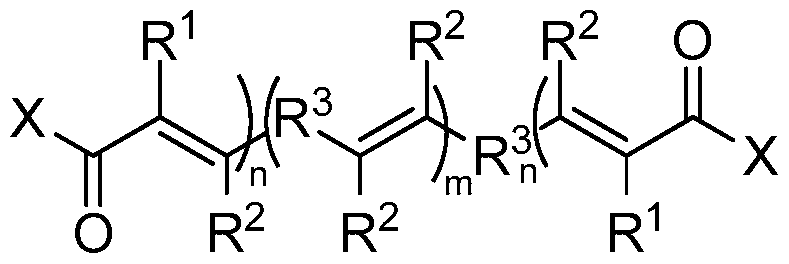
wherein: m > 0.01; n > 1; X is OH, CI, Br, I, OR, NHR, NR2, or RC(0)0; R1 and R2 are independently H, methyl, ethyl, C3 to Ci4 alkyl, C6 to Ci4 aryl, C7 to Ci4 alkylaryl, or C7 to Ci4 arylalkyl, unsubstituted or substituted with one or more hydroxy, halo, Ci-Ci4 alkoxy, C6 to Ci4 aryloxy, C7 to Ci4 alkylaryloxy, C7 to Ci4 arylalkoxy, cyano, alkylcarboxy, arylcarboxy, amino, Ci-Ci4 alkylamino, C6-Ci4 arylamino, C2-Ci4 dialkylamino, Ci2-Ci6
diarylamino, C7-C14 alkylarylamino, carboxyhydroxy, C1-C14 alkoxycarboxy, C6 to C14 aryloxycarboxy, C1-C14 alkylcarboxyoxy, or C6 to C14 arylcarboxyoxy, wherein the substituent is optionally further substituted with one or more hydroxy, fluoro, chloro, bromo, or iodo; R3 is a Ci to C14 alkylene, C6 to C14 arylene, C7 to C14 alkylarylene, or any combination thereof connected by ester, amide, ether, amine, or carbonyl linkages, unsubstituted or substituted independently with one or more OH, fluoro, chloro, bromo, iodo, OR, NHR, NR2, or RC(0)0; and R is independently methyl, ethyl, C3 to CM alkyl, C6 to Ci4 aryl, C7 to C14 alkylaryl, C7 to C14 arylalkyl, unsubstituted or substituted independently with one or more hydroxy, halo, C1-C14 alkoxy, C6 to C14 aryloxy, C7 to C14 alkylaryloxy, C7 to CM arylalkoxy, cyano, alkylcarboxy, arylcarboxy, amino, C1-C14 alkylamino, C6-Ci4 arylamino, C2-Ci4 dialkylamino, C12-C16 diarylamino, C7-Ci4 alkylarylamino, carboxyhydroxy, C1-C14 alkoxycarboxy, C6 to C14 aryloxycarboxy, C1-C14 alkylcarboxyoxy, or C6 to Ci4 arylcarboxyoxy, wherein the substituent on the R is optionally substituted with one or more hydroxy, fluoro, chloro, bromo, or iodo, and wherein, independently, each of the R1 can be situated cis or trans to an adjacent R2. Advantageously, an acrylic monomer mixture is formed from the polyene rather than a pure difunctional monomer having a single repeating unit, m = 0, as this can depress crystallization, glass transition temperatures or other thermal or mechanical properties of the acrylic monomer mixture or any polymer formed therefrom.
In an embodiment of the invention, the acrylic monomer mixture can be condensed with a complementary monomer, for example, the acrylic monomer mixture comprising a halide, X = CI, Br, or I, a carboxylic acid, X = OH, or an ester, X = OR, with a diamine monomer to form a polyamide polymer, or with a diol monomer to form an ester. The complementary monomer can be of the structure:

wherein: X" is OH, NH2 or NHR; R5 is Ci to C14 alkylene, C6 to C14 arylene, C7 to C14 alkylarylene, or any combination thereof connected by ester, amide, ether, amine, or carbonyl linkages, unsubstituted or substituted independently with one or more OH, fluoro, chloro, bromo, iodo, OR, NHR, NR2, or RC(0)0; and R is independently methyl, ethyl, C3 to C14 alkyl, C6 to C14 aryl, C7 to C14 alkylaryl, C7 to C14 arylalkyl, unsubstituted or substituted independently with one or more hydroxy, halo, C1-C14 alkoxy, C6 to C14 aryloxy, C7 to C14 alkylaryloxy, C7 to C14 arylalkoxy, cyano, alkylcarboxy, arylcarboxy, amino, C1-C14
alkylamino, C6-Ci4 arylamino, C2-C14 dialkylamino, C12-C16 diarylamino, C7-C14 alkylarylamino, carboxyhydroxy, C1-C14 alkoxycarboxy, C6 to C14 aryloxycarboxy, C1-C14 alkylcarboxyoxy, or C6 to C14 arylcarboxyoxy; wherein the substituent on the R is optionally substituted with one or more hydroxy, fluoro, chloro, bromo, or iodo. The monomer can be a pure compound where all R5 is a single group, or R5 can be a mixture of groups.
The condensation polymerization can be carried out in any manner known for condensation polymerizations with di-carboxylic acids or dicarboxylic acid derivatives, as can be appreciated by those skilled in the art. The condensation polymerization reaction can be carried out with or without a solvent, and can be carried out such that a condensation byproduct can be removed from the reaction continuously during the polymerization, as needed. For example, a polyamide can be formed by the polymerization of an acrylic monomer mixture that is a diester with a diamine comonomer, without removal of the alcohol that is formed, whereas a polyester can be prepared for the acrylic monomer mixture that is a diester of a volatile alcohol with a diol comonomer, where the by-product volatile alcohol is distilled from the mixture, alone or as an azeotrope with a component of a solvent used. The polymerization can be catalyzed by any common catalyst, for example, an acid, base, or nucleophilic catalyst, such as a strong protic acid, such as, sulfuric acid, a Lewis acid, such as ferric chloride, or a base, such as a tertiary amine, for example, pyridine or triethylamine, or a nucleophilic catalyst, for example, dimethylaminopyridine. The reaction can be carried out at ambient or elevated temperatures.
Upon reaction of the acrylic monomer mixture with a complementary comonomer, the resulting polymer, according to an embodiment of the invention, can be of the structure:

wherein: m > 0.01; n > 1; X' is O NH, or NR; R1 and R2 are independently H, methyl, ethyl, C3 to Ci4 alkyl, C6 to C14 aryl, C7 to C14 alkylaryl, or C7 to C14 arylalkyl, unsubstituted or substituted with one or more hydroxy, halo, C1-C14 alkoxy, C6 to C14 aryloxy, C7 to C14 alkylaryloxy, C7 to C14 arylalkoxy, cyano, alkylcarboxy, arylcarboxy, amino, C1-C14 alkylamino, C6-Ci4 arylamino, C2-C14 dialkylamino, C12-C16 diarylamino, C7-Ci4 alkylarylamino, carboxyhydroxy, C1-C14 alkoxycarboxy, C6 to C14 aryloxycarboxy, C1-C14 alkylcarboxyoxy, or C6 to C14 arylcarboxyoxy, wherein the substituent is optionally further
substituted with one or more hydroxy, fluoro, chloro, bromo, or iodo; R3 and R5 are independently Ci to C14 alkylene, C6 to C14 arylene, C7 to C14 alkylarylene, or any combination thereof connected by ester, amide, ether, amine, or carbonyl linkages, unsubstituted or substituted independently with one or more OH, fluoro, chloro, bromo, iodo, OR, NHR, NR2, or RC(0)0; and R is independently methyl, ethyl, C3 to CM alkyl, C6 to Ci4 aryl, C7 to C14 alkylaryl, C7 to C14 arylalkyl, unsubstituted or substituted independently with one or more hydroxy, halo, C1-C14 alkoxy, C6 to C14 aryloxy, C7 to C14 alkylaryloxy, C7 to CM arylalkoxy, cyano, alkylcarboxy, arylcarboxy, amino, C1-C14 alkylamino, C6-Ci4 arylamino, C2-Ci4 dialkylamino, C12-C16 diarylamino, C7-Ci4 alkylarylamino, carboxyhydroxy, C1-C14 alkoxycarboxy, C6 to C14 aryloxycarboxy, C1-C14 alkylcarboxyoxy, or C6 to Ci4 arylcarboxyoxy; wherein the substituent on the R is optionally substituted with one or more hydroxy, fluoro, chloro, bromo, or iodo, and wherein, independently, each of the R1 can be situated cis or trans to an adjacent R2.
METHODS AND MATERIALS
Materials Ethyl acrylate, acryloyl chloride, 1 ,6-diaminohexane, and Cul were purchased from Aldrich and used without further purification, unless otherwise noted. Polybutadiene (MW = 1 10 kDa, 97% cis, PDI = 2.3) was a gift from Firestone Inc. Alternately, polybutadiene (Mn = 125 kDa, 40% cis, PDI = 1.2) was used. Grubb's 1st generation catalyst, Grubb's 2nd generation catalyst (1), Hoveyda-Grubbs 1st generation catalyst, and Hoveyda-Grubbs 2nd generation catalyst (2) were provided by Materia Inc. Acrylates were stored with the included inhibitor methylethylhydroquinone (MEHQ) and used without purification.
Instrumentation 1H NMR (300 MHz) and 13C NMR (75 MHz) spectra were recorded on a Varian Mercury 300 spectrometer. Chemical shifts for 1H and 13C NMR were referenced to residual signals from CDC13 (1H 7.25 ppm and 13C 77.00 ppm).
Depolymerization A flame-dried Schlenk tube was charged with polybutadiene (0.5 g, 9.25 mmol repeat unit, ~0.03g segments) and 0.1 mmol catalyst under argon. 2 mL (18.8 mmol). Ethyl acrylate was injected into the polymer-catalyst mixture. The reaction mixture was stirred at 50 °C. Progress of the reaction was monitored by removing aliquots for analysis by 1H NMR.
As can be seen in Table 1, below, catalysts 1, 2, and 1/CuI depolymerized polybutadiene at 50°C under Argon. Conversion is indicated by the value of m, where a value of 1 indicates complete conversion to a single butadiene unit between the acrylates. Conversion is reflected by the degree of polymerization of the resulting polymer, oligomer, or monomer that is formed upon cross-metathesis in view of the amount of acrylic monomer used, as in the reaction shown in Figure 1. Under appropriate conditions, catalysts 2 and 1/CuI promoted nearly complete depolymerization. A significant difference in the efficacy of 1 was observed upon the addition of Cul. The improved efficiency afforded to catalyst 1 by Cul extended the catalyst's use to an air atmosphere, where significant depolymerization occurred in the presence of air in spite of the air-sensitivity commonly attributed to the catalysts, as the depolymerization of polybutadiene occurred to a high degree with 2 and 1/CuI. Catalyst loading of 0.1 mol% indicated a high activity for depolymerization of polybutadiene, with the depolymerization proceeding nearly to completion using 1/CuI.
Table 1 Depolymerization
Catalyst Mol% Catalyst1 Conditions Time (hours) m
2 0.1 50 °C, Ar 1 1.78
2 0.1 50 °C, Ar 24 1.76
2 0.5 50 °C, Ar 24 1.09
2 1 50 °C, Ar 24 1.09
2 1 50 °C, Ar 42 1.09
2 0.52 50 °C, Ar 24 1.15
2 1 50 °C, Ar 1 1.39
2 1 RT, Air 26 5.45
2 1 RT, Air 1 6.31
1 0.5 50 °C, Ar 120 27.97
1/CuI 1 50 °C, Ar 26 1.015
1/CuI 0.5 50 °C, Ar 24 1.015
1/CuI 0.1 50 °C, Ar 1 1.16
1/CuI 0.1 50 °C, Ar 24 1.16
1/CuI 1 RT, Ar 42 1.12
1/CuI 0.5 RT, Ar 42 1.12
1/CuI 0.5 RT, Air 2 4.49
1/CuI 0.5 RT, Air 47 4.49
1/CuI 0.5 50 °C, Air 20 1.36 relative to polybutadiene repeating units, alternate polydutadiene having 40% cis content.
The depolymerization was monitored by 1H NMR, with aliquots taken at 1, 2, 4, and 24 hour into the reaction for analysis. As can be seen from Table 1, above, the reaction is nearly complete in less than one hour, for all levels of catalyst.
The depolymerization of polybutadiene was carried out using catalyst 2 and acryloyl chloride as the acrylic monomer. The resulting α,ω-diacid chloride oligobutadiene was used to prepare a polyamide with 1,6-diaminohexane, as indicated in Figure 2, the α,ω-diacid chloride oligobutadiene had an average of four diene repeating units (m = 4 in Figure 2) by NMR analysis. The resulting polyamide was largely in the form of an intractable solid with a glass transition temperature, Tg, of 82.6 °C.
All patents, patent applications, provisional applications, and publications referred to or cited herein are incorporated by reference in their entirety, including all figures and tables, to the extent they are not inconsistent with the explicit teachings of this specification.
It should be understood that the examples and embodiments described herein are for illustrative purposes only and that various modifications or changes in light thereof will be suggested to persons skilled in the art and are to be included within the spirit and purview of this application.
Claims
1. A method of controlled depolymerization comprising:
providing a polyene comprising molecule;
providing an olefin metathesis catalyst;
providing an acrylic monomer;
combining the polyene comprising polymer with the olefin metathesis catalyst and the acrylic monomer; and
removing a volatile alkene; wherein an acrylic diene comprising monomer, oligomer, or polymer results, wherein the acrylic diene comprising monomer mixture has a plurality of acrylic units on each of the acrylic diene comprising monomers.
2. The method of claim 1, wherein the polyene comprising molecule is polybutadiene, polyisoprene, or other polyalkylene diene.
3. The method of claim 1, wherein the polyene comprising molecule is a polyunsaturated naturally occurring oil.
4. The method of claim 3, wherein the polyunsaturated naturally occurring oil is castor oil, linseed oil, corn oil, cotton seed oil, peanut oil, soybean oil, sunflower oil, grape seed oil, sesame oil, or hemp oil.
5. The method of claim 1, wherein the olefin metathesis catalyst comprises Grubb's 1st generation catalyst, Grubb's 2nd generation catalyst, Hoveyda-Grubb's 1st generation catalyst, or Hoveyda-Grubb's 2nd generation catalyst.
6. The method of claim 5, wherein the olefin metathesis catalyst further comprises Cul.
7. The method of claim 1, wherein the acrylic monomer is an unsubstituted or substituted acrylic acid, acryloyl halide, acrylate, acrylamide, or mono acrylic anhydride.
8. The method of claim 1 , further comprising a solvent.
9. An acrylic diene comprising monomer mixture, comprising the structure:

wherein: m > 0.01; n > 1; X is OH, CI, Br, I, OR, NHR, NR2, or RC(0)0; R1 and R2 are independently H, methyl, ethyl, C3 to Ci4 alkyl, C6 to Ci4 aryl, C7 to Ci4 alkylaryl, or C7 to Ci4 arylalkyl, unsubstituted or substituted with one or more hydroxy, halo, Ci-Ci4 alkoxy, C6 to Ci4 aryloxy, C7 to Ci4 alkylaryloxy, C7 to Ci4 arylalkoxy, cyano, alkylcarboxy, arylcarboxy, amino, Ci-Ci4 alkylamino, C6-Ci4 arylamino, C2-Ci4 dialkylamino, Ci2-Ci6 diarylamino, C7-Ci4 alkylarylamino, carboxyhydroxy, Ci-Ci4 alkoxycarboxy, C6 to Ci4 aryloxycarboxy, Ci-Ci4 alkylcarboxyoxy, or C6 to Ci4 arylcarboxyoxy, wherein the substituent is optionally further substituted with one or more hydroxy, fluoro, chloro, bromo, or iodo; R3 is a Ci to Ci4 alkylene, C6 to Ci4 arylene, C7 to Ci4 alkylarylene, or any combination thereof connected by ester, amide, ether, amine, or carbonyl linkages, unsubstituted or substituted independently with one or more OH, fluoro, chloro, bromo, iodo, OR, NHR, NR2, or RC(0)0; and R is independently methyl, ethyl, C3 to CM alkyl, C6 to Ci4 aryl, C7 to C14 alkylaryl, C7 to C14 arylalkyl, unsubstituted or substituted independently with one or more hydroxy, halo, Ci-Ci4 alkoxy, C6 to C14 aryloxy, C7 to C14 alkylaryloxy, C7 to C14 arylalkoxy, cyano, alkylcarboxy, arylcarboxy, amino, Ci-Ci4 alkylamino, C6-Ci4 arylamino, C2-Ci4 dialkylamino, C12-C16 diarylamino, C7-Ci4 alkylarylamino, carboxyhydroxy, Ci-Ci4 alkoxycarboxy, C6 to C14 aryloxycarboxy, Ci-Ci4 alkylcarboxyoxy, or C6 to C14 arylcarboxyoxy, wherein the substituent on the R is optionally substituted with one or more hydroxy, fluoro, chloro, bromo, or iodo, and wherein, independently, each of the R1 can be situated cis or trans to an adjacent R2.
10. The acrylic diene comprising monomer mixture of claim 9, wherein X is CI or OR, R is methyl or ethyl, m is 0.015 to 34.57, n is 1, and R1 is H, R2 is H, and R3 is C2 alkylene. polymer, comprising

wherein: m > 0.01; n > 1; X' is O NH, or NR; R1 and R2 are independently H, methyl, ethyl, C3 to Ci4 alkyl, C6 to C14 aryl, C7 to C14 alkylaryl, or C7 to C14 arylalkyl, unsubstituted or substituted with one or more hydroxy, halo, C1-C14 alkoxy, C6 to C14 aryloxy, C7 to C14 alkylaryloxy, C7 to C14 arylalkoxy, cyano, alkylcarboxy, arylcarboxy, amino, C1-C14 alkylamino, C6-Ci4 arylamino, C2-C14 dialkylamino, C12-C16 diarylamino, C7-Ci4 alkylarylamino, carboxyhydroxy, C1-C14 alkoxycarboxy, C6 to C14 aryloxycarboxy, C1-C14 alkylcarboxyoxy, or C6 to C14 arylcarboxyoxy, wherein the substituent is optionally further substituted with one or more hydroxy, fluoro, chloro, bromo, or iodo; R3 and R5 are independently Ci to C14 alkylene, C6 to C14 arylene, C7 to C14 alkylarylene, or any combination thereof connected by ester, amide, ether, amine, or carbonyl linkages, unsubstituted or substituted independently with one or more OH, fluoro, chloro, bromo, iodo, OR, NHR, NR2, or RC(0)0; and R is independently methyl, ethyl, C3 to CM alkyl, C6 to Ci4 aryl, C7 to C14 alkylaryl, C7 to C14 arylalkyl, unsubstituted or substituted independently with one or more hydroxy, halo, C1-C14 alkoxy, C6 to C14 aryloxy, C7 to C14 alkylaryloxy, C7 to CM arylalkoxy, cyano, alkylcarboxy, arylcarboxy, amino, C1-C14 alkylamino, C6-Ci4 arylamino, C2-C14 dialkylamino, C12-C16 diarylamino, C7-Ci4 alkylarylamino, carboxyhydroxy, C1-C14 alkoxycarboxy, C6 to C14 aryloxycarboxy, C1-C14 alkylcarboxyoxy, or C6 to Ci4 arylcarboxyoxy; wherein the substituent on the R is optionally substituted with one or more hydroxy, fluoro, chloro, bromo, or iodo, and wherein, independently, each of the R1 can be situated cis or trans to an adjacent R2.
12. The polymer of claim 11, wherein X' is O, NH, or NR, R is methyl or ethyl, m is 0.015 to 34.57, n is 1, and R1 is H, R2 is H, and R3 is C2 alkylene, and R5 is C6 to Ci2 alkylene or C6 arylene.
13. A method of preparing a polymer according to claim 11 comprising,
providing a acrylic diene comprising monomer according to claim 9,
providing a complementary comonomer of the structure:

wherein: X" is OH, NH2 or NHR; R5 is Ci to C14 alkylene, C6 to C14 arylene, C7 to C14 alkylarylene, or any combination thereof connected by ester, amide, ether, amine, or carbonyl linkages, unsubstituted or substituted independently with one or more OH, fluoro, chloro, bromo, iodo, OR, NHR, NR2, or RC(0)0; and R is independently methyl, ethyl, C3 to C14 alkyl, C6 to C14 aryl, C7 to C14 alkylaryl, C7 to C14 arylalkyl, unsubstituted or substituted independently with one or more hydroxy, halo, C1-C14 alkoxy, C6 to C14 aryloxy, C7 to C14 alkylaryloxy, C7 to C14 arylalkoxy, cyano, alkylcarboxy, arylcarboxy, amino, C1-C14 alkylamino, C6-Ci4 arylamino, C2-C14 dialkylamino, C12-C16 diarylamino, C7-Ci4 alkylarylamino, carboxyhydroxy, C1-C14 alkoxycarboxy, C6 to C14 aryloxycarboxy, C1-C14 alkylcarboxyoxy, or C6 to C14 arylcarboxyoxy; wherein the substituent on the R is optionally substituted with one or more hydroxy, fluoro, chloro, bromo, or iodo;
combining the monomer mixture, the comonomer, and optionally a solvent into a polymerization mixture;
optionally adding a catalyst to the polymerization mixture; and
optionally promoting polymerization by heating and/or removal of a condensation product.
Priority Applications (1)
| Application Number | Priority Date | Filing Date | Title |
|---|---|---|---|
| US14/422,740 US9409850B2 (en) | 2012-08-20 | 2013-08-20 | Metathesis depolymerization using acrylates |
Applications Claiming Priority (2)
| Application Number | Priority Date | Filing Date | Title |
|---|---|---|---|
| US201261691017P | 2012-08-20 | 2012-08-20 | |
| US61/691,017 | 2012-08-20 |
Publications (1)
| Publication Number | Publication Date |
|---|---|
| WO2014031677A1 true WO2014031677A1 (en) | 2014-02-27 |
Family
ID=50150355
Family Applications (1)
| Application Number | Title | Priority Date | Filing Date |
|---|---|---|---|
| PCT/US2013/055847 Ceased WO2014031677A1 (en) | 2012-08-20 | 2013-08-20 | Metathesis depolymerization using acrylates |
Country Status (2)
| Country | Link |
|---|---|
| US (1) | US9409850B2 (en) |
| WO (1) | WO2014031677A1 (en) |
Cited By (3)
| Publication number | Priority date | Publication date | Assignee | Title |
|---|---|---|---|---|
| WO2016062780A1 (en) * | 2014-10-23 | 2016-04-28 | Compagnie Generale Des Etablissements Michelin | Method for functionalising a polydiene by means of a low metathesis catalyst content |
| CN108912250A (en) * | 2018-08-15 | 2018-11-30 | 青岛科技大学 | A kind of high-damping, high wet-sliding resistant, the ionomer of low-heat-generation and preparation method |
| EP4663692A1 (en) | 2024-06-14 | 2025-12-17 | RIMTEC Corporation | Process of degrading cross-linked dcpd-based polymers |
Families Citing this family (2)
| Publication number | Priority date | Publication date | Assignee | Title |
|---|---|---|---|---|
| US12180149B2 (en) * | 2020-01-28 | 2024-12-31 | The Trustees Of Princeton University | Depolymerization of oligomers and polymers comprising cyclobutane units |
| KR102536751B1 (en) | 2020-04-07 | 2023-05-24 | 주식회사 엘지화학 | Catalyst composition, cleaning solution composition comprising the catalyst composition and method for cleaning polymerization device using by the cleaning solution composition |
Citations (1)
| Publication number | Priority date | Publication date | Assignee | Title |
|---|---|---|---|---|
| WO2002079127A1 (en) * | 2001-03-30 | 2002-10-10 | California Institute Of Technology | Selective ring-opening cross-metathesis of cycloolefins |
Family Cites Families (2)
| Publication number | Priority date | Publication date | Assignee | Title |
|---|---|---|---|---|
| US5512635A (en) * | 1993-05-27 | 1996-04-30 | Amoco Corporation | Process for preparing linear monofunctional and telechelic difunctional polymers and compositions obtained thereby |
| EP2057196B1 (en) | 2006-08-25 | 2010-02-24 | Dow Global Technologies Inc. | Production of telechelic compounds by metathesis depolymerization |
-
2013
- 2013-08-20 US US14/422,740 patent/US9409850B2/en not_active Expired - Fee Related
- 2013-08-20 WO PCT/US2013/055847 patent/WO2014031677A1/en not_active Ceased
Patent Citations (1)
| Publication number | Priority date | Publication date | Assignee | Title |
|---|---|---|---|---|
| WO2002079127A1 (en) * | 2001-03-30 | 2002-10-10 | California Institute Of Technology | Selective ring-opening cross-metathesis of cycloolefins |
Non-Patent Citations (6)
| Title |
|---|
| CRAIG, S.W. ET AL.: "Highly efficienty acyclic diene metathesis depolymeriz- ation using a ruthenium catalyst containing a N-heterocyclic carbene ligand", MACROMOLECULES, vol. 34, 2001, pages 7929 - 7931 * |
| LANZETTA, N. ET AL.: "Polyamides from trans-4-octen-1,8-dioic and trans-2- trans-6-octadien-1,8-dioic acids", JOURNAL OF POLYMER SCIENCE, vol. 11, 1973, pages 913 - 923 * |
| MORRIS, C.L. ET AL.: "Oxidative cyclization reactions of trienes and di- enynes: total synthesis of membrarollin", THE JOURNAL OF ORGANIC CHEMISTRY, vol. 74, 2009, pages 981 - 988 * |
| SCHULZ, M.D. ET AL.: "Insertion metathesis depolymerization", POLYMER CHEMISTRY, vol. 4, 22 May 2013 (2013-05-22), pages 3656 - 3658 * |
| VOIGTRITTER, K. ET AL.: "Rate enhanced olefin cross-metathesis reactions: the copper iodide effect", THE JOURNAL OF ORGANIC CHEMISTRY, vol. 76, 2011, pages 4697 - 4702 * |
| WATSON, M.D. ET AL.: "Acyclic diene metathesis (ADMET) depolymerization: ethenolysis of 1,4-polybutadiene using a ruthenium complex", JOURNAL OF POLYMER SCIENCE: PART A: POLYMER CHEMISTRY, vol. 37, 1999, pages 1857 - 1861 * |
Cited By (4)
| Publication number | Priority date | Publication date | Assignee | Title |
|---|---|---|---|---|
| WO2016062780A1 (en) * | 2014-10-23 | 2016-04-28 | Compagnie Generale Des Etablissements Michelin | Method for functionalising a polydiene by means of a low metathesis catalyst content |
| CN108912250A (en) * | 2018-08-15 | 2018-11-30 | 青岛科技大学 | A kind of high-damping, high wet-sliding resistant, the ionomer of low-heat-generation and preparation method |
| EP4663692A1 (en) | 2024-06-14 | 2025-12-17 | RIMTEC Corporation | Process of degrading cross-linked dcpd-based polymers |
| WO2025256990A1 (en) | 2024-06-14 | 2025-12-18 | Rimtec Corporation | Process of degrading cross-linked dcpd-based polymers |
Also Published As
| Publication number | Publication date |
|---|---|
| US9409850B2 (en) | 2016-08-09 |
| US20150232406A1 (en) | 2015-08-20 |
Similar Documents
| Publication | Publication Date | Title |
|---|---|---|
| Firdaus et al. | Renewable co-polymers derived from vanillin and fatty acid derivatives | |
| Türünç et al. | Thiol-ene vs. ADMET: a complementary approach to fatty acid-based biodegradable polymers | |
| US9409850B2 (en) | Metathesis depolymerization using acrylates | |
| Le et al. | Synthesis of new polyesters by acyclic diene metathesis polymerization of bio-based α, ω-dienes prepared from eugenol and castor oil (undecenoate) | |
| de Espinosa et al. | Plant oils: The perfect renewable resource for polymer science?! | |
| US5731383A (en) | Difunctional telechelic linear non-crosslinked polyolefins | |
| Mutlu et al. | Self-metathesis of fatty acid methyl esters: full conversion by choosing the appropriate plant oil | |
| Llevot et al. | ADMET polymerization of bio-based biphenyl compounds | |
| US10364319B2 (en) | Ring-opening polymerization methods and recyclable biorenewable polyesters | |
| Beer et al. | Immobilization of antioxidants via ADMET polymerization for enhanced long-term stabilization of polyolefins | |
| Kiskan et al. | Synthesis and characterization of thermally curable polyacetylenes by polymerization of propargyl benzoxazine using rhodium catalyst | |
| Jose et al. | Thermoplastic polyesters and co-polyesters derived from vegetable oil: synthesis and optimization of melt polycondensation for medium and long chain poly (ω-hydroxyfatty acid) s and their ester derivatives | |
| Demel et al. | Benchmarking of ruthenium initiators for the ROMP of a norbornenedicarboxylic acid ester | |
| US20200276566A1 (en) | Catalyst for ring expansion metathesis polymerization of cyclic monomers | |
| CN118878459B (en) | A kind of aniline pyridine amino-aluminum catalyst and its preparation method and application | |
| Moser et al. | Renewable aliphatic polyesters from fatty dienes by acyclic diene metathesis polycondensation | |
| Lapinte et al. | Ring-opening metathesis polymerization (ROMP) of isomerically pure functional monomers and acyclic diene metathesis depolymerization (retro-ADMET) of functionalized polyalkenamers | |
| Nomura et al. | Ring-Opening Metathesis Polymerization (ROMP) of cyclic olefins: stereospecific ROMP and precision synthesis of bottlebrush polymers | |
| Toplishek et al. | Synthesis of dicyano-substituted ε-caprolactone and its (co) polymers | |
| CN116554256B (en) | A method for preparing betulinol olefin dimers based on olefin metathesis reaction and its application | |
| Gramlich et al. | Catalytic synthesis and post-polymerization functionalization of conjugated polyisoprene | |
| Shuai et al. | Synthesis of novel block copolymers of poly (3-hydroxybutyric acid) with poly (ethylene glycol) through anionic polymerisation | |
| CN119661494B (en) | Preparation method of bio-based cyclic ester monomer and corresponding bio-based polyester | |
| Zou et al. | Metathetic degradation of styrene-butadiene rubber via Ru-alkylidene complex catalyzed reaction | |
| Öztürk et al. | 4-Vinylbenzenesulfonic acid adduct of epoxidized soybean oil: Synthesis, free radical and ADMET polymerizations |
Legal Events
| Date | Code | Title | Description |
|---|---|---|---|
| 121 | Ep: the epo has been informed by wipo that ep was designated in this application |
Ref document number: 13830930 Country of ref document: EP Kind code of ref document: A1 |
|
| NENP | Non-entry into the national phase |
Ref country code: DE |
|
| WWE | Wipo information: entry into national phase |
Ref document number: 14422740 Country of ref document: US |
|
| 122 | Ep: pct application non-entry in european phase |
Ref document number: 13830930 Country of ref document: EP Kind code of ref document: A1 |