WO2014028445A2 - Cereblon isoforms and their use as biomarkers for therapeutic treatment - Google Patents
Cereblon isoforms and their use as biomarkers for therapeutic treatment Download PDFInfo
- Publication number
- WO2014028445A2 WO2014028445A2 PCT/US2013/054663 US2013054663W WO2014028445A2 WO 2014028445 A2 WO2014028445 A2 WO 2014028445A2 US 2013054663 W US2013054663 W US 2013054663W WO 2014028445 A2 WO2014028445 A2 WO 2014028445A2
- Authority
- WO
- WIPO (PCT)
- Prior art keywords
- biomarker
- level
- subject
- isoform
- crbn
- Prior art date
- Legal status (The legal status is an assumption and is not a legal conclusion. Google has not performed a legal analysis and makes no representation as to the accuracy of the status listed.)
- Ceased
Links
- 0 C*c1c(*2*C2)c(*)c(C(*2)C2*(*2)C(*)(CCC(*3)=O)C3=O)c2c1* Chemical compound C*c1c(*2*C2)c(*)c(C(*2)C2*(*2)C(*)(CCC(*3)=O)C3=O)c2c1* 0.000 description 6
- ARYAGTNRMZDZMH-UHFFFAOYSA-N CC(C)COC(N1CCC(COc2cccc3c2CN(C(CCC(N2)=O)C2=O)C3=O)CC1)=O Chemical compound CC(C)COC(N1CCC(COc2cccc3c2CN(C(CCC(N2)=O)C2=O)C3=O)CC1)=O ARYAGTNRMZDZMH-UHFFFAOYSA-N 0.000 description 1
- UJCZRPAVGJLFNT-UHFFFAOYSA-N CC1(CN(Cc2ccc(COc3cccc4c3CN(C(CCC(N3)=O)C3=O)C4=O)cc2)C1)Oc1ccccc1 Chemical compound CC1(CN(Cc2ccc(COc3cccc4c3CN(C(CCC(N3)=O)C3=O)C4=O)cc2)C1)Oc1ccccc1 UJCZRPAVGJLFNT-UHFFFAOYSA-N 0.000 description 1
- HDRPPVJCUWLOSB-UHFFFAOYSA-N CC1(c(cc2)ccc2F)OCCN(Cc2ccc(COc3c(CN(C(CCC(N4)=O)C4=O)C4=O)c4ccc3)cc2)C1 Chemical compound CC1(c(cc2)ccc2F)OCCN(Cc2ccc(COc3c(CN(C(CCC(N4)=O)C4=O)C4=O)c4ccc3)cc2)C1 HDRPPVJCUWLOSB-UHFFFAOYSA-N 0.000 description 1
- WKDSWYOJEMPBMQ-UHFFFAOYSA-N CC1=CC(COC(C2CN3C(CCC(N4)=O)C4=O)C=CC=C2C3=O)CC=C1 Chemical compound CC1=CC(COC(C2CN3C(CCC(N4)=O)C4=O)C=CC=C2C3=O)CC=C1 WKDSWYOJEMPBMQ-UHFFFAOYSA-N 0.000 description 1
- RZSRPGWJCJCCEL-UHFFFAOYSA-N CN(C)CCOc(cc(COc1cccc2c1CN(C(CCC(N1)=O)C1=O)C2=O)cc1)c1OC Chemical compound CN(C)CCOc(cc(COc1cccc2c1CN(C(CCC(N1)=O)C1=O)C2=O)cc1)c1OC RZSRPGWJCJCCEL-UHFFFAOYSA-N 0.000 description 1
- DLOGLALWKNCHOR-UHFFFAOYSA-N CN(C)CCOc(ccc(COc1cccc2c1CN(C(CCC(N1)=O)C1=O)C2=O)c1)c1OC Chemical compound CN(C)CCOc(ccc(COc1cccc2c1CN(C(CCC(N1)=O)C1=O)C2=O)c1)c1OC DLOGLALWKNCHOR-UHFFFAOYSA-N 0.000 description 1
- RQTOJSCYRQDJKW-UHFFFAOYSA-N CN(C1)Cc2c1ccc(COc1cccc3c1CN(C(CCC(N1)=O)C1=O)C3=O)c2 Chemical compound CN(C1)Cc2c1ccc(COc1cccc3c1CN(C(CCC(N1)=O)C1=O)C3=O)c2 RQTOJSCYRQDJKW-UHFFFAOYSA-N 0.000 description 1
- HWVCXOHDNZICTD-UHFFFAOYSA-N COc(cc(COc1cccc2c1CN(C(CCC(N1)=O)C1=O)C2=O)cc1)c1OCCN1CCCC1 Chemical compound COc(cc(COc1cccc2c1CN(C(CCC(N1)=O)C1=O)C2=O)cc1)c1OCCN1CCCC1 HWVCXOHDNZICTD-UHFFFAOYSA-N 0.000 description 1
- JTKBNUGNKKQVCE-UHFFFAOYSA-N COc(ccc(COc1cccc2c1CN(C(CCC(N1)=O)C1=O)C2=O)c1)c1OC Chemical compound COc(ccc(COc1cccc2c1CN(C(CCC(N1)=O)C1=O)C2=O)c1)c1OC JTKBNUGNKKQVCE-UHFFFAOYSA-N 0.000 description 1
- NORBARXKALLCOQ-UHFFFAOYSA-N COc1cccc(COc2cccc3c2CN(C(CCC(N2)=O)C2=O)C3=O)c1 Chemical compound COc1cccc(COc2cccc3c2CN(C(CCC(N2)=O)C2=O)C3=O)c1 NORBARXKALLCOQ-UHFFFAOYSA-N 0.000 description 1
- VACHDMPSDGKTIA-UHFFFAOYSA-N CS(c1ccc(COc2cccc3c2CN(C(CCC(N2)=O)C2=O)C3=O)cc1)(=O)=O Chemical compound CS(c1ccc(COc2cccc3c2CN(C(CCC(N2)=O)C2=O)C3=O)cc1)(=O)=O VACHDMPSDGKTIA-UHFFFAOYSA-N 0.000 description 1
- DKCRDQKHMMPWPG-SCSAIBSYSA-N C[C@H](CCC(N1)=O)C1=O Chemical compound C[C@H](CCC(N1)=O)C1=O DKCRDQKHMMPWPG-SCSAIBSYSA-N 0.000 description 1
- ORKCNGSBVZGQSG-UHFFFAOYSA-N C[n]1nc(COc2cccc3c2CN(C(CCC(N2)=O)C2=O)C3=O)c2c1cccc2 Chemical compound C[n]1nc(COc2cccc3c2CN(C(CCC(N2)=O)C2=O)C3=O)c2c1cccc2 ORKCNGSBVZGQSG-UHFFFAOYSA-N 0.000 description 1
- VBVZYDRROGMGPU-UHFFFAOYSA-N Cc1c(COc2cccc3c2CN(C(CCC(N2)=O)C2=O)C3=O)[o]c2c1cccc2 Chemical compound Cc1c(COc2cccc3c2CN(C(CCC(N2)=O)C2=O)C3=O)[o]c2c1cccc2 VBVZYDRROGMGPU-UHFFFAOYSA-N 0.000 description 1
- SRTQBKRDVXMNMU-UHFFFAOYSA-M N=C/C=N\[N-]Cc1ccc(COc2cccc3c2CN(C(CCC(N2)=O)C2=O)C3=O)cc1 Chemical compound N=C/C=N\[N-]Cc1ccc(COc2cccc3c2CN(C(CCC(N2)=O)C2=O)C3=O)cc1 SRTQBKRDVXMNMU-UHFFFAOYSA-M 0.000 description 1
- MUSVCZYOGAJAMW-UHFFFAOYSA-O N=NC=C[NH2+]Cc1ccc(COc2cccc3c2CN(C(CCC(N2)=O)C2=O)C3=O)cc1 Chemical compound N=NC=C[NH2+]Cc1ccc(COc2cccc3c2CN(C(CCC(N2)=O)C2=O)C3=O)cc1 MUSVCZYOGAJAMW-UHFFFAOYSA-O 0.000 description 1
- DTXGRYNRUZTFMT-UHFFFAOYSA-N NC(C(CCC(O)=O)N(C(c1cccc(NCc2ccc[o]2)c11)=O)C1=O)=O Chemical compound NC(C(CCC(O)=O)N(C(c1cccc(NCc2ccc[o]2)c11)=O)C1=O)=O DTXGRYNRUZTFMT-UHFFFAOYSA-N 0.000 description 1
- ROSRWBRPERVGFP-UHFFFAOYSA-N NC(CCC(C(O)=O)N(C(c1cccc(NCc2ccc[o]2)c11)=O)C1=O)=O Chemical compound NC(CCC(C(O)=O)N(C(c1cccc(NCc2ccc[o]2)c11)=O)C1=O)=O ROSRWBRPERVGFP-UHFFFAOYSA-N 0.000 description 1
- GOTYRUGSSMKFNF-UHFFFAOYSA-N Nc1c(CN(C(CCC(N2)=O)C2=O)C2=O)c2ccc1 Chemical compound Nc1c(CN(C(CCC(N2)=O)C2=O)C2=O)c2ccc1 GOTYRUGSSMKFNF-UHFFFAOYSA-N 0.000 description 1
- KNCYXPMJDCCGSJ-UHFFFAOYSA-N O=C(CCC1)NC1=O Chemical compound O=C(CCC1)NC1=O KNCYXPMJDCCGSJ-UHFFFAOYSA-N 0.000 description 1
- VWCCLHIAKWFZLD-UHFFFAOYSA-N O=C(c1c(C2)c(OCC3CCNCC3)ccc1)N2C(CCC(N1)=O)C1=O Chemical compound O=C(c1c(C2)c(OCC3CCNCC3)ccc1)N2C(CCC(N1)=O)C1=O VWCCLHIAKWFZLD-UHFFFAOYSA-N 0.000 description 1
- PXKVSROLINQUML-UHFFFAOYSA-N O=C(c1c(C2)c(OCC3COCCC3)ccc1)N2C(CCC(N1)=O)C1=O Chemical compound O=C(c1c(C2)c(OCC3COCCC3)ccc1)N2C(CCC(N1)=O)C1=O PXKVSROLINQUML-UHFFFAOYSA-N 0.000 description 1
- AUZKOECMVLSHOG-UHFFFAOYSA-N O=C(c1c(C2)c(OCc(c(Cl)cc(Cl)c3)c3Cl)ccc1)N2C(CCC(N1)=O)C1=O Chemical compound O=C(c1c(C2)c(OCc(c(Cl)cc(Cl)c3)c3Cl)ccc1)N2C(CCC(N1)=O)C1=O AUZKOECMVLSHOG-UHFFFAOYSA-N 0.000 description 1
- HZOPNHBPUQINJS-UHFFFAOYSA-N O=C(c1c(C2)c(OCc(cc3)ccc3Cl)ccc1)N2C(CCC(N1)=O)C1=O Chemical compound O=C(c1c(C2)c(OCc(cc3)ccc3Cl)ccc1)N2C(CCC(N1)=O)C1=O HZOPNHBPUQINJS-UHFFFAOYSA-N 0.000 description 1
- XGTJJZCOOQWTPI-UHFFFAOYSA-N O=C(c1c(C2)c(OCc3cc(CN(CC4)CCC4c(cc4)ccc4F)ccc3)ccc1)N2C(CCC(N1)=O)C1=O Chemical compound O=C(c1c(C2)c(OCc3cc(CN(CC4)CCC4c(cc4)ccc4F)ccc3)ccc1)N2C(CCC(N1)=O)C1=O XGTJJZCOOQWTPI-UHFFFAOYSA-N 0.000 description 1
- HPOYSDNVZLSKNA-UHFFFAOYSA-N O=C(c1c(C2)c(OCc3cc(Cl)cc(Cl)c3)ccc1)N2C(CCC(N1)=O)C1=O Chemical compound O=C(c1c(C2)c(OCc3cc(Cl)cc(Cl)c3)ccc1)N2C(CCC(N1)=O)C1=O HPOYSDNVZLSKNA-UHFFFAOYSA-N 0.000 description 1
- WKKINBLMTKMXRK-UHFFFAOYSA-N O=C(c1c(C2)c(OCc3cc(Cl)ccc3)ccc1)N2C(CCC(N1)=O)C1=O Chemical compound O=C(c1c(C2)c(OCc3cc(Cl)ccc3)ccc1)N2C(CCC(N1)=O)C1=O WKKINBLMTKMXRK-UHFFFAOYSA-N 0.000 description 1
- RPYRRVMLEVRDRC-UHFFFAOYSA-N O=C(c1c(C2)c(OCc3cc(Cl)ccc3Cl)ccc1)N2C(CCC(N1)=O)C1=O Chemical compound O=C(c1c(C2)c(OCc3cc(Cl)ccc3Cl)ccc1)N2C(CCC(N1)=O)C1=O RPYRRVMLEVRDRC-UHFFFAOYSA-N 0.000 description 1
- FTDDDBXGSWHUBC-UHFFFAOYSA-N O=C(c1c(C2)c(OCc3cc4ccc(CN5CCOCC5)cc4[o]3)ccc1)N2C(CCC(N1)=O)C1=O Chemical compound O=C(c1c(C2)c(OCc3cc4ccc(CN5CCOCC5)cc4[o]3)ccc1)N2C(CCC(N1)=O)C1=O FTDDDBXGSWHUBC-UHFFFAOYSA-N 0.000 description 1
- ZRSVONZPYBOIFC-UHFFFAOYSA-N O=C(c1c(C2)c(OCc3ccc(CN(CC4(F)F)CC4(F)F)cc3)ccc1)N2C(CCC(N1)=O)C1=O Chemical compound O=C(c1c(C2)c(OCc3ccc(CN(CC4(F)F)CC4(F)F)cc3)ccc1)N2C(CCC(N1)=O)C1=O ZRSVONZPYBOIFC-UHFFFAOYSA-N 0.000 description 1
- QIBCRCJZKCMCDG-UHFFFAOYSA-N O=C(c1c(C2)c(OCc3ccc(CN(CC4)CC4(F)F)cc3)ccc1)N2C(CCC(N1)=O)C1=O Chemical compound O=C(c1c(C2)c(OCc3ccc(CN(CC4)CC4(F)F)cc3)ccc1)N2C(CCC(N1)=O)C1=O QIBCRCJZKCMCDG-UHFFFAOYSA-N 0.000 description 1
- SVSRVSKQMASRRE-UHFFFAOYSA-N O=C(c1c(C2)c(OCc3ccc(CN(CC4)CCS4=O)cc3)ccc1)N2C(CCC(N1)=O)C1=O Chemical compound O=C(c1c(C2)c(OCc3ccc(CN(CC4)CCS4=O)cc3)ccc1)N2C(CCC(N1)=O)C1=O SVSRVSKQMASRRE-UHFFFAOYSA-N 0.000 description 1
- FBOHJLHHYXIWTD-UHFFFAOYSA-N O=C(c1c(C2)c(OCc3ccc(CN(CC4)Cc5c4cc[s]5)cc3)ccc1)N2C(CCC(N1)=O)C1=O Chemical compound O=C(c1c(C2)c(OCc3ccc(CN(CC4)Cc5c4cc[s]5)cc3)ccc1)N2C(CCC(N1)=O)C1=O FBOHJLHHYXIWTD-UHFFFAOYSA-N 0.000 description 1
- LNWZLMLOZIXHRS-UHFFFAOYSA-N O=C(c1c(C2)c(OCc3ccc(CN4CCCC4)cc3)ccc1)N2C(CCC(N1)=O)C1=O Chemical compound O=C(c1c(C2)c(OCc3ccc(CN4CCCC4)cc3)ccc1)N2C(CCC(N1)=O)C1=O LNWZLMLOZIXHRS-UHFFFAOYSA-N 0.000 description 1
- KARWSHDODUCSCH-UHFFFAOYSA-N O=C(c1c(C2)c(OCc3ccc(CN4CCSCC4)cc3)ccc1)N2C(CCC(N1)=O)C1=O Chemical compound O=C(c1c(C2)c(OCc3ccc(CN4CCSCC4)cc3)ccc1)N2C(CCC(N1)=O)C1=O KARWSHDODUCSCH-UHFFFAOYSA-N 0.000 description 1
- RDKQYRLCKYNYFM-UHFFFAOYSA-N O=C(c1c(C2)c(OCc3ccc(CN4Cc5ncc(-c6ccccc6)[n]5CC4)cc3)ccc1)N2C(CCC(N1)=O)C1=O Chemical compound O=C(c1c(C2)c(OCc3ccc(CN4Cc5ncc(-c6ccccc6)[n]5CC4)cc3)ccc1)N2C(CCC(N1)=O)C1=O RDKQYRLCKYNYFM-UHFFFAOYSA-N 0.000 description 1
- DRDDTMMTRCKSIB-UHFFFAOYSA-N O=C(c1c(C2)c(OCc3cccc(Cl)c3Cl)ccc1)N2C(CCC(N1)=O)C1=O Chemical compound O=C(c1c(C2)c(OCc3cccc(Cl)c3Cl)ccc1)N2C(CCC(N1)=O)C1=O DRDDTMMTRCKSIB-UHFFFAOYSA-N 0.000 description 1
- YPTDZECTCWJHRF-UHFFFAOYSA-N O=C(c1c(C2)c(OCc3ccccc3Cl)ccc1)N2C(CCC(N1)=O)C1=O Chemical compound O=C(c1c(C2)c(OCc3ccccc3Cl)ccc1)N2C(CCC(N1)=O)C1=O YPTDZECTCWJHRF-UHFFFAOYSA-N 0.000 description 1
- VBOQEEJHTDYQNI-UHFFFAOYSA-N O=C(c1c(C2)c(OCc3nc(CN4CCOCC4)c[s]3)ccc1)N2C(CCC(N1)=O)C1=O Chemical compound O=C(c1c(C2)c(OCc3nc(CN4CCOCC4)c[s]3)ccc1)N2C(CCC(N1)=O)C1=O VBOQEEJHTDYQNI-UHFFFAOYSA-N 0.000 description 1
- ZGZRFMBKMCSNCK-UHFFFAOYSA-N O=C(c1c2c(OCc3ccc(CN4Cc5nc(C(F)(F)F)n[n]5CC4)cc3)ccc1)N(C(CCC(N1)=O)C1=O)C2=O Chemical compound O=C(c1c2c(OCc3ccc(CN4Cc5nc(C(F)(F)F)n[n]5CC4)cc3)ccc1)N(C(CCC(N1)=O)C1=O)C2=O ZGZRFMBKMCSNCK-UHFFFAOYSA-N 0.000 description 1
- ZMDMMHVNBCOABS-UHFFFAOYSA-N O=C(c1cccc(OCc2ccc(CN(CC3)Cc4c3[s]cc4)cc2)c1C1)N1C(CCC(N1)=O)C1=O Chemical compound O=C(c1cccc(OCc2ccc(CN(CC3)Cc4c3[s]cc4)cc2)c1C1)N1C(CCC(N1)=O)C1=O ZMDMMHVNBCOABS-UHFFFAOYSA-N 0.000 description 1
- UUAQJTQHUOSEIU-UHFFFAOYSA-N O=C(c1cccc(OCc2ccc(CN3CCOCCC3)cc2)c1C1)N1C(CCC(N1)=O)C1=O Chemical compound O=C(c1cccc(OCc2ccc(CN3CCOCCC3)cc2)c1C1)N1C(CCC(N1)=O)C1=O UUAQJTQHUOSEIU-UHFFFAOYSA-N 0.000 description 1
- KBCRUCKFOQIQCS-UHFFFAOYSA-N O=C(c1cccc(OCc2ncccc2)c1C1)N1C(CCC(N1)=O)C1=O Chemical compound O=C(c1cccc(OCc2ncccc2)c1C1)N1C(CCC(N1)=O)C1=O KBCRUCKFOQIQCS-UHFFFAOYSA-N 0.000 description 1
Classifications
-
- C—CHEMISTRY; METALLURGY
- C07—ORGANIC CHEMISTRY
- C07K—PEPTIDES
- C07K14/00—Peptides having more than 20 amino acids; Gastrins; Somatostatins; Melanotropins; Derivatives thereof
- C07K14/435—Peptides having more than 20 amino acids; Gastrins; Somatostatins; Melanotropins; Derivatives thereof from animals; from humans
- C07K14/46—Peptides having more than 20 amino acids; Gastrins; Somatostatins; Melanotropins; Derivatives thereof from animals; from humans from vertebrates
- C07K14/47—Peptides having more than 20 amino acids; Gastrins; Somatostatins; Melanotropins; Derivatives thereof from animals; from humans from vertebrates from mammals
-
- G—PHYSICS
- G01—MEASURING; TESTING
- G01N—INVESTIGATING OR ANALYSING MATERIALS BY DETERMINING THEIR CHEMICAL OR PHYSICAL PROPERTIES
- G01N33/00—Investigating or analysing materials by specific methods not covered by groups G01N1/00 - G01N31/00
- G01N33/48—Biological material, e.g. blood, urine; Haemocytometers
- G01N33/50—Chemical analysis of biological material, e.g. blood, urine; Testing involving biospecific ligand binding methods; Immunological testing
- G01N33/68—Chemical analysis of biological material, e.g. blood, urine; Testing involving biospecific ligand binding methods; Immunological testing involving proteins, peptides or amino acids
-
- G—PHYSICS
- G01—MEASURING; TESTING
- G01N—INVESTIGATING OR ANALYSING MATERIALS BY DETERMINING THEIR CHEMICAL OR PHYSICAL PROPERTIES
- G01N2800/00—Detection or diagnosis of diseases
- G01N2800/52—Predicting or monitoring the response to treatment, e.g. for selection of therapy based on assay results in personalised medicine; Prognosis
Definitions
- cereblon isoforms Provided herein are cereblon isoforms and methods of their use as
- biomarkers for treating a disease, disorder, or condition with a treatment compound e.g., thalidomide, lenalidomide, pomalidomide, 3-(5-amino-2-methyl-4-oxoquinazolin- 3(4H)-yl)piperidine-2,6-dione, or (5)-3-(4-((4-(morpholinomethyl)benzyl)oxy)- 1 - oxoisoindolin-2-yl)piperidine-2,6-dione.
- a treatment compound e.g., thalidomide, lenalidomide, pomalidomide, 3-(5-amino-2-methyl-4-oxoquinazolin- 3(4H)-yl)piperidine-2,6-dione, or (5)-3-(4-((4-(morpholinomethyl)benzyl)oxy)- 1 - oxoisoindolin-2-yl)piperidine-2,
- Cereblon a component of the DDBl-CUL4a-Rocl ubiquitin ligase complex
- certain immunomodulatory compounds e.g., thalidomide, lenalidomide, and pomalidomide
- MM myeloma
- the translated full-length CRBN protein contains 442 amino acid residues. It has been established that the C terminal region of CRBN binds the immunomodulatory compound, thalidomide, and that amino acid residues 374Y and 376W are critical for the binding of thalidomide to CRBN (Ito et al, Science 2010, 327, 1345-1350).
- CRBN is encoded by a 25 kB gene on chromosome 6, consisting of 11 exons and 10 introns.
- alternative splicing process can potentially generate multiple functional proteins as well as variants of a protein from a single gene having different structural organization and functional activity.
- Truncated proteins that have lost interaction domains or critical functional amino acid residues may create non- functional or aberrant CRBN proteins that may interfere with the functions of the full-length CRBN protein and reduce or alter the therapeutic activity of a treatment compound that exerts its activity via its interactions with the full-length CRBN protein.
- CRBN can thus potentially be used as a biomarker for a treatment with an immunomodulatory agent, such as thalidomide, lenalidomide, pomalidomide, 3-(5-amino-2-methyl-4- oxoquinazolin-3(4H)-yl)piperidine-2,6-dione, or (5)-3-(4-((4-(morpholinomethyl)- benzyl)oxy)-l-oxoisoindolin-2-yl)piperidine-2,6-dione.
- an immunomodulatory agent such as thalidomide, lenalidomide, pomalidomide, 3-(5-amino-2-methyl-4- oxoquinazolin-3(4H)-yl)piperidine-2,6-dione, or (5)-3-(4-((4-(morpholinomethyl)- benzyl)oxy)-l-oxoisoindolin-2-yl)piperidine-2,
- an isolated, synthetic, or recombinant polypeptide of an isoform of CRBN which has a deletion of amino acid residues 126 to 175 (zf 126-175) or amino acid residues 176 to 228 (zf 176-228) in the full-length amino acid sequence of CRBN.
- the polypeptide is isoform 3 of CRBN, which has a deletion of amino acids 58 to 175 (z/58-175) in the full-length amino acid sequence of CRBN.
- the polypeptide is isoform 4 of CRBN, which has a deletion of amino acids 126 to 316 (zf 126-316) in the full-length amino acid sequence of CRBN.
- the polypeptide is isoform 5 of CRBN, which has deletions of amino acid residues 176 to 278 (zf 176-278) and amino acid residues 317 to 382 (zf 317-382) in the full-length amino acid sequence of CRBN.
- the polypeptide is isoform 6 of CRBN, which has a deletion of amino acids 126 to 382 (zf 126-382) in the full-length amino acid sequence of CRBN.
- the polypeptide is isoform 7 of CRBN, which has a deletion of amino acids 23 to 338 (zf23-338) in the full-length amino acid sequence of CRBN.
- Also provided herein is an isolated, synthetic, or recombinant nucleic acid encoding an isoform of CRBN, wherein the isoform has a deletion of amino acid residues 126 to 175 (zi 126-175) or amino acid residues 176 to 228 (zf 176-228) in the full-length amino acid sequence of CRBN.
- the nucleic acid is one encoding isoform 3 of CRBN, wherein the isoform has a deletion of amino acids 58 to 175 (z/58-175) in the full-length amino acid sequence of CRBN.
- the nucleic acid is one encoding isoform 4 of CRBN, wherein the isoform has a deletion of amino acids 126 to 316 (zi 126-316) in the full- length amino acid sequence of CRBN.
- the nucleic acid is one encoding isoform 5 of CRBN, wherein the isoform has deletions of amino acid residues 176 to 278 (zf 176-278) and amino acid residues 317 to 382 (A 317-382) in the full-length amino acid sequence of CRBN.
- the nucleic acid is one encoding isoform 6 of CRBN, wherein the isoform has a deletion of amino acids 126 to 382 (A 126-382) in the full-length amino acid sequence of CRBN.
- the nucleic acid is one encoding isoform 7 of CRBN, wherein the isoform has a deletion of amino acids 23 to 338 (z/23-338) in the full-length amino acid sequence of CRBN.
- a method of identifying a subject who is likely to be responsive to a treatment of a disease, disorder, or condition with a treatment compound comprising:
- biomarker is an isoform of CRBN, in one embodiment, isoform 1 , isoform 2, isoform 3, isoform 4, isoform 5, isoform 6, isoform 7, or a combination thereof;
- the subject is likely to be responsive to the treatment if the level of the biomarker in the biological sample from the subject is altered as compared to the reference level of the biomarker.
- a method of identifying a subject who is likely to be responsive to a treatment of a disease, disorder, or condition with a treatment compound comprising:
- biomarker is an isoform of CRBN, in one embodiment, isoform 1, isoform 2, isoform 3, isoform 4, isoform 5, isoform 6, isoform 7, or a combination thereof;
- the subject is likely to be responsive to the treatment if the level of the biomarker in the biological sample from the subject is altered as compared to the level of the biomarker in the control sample.
- a method of identifying a subject who is likely to be responsive to a treatment of a disease, disorder, or condition with a treatment compound comprising:
- biomarker is an isoform of CRBN, in one embodiment, isoform 1, isoform 2, isoform 3, isoform 4, isoform 5, isoform 6, isoform 7, or a combination thereof; and c) comparing the level of the biomarker in the biological sample to a reference level of the biomarker;
- the subject is likely to be responsive to the treatment if the level of the biomarker in the biological sample from the subject is altered as compared to the reference level of the biomarker.
- a method of identifying a subject who is likely to be responsive to a treatment of a disease, disorder, or condition with a treatment compound comprising:
- biomarker is an isoform of CRBN, in one embodiment, isoform 1, isoform 2, isoform 3, isoform 4, isoform 5, isoform 6, isoform 7, or a combination thereof;
- the subject is likely to be responsive to the treatment if the level of the biomarker in the biological sample from the subject is altered as compared to the level of the biomarker in the control sample.
- a method of predicting the responsiveness of a subject to a treatment of a disease, disorder, or condition with a treatment compound comprising:
- biomarker is an isoform of CRBN, in one embodiment, isoform 1, isoform 2, isoform 3, isoform 4, isoform 5, isoform 6, isoform 7, or a combination thereof;
- the difference between the level of the biomarker in the biological sample from the subject and the reference level of the biomarker correlates with the responsiveness of the subject to the treatment.
- a method of predicting the responsiveness of a subject to a treatment of a disease, disorder, or condition with a treatment compound comprising:
- biomarker is an isoform of CRBN, in one embodiment, isoform 1, isoform 2, isoform 3, isoform 4, isoform 5, isoform 6, isoform 7, or a combination thereof;
- a method of predicting the responsiveness of a subject to a treatment of a disease, disorder, or condition with a treatment compound comprising:
- biomarker is an isoform of CRBN, in one embodiment, isoform 1, isoform 2, isoform 3, isoform 4, isoform 5, isoform 6, isoform 7, or a combination thereof; and c) comparing the level of the biomarker in the biological sample to a reference level of the biomarker;
- the difference between the level of the biomarker in the biological sample from the subject and the reference level of the biomarker correlates with the responsiveness of the subject to the treatment.
- a method of predicting the responsiveness of a subject to a treatment of a disease, disorder, or condition with a treatment compound comprising:
- biomarker is an isoform of CRBN, in one embodiment, isoform 1, isoform 2, isoform 3, isoform 4, isoform 5, isoform 6, isoform 7, or a combination thereof;
- the difference between the level of the biomarker in the biological sample from the subject and the level of the biomarker in the control sample correlates with the responsiveness of the subject to the treatment.
- a method of monitoring the efficacy of a treatment of a disease, disorder, or condition in a subject treated with a treatment compound comprising:
- biomarker is an isoform of CRBN, in one embodiment, isoform 1 , isoform 2, isoform 3, isoform 4, isoform 5, isoform 6, isoform 7, or a combination thereof;
- the subject is responsive to the treatment if the level of the biomarker in the second biological sample of the subject is altered as compared to the level of the biomarker in the first biological sample of the subject.
- a method of monitoring the compliance of a subject with a treatment of a disease, disorder, or condition with a treatment compound comprising:
- biomarker is an isoform of CRBN, in one embodiment, isoform 1, isoform 2, isoform 3, isoform 4, isoform 5, isoform 6, isoform 7, or a combination thereof; and c) comparing the level of the biomarker with the level of the biomarker in a control sample from the subject;
- a method of identifying a subject who is likely to be responsive to a treatment of a disease, disorder, or condition with a treatment compound comprising:
- biomarker is an isoform of CRBN, in one embodiment, isoform 1, isoform 2, isoform 3, isoform 4, isoform 5, isoform 6, isoform 7, or a combination thereof;
- the subject is likely to be responsive to the treatment if the level of the biomarker in the biological sample from the subject is higher than the reference level of the biomarker.
- a method of identifying a subject who is likely to be responsive to a treatment of a disease, disorder, or condition with a treatment compound comprising:
- biomarker is an isoform of CRBN, in one embodiment, isoform 1, isoform 2, isoform 3, isoform 4, isoform 5, isoform 6, isoform 7, or a combination thereof;
- the subject is likely to be responsive to the treatment if the level of the biomarker in the biological sample from the subject is higher than the level of the biomarker in the control sample.
- a method of identifying a subject who is likely to be responsive to a treatment of a disease, disorder, or condition with a treatment compound comprising:
- biomarker is an isoform of CRBN, in one embodiment, isoform 1, isoform 2, isoform 3, isoform 4, isoform 5, isoform 6, isoform 7, or a combination thereof; and c) comparing the level of the biomarker in the biological sample to a reference level of the biomarker;
- the subject is likely to be responsive to the treatment if the level of the biomarker in the biological sample from the subject is higher than the reference level of the biomarker.
- a method of identifying a subject who is likely to be responsive to a treatment of a disease, disorder, or condition with a treatment compound comprising:
- biomarker is an isoform of CRBN, in one embodiment, isoform 1, isoform 2, isoform 3, isoform 4, isoform 5, isoform 6, isoform 7, or a combination thereof;
- the subject is likely to be responsive to the treatment if the level of the biomarker in the biological sample from the subject is higher than the level of the biomarker in the control sample.
- a method of predicting the responsiveness of a subject to a treatment of a disease, disorder, or condition with a treatment compound comprising:
- biomarker is an isoform of CRBN, in one embodiment, isoform 1, isoform 2, isoform 3, isoform 4, isoform 5, isoform 6, isoform 7, or a combination thereof;
- an increased level of the biomarker in the biological sample from the subject in comparison with the reference level of the biomarker correlates with an increased responsiveness of the subject to the treatment.
- a method of predicting the responsiveness of a subject to a treatment of a disease, disorder, or condition with a treatment compound comprising:
- biomarker is an isoform of CRBN, in one embodiment, isoform 1, isoform 2, isoform 3, isoform 4, isoform 5, isoform 6, isoform 7, or a combination thereof;
- an increased level of the biomarker in the biological sample from the subject in comparison with the level of the biomarker in the control sample correlates with an increased responsiveness of the subject to the treatment.
- a method of predicting the responsiveness of a subject to a treatment of a disease, disorder, or condition with a treatment compound comprising:
- biomarker is an isoform of CRBN, in one embodiment, isoform 1, isoform 2, isoform 3, isoform 4, isoform 5, isoform 6, isoform 7, or a combination thereof; and c) comparing the level of the biomarker in the biological sample to a reference level of the biomarker;
- an increased level of the biomarker in the biological sample from the subject in comparison with the reference level of the biomarker correlates with an increased responsiveness of the subject to the treatment.
- a method of predicting the responsiveness of a subject to a treatment of a disease, disorder, or condition with a treatment compound comprising:
- biomarker is an isoform of CRBN, in one embodiment, isoform 1, isoform 2, isoform 3, isoform 4, isoform 5, isoform 6, isoform 7, or a combination thereof;
- an increased level of the biomarker in the biological sample from the subject in comparison with the level of the biomarker in the control sample correlates with an increased responsiveness of the subject to the treatment.
- a method of monitoring the efficacy of a treatment of a disease, disorder, or condition in a subject treated with a treatment compound comprising:
- biomarker is an isoform of CRBN, in one embodiment, isoform 1 , isoform 2, isoform 3, isoform 4, isoform 5, isoform 6, isoform 7, or a combination thereof;
- an increased level of the biomarker in the second biological sample in comparison with the level of the biomarker in the first biological sample indicates that the subject is responsive to the treatment.
- a method of monitoring the compliance of a subject with a treatment of a disease, disorder, or condition with a treatment compound comprising:
- biomarker is an isoform of CRBN, in one embodiment, isoform 1, isoform 2, isoform 3, isoform 4, isoform 5, isoform 6, isoform 7, or a combination thereof; and c) comparing the level of the biomarker with the level of the biomarker in a control sample from the subject;
- an increased level of the biomarker in the biological sample in comparison with the level of the biomarker in the control sample indicates the compliance of the subject with the treatment.
- a method of identifying a subject who is likely to be responsive to a treatment of a disease, disorder, or condition with a treatment compound comprising:
- biomarker is an isoform of CRBN, in one embodiment, isoform 1, isoform 2, isoform 3, isoform 4, isoform 5, isoform 6, isoform 7, or a combination thereof;
- the subject is likely to be responsive to the treatment if the level of the biomarker in the biological sample from the subject is lower than the reference level of the biomarker.
- a method of identifying a subject who is likely to be responsive to a treatment of a disease, disorder, or condition with a treatment compound comprising:
- the subject is likely to be responsive to the treatment if the level of the biomarker in the biological sample from the subject is lower than the level of the biomarker in the control sample.
- a method of identifying a subject who is likely to be responsive to a treatment of a disease, disorder, or condition with a treatment compound comprising:
- biomarker is an isoform of CRBN, in one embodiment, isoform 1, isoform 2, isoform 3, isoform 4, isoform 5, isoform 6, isoform 7, or a combination thereof; and c) comparing the level of the biomarker in the biological sample to a reference level of the biomarker;
- the subject is likely to be responsive to the treatment if the level of the biomarker in the biological sample from the subject is lower than the reference level of the biomarker.
- a method of identifying a subject who is likely to be responsive to a treatment of a disease, disorder, or condition with a treatment compound comprising:
- biomarker is an isoform of CRBN, in one embodiment, isoform 1, isoform 2, isoform 3, isoform 4, isoform 5, isoform 6, isoform 7, or a combination thereof;
- a method of predicting the responsiveness of a subject to a treatment of a disease, disorder, or condition with a treatment compound comprising:
- biomarker is an isoform of CRBN, in one embodiment, isoform 1, isoform 2, isoform 3, isoform 4, isoform 5, isoform 6, isoform 7, or a combination thereof;
- a decreased level of the biomarker in the biological sample from the subject in comparison with the reference level of the biomarker correlates with an increased responsiveness of the subject to the treatment.
- a method of predicting the responsiveness of a subject to a treatment of a disease, disorder, or condition with a treatment compound comprising:
- biomarker is an isoform of CRBN, in one embodiment, isoform 1, isoform 2, isoform 3, isoform 4, isoform 5, isoform 6, isoform 7, or a combination thereof;
- a decreased level of the biomarker in the biological sample from the subject in comparison with the level of the biomarker in the control sample correlates with an increased responsiveness of the subject to the treatment.
- a method of predicting the responsiveness of a subject to a treatment of a disease, disorder, or condition with a treatment compound comprising:
- biomarker is an isoform of CRBN, in one embodiment, isoform 1, isoform 2, isoform 3, isoform 4, isoform 5, isoform 6, isoform 7, or a combination thereof; and c) comparing the level of the biomarker in the biological sample to a reference level of the biomarker;
- a decreased level of the biomarker in the biological sample from the subject in comparison with the reference level of the biomarker correlates with an increased responsiveness of the subject to the treatment.
- a method of predicting the responsiveness of a subject to a treatment of a disease, disorder, or condition with a treatment compound comprising:
- biomarker is an isoform of CRBN, in one embodiment, isoform 1, isoform 2, isoform 3, isoform 4, isoform 5, isoform 6, isoform 7, or a combination thereof;
- a decreased level of the biomarker in the biological sample from the subject in comparison with the level of the biomarker in the control sample correlates with an increased responsiveness of the subject to the treatment.
- a method of monitoring the efficacy of a treatment of a disease, disorder, or condition in a subject treated with a treatment compound comprising:
- biomarker is an isoform of CRBN, in one embodiment, isoform 1 , isoform 2, isoform 3, isoform 4, isoform 5, isoform 6, isoform 7, or a combination thereof;
- a decreased level of the biomarker in the second biological sample in comparison with the level of the biomarker in the first biological sample indicates that the subject is responsive to the treatment.
- a method of monitoring the compliance of a subject with a treatment of a disease, disorder, or condition with a treatment compound comprising: a) obtaining a biological sample from the subject;
- biomarker is an isoform of CRBN, in one embodiment, isoform 1, isoform 2, isoform 3, isoform 4, isoform 5, isoform 6, isoform 7, or a combination thereof; and c) comparing the level of the biomarker with the level of the biomarker in a control sample from the subject;
- a decreased level of the biomarker in the biological sample in comparison with the level of the biomarker in the control sample indicates the compliance of the subject with the treatment.
- a probe for determining the level of a biomarker in a sample by hybridizing with a polynucleotide of the biomarker wherein the biomarker is an isoform of CRBN, in one embodiment, isoform 1, isoform 2, isoform 3, isoform 4, isoform 5, isoform 6, isoform 7, or a combination thereof.
- the level of the biomarker is used to select a subject for a treatment with a treatment compound, in one embodiment, an immunomodulatory compound; to predict or monitor the responsiveness of a subject to the treatment; or monitoring the compliance of a subject with the treatment.
- the probe is one that hybridizes with a splice junction of a polynucleotide of the biomarker.
- the probe is specific for detecting or quantitating an isoform of CRBN, in one embodiment, isoform 1, isoform 2, isoform 3, isoform 4, isoform 5, isoform 6, or isoform 7.
- a probe for determining the level of a biomarker in a sample by hybridizing with an mRNA of the biomarker wherein the biomarker is an isoform of CRBN, in one embodiment, isoform 1, isoform 2, isoform 3, isoform 4, isoform 5, isoform 6, isoform 7, or a combination thereof.
- the level of the biomarker is used to select a subject for a treatment with a treatment compound, in one embodiment, an immunomodulatory compound; to predict or monitor the responsiveness of a subject to the treatment; or monitoring the compliance of a subject with the treatment.
- the probe is one that hybridizes with a splice junction of an mRNA of the biomarker.
- the probe is specific for detecting or quantitating an isoform of CRBN, in one embodiment, isoform 1, isoform 2, isoform 3, isoform 4, isoform 5, isoform 6, or isoform 7.
- an antibody for determining the level of a biomarker in a sample wherein the biomarker is an isoform of CRBN, in one embodiment, isoform 1 , isoform 2, isoform 3, isoform 4, isoform 5, isoform 6, isoform 7, or a combination thereof.
- the level of the biomarker is used to select a subject for a treatment with a treatment compound, in one embodiment, an immunomodulatory compound; to predict or monitor the responsiveness of a subject to the treatment; or monitoring the compliance of a subject with the treatment.
- the antibody is one that binds to a splice junction of an isoform, in one embodiment, isoform 1 , isoform 2, isoform 3, isoform 4, isoform 5, isoform 6, or isoform 7.
- the antibody is specific for detecting or quantitating an isoform of CRBN, in one embodiment, isoform 1 , isoform 2, isoform 3, isoform 4, isoform 5, isoform 6, or isoform 7.
- kits for determining the level of a biomarker in a biological sample from a subject wherein the biomarker is an isoform of CRBN, in one embodiment, isoform 1 , isoform 2, isoform 3, isoform 4, isoform 5, isoform 6, isoform 7, or a combination thereof.
- the level of the biomarker is used to select a subject for a treatment with a treatment compound, in one embodiment, an immunomodulatory compound; to predict or monitor the responsiveness of a subject to the treatment; or monitoring the compliance of a subject with the treatment.
- the methods, probes, antibodies, and kits provided herein are based, in part, on the discovery that the change in the level of certain molecules (e.g. , mRNAs, cDNA, or proteins) in a biological sample can be utilized as biomarkers to predict
- an immunomodulatory compound e.g., thalidomide, lenalidomide, pomalidomide, 3-(5-amino-2-methyl-4- oxoquinazolin-3(4H)-yl)piperidine-2,6-dione, or (5)-3-(4-((4-(morpholinomethyl)- benzyl)oxy)-l-oxoisoindolin-2-yl)piperidine-2,6-dione.
- an immunomodulatory compound e.g., thalidomide, lenalidomide, pomalidomide, 3-(5-amino-2-methyl-4- oxoquinazolin-3(4H)-yl)piperidine-2,6-dione, or (5)-3-(4-((4-(morpholinomethyl)- benzyl)oxy)-l-oxoisoindolin-2-yl)piperidine-2,6-dione.
- the methods provided herein are based on comparison of the level of a biomarker in a biological sample from a subject having or suspected to have a disease, disorder, or condition to a reference level of the biomarker or the level of the biomarker in a control sample.
- the biomarker level is used to determine or to predict, for example, the likelihood of the responsiveness of the subject to a treatment with a treatment compound, in one embodiment, an immunomodulatory compound, such as thalidomide, lenalidomide, pomalidomide, 3-(5-amino-2-methyl-4- oxoquinazolin-3(4H)-yl)piperidine-2,6-dione, or (5)-3-(4-((4-(morpholinomethyl)- benzyl)oxy)-l-oxoisoindolin-2-yl)piperidine-2,6-dione.
- an immunomodulatory compound such as thalidomide, lenalidomide, pomalidomide, 3-(5-amino-2-methyl-4- oxoquinazolin-3(4H)-yl)piperidine-2,6-dione, or (5)-3-(4-((4-(morpholinomethyl)- benzyl)oxy)-
- FIG. 1 illustrates seven isoforms of CRBN formed via alternative splicing.
- FIG. 2 illustrates a nucleic acid sequence (SEQ ID No: 1) encoding isoform 1 of CRBN.
- FIG. 3 illustrates a nucleic acid sequence (SEQ ID No:2) encoding isoform 2 of CRBN.
- FIG. 4 illustrates a nucleic acid sequence (SEQ ID No:3) encoding isoform 3 of CRBN.
- FIG. 5 illustrates a nucleic acid sequence (SEQ ID No:4) encoding isoform 4 of CRBN.
- FIG. 6 illustrates a nucleic acid sequence (SEQ ID No:5) encoding isoform 5 of CRBN.
- FIG. 7 illustrates a nucleic acid sequence (SEQ ID No: 6) encoding isoform 6 of CRBN.
- FIG. 8 illustrates a nucleic acid sequence (SEQ ID No: 7) encoding isoform 7 of CRBN.
- FIG. 9 shows the detection of the seven CRBN isoforms in ⁇ 929 and primary CD 138+ isolated multiple myeloma (MM) cells.
- subject refers to an animal, including, but not limited to, a primate (e.g., human), cow, pig, sheep, goat, horse, dog, cat, rabbit, rat, or mouse.
- primate e.g., human
- cow, pig, sheep, goat horse
- dog cat
- rabbit rat
- patient are used interchangeably herein in reference, for example, to a mammalian subject, such as a human subject, in one embodiment, a human.
- treat refers to alleviating or abrogating a disease, or one or more of the symptoms associated with the disease; or alleviating or eradicating the cause(s) of the disease itself.
- prevent are meant to include a method of delaying and/or precluding the onset of a disorder, disease, or condition, and/or its attendant symptoms; barring a subject from acquiring a disorder, disease, or condition; or reducing a subject's risk of acquiring a disorder, disease, or condition.
- terapéuticaally effective amount of a compound refers to the amount of the compound that, when administered, is sufficient to prevent the
- a therapeutically effective amount of a compound means an amount of a therapeutic agent, alone or in combination with other therapies, which provides a therapeutic benefit in the treatment or management of a disease, disorder, or condition.
- the term encompasses an amount of the compound that improves overall therapy, reduces, or avoids symptoms or causes of a disease, disorder, or condition, or enhances the therapeutic efficacy of another therapeutic agent.
- level refers to the amount, accumulation, or rate of a biomarker molecule.
- a level can be represented, for example, by the amount or the rate of synthesis of a massager RNA (mRNA) encoded by a gene, the amount or the rate of synthesis of a polypeptide or protein encoded by a gene, the amount or the rate of synthesis of a biological molecule accumulated in a cell or biological fluid, or the biological activity of a biological molecule in a cell or biological fluid.
- mRNA massager RNA
- level refers to an absolute amount of a molecule in a sample or to a relative amount of the molecule, determined under steady-state or non-steady-state conditions.
- responsiveness refers to the degree of effectiveness of the treatment in lessening or decreasing the symptoms of a disease, disorder, or condition being treated.
- increased responsiveness when used in reference to a treatment of a cell or a subject refers to an increase in the effectiveness in lessening or decreasing the symptoms of the disease when measured using any methods known in the art.
- the increase in the effectiveness is at least about 5%, at least about 10%, at least about 20%, at least about 30%>, at least about 40%>, or at least about 50%>.
- the term "effective patient response" refers to an increase in the therapeutic benefit to a patient in treating a disease, disorder, or condition. In certain embodiments, the increase is at least about 5%, at least about 10%, at least about 20%, at least about 30%), at least about 40%>, or at least about 50%>.
- An "effective patient tumor response" can be, for example, an about 5%, about 10%>, about 25%, about 50%>, or about 100% decrease in one or more physical symptoms of the disease or the tumor size.
- the term “likelihood” refers to an increase in the probability of an event.
- the term “likelihood” when used in reference to the effectiveness of a patient's response to a treatment of a disease, disorder, or condition contemplates an increased probability that the symptoms of the disease, disorder, or condition will be lessened or decreased.
- predict generally means to determine or tell in advance.
- the term “predict” can mean that the likelihood of the outcome of the treatment can be determined at the outset, before the treatment has begun, or before the treatment period has progressed substantially.
- non-naturally occurring refers to materials which are found in nature and that has been structurally modified or synthesized by man.
- polypeptide, protein, or peptide refers to a polymer of two or more amino acids in a serial array, linked through one or more peptide bond(s).
- the term encompasses proteins, protein fragments, protein analogues, oligopeptides, and peptides.
- the amino acids of the polypeptide, protein, or peptide can be naturally occurring amino acids or synthetic amino acids (e.g., mimics of naturally occurring amino acids).
- the polypeptide, protein, or peptide can be made synthetically or purified from a biological sample.
- polypeptide, protein, or peptide also encompasses modified polypeptides, proteins, and peptides, e.g., a glycopolypeptide, glycoprotein, or glycopeptide; or a lipopolypeptide, lipoprotein, or lipopeptide.
- antibody refers to a polypeptide that specifically binds an epitope (e.g., an antigen).
- the term “antibody” is used herein in the broadest sense and covers fully assembled antibodies, antibody fragments which retain the ability to specifically bind to an antigen (e.g., Fab, F(ab') 2 , Fv, and other fragments), single chain antibodies, diabodies, antibody chimeras, hybrid antibodies, bispecific antibodies, and humanized antibodies.
- the term “antibody” also covers both polyclonal and monoclonal antibodies.
- the term “expressed” or “expression” refers to the transcription from a gene to give an R A nucleic acid molecule, e.g. , mRNA, at least complementary in part to a region of one of the two nucleic acid strands of the gene.
- the term “expressed” or “expression” as used herein also refers to the translation from an RNA molecule to give a protein, a polypeptide, or a portion thereof.
- An mRNA that is "unregulated” generally refers to an increase in the level of expression of the mRNA in response to a given treatment or condition.
- An mRNA that is “downregulated” generally refers to a "decrease” in the level of expression of the mRNA in response to a given treatment or condition. In some situations, the mRNA level can remain unchanged upon a given treatment or condition.
- An mRNA from a patient sample can be "unregulated," i.e., the level of mRNA can be increased, for example, by about 5%, about 10%, about 20%>, about 30%>, about 40%>, about 50%>, about 60%, about 70%, about 90%, about 100%, about 200%, about 300%, about 500%, about 1,000%, about 5,000% or more of the comparative control mRNA level or a reference level.
- an mRNA can be "downregulated," i.e., the level of mRNA level can be decreased, for example, by about 99%>, about 95%>, about 90%>, about 80%, about 70%, about 60%, about 50%, about 40%, about 30%, about 20%, about 10%), about 5%>, about 2%>, about 1%> or less of the comparative control mRNA level or a reference level.
- the level of a polypeptide, protein, or peptide from a patient sample can be increased as compared to a control or a reference level.
- This increase can be about 5%, about 10%, about 20%, about 30%, about 40%, about 50%, about 60%, about 70%, about 90%, about 100%, about 200%, about 300%, about 500%, about 1,000%, about 5,000% or more of the comparative control protein level or a reference level.
- the level of a protein biomarker can be decreased. This decrease can be, for example, present at a level of about 99%, about 95%, about 90%>, about 80%>, about 70%, about 60%, about 50%, about 40%, about 30%, about 20%, about 10%, about 5%, about 2%, about 1% or less of the comparative control protein level or a reference level.
- determining means determining if an element is present or not.
- the measurement can be quantitative and/or qualitative determinations. "Assessing the presence of can include determining the amount of something present, as well as determining whether it is present or absent.
- nucleic acid and “polynucleotide” are used interchangeably herein to refer to a polymer of nucleotides, e.g. , deoxyribonucleotides or
- ribonucleotides or compounds, which can hybridize with a naturally occurring nucleic acid in a sequence specific manner analogous to that of two naturally occurring nucleic acids, e.g., participating in Watson-Crick base pairing interactions.
- bases or “base”
- nucleotides or “nucleotide”
- nucleoside and “nucleotide” are intended to include those moieties that contain not only the known purine and pyrimidine bases, but also other heterocyclic bases.
- nucleoside and “nucleotide” include those moieties that contain not only conventional ribose and deoxyribose sugars, but other sugars as well. Modified nucleosides or nucleotides also include modifications on the sugar moiety, e.g., wherein one or more of the hydroxyl groups are replaced with halogen atoms or aliphatic groups, or are functionalized as ethers, amines, or the like.
- analogue of a "nucleic acid” or “polynucleotide” refers to a molecule having a structural feature that is recognized in the literature as being a mimetic, derivative, having an analogous structure, or other like terms, and includes, for example, a polynucleotide incorporating a non-natural nucleotide, a nucleotide mimetic such as a 2'- modified nucleoside, peptide nucleic acid, oligomeric nucleoside phosphonate, and any polynucleotide that has added substituent groups, such as protecting groups or linking moieties.
- polynucleotides based on the sequences of the polynucleotides.
- a first polynucleotide and a second polynucleotide are complementary if they bind to each other in a hybridization assay under stringent conditions, e.g., if they produce a given or detectable level of signal in a hybridization assay.
- Portions of polynucleotides are complementary to each other if they follow conventional base-pairing rules, e.g. , A pairs with T (or U) and G pairs with C, although small regions ⁇ e.g., less than about 3 bases) of mismatch, insertion, or deleted sequence may be present.
- sequence identity in the context of two nucleic acid sequences refers to the residues in the two sequences which are the same when aligned for maximum correspondence over a specified comparison window, and can take into consideration additions, deletions and substitutions.
- substantially identical in their various grammatical forms in the context of polynucleotides generally means that a polynucleotide comprises a sequence that has a desired identity, for example, at least 60%, at least 70%>, at least 80%), at least 90%> and at least 95% sequence identity, compared to a reference sequence. Another indication that nucleotide sequences are substantially identical is if two molecules hybridize to each other under stringent conditions.
- bound can be used herein to indicate direct or indirect attachment.
- bound (or “bonded") may refer to the existence of a chemical bond directly joining two moieties or indirectly joining two moieties ⁇ e.g., via a linking group or any other intervening portion of the molecule).
- the chemical bond may be a covalent bond, an ionic bond, a coordination complex, hydrogen bonding, van der Waals interactions, or hydrophobic stacking, or may exhibit characteristics of multiple types of chemical bonds.
- “bound” includes embodiments where the attachment is direct and also embodiments where the attachment is indirect.
- isolated and purified refer to isolation of a substance (such as mR A or protein) such that the substance comprises a substantial portion of the sample in which it resides, i.e., greater than the substance is typically found in its natural or un- isolated state.
- a substantial portion of the sample comprises, e.g., greater than about 1%, greater than about 2%, greater than about 5%, greater than about 10%, greater than about 20%>, greater than about 50%>, or more, usually up to about 90%> to 100%) of the sample.
- a sample of an isolated mRNA can typically comprise at least about 1% total mRNA.
- Techniques for purifying polynucleotides are well known in the art and include, for example, gel electrophoresis, ion-exchange chromatography, affinity chromatography, flow sorting, and sedimentation according to density.
- biological sample refers to a sample obtained from a biological subject, including a sample of biological tissue or fluid origin, obtained, reached, or collected in vivo or in situ.
- a biological sample also includes samples from a region of a biological subject containing precancerous or cancer cells or tissues. Such samples can be, but are not limited to, organs, tissues, fractions and cells isolated from a mammal.
- Exemplary biological samples include, but are not limited to, cell lysate, a cell culture, a cell line, a tissue, oral tissue, gastrointestinal tissue, an organ, an organelle, a biological fluid, a blood sample, a urine sample, a skin sample, and the like.
- biological samples include, but are not limited to, whole blood, partially purified blood, PBMCs, tissue biopsies, and the like.
- analyte refers to a known or unknown component of a sample.
- capture agent refers to an agent that binds an mRNA or protein through an interaction that is sufficient to permit the agent to bind and concentrate the mRNA or protein from a homogeneous mixture.
- probe refers to a capture agent that is directed to a specific target nucleic acid ⁇ e.g., mRNA) biomarker sequence. Accordingly, each probe of a probe set has a respective target nucleic acid ⁇ e.g., mRNA) biomarker.
- a probe/target nucleic acid duplex is a structure formed by hybridizing a probe to its target nucleic acid biomarker.
- nucleic acid probe or “oligonucleotide probe” refers to a nucleic acid capable of binding to a target nucleic acid of complementary sequence, such as an mR A biomarker, through one or more types of chemical bonds, usually through complementary base pairing, usually through hydrogen bond formation.
- a probe may include natural (e.g., A, G, C, or T) or modified bases (7-deazaguanosine, inosine, etc.).
- the bases in a probe may be joined by a linkage other than a phosphodiester bond, so long as it does not interfere with hybridization.
- probes may bind target sequences lacking complete complementarity with the probe sequence depending upon the stringency of the hybridization conditions.
- the probes are directly labeled with an isotope, chromophore, lumiphore, chromogen, or biotin. By assaying for the presence or absence of the probe, one can detect the presence or absence of a target nucleic acid biomarker of interest.
- stringent assay conditions refers to conditions that are compatible to produce binding pairs of nucleic acids, e.g., probes and target mR As, of sufficient complementarity to provide for the desired level of specificity in the assay while being generally incompatible to the formation of binding pairs between binding members of insufficient complementarity to provide for the desired specificity.
- stringent assay conditions generally refers to the combination of hybridization and wash conditions.
- a "label” or a “detectable moiety” in reference to a nucleic acid refers to a composition that, when linked with a nucleic acid, renders the nucleic acid detectable, for example, by spectroscopic, photochemical, biochemical, immunochemical, or chemical means.
- Exemplary labels include, but are not limited to, radioactive isotopes, magnetic beads, metallic beads, colloidal particles, fluorescent dyes, enzymes, biotin, digoxigenin, haptens, and the like.
- a "labeled nucleic acid or oligonucleotide probe” is generally one that is bound, either covalently, through a linker or a chemical bond, or noncovalently, through ionic bonds, van der Waals forces, electrostatic attractions, hydrophobic interactions, or hydrogen bonds, to a label such that the presence of the nucleic acid can be detected by detecting the presence of the label bound to the nucleic acid.
- PCR polymerase chain reaction
- PCR can be used to amplify specific RNA sequences, specific DNA sequences from total genomic DNA, and cDNA transcribed from total cellular RNA, bacteriophage or plasmid sequences, etc. See generally Mullis et al., Cold Spring Harbor Symp. Quant. Biol, 51 :263 (1987); Erlich, ed., PCR Technology, (Stockton Press, NY, 1989).
- cycle number refers to the PCR cycle number at which the fluorescence level passes a given set threshold level.
- the CT measurement can be used, for example, to approximate levels of mRNA in an original sample.
- the CT measurement is often used in terms of "dCT” or the “difference in the CT” score, when the CT of one nucleic acid is subtracted from the CT of another nucleic acid.
- the term "about” or “approximately” means within 50%, 20%, 15%, 10%, 9%, 8%, 7%, 6%, 5%, 4%, 3%, 2%, 1%, 0.5%, or 0.05% of a given value or range.
- CRBN refers to a protein encoded by the CRBN gene in humans, or a variant thereof.
- CRBN variant is intended to include proteins substantially homologous to a native CRBN, i.e., proteins having one or more naturally or non-naturally occurring amino acid deletions, insertions, or substitutions ⁇ e.g., CRBN derivatives, homologs, and fragments), as compared to the amino acid sequence of a native CRBN.
- the amino acid sequence of a CRBN variant is at least about 80% identical, at least about 90% identical, or at least about 95% identical to a native CRBN.
- an isolated, synthetic, or recombinant polypeptide of an isoform of CRBN wherein the isoform has a deletion of amino acid residues 126 to 175 (A 126- 175) or amino acid residues 176 to 228 (A 176-228) in the full-length amino acid sequence of CRBN.
- the 126-175 and 176-228 amino acid segments are encoded by exons 4 and 5 of the CRBN gene, respectively.
- the polypeptide is isoform 3 of CRBN, wherein the isoform has a deletion of amino acids 58 to 175 (z/58-175) in the full-length amino acid sequence of CRBN.
- the 58-125 and 126-175 amino acid segments are encoded by exons 3 and 4 of the CRBN gene, respectively.
- the polypeptide is isoform 4 of CRBN, wherein the isoform has a deletion of amino acids 126 to 316 (A 126-316) in the full-length amino acid sequence of CRBN.
- the 126-175, 176-228, 229-249, 250- 278, and 279-316 amino acid segments are encoded by exons 4, 5, 6, 7, and 8 of the CRBN gene, respectively.
- the polypeptide is isoform 5 of CRBN, wherein the isoform has deletions of amino acid residues 176 to 278 (zi 176-278) and amino acid residues 317 to 382 (A317-382) in the full-length amino acid sequence of CRBN.
- the 176-228, 229-249, 250-278, 317-338, and 339-382 amino acid segments are encoded by exons 5, 6, 7, 9, and 10 of the CRBN gene, respectively.
- the polypeptide is isoform 6 of CRBN, wherein the isoform has a deletion of amino acids 126 to 382 (zf 126-382) in the full-length amino acid sequence of CRBN.
- the 126-175, 176-228, 229-249, 250- 278, 279-316, 317-338, and 339-382 amino acid segments are encoded by exons 4, 5, 6, 7, 8, 9, and 10 of the CRBN gene, respectively.
- the polypeptide is isoform 7 of CRBN, wherein the isoform has a deletion of amino acids 23 to 338 (z/23-338) in the full-length amino acid sequence of CRBN.
- the 23-57, 56-125, 126-175, 176-228, 229-249, 250-278, 279-316, and 317-338 amino acid segments are encoded by exons 2, 3, 4, 5, 6, 7, 8, and 9 of the CRBN gene, respectively.
- an isolated, synthetic, or recombinant polypeptide of an isoform of CRBN wherein the isoform has a deletion of amino acid residues 23 to 57 (z/23-57) in the full-length amino acid sequence of CRBN.
- the 23-57 amino acid segment is encoded by exon 2 of the CRBN gene.
- the polypeptide is isoform 7 of CRBN, wherein the isoform has a deletion of amino acids 23 to 338 (z/23-338) in the full-length amino acid sequence of CRBN.
- the 58-125 amino acid segment is encoded by exon 3 of the CRBN gene.
- the polypeptide is isoform 3 of CRBN, wherein the isoform has a deletion of amino acids 58 to 175 (zf58-175) in the full-length amino acid sequence of CRBN.
- polypeptide is isoform 7 of CRBN, wherein the isoform has a deletion of amino acids 23 to 338 (zf23-338) in the full-length amino acid sequence of CRBN.
- an isolated, synthetic, or recombinant polypeptide of an isoform of CRBN wherein the isoform has a deletion of amino acid residues 126 to 175 (zi 126- 175) in the full-length amino acid sequence of CRBN.
- the 126-175 amino acid segment is encoded by exon 4 of the CRBN gene.
- the polypeptide is isoform 3 of CRBN, wherein the isoform has a deletion of amino acids 58 to 175 (zf58-175) in the full-length amino acid sequence of CRBN.
- polypeptide is isoform 4 of CRBN, wherein the isoform has a deletion of amino acids 126 to 316 (zf 126-316) in the full-length amino acid sequence of CRBN.
- polypeptide is isoform 6 of CRBN, wherein the isoform has a deletion of amino acids 126 to 382 (zf 126-382) in the full-length amino acid sequence of CRBN.
- polypeptide is isoform 7 of CRBN, wherein the isoform has a deletion of amino acids 23 to 338 (z/23-338) in the full-length amino acid sequence of CRBN.
- an isolated, synthetic, or recombinant polypeptide of an isoform of CRBN wherein the isoform has a deletion of amino acid residues 176 to 228 (zf 176-228) in the full-length amino acid sequence of CRBN.
- the 176-228 amino acid segment is encoded by exon 5 of the CRBN gene.
- the polypeptide is isoform 4 of CRBN, wherein the isoform has a deletion of amino acids 126 to 316 (zf 126-316) in the full-length amino acid sequence of CRBN.
- polypeptide is isoform 5 of CRBN, wherein the isoform has deletions of amino acids 176 to 278 (zf 176-278) and amino acids 317 to 382 (zf317-382) in the full-length amino acid sequence of CRBN.
- polypeptide is isoform 6 of CRBN, wherein the isoform has a deletion of amino acids 126 to 382 (zf 126-382) in the full-length amino acid sequence of CRBN.
- polypeptide is isoform 7 of CRBN, wherein the isoform has a deletion of amino acids 23 to 338 (zf23-338) in the full-length amino acid sequence of CRBN.
- an isolated, synthetic, or recombinant polypeptide of an isoform of CRBN wherein the isoform has a deletion of amino acid residues 229 to 249 (zf229-249) in the full-length amino acid sequence of CRBN.
- the 229-249 amino acid segment is encoded by exon 6 of the CRBN gene.
- the polypeptide is isoform 4 of CRBN, wherein the isoform has a deletion of amino acids 126 to 316 (zf 126-316) in the full-length amino acid sequence of CRBN.
- polypeptide is isoform 5 of CRBN, wherein the isoform has deletions of amino acids 176 to 278 (zf 176-278) and amino acids 317 to 382 (zf317-382) in the full-length amino acid sequence of CRBN.
- polypeptide is isoform 6 of CRBN, wherein the isoform has a deletion of amino acids 126 to 382 (zf 126-382) in the full-length amino acid sequence of CRBN.
- the polypeptide is isoform 7 of CRBN, wherein the isoform has a deletion of amino acids 23 to 338 (zf23-338) in the full-length amino acid sequence of CRBN.
- provided herein is an isolated, synthetic, or recombinant polypeptide of an isoform of CRBN, wherein the isoform has a deletion of amino acid residues 250 to 278 (z/250-278) in the full-length amino acid sequence of CRBN.
- the 250-278 amino acid segment is encoded by exon 7 of the CRBN gene.
- the polypeptide is isoform 4 of CRBN, wherein the isoform has a deletion of amino acids 126 to 316 (zf 126-316) in the full-length amino acid sequence of CRBN.
- polypeptide is isoform 5 of CRBN, wherein the isoform has deletions of amino acids 176 to 278 (zf 176-278) and amino acids 317 to 382 (zf317-382) in the full-length amino acid sequence of CRBN.
- polypeptide is isoform 6 of CRBN, wherein the isoform has a deletion of amino acids 126 to 382 (zf 126-382) in the full-length amino acid sequence of CRBN.
- polypeptide is isoform 7 of CRBN, wherein the isoform has a deletion of amino acids 23 to 338 (zf23-338) in the full-length amino acid sequence of CRBN.
- an isolated, synthetic, or recombinant polypeptide of an isoform of CRBN wherein the isoform has a deletion of amino acid residues 279 to 316 (zf279-316) in the full-length amino acid sequence of CRBN.
- the 279-316 amino acid segment is encoded by exon 8 of the CRBN gene.
- the polypeptide is isoform 4 of CRBN, wherein the isoform has a deletion of amino acids 126 to 316 (zf 126-316) in the full-length amino acid sequence of CRBN.
- the polypeptide is isoform 6 of CRBN, wherein the isoform has a deletion of amino acids 126 to 382 (zf 126-382) in the full-length amino acid sequence of CRBN.
- the polypeptide is isoform 7 of CRBN, wherein the isoform has a deletion of amino acids 23 to 338 (zf23-338) in the full-length amino acid sequence of CRBN.
- an isolated, synthetic, or recombinant polypeptide of an isoform of CRBN wherein the isoform has a deletion of amino acid residues 317 to 338 (zi 317-338) in the full-length amino acid sequence of CRBN.
- the 317-338 amino acid segment is encoded by exon 9 of the CRBN gene.
- the polypeptide is isoform 5 of CRBN, wherein the isoform has deletions of amino acids 176 to 278 (zf 176-278) and amino acids 317 to 382 (zf317-382) in the full-length amino acid sequence of CRBN.
- polypeptide is isoform 6 of CRBN, wherein the isoform has a deletion of amino acids 126 to 382 (zf 126-382) in the full-length amino acid sequence of CRBN.
- polypeptide is isoform 7 of CRBN, wherein the isoform has a deletion of amino acids 23 to 338 (z/23-338) in the full-length amino acid sequence of CRBN.
- an isolated, synthetic, or recombinant polypeptide of an isoform of CRBN wherein the isoform has a deletion of amino acid residues 339 to 382 (A339-382) in the full-length amino acid sequence of CRBN.
- the 339-382 amino acid segment is encoded by exon 10 of the CRBN gene.
- the polypeptide is isoform 2 of CRBN, wherein the isoform has a deletion of amino acids 339 to 382 (z/339-382) in the full-length amino acid sequence of CRBN.
- the polypeptide is isoform 5 of CRBN, wherein the isoform has deletions of amino acids 176 to 278 (zf 176-278) and amino acids 317 to 382 (z/317-382) in the full-length amino acid sequence of CRBN.
- the polypeptide is isoform 6 of CRBN, wherein the isoform has a deletion of amino acids 126 to 382 (zi 126-382) in the full-length amino acid sequence of CRBN.
- an isolated, synthetic, or recombinant polypeptide of an isoform CRBN comprising from about 100 to about 400 amino acid residues.
- the polypeptide is isoform 2 of CRBN, which contains about 398 amino acid residues.
- the polypeptide is isoform 3 of CRBN, which contains about 274 amino acid residues.
- the polypeptide is isoform 4 of CRBN.
- the polypeptide isoform 5 of CRBN, which contains about 193 amino acid residues.
- the polypeptide is isoform 6 of CRBN.
- the polypeptide isoform 7 of CRBN.
- an isolated, synthetic, or recombinant polypeptide of an isoform of CRBN comprising from about 100 to about 300 amino acid residues.
- the polypeptide is isoform 3 of CRBN, which contains about 274 amino acid residues.
- the polypeptide is isoform 4 of CRBN.
- the polypeptide isoform 5 of CRBN, which contains about 193 amino acid residues.
- the polypeptide isoform 6 of CRBN.
- the polypeptide is isoform 7 of CRBN.
- provided herein is an isolated, synthetic, or recombinant nucleic acid encoding an isoform of CRBN provided herein.
- an isolated, synthetic, or recombinant nucleic acid encoding an isoform of CRBN, wherein the isoform has a deletion of amino acid residues 126 to 175 (zi 126-175) or amino acid residues 176 to 228 (zf 176-228) in the full-length amino acid sequence of CRBN.
- the 126-175 and 176-228 amino acid segments are encoded by exons 4 and 5 of the CRBN gene, respectively.
- the nucleic acid is one encoding isoform 3 of CRBN, wherein the isoform has a deletion of amino acids 58 to 175 (z/58-175) in the full-length amino acid sequence of CRBN.
- the nucleic acid is one encoding isoform 4 of CRBN, wherein the isoform has a deletion of amino acids 126 to 316 (zi 126-316) in the full- length amino acid sequence of CRBN.
- the nucleic acid is one encoding isoform 5 of CRBN, wherein the isoform has deletions of amino acid residues 176 to 278 (zf 176-278) and amino acid residues 317 to 382 (zf 317-382) in the full-length amino acid sequence of CRBN.
- the nucleic acid is one encoding isoform 6 of CRBN, wherein the isoform has a deletion of amino acids 126 to 382 (zf 126-382) in the full-length amino acid sequence of CRBN.
- the nucleic acid is one encoding isoform 7 of CRBN, wherein the isoform has a deletion of amino acids 23 to 338 (z/23-338) in the full-length amino acid sequence of CRBN.
- an isolated, synthetic, or recombinant nucleic acid encoding an isoform of CRBN, wherein the isoform has a deletion of amino acid residues 23 to 57 (z/23-57) in the full-length amino acid sequence of CRBN.
- the 23-57 amino acid segment is encoded by exon 2 of the CRBN gene.
- the nucleic acid is one encoding the nucleic acid is one encoding isoform 7 of CRBN, wherein the isoform has a deletion of amino acids 23 to 338 (z/23-338) in the full-length amino acid sequence of CRBN.
- an isolated, synthetic, or recombinant nucleic acid encoding an isoform of CRBN, wherein the isoform has a deletion of amino acid residues 58 to 125 (z/58-125) in the full-length amino acid sequence of CRBN.
- the 58-125 amino acid segment is encoded by exon 3 of the CRBN gene.
- the nucleic acid is one encoding isoform 3 of CRBN, wherein the isoform has a deletion of amino acids 58 to 175 (z/58-175) in the full-length amino acid sequence of CRBN.
- the nucleic acid is one encoding isoform 7 of CRBN, wherein the isoform has a deletion of amino acids 23 to 338 (zf23-338) in the full-length amino acid sequence of CRBN.
- an isolated, synthetic, or recombinant nucleic acid encoding an isoform of CRBN, wherein the isoform has a deletion of amino acid residues 126 to 175 (zi 126- 175) in the full-length amino acid sequence of CRBN.
- the 126-175 amino acid segment is encoded by exon 4 of the CRBN gene.
- the nucleic acid is one encoding isoform 3 of CRBN, wherein the isoform has a deletion of amino acids 58 to 175 (zf58-175) in the full-length amino acid sequence of CRBN.
- the nucleic acid is one encoding isoform 4 of CRBN, wherein the isoform has a deletion of amino acids 126 to 316 (zf 126-316) in the full- length amino acid sequence of CRBN.
- the nucleic acid is one encoding isoform 6 of CRBN, wherein the isoform has a deletion of amino acids 126 to 382 (zf 126-382) in the full-length amino acid sequence of CRBN.
- the nucleic acid is one encoding isoform 7 of CRBN, wherein the isoform has a deletion of amino acids 23 to 338 (z/23-338) in the full-length amino acid sequence of CRBN.
- the 176-228 amino acid segment is encoded by exon 5 of the CRBN gene.
- the nucleic acid is one encoding isoform 4 of CRBN, wherein the isoform has a deletion of amino acids 126 to 316 (zf 126-316) in the full- length amino acid sequence of CRBN.
- the nucleic acid is one encoding isoform 5 of CRBN, wherein the isoform has deletions of amino acids 176 to 278 (zf 176-278) and amino acids 317 to 382 ( J317-382) in the full-length amino acid sequence of CRBN.
- the nucleic acid is one encoding isoform 6 of CRBN, wherein the isoform has a deletion of amino acids 126 to 382 (zf 126-382) in the full-length amino acid sequence of CRBN.
- the nucleic acid is one encoding isoform 7 of CRBN, wherein the isoform has a deletion of amino acids 23 to 338 (z/23-338) in the full-length amino acid sequence of CRBN.
- an isolated, synthetic, or recombinant nucleic acid encoding an isoform of CRBN, wherein the isoform has a deletion of amino acid residues 229 to 249 (z/229-249) in the full-length amino acid sequence of CRBN.
- the 229-249 amino acid segment is encoded by exon 6 of the CRBN gene.
- the nucleic acid is one encoding isoform 4 of CRBN, wherein the isoform has a deletion of amino acids 126 to 316 (zf 126-316) in the full- length amino acid sequence of CRBN.
- the nucleic acid is one encoding isoform 5 of CRBN, wherein the isoform has deletions of amino acids 176 to 278 (zf 176-278) and amino acids 317 to 382 (zf 317-382) in the full-length amino acid sequence of CRBN.
- the nucleic acid is one encoding isoform 6 of CRBN, wherein the isoform has a deletion of amino acids 126 to 382 (zf 126-382) in the full-length amino acid sequence of CRBN.
- the nucleic acid is one encoding isoform 7 of CRBN, wherein the isoform has a deletion of amino acids 23 to 338 (zf23-338) in the full-length amino acid sequence of CRBN.
- an isolated, synthetic, or recombinant nucleic acid encoding an isoform of CRBN, wherein the isoform has a deletion of amino acid residues 250 to 278 (zf250-278) in the full-length amino acid sequence of CRBN.
- the 250-278 amino acid segment is encoded by exon 7 of the CRBN gene.
- the nucleic acid is one encoding isoform 4 of CRBN, wherein the isoform has a deletion of amino acids 126 to 316 (zi 126-316) in the full- length amino acid sequence of CRBN.
- the nucleic acid is one encoding isoform 5 of CRBN, wherein the isoform has deletions of amino acids 176 to 278 (zf 176-278) and amino acids 317 to 382 (zf 317-382) in the full-length amino acid sequence of CRBN.
- the nucleic acid is one encoding isoform 6 of CRBN, wherein the isoform has a deletion of amino acids 126 to 382 (zf 126-382) in the full-length amino acid sequence of CRBN.
- the nucleic acid is one encoding isoform 7 of CRBN, wherein the isoform has a deletion of amino acids 23 to 338 (z/23-338) in the full-length amino acid sequence of CRBN.
- an isolated, synthetic, or recombinant nucleic acid encoding an isoform of CRBN, wherein the isoform has a deletion of amino acid residues 279 to 316(zf279-316) in the full-length amino acid sequence of CRBN.
- the 279-316 amino acid segment is encoded by exon 8 of the CRBN gene.
- the nucleic acid is one encoding isoform 4 of CRBN, wherein the isoform has a deletion of amino acids 126 to 316 (zf 126-316) in the full- length amino acid sequence of CRBN.
- the nucleic acid is one encoding isoform 6 of CRBN, wherein the isoform has a deletion of amino acids 126 to 382 (zf 126-382) in the full- length amino acid sequence of CRBN.
- the nucleic acid is one encoding isoform 7 of CRBN, wherein the isoform has a deletion of amino acids 23 to 338 (zf23-338) in the full-length amino acid sequence of CRBN.
- provided herein is an isolated, synthetic, or recombinant nucleic acid encoding an isoform of CRBN, wherein the isoform has a deletion of amino acid residues 317 to 338 (zi 317-338) in the full-length amino acid sequence of CRBN.
- the 317-338 amino acid segment is encoded by exon 9 of the CRBN gene.
- the nucleic acid is one encoding isoform 5 of CRBN, wherein the isoform has deletions of amino acids 176 to 278 (zf 176-278) and amino acids 317 to 382 (z/317-382) in the full-length amino acid sequence of CRBN.
- the nucleic acid is one encoding isoform 6 of CRBN, wherein the isoform has a deletion of amino acids 126 to 382 (zf 126-382) in the full- length amino acid sequence of CRBN.
- the nucleic acid is one encoding isoform 7 of CRBN, wherein the isoform has a deletion of amino acids 23 to 338 (z/23-338) in the full-length amino acid sequence of CRBN.
- an isolated, synthetic, or recombinant nucleic acid encoding an isoform of CRBN, wherein the isoform has a deletion of amino acid residues 339 to 382 (z/339-382) in the full-length amino acid sequence of CRBN.
- the 339-382 amino acid segment is encoded by exon 10 of the CRBN gene.
- the nucleic acid is one encoding isoform 2 of CRBN, wherein the isoform has a deletion of amino acids 339 to 382 (z/339-382) in the full- length amino acid sequence of CRBN.
- the nucleic acid is one encoding isoform 5 of CRBN, wherein the isoform has deletions of amino acids 176 to 278 (zf 176-278) and amino acids 317 to 382 (z/317-382) in the full-length amino acid sequence of CRBN.
- the nucleic acid is one encoding isoform 6 of CRBN, wherein the isoform has a deletion of amino acids 126 to 382 (zf 126-382) in the full-length amino acid sequence of CRBN.
- provided herein is an isolated, synthetic, or recombinant nucleic acid encoding an isoform CRBN, comprising from about 300 to about 1200 base pairs.
- the nucleic acid is one encoding isoform 2 of CRBN, which contains about 1197 base pairs.
- the nucleic acid is one encoding isoform 3 of CRBN, which contains about 825 base pairs.
- the nucleic acid is one encoding isoform 4 of CRBN. In yet another embodiment, the nucleic acid is one encoding isoform 5 of CRBN, which contains about 582 base pairs. In yet another embodiment, the nucleic acid is one encoding isoform 6 of CRBN. In still another embodiment, the nucleic acid is one encoding isoform 7 of CRBN.
- nucleic acid encoding an isoform of CRBN, comprising from about 300 to about 900 base pairs.
- the nucleic acid is one encoding isoform 3 of CRBN, which contains about 825 base pairs.
- nucleic acid is one encoding isoform 4 of CRBN.
- nucleic acid is one encoding isoform 5 of CRBN, which contains about 582 base pairs.
- nucleic acid is one encoding isoform 6 of CRBN.
- nucleic acid is one encoding isoform 7 of CRBN.
- the nucleic acid is a DNA. In certain embodiments, the nucleic acid is an RNA. In certain embodiments, the nucleic acid is a cDNA. In certain embodiments, the nucleic acid is an mRNA.
- an isolated, synthetic, or recombinant DNA encoding an isoform of CRBN, wherein the isoform has a deletion of amino acid residues 126 to 175 (A 126- 175) or amino acid residues 176 to 228 ( i 176- 228) in the full-length amino acid sequence of CRBN.
- the 126- 175 and 176-228 amino acid segments are encoded by exons 4 and 5 of the CRBN gene, respectively.
- the DNA is one encoding isoform 3 of CRBN, wherein the isoform has a deletion of amino acids 58 to 175 (z/58-175) in the full-length amino acid sequence of CRBN.
- the DNA is one encoding isoform 4 of CRBN, wherein the isoform has a deletion of amino acids 126 to 316 (A 126-316) in the full- length amino acid sequence of CRBN.
- the DNA is one encoding isoform 5 of CRBN, wherein the isoform has deletions of amino acid residues 176 to 278 (A 176-278) and amino acid residues 317 to 382 (A317-382) in the full-length amino acid sequence of CRBN.
- the DNA is one encoding isoform 6 of CRBN, wherein the isoform has a deletion of amino acids 126 to 382 (A 126-382) in the full- length amino acid sequence of CRBN.
- the DNA is one encoding isoform 7 of CRBN, wherein the isoform has a deletion of amino acids 23 to 338 (z/23-338) in the full-length amino acid sequence of CRBN.
- an isolated, synthetic, or recombinant DNA encoding an isoform of CRBN, wherein the isoform has a deletion of amino acid residues 23 to 57 ( ⁇ 23-5 ⁇ ) in the full-length amino acid sequence of CRBN.
- the 23-57 amino acid segment is encoded by exon 2 of the CRBN gene.
- the DNA is one encoding isoform 7 of CRBN, wherein the isoform has a deletion of amino acids 23 to 338 (zf23-338) in the full-length amino acid sequence of CRBN.
- an isolated, synthetic, or recombinant DNA encoding an isoform of CRBN, wherein the isoform has a deletion of amino acid residues 58 to 125 (zf58-125) in the full-length amino acid sequence of CRBN.
- the 58-125 amino acid segment is encoded by exon 3 of the CRBN gene.
- the DNA is one encoding isoform 3 of CRBN, wherein the isoform has a deletion of amino acids 58 to 175 (zf58-175) in the full-length amino acid sequence of CRBN.
- the DNA is one encoding isoform 7 of CRBN, wherein the isoform has a deletion of amino acids 23 to 338 (zf23-338) in the full-length amino acid sequence of CRBN.
- an isolated, synthetic, or recombinant DNA encoding an isoform of CRBN, wherein the isoform has a deletion of amino acid residues 126 to 175 (zi 126- 175) in the full-length amino acid sequence of CRBN.
- the 126-175 amino acid segment is encoded by exon 4 of the CRBN gene.
- the DNA is one encoding isoform 3 of CRBN, wherein the isoform has a deletion of amino acids 58 to 175 (zf58-175) in the full-length amino acid sequence of CRBN.
- the DNA is one encoding isoform 4 of CRBN, wherein the isoform has a deletion of amino acids 126 to 316 (zf 126-316) in the full- length amino acid sequence of CRBN.
- the DNA is one encoding isoform 6 of CRBN, wherein the isoform has a deletion of amino acids 126 to 382 (zf 126-382) in the full- length amino acid sequence of CRBN.
- the DNA is one encoding isoform 7 of CRBN, wherein the isoform has a deletion of amino acids 23 to 338 (z/23-338) in the full-length amino acid sequence of CRBN.
- the 176-228 amino acid segment is encoded by exon 5 of the CRBN gene.
- the DNA is one encoding isoform 4 of CRBN, wherein the isoform has a deletion of amino acids 126 to 316 (zf 126-316) in the full-length amino acid sequence of CRBN.
- the DNA is one encoding isoform 5 of CRBN, wherein the isoform has deletions of amino acids 176 to 278 (zi 176-278) and amino acids 317 to 382 ( J317-382) in the full-length amino acid sequence of CRBN.
- the DNA is one encoding isoform 6 of CRBN, wherein the isoform has a deletion of amino acids 126 to 382 (zf 126-382) in the full- length amino acid sequence of CRBN.
- the DNA is one encoding isoform 7 of CRBN, wherein the isoform has a deletion of amino acids 23 to 338 (z/23-338) in the full-length amino acid sequence of CRBN.
- an isolated, synthetic, or recombinant DNA encoding an isoform of CRBN, wherein the isoform has a deletion of amino acid residues 229 to 249 (z/229-249) in the full-length amino acid sequence of CRBN.
- the 229-249 amino acid segment is encoded by exon 6 of the CRBN gene.
- the DNA is one encoding isoform 4 of CRBN, wherein the isoform has a deletion of amino acids 126 to 316 (zf 126-316) in the full-length amino acid sequence of CRBN.
- the DNA is one encoding isoform 5 of CRBN, wherein the isoform has deletions of amino acids 176 to 278 (zf 176-278) and amino acids 317 to 382 (zf 317-382) in the full-length amino acid sequence of CRBN.
- the DNA is one encoding isoform 6 of CRBN, wherein the isoform has a deletion of amino acids 126 to 382 (zf 126-382) in the full- length amino acid sequence of CRBN.
- the DNA is one encoding isoform 7 of CRBN, wherein the isoform has a deletion of amino acids 23 to 338 (zf23-338) in the full-length amino acid sequence of CRBN.
- an isolated, synthetic, or recombinant DNA encoding an isoform of CRBN, wherein the isoform has a deletion of amino acid residues 250 to 278 (zf250-278) in the full-length amino acid sequence of CRBN.
- the 250-278 amino acid segment is encoded by exon 7 of the CRBN gene.
- the DNA is one encoding isoform 4 of CRBN, wherein the isoform has a deletion of amino acids 126 to 316 (zf 126-316) in the full-length amino acid sequence of CRBN.
- the DNA is one encoding isoform 5 of CRBN, wherein the isoform has deletions of amino acids 176 to 278 (zf 176-278) and amino acids 317 to 382 (zf 317-382) in the full-length amino acid sequence of CRBN.
- the DNA is one encoding isoform 6 of CRBN, wherein the isoform has a deletion of amino acids 126 to 382 (zf 126-382) in the full- length amino acid sequence of CRBN.
- the DNA is one encoding isoform 7 of CRBN, wherein the isoform has a deletion of amino acids 23 to 338 (zf23-338) in the full-length amino acid sequence of CRBN.
- an isolated, synthetic, or recombinant DNA encoding an isoform of CRBN, wherein the isoform has a deletion of amino acid residues 279 to 316(zf279-316) in the full-length amino acid sequence of CRBN.
- the 279-316 amino acid segment is encoded by exon 8 of the CRBN gene.
- the DNA is one encoding isoform 4 of CRBN, wherein the isoform has a deletion of amino acids 126 to 316 (zf 126-316) in the full-length amino acid sequence of CRBN.
- the DNA is one encoding isoform 6 of CRBN, wherein the isoform has a deletion of amino acids 126 to 382 (zf 126-382) in the full- length amino acid sequence of CRBN.
- the DNA is one encoding isoform 7 of CRBN, wherein the isoform has a deletion of amino acids 23 to 338 (zf23-338) in the full-length amino acid sequence of CRBN.
- provided herein is an isolated, synthetic, or recombinant DNA encoding an isoform of CRBN, wherein the isoform has a deletion of amino acid residues 317 to 338 (zi 317-338) in the full-length amino acid sequence of CRBN.
- the 317-338 amino acid segment is encoded by exon 9 of the CRBN gene.
- the DNA is one encoding isoform 5 of CRBN, wherein the isoform has deletions of amino acids 176 to 278 (zf 176-278) and amino acids 317 to 382 (zi 317-382) in the full-length amino acid sequence of CRBN.
- the DNA is one encoding isoform 6 of CRBN, wherein the isoform has a deletion of amino acids 126 to 382 (zf 126-382) in the full- length amino acid sequence of CRBN.
- the DNA is one encoding isoform 7 of CRBN, wherein the isoform has a deletion of amino acids 23 to 338 (z/23-338) in the full-length amino acid sequence of CRBN.
- an isolated, synthetic, or recombinant DNA encoding an isoform of CRBN, wherein the isoform has a deletion of amino acid residues 339 to 382 (A339-382) in the full-length amino acid sequence of CRBN.
- the 339-382 amino acid segment is encoded by exon 10 of the CRBN gene.
- the DNA is one encoding isoform 2 of CRBN, wherein the isoform has a deletion of amino acids 339 to 382 (z/339-382) in the full-length amino acid sequence of CRBN.
- the DNA is one encoding isoform 5 of CRBN, wherein the isoform has deletions of amino acids 176 to 278 (zf 176-278) and amino acids 317 to 382 (z/317-382) in the full-length amino acid sequence of CRBN.
- the DNA is one encoding isoform 6 of CRBN, wherein the isoform has a deletion of amino acids 126 to 382 (zf 126-382) in the full- length amino acid sequence of CRBN.
- an isolated, synthetic, or recombinant DNA encoding an isoform CRBN, comprising from about 300 to about 1200 base pairs.
- the DNA is one encoding isoform 2 of CRBN, which contains about 1197 base pairs.
- the DNA is one encoding isoform 3 of CRBN, which contains about 825 base pairs.
- the DNA is one encoding isoform 4 of CRBN.
- the DNA is one encoding isoform 5 of CRBN, which contains about 582 base pairs. In yet another embodiment, the DNA is one encoding isoform 6 of CRBN. In still another embodiment, the DNA is one encoding isoform 7 of CRBN.
- an isolated, synthetic, or recombinant DNA encoding an isoform of CRBN comprising from about 300 to about 900 base pairs.
- the DNA is one encoding isoform 3 of CRBN, which contains about 825 base pairs.
- the DNA is one encoding isoform 4 of CRBN.
- the DNA is one encoding isoform 5 of CRBN, which contains about 582 base pairs.
- the DNA is one encoding isoform 6 of CRBN.
- the DNA is one encoding isoform 7 of CRBN.
- an isolated, synthetic, or recombinant cDNA encoding an isoform of CRBN wherein the isoform has a deletion of amino acid residues 126 to 175 (A 126- 175) or amino acid residues 176 to 228 (A 176-228) in the full-length amino acid sequence of CRBN.
- the 126-175 and 176-228 amino acid segments are encoded by exons 4 and 5 of the CRBN gene, respectively.
- the cDNA is one encoding isoform 3 of CRBN, wherein the isoform has a deletion of amino acids 58 to 175 (z/58-175) in the full-length amino acid sequence of CRBN.
- the cDNA is one encoding isoform 4 of CRBN, wherein the isoform has a deletion of amino acids 126 to 316 (A 126-316) in the full- length amino acid sequence of CRBN.
- the cDNA is one encoding isoform 5 of CRBN, wherein the isoform has deletions of amino acid residues 176 to 278 (A 176-278) and amino acid residues 317 to 382 (A317-382) in the full-length amino acid sequence of CRBN.
- the cDNA is one encoding isoform 6 of CRBN, wherein the isoform has a deletion of amino acids 126 to 382 (A 126-382) in the full- length amino acid sequence of CRBN.
- the cDNA is one encoding isoform 7 of CRBN, wherein the isoform has a deletion of amino acids 23 to 338 (zf23-338) in the full-length amino acid sequence of CRBN.
- the 23-57 amino acid segment is encoded by exon 2 of the CRBN gene.
- the cDNA is one encoding isoform 7 of CRBN, wherein the isoform has a deletion of amino acids 23 to 338 (zf23-338) in the full-length amino acid sequence of CRBN.
- the 58-125 amino acid segment is encoded by exon 3 of the CRBN gene.
- the cDNA is one encoding isoform 3 of CRBN, wherein the isoform has a deletion of amino acids 58 to 175 (zf58-175) in the full-length amino acid sequence of CRBN.
- the cDNA is one encoding isoform 7 of CRBN, wherein the isoform has a deletion of amino acids 23 to 338 (z/23-338) in the full-length amino acid sequence of CRBN.
- the 126-175 amino acid segment is encoded by exon 4 of the CRBN gene.
- the cDNA is one encoding isoform 3 of CRBN, wherein the isoform has a deletion of amino acids 58 to 175 (zf58-175) in the full-length amino acid sequence of CRBN.
- the cDNA is one encoding isoform 4 of CRBN, wherein the isoform has a deletion of amino acids 126 to 316 (zi 126-316) in the full- length amino acid sequence of CRBN.
- the cDNA is one encoding isoform 6 of CRBN, wherein the isoform has a deletion of amino acids 126 to 382 (zi 126-382) in the full- length amino acid sequence of CRBN.
- the cDNA is one encoding isoform 7 of CRBN, wherein the isoform has a deletion of amino acids 23 to 338 (zi23-338) in the full-length amino acid sequence of CRBN.
- an isolated, synthetic, or recombinant cDNA encoding of an isoform of CRBN wherein the isoform has a deletion of amino acid residues 176 to 228 (zi 176-228) in the full-length amino acid sequence of CRBN.
- the 176-228 amino acid segment is encoded by exon 5 of the CRBN gene.
- the cDNA is one encoding isoform 4 of CRBN, wherein the isoform has a deletion of amino acids 126 to 316 (zi 126-316) in the full-length amino acid sequence of CRBN.
- the cDNA is one encoding isoform 5 of CRBN, wherein the isoform has deletions of amino acids 176 to 278 (zi 176-278) and amino acids 317 to 382 (zJ317-382) in the full-length amino acid sequence of CRBN.
- the cDNA is one encoding isoform 6 of CRBN, wherein the isoform has a deletion of amino acids 126 to 382 (zi 126-382) in the full- length amino acid sequence of CRBN.
- the cDNA is one encoding isoform 7 of CRBN, wherein the isoform has a deletion of amino acids 23 to 338 (zf23-338) in the full-length amino acid sequence of CRBN.
- the 229-249 amino acid segment is encoded by exon 6 of the CRBN gene.
- the cDNA is one encoding isoform 4 of CRBN, wherein the isoform has a deletion of amino acids 126 to 316 (zi 126-316) in the full-length amino acid sequence of CRBN.
- the cDNA is one encoding isoform 5 of CRBN, wherein the isoform has deletions of amino acids 176 to 278 (zf 176-278) and amino acids 317 to 382 (zi 317-382) in the full-length amino acid sequence of CRBN.
- the cDNA is one encoding isoform 6 of CRBN, wherein the isoform has a deletion of amino acids 126 to 382 (zf 126-382) in the full- length amino acid sequence of CRBN.
- the cDNA is one encoding isoform 7 of CRBN, wherein the isoform has a deletion of amino acids 23 to 338 (z/23-338) in the full-length amino acid sequence of CRBN.
- the 250-278 amino acid segment is encoded by exon 7 of the CRBN gene.
- the cDNA is one encoding isoform 4 of CRBN, wherein the isoform has a deletion of amino acids 126 to 316 (zf 126-316) in the full-length amino acid sequence of CRBN.
- the cDNA is one encoding isoform 5 of CRBN, wherein the isoform has deletions of amino acids 176 to 278 (zi 176-278) and amino acids 317 to 382 ( J317-382) in the full-length amino acid sequence of CRBN.
- the cDNA is one encoding isoform 6 of CRBN, wherein the isoform has a deletion of amino acids 126 to 382 (zf 126-382) in the full- length amino acid sequence of CRBN.
- the cDNA is one encoding isoform 7 of CRBN, wherein the isoform has a deletion of amino acids 23 to 338 (z/23-338) in the full-length amino acid sequence of CRBN.
- the 279-316 amino acid segment is encoded by exon 8 of the CRBN gene.
- the cDNA is one encoding isoform 4 of CRBN, wherein the isoform has a deletion of amino acids 126 to 316 (zf 126-316) in the full-length amino acid sequence of CRBN.
- the cDNA is one encoding isoform 6 of CRBN, wherein the isoform has a deletion of amino acids 126 to 382 (zf 126-382) in the full- length amino acid sequence of CRBN.
- the cDNA is one encoding isoform 7 of CRBN, wherein the isoform has a deletion of amino acids 23 to 338 (zf23-338) in the full-length amino acid sequence of CRBN.
- the 317-338 amino acid segment is encoded by exon 9 of the CRBN gene.
- the cDNA is one encoding isoform 5 of CRBN, wherein the isoform has deletions of amino acids 176 to 278 (zf 176-278) and amino acids 317 to 382 (zf317-382) in the full-length amino acid sequence of CRBN.
- the cDNA is one encoding isoform 6 of CRBN, wherein the isoform has a deletion of amino acids 126 to 382 (zf 126-382) in the full- length amino acid sequence of CRBN.
- the cDNA is one encoding isoform 7 of CRBN, wherein the isoform has a deletion of amino acids 23 to 338 (z/23-338) in the full-length amino acid sequence of CRBN.
- the 339-382 amino acid segment is encoded by exon 10 of the CRBN gene.
- the cDNA is one encoding isoform 2 of CRBN, wherein the isoform has a deletion of amino acids 339 to 382 (z/339-382) in the full-length amino acid sequence of CRBN.
- the cDNA is one encoding isoform 5 of CRBN, wherein the isoform has deletions of amino acids 176 to 278 (zf 176-278) and amino acids 317 to 382 (zf 317-382) in the full-length amino acid sequence of CRBN.
- the cDNA is one encoding isoform 6 of CRBN, wherein the isoform has a deletion of amino acids 126 to 382 (zf 126-382) in the full- length amino acid sequence of CRBN.
- an isolated, synthetic, or recombinant cDNA encoding an isoform CRBN comprising from about 300 to about 1200 base pairs.
- the cDNA is one encoding isoform 2 of CRBN, which contains about 1 197 base pairs.
- the cDNA is one encoding isoform 3 of CRBN, which contains about 825 base pairs.
- the cDNA is one encoding isoform 4 of CRBN.
- the cDNA is one encoding isoform 5 of CRBN, which contains about 582 base pairs.
- the cDNA is one encoding isoform 6 of CRBN.
- the cDNA is one encoding isoform 7 of CRBN.
- an isolated, synthetic, or recombinant cDNA encoding an isoform of CRBN comprising from about 300 to about 900 base pairs.
- the cDNA is one encoding isoform 3 of CRBN, which contains about 825 base pairs.
- the cDNA is one encoding isoform 4 of CRBN.
- the cDNA is one encoding isoform 5 of CRBN, which contains about 582 base pairs.
- the cDNA is one encoding isoform 6 of CRBN.
- the cDNA is one encoding isoform 7 of CRBN.
- RNA encoding an isoform of CRBN, wherein the isoform has a deletion of amino acid residues 126 to 175 (A 126- 175) or amino acid residues 176 to 228 (A 176-228) in the full-length amino acid sequence of CRBN.
- the 126-175 and 176-228 amino acid segments are encoded by exons 4 and 5 of the CRBN gene, respectively.
- the RNA is one encoding isoform 3 of CRBN, wherein the isoform has a deletion of amino acids 58 to 175 (z/58-175) in the full-length amino acid sequence of CRBN.
- the RNA is one encoding isoform 4 of CRBN, wherein the isoform has a deletion of amino acids 126 to 316 (A 126-316) in the full- length amino acid sequence of CRBN.
- the RNA is one encoding isoform 5 of CRBN, wherein the isoform has deletions of amino acid residues 176 to 278 (A 176-278) and amino acid residues 317 to 382 (A317-382) in the full-length amino acid sequence of CRBN.
- the RNA is one encoding isoform 6 of CRBN, wherein the isoform has a deletion of amino acids 126 to 382 (A 126-382) in the full- length amino acid sequence of CRBN.
- the RNA is one encoding isoform 7 of CRBN, wherein the isoform has a deletion of amino acids 23 to 338 (zf23-338) in the full-length amino acid sequence of CRBN.
- RNA encoding an isoform of CRBN, wherein the isoform has a deletion of amino acid residues 23 to 57 (zf23-57) in the full-length amino acid sequence of CRBN.
- the 23-57 amino acid segment is encoded by exon 2 of the CRBN gene.
- the RNA is one encoding isoform 7 of CRBN, wherein the isoform has a deletion of amino acids 23 to 338 (zf23-338) in the full-length amino acid sequence of CRBN.
- RNA encoding an isoform of CRBN, wherein the isoform has a deletion of amino acid residues 58 to 125 (zf58-125) in the full-length amino acid sequence of CRBN.
- the 58-125 amino acid segment is encoded by exon 3 of the CRBN gene.
- the RNA is one encoding isoform 3 of CRBN, wherein the isoform has a deletion of amino acids 58 to 175 (zf58-175) in the full-length amino acid sequence of CRBN.
- the RNA is one encoding isoform 7 of CRBN, wherein the isoform has a deletion of amino acids 23 to 338 (z/23-338) in the full-length amino acid sequence of CRBN.
- RNA encoding an isoform of CRBN, wherein the isoform has a deletion of amino acid residues 126 to 175 (zf 126- 175) in the full-length amino acid sequence of CRBN.
- the 126-175 amino acid segment is encoded by exon 4 of the CRBN gene.
- the RNA is one encoding isoform 3 of CRBN, wherein the isoform has a deletion of amino acids 58 to 175 (zf58-175) in the full-length amino acid sequence of CRBN.
- the RNA is one encoding isoform 4 of CRBN, wherein the isoform has a deletion of amino acids 126 to 316 (zi 126-316) in the full- length amino acid sequence of CRBN.
- the RNA is one encoding isoform 6 of CRBN, wherein the isoform has a deletion of amino acids 126 to 382 (zf 126-382) in the full- length amino acid sequence of CRBN.
- the RNA is one encoding isoform 7 of CRBN, wherein the isoform has a deletion of amino acids 23 to 338 (z/23-338) in the full-length amino acid sequence of CRBN.
- RNA encoding of an isoform of CRBN wherein the isoform has a deletion of amino acid residues 176 to 228 (zf 176-228) in the full-length amino acid sequence of CRBN.
- the 176-228 amino acid segment is encoded by exon 5 of the CRBN gene.
- the RNA is one encoding isoform 4 of CRBN, wherein the isoform has a deletion of amino acids 126 to 316 (zf 126-316) in the full-length amino acid sequence of CRBN.
- the RNA is one encoding isoform 5 of CRBN, wherein the isoform has deletions of amino acids 176 to 278 (zf 176-278) and amino acids 317 to 382 (zf 317-382) in the full-length amino acid sequence of CRBN.
- the RNA is one encoding isoform 6 of CRBN, wherein the isoform has a deletion of amino acids 126 to 382 (zf 126-382) in the full- length amino acid sequence of CRBN.
- the RNA is one encoding isoform 7 of CRBN, wherein the isoform has a deletion of amino acids 23 to 338 (zf23-338) in the full-length amino acid sequence of CRBN.
- provided herein is an isolated, synthetic, or recombinant RNA encoding an isoform of CRBN, wherein the isoform has a deletion of amino acid residues 229 to 249 (z/229-249) in the full-length amino acid sequence of CRBN.
- the 229-249 amino acid segment is encoded by exon 6 of the CRBN gene.
- the RNA is one encoding isoform 4 of CRBN, wherein the isoform has a deletion of amino acids 126 to 316 (zf 126-316) in the full-length amino acid sequence of CRBN.
- the RNA is one encoding isoform 5 of CRBN, wherein the isoform has deletions of amino acids 176 to 278 (zf 176-278) and amino acids 317 to 382 (zf 317-382) in the full-length amino acid sequence of CRBN.
- the RNA is one encoding isoform 6 of CRBN, wherein the isoform has a deletion of amino acids 126 to 382 (zf 126-382) in the full- length amino acid sequence of CRBN.
- the RNA is one encoding isoform 7 of CRBN, wherein the isoform has a deletion of amino acids 23 to 338 (zf23-338) in the full-length amino acid sequence of CRBN.
- RNA encoding an isoform of CRBN, wherein the isoform has a deletion of amino acid residues 250 to 278 (zf250-278) in the full-length amino acid sequence of CRBN.
- the 250-278 amino acid segment is encoded by exon 7 of the CRBN gene.
- the RNA is one encoding isoform 4 of CRBN, wherein the isoform has a deletion of amino acids 126 to 316 (zf 126-316) in the full-length amino acid sequence of CRBN.
- the RNA is one encoding isoform 5 of CRBN, wherein the isoform has deletions of amino acids 176 to 278 (zf 176-278) and amino acids 317 to 382 (zf 317-382) in the full-length amino acid sequence of CRBN.
- the RNA is one encoding isoform 6 of CRBN, wherein the isoform has a deletion of amino acids 126 to 382 (zi 126-382) in the full- length amino acid sequence of CRBN.
- the RNA is one encoding isoform 7 of CRBN, wherein the isoform has a deletion of amino acids 23 to 338 (zf23-338) in the full-length amino acid sequence of CRBN.
- RNA encoding an isoform of CRBN, wherein the isoform has a deletion of amino acid residues 279 to 316(zf279-316) in the full-length amino acid sequence of CRBN.
- the 279-316 amino acid segment is encoded by exon 8 of the CRBN gene.
- the RNA is one encoding isoform 4 of CRBN, wherein the isoform has a deletion of amino acids 126 to 316 (zf 126-316) in the full-length amino acid sequence of CRBN.
- the RNA is one encoding isoform 6 of CRBN, wherein the isoform has a deletion of amino acids 126 to 382 (zf 126-382) in the full- length amino acid sequence of CRBN.
- the RNA is one encoding isoform 7 of CRBN, wherein the isoform has a deletion of amino acids 23 to 338 (z/23-338) in the full-length amino acid sequence of CRBN.
- RNA encoding an isoform of CRBN, wherein the isoform has a deletion of amino acid residues 317 to 338 (A317-338) in the full-length amino acid sequence of CRBN.
- the 317-338 amino acid segment is encoded by exon 9 of the CRBN gene.
- the RNA is one encoding isoform 5 of CRBN, wherein the isoform has deletions of amino acids 176 to 278 (zf 176-278) and amino acids 317 to 382 (zf 317-382) in the full-length amino acid sequence of CRBN.
- the RNA is one encoding isoform 6 of CRBN, wherein the isoform has a deletion of amino acids 126 to 382 (zi 126-382) in the full- length amino acid sequence of CRBN.
- the RNA is one encoding isoform 7 of CRBN, wherein the isoform has a deletion of amino acids 23 to 338 (zf23-338) in the full-length amino acid sequence of CRBN.
- RNA encoding an isoform of CRBN, wherein the isoform has a deletion of amino acid residues 339 to 382 (z/339-382) in the full-length amino acid sequence of CRBN.
- the 339-382 amino acid segment is encoded by exon 10 of the CRBN gene.
- the RNA is one encoding isoform 2 of CRBN, wherein the isoform has a deletion of amino acids 339 to 382 (z/339-382) in the full-length amino acid sequence of CRBN.
- the RNA is one encoding isoform 5 of CRBN, wherein the isoform has deletions of amino acids 176 to 278 (zf 176-278) and amino acids 317 to 382 (zi 317-382) in the full-length amino acid sequence of CRBN.
- the RNA is one encoding isoform 6 of CRBN, wherein the isoform has a deletion of amino acids 126 to 382 (zf 126-382) in the full- length amino acid sequence of CRBN.
- RNA encoding an isoform CRBN, comprising from about 300 to about 1200 bases.
- the RNA is one encoding isoform 2 of CRBN, which contains about 1194 bases.
- the RNA is one encoding isoform 3 of CRBN, which contains about 822 bases.
- the RNA is one encoding isoform 4 of CRBN.
- the RNA is one encoding isoform 5 of CRBN, which contains about 579 bases.
- the RNA is one encoding isoform 6 of CRBN.
- the RNA is one encoding isoform 7 of CRBN.
- provided herein is an isolated, synthetic, or recombinant RNA encoding an isoform of CRBN, comprising from about 300 to about 900 bases.
- the RNA is one encoding isoform 3 of CRBN, which contains about 822 bases.
- the RNA is one encoding isoform 4 of CRBN.
- the RNA is one encoding isoform 5 of CRBN, which contains about 579 bases.
- the RNA is one encoding isoform 6 of CRBN.
- the RNA is one encoding isoform 7 of CRBN.
- an isolated, synthetic, or recombinant mRNA encoding an isoform of CRBN wherein the isoform has a deletion of amino acid residues 126 to 175 (A 126- 175) or amino acid residues 176 to 228 (A 176-228) in the full-length amino acid sequence of CRBN.
- the 126-175 and 176-228 amino acid segments are encoded by exons 4 and 5 of the CRBN gene, respectively.
- the mRNA is one encoding isoform 3 of CRBN, wherein the isoform has a deletion of amino acids 58 to 175 (z/58-175) in the full-length amino acid sequence of CRBN.
- the mRNA is one encoding isoform 4 of CRBN, wherein the isoform has a deletion of amino acids 126 to 316 (A 126-316) in the full- length amino acid sequence of CRBN.
- the mRNA is one encoding isoform 5 of CRBN, wherein the isoform has deletions of amino acid residues 176 to 278 (A 176-278) and amino acid residues 317 to 382 (A317-382) in the full-length amino acid sequence of CRBN.
- the mRNA is one encoding isoform 6 of CRBN, wherein the isoform has a deletion of amino acids 126 to 382 (A 126-382) in the full- length amino acid sequence of CRBN.
- the mRNA is one encoding isoform 7 of CRBN, wherein the isoform has a deletion of amino acids 23 to 338 (z/23-338) in the full-length amino acid sequence of CRBN.
- provided herein is an isolated, synthetic, or recombinant mR A encoding an isoform of CRBN, wherein the isoform has a deletion of amino acid residues 23 to 57 (zf23-57) in the full-length amino acid sequence of CRBN.
- the 23-57 amino acid segment is encoded by exon 2 of the CRBN gene.
- the mRNA is one encoding isoform 7 of CRBN, wherein the isoform has a deletion of amino acids 23 to 338 (zf23-338) in the full-length amino acid sequence of CRBN.
- the 58-125 amino acid segment is encoded by exon 3 of the CRBN gene.
- the mRNA is one encoding isoform 3 of CRBN, wherein the isoform has a deletion of amino acids 58 to 175 (zf58-175) in the full-length amino acid sequence of CRBN.
- the mRNA is one encoding isoform 7 of CRBN, wherein the isoform has a deletion of amino acids 23 to 338 (zf23-338) in the full-length amino acid sequence of CRBN.
- an isolated, synthetic, or recombinant mRNA encoding an isoform of CRBN wherein the isoform has a deletion of amino acid residues 126 to 175 (zi 126- 175) in the full-length amino acid sequence of CRBN.
- the 126-175 amino acid segment is encoded by exon 4 of the CRBN gene.
- the mRNA is one encoding isoform 3 of CRBN, wherein the isoform has a deletion of amino acids 58 to 175 (zf58-175) in the full-length amino acid sequence of CRBN.
- the mR A is one encoding isoform 4 of CRBN, wherein the isoform has a deletion of amino acids 126 to 316 (zi 126-316) in the full- length amino acid sequence of CRBN.
- the mRNA is one encoding isoform 6 of CRBN, wherein the isoform has a deletion of amino acids 126 to 382 (zf 126-382) in the full- length amino acid sequence of CRBN.
- the mRNA is one encoding isoform 7 of CRBN, wherein the isoform has a deletion of amino acids 23 to 338 (z/23-338) in the full-length amino acid sequence of CRBN.
- an isolated, synthetic, or recombinant mRNA encoding of an isoform of CRBN wherein the isoform has a deletion of amino acid residues 176 to 228 (zf 176-228) in the full-length amino acid sequence of CRBN.
- the 176-228 amino acid segment is encoded by exon 5 of the CRBN gene.
- the mRNA is one encoding isoform 4 of CRBN, wherein the isoform has a deletion of amino acids 126 to 316 (zf 126-316) in the full-length amino acid sequence of CRBN.
- the mRNA is one encoding isoform 5 of CRBN, wherein the isoform has deletions of amino acids 176 to 278 (zf 176-278) and amino acids 317 to 382 (zf 317-382) in the full-length amino acid sequence of CRBN.
- the mRNA is one encoding isoform 6 of CRBN, wherein the isoform has a deletion of amino acids 126 to 382 (zf 126-382) in the full- length amino acid sequence of CRBN.
- the mRNA is one encoding isoform 7 of CRBN, wherein the isoform has a deletion of amino acids 23 to 338 (zf23-338) in the full-length amino acid sequence of CRBN.
- an isolated, synthetic, or recombinant mRNA encoding an isoform of CRBN wherein the isoform has a deletion of amino acid residues 229 to 249 (zf229-249) in the full-length amino acid sequence of CRBN.
- the 229-249 amino acid segment is encoded by exon 6 of the CRBN gene.
- the mRNA is one encoding isoform 4 of CRBN, wherein the isoform has a deletion of amino acids 126 to 316 (zf 126-316) in the full-length amino acid sequence of CRBN.
- the mRNA is one encoding isoform 5 of CRBN, wherein the isoform has deletions of amino acids 176 to 278 (zf 176-278) and amino acids 317 to 382 (zf 317-382) in the full-length amino acid sequence of CRBN.
- the mRNA is one encoding isoform 6 of CRBN, wherein the isoform has a deletion of amino acids 126 to 382 (zf 126-382) in the full- length amino acid sequence of CRBN.
- the mRNA is one encoding isoform 7 of CRBN, wherein the isoform has a deletion of amino acids 23 to 338 (zf23-338) in the full-length amino acid sequence of CRBN.
- the 250-278 amino acid segment is encoded by exon 7 of the CRBN gene.
- the mRNA is one encoding isoform 4 of CRBN, wherein the isoform has a deletion of amino acids 126 to 316 (zf 126-316) in the full-length amino acid sequence of CRBN.
- the mRNA is one encoding isoform 5 of CRBN, wherein the isoform has deletions of amino acids 176 to 278 (zf 176-278) and amino acids 317 to 382 (zf 317-382) in the full-length amino acid sequence of CRBN.
- the mRNA is one encoding isoform 6 of CRBN, wherein the isoform has a deletion of amino acids 126 to 382 (zf 126-382) in the full- length amino acid sequence of CRBN.
- the mR A is one encoding isoform 7 of CRBN, wherein the isoform has a deletion of amino acids 23 to 338 (zf23-338) in the full-length amino acid sequence of CRBN.
- an isolated, synthetic, or recombinant mRNA encoding an isoform of CRBN wherein the isoform has a deletion of amino acid residues 279 to 316(zi279-316) in the full-length amino acid sequence of CRBN.
- the 279-316 amino acid segment is encoded by exon 8 of the CRBN gene.
- the mRNA is one encoding isoform 4 of CRBN, wherein the isoform has a deletion of amino acids 126 to 316 (zi 126-316) in the full-length amino acid sequence of CRBN.
- the mRNA is one encoding isoform 6 of CRBN, wherein the isoform has a deletion of amino acids 126 to 382 (zf 126-382) in the full- length amino acid sequence of CRBN.
- the mRNA is one encoding isoform 7 of CRBN, wherein the isoform has a deletion of amino acids 23 to 338 (z/23-338) in the full-length amino acid sequence of CRBN.
- an isolated, synthetic, or recombinant mRNA encoding an isoform of CRBN wherein the isoform has a deletion of amino acid residues 317 to 338 (A317-338) in the full-length amino acid sequence of CRBN.
- the 317-338 amino acid segment is encoded by exon 9 of the CRBN gene.
- the mRNA is one encoding isoform 5 of CRBN, wherein the isoform has deletions of amino acids 176 to 278 (zf 176-278) and amino acids 317 to 382 (zi 317-382) in the full-length amino acid sequence of CRBN.
- the mRNA is one encoding isoform 6 of CRBN, wherein the isoform has a deletion of amino acids 126 to 382 (zf 126-382) in the full- length amino acid sequence of CRBN.
- the mRNA is one encoding isoform 7 of CRBN, wherein the isoform has a deletion of amino acids 23 to 338 (zf23-338) in the full-length amino acid sequence of CRBN.
- an isolated, synthetic, or recombinant mRNA encoding an isoform of CRBN wherein the isoform has a deletion of amino acid residues 339 to 382 (zi 339-382) in the full-length amino acid sequence of CRBN.
- the 339-382 amino acid segment is encoded by exon 10 of the CRBN gene.
- the mRNA is one encoding isoform 2 of CRBN, wherein the isoform has a deletion of amino acids 339 to 382 (z/339-382) in the full-length amino acid sequence of CRBN.
- the mRNA is one encoding isoform 5 of CRBN, wherein the isoform has deletions of amino acids 176 to 278 (zf 176-278) and amino acids 317 to 382 (zi 317-382) in the full-length amino acid sequence of CRBN.
- the mRNA is one encoding isoform 6 of CRBN, wherein the isoform has a deletion of amino acids 126 to 382 (zf 126-382) in the full- length amino acid sequence of CRBN.
- an isolated, synthetic, or recombinant mRNA encoding an isoform CRBN comprising from about 300 to about 1200 bases.
- the mRNA is one encoding isoform 2 of CRBN, which contains about 1 194 bases.
- the mRNA is one encoding isoform 3 of CRBN, which contains about 822 bases.
- the mRNA is one encoding isoform 4 of CRBN.
- the mRNA is one encoding isoform 5 of CRBN, which contains about 579 bases.
- the mRNA is one encoding isoform 6 of CRBN.
- the mRNA is one encoding isoform 7 of CRBN.
- an isolated, synthetic, or recombinant mRNA encoding an isoform of CRBN comprising from about 300 to about 900 bases.
- the mRNA is one encoding isoform 3 of CRBN, which contains about 822 bases.
- the mRNA is one encoding isoform 4 of CRBN.
- the mRNA is one encoding isoform 5 of CRBN, which contains about 579 bases.
- the mRNA is one encoding isoform 6 of CRBN.
- the mRNA is one encoding isoform 7 of CRBN.
- provided herein is an isolated, synthetic, or recombinant nucleic acid comprising SEQ ID NO: 1 (FIG. 2).
- an isolated, synthetic, or recombinant nucleic acid comprising SEQ ID NO: 2 (FIG. 3).
- an isolated, synthetic, or recombinant nucleic acid comprising SEQ ID NO: 3 (FIG. 4).
- an isolated, synthetic, or recombinant nucleic acid comprising SEQ ID NO: 4 (FIG. 5).
- an isolated, synthetic, or recombinant nucleic acid comprising SEQ ID NO: 5 (FIG. 6).
- an isolated, synthetic, or recombinant nucleic acid comprising SEQ ID NO: 6 (FIG. 7).
- an isolated, synthetic, or recombinant nucleic acid comprising SEQ ID NO: 7 (FIG. 8).
- a biological marker or "biomarker” is a substance, the change and/or the detection of which indicates a particular biological state, such as, for example, the responsiveness of a disease to a given treatment, e.g., a treatment with a treatment compound, in one embodiment, an immunomodulatory compound, e.g., thalidomide, lenalidomide, pomalidomide, 3-(5-amino-2-methyl-4-oxoquinazolin-3(4H)- yl)piperidine-2,6-dione, or (5)-3-(4-((4-(morpholinomethyl)benzyl)oxy)- 1 - oxoisoindolin-2-yl)piperidine-2,6-dione.
- an immunomodulatory compound e.g., thalidomide, lenalidomide, pomalidomide, 3-(5-amino-2-methyl-4-oxoquinazolin-3(4H)- yl)pipe
- the biomarker is an isoform of CRBN. In certain embodiments, the biomarker is isoform 1, 2, 3, 4, 5, 6, 7, or 8 of CRBN, or a combination thereof. In certain embodiments, the biomarker is isoform 2, 3, 4, 5, 6, 7, or 8 of CRBN, or a combination thereof. In certain embodiments, the biomarker is isoform 3, 4, 5, 6, 7, or 8 of CRBN, or a combination thereof.
- the biomarker is isoform 1 of CRBN. In certain embodiments, the biomarker is isoform 2 of CRBN. In certain embodiments, the biomarker is isoform 3 of CRBN. In certain embodiments, the biomarker is isoform 4 of CRBN. In certain embodiments, the biomarker is isoform 5 of CRBN. In certain embodiments, the biomarker is isoform 6 of CRBN. In certain embodiments, the biomarker is isoform 7 of CRBN.
- the biomarker is a nucleic acid encoding an isoform of CRBN. In certain embodiments, the biomarker is a nucleic acid encoding isoform 1, 2, 3, 4, 5, 6, 7, or 8 of CRBN, or a combination thereof. In certain embodiments, the biomarker is a nucleic acid encoding isoform 2, 3, 4, 5, 6, 7, or 8 of CRBN, or a combination thereof. In certain embodiments, the biomarker is a nucleic acid encoding isoform 3, 4, 5, 6, 7, or 8 of CRBN, or a combination thereof.
- the biomarker is a nucleic acid encoding isoform 1 of CRBN. In certain embodiments, the biomarker is a nucleic acid encoding isoform 2 of CRBN. In certain embodiments, the biomarker is a nucleic acid encoding isoform 3 of CRBN. In certain embodiments, the biomarker is a nucleic acid encoding isoform 4 of CRBN. In certain embodiments, the biomarker is a nucleic acid encoding isoform 5 of CRBN. In certain embodiments, the biomarker is a nucleic acid encoding isoform 6 of CRBN. In certain embodiments, the biomarker is a nucleic acid encoding isoform 7 of CRBN.
- the biomarker is a DNA encoding an isoform of CRBN.
- the biomarker is a DNA encoding isoform 1, 2, 3, 4, 5, 6, 7, or 8 of CRBN, or a combination thereof.
- the biomarker is a DNA encoding isoform 2, 3, 4, 5, 6, 7, or 8 of CRBN, or a combination thereof.
- the biomarker is a DNA encoding isoform 3, 4, 5, 6, 7, or 8 of CRBN, or a combination thereof.
- the biomarker is a DNA encoding isoform 1 of CRBN. In certain embodiments, the biomarker is a DNA encoding isoform 2 of CRBN. In certain embodiments, the biomarker is a DNA encoding isoform 3 of CRBN. In certain embodiments, the biomarker is a DNA encoding isoform 4 of CRBN. In certain embodiments, the biomarker is a DNA encoding isoform 5 of CRBN. In certain embodiments, the biomarker is a DNA encoding isoform 6 of CRBN. In certain embodiments, the biomarker is a DNA encoding isoform 7 of CRBN.
- the biomarker is a cDNA encoding an isoform of CRBN.
- the biomarker is a cDNA encoding isoform 1, 2, 3, 4, 5, 6, 7, or 8 of CRBN, or a combination thereof.
- the biomarker is a cDNA encoding isoform 2, 3, 4, 5, 6, 7, or 8 of CRBN, or a combination thereof.
- the biomarker is a cDNA encoding isoform 3, 4, 5, 6, 7, or 8 of CRBN, or a combination thereof.
- the biomarker is a cDNA encoding isoform 1 of CRBN. In certain embodiments, the biomarker is a cDNA encoding isoform 2 of CRBN. In certain embodiments, the biomarker is a cDNA encoding isoform 3 of CRBN. In certain embodiments, the biomarker is a cDNA encoding isoform 4 of CRBN. In certain embodiments, the biomarker is a cDNA encoding isoform 5 of CRBN. In certain embodiments, the biomarker is a cDNA encoding isoform 6 of CRBN. In certain embodiments, the biomarker is a cDNA encoding isoform 7 of CRBN.
- the biomarker is an RNA encoding an isoform of CRBN.
- the biomarker is an RNA encoding isoform 1, 2, 3, 4, 5, 6, 7, or 8 of CRBN, or a combination thereof.
- the biomarker is an RNA of isoform 2, 3, 4, 5, 6, 7, or 8 encoding CRBN, or a combination thereof.
- the biomarker is an RNA of isoform 3, 4, 5, 6, 7, or 8 encoding CRBN, or a combination thereof.
- the biomarker is an RNA encoding isoform 1 of CRBN. In certain embodiments, the biomarker is an RNA encoding isoform 2 of CRBN. In certain embodiments, the biomarker is an RNA encoding isoform 3 of CRBN. In certain embodiments, the biomarker is an RNA encoding isoform 4 of CRBN. In certain embodiments, the biomarker is an RNA encoding isoform 5 of CRBN. In certain embodiments, the biomarker encoding an RNA of isoform 6 of CRBN. In certain embodiments, the biomarker encoding an RNA of isoform 7 of CRBN.
- the biomarker is an mRNA encoding an isoform of CRBN.
- the biomarker is an mRNA encoding isoform 1 , 2, 3, 4, 5, 6, 7, or 8 of CRBN, or a combination thereof.
- the biomarker is an mRNA of isoform 2, 3, 4, 5, 6, 7, or 8 encoding CRBN, or a combination thereof.
- the biomarker is an mRNA of isoform 3, 4, 5, 6, 7, or 8 encoding CRBN, or a combination thereof.
- the biomarker is an mRNA encoding isoform 1 of CRBN. In certain embodiments, the biomarker is an mRNA encoding isoform 2 of CRBN. In certain embodiments, the biomarker is an mRNA encoding isoform 3 of CRBN. In certain embodiments, the biomarker is an mRNA encoding isoform 4 of CRBN. In certain embodiments, the biomarker is an mRNA encoding isoform 5 of CRBN. In certain embodiments, the biomarker encoding an mRNA of isoform 6 of CRBN. In certain embodiments, the biomarker encoding an mRNA of isoform 7 of CRBN.
- the biomarker comprises SEQ ID NO: 1 (FIG. 2). In another embodiment, the biomarker comprises SEQ ID NO: 2 (FIG. 3). In yet another embodiment, the biomarker comprises SEQ ID NO: 3 (FIG. 4). In yet another embodiment, the biomarker comprises SEQ ID NO: 4 (FIG. 5). In yet another embodiment, the biomarker comprises SEQ ID NO: 5 (FIG. 6). In yet another embodiment, the biomarker comprises SEQ ID NO: 6 (FIG. 7). In still another embodiment, provided h the biomarker comprises SEQ ID NO: 7 (FIG. 8).
- the level of a biomarker provided herein correlates with or is indicative of the responsiveness of a subject having a disease or condition to a treatment with a treatment compound, in one embodiment, an immunomodulatory compound, e.g., thalidomide, lenalidomide, pomalidomide, 3-(5-amino-2-methyl-4- oxoquinazolin-3(4H)-yl)piperidine-2,6-dione, or (5)-3-(4-((4-(morpholinomethyl)- benzyl)oxy)-l-oxoisoindolin-2-yl)piperidine-2,6-dione.
- an immunomodulatory compound e.g., thalidomide, lenalidomide, pomalidomide, 3-(5-amino-2-methyl-4- oxoquinazolin-3(4H)-yl)piperidine-2,6-dione, or (5)-3-(4-((4-(
- the reference level of the biomarker is one that a treatment decision is made based on whether a subject has the level of a biomarker provided here that is altered as compared to the reference level of the biomarker.
- a subject who has a level of the biomarker that is altered as compared to the reference level of the biomarker has a different probability of responsiveness to the treatment than a subject who has a level of the biomarker the same as the reference level of the biomarker.
- the reference level of the biomarker is one that a treatment decision is made based on whether a subject has the level of a biomarker provided here above the reference level of the biomarker. In certain embodiments, the reference level of the biomarker is one that a treatment decision is made based on whether a subject has the level of a biomarker provided here below the reference level of the biomarker. A subject who has a level of the biomarker higher than the reference level of the biomarker has a different probability of responsiveness to the treatment than a subject who has a level of the biomarker lower than the reference level of the biomarker.
- the reference level of the biomarker is measured simultaneously with the level of the biomarker in the biological sample from the subject. In certain embodiments, the reference level of the biomarker is predetermined.
- the level of the biomarker in a control sample is one that a treatment decision is made based on whether a subject has the level of a biomarker provided here that is altered as compared to the level of the biomarker in the control sample.
- a subject who has a level of the biomarker that is altered as compared to the level of the biomarker in the control sample has a different probability of responsiveness to the treatment than a subject who has a level of the biomarker the same as the level of the biomarker in the control sample.
- the level of the biomarker in the control sample is one that a treatment decision is made based on whether a subject has the level of a biomarker provided here above the level of the biomarker in the control sample. In certain embodiments, the level of the biomarker in the control sample is one that a treatment decision is made based on whether a subject has the level of a biomarker provided here below the level of the biomarker in the control sample. A subject who has a level of the biomarker higher than the level of the biomarker in the control sample has a different probability of responsiveness to the treatment than a subject who has a level of the biomarker lower than the level of the biomarker in the control sample.
- the level of the biomarker in the control sample is measured simultaneously with the level of the biomarker in the biological sample from the subject. In certain embodiments, the level of the biomarker in the control sample is predetermined.
- the biomarkers provided herein are determined individually. In certain embodiments, two or more of the biomarkers provided herein are determined simultaneously.
- a method of identifying a subject who is likely to be responsive to a treatment with a treatment compound comprising:
- the subject is likely to be responsive to the treatment if the level of the biomarker in the biological sample from the subject is altered as compared to the reference level of the biomarker.
- a method of identifying a subject who is likely to be responsive to a treatment with a treatment compound comprising:
- a method of identifying a subject who is likely to be responsive to a treatment with a treatment compound comprising:
- the subject is likely to be responsive to the treatment if the level of the biomarker in the biological sample from the subject is altered as compared to the reference level of the biomarker.
- a method of identifying a subject who is likely to be responsive to a treatment with a treatment compound comprising:
- the subject is likely to be responsive to the treatment if the level of the biomarker in the biological sample from the subject is altered as compared to the reference level of the biomarker.
- a method of identifying a subject who is likely to be responsive to a treatment with a treatment compound comprising:
- a method of identifying a subject who is likely to be responsive to a treatment with a treatment compound comprising:
- the subject is likely to be responsive to the treatment if the level of the biomarker in the biological sample from the subject is higher than the level of the biomarker in the control sample.
- a method of identifying a subject who is likely to be responsive to a treatment with a treatment compound comprising:
- the subject is likely to be responsive to the treatment if the level of the biomarker in the biological sample from the subject is higher than the reference level of the biomarker.
- a method of identifying a subject who is likely to be responsive to a treatment with a treatment compound comprising:
- a method of identifying a subject who is likely to be responsive to a treatment with a treatment compound comprising:
- the subject is likely to be responsive to the treatment if the level of the biomarker in the biological sample from the subject is lower than the reference level of the biomarker.
- a method of identifying a subject who is likely to be responsive to a treatment with a treatment compound comprising:
- the subject is likely to be responsive to the treatment if the level of the biomarker in the biological sample from the subject is lower than the level of the biomarker in the control sample.
- a method of identifying a subject who is likely to be responsive to a treatment with a treatment compound comprising:
- the subject is likely to be responsive to the treatment if the level of the biomarker in the biological sample from the subject is lower than the reference level of the biomarker.
- a method of identifying a subject who is likely to be responsive to a treatment with a treatment compound comprising:
- the subject is likely to be responsive to the treatment if the level of the biomarker in the biological sample from the subject is lower than the reference level of the biomarker.
- the biomarker is a polypeptide of a CRBN isoform.
- the reference level is determined from a disease-free sample from the same subject. In certain embodiments, the reference level is determined from a disease-free sample from a group of subjects.
- the reference level is determined simultaneously with the level of the biomarker in the biological sample from the subject. In certain embodiments, the reference level is determined independently from the level of the biomarker in the biological sample from the subject.
- control sample is a disease-free sample from the same subject. In certain embodiments, the control sample is a disease-free sample from a group of subjects.
- the level of the biomarker in the control sample is determined simultaneously with the level of the biomarker in the biological sample from the subject. In certain embodiments, the level of the biomarker in the control sample is determined independently from the level of the biomarker in the biological sample from the subject.
- the methods provided herein are coupled with a treatment with a treatment compound, in one embodiment, an immunomodulatory compound, e.g., thalidomide, lenalidomide, pomalidomide, 3-(5-amino-2-methyl-4- oxoquinazolin-3(4H)-yl)piperidine-2,6-dione, or (5)-3-(4-((4-(morpholinomethyl)- benzyl)oxy)-l-oxoisoindolin-2-yl)piperidine-2,6-dione.
- an immunomodulatory compound e.g., thalidomide, lenalidomide, pomalidomide, 3-(5-amino-2-methyl-4- oxoquinazolin-3(4H)-yl)piperidine-2,6-dione, or (5)-3-(4-((4-(morpholinomethyl)- benzyl)oxy)-l-oxoisoindolin
- a treatment with a treatment compound comprising:
- a treatment with a treatment compound comprising:
- identifying a subject who is likely to be responsive to the treatment compound comprising: a) obtaining a biological sample from the subject;
- a treatment with a treatment compound comprising:
- a treatment with a treatment compound comprising:
- a treatment with a treatment compound comprising:
- a treatment with a treatment compound comprising:
- a method of a treatment with a treatment compound comprising:
- a treatment with a treatment compound comprising:
- a treatment with a treatment compound comprising:
- identifying a subject who is likely to be responsive to the treatment compound comprising: a) determining the level of a biomarker in a biological sample from the subject;
- a treatment with a treatment compound comprising:
- a treatment with a treatment compound comprising:
- the biomarkers are used to identify a subject who is likely to be responsive to a treatment with thalidomide, lenalidomide, pomalidomide, 3- (5-amino-2-methyl-4-oxoquinazolin-3(4H)-yl)piperidine-2,6-dione, or (5)-3-(4-((4- (morpholinomethyl)benzyl)oxy)- 1 -oxoisoindolin-2-yl)piperidine-2,6-dione.
- the biomarkers are used to identify a subject who is likely to be responsive to treatment by thalidomide.
- the biomarkers are used to identify a subject who is likely to be responsive to treatment by lenalidomide. In certain embodiments, the biomarkers are used to identify a subject who is likely to be responsive to treatment by pomalidomide. In certain embodiments, the biomarkers are used to identify a subject who is likely to be responsive to treatment by 3-(5-amino-2- methyl-4-oxoquinazolin-3(4H)-yl)piperidine-2,6-dione.
- the biomarkers are used to identify a subject who is likely to be responsive to treatment by (5)-3-(4-((4-(morpholinomethyl)benzyl)oxy)-l-oxoisoindolin-2-yl)piperidine-2,6-dione.
- a method of predicting the responsiveness of a subject to a treatment with a treatment compound comprising:
- a method of predicting the responsiveness of a subject to a treatment with a treatment compound comprising:
- the difference between the level of the biomarker in the biological sample from the subject and the level of the biomarker in the control sample correlates with an increased responsiveness of the subject to the treatment.
- a method of predicting the responsiveness of a subject to a treatment with a treatment compound comprising:
- the difference between the level of the biomarker in the biological sample from the subject and the reference level correlates with an increased responsiveness of the subject to the treatment.
- a method of predicting the responsiveness of a subject to a treatment with a treatment compound comprising:
- the difference between the level of the biomarker in the biological sample from the subject and the level of the biomarker in the control sample correlates with an increased responsiveness of the subject to the treatment.
- a method of predicting the responsiveness of a subject to a treatment with a treatment compound comprising:
- a method of predicting the responsiveness of a subject to a treatment with a treatment compound comprising:
- an increased level of the biomarker in the biological sample from the subject in comparison with the level of the biomarker in the control sample correlates with an increased responsiveness of the subject to the treatment.
- a method of predicting the responsiveness of a subject to a treatment with a treatment compound comprising:
- an increased level of the biomarker in the biological sample from the subject in comparison with the reference level of the biomarker correlates with an increased responsiveness of the subject to the treatment.
- a method of predicting the responsiveness of a subject to a treatment with a treatment compound comprising:
- a method of predicting the responsiveness of a subject to a treatment with a treatment compound comprising:
- a decreased level of the biomarker in the biological sample from the subject in comparison with the reference level of the biomarker correlates with an increased responsiveness of the subject to the treatment.
- a method of predicting the responsiveness of a subject to a treatment with a treatment compound comprising:
- a decreased level of the biomarker in the biological sample from the subject in comparison with the level of the biomarker in the control sample correlates with an increased responsiveness of the subject to the treatment.
- a method of predicting the responsiveness of a subject to a treatment with a treatment compound comprising:
- a decreased level of the biomarker in the biological sample from the subject in comparison with the reference level of the biomarker correlates with an increased responsiveness of the subject to the treatment.
- a method of predicting the responsiveness of a subject to a treatment with a treatment compound comprising:
- a decreased level of the biomarker in the biological sample from the subject in comparison with the level of the biomarker in the control sample correlates with an increased responsiveness of the subject to the treatment.
- a method of monitoring the efficacy of a treatment of a disease, disorder, or condition in a subject treated with a treatment compound comprising:
- the subject is responsive to the treatment if the level of the biomarker in the second biological sample of the subject is altered as compared to the level of the biomarker in the first biological sample of the subject.
- a method of monitoring the efficacy of a treatment of a disease, disorder, or condition in a subject treated with a treatment compound comprising:
- an increased level of the biomarker in the second biological sample in comparison with the level of the biomarker in the first biological sample indicates that the subject is responsive to the treatment.
- a method of monitoring the efficacy of a treatment of a disease, disorder, or condition in a subject treated with a treatment compound comprising:
- a decreased level of the biomarker in the second biological sample in comparison with the level of the biomarker in the first biological sample indicates that the subject is responsive to the treatment.
- a method of monitoring the compliance of a subject with a treatment of a disease, disorder, or condition with a treatment compound comprising:
- a method of monitoring the compliance of a subject with a treatment of a disease, disorder, or condition with a treatment compound comprising:
- an increased level of the biomarker in the biological sample in comparison with the level of the biomarker in the control sample indicates the compliance of the subject with the treatment.
- a method of monitoring the compliance of a subject with a treatment of a disease, disorder, or condition with a treatment compound comprising:
- a decreased level of the biomarker in the biological sample in comparison with the level of the biomarker in the control sample indicates the compliance of the subject with the treatment.
- the biomarker is a polypeptide of a CRBN isoform.
- control sample is a disease-free sample from the same subject. In certain embodiments, the control sample is a disease-free sample from a group of subjects.
- the level of the biomarker in a control sample is determined simultaneously with the level of the biomarker in the biological sample from the subject. In certain embodiments, the level of the biomarker in a control sample is determined independently from the level of the biomarker in the biological sample from the subject.
- the biomarkers are used to predict the
- the biomarkers are used to predict the responsiveness of a subject to a treatment with thalidomide. In certain embodiments, the biomarkers are used to predict the responsiveness of a subject to a treatment with lenalidomide. In certain embodiments, the biomarkers are used to predict the responsiveness of a subject to a treatment with pomalidomide.
- the biomarkers are used to predict the responsiveness of a subject to a treatment 3-(5-amino-2-methyl-4- oxoquinazolin-3(4H)-yl)piperidine-2,6-dione. In certain embodiments, the biomarkers are used to predict the responsiveness of a subject to a treatment (5)-3-(4-((4- (morpholinomethyl)benzyl)oxy)-l-oxoisoindolin-2-yl)piperidine-2,6-dione.
- the level of the biomarker is measured in an in vitro assay to predict the responsiveness of a subject to a treatment with a treatment compound, comprising obtaining a sample of cells from the subject, culturing the cells in the presence or absence of the treatment compound, and determining the level of the biomarker in the cells, wherein the difference between the level of the biomarker in the cells treated with the treatment compound in comparison with the level of the biomarker in the untreated cells indicates the likelihood of responsiveness of the subject to the treatment compound.
- the level of the biomarker is measured in an in vitro assay to predict the responsiveness of a subject to a treatment with a treatment compound, comprising obtaining a sample of cells from the subject, culturing the cells in the presence or absence of the treatment compound, and determining the level of the biomarker in the cells, wherein an increased level of the biomarker in the cells treated with the treatment compound in comparison with the level of the biomarker in the untreated cells indicates the likelihood of responsiveness of the subject to the treatment compound.
- the level of the biomarker is measured in an in vitro assay to predict the responsiveness of a subject to a treatment with a treatment compound, comprising obtaining a sample of cells from the subject, culturing the cells in the presence or absence of the treatment compound, and determining the level of the biomarker in the cells, wherein a decreased level of the biomarker in the cells treated with the treatment compound in comparison with the level of the biomarker in the untreated cells indicates the likelihood of responsiveness of the subject to the treatment compound. 5.4.3 Use of mRNAs encoding CRBN iso forms as biomarkers for identifying a subject for a treatment
- a method of identifying a subject who is likely to be responsive to a treatment with a treatment compound comprising:
- the subject is likely to be responsive to the treatment if the level of the mRNA biomarker in the biological sample from the subject is altered as compared to the reference level of the mRNA biomarker.
- a method of identifying a subject who is likely to be responsive to a treatment with a treatment compound comprising:
- the subject is likely to be responsive to the treatment if the level of the mRNA biomarker in the biological sample from the subject is altered as compared to the level of the mRNA biomarker in the control sample.
- a method of identifying a subject who is likely to be responsive to a treatment with a treatment compound comprising:
- the subject is likely to be responsive to the treatment if the level of the mRNA biomarker in the biological sample from the subject is altered as compared to the reference level of the mRNA biomarker.
- a method of identifying a subject who is likely to be responsive to a treatment with a treatment compound comprising:
- the subject is likely to be responsive to the treatment if the level of the mRNA biomarker in the biological sample from the subject is altered as compared to the reference level of the mRNA biomarker.
- a method of identifying a subject who is likely to be responsive to a treatment with a treatment compound comprising:
- the subject is likely to be responsive to the treatment if the level of the mRNA biomarker in the biological sample from the subject is higher than the reference level of the mRNA biomarker.
- a method of identifying a subject who is likely to be responsive to a treatment with a treatment compound comprising:
- the subject is likely to be responsive to the treatment if the level of the mRNA biomarker in the biological sample from the subject is higher than the level of the mRNA biomarker in the control sample.
- a method of identifying a subject who is likely to be responsive to a treatment with a treatment compound comprising:
- the subject is likely to be responsive to the treatment if the level of the mRNA biomarker in the biological sample from the subject is higher than the reference level of the mRNA biomarker.
- a method of identifying a subject who is likely to be responsive to a treatment with a treatment compound comprising:
- the subject is likely to be responsive to the treatment if the level of the mRNA biomarker in the biological sample from the subject is higher than the reference level of the mRNA biomarker.
- a method of identifying a subject who is likely to be responsive to a treatment with a treatment compound comprising:
- a method of identifying a subject who is likely to be responsive to a treatment with a treatment compound comprising:
- the subject is likely to be responsive to the treatment if the level of the mRNA biomarker in the biological sample from the subject is lower than the level of the mRNA biomarker in the control sample.
- a method of identifying a subject who is likely to be responsive to a treatment with a treatment compound comprising:
- the subject is likely to be responsive to the treatment if the level of the mRNA biomarker in the biological sample from the subject is lower than the reference level of the mRNA biomarker.
- a method of identifying a subject who is likely to be responsive to a treatment with a treatment compound comprising:
- the subject is likely to be responsive to the treatment if the level of the mRNA biomarker in the biological sample from the subject is lower than the reference level of the mRNA biomarker.
- the reference level is determined from a disease-free sample from the same subject. In certain embodiments, the reference level is determined from a disease-free sample from a group of subjects.
- the reference level is determined simultaneously with the level of the mRNA biomarker in the biological sample from the subject. In certain embodiments, the reference level is determined independently from the level of the mRNA biomarker in the biological sample from the subject.
- control sample is a disease-free sample from the same subject. In certain embodiments, the control sample is a disease-free sample from a group of subjects.
- the level of the mRNA biomarker in the control sample is determined simultaneously with the level of the mRNA biomarker in the biological sample from the subject. In certain embodiments, the level of the mRNA biomarker in the control sample is determined independently from the level of the mRNA biomarker in the biological sample from the subject.
- the methods provided herein are coupled with a treatment with a treatment compound, in one embodiment, an immunomodulatory compound, e.g., thalidomide, lenalidomide, pomalidomide, 3-(5-amino-2-methyl-4- oxoquinazolin-3(4H)-yl)piperidine-2,6-dione, or (5)-3-(4-((4-(morpholinomethyl)- benzyl)oxy)-l-oxoisoindolin-2-yl)piperidine-2,6-dione.
- an immunomodulatory compound e.g., thalidomide, lenalidomide, pomalidomide, 3-(5-amino-2-methyl-4- oxoquinazolin-3(4H)-yl)piperidine-2,6-dione, or (5)-3-(4-((4-(morpholinomethyl)- benzyl)oxy)-l-oxoisoindolin
- a method of a treatment with a treatment compound comprising:
- a treatment with a treatment compound comprising:
- a treatment with a treatment compound comprising:
- a treatment with a treatment compound comprising:
- a treatment with a treatment compound comprising:
- a treatment with a treatment compound comprising:
- a treatment with a treatment compound comprising:
- a treatment with a treatment compound comprising:
- a treatment with a treatment compound comprising:
- a method of a treatment with a treatment compound comprising:
- a treatment with a treatment compound comprising:
- a method of a treatment with a treatment compound comprising: (i) identifying a subject who is likely to be responsive to the treatment compound, comprising:
- the mRNA biomarkers are used to identify a subject who is likely to be responsive to a treatment with thalidomide, lenalidomide, pomalidomide, 3-(5-amino-2-methyl-4-oxoquinazolin-3(4H)-yl)piperidine-2,6-dione, or (5)-3-(4-((4-(morpholinomethyl)benzyl)oxy)-l-oxoisoindolin-2-yl)piperidine-2,6-dione.
- the mRNA biomarkers are used to identify a subject who is likely to be responsive to treatment by thalidomide.
- the mRNA biomarkers are used to identify a subject who is likely to be responsive to treatment by lenalidomide. In certain embodiments, the mRNA biomarkers are used to identify a subject who is likely to be responsive to treatment by pomalidomide. In certain embodiments, the mRNA biomarkers are used to identify a subject who is likely to be responsive to treatment by 3-(5-amino-2-methyl-4-oxoquinazolin-3(4H)-yl)piperidine- 2,6-dione.
- the mRNA biomarkers are used to identify a subject who is likely to be responsive to treatment by (5)-3-(4-((4-(morpholinomethyl)- benzyl)oxy)-l-oxoisoindolin-2-yl)piperidine-2,6-dione. 5.4.4 Use of mRNAs encoding CRBN isoforms as biomarkers for predicting the efficacy of a treatment
- a method of predicting the responsiveness of a subject to a treatment with a treatment compound comprising:
- the difference between the level of the mRNA biomarker in the biological sample from the subject and the reference level correlates with an increased responsiveness of the subject to the treatment.
- a method of predicting the responsiveness of a subject to a treatment with a treatment compound comprising:
- the difference between the level of the mRNA biomarker in the biological sample from the subject and the level of the mRNA biomarker in the control sample correlates with an increased responsiveness of the subject to the treatment.
- a method of predicting the responsiveness of a subject to a treatment with a treatment compound comprising:
- a method of predicting the responsiveness of a subject to a treatment with a treatment compound comprising:
- the difference between the level of the mRNA biomarker in the biological sample from the subject and the level of the mRNA biomarker in the control sample correlates with an increased responsiveness of the subject to the treatment.
- a method of predicting the responsiveness of a subject to a treatment with a treatment compound comprising:
- an increased level of the mRNA biomarker in the biological sample from the subject in comparison with the reference level of the mRNA biomarker correlates with an increased responsiveness of the subject to the treatment.
- a method of predicting the responsiveness of a subject to a treatment with a treatment compound comprising:
- an increased level of the mRNA biomarker in the biological sample from the subject in comparison with the level of the mRNA biomarker in the control sample correlates with an increased responsiveness of the subject to the treatment.
- a method of predicting the responsiveness of a subject to a treatment with a treatment compound comprising: a) obtaining a biological sample from the subject;
- an increased level of the mRNA biomarker in the biological sample from the subject in comparison with the reference level of the mRNA biomarker correlates with an increased responsiveness of the subject to the treatment.
- a method of predicting the responsiveness of a subject to a treatment with a treatment compound comprising:
- an increased level of the mRNA biomarker in the biological sample from the subject in comparison with the level of the mRNA biomarker in the control sample correlates with an increased responsiveness of the subject to the treatment.
- a method of predicting the responsiveness of a subject to a treatment with a treatment compound comprising:
- a decreased level of the mRNA biomarker in the biological sample from the subject in comparison with the reference level of the mRNA biomarker correlates with an increased responsiveness of the subject to the treatment.
- a method of predicting the responsiveness of a subject to a treatment with a treatment compound comprising:
- a decreased level of the mRNA biomarker in the biological sample from the subject in comparison with the level of the mRNA biomarker in the control sample correlates with an increased responsiveness of the subject to the treatment.
- a method of predicting the responsiveness of a subject to a treatment with a treatment compound comprising:
- a decreased level of the mRNA biomarker in the biological sample from the subject in comparison with the reference level of the mRNA biomarker correlates with an increased responsiveness of the subject to the treatment.
- a method of predicting the responsiveness of a subject to a treatment with a treatment compound comprising:
- a decreased level of the mRNA biomarker in the biological sample from the subject in comparison with the level of the mRNA biomarker in the control sample correlates with an increased responsiveness of the subject to the treatment.
- a method of monitoring the efficacy of a treatment of a disease, disorder, or condition in a subject treated with a treatment compound comprising:
- the subject is responsive to the treatment if the level of the mRNA biomarker in the second biological sample of the subject is altered as compared to the level of the mRNA biomarker in the first biological sample of the subject.
- a method of monitoring the efficacy of a treatment of a disease, disorder, or condition in a subject treated with a treatment compound comprising:
- an increased level of the mRNA biomarker in the second biological sample in comparison with the level of the mRNA biomarker in the first biological sample indicates that the subject is responsive to the treatment.
- a method of monitoring the efficacy of a treatment of a disease, disorder, or condition in a subject treated with a treatment compound comprising:
- a decreased level of the mRNA biomarker in the second biological sample in comparison with the level of the mRNA biomarker in the first biological sample indicates that the subject is responsive to the treatment.
- a method of monitoring the compliance of a subject with a treatment of a disease, disorder, or condition with a treatment compound comprising:
- a method of monitoring the compliance of a subject with a treatment of a disease, disorder, or condition with a treatment compound comprising:
- an increased level of the mRNA biomarker in the biological sample in comparison with the level of the mRNA biomarker in the control sample indicates the compliance of the subject with the treatment.
- a method of monitoring the compliance of a subject with a treatment of a disease, disorder, or condition with a treatment compound comprising:
- a decreased level of the mRNA biomarker in the biological sample in comparison with the level of the mRNA biomarker in the control sample indicates the compliance of the subject with the treatment.
- control sample is a disease-free sample from the same subject. In certain embodiments, the control sample is a disease-free sample from a group of subjects.
- the level of the mRNA biomarker in a control sample is determined simultaneously with the level of the mRNA biomarker in the biological sample from the subject. In certain embodiments, the level of the mRNA biomarker in a control sample is determined independently from the level of the mRNA biomarker in the biological sample from the subject.
- the mRNA biomarkers are used to predict the responsiveness of a subject to a treatment with thalidomide, lenalidomide,
- the mRNA biomarkers are used to predict the mRNA responsiveness of a subject to a treatment with thalidomide. In certain embodiments, the mRNA biomarkers are used to predict the responsiveness of a subject to a treatment with lenalidomide.
- the mRNA biomarkers are used to predict the responsiveness of a subject to a treatment with pomalidomide. In certain embodiments, the mRNA biomarkers are used to predict the responsiveness of a subject to a treatment with 3-(5-amino-2-methyl-4-oxoquinazolin-3(4H)-yl)piperidine-2,6-dione. In certain embodiments, the mRNA biomarkers are used to predict the responsiveness of a subject to a treatment with (5)-3-(4-((4-(morpholinomethyl)benzyl)oxy)-l-oxoisoindolin-2- yl)piperidine-2,6-dione.
- the level of the mRNA biomarker is measured in an in vitro assay to predict the responsiveness of a subject to a treatment with a treatment compound, comprising obtaining a sample of cells from the subject, culturing the cells in the presence or absence of the treatment compound, and determining the level of the mRNA biomarker in the cells, wherein the difference between the level of the mRNA biomarker in the cells treated with the treatment compound in comparison with the level of the mRNA biomarker in the untreated cells indicates the likelihood of responsiveness of the subject to the treatment compound.
- the level of the mRNA biomarker is measured in an in vitro assay to predict the responsiveness of a subject to a treatment with a treatment compound, comprising obtaining a sample of cells from the subject, culturing the cells in the presence or absence of the treatment compound, and determining the level of the mRNA biomarker in the cells, wherein an increased level of the mRNA biomarker in the cells treated with the treatment compound in comparison with the level of the mRNA biomarker in the untreated cells indicates the likelihood of responsiveness of the subject to the treatment compound.
- the level of the mRNA biomarker is measured in an in vitro assay to predict the responsiveness of a subject to a treatment with a treatment compound, comprising obtaining a sample of cells from the subject, culturing the cells in the presence or absence of the treatment compound, and determining the level of the mRNA biomarker in the cells, wherein a decreased level of the mRNA biomarker in the cells treated with the treatment compound in comparison with the level of the mRNA biomarker in the untreated cells indicates the likelihood of responsiveness of the subject to the treatment compound.
- the levels of mRNAs of the biomarkers can be detected or quantitated by any methods known in the art.
- Exemplary detecting or quantitating methods include, but are not limited to, northern blots, ribonuclease protection assays, and PCR-based methods.
- the biomarker is an mRNA molecule
- the mRNA sequence or a fragment thereof can be used to prepare a probe that is at least partially complementary.
- the probe can then be used to detect the mRNA sequence in a sample, using any methods known in the art, including, not limited to PCR-based methods, Northern blotting, or a dipstick assay.
- the detecting or quantitating method is a northern blot, ribonuclease protection assay, or a PCR-based method. In certain embodiments, the detecting or quantitating method is a northern blot. In certain embodiments, the detecting or quantitating method is a ribonuclease protection assay. In certain embodiments, the detecting or quantitating method is a PCR-based method. In certain embodiments, the detecting or quantitating method is qRT-PCR.
- an assay may be in the form of a dipstick, a membrane, a chip, a disk, a test strip, a filter, a microsphere, a slide, a multiwell plate, or an optical fiber.
- An assay system may have a solid support on which a nucleic acid corresponding to the mRNA is attached.
- the solid support may comprise, for example, a plastic, silicon, a metal, a resin, glass, a membrane, a particle, a precipitate, a gel, a polymer, a sheet, a sphere, a polysaccharide, a capillary, a film a plate, or a slide.
- the assay components can be prepared and packaged together as a kit for detecting an mRNA.
- the mRNAs can be labeled, if desired, to make a population of labeled mRNAs.
- a sample can be labeled using methods that are well known in the art (e.g., using an RNA ligase or terminal transferase, or by labeling the RNA
- the sample is labeled with a fluorescent label.
- Exemplary fluorescent dyes include, but are not limited to, xanthene dyes, fluorescein dyes, rhodamine dyes, fluorescein isothiocyanate (FITC), 6-carboxyfiuorescein (FAM), 6-carboxy-2',4',7',4,7-hexachlorofiuorescein (HEX), 6- carboxy-4',5'-dichloro-2',7'-dimethoxyfluorescein (JOE or J), N,N,N',N-tetramethyl-6- carboxyrhodamine (TAMRA or T), 6-carboxy-X-rhodamine (ROX or R), 5- carboxyrhodamine 6G (R6G5 or G5), 6-carboxyrhodamine 6G (R6G6 or G6), rhodamine 110, cyanine dyes ⁇ e.g., Cy3, Cy5, and Cy7 dyes), Alexa dyes ⁇ e.g.
- nucleic acid probes may be present in specific, addressable locations on a solid support; each corresponding to at least a portion of mRNA sequences of a biomarker.
- an mRNA assay comprises the steps of 1) obtaining surface-bound probes for one or more biomarkers; 2) hybridizing a population of mRNAs to the surface-bound probes under conditions sufficient to provide for specific binding; (3) removing unbound nucleic acids in the hybridization step; and (4) detecting the hybridized mRNAs.
- Hybridization can be carried out under suitable hybridization conditions, which may vary in stringency as desired. Typical conditions are sufficient to produce probe/target complexes on a solid surface between complementary binding members, i.e., between surface-bound probes and complementary mRNAs in a sample.
- stringent hybridization conditions are used.
- Standard hybridization techniques e.g. , under conditions sufficient to provide for specific binding of target mRNAs in the sample to the probes.
- Kallioniemi et al. Science 258:818-821 (1992) and WO 93/18186, the disclosure of each which is incorporated herein by reference in its entirety.
- Several guides to general techniques are available, e.g., Tijssen, Hybridization with Nucleic Acid Probes, Parts I and II (Elsevier, Amsterdam 1993).
- For descriptions of techniques suitable for in situ hybridizations see Gall et al. Meth. Enzymol., 21 :470-480 (1981); and Angerer et al. in Genetic Engineering: Principles and Methods (Setlow and Hollaender, Eds.) Vol. 7, pages 43-65 (Plenum Press, New York 1985).
- the mRNA level of a biomarker is determined using a PCR-based method. Examples of PCR assays can be found in U.S. Pat. No.
- qRT-PCR real-time reverse transcription-PCR
- mRNAs Bustin et al, Clin. Sci., 2005, 109, 365-379. Quantitative results obtained by qRT-PCR are generally more informative than qualitative data. Examples of qRT-PCR-based methods can be found in U.S. Pat. No. 7,101,663, the disclosure of which is incorporated by reference herein in its entirety.
- real-time PCR In contrast to regular reverse transcriptase-PCR and analysis by agarose gels, real-time PCR gives quantitative results.
- An additional advantage of real-time PCR is the relative ease and convenience of use. Instruments for real-time PCR, such as Applied Biosystems 7500, are available commercially. The reagents for real-time PCR, such as TaqMan Sequence Detection chemistry, are also commercially available.
- the data can be analyzed, for example, using a 7500 Real-Time PCR System Sequence Detection software vl .3, using the comparative CT relative quantification calculation method. Using this method, the output is expressed as a fold-change in expression levels.
- the threshold level can be selected to be automatically determined by the software. In some embodiments, the threshold level is set to be above the baseline, but sufficiently low to be within the exponential growth region of an amplification curve.
- the levels of the protein biomarkers provided herein can be detected or quantitated by any methods known in the art.
- antibody-based methods are used.
- the detecting or quantitating method is immunoblotting (western blot), an enzyme-linked immunosorbent assay (ELISA), immunohistochemistry, flow cytometry, a cytometric bead array, or mass spectroscopy.
- the detecting or quantitating method is
- the detecting or quantitating method is an enzyme-linked immunosorbent assay (ELISA). In certain embodiments, the detecting or quantitating method is a direct ELISA. In certain embodiments, the detecting or quantitating method is an indirect ELISA. In certain embodiments, the detecting or quantitating method is an sandwich ELISA. In certain embodiments, the detecting or quantitating method is immunohistochemistry. In certain embodiments, the detecting or quantitating method is flow cytometry. In certain embodiments, the detecting or quantitating method is a cytometric bead array. In certain embodiments, the detecting or quantitating method is mass spectroscopy.
- ELISA enzyme-linked immunosorbent assay
- kits for detecting the mRNA levels of one or more biomarkers comprises one or more probes that bind specifically to the mRNAs of the one or more biomarkers.
- the kit further comprises a washing solution.
- the kit further comprises reagents for performing a hybridization assay, mRNA isolation or purification means, detection means, as well as positive and negative controls.
- the kit further comprises an instruction for using the kit.
- the kit can be tailored for in-home use, clinical use, or research use.
- kits for detecting the protein level of one or more biomarkers comprises a dipstick coated with an antibody that recognizes the protein biomarker, washing solutions, reagents for performing the assay, protein isolation or purification means, detection means, as well as positive and negative controls.
- the kit further comprises an instruction for using the kit.
- the kit can be tailored for in-home use, clinical use, or research use.
- Such a kit can employ, for example, a dipstick, a membrane, a chip, a disk, a test strip, a filter, a microsphere, a slide, a multiwell plate, or an optical fiber.
- the solid support of the kit can be, for example, a plastic, silicon, a metal, a resin, glass, a membrane, a particle, a precipitate, a gel, a polymer, a sheet, a sphere, a polysaccharide, a capillary, a film, a plate, or a slide.
- the biological sample can be, for example, a cell culture, a cell line, a tissue, an oral tissue, gastrointestinal tissue, an organ, an organelle, a biological fluid, a blood sample, a urine sample, or a skin sample.
- the treatment compound is an immunomodulatory compound.
- the term “immunomodulatory compound” refers to a compound that inhibits LPS induced monocyte TNF-a, IL-1B, IL- 12, IL-6, MIP-la, MCP-1, GM-CSF, G-CSF, and/or COX-2 production.
- the immunomodulatory compound is an IMIDS ® compound.
- immunomodulatory compounds include, but are not limited to, N- ⁇ [2-(2,6-dioxo(3-piperidyl)-l,3-dioxoisoindolin-4-yl]methyl ⁇ cyclopropylcarboxamide; 3-[2-(2,6-dioxopiperidin-3-yl)- 1 ,3-dioxo-2,3-dihydro- lH-isoindol-4-ylmethyl]-l , 1 - dimethylurea; (-)-3-(3,4-dimethoxyphenyl)-3-(l-oxo-l,3-dihydroisoindol-2-yl)- propionamide; (+)-3-(3,4-dimethoxyphenyl)-3-(l-oxo-l,3-dihydroisoindol-2-yl)- propionamide; (+)-3-(3,4-dimethoxyphenyl)-3-(l-o
- immunomodulatory compounds include, but are not limited to, cyano and carboxy derivatives of substituted styrenes, including, but not limited to, those disclosed in U.S. Pat. No. 5,929,117; l-oxo-2-(2,6-dioxo-3-fluoropiperidin-3- yl)isoindolines and 1 ,3-dioxo-2-(2,6-dioxo-3-fluoropiperidine-3-yl)isoindolines, including, but not limited to, those described in U.S. Pat. Nos.
- mixtures comprising equal or unequal amounts of the enantiomers of a particular immunomodulatory compound may be used in methods provided herein.
- These isomers may be asymmetrically synthesized or resolved using standard techniques, such as chiral columns or chiral resolving agents. See, Jacques et al., Enantiomers, Racemates and Resolutions (Wiley-lnterscience, New York, 1981); Wilen et al., Tetrahedron 1977, 33, 2725-2736; Eliel, Stereochemistry of Carbon Compounds (McGraw-Hill, NY, 1962); and Wilen, Tables of Resolving Agents and Optical
- the immunomodulatory compound is an 1-oxo- or l,3-dioxo-2-(2,6-dioxopiperidin-3-yl)-isoindoline substituted with amino in the benzo ring, including, but not limited to, those described in U.S. Pat. No. 5,635,517, the disclosure of which is incorporated herein by reference in its entirety.
- the immunomodulatory compound is a compound of Formula I:
- R 2 is hydrogen or Ci_ 4 alkyl, in one embodiment, methyl.
- the immunomodulatory compound is:
- the immunomodulatory compound is a substituted 2- (2,6-dioxopiperidin-3-yl)phthalimide or substituted 2-(2,6-dioxopiperidin-3-yl)-l- oxoisoindole, including, but not limited to, those described in U.S. Pat. Nos. 6,281,230; 6,316,471; 6,335,349; and 6,476,052; and International Pub. No. WO 98/03502; the disclosure of each of which is incorporated herein by reference in its entirety.
- the immunomodulatory compound has the formula:
- each of R 1 , R 2 , R 3 , and R 4 is independently halo, Ci_ 4 alkyl, or Ci_ 4 alkoxy; or
- R 1 , R 2 , R 3 , and R 4 are -NHR 5 and the remaining of R 1 , R 2 , R 3 , and R 4 are hydrogen;
- R 5 is hydrogen or Ci_ 8 alkyl
- R 6 is hydrogen, Ci_g alkyl, benzyl, or halo
- R 2 , R 3 , and R 4 is fluoro or (ii) one of R 1 , R 2 , R 3 , and R 4 is amino.
- the immunomodulatory compound has the formula
- R is hydrogen or methyl
- the immunomodulatory compound is N-(2-aminoethyl)-2-aminoethyl-N-(2-aminoethyl)-2-aminoethyl-N-(2-aminoethyl)-2-aminoethyl-N-(2-aminoethyl)-2-aminoethyl-N-(2-aminoethyl)-2-aminoe
- enantiomerically pure e.g. optically pure (R)- or (5)-enantiomers.
- the immunomodulatory compound is an isoindole- imide, including, but not limited to, those disclosed in U.S. Pat. No. 7,091 ,353, U.S. Pat. Pub. No. 2003/0045552, and International Pub. No. WO 02/059106, the disclosure of each of which is incorporated herein by reference in its entirety.
- the immunomodulatory compound is a compound of Formula II:
- R 1 is H, Ci_8 alkyl, C3-7 cycloalkyl, C 2 _ 8 alkenyl, C 2 _ 8 alkynyl, benzyl,
- Ci_8 alkyl-N(R 6 ) 2 Ci_ 8 alkyl-OR 5 , Ci_ 8 alkyl- C(0)OR 5 , -C(0)NHR 3 , -C(S)NHR 3 , -C(0)NR 3 R 3' , -C(S)NR 3 R 3' , or Ci_ 8 alkyl-0(CO)R 5 ;
- R 2 is H, F, benzyl, Ci_ 8 alkyl, C 2 _ 8 alkenyl, or C 2 _ 8 alkynyl;
- R 3 and R 3' are each independently Ci_8 alkyl, C3_ 7 cycloalkyl, C 2 _ 8 alkenyl, C 2 _8 alkynyl, benzyl, C 6-14 aryl, Co-4 alkyl-heterocyclyl, Co-4 alkyl-heteroaryl, Co-8 alkyl-N(R 6 ) 2 , Ci_ 8 alkyl-OR 5 , Ci_ 8 alkyl-C(0)OR 5 , Ci_ 8 alkyl- 0(CO)R 5 , or -C(0)OR 5 ;
- R 4 is Ci_ 8 alkyl, C 2 _ 8 alkenyl, C 2 _ 8 alkynyl, Ci_ 4 alkyl-OR 5 , benzyl, C 6-14 aryl, Co_ 4 alkyl-heterocyclyl, or Co_ 4 alkyl-heteroaryl;
- R 5 is Ci_ 8 alkyl, C 2 _ 8 alkenyl, C 2 _ 8 alkynyl, benzyl, C 6-14 aryl, or heteroaryl;
- each occurrence of R 6 is independently H, Ci_ 8 alkyl, C 2 _ 8 alkenyl, C 2 _ 8 alkynyl, benzyl, C 6-14 aryl, heteroaryl, or Co_ 8 alkyl-C(0)0-R 5 ; or the R 6 groups join to heterocyclyl; and
- n 0 or 1 ;
- R 1 is C 3 _ 7 cycloalkyl, C 2 _s alkenyl, C 2 _ 8 alkynyl, benzyl, C 6-14 aryl, Co_ 4 alkyl-heterocyclyl, Co- 4 alkyl-heteroaryl, -C(0)R 3 , -C(0)OR 4 , Ci_8 alkyl-N(R 6 ) 2 , Ci_ 8 alkyl-OR 5 , Ci_ 8 alkyl-C(0)OR 5 ,
- Ci_ 8 alkyl-0(CO)R 5 R 2 is H or Ci_ 8 alkyl; and R 3 is Ci_ 8 alkyl,
- C 3 - 7 cycloalkyl C 2 _ 8 alkenyl, C 2 _ 8 alkynyl, benzyl, C 6-14 aryl, Co- 4 alkyl-heterocyclyl, C 0- 4 alkyl-heteroaryl, C 5 _ 8 alkyl-N(R 6 ) 2 ; C 0 _ 8 alkyl-NH-C(0)0-R 5 ; Ci_ 8 alkyl-OR 5 , Ci_ 8 alkyl-C(0)OR 5 , Ci_ 8 alkyl-0(CO)R 5 , or -C(0)OR 5 ; and the other variables are each as defined herein.
- R 2 is H or Ci_ 4 alkyl.
- R 1 is Ci_ 8 alkyl or benzyl.
- R 1 is H, Ci_ 8 alkyl, benzyl, CH 2 OCH 3 ,
- R 1 is "
- R 7 is independently H, Ci_8 alkyl, C3-7 cycloalkyl, C 2 _g alkenyl, C 2 _g alkynyl, benzyl, C 6-14 aryl, halogen, C 0 -4 alkyl-heterocyclyl, C 0 -4 alkyl-heteroaryl, Co-s alkyl-N(R 6 ) 2 , Ci_g alkyl-OR 5 , Ci_g alkyl- C(0)OR 5 , Ci_8 alkyl-0(CO)R 5 , or -C(0)OR 5 ; or adjacent occurrences of R 7 can be taken together to form a bicyclic heteroaryl, heterocyclyl, or C 6-14 aryl ring.
- R 1 is -C(0)R 3 .
- R 3 is C 0 -4 alkyl-heteroaryl, Ci_8 alkyl, C 6 -i4 aryl, or C0-4 alkyl-OR 5 .
- the heteroaryl is pyridyl, furyl, or thienyl.
- R 1 is -C(0)OR 4 .
- the H of -C(0)NHC(0)- can be replaced with Ci_ 4 alkyl, C 6 _i4 aryl, or benzyl.
- the immunomodulatory compounds include, but are not limited to, [2-(2,6-dioxopiperidin-3-yl)-l,3-dioxo-2,3-dihydro-lH-isoindol-4- ylmethyl]amide; (2-(2,6-dioxopiperidin-3-yl)- 1 ,3-dioxo-2,3-dihydro- lH-isoindol-4- ylmethyl)carbamic acid tert-butyl ester; 4-(aminomethyl)-2-(2,6-dioxo(3-piperidyl))- isoindoline- 1 ,3-dione; N-(2-(2,6-dioxopiperidin-3-yl)- 1 ,3-dioxo-2,3-dihydro- 1H- isoindol-4-ylmethyl)-acetamide; N- ⁇
Landscapes
- Life Sciences & Earth Sciences (AREA)
- Health & Medical Sciences (AREA)
- Chemical & Material Sciences (AREA)
- Molecular Biology (AREA)
- Engineering & Computer Science (AREA)
- Medicinal Chemistry (AREA)
- Proteomics, Peptides & Aminoacids (AREA)
- Hematology (AREA)
- Immunology (AREA)
- Organic Chemistry (AREA)
- General Health & Medical Sciences (AREA)
- Urology & Nephrology (AREA)
- Biomedical Technology (AREA)
- Biochemistry (AREA)
- Analytical Chemistry (AREA)
- Toxicology (AREA)
- Cell Biology (AREA)
- Food Science & Technology (AREA)
- Biotechnology (AREA)
- General Physics & Mathematics (AREA)
- Pathology (AREA)
- Physics & Mathematics (AREA)
- Zoology (AREA)
- Gastroenterology & Hepatology (AREA)
- Biophysics (AREA)
- Genetics & Genomics (AREA)
- Microbiology (AREA)
- Pharmaceuticals Containing Other Organic And Inorganic Compounds (AREA)
- Investigating Or Analysing Biological Materials (AREA)
Description
CEREBLON ISOFORMS AND THEIR USE AS BIOMARKERS FOR
THERAPEUTIC TREATMENT
1. CROSS REFERENCE TO RELATED APPLICATION
[0001] This application claims priority to U.S. Provisional Application No.
61/683,134, filed August 14, 2012; the disclosure of which is incorporated herein by reference in its entirety.
2. FIELD
[0002] Provided herein are cereblon isoforms and methods of their use as
biomarkers for treating a disease, disorder, or condition with a treatment compound, e.g., thalidomide, lenalidomide, pomalidomide, 3-(5-amino-2-methyl-4-oxoquinazolin- 3(4H)-yl)piperidine-2,6-dione, or (5)-3-(4-((4-(morpholinomethyl)benzyl)oxy)- 1 - oxoisoindolin-2-yl)piperidine-2,6-dione.
3. BACKGROUND
[0003] Cereblon (CRBN), a component of the DDBl-CUL4a-Rocl ubiquitin ligase complex, has been identified as a target of certain immunomodulatory compounds, e.g., thalidomide, lenalidomide, and pomalidomide (Lopez-Girona et al, Leukemia 2012). It is believed that the interactions of CRBN with the immunomodulatory compounds mediate their anti-proliferative effects in multiple myeloma (MM) cells (Lopez-Girona et al, Leukemia 2012; Zhu et al., Blood 2011, 118, Abstract 127).
[0004] The translated full-length CRBN protein contains 442 amino acid residues. It has been established that the C terminal region of CRBN binds the immunomodulatory compound, thalidomide, and that amino acid residues 374Y and 376W are critical for the binding of thalidomide to CRBN (Ito et al, Science 2010, 327, 1345-1350).
[0005] CRBN is encoded by a 25 kB gene on chromosome 6, consisting of 11 exons and 10 introns. Thus, alternative splicing process can potentially generate multiple functional proteins as well as variants of a protein from a single gene having different structural organization and functional activity. Truncated proteins that have lost interaction domains or critical functional amino acid residues may create non- functional or aberrant CRBN proteins that may interfere with the functions of the full-length CRBN
protein and reduce or alter the therapeutic activity of a treatment compound that exerts its activity via its interactions with the full-length CRBN protein.
[0006] As a direct binding target of immunomodulatory agents, CRBN can thus potentially be used as a biomarker for a treatment with an immunomodulatory agent, such as thalidomide, lenalidomide, pomalidomide, 3-(5-amino-2-methyl-4- oxoquinazolin-3(4H)-yl)piperidine-2,6-dione, or (5)-3-(4-((4-(morpholinomethyl)- benzyl)oxy)-l-oxoisoindolin-2-yl)piperidine-2,6-dione.
4. SUMMARY
[0007] Provided herein is an isolated, synthetic, or recombinant polypeptide of an isoform of CRBN, which has a deletion of amino acid residues 126 to 175 (zf 126-175) or amino acid residues 176 to 228 (zf 176-228) in the full-length amino acid sequence of CRBN.
[0008] In one embodiment, the polypeptide is isoform 3 of CRBN, which has a deletion of amino acids 58 to 175 (z/58-175) in the full-length amino acid sequence of CRBN.
[0009] In another embodiment, the polypeptide is isoform 4 of CRBN, which has a deletion of amino acids 126 to 316 (zf 126-316) in the full-length amino acid sequence of CRBN.
[0010] In yet another embodiment, the polypeptide is isoform 5 of CRBN, which has deletions of amino acid residues 176 to 278 (zf 176-278) and amino acid residues 317 to 382 (zf 317-382) in the full-length amino acid sequence of CRBN.
[001 1] In yet another embodiment, the polypeptide is isoform 6 of CRBN, which has a deletion of amino acids 126 to 382 (zf 126-382) in the full-length amino acid sequence of CRBN.
[0012] In still another embodiment, the polypeptide is isoform 7 of CRBN, which has a deletion of amino acids 23 to 338 (zf23-338) in the full-length amino acid sequence of CRBN.
[0013] Also provided herein is an isolated, synthetic, or recombinant nucleic acid encoding an isoform of CRBN, wherein the isoform has a deletion of amino acid residues 126 to 175 (zi 126-175) or amino acid residues 176 to 228 (zf 176-228) in the full-length amino acid sequence of CRBN.
[0014] In one embodiment, the nucleic acid is one encoding isoform 3 of CRBN, wherein the isoform has a deletion of amino acids 58 to 175 (z/58-175) in the full-length amino acid sequence of CRBN.
[0015] In another embodiment, the nucleic acid is one encoding isoform 4 of CRBN, wherein the isoform has a deletion of amino acids 126 to 316 (zi 126-316) in the full- length amino acid sequence of CRBN.
[0016] In yet another embodiment, the nucleic acid is one encoding isoform 5 of CRBN, wherein the isoform has deletions of amino acid residues 176 to 278 (zf 176-278) and amino acid residues 317 to 382 (A 317-382) in the full-length amino acid sequence of CRBN.
[0017] In yet another embodiment, the nucleic acid is one encoding isoform 6 of CRBN, wherein the isoform has a deletion of amino acids 126 to 382 (A 126-382) in the full-length amino acid sequence of CRBN.
[0018] In still another embodiment, the nucleic acid is one encoding isoform 7 of CRBN, wherein the isoform has a deletion of amino acids 23 to 338 (z/23-338) in the full-length amino acid sequence of CRBN.
[0019] Additionally provided herein is a method of identifying a subject who is likely to be responsive to a treatment of a disease, disorder, or condition with a treatment compound, comprising:
a) determining the level of a biomarker in a biological sample from the subject, wherein the biomarker is an isoform of CRBN, in one embodiment, isoform 1 , isoform 2, isoform 3, isoform 4, isoform 5, isoform 6, isoform 7, or a combination thereof; and
b) comparing the level of the biomarker in the biological sample to a reference level of the biomarker;
wherein the subject is likely to be responsive to the treatment if the level of
the biomarker in the biological sample from the subject is altered as compared to the reference level of the biomarker.
[0020] Further provided herein is a method of identifying a subject who is likely to be responsive to a treatment of a disease, disorder, or condition with a treatment compound, comprising:
a) determining the level of a biomarker in a biological sample from the subject, wherein the biomarker is an isoform of CRBN, in one embodiment, isoform 1, isoform 2, isoform 3, isoform 4, isoform 5, isoform 6, isoform 7, or a combination thereof;
b) determining the level of the biomarker in a control sample; and c) comparing the level of the biomarker in the biological sample from the subject to the level of the biomarker in the control sample;
wherein the subject is likely to be responsive to the treatment if the level of the biomarker in the biological sample from the subject is altered as compared to the level of the biomarker in the control sample.
[0021] Provided herein is a method of identifying a subject who is likely to be responsive to a treatment of a disease, disorder, or condition with a treatment compound, comprising:
a) obtaining a biological sample from the subject;
b) determining the level of a biomarker in the biological sample, wherein the biomarker is an isoform of CRBN, in one embodiment, isoform 1, isoform 2, isoform 3, isoform 4, isoform 5, isoform 6, isoform 7, or a combination thereof; and c) comparing the level of the biomarker in the biological sample to a reference level of the biomarker;
wherein the subject is likely to be responsive to the treatment if the level of the biomarker in the biological sample from the subject is altered as compared to the reference level of the biomarker.
[0022] Provided herein is a method of identifying a subject who is likely to be responsive to a treatment of a disease, disorder, or condition with a treatment compound, comprising:
a) obtaining a biological sample from the subject;
b) determining the level of a biomarker in the biological sample, wherein
the biomarker is an isoform of CRBN, in one embodiment, isoform 1, isoform 2, isoform 3, isoform 4, isoform 5, isoform 6, isoform 7, or a combination thereof;
c) determining the level of the biomarker in a control sample; and d) comparing the level of the biomarker in the biological sample from the subject to the level of the biomarker in the control sample;
wherein the subject is likely to be responsive to the treatment if the level of the biomarker in the biological sample from the subject is altered as compared to the level of the biomarker in the control sample.
[0023] Provided herein is a method of predicting the responsiveness of a subject to a treatment of a disease, disorder, or condition with a treatment compound, comprising:
a) determining the level of a biomarker in a biological sample from the subject, wherein the biomarker is an isoform of CRBN, in one embodiment, isoform 1, isoform 2, isoform 3, isoform 4, isoform 5, isoform 6, isoform 7, or a combination thereof; and
b) comparing the level of the biomarker in the biological sample to a reference level of the biomarker;
wherein the difference between the level of the biomarker in the biological sample from the subject and the reference level of the biomarker correlates with the responsiveness of the subject to the treatment.
[0024] Provided herein is a method of predicting the responsiveness of a subject to a treatment of a disease, disorder, or condition with a treatment compound, comprising:
a) determining the level of a biomarker in a biological sample from the subject, wherein the biomarker is an isoform of CRBN, in one embodiment, isoform 1, isoform 2, isoform 3, isoform 4, isoform 5, isoform 6, isoform 7, or a combination thereof;
b) determining the level of the biomarker in a control sample; and c) comparing the level of the biomarker in the biological sample from the subject to the level of the biomarker in the control sample;
wherein the difference between the level of the biomarker in the biological sample from the subject and the level of the biomarker in the control sample correlates with the responsiveness of the subject to the treatment.
[0025] Provided herein is a method of predicting the responsiveness of a subject to a treatment of a disease, disorder, or condition with a treatment compound, comprising:
a) obtaining a biological sample from the subject;
b) determining the level of a biomarker in the biological sample, wherein the biomarker is an isoform of CRBN, in one embodiment, isoform 1, isoform 2, isoform 3, isoform 4, isoform 5, isoform 6, isoform 7, or a combination thereof; and c) comparing the level of the biomarker in the biological sample to a reference level of the biomarker;
wherein the difference between the level of the biomarker in the biological sample from the subject and the reference level of the biomarker correlates with the responsiveness of the subject to the treatment.
[0026] Provided herein is a method of predicting the responsiveness of a subject to a treatment of a disease, disorder, or condition with a treatment compound, comprising:
a) obtaining a biological sample from the subject;
b) determining the level of a biomarker in the biological sample, wherein the biomarker is an isoform of CRBN, in one embodiment, isoform 1, isoform 2, isoform 3, isoform 4, isoform 5, isoform 6, isoform 7, or a combination thereof;
c) determining the level of the biomarker in a control sample; and d) comparing the level of the biomarker in the biological sample from the subject to the level of the biomarker in the control sample;
wherein the difference between the level of the biomarker in the biological sample from the subject and the level of the biomarker in the control sample correlates with the responsiveness of the subject to the treatment.
[0027] Provided herein is a method of monitoring the efficacy of a treatment of a disease, disorder, or condition in a subject treated with a treatment compound, comprising:
a) obtaining a first biological sample from the subject;
b) determining the level of a biomarker in the first biological sample, wherein the biomarker is an isoform of CRBN, in one embodiment, isoform 1 , isoform 2, isoform 3, isoform 4, isoform 5, isoform 6, isoform 7, or a combination thereof;
c) administering the treatment compound to the subject;
d) thereafter obtaining a second biological sample from the subject;
e) determining the level of the biomarker in the second biological sample, and
f) comparing the levels of the biomarker in the first and second biological samples;
wherein the subject is responsive to the treatment if the level of the biomarker in the second biological sample of the subject is altered as compared to the level of the biomarker in the first biological sample of the subject.
[0028] Provided herein is a method of monitoring the compliance of a subject with a treatment of a disease, disorder, or condition with a treatment compound, comprising:
a) obtaining a biological sample from the subject;
b) determining the level of a biomarker in the biological sample, wherein the biomarker is an isoform of CRBN, in one embodiment, isoform 1, isoform 2, isoform 3, isoform 4, isoform 5, isoform 6, isoform 7, or a combination thereof; and c) comparing the level of the biomarker with the level of the biomarker in a control sample from the subject;
wherein the change in the level of the biomarker in the biological sample in comparison with the level of the biomarker in the control sample indicates the compliance of the subject with the treatment.
[0029] Provided herein is a method of identifying a subject who is likely to be responsive to a treatment of a disease, disorder, or condition with a treatment compound, comprising:
a) determining the level of a biomarker in a biological sample from the subject, wherein the biomarker is an isoform of CRBN, in one embodiment, isoform 1, isoform 2, isoform 3, isoform 4, isoform 5, isoform 6, isoform 7, or a combination thereof; and
b) comparing the level of the biomarker in the biological sample to a reference level of the biomarker;
wherein the subject is likely to be responsive to the treatment if the level of the biomarker in the biological sample from the subject is higher than the reference level of the biomarker.
[0030] Provided herein is a method of identifying a subject who is likely to be responsive to a treatment of a disease, disorder, or condition with a treatment compound,
comprising:
a) determining the level of a biomarker in a biological sample from the subject, wherein the biomarker is an isoform of CRBN, in one embodiment, isoform 1, isoform 2, isoform 3, isoform 4, isoform 5, isoform 6, isoform 7, or a combination thereof;
b) determining the level of the biomarker in a control sample; and c) comparing the level of the biomarker in the biological sample from the subject to the level of the biomarker in the control sample;
wherein the subject is likely to be responsive to the treatment if the level of the biomarker in the biological sample from the subject is higher than the level of the biomarker in the control sample.
[0031] Provided herein is a method of identifying a subject who is likely to be responsive to a treatment of a disease, disorder, or condition with a treatment compound, comprising:
a) obtaining a biological sample from the subject;
b) determining the level of a biomarker in the biological sample, wherein the biomarker is an isoform of CRBN, in one embodiment, isoform 1, isoform 2, isoform 3, isoform 4, isoform 5, isoform 6, isoform 7, or a combination thereof; and c) comparing the level of the biomarker in the biological sample to a reference level of the biomarker;
wherein the subject is likely to be responsive to the treatment if the level of the biomarker in the biological sample from the subject is higher than the reference level of the biomarker.
[0032] Provided herein is a method of identifying a subject who is likely to be responsive to a treatment of a disease, disorder, or condition with a treatment compound, comprising:
a) obtaining a biological sample from the subject;
b) determining the level of a biomarker in the biological sample, wherein the biomarker is an isoform of CRBN, in one embodiment, isoform 1, isoform 2, isoform 3, isoform 4, isoform 5, isoform 6, isoform 7, or a combination thereof;
c) determining the level of the biomarker in a control sample; and d) comparing the level of the biomarker in the biological sample from the
subject to the level of the biomarker in the control sample;
wherein the subject is likely to be responsive to the treatment if the level of the biomarker in the biological sample from the subject is higher than the level of the biomarker in the control sample.
[0033] Provided herein is a method of predicting the responsiveness of a subject to a treatment of a disease, disorder, or condition with a treatment compound, comprising:
a) determining the level of a biomarker in a biological sample from the subject, wherein the biomarker is an isoform of CRBN, in one embodiment, isoform 1, isoform 2, isoform 3, isoform 4, isoform 5, isoform 6, isoform 7, or a combination thereof; and
b) comparing the level of the biomarker in the biological sample to a reference level of the biomarker;
wherein an increased level of the biomarker in the biological sample from the subject in comparison with the reference level of the biomarker correlates with an increased responsiveness of the subject to the treatment.
[0034] Provided herein is a method of predicting the responsiveness of a subject to a treatment of a disease, disorder, or condition with a treatment compound, comprising:
a) determining the level of a biomarker in a biological sample from the subject, wherein the biomarker is an isoform of CRBN, in one embodiment, isoform 1, isoform 2, isoform 3, isoform 4, isoform 5, isoform 6, isoform 7, or a combination thereof;
b) determining the level of the biomarker in a control sample; and c) comparing the level of the biomarker in the biological sample from the subject to the level of the biomarker in the control sample;
wherein an increased level of the biomarker in the biological sample from the subject in comparison with the level of the biomarker in the control sample correlates with an increased responsiveness of the subject to the treatment.
[0035] Provided herein is a method of predicting the responsiveness of a subject to a treatment of a disease, disorder, or condition with a treatment compound, comprising:
a) obtaining a biological sample from the subject;
b) determining the level of a biomarker in the biological sample, wherein the biomarker is an isoform of CRBN, in one embodiment, isoform 1, isoform 2,
isoform 3, isoform 4, isoform 5, isoform 6, isoform 7, or a combination thereof; and c) comparing the level of the biomarker in the biological sample to a reference level of the biomarker;
wherein an increased level of the biomarker in the biological sample from the subject in comparison with the reference level of the biomarker correlates with an increased responsiveness of the subject to the treatment.
[0036] Provided herein is a method of predicting the responsiveness of a subject to a treatment of a disease, disorder, or condition with a treatment compound, comprising:
a) obtaining a biological sample from the subject;
b) determining the level of a biomarker in the biological sample, wherein the biomarker is an isoform of CRBN, in one embodiment, isoform 1, isoform 2, isoform 3, isoform 4, isoform 5, isoform 6, isoform 7, or a combination thereof;
c) determining the level of the biomarker in a control sample; and d) comparing the level of the biomarker in the biological sample from the subject to the level of the biomarker in the control sample;
wherein an increased level of the biomarker in the biological sample from the subject in comparison with the level of the biomarker in the control sample correlates with an increased responsiveness of the subject to the treatment.
[0037] Provided herein is a method of monitoring the efficacy of a treatment of a disease, disorder, or condition in a subject treated with a treatment compound, comprising:
a) obtaining a first biological sample from the subject;
b) determining the level of a biomarker in the first biological sample, wherein the biomarker is an isoform of CRBN, in one embodiment, isoform 1 , isoform 2, isoform 3, isoform 4, isoform 5, isoform 6, isoform 7, or a combination thereof;
c) administering the treatment compound to the subject;
d) thereafter obtaining a second biological sample from the subject;
e) determining the level of the biomarker in the second biological sample, and
f) comparing the levels of the biomarker in the first and second biological samples;
wherein an increased level of the biomarker in the second biological sample
in comparison with the level of the biomarker in the first biological sample indicates that the subject is responsive to the treatment.
[0038] Provided herein is a method of monitoring the compliance of a subject with a treatment of a disease, disorder, or condition with a treatment compound, comprising:
a) obtaining a biological sample from the subject;
b) determining the level of a biomarker in the biological sample, wherein the biomarker is an isoform of CRBN, in one embodiment, isoform 1, isoform 2, isoform 3, isoform 4, isoform 5, isoform 6, isoform 7, or a combination thereof; and c) comparing the level of the biomarker with the level of the biomarker in a control sample from the subject;
wherein an increased level of the biomarker in the biological sample in comparison with the level of the biomarker in the control sample indicates the compliance of the subject with the treatment.
[0039] Provided herein is a method of identifying a subject who is likely to be responsive to a treatment of a disease, disorder, or condition with a treatment compound, comprising:
a) determining the level of a biomarker in a biological sample from the subject, wherein the biomarker is an isoform of CRBN, in one embodiment, isoform 1, isoform 2, isoform 3, isoform 4, isoform 5, isoform 6, isoform 7, or a combination thereof; and
b) comparing the level of the biomarker in the biological sample to a reference level of the biomarker;
wherein the subject is likely to be responsive to the treatment if the level of the biomarker in the biological sample from the subject is lower than the reference level of the biomarker.
[0040] Provided herein is a method of identifying a subject who is likely to be responsive to a treatment of a disease, disorder, or condition with a treatment compound, comprising:
a) determining the level of a biomarker in a biological sample from the subject, wherein the biomarker is an isoform of CRBN, in one embodiment, isoform 1, isoform 2, isoform 3, isoform 4, isoform 5, isoform 6, isoform 7, or a combination thereof;
b) determining the level of the biomarker in a control sample; and c) comparing the level of the biomarker in the biological sample from the subject to the level of the biomarker in the control sample;
wherein the subject is likely to be responsive to the treatment if the level of the biomarker in the biological sample from the subject is lower than the level of the biomarker in the control sample.
[0041] Provided herein is a method of identifying a subject who is likely to be responsive to a treatment of a disease, disorder, or condition with a treatment compound, comprising:
a) obtaining a biological sample from the subject;
b) determining the level of a biomarker in the biological sample, wherein the biomarker is an isoform of CRBN, in one embodiment, isoform 1, isoform 2, isoform 3, isoform 4, isoform 5, isoform 6, isoform 7, or a combination thereof; and c) comparing the level of the biomarker in the biological sample to a reference level of the biomarker;
wherein the subject is likely to be responsive to the treatment if the level of the biomarker in the biological sample from the subject is lower than the reference level of the biomarker.
[0042] Provided herein is a method of identifying a subject who is likely to be responsive to a treatment of a disease, disorder, or condition with a treatment compound, comprising:
a) obtaining a biological sample from the subject;
b) determining the level of a biomarker in the biological sample, wherein the biomarker is an isoform of CRBN, in one embodiment, isoform 1, isoform 2, isoform 3, isoform 4, isoform 5, isoform 6, isoform 7, or a combination thereof;
c) determining the level of the biomarker in a control sample; and d) comparing the level of the biomarker in the biological sample from the subject to the level of the biomarker in the control sample;
wherein the subject is likely to be responsive to the treatment if the level of the biomarker in the biological sample from the subject is lower than the level of the biomarker in the control sample.
[0043] Provided herein is a method of predicting the responsiveness of a subject to a treatment of a disease, disorder, or condition with a treatment compound, comprising:
a) determining the level of a biomarker in a biological sample from the subject, wherein the biomarker is an isoform of CRBN, in one embodiment, isoform 1, isoform 2, isoform 3, isoform 4, isoform 5, isoform 6, isoform 7, or a combination thereof; and
b) comparing the level of the biomarker in the biological sample to a reference level of the biomarker;
wherein a decreased level of the biomarker in the biological sample from the subject in comparison with the reference level of the biomarker correlates with an increased responsiveness of the subject to the treatment.
[0044] Provided herein is a method of predicting the responsiveness of a subject to a treatment of a disease, disorder, or condition with a treatment compound, comprising:
a) determining the level of a biomarker in a biological sample from the subject, wherein the biomarker is an isoform of CRBN, in one embodiment, isoform 1, isoform 2, isoform 3, isoform 4, isoform 5, isoform 6, isoform 7, or a combination thereof;
b) determining the level of the biomarker in a control sample; and c) comparing the level of the biomarker in the biological sample from the subject to the level of the biomarker in the control sample;
wherein a decreased level of the biomarker in the biological sample from the subject in comparison with the level of the biomarker in the control sample correlates with an increased responsiveness of the subject to the treatment.
[0045] Provided herein is a method of predicting the responsiveness of a subject to a treatment of a disease, disorder, or condition with a treatment compound, comprising:
a) obtaining a biological sample from the subject;
b) determining the level of a biomarker in the biological sample, wherein the biomarker is an isoform of CRBN, in one embodiment, isoform 1, isoform 2, isoform 3, isoform 4, isoform 5, isoform 6, isoform 7, or a combination thereof; and c) comparing the level of the biomarker in the biological sample to a reference level of the biomarker;
wherein a decreased level of the biomarker in the biological sample from the
subject in comparison with the reference level of the biomarker correlates with an increased responsiveness of the subject to the treatment.
[0046] Provided herein is a method of predicting the responsiveness of a subject to a treatment of a disease, disorder, or condition with a treatment compound, comprising:
a) obtaining a biological sample from the subject;
b) determining the level of a biomarker in the biological sample, wherein the biomarker is an isoform of CRBN, in one embodiment, isoform 1, isoform 2, isoform 3, isoform 4, isoform 5, isoform 6, isoform 7, or a combination thereof;
c) determining the level of the biomarker in a control sample; and d) comparing the level of the biomarker in the biological sample from the subject to the level of the biomarker in the control sample;
wherein a decreased level of the biomarker in the biological sample from the subject in comparison with the level of the biomarker in the control sample correlates with an increased responsiveness of the subject to the treatment.
[0047] Provided herein is a method of monitoring the efficacy of a treatment of a disease, disorder, or condition in a subject treated with a treatment compound, comprising:
a) obtaining a first biological sample from the subject;
b) determining the level of a biomarker in the first biological sample, wherein the biomarker is an isoform of CRBN, in one embodiment, isoform 1 , isoform 2, isoform 3, isoform 4, isoform 5, isoform 6, isoform 7, or a combination thereof;
c) administering the treatment compound to the subject;
d) thereafter obtaining a second biological sample from the subject;
e) determining the level of the biomarker in the second biological sample, and
comparing the levels of the biomarker in the first and second biological samples;
wherein a decreased level of the biomarker in the second biological sample in comparison with the level of the biomarker in the first biological sample indicates that the subject is responsive to the treatment..
[0048] Provided herein is a method of monitoring the compliance of a subject with a treatment of a disease, disorder, or condition with a treatment compound, comprising:
a) obtaining a biological sample from the subject;
b) determining the level of a biomarker in the biological sample, wherein the biomarker is an isoform of CRBN, in one embodiment, isoform 1, isoform 2, isoform 3, isoform 4, isoform 5, isoform 6, isoform 7, or a combination thereof; and c) comparing the level of the biomarker with the level of the biomarker in a control sample from the subject;
wherein a decreased level of the biomarker in the biological sample in comparison with the level of the biomarker in the control sample indicates the compliance of the subject with the treatment.
[0049] Provided herein is a probe for determining the level of a biomarker in a sample by hybridizing with a polynucleotide of the biomarker, wherein the biomarker is an isoform of CRBN, in one embodiment, isoform 1, isoform 2, isoform 3, isoform 4, isoform 5, isoform 6, isoform 7, or a combination thereof. In certain embodiments, the level of the biomarker is used to select a subject for a treatment with a treatment compound, in one embodiment, an immunomodulatory compound; to predict or monitor the responsiveness of a subject to the treatment; or monitoring the compliance of a subject with the treatment. In certain embodiments, the probe is one that hybridizes with a splice junction of a polynucleotide of the biomarker. In certain embodiments, the probe is specific for detecting or quantitating an isoform of CRBN, in one embodiment, isoform 1, isoform 2, isoform 3, isoform 4, isoform 5, isoform 6, or isoform 7.
[0050] Provided herein is a probe for determining the level of a biomarker in a sample by hybridizing with an mRNA of the biomarker, wherein the biomarker is an isoform of CRBN, in one embodiment, isoform 1, isoform 2, isoform 3, isoform 4, isoform 5, isoform 6, isoform 7, or a combination thereof. In certain embodiments, the level of the biomarker is used to select a subject for a treatment with a treatment compound, in one embodiment, an immunomodulatory compound; to predict or monitor the responsiveness of a subject to the treatment; or monitoring the compliance of a subject with the treatment. In certain embodiments, the probe is one that hybridizes with a splice junction of an mRNA of the biomarker. In certain embodiments, the probe is specific for detecting or quantitating an isoform of CRBN, in one embodiment, isoform 1, isoform 2, isoform 3, isoform 4, isoform 5, isoform 6, or isoform 7.
[0051] Provided herein is an antibody for determining the level of a biomarker in a sample, wherein the biomarker is an isoform of CRBN, in one embodiment, isoform 1 , isoform 2, isoform 3, isoform 4, isoform 5, isoform 6, isoform 7, or a combination thereof. In certain embodiments, the level of the biomarker is used to select a subject for a treatment with a treatment compound, in one embodiment, an immunomodulatory compound; to predict or monitor the responsiveness of a subject to the treatment; or monitoring the compliance of a subject with the treatment. In certain embodiments, the antibody is one that binds to a splice junction of an isoform, in one embodiment, isoform 1 , isoform 2, isoform 3, isoform 4, isoform 5, isoform 6, or isoform 7. In certain embodiments, the antibody is specific for detecting or quantitating an isoform of CRBN, in one embodiment, isoform 1 , isoform 2, isoform 3, isoform 4, isoform 5, isoform 6, or isoform 7.
[0052] Provided herein is a kit for determining the level of a biomarker in a biological sample from a subject, wherein the biomarker is an isoform of CRBN, in one embodiment, isoform 1 , isoform 2, isoform 3, isoform 4, isoform 5, isoform 6, isoform 7, or a combination thereof. In certain embodiments, the level of the biomarker is used to select a subject for a treatment with a treatment compound, in one embodiment, an immunomodulatory compound; to predict or monitor the responsiveness of a subject to the treatment; or monitoring the compliance of a subject with the treatment.
5. DETAILED DESCRIPTION
[0053] The methods, probes, antibodies, and kits provided herein are based, in part, on the discovery that the change in the level of certain molecules (e.g. , mRNAs, cDNA, or proteins) in a biological sample can be utilized as biomarkers to predict
responsiveness of a subject having or suspected to have a disease, disorder, or condition to a treatment with a treatment compound, in one embodiment, an immunomodulatory compound, e.g., thalidomide, lenalidomide, pomalidomide, 3-(5-amino-2-methyl-4- oxoquinazolin-3(4H)-yl)piperidine-2,6-dione, or (5)-3-(4-((4-(morpholinomethyl)- benzyl)oxy)-l-oxoisoindolin-2-yl)piperidine-2,6-dione.
[0054] In certain embodiments, the methods provided herein are based on comparison of the level of a biomarker in a biological sample from a subject having or suspected to have a disease, disorder, or condition to a reference level of the biomarker
or the level of the biomarker in a control sample. The biomarker level is used to determine or to predict, for example, the likelihood of the responsiveness of the subject to a treatment with a treatment compound, in one embodiment, an immunomodulatory compound, such as thalidomide, lenalidomide, pomalidomide, 3-(5-amino-2-methyl-4- oxoquinazolin-3(4H)-yl)piperidine-2,6-dione, or (5)-3-(4-((4-(morpholinomethyl)- benzyl)oxy)-l-oxoisoindolin-2-yl)piperidine-2,6-dione.
5.1 Brief Description of Figures
[0055] FIG. 1 illustrates seven isoforms of CRBN formed via alternative splicing.
[0056] FIG. 2 illustrates a nucleic acid sequence (SEQ ID No: 1) encoding isoform 1 of CRBN.
[0057] FIG. 3 illustrates a nucleic acid sequence (SEQ ID No:2) encoding isoform 2 of CRBN.
[0058] FIG. 4 illustrates a nucleic acid sequence (SEQ ID No:3) encoding isoform 3 of CRBN.
[0059] FIG. 5 illustrates a nucleic acid sequence (SEQ ID No:4) encoding isoform 4 of CRBN.
[0060] FIG. 6 illustrates a nucleic acid sequence (SEQ ID No:5) encoding isoform 5 of CRBN.
[0061] FIG. 7 illustrates a nucleic acid sequence (SEQ ID No: 6) encoding isoform 6 of CRBN.
[0062] FIG. 8 illustrates a nucleic acid sequence (SEQ ID No: 7) encoding isoform 7 of CRBN.
[0063] FIG. 9 shows the detection of the seven CRBN isoforms in ΑΗ929 and primary CD 138+ isolated multiple myeloma (MM) cells.
5.2 Definitions
[0064] The term "subject" refers to an animal, including, but not limited to, a primate (e.g., human), cow, pig, sheep, goat, horse, dog, cat, rabbit, rat, or mouse. The
terms "subject" and "patient" are used interchangeably herein in reference, for example, to a mammalian subject, such as a human subject, in one embodiment, a human.
[0065] The term "treat," "treating," or "treatment" refers to alleviating or abrogating a disease, or one or more of the symptoms associated with the disease; or alleviating or eradicating the cause(s) of the disease itself.
[0066] The terms "prevent," "preventing," and "prevention" are meant to include a method of delaying and/or precluding the onset of a disorder, disease, or condition, and/or its attendant symptoms; barring a subject from acquiring a disorder, disease, or condition; or reducing a subject's risk of acquiring a disorder, disease, or condition.
[0067] The term "therapeutically effective amount" of a compound refers to the amount of the compound that, when administered, is sufficient to prevent the
development of, or alleviate to some extent, one or more of the symptoms of a disease, disorder, or condition being treated. The term also refers to the amount of the compound that is sufficient to elicit a biological or medical response of a biological molecule (e.g., a protein, enzyme, RNA, or DNA), cell, tissue, system, animal, or human, which is being sought by a researcher, veterinarian, medical doctor, or clinician. Furthermore, a therapeutically effective amount of a compound means an amount of a therapeutic agent, alone or in combination with other therapies, which provides a therapeutic benefit in the treatment or management of a disease, disorder, or condition. The term encompasses an amount of the compound that improves overall therapy, reduces, or avoids symptoms or causes of a disease, disorder, or condition, or enhances the therapeutic efficacy of another therapeutic agent.
[0068] The term "level" refers to the amount, accumulation, or rate of a biomarker molecule. A level can be represented, for example, by the amount or the rate of synthesis of a massager RNA (mRNA) encoded by a gene, the amount or the rate of synthesis of a polypeptide or protein encoded by a gene, the amount or the rate of synthesis of a biological molecule accumulated in a cell or biological fluid, or the biological activity of a biological molecule in a cell or biological fluid. The term "level" refers to an absolute amount of a molecule in a sample or to a relative amount of the molecule, determined under steady-state or non-steady-state conditions.
[0069] The term "responsiveness" or "responsive" when used in reference to a treatment refers to the degree of effectiveness of the treatment in lessening or decreasing the symptoms of a disease, disorder, or condition being treated. For example, the term "increased responsiveness" when used in reference to a treatment of a cell or a subject refers to an increase in the effectiveness in lessening or decreasing the symptoms of the disease when measured using any methods known in the art. In certain embodiments, the increase in the effectiveness is at least about 5%, at least about 10%, at least about 20%, at least about 30%>, at least about 40%>, or at least about 50%>.
[0070] The term "effective patient response" refers to an increase in the therapeutic benefit to a patient in treating a disease, disorder, or condition. In certain embodiments, the increase is at least about 5%, at least about 10%, at least about 20%, at least about 30%), at least about 40%>, or at least about 50%>. An "effective patient tumor response" can be, for example, an about 5%, about 10%>, about 25%, about 50%>, or about 100% decrease in one or more physical symptoms of the disease or the tumor size.
[0071] The term "likelihood" refers to an increase in the probability of an event. The term "likelihood" when used in reference to the effectiveness of a patient's response to a treatment of a disease, disorder, or condition contemplates an increased probability that the symptoms of the disease, disorder, or condition will be lessened or decreased.
[0072] The term "predict" generally means to determine or tell in advance. When used to "predict" the effectiveness of the treatment of a disease, disorder, or condition, for example, the term "predict" can mean that the likelihood of the outcome of the treatment can be determined at the outset, before the treatment has begun, or before the treatment period has progressed substantially.
[0073] The term "naturally occurring" or "native" when used in connection with biological materials such as nucleic acid molecules, polypeptides, host cells, and the like, refers to materials which are found in nature and are not manipulated by man. Similarly, "non-naturally occurring" or "non-native" refers to a material that is not found in nature or that has been structurally modified or synthesized by man.
[0074] The term "polypeptide," "protein," or "peptide," as used herein
interchangeably, refers to a polymer of two or more amino acids in a serial array, linked through one or more peptide bond(s). The term encompasses proteins, protein
fragments, protein analogues, oligopeptides, and peptides. The amino acids of the polypeptide, protein, or peptide can be naturally occurring amino acids or synthetic amino acids (e.g., mimics of naturally occurring amino acids). The polypeptide, protein, or peptide can be made synthetically or purified from a biological sample. The polypeptide, protein, or peptide also encompasses modified polypeptides, proteins, and peptides, e.g., a glycopolypeptide, glycoprotein, or glycopeptide; or a lipopolypeptide, lipoprotein, or lipopeptide.
[0075] The term "antibody" refers to a polypeptide that specifically binds an epitope (e.g., an antigen). The term "antibody" is used herein in the broadest sense and covers fully assembled antibodies, antibody fragments which retain the ability to specifically bind to an antigen (e.g., Fab, F(ab')2, Fv, and other fragments), single chain antibodies, diabodies, antibody chimeras, hybrid antibodies, bispecific antibodies, and humanized antibodies. The term "antibody" also covers both polyclonal and monoclonal antibodies.
[0076] The term "expressed" or "expression" refers to the transcription from a gene to give an R A nucleic acid molecule, e.g. , mRNA, at least complementary in part to a region of one of the two nucleic acid strands of the gene. The term "expressed" or "expression" as used herein also refers to the translation from an RNA molecule to give a protein, a polypeptide, or a portion thereof.
[0077] An mRNA that is "unregulated" generally refers to an increase in the level of expression of the mRNA in response to a given treatment or condition. An mRNA that is "downregulated" generally refers to a "decrease" in the level of expression of the mRNA in response to a given treatment or condition. In some situations, the mRNA level can remain unchanged upon a given treatment or condition. An mRNA from a patient sample can be "unregulated," i.e., the level of mRNA can be increased, for example, by about 5%, about 10%, about 20%>, about 30%>, about 40%>, about 50%>, about 60%, about 70%, about 90%, about 100%, about 200%, about 300%, about 500%, about 1,000%, about 5,000% or more of the comparative control mRNA level or a reference level. Alternatively, an mRNA can be "downregulated," i.e., the level of mRNA level can be decreased, for example, by about 99%>, about 95%>, about 90%>, about 80%, about 70%, about 60%, about 50%, about 40%, about 30%, about 20%, about 10%), about 5%>, about 2%>, about 1%> or less of the comparative control mRNA level or a reference level.
[0078] Similarly, the level of a polypeptide, protein, or peptide from a patient sample can be increased as compared to a control or a reference level. This increase can be about 5%, about 10%, about 20%, about 30%, about 40%, about 50%, about 60%, about 70%, about 90%, about 100%, about 200%, about 300%, about 500%, about 1,000%, about 5,000% or more of the comparative control protein level or a reference level. Alternatively, the level of a protein biomarker can be decreased. This decrease can be, for example, present at a level of about 99%, about 95%, about 90%>, about 80%>, about 70%, about 60%, about 50%, about 40%, about 30%, about 20%, about 10%, about 5%, about 2%, about 1% or less of the comparative control protein level or a reference level.
[0079] The terms "determining", "measuring", "evaluating", "assessing" and "assaying" are used interchangeably herein to refer to a form of measurement, including determining if an element is present or not. The measurement can be quantitative and/or qualitative determinations. "Assessing the presence of can include determining the amount of something present, as well as determining whether it is present or absent.
[0080] The terms "nucleic acid" and "polynucleotide" are used interchangeably herein to refer to a polymer of nucleotides, e.g. , deoxyribonucleotides or
ribonucleotides, or compounds, which can hybridize with a naturally occurring nucleic acid in a sequence specific manner analogous to that of two naturally occurring nucleic acids, e.g., participating in Watson-Crick base pairing interactions. As used herein in the context of a polynucleotide sequence, the term "bases" (or "base") is synonymous with "nucleotides" (or "nucleotide"), i.e., the monomer subunit of a polynucleotide. The terms "nucleoside" and "nucleotide" are intended to include those moieties that contain not only the known purine and pyrimidine bases, but also other heterocyclic bases. Such other heterocyclic bases include methylated purines or pyrimidines, acylated purines or pyrimidines, or other heterocycles. In addition, the terms "nucleoside" and "nucleotide" include those moieties that contain not only conventional ribose and deoxyribose sugars, but other sugars as well. Modified nucleosides or nucleotides also include modifications on the sugar moiety, e.g., wherein one or more of the hydroxyl groups are replaced with halogen atoms or aliphatic groups, or are functionalized as ethers, amines, or the like. The term "analogue" of a "nucleic acid" or "polynucleotide" refers to a molecule having a structural feature that is recognized in the literature as being a mimetic, derivative,
having an analogous structure, or other like terms, and includes, for example, a polynucleotide incorporating a non-natural nucleotide, a nucleotide mimetic such as a 2'- modified nucleoside, peptide nucleic acid, oligomeric nucleoside phosphonate, and any polynucleotide that has added substituent groups, such as protecting groups or linking moieties.
[0081 ] The term "complementary" refers to specific binding between
polynucleotides based on the sequences of the polynucleotides. As used herein, a first polynucleotide and a second polynucleotide are complementary if they bind to each other in a hybridization assay under stringent conditions, e.g., if they produce a given or detectable level of signal in a hybridization assay. Portions of polynucleotides are complementary to each other if they follow conventional base-pairing rules, e.g. , A pairs with T (or U) and G pairs with C, although small regions {e.g., less than about 3 bases) of mismatch, insertion, or deleted sequence may be present.
[0082] The term "sequence identity" or "identity" in the context of two nucleic acid sequences refers to the residues in the two sequences which are the same when aligned for maximum correspondence over a specified comparison window, and can take into consideration additions, deletions and substitutions.
[0083] The term "substantial identity" or "homologous" in their various grammatical forms in the context of polynucleotides generally means that a polynucleotide comprises a sequence that has a desired identity, for example, at least 60%, at least 70%>, at least 80%), at least 90%> and at least 95% sequence identity, compared to a reference sequence. Another indication that nucleotide sequences are substantially identical is if two molecules hybridize to each other under stringent conditions.
[0084] As used herein, the term "bound" can be used herein to indicate direct or indirect attachment. In the context of chemical structures, "bound" (or "bonded") may refer to the existence of a chemical bond directly joining two moieties or indirectly joining two moieties {e.g., via a linking group or any other intervening portion of the molecule). The chemical bond may be a covalent bond, an ionic bond, a coordination complex, hydrogen bonding, van der Waals interactions, or hydrophobic stacking, or may exhibit characteristics of multiple types of chemical bonds. In certain instances,
"bound" includes embodiments where the attachment is direct and also embodiments where the attachment is indirect.
[0085] The terms "isolated" and "purified" refer to isolation of a substance (such as mR A or protein) such that the substance comprises a substantial portion of the sample in which it resides, i.e., greater than the substance is typically found in its natural or un- isolated state. Typically, a substantial portion of the sample comprises, e.g., greater than about 1%, greater than about 2%, greater than about 5%, greater than about 10%, greater than about 20%>, greater than about 50%>, or more, usually up to about 90%> to 100%) of the sample. For example, a sample of an isolated mRNA can typically comprise at least about 1% total mRNA. Techniques for purifying polynucleotides are well known in the art and include, for example, gel electrophoresis, ion-exchange chromatography, affinity chromatography, flow sorting, and sedimentation according to density.
[0086] The term "biological sample" as used herein refers to a sample obtained from a biological subject, including a sample of biological tissue or fluid origin, obtained, reached, or collected in vivo or in situ. A biological sample also includes samples from a region of a biological subject containing precancerous or cancer cells or tissues. Such samples can be, but are not limited to, organs, tissues, fractions and cells isolated from a mammal. Exemplary biological samples include, but are not limited to, cell lysate, a cell culture, a cell line, a tissue, oral tissue, gastrointestinal tissue, an organ, an organelle, a biological fluid, a blood sample, a urine sample, a skin sample, and the like. In certain embodiments, biological samples include, but are not limited to, whole blood, partially purified blood, PBMCs, tissue biopsies, and the like.
[0087] The term "analyte" as used herein, refers to a known or unknown component of a sample.
[0088] The term "capture agent," as used herein, refers to an agent that binds an mRNA or protein through an interaction that is sufficient to permit the agent to bind and concentrate the mRNA or protein from a homogeneous mixture.
[0089] The term "probe," as used herein, refers to a capture agent that is directed to a specific target nucleic acid {e.g., mRNA) biomarker sequence. Accordingly, each probe of a probe set has a respective target nucleic acid {e.g., mRNA) biomarker. A
probe/target nucleic acid duplex is a structure formed by hybridizing a probe to its target nucleic acid biomarker.
[0090] The term "nucleic acid probe" or "oligonucleotide probe" refers to a nucleic acid capable of binding to a target nucleic acid of complementary sequence, such as an mR A biomarker, through one or more types of chemical bonds, usually through complementary base pairing, usually through hydrogen bond formation. As used herein, a probe may include natural (e.g., A, G, C, or T) or modified bases (7-deazaguanosine, inosine, etc.). In addition, the bases in a probe may be joined by a linkage other than a phosphodiester bond, so long as it does not interfere with hybridization. It will be understood by one of skill in the art that probes may bind target sequences lacking complete complementarity with the probe sequence depending upon the stringency of the hybridization conditions. In certain embodiments, the probes are directly labeled with an isotope, chromophore, lumiphore, chromogen, or biotin. By assaying for the presence or absence of the probe, one can detect the presence or absence of a target nucleic acid biomarker of interest.
[0091] The term "stringent assay conditions" refers to conditions that are compatible to produce binding pairs of nucleic acids, e.g., probes and target mR As, of sufficient complementarity to provide for the desired level of specificity in the assay while being generally incompatible to the formation of binding pairs between binding members of insufficient complementarity to provide for the desired specificity. The term "stringent assay conditions" generally refers to the combination of hybridization and wash conditions.
[0092] A "label" or a "detectable moiety" in reference to a nucleic acid, refers to a composition that, when linked with a nucleic acid, renders the nucleic acid detectable, for example, by spectroscopic, photochemical, biochemical, immunochemical, or chemical means. Exemplary labels include, but are not limited to, radioactive isotopes, magnetic beads, metallic beads, colloidal particles, fluorescent dyes, enzymes, biotin, digoxigenin, haptens, and the like. A "labeled nucleic acid or oligonucleotide probe" is generally one that is bound, either covalently, through a linker or a chemical bond, or noncovalently, through ionic bonds, van der Waals forces, electrostatic attractions, hydrophobic interactions, or hydrogen bonds, to a label such that the presence of the
nucleic acid can be detected by detecting the presence of the label bound to the nucleic acid.
[0093] The terms "polymerase chain reaction" or "PCR," as used herein, generally refers to a procedure wherein small amounts of a nucleic acid, R A and/or DNA, are amplified as described, for example, in U.S. Pat. No. 4,683,195. Generally, sequence information from the ends of the region of interest or beyond needs to be available, such that oligonucleotide primers can be designed; these primers will be identical or similar in sequence to opposite strands of the template to be amplified. The 5' terminal nucleotides of the two primers may coincide with the ends of the amplified material. PCR can be used to amplify specific RNA sequences, specific DNA sequences from total genomic DNA, and cDNA transcribed from total cellular RNA, bacteriophage or plasmid sequences, etc. See generally Mullis et al., Cold Spring Harbor Symp. Quant. Biol, 51 :263 (1987); Erlich, ed., PCR Technology, (Stockton Press, NY, 1989).
[0094] The term "cycle number" or "CT" when used herein in reference to a PCR method, refers to the PCR cycle number at which the fluorescence level passes a given set threshold level. The CT measurement can be used, for example, to approximate levels of mRNA in an original sample. The CT measurement is often used in terms of "dCT" or the "difference in the CT" score, when the CT of one nucleic acid is subtracted from the CT of another nucleic acid.
[0095] The term "about" or "approximately" means an acceptable error for a particular value as determined by one of ordinary skill in the art, which depends in part on how the value is measured or determined. In certain embodiments, the term "about" or "approximately" means within 1, 2, 3, or 4 standard deviations. In certain
embodiments, the term "about" or "approximately" means within 50%, 20%, 15%, 10%, 9%, 8%, 7%, 6%, 5%, 4%, 3%, 2%, 1%, 0.5%, or 0.05% of a given value or range.
[0096] The term "cereblon" or "CRBN" refers to a protein encoded by the CRBN gene in humans, or a variant thereof. The term "CRBN variant" is intended to include proteins substantially homologous to a native CRBN, i.e., proteins having one or more naturally or non-naturally occurring amino acid deletions, insertions, or substitutions {e.g., CRBN derivatives, homologs, and fragments), as compared to the amino acid sequence of a native CRBN. The amino acid sequence of a CRBN variant is at least
about 80% identical, at least about 90% identical, or at least about 95% identical to a native CRBN.
[0097] The practice of the embodiments provided herein will employ, unless otherwise indicated, conventional techniques of molecular biology, microbiology, and immunology, which are within the skill of those working in the art. Such techniques are explained fully in the literature. Examples of particularly suitable texts for consultation include the following: Sambrook et al., Molecular Cloning; A Laboratory Manual (2d ed.), 1989; Glover, ed. DNA Cloning, Volumes I and II, 1985; Gait, ed., Oligonucleotide Synthesis, 1984; Hames & Higgins, eds. Nucleic Acid Hybridization, 1984; Hames &. Higgins, eds., Transcription and Translation, 1984; Freshney, ed., Animal Cell Culture, 1986; Immobilized Cells and Enzymes, IRL Press, 1986; Immunochemical Methods in Cell and Molecular Biology (Academic Press, London); Scopes, Protein Purification: Principles and Practice (2d ed.; Springer Verlag, N.Y.), 1987; and Weir and Blackwell, eds. Handbook of Experimental Immunology, Volumes I-IV, 1986.
5.3 CRBN Isoforms And Nucleic Acid Thereof
[0098] In one embodiment, provided herein is an isolated, synthetic, or recombinant polypeptide of an isoform of CRBN, wherein the isoform has a deletion of amino acid residues 126 to 175 (A 126- 175) or amino acid residues 176 to 228 (A 176-228) in the full-length amino acid sequence of CRBN. In certain embodiments, the 126-175 and 176-228 amino acid segments are encoded by exons 4 and 5 of the CRBN gene, respectively.
[0099] In one embodiment, the polypeptide is isoform 3 of CRBN, wherein the isoform has a deletion of amino acids 58 to 175 (z/58-175) in the full-length amino acid sequence of CRBN. In certain embodiments, the 58-125 and 126-175 amino acid segments are encoded by exons 3 and 4 of the CRBN gene, respectively.
[00100] In another embodiment, the polypeptide is isoform 4 of CRBN, wherein the isoform has a deletion of amino acids 126 to 316 (A 126-316) in the full-length amino acid sequence of CRBN. In certain embodiments, the 126-175, 176-228, 229-249, 250- 278, and 279-316 amino acid segments are encoded by exons 4, 5, 6, 7, and 8 of the CRBN gene, respectively.
[00101] In yet another embodiment, the polypeptide is isoform 5 of CRBN, wherein the isoform has deletions of amino acid residues 176 to 278 (zi 176-278) and amino acid residues 317 to 382 (A317-382) in the full-length amino acid sequence of CRBN. In certain embodiments, the 176-228, 229-249, 250-278, 317-338, and 339-382 amino acid segments are encoded by exons 5, 6, 7, 9, and 10 of the CRBN gene, respectively.
[00102] In yet another embodiment, the polypeptide is isoform 6 of CRBN, wherein the isoform has a deletion of amino acids 126 to 382 (zf 126-382) in the full-length amino acid sequence of CRBN. In certain embodiments, the 126-175, 176-228, 229-249, 250- 278, 279-316, 317-338, and 339-382 amino acid segments are encoded by exons 4, 5, 6, 7, 8, 9, and 10 of the CRBN gene, respectively.
[00103] In still another embodiment, the polypeptide is isoform 7 of CRBN, wherein the isoform has a deletion of amino acids 23 to 338 (z/23-338) in the full-length amino acid sequence of CRBN. In certain embodiments, the 23-57, 56-125, 126-175, 176-228, 229-249, 250-278, 279-316, and 317-338 amino acid segments are encoded by exons 2, 3, 4, 5, 6, 7, 8, and 9 of the CRBN gene, respectively.
[00104] In another embodiment, provided herein is an isolated, synthetic, or recombinant polypeptide of an isoform of CRBN, wherein the isoform has a deletion of amino acid residues 23 to 57 (z/23-57) in the full-length amino acid sequence of CRBN. In certain embodiments, the 23-57 amino acid segment is encoded by exon 2 of the CRBN gene.
[00105] In one embodiment, the polypeptide is isoform 7 of CRBN, wherein the isoform has a deletion of amino acids 23 to 338 (z/23-338) in the full-length amino acid sequence of CRBN.
[00106] In yet another embodiment, provided herein is an isolated, synthetic, or recombinant polypeptide of an isoform of CRBN, wherein the isoform has a deletion of amino acid residues 58 to 125 (z/58-125) in the full-length amino acid sequence of
CRBN. In certain embodiments, the 58-125 amino acid segment is encoded by exon 3 of the CRBN gene.
[00107] In one embodiment, the polypeptide is isoform 3 of CRBN, wherein the isoform has a deletion of amino acids 58 to 175 (zf58-175) in the full-length amino acid sequence of CRBN.
[00108] In another embodiment, the polypeptide is isoform 7 of CRBN, wherein the isoform has a deletion of amino acids 23 to 338 (zf23-338) in the full-length amino acid sequence of CRBN.
[00109] In yet another embodiment, provided herein is an isolated, synthetic, or recombinant polypeptide of an isoform of CRBN, wherein the isoform has a deletion of amino acid residues 126 to 175 (zi 126- 175) in the full-length amino acid sequence of CRBN. In certain embodiments, the 126-175 amino acid segment is encoded by exon 4 of the CRBN gene.
[001 10] In one embodiment, the polypeptide is isoform 3 of CRBN, wherein the isoform has a deletion of amino acids 58 to 175 (zf58-175) in the full-length amino acid sequence of CRBN.
[001 1 1] In another embodiment, the polypeptide is isoform 4 of CRBN, wherein the isoform has a deletion of amino acids 126 to 316 (zf 126-316) in the full-length amino acid sequence of CRBN.
[001 12] In yet another embodiment, the polypeptide is isoform 6 of CRBN, wherein the isoform has a deletion of amino acids 126 to 382 (zf 126-382) in the full-length amino acid sequence of CRBN.
[001 13] In still another embodiment, the polypeptide is isoform 7 of CRBN, wherein the isoform has a deletion of amino acids 23 to 338 (z/23-338) in the full-length amino acid sequence of CRBN.
[001 14] In yet another embodiment, provided herein is an isolated, synthetic, or recombinant polypeptide of an isoform of CRBN, wherein the isoform has a deletion of amino acid residues 176 to 228 (zf 176-228) in the full-length amino acid sequence of CRBN. In certain embodiments, the 176-228 amino acid segment is encoded by exon 5 of the CRBN gene.
[001 15] In one embodiment, the polypeptide is isoform 4 of CRBN, wherein the isoform has a deletion of amino acids 126 to 316 (zf 126-316) in the full-length amino acid sequence of CRBN.
[001 16] In another embodiment, the polypeptide is isoform 5 of CRBN, wherein the isoform has deletions of amino acids 176 to 278 (zf 176-278) and amino acids 317 to 382 (zf317-382) in the full-length amino acid sequence of CRBN.
[001 17] In yet another embodiment, the polypeptide is isoform 6 of CRBN, wherein the isoform has a deletion of amino acids 126 to 382 (zf 126-382) in the full-length amino acid sequence of CRBN.
[001 18] In still another embodiment, the polypeptide is isoform 7 of CRBN, wherein the isoform has a deletion of amino acids 23 to 338 (zf23-338) in the full-length amino acid sequence of CRBN.
[001 19] In yet another embodiment, provided herein is an isolated, synthetic, or recombinant polypeptide of an isoform of CRBN, wherein the isoform has a deletion of amino acid residues 229 to 249 (zf229-249) in the full-length amino acid sequence of CRBN. In certain embodiments, the 229-249 amino acid segment is encoded by exon 6 of the CRBN gene.
[00120] In one embodiment, the polypeptide is isoform 4 of CRBN, wherein the isoform has a deletion of amino acids 126 to 316 (zf 126-316) in the full-length amino acid sequence of CRBN.
[00121] In another embodiment, the polypeptide is isoform 5 of CRBN, wherein the isoform has deletions of amino acids 176 to 278 (zf 176-278) and amino acids 317 to 382 (zf317-382) in the full-length amino acid sequence of CRBN.
[00122] In yet another embodiment, the polypeptide is isoform 6 of CRBN, wherein the isoform has a deletion of amino acids 126 to 382 (zf 126-382) in the full-length amino acid sequence of CRBN.
[00123] In still another embodiment, the polypeptide is isoform 7 of CRBN, wherein the isoform has a deletion of amino acids 23 to 338 (zf23-338) in the full-length amino acid sequence of CRBN.
[00124] In yet another embodiment, provided herein is an isolated, synthetic, or recombinant polypeptide of an isoform of CRBN, wherein the isoform has a deletion of amino acid residues 250 to 278 (z/250-278) in the full-length amino acid sequence of CRBN. In certain embodiments, the 250-278 amino acid segment is encoded by exon 7 of the CRBN gene.
[00125] In one embodiment, the polypeptide is isoform 4 of CRBN, wherein the isoform has a deletion of amino acids 126 to 316 (zf 126-316) in the full-length amino acid sequence of CRBN.
[00126] In another embodiment, the polypeptide is isoform 5 of CRBN, wherein the isoform has deletions of amino acids 176 to 278 (zf 176-278) and amino acids 317 to 382 (zf317-382) in the full-length amino acid sequence of CRBN.
[00127] In yet another embodiment, the polypeptide is isoform 6 of CRBN, wherein the isoform has a deletion of amino acids 126 to 382 (zf 126-382) in the full-length amino acid sequence of CRBN.
[00128] In still another embodiment, the polypeptide is isoform 7 of CRBN, wherein the isoform has a deletion of amino acids 23 to 338 (zf23-338) in the full-length amino acid sequence of CRBN.
[00129] In yet another embodiment, provided herein is an isolated, synthetic, or recombinant polypeptide of an isoform of CRBN, wherein the isoform has a deletion of amino acid residues 279 to 316 (zf279-316) in the full-length amino acid sequence of CRBN. In certain embodiments, the 279-316 amino acid segment is encoded by exon 8 of the CRBN gene.
[00130] In one embodiment, the polypeptide is isoform 4 of CRBN, wherein the isoform has a deletion of amino acids 126 to 316 (zf 126-316) in the full-length amino acid sequence of CRBN.
[00131] In another embodiment, the polypeptide is isoform 6 of CRBN, wherein the isoform has a deletion of amino acids 126 to 382 (zf 126-382) in the full-length amino acid sequence of CRBN.
[00132] In yet another embodiment, the polypeptide is isoform 7 of CRBN, wherein the isoform has a deletion of amino acids 23 to 338 (zf23-338) in the full-length amino acid sequence of CRBN.
[00133] In yet another embodiment, provided herein is an isolated, synthetic, or recombinant polypeptide of an isoform of CRBN, wherein the isoform has a deletion of amino acid residues 317 to 338 (zi 317-338) in the full-length amino acid sequence of CRBN. In certain embodiments, the 317-338 amino acid segment is encoded by exon 9 of the CRBN gene.
[00134] In one embodiment, the polypeptide is isoform 5 of CRBN, wherein the isoform has deletions of amino acids 176 to 278 (zf 176-278) and amino acids 317 to 382 (zf317-382) in the full-length amino acid sequence of CRBN.
[00135] In another embodiment, the polypeptide is isoform 6 of CRBN, wherein the isoform has a deletion of amino acids 126 to 382 (zf 126-382) in the full-length amino acid sequence of CRBN.
[00136] In yet another embodiment, the polypeptide is isoform 7 of CRBN, wherein the isoform has a deletion of amino acids 23 to 338 (z/23-338) in the full-length amino acid sequence of CRBN.
[00137] In yet another embodiment, provided herein is an isolated, synthetic, or recombinant polypeptide of an isoform of CRBN, wherein the isoform has a deletion of amino acid residues 339 to 382 (A339-382) in the full-length amino acid sequence of CRBN. In certain embodiments, the 339-382 amino acid segment is encoded by exon 10 of the CRBN gene.
[00138] In one embodiment, the polypeptide is isoform 2 of CRBN, wherein the isoform has a deletion of amino acids 339 to 382 (z/339-382) in the full-length amino acid sequence of CRBN.
[00139] In another embodiment, the polypeptide is isoform 5 of CRBN, wherein the isoform has deletions of amino acids 176 to 278 (zf 176-278) and amino acids 317 to 382 (z/317-382) in the full-length amino acid sequence of CRBN.
[00140] In yet another embodiment, the polypeptide is isoform 6 of CRBN, wherein the isoform has a deletion of amino acids 126 to 382 (zi 126-382) in the full-length amino acid sequence of CRBN.
[00141] In yet another embodiment, provided herein is an isolated, synthetic, or recombinant polypeptide of an isoform CRBN, comprising from about 100 to about 400 amino acid residues. In one embodiment, the polypeptide is isoform 2 of CRBN, which contains about 398 amino acid residues. In another embodiment, the polypeptide is isoform 3 of CRBN, which contains about 274 amino acid residues. In yet another embodiment, the polypeptide is isoform 4 of CRBN. In yet another embodiment, the polypeptide is isoform 5 of CRBN, which contains about 193 amino acid residues. In yet another embodiment, the polypeptide is isoform 6 of CRBN. In still another embodiment, the polypeptide is isoform 7 of CRBN.
[00142] In still another embodiment, provided herein is an isolated, synthetic, or recombinant polypeptide of an isoform of CRBN, comprising from about 100 to about 300 amino acid residues. In one embodiment, the polypeptide is isoform 3 of CRBN, which contains about 274 amino acid residues. In another embodiment, the polypeptide is isoform 4 of CRBN. In yet another embodiment, the polypeptide is isoform 5 of CRBN, which contains about 193 amino acid residues. In yet another embodiment, the polypeptide is isoform 6 of CRBN. In still another embodiment, the polypeptide is isoform 7 of CRBN.
[00143] In one embodiment, provided herein is an isolated, synthetic, or recombinant nucleic acid encoding an isoform of CRBN provided herein.
[00144] Thus, in one embodiment, provided herein is an isolated, synthetic, or recombinant nucleic acid encoding an isoform of CRBN, wherein the isoform has a deletion of amino acid residues 126 to 175 (zi 126-175) or amino acid residues 176 to 228 (zf 176-228) in the full-length amino acid sequence of CRBN. In certain
embodiments, the 126-175 and 176-228 amino acid segments are encoded by exons 4 and 5 of the CRBN gene, respectively.
[00145] In one embodiment, the nucleic acid is one encoding isoform 3 of CRBN, wherein the isoform has a deletion of amino acids 58 to 175 (z/58-175) in the full-length amino acid sequence of CRBN.
[00146] In another embodiment, the nucleic acid is one encoding isoform 4 of CRBN, wherein the isoform has a deletion of amino acids 126 to 316 (zi 126-316) in the full- length amino acid sequence of CRBN.
[00147] In yet another embodiment, the nucleic acid is one encoding isoform 5 of CRBN, wherein the isoform has deletions of amino acid residues 176 to 278 (zf 176-278) and amino acid residues 317 to 382 (zf 317-382) in the full-length amino acid sequence of CRBN.
[00148] In yet another embodiment, the nucleic acid is one encoding isoform 6 of CRBN, wherein the isoform has a deletion of amino acids 126 to 382 (zf 126-382) in the full-length amino acid sequence of CRBN.
[00149] In still another embodiment, the nucleic acid is one encoding isoform 7 of CRBN, wherein the isoform has a deletion of amino acids 23 to 338 (z/23-338) in the full-length amino acid sequence of CRBN.
[00150] In another embodiment, provided herein is an isolated, synthetic, or recombinant nucleic acid encoding an isoform of CRBN, wherein the isoform has a deletion of amino acid residues 23 to 57 (z/23-57) in the full-length amino acid sequence of CRBN. In certain embodiments, the 23-57 amino acid segment is encoded by exon 2 of the CRBN gene.
[00151] In one embodiment, the nucleic acid is one encoding the nucleic acid is one encoding isoform 7 of CRBN, wherein the isoform has a deletion of amino acids 23 to 338 (z/23-338) in the full-length amino acid sequence of CRBN.
[00152] In yet another embodiment, provided herein is an isolated, synthetic, or recombinant nucleic acid encoding an isoform of CRBN, wherein the isoform has a deletion of amino acid residues 58 to 125 (z/58-125) in the full-length amino acid sequence of CRBN. In certain embodiments, the 58-125 amino acid segment is encoded by exon 3 of the CRBN gene.
[00153] In one embodiment, the nucleic acid is one encoding isoform 3 of CRBN, wherein the isoform has a deletion of amino acids 58 to 175 (z/58-175) in the full-length amino acid sequence of CRBN.
[00154] In another embodiment, the nucleic acid is one encoding isoform 7 of CRBN, wherein the isoform has a deletion of amino acids 23 to 338 (zf23-338) in the full-length amino acid sequence of CRBN.
[00155] In yet another embodiment, provided herein is an isolated, synthetic, or recombinant nucleic acid encoding an isoform of CRBN, wherein the isoform has a deletion of amino acid residues 126 to 175 (zi 126- 175) in the full-length amino acid sequence of CRBN. In certain embodiments, the 126-175 amino acid segment is encoded by exon 4 of the CRBN gene.
[00156] In one embodiment, the nucleic acid is one encoding isoform 3 of CRBN, wherein the isoform has a deletion of amino acids 58 to 175 (zf58-175) in the full-length amino acid sequence of CRBN.
[00157] In another embodiment, the nucleic acid is one encoding isoform 4 of CRBN, wherein the isoform has a deletion of amino acids 126 to 316 (zf 126-316) in the full- length amino acid sequence of CRBN.
[00158] In yet another embodiment, the nucleic acid is one encoding isoform 6 of CRBN, wherein the isoform has a deletion of amino acids 126 to 382 (zf 126-382) in the full-length amino acid sequence of CRBN.
[00159] In still another embodiment, the nucleic acid is one encoding isoform 7 of CRBN, wherein the isoform has a deletion of amino acids 23 to 338 (z/23-338) in the full-length amino acid sequence of CRBN.
[00160] In yet another embodiment, provided herein is an isolated, synthetic, or recombinant nucleic acid encoding of an isoform of CRBN, wherein the isoform has a deletion of amino acid residues 176 to 228 (zf 176-228) in the full-length amino acid sequence of CRBN. In certain embodiments, the 176-228 amino acid segment is encoded by exon 5 of the CRBN gene.
[00161] In one embodiment, the nucleic acid is one encoding isoform 4 of CRBN, wherein the isoform has a deletion of amino acids 126 to 316 (zf 126-316) in the full- length amino acid sequence of CRBN.
[00162] In another embodiment, the nucleic acid is one encoding isoform 5 of CRBN, wherein the isoform has deletions of amino acids 176 to 278 (zf 176-278) and amino acids 317 to 382 ( J317-382) in the full-length amino acid sequence of CRBN.
[00163] In yet another embodiment, the nucleic acid is one encoding isoform 6 of CRBN, wherein the isoform has a deletion of amino acids 126 to 382 (zf 126-382) in the full-length amino acid sequence of CRBN.
[00164] In still another embodiment, the nucleic acid is one encoding isoform 7 of CRBN, wherein the isoform has a deletion of amino acids 23 to 338 (z/23-338) in the full-length amino acid sequence of CRBN.
[00165] In yet another embodiment, provided herein is an isolated, synthetic, or recombinant nucleic acid encoding an isoform of CRBN, wherein the isoform has a deletion of amino acid residues 229 to 249 (z/229-249) in the full-length amino acid sequence of CRBN. In certain embodiments, the 229-249 amino acid segment is encoded by exon 6 of the CRBN gene.
[00166] In one embodiment, the nucleic acid is one encoding isoform 4 of CRBN, wherein the isoform has a deletion of amino acids 126 to 316 (zf 126-316) in the full- length amino acid sequence of CRBN.
[00167] In another embodiment, the nucleic acid is one encoding isoform 5 of CRBN, wherein the isoform has deletions of amino acids 176 to 278 (zf 176-278) and amino acids 317 to 382 (zf 317-382) in the full-length amino acid sequence of CRBN.
[00168] In yet another embodiment, the nucleic acid is one encoding isoform 6 of CRBN, wherein the isoform has a deletion of amino acids 126 to 382 (zf 126-382) in the full-length amino acid sequence of CRBN.
[00169] In still another embodiment, the nucleic acid is one encoding isoform 7 of CRBN, wherein the isoform has a deletion of amino acids 23 to 338 (zf23-338) in the full-length amino acid sequence of CRBN.
[00170] In yet another embodiment, provided herein is an isolated, synthetic, or recombinant nucleic acid encoding an isoform of CRBN, wherein the isoform has a deletion of amino acid residues 250 to 278 (zf250-278) in the full-length amino acid
sequence of CRBN. In certain embodiments, the 250-278 amino acid segment is encoded by exon 7 of the CRBN gene.
[00171] In one embodiment, the nucleic acid is one encoding isoform 4 of CRBN, wherein the isoform has a deletion of amino acids 126 to 316 (zi 126-316) in the full- length amino acid sequence of CRBN.
[00172] In another embodiment, the nucleic acid is one encoding isoform 5 of CRBN, wherein the isoform has deletions of amino acids 176 to 278 (zf 176-278) and amino acids 317 to 382 (zf 317-382) in the full-length amino acid sequence of CRBN.
[00173] In yet another embodiment, the nucleic acid is one encoding isoform 6 of CRBN, wherein the isoform has a deletion of amino acids 126 to 382 (zf 126-382) in the full-length amino acid sequence of CRBN.
[00174] In still another embodiment, the nucleic acid is one encoding isoform 7 of CRBN, wherein the isoform has a deletion of amino acids 23 to 338 (z/23-338) in the full-length amino acid sequence of CRBN.
[00175] In yet another embodiment, provided herein is an isolated, synthetic, or recombinant nucleic acid encoding an isoform of CRBN, wherein the isoform has a deletion of amino acid residues 279 to 316(zf279-316) in the full-length amino acid sequence of CRBN. In certain embodiments, the 279-316 amino acid segment is encoded by exon 8 of the CRBN gene.
[00176] In one embodiment, the nucleic acid is one encoding isoform 4 of CRBN, wherein the isoform has a deletion of amino acids 126 to 316 (zf 126-316) in the full- length amino acid sequence of CRBN.
[00177] In another embodiment, the nucleic acid is one encoding isoform 6 of CRBN, wherein the isoform has a deletion of amino acids 126 to 382 (zf 126-382) in the full- length amino acid sequence of CRBN.
[00178] In yet another embodiment, the nucleic acid is one encoding isoform 7 of CRBN, wherein the isoform has a deletion of amino acids 23 to 338 (zf23-338) in the full-length amino acid sequence of CRBN.
[00179] In yet another embodiment, provided herein is an isolated, synthetic, or recombinant nucleic acid encoding an isoform of CRBN, wherein the isoform has a deletion of amino acid residues 317 to 338 (zi 317-338) in the full-length amino acid sequence of CRBN. In certain embodiments, the 317-338 amino acid segment is encoded by exon 9 of the CRBN gene.
[00180] In one embodiment, the nucleic acid is one encoding isoform 5 of CRBN, wherein the isoform has deletions of amino acids 176 to 278 (zf 176-278) and amino acids 317 to 382 (z/317-382) in the full-length amino acid sequence of CRBN.
[00181] In another embodiment, the nucleic acid is one encoding isoform 6 of CRBN, wherein the isoform has a deletion of amino acids 126 to 382 (zf 126-382) in the full- length amino acid sequence of CRBN.
[00182] In yet another embodiment, the nucleic acid is one encoding isoform 7 of CRBN, wherein the isoform has a deletion of amino acids 23 to 338 (z/23-338) in the full-length amino acid sequence of CRBN.
[00183] In yet another embodiment, provided herein is an isolated, synthetic, or recombinant nucleic acid encoding an isoform of CRBN, wherein the isoform has a deletion of amino acid residues 339 to 382 (z/339-382) in the full-length amino acid sequence of CRBN. In certain embodiments, the 339-382 amino acid segment is encoded by exon 10 of the CRBN gene.
[00184] In one embodiment, the nucleic acid is one encoding isoform 2 of CRBN, wherein the isoform has a deletion of amino acids 339 to 382 (z/339-382) in the full- length amino acid sequence of CRBN.
[00185] In another embodiment, the nucleic acid is one encoding isoform 5 of CRBN, wherein the isoform has deletions of amino acids 176 to 278 (zf 176-278) and amino acids 317 to 382 (z/317-382) in the full-length amino acid sequence of CRBN.
[00186] In yet another embodiment, the nucleic acid is one encoding isoform 6 of CRBN, wherein the isoform has a deletion of amino acids 126 to 382 (zf 126-382) in the full-length amino acid sequence of CRBN.
[00187] In yet another embodiment, provided herein is an isolated, synthetic, or recombinant nucleic acid encoding an isoform CRBN, comprising from about 300 to about 1200 base pairs. In one embodiment, the nucleic acid is one encoding isoform 2 of CRBN, which contains about 1197 base pairs. In another embodiment, the nucleic acid is one encoding isoform 3 of CRBN, which contains about 825 base pairs. In yet another embodiment, the nucleic acid is one encoding isoform 4 of CRBN. In yet another embodiment, the nucleic acid is one encoding isoform 5 of CRBN, which contains about 582 base pairs. In yet another embodiment, the nucleic acid is one encoding isoform 6 of CRBN. In still another embodiment, the nucleic acid is one encoding isoform 7 of CRBN.
[00188] In still another embodiment, provided herein is an isolated, synthetic, or recombinant nucleic acid encoding an isoform of CRBN, comprising from about 300 to about 900 base pairs. In one embodiment, the nucleic acid is one encoding isoform 3 of CRBN, which contains about 825 base pairs. In another embodiment, the nucleic acid is one encoding isoform 4 of CRBN. In yet another embodiment, the nucleic acid is one encoding isoform 5 of CRBN, which contains about 582 base pairs. In yet another embodiment, the nucleic acid is one encoding isoform 6 of CRBN. In still another embodiment, the nucleic acid is one encoding isoform 7 of CRBN.
[00189] In certain embodiments, the nucleic acid is a DNA. In certain embodiments, the nucleic acid is an RNA. In certain embodiments, the nucleic acid is a cDNA. In certain embodiments, the nucleic acid is an mRNA.
[00190] Thus, in one embodiment, provided herein is an isolated, synthetic, or recombinant DNA encoding an isoform of CRBN, wherein the isoform has a deletion of amino acid residues 126 to 175 (A 126- 175) or amino acid residues 176 to 228 ( i 176- 228) in the full-length amino acid sequence of CRBN. In certain embodiments, the 126- 175 and 176-228 amino acid segments are encoded by exons 4 and 5 of the CRBN gene, respectively.
[00191] In one embodiment, the DNA is one encoding isoform 3 of CRBN, wherein the isoform has a deletion of amino acids 58 to 175 (z/58-175) in the full-length amino acid sequence of CRBN.
[00192] In another embodiment, the DNA is one encoding isoform 4 of CRBN, wherein the isoform has a deletion of amino acids 126 to 316 (A 126-316) in the full- length amino acid sequence of CRBN.
[00193] In yet another embodiment, the DNA is one encoding isoform 5 of CRBN, wherein the isoform has deletions of amino acid residues 176 to 278 (A 176-278) and amino acid residues 317 to 382 (A317-382) in the full-length amino acid sequence of CRBN.
[00194] In yet another embodiment, the DNA is one encoding isoform 6 of CRBN, wherein the isoform has a deletion of amino acids 126 to 382 (A 126-382) in the full- length amino acid sequence of CRBN.
[00195] In still another embodiment, the DNA is one encoding isoform 7 of CRBN, wherein the isoform has a deletion of amino acids 23 to 338 (z/23-338) in the full-length amino acid sequence of CRBN.
[00196] In another embodiment, provided herein is an isolated, synthetic, or recombinant DNA encoding an isoform of CRBN, wherein the isoform has a deletion of amino acid residues 23 to 57 (Α23-5Ί) in the full-length amino acid sequence of CRBN. In certain embodiments, the 23-57 amino acid segment is encoded by exon 2 of the CRBN gene.
[00197] In one embodiment, the DNA is one encoding isoform 7 of CRBN, wherein the isoform has a deletion of amino acids 23 to 338 (zf23-338) in the full-length amino acid sequence of CRBN.
[00198] In yet another embodiment, provided herein is an isolated, synthetic, or recombinant DNA encoding an isoform of CRBN, wherein the isoform has a deletion of amino acid residues 58 to 125 (zf58-125) in the full-length amino acid sequence of CRBN. In certain embodiments, the 58-125 amino acid segment is encoded by exon 3 of the CRBN gene.
[00199] In one embodiment, the DNA is one encoding isoform 3 of CRBN, wherein the isoform has a deletion of amino acids 58 to 175 (zf58-175) in the full-length amino acid sequence of CRBN.
[00200] In another embodiment, the DNA is one encoding isoform 7 of CRBN, wherein the isoform has a deletion of amino acids 23 to 338 (zf23-338) in the full-length amino acid sequence of CRBN.
[00201] In yet another embodiment, provided herein is an isolated, synthetic, or recombinant DNA encoding an isoform of CRBN, wherein the isoform has a deletion of amino acid residues 126 to 175 (zi 126- 175) in the full-length amino acid sequence of CRBN. In certain embodiments, the 126-175 amino acid segment is encoded by exon 4 of the CRBN gene.
[00202] In one embodiment, the DNA is one encoding isoform 3 of CRBN, wherein the isoform has a deletion of amino acids 58 to 175 (zf58-175) in the full-length amino acid sequence of CRBN.
[00203] In another embodiment, the DNA is one encoding isoform 4 of CRBN, wherein the isoform has a deletion of amino acids 126 to 316 (zf 126-316) in the full- length amino acid sequence of CRBN.
[00204] In yet another embodiment, the DNA is one encoding isoform 6 of CRBN, wherein the isoform has a deletion of amino acids 126 to 382 (zf 126-382) in the full- length amino acid sequence of CRBN.
[00205] In still another embodiment, the DNA is one encoding isoform 7 of CRBN, wherein the isoform has a deletion of amino acids 23 to 338 (z/23-338) in the full-length amino acid sequence of CRBN.
[00206] In yet another embodiment, provided herein is an isolated, synthetic, or recombinant DNA encoding of an isoform of CRBN, wherein the isoform has a deletion of amino acid residues 176 to 228 (zf 176-228) in the full-length amino acid sequence of CRBN. In certain embodiments, the 176-228 amino acid segment is encoded by exon 5 of the CRBN gene.
[00207] In one embodiment, the DNA is one encoding isoform 4 of CRBN, wherein the isoform has a deletion of amino acids 126 to 316 (zf 126-316) in the full-length amino acid sequence of CRBN.
[00208] In another embodiment, the DNA is one encoding isoform 5 of CRBN, wherein the isoform has deletions of amino acids 176 to 278 (zi 176-278) and amino acids 317 to 382 ( J317-382) in the full-length amino acid sequence of CRBN.
[00209] In yet another embodiment, the DNA is one encoding isoform 6 of CRBN, wherein the isoform has a deletion of amino acids 126 to 382 (zf 126-382) in the full- length amino acid sequence of CRBN.
[00210] In still another embodiment, the DNA is one encoding isoform 7 of CRBN, wherein the isoform has a deletion of amino acids 23 to 338 (z/23-338) in the full-length amino acid sequence of CRBN.
[0021 1] In yet another embodiment, provided herein is an isolated, synthetic, or recombinant DNA encoding an isoform of CRBN, wherein the isoform has a deletion of amino acid residues 229 to 249 (z/229-249) in the full-length amino acid sequence of CRBN. In certain embodiments, the 229-249 amino acid segment is encoded by exon 6 of the CRBN gene.
[00212] In one embodiment, the DNA is one encoding isoform 4 of CRBN, wherein the isoform has a deletion of amino acids 126 to 316 (zf 126-316) in the full-length amino acid sequence of CRBN.
[00213] In another embodiment, the DNA is one encoding isoform 5 of CRBN, wherein the isoform has deletions of amino acids 176 to 278 (zf 176-278) and amino acids 317 to 382 (zf 317-382) in the full-length amino acid sequence of CRBN.
[00214] In yet another embodiment, the DNA is one encoding isoform 6 of CRBN, wherein the isoform has a deletion of amino acids 126 to 382 (zf 126-382) in the full- length amino acid sequence of CRBN.
[00215] In still another embodiment, the DNA is one encoding isoform 7 of CRBN, wherein the isoform has a deletion of amino acids 23 to 338 (zf23-338) in the full-length amino acid sequence of CRBN.
[00216] In yet another embodiment, provided herein is an isolated, synthetic, or recombinant DNA encoding an isoform of CRBN, wherein the isoform has a deletion of amino acid residues 250 to 278 (zf250-278) in the full-length amino acid sequence of
CRBN. In certain embodiments, the 250-278 amino acid segment is encoded by exon 7 of the CRBN gene.
[00217] In one embodiment, the DNA is one encoding isoform 4 of CRBN, wherein the isoform has a deletion of amino acids 126 to 316 (zf 126-316) in the full-length amino acid sequence of CRBN.
[00218] In another embodiment, the DNA is one encoding isoform 5 of CRBN, wherein the isoform has deletions of amino acids 176 to 278 (zf 176-278) and amino acids 317 to 382 (zf 317-382) in the full-length amino acid sequence of CRBN.
[00219] In yet another embodiment, the DNA is one encoding isoform 6 of CRBN, wherein the isoform has a deletion of amino acids 126 to 382 (zf 126-382) in the full- length amino acid sequence of CRBN.
[00220] In still another embodiment, the DNA is one encoding isoform 7 of CRBN, wherein the isoform has a deletion of amino acids 23 to 338 (zf23-338) in the full-length amino acid sequence of CRBN.
[00221] In yet another embodiment, provided herein is an isolated, synthetic, or recombinant DNA encoding an isoform of CRBN, wherein the isoform has a deletion of amino acid residues 279 to 316(zf279-316) in the full-length amino acid sequence of CRBN. In certain embodiments, the 279-316 amino acid segment is encoded by exon 8 of the CRBN gene.
[00222] In one embodiment, the DNA is one encoding isoform 4 of CRBN, wherein the isoform has a deletion of amino acids 126 to 316 (zf 126-316) in the full-length amino acid sequence of CRBN.
[00223] In another embodiment, the DNA is one encoding isoform 6 of CRBN, wherein the isoform has a deletion of amino acids 126 to 382 (zf 126-382) in the full- length amino acid sequence of CRBN.
[00224] In yet another embodiment, the DNA is one encoding isoform 7 of CRBN, wherein the isoform has a deletion of amino acids 23 to 338 (zf23-338) in the full-length amino acid sequence of CRBN.
[00225] In yet another embodiment, provided herein is an isolated, synthetic, or recombinant DNA encoding an isoform of CRBN, wherein the isoform has a deletion of amino acid residues 317 to 338 (zi 317-338) in the full-length amino acid sequence of CRBN. In certain embodiments, the 317-338 amino acid segment is encoded by exon 9 of the CRBN gene.
[00226] In one embodiment, the DNA is one encoding isoform 5 of CRBN, wherein the isoform has deletions of amino acids 176 to 278 (zf 176-278) and amino acids 317 to 382 (zi 317-382) in the full-length amino acid sequence of CRBN.
[00227] In another embodiment, the DNA is one encoding isoform 6 of CRBN, wherein the isoform has a deletion of amino acids 126 to 382 (zf 126-382) in the full- length amino acid sequence of CRBN.
[00228] In yet another embodiment, the DNA is one encoding isoform 7 of CRBN, wherein the isoform has a deletion of amino acids 23 to 338 (z/23-338) in the full-length amino acid sequence of CRBN.
[00229] In yet another embodiment, provided herein is an isolated, synthetic, or recombinant DNA encoding an isoform of CRBN, wherein the isoform has a deletion of amino acid residues 339 to 382 (A339-382) in the full-length amino acid sequence of CRBN. In certain embodiments, the 339-382 amino acid segment is encoded by exon 10 of the CRBN gene.
[00230] In one embodiment, the DNA is one encoding isoform 2 of CRBN, wherein the isoform has a deletion of amino acids 339 to 382 (z/339-382) in the full-length amino acid sequence of CRBN.
[00231] In another embodiment, the DNA is one encoding isoform 5 of CRBN, wherein the isoform has deletions of amino acids 176 to 278 (zf 176-278) and amino acids 317 to 382 (z/317-382) in the full-length amino acid sequence of CRBN.
[00232] In yet another embodiment, the DNA is one encoding isoform 6 of CRBN, wherein the isoform has a deletion of amino acids 126 to 382 (zf 126-382) in the full- length amino acid sequence of CRBN.
[00233] In yet another embodiment, provided herein is an isolated, synthetic, or recombinant DNA encoding an isoform CRBN, comprising from about 300 to about 1200 base pairs. In one embodiment, the DNA is one encoding isoform 2 of CRBN, which contains about 1197 base pairs. In another embodiment, the DNA is one encoding isoform 3 of CRBN, which contains about 825 base pairs. In yet another embodiment, the DNA is one encoding isoform 4 of CRBN. In yet another embodiment, the DNA is one encoding isoform 5 of CRBN, which contains about 582 base pairs. In yet another embodiment, the DNA is one encoding isoform 6 of CRBN. In still another embodiment, the DNA is one encoding isoform 7 of CRBN.
[00234] In still another embodiment, provided herein is an isolated, synthetic, or recombinant DNA encoding an isoform of CRBN, comprising from about 300 to about 900 base pairs. In one embodiment, the DNA is one encoding isoform 3 of CRBN, which contains about 825 base pairs. In another embodiment, the DNA is one encoding isoform 4 of CRBN. In yet another embodiment, the DNA is one encoding isoform 5 of CRBN, which contains about 582 base pairs. In yet another embodiment, the DNA is one encoding isoform 6 of CRBN. In still another embodiment, the DNA is one encoding isoform 7 of CRBN.
[00235] In one embodiment, provided herein is an isolated, synthetic, or recombinant cDNA encoding an isoform of CRBN, wherein the isoform has a deletion of amino acid residues 126 to 175 (A 126- 175) or amino acid residues 176 to 228 (A 176-228) in the full-length amino acid sequence of CRBN. In certain embodiments, the 126-175 and 176-228 amino acid segments are encoded by exons 4 and 5 of the CRBN gene, respectively.
[00236] In one embodiment, the cDNA is one encoding isoform 3 of CRBN, wherein the isoform has a deletion of amino acids 58 to 175 (z/58-175) in the full-length amino acid sequence of CRBN.
[00237] In another embodiment, the cDNA is one encoding isoform 4 of CRBN, wherein the isoform has a deletion of amino acids 126 to 316 (A 126-316) in the full- length amino acid sequence of CRBN.
[00238] In yet another embodiment, the cDNA is one encoding isoform 5 of CRBN, wherein the isoform has deletions of amino acid residues 176 to 278 (A 176-278) and
amino acid residues 317 to 382 (A317-382) in the full-length amino acid sequence of CRBN.
[00239] In yet another embodiment, the cDNA is one encoding isoform 6 of CRBN, wherein the isoform has a deletion of amino acids 126 to 382 (A 126-382) in the full- length amino acid sequence of CRBN.
[00240] In still another embodiment, the cDNA is one encoding isoform 7 of CRBN, wherein the isoform has a deletion of amino acids 23 to 338 (zf23-338) in the full-length amino acid sequence of CRBN.
[00241] In another embodiment, provided herein is an isolated, synthetic, or recombinant cDNA encoding an isoform of CRBN, wherein the isoform has a deletion of amino acid residues 23 to 57 (zf23-57) in the full-length amino acid sequence of CRBN. In certain embodiments, the 23-57 amino acid segment is encoded by exon 2 of the CRBN gene.
[00242] In one embodiment, the cDNA is one encoding isoform 7 of CRBN, wherein the isoform has a deletion of amino acids 23 to 338 (zf23-338) in the full-length amino acid sequence of CRBN.
[00243] In yet another embodiment, provided herein is an isolated, synthetic, or recombinant cDNA encoding an isoform of CRBN, wherein the isoform has a deletion of amino acid residues 58 to 125 (zf58-125) in the full-length amino acid sequence of CRBN. In certain embodiments, the 58-125 amino acid segment is encoded by exon 3 of the CRBN gene.
[00244] In one embodiment, the cDNA is one encoding isoform 3 of CRBN, wherein the isoform has a deletion of amino acids 58 to 175 (zf58-175) in the full-length amino acid sequence of CRBN.
[00245] In another embodiment, the cDNA is one encoding isoform 7 of CRBN, wherein the isoform has a deletion of amino acids 23 to 338 (z/23-338) in the full-length amino acid sequence of CRBN.
[00246] In yet another embodiment, provided herein is an isolated, synthetic, or recombinant cDNA encoding an isoform of CRBN, wherein the isoform has a deletion
of amino acid residues 126 to 175 (zi 126-175) in the full-length amino acid sequence of CRBN. In certain embodiments, the 126-175 amino acid segment is encoded by exon 4 of the CRBN gene.
[00247] In one embodiment, the cDNA is one encoding isoform 3 of CRBN, wherein the isoform has a deletion of amino acids 58 to 175 (zf58-175) in the full-length amino acid sequence of CRBN.
[00248] In another embodiment, the cDNA is one encoding isoform 4 of CRBN, wherein the isoform has a deletion of amino acids 126 to 316 (zi 126-316) in the full- length amino acid sequence of CRBN.
[00249] In yet another embodiment, the cDNA is one encoding isoform 6 of CRBN, wherein the isoform has a deletion of amino acids 126 to 382 (zi 126-382) in the full- length amino acid sequence of CRBN.
[00250] In still another embodiment, the cDNA is one encoding isoform 7 of CRBN, wherein the isoform has a deletion of amino acids 23 to 338 (zi23-338) in the full-length amino acid sequence of CRBN.
[00251] In yet another embodiment, provided herein is an isolated, synthetic, or recombinant cDNA encoding of an isoform of CRBN, wherein the isoform has a deletion of amino acid residues 176 to 228 (zi 176-228) in the full-length amino acid sequence of CRBN. In certain embodiments, the 176-228 amino acid segment is encoded by exon 5 of the CRBN gene.
[00252] In one embodiment, the cDNA is one encoding isoform 4 of CRBN, wherein the isoform has a deletion of amino acids 126 to 316 (zi 126-316) in the full-length amino acid sequence of CRBN.
[00253] In another embodiment, the cDNA is one encoding isoform 5 of CRBN, wherein the isoform has deletions of amino acids 176 to 278 (zi 176-278) and amino acids 317 to 382 (zJ317-382) in the full-length amino acid sequence of CRBN.
[00254] In yet another embodiment, the cDNA is one encoding isoform 6 of CRBN, wherein the isoform has a deletion of amino acids 126 to 382 (zi 126-382) in the full- length amino acid sequence of CRBN.
[00255] In still another embodiment, the cDNA is one encoding isoform 7 of CRBN, wherein the isoform has a deletion of amino acids 23 to 338 (zf23-338) in the full-length amino acid sequence of CRBN.
[00256] In yet another embodiment, provided herein is an isolated, synthetic, or recombinant cDNA encoding an isoform of CRBN, wherein the isoform has a deletion of amino acid residues 229 to 249 (z/229-249) in the full-length amino acid sequence of CRBN. In certain embodiments, the 229-249 amino acid segment is encoded by exon 6 of the CRBN gene.
[00257] In one embodiment, the cDNA is one encoding isoform 4 of CRBN, wherein the isoform has a deletion of amino acids 126 to 316 (zi 126-316) in the full-length amino acid sequence of CRBN.
[00258] In another embodiment, the cDNA is one encoding isoform 5 of CRBN, wherein the isoform has deletions of amino acids 176 to 278 (zf 176-278) and amino acids 317 to 382 (zi 317-382) in the full-length amino acid sequence of CRBN.
[00259] In yet another embodiment, the cDNA is one encoding isoform 6 of CRBN, wherein the isoform has a deletion of amino acids 126 to 382 (zf 126-382) in the full- length amino acid sequence of CRBN.
[00260] In still another embodiment, the cDNA is one encoding isoform 7 of CRBN, wherein the isoform has a deletion of amino acids 23 to 338 (z/23-338) in the full-length amino acid sequence of CRBN.
[00261] In yet another embodiment, provided herein is an isolated, synthetic, or recombinant cDNA encoding an isoform of CRBN, wherein the isoform has a deletion of amino acid residues 250 to 278 (z/250-278) in the full-length amino acid sequence of CRBN. In certain embodiments, the 250-278 amino acid segment is encoded by exon 7 of the CRBN gene.
[00262] In one embodiment, the cDNA is one encoding isoform 4 of CRBN, wherein the isoform has a deletion of amino acids 126 to 316 (zf 126-316) in the full-length amino acid sequence of CRBN.
[00263] In another embodiment, the cDNA is one encoding isoform 5 of CRBN, wherein the isoform has deletions of amino acids 176 to 278 (zi 176-278) and amino acids 317 to 382 ( J317-382) in the full-length amino acid sequence of CRBN.
[00264] In yet another embodiment, the cDNA is one encoding isoform 6 of CRBN, wherein the isoform has a deletion of amino acids 126 to 382 (zf 126-382) in the full- length amino acid sequence of CRBN.
[00265] In still another embodiment, the cDNA is one encoding isoform 7 of CRBN, wherein the isoform has a deletion of amino acids 23 to 338 (z/23-338) in the full-length amino acid sequence of CRBN.
[00266] In yet another embodiment, provided herein is an isolated, synthetic, or recombinant cDNA encoding an isoform of CRBN, wherein the isoform has a deletion of amino acid residues 279 to 316(zf279-316) in the full-length amino acid sequence of CRBN. In certain embodiments, the 279-316 amino acid segment is encoded by exon 8 of the CRBN gene.
[00267] In one embodiment, the cDNA is one encoding isoform 4 of CRBN, wherein the isoform has a deletion of amino acids 126 to 316 (zf 126-316) in the full-length amino acid sequence of CRBN.
[00268] In another embodiment, the cDNA is one encoding isoform 6 of CRBN, wherein the isoform has a deletion of amino acids 126 to 382 (zf 126-382) in the full- length amino acid sequence of CRBN.
[00269] In yet another embodiment, the cDNA is one encoding isoform 7 of CRBN, wherein the isoform has a deletion of amino acids 23 to 338 (zf23-338) in the full-length amino acid sequence of CRBN.
[00270] In yet another embodiment, provided herein is an isolated, synthetic, or recombinant cDNA encoding an isoform of CRBN, wherein the isoform has a deletion of amino acid residues 317 to 338 (zf 317-338) in the full-length amino acid sequence of CRBN. In certain embodiments, the 317-338 amino acid segment is encoded by exon 9 of the CRBN gene.
[00271] In one embodiment, the cDNA is one encoding isoform 5 of CRBN, wherein the isoform has deletions of amino acids 176 to 278 (zf 176-278) and amino acids 317 to 382 (zf317-382) in the full-length amino acid sequence of CRBN.
[00272] In another embodiment, the cDNA is one encoding isoform 6 of CRBN, wherein the isoform has a deletion of amino acids 126 to 382 (zf 126-382) in the full- length amino acid sequence of CRBN.
[00273] In yet another embodiment, the cDNA is one encoding isoform 7 of CRBN, wherein the isoform has a deletion of amino acids 23 to 338 (z/23-338) in the full-length amino acid sequence of CRBN.
[00274] In yet another embodiment, provided herein is an isolated, synthetic, or recombinant cDNA encoding an isoform of CRBN, wherein the isoform has a deletion of amino acid residues 339 to 382 (zf 339-382) in the full-length amino acid sequence of CRBN. In certain embodiments, the 339-382 amino acid segment is encoded by exon 10 of the CRBN gene.
[00275] In one embodiment, the cDNA is one encoding isoform 2 of CRBN, wherein the isoform has a deletion of amino acids 339 to 382 (z/339-382) in the full-length amino acid sequence of CRBN.
[00276] In another embodiment, the cDNA is one encoding isoform 5 of CRBN, wherein the isoform has deletions of amino acids 176 to 278 (zf 176-278) and amino acids 317 to 382 (zf 317-382) in the full-length amino acid sequence of CRBN.
[00277] In yet another embodiment, the cDNA is one encoding isoform 6 of CRBN, wherein the isoform has a deletion of amino acids 126 to 382 (zf 126-382) in the full- length amino acid sequence of CRBN.
[00278] In yet another embodiment, provided herein is an isolated, synthetic, or recombinant cDNA encoding an isoform CRBN, comprising from about 300 to about 1200 base pairs. In one embodiment, the cDNA is one encoding isoform 2 of CRBN, which contains about 1 197 base pairs. In another embodiment, the cDNA is one encoding isoform 3 of CRBN, which contains about 825 base pairs. In yet another embodiment, the cDNA is one encoding isoform 4 of CRBN. In yet another
embodiment, the cDNA is one encoding isoform 5 of CRBN, which contains about 582 base pairs. In yet another embodiment, the cDNA is one encoding isoform 6 of CRBN. In still another embodiment, the cDNA is one encoding isoform 7 of CRBN.
[00279] In still another embodiment, provided herein is an isolated, synthetic, or recombinant cDNA encoding an isoform of CRBN, comprising from about 300 to about 900 base pairs. In one embodiment, the cDNA is one encoding isoform 3 of CRBN, which contains about 825 base pairs. In another embodiment, the cDNA is one encoding isoform 4 of CRBN. In yet another embodiment, the cDNA is one encoding isoform 5 of CRBN, which contains about 582 base pairs. In yet another embodiment, the cDNA is one encoding isoform 6 of CRBN. In still another embodiment, the cDNA is one encoding isoform 7 of CRBN.
[00280] In one embodiment, provided herein is an isolated, synthetic, or recombinant RNA encoding an isoform of CRBN, wherein the isoform has a deletion of amino acid residues 126 to 175 (A 126- 175) or amino acid residues 176 to 228 (A 176-228) in the full-length amino acid sequence of CRBN. In certain embodiments, the 126-175 and 176-228 amino acid segments are encoded by exons 4 and 5 of the CRBN gene, respectively.
[00281] In one embodiment, the RNA is one encoding isoform 3 of CRBN, wherein the isoform has a deletion of amino acids 58 to 175 (z/58-175) in the full-length amino acid sequence of CRBN.
[00282] In another embodiment, the RNA is one encoding isoform 4 of CRBN, wherein the isoform has a deletion of amino acids 126 to 316 (A 126-316) in the full- length amino acid sequence of CRBN.
[00283] In yet another embodiment, the RNA is one encoding isoform 5 of CRBN, wherein the isoform has deletions of amino acid residues 176 to 278 (A 176-278) and amino acid residues 317 to 382 (A317-382) in the full-length amino acid sequence of CRBN.
[00284] In yet another embodiment, the RNA is one encoding isoform 6 of CRBN, wherein the isoform has a deletion of amino acids 126 to 382 (A 126-382) in the full- length amino acid sequence of CRBN.
[00285] In still another embodiment, the RNA is one encoding isoform 7 of CRBN, wherein the isoform has a deletion of amino acids 23 to 338 (zf23-338) in the full-length amino acid sequence of CRBN.
[00286] In another embodiment, provided herein is an isolated, synthetic, or recombinant RNA encoding an isoform of CRBN, wherein the isoform has a deletion of amino acid residues 23 to 57 (zf23-57) in the full-length amino acid sequence of CRBN. In certain embodiments, the 23-57 amino acid segment is encoded by exon 2 of the CRBN gene.
[00287] In one embodiment, the RNA is one encoding isoform 7 of CRBN, wherein the isoform has a deletion of amino acids 23 to 338 (zf23-338) in the full-length amino acid sequence of CRBN.
[00288] In yet another embodiment, provided herein is an isolated, synthetic, or recombinant RNA encoding an isoform of CRBN, wherein the isoform has a deletion of amino acid residues 58 to 125 (zf58-125) in the full-length amino acid sequence of CRBN. In certain embodiments, the 58-125 amino acid segment is encoded by exon 3 of the CRBN gene.
[00289] In one embodiment, the RNA is one encoding isoform 3 of CRBN, wherein the isoform has a deletion of amino acids 58 to 175 (zf58-175) in the full-length amino acid sequence of CRBN.
[00290] In another embodiment, the RNA is one encoding isoform 7 of CRBN, wherein the isoform has a deletion of amino acids 23 to 338 (z/23-338) in the full-length amino acid sequence of CRBN.
[00291] In yet another embodiment, provided herein is an isolated, synthetic, or recombinant RNA encoding an isoform of CRBN, wherein the isoform has a deletion of amino acid residues 126 to 175 (zf 126- 175) in the full-length amino acid sequence of CRBN. In certain embodiments, the 126-175 amino acid segment is encoded by exon 4 of the CRBN gene.
[00292] In one embodiment, the RNA is one encoding isoform 3 of CRBN, wherein the isoform has a deletion of amino acids 58 to 175 (zf58-175) in the full-length amino acid sequence of CRBN.
[00293] In another embodiment, the RNA is one encoding isoform 4 of CRBN, wherein the isoform has a deletion of amino acids 126 to 316 (zi 126-316) in the full- length amino acid sequence of CRBN.
[00294] In yet another embodiment, the RNA is one encoding isoform 6 of CRBN, wherein the isoform has a deletion of amino acids 126 to 382 (zf 126-382) in the full- length amino acid sequence of CRBN.
[00295] In still another embodiment, the RNA is one encoding isoform 7 of CRBN, wherein the isoform has a deletion of amino acids 23 to 338 (z/23-338) in the full-length amino acid sequence of CRBN.
[00296] In yet another embodiment, provided herein is an isolated, synthetic, or recombinant RNA encoding of an isoform of CRBN, wherein the isoform has a deletion of amino acid residues 176 to 228 (zf 176-228) in the full-length amino acid sequence of CRBN. In certain embodiments, the 176-228 amino acid segment is encoded by exon 5 of the CRBN gene.
[00297] In one embodiment, the RNA is one encoding isoform 4 of CRBN, wherein the isoform has a deletion of amino acids 126 to 316 (zf 126-316) in the full-length amino acid sequence of CRBN.
[00298] In another embodiment, the RNA is one encoding isoform 5 of CRBN, wherein the isoform has deletions of amino acids 176 to 278 (zf 176-278) and amino acids 317 to 382 (zf 317-382) in the full-length amino acid sequence of CRBN.
[00299] In yet another embodiment, the RNA is one encoding isoform 6 of CRBN, wherein the isoform has a deletion of amino acids 126 to 382 (zf 126-382) in the full- length amino acid sequence of CRBN.
[00300] In still another embodiment, the RNA is one encoding isoform 7 of CRBN, wherein the isoform has a deletion of amino acids 23 to 338 (zf23-338) in the full-length amino acid sequence of CRBN.
[00301] In yet another embodiment, provided herein is an isolated, synthetic, or recombinant RNA encoding an isoform of CRBN, wherein the isoform has a deletion of amino acid residues 229 to 249 (z/229-249) in the full-length amino acid sequence of CRBN. In certain embodiments, the 229-249 amino acid segment is encoded by exon 6 of the CRBN gene.
[00302] In one embodiment, the RNA is one encoding isoform 4 of CRBN, wherein the isoform has a deletion of amino acids 126 to 316 (zf 126-316) in the full-length amino acid sequence of CRBN.
[00303] In another embodiment, the RNA is one encoding isoform 5 of CRBN, wherein the isoform has deletions of amino acids 176 to 278 (zf 176-278) and amino acids 317 to 382 (zf 317-382) in the full-length amino acid sequence of CRBN.
[00304] In yet another embodiment, the RNA is one encoding isoform 6 of CRBN, wherein the isoform has a deletion of amino acids 126 to 382 (zf 126-382) in the full- length amino acid sequence of CRBN.
[00305] In still another embodiment, the RNA is one encoding isoform 7 of CRBN, wherein the isoform has a deletion of amino acids 23 to 338 (zf23-338) in the full-length amino acid sequence of CRBN.
[00306] In yet another embodiment, provided herein is an isolated, synthetic, or recombinant RNA encoding an isoform of CRBN, wherein the isoform has a deletion of amino acid residues 250 to 278 (zf250-278) in the full-length amino acid sequence of CRBN. In certain embodiments, the 250-278 amino acid segment is encoded by exon 7 of the CRBN gene.
[00307] In one embodiment, the RNA is one encoding isoform 4 of CRBN, wherein the isoform has a deletion of amino acids 126 to 316 (zf 126-316) in the full-length amino acid sequence of CRBN.
[00308] In another embodiment, the RNA is one encoding isoform 5 of CRBN, wherein the isoform has deletions of amino acids 176 to 278 (zf 176-278) and amino acids 317 to 382 (zf 317-382) in the full-length amino acid sequence of CRBN.
[00309] In yet another embodiment, the RNA is one encoding isoform 6 of CRBN, wherein the isoform has a deletion of amino acids 126 to 382 (zi 126-382) in the full- length amino acid sequence of CRBN.
[00310] In still another embodiment, the RNA is one encoding isoform 7 of CRBN, wherein the isoform has a deletion of amino acids 23 to 338 (zf23-338) in the full-length amino acid sequence of CRBN.
[0031 1] In yet another embodiment, provided herein is an isolated, synthetic, or recombinant RNA encoding an isoform of CRBN, wherein the isoform has a deletion of amino acid residues 279 to 316(zf279-316) in the full-length amino acid sequence of CRBN. In certain embodiments, the 279-316 amino acid segment is encoded by exon 8 of the CRBN gene.
[00312] In one embodiment, the RNA is one encoding isoform 4 of CRBN, wherein the isoform has a deletion of amino acids 126 to 316 (zf 126-316) in the full-length amino acid sequence of CRBN.
[00313] In another embodiment, the RNA is one encoding isoform 6 of CRBN, wherein the isoform has a deletion of amino acids 126 to 382 (zf 126-382) in the full- length amino acid sequence of CRBN.
[00314] In yet another embodiment, the RNA is one encoding isoform 7 of CRBN, wherein the isoform has a deletion of amino acids 23 to 338 (z/23-338) in the full-length amino acid sequence of CRBN.
[00315] In yet another embodiment, provided herein is an isolated, synthetic, or recombinant RNA encoding an isoform of CRBN, wherein the isoform has a deletion of amino acid residues 317 to 338 (A317-338) in the full-length amino acid sequence of CRBN. In certain embodiments, the 317-338 amino acid segment is encoded by exon 9 of the CRBN gene.
[00316] In one embodiment, the RNA is one encoding isoform 5 of CRBN, wherein the isoform has deletions of amino acids 176 to 278 (zf 176-278) and amino acids 317 to 382 (zf 317-382) in the full-length amino acid sequence of CRBN.
[00317] In another embodiment, the RNA is one encoding isoform 6 of CRBN, wherein the isoform has a deletion of amino acids 126 to 382 (zi 126-382) in the full- length amino acid sequence of CRBN.
[00318] In yet another embodiment, the RNA is one encoding isoform 7 of CRBN, wherein the isoform has a deletion of amino acids 23 to 338 (zf23-338) in the full-length amino acid sequence of CRBN.
[00319] In yet another embodiment, provided herein is an isolated, synthetic, or recombinant RNA encoding an isoform of CRBN, wherein the isoform has a deletion of amino acid residues 339 to 382 (z/339-382) in the full-length amino acid sequence of CRBN. In certain embodiments, the 339-382 amino acid segment is encoded by exon 10 of the CRBN gene.
[00320] In one embodiment, the RNA is one encoding isoform 2 of CRBN, wherein the isoform has a deletion of amino acids 339 to 382 (z/339-382) in the full-length amino acid sequence of CRBN.
[00321] In another embodiment, the RNA is one encoding isoform 5 of CRBN, wherein the isoform has deletions of amino acids 176 to 278 (zf 176-278) and amino acids 317 to 382 (zi 317-382) in the full-length amino acid sequence of CRBN.
[00322] In yet another embodiment, the RNA is one encoding isoform 6 of CRBN, wherein the isoform has a deletion of amino acids 126 to 382 (zf 126-382) in the full- length amino acid sequence of CRBN.
[00323] In yet another embodiment, provided herein is an isolated, synthetic, or recombinant RNA encoding an isoform CRBN, comprising from about 300 to about 1200 bases. In one embodiment, the RNA is one encoding isoform 2 of CRBN, which contains about 1194 bases. In another embodiment, the RNA is one encoding isoform 3 of CRBN, which contains about 822 bases. In yet another embodiment, the RNA is one encoding isoform 4 of CRBN. In yet another embodiment, the RNA is one encoding isoform 5 of CRBN, which contains about 579 bases. In yet another embodiment, the RNA is one encoding isoform 6 of CRBN. In still another embodiment, the RNA is one encoding isoform 7 of CRBN.
[00324] In still another embodiment, provided herein is an isolated, synthetic, or recombinant RNA encoding an isoform of CRBN, comprising from about 300 to about 900 bases. In one embodiment, the RNA is one encoding isoform 3 of CRBN, which contains about 822 bases. In another embodiment, the RNA is one encoding isoform 4 of CRBN. In yet another embodiment, the RNA is one encoding isoform 5 of CRBN, which contains about 579 bases. In yet another embodiment, the RNA is one encoding isoform 6 of CRBN. In still another embodiment, the RNA is one encoding isoform 7 of CRBN.
[00325] In one embodiment, provided herein is an isolated, synthetic, or recombinant mRNA encoding an isoform of CRBN, wherein the isoform has a deletion of amino acid residues 126 to 175 (A 126- 175) or amino acid residues 176 to 228 (A 176-228) in the full-length amino acid sequence of CRBN. In certain embodiments, the 126-175 and 176-228 amino acid segments are encoded by exons 4 and 5 of the CRBN gene, respectively.
[00326] In one embodiment, the mRNA is one encoding isoform 3 of CRBN, wherein the isoform has a deletion of amino acids 58 to 175 (z/58-175) in the full-length amino acid sequence of CRBN.
[00327] In another embodiment, the mRNA is one encoding isoform 4 of CRBN, wherein the isoform has a deletion of amino acids 126 to 316 (A 126-316) in the full- length amino acid sequence of CRBN.
[00328] In yet another embodiment, the mRNA is one encoding isoform 5 of CRBN, wherein the isoform has deletions of amino acid residues 176 to 278 (A 176-278) and amino acid residues 317 to 382 (A317-382) in the full-length amino acid sequence of CRBN.
[00329] In yet another embodiment, the mRNA is one encoding isoform 6 of CRBN, wherein the isoform has a deletion of amino acids 126 to 382 (A 126-382) in the full- length amino acid sequence of CRBN.
[00330] In still another embodiment, the mRNA is one encoding isoform 7 of CRBN, wherein the isoform has a deletion of amino acids 23 to 338 (z/23-338) in the full-length amino acid sequence of CRBN.
[00331] In another embodiment, provided herein is an isolated, synthetic, or recombinant mR A encoding an isoform of CRBN, wherein the isoform has a deletion of amino acid residues 23 to 57 (zf23-57) in the full-length amino acid sequence of CRBN. In certain embodiments, the 23-57 amino acid segment is encoded by exon 2 of the CRBN gene.
[00332] In one embodiment, the mRNA is one encoding isoform 7 of CRBN, wherein the isoform has a deletion of amino acids 23 to 338 (zf23-338) in the full-length amino acid sequence of CRBN.
[00333] In yet another embodiment, provided herein is an isolated, synthetic, or recombinant mRNA encoding an isoform of CRBN, wherein the isoform has a deletion of amino acid residues 58 to 125 (zf58-125) in the full-length amino acid sequence of CRBN. In certain embodiments, the 58-125 amino acid segment is encoded by exon 3 of the CRBN gene.
[00334] In one embodiment, the mRNA is one encoding isoform 3 of CRBN, wherein the isoform has a deletion of amino acids 58 to 175 (zf58-175) in the full-length amino acid sequence of CRBN.
[00335] In another embodiment, the mRNA is one encoding isoform 7 of CRBN, wherein the isoform has a deletion of amino acids 23 to 338 (zf23-338) in the full-length amino acid sequence of CRBN.
[00336] In yet another embodiment, provided herein is an isolated, synthetic, or recombinant mRNA encoding an isoform of CRBN, wherein the isoform has a deletion of amino acid residues 126 to 175 (zi 126- 175) in the full-length amino acid sequence of CRBN. In certain embodiments, the 126-175 amino acid segment is encoded by exon 4 of the CRBN gene.
[00337] In one embodiment, the mRNA is one encoding isoform 3 of CRBN, wherein the isoform has a deletion of amino acids 58 to 175 (zf58-175) in the full-length amino acid sequence of CRBN.
[00338] In another embodiment, the mR A is one encoding isoform 4 of CRBN, wherein the isoform has a deletion of amino acids 126 to 316 (zi 126-316) in the full- length amino acid sequence of CRBN.
[00339] In yet another embodiment, the mRNA is one encoding isoform 6 of CRBN, wherein the isoform has a deletion of amino acids 126 to 382 (zf 126-382) in the full- length amino acid sequence of CRBN.
[00340] In still another embodiment, the mRNA is one encoding isoform 7 of CRBN, wherein the isoform has a deletion of amino acids 23 to 338 (z/23-338) in the full-length amino acid sequence of CRBN.
[00341] In yet another embodiment, provided herein is an isolated, synthetic, or recombinant mRNA encoding of an isoform of CRBN, wherein the isoform has a deletion of amino acid residues 176 to 228 (zf 176-228) in the full-length amino acid sequence of CRBN. In certain embodiments, the 176-228 amino acid segment is encoded by exon 5 of the CRBN gene.
[00342] In one embodiment, the mRNA is one encoding isoform 4 of CRBN, wherein the isoform has a deletion of amino acids 126 to 316 (zf 126-316) in the full-length amino acid sequence of CRBN.
[00343] In another embodiment, the mRNA is one encoding isoform 5 of CRBN, wherein the isoform has deletions of amino acids 176 to 278 (zf 176-278) and amino acids 317 to 382 (zf 317-382) in the full-length amino acid sequence of CRBN.
[00344] In yet another embodiment, the mRNA is one encoding isoform 6 of CRBN, wherein the isoform has a deletion of amino acids 126 to 382 (zf 126-382) in the full- length amino acid sequence of CRBN.
[00345] In still another embodiment, the mRNA is one encoding isoform 7 of CRBN, wherein the isoform has a deletion of amino acids 23 to 338 (zf23-338) in the full-length amino acid sequence of CRBN.
[00346] In yet another embodiment, provided herein is an isolated, synthetic, or recombinant mRNA encoding an isoform of CRBN, wherein the isoform has a deletion of amino acid residues 229 to 249 (zf229-249) in the full-length amino acid sequence of
CRBN. In certain embodiments, the 229-249 amino acid segment is encoded by exon 6 of the CRBN gene.
[00347] In one embodiment, the mRNA is one encoding isoform 4 of CRBN, wherein the isoform has a deletion of amino acids 126 to 316 (zf 126-316) in the full-length amino acid sequence of CRBN.
[00348] In another embodiment, the mRNA is one encoding isoform 5 of CRBN, wherein the isoform has deletions of amino acids 176 to 278 (zf 176-278) and amino acids 317 to 382 (zf 317-382) in the full-length amino acid sequence of CRBN.
[00349] In yet another embodiment, the mRNA is one encoding isoform 6 of CRBN, wherein the isoform has a deletion of amino acids 126 to 382 (zf 126-382) in the full- length amino acid sequence of CRBN.
[00350] In still another embodiment, the mRNA is one encoding isoform 7 of CRBN, wherein the isoform has a deletion of amino acids 23 to 338 (zf23-338) in the full-length amino acid sequence of CRBN.
[00351] In yet another embodiment, provided herein is an isolated, synthetic, or recombinant mRNA encoding an isoform of CRBN, wherein the isoform has a deletion of amino acid residues 250 to 278 (zf250-278) in the full-length amino acid sequence of CRBN. In certain embodiments, the 250-278 amino acid segment is encoded by exon 7 of the CRBN gene.
[00352] In one embodiment, the mRNA is one encoding isoform 4 of CRBN, wherein the isoform has a deletion of amino acids 126 to 316 (zf 126-316) in the full-length amino acid sequence of CRBN.
[00353] In another embodiment, the mRNA is one encoding isoform 5 of CRBN, wherein the isoform has deletions of amino acids 176 to 278 (zf 176-278) and amino acids 317 to 382 (zf 317-382) in the full-length amino acid sequence of CRBN.
[00354] In yet another embodiment, the mRNA is one encoding isoform 6 of CRBN, wherein the isoform has a deletion of amino acids 126 to 382 (zf 126-382) in the full- length amino acid sequence of CRBN.
[00355] In still another embodiment, the mR A is one encoding isoform 7 of CRBN, wherein the isoform has a deletion of amino acids 23 to 338 (zf23-338) in the full-length amino acid sequence of CRBN.
[00356] In yet another embodiment, provided herein is an isolated, synthetic, or recombinant mRNA encoding an isoform of CRBN, wherein the isoform has a deletion of amino acid residues 279 to 316(zi279-316) in the full-length amino acid sequence of CRBN. In certain embodiments, the 279-316 amino acid segment is encoded by exon 8 of the CRBN gene.
[00357] In one embodiment, the mRNA is one encoding isoform 4 of CRBN, wherein the isoform has a deletion of amino acids 126 to 316 (zi 126-316) in the full-length amino acid sequence of CRBN.
[00358] In another embodiment, the mRNA is one encoding isoform 6 of CRBN, wherein the isoform has a deletion of amino acids 126 to 382 (zf 126-382) in the full- length amino acid sequence of CRBN.
[00359] In yet another embodiment, the mRNA is one encoding isoform 7 of CRBN, wherein the isoform has a deletion of amino acids 23 to 338 (z/23-338) in the full-length amino acid sequence of CRBN.
[00360] In yet another embodiment, provided herein is an isolated, synthetic, or recombinant mRNA encoding an isoform of CRBN, wherein the isoform has a deletion of amino acid residues 317 to 338 (A317-338) in the full-length amino acid sequence of CRBN. In certain embodiments, the 317-338 amino acid segment is encoded by exon 9 of the CRBN gene.
[00361] In one embodiment, the mRNA is one encoding isoform 5 of CRBN, wherein the isoform has deletions of amino acids 176 to 278 (zf 176-278) and amino acids 317 to 382 (zi 317-382) in the full-length amino acid sequence of CRBN.
[00362] In another embodiment, the mRNA is one encoding isoform 6 of CRBN, wherein the isoform has a deletion of amino acids 126 to 382 (zf 126-382) in the full- length amino acid sequence of CRBN.
[00363] In yet another embodiment, the mRNA is one encoding isoform 7 of CRBN, wherein the isoform has a deletion of amino acids 23 to 338 (zf23-338) in the full-length amino acid sequence of CRBN.
[00364] In yet another embodiment, provided herein is an isolated, synthetic, or recombinant mRNA encoding an isoform of CRBN, wherein the isoform has a deletion of amino acid residues 339 to 382 (zi 339-382) in the full-length amino acid sequence of CRBN. In certain embodiments, the 339-382 amino acid segment is encoded by exon 10 of the CRBN gene.
[00365] In one embodiment, the mRNA is one encoding isoform 2 of CRBN, wherein the isoform has a deletion of amino acids 339 to 382 (z/339-382) in the full-length amino acid sequence of CRBN.
[00366] In another embodiment, the mRNA is one encoding isoform 5 of CRBN, wherein the isoform has deletions of amino acids 176 to 278 (zf 176-278) and amino acids 317 to 382 (zi 317-382) in the full-length amino acid sequence of CRBN.
[00367] In yet another embodiment, the mRNA is one encoding isoform 6 of CRBN, wherein the isoform has a deletion of amino acids 126 to 382 (zf 126-382) in the full- length amino acid sequence of CRBN.
[00368] In yet another embodiment, provided herein is an isolated, synthetic, or recombinant mRNA encoding an isoform CRBN, comprising from about 300 to about 1200 bases. In one embodiment, the mRNA is one encoding isoform 2 of CRBN, which contains about 1 194 bases. In another embodiment, the mRNA is one encoding isoform 3 of CRBN, which contains about 822 bases. In yet another embodiment, the mRNA is one encoding isoform 4 of CRBN. In yet another embodiment, the mRNA is one encoding isoform 5 of CRBN, which contains about 579 bases. In yet another embodiment, the mRNA is one encoding isoform 6 of CRBN. In still another embodiment, the mRNA is one encoding isoform 7 of CRBN.
[00369] In still another embodiment, provided herein is an isolated, synthetic, or recombinant mRNA encoding an isoform of CRBN, comprising from about 300 to about 900 bases. In one embodiment, the mRNA is one encoding isoform 3 of CRBN, which contains about 822 bases. In another embodiment, the mRNA is one encoding isoform 4
of CRBN. In yet another embodiment, the mRNA is one encoding isoform 5 of CRBN, which contains about 579 bases. In yet another embodiment, the mRNA is one encoding isoform 6 of CRBN. In still another embodiment, the mRNA is one encoding isoform 7 of CRBN.
[00370] In one embodiment, provided herein is an isolated, synthetic, or recombinant nucleic acid comprising SEQ ID NO: 1 (FIG. 2).
[00371] In another embodiment, provided herein is an isolated, synthetic, or recombinant nucleic acid comprising SEQ ID NO: 2 (FIG. 3).
[00372] In yet another embodiment, provided herein is an isolated, synthetic, or recombinant nucleic acid comprising SEQ ID NO: 3 (FIG. 4).
[00373] In yet another embodiment, provided herein is an isolated, synthetic, or recombinant nucleic acid comprising SEQ ID NO: 4 (FIG. 5).
[00374] In yet another embodiment, provided herein is an isolated, synthetic, or recombinant nucleic acid comprising SEQ ID NO: 5 (FIG. 6).
[00375] In yet another embodiment, provided herein is an isolated, synthetic, or recombinant nucleic acid comprising SEQ ID NO: 6 (FIG. 7).
[00376] In still another embodiment, provided herein is an isolated, synthetic, or recombinant nucleic acid comprising SEQ ID NO: 7 (FIG. 8).
5.4 Biomarkers
[00377] A biological marker or "biomarker" is a substance, the change and/or the detection of which indicates a particular biological state, such as, for example, the responsiveness of a disease to a given treatment, e.g., a treatment with a treatment compound, in one embodiment, an immunomodulatory compound, e.g., thalidomide, lenalidomide, pomalidomide, 3-(5-amino-2-methyl-4-oxoquinazolin-3(4H)- yl)piperidine-2,6-dione, or (5)-3-(4-((4-(morpholinomethyl)benzyl)oxy)- 1 - oxoisoindolin-2-yl)piperidine-2,6-dione.
[00378] In certain embodiments, the biomarker is an isoform of CRBN. In certain embodiments, the biomarker is isoform 1, 2, 3, 4, 5, 6, 7, or 8 of CRBN, or a
combination thereof. In certain embodiments, the biomarker is isoform 2, 3, 4, 5, 6, 7, or 8 of CRBN, or a combination thereof. In certain embodiments, the biomarker is isoform 3, 4, 5, 6, 7, or 8 of CRBN, or a combination thereof.
[00379] In certain embodiments, the biomarker is isoform 1 of CRBN. In certain embodiments, the biomarker is isoform 2 of CRBN. In certain embodiments, the biomarker is isoform 3 of CRBN. In certain embodiments, the biomarker is isoform 4 of CRBN. In certain embodiments, the biomarker is isoform 5 of CRBN. In certain embodiments, the biomarker is isoform 6 of CRBN. In certain embodiments, the biomarker is isoform 7 of CRBN.
[00380] In certain embodiments, the biomarker is a nucleic acid encoding an isoform of CRBN. In certain embodiments, the biomarker is a nucleic acid encoding isoform 1, 2, 3, 4, 5, 6, 7, or 8 of CRBN, or a combination thereof. In certain embodiments, the biomarker is a nucleic acid encoding isoform 2, 3, 4, 5, 6, 7, or 8 of CRBN, or a combination thereof. In certain embodiments, the biomarker is a nucleic acid encoding isoform 3, 4, 5, 6, 7, or 8 of CRBN, or a combination thereof.
[00381] In certain embodiments, the biomarker is a nucleic acid encoding isoform 1 of CRBN. In certain embodiments, the biomarker is a nucleic acid encoding isoform 2 of CRBN. In certain embodiments, the biomarker is a nucleic acid encoding isoform 3 of CRBN. In certain embodiments, the biomarker is a nucleic acid encoding isoform 4 of CRBN. In certain embodiments, the biomarker is a nucleic acid encoding isoform 5 of CRBN. In certain embodiments, the biomarker is a nucleic acid encoding isoform 6 of CRBN. In certain embodiments, the biomarker is a nucleic acid encoding isoform 7 of CRBN.
[00382] In certain embodiments, the biomarker is a DNA encoding an isoform of CRBN. In certain embodiments, the biomarker is a DNA encoding isoform 1, 2, 3, 4, 5, 6, 7, or 8 of CRBN, or a combination thereof. In certain embodiments, the biomarker is a DNA encoding isoform 2, 3, 4, 5, 6, 7, or 8 of CRBN, or a combination thereof. In certain embodiments, the biomarker is a DNA encoding isoform 3, 4, 5, 6, 7, or 8 of CRBN, or a combination thereof.
[00383] In certain embodiments, the biomarker is a DNA encoding isoform 1 of CRBN. In certain embodiments, the biomarker is a DNA encoding isoform 2 of CRBN.
In certain embodiments, the biomarker is a DNA encoding isoform 3 of CRBN. In certain embodiments, the biomarker is a DNA encoding isoform 4 of CRBN. In certain embodiments, the biomarker is a DNA encoding isoform 5 of CRBN. In certain embodiments, the biomarker is a DNA encoding isoform 6 of CRBN. In certain embodiments, the biomarker is a DNA encoding isoform 7 of CRBN.
[00384] In certain embodiments, the biomarker is a cDNA encoding an isoform of CRBN. In certain embodiments, the biomarker is a cDNA encoding isoform 1, 2, 3, 4, 5, 6, 7, or 8 of CRBN, or a combination thereof. In certain embodiments, the biomarker is a cDNA encoding isoform 2, 3, 4, 5, 6, 7, or 8 of CRBN, or a combination thereof. In certain embodiments, the biomarker is a cDNA encoding isoform 3, 4, 5, 6, 7, or 8 of CRBN, or a combination thereof.
[00385] In certain embodiments, the biomarker is a cDNA encoding isoform 1 of CRBN. In certain embodiments, the biomarker is a cDNA encoding isoform 2 of CRBN. In certain embodiments, the biomarker is a cDNA encoding isoform 3 of CRBN. In certain embodiments, the biomarker is a cDNA encoding isoform 4 of CRBN. In certain embodiments, the biomarker is a cDNA encoding isoform 5 of CRBN. In certain embodiments, the biomarker is a cDNA encoding isoform 6 of CRBN. In certain embodiments, the biomarker is a cDNA encoding isoform 7 of CRBN.
[00386] In certain embodiments, the biomarker is an RNA encoding an isoform of CRBN. In certain embodiments, the biomarker is an RNA encoding isoform 1, 2, 3, 4, 5, 6, 7, or 8 of CRBN, or a combination thereof. In certain embodiments, the biomarker is an RNA of isoform 2, 3, 4, 5, 6, 7, or 8 encoding CRBN, or a combination thereof. In certain embodiments, the biomarker is an RNA of isoform 3, 4, 5, 6, 7, or 8 encoding CRBN, or a combination thereof.
[00387] In certain embodiments, the biomarker is an RNA encoding isoform 1 of CRBN. In certain embodiments, the biomarker is an RNA encoding isoform 2 of CRBN. In certain embodiments, the biomarker is an RNA encoding isoform 3 of CRBN. In certain embodiments, the biomarker is an RNA encoding isoform 4 of CRBN. In certain embodiments, the biomarker is an RNA encoding isoform 5 of CRBN. In certain embodiments, the biomarker encoding an RNA of isoform 6 of
CRBN. In certain embodiments, the biomarker encoding an RNA of isoform 7 of CRBN.
[00388] In certain embodiments, the biomarker is an mRNA encoding an isoform of CRBN. In certain embodiments, the biomarker is an mRNA encoding isoform 1 , 2, 3, 4, 5, 6, 7, or 8 of CRBN, or a combination thereof. In certain embodiments, the biomarker is an mRNA of isoform 2, 3, 4, 5, 6, 7, or 8 encoding CRBN, or a combination thereof. In certain embodiments, the biomarker is an mRNA of isoform 3, 4, 5, 6, 7, or 8 encoding CRBN, or a combination thereof.
[00389] In certain embodiments, the biomarker is an mRNA encoding isoform 1 of CRBN. In certain embodiments, the biomarker is an mRNA encoding isoform 2 of CRBN. In certain embodiments, the biomarker is an mRNA encoding isoform 3 of CRBN. In certain embodiments, the biomarker is an mRNA encoding isoform 4 of CRBN. In certain embodiments, the biomarker is an mRNA encoding isoform 5 of CRBN. In certain embodiments, the biomarker encoding an mRNA of isoform 6 of CRBN. In certain embodiments, the biomarker encoding an mRNA of isoform 7 of CRBN.
[00390] In one embodiment, the biomarker comprises SEQ ID NO: 1 (FIG. 2). In another embodiment, the biomarker comprises SEQ ID NO: 2 (FIG. 3). In yet another embodiment, the biomarker comprises SEQ ID NO: 3 (FIG. 4). In yet another embodiment, the biomarker comprises SEQ ID NO: 4 (FIG. 5). In yet another embodiment, the biomarker comprises SEQ ID NO: 5 (FIG. 6). In yet another embodiment, the biomarker comprises SEQ ID NO: 6 (FIG. 7). In still another embodiment, provided h the biomarker comprises SEQ ID NO: 7 (FIG. 8).
[00391] In certain embodiments, the level of a biomarker provided herein correlates with or is indicative of the responsiveness of a subject having a disease or condition to a treatment with a treatment compound, in one embodiment, an immunomodulatory compound, e.g., thalidomide, lenalidomide, pomalidomide, 3-(5-amino-2-methyl-4- oxoquinazolin-3(4H)-yl)piperidine-2,6-dione, or (5)-3-(4-((4-(morpholinomethyl)- benzyl)oxy)-l-oxoisoindolin-2-yl)piperidine-2,6-dione.
[00392] In certain embodiments, the reference level of the biomarker is one that a treatment decision is made based on whether a subject has the level of a biomarker
provided here that is altered as compared to the reference level of the biomarker. A subject who has a level of the biomarker that is altered as compared to the reference level of the biomarker has a different probability of responsiveness to the treatment than a subject who has a level of the biomarker the same as the reference level of the biomarker.
[00393] In certain embodiments, the reference level of the biomarker is one that a treatment decision is made based on whether a subject has the level of a biomarker provided here above the reference level of the biomarker. In certain embodiments, the reference level of the biomarker is one that a treatment decision is made based on whether a subject has the level of a biomarker provided here below the reference level of the biomarker. A subject who has a level of the biomarker higher than the reference level of the biomarker has a different probability of responsiveness to the treatment than a subject who has a level of the biomarker lower than the reference level of the biomarker.
[00394] In certain embodiments, the reference level of the biomarker is measured simultaneously with the level of the biomarker in the biological sample from the subject. In certain embodiments, the reference level of the biomarker is predetermined.
[00395] In certain embodiments, the level of the biomarker in a control sample is one that a treatment decision is made based on whether a subject has the level of a biomarker provided here that is altered as compared to the level of the biomarker in the control sample. A subject who has a level of the biomarker that is altered as compared to the level of the biomarker in the control sample has a different probability of responsiveness to the treatment than a subject who has a level of the biomarker the same as the level of the biomarker in the control sample.
[00396] In certain embodiments, the level of the biomarker in the control sample is one that a treatment decision is made based on whether a subject has the level of a biomarker provided here above the level of the biomarker in the control sample. In certain embodiments, the level of the biomarker in the control sample is one that a treatment decision is made based on whether a subject has the level of a biomarker provided here below the level of the biomarker in the control sample. A subject who has a level of the biomarker higher than the level of the biomarker in the control sample has
a different probability of responsiveness to the treatment than a subject who has a level of the biomarker lower than the level of the biomarker in the control sample.
[00397] In certain embodiments, the level of the biomarker in the control sample is measured simultaneously with the level of the biomarker in the biological sample from the subject. In certain embodiments, the level of the biomarker in the control sample is predetermined.
[00398] In certain embodiments, the biomarkers provided herein are determined individually. In certain embodiments, two or more of the biomarkers provided herein are determined simultaneously.
5.4.1 Use of CRBN isoforms for identifying a subject for a treatment
[00399] In one embodiment, provided herein is a method of identifying a subject who is likely to be responsive to a treatment with a treatment compound, comprising:
a) determining the level of a biomarker in a biological sample from the subject; and
b) comparing the level of the biomarker in the biological sample to a reference level of the biomarker;
wherein the subject is likely to be responsive to the treatment if the level of the biomarker in the biological sample from the subject is altered as compared to the reference level of the biomarker.
[00400] In another embodiment, provided herein is a method of identifying a subject who is likely to be responsive to a treatment with a treatment compound, comprising:
a) determining the level of a biomarker in a biological sample from the subject; and
b) determining the level of the biomarker in a control sample; and c) comparing the level of the biomarker in the biological sample from the subject to the level of the biomarker in the control sample;
wherein the subject is likely to be responsive to the treatment if the level of the biomarker in the biological sample from the subject is altered as compared to the level of the biomarker in the control sample.
[00401] In yet another embodiment, provided herein is a method of identifying a subject who is likely to be responsive to a treatment with a treatment compound, comprising:
a) obtaining a biological sample from the subject;
b) determining the level of a biomarker in the biological sample; and c) comparing the level of the biomarker in the biological sample to a reference level of the biomarker;
wherein the subject is likely to be responsive to the treatment if the level of the biomarker in the biological sample from the subject is altered as compared to the reference level of the biomarker.
[00402] In yet another embodiment, provided herein is a method of identifying a subject who is likely to be responsive to a treatment with a treatment compound, comprising:
a) obtaining a biological sample from the subject;
b) determining the level of a biomarker in the biological sample; c) determining the level of the biomarker in a control sample; and d) comparing the level of the biomarker in the biological sample from the subject to the level of the biomarker in the control sample;
wherein the subject is likely to be responsive to the treatment if the level of the biomarker in the biological sample from the subject is altered as compared to the reference level of the biomarker.
[00403] In yet another embodiment, provided herein is a method of identifying a subject who is likely to be responsive to a treatment with a treatment compound, comprising:
a) determining the level of a biomarker in a biological sample from the subject; and
b) comparing the level of the biomarker in the biological sample to a reference level of the biomarker;
wherein the subject is likely to be responsive to the treatment if the level of the biomarker in the biological sample from the subject is higher than the reference level of the biomarker.
[00404] In another embodiment, provided herein is a method of identifying a subject who is likely to be responsive to a treatment with a treatment compound, comprising:
a) determining the level of a biomarker in a biological sample from the subject; and
b) determining the level of the biomarker in a control sample; and c) comparing the level of the biomarker in the biological sample from the subject to the level of the biomarker in the control sample;
wherein the subject is likely to be responsive to the treatment if the level of the biomarker in the biological sample from the subject is higher than the level of the biomarker in the control sample.
[00405] In yet another embodiment, provided herein is a method of identifying a subject who is likely to be responsive to a treatment with a treatment compound, comprising:
a) obtaining a biological sample from the subject;
b) determining the level of a biomarker in the biological sample; and c) comparing the level of the biomarker in the biological sample to a reference level of the biomarker;
wherein the subject is likely to be responsive to the treatment if the level of the biomarker in the biological sample from the subject is higher than the reference level of the biomarker.
[00406] In yet another embodiment, provided herein is a method of identifying a subject who is likely to be responsive to a treatment with a treatment compound, comprising:
a) obtaining a biological sample from the subject;
b) determining the level of a biomarker in the biological sample; c) determining the level of the biomarker in a control sample; and d) comparing the level of the biomarker in the biological sample from the subject to the level of the biomarker in the control sample;
wherein the subject is likely to be responsive to the treatment if the level of the biomarker in the biological sample from the subject is higher than the reference level of the biomarker.
[00407] In yet another embodiment, provided herein is a method of identifying a subject who is likely to be responsive to a treatment with a treatment compound, comprising:
a) determining the level of a biomarker in a biological sample from the subject; and
b) comparing the level of the biomarker in the biological sample to a reference level of the biomarker;
wherein the subject is likely to be responsive to the treatment if the level of the biomarker in the biological sample from the subject is lower than the reference level of the biomarker.
[00408] In another embodiment, provided herein is a method of identifying a subject who is likely to be responsive to a treatment with a treatment compound, comprising:
a) determining the level of a biomarker in a biological sample from the subject; and
b) determining the level of the biomarker in a control sample; and c) comparing the level of the biomarker in the biological sample from the subject to the level of the biomarker in the control sample;
wherein the subject is likely to be responsive to the treatment if the level of the biomarker in the biological sample from the subject is lower than the level of the biomarker in the control sample.
[00409] In yet another embodiment, provided herein is a method of identifying a subject who is likely to be responsive to a treatment with a treatment compound, comprising:
a) obtaining a biological sample from the subject;
b) determining the level of a biomarker in the biological sample; and c) comparing the level of the biomarker in the biological sample to a reference level of the biomarker;
wherein the subject is likely to be responsive to the treatment if the level of the biomarker in the biological sample from the subject is lower than the reference level of the biomarker.
[00410] In still another embodiment, provided herein is a method of identifying a subject who is likely to be responsive to a treatment with a treatment compound,
comprising:
a) obtaining a biological sample from the subject;
b) determining the level of a biomarker in the biological sample; c) determining the level of the biomarker in a control sample; and d) comparing the level of the biomarker in the biological sample from the subject to the level of the biomarker in the control sample;
wherein the subject is likely to be responsive to the treatment if the level of the biomarker in the biological sample from the subject is lower than the reference level of the biomarker.
[0041 1] In certain embodiments, the biomarker is a polypeptide of a CRBN isoform.
[00412] In certain embodiments, the reference level is determined from a disease-free sample from the same subject. In certain embodiments, the reference level is determined from a disease-free sample from a group of subjects.
[00413] In certain embodiments, the reference level is determined simultaneously with the level of the biomarker in the biological sample from the subject. In certain embodiments, the reference level is determined independently from the level of the biomarker in the biological sample from the subject.
[00414] In certain embodiments, the control sample is a disease-free sample from the same subject. In certain embodiments, the control sample is a disease-free sample from a group of subjects.
[00415] In certain embodiments, the level of the biomarker in the control sample is determined simultaneously with the level of the biomarker in the biological sample from the subject. In certain embodiments, the level of the biomarker in the control sample is determined independently from the level of the biomarker in the biological sample from the subject.
[00416] In certain embodiments, the methods provided herein are coupled with a treatment with a treatment compound, in one embodiment, an immunomodulatory compound, e.g., thalidomide, lenalidomide, pomalidomide, 3-(5-amino-2-methyl-4- oxoquinazolin-3(4H)-yl)piperidine-2,6-dione, or (5)-3-(4-((4-(morpholinomethyl)- benzyl)oxy)-l-oxoisoindolin-2-yl)piperidine-2,6-dione.
[00417] Thus, in one embodiment, provided herein is a method of a treatment with a treatment compound, comprising:
(i) identifying a subject who is likely to be responsive to the treatment compound, comprising:
a) determining the level of a biomarker in a biological sample from the subject; and
b) comparing the level of the biomarker in the biological sample to a reference level of the biomarker; wherein the subject is likely to be responsive to the treatment if the level of the biomarker in the biological sample from the subject is altered as compared to the reference level of the biomarker; and
(ii) administering a therapeutically effective amount of the treatment compound to the subject identified to be likely to be responsive to the treatment.
[00418] In another embodiment, provided herein is a method of a treatment with a treatment compound, comprising:
(i) identifying a subject who is likely to be responsive to the treatment compound, comprising:
a) determining the level of a biomarker in a biological sample from the subject;
b) determining the level of the biomarker in a control sample; and c) comparing the level of the biomarker in the biological sample from the subject to the level of the biomarker in the control sample; wherein the subject is likely to be responsive to the treatment if the level of the biomarker in the biological sample from the subject is altered as compared to the level of the biomarker in the control sample; and
(ii) administering a therapeutically effective amount of the treatment compound to the subject identified to be likely to be responsive to the treatment.
[00419] In yet another embodiment, provided herein is a method of a treatment with a treatment compound, comprising:
(i) identifying a subject who is likely to be responsive to the treatment compound, comprising:
a) obtaining a biological sample from the subject;
b) determining the level of a biomarker in the biological sample; and c) comparing the level of the biomarker in the biological sample to a reference level of the biomarker; wherein the subject is likely to be responsive to the treatment if the level of the biomarker in the biological sample from the subject is altered as compared to the reference level of the biomarker; and
(ii) administering a therapeutically effective amount of the treatment compound to the subject identified to be likely to be responsive to the treatment.
[00420] In yet another embodiment, provided herein is a method of a treatment with a treatment compound, comprising:
(i) identifying a subject who is likely to be responsive to the treatment compound, comprising:
a) obtaining a biological sample from the subject;
b) determining the level of a biomarker in the biological sample; c) determining the level of the biomarker in a control sample; and d) comparing the level of the biomarker in the biological sample from the subject to the level of the biomarker in the control sample; wherein the subject is likely to be responsive to the treatment if the level of the biomarker in the biological sample from the subject is altered as compared to the level of the biomarker in the control sample; and
(ii) administering a therapeutically effective amount of the treatment compound to the subject identified to be likely to be responsive to the treatment.
[00421] In yet another embodiment, provided herein is a method of a treatment with a treatment compound, comprising:
(i) identifying a subject who is likely to be responsive to the treatment compound, comprising:
a) determining the level of a biomarker in a biological sample from the subject; and
b) comparing the level of the biomarker in the biological sample to a reference level of the biomarker; wherein the subject is likely to be responsive to the treatment if the level of the biomarker in the biological
sample from the subject is higher than the reference level of the biomarker; and
(ii) administering a therapeutically effective amount of the treatment compound to the subject identified to be likely to be responsive to the treatment.
[00422] In yet another embodiment, provided herein is a method of a treatment with a treatment compound, comprising:
(i) identifying a subject who is likely to be responsive to the treatment compound, comprising:
a) determining the level of a biomarker in a biological sample from the subject;
b) determining the level of the biomarker in a control sample; and c) comparing the level of the biomarker in the biological sample from the subject to the level of the biomarker in the control sample; wherein the subject is likely to be responsive to the treatment if the level of the biomarker in the biological sample from the subject is higher than the level of the biomarker in the control sample; and
(ii) administering a therapeutically effective amount of the treatment compound to the subject identified to be likely to be responsive to the treatment.
[00423] In yet another embodiment, provided herein is a method of a treatment with a treatment compound, comprising:
(i) identifying a subject who is likely to be responsive to the treatment compound, comprising:
a) obtaining a biological sample from the subject;
b) determining the level of a biomarker in the biological sample; and c) comparing the level of the biomarker in the biological sample to a reference level of the biomarker; wherein the subject is likely to be responsive to the treatment if the level of the biomarker in the biological sample from the subject is higher than the reference level of the biomarker; and
(ii) administering a therapeutically effective amount of the treatment compound to the subject identified to be likely to be responsive to the treatment.
[00424] In yet another embodiment, provided herein is a method of a treatment with a treatment compound, comprising:
(i) identifying a subject who is likely to be responsive to the treatment compound, comprising:
a) obtaining a biological sample from the subject;
b) determining the level of a biomarker in the biological sample; c) determining the level of the biomarker in a control sample; and d) comparing the level of the biomarker in the biological sample from the subject to the level of the biomarker in the control sample; wherein the subject is likely to be responsive to the treatment if the level of the biomarker in the biological sample from the subject is higher than the level of the biomarker in the control sample; and
(ii) administering a therapeutically effective amount of the treatment compound to the subject identified to be likely to be responsive to the treatment.
[00425] In yet another embodiment, provided herein is a method of a treatment with a treatment compound, comprising:
(i) identifying a subject who is likely to be responsive to the treatment compound, comprising:
a) determining the level of a biomarker in a biological sample from the subject; and
b) comparing the level of the biomarker in the biological sample to a reference level of the biomarker; wherein the subject is likely to be responsive to the treatment if the level of the biomarker in the biological sample from the subject is lower than the reference level of the biomarker; and
(ii) administering a therapeutically effective amount of the treatment compound to the subject identified to be likely to be responsive to the treatment.
[00426] In yet another embodiment, provided herein is a method of a treatment with a treatment compound, comprising:
(i) identifying a subject who is likely to be responsive to the treatment compound, comprising:
a) determining the level of a biomarker in a biological sample from the subject;
b) determining the level of the biomarker in a control sample; and c) comparing the level of the biomarker in the biological sample from the subject to the level of the biomarker in the control sample; wherein the subject is likely to be responsive to the treatment if the level of the biomarker in the biological sample from the subject is lower than the level of the biomarker in the control sample; and
(ii) administering a therapeutically effective amount of the treatment compound to the subject identified to be likely to be responsive to the treatment.
[00427] In yet another embodiment, provided herein is a method of a treatment with a treatment compound, comprising:
(i) identifying a subject who is likely to be responsive to the treatment compound, comprising:
a) obtaining a biological sample from the subject;
b) determining the level of a biomarker in the biological sample; and c) comparing the level of the biomarker in the biological sample to a reference level of the biomarker; wherein the subject is likely to be responsive to the treatment if the level of the biomarker in the biological sample from the subject is lower than the reference level of the biomarker; and
(ii) administering a therapeutically effective amount of the treatment compound to the subject identified to be likely to be responsive to the treatment.
[00428] In yet another embodiment, provided herein is a method of a treatment with a treatment compound, comprising:
(i) identifying a subject who is likely to be responsive to the treatment compound, comprising:
a) obtaining a biological sample from the subject;
b) determining the level of a biomarker in the biological sample; c) determining the level of the biomarker in a control sample; and d) comparing the level of the biomarker in the biological sample from the subject to the level of the biomarker in the control sample;
wherein the subject is likely to be responsive to the treatment if the level of the biomarker in the biological sample from the subject is lower than the level of the biomarker in the control sample; and
(ii) administering a therapeutically effective amount of the treatment compound to the subject identified to be likely to be responsive to the treatment.
[00429] In certain embodiments, the biomarkers are used to identify a subject who is likely to be responsive to a treatment with thalidomide, lenalidomide, pomalidomide, 3- (5-amino-2-methyl-4-oxoquinazolin-3(4H)-yl)piperidine-2,6-dione, or (5)-3-(4-((4- (morpholinomethyl)benzyl)oxy)- 1 -oxoisoindolin-2-yl)piperidine-2,6-dione. In certain embodiments, the biomarkers are used to identify a subject who is likely to be responsive to treatment by thalidomide. In certain embodiments, the biomarkers are used to identify a subject who is likely to be responsive to treatment by lenalidomide. In certain embodiments, the biomarkers are used to identify a subject who is likely to be responsive to treatment by pomalidomide. In certain embodiments, the biomarkers are used to identify a subject who is likely to be responsive to treatment by 3-(5-amino-2- methyl-4-oxoquinazolin-3(4H)-yl)piperidine-2,6-dione. In certain embodiments, the biomarkers are used to identify a subject who is likely to be responsive to treatment by (5)-3-(4-((4-(morpholinomethyl)benzyl)oxy)-l-oxoisoindolin-2-yl)piperidine-2,6-dione.
5.4.2 Use of CRBN isoforms for predicting the efficacy of a treatment
[00430] In one embodiment, provided herein is a method of predicting the responsiveness of a subject to a treatment with a treatment compound, comprising:
a) determining the level of a biomarker in a biological sample from the subject; and
b) comparing the level of the biomarker in the biological sample to a reference level of the biomarker,
wherein the difference between the level of the biomarker in the biological sample from the subject and the reference level correlates with an increased
responsiveness of the subject to the treatment.
[00431] In another embodiment, provided herein is a method of predicting the responsiveness of a subject to a treatment with a treatment compound, comprising:
a) determining the level of a biomarker in a biological sample from the
subject;
b) determining the level of the biomarker in a control sample; and c) comparing the level of the biomarker in the biological sample from the subject to the level of the biomarker in the control sample;
wherein the difference between the level of the biomarker in the biological sample from the subject and the level of the biomarker in the control sample correlates with an increased responsiveness of the subject to the treatment.
[00432] In yet another embodiment, provided herein is a method of predicting the responsiveness of a subject to a treatment with a treatment compound, comprising:
a) obtaining a biological sample from the subject;
b) determining the level of a biomarker in the biological sample; and c) comparing the level of the biomarker in the biological sample to a reference level of the biomarker;
wherein the difference between the level of the biomarker in the biological sample from the subject and the reference level correlates with an increased responsiveness of the subject to the treatment.
[00433] In yet another embodiment, provided herein is a method of predicting the responsiveness of a subject to a treatment with a treatment compound, comprising:
a) obtaining a biological sample from the subject;
b) determining the level of a biomarker in the biological sample; c) determining the level of the biomarker in a control sample; and d) comparing the level of the biomarker in the biological sample from the subject to the level of the biomarker in the control sample;
wherein the difference between the level of the biomarker in the biological sample from the subject and the level of the biomarker in the control sample correlates with an increased responsiveness of the subject to the treatment.
[00434] In yet another embodiment, provided herein is a method of predicting the responsiveness of a subject to a treatment with a treatment compound, comprising:
a) determining the level of a biomarker in a biological sample from the subject; and
b) comparing the level of the biomarker in the biological sample to a reference level of the biomarker,
wherein an increased level of the biomarker in the biological sample from the subject in comparison with the reference level of the biomarker correlates with an increased responsiveness of the subject to the treatment.
[00435] In yet another embodiment, provided herein is a method of predicting the responsiveness of a subject to a treatment with a treatment compound, comprising:
a) determining the level of a biomarker in a biological sample from the subject;
b) determining the level of the biomarker in a control sample; and c) comparing the level of the biomarker in the biological sample from the subject to the level of the biomarker in the control sample;
wherein an increased level of the biomarker in the biological sample from the subject in comparison with the level of the biomarker in the control sample correlates with an increased responsiveness of the subject to the treatment.
[00436] In yet another embodiment, provided herein is a method of predicting the responsiveness of a subject to a treatment with a treatment compound, comprising:
a) obtaining a biological sample from the subject;
b) determining the level of a biomarker in the biological sample; and c) comparing the level of the biomarker in the biological sample to a reference level of the biomarker;
wherein an increased level of the biomarker in the biological sample from the subject in comparison with the reference level of the biomarker correlates with an increased responsiveness of the subject to the treatment.
[00437] In yet another embodiment, provided herein is a method of predicting the responsiveness of a subject to a treatment with a treatment compound, comprising:
a) obtaining a biological sample from the subject;
b) determining the level of a biomarker in the biological sample; c) determining the level of the biomarker in a control sample; and d) comparing the level of the biomarker in the biological sample from the subject to the level of the biomarker in the control sample;
wherein an increased level of the biomarker in the biological sample from the subject in comparison with the level of the biomarker in the control sample correlates with an increased responsiveness of the subject to the treatment.
[00438] In yet another embodiment, provided herein is a method of predicting the responsiveness of a subject to a treatment with a treatment compound, comprising:
a) determining the level of a biomarker in a biological sample from the subject; and
b) comparing the level of the biomarker in the biological sample to a reference level of the biomarker,
wherein a decreased level of the biomarker in the biological sample from the subject in comparison with the reference level of the biomarker correlates with an increased responsiveness of the subject to the treatment.
[00439] In yet another embodiment, provided herein is a method of predicting the responsiveness of a subject to a treatment with a treatment compound, comprising:
a) determining the level of a biomarker in a biological sample from the subject;
b) determining the level of the biomarker in a control sample; and c) comparing the level of the biomarker in the biological sample from the subject to the level of the biomarker in the control sample;
wherein a decreased level of the biomarker in the biological sample from the subject in comparison with the level of the biomarker in the control sample correlates with an increased responsiveness of the subject to the treatment.
[00440] In yet another embodiment, provided herein is a method of predicting the responsiveness of a subject to a treatment with a treatment compound, comprising:
a) obtaining a biological sample from the subject;
b) determining the level of a biomarker in the biological sample; and c) comparing the level of the biomarker in the biological sample to a reference level of the biomarker;
wherein a decreased level of the biomarker in the biological sample from the subject in comparison with the reference level of the biomarker correlates with an increased responsiveness of the subject to the treatment.
[00441] In still another embodiment, provided herein is a method of predicting the responsiveness of a subject to a treatment with a treatment compound, comprising:
a) obtaining a biological sample from the subject;
b) determining the level of a biomarker in the biological sample;
c) determining the level of the biomarker in a control sample; and d) comparing the level of the biomarker in the biological sample from the subject to the level of the biomarker in the control sample;
wherein a decreased level of the biomarker in the biological sample from the subject in comparison with the level of the biomarker in the control sample correlates with an increased responsiveness of the subject to the treatment.
[00442] In one embodiment, provided herein is a method of monitoring the efficacy of a treatment of a disease, disorder, or condition in a subject treated with a treatment compound, comprising:
a) obtaining a first biological sample from the subject;
b) determining the level of a biomarker in the first biological sample;
c) administering the treatment compound to the subject;
d) thereafter obtaining a second biological sample from the subject;
e) determining the level of the biomarker in the second biological sample, and
f) comparing the levels of the biomarker in the first and second biological samples;
wherein the subject is responsive to the treatment if the level of the biomarker in the second biological sample of the subject is altered as compared to the level of the biomarker in the first biological sample of the subject.
[00443] In another embodiment, provided herein is a method of monitoring the efficacy of a treatment of a disease, disorder, or condition in a subject treated with a treatment compound, comprising:
a) obtaining a first biological sample from the subject;
b) determining the level of a biomarker in the first biological sample;
c) administering the treatment compound to the subject;
d) thereafter obtaining a second biological sample from the subject;
e) determining the level of the biomarker in the second biological sample, and
f) comparing the levels of the biomarker in the first and second biological samples;
wherein an increased level of the biomarker in the second biological sample
in comparison with the level of the biomarker in the first biological sample indicates that the subject is responsive to the treatment.
[00444] In yet another embodiment, provided herein is a method of monitoring the efficacy of a treatment of a disease, disorder, or condition in a subject treated with a treatment compound, comprising:
a) obtaining a first biological sample from the subject;
b) determining the level of a biomarker in the first biological sample;
c) administering the treatment compound to the subject;
d) thereafter obtaining a second biological sample from the subject; e) determining the level of the biomarker in the second biological sample, and
f) comparing the levels of the biomarker in the first and second biological samples;
wherein a decreased level of the biomarker in the second biological sample in comparison with the level of the biomarker in the first biological sample indicates that the subject is responsive to the treatment.
[00445] In one embodiment, provided herein is a method of monitoring the compliance of a subject with a treatment of a disease, disorder, or condition with a treatment compound, comprising:
a) obtaining a biological sample from the subject;
b) determining the level of a biomarker in the biological sample; and c) comparing the level of the biomarker with the level of the biomarker in a control sample from the subject;
wherein the change in the level of the biomarker in the biological sample in comparison with the level of the biomarker in the control sample indicates the compliance of the subject with the treatment.
[00446] In another embodiment, provided herein is a method of monitoring the compliance of a subject with a treatment of a disease, disorder, or condition with a treatment compound, comprising:
a) obtaining a biological sample from the subject;
b) determining the level of a biomarker in the biological sample; and c) comparing the level of the biomarker with the level of the biomarker in a
control sample from the subject;
wherein an increased level of the biomarker in the biological sample in comparison with the level of the biomarker in the control sample indicates the compliance of the subject with the treatment.
[00447] In yet another embodiment, provided herein is a method of monitoring the compliance of a subject with a treatment of a disease, disorder, or condition with a treatment compound, comprising:
a) obtaining a biological sample from the subject;
b) determining the level of a biomarker in the biological sample; and c) comparing the level of the biomarker with the level of the biomarker in a control sample from the subject;
wherein a decreased level of the biomarker in the biological sample in comparison with the level of the biomarker in the control sample indicates the compliance of the subject with the treatment.
[00448] In certain embodiments, the biomarker is a polypeptide of a CRBN isoform.
[00449] In certain embodiments, the control sample is a disease-free sample from the same subject. In certain embodiments, the control sample is a disease-free sample from a group of subjects.
[00450] In certain embodiments, the level of the biomarker in a control sample is determined simultaneously with the level of the biomarker in the biological sample from the subject. In certain embodiments, the level of the biomarker in a control sample is determined independently from the level of the biomarker in the biological sample from the subject.
[00451] In certain embodiments, the biomarkers are used to predict the
responsiveness of a subject to a treatment with thalidomide, lenalidomide,
pomalidomide, 3-(5-amino-2-methyl-4-oxoquinazolin-3(4H)-yl)piperidine-2,6-dione, or (5)-3-(4-((4-(morpholinomethyl)benzyl)oxy)-l-oxoisoindolin-2-yl)piperidine-2,6-dione. In certain embodiments, the biomarkers are used to predict the responsiveness of a subject to a treatment with thalidomide. In certain embodiments, the biomarkers are used to predict the responsiveness of a subject to a treatment with lenalidomide. In certain embodiments, the biomarkers are used to predict the responsiveness of a subject
to a treatment with pomalidomide. In certain embodiments, the biomarkers are used to predict the responsiveness of a subject to a treatment 3-(5-amino-2-methyl-4- oxoquinazolin-3(4H)-yl)piperidine-2,6-dione. In certain embodiments, the biomarkers are used to predict the responsiveness of a subject to a treatment (5)-3-(4-((4- (morpholinomethyl)benzyl)oxy)-l-oxoisoindolin-2-yl)piperidine-2,6-dione.
[00452] In certain embodiments, the level of the biomarker is measured in an in vitro assay to predict the responsiveness of a subject to a treatment with a treatment compound, comprising obtaining a sample of cells from the subject, culturing the cells in the presence or absence of the treatment compound, and determining the level of the biomarker in the cells, wherein the difference between the level of the biomarker in the cells treated with the treatment compound in comparison with the level of the biomarker in the untreated cells indicates the likelihood of responsiveness of the subject to the treatment compound.
[00453] In certain embodiments, the level of the biomarker is measured in an in vitro assay to predict the responsiveness of a subject to a treatment with a treatment compound, comprising obtaining a sample of cells from the subject, culturing the cells in the presence or absence of the treatment compound, and determining the level of the biomarker in the cells, wherein an increased level of the biomarker in the cells treated with the treatment compound in comparison with the level of the biomarker in the untreated cells indicates the likelihood of responsiveness of the subject to the treatment compound.
[00454] In certain embodiments, the level of the biomarker is measured in an in vitro assay to predict the responsiveness of a subject to a treatment with a treatment compound, comprising obtaining a sample of cells from the subject, culturing the cells in the presence or absence of the treatment compound, and determining the level of the biomarker in the cells, wherein a decreased level of the biomarker in the cells treated with the treatment compound in comparison with the level of the biomarker in the untreated cells indicates the likelihood of responsiveness of the subject to the treatment compound.
5.4.3 Use of mRNAs encoding CRBN iso forms as biomarkers for identifying a subject for a treatment
[00455] In one embodiment, provided herein is a method of identifying a subject who is likely to be responsive to a treatment with a treatment compound, comprising:
a) determining the level of an mRNA encoding a CRBN isoform as a biomarker in a biological sample from the subject; and
b) comparing the level of the mRNA biomarker in the biological sample to a reference level of the mRNA biomarker;
wherein the subject is likely to be responsive to the treatment if the level of the mRNA biomarker in the biological sample from the subject is altered as compared to the reference level of the mRNA biomarker.
[00456] In another embodiment, provided herein is a method of identifying a subject who is likely to be responsive to a treatment with a treatment compound, comprising:
a) determining the level of an mRNA encoding a CRBN isoform as a biomarker in a biological sample from the subject; and
b) determining the level of the mRNA biomarker in a control sample; and c) comparing the level of the mRNA biomarker in the biological sample from the subject to the level of the mRNA biomarker in the control sample;
wherein the subject is likely to be responsive to the treatment if the level of the mRNA biomarker in the biological sample from the subject is altered as compared to the level of the mRNA biomarker in the control sample.
[00457] In yet another embodiment, provided herein is a method of identifying a subject who is likely to be responsive to a treatment with a treatment compound, comprising:
a) obtaining a biological sample from the subject;
b) determining the level of an mRNA encoding a CRBN isoform as a biomarker in the biological sample; and
c) comparing the level of the mRNA biomarker in the biological sample to a reference level of the mRNA biomarker;
wherein the subject is likely to be responsive to the treatment if the level of
the mRNA biomarker in the biological sample from the subject is altered as compared to the reference level of the mRNA biomarker.
[00458] In yet another embodiment, provided herein is a method of identifying a subject who is likely to be responsive to a treatment with a treatment compound, comprising:
a) obtaining a biological sample from the subject;
b) determining the level of an mRNA encoding a CRBN isoform as a biomarker in the biological sample;
c) determining the level of the mRNA biomarker in a control sample; and d) comparing the level of the mRNA biomarker in the biological sample from the subject to the level of the mRNA biomarker in the control sample;
wherein the subject is likely to be responsive to the treatment if the level of the mRNA biomarker in the biological sample from the subject is altered as compared to the reference level of the mRNA biomarker.
[00459] In yet another embodiment, provided herein is a method of identifying a subject who is likely to be responsive to a treatment with a treatment compound, comprising:
a) determining the level of an mRNA encoding a CRBN isoform as a biomarker in a biological sample from the subject; and
b) comparing the level of the mRNA biomarker in the biological sample to a reference level of the mRNA biomarker;
wherein the subject is likely to be responsive to the treatment if the level of the mRNA biomarker in the biological sample from the subject is higher than the reference level of the mRNA biomarker.
[00460] In another embodiment, provided herein is a method of identifying a subject who is likely to be responsive to a treatment with a treatment compound, comprising:
a) determining the level of an mRNA encoding a CRBN isoform as a biomarker in a biological sample from the subject; and
b) determining the level of the mRNA biomarker in a control sample; and c) comparing the level of the mRNA biomarker in the biological sample from the subject to the level of the mRNA biomarker in the control sample;
wherein the subject is likely to be responsive to the treatment if the level of
the mRNA biomarker in the biological sample from the subject is higher than the level of the mRNA biomarker in the control sample.
[00461] In yet another embodiment, provided herein is a method of identifying a subject who is likely to be responsive to a treatment with a treatment compound, comprising:
a) obtaining a biological sample from the subject;
b) determining the level of an mRNA encoding a CRBN isoform as a biomarker in the biological sample; and
c) comparing the level of the mRNA biomarker in the biological sample to a reference level of the mRNA biomarker;
wherein the subject is likely to be responsive to the treatment if the level of the mRNA biomarker in the biological sample from the subject is higher than the reference level of the mRNA biomarker.
[00462] In yet another embodiment, provided herein is a method of identifying a subject who is likely to be responsive to a treatment with a treatment compound, comprising:
a) obtaining a biological sample from the subject;
b) determining the level of an mRNA encoding a CRBN isoform as a biomarker in the biological sample;
c) determining the level of the mRNA biomarker in a control sample; and d) comparing the level of the mRNA biomarker in the biological sample from the subject to the level of the mRNA biomarker in the control sample;
wherein the subject is likely to be responsive to the treatment if the level of the mRNA biomarker in the biological sample from the subject is higher than the reference level of the mRNA biomarker.
[00463] In yet another embodiment, provided herein is a method of identifying a subject who is likely to be responsive to a treatment with a treatment compound, comprising:
a) determining the level of an mRNA encoding a CRBN isoform as a biomarker in a biological sample from the subject; and
b) comparing the level of the mRNA biomarker in the biological sample to a reference level of the mRNA biomarker;
wherein the subject is likely to be responsive to the treatment if the level of the mRNA biomarker in the biological sample from the subject is lower than the reference level of the mRNA biomarker.
[00464] In another embodiment, provided herein is a method of identifying a subject who is likely to be responsive to a treatment with a treatment compound, comprising:
a) determining the level of an mRNA encoding a CRBN isoform as a biomarker in a biological sample from the subject; and
b) determining the level of the mRNA biomarker in a control sample; and c) comparing the level of the mRNA biomarker in the biological sample from the subject to the level of the mRNA biomarker in the control sample;
wherein the subject is likely to be responsive to the treatment if the level of the mRNA biomarker in the biological sample from the subject is lower than the level of the mRNA biomarker in the control sample.
[00465] In yet another embodiment, provided herein is a method of identifying a subject who is likely to be responsive to a treatment with a treatment compound, comprising:
a) obtaining a biological sample from the subject;
b) determining the level of an mRNA encoding a CRBN isoform as a biomarker in the biological sample; and
c) comparing the level of the mRNA biomarker in the biological sample to a reference level of the mRNA biomarker;
wherein the subject is likely to be responsive to the treatment if the level of the mRNA biomarker in the biological sample from the subject is lower than the reference level of the mRNA biomarker.
[00466] In still another embodiment, provided herein is a method of identifying a subject who is likely to be responsive to a treatment with a treatment compound, comprising:
a) obtaining a biological sample from the subject;
b) determining the level of an mRNA encoding a CRBN isoform as a biomarker in the biological sample;
c) determining the level of the mRNA biomarker in a control sample; and d) comparing the level of the mRNA biomarker in the biological sample
from the subject to the level of the mRNA biomarker in the control sample;
wherein the subject is likely to be responsive to the treatment if the level of the mRNA biomarker in the biological sample from the subject is lower than the reference level of the mRNA biomarker.
[00467] In certain embodiments, the reference level is determined from a disease-free sample from the same subject. In certain embodiments, the reference level is determined from a disease-free sample from a group of subjects.
[00468] In certain embodiments, the reference level is determined simultaneously with the level of the mRNA biomarker in the biological sample from the subject. In certain embodiments, the reference level is determined independently from the level of the mRNA biomarker in the biological sample from the subject.
[00469] In certain embodiments, the control sample is a disease-free sample from the same subject. In certain embodiments, the control sample is a disease-free sample from a group of subjects.
[00470] In certain embodiments, the level of the mRNA biomarker in the control sample is determined simultaneously with the level of the mRNA biomarker in the biological sample from the subject. In certain embodiments, the level of the mRNA biomarker in the control sample is determined independently from the level of the mRNA biomarker in the biological sample from the subject.
[00471] In certain embodiments, the methods provided herein are coupled with a treatment with a treatment compound, in one embodiment, an immunomodulatory compound, e.g., thalidomide, lenalidomide, pomalidomide, 3-(5-amino-2-methyl-4- oxoquinazolin-3(4H)-yl)piperidine-2,6-dione, or (5)-3-(4-((4-(morpholinomethyl)- benzyl)oxy)-l-oxoisoindolin-2-yl)piperidine-2,6-dione.
[00472] Thus, in one embodiment, provided herein is a method of a treatment with a treatment compound, comprising:
(i) identifying a subject who is likely to be responsive to the treatment compound, comprising:
a) determining the level of an mRNA encoding a CRBN isoform as a biomarker in a biological sample from the subject; and
b) comparing the level of the mRNA biomarker in the biological sample to a reference level of the mRNA biomarker; wherein the subject is likely to be responsive to the treatment if the level of the mRNA biomarker in the biological sample from the subject is altered as compared to the reference level of the mRNA biomarker; and (ii) administering a therapeutically effective amount of the treatment compound to the subject identified to be likely to be responsive to the treatment.
[00473] In another embodiment, provided herein is a method of a treatment with a treatment compound, comprising:
(i) identifying a subject who is likely to be responsive to the treatment compound, comprising:
a) determining the level of an mRNA encoding a CRBN isoform as a biomarker in a biological sample from the subject;
b) determining the level of the mRNA biomarker in a control sample; and
c) comparing the level of the mRNA biomarker in the biological sample from the subject to the level of the mRNA biomarker in the control sample; wherein the subject is likely to be responsive to the treatment if the level of the mRNA biomarker in the biological sample from the subject is altered as compared to the level of the mRNA biomarker in the control sample; and
(ii) administering a therapeutically effective amount of the treatment compound to the subject identified to be likely to be responsive to the treatment.
[00474] In yet another embodiment, provided herein is a method of a treatment with a treatment compound, comprising:
(i) identifying a subject who is likely to be responsive to the treatment compound, comprising:
a) obtaining a biological sample from the subject;
b) determining the level of an mRNA encoding a CRBN isoform as a biomarker in the biological sample; and
c) comparing the level of the mRNA biomarker in the biological sample to a reference level of the mRNA biomarker; wherein the subject
is likely to be responsive to the treatment if the level of the mR A biomarker in the biological sample from the subject is altered as compared to the reference level of the mRNA biomarker; and (ii) administering a therapeutically effective amount of the treatment compound to the subject identified to be likely to be responsive to the treatment.
[00475] In yet another embodiment, provided herein is a method of a treatment with a treatment compound, comprising:
(i) identifying a subject who is likely to be responsive to the treatment compound, comprising:
a) obtaining a biological sample from the subject;
b) determining the level of an mRNA encoding a CRBN isoform as a biomarker in the biological sample;
c) determining the level of the mRNA biomarker in a control sample; and
d) comparing the level of the mRNA biomarker in the biological sample from the subject to the level of the mRNA biomarker in the control sample; wherein the subject is likely to be responsive to the treatment if the level of the mRNA biomarker in the biological sample from the subject is altered as compared to the level of the mRNA biomarker in the control sample; and
(ii) administering a therapeutically effective amount of the treatment compound to the subject identified to be likely to be responsive to the treatment.
[00476] In yet another embodiment, provided herein is a method of a treatment with a treatment compound, comprising:
(i) identifying a subject who is likely to be responsive to the treatment compound, comprising:
a) determining the level of an mRNA encoding a CRBN isoform as a biomarker in a biological sample from the subject; and
b) comparing the level of the mRNA biomarker in the biological sample to a reference level of the mRNA biomarker; wherein the subject is likely to be responsive to the treatment if the level of the mRNA
biomarker in the biological sample from the subject is higher than the reference level of the mR A biomarker; and
(ii) administering a therapeutically effective amount of the treatment compound to the subject identified to be likely to be responsive to the treatment.
[00477] In yet another embodiment, provided herein is a method of a treatment with a treatment compound, comprising:
(i) identifying a subject who is likely to be responsive to the treatment compound, comprising:
a) determining the level of an mRNA encoding a CRBN isoform as a biomarker in a biological sample from the subject;
b) determining the level of the mRNA biomarker in a control sample; and
c) comparing the level of the mRNA biomarker in the biological sample from the subject to the level of the mRNA biomarker in the control sample; wherein the subject is likely to be responsive to the treatment if the level of the mRNA biomarker in the biological sample from the subject is higher than the level of the mRNA biomarker in the control sample; and
(ii) administering a therapeutically effective amount of the treatment compound to the subject identified to be likely to be responsive to the treatment.
[00478] In yet another embodiment, provided herein is a method of a treatment with a treatment compound, comprising:
(i) identifying a subject who is likely to be responsive to the treatment compound, comprising:
a) obtaining a biological sample from the subject;
b) determining the level of an mRNA encoding a CRBN isoform as a biomarker in the biological sample; and
c) comparing the level of the mRNA biomarker in the biological sample to a reference level of the mRNA biomarker; wherein the subject is likely to be responsive to the treatment if the level of the mRNA biomarker in the biological sample from the subject is higher than the reference level of the mRNA biomarker; and
(ii) administering a therapeutically effective amount of the treatment compound to the subject identified to be likely to be responsive to the treatment.
[00479] In yet another embodiment, provided herein is a method of a treatment with a treatment compound, comprising:
(i) identifying a subject who is likely to be responsive to the treatment compound, comprising:
a) obtaining a biological sample from the subject;
b) determining the level of an mR A encoding a CRBN isoform as a biomarker in the biological sample;
c) determining the level of the mRNA biomarker in a control sample; and
d) comparing the level of the mRNA biomarker in the biological sample from the subject to the level of the mRNA biomarker in the control sample; wherein the subject is likely to be responsive to the treatment if the level of the mRNA biomarker in the biological sample from the subject is higher than the level of the mRNA biomarker in the control sample; and
(ii) administering a therapeutically effective amount of the treatment compound to the subject identified to be likely to be responsive to the treatment.
[00480] In yet another embodiment, provided herein is a method of a treatment with a treatment compound, comprising:
(i) identifying a subject who is likely to be responsive to the treatment compound, comprising:
a) determining the level of an mRNA encoding a CRBN isoform as a biomarker in a biological sample from the subject; and
b) comparing the level of the mRNA biomarker in the biological sample to a reference level of the mRNA biomarker; wherein the subject is likely to be responsive to the treatment if the level of the mRNA biomarker in the biological sample from the subject is lower than the reference level of the mRNA biomarker; and
(ii) administering a therapeutically effective amount of the treatment compound to the subject identified to be likely to be responsive to the treatment.
[00481 ] In yet another embodiment, provided herein is a method of a treatment with a treatment compound, comprising:
(i) identifying a subject who is likely to be responsive to the treatment compound, comprising:
a) determining the level of an mR A encoding a CRBN isoform as a biomarker in a biological sample from the subject;
b) determining the level of the mRNA biomarker in a control sample; and
c) comparing the level of the mRNA biomarker in the biological sample from the subject to the level of the mRNA biomarker in the control sample; wherein the subject is likely to be responsive to the treatment if the level of the mRNA biomarker in the biological sample from the subject is lower than the level of the mRNA biomarker in the control sample; and
(ii) administering a therapeutically effective amount of the treatment compound to the subject identified to be likely to be responsive to the treatment.
[00482] In yet another embodiment, provided herein is a method of a treatment with a treatment compound, comprising:
(i) identifying a subject who is likely to be responsive to the treatment compound, comprising:
a) obtaining a biological sample from the subject;
b) determining the level of an mRNA encoding a CRBN isoform as a biomarker in the biological sample; and
c) comparing the level of the mRNA biomarker in the biological sample to a reference level of the mRNA biomarker; wherein the subject is likely to be responsive to the treatment if the level of the mRNA biomarker in the biological sample from the subject is lower than the reference level of the mRNA biomarker; and
(ii) administering a therapeutically effective amount of the treatment compound to the subject identified to be likely to be responsive to the treatment.
[00483] In yet another embodiment, provided herein is a method of a treatment with a treatment compound, comprising:
(i) identifying a subject who is likely to be responsive to the treatment compound, comprising:
a) obtaining a biological sample from the subject;
b) determining the level of an mRNA encoding a CRBN isoform as a biomarker in the biological sample;
c) determining the level of the mRNA biomarker in a control sample; and
d) comparing the level of the mRNA biomarker in the biological sample from the subject to the level of the mRNA biomarker in the control sample; wherein the subject is likely to be responsive to the treatment if the level of the mRNA biomarker in the biological sample from the subject is lower than the level of the mRNA biomarker in the control sample; and
(ii) administering a therapeutically effective amount of the treatment compound to the subject identified to be likely to be responsive to the treatment.
[00484] In certain embodiments, the mRNA biomarkers are used to identify a subject who is likely to be responsive to a treatment with thalidomide, lenalidomide, pomalidomide, 3-(5-amino-2-methyl-4-oxoquinazolin-3(4H)-yl)piperidine-2,6-dione, or (5)-3-(4-((4-(morpholinomethyl)benzyl)oxy)-l-oxoisoindolin-2-yl)piperidine-2,6-dione. In certain embodiments, the mRNA biomarkers are used to identify a subject who is likely to be responsive to treatment by thalidomide. In certain embodiments, the mRNA biomarkers are used to identify a subject who is likely to be responsive to treatment by lenalidomide. In certain embodiments, the mRNA biomarkers are used to identify a subject who is likely to be responsive to treatment by pomalidomide. In certain embodiments, the mRNA biomarkers are used to identify a subject who is likely to be responsive to treatment by 3-(5-amino-2-methyl-4-oxoquinazolin-3(4H)-yl)piperidine- 2,6-dione. In certain embodiments, the mRNA biomarkers are used to identify a subject who is likely to be responsive to treatment by (5)-3-(4-((4-(morpholinomethyl)- benzyl)oxy)-l-oxoisoindolin-2-yl)piperidine-2,6-dione.
5.4.4 Use of mRNAs encoding CRBN isoforms as biomarkers for predicting the efficacy of a treatment
[00485] In one embodiment, provided herein is a method of predicting the responsiveness of a subject to a treatment with a treatment compound, comprising:
a) determining the level of an mRNA encoding a CRBN isoform as a biomarker in a biological sample from the subject; and
b) comparing the level of the mRNA biomarker in the biological sample to a reference level of the mRNA biomarker,
wherein the difference between the level of the mRNA biomarker in the biological sample from the subject and the reference level correlates with an increased responsiveness of the subject to the treatment.
[00486] In another embodiment, provided herein is a method of predicting the responsiveness of a subject to a treatment with a treatment compound, comprising:
a) determining the level of an mRNA encoding a CRBN isoform as a biomarker in a biological sample from the subject;
b) determining the level of the mRNA biomarker in a control sample; and c) comparing the level of the mRNA biomarker in the biological sample from the subject to the level of the mRNA biomarker in the control sample;
wherein the difference between the level of the mRNA biomarker in the biological sample from the subject and the level of the mRNA biomarker in the control sample correlates with an increased responsiveness of the subject to the treatment.
[00487] In yet another embodiment, provided herein is a method of predicting the responsiveness of a subject to a treatment with a treatment compound, comprising:
a) obtaining a biological sample from the subject;
b) determining the level of an mRNA encoding a CRBN isoform as a biomarker in the biological sample; and
c) comparing the level of the mRNA biomarker in the biological sample to a reference level of the mRNA biomarker;
wherein the difference between the level of the mRNA biomarker in the biological sample from the subject and the reference level correlates with an increased responsiveness of the subject to the treatment.
[00488] In yet another embodiment, provided herein is a method of predicting the responsiveness of a subject to a treatment with a treatment compound, comprising:
a) obtaining a biological sample from the subject;
b) determining the level of an mRNA encoding a CRBN isoform as a biomarker in the biological sample;
c) determining the level of the mRNA biomarker in a control sample; and d) comparing the level of the mRNA biomarker in the biological sample from the subject to the level of the mRNA biomarker in the control sample;
wherein the difference between the level of the mRNA biomarker in the biological sample from the subject and the level of the mRNA biomarker in the control sample correlates with an increased responsiveness of the subject to the treatment.
[00489] In yet another embodiment, provided herein is a method of predicting the responsiveness of a subject to a treatment with a treatment compound, comprising:
a) determining the level of an mRNA encoding a CRBN isoform as a biomarker in a biological sample from the subject; and
b) comparing the level of the mRNA biomarker in the biological sample to a reference level of the mRNA biomarker,
wherein an increased level of the mRNA biomarker in the biological sample from the subject in comparison with the reference level of the mRNA biomarker correlates with an increased responsiveness of the subject to the treatment.
[00490] In yet another embodiment, provided herein is a method of predicting the responsiveness of a subject to a treatment with a treatment compound, comprising:
a) determining the level of an mRNA encoding a CRBN isoform as a biomarker in a biological sample from the subject;
b) determining the level of the mRNA biomarker in a control sample; and c) comparing the level of the mRNA biomarker in the biological sample from the subject to the level of the mRNA biomarker in the control sample;
wherein an increased level of the mRNA biomarker in the biological sample from the subject in comparison with the level of the mRNA biomarker in the control sample correlates with an increased responsiveness of the subject to the treatment.
[00491] In yet another embodiment, provided herein is a method of predicting the responsiveness of a subject to a treatment with a treatment compound, comprising:
a) obtaining a biological sample from the subject;
b) determining the level of an mRNA encoding a CRBN isoform as a biomarker in the biological sample; and
c) comparing the level of the mRNA biomarker in the biological sample to a reference level of the mRNA biomarker;
wherein an increased level of the mRNA biomarker in the biological sample from the subject in comparison with the reference level of the mRNA biomarker correlates with an increased responsiveness of the subject to the treatment.
[00492] In yet another embodiment, provided herein is a method of predicting the responsiveness of a subject to a treatment with a treatment compound, comprising:
a) obtaining a biological sample from the subject;
b) determining the level of an mRNA encoding a CRBN isoform as a biomarker in the biological sample;
c) determining the level of the mRNA biomarker in a control sample; and d) comparing the level of the mRNA biomarker in the biological sample from the subject to the level of the mRNA biomarker in the control sample;
wherein an increased level of the mRNA biomarker in the biological sample from the subject in comparison with the level of the mRNA biomarker in the control sample correlates with an increased responsiveness of the subject to the treatment.
[00493] In yet another embodiment, provided herein is a method of predicting the responsiveness of a subject to a treatment with a treatment compound, comprising:
a) determining the level of an mRNA encoding a CRBN isoform as a biomarker in a biological sample from the subject; and
b) comparing the level of the mRNA biomarker in the biological sample to a reference level of the mRNA biomarker,
wherein a decreased level of the mRNA biomarker in the biological sample from the subject in comparison with the reference level of the mRNA biomarker correlates with an increased responsiveness of the subject to the treatment.
[00494] In yet another embodiment, provided herein is a method of predicting the responsiveness of a subject to a treatment with a treatment compound, comprising:
a) determining the level of an mRNA encoding a CRBN isoform as a biomarker in a biological sample from the subject;
b) determining the level of the mR A biomarker in a control sample; and c) comparing the level of the mRNA biomarker in the biological sample from the subject to the level of the mRNA biomarker in the control sample;
wherein a decreased level of the mRNA biomarker in the biological sample from the subject in comparison with the level of the mRNA biomarker in the control sample correlates with an increased responsiveness of the subject to the treatment.
[00495] In yet another embodiment, provided herein is a method of predicting the responsiveness of a subject to a treatment with a treatment compound, comprising:
a) obtaining a biological sample from the subject;
b) determining the level of an mRNA encoding a CRBN isoform as a biomarker in the biological sample; and
c) comparing the level of the mRNA biomarker in the biological sample to a reference level of the mRNA biomarker;
wherein a decreased level of the mRNA biomarker in the biological sample from the subject in comparison with the reference level of the mRNA biomarker correlates with an increased responsiveness of the subject to the treatment.
[00496] In still another embodiment, provided herein is a method of predicting the responsiveness of a subject to a treatment with a treatment compound, comprising:
a) obtaining a biological sample from the subject;
b) determining the level of an mRNA encoding a CRBN isoform as a biomarker in the biological sample;
c) determining the level of the mRNA biomarker in a control sample; and d) comparing the level of the mRNA biomarker in the biological sample from the subject to the level of the mRNA biomarker in the control sample;
wherein a decreased level of the mRNA biomarker in the biological sample from the subject in comparison with the level of the mRNA biomarker in the control sample correlates with an increased responsiveness of the subject to the treatment.
[00497] In one embodiment, provided herein is a method of monitoring the efficacy of a treatment of a disease, disorder, or condition in a subject treated with a treatment compound, comprising:
a) obtaining a first biological sample from the subject;
b) determining the level of an mRNA encoding a CRBN isoform as a
biomarker in the first biological sample;
c) administering the treatment compound to the subject;
d) thereafter obtaining a second biological sample from the subject;
e) determining the level of the mRNA biomarker in the second biological sample, and
f) comparing the levels of the mRNA biomarker in the first and second biological samples;
wherein the subject is responsive to the treatment if the level of the mRNA biomarker in the second biological sample of the subject is altered as compared to the level of the mRNA biomarker in the first biological sample of the subject.
[00498] In another embodiment, provided herein is a method of monitoring the efficacy of a treatment of a disease, disorder, or condition in a subject treated with a treatment compound, comprising:
a) obtaining a first biological sample from the subject;
b) determining the level of an mRNA encoding a CRBN isoform as a biomarker in the first biological sample;
c) administering the treatment compound to the subject;
d) thereafter obtaining a second biological sample from the subject;
e) determining the level of the mRNA biomarker in the second biological sample, and
f) comparing the levels of the mRNA biomarker in the first and second biological samples;
wherein an increased level of the mRNA biomarker in the second biological sample in comparison with the level of the mRNA biomarker in the first biological sample indicates that the subject is responsive to the treatment.
[00499] In yet another embodiment, provided herein is a method of monitoring the efficacy of a treatment of a disease, disorder, or condition in a subject treated with a treatment compound, comprising:
a) obtaining a first biological sample from the subject;
b) determining the level of an mRNA encoding a CRBN isoform as a biomarker in the first biological sample;
c) administering the treatment compound to the subject;
d) thereafter obtaining a second biological sample from the subject;
e) determining the level of the mRNA biomarker in the second biological sample, and
f) comparing the levels of the mRNA biomarker in the first and second biological samples;
wherein a decreased level of the mRNA biomarker in the second biological sample in comparison with the level of the mRNA biomarker in the first biological sample indicates that the subject is responsive to the treatment.
[00500] In one embodiment, provided herein is a method of monitoring the compliance of a subject with a treatment of a disease, disorder, or condition with a treatment compound, comprising:
a) obtaining a biological sample from the subject;
b) determining the level of an mRNA encoding a CRBN isoform as a biomarker in the biological sample; and
c) comparing the level of the mRNA biomarker with the level of the mRNA biomarker in a control sample from the subject;
wherein the change in the level of the mRNA biomarker in the biological sample in comparison with the level of the mRNA biomarker in the control sample indicates the compliance of the subject with the treatment.
[00501] In another embodiment, provided herein is a method of monitoring the compliance of a subject with a treatment of a disease, disorder, or condition with a treatment compound, comprising:
a) obtaining a biological sample from the subject;
b) determining the level of an mRNA encoding a CRBN isoform as a biomarker in the biological sample; and
c) comparing the level of the mRNA biomarker with the level of the mRNA biomarker in a control sample from the subject;
wherein an increased level of the mRNA biomarker in the biological sample in comparison with the level of the mRNA biomarker in the control sample indicates the compliance of the subject with the treatment.
[00502] In yet another embodiment, provided herein is a method of monitoring the compliance of a subject with a treatment of a disease, disorder, or condition with a
treatment compound, comprising:
a) obtaining a biological sample from the subject;
b) determining the level of an mRNA encoding a CRBN isoform as a biomarker in the biological sample; and
c) comparing the level of the mRNA biomarker with the level of the mRNA biomarker in a control sample from the subject;
wherein a decreased level of the mRNA biomarker in the biological sample in comparison with the level of the mRNA biomarker in the control sample indicates the compliance of the subject with the treatment.
[00503] In certain embodiments, the control sample is a disease-free sample from the same subject. In certain embodiments, the control sample is a disease-free sample from a group of subjects.
[00504] In certain embodiments, the level of the mRNA biomarker in a control sample is determined simultaneously with the level of the mRNA biomarker in the biological sample from the subject. In certain embodiments, the level of the mRNA biomarker in a control sample is determined independently from the level of the mRNA biomarker in the biological sample from the subject.
[00505] In certain embodiments, the mRNA biomarkers are used to predict the responsiveness of a subject to a treatment with thalidomide, lenalidomide,
pomalidomide, 3-(5-amino-2-methyl-4-oxoquinazolin-3(4H)-yl)piperidine-2,6-dione, or (5)-3-(4-((4-(morpholinomethyl)benzyl)oxy)-l-oxoisoindolin-2-yl)piperidine-2,6-dione. In certain embodiments, the mRNA biomarkers are used to predict the mRNA responsiveness of a subject to a treatment with thalidomide. In certain embodiments, the mRNA biomarkers are used to predict the responsiveness of a subject to a treatment with lenalidomide. In certain embodiments, the mRNA biomarkers are used to predict the responsiveness of a subject to a treatment with pomalidomide. In certain embodiments, the mRNA biomarkers are used to predict the responsiveness of a subject to a treatment with 3-(5-amino-2-methyl-4-oxoquinazolin-3(4H)-yl)piperidine-2,6-dione. In certain embodiments, the mRNA biomarkers are used to predict the responsiveness of a subject to a treatment with (5)-3-(4-((4-(morpholinomethyl)benzyl)oxy)-l-oxoisoindolin-2- yl)piperidine-2,6-dione.
[00506] In certain embodiments, the level of the mRNA biomarker is measured in an in vitro assay to predict the responsiveness of a subject to a treatment with a treatment compound, comprising obtaining a sample of cells from the subject, culturing the cells in the presence or absence of the treatment compound, and determining the level of the mRNA biomarker in the cells, wherein the difference between the level of the mRNA biomarker in the cells treated with the treatment compound in comparison with the level of the mRNA biomarker in the untreated cells indicates the likelihood of responsiveness of the subject to the treatment compound.
[00507] In certain embodiments, the level of the mRNA biomarker is measured in an in vitro assay to predict the responsiveness of a subject to a treatment with a treatment compound, comprising obtaining a sample of cells from the subject, culturing the cells in the presence or absence of the treatment compound, and determining the level of the mRNA biomarker in the cells, wherein an increased level of the mRNA biomarker in the cells treated with the treatment compound in comparison with the level of the mRNA biomarker in the untreated cells indicates the likelihood of responsiveness of the subject to the treatment compound.
[00508] In certain embodiments, the level of the mRNA biomarker is measured in an in vitro assay to predict the responsiveness of a subject to a treatment with a treatment compound, comprising obtaining a sample of cells from the subject, culturing the cells in the presence or absence of the treatment compound, and determining the level of the mRNA biomarker in the cells, wherein a decreased level of the mRNA biomarker in the cells treated with the treatment compound in comparison with the level of the mRNA biomarker in the untreated cells indicates the likelihood of responsiveness of the subject to the treatment compound.
5.5 Methods of Detecting Biomarker Levels
5.5.1 Methods of detecting mRNA levels of biomarkers
[00509] The levels of mRNAs of the biomarkers can be detected or quantitated by any methods known in the art. Exemplary detecting or quantitating methods include, but are not limited to, northern blots, ribonuclease protection assays, and PCR-based methods. When the biomarker is an mRNA molecule, the mRNA sequence or a fragment thereof can be used to prepare a probe that is at least partially complementary.
The probe can then be used to detect the mRNA sequence in a sample, using any methods known in the art, including, not limited to PCR-based methods, Northern blotting, or a dipstick assay.
[00510] In certain embodiments, the detecting or quantitating method is a northern blot, ribonuclease protection assay, or a PCR-based method. In certain embodiments, the detecting or quantitating method is a northern blot. In certain embodiments, the detecting or quantitating method is a ribonuclease protection assay. In certain embodiments, the detecting or quantitating method is a PCR-based method. In certain embodiments, the detecting or quantitating method is qRT-PCR.
[00511] Any suitable assay platform can be used to determine the presence of the mRNA in a sample. For example, an assay may be in the form of a dipstick, a membrane, a chip, a disk, a test strip, a filter, a microsphere, a slide, a multiwell plate, or an optical fiber. An assay system may have a solid support on which a nucleic acid corresponding to the mRNA is attached. The solid support may comprise, for example, a plastic, silicon, a metal, a resin, glass, a membrane, a particle, a precipitate, a gel, a polymer, a sheet, a sphere, a polysaccharide, a capillary, a film a plate, or a slide. The assay components can be prepared and packaged together as a kit for detecting an mRNA.
[00512] The mRNAs can be labeled, if desired, to make a population of labeled mRNAs. In general, a sample can be labeled using methods that are well known in the art (e.g., using an RNA ligase or terminal transferase, or by labeling the RNA
backbone). See e.g., Ausubel et al., Short Protocols in Molecular Biology, 3rd ed., Wiley & Sons 1995 and Sambrook et al, Molecular Cloning: A Laboratory Manual, Third Edition, 2001 Cold Spring Harbor, N.Y. In certain embodiments, the sample is labeled with a fluorescent label. Exemplary fluorescent dyes include, but are not limited to, xanthene dyes, fluorescein dyes, rhodamine dyes, fluorescein isothiocyanate (FITC), 6-carboxyfiuorescein (FAM), 6-carboxy-2',4',7',4,7-hexachlorofiuorescein (HEX), 6- carboxy-4',5'-dichloro-2',7'-dimethoxyfluorescein (JOE or J), N,N,N',N-tetramethyl-6- carboxyrhodamine (TAMRA or T), 6-carboxy-X-rhodamine (ROX or R), 5- carboxyrhodamine 6G (R6G5 or G5), 6-carboxyrhodamine 6G (R6G6 or G6), rhodamine 110, cyanine dyes {e.g., Cy3, Cy5, and Cy7 dyes), Alexa dyes {e.g., Alexa- fiuor-555), coumarin, diethylaminocoumarin, umbelliferone; benzimide dyes {e.g.,
Hoechst 33258), phenanthridine dyes (e.g., Texas red), ethidium dyes, acridine dyes, carbazole dyes, phenoxazine dyes, porphyrin dyes, polymethine dyes, BODIPY dyes, quinoline dyes, pyrene, fluorescein chlorotriazinyl, Rl 10, Eosin, JOE, R6G, tetramethylrhodamine, lissamine, ROX, and napthofluorescein.
[00513] In certain embodiments, nucleic acid probes may be present in specific, addressable locations on a solid support; each corresponding to at least a portion of mRNA sequences of a biomarker.
[00514] In certain embodiments, an mRNA assay comprises the steps of 1) obtaining surface-bound probes for one or more biomarkers; 2) hybridizing a population of mRNAs to the surface-bound probes under conditions sufficient to provide for specific binding; (3) removing unbound nucleic acids in the hybridization step; and (4) detecting the hybridized mRNAs.
[00515] Hybridization can be carried out under suitable hybridization conditions, which may vary in stringency as desired. Typical conditions are sufficient to produce probe/target complexes on a solid surface between complementary binding members, i.e., between surface-bound probes and complementary mRNAs in a sample.
[00516] In certain embodiments, stringent hybridization conditions are used.
Standard hybridization techniques (e.g. , under conditions sufficient to provide for specific binding of target mRNAs in the sample to the probes) are described in
Kallioniemi et al., Science 258:818-821 (1992) and WO 93/18186, the disclosure of each which is incorporated herein by reference in its entirety. Several guides to general techniques are available, e.g., Tijssen, Hybridization with Nucleic Acid Probes, Parts I and II (Elsevier, Amsterdam 1993). For descriptions of techniques suitable for in situ hybridizations, see Gall et al. Meth. Enzymol., 21 :470-480 (1981); and Angerer et al. in Genetic Engineering: Principles and Methods (Setlow and Hollaender, Eds.) Vol. 7, pages 43-65 (Plenum Press, New York 1985). Selection of appropriate conditions, including temperature, salt concentration, polynucleotide concentration, hybridization time, and stringency of washing conditions, depends on experimental design, including the source of a sample, the identity of capture agents, the degree of complementarity expected, etc.
[00517] After the mR A hybridization procedure, the surface bound polynucleotides are washed to remove unbound nucleic acids. Washing may be performed using any convenient washing protocol. In certain embodiments, the washing conditions are stringent. The hybridization of the target mRNAs to the probes is then detected using standard techniques.
5.5.2 PCR-based methods of detecting mRNA levels
[00518] In certain embodiments, the mRNA level of a biomarker is determined using a PCR-based method. Examples of PCR assays can be found in U.S. Pat. No.
6,927,024, the disclosure of which is incorporated by reference herein in its entirety. Examples of RT-PCR methods can be found in U.S. Pat. No. 7,122,799, the disclosure of which is incorporated by reference herein in its entirety. Examples of fluorescent in situ PCR methods can be found in U.S. Pat. No. 7,186,507, the disclosure of which is incorporated by reference herein in its entirety.
[00519] In certain embodiments, real-time reverse transcription-PCR (qRT-PCR) is used for both the detection and quantification of mRNAs (Bustin et al, Clin. Sci., 2005, 109, 365-379). Quantitative results obtained by qRT-PCR are generally more informative than qualitative data. Examples of qRT-PCR-based methods can be found in U.S. Pat. No. 7,101,663, the disclosure of which is incorporated by reference herein in its entirety.
[00520] In contrast to regular reverse transcriptase-PCR and analysis by agarose gels, real-time PCR gives quantitative results. An additional advantage of real-time PCR is the relative ease and convenience of use. Instruments for real-time PCR, such as Applied Biosystems 7500, are available commercially. The reagents for real-time PCR, such as TaqMan Sequence Detection chemistry, are also commercially available.
[00521] To determine the cycle number at which the fluorescence signal associated with a particular amplicon accumulation crosses the threshold (referred to as CT), the data can be analyzed, for example, using a 7500 Real-Time PCR System Sequence Detection software vl .3, using the comparative CT relative quantification calculation method. Using this method, the output is expressed as a fold-change in expression levels. In some embodiments, the threshold level can be selected to be automatically determined by the software. In some embodiments, the threshold level is set to be above
the baseline, but sufficiently low to be within the exponential growth region of an amplification curve.
5.5.3 Methods of detecting polypeptide or protein biomarkers
[00522] The levels of the protein biomarkers provided herein can be detected or quantitated by any methods known in the art. In certain embodiments, antibody-based methods are used. In certain embodiments, the detecting or quantitating method is immunoblotting (western blot), an enzyme-linked immunosorbent assay (ELISA), immunohistochemistry, flow cytometry, a cytometric bead array, or mass spectroscopy.
[00523] In certain embodiments, the detecting or quantitating method is
immunoblotting (western blot). In certain embodiments, the detecting or quantitating method is an enzyme-linked immunosorbent assay (ELISA). In certain embodiments, the detecting or quantitating method is a direct ELISA. In certain embodiments, the detecting or quantitating method is an indirect ELISA. In certain embodiments, the detecting or quantitating method is an sandwich ELISA. In certain embodiments, the detecting or quantitating method is immunohistochemistry. In certain embodiments, the detecting or quantitating method is flow cytometry. In certain embodiments, the detecting or quantitating method is a cytometric bead array. In certain embodiments, the detecting or quantitating method is mass spectroscopy.
5.6 Kits for Detecting Biomarker Levels
[00524] In certain embodiments, provided herein is a kit for detecting the mRNA levels of one or more biomarkers. In certain embodiments, the kit comprises one or more probes that bind specifically to the mRNAs of the one or more biomarkers. In certain embodiments, the kit further comprises a washing solution. In certain embodiments, the kit further comprises reagents for performing a hybridization assay, mRNA isolation or purification means, detection means, as well as positive and negative controls. In certain embodiments, the kit further comprises an instruction for using the kit. The kit can be tailored for in-home use, clinical use, or research use.
[00525] In certain embodiments, provided herein is a kit for detecting the protein level of one or more biomarkers. In certain embodiments, the kits comprises a dipstick coated with an antibody that recognizes the protein biomarker, washing solutions,
reagents for performing the assay, protein isolation or purification means, detection means, as well as positive and negative controls. In certain embodiments, the kit further comprises an instruction for using the kit. The kit can be tailored for in-home use, clinical use, or research use.
[00526] Such a kit can employ, for example, a dipstick, a membrane, a chip, a disk, a test strip, a filter, a microsphere, a slide, a multiwell plate, or an optical fiber. The solid support of the kit can be, for example, a plastic, silicon, a metal, a resin, glass, a membrane, a particle, a precipitate, a gel, a polymer, a sheet, a sphere, a polysaccharide, a capillary, a film, a plate, or a slide. The biological sample can be, for example, a cell culture, a cell line, a tissue, an oral tissue, gastrointestinal tissue, an organ, an organelle, a biological fluid, a blood sample, a urine sample, or a skin sample.
5.7 Treatment Compounds
[00527] In one embodiment, the treatment compound is an immunomodulatory compound.
[00528] As used herein and unless otherwise indicated, the term "immunomodulatory compound" refers to a compound that inhibits LPS induced monocyte TNF-a, IL-1B, IL- 12, IL-6, MIP-la, MCP-1, GM-CSF, G-CSF, and/or COX-2 production. In certain embodiments, the immunomodulatory compound is an IMIDS® compound.
[00529] Exemplary immunomodulatory compounds include, but are not limited to, N- {[2-(2,6-dioxo(3-piperidyl)-l,3-dioxoisoindolin-4-yl]methyl}cyclopropylcarboxamide; 3-[2-(2,6-dioxopiperidin-3-yl)- 1 ,3-dioxo-2,3-dihydro- lH-isoindol-4-ylmethyl]-l , 1 - dimethylurea; (-)-3-(3,4-dimethoxyphenyl)-3-(l-oxo-l,3-dihydroisoindol-2-yl)- propionamide; (+)-3-(3,4-dimethoxyphenyl)-3-(l-oxo-l,3-dihydroisoindol-2-yl)- propionamide; (-)- {2-[ 1 -(3-ethoxy-4-methoxyphenyl)-2-methylsulfonylethyl]-4- acetylaminoisoindoline-l,3-dione}; (+)-{2-[l-(3-ethoxy-4-methoxyphenyl)-2- methylsulfonylethyl]-4-acetylaminoisoindoline- 1 ,3-dione} ; difluoromethoxy SelCIDs; l-phthalimido-l-(3,4-diethoxyphenyl)ethane; 3-(3,4-dimethoxyphenyl)-3-(3,5- dimethoxyphenyl)acrylonitrile; l-oxo-2-(2,6-dioxopiperidin-3-yl)-4-aminoisoindoline; l,3-dioxo-2-(2,6-dioxopiperidin-3-yl)-4-aminoisoindoline; 4-amino-2-(3-methyl-2,6- dioxopiperidine-3-yl)isoindole- 1 ,3-dione; 3-(3-acetoamidophthalimido)-3-(3-ethoxy-4- methoxyphenyl)-N-hydroxypropionamide; l-oxo-2-(2,6-dioxopiperidin-3-yl)-4-
methylisoindoline; cyclopropyl-N-{2-[(15)-l-(3-ethoxy-4-methoxyphenyl)-2- (methylsulfonyl)ethyl]-3-oxoisoindoline-4-yl} carboxamide; substituted 2-(3-hydroxy- 2,6- dioxopiperidin-5-yl)isoindoline; N-[2-(2,6-dioxopiperidin-3-yl)-l,3-dioxo-2,3- dihydro-lH-isoindol-5-ylmethyl]-4-trifluoromethoxybenzamide; (5)-4-chloro-N-((2-(3- methyl-2,6-dioxopiperidin-3-yl)- 1 ,3-dioxoisoindolin-5-yl)methyl)benzamide; pyridine - 2-carboxylic acid [2-[(35)-3-methyl-2,6-dioxopiperidin-3-yl]-l,3-dioxo-2,3-dihydro-lH- isoindol-5-ylmethyl] amide; (5)-N-((2-(3-methyl-2,6-dioxopiperidin-3-yl)- 1 ,3- dioxoisoindolin-5-yl)methyl)-4-(trifluoromethyl)benzamide; and 3-(2,5-dimethyl-4-oxo- 4H-quinazolin-3-yl)piperidine-2,6-dione.
[00530] Exemplary immunomodulatory compounds include, but are not limited to, cyano and carboxy derivatives of substituted styrenes, including, but not limited to, those disclosed in U.S. Pat. No. 5,929,117; l-oxo-2-(2,6-dioxo-3-fluoropiperidin-3- yl)isoindolines and 1 ,3-dioxo-2-(2,6-dioxo-3-fluoropiperidine-3-yl)isoindolines, including, but not limited to, those described in U.S. Pat. Nos. 5,874,448 and 5,955,476; tetra substituted 2-(2,6-dioxopiperdin-3-yl)-l-oxoisoindolines, including, but not limited to, those described in U.S. Pat. No. 5,798,368; 1-oxo- and l,3-dioxo-2-(2,6- dioxopiperidin-3-yl)isoindolines (e.g., 4-methyl derivatives of thalidomide); substituted 2-(2,6-dioxopiperidin-3-yl)phthalimides, and substituted 2-(2,6-dioxopiperidin-3-yl)-l- oxoisoindoles, including, but not limited to, those disclosed in U.S. Pat. Nos. 5,635,517, 6,281,230, 6,316,471, 6,403,613, 6,476,052, and 6,555,554; 1-oxo- and 1,3- dioxoisoindo lines substituted in the 4- or 5 -position of the indoline ring (e.g., 4-(4- amino-l,3-dioxoisoindoline-2-yl)-4-carbamoylbutanoic acid), including, but not limited to, those described in U.S. Pat. No. 6,380,239; isoindoline-l-one and isoindo line- 1,3- dione substituted in the 2-position of the indoline ring with 2,6-dioxo-3- hydroxypiperidin-5-yl (e.g., 2-(2,6-dioxo-3-hydroxy-5-fluoropiperidin-5-yl)-4- aminoisoindolin-l-one), including, but not limited to, those described in U.S. Pat. No. 6,458,810; non-polypeptide cyclic amides, including, but not limited to, those disclosed in U.S. Pat. Nos. 5,698,579 and 5,877,200; and isoindole-imide compounds, including, but not limited to, those described in U.S. Pat. App. Pub. Nos. 2003/0045552 and 2003/0096841, and International Pub. No. WO 02/059106. The disclosure of each of the patents and patent application publications identified herein is incorporated herein by reference in its entirety.
[00531] Various immunomodulatory compounds provided herein contain one or more chiral centers, and can exist as mixtures of enantiomers (e.g., racemic mixtures) or mixtures of diastereomers. The methods provided herein encompass the use of stereomerically pure forms of such compounds as well as mixtures of those forms. For example, mixtures comprising equal or unequal amounts of the enantiomers of a particular immunomodulatory compound may be used in methods provided herein. These isomers may be asymmetrically synthesized or resolved using standard techniques, such as chiral columns or chiral resolving agents. See, Jacques et al., Enantiomers, Racemates and Resolutions (Wiley-lnterscience, New York, 1981); Wilen et al., Tetrahedron 1977, 33, 2725-2736; Eliel, Stereochemistry of Carbon Compounds (McGraw-Hill, NY, 1962); and Wilen, Tables of Resolving Agents and Optical
Resolutions p. 268 (Eliel, Ed., Univ. of Notre Dame Press, Notre Dame, IN, 1972).
[00532] In certain embodiments, the immunomodulatory compound is an 1-oxo- or l,3-dioxo-2-(2,6-dioxopiperidin-3-yl)-isoindoline substituted with amino in the benzo ring, including, but not limited to, those described in U.S. Pat. No. 5,635,517, the disclosure of which is incorporated herein by reference in its entirety.
[00533] In certain embodiments, the immunomodulatory compound is a compound of Formula I:

[00534] In certain embodiments, the immunomodulatory compound is:

(lenalidomide);
 l,3-dioxo-2-(2,6-dioxopiperidin-3-yl)-4-aminoisoindoline
(pomalidomide); or

[00535] In certain embodiments, the immunomodulatory compound is a substituted 2- (2,6-dioxopiperidin-3-yl)phthalimide or substituted 2-(2,6-dioxopiperidin-3-yl)-l- oxoisoindole, including, but not limited to, those described in U.S. Pat. Nos. 6,281,230; 6,316,471; 6,335,349; and 6,476,052; and International Pub. No. WO 98/03502; the disclosure of each of which is incorporated herein by reference in its entirety.
[00536] In certain embodiments, the immunomodulatory compound has the formula:

wherein:
one of X and Y is C=0 and the other of X and Y is C=0 or CH2;
(i) each of R1, R2, R3, and R4 is independently halo, Ci_4 alkyl, or Ci_4 alkoxy; or
(ii) one of R1, R2, R3, and R4 is -NHR5 and the remaining of R1, R2, R3, and R4 are hydrogen;
R5 is hydrogen or Ci_8 alkyl; and
R6 is hydrogen, Ci_g alkyl, benzyl, or halo;
provided that R6 is other than hydrogen if X and Y are C=0 and (i) each of R1,
R2, R3, and R4 is fluoro or (ii) one of R1, R2, R3, and R4 is amino.
[00537] In certain embodiments, the immunomodulatory compound has the formula
I l l

wherein R is hydrogen or methyl.
[00538] In certain embodiments, the immunomodulatory compound is
enantiomerically pure (e.g. optically pure (R)- or (5)-enantiomers).
[00539] In certain embodiments, the immunomodulatory compound is an isoindole- imide, including, but not limited to, those disclosed in U.S. Pat. No. 7,091 ,353, U.S. Pat. Pub. No. 2003/0045552, and International Pub. No. WO 02/059106, the disclosure of each of which is incorporated herein by reference in its entirety.
[00540] In certain embodiments, the immunomodulatory compound is a compound of Formula II:

II
or a pharmaceutically acceptable salt, hydrate, solvate, clathrate, enantiomer, diastereomer, racemate, or mixture of stereoisomers thereof, wherein:
one of X and Y is C=0 and the other is CH2 or C=0;
R1 is H, Ci_8 alkyl, C3-7 cycloalkyl, C2_8 alkenyl, C2_8 alkynyl, benzyl,
C6_i4 aryl, C0_4 alkyl-heterocyclyl, C0_4 alkyl-heteroaryl, -C(0)R3, -C(S)R3, -C(0)OR4, Ci_8 alkyl-N(R6)2, Ci_8 alkyl-OR5, Ci_8 alkyl- C(0)OR5, -C(0)NHR3, -C(S)NHR3, -C(0)NR3R3', -C(S)NR3R3', or Ci_8 alkyl-0(CO)R5;
R2 is H, F, benzyl, Ci_8 alkyl, C2_8 alkenyl, or C2_8 alkynyl;
R3 and R3' are each independently Ci_8 alkyl, C3_7 cycloalkyl, C2_8 alkenyl, C2_8 alkynyl, benzyl, C6-14 aryl, Co-4 alkyl-heterocyclyl, Co-4 alkyl-heteroaryl, Co-8 alkyl-N(R6)2, Ci_8 alkyl-OR5, Ci_8 alkyl-C(0)OR5, Ci_8 alkyl- 0(CO)R5, or -C(0)OR5;
R4 is Ci_8 alkyl, C2_8 alkenyl, C2_8 alkynyl, Ci_4 alkyl-OR5, benzyl, C6-14 aryl, Co_4 alkyl-heterocyclyl, or Co_4 alkyl-heteroaryl;
R5 is Ci_8 alkyl, C2_8 alkenyl, C2_8 alkynyl, benzyl, C6-14 aryl, or heteroaryl;
each occurrence of R6 is independently H, Ci_8 alkyl, C2_8 alkenyl, C2_8 alkynyl, benzyl, C6-14 aryl, heteroaryl, or Co_8 alkyl-C(0)0-R5; or the R6 groups join to heterocyclyl; and
n is 0 or 1 ;
* represents a chiral center.
[00541] In certain embodiments, in Formula II, n is 0, R1 is C3_7 cycloalkyl, C2_s alkenyl, C2_8 alkynyl, benzyl, C6-14 aryl, Co_4 alkyl-heterocyclyl, Co-4 alkyl-heteroaryl, -C(0)R3, -C(0)OR4, Ci_8 alkyl-N(R6)2, Ci_8 alkyl-OR5, Ci_8 alkyl-C(0)OR5,
-C(S)NHR3, or Ci_8 alkyl-0(CO)R5; R2 is H or Ci_8 alkyl; and R3 is Ci_8 alkyl,
C3-7 cycloalkyl, C2_8 alkenyl, C2_8 alkynyl, benzyl, C6-14 aryl, Co-4 alkyl-heterocyclyl, C0- 4 alkyl-heteroaryl, C5_8 alkyl-N(R6)2 ; C0_8 alkyl-NH-C(0)0-R5; Ci_8 alkyl-OR5, Ci_8 alkyl-C(0)OR5, Ci_8 alkyl-0(CO)R5, or -C(0)OR5; and the other variables are each as defined herein.
[00542] In certain embodiments, in Formula II, R2 is H or Ci_4 alkyl. [00543] In certain embodiments, in Formula II, R1 is Ci_8 alkyl or benzyl.
[00544] In certain embodiments, in Formula II, R1 is H, Ci_8 alkyl, benzyl, CH2OCH3,
CH2CH2OC

[00545] In certain embodiments, in Formula II, R1 is "


[00546] In certain embodiments, in Formula II, R1 is -C(0)R3.
[00547] In certain embodiments, in Formula II, R3 is C0-4 alkyl-heteroaryl, Ci_8 alkyl, C6-i4 aryl, or C0-4 alkyl-OR5.
[00548] In certain embodiments, in Formula II, the heteroaryl is pyridyl, furyl, or thienyl.
[00549] In certain embodiments, in Formula II, R1 is -C(0)OR4.
[00550] In certain embodiments, in Formula II, the H of -C(0)NHC(0)- can be replaced with Ci_4 alkyl, C6_i4 aryl, or benzyl.
[00551] In certain embodiments, the immunomodulatory compounds include, but are not limited to, [2-(2,6-dioxopiperidin-3-yl)-l,3-dioxo-2,3-dihydro-lH-isoindol-4- ylmethyl]amide; (2-(2,6-dioxopiperidin-3-yl)- 1 ,3-dioxo-2,3-dihydro- lH-isoindol-4- ylmethyl)carbamic acid tert-butyl ester; 4-(aminomethyl)-2-(2,6-dioxo(3-piperidyl))- isoindoline- 1 ,3-dione; N-(2-(2,6-dioxopiperidin-3-yl)- 1 ,3-dioxo-2,3-dihydro- 1H- isoindol-4-ylmethyl)-acetamide; N- {(2-(2,6-dioxo(3-piperidyl)- 1 ,3-dioxoisoindolin-4- yl)methyl}-cyclopropylcarboxamide; 2-chloro-N-{(2-(2,6-dioxo(3-piperidyl))-l,3- dioxoisoindolin-4-yl)methyl}acetamide; N-(2-(2,6-dioxo(3-piperidyl))-l,3- dioxoisoindolin-4-yl)-3-pyridylcarboxamide; 3 - { 1 -oxo-4-(benzylamino)isoindolin-2- yl}piperidine-2,6-dione; 2-(2,6-dioxo(3-piperidyl))-4-(benzylamino)isoindoline- 1 ,3- dione; N- {(2-(2,6-dioxo(3-piperidyl))-l ,3-dioxoisoindolin-4-yl)methyl}propanamide; N- {(2-(2,6-dioxo(3-piperidyl))- 1 ,3-dioxoisoindolin-4-yl)methyl} -3-pyridylcarboxamide; N-{(2-(2,6-dioxo(3-piperidyl))-l,3-dioxoisoindolin-4-yl)methyl}heptanamide; N-{(2- (2,6-dioxo(3-piperidyl))-l,3-dioxoisoindolin-4-yl)methyl}-2-furylcarboxamide; {N-(2- (2,6-dioxo(3-piperidyl))-l ,3-dioxoisoindolin-4-yl)carbamoyl}methyl acetate; N-(2-(2,6- dioxo(3-piperidyl))- 1 ,3-dioxoisoindolin-4-yl)pentanamide; N-(2-(2,6-dioxo(3- piperidyl))-l,3-dioxoisoindolin-4-yl)-2-thienylcarboxamide; N-{[2-(2,6-dioxo(3- piperidyl))-l,3-dioxoisoindolin-4-yl]methyl}(butylamino)carboxamide; N-{[2-(2,6-
dioxo(3-piperidyl))- 1 ,3-dioxoisoindolin-4-yl]methyl} (octylamino)carboxamide; and N-
{[2-(2,6-dioxo(3-piperidyl))-l,3-dioxoisoindolin-4-yl]methyl}(benzylamino)- carboxamide.
[00552] In certain embodiments, the immunomodulatory compounds encompass isoindole-imides as described in U.S. Pat. No. 6,395,754; U.S. Pat. App. Pub. No.
2002/0045643; and International Pub. No. WO 98/54170; the disclosure of each of which is incorporated herein by reference in its entirety.
[00553] In certain embodiments, the immunomodulatory compound is a compound of Formula III:

III
or a pharmaceutically acceptable salt, hydrate, solvate, clathrate, enantiomer, diastereomer, racemate, and mixture of stereoisomers thereof, wherein:
one of X and Y is C=0 and the other is CH2 or C=0;
R is H or CH2OCOR';
(i) each of R1, R2, R3, and R4 is independently halo, Ci_4 alkyl or Ci_4 alkoxy; or (ii) one of R1, R2, R3, and R4 is nitro or -NHR5 and the remaining of R1, R2, R3, and R4 are hydrogen;
R5 is hydrogen or Ci_g alkyl;
R6 is hydrogen, Ci_g alkyl, benzyl, chloro, or fluoro;
R' is -R7-CHR10-N(R8R9);
R7 is m-phenylene, /?-phenylene, or -(CnH2n)-, where n is an integer of 0, 1, 2, 3, or 4;
each of R8 and R9 is independently hydrogen or Ci_8 alkyl; or R8 and R9 taken together are tetramethylene, pentamethylene, hexamethylene, or
-CH2CH2X1CH2CH2-, where X1 is -0-, -S-, or -NH-; and
R10 is hydrogen, Ci_g alkyl, or phenyl;
* represents a chiral center.
[00554] In certain embodiments, the immunomodulatory compound has the formula:

wherein:
one of X and Y is C=0 and the other of X and Y is C=0 or CH2;
(i) each of R1, R2, R3, and R4 is independently halo, Ci_4 alkyl, or Ci_4 alkoxy; or
(ii) one of R1, R2, R3, and R4 is -NHR5 and the remaining of R1, R2, R3, and R4 are hydrogen;
R5 is hydrogen or Ci_g alkyl;
R6 is hydrogen, Ci_8 alkyl, benzyl, chloro, or fluoro;
R7 is m-phenylene, /?-phenylene, or -(CnH2n)-, where n is an integer of 0, 1, 2, 3, or 4;
each of R8 and R9 is independently hydrogen or Ci_8 alkyl; or R8 and R9 taken together are tetramethylene, pentamethylene, hexamethylene, or
-CH2CH2 X1CH2CH2-, where X1 is -0-, -S-, or -NH-; and
R10 is hydrogen, Ci_g alkyl, or phenyl.
[00555] In certain embodiments, the immunomodulatory compound has the formula:

wherein:
one of X and Y is C=0 and the other of X and Y is C=0 or CH2;
(i) each of R1, R2, R3, and R4 is independently halo, Ci_4 alkyl, or Ci_4 alkoxy; or
(ii) one of R1, R2, R3, and R4 is nitro or a protected amino and the remaining of R1, R2, R3, and R4 are hydrogen; and
R6 is hydrogen, Ci_g alkyl, benzyl, chloro, or fluoro.
[00556] In certain embodiments, the immunomodulatory compound has the formula:

wherein:
one of X and Y is C=0 and the other of X and Y is C=0 or CH2;
(i) each of R1, R2, R3, and R4 is independently halo, Ci_4 alkyl, or Ci_4 alkoxy; or
(ii) one of R1, R2, R3, and R4 is -NHR5 and the remaining of R1, R2, R3, and R4 are hydrogen;
R5 is hydrogen, Ci_8 alkyl, or -CO-R7-CH(R10)NR8R9, where each of R7, R8, R9, and R10 is as herein defined; and
R6 is Ci_8 alkyl, benzyl, chloro, or fluoro.
[00557] In certain embodiments, the immunomodulatory compound has the formula:

wherein:
one of X and Y is C=0 and the other of X and Y is C=0 or CH2;
R6 is hydrogen, Ci_8 alkyl, benzyl, chloro, or fluoro;
R7 is m-phenylene, /?-phenylene or -(CnH2n)-, where n is an integer of 0, 1, 2, 3, or 4;
each of R8 and R9 is independently hydrogen or Ci_8 alkyl; or R8 and R9 taken together are tetramethylene, pentamethylene, hexamethylene, or
-CH2CH2X1CH2CH2-, where X1 is -0-, -S-, or -NH-; and
R10 is hydrogen, Ci_g alkyl, or phenyl.
[00558] In certain embodiments, the immunomodulatory compound is a l-oxo-2-(2,6- dioxo-3-fluoropiperidin-3-yl)isoindoline or 1 ,3-dioxo-2-(2,6-dioxo-3-fluoropiperidine-3- yl)-isoindoline, including, but not limited to, those described in U.S. Pat. Nos. 5,874,448 and 5,955,476, the disclosure of each of which is incorporated herein by reference in its entirety.
[00559] In certain embodiments, the immunomodulatory compound has the formula:

wherein:
Y is oxygen or H2; and
each of R1, R2, R3, and R4 is independently hydrogen, halo, Ci_4 alkyl, Ci_4
alkoxy, or amino.
[00560] In certain embodiments, the immunomodulatory compound is a terra substituted 2-(2,6-dioxopiperdin-3-yl)-l-oxoisoindoline, including, but not limited to, those described in U.S. Pat. No. 5,798,368, the disclosure of which is incorporated herein by reference in its entirety.
[00561] In certain embodiments, the immunomodulatory compound has the formula:

wherein each of R1, R2, R3, and R4 is independently halo, Ci_4 alkyl, or Ci_4 alkoxy.
[00562] In certain embodiments, the immunomodulatory compound is a 1-oxo or 1 ,3- dioxo-2-(2,6-dioxopiperidin-3-yl)isoindoline, including, but not limited to, those disclosed in U.S. Pat. No. 6,403,613, the disclosure of which is incorporated herein by reference in its entirety.
[00563] In certain embodiments, the immunomodulatory compound has the formula:

wherein:
Y is oxygen or H2;
R1 and R2 are each independently halo, Ci_8 alkyl, Ci_8 alkoxy, Ci_8 alkylamino, di(Ci_8 alkyl)amino, cyano, or carbamoyl; and
R3 is hydrogen, Ci_s alkyl, or benzyl.
[00564] In certain embodiments, the immunomodulatory compound has the formula:

wherein:
one of R1 and R2 is halo, Ci_4 alkyl, Ci_4 alkoxy, di(Ci_4 alkyl)amino, cyano, or carbamoyl; the other of R1 and R2 is independently hydrogen, halo, Ci_4 alkyl, Ci_4 alkoxy, Ci_4 alkylamino, di(Ci_4 alkyl)amino, cyano, or carbamoyl; and
R3 is hydrogen, Ci_4 alkyl, or benzyl.
[00565] In certain embodiments, the immunomodulatory compound is l-oxo-2-(2,6- dioxopiperidin-3-yl)-4-methylisoindoline.
[00566] In certain embodiments, the immunomodulatory compound has the formula:

wherein:
one of R1 and R2 is halo, Ci_4 alkyl, Ci_4 alkoxy, di(Ci_4 alkyl)amino, cyano, or carbamoyl; the other of R1 and R2 is independently hydrogen, halo, Ci_4 alkyl, Ci_4 alkoxy, Ci_4 alkylamino, di(Ci_4 alkyl)amino, cyano, or carbamoyl; and
R3 is hydrogen, Ci_4 alkyl, or benzyl.
[00567] In certain embodiments, the immunomodulatory compound is a 1-oxo or 1 ,3- dioxoisoindolines substituted in the 4- or 5-position of the indoline ring, including, but not limited to, those described in U.S. Pat. Nos. 6,380,239 and 7,244,759, the disclosure of each of which is incorporated herein by reference in its entirety.
[00568] In certain embodiments, the immunomodulatory compound has the formula:

wherein:
one of X1 and X2 is amino, nitro, Ci_6 alkyl, or -NH-Z; and the other of X1 or X2 is hydrogen;
R1 and R2 are each independently hydroxy or -NH-Z;
R3 is hydrogen, Ci_6 alkyl, halo, or Ci_6 haloalkyl;
Z is hydrogen, C6-14 aryl, Ci_6 alkyl, formyl, or Ci_6 acyl; and
n is an integer of 0, 1 , or 2;
provided that if X1 is amino, and n is 1 or 2, then R1 and R2 are not both
hydroxyl;
* designates a chiral center, when -COR2 and -(CH2)„COR1 are different.
[00569] In certain embodiments, the immunomodulatory compound has the formula:

wherein:
one of X1 and X2 is amino, nitro, Ci_6 alkyl, or -NH-Z; and the other of X1 or X2 is hydrogen;
R1 and R2 are each independently hydroxy or -NH-Z;
R3 is Ci_6 alkyl, halo, or hydrogen;
Z is hydrogen, C6-14 aryl, Ci_6 alkyl, or Ci_6 acyl; and
n is an integer of 0, 1 , or 2;
* designates a chiral center, when -COR2 and -(CH2)„COR1 are different.
[00570] In certain embodiments, the immunomodulatory compound is 2-(4-amino-l- oxo-l,3-dihydroisoindol-2-yl)-4-carbamoylbutyric acid or 4-(4-amino-l-oxo-l,3- dihydroisoindol-2-yl)-4-cabamoylbutyric acid, or a pharmaceutically acceptable salt, solvate, prodrug, or a stereoisomer thereof:

[00571] In certain embodiments, the immunomodulatory compound has the formula:

or a pharmaceutically acceptable salt thereof; wherein:
one of X1 and X2 is amino, nitro, Ci_6 alkyl, or -NH-Z; and the other of X1 or X2 is hydrogen;
R1 and R2 are independently hydroxy or -NH-Z;
R3 is Ci_6 alkyl, halo, or hydrogen;
Z is hydrogen, C6-14 aryl, Ci_6 alkyl, or Ci_6 acyl; and
n is an integer of 0, 1 , or 2;
* designates a chiral center, when -COR2 and -(CH2)„COR1 are different.
[00572] In certain embodiments, the immunomodulatory compound is 4-carbamoyl- 4- {4-[(furan-2-yl-methyl)-amino]-l ,3-dioxo-l ,3-dihydroisoindol-2-yl}butyric acid, 4- carbamoyl-2- {4- [(furan-2-yl-methyl)amino] - 1 ,3 -dioxo- 1 ,3 -dihydroisoindol-2-yl} butyric acid, 2- {4-[(furan-2-yl-methyl)-amino]- 1 ,3-dioxo-l ,3-dihydroisoindol-2-yl} -4- phenylcarbamoylbutyric acid, or 2-{4-[(furan-2-yl-methyl)-amino]-l,3-dioxo-l,3- dihydro-isoindol-2-yl}pentanedioic acid, or a pharmaceutically acceptable salt, solvate, prodrug, or stereoisomer thereof:


[00573] In certain embodiments, the immunomodulatory compound has the formula:

wherein:
one of X1 and X2 is nitro or -NH-Z; and the other of X1 or X2 is hydrogen;
R1 and R2 are each independently hydroxy or -NH-Z;
R3 is Ci_6 alkyl, halo, or hydrogen;
Z is hydrogen, phenyl, Ci_6 acyl, or Ci_6 alkyl; and
n is an integer of 0, 1 , or 2;
* designates a chiral center, when -COR2 and -(CH2)„COR1 are different.
[00574] In certain embodiments, the immunomodulatory compound has the formula:

wherein:
one of X1 and X2 is Ci_6 alkyl; and the other of X1 or X2 is hydrogen;
R1 and R2 are each independently hydroxy or -NH-Z;
R3 is Ci_6 alkyl, halo, or hydrogen;
Z is hydrogen, phenyl, Ci_6 acyl, or Ci_6 alkyl; and
n is an integer of 0, 1 , or 2;
* designates a chiral center, when -COR2 and -(CH2)„COR1 are different.
[00575] In certain embodiments, the immunomodulatory compound is an isoindoline- 1-one or isoindoline-l,3-dione substituted in the 2-position with 2,6-dioxo-3-
hydroxypiperidin-5-yl, including, but not limited to, those described in U.S. Pat. No. 6,458,810, the disclosure of which is incorporated herein by reference in its entirety.
[00576] In certain embodiments, the immunomodulatory compound has the formula:

wherein:
X is -C(O)- or -CH2-;
R1 is Ci_8 alkyl or -NHR3;
R2 is hydrogen, Ci_8 alkyl, or halogen;
R3 is hydrogen; Ci_8 alkyl, unsubstituted or substituted with Ci_8 alkoxy, halo, amino, or Ci_4 alkylamino; C3-18 cycloalkyl; phenyl, unsubstituted or substituted with Ci_g alkyl, Ci_g alkoxy, halo, amino, or Ci_4 alkylamino; benzyl, unsubstituted or substituted with Ci_g alkyl, Ci_g alkoxy, halo, amino, or Ci_g alkylamino; or -COR4; and
R4 is hydrogen; Ci_g alkyl, unsubstituted or substituted with Ci_g alkoxy, halo, amino, or Ci_g alkylamino; C3-18 cycloalkyl; phenyl, unsubstituted or substituted with Ci_g alkyl, Ci_g alkoxy, halo, amino, or Ci_g alkylamino; or benzyl, unsubstituted or substituted with Ci_8 alkyl, Ci_8 alkoxy, halo, amino, or Ci_8 alkylamino;
* designates a chiral center.
[00577] In one embodiment, the immunomodulatory compound is a compound of Formula (IV):

(IV)
or a pharmaceutically acceptable salt, solvate, or stereoisomer thereof, wherein:
R1 is (i) hydrogen; (ii) halo; (iii) -(CH2)nOH; (iv) Ci_6 alkyl, optionally substituted with one or more halo; (v) Ci_6 alkoxy, optionally substituted with one or more halo; or (vi) -(CH2)nNHRa;
Ra is:
hydrogen;
Ci_6 alkyl, optionally substituted with one or more halo;
-(CH2)n-C6-i4 aryl;
-C(0)-(CH2)n-C6-i4 aryl or -C(0)-(CH2)n-heteroaryl; wherein the aryl or heteroaryl is optionally substituted with one or more of: halo; -SCF3; Ci_6 alkyl, itself optionally substituted with one or more halo; or Ci_6 alkoxy, itself optionally substituted with one or more halo;
-C(0)-Ci_8 alkyl, wherein the alkyl is optionally substituted with one or more halo;
-C(0)-(CH2)n-C3_io cycloalkyl;
-C(0)-(CH2)n-NRbRc, wherein Rb and Rc are each independently
hydrogen;
Ci_6 alkyl, optionally substituted with one or more halo;
Ci_6 alkoxy, optionally substituted with one or more halo; or C6-i4 aryl, optionally substituted with one or more of halo; Ci_6 alkyl, itself optionally substituted with one or more halo; or Ci_6 alkoxy, itself optionally substituted with one or more halo;
-C(0)-(CH2)n-0-Ci_6 alkyl; or
-C(0)-(CH2)n-0-(CH2)n-C6_14 aryl;
R2 is hydrogen; -(CH2)nOH; phenyl; -0-Ci_6 alkyl; or Ci_6 alkyl, optionally substituted with one or more halo;
R3 is hydrogen; or Ci_6 alkyl, optionally substituted with one or more halo; and n is 0, 1, or 2.
[00578] In another embodiment, the immunomodulatory compound is a compound of Formula (V):

(V)
or a pharmaceutically acceptable salt, solvate, or stereoisomer thereof, wherein:
R4 is hydrogen; halo; -(CH2)nOH; Ci_6 alkyl, optionally substituted with one or more halo; or Ci_6 alkoxy, optionally substituted with one or more halo; R5 is hydrogen; -(CH2)nOH; phenyl; -0-C1-6 alkyl; or Ci_6 alkyl, optionally substituted with one or more halo;
R6 is hydrogen; or Ci_6 alkyl, optionally substituted with one or more halo; and n is 0, 1, or 2.
[00579] In Formula V, in one embodiment, R4 is hydrogen; in another embodiment, R4 is halo; in yet another embodiment, R4 is Ci_6 alkyl, optionally substituted with one or more halo; in yet another embodiment, R4 is -(CH2)nOH or hydroxyl; and in still another embodiment, R4 is Ci_6 alkoxy, optionally substituted with one or more halo.
[00580] In Formula V, in one embodiment, R5 is hydrogen; in another embodiment, R5 is -(CH2)nOH or hydroxyl; in yet another embodiment, R5 is phenyl; in yet another embodiment, R5 is -0-Ci_6 alkyl, optionally substituted with one or more halo; and in still another embodiment, R5 is Ci_6 alkyl, optionally substituted with one or more halo.
[00581] In Formula V, in one embodiment, R6 is hydrogen; and in another embodiment, R6 is Ci_6 alkyl, optionally substituted with one or more halo.
[00582] In Formula V, in one embodiment, n is 0; in another embodiment, n is 1; and in still another embodiment, n is 2.
[00583] The immunomodulatory compounds of Formula V encompass any of the combinations of R4, R5, R6 and n as described herein.
[00584] In Formula V, in one embodiment, R4 is methyl; in another embodiment, R4 is methoxy; in yet another embodiment, R4 is -CF3; and in still another embodiment, R4 is F or CI.
[00585] In Formula V, in one embodiment, R5 is methyl; and in another embodiment, R5 is -CF3.
[00586 In certain embodiments, the immunomodulatory compound is selected from:


(VI)
or a pharmaceutically acceptable salt, solvate, or a stereoisomer thereof, wherein:
Rd is:
hydrogen;
Ci_6 alkyl, optionally substituted with one or more halo;
-C(0)-Ci_8 alkyl, wherein the alkyl is optionally substituted with one or more halo;
-C(0)-(CH2)n-C3-io cycloalkyl;
-C(0)-(CH2)„-NReRf, wherein Re and Rf are each independently:
hydrogen; (Ci-C6)alkyl, optionally substituted with one or more halo; or (Ci-C6)alkoxy, optionally substituted with one or more halo; or
-C(0)-(CH2)n-0-d_6 alkyl;
R7 is hydrogen; -(CH2)nOH; phenyl; -0-Ci_6 alkyl; or Ci_6 alkyl, optionally substituted with one or more halo;
R8 is hydrogen; or Ci_6 alkyl, optionally substituted with one or more halo; and n is 0, 1, or 2.
[00588] In Formula VI, in one embodiment, Rd is hydrogen; in another embodiment, Rd is Ci_6 alkyl, optionally substituted with one or more halo; in yet another
embodiment, Rd is -C(0)-Ci_g alkyl; in yet another embodiment, Rd is -C(0)-(CH2)n- C3_io cycloalkyl; in yet another embodiment, Rd is -C(0)-(CH2)n-NReRf, wherein Re and Rf are as described herein; and in still another embodiment, Rd is
-C(0)-(CH2)n-0-(CH2)n-Ci_6 alkyl.
[00589] In Formula VI, in one embodiment, R7 is hydrogen; in another embodiment, R7 is -(CH2)nOH or hydroxyl; in yet another embodiment, R7 is phenyl; in yet another
embodiment, R is -0-Ci_6 alkyl, optionally substituted with one or more halo; and in still another embodiment, R7 is Ci_6 alkyl, optionally substituted with one or more halo.
[00590] In Formula VI, in one embodiment, R8 is hydrogen; and in another embodiment, R8 is Ci_6 alkyl, optionally substituted with one or more halo.
[00591] In Formula VI, in one embodiment, n is 0; in another embodiment, n is 1; and in still another embodiment, n is 2.
[00592] The immunomodulatory compounds of Formula VI encompass any of the combinations of Rd, R7, R8 and n described herein.
[00593] In Formula VI, in one embodiment, R7 is methyl; in another embodiment, Rd is -C(0)-Ci_6 alkyl; in yet another embodiment, Rd is NH2; and in still another embodiment, Rd is -C(0)-CH2-0-Ci_6 alkyl.
[00594] In certain embodiments, the immunomodulatory compound is selected from:


[00595] In yet another embodiment, the immunomodulatory compound is a compound of Formula (VII):

(VII)
or a pharmaceutically acceptable salt, solvate, or a stereoisomer thereof, wherein:
Rg is:
-(CH2)„-C6_i4 aryl;
-C(0)-(CH2)n-C6-14 aryl) or -C(0)-(CH2)n-heteroaryl, wherein the aryl or heteroaryl is optionally substituted with one or more of halo; -SCF3; Ci_6 alkyl, itself optionally substituted with one or more halo; or (Ci_6 alkoxy, itself optionally substituted with one or more halo;
-C(0)-(CH2)n-NHRh, wherein Rh is C6-14 aryl, optionally substituted with one or more of: halo; Ci_6 alkyl, itself optionally substituted with one or more halo; or Ci_6 alkoxy, itself optionally substituted with one or more halo; or
-C(0)-(CH2)n-0-(CH2)n-C6-i4 aryl;
R9 is hydrogen; -(CH2)nOH; phenyl; -0-C1-6 alkyl; or Ci_6 alkyl, optionally substituted with one or more halo;
R10 is hydrogen; or Ci_6 alkyl, optionally substituted with one or more halo; and n is 0, 1 , or 2.
[00596] In Formula VII, in one embodiment, Rg is -(CH2)n-C6-14 aryl; in another embodiment, Rg is -C(0)-(CH2)n-C6-14 aryl or -C(0)-(CH2)n-heteroaryl, wherein the aryl or heteroaryl is optionally substituted as described above; in yet another
embodiment, Rg is -C(0)-(CH2)n-NHRh, wherein Rh is C6-14 aryl, optionally substituted as described above; and in still another embodiment, Rg is -C(0)-(CH2)n-0-(CH2)n-C6- 14 aryl.
[00597] In Formula VII, in one embodiment, R9 is hydrogen; in another embodiment, R9 is -(CH2)nOH or hydroxyl; in yet another embodiment, R9 is phenyl; in yet another embodiment, R9 is -0-Ci_6 alkyl, optionally substituted with one or more halo; and in still another embodiment, R9 is Ci_6 alkyl, optionally substituted with one or more halo.
[00598] In Formula VII, in one embodiment, R10 is hydrogen; and in another embodiment, R10 is Ci_6 alkyl, optionally substituted with one or more halo.
[00599] In Formula VII, in one embodiment, n is 0; in another embodiment, n is 1 ; and in still another embodiment, n is 2.
[00600] The immunomodulatory compounds of Formula VII encompass any of the combinations of Rg, R9, R10 and n described herein.
[00601] In Formula VII, in one embodiment, R9 is methyl; in another embodiment, Rg is -C(0)-phenyl or -C(0)-CH2-phenyl, wherein the phenyl is optionally substituted with methyl, -CF3, and/or halo; and in still another embodiment, Rg is -C(0)-NH- phenyl, wherein the phenyl is optionally substituted with methyl, -CF3, and/or halo.
[00602] In certain embodiments, the immunomodulatory compound is selected from:


harmaceutically acceptable salts, solvates, and stereoisomers thereof.
[00603] In one embodiment, the immunomodulatory compound is a compound of Formula (VIII):

(VIII)
or a pharmaceutically acceptable salt, solvate or stereoisomer thereof, wherein:
X is C=0 or CH2;
R1 is -Y-R3;
R2 is H or Ci_6 alkyl;
Y is C6-i4 aryl, heteroaryl or heterocyclyl, each of which is optionally substituted with one or more halogen; or a bond;
R3 is -(CH2)n-C6-i4 aryl, -0-(CH2)n-C6-i4 aryl, or -(CH2)n-0-C6-i4 aryl,
wherein the aryl is optionally substituted with one or more Ci_6 alkyl, itself optionally substituted with one or more halogen; Ci_6 alkoxy, itself substituted with one or more halogen; oxo; amino; carboxyl; cyano; hydroxyl; halogen; deuterium; C6-i4 aryl or heteroaryl, optionally substituted with one or more Ci_6 alkyl, Ci_6 alkoxy, or halogen; -CONH2; or -COO-Ci_6 alkyl, wherein the alkyl is optionally substituted with one or more halogen;
-(CH2)n-heterocyclyl, -0-(CH2)n-heterocyclyl or -(CH2)n-0- heterocyclyl, wherein the heterocyclyl is optionally substituted with one or more Ci_6 alkyl, itself optionally substituted with one or more halogen; Ci_6 alkoxy, itself substituted with one or more halogen; oxo; amino; carboxyl; cyano; hydroxyl; halogen;
deuterium; C6-i4 aryl or heteroaryl, optionally substituted with one or more Ci_6 alkyl, Ci_6 alkoxy or halogen; -CONH2; or -COO- Ci_6 alkyl, wherein the alkyl is optionally substituted with one or more halogen; or
-(CH2)n-heteroaryl, -0-(CH2)n-heteroaryl, or -(CH2)n-0-heteroaryl, wherein the heteroaryl is optionally substituted with one or more Ci_6 alkyl, itself optionally substituted with one or more halogen; Ci_6 alkoxy, itself substituted with one or more halogen; oxo; amino; carboxyl; cyano; hydroxyl; halogen; deuterium; C6-i4 aryl or heteroaryl, optionally substituted with one or more Ci_6 alkyl, Ci_6 alkoxy, or halogen; -CONH2; or -COO-Ci_6 alkyl, wherein the alkyl is optionally substituted with one or more halogen; and n is 0, 1, 2 or 3.
In Formula VIII, in one embodiment, X is C=0; and in another embodiment,
[00605] In Formula VIII, in one embodiment, R2 is H; and in another embodiment, R2 is Ci_6 alkyl.
[00606] In Formula VIII, in one embodiment, Y is C6-i4 aryl; in another embodiment, Y is heteroaryl; in yet another embodiment, Y is heterocyclyl; and in still another embodiment, Y is a bond.
[00607] In Formula VIII, in one embodiment, R3 is unsubstituted -(CH2)n-C6-i4 aryl; in another embodiment, R3 is -(CH2)-C6_i4 aryl substituted with one or more Ci_6 alkyl, itself optionally substituted with one or more halogen; in yet another embodiment, R3 is -(CH2)n-C6-i4 aryl substituted with one or more Ci_6 alkoxy, itself substituted with one or more halogen; in yet another embodiment, R3 is -(CH2)n-C6-i4 aryl substituted with one or more oxo; in yet another embodiment, R3 is -(CH2)n-C6-i4 aryl substituted with one or more amino; in yet another embodiment, R3 is -(CH2)n-C6-i4 aryl substituted with one or more carboxyl; in yet another embodiment, R3 is -(CH2)n-C6-i4 aryl substituted with one or more cyano; in yet another embodiment, R3 is -(CH2)n-C6-i4 aryl substituted with one or more hydroxyl; in yet another embodiment, R3 is -(CH2)n-C6-i4 aryl substituted with one or more halogen; in yet another embodiment, R3 is -(CH2)n-C6-i4 aryl substituted with one or more deuterium; in yet another embodiment, R3 is -(CH2)n- C6-i4 aryl substituted with one or more C6-i4 aryl, optionally substituted with one or more Ci_6 alkyl; in yet another embodiment, R3 is -(CH2)n-C6-i4 aryl substituted with one or more heteroaryl, optionally substituted with one or more Ci_6 alkyl, Ci_6 alkoxy, or halogen; in yet another embodiment, R3 is -(CH2)n-C6-i4 aryl substituted with one or more -CONH2; and in still another embodiment, R3 is -(CH2)n-C6-i4 aryl substituted with one or more -COO-Ci_6 alkyl, wherein the alkyl is optionally substituted with one or more halogen.
[00608] In Formula VIII, in one embodiment, R3 is unsubstituted -0-(CH2)n-C6-i4 aryl; in another embodiment, R3 is -0-(CH2)n-C6-i4 aryl substituted with one or more Ci_6 alkyl, itself optionally substituted with one or more halogen; in yet another embodiment, R3 is -0-(CH2)n-C6-i4 aryl substituted with one or more Ci_6 alkoxy, itself substituted with one or more halogen; in yet another embodiment, R3 is -0-(CH2)n-C6- 14 aryl substituted with one or more oxo; in yet another embodiment, R3 is -0-(CH2)n- C6-i4 aryl substituted with one or more amino; in yet another embodiment, R3 is
-0-(CH2)n-C6-i4 aryl substituted with one or more carboxyl; in yet another embodiment,
R3 is -0-(CH2)n-C6-i4 aryl substituted with one or more cyano; in yet another embodiment, R3 is -(CH2)n-C6-14 aryl substituted with one or more hydroxyl; in yet another embodiment, R3 is -(CH2)n-C6-14 aryl substituted with one or more halogen; in yet another embodiment, R3 is -0-(CH2)n-C6-i4 aryl substituted with one or more deuterium; in yet another embodiment, R3 is -0-(CH2)n-C6-14 aryl substituted with one or more C6-14 aryl, optionally substituted with one or more Ci_6 alkyl; in yet another embodiment, R3 is -0-(CH2)n-C6-14 aryl substituted with one or more heteroaryl, optionally substituted with one or more Ci_6 alkyl, Ci_6 alkoxy, or halogen; in yet another embodiment, R3 is -0-(CH2)n-C6-14 aryl substituted with one or more -CONH2; and in still another embodiment, R3 is -0-(CH2)n-C6-14 aryl substituted with one or more -COO-Ci_6 alkyl, wherein the alkyl is optionally substituted with one or more halogen.
[00609] In Formula VIII, in one embodiment, R3 is unsubstituted -(CH2)n-0-C6-i4 aryl; in another embodiment, R3 is -(CH2)n-0-C6-14 aryl substituted with one or more Ci_6 alkyl, itself optionally substituted with one or more halogen; in yet another embodiment, R3 is -(CH2)n-0-C6-14 aryl substituted with one or more Ci_6 alkoxy, itself substituted with one or more halogen; in yet another embodiment, R3 is -(CH2)n-0-C6- 14 aryl substituted with one or more oxo; in yet another embodiment, R3 is -(CH2)n-0- C6-i4 aryl substituted with one or more amino; in yet another embodiment, R3 is
-(CH2)n-0-C6-14 aryl substituted with one or more carboxyl; in yet another embodiment, R3 is -(CH2)n-0-C6-i4 aryl substituted with one or more cyano; in yet another embodiment, R3 is -(CH2)n-0-C6-i4 aryl substituted with one or more hydroxyl; in yet another embodiment, R3 is -(CH2)n-0-C6-14 aryl substituted with one or more halogen; in yet another embodiment, R3 is -(CH2)n-0-C6-14 aryl substituted with one or more deuterium; in yet another embodiment, R3 is -(CH2)n-0-C6-14 aryl substituted with one or more C6-14 aryl, optionally substituted with one or more Ci_6 alkyl; in yet another embodiment, R3 is -(CH2)n-0-C6-14 aryl substituted with one or more heteroaryl, optionally substituted with one or more Ci_6 alkyl, Ci_6 alkoxy, or halogen; in yet another embodiment, R3 is -(CH2)n-0-C6-14 aryl substituted with one or more -CONH2; and in still another embodiment, R3 is -(CH2)n-0-C6-i4 aryl substituted with one or more -COO-Ci_6 alkyl, wherein the alkyl is optionally substituted with one or more halogen.
[00610] In Formula VIII, in one embodiment, R3 is unsubstituted -(CH2)n- heterocyclyl; in another embodiment, R3 is -(CH2)n-heterocyclyl substituted with one or
more Ci_6 alkyl, itself optionally substituted with one or more halogen; in yet another embodiment, R3 is -(CH2)n-heterocyclyl substituted with one or more Ci_6 alkoxy, itself substituted with one or more halogen; in yet another embodiment, R3 is -(CH2)n- heterocyclyl substituted with one or more oxo; in yet another embodiment, R3 is -(CH2)n-heterocyclyl substituted with one or more amino; in yet another embodiment, R3 is -(CH2)n-heterocyclyl substituted with one or more carboxyl; in yet another embodiment, R3 is -(CH2)n-heterocyclyl substituted with one or more cyano; in yet another embodiment, R3 is -(CH2)n-heterocyclyl substituted with one or more hydroxyl; in yet another embodiment, R3 is -(CH2)n-heterocyclyl substituted with one or more halogen; in yet another embodiment, R3 is -(CH2)n-heterocyclyl substituted with one or more deuterium; in yet another embodiment, R3 is -(CH2)n-heterocyclyl substituted with one or more C6-14 aryl, optionally substituted with one or more Ci_6 alkyl; in yet another embodiment, R3 is -(CH2)n-heterocyclyl substituted with one or more heteroaryl, optionally substituted with one or more Ci_6 alkyl, Ci_6 alkoxy, or halogen; in yet another embodiment, R3 is -(CH2)n-heterocyclyl substituted with one or more -CONH2; and in still another embodiment, R3 is -(CH2)n-heterocyclyl substituted with one or more -COO- Ci_6 alkyl, wherein the alkyl is optionally substituted with one or more halogen.
[00611] In Formula VIII, in one embodiment, R3 is unsubstituted -0-(CH2)n- heterocyclyl; in another embodiment, R3 is -0-(CH2)n-heterocyclyl substituted with one or more Ci_6 alkyl, itself optionally substituted with one or more halogen; in yet another embodiment, R3 is -0-(CH2)n-heterocyclyl substituted with one or more Ci_6 alkoxy, itself substituted with one or more halogen; in yet another embodiment, R3 is -O- (CH2)n-heterocyclyl substituted with one or more oxo; in yet another embodiment, R3 is -0-(CH2)n-heterocyclyl substituted with one or more amino; in yet another
embodiment, R3 is -0-(CH2)n-heterocyclyl substituted with one or more carboxyl; in yet another embodiment, R3 is -0-(CH2)n-heterocyclyl substituted with one or more cyano; in yet another embodiment, R3 is -0-(CH2)n-heterocyclyl substituted with one or more hydroxyl; in yet another embodiment, R3 is -0-(CH2)n-heterocyclyl substituted with one or more halogen; in yet another embodiment, R3 is -0-(CH2)n-heterocyclyl substituted with one or more deuterium; in yet another embodiment, R3 is -0-(CH2)n- heterocyclyl substituted with one or more C6-14 aryl, optionally substituted with one or more Ci_6 alkyl; in yet another embodiment, R3 is -0-(CH2)n-heterocyclyl substituted with one or more heteroaryl, optionally substituted with one or more Ci_6 alkyl, Ci_6
alkoxy, or halogen; in yet another embodiment, R3 is -0-(CH2)n-heterocyclyl substituted with one or more -CONH2; and in still another embodiment, R3 is -O- (CH2)n-heterocyclyl substituted with one or more -COO- Ci_6 alkyl, wherein the alkyl is optionally substituted with one or more halogen.
[00612] In Formula VIII, in one embodiment, R3 is unsubstituted -(CH2)n-0- heterocyclyl; in another embodiment, R3 is -(CH2)n-0-heterocyclyl substituted with one or more Ci_6 alkyl, itself optionally substituted with one or more halogen; in yet another embodiment, R3 is -(CH2)n-0-heterocyclyl substituted with one or more Ci_6 alkoxy, itself substituted with one or more halogen; in yet another embodiment, R3 is -(CH2)n O-heterocyclyl substituted with one or more oxo; in yet another embodiment, R3 is -(CH2)n-0-heterocyclyl substituted with one or more amino; in yet another
embodiment, R3 is -(CH2)n-0-heterocyclyl substituted with one or more carboxyl; in yet another embodiment, R3 is -(CH2)n-0-heterocyclyl substituted with one or more cyano; in yet another embodiment, R3 is -(CH2)n-0-heterocyclyl substituted with one or more hydroxyl; in yet another embodiment, R3 is -(CH2)n-0-heterocyclyl substituted with one or more halogen; in yet another embodiment, R3 is -(CH2)n-0-heterocyclyl substituted with one or more deuterium; in yet another embodiment, R3 is -(CH2)n-0- heterocyclyl substituted with one or more C6-i4 aryl, optionally substituted with one or more Ci_6 alkyl; in yet another embodiment, R3 is -(CH2)n-0-heterocyclyl substituted with one or more heteroaryl, optionally substituted with one or more Ci_6 alkyl, Ci_6 alkoxy, or halogen; in yet another embodiment, R3 is -(CH2)n-0-heterocyclyl substituted with one or more -CONH2; and in still another embodiment, R3 is -(CH2)n- O-heterocyclyl substituted with one or more -COO- Ci_6 alkyl, wherein the alkyl is optionally substituted with one or more halogen.
[00613] In Formula VIII, in one embodiment, R3 is unsubstituted -(CH2)n-heteroaryl; in another embodiment, R3 is -(CH2)n-heteroaryl substituted with one or more Ci_6 alkyl, itself optionally substituted with one or more halogen; in yet another embodiment, R3 is -(CH2)n-heteroaryl substituted with one or more Ci_6 alkoxy, itself substituted with one or more halogen; in yet another embodiment, R3 is -(CH2)n-heteroaryl substituted with one or more oxo; in yet another embodiment, R3 is -(CH2)n-heteroaryl substituted with one or more amino; in yet another embodiment, R3 is -(CH2)n-heteroaryl substituted with one or more carboxyl; in yet another embodiment, R3 is -(CH2)n-
heteroaryl substituted with one or more cyano; in yet another embodiment, R3 is
-(CH2)n-heteroaryl substituted with one or more hydroxyl; in yet another embodiment, R3 is -(CH2)n-heteroaryl substituted with one or more halogen; in yet another embodiment, R3 is -(CH2)n-heteroaryl substituted with one or more deuterium; in yet another embodiment, R3 is -(CH2)n-heteroaryl substituted with one or more C6-14 aryl, optionally substituted with one or more Ci_6 alkyl; in yet another embodiment, R3 is -(CH2)n-heteroaryl substituted with one or more heteroaryl, optionally substituted with one or more Ci_6 alkyl, Ci_6 alkoxy, or halogen; in yet another embodiment, R3 is -(CH2)n-heteroaryl substituted with one or more -CONH2; and in still another embodiment, R3 is -(CH2)n-heteroaryl substituted with one or more -COO- Ci_6 alkyl, wherein the alkyl is optionally substituted with one or more halogen.
[00614] In Formula VIII, in one embodiment, R3 is unsubstituted -0-(CH2)n- heteroaryl; in another embodiment, R3 is -0-(CH2)n-heteroaryl substituted with one or more Ci_6 alkyl, itself optionally substituted with one or more halogen; in yet another embodiment, R3 is -0-(CH2)n-heteroaryl substituted with one or more Ci_6 alkoxy, itself substituted with one or more halogen; in yet another embodiment, R3 is -0-(CH2)n- heteroaryl substituted with one or more oxo; in yet another embodiment, R3 is -O- (CH2)n-heteroaryl substituted with one or more amino; in yet another embodiment, R3 is -0-(CH2)n-heteroaryl substituted with one or more carboxyl; in yet another
embodiment, R3 is -0-(CH2)n-heteroaryl substituted with one or more cyano; in yet another embodiment, R3 is -0-(CH2)n-heteroaryl substituted with one or more hydroxyl; in yet another embodiment, R3 is -0-(CH2)n-heteroaryl substituted with one or more halogen; in yet another embodiment, R3 is -0-(CH2)n-heteroaryl substituted with one or more deuterium; in yet another embodiment, R3 is -0-(CH2)n-heteroaryl substituted with one or more C6-14 aryl, optionally substituted with one or more Ci_6 alkyl; in yet another embodiment, R3 is -0-(CH2)n-heteroaryl substituted with one or more heteroaryl, optionally substituted with one or more Ci_6 alkyl, Ci_6 alkoxy, or halogen; in yet another embodiment, R3 is -0-(CH2)n-heteroaryl substituted with one or more -CONH2; and in still another embodiment, R3 is -0-(CH2)n-heteroaryl substituted with one or more -COO- Ci_6 alkyl, wherein the alkyl is optionally substituted with one or more halogen.
[00615] In Formula VIII, in one embodiment, R3 is unsubstituted -(CH2)n-0- heteroaryl; in another embodiment, R3 is -(CH2)n-0-heteroaryl substituted with one or more Ci_6 alkyl, itself optionally substituted with one or more halogen; in yet another embodiment, R3 is -(CH2)n-0-heteroaryl substituted with one or more Ci_6 alkoxy, itself substituted with one or more halogen; in yet another embodiment, R3 is -(CH2)n O- heteroaryl substituted with one or more oxo; in yet another embodiment, R3 is -(CH2)n- O-heteroaryl substituted with one or more amino; in yet another embodiment, R3 is -(CH2)n-0-heteroaryl substituted with one or more carboxyl; in yet another
embodiment, R3 is -(CH2)n-0-heteroaryl substituted with one or more cyano; in yet another embodiment, R3 is -(CH2)n-0-heteroaryl substituted with one or more hydroxyl; in yet another embodiment, R3 is -(CH2)n-0-heteroaryl substituted with one or more halogen; in yet another embodiment, R3 is -(CH2)n-0-heteroaryl substituted with one or more deuterium; in yet another embodiment, R3 is -(CH2)n-0-heteroaryl substituted with one or more C6-i4 aryl, optionally substituted with one or more Ci_6 alkyl; in yet another embodiment, R3 is -(CH2)n-0-heteroaryl substituted with one or more heteroaryl, optionally substituted with one or more Ci_6 alkyl, Ci_6 alkoxy, or halogen; in yet another embodiment, R3 is -(CH2)n-0-heteroaryl substituted with one or more -CONH2; and in still another embodiment, R3 is -(CH2)n-0-heteroaryl substituted with one or more -COO- Ci_6 alkyl, wherein the alkyl is optionally substituted with one or more halogen.
[00616] In Formula VIII, in one embodiment, n is 0; in another embodiment, n is 1; and in yet another embodiment, n is 2.
[00617] The immunomodulatory compounds of Formula VIII encompass any of the combinations of X, R1, R2, Y, R3, and n as described herein.
[00618] In Formula VIII, in one embodiment, X is CH2.
[00619] In Formula VIII, in one embodiment, Y is aryl; and in another embodiment, Y is phenyl.
[00620] In Formula VIII, in one embodiment, Y is phenyl, and R3 is -(CH2)n- heterocyclyl; wherein, in one embodiment, the heterocyclyl is morpholinyl, piperidinyl, or pyrrolidinyl.
[00621] In Formula VIII, in one embodiment, Y is heteroaryl; in another
embodiment, Y is 10-membered heteroaryl; in yet another embodiment, Y is benzo[<i]thiazolyl; in yet another embodiment, Y is benzofuranyl; and in still another embodiment, Y is quinolinyl.
[00622] In Formula VIII, in one embodiment, Y is heteroaryl and R3 is - (CH2)n- heterocyclyl, wherein, in one embodiment, the heterocyclyl is morpholinyl, piperidinyl, or pyrrolidinyl.
[00623] In Formula VIII, in one embodiment, Y is a bond; and in another
embodiment, Y is a bond and R3 is -(CH2)n-heterocyclyl or -(CH2)n-heteroaryl.
[00624] In certain embodiments, the immunomodulatory compound is selected from:


141


ı43

ı44


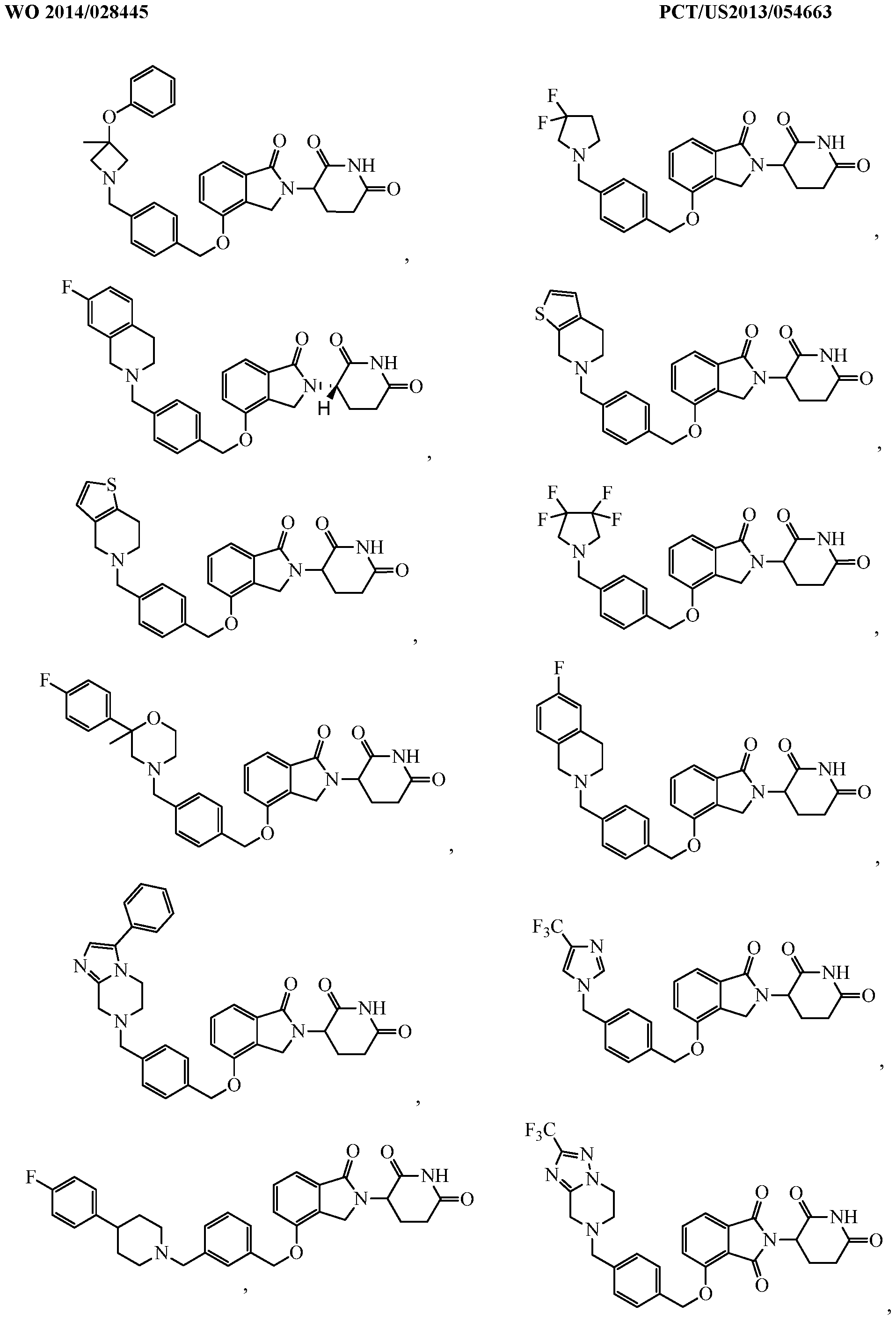


(IX)
or a pharmaceutically acceptable salt, solvate, or stereoisomer thereof, wherein:
R4 is benzothiazolyl, quinolinyl, isoquinolinyl, naphthyl, 2,3-dihydro-lH- indenyl, benzo[<i][l,2,3]triazolyl, imidazo[l,2-a]pyridinyl, benzofuranyl, 2,3-dihydrobenzofuranyl, benzothienyl, benzo[<i]oxazolyl, isoindolinyl, or chromanyl;
with the proviso that if the bicyclic ring is benzofuranyl or benzothienyl, then the ring is not connected to the isoindolyl ring through the 2-position.
[00626] In Formula IX, in one embodiment, R4 is benzothiazolyl; in another embodiment, R4 is quinolinyl; in yet another embodiment, R4 is isoquinolinyl; in yet another embodiment, R4 is naphthyl; in yet another embodiment, R4 is 2,3-dihydro-lH- indenyl; in yet another embodiment, R4 is benzo[<i][l,2,3]triazolyl; in yet another embodiment, R4 is imidazo[l,2-a]pyridinyl; in yet another embodiment, R4 is benzofuranyl; in yet another embodiment, R4 is 2,3-dihydrobenzofuranyl; in yet another embodiment, R4 is benzothienyl; in yet another embodiment, R4 is benzo[<i]oxazolyl; in yet another embodiment, R4 is isoindolinyl; and in still another embodiment, R4 is chromanyl.
[00627] In certain embodiments, the immunomodulatory compound is selected from:


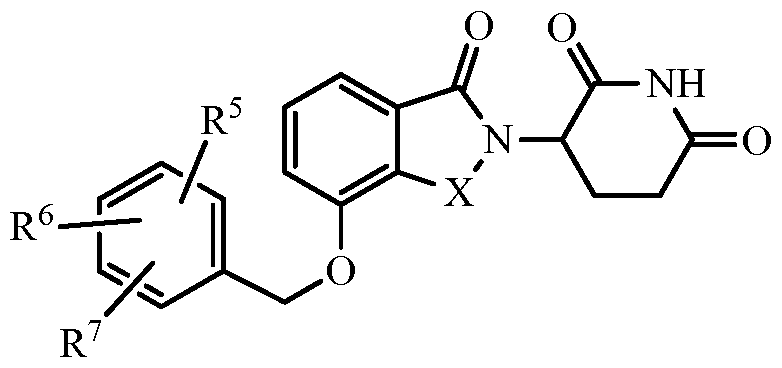
(X)
or a pharmaceutically acceptable salt, solvate, or stereoisomer thereof, wherein:
X is CH2 or C=0;
R5, R6 and R7 are each independently hydrogen, halogen, nitro, carbamoyl, amino, -S02R8, -CONR9R10, -Ci_6 alkyl, or -Ci_6 alkoxy, where the alkyl or alkoxy is optionally substituted with one or more halogen, amino, hydroxyl, or NR9R10;
R8 is: Ci_6 alkyl, optionally substituted with C6-i4 aryl; amino, optionally
substituted with Ci_6 alkyl or C6-i4 aryl; or heterocyclyl, optionally substituted with Ci_6 alkyl or C6-i4 aryl;
R9 and R10 are each independently hydrogen, C6-i4 aryl, -COO-Ci_6 alkyl, -Co-6 alkyl-CHO, -C0_6 alkyl-COOH, -C0_6 alkyl-NR9'R10', -C0_6 alkyl- heterocyclyl, -Ci_6 alkyl-OH, -Ci_6 alkyl-0-Ci_6 alkyl, Ci_6 alkyl, or C3-6 cycloalkyl; or
R9 and R10 together form an optionally substituted 5- or 6-membered ring
containing one or more heteroatoms; and
R9' and R10' are each independently hydrogen or Ci_6 alkyl;
with the proviso that all of R5-R7 cannot be hydrogen; and
with the proviso that if one of R5-R7 is hydrogen and the remaining two of R5-R7 are both chloride, then the two chloride atoms cannot be on the 3 and 4 positions of the phenyl ring.
[00629] In Formula X, in one embodiment, R5 is hydrogen; in another embodiment, R5 is halogen; in yet another embodiment, R5 is nitro; in yet another embodiment, R5 is carbamoyl; in yet another embodiment, R5 is amino; in yet another embodiment, R5 is -S02R8; in yet another embodiment, R5 is -CONR9R10; in yet another embodiment, R5 is -Ci_6 alkyl, optionally substituted with one or more halogen, amino, hydroxyl, or
NR9R10; and in still another embodiment, R5 is -Ci_6 alkoxy, optionally substituted with one or more halogen, amino, hydroxyl or NR9R10
[00630] In Formula X, in one embodiment, R6 is hydrogen; in another embodiment, R6 is halogen; in yet another embodiment, R6 is nitro; in yet another embodiment, R6 is carbamoyl; in yet another embodiment, R6 is amino; in yet another embodiment, R6 is -SO2R8; in yet another embodiment, R6 is -CONR9R10; in yet another embodiment, R6 is -Ci_6 alkyl, optionally substituted with one or more halogen, amino, hydroxyl, or NR9R10; and in still another embodiment, R6 is -Ci_6 alkoxy, optionally substituted with one or more halogen, amino, hydroxyl or NR9R10
[00631] In Formula X, in one embodiment, R7 is hydrogen; in another embodiment, R7 is halogen; in yet another embodiment, R7 is nitro; in yet another embodiment, R7 is carbamoyl; in yet another embodiment, R7 is amino; in yet another embodiment, R7 is
8 ; in yet another embodiment, 7 9 10 7
-SO2R R is -CONR R ; in yet another embodiment, R is -Ci_6 alkyl, optionally substituted with one or more halogen, amino, hydroxyl, or NR9R10; and in still another embodiment, R7 is -Ci_6 alkoxy, optionally substituted with one or more halogen, amino, hydroxyl or NR9R10
[00632] In Formula X, in one embodiment, R8 is Ci_6 alkyl, optionally substituted with C6-i4 aryl; in another embodiment, R8 is amino, optionally substituted with Ci_6 alkyl or C6-i4 aryl; and in still another embodiment, R8 is 6- to 10-membered
heterocyclyl, optionally substituted with Ci_6 alkyl or C6-i4 aryl.
[00633] In Formula X, in one embodiment, R9 is hydrogen; in another embodiment, R9 is 6- to 10-membered aryl; in yet another embodiment, R9 is -COO-Ci_6 alkyl; in yet another embodiment, R9 is -C0-6 alkyl-CHO; in yet another embodiment, R9 is -C0-6 alkyl-COOH; in yet another embodiment, R9 is -C0-6 alkyl-NR9 R10 ; in yet another embodiment, R9 is -C0-6 alkyl-(5- to 10-membered heterocyclyl); in yet another embodiment, R9 is -Ci_6 alkyl-OH; in yet another embodiment, R9 is -Ci_6 alkyl-0-Ci_6 alkyl; in yet another embodiment, R9 is Ci_6 alkyl; and in still another embodiment, R9 is C3-6 cycloalkyl.
[00634] In Formula X, in one embodiment, R10 is hydrogen; in another embodiment, R10 is 6- to 10-membered aryl; in yet another embodiment, R10 is -COO-Ci_6 alkyl; in yet another embodiment, R10 is -Co-6 alkyl-CHO; in yet another embodiment, R10 is
- Co-6 alkyl-COOH; in yet another embodiment, R10 is -C0-6 alkyl-NR9 R10'; in yet another embodiment, R10 is -Co-6 alkyl-(5- to 10-membered heterocyclyl); in yet another embodiment, R10 is -Ci_6 alkyl-OH; in yet another embodiment, R10 is -Ci_6 alkyl-O- Ci_6 alkyl; in yet another embodiment, R10 is Ci_6 alkyl; and in still another embodiment, R10 is C3-6 cycloalkyl.
[00635] In Formula X, in one embodiment, R9 and R10 together form a 5- or 6- membered ring; in another embodiment, the ring contains one or more heteroatoms; and in still another embodiment, the heteroatoms are selected from the group consisting of N, S and O.
[00636] In Formula X, in one embodiment, R9 is hydrogen; and in another embodiment, R9 is Ci_6 alkyl.
[00637] In Formula X, in one embodiment, R10 is hydrogen; and in another embodiment, R10 is Ci_6 alkyl.
[00638] The immunomodulatory compounds of Formula X encompass any of the combinations of R5-R10 and R9 -R10 as defined herein.
[00639] In Formula X, in one embodiment, one of R5-R7 is hydrogen and the remaining two of R5-R7 are halogen; in another embodiment, one of R5-R7 is hydrogen and the remaining two of R5-R7 are Ci_6 alkoxy; in yet another embodiment, one of R5- R7 is hydrogen and the remaining two of R5-R7 are Ci_6 alkyl; and in still another embodiment, R5 is hydrogen, R6 is halogen, and R7 is Ci_6 alkoxy.
[00640] In Formula X, in one embodiment, two of R5-R7 are hydrogen and the remaining one of R5-R7 is halogen; in another embodiment, two of R5-R7 are hydrogen and the remaining one of R5-R7 is Ci_6 alkoxy; and in still another embodiment, two of R5-R7 are hydrogen and the remaining one of R5-R7 is Ci_6 alkyl.
[00641] In certain embodiments, the immunomodulatory compound is selected from:
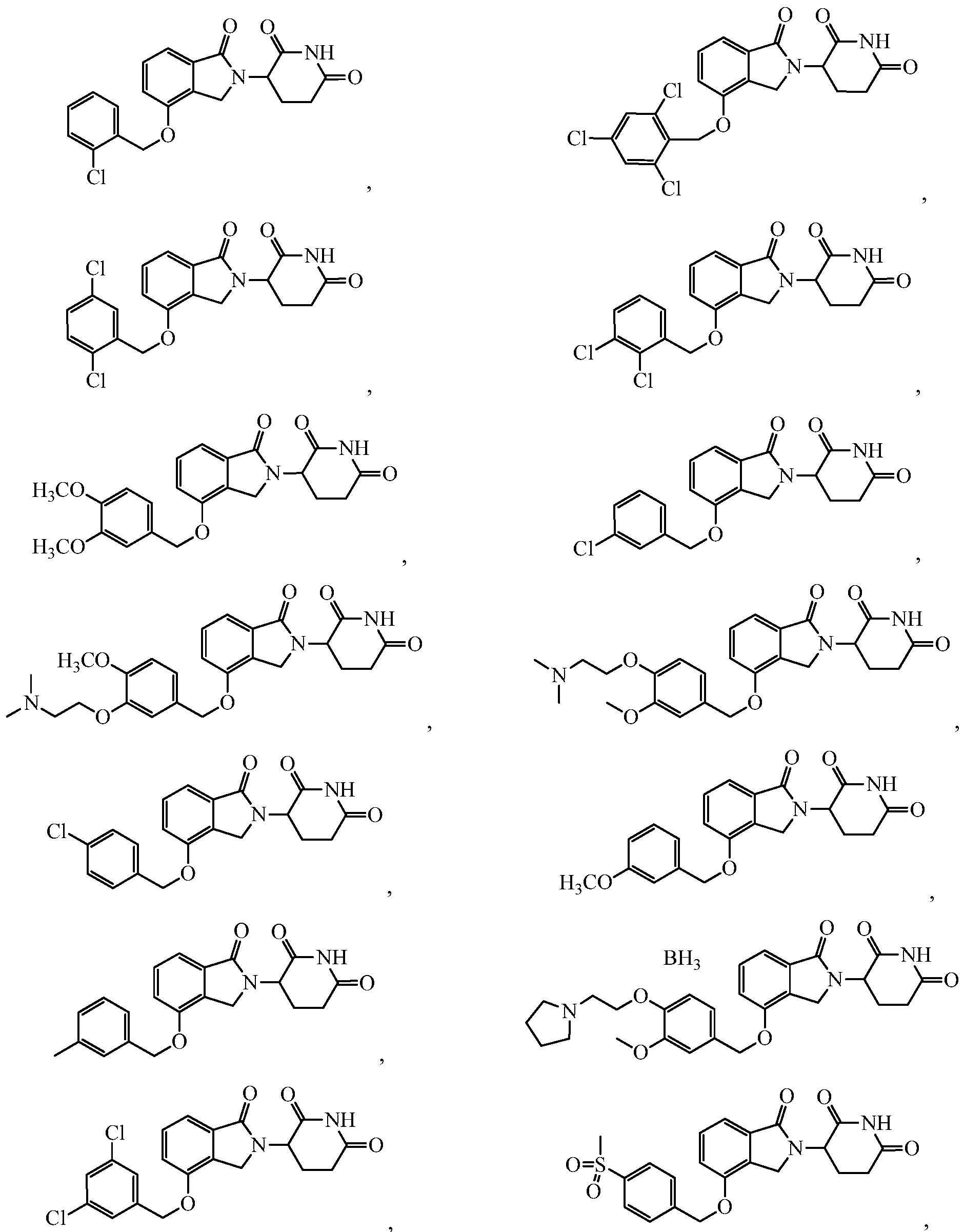


 [00642] In yet another embodiment, the immunomodulatory compound is a compound of Formula (XI):

(XI)
or a pharmaceutically acceptable salt, solvate, or stereoisomer thereof, wherein:
X is N or C;
Y is CH2 or C=0;
R11 and R12 are each independently hydrogen, Ci_6 alkyl, -C1-6 alkyl-C3_6
cycloalkyl, Ci_6 alkoxy, -C6-14 aryl, -CO-Ci_6 alkyl, -CO-C3_6 cycloalkyl, -CO-C6-14 aryl, -COO-Ci_6 alkyl, halogen, hydroxyl, oxo, 3- to 10-membered heterocyclyl, 6- to 10-membered heteroaryl, -NHCO- Ci_6 alkyl, -(CH2)n-phenyl, -S02-Ci_6 alkyl, -S02-C3_6 cycloalkyl, -S02-C6-i4 aryl, or -NR14R15, wherein the alkyl, aryl or heteroaryl portion of each of the groups is optionally substituted with one or more halogen, hydroxyl, or -C1-6 alkoxy;
R13 is hydrogen or -C1-6 alkyl;
R14 and R15 are each independently hydrogen or -C1-6 alkyl; and
n is 0, 1, 2 or 3.
[00643] In Formula XI, in one embodiment, X is N; and in another embodiment, X is C.
[00644] In Formula XI, in one embodiment, Y is CH2; and in another embodiment, Y is C=0.
[00645] In Formula XI, in one embodiment, R11 is hydrogen; in another embodiment, R11 is Ci_6 alkyl; in yet another embodiment, R11 is -C1-6 alkyl-C3_6 cycloalkyl; in yet another embodiment, R11 is Ci_6 alkoxy; in yet another embodiment, R11 is C6-14 aryl; in yet another embodiment, R11 is -CO-Ci_6 alkyl; in yet another embodiment, R11 is -CO-C3_6 cycloalkyl; in yet another embodiment, R11 is -CO-C6-14 aryl; in yet another
embodiment, R11 is -COO-Ci_6 alkyl; in yet another embodiment, R11 is halogen; in yet another embodiment, R11 is hydroxyl; in yet another embodiment, R11 is oxo; in yet another embodiment, R11 is 3- to 10-membered heterocyclyl; in yet another embodiment, R11 is 6- to 10-membered heteroaryl; in yet another embodiment, R11 is -NHCO-Ci_6 alkyl; in yet another embodiment, R11 is -(CH2)n-phenyl; in yet another embodiment, R11 is -S02-Ci_6 alkyl; in yet another embodiment, R11 is -SO2-C3-6 cycloalkyl; in yet another embodiment, R11 is -S02-C6_i4 aryl; in yet another embodiment, R11 is
-NR14R15; and in still another embodiment, the alkyl, aryl or heteroaryl portion of R11 is substituted with one or more halogen, hydroxyl and/or -Ci_6 alkoxy.
[00646] In Formula XI, in one embodiment, R12 is hydrogen; in another embodiment, R12 is Ci_6 alkyl; in yet another embodiment, R12 is -Ci_6 alkyl-C3_6 cycloalkyl; in yet another embodiment, R12 is Ci_6 alkoxy; in yet another embodiment, R12 is C6-i4 aryl; in yet another embodiment, R12 is -CO-Ci_6 alkyl; in yet another embodiment, R12 is -CO-C3-6 cycloalkyl; in yet another embodiment, R12 is -CO-C6-i4 aryl; in yet another embodiment, R12 is -COO-Ci_6 alkyl; in yet another embodiment, R12 is halogen; in yet another embodiment, R12 is hydroxyl; in yet another embodiment, R12 is oxo; in yet another embodiment, R12 is 3- to 10-membered heterocyclyl; in yet another embodiment, R12 is 6- to 10-membered heteroaryl; in yet another embodiment, R12 is -NHCO-Ci_6 alkyl; in yet another embodiment, R12 is -(CH2)n-phenyl; in yet another embodiment, R12 is -S02-Ci_6 alkyl; in yet another embodiment, R12 is -SO2-C3-6 cycloalkyl; in yet another embodiment, R12 is -S02-C6_i4 aryl; in yet another embodiment, R12 is
-NR14R15; and in still another embodiment, the alkyl, aryl or heteroaryl portion of R12 is substituted with one or more halogen, hydroxyl and/or -Ci_6 alkoxy.
[00647] In Formula XI, in one embodiment, R13 is hydrogen; and in another embodiment, R13 is Ci_6 alkyl.
[00648] In Formula XI, in one embodiment, R14 is hydrogen; and in another embodiment, R14 is Ci_6 alkyl.
[00649] In Formula XI, in one embodiment, R15 is hydrogen; and in another embodiment, R15 is Ci_6 alkyl.
[00650] In Formula XI, in one embodiment, n is 0; in another embodiment, n is 1; in yet another embodiment, n is 2; and in still another embodiment, n is 3.
[00651] The immunomodulatory compounds of Formula XI encompass any of the combinations of X, Y, Ru-R15 and n as defined herein.
[00652] In certain embodiments, the compound is selected from:


ı62

ı63

ı64


harmaceutically acceptable salts, solvates, and stereoisomers thereof.
[00653] In certain embodiments, the immunomodulatory compound is selected from:


and pharmaceutically acceptable salts, solvates, and stereoisomers thereof.
[00654] In certain embodiments, the immunomodulatory compound is 3-(5-amino-2- methyl-4-oxoquinazolin-3(4H)-yl)piperidine-2,6-dione, or a pharmaceutically acceptable salt, solvate, or stereoisomer thereof. In certain embodiments, the immunomodulatory compound is 3-(4-((4-(morpholinomethyl)benzyl)oxy)-l- oxoisoindolin-2-yl)piperidine-2,6-dione, or a pharmaceutically acceptable salt, solvate, or stereoisomer thereof. In certain embodiments, the immunomodulatory compound is (5)-3-(4-((4-(morpholinomethyl)benzyl)oxy)-l-oxoisoindolin-2-yl)piperidine-2,6-dione, or a pharmaceutically acceptable salt or solvate thereof.
[00655] All of the compounds described herein are either commercially available or can be prepared according to the methods described in the patents or patent publications disclosed herein. Further, optically pure compounds can be asymmetrically synthesized or resolved using known resolving agents or chiral columns as well as other standard synthetic organic chemistry techniques. Additional information on immunomodulatory
compounds, their preparation, and use can be found, for example, in U.S. Pat. No.
7,635,700, U.S. Pat. App. Pub. Nos. 2006/0188475, 2006/0205787, 2007/0049618, 2008/0161328, and 2011/0196150, the disclosure of each of which is incorporated by reference herein in its entirety.
5.8 Methods of Treatment
[00656] In certain embodiments, provided herein is a method of treating, preventing, and/or managing an inflammatory disease, disorder, or condition, comprising
administering to a subject a therapeutically effective amount of a treatment compound provided herein.
[00657] In certain embodiments, the disease is lupus, scleroderma, Sjogren syndrome, ANCA-induced vasculitis, anti-phospho lipid syndrome, or myasthenia gravis. In certain embodiments, the disease is lupus or scleroderma.
[00658] In certain embodiments, provided herein is a method of treating, preventing, and/or managing scleroderma or a symptom thereof, comprising administering to a subject having scleroderma a therapeutically effective amount of a treatment compound provided herein. In certain embodiments, provided herein is a method of treating, preventing, and/or managing scleroderma or a symptom thereof, comprising
administering to a subject having scleroderma or at risk of having scleroderma a therapeutically effective amount of a treatment provided herein.
[00659] In certain embodiments, the scleroderma is localized, systemic, limited, or diffuse scleroderma.
[00660] In certain embodiments, the systemic scleroderma comprises CREST syndrome (Calcinosis, Raynaud's syndrome, esophagaeal dysfunction or dysmotility, sclerodactyly, and telangiectasia). Scleroderma is also known as systemic sclerosis or progressive systemic sclerosis.
[00661] In certain embodiments, the disease is Raynaud's disease. In certain embodiments, systemic sclerosis comprises scleroderma lung disease, scleroderma renal crisis, cardiac manifestations, muscular weakness (including fatigue or limited CREST), gastrointestinal dysmotility and spasm, and abnormalities in the central, peripheral and
autonomic nervous system (including carpal tunnel syndrome followed by trigeminal neuralgia). It also includes general disability, including depression, and impact on quality of life.
[00662] In certain embodiments, limited scleroderma is limited to the hands, the face, neck, or combinations thereof.
[00663] In certain embodiments, diffuse scleroderma comprises skin tightening and also occurs above the wrists (or elbows). In certain embodiments, the diffuse systemic sclerosis is sine scleroderma, comprising internal organ fibrosis, but no skin tightening; or familial progressive systemic sclerosis.
[00664] In one embodiment, scleroderma is not associated with wasting, such as disease-related wasting.
[00665] In one embodiment, provided herein is a method for the reduction, inhibition, or prevention of one or more of the following symptoms of scleroderma: (i) gradual hardening, thickening, and tightening of the skin (e.g., in extremities, such as hands, face, and feet); (ii) skin discoloration; (iii) numbness of extremities; (iv) shiny skin; (v) small white lumps under the surface of the skin that erupt into a chalky white fluid; (vi) Raynaud's esophagaeal dysfunction (pain, numbness, and/or color changes in the hands caused by spasm of the blood vessels upon exposure to cold or emotional stress); (vii) telangiectasia (red spots on, e.g., the hands, palms, forearms, face, and lips); (viii) pain and/or stiffness of the joints; (ix) swelling of the hands and feet; (x) itching of the skin; (xi) stiffening and curling of the fingers; (xii) ulcers (sores) on the outside of certain joints, such as knuckles and elbows; (xiii) digestive problems, such as heartburn, difficulty in swallowing, diarrhea, irritable bowel, and constipation; (xiv) fatigue and weakness; (xv) shortness of breath; (xvi) arthritis; (xvii) hair loss; (xviii) internal organ problems; (xix) digital ulcers; or (xx) digital auto-amputation, comprising administering a therapeutically effective amount of a treatment provided herein to a subject in need thereof.
[00666] Without being bound to any particular theory, it is believed that the treatment provided herein compounds provided herein enhance Thl immune response, and suppresses Th2 immune response, which may result in anti-fibrotic effects in the skin.
[00667] In certain embodiments, provided herein is a method for improving or reducing the skin thickness of a subject having scleroderma, comprising administering to the subject a therapeutically effective amount of a treatment compound provided herein. In one embodiment, the skin thickness is reduced by about 20%, about 25%, about 30%>, about 40%, about 50%, about 60%, about 70% about 80%, about 90% or more.
[00668] In certain embodiments, provided herein is a method for achieving one or more clinical endpoints in treating a subject with scleroderma, comprising administering to the subject a therapeutically effective amount of a treatment compound provided herein.
[00669] In certain embodiments, provided herein is a method for increasing the overall survival, objective response rate, time to progression, progression-free survival and/or time-to-treatment failure of a subject having scleroderma, comprising
administering to the subject a therapeutically effective amount of a treatment compound provided herein.
[00670] In certain embodiments, provided herein is a method for decreasing mortality, respiratory mortality and/or respiratory hospitalization of a subject having scleroderma, comprising administering to the subject a therapeutically effective amount of a treatment compound provided herein.
[00671] In certain embodiments, provided herein is a method for improving the modified Rodnan skin score of a subject having scleroderma, comprising administering to the subject a therapeutically effective amount of a treatment provided herein. In one embodiment, the improvement in modified Rodnan skin score is about 5, about 10, about 15, or about 20 points or more.
[00672] In certain embodiments, provided herein is a method for improving or reducing the skin thickness of a subject having scleroderma, comprising administering to the subject a therapeutically effective amount of a treatment compound provided herein. In one embodiment, the skin thickness is reduced by about 20%>, about 25%, about 30%>, about 40%, about 50%, about 60%, about 70% about 80%, about 90% or more.
[00673] In certain embodiments, provided herein is a method for improving or reducing skin induration of a subject having scleroderma, comprising administering to the subject a therapeutically effective amount of a treatment compound provided herein.
[00674] In certain embodiments, provided herein is a method for improving the dermatology quality of life index of a subject having scleroderma, comprising administering to the subject a therapeutically effective amount of a treatment compound provided herein.
[00675] In certain embodiments, provided herein is a method for improving the pulmonary function of a subject having scleroderma, comprising administering to the subject a therapeutically effective amount of a treatment compound provided herein.
[00676] In certain embodiments, provided herein is a method for improving the carbon monoxide diffusing capacity of a subject having scleroderma, comprising administering to the subject a therapeutically effective amount of a treatment compound provided herein. In one embodiment, the carbon monoxide diffusing capacity of a subject is improved by an improvement in the diffusing capacity of the lung for carbon monoxide (DLco) of about 10%, about 20%>, about 25%, about 30%>, about 40%>, about 50%, about 60%, about 70% about 80%, about 90% or more.
[00677] In certain embodiments, provided herein is a method for improving the Mahler Dyspnea index of a subject having scleroderma, comprising administering to the subject a therapeutically effective amount of a treatment compound provided herein. In one embodiment, the improvement in Mahler Dyspnea index is about 4, about 5, about 6, about 7, about 8, about 9, or about 10 points or more.
[00678] In certain embodiments, provided herein is a method for improving the Saint George's Respiratory Questionnaire score of a subject having scleroderma, comprising administering to the subject a therapeutically effective amount of a treatment compound provided herein. In one embodiment, the improvement in Saint George's Respiratory Questionnaire score is about 4, about 8, about 12, about 16, about 20, about 24, about 28, about 32, about 36, about 40, about 44, about 48, about 52 points or more.
[00679] In certain embodiments, provided herein is a method for improving the UCLA scleroderma clinical trial consortium gastrointestinal tract score of a subject
having scleroderma, comprising administering to the subject a therapeutically effective amount of a treatment compound provided herein.
[00680] In certain embodiments, provided herein is a method for treating or preventing digital ulcer of a subject having scleroderma, comprising administering to the subject a therapeutically effective amount of a treatment compound provided herein.
[00681] In certain embodiments, provided herein is a method for improving flow- mediated dilatation of a subject having scleroderma, comprising administering to the subject a therapeutically effective amount of a treatment compound provided herein.
[00682] In certain embodiments, provided herein is a method for improving or increasing the six minute walk distance of a subject having scleroderma, comprising administering to the subject a therapeutically effective amount of a treatment compound provided herein. In one embodiment, the improvement in the six minute walk distance is about 200 meters, about 250 meters, about 300 meters, about 350 meters, about 400 meters or more.
[00683] In certain embodiments, provided herein is a method of treating, preventing, and/or managing lupus erythematosus or a symptom thereof, comprising administering to a subject having lupus erythematosus a therapeutically effective amount of a treatment compound provided herein.
[00684] In certain embodiments, provided herein is a method of preventing lupus erythematosus or a symptom thereof, comprising administering to a subject at risk of having lupus erythematosus a therapeutically effective amount of a treatment compound provided herein.
[00685] In certain embodiments, the disease is systemic lupus erythematosus (SLE), cutaneous lupus erythematosus (CLE), or drug-induced lupus.
[00686] The phrase "Systemic lupus erythematosus" is interchangeably used herein with SLE and lupus and refers to all manifestations of the disease as known in the art (including remissions and flares). In SLE, abnormal hyperactivity of B lymphocytes and massive abnormal production of immunoglobulin gamma (IgG) auto-antibodies play a key role. This pathological process results in sequestration and destruction of Ig-coated
cells, fixation and cleaving of complement proteins, and release of chemotaxins, vasoactive peptides and destructive enzymes into tissues (Hahn BH. Systemic Lupus Erythematosus. In: Kasper DL, Braunwald E, Fauci AS, Hauser SL, Longo DL, Jameson, JL, editors. In: Harrison's Principles of Internal Medicine (16th edition); New York (US): McGraw-Hill; 2005. pp.1960- 1967).
[00687] Symptoms of SLE vary from person to person, and may come and go. In most patients, the symptoms include joint pain and swelling. Frequently affected joints are the fingers, hands, wrists, and knees. Some patients develop arthritis. Other common symptoms include: chest pain when taking a deep breath, fatigue, fever with no other cause, general discomfort, uneasiness, or ill feeling (malaise), hair loss, mouth sores, swollen lymph nodes, sensitivity to sunlight, skin rash -a "butterfly" rash over the cheeks and bridge of the nose affects about half of people with SLE, in some patients, the rash gets worse in sunlight, and the rash may also be widespread.
[00688] Other symptoms depend on what part of the body is affected, and may include the following:
Brain and nervous system: headaches, numbness, tingling, seizures, vision problems, personality changes,
Digestive tract: abdominal pain, nausea, and vomiting,
Heart: abnormal heart rhythms (arrhythmias),
Lung: coughing up blood and difficulty breathing, and
Skin: patchy skin color, fingers that change color when cold (Raynaud's phenomenon).
[00689] Some patients only have skin symptoms. This is called discoid lupus.
[00690] In one embodiment, the disease is moderate, severe, or very severe SLE. The term "severe SLE" as used herein refers to an SLE condition where the patient has one or more severe or life-threatening symptoms (such as hemolytic anemia, extensive heart or lung involvement, kidney disease, or central nervous system involvement).
[00691] In certain embodiments, provided herein is a method for achieving one or more clinical endpoints in treating a subject with SLE, comprising administering to the subject a therapeutically effective amount of a treatment compound provided herein.
[00692] In certain embodiments, provided herein is a method for the overall survival, objective response rate, time to progression, progression-free survival and/or time-to- treatment failure of a subject having SLE, comprising administering to the subject a therapeutically effective amount of a treatment compound provided herein.
[00693] In certain embodiment, certain treatment compounds provided herein act as an inhibitor of primary human memory CD 19+ B-cell differentiation to the plasmablast stage. Without being bound to any particular theory, it is believed that certain treatment compounds provided herein block cells at a premature stage thereby decreasing the numbers of plasmablasts that are capable of producing high levels of immunoglobulin. A functional consequence of this effect is reduced immunoglobulin G (IgG) and immunoglobulin M (IgM) production in these differentiation cultures.
[00694] In certain embodiments, provided herein is a method for treating, managing, or preventing an immune-related disease, disorder, or condition, comprising
administering to a subject a therapeutically effective amount of a treatment compound provided herein.
[00695] In certain embodiments, provided herein is a method of treating a disease, disorder, or condition caused by, or is associated with, an inappropriate or undesirable immune response, comprising administering to a subject a therapeutically effective amount of a treatment compound provided herein.
[00696] In certain embodiments, provided herein is a method of treating a disease, disorder, or condition that can be treated beneficially by immunosuppression, comprising administering to a subject a therapeutically effective amount of a treatment compound provided herein.
[00697] In certain embodiments, the immune-related disease, i.e., a disease, disorder, or condition caused by, or is associated with, an inappropriate or undesirable immune response, is Sjogren syndrome, ANCA-induced vasculitis, anti-phospholipid syndrome, myasthenia gravis, Addison's disease, alopecia areata, ankylosing spondylitis, antiphospholipid antibody syndrome, antiphospholipid syndrome (primary or secondary), asthma, autoimmune gastritis, autoimmune hemolytic anemia, autoimmune hepatitis, autoimmune inner ear disease, autoimmune lymphoproliferative disease, autoimmune thrombocytopenic purpura, Balo disease, Behcet's disease, bullous
pemphigoid, cardiomyopathy, celiac disease, Chagas disease, chronic inflammatory demyelinating polyneuropathy, cicatrical pemphigoid (e.g., mucous membrane pemphigoid), cold agglutinin disease, degos disease, dermatitis hepatiformis, essential mixed cryoglobulinemia, Goodpasture's syndrome, Graves' disease, Guillain-Barre syndrome, Hashimoto's thyroiditis (Hashimoto's disease; autoimmune thyroditis), idiopathic pulmonary fibrosis, idiopathic thrombocytopenia purpura, IgA nephropathy, juvenile arthritis, lichen planus, Meniere disease, mixed connective tissue disease, morephea, narcolepsy, neuromyotonia, pediatric autoimmune neuropsychiatric disorders (P AND As), pemphigus vulgaris, pernicious anemia, polyarteritis nodosa, polychondritis, polymyalgia rheumatica, primary agammaglobulinemia, primary biliary cirrhosis, Raynaud disease (Raynaud phenomenon), Reiter's syndrome, relapsing polychondritis, rheumatic fever, Sjogren's syndrome, stiff-person syndrome (Moersch-Woltmann syndrome), Takayasu's arteritis, temporal arteritis (giant cell arteritis), uveitis, vasculitis (e.g., vasculitis not associated with lupus erythematosus), vitiligo, or Wegener's granulomatosis.
[00698] In certain embodiments, provided herein is a method for treating and preventing cancer, comprising administering to a subject a therapeutically effective amount of a treatment compound provided herein.
[00699] In certain embodiments, provided herein is a method for managing cancer, comprising administering to a subject a therapeutically effective amount of a treatment compound provided herein.
[00700] In certain embodiments, provided herein is a method for treating or managing lymphoma, in one embodiment, non-Hodgkin's lymphoma, comprising administering to a subject a therapeutically effective amount of a treatment compound provided herein.
[00701] In certain embodiments, provided herein is a method for treating or managing non-Hodgkin's lymphoma (NHL), including but not limited to, diffuse large B-cell lymphoma (DLBCL), comprising administering to a subject a therapeutically effective amount of a treatment compound provided herein.
[00702] In certain embodiments, the subject is one who has been previously treated for cancer, but is non-responsive to a standard therapy. In certain embodiments, the subject is one who has not previously been treated.
[00703] As used herein, the term "cancer" includes, but is not limited to, solid tumors and blood born tumors. In certain embodiments, the term "cancer" refers to disease of skin tissues, organs, blood, and vessels, including, but not limited to, cancers of the bladder, bone, blood, brain, breast, cervix, chest, colon, endrometrium, esophagus, eye, head, kidney, liver, lymph nodes, lung, mouth, neck, ovaries, pancreas, prostate, rectum, stomach, testis, throat, and uterus.
[00704] In certain embodiments, the term "cancer" refers to advanced malignancy, amyloidosis, neuroblastoma, meningioma, hemangiopericytoma, multiple brain metastase, glioblastoma multiforms, glioblastoma, brain stem glioma, poor prognosis malignant brain tumor, malignant glioma, recurrent malignant giolma, anaplastic astrocytoma, anaplastic oligodendroglioma, neuroendocrine tumor, rectal
adenocarcinoma, Dukes C & D colorectal cancer, unresectable colorectal carcinoma, metastatic hepatocellular carcinoma, Kaposi's sarcoma, karotype acute myeloblastic leukemia, Hodgkin's lymphoma, non-Hodgkin's lymphoma, cutaneous T-Cell lymphoma, cutaneous B-Cell lymphoma, diffuse large B-Cell lymphoma, low grade follicular lymphoma, malignant melanoma, malignant mesothelioma, malignant pleural effusion mesothelioma syndrome, peritoneal carcinoma, papillary serous carcinoma, gynecologic sarcoma, soft tissue sarcoma, scleroderma, cutaneous vasculitis,
Langerhans cell histiocytosis, leiomyosarcoma, fibrodysplasia ossificans progressive, hormone refractory prostate cancer, resected high-risk soft tissue sarcoma, unrescectable hepatocellular carcinoma, Waldenstrom's macroglobulinemia, smoldering myeloma, indolent myeloma, fallopian tube cancer, androgen independent prostate cancer, androgen dependent stage IV non-metastatic prostate cancer, hormone-insensitive prostate cancer, chemotherapy-insensitive prostate cancer, papillary thyroid carcinoma, follicular thyroid carcinoma, medullary thyroid carcinoma, and leiomyoma.
[00705] In certain embodiments, the cancer is a blood borne tumor. In certain embodiments, the blood borne tumor is metastatic. In certain embodiments, the blood borne tumor is drug resistant. In certain embodiments, the cancer is myeloma or lymphoma.
[00706] In certain embodiments, the cancer is a solid tumor. In certain embodiments, the solid tumor is metastatic. In certain embodiments, the solid tumor is drug-resistant.
In certain embodiments, the solid tumor is hepatocellular carcinoma, prostate cancer, ovarian cancer, or glioblastoma.
6. EXAMPLES
[00707] The examples below are carried out using standard techniques, which are well known and routine to those of skill in the art, except where otherwise described in detail. The examples are intended to be merely illustrative.
6.1 Analysis of CRBN isoforms
[00708] CRBN isoform mapping was performed using a nested PCR approach and Sanger sequencing. Commercially available and newly generated rabbit anti-CRBN antibodies were characterized with recombinant human CRBN protein and MM cell line extracts via western blot analysis.
[00709] CRBN RNA was first reverse transcribed (RT) using a pair of 5 ' -UTR (untranslated region) and 3' -UTR derived primers. A nested PCR reaction was then carried out using the RT reaction product as a template with primers designed to amplify the complete protein coding sequence (CDS). The PCR reaction product was loaded on an agarose gel to separate amplified DNA fragments. As shown in FIG. 9, seven distinct fragments were detected for MM cell line H929. The fragments were purified and inserted into a bacterial plasmid vector {e.g., Topo vector). Seven different inserts were derived from the fragments. DNA sequences from representative clones containing each insert were determined by the Sanger sequencing method. From the sequences of the fragments, their sizes were calculated to be 1329bp, 1197bp, 825bp, 725bp, 582bp, 457bp, and 331bp, designated as Isoform 1, Isoform 2, Isoform 3, Isoform 4, Isoform 5, Isoform 6, and Isoform 7, respectively. Their sequences are shown in FIGS. 2 to 8.
6.2 RNA Sequencing
[00710] RNA was extracted from tumor cells and used to generate a sequencing library by the random hexamer method. 100 bp paired end RNA sequencing reactions were run in HiSeq (Illumina) platform and sequences were processed to develop mappable sequences to the CRBN gene in the human genome. For isoform detection, junction sequences from Isoform 2 to Isoform 7 were used as reference sequence, to
which the entire RNA seq. sequences were aligned by using an alignment algorithm. Relative expression level of various isoforms was estimated by normalizing FPKM (fragment per kilobase per million reads) values of each isoform.
[00711] From the foregoing, it will be appreciated that, although specific embodiments have been described herein for the purpose of illustration, various modifications may be made without deviating from the spirit and scope of what is provided herein. All of the references referred to above are incorporated herein by reference in their entireties.
Claims
1. An isolated, synthetic, or recombinant polypeptide of an isoform of CRBN, having a deletion of amino acid residues 126 to 175 (zi 126-175) or amino acid residues 176 to 228 (zl 176-228) in the full-length amino acid sequence of CRBN.
2. The polypeptide of claim 1, wherein the polypeptide is isoform 3 of CRBN, which has a deletion of amino acids 58 to 175 (z/58-175) in the full-length amino acid sequence of CRBN.
3. The polypeptide of claim 1, wherein the polypeptide is isoform 4 of CRBN, which has a deletion of amino acids 126 to 316 (zi 126-316) in the full-length amino acid sequence of CRBN.
4. The polypeptide of claim 1, wherein the polypeptide is isoform 5 of CRBN, which has deletions of amino acid residues 176 to 278 (zi 176-278) and amino acid residues 317 to 382 (z/317-382) in the full-length amino acid sequence of CRBN.
5. The polypeptide of claim 1, wherein the polypeptide is isoform 6 of CRBN, which has a deletion of amino acids 126 to 382 (zi 126-382) in the full-length amino acid sequence of CRBN.
6. The polypeptide of claim 1, wherein the polypeptide is isoform 7 of CRBN, which has a deletion of amino acids 23 to 338 (zi23-338) in the full-length amino acid sequence of CRBN.
7. An isolated, synthetic, or recombinant polypeptide of an isoform of CRBN, having a deletion of amino acid residues 23 to 57 (zi23-57) in the full-length amino acid sequence of CRBN.
8. An isolated, synthetic, or recombinant polypeptide of an isoform of CRBN, having a deletion of amino acid residues 58 to 125 (zi58-125) in the full-length amino acid sequence of CRBN.
9. An isolated, synthetic, or recombinant polypeptide of an isoform of CRBN, having a deletion of amino acid residues 126 to 175 (zi 126- 175) in the full- length amino acid sequence of CRBN.
10. An isolated, synthetic, or recombinant polypeptide of an isoform of CRBN, having a deletion of amino acid residues 176 to 228 (A 176-228) in the full- length amino acid sequence of CRBN.
11. An isolated, synthetic, or recombinant polypeptide of an isoform of CRBN, having a deletion of amino acid residues 229 to 249 (J229-249) in the full- length amino acid sequence of CRBN.
12. An isolated, synthetic, or recombinant polypeptide of an isoform of CRBN, having a deletion of amino acid residues 250 to 278 ( 250-278) in the full- length amino acid sequence of CRBN.
13. An isolated, synthetic, or recombinant polypeptide of an isoform of CRBN, having a deletion of amino acid residues 279 to 316 (zf 279-316) in the full- length amino acid sequence of CRBN.
14. An isolated, synthetic, or recombinant polypeptide of an isoform of CRBN, having a deletion of amino acid residues 317 to 338 (J317-338) in the full- length amino acid sequence of CRBN.
15. An isolated, synthetic, or recombinant polypeptide of an isoform of CRBN, having a deletion of amino acid residues 339 to 382 (J339-382) in the full- length amino acid sequence of CRBN.
16. The polypeptide of claim 15, wherein the polypeptide is isoform 2 of CRBN, which has a deletion of amino acids 339 to 382 (J339-382) in the full-length amino acid sequence of CRBN.
17. The polypeptide of any of claims 1 to 16, comprising from about 100 to about 400 amino acid residues.
18. The polypeptide of claim 17, comprising from about 100 to about 300 amino acid residues.
19. An isolated, synthetic, or recombinant nucleic acid encoding the polypeptide of any of claims 1 to 18.
20. The nucleic acid of claim 19, comprising from about 300 to about 1,200 bases.
21. The nucleic acid of claim 19, comprising from about 300 to about 900 bases.
22. The nucleic acid of any of claims 19 to 21, wherein the nucleic acid is a
DNA.
23. The nucleic acid of claim 22, wherein the DNA is a cDNA.
24. The nucleic acid of any of claims 19 to 21, wherein the nucleic acid is an
RNA.
25. The nucleic acid of claim 24, wherein the RNA is an mRNA.
26. The nucleic acid of claim 19, having the sequence of SEQ ID NO:2.
27. The nucleic acid of claim 19, having the sequence of SEQ ID NO:3.
28. The nucleic acid of claim 19, having the sequence of SEQ ID NO:4.
29. The nucleic acid of claim 19, having the sequence of SEQ ID NO:5.
30. The nucleic acid of claim 19, having the sequence of SEQ ID NO:6.
31. The nucleic acid of claim 19, having the sequence of SEQ ID NO:7.
32. A method of identifying a subject who is likely to be responsive to a treatment of a disease, disorder, or condition with a treatment compound, comprising: a) determining the level of a biomarker in a biological sample from the subject, wherein the biomarker is the polypeptide of any of claims 1 to 18 or the nucleic acid of any of claims 19 to 31; and
b) comparing the level of the biomarker in the biological sample from the subject to a reference level of the biomarker;
wherein the subject is likely to be responsive to the treatment if the level of the biomarker in the biological sample from the subject is altered as compared to the reference level of the biomarker.
33. A method of identifying a subject who is likely to be responsive to a treatment of a disease, disorder, or condition with a treatment compound, comprising: a) determining the level of a biomarker in a biological sample from the subject, wherein the biomarker is the polypeptide of any of claims 1 to 18 or the nucleic acid of any of claims 19 to 31 ;
b) determining the level of the biomarker in a control sample; and c) comparing the level of the biomarker in the biological sample from the subject to the level of the biomarker in the control sample;
wherein the subject is likely to be responsive to the treatment if the level of the biomarker in the biological sample from the subject is altered as compared to the level of the biomarker in the control sample.
34. A method of identifying a subject who is likely to be responsive to a treatment of a disease, disorder, or condition with a treatment compound, comprising: a) determining the level of a biomarker in a biological sample from the subject, wherein the biomarker is the polypeptide of any of claims 1 to 18 or the nucleic acid of any of claims 19 to 31; and
b) comparing the level of the biomarker in the biological sample from the subject to a reference level of the biomarker;
wherein the subject is likely to be responsive to the treatment if the level of the biomarker in the biological sample from the subject is higher than the reference level of the biomarker.
35. A method of identifying a subject who is likely to be responsive to a treatment of a disease, disorder, or condition with a treatment compound, comprising: a) determining the level of a biomarker in a biological sample from the subject, wherein the biomarker is the polypeptide of any of claims 1 to 18 or the nucleic acid of any of claims 19 to 31 ;
b) determining the level of the biomarker in a control sample; and c) comparing the level of the biomarker in the biological sample from the subject to the level of the biomarker in the control sample;
wherein the subject is likely to be responsive to the treatment if the level of the biomarker in the biological sample from the subject is higher than the level of the biomarker in the control sample.
36. A method of identifying a subject who is likely to be responsive to a treatment of a disease, disorder, or condition with a treatment compound, comprising: a) determining the level of a biomarker in a biological sample from the subject, wherein the biomarker is the polypeptide of any of claims 1 to 18 or the nucleic acid of any of claims 19 to 31; and
b) comparing the level of the biomarker in the biological sample from the subject to a reference level of the biomarker;
wherein the subject is likely to be responsive to the treatment if the level of the biomarker in the biological sample from the subject is lower than the reference level of the biomarker.
37. A method of identifying a subject who is likely to be responsive to a treatment of a disease, disorder, or condition with a treatment compound, comprising: a) determining the level of a biomarker in a biological sample from the subject, wherein the biomarker is the polypeptide of any of claims 1 to 18 or the nucleic acid of any of claims 19 to 31 ;
b) determining the level of the biomarker in a control sample; and c) comparing the level of the biomarker in the biological sample from the subject to the level of the biomarker in the control sample;
wherein the subject is likely to be responsive to the treatment if the level of the biomarker in the biological sample from the subject is lower than the level of the biomarker in the control sample.
38. A method of predicting the responsiveness of a subject to a treatment of a disease, disorder, or condition with a treatment compound, comprising:
a) determining the level of a biomarker in a biological sample from the subject, wherein the biomarker is the polypeptide of any of claims 1 to 18 or the nucleic acid of any of claims 19 to 31; and
b) comparing the level of the biomarker in the biological sample to a reference level of the biomarker;
wherein the difference between the level of the biomarker in the biological sample from the subject and the reference level of the biomarker correlates with the responsiveness of the subject to the treatment.
39. A method of predicting the responsiveness of a subject to a treatment of a disease, disorder, or condition with a treatment compound, comprising:
a) determining the level of a biomarker in a biological sample from the subject, wherein the biomarker is the polypeptide of any of claims 1 to 18 or the nucleic acid of any of claims 19 to 31;
b) determining the level of the biomarker in a control sample; and c) comparing the level of the biomarker in the biological sample from the subject to the level of the biomarker in the control sample;
wherein the difference between the level of the biomarker in the biological sample from the subject and the level of the biomarker in the control sample correlates with the responsiveness of the subject to the treatment.
40. A method of predicting the responsiveness of a subject to a treatment of a disease, disorder, or condition with a treatment compound, comprising:
a) determining the level of a biomarker in a biological sample from the subject, wherein the biomarker is the polypeptide of any of claims 1 to 18 or the nucleic acid of any of claims 19 to 31; and
b) comparing the level of the biomarker in the biological sample to a reference level of the biomarker,
wherein an increased level of the biomarker in the biological sample from the subject in comparison with the reference level of the biomarker correlates with an increased responsiveness of the subject to the treatment.
41. A method of predicting the responsiveness of a subject to a treatment of a disease, disorder, or condition with a treatment compound, comprising:
a) determining the level of a biomarker in a biological sample from the subject, wherein the biomarker is the polypeptide of any of claims 1 to 18 or the nucleic acid of any of claims 19 to 31;
b) determining the level of the biomarker in a control sample; and c) comparing the level of the biomarker in the biological sample from the subject to the level of the biomarker in the control sample;
wherein an increased level of the biomarker in the biological sample from the subject in comparison with the level of the biomarker in the control sample correlates with an increased responsiveness of the subject to the treatment.
42. A method of predicting the responsiveness of a subject to a treatment of a disease, disorder, or condition with a treatment compound, comprising:
a) determining the level of a biomarker in a biological sample from the subject, wherein the biomarker is the polypeptide of any of claims 1 to 18 or the nucleic acid of any of claims 19 to 31; and
b) comparing the level of the biomarker in the biological sample to a reference level of the biomarker,
wherein a decreased level of the biomarker in the biological sample from the subject in comparison with the reference level of the biomarker correlates with an increased responsiveness of the subject to the treatment.
43. A method of predicting the responsiveness of a subject to a treatment of a disease, disorder, or condition with a treatment compound, comprising:
a) determining the level of a biomarker in a biological sample from the subject, wherein the biomarker is the polypeptide of any of claims 1 to 18 or the nucleic acid of any of claims 19 to 31;
b) determining the level of the biomarker in a control sample; and c) comparing the level of the biomarker in the biological sample from the subject to the level of the biomarker in the control sample;
wherein a decreased level of the biomarker in the biological sample from the subject in comparison with the level of the biomarker in the control sample correlates with an increased responsiveness of the subject to the treatment.
44. A method of monitoring the efficacy of a treatment of a disease, disorder, or condition in a subject treated with a treatment compound, comprising:
a) obtaining a first biological sample from the subject;
b) determining the level of a biomarker in the first biological sample, wherein the biomarker is the polypeptide of any of claims 1 to 18 or the nucleic acid of any of claims 19 to 31 ;
c) administering the treatment compound to the subject;
d) thereafter obtaining a second biological sample from the subject;
e) determining the level of the biomarker in the second biological sample, and
f) comparing the levels of the biomarker in the first and second biological
samples;
wherein the subject is responsive to the treatment if the level of the biomarker in the second biological sample of the subject is altered as compared to the level of the biomarker in the first biological sample of the subject.
45. A method of monitoring the efficacy of a treatment of a disease, disorder, or condition in a subject treated with a treatment compound, comprising:
a) obtaining a first biological sample from the subject;
b) determining the level of a biomarker in the first biological sample, wherein the biomarker is the polypeptide of any of claims 1 to 18 or the nucleic acid of any of claims 19 to 31 ;
c) administering the treatment compound to the subject;
d) thereafter obtaining a second biological sample from the subject;
e) determining the level of the biomarker in the second biological sample, and
f) comparing the levels of the biomarker in the first and second biological samples;
wherein the subject is responsive to the treatment if the level of the biomarker in the second biological sample of the subject is higher than the level of the biomarker in the first biological sample of the subject.
46. A method of monitoring the efficacy of a treatment of a disease, disorder, or condition in a subject treated with a treatment compound, comprising:
a) obtaining a first biological sample from the subject;
b) determining the level of a biomarker in the first biological sample, wherein the biomarker is the polypeptide of any of claims 1 to 18 or the nucleic acid of any of claims 19 to 31 ;
c) administering the treatment compound to the subject;
d) thereafter obtaining a second biological sample from the subject;
e) determining the level of the biomarker in the second biological sample, and
f) comparing the levels of the biomarker in the first and second biological samples;
wherein the subject is responsive to the treatment if the level of the biomarker in
the second biological sample of the subject is lower than the level of the biomarker in the first biological sample of the subject.
47. A method of monitoring the compliance of a subject with a treatment of a disease, disorder, or condition with a treatment compound, comprising:
a) obtaining a biological sample from the subject;
b) determining the level of a biomarker in the biological sample, wherein the biomarker is the polypeptide of any of claims 1 to 18 or the nucleic acid of any of claims 19 to 31; and
c) comparing the level of the biomarker with the level of the biomarker in a control untreated sample from the subject;
wherein the change in the level of the biomarker in the biological sample in comparison with the level of the biomarker in the control sample indicates the compliance of the subject with the treatment.
48. A method of monitoring the compliance of a subject with a treatment of a disease, disorder, or condition with a treatment compound, comprising:
a) obtaining a biological sample from the subject;
b) determining the level of a biomarker in the biological sample, wherein the biomarker is the polypeptide of any of claims 1 to 18 or the nucleic acid of any of claims 19 to 31; and
c) comparing the level of the biomarker with the level of the biomarker in a control untreated sample from the subject;
wherein an increased level of the biomarker in the biological sample in comparison with the level of the biomarker in the control sample indicates the compliance of the subject with the treatment.
49. A method of monitoring the compliance of a subject with a treatment of a disease, disorder, or condition with a treatment compound, comprising:
a) obtaining a biological sample from the subject;
b) determining the level of a biomarker in the biological sample, wherein the biomarker is the polypeptide of any of claims 1 to 18 or the nucleic acid of any of claims 19 to 31; and
c) comparing the level of the biomarker with the level of the biomarker in a control untreated sample from the subject;
wherein a decreased level of the biomarker in the biological sample in comparison with the level of the biomarker in the control sample indicates the compliance of the subject with the treatment.
50. The method of any of claims 32 to 49, wherein the level of the biomarker is measured by determining the mR A level of the biomarker.
51. The method of any of claims 32 to 49, wherein the level of the biomarker is measured by determining the cDNA level of the biomarker.
52. The method of any of claims 32 to 49, wherein the level of the biomarker is measured by determining the protein level of the biomarker.
53. The method of any of claims 32 to 52, wherein the treatment compound is an immunomodulatory compound.
54. The method of claim 53, wherein the treatment compound is thalidomide, lenalidomide, pomalidomide, 3-(5-amino-2-methyl-4-oxoquinazolin-3(4H)- yl)piperidine-2,6-dione, or (5)-3-(4-((4-(morpholinomethyl)benzyl)oxy)- 1 - oxoisoindolin-2-yl)piperidine-2,6-dione.
55. The method of claim 53, wherein the treatment compound is thalidomide.
56. The method of claim 53, wherein the treatment compound is
lenalidomide.
57. The method of claim 53, wherein the treatment compound is
pomalidomide.
58. The method of claim 53, wherein the treatment compound is 3-(5-amino- 2-methyl-4-oxoquinazolin-3(4H)-yl)piperidine-2,6-dione.
59. The method of claim 53, wherein the treatment compound is (S)-3-(4-((4- (morpholinomethyl)benzyl)oxy)-l-oxoisoindolin-2-yl)piperidine-2,6-dione.
Priority Applications (2)
| Application Number | Priority Date | Filing Date | Title |
|---|---|---|---|
| US14/621,298 US9587281B2 (en) | 2012-08-14 | 2015-02-12 | Cereblon isoforms and their use as biomarkers for therapeutic treatment |
| US15/414,329 US20170362660A1 (en) | 2012-08-14 | 2017-01-24 | Cereblon isoforms and their use as biomarkers for therapeutic treatment |
Applications Claiming Priority (2)
| Application Number | Priority Date | Filing Date | Title |
|---|---|---|---|
| US201261683134P | 2012-08-14 | 2012-08-14 | |
| US61/683,134 | 2012-08-14 |
Related Child Applications (1)
| Application Number | Title | Priority Date | Filing Date |
|---|---|---|---|
| US14/621,298 Continuation-In-Part US9587281B2 (en) | 2012-08-14 | 2015-02-12 | Cereblon isoforms and their use as biomarkers for therapeutic treatment |
Publications (2)
| Publication Number | Publication Date |
|---|---|
| WO2014028445A2 true WO2014028445A2 (en) | 2014-02-20 |
| WO2014028445A3 WO2014028445A3 (en) | 2015-07-16 |
Family
ID=50101589
Family Applications (1)
| Application Number | Title | Priority Date | Filing Date |
|---|---|---|---|
| PCT/US2013/054663 Ceased WO2014028445A2 (en) | 2012-08-14 | 2013-08-13 | Cereblon isoforms and their use as biomarkers for therapeutic treatment |
Country Status (1)
| Country | Link |
|---|---|
| WO (1) | WO2014028445A2 (en) |
Cited By (12)
| Publication number | Priority date | Publication date | Assignee | Title |
|---|---|---|---|---|
| WO2015127351A1 (en) * | 2014-02-24 | 2015-08-27 | Celgene Corporation | Methods of using an activator of cereblon for neural cell expansion and the treatment of central nervous system disorders |
| US9365640B2 (en) | 2011-04-29 | 2016-06-14 | Celgene Corporation | Methods for the treatment of cancer and inflammatory diseases using cereblon as a predictor |
| WO2017027672A1 (en) * | 2015-08-12 | 2017-02-16 | Celgene Corporation | Methods for treating solid tumors and the use of biomarkers as a predictor of clinical sensitivity to immunomodulatory therapies |
| US9587281B2 (en) | 2012-08-14 | 2017-03-07 | Celgene Corporation | Cereblon isoforms and their use as biomarkers for therapeutic treatment |
| US9611465B2 (en) | 2009-05-25 | 2017-04-04 | Celgene Corporation | Pharmaceutical composition containing core factor involved in proliferation and differentiation of central nervous cell |
| US9857359B2 (en) | 2012-06-29 | 2018-01-02 | Celgene Corporation | Methods for determining drug efficacy using cereblon-associated proteins |
| US10092555B2 (en) | 2014-06-27 | 2018-10-09 | Celgene Corporation | Compositions and methods for inducing conformational changes in cereblon and other E3 ubiquitin ligases |
| US10816544B2 (en) | 2017-02-03 | 2020-10-27 | Celgene Corporation | Methods for measuring small molecule affinity to cereblon |
| US10830762B2 (en) | 2015-12-28 | 2020-11-10 | Celgene Corporation | Compositions and methods for inducing conformational changes in cereblon and other E3 ubiquitin ligases |
| US11726080B2 (en) | 2018-05-23 | 2023-08-15 | Celgene Corporation | Methods for treating multiple myeloma and the use of companion biomarkers for 4-(4-(4-(((2-(2,6-dioxopiperidin-3-yl)-l-oxoisoindolin-4-yl)oxy)methyl)benzyl)piperazin-1-yl)-3-fluorobenzonitrile |
| US11912682B2 (en) | 2021-01-13 | 2024-02-27 | Monte Rosa Therapeutics, Inc. | Isoindolinone compounds |
| US11963520B2 (en) | 2016-01-19 | 2024-04-23 | Celgene Corporation | Transgenic mouse expressing human cereblon |
Family Cites Families (1)
| Publication number | Priority date | Publication date | Assignee | Title |
|---|---|---|---|---|
| CA2774871C (en) * | 2009-10-20 | 2018-05-29 | Tokyo Institute Of Technology | Screening method utilizing thalidomide-targeting factor |
-
2013
- 2013-08-13 WO PCT/US2013/054663 patent/WO2014028445A2/en not_active Ceased
Cited By (20)
| Publication number | Priority date | Publication date | Assignee | Title |
|---|---|---|---|---|
| US9611465B2 (en) | 2009-05-25 | 2017-04-04 | Celgene Corporation | Pharmaceutical composition containing core factor involved in proliferation and differentiation of central nervous cell |
| US9365640B2 (en) | 2011-04-29 | 2016-06-14 | Celgene Corporation | Methods for the treatment of cancer and inflammatory diseases using cereblon as a predictor |
| US10047151B2 (en) | 2011-04-29 | 2018-08-14 | Celgene Corporation | Methods for the treatment of cancer and inflammatory diseases using cereblon as a predictor |
| US9857359B2 (en) | 2012-06-29 | 2018-01-02 | Celgene Corporation | Methods for determining drug efficacy using cereblon-associated proteins |
| US9587281B2 (en) | 2012-08-14 | 2017-03-07 | Celgene Corporation | Cereblon isoforms and their use as biomarkers for therapeutic treatment |
| US10272117B2 (en) | 2014-02-24 | 2019-04-30 | Celgene Corporation | Methods of using an activator of cereblon for neural cell expansion and the treatment of central nervous system disorders |
| WO2015127351A1 (en) * | 2014-02-24 | 2015-08-27 | Celgene Corporation | Methods of using an activator of cereblon for neural cell expansion and the treatment of central nervous system disorders |
| US11419861B2 (en) | 2014-06-27 | 2022-08-23 | Celgene Corporation | Compositions and methods for inducing conformational changes in cereblon and other E3 ubiquitin ligases |
| US10092555B2 (en) | 2014-06-27 | 2018-10-09 | Celgene Corporation | Compositions and methods for inducing conformational changes in cereblon and other E3 ubiquitin ligases |
| US10668057B2 (en) | 2014-06-27 | 2020-06-02 | Celgene Corporation | Compositions and methods for inducing conformational changes in cereblon and other E3 ubiquitin ligases |
| WO2017027672A1 (en) * | 2015-08-12 | 2017-02-16 | Celgene Corporation | Methods for treating solid tumors and the use of biomarkers as a predictor of clinical sensitivity to immunomodulatory therapies |
| US11733233B2 (en) | 2015-12-28 | 2023-08-22 | Celgene Corporation | Compositions and methods for inducing conformational changes in cereblon and other E3 ubiquitin ligases |
| US10830762B2 (en) | 2015-12-28 | 2020-11-10 | Celgene Corporation | Compositions and methods for inducing conformational changes in cereblon and other E3 ubiquitin ligases |
| US11963520B2 (en) | 2016-01-19 | 2024-04-23 | Celgene Corporation | Transgenic mouse expressing human cereblon |
| US11644461B2 (en) | 2017-02-03 | 2023-05-09 | Celgene Corporation | Methods for measuring small molecule affinity to cereblon |
| US10816544B2 (en) | 2017-02-03 | 2020-10-27 | Celgene Corporation | Methods for measuring small molecule affinity to cereblon |
| US11726080B2 (en) | 2018-05-23 | 2023-08-15 | Celgene Corporation | Methods for treating multiple myeloma and the use of companion biomarkers for 4-(4-(4-(((2-(2,6-dioxopiperidin-3-yl)-l-oxoisoindolin-4-yl)oxy)methyl)benzyl)piperazin-1-yl)-3-fluorobenzonitrile |
| US12510533B2 (en) | 2018-05-23 | 2025-12-30 | Celgene Corporation | Methods for treating multiple myeloma and the use of companion biomarkers for 4-(4-(4-(((2-(2,6-dioxopiperidin-3-yl)-1-oxoisoindolin-4-yl)oxy)methyl)benzyl)piperazin-1-yl)-3-fluorobenzonitrile |
| US11912682B2 (en) | 2021-01-13 | 2024-02-27 | Monte Rosa Therapeutics, Inc. | Isoindolinone compounds |
| US12391663B2 (en) | 2021-01-13 | 2025-08-19 | Monte Rosa Therapeutics Ag | Isoindolinone compounds |
Also Published As
| Publication number | Publication date |
|---|---|
| WO2014028445A3 (en) | 2015-07-16 |
Similar Documents
| Publication | Publication Date | Title |
|---|---|---|
| US9587281B2 (en) | Cereblon isoforms and their use as biomarkers for therapeutic treatment | |
| WO2014028445A2 (en) | Cereblon isoforms and their use as biomarkers for therapeutic treatment | |
| Suzuki et al. | Decreased severity of experimental autoimmune arthritis in peptidylarginine deiminase type 4 knockout mice | |
| US20220153855A1 (en) | Methods of predicting non-response to anti-tnf treatment in subjects with inflammatory bowel disease | |
| Rawlings et al. | Chromatin condensation via the condensin II complex is required for peripheral T‐cell quiescence | |
| US20170242014A1 (en) | Methods for treating solid tumors and the use of biomarkers as a predictor of clinical sensitivity to immunomodulatory therapies | |
| JP6573611B2 (en) | Method for determining the efficacy of treatment of diffuse large B-cell lymphoma, multiple myeloma, and bone marrow cancer | |
| AU2013202104B2 (en) | Biomarkers for the treatment of hepatocellular carcinoma | |
| CN103026229B (en) | Biomarkers for Psoriasis Treatment | |
| Flecken et al. | Mapping the heterogeneity of histone modifications on hepatitis B virus DNA using liver needle biopsies obtained from chronically infected patients | |
| US20180231561A1 (en) | Methods for treating solid tumors and the use of biomarkers as a predictor of clinical sensitivity to immunomodulatory therapies | |
| EP2235535B1 (en) | Biomarkers for predicting the sensitivity of cells to immunomodulatory compounds during treatment of non-hodgkin's lymphoma | |
| CA2930326C (en) | Methods to distinguish waldenstrom's macroglobulinemia from igm monoclonal gammopathy of undetermined significance | |
| KR20180052747A (en) | Methods for the treatment of diffuse large B cell lymphoma and the use of biomarkers as predictors of responsiveness to drugs | |
| Alvarado-Cruz et al. | Differential immunomodulatory effect of PARP inhibition in BRCA1 deficient and competent tumor cells | |
| JP2026062871A (en) | Methods for treating systemic lupus erythematosus and the use of biomarkers as predictors of clinical sensitivity to treatment. | |
| Kunz et al. | Non-major histocompatibility complex rheumatoid arthritis susceptibility genes | |
| Mao et al. | Spectrum of phenotype and genetic variants in a Suzhou cohort of fetuses with cleft lip and/or palate | |
| JP2025142656A (en) | Method for examining risk of liver damage caused by abemaciclib or its pharmaceutically acceptable salt | |
| Gabrielsen | Assessment of the role of the thymic transcriptome in genetic predisposition to autoimmune diseases | |
| Stagni | Genomic analysis in cutaneous melanoma: a tool for predictive biomarker identification and molecular classification |
Legal Events
| Date | Code | Title | Description |
|---|---|---|---|
| 121 | Ep: the epo has been informed by wipo that ep was designated in this application |
Ref document number: 13829285 Country of ref document: EP Kind code of ref document: A2 |
|
| NENP | Non-entry into the national phase in: |
Ref country code: DE |
|
| 122 | Ep: pct app. not ent. europ. phase |
Ref document number: 13829285 Country of ref document: EP Kind code of ref document: A2 |