WO2014028256A1 - Emulsifiable concetrate formulations of chloroacetamide and hppd inhibitor herbicides - Google Patents
Emulsifiable concetrate formulations of chloroacetamide and hppd inhibitor herbicides Download PDFInfo
- Publication number
- WO2014028256A1 WO2014028256A1 PCT/US2013/053578 US2013053578W WO2014028256A1 WO 2014028256 A1 WO2014028256 A1 WO 2014028256A1 US 2013053578 W US2013053578 W US 2013053578W WO 2014028256 A1 WO2014028256 A1 WO 2014028256A1
- Authority
- WO
- WIPO (PCT)
- Prior art keywords
- composition
- solvent
- herbicide
- carbonate
- hppd inhibitor
- Prior art date
- Legal status (The legal status is an assumption and is not a legal conclusion. Google has not performed a legal analysis and makes no representation as to the accuracy of the status listed.)
- Ceased
Links
Classifications
-
- A—HUMAN NECESSITIES
- A01—AGRICULTURE; FORESTRY; ANIMAL HUSBANDRY; HUNTING; TRAPPING; FISHING
- A01N—PRESERVATION OF BODIES OF HUMANS OR ANIMALS OR PLANTS OR PARTS THEREOF; BIOCIDES, e.g. AS DISINFECTANTS, AS PESTICIDES OR AS HERBICIDES; PEST REPELLANTS OR ATTRACTANTS; PLANT GROWTH REGULATORS
- A01N25/00—Biocides, pest repellants or attractants, or plant growth regulators, characterised by their forms, or by their non-active ingredients or by their methods of application, e.g. seed treatment or sequential application; Substances for reducing the noxious effect of the active ingredients to organisms other than pests
- A01N25/02—Biocides, pest repellants or attractants, or plant growth regulators, characterised by their forms, or by their non-active ingredients or by their methods of application, e.g. seed treatment or sequential application; Substances for reducing the noxious effect of the active ingredients to organisms other than pests containing liquids as carriers, diluents or solvents
Definitions
- Embodiments described herein generally relate to herbicidal compositions. More specifically, useful compositions of HPPD inhibitor herbicides and anilide or chloroacetamide herbicides are disclosed.
- Chloroacetamide herbicides have the general formula RR'N-CO-C-CI.
- HPPD inhibitor herbicides take a number of forms, but generally act to suppress carotenoid biosynthesis by interrupting the function of hydroxyphenylpyruvate dioxygenase (HPPD), allowing destruction of chlorophyll by UV radiation. Interest has recently developed in using such herbicides together in a blend.
- etolachlor is an example of a chloroacetamide herbicide that has the formula
- Metolachlor is also an example of an anilide herbicide due to the benzene ring attached to the amide structure.
- Mesotrione is an example of an HPPD inhibitor that has the formula
- mesotrione is a relatively high-melting compound
- commercially available blends of these two herbicides are currently of the suspoemulsion type, wherein the metolachlor is present as a liquid, emulsified in water, and the mesotrione is present as a suspended solid.
- Such formulations are very difficult to develop and tend to be unstable during long-term storage due to the difficulty of keeping the solid and oil phases suspended in the water.
- Emulsifiable concentrates are a type of agricultural formulation in which the active ingredients are dissolved in a suitable solvent, with emulsifiers, such that when the concentrate is added to water an emulsion spontaneously forms.
- Such formulations are typically easy to manufacture, use, and store. Difficulties arise when an active ingredient is not readily soluble in an agriculturally acceptable solvent. High-melting solids, such as mesotrione, are prone to precipitate from solution at low temperatures. Consequently, there is no emulsifiable concentrate formulation of metolachlor and mesotrione available today.
- Embodiments described herein include a composition that includes an emulsifiable concentrate of an HPPD inhibitor herbicide, such as mesotrione, dissolved in an agriculturally acceptable solvent.
- the agriculturally acceptable solvent is usually a carbonyl containing compound, such as a ketone, ester, amide, organic carbonate, lactam, lactone, or urethane.
- An example is propylene carbonate.
- the composition may further include an anilide herbicide, such as metolachlor. In some cases, a co-solvent may also be used.
- emulsifiable concentrate herbicide composition with an HPPD inhibitor herbicide such as mesotrione, a chloroacetamide herbicide such as metolachlor, an alkylene carbonate such as propylene carbonate, butylene carbonate, and/or pentene carbonate, and a water immiscible co-solvent.
- HPPD inhibitor herbicide such as mesotrione
- chloroacetamide herbicide such as metolachlor
- alkylene carbonate such as propylene carbonate, butylene carbonate, and/or pentene carbonate
- the inventors have discovered a class of agriculturally suitable solvents that can be used in the preparation of stable emulsifiable concentrates of metolachlor and mesotrione, and are expected to be generally usable for blends of anilide and HPPD inhibitor herbicides.
- Metolachlor and acetochlor are examples of the chloroacetamide class of anilide herbicides
- mesotrione and tembotrione are examples of HPPD inhibitor herbicides.
- the agriculturally suitable solvents that can be used in the preparation of stable emulsifiable concentrates of HPPD inhibitor herbicides are typically carbonyl containing liquids with a substantial dipole moment, for example having a dipole moment greater than about 2.5 D.
- Suitable solvents include alkylene carbonates such as ethylene carbonate, propylene carbonate, butylene carbonate, and pentene carbonate.
- Other suitable solvents include cyclohexanone, acetophenone, and gamma butyrolactone.
- the solvents used for the blend formulations described herein are typically not miscible with water, although some water solubility may be tolerated. Thus, small amounts of water soluble solvents such as N-methyl pyrrolidinone, dimethylformamide, and dimethylsulfoxide (DMSO) may be used. [0009] Although the solvents described herein may be used alone, a co-solvent may also be used.
- a co-solvent having very low water solubility may be used to moderate the water solubility of the primary solvent.
- the co-solvent when used, is selected to promote dissolution of the active ingredients in the emulsifiable concentrate.
- suitable co-solvents include fatty acid dimethyl amides and fatty acid morpholine amides such as JEFFSOL ® AG-1740 and JEFFSOL ® AG-1730, available from Huntsman, LLC, of The Woodlands, Texas.
- co- solvents that may be used include aromatic petroleum distillates such as Aromatic 100, Aromatic 150, and Aromatic 200, available from ExxonMobil Chemical Company, of Houston, Texas.
- aromatic petroleum distillates such as Aromatic 100, Aromatic 150, and Aromatic 200, available from ExxonMobil Chemical Company, of Houston, Texas.
- the total amount and ratio of the primary solvent and co-solvent in the formulation may vary according to factors such as presence and concentration of other herbicides or active ingredients and the amount of emulsifier employed.
- the solvents described above will dissolve compounds such as mesotrione and tembotrione up to a concentration of about 10 wt% at ambient temperature, which is suitable for most agricultural applications.
- the solvents and formulations described herein are generally useful at a wide range of ambient conditions. Some formulations are usable at temperatures as low as 0°C (32°F). The desired temperature performance of the formulation depends on ambient conditions where the formulation will be used. Some useful solvents, such as ethylene carbonate, may be solid at ambient conditions. Such solvents may be used, nonetheless, by dissolving or dispersing the herbicide components in a co- solvent and then dissolving the solvent in the resulting liquid mixture.
- Anilide herbicides such as metolachlor may dissolve in the solvents described herein up to a concentration of 50 wt% or more in most cases.
- An emulsifiable concentrate of an HPPD herbicide and an anilide herbicide may be made by first dissolving both herbicide components in one or more of the polar solvents described herein, optionally adding a co-solvent, and adding a suitable blend of emulsifiers. Selecting an appropriate emulsifier is well known in the art.
- the HPPD herbicide for example mesotrione, tembotrione, or tefuryltrione, may be present up to a concentration of about 10 wt%, such as between about 0.1 wt% and about 10 wt%, such as between about 2.0 wt% and about 5.0 wt%, for example about 4.0 wt%.
- the anilide herbicide which may be a chloroacetamide herbicide such as metolachlor or acetochlor, may be present in a concentration between about 0 wt% and about 75 wt%, such as between about 20 wt% and about 60 wt%, for example about 50 wt%.
- the alkylene carbonate solvents usable for the emulsifiable concentrates described herein include ethylene carbonate, propylene carbonate, butylene carbonate, and pentene carbonate.
- the butylene carbonate may be derived from primary butylene or isobutylene, or a mixture thereof, and the isobutylene carbonate may be cis or trans or any mixture thereof.
- the pentene carbonate may be derived from primary or isopentene, or any mixture thereof, and the isopentene carbonate may be cis or trans or any mixture thereof.
- the alkylene carbonate may also be a mixture of propylene, butylene, and/or pentene carbonates. Cyclopentene carbonate and cyclohexene carbonate may also be used, alone or in mixtures with the other carbonates described above.
- the emulsifiable concentrate is typically mixed with water to form an emulsion.
- a co-solvent may be useful in some cases to prevent or minimize precipitation of one or more active ingredients in the water phase.
- the co-solvent may be present in a concentration up to about 30%, such as between about 0% and about 25%, for example about 10%.
- HPPD inhibitor herbicides for which compositions described herein may be useful include mesotrione and its benzoylcyclohexanedione variants sulcotrione, tefuryltrione, tembotrione, and ketospiradox.
- Other triketones, such as bicyclopyrone and benzobicyclon may be useful HPPD inhibitors usable in the compositions described herein.
- benzoyl derivative triketones that may be dissolved by the solvents described herein to form emulsifiable concentrate solutions include 2-(2'-nitro-4'-methylsulphonylbenzoyl)-1 ,3- cyclohexanedione, 2-(2'-nitro-4'-methylsulphonyloxybenzoyl)-1 ,3- cyclohexanedione, 2-(2'-chloro-4'-methylsulphonylbenzoyl)-1 ,3-cyclohexanedione, 4,4-dimethyl-2-(4-methanesulphonyl-2-nitrobenzoyl)-1 ,3-cyclohexanedione, 2-(2- chloro-3-ethoxy-4-methanesulphonylbenzoyl)-5-methyl-1 ,3-cyclohexanedione, and 2-(2-chloro-3-ethoxy-4-ethanesulphonylbenzoyl
- Chloracetamide herbicides also known as chloracetanilide herbicides, that may be used in the formulations described herein have the general formula
- R and R 2 are each hydrogen or an alkyl group
- R 3 , and R 4 are each hydrogen, an alkyl group, an alkenyl group, an alkoxy group, a carboxyl group, a cyclic group, a heterocyclic group, an aromatic group, a heteroaromatic group, or an alkynyl group.
- Examples include alachlor, acetochlor, metolachlor, s- metolachlor, propachlor, and butachlor.
- compositions described herein may also include various adjuvants and/or functional components such as activators, spreaders, safeners, wetters, stickers, builders, extenders, emulsifiers, dispersants, suspension agents, nutrients, fertilizers, compatibility agents, retardants, buffers, penetrants, and translocators.
- Other active ingredients may also be included to the extent they are soluble in the solvents described herein and chemically compatible with other components. Concentrations of active ingredients in the solvents described herein may need adjusting to maintain a single-phase emulsifiable concentrate solution in the event other agents are added to the mixture.
- compositions described herein include a solution of at least about 2.5 wt% of an HPPD inhibitor herbicide dissolved in an agriculturally acceptable solvent.
- An agriculturally acceptable solvent is a solvent that is accepted for agricultural use by the U.S. Environmental Protection Agency, or is otherwise suitable for agricultural use.
- Propylene carbonate is accepted by the EPA.
- the other organic carbonates and other ketone solvents described herein are otherwise generally suitable for agricultural use.
- HPPD inhibitor herbicide may be used alone, or additional active ingredients may be added.
- the anilide herbicides described above may be used, and other active ingredients may be used as well.
- the additional active ingredients may be dissolved in the solution or included as a suspension or emulsion with the solution.
- a second HPPD inhibitor herbicide may be included, either dissolved in the solution or as a suspension or emulsion, to provide enhanced effectiveness.
- Any herbicides soluble in the carbonyl-containing solvents described above may be used in a blend with the HPPD inhibitor herbicides listed above.
- Anilide herbicides useful for blending with HPPD inhibitor herbicides in an agriculturally useful composition include metolachlor, acetachlor.
- Two example formulations of emulsifiable concentrates featuring blends of metolachlor and mesotrione are as follows:
- Nansa EVM 70/2E is a calcium dodecylbenzenesulfonate surfactant dissolved in propylene glycol and 2-ethylhexanol, available from Huntsman, LLC
- Termul ® 5500 is a butyl-initiated EO/PO block polymer available from Huntsman, LLC
- Surfonic ® L24-22 is a nonionic alcohol ethoxylate surfactant available from Huntsman, LLC.
Landscapes
- Life Sciences & Earth Sciences (AREA)
- General Health & Medical Sciences (AREA)
- Health & Medical Sciences (AREA)
- Toxicology (AREA)
- Pest Control & Pesticides (AREA)
- Plant Pathology (AREA)
- Agronomy & Crop Science (AREA)
- Engineering & Computer Science (AREA)
- Dentistry (AREA)
- Wood Science & Technology (AREA)
- Zoology (AREA)
- Environmental Sciences (AREA)
- Agricultural Chemicals And Associated Chemicals (AREA)
Description
EMULSIFIABLE CONCENTRATE FORMULATIONS OF CHLOROACETAMIDE
AND HPPD INHIBITOR HERBICIDES
CROSS-REFERENCE TO RELATED APPLICATIONS
[0001] This application claims benefit of United States Provisional Patent Application Serial No. 61/684,472, filed August 17, 2012, which is incorporated herein by reference.
BACKGROUND OF THE INVENTION
Field of the Invention
[0002] Embodiments described herein generally relate to herbicidal compositions. More specifically, useful compositions of HPPD inhibitor herbicides and anilide or chloroacetamide herbicides are disclosed.
Description of the Related Art
[0003] Chloroacetamide herbicides have the general formula RR'N-CO-C-CI. HPPD inhibitor herbicides take a number of forms, but generally act to suppress carotenoid biosynthesis by interrupting the function of hydroxyphenylpyruvate dioxygenase (HPPD), allowing destruction of chlorophyll by UV radiation. Interest has recently developed in using such herbicides together in a blend.
[0004] etolachlor is an example of a chloroacetamide herbicide that has the formula
Metolachlor is also an example of an anilide herbicide due to the benzene ring attached to the amide structure. Mesotrione is an example of an HPPD inhibitor that has the formula
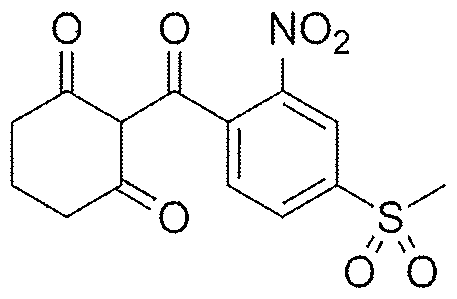
Because mesotrione is a relatively high-melting compound, commercially available blends of these two herbicides are currently of the suspoemulsion type, wherein the metolachlor is present as a liquid, emulsified in water, and the mesotrione is present as a suspended solid. Such formulations are very difficult to develop and tend to be unstable during long-term storage due to the difficulty of keeping the solid and oil phases suspended in the water.
[0005] Emulsifiable concentrates are a type of agricultural formulation in which the active ingredients are dissolved in a suitable solvent, with emulsifiers, such that when the concentrate is added to water an emulsion spontaneously forms. Such formulations are typically easy to manufacture, use, and store. Difficulties arise when an active ingredient is not readily soluble in an agriculturally acceptable solvent. High-melting solids, such as mesotrione, are prone to precipitate from solution at low temperatures. Consequently, there is no emulsifiable concentrate formulation of metolachlor and mesotrione available today. An emulsifiable concentrate formulation of metolachlor and mesotrione, and generally a way to make emulsifiable concentrates of chloroacetamide and HPPD-inhibitor herbicides, is needed.
SUMMARY OF THE INVENTION
[0006] Embodiments described herein include a composition that includes an emulsifiable concentrate of an HPPD inhibitor herbicide, such as mesotrione,
dissolved in an agriculturally acceptable solvent. The agriculturally acceptable solvent is usually a carbonyl containing compound, such as a ketone, ester, amide, organic carbonate, lactam, lactone, or urethane. An example is propylene carbonate. The composition may further include an anilide herbicide, such as metolachlor. In some cases, a co-solvent may also be used.
[0007] Other embodiments described herein include an emulsifiable concentrate herbicide composition with an HPPD inhibitor herbicide such as mesotrione, a chloroacetamide herbicide such as metolachlor, an alkylene carbonate such as propylene carbonate, butylene carbonate, and/or pentene carbonate, and a water immiscible co-solvent.
DETAILED DESCRIPTION
[0008] The inventors have discovered a class of agriculturally suitable solvents that can be used in the preparation of stable emulsifiable concentrates of metolachlor and mesotrione, and are expected to be generally usable for blends of anilide and HPPD inhibitor herbicides. Metolachlor and acetochlor are examples of the chloroacetamide class of anilide herbicides, while mesotrione and tembotrione are examples of HPPD inhibitor herbicides. The agriculturally suitable solvents that can be used in the preparation of stable emulsifiable concentrates of HPPD inhibitor herbicides are typically carbonyl containing liquids with a substantial dipole moment, for example having a dipole moment greater than about 2.5 D. Suitable solvents include alkylene carbonates such as ethylene carbonate, propylene carbonate, butylene carbonate, and pentene carbonate. Other suitable solvents include cyclohexanone, acetophenone, and gamma butyrolactone. The solvents used for the blend formulations described herein are typically not miscible with water, although some water solubility may be tolerated. Thus, small amounts of water soluble solvents such as N-methyl pyrrolidinone, dimethylformamide, and dimethylsulfoxide (DMSO) may be used.
[0009] Although the solvents described herein may be used alone, a co-solvent may also be used. When the primary solvent has some water solubility (for example propylene carbonate) or complete water solubility (for example N- methylpyrrolidinone), a co-solvent having very low water solubility may be used to moderate the water solubility of the primary solvent. The co-solvent, when used, is selected to promote dissolution of the active ingredients in the emulsifiable concentrate. Examples of suitable co-solvents include fatty acid dimethyl amides and fatty acid morpholine amides such as JEFFSOL® AG-1740 and JEFFSOL® AG-1730, available from Huntsman, LLC, of The Woodlands, Texas. Other co- solvents that may be used include aromatic petroleum distillates such as Aromatic 100, Aromatic 150, and Aromatic 200, available from ExxonMobil Chemical Company, of Houston, Texas. The total amount and ratio of the primary solvent and co-solvent in the formulation may vary according to factors such as presence and concentration of other herbicides or active ingredients and the amount of emulsifier employed.
[0010] The solvents described above will dissolve compounds such as mesotrione and tembotrione up to a concentration of about 10 wt% at ambient temperature, which is suitable for most agricultural applications. The solvents and formulations described herein are generally useful at a wide range of ambient conditions. Some formulations are usable at temperatures as low as 0°C (32°F). The desired temperature performance of the formulation depends on ambient conditions where the formulation will be used. Some useful solvents, such as ethylene carbonate, may be solid at ambient conditions. Such solvents may be used, nonetheless, by dissolving or dispersing the herbicide components in a co- solvent and then dissolving the solvent in the resulting liquid mixture.
[0011] Anilide herbicides such as metolachlor may dissolve in the solvents described herein up to a concentration of 50 wt% or more in most cases. An emulsifiable concentrate of an HPPD herbicide and an anilide herbicide may be
made by first dissolving both herbicide components in one or more of the polar solvents described herein, optionally adding a co-solvent, and adding a suitable blend of emulsifiers. Selecting an appropriate emulsifier is well known in the art. The HPPD herbicide, for example mesotrione, tembotrione, or tefuryltrione, may be present up to a concentration of about 10 wt%, such as between about 0.1 wt% and about 10 wt%, such as between about 2.0 wt% and about 5.0 wt%, for example about 4.0 wt%. The anilide herbicide, which may be a chloroacetamide herbicide such as metolachlor or acetochlor, may be present in a concentration between about 0 wt% and about 75 wt%, such as between about 20 wt% and about 60 wt%, for example about 50 wt%.
[0012] The alkylene carbonate solvents usable for the emulsifiable concentrates described herein include ethylene carbonate, propylene carbonate, butylene carbonate, and pentene carbonate. The butylene carbonate may be derived from primary butylene or isobutylene, or a mixture thereof, and the isobutylene carbonate may be cis or trans or any mixture thereof. The pentene carbonate may be derived from primary or isopentene, or any mixture thereof, and the isopentene carbonate may be cis or trans or any mixture thereof. The alkylene carbonate may also be a mixture of propylene, butylene, and/or pentene carbonates. Cyclopentene carbonate and cyclohexene carbonate may also be used, alone or in mixtures with the other carbonates described above.
[0013] For application, the emulsifiable concentrate is typically mixed with water to form an emulsion. A co-solvent may be useful in some cases to prevent or minimize precipitation of one or more active ingredients in the water phase. The co-solvent may be present in a concentration up to about 30%, such as between about 0% and about 25%, for example about 10%.
[0014] HPPD inhibitor herbicides for which compositions described herein may be useful include mesotrione and its benzoylcyclohexanedione variants sulcotrione, tefuryltrione, tembotrione, and ketospiradox. Other triketones, such as
bicyclopyrone and benzobicyclon may be useful HPPD inhibitors usable in the compositions described herein. Other useful benzoyl derivative triketones that may be dissolved by the solvents described herein to form emulsifiable concentrate solutions include 2-(2'-nitro-4'-methylsulphonylbenzoyl)-1 ,3- cyclohexanedione, 2-(2'-nitro-4'-methylsulphonyloxybenzoyl)-1 ,3- cyclohexanedione, 2-(2'-chloro-4'-methylsulphonylbenzoyl)-1 ,3-cyclohexanedione, 4,4-dimethyl-2-(4-methanesulphonyl-2-nitrobenzoyl)-1 ,3-cyclohexanedione, 2-(2- chloro-3-ethoxy-4-methanesulphonylbenzoyl)-5-methyl-1 ,3-cyclohexanedione, and 2-(2-chloro-3-ethoxy-4-ethanesulphonylbenzoyl(-5-methyl-1 ,3-cyclohexanedione.
[0015] Chloracetamide herbicides, also known as chloracetanilide herbicides, that may be used in the formulations described herein have the general formula

[0016] The compositions described herein may also include various adjuvants and/or functional components such as activators, spreaders, safeners, wetters, stickers, builders, extenders, emulsifiers, dispersants, suspension agents, nutrients, fertilizers, compatibility agents, retardants, buffers, penetrants, and translocators. Other active ingredients may also be included to the extent they are
soluble in the solvents described herein and chemically compatible with other components. Concentrations of active ingredients in the solvents described herein may need adjusting to maintain a single-phase emulsifiable concentrate solution in the event other agents are added to the mixture.
[0017] The compositions described herein include a solution of at least about 2.5 wt% of an HPPD inhibitor herbicide dissolved in an agriculturally acceptable solvent. An agriculturally acceptable solvent is a solvent that is accepted for agricultural use by the U.S. Environmental Protection Agency, or is otherwise suitable for agricultural use. Propylene carbonate is accepted by the EPA. The other organic carbonates and other ketone solvents described herein are otherwise generally suitable for agricultural use.
[0018] The solution of HPPD inhibitor herbicide may be used alone, or additional active ingredients may be added. The anilide herbicides described above may be used, and other active ingredients may be used as well. The additional active ingredients may be dissolved in the solution or included as a suspension or emulsion with the solution. A second HPPD inhibitor herbicide may be included, either dissolved in the solution or as a suspension or emulsion, to provide enhanced effectiveness.
[0019] Any herbicides soluble in the carbonyl-containing solvents described above may be used in a blend with the HPPD inhibitor herbicides listed above. Anilide herbicides useful for blending with HPPD inhibitor herbicides in an agriculturally useful composition include metolachlor, acetachlor. Two example formulations of emulsifiable concentrates featuring blends of metolachlor and mesotrione are as follows:
Example 1
Component Weight Percent
Metolachlor, technical 37
Mesotrione, technical 3.7
Propylene carbonate 49.07
Nansa® EVM 70/2E 6.6
Termul® 5500 3.85
Surfonic® L24-22 0.55
Example 2
Component Weight Percent
Metolachlor, technical 37
Mesotrione, technical 3.7
Butylene carbonate 49.07
Nansa® EVM 70/2E 6.6
Termul® 5500 3.85
Surfonic® L24-22 0.55
In the examples above, Nansa EVM 70/2E is a calcium dodecylbenzenesulfonate surfactant dissolved in propylene glycol and 2-ethylhexanol, available from Huntsman, LLC, Termul® 5500 is a butyl-initiated EO/PO block polymer available from Huntsman, LLC, and Surfonic® L24-22 is a nonionic alcohol ethoxylate surfactant available from Huntsman, LLC.
[0020] Other examples are as follows:
Example 3


[0021] While the foregoing is directed to embodiments of the present invention, other and further embodiments of the invention may be devised without departing from the basic scope thereof, and the scope thereof is determined by the claims that follow.
Claims
1. A composition, comprising:
a solution of at least 2.5 wt% of an HPPD inhibitor herbicide dissolved in an agriculturally acceptable solvent that is stable at ambient conditions.
2. The composition of claim 1 , wherein the HPPD inhibitor herbicide is mesotrione.
3. The composition of claim 1 , wherein the agriculturally acceptable solvent is a carbonyl containing solvent.
4. The composition of claim 3, wherein the carbonyl containing solvent is an organic carbonate.
5. The compositon of claim 1 , further comprising a second active ingredient.
6. The composition of claim 5, wherein the second active ingredient is an anilide herbicide.
7. The composition of claim 6, wherein the HPPD inhibitor herbicide is mesotrione.
8. The compositon of claim 7, wherein the anilide herbicide is metolachlor, s- metolachlor, or acetochlor.
9. The composition of claim 8, wherein the agriculturally acceptable solvent is a carbonyl containing solvent.
10. The composition of claim 5, wherein the agriculturally acceptable solvent is an organic carbonate.
1 1. The composition of claim 5, wherein the agriculturally acceptable solvent comprises a compound selected from the group consisting of propylene carbonate and butylene carbonate.
12. The composition of claim 1 1 , further comprising a co-solvent.
13. The composition of claim 12, wherein the co-solvent is immiscible in water.
14. The composition of claim 1 1 , wherein the composition is stable for at least 6 months.
15. An emulsifiable concentrate herbicide composition, comprising:
an HPPD inhibitor herbicide;
a chloranilide herbicide;
an alkylene carbonate; and
a water immiscible co-solvent.
16. The composition of claim 15, wherein the HPPD inhibitor herbicide is mesotrione.
17. The composition of claim 15, wherein the chloranilide herbicide is metolachlor, s-metolachlor, or acetochlor.
18. The composition of claim 15, wherein the alkylene carbonate comprises a compound selected from the group consisting of propylene carbonate and butlyene carbonate.
19. The composition of claim 15, wherein the co-solvent is selected from the group consisting of cyclohexanone, acetophenone, a fatty acid dimethyl amide, a fatty acid morpholine amide, or a combination thereof.
Applications Claiming Priority (2)
| Application Number | Priority Date | Filing Date | Title |
|---|---|---|---|
| US201261684472P | 2012-08-17 | 2012-08-17 | |
| US61/684,472 | 2012-08-17 |
Publications (1)
| Publication Number | Publication Date |
|---|---|
| WO2014028256A1 true WO2014028256A1 (en) | 2014-02-20 |
Family
ID=50101411
Family Applications (1)
| Application Number | Title | Priority Date | Filing Date |
|---|---|---|---|
| PCT/US2013/053578 Ceased WO2014028256A1 (en) | 2012-08-17 | 2013-08-05 | Emulsifiable concetrate formulations of chloroacetamide and hppd inhibitor herbicides |
Country Status (2)
| Country | Link |
|---|---|
| AR (1) | AR092133A1 (en) |
| WO (1) | WO2014028256A1 (en) |
Cited By (2)
| Publication number | Priority date | Publication date | Assignee | Title |
|---|---|---|---|---|
| EP3270691A4 (en) * | 2015-03-18 | 2018-08-29 | Winfield Solutions, LLC | Emulsifiable concentrate liquid compositions and methods |
| WO2023081664A1 (en) * | 2021-11-02 | 2023-05-11 | Corteva Agriscience Llc | Pesticidal compositions and methods |
Citations (4)
| Publication number | Priority date | Publication date | Assignee | Title |
|---|---|---|---|---|
| US20080305953A1 (en) * | 2005-11-29 | 2008-12-11 | Bayer Cropscience Ag | Liquid Formulations Containing Dialkyl Sulfosuccinate And Hydroxyphenylpyruvate Dioxygenase Inhibitors |
| US20110053775A1 (en) * | 2006-07-19 | 2011-03-03 | Syngenta Crop Protection Inc. | Herbicidal composition and method of use thereof |
| US20110065579A1 (en) * | 2008-05-21 | 2011-03-17 | Basf Se | Herbicidal Composition Comprising Glyphosate, Glufosinate or Their Salts |
| US20110143938A1 (en) * | 2008-06-09 | 2011-06-16 | Syngenta Crop Protection, Inc. | Herbicide Composition |
-
2013
- 2013-08-05 WO PCT/US2013/053578 patent/WO2014028256A1/en not_active Ceased
- 2013-08-15 AR ARP130102892A patent/AR092133A1/en unknown
Patent Citations (4)
| Publication number | Priority date | Publication date | Assignee | Title |
|---|---|---|---|---|
| US20080305953A1 (en) * | 2005-11-29 | 2008-12-11 | Bayer Cropscience Ag | Liquid Formulations Containing Dialkyl Sulfosuccinate And Hydroxyphenylpyruvate Dioxygenase Inhibitors |
| US20110053775A1 (en) * | 2006-07-19 | 2011-03-03 | Syngenta Crop Protection Inc. | Herbicidal composition and method of use thereof |
| US20110065579A1 (en) * | 2008-05-21 | 2011-03-17 | Basf Se | Herbicidal Composition Comprising Glyphosate, Glufosinate or Their Salts |
| US20110143938A1 (en) * | 2008-06-09 | 2011-06-16 | Syngenta Crop Protection, Inc. | Herbicide Composition |
Cited By (2)
| Publication number | Priority date | Publication date | Assignee | Title |
|---|---|---|---|---|
| EP3270691A4 (en) * | 2015-03-18 | 2018-08-29 | Winfield Solutions, LLC | Emulsifiable concentrate liquid compositions and methods |
| WO2023081664A1 (en) * | 2021-11-02 | 2023-05-11 | Corteva Agriscience Llc | Pesticidal compositions and methods |
Also Published As
| Publication number | Publication date |
|---|---|
| AR092133A1 (en) | 2015-03-25 |
Similar Documents
| Publication | Publication Date | Title |
|---|---|---|
| BRPI0621268A2 (en) | herbicidal composition | |
| ES2243535T3 (en) | WATERPROOF FORMULATIONS AND PROCEDURE TO PREPARE THE SAME. | |
| BR112015008270B1 (en) | Liquid agrochemical compositions comprising a polymeric thickener and an alcohol-containing solvent system | |
| ES3042297T3 (en) | Agrochemical composition and methods of preparing and using the same | |
| CA2802647C (en) | Agrochemical formulation composition | |
| BR112020024452A2 (en) | HERBICIDAL COMPOSITIONS | |
| BRPI0813975B1 (en) | high temperature stable low temperature herbicide fluroxipyr meptylic ester formulations. | |
| CA2880024A1 (en) | Dispersible herbicidal compositions and methods of use | |
| CA2934681C (en) | Solvent systems for producing pumpable formulations of high active ether sulfates | |
| WO2014028256A1 (en) | Emulsifiable concetrate formulations of chloroacetamide and hppd inhibitor herbicides | |
| US6417211B1 (en) | Isothiazolone concentrates | |
| US10757940B2 (en) | Low toxicity, low odor, low volatility solvent for agricultural chemical formulations | |
| JP5280733B2 (en) | Herbicidal aqueous suspension formulation with reduced phytotoxicity | |
| EP3593637B1 (en) | Plant growth regulator concentrate and use thereof | |
| BR112012022353B1 (en) | Emulsifiable concentrate and agricultural emulsion | |
| JP4974953B2 (en) | Herbicidal composition | |
| CN103025704B (en) | Preparation | |
| SK18232001A3 (en) | Herbicidal emulsifiable concentrate compositions of dinitroaniline and oxyacetamide herbicides | |
| JP2013241346A (en) | Herbicidal aqueous suspension formulation | |
| CA3079265C (en) | Solvents for agricultural applications and pesticide formulations |
Legal Events
| Date | Code | Title | Description |
|---|---|---|---|
| 121 | Ep: the epo has been informed by wipo that ep was designated in this application |
Ref document number: 13829113 Country of ref document: EP Kind code of ref document: A1 |
|
| NENP | Non-entry into the national phase |
Ref country code: DE |
|
| 122 | Ep: pct application non-entry in european phase |
Ref document number: 13829113 Country of ref document: EP Kind code of ref document: A1 |