WO2014021844A1 - Alkyl ether compositions and methods of use - Google Patents
Alkyl ether compositions and methods of use Download PDFInfo
- Publication number
- WO2014021844A1 WO2014021844A1 PCT/US2012/048980 US2012048980W WO2014021844A1 WO 2014021844 A1 WO2014021844 A1 WO 2014021844A1 US 2012048980 W US2012048980 W US 2012048980W WO 2014021844 A1 WO2014021844 A1 WO 2014021844A1
- Authority
- WO
- WIPO (PCT)
- Prior art keywords
- polymer
- xylenyl
- mol
- alkylene
- formula
- Prior art date
- Legal status (The legal status is an assumption and is not a legal conclusion. Google has not performed a legal analysis and makes no representation as to the accuracy of the status listed.)
- Ceased
Links
- 0 CC(C)(CO*OCO*(OC(C)(C)N)=C)N Chemical compound CC(C)(CO*OCO*(OC(C)(C)N)=C)N 0.000 description 4
- DSNHSQKRULAAEI-UHFFFAOYSA-N CCc1ccc(CC)cc1 Chemical compound CCc1ccc(CC)cc1 DSNHSQKRULAAEI-UHFFFAOYSA-N 0.000 description 1
- KVNYFPKFSJIPBJ-UHFFFAOYSA-N CCc1ccccc1CC Chemical compound CCc1ccccc1CC KVNYFPKFSJIPBJ-UHFFFAOYSA-N 0.000 description 1
- QAMOGPSBQOKUOX-UHFFFAOYSA-N NOCCCCOCOCCCCOCON Chemical compound NOCCCCOCOCCCCOCON QAMOGPSBQOKUOX-UHFFFAOYSA-N 0.000 description 1
Classifications
-
- C—CHEMISTRY; METALLURGY
- C08—ORGANIC MACROMOLECULAR COMPOUNDS; THEIR PREPARATION OR CHEMICAL WORKING-UP; COMPOSITIONS BASED THEREON
- C08L—COMPOSITIONS OF MACROMOLECULAR COMPOUNDS
- C08L71/00—Compositions of polyethers obtained by reactions forming an ether link in the main chain; Compositions of derivatives of such polymers
- C08L71/02—Polyalkylene oxides
-
- C—CHEMISTRY; METALLURGY
- C08—ORGANIC MACROMOLECULAR COMPOUNDS; THEIR PREPARATION OR CHEMICAL WORKING-UP; COMPOSITIONS BASED THEREON
- C08G—MACROMOLECULAR COMPOUNDS OBTAINED OTHERWISE THAN BY REACTIONS ONLY INVOLVING UNSATURATED CARBON-TO-CARBON BONDS
- C08G65/00—Macromolecular compounds obtained by reactions forming an ether link in the main chain of the macromolecule
- C08G65/02—Macromolecular compounds obtained by reactions forming an ether link in the main chain of the macromolecule from cyclic ethers by opening of the heterocyclic ring
- C08G65/32—Polymers modified by chemical after-treatment
- C08G65/329—Polymers modified by chemical after-treatment with organic compounds
- C08G65/337—Polymers modified by chemical after-treatment with organic compounds containing other elements
Definitions
- the present technology relates to polymers that are degradable and recyclable and plastic materials that are made from such polymers.
- the present technology provides for a recyclable polymer that includes monomers joined by acid-sensitive -OCH 2 0- linkers that can be cleaved upon exposure to acidic conditions.
- the recyclable polymer having monomers joined by acid-sensitive - OCH 2 0- linkers, can be incorporated into plastic materials such as, for example, food packaging or consumer packaging materials. After the plastic materials have been used by a consumer they can readily be degraded by subjecting the plastic materials to acidic conditions. Upon treatment with acid, the -OCH 2 0- linkers within the polymers are hydrolyzed, the monomers are released, and the plastic materials are thus degraded. The resulting monomers can be recombined with additional acid-sensitive -OCH 2 0- linkers to regenerate the polymer and recycle the plastic materials.
- a polymer including a linker represented by Formula
- R and R are, independently, alkylene, alkenylene, arylene, heteroarylene, or alkylarylalkylene.
- the polymer has a weight average molecular weight of about 500 g/mol to about 2,000,000 g/mol, and m is 1 to 1000.
- R is C 2 -Cio alkylene; and R is a mixture of at least two of p-xylenyl, m- xylenyl, and o-xylenyl.
- a polymer including a linker represented by
- R , R , and R are, independently, alkylene, alkenylene, arylene, heteroarylene,
- the polymer has a weight average molecular weight of about 500 g/mol to about 2,000,000 g/mol. In some
- R , R , or R is a mixture of at least two of p-xylenyl, m-xylenyl, and o- xylenyl.
- R and R are, independently, alkylene, alkenylene, arylene, heteroarylene, or alkylarylalkylene;
- A is hydrogen, alkyl, or -C(0)R 4 ;
- R 4 is hydrogen, alkyl, or phenyl;
- PG la is the polymerization product of a polymerization group PG 1 ; and
- PG 1 is acrylyl, methacrylyl, isocycanyl, styrenyl, epoxyl, vinyl, oxetanyl, DL-lactidyl, or bicyclo[2.2.1]hept-2-enyl.
- the polymer has a weight average molecular weight of about 500 g/mol to about 2,000,000 g/mol; m is 1 to 1000; and q is 1 to 1000.
- R 1 is C 2 - Cio alkylene; and R is a mixture of at least two of p-xylenyl, m-xylenyl, and o-xylenyl.
- R and R are, independently, alkylene, alkenylene, arylene, heteroarylene, or alkylarylalkylene;
- R 5 is hydrogen, CN, alkyl, or phenyl;
- A is hydrogen, alkyl, or -C(0)R 4 ; and
- R 4 is hydrogen, alkyl, or phenyl.
- the polymer has a weight average molecular weight of about 500 g/mol to about 2,000,000 g/mol; m is 1 to 1000; and q
- R is C 2 -Cio alkylene; and R is a mixture of at least two of p-xylenyl, m-xylenyl, and o-xylenyl.
- a method for preparing polymer represented by Formula III includes contacting XCH 2 OR 2 OCH 2 X with HOR ⁇ H, HOR ⁇ A, and a base to form a polymer represented by Formula V contacting the polymer represented by Formula V with a compound represented by PG -L and a base to form a polymer represented by Formula VI: polymerizing PG of the polymer represented by Formula VI to form the polymer represented by Formula III:
- R and R are, independently, alkylene, alkenylene, arylene, heteroarylene, or alkylarylalkylene;
- R 4 is hydrogen, alkyl, or phenyl;
- A is hydrogen, alkyl, or -C(0)R 4 ;
- X is a leaving group;
- PG 1 is a polymerizable group that is acrylyl, methacrylyl, isocycanyl, styrenyl, epoxyl, vinyl, oxetanyl, DL-lactidyl, or bicyclo[2.2.1]hept-2-enyl;
- PG la is the polymerization product of the polymerizable group PG 1 ;
- L is a leaving group;
- m is 1 to
- R is C 2 -Cio alkylene; and R is a mixture of at least two of p-xylenyl, m-xylenyl, and o-xylenyl.
- a method for degrading a polymer includes providing a polymer including a linker represented by Formula I, contacting
- a reference to “a cell” includes a plurality of cells
- a reference to “a molecule” is a reference to one or more molecules.
- Alkyl groups include straight chain, branched chain, or cyclic alkyl groups having 1 to 24 carbons or the number of carbons indicated herein. In some embodiments, an alkyl group has 1 to 16 carbon atoms, 1 to 12 carbons, 1 to 8 carbons or, in some
- 1 to 6, or 1, 2, 3, 4 or 5 carbon atoms examples include straight chain alkyl groups include groups such as methyl, ethyl, n-propyl, n-butyl, n-pentyl, n-hexyl, n-heptyl, and n-octyl groups.
- straight chain alkyl groups include groups such as methyl, ethyl, n-propyl, n-butyl, n-pentyl, n-hexyl, n-heptyl, and n-octyl groups.
- branched alkyl groups include, but are not limited to, isopropyl, iso-butyl, sec-butyl, tert-butyl, neopentyl, isopentyl, and 2,2-dimethylpropyl groups.
- the alkyl groups may be substituted alkyl groups.
- Heteroalkyl groups include alkyl groups, as defined herein, substituted by one or more O, N, or S atoms.
- Cycloalkyl groups are cyclic alkyl groups having 3 to 10 carbon atoms. In some embodiments, the cycloalkyl group has 3 to 7 ring members, whereas in other embodiments the number of ring carbon atoms range from 3 to 5, 3 to 6, or 5, 6 or 7. Cycloalkyl groups further include monocyclic, bicyclic and polycyclic ring systems. Monocyclic groups include, e.g., cyclopropyl, cyclobutyl, cyclopentyl, cyclohexyl, and cycloheptyl groups.
- Bicyclic and polycyclic cycloalkyl groups include bridged or fused rings, such as, but not limited to, bicyclo[3.2.1]octane, decalinyl, and the like.
- Cycloalkyl groups include rings that are substituted with straight or branched chain alkyl groups as defined above.
- the cycloalkyl groups are substituted cycloalkyl groups.
- Representative substituted alkenyl groups may be mono-substituted or substituted more than once, such as, but not limited to, mono-, di- or tri-substituted with substituents such as those listed above.
- Representative substituted alkyl groups may be mono-substituted or substituted more than once, such as, but not limited to, mono-, di- or tri-substituted with substituents such as those listed above.
- Alkenyl groups include straight and branched chain alkyl groups as defined above, except that at least one double bond exists between two carbon atoms.
- alkenyl groups have 2 to 24 carbon atoms, and typically 2 to 10 carbons or, in some embodiments, 2 to 8, 2 to 6, or 2 to 4 carbon atoms. Examples include, but are not limited to vinyl, allyl,
- substituted alkenyl groups may be mono-substituted or substituted more than once, such as, but not limited to, mono-, di- or tri-substituted with substituents such as those listed above.
- alkylene cycloalkylene
- alkenylene arylene
- heteroarylene and “alkylarylalkylene” alone or as part of another substituent means a divalent radical derived from an alkyl, cycloalkyl, alkenyl, aryl, heteroaryl, or alkylarylalkyl group, respectively, as exemplified by -CH 2 CH 2 CH 2 CH 2 -.
- alkylene, cycloalkylene, alkenylene, arylene, heteroarylene, and alkylarylalkylene linking groups no orientation of the linking group is implied.
- amine refers to -NHR and -NRR' groups, where R, and R' are independently hydrogen, or a substituted or unsubstituted alkyl, alkenyl, alkynyl, cycloalkyl, aryl or aralkyl group as defined herein.
- amino groups include NH 2 , methylamino, dimethylamino, ethylamino, diethylamino, propylamino, isopropylamino, phenylamino, benzylamino, and the like.
- oxo refers to a divalent oxygen group. While the term includes doubly bonded oxygen, such as that found in a carbonyl group, as used herein, the term oxo explicitly includes singly bonded oxygen of the form -O- which is part of a polymer backbone. Thus, an oxo group may be part of an ether linkage (-0-), an ester linkage (-0- C(O)-), a carbonate linkage (-O-C(O)O-), a carbamate linkage (-O-C(O)NH- or -O- C(O)NR-), and the like.
- Substituted refers to a chemical group as described herein that further includes one or more substituents, such as lower alkyl (including substituted lower alkyl such as haloalkyl, hydroxyalkyl, aminoalkyl), aryl (including substituted aryl), acyl, halogen, hydroxy, amino, alkoxy, alkylamino, acylamino, thioamido, acyloxy, aryloxy, aryloxyalkyl, carboxy, thiol, sulfide, sulfonyl, oxo, both saturated and unsaturated cyclic hydrocarbons (e.g., cycloalkyl, cycloalkenyl) , cycloheteroalkyls and the like.
- substituents such as lower alkyl (including substituted lower alkyl such as haloalkyl, hydroxyalkyl, aminoalkyl), aryl (including substituted aryl), acyl
- These groups may be attached to any carbon or substituent of the alkyl, alkenyl, alkynyl, aryl, cycloheteroalkyl, alkylene, alkenylene, alkynylene, arylene, heteroarylene, hetero moieties. Additionally, the substituents may be pendent from, or integral to, the carbon chain itself.
- the present technology provides for polymers containing -OCH 2 0- linker moieties that render the polymers chemically stable during commercial use but easily cleaved upon exposure to conditions (e.g., acidic conditions) not typically encountered during commercial use.
- the -OCH 2 0- linker moieties can be combined with various monomers to tune the physical characteristics (e.g., flexibility, hardness, softness, etc.) of the polymer.
- the polymers described herein, having acid-sensitive -OCH 2 0- linkers, are more readily degraded with acid and recycled than polymers made from conventional polymers e.g., those made from PET, polyethylene, or polypropylene.
- the polymers can be incorporated in packaging materials that can be readily degraded to monomeric starting materials following commercial use. Further, the monomeric starting materials that can readily be resynthesized (i.e., recycled) into the polymers described herein. Packaging made from the polymers described herein is cost effective, convenient, and light weight.
- the polymers described herein can be used to make packaging, containers, and plastic goods for any application.
- the polymers described herein can be used in wide variety of plastics for any application such as food, beverage, or consumer packaging, sport drink bottles, freeze vacuum containers, shipping cartons, bags, optical lenses, utensils, plates, toys, furniture coatings, automobile plastic components, fiberglass, cookware, plastic utensils, computers (e.g., tablets, laptops, netbooks) computer components, medical implants, mobile electronics, phones, calculators, paneling, coatings, fibers, insulation, seats, tables, shelves, table tops, counters, caulking and the like.
- the polymers described herein can also be used in aviation components.
- the polymers include a -OCH 2 0- group. This group may be incorporated into a linker represented by Formula I:
- R and R are, independently, alkylene, alkenylene, arylene, heteroarylene, or alkylarylalkylene; the polymer has a weight average molecular weight of about 500 g/mol to about 2,000,000 g/mol, and m is 1 to 1000.
- R and R are groups that are joined by the -OCH 2 0- moieties.
- Each R and R group can be selected to tune the physical characteristics (e.g., flexibility, hardness, softness, etc.) of the polymer to accommodate the intended application (e.g., food packaging, consumer packaging, etc.) for the polymer.
- the intended application e.g., food packaging, consumer packaging, etc.
- R 1 may be alkylene in Formula I. In some embodiments, R 1 is
- R 1 is (CH 2 ) 2 ; (CH 2 ) 4 ; (CH 2 ) 6 ; or (CH 2 ) 8 .
- R 1 is (CH 2 ) 4 .
- R 1 may be alkenylene.
- R 1 is C 2 -Cio alkenylene.
- R 1 is vinylene or allylene.
- R 1 may be arylene.
- R 1 is phenylene, biphenylene, anthracenlyene, or naphthalenylene.
- R 1 may
- R may be alkylene in Formula I.
- R is C 2 -Cio alkylene.
- R is (CH 2 ) 2 ; (CH 2 ) 4 ; (CH 2 ) 6 ; or (CH 2 ) 8 .
- R is (CH 2 ) 4 .
- R may be alkenylene.
- R is C 2 -Cio
- R is vinylene or allylene.
- R may be arylene.
- R is phenylene, biphenylene, anthracenlyene, or naphthalenylene. R may also be alkylarylalkylene. In some embodiments, R is p-xylenyl, m-xylenyl, or o-xylenyl. 1 2
- each R and R can independently be a mixture of groups.
- each R and R can independently be a mixture of at least two of p-xylenyl, m- xylenyl, and o-xylenyl, where p-xylenyl groups, for example, can add rigidity to the polymer, whereas m-xylenyl groups, for example, can decrease the rigidity of the polymer.
- R is C 2 -Cio alkylene; and R is a mixture of at least two of p-xylenyl, m-xylenyl, and o-xylenyl. In some embodiments, R is a mixture of p- xylenyl and m-xylenyl having a p-xylenyl :m-xylenyl ratio of about 2: 1 to about 20: 1.
- R is a mixture of p-xylenyl and m-xylenyl having a p-xylenyl :m-xylenyl ratio of about 5 : 1 , 10: 1 , or 15 : 1. In some embodiments, R is a mixture of p-xylenyl and o- xylenyl having a p-xylenyl:o-xylenyl ratio of about 2: 1 to about 20: 1.
- R is a mixture of p-xylenyl and o-xylenyl having a p-xylenyl:o-xylenyl ratio of about 5 : 1 , 10: 1 , or 15 : 1.
- the polymers of Formula I have a weight average molecular weight (Mw) of about 500 g/mol to about 2,000,000 g/mol. This may include an Mw of about 500 g/mol to about 500,000 g/mol, about 500 g/mol to about 100,000 g/mol, about 500 g/mol to about 50,000 g/mol, or about 500 g/mol to about 10,000 g/mol.
- Mw weight average molecular weight
- Mw examples include about 500 g/mol, about 1 ,000 g/mol, about 5,000 g/mol, about 10,000 g/mol, about 20,000 g/mol, about 30,000 g/mol, about 40,000 g/mol, about 50,000 g/mol, about 60,000 g/mol, about 70,000 g/mol, about 80,000 g/mol, about 90,000 g/mol, about 100,000 g/mol, about 200,000 g/mol, about 250,000 g/mol, about 500,000 g/mol, about 750,000 g/mol, about 1 ,000,000 g/mol, about 2,000,000 g/mol, and ranges between any two of these values.
- m in Formula I is 1 to 1 ,000, 1 to 500, 1 to 250, 1 to
- m 100, 1 to 50, or 1 to 10.
- Specific examples of m include 1 , 2, 3, 4, 5, 6, 7, 8, 9, 10, 15, 20, 25, 30, 35, 40, 45, 50, 60, 70, 80 90, 100, 200, 250, 300, 400, 500, 750, 1 ,000, and ranges between any two of these values.
- a polymer where the polymer includes a linker represented by Formula II: 1 2 3
- R , R , and R are, independently, alkylene, alkenylene, arylene, heteroarylene,
- R and R are different; the polymer has a weight average molecular weight of about 500 g/mol to about 2,000,000 g/mol, and m is 1 to 1000.
- R 1 may be alkylene. In some embodiments, R 1 is C 2 -Cio alkylene. In some embodiments, R 1 is (CH 2 ) 2 ; (CH 2 ) 4 ; (CH 2 ) 6 ; or (CH 2 ) 8 . In some embodiments, R 1 is (CH 2 ) 4 . R 1 may be alkenylene. In some embodiments, R 1 is C 2 -Cio alkenylene. In some embodiments, R 1 is vinylene or allylene. R 1 may be arylene. In some embodiments, R 1 is phenylene, biphenylene, anthracenlyene, or naphthalenylene. R 1 may also be alkylarylalkylene. In some embodiments, R 1 is p-xylenyl, m-xylenyl, or o-xylenyl.
- R may be alkylene in Formula II.
- R is C 2 -Cio alkylene.
- R is (CH 2 ) 2 ; (CH 2 ) 4 ; (CH 2 ) 6 ; or (CH 2 ) 8 .
- R is (CH 2 ) 4 .
- R may be alkenylene.
- R is C 2 -Cio
- R is vinylene or allylene.
- R may be arylene.
- R is phenylene, biphenylene, anthracenlyene, or naphthalenylene. R may also be alkylarylalkylene. In some embodiments, R is p-xylenyl, m-xylenyl, or o-xylenyl.
- R may be alkylene in Formula II.
- R is C 2 -Cio alkylene.
- R J is (CH 2 ) 2 ; (CH 2 ) 4 ; (CH 2 ) 6 ; or (CH 2 ) 8 .
- R is (CH 2 ) 4 .
- R may be alkenylene.
- R is C 2 -Cio
- R is vinylene or allylene.
- R may be arylene.
- R is phenylene, biphenylene, anthracenlyene, or naphthalenylene. R may also be alkylarylalkylene. In some embodiments, R is p-xylenyl, m-xylenyl, or o-xylenyl.
- R 1 , R2 , or R 3 is a mixture of at least two of p-xylenyl, m-xylenyl, and o-xylenyl.
- the polymer has a weight average molecular weight
- Mw examples include about 500 g/mol, about 1,000 g/mol, about 5,000 g/mol, about 10,000 g/mol, about 20,000 g/mol, about 30,000 g/mol, about 40,000 g/mol, about 50,000 g/mol, about 60,000 g/mol, about 70,000 g/mol, about 80,000 g/mol, about 90,000 g/mol, about 100,000 g/mol, about 200,000 g/mol, about 250,000 g/mol, about 500,000 g/mol, about 750,000 g/mol, about 1,000,000 g/mol, and ranges between any two of these values.
- m is 1 to 500, 1 to 250, 1 to 100, 1 to 50, or 1 to 10.
- Specific examples of m include 1, 2, 3, 4, 5, 6, 7, 8, 9, 10, 15, 20, 25, 30, 35, 40, 45, 50, 60, 70, 80 90, 100, 200, 300, 400, 500, and ranges between any two of these values.
- R and R are alkylene; and R is alkylarylalkylene.
- R and R are alkylarylalkylene; and R is alkylene.
- each alkylarylalkylene is a mixture of at least two of p-xylenyl, m-xylenyl, and o-xylenyl.
- each alkylarylalkylene is, independently, a mixture of p-xylenyl and m-xylenyl having a p-xylenyl :m-xylenyl ratio of about 2: 1 to about 20:1. In some embodiments, each alkylarylalkylene is, independently, a mixture of p-xylenyl and o- xylenyl having a p-xylenyl:o-xylenyl ratio of about 2: 1 to about 20: 1. In some embodiments, each alkylene is Ci-Cio alkylene. In some embodiments, each alkylene is (CH 2 )2; (CH 2 )4; (CH 2 ) 6 ; or (CH 2 ) 8 .
- linkers described above may be the entire, stand-alone polymer, or the linker may be incorporated into other polymers.
- the polymer may be represented by Formula III:
- R and R are, independently, alkylene, alkenylene, arylene, heteroarylene, or alkylarylalkylene;
- A is hydrogen, alkyl, or -C(0)R 4 ;
- R 4 is hydrogen, alkyl, or phenyl;
- PG la is the polymerization product of a polymerization group PG 1 ;
- PG 1 is acrylyl, methacrylyl, isocycanyl, styrenyl, epoxyl, vinyl, oxetanyl, DL-lactidyl, or bicyclo[2.2.1]hept-2-enyl;
- the polymer has a weight average molecular weight of about 500 g/mol to about 2,000,000 g/mol;
- m is 1 to 1000; and
- q is 1 to 1000.
- R 1 may be alkylene. In some embodiments, R 1 is C 2 -Cio alkylene. In some embodiments, R 1 is (CH 2 ) 2 ; (CH 2 ) 4 ; (CH 2 ) 6 ; or (CH 2 ) 8 . In some embodiments, R 1 is (CH 2 ) 4 . R 1 may be alkenylene. In some embodiments, R 1 is C 2 -Cio alkenylene. In some embodiments, R 1 is vinylene or allylene. R 1 may be arylene. In some embodiments, R 1 is phenylene, biphenylene, anthracenlyene, or naphthalenylene. R 1 may also be alkylarylalkylene. In some embodiments, R 1 is p-xylenyl, m-xylenyl, or o-xylenyl.
- R may be alky lene in Formula III.
- R is C 2 -Cio alky lene.
- R is (CH 2 ) 2 ; (CH 2 ) 4 ; (CH 2 ) 6 ; or (CH 2 ) 8 .
- R is (CH 2 ) 4 .
- R may be alkenylene.
- R is C 2 -Cio
- R is vinylene or allylene.
- R may be arylene.
- R is phenylene, biphenylene, anthracenlyene, or naphthalenylene. R may also be alkylarylalkylene. In some embodiments, R is p-xylenyl, m-xylenyl, or o-xylenyl.
- the polymer has a Mw of about 500 g/mol to about
- Mw of about 500 g/mol to about 500,000, about 500 g/mol to about 100,000, about 500 g/mol to about 50,000, or about 500 g/mol to about 10,000.
- Mw include about 500 g/mol, about 1,000 g/mol, about 5,000 g/mol, about 10,000 g/mol, about 20,000 g/mol, about 30,000 g/mol, about 40,000 g/mol, about 50,000 g/mol, about 60,000 g/mol, about 70,000 g/mol, about 80,000 g/mol, about 90,000 g/mol, about 100,000 g/mol, about 200,000 g/mol, about 250,000 g/mol, about 500,000 g/mol, about 750,000 g/mol, about 1,000,000 g/mol, about 2,000,000, and ranges between any two of these values.
- m is 1 to 500, 1 to 250, 1 to 100, 1 to 50, or 1 to 10.
- Specific examples of m include 1, 2, 3, 4, 5, 6, 7, 8, 9, 10, 15, 20, 25, 30, 35, 40, 45, 50, 60, 70, 80 90, 100, 200, 250, 300, 400, 500, 750, 1,000,000, and ranges between any two of these values.
- Specific examples of q include 1, 2, 3, 4, 5, 6, 7, 8, 9, 10, 15, 20, 25, 30, 35, 40, 45, 50, 100, 200, 300, 400, 500, 600, 700, 800, 900, 1,000, and ranges between any two of these values.
- R and R are, inde endently, alkylene, alkenylene, arylene, heteroarylene, or alkylarylalkylene;
- R 5 is hydrogen, CN, alkyl, or phenyl;
- A is hydrogen, alkyl, or -C(0)R 4 ;
- R 4 is hydrogen, alkyl, or phenyl; the polymer has a weight average molecular weight of about 500 g/mol to about 2,000,000 g/mol; m is 1 to 1000; and q is 1 to 1000.
- R 1 may be alkylene. In some embodiments, R 1 is C 2 -C 1 0 alkylene. In some embodiments, R 1 is (CH 2 ) 2 ; (CH 2 ) 4 ; (CH 2 ) 6 ; or (CH 2 ) 8 . In some embodiments, R 1 is (CH 2 ) 4 . R 1 may be alkenylene. In some embodiments, R 1 is C 2 -Cio alkenylene. In some embodiments, R 1 is vinylene or allylene. R 1 may be arylene. In some embodiments, R 1 is phenylene, biphenylene, anthracenlyene, or naphthalenylene. R 1 may also be alkylarylalkylene. In some embodiments, R 1 is p-xylenyl, m-xylenyl, or o-xylenyl.
- R may be alkylene in Formula IV.
- R is C 2 -Cio alkylene.
- R is (CH 2 ) 2 ; (CH 2 ) 4 ; (CH 2 ) 6 ; or (CH 2 ) 8 .
- R is (CH 2 ) 4 .
- R may be alkenylene.
- R is C 2 -Cio
- R is vinylene or allylene.
- R may be arylene.
- R is phenylene, biphenylene, anthracenlyene, or naphthalenylene. R may also be alkylarylalkylene. In some embodiments, R is p-xylenyl, m-xylenyl, or o-xylenyl.
- the polymer has a weight average molecular weight
- Mw examples include about 500 g/mol, about 1,000 g/mol, about 5,000 g/mol, about 10,000 g/mol, about 20,000 g/mol, about 30,000 g/mol, about 40,000 g/mol, about 50,000 g/mol, about 60,000 g/mol, about 70,000 g/mol, about 80,000 g/mol, about 90,000 g/mol, about 100,000 g/mol, about 200,000 g/mol, about 250,000 g/mol, about 500,000 g/mol, about 750,000 g/mol, about 1,000,000 g/mol, about 2,000,000, and ranges between any two of these values. In some embodiments, m is 1 to 50.
- m is 1 to 40, 1 to 30, 1 to 20, 1 to 10, 1 to 5. Specific examples of m include 1, 2, 3, 4, 5, 6, 7, 8, 9, 10, 15, 20, 25, 30, 35, 40, 45, 50, 60, 70, 80 90, 100, 200, 250, 300, 400, 500, 750, 1,000,000, and ranges between any two of these values.
- q is 1 to 50. In some embodiments, q is 1 to 40, 1 to 30, 1 to 20, 1 to 10, or 1 to 5. Specific examples of q include 1, 2, 3, 4, 5, 6, 7, 8, 9, 10, 15, 20, 25, 30, 35, 40, 45, 50, 100, 200, 300, 400, 500, 600, 700, 800, 900, 1,000, and ranges between any two of these values.
- R 1 is (CH 2 ) 2 ; (CH 2 ) 4 ; (CH 2 ) 6 ; or (CH 2 ) 8 ; and R 2 is a mixture of at least two of p-xylenyl, m-xylenyl, and o-xylenyl.
- the above polymers are amenable to forming into a wide variety of articles as introduced above.
- the polymers may be formed into articles using techniques such as blowing, compaction molding, compression molding, injection molding, extrusion, rotomolding, vacuum molding, thermoforming, and the like as are known in the art.
- a method is provided of preparing polymer represented by Formula III where the method includes: contacting XCH 2 OR OCH 2 X with HOR ⁇ H, HOR ⁇ A, and a base to form a polymer represented by Formula V contacting the polymer represented by Formula V with a compound represented by PG -L and a base to form a polymer represented by Formula VI:
- R and R are, independently, alkylene, alkenylene, arylene, heteroarylene, or alkylarylalkylene;
- A is hydrogen, alkyl, or C(0)R 4 ;
- R 4 is hydrogen, alkyl, or phenyl;
- X is a leaving group;
- PG 1 is a polymerizable group selected from the group consisting of acrylyl, methacrylyl, isocycanyl, styrenyl, epoxyl, vinyl, oxetanyl, DL-lactidyl, and bicyclo[2.2.1]hept-2-enyl;
- PG la is the polymerization product of the polymerizable group PG 1 ;
- L is a leaving group;
- R 1 may be alkylene. In some embodiments, R 1 is C 2 -Cio alkylene. In some embodiments, R 1 is (CH 2 ) 2 ; (CH 2 ) 4 ; (CH 2 ) 6 ; or (CH 2 ) 8 . In some embodiments, R 1 is (CH 2 ) 4 . R 1 may be alkenylene. In some embodiments, R 1 is C 2 -Cio alkenylene. In some embodiments, R 1 is vinylene or allylene. R 1 may be arylene. In some embodiments, R 1 is phenylene, biphenylene, anthracenlyene, or naphthalenylene. R 1 may also be alkylarylalkylene. In some embodiments, R 1 is p-xylenyl, m-xylenyl, or o-xylenyl.
- R may be alkylene in Formula III.
- R is C 2 -Cio alkylene.
- R is (CH 2 ) 2 ; (CH 2 ) 4 ; (CH 2 ) 6 ; or (CH 2 ) 8 .
- R is (CH 2 ) 4 .
- R may be alkenylene.
- R is C 2 -Cio
- R is vinylene or allylene.
- R may be arylene.
- R is phenylene, biphenylene, anthracenlyene, or naphthalenylene. R may also be alkylarylalkylene. In some embodiments, R is p-xylenyl, m-xylenyl, or o-xylenyl.
- the polymer has a weight average molecular weight
- Mw examples include about 500 g/mol, about 1 ,000 g/mol, about 5,000 g/mol, about 10,000 g/mol, about 20,000 g/mol, about 30,000 g/mol, about 40,000 g/mol, about 50,000 g/mol, about 60,000 g/mol, about 70,000 g/mol, about 80,000 g/mol, about 90,000 g/mol, about 100,000 g/mol, about 200,000 g/mol, about 250,000 g/mol, about 500,000 g/mol, about 750,000 g/mol, about 1,000,000 g/mol, about 2,000,000, and ranges between any two of these values.
- the polymer represented by Formula III is a polymer represented by Formula IV:
- R 5 is hydrogen, CN, alkyl, or phenyl.
- the method further includes forming XCH 2 OR OCH 2 X by contacting R 66 OOCCHH 22 OORR 22 OOCCHH 22 OORR 66 wwiitthh HHXX,, wwhheerree RR 66 iiss a alkyl.
- R 6 is methyl, ethyl, propyl, butyl, pentyl, hexyl, heptyl, or octyl
- X and L are both CI.
- the base is a tertiary amine, secondary amine, pyridine, or a carbonate salt.
- the base is morpholine, N-methylmorpholine, piperidine, N-methypiperidine, piperazine, N-methylpiperazine, N,N-dimethylpiperazine, triethylamine, diisopropylethylamine, or pyridine.
- a method for degrading any of the above polymers including providing the polymer, contacting the polymer with acid, and obtaining a composition including alcohol degradation products.
- the alcohol degradation products will include HOR ⁇ OH and HOR OH.
- the polymer includes a further polymeric moiety or polymerizable group, such as those represented in Formulas III, IV, and VI, the degradation products will include the polymer fragments as well as the alcohol degradation products.
- the acid degradation provides again the starting materials for the polymerization.
- the segments of the polymer which include R 1 and R the regeneration of the starting materials is realized. These materials may then be used to make other polymers.
- the above polymers provide at least one advantage over other recycled plastics and polymers, that advantage being that the recycled (actually re -polymerized) polymers are the same as the original polymers.
- Other recycled plastics typically grinder the polymers into smaller fragments, then treat the terminal groups to link together the smaller fragments and oligomers.
- the present "recycled" polymers are to be completely reconstructed from the original starting materials that are recovered from the degradation process.
- Illustrative acids for use in the methods of degrading include, but are not limited to, HCl, HBr, H 2 S0 4 , acetic acid, trifluoroacetic acid, phosphoric acid, nitric acid, and combinations thereof.
- the acid may be added as the neat acid to the polymer or as a diluted solution such as an aqueous solution.
- Such an aqueous acid solution can have any pH of less than 7.0.
- Representative pH values for the acidic solution that is added to the polymer may be ⁇ 6.0, ⁇ 5.0, ⁇ 4.0, ⁇ 3.0, ⁇ 2.0, or ⁇ 1.0.
- the temperature of the degradation will impact the rate at which the degradation occurs. Accordingly, a wide range of temperatures may be employed.
- the contacting may be conducted at a temperature of about 20°C to about 200°C. This will include temperatures of about 20°C to about 150°C, or about 20°C to about 100°C, or about 20°C to about 50°C. In some embodiments, the contacting is conducted at room temperature.
- Polymer 1.1 Butane- 1,4-diol (1 mmol) and 1 ,4-bis(chloromethoxy)butane (1 mmol) are combined in DMF (10 mL) with piperidine (2.5 mmol) and stirred 1 hour at 60°C. Polymer 1.1 precipitates from solution and is washed with dilute aqueous HCl (0.1M), aqueous NaHC0 3 , and water. Polymer 1.1 is expected to be softer and more flexible than polymers 1.2 and 1.3, described below. The softness, hardness, and flexibility of these polymers can be measured according to protocols known in the art, such as ASTM D4145-10 Standard Test Method for Coating Flexibility of Prepainted Sheet, ASTM D 1004-09
- Polymer 1.2 Ethane- 1,2-diol (1 mmol) and 1 ,4-bis((chloromethoxy)methyl) benzene (1 mmol) are combined in DMF (10 mL) with piperidine (2.5 mmol) and stirred 1 hour at 60°C. Polymer 1.2 precipitates from solution and is washed with dilute aqueous HCl (0.1M), aqueous NaHC0 3 , and water. Polymer 1.2 is expected to be harder and more rigid than polymers 1.1 and 1.3.
- Polymer 1.3 Ethane- 1,2-diol (1 mmol), 1,3- bis((chloromethoxy)methyl)benzene (0.1 mmol), and 1,4- bis((chloromethoxy)methyl)benzene (1 mmol) are combined in DMF (10 mL) with piperidine (2.5 mmol) and stirred 1 hour at 60°C. Polymer 1.3 precipitates from solution and is washed with dilute aqueous HCl (0.1M), aqueous NaHC0 3 , and water. Polymer 1.3 is expected to be harder and more rigid than polymers 1.1 but softer and more flexible than polymer 1.2.
- Example 2 Degradation of representative polymers.
- Polymer 1.1 is treated with CH 2 CI 2 and gaseous HCl and stirred 3 hours.
- the reaction mixture is concentrated and the crude butane- 1,4-diol can be used directly in example 3 without further treatment or purification.
- Example 3 Recycling of representative polymers.
- Polymer 1.1 is "recycled” by bubbling HCl gas into a mixture of crude butane -
- the polymers described herein such as those of Examples 1 and 2, have acid- sensitive -OCH 2 O- linkers, are more readily degraded with acid than conventional polymers e.g., those made from PET, polyethylene, or polypropylene.
- conventional polymers e.g., those made from PET, polyethylene, or polypropylene.
- the polymers described herein, such as those of Example 3 are also more easily recycled than conventional polymers.
Landscapes
- Chemical & Material Sciences (AREA)
- Health & Medical Sciences (AREA)
- Chemical Kinetics & Catalysis (AREA)
- Medicinal Chemistry (AREA)
- Polymers & Plastics (AREA)
- Organic Chemistry (AREA)
- General Chemical & Material Sciences (AREA)
- Addition Polymer Or Copolymer, Post-Treatments, Or Chemical Modifications (AREA)
Description
ALKYL ETHER COMPOSITIONS AND METHODS OF USE
FIELD
[0001] The present technology relates to polymers that are degradable and recyclable and plastic materials that are made from such polymers.
BACKGROUND
[0002] The following description is provided to assist the understanding of the reader.
None of the information provided or references cited is admitted to be prior art to the present technology.
[0003] Commercially relevant packaging materials are constantly evolving to meet consumer demand for improved products by combining numerous physical characteristics, such as flexibility, light weight, or strength into such packaging materials. Unfortunately, despite improvements in product performance, most of these commercially relevant packaging materials remain difficult or impractical to recycle. Unless it is biodegradable, the discarded packaging materials accumulate in landfills and waterways, where they may eventually harm ecosystems and wildlife. Consequently, the food packaging industry is seeking packaging materials that satisfy the evolving demands of consumers, yet can be more readily degraded and recycled.
SUMMARY
[0004] The present technology provides for a recyclable polymer that includes monomers joined by acid-sensitive -OCH20- linkers that can be cleaved upon exposure to acidic conditions. The recyclable polymer, having monomers joined by acid-sensitive - OCH20- linkers, can be incorporated into plastic materials such as, for example, food packaging or consumer packaging materials. After the plastic materials have been used by a consumer they can readily be degraded by subjecting the plastic materials to acidic conditions. Upon treatment with acid, the -OCH20- linkers within the polymers are hydrolyzed, the monomers are released, and the plastic materials are thus degraded. The resulting monomers can be recombined with additional acid-sensitive -OCH20- linkers to regenerate the polymer and recycle the plastic materials.
[0005] In one aspect a polymer is provided including a linker represented by Formula
I:

1 2
In Formula I, R and R are, independently, alkylene, alkenylene, arylene, heteroarylene, or alkylarylalkylene. In some embodiments, the polymer has a weight average molecular weight of about 500 g/mol to about 2,000,000 g/mol, and m is 1 to 1000. In some
1 2
embodiments, R is C2-Cio alkylene; and R is a mixture of at least two of p-xylenyl, m- xylenyl, and o-xylenyl.
[0006] In another aspect a polymer is provided including a linker represented by
Formula II:

1 2 3
In Formula II, R , R , and R are, independently, alkylene, alkenylene, arylene, heteroarylene,
1 3
or alkylarylalkylene; and R and R are different. In some embodiments, the polymer has a weight average molecular weight of about 500 g/mol to about 2,000,000 g/mol. In some
1 2 3
embodiments, R , R , or R is a mixture of at least two of p-xylenyl, m-xylenyl, and o- xylenyl.
In another aspect a polymer is provided, the polymer represented by Formula

1 2
In Formula III, R and R are, independently, alkylene, alkenylene, arylene, heteroarylene, or alkylarylalkylene; A is hydrogen, alkyl, or -C(0)R4; R4 is hydrogen, alkyl, or phenyl; PGla is the polymerization product of a polymerization group PG1; and PG1 is acrylyl, methacrylyl,
isocycanyl, styrenyl, epoxyl, vinyl, oxetanyl, DL-lactidyl, or bicyclo[2.2.1]hept-2-enyl. In some embodiments, the polymer has a weight average molecular weight of about 500 g/mol to about 2,000,000 g/mol; m is 1 to 1000; and q is 1 to 1000. In some embodiments, R1 is C2- Cio alkylene; and R is a mixture of at least two of p-xylenyl, m-xylenyl, and o-xylenyl.
[0008] In another aspect a polymer is provided, where the polymer is represented by
Formula IV:

1 2
In Formula IV, R and R are, independently, alkylene, alkenylene, arylene, heteroarylene, or alkylarylalkylene; R5 is hydrogen, CN, alkyl, or phenyl; A is hydrogen, alkyl, or -C(0)R4; and R4 is hydrogen, alkyl, or phenyl. In some embodiments, the polymer has a weight average molecular weight of about 500 g/mol to about 2,000,000 g/mol; m is 1 to 1000; and q
1 2
is 1 to 1000. In some embodiments, R is C2-Cio alkylene; and R is a mixture of at least two of p-xylenyl, m-xylenyl, and o-xylenyl.
[0009] A method is provided for preparing polymer represented by Formula III. The method includes contacting XCH2OR2OCH2X with HOR^H, HOR^A, and a base to form a polymer represented by Formula V
 contacting the polymer represented by Formula V with a compound represented by PG -L and a base to form a polymer represented by Formula VI:
 polymerizing PG of the polymer represented by Formula VI to form the polymer represented by Formula III:

1 2
In Formulae III, V, and VI, R and R are, independently, alkylene, alkenylene, arylene, heteroarylene, or alkylarylalkylene; R4 is hydrogen, alkyl, or phenyl; A is hydrogen, alkyl, or -C(0)R4; X is a leaving group; PG1 is a polymerizable group that is acrylyl, methacrylyl, isocycanyl, styrenyl, epoxyl, vinyl, oxetanyl, DL-lactidyl, or bicyclo[2.2.1]hept-2-enyl; PGla is the polymerization product of the polymerizable group PG1; L is a leaving group; m is 1 to
1 2
1000; and q is 1 to 1000. In some embodiments, R is C2-Cio alkylene; and R is a mixture of at least two of p-xylenyl, m-xylenyl, and o-xylenyl.
[0010] In another aspect, a method is provided for degrading a polymer, where the method includes providing a polymer including a linker represented by Formula I, contacting
1 2 the polymer with acid; and obtaining a composition including HOR OH and HOR OH.

[001 1] The foregoing summary is illustrative only and is not intended to be in any way limiting. In addition to the illustrative aspects, embodiments and features described above, further aspects, embodiments and features will become apparent by reference to the following drawings and the detailed description.
DETAILED DESCRIPTION
[0012] The illustrative embodiments described in the detailed description and claims are not meant to be limiting. Other embodiments may be utilized, and other changes may be made, without departing from the spirit or scope of the subject matter presented here.
[0013] The present technology is described herein using several definitions, as set forth throughout the specification.
[0014] As used herein, unless otherwise stated, the singular forms "a," "an," and
"the" include plural reference. Thus, for example, a reference to "a cell" includes a plurality of cells, and a reference to "a molecule" is a reference to one or more molecules.
[0015] As used herein, "about" will be understood by persons of ordinary skill in the art and will vary to some extent depending upon the context in which it is used. If there are uses of the term which are not clear to persons of ordinary skill in the art, given the context in which it is used, "about" will mean up to plus or minus 10% of the particular term.
[0016] Alkyl groups include straight chain, branched chain, or cyclic alkyl groups having 1 to 24 carbons or the number of carbons indicated herein. In some embodiments, an alkyl group has 1 to 16 carbon atoms, 1 to 12 carbons, 1 to 8 carbons or, in some
embodiments, 1 to 6, or 1, 2, 3, 4 or 5 carbon atoms. Examples of straight chain alkyl groups include groups such as methyl, ethyl, n-propyl, n-butyl, n-pentyl, n-hexyl, n-heptyl, and n-octyl groups. Examples of branched alkyl groups include, but are not limited to, isopropyl, iso-butyl, sec-butyl, tert-butyl, neopentyl, isopentyl, and 2,2-dimethylpropyl groups. In some embodiments, the alkyl groups may be substituted alkyl groups.
[0017] Heteroalkyl groups include alkyl groups, as defined herein, substituted by one or more O, N, or S atoms.
[0018] Cycloalkyl groups are cyclic alkyl groups having 3 to 10 carbon atoms. In some embodiments, the cycloalkyl group has 3 to 7 ring members, whereas in other embodiments the number of ring carbon atoms range from 3 to 5, 3 to 6, or 5, 6 or 7. Cycloalkyl groups further include monocyclic, bicyclic and polycyclic ring systems. Monocyclic groups include, e.g., cyclopropyl, cyclobutyl, cyclopentyl, cyclohexyl, and cycloheptyl groups. Bicyclic and polycyclic cycloalkyl groups include bridged or fused rings, such as, but not limited to, bicyclo[3.2.1]octane, decalinyl, and the like. Cycloalkyl groups include rings that are substituted with straight or branched chain alkyl groups as defined above. In some
embodiments, the cycloalkyl groups are substituted cycloalkyl groups. Representative substituted alkenyl groups may be mono-substituted or substituted more than once, such as, but not limited to, mono-, di- or tri-substituted with substituents such as those listed above.
Representative substituted alkyl groups may be mono-substituted or substituted more than once, such as, but not limited to, mono-, di- or tri-substituted with substituents such as those listed above.
[0019] Alkenyl groups include straight and branched chain alkyl groups as defined above, except that at least one double bond exists between two carbon atoms. Thus, alkenyl groups have 2 to 24 carbon atoms, and typically 2 to 10 carbons or, in some embodiments, 2 to 8, 2 to 6, or 2 to 4 carbon atoms. Examples include, but are not limited to vinyl, allyl,
-CH=CH(CH3), -CH=C(CH3)2, -C(CH3)=CH2, -C(CH3)=CH(CH3), -C(CH2CH3)=CH2, among others. Representative substituted alkenyl groups may be mono-substituted or substituted more than once, such as, but not limited to, mono-, di- or tri-substituted with substituents such as those listed above.
[0020] The terms "alkylene," "cycloalkylene," "alkenylene," "arylene,"
"heteroarylene," and "alkylarylalkylene" alone or as part of another substituent means a divalent radical derived from an alkyl, cycloalkyl, alkenyl, aryl, heteroaryl, or alkylarylalkyl group, respectively, as exemplified by -CH2CH2CH2CH2-. For alkylene, cycloalkylene, alkenylene, arylene, heteroarylene, and alkylarylalkylene linking groups, no orientation of the linking group is implied.
[0021] The term "amine" (or "amino") as used herein refers to -NHR and -NRR' groups, where R, and R' are independently hydrogen, or a substituted or unsubstituted alkyl, alkenyl, alkynyl, cycloalkyl, aryl or aralkyl group as defined herein. Examples of amino groups include NH2, methylamino, dimethylamino, ethylamino, diethylamino, propylamino, isopropylamino, phenylamino, benzylamino, and the like.
[0022] The term "oxo" refers to a divalent oxygen group. While the term includes doubly bonded oxygen, such as that found in a carbonyl group, as used herein, the term oxo explicitly includes singly bonded oxygen of the form -O- which is part of a polymer backbone. Thus, an oxo group may be part of an ether linkage (-0-), an ester linkage (-0- C(O)-), a carbonate linkage (-O-C(O)O-), a carbamate linkage (-O-C(O)NH- or -O- C(O)NR-), and the like.
[0023] "Substituted" refers to a chemical group as described herein that further includes one or more substituents, such as lower alkyl (including substituted lower alkyl such
as haloalkyl, hydroxyalkyl, aminoalkyl), aryl (including substituted aryl), acyl, halogen, hydroxy, amino, alkoxy, alkylamino, acylamino, thioamido, acyloxy, aryloxy, aryloxyalkyl, carboxy, thiol, sulfide, sulfonyl, oxo, both saturated and unsaturated cyclic hydrocarbons (e.g., cycloalkyl, cycloalkenyl) , cycloheteroalkyls and the like. These groups may be attached to any carbon or substituent of the alkyl, alkenyl, alkynyl, aryl, cycloheteroalkyl, alkylene, alkenylene, alkynylene, arylene, heteroarylene, hetero moieties. Additionally, the substituents may be pendent from, or integral to, the carbon chain itself.
[0024] The present technology provides for polymers containing -OCH20- linker moieties that render the polymers chemically stable during commercial use but easily cleaved upon exposure to conditions (e.g., acidic conditions) not typically encountered during commercial use. The -OCH20- linker moieties can be combined with various monomers to tune the physical characteristics (e.g., flexibility, hardness, softness, etc.) of the polymer. The polymers described herein, having acid-sensitive -OCH20- linkers, are more readily degraded with acid and recycled than polymers made from conventional polymers e.g., those made from PET, polyethylene, or polypropylene. The polymers can be incorporated in packaging materials that can be readily degraded to monomeric starting materials following commercial use. Further, the monomeric starting materials that can readily be resynthesized (i.e., recycled) into the polymers described herein. Packaging made from the polymers described herein is cost effective, convenient, and light weight.
[0025] The polymers described herein can be used to make packaging, containers, and plastic goods for any application. For example, the polymers described herein can be used in wide variety of plastics for any application such as food, beverage, or consumer packaging, sport drink bottles, freeze vacuum containers, shipping cartons, bags, optical lenses, utensils, plates, toys, furniture coatings, automobile plastic components, fiberglass, cookware, plastic utensils, computers (e.g., tablets, laptops, netbooks) computer components, medical implants, mobile electronics, phones, calculators, paneling, coatings, fibers, insulation, seats, tables, shelves, table tops, counters, caulking and the like. The polymers described herein can also be used in aviation components.
[0026] As noted above, the polymers include a -OCH20- group. This group may be incorporated into a linker represented by Formula I:

1 2
In Formula I, R and R are, independently, alkylene, alkenylene, arylene, heteroarylene, or alkylarylalkylene; the polymer has a weight average molecular weight of about 500 g/mol to about 2,000,000 g/mol, and m is 1 to 1000.
1 2
[0027] In Formula I, R and R are groups that are joined by the -OCH20- moieties.
1 2
Each R and R group can be selected to tune the physical characteristics (e.g., flexibility, hardness, softness, etc.) of the polymer to accommodate the intended application (e.g., food packaging, consumer packaging, etc.) for the polymer. For example, flexible polymers
1 2
generally include flexible alkyl groups at R and/or R , whereas the polymer can be made
1 2
more rigid by incorporating inflexible aryl groups at R and/or R . Flexible groups impart "flexibility" and "softness" to the polymer, while rigid groups impart "rigidity" and
"hardness." Such terms, while relative, are widely used in the art and are well-understood terms of distinction.
[0028] For example, R1 may be alkylene in Formula I. In some embodiments, R1 is
C2-Cio alkylene. In some embodiments, R1 is (CH2)2; (CH2)4; (CH2)6; or (CH2)8. In some embodiments, R1 is (CH2)4. R1 may be alkenylene. In some embodiments, R1 is C2-Cio alkenylene. In some embodiments, R1 is vinylene or allylene. R1 may be arylene. In some embodiments, R1 is phenylene, biphenylene, anthracenlyene, or naphthalenylene. R1 may
, m-

2 2
[0029] Further, R may be alkylene in Formula I. In some embodiments, R is C2-Cio alkylene. In some embodiments, R is (CH2)2; (CH2)4; (CH2)6; or (CH2)8. In some
2 2 2 embodiments, R is (CH2)4. R may be alkenylene. In some embodiments, R is C2-Cio
2 2
alkenylene. In some embodiments, R is vinylene or allylene. R may be arylene. In some
2 2 embodiments, R is phenylene, biphenylene, anthracenlyene, or naphthalenylene. R may also be alkylarylalkylene. In some embodiments, R is p-xylenyl, m-xylenyl, or o-xylenyl.
1 2
[0030] In Formula I, each R and R can independently be a mixture of groups. For
1 2
example, each R and R can independently be a mixture of at least two of p-xylenyl, m- xylenyl, and o-xylenyl, where p-xylenyl groups, for example, can add rigidity to the polymer, whereas m-xylenyl groups, for example, can decrease the rigidity of the polymer.
1 2
[0031] In some embodiments, R is C2-Cio alkylene; and R is a mixture of at least two of p-xylenyl, m-xylenyl, and o-xylenyl. In some embodiments, R is a mixture of p- xylenyl and m-xylenyl having a p-xylenyl :m-xylenyl ratio of about 2: 1 to about 20: 1. In some embodiments, R is a mixture of p-xylenyl and m-xylenyl having a p-xylenyl :m-xylenyl ratio of about 5 : 1 , 10: 1 , or 15 : 1. In some embodiments, R is a mixture of p-xylenyl and o- xylenyl having a p-xylenyl:o-xylenyl ratio of about 2: 1 to about 20: 1. In some embodiments, R is a mixture of p-xylenyl and o-xylenyl having a p-xylenyl:o-xylenyl ratio of about 5 : 1 , 10: 1 , or 15 : 1.
[0032] The polymers of Formula I have a weight average molecular weight (Mw) of about 500 g/mol to about 2,000,000 g/mol. This may include an Mw of about 500 g/mol to about 500,000 g/mol, about 500 g/mol to about 100,000 g/mol, about 500 g/mol to about 50,000 g/mol, or about 500 g/mol to about 10,000 g/mol. Specific examples of Mw include about 500 g/mol, about 1 ,000 g/mol, about 5,000 g/mol, about 10,000 g/mol, about 20,000 g/mol, about 30,000 g/mol, about 40,000 g/mol, about 50,000 g/mol, about 60,000 g/mol, about 70,000 g/mol, about 80,000 g/mol, about 90,000 g/mol, about 100,000 g/mol, about 200,000 g/mol, about 250,000 g/mol, about 500,000 g/mol, about 750,000 g/mol, about 1 ,000,000 g/mol, about 2,000,000 g/mol, and ranges between any two of these values.
[0033] In some embodiments, m in Formula I is 1 to 1 ,000, 1 to 500, 1 to 250, 1 to
100, 1 to 50, or 1 to 10. Specific examples of m include 1 , 2, 3, 4, 5, 6, 7, 8, 9, 10, 15, 20, 25, 30, 35, 40, 45, 50, 60, 70, 80 90, 100, 200, 250, 300, 400, 500, 750, 1 ,000, and ranges between any two of these values.
[0034] In accordance with another aspect a polymer is provided, where the polymer includes a linker represented by Formula II:
 1 2 3
1 2 3
In Formula II, R , R , and R are, independently, alkylene, alkenylene, arylene, heteroarylene,
1 3
or alkylarylalkylene; R and R are different; the polymer has a weight average molecular weight of about 500 g/mol to about 2,000,000 g/mol, and m is 1 to 1000.
[0035] In Formula II, R1 may be alkylene. In some embodiments, R1 is C2-Cio alkylene. In some embodiments, R1 is (CH2)2; (CH2)4; (CH2)6; or (CH2)8. In some embodiments, R1 is (CH2)4. R1 may be alkenylene. In some embodiments, R1 is C2-Cio alkenylene. In some embodiments, R1 is vinylene or allylene. R1 may be arylene. In some embodiments, R1 is phenylene, biphenylene, anthracenlyene, or naphthalenylene. R1 may also be alkylarylalkylene. In some embodiments, R1 is p-xylenyl, m-xylenyl, or o-xylenyl.
2 2
[0036] R may be alkylene in Formula II. In some embodiments, R is C2-Cio alkylene. In some embodiments, R is (CH2)2; (CH2)4; (CH2)6; or (CH2)8. In some
2 2 2 embodiments, R is (CH2)4. R may be alkenylene. In some embodiments, R is C2-Cio
2 2
alkenylene. In some embodiments, R is vinylene or allylene. R may be arylene. In some
2 2 embodiments, R is phenylene, biphenylene, anthracenlyene, or naphthalenylene. R may also be alkylarylalkylene. In some embodiments, R is p-xylenyl, m-xylenyl, or o-xylenyl.
3 3
[0037] R may be alkylene in Formula II. In some embodiments, R is C2-Cio alkylene. In some embodiments, RJ is (CH2)2; (CH2)4; (CH2)6; or (CH2)8. In some
3 3 3 embodiments, R is (CH2)4. R may be alkenylene. In some embodiments, R is C2-Cio
3 3
alkenylene. In some embodiments, R is vinylene or allylene. R may be arylene. In some
3 3 embodiments, R is phenylene, biphenylene, anthracenlyene, or naphthalenylene. R may also be alkylarylalkylene. In some embodiments, R is p-xylenyl, m-xylenyl, or o-xylenyl.
In some embodiments, R 1 , R2 , or R 3 is a mixture of at least two of p-xylenyl, m-xylenyl, and o-xylenyl.
[0038] In some embodiments, the polymer has a weight average molecular weight
(Mw) of about 500 g/mol to about 2,000,000, 500 g/mol to about 1,000,000 g/mol, about 500 g/mol to about 500,000 g/mol, about 500 g/mol to about 100,000 g/mol, about 500 g/mol to about 50,000 g/mol, or about 500 g/mol to about 10,000 g/mol. Specific examples of Mw include about 500 g/mol, about 1,000 g/mol, about 5,000 g/mol, about 10,000 g/mol, about 20,000 g/mol, about 30,000 g/mol, about 40,000 g/mol, about 50,000 g/mol, about 60,000 g/mol, about 70,000 g/mol, about 80,000 g/mol, about 90,000 g/mol, about 100,000 g/mol, about 200,000 g/mol, about 250,000 g/mol, about 500,000 g/mol, about 750,000 g/mol, about
1,000,000 g/mol, and ranges between any two of these values. In some embodiments, m is 1 to 500, 1 to 250, 1 to 100, 1 to 50, or 1 to 10. Specific examples of m include 1, 2, 3, 4, 5, 6, 7, 8, 9, 10, 15, 20, 25, 30, 35, 40, 45, 50, 60, 70, 80 90, 100, 200, 300, 400, 500, and ranges between any two of these values.
1 3 2
[0039] In some embodiments, R and R are alkylene; and R is alkylarylalkylene. In
1 3 2
some embodiments, R and R are alkylarylalkylene; and R is alkylene. In some
embodiments, each alkylarylalkylene is a mixture of at least two of p-xylenyl, m-xylenyl, and o-xylenyl.
[0040] In some embodiments, each alkylarylalkylene is, independently, a mixture of p-xylenyl and m-xylenyl having a p-xylenyl :m-xylenyl ratio of about 2: 1 to about 20:1. In some embodiments, each alkylarylalkylene is, independently, a mixture of p-xylenyl and o- xylenyl having a p-xylenyl:o-xylenyl ratio of about 2: 1 to about 20: 1. In some embodiments, each alkylene is Ci-Cio alkylene. In some embodiments, each alkylene is (CH2)2; (CH2)4; (CH2)6; or (CH2)8.
[0041] The linkers described above may be the entire, stand-alone polymer, or the linker may be incorporated into other polymers. For example, the polymer may be represented by Formula III:

1 2
In Formula III, R and R are, independently, alkylene, alkenylene, arylene, heteroarylene, or alkylarylalkylene; A is hydrogen, alkyl, or -C(0)R4; R4 is hydrogen, alkyl, or phenyl; PGla is the polymerization product of a polymerization group PG1; PG1 is acrylyl, methacrylyl, isocycanyl, styrenyl, epoxyl, vinyl, oxetanyl, DL-lactidyl, or bicyclo[2.2.1]hept-2-enyl; the polymer has a weight average molecular weight of about 500 g/mol to about 2,000,000 g/mol; m is 1 to 1000; and q is 1 to 1000.
[0042] In Formula III, R1 may be alkylene. In some embodiments, R1 is C2-Cio alkylene. In some embodiments, R1 is (CH2)2; (CH2)4; (CH2)6; or (CH2)8. In some
embodiments, R1 is (CH2)4. R1 may be alkenylene. In some embodiments, R1 is C2-Cio alkenylene. In some embodiments, R1 is vinylene or allylene. R1 may be arylene. In some embodiments, R1 is phenylene, biphenylene, anthracenlyene, or naphthalenylene. R1 may also be alkylarylalkylene. In some embodiments, R1 is p-xylenyl, m-xylenyl, or o-xylenyl.
2 2
[0043] R may be alky lene in Formula III. In some embodiments, R is C2-Cio alky lene. In some embodiments, R is (CH2)2; (CH2)4; (CH2)6; or (CH2)8. In some
2 2 2 embodiments, R is (CH2)4. R may be alkenylene. In some embodiments, R is C2-Cio
2 2
alkenylene. In some embodiments, R is vinylene or allylene. R may be arylene. In some
2 2 embodiments, R is phenylene, biphenylene, anthracenlyene, or naphthalenylene. R may also be alkylarylalkylene. In some embodiments, R is p-xylenyl, m-xylenyl, or o-xylenyl.
[0044] In some embodiments, the polymer has a Mw of about 500 g/mol to about
1,000,000. This may include an Mw of about 500 g/mol to about 500,000, about 500 g/mol to about 100,000, about 500 g/mol to about 50,000, or about 500 g/mol to about 10,000. Specific examples of Mw include about 500 g/mol, about 1,000 g/mol, about 5,000 g/mol, about 10,000 g/mol, about 20,000 g/mol, about 30,000 g/mol, about 40,000 g/mol, about 50,000 g/mol, about 60,000 g/mol, about 70,000 g/mol, about 80,000 g/mol, about 90,000 g/mol, about 100,000 g/mol, about 200,000 g/mol, about 250,000 g/mol, about 500,000 g/mol, about 750,000 g/mol, about 1,000,000 g/mol, about 2,000,000, and ranges between any two of these values. In some embodiments, m is 1 to 500, 1 to 250, 1 to 100, 1 to 50, or 1 to 10. Specific examples of m include 1, 2, 3, 4, 5, 6, 7, 8, 9, 10, 15, 20, 25, 30, 35, 40, 45, 50, 60, 70, 80 90, 100, 200, 250, 300, 400, 500, 750, 1,000,000, and ranges between any two of these values. Specific examples of q include 1, 2, 3, 4, 5, 6, 7, 8, 9, 10, 15, 20, 25, 30, 35, 40, 45, 50, 100, 200, 300, 400, 500, 600, 700, 800, 900, 1,000, and ranges between any two of these values.
[0045] In accordance with another aspect a polymer is provided, where the polymer is represented by Formula IV:

1 2
In Formula IV, R and R are, inde endently, alkylene, alkenylene, arylene, heteroarylene, or alkylarylalkylene; R5 is hydrogen, CN, alkyl, or phenyl; A is hydrogen, alkyl, or -C(0)R4; R4 is hydrogen, alkyl, or phenyl; the polymer has a weight average molecular weight of about 500 g/mol to about 2,000,000 g/mol; m is 1 to 1000; and q is 1 to 1000.
[0046] In Formula IV, R1 may be alkylene. In some embodiments, R1 is C2-C10 alkylene. In some embodiments, R1 is (CH2)2; (CH2)4; (CH2)6; or (CH2)8. In some embodiments, R1 is (CH2)4. R1 may be alkenylene. In some embodiments, R1 is C2-Cio alkenylene. In some embodiments, R1 is vinylene or allylene. R1 may be arylene. In some embodiments, R1 is phenylene, biphenylene, anthracenlyene, or naphthalenylene. R1 may also be alkylarylalkylene. In some embodiments, R1 is p-xylenyl, m-xylenyl, or o-xylenyl.
2 2
[0047] R may be alkylene in Formula IV. In some embodiments, R is C2-Cio alkylene. In some embodiments, R is (CH2)2; (CH2)4; (CH2)6; or (CH2)8. In some
2 2 2 embodiments, R is (CH2)4. R may be alkenylene. In some embodiments, R is C2-Cio
2 2
alkenylene. In some embodiments, R is vinylene or allylene. R may be arylene. In some
2 2 embodiments, R is phenylene, biphenylene, anthracenlyene, or naphthalenylene. R may also be alkylarylalkylene. In some embodiments, R is p-xylenyl, m-xylenyl, or o-xylenyl.
[0048] In some embodiments, the polymer has a weight average molecular weight
(Mw) of about 500 g/mol to about 2,000,000, about 500 g/mol to about 1,000,000, about 500 g/mol to about 500,000, about 500 g/mol to about 100,000, about 500 g/mol to about 50,000, or about 500 g/mol to about 10,000. Specific examples of Mw include about 500 g/mol, about 1,000 g/mol, about 5,000 g/mol, about 10,000 g/mol, about 20,000 g/mol, about 30,000 g/mol, about 40,000 g/mol, about 50,000 g/mol, about 60,000 g/mol, about 70,000 g/mol, about 80,000 g/mol, about 90,000 g/mol, about 100,000 g/mol, about 200,000 g/mol, about 250,000 g/mol, about 500,000 g/mol, about 750,000 g/mol, about 1,000,000 g/mol, about
2,000,000, and ranges between any two of these values. In some embodiments, m is 1 to 50. In some embodiments, m is 1 to 40, 1 to 30, 1 to 20, 1 to 10, 1 to 5. Specific examples of m include 1, 2, 3, 4, 5, 6, 7, 8, 9, 10, 15, 20, 25, 30, 35, 40, 45, 50, 60, 70, 80 90, 100, 200, 250, 300, 400, 500, 750, 1,000,000, and ranges between any two of these values. In some embodiments, q is 1 to 50. In some embodiments, q is 1 to 40, 1 to 30, 1 to 20, 1 to 10, or 1 to 5. Specific examples of q include 1, 2, 3, 4, 5, 6, 7, 8, 9, 10, 15, 20, 25, 30, 35, 40, 45, 50, 100, 200, 300, 400, 500, 600, 700, 800, 900, 1,000, and ranges between any two of these values.
[0049] In some embodiments, R1 is (CH2)2; (CH2)4; (CH2)6; or (CH2)8; and R2 is a mixture of at least two of p-xylenyl, m-xylenyl, and o-xylenyl.
[0050] The above polymers are amenable to forming into a wide variety of articles as introduced above. The polymers may be formed into articles using techniques such as blowing, compaction molding, compression molding, injection molding, extrusion, rotomolding, vacuum molding, thermoforming, and the like as are known in the art.
[0051] In accordance with another aspect a method is provided of preparing polymer represented by Formula III where the method includes: contacting XCH2OR OCH2X with HOR^H, HOR^A, and a base to form a polymer represented by Formula V
 contacting the polymer represented by Formula V with a compound represented by PG -L and a base to form a polymer represented by Formula VI:

polymerizing PG of the polymer represented by Formula VI to form the polymer represented by Formula III:

1 2
In Formulae III, V, and VI, R and R are, independently, alkylene, alkenylene, arylene, heteroarylene, or alkylarylalkylene; A is hydrogen, alkyl, or C(0)R4; R4 is hydrogen, alkyl, or phenyl; X is a leaving group; PG1 is a polymerizable group selected from the group consisting of acrylyl, methacrylyl, isocycanyl, styrenyl, epoxyl, vinyl, oxetanyl, DL-lactidyl, and bicyclo[2.2.1]hept-2-enyl; PGla is the polymerization product of the polymerizable group PG1; L is a leaving group; m is 1 to 1000; and q is 1 to 1000.
[0052] In Formula III, R1 may be alkylene. In some embodiments, R1 is C2-Cio alkylene. In some embodiments, R1 is (CH2)2; (CH2)4; (CH2)6; or (CH2)8. In some embodiments, R1 is (CH2)4. R1 may be alkenylene. In some embodiments, R1 is C2-Cio alkenylene. In some embodiments, R1 is vinylene or allylene. R1 may be arylene. In some embodiments, R1 is phenylene, biphenylene, anthracenlyene, or naphthalenylene. R1 may also be alkylarylalkylene. In some embodiments, R1 is p-xylenyl, m-xylenyl, or o-xylenyl.
2 2
[0053] R may be alkylene in Formula III. In some embodiments, R is C2-Cio alkylene. In some embodiments, R is (CH2)2; (CH2)4; (CH2)6; or (CH2)8. In some
2 2 2 embodiments, R is (CH2)4. R may be alkenylene. In some embodiments, R is C2-Cio
2 2
alkenylene. In some embodiments, R is vinylene or allylene. R may be arylene. In some
2 2 embodiments, R is phenylene, biphenylene, anthracenlyene, or naphthalenylene. R may also be alkylarylalkylene. In some embodiments, R is p-xylenyl, m-xylenyl, or o-xylenyl.
[0054] In some embodiments, the polymer has a weight average molecular weight
(Mw) of about 500 g/mol to about 2,000,000 g/mol, about 500 g/mol to about 1,000,000 g/mol, about 500 g/mol to about 500,000 g/mol, about 500 g/mol to about 100,000 g/mol, about 500 g/mol to about 50,000 g/mol, or about 500 g/mol to about 10,000 g/mol. Specific examples of Mw include about 500 g/mol, about 1 ,000 g/mol, about 5,000 g/mol, about 10,000 g/mol, about 20,000 g/mol, about 30,000 g/mol, about 40,000 g/mol, about 50,000 g/mol, about 60,000 g/mol, about 70,000 g/mol, about 80,000 g/mol, about 90,000 g/mol,
about 100,000 g/mol, about 200,000 g/mol, about 250,000 g/mol, about 500,000 g/mol, about 750,000 g/mol, about 1,000,000 g/mol, about 2,000,000, and ranges between any two of these values.
[0055] In some embodiments, the polymer represented by Formula III is a polymer represented by Formula IV:

[0056] In Formula IV, R5 is hydrogen, CN, alkyl, or phenyl.
[0057] In some embodiments, the method further includes forming XCH2OR OCH2X by contacting R66OOCCHH22OORR22OOCCHH22OORR66 wwiitthh HHXX,, wwhheerree RR66 iiss a alkyl. In some embodiments, R6 is methyl, ethyl, propyl, butyl, pentyl, hexyl, heptyl, or octyl
or r
 . In some embodiments, X and L are both CI.
[0059] In some embodiments, the base is a tertiary amine, secondary amine, pyridine, or a carbonate salt. In some embodiments, the base is morpholine, N-methylmorpholine, piperidine, N-methypiperidine, piperazine, N-methylpiperazine, N,N-dimethylpiperazine, triethylamine, diisopropylethylamine, or pyridine.
[0060] In another aspect, a method is provided for degrading any of the above polymers, the method including providing the polymer, contacting the polymer with acid, and obtaining a composition including alcohol degradation products. For example, where the
polymer is that of Formula I, above, the alcohol degradation products will include HOR^OH and HOR OH. Where the polymer includes a further polymeric moiety or polymerizable group, such as those represented in Formulas III, IV, and VI, the degradation products will include the polymer fragments as well as the alcohol degradation products.
[0061] Because the polymers described above are originally prepared from alcohols
1 2
such as HOR OH and HOR OH, the acid degradation provides again the starting materials for the polymerization. Thus, at least in the segments of the polymer which include R1 and R the regeneration of the starting materials is realized. These materials may then be used to make other polymers. Because the polymers are degraded into their original starting materials, the above polymers provide at least one advantage over other recycled plastics and polymers, that advantage being that the recycled (actually re -polymerized) polymers are the same as the original polymers. Other recycled plastics typically grinder the polymers into smaller fragments, then treat the terminal groups to link together the smaller fragments and oligomers. The present "recycled" polymers are to be completely reconstructed from the original starting materials that are recovered from the degradation process.
[0062] Illustrative acids for use in the methods of degrading include, but are not limited to, HCl, HBr, H2S04, acetic acid, trifluoroacetic acid, phosphoric acid, nitric acid, and combinations thereof. The acid may be added as the neat acid to the polymer or as a diluted solution such as an aqueous solution. Such an aqueous acid solution can have any pH of less than 7.0. Representative pH values for the acidic solution that is added to the polymer may be <6.0, <5.0, <4.0, <3.0, <2.0, or <1.0.
[0063] The temperature of the degradation will impact the rate at which the degradation occurs. Accordingly, a wide range of temperatures may be employed. For example, the contacting may be conducted at a temperature of about 20°C to about 200°C. This will include temperatures of about 20°C to about 150°C, or about 20°C to about 100°C, or about 20°C to about 50°C. In some embodiments, the contacting is conducted at room temperature.
[0064] The present technology, thus generally described, will be understood more readily by reference to the following Examples, which are provided by way of illustration and are not intended to be limiting of the present technology.
EXAMPLES
[0065] Example 1. Synthesis of representative polymers.
[0066] Polymer 1.1: Butane- 1,4-diol (1 mmol) and 1 ,4-bis(chloromethoxy)butane (1 mmol) are combined in DMF (10 mL) with piperidine (2.5 mmol) and stirred 1 hour at 60°C. Polymer 1.1 precipitates from solution and is washed with dilute aqueous HCl (0.1M), aqueous NaHC03, and water. Polymer 1.1 is expected to be softer and more flexible than polymers 1.2 and 1.3, described below. The softness, hardness, and flexibility of these polymers can be measured according to protocols known in the art, such as ASTM D4145-10 Standard Test Method for Coating Flexibility of Prepainted Sheet, ASTM D 1004-09
Standard Test Method for Tear Resistance (Graves Tear) of Plastic Film and Sheeting, and ASTM D3892-93(2009) Standard Practice for Packaging/Packing of Plastics.

piperidne
[0067] Polymer 1.2: Ethane- 1,2-diol (1 mmol) and 1 ,4-bis((chloromethoxy)methyl) benzene (1 mmol) are combined in DMF (10 mL) with piperidine (2.5 mmol) and stirred 1 hour at 60°C. Polymer 1.2 precipitates from solution and is washed with dilute aqueous HCl (0.1M), aqueous NaHC03, and water. Polymer 1.2 is expected to be harder and more rigid than polymers 1.1 and 1.3.

[0068] Polymer 1.3: Ethane- 1,2-diol (1 mmol), 1,3- bis((chloromethoxy)methyl)benzene (0.1 mmol), and 1,4-
bis((chloromethoxy)methyl)benzene (1 mmol) are combined in DMF (10 mL) with piperidine (2.5 mmol) and stirred 1 hour at 60°C. Polymer 1.3 precipitates from solution and is washed with dilute aqueous HCl (0.1M), aqueous NaHC03, and water. Polymer 1.3 is expected to be harder and more rigid than polymers 1.1 but softer and more flexible than polymer 1.2.
[0069] Synthetic methods substantially similar to those shown above can be used to make any of the polymers described herein.

[0070] Example 2. Degradation of representative polymers.
[0071] Polymer 1.1 is treated with CH2CI2 and gaseous HCl and stirred 3 hours. The reaction mixture is concentrated and the crude butane- 1,4-diol can be used directly in example 3 without further treatment or purification.

[0072] Example 3. Recycling of representative polymers.
[0073] Polymer 1.1 is "recycled" by bubbling HCl gas into a mixture of crude butane -
1,4-diol (1 mmol) and formaldehyde (2.5 mmol). The crude 1 ,4-bis(chloromethoxy)butane can be modified as shown in Example 1 to yield polymer 1.1.

1.1
[0074] The polymers described herein, such as those of Examples 1 and 2, have acid- sensitive -OCH2O- linkers, are more readily degraded with acid than conventional polymers e.g., those made from PET, polyethylene, or polypropylene. The polymers described herein, such as those of Example 3, are also more easily recycled than conventional polymers.
EQUIVALENTS
[0075] The embodiments, illustratively described herein may suitably be practiced in the absence of any element or elements, limitation or limitations, not specifically disclosed herein. Thus, for example, the terms 'comprising,' 'including,' 'containing,' etc. shall be read expansively and without limitation. Additionally, the terms and expressions employed herein have been used as terms of description and not of limitation, and there is no intention in the use of such terms and expressions of excluding any equivalents of the features shown and described or portions thereof, but it is recognized that various modifications are possible within the scope of the claimed technology. Additionally, the phrase 'consisting essentially of will be understood to include those elements specifically recited and those additional elements that do not materially affect the basic and novel characteristics of the claimed technology. The phrase 'consisting of excludes any element not specified.
[0076] The present disclosure is not to be limited in terms of the particular embodiments described in this application, which are intended as illustrations of various aspects. Many modifications and variations can be made without departing from its spirit and scope, as will be apparent to those skilled in the art. Functionally equivalent compositions, apparatuses, and methods within the scope of the disclosure, in addition to those enumerated herein, will be apparent to those skilled in the art from the foregoing descriptions. Such
modifications and variations are intended to fall within the scope of the appended claims. The present disclosure is to be limited only by the terms of the appended claims, along with the full scope of equivalents to which such claims are entitled. It is to be understood that this disclosure is not limited to particular methods, reagents, compounds compositions or biological systems, which can, of course, vary. It is also to be understood that the terminology used herein is for the purpose of describing particular embodiments only, and is not intended to be limiting.
[0077] In addition, where features or aspects of the disclosure are described in terms of Markush groups, those skilled in the art will recognize that the disclosure is also thereby described in terms of any individual member or subgroup of members of the Markush group.
[0078] As will be understood by one skilled in the art, for any and all purposes, particularly in terms of providing a written description, all ranges disclosed herein also encompass any and all possible subranges and combinations of subranges thereof. Any listed range can be easily recognized as sufficiently describing and enabling the same range being broken down into at least equal halves, thirds, quarters, fifths, tenths, etc. As a non-limiting example, each range discussed herein can be readily broken down into a lower third, middle third and upper third, etc. As will also be understood by one skilled in the art all language such as 'up to,' 'at least,' 'greater than,' 'less than,' and the like, include the number recited and refer to ranges which can be subsequently broken down into subranges as discussed above. Similarly, the phrase "at least about" some value such as, e.g., wt % includes at least the value and about the value. For example "at least about 1 wt%" means "at least 1 wt% or about 1 wt%." Finally, as will be understood by one skilled in the art, a range includes each individual member.
[0079] While certain embodiments have been illustrated and described, it should be understood that changes and modifications can be made therein in accordance with ordinary skill in the art without departing from the technology in its broader aspects as defined in the following claims.
Claims
WHAT IS CLAIMED IS:
1. A polymer comprising a linker represented by Formula I:

wherein:
1 2
R and R" are, independently, alkylene, alkenylene, arylene,
heteroarylene, or alkylarylalkylene;
the polymer has a weight average molecular weight of about 500 g/mol to about 2,000,000 g/mol; and
m is 1 to 1000.
2. The polymer of Claim 1, wherein:
R1 is C2-Cio alkylene; and
R is a mixture of at least two of p-xylenyl, m-xylenyl, and o-xylenyl.
3. The polymer of Claim 2, wherein R is a mixture of p-xylenyl and m-xylenyl having a p-xylenyl :m-xylenyl ratio of about 2: 1 to about 20:1.
4. The polymer of Claim 2, wherein R is a mixture of p-xylenyl and o-xylenyl having a p-xylenyl:o-xylenyl ratio of about 2: 1 to about 20: 1.
5. The polymer of any one of Claims 1-4, wherein R1 is (CH2)2; (CH2)4; (CH2)6; or
(CH2)8.
6. A polymer comprising a linker represented by Formula II:

wherein:
1 2 3
R\ R and RJ are, independently, alkylene, alkenylene, arylene,
heteroarylene, or alkylarylalkylene;
R 1 and R 3J are different;
the polymer has a weight average molecular weight of about 500 g/mol to about 2,000,000 g/mol; and
m is 1 to 1000.
7. The polymer of Claim 6, wherein:
1 3
R and R are alkylene; and
R is alkylarylalkylene.
8. The polymer of Claim 6, wherein:
1 3
R and R are alkylarylalkylene; and
R is alkylene.
9. The polymer of any one of Claims 6-8, wherein each alkylarylalkylene is a mixture of at least two of p-xylenyl, m-xylenyl, and o-xylenyl.
10. The polymer of any one of Claims 6-8, wherein each alkylarylalkylene is,
independently, a mixture of p-xylenyl and m-xylenyl having a p-xylenyl :m-xylenyl ratio of about 2: 1 to about 20: 1.
11. The polymer of Claims 6-8, wherein each alkylarylalkylene is, independently, a
mixture of p-xylenyl and o-xylenyl having a p-xylenyl :o-xylenyl ratio of about 2: 1 to about 20: 1.
12. The polymer of any one of Claims 6-11, wherein each alkylene is Ci-Cio alkylene.
13. The polymer of Claim 12, wherein each alkylene is (CH2)2; (CH2)4; (CH2)6; or (CH2)8.
14. A polymer represented by Formula III:

wherein:
A is hydrogen, alkyl, or -C(0)R4;
1 2
R and R" are, independently, alkylene, alkenylene, arylene,
heteroarylene, or alkylarylalkylene;
R4 is hydrogen, alkyl, or phenyl;
PGla is the polymerization product of a polymerization group PG1;
PG is selected from the group consisting of acrylyl, methacrylyl, isocycanyl, styrenyl, epoxyl, vinyl, oxetanyl, DL-lactidyl, and bicyclo[2.2.1]hept-2-enyl;
the polymer has a weight average molecular weight of about 500 g/mol to about 2,000,000 g/mol;
m is 1 to 1000; and
q is 1 to 1000.
15. A polymer represented by Formula IV:
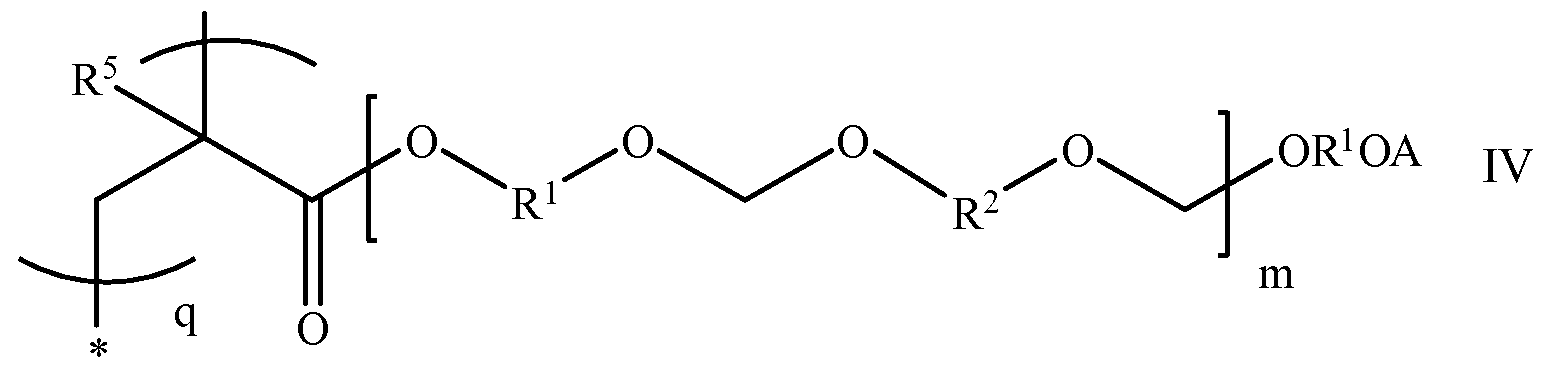
wherein:
A is hydrogen, alkyl, or -C(0)R4;
1 2
R and R" are, independently, alkylene, alkenylene, arylene,
heteroarylene, or alkylarylalkylene;
R4 is hydrogen, alkyl, or phenyl;
R5 is hydrogen, CN, alkyl, or phenyl;
the polymer has a weight average molecular weight of about 500 g/mol to about 2,000,000 g/mol;
m is 1 to 1000; and
q is 1 to 1000.
The polymer of Claim 14 or 15, wherein:
R1 is (CH2)2; (CH2)4; (CH2)6; or (CH
2
R is a mixture of at least two of p-xylenyl, m-xylenyl, and o-xylenyl.
17. The polymer of any one of Claims 1-16, wherein m is 1 to 50.
18. The polymer of any one of Claims 15-17, wherein q is 1 to 50.
A method of preparing polymer represented by Formula III, the method comprising contacting XCH2OR2OCH2X with HOR^H, HOR^A, and a base to form polymer represented by Formula V:

contacting the polymer represented by Formula V with a compound
represented by PG^L and a base to form a polymer represented by Formula VI:

polymerizing PG of the polymer represented by Formula VI to form the polymer represented by Formula III:

wherein:
A is hydrogen, alkyl, or -C(0)R4;
R 1 and R 2" are, independently, alkylene, alkenylene, arylene,
heteroarylene, or alkylarylalkylene;
R4 is hydrogen, alkyl, or phenyl;
X is a leaving group;
PG1 is a polymerizable group selected from the group consisting of acrylyl, methacrylyl, isocycanyl, styrenyl, epoxyl, vinyl, oxetanyl, DL-lactidyl, and bicyclo[2.2.1]hept-2-enyl;
PGla is the polymerization product of the polymerizable group PG1;
L is a leaving group;
m is 1 to 1000; and
q is 1 to 1000.
20. The method of claim 19, wherein the polymer represented by Formula III is a polymer represented by Formula IV:

R is hydrogen, CN, alkyl, or phenyl.
21. The method of any one of Claims 19 or 20, further comprising forming
XXCCHH22OR2OCH2X by contacting R6OCH2OR2OCH2OR6 with HX, wherein R6 is alkyl.
The method of Claim 21, wherein R6 is methyl.

24. The method of Claim 23, wherein X and L are CI.
25. The method of any one of Claims 19-24, wherein the base is a tertiary amine,
secondary amine, pyridine, or a carbonate salt.
26. The method of Claim 25, wherein the base is morpholine, N-methylmorpholine,
piperidine, N-methypiperidine, piperazine, N-methylpiperazine, N,N- dimethylpiperazine, triethylamine, diisopropylethylamine, or pyridine.
27. A method of degrading a polymer, the method comprising:
providing a polymer comprising a linker represented by Formula I:
contacting the polymer with acid; and
obtaining a composition comprising HOR 1 OH and HOR 2 OH; wherein:

1 2
R and R" are, independently, alkylene, alkenylene, arylene,
heteroarylene, or alkylarylalkylene; and
m is 1 to 1000.
28. The method of Claim 27, further comprising converting the HOR 1 OH and HOR 2 OH to a recycled polymer comprising the linker represented by Formula I.
29. The method of Claim 27 or 28, wherein the acid is selected from the group consisting of HCl, HBr, H2SO4, acetic acid, trifluoroacetic acid, phosphoric acid, and nitric acid.
30. The method of any one of Claims 27-29, wherein the contacting is conducted at a temperature of about 20° C to about 120°C.
Priority Applications (3)
| Application Number | Priority Date | Filing Date | Title |
|---|---|---|---|
| PCT/US2012/048980 WO2014021844A1 (en) | 2012-07-31 | 2012-07-31 | Alkyl ether compositions and methods of use |
| US13/761,512 US8779070B2 (en) | 2012-07-31 | 2013-02-07 | Alkyl ether compositions and methods of use |
| US14/297,990 US8952102B2 (en) | 2012-07-31 | 2014-06-06 | Alkyl ether compositions and methods of use |
Applications Claiming Priority (1)
| Application Number | Priority Date | Filing Date | Title |
|---|---|---|---|
| PCT/US2012/048980 WO2014021844A1 (en) | 2012-07-31 | 2012-07-31 | Alkyl ether compositions and methods of use |
Publications (1)
| Publication Number | Publication Date |
|---|---|
| WO2014021844A1 true WO2014021844A1 (en) | 2014-02-06 |
Family
ID=50028361
Family Applications (1)
| Application Number | Title | Priority Date | Filing Date |
|---|---|---|---|
| PCT/US2012/048980 Ceased WO2014021844A1 (en) | 2012-07-31 | 2012-07-31 | Alkyl ether compositions and methods of use |
Country Status (1)
| Country | Link |
|---|---|
| WO (1) | WO2014021844A1 (en) |
Citations (2)
| Publication number | Priority date | Publication date | Assignee | Title |
|---|---|---|---|---|
| US5476653A (en) * | 1992-06-17 | 1995-12-19 | Amgen Inc. | Polyoxymethylene-oxyethylene copolymers in conjuction with biomolecules |
| US20070179255A1 (en) * | 2002-11-08 | 2007-08-02 | Noveon, Inc. | Heat Resistant High Moisture Vapor Transmission Thermoplastic Polyurethane |
-
2012
- 2012-07-31 WO PCT/US2012/048980 patent/WO2014021844A1/en not_active Ceased
Patent Citations (2)
| Publication number | Priority date | Publication date | Assignee | Title |
|---|---|---|---|---|
| US5476653A (en) * | 1992-06-17 | 1995-12-19 | Amgen Inc. | Polyoxymethylene-oxyethylene copolymers in conjuction with biomolecules |
| US20070179255A1 (en) * | 2002-11-08 | 2007-08-02 | Noveon, Inc. | Heat Resistant High Moisture Vapor Transmission Thermoplastic Polyurethane |
Similar Documents
| Publication | Publication Date | Title |
|---|---|---|
| US9206275B2 (en) | Ketal ester derivatives | |
| US9765238B2 (en) | Coating compositions comprising a compound with at least two cyclic carbonate groups and a siloxane group | |
| JP7219708B2 (en) | Use of organic carbonate-modified prepolymers as reactants for the preparation of isocyanate-free and isothiocyanate-free alkoxysilane polymers | |
| CA2205072A1 (en) | Biodegradable polymers, the preparation thereof, and the use thereof for producing biodegradable moldings | |
| RU2007119370A (en) | FORPOLYMERS OBTAINED FROM HYDROXYMETHYL-CONTAINING POLYETHYRPOLIOLS BASED ON COMPLEX ETHER PRODUCED FROM FATTY ACIDS | |
| CN102245588A (en) | Ketal amide compound, its preparation method and application | |
| CN102741235A (en) | Triazine derivative, and application thereof | |
| US12018122B2 (en) | Method for producing silane-modified polymers | |
| CA3055420C (en) | Method for producing alkyl lactate | |
| CN106999469A (en) | Polymers prepared from mevalonate and derivatives | |
| ES2816181T3 (en) | Procedure for the preparation of a reaction product of a cyclic urea and a multifunctional aldehyde | |
| JP6214625B2 (en) | Novel, easily manufacturable, VOC reduced, environmentally friendly (meth) acrylamide functional siloxane system, process for its preparation and use of said siloxane system | |
| RU2019111661A (en) | TWO-COMPONENT COMPOSITION BASED ON COMPOUNDS, IN LESS THAN TWO EXO-VINYLENE CYCLIC CARBONATE LINKS | |
| US8779070B2 (en) | Alkyl ether compositions and methods of use | |
| WO2014021844A1 (en) | Alkyl ether compositions and methods of use | |
| ES2533836T3 (en) | Process of preparation of polymers with varied architecture and initiation with amide | |
| US20130253095A1 (en) | Plasticizers for Resin Compositions and Resin Compositions Including the Same | |
| US10836868B2 (en) | Catalyst having a polysiloxane structural unit for hardenable compositions | |
| KR20140146138A (en) | Modified amino resins | |
| US20060276615A1 (en) | Aminotriazine condensation product, use of an aminotriazine condensation products and method for the production of an aminotriazine condensation product | |
| WO2009065805A3 (en) | Process for the alkoxylation of amino group containing polymers | |
| WO2018062928A9 (en) | Biodegradable polymer resin composition and molded product thereof | |
| Knapczyk et al. | Synthetic resins and plastics | |
| RU2692777C2 (en) | Low-salt method of producing polysulphide | |
| CA2676892C (en) | Ketal amide compounds, methods of making, and applications |
Legal Events
| Date | Code | Title | Description |
|---|---|---|---|
| 121 | Ep: the epo has been informed by wipo that ep was designated in this application |
Ref document number: 12882342 Country of ref document: EP Kind code of ref document: A1 |
|
| NENP | Non-entry into the national phase |
Ref country code: DE |
|
| 122 | Ep: pct application non-entry in european phase |
Ref document number: 12882342 Country of ref document: EP Kind code of ref document: A1 |