WO2014019950A1 - Methods of pest control in soybean - Google Patents

Methods of pest control in soybean Download PDF

Info

Publication number
WO2014019950A1
WO2014019950A1 PCT/EP2013/065785 EP2013065785W WO2014019950A1 WO 2014019950 A1 WO2014019950 A1 WO 2014019950A1 EP 2013065785 W EP2013065785 W EP 2013065785W WO 2014019950 A1 WO2014019950 A1 WO 2014019950A1
Authority
WO
WIPO (PCT)
Prior art keywords
compound
formula
compounds
ethyl
spp
Prior art date
Legal status (The legal status is an assumption and is not a legal conclusion. Google has not performed a legal analysis and makes no representation as to the accuracy of the status listed.)
Ceased
Application number
PCT/EP2013/065785
Other languages
French (fr)
Inventor
Myriem El Qacemi
Jérôme Yves CASSAYRE
Current Assignee (The listed assignees may be inaccurate. Google has not performed a legal analysis and makes no representation or warranty as to the accuracy of the list.)
Syngenta Participations AG
Original Assignee
Syngenta Participations AG
Priority date (The priority date is an assumption and is not a legal conclusion. Google has not performed a legal analysis and makes no representation as to the accuracy of the date listed.)
Filing date
Publication date
Application filed by Syngenta Participations AG filed Critical Syngenta Participations AG
Priority to BR112015001931A priority Critical patent/BR112015001931A2/en
Priority to US14/419,074 priority patent/US11930816B2/en
Priority to CA2878643A priority patent/CA2878643C/en
Priority to CN201380041183.5A priority patent/CN104519739A/en
Publication of WO2014019950A1 publication Critical patent/WO2014019950A1/en
Anticipated expiration legal-status Critical
Priority to US18/324,472 priority patent/US20230320357A1/en
Priority to US18/429,916 priority patent/US12446583B2/en
Ceased legal-status Critical Current

Links

Classifications

    • AHUMAN NECESSITIES
    • A01AGRICULTURE; FORESTRY; ANIMAL HUSBANDRY; HUNTING; TRAPPING; FISHING
    • A01NPRESERVATION OF BODIES OF HUMANS OR ANIMALS OR PLANTS OR PARTS THEREOF; BIOCIDES, e.g. AS DISINFECTANTS, AS PESTICIDES OR AS HERBICIDES; PEST REPELLANTS OR ATTRACTANTS; PLANT GROWTH REGULATORS
    • A01N43/00Biocides, pest repellants or attractants, or plant growth regulators containing heterocyclic compounds
    • A01N43/72Biocides, pest repellants or attractants, or plant growth regulators containing heterocyclic compounds having rings with nitrogen atoms and oxygen or sulfur atoms as ring hetero atoms
    • A01N43/80Biocides, pest repellants or attractants, or plant growth regulators containing heterocyclic compounds having rings with nitrogen atoms and oxygen or sulfur atoms as ring hetero atoms five-membered rings with one nitrogen atom and either one oxygen atom or one sulfur atom in positions 1,2
    • GPHYSICS
    • G06COMPUTING OR CALCULATING; COUNTING
    • G06QINFORMATION AND COMMUNICATION TECHNOLOGY [ICT] SPECIALLY ADAPTED FOR ADMINISTRATIVE, COMMERCIAL, FINANCIAL, MANAGERIAL OR SUPERVISORY PURPOSES; SYSTEMS OR METHODS SPECIALLY ADAPTED FOR ADMINISTRATIVE, COMMERCIAL, FINANCIAL, MANAGERIAL OR SUPERVISORY PURPOSES, NOT OTHERWISE PROVIDED FOR
    • G06Q30/00Commerce
    • G06Q30/018Certifying business or products

Definitions

  • the present invention relates to methods of pest control in soybean crops.
  • Stink bugs are true bugs which can be significant pests when present in large numbers. The nymphs and adults have piercing mouthparts which most use to suck 5 sap from plants. According to Stewart et al., Soybean Insects - Stink bugs, University of Tennessee Institute of Agriculture, W200 09-0098, stink bugs are probably the most common pest problem in soybean. Although they may feed on many parts of the plant, they typically target developing seed including the pods, meaning that injury to soybean seed is the primary problem associated with stink bug infestations.
  • Insecticides commonly used to control stinkbugs include pyrethroids, neonicotinoids and
  • organophosphates although pyrethroid insecticides are usually the method of choice for controlling
  • GABA gamma-aminobutyric acid
  • GABA gamma- aminobutyric acid
  • the invention provides a method comprising applying to a crop of soybean plants, the locus thereof, or propagation material thereof, a compound of formula I
  • L is a direct bond or methylene
  • a 1 and A 2 are C-H, or one of A 1 and A 2 is C-H and the other is N;
  • X 1 is group X
  • R 1 is Ci-C 4 alkyl, or C3-C 6 cycloalkyl
  • R 2 is chlorodifluoromethyl or trifluoromethyl
  • each R 3 is independently bromo, chloro, fluoro or trifluoromethyl
  • R 4 is hydrogen, halogen, methyl, halomethyl or cyano
  • R 5 is hydrogen
  • R 4 and R 5 together form a bridging 1 ,3-butadiene group
  • p 2 or 3.
  • the invention provides a method of controlling and/or preventing infestation of stinkbugs in soybean comprising applying to a crop of soybean plants, the locus thereof, or propagation material thereof, a compound of formula I.
  • the stinkbugs may be those that are resistant to one or more other insecticides.
  • the invention provides a method of controlling and/or preventing infestation of stinkbugs in a crop of useful plants comprising applying to a crop of useful plants, the locus thereof, or propagation material thereof, a compound of formula I.
  • the stinkbugs may be those that are resistant to one or more other insecticides.
  • the invention provides use of a compound of formula I for control of stinkbugs in a crop of useful plants. The use may be for controlling stinkbugs that are resistant to one or more other insecticides.
  • the invention provides a method of controlling and/or preventing infestation of insects from the genus Euschistus in a crop of useful plants comprising applying to a crop of useful plants, the locus thereof, or propagation material thereof, a compound of formula I.
  • the insects from the genus Euschistus may be those that are resistant to one or more other insecticides.
  • the invention provides use of a compound of formula I for control of insects from the genus Euschistus in a crop of useful plants.
  • the use may be for controlling insects from the genus Euschistus that are resistant to one or more other insecticides.
  • the invention provides a method of controlling and/or preventing infestation of insects from the genus Euschistus in a crop of soybean plants comprising applying to a crop of soybean, the locus thereof, or propagation material thereof, a compound of formula I.
  • the insects from the genus Euschistus may be those that are resistant to one or more other insecticides.
  • the invention provides use of a compound of formula I for control of insects from the genus Euschistus in a crop of soybean plants.
  • the use may be for controlling insects from the genus Euschistus that are resistant to one or more other insecticides.
  • the invention provides a method of controlling and/or preventing infestation of Euschistus heros in a crop of useful plants comprising applying to a crop of useful plants, the locus thereof, or propagation material thereof, a compound of formula I.
  • the Euschistus heros may be resistant to one or more other insecticides.
  • the invention provides use of a compound of formula I for control of Euschistus heros in a crop of useful plants.
  • the use may be for controlling Euschistus heros that is resistant to one or more other insecticides.
  • the invention provides a method of controlling and/or preventing infestation of Euschistus heros in a crop of soybean plants comprising applying to a crop of soybean, the locus thereof, or propagation material thereof, a compound of formula I.
  • the Euschistus heros may be resistant to one or more other insecticides.
  • the invention provides use of a compound of formula I for control of Euschistus heros in a crop of soybean plants.
  • the use may be for controlling insects Euschistus heros that are is resistant to one or more other insecticides.
  • Stinkbugs that are resistant to one or more other insecticides are preferably resistant to pyrethroid, neonicotinoids and/or organophosphates, more preferably pyrethroid insecticides.
  • the invention provides a method for obtaining regulatory approval for the use of one or more of a compound of formula I to control stinkbugs, in particular the genus Euschistus and in particular the species Euschistus heros, and in particular in soybean plants, comprising at least one step of referring to, submitting or relying on biological data showing that said active ingredient reduces insect pressure.
  • the compounds of formula (I) may exist in different geometric or optical isomers or tautomeric forms. This invention covers all such isomers and tautomers and mixtures thereof in all proportions as well as isotopic forms such as deuterated compounds. The invention also covers salts and N-oxides of the compounds of the invention.
  • Alkyl groups can be in the form of a straight or branched chain and are, for example, methyl, ethyl, propyl, prop-2-yl, butyl, but-2-yl, 2-methyl-prop- 1 -yl or 2-methyl-prop-2-yl.
  • the alkyl groups are preferably Ci-Ce, more preferably C1-C4, most preferably C1-C3 alkyl groups. Where an alkyl moiety is said to be substituted, the alkyl moiety is preferably substituted by one to four substituents, most preferably by one to three substituents.
  • Halogen is fluorine, chlorine, bromine or iodine.
  • Haloalkyl groups are alkyl groups which are substituted by one or more of the same or different halogen atoms and are, for example, difluoromethyl, trifluoromethyl, chlorodifluoromethyl or 2,2,2-trifluoro-ethyl.
  • a 1 and A 2 are preferably C-H.
  • X 1 is 3,5-dichlorophenyl-, 3-chloro-4-fluorophenyl-, 3-fluoro-4-chlorophenyl-, 3,4- dichlorophenyl-, 3-chloro-4-bromophenyl-, 3,5-dichloro-4-fluorophenyl-, 3,4,5-trichlorophenyl-, 3,4,5-trifluorophenyl-, 3-chloro-5-bromophenyl-, 3 -chloro-5 -fluorophenyl-, 3-chloro-5- (trifluoromethyl)phenyl-, 3,4-dichloro-5-(trifluoromethyl)phenyl-, 3,5-bis(trifluoromethyl)phenyl-, 4- chloro-3,5-bis(trifluoromethyl)phenyl-, 3-(trifluoromethyl)phenyl-, more preferably 3 -chloro-5 - bromophenyl-, 3-chloro-5-, 3-
  • R 1 is preferably methyl, ethyl, propyl, butyl, cyclopropyl, cyclobutyl, trifluoroethyl, difluoroethyl. Ethyl and trifluoroethyl are particularly preferred.
  • R 2 is preferably trifluoromethyl.
  • each R 3 is independently chlorine or fluorine, most preferably chlorine.
  • R 4 is preferably chloro or methyl, most preferably methyl.
  • R 5 is preferably hydrogen.
  • L is preferably a direct bond.
  • a 1 and A 2 are C-H, R 2 is trifluoromethyl, and R 5 is hydrogen.
  • a 1 and A 2 are C-H, R 2 is trifluoromethyl, R 5 is hydrogen and L is a direct bond.
  • a 1 and A 2 are C-H, R 2 is trifluoromethyl, R 4 is methyl, R 5 is hydrogen, each R 3 is chlorine, p is 2.
  • R 1 is Ci-C 4 alkyl, e.g. methyl, ethyl or propyl, e.g. methyl or ethyl, e.g. ethyl.
  • X 1 is group Xa
  • R 1 is Ci-Cgalkyl, e.g. methyl, ethyl or propyl, e.g. methyl or ethyl, e.g.
  • I X 1 is group Xa.
  • R is methyl
  • R is ethyl
  • R is 2,2,2-trifluoroethyl.
  • R is 2,2-difluoroethyl.
  • X is 3,5-dichlorophenyl.
  • X is 3,5-dichloro-4-fluorophenyl.
  • X is 3,4,5-trichlorophenyl.
  • R is methyl and X 1 is 3,5-dichlorophenyl.
  • R is methyl and X 1 is 3,5-dichloro-4-fluorophenyl.
  • R is methyl and X 1 is 3,4,5-trichlorophenyl.
  • R is ethyl and X 1 is 3,5-dichlorophenyl.
  • R is ethyl and X 1 is 3,5-dichloro-4-fluorophenyl.
  • R is ethyl and X 1 is 3,4,5-trichlorophenyl.
  • R is 2,2,2-trifluoroethyl and X 1 is 3,5-dichlorophenyl.
  • R is 2,2,2-trifluoroethyl and X 1 is 3,5-dichloro-4-fluorophenyl.
  • R is 2,2,2-trifluoroethyl and X 1 is 3,4,5-trichlorophenyl.
  • R 1 is 2,2-difluoroethyl and X 1 is 3,5-dichlorophenyl.
  • R 1 is 2,2-difluoroethyl and X 1 is 3,5-dichloro-4-fluorophenyl.
  • R 1 is 2,2-difluoroethyl and X 1 is 3,4,5-trichlorophenyl.
  • Compounds of formula I** are more biologically active than compounds of formula I*.
  • Compounds of formula I may be a mixture of compounds I* and I** in any ratio e.g. in a molar ratio of 1 :99 to 99: 1 , e.g. 10: 1 to 1 : 10, e.g. a substantially 50:50 molar ratio.
  • the compound of formula I is a racemic mixture of the compounds of formula I** and I* or is enantiomerically enriched for the compound of formula I**.
  • the compound of formula I when the compound of formula I is an enantiomerically enriched mixture of formula I**, the molar proportion of compound I** compared to the total amount of both enantiomers is for example greater than 50%, e.g. at least 55, 60, 65, 70, 75, 80, 85, 90, 95, 96, 97, 98, or at least 99%.
  • the compound of formula I is a compound of formula I** in substantially pure form, e.g. it is provided substantially in the absence of the alternative enantiomer.
  • Compounds of formula I" are often more biologically active than compounds of formula ⁇ .
  • the compound of formula I may be a mixture of compounds ⁇ and ⁇ ' in any ratio e.g. in a molar ratio of 1 :99 to 99: 1, e.g. 10: 1 to 1 : 10, e.g. a substantially 50:50 molar ratio.
  • the compound of formula I is a racemic mixture of the compounds of formula I" and ⁇ or is enantiomerically enriched for the compound of formula ⁇ ' .
  • the compound of formula I when the compound of formula I is an enantiomerically enriched mixture of formula I", the molar proportion of compound I" compared to the total amount of both enantiomers is for example greater than 50%, e.g. at least 55, 60, 65, 70, 75, 80, 85, 90, 95, 96, 97, 98, or at least 99%.
  • the compound of formula I is a compound of formula ⁇ ' in substantially pure form, e.g. it is provided substantially in the absence of the alternative enantiomer.
  • the compound of formula I is a mixture comprising compounds I-i, I-ii, I- iii and I-iv, wherein the mixture is enriched for the compound of formula I-iv, e.g. the molar proportion of compound I-iv compared to the total amount of the four isomers is for example greater than 25%, e.g. at least 30, 35, 40, 50, 55, 60, 65, 70, 75, 80, 85, 90, 95, 96, 97, 98, or at least 99%.
  • the compound of formula I is a mixture comprising compounds I-i, I- ii, I-iii and I-iv, wherein the molar amount of the compound of formuila I-iv is greater than the molar amount of the compound of formula I-i, and the molar amount of the compound I-ii, and the molar amount of the compound of formula I-iii, in other words, the compound of formula I-iv is the most abundant isomer in the mixture.
  • the molar amount of compound of formula I-iv is at least 1, 2, 5, 10, 15, 20, 25, 30, 35, 40, 45, 50, 55, 60, 56, 70, 75, 80, 85, 90, or even at least 95% greater than the combined amount of the compound of formula I-iv and I-i, the combined amount of the compound of formula I-iv and I-ii, and the combined amount of the compound of formula I-iv and I-iii.
  • the compound of formula I-iv is the most abundant isomer and R 1 is Cp C 4 alkyl, e.g. methyl, ethyl or propyl, e.g. methyl or ethyl, e.g. ethyl.
  • the compound of formula I-iv is the most abundant isomer and R 1 is Cp C 4 alkyl, e.g. methyl, ethyl or propyl, e.g. methyl or ethyl, e.g. ethyl and X 1 is group Xa.
  • the compound of formula I-iv is the most abundant isomer and R 1 is methyl.
  • the compound of formula I-iv is the most abundant isomer and R 1 is ethyl.
  • the compound of formula I-iv is the most abundant isomer and R 1 is 2,2,2- trifluoroethyl. In one embodiment the compound of formula I-iv is the most abundant isomer and R 1 is 2,2- difluoroethyl.
  • Table A provides 78 compounds and mixtures of formula (I-a) wherein R 1 has the values listed X below.
  • the symbols * and ** indicate the location of the chiral centres.
  • Table B provides 78 compounds and mixtures of formula (I-b) wherein R 1 has the values listed X below.
  • the symbols * and ** indicate the location of the chiral centres.
  • Table C provides 78 compounds and mixtures of formula (I-c) wherein R 1 has the values listed X below.
  • the symbols * and ** indicate the location of the chiral centres.
  • Table D provides 78 compounds and mixtures of formula (I-d) wherein R 1 has the values listed table X below.
  • the symbols * and ** indicate the location of the chiral centres.
  • Table E provides 78 compounds and mixtures of formula (I-e) wherein R 1 has the values listed X below.
  • the symbols * and ** indicate the location of the chiral centres.
  • Table F provides 78 compounds and mixtures of formula (I-f) wherein R 1 has the values listed in table X below.
  • the symbols * and ** indicate the location of the chiral centres.
  • Table X represents Table A when X is A, Table B when X is B, Table C when X is C, Table D when X is D, Table E when X is E, Table F when X is F.
  • Compounds of formula (I), can be prepared by reacting a compound of formula (II) wherein R is OH, Ci-Cealkoxy or CI, F or Br, with an amine of formula (III) as shown in Scheme 1.
  • R is OH
  • such reactions are usually carried out in the presence of a coupling reagent, such as ⁇ , ⁇ '- dicyclohexylcarbodiimide (“DCC”), 1 -ethyl-3 -(3 -dimethylamino-propyl)carbodiimide hydrochloride (“EDC”) or bis(2-oxo-3-oxazolidinyl)phosphonic chloride (“BOP-Cl”), in the presence of a base, and optionally in the presence of a nucleophilic catalyst, such as hydroxybenzotriazole (“HOBT").
  • DCC ⁇ , ⁇ '- dicyclohexylcarbodiimide
  • EDC 1 -ethyl-3 -(3 -
  • R is CI
  • such reactions are usually carried out in the presence of a base, and optionally in the presence of a nucleophilic catalyst.
  • a base preferably ethyl acetate
  • aqueous solvent preferably a solution of sodium hydrogen carbonate.
  • R is Ci-C 6 alkoxy it is sometimes possible to convert the ester directly to the amide by heating the ester and amine together in a thermal process.
  • Suitable bases include pyridine, triethylamine, 4-(dimethylamino)-pyridine (“DMAP”) or diisopropylethylamine (Hunig's base).
  • Preferred solvents are NN-dimethylacetamide, tetrahydrofuran, dioxane, 1 ,2- dimethoxyethane, ethyl acetate and toluene.
  • the reaction is carried out at a temperature of from 0°C to 100°C, preferably from 15°C to 30°C, in particular at ambient temperature.
  • Amines of formula (III) are either known in the literature or can be prepared using methods known to a person skilled in the art.
  • Acid halides of formula (II), wherein R is CI, F or Br may be made from carboxylic acids of formula (II), wherein R is OH, under standard conditions, as described for example in WO
  • Carboxylic acids of formula (II), wherein R is OH may be formed from esters of formula (II), wherein R is Ci-C 6 alkoxy as described for example in WO 2009/080250.
  • Compounds of formula (I) can be prepared by reacting a compound of formula (IV) wherein X B is a leaving group, for example a halogen, such as bromo, with carbon monoxide and an amine of formula (III), in the presence of a catalyst, such as palladium(II) acetate or bis- (triphenylphosphine)palladium(II) dichloride, optionally in the presence of a ligand, such as triphenylphosphine, and a base, such as sodium carbonate, pyridine, triethylamine, 4-(dimethylamino)- pyridine (“DMAP”) or diisopropylethylamine (Hunig's base), in a solvent, such as water, NN- dimethylformamide or tetrahydrofuran.
  • a catalyst such as palladium(II) acetate or bis- (triphenylphosphine)palladium(II) dichloride
  • compounds of formula (I) can be prepared by various methods from an intermediate of formula (V) as shown in Scheme 2 wherein X B is a leaving group, for example a halogen, such as bromo, or X B is cyano, formyl or acetyl according to similar methods to those described in WO09080250.
  • An intermediate of formula (V) can be prepared for example from an intermediate of formula (VI) as described in the same reference.
  • the methods and uses of the invention are preferably for controlling and/or preventing infestation of the soybean crop by stink bugs, including stink bugs that are resistant to other insecticides, e.g. pyrethroid insecticides.
  • Stinkbugs that are "resistant" to a particular insecticide refers e.g. to strains of stinkbugs that are less sensitive to that insecticide compared to the expected sensitivity of the same species of stinkbug.
  • the expected sensitivity can be measured using e.g. a strain that has not previously been exposed to the insecticide.
  • Application is of the compounds of the invention is preferably to a crop of soybean plants, the locus thereof or propagation material thereof. Preferably application is to a crop of soybean plants or the locus thereof, more preferably to a crop of soybean plants. Application may be before infestation or when the pest is present.
  • Application of the compounds of the invention can be performed according to any of the usual modes of application, e.g. foliar, drench, soil, in furrow etc. However, control of stinkbugs is usually achieved by foliar application, which is the preferred mode of application according to the invention.
  • the compounds of the invention may be applied in combination with an attractant.
  • An attractant is a chemical that causes the insect to migrate towards the location of application.
  • an attractant for control of stinkbugs it can be advantageous to apply the compounds of the invention with an attractant, particularly when the application is foliar. Stinkbugs are often located near to the ground, and application of an attractant may encourage migration up the plant towards the active ingredient.
  • Suitable attractants include glucose, sacchrose, salt, glutamate (e.g. Aji-no-motoTM), citric acid (e.g. OroborTM), soybean oil, peanut oil and soybean milk. Glutamate and citric acid are of particular interest, with citric acid being preferred.
  • An attractant may be premixed with the compound of the invention prior to application, e.g. as a readymix or tankmix, or by simultaneous application or sequential application to the plant. Suitable rates of attractants are for example 0.02kg/ha-3kg/ha.
  • the compounds of the invention are preferably used for pest control on soybean at 1 :500 g/ha, preferably 10-70g/ha.
  • the compounds of the invention are suitable for use on any soybean plant, including those that have been genetically modified to be resistant to active ingredients such as herbicides, or to produce biologically active compounds that control infestation by plant pests.
  • transgenic plants and plant cultivars obtained by genetic engineering methods are treated.
  • plants of the plant cultivars which are in each case commercially available or in use are treated according to the invention.
  • Plant cultivars are understood as meaning plants having novel properties ("traits") which have been obtained by conventional breeding, by mutagenesis or by recombinant DNA techniques.
  • cultivars can be cultivars, bio- or genotypes.
  • the treatment according to the invention may also result in superadditive "synergistic" effects.
  • the preferred transgenic plants or plant cultivars which are to be treated according to the invention include all plants which, by virtue of the genetic modification, received genetic material which imparts particularly advantageous, useful traits to these plants.
  • Examples of such traits are better plant growth, increased tolerance to high or low temperatures, increased tolerance to drought or to water or soil salt content, increased flowering performance, easier harvesting, accelerated maturation, higher harvest yields, higher quality and/or a higher nutritional value of the harvested products, better storage stability and/or processability of the harvested products.
  • Bt plants CrylA(a), CrylA(b), CrylA(c), CryllA, CrylllA, CryIIIB2, Cry9c, Cry2Ab, Cry3Bb and CrylF and also combinations thereof) (referred to herein as "Bt plants”).
  • Bt plants Traits that are also particularly emphasized are the increased defence of the plants against fungi, bacteria and viruses by systemic acquired resistance (SAR), systemin, phytoalexins, elicitors and resistance genes and correspondingly expressed proteins and toxins.
  • SAR systemic acquired resistance
  • trasits that are furthermore particularly emphasized are the increased tolerance of the plants to certain herbicidally active compounds, for example imidazolinones, sulphonylureas, glyphosate or phosphinotricin (for example the "PAT" gene).
  • herbicidally active compounds for example imidazolinones, sulphonylureas, glyphosate or phosphinotricin (for example the "PAT" gene).
  • PAT phosphinotricin
  • Bt plants are soya bean varieties which are sold under the trade names YIELD
  • herbicide -tolerant plants which may be mentioned are soybean varieties which are sold under the trade names Roundup Ready(®) (tolerance to glyphosate), Liberty Link(®) (tolerance to phosphinotricin), IMI(®) (tolerance to imidazolinones) and STS(®) (tolerance to sulphonylureas).
  • Herbicide-resistant plants plants bred in a conventional manner for herbicide tolerance
  • plants bred in a conventional manner for herbicide tolerance include the varieties sold under the name Clearfield(®) (for example maize).
  • Clearfield(®) for example maize.
  • soybean plants carrying trains conferring resistance to 2.4D e.g.
  • glyphosate e.g. Roundup Ready®, Roundup Ready 2 Yield®
  • sulfonylurea e.g. STS®
  • glufosinate e.g. Liberty Link®, Ignite®
  • Dicamba e.g. isoxaflutole herbicide
  • Double or triple stack in soybean plants of any of the traits described here are also of interest, including glyphosate and sulfonyl-urea tolerance (e.g. Optimum GAT®, plants stacked with STS® and Roundup Ready® or Roundup Ready 2 Yield®), dicamba and glyphosate tolerance (Monsanto).
  • Soybean Cyst Nematode resistance soybean SCN® - Syngenta
  • soybean with Aphid resistant trait AMT® - Syngneta
  • the compounds of the invention may be used on soybean to control, for example,
  • the compounds of the invention are preferably used on soybean to control stinkbugs, e.g. Nezara spp. (e.g. Nezara viridula, Nezara antennata, Nezara hilare), Piezodorus spp. (e.g. Piezodorus guildinii), Acrostemum spp. Euchistus spp. (e.g. Euchistus heros, Euschistus servus), Halyomorpha halys, Plautia crossota, Riptortus clavatus, Rhopalus msculatus, Antestiopsis orbitalus, Dichelops spp. (e.g. Nezara spp. (e.g. Nezara viridula, Nezara antennata, Nezara hilare), Piezodorus spp. (e.g. Piezodorus guildinii), Acrostemum spp. Euchistus spp. (e.g. Euchist
  • Eurygaster spp. e.g. Eurygaster intergriceps, Eurygaster maura
  • Oebalus spp. e.g. Oebalus mexicana, Oebalus poecilus, Oebalus pugnase
  • Scotinophara spp. e.g. Scotinophara lurida, Scotinophara coarctata.
  • Preferred targets include Antestiopsis orbitalus, Dichelops furcatus, Dichelops melacanthus, Euchistus heros, Euschistus servus, Nezara viridula, Nezara hilare, Piezodorus guildinii, Halyomorpha halys.
  • the stinkbug target is Nezara viridula, Piezodorus spp., Acrostemum spp, Euchistus heros.
  • the compounds of the invention are particularly effective against Euschistus and in particular Euchistus heros. Euschistus and in particular Euchistus heros are the preferred targets.
  • compounds of the invention is usually formulated into a composition which includes, in addition to the compound of the invention, a suitable inert diluent or carrier and, optionally, a surface active agent (SFA).
  • SFAs are chemicals which are able to modify the properties of an interface (for example, liquid/solid, liquid/air or liquid/liquid interfaces) by lowering the interfacial tension and thereby leading to changes in other properties (for example dispersion, emulsification and wetting).
  • compositions both solid and liquid formulations
  • the composition is generally used for the control of pests such that a compound of the invention is applied at a rate of from O. lg to 10kg per hectare, preferably from lg to 6kg per hectare, more preferably from lg to 1kg per hectare.
  • a compound of the invention When used in a seed dressing, a compound of the invention is used at a rate of 0.000 lg to lOg (for example O.OOlg or 0.05g), preferably 0.005g to lOg, more preferably 0.005g to 4g, per kilogram of seed.
  • Compositions comprising a compound of the invention can be chosen from a number of formulation types, including dustable powders (DP), soluble powders (SP), water soluble granules (SG), water dispersible granules (WG), wettable powders (WP), granules (GR) (slow or fast release), soluble concentrates (SL), oil miscible liquids (OL), ultra low volume liquids (UL), emulsifiable concentrates (EC), dispersible concentrates (DC), emulsions (both oil in water (EW) and water in oil (EO)), micro-emulsions (ME), suspension concentrates (SC), aerosols, fogging/smoke formulations, capsule suspensions (CS) and seed treatment formulations.
  • the formulation type chosen in any instance will depend upon the particular purpose envisaged and the physical, chemical and biological properties of the compound of the invention.
  • Dustable powders may be prepared by mixing a compound of the invention with one or more solid diluents (for example natural clays, kaolin, pyrophyllite, bentonite, alumina,
  • montmorillonite kieselguhr, chalk, diatomaceous earths, calcium phosphates, calcium and magnesium carbonates, sulfur, lime, flours, talc and other organic and inorganic solid carriers) and mechanically grinding the mixture to a fine powder.
  • Soluble powders may be prepared by mixing a compound of the invention with one or more water-soluble inorganic salts (such as sodium bicarbonate, sodium carbonate or magnesium sulfate) or one or more water-soluble organic solids (such as a polysaccharide) and, optionally, one or more wetting agents, one or more dispersing agents or a mixture of said agents to improve water dispersibility/solubility. The mixture is then ground to a fine powder. Similar compositions may also be granulated to form water soluble granules (SG).
  • water-soluble inorganic salts such as sodium bicarbonate, sodium carbonate or magnesium sulfate
  • water-soluble organic solids such as a polysaccharide
  • wetting agents such as sodium bicarbonate, sodium carbonate or magnesium sulfate
  • dispersing agents such as sodium bicarbonate, sodium carbonate or magnesium sulfate
  • SG water soluble granules
  • WP Wettable powders
  • WG Water dispersible granules
  • Granules may be formed either by granulating a mixture of a compound of the invention and one or more powdered solid diluents or carriers, or from pre-formed blank granules by absorbing a compound of the invention (or a solution thereof, in a suitable agent) in a porous granular material (such as pumice, attapulgite clays, fuller's earth, kieselguhr, diatomaceous earths or ground corn cobs) or by adsorbing a compound of the invention (or a solution thereof, in a suitable agent) on to a hard core material (such as sands, silicates, mineral carbonates, sulfates or phosphates) and drying if necessary.
  • a hard core material such as sands, silicates, mineral carbonates, sulfates or phosphates
  • Agents which are commonly used to aid absorption or adsorption include solvents (such as aliphatic and aromatic petroleum solvents, alcohols, ethers, ketones and esters) and sticking agents (such as polyvinyl acetates, polyvinyl alcohols, dextrins, sugars and vegetable oils).
  • solvents such as aliphatic and aromatic petroleum solvents, alcohols, ethers, ketones and esters
  • sticking agents such as polyvinyl acetates, polyvinyl alcohols, dextrins, sugars and vegetable oils.
  • One or more other additives may also be included in granules (for example an emulsifying agent, wetting agent or dispersing agent).
  • DC Dispersible Concentrates
  • a compound of the invention may be prepared by dissolving a compound of the invention in water or an organic solvent, such as a ketone, alcohol or glycol ether.
  • organic solvent such as a ketone, alcohol or glycol ether.
  • surface active agent for example to improve water dilution or prevent crystallization in a spray tank.
  • Emulsifiable concentrates or oil-in-water emulsions (EW) may be prepared by dissolving a compound of the invention in an organic solvent (optionally containing one or more wetting agents,
  • Suitable organic solvents for use in ECs include aromatic hydrocarbons (such as alkylbenzenes or alkylnaphthalenes, exemplified by
  • An EC product may spontaneously emulsify on addition to water, to produce an emulsion with sufficient stability to allow spray application through appropriate equipment.
  • Preparation of an EW involves obtaining a compound of the invention either as a liquid (if it is not a liquid at room temperature, it may be melted at a reasonable temperature, typically below
  • Suitable solvents for use in EWs include vegetable oils, chlorinated hydrocarbons (such as chlorobenzenes), aromatic solvents (such as alkylbenzenes or alkylnaphthalenes) and other appropriate organic solvents which have a low solubility in water.
  • Microemulsions may be prepared by mixing water with a blend of one or more solvents with one or more SFAs, to produce spontaneously a thermodynamically stable isotropic liquid formulation.
  • a compound of the invention is present initially in either the water or the solvent/SFA blend.
  • Suitable solvents for use in MEs include those hereinbefore described for use in ECs or in EWs.
  • An ME may be either an oil-in-water or a water-in-oil system (which system is present may be
  • An ME is suitable for dilution into water, either remaining as a microemulsion or forming a conventional oil-in-water emulsion.
  • SC Suspension concentrates
  • SCs may comprise aqueous or non-aqueous suspensions of finely divided insoluble solid particles of a compound of the invention. SCs may be prepared by ball or bead
  • a fine particle suspension of the compound may be included in the composition and a suspending agent may be included to reduce the rate at which the particles settle.
  • a compound of the invention may be dry milled and added to water, containing agents hereinbefore described, to produce the desired end product.
  • Aerosol formulations comprise a compound of the invention and a suitable propellant (for example n-butane).
  • a compound of the invention may also be dissolved or dispersed in a suitable medium (for example water or a water miscible liquid, such as n-propanol) to provide compositions for use in non-pressurized, hand-actuated spray pumps.
  • a compound of the invention may be mixed in the dry state with a pyrotechnic mixture to form a composition suitable for generating, in an enclosed space, a smoke containing the compound.
  • Capsule suspensions may be prepared in a manner similar to the preparation of EW formulations but with an additional polymerization stage such that an aqueous dispersion of oil droplets is obtained, in which each oil droplet is encapsulated by a polymeric shell and contains a compound of the invention and, optionally, a carrier or diluent therefor.
  • the polymeric shell may be produced by either an interfacial polycondensation reaction or by a coacervation procedure.
  • the compositions may provide for controlled release of the compound of the invention and they may be used for seed treatment.
  • a compound of the invention may also be formulated in a biodegradable polymeric matrix to provide a slow, controlled release of the compound.
  • a composition may include one or more additives to improve the biological performance of the composition (for example by improving wetting, retention or distribution on surfaces; resistance to rain on treated surfaces; or uptake or mobility of a compound of the invention).
  • additives include surface active agents, spray additives based on oils, for example certain mineral oils or natural plant oils (such as soy bean and rape seed oil), and blends of these with other bio-enhancing adjuvants (ingredients which may aid or modify the action of a compound of the invention).
  • a compound of the invention may also be formulated for use as a seed treatment, for example as a powder composition, including a powder for dry seed treatment (DS), a water soluble powder (SS) or a water dispersible powder for slurry treatment (WS), or as a liquid composition, including a flowable concentrate (FS), a solution (LS) or a capsule suspension (CS).
  • DS powder for dry seed treatment
  • SS water soluble powder
  • WS water dispersible powder for slurry treatment
  • CS capsule suspension
  • compositions for treating seed may include an agent for assisting the adhesion of the composition to the seed (for example a mineral oil or a film-forming barrier).
  • Wetting agents, dispersing agents and emulsifying agents may be surface SFAs of the cationic, anionic, amphoteric or non-ionic type.
  • Suitable SFAs of the cationic type include quaternary ammonium compounds (for example cetyltrimethyl ammonium bromide), imidazolines and amine salts.
  • Suitable anionic SFAs include alkali metals salts of fatty acids, salts of aliphatic monoesters of sulfuric acid (for example sodium lauryl sulfate), salts of sulfonated aromatic compounds (for example sodium dodecylbenzenesulfonate, calcium dodecylbenzenesulfonate, butylnaphthalene sulfonate and mixtures of sodium di-z ' opropyl- and tri-wopropyl-naphthalene sulfonates), ether sulfates, alcohol ether sulfates (for example sodium laureth-3 -sulfate), ether carboxylates (for example sodium laureth- 3-carboxylate), phosphate esters (products from the reaction between one or more fatty alcohols and phosphoric acid (predominately mono-esters) or phosphorus pentoxide (predominately di-esters), for example the reaction between lauryl alcohol
  • Suitable SFAs of the amphoteric type include betaines, propionates and glycinates.
  • Suitable SFAs of the non-ionic type include condensation products of alkylene oxides, such as ethylene oxide, propylene oxide, butylene oxide or mixtures thereof, with fatty alcohols (such as oleyl alcohol or cetyl alcohol) or with alkylphenols (such as octylphenol, nonylphenol or octylcresol); partial esters derived from long chain fatty acids or hexitol anhydrides; condensation products of said partial esters with ethylene oxide; block polymers (comprising ethylene oxide and propylene oxide);
  • alkylene oxides such as ethylene oxide, propylene oxide, butylene oxide or mixtures thereof
  • fatty alcohols such as oleyl alcohol or cetyl alcohol
  • alkylphenols such as octylphenol, nonylphenol or octylcresol
  • partial esters derived from long chain fatty acids or hexitol anhydrides condensation products of said partial esters with ethylene oxide
  • alkanolamides alkanolamides
  • simple esters for example fatty acid polyethylene glycol esters
  • amine oxides for example lauryl dimethyl amine oxide
  • lecithins alkanolamides
  • simple esters for example fatty acid polyethylene glycol esters
  • amine oxides for example lauryl dimethyl amine oxide
  • lecithins lecithins
  • Suitable suspending agents include hydrophilic colloids (such as polysaccharides,
  • polyvinylpyrrolidone or sodium carboxymethylcellulose and swelling clays (such as bentonite or attapulgite).
  • a compound of the invention may be applied by any of the known means of applying pesticidal compounds. For example, it may be applied, formulated or unformulated, to the pests or to a locus of the pests (such as a habitat of the pests, or a growing plant liable to infestation by the pests) or to any part of the plant, including the foliage, stems, branches or roots, to the seed before it is planted or to other media in which plants are growing or are to be planted (such as soil surrounding the roots, the soil generally, paddy water or hydroponic culture systems), directly or it may be sprayed on, dusted on, applied by dipping, applied as a cream or paste formulation, applied as a vapor or applied through distribution or incorporation of a composition (such as a granular composition or a composition packed in a water-soluble bag) in soil or an aqueous environment.
  • a locus of the pests such as a habitat of the pests, or a growing plant liable to infestation by the pests
  • any part of the plant
  • a compound of the invention may also be injected into plants or sprayed onto vegetation using electrodynamic spraying techniques or other low volume methods, or applied by land or aerial irrigation systems.
  • compositions for use as aqueous preparations are generally supplied in the form of a concentrate containing a high proportion of the active ingredient, the concentrate being added to water before use.
  • These concentrates which may include DCs, SCs, ECs, EWs, MEs, SGs, SPs, WPs, WGs and CSs, are often required to withstand storage for prolonged periods and, after such storage, to be capable of addition to water to form aqueous preparations which remain homogeneous for a sufficient time to enable them to be applied by conventional spray equipment.
  • Such aqueous preparations may contain varying amounts of a compound of the invention (for example 0.0001 to 10%, by weight) depending upon the purpose for which they are to be used.
  • a compound of the invention may be used in mixtures with fertilizers (for example nitrogen-, potassium- or phosphorus-containing fertilizers).
  • Suitable formulation types include granules of fertilizer.
  • the mixtures preferably contain up to 25% by weight of the compound of the invention.
  • the invention therefore also provides a fertilizer composition comprising a fertilizer and a compound of the invention.
  • compositions of this invention may contain other compounds having biological activity, for example micronutrients or compounds having fungicidal activity or which possess plant growth 5 regulating, herbicidal, insecticidal, nematicidal or acaricidal activity.
  • the compound of the invention may be the sole active ingredient of the composition or it may be admixed with one or more additional active ingredients such as a pesticide, fungicide, synergist, herbicide or plant growth regulator where appropriate.
  • An additional active ingredient may: provide a composition having a broader spectrum of activity or increased persistence at a locus; synergize the 0 activity or complement the activity (for example by increasing the speed of effect or overcoming repellency) of the compound of the invention; or help to overcome or prevent the development of resistance to individual components.
  • suitable pesticides include the following:
  • a) Pyrethroids such as permethrin, cypermethrin, fenvalerate, esfenvalerate, deltamethrin, cyhalothrin 5 (in particular lambda-cyhalothrin and gamma cyhalothrin), bifenthrin, fenpropathrin, cyfluthrin, tefluthrin, fish safe pyrethroids (for example ethofenprox), natural pyrethrin, tetramethrin,
  • Organophosphates such as profenofos, sulprofos, acephate, methyl parathion, azinphos-methyl, demeton-s -methyl, heptenophos, thiometon, fenamiphos, monocrotophos, profenofos, triazophos, methamidophos, dimethoate, phosphamidon, malathion, chlorpyrifos, phosalone, terbufos, fensulfothion, fonofos, phorate, phoxim, pirimiphos-methyl, pirimiphos-ethyl, fenitrothion, fosthiazate or diazinon;
  • Carbamates including aryl carbamates
  • pirimicarb triazamate
  • cloethocarb carbofuran
  • furathiocarb furathiocarb
  • ethiofencarb aldicarb
  • thiofurox carbosulfan
  • bendiocarb fenobucarb
  • propoxur methomyl or oxamyl
  • Benzoyl ureas such as diflubenzuron, triflumuron, hexaflumuron, flufenoxuron, diafenthiuron, lufeneron, novaluron, noviflumuron or chlorfluazuron;
  • Organic tin compounds such as cyhexatin, fenbutatin oxide or azocyclotin;
  • f) Pyrazoles such as tebufenpyrad, tolfenpyrad, ethiprole, pyriprole, fipronil, and fenpyroximate
  • g) Macrolides such as avermectins or milbemycins, for example abamectin, emamectin benzoate, ivermectin, milbemycin, spinosad, azadirachtin, milbemectin, lepimectin or spinetoram;
  • Organochlorine compounds such as endosulfan (in particular alpha-endosulfan), benzene
  • Amidines such as chlordimeform or amitraz
  • Fumigant agents such as chloropicrin, dichloropropane, methyl bromide or metam
  • Neonicotinoid compounds such as imidacloprid, thiacloprid, acetamiprid, nitenpyram, dinotefuran, thiamethoxam, clothianidin, or nithiazine;
  • Diacylhydrazines such as tebufenozide, chromafenozide or methoxyfenozide
  • Diphenyl ethers such as diofenolan or pyriproxifen
  • Ketoenols such as Spirotetramat, spirodiclofen or spiromesifen
  • Diamides such as flubendiamide, chlorantraniliprole (Rynaxypyr®) or cyantraniliprole;
  • Essential oils such as Bugoil® - (Plantlmpact); or
  • a comopund selected from buprofezine, flonicamid, acequinocyl, bifenazate, cyenopyrafen, cyflumetofen, etoxazole, flometoquin, fluacrypyrim, fluensulfone, flufenerim, flupyradifuone, harpin, iodomethane, dodecadienol, pyridaben, pyridalyl, pyrimidifen, flupyradifurone, 4-[(6-Chloro-pyridin-
  • pesticides having particular targets may be employed in the composition, if appropriate for the intended utility of the composition.
  • selective insecticides for particular crops for example stemborer specific insecticides (such as cartap) or hopper specific insecticides (such as buprofezin) for use in rice may be employed.
  • insecticides or acaricides specific for particular insect species/stages may also be included in the compositions (for example acaricidal ovo-larvicides, such as clofentezine, flubenzimine, hexythiazox or tetradifon; acaricidal motilicides, such as dicofol or propargite;
  • acaricides such as bromopropylate or chlorobenzilate
  • growth regulators such as hydramethylnon, cyromazine, methoprene, chlorfluazuron or diflubenzuron
  • fungicidal compounds which may be included in the composition of the invention are (E)-N-methyl-2-[2-(2,5-dimethylphenoxymethyl)phenyl]-2-methoxy-iminoacetamide (SSF-129),
  • Preferred additional pesticidally active ingredients are those selected from neonicotinoids, pyrethroids, strobilurins, triazoles and carboxamides (SDHI inhibitors).
  • Pyrethroids are of interest of which lambda-cyhalothrin is of particular interest.
  • a method comprising applying to a crop of soybean plants, the locus thereof, or propagation material thereof, a combination of a compound a compound of the invention and lambda cyhalothrin in a synergistically effective amount, wherein the method is for control and/or prevention of stinkbugs, preferably Euschistus, e.g. Euschistus heros.
  • the compounds of the invention may be mixed with soil, peat or other rooting media for the protection of plants against seed-borne, soil-borne or foliar fungal diseases.
  • suitable synergists for use in the compositions include piperonyl butoxide, sesamex, safroxan and dodecyl imidazole.
  • Suitable herbicides and plant-growth regulators for inclusion in the compositions will depend upon the intended target and the effect required.
  • An example of a rice selective herbicide which may be included is propanil.
  • An example of a plant growth regulator for use in cotton is PIXTM.
  • Some mixtures may comprise active ingredients which have significantly different physical, chemical or biological properties such that they do not easily lend themselves to the same
  • one active ingredient is a water insoluble solid and the other a water insoluble liquid
  • the resultant composition is a suspoemulsion (SE) formulation.
  • weight ratio of the compound of I with an additional active ingredient may generally be between 1000 : 1 and 1 : 1000.
  • weight ratio of A to B may be between 500 : 1 to 1 : 500, for example between 100 : 1 to 1 : 100, for example between 1 : 50 to 50 : 1, for example 1 : 20 to 20 : 1, for example 1 :10 to 10:1, for example 1 :5 to 5:1, for example 1 : 1.
  • compositions of the invention include those prepared by premixing prior to application, e.g. as a readymix or tankmix, or by simultaneous application or sequential application to the plant.
  • Table A provides compounds of formula (la) wherein X 1 , R 1 , R 4 and R 5 have the definitions shown below.
  • R/S indicates a racemic mixture.
  • Table B provides compounds of formula (la) wherein X 1 , R 1 , R 4 and R 5 have the definitions shown below.
  • the compound of the invention and reference compound are compounds B5 and B4 respectively from WO 2011/067272. References

Landscapes

  • Life Sciences & Earth Sciences (AREA)
  • Business, Economics & Management (AREA)
  • Engineering & Computer Science (AREA)
  • Theoretical Computer Science (AREA)
  • Agronomy & Crop Science (AREA)
  • Finance (AREA)
  • Marketing (AREA)
  • Strategic Management (AREA)
  • Physics & Mathematics (AREA)
  • General Business, Economics & Management (AREA)
  • General Physics & Mathematics (AREA)
  • Development Economics (AREA)
  • Accounting & Taxation (AREA)
  • Entrepreneurship & Innovation (AREA)
  • Economics (AREA)
  • Pest Control & Pesticides (AREA)
  • Plant Pathology (AREA)
  • Health & Medical Sciences (AREA)
  • Dentistry (AREA)
  • General Health & Medical Sciences (AREA)
  • Wood Science & Technology (AREA)
  • Zoology (AREA)
  • Environmental Sciences (AREA)
  • Agricultural Chemicals And Associated Chemicals (AREA)

Abstract

The present invention relates to methods, preferably for controlling and/or preventing infestation of stinkbugs in soybean,comprising applying to a crop of soybean plants, the locus thereof, or propagation material thereof, a compound of formula (I) wherein -B1-B2-B3 -is -C=N-O-, -C=N-CH2-, -C=CH2-O-or -N-CH2-CH2-; L is a direct bond or methylene; A1 and A2 are C-H, or one of A1 and A2 is C-H and the other is N; X1 is group X R1 is C1-C4alkyl, C1-C4haloalkyl or C3-C6cycloalkyl; R2 is chlorodifluoromethyl or trifluoromethyl; each R3 is independently bromo, chloro, fluoro or trifluoromethyl; R4 is hydrogen, halogen, methyl, halomethyl or cyano; R5 is hydrogen; or R4 and R5 together form a bridging 1,3-butadiene group; p is 2 or 3.

Description

METHODS OF PEST CONTROL IN SOYBEAN
The present invention relates to methods of pest control in soybean crops.
Stink bugs (Hemiptera Pentatomidae) are true bugs which can be significant pests when present in large numbers. The nymphs and adults have piercing mouthparts which most use to suck 5 sap from plants. According to Stewart et al., Soybean Insects - Stink bugs, University of Tennessee Institute of Agriculture, W200 09-0098, stink bugs are probably the most common pest problem in soybean. Although they may feed on many parts of the plant, they typically target developing seed including the pods, meaning that injury to soybean seed is the primary problem associated with stink bug infestations.
10 Of the complex of sucking bugs that occur in cultivation, the brown stinkbug Euschistus hews is currently considered to be the most abundant species in northern Parana to Central Brazil (Correa- Ferreira & Panizzi, 1999), and is a significant problem in soybean (Schmidt et al., 2003). The bugs occur in soybeans from the vegetative stage and are harmful from the beginning of pod formation until grain maturity. They cause damage to the seed (Galileo & Heinrichs 1978a, Panizzi & Slansky Jr.,
15 1985) and can also open the way to fungal diseases and cause physiological disorders, such as soybean leaf retention (Galileo & Heinrichs 1978, Todd & Herzog, 1980).
Control of stinkbugs in soybean is often vital to prevent significant economic damage.
Insecticides commonly used to control stinkbugs include pyrethroids, neonicotinoids and
organophosphates, although pyrethroid insecticides are usually the method of choice for controlling
20 stink bugs in soybean. However, there are increasing problems with insecticide resistance, particularly in brown stink bug populations and particularly to pyrethroids. Euschistus hews can also be difficult to manage using organophosphates or endosulfan (Sosa-Gomez et al., 2009). There is therefore a need for effective alternative methods of controlling stinkbugs in soybean.
Compounds that are insecticidally, acaricidally, nematicidally and/or moluscicidally active by
25 antagnonism of the gamma-aminobutyric acid (GABA)-gated chloride channel, and which comprise a partially saturated heterocycle that is substituted by a haloalkyl substituent and one or two optionally substituted aromatic or heteroaromatic rings, represent a new class of pesticides that are described for example in Ozoe et al. Biochemical and Biophysical Research Communications, 391 (2010) 744-749. Compounds from this class are broadly described in WO 2005/085216 (EP1731512), WO
30 2007/123853, WO 2007/075459, WO 2009/002809, WO 2008/019760, WO 2008/122375, WO
2008/128711, WO 2009/097992, WO 2010/072781, WO 2010/072781, WO 2008/126665, WO 2007/125984, WO 2008/130651, JP 2008110971, JP 2008133273, JP 2009108046, WO 2009/022746, WO 2009/022746, WO 2010/032437, WO 2009/080250, WO 2010/020521, WO 2010/025998, WO 2010/020522, WO 2010/084067, WO 2010/086225, WO 2010/149506, WO 2010/108733 and WO
35 2011/067272.
It has now surprisingly been found that particular insecticides from this new class of gamma- aminobutyric acid (GABA)-gated chloride channel antagonists (disclosed in e.g. WO 2011/067272) are highly effective at controlling stinkbugs, and may in some cases provide greater control than the current market standard. It has also surprisingly been found that some compounds exhibit significantly higher activity against stinkbugs than structurally similar compounds. These compounds therefore represent an important new solution for safeguarding soybean crops from stinkbugs, particularly where stink bugs are resistant to current methods.
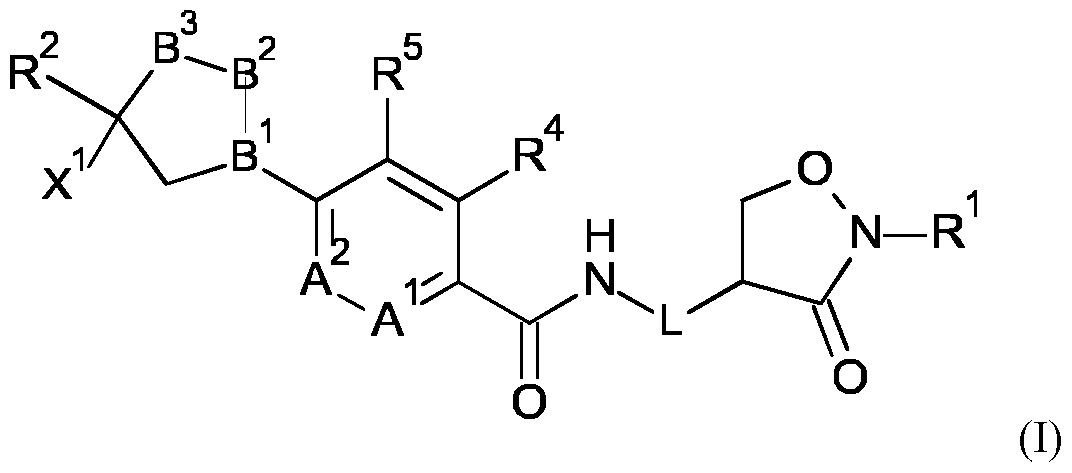
In a first aspect the invention provides a method comprising applying to a crop of soybean plants, the locus thereof, or propagation material thereof, a compound of formula I
Figure imgf000004_0001
wherein
-B'-B^B3- is -C=N-0-, -C=N-CH2-, -C=CH2-0- or -N-CH2-CH2-;
L is a direct bond or methylene;
A1 and A2 are C-H, or one of A1 and A2 is C-H and the other is N;
X1 is group X
Figure imgf000004_0002
R1 is Ci-C4alkyl,
Figure imgf000004_0003
or C3-C6cycloalkyl;
R2 is chlorodifluoromethyl or trifluoromethyl;
each R3 is independently bromo, chloro, fluoro or trifluoromethyl;
R4 is hydrogen, halogen, methyl, halomethyl or cyano;
R5 is hydrogen;
or R4 and R5 together form a bridging 1 ,3-butadiene group;
p is 2 or 3.
In a further aspect the invention provides a method of controlling and/or preventing infestation of stinkbugs in soybean comprising applying to a crop of soybean plants, the locus thereof, or propagation material thereof, a compound of formula I. The stinkbugs may be those that are resistant to one or more other insecticides.
In a further aspect the invention provides a method of controlling and/or preventing infestation of stinkbugs in a crop of useful plants comprising applying to a crop of useful plants, the locus thereof, or propagation material thereof, a compound of formula I. The stinkbugs may be those that are resistant to one or more other insecticides. In a further aspect the invention provides use of a compound of formula I for control of stinkbugs in a crop of useful plants. The use may be for controlling stinkbugs that are resistant to one or more other insecticides.
In a further aspect the invention provides a method of controlling and/or preventing infestation of insects from the genus Euschistus in a crop of useful plants comprising applying to a crop of useful plants, the locus thereof, or propagation material thereof, a compound of formula I. The insects from the genus Euschistus may be those that are resistant to one or more other insecticides.
In a further aspect the invention provides use of a compound of formula I for control of insects from the genus Euschistus in a crop of useful plants. The use may be for controlling insects from the genus Euschistus that are resistant to one or more other insecticides.
In a further aspect the invention provides a method of controlling and/or preventing infestation of insects from the genus Euschistus in a crop of soybean plants comprising applying to a crop of soybean, the locus thereof, or propagation material thereof, a compound of formula I. The insects from the genus Euschistus may be those that are resistant to one or more other insecticides.
In a further aspect the invention provides use of a compound of formula I for control of insects from the genus Euschistus in a crop of soybean plants. The use may be for controlling insects from the genus Euschistus that are resistant to one or more other insecticides.
In a further aspect the invention provides a method of controlling and/or preventing infestation of Euschistus heros in a crop of useful plants comprising applying to a crop of useful plants, the locus thereof, or propagation material thereof, a compound of formula I. The Euschistus heros may be resistant to one or more other insecticides.
In a further aspect the invention provides use of a compound of formula I for control of Euschistus heros in a crop of useful plants. The use may be for controlling Euschistus heros that is resistant to one or more other insecticides.
In a further aspect the invention provides a method of controlling and/or preventing infestation of Euschistus heros in a crop of soybean plants comprising applying to a crop of soybean, the locus thereof, or propagation material thereof, a compound of formula I. The Euschistus heros may be resistant to one or more other insecticides.
In a further aspect the invention provides use of a compound of formula I for control of Euschistus heros in a crop of soybean plants. The use may be for controlling insects Euschistus heros that are is resistant to one or more other insecticides.
Stinkbugs that are resistant to one or more other insecticides are preferably resistant to pyrethroid, neonicotinoids and/or organophosphates, more preferably pyrethroid insecticides.
In a further aspect the invention provides a method for obtaining regulatory approval for the use of one or more of a compound of formula I to control stinkbugs, in particular the genus Euschistus and in particular the species Euschistus heros, and in particular in soybean plants, comprising at least one step of referring to, submitting or relying on biological data showing that said active ingredient reduces insect pressure. The compounds of formula (I) may exist in different geometric or optical isomers or tautomeric forms. This invention covers all such isomers and tautomers and mixtures thereof in all proportions as well as isotopic forms such as deuterated compounds. The invention also covers salts and N-oxides of the compounds of the invention.
Alkyl groups (either alone or as part of a larger group, such as alkoxy-, alkylthio-, alkylsulfinyl-, alkylsulfonyl-, alkylcarbonyl- or alkoxycarbonyl-) can be in the form of a straight or branched chain and are, for example, methyl, ethyl, propyl, prop-2-yl, butyl, but-2-yl, 2-methyl-prop- 1 -yl or 2-methyl-prop-2-yl. The alkyl groups are preferably Ci-Ce, more preferably C1-C4, most preferably C1-C3 alkyl groups. Where an alkyl moiety is said to be substituted, the alkyl moiety is preferably substituted by one to four substituents, most preferably by one to three substituents.
Halogen is fluorine, chlorine, bromine or iodine.
Haloalkyl groups are alkyl groups which are substituted by one or more of the same or different halogen atoms and are, for example, difluoromethyl, trifluoromethyl, chlorodifluoromethyl or 2,2,2-trifluoro-ethyl.
Preferred substituent definitions are described below and may be combined in any
combination, including with original definitions.
-B '-B^B3- is preferably -C=N-0-.
A1 and A2 are preferably C-H.
Preferably X1 is 3,5-dichlorophenyl-, 3-chloro-4-fluorophenyl-, 3-fluoro-4-chlorophenyl-, 3,4- dichlorophenyl-, 3-chloro-4-bromophenyl-, 3,5-dichloro-4-fluorophenyl-, 3,4,5-trichlorophenyl-, 3,4,5-trifluorophenyl-, 3-chloro-5-bromophenyl-, 3 -chloro-5 -fluorophenyl-, 3-chloro-5- (trifluoromethyl)phenyl-, 3,4-dichloro-5-(trifluoromethyl)phenyl-, 3,5-bis(trifluoromethyl)phenyl-, 4- chloro-3,5-bis(trifluoromethyl)phenyl-, 3-(trifluoromethyl)phenyl-, more preferably 3 -chloro-5 - bromophenyl-, 3-chloro-5-(trifluoromethyl)phenyl-, 3,5-dichloro-4-fluorophenyl-, 3,4,5- trichlorophenyl-, 3,5-bis(trifluoromethyl)phenyl-, 3-(trifluoromethyl)phenyl-, 3,5-dichloro-4- bromophenyl-, 3-bromo-5-(trifluoromethyl)phenyl-, 3,5-dibromophenyl-, or 3,4-dichlorophenyl-, even more preferably 3,5-dichloro-phenyl, 3,5-dichloro-4-fluorophenyl-, 3,4,5-trichlorophenyl-, 3,5- bis(trifluoromethyl)phenyl, most preferably R4 is 3,5-dichloro-phenyl.
R1 is preferably methyl, ethyl, propyl, butyl, cyclopropyl, cyclobutyl, trifluoroethyl, difluoroethyl. Ethyl and trifluoroethyl are particularly preferred.
R2 is preferably trifluoromethyl.
Preferably each R3 is independently chlorine or fluorine, most preferably chlorine.
R4 is preferably chloro or methyl, most preferably methyl.
R5 is preferably hydrogen.
L is preferably a direct bond.
In one group of compounds -B '-B^B3- is -C=N-0-.
In one group of compounds -B '-B^B3- is -C=N-CH2-.
In one group of compounds -B '-B^B3- is -C=CH2-0-. In one group of compounds -B'-E^-B3- is -N-CH2-CH2-.
In one embodiment A1 and A2 are C-H, R2 is trifluoromethyl, and R5 is hydrogen.
In one embodiment A1 and A2 are C-H, R2 is trifluoromethyl, R5 is hydrogen and L is a direct bond.
In one embodiment -B1-B2-B3- is -C=N-0-, A1 and A2 are C-H, R2 is trifluoromethyl, R5 is hydrogen and L is a direct bond.
In one embodiment -B1-B2-B3- is -C=N-0-, A1 and A2 are C-H, R2 is trifluoromethyl, R4 is halogen or methyl, R5 is hydrogen and L is a direct bond.
In one embodiment -B1-B2-B3- is -C=N-0-, A1 and A2 are C-H, R2 is trifluoromethyl, R3 is chloro or fluoro, R4 is halogen or methyl, R5 is hydrogen and L is a direct bond.
In one embodiment A1 and A2 are C-H, R2 is trifluoromethyl, R4 is methyl, R5 is hydrogen, each R3 is chlorine, p is 2.
In one embodiment R1 is Ci-C4alkyl, e.g. methyl, ethyl or propyl, e.g. methyl or ethyl, e.g. ethyl.
In one embodiment X1 is group Xa
Figure imgf000007_0001
In one embodiment R1 is Ci-Cgalkyl, e.g. methyl, ethyl or propyl, e.g. methyl or ethyl, e.g.
I X1 is group Xa.
n one embodiment R is methyl,
n one embodiment R is ethyl.
n one embodiment R is 2,2,2-trifluoroethyl.
n one embodiment R is 2,2-difluoroethyl.
n one embodiment X is 3,5-dichlorophenyl.
n one embodiment X is 3,5-dichloro-4-fluorophenyl.
n one embodiment X is 3,4,5-trichlorophenyl.
n one embodiment R is methyl and X1 is 3,5-dichlorophenyl.
n one embodiment R is methyl and X1 is 3,5-dichloro-4-fluorophenyl.
n one embodiment R is methyl and X1 is 3,4,5-trichlorophenyl.
n one embodiment R is ethyl and X1 is 3,5-dichlorophenyl.
n one embodiment R is ethyl and X1 is 3,5-dichloro-4-fluorophenyl.
n one embodiment R is ethyl and X1 is 3,4,5-trichlorophenyl.
n one embodiment R is 2,2,2-trifluoroethyl and X1 is 3,5-dichlorophenyl.
n one embodiment R is 2,2,2-trifluoroethyl and X1 is 3,5-dichloro-4-fluorophenyl.
n one embodiment R is 2,2,2-trifluoroethyl and X1 is 3,4,5-trichlorophenyl. In one embodiment R1 is 2,2-difluoroethyl and X1 is 3,5-dichlorophenyl.
In one embodiment R1 is 2,2-difluoroethyl and X1 is 3,5-dichloro-4-fluorophenyl.
In one embodiment R1 is 2,2-difluoroethyl and X1 is 3,4,5-trichlorophenyl.
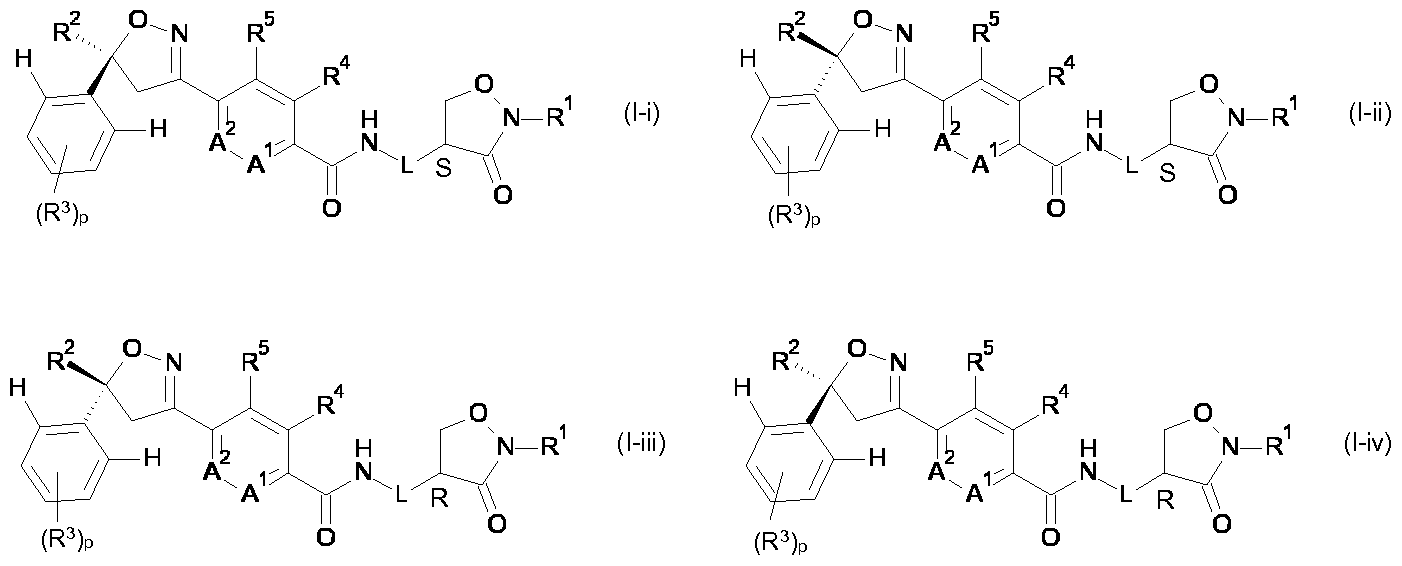
Compounds of formula I may exist as compounds of formula I* or compounds of formula Γ
Figure imgf000008_0001
Figure imgf000008_0002
Compounds of formula I** are more biologically active than compounds of formula I*. Compounds of formula I may be a mixture of compounds I* and I** in any ratio e.g. in a molar ratio of 1 :99 to 99: 1 , e.g. 10: 1 to 1 : 10, e.g. a substantially 50:50 molar ratio. Preferably the compound of formula I is a racemic mixture of the compounds of formula I** and I* or is enantiomerically enriched for the compound of formula I**. For example, when the compound of formula I is an enantiomerically enriched mixture of formula I**, the molar proportion of compound I** compared to the total amount of both enantiomers is for example greater than 50%, e.g. at least 55, 60, 65, 70, 75, 80, 85, 90, 95, 96, 97, 98, or at least 99%. In a preferred embodiment the compound of formula I is a compound of formula I** in substantially pure form, e.g. it is provided substantially in the absence of the alternative enantiomer.
Compounds of formula I may also exist as compounds of formula Γ or compounds of formula
I".
Figure imgf000008_0003
Figure imgf000008_0004
(S = S stereochemistry, R = R stereochemistry)
Compounds of formula I" are often more biologically active than compounds of formula Γ. The compound of formula I may be a mixture of compounds Γ and Γ ' in any ratio e.g. in a molar ratio of 1 :99 to 99: 1, e.g. 10: 1 to 1 : 10, e.g. a substantially 50:50 molar ratio. Preferably the compound of formula I is a racemic mixture of the compounds of formula I" and Γ or is enantiomerically enriched for the compound of formula Γ ' . For example, when the compound of formula I is an enantiomerically enriched mixture of formula I", the molar proportion of compound I" compared to the total amount of both enantiomers is for example greater than 50%, e.g. at least 55, 60, 65, 70, 75, 80, 85, 90, 95, 96, 97, 98, or at least 99%. In one embodiment the compound of formula I is a compound of formula Γ ' in substantially pure form, e.g. it is provided substantially in the absence of the alternative enantiomer.
The above stereocentres ive rise to four stereoisomers:
Figure imgf000009_0001
In one embodiment the compound of formula I is a mixture comprising compounds I-i, I-ii, I- iii and I-iv, wherein the mixture is enriched for the compound of formula I-iv, e.g. the molar proportion of compound I-iv compared to the total amount of the four isomers is for example greater than 25%, e.g. at least 30, 35, 40, 50, 55, 60, 65, 70, 75, 80, 85, 90, 95, 96, 97, 98, or at least 99%.
In another embodiment the compound of formula I is a mixture comprising compounds I-i, I- ii, I-iii and I-iv, wherein the molar amount of the compound of formuila I-iv is greater than the molar amount of the compound of formula I-i, and the molar amount of the compound I-ii, and the molar amount of the compound of formula I-iii, in other words, the compound of formula I-iv is the most abundant isomer in the mixture. For example the molar amount of compound of formula I-iv is at least 1, 2, 5, 10, 15, 20, 25, 30, 35, 40, 45, 50, 55, 60, 56, 70, 75, 80, 85, 90, or even at least 95% greater than the combined amount of the compound of formula I-iv and I-i, the combined amount of the compound of formula I-iv and I-ii, and the combined amount of the compound of formula I-iv and I-iii.
Although B1-B2-B3 is shown above as C=N-0, the same applies in respect of the stereoisomers when B'-B^B3 is -C=N-CH2-, -C=CH2-0- and -N-CH2-CH2-.
In one embodiment the compound of formula I-iv is the most abundant isomer and R1 is Cp C4alkyl, e.g. methyl, ethyl or propyl, e.g. methyl or ethyl, e.g. ethyl.
In one embodiment the compound of formula I-iv is the most abundant isomer and R1 is Cp C4alkyl, e.g. methyl, ethyl or propyl, e.g. methyl or ethyl, e.g. ethyl and X1 is group Xa.
In one embodiment the compound of formula I-iv is the most abundant isomer and R1 is methyl.
In one embodiment the compound of formula I-iv is the most abundant isomer and R1 is ethyl.
In one embodiment the compound of formula I-iv is the most abundant isomer and R1 is 2,2,2- trifluoroethyl. In one embodiment the compound of formula I-iv is the most abundant isomer and R1 is 2,2- difluoroethyl.
Preferred compounds of formula I are shown in the Tables below.
Table A: Compounds of formula fl-a
Figure imgf000010_0001
Table A provides 78 compounds and mixtures of formula (I-a) wherein R1 has the values listed X below. The symbols * and ** indicate the location of the chiral centres.
Figure imgf000010_0002
Table B provides 78 compounds and mixtures of formula (I-b) wherein R1 has the values listed X below. The symbols * and ** indicate the location of the chiral centres.
Figure imgf000010_0003
Table C provides 78 compounds and mixtures of formula (I-c) wherein R1 has the values listed X below. The symbols * and ** indicate the location of the chiral centres.
Table D: Compounds of formula fl-d
Figure imgf000011_0001
Table D provides 78 compounds and mixtures of formula (I-d) wherein R1 has the values listed table X below. The symbols * and ** indicate the location of the chiral centres.
Figure imgf000011_0002
Table E provides 78 compounds and mixtures of formula (I-e) wherein R1 has the values listed X below. The symbols * and ** indicate the location of the chiral centres.
Figure imgf000011_0003
Table F provides 78 compounds and mixtures of formula (I-f) wherein R1 has the values listed in table X below. The symbols * and ** indicate the location of the chiral centres. Table X represents Table A when X is A, Table B when X is B, Table C when X is C, Table D when X is D, Table E when X is E, Table F when X is F.
Compound Stereochemistry at Stereochemistry at R
numbers * **
X.1 Racemic mixture Racemic mixture ethyl-
X.2 Racemic mixture Racemic mixture butyl-
X.3 Racemic mixture Racemic mixture but-2-yl- Compound Stereochemistry at Stereochemistry at R1 numbers * **
X.4 Racemic mixture Racemic mixture 3-bromo-propyl-
X.5 Racemic mixture Racemic mixture 2,2,2-trifluoro-ethyl-
X.6 Racemic mixture Racemic mixture 3 ,3 , 3 -trifluoro -propyl-
X.7 Racemic mixture Racemic mixture cyclobutyl-
X.8 Racemic mixture Racemic mixture methyl
X.9 Racemic mixture Racemic mixture propyl
X.10 Racemic mixture Racemic mixture 2,2-difluoro-ethyl-
X.11 Racemic mixture Racemic mixture 2-fluoro-ethyl-
X.12 S Racemic mixture ethyl-
X.13 S Racemic mixture butyl-
X.14 S Racemic mixture but-2-yl-
X.15 S Racemic mixture 3-bromo-propyl-
X.16 S Racemic mixture 2,2,2-trifluoro-ethyl-
X.17 S Racemic mixture 3 ,3 , 3 -trifluoro -propyl-
X.18 S Racemic mixture cyclobutyl-
X.19 S Racemic mixture methyl
X.20 S Racemic mixture propyl
X.21 S Racemic mixture 2,2-difluoro-ethyl-
X.22 S Racemic mixture 2-fluoro-ethyl-
X.23 Racemic mixture Racemic mixture isopropyl
X.24 Racemic mixture Racemic mixture cyclopropyl
X.25 S Racemic mixture isopropyl
X.26 S Racemic mixture cyclopropyl
X.27 Racemic mixture S ethyl-
X.28 Racemic mixture S butyl-
X.29 Racemic mixture S but-2-yl-
X.30 Racemic mixture S 3-bromo-propyl-
X.31 Racemic mixture S 2,2,2-trifluoro-ethyl-
X.32 Racemic mixture S 3 ,3 , 3 -trifluoro -propyl-
X.33 Racemic mixture S cyclobutyl-
X.34 Racemic mixture S methyl
X.35 Racemic mixture S propyl
X.36 Racemic mixture S 2,2-difluoro-ethyl-
X.37 Racemic mixture S 2-fluoro-ethyl-
X.38 S S ethyl-
X.39 S S butyl-
X.40 S S but-2-yl-
X.41 S S 3-bromo-propyl-
X.42 S S 2,2,2-trifluoro-ethyl-
X.43 S S 3 ,3 , 3 -trifluoro -propyl-
X.44 S S cyclobutyl-
X.45 S S methyl
X.46 S S propyl Compound Stereochemistry at Stereochemistry at R1
numbers * **
X.47 S S 2,2-difluoro-ethyl-
X.48 S S 2-fluoro-ethyl-
X.49 Racemic mixture S isopropyl
X.50 Racemic mixture S cyclopropyl
X.51 S S isopropyl
X.52 S S cyclopropyl
X.53 Racemic mixture R ethyl-
X.54 Racemic mixture R butyl-
X.55 Racemic mixture R but-2-yl-
X.56 Racemic mixture R 3-bromo-propyl-
X.57 Racemic mixture R 2,2,2-trifluoro-ethyl-
X.58 Racemic mixture R 3 ,3 , 3 -trifluoro -propyl-
X.59 Racemic mixture R cyclobutyl-
X.60 Racemic mixture R methyl
X.61 Racemic mixture R propyl
X.62 Racemic mixture R 2,2-difluoro-ethyl-
X.63 Racemic mixture R 2-fluoro-ethyl-
X.64 S R ethyl-
X.65 S R butyl-
X.66 S R but-2-yl-
X.67 S R 3-bromo-propyl-
X.68 S R 2,2,2-trifluoro-ethyl-
X.69 S R 3 ,3 , 3 -trifluoro -propyl-
X.70 S R cyclobutyl-
X.71 S R methyl
X.72 S R propyl
X.73 S R 2,2-difluoro-ethyl-
X.74 S R 2-fluoro-ethyl-
X.75 Racemic mixture R isopropyl
X.76 Racemic mixture R cyclopropyl
X.77 S R isopropyl
X.78 S R cyclopropyl
The compounds of the invention may be made by a variety of methods as shown in Schemes
Figure imgf000014_0001
1) Compounds of formula (I), can be prepared by reacting a compound of formula (II) wherein R is OH, Ci-Cealkoxy or CI, F or Br, with an amine of formula (III) as shown in Scheme 1. When R is OH such reactions are usually carried out in the presence of a coupling reagent, such as Ν,Ν'- dicyclohexylcarbodiimide ("DCC"), 1 -ethyl-3 -(3 -dimethylamino-propyl)carbodiimide hydrochloride ("EDC") or bis(2-oxo-3-oxazolidinyl)phosphonic chloride ("BOP-Cl"), in the presence of a base, and optionally in the presence of a nucleophilic catalyst, such as hydroxybenzotriazole ("HOBT"). When R is CI, such reactions are usually carried out in the presence of a base, and optionally in the presence of a nucleophilic catalyst. Alternatively, it is possible to conduct the reaction in a biphasic system comprising an organic solvent, preferably ethyl acetate, and an aqueous solvent, preferably a solution of sodium hydrogen carbonate. When R is Ci-C6alkoxy it is sometimes possible to convert the ester directly to the amide by heating the ester and amine together in a thermal process. Suitable bases include pyridine, triethylamine, 4-(dimethylamino)-pyridine ("DMAP") or diisopropylethylamine (Hunig's base). Preferred solvents are NN-dimethylacetamide, tetrahydrofuran, dioxane, 1 ,2- dimethoxyethane, ethyl acetate and toluene. The reaction is carried out at a temperature of from 0°C to 100°C, preferably from 15°C to 30°C, in particular at ambient temperature. Amines of formula (III) are either known in the literature or can be prepared using methods known to a person skilled in the art.
2) Acid halides of formula (II), wherein R is CI, F or Br, may be made from carboxylic acids of formula (II), wherein R is OH, under standard conditions, as described for example in WO
2009/080250.
3) Carboxylic acids of formula (II), wherein R is OH, may be formed from esters of formula (II), wherein R is Ci-C6alkoxy as described for example in WO 2009/080250.
4) Compounds of formula (I) can be prepared by reacting a compound of formula (IV) wherein XB is a leaving group, for example a halogen, such as bromo, with carbon monoxide and an amine of formula (III), in the presence of a catalyst, such as palladium(II) acetate or bis- (triphenylphosphine)palladium(II) dichloride, optionally in the presence of a ligand, such as triphenylphosphine, and a base, such as sodium carbonate, pyridine, triethylamine, 4-(dimethylamino)- pyridine ("DMAP") or diisopropylethylamine (Hunig's base), in a solvent, such as water, NN- dimethylformamide or tetrahydrofuran. The reaction is carried out at a temperature of from 50°C to 200°C, preferably from 100°C to 150°C. The reaction is carried out at a pressure of from 50 to 200 bar, preferably from 100 to 150 bar.
5) Compounds of formula (IV) wherein XB is a leaving group, for example a halogen, such as bromo, can be made by various methods, for example as described in WO 2009/080250.
Sc
Figure imgf000015_0001
6) Alternatively, compounds of formula (I), can be prepared by various methods from an intermediate of formula (V) as shown in Scheme 2 wherein XB is a leaving group, for example a halogen, such as bromo, or XB is cyano, formyl or acetyl according to similar methods to those described in WO09080250. An intermediate of formula (V) can be prepared for example from an intermediate of formula (VI) as described in the same reference.
Figure imgf000016_0001
Figure imgf000016_0002
7) Alternatively, compounds of formula (I) can be prepared by various methods from an intermediate of formula VII) as shown in Scheme 3 wherein Xc is Xc-1 or Xc-2
Figure imgf000016_0003
Xc-1 Xc-2
according to similar methods to those described in WO 2009/080250.
8) Compounds of formula (VII) wherein Xc is Xc is Xc-1 or Xc-2 can be prepared from a compound of formula (Va) from a compound of formula (VII) wherein Xc is CH2-halogen using similar methods to those described in WO 2009/080250.
9) Compounds of formula (VII) wherein Xc is CH2-halogen, such as bromo or chloro, can be prepared by reacting a methyl ketone of formula (Va) with a halogenating agent, such as bromine or chlorine, in a solvent, such as acetic acid, at a temperature of from 0°C to 50°C, preferably from ambient temperature to 40°C.
Other methods for the preparation of compounds of formula I are described in
PCT/EP2010/068605, which is incorporated herein by reference. The methods and uses of the invention are preferably for controlling and/or preventing infestation of the soybean crop by stink bugs, including stink bugs that are resistant to other insecticides, e.g. pyrethroid insecticides. Stinkbugs that are "resistant" to a particular insecticide refers e.g. to strains of stinkbugs that are less sensitive to that insecticide compared to the expected sensitivity of the same species of stinkbug. The expected sensitivity can be measured using e.g. a strain that has not previously been exposed to the insecticide.
Application is of the compounds of the invention is preferably to a crop of soybean plants, the locus thereof or propagation material thereof. Preferably application is to a crop of soybean plants or the locus thereof, more preferably to a crop of soybean plants. Application may be before infestation or when the pest is present. Application of the compounds of the invention can be performed according to any of the usual modes of application, e.g. foliar, drench, soil, in furrow etc. However, control of stinkbugs is usually achieved by foliar application, which is the preferred mode of application according to the invention.
The compounds of the invention may be applied in combination with an attractant. An attractant is a chemical that causes the insect to migrate towards the location of application. For control of stinkbugs it can be advantageous to apply the compounds of the invention with an attractant, particularly when the application is foliar. Stinkbugs are often located near to the ground, and application of an attractant may encourage migration up the plant towards the active ingredient.
Suitable attractants include glucose, sacchrose, salt, glutamate (e.g. Aji-no-moto™), citric acid (e.g. Orobor™), soybean oil, peanut oil and soybean milk. Glutamate and citric acid are of particular interest, with citric acid being preferred.
An attractant may be premixed with the compound of the invention prior to application, e.g. as a readymix or tankmix, or by simultaneous application or sequential application to the plant. Suitable rates of attractants are for example 0.02kg/ha-3kg/ha.
The compounds of the invention are preferably used for pest control on soybean at 1 :500 g/ha, preferably 10-70g/ha.
The compounds of the invention are suitable for use on any soybean plant, including those that have been genetically modified to be resistant to active ingredients such as herbicides, or to produce biologically active compounds that control infestation by plant pests.
In a further preferred embodiment, transgenic plants and plant cultivars obtained by genetic engineering methods, if appropriate in combination with conventional methods (Genetically Modified Organisms), and parts thereof, are treated. Particularly preferably, plants of the plant cultivars which are in each case commercially available or in use are treated according to the invention. Plant cultivars are understood as meaning plants having novel properties ("traits") which have been obtained by conventional breeding, by mutagenesis or by recombinant DNA techniques.
These can be cultivars, bio- or genotypes. Depending on the plant species or plant cultivars, their location and growth conditions (soils, climate, vegetation period, diet), the treatment according to the invention may also result in superadditive "synergistic") effects. Thus, for example, reduced application rates and/or a widening of the activity spectrum and/or an increase in the activity of the substances and compositions which can be used according to the invention, better plant growth, increased tolerance to high or low temperatures, increased tolerance to drought or to water or soil salt content, increased flowering performance, easier harvesting, accelerated maturation, higher harvest yields, higher quality and/or a higher nutritional value of the harvested products, better storage stability and/or processability of the harvested products are possible, which exceed the effects which were actually to be expected.
The preferred transgenic plants or plant cultivars (obtained by genetic engineering) which are to be treated according to the invention include all plants which, by virtue of the genetic modification, received genetic material which imparts particularly advantageous, useful traits to these plants.
Examples of such traits are better plant growth, increased tolerance to high or low temperatures, increased tolerance to drought or to water or soil salt content, increased flowering performance, easier harvesting, accelerated maturation, higher harvest yields, higher quality and/or a higher nutritional value of the harvested products, better storage stability and/or processability of the harvested products.
Further and particularly emphasized examples of such traits are a better defence of the plants against animal and microbial pests, such as against insects, mites, phytopathogenic fungi, bacteria and/or viruses, and also increased tolerance of the plants to certain herbicidally active compounds.
Traits that are emphasized in particular are the increased defence of the plants against insects, arachnids, nematodes and slugs and snails by virtue of toxins formed in the plants, in particular those formed in the plants by the genetic material from Bacillus thuringiensis (for example by the genes
CrylA(a), CrylA(b), CrylA(c), CryllA, CrylllA, CryIIIB2, Cry9c, Cry2Ab, Cry3Bb and CrylF and also combinations thereof) (referred to herein as "Bt plants"). Traits that are also particularly emphasized are the increased defence of the plants against fungi, bacteria and viruses by systemic acquired resistance (SAR), systemin, phytoalexins, elicitors and resistance genes and correspondingly expressed proteins and toxins.
Traits that are furthermore particularly emphasized are the increased tolerance of the plants to certain herbicidally active compounds, for example imidazolinones, sulphonylureas, glyphosate or phosphinotricin (for example the "PAT" gene). The genes which impart the desired traits in question can also be present in combination with one another in the transgenic plants.
Examples of "Bt plants" are soya bean varieties which are sold under the trade names YIELD
GARD(®)
Examples of herbicide -tolerant plants which may be mentioned are soybean varieties which are sold under the trade names Roundup Ready(®) (tolerance to glyphosate), Liberty Link(®) (tolerance to phosphinotricin), IMI(®) (tolerance to imidazolinones) and STS(®) (tolerance to sulphonylureas).
Herbicide-resistant plants (plants bred in a conventional manner for herbicide tolerance) which may be mentioned include the varieties sold under the name Clearfield(®) (for example maize). Of particular interest are soybean plants carrying trains conferring resistance to 2.4D (e.g.
Enlist®), glyphosate (e.g. Roundup Ready®, Roundup Ready 2 Yield®), sulfonylurea (e.g. STS®), glufosinate (e.g. Liberty Link®, Ignite®), Dicamba (Monsanto) HPPD tolerance (e.g. isoxaflutole herbicide) (Bayer CropScience, Syngenta). Double or triple stack in soybean plants of any of the traits described here are also of interest, including glyphosate and sulfonyl-urea tolerance (e.g. Optimum GAT®, plants stacked with STS® and Roundup Ready® or Roundup Ready 2 Yield®), dicamba and glyphosate tolerance (Monsanto). Soybean Cyst Nematode resistance soybean (SCN® - Syngenta) and soybean with Aphid resistant trait (AMT® - Syngneta) are also of interest.
These statements also apply to plant cultivars having these genetic traits or genetic traits still to be developed, which plant cultivars will be developed and/or marketed in the future.
The compounds of the invention may be used on soybean to control, for example,
Elasmopalpus lignosellus, Diloboderus abderus, Diabrotica speciosa, Sternechus subsignatus, Formicidae, Agrotis ypsilon, Julus ssp., Anticarsia gemmatalis, Megascelis ssp., Procornitermes ssp., Gryllotalpidae, Nezara viridula, Piezodorus spp., Acrostemum spp., Neomegalotomus spp., Cerotoma trifurcata, Popillia japonica, Edessa spp., Liogenys fuscus, Euchistus hews, stalk borer, Scaptocoris castanea, phyllophaga spp., Pseudoplusia includens, Spodoptera spp., Bemisia tabaci, Agriotes spp., preferably Diloboderus abderus, Diabrotica speciosa, Nezara viridula, Piezodorus spp., Acrostemum spp., Cerotoma trifurcata, Popillia japonica, Euchistus heros , phyllophaga spp., Agriotes spp..
The compounds of the invention are preferably used on soybean to control stinkbugs, e.g. Nezara spp. (e.g. Nezara viridula, Nezara antennata, Nezara hilare), Piezodorus spp. (e.g. Piezodorus guildinii), Acrostemum spp. Euchistus spp. (e.g. Euchistus heros, Euschistus servus), Halyomorpha halys, Plautia crossota, Riptortus clavatus, Rhopalus msculatus, Antestiopsis orbitalus, Dichelops spp. (e.g. Dichelops furcatus, Dichelops melacanthus), Eurygaster spp. (e.g. Eurygaster intergriceps, Eurygaster maura), Oebalus spp. (e.g. Oebalus mexicana, Oebalus poecilus, Oebalus pugnase, Scotinophara spp. (e.g. Scotinophara lurida, Scotinophara coarctata). Preferred targets include Antestiopsis orbitalus, Dichelops furcatus, Dichelops melacanthus, Euchistus heros, Euschistus servus, Nezara viridula, Nezara hilare, Piezodorus guildinii, Halyomorpha halys. In one embodiment the stinkbug target is Nezara viridula, Piezodorus spp., Acrostemum spp, Euchistus heros. The compounds of the invention are particularly effective against Euschistus and in particular Euchistus heros. Euschistus and in particular Euchistus heros are the preferred targets.
In order to apply a compounds of the invention as an insecticide, acaricide, nematicide or molluscicide to a pest, a locus of pest, or to a plant susceptible to attack by a pest, compounds of the invention is usually formulated into a composition which includes, in addition to the compound of the invention, a suitable inert diluent or carrier and, optionally, a surface active agent (SFA). SFAs are chemicals which are able to modify the properties of an interface (for example, liquid/solid, liquid/air or liquid/liquid interfaces) by lowering the interfacial tension and thereby leading to changes in other properties (for example dispersion, emulsification and wetting). It is preferred that all compositions (both solid and liquid formulations) comprise, by weight, 0.0001 to 95%, more preferably 1 to 85%, for example 5 to 60%, of a compound of the invention. The composition is generally used for the control of pests such that a compound of the invention is applied at a rate of from O. lg to 10kg per hectare, preferably from lg to 6kg per hectare, more preferably from lg to 1kg per hectare.
When used in a seed dressing, a compound of the invention is used at a rate of 0.000 lg to lOg (for example O.OOlg or 0.05g), preferably 0.005g to lOg, more preferably 0.005g to 4g, per kilogram of seed.
Compositions comprising a compound of the invention can be chosen from a number of formulation types, including dustable powders (DP), soluble powders (SP), water soluble granules (SG), water dispersible granules (WG), wettable powders (WP), granules (GR) (slow or fast release), soluble concentrates (SL), oil miscible liquids (OL), ultra low volume liquids (UL), emulsifiable concentrates (EC), dispersible concentrates (DC), emulsions (both oil in water (EW) and water in oil (EO)), micro-emulsions (ME), suspension concentrates (SC), aerosols, fogging/smoke formulations, capsule suspensions (CS) and seed treatment formulations. The formulation type chosen in any instance will depend upon the particular purpose envisaged and the physical, chemical and biological properties of the compound of the invention.
Dustable powders (DP) may be prepared by mixing a compound of the invention with one or more solid diluents (for example natural clays, kaolin, pyrophyllite, bentonite, alumina,
montmorillonite, kieselguhr, chalk, diatomaceous earths, calcium phosphates, calcium and magnesium carbonates, sulfur, lime, flours, talc and other organic and inorganic solid carriers) and mechanically grinding the mixture to a fine powder.
Soluble powders (SP) may be prepared by mixing a compound of the invention with one or more water-soluble inorganic salts (such as sodium bicarbonate, sodium carbonate or magnesium sulfate) or one or more water-soluble organic solids (such as a polysaccharide) and, optionally, one or more wetting agents, one or more dispersing agents or a mixture of said agents to improve water dispersibility/solubility. The mixture is then ground to a fine powder. Similar compositions may also be granulated to form water soluble granules (SG).
Wettable powders (WP) may be prepared by mixing a compound of the invention with one or more solid diluents or carriers, one or more wetting agents and, preferably, one or more dispersing agents and, optionally, one or more suspending agents to facilitate the dispersion in liquids. The mixture is then ground to a fine powder. Similar compositions may also be granulated to form water dispersible granules (WG).
Granules (GR) may be formed either by granulating a mixture of a compound of the invention and one or more powdered solid diluents or carriers, or from pre-formed blank granules by absorbing a compound of the invention (or a solution thereof, in a suitable agent) in a porous granular material (such as pumice, attapulgite clays, fuller's earth, kieselguhr, diatomaceous earths or ground corn cobs) or by adsorbing a compound of the invention (or a solution thereof, in a suitable agent) on to a hard core material (such as sands, silicates, mineral carbonates, sulfates or phosphates) and drying if necessary. Agents which are commonly used to aid absorption or adsorption include solvents (such as aliphatic and aromatic petroleum solvents, alcohols, ethers, ketones and esters) and sticking agents (such as polyvinyl acetates, polyvinyl alcohols, dextrins, sugars and vegetable oils). One or more other additives may also be included in granules (for example an emulsifying agent, wetting agent or dispersing agent).
5 Dispersible Concentrates (DC) may be prepared by dissolving a compound of the invention in water or an organic solvent, such as a ketone, alcohol or glycol ether. These solutions may contain a surface active agent (for example to improve water dilution or prevent crystallization in a spray tank).
Emulsifiable concentrates (EC) or oil-in-water emulsions (EW) may be prepared by dissolving a compound of the invention in an organic solvent (optionally containing one or more wetting agents,
10 one or more emulsifying agents or a mixture of said agents). Suitable organic solvents for use in ECs include aromatic hydrocarbons (such as alkylbenzenes or alkylnaphthalenes, exemplified by
SOLVESSO 100, SOLVESSO 150 and SOLVESSO 200; SOLVESSO is a Registered Trade Mark), ketones (such as cyclohexanone or methylcyclohexanone) and alcohols (such as benzyl alcohol, furfuryl alcohol or butanol), N-alkylpyrrolidones (such as N-methylpyrrolidone or N-
15 octylpyrrolidone), dimethyl amides of fatty acids (such as C8-Ci0 fatty acid dimethylamide) and
chlorinated hydrocarbons. An EC product may spontaneously emulsify on addition to water, to produce an emulsion with sufficient stability to allow spray application through appropriate equipment. Preparation of an EW involves obtaining a compound of the invention either as a liquid (if it is not a liquid at room temperature, it may be melted at a reasonable temperature, typically below
20 70°C) or in solution (by dissolving it in an appropriate solvent) and then emulsifiying the resultant liquid or solution into water containing one or more SFAs, under high shear, to produce an emulsion. Suitable solvents for use in EWs include vegetable oils, chlorinated hydrocarbons (such as chlorobenzenes), aromatic solvents (such as alkylbenzenes or alkylnaphthalenes) and other appropriate organic solvents which have a low solubility in water.
25 Microemulsions (ME) may be prepared by mixing water with a blend of one or more solvents with one or more SFAs, to produce spontaneously a thermodynamically stable isotropic liquid formulation. A compound of the invention is present initially in either the water or the solvent/SFA blend. Suitable solvents for use in MEs include those hereinbefore described for use in ECs or in EWs. An ME may be either an oil-in-water or a water-in-oil system (which system is present may be
30 determined by conductivity measurements) and may be suitable for mixing water-soluble and oil- soluble pesticides in the same formulation. An ME is suitable for dilution into water, either remaining as a microemulsion or forming a conventional oil-in-water emulsion.
Suspension concentrates (SC) may comprise aqueous or non-aqueous suspensions of finely divided insoluble solid particles of a compound of the invention. SCs may be prepared by ball or bead
35 milling the solid compound of the invention in a suitable medium, optionally with one or more
dispersing agents, to produce a fine particle suspension of the compound. One or more wetting agents may be included in the composition and a suspending agent may be included to reduce the rate at which the particles settle. Alternatively, a compound of the invention may be dry milled and added to water, containing agents hereinbefore described, to produce the desired end product.
Aerosol formulations comprise a compound of the invention and a suitable propellant (for example n-butane). A compound of the invention may also be dissolved or dispersed in a suitable medium (for example water or a water miscible liquid, such as n-propanol) to provide compositions for use in non-pressurized, hand-actuated spray pumps.
A compound of the invention may be mixed in the dry state with a pyrotechnic mixture to form a composition suitable for generating, in an enclosed space, a smoke containing the compound.
Capsule suspensions (CS) may be prepared in a manner similar to the preparation of EW formulations but with an additional polymerization stage such that an aqueous dispersion of oil droplets is obtained, in which each oil droplet is encapsulated by a polymeric shell and contains a compound of the invention and, optionally, a carrier or diluent therefor. The polymeric shell may be produced by either an interfacial polycondensation reaction or by a coacervation procedure. The compositions may provide for controlled release of the compound of the invention and they may be used for seed treatment. A compound of the invention may also be formulated in a biodegradable polymeric matrix to provide a slow, controlled release of the compound.
A composition may include one or more additives to improve the biological performance of the composition (for example by improving wetting, retention or distribution on surfaces; resistance to rain on treated surfaces; or uptake or mobility of a compound of the invention). Such additives include surface active agents, spray additives based on oils, for example certain mineral oils or natural plant oils (such as soy bean and rape seed oil), and blends of these with other bio-enhancing adjuvants (ingredients which may aid or modify the action of a compound of the invention).
A compound of the invention may also be formulated for use as a seed treatment, for example as a powder composition, including a powder for dry seed treatment (DS), a water soluble powder (SS) or a water dispersible powder for slurry treatment (WS), or as a liquid composition, including a flowable concentrate (FS), a solution (LS) or a capsule suspension (CS). The preparations of DS, SS, WS, FS and LS compositions are very similar to those of, respectively, DP, SP, WP, SC and DC compositions described above. Compositions for treating seed may include an agent for assisting the adhesion of the composition to the seed (for example a mineral oil or a film-forming barrier).
Wetting agents, dispersing agents and emulsifying agents may be surface SFAs of the cationic, anionic, amphoteric or non-ionic type.
Suitable SFAs of the cationic type include quaternary ammonium compounds (for example cetyltrimethyl ammonium bromide), imidazolines and amine salts.
Suitable anionic SFAs include alkali metals salts of fatty acids, salts of aliphatic monoesters of sulfuric acid (for example sodium lauryl sulfate), salts of sulfonated aromatic compounds (for example sodium dodecylbenzenesulfonate, calcium dodecylbenzenesulfonate, butylnaphthalene sulfonate and mixtures of sodium di-z' opropyl- and tri-wopropyl-naphthalene sulfonates), ether sulfates, alcohol ether sulfates (for example sodium laureth-3 -sulfate), ether carboxylates (for example sodium laureth- 3-carboxylate), phosphate esters (products from the reaction between one or more fatty alcohols and phosphoric acid (predominately mono-esters) or phosphorus pentoxide (predominately di-esters), for example the reaction between lauryl alcohol and tetraphosphoric acid; additionally these products may be ethoxylated), sulfosuccinamates, paraffin or olefine sulfonates, taurates and lignosulfonates.
Suitable SFAs of the amphoteric type include betaines, propionates and glycinates.
Suitable SFAs of the non-ionic type include condensation products of alkylene oxides, such as ethylene oxide, propylene oxide, butylene oxide or mixtures thereof, with fatty alcohols (such as oleyl alcohol or cetyl alcohol) or with alkylphenols (such as octylphenol, nonylphenol or octylcresol); partial esters derived from long chain fatty acids or hexitol anhydrides; condensation products of said partial esters with ethylene oxide; block polymers (comprising ethylene oxide and propylene oxide);
alkanolamides; simple esters (for example fatty acid polyethylene glycol esters); amine oxides (for example lauryl dimethyl amine oxide); and lecithins.
Suitable suspending agents include hydrophilic colloids (such as polysaccharides,
polyvinylpyrrolidone or sodium carboxymethylcellulose) and swelling clays (such as bentonite or attapulgite).
A compound of the invention may be applied by any of the known means of applying pesticidal compounds. For example, it may be applied, formulated or unformulated, to the pests or to a locus of the pests (such as a habitat of the pests, or a growing plant liable to infestation by the pests) or to any part of the plant, including the foliage, stems, branches or roots, to the seed before it is planted or to other media in which plants are growing or are to be planted (such as soil surrounding the roots, the soil generally, paddy water or hydroponic culture systems), directly or it may be sprayed on, dusted on, applied by dipping, applied as a cream or paste formulation, applied as a vapor or applied through distribution or incorporation of a composition (such as a granular composition or a composition packed in a water-soluble bag) in soil or an aqueous environment.
A compound of the invention may also be injected into plants or sprayed onto vegetation using electrodynamic spraying techniques or other low volume methods, or applied by land or aerial irrigation systems.
Compositions for use as aqueous preparations (aqueous solutions or dispersions) are generally supplied in the form of a concentrate containing a high proportion of the active ingredient, the concentrate being added to water before use. These concentrates, which may include DCs, SCs, ECs, EWs, MEs, SGs, SPs, WPs, WGs and CSs, are often required to withstand storage for prolonged periods and, after such storage, to be capable of addition to water to form aqueous preparations which remain homogeneous for a sufficient time to enable them to be applied by conventional spray equipment. Such aqueous preparations may contain varying amounts of a compound of the invention (for example 0.0001 to 10%, by weight) depending upon the purpose for which they are to be used.
A compound of the invention may be used in mixtures with fertilizers (for example nitrogen-, potassium- or phosphorus-containing fertilizers). Suitable formulation types include granules of fertilizer. The mixtures preferably contain up to 25% by weight of the compound of the invention. The invention therefore also provides a fertilizer composition comprising a fertilizer and a compound of the invention.
The compositions of this invention may contain other compounds having biological activity, for example micronutrients or compounds having fungicidal activity or which possess plant growth 5 regulating, herbicidal, insecticidal, nematicidal or acaricidal activity.
The compound of the invention may be the sole active ingredient of the composition or it may be admixed with one or more additional active ingredients such as a pesticide, fungicide, synergist, herbicide or plant growth regulator where appropriate. An additional active ingredient may: provide a composition having a broader spectrum of activity or increased persistence at a locus; synergize the 0 activity or complement the activity (for example by increasing the speed of effect or overcoming repellency) of the compound of the invention; or help to overcome or prevent the development of resistance to individual components. The particular additional active ingredient will depend upon the intended utility of the composition. Examples of suitable pesticides include the following:
a) Pyrethroids, such as permethrin, cypermethrin, fenvalerate, esfenvalerate, deltamethrin, cyhalothrin 5 (in particular lambda-cyhalothrin and gamma cyhalothrin), bifenthrin, fenpropathrin, cyfluthrin, tefluthrin, fish safe pyrethroids (for example ethofenprox), natural pyrethrin, tetramethrin,
S-bioallethrin, fenfluthrin, prallethrin, acrinathirin, etofenprox or
5-benzyl-3-furylmethyl-(E)-(lR,3S)-2,2-dimethyl- 3-(2-oxothiolan-3-ylidenemethyl)cyclopropane carboxylate;
0 b) Organophosphates, such as profenofos, sulprofos, acephate, methyl parathion, azinphos-methyl, demeton-s -methyl, heptenophos, thiometon, fenamiphos, monocrotophos, profenofos, triazophos, methamidophos, dimethoate, phosphamidon, malathion, chlorpyrifos, phosalone, terbufos, fensulfothion, fonofos, phorate, phoxim, pirimiphos-methyl, pirimiphos-ethyl, fenitrothion, fosthiazate or diazinon;
5 c) Carbamates (including aryl carbamates), such as pirimicarb, triazamate, cloethocarb, carbofuran, furathiocarb, ethiofencarb, aldicarb, thiofurox, carbosulfan, bendiocarb, fenobucarb, propoxur, methomyl or oxamyl;
d) Benzoyl ureas, such as diflubenzuron, triflumuron, hexaflumuron, flufenoxuron, diafenthiuron, lufeneron, novaluron, noviflumuron or chlorfluazuron;
Θ) Organic tin compounds, such as cyhexatin, fenbutatin oxide or azocyclotin;
f) Pyrazoles, such as tebufenpyrad, tolfenpyrad, ethiprole, pyriprole, fipronil, and fenpyroximate; g) Macrolides, such as avermectins or milbemycins, for example abamectin, emamectin benzoate, ivermectin, milbemycin, spinosad, azadirachtin, milbemectin, lepimectin or spinetoram;
h) Hormones or pheromones;
5 i) Organochlorine compounds, such as endosulfan (in particular alpha-endosulfan), benzene
hexachloride, DDT, chlordane or dieldrin;
j) Amidines, such as chlordimeform or amitraz;
k) Fumigant agents, such as chloropicrin, dichloropropane, methyl bromide or metam; 1) Neonicotinoid compounds, such as imidacloprid, thiacloprid, acetamiprid, nitenpyram, dinotefuran, thiamethoxam, clothianidin, or nithiazine;
m) Diacylhydrazines, such as tebufenozide, chromafenozide or methoxyfenozide;
n) Diphenyl ethers, such as diofenolan or pyriproxifen;
o) Ureas such as Indoxacarb or metaflumizone;
p) Ketoenols, such as Spirotetramat, spirodiclofen or spiromesifen;
q) Diamides, such as flubendiamide, chlorantraniliprole (Rynaxypyr®) or cyantraniliprole;
r) Essential oils such as Bugoil® - (Plantlmpact); or
s) a comopund selected from buprofezine, flonicamid, acequinocyl, bifenazate, cyenopyrafen, cyflumetofen, etoxazole, flometoquin, fluacrypyrim, fluensulfone, flufenerim, flupyradifuone, harpin, iodomethane, dodecadienol, pyridaben, pyridalyl, pyrimidifen, flupyradifurone, 4-[(6-Chloro-pyridin-
3- ylmethyl)-(2,2-difluoro-ethyl)-amino]-5H-furan-2-one (DE 102006015467), CAS: 915972-17-7 (WO 2006129714; WO 2011/147953; WO 2011/147952), CAS: 26914-55-8 (WO 2007/020986), chlorfenapyr, pymetrozine, sulfoxaflor and pyrifluqinazon.
In addition to the major chemical classes of pesticide listed above, other pesticides having particular targets may be employed in the composition, if appropriate for the intended utility of the composition. For instance, selective insecticides for particular crops, for example stemborer specific insecticides (such as cartap) or hopper specific insecticides (such as buprofezin) for use in rice may be employed. Alternatively insecticides or acaricides specific for particular insect species/stages may also be included in the compositions (for example acaricidal ovo-larvicides, such as clofentezine, flubenzimine, hexythiazox or tetradifon; acaricidal motilicides, such as dicofol or propargite;
acaricides, such as bromopropylate or chlorobenzilate; or growth regulators, such as hydramethylnon, cyromazine, methoprene, chlorfluazuron or diflubenzuron).
Examples of fungicidal compounds which may be included in the composition of the invention are (E)-N-methyl-2-[2-(2,5-dimethylphenoxymethyl)phenyl]-2-methoxy-iminoacetamide (SSF-129),
4- bromo-2-cyano-N,N-dimethyl-6-trifluoromethylbenzimidazole-l -sulfonamide, -[N-(3-chloro-2,6- -xylyl)-2-methoxyacetamido]-y-butyrolactone, 4-chloro-2-cyano-N,N-dimethyl-5-p-tolylimidazole-l - sulfonamide (IKF-916, cyamidazosulfamid), 3 -5 -dichloro-N-(3 -chloro- 1 -ethyl- 1 -methyl-2-oxopropyl)- 4-methylbenzamide (RH-7281, zoxamide), N-allyl-4,5,-dimethyl-2-trimethylsilylthiophene-3- carboxamide (MON65500), N-(l -cyano-l,2-dimethylpropyl)-2-(2,4-dichlorophenoxy)propionamide (AC382042), N-(2-methoxy-5-pyridyl)-cyclopropane carboxamide, acibenzolar (CGA245704), alanycarb, aldimorph, anilazine, azaconazole, azoxystrobin, benalaxyl, benomyl, biloxazol, bitertanol, blasticidin S, bromuconazole, bupirimate, captafol, captan, carbendazim, carbendazim chlorhydrate, carboxin, carpropamid, carvone, CGA41396, CGA41397, chinomethionate, chlorothalonil, chlorozolinate, clozylacon, copper containing compounds such as copper oxychloride, copper oxyquinolate, copper sulfate, copper tallate and Bordeaux mixture, cymoxanil, cyproconazole, cyprodinil, debacarb, di-2-pyridyl disulfide 1,1 '-dioxide, dichlofluanid, diclomezine, dicloran, diethofencarb, difenoconazole, difenzoquat, diflumetorim, OjO-di-z' o-propyl-S-benzyl thiophosphate, dimefluazole, dimetconazole, dimethomorph, dimethirimol, diniconazole, dinocap, dithianon, dodecyl dimethyl ammonium chloride, dodemorph, dodine, doguadine, edifenphos, epoxiconazole, ethirimol, ethyl-(Z)-N-benzyl-N-([methyl(methyl-thioethylideneaminooxycarbonyl)amino]thio)- -alaninate, etridiazole, famoxadone, fenamidone (RPA407213), fenarimol, fenbuconazole, fenfuram, fenhexamid (KBR2738), fenpiclonil, fenpropidin, fenpropimorph, fentin acetate, fentin hydroxide, ferbam, ferimzone, fluazinam, fludioxonil, flumetover, fluoroimide, fluquinconazole, flusilazole, flutolanil, flutriafol, folpet, fuberidazole, furalaxyl, furametpyr, guazatine, hexaconazole, hydroxyisoxazole, hymexazole, imazalil, imibenconazole, iminoctadine, iminoctadine triacetate, ipconazole, iprobenfos, iprodione, iprovalicarb (SZX0722), isopropanyl butyl carbamate, isoprothiolane, kasugamycin, kresoxim-methyl, LYl 86054, LY211795, LY248908, mancozeb, maneb, mefenoxam, mepanipyrim, mepronil, metalaxyl, metconazole, metiram, metiram-zinc, metominostrobin, myclobutanil, neoasozin, nickel dimethyldithiocarbamate, nitrothal-wopropyl, nuarimol, ofurace, organomercury compounds, oxadixyl, oxasulfuron, oxolinic acid, oxpoconazole, oxycarboxin, pefurazoate, penconazole, pencycuron, phenazin oxide, phosetyl-Al, phosphorus acids, phthalide, picoxystrobin (ZA1963), poly- oxin D, polyram, probenazole, prochloraz, procymidone, propamocarb, propiconazole, propineb, propionic acid, pyrazophos, pyrifenox, pyrimethanil, pyroquilon, pyroxyfur, pyrrolnitrin, quaternary ammonium compounds, quinomethionate, quinoxyfen, quintozene, sipconazole (F-155), sodium pentachlorophenate, spiroxamine, streptomycin, sulfur, tebuconazole, tecloftalam, tecnazene, tetraconazole, thiabendazole, thifluzamid, 2-(thiocyanomethylthio)benzothiazole, thiophanate -methyl, thiram, timibenconazole, tolclofos-methyl, tolylfluanid, triadimefon, triadimenol, triazbutil, triazoxide, tricyclazole, tridemorph, trifloxystrobin (CGA279202), triforine, triflumizole, triticonazole, validamycin A, vapam, vinclozolin, zineb, ziram; N-[9-(dichloromethylene)-l,2,3,4-tetrahydro-l,4- methanonaphthalen-5 -yl] -3 -(difluoromethyl)- 1 -methyl- 1 H-pyrazole-4-carboxamide [1072957-71-1], 1 -methyl-3 -difluoromethyl- 1 H-pyrazole-4-carboxylic acid (2-dichloromethylene-3 -ethyl- 1 -methyl - indan-4-yl)-amide, and 1 -methyl-3 -difluoromethyl-4H-pyrazole-4-carboxylic acid [2-(2,4-dichloro- phenyl)-2-methoxy- 1 -methyl -ethyl] -amide.
Preferred additional pesticidally active ingredients are those selected from neonicotinoids, pyrethroids, strobilurins, triazoles and carboxamides (SDHI inhibitors). Pyrethroids are of interest of which lambda-cyhalothrin is of particular interest. Combinations of compounds of the invention and pyrethroids, in parrticular lambda-cyhalothrin, exhibit synergistic control of stinkbugs (according to the Colby formula), in particular Euschistus, e.g. Euschistus heros.
In a further aspect of the invention there is provided a method comprising applying to a crop of soybean plants, the locus thereof, or propagation material thereof, a combination of a compound a compound of the invention and lambda cyhalothrin in a synergistically effective amount, wherein the method is for control and/or prevention of stinkbugs, preferably Euschistus, e.g. Euschistus heros.
The compounds of the invention may be mixed with soil, peat or other rooting media for the protection of plants against seed-borne, soil-borne or foliar fungal diseases. Examples of suitable synergists for use in the compositions include piperonyl butoxide, sesamex, safroxan and dodecyl imidazole.
Suitable herbicides and plant-growth regulators for inclusion in the compositions will depend upon the intended target and the effect required.
An example of a rice selective herbicide which may be included is propanil. An example of a plant growth regulator for use in cotton is PIX™.
Some mixtures may comprise active ingredients which have significantly different physical, chemical or biological properties such that they do not easily lend themselves to the same
conventional formulation type. In these circumstances other formulation types may be prepared. For example, where one active ingredient is a water insoluble solid and the other a water insoluble liquid, it may nevertheless be possible to disperse each active ingredient in the same continuous aqueous phase by dispersing the solid active ingredient as a suspension (using a preparation analogous to that of an SC) but dispersing the liquid active ingredient as an emulsion (using a preparation analogous to that of an EW). The resultant composition is a suspoemulsion (SE) formulation.
Unless otherwise stated the weight ratio of the compound of I with an additional active ingredient may generally be between 1000 : 1 and 1 : 1000. In other embodiments that weight ratio of A to B may be between 500 : 1 to 1 : 500, for example between 100 : 1 to 1 : 100, for example between 1 : 50 to 50 : 1, for example 1 : 20 to 20 : 1, for example 1 :10 to 10:1, for example 1 :5 to 5:1, for example 1 : 1.
Compositions of the invention include those prepared by premixing prior to application, e.g. as a readymix or tankmix, or by simultaneous application or sequential application to the plant.
The invention will now be illustrated by the following non-limiting Examples. All citations are incorporated by reference. Biological Examples
Table A
Table A provides compounds of formula (la) wherein X1, R1, R4 and R5 have the definitions shown below.
Figure imgf000027_0001
StereoStereo¬
XI Rl R4 R5 chemistry chemistry at
at * **
Al 3,4,5 -trichlorophenyl ethyl CI H S R A2 3 ,5 -dichlorophenyl ethyl Br H S R
A3 3,4,5 -trichlorophenyl ethyl Br H S R
A4 3 ,5 -dichlorophenyl ethyl CF3 H S R
A5 3,4,5 -trichlorophenyl ethyl CF3 H S R
3-
A6 ethyl CH3 H S R
trifluoromethylphenyl
A7 3,4,5 -trichlorophenyl ethyl CF3 H S R
A8 3 ,5 -dichlorophenyl ethyl CF3 H S R
A9 3 ,5 -dichlorophenyl ethyl Br H S R
3-chloro,5-
A10 ethyl CH=CH-CH=CH S R
trifluoromethylphenyl
3,5-dichloro-4-
Al l ethyl CI H S R
fluorophenyl
3,5-dichloro-4-
A12 ethyl CH3 H S R
fluorophenyl
2,2,2-
A13 3,4,5 -trichlorophenyl CH3 H S R
trifluoroethyl
2,2,2-
A14 3,4,5 -trichlorophenyl CH3 H S R/S
trifluoroethyl
A15 3 ,5 -dichlorophenyl methyl CH3 H S R/S
2,2,2-
A16 3 ,5 -dichlorophenyl CH3 H S S
trifluoroethyl
A17 3 ,5 -dichlorophenyl ethyl CH3 H S S
3,5-dichloro-4-
A18 Ethyl CH3 H S R/S
fluorophenyl
2,2-
A19 3 ,5 -dichlorophenyl CH3 H S R/S
difluoroethyl
2,2,2-
A20 3 ,5 -dichlorophenyl CH3 H S R/S
trifluoroethyl
A21 3 ,5 -dichlorophenyl ethyl CH3 H S R/S
3-chloro-5- 2,2,2-
A22 CH3 H R/S R
bromophenyl trifluoroethyl
3-chloro-5-
A23 ethyl CH3 H R/S R
bromophenyl
3-chloro-5-
A24 ethyl CH3 H R/S R
trifluoromethylphenyl
2,2-
A25 3 ,5 -dichlorophenyl CH3 H S R
difluoroethyl
3 ,5 -trifluoromethyl-
A26 ethyl CH3 H R/S R
4-chlorophenyl
2,2,2-
A27 3 ,5 -dichlorophenyl CH3 H S R
trifluoroethyl
A28 3 ,5 -dichlorophenyl ethyl CH3 H S R
R/S indicates a racemic mixture.
Table B
Table B provides compounds of formula (la) wherein X1, R1, R4 and R5 have the definitions shown below.
Figure imgf000029_0001
StereoStereo¬
XI Rl R4 R5 chemistry chemistry at
at * **
Bl 3,5-dichlorophenyl ethyl CH3 H R/S R Euschistus heros (Neotropical brown stink bug) (contact/feeding activity)
2 week old soybean plants are sprayed in a turn table spray chamber with the diluted spray solutions. After drying, 2 soybean seeds are added and plants are infested with 10 N-2 nymphs of the neotropical brown stink bug Euschistus heros in plastic test boxes. Boxes are incubated in a climate chamber at 25°C and 60 % RH. Evaluation is done 5 days after infestation on mortality and growth effects.
The following compounds showed at least 80% control at 50ppm:
Al, A2, A3, A4, A5, A6, A7, A8, A9, A10, Al l, A12, A13, A14, A15, A16, A17, A18, A19, A20, A21, A22, A23, A24, A25, A26, A27, A28, Bl
The compounds enriched for the R stereochemistry at ** gave superior performance at low application rates.
Comparative Example
Compounds are tested according to the above method. The results show that the compounds of the invention are significantly more active against Euschistus heros than structurally similar compounds, particularly at low rates of application.
Compound of the invention Reference compound
Figure imgf000029_0002
Compound Test Application rate Control /
/ ppm %
Compound of the invention Euschistus heros (Neotropical 12.5 100 brown stink bug) 3 85
0.8 15
Reference compound Euschistus heros (Neotropical 12.5 90
brown stink bug)
3 35
0.8 0
The compound of the invention and reference compound are compounds B5 and B4 respectively from WO 2011/067272. References
Correa-Perreira, B. S.; Panizzi, A. R., Percevejos da soja e seu manejo, Londrina: Embrapa-CNPSo, 1999, 45 (Circular Tecnica, 24).
Galileo, M.H.M., Heinrichs E.A., Retencao foliar em plantas de soja (glycine max (1.) merrill) resultantes da acao de Piezodorus guildinii (Westwood, 1837) (Hemiptera pentatomidae), em diferentes niveis e epocas de infestacao. An. Soc. Entomol. Brasil, 1978, 7, 85-98.
Panizzi, A. R., Slansky junior, F. Review of phytophagous pentatomids {Hemiptera pentatomidae) associated with soybean in the Americas, Florida Entomologist, Gainesville, 1985, 68(1), 184-214. Schmidt, F. G. V., Pires, C. S. S., Sujii, E. R,., Borges, M,., Pantaleao, D. C, Lacerda, A. L., Azevedo, C. R., Comportamento e captura das femeas de Euschistus heros em armadilhas iscadas com feromonio sexual., 2003, Comunicado Tecnico 93. Brasilia, DF.
Sosa-Gomez, D.R., Silva, J. Da., Lopes, I. O. N., Corso, I., Almeida, A.M. R. Almeida, moraes, g. c.p.m.; baur, m. insecticide susceptibility of Euschistus heros (Heteroptera pentatomidae) in Brazil, Journal of Economic Entomology, 2009, 102(3), 1209-1216.
Todd, J. W., Herzog, D. C, Sampling phytophagous pentatomidae on soybean, in: Kogan, M., Herzog, D. C. (ed.). Sampling methods in soybean entomology, New York: Springer, 1980, 438-478.

Claims

Claims 1. A method comprising applying to a crop of soybean plants, the locus thereof, or propagation material thereof, a compound of formula I
Figure imgf000031_0001
-B'-B^B3- is -C=N-0-, -C=N-CH2-, -C=CH2-0- or -N-CH2-CH2-;
L is a direct bond or methylene;
A1 and A2 are C-H, or one of A1 and A2 is C-H and the other is N;
X1 is group X
Figure imgf000031_0002
R1 is Ci-C4alkyl,
Figure imgf000031_0003
or C3-C6cycloalkyl;
R2 is chlorodifluoromethyl or trifluoromethyl;
each R3 is independently bromo, chloro, fluoro or trifluoromethyl;
R4 is hydrogen, halogen, methyl, halomethyl or cyano;
R5 is hydrogen;
or R4 and R5 together form a bridging 1 ,3-butadiene group;
p is 2 or 3.
2. A method according to claim 1 , wherein the method is a method of controlling and/or preventing infestation of stinkbugs in soybean comprising applying to a crop of soybean plants, the locus thereof, or propagation material thereof, a compound of formula I.
3. A method of controlling and/or preventing infestation of stinkbugs in a crop of useful plants comprising applying to a crop of useful plants, the locus thereof, or propagation material thereof, a compound of formula I as defined in claim 1.
4. Use of a compound of formula I as defined in claim 1 for control of stinkbugs in a crop of useful plants.
5. A method or use according to any one of claims 1 to 4, wherein -B'-B^B3- is -C=N-0-, A1 and A2 are C-H, R2 is trifluoromethyl, R3 is chloro or fluoro, R4 is halogen or methyl, R5 is hydrogen and L is a direct bond.
6. A method or use according to any one of claims 1 to 4, wherein A1 and A2 are C-H, R2 is trifluoromethyl, R4 is methyl, R5 is hydrogen, each R3 is chlorine, p is 2.
7. A method or use according to any one of claims 1 to 6, wherein R1 is methyl, ethyl, propyl, butyl, cyclopropyl, cyclobutyl, trifluoroethyl, difluoroethyl.
8. A method or use according to any one of claims 1 to 6, wherein R1 is ethyl or trifluoroethyl.
9. A method or use according to any one of claims 1 to 8, wherein X1 is 3,5-dichloro-phenyl, 3,5- dichloro-4-fluorophenyl-, 3,4,5-trichlorophenyl-, or 3,5-bis(trifluoromethyl)phenyl.
10. A method or use according to any one of claims 1 to 9, wherein -B1-B2-B3- is -C=N-0-.
11. A method or use according to any one of claims 1 to 10, wherein the compound of formula I is a mixture of com ounds I* and I**
Figure imgf000032_0001
wherein the molar proportion of compound I** compared to the total amount of both enantiomers greater than 50%.
12. A method or use according to any one of claims 1 to 11, wherein the compound of formula I is a mixture of compounds Γ and Γ '
Figure imgf000033_0001
wherein the molar proportion of compound I" compared to the total amount of both enantiomers is greater than 50%.
13. A method or use according to any one of claims 1 to 12, wherein the stinkbug is selected from 10 Nezara spp. (e.g. Nezara viridula, Nezara antennata, Nezara hilare), Piezodorus spp. (e.g. Piezodorus guildinii), Acrosternum spp. Euchistus spp. (e.g. Euchistus heros, Euschistus servus), Halyomorpha halys, Plautia crossota, Riptortus clavatus, Rhopalus msculatus, Antestiopsis orbitalus, Dichelops spp. (e.g. Dichelops furcatus, Dichelops melacanthus), Eurygaster spp. (e.g. Eurygaster intergriceps, Eurygaster maura), Oebalus spp. (e.g. Oebalus mexicana, Oebalus poecilus, Oebalus pugnase, and 15 Scotinophara spp. (e.g. Scotinophara lurida, Scotinophara coarctata).
14. A method or use according to any one of claims 1 to 12, wherein the stinkbug is from the genus Euschistus.
20 15. A method or use according to any one of claims 1 to 12, wherein the stinkbug is Euschistus heros.
16. A method for obtaining regulatory approval for the use of one or more of a compound of formula I as defined in any one of claims 1 to 12 to control stinkbugs, in particular the genus Euschistus and in particular the species Euschistus hews, comprising at least one step of referring to, submitting or relying on biological data showing that said active ingredient reduces insect pressure.
PCT/EP2013/065785 2012-08-03 2013-07-26 Methods of pest control in soybean Ceased WO2014019950A1 (en)

Priority Applications (6)

Application Number Priority Date Filing Date Title
BR112015001931A BR112015001931A2 (en) 2012-08-03 2013-07-26 soybean pest control methods
US14/419,074 US11930816B2 (en) 2012-08-03 2013-07-26 Methods of pest control in soybean
CA2878643A CA2878643C (en) 2012-08-03 2013-07-26 Methods of pest control in soybean
CN201380041183.5A CN104519739A (en) 2012-08-03 2013-07-26 Methods of pest control in soybean
US18/324,472 US20230320357A1 (en) 2012-08-03 2023-05-26 Methods of pest control in soybean
US18/429,916 US12446583B2 (en) 2012-08-03 2024-02-01 Methods of pest control in soybean

Applications Claiming Priority (4)

Application Number Priority Date Filing Date Title
EP12179260 2012-08-03
EP12179260.0 2012-08-03
EP12195021.6 2012-11-30
EP12195021 2012-11-30

Related Child Applications (3)

Application Number Title Priority Date Filing Date
US14/419,074 A-371-Of-International US11930816B2 (en) 2012-08-03 2013-07-26 Methods of pest control in soybean
US18/324,472 Continuation US20230320357A1 (en) 2012-08-03 2023-05-26 Methods of pest control in soybean
US18/429,916 Continuation US12446583B2 (en) 2012-08-03 2024-02-01 Methods of pest control in soybean

Publications (1)

Publication Number Publication Date
WO2014019950A1 true WO2014019950A1 (en) 2014-02-06

Family

ID=48914249

Family Applications (1)

Application Number Title Priority Date Filing Date
PCT/EP2013/065785 Ceased WO2014019950A1 (en) 2012-08-03 2013-07-26 Methods of pest control in soybean

Country Status (7)

Country Link
US (3) US11930816B2 (en)
CN (1) CN104519739A (en)
AR (1) AR091972A1 (en)
BR (1) BR112015001931A2 (en)
CA (1) CA2878643C (en)
UY (1) UY34954A (en)
WO (1) WO2014019950A1 (en)

Cited By (3)

* Cited by examiner, † Cited by third party
Publication number Priority date Publication date Assignee Title
WO2021000865A1 (en) 2019-07-01 2021-01-07 沈阳化工大学 Isoxazoline compound, preparation method therefor and application thereof
EP3522714B1 (en) 2016-10-10 2023-08-30 Basf Se Pesticidal mixtures
US12497370B2 (en) 2019-12-18 2025-12-16 Elanco Tiergesundheit Ag Isoxazoline derivatives

Families Citing this family (2)

* Cited by examiner, † Cited by third party
Publication number Priority date Publication date Assignee Title
US20190059381A1 (en) * 2016-02-19 2019-02-28 Basf Se Method for controlling pests of soybean, corn, and cotton plants
AR113761A1 (en) 2017-10-18 2020-06-10 Syngenta Participations Ag PEST CONTROL OF HEMIPTERS USING RNA MOLECULES

Citations (33)

* Cited by examiner, † Cited by third party
Publication number Priority date Publication date Assignee Title
WO2005085216A1 (en) 2004-03-05 2005-09-15 Nissan Chemical Industries, Ltd. Isoxazoline-substituted benzamide compound and noxious organism control agent
WO2006129714A1 (en) 2005-06-01 2006-12-07 Meiji Seika Kaisha, Ltd. Pest control agent
WO2007020986A1 (en) 2005-08-12 2007-02-22 Nihon Nohyaku Co., Ltd. Substituted pyrazolecarboxylic acid anilide derivative or salt thereof, intermediate thereof, agent for agricultural and horticultural use, and use thereof
WO2007075459A2 (en) 2005-12-16 2007-07-05 E. I. Du Pont De Nemours And Company 5-aryl isoxazolines for controlling invertebrate pests
DE102006015467A1 (en) 2006-03-31 2007-10-04 Bayer Cropscience Ag New cyclic enamine ketone derivatives useful for controlling pests, especially insects
WO2007123853A2 (en) 2006-04-20 2007-11-01 E. I. Du Pont De Nemours And Company Five-membered heterocyclic invertebrate pest control agents
WO2007125984A1 (en) 2006-04-28 2007-11-08 Nihon Nohyaku Co., Ltd. Isoxazoline derivative, pest-controlling agent, and use of the pest-controlling agent
WO2008019760A1 (en) 2006-08-15 2008-02-21 Bayer Cropscience Ag Insecticidal isoxazolines
JP2008110971A (en) 2006-10-06 2008-05-15 Nippon Soda Co Ltd Nitrogen-containing heterocyclic compound and pest-controlling agent
JP2008133273A (en) 2006-11-01 2008-06-12 Nippon Soda Co Ltd Nitrogen-containing heterocyclic compound and noxious organism-controlling agent
WO2008122375A2 (en) 2007-04-10 2008-10-16 Bayer Cropscience Ag Insecticidal aryl isoxazoline derivatives
WO2008126665A2 (en) 2007-03-29 2008-10-23 Sumitomo Chemical Company, Limited Isoxazoline compounds and their use in pest control
WO2008130651A2 (en) 2007-04-20 2008-10-30 Dow Agrosciences Llc Diarylisoxazolines
WO2008128711A1 (en) 2007-04-23 2008-10-30 Bayer Cropscience Ag Insecticidal aryl pyrrolidines
WO2009002809A2 (en) 2007-06-26 2008-12-31 E. I. Du Pont De Nemours And Company Naphthalene isoxazoline invertebrate pest control agents
WO2009022746A1 (en) 2007-08-10 2009-02-19 Nippon Soda Co., Ltd. Nitrogen-containing heterocyclic compound and pest control agent
JP2009108046A (en) 2007-10-10 2009-05-21 Nissan Chem Ind Ltd Insecticides, acaricides, nematicides, molluscs, bactericidal or bactericidal compositions and pest control methods
WO2009080250A2 (en) 2007-12-24 2009-07-02 Syngenta Participations Ag Insecticidal compounds
WO2009097992A1 (en) 2008-02-07 2009-08-13 Bayer Cropscience Ag Insecticidal arylpyrrolines
WO2010020522A1 (en) 2008-08-22 2010-02-25 Syngenta Participations Ag Insecticidal compounds
WO2010020521A1 (en) 2008-08-22 2010-02-25 Syngenta Participations Ag Insceticidal compounds
WO2010025998A1 (en) 2008-09-04 2010-03-11 Syngenta Participations Ag Insecticidal compounds
WO2010032437A1 (en) 2008-09-18 2010-03-25 日本曹達株式会社 Nitrogen-containing heterocyclic compound and pest control agent
WO2010072781A2 (en) 2008-12-23 2010-07-01 Basf Se Imine compounds for combating invertebrate pests
WO2010084067A2 (en) 2009-01-22 2010-07-29 Syngenta Participations Ag Insecticidal compounds
WO2010086225A1 (en) 2009-01-29 2010-08-05 Syngenta Participations Ag Insecticidal compounds
WO2010108733A1 (en) 2009-03-26 2010-09-30 Syngenta Participations Ag Insecticidal compounds
WO2010149506A1 (en) 2009-06-22 2010-12-29 Syngenta Participations Ag Insecticidal compounds
WO2011067272A1 (en) 2009-12-01 2011-06-09 Syngenta Participations Ag Insecticidal compounds based on isoxazoline derivatives
WO2011147953A1 (en) 2010-05-28 2011-12-01 Basf Se Pesticidal mixtures
WO2011147952A1 (en) 2010-05-28 2011-12-01 Basf Se Pesticidal mixtures
WO2012163945A1 (en) * 2011-05-31 2012-12-06 Syngenta Participations Ag Pesticidal mixtures comprising isoxazoline derivatives
WO2012163960A1 (en) * 2011-05-31 2012-12-06 Syngenta Participations Ag Pesticidal mixtures including isoxazoline derivatives

Family Cites Families (4)

* Cited by examiner, † Cited by third party
Publication number Priority date Publication date Assignee Title
EP2008519A1 (en) * 2007-06-28 2008-12-31 Bayer CropScience AG Use of agent combinations with insecticidal properties for controlling animal pests from the stinkbug family
WO2010088645A2 (en) * 2009-02-02 2010-08-05 Ecoblend, Llc Pesticidal compositions and methods of use thereof
JP2014534182A (en) 2011-10-03 2014-12-18 シンジェンタ パーティシペーションズ アクチェンゲゼルシャフト Isoxazoline derivatives as insecticidal compounds
EP2606726A1 (en) * 2011-12-21 2013-06-26 Bayer CropScience AG N-Arylamidine-substituted trifluoroethylsulfide derivatives as acaricides and insecticides

Patent Citations (34)

* Cited by examiner, † Cited by third party
Publication number Priority date Publication date Assignee Title
WO2005085216A1 (en) 2004-03-05 2005-09-15 Nissan Chemical Industries, Ltd. Isoxazoline-substituted benzamide compound and noxious organism control agent
EP1731512A1 (en) 2004-03-05 2006-12-13 Nissan Chemical Industries, Ltd. Isoxazoline-substituted benzamide compound and noxious organism control agent
WO2006129714A1 (en) 2005-06-01 2006-12-07 Meiji Seika Kaisha, Ltd. Pest control agent
WO2007020986A1 (en) 2005-08-12 2007-02-22 Nihon Nohyaku Co., Ltd. Substituted pyrazolecarboxylic acid anilide derivative or salt thereof, intermediate thereof, agent for agricultural and horticultural use, and use thereof
WO2007075459A2 (en) 2005-12-16 2007-07-05 E. I. Du Pont De Nemours And Company 5-aryl isoxazolines for controlling invertebrate pests
DE102006015467A1 (en) 2006-03-31 2007-10-04 Bayer Cropscience Ag New cyclic enamine ketone derivatives useful for controlling pests, especially insects
WO2007123853A2 (en) 2006-04-20 2007-11-01 E. I. Du Pont De Nemours And Company Five-membered heterocyclic invertebrate pest control agents
WO2007125984A1 (en) 2006-04-28 2007-11-08 Nihon Nohyaku Co., Ltd. Isoxazoline derivative, pest-controlling agent, and use of the pest-controlling agent
WO2008019760A1 (en) 2006-08-15 2008-02-21 Bayer Cropscience Ag Insecticidal isoxazolines
JP2008110971A (en) 2006-10-06 2008-05-15 Nippon Soda Co Ltd Nitrogen-containing heterocyclic compound and pest-controlling agent
JP2008133273A (en) 2006-11-01 2008-06-12 Nippon Soda Co Ltd Nitrogen-containing heterocyclic compound and noxious organism-controlling agent
WO2008126665A2 (en) 2007-03-29 2008-10-23 Sumitomo Chemical Company, Limited Isoxazoline compounds and their use in pest control
WO2008122375A2 (en) 2007-04-10 2008-10-16 Bayer Cropscience Ag Insecticidal aryl isoxazoline derivatives
WO2008130651A2 (en) 2007-04-20 2008-10-30 Dow Agrosciences Llc Diarylisoxazolines
WO2008128711A1 (en) 2007-04-23 2008-10-30 Bayer Cropscience Ag Insecticidal aryl pyrrolidines
WO2009002809A2 (en) 2007-06-26 2008-12-31 E. I. Du Pont De Nemours And Company Naphthalene isoxazoline invertebrate pest control agents
WO2009022746A1 (en) 2007-08-10 2009-02-19 Nippon Soda Co., Ltd. Nitrogen-containing heterocyclic compound and pest control agent
JP2009108046A (en) 2007-10-10 2009-05-21 Nissan Chem Ind Ltd Insecticides, acaricides, nematicides, molluscs, bactericidal or bactericidal compositions and pest control methods
WO2009080250A2 (en) 2007-12-24 2009-07-02 Syngenta Participations Ag Insecticidal compounds
WO2009097992A1 (en) 2008-02-07 2009-08-13 Bayer Cropscience Ag Insecticidal arylpyrrolines
WO2010020522A1 (en) 2008-08-22 2010-02-25 Syngenta Participations Ag Insecticidal compounds
WO2010020521A1 (en) 2008-08-22 2010-02-25 Syngenta Participations Ag Insceticidal compounds
WO2010025998A1 (en) 2008-09-04 2010-03-11 Syngenta Participations Ag Insecticidal compounds
WO2010032437A1 (en) 2008-09-18 2010-03-25 日本曹達株式会社 Nitrogen-containing heterocyclic compound and pest control agent
WO2010072781A2 (en) 2008-12-23 2010-07-01 Basf Se Imine compounds for combating invertebrate pests
WO2010084067A2 (en) 2009-01-22 2010-07-29 Syngenta Participations Ag Insecticidal compounds
WO2010086225A1 (en) 2009-01-29 2010-08-05 Syngenta Participations Ag Insecticidal compounds
WO2010108733A1 (en) 2009-03-26 2010-09-30 Syngenta Participations Ag Insecticidal compounds
WO2010149506A1 (en) 2009-06-22 2010-12-29 Syngenta Participations Ag Insecticidal compounds
WO2011067272A1 (en) 2009-12-01 2011-06-09 Syngenta Participations Ag Insecticidal compounds based on isoxazoline derivatives
WO2011147953A1 (en) 2010-05-28 2011-12-01 Basf Se Pesticidal mixtures
WO2011147952A1 (en) 2010-05-28 2011-12-01 Basf Se Pesticidal mixtures
WO2012163945A1 (en) * 2011-05-31 2012-12-06 Syngenta Participations Ag Pesticidal mixtures comprising isoxazoline derivatives
WO2012163960A1 (en) * 2011-05-31 2012-12-06 Syngenta Participations Ag Pesticidal mixtures including isoxazoline derivatives

Non-Patent Citations (7)

* Cited by examiner, † Cited by third party
Title
CORRÊA-PERREIRA, B. S.; PANIZZI, A. R.: "Percevejos da soja e seu manejo, Londrina: Embrapa-CNPSo", CIRCULAR TECNICA, vol. 45, no. 24, 1999
GALILEO, M.H.M.; HEINRICHS E.A.: "Retenção foliar em plantas de soja (glycine max (I.) merrill) resultantes da ação de Piezodorus guildinii (Westwood, 1837) (Hemiptera pentatomidae), em diferentes niveis e epocas de infestação", AN. SOC. ENTOMOL. BRASIL, vol. 7, 1978, pages 85 - 98
OZOE ET AL., BIOCHEMICAL AND BIOPHYSICAL RESEARCH COMMUNICATIONS, vol. 391, 2010, pages 744 - 749
PANIZZI, A. R.; SLANSKY JUNIOR, F: "Review of phytophagous pentatomids (Hemiptera pentatomidae) associated with soybean in the Americas", FLORIDA ENTOMOLOGIST, GAINESVILLE, vol. 68, no. 1, 1985, pages 184 - 214
SCHMIDT, F. G. V.; PIRES, C. S. S.; SUJII, E. R; BORGES, M,.; PANTALEÃO, D. C.; LACERDA, A. L.; AZEVEDO, C. R.: "Comportamento e captura das femeas de Euschistus heros em armadilhas iscadas com feromonio sexual.", COMUNICADO TECNICO 93. BRASILIA, DF, 2003
SOSA-GOMEZ, D.R.; SILVA, J. DA.; LOPES, I. O. N.; CORSO, I.; ALMEIDA, A.M.; R. ALMEIDA: "moraes, g. c.p.m.; baur, m. insecticide susceptibility of Euschistus heros (Heteroptera pentatomidae) in Brazil", JOURNAL OF ECONOMIC ENTOMOLOGY, vol. 102, no. 3, 2009, pages 1209 - 1216
TODD, J. W.; HERZOG, D. C.: "Sampling phytophagous pentatomidae on soybean", SAMPLING METHODS IN SOYBEAN ENTOMOLOGY, 1980, pages 438 - 478

Cited By (3)

* Cited by examiner, † Cited by third party
Publication number Priority date Publication date Assignee Title
EP3522714B1 (en) 2016-10-10 2023-08-30 Basf Se Pesticidal mixtures
WO2021000865A1 (en) 2019-07-01 2021-01-07 沈阳化工大学 Isoxazoline compound, preparation method therefor and application thereof
US12497370B2 (en) 2019-12-18 2025-12-16 Elanco Tiergesundheit Ag Isoxazoline derivatives

Also Published As

Publication number Publication date
CA2878643C (en) 2021-02-09
BR112015001931A2 (en) 2017-07-04
US12446583B2 (en) 2025-10-21
CN104519739A (en) 2015-04-15
UY34954A (en) 2014-02-28
US20150164078A1 (en) 2015-06-18
US20230320357A1 (en) 2023-10-12
CA2878643A1 (en) 2014-02-06
US11930816B2 (en) 2024-03-19
US20240172751A1 (en) 2024-05-30
AR091972A1 (en) 2015-03-11

Similar Documents

Publication Publication Date Title
EP2887808B1 (en) Methods for controlling wireworms
US12446583B2 (en) Methods of pest control in soybean
EP2887809B1 (en) Methods of controlling insects
US20130317073A1 (en) Methods of pest control in soybean
WO2016177619A1 (en) Method of control of stinkbugs
US9320278B2 (en) Methods of controlling insects
US20180098542A1 (en) Methods of pest control in soybean
WO2014019951A1 (en) Methods of controlling insects
WO2013190050A1 (en) Methods of controlling insects
WO2014019957A2 (en) Methods of pest control in soybean
WO2013190046A1 (en) Methods of soil pest control
WO2014029707A1 (en) Methods of controlling insects
BR112015003541B1 (en) INSECT CONTROL METHODS
BR112015003589B1 (en) METHODS OF CONTROLLING SOIL PESTS
NZ700056B2 (en) Methods of pest control in soybean

Legal Events

Date Code Title Description
121 Ep: the epo has been informed by wipo that ep was designated in this application

Ref document number: 13744484

Country of ref document: EP

Kind code of ref document: A1

ENP Entry into the national phase

Ref document number: 2878643

Country of ref document: CA

WWE Wipo information: entry into national phase

Ref document number: 14419074

Country of ref document: US

NENP Non-entry into the national phase

Ref country code: DE

REG Reference to national code

Ref country code: BR

Ref legal event code: B01A

Ref document number: 112015001931

Country of ref document: BR

122 Ep: pct application non-entry in european phase

Ref document number: 13744484

Country of ref document: EP

Kind code of ref document: A1

ENP Entry into the national phase

Ref document number: 112015001931

Country of ref document: BR

Kind code of ref document: A2

Effective date: 20150128