WO2014016370A1 - Amorphous aleglitazar - Google Patents
Amorphous aleglitazar Download PDFInfo
- Publication number
- WO2014016370A1 WO2014016370A1 PCT/EP2013/065700 EP2013065700W WO2014016370A1 WO 2014016370 A1 WO2014016370 A1 WO 2014016370A1 EP 2013065700 W EP2013065700 W EP 2013065700W WO 2014016370 A1 WO2014016370 A1 WO 2014016370A1
- Authority
- WO
- WIPO (PCT)
- Prior art keywords
- aleglitazar
- composition
- amorphous
- optionally
- excipient
- Prior art date
- Legal status (The legal status is an assumption and is not a legal conclusion. Google has not performed a legal analysis and makes no representation as to the accuracy of the status listed.)
- Ceased
Links
Classifications
-
- A—HUMAN NECESSITIES
- A61—MEDICAL OR VETERINARY SCIENCE; HYGIENE
- A61K—PREPARATIONS FOR MEDICAL, DENTAL OR TOILETRY PURPOSES
- A61K9/00—Medicinal preparations characterised by special physical form
- A61K9/14—Particulate form, e.g. powders, Processes for size reducing of pure drugs or the resulting products, Pure drug nanoparticles
- A61K9/141—Intimate drug-carrier mixtures characterised by the carrier, e.g. ordered mixtures, adsorbates, solid solutions, eutectica, co-dried, co-solubilised, co-kneaded, co-milled, co-ground products, co-precipitates, co-evaporates, co-extrudates, co-melts; Drug nanoparticles with adsorbed surface modifiers
- A61K9/143—Intimate drug-carrier mixtures characterised by the carrier, e.g. ordered mixtures, adsorbates, solid solutions, eutectica, co-dried, co-solubilised, co-kneaded, co-milled, co-ground products, co-precipitates, co-evaporates, co-extrudates, co-melts; Drug nanoparticles with adsorbed surface modifiers with inorganic compounds
-
- A—HUMAN NECESSITIES
- A61—MEDICAL OR VETERINARY SCIENCE; HYGIENE
- A61K—PREPARATIONS FOR MEDICAL, DENTAL OR TOILETRY PURPOSES
- A61K31/00—Medicinal preparations containing organic active ingredients
- A61K31/33—Heterocyclic compounds
- A61K31/395—Heterocyclic compounds having nitrogen as a ring hetero atom, e.g. guanethidine or rifamycins
- A61K31/41—Heterocyclic compounds having nitrogen as a ring hetero atom, e.g. guanethidine or rifamycins having five-membered rings with two or more ring hetero atoms, at least one of which being nitrogen, e.g. tetrazole
- A61K31/42—Oxazoles
- A61K31/422—Oxazoles not condensed and containing further heterocyclic rings
-
- A—HUMAN NECESSITIES
- A61—MEDICAL OR VETERINARY SCIENCE; HYGIENE
- A61K—PREPARATIONS FOR MEDICAL, DENTAL OR TOILETRY PURPOSES
- A61K9/00—Medicinal preparations characterised by special physical form
- A61K9/14—Particulate form, e.g. powders, Processes for size reducing of pure drugs or the resulting products, Pure drug nanoparticles
- A61K9/141—Intimate drug-carrier mixtures characterised by the carrier, e.g. ordered mixtures, adsorbates, solid solutions, eutectica, co-dried, co-solubilised, co-kneaded, co-milled, co-ground products, co-precipitates, co-evaporates, co-extrudates, co-melts; Drug nanoparticles with adsorbed surface modifiers
- A61K9/145—Intimate drug-carrier mixtures characterised by the carrier, e.g. ordered mixtures, adsorbates, solid solutions, eutectica, co-dried, co-solubilised, co-kneaded, co-milled, co-ground products, co-precipitates, co-evaporates, co-extrudates, co-melts; Drug nanoparticles with adsorbed surface modifiers with organic compounds
-
- A—HUMAN NECESSITIES
- A61—MEDICAL OR VETERINARY SCIENCE; HYGIENE
- A61K—PREPARATIONS FOR MEDICAL, DENTAL OR TOILETRY PURPOSES
- A61K9/00—Medicinal preparations characterised by special physical form
- A61K9/14—Particulate form, e.g. powders, Processes for size reducing of pure drugs or the resulting products, Pure drug nanoparticles
- A61K9/141—Intimate drug-carrier mixtures characterised by the carrier, e.g. ordered mixtures, adsorbates, solid solutions, eutectica, co-dried, co-solubilised, co-kneaded, co-milled, co-ground products, co-precipitates, co-evaporates, co-extrudates, co-melts; Drug nanoparticles with adsorbed surface modifiers
- A61K9/146—Intimate drug-carrier mixtures characterised by the carrier, e.g. ordered mixtures, adsorbates, solid solutions, eutectica, co-dried, co-solubilised, co-kneaded, co-milled, co-ground products, co-precipitates, co-evaporates, co-extrudates, co-melts; Drug nanoparticles with adsorbed surface modifiers with organic macromolecular compounds
-
- A—HUMAN NECESSITIES
- A61—MEDICAL OR VETERINARY SCIENCE; HYGIENE
- A61K—PREPARATIONS FOR MEDICAL, DENTAL OR TOILETRY PURPOSES
- A61K9/00—Medicinal preparations characterised by special physical form
- A61K9/14—Particulate form, e.g. powders, Processes for size reducing of pure drugs or the resulting products, Pure drug nanoparticles
- A61K9/16—Agglomerates; Granulates; Microbeadlets ; Microspheres; Pellets; Solid products obtained by spray drying, spray freeze drying, spray congealing,(multiple) emulsion solvent evaporation or extraction
- A61K9/1682—Processes
- A61K9/1694—Processes resulting in granules or microspheres of the matrix type containing more than 5% of excipient
-
- A—HUMAN NECESSITIES
- A61—MEDICAL OR VETERINARY SCIENCE; HYGIENE
- A61K—PREPARATIONS FOR MEDICAL, DENTAL OR TOILETRY PURPOSES
- A61K9/00—Medicinal preparations characterised by special physical form
- A61K9/20—Pills, tablets, discs, rods
- A61K9/2095—Tabletting processes
Definitions
- the present invention relates to amorphous aleglitazar, preferably together with a surface stabiliser in the form of a stable composition.
- the invention further relates to methods of preparing stable amorphous aleglitazar, and pharmaceutical compositions containing stable amorphous aleglitazar.
- the invention relates to the use of a dosage form comprising an amorphous PPAR modulator for the treatment of diabetes.
- Aleglitazar is reported to be the INN name of (S)-2-methoxy-3-[4-[2-(5-methyl- 2-phenyloxazol-4-yl)ethoxy]benzo[b]thiophen-7-yl]propionic acid and is characterized b the following chemical formula(I):
- Aleglitazar is reported to belong to the class of Peroxisome Proliferator- Activated Receptor agonist (hence a PPAR modulator).
- PPARs are a group of nuclear receptor proteins. The function of this group is to work as transcription factors regulating the expression of genes. Since there are various types of PPARs, PPARa, PPAR and PPARy, they can play different roles in the regulation of cellular differentiation, development, metabolism and tumorigenesis. Aleglitazar can show affinity to PPARa as well as to PPARy.
- PPARa-activation increasing HDL, lowering LDL and triglycerides, lipoproteins
- PPARy- activation the insulin resistance and glucose levels are decreased. Due to its positive therapeutic effects to multiple symptoms, aleglitazar might be a medical drug.
- Aleglitazar for example aleglitazar sodium, may form primary pin-like particles of 1 to 5 ⁇ . However, these primary particles tap into agglomerates of over 100 ⁇ . These resulting agglomerates are reported to involve some difficulties in view of their processability. For example, the processability of aleglitazar agglomerates and/or the pharmaceutical formulations containing the respective aleglitazar agglomerates may be improved, especially when prepared in a large scale. In the art a spray granulation process is proposed in order to overcome the illustrated drawbacks and to provide a suitable pharmaceutical formulation. Reference is made to WO 2010/084066. However, said process is regarded to be still improvable, in particular in view of processability and content uniformity, especially if the ideal process conditions are not exactly met.
- a further object of the invention was to avoid solvents, in particular organic solvents.
- the formulations should show advantageous processability (e.g. superior flowability). Consequently, it was an object of the invention to provide the active agent in a form which possesses superior processability and compressibility. If compressed, the resulting dosage form should exhibit a high level of hardness and low friability. Further, the resulting dosage form should have a particularly even distribution of active agent (content uniformity) even with a low content of active agent.
- the above objectives are achieved by specific aleglitazar compositions described herein.
- the aleglitazar composition further can be used for processing dosage forms containing aleglitazar in an amorphous form.
- the above drawbacks can be overcome by processes for producing said compositions comprising providing aleglitazar and surface stabiliser and transforming aleglitazar to an amorphous form, for example by a melt process.
- the subject of the present invention is amorphous aleglitazar (a) in pure and/or stabilized form.
- one preferred subject of the invention is a composition comprising amorphous aleglitazar (a) and surface stabiliser (b).
- Another preferred embodiment of the present invention is amorphous aleglitazar (a) in its pure form.
- composition of the present invention has an enhanced solubility and superior permeability, resulting in a superior release of the active pharmaceutical ingredient. Further, an improved content uniformity of the drug can be achieved, which can ensure that the appropriate dose can be applied to the patient. Even further it was found that the composition of the present invention can be very stable over a long period. This is important, since aleglitazar is applied in low doses and even little degradation of the drug can lower its beneficial effects.
- the subject of the invention also relates to various methods of preparing amorphous aleglitazar (a) or stabilised amorphous aleglitazar (a) in the form of the composition of the invention.
- Another subject of the present invention is a process of producing a dosage form, preferably an oral dosage form, comprising the steps of
- step (m2) processing the mixture from step (ml) to an composition, in which aleglitazar is assured to be in an amorphous form
- step (m3) optionally granulating the composition from step (m2),
- step (m4) mixing the composition from step (m2) or the granulates from step
- step (m3) with optionally one or more excipient(s) (c'), and (m5) processing the mixture from step (m4) into a dosage form.
- Another subject of the present invention relates to pharmaceutical compositions containing aleglitazar for treating diabetes, preferably type II diabetes, of patients with a BMI value of more than 25, preferably more than 30.
- the term “aleglitazar” usually refers to (S)-2- methoxy-3-[4-[2-(5-methyl-2-phenyloxazol-4-yl)ethoxy]benzo[b]thiophen-7- yl]propionic acid in accordance with formula (I) above.
- the term “aleglitazar” as used in the present application can refer to aleglitazar in the form of the free acid as well as to its pharmaceutically acceptable salts, hydrates, solvates, polymorphs and mixtures thereof.
- the pharmaceutically acceptable salts can be obtained by reaction, preferably with an inorganic base.
- the carboxylic hydrogen atom of aleglitazar can be replaced by a metal atom, for example an alkali metal atom.
- aleglitazar is used in the form of its sodium salt.
- Amorphous substances consequently preferably possess a short-range order, but no long-range order.
- amorphous aleglitazar (a) of the invention may consist of amorphous aleglitazar (a). Alternatively, it may also contain small amounts of crystalline aleglitazar components, provided that no defined melting point of crystalline aleglitazar can be detected in a DSC.
- a mixture containing 60 to 99.999 % by weight amorphous aleglitazar (a) and 0.001 to 40 % by weight crystalline aleglitazar is preferred, more preferably 90 to 99.99 % by weight amorphous aleglitazar (a) and 0.01 to 10 % crystalline aleglitazar, particularly preferably 95 to 99.9 % by weight amorphous aleglitazar (a) and 0.1 to 5 % crystalline aleglitazar.
- the composition of the present invention and the corresponding dosage form comprises aleglitazar as the sole pharmaceutical active agent.
- the composition of the present invention and the corresponding dosage form can comprise aleglitazar in combination with further pharmaceutical active agent(s).
- the aleglitazar of the present invention can be present in stabilised form, namely in the form of a composition containing amorphous aleglitazar (a) and a surface stabiliser (b).
- the surface stabiliser (b) is a substance which can inhibit the recrystallisation of amorphous to crystalline aleglitazar.
- the surface stabilizer (b) can be an inorganic substance.
- An inorganic substance can preferably be regarded as a compound that does not contain a hydrocarbon group.
- the surface stabilizer (b) can be a silicate, more preferably an aluminosilicate, most preferably a magnesium aluminosilicate, such as Al 2 0 3 MgO- 1.78 ⁇ 0 2 ⁇ ⁇ 2 0 or alternatively preferred a phosphate, such as disodium hydrogen phosphate or sodium dihydrogen phosphate.
- the surface stabiliser (b) can preferably be a polymer.
- the surface stabiliser (b) can also include substances which behave like polymers. Examples of these substances are fats and waxes.
- the surface stabiliser (b) can also include solid, non-polymeric compounds which preferably can contain polar side groups. Examples of these compounds are sugar alcohols or disaccharides.
- the composition can comprise amorphous aleglitazar (a) and surface stabiliser (b), in which the weight ratio of amorphous aleglitazar (a) to surface stabiliser (b) can be from 1 : 100 to 5: 1, preferably from 1 :50 to 1 :2, more preferably form 1 :30 to 1 :5.
- the surface stabiliser (b) can be a polymer.
- the polymer to be used for the preparation of the composition preferably may have a glass transition temperature (Tg) of more than 25° C, more preferably 40° C to 150° C, in particular from 50° C to 100° C.
- Tg glass transition temperature
- a polymer with a Tg selected accordingly can be particularly advantageous in preventing the recrystallisation of the amorphous aleglitazar (a).
- glass transition temperature (Tg) is reported to describe the temperature at which amorphous or partially crystalline polymers change from the solid state to the liquid state. In the process, a distinct change in physical parameters, e.g. hardness and elasticity, occurs. Beneath the Tg, a polymer is usually glassy and hard, whereas above the Tg, it changes into a rubber-like to viscous state.
- the glass transition temperature is determined in the context of this invention by means of dynamic differential scanning calorimetry (DSC).
- a Mettler Toledo DSC 1 apparatus can be used. The work is performed at a heating rate of l-20°C/min, preferably 5- 15°C/min, and at a cooling rate of 5-25° C/min, preferably 10-20°C/min.
- the polymer to be used for the preparation of the composition preferably can have a number-average molecular weight of 1,000 to 500,000 g/mol, more preferably from 2,000 to 50,000 g/mol.
- the resulting solution preferably can have a viscosity of 1 to 20 mPa ⁇ s, more preferably 1 to 5 mPa ⁇ s, and even more preferably from 2 to 4 mPa ⁇ s or (especially in the case of HPMC) from 12 to 18 mPa ⁇ s, measured at 25°C, and determined in accordance with Ph. Eur. 6.0, chapter 2.2.10.
- Hydrophilic polymers can preferably be used for the preparation of the composition of the present application. This can refer to polymers which possess hydrophilic groups. Examples of suitable hydrophilic groups can be hydroxy, sulfonate, carboxylate and quaternary ammonium groups.
- composition of the invention may, for example, comprise the following polymers: polysaccharides, such as hydroxypropyl methyl cellulose (HPMC), carboxymethyl cellulose (CMC, especially sodium and calcium salts), ethyl cellulose, methyl cellulose, hydroxyethyl cellulose, ethyl hydroxyethyl cellulose, hydroxypropyl cellulose (HPC); polyvinylpyrrolidone, polyvinyl alcohol, polymers of acrylic acid and their salts, vinyl pyrrolidone-vinyl acetate copolymers (such as Kollidon ® VA 64, BASF), gelatine polyalkylene glycols, such as polypropylene glycol or preferably polyethylene glycol, gelatine and mixtures thereof.
- sugar alcohols such as mannitol, sorbitol, xylitol as surface stabilisers.
- the surface stabiliser (b) preferably used can be polyvinylpyrrolidone, preferably with a number-average molecular weight of 10,000 to 60,000 g/mol, especially 12,000 to 40,000 g/mol, vinylpyrrolidone and vinyl acetate copolymer, especially with a number- average molecular weight of 45,000 to 75,000 g/mol and/or polymers of acrylic acid and their salts, especially with a number- average molecular weight of 50,000 to 250,000 g/mol.
- HPMC can be preferably used, especially with a number-average molecular weight of 20,000 to 90,000 g/mol and/or preferably a proportion of methyl groups of 10 to 35 % and a proportion of hydroxy groups of 1 to 35%.
- HPC can be preferably used, especially with a number- average molecular weight of 50,000 to 100,000 g/mol.
- polyethylene glycol with a number- average molecular weight of 2,000 to 40,000 g/mol, especially from 3,500 to 25,000 g/mol can be preferably used.
- a polyethylene/polypropylene block copolymer can be preferably used, wherein the polyethylene content can be preferably 70 to 90 % by weight.
- the polyethylene/polypropylene block copolymer preferably has a number-average molecular weight of 1 ,000 to 30,000 g/mol, more preferably from 3,000 to 15,000 g/mol. The number- average molecular weight can usually be determined by means of gel permeation chromatography.
- the surface stabiliser (b) used can be a copolymer of vinylpyrrolidone and vinyl acetate, especially with a weight-average molecular weight of 45,000 to 75,000 g/mol.
- the copolymer can be characterised by the following structural formula (II):
- composition can further comprise one or more excipient(s) (c), wherein the excipient(s) (c) is/are selected from surfactants (cl), wicking agents (c2) and/or disintegrants (c3).
- surfactants (cl) are reported to be substances, lowering the interfacial tension between two phases, thus enabling or supporting the formation of dispersions or working as a solubilizer.
- Common surfactants can be alkyl sulfates (for example sodium lauryl sulfate), alkyltrimethylammonium salts, alcohol ethoxylates and the like.
- Wicking agents (c2) are reported to be substances with the ability to draw a biological fluid (preferably water) into a solid, preferably by physisorption.
- Physisorption is defined as a form of adsorption in which the solvent molecules can loosely adhere to surfaces of the wicking agent, preferably via van der Waals interaction between the surface of the wicking agent and the adsorbed fluid molecule (preferably water).
- a wicking agent can do this with or without swelling.
- the wicking agent (c2) is a swelling wicking agent (c2).
- a non- swelling wicking agent which attracts water, will ultimately have a volume that is essentially composed of the volume of the wicking agent and the volume of water attracted to it.
- a swelling wicking agent can have a volume that is essentially composed of the volume of the wicking agent, the volume of water attracted to it, and an additional volume created by steric and molecular forces.
- the wicking agent (c2) comprised in the present invention can create channels or pores in the granulates. This can facilitate the channeling of water molecules through the granulates, particularly by physisorption.
- the function of the wicking agent can be to carry water to surfaces inside the granulates, thereby creating channels or a network of increased surface area.
- wicking agents (c2) examples include, but are not limited to, microcrystalline cellulose, silicified microcrystalline cellulose, colloidal silicone dioxide, kaolin, titanium dioxide, fumed silicone dioxide, alumina, niacinamide, m-pyrol, bentonite, magnesium aluminium silicate, polyester, polyethylene, or mixtures thereof.
- the wicking agents (c2) used in the pharmaceutical composition of the present invention can include cellulose and cellulose derivatives, such as silicified microcrystalline cellulose, colloidal silicone dioxide, and mixtures thereof.
- the silicified microcrystalline cellulose that is preferred is commercially available under the trade name Prosolv ® , having a silicone dioxide content from 1 to 3 wt.%, preferably of about 2 wt.%.
- the wicking agent (c2) preferably can have an average particle size (D50) from 1 to 250 ⁇ , more preferably from 20 to 200 ⁇ , still more preferably from 30 to 150 ⁇ , most preferably from 50 to 120 ⁇ .
- D50 average particle size
- the average particle size (D50), which is also denoted D50 value of the integral volume distribution, is defined in the context of this invention as the particle diameter at which 50 percent by volume of the particles have a smaller diameter than the diameter which corresponds to the D50 value. Likewise, 50 percent by volume of the particles have a larger diameter than the D50 value.
- the D90 value of the integral volume distribution is defined as the particle diameter at which 90 percent by volume of the particles have a smaller diameter than the diameter which corresponds to the D90 value.
- the D 10 value of the integral volume distribution is defined as the particle diameter at which 10 percent by volume of the particles have a smaller diameter than the diameter which corresponds to the D10 value.
- the average particle size can be determined by means of laser diffractometry. In particular, a Malvern Instruments Mastersizer 2000 can be used to determine the size (preferably wet measurement with ultrasound 60 sec, 2,000 rpm, preferably dispersed in liquid paraffin, the evaluation being performed according to the Fraunhofer model).
- Disintegrants are reported to be compounds which can enhance the ability of the composition or the corresponding dosage form to break into smaller fragments when in contact with a liquid, preferably water.
- Preferred disintegrants are sodium carboxymethyl starch, cross-linked polyvinylpyrrolidone (crospovidone), sodium carboxymethyl glycolate (for example Explotab ® ), swelling polysaccharide, for example soy polysaccharide, carrageenan, agar, pectin, starch and derivates thereof, protein, for example formaldehyde-casein, sodium bicarbonate or mixtures thereof.
- Another subject of the present invention can relate to a method of preparing an aleglitazar composition comprising the steps of (il) providing aleglitazar and surface stabiliser (b), and optionally one or more excipient(s) (c),
- step (i2) optionally granulating the composition from step (i2).
- step (il) aleglitazar can be present in an amount of 1 to 70 wt.%, preferably 4 to 40 wt.%, more preferably 5 to 25 wt.%, and particularly preferred between 6 and 20 wt.%, based on the total weight of the mixture resulting from step (il).
- step (il) crystalline or preferably partially crystalline aleglitazar can be used.
- step (il) surface stabiliser (b) can be present in an amount of 1 to 98 wt.%, preferably 5 to 75 wt.%, more preferably 7 to 60 wt.%, and particularly preferred between 10 and 50 wt.%, based on the total weight of the mixture resulting from step (il).
- surfactants (cl) can be present in an amount of 0 to 3 wt.%, preferably 0.1 to 2 wt.%, more preferably 0.15 to 1.5 wt.%, based on the total weight of the mixture resulting from step (il).
- wicking agent (c2) can be present in an amount of 0 to 80 wt.%, preferably 5 to 70 wt.%, more preferably 10 to 65 wt.%, and particularly preferred between 15 and 50 wt.%, based on the total weight of the mixture resulting from step (il).
- disintegrant (c3) can be present in an amount of 0 to 45 wt.%, preferably 3 to 40 wt.%, more preferably 5 to 35 wt.%, and particularly preferred between 7 and 30 wt.%, based on the total weight of the mixture resulting from step (il).
- the provision of (il) can be carried out with conventional mixing devices, e.g. in a free fall mixer like Turbula ® T 10B (Bachofen AG, Switzerland). Mixing can be carried out, e.g. for 1 minute to 1 hour, preferably for 5 to 30 minutes.
- step (i2) the mixture resulting from step (il) is molten.
- the melting conditions can preferably be chosen such that aleglitazar is transformed into an amorphous form.
- the specific melting conditions can depend on compounds (a), (b) and optionally excipient(s) (c). Usually, temperatures from 40°C to 200°C, preferably from 60°C to 180°C are used.
- aleglitazar, the surface stabilizer (b) and the optional excipient(s) (c) in their respective ratios may be chosen to achieve a eutectic mixture.
- the need of high temperatures for melting can be decreased, thereby optimizing energy demand.
- the cooling off step (i2) can be conducted under cooling conditions chosen such that amorphous aleglitazar (a) remains in an amorphous form.
- Amorphous aleglitazar (a) can be detected by XRD or DSC.
- step (i3) the molten mixture resulting from step (i2) is granulated, either in the molten state or after having cooled off.
- the step (i3) of granulating the composition can be carried out, for example, by an extrusion process.
- steps (i2) and (i3) preferably can be regarded as melt- extrusion processes.
- the extrusion process should be capable of providing essentially spherical particles.
- Suitable extruders are, for example, screw-feed extruders (axial or endplate, dome and radial) or gravity extruders (cylinder roll, gear roll or radial). Screw-feed extruders are preferred.
- the granulation can also, for example, be carried out by a - preferably heatable - High-Shear-Mixer (e.g. Diosna ® Pl/6).
- steps (il), (i2) and (i3) can be regarded as one process with different sequences of special parameters.
- the first sequence can be step (il) without heating
- the second sequence can be a mixture of step (il) and step (i2) with heating
- sequence three can include parts of step (i2) and step (i3).
- Preferred parameters of the sequences can be dependent upon the chosen components (a), (b) and optional excipient(s) (c).
- the granulation can be carried out with a melt screw extruder (e.g. Leistritz ® micro 18), wherein steps (il) and (i3) can be unified in one continuous process.
- a temperature gradient can be applied, preferably between 80- 190°C.
- the granulation conditions in step (i3) are chosen such that the resulting granulated composition can comprise an average particle size (D50) of 10 to 500 ⁇ , more preferably of 50 to 250 ⁇ , further more preferably of 60 to 200 ⁇ , most preferably of 70 to 160 ⁇ .
- D50 average particle size
- the bulk density of the granulated composition made by the process of the present invention generally can range from 0.2 to 0.85 g/ml, preferably from 0.25 to 0.85 g/ml, more preferably from 0.3 to 0.75 g/ml.
- the granulated composition resulting from step (i3) of the present invention preferably possesses Hausner ratios in the range of 1.02 to 1.6, preferably of 1.08 to 1.4, more preferably between 1.1 and 1.3.
- the Hausner ratio is the ratio of tapped density to bulk density. Bulk density and tapped density can be determined according to USP 24, Test 616 "Bulk Density and Tapped Density".
- the invention relates to a freeze-drying process, i.e. a method of producing the amorphous aleglitazar of the invention, especially the composition of the invention, comprising the steps of
- step (j l) dissolving aleglitazar, surface stabiliser (b) and optionally one or more excipient(s) (c) in a solvent or mixture of solvents, (j2) freeze-drying the solution from step (j l) to an composition, and (j3) optionally granulating the composition from step (j2).
- step (j l) aleglitazar, surface stabiliser (b) and optionally one or more excipient(s) (c) are dissolved, preferably completely dissolved, in a solvent or mixture of solvents.
- step (j l) crystalline or preferably partially crystalline aleglitazar can be used.
- an excipient (c) can be a surfactant (cl), for example sodium lauryl sulfate and/or a wicking agent (c2), for example microcrystalline cellulose, and/or a disintegrant (c3), for example cross-linked polyvinylpyrrolidone.
- a surfactant for example sodium lauryl sulfate and/or a wicking agent (c2), for example microcrystalline cellulose, and/or a disintegrant (c3), for example cross-linked polyvinylpyrrolidone.
- Suitable solvents are, for example, water, alcohol (e.g. methanol, ethanol, isopropanol), dimethyl sulphoxide (DMSO), acetone, butanol, ethyl acetate, heptane, pentanol or mixtures thereof.
- DMSO dimethyl sulphoxide
- acetone butanol, ethyl acetate, heptane, pentanol or mixtures thereof.
- a mixture of water and DMSO is used.
- Suitable surface stabilisers (b) in this embodiment are, in particular, modified celluloses, such as HPMC, and sugar alcohols, such as mannitol and sorbitol. Likewise, it is particularly preferable to use polyvinylpyrrolidone, especially with the molecular weights specified above.
- Freeze-drying can be done, using a VirTis ® Bench top K Freeze dryer.
- the freeze-drying process (j2) might comprise two stages: Stage 1 :
- step (j l) Freezing the solution resulting from step (j l) and reducing the pressure.
- the pressure is reduced below the triple point of the solution resulting from step (j l);
- Stage 2 Raising the temperature, preferably to the sublimation curve, in order to allow latent heat of sublimation.
- stage 1 is carried out at temperatures between -40°C and -60°C, more preferably between -50°C and -52°C.
- the pressure ranges from 1 to 50 Pa, more preferably from 5 to 10 Pa.
- Stage 1 might take 1 to 40 hours, preferably 10 to 25 hours.
- stage 2 is carried out at temperatures between 10°C and 60°C, more preferably between 35°C and 40°C.
- the pressure ranges from 1 to 50 Pa, more preferably from 5 to 10 Pa.
- Stage 2 might take 5 to 50 hours, preferably 25 to 35 hours.
- the lyophilised amorphous aleglitazar (a) preferably the lyophilised composition, is warmed to room temperature.
- the composition from step (]2) is granulated.
- the granulation conditions in step (]3) can be preferably chosen such that the granulated composition can comprise an average particle size (D50) of 10 to 500 ⁇ , more preferably of 50 to 250 ⁇ , further more preferably of 60 to 200 ⁇ , most preferably of 70 to 160 ⁇ .
- the invention relates to a "pellet-layering process", i.e.
- a method of producing the amorphous aleglitazar of the invention comprising the steps of (kl) dissolving aleglitazar, surface stabiliser (b) and optionally one or more excipient(s) (c) in a solvent or mixture of solvents, and
- step (k2) spraying the solution from step (kl) onto a substrate core.
- step (kl) aleglitazar, surface stabiliser (b) and optionally one or more excipient(s) (c) can be dissolved, preferably completely dissolved, in a solvent or mixture of solvents.
- step (kl) crystalline or preferably partially crystalline aleglitazar can be used.
- an excipient (c) can be a surfactant (cl), for example sodium lauryl sulfate.
- Suitable solvents can be, for example, water, alcohol (for example methanol, ethanol, isopropanol, butanol, pentanol), dimethyl sulphoxide (DMSO), acetone, ethyl acetate, heptane, or mixtures thereof.
- DMSO dimethyl sulphoxide
- acetone ethyl acetate, heptane, or mixtures thereof.
- a mixture of water and DMSO is used.
- Suitable surface stabilisers (b) in this embodiment can be, in particular, polyvinylpyrrolidone, modified celluloses, such as HPMC, sugar alcohols, such as mannitol and sorbitol, and polyethylene glycol, in particular polyethylene glycol with a molecular weight of 2,000 to 10,000 g/mol.
- step (k2) the solution from step (kl) is sprayed onto a substrate core.
- Suitable substrate cores can be particles consisting of pharmaceutically acceptable excipients, especially "neutral pellets".
- the preferable pellets used can be those which are obtainable under the trade name Cellets ® and which contain microcrystalline cellulose.
- Step (k2) is preferably performed in a fmidised bed dryer, such as a Glatt GPCG 3 (Glatt GmbH, Germany).
- the process conditions in this embodiment are preferably selected such that the resulting composition particles have an average particle size (D50) of 50 to 750 ⁇ , more preferably 60 to 500 ⁇ , most preferably 70 to 300 ⁇ . Due to their appropriate size and solid state, normally no further granulation step is needed.
- D50 average particle size
- the invention can relate to a milling process, i.e. a method of preparing the composition of the invention, comprising the steps of
- step (12) milling the mixture from step (11) to a composition, whereby the milling conditions are selected such that formation of amorphous aleglitazar (a) is assured and
- step (12) optionally granulating the composition from step (12).
- Aleglitazar, surface stabiliser (b) and optionally one or more excipient(s) (c) are mixed in step (11).
- the mixture is milled in step (12).
- the mixing may take place before or even during the milling, i.e. steps (11) and (12) may be performed simultaneously.
- step (11) crystalline or preferably partially crystalline aleglitazar can be used.
- the milling conditions are selected such that there is a transition from crystalline to amorphous aleglitazar (a).
- the milling is generally performed in conventional milling apparatuses, preferably in a ball mill, such as a Retsch ® PM 100.
- the milling time is usually 10 minutes to 10 hours, preferably 30 minutes to 8 hours, more preferably 2 hours to 6 hours.
- Suitable surface stabilisers (b) in this embodiment can be, in particular, modified celluloses, such as HPMC, sugar alcohols, such as mannitol and sorbitol, and polyethylene glycol, in particular, polyethylene glycol with a molecular weight of 2,000 to 10,000 g/mol. Polyvinylpyrrolidone is likewise preferably used.
- the process conditions in this embodiment are preferably selected such that the resulting composition particles have an average particle size (D50) of 5 to 250 ⁇ , more preferably 10 to 150 ⁇ , especially 20 to 80 ⁇ or 20 to 150 ⁇ , more preferably 50 to 100 ⁇ .
- D50 average particle size
- Step (13) of optionally granulating the composition from step (12) can be performed, for example, by "slugging", using a large heavy-duty rotary press and breaking up the slugs to granulates with a hammer mill or by roller compaction, using for example roller compactors by Powtec or Alexanderwerk.
- the composition is obtained by one of the above- mentioned methods.
- the composition can be available in a suitable form for further processing, for example as granulates.
- a further preferred embodiment of the present invention can be a dosage form comprising amorphous aleglitazar (a) in the form of a composition described herein.
- the composition particles, preferably granulates can preferably be regarded as a "primary dosage", which, preferably, is suitable for being further processed to the "final" dosage form, preferably the oral dosage form.
- the composition particles can also be referred to as "internal phase" of the resulting "final” dosage form.
- the dosage form can further comprise one or more excipient(s) (c'), selected from surfactants (cl '), wicking agents (c2'), disintegrants (c3'), fillers (c4'), lubricants (c5') and glidants (c6').
- excipient(s) (c') selected from surfactants (cl '), wicking agents (c2'), disintegrants (c3'), fillers (c4'), lubricants (c5') and glidants (c6').
- All explanations given above for surfactant (cl) also apply to surfactant (cl ').
- Components (cl) and (cl ') can be the same or different surfactants.
- wicking agent (c2) also apply to wicking agent (c2').
- Components (c2) and (c2') can be the same or different wicking agents.
- components (c3) and (c3') can be the same or different disintegrants.
- These excipients can be referred to as "external phase" of the final pharmaceutical composition, preferably of the final dosage form.
- Fillers (c4') or diluents can be used to increase the bulk volume and weight of a low-dose drug to a limit at which a pharmaceutical dosage can be formed. Fillers may fulfil several requirements, such as being chemically inert, non-hygroscopic, biocompatible, easily processable and possessing good biopharmaceutical properties. Examples of fillers are lactose, sucrose, glucose, mannitol, calcium carbonate, cellulose and others.
- Lubricants (c5') can be used in order to reduce sliding friction.
- the intention is to reduce the sliding friction occurring during tablet pressing between the moving up and down in the die and the die wall, on the one hand, and between the edge of the tablet and the die wall, on the other hand.
- the lubricant can preferably be a stearate or fatty acid, more preferably an earth alkali metal stearate, such as magnesium stearate.
- the lubricant can be suitably present in an amount of 0 to 3 wt.%, preferably of about 0.1 to 1.0 wt.% of the total weight of the final pharmaceutical composition.
- Glidants (c6') can be used to improve the flowability.
- talc was used as glidant, but it is nowadays nearly fully replaced by colloidal silica (for example Aerosil ® ).
- the glidant agent can be present in an amount of up to 3 wt.%,
- the silica has a specific surface area of 50 to 400 m g, measured by gas adsorption according to Ph. Eur., 6.0, chapter 2.9.26, multipoint method, volumetric determination.
- mannitol may act both as hydrophilizing agent (b) and as filler (c'4).
- one and the same pharmaceutical compound can only function as one of the compounds (b) or (cl) to (c7).
- lactose functions as hydrophilizing agent (b)
- a further subject of the present invention can be a process for producing a pharmaceutical composition, preferably an oral dosage form, comprising the steps of
- step (m2) processing the mixture from step (ml) to a composition in which aleglitazar is assured to be in amorphous form
- step (m3) optionally granulating the composition from step (m2),
- step (m4) mixing the composition from step (m2) or the granulates from step
- step (m3) optionally one or more excipient(s) (c'), and (m5) optionally processing the mixture from step (m4) into a dosage form.
- the features of the process steps (ml), (m2) and optionally (m3) can correspond to the respective process steps of the methods for producing the compositions of the present invention, which have been described herein above.
- step (m4) can be characterized by mixing the composition from step (m2) or the granulates resulting from step (m3) with one or further excipient(s) (c').
- the mixing (m4) can be carried out with conventional mixing devices, e.g. in a free fall mixer like Turbula ® T 10B (Bachofen AG, Switzerland). Mixing can be carried out for example for 1 minute to 1 hour, preferably for 5 to 30 minutes.
- the process for producing an oral dosage form according to the present invention can be characterized by a specific ratio of the amount of wicking agent in the internal phase (c2) to wicking agent in the external phase (c2').
- the weight ratio of wicking agent (c2) to wicking agent (c2') can be from 1 :6 to 3: 1, more preferably from 1 :3 to 3:2.
- the process for producing an oral dosage form according to the present invention can be characterized by a specific ratio of the amount of disintegrant in the internal phase (c3) to disintegrant in the external phase (c3').
- the weight ratio of disintegrant (c3) to disintegrant (c3') can be from 1 :5 to 5:2, more preferably from 2:5 to 2: 1.
- the weight ratio of the total amount of wicking agents ((c2)+(c2')) to total amount of disintegrants ((c3)+(c3')) can preferably be from 5: 1 to 2:3, more preferably from 3: 1 to 1 : 1.
- one or more further excipient(s) such as fillers (c4'), lubricants (c5') and glidants (c6'), can be used.
- the application generally refers to "Lexikon der Hilfsscher fiir Pharmazie, Kosmetik und angrenzende füre", edited by H. P. Fiedler, 5 th Edition, Editio Cantor, Aulendorf and earlier editions, and "Handbook of Pharmaceutical Excipients", third edition, edited by Arthur H. Kibbe, American Pharmaceutical Association, Washington, USA, and Pharmaceutical Press, London.
- step (m5) of optionally processing the mixture of step (m4) into a dosage form can preferably comprise, for example, compressing the mixture of step (m4) into tablets or filling mixture of step (m4) into capsules.
- step (m5) of processing the mixture resulting from step (m4) into a dosage form can include compressing the mixture resulting from step (m4) into tablets.
- the compression step (m5) preferably a direct compression step, is preferably carried out on a rotary press, e.g. on a Fette ® 102i (Fette GmbH, Germany) or a Riva ® piccola (Riva, Argentina).
- the main compression force usually ranges from 1 to 50 kN, preferably 3 to 40 kN.
- the resulting tablets can have a hardness of 30 to 400 N, more preferred 50 to 325 N, still more preferred from 75 to 300 N, in particular from 85 to 275 N, wherein the hardness is measured according to Ph. Eur., 6.0, chapter 2.9.8.
- the tabletting conditions are preferably selected such that the resulting tablets have a ratio of tablet height to weight of 0.005 to 0.3 mm/mg, particularly preferably 0.05 to 0.2 mm/mg.
- the resulting tablets preferably can have a friability of less than 8 , particularly preferably less than 5 , especially less than 2 %.
- the friability is determined in accordance with Ph. Eur., 6.0, chapter 2.9.7.
- the friability of tablets generally refers to tablets without coating.
- the tablets produced by the method of the invention may be tablets which can be swallowed unchewed (non-film-coated or preferably film-coated). They may likewise be chewable tablets or dispersible tablets. "Dispersible tablet” here means a tablet to be used for producing an aqueous suspension for swallowing.
- a film layer In the case of tablets which are swallowed unchewed, it is preferable that they be coated with a film layer.
- the methods of film coating tablets as standard in the state of the art may be employed.
- the above-mentioned ratios of active agent to excipient relate to the uncoated tablet.
- macromolecular substances are preferably used, such as modified celluloses, polymethacrylates, polyvinyl pyrrolidone, polyvinyl acetate phthalate, zein and/or shellack.
- HPMC is preferably used, especially HPMC with a number- average molecular weight of 10,000 to 150,000 g/mol and/or an average degree of substitution of - OCH 3 groups of 1.2 to 2.0.
- the thickness of the coating is preferably 10 to 100 ⁇ .
- processing the mixture of step (m4) into a dosage form can be done by filling the mixture of step (m4) into capsules, preferably hard gelatine capsules.
- dependent dosing systems for example an auger
- independent dosing systems for example MG2, Matic (IMA)
- the dosage form can have a content uniformity wherein the acceptance value is at most 15, preferably 0.1 - 10, more preferably 1 - 7.5, in particular at most 2 - 6.5.
- the acceptance value of the content uniformity is determined by assaying 10 individual dosage forms and calculating the corresponding acceptance value in accordance with Ph. Eur., 5.3, Chapter 2.9.40.
- a preferred embodiment of the present invention relates to a pharmaceutical composition for treating patients with a BMI of more than 25, preferably more than 30.
- the BMI is an index for rating the body weight in relation to the body height and is calculated as follows: wherein m is the body weight and 1 is the body height. Values for people with normal weight are in the range of 18 to 25. A value of above 25 and below 30 is a sign of surplus weight. Furthermore, values of more than 30 give a strong indication for adiposity.
- a further subject of the present invention is amorphous aleglitazar, as described above, or a pharmaceutically acceptable salt thereof.
- This amorphous aleglitazar can also be used in the above compositions as component (a).
- the term "amorphous” can be used as described above.
- amorphous aleglitazar is present in form of its alkali salts, in particular in form of aleglitazar sodium.
- amorphous aleglitazar is present in its free acid form.
- the water content of amorphous aleglitazar or a pharmaceutically acceptable salt thereof, preferably aleglitazar sodium is from 0% to 10%, more preferably from 0% to 8%, even more preferably from 0 to 7%, in particular from 0 to 5%.
- a further subject of the present invention is a process of producing amorphous aleglitazar or a pharmaceutically acceptable salt thereof comprising the steps of
- step (n2) milling aleglitazar or a pharmaceutically acceptable salt thereof, wherein the conditions of the milling are chosen such that the formation of amorphous aleglitazar (a) or a pharmaceutically acceptable salt thereof is assured.
- amorphous aleglitazar (a) or a pharmaceutically acceptable salt thereof is assured.
- the water content is from 0% to 10%, more preferably from 0% to 8%, even more preferably from 0 to 7%, in particular from 0 to 5%.
- step (nl) crystalline or preferably partially crystalline aleglitazar can be used.
- step (n2) the milling conditions are selected such that the aleglitazar are obtained in amorphous form.
- the milling can be performed in conventional milling apparatuses, preferably in a ball mill, such as a Retsch ® PM 100, or more preferably in planetary ball mill, such as a Fritsch Pulverisette 6.
- the milling apparatus is used with 100 to 650 rpm, more preferably 200 to 600 rpm, in particular 300 to 500 rpm. It is preferred that the milling time is 15 minutes to 10 hours, preferably 30 minutes to 6 hours, more preferably 1 hour to 6 hours.
- 4 kg crystalline aleglitazar are pre-mixed with 45 kg copolymer polyvinylpyrrolidone and polyvinyl acetate (Povidon ® VA 64, BASF). This mixture is extruded on a twin-screw extruder with a temperature cascade rising to 150°C (Leistritz ® Micro 18). The cooled strands are then comil- screened.
- Example 3 Preparation of the composition by melt extrusion
- Example 5 Melt (in the DSC crucible)
- Various binary mixtures of aleglitazar and polymer are prepared in a quantity ratio of 1 :5. The mixtures are heated at a heating rate of 10°C/minute, tempered for 3-5 minutes and then cooled quickly to -50°C.
- Aerosil ® (Si0 2 ) 0.1 lg
- the composition according to Example 11, calcium hydrogen phosphate, sodium carboxymethyl starch and sodium hydrogen carbonate are mixed together for 20 minutes and screened.
- magnesium stearate is added and mixed for 3 minutes.
- talcum, sodium stearyl fumarate and Aerosil ® are added and mixed for a further 3 minutes. The mixture is used to press into tablets.
- Example 7 Preparation of the composition by lyophilisation
- crystalline aleglitazar 5 g crystalline aleglitazar are dissolved in water/DMSO with 10 g Povidon ® , 25 and 5 g lactose and frozen at -50°C until no electric conductivity is measurable anymore. After that, the solvent is sublimed at a temperature of 10°C below the eutectic temperature of the mixture under a 1 mbar vacuum. When no change in the pressure could be detected anymore, the mixture is slowly raised to room temperature.
- composition according to Example 8 15 g
- Ingredients 1 and 2 are pre-mixed for 5 min in a free-fall mixer (Turbula TB 10). This mixture is compacted with 70% of ingredients 3 to 5, using a roll compactor and screened to 1.25 mm. The compacted material is mixed with the remaining substances and pressed into tablets.
- a free-fall mixer Trobula TB 10
- Example 11 Preparation of the composition by pellet-layering 100 g crystalline aleglitazar are dissolved in a water/DMSO solution and sprayed as a solution together with 500 g PEG 4000 onto inert Cellets ® (ethyl cellulose pellets). This work is done in the "Heinen Minibatch”; Inlet air temperature 60- 80°C, product temperature 30-40°C, spray pressure 1-2.5 bar, nozzle 1-2 mm.
- Example 12 Preparation of the composition by milling
Landscapes
- Health & Medical Sciences (AREA)
- Bioinformatics & Cheminformatics (AREA)
- Engineering & Computer Science (AREA)
- Chemical & Material Sciences (AREA)
- Animal Behavior & Ethology (AREA)
- Life Sciences & Earth Sciences (AREA)
- Epidemiology (AREA)
- General Health & Medical Sciences (AREA)
- Public Health (AREA)
- Veterinary Medicine (AREA)
- Pharmacology & Pharmacy (AREA)
- Medicinal Chemistry (AREA)
- Inorganic Chemistry (AREA)
- Medicinal Preparation (AREA)
Description
Amorphous Aleglitazar
Background of the invention The present invention relates to amorphous aleglitazar, preferably together with a surface stabiliser in the form of a stable composition. The invention further relates to methods of preparing stable amorphous aleglitazar, and pharmaceutical compositions containing stable amorphous aleglitazar. Finally, the invention relates to the use of a dosage form comprising an amorphous PPAR modulator for the treatment of diabetes.
"Aleglitazar" is reported to be the INN name of (S)-2-methoxy-3-[4-[2-(5-methyl- 2-phenyloxazol-4-yl)ethoxy]benzo[b]thiophen-7-yl]propionic acid and is characterized b the following chemical formula(I):
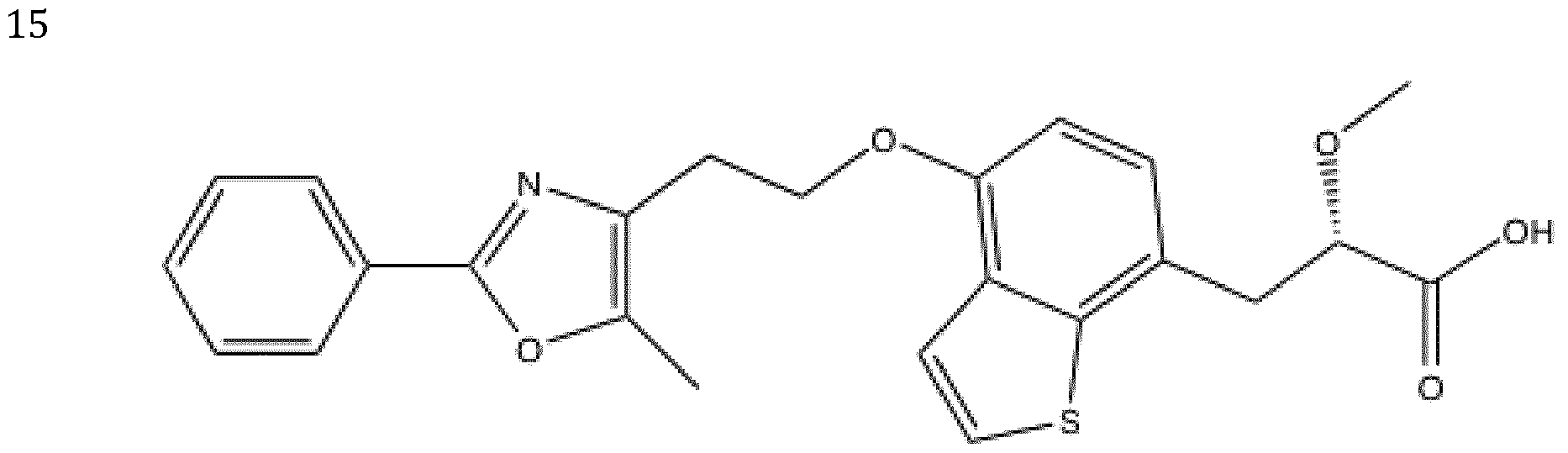
Aleglitazar is reported to belong to the class of Peroxisome Proliferator- Activated Receptor agonist (hence a PPAR modulator). In the field of molecular biology PPARs are a group of nuclear receptor proteins. The function of this group is to work as transcription factors regulating the expression of genes. Since there are various types of PPARs, PPARa, PPAR and PPARy, they can play different roles in the regulation of cellular differentiation, development, metabolism and tumorigenesis.
Aleglitazar can show affinity to PPARa as well as to PPARy. Thus, it may combine the advantageous effects of a PPARa-activation (increasing HDL, lowering LDL and triglycerides, lipoproteins) with the advantageous effects of PPARy- activation (the insulin resistance and glucose levels are decreased). Due to its positive therapeutic effects to multiple symptoms, aleglitazar might be a medical drug.
Aleglitazar, for example aleglitazar sodium, may form primary pin-like particles of 1 to 5 μιη. However, these primary particles tap into agglomerates of over 100 μιη. These resulting agglomerates are reported to involve some difficulties in view of their processability. For example, the processability of aleglitazar agglomerates and/or the pharmaceutical formulations containing the respective aleglitazar agglomerates may be improved, especially when prepared in a large scale. In the art a spray granulation process is proposed in order to overcome the illustrated drawbacks and to provide a suitable pharmaceutical formulation. Reference is made to WO 2010/084066. However, said process is regarded to be still improvable, in particular in view of processability and content uniformity, especially if the ideal process conditions are not exactly met.
Hence, it was an object of the present invention to overcome the drawbacks of the above-mentioned formulation.
A further object of the invention was to avoid solvents, in particular organic solvents.
In particular, it was an object of the invention to provide an aleglitazar-containing formulation which can be advantageously produced even on a larger scale. The formulations should show advantageous processability (e.g. superior flowability). Consequently, it was an object of the invention to provide the active agent in a form which possesses superior processability and compressibility. If compressed, the resulting dosage form should exhibit a high level of hardness and low friability.
Further, the resulting dosage form should have a particularly even distribution of active agent (content uniformity) even with a low content of active agent.
Moreover, it was an object of the invention to provide aleglitazar in a form having superior storage properties.
Summary of the invention
According to the present invention, the above objectives are achieved by specific aleglitazar compositions described herein. The aleglitazar composition further can be used for processing dosage forms containing aleglitazar in an amorphous form. Furthermore, the above drawbacks can be overcome by processes for producing said compositions comprising providing aleglitazar and surface stabiliser and transforming aleglitazar to an amorphous form, for example by a melt process.
Thus, the subject of the present invention is amorphous aleglitazar (a) in pure and/or stabilized form. In particular, one preferred subject of the invention is a composition comprising amorphous aleglitazar (a) and surface stabiliser (b). Another preferred embodiment of the present invention is amorphous aleglitazar (a) in its pure form.
It was found that the composition of the present invention has an enhanced solubility and superior permeability, resulting in a superior release of the active pharmaceutical ingredient. Further, an improved content uniformity of the drug can be achieved, which can ensure that the appropriate dose can be applied to the patient. Even further it was found that the composition of the present invention can be very stable over a long period. This is important, since aleglitazar is applied in low doses and even little degradation of the drug can lower its beneficial effects. The subject of the invention also relates to various methods of preparing amorphous aleglitazar (a) or stabilised amorphous aleglitazar (a) in the form of the composition of the invention.
Another subject of the present invention is a process of producing a dosage form, preferably an oral dosage form, comprising the steps of
(ml) providing aleglitazar and surface stabiliser (b) and optionally one or more excipient(s) (c),
(m2) processing the mixture from step (ml) to an composition, in which aleglitazar is assured to be in an amorphous form,
(m3) optionally granulating the composition from step (m2),
(m4) mixing the composition from step (m2) or the granulates from step
(m3) with optionally one or more excipient(s) (c'), and (m5) processing the mixture from step (m4) into a dosage form.
Another subject of the present invention relates to pharmaceutical compositions containing aleglitazar for treating diabetes, preferably type II diabetes, of patients with a BMI value of more than 25, preferably more than 30.
Detailed description of the invention
In the context of this invention, the term "aleglitazar" usually refers to (S)-2- methoxy-3-[4-[2-(5-methyl-2-phenyloxazol-4-yl)ethoxy]benzo[b]thiophen-7- yl]propionic acid in accordance with formula (I) above. In addition, the term "aleglitazar" as used in the present application can refer to aleglitazar in the form of the free acid as well as to its pharmaceutically acceptable salts, hydrates, solvates, polymorphs and mixtures thereof. The pharmaceutically acceptable salts can be obtained by reaction, preferably with an inorganic base. Thereby, the carboxylic hydrogen atom of aleglitazar can be replaced by a metal atom, for example an alkali metal atom. In a preferred embodiment aleglitazar is used in the form of its sodium salt.
The term "amorphous" can be used in the context of this invention to designate the state of solid substances, in which the components (atoms, ions or molecules, i.e. in the case of amorphous aleglitazar the aleglitazar molecules do not exhibit any periodic arrangement over a great range (= long-range order). In amorphous
substances, the components are usually not arranged in a totally disordered fashion and completely randomly, but are rather distributed in such a way that a certain regularity and similarity to the crystalline state can be observed with regard to the distance from and orientation towards their closest neighbours (= short-range order). Amorphous substances consequently preferably possess a short-range order, but no long-range order.
In contrast to anisotropic crystals, solid amorphous substances are isotropic. Normally, they do not have a defined melting point, but instead pass over into the liquid state after slowly softening. They can be distinguished from crystalline substances experimentally by means of X-ray diffraction, which does not reveal clearly defined interferences for them, but rather, in most cases, only a few diffuse interferences with small diffraction angles. The amorphous aleglitazar (a) of the invention may consist of amorphous aleglitazar (a). Alternatively, it may also contain small amounts of crystalline aleglitazar components, provided that no defined melting point of crystalline aleglitazar can be detected in a DSC. A mixture containing 60 to 99.999 % by weight amorphous aleglitazar (a) and 0.001 to 40 % by weight crystalline aleglitazar is preferred, more preferably 90 to 99.99 % by weight amorphous aleglitazar (a) and 0.01 to 10 % crystalline aleglitazar, particularly preferably 95 to 99.9 % by weight amorphous aleglitazar (a) and 0.1 to 5 % crystalline aleglitazar.
In a particularly preferred embodiment the composition of the present invention and the corresponding dosage form comprises aleglitazar as the sole pharmaceutical active agent. In an alternative embodiment the composition of the present invention and the corresponding dosage form can comprise aleglitazar in combination with further pharmaceutical active agent(s). In a preferred embodiment, the aleglitazar of the present invention can be present in stabilised form, namely in the form of a composition containing amorphous aleglitazar (a) and a surface stabiliser (b).
The surface stabiliser (b) is a substance which can inhibit the recrystallisation of amorphous to crystalline aleglitazar.
In a more preferred embodiment of the invention the surface stabilizer (b) can be an inorganic substance. An inorganic substance can preferably be regarded as a compound that does not contain a hydrocarbon group. It is further preferred that the surface stabilizer (b) can be a silicate, more preferably an aluminosilicate, most preferably a magnesium aluminosilicate, such as Al203 MgO- 1.78ί02· χΗ20 or alternatively preferred a phosphate, such as disodium hydrogen phosphate or sodium dihydrogen phosphate.
Alternatively, the surface stabiliser (b) can preferably be a polymer. In addition, the surface stabiliser (b) can also include substances which behave like polymers. Examples of these substances are fats and waxes. Furthermore, the surface stabiliser (b) can also include solid, non-polymeric compounds which preferably can contain polar side groups. Examples of these compounds are sugar alcohols or disaccharides.
In a preferred embodiment of the invention the composition can comprise amorphous aleglitazar (a) and surface stabiliser (b), in which the weight ratio of amorphous aleglitazar (a) to surface stabiliser (b) can be from 1 : 100 to 5: 1, preferably from 1 :50 to 1 :2, more preferably form 1 :30 to 1 :5.
In another preferred embodiment the surface stabiliser (b) can be a polymer. The polymer to be used for the preparation of the composition preferably may have a glass transition temperature (Tg) of more than 25° C, more preferably 40° C to 150° C, in particular from 50° C to 100° C. During immobilisation a polymer with a Tg selected accordingly can be particularly advantageous in preventing the recrystallisation of the amorphous aleglitazar (a).
The term "glass transition temperature" (Tg) is reported to describe the temperature at which amorphous or partially crystalline polymers change from the solid state to the liquid state. In the process, a distinct change in physical
parameters, e.g. hardness and elasticity, occurs. Beneath the Tg, a polymer is usually glassy and hard, whereas above the Tg, it changes into a rubber-like to viscous state. The glass transition temperature is determined in the context of this invention by means of dynamic differential scanning calorimetry (DSC).
For this purpose, a Mettler Toledo DSC 1 apparatus can be used. The work is performed at a heating rate of l-20°C/min, preferably 5- 15°C/min, and at a cooling rate of 5-25° C/min, preferably 10-20°C/min. In addition, the polymer to be used for the preparation of the composition preferably can have a number-average molecular weight of 1,000 to 500,000 g/mol, more preferably from 2,000 to 50,000 g/mol. If the polymer used for the preparation of the composition is dissolved in water in an amount of 2 % by weight, the resulting solution preferably can have a viscosity of 1 to 20 mPa · s, more preferably 1 to 5 mPa · s, and even more preferably from 2 to 4 mPa · s or (especially in the case of HPMC) from 12 to 18 mPa · s, measured at 25°C, and determined in accordance with Ph. Eur. 6.0, chapter 2.2.10.
Hydrophilic polymers can preferably be used for the preparation of the composition of the present application. This can refer to polymers which possess hydrophilic groups. Examples of suitable hydrophilic groups can be hydroxy, sulfonate, carboxylate and quaternary ammonium groups.
The composition of the invention may, for example, comprise the following polymers: polysaccharides, such as hydroxypropyl methyl cellulose (HPMC), carboxymethyl cellulose (CMC, especially sodium and calcium salts), ethyl cellulose, methyl cellulose, hydroxyethyl cellulose, ethyl hydroxyethyl cellulose, hydroxypropyl cellulose (HPC); polyvinylpyrrolidone, polyvinyl alcohol, polymers of acrylic acid and their salts, vinyl pyrrolidone-vinyl acetate copolymers (such as Kollidon® VA 64, BASF), gelatine polyalkylene glycols, such as polypropylene glycol or preferably polyethylene glycol, gelatine and mixtures thereof.
Likewise, it can preferably be possible to use sugar alcohols such as mannitol, sorbitol, xylitol as surface stabilisers.
The surface stabiliser (b) preferably used can be polyvinylpyrrolidone, preferably with a number- average molecular weight of 10,000 to 60,000 g/mol, especially 12,000 to 40,000 g/mol, vinylpyrrolidone and vinyl acetate copolymer, especially with a number- average molecular weight of 45,000 to 75,000 g/mol and/or polymers of acrylic acid and their salts, especially with a number- average molecular weight of 50,000 to 250,000 g/mol. In addition, HPMC can be preferably used, especially with a number-average molecular weight of 20,000 to 90,000 g/mol and/or preferably a proportion of methyl groups of 10 to 35 % and a proportion of hydroxy groups of 1 to 35%. Likewise, HPC can be preferably used, especially with a number- average molecular weight of 50,000 to 100,000 g/mol. Also, polyethylene glycol with a number- average molecular weight of 2,000 to 40,000 g/mol, especially from 3,500 to 25,000 g/mol, can be preferably used. Likewise, a polyethylene/polypropylene block copolymer can be preferably used, wherein the polyethylene content can be preferably 70 to 90 % by weight. The polyethylene/polypropylene block copolymer preferably has a number-average molecular weight of 1 ,000 to 30,000 g/mol, more preferably from 3,000 to 15,000 g/mol. The number- average molecular weight can usually be determined by means of gel permeation chromatography.
In a preferred embodiment, the surface stabiliser (b) used can be a copolymer of vinylpyrrolidone and vinyl acetate, especially with a weight-average molecular weight of 45,000 to 75,000 g/mol. The copolymer can be characterised by the following structural formula (II):

formula (II)
In another preferred embodiment the composition can further comprise one or more excipient(s) (c), wherein the excipient(s) (c) is/are selected from surfactants (cl), wicking agents (c2) and/or disintegrants (c3). Surfactants (cl) are reported to be substances, lowering the interfacial tension between two phases, thus enabling or supporting the formation of dispersions or working as a solubilizer. Common surfactants can be alkyl sulfates (for example sodium lauryl sulfate), alkyltrimethylammonium salts, alcohol ethoxylates and the like.
Wicking agents (c2) are reported to be substances with the ability to draw a biological fluid (preferably water) into a solid, preferably by physisorption. Physisorption is defined as a form of adsorption in which the solvent molecules can loosely adhere to surfaces of the wicking agent, preferably via van der Waals interaction between the surface of the wicking agent and the adsorbed fluid molecule (preferably water). Usually, a wicking agent can do this with or without swelling. Preferably, the wicking agent (c2) is a swelling wicking agent (c2). Usually, a non- swelling wicking agent, which attracts water, will ultimately have a volume that is essentially composed of the volume of the wicking agent and the volume of water attracted to it. Usually, a swelling wicking agent can have a volume that is essentially composed of the volume of the wicking agent, the volume of water attracted to it, and an additional volume created by steric and molecular forces. Preferably, the wicking agent (c2) comprised in the present invention can create channels or pores in the granulates. This can facilitate the channeling of water molecules through the granulates, particularly by physisorption. Hence, the function of the wicking agent can be to carry water to surfaces inside the granulates, thereby creating channels or a network of increased surface area.
Examples of wicking agents (c2) that may be used include, but are not limited to, microcrystalline cellulose, silicified microcrystalline cellulose, colloidal silicone dioxide, kaolin, titanium dioxide, fumed silicone dioxide, alumina, niacinamide,
m-pyrol, bentonite, magnesium aluminium silicate, polyester, polyethylene, or mixtures thereof. Preferably, the wicking agents (c2) used in the pharmaceutical composition of the present invention can include cellulose and cellulose derivatives, such as silicified microcrystalline cellulose, colloidal silicone dioxide, and mixtures thereof. The silicified microcrystalline cellulose that is preferred is commercially available under the trade name Prosolv®, having a silicone dioxide content from 1 to 3 wt.%, preferably of about 2 wt.%.
The wicking agent (c2) preferably can have an average particle size (D50) from 1 to 250 μιη, more preferably from 20 to 200 μιη, still more preferably from 30 to 150 μιη, most preferably from 50 to 120 μιη.
The average particle size (D50), which is also denoted D50 value of the integral volume distribution, is defined in the context of this invention as the particle diameter at which 50 percent by volume of the particles have a smaller diameter than the diameter which corresponds to the D50 value. Likewise, 50 percent by volume of the particles have a larger diameter than the D50 value. Analogously, the D90 value of the integral volume distribution is defined as the particle diameter at which 90 percent by volume of the particles have a smaller diameter than the diameter which corresponds to the D90 value. Correspondingly, the D 10 value of the integral volume distribution is defined as the particle diameter at which 10 percent by volume of the particles have a smaller diameter than the diameter which corresponds to the D10 value. The average particle size can be determined by means of laser diffractometry. In particular, a Malvern Instruments Mastersizer 2000 can be used to determine the size (preferably wet measurement with ultrasound 60 sec, 2,000 rpm, preferably dispersed in liquid paraffin, the evaluation being performed according to the Fraunhofer model).
Disintegrants (c3) are reported to be compounds which can enhance the ability of the composition or the corresponding dosage form to break into smaller fragments when in contact with a liquid, preferably water. Preferred disintegrants are sodium
carboxymethyl starch, cross-linked polyvinylpyrrolidone (crospovidone), sodium carboxymethyl glycolate (for example Explotab®), swelling polysaccharide, for example soy polysaccharide, carrageenan, agar, pectin, starch and derivates thereof, protein, for example formaldehyde-casein, sodium bicarbonate or mixtures thereof.
Another subject of the present invention can relate to a method of preparing an aleglitazar composition comprising the steps of (il) providing aleglitazar and surface stabiliser (b), and optionally one or more excipient(s) (c),
(12) melt processing the mixture from step (il) to a composition, optionally cooling off, and
(13) optionally granulating the composition from step (i2).
Generally, in step (il) aleglitazar can be present in an amount of 1 to 70 wt.%, preferably 4 to 40 wt.%, more preferably 5 to 25 wt.%, and particularly preferred between 6 and 20 wt.%, based on the total weight of the mixture resulting from step (il). In step (il) crystalline or preferably partially crystalline aleglitazar can be used.
Generally, in step (il), surface stabiliser (b) can be present in an amount of 1 to 98 wt.%, preferably 5 to 75 wt.%, more preferably 7 to 60 wt.%, and particularly preferred between 10 and 50 wt.%, based on the total weight of the mixture resulting from step (il).
Generally, in step (il), surfactants (cl) can be present in an amount of 0 to 3 wt.%, preferably 0.1 to 2 wt.%, more preferably 0.15 to 1.5 wt.%, based on the total weight of the mixture resulting from step (il).
Generally, in step (il), wicking agent (c2) can be present in an amount of 0 to 80 wt.%, preferably 5 to 70 wt.%, more preferably 10 to 65 wt.%, and particularly
preferred between 15 and 50 wt.%, based on the total weight of the mixture resulting from step (il).
Generally, in step (il), disintegrant (c3) can be present in an amount of 0 to 45 wt.%, preferably 3 to 40 wt.%, more preferably 5 to 35 wt.%, and particularly preferred between 7 and 30 wt.%, based on the total weight of the mixture resulting from step (il).
In another preferred embodiment, the provision of (il) can be carried out with conventional mixing devices, e.g. in a free fall mixer like Turbula® T 10B (Bachofen AG, Switzerland). Mixing can be carried out, e.g. for 1 minute to 1 hour, preferably for 5 to 30 minutes.
In step (i2) the mixture resulting from step (il) is molten. In a preferred embodiment the melting conditions can preferably be chosen such that aleglitazar is transformed into an amorphous form.
The specific melting conditions can depend on compounds (a), (b) and optionally excipient(s) (c). Usually, temperatures from 40°C to 200°C, preferably from 60°C to 180°C are used. Preferably, aleglitazar, the surface stabilizer (b) and the optional excipient(s) (c) in their respective ratios may be chosen to achieve a eutectic mixture. Thus, the need of high temperatures for melting can be decreased, thereby optimizing energy demand. In another embodiment, the cooling off step (i2) can be conducted under cooling conditions chosen such that amorphous aleglitazar (a) remains in an amorphous form. Amorphous aleglitazar (a) can be detected by XRD or DSC.
Optionally, in step (i3) the molten mixture resulting from step (i2) is granulated, either in the molten state or after having cooled off.
The step (i3) of granulating the composition can be carried out, for example, by an extrusion process. Hence, steps (i2) and (i3) preferably can be regarded as melt-
extrusion processes. Generally, the extrusion process should be capable of providing essentially spherical particles. Suitable extruders are, for example, screw-feed extruders (axial or endplate, dome and radial) or gravity extruders (cylinder roll, gear roll or radial). Screw-feed extruders are preferred.
The granulation can also, for example, be carried out by a - preferably heatable - High-Shear-Mixer (e.g. Diosna® Pl/6). In this case, steps (il), (i2) and (i3) can be regarded as one process with different sequences of special parameters. The first sequence can be step (il) without heating, the second sequence can be a mixture of step (il) and step (i2) with heating, sequence three can include parts of step (i2) and step (i3). Preferred parameters of the sequences can be dependent upon the chosen components (a), (b) and optional excipient(s) (c).
In a preferred embodiment the granulation can be carried out with a melt screw extruder (e.g. Leistritz® micro 18), wherein steps (il) and (i3) can be unified in one continuous process. Generally, a temperature gradient can be applied, preferably between 80- 190°C.
In a preferred embodiment the granulation conditions in step (i3) are chosen such that the resulting granulated composition can comprise an average particle size (D50) of 10 to 500 μιη, more preferably of 50 to 250 μιη, further more preferably of 60 to 200 μιη, most preferably of 70 to 160 μιη.
The bulk density of the granulated composition made by the process of the present invention generally can range from 0.2 to 0.85 g/ml, preferably from 0.25 to 0.85 g/ml, more preferably from 0.3 to 0.75 g/ml.
The granulated composition resulting from step (i3) of the present invention preferably possesses Hausner ratios in the range of 1.02 to 1.6, preferably of 1.08 to 1.4, more preferably between 1.1 and 1.3. The Hausner ratio is the ratio of tapped density to bulk density. Bulk density and tapped density can be determined according to USP 24, Test 616 "Bulk Density and Tapped Density".
In another preferred embodiment, the invention relates to a freeze-drying process, i.e. a method of producing the amorphous aleglitazar of the invention, especially the composition of the invention, comprising the steps of
(j l) dissolving aleglitazar, surface stabiliser (b) and optionally one or more excipient(s) (c) in a solvent or mixture of solvents, (j2) freeze-drying the solution from step (j l) to an composition, and (j3) optionally granulating the composition from step (j2).
In step (j l), aleglitazar, surface stabiliser (b) and optionally one or more excipient(s) (c) are dissolved, preferably completely dissolved, in a solvent or mixture of solvents. In step (j l) crystalline or preferably partially crystalline aleglitazar can be used.
In a preferred embodiment an excipient (c) can be a surfactant (cl), for example sodium lauryl sulfate and/or a wicking agent (c2), for example microcrystalline cellulose, and/or a disintegrant (c3), for example cross-linked polyvinylpyrrolidone.
Suitable solvents are, for example, water, alcohol (e.g. methanol, ethanol, isopropanol), dimethyl sulphoxide (DMSO), acetone, butanol, ethyl acetate, heptane, pentanol or mixtures thereof. Preferably, a mixture of water and DMSO is used.
Suitable surface stabilisers (b) in this embodiment are, in particular, modified celluloses, such as HPMC, and sugar alcohols, such as mannitol and sorbitol. Likewise, it is particularly preferable to use polyvinylpyrrolidone, especially with the molecular weights specified above.
Freeze-drying can be done, using a VirTis® Bench top K Freeze dryer. Generally, the freeze-drying process (j2) might comprise two stages:
Stage 1 :
Freezing the solution resulting from step (j l) and reducing the pressure. Preferably, the pressure is reduced below the triple point of the solution resulting from step (j l);
Stage 2: Raising the temperature, preferably to the sublimation curve, in order to allow latent heat of sublimation.
In a preferred embodiment, stage 1 is carried out at temperatures between -40°C and -60°C, more preferably between -50°C and -52°C. Preferably, the pressure ranges from 1 to 50 Pa, more preferably from 5 to 10 Pa. Stage 1 might take 1 to 40 hours, preferably 10 to 25 hours.
In a preferred embodiment, stage 2 is carried out at temperatures between 10°C and 60°C, more preferably between 35°C and 40°C. Preferably the pressure ranges from 1 to 50 Pa, more preferably from 5 to 10 Pa. Stage 2 might take 5 to 50 hours, preferably 25 to 35 hours.
After sublimation is complete, the lyophilised amorphous aleglitazar (a), preferably the lyophilised composition, is warmed to room temperature.
In a preferred embodiment the composition from step (]2) is granulated. For this purpose the granulation conditions in step (]3) can be preferably chosen such that the granulated composition can comprise an average particle size (D50) of 10 to 500 μιη, more preferably of 50 to 250 μιη, further more preferably of 60 to 200 μιη, most preferably of 70 to 160 μιη.
In a further preferred embodiment, the invention relates to a "pellet-layering process", i.e. a method of producing the amorphous aleglitazar of the invention, especially the composition of the invention, comprising the steps of (kl) dissolving aleglitazar, surface stabiliser (b) and optionally one or more excipient(s) (c) in a solvent or mixture of solvents, and
(k2) spraying the solution from step (kl) onto a substrate core.
In step (kl), aleglitazar, surface stabiliser (b) and optionally one or more excipient(s) (c) can be dissolved, preferably completely dissolved, in a solvent or mixture of solvents. In step (kl) crystalline or preferably partially crystalline aleglitazar can be used.
In a preferred embodiment, an excipient (c) can be a surfactant (cl), for example sodium lauryl sulfate.
Suitable solvents can be, for example, water, alcohol (for example methanol, ethanol, isopropanol, butanol, pentanol), dimethyl sulphoxide (DMSO), acetone, ethyl acetate, heptane, or mixtures thereof. Preferably, a mixture of water and DMSO is used.
Suitable surface stabilisers (b) in this embodiment can be, in particular, polyvinylpyrrolidone, modified celluloses, such as HPMC, sugar alcohols, such as mannitol and sorbitol, and polyethylene glycol, in particular polyethylene glycol with a molecular weight of 2,000 to 10,000 g/mol.
In step (k2), the solution from step (kl) is sprayed onto a substrate core. Suitable substrate cores can be particles consisting of pharmaceutically acceptable excipients, especially "neutral pellets". The preferable pellets used can be those which are obtainable under the trade name Cellets® and which contain microcrystalline cellulose.
Step (k2) is preferably performed in a fmidised bed dryer, such as a Glatt GPCG 3 (Glatt GmbH, Germany).
The process conditions in this embodiment are preferably selected such that the resulting composition particles have an average particle size (D50) of 50 to 750 μιη, more preferably 60 to 500 μιη, most preferably 70 to 300 μιη. Due to their appropriate size and solid state, normally no further granulation step is needed.
In a preferred embodiment, the invention can relate to a milling process, i.e. a method of preparing the composition of the invention, comprising the steps of
(11) mixing aleglitazar, surface stabiliser (b) and optionally one or more excipient(s) c) and
(12) milling the mixture from step (11) to a composition, whereby the milling conditions are selected such that formation of amorphous aleglitazar (a) is assured and
(13) optionally granulating the composition from step (12).
Aleglitazar, surface stabiliser (b) and optionally one or more excipient(s) (c) are mixed in step (11). The mixture is milled in step (12). The mixing may take place before or even during the milling, i.e. steps (11) and (12) may be performed simultaneously. In step (11) crystalline or preferably partially crystalline aleglitazar can be used.
The milling conditions are selected such that there is a transition from crystalline to amorphous aleglitazar (a).
The milling is generally performed in conventional milling apparatuses, preferably in a ball mill, such as a Retsch® PM 100.
The milling time is usually 10 minutes to 10 hours, preferably 30 minutes to 8 hours, more preferably 2 hours to 6 hours.
Suitable surface stabilisers (b) in this embodiment can be, in particular, modified celluloses, such as HPMC, sugar alcohols, such as mannitol and sorbitol, and polyethylene glycol, in particular, polyethylene glycol with a molecular weight of 2,000 to 10,000 g/mol. Polyvinylpyrrolidone is likewise preferably used.
The process conditions in this embodiment are preferably selected such that the resulting composition particles have an average particle size (D50) of 5 to 250 μιη, more preferably 10 to 150 μιη, especially 20 to 80 μιη or 20 to 150 μιη, more preferably 50 to 100 μιη.
Step (13) of optionally granulating the composition from step (12) can be performed, for example, by "slugging", using a large heavy-duty rotary press and breaking up the slugs to granulates with a hammer mill or by roller compaction, using for example roller compactors by Powtec or Alexanderwerk.
In another preferred embodiment, the composition is obtained by one of the above- mentioned methods. Preferably the composition can be available in a suitable form for further processing, for example as granulates. A further preferred embodiment of the present invention can be a dosage form comprising amorphous aleglitazar (a) in the form of a composition described herein. The composition particles, preferably granulates, can preferably be regarded as a "primary dosage", which, preferably, is suitable for being further processed to the "final" dosage form, preferably the oral dosage form. The composition particles can also be referred to as "internal phase" of the resulting "final" dosage form.
In another preferred embodiment of the present invention the dosage form can further comprise one or more excipient(s) (c'), selected from surfactants (cl '), wicking agents (c2'), disintegrants (c3'), fillers (c4'), lubricants (c5') and glidants (c6').
All explanations given above for surfactant (cl) also apply to surfactant (cl '). Components (cl) and (cl ') can be the same or different surfactants. Similar, all explanations given above for wicking agent (c2) also apply to wicking agent (c2'). Components (c2) and (c2') can be the same or different wicking agents. Furthermore, the same considerations can be applied to disintegrants. Thus, components (c3) and (c3') can be the same or different disintegrants. These excipients can be referred to as "external phase" of the final pharmaceutical composition, preferably of the final dosage form. Fillers (c4') or diluents can be used to increase the bulk volume and weight of a low-dose drug to a limit at which a pharmaceutical dosage can be formed. Fillers may fulfil several requirements, such as being chemically inert, non-hygroscopic, biocompatible, easily processable and possessing good biopharmaceutical properties. Examples of fillers are lactose, sucrose, glucose, mannitol, calcium carbonate, cellulose and others.
Lubricants (c5') can be used in order to reduce sliding friction. In particular, the intention is to reduce the sliding friction occurring during tablet pressing between the moving up and down in the die and the die wall, on the one hand, and between the edge of the tablet and the die wall, on the other hand. The lubricant can preferably be a stearate or fatty acid, more preferably an earth alkali metal stearate, such as magnesium stearate. The lubricant can be suitably present in an amount of 0 to 3 wt.%, preferably of about 0.1 to 1.0 wt.% of the total weight of the final pharmaceutical composition.
Glidants (c6') can be used to improve the flowability. Traditionally, talc was used as glidant, but it is nowadays nearly fully replaced by colloidal silica (for example Aerosil®). Preferably, the glidant agent can be present in an amount of up to 3 wt.%, Preferably, the silica has a specific surface area of 50 to 400 m g, measured by gas adsorption according to Ph. Eur., 6.0, chapter 2.9.26, multipoint method, volumetric determination.
In this regard it is generally noted that due to the nature of pharmaceutical excipients it cannot be excluded that a certain compound meets the requirements of more than one of the components (b) and excipient (c or c'). For example, in the present dosage form mannitol may act both as hydrophilizing agent (b) and as filler (c'4).
However, in order to enable an unambiguous distinction, it is preferred in the present application that one and the same pharmaceutical compound can only function as one of the compounds (b) or (cl) to (c7). For example, if lactose functions as hydrophilizing agent (b), it cannot additionally function as filler (c4).
A further subject of the present invention can be a process for producing a pharmaceutical composition, preferably an oral dosage form, comprising the steps of
(ml) providing aleglitazar and surface stabiliser (b) and optionally one or more excipient (c),
(m2) processing the mixture from step (ml) to a composition in which aleglitazar is assured to be in amorphous form,
(m3) optionally granulating the composition from step (m2),
(m4) mixing the composition from step (m2) or the granulates from step
(m3) and optionally one or more excipient(s) (c'), and (m5) optionally processing the mixture from step (m4) into a dosage form.
In a preferred embodiment the features of the process steps (ml), (m2) and optionally (m3) can correspond to the respective process steps of the methods for producing the compositions of the present invention, which have been described herein above.
In a preferred embodiment, step (m4) can be characterized by mixing the composition from step (m2) or the granulates resulting from step (m3) with one or further excipient(s) (c'). The mixing (m4) can be carried out with conventional mixing devices, e.g. in a free fall mixer like Turbula® T 10B (Bachofen AG,
Switzerland). Mixing can be carried out for example for 1 minute to 1 hour, preferably for 5 to 30 minutes.
In another preferred embodiment, the process for producing an oral dosage form according to the present invention can be characterized by a specific ratio of the amount of wicking agent in the internal phase (c2) to wicking agent in the external phase (c2'). In a preferred embodiment the weight ratio of wicking agent (c2) to wicking agent (c2') can be from 1 :6 to 3: 1, more preferably from 1 :3 to 3:2. In another preferred embodiment the process for producing an oral dosage form according to the present invention can be characterized by a specific ratio of the amount of disintegrant in the internal phase (c3) to disintegrant in the external phase (c3'). In a preferred embodiment the weight ratio of disintegrant (c3) to disintegrant (c3') can be from 1 :5 to 5:2, more preferably from 2:5 to 2: 1.
In a further embodiment the weight ratio of the total amount of wicking agents ((c2)+(c2')) to total amount of disintegrants ((c3)+(c3')) can preferably be from 5: 1 to 2:3, more preferably from 3: 1 to 1 : 1. In addition, in the mixing step (m4) preferably one or more further excipient(s), such as fillers (c4'), lubricants (c5') and glidants (c6'), can be used. Regarding the above-mentioned pharmaceutically acceptable excipients, the application generally refers to "Lexikon der Hilfsstoffe fiir Pharmazie, Kosmetik und angrenzende Gebiete", edited by H. P. Fiedler, 5th Edition, Editio Cantor, Aulendorf and earlier editions, and "Handbook of Pharmaceutical Excipients", third edition, edited by Arthur H. Kibbe, American Pharmaceutical Association, Washington, USA, and Pharmaceutical Press, London.
In another preferred embodiment, step (m5) of optionally processing the mixture of step (m4) into a dosage form, preferably an oral dosage form, can preferably comprise, for example, compressing the mixture of step (m4) into tablets or filling mixture of step (m4) into capsules.
In a particularly preferred embodiment, step (m5) of processing the mixture resulting from step (m4) into a dosage form can include compressing the mixture resulting from step (m4) into tablets. The compression step (m5), preferably a direct compression step, is preferably carried out on a rotary press, e.g. on a Fette® 102i (Fette GmbH, Germany) or a Riva® piccola (Riva, Argentina).
The main compression force usually ranges from 1 to 50 kN, preferably 3 to 40 kN. The resulting tablets can have a hardness of 30 to 400 N, more preferred 50 to 325 N, still more preferred from 75 to 300 N, in particular from 85 to 275 N, wherein the hardness is measured according to Ph. Eur., 6.0, chapter 2.9.8.
The tabletting conditions are preferably selected such that the resulting tablets have a ratio of tablet height to weight of 0.005 to 0.3 mm/mg, particularly preferably 0.05 to 0.2 mm/mg.
In addition, the resulting tablets preferably can have a friability of less than 8 , particularly preferably less than 5 , especially less than 2 %. The friability is determined in accordance with Ph. Eur., 6.0, chapter 2.9.7. The friability of tablets generally refers to tablets without coating.
The tablets produced by the method of the invention may be tablets which can be swallowed unchewed (non-film-coated or preferably film-coated). They may likewise be chewable tablets or dispersible tablets. "Dispersible tablet" here means a tablet to be used for producing an aqueous suspension for swallowing.
In the case of tablets which are swallowed unchewed, it is preferable that they be coated with a film layer. For this purpose, the methods of film coating tablets as standard in the state of the art may be employed. The above-mentioned ratios of active agent to excipient, however, relate to the uncoated tablet.
For film coating, macromolecular substances are preferably used, such as modified celluloses, polymethacrylates, polyvinyl pyrrolidone, polyvinyl acetate phthalate, zein and/or shellack. HPMC is preferably used, especially HPMC with a number- average molecular weight of 10,000 to 150,000 g/mol and/or an average degree of substitution of - OCH3 groups of 1.2 to 2.0.
The thickness of the coating is preferably 10 to 100 μιη.
The above details regarding hardness, friability preferably relate to the non film- coated tablet.
In another embodiment, processing the mixture of step (m4) into a dosage form can be done by filling the mixture of step (m4) into capsules, preferably hard gelatine capsules. For this filling of the mixture of step (m4) into capsules, dependent dosing systems (for example an auger) or preferably independent dosing systems (for example MG2, Matic (IMA)) can be used. In a further preferred embodiment the dosage form, the oral dosage form can have a content uniformity wherein the acceptance value is at most 15, preferably 0.1 - 10, more preferably 1 - 7.5, in particular at most 2 - 6.5. The acceptance value of the content uniformity is determined by assaying 10 individual dosage forms and calculating the corresponding acceptance value in accordance with Ph. Eur., 5.3, Chapter 2.9.40.
Finally, a preferred embodiment of the present invention relates to a pharmaceutical composition for treating patients with a BMI of more than 25, preferably more than 30.
The BMI is an index for rating the body weight in relation to the body height and is calculated as follows:
wherein m is the body weight and 1 is the body height. Values for people with normal weight are in the range of 18 to 25. A value of above 25 and below 30 is a sign of surplus weight. Furthermore, values of more than 30 give a strong indication for adiposity.
A further subject of the present invention is amorphous aleglitazar, as described above, or a pharmaceutically acceptable salt thereof. This amorphous aleglitazar can also be used in the above compositions as component (a). The term "amorphous" can be used as described above.
In a preferred embodiment the amorphous aleglitazar is present in form of its alkali salts, in particular in form of aleglitazar sodium. In an alternative embodiment amorphous aleglitazar is present in its free acid form.
It is further preferred that the water content of amorphous aleglitazar or a pharmaceutically acceptable salt thereof, preferably aleglitazar sodium, is from 0% to 10%, more preferably from 0% to 8%, even more preferably from 0 to 7%, in particular from 0 to 5%.
A further subject of the present invention is a process of producing amorphous aleglitazar or a pharmaceutically acceptable salt thereof comprising the steps of
(nl ) providing aleglitazar or a pharmaceutically acceptable salt thereof
(n2) milling aleglitazar or a pharmaceutically acceptable salt thereof, wherein the conditions of the milling are chosen such that the formation of amorphous aleglitazar (a) or a pharmaceutically acceptable salt thereof is assured.
In step (nl) aleglitazar or a pharmaceutically acceptable salt thereof, preferably aleglitazar sodium, is provided. It is further preferred that the water content is from 0% to 10%, more preferably from 0% to 8%, even more preferably from 0 to 7%, in particular from 0 to 5%. In step (nl) crystalline or preferably partially crystalline aleglitazar can be used.
In step (n2) the milling conditions are selected such that the aleglitazar are obtained in amorphous form. The milling can be performed in conventional milling apparatuses, preferably in a ball mill, such as a Retsch® PM 100, or more preferably in planetary ball mill, such as a Fritsch Pulverisette 6. Preferably, the milling apparatus is used with 100 to 650 rpm, more preferably 200 to 600 rpm, in particular 300 to 500 rpm. It is preferred that the milling time is 15 minutes to 10 hours, preferably 30 minutes to 6 hours, more preferably 1 hour to 6 hours.
EXAMPLES Example 1: Preparation of the composition by melt extrusion
4 kg crystalline aleglitazar are pre-mixed with 45 kg copolymer polyvinylpyrrolidone and polyvinyl acetate (Povidon® VA 64, BASF). This mixture is extruded on a twin-screw extruder with a temperature cascade rising to 150°C (Leistritz® Micro 18). The cooled strands are then comil- screened.
Example 2: Preparation of the composition by melt extrusion
0.26 g crystalline aleglitazar and 0.50 g PEG 20000 are processed analogously to Example 1.
Example 3: Preparation of the composition by melt extrusion
0.26 g crystalline aleglitazar and 0.45 g PEG 4000S are processed analogously to Example 1.
Example 4: Preparation of the composition by melt extrusion
0.26 g crystalline aleglitazar and 0.50 g Pluronic® F68 (Pluronic = PEG-PPO block copolymer) are processed analogously to Example 1.
Example 5: Melt (in the DSC crucible)
Various binary mixtures of aleglitazar and polymer are prepared in a quantity ratio of 1 :5. The mixtures are heated at a heating rate of 10°C/minute, tempered for 3-5 minutes and then cooled quickly to -50°C.
Mixture with Eudragit EPO: heated to 160°C, cooling rate 50°C/min
Kollidon® 25: heated to 160°C, cooling rate 50°C/min
Kollidon® VA 64: heated to 145°C, cooling rate 30°C/min
Klucel® (= HPC) heated to 160°C, cooling rate 50°C/min.
Example 6: Production of tablets
1. Composition according to Example 1 3.65 g
2. calcium hydrogen phosphate 5.96 g
3. sodium carboxymethyl starch 0.23 g
4. sodium hydrogen carbonate 0.84 g
5. magnesium stearate 0.12 g
6. talcum 0.12 g
7. sodium stearyl fumarate 0.52 g
8. Aerosil® (Si02) 0.1 lg
The composition according to Example 11, calcium hydrogen phosphate, sodium carboxymethyl starch and sodium hydrogen carbonate are mixed together for 20 minutes and screened. In addition, magnesium stearate is added and mixed for 3 minutes. After that, talcum, sodium stearyl fumarate and Aerosil® are added and mixed for a further 3 minutes. The mixture is used to press into tablets.
Example 7: Preparation of the composition by lyophilisation
5 g crystalline aleglitazar are dissolved with 10 g mannitol in DMSO/water and frozen at -50°C until no electric conductivity was measurable anymore. After that, the solvent is sublimed at a temperature of 10°C below the eutectic temperature of the mixture under a 1 mbar vacuum. When no change in the pressure can be detected anymore, the mixture is slowly raised to room temperature. Example 8: Preparation of the composition by lyophilisation
5.12 g crystalline aleglitazar and 10.00 g polyvinylpyrrolidone (Mw 25 kDa) and 800.00 g phosphate buffer (pH 7.4) are weighed together and the solution is stirred for 30 min in a magnetic stirrer. Lyophilisation is carried out with a Christ Epsilon 2-4.
Example 9: Preparation of the composition by lyophilisation
5 g crystalline aleglitazar are dissolved in water/DMSO with 10 g Povidon®, 25 and 5 g lactose and frozen at -50°C until no electric conductivity is measurable anymore. After that, the solvent is sublimed at a temperature of 10°C below the eutectic temperature of the mixture under a 1 mbar vacuum. When no change in the pressure could be detected anymore, the mixture is slowly raised to room temperature.
Example 10: Production of tablets
In order to produce tablets, the following formulation was used:
1. composition according to Example 8 15 g
2. talcum 0.5 g
3. siliconised microcrystalline cellulose 45 g
4. sodium hydrogen carbonate 12.5
5. silicon dioxide 0.25
6. sodium stearyl fumarate 0.5 g
Ingredients 1 and 2 are pre-mixed for 5 min in a free-fall mixer (Turbula TB 10). This mixture is compacted with 70% of ingredients 3 to 5, using a roll compactor and screened to 1.25 mm. The compacted material is mixed with the remaining substances and pressed into tablets.
Example 11: Preparation of the composition by pellet-layering 100 g crystalline aleglitazar are dissolved in a water/DMSO solution and sprayed as a solution together with 500 g PEG 4000 onto inert Cellets® (ethyl cellulose pellets). This work is done in the "Heinen Minibatch"; Inlet air temperature 60- 80°C, product temperature 30-40°C, spray pressure 1-2.5 bar, nozzle 1-2 mm. Example 12: Preparation of the composition by milling
4.92 g crystalline aleglitazar and 10.00 g polyvinylpyrrolidone (Mw 25 kDa) are mixed in a Turbula® T10B and milled for two hours (at 350 rpm, Retsch® mill, PM100, 4 balls).
Example 13: Preparation of the composition by milling
5 g crystalline aleglitazar are co-milled with 25 g HPMC in a PM 100 ball mill for 2-3 hours at a speed of 350 rpm.
Analytical Method: X-Ray Powder Diffraction (XRPD)
The samples were measured on a D8 Advance powder X-ray diffractometer (Bruker AXS, Karlsruhe, Germany) in a PMMA sample holder rotating at 20 rpm during the measurement (Bragg-Brentano geometry). Conditions of the measurement are summarized below. Raw data were analysed with the program EVA (Bruker AXS, Karlsruhe, Germany) radiation Cu Ka
source 38kV/40mA
detector Vantec- 1
detector slit 10.39 mm
detector antiscattering slit 6.17 mm
divergence slit v6.00
2Θ range 2 < 20 < 55
step size 0.017
step time 0.2 s
Example 14: Amorphous aleglitazar
Example 14a: Preparation of amorphous aleglitazar sodium
2.40 g aleglitazar sodium (water content 1.6%) were milled in a planetary ball mill (Fritsch Pulverisette 6) with five grinding balls at 300 rpm for three hours.
As can be seen from Figure A- 1 the X-ray powder diffractogram did not reveal clearly defined interferences. Thus the resulting substance was amorphous.
Example 14b: Preparation of amorphous aleglitazar sodium
1.57 g aleglitazar sodium (water content 3.7%) were milled in a planetary ball mill (Fritsch Pulverisette 6) with five grinding balls at 300 rpm for three times one hour with one hour breaks in between.
As can be seen from Figure A-2 the X-ray powder diffractogram did not reveal clearly defined interferences. Thus the resulting substance was amorphous.
Example 15:
0.43 g aleglitazar sodium (water content 1.6%) and 0.337 g sodium dihydrogen phosphate were milled in a planetary ball mill (Fritsch Pulverisette 6) with five grinding balls at 300 rpm for three hours.
Claims
1. A composition comprising amorphous aleglitazar (a) and surface stabiliser (b).
2. The composition according claim 1 , wherein the weight ratio of amorphous aleglitazar (a) to surface stabiliser (b) is from 1 : 100 to 5: 1 , preferably from 1 :50 to 1 :2, more preferably form 1 :30 to 1 :5.
3. The composition according claim 1 or 2, wherein the surface stabiliser (b) is a polymer, preferably a polymer with a glass transition temperature (Tg) of more than 25 °C.
4. The composition according any one of the previous claims, further comprising one ore more excipient(s) (c), wherein the excipient(s) (c) is/are selected from surfactants (cl), wicking agents (c2) and/or disintegrants (c3).
5. A method of preparing a composition according to any one of the previous claims comprising the steps of
(11) providing aleglitazar and surface stabiliser (b) and optionally one or more excipient(s) (c),
(12) melt processing the mixture from step (il) to a composition, and
(13) optionally granulating the composition from step (i2).
6. A method of preparing a composition according to claim 5, wherein the conditions of the melting process (i2) are chosen such to assure that aleglitazar is in an amorphous form.
7. A method of preparing a composition according to claims 1 to 4 comprising the steps of
(j l) dissolving aleglitazar and surface stabiliser (b) and optionally one or more excipient(s) (c) in a solvent or mixture of solvents, (j2) freeze-drying the solution from step (j l) to a composition, and (]3) optionally granulating the composition from step (j2).
8. A method of preparing a composition according to claims 1 to 4 comprising the steps of
(kl) dissolving aleglitazar and surface stabiliser (b) and optionally one or more excipient(s) (c) in a solvent or mixture of solvents, and
(k2) spraying the solution from step (kl) onto a substrate core.
9. A method of preparing a composition according to claims 1 to 4 comprising the steps of
(11) mixing aleglitazar and surface stabiliser (b) and optionally one or more excipient (c) and
(12) milling the mixture from step (11), whereby the milling conditions are selected such that formation of amorphous aleglitazar (a) is assured, and
(13) optionally granulating the composition from step (12).
10. A composition obtainable by a method as claimed in any one of claims 5 to 9.
11. A dosage form comprising amorphous aleglitazar (a) in the form of a composition according to any one of claims 1 to 4 or 10.
12. The dosage form according to claim 1 1, wherein the dosage form further comprises one or more excipient(s) (c'), selected from surfactants (cl '), wicking agents (c2'), disintegrants (c3'), fillers (c4'), lubricants (c5') and glidants (c').
13. Process of producing a dosage form, preferably an oral dosage form, comprising the steps of
(ml) providing aleglitazar and surface stabiliser (b) and optionally one or more excipient (c),
(m2) processing the mixture from step (ml) to a composition in which aleglitazar is assured to be in an amorphous form,
(m3) optionally granulating the composition from step (m2),
(m4) mixing the composition of step (m2) or the granulates from step (m3) with optionally one or more excipient(s) (c'), and
(m5) optionally processing the mixture from step (m4) into an oral dosage form.
14. A dosage form obtainable by a process of claim 13, wherein the dosage form is in form of a tablet or a capsule.
15. A dosage form according to claims 1 1, 12 or 14 for the treatment of diabetes mellitus type II of patients with a BMI value of more than 25, preferably more than 30.
16. Amorphous aleglitazar.
17. Amorphous aleglitazar according to claim 16, wherein the aleglitazar is aleglitazar sodium.
18. Process of producing amorphous aleglitazar according to claims 16 or 17 comprising the steps of
(nl) providing aleglitazar or a pharmaceutically acceptable salt thereof (n2) milling aleglitazar or a pharmaceutically acceptable salt thereof, wherein the conditions of the milling are chosen such that the formation of amorphous aleglitazar (a) or a pharmaceutically acceptable salt thereof is assured.
Applications Claiming Priority (4)
| Application Number | Priority Date | Filing Date | Title |
|---|---|---|---|
| EP12005507.4 | 2012-07-27 | ||
| EP12005507 | 2012-07-27 | ||
| EP13002652 | 2013-05-21 | ||
| EP13002652.9 | 2013-05-21 |
Publications (1)
| Publication Number | Publication Date |
|---|---|
| WO2014016370A1 true WO2014016370A1 (en) | 2014-01-30 |
Family
ID=48916016
Family Applications (1)
| Application Number | Title | Priority Date | Filing Date |
|---|---|---|---|
| PCT/EP2013/065700 Ceased WO2014016370A1 (en) | 2012-07-27 | 2013-07-25 | Amorphous aleglitazar |
Country Status (1)
| Country | Link |
|---|---|
| WO (1) | WO2014016370A1 (en) |
Citations (3)
| Publication number | Priority date | Publication date | Assignee | Title |
|---|---|---|---|---|
| DE10351087A1 (en) * | 2003-10-31 | 2005-05-25 | Bayer Technology Services Gmbh | Solid active ingredient formulation |
| WO2008002485A2 (en) * | 2006-06-23 | 2008-01-03 | Alza Corporation | Increased amorphous stability of poorly water soluble drugs by nanosizing |
| US20100190835A1 (en) * | 2009-01-23 | 2010-07-29 | Alexander Glomme | Pharmaceutical composition comprising aleglitazar |
-
2013
- 2013-07-25 WO PCT/EP2013/065700 patent/WO2014016370A1/en not_active Ceased
Patent Citations (3)
| Publication number | Priority date | Publication date | Assignee | Title |
|---|---|---|---|---|
| DE10351087A1 (en) * | 2003-10-31 | 2005-05-25 | Bayer Technology Services Gmbh | Solid active ingredient formulation |
| WO2008002485A2 (en) * | 2006-06-23 | 2008-01-03 | Alza Corporation | Increased amorphous stability of poorly water soluble drugs by nanosizing |
| US20100190835A1 (en) * | 2009-01-23 | 2010-07-29 | Alexander Glomme | Pharmaceutical composition comprising aleglitazar |
Non-Patent Citations (1)
| Title |
|---|
| K NAGAPUDI ET AL: "Amorphous Active Pharmaceutical Ingredients in Preclinical Studies: Preparation, Characterization, and Formulation", CURRENT BIOACTIVE COMPOUNDS, vol. 4, 1 December 2008 (2008-12-01), pages 213 - 224, XP055078333 * |
Similar Documents
| Publication | Publication Date | Title |
|---|---|---|
| CN103179957B (en) | Containing the pharmaceutical composition of DGAT1 inhibitor | |
| US20120231076A1 (en) | Pharmaceutical compositions comprising rivaroxaban | |
| TWI804919B (en) | Immediate-release tablets containing a drug and processes for forming the tablets | |
| WO2008072534A1 (en) | Solid medicinal preparation containing mannitol or lactose | |
| CA2729979A1 (en) | Pharmaceutical compositions comprising 5-chloro-n-({(5s)-2-oxo-3-[4-(3-oxo-4-morpholinyl)-phenyl]-1,3-oxazolidin-5-yl}-methyl)-2-thiophencarboxamid | |
| US20140319720A1 (en) | Pharmaceutical compositions comprising rivaroxaban | |
| EP2620140A1 (en) | Crizotinib containing compositions | |
| JP2020525541A (en) | Pharmaceutical preparation and method for producing the same | |
| KR20200088382A (en) | Controlled release formulations | |
| CA2785684A1 (en) | Melt-granulated cinacalcet | |
| WO2012100948A1 (en) | Pharmaceutical compositions comprising tasocitinib | |
| US20130116333A1 (en) | Solid tapentadol in non-crystalline form | |
| JP2025038121A (en) | Tablets containing pazopanib as an active ingredient and method for producing the same | |
| WO2014016370A1 (en) | Amorphous aleglitazar | |
| WO2014016371A1 (en) | Micronized aleglitazar | |
| EP3939589A1 (en) | High drug load tablet comprising voxelotor | |
| EP3072528B1 (en) | Composition comprising vemurafenib and cationic copolymer based on methacrylates | |
| TW202110453A (en) | Modified release formulation of a pyrimidinylamino-pyrazole compound, and methods of treatment | |
| EP2822553B1 (en) | Dosage form comprising non-crystalline lopinavir and crystalline ritonavir | |
| WO2020239759A1 (en) | Amorphous enasidenib in a stabilized form | |
| EP2822554B1 (en) | Dosage form comprising lopinavir and ritonavir | |
| HK40061820A (en) | Immediate-release tablets containing a drug and processes for forming the tablets | |
| WO2021211013A1 (en) | Pharmaceutical composition comprising macozinone for treating tuberculosis | |
| WO2014191443A1 (en) | Method for producing dosage form comprising odanacatib | |
| EP2590627A1 (en) | Aliskiren in form of a solid dispersion |
Legal Events
| Date | Code | Title | Description |
|---|---|---|---|
| 121 | Ep: the epo has been informed by wipo that ep was designated in this application |
Ref document number: 13745020 Country of ref document: EP Kind code of ref document: A1 |
|
| NENP | Non-entry into the national phase |
Ref country code: DE |
|
| 122 | Ep: pct application non-entry in european phase |
Ref document number: 13745020 Country of ref document: EP Kind code of ref document: A1 |