WO2014016338A1 - New synthetic route for the preparation of 3-amino-piperidine compounds - Google Patents
New synthetic route for the preparation of 3-amino-piperidine compounds Download PDFInfo
- Publication number
- WO2014016338A1 WO2014016338A1 PCT/EP2013/065622 EP2013065622W WO2014016338A1 WO 2014016338 A1 WO2014016338 A1 WO 2014016338A1 EP 2013065622 W EP2013065622 W EP 2013065622W WO 2014016338 A1 WO2014016338 A1 WO 2014016338A1
- Authority
- WO
- WIPO (PCT)
- Prior art keywords
- substituted
- unsubstituted
- compound
- formula
- alkyl
- Prior art date
- Legal status (The legal status is an assumption and is not a legal conclusion. Google has not performed a legal analysis and makes no representation as to the accuracy of the status listed.)
- Ceased
Links
- 0 CC1=CCN(*)CC1* Chemical compound CC1=CCN(*)CC1* 0.000 description 11
- SPUXOPHGQXOAKE-UHFFFAOYSA-N CC(N(C1)CC=C(C)C1NC)=O Chemical compound CC(N(C1)CC=C(C)C1NC)=O SPUXOPHGQXOAKE-UHFFFAOYSA-N 0.000 description 1
- JZNJBHMMLLNZOO-UHFFFAOYSA-N CC(N(CCC1=C)CC1NC)=O Chemical compound CC(N(CCC1=C)CC1NC)=O JZNJBHMMLLNZOO-UHFFFAOYSA-N 0.000 description 1
- RGNIHZIBJMTGLR-UHFFFAOYSA-N CC1(CC2)OC1CN2C(O)=O Chemical compound CC1(CC2)OC1CN2C(O)=O RGNIHZIBJMTGLR-UHFFFAOYSA-N 0.000 description 1
- KAZPRJMVWGWTGZ-UHFFFAOYSA-N CC1(CC2)OC1CN2C(OCc1ccccc1)=O Chemical compound CC1(CC2)OC1CN2C(OCc1ccccc1)=O KAZPRJMVWGWTGZ-UHFFFAOYSA-N 0.000 description 1
- RSTHZVHDEQOTTE-HNNXBMFYSA-N CCOC(C(CCN(C1)C(OC(C)(C)C)=O)=C1N[C@@H](C)c1ccccc1)=O Chemical compound CCOC(C(CCN(C1)C(OC(C)(C)C)=O)=C1N[C@@H](C)c1ccccc1)=O RSTHZVHDEQOTTE-HNNXBMFYSA-N 0.000 description 1
- JYFGIESQUYQLGM-UHFFFAOYSA-N CCOC(C(CCN(Cc1ccccc1)C1)C1=O)=O Chemical compound CCOC(C(CCN(Cc1ccccc1)C1)C1=O)=O JYFGIESQUYQLGM-UHFFFAOYSA-N 0.000 description 1
- VHCYOYQOYVZTEG-UHFFFAOYSA-N CCOC(N1CC2OC2(C)CC1)=O Chemical compound CCOC(N1CC2OC2(C)CC1)=O VHCYOYQOYVZTEG-UHFFFAOYSA-N 0.000 description 1
- PYRMYXBHCLZSJX-UHOSZYNNSA-N CCOC([C@H](CCN(C1)C(OC(C)(C)C)=O)[C@H]1N(C)[C@@H](C)c1ccccc1)=O Chemical compound CCOC([C@H](CCN(C1)C(OC(C)(C)C)=O)[C@H]1N(C)[C@@H](C)c1ccccc1)=O PYRMYXBHCLZSJX-UHOSZYNNSA-N 0.000 description 1
- MEQUVEFMYQSDPZ-JQHSSLGASA-N CCOC([C@H](CCN(C1)C(OC(C)(C)C)=O)[C@H]1N[C@@H](C)c1ccccc1)=O Chemical compound CCOC([C@H](CCN(C1)C(OC(C)(C)C)=O)[C@H]1N[C@@H](C)c1ccccc1)=O MEQUVEFMYQSDPZ-JQHSSLGASA-N 0.000 description 1
- UMFSCQNDDNDRJN-RYRKJORJSA-N C[C@@H](c1ccccc1)N(C)[C@@H](C1)[C@H](C)CCN1C(OC(C)(C)C)=O Chemical compound C[C@@H](c1ccccc1)N(C)[C@@H](C1)[C@H](C)CCN1C(OC(C)(C)C)=O UMFSCQNDDNDRJN-RYRKJORJSA-N 0.000 description 1
- YFAWZABOWRPSKL-YPMHNXCESA-N C[C@H](CCN(C1)C(CC#N)=O)[C@H]1N(C)c1c(CC=N2)c2ncn1 Chemical compound C[C@H](CCN(C1)C(CC#N)=O)[C@H]1N(C)c1c(CC=N2)c2ncn1 YFAWZABOWRPSKL-YPMHNXCESA-N 0.000 description 1
- FWTHDJLHNCEJBW-ZJUUUORDSA-N C[C@H](CCN(C1)C(OC(C)(C)C)=O)[C@H]1NC Chemical compound C[C@H](CCN(C1)C(OC(C)(C)C)=O)[C@H]1NC FWTHDJLHNCEJBW-ZJUUUORDSA-N 0.000 description 1
Classifications
-
- C—CHEMISTRY; METALLURGY
- C07—ORGANIC CHEMISTRY
- C07D—HETEROCYCLIC COMPOUNDS
- C07D491/00—Heterocyclic compounds containing in the condensed ring system both one or more rings having oxygen atoms as the only ring hetero atoms and one or more rings having nitrogen atoms as the only ring hetero atoms, not provided for by groups C07D451/00 - C07D459/00, C07D463/00, C07D477/00 or C07D489/00
- C07D491/02—Heterocyclic compounds containing in the condensed ring system both one or more rings having oxygen atoms as the only ring hetero atoms and one or more rings having nitrogen atoms as the only ring hetero atoms, not provided for by groups C07D451/00 - C07D459/00, C07D463/00, C07D477/00 or C07D489/00 in which the condensed system contains two hetero rings
- C07D491/04—Ortho-condensed systems
- C07D491/044—Ortho-condensed systems with only one oxygen atom as ring hetero atom in the oxygen-containing ring
-
- C—CHEMISTRY; METALLURGY
- C07—ORGANIC CHEMISTRY
- C07D—HETEROCYCLIC COMPOUNDS
- C07D211/00—Heterocyclic compounds containing hydrogenated pyridine rings, not condensed with other rings
- C07D211/04—Heterocyclic compounds containing hydrogenated pyridine rings, not condensed with other rings with only hydrogen or carbon atoms directly attached to the ring nitrogen atom
- C07D211/06—Heterocyclic compounds containing hydrogenated pyridine rings, not condensed with other rings with only hydrogen or carbon atoms directly attached to the ring nitrogen atom having no double bonds between ring members or between ring members and non-ring members
- C07D211/36—Heterocyclic compounds containing hydrogenated pyridine rings, not condensed with other rings with only hydrogen or carbon atoms directly attached to the ring nitrogen atom having no double bonds between ring members or between ring members and non-ring members with hetero atoms or with carbon atoms having three bonds to hetero atoms with at the most one bond to halogen, e.g. ester or nitrile radicals, directly attached to ring carbon atoms
- C07D211/40—Oxygen atoms
- C07D211/44—Oxygen atoms attached in position 4
- C07D211/48—Oxygen atoms attached in position 4 having an acyclic carbon atom attached in position 4
-
- C—CHEMISTRY; METALLURGY
- C07—ORGANIC CHEMISTRY
- C07D—HETEROCYCLIC COMPOUNDS
- C07D211/00—Heterocyclic compounds containing hydrogenated pyridine rings, not condensed with other rings
- C07D211/04—Heterocyclic compounds containing hydrogenated pyridine rings, not condensed with other rings with only hydrogen or carbon atoms directly attached to the ring nitrogen atom
- C07D211/06—Heterocyclic compounds containing hydrogenated pyridine rings, not condensed with other rings with only hydrogen or carbon atoms directly attached to the ring nitrogen atom having no double bonds between ring members or between ring members and non-ring members
- C07D211/36—Heterocyclic compounds containing hydrogenated pyridine rings, not condensed with other rings with only hydrogen or carbon atoms directly attached to the ring nitrogen atom having no double bonds between ring members or between ring members and non-ring members with hetero atoms or with carbon atoms having three bonds to hetero atoms with at the most one bond to halogen, e.g. ester or nitrile radicals, directly attached to ring carbon atoms
- C07D211/56—Nitrogen atoms
-
- C—CHEMISTRY; METALLURGY
- C07—ORGANIC CHEMISTRY
- C07D—HETEROCYCLIC COMPOUNDS
- C07D211/00—Heterocyclic compounds containing hydrogenated pyridine rings, not condensed with other rings
- C07D211/04—Heterocyclic compounds containing hydrogenated pyridine rings, not condensed with other rings with only hydrogen or carbon atoms directly attached to the ring nitrogen atom
- C07D211/68—Heterocyclic compounds containing hydrogenated pyridine rings, not condensed with other rings with only hydrogen or carbon atoms directly attached to the ring nitrogen atom having one double bond between ring members or between a ring member and a non-ring member
- C07D211/72—Heterocyclic compounds containing hydrogenated pyridine rings, not condensed with other rings with only hydrogen or carbon atoms directly attached to the ring nitrogen atom having one double bond between ring members or between a ring member and a non-ring member with hetero atoms or with carbon atoms having three bonds to hetero atoms, with at the most one bond to halogen, directly attached to ring carbon atoms
-
- C—CHEMISTRY; METALLURGY
- C07—ORGANIC CHEMISTRY
- C07D—HETEROCYCLIC COMPOUNDS
- C07D491/00—Heterocyclic compounds containing in the condensed ring system both one or more rings having oxygen atoms as the only ring hetero atoms and one or more rings having nitrogen atoms as the only ring hetero atoms, not provided for by groups C07D451/00 - C07D459/00, C07D463/00, C07D477/00 or C07D489/00
- C07D491/02—Heterocyclic compounds containing in the condensed ring system both one or more rings having oxygen atoms as the only ring hetero atoms and one or more rings having nitrogen atoms as the only ring hetero atoms, not provided for by groups C07D451/00 - C07D459/00, C07D463/00, C07D477/00 or C07D489/00 in which the condensed system contains two hetero rings
- C07D491/04—Ortho-condensed systems
Definitions
- the present invention relates in general to the field of organic chemistry and in particular to the preparation of 3-amino-piperidine compounds. These compounds are useful intermediates in the synthesis of various pharmaceutically active agents, such as the preferred example tofacitinib or derivatives thereof, as well as other pharmaceutically active agents comprising as a structure a 3-aminopiperidine moiety, such as for example quinolone antibacterial agents or 3-aminopiperidine-based peptide analogues as inhibitors of the bacterial cystein protease IdeS.
- various pharmaceutically active agents such as the preferred example tofacitinib or derivatives thereof
- other pharmaceutically active agents comprising as a structure a 3-aminopiperidine moiety, such as for example quinolone antibacterial agents or 3-aminopiperidine-based peptide analogues as inhibitors of the bacterial cystein protease IdeS.
- 3-amino-piperidine compounds represent valuable intermediates for the preparation of pharmaceutically active agents.
- the Janus kinase 3 (JAK3) inhibitor tofacitinib having the structural formula
- Janus kinase 3 (JAK3) inhibitors are a group of compounds that are classified to interfere with the Janus kinase signal transducer and activator of transcription (JAK-STAT) signaling pathway transmitting extracellular information into the cell nucleus and influencing DNA transcription.
- Tofacitinib as one JAK3 inhibitor was found to be effective for many applications and can be used against e.g. rheumatoid arthritis, psoriasis inflammatory bowel disease and other immunological diseases, as well as for prevention of organ transplant rejection.
- the resulting compound B was subjected to oxidation of the toluenesulfonate salt of the piperidine alcohol by an excess of costly S0 3 pyridine complex as disclosed in D. H. Brown, et. al, Org. Proc. Res. Dev. 2003, 7, pages 1 15 to 120.
- the whole process is illustrated in Scheme 1 and involves application of hazardous reagents in the form hydroborating agents such as NaBH 4 or BH 3 complexes and strong oxidants such as hydrogen peroxide, bleach or Oxone ® . These hazardous reagents bear a safety risk for large scale production.
- WO 2007/012953 discloses a further synthetic pathway in which 3-amino-4-picoline is used as starting material.
- the pathway contains the steps of benzyl activation of pyridine ring and partial reduction using sodium borohydride.
- asymmetric hydrogenation is carried out to finally obtain a benzyl protected 3-amino-piperidine precursor in modest enantioselectivity of at best 68 % ee.
- This synthetic pathway requires rare and very costly chiral ligands and metal catalysts for asymmetric reduction.
- the object of the present invention is to provide an improved process for preparing 3-amino- piperidine compounds representing valuable key intermediates for the preparation of pharmaceutically active agents, such as preferably tofacitinib or derivatives thereof, or other compounds containing a 3-amino-piperidine structural moiety.
- R 5 represents substituted or unsubstituted aryl or substituted or unsubstituted heteroaryl
- R 5 represents substituted or unsubstituted aryl or substituted or unsubstituted heteroaryl
- R 2 represents hydrogen or nitrogen protecting group
- R 3 represents hydrogen, a substituted or unsubstituted alkyl, substituted or unsubstituted aryl, substituted or unsubstituted heteroaryl
- -CO-R 7 or - CO-ORy wherein R 7 represents substituted or unsubstituted alkyl, substituted or unsubstituted aryl, or substituted or unsubstituted heteroaryl
- R 4 represents alkyl, which process comprises treating nd of formula II
- R 4 are defined as above and X is selected from CI, Br and I, with an amine NHR 2 R 3 in which R 2 and R 3 are defined as above.
- alkyl as used herein means straight, branched or cyclic hydrocarbons having a typical meaning, preferably of 1 to 12 carbon atoms, more preferably of 1 to 8 carbon atoms, even more preferably of 1 to 6 carbon atoms and in particular of 1 to 3 carbon atoms.
- aryl as used herein means aromatic hydrocarbons having a typical meaning, preferably of 6 to 12 carbon atoms, preferably single or condensed six-membered rings, more preferably phenyl.
- heteroaryl as used herein means aromatic hydrocarbons incorporating at least one heteroatom such as nitrogen into the aromatic ring structure, preferably of 6 to 12 atoms comprising both carbon and heteroatoms, preferably single or condensed six- membered rings, more preferably pyridine.
- substituted means that one or more, preferably 1 -3 hydrogen atoms of a structural moiety are replaced independently from each other by the corresponding number of substituents.
- substituents include, without being limited thereto, for example halogen, trifluoromethyl, cyano, nitro, -NR', -OR', -N(R')R" and R'", wherein each of R', R" and R'" are selected from the group consisting of linear or branched C1 - C6 alkyl.
- substituent(s) are at positions where their introduction is/are chemically possible, that is positions being known or evident to the person skilled in the art to decide (either experimentally or theoretically) without inappropriate effort whether a particular substitution is possible.
- substituents which may be unstable or may affect reactions disclosed herein may be omitted.
- R 3 and R 4 are unsubstituted.
- nitrogen protecting group means any group that is used for protection of amines.
- group is selected from the group consisting of fert-butyloxycarbonyl (Boc), benzyloxycarbonyl (Cbz), fluorenylmethoxycarbonyl (Fmoc), unsubstituted or substituted benzyl, or benzenesulfonyl (Bs), p-toluenesulfonyl (Ts), 2- naphthylsulfonyl, trifluoroacetyl (TFA), trityl (Tr), trichloroacetyl (TCA), formyl (CHO), acetyl (Ac), benzoyl (Bz), C 4 -C 5 -feri-alkyl, preferably fert-butyl (f-Bu).
- R 5 represents substituted or unsubstituted aryl or substituted or unsubstituted heteroaryl
- R 5 represents substituted or unsubstituted aryl or substituted or unsubstituted heteroaryl
- R 2 represents hydrogen or nitrogen protecting group
- R 3 represents hydrogen, a substituted or unsubstituted alkyl, substituted or unsubstituted aryl, substituted or unsubstituted heteroaryl
- -CO-R 7 or - CO-OR 7 wherein R 7 represents substituted or unsubstituted alkyl, substituted or unsubstituted aryl, or substituted or unsubstituted heteroaryl
- R 4 represents alkyl, which process comprises treating a compound of formula III
- R 4 are defined as above, with an amine NHR 2 R 3 in which R 2 and R 3 are defined as above.
- NHR 2 R 3 is selected from the group consisting of N-benzylmethylamine, N-a-dimethylbenzylamine, methyl carbamate and methyl amine, preferably NHR 2 R 3 is methyl amine.
- hyperstoichiometric amount relative to compound of formula III preferably in at least 2 mol equivalent.
- R 5 represents substituted or unsubstituted aryl, or substituted or unsubstituted heteroaryl, or from -CO-R 6 or -CO-OR 6 wherein R 6 represents substituted or unsubstituted alkyl, substituted or unsubstituted aryl, or substituted or unsubstituted heteroaryl, and X is selected from CI, Br and I, and R 4 represents alkyl, by reacting a compound of formula I
- proton donor means any compound which is capable to donate a proton to another compound.
- halogenating agent means any compound which is capable to introduce a halogen substituent to another compound.
- halogenating agent is selected from the group consisting of N-chlorosuccinimide, N-iodosuccinimide, N-bromosuccinimide, 5,5- dimethyl-1 ,3-dibromohidantoin (DBDMH), preferably N-bromosuccinimide and DBDMH, more preferably N-bromosuccinimide.
- F is -CH 2 -R 5 wherein R 5 represents substituted or unsubstituted aryl, or substituted or unsubstituted heteroaryl, with an acid chloride CI-CO-R 6 , a chloro carboxylic ester CI-CO-OR 6 or a sulfonic acid chloride Cl-S0 2 -R 6 wherein R 6 represents substituted or unsubstituted alkyl, substituted or unsubstituted aryl, or substituted or unsubstituted heteroaryl.
- R/ is -CH 2 -R 5 wherein R 5 represents substituted or unsubstituted aryl, more preferably R is benzyl (-CH 2 -Ph).
- compound of formula III is reacted with an acid chloride CI-CO-R 6 or a chloro carboxylic ester CI-CO-OR 6 wherein R 6 represents substituted or unsubstituted alkyl, substituted or unsubstituted aryl, or substituted or unsubstituted heteroaryl.
- R 5 represents substituted or unsubstituted aryl, or substituted or unsubstituted heteroaryl, or from -CO-R 6 and -CO-OR 6 wherein R 6 represents substituted or unsubstituted alkyl, substituted or unsubstituted aryl, or substituted or unsubstituted heteroaryl, and R 4 is alkyl, which process comprises the steps of :
- R 5 represents substituted or unsubstituted aryl or substituted or unsubstituted heteroaryl, or from -CO-R 6 , -CO-OR 6 and -S0 2 -R 6 wherein R 6 represents substituted or unsubstituted alkyl, substituted or unsubstituted aryl, substituted or unsubstituted heteroaryl, R 2 represents hydrogen or nitrogen protecting group, R 3 represents hydrogen, a substituted or unsubstituted alkyl, substituted or unsubstituted aryl, substituted or unsubstituted heteroaryl, -CO-R 7 or - CO-ORy wherein R 7 represents substituted or unsubstituted alkyl, substituted or unsubstituted aryl, or substituted or unsubstituted heteroaryl, and R 4 represents alkyl, which process comprises the steps of : a) converting a compound of formu I
- R 4 ' derives from R 4 representing alkyl in which the carbon atom adjacent to the piperidine ring is bonded with at least one hydrogen, which hydrogen is abstracted whereby R 4 ' is formed, by treating compound of formula IV
- R 5 represents substituted or unsubstituted aryl or substituted or unsubstituted heteroaryl, or from -CO-R 6 , -CO-OR 6 and -S0 2 -R 6 wherein R 6 represents substituted or unsubstituted alkyl, substituted or unsubstituted aryl, substituted or unsubstituted heteroaryl, R 2 represents hydrogen or nitrogen protecting group, R 3 represents hydrogen, a substituted or unsubstituted alkyl, substituted or unsubstituted aryl, substituted or unsubstituted heteroaryl, -CO-R 7 or -CO-OR 7 wherein R 7 represents substituted or unsubstituted alkyl, substituted or unsubstituted aryl, or substituted or unsubstituted heteroaryl, and R 4 represents alkyl, with an acidic activator.
- compound of formula IV is prepared by a process according to any one of items (1 ) to (1 1 ) and (23) to (25).
- R 5 represents substituted or unsubstituted aryl or substituted or unsubstituted heteroaryl, or from -CO-R 6 , -CO-OR 6 and -S0 2 -R 6 wherein R 6 represents substituted or unsubstituted alkyl, substituted or unsubstituted aryl, substituted or unsubstituted heteroaryl, R 2 represents hydrogen or nitrogen protecting group, R 3 represents hydrogen, a substituted or unsubstituted alkyl, substituted or unsubstituted aryl, substituted or unsubstituted heteroaryl, -CO- R7 or -CO-OR7 wherein R 7 represents substituted or unsubstituted alkyl, substituted or unsubstituted aryl, or substituted or unsubstituted heteroaryl, and R 4 represents alkyl, by hydrogenating a compound of formula V 1 and/or V 2
- R 4 ' derives from R 4 representing alkyl in which the carbon atom adjacent to the piperidine ring is bonded with at least one hydrogen, which hydrogen is abstracted whereby R 4 ' is formed, in the presence of a transition-metal catalyst.
- compounds of formulae V 1 and V 2 are prepared by a process according to any one of items (26) to (28).
- the transition metal catalyst comprises a transition metal selected from the group consisting of Pt, Rh, Ru, Pd and Pd-Cu which catalyst is optionally attached to a supporter selected from the group consisting of charcoal, carbon, graphite or alumina (Al 2 0 3 ); preferably the catalyst comprises Pt or Rh optionally attached to a supporter selected from the group consisting of charcoal, carbon, graphite or alumina (Al 2 0 3 ); in particular, the catalyst is Rh on activated carbon paste, Pt0 2 hydrate or Pt on charcoal.
- the additive is selected from the group consisting of Broensted acids, Lewis acids and organic ligands, more preferably AcOH, TFA, oxalic acid, citric acid, tartaric, BF 3 dietherate, copper salts, magnesium salts, iron salts, D-glucosamine, 1 ,4- diazoniabicyclo[2.2.2]octane (DABCO), amino acids.
- the additive is selected from the group consisting of Broensted acids, Lewis acids and organic ligands, more preferably AcOH, TFA, oxalic acid, citric acid, tartaric, BF 3 dietherate, copper salts, magnesium salts, iron salts, D-glucosamine, 1 ,4- diazoniabicyclo[2.2.2]octane (DABCO), amino acids.
- additive means a compound which improves conversion rate and/or yield of the hydrogenation reaction.
- the unit “bar” for pressure as used herein is a generally accepted term for exactly 100 kPa according to SI.
- the unit “atm” is an old pressure unit for external (ambient) air pressure, defined on sea level, which is equal to 1.013 bar (101 ,3 kPa). Considering an instrumental error of pressure measuring, which is more than 2% and sea level/weather variations of air pressure, the pressure expressed by "bar” or “atm” describes herein the same reaction conditions.
- an additional additive in the form of an organic acid is present, preferably the additional additive is selected from the group consisting of AcOH, TFA, oxalic acid, citric acid, tartaric, in particular the additional additive is AcOH.
- P is selected from -CH 2 -R 5 wherein R 5 represents substituted or unsubstituted aryl, or substituted or unsubstituted heteroaryl, or from -CO-R 6 and -CO-OR 6 wherein R 6 represents substituted or unsubstituted alkyl, substituted or unsubstituted aryl, and X is CI, Br or I, and R 4 is alkyl, preferably C1 -C4-alkyl, more preferably R 4 is methyl, or an acid addition salt thereof.
- R 4 is alkyl, preferably C1 -C4-alkyl, more preferably R 4 is methyl, or an acid addition salt thereof.
- acid addition salt means a salt formed of compound of formula II and an acid in the form of a proton donor, in which salt the nitrogen of compound of formula II is in protonated form.
- Any organic or inorganic proton donor can be used as acid for acid addition salt formation.
- the acid is selected from the group consisting of hydrochloric acid, hydrobromic acid, sulfuric acid, benzenesulfonic acid, toluenesulfonic acid, methanesulfonic acid and phosphoric acid, more preferably hydrochloric acid.
- Ri is selected from -CH 2 -R 5 wherein R 5 represents substituted or unsubstituted aryl or substituted or unsubstituted heteroaryl, or from -CO-R 6 , and -CO-OR 6 wherein R 6 represents substituted or unsubstituted alkyl, substituted or unsubstituted aryl, substituted or unsubstituted heteroaryl, R 2 represents hydrogen or nitrogen protecting group, R 3 represents hydrogen, a substituted or unsubstituted alkyl, substituted or unsubstituted aryl, substituted or unsubstituted heteroaryl, -CO-R 7 or -CO-OR 7 wherein R 7 represents substituted or unsubstituted alkyl, substituted or unsubstituted aryl, or substituted or unsubstituted heteroaryl, and R 4 represents alkyl, preferably C1 -C4-alkyl, in particular R 4 is methyl, or an acid addition
- acid addition salt means a salt formed of compound of formula IV and an acid in the form of a proton donor, in which salt at least one nitrogen of compound of formula IV is in protonated form.
- Any organic or inorganic proton donor can be used as acid for acid addition salt formation.
- the acid is selected from the group consisting of hydrochloric acid, hydrobromic acid, sulfuric acid,
- benzenesulfonic acid toluenesulfonic acid, methanesulfonic acid and phosphoric acid, more preferably hydrochloric acid.
- R 5 represents substituted or unsubstituted aryl or substituted or unsubstituted heteroaryl, or from -CO-R 6 , and -CO-OR 6 wherein R 6 represents substituted or unsubstituted alkyl, substituted or unsubstituted aryl, substituted or unsubstituted heteroaryl, R 2 represents hydrogen or nitrogen protecting group, R 3 represents hydrogen, a substituted or unsubstituted alkyl, substituted or unsubstituted aryl, substituted or unsubstituted heteroaryl, -CO-R 7 or -CO-OR 7 wherein R 7 represents substituted or unsubstituted alkyl, substituted or unsubstituted aryl, or substituted or unsubstituted heteroaryl, R 4 ' represents alkyl in which the carbon atom adjacent to the piperidine ring is substituted with at least one hydrogen and R 4 represents hydrogen or al
- R ⁇ is -CH 2 -R 5 in which R 5 represents substituted or unsubstituted aryl, or substituted or unsubstituted heteroaryl, preferably is -CH 2 -R 5 wherein R 5 represents substituted or unsubstituted aryl, more preferably, R ⁇ is benzyl (-CH 2 -Ph).
- R ⁇ is selected from the group consisting of -CH 2 -Ph, -CO-CH 3 , -CO-OEt, - CO-OCH 2 Ph, -CO-OCH 2 CCI 3 , -CO-OCH 2 C(CH 3 ) 3 , preferably R, is selected from the group consisting of -CH 2 -Ph, -CO-CH 3 and -CO-OEt.
- R 2 is H; and R 3 is selected from the group consisting of H, CH 3 , -CH 2 -Ph, - CH(CH 3 )-Ph, -CO-OCH 3 and -CO-OEt.
- acid addition salt means a salt formed of compound of tofacitinib and an acid in the form of a proton donor, in which salt the nitrogen of compound of formula II is in protonated form.
- Any organic or inorganic proton donor can be used as acid for acid addition salt formation.
- an acid is selected which provides for a pharmaceutically acceptable acid addition salt. More preferably, the acid is hydrochloric acid.
- novel compounds of formulae V, IV, II and/or V 1 and V 2 represent particularly suitable intermediate compounds for preparing 3-aminopiperidine compounds.
- Compounds of formulae IV and II can be easily prepared from simple and readily available starting materials by means of (relatively) harmless reactants providing for safer working conditions under ecologically beneficial reaction conditions.
- Said 3-aminopiperidine compounds of formulae IV and/or II can subsequently be conveniently converted to various pharmaceutically active agents, such as preferably tofacitinib or derivatives thereof.
- 3-aminopiperidine compounds to further pharmaceutically active agents comprising 3- aminopiperidine as a structural moiety, such as for example quinolone antibacterial agents or 3-aminopiperidine-based peptide analogues as inhibitors of the bacterial cystein protease IdeS.
- the present invention surprisingly satisfies a hitherto unmet need for an improvement of processes for preparing a compound that is suitable for industrial production of a pharmaceutically active agent comprising a 3-aminopiperidine moiety such as preferably tofacitinib or derivatives thereof, but also other pharmaceutically active agents comprising as a structure a 3- aminopiperidine moiety, such as for example quinolone antibacterial agents or 3-aminopiperidine-based peptide analogues as inhibitors of the bacterial cystein protease IdeS.
- a pharmaceutically active agent comprising a 3-aminopiperidine moiety such as preferably tofacitinib or derivatives thereof, but also other pharmaceutically active agents comprising as a structure a 3- aminopiperidine moiety, such as for example quinolone antibacterial agents or 3-aminopiperidine-based peptide analogues as inhibitors of the bacterial cystein protease IdeS.
- a general synthetic concept is provided which is particularly suitable for preparing 3-aminopiperidine compounds.
- a preferred embodiment and representative example of the general synthetic concept of the present invention is illustrated in Scheme 7:
- a compound of formula II is prepared by halogenation of a compound of formula I using a halogenating agent.
- compound of formula II can be converted into epoxide compound of formula III by applying a proton acceptor.
- Epoxide compound of formula III can be further converted to compound of formula IV by reacting it with amine NHR 2 R 3 .
- compound of formula II can be directly converted to compound of formula IV.
- compound of formula IV can be converted to a mixture of alkene compounds of formulae V 1 and V 2 by means of an acidic activator.
- a compound of formula VI can be obtained by hydrogenating alkene compounds V 1 and V 2 in the presence of a transition metal catalyst.
- compound of formula I is converted to compound of formula III in a one-pot process, preferably without isolation of intermediate compounds.
- compound of formula I is converted to compound of formula IV in a one- pot process, preferably without isolation of intermediate compounds.
- an amination step for preparing compound of formula IV can be carried out by means of two alternative process variants A and/or B, which alone or in combination provide for smooth conversion to compound of formula IV.
- R 5 represents substituted or unsubstituted aryl or substituted or unsubstituted heteroaryl, or from -CO-R 6 , -CO-OR 6 and -S0 2 -R 6 wherein R 6 represents substituted or unsubstituted alkyl, substituted or unsubstituted aryl, substituted or unsubstituted heteroaryl, R 2 represents hydrogen or nitrogen protecting group, R 3 represents hydrogen, a substituted or unsubstituted alkyl, substituted or unsubstituted aryl, substituted or unsubstituted heteroaryl, -CO-R 7 or -CO-OR 7 wherein R 7 represents substituted or unsubstituted alkyl, substituted or unsubstituted aryl, or substituted or unsubstituted heteroaryl, and R 4 represents alkyl, is prepared by a process comprising treatment of a compound of formula II
- R 4 are defined as above and X is selected from CI, Br and I, with an amine NHR 2 R 3 in which R 2 and R 3 are defined as above.
- R 4 are defined as above, with an amine NHR 2 R 3 in which R 2 and R 3 are defined as above.
- Process variants A and B respectively represent alternative processes for preparing a compound of formula IV which processes provide for a simple and efficient carrying out of an amination reaction providing novel amine compound of formula IV representing a highly valuable intermediate for the preparation of pharmaceutically active agents such as preferably tofacitinib or derivatives thereof, or other pharmaceutically active agents comprising as a structure a 3- aminopiperidine moiety, such as for example quinolone antibacterial agents or 3-aminopiperidine-based peptide analogues as inhibitors of the bacterial cystein protease IdeS.
- pharmaceutically active agents such as preferably tofacitinib or derivatives thereof, or other pharmaceutically active agents comprising as a structure a 3- aminopiperidine moiety, such as for example quinolone antibacterial agents or 3-aminopiperidine-based peptide analogues as inhibitors of the bacterial cystein protease IdeS.
- compound of formula II is converted to compound of formula IV without formati and/or isolation of a compound of formula III.
- process variants A and B is CH 2 -R 5 wherein R 5 represents substituted or unsubstituted aryl, or substituted or unsubstituted heteroaryl, preferably is CH 2 -R 5 wherein R 5 represents substituted or unsubstituted aryl, more preferably Ri is benzyl (-CH 2 -Ph).
- conversion rate and/or yield of the process may be efficiently increased by suitably selecting
- amine NHR 2 R 3 is selected from the group consisting of N-benzylmethylamine, N-a-dimethylbenzylamine, methyl carbamate and methyl amine, preferably NHR 2 R 3 is methyl amine.
- the amination reaction is carried out in water as the solvent. In this way, it can be dispensed with harmful or even toxic organic solvents, which in turn also significantly improves working conditions for carrying out the process.
- amine NHR 2 R 3 is preferably added to compound of formula II portionwise within a predetermined time interval.
- compound of formula II is provided neat or diluted or dissolved in a solvent as defined in item (7) of the summary of invention, and amine NHR 2 R 3 is provided neat or diluted or dissolved in a solvent as defined in item (7), more preferably, compound of formula II is provided neat and amine NHR 2 R 3 is diluted or dissolved in a solvent as defined in item (7).
- compound of formula III is prepared by treating the compound of formula II with a proton acceptor, preferably an inorganic or sterically hindered organic proton acceptor, more preferably the proton acceptor is selected from the group consisting of carbonate salts, ferf-butanolate salts and hydroxides of alkaline or earth alkaline metals, more preferably, the proton acceptor is selected from the group consisting of Na 2 C0 3 , K 2 C0 3 , KOf-Bu, NaOf-Bu, KOH, NaOH, in particular, the proton acceptor is NaOH.
- a proton acceptor preferably an inorganic or sterically hindered organic proton acceptor
- the proton acceptor is selected from the group consisting of carbonate salts, ferf-butanolate salts and hydroxides of alkaline or earth alkaline metals, more preferably, the proton acceptor is selected from the group consisting of Na 2 C0 3 , K 2 C0 3 , KOf
- reaction time for converting compound of formula II to compound of formula III is 6 to 14 hours, more preferably 8 to 12 hours.
- conversion of compound of formula II to compound of formula III is carried out in water as the solvent.
- an hydroxyhalogenation step (cf. STEP 1 in Scheme 7) for preparing a compound I
- R 5 represents substituted or unsubstituted aryl, or substituted or unsubstituted heteroaryl, or from -CO-R 6 or -CO-OR 6 wherein R 6 represents substituted or unsubstituted alkyl, substituted or unsubstituted aryl, or substituted or unsubstituted heteroaryl, and X is selected from CI, Br and I, and R 4 represents alkyl, is carried out by reacting a compound of formula I
- R 4 are defined as above, with a proton donor and a halogenating agent in the presence of water, wherein the proton donor is added prior to the halogenating agent.
- This aspect provides for a simple and efficient carrying out of an hydroxyamination reaction providing novel hydroxyhalogen compounds of formula II representing highly valuable intermediates for the preparation of pharmaceutically active agents such as preferably tofacitinib or derivatives thereof. Moreover, a person skilled in the art is able to convert said
- 3-aminopiperidine compounds to further pharmaceutically active agents comprising as a structure a 3-aminopiperidine moiety, such as for example quinolone antibacterial agents or 3-aminopiperidine-based peptide analogues as inhibitors of the bacterial cystein protease IdeS.
- compounds of formula II represent particularly suitable starting materials for the above described process variant A, and compounds of formula II also represent particularly suitable starting materials for preparing epoxide compounds of formula III applied in process variant B.
- the addition of the proton donor prior to the halogenation agent provides for formation of an acid addition salt of compound of formula I, wherein the salt formation protects the nitrogen of the pyridine from being halogenated or reacting otherwise.
- the halogenating agent is selected from the group consisting of N-chlorosuccinimide, N-iodosuccinimide, N-bromosuccinimide, 5,5-dimethyl-1 ,3- dibromohidantoin (DBDMH), preferably N-bromosuccinimide and DBDMH, more preferably N- bromosuccinimide.
- the halogenating agent is preferably applied in an amount of at least 0.5 to 1 .5 mol equivalent relative to compound of formula la depending on halogenating agent used, preferably 0.75 to 1 .25 mol equivalent.
- the amount of halogenating agent depends on the number of active halogen comprised in the halogenating reagent.
- the succinimide-type halogenating agents are preferably applied in hyperstoichiometric amounts within the value ranges defined above, while DBDMH is preferably applied in substoichiometric amounts which lower limits are defined above.
- the halogenating agent is added portionwise within a predetermined time interval.
- the halogenating agent is N- chlorosuccinimide, N-iodosuccinimide or N-bromosuccinimide
- water or a mixture of water and alcohol is applied as the solvent, preferably a mixture of water and C1 -C4-alcohol, more preferably a mixture of water and isopropyl alcohol.
- the mixture of water and alcohol has a proportion of at least 66 vol% of water. It was surprisingly found that by applying an amount of water exceeding 66 vol%, the formation of impurities by means of reaction of an alcohol co-solvent such as isopropanol with compound of formula I can be efficiently suppressed.
- the halogenating agent is DBDMH
- water is applied as the solvent. In this way, it can be dispensed with harmful or even toxic organic solvents, which in turn also significantly improves working conditions for carrying out the process.
- the proton donor applied in the hydroxyhalogenation step 1 is an inorganic or organic acid, more preferably H 2 S0 4 , H 3 P0 4 , acetic acid, TfOH, para-toluenesulfonic acid (PTSA), trifluoroacetic acid (TFA), in particular the proton donor is TFA.
- the proton donor is preferably applied in an amount of at least 0.5 to 1 .5 mol proton equivalent relative to compound of formula I, preferably 1 .0 mol proton equivalent.
- compound of formula I is prepared by reacting a compound of formula la
- R is -CH 2 -R 5 wherein R 5 represents substituted or unsubstituted aryl, or substituted or unsubstituted heteroaryl, with an acid chloride CI-CO-R 6 , a chloro carboxylic ester CI-CO-OR 6 or a sulfonic acid chloride Cl-S0 2 -R 6 wherein R 6 represents substituted or unsubstituted alkyl, aryl, heteroaryl, alkylaryl or arylalkyl.
- the N-benzyl group is substituted by -CO-R 6 , -CO-OR 6 or -S0 2 - R 6 .
- -CO-R 6 , -CO-OR 6 or -S0 2 -R 6 improve the reactivity of the double bound in the piperidine ring moiety of compound of formula I compared to a compound of formula la in which R is -CH 2 -R 5 .
- substitution of the N-benzyl group is carried out in toluene or acetonitrile as the solvent.
- Substitution of the N-benzyl group is preferably accomplished by adding an acid chloride CI-CO- R 6 , a chloro carboxylic ester CI-CO-OR 6 or a sulfonic acid chloride Cl-S0 2 -R 6 in a portionwise manner within a predetermined time intervall. Furthermore, addition of the acid chloride CI-CO- R 6 , the chloro carboxylic ester CI-CO-OR 6 or the sulfonic acid chloride Cl-S0 2 -R 6 is preferably carried out at a temperature of -30 to +30 °C, preferably at a temperature of +10 to + 20 °C.
- the reaction mixture is preferably refluxed.
- the time for refluxing is preferably 12 to 36 hours, more preferably 20 to 28 hours.
- reactants for substitution of the N-benzyl group are selected from the group consisting of CI-COOEt, CI-COOCH 2 Ph, CI-COOCH 2 CCI 3 , Cl- COOC(CH 3 ) 3 , CI-COCH 3 , CI-COEt, more preferably CI-COOEt is applied.
- R 5 represents substituted or unsubstituted aryl, or substituted or unsubstituted heteroaryl, or from -CO-R 6 , -CO-OR 6 and -S0 2 -R 6 wherein R 6 represents substituted or unsubstituted alkyl, substituted or unsubstituted aryl, or substituted or unsubstituted heteroaryl, and R 4 is alkyl, is prepared by a process comprising the steps of :
- compound of formula III can be obtained from the starting material of formula I in a highly advantageous "one pot process". That is, it can be dispensed with isolation and purification of compound of formula II.
- reaction conditions for carrying out step ii) are as defined in any one of items (9) to (1 1 ) of the summary of invention.
- steps i) and ii) are carried out in the same solvent.
- no solvent exchange is necessary between process steps i) and ii) which is beneficial in terms of process efficiency, since no energy consuming removal of solvent(s) is necessary between steps i) and ii), and furthermore, it can be dispensed with laborious recycling of removed solvent(s).
- the reaction mixture is cooled to a temperature of -30 to +30 °C, preferably at a temperature of +10 to + 20 °C.
- R 5 represents substituted or unsubstituted aryl or substituted or unsubstituted heteroaryl, or from -CO-R 6 , -CO-OR 6 and -S0 2 -R 6 wherein R 6 represents substituted or unsubstituted alkyl, substituted or unsubstituted aryl, substituted or unsubstituted heteroaryl, R 2 represents hydrogen or nitrogen protecting group, R 3 represents hydrogen, a substituted or unsubstituted alkyl, substituted or unsubstituted aryl, substituted or unsubstituted heteroaryl, -CO-R 7 or -CO-OR 7 wherein R 7 represents substituted or unsubstituted alkyl, substituted or unsubstituted aryl, or substituted or unsubstituted heteroaryl, and R 4 represents alkyl, is prepared by a process comprising the steps of : a) converting a
- compound of formula IV can be obtained from the starting material of formula I in a highly advantageous "one pot process". That is, it can be dispensed with isolation and purification of compounds of formulae II and III.
- reaction conditions for carrying out step b) are as defined in any one of items (4) to (8).
- steps a-1 ) or a-2) and b) are carried out in the same solvent.
- no solvent exchange is necessary between process steps a-1 )/a-2) and b) which is beneficial in terms of process efficiency, since no energy consuming removal of solvent(s) is necessary between steps a-1 )/a-2) and b), and furthermore, it can be dispensed with laborious recycling of removed solvent(s).
- compound of formula IV prepared by any one of the aforementioned processes is converted to a compound of formula V 1 and V 2 respectively
- R ⁇ R 2 , R 3 and R 4 are defined as above, and R 4 ' derives from R 4 representing alkyl in which the carbon atom adjacent to the piperidine ring is bonded with at least one hydrogen, which hydrogen is abstracted whereby R 4 ' is formed, by treating compound of formula IV with an acidic activator.
- the acidic activator is added portionwise within a predetermined time interval.
- R ⁇ R 2 , R 3 and R 4 are defined as above, by hydrogenating compounds of formulae V 1 and V 2 in the presence of a transition-metal catalyst.
- the transition metal catalyst comprises a transition metal selected from the group consisting of Pt, Rh, Ru, Pd and Pd-Cu which catalyst is optionally attached to a supporter selected from the group consisting of charcoal, carbon, graphite or alumina (Al 2 0 3 ); preferably the catalyst comprises Pt or Rh optionally attached to a supporter selected from the group consisting of charcoal, carbon, graphite or alumina (Al 2 0 3 ); in particular, the catalyst is Rh on activated carbon paste, Pt0 2 hydrate or Pt on charcoal.
- the transition metal catalysts is applied in an amount of up to 30 mol% relative to compounds of formulae V 1 and V 2 , preferably 0.5 to 20 mol%, more preferably 1 to 10 mol% and in particular 1.5 to 5 mol%.
- a additive is added in order to improve conversion rate and yield of the hydrogenation reaction, which additive is selected from the group consisting of Broensted acids, Lewis acids and organic ligands, preferably AcOH, TFA, oxalic acid, citric acid, tartaric, BF 3 dietherate, copper salts, magnesium salts, iron salts, D- glucosamine, 1 ,4-diazoniabicyclo[2.2.2]octane (DABCO), amino acids.
- a C1 -C6 alcohol is applied as solvent, preferably a C1 -C3 alcohol, in particular methanol.
- hydrogenation is carried out at a hydrogen pressure of at least 1 bar (1 atm), preferably 1 to 50 bar (1 to 50 atm), more preferably 1 to 30 bar ( 1 to 30 atm); and in case a Pt transition metal catalyst is applied, hydrogenation is carried out at a hydrogen pressure of at least 1 bar (1 atm), preferably 1 to 10 bar ( 1 to 10 atm), more preferably 1 to 5 bar (1 to 5 atm), even more preferably 1 to 2 bar (1 to 2 atm), in particular 1 to 1 5 bar (1 to 1 .5 atm).
- hydrogenation is carried out at a reaction temperature of 10 to 70 °C.
- the process can be carried out at a relative low reaction temperature which is beneficial in terms of energy savings.
- Pt0 2 or Pt0 2 hydrate is used as transition metal catalyst and DABCO is used as additive.
- RT is selected from -CH 2 -R 5 wherein R 5 represents substituted or unsubstituted aryl, or substituted or unsubstituted heteroaryl, -CO-R 6 and -CO-OR 6 wherein R 6 represents substituted or unsubstituted alkyl, or substituted or unsubstituted aryl, and X is CI, Br or I, and R 4 is alkyl, preferably C1 -C4-alkyl, in particular R 4 is methyl, wherein compound of formula II may be in its free amine form or in form of its acid addition salt.
- R 5 represents substituted or unsubstituted aryl, or substituted or unsubstituted heteroaryl
- R 5 represents substituted or unsubstituted aryl or substituted or unsubstituted heteroaryl, or from -CO-R 6 , and -CO-OR 6 wherein R 6 represents substituted or unsubstituted alkyl, substituted or unsubstituted aryl, substituted or unsubstituted heteroaryl, R 2 represents hydrogen or nitrogen protecting group, R 3 represents hydrogen, a substituted or unsubstituted alkyl, substituted or unsubstituted aryl, substituted or unsubstituted heteroaryl, -CO-R 7 or -CO-OR 7 wherein R 7 represents substituted or unsubstituted alkyl, substituted or unsubstituted aryl, or substituted or unsubstituted heteroaryl, and R 4 represents alkyl, preferably C1 -C4-alkyl, in particular R 4 is methyl,
- compound of formula IV may be in its free amine form or in form of its acid addition salt.
- R ⁇ is selected from -CH 2 -R 5 wherein R 5 represents substituted or unsubstituted aryl or substituted or unsubstituted heteroaryl, or from -CO-R 6 , and -CO-OR 6 wherein R 6 represents substituted or unsubstituted alkyl, substituted or unsubstituted aryl, substituted or unsubstituted heteroaryl, R 2 represents hydrogen or nitrogen protecting group, R 3 represents hydrogen, a substituted or unsubstituted alkyl, substituted or unsubstituted aryl, substituted or unsubstituted heteroaryl, -CO-R 7 or -CO-OR 7 wherein R 7 represents substituted or unsubstituted alkyl, or substituted or unsubstituted aryl, R 4 ' represents alkyl in which the carbon atom adjacent to the piperidine ring is substituted with at least one hydrogen and R 4 represents alkyl, preferably R 4 ' represents C1
- Acid addition salts of compounds of formulae II, IV, V 1 and V 2 are preferably hydrochloride addition salts.
- R ⁇ is selected from the group consisting of -CH 2 -Ph, -CO-CH 3 , -CO-OEt, -CO-OCH 2 Ph, -CO-OCH 2 CCI 3 , -CO-OCH 2 C(CH 3 ) 3 , more preferably R ⁇ is selected from the group consisting of -CH 2 -Ph, -CO-CH 3 and -CO-OEt.
- R 2 is H; and R 3 is selected from the group consisting of H, CH 3 , -CH 2 -Ph, -CH(CH 3 )-Ph, -CO-OCH 3 and -CO-OEt.
- R 4 is preferably C1 -C4-alkyl, in particular R 4 is methyl.
- a compound selected from the group of compounds defined by formulae II, III, IV , V 1 and V 2 is used in a process for preparing a pharmaceutically active agent.
- compounds of formulae II, IV, V 1 and V 2 are selected, more preferably compounds of formulae II and IV.
- the pharmaceutically active agent is a Janus kinase inhibitor, preferably a Janus kinase 3 inhibitor, more preferably the pharmaceutically active agent is tofacitinib having the structural formula
- conversion tofacitinib may be carried out as described in WO 2002/096909, WO 2004/0461 12 or WO 2007/012953.
- a person skilled in the art may carry out a conversion for example to quinolone antibacterial agents as described in Eric Hu X et al:
- Example 2 Direct one-pot synthesis of compounds of formula IVa starting from compounds of formula Ila a) Preparation in water
- reaction system Into a test tube equipped with magnetic stirrer and septum was placed starting material (Ila) (1 mmol, 284 mg) and afterwards an excess of 40% aqueous solution of methylamine (0.4 mL) was slowly added into reaction system. Reaction mixture was then intensively stirred at 80 °C for 20 hours. After completion of the reaction, reaction system was diluted with water, pH was measured and adjusted to 10.6 using aqueous NaOH and finally extracted with ethyl acetate (2 x 50 mL). The combined organic phases were washed with brine, dried over anhydrous Na 2 S0 4 and organic solvent was evaporated under reduced pressure.
- starting material Ila
- Example 4 Preparation of compounds of formula II starting from compounds of formula I a) Preparation of 1 -benzyl-3-bromo-4-methylpiperidin-4-ol (Ila) in a mixture of water/alcohol
- starting material (la') (53.4 mmol, 10 g) which was dissolved in mixture of deionized water and isopropyl alcohol in volume ratio 2 : 1. (107 mL : 54 mL). Trifluoroacetic acid (1 equiv. according to starting material) was added and such reaction system was stirred for 10 min at ambient temperature. Afterwards N- bromosuccinimide was added (64 mmol, 1 1 .4 g) in three portions over 30 minutes and reaction system was stirred at 50 °C for 20 hours. Reaction system was cooled to room temperature and then 20% aqueous solution of NaOH was slowly added. Such reaction mixture was stirred for additional 8-10 hours at 30 °C.
- Example 7 One-pot synthesis of 1-benzyl-4-methyl-3-(methylamino)-piperidin-4-ol (IVa) starting from 1-benzyl-4-methyl-1 ,2,3,6-tetrahydropyridine (la ) in aqueous medium
- starting material (la') (5 mmol, 935 mg) which was dissolved in mixture of deionized water and isopropyl alcohol in volume ratio 2 : 1. (10 mL : 5 mL). Trifluoroacetic acid (1 equiv. according to starting material; 383 ⁇ ) was added and such reaction system was stirred for 10 min at ambient temperature. Afterwards N- bromosuccinimide was added (6 mmol, 1 .07 g) in three portions (1 portion/ 30 min) and reaction system was stirred at 50 °C for 20 hours. Reaction system was cooled to room temperature and then aqueous solution of NaOH was slowly added.
- the starting material was quantitatively converted to the mixture of products (endo product V 1 a) and (exo-product V 2 a) in 1 : 1.2 ratio as determined with GC-FID analysis (column: Agilent DB-23, 60m x 0.25 mm x 0.25 ⁇ ; gas: He). Obtained product (81 mg, 75% yield) was finally confirmed using 1 H NMR analysis and 2D NMR experiments (COSY, HMBC, HSQC).
- the starting material was quantitatively converted to final product (Via; 81 % yield) as confirmed and analyzed with GC-FID (column: Agilent DB-23, 60m x 0.25 mm x 0.25 ⁇ ; gas: He) which proved the formation of c/s-VIa and frans-VIa in 1 .9 : 1 ratio. Products were confirmed also with 1 H NMR analysis which was consistent with previous reported data from the literature (D. H. Brown Ripin, et. al., Org. Process. Res. Dev. 2003, 7, 1 15-120.)
Landscapes
- Chemical & Material Sciences (AREA)
- Organic Chemistry (AREA)
- Hydrogenated Pyridines (AREA)
- Pharmaceuticals Containing Other Organic And Inorganic Compounds (AREA)
Description
NEW SYNTHETIC ROUTE FOR THE PREPARATION OF
3-AMINO-PIPERIDINE COMPOUNDS
Field of the Invention
The present invention relates in general to the field of organic chemistry and in particular to the preparation of 3-amino-piperidine compounds. These compounds are useful intermediates in the synthesis of various pharmaceutically active agents, such as the preferred example tofacitinib or derivatives thereof, as well as other pharmaceutically active agents comprising as a structure a 3-aminopiperidine moiety, such as for example quinolone antibacterial agents or 3-aminopiperidine-based peptide analogues as inhibitors of the bacterial cystein protease IdeS.
Background of the Invention
3-amino-piperidine compounds represent valuable intermediates for the preparation of pharmaceutically active agents. For example, the Janus kinase 3 (JAK3) inhibitor tofacitinib having the structural formula

Janus kinase 3 (JAK3) inhibitors are a group of compounds that are classified to interfere with the Janus kinase signal transducer and activator of transcription (JAK-STAT) signaling pathway transmitting extracellular information into the cell nucleus and influencing DNA transcription. Tofacitinib as one JAK3 inhibitor was found to be effective for many applications and can be used against e.g. rheumatoid arthritis, psoriasis inflammatory bowel disease and other immunological diseases, as well as for prevention of organ transplant rejection.
D. H. Brown, et. al, Org. Proc. Res. Dev. 2003, 7, pages 1 15 to 120 discloses the preparation of 3-amino-piperidine building block D via reductive amination of ketone C using methylamine as
reagent. Ketone C was prepared by a combined hydroboration/oxidation process of tetrahydropyridine A as disclosed in M. A. lorio, et. al., Tetrahedron 1970, 26, page 5519 and D. H. Brown Ripin, et. al., Tetrahedron Lett. 2000, 41, page 5817. The resulting compound B was subjected to oxidation of the toluenesulfonate salt of the piperidine alcohol by an excess of costly S03 pyridine complex as disclosed in D. H. Brown, et. al, Org. Proc. Res. Dev. 2003, 7, pages 1 15 to 120. The whole process is illustrated in Scheme 1 and involves application of hazardous reagents in the form hydroborating agents such as NaBH4 or BH3 complexes and strong oxidants such as hydrogen peroxide, bleach or Oxone®. These hazardous reagents bear a safety risk for large scale production.

Scheme 1 . Preparation of 3-amino-piperidine building block via reductive amination.
W. Cai., Org. Proc. Res. Dev. 2005, 9, pages 51 to 56 and WO 2004/0461 12 A2 disclose a method as depicted in Scheme 2, in which method 4-methylpiperidine-1 -carboxylate E is converted to compound F by means of electrochemical oxidation in the presence of acetic acid. Subsequent acetylation, elimination, acetyl cleavage and amination via boration provides for compound H. However, deprotection of carbamate H is critical and requires the costly reagent trimethylsilyl iodide (TMSI).

b F G H
Scheme 2. Preparation of 3-amino-piperidine building block via reductive amination of carbamates.
Furthermore, W. Cai.; Org. Proc. Res. Dev. 2005, 9, pages 51 to 56 and WO2007/012953 A2 disclose an alternative procedure as depicted in Scheme 3, wherein a protected 3-amino-4- picoline is converted to 3-amino-piperidine by means of total reduction of the pyridine ring. However, in this synthetic pathway, the rare and costly 3-amino-4-picoline is required as starting material, and the hydrogenation requires costly Rh-catalysts. Besides, hydrogenation has to be carried out at high hydrogen pressure in order to achieve total reduction of the pyridine moiety to piperidine.

PG = protecting group
Scheme 3. Preparation of 3-amino-piperidine building block using Rh-catalyzed direct total reduction of pyridine ring.
WO 2007/012953 discloses a further synthetic pathway in which 3-amino-4-picoline is used as starting material. As can be gathered from Scheme 4, the pathway contains the steps of benzyl activation of pyridine ring and partial reduction using sodium borohydride. In the final step, asymmetric hydrogenation is carried out to finally obtain a benzyl protected 3-amino-piperidine precursor in modest enantioselectivity of at best 68 % ee. This synthetic pathway requires rare and very costly chiral ligands and metal catalysts for asymmetric reduction.

Scheme 4. Preparation of 3-amino-piperidine building block using Rh -catalyzed asymmetric hydrogenation approach.
X. E. Hu, et. al., Org. Lett. 2002, 4, pages 4499 to 4502 discloses a synthetic route for preparation of (3S)-amino-piperidine intermediates as depicted in Scheme 5. In this synthetic route, predominantly products having trans-configuration of the substituents in 3 and 4 position of the piperidine ring are obtained. However, trans-configuration is not desired for intermediate compounds for preparing pharmaceutical active agents such as tofacitinib. Rather, cis- configuration is desired. Besides, this synthetic route requires high amounts of costly Grubbs catal sts.

Scheme 5. Preparation of 3-amino-piperidine building blocks using ring-closing metathesis reaction.
B.-J. Hao, et. al., Synthesis 2011 , 8, pages 1208 to 1212 discloses a synthetic route as depicted in Scheme 6 which starts from ethyl 1 -benzyl-3-oxopiperidine-4-carboxylate hydrochloride. It is noteworthy to mention that the process is long in terms of the amount of procedural steps required. Furthermore, the process requires hazardous and expensive reagents such as DCM,
UAIH4, PPh3 and starts from an advance intermediate. Asymmetric reduction of olefin in the presence of cobalt catalysts affords modest diastereomeric excess of 71 %. Reductive amination to incorporate methyl group on amine part of molecule represents the key step, however, accomplishing this reductive amination is problematic. Besides, stereoselective transformation of ester group to methyl requires costly and hazardous reagents.
Ph3

Scheme 6. Preparation of 3-amino-piperidine building block via cobalt catalyzed asymmetric hydrogenation.
The object of the present invention is to provide an improved process for preparing 3-amino- piperidine compounds representing valuable key intermediates for the preparation of pharmaceutically active agents, such as preferably tofacitinib or derivatives thereof, or other compounds containing a 3-amino-piperidine structural moiety.
Summary of the Invention
Various aspects, advantageous features and preferred embodiments of the present invention as summarized in the following items, respectively alone or in combination, contribute to solving the object of the invention.
(1 ) A process for preparing a compound of formula IV


wherein and R4 are defined as above and X is selected from CI, Br and I, with an amine NHR2R3 in which R2 and R3 are defined as above.
The term "alkyl" as used herein means straight, branched or cyclic hydrocarbons having a typical meaning, preferably of 1 to 12 carbon atoms, more preferably of 1 to 8 carbon atoms, even more preferably of 1 to 6 carbon atoms and in particular of 1 to 3 carbon atoms.
The term "aryl" as used herein means aromatic hydrocarbons having a typical meaning, preferably of 6 to 12 carbon atoms, preferably single or condensed six-membered rings, more preferably phenyl.
The term "heteroaryl" as used herein means aromatic hydrocarbons incorporating at least one heteroatom such as nitrogen into the aromatic ring structure, preferably of 6 to 12 atoms comprising both carbon and heteroatoms, preferably single or condensed six- membered rings, more preferably pyridine.
The term "substituted" as employed herein means that one or more, preferably 1 -3 hydrogen atoms of a structural moiety are replaced independently from each other by the corresponding number of substituents. Typical substituents include, without being limited thereto, for example halogen, trifluoromethyl, cyano, nitro, -NR', -OR', -N(R')R" and R'", wherein each of R', R" and R'" are selected from the group consisting of linear or branched C1 - C6 alkyl. It will be understood that the substituent(s) are at positions where their introduction is/are chemically possible, that is positions being known or evident to the person skilled in the art to decide (either experimentally or theoretically) without inappropriate effort whether a particular substitution is possible. For example,
substituents which may be unstable or may affect reactions disclosed herein may be omitted. Preferably, R3 and R4 are unsubstituted.
The term "nitrogen protecting group" as employed herein means any group that is used for protection of amines. Typically, such group is selected from the group consisting of fert-butyloxycarbonyl (Boc), benzyloxycarbonyl (Cbz), fluorenylmethoxycarbonyl (Fmoc), unsubstituted or substituted benzyl, or benzenesulfonyl (Bs), p-toluenesulfonyl (Ts), 2- naphthylsulfonyl, trifluoroacetyl (TFA), trityl (Tr), trichloroacetyl (TCA), formyl (CHO), acetyl (Ac), benzoyl (Bz), C4-C5-feri-alkyl, preferably fert-butyl (f-Bu).
The process according to item (1 ), wherein compound of formula II is converted to compound of formula IV without formation and/or isolation of a compound of formula III.

R 1 (III).
A process for preparing a compound of formula IV


wherein and R4 are defined as above, with an amine NHR2R3 in which R2 and R3 are defined as above.
As regards the meaning of the terms "alkyl", "aryl", "heteroaryl", "substituted or unsubstituted", "nitrogen protecting group" reference is made to the explanations under item (1 ) above.
(4) The process according to any one of items (1 ) to (3), wherein is -CH2-R5 wherein R5 represents substituted or unsubstituted aryl, substituted or unsubstituted heteroaryl, preferably is CH2-R5 wherein R5 represents substituted or unsubstituted aryl more preferably is benzyl (-CH2-Ph).
(5) The process according to any one of items (1 ) to (4), wherein amine NHR2R3 is selected from the group consisting of N-benzylmethylamine, N-a-dimethylbenzylamine, methyl carbamate and methyl amine, preferably NHR2R3 is methyl amine.
(6) The process according to any one of the preceding items, wherein amine NHR2R3 is applied in an excess of at least 1 .0 mol equivalent relative to compound of formula II, preferably at 1 to 4 mol equivalent, in particular 1 .5 mol equivalent.
(7) The process according to item (1 ) or (2), wherein the reaction is carried out in a solvent selected from the group consisting of water, organic alcohols and mixtures of water and organic alcohols, preferably the solvent is selected from the group consisting of water, organic C1 -C8-alcohols and mixtures of water and C1 -C8-organic alcohols, more preferably the solvent is selected from the group consisting of water, organic C1 -C5- alcohols and mixtures of water and C1 -C5-organic alcohols, in particular the solvent is selected from the group consisting of water, organic C1 -C3-alcohols and mixtures of water and C1 -C3-organic alcohols.
(8) The process according to item (3), wherein the reaction is carried out in water as the solvent.
(9) The process according to any one of items (3) to (8), wherein compound of formula III is prepared by treating the compound of formula II with a proton acceptor, preferably an inorganic or sterically hindered organic proton acceptor, more preferably the proton acceptor is selected from the group consisting of carbonate salts, fert-butanolate salts and hydroxides of alkaline or earth alkaline metals, more preferably, the proton acceptor is selected from the group consisting of Na2C03, K2C03, KOf-Bu, NaOf-Bu, KOH, NaOH, in particular, the proton acceptor is NaOH.
(10) The process according to item (9), wherein the proton acceptor is applied in a
hyperstoichiometric amount relative to compound of formula III, preferably in at least 2 mol equivalent.
(1 1 ) The process according to item (9) or (10), wherein the treatment with the proton acceptor is carried out in water as the solvent.
(12) A process for preparing a compou formula II

in which is selected from -CH2-R5 wherein R5 represents substituted or unsubstituted aryl, or substituted or unsubstituted heteroaryl, or from -CO-R6 or -CO-OR6 wherein R6 represents substituted or unsubstituted alkyl, substituted or unsubstituted aryl, or substituted or unsubstituted heteroaryl, and X is selected from CI, Br and I, and R4 represents alkyl, by reacting a compound of formula I

R
1 (I)
in which and R4 are defined as above, with a proton donor and a halogenating agent in the presence of water, wherein the proton donor is added prior to the halogenating agent.
The term "proton donor" as used herein means any compound which is capable to donate a proton to another compound.
The term "halogenating agent" as used herein means any compound which is capable to introduce a halogen substituent to another compound.
(13) The process according to item (12), wherein the halogenating agent is selected from the group consisting of N-chlorosuccinimide, N-iodosuccinimide, N-bromosuccinimide, 5,5- dimethyl-1 ,3-dibromohidantoin (DBDMH), preferably N-bromosuccinimide and DBDMH, more preferably N-bromosuccinimide.
(14) The process according to item (12) or (13), wherein in the case were the halogenating agent is N-chlorosuccinimide, N-iodosuccinimide or N-bromosuccinimide, water or a mixture of water and alcohol is applied as the solvent, preferably a mixture of water and C1 -C4-alcohol, more preferably a mixture of water and isopropyl alcohol.
(15) The process according to item (12) or (13), wherein in the case were the halogenating agent is DBDMH, water is applied as the solvent.
(16) The process according to any one of items (1 ), (2), (12) to (15), wherein in compound of formula II X is Br.
(17) The process according to any one of items (12) to (16), wherein compound of formula I is prepared by reacting a compound of formula la

(la)
in which F is -CH2-R5 wherein R5 represents substituted or unsubstituted aryl, or substituted or unsubstituted heteroaryl, with an acid chloride CI-CO-R6, a chloro carboxylic ester CI-CO-OR6 or a sulfonic acid chloride Cl-S02-R6 wherein R6 represents substituted or unsubstituted alkyl, substituted or unsubstituted aryl, or substituted or unsubstituted heteroaryl.
Preferably, R/ is -CH2-R5 wherein R5 represents substituted or unsubstituted aryl, more preferably R is benzyl (-CH2-Ph). Furthermore, it is preferred that compound of formula III is reacted with an acid chloride CI-CO-R6 or a chloro carboxylic ester CI-CO-OR6 wherein R6 represents substituted or unsubstituted alkyl, substituted or unsubstituted aryl, or substituted or unsubstituted heteroaryl.
(18) The process according to item (17), wherein compound of formula I is reacted with Cl- COOEt, CI-COOCH2Ph, CI-COOCH2CCI3, CI-COOC(CH3)3, CI-COCH3, CI-COEt, preferably CI-COOEt.
(19) The process according to items (1 ) or (2), wherein the compound of formula II is
prepared by a process according to any one of items (12) to (18).
(20) A process for preparing a compound formula III

in which is selected from -CH2-R5 wherein R5 represents substituted or unsubstituted aryl, or substituted or unsubstituted heteroaryl, or from -CO-R6 and -CO-OR6 wherein R6 represents substituted or unsubstituted alkyl, substituted or unsubstituted aryl, or substituted or unsubstituted heteroaryl, and R4 is alkyl, which process comprises the steps of :
i) converting a compound of formu I

in which and R4 are defined as above to a compound of formula II
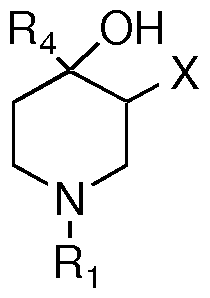
in which and R4 are defined as above and X is CI, Br or I,
with a proton donor and a halogenating agent by a process according to any of items (12) to (19); and
adding a proton acceptor to the reaction mixture of step i).
(21 ) The process according to item (20), wherein steps i) and ii) are carried out in the same solvent.
(22) The process according to item (20) or (21 ), wherein the reaction conditions for carrying out step ii) are as defined in any one of items (9) to (1 1 ).
(23) A process for preparing a compound of formula IV

in which is selected from -CH2-R5 wherein R5 represents substituted or unsubstituted aryl or substituted or unsubstituted heteroaryl, or from -CO-R6, -CO-OR6 and -S02-R6 wherein R6 represents substituted or unsubstituted alkyl, substituted or unsubstituted aryl, substituted or unsubstituted heteroaryl, R2 represents hydrogen or nitrogen protecting group, R3 represents hydrogen, a substituted or unsubstituted alkyl, substituted or unsubstituted aryl, substituted or unsubstituted heteroaryl, -CO-R7 or - CO-ORy wherein R7 represents substituted or unsubstituted alkyl, substituted or unsubstituted aryl, or substituted or unsubstituted heteroaryl, and R4 represents alkyl, which process comprises the steps of : a) converting a compound of formu I

Π1 (I)
in which and R4 are defined as above a-1 ) to a compound of formula II as defined in item (12), or
a-2) to a compound of formula III

in which and R4 are defined as above, by a process according to any one of items (20) to (22) ; and
b) adding an organic amine NHR2R3 in which R2 and R3 are defined as above to the reaction mixture of step a-1 ) or a-2).
(24) The process according to item (23), wherein steps a-1 ) or a-2) and b) are carried out in the same solvent.
(25) The process according to item (23) or (24), wherein the reaction conditions for carrying out step b) are as defined in any one of items (4) to (1 1 ).
A process aring a compound of formula V1 or V2 or a mixture thereof

and R4' derives from R4 representing alkyl in which the carbon atom adjacent to the piperidine ring is bonded with at least one hydrogen, which hydrogen is abstracted whereby R4' is formed, by treating compound of formula IV

in which is selected from -CH2-R5 wherein R5 represents substituted or unsubstituted aryl or substituted or unsubstituted heteroaryl, or from -CO-R6, -CO-OR6 and -S02-R6 wherein R6 represents substituted or unsubstituted alkyl, substituted or unsubstituted aryl, substituted or unsubstituted heteroaryl, R2 represents hydrogen or nitrogen
protecting group, R3 represents hydrogen, a substituted or unsubstituted alkyl, substituted or unsubstituted aryl, substituted or unsubstituted heteroaryl, -CO-R7 or -CO-OR7 wherein R7 represents substituted or unsubstituted alkyl, substituted or unsubstituted aryl, or substituted or unsubstituted heteroaryl, and R4 represents alkyl, with an acidic activator.
Preferably, compound of formula IV is prepared by a process according to any one of items (1 ) to (1 1 ) and (23) to (25).
(27) The process according to item (26), wherein the acidic activator is selected from the group consisting of HOTf, HCI, HBr, p-TsOH, a mixture of H3P04/ P205, TFA, a mixture of H2S04/AcOH, H2S04 and polyphosphoric acid (PPA), preferably the acidic activator is H2S04 or PPA.
(28) The process according to item (26) or (27), wherein the acidic activator is added a concentrated form containing at least 80 vol% of acidic activator, preferably at least 90 vol% of acidic activator.
(29) A process for preparing a compound of formula VI

(VI)
in which is selected from -CH2-R5 wherein R5 represents substituted or unsubstituted aryl or substituted or unsubstituted heteroaryl, or from -CO-R6, -CO-OR6 and -S02-R6 wherein R6 represents substituted or unsubstituted alkyl, substituted or unsubstituted aryl, substituted or unsubstituted heteroaryl, R2 represents hydrogen or nitrogen protecting group, R3 represents hydrogen, a substituted or unsubstituted alkyl, substituted or unsubstituted aryl, substituted or unsubstituted heteroaryl, -CO- R7 or -CO-OR7 wherein R7 represents substituted or unsubstituted alkyl, substituted or unsubstituted aryl, or substituted or unsubstituted heteroaryl, and R4 represents alkyl, by hydrogenating a compound of formula V1 and/or V2

in which P , R2J R4 are defined as above,
and R4' derives from R4 representing alkyl in which the carbon atom adjacent to the piperidine ring is bonded with at least one hydrogen, which hydrogen is abstracted whereby R4' is formed, in the presence of a transition-metal catalyst.
Preferably, compounds of formulae V1 and V2 are prepared by a process according to any one of items (26) to (28).
(30) The process according to item (29), wherein the transition metal catalyst comprises a transition metal selected from the group consisting of Pt, Rh, Ru, Pd and Pd-Cu which catalyst is optionally attached to a supporter selected from the group consisting of charcoal, carbon, graphite or alumina (Al203); preferably the catalyst comprises Pt or Rh optionally attached to a supporter selected from the group consisting of charcoal, carbon, graphite or alumina (Al203); in particular, the catalyst is Rh on activated carbon paste, Pt02 hydrate or Pt on charcoal.
(31 ) The process according to item (29) or (30), wherein an additive is present in the reaction mixture, preferably the additive is selected from the group consisting of Broensted acids, Lewis acids and organic ligands, more preferably AcOH, TFA, oxalic acid, citric acid, tartaric, BF3 dietherate, copper salts, magnesium salts, iron salts, D-glucosamine, 1 ,4- diazoniabicyclo[2.2.2]octane (DABCO), amino acids.
The term "additive" as used herein means a compound which improves conversion rate and/or yield of the hydrogenation reaction.
(32) The process according to any one of items (26) to (31 ), wherein in case a Rh transition metal catalyst is applied, hydrogenation is carried out at a hydrogen pressure of at least 1 bar (1 atm), preferably 1 to 50 bar (1 to 50 atm), more preferably 1 to 30 bar (1 to 30 atm); in case a Pt transition metal catalyst is applied, hydrogenation is carried out at a hydrogen pressure of at least 1 bar (1 atm), preferably 1 to 10 bar (1 to 10 atm), more
preferably 1 to 5 bar (1 to 5 atm), even more preferably 1 to 2 bar (1 to 2 atm), in particular 1 to 1 5 bar (1 to 1.5 atm).
The unit "bar" for pressure as used herein is a generally accepted term for exactly 100 kPa according to SI. The unit "atm" is an old pressure unit for external (ambient) air pressure, defined on sea level, which is equal to 1.013 bar (101 ,3 kPa). Considering an instrumental error of pressure measuring, which is more than 2% and sea level/weather variations of air pressure, the pressure expressed by "bar" or "atm" describes herein the same reaction conditions.
The process according to any one of items (26) to (32), wherein hydrogenation is carried out at a reaction temperature of 10 to 70 °C,.
The process according to item (32) or (33), wherein an additional additive in the form of an organic acid is present, preferably the additional additive is selected from the group consisting of AcOH, TFA, oxalic acid, citric acid, tartaric, in particular the additional additive is AcOH.
The process according to any one of items (26) to (34), wherein Pt on charcoal is used as transition metal catalyst and BF3 dietherate is used as additive.
(36) The process according to item (35), wherein an organic ether is applied as a solvent, preferably a cyclic organic ether, more preferably THF.
A compound of formula II

in which P is selected from -CH2-R5 wherein R5 represents substituted or unsubstituted aryl, or substituted or unsubstituted heteroaryl, or from -CO-R6 and -CO-OR6 wherein R6 represents substituted or unsubstituted alkyl, substituted or unsubstituted aryl, and X is CI, Br or I, and R4 is alkyl, preferably C1 -C4-alkyl, more preferably R4 is methyl, or an acid addition salt thereof.
As regards the meaning of the terms "alkyl", "aryl", "heteroaryl", "substituted or unsubstituted", "nitrogen protecting group" reference is made to the explanations under item (1 ) above.
The term "acid addition salt" as used herein means a salt formed of compound of formula II and an acid in the form of a proton donor, in which salt the nitrogen of compound of formula II is in protonated form. Any organic or inorganic proton donor can be used as acid for acid addition salt formation. Preferably the acid is selected from the group consisting of hydrochloric acid, hydrobromic acid, sulfuric acid, benzenesulfonic acid, toluenesulfonic acid, methanesulfonic acid and phosphoric acid, more preferably hydrochloric acid.
(38) The compound of formula II according to item (37), wherein X is Br.
(39) A compound of formula III

in which P is selected from -CH2-R5 wherein R5 represents substituted or unsubstituted aryl, or substituted or unsubstituted heteroaryl, or from -CO- R6 or-CO-OR6 wherein R6 represents substituted or unsubstituted alkyl, or substituted or unsubstituted aryl, and R4 is alkyl, with the proviso that a compound of formula III in which = benzyl, or methoxycarbonyl and R4 = methyl is excluded.
As regards the meaning of the terms "alkyl", "aryl", "heteroaryl", "substituted or unsubstituted", reference is made to the explanations under item (1 ) above.
A compound of formula IV

The term "acid addition salt" as used herein means a salt formed of compound of formula IV and an acid in the form of a proton donor, in which salt at least one nitrogen of compound of formula IV is in protonated form. Any organic or inorganic proton donor can be used as acid for acid addition salt formation. Preferably the acid is selected from the group consisting of hydrochloric acid, hydrobromic acid, sulfuric acid,
benzenesulfonic acid, toluenesulfonic acid, methanesulfonic acid and phosphoric acid, more preferably hydrochloric acid.
As regards the meaning of the terms "alkyl", "aryl", "heteroaryl", "substituted or unsubstituted", "nitrogen protecting group" reference is made to the explanations under item (1 ) above.
A compound

in which is selected from -CH2-R5 wherein R5 represents substituted or unsubstituted aryl or substituted or unsubstituted heteroaryl, or from -CO-R6, and -CO-OR6 wherein R6 represents substituted or unsubstituted alkyl, substituted or unsubstituted aryl, substituted or unsubstituted heteroaryl, R2 represents hydrogen or nitrogen protecting group, R3 represents hydrogen, a substituted or unsubstituted alkyl, substituted or unsubstituted aryl, substituted or unsubstituted heteroaryl, -CO-R7 or -CO-OR7 wherein R7 represents substituted or unsubstituted alkyl, substituted or unsubstituted aryl, or substituted or unsubstituted heteroaryl, R4' represents alkyl in which the carbon atom
adjacent to the piperidine ring is substituted with at least one hydrogen and R4 represents hydrogen or alkyl, preferably R4' represents C1 -C4-alkylidene and R4 represent C1 -C4-alkyl, more preferably R4' is methylene and R4 is methyl, or acid addition salt(s) thereof, with the proviso that compounds of formula V1 wherein R^ = -CO-CF3 or -CO-O-fert- butyl (BOC) are excluded. Optionally there is a further proviso that a compound of formula V1 is excluded wherein when R^ is phenylmethyl, R2 represents hydrogen and R3 represents BOC at the same time.
As regards the meaning of the terms "alkyl", "aryl", "heteroaryl", "substituted or unsubstituted", "nitrogen protecting group" reference is made to the explanations under item (1 ) above.
(42) The compounds of formulae II, III, IV and V1 and V2 according to any one of items (37) to
(41 ) , wherein R^ is -CH2-R5 in which R5 represents substituted or unsubstituted aryl, or substituted or unsubstituted heteroaryl, preferably is -CH2-R5 wherein R5 represents substituted or unsubstituted aryl, more preferably, R^ is benzyl (-CH2-Ph).
(43) The compounds of formulae II, III, IV and V1 and V2 according to any one of items (37) to
(42) , wherein R^ is selected from the group consisting of -CH2-Ph, -CO-CH3, -CO-OEt, - CO-OCH2Ph, -CO-OCH2CCI3, -CO-OCH2C(CH3)3, preferably R, is selected from the group consisting of -CH2-Ph, -CO-CH3 and -CO-OEt.
(44) The compounds of formulae II, III, IV, V1 and V2 according to any one of items (37) to
(43) , wherein R2 is H; and R3 is selected from the group consisting of H, CH3, -CH2-Ph, - CH(CH3)-Ph, -CO-OCH3 and -CO-OEt.
(45) The compounds of formulae II, III, IV, V1 and V2 according to any one of items (37) to
(44) , wherein R4 C1 -C4-alkyl, in particular R4 is methyl.
(46) The compound of formula II, III, IV, V1 and V2 according to any one of items (27) to (45), wherein any one of these compounds are selected from the group consisting of

Ma Mb Mc

Me Mf

Mlc

IVa IVb IVc IVd

IVe IVf IVg IVh

IV i IVj


V1c v2c V1d V2d
Use of a compound selected from the group of compounds defined by formulae II, III, IV, V1 and V2 in a process for preparing a pharmaceutically active agent.
The use according to item (47), wherein compounds of formulae II, IV and V
selected, preferably compounds of formula II and IV.
(49) The use according to item (47) or (48), wherein the pharmaceutically active agent is a Janus kinase inhibitor, preferably a Janus kinase 3 inhibitor, more preferably the pharmaceutically active ag structural formula

or an acid addition salt thereof.
The term "acid addition salt" as used herein means a salt formed of compound of tofacitinib and an acid in the form of a proton donor, in which salt the nitrogen of compound of formula II is in protonated form. Any organic or inorganic proton donor can be used as acid for acid addition salt formation. Preferably an acid is selected which provides for a pharmaceutically acceptable acid addition salt. More preferably, the acid is hydrochloric acid.
Detailed description of the invention
The present invention is now described in more detail by referring to further preferred and further advantageous embodiments and examples, which are however presented for illustrative purposes only and shall not be understood as limiting the scope of the present invention.
In order to find a more efficient and shorter way to prepare pharmaceutically active agents which chemical structure comprises a 3-aminopiperidine moiety, it was surprisingly found that the novel compounds of formulae V, IV, II and/or V1 and V2 represent particularly suitable intermediate compounds for preparing 3-aminopiperidine compounds. Compounds of formulae IV and II can be easily prepared from simple and readily available starting materials by means of (relatively) harmless reactants providing for safer working conditions under ecologically beneficial reaction conditions. Said 3-aminopiperidine compounds of formulae IV and/or II can subsequently be conveniently converted to various pharmaceutically active agents, such as preferably tofacitinib or derivatives thereof. The person skilled in the art is able to convert said 3-aminopiperidine compounds to further pharmaceutically active agents comprising 3- aminopiperidine as a structural moiety, such as for example quinolone antibacterial agents or 3-aminopiperidine-based peptide analogues as inhibitors of the bacterial cystein protease IdeS.
Compared with conventional syntheses for preparing 3-aminopiperidine compounds discussed in the above "background of the invention" part, the present invention surprisingly satisfies a hitherto unmet need for an improvement of processes for preparing a compound that is suitable for industrial production of a pharmaceutically active agent comprising a 3-aminopiperidine moiety such as preferably tofacitinib or derivatives thereof, but also other pharmaceutically active agents comprising as a structure a 3- aminopiperidine moiety, such as for example quinolone antibacterial agents or 3-aminopiperidine-based peptide analogues as inhibitors of the bacterial cystein protease IdeS.
According to one aspect of the invention, a general synthetic concept is provided which is particularly suitable for preparing 3-aminopiperidine compounds. A preferred embodiment and representative example of the general synthetic concept of the present invention is illustrated in Scheme 7:

alkene mixture hydrogen,
transition metal catalyst
STEP 5: HYDROGENATION

VI
Scheme 7: General procedural concept of the present invention.
According to the preferred embodiment of Scheme 7 (wherein in the compounds of formulae I, II, III, IV, V1 , V2, VI and amine compound NHR2R3, R2, R3, R4 and X are respectively defined as in the preceding items), a compound of formula II is prepared by halogenation of a compound of formula I using a halogenating agent. Next, compound of formula II can be converted into epoxide compound of formula III by applying a proton acceptor. Epoxide compound of formula III can be further converted to compound of formula IV by reacting it with amine NHR2R3. Alternatively, compound of formula II can be directly converted to compound of formula IV. Next, compound of formula IV can be converted to a mixture of alkene compounds of formulae V1 and V2 by means of an acidic activator. Finally, a compound of formula VI can be obtained by hydrogenating alkene compounds V1 and V2 in the presence of a transition metal catalyst. Preferably, compound of formula I is converted to compound of formula III in a one-pot process, preferably without isolation of intermediate compounds. According to a further preferred embodiment, compound of formula I is converted to compound of formula IV in a one- pot process, preferably without isolation of intermediate compounds.
Compounds of formula I are readily available, e.g., compound of formula I in which is benzyl and R4 is methyl is commercially available.
According to one aspect of the invention, an amination step (cf. STEP 1 in Scheme 7) for preparing compound of formula IV can be carried out by means of two alternative process variants A and/or B, which alone or in combination provide for smooth conversion to compound of formula IV.
In process variant A, compound of formula IV


wherein and R4 are defined as above and X is selected from CI, Br and I, with an amine NHR2R3 in which R2 and R3 are defined as above.
In process variant B, compound of formula IV

unsubstituted alkyl, substituted or unsubstituted aryl, or substituted or unsubstituted heteroaryl, and R4 represents alkyl, is prepared by a process comprising treat of a compound of formula III

ni (III)
wherein and R4 are defined as above, with an amine NHR2R3 in which R2 and R3 are defined as above.
Process variants A and B respectively represent alternative processes for preparing a compound of formula IV which processes provide for a simple and efficient carrying out of an amination reaction providing novel amine compound of formula IV representing a highly valuable intermediate for the preparation of pharmaceutically active agents such as preferably tofacitinib or derivatives thereof, or other pharmaceutically active agents comprising as a structure a 3- aminopiperidine moiety, such as for example quinolone antibacterial agents or 3-aminopiperidine-based peptide analogues as inhibitors of the bacterial cystein protease IdeS. In particular, it was surprisingly found that both hydroxyhalogenated compounds of formula II and epoxy compounds of formula III can be readily converted to compound of formula IV by applying the readily available amine compound NHR2R3 as reactant.
According to a preferred embodiment of process variant A, compound of formula II is converted to compound of formula IV without formati and/or isolation of a compound of formula III.

R 1 (III).
According to this embodiment of the invention, it was surprisingly found that compound of formula II can be directly converted to compound of formula IV, wherein it can be dispensed with isolation and purification of an epoxide compound of formula III as intermediate compound (cf. Step 2' in Scheme 7).
According to a further preferred embodiment of process variants A and B, is CH2-R5 wherein R5 represents substituted or unsubstituted aryl, or substituted or unsubstituted heteroaryl, preferably is CH2-R5 wherein R5 represents substituted or unsubstituted aryl, more preferably Ri is benzyl (-CH2-Ph).
According to this embodiment, conversion rate and/or yield of the process may be efficiently increased by suitably selecting
According to another preferred embodiment of process variants A and B, amine NHR2R3 is selected from the group consisting of N-benzylmethylamine, N-a-dimethylbenzylamine, methyl carbamate and methyl amine, preferably NHR2R3 is methyl amine.
In a particular preferred embodiment of process variant B, the amination reaction is carried out in water as the solvent. In this way, it can be dispensed with harmful or even toxic organic solvents, which in turn also significantly improves working conditions for carrying out the process.
As regards addition of amine NHR2R3 in both process variant A and B, amine NHR2R3 is preferably added to compound of formula II portionwise within a predetermined time interval. Furthermore, preferably compound of formula II is provided neat or diluted or dissolved in a solvent as defined in item (7) of the summary of invention, and amine NHR2R3 is provided neat or diluted or dissolved in a solvent as defined in item (7), more preferably, compound of formula II is provided neat and amine NHR2R3 is diluted or dissolved in a solvent as defined in item (7).
In a preferred embodiment of process variant B, compound of formula III is prepared by treating the compound of formula II with a proton acceptor, preferably an inorganic or sterically hindered organic proton acceptor, more preferably the proton acceptor is selected from the group consisting of carbonate salts, ferf-butanolate salts and hydroxides of alkaline or earth alkaline metals, more preferably, the proton acceptor is selected from the group consisting of Na2C03, K2C03, KOf-Bu, NaOf-Bu, KOH, NaOH, in particular, the proton acceptor is NaOH. As regards the amount of proton acceptor applied, it is preferred to apply a hyperstoichiometric amount relative to compound of formula III, preferably at least 2 mol equivalent relative to compound of formula II, preferably excess.
In a further preferred embodiment of process variant B, conversion of compound of formula II to compound of formula III is carried out at a reaction temperature of 10 to 60 °C, preferably 15 to 50 °C, more preferably 20 to 40 °C. In this way, the process can be carried out at a relative low reaction temperature which is beneficial in terms of energy savings. Preferably, reaction time for converting compound of formula II to compound of formula III is 6 to 14 hours, more preferably 8 to 12 hours.
In a still further preferred embodiment of process variant B, conversion of compound of formula II to compound of formula III is carried out in water as the solvent.
Owing to this preferred embodiment, it can be dispensed with harmful or even toxic organic solvents, which in turn also significantly improves working conditions for carrying out the process.
According to another aspect of the present invention, an hydroxyhalogenation step (cf. STEP 1 in Scheme 7) for preparing a compound I

in which is selected from -CH2-R5 wherein R5 represents substituted or unsubstituted aryl, or substituted or unsubstituted heteroaryl, or from -CO-R6 or -CO-OR6 wherein R6 represents substituted or unsubstituted alkyl, substituted or unsubstituted aryl, or substituted or unsubstituted heteroaryl, and X is selected from CI, Br and I, and R4 represents alkyl, is carried out by reacting a compound of formula I

in which and R4 are defined as above, with a proton donor and a halogenating agent in the presence of water, wherein the proton donor is added prior to the halogenating agent.
This aspect provides for a simple and efficient carrying out of an hydroxyamination reaction providing novel hydroxyhalogen compounds of formula II representing highly valuable
intermediates for the preparation of pharmaceutically active agents such as preferably tofacitinib or derivatives thereof. Moreover, a person skilled in the art is able to convert said
3-aminopiperidine compounds to further pharmaceutically active agents comprising as a structure a 3-aminopiperidine moiety, such as for example quinolone antibacterial agents or 3-aminopiperidine-based peptide analogues as inhibitors of the bacterial cystein protease IdeS. In particular, compounds of formula II represent particularly suitable starting materials for the above described process variant A, and compounds of formula II also represent particularly suitable starting materials for preparing epoxide compounds of formula III applied in process variant B. The addition of the proton donor prior to the halogenation agent provides for formation of an acid addition salt of compound of formula I, wherein the salt formation protects the nitrogen of the pyridine from being halogenated or reacting otherwise.
According to a preferred embodiment, the halogenating agent is selected from the group consisting of N-chlorosuccinimide, N-iodosuccinimide, N-bromosuccinimide, 5,5-dimethyl-1 ,3- dibromohidantoin (DBDMH), preferably N-bromosuccinimide and DBDMH, more preferably N- bromosuccinimide. The halogenating agent is preferably applied in an amount of at least 0.5 to 1 .5 mol equivalent relative to compound of formula la depending on halogenating agent used, preferably 0.75 to 1 .25 mol equivalent. The amount of halogenating agent depends on the number of active halogen comprised in the halogenating reagent. For example, in the succinimide-type halogenating agents, one halogen is contained, while in DBDMH, 2 bromo atoms are contained. Therefore, the succinimide-type halogenating agents are preferably applied in hyperstoichiometric amounts within the value ranges defined above, while DBDMH is preferably applied in substoichiometric amounts which lower limits are defined above.
Preferably, the halogenating agent is added portionwise within a predetermined time interval.
According to another preferred embodiment, in the case were the halogenating agent is N- chlorosuccinimide, N-iodosuccinimide or N-bromosuccinimide, water or a mixture of water and alcohol is applied as the solvent, preferably a mixture of water and C1 -C4-alcohol, more preferably a mixture of water and isopropyl alcohol. Preferably, the mixture of water and alcohol has a proportion of at least 66 vol% of water. It was surprisingly found that by applying an amount of water exceeding 66 vol%, the formation of impurities by means of reaction of an alcohol co-solvent such as isopropanol with compound of formula I can be efficiently suppressed.
According to still another preferred embodiment, in the case were the halogenating agent is DBDMH, water is applied as the solvent. In this way, it can be dispensed with harmful or even
toxic organic solvents, which in turn also significantly improves working conditions for carrying out the process.
Preferably, the proton donor applied in the hydroxyhalogenation step 1 is an inorganic or organic acid, more preferably H2S04, H3P04, acetic acid, TfOH, para-toluenesulfonic acid (PTSA), trifluoroacetic acid (TFA), in particular the proton donor is TFA. The proton donor is preferably applied in an amount of at least 0.5 to 1 .5 mol proton equivalent relative to compound of formula I, preferably 1 .0 mol proton equivalent.
In a particularly preferred embodiment, compound of formula I is prepared by reacting a compound of formula la

(la)
in which R is -CH2-R5 wherein R5 represents substituted or unsubstituted aryl, or substituted or unsubstituted heteroaryl, with an acid chloride CI-CO-R6, a chloro carboxylic ester CI-CO-OR6 or a sulfonic acid chloride Cl-S02-R6 wherein R6 represents substituted or unsubstituted alkyl, aryl, heteroaryl, alkylaryl or arylalkyl.
According to this embodiment, the N-benzyl group is substituted by -CO-R6, -CO-OR6 or -S02- R6. In particular, it was surprisingly found that -CO-R6, -CO-OR6 or -S02-R6 improve the reactivity of the double bound in the piperidine ring moiety of compound of formula I compared to a compound of formula la in which R is -CH2-R5.
According to a preferred embodiment, substitution of the N-benzyl group is carried out in toluene or acetonitrile as the solvent.
Substitution of the N-benzyl group is preferably accomplished by adding an acid chloride CI-CO- R6, a chloro carboxylic ester CI-CO-OR6 or a sulfonic acid chloride Cl-S02-R6 in a portionwise manner within a predetermined time intervall. Furthermore, addition of the acid chloride CI-CO- R6, the chloro carboxylic ester CI-CO-OR6 or the sulfonic acid chloride Cl-S02-R6 is preferably carried out at a temperature of -30 to +30 °C, preferably at a temperature of +10 to + 20 °C. After addition of the acid chloride CI-CO-R6, the chloro carboxylic ester CI-CO-OR6 or the
sulfonic acid chloride Cl-S02-R6, the reaction mixture is preferably refluxed. The time for refluxing is preferably 12 to 36 hours, more preferably 20 to 28 hours.
According to a further preferred embodiment, reactants for substitution of the N-benzyl group are selected from the group consisting of CI-COOEt, CI-COOCH2Ph, CI-COOCH2CCI3, Cl- COOC(CH3)3, CI-COCH3, CI-COEt, more preferably CI-COOEt is applied.
According to another aspect of the invention compound of formula III

R 1 (III)
in which is selected from -CH2-R5 wherein R5 represents substituted or unsubstituted aryl, or substituted or unsubstituted heteroaryl, or from -CO-R6, -CO-OR6 and -S02-R6 wherein R6 represents substituted or unsubstituted alkyl, substituted or unsubstituted aryl, or substituted or unsubstituted heteroaryl, and R4 is alkyl, is prepared by a process comprising the steps of :
i) converting a compound of formu I

Π1 (I)
in which and R4 are defined as above to a compound of formula II

in which and R4 are defined as above and X is CI, Br or I, with a proton donor and a halogenating agent by a process according to any one of items (12) to (19) of the summary of invention; and
ii) adding a proton acceptor to the reaction mixture of step i).
According to this aspect of the invention, compound of formula III can be obtained from the starting material of formula I in a highly advantageous "one pot process". That is, it can be dispensed with isolation and purification of compound of formula II.
According to a preferred embodiment, the reaction conditions for carrying out step ii) are as defined in any one of items (9) to (1 1 ) of the summary of invention.
According to this particular preferred embodiment, steps i) and ii) are carried out in the same solvent. In this way, no solvent exchange is necessary between process steps i) and ii) which is beneficial in terms of process efficiency, since no energy consuming removal of solvent(s) is necessary between steps i) and ii), and furthermore, it can be dispensed with laborious recycling of removed solvent(s).
Preferably, prior to step ii), the reaction mixture is cooled to a temperature of -30 to +30 °C, preferably at a temperature of +10 to + 20 °C.
According to still another aspect of the invention, a compound of formula IV

in which is selected from -CH2-R5 wherein R5 represents substituted or unsubstituted aryl or substituted or unsubstituted heteroaryl, or from -CO-R6, -CO-OR6 and -S02-R6 wherein R6 represents substituted or unsubstituted alkyl, substituted or unsubstituted aryl, substituted or unsubstituted heteroaryl, R2 represents hydrogen or nitrogen protecting group, R3 represents hydrogen, a substituted or unsubstituted alkyl, substituted or unsubstituted aryl, substituted or unsubstituted heteroaryl, -CO-R7 or -CO-OR7 wherein R7 represents substituted or unsubstituted alkyl, substituted or unsubstituted aryl, or substituted or unsubstituted heteroaryl, and R4 represents alkyl, is prepared by a process comprising the steps of : a) converting a compound of formula I

a-2) to a compound of formula III
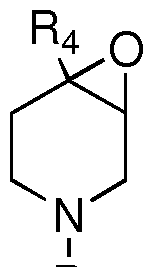
ni (III)
in which and R4 are defined as above by a process according to any one of items (20) to (22) of the summary of invention; and
b) adding an organic amine NHR2R3 in which R2 and R3 are defined as above to the reaction mixture of step a-1 ) or a-2).
According to this further aspect of the invention, compound of formula IV can be obtained from the starting material of formula I in a highly advantageous "one pot process". That is, it can be dispensed with isolation and purification of compounds of formulae II and III.
In a preferred embodiment, the reaction conditions for carrying out step b) are as defined in any one of items (4) to (8).
In a particularly preferred embodiment, steps a-1 ) or a-2) and b) are carried out in the same solvent.
According to this particular preferred embodiment, no solvent exchange is necessary between process steps a-1 )/a-2) and b) which is beneficial in terms of process efficiency, since no energy consuming removal of solvent(s) is necessary between steps a-1 )/a-2) and b), and furthermore, it can be dispensed with laborious recycling of removed solvent(s).
In another preferred embodiment, compound of formula IV prepared by any one of the aforementioned processes is converted to a compound of formula V1 and V2 respectively

in which R^ R2, R3 and R4 are defined as above, and R4' derives from R4 representing alkyl in which the carbon atom adjacent to the piperidine ring is bonded with at least one hydrogen, which hydrogen is abstracted whereby R4' is formed, by treating compound of formula IV with an acidic activator.
Preferably, the acidic activator is added portionwise within a predetermined time interval.
Compounds of formulae V1 and V2 may be further converted to a compound of formula VI

in which R^ R2, R3 and R4 are defined as above, by hydrogenating compounds of formulae V1 and V2 in the presence of a transition-metal catalyst.
According to a preferred embodiment, the transition metal catalyst comprises a transition metal selected from the group consisting of Pt, Rh, Ru, Pd and Pd-Cu which catalyst is optionally attached to a supporter selected from the group consisting of charcoal, carbon, graphite or alumina (Al203); preferably the catalyst comprises Pt or Rh optionally attached to a supporter selected from the group consisting of charcoal, carbon, graphite or alumina (Al203); in particular, the catalyst is Rh on activated carbon paste, Pt02 hydrate or Pt on charcoal.
Preferably, the transition metal catalysts is applied in an amount of up to 30 mol% relative to compounds of formulae V1 and V2, preferably 0.5 to 20 mol%, more preferably 1 to 10 mol% and in particular 1.5 to 5 mol%.
According to a further preferred embodiment, a additive is added in order to improve conversion rate and yield of the hydrogenation reaction, which additive is selected from the group consisting of Broensted acids, Lewis acids and organic ligands, preferably AcOH, TFA, oxalic
acid, citric acid, tartaric, BF3 dietherate, copper salts, magnesium salts, iron salts, D- glucosamine, 1 ,4-diazoniabicyclo[2.2.2]octane (DABCO), amino acids.
Preferably, a C1 -C6 alcohol is applied as solvent, preferably a C1 -C3 alcohol, in particular methanol.
According to a still further preferred embodiment, in case a Rh transition metal catalyst is applied, hydrogenation is carried out at a hydrogen pressure of at least 1 bar (1 atm), preferably 1 to 50 bar (1 to 50 atm), more preferably 1 to 30 bar ( 1 to 30 atm); and in case a Pt transition metal catalyst is applied, hydrogenation is carried out at a hydrogen pressure of at least 1 bar (1 atm), preferably 1 to 10 bar ( 1 to 10 atm), more preferably 1 to 5 bar (1 to 5 atm), even more preferably 1 to 2 bar (1 to 2 atm), in particular 1 to 1 5 bar (1 to 1 .5 atm).
Surprisingly, under these conditions contrary to the literature data (X. E. Hu, et. al., Org. Lett. 2002, 4, pages 4499 to 4502) the cis configuration of the compound of formula VI is formed as a major product. Moreover, it was surprisingly found that an increased diasteriomeric excess of the product compound of formula VI can be obtained already at advantageous low pressures in case Pt catalyst is applied. On the other hand, it was surprisingly found that diasteriomeric excess of the product compound of formula VI can be significantly increased by applying elevated hydrogen pressures.
Preferably, hydrogenation is carried out at a reaction temperature of 10 to 70 °C. According to this preferred embodiment, the process can be carried out at a relative low reaction temperature which is beneficial in terms of energy savings.
According to a specific embodiment, Pt02 or Pt02 hydrate is used as transition metal catalyst and DABCO is used as additive.
According to a further aspect of the invention, compounds of formulae II, III and IV are provided which are defined as follows:
In compound of formula II

RT is selected from -CH2-R5 wherein R5 represents substituted or unsubstituted aryl, or substituted or unsubstituted heteroaryl, -CO-R6 and -CO-OR6 wherein R6 represents substituted or unsubstituted alkyl, or substituted or unsubstituted aryl, and X is CI, Br or I, and R4 is alkyl,
preferably C1 -C4-alkyl, in particular R4 is methyl, wherein compound of formula II may be in its free amine form or in form of its acid addition salt.
In compound of formula III

in which is selected from -CH2-R5 wherein R5 represents substituted or unsubstituted aryl, or substituted or unsubstituted heteroaryl, -CO- R6 or-CO-OR6 wherein R6 represents substituted or unsubstituted alkyl, or substituted or unsubstituted aryl, and R4 is alkyl, with the proviso that a compound of formula III in which = benzyl or methoxycarbonyl and R4 = methyl is excluded.
In compound of formula IV

in which is selected from -CH2-R5 wherein R5 represents substituted or unsubstituted aryl or substituted or unsubstituted heteroaryl, or from -CO-R6, and -CO-OR6 wherein R6 represents substituted or unsubstituted alkyl, substituted or unsubstituted aryl, substituted or unsubstituted heteroaryl, R2 represents hydrogen or nitrogen protecting group, R3 represents hydrogen, a substituted or unsubstituted alkyl, substituted or unsubstituted aryl, substituted or unsubstituted heteroaryl, -CO-R7 or -CO-OR7 wherein R7 represents substituted or unsubstituted alkyl, substituted or unsubstituted aryl, or substituted or unsubstituted heteroaryl, and R4 represents alkyl, preferably C1 -C4-alkyl, in particular R4 is methyl,
wherein compound of formula IV may be in its free amine form or in form of its acid addition salt.
In compounds of formulae V1 and V2

in which R^ is selected from -CH2-R5 wherein R5 represents substituted or unsubstituted aryl or substituted or unsubstituted heteroaryl, or from -CO-R6, and -CO-OR6 wherein R6 represents substituted or unsubstituted alkyl, substituted or unsubstituted aryl, substituted or unsubstituted heteroaryl, R2 represents hydrogen or nitrogen protecting group, R3 represents hydrogen, a substituted or unsubstituted alkyl, substituted or unsubstituted aryl, substituted or unsubstituted heteroaryl, -CO-R7 or -CO-OR7 wherein R7 represents substituted or unsubstituted alkyl, or substituted or unsubstituted aryl, R4' represents alkyl in which the carbon atom adjacent to the piperidine ring is substituted with at least one hydrogen and R4 represents alkyl, preferably R4' represents C1 -C4- alkylidene and R4 represent C1 -C4-alkyl, more preferably R4' is methylene and R4 is methyl, or acid addition salt(s) thereof, with the proviso that compounds of formula V1 wherein R^ = -CO-CF3 or -CO-O-fert- butyl (BOC) are excluded. Optionally there is a further proviso that a compound of formula V1 is excluded wherein when R^ is phenylmethyl, R2 represents hydrogen and R3 represents BOC at the same time.
Acid addition salts of compounds of formulae II, IV, V1 and V2 are preferably hydrochloride addition salts.
Preferably, in any one of compounds of formula II, IV, V1 and V2, R^ is selected from the group consisting of -CH2-Ph, -CO-CH3, -CO-OEt, -CO-OCH2Ph, -CO-OCH2CCI3, -CO-OCH2C(CH3)3, more preferably R^ is selected from the group consisting of -CH2-Ph, -CO-CH3 and -CO-OEt.
Furthermore, in any one of compounds of formula II, IV, V1 and V2, R2 is H; and R3 is selected from the group consisting of H, CH3, -CH2-Ph, -CH(CH3)-Ph, -CO-OCH3 and -CO-OEt.
As regards residue R4, in any one of compounds of formulae II, III, IV, V1 and V2, R4 is preferably C1 -C4-alkyl, in particular R4 is methyl.
According to yet another aspect of the invention, a compound selected from the group of compounds defined by formulae II, III, IV , V1 and V2,is used in a process for preparing a pharmaceutically active agent. Preferably, compounds of formulae II, IV, V1 and V2,are selected, more preferably compounds of formulae II and IV.
According to a preferred embodiment, the pharmaceutically active agent is a Janus kinase inhibitor, preferably a Janus kinase 3 inhibitor, more preferably the pharmaceutically active agent is tofacitinib having the structural formula

or an acid addition salt thereof.
For example, conversion to tofacitinib may be carried out as described in WO 2002/096909, WO 2004/0461 12 or WO 2007/012953. Furthermore, a person skilled in the art may carry out a conversion for example to quinolone antibacterial agents as described in Eric Hu X et al:
"Discovery of (3S)-Amino-(4R)-ethylpiperodinyl Quinolones as Potent Antibacterial Agents with a Broad Spectrum of Activity and Activity against Resistant Pathogens", J. Med. Chem., vol. 46, no. 17, 2003, , pages 3655-3661 , or for example to 3-aminopiperidine-based peptide analogues as inhibitors of the bacterial cystein protease IdeS as described in K. Berggren et al: "3- Aminopiperidine-Based Peptide Analogues as the First Selective Noncovalent Inhibitors of the Bacterial Cysteine Protease IdeS", J. Med. Chem.,, vol. 55, no. 6, 2012, pages 2549-2560^
The following examples are merely illustrative of the present invention and they should not be considered as limiting the scope of the invention in any way. The examples and modifications or other equivalents thereof will become apparent to those versed in the art in the light of the present entire disclosure.
Examples
Example 1 : Preparation of compounds of formulae IV starting from compounds of formulae III
a) Preparation of 1-benzyl-4-methyl-3-(methylamino)-piperidin-4-ol (IVa) in water

Into a 100 mL glass reactor equipped with magnetic stirrer was placed starting material (Ilia) (27.1 mmol, 5.5 g). Afterwards methylamine solution (40 wt% in water; 3.5 equiv. according to starting material) was dropping for 2 hours into reaction system and obtained reaction mixture was vigorously stirred at 60 °C for 20 hours. After completion of the reaction, reaction system was diluted with water and extracted with ethyl acetate (2 x 100 mL). The combined organic phases were washed with brine, dried over anhydrous Na2S04 and organic solvent was evaporated under reduced pressure. The obtained product (IVa) (5.25 g, 81 % yield) was confirmed with 1 H, 13C NMR analysis and FT-IR spectroscopy. b) Preparation of 1-benzyl-4-methyl-3-(benzyl(methyl)amino)-piperidin-4-ol (IVb) in water r J /V-methyl-1 -phenylmethanamine | | QH
N water N
Ph^ Ph^
Ilia IVb
Into a test tube equipped with magnetic stirrer and septum was placed starting material (Ilia) (1 mmol, 203 mg) which was well suspended in 2.5 mL of deionized water. Afterwards N-methyl-1 - benzylamine (1 .75 mmol; 21 1 mg) was slowly added and such aqueous system was intensively stirred at 60 °C for 20 hours. Reaction system was cooled to room temperature, diluted with water and then extracted with two portions of chloroform (50 mL). The combined organic phases were washed with brine, dried over anhydrous Na2S04 and organic solvent was evaporated under reduced pressure. The obtained product (IVb) (172 mg, 53% yield) was confirmed with GC-MS and 1 H NMR analyses.
1 H NMR (500 MHz, CDCI3, ppm) δ 7.39-7.25 (m, 10H, ArH), 3.85 (d, J = 13.5 Hz, 1 Ha of N- benzyl amine), 3.63 (d, J = 13.3 Hz, 1 Ha of benzy on piperidine nitrogen), 3.58 (d, J = 13.2 Hz, 1 Hb of benzyl on piperidine nitrogen), 3.53 (d, J = 13.5 Hz, 1 Hb of N-benzyl amine), 3.03 (m, 1 H), 2.87 (dd, J = 1 1 .3 Hz, J = 3.8 Hz, 1 H), 2.80 (m, 1 H), 2.27 (s, 3H, N-CH3), 2.20 (m, 1 H), 2.1 1 (dd, J = 12.1 Hz, J = 2.6 Hz, 1 H), 1.79 (m, 1 H), 1 .67 (m, 1 H), 1 .30 (s, 3H, CH3).
c) Preparation of 1-benzyl-3-(methylamino)-piperidin-4-ol in alchoholic medium

l lle
Into a 100 mL glass reactor equipped with magnetic stirrer was placed starting material (llle) (93.2 mmol, 17.62 g). Afterwards methylamine solution (33 wt% in ethanol; 1 .25 equiv. according to starting material) was dropping for 2 hours into reaction system and obtained reaction mixture was vigorously stirred at 80 °C for 24 hours. After completion of the reaction, reaction system was cooled to room temperature, diluted with toluene (100 mL) and organic phases were washed with water (3 x 50 mL). Aqueous phase was further washed with NaHC03 (aq.) to obtain pH= 1 1 and extracted with DCM. The both organic phases were dried over anhydrous Na2S04 and organic solvent was evaporated under reduced pressure. The crude obtained product (IVk) was purified with column chromatography (reverse phase, acetonitrile with 10% of water) to obtain pure product (15.3 g, 75% yield) which was confirmed using 1 H NMR analysis.
1 H NMR (500 MHz, CDCI3, ppm) δ 7.40-7.25 (m, 5H, ArH), 3.58 (d, J = 13.1 Hz, 1 Ha of benzyl), 3.50 (d, J = 13.1 Hz, 1 Hb of benzyl), 3.20 (m, 1 H), 3.15 (m, 1 H), 2.85 (m, 2H), 2.45 (m, 1 H), 2.40 (s, 3H), 2.05 (m, 1 H), 1 .65 (m, 2H). The presence of 20% of other isomer was also observed in the spectra.
Example 2: Direct one-pot synthesis of compounds of formula IVa starting from compounds of formula Ila a) Preparation in water

Into a test tube equipped with magnetic stirrer and septum was placed starting material (Ila) (1 mmol, 284 mg) and afterwards an excess of 40% aqueous solution of methylamine (0.4 mL) was slowly added into reaction system. Reaction mixture was then intensively stirred at 80 °C for 20 hours. After completion of the reaction, reaction system was diluted with water, pH was measured and adjusted to 10.6 using aqueous NaOH and finally extracted with ethyl acetate (2 x 50 mL). The combined organic phases were washed with brine, dried over anhydrous Na2S04 and organic solvent was evaporated under reduced pressure. The obtained product (IVa) (205 mg, 88% yield) was confirmed with 1 H, 13C NMR analysis and FT-IR spectroscopy.
1 H NMR (500 MHz, CDCI3, ppm) δ 7.30 (m, 5H, ArH), 3.60 (d, J = 13.2 Hz, 1 Ha of benzyl), 3.50 (d, J = 13.2 Hz, 1 Hb of benzyl), 3.00-2.90 (m, 1 H), 2.70-2.60 (m, 2H), 2.46 (m, 1 H), 2.40 (s, 3H), 2.20-2.10 (m, 1 H), 1 .95 (bs, OH), 1.70 (m, 2H), 1.26 (s, 3H); 13C NMR (125 MHz, CDCI3, ppm) δ 138.4, 128.9, 128.2, 126.9, 71.1 , 65.6, 62.6, 53.7, 50.3, 38.3, 35.1 ; IR (neat): v = 3200-3500 (broad), 2933, 2803, 1475, 1452, 1 103, 745, 700 cm 1. b) Preparation in alcoholic medium:

Into a test tube equipped with magnetic stirrer and septum was placed starting material (Ila) (1 mmol, 284 mg) and afterwards an excess of methylamine solution (33 wt% in absolute ethanol; 620 μΙ_) was slowly added into reaction system. Reaction mixture was then intensively stirred at 80 °C for 20 hours. After completion of the reaction, the ethanol was evaporated, reaction system was diluted with water, pH was measured and adjusted to 10.5 using aqueous NaOH and finally extracted with chloroform (2 x 50 mL). The combined organic phases were washed with brine, dried over anhydrous Na2S04 and organic solvent was evaporated under reduced pressure. The obtained product (IVa) (215 mg, 92% yield) was confirmed with 1 H and 13C NMR analysis.
Example 3: Preparation of compounds of formula III starting from compounds of formula II
a) Preparation of 3-benzyl-6-methyl-7-oxa-3-azabicyclo[4.1.0]heptane (Ilia) in water

Ila Ilia
Into a test tube equipped with magnetic stirrer and septum was placed starting material (Ila) (1 mmol, 283 mg) which was well suspended in 1 .5 mL of deionized water. Afterwards trifluoroacetic acid was added (1 equiv., 75 μί) and reaction mixture was stirred at ambient temperature for 20 min. Finally aqueous solution of 2M sodium hydroxide (1 mL) was added and reaction system was intensively stirred at 30 °C for 10 hours. The reaction mixture was diluted with water and extracted with ethyl acetate (2 x 40 mL). The combined organic phases were washed with brine, filtered through active carbon, dried over anhydrous Na2S04 and
organic solvent was evaporated under reduced pressure. The obtained yellowish oily product (Ilia) (187, 92% yield) was confirmed with 1 H, 13C NMR analysis and FT-IR spectroscopy.
1 H NMR (500 MHz, CDCI3, ppm) δ 7.32-7.31 (m, 5H, ArH), 3.49 (d, J = 13.0 Hz, 1 Ha of benzyl), 3.43 (d, J = 13.0 Hz, 1 Hb of benzyl), 3.10 (ddd, J = 13.2 Hz, J = 4.6 Hz, J = 1 .3 Hz, 1 H), 3.05 (d, J = 4.6 Hz, 1 H), 2.60 (d, J = 13.2 Hz, 1 H), 2.40 (m, 1 H), 2.15 (m, 1 H), 1 .90 (m, 2H), 1 .36 (s, 3H); 13C NMR (125 MHz, CDCI3, ppm) δ 137.9, 129.5, 128.2, 127.1 , 62.2, 58.4, 52.5, 46.3, 30.7, 22.9; IR (neat): v = 2925, 2809, 1453, 860, 741 , 699 cm 1.
Example 4: Preparation of compounds of formula II starting from compounds of formula I a) Preparation of 1 -benzyl-3-bromo-4-methylpiperidin-4-ol (Ila) in a mixture of water/alcohol

la Ila
Into a flask equipped with magnetic stir bar were placed starting material (la') (27 mmol, 5 g) and deionized water (54 ml_) and heterogeneous mixture was vigorously stirred for 15 min at ambient temperature. Afterwards isopropyl alcohol (27 ml_) was dropped into reaction mixture followed by addition of trifluoroacetic acid (1 equiv. according to starting material; 2 ml_) and reaction system was stirred for 10 min. Brominating reagent N-bromosuccinimide was gradually added (1 .2 equiv., 32.4 mmol, 5.7 g) over 30 min and reaction system was stirred at 50 °C for 12 hours. After completion of reaction, solvent was evaporated under reduced pressure, residue was diluted with water, pH of the aqueous phase was carefully adjusted at 9.5 and then extracted with f-butyl-methyl ether (2 x 40 ml_). The combined organic phases were washed with brine, dried over anhydrous Na2S04 and organic solvent was evaporated under reduced pressure. The obtained crude product (Ila) was purified with column chromatography (Si02, n- hexane : EtOAc = 1 : 1 gradient elution) to obtain (5.45 g, 72% yield) of pure liquid product which was confirmed using 1 H and 13C NMR analysis.
1 H NMR (500 MHz, CDCI3, ppm) δ 7.30 (m, 5H, ArH), 4.25 (dd, J = 10.6 Hz, J = 4.2 Hz, 1 H), 3.60 (d, J = 13.3 Hz, 1 Ha of benzyl), 3.55 (d, J = 13.3 Hz, 1 Hb of benzyl), 3.1 (m, 1 H), 2.80 (m, 1 H), 2.45 (m, 1 H), 2.25 (m, 1 H), 2.15 (bs, OH), 1 .95 (m, 1 H), 1 .85 (m, 1 H), 1.35 (s, 3H); 13C NMR (125 MHz, CDCI3, ppm) δ 137.8, 128.9, 128.4, 127.3, 71.7, 61 .7, 58.2, 56.6, 50.2, 38.0. 23.0.
Example 5: Conversion of 1-benzyl-4-methyl-1 ,2,3,6-tetrahydropyridine(la') to ethyl 4- methyl-3,6-dihydropyridine-1 (2H)-carboxylate (lb)

la'
Into a 100 ml glass reactor was placed starting material (la') (26 mmol, 5 g) under nitrogen atmosphere and dissolved in anhydrous acetonitrile (20 mL). Afterwards ethyl chloroformate (1.25 equiv. according to starting material) was slowly dropped into reaction system in three portions in an 2 hours interval. Such reaction system was stirred for 24 hours under reflux. The reaction system was cooled to ambient temperature, solvent was evaporated and residue was diluted with water. Such aqueous phase was washed with aqueous HCI and extracted with ethyl acetate (2 x 40 mL). The combined organic phases were washed with water, dried over anhydrous Na2S04 and organic solvent was evaporated under reduced pressure. The obtained crude product was purified with flash chromatography on silica to obtain pure liquid material (lb) (3.76 g, 85% yield) as determined with 1 H and 13C NMR analysis.
1 H NMR (500 MHz, CDCI3, ppm) δ 5.37 (m, 1 H), 4.16 (q, 2H), 3.88 (m, 2H), 3.54 (m, 2H), 2.07 (m, 2H), 1.68 (s, 3H), 1 .25 (t, 3H); 13C NMR (125 MHz, CDCI3, ppm) δ 158.2, 132.9, 1 18.1 , 61 .2, 46.1 , 34.5, 23.1 , 20.5, 14.7.
Example 6: Direct one-pot synthesis of 3-benzyl-6-methyl-7-oxa-3-azabicyclo[4.1.0]heptane (Ilia) starting from (la )
a) In a mixture of water/alcohol

Into a flask equipped with magnetic stir bar was placed starting material (la') (53.4 mmol, 10 g) which was dissolved in mixture of deionized water and isopropyl alcohol in volume ratio 2 : 1. (107 mL : 54 mL). Trifluoroacetic acid (1 equiv. according to starting material) was added and such reaction system was stirred for 10 min at ambient temperature. Afterwards N- bromosuccinimide was added (64 mmol, 1 1 .4 g) in three portions over 30 minutes and reaction system was stirred at 50 °C for 20 hours. Reaction system was cooled to room temperature and then 20% aqueous solution of NaOH was slowly added. Such reaction mixture was stirred for additional 8-10 hours at 30 °C. After completion of reaction, isopropyl alcohol was evaporated
under reduced pressure, residue was diluted with water and then extracted with f-butyl-methyl ether (2 x 150 ml_). The combined organic phases were washed with brine, filtered through active carbon, dried over anhydrous Na2S04 and organic solvent was evaporated under reduced pressure. The obtained oily product (Ilia) (7.85 g, 73%) was finally confirmed with 1 H, 13C NMR analysis and FT-IR spectroscopy. b) In water

Ilia
Into a test tube equipped with magnetic stirrer and septum was placed starting material (la') (1 mmol, 187 mg) which was well suspended in 2.5 ml_ of deionized water. Trifluoroacetic acid (1 equiv., 75 μΙ_) was added and reaction mixture was stirred at ambient temperature for 15 min. Afterwards 5, 5-dimethyl-1 ,3-dibromohidantoin (0.75 mmol; 215 mg) was added in two portions and such aqueous system was intensively stirred at 40-50 °C for 20 hours. Reaction system was cooled to room temperature and then aqueous solution of NaOH (2 ml_) was slowly added. Such reaction mixture was stirred for additional 8-10 hours at 30 Ό. After completion of reaction, residue was diluted with water and then extracted with ethyl acetate (2 x 40 ml_). The combined organic phases were washed with brine, filtered through active carbon, dried over anhydrous Na2S04 and organic solvent was evaporated under reduced pressure. The obtained oily product (Ilia) (150 g, 73%) was confirmed with 1 H, 13C NMR analysis and FT-IR spectroscopy. c) Preparation of ethyl 6-methyl-7-oxa-3-azabicyclo[4.1.0]heptane-3-carboxylate (Illb)

Into a test tube equipped with magnetic stirrer and septum was placed starting material (lb) (1 mmol, 169 mg) which was well suspended in 2.5 ml_ of deionized water. Trifluoroacetic acid (1 equiv., 75 μΙ_) was added and such reaction mixture was stirred at ambient temperature for 15 min. Afterwards 5, 5-dimethyl-1 ,3-dibromohidantoin (0.75 mmol; 215 mg) was added in two portions in an 30 min interval and such aqueous system was intensively stirred at 40-50 °C for 20 hours. Reaction system was cooled to room temperature and then 20% aqueous solution of NaOH (2 ml_) was added. Such reaction mixture was stirred for additional 10 hours at 30 °C. After completion of reaction, residue was diluted with water and then extracted with ethyl
acetate (3 x 30 mL). The combined organic phases were washed with brine, filtered through active carbon, dried over anhydrous Na2S04 and organic solvent was evaporated under reduced pressure. The obtained product (1Mb) (145 mg, 78%) was confirmed with 1 H and 13C NMR analysis.
1 H NMR (500 MHz, CDCI3, ppm) δ 4.17 (q, 2H), 3.95-4.05 (m, 2H), 3.65 (m, 1 H), 3.06 (m, 2H), 1 .85 (m, 2H), 1 .37 (s, 3H), 1.22 (t, 3H); 13C NMR (125 MHz, CDCI3, ppm) δ 158.7, 61 .4, 57.1 , 42.4, 40.6, 34.1 , 29.9, 24.9, 22.6, 14.7.
Example 7: One-pot synthesis of 1-benzyl-4-methyl-3-(methylamino)-piperidin-4-ol (IVa) starting from 1-benzyl-4-methyl-1 ,2,3,6-tetrahydropyridine (la ) in aqueous medium

Into a flask equipped with magnetic stir bar was placed starting material (la') (5 mmol, 935 mg) which was dissolved in mixture of deionized water and isopropyl alcohol in volume ratio 2 : 1. (10 mL : 5 mL). Trifluoroacetic acid (1 equiv. according to starting material; 383 μί) was added and such reaction system was stirred for 10 min at ambient temperature. Afterwards N- bromosuccinimide was added (6 mmol, 1 .07 g) in three portions (1 portion/ 30 min) and reaction system was stirred at 50 °C for 20 hours. Reaction system was cooled to room temperature and then aqueous solution of NaOH was slowly added. Such reaction mixture was stirred for 12 hours at 30 °C and after that 40% aqueous solution of methylamine (1 .5 mL) was slowly added under vigorous stirring at 60 °C and obtained reaction system was mixed overnight. After the completion of reaction the isopropyl alcohol was evaporated under reduced pressure, aqueous phase diluted with water and extracted with ethyl acetate (2 x 100 mL). The combined organic phases were washed with brine, dried over anhydrous Na2S04 and organic solvent was evaporated under reduced pressure. The obtained product (IVa) (0.91 g, 76% yield) was analyzed with GC-MS and confirmed with 1 H and 13C NMR analysis.
Example 8: Preparation of 1-benzyl-4-methyl-3-(methylamino)-piperidin-4-ol bis- hydrochloride (IVa')

Into a round bottom flask equipped with magnetic stirrer was placed crude starting material (IVa) (4.3 mmol,1 g) which was totally dissolved in absolute EtOH (6.9 mL). Afterwards 37% HCI (0.7 mL) was slowly added and mixture was stirred for 10 min at room temperature to obtain
clear orange solution. Than 50% of EtOH was evaporated and reaction mixture was slowly cooled down and maintained at 4 °C overnight. Final obtained suspension was cooled to 0 °C, filtered off and washed with cold acetone to obtain white crystalline powder. The obtained bishydrochloride salt (IVa') (1 .1 g, 85% yield) was analyzed with 1 H, 13C NMR analysis and FT- IR spectroscopy.
1 H NMR (500 MHz, DMSO, ppm) δ 1 1.90 (bs, 1 H), 10.00 (bs, 1 H), 9.01 (bs, 1 H), 7.70 (m, 2H, ArH), 7.45 (m, 3H, ArH), 5.80 (bs, OH), 4.45 (d, J = 12.4 Hz, 1 Ha of benzyl), 4.35 (d, J = 12.4 Hz, 1 Hb of benzyl), 3.80 (m, 1 H), 3.60 (m, 1 H), 3.30 (m, 1 H), 3.10 (m, 1 H), 2.95 (m, 1 H), 2.65 (bs, 3H), 2.05 (m, 1 H), 1 ,76 (m, 1 H), 1.30 (bs, 3H); 13C NMR (125 MHz, DMSO, ppm) δ 131 .4, 129.7, 129.5, 128.8, 68.2, 61 .4, 58.4, 56.0, 48.1 , 47.5, 35.9, 32.5, 19.35; IR (neat): v = 3250- 3500 (broad), 2930, 2707, 1631 , 1457, 1388, 1 128, 1 103, 750, 695 cm 1.
Example 9: Preparation of compounds of formulae V1a and V2a starting from compounds of formulae IVa

IVa Va a) Preparation of compounds of formulae V1a and V2a by applying sulfuric acid
Into a 100 mL glass reactor equipped with magnetic stirrer was placed starting material (IVa) (51 .3 mmol) under nitrogen atmosphere. The reaction system was heated to 60 °C during intensive stirring and afterwards 95-97% sulfuric acid was slowly added (40 mL; rate 10 mL/h). After addition of acid the reaction mixture was vigorously stirred at 80 °C for 16 hours. The reaction system was cooled to room temperature, carefully poured into cold water and pH of aqueous phase was raised from 0.1 to 1 1 .5-12.5 with slow addition of 50% aqueous NaOH. Such aqueous system was saturated with NaCI and then continuously extracted with hot ethyl acetate. The combined organic phases were washed with water, dried over anhydrous Na2S04 and organic solvent was evaporated under reduced pressure. The starting material was quantitatively converted to the mixture of products (endo product V1a) and (exo-product V2a) in 1 .9 : 1 ratio as determined with GC-FID analysis (Agilent DB-23, 60m x 0.25 mm x 0.25 μιη, He). Obtained product (8.75 g, 79% yield) was finally confirmed using 1 H NMR analysis and also with COSY, HMBC and HSQC 2D NMR experiments.
V1a: 1 H NMR (500 MHz, CDCI3, ppm) δ 7.37-7.24 (m, 5H, ArH), 5.46 (m, 1 H of endocyclic double bond), 3.67 (d, J = 13 Hz, 1 Ha of benzyl), 3.51 (d, J = 13 Hz, 1 Hb of benzyl), 3.1 1 (m, 1 H), 2.86 (dd, J = 1 1 .3 Hz, J = 3.2 Hz, 1 H), 2.80 (m, 1 H), 2.74 (m, 1 H), 2.31 (s, 3H), 2.27 (dd, J = 1 1 .3 Hz, J = 3.3 Hz, 1 H), 1 .80 (s, 3H);
V2a: 1 H NMR (500 MHz, CDCI3, ppm) δ 7.35-7.24 (m, 5H, ArH), 4.84 (d, J = 1.5 Hz, 1 Ha of exocyclic double bond), 4.76 (d, J = 1 .5 Hz, 1 Hb of exocyclic double bond), 3.51 (s, 2H), 3.04 (m, 1 H), 2.74 (m, 1 H), 2.69 (m, 1 H), 2.44 (m, 1 H), 2.37 (m, 1 H), 2.19 (m, 1 H), 2.15 (m, 1 H). b) Preparation of compounds of formulae V1a and V2a by applying PPA
Into a test tube equipped with magnetic stirrer and septum was placed starting material (IVa) (0.5 mmol) under nitrogen atmosphere. Activated reagent PPA was added (2.5 mL) and such reaction system was heated to 120 °C and vigorously stirred at this temperature for 8 hours. The reaction system was cooled to room temperature, diluted with water and pH of aqueous phase was adjusted to 9.5 - 10 with slow addition of 50% aqueous NaOH. Such aqueous system was saturated with NaCI and then continuously extracted with hot ethyl acetate. The combined organic phases were washed with water, dried over anhydrous Na2S04 and organic solvent was evaporated under reduced pressure. The starting material was quantitatively converted to the mixture of products (endo product V1a) and (exo-product V2a) in 1 : 1.2 ratio as determined with GC-FID analysis (column: Agilent DB-23, 60m x 0.25 mm x 0.25 μιη; gas: He). Obtained product (81 mg, 75% yield) was finally confirmed using 1 H NMR analysis and 2D NMR experiments (COSY, HMBC, HSQC).
Example 10: Preparation of 1-benzyl-A ,4-dimethylpiperidin-3-amine (VI) starting from compounds of formulae V1a and V2a

V1a Via a) Preparation applying Pt02 hydrate as transition metal catalyst and acetic acid as additive
Into a test tube equipped with magnetic stirrer and septum was placed (V1a + V2a in ratio 1 .9 : 1 ; 0.4 mmol) under nitrogen atmosphere and dissolved in acetic acid (2.5 mL). To this solution catalyst Pt02 hydrate (2 mol% according to starting material) was added followed by slow addition of water (150-200 μί) when reaction mixture turned to black. Such reaction system was than vigorously stirred at 40 °C under slightly overpressure of hydrogen. After completion of the reaction, solvent was evaporated under reduced pressure, residue was diluted with water, pH of aqueous phase was raised from 4.2 to 1 1.5 with aqueous NaOH and extracted with hot ethyl acetate (2 x 50 mL). The combined organic phases were washed with water, dried over anhydrous Na2S04 and organic solvent was evaporated under reduced pressure. The starting material was quantitatively converted to final product (Via; 80% yield) as confirmed and
analyzed with GC-FID (column: Agilent DB-23, 60m x 0.25 mm x 0.25 μιη; gas: He) which proved the formation of c/s-VIa and frans-VIa in 1 : 1 ratio. Products were confirmed also with 1 H NMR analysis which was consistent with previous reported data from the literature (D. H. Brown Ripin, et. al., Org. Process. Res. Dev. 2003, 7, 1 15-120. b) Preparation applying Pt02 hydrate as transition metal catalyst and DABCO as additive
Into a test tube equipped with magnetic stirrer and septum was placed catalyst Pt02 hydrate (3 mol% according to starting material) under nitrogen atmosphere and it was well dispersed in methanol (2 mL). 1 ,4-diazoniabicyclo[2.2.2]octane (DABCO; 5 mol% according to starting material) was added followed by addition of water (200 μΙ_). Afterwards solution of starting material in methanol (V1a + V2a in ratio 1 .9 : 1 ; 0.4 mmol) was slowly dropped into reaction system and such mixture was intensively stirred at 40 °C under slightly overpressure of hydrogen overnight. After completion of the reaction, mixture was filtered through Celite, solvent was evaporated under reduced pressure and residue was purified with flash chromatography on silica. The starting material was quantitatively converted to final product (Via; 77% yield) as confirmed and analyzed with GC-FID (column: Agilent DB-23, 60m x 0.25 mm x 0.25 μιη; gas: He) which proved the formation of c/s-VIa and frans-VIa in 1 : 1 ratio. Products were confirmed also with 1 H NMR analysis which was consistent with previous reported data. c) Preparation applying Pt02 hydrate as transition metal catalyst and both DABCO and acetic acid as additives
Into a test tube equipped with magnetic stirrer and septum was placed catalyst Pt02 hydrate (3 mol% according to starting material) under nitrogen atmosphere and it was well dispersed in acetic acid (2 mL). 1 ,4-diazoniabicyclo[2.2.2]octane (DABCO; 10 mol% according to starting material) was added followed by addition of water (200 μί) and reaction system was vigorously stirred for 15 min under ambient temperature. Afterwards starting material in (V1a + V2a; 0.5 mmol) was dropped into reaction system and reaction mixture was intensively stirred at 40 °C under slightly overpressure of hydrogen for 20 hours. After completion of the reaction, solvent was evaporated under reduced pressure, residue was diluted with water and pH of aqueous phase was adjusted to 1 1 .5 with aqueous NaOH. Such aqueous phase was extracted with hot ethyl acetate (3 x 30 mL) and combined organic phases were washed with brine, dried over anhydrous Na2S04 and solvent was removed under reduced pressure. The starting material was quantitatively converted to final product (VI; 68% yield) as confirmed and analyzed with GC-FID (column: Agilent DB-23, 60m x 0.25 mm x 0.25 μιη; gas: He) which proved the formation of c/s-VIa and frans-VIa in 1 .44 : 1 ratio. Products were confirmed also with 1 H NMR analysis which was consistent with previous reported data.
d) Preparation applying Pt/C as transition metal catalyst and BF3 diethyl etherate as additive
Into a test tube equipped with magnetic stirrer and septum was placed (V1a + V2a in ratio 1 .9 : 1 ; 0.4 mmol) under nitrogen atmosphere and dissolved in anhydrous THF (2.5 mL). To this solution boron trifluoride diethyl etherate was added (1 .2 mmol) and such reaction mixture was stirred for 20 min at ambient temperature. Afterwards transition metal catalyst Pt/C (3 mol% according to starting material) was added and reaction system was than vigorously stirred at 40 °C under slightly overpressure of hydrogen for 20 hours. After completion of the reaction, mixture was filtered through Celite, solvent was evaporated under reduced pressure, residue was diluted with water, pH of aqueous phase was raised from 2.3 to 11 .8 and gently extracted with hot ethyl acetate (3 x 30 mL) in the presence of NaCI. The combined organic phases were washed with water, dried over anhydrous Na2S04 and organic solvent was evaporated under reduced pressure. Final product (VI; 60% yield) was confirmed and analyzed with GC-FID (column: Agilent DB-23, 60m x 0.25 mm x 0.25 μιη; gas: He) which proved the formation of cis- Vla and frans-VIa in 1 .2 : 1 ratio. Products were confirmed also with 1 H NMR analysis which was consistent with previous reported data from the literature. e) Preparation applying Rh/C as transition metal catalyst in acetic acid at atmospheric hydrogen pressure
Into a test tube equipped with magnetic stirrer and septum was placed (V1a + V2a in ratio 1 .9 : 1 ; 0.4 mmol) under nitrogen atmosphere and dissolved in acetic acid (2.5 mL). To this solution transition metal catalyst 5% rhodium on activated carbon paste (40-50 mg) was added and such reaction mixture was than vigorously stirred at 70 °C under hydrogen atmosphere (1 bar (1 atm); H2 balloon). After completion of the reaction, acetic acid was evaporated under reduced pressure, residue was diluted with water, pH of aqueous phase was raised from 4.2 to 12.5 with aqueous NaOH and extracted with hot ethyl acetate (2 x 50 mL). The combined organic phases were washed with aqueous NaCI, filtered through Celite 535 and organic solvent was evaporated under reduced pressure. The starting material was quantitatively converted to final product (Via; 83% yield) as confirmed and analyzed with GC-FID (column: Agilent DB-23, 60m x 0.25 mm x 0.25 μιη; gas: He) which proved the formation of c/s-VIa and frans-VIa in 1 .3 : 1 ratio. Products were confirmed also with 1 H NMR analysis which was consistent with previous reported data from the literature (D. H. Brown Ripin, et. al., Org. Process. Res. Dev. 2003, 7, 1 15-120.) f) Preparation applying Rh/C as transition metal catalyst in acetic acid at higher hydrogen pressure
Into a hydrogen stainless still reactor equipped with manometer and mechanical stirrer septum were placed (V1a + V2a in ratio 1 .9 : 1 ; 0.5 mmol) dissolved in acetic acid (3 ml_) and transition metal catalyst 5% rhodium on activated carbon paste (40-50 mg). Reactor was closed, first flushed with nitrogen and then with hydrogen for four times. The reaction mixture was than vigorously stirred at 40 °C under hydrogen pressure of 20 bar (20 atm). After completion of the reaction, acetic acid was evaporated under reduced pressure, residue was diluted with water, pH of aqueous phase was raised from 4.2 to 12.3 with aqueous NaOH and extracted with hot ethyl acetate (3 x 50 ml_). The combined organic phases were washed with aqueous NaCI, filtered through Celite 535 and organic solvent was evaporated under reduced pressure. The starting material was quantitatively converted to final product (Via; 81 % yield) as confirmed and analyzed with GC-FID (column: Agilent DB-23, 60m x 0.25 mm x 0.25 μιη; gas: He) which proved the formation of c/s-VIa and frans-VIa in 1 .9 : 1 ratio. Products were confirmed also with 1 H NMR analysis which was consistent with previous reported data from the literature (D. H. Brown Ripin, et. al., Org. Process. Res. Dev. 2003, 7, 1 15-120.)
Claims
1 . A process for preparing a compound of formula IV
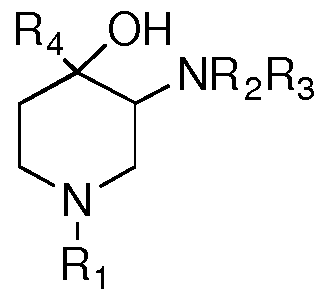

wherein and R4 are defined as above and X is selected from CI, Br and I, with an amine NHR2R3 in which R2 and R3 are defined as above.
2. The process according to claim 1 , wherein compound of formula II is converted to
compound of formula IV without formation and/or isolation of a compound of formula III.

R 1 (III).
3. A process for preparing a compound of formula IV
 in which is selected from -CH2-R5 wherein R5 represents substituted or unsubstituted aryl or substituted or unsubstituted heteroaryl, or from -CO-R6, -CO-OR6 and -S02-R6 wherein R6 represents substituted or unsubstituted alkyl, substituted or unsubstituted aryl, substituted or unsubstituted heteroaryl, R2 represents hydrogen or nitrogen protecting group, R3 represents hydrogen, a substituted or unsubstituted alkyl, substituted or unsubstituted aryl, substituted or unsubstituted heteroaryl, -CO-R7 or -CO-OR7 wherein R7 represents substituted or unsubstituted alkyl, substituted or unsubstituted aryl, or substituted or unsubstituted heteroaryl, and R4 represents alkyl, which process comprises treating a compound of formula III

R 1 (III)
wherein and R4 are defined as above, with an amine NHR2R3 in which R2 and R3 are defined as above.
4. The process according to any one of claims 1 to 3, characterized by either one or a combination of the following features (a) to (e):
(a) RT is -CH2-R5 wherein R5 represents substituted or unsubstituted aryl, preferably Ri is benzyl (-CH2_Ph);
(b) amine NHR2R3 is selected from the group consisting of N-benzylmethylamine, N- a-dimethylbenzylamine, methyl carbamate and methyl amine, preferably NHR2R3 is methyl amine;
(c) the process according to claim 1 or 2 is carried out in a solvent selected from the group consisting of water, organic alcohols and mixtures of water and organic alcohols;
(d) the process according to claim 3 is carried out in water as the solvent.
(e) in the process according to claim 3, compound of formula III is prepared by
treating the compound of formula II with a proton acceptor.
5. A process for preparing a compound of formula II

in which is selected from -CH2-R5 wherein R5 represents substituted or unsubstituted aryl, or substituted or unsubstituted heteroaryl, or from -CO-R6, -CO-OR6 and -S02-R6 wherein R6 represents substituted or unsubstituted alkyl, substituted or unsubstituted aryl, or substituted or unsubstituted heteroaryl, X is selected from CI, Br and I, and R4 represents alkyl, by reacting a compound of formula I

R
1 (I)
in which and R4 are defined as above, with a proton donor and a halogenating agent in the presence of water, wherein the proton donor is added prior to the halogenating agent.
6. The process according to claim 5, wherein the halogenating agent is selected from the group consisting of N-chlorosuccinimide, N-iodosuccinimide, N-bromosuccinimide, 5,5- dimethyl-1 ,3-dibromohidantoin (DBDMH), preferably N-bromosuccinimide and DBDMH, more preferably N-bromosuccinimide.
7. The process according to claim 1 or 2, wherein for providing the compound of formula II, a process according to claim 5 or 6 is carried out.
8. A process for preparing a compound formula III

in which is selected from -CH2-R5 wherein R5 represents substituted or unsubstituted aryl, or substituted or unsubstituted heteroaryl, or from -CO-R6, -CO-OR6 and -S02-R6
wherein R6 represents substituted or unsubstituted alkyl, substituted or unsubstituted aryl, or substituted or unsubstituted heteroaryl, and R4 is alkyl, which process comprises the steps of :
i) converting a compound of formu I
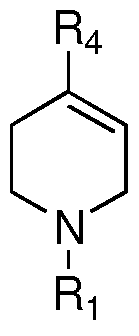
in which and R4 are defined as above to a compound of formula II
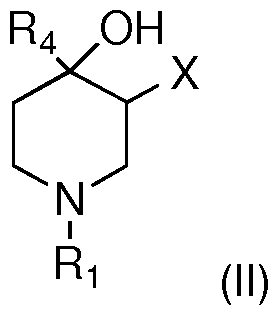
in which and R4 are defined as above and X is CI, Br or I, with a proton donor and a halogenating agent by a process according to claim 5 or 6; and
ii) adding a proton acceptor to the reaction mixture of step i).
9. A process for preparing a compound of formula IV
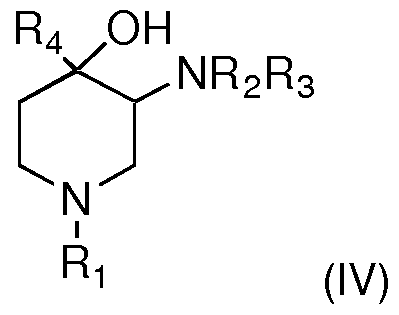
in which is selected from -CH2-R5 wherein R5 represents substituted or unsubstituted aryl or substituted or unsubstituted heteroaryl, or from -CO-R6, -CO-OR6 and -S02-R6 wherein R6 represents substituted or unsubstituted alkyl, substituted or unsubstituted aryl, substituted or unsubstituted heteroaryl, R2 represents hydrogen or nitrogen protecting group, R3 represents hydrogen, a substituted or unsubstituted alkyl, substituted or unsubstituted aryl, substituted or unsubstituted heteroaryl, -CO-R7 or - CO-ORy wherein R7 represents substituted or unsubstituted alkyl, substituted or unsubstituted aryl, or substituted or unsubstituted heteroaryl, and R4 represents alkyl,
which process comprises the steps of : converting a compound of formul

in which and R4 are defined as above
a-1 ) to a compound of formula II as defined in claim 5, or a-2) to a compound of formula III

in which and R4 are defined as above, by a process according to claim 8; and
b) adding an organic amine NHR2R3 in which R2 and R3 are defined as above to the reaction mixture of step a-1 ) or a-2).
10. The process according to any one of claims 1 to 4 and 9, wherein compound of formula IV is conv und of formula V1 and V2 respectively

and R4' derives from R4 representing alkyl in which the carbon atom adjacent to the piperidine ring is bonded with at least one hydrogen, which hydrogen is abstracted whereby R4' is formed, by treating compound of formula IV with an acidic activator.
1 1 . The process according to claim 10, wherein compounds of formulae V1 and V2 are converted to a compound of formula VI

in which R^ R2, R3 and R4 are defined as above, by hydrogenating compounds of formulae V1 and V2 in the presence of a transition-metal catalyst.
12. The process according to claim 1 1 , characterized by either one or a combination of the following features (x) to (z):
(x) the transition metal catalyst comprises a transition metal selected from the group consisting of Pt, Rh, Ru, Pd and Pd-Cu which catalyst is optionally attached to a supporter selected from the group consisting of charcoal, carbon, graphite or alumina (Al203);
(y) an additive is present in the reaction mixture, preferably the additive is selected from the group consisting of Broensted acids, Lewis acids and organic ligands, more preferably AcOH, TFA, oxalic acid, citric acid, tartaric, BF3 dietherate, copper salts, magnesium salts, iron salts, D-glucosamine, 1 ,4-diazoniabicyclo[2.2.2]octane (DABCO), amino acids;
(z) in case a Rh transition metal catalyst is applied, hydrogenation is carried out at a hydrogen pressure of at least 1 bar (1 atm), preferably 1 to 50 bar (1 to 50 atm), more preferably 1 to 30 bar (1 to 30 atm); in case a Pt transition metal catalyst is applied, hydrogenation is carried out at a hydrogen pressure of at least 1 bar (1 atm), preferably 1 to 10 bar (1 to 10 atm), more preferably 1 to 5 bar (1 to 5 atm), even more preferably 1 to 2 bar (1 to 2 atm), in particular 1 to 1 5 bar (1 to 1 .5 atm).
13. A compound of formula II

in which is selected from CH2-R5 wherein R5 represents substituted or unsubstituted aryl, or substituted or unsubstituted heteroaryl, -CO-R6 or -CO-OR6 wherein R6 represents substituted or unsubstituted alkyl, or substituted or unsubstituted aryl, X is selected from CI, Br and I, and R4 represents alkyl,
or an acid addition salt thereof.
14. A compound of formula III

in which is selected from -CH2-R5 wherein R5 represents substituted or unsubstituted aryl, or substituted or unsubstituted heteroaryl, or from -CO-R6 or-CO-OR6 wherein R6 represents substituted or unsubstituted alkyl, or substituted or unsubstituted aryl, and R4 is alkyl, with the proviso that a compound of formula III in which = benzyl or methoxycarbonyl and R4 = methyl is excluded.
15. A compound of formula IV

in which is selected from -CH2-R5 wherein R5 represents substituted or unsubstituted aryl or substituted or unsubstituted heteroaryl, or from -CO-R6, and -CO-OR6 wherein R6 represents substituted or unsubstituted alkyl, substituted or unsubstituted aryl, substituted or unsubstituted heteroaryl, R2 represents hydrogen or nitrogen protecting group, R3 represents hydrogen, a substituted or unsubstituted alkyl, substituted or unsubstituted aryl, substituted or unsubstituted heteroaryl, -CO-R7 or -CO-OR7 wherein R7 represents substituted or unsubstituted alkyl, substituted or unsubstituted aryl, or substituted or unsubstituted heteroaryl, and R4 represents alkyl, preferably C1 -C4-alkyl, in particular R4 is methyl, or an acid addition salt thereof.
16. A compound of formula V1 or V2 or a mixture thereof

in which is selected from -CH2-R5 wherein R5 represents substituted or unsubstituted aryl or substituted or unsubstituted heteroaryl, or from -CO-R6, and -CO-OR6 wherein R6 represents substituted or unsubstituted alkyl, substituted or unsubstituted aryl, substituted or unsubstituted heteroaryl, R2 represents hydrogen or nitrogen protecting group, R3 represents hydrogen, a substituted or unsubstituted alkyl, substituted or unsubstituted aryl, substituted or unsubstituted heteroaryl, -CO-R7 or -CO-OR7 wherein R7 represents substituted or unsubstituted alkyl, or substituted or unsubstituted aryl, R4' represents alkyl in which the carbon atom adjacent to the piperidine ring is substituted with at least one hydrogen and R4 represents alkyl, preferably R4' represents C1 -C4- alkylidene and R4 represent C1 -C4-alkyl, more preferably R4' is methylene and R4 is methyl, or acid addition salt(s) thereof, with the proviso that compounds of formula V1 wherein = -CO-CF3 and -CO-O-fert- butyl (BOC) are excluded.
17. The compounds of formulae II, III, IV, V1 and V2 according to any one of claims 13 to 16, characterized by at least one of the following structural features (I) to (III):
(I) RT is CH2-R5 wherein R5 is substituted or unsubstituted aryl, preferably is benzyl (-CH2-Ph);
(II) R2 is H; and R3 is selected from the group consisting of H, CH3, -CH2-Ph, - CH(CH3)-Ph, -CO-OCH3 and -CO-OEt;
(III) R4 is C1 -C4-alkyl, more preferably R4 is methyl.
18. Use of a compound selected from the group of compounds defined by formulae II, III , IV, V1 and V2 according to any one of claims 13 to 17 in a process for preparing a pharmaceutically active agent.
The use according to claim 18, wherein the pharmaceutically active agent comprises a structure a 3-aminopiperidine moiety.
The use according to claim 18 or 19, wherein the pharmaceutically active agent is Janus kinase inhibitor, preferably a Janus kinase 3 inhibitor, more preferably the pharmaceutically active ag structural formula

or an acid addition salt thereof.
Priority Applications (1)
| Application Number | Priority Date | Filing Date | Title |
|---|---|---|---|
| CN201380049535.1A CN104837817B (en) | 2012-07-25 | 2013-07-24 | Synthetic route for preparation of 3-amino-piperidine compounds |
Applications Claiming Priority (2)
| Application Number | Priority Date | Filing Date | Title |
|---|---|---|---|
| EP12177770 | 2012-07-25 | ||
| EP12177770.0 | 2012-07-25 |
Publications (1)
| Publication Number | Publication Date |
|---|---|
| WO2014016338A1 true WO2014016338A1 (en) | 2014-01-30 |
Family
ID=48875674
Family Applications (1)
| Application Number | Title | Priority Date | Filing Date |
|---|---|---|---|
| PCT/EP2013/065622 Ceased WO2014016338A1 (en) | 2012-07-25 | 2013-07-24 | New synthetic route for the preparation of 3-amino-piperidine compounds |
Country Status (2)
| Country | Link |
|---|---|
| CN (1) | CN104837817B (en) |
| WO (1) | WO2014016338A1 (en) |
Cited By (1)
| Publication number | Priority date | Publication date | Assignee | Title |
|---|---|---|---|---|
| CN104437557A (en) * | 2014-11-06 | 2015-03-25 | 中南大学 | Sulfonated graphene-Pd/silicon-aluminum oxide catalyst as well as preparation method and application of sulfonated graphene-Pd/silicon-aluminum oxide catalyst |
Families Citing this family (3)
| Publication number | Priority date | Publication date | Assignee | Title |
|---|---|---|---|---|
| CN105237463B (en) * | 2015-10-09 | 2017-10-10 | 刘卫国 | Preparation methods of one kind (3R, 4R) (base of 1 benzyl, 4 methyl piperidine 3) methylamine L bis- to toluoyltartrates |
| CN108976164A (en) * | 2018-06-20 | 2018-12-11 | 南通常佑药业科技有限公司 | The preparation method of chiral piperidine amine compounds and the recovery method of chiral resolving agent |
| CN108822112B (en) * | 2018-08-13 | 2019-12-20 | 山东罗欣药业集团恒欣药业有限公司 | Preparation method of tofacitinib compound |
Citations (3)
| Publication number | Priority date | Publication date | Assignee | Title |
|---|---|---|---|---|
| WO2002096909A1 (en) | 2001-05-31 | 2002-12-05 | Pfizer Products Inc. | Optical resolution of (1-benzyl-4-methylpiperidin-3-yl) -methylamine and the use thereof for the preparation of pyrrolo 2,3-pyrimidine derivatives as protein kinases inhibitors |
| WO2004046112A2 (en) | 2002-11-21 | 2004-06-03 | Pfizer Products Inc. | 3-amino-piperidine derivatives and processes for their preparation |
| WO2007012953A2 (en) | 2005-07-29 | 2007-02-01 | Pfizer Products Inc. | Pyrrolo[2,3-d]pyrimidine derivatives; their intermediates and synthesis |
-
2013
- 2013-07-24 WO PCT/EP2013/065622 patent/WO2014016338A1/en not_active Ceased
- 2013-07-24 CN CN201380049535.1A patent/CN104837817B/en not_active Expired - Fee Related
Patent Citations (3)
| Publication number | Priority date | Publication date | Assignee | Title |
|---|---|---|---|---|
| WO2002096909A1 (en) | 2001-05-31 | 2002-12-05 | Pfizer Products Inc. | Optical resolution of (1-benzyl-4-methylpiperidin-3-yl) -methylamine and the use thereof for the preparation of pyrrolo 2,3-pyrimidine derivatives as protein kinases inhibitors |
| WO2004046112A2 (en) | 2002-11-21 | 2004-06-03 | Pfizer Products Inc. | 3-amino-piperidine derivatives and processes for their preparation |
| WO2007012953A2 (en) | 2005-07-29 | 2007-02-01 | Pfizer Products Inc. | Pyrrolo[2,3-d]pyrimidine derivatives; their intermediates and synthesis |
Non-Patent Citations (16)
| Title |
|---|
| B.-J. HAO, SYNTHESIS, vol. 8, 2011, pages 1208 - 1212 |
| D. H. BROWN RIPIN, ORG. PROCESS. RES. DEV., vol. 7, 2003, pages 115 - 120 |
| D. H. BROWN RIPIN, TETRAHEDRON LETT., vol. 41, 2000, pages 5817 |
| D. H. BROWN, ORG. PROC. RES. DEV., vol. 7, 2003, pages 115 - 120 |
| ERIC HU X ET AL.: "Discovery of (3S)-Amino-(4R)-ethylpiperodinyl Quinolones as Potent Antibacterial Agents with a Broad Spectrum of Activity and Activity against Resistant Pathogens", J. MED. CHEM., vol. 46, no. 17, 2003, pages 3655 - 3661, XP008140805, DOI: doi:10.1021/jm030272n |
| ERIC HU X ET AL: "Discovery of(3S)-Amino-(4R)-ethylpiperodinyl Quinolones as Potent Antibacterial Agents with a Broad Spectrum ofActivity and Activity against Resistant Pathogens", JOURNAL OF MEDICINAL CHEMISTRY, AMERICAN CHEMICAL SOCIETY, US, vol. 46, no. 17, 14 August 2003 (2003-08-14), pages 3655 - 3661, XP008140805, ISSN: 0022-2623, [retrieved on 20030722], DOI: 10.1021/JM030272N * |
| FURTHERMORE, W. CAI., ORG. PROC. RES. DEV., vol. 9, 2005, pages 51 - 56 |
| GRISHINA, G. V. ET AL: "Synthesis and stereochemistry of 3-hydroxy-1,2,3,6-tetrahydropyridines", RUSSIAN JOURNAL OF ORGANIC CHEMISTRY , 41(2), 272-278 CODEN: RJOCEQ; ISSN: 1070-4280, 2005, XP002689942 * |
| JIAN-KANG JIANG ET AL: "Examining the Chirality, Conformation and Selective Kinase Inhibition of 3-((3R,4R)-4-methyl-3-(methyl(7H-pyrrolo[2,3-d]pyrimidin-4-yl)amino)piperidin-1-yl)-3-oxopropanenitrile (CP-690,550)", JOURNAL OF MEDICINAL CHEMISTRY, AMERICAN CHEMICAL SOCIETY, US, vol. 51, no. 24, 25 December 2008 (2008-12-25), pages 8012 - 8018, XP008149952, ISSN: 0022-2623, [retrieved on 20081119], DOI: 10.1021/JM801142B * |
| K. BERGGREN ET AL.: "3- Aminopiperidine-Based Peptide Analogues as the First Selective Noncovalent Inhibitors of the Bacterial Cysteine Protease IdeS", J. MED. CHEM., vol. 55, no. 6, 2012, pages 2549 - 2560 |
| M. A. LORIO, TETRAHEDRON, vol. 26, 1970, pages 5519 |
| TAMARU, YOSHINAO ET AL: "Stereoselective intramolecular haloamidation of N-protected 3-hydroxy-4-pentenylamines and 4-hydroxy-5-hexenylamines", JOURNAL OF ORGANIC CHEMISTRY , 53(23), 5491-501 CODEN: JOCEAH; ISSN: 0022-3263, 1988, XP002689943 * |
| UNTHANK, MATTHEW G. ET AL: "The use of vinyl sulfonium salts in the stereo-controlled asymmetric synthesis of epoxide- and aziridine-fused heterocycles: application to the synthesis of (-)-balanol", ANGEWANDTE CHEMIE, INTERNATIONAL EDITION , 45(42), 7066-7069 CODEN: ACIEF5; ISSN: 1433-7851, 2006, XP002689944 * |
| W. CAI., ORG. PROC. RES. DEV., vol. 9, 2005, pages 51 - 56 |
| X. E. HU, ORG. LETT., vol. 4, 2002, pages 4499 - 4502 |
| X. ERIC HU ET AL: "Synthesis of trans -(3 S )-Amino-(4 R )-alkyl- and -(4 S )-Aryl-piperidines via Ring-Closing Metathesis Reaction", ORGANIC LETTERS, vol. 4, no. 25, 1 December 2002 (2002-12-01), pages 4499 - 4502, XP055049117, ISSN: 1523-7060, DOI: 10.1021/ol027019m * |
Cited By (1)
| Publication number | Priority date | Publication date | Assignee | Title |
|---|---|---|---|---|
| CN104437557A (en) * | 2014-11-06 | 2015-03-25 | 中南大学 | Sulfonated graphene-Pd/silicon-aluminum oxide catalyst as well as preparation method and application of sulfonated graphene-Pd/silicon-aluminum oxide catalyst |
Also Published As
| Publication number | Publication date |
|---|---|
| CN104837817B (en) | 2017-03-22 |
| CN104837817A (en) | 2015-08-12 |
Similar Documents
| Publication | Publication Date | Title |
|---|---|---|
| KR102899506B1 (en) | Synthesis of substituted heterocyclic fused gamma-carbolines | |
| ES2548078T3 (en) | Asymmetric synthesis method, related starting material and method of preparation of (S, S) -2,8-diazabicyclo [4,3,0] nonane | |
| WO2022242278A1 (en) | Preparation methods for upadacitinib and intermediate thereof | |
| KR101726468B1 (en) | Process for the preparation of nebivolol | |
| KR100286874B1 (en) | Method for preparing protected 4-aminomethyl-pyrrolidone-3-on | |
| WO2014016338A1 (en) | New synthetic route for the preparation of 3-amino-piperidine compounds | |
| KR100848613B1 (en) | New preparation method of oxabispidine | |
| EP2914574A2 (en) | New process | |
| CN105693554A (en) | Preparation method of alanine derivatives | |
| EP4137487A1 (en) | Process for the preparation of a sulfonamide structured kinase inhibitor | |
| CA2960473A1 (en) | Processes for the preparation of tadalafil and intermediates thereof | |
| CN103304478B (en) | Alkaloidal intermediate of one class synthesis renieramycins type and preparation method thereof | |
| EP3904340B1 (en) | Synthesis method for halofuginone and intermediate thereof | |
| WO2014173928A1 (en) | Novel synthetic process to 8-chloro-1-methyl-benzo[d]azepine, novel intermediates and the production thereof | |
| CN108530241B (en) | Preparation method of benzo ring derivative with benzyl quaternary carbon center | |
| WO2020171073A1 (en) | Method for producing benzazepine derivative and intermediate of same | |
| EP3024834B1 (en) | Preparation of saturated ketone morphinan compounds by catalytic isomerisation | |
| Harayama et al. | Regloselectivity in the Biaryl Coupling Reactions of 1-((1, 3-Benzodioxol-5-yl) methyl)-7-iodo-2, 3-dihydroindole Using Palladium Reagent | |
| KR20230087479A (en) | Novel intermediates, their preparation methods and uses | |
| CN104955803B (en) | 3 aminopiperidines are prepared by nitro tetrahydropyridine precursor | |
| JP5334435B2 (en) | Method for producing optically active aminoacetal derivative | |
| Melkonyan et al. | Simple synthesis of methyl 1-(1, 1-dimethyl-prop-2-en-1-yl)-1h-indole-3-carboxylate | |
| KR100488393B1 (en) | 2-azabicyclo [2.2.1] heptane derivatives, preparation methods thereof and methods of use | |
| Geng et al. | A Facile Synthesis of N‐Aryl Substituted Piperidones | |
| HK40081621A (en) | Process for the preparation of a sulfonamide structured kinase inhibitor |
Legal Events
| Date | Code | Title | Description |
|---|---|---|---|
| 121 | Ep: the epo has been informed by wipo that ep was designated in this application |
Ref document number: 13742011 Country of ref document: EP Kind code of ref document: A1 |
|
| NENP | Non-entry into the national phase |
Ref country code: DE |
|
| 122 | Ep: pct application non-entry in european phase |
Ref document number: 13742011 Country of ref document: EP Kind code of ref document: A1 |