WO2014000673A1 - Process for preparation of entecavir - Google Patents
Process for preparation of entecavir Download PDFInfo
- Publication number
- WO2014000673A1 WO2014000673A1 PCT/CN2013/078260 CN2013078260W WO2014000673A1 WO 2014000673 A1 WO2014000673 A1 WO 2014000673A1 CN 2013078260 W CN2013078260 W CN 2013078260W WO 2014000673 A1 WO2014000673 A1 WO 2014000673A1
- Authority
- WO
- WIPO (PCT)
- Prior art keywords
- solvent
- formula
- solution
- temperature zone
- compound
- Prior art date
- Legal status (The legal status is an assumption and is not a legal conclusion. Google has not performed a legal analysis and makes no representation as to the accuracy of the status listed.)
- Ceased
Links
Classifications
-
- C—CHEMISTRY; METALLURGY
- C07—ORGANIC CHEMISTRY
- C07D—HETEROCYCLIC COMPOUNDS
- C07D473/00—Heterocyclic compounds containing purine ring systems
- C07D473/02—Heterocyclic compounds containing purine ring systems with oxygen, sulphur, or nitrogen atoms directly attached in positions 2 and 6
- C07D473/18—Heterocyclic compounds containing purine ring systems with oxygen, sulphur, or nitrogen atoms directly attached in positions 2 and 6 one oxygen and one nitrogen atom, e.g. guanine
Definitions
- the present invention relates to the field of pharmaceutical chemistry. More particularly, the invention relates to a process for preparing Entecavir and monohydrate thereof.
- BARACLUDE is the trade name for a hydrate of Entecavir, a guanosine nucleoside analogue with selective activity against HBV.
- the chemical name for entecavir is 2-amino-l,9-dihydro-9-[(i5',Ji?,45)-4hydroxy-3-(hydroxymethyl)-2-methylenecyclopentyl]-6H- purin-6-one, monohydrate. Its molecular formula is which corresponds to a molecular weight of 295.3.
- Entecavir has the following structural formula:
- each of R 1 , R2 and R 3 is independently a hydroxyl protecting group, and R 4 is an amino protecting group.
- each of R , R and R is independently acetyl (Ac), ⁇ -methoxyethoxymethyl ether (MEM), bis-(4-methoxyphenyl)phenylmethyl (DMT), methoxymethyl ether (MOM), (4-methoxyphenyl)diphenylmethyl (MMT), p-methoxybenzyl ether (PMB), tetrahydropyranyl (THP), triphenylmethyl (Tr), benzyl, benzoyl or a silyl ether protecting group.
- the silyl ether protecting group is trimethylsilyl (TMS), tert-butyl dimethylsilyl (TBDMS), triisopropyl silicon (TIPS) or tri-z ' so-propylsilyloxymethyl (TOM).
- R 4 is triphenylmethyl, (4-methoxyphenyl)diphenylmethyl (MMT), t-butyloxycarbonyl, benzyloxycarbonyl,
- each of R , R and R 3 is benzyl.
- R 4 is (4-methoxyphenyl)diphenylmethyl (MMT).
- each of R 1 , R2 and R 3 is independently a hydroxyl protecting group, and R 4 is an amino protecting group.
- each of R , R and R is independently acetyl (Ac), ⁇ -methoxyethoxymethyl ether (MEM), bis-(4-methoxyphenyl)phenylmethyl(DMT), methoxymethyl ether (MOM), (4-methoxyphenyl)diphenylmethyl (MMT), p-methoxybenzyl ether (PMB), tetrahydropyranyl (THP), triphenylmethyl (Tr), benzyl, benzoyl or a silyl ether protecting group.
- the silyl ether protecting group is trimethylsilyl (TMS), tert-butyl dimethylsilyl (TBDMS), triisopropyl silicon (TIPS) or tri-z ' so-propylsilyloxymethyl (TOM).
- R 4 is triphenylmethyl, (4-methoxyphenyl)diphenylmethyl (MMT), t-butyloxycarbonyl, benzyloxycarbonyl,
- each of R , R and R 3 is benzyl.
- R 4 is (4-methoxyphenyl)diphenylmethyl (MMT).
- the Lewis acid refers to any electron acceptor other than proton acid.
- the Lewis acid is boron trifluoride, boron trichloride, boron tribromide, aluminum chloride, ferric chloride, trifluoromethane sulfonate of a lanthanide or niobium pentachloride or a combination thereof.
- the Lewis acid is boron trichloride or boron trifluoride or a combination thereof.
- the molar ratio of the Lewis acid to the compound of formula (III) is from about 1 :2 to about 1 : 15; or from about 1 :4 to about 1 : 10; or about 1 :6.
- the solvent is water, dimethylformamide, a halogenated solvent, an ether solvent, an ester solvent, a ketone solvent, an aromatic solvent or a combination thereof.
- the halogenated solvent is dichloromethane, chloroform, 1 ,2-dichloroethane or a combination thereof.
- the ether solvent is ethyl ether, diisopropyl ether, tetrahydrofuran, diethylene glycol dimethyl ether or a combination thereof.
- the ester solvent is ethyl acetate, isopropyl acetate, butyl acetate or a combination thereof.
- the ketone solvent is acetone, methyl ethyl ketone, diethyl ketone or a combination thereof.
- the aromatic hydrocarbon solvent is benzene, toluene or xylene or a combination thereof.
- the solvent is halogenated solvent.
- the solvent is ether solvent.
- the solvent is dichloromethane, tetrahydrofuran or a combination thereof. In certain embodiments, the solvent is dichloromethane.
- the volume of the solvent is from about 5 ml to about 100 ml per 1 gram of the compound of formula (III). In some embodiments, the solvent is from about 10 ml to about 30 ml per 1 gram of the compound of formula (III).
- the compound of formula (III) is dissolved in the solvent to form a solution, and then the Lewis acid is added to the solution after the solution is cooled to a low temperature zone to form a reaction mixture, and wherein the reaction mixture is maintained at the low temperature zone for more than 0.5 hours, and then the reaction mixture is warmed to a high temperature zone and stirred at the high temperature zone for more than 1 hour.
- the temperature of the high temperature zone is about 50 °C, about 60 °C, about 80 °C, about 100 °C , about 120 °C, or about 150 °C higher than the temperature of the low temperature zone.
- the temperature of the low temperature zone is from about -70 °C to about -45 °C, and the temperature of the high temperature zone is about 40 °C.
- the methods disclosed herein further comprise adding an alcohol solvent to the reaction mixture when the temperature is raised from the low temperature zone to the high temperature zone, wherein the alcohol solvent is a Ci-C 6 alcohol; or the alcohol solvent is methanol, ethanol, propanol or a combination thereof.
- the alcohol solvent is a Ci-C 6 alcohol; or the alcohol solvent is methanol, ethanol, propanol or a combination thereof.
- the compound of formula (III) can be prepared according to the process disclosed in US 5,206,244.
- the process of removing the four protection groups of compound of formula (III) is achieved in one step, with many advantages including reduced reaction steps, environment friendly, easy to handle, reduced reaction times, and reduced solvent amount.
- the yield can be more than 80%, the chemical purity can be more than 98%.
- R L a lower limit
- R u an upper limit
- any number falling within the range is specifically disclosed.
- R R L +k*(R u -R L ), wherein k is a variable ranging from 1% to 100% with a 1% increment, i.e., k is 1%, 2%, 3%, 4%, 5%,..., 50%, 51%, 52%,..., 95%, 96%, 97%, 98%, 99%, or 100%.
- any numerical range defined by two R numbers as defined above is also specifically disclosed.
- the time between 2 consecutive cooling steps of step (c) is from about 1 minute to about 2 hours.
- the above cooling step (c) comprises 2 steps, 3 steps, 4 steps, 5 steps, 6 steps, 7 steps, 8 steps, 9 steps, 10 steps or more of decreasing the temperature of the solution by about 5 °C to about 20 °C in about 0.5 hours to about 2 hours until the temperature of the solution is at about -5 °C to 10 °C.
- the above cooling step (c) comprises 2 steps of decreasing the temperature of the solution by about 5 °C to about 20 °C in about 0.5 hours to about 2 hours until the temperature of the solution is at about -5 °C to 10 °C.
- the temperature of the solution is first slowly decreased by 5 ° C to 20 ° C and then stirred for a first period of time (about 0.5 hours to 2 hours), and in the second step, the temperature is again decreased by 5 °C to 20 °C and then stirred for a second period of time (about 0.5 hours to 2 hours).
- the first period of time and the second period of time can be the same or different.
- the decrease in temperature in the first step and the decrease in temperature in the second step can be the same or different.
- the above cooling step (c) comprises 3 steps of decreasing the temperature of the solution by about 5 °C to about 20 °C in about 0.5 hours to about 2 hours until the temperature of the solution is at about -5 °C to 10 °C.
- the temperature of the solution is first slowly decreased by 5 ° C to 20 ° C and then stirred for a first period of time (about 0.5 hours to 2 hours), and in the second step, the temperature is again decreased by 5 °C to 20 °C and then stirred for a second period of time (about 0.5 hours to 2 hours), and in the third step, the temperature is again decreased by 5 °C to 20 °C and then stirred for a third period of time (about 0.5 hours to 2 hours).
- the first period of time, the second period of time and the third period of time can be the same or different.
- the decrease in temperature in the first step, the decrease in temperature in the second step, and the decrease in temperature in the third step can be the same or different.
- the above cooling step (c) comprises 4 or more steps of decreasing the temperature of the solution, where the first, second, third, fourth or more periods of time can be the same or different, and where the decreases in temperature in the first, second, third, fourth or more steps can be the same or different.
- the aqueous solvent is water or a mixture of water and an organic solvent.
- the volume of the aqueous solvent is from about 10 ml to about 40 ml per 1 gram of the compound of formula (I).
- the volume of aqueous solvent is from about 20 ml to about 30 ml per 1 gram of the compound of formula (I).
- the crystal is formed when the mixture is cooled to a temperature from about -5 °C to about 10 °C, and then stirred for a certain period of time (generally 30 minutes to 24 hours) at the temperature. The crystal formed can be filtered and dried under vacuum to obtain the hydrate of Entecavir of formula (A).
- the purity of the products can be measured by HPLC. In some embodiments, the purity can be more than 90%; more than 92%; more than 95%; more than 97%; more than 99%; more than 99.5%; or more than 99.7%. DESCRIPTION OF THE DRAWINGS
- Figure 1 depicts the HPLC graph of Entecavir prepared according to Example 1.
- Figure 2 depicts the HPLC graph of Entecavir prepared according to Example 2.
- Figure 3 depicts the HPLC graph of a hydrate of Entecavir prepared according to Example 3.
- Figure 4 depicts the HPLC graph of a hydrate of Entecavir prepared according to Example 4.
- the present invention disclosed a process for the preparation of Entecavir and a hydrate of Entecavir.
- the skilled in the art can learn from the present invention and improve the process parameters appropriately. It should be noted that many adaptations and modifications may be made within the scope of the invention in accordance with the common general knowledge of those skilled in the art. Some non-limiting embodiments of the invention are disclosed herein, obviously, a skilled artisan can make any alteration or change or combinations appropriately to implement and apply the present invention without departing from the content, spirit and scope of the present invention.
- the retention time of the compound of formula (I) is about 13.73
- the retention times of formula (IV) and formula (V), i.e., the main impurities, are 24.74 and 24.94 respectively.
- the compound of formula (I) (500 mg) prepared according to Example 1 or Example 2 was added to water (15 ml) to form a mixture. After the mixture was heated to 90 ° C and stirred to form a solution, the solution was cooled to 80 ° C , and maintained at the temperature of 80 ° C for about 0.5 hours to 1 hour. The solution was further cooled to 60 ° C , and maintained at the temperature of 60 ° C for 0.5 hours to 1 hour. The solution was further cooled to 40 ° C , and maintained at the temperature of 40 ° C for 0.5 hours. The solution was further cooled to 20 ° C , and maintained at the temperature of 20 ° C for 0.5 hours to 1 hour.
- Chromatographic conditions Instruments: High Performance Liquid Chromatography; Column: INERTSIL ® ODS-3; Column flow rate: 1 ml/min;
Landscapes
- Chemical & Material Sciences (AREA)
- Organic Chemistry (AREA)
- Pharmaceuticals Containing Other Organic And Inorganic Compounds (AREA)
- Organic Low-Molecular-Weight Compounds And Preparation Thereof (AREA)
Abstract
Provided is a process for preparing a compound of Formula (I), comprising de-protecting a compound of Formula (III) in a solvent in the presence of a Lewis acid, with the properties of reduced steps and less solvent.
Description
PROCESS FOR THE PREPARATION OF ENTECAVIR
TECHNICAL FIELD OF THE INVENTION
[0001] The present invention relates to the field of pharmaceutical chemistry. More particularly, the invention relates to a process for preparing Entecavir and monohydrate thereof.
BACKGROUND OF THE INVENTION
®
[0002] BARACLUDE is the trade name for a hydrate of Entecavir, a guanosine nucleoside analogue with selective activity against HBV. The chemical name for entecavir is 2-amino-l,9-dihydro-9-[(i5',Ji?,45)-4hydroxy-3-(hydroxymethyl)-2-methylenecyclopentyl]-6H- purin-6-one, monohydrate. Its molecular formula is
 which corresponds to a molecular weight of 295.3. Entecavir has the following structural formula:

[0003] Chinese patent application CN 101182322, CN 101210015 and PCT application WO 1998009964 disclosed a process for preparing Entecavir, comprises: removing R1 and R4 of a compound of formula (III) in the presence of proton acid to obtain a compound of formula (II),
2 3
followed by removing R , R of compound of formula (II) to get a compound of formula (I), finally the compound of formula (I) was dissolved in water to form a hydrate of Entecavir of formula (A).
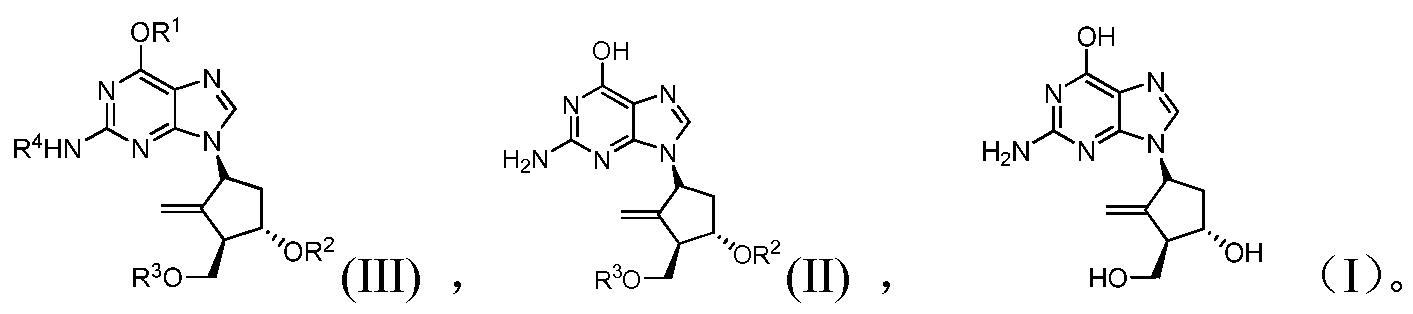
[0004] The process disclosed in prior art involved cumbersome de-protection reaction. Furthermore, the intermediate of formula (II) is insoluble in organic solvent, thus requiring a great quantity of solvent in deprotection of compound of formula (II).
SUMMARY OF THE INVENTION
[0005] In one aspect, provided herein is a method for preparing Entecavir of Formula (I):
 comprising de -protecting a compound of formula (III):
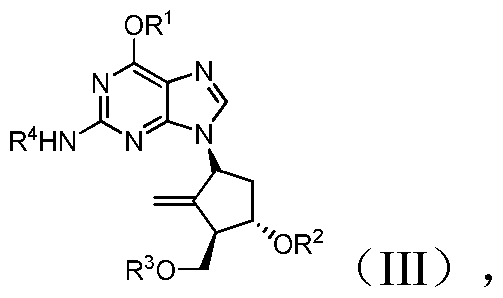
1 2 3
[0006] In certain embodiments, each of R , R and R is independently acetyl (Ac), β-methoxyethoxymethyl ether (MEM), bis-(4-methoxyphenyl)phenylmethyl (DMT), methoxymethyl ether (MOM), (4-methoxyphenyl)diphenylmethyl (MMT), p-methoxybenzyl ether (PMB), tetrahydropyranyl (THP), triphenylmethyl (Tr), benzyl, benzoyl or a silyl ether protecting group. In some embodiments, the silyl ether protecting group is trimethylsilyl (TMS), tert-butyl dimethylsilyl (TBDMS), triisopropyl silicon (TIPS) or tri-z'so-propylsilyloxymethyl (TOM). In certain embodiments, R4 is triphenylmethyl, (4-methoxyphenyl)diphenylmethyl (MMT), t-butyloxycarbonyl, benzyloxycarbonyl,
1 2
2-biphenyl-2-propoxy carbonyl, formyl or trifluoroacetyl. In some embodiments, each of R , R and R3 is benzyl. In other embodiments, R4 is (4-methoxyphenyl)diphenylmethyl (MMT).
[0007] In another aspect, provided herein is a method for preparing a hydrate of Entecavir of Formula (A), comprising:

(a) adding the compound of formula (I) to an aqueous solvent to form a solution; and
(b) warming the solution to a temperature from about 80 °C to about 100 °C,
(c) cooling the solution gradiently in 2 or more steps of decreasing the temperature of the solution by about 5 °C to about 20 °C in about 0.5 hours to about 2 hours.
DETAILED DESCRIPTION OF THE INVENTION
[0008] In one aspect, provided herein is a method for preparing Entecavir of Formula (I):


1 2 3
[0009] In certain embodiments, each of R , R and R is independently acetyl (Ac), β-methoxyethoxymethyl ether (MEM), bis-(4-methoxyphenyl)phenylmethyl(DMT), methoxymethyl ether (MOM), (4-methoxyphenyl)diphenylmethyl (MMT), p-methoxybenzyl ether (PMB), tetrahydropyranyl (THP), triphenylmethyl (Tr), benzyl, benzoyl or a silyl ether protecting group. In some embodiments, the silyl ether protecting group is trimethylsilyl (TMS), tert-butyl dimethylsilyl (TBDMS), triisopropyl silicon (TIPS) or tri-z'so-propylsilyloxymethyl (TOM). In certain embodiments, R4 is triphenylmethyl, (4-methoxyphenyl)diphenylmethyl (MMT), t-butyloxycarbonyl, benzyloxycarbonyl,
1 2
2-biphenyl-2-propoxy carbonyl, formyl or trifluoroacetyl. In some embodiments, each of R , R and R3 is benzyl. In other embodiments, R4 is (4-methoxyphenyl)diphenylmethyl (MMT).
[00010] In certain embodiments, the Lewis acid refers to any electron acceptor other than proton acid. In some embodiments, the Lewis acid is boron trifluoride, boron trichloride, boron tribromide, aluminum chloride, ferric chloride, trifluoromethane sulfonate of a lanthanide or niobium pentachloride or a combination thereof. In some embodiments, the Lewis acid is boron trichloride or boron trifluoride or a combination thereof. In some embodiments, the molar ratio of the Lewis acid to the compound of formula (III) is from about 1 :2 to about 1 : 15; or from about 1 :4 to about 1 : 10; or about 1 :6.
[00011] In some embodiments, the solvent is water, dimethylformamide, a halogenated solvent, an ether solvent, an ester solvent, a ketone solvent, an aromatic solvent or a
combination thereof. In certain embodiments, the halogenated solvent is dichloromethane, chloroform, 1 ,2-dichloroethane or a combination thereof. In some embodiments, the ether solvent is ethyl ether, diisopropyl ether, tetrahydrofuran, diethylene glycol dimethyl ether or a combination thereof. In some embodiments, the ester solvent is ethyl acetate, isopropyl acetate, butyl acetate or a combination thereof. In some embodiments, the ketone solvent is acetone, methyl ethyl ketone, diethyl ketone or a combination thereof. In some embodiments, the aromatic hydrocarbon solvent is benzene, toluene or xylene or a combination thereof. In some embodiments, the solvent is halogenated solvent. In some embodiments, the solvent is ether solvent. In certain embodiment, the solvent is dichloromethane, tetrahydrofuran or a combination thereof. In certain embodiments, the solvent is dichloromethane.
[00012] In some embodiments, the volume of the solvent is from about 5 ml to about 100 ml per 1 gram of the compound of formula (III). In some embodiments, the solvent is from about 10 ml to about 30 ml per 1 gram of the compound of formula (III).
[00013] In some embodiments, the compound of formula (III) is dissolved in the solvent to form a solution, and then the Lewis acid is added to the solution after the solution is cooled to a low temperature zone to form a reaction mixture, and wherein the reaction mixture is maintained at the low temperature zone for more than 0.5 hours, and then the reaction mixture is warmed to a high temperature zone and stirred at the high temperature zone for more than 1 hour.
[00014] As used herein, the temperature of the high temperature zone is about 50 °C, about 60 °C, about 80 °C, about 100 °C , about 120 °C, or about 150 °C higher than the temperature of the low temperature zone. In some embodiments, the temperature of the low temperature zone is from about -70 °C to about -45 °C, and the temperature of the high temperature zone is about 40 °C.
[00015] In other embodiments, the methods disclosed herein further comprise adding an alcohol solvent to the reaction mixture when the temperature is raised from the low temperature zone to the high temperature zone, wherein the alcohol solvent is a Ci-C6 alcohol; or the alcohol solvent is methanol, ethanol, propanol or a combination thereof.
[00016] In some embodiments, the compound of formula (III) can be prepared according to the process disclosed in US 5,206,244.
[00017] In certain embodiments, the process of removing the four protection groups of compound of formula (III) is achieved in one step, with many advantages including reduced
reaction steps, environment friendly, easy to handle, reduced reaction times, and reduced solvent amount. The yield can be more than 80%, the chemical purity can be more than 98%.
[00018] It is worth noting that all numbers disclosed herein are approximate values, regardless whether the word "about" is used in connection therewith. The value of each number may differ by 1%, 2%, 5%, 7%, 8%, 10%, 15% or 20%. Therefore, whenever a number having a value N is disclosed, any number having the value N+/-l%, N+/-2%, N+/-3%, N+/-5%, N+/-7%, N+/-8%, N+/-10%, N+/-15% or 20 N+/-20% is specifically disclosed, wherein "+/-" refers to plus or minus. Whenever a numerical range with a lower limit, RL, and an upper limit, Ru, is disclosed, any number falling within the range is specifically disclosed. In particular, the following numbers within the range are specifically disclosed: R=RL+k*(Ru-RL), wherein k is a variable ranging from 1% to 100% with a 1% increment, i.e., k is 1%, 2%, 3%, 4%, 5%,..., 50%, 51%, 52%,..., 95%, 96%, 97%, 98%, 99%, or 100%. Moreover, any numerical range defined by two R numbers as defined above is also specifically disclosed.
[00019] In another aspect, provided herein is a method for preparing a hydrate of Entecavir of Formula (A), comprising:

(a) adding the compound of formula (I) to an aqueous solvent to form a solution; and
(b) warming the solution to a temperature from about 80 °C to about 100 °C,
(c) cooling the solution gradiently in 2 or more steps of decreasing the temperature of the solution by about 5 °C to about 20 °C in about 0.5 hours to about 2 hours.
[00020] In some embodiments, the time between 2 consecutive cooling steps of step (c) is from about 1 minute to about 2 hours.
[00021] In certain embodiments, the above cooling step (c) comprises 2 steps, 3 steps, 4 steps, 5 steps, 6 steps, 7 steps, 8 steps, 9 steps, 10 steps or more of decreasing the temperature of the solution by about 5 °C to about 20 °C in about 0.5 hours to about 2 hours until the temperature of the solution is at about -5 °C to 10 °C. In some embodiments, the above cooling step (c) comprises 2 steps of decreasing the temperature of the solution by about 5 °C to about 20 °C in about 0.5 hours to about 2 hours until the temperature of the solution is at about -5 °C
to 10 °C. In further embodiments, the temperature of the solution is first slowly decreased by 5 ° C to 20 ° C and then stirred for a first period of time (about 0.5 hours to 2 hours), and in the second step, the temperature is again decreased by 5 °C to 20 °C and then stirred for a second period of time (about 0.5 hours to 2 hours). The first period of time and the second period of time can be the same or different. The decrease in temperature in the first step and the decrease in temperature in the second step can be the same or different.
[00022] In some embodiments, the above cooling step (c) comprises 3 steps of decreasing the temperature of the solution by about 5 °C to about 20 °C in about 0.5 hours to about 2 hours until the temperature of the solution is at about -5 °C to 10 °C. In further embodiments, the temperature of the solution is first slowly decreased by 5 ° C to 20 ° C and then stirred for a first period of time (about 0.5 hours to 2 hours), and in the second step, the temperature is again decreased by 5 °C to 20 °C and then stirred for a second period of time (about 0.5 hours to 2 hours), and in the third step, the temperature is again decreased by 5 °C to 20 °C and then stirred for a third period of time (about 0.5 hours to 2 hours). The first period of time, the second period of time and the third period of time can be the same or different. The decrease in temperature in the first step, the decrease in temperature in the second step, and the decrease in temperature in the third step can be the same or different. Similarly, the above cooling step (c) comprises 4 or more steps of decreasing the temperature of the solution, where the first, second, third, fourth or more periods of time can be the same or different, and where the decreases in temperature in the first, second, third, fourth or more steps can be the same or different.
[00023] In some embodiments, the aqueous solvent is water or a mixture of water and an organic solvent. In some embodiments, the volume of the aqueous solvent is from about 10 ml to about 40 ml per 1 gram of the compound of formula (I). In some embodiments, the volume of aqueous solvent is from about 20 ml to about 30 ml per 1 gram of the compound of formula (I). In some embodiments, the crystal is formed when the mixture is cooled to a temperature from about -5 °C to about 10 °C, and then stirred for a certain period of time (generally 30 minutes to 24 hours) at the temperature. The crystal formed can be filtered and dried under vacuum to obtain the hydrate of Entecavir of formula (A).
[00024] The purity of the products can be measured by HPLC. In some embodiments, the purity can be more than 90%; more than 92%; more than 95%; more than 97%; more than 99%; more than 99.5%; or more than 99.7%.
DESCRIPTION OF THE DRAWINGS
[00025] Figure 1 depicts the HPLC graph of Entecavir prepared according to Example 1.
[00026] Figure 2 depicts the HPLC graph of Entecavir prepared according to Example 2.
[00027] Figure 3 depicts the HPLC graph of a hydrate of Entecavir prepared according to Example 3.
[00028] Figure 4 depicts the HPLC graph of a hydrate of Entecavir prepared according to Example 4.
EXAMPLES
[00029] The present invention disclosed a process for the preparation of Entecavir and a hydrate of Entecavir. The skilled in the art can learn from the present invention and improve the process parameters appropriately. It should be noted that many adaptations and modifications may be made within the scope of the invention in accordance with the common general knowledge of those skilled in the art. Some non-limiting embodiments of the invention are disclosed herein, obviously, a skilled artisan can make any alteration or change or combinations appropriately to implement and apply the present invention without departing from the content, spirit and scope of the present invention.
[00030] In order to have a further understanding about the present invention, more detail will be provided combined with the following embodiments.
Example 1
The preparation of
2-amino-9- [( 1 S ,3 S ,4S)-4-hydroxy-3 -hydroxymethyl-2-methylenedioxy-pentyl]
-l,9-hydrogen-6-H-purin-6 - one (formula I)
[00031 ] [ 1 S-( 1 a,3 a,4 )-N-[(4-methoxyphenyl)-diphenylmethyl]-6-(phenylmethoxy) -9-[2-methylene-4-(phenylmethoxy)-3-[(phenylmethoxy)-methyl]-cyclopentyl]-9H-purin-2-ami ne (2.0 g) and dichloromethane (20 ml) were added to a flask under nitrogen atmosphere to form a mixture. After the mixture was cooled to -60 °C , boron trichloride solution 1.0 M in methylene chloride (14.4 ml) was added dropwise to the mixture. After the mixture was stirred for 2 hours at -60 °C , methanol (50 ml) was added, the mixture was heated to 40 °C , maintained the temperature at 40 °C and stirred. After the reaction was completely, the reaction mixture was concentrated under reduced pressure to obtain a reaction mass. To the reaction mass
was added water (60 ml) to form a solution. The solution was washed with ethyl acetate (30 ml x 2), and then concentrated under reduced pressure to form the title product, a white solid. The yield was540 mg and the HPLC purity was 98.26%.
[00032] Referring to Figure 1, the retention time of the compound of formula (I) is about 13.73, and the retention times of formula (IV) and formula (V), i.e., the main impurities, are 24.74 and 24.94 respectively.

[00033] Table 1. The Retention times and Peak areas of the product and the main impurities.

Example 2
The preparation of 2-amino-9-[(lS,3S,4S)-4-hydroxy-3-hydroxymethyl-2 methylenedioxy-pentyl] -1,9 - hydrogen-6-H-purin-6 - one (formula I )
[00034] [lS-(la,3a,4 )-N-[(4-methoxyphenyl) diphenylmethyl]-6-(phenylmethoxy)-9-[2- methylene-4-(phenylmethoxy)-3-[(phenylmethoxy)-methyl]-cyclopentyl]-9H-purin-2-amine (2.0 g) and dichloromethane (20 ml) were added to a flask under nitrogen atmosphere to form a mixture. After the mixture was cooled to -60 °C , boron trichloride solution 1.0 M in methylene chloride (24 ml) was added drop wise to the mixture. After the mixture was stirred for 2 hours at -60 °C , methanol (50 ml) was added. Then the mixture was heated to 40 °C , maintained the temperature at 40 °C and stirred. After the reaction was completely, the reaction mixture was concentrated under reduced pressure to obtain a reaction mass. To the reaction mass was added water (60 ml) to form a solution. The solution was washed with ethyl acetate (30 ml x 2) and then concentrated under reduced pressure to obtain the title product, a white solid. The yield was 565 mg and the HPLC purity was 98.36%.
Example 3
The preparation of 2-amino-l,9-dihydro-9-[(i5', Ji?,4S)-4hydroxy-3-(hydroxymethyl)- 2-methylenecyclopentyl]-6H-purin-6-one, monohydrate (formula A)
[00035] The compound of formula (I) (500 mg) prepared according to Example 1 or Example 2 was added to water (15 ml) to form a mixture. After the mixture was heated to 90 °C and stirred to form a solution, the solution was cooled to 80 °C , and maintained at the temperature of 80 °C for about 0.5 hours to 1 hour. The solution was further cooled to 60 °C , and maintained at the temperature of 60 °C for 0.5 hours to 1 hour. The solution was further cooled to 40 °C , and maintained at the temperature of 40 °C for 0.5 hours. The solution was further cooled to 20 °C , and maintained at the temperature of 20 °C for 0.5 hours to 1 hour. Finally, the solution was further cooled to 0 °C , and maintained at 0 °C for 3 hours to form a precipitate. The precipitate was filtered at 0 °C , and then dried in vacuum overnight at 50 °C to form the title compound, a white solid. The yield was 490 mg and the HPLC purity was 99.80%.
Example 4
2-amino-l,9-dihydro-9-[(i5',Ji?,45)-4hydroxy-3-(hydroxymethyl)-2-methylenecyclopentyl]-6H- purin-6-one, monohydrate (formula A)
[00036] The compound of formula (I) (500 mg) prepared according to Example or Example 2 was added to water (10 ml). After the mixture was heated to 80 °C , and stirred to form a solution, the solution was cooled to 70 °C , and stirred for 1 hour at 70 °C . The solution was further cooled to 60 °C , and stirred for 1 hour at 60 °C . The solution was further cooled to 40 °C , stirred for 1 hour at 40 °C . The solution was further cooled to 20 °C , and stirred for 1 hour at 20 °C . The solution was further cooled to 0 °C , and stirred for 3 hours at 0 °C to form a precipitate. The precipitate was filtered at 0 °C , and then dried in vacuum overnight at 50 °C to form the title compound, a white solid. The yield was 505 mg and the HPLC purity was 99.79%.
Example 5
[00037] Chromatographic conditions: Instruments: High Performance Liquid Chromatography; Column: INERTSIL® ODS-3;
Column flow rate: 1 ml/min;
Detection wavelength: 254 nm;
Injection volume: 10 ul;
Column temperature: 30 °C.
[00038] The illustrative embodiments herein are used to help understanding the methods and core ideas about the inventions disclosed herein. It should be noted that many adaptations and modifications may be made within the scope of the invention disclosed herein in accordance with the common general knowledge of those skilled in the art.
Claims
1. A method for preparing Entecavir of Formula (I):


1 2 3
2. The method of claim 1, wherein each of R , R and R is independently acetyl (Ac), β-methoxyethoxymethyl ether (MEM), bis-(4-methoxyphenyl)phenylmethyl (DMT), methoxymethyl ether (MOM), (4-methoxyphenyl)diphenylmethyl (MMT), p-methoxybenzyl ether (PMB), tetrahydropyranyl (THP), triphenylmethyl (Tr), benzyl, benzoyl or silyl ether protecting group, and R4 is triphenylmethyl, (4-methoxyphenyl)diphenylmethyl (MMT), t-butyloxycarbonyl, benzyloxycarbonyl, 2 - biphenyl-2-propoxy carbonyl, formyl or trifluoroacetyl.
3. The method of claim 1 or claim 2, wherein the Lewis acid is trifluoride, boron trichloride, boron tribromide, aluminum chloride, ferric chloride, niobium pentachloride, trifluoromethane sulfonate of a lanthanide or a combination thereof; or the Lewis acid is boron trichloride, boron trifluoride or a combination thereof.
4. The method of claim 3, wherein the molar ratio of the Lewis acid to the compound of formula (III) is from about 1 :2 to about 1 : 15; or from about 1 :4 to about 1 : 10; or about 1 :6.
5. The method of any one of claims 1-4, wherein the solvent is water, dimethylformamide, a halogenated solvent, an ether solvent, an ester solvent, a ketone solvent, an aromatic solvent or a combination thereof.
6. The method of any one of claims 1-5, wherein the solvent is dichloromethane,
tetrahydrofuran or a combination thereof.
7. The method of any one of claims 1-6, wherein the compound of formula (III) is dissolved in the solvent to form a solution, and then the Lewis acid is added to the solution after the solution is cooled to a low temperature zone to form a reaction mixture, and wherein the reaction mixture is maintained at the low temperature zone for more than 0.5 hours, and then the reaction mixture is warmed to a high temperature zone and stirred at the high temperature zone for more than 1 hour.
8. The method of claim 7, wherein the temperature of the high temperature zone is about 50 °C, about 60 °C, about 80 °C, about 100 °C , about 120 °C, or about 150 °C higher than the temperature of the low temperature zone.
9. The method of claim 8, wherein the temperature of the low temperature zone is from about -70 °C to about -45 °C, and wherein the temperature of the high temperature zone is about 40 °C.
10. The method of any one of claims 7-9, further comprising adding an alcohol solvent to the reaction mixture when the temperature is raised from the low temperature zone to the high temperature zone, wherein the alcohol solvent is a Ci-C6 alcohol; or the alcohol solvent is methanol, ethanol, propanol or a combination thereof.
11. A method for preparing a hydrate of Entecavir of Formula (A), comprising:

(d) adding the compound of formula (I) to an aqueous solvent to form a solution; and
(e) warming the solution to a temperature from about 80 °C to about 100 °C,
(f) cooling the solution gradiently in 2 or more steps of decreasing the temperature of the solution by about 5 °C to about 20 °C in about 0.5 hours to about 2 hours
12. The method of claim 11, wherein the time between 2 consecutive cooling steps is from about 1 minute to about 2 hours.
13. The method of claim 11, wherein the aqueous solvent is water or a mixture of water and an organic solvent.
14. The method of any one of claims 10-13, wherein the volume of the aqueous solvent is from about 10 ml to about 40 ml per 1 gram of the compound of formula (I).
Applications Claiming Priority (4)
| Application Number | Priority Date | Filing Date | Title |
|---|---|---|---|
| CN201210220585 | 2012-06-29 | ||
| CN201210220585.9 | 2012-06-29 | ||
| CN201310117056.0 | 2013-04-04 | ||
| CN201310117056 | 2013-04-04 |
Publications (1)
| Publication Number | Publication Date |
|---|---|
| WO2014000673A1 true WO2014000673A1 (en) | 2014-01-03 |
Family
ID=49782263
Family Applications (1)
| Application Number | Title | Priority Date | Filing Date |
|---|---|---|---|
| PCT/CN2013/078260 Ceased WO2014000673A1 (en) | 2012-06-29 | 2013-06-28 | Process for preparation of entecavir |
Country Status (1)
| Country | Link |
|---|---|
| WO (1) | WO2014000673A1 (en) |
Cited By (2)
| Publication number | Priority date | Publication date | Assignee | Title |
|---|---|---|---|---|
| CN109293508A (en) * | 2018-10-30 | 2019-02-01 | 常州博海威医药科技股份有限公司 | A kind of preparation method of entecavir midbodies |
| CN116425752A (en) * | 2023-03-29 | 2023-07-14 | 苏州东瑞制药有限公司 | A kind of preparation method of entecavir impurity N8.5 |
Citations (6)
| Publication number | Priority date | Publication date | Assignee | Title |
|---|---|---|---|---|
| CN101012228A (en) * | 2007-02-07 | 2007-08-08 | 上海阳帆医药科技有限公司 | Method of preparing antivirotic entecavir hydrate |
| CN101805339A (en) * | 2010-04-12 | 2010-08-18 | 王明 | Entecavir compound prepared in novel method |
| WO2011102806A1 (en) * | 2010-02-16 | 2011-08-25 | Scinopharm Taiwan Ltd | Process for preparing entecavir and its intermediates |
| CN102229608A (en) * | 2011-08-10 | 2011-11-02 | 上海清松制药有限公司 | Improved method for preparing entecavir |
| WO2011150512A1 (en) * | 2010-05-31 | 2011-12-08 | Alphora Research Inc. | Process for the synthesis of carbonucleoside and intermediates for use therein |
| CN102477036A (en) * | 2010-11-23 | 2012-05-30 | 上海永鸿实业集团化学科技有限公司 | Method for preparing Entecavir monohydrate |
-
2013
- 2013-06-28 WO PCT/CN2013/078260 patent/WO2014000673A1/en not_active Ceased
Patent Citations (6)
| Publication number | Priority date | Publication date | Assignee | Title |
|---|---|---|---|---|
| CN101012228A (en) * | 2007-02-07 | 2007-08-08 | 上海阳帆医药科技有限公司 | Method of preparing antivirotic entecavir hydrate |
| WO2011102806A1 (en) * | 2010-02-16 | 2011-08-25 | Scinopharm Taiwan Ltd | Process for preparing entecavir and its intermediates |
| CN101805339A (en) * | 2010-04-12 | 2010-08-18 | 王明 | Entecavir compound prepared in novel method |
| WO2011150512A1 (en) * | 2010-05-31 | 2011-12-08 | Alphora Research Inc. | Process for the synthesis of carbonucleoside and intermediates for use therein |
| CN102477036A (en) * | 2010-11-23 | 2012-05-30 | 上海永鸿实业集团化学科技有限公司 | Method for preparing Entecavir monohydrate |
| CN102229608A (en) * | 2011-08-10 | 2011-11-02 | 上海清松制药有限公司 | Improved method for preparing entecavir |
Cited By (3)
| Publication number | Priority date | Publication date | Assignee | Title |
|---|---|---|---|---|
| CN109293508A (en) * | 2018-10-30 | 2019-02-01 | 常州博海威医药科技股份有限公司 | A kind of preparation method of entecavir midbodies |
| CN109293508B (en) * | 2018-10-30 | 2021-01-22 | 常州博海威医药科技股份有限公司 | Preparation method of entecavir intermediate |
| CN116425752A (en) * | 2023-03-29 | 2023-07-14 | 苏州东瑞制药有限公司 | A kind of preparation method of entecavir impurity N8.5 |
Similar Documents
| Publication | Publication Date | Title |
|---|---|---|
| US8884051B2 (en) | Synthesis of methylene malonates using rapid recovery in the presence of a heat transfer agent | |
| JP2019535831A (en) | Compositions and methods for phosphoramidite and oligonucleotide synthesis | |
| RU2012102480A (en) | NEW MEDICINES OF NUCLEIC ACIDS AND WAYS OF THEIR APPLICATION | |
| CA1140579A (en) | Process for the manufacture of levulinic acid and esters | |
| CN102702199A (en) | Method for preparing ganciclovir | |
| WO2014000673A1 (en) | Process for preparation of entecavir | |
| CN108892670B (en) | Preparation method of high-purity ticagrelor | |
| US20130296558A1 (en) | Preparation process of an antiviral drug (entecavir) and intermediates thereof | |
| US9199910B2 (en) | Process for production of methacrylic acid esters | |
| WO2008107799A2 (en) | Improved process for preparing irbesartan | |
| CN118359622A (en) | Preparation method of galisvir intermediate | |
| CN101429195B (en) | A kind of preparation method of important synthetic intermediate of high-purity atorvastatin | |
| EP4083107B1 (en) | Method for purifying branched polyethylene glycol | |
| US20170305831A1 (en) | Preparation of a sorbate ester | |
| CN109516958B (en) | Preparation method of 2, 4-dichloropyrimidine and derivatives thereof | |
| AU2016210899B2 (en) | Process for the production of condensed imidazolo Derivatives | |
| WO2015087240A1 (en) | Process for the preparation of linagliptin and an intermediate thereof | |
| CN111440173B (en) | A kind of preparation method of PI3K inhibitor | |
| US11613555B2 (en) | Methods for onapristone synthesis dehydration and deprotection | |
| CN105254646A (en) | Everolimus preparation method | |
| JP4541001B2 (en) | Comonomer for producing polycarbonate resin and method for producing the same | |
| JP4200638B2 (en) | Method for producing triol monoester compound | |
| WO2013137997A1 (en) | Transesterification process | |
| JP4200637B2 (en) | Method for producing triol monoester compound | |
| CN114957200A (en) | Synthesis method of key intermediate of anticancer drug icotinib |
Legal Events
| Date | Code | Title | Description |
|---|---|---|---|
| 121 | Ep: the epo has been informed by wipo that ep was designated in this application |
Ref document number: 13810009 Country of ref document: EP Kind code of ref document: A1 |
|
| NENP | Non-entry into the national phase |
Ref country code: DE |
|
| 122 | Ep: pct application non-entry in european phase |
Ref document number: 13810009 Country of ref document: EP Kind code of ref document: A1 |