WO2013192078A1 - Synthetic pgpg analogs, methods of preparation and methods of use - Google Patents
Synthetic pgpg analogs, methods of preparation and methods of use Download PDFInfo
- Publication number
- WO2013192078A1 WO2013192078A1 PCT/US2013/046093 US2013046093W WO2013192078A1 WO 2013192078 A1 WO2013192078 A1 WO 2013192078A1 US 2013046093 W US2013046093 W US 2013046093W WO 2013192078 A1 WO2013192078 A1 WO 2013192078A1
- Authority
- WO
- WIPO (PCT)
- Prior art keywords
- amino
- purin
- oxo
- tetrahydrofuran
- hydroxymethyl
- Prior art date
- Legal status (The legal status is an assumption and is not a legal conclusion. Google has not performed a legal analysis and makes no representation as to the accuracy of the status listed.)
- Ceased
Links
- 0 *C[C@@]([C@](*)[C@]1*)O[C@]1[n]1c(N=C(N)NC2=O)c2nc1 Chemical compound *C[C@@]([C@](*)[C@]1*)O[C@]1[n]1c(N=C(N)NC2=O)c2nc1 0.000 description 12
- WQZYJWINGYJUHN-DXTOWSMRSA-N N[C@H]([C@@H](CO)O[C@H]1[n]2c(N=C(N)NC3=O)c3nc2)[C@H]1O Chemical compound N[C@H]([C@@H](CO)O[C@H]1[n]2c(N=C(N)NC3=O)c3nc2)[C@H]1O WQZYJWINGYJUHN-DXTOWSMRSA-N 0.000 description 2
- ODHBXVWMTLWDFB-UHFFFAOYSA-N CC(C)CCNOC(C)C Chemical compound CC(C)CCNOC(C)C ODHBXVWMTLWDFB-UHFFFAOYSA-N 0.000 description 1
- OBYJJXLOGNVVGJ-UHFFFAOYSA-N CC(C)CNNC Chemical compound CC(C)CNNC OBYJJXLOGNVVGJ-UHFFFAOYSA-N 0.000 description 1
- KNVJOCDYNXFKLM-UHFFFAOYSA-N CC(C)CN[Si+](C)(C)NC(C)C Chemical compound CC(C)CN[Si+](C)(C)NC(C)C KNVJOCDYNXFKLM-UHFFFAOYSA-N 0.000 description 1
- YZVUPAUIGPJCHS-UHFFFAOYSA-N CC(CC[n]1nnc(C)c1)Cc1c[n](C)nn1 Chemical compound CC(CC[n]1nnc(C)c1)Cc1c[n](C)nn1 YZVUPAUIGPJCHS-UHFFFAOYSA-N 0.000 description 1
- GKMYVGRRIBYGGR-UHFFFAOYSA-N CCC(C)(C)CCNNC(C)=C Chemical compound CCC(C)(C)CCNNC(C)=C GKMYVGRRIBYGGR-UHFFFAOYSA-N 0.000 description 1
- NZDHZABDVCVIFW-RMOKNMFGSA-N CN(C)/C=N\C(NC1=O)=Nc2c1nc[n]2[C@@H](C1O)O[C@H](CO)C1N Chemical compound CN(C)/C=N\C(NC1=O)=Nc2c1nc[n]2[C@@H](C1O)O[C@H](CO)C1N NZDHZABDVCVIFW-RMOKNMFGSA-N 0.000 description 1
- NEOTZQAFFMIVFE-STRLHRTNSA-N NC(NC1=O)=Nc2c1nc[n]2[C@@H]([C@@H]1O)O[C@H](CO)[C@H]1NC(C(C1=O)=O)=C1NC[C@H]([C@H]([C@H]1O)O)O[C@H]1[n]1c(N=C(N)NC2=O)c2nc1 Chemical compound NC(NC1=O)=Nc2c1nc[n]2[C@@H]([C@@H]1O)O[C@H](CO)[C@H]1NC(C(C1=O)=O)=C1NC[C@H]([C@H]([C@H]1O)O)O[C@H]1[n]1c(N=C(N)NC2=O)c2nc1 NEOTZQAFFMIVFE-STRLHRTNSA-N 0.000 description 1
- USNFQTIPLCVANZ-MTZWDDMOSA-N NC(NC1=O)=Nc2c1nc[n]2[C@@H]([C@@H]1O)O[C@H](CO)[C@H]1NC(NC[C@H]([C@H]([C@H]1O)O)O[C@H]1[n]1c(N=C(N)NC2=O)c2nc1)=O Chemical compound NC(NC1=O)=Nc2c1nc[n]2[C@@H]([C@@H]1O)O[C@H](CO)[C@H]1NC(NC[C@H]([C@H]([C@H]1O)O)O[C@H]1[n]1c(N=C(N)NC2=O)c2nc1)=O USNFQTIPLCVANZ-MTZWDDMOSA-N 0.000 description 1
- LYHGOTCALJYUKC-KVQBGUIXSA-N NC[C@H]([C@H](C1)O)O[C@H]1[n]1c(N=C(N)NC2=O)c2nc1 Chemical compound NC[C@H]([C@H](C1)O)O[C@H]1[n]1c(N=C(N)NC2=O)c2nc1 LYHGOTCALJYUKC-KVQBGUIXSA-N 0.000 description 1
- JUWYSPSHBRXOGR-UUOKFMHZSA-N NC[C@H]([C@H]([C@H]1O)O)O[C@H]1[n]1c(N=C(N)NC2=O)c2nc1 Chemical compound NC[C@H]([C@H]([C@H]1O)O)O[C@H]1[n]1c(N=C(N)NC2=O)c2nc1 JUWYSPSHBRXOGR-UUOKFMHZSA-N 0.000 description 1
- ACBQROXDOHKANW-UHFFFAOYSA-N [O-][N+](c(cc1)ccc1OC(Oc(cc1)ccc1[N+]([O-])=O)=O)=O Chemical compound [O-][N+](c(cc1)ccc1OC(Oc(cc1)ccc1[N+]([O-])=O)=O)=O ACBQROXDOHKANW-UHFFFAOYSA-N 0.000 description 1
Classifications
-
- C—CHEMISTRY; METALLURGY
- C07—ORGANIC CHEMISTRY
- C07H—SUGARS; DERIVATIVES THEREOF; NUCLEOSIDES; NUCLEOTIDES; NUCLEIC ACIDS
- C07H23/00—Compounds containing boron, silicon or a metal, e.g. chelates or vitamin B12
-
- A—HUMAN NECESSITIES
- A61—MEDICAL OR VETERINARY SCIENCE; HYGIENE
- A61P—SPECIFIC THERAPEUTIC ACTIVITY OF CHEMICAL COMPOUNDS OR MEDICINAL PREPARATIONS
- A61P31/00—Antiinfectives, i.e. antibiotics, antiseptics, chemotherapeutics
- A61P31/04—Antibacterial agents
-
- C—CHEMISTRY; METALLURGY
- C07—ORGANIC CHEMISTRY
- C07D—HETEROCYCLIC COMPOUNDS
- C07D473/00—Heterocyclic compounds containing purine ring systems
- C07D473/02—Heterocyclic compounds containing purine ring systems with oxygen, sulphur, or nitrogen atoms directly attached in positions 2 and 6
- C07D473/18—Heterocyclic compounds containing purine ring systems with oxygen, sulphur, or nitrogen atoms directly attached in positions 2 and 6 one oxygen and one nitrogen atom, e.g. guanine
-
- C—CHEMISTRY; METALLURGY
- C07—ORGANIC CHEMISTRY
- C07D—HETEROCYCLIC COMPOUNDS
- C07D519/00—Heterocyclic compounds containing more than one system of two or more relevant hetero rings condensed among themselves or condensed with a common carbocyclic ring system not provided for in groups C07D453/00 or C07D455/00
-
- C—CHEMISTRY; METALLURGY
- C07—ORGANIC CHEMISTRY
- C07H—SUGARS; DERIVATIVES THEREOF; NUCLEOSIDES; NUCLEOTIDES; NUCLEIC ACIDS
- C07H19/00—Compounds containing a hetero ring sharing one ring hetero atom with a saccharide radical; Nucleosides; Mononucleotides; Anhydro-derivatives thereof
- C07H19/02—Compounds containing a hetero ring sharing one ring hetero atom with a saccharide radical; Nucleosides; Mononucleotides; Anhydro-derivatives thereof sharing nitrogen
- C07H19/04—Heterocyclic radicals containing only nitrogen atoms as ring hetero atom
- C07H19/16—Purine radicals
-
- C—CHEMISTRY; METALLURGY
- C07—ORGANIC CHEMISTRY
- C07H—SUGARS; DERIVATIVES THEREOF; NUCLEOSIDES; NUCLEOTIDES; NUCLEIC ACIDS
- C07H19/00—Compounds containing a hetero ring sharing one ring hetero atom with a saccharide radical; Nucleosides; Mononucleotides; Anhydro-derivatives thereof
- C07H19/02—Compounds containing a hetero ring sharing one ring hetero atom with a saccharide radical; Nucleosides; Mononucleotides; Anhydro-derivatives thereof sharing nitrogen
- C07H19/04—Heterocyclic radicals containing only nitrogen atoms as ring hetero atom
- C07H19/16—Purine radicals
- C07H19/20—Purine radicals with the saccharide radical esterified by phosphoric or polyphosphoric acids
-
- G—PHYSICS
- G01—MEASURING; TESTING
- G01N—INVESTIGATING OR ANALYSING MATERIALS BY DETERMINING THEIR CHEMICAL OR PHYSICAL PROPERTIES
- G01N33/00—Investigating or analysing materials by specific methods not covered by groups G01N1/00 - G01N31/00
- G01N33/48—Biological material, e.g. blood, urine; Haemocytometers
- G01N33/50—Chemical analysis of biological material, e.g. blood, urine; Testing involving biospecific ligand binding methods; Immunological testing
- G01N33/53—Immunoassay; Biospecific binding assay; Materials therefor
- G01N33/569—Immunoassay; Biospecific binding assay; Materials therefor for microorganisms, e.g. protozoa, bacteria, viruses
- G01N33/56911—Bacteria
Definitions
- the invention relates to compounds, methods for their preparation, methods for their use, and compositions including them.
- the invention further provides methods for the treatment and prevention of bacterial infections.
- Bacterial infections are among the most common causes of medical complications and illness in developed countries. That said, many bacterial infections develop resistance to conventional antibiotics. There is a need to develop new
- pGpG is a secondary messenger molecule which is vital for many pathogenic bacteria. pGpG plays an important role in chemical signaling and is vital in numerous enzymatic processes. To date, little is known about the specific targets that recognize pGpG and the method by which pGpG signaling occurs. Accordingly, the development of a chemical probe which can be used to identify pGpG-binding domains would be a significant advance.
- the compounds of the invention are pGpG mimics and related derivatives thereof. [00061 Provided is a compound of Formula I or a salt thereof:
- L is selected from the group consisting of
- R] is selected from the group consisting of hydrogen, hydroxyl, (d-C6)alkyl, (Ci- C 6 )alkyloxy, and -OP0 3 H 2 ;
- P2 is selected from the group consisting of:
- R4 is selected from the group consisting of hydrogen, hydroxyl, (Ci-Ce)alkyl, (Q- C 6 )alkyloxy and -OP0 3 H 2 .
- the bacterial infection is caused by at least one bacteria selected from the group consisting of Pseudomonas aeruginosa; Pseudomonas fluorescens; Yersinas pestis; Vibrio cholerae; Salmonella enterica; Salmonella Typhimurium; Legionella pneumophia; Brucella melitensis; Bordetella pertussis; Streptococcus mutans; Acinetobacter baumannii; Staphylococcus aureus; Escherichia coli; and Bacillus anthracis.
- Pseudomonas aeruginosa Pseudomonas fluorescens
- Vibrio cholerae Salmonella enterica; Salmonella Typhimurium; Legionella pneumophia; Brucella melitensis; Bordetella pertussis; Streptococcus mutans; Acinetobacter baumannii; Sta
- 100111 Further provided is a method of identifying pGpG-binding domains in bacteria by contacting bacteria with at least one compound of Formula I, or a salt thereof. The compound or salt thereof is contacted with the bacteria, or a fraction thereof, to identify pGpG-binding domains in the bacteria.
- the embodiments of the invention comprise the components and/or steps disclosed herein.
- the embodiments of the invention consist essentially of the components and/or steps disclosed herein.
- the embodiments of the invention consist of the components and/or steps disclosed herein.
- the compounds and compositions of the invention are believed to inhibit proliferation of bacterial cells, and kill various bacterial cells in or on an individual suffering from bacterial infection.
- the compounds of the invention are believed to interfere with pGpG pathways in bacterial cells, which causes the death of the bacterial cells and/or inhibition of the formation of bacterial biofilms.
- the compounds are believed effective against a broad range of bacteria, including but not limited to the following: Pseudomonas aeruginosa; Pseudomonas fluorescens; Yersinas pestis; Vibrio cholerae; Salmonella enterica; Salmonella Typhimurium; Legionella pneumophia; Brucella melitensis; Bordetella pertussis; Streptococcus mutans; Acinetobacter baumannii; Staphylococcus aureus; Escherichia coli; and Bacillus anthracis.
- the compounds are also believed to be useful as probes for analysis of pGpG bacterial pathways.
- compound bearing a detectable label e.g., a label conjugated to a biotin linker
- a detectable label e.g., a label conjugated to a biotin linker
- biotin-conjugated pGpG analogs may be applied either directly to bacteria or a fraction or component thereof, e.g. , a bacterial lysate.
- the bacteria are lysed (if not lysed previously), pelleted by centrifugation, applied to a streptavidin column, and eluted. All pGpG-binding entities are sequenced by mass spectrometry to confirm their identity.
- the bacterial inhibitory activity of the compound can provide further antibacterial utility by blocking the pGpG pathway in bacterial cells and causing inhibition of formation of biofilms.
- the terms “treat” and “treatment” are used interchangeably and are meant to indicate a postponement of development of a disorder and/or a reduction in the severity of symptoms that will or are expected to develop.
- the terms further include ameliorating existing symptoms, preventing additional symptoms, and ameliorating or preventing the underlying metabolic causes of symptoms.
- mammals include, for example, humans; nonhuman primates, e.g. apes and monkeys; cattle; horses; sheep; and goats.
- Non-mammals include, for example, fish and birds.
- the expression "effective amount”, when used to describe therapy to an individual suffering from a bacterial infection, refers to the amount of a compound according to Formula I that inhibits the growth or proliferation, resulting in a therapeutically useful and killing of bacterial cells.
- bacterial infection means a disorder wherein unwanted bacteria or unwanted amounts of bacteria cause infection or illness in an individual.
- chemical probe means a compound or composition capable of identifying bacterial proteins, receptors and other biological components with the appropriate procedure.
- anti-bacterial means capable of killing bacterial cells or inhibiting the proliferation thereof, or inhibitions the formation of biofilms.
- alkyl by itself or as part of another substituent means, unless otherwise stated, a straight, or branched chain hydrocarbon having the number of carbon atoms designated ⁇ i.e. Ci-C 6 means one to six carbons) and includes straight, branched chain or cyclic groups. Examples include methyl, ethyl, propyl, isopropyl, butyl, isobutyl, tert-butyl, pentyl, neopentyl, and hexyl. Most preferred is (Ci-C 3 )alkyl, particularly ethyl, methyl and isopropyl.
- alkoxy employed alone or in combination with other terms, means, unless otherwise stated, an alkyl group, as defined above, connected to the rest of the molecule via an oxygen atom.
- alkoxy includes, for example, methoxy, ethoxy, 1 -propoxy, 2-propoxy (isopropoxy) and their higher homologs and isomers.
- the alkyl portion of the alkoxy group can have a designated number of carbon atoms as defined for alkyl groups above. Preferred are (Ci-C 3 )alkoxy, particularly ethoxy and methoxy.
- a "coupling agent” is a compound that is capable of reacting with two or more functional groups to form a linking group.
- a coupling agent can include, but is not limited to the following: Copper Tris-(hydroxypropyltriazolylmethyl)amine, 3,4-dihydroxycyclobut-3- ene-l ,2-dione, propan-2-one, l, l, l,3,3,3-hexafluoropropan-2-one, dichlorodimethylsilane, and bis(4-nitrophenyl) carbonate.
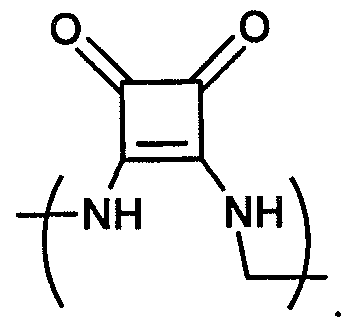
- diethyl squarate can act as a coupling agent for coupling with (i.e. reacting and tethering together) a compound having a primary amine with another compound having a -CH 2 -NH 2 group, to form linking group depicted by the following structure:
- halo or halogen by themselves or as part of another substituent mean, unless otherwise stated, a fluorine, chlorine, bromine, or iodine atom.
- a halogen includes iodine, chlorine, or bromine, more preferably, iodine.
- the invention is a compound of Formula I, or a salt thereof,
- L is selected from the group consisting of:
- Ri is selected from the group consisting of hydrogen, hydroxyl, (CpC 6 )alkyl, (Cp C 6 )alkyloxy and -OP0 3 H 2 ;
- R 2 is selected from the group consisting of:
- R 3 is selected from the group consisting of:
- R4 is selected from the group consisting of hydrogen, hydroxyl, (Ci-C6)alkyl, (Ci- C 6 )alkyloxy and -OP0 3 H 2 .
- the salt of a compound of Formula I is a pharmaceutically acceptable salt.
- Another particular embodiment of the invention comprises a compound of Formula I, or a salt thereof, wherein at least one of Ri , R 2 , R3 and R4 is hydrogen.
- Another particular embodiment of the invention comprises a compound of Formula I, or a salt thereof, wherein at least one of Ri and R4 is hydrogen.
- Another particular embodiment of the invention comprises a compound of Formula I, or a salt thereof, wherein wherein L is:
- a compound of Formula I, or a salt thereof is selected from the group consisting of: (1 ) 2-amino-9-((2R,3R,4S,5S)-4-(4-(((2R,3S,5R)-5-(2-amino-6-oxo-lH-purin- 9(6H)-yl)-3-hydroxytetrahydrofuran-2-yl)methyl)-lH-l,2,3-triazol-l-yl)-3-hydroxy-5- (hydroxymethy l)tetrahydrofuran-2-yl)- 1 H-purin-6(9H)-one;
- a compound of Formula I, or a salt thereof is selected from the group consisting of:
- the invention is directed to a compound of Formula II, or a salt thereof,
- R6 is selected from the group consisting of hydrogen, hydroxyl and -0-Si(CH 3 ) 3 ;
- R 7 is selected from the group consisting of hydroxyl, -0-CH 2 -C ⁇ CH and - OP0 3 H 2 .
- the compounds of Formula II are intermediates in the preparation of compounds of Formula la, described below.
- Another particular embodiment of the invention comprises a compound of Formula II, or a salt thereof, wherein R6 is selected from the group consisting of hydrogen and hydroxy 1; and R 7 is selected from the group consisting of hydroxyl and -0-Si(CH 3 ) 3 .
- the invention is a compound of Formula III, or a salt thereof,
- R 8 is selected from the group consisting of hydrogen and -P0 3 H 2 ;
- Another particular embodiment of the invention comprises a compound of Formula III, or a salt thereof, wherein wherein R 8 is hydrogen; R9 selected from the group of hydrogen and hydroxyl; and Rio is selected from the group consisting of -(CH 2 )-halide; -(CH 2 )-N 3 " ; -(CH 2 )-NH-NH 2 ; -ONH 2 ; and -(CH 2 )-NH 2 .
- a process for preparing a compound of Formula la is provided.
- the compounds of Formula la are intermediates in the preparation of Formula I compounds, in the case where R6 is -0-Si(CH 3 ) 3 in Formula la.
- the -0-Si(CH 3 ) 3 may then be converted to hydrogen, hydroxyl, (C] -C6)alkyl, (Ci-C6)alkyloxy, or -OP0 3 H 2 to generate a compound according to Formula I.
- the compounds of Formula la when R ⁇ 5 is hydrogen or hydroxyl comprise a subgenus of Formula I.
- the process for preparing a compound of Formula la comprises:
- R 6 is selected from the group consisting of hydrogen, hydroxyl and -0-Si(CH 3 ) 3 ;
- R 7 is selected from the group consisting of hydroxyl and -OP0 3 H 2 ;
- Rg is selected from the group consisting of hydrogen and -P0 3 H 2 ;
- R 9 is selected form the group consisting of hydrogen, hydroxyl and -OP0 3 H 2 ;
- L is selected from the group consisting of:
- a process for preparing a compound of Formula I comprises:
- L is selected from the group consisting of
- Ri is selected from the group consisting of hydrogen, hydroxyl, (Ci-C6)alkyl, (Q- C 6 )alkyloxy and -OP0 3 H 2 ;
- R 2 is selected from the group consisting of:
- R4 is selected from the group consisting of hydrogen, hydroxyl, (Ci-C 6 )alkyl, (Q- C 6 )alkyloxy and -OP0 3 H 2 .
- a method of treating an individual suffering from a bacterial infection comprising administering to said individual an effective amount of at least one compound according to Formula I, or a pharmaceutically acceptable salt thereof, either alone, or in combination with a pharmaceutically acceptable carrier.
- the compounds according to the invention may be administered to individuals (mammals, including animals and humans) afflicted with a bacterial infection.
- the individual treated is a human.
- the compounds are believed effective against a broad range of bacteria, including but not limited to the following: Pseudomonas aeruginosa; Pseudomonas fluorescens; Yersinas pestis; Vibrio cholerae; Salmonella enterica; Salmonella Typhimurium; Legionella pneumophia; Brucella melitensis; Bordetella pertussis; Streptococcus mutans; Acinetobacter baumannii; Staphylococcus aureus; Escherichia coli; and Bacillus anthracis.
- the method comprises administering to the individual an effective amount of at least one compound or a pharmaceutically acceptable salt thereof, selected from the group consisting of:
- a method for preventing and/or reducing the risk of bacterial infection in individuals comprising administering to the individual an effective amount of at least one compound, or a pharmaceutically acceptable salt thereof, according to Formula I.
- the compound of Formula I is 3-((((2R,3S,4R,5R)-5-(2-amino-6-oxo-lH-purin-9(6H)-yl)-3,4- dihydroxytetrahydrofuran-2-yl)methyl)amino)-4-(((2S,3S,4R,5R)-5-(2-amino-6-oxo-lH- purin-9(6H)-yl)-4-hydroxy-2-(hydroxymethyl)tetrahydrofuran-3-yl)amino)cyclobut-3-ene- 1 ,2-dione, or a pharmaceutically acceptable salt thereof.
- the compounds of the invention are utilized as probes to identifying pGpG-binding domains in bacteria.
- the method comprises the steps of contacting a compound of claim 1 or salt thereof with a bacteria or fraction thereof and detecting the binding of said compound or salt with a pGpG-binding domain in the bacteria or fraction thereof.
- the probe compound is:
- the bacteria so probed is selected from the group consisting of: Pseudomonas aeruginosa; Pseudomonas fluorescens; Yersinas pestis; Vibrio cholerae; Salmonella enterica; Salmonella typhimurium; Legionella pneumophia; Brucella melitensis; Bordetella pertussis; Streptococcus mutans; Acinetobacter baumannii; Staphylococcus aureus; Escherichia coli; and Bacillus anthracis.
- the probe compound may be detectably labeled to indicate its binding with pGpG-binding domains in the bacteria.
- the compounds of the present invention may take the form of salts when appropriately substituted with groups or atoms capable of forming salts. Such groups and atoms are well known to those of ordinary skill in the art of organic chemistry.
- the term “salts” embraces addition salts of free acids or free bases which are compounds of the invention.
- pharmaceutically-acceptable salt refers to salts which possess toxicity profiles within a range that affords utility in pharmaceutical applications. Pharmaceutically unacceptable salts may nonetheless possess properties such as high crystallinity, which have utility in the practice of the present invention, such as for example utility in process of synthesis, purification or formulation of compounds of the invention.
- Suitable pharmaceutically-acceptable acid addition salts may be prepared from an inorganic acid or from an organic acid.
- inorganic acids include hydrochloric, hydrobromic, hydriodic, nitric, carbonic, sulfuric, and phosphoric acids.
- organic acids may be selected from aliphatic, cycloaliphatic, aromatic, araliphatic, heterocyclic, carboxylic and sulfonic classes of organic acids, examples of which include formic, acetic, propionic, succinic, glycolic, gluconic, lactic, malic, tartaric, citric, ascorbic, glucuronic, maleic, fumaric, pyruvic, aspartic, glutamic, benzoic, anthranilic, 4-hydroxybenzoic, phenylacetic, mandelic, embonic (pamoic), methanesulfonic, ethanesulfonic, benzenesulfonic, pantothenic, trifluoromethanesulfonic, 2-hydroxyethanesulfonic, p-toluenesulfonic, sulfanilic, cyclohexylaminosulfonic, stearic, alginic, ⁇ -hydroxybutyric, sal
- Suitable pharmaceutically acceptable base addition salts of compounds of the invention include, for example, metallic salts including alkali metal, alkaline earth metal and transition metal salts such as, for example, calcium, magnesium, potassium, sodium and zinc salts.
- Pharmaceutically acceptable base addition salts also include organic salts made from basic amines such as, for example, N,N-dibenzylethylenediamine, chloroprocaine, choline, diethanolamine, ethylenediamine, meglumine (N-methylglucamine) and procaine.
- Examples of pharmaceutically unacceptable base addition salts include lithium salts and cyanate salts.
- All of these salts may be prepared by conventional means from the corresponding compound according to Formula I by reacting, for example, the appropriate acid or base with the compound according to Formula I.
- the salts are in crystalline form, and preferably prepared by crystallization of the salt from a suitable solvent.
- suitable salt forms for example, as described in Handbook of Pharmaceutical Salts: Properties, Selection, and Use By P. H. Stahl and C. G. Wermuth (Wiley-VCH 2002).
- the compounds of the invention may be administered in the form of a pharmaceutical composition, in combination with a pharmaceutically acceptable carrier.
- the active ingredient or agent in such formulations i.e., a compound of Formula I
- “Pharmaceutically acceptable carrier” means any carrier, diluent or excipient which is compatible with the other ingredients of the formulation and not deleterious to the recipient.
- the active agent is preferably administered with a pharmaceutically acceptable carrier selected on the basis of the selected route of administration and standard pharmaceutical practice.
- the active agent may be formulated into dosage forms according to standard practices in the field of pharmaceutical preparations. See Alphonso Gennaro, ed., Remington 's Pharmaceutical Sciences, 18th Edition (1990), Mack Publishing Co., Easton, PA. Suitable dosage forms may comprise, for example, tablets, capsules, solutions, parenteral solutions, troches, suppositories, or suspensions.
- the active agent may be mixed with a suitable carrier or diluent such as water, an oil (particularly a vegetable oil), ethanol, saline solution, aqueous dextrose (glucose) and related sugar solutions, glycerol, or a glycol such as propylene glycol or polyethylene glycol.
- a suitable carrier or diluent such as water, an oil (particularly a vegetable oil), ethanol, saline solution, aqueous dextrose (glucose) and related sugar solutions, glycerol, or a glycol such as propylene glycol or polyethylene glycol.
- Solutions for parenteral administration preferably contain a water soluble salt of the active agent.
- Stabilizing agents, antioxidant agents and preservatives may also be added. Suitable antioxidant agents include sulfite, ascorbic acid, citric acid and its salts, and sodium EDTA.
- Suitable preservatives include benzalkonium chloride, methyl- or propyl-paraben, and chlorbutanol.
- the composition for parenteral administration may take the form of an aqueous or non-aqueous solution, dispersion, suspension or emulsion.
- the active agent may be combined with one or more solid inactive ingredients for the preparation of tablets, capsules, pills, powders, granules or other suitable oral dosage forms.
- the active agent may be combined with at least one excipient such as fillers, binders, humectants, disintegrating agents, solution retarders, absorption accelerators, wetting agents absorbents or lubricating agents.
- the active agent may be combined with carboxymethylcellulose calcium, magnesium stearate, mannitol and starch, and then formed into tablets by conventional tableting methods.
- the specific dose of a compound according to the invention to obtain therapeutic benefit for treatment of a bacterial infection will, of course, be determined by the particular circumstances of the individual patient including the size, weight, age and sex of the patient, the nature and stage of the bacterial infection, the aggressiveness of the bacterial infection, and the route of administration of the compound.
- a daily dosage from about 0.05 to about 50 mg/kg/day may be utilized, more preferably from about 0.1 to about 10 mg/kg/day. Higher or lower doses are also contemplated as it may be necessary to use dosages outside these ranges in some cases.
- the daily dosage may be divided, such as being divided equally into two to four times per day daily dosing.
- the compositions are preferably formulated in a unit dosage form, each dosage containing from about 1 to about 500mg, more typically, about 10 to about l OOmg of active agent per unit dosage.
- unit dosage form refers to physically discrete units suitable as a unitary dosage for human subjects and other mammals, each unit containing a predetermined quantity of active material calculated to produce the desired therapeutic effect, in association with a suitable pharmaceutical excipient.
- compositions of the present invention may also be formulated so as to provide slow or controlled release of the active ingredient therein using, for example, hydropropylmethyl cellulose in varying proportions to provide the desired release profile, other polymer matrices, gels, permeable membranes, osmotic systems, multilayer coatings, microparticles, liposomes and/or microspheres.
- a controlled-release preparation is a pharmaceutical composition capable of releasing the active ingredient at the required rate to maintain constant pharmacological activity for a desirable period of time.
- dosage forms provide a supply of a drug to the body during a predetermined period of time and thus maintain drug levels in the therapeutic range for longer periods of time than conventional non-controlled formulations.
- compositions can also be formulated to provide for topical compositions and treatments using suitable carriers and controlled-release preparations.
- U.S. Patent No. 5,674,533 discloses controlled-release pharmaceutical compositions in liquid dosage forms for the administration of moguisteine, a potent peripheral antitussive.
- U.S. Patent No. 5,059,595 describes the controlled-release of active agents by the use of a gastro-resistant tablet for the therapy of organic mental disturbances.
- U.S. Patent No. 5,591,767 describes a liquid reservoir transdermal patch for the controlled administration of ketorolac, a non-steroidal anti-inflammatory agent with potent analgesic properties.
- U.S. Patent No. 5,120,548 discloses a controlled-release drug delivery device comprised of swellable polymers.
- Patent No. 5,073,543 describes controlled-release formulations containing a trophic factor entrapped by a ganglioside- liposome vehicle.
- U.S. Patent No. 5,639,476 discloses a stable solid controlled-release formulation having a coating derived from an aqueous dispersion of a hydrophobic acrylic polymer. Biodegradable microparticles are known for use in controlled-release formulations.
- U.S. Patent No. 5,733,566 describes the use of polymeric microparticles that release antiparasitic compositions.
- the controlled-release of the active ingredient may be stimulated by various inducers, for example pH, temperature, enzymes, water, or other physiological conditions or compounds.
- various mechanisms of drug release exist.
- the controlled-release component may swell and form porous openings large enough to release the active ingredient after administration to a patient.
- the term "controlled-release component" in the context of the present invention is defined herein as a compound or compounds, such as polymers, polymer matrices, gels, permeable membranes, liposomes and/or microspheres, that facilitate the controlled-release of the active ingredient in the pharmaceutical composition.
- the controlled-release component is biodegradable, induced by exposure to the aqueous environment, pH, temperature, or enzymes in the body.
- sol-gels may be used, wherein the active ingredient is incorporated into a sol-gel matrix that is a solid at room temperature. This matrix is implanted into a patient, preferably a mammal, having a body temperature high enough to induce gel formation of the sol-gel matrix, thereby releasing the active ingredient into the patient.
- the components used to formulate the pharmaceutical compositions are of high purity and are substantially free of potentially harmful contaminants (e.g., at least National Food grade, generally at least analytical grade, and more typically at least pharmaceutical grade).
- the composition is preferably manufactured or formulated under Good Manufacturing Practice standards as defined in the applicable regulations of the U.S. Food and Drug Administration.
- suitable formulations may be sterile and/or substantially isotonic and/or in full compliance with all Good Manufacturing Practice regulations of the U.S. Food and Drug Administration.
- the compounds of Formula I may be administered by any route, including oral, topical, rectal, sublingual, and parenteral administration.
- Parenteral administration includes, for example, intravenous, intramuscular, intraarterial, intraperitoneal, intranasal, intravaginal, intravesical (e.g., to the bladder), intradermal, transdermal, topical or subcutaneous administration.
- Also contemplated within the scope of the invention is the instillation of a drug in the body of the patient in a controlled formulation, with systemic or local release of the drug to occur at a later time.
- the drug may be localized in a depot for controlled release to the circulation, or for release to a local site of an infection or wound.
- One or more compounds useful in the practice of the present inventions may be administered simultaneously, by the same or different routes, or at different times during treatment.
- the compounds may be administered before, along with, or after other medications, including other antiproliferative compounds.
- the treatment may be carried out for as long a period as necessary, either in a single, uninterrupted session, or in discrete sessions.
- the treating physician will know how to increase, decrease, or interrupt treatment based on patient response.
- treatment is carried out for from about four to about sixteen weeks.
- the treatment schedule may be repeated as required.
- Scheme 1 is utilized in preparing the following compounds.
- R 7 is selected from the group consisting of hydroxyl and -OPO3H2;
- R 8 is selected from the group consisting of hydrogen and -P0 3 H 2 ; and
- R9 is selected form the group consisting of hydrogen, hydroxyl and -OPO3H2.
- R 7 , R 8 , and R9 are as defined for Scheme 1.
- L is:
- R 7 , R 8 , and R 9 are as defined for Scheme 1.
- L is:
- R 7 , R 8 , and R 9 are as defined for Scheme 1.
- R 7 , Rg, and R9 are as defined for Scheme 1.
- R5 is -NH 2 and Rio is -CH 2 - NH 2
- L is:
- R 7 , R.8, and Rg are as defined for Scheme 1.
- R 5 is -NH 2 and Rio is -CH 2 - NH 2 then L is:
- R 7 , R 8 , and R 9 are as defined for Scheme 1.
- R 5 is -NH 2 and Rio is -CH 2 - NH 2
- L is:
- R 7 , R.8, and Rg are as defined for Scheme 1.
- R 5 is -NH 2 and Rio is -CH 2 - NH 2
- L is:
- the aqueous layers were extracted with CHC1 3 (3 x 30 mL), and the combined organic layers were dried ( a 2 S0 4 ). After removal of the solvent, the crude product without further purification was dissolved in 85 mL of MeOH and 85 mL of 3.0 N NaOH solution was added. Then the mixture was stirred at r.t. for 3 days. The mixture was neutralized with AcOH to PH 5. The aqueous solution was concentrated and loaded on a CI 8 reverse-phase column and eluted with 25% H 2 0/MeOH to give the desired product (6) as a white solid (0.618 g, 85% yield).
- the biofilm-formation inhibitory concentration of a compound can be determined as follows, according to the method of O'Toole et al, Mol. Microbiol. 1998, 28, 449. A known concentration of compound is added independently to a 96-well polyvinylchloride plastic microtitre dish containing planktonic P. aeruginosa cells suspended in M63 media with 0.2% glucose, ImM MgSC ⁇ , 0.5%) casamino acids, 0.4% citric acid, and 0.4% glutamic acid. The plates are incubated at room temperature for 15 min, rinsed thoroughly and repeatedly with water and scored for the formation of biofilm.
Landscapes
- Chemical & Material Sciences (AREA)
- Organic Chemistry (AREA)
- Health & Medical Sciences (AREA)
- Life Sciences & Earth Sciences (AREA)
- Engineering & Computer Science (AREA)
- Molecular Biology (AREA)
- General Health & Medical Sciences (AREA)
- Biotechnology (AREA)
- Biochemistry (AREA)
- Genetics & Genomics (AREA)
- Immunology (AREA)
- Biomedical Technology (AREA)
- Urology & Nephrology (AREA)
- Hematology (AREA)
- Medicinal Chemistry (AREA)
- Physics & Mathematics (AREA)
- Food Science & Technology (AREA)
- Analytical Chemistry (AREA)
- Microbiology (AREA)
- Cell Biology (AREA)
- General Physics & Mathematics (AREA)
- Pathology (AREA)
- Virology (AREA)
- Tropical Medicine & Parasitology (AREA)
- Communicable Diseases (AREA)
- Oncology (AREA)
- Chemical Kinetics & Catalysis (AREA)
- General Chemical & Material Sciences (AREA)
- Nuclear Medicine, Radiotherapy & Molecular Imaging (AREA)
- Pharmacology & Pharmacy (AREA)
- Animal Behavior & Ethology (AREA)
- Public Health (AREA)
- Veterinary Medicine (AREA)
- Pharmaceuticals Containing Other Organic And Inorganic Compounds (AREA)
Description
SYNTHETIC pGpG ANALOGS, METHODS OF PREPARATION AND
METHODS OF USE
Cross-Reference to Related Application
[0001] The benefit of the filing date of U.S. Provisional Patent Application No.
61/663,000, filed June 22, 2012, is hereby claimed. The entire disclosure of the aforesaid application is incorporated herein by reference.
Field of the Invention
(0002) The invention relates to compounds, methods for their preparation, methods for their use, and compositions including them. The invention further provides methods for the treatment and prevention of bacterial infections.
Background of the Invention
[00031 Bacterial infections are among the most common causes of medical complications and illness in developed countries. That said, many bacterial infections develop resistance to conventional antibiotics. There is a need to develop new
antibacterial compound to address the problem of drug-resistant strains of bacteria. Thus, identifying new effective drugs for bacterial infections is a continuing focus of medical research.
[0004] pGpG is a secondary messenger molecule which is vital for many pathogenic bacteria. pGpG plays an important role in chemical signaling and is vital in numerous enzymatic processes. To date, little is known about the specific targets that recognize pGpG and the method by which pGpG signaling occurs. Accordingly, the development of a chemical probe which can be used to identify pGpG-binding domains would be a significant advance.
Summary of the Invention
100051 It is believed that that certain compounds and compositions are useful for the treatment of bacterial infections. The compounds of the invention are pGpG mimics and related derivatives thereof.
[00061 Provided is a compound of Formula I or a salt thereof:

wherein,
L is selected from the group consisting

R] is selected from the group consisting of hydrogen, hydroxyl, (d-C6)alkyl, (Ci- C6)alkyloxy, and -OP03H2; and
P2 is selected from the group consisting of:
hydrogen,
-P03H2,

R4 is selected from the group consisting of hydrogen, hydroxyl, (Ci-Ce)alkyl, (Q- C6)alkyloxy and -OP03H2.
|0007] Further provided is a pharmaceutical composition comprising a pharmaceutically acceptable carrier and a compound of Formula I, or a pharmaceutically acceptable salt thereof.
[0008] Further provided is a method of treating an individual suffering from a bacterial infection, comprising administering to the individual an effective amount of at least one compound of Formula I, or a pharmaceutically acceptable salt thereof.
[0009] Further provided is a method for preventing and/or reducing the risk of bacterial infection in individuals comprising administering to the individual an effective amount of at least one compound of Formula I, or a pharmaceutically acceptable salt thereof.
|0010] In particular embodiments, the bacterial infection is caused by at least one bacteria selected from the group consisting of Pseudomonas aeruginosa; Pseudomonas fluorescens; Yersinas pestis; Vibrio cholerae; Salmonella enterica; Salmonella Typhimurium; Legionella pneumophia; Brucella melitensis; Bordetella pertussis; Streptococcus mutans; Acinetobacter baumannii; Staphylococcus aureus; Escherichia coli; and Bacillus anthracis.
100111 Further provided is a method of identifying pGpG-binding domains in bacteria by contacting bacteria with at least one compound of Formula I, or a salt thereof. The compound or salt thereof is contacted with the bacteria, or a fraction thereof, to identify pGpG-binding domains in the bacteria.
[0012] As envisioned in the present invention with respect to the disclosed compositions of matter and methods, in one aspect the embodiments of the invention comprise the components and/or steps disclosed herein. In another aspect, the embodiments of the invention consist essentially of the components and/or steps disclosed herein. In yet another aspect, the embodiments of the invention consist of the components and/or steps disclosed herein.
Detailed Description of the Invention
[0013] The compounds and compositions of the invention are believed to inhibit proliferation of bacterial cells, and kill various bacterial cells in or on an individual suffering from bacterial infection. The compounds of the invention are believed to interfere with pGpG pathways in bacterial cells, which causes the death of the bacterial
cells and/or inhibition of the formation of bacterial biofilms. The compounds are believed effective against a broad range of bacteria, including but not limited to the following: Pseudomonas aeruginosa; Pseudomonas fluorescens; Yersinas pestis; Vibrio cholerae; Salmonella enterica; Salmonella Typhimurium; Legionella pneumophia; Brucella melitensis; Bordetella pertussis; Streptococcus mutans; Acinetobacter baumannii; Staphylococcus aureus; Escherichia coli; and Bacillus anthracis.
10014] The compounds are also believed to be useful as probes for analysis of pGpG bacterial pathways. In one embodiment, compound bearing a detectable label, e.g., a label conjugated to a biotin linker, are applied as chemical probes for the identification of pGpG-binding domains. Previous methods have successfully utilized biotin-conjugate entities to identify signaling molecules in bacteria. Generally speaking, biotin-conjugated pGpG analogs may be applied either directly to bacteria or a fraction or component thereof, e.g. , a bacterial lysate.
[0015] After suitable incubation time, the bacteria are lysed (if not lysed previously), pelleted by centrifugation, applied to a streptavidin column, and eluted. All pGpG-binding entities are sequenced by mass spectrometry to confirm their identity.
|0016] Apart from inhibiting bacterial cell proliferation, the bacterial inhibitory activity of the compound can provide further antibacterial utility by blocking the pGpG pathway in bacterial cells and causing inhibition of formation of biofilms.
I. Definitions
1. General
[0017] As used in the specification and the appended claims, the singular forms "a," "an" and "the" include plural referents unless the context clearly dictates otherwise.
|0018] As used herein, the terms "treat" and "treatment" are used interchangeably and are meant to indicate a postponement of development of a disorder and/or a reduction in the severity of symptoms that will or are expected to develop. The terms further include ameliorating existing symptoms, preventing additional symptoms, and ameliorating or preventing the underlying metabolic causes of symptoms.
|0019] As used herein, "individual" (as in the subject of the treatment) means both mammals and non-mammals. Mammals include, for example, humans; nonhuman
primates, e.g. apes and monkeys; cattle; horses; sheep; and goats. Non-mammals include, for example, fish and birds.
10020] The expression "effective amount", when used to describe therapy to an individual suffering from a bacterial infection, refers to the amount of a compound according to Formula I that inhibits the growth or proliferation, resulting in a therapeutically useful and killing of bacterial cells.
100211 The term "bacterial infection" means a disorder wherein unwanted bacteria or unwanted amounts of bacteria cause infection or illness in an individual.
[00221 The term "chemical probe" means a compound or composition capable of identifying bacterial proteins, receptors and other biological components with the appropriate procedure.
[0023] The term "anti-bacterial" means capable of killing bacterial cells or inhibiting the proliferation thereof, or inhibitions the formation of biofilms.
2. Chemical
[00241 In the following paragraphs some of the definitions include examples. The examples are intended to be illustrative, and not limiting.
|0025| The term "alkyl", by itself or as part of another substituent means, unless otherwise stated, a straight, or branched chain hydrocarbon having the number of carbon atoms designated {i.e. Ci-C6 means one to six carbons) and includes straight, branched chain or cyclic groups. Examples include methyl, ethyl, propyl, isopropyl, butyl, isobutyl, tert-butyl, pentyl, neopentyl, and hexyl. Most preferred is (Ci-C3)alkyl, particularly ethyl, methyl and isopropyl.
[0026] The term "alkoxy", employed alone or in combination with other terms, means, unless otherwise stated, an alkyl group, as defined above, connected to the rest of the molecule via an oxygen atom. The terms alkoxy includes, for example, methoxy, ethoxy, 1 -propoxy, 2-propoxy (isopropoxy) and their higher homologs and isomers. The alkyl portion of the alkoxy group can have a designated number of carbon atoms as defined for alkyl groups above. Preferred are (Ci-C3)alkoxy, particularly ethoxy and methoxy.
10027] A "coupling agent" is a compound that is capable of reacting with two or more functional groups to form a linking group. The nature of the coupling agent depends on the type of linking group sought. A coupling agent can include, but is not limited to the following: Copper Tris-(hydroxypropyltriazolylmethyl)amine, 3,4-dihydroxycyclobut-3- ene-l ,2-dione, propan-2-one, l, l, l,3,3,3-hexafluoropropan-2-one, dichlorodimethylsilane, and bis(4-nitrophenyl) carbonate. For example, in a preferred embodiment, diethyl squarate can act as a coupling agent for coupling with (i.e. reacting and tethering together) a compound having a primary amine with another compound having a -CH2-NH2 group, to form linking group depicted by the following structure:

|0028] The terms "halo" or "halogen" by themselves or as part of another substituent mean, unless otherwise stated, a fluorine, chlorine, bromine, or iodine atom. Preferably, a halogen includes iodine, chlorine, or bromine, more preferably, iodine.
[0029] The inclusion of a parenthetical or a wavy line, ^ww1 , indicates a point of connection to a chemical structure to another chemical structure. For example, a molecule of the structure:


II. Compounds of the Invention
[0030] In one aspect, the invention is a compound of Formula I, or a salt thereof,

wherein:
L is selected from the group consisting of:

Ri is selected from the group consisting of hydrogen, hydroxyl, (CpC6)alkyl, (Cp C6)alkyloxy and -OP03H2;
R2 is selected from the group consisting of:
hydrogen,

R3 is selected from the group consisting of:
hydrogen,
-P03H2,

R4 is selected from the group consisting of hydrogen, hydroxyl, (Ci-C6)alkyl, (Ci- C6)alkyloxy and -OP03H2.
[0031 ] In certain embodiments, the salt of a compound of Formula I is a pharmaceutically acceptable salt.
|0032| Another particular embodiment of the invention comprises a compound of Formula I, or a salt thereof, wherein at least one of Ri, R2, R3 and R4 is hydrogen.
[00331 Another particular embodiment of the invention comprises a compound of Formula I, or a salt thereof, wherein at least one of Ri and R4 is hydrogen.
|0034] Another particular embodiment of the invention comprises a compound of Formula I, or a salt thereof, wherein wherein L is:
10035] In certain embodiments, a compound of Formula I, or a salt thereof, is selected from the group consisting of:
(1 ) 2-amino-9-((2R,3R,4S,5S)-4-(4-(((2R,3S,5R)-5-(2-amino-6-oxo-lH-purin- 9(6H)-yl)-3-hydroxytetrahydrofuran-2-yl)methyl)-lH-l,2,3-triazol-l-yl)-3-hydroxy-5- (hydroxymethy l)tetrahydrofuran-2-yl)- 1 H-purin-6(9H)-one;
(2) 2-amino-9-((2R,3R,4S,5 S)-4-(4-((2R,3 S,5R)-5 -(2-amino-6-oxo- 1 H-purin- 9(6H)-yl)-3-hydroxytetrahydrofuran-2-yl)-l H-l ,2,3-triazol-l -yl)-3-hydroxy-5- (hydroxymethyl)tetrahydrofuran-2-yl)- 1 H-purin-6(9H)-one;
(3) 2-amino-9-((2R,3R,4S,5R)-4-((l -((2S,3S,5R)-5-(2-amino-6-oxo-lH-purin- 9(6H)-yl)-3-hydroxytetrahydrofuran-2-yl)-l H-l ,2,3-triazol-4-yl)methoxy)-3-hydroxy-5- (hydroxymethyl)tetrahydrofuran-2-yl)- 1 H-purin-6(9H)-one;
(4) 2-amino-9-((2R,3R,4S,5S)-4-(2-(2-((2R,3S,5R)-5-(2-amino-6-oxo-lH- purin-9(6H)-yl)-3-hydroxytetrahydrofuran-2-yl)ethyl)hydrazinyl)-3-hydroxy-5- (hydroxymethyl)tetrahydrofuran-2-yl)- 1 H-purin-6(9H)-one;
(5) 2-amino-9-((2R,3R,4S,5R)-4-(((2-((2R,3S,5R)-5-(2-amino-6-oxo-lH- purin-9(6H)-yl)-3-hydroxytetrahydrofuran-2-yl)ethyl)amino)oxy)-3-hydroxy-5- (hydroxymethyl)tetrahydrofuran-2-yl)-l H-purin-6(9H)-one;
(6) 2-amino-9-((2R,3R,4S,5S)-4-(2-(((2R,3S,5R)-5-(2-amino-6-oxo-lH-purin- 9(6H)-yl)-3-hydroxytetrahydrofuran-2-yl)methyl)hydrazinyl)-3-hydroxy-5- (hydroxymethyl)tetrahydrofuran-2-yl)-l H-purin-6(9H)-one;
(7) 2-amino-9-((2R,3R,4S,5R)-4-(((((2R,3S,5R)-5-(2-amino-6-oxo-l H-purin- 9(6H)-yl)-3-hydroxytetrahydrofuran-2-yl)methyl)amino)oxy)-3-hydroxy-5- (hydroxymethyl)tetrahydrofuran-2-yl)- 1 H-purin-6(9H)-one;
(8) 3-((((2R,3S,5R)-5-(2-amino-6-oxo-lH-purin-9(6H)-yl)-3- hydroxytetrahydrofuran-2-yl)methyl)amino)-4-(((2S,3S,4R,5R)-5-(2-amino-6-oxo-lH- piirin-9(6H)-yl)-4-hydroxy-2-(hydroxymethyl)tetrahydrofuran-3-yl)amino)cyclobut-3-ene- 1 ,2-dione;
(9) 2-amino-9-((2R,3R,4S,5S)-4-((2-((((2R,3S,5R)-5-(2-amino-6-oxo-lH- purin-9(6H)-yl)-3-hydroxytetrahydrofuran-2-yl)methyl)amino)propan-2-yl)amino)-3- hydroxy-5-(hydroxymethyl)tetrahydrofuran-2-yl)- IH-purin-6(9H)-one;
(10) 2-amino-9-((2R,3R,4S,5S)-4-((2-((((2R,3S,5R)-5-(2-amino-6-oxo-lH- purin-9(6H)-yl)-3-hydroxytetrahydrofuran-2-yl)methyl)amino)-l,l , l ,3,3,3-
hexafluoropropan-2-yl)amino)-3-hydroxy-5-(hydroxymethyl)tetrahydrofuran-2-yl)-lH- purin-6(9H)-one;
( 1 1 ) 2-amino-9-((2R,3R,4S,5S)-4-((((((2R,3S,5R)-5-(2-amino-6-oxo-lH-purin- 9(6H)-yl)-3-hydroxytetrahydrofuran-2-yl)methyl)amino)dimethylsilyl)amino)-3-hydroxy- 5-(hydroxymethyl)tetrahydrofuran-2-yl)-lH-purin-6(9H)-one;
(12) l -(((2R,3S,5R)-5-(2-amino-6-oxo-l H-purin-9(6H)-yl)-3- hydroxytetrahydrofuran-2-yl)methyl)-3-((2S,3S,4R,5R)-5-(2-amino-6-oxo-lH-purin- 9(6H)-yl)-4-hydroxy-2-(hydroxymethyl)tetrahydrofuran-3-yl)urea;
(13) 2-amino-9-((2R,3R,4S,5R)-5-((l -((2S,3S,5R)-5-(2-amino-6-oxo-lH-purin- 9(6H)-yl)-2-(hydroxymethyl)tetrahydrofuran-3-yl)-lH-l,2,3-triazol-4-yl)methyl)-3,4- dihydroxytetrahydrofuran-2-yl)-l H-purin-6(9H)-one;
( 14) 2-amino-9-((2R,3R,4S,5R)-5-(l -((2S,3S,5R)-5-(2-amino-6-oxo-lH-purin- 9(6H)-yl)-2-(hydroxymethyl)tetrahydrofuran-3-yl)-lH-l,2,3-triazol-4-yl)-3,4- dihydroxytetrahydrofuran-2-yl)-l H-purin-6(9H)-one;
(15) 2-amino-9-((2R,3R,4S,5S)-5-(4-((((2R,3S,5R)-5-(2-amino-6-oxo-lH-purin- 9(6H)-yl)-2-(hydroxymethyl)tetrahydrofuran-3-yl)oxy)methyl)-lH-l ,2,3-triazol-l -yl)-3,4- dihydroxytetrahydrofuran-2-yl)- 1 H-purin-6(9H)-one;
(16) 2-amino-9-((2R,3R,4S,5R)-5-(2-(2-((2S,3S,5R)-5-(2-amino-6-oxo-lH- purin-9(6H)-yl)-2-(hydroxymethyl)tetrahydrofuran-3-yl)hydrazinyl)ethyl)-3,4- d ihydroxytetrahydrofuran-2-yl)- 1 H-purin-6(9H)-one;
(17) 2-amino-9-((2R,3R,4S,5R)-5-(2-((((2R,3S,5R)-5-(2-amino-6-oxo-lH- purin-9(6H)-yl)-2-(hydroxymethyl)tetrahydrofuran-3-yl)oxy)amino)ethyl)-3,4- dihydroxytetrahydrofuran-2-yl)-l H-purin-6(9H)-one;
(18) 2-amino-9-((2R,3R,4S,5R)-5-((2-((2S,3S,5R)-5-(2-amino-6-oxo-lH-purin- 9(6H)-yl)-2-(hydroxymethyl)tetrahydrofuran-3-yl)hydrazinyl)methyl)-3,4- d ihydroxytetrahydrofuran-2-yl)- 1 H-purin-6(9H)-one;
(1 9) 2-amino-9-((2R,3R,4S,5R)-5-(((((2R,3S,5R)-5-(2-amino-6-oxo-l H-purin- 9(6H)-yl)-2-(hydroxymethyl)tetrahydrofuran-3-yl)oxy)amino)methyl)-3,4- dihydroxytetrahydrofuran-2-yl)- 1 H-purin-6(9H)-one;
(20) 3-(((2S,3S,5R)-5-(2-amino-6-oxo-lH-purin-9(6H)-yl)-2- (hydroxymethyl)tetrahydrofuran-3-yl)amino)-4-((((2R,3S,4R,5R)-5-(2-amino-6-oxo-lH- purin-9(6H)-yl)-3,4-dihydroxytetrahydrofuran-2-yl)methyl)amino)cyclobut-3-ene-l ,2- dione;
(21 ) 2-amino-9-((2R,3R,4S,5R)-5-(((2-(((2S,3S,5R)-5-(2-amino-6-oxo-l H- purin-9(6H)-yl)-2-(hydroxymethyl)tetrahydrofuran-3-yl)amino)propan-2- yl)amino)methyl)-3,4-dihydroxytetrahydrofuran-2-yl)-lH-purin-6(9H)-one;
(22) 2-amino-9-((2R,3R,4S,5R)-5-(((2-(((2S,3S,5R)-5-(2-amino-6-oxo-lH- purin-9(6H)-yl)-2-(hydroxymethyl)tetrahydrofuran-3-yl)amino)-l , 1 , 1, 3,3,3- hexafluoropropan-2-yl)amino)methyl)-3,4-dihydroxytetrahydrofuran-2-yl)-lH-purin- 6(9H)-one;
(23) 2-amino-9-((2R,3R,4S,5R)-5-((((((2S,3S,5R)-5-(2-amino-6-oxo-l H-purin- 9(6H)-yl)-2-(hydroxymethyl)tetrahydrofuran-3-yl)amino)dimethylsilyl)amino)methyl)- 3,4-dihydroxytetrahydrofuran-2-yl)-l H-purin-6(9H)-one;
(24) l -((2S,3S,5R)-5-(2-amino-6-oxo- lH-purin-9(6H)-yl)-2- (hydroxymethyl)tetrahydrofuran-3-yl)-3-(((2R,3S,4R,5R)-5-(2-amino-6-oxo-lH-purin- 9(6H)-yl)-3,4-dihydroxytetrahydrofuran-2-yl)methyl)urea;
(25) 2-amino-9-((2R,4S,5R)-5-((l -((2S,3S,5R)-5-(2-amino-6-oxo-lH-purin- 9(6H)-yl)-2-(hydroxymethyl)tetrahydrofuran-3-yl)-lH-l,2,3-triazol-4-yl)methyl)-4- hydroxytetrahydrofuran-2-yl)- 1 H-purin-6(9H)-one;
(26) 2-amino-9-((2R,4S,5R)-5-( l-((2S,3S,5R)-5-(2-amino-6-oxo-lH-purin- 9(6H)-yl)-2-(hydroxymethyl)tetrahydrofuran-3-yl)-lH-l ,2,3-triazol-4-yl)-4- hydroxytetrahydrofuran-2-yl)- 1 H-purin-6(9H)-one;
(27) 2-amino-9-((2R,4S,5R)-5-((4-((((2R,3S,5R)-5-(2-amino-6-oxo-lH-purin- 9(6H)-y l)-2-(hydroxymethyl)tetrahydrofuran-3-yl)oxy)methyl)- 1 H- 1 ,2,3 -triazol- 1 - y l)methy l)-4-hydroxytetrahydrofuran-2-yl)- 1 H-purin-6(9H)-one;
(28) 2-amino-9-((2R,4S,5R)-5-(2-(2-((2S,3S,5R)-5-(2-amino-6-oxo-lH-purin- 9(6H)-yl)-2-(hydroxymethyl)tetrahydrofuran-3-yl)hydrazinyl)ethyl)-4- hydroxytetrahydrofuran-2-yl)- 1 H-purin-6(9H)-one;
(29) 2-amino-9-((2R,4S,5R)-5-(2-((((2R,3S,5R)-5-(2-amino-6-oxo-l H-purin- 9(6H)-yl)-2-(hydroxymethyl)tetrahydrofuran-3-yl)oxy)amino)ethyl)-4- hydroxytetrahydrofuran-2-yl)- 1 H-purin-6(9H)-one;
(30) 3-(((2S,3S,5R)-5-(2-amino-6-oxo-lH-purin-9(6H)-yl)-2- (hydroxymethyl)tetrahydrofuran-3-yl)amino)-4-((((2R,3S,5R)-5-(2-amino-6-oxo- lH- purin-9(6H)-yl)-3-hydroxytetrahydrofuran-2-yl)methyl)amino)cyclobut-3-ene-l,2-dione;
(31) 2-amino-9-((2R,4S,5R)-5-(((((2R,3S,5R)-5-(2-amino-6-oxo-lH-purin- 9(6H)-yl)-2-(hydroxymethyl)tetrahydrofuran-3-yl)oxy)amino)methyl)-4- hydroxytetrahydrofuran-2-yl)- 1 H-purin-6(9H)-one;
(32) 2-amino-9-((2R,4S,5R)-5-(((2-(((2S,3S,5R)-5-(2-amino-6-oxo- l H-purin- 9(6H)-yl)-2-(hydroxymethyl)tetrahydrofuran-3-yl)amino)propan-2-yl)amino)methyl)-4- hydroxytetrahydrofuran-2-yl)-lH-purin-6(9H)-one;
(33) 2-amino-9-((2R,4S,5R)-5-(((2-(((2S,3S,5R)-5-(2-amino-6-oxo-lH-purin- 9(6H)-yl)-2-(hydroxymethyl)tetrahydrofuran-3-yl)amino)-l , l,l ,3,3,3-hexafluoropropan-2- yl)amino)methyl)-4-hydroxytetrahydrofuran-2-yl)-lH-purin-6(9H)-one;
(34) 2-amino-9-((2R,4S,5R)-5-((((((2S,3S,5R)-5-(2-amino-6-oxo-lH-purin-
9(6H)-yl)-2-(hydroxymethyl)tetrahydrofuran-3-yl)amino)dimethylsilyl)amino)methyl)-4- hydroxytetrahydrofuran-2-yl)- 1 H-purin-6(9H)-one;
(35) 1 -((2S,3 S,5R)-5-(2-amino-6-oxo- 1 H-purin-9(6H)-yl)-2- (hydroxymethyl)tetrahydrofuran-3-yl)-3-(((2R,3S,5R)-5-(2-amino-6-oxo-lH-purin-9(6H)- yl)-3-hydroxytetrahydrofuran-2-yl)methyl)urea;
(36) 2-amino-9-((2R,3R,4S,5S)-4-(4-(((2R,3S,4R,5R)-5-(2-amino-6-oxo-lH- purin-9(6H)-yl)-3,4-dihydroxytetrahydrofuran-2-yl)methyI)-l H-l ,2,3-triazol-l -yl)-3- hydroxy-5-(hydroxymethyl)tetrahydrofuran-2-yl)-lH-purin-6(9H)-one;
(37) 2-amino-9-((2R,3R,4S,5S)-4-(4-((2R,3S,4R,5R)-5-(2-amino-6-oxo-lH- purin-9(6H)-yl)-3,4-dihydroxytetrahydrofuran-2-yl)-lH-l,2,3-triazol-l-yl)-3-hydroxy-5- (hydroxymethyl)tetrahydrofuran-2-yl)- 1 H-purin-6(9H)-one;
(38) 2-amino-9-((2R,3R,4S,5R)-5-((4-((((2R,3S,5R)-5-(2-amino-6-oxo-lH- purin-9(6H)-yl)-2-(hydroxymethyl)tetrahydrofuran-3-yl)oxy)methyl)-l H-l ,2,3-triazol-l - yl)methyl)-3,4-dihydroxytetrahydrofuran-2-yl)-lH-purin-6(9H)-one;
(39) 2-amino-9-((2R,3R,4S,5S)-4-(2-(2-((2R,3S,4R,5R)-5-(2-amino-6-oxo-l H- purin-9(6H)-yl)-3,4-dihydroxytetrahydrofuran-2-yl)ethyl)hydrazinyl)-3-hydroxy-5- (hydroxymethyl)tetrahydrofuran-2-yl)- 1 H-purin-6(9H)-one;
(40) 2-amino-9-((2R,3R,4S,5R)-4-(((2-((2R,3S,4R,5R)-5-(2-amino-6-oxo-lH- purin-9(6H)-yl)-3,4-dihydroxytetrahydrofuran-2-yl)ethyl)amino)oxy)-3-hydroxy-5- (hydroxymethyl)tetrahydrofuran-2-yl)- 1 H-purin-6(9H)-one;
(41) 2-amino-9-((2R,3R,4S,5S)-4-(2-(((2R,3S,4R,5R)-5-(2-amino-6-oxo-l H- purin-9(6H)-yl)-3,4-dihydroxytetrahydrofuran-2-yl)methyl)hydrazinyl)-3-hydroxy-5- (hydroxymethy l)tetrahydrofuran-2-yl)- 1 H-purin-6(9H)-one;
(42) 3-((((2R,3S,4R,5R)-5-(2-amino-6-oxo-l H-purin-9(6H)-yl)-3,4- dihydroxytetrahydrofuran-2-yl)methyl)amino)-4-(((2S,3S,4R,5R)-5-(2-amino-6-oxo-lH- purin-9(6H)-yl)-4-hydroxy-2-(hydroxymethyl)tetrahydrofuran-3-yl)amino)cyclobut-3-ene- 1 ,2-dione;
(43) 2-amino-9-((2R,3R,4S,5S)-4-((2-((((2R,3S,4R,5R)-5-(2-amino-6-oxo-l H- purin-9(6H)-yl)-3,4-dihydroxytetrahydrofuran-2-yl)methyl)amino)propan-2-yl)amino)-3- hydroxy-5-(hydroxymethyl)tetrahydrofuran-2-yl)-lH-purin-6(9H)-one;
(44) 2-amino-9-((2R,3R,4S,5S)-4-((2-((((2R,3S,4R,5R)-5-(2-amino-6-oxo-lH- purin-9(6H)-y l)-3,4-dihydroxytetrahydrofuran-2-y l)methy l)amino)- 1 , 1,1 ,3,3,3- hexafluoropropan-2-yl)amino)-3-hydroxy-5-(hydroxymethyl)tetrahydrofuran-2-yl)-lH- purin-6(9H)-one;
(45) 2-amino-9-((2R,3R,4S,5S)-4-((((((2R,3S,4R,5R)-5-(2-amino-6-oxo-lH- purin-9(6H)-yl)-3,4-dihydroxytetrahydrofuran-2-yl)methyl)amino)dimethylsilyl)amino)-3- hydroxy-5-(hydroxymethyl)tetrahydrofuran-2-yl)-lH-purin-6(9H)-one;
(46) l -(((2R,3S,4R,5R)-5-(2-amino-6-oxo-l H-purin-9(6H)-yl)-3,4- dihydroxytetrahydrofuran-2-yl)methyl)-3-((2S,3S,4R,5R)-5-(2-amino-6-oxo-lH-purin- 9(6H)-yl)-4-hydroxy-2-(hydroxymethyl)tetrahydrofuran-3-yl)urea;
(47) 2-amino-9-((2R,3R,4S,5S)-4-((((((2R,3S,5R)-5-(2-amino-6-oxo-lH-purin- 9(6H)-y 1) -3 -hydroxytetrahydrofuran-2-y l)methy l)sulfam ide)-3 -hydroxy-5 - (hydroxymethyl)tetrahydrofuran-2-yl)- 1 H-purin-6(9H)-one:

(48) 2-amino-9-((2R,3R,4S,5R)-5-((((((2S,3S,5R)-5-(2-amino-6-oxo-lH-purin- 9(6H)-yl)-2-(hydroxyrnethyl)tetrahydrofuran-3-yl)sulfamide)methyl)-3,4- dihydroxytetrahydrofuran-2-yl)- l H-purin-6(9H)-one:

(49) 2-amino-9-((2R,4S,5R)-5-((((((2S,3S,5R)-5-(2-amino-6-oxo-lH-purin- 9(6H)-yl)-2-(hydroxymethyl)tetrahydrofuran-3-yl)sulfamide)methyl)-4- hydroxytetrahydrofuran-2-yl)- 1 H-purin-6(9H)-one:

(50) 2-amino-9-((2R,3R,4S,5S)-4-((((((2R,3S,4R,5R)-5-(2-amino-6-oxo-l H- purin-9(6H)-yl)-3,4-dihydroxytetrahydrofuran-2-yl)methyl)sulfamide)-3-hydroxy-5- (hydroxymethyl)tetrahydrofuran-2-yl)- 1 H-purin-6(9H)-one:

(5 1 ) ((2S,3S,4R,5R)-5-(2-amino-6-oxo-lH-purin-9(6H)-yl)-3-(4- (((2R,3S,4R,5R)-5-(2-amino-6-oxo-l H-purin-9(6H)-yl)-3,4-dihydroxytetrahydrofuran-2- y l)methy 1)- 1 H- 1 ,2,3 -triazol- 1 -yl)-4-hydroxytetrahydrofuran-2-yl)methyl 5-((3aS,4S,6aR)- 2-oxohexahydro- 1 H-thieno[3,4-d]imidazol-4-yl)pentanoate;
(52) (2R,3S,4R,5R)-5-(2-amino-6-oxo-lH-purin-9(6H)-yl)-2-((l- ((2S,3S,4R,5R)-5-(2-amino-6-oxo-lH-purin-9(6H)-yl)-4-hydroxy-2- (hydroxymethyl)tetrahydrofuran-3-yl)-l H-l ,2,3-triazol-4-yl)methyl)-4- hydroxytetrahydrofuran-3-yl 5-((3aS,4S,6aR)-2-oxohexahydro-lH-thieno[3,4-d]imidazol- 4-yl)pentanoate;
(53) 2-amino-9-((2R,3R,4S,5R)-5-((l-((2S,3S,4R,5R)-5-(2-amino-6-oxo-lH- purin-9(6H)-yl)-2-((((4R)-4-(3-chlorophenyl)-2-oxido-l ,3,2-dioxaphosphinan-2- yl)oxy)methyl)-4-hydroxytetrahydrofuran-3-yl)-lH-l ,2,3-triazol-4-yl)methyl)-3,4- dihydroxytetrahydrofuran-2-yl)-l H-purin-6(9H)-one; and
(54) ((2S,3S,4R,5R)-5-(2-amino-6-oxo-lH-purin-9(6H)-yl)-3-(4- (((2R,3S,4R,5R)-5-(2-amino-6-oxo-lH-purin-9(6H)-yl)-3,4-dihydroxytetrahydrofuran-2- yl)methyl)-l H-l,2,3-triazol-l -yl)-4-hydroxytetrahydrofuran-2-yl)methyl dihydrogen phosphate.
|0036] In another particular embodiment of the invention, a compound of Formula I, or a salt thereof, is selected from the group consisting of:
(8) 3-((((2R,3S,5R)-5-(2-amino-6-oxo-lH-purin-9(6H)-yl)-3- hydroxytetrahydrofuran-2-yl)methyl)amino)-4-(((2S,3S,4R,5R)-5-(2-amino-6-oxo-lH- purin-9(6H)-yl)-4-hydroxy-2-(hydroxymethyl)tetrahydrofuran-3-yl)amino)cyclobut-3-ene- 1 ,2-dione;
(42) 3-((((2R,3S,4R,5R)-5-(2-amino-6-oxo-lH-purin-9(6H)-yl)-3,4- dihydroxytetrahydrofuran-2-yl)methyl)amino)-4-(((2S,3S,4R,5R)-5-(2-amino-6-oxo-lH- purin-9(6H)-yl)-4-hydroxy-2-(hydroxymethyl)tetrahydrofuran-3-yl)amino)cyclobut-3-ene- 1 ,2-dione;
and salts thereof.
|0037] In another particular embodiment of the invention comprises a compound of Formula I, wherein the compound is:
(42) 3-((((2R,3S,4R,5R)-5-(2-amino-6-oxo-lH-purin-9(6H)-yl)-3,4- dihydroxytetrahydrofuran-2-yl)methyl)amino)-4-(((2S,3S,4R,5R)-5-(2-amino-6-oxo-l H- purin-9(6H)-yl)-4-hydroxy-2-(hydroxymethyl)tetrahydrofuran-3-yl)amino)cyclobut-3-ene- 1 ,2-dione, or salt thereof
[0038] In another aspect, the invention is directed to a compound of Formula II, or a salt thereof,

wherein:
R5 is selected from the group consisting of -0-NH2; -NH2, -NH-S(=0)2-NH2, -N3 ", -NH-NH2, trifluoromethylsulfonyl, -(C=0)-H, -C≡CH and -0-CH2-C≡CH;
R6 is selected from the group consisting of hydrogen, hydroxyl and -0-Si(CH3)3 ; and
R7 is selected from the group consisting of hydroxyl, -0-CH2-C≡CH and - OP03H2.
[0039] The compounds of Formula II are intermediates in the preparation of compounds of Formula la, described below.
[00401 Another particular embodiment of the invention comprises a compound of Formula II, or a salt thereof, wherein R6 is selected from the group consisting of hydrogen and hydroxy 1; and R7 is selected from the group consisting of hydroxyl and -0-Si(CH3)3.
|004l ] In one aspect, the invention is a compound of Formula III, or a salt thereof,

wherein
R8 is selected from the group consisting of hydrogen and -P03H2;
R9 is selected form the group consisting of hydrogen, hydroxyl and -OP03H2; Rio is selected form the group consisting of -CH2-C(=0)H, -CH2-C≡CH, -C(=0)H, -C≡CH, -ONH2, -(CH2)-N3 ", -(CH2)-halide; -(CH2)-NH-NH2 and -(CH2)-NH2.
[0042] The compounds of Formula III are intermediates in the preparation of compounds of Formula la.
[0043] Another particular embodiment of the invention comprises a compound of Formula III, or a salt thereof, wherein wherein R8 is hydrogen; R9 selected from the group of hydrogen and hydroxyl; and Rio is selected from the group consisting of -(CH2)-halide; -(CH2)-N3 "; -(CH2)-NH-NH2; -ONH2; and -(CH2)-NH2.
HI. Methods for Preparing Compounds of the Invention and Intermediates Useful in the Synthesis of Compounds of the Invention
[0044] There are provided processes for preparing compounds according to Formula I, intermediates that are useful in the preparation of such compounds, and processes for preparing such intermediates.
[0045] In one embodiment, a process for preparing a compound of Formula la is provided. The compounds of Formula la are intermediates in the preparation of Formula I compounds, in the case where R6 is -0-Si(CH3)3 in Formula la. The -0-Si(CH3)3 may then be converted to hydrogen, hydroxyl, (C] -C6)alkyl, (Ci-C6)alkyloxy, or -OP03H2 to
generate a compound according to Formula I. The compounds of Formula la when R<5 is hydrogen or hydroxyl comprise a subgenus of Formula I.
[0046] The process for preparing a compound of Formula la comprises:
reacting a compound of Formula II and compound of Formula III with a coupling agent to form a compound of Formula la:

Formula II Formula III Formula la
wherein:
R5 is selected from the group consisting of -0-NH2; -NH2, -NH-S(=0)2-NH2, -N3\ -NH-NH2, trifluoromethylsulfonyl, -(C=0)-H; -C≡CH and -0-CH2-C≡CH ;
R6 is selected from the group consisting of hydrogen, hydroxyl and -0-Si(CH3)3;
R7 is selected from the group consisting of hydroxyl and -OP03H2;
Rg is selected from the group consisting of hydrogen and -P03H2;
R9 is selected form the group consisting of hydrogen, hydroxyl and -OP03H2;
R,o is selected form the group consisting of -CH2-C(=0)H, -CH2-C≡CH; -C(=0)H, -C≡CH, -(CH2)-halide, -(CH2)-N3 ", -(CH2)-NH-NH2, -ONH2 and -(CH2)-NH2;
L is selected from the group consisting of:

[0047] In another embodiment, a process for preparing a compound of Formula I is provided. The process comprises:
reacting a compound of Formula lb with the appropriate ester or phosphoester to from a compound of Formula I,

Formula lb Formula I wherein:
L is selected from the group consisting

Ri is selected from the group consisting of hydrogen, hydroxyl, (Ci-C6)alkyl, (Q- C6)alkyloxy and -OP03H2;
R2 is selected from the group consisting of:
hydrogen,

hydrogen,
-P03H2,

R4 is selected from the group consisting of hydrogen, hydroxyl, (Ci-C6)alkyl, (Q- C6)alkyloxy and -OP03H2.
IV. Treatment of Bacterial Infections Using Compounds of the Invention And Using the Compounds of the Inventions as Probes
|0048] According to another embodiment of the invention, a method of treating an individual suffering from a bacterial infection is provided, comprising administering to said individual an effective amount of at least one compound according to Formula I, or a pharmaceutically acceptable salt thereof, either alone, or in combination with a pharmaceutically acceptable carrier.
|0049] The compounds according to the invention may be administered to individuals (mammals, including animals and humans) afflicted with a bacterial infection. In a particular embodiment of the invention, the individual treated is a human.
|0050] The compounds are believed effective against a broad range of bacteria, including but not limited to the following: Pseudomonas aeruginosa; Pseudomonas fluorescens; Yersinas pestis; Vibrio cholerae; Salmonella enterica; Salmonella Typhimurium; Legionella pneumophia; Brucella melitensis; Bordetella pertussis; Streptococcus mutans; Acinetobacter baumannii; Staphylococcus aureus; Escherichia coli; and Bacillus anthracis.
[0051 ] In embodiments, the method comprises administering to the individual an effective amount of at least one compound or a pharmaceutically acceptable salt thereof, selected from the group consisting of:
(8) 3-((((2R,3S,5R)-5-(2-amino-6-oxo-lH-purin-9(6H)-yl)-3- hydroxytetrahydrofuran-2-yl)methyl)amino)-4-(((2S,3S,4R,5R)-5-(2-amino-6-oxo-lH- purin-9(6H)-yl)-4-hydroxy-2-(hydroxymethyl)tetrahydrofuran-3-yl)amino)cyclobut-3-ene- 1 ,2-dione;
(42) 3-((((2R,3S,4R,5R)-5-(2-amino-6-oxo-lH-purin-9(6H)-yl)-3,4- dihydroxytetrahydrofuran-2-yl)methyl)amino)-4-(((2S,3S,4R,5R)-5-(2-amino-6-oxo-lH- purin-9(6H)-yl)-4-hydroxy-2-(hydroxymethyl)tetrahydrofuran-3-yl)amino)cyclobut-3-ene- 1 ,2-dione.
|0052] In an aspect of the method, a method is provided for preventing and/or reducing the risk of bacterial infection in individuals, comprising administering to the individual an effective amount of at least one compound, or a pharmaceutically acceptable salt thereof, according to Formula I.
|0053j In a further aspect of the method of bacterial infection prevention/reduction, the compound of Formula I is 3-((((2R,3S,4R,5R)-5-(2-amino-6-oxo-lH-purin-9(6H)-yl)-3,4- dihydroxytetrahydrofuran-2-yl)methyl)amino)-4-(((2S,3S,4R,5R)-5-(2-amino-6-oxo-lH- purin-9(6H)-yl)-4-hydroxy-2-(hydroxymethyl)tetrahydrofuran-3-yl)amino)cyclobut-3-ene- 1 ,2-dione, or a pharmaceutically acceptable salt thereof.
|0054] According to another embodiment of the invention, the compounds of the invention are utilized as probes to identifying pGpG-binding domains in bacteria. The method comprises the steps of contacting a compound of claim 1 or salt thereof with a bacteria or fraction thereof and detecting the binding of said compound or salt with a pGpG-binding domain in the bacteria or fraction thereof.
[0055] In certain embodiments, the probe compound is:
((2S,3S,4R,5R)-5-(2-amino-6-oxo-lH-purin-9(6H)-yl)-3-(4-(((2R,3S,4R,5R)-5-(2- am ίηο-6-oxo- 1 H-purin-9(6H)-y l)-3 ,4-dihydroxytetrahydrofuran-2-yl)methyl)- 1 H- 1 ,2,3 - triazol-l -yl)-4-hydroxytetrahydrofuran-2-yl)methyl 5-((3aS,4S,6aR)-2-oxohexahydro-lH- thieno[3,4-d]imidazol-4-yl)pentanoate, or
(2R,3S,4R,5R)-5-(2-amino-6-oxo-lH-purin-9(6H)-yl)-2-((l -((2S,3S,4R,5R)-5-(2- amino-6-oxo- l H-purin-9(6H)-yl)-4-hydroxy-2-(hydroxymethyl)tetrahydrofuran-3-yl)-lH- l ,2,3-triazol-4-yl)methyl)-4-hydroxytetrahydrofuran-3-yl 5-((3aS,4S,6aR)-2- oxohexahydro- 1 H-thieno[3,4-d]imidazol-4-yl)pentanoate.
|0056] In certain embodiments, the bacteria so probed is selected from the group consisting of: Pseudomonas aeruginosa; Pseudomonas fluorescens; Yersinas pestis; Vibrio cholerae; Salmonella enterica; Salmonella typhimurium; Legionella pneumophia; Brucella melitensis; Bordetella pertussis; Streptococcus mutans; Acinetobacter baumannii; Staphylococcus aureus; Escherichia coli; and Bacillus anthracis. The probe compound may be detectably labeled to indicate its binding with pGpG-binding domains in the bacteria.
V. Salts of Compounds According to the Invention
[0057] The compounds of the present invention may take the form of salts when appropriately substituted with groups or atoms capable of forming salts. Such groups and atoms are well known to those of ordinary skill in the art of organic chemistry. The term "salts" embraces addition salts of free acids or free bases which are compounds of the invention. The term "pharmaceutically-acceptable salt" refers to salts which possess toxicity profiles within a range that affords utility in pharmaceutical applications. Pharmaceutically unacceptable salts may nonetheless possess properties such as high crystallinity, which have utility in the practice of the present invention, such as for example utility in process of synthesis, purification or formulation of compounds of the invention.
[0058] Suitable pharmaceutically-acceptable acid addition salts may be prepared from an inorganic acid or from an organic acid. Examples of inorganic acids include hydrochloric, hydrobromic, hydriodic, nitric, carbonic, sulfuric, and phosphoric acids. Appropriate organic acids may be selected from aliphatic, cycloaliphatic, aromatic, araliphatic, heterocyclic, carboxylic and sulfonic classes of organic acids, examples of which include formic, acetic, propionic, succinic, glycolic, gluconic, lactic, malic, tartaric, citric, ascorbic, glucuronic, maleic, fumaric, pyruvic, aspartic, glutamic, benzoic, anthranilic, 4-hydroxybenzoic, phenylacetic, mandelic, embonic (pamoic), methanesulfonic, ethanesulfonic, benzenesulfonic, pantothenic, trifluoromethanesulfonic,
2-hydroxyethanesulfonic, p-toluenesulfonic, sulfanilic, cyclohexylaminosulfonic, stearic, alginic, β-hydroxybutyric, salicylic, galactaric and galacturonic acid. Examples of pharmaceutically unacceptable acid addition salts include, for example, perchlorates and tetrafluoroborates.
100591 Suitable pharmaceutically acceptable base addition salts of compounds of the invention include, for example, metallic salts including alkali metal, alkaline earth metal and transition metal salts such as, for example, calcium, magnesium, potassium, sodium and zinc salts. Pharmaceutically acceptable base addition salts also include organic salts made from basic amines such as, for example, N,N-dibenzylethylenediamine, chloroprocaine, choline, diethanolamine, ethylenediamine, meglumine (N-methylglucamine) and procaine. Examples of pharmaceutically unacceptable base addition salts include lithium salts and cyanate salts.
|0060) All of these salts may be prepared by conventional means from the corresponding compound according to Formula I by reacting, for example, the appropriate acid or base with the compound according to Formula I. Preferably the salts are in crystalline form, and preferably prepared by crystallization of the salt from a suitable solvent. The person skilled in the art will know how to prepare and select suitable salt forms for example, as described in Handbook of Pharmaceutical Salts: Properties, Selection, and Use By P. H. Stahl and C. G. Wermuth (Wiley-VCH 2002).
VI. Pharmaceutical Compositions
|006l| The compounds of the invention may be administered in the form of a pharmaceutical composition, in combination with a pharmaceutically acceptable carrier. The active ingredient or agent in such formulations (i.e., a compound of Formula I) may comprise from 0.1 to 99.99 weight percent of the formulation. "Pharmaceutically acceptable carrier" means any carrier, diluent or excipient which is compatible with the other ingredients of the formulation and not deleterious to the recipient.
[0062] The active agent is preferably administered with a pharmaceutically acceptable carrier selected on the basis of the selected route of administration and standard pharmaceutical practice. The active agent may be formulated into dosage forms according to standard practices in the field of pharmaceutical preparations. See Alphonso Gennaro,
ed., Remington 's Pharmaceutical Sciences, 18th Edition (1990), Mack Publishing Co., Easton, PA. Suitable dosage forms may comprise, for example, tablets, capsules, solutions, parenteral solutions, troches, suppositories, or suspensions.
[0063] For parenteral administration, the active agent may be mixed with a suitable carrier or diluent such as water, an oil (particularly a vegetable oil), ethanol, saline solution, aqueous dextrose (glucose) and related sugar solutions, glycerol, or a glycol such as propylene glycol or polyethylene glycol. Solutions for parenteral administration preferably contain a water soluble salt of the active agent. Stabilizing agents, antioxidant agents and preservatives may also be added. Suitable antioxidant agents include sulfite, ascorbic acid, citric acid and its salts, and sodium EDTA. Suitable preservatives include benzalkonium chloride, methyl- or propyl-paraben, and chlorbutanol. The composition for parenteral administration may take the form of an aqueous or non-aqueous solution, dispersion, suspension or emulsion.
[0064] For oral administration, the active agent may be combined with one or more solid inactive ingredients for the preparation of tablets, capsules, pills, powders, granules or other suitable oral dosage forms. For example, the active agent may be combined with at least one excipient such as fillers, binders, humectants, disintegrating agents, solution retarders, absorption accelerators, wetting agents absorbents or lubricating agents. According to one tablet embodiment, the active agent may be combined with carboxymethylcellulose calcium, magnesium stearate, mannitol and starch, and then formed into tablets by conventional tableting methods.
[0065] The specific dose of a compound according to the invention to obtain therapeutic benefit for treatment of a bacterial infection will, of course, be determined by the particular circumstances of the individual patient including the size, weight, age and sex of the patient, the nature and stage of the bacterial infection, the aggressiveness of the bacterial infection, and the route of administration of the compound.
[0066] For example, a daily dosage from about 0.05 to about 50 mg/kg/day may be utilized, more preferably from about 0.1 to about 10 mg/kg/day. Higher or lower doses are also contemplated as it may be necessary to use dosages outside these ranges in some cases. The daily dosage may be divided, such as being divided equally into two to four times per day daily dosing. The compositions are preferably formulated in a unit dosage
form, each dosage containing from about 1 to about 500mg, more typically, about 10 to about l OOmg of active agent per unit dosage. The term "unit dosage form" refers to physically discrete units suitable as a unitary dosage for human subjects and other mammals, each unit containing a predetermined quantity of active material calculated to produce the desired therapeutic effect, in association with a suitable pharmaceutical excipient.
[0067| The pharmaceutical compositions of the present invention may also be formulated so as to provide slow or controlled release of the active ingredient therein using, for example, hydropropylmethyl cellulose in varying proportions to provide the desired release profile, other polymer matrices, gels, permeable membranes, osmotic systems, multilayer coatings, microparticles, liposomes and/or microspheres.
[0068] In general, a controlled-release preparation is a pharmaceutical composition capable of releasing the active ingredient at the required rate to maintain constant pharmacological activity for a desirable period of time. Such dosage forms provide a supply of a drug to the body during a predetermined period of time and thus maintain drug levels in the therapeutic range for longer periods of time than conventional non-controlled formulations.
[0069] The pharmaceutical compositions can also be formulated to provide for topical compositions and treatments using suitable carriers and controlled-release preparations.
|0070| The following discusses controlled release systems that may be utilized in the practice of the invention. U.S. Patent No. 5,674,533 discloses controlled-release pharmaceutical compositions in liquid dosage forms for the administration of moguisteine, a potent peripheral antitussive. U.S. Patent No. 5,059,595 describes the controlled-release of active agents by the use of a gastro-resistant tablet for the therapy of organic mental disturbances. U.S. Patent No. 5,591,767 describes a liquid reservoir transdermal patch for the controlled administration of ketorolac, a non-steroidal anti-inflammatory agent with potent analgesic properties. U.S. Patent No. 5,120,548 discloses a controlled-release drug delivery device comprised of swellable polymers. U.S. Patent No. 5,073,543 describes controlled-release formulations containing a trophic factor entrapped by a ganglioside- liposome vehicle. U.S. Patent No. 5,639,476 discloses a stable solid controlled-release formulation having a coating derived from an aqueous dispersion of a hydrophobic acrylic
polymer. Biodegradable microparticles are known for use in controlled-release formulations. U.S. Patent No. 5,733,566 describes the use of polymeric microparticles that release antiparasitic compositions.
[0071] The controlled-release of the active ingredient may be stimulated by various inducers, for example pH, temperature, enzymes, water, or other physiological conditions or compounds. Various mechanisms of drug release exist. For example, in one embodiment, the controlled-release component may swell and form porous openings large enough to release the active ingredient after administration to a patient. The term "controlled-release component" in the context of the present invention is defined herein as a compound or compounds, such as polymers, polymer matrices, gels, permeable membranes, liposomes and/or microspheres, that facilitate the controlled-release of the active ingredient in the pharmaceutical composition. In another embodiment, the controlled-release component is biodegradable, induced by exposure to the aqueous environment, pH, temperature, or enzymes in the body. In another embodiment, sol-gels may be used, wherein the active ingredient is incorporated into a sol-gel matrix that is a solid at room temperature. This matrix is implanted into a patient, preferably a mammal, having a body temperature high enough to induce gel formation of the sol-gel matrix, thereby releasing the active ingredient into the patient.
[00721 The components used to formulate the pharmaceutical compositions are of high purity and are substantially free of potentially harmful contaminants (e.g., at least National Food grade, generally at least analytical grade, and more typically at least pharmaceutical grade). Particularly for human consumption, the composition is preferably manufactured or formulated under Good Manufacturing Practice standards as defined in the applicable regulations of the U.S. Food and Drug Administration. For example, suitable formulations may be sterile and/or substantially isotonic and/or in full compliance with all Good Manufacturing Practice regulations of the U.S. Food and Drug Administration.
VII. Routes of Administration of Compounds and Compositions of the Invention
[0073] The compounds of Formula I may be administered by any route, including oral, topical, rectal, sublingual, and parenteral administration. Parenteral administration includes, for example, intravenous, intramuscular, intraarterial, intraperitoneal, intranasal,
intravaginal, intravesical (e.g., to the bladder), intradermal, transdermal, topical or subcutaneous administration. Also contemplated within the scope of the invention is the instillation of a drug in the body of the patient in a controlled formulation, with systemic or local release of the drug to occur at a later time. For example, the drug may be localized in a depot for controlled release to the circulation, or for release to a local site of an infection or wound.
10074) One or more compounds useful in the practice of the present inventions may be administered simultaneously, by the same or different routes, or at different times during treatment. The compounds may be administered before, along with, or after other medications, including other antiproliferative compounds.
[0075] The treatment may be carried out for as long a period as necessary, either in a single, uninterrupted session, or in discrete sessions. The treating physician will know how to increase, decrease, or interrupt treatment based on patient response. According to one embodiment, treatment is carried out for from about four to about sixteen weeks. The treatment schedule may be repeated as required.
Examples
|0076] The following non-limiting examples are provided to illustrate the invention. The synthetic procedures described as "general methods" describe what it is believed will be typically effective to perform the synthesis indicated. However, the person skilled in the art will appreciate that it may be necessary to vary the procedures for any given embodiment of the invention. For example, reaction monitoring, such as by using thin layer chromatography, or HPLC may be used to determine the optimum reaction time. Products may be purified by conventional techniques that will vary, for example, according to the amount of side products produced and the physical properties of the compounds. On a laboratory scale, recrystallisation from a suitable solvent, column chromatography, normal or reverse phase HPLC, or distillation are all techniques which may be useful. The person skilled in the art will appreciate how to vary the reaction conditions to synthesize any given compound within the scope of the invention without undue experimentation. See, e.g., Vogel 's Textbook of Practical Organic Chemistry, by A. I. Vogel, et al, Experimental Organic Chemistry: Standard and Microscale, by L. M.
Harwood et al. (2 Ed., Blackwell Scientific Publications, 1998), and Advanced Practical Organic Chemistry, by J. Leonard, et al. (2nd Edition, CRC Press 1994).
Preparation of Starting Materials
|0077] The compounds prepared according to Table 1 may be utilized as starting materials in the General Procedures that follow, to prepare compounds of Formula I. The following abbreviations are used in Table 1 : BuLi: butyllithium; DMF:
dimethylformamide; PPh3: triphenylphosphine; TEMPO: (2,2,6,6-tetramethylpiperidin-l - yl)oxyl , PCC: pyridium chlorochromate; DCM: dichloromethane; THF: tetrahydrofuran 0078] Table 1 : Starting materials for preparation of compounds of Formula I.


General Procedures
General Procedure 1
10079] Scheme 1 is utilized in preparing the following compounds.

Formula 1 -1 Formula 1 -2 Formula 1-3
|0080] In Scheme 1, R7 is selected from the group consisting of hydroxyl and -OPO3H2; R8 is selected from the group consisting of hydrogen and -P03H2; and R9 is selected form the group consisting of hydrogen, hydroxyl and -OPO3H2. When R5 is -N3" and R,o is -CH2-C≡CH, L is:

100811 When R5 is -N3 " and R10 is -C≡CH

[0082] When R5 is -0-CH2-alkyne and R10 is -CH2-N3 ", L is:

10083] The reaction of Scheme 1 is performed as described in Paredes, E.; Das, S. ChemBioChem, 201 1 , 12, 125 in the presence of copper tris- (hydroxypropyltriazolylmethyl)amine ("CuPHPTA").
General Procedure 2
|0084] Scheme 2 is utilized in performing the following compounds.

|0085] The reaction of Scheme 2 is performed as follows: 1) EtOH, Drierite; 2) H2, Pd/C; 3) Et4NF. See, Daher, R. et al, J. Med. Chem. 2010, 53, 7836.
[0086] R7, R8, and R9 are as defined for Scheme 1. When R5 is -NH-NH2 and Rio is -CH2-C(=0)H, L is:

[0087] When R5 is -NH-NH2 and Rio is -C(=0)H, L is:

General Procedure 3

I0088] The reaction of Scheme 3 is performed as follows: 1) MeOH, pyridine; 2) NaBH3CN, MeOH, AcOH; and 3) Et4NF. See, Daher, R. et al, J. Med. Chem. 2010, 53, 7836.
[0089] R7, R8, and R9 are as defined for Scheme 1. When R5 is -ONH2 and Rio is -CH2-C(=0)H, L is:
H

[0090] When R5 is -ONH2 and Rj0 is -C(=0)H, L is:
 General Procedure 4

|009l I The reaction of Scheme 4 is reacted in the presence of NaH.
[0092] R7, R8, and R9 are as defined for Scheme 1. When R5 is -NH-S(=0)2-NH2 and Rio is -(CH2)-halide, L is:

General Procedure 5

100931 The reaction of Scheme 5 is performed in the presence of 3,4- dihydroxycyclobut-3-ene-l ,2-dione, diethyl squarate, and N,N-disopropylethylamine (DIPEA) in DMF at room temperature (ambient conditions).
[00941 R7, Rg, and R9 are as defined for Scheme 1. When R5 is -NH2 and Rio is -CH2- NH2, then L is:

General Procedure 6

|0095] The reaction of Scheme 6 is performed in the presence of 1) propan-2-one in toluene; 2) triphenylphosphine (PPh3) and diethyl azodicarboxylate (DEAD) in toluene. See, Matteucci, M. et al., Tet, Lett. 1996, 37, 8667.
10096] R7, R.8, and Rg are as defined for Scheme 1. When R5 is -NH2 and Rio is -CH2- NH2 then L is:

General Procedure 7

[0097] The reaction of Scheme 7 is performed in the presence of 1) 1 , 1,1,3,3,3- hexafluoropropan-2-one in toluene; 2) PPh3 and DEAD in toluene. See, Matteucci, M. et al. , Tet. Lett. 1996, 37, 8667.
[0098] R7, R8, and R9 are as defined for Scheme 1. When R5 is -NH2, and R)0 is -CH2- NH2, then L is:

General Procedure 8

[0099] The reaction of Scheme 8 is performed in the presence of dichlorodimethylsilane. See, Wannagat, U.; Klemke, S. Monatshefte fuer Chemie, 1979, 1 10, 1077.
[00100] R7, R8, and R9 are as defined for Scheme 1. When R5 is -NH2 and Rio is -CH2- NH2, L is:

General Procedure 9

[00102] R7, R.8, and Rg are as defined for Scheme 1. When R5 is -NH2and Rio is -CH2- NH2, L is:

Example 1 :
3-((((2R,3S,4R,5R)-5-(2-amino-6-oxo-lH-purin-9(6H)-yI)-3,4- dihydroxytetrahydrofuran-2-yl)methyI)amino)-4-(((2S,3S,4R,5R)-5-(2-amino-6-oxo- lH-purin-9(6H)-yl)-4-hydroxy-2-(hydroxymethyl)tetrahydrofuran-3- yl)amino)cyclobut-3-ene-l,2-dione
A. Preparation of 2-[(dimethylamino)methyIidene]guanosine (1)

100103] To a suspension of guanosine (6.16 g, 21.76 mmol) in 20 mL of abs. MeOH was added N, N-(dimethylamino)formamide dimethyl acetal (10.5 mL, 77.8 mmol). The mixture was stired at r.t. for 5 days. The solid precipitate was filtered off and washed with cold MeOH and Et20, and dried to yield the product (1) (6.90 g, 93.7%).
[001041 White solid. Ή NMR (400 MHz, DMSO-d6) δ 1 1.36 (brs, 1H), 8.53 (s, 1H), 8.04 (s, 1 H), 5.79 (d, J = 6.4 Hz, 1 H), 5.43 (s, 1H), 5.20 (s, 1H), 5.04 (dd, J = 5.6, 5.2 Hz, 1 H), 4.48 (dd, J = 5.2, 5.2 Hz, 1H), 4.12 (dd, J = 4.0, 3.6 Hz, 1H), 3.90 (ddd, J = 4.4, 4.0, 3.2 Hz, 1 H), 3.63 (ddd, J = 1 1.6, 4.8, 4.4 Hz, 1 H), 3.90 (ddd, J = 12, 4.8, 4.4 Hz, 1H), 3, 15 (s, 3H), 3,03 (s, 3H); 13C NMR (100 MHz, DMSO-d6) δ 158.0, 157.6, 157.3, 150.0, 137.0, 1 19.8, 86.7, 85.4, 73.8, 70.5, 61.5, 40.7, 34.7.
B. Preparation of 5'-0-[(terf-Butyl)diphenylsilyI]-2- [(dimethylamino)methlyledene]guanosine (2)

[00105] A suspension of 2-[(dimethylamino)methylidene]guanosine (1) (6.78 g, 20.0 mmol) in 200 mL of dry pyridine was stirred with (t-Bu)Ph2Cl (5.86 mL, 79.1 mmol) and 4-dimethylaminopyridine (DMAP) (138.7 mg, 1.14 mmol) for 3 days to give a clear soln. MeOH (30 mL) was added, and the mixture was stirred for an additional 0.5 h and evaporated under reduced pressure. The residue was washed with cold H20 and dried under vacuum. The solid was stirred with Et20, filtered, and washed with Et20. The solid product was dried in vacuum to give (2) (10.48 g, 90.6%). "TBDPS" in the structure of (2) is the ter/-butyl)diphenylsilyl radical:

[00106] White solid. TLC (CHCl3/MeOH 9: 1): Rf 0.28; Ή NMR (500 MHz, DMSO- ά6) δ 1 1.4 (s, 1H), 8.51 (s, 1H), 7.97 (s, 1H), 7.63-7.60 ( m, 4 H), 7.45-7.36 (m, 6 H), 5.86 (d, J = 5.0 Hz, 1H), , 4.49 (t, J = 5.0 Hz, 1H), 4.27 (dd, J = 5.5, 5.0 Hz, 1H), 4.01 (ddd, J = 4.5, 4.5, 4.0 Hz, 1H), 3.88 (dd, J = 1 1.5, 3.5 Hz, 1H), 3.78 (dd, J = 1 1.5, 5.0 Hz, 1 H), 3.10 (s, 3H), 3.02 (s, 3H), 0.98 (s, 9H); 13C NMR (500 MHz, DMSO-d6) δ 157.8, 157.5, 157.2, 149.9, 147.0, 139.6, 136.4, 135.1, 135.0132.8, 132.6, 129.9, 127.9, 125.1, 1 19.5, 86.8, 84.2, 73.6, 69.9, 64.1 , 40.7, 34.7, 26.6, 18.8.
C. Preparation of 2'-0-Acetyl-3'-bromo-5'-0-[(tert-butyI)diphenylsilyl]-3'- deoxy-2-[(dimetylamino)methyIidene]guanosine (3)

[00107] To a suspension of (2) (4.87 g, 8.45 mmol) in 163.9 mL of MeCN was added 140 xL of H20. The mixture was cooled to 0 °C in an ice-H20 bath, and 1- (bromocarbonyl)-l -methyl acetate (4.9 mL, 32.1 mmol) was added dropwise under Ar. The mixture was stirred at 0°C for 2 h to give a clear soln. After stirring for an additional 4 h at r.t., the mixture was evaporated to dryness. The residue was dissolved in CHCI3 (300 mL) and washed carefully with cold H20 (40 mL) NaHC03 soln (3X 60 mL), and brine (100 mL). The aq. Layer were re-extracted with CHC13 (3 X 60 mL), and the combined org. layers were dried (Na2S04) and evaporated under reduced pressure. The residue was submitted to FC (silica gel; MeOH/CHCl3 (0-5%)) to afford (3) (5.0 g, 87.7%). White foam.
[00108] TLC (CHCl3/MeOH 9: 1): Rf 0.52. Ή NMR (500 MHz, CDC13) δ 9.22 (s, IH), 8.61 (s, IH), 7.82 (s, I H), 7.70-7.66 (m, 4 H), 7.47-7.37 (m, 6 H), 6.08 (s, IH), 5.93 (d, J = 2.0 Hz, I H), 4.42 (ddd, J = 6.5, 6.5, 4.0 Hz, IH), 4.36 (dd, J = 5.0, 1.0 Hz, IH), 4.05 (dd, J = 13.0, 7.0 Hz, IH), 3.97 (dd, J = 13.5, 8.0 Hz, IH), 3.18 (s, 3H), 3.07 (s, 3H), 2.2 (s, 3H), 1.07 (s, 9H); 13C NMR (125 MHz, CDC13) δ 168.8, 158.7, 157.71 , 156.99, 149.6, 136.1 , 135.54, 135.50, 132.8, 132.7, 130.0, 127.84, 127.82, 120.6, 88.6, 81.9, 81.7, 64.6, 49.9, 41.3, 35.1, 26.8, 20.9, 19.2.
D. Preparation of 3'-Bromo-5'-0-[(tert-butyl)diphenylsilyI]-3'-deoxy-2- [(dimethyIamino)methylidene]guanosine (4)

[00110] White solid. TLC (CHCl3/MeOH 9: 1 ): Rf 0.42. Ή NMR (500 MHz, CDC13) δ 9.88 (brs, I H), 8.49 (s, I H), 7.79 (s, I H), 7.69-7.65 (m, 4 H), 7.42-7.37 (m, 6 H), 6.54 (brs, I H), 5.91 (d, J = 3.0 Hz, I H), 5.25 (brs, IH), 4.54 (dd, J = 4.5, 2.0 Hz, IH), 4.46 (ddd, J = 5.5, 5.5, 4.5 Hz, IH), 3.98 (dd, J = 1 1.0, 5.0 Hz, IH), 3.94 (dd, J = 10.5, 6.0 Hz, I H), 3.04 (s, 3H), 2.96 (s, 3H), 1.04 (s, 9H); 13C NMR (125 MHz, CDC13) δ 157.4, 157.2, 155.7, 149.2, 136.3, 134.6, 132.0, 128.83, 128.80, 126.8, 126.7, 1 18.0, 89.4 , 81.5, 79.7, 63.7, 53.0, 40.5, 34.1 , 25.8, 18.2.
E. Preparation of 2'-0-[(Benzylamino)carbonyI]-3'-bromo-5'-0-[(/eri- butyl)diphenyIsilyl]-3'-deoxy-2-[(dimethylamino)methyIidene]guanosine (5)

[OOi i i] A soln of (4) (178.9 mg, 0.279 mmol ), Et3N (0.12 mL, 0.73 mmol), and PhCH2NCO (0.1 mL, 1.07 mmol) in 2.8 mL of anh. THF was stirred at r.t. for 2.5 d. MeOH (1.8 mL) was added and the mixture was stirred for 2 h. After removal of solvent, the residue was submitted to FC (silica gel; MeOH/CHC13) (0-5%)) to give (5) (105 mg, 49%).
100112] White solid. TLC (AcOEt/MeOH 9: 1) Rf 0.30. Ή NMR (500 MHz, CDC13) δ 9.70 (s, I H), 8.57 (s, I H), 7.80 (s, IH), 7.70-7.65 (m, 4 H), 7.44-7.38 (m, 6 H), 7.31-7.26 (m, 5 H), 6.01 (s, I H), 5.98 (d, J = 1.5 Hz, IH), 5.94 (t, J = 6.0 Hz, IH), 4.46 (d, J = 4.0
Hz, 1H), 4.42-4.39 (m, 3H), 4.03 (dd, J = 10.5, 6.0 Hz, 1H), 3.95 (dd, J = 10.5, 6.5 Hz, 1 H), 2.99 (s, 3H), 2.93 (s, 3H), 1.06 (s, 9H); 13C NMR (125 MHz, CDC13) δ 158.7, 158.2, 157.1 , 154.4, 149.9, 137.8, 136.1 , 135.51 , 135.46, 132.8, 132.7, 129.9, 128.7, 127.79, 127.77, 127.66, 127.5, 120.2, 88.5, 83.0, 81.5, 64.6, 50.6, 45.2, 41.1, 34.9, 26.7, 19.2.
F. Preparation of N^-ii R^S^-ibenzylaminoJ-S-h dro -S- ihydro meth tetrah drofuran-l- O-e-o o-e^-dih dro-lH-pu^^
ditnethylformimidamide (6)

[00113] A solution of (5) (1.51 g, 1.96 mmol) in 65 mL of anh. DMF was cooled to -15 °C in an ice-EtOH bath. NaH (0.25 g, 6.28 mmol) was added under Ar. The suspension was stirred at -15 to 0 °C for 4 h, and then at r.t. for 24h until disappearance of starting material. The solution was filtered and evaporated to dryness. The residue was dissolved in AcOEt (100 mL) and washed with H20 (20 mL), NaHC03 solution (2 x 25 mL), and brine (20 mL). The aqueous layers were extracted with CHC13 (3 x 30 mL), and the combined organic layers were dried ( a2S04). After removal of the solvent, the crude product without further purification was dissolved in 85 mL of MeOH and 85 mL of 3.0 N NaOH solution was added. Then the mixture was stirred at r.t. for 3 days. The mixture was neutralized with AcOH to PH 5. The aqueous solution was concentrated and loaded on a CI 8 reverse-phase column and eluted with 25% H20/MeOH to give the desired product (6) as a white solid (0.618 g, 85% yield).
Ι00Π4] TLC (i-PrOH/NH3/H20 8: 1 : 1 ) Rf 0.50. Ή NMR (500 MHz, CD30D ) δ 7.98 (s, 1 H), 7.38-7.23 (m, 5 H), 5.89 (d, J = 3.0 Hz, 1H), 4.50 (dd, J = 5.5, 3.0 Hz, 1H), 4.01 (ddd, J = 5.5, 3.0, 2.5 Hz, 1H), 3.89 (dd, J = 12.5, 3.0 Hz, 1H), 3.84 (d, J = 13.0 Hz, 1H), 3.82 (d, J = 13.0 Hz, 1H), 3.72 (dd, J = 12.0, 3.5 Hz, 1H), 3.50 (dd, J = 6.0, 5.5 Hz, 1H); 13C NMR (125 MHz, CD30D) 159.4, 155.3, 152.4, 141.2, 138.3, 129.60, 129.55, 128.3, 1 18.4, 91.9, 85.7, 74.4, 63.2, 60.1, 53.1.
G. Preparation of N'-(9-((2R,5S)-4-amino-3-hydroxy-5-
(hydroxymethyI)tetrahydrofuran-2-yl)-6-oxo-6,9-dihydro-lH-purin-2-yI)-N,N- ditnethylforminiidamide (7)

1001 15] To a solution of (6) (0.188 mg, 0.50 mmol) in 31.6 mL of EtOH and 6.3 mL of AcOH were added 10% Pd/C (441 mg, 50% wet) and ammonium formate (2.38 g). The suspension was stirred overnight at r.t. The reaction was monitored by TLC. After filtration and removal of solvents by evaporation under reduced pressure, the residue was loaded on a C I 8 reversed-phase column eluting with H20/MeOH to give the desired product (7) as a white solid (0.121 g, 85%).
[00116] TLC (i-PrOH/NH3/H20 8: 1 : 1) Rf 0.25. 1H NMR (500 MHz, D20 ) Οδ 8.36 (s, 2H), 7.82 (s, 1 H), 5.84 (d, J = 4.0 Hz, 1H), 4.91 (dd, J = 6.5, 4.5 Hz, 1H), 4.37 (ddd, J = 6.0, 3.0, 2.5 Hz, 1 H), 4.12 (dd, J = 6.5, 6.0 Hz, 1H), 3.87 (dd, J = 13.0, 3.0 Hz, 1H), 3.77 (dd, J = 12.5, 3.5 Hz, 1H); 13C NMR (125 MHz, D20) 160.8, 155.9, 153.2, 139.9, 1 18.7, 91.4, 83.7, 74.2, 63.0, 53.5.
H. Preparation of 3-(((2S,5R)-5-(2-amino-6-oxo-lH-purin-9(6H)-yl)-4-hydroxy-2- (hydroxymethyl)tetrahydrofuran-3-yl)amino)-4-ethoxycyclobut-3-ene-l,2- dione (8)

0.086 mmol) were added. The reaction was stirred for 4 days at room temperature. The solvent was removed in vacuo. The residue was sonicated with H20 for five minutes, filtered off, washed with H20 and then dried at 105 °C overnight to give 8 as a light yellow powder (19.8 mg, 62% yield).
[00118] Ή NMR (500 MHz, DMSO-d6) δ 10.67 (s, 1H), 10.66 (s, 1 H), 9.03 (d, J = 8.0 Hz, 1H), 8.85 (d, J = 8.0 Hz, 1H),7.94 (s, 2 H), 6.43 (s, 4 H), 5.99 (s, 2 H), 5.75 (s, 2 H), 5.14 (br , 2 H), 4.81 (ddd, J = 7.5, 6.5, 6.5 Hz, 1H), 4.68 (q, J = 7.0 Hz, 2H), 4.61 (q, J = 7.0 Hz, 2H), 4.46 (m, 1 H), 4.44 (m, 1 H), 4.31 (ddd, J = 7.5, 6.5, 6.5 Hz, 1H), 3.68 (m, 1 H), 3.55 (m, 1 H), 1 .38 (t, J= 7.0 Hz, 3H), 1.27 (t, J= 7.0 Hz, 1H); 13C NMR (125 MHz, DMSO-d6) 1 89.3, 188.7, 182.9, 182.5, 177.4, 177.2, 173.4, 172.8, 156.6, 153.6, 150.9, 135.3, 135.1 , 1 16.7, 87.3, 82.0, 81.6, 74.4, 74.0, 68.8, 60.8, 60.4, 55.5, 55.4, 15.5, 15.3; HRMS (ESI) calcd. for [C,6H,8N607+ H] +: 407.1315, Found 407.1315.
1. Preparation of 3-((((2R,3S,4R,5R)-5-(2-amino-6-oxo-lH-purin-9(6H)-yl)-3,4- dihydroxytetrahydrofuran-2-yl)methyl)amino)-4-(((2S,3S,4R,5R)-5-(2-amino- 6-oxo-lH-purin-9(6H)-yl)-4-hydroxy-2-(hydroxymethyI)tetrahydrofuran-3- yl)amino)cycIobut-3-ene-l,2-dione (9)

[00119] To a solution of 8 (19.0 mg, 0.047 mmol) in anhydrous DMF (1 mL), Et3N (4.3 L, 3.1 mg ) and primary amine 6 (13.2 mg, 0.047 mmol) were added. The reaction was stirred for 5 days at room temperature. The solvent was removed in vacuo. The residue
was sonicated with H20 for five minutes, filtered off, washed with H20 and then dried at 105 °C overnight to give 9 as a light yellow powder (18.6 mg, 62% yield).
[00120] [ot]25D = - 0.025 (c = 0.18, DMSO); 'H NMR (500 MHz, DMSO-d6) δ 10.68 (brs, 2H), 8.33 (s, 1 H), 7.91 (s, 1 H),7.87 (s, 1 H), 7.80 (brs, 1 H), 6.68 (brs, 2 H), 6.54 (brs, 2 H), 6.47 (brs, 2 H), 6.36 (brs , 2 H), 5.76 (m, 1H), 5.69 (m, 1H), 5.13 (m, 1H), 5.04 (m, 1 H), 4.55 (m, 1H), 4.46 (m, 1H), 4.20-4.16 (m, 1H), 3.97-3.90 (m, 3H), 3.64-3.58 (m, 2H); 13C NMR (125 MHz, DMSO-d6) 182.4, 168.4, 156.6, 153.59, 153.52, 150.5, 135.69, 135.63, 1 16.9, 1 16.7, 89.5, 83.4, 73.9, 61.1, 55.0; HRMS (ESI) calcd. for [C24H26Ni2Oio+ H] +: 643.1973, Found 643.1968.
Example 2
2-Amino-9-((2R,3R,4S,5S)-4-(4-(((2R,3S,5R)-5-(2-amino-6-oxo-lH-purin-9(6H)-yI)-3- hydroxytetrahydrofuran-2-yl)methyl)-lH-l,2,3-triazol-l-yl)-3-hydroxy-5-
(hydroxymethyI)tetrahydrofuran-2-yl)-lH-purin-6(9H)-one
The title compound is prepared according to General Procedure 1 as follows:

2-Amino-9-((2R,3R,4S,5S)-4-(4-((2R,3S,5R)-5-(2-amino-6-oxo-lH-purin-9(6H)-yl)-3- hydroxytetrahydrofuran-2-yl)-lH-l,2,3-triazol-l-yl)-3-hydroxy-5-
(hydroxymethyl)tetrahydrofuran-2-yl)-lH-purin-6(9H)-one
[00122] The title compound is prepared according to General Procedure 1 as follows:

Example 4
2-Amino-9-((2R,3R,4S,5R)-4-((l-((2S,3S,5R)-5-(2-amino-6-oxo-lH-purin-9(6H)-yl)-3- hydroxytetrahydrofuran-2-yl)-lH-l,2,3-triazol-4-yl)methoxy)-3-hydroxy-5-
(hydroxymethyl)tetrahydrofuran-2-yl)-lH-purin-6(9H)-one
[00123] The title compound is prepared according to General Procedure 1 as follows:

Example 5
2- Amino-9-((2R,3R,4S,5S)-4-(2-(2-((2R,3S,5R)-5-(2-amino-6-oxo-lH-purin-9(6H)-yl)-
3- hydroxytetrahydrofuran-2-yI)ethyl)hydrazinyl)-3-hydroxy-5- (hydroxymet yI)tetrahydrofuran-2-yl)-lH-purin-6(9H)-one
100124] The title compound is prepared according to General Procedure 2 as follows:
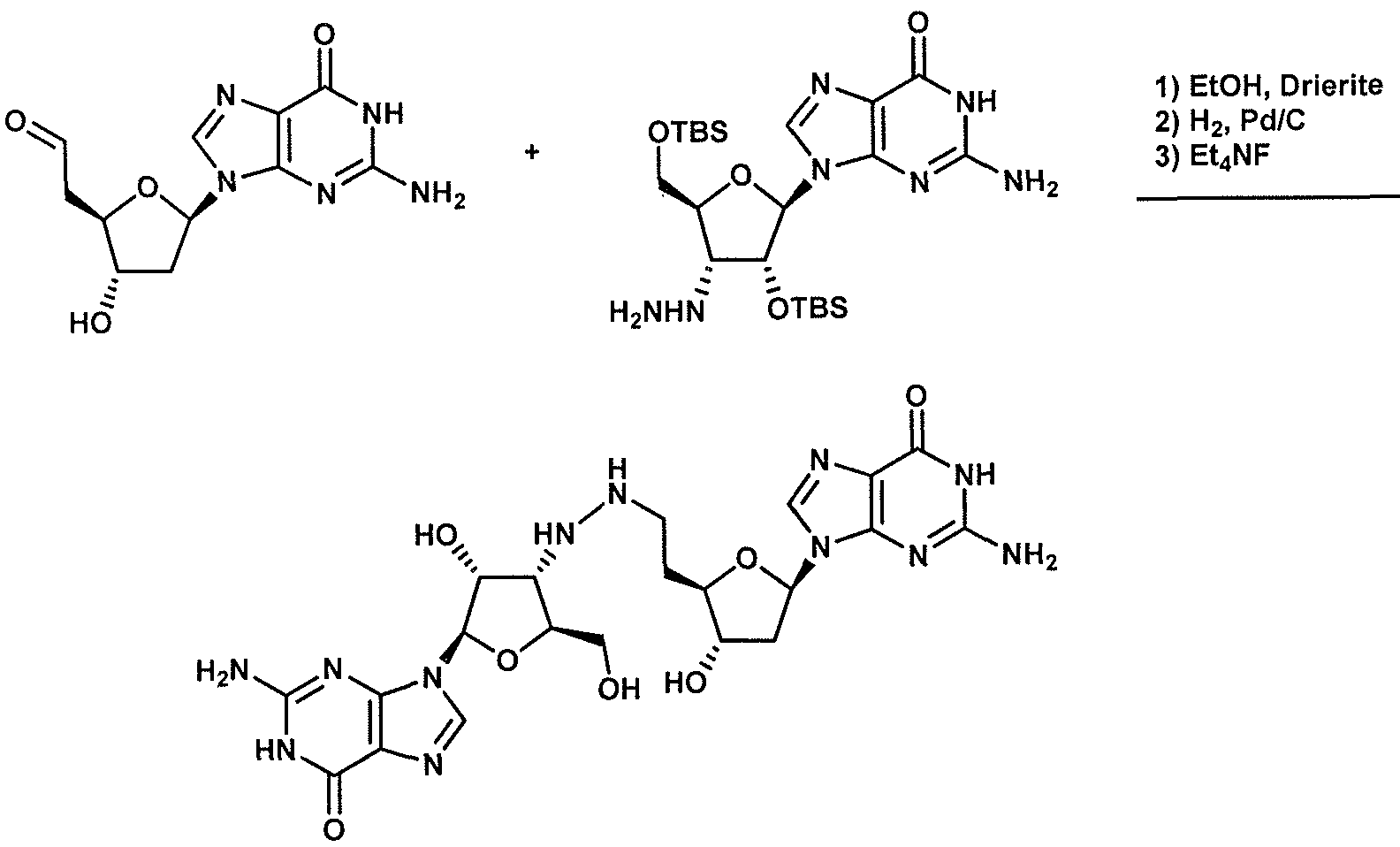
Example 6
2- Amino-9-((2R,3R,4S,5R)-4-(((2-((2R,3S,5R)-5-(2-amino-6-oxo-lH-purin-9(6H)-yl)-
3- hydroxytetrahydrofuran-2-yl)ethyl)amino)oxy)-3-hydroxy-5- ( ydroxymethyl)tetrahydrofuran-2-yl)-lH-purin-6(9H)-one
100125] The title compound is prepared according to General Procedure 3 as follows:

Example 7
2-Amino-9-((2R,3R,4S,5S)-4-(2-(((2R,3S,5R)-5-(2-amino-6-oxo-lH-purin-9(6H)-yl)-3- hydroxytetrahydrofuran-2-yl)methyl)hydrazinyI)-3-hydroxy-5-
(hydroxymethyl)tetrahydrofuran-2-yl)-lH-purin-6(9H)-one
100126] The title compound is prepared according to General Procedure 2 as follows:

Example 8
2-Amino-9-((2R,3R,4S,5R)-4-(((((2R,3S,5R)-5-(2-amino-6-oxo-lH-purin-9(6H)-yl)-3- hydroxytetrahydrofuran-2-yl)methyI)amino)oxy)-3-hydroxy-5-
(hydroxymethy!)tetrahydrofuran-2-yl)-lH-purin-6(9H)-one
100127] The title compound is prepared according to General Procedure 3 as follows:

Example 9
3-((((2R,3S,5R)-5-(2-amino-6-oxo-lH-purin-9(6H)-yI)-3-hydroxytetrahydrofuran-2- yl)methyl)amino)-4-(((2S,3S,4R,5R)-5-(2-amino-6-oxo-lH-purin-9(6H)-yl)-4- hydroxy-2-(hydroxymethyl)tetrahydrofuran-3-yl)amino)cyclobut-3-ene-l,2-dione
1001281 The title compound is prepared according to General Procedure 5 as follows:

Example 10
2- Amino-9-((2R,3R,4S,5S)-4-((2-((((2R,3S,5R)-5-(2-amino-6-oxo-lH-purin-9(6H)-yl)-
3- hydroxytetrahydrofuran-2-yl)methyl)amino)propan-2-yl)amino)-3-hydroxy-5- (hydroxymethyI)tetrahydrofuran-2-yl)-lH-purin-6(9H)-one
[00129] The title compound is prepared according to General Procedure 6 as follows:

Example 11
2- Amino-9-((2R,3R,4S,5S)-4-((2-((((2R,3S,5R)-5-(2-amino-6-oxo-lH-purin-9(6H)-yl)-
3- hydroxytetrahydrofuran-2-yl)methyl)amino)-l,1 »3?3,3-hexafluoropropan-2- yl)amino)-3-hydroxy-5-(hydroxymethyl)tetrahydrofuran-2-yl)-lH-purin-6(9H)-one
[00130] The title compound is prepared according to General Procedure 7 as follows:

Example 12
2-Amino-9-((2R,3R,4S,5S)-4-((((((2R,3S,5R)-5-(2-amino-6-oxo-lH-purin-9(6H)-yl)-3- hydroxytetrahydrofuran-2-yI)methyl)amino)dimet ylsilyl)ainino)-3-hydroxy-5-
(hydroxymethyl)tetrahydrofuran-2-yl)-lH-purin-6(9H)-one
The title compound is prepared according to General Procedure 8 as follows:
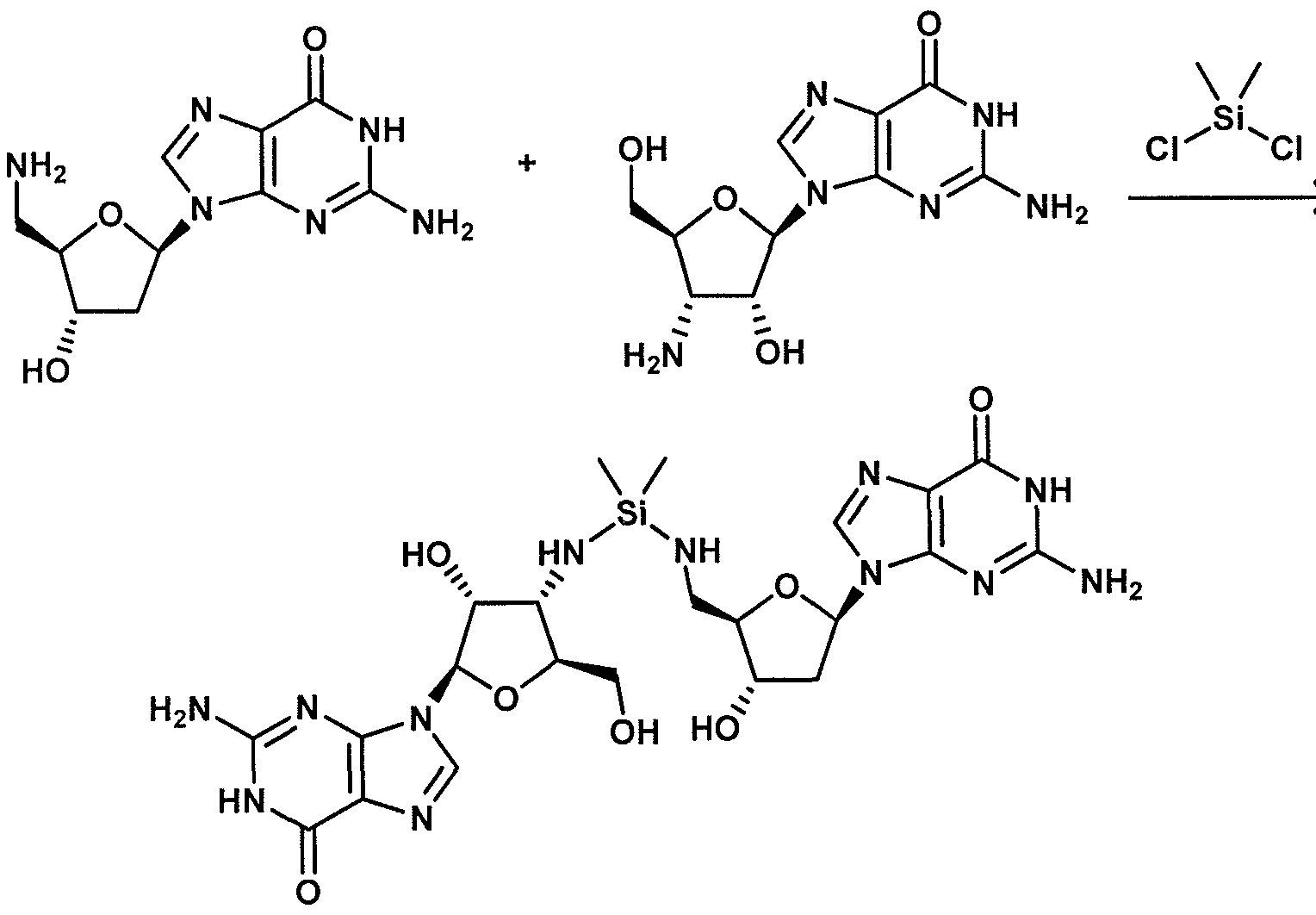
Example 13
l-(((2R,3S,5R)-5-(2-amino-6-oxo-lH-purin-9(6H)-yl)-3-hydroxytetrahydrofuran-2- yl)methyl)-3-((2S,3S,4R,5R)-5-(2-amino-6-oxo-lH-purin-9(6H)-yl)-4-hydroxy-2-
(hydroxymethyl)tetrahydrofuran-3-yl)urea
100132] The title compound is prepared according to General Procedure 9 as follows:

Example 14
2-Amino-9-((2R,3R,4S,5R)-5-((l-((2S,3S,5R)-5-(2-amino-6-oxo-lH-purin-9(6H)-yl)-2-
(hydroxymethyI)tetrahydrofuran-3-yl)-lH-l,2,3-triazol-4-yl)methyl)-3,4- dihydroxytetrahydrofuran-2-yl)-lH-purin-6(9H)-one
100133] The title compound is prepared according to General Procedure 1 as follows:

Example 15
2-Amino-9-((2R,3R,4S,5R)-5-(l-((2S,3S,5R)-5-(2-amino-6-oxo-lH-purin-9(6H)-yl)-2-
(hydroxymethyl)tetrahydrofuran-3-yl)-lH-l,2,3-triazol-4-yl)-3,4- dihydroxytetrahydrofuran-2-yl)-lH-purin-6(9H)-one
The title compound is prepared according to General Procedure 1 as follows:

Example 16
2-Amino-9-((2R,3R,4S,5S)-5-(4-((((2R,3S,5R)-5-(2-amino-6-oxo-lH-purin-9(6H)-yl)-
2-(hydroxymethyl)tetrahydrofuran-3-yl)oxy)methyl)-lH-l,2,3-triazol-l-yl)-3,4- dihydroxytetrahydrofuran-2-yl)-lH-purin-6(9H)-one
[00135] The title compound is prepared according to General Procedure 1 as follows:

Example 17
2-Amino-9-((2R,3R,4S,5R)-5-(2-(2-((2S,3S,5R)-5-(2-amino-6-oxo-lH-purin-9(6H)-yl)-
2-(hydroxymethyI)tetrahydrofuran-3-yI)hydrazinyI)ethyI)-3,4- dihydroxytetrahydrofuran-2-yl)-lH-purin-6(9H)-one
100136] The title compound is prepared according to General Procedure 2 as follows:

Example 18
2-Amino-9-((2R,3R,4S,5R)-5-(2-((((2R,3S,5R)-5-(2-amino-6-oxo-lH-purin-9(6H)-yl)-
2-(hydroxymethyl)tetrahydrofuran-3-yl)oxy)amino)ethyl)-3,4- dihydroxytetrahydrofuran-2-yI)-lH-purin-6(9H)-one
[00137] The title compound is prepared according to General Procedure 3 as follows:

Example 19
2-Amino-9-((2R,3R,4S,5R)-5-((2-((2S,3S,5R)-5-(2-amino-6-oxo-lH-purin-9(6H)-yl)-2-
(hydroxymethyl)tetrahydrofuran-3-yI)hydrazinyl)methyl)-3,4- dihydroxytetrahydrofuran-2-yl)-lH-purin-6(9H)-one
[00138] The title compound is prepared according to General Procedure 2 as follows:


Example 20
2-Amino-9-((2R,3R,4S,5R)-5-(((((2R,3S,5R)-5-(2-amino-6-oxo-lH-purin-9(6H)-yl)-2-
(hydroxymethyl)tetrahydrofuran-3-yI)oxy)amino)methyl)-3,4- dihydroxytetrahydrofuran-2-yl)-lH-purin-6(9H)-one
[00139] The title compound is prepared according to General Procedure 3 as follows:

Example 21
3-(((2S,3S,5R)-5-(2-amino-6-oxo-lH-purin-9(6H)-yl)-2-
(hydroxymethyl)tetrahydrofuran-3-yl)amino)-4-((((2R,3S,4R,5R)-5-(2-amino-6-oxo- lH-purin-9(6H)-yl)-3,4-dihydroxytetrahydrofuran-2-yl)methyl)amino)cyclobut-3- ene-l,2-dione
100140] The title compound is prepared according to General Procedure 5 as follows:

Example 22
2-Amino-9-((2R,3R,4S,5R)-5-(((2-(((2S,3S,5R)-5-(2-amino-6-oxo-lH-purin-9(6H)-yl)-
2-(hydroxymethyl)tetrahydrofuran-3-yl)amino)propan-2-yl)amino)methyI)-3,4- dihydroxytetrahydrofuran-2-yl)-lH-purin-6(9H)-one
[00141] The title compound is prepared according to General Procedure 6 as follows:

Example 23
2-Amino-9-((2R,3R,4S,5R)-5-(((2-(((2S,3S,5R)-5-(2-amino-6-oxo-lH-purin-9(6H)-yl)-
2-(hydroxymethyl)tetrahydrofuran-3-yl)amino)-l,l,l53,3,3-hexafluoropropan-2- yl)amino)methyl)-3,4-dihydroxytetrahydrofuran-2-yI)-lH-purin-6(9H)-one
|00142| The title compound is prepared according to General Procedure 7 as follows:

Example 24
2-Amino-9-((2R,3R,4S,5R)-5-((((((2S,3S,5R)-5-(2-amino-6-oxo-lH-purin-9(6H)-yl)-2-
(hydroxymethyl)tetrahydrofuran-3-yl)amino)dimethylsiIyl)amino)methyl)-3,4- dihydroxytetrahydrofuran-2-yl)-lH-purin-6(9H)-one
100143] The title compound is prepared according to General Procedure 8 as follows:

Example 25
l-((2S,3S,5R)-5-(2-amino-6-oxo-lH-purin-9(6H)-yl)-2-
(hydroxymethyI)tetrahydrofuran-3-yl)-3-(((2R,3S,4R,5R)-5-(2-amino-6-oxo-lH- purin-9(6H)-yl)-3,4-dihydroxytetrahydrofuran-2-yl)methyl)urea
[00144] The title compound is prepared according to General Procedure 9 as follows:

Example 26
2-Amino-9-((2R,4S,5R)-5-((l-((2S,3S,5R)-5-(2-amino-6-oxo-lH-purin-9(6H)-yl)-2-
(hydroxymethyl)tetrahydrofuran-3-yl)-lH-l,2,3-triazol-4-yl)methyl)-4- hydroxytetrahydrofuran-2-yl)-lH-purin-6(9H)-one
[00145] The title compound is prepared according to General Procedure 1 as follows:

Example 27
2-Amino-9-((2R,4S,5R)-5-(l-((2S,3S,5R)-5-(2-amino-6-oxo-lH-purin-9(6H)-yl)-2-
(hydroxymethyI)tetrahydrofuran-3-yl)-lH-l,2,3-triazol-4-yl)-4- hydroxytetrahydrofuran-2-yl)-lH-purin-6(9H)-one
[001461 The title compound is prepared according to General Procedure 1 as follows:

Example 28
2-Amino-9-((2R,4S,5R)-5-((4-((((2R,3S,5R)-5-(2-amino-6-oxo-lH-purin-9(6H)-yl)-2-
(hydroxymethyl)tetrahydrofuran-3-yl)oxy)methyl)-lH-l,2,3-triazol-l-yl)niethyl)-4- hydroxytetrahydrofuran-2-yl)-lH-purin-6(9H)-one
[00147] The title compound is prepared according to General Procedure 1 as follows:

Example 29
2-Amino-9-((2R,4S,5R)-5-(2-(2-((2S,3S,5R)-5-(2-amino-6-oxo-lH-purin-9(6H)-yl)-2-
(hydroxymethyI)tetrahydrofuran-3-yl)hydrazinyi)ethyl)-4-hydroxytetrahydrofuran-
2-yl)-lH-purin-6(9H)-one
[00148] The title compound is prepared according to General Procedure 2 as follows:

Example 30
2-Amino-9-((2R,4S,5R)-5-(2-((((2R,3S,5R)-5-(2-amino-6-oxo-lH-puriii-9(6H)-yl)-2-
(hydroxymethyl)tetrahydrofuran-3-yl)oxy)amino)ethyl)-4-hydroxytetrahydrofuran-
2-yl)-lH-purin-6(9H)-one
100149) The title compound is prepared according to General Procedure 3 as follows:

Example 31
2-Amino-9-((2R,4S,5R)-5-((2-((2S,3S,5R)-5-(2-amino-6-oxo-lH-purin-9(6H)-yl)-2-
(hydroxymethyl)tetrahydrofuran-3-y!)hydrazinyI)methyl)-4- hydroxytetrahydrofuran-2-yl)-lH-purin-6(9H)-one
[00150] The title compound is prepared according to General Procedure 2 as follows:

Example 32
3-(((2S,3S,5R)-5-(2-amino-6-oxo-lH-purin-9(6H)-yl)-2-
(hydroxymethyl)tetrahydrofuran-3-yl)amino)-4-((((2R,3S,5R)-5-(2-amino-6-oxo-lH- purin-9(6H)-yl)-3-hydroxytetrahydrofuran-2-yI)methyI)amino)cyclobut-3-ene-l,2- dione
[00151] The title compound is prepared according to General Procedure 5 as follows:

Example 33
2-Amino-9-((2R,4S,5R)-5-(((2-(((2S,3S,5R)-5-(2-amino-6-oxo-lH-purin-9(6H)-yl)-2-
(hydroxymethyI)tetrahydrofuran-3-yl)amino)propan-2-yl)amino)methyl)-4- hydroxytetrahydrofuran-2-yl)-lH-purin-6(9H)-one
[001521 The title compound is prepared according to General Procedure 6 as follows:

Example 34
2-Amino-9-((2R,4S,5R)-5-(((2-(((2S,3S,5R)-5-(2-amino-6-oxo-lH-purin-9(6H)-yl)-2-
(hydroxymethyl)tetrahydrofuran-3-yl)amino)-l,l?l>3,3,3-hexafluoropropan-2- yl)amino)methyl)-4-hydroxytetrahydrofuran-2-yl)-lH-purin-6(9H)-one
[00153] The title compound is prepared according to General Procedure 7 as follows:

Example 35
2-Amino-9-((2R,4S,5R)-5-((((((2S,3S,5R)-5-(2-amino-6-oxo-lH-purin-9(6H)-yl)-2-
(hydroxymethyl)tetrahydrofuran-3-yl)amino)dimethylsilyl)amino)niethyl)-4- hydroxytetrahydrofuran-2-yl)-lH-purin-6(9H)-one
[00154] The title compound is prepared according to General Procedure 8 as follows:

Example 36
l-((2S,3S,5R)-5-(2-amino-6-oxo-lH-purin-9(6H)-yl)-2-
(hydroxymethyl)tetrahydrofuran-3-yl)-3-(((2R,3S,5R)-5-(2-amino-6-oxo-lH-purin- 9(6H)-yl)-3-hydroxytetrahydrofuran-2-yl)methyl)urea
[00155] The title compound is prepared according to General Procedure 9 as follows:

Example 37
2-Amino-9-((2R,3R,4S,5S)-4-(4-(((2R,3S,4R,5R)-5-(2-amino-6-oxo-lH-purin-9(6H)- yl)-3,4-dihydroxytetrahydrofuran-2-yl)methyI)-lH-l,2,3-triazoI-l-yI)-3-hydroxy-5- (hydroxymethyl)tetrahydrofuran-2-yl)-lH-purin-6(9H)-one
[00156] The title compound is prepared according to General Procedure 1 as follows:

Example 38
2-Amino-9-((2R,3R,4S,5S)-4-(4-((2R,3S,4R,5R)-5-(2-amino-6-oxo-lH-purin-9(6H)- yl)-3,4-dihydroxytetrahydrofuran-2-yl)-lH-l,2,3-triazol-l-yl)-3-hydroxy-5-
(hydroxymethyl)tetrahydrofuran-2-yl)-lH-purin-6(9H)-one
[00157] The title compound is prepared according to General Procedure 1 as follows:

Example 39
2-Amino-9-((2R,3R,4S,5R)-5-((4-((((2R,3S,5R)-5-(2-amino-6-oxo-lH-purin-9(6H)-yl)-
2-(hydroxymethyl)tetrahydrofuran-3-yl)oxy)methyl)-lH-l,2,3-triazol-l-yI)methyl)-
3,4-dihydroxytetrahydrofuran-2-yl)-lH-purin-6(9H)-one
The title compound is prepared according to General Procedure 1 as follows:

Example 40
2-Amino-9-((2R,3R,4S,5S)-4-(2-(2-((2R,3S,4R,5R)-5-(2-amino-6-oxo-lH-purin-9(6H)- yI)-3,4-dihydroxytetrahydrofuran-2-yl)ethyI)hydrazinyI)-3-hydroxy-5-
(hydroxymethyl)tetrahydrofuran-2-yl)-lH-purin-6(9H)-one
[00159] The title compound is prepared according to General Procedure 2 as follows:

Example 41
2-Amino-9-((2R,3R,4S,5R)-4-(((2-((2R,3S,4R,5R)-5-(2-amino-6-oxo-lH-purin-9(6H)- yl)-3,4-dihydroxytetrahydrofuran-2-yl)ethyl)amino)oxy)-3-hydroxy-5-
(hydroxymethyl)tetrahydrofuran-2-yI)-lH-purin-6(9H)-one
[00160] The title compound is prepared according to General Procedure 3 as follows:

Example 42
2-Amino-9-((2R,3R,4S,5S)-4-(2-(((2R,3S,4R,5R)-5-(2-amino-6-oxo-lH-purin-9(6H)- yI)-3,4-dihydroxytetrahydrofuran-2-yl)methyl)hydrazinyl)-3-hydroxy-5-
(hydroxymethyl)tetrahydrofuran-2-yl)-lH-purin-6(9H)-one
[00161 ) The title compound is prepared according to General Procedure 2 as follows:

Example 43
3-((((2R,3S,4R,5R)-5-(2-amino-6-oxo-lH-purin-9(6H)-yl)-3,4- dihydroxytetrahydrofuran-2-yI)methyl)amino)-4-(((2S,3S,4R,5R)-5-(2-amino-6-oxo- lH-purin-9(6H)-yl)-4-hydroxy-2-(hydroxymethyl)tetrahydrofuran-3- yl)amino)cyc!obut-3-ene-l,2-dione
100162] The title compound is prepared according to General Procedure 5 as follows:

Example 44
2-Amino-9-((2R,3R,4S,5S)-4-((2-((((2R,3S,4R,5R)-5-(2-amino-6-oxo-lH-purin-9(6H)- yl)-3,4-dihydroxytetrahydrofuran-2-yl)methyl)amino)propan-2-yl)amino)-3-hydroxy-
5-(hydroxymethyl)tetrahydrofuran-2-yI)-lH-purin-6(9H)-one
100163] The title compound is prepared according to General Procedure 6 as follows:

Example 45
2-Amino-9-((2R,3R,4S,5S)-4-((2-((((2R,3S,4R,5R)-5-(2-amino-6-oxo-lH-purin-9(6H)- yl)-3,4-dihydroxytetrahydrofuran-2-yl)methyl)amino)-l,l,l,3,3,3-hexafluoropropan- 2-yl)amino)-3-hydroxy-5-(hydroxymethyl)tetrahydrofuran-2-yl)-lH-purin-6(9H)-one
[00164] The title compound is prepared according to General Procedure 7 as follows:

Example 46
2-Amino-9-((2R,3R,4S,5S)-4-((((((2R,3S,4R,5R)-5-(2-amino-6-oxo-lH-purin-9(6H)- yl)-3,4-dihydroxytetrahydrofuran-2-yl)methyl)amino)dimethyIsilyl)amino)-3- hydroxy-5-(hydroxymethyl)tetrahydrofuran-2-yI)-lH-purin-6(9H)-one
[001651 The title compound is prepared according to General Procedure 8 as follows:

Example 47
l-(((2R,3S,4R,5R)-5-(2-amino-6-oxo-lH-purin-9(6H)-yl)-3,4- d ihyd roxy tetrahyd rofu ran-2-yl)methyl)-3-((2S,3S,4R,5R)-5-(2-amino-6-oxo-lH- purin-9(6H)-yl)-4-hydroxy-2-(hydroxymethyl)tetrahydrofuran-3-yl)urea
[00166] The title compound is prepared according to General Procedure 9 as follows:

Example 48
2-amino-9-((2R,3R,4S,5R)-5-((((((2S,3S,5R)-5-(2-amino-6-oxo-lH-purin-9(6H)-yI)-2-
(hydroxymethyl)tetrahydrofuran-3-yl)sulfamide)methyl)-3,4- dihydroxytetrahydrofuran-2-yl)-lH-purin-6(9H)-one
The title compound is prepared according to General Procedure 4 as follows:

Example 49
2-amino-9-((2R,3R,4S,5R)-5-((((((2S,3S,5R)-5-(2-amino-6-oxo-lH-purin-9(6H)-yl)-2-
(hydroxymethyl)tetrahydrofuran-3-yl)sulfamide)methyl)-3,4- dihydroxytetrahydrofuran-2-yl)-lH-purin-6(9H)-one
[00168] The title compound is prepared according to General Procedure 4 as follows:

Example 50
2-amino-9-((2R,4S,5R)-5-((((((2S,3S,5R)-5-(2-amino-6-oxo-lH-purin-9(6H)-yl)-2-
(hydroxymethyl)tetrahydrofuran-3-yl)sulfamide)methyl)-4-hydroxytetrahydrofuran-
2-yl)-lH-purin-6(9H)-one
[00169] The title compound is prepared according to General Procedure 4 as follows:

Example 51
2-amino-9-((2R,3R,4S,5S)-4-((((((2R,3S,4R,5R)-5-(2-amino-6-oxo-lH-purin-9(6H)- yl)-3,4-dihydroxytetrahydrofuran-2-yl)methyl)sulfamide)-3-hydroxy-5-
(hydroxymethyl)tetrahydrofuran-2-yl)-lH-purin-6(9H)-one
[001701 The title compound is prepared according to General Procedure 4 as follows:

Example 52
((2S,3S,4R,5R)-5-(2-amino-6-oxo-lH-purin-9(6H)-yI)-3-(4-(((2R,3S,4R,5R)-5-(2- amino-6-oxo-lH-purin-9(6H)-yI)-3,4-dihydroxytetrahydrofuran-2-yl)methyl)-lH- l,2,3-triazol-l-yl)-4-hydroxytetrahydrofuran-2-yl)methyl 5-((3aS,4S,6aR)-2- oxohexahydro-lH-thieno[3,4-d]imidazol-4-yl)pentanoate
[00171 ] The title compound is prepared as follows, generally according to the related reaction procedures of Wulff, J. J ACS, 2007, 129, 4898:

(2R,3S,4R,5R)-5-(2-amino-6-oxo-lH-purin-9(6H)-yl)-2-((l-((2S,3S,4R,5R)-5-(2- amino-6-oxo-lH-purin-9(6H)-yI)-4-hydroxy-2-(hydroxymethyl)tetrahydrofuran-3- yl)-lH-l,2,3-triazol-4-yl)methyI)-4-hydroxytetrahydrofuran-3-yl 5-((3aS,4S,6aR)-2- oxohexahydro-lH-thieno[3,4-d]imidazol-4-yl)pentanoate
The title compound is prepared as follows:

Example 54
2-amino-9-((2R,3R,4S,5R)-5-((l-((2S,3S,4R,5R)-5-(2-amino-6-oxo-lH-purin-9(6H)- yl)-2-((((4R)-4-(3-chlorophenyl)-2-oxido-l,3,2-dioxaphosphinan-2-yl)oxy)methyl)-4- hydroxytetrahydrofuran-3-yl)-lH-l,2,3-triazol-4-yl)methyl)-3,4- dihydroxytetrahydrofuran-2-yl)-lH-purin-6(9H)-one
100173] The title compound is prepared as follows, generally according to the related reaction procedures of Das, A. et al, J. Med Chem. 2010, 53, 471 :

where "PNP" means 7-nitrophenol.
Example 55
((2S,3S,4R,5R)-5-(2-amino-6-oxo-lH-purin-9(6H)-yI)-3-(4-(((2R,3S,4R,5R)-5-(2- amino-6-oxo-lH-purin-9(6H)-yl)-3,4-dihydroxytetrahydrofuran-2-yI)methyl)-lH- l,2,3-triazol-l-yl)-4-hydroxytetrahydrofuran-2-yl)methyl dihydrogen phosphate
[00174] The title compound is prepared as follows, generally according to the related reaction procedures of Das, A. et al, J. Med Chem. 2010, 53, 471 :

[00175] The biofilm-formation inhibitory concentration of a compound can be determined as follows, according to the method of O'Toole et al, Mol. Microbiol. 1998, 28, 449. A known concentration of compound is added independently to a 96-well polyvinylchloride plastic microtitre dish containing planktonic P. aeruginosa cells suspended in M63 media with 0.2% glucose, ImM MgSC^, 0.5%) casamino acids, 0.4% citric acid, and 0.4% glutamic acid. The plates are incubated at room temperature for 15 min, rinsed thoroughly and repeatedly with water and scored for the formation of biofilm.
[00176] All references cited with respect to synthetic, preparative and analytical procedures are incorporated herein by reference.
[00177] The present invention may be embodied in other specific forms without departing from the spirit or essential attributes thereof and, accordingly, reference should be made to the appended claims, rather than to the foregoing specification, as indication the scope of the invention.
Claims
What is claimed is:
Formula I or a salt thereof:

wherein:
L is selected from the group consisting of:

R2 is selected from the group consisting of:
hydrogen,

P 3 is selected from the group consisting of:
hydrogen,
-P03H2,

Pv4 is selected from the group consisting of hydrogen, hydroxyl, (Ci-C6)alkyl,
 C6)alkyloxy and -OP03H2.
2. A compound according to claim 1 , or a salt thereof, wherein at least one of Ri _ R2, R3, and R4 is hydrogen
3. A compound according to claim 2 or a salt thereof, wherein at least one of

4. A compound according to claim 2, wherein L is:

5. A compound according to claim 1 , or a salt thereof, selected from the group consisting of:
2-amino-9-((2R,3R,4S,5S)-4-(4-(((2R,3S,5R)-5-(2-amino-6-oxo-l H-purin-9(6H)- yl)-3-hydroxytetrahydrofuran-2-yl)methyl)-l H- l,2,3-triazol- l -yl)-3-hydroxy-5- (hydroxymethyl)tetrahydrofuran-2-yl)-l H-purin-6(9H)-one;
2-amino-9-((2R,3R,4S,5S)-4-(4-((2R,3S,5R)-5-(2-amino-6-oxo- lH-purin-9(6H)- yl)-3-hydroxytetrahydrofuran-2-yl)-lH-l ,2,3-triazol-l -yl)-3-hydroxy-5- (hydroxymethyl)tetrahydrofuran-2-yl)-lH-purin-6(9H)-one;
2-amino-9-((2R,3R,4S,5R)-4-((l -((2S,3S,5R)-5-(2-amino-6-oxo- lH-purin-9(6H)- yl)-3-hydroxytetrahydrofuran-2-yl)-l H- l,2,3-triazol-4-yl)methoxy)-3-hydroxy-5- (hydroxymethyl)tetrahydrofuran-2-yl)- 1 H-purin-6(9H)-one;
2-amino-9-((2R,3R,4S,5S)-4-(2-(2-((2R,3S,5R)-5-(2-amino-6-oxo-lH-purin- 9(6H)-yl)-3-hydroxytetrahydrofuran-2-yl)ethyl)hydrazinyl)-3-hydroxy-5- (hydroxymethy])tetrahydrofuran-2-yl)-l H-purin-6(9H)-one;
2-amino-9-((2R,3R,4S,5R)-4-(((2-((2R,3S,5R)-5-(2-amino-6-oxo-lH-purin-9(6H)- yl)-3-hydroxytetrahydrofuran-2-yl)ethyl)amino)oxy)-3-hydroxy-5- (hydroxymethyl)tetrahydrofuran-2-yl)- 1 H-purin-6(9H)-one;
2-amino-9-((2R,3R,4S,5S)-4-(2-(((2R,3S,5R)-5-(2-amino-6-oxo-lH-purin-9(6H)- yl)-3-hydroxytetrahydrofuran-2-yl)methyl)hydrazinyl)-3-hydroxy-5- (hydroxymethy l)tetrahydrofuran-2-yl)- 1 H-purin-6(9H)-one;
2- amino-9-((2R,3R,4S,5R)-4-(((((2R,3S,5R)-5-(2-amino-6-oxo-lH-purin-9(6H)- yl)-3-hydroxytetrahydrofuran-2-yl)methyl)amino)oxy)-3-hydroxy-5- (hydroxymethyl)tetrahydrofuran-2-yl)-l H-purin-6(9H)-one;
3- ((((2R,3S,5R)-5-(2-amino-6-oxo-lH-purin-9(6H)-yl)-3-hydroxytetrahydrofuran- 2-yl)methyl)amino)-4-(((2S,3S,4R,5R)-5-(2-amino-6-oxo-l H-purin-9(6H)-yl)-4-hydroxy- 2-(hydroxymethyl)tetrahydrofuran-3-yl)amino)cyclobut-3-ene-l ,2-dione;
2-amino-9-((2R,3R,4S,5S)-4-((2-((((2R,3S,5R)-5-(2-amino-6-oxo-lH-purin- 9(6H)-yl)-3-hydroxytetrahydrofuran-2-yl)methyl)amino)propan-2-yl)amino)-3-hydroxy-5- (hydroxymethyl)tetrahydrofuran-2-yl)-lH-purin-6(9H)-one;
2-amino-9-((2R,3R,4S,5 S)-4-((2-((((2R,3 S,5R)-5 -(2-amino-6-oxo- 1 H-purin- 9(6H)-yl)-3-hydroxytetrahydrofuran-2-yl)methyl)amino)-l , l ,l,3,3,3-hexafluoropropan-2- yl)amino)-3-hydroxy-5-(hydroxymethyl)tetrahydrofuran-2-yl)-lH-purin-6(9H)-one;
2-amino-9-((2R,3R,4S,5S)-4-((((((2R,3S,5R)-5-(2-amino-6-oxo-lH-purin-9(6H)- yl)-3-hydroxytetrahydrofuran-2-yl)methyl)amino)dimethylsilyl)amino)-3-hydroxy-5- (hydroxymethyl)tetrahydrofuran-2-yl)- 1 H-purin-6(9H)-one;
1 - (((2R,3S,5R)-5-(2-amino-6-oxo-lH-purin-9(6H)-yl)-3-hydroxytetrahydrofuran- 2-yl)methyl)-3-((2S,3S,4R,5R)-5-(2-amino-6-oxo-lH-purin-9(6H)-yl)-4-hydroxy-2- (hydroxymethyl)tetrahydrofuran-3-yl)urea;
2- amino-9-((2R,3R,4S,5R)-5-((l -((2S,3S,5R)-5-(2-amino-6-oxo-lH-purin-9(6H)- yl)-2-(hydroxymethyl)tetrahydrofuran-3-yl)-l H-l ,2,3-triazol-4-yl)methyl)-3,4- dihydroxytetrahydrofuran-2-yl)-l H-purin-6(9H)-one;
2-amino-9-((2R,3R,4S,5R)-5-(l-((2S,3S,5R)-5-(2-amino-6-oxo-lH-purin-9(6H)- yl)-2-(hydroxymethyl)tetrahydrofuran-3-yl)-lH-l,2,3-triazol-4-yl)-3,4- dihydroxytetrahydrofuran-2-yl)-l H-purin-6(9H)-one;
2-amino-9-((2R,3R,4S,5S)-5-(4-((((2R,3S,5R)-5-(2-amino-6-oxo-lH-purin-9(6H)- yl)-2-(hydroxymethyl)tetrahydrofuran-3-yl)oxy)methyl)-lH-l ,2,3-triazol-l-yl)-3,4- dihydroxytetrahydrofuran-2-yl)-l H-purin-6(9H)-one;
2-amino-9-((2R,3R,4S,5R)-5-(2-(2-((2S,3S,5R)-5-(2-amino-6-oxo-lH-purin- 9(6H)-yl)-2-(hydroxymethyl)tetrahydrofuran-3-yl)hydrazinyl)ethyl)-3,4- d ihydroxytetrahydrofuran-2-yl)- 1 H-purin-6(9H)-one;
2-amino-9-((2R,3R,4S,5R)-5-(2-((((2R,3S,5R)-5-(2-amino-6-oxo-lH-purin-9(6H)- yl)-2-(hydroxymethyl)tetrahydrofuran-3-yl)oxy)amino)ethyl)-3,4- dihydroxytetrahydrofuran-2-yl)-l H-purin-6(9H)-one;
2-amino-9-((2R,3R,4S,5R)-5-((2-((2S,3S,5R)-5-(2-amino-6-oxo-lH-purin-9(6H)- yl)-2-(hydroxymethyl)tetrahydrofuran-3-yl)hydrazinyl)methyl)-3,4- dihydroxytetrahydrofuran-2-yl)-lH-purin-6(9H)-one;
2- amino-9-((2R,3R,4S,5R)-5-(((((2R,3S,5R)-5-(2-amino-6-oxo-lH-purin-9(6H)- yl)-2-(hydroxymethyl)tetrahydrofuran-3-yl)oxy)amino)methyl)-3,4- d ihydroxytetrahydrofuran-2-yl)- 1 H-purin-6(9H)-one;
3- (((2S,3S,5R)-5-(2-amino-6-oxo-lH-purin-9(6H)-yl)-2- (hydroxymethyl)tetrahydrofuran-3-yl)amino)-4-((((2R,3S,4R,5R)-5-(2-amino-6-oxo-lH- purin-9(6H)-yl)-3,4-dihydroxytetrahydrofuran-2-yl)methyl)amino)cyclobut-3-ene-l ,2- dione;
2-amino-9-((2R,3R,4S,5R)-5-(((2-(((2S,3S,5R)-5-(2-amino-6-oxo-lH-purin- 9(6H)-yl)-2-(hydroxymethyl)tetrahydrofuran-3-yl)amino)propan-2-yl)amino)methyl)-3,4- dihydroxytetrahydrofuran-2-yl)- 1 H-purin-6(9H)-one;
2-amino-9-((2R,3R,4S,5R)-5-(((2-(((2S,3S,5R)-5-(2-amino-6-oxo-lH-purin- 9(6H)-yl)-2-(hydroxymethyl)tetrahydrofuran-3-yl)amino)-l, l, l,3,3,3-hexafluoropropan-2- yl)amino)methyl)-3,4-dihydroxytetrahydrofuran-2-yl)-l H-purin-6(9H)-one;
2-amino-9-((2R,3R,4S,5R)-5-((((((2S,3S,5R)-5-(2-amino-6-oxo-lH-purin-9(6H)- yl)-2-(hydroxymethyl)tetrahydrofuran-3-yl)amino)dimethylsilyl)amino)methyl)-3,4- dihydroxytetrahydrofuran-2-yl)-l H-purin-6(9H)-one;
1 - ((2S,3S,5R)-5-(2-amino-6-oxo-lH-purin-9(6H)-yl)-2- (hydroxymethyl)tetrahydrofuran-3-yl)-3-(((2R,3S,4R,5R)-5-(2-amino-6-oxo-lH-purin- 9(6H)-yl)-3,4-dihydroxytetrahydrofuran-2-yl)methyl)urea;
2- amino-9-((2R,4S,5R)-5-((l -((2S,3S,5R)-5-(2-amino-6-oxo-lH-purin-9(6H)-yl)- 2-(hydroxymethyl)tetrahydrofuran-3-yl)-l H-l ,2,3-triazol-4-yl)methyl)-4- hydroxytetrahydrofuran-2-yl)- 1 H-purin-6(9H)-one;
2-amino-9-((2R,4S,5R)-5-(l -((2S,3S,5R)-5-(2-amino-6-oxo-l H-purin-9(6H)-yl)-2- (hydroxymethyl)tetrahydrofuran-3-yl)-l H-l ,2,3-triazol-4-yl)-4-hydroxytetrahydrofuran-2- yl)- 1 H-purin-6(9H)-one;
2-amino-9-((2R,4S,5R)-5-((4-((((2R,3S,5R)-5-(2-amino-6-oxo-l H-purin-9(6H)- yI)-2-(hydroxymethyI)tetrahydrofuran-3-yl)oxy)methyI)-l H-l,2,3-triazol- l-yI)methyI)-4 hydroxytetrahydrofuran-2-yl)-l H-purin-6(9H)-one;
2-amino-9-((2R,4S,5R)-5-(2-(2-((2S,3S,5R)-5-(2-amino-6-oxo-lH-purin-9(6H)- yl)-2-(hydroxymethyl)tetrahydrofuran-3-yl)hydrazinyl)ethyl)-4-hydroxytetrahydrofuran-2- yl)- 1 H-purin-6(9H)-one;
2- amino-9-((2R,4S,5R)-5-(2-((((2R,3S,5R)-5-(2-amino-6-oxo-l H-purin-9(6H)-yl)- 2-(hydroxymethyl)tetrahydiOfuran-3-yl)oxy)amino)ethyl)-4-hydroxytetrahydrofuran-2- yl)- 1 H-purin-6(9H)-one;
3- (((2S,3S,5R)-5-(2-amino-6-oxo-l H-purin-9(6H)-yl)-2- (hydroxymethyl)tetrahydrofuran-3-yl)amino)-4-((((2R,3S,5R)-5-(2-amino-6-oxo-l H- purin-9(6H)-yl)-3-hydroxytetrahydrofuran-2-yl)methyl)amino)cyclobut-3-ene-l ,2-dione;
2-amino-9-((2R,4S,5R)-5-(((((2R,3S,5R)-5-(2-amino-6-oxo- l H-purin-9(6H)-yl)-2- (hydroxymethyl)tetrahydrofuran-3-yl)oxy)amino)methyl)-4-hydroxytetrahydrofuran-2-yl)- l H-purin-6(9H)-one;
2-amino-9-((2R,4S,5R)-5-(((2-(((2S,3S,5R)-5-(2-amino-6-oxo-lH-purin-9(6H)- yl)-2-(hydroxymethyl)tetrahydrofuran-3-yl)amino)propan-2-yl)amino)methyl)-4- hydroxytetrahydrofuran-2-yl)-l H-purin-6(9H)-one;
2-amino-9-((2R,4S,5R)-5-(((2-(((2S,3S,5R)-5-(2-amino-6-oxo-l H-purin-9(6H)- yl)-2-(hydroxymethyl)tetrahydrofuran-3-yl)amino)- 1, 1 , 1 ,3,3,3-hexafluoropropan-2- y l)am i no)methy l)-4-hydroxytetrahydrofuran-2-yl)- 1 H-purin-6(9H)-one;
2-amino-9-((2R,4S,5R)-5-((((((2S,3S,5R)-5-(2-amino-6-oxo-lH-purin-9(6H)-yl)- 2-(hydroxymethyl)tetrahydrofuran-3-yl)amino)dimethylsilyl)arnino)methyl)-4- hydroxytetrahydrofuran-2-y 1)- 1 H-purin-6(9H)-one;
1 - ((2S,3S,5R)-5-(2-amino-6-oxo- lH-purin-9(6H)-yl)-2- (hydroxymethyl)tetrahydrofuran-3-yl)-3-(((2R,3S,5R)-5-(2-amino-6-oxo-l H-purin-9(6H)- yl)-3-hydroxytetrahydrofuran-2-yl)methyl)urea;
2- amino-9-((2R,3R,4S,5S)-4-(4-(((2R,3S,4R>5R)-5-(2-amino-6-oxo-l H-purin- 9(6H)-yl)-3,4-dihydroxytetrahydrofuran-2-y])methyl)-l H-l ,2,3-triazol-l -y])-3-hydroxy-5- (hydroxymethyl)tetrahydrofuran-2-yl)-l H-purin-6(9H)-one;
2-amino-9-((2R,3R,4S,5S)-4-(4-((2R,3S,4R,5R)-5-(2-amino-6-oxo-lH-purin- 9(6H)-yl)-3,4-dihydroxytetrahydrofuran-2-yl)-lH-l,2,3-triazol-l -yl)-3-hydroxy-5- (hydroxymethyl)tetrahydrofuran-2-yl)- 1 H-purin-6(9H)-one;
2-amino-9-((2R,3R,4S,5R)-5-((4-((((2R,3S,5R)-5-(2-amino-6-oxo-lH-purin- 9(6H)-yl)-2-(hydroxymethyl)tetrahydrofuran-3-yl)oxy)methyl)-lH-l,2,3-triazol-l - yl)methyl)-3,4-dihydroxytetrahydrofuran-2-yl)-lH-purin-6(9H)-one;
2-amino-9-((2R,3R,4S,5S)-4-(2-(2-((2R,3S,4R,5R)-5-(2-amino-6-oxo-lH-purin- 9(6H)-yl)-3,4-dihydroxytetrahydrofuran-2-yl)ethyl)hydrazinyl)-3-hydroxy-5- (hydroxymethyl)tetrahydrofuran-2-yl)- 1 H-purin-6(9H)-one;
2-amino-9-((2R,3R,4S,5R)-4-(((2-((2R,3S,4R,5R)-5-(2-amino-6-oxo-lH-purin- 9(6H)-yl)-3,4-dihydroxytetrahydrofuran-2-yl)ethyl)amino)oxy)-3-hydroxy-5- (hydroxymethyl)tetrahydrofuran-2-yl)- 1 H-purin-6(9H)-one;
2- amino-9-((2R,3R,4S,5S)-4-(2-(((2R,3S!4R,5R)-5-(2-amino-6-oxo-lH-purin- 9(6H)-yl)-3,4-dihydroxytetrahydrofuran-2-yl)methyl)hydrazinyl)-3-hydroxy-5- (hydroxymethyl)tetrahydrofuran-2-yl)-l H-purin-6(9H)-one;
3- ((((2R,3S,4R,5R)-5-(2-amino-6-oxo-l H-purin-9(6H)-yl)-3,4- dihydroxytetrahydrofuran-2-yl)methyl)amino)-4-(((2S,3S,4R,5R)-5-(2-amino-6-oxo-lH- purin-9(6H)-yl)-4-hydroxy-2-(hydroxymethyl)tetrahydrofuran-3-yl)amino)cyclobut-3-ene- 1 ,2-dione;
2-amino-9-((2R,3R,4S,5S)-4-((2-((((2R,3S,4R,5R)-5-(2-amino-6-oxo-lH-purin- 9(6H)-yl)-3,4-dihydroxytetrahydrofuran-2-yl)methyl)amino)propan-2-yl)amino)-3- hydroxy-5-(hydroxymethyl)tetrahydrofuran-2-yl)-lH-purin-6(9H)-one;
2-amino-9-((2R,3R,4S,5S)-4-((2-((((2R,3S,4R,5R)-5-(2-amino-6-oxo-lH-purin- 9(6H)-yl)-3,4-dihydroxytetrahydrofuran-2-yl)methyl)amino)-l , 1, 1 , 3,3,3- hexafluoropropan-2-yl)amino)-3-hydroxy-5-(hydroxymethyl)tetrahydrofuran-2-yl)-l H- purin-6(9H)-one;
2-amino-9-((2R,3R,4S,5S)-4-((((((2R,3S,4R,5R)-5-(2-amino-6-oxo-lH-purin- 9(6H)-yl)-3,4-dihydroxytetrahydrofuran-2-yl)methyl)amino)dimethylsilyl)amino)-3- hydroxy-5-(hydroxymethyl)tetrahydrofuran-2-yl)- lH-purin-6(9H)-one;
1 -(((2R,3 S,4R,5R)-5-(2-amino-6-oxo- 1 H-purin-9(6H)-yl)-3,4- dihydroxytetrahydrofuran-2-yl)methyI)-3-((2S,3S,4R,5R)-5-(2-amino-6-oxo-lH-purin- 9(6H)-yl)-4-hydroxy-2-(hydroxymethyl)tetrahydrofuran-3-yl)urea;

((2S,3S,4R,5R)-5-(2-amino-6-oxo-lH-purin-9(6H)-yl)-3-(4-(((2R,3S,4R,5R)-5-(2- amino-6-oxo-l H^urin-9(6H)-yl)-3,4-dihydroxytetrahydrofuran-2-yl)methyl)-lH-l ,2,3- triazol- l -yl)-4-hydroxytetrahydrofuran-2-yl)methyl 5-((3aS,4S,6aR)-2-oxohexahydro-l H- thieno[3,4-d]imidazol-4-yl)pentanoate;
(2R,3S,4R,5R)-5-(2-amino-6-oxo-lH-purin-9(6H)-yl)-2-((l -((2S,3S,4R,5R)-5-(2- amino-6-oxo- l H-purin-9(6H)-yl)-4-hydroxy
l ,2,3-triazol-4-yl)methyl)-4-hydroxytetrahydrofuran-3-yl 5-((3aS,4S,6aR)-2- oxohexahydro-l H-thieno[3,4-d]imidazol-4-yl)pentanoate;
2- amino-9-((2R,3R,4S,5R)-5-((l -((2S,3S,4R,5R)-5-(2-amino-6-oxo-l H-purin- 9(6H)-yl)-2-((((4R)-4-(3-chlorophenyl)-2-oxido-l ,3,2-dioxaphosphinan-2-yl)oxy)methyl)- 4-hydroxytetrahydrofuran-3-yl)-l H-l ,2,3-triazol-4-yl)methyl)-3,4- dihydroxytetrahydrofuran-2-yl)-l H-purin-6(9H)-one; and
((2S,3S,4R,5R)-5-(2-amino-6-oxo-lH-purin-9(6H)-yl)-3-(4-(((2R,3S,4R,5R)-5-(2- amino-6-oxo- l H-purin-9(6H)-yl)-3,4-dihydroxytetrahydrofuran-2-yl)methyl)-lH-l ,2,3- triazol- 1 -y l)-4-hydroxytetrahydrofuran-2-yl)methyl dihydrogen phosphate.
6. A compound according to claim 5, selected from the group consisting of:
3- ((((2R,3S,5R)-5-(2-amino-6-oxo-lH-purin-9(6H)-yl)-3-hydroxytetrahydrofuran- 2-yl)methyl)amino)-4-(((2S,3S,4R,5R)-5-(2-amino-6-oxo-lH-purin-9(6H)-yl)-4-hydroxy- 2-(hydroxymethyl)tetrahydrofuran-3-yl)amino)cyclobut-3-ene-l ,2-dione;
3-((((2R,3S,4R,5R)-5-(2-amino-6-oxo-l H-purin-9(6H)-yl)-3,4- dihydroxytetrahydrofuran-2-yl)methyl)amino)-4-(((2S,3S,4R,5R)-5-(2-amino-6-oxo- l H- purin-9(6H)-yl)-4-hydroxy-2-(hydroxymethyl)tetrahydrofuran-3-yl)amino)cyclobut-3-ene- 1 ,2-dione, and a salt thereof.
7. A process for preparing a compound of Formula I according to claim 1 , said process comprising:
reacting a compound of Formula lb:


wherein:
L is selected from the group consisting of:

Ri is selected from the group consisting of hydrogen, hydroxyl, (Ci-C6)alkyl, (d- C6)alkyloxy and -OP03H2;
R2 is selected from the group consisting of:
hydrogen,
-

R3 is selected from the group consisting of:
hydrogen,
-P03H2,

R4 is selected from the group consisting of hydrogen, hydroxyl, (Ci-C6)alkyl, (Cj- C6)alkyloxy and -OP03H2.
8. A method of treating an individual suffering from a bacterial infection, comprising administering to the individual an effective amount of at least one compound or a pharmaceutically acceptable salt thereof, according to claim 1.
9. A method of preventing bacterial infection in an individual, comprising administering to the individual an effective amount of at least one compound or a pharmaceutically acceptable salt thereof, according to claim 1.
10. A method of reducing the risk of bacterial infection in an individual, comprising administering to the individual an effective amount of at least one compound or a pharmaceutically acceptable salt thereof, according to claim 1.
1 1. A method according any of claims 8, 9, or 10,
comprising administering to the individual an effective amount of:
3-((((2R,3S,5R)-5-(2-amino-6-oxo-l H-purin-9(6H)-yl)-3-hydroxytetrahydrofuran- 2-yl)methyl)amino)-4-(((2S,3S,4R,5R)-5-(2-amino-6-oxo-lH-purin-9(6H)-yl)-4-hydroxy- 2-(hydroxymethyl)tetrahydrofuran-3-yl)amino)cyclobut-3-ene-l ,2-dione;
3-((((2R,3S,4R,5R)-5-(2-amino-6-oxo-l H-purin-9(6H)-yl)-3,4- dihydroxytetrahydrofuran-2-yl)methyl)amino)-4-(((2S,3S,4R,5R)-5-(2-amino-6-oxo-lH-
purin-9(6H)-yl)-4-hydroxy-2-(hydroxymethyl)tetrahydrofuran-3-yl)amino)cyclobut-3-ene- 1 ,2-dione; or
a pharmaceutically acceptable salt thereof.
12. A method according to any of claims 8, 9 or 10, wherein the bacterial infection is infection by at least one bacteria from the group consisting of: Pseudomonas aeruginosa; Pseudomonas fluorescens; Yersinas pestis; Vibrio cholerae; Salmonella enterica; Salmonella Typhimurium; Legionella pneumophia; Brucella melitensis;
Bordetella pertussis; Streptococcus mutans; Acinetobacter baumannii; Staphylococcus aureus; Escherichia coli; and Bacillus anthracis.
1 3. A method of identifying pGpG-binding domains in bacteria comprising contacting a compound of claim 1 or salt thereof with a bacteria or fraction thereof and detecting the binding of said compound or salt with a pGpG-binding domain in said bacteria or fraction.
14. A method according to claim 13, wherein the compound or salt is detectably labeled.
15. A method according claim 13 or 14, wherein the compound is
((2S,3S,4R,5R)-5-(2-amino-6-oxo-lH-purin-9(6H)-yl)-3-(4-(((2R,3S,4R,5R)-5-(2- amino-6-oxo- l H-purin-9(6H)-yl)-3,4-dihydroxytetrahydrofuran-2-yl)methyl)-lH-l,2,3- triazol-l -yl)-4-hydroxytetrahydrofuran-2-yl)methyl 5-((3aS,4S,6aR)-2-oxohexahydro-lH- thieno[3,4-d]imidazol-4-yl)pentanoate,
(2R,3S,4R,5R)-5-(2-amino-6-oxo-lH-purin-9(6H)-yl)-2-((l -((2S,3S,4R,5R)-5-(2- amino-6-oxo- l H-purin-9(6H)-yl)-4-hydroxy-2-(hydroxymethyl)tetrahydrofuran-3-yl)-lH- 1 ,2,3-triazol-4-yl)methyl)-4-hydroxytetrahydrofuran-3-yl 5-((3aS,4S,6aR)-2- oxohexahydro- l H-thieno[3,4-d]imidazol-4-yl)pentanoate; or
a salt thereof.
16. A method according to claim 13 or 14, wherein the bacteria is selected from the group consisting of: Pseudomonas aeruginosa; Pseudomonas fluorescens; Yersinas pestis; Vibrio cholerae; Salmonella enterica; Salmonella Typhimurium; Legionella pneumophia; Brucella melitensis; Bordetella pertussis; Streptococcus mutans;
Acinetobacter baumannii; Staphylococcus aureus; Escherichia coli; and Bacillus anthracis.
Priority Applications (1)
| Application Number | Priority Date | Filing Date | Title |
|---|---|---|---|
| US14/405,511 US9688715B2 (en) | 2012-06-22 | 2013-06-17 | Synthetic pGpG analogs, methods of preparation and methods of use |
Applications Claiming Priority (2)
| Application Number | Priority Date | Filing Date | Title |
|---|---|---|---|
| US201261663000P | 2012-06-22 | 2012-06-22 | |
| US61/663,000 | 2012-06-22 |
Publications (1)
| Publication Number | Publication Date |
|---|---|
| WO2013192078A1 true WO2013192078A1 (en) | 2013-12-27 |
Family
ID=49769253
Family Applications (1)
| Application Number | Title | Priority Date | Filing Date |
|---|---|---|---|
| PCT/US2013/046093 Ceased WO2013192078A1 (en) | 2012-06-22 | 2013-06-17 | Synthetic pgpg analogs, methods of preparation and methods of use |
Country Status (2)
| Country | Link |
|---|---|
| US (1) | US9688715B2 (en) |
| WO (1) | WO2013192078A1 (en) |
Cited By (2)
| Publication number | Priority date | Publication date | Assignee | Title |
|---|---|---|---|---|
| WO2020165334A1 (en) * | 2019-02-14 | 2020-08-20 | Dna Script | Process for preparing 3'-o-amino-ribonucleotide |
| US11850258B1 (en) * | 2020-05-29 | 2023-12-26 | Nilesh B. Karalkar | Ribonucleoside derivatives with 3′-aminoxy groups |
Families Citing this family (1)
| Publication number | Priority date | Publication date | Assignee | Title |
|---|---|---|---|---|
| CN119241622B (en) * | 2024-12-05 | 2025-04-18 | 凯莱英生命科学技术(天津)有限公司 | Synthesis method of 3′-ONH2-ribonucleotide |
Citations (2)
| Publication number | Priority date | Publication date | Assignee | Title |
|---|---|---|---|---|
| US20090012038A1 (en) * | 2004-10-18 | 2009-01-08 | Spormann Alfred M | Methods for microbial biofilm destruction and interference with microbial cellular physiology |
| WO2010132665A1 (en) * | 2009-05-15 | 2010-11-18 | Yale University | Gemm riboswitches, structure-based compound design with gemm riboswitches, and methods and compositions for use of and with gemm riboswitches |
Family Cites Families (2)
| Publication number | Priority date | Publication date | Assignee | Title |
|---|---|---|---|---|
| NZ514453A (en) | 1999-02-26 | 2003-04-29 | Merck & Co Inc | Novel sulfonamide compounds and uses thereof |
| WO2009156421A1 (en) | 2008-06-24 | 2009-12-30 | Topotarget A/S | Squaric acid derivatives as inhibitors of the nicotinamide |
-
2013
- 2013-06-17 US US14/405,511 patent/US9688715B2/en active Active
- 2013-06-17 WO PCT/US2013/046093 patent/WO2013192078A1/en not_active Ceased
Patent Citations (2)
| Publication number | Priority date | Publication date | Assignee | Title |
|---|---|---|---|---|
| US20090012038A1 (en) * | 2004-10-18 | 2009-01-08 | Spormann Alfred M | Methods for microbial biofilm destruction and interference with microbial cellular physiology |
| WO2010132665A1 (en) * | 2009-05-15 | 2010-11-18 | Yale University | Gemm riboswitches, structure-based compound design with gemm riboswitches, and methods and compositions for use of and with gemm riboswitches |
Non-Patent Citations (2)
| Title |
|---|
| CHOW ET AL.: "Novel Synthesis of 2'-O-methylguanosine, Bioorganic& Medicinal Chemistry Letters", vol. 13, 2003, pages 1631 - 1634, Retrieved from the Internet <URL:www.sciencedirect.com> * |
| FURUKAWA ET AL.: "Identification of Ligand Analogues that Control c-di-GMP Riboswitches", ACS CHEMICAL BIOLOGY, vol. 7, 30 May 2012 (2012-05-30), pages 1436 - 1443, Retrieved from the Internet <URL:http://www.ncbi.nlm.nih.gov/pubmed/22646696> * |
Cited By (3)
| Publication number | Priority date | Publication date | Assignee | Title |
|---|---|---|---|---|
| WO2020165334A1 (en) * | 2019-02-14 | 2020-08-20 | Dna Script | Process for preparing 3'-o-amino-ribonucleotide |
| US11312742B2 (en) | 2019-02-14 | 2022-04-26 | Dna Script Sas | Process for preparing 3'-O-amino-ribonucleotide |
| US11850258B1 (en) * | 2020-05-29 | 2023-12-26 | Nilesh B. Karalkar | Ribonucleoside derivatives with 3′-aminoxy groups |
Also Published As
| Publication number | Publication date |
|---|---|
| US9688715B2 (en) | 2017-06-27 |
| US20150175649A1 (en) | 2015-06-25 |
Similar Documents
| Publication | Publication Date | Title |
|---|---|---|
| KR100447539B1 (en) | Benzoimidazole compounds, pharmaceutical compositions comprising them and methods of treatment using the same | |
| KR0162654B1 (en) | N-[pyrrolo (2, 3-d) pyrimidin-3yl acryl]-glutamic acid derivatives | |
| US8669256B2 (en) | Substituted thieno[2,3-b]pyrazine compounds as modulators of B-Raf kinase activity | |
| US6303613B1 (en) | Aminopyrimidine derivatives, processes for their preparation, compositions containing them and their use as pharmaceuticals | |
| JPS61282368A (en) | Anticancer quinazoline derivative | |
| JPS6123183B2 (en) | ||
| CN111094314B (en) | Prodrug containing glucuronide derivative JAK inhibitor and preparation method and application thereof | |
| KR20200141041A (en) | Macrocyclic compounds as TRK kinase inhibitors | |
| US20060183908A1 (en) | Heterocyclic compounds, methods of making them and their use in therapy | |
| CZ200442A3 (en) | Novel heterocyclic compounds functioning as bacterial DHFR selective inhibitors and their use | |
| US9115149B2 (en) | Heterocyclic compounds as inhibitors of fatty acid biosysnthesis for bacterial infections | |
| US20250084099A1 (en) | Thiazolo[5,4-b]pyridine malt-1 inhibitors | |
| WO2013192078A1 (en) | Synthetic pgpg analogs, methods of preparation and methods of use | |
| WO2023160672A1 (en) | Compounds and compositions for treating conditions associated with lpa receptor activity | |
| CA3226225A1 (en) | Therapeutic compounds and methods | |
| CN115417877A (en) | Histone deacetylase inhibitor, preparation thereof and application thereof in preparation of anti-cancer drugs | |
| EP0290558B1 (en) | Antifolate agents | |
| WO2012069442A1 (en) | Diphenyl-amine derivatives: uses, process of synthesis and pharmaceutical compositions | |
| EP3310355A1 (en) | Inhibitors of ptp4a3 for the treatment of cancer | |
| AU2021392700A9 (en) | Novel n-heterocyclic bet bromodomain inhibitor, and preparation method therefor and medical use thereof | |
| AU729792B2 (en) | Compounds | |
| CN119233977B (en) | Prodrugs of boron compounds and their use in the treatment of bacterial infections | |
| CN115819418B (en) | PLK1 kinase inhibitor and preparation method and application thereof | |
| CN101553476A (en) | Mitotic kinesin inhibitors and methods of use thereof | |
| US20040014773A1 (en) | Purine and isosteric antibacterial compounds |
Legal Events
| Date | Code | Title | Description |
|---|---|---|---|
| 121 | Ep: the epo has been informed by wipo that ep was designated in this application |
Ref document number: 13807481 Country of ref document: EP Kind code of ref document: A1 |
|
| WWE | Wipo information: entry into national phase |
Ref document number: 14405511 Country of ref document: US |
|
| NENP | Non-entry into the national phase |
Ref country code: DE |
|
| 122 | Ep: pct application non-entry in european phase |
Ref document number: 13807481 Country of ref document: EP Kind code of ref document: A1 |