WO2013178337A1 - Process for preparation of dronedarone by grignard reaction - Google Patents
Process for preparation of dronedarone by grignard reaction Download PDFInfo
- Publication number
- WO2013178337A1 WO2013178337A1 PCT/EP2013/001520 EP2013001520W WO2013178337A1 WO 2013178337 A1 WO2013178337 A1 WO 2013178337A1 EP 2013001520 W EP2013001520 W EP 2013001520W WO 2013178337 A1 WO2013178337 A1 WO 2013178337A1
- Authority
- WO
- WIPO (PCT)
- Prior art keywords
- formula
- compound
- reaction
- dronedarone
- preparation
- Prior art date
- Legal status (The legal status is an assumption and is not a legal conclusion. Google has not performed a legal analysis and makes no representation as to the accuracy of the status listed.)
- Ceased
Links
Classifications
-
- C—CHEMISTRY; METALLURGY
- C07—ORGANIC CHEMISTRY
- C07D—HETEROCYCLIC COMPOUNDS
- C07D307/00—Heterocyclic compounds containing five-membered rings having one oxygen atom as the only ring hetero atom
- C07D307/77—Heterocyclic compounds containing five-membered rings having one oxygen atom as the only ring hetero atom ortho- or peri-condensed with carbocyclic rings or ring systems
- C07D307/78—Benzo [b] furans; Hydrogenated benzo [b] furans
- C07D307/79—Benzo [b] furans; Hydrogenated benzo [b] furans with only hydrogen atoms, hydrocarbon or substituted hydrocarbon radicals, directly attached to carbon atoms of the hetero ring
- C07D307/80—Radicals substituted by oxygen atoms
-
- C—CHEMISTRY; METALLURGY
- C07—ORGANIC CHEMISTRY
- C07C—ACYCLIC OR CARBOCYCLIC COMPOUNDS
- C07C231/00—Preparation of carboxylic acid amides
- C07C231/02—Preparation of carboxylic acid amides from carboxylic acids or from esters, anhydrides, or halides thereof by reaction with ammonia or amines
-
- C—CHEMISTRY; METALLURGY
- C07—ORGANIC CHEMISTRY
- C07C—ACYCLIC OR CARBOCYCLIC COMPOUNDS
- C07C233/00—Carboxylic acid amides
- C07C233/64—Carboxylic acid amides having carbon atoms of carboxamide groups bound to carbon atoms of six-membered aromatic rings
- C07C233/65—Carboxylic acid amides having carbon atoms of carboxamide groups bound to carbon atoms of six-membered aromatic rings having the nitrogen atoms of the carboxamide groups bound to hydrogen atoms or to carbon atoms of unsubstituted hydrocarbon radicals
-
- C—CHEMISTRY; METALLURGY
- C07—ORGANIC CHEMISTRY
- C07D—HETEROCYCLIC COMPOUNDS
- C07D307/00—Heterocyclic compounds containing five-membered rings having one oxygen atom as the only ring hetero atom
- C07D307/77—Heterocyclic compounds containing five-membered rings having one oxygen atom as the only ring hetero atom ortho- or peri-condensed with carbocyclic rings or ring systems
- C07D307/78—Benzo [b] furans; Hydrogenated benzo [b] furans
- C07D307/79—Benzo [b] furans; Hydrogenated benzo [b] furans with only hydrogen atoms, hydrocarbon or substituted hydrocarbon radicals, directly attached to carbon atoms of the hetero ring
Definitions
- the invention relates to a novel process for the preparation of dronedarone and pharmaceutically acceptable salts thereof, to novel intermediary compounds used in this process and their preparation.
- Dronedarone i.e. N-[2-n-butyl-3-[4-[3-(di-n-butylamino)propoxy]benzoyl]-l - benzofuran- -yl]-methanesulfonamide, having the formula (I):
- the novelty of the process is based on the adaptation of the Friedel-Crafts reaction in the first step.
- the process and the intermediary compounds used for the preparation of the benzoylchloride compound of the first step are also disclosed in this document.
- the further steps of the process are identical with the final steps of the synthetic route disclosed in EP 0471609 [Process A], but in the claims the whole synthetic route is claimed, up to dronedarone.
- process C is simpler and more economical taking into consideration the number of the reaction steps.
- HCl hydrochloride salt
- the crude dronedarone hydrochloride salt is prepared with a yield of 90% which is further purified and finally the crude dronedarone base is produced with a yield of 86%.
- This base is reacted with hydrogen chloride gas dissolved in isopropanol which results in pure dronedarone hydrochloride salt. No yield is given for this reaction step.
- the main aspect of the invention is a process for preparation of dronedarone (I) and pharmaceutically acceptable salts thereof
- the present invention relates to a process for the preparation of dronedarone and pharmaceutically acceptable salts thereof.
- the whole process - starting from compounds available from commercial sources - reads as follows:
- X is CI or Br
- step (b) the compound of formula (III) obtained in step (a) above is converted by reacting with Mg into a compound of formula (IV):
- R is a group of formula -NR'R 2 , wherein R 1 and R 2 are independently selected from H, alkyl, alkyloxy and aryl;
- the intermediates (III), (IV) and (VI) are new compounds, intermediates (III) and (VI) are isolated in stable, pure form.
- the Grignard reagent of formula (IV), wherein X is CI or Br is preparable by reacting a compound of formula (III), wherein X is CI or Br, with Mg in an anhydrous solvent.
- the Grignard reagent is rather sensitive to moisture and oxygen, it is typically not isolated. It is used in the form of an anhydrous, typically ethereal solution.
- step (a) is typically carried out in a solvent or in a mixture of solvents.
- the solvent in this step is typically selected from the group of nitriles, ketones or chlorinated solvents and any mixtures thereof. Specific examples include, among others, the mixture of dichloromethane and acetonirtile.
- Either organic or inorganic halogenating agents may be used in the halogenations reaction.
- Typical reagents are N-bromosuccinimide, N-chlorosuccinimide or phosphoroxychloride.
- the reaction is typically carried out under cooling, the temperature is typically between - 10 and O °C.
- step (b) the compound of formula (III) is converted to a compound of formula (IV), i.e. to a so-called Grignard reagent by a reaction with Mg. Typically Mg turnings are used.
- reaction is carried out in an anhydrous solvent, typically in ethers, e.g. in tetrahydrofurane (THF), 2- or 3 -methyl tetrahydrofurane (MeTHF), 1,4-dioxane or diethyl-ether.
- anhydrous solvent typically in ethers, e.g. in tetrahydrofurane (THF), 2- or 3 -methyl tetrahydrofurane (MeTHF), 1,4-dioxane or diethyl-ether.
- reaction is typically carried out at an elevated temperature, e.g. under reflux.
- the Grinard reagent of formula (IV) is not isolated, it is used in the form of the obtained solution in the Grignard reaction of step (d).
- step (c) a compound of formula (V) is reacted with an amine or a salt thereof.
- the amine is ammonia or an alkyl, alkyloxy or aryl amine as defined above. Specific examples are ammonia (in form of aqueous solution), dimethylamine HQ, diethylamine, aniline and ⁇ , ⁇ - dimethyl hydroxylamine HC1.
- the reaction in step (c) is typically carried out in a solvent, such as halogenated, especially chlorinated solvents and aliphatic hydrocarbons.
- a solvent such as halogenated, especially chlorinated solvents and aliphatic hydrocarbons.
- chlorinated solvents and aliphatic hydrocarbons include dichloromethane, chloroform or n-hexane.
- a catalyst usually a base is used.
- a base is used.
- Specific examples are pyrimidine, K 2 C0 3 and trimethylsilyl chloride (TMSC1).
- Step (d) is a Grignard reaction. Suitable reaction conditions are well known in the art (for a review see e.g. Smith, M.B.; March, J. March's Advanced Organic Chemistry, (6th ed.) Wiley, NY, 2007, and references cited therein).
- reaction is carried out in an anhydrous solvent, typically in ethers, e.g. in THF, MeTHF, 1 ,4-dioxane or diethyl-ether. Usually THF is used.
- the reaction is typically carried out in an oxygen-free environment, e.g. under nitrogen or argon atmosphere.
- a catalyst such as FeCl 3 , NiCl 2 , LiCl, CuCl 2 or iron or lithium complex catalysts may be used.
- a typical catalyst is FeCl 3 .
- the temperature is chosen according to the general practice of a person skilled in organic chemistry. Typically the temperature is between 0 °C and reflux temperature, especially room temperature between 15 and 25 °C.
- Each reaction step is generally carried out under atmospheric pressure.
- the product is typically isolated as a base.
- the isolated base can be converted into a salt (acid addition salt) thereof, which is typically a pharmaceutically acceptable salt (possible acids are mentioned below).
- the acid addition salt can be prepared directly if the relating acid is in the final reaction mixture from which the solid product is made (however, this way is not applied in case of these compounds where the base type form has practical importance).
- the applicable acid for the preparation of pharmaceutically acceptable salts can be any inorganic or organic acid which forms an acid addition salt with the compound of general formula (I) and (VI).
- Exemplary acids which can form an acid addition salt are as follows: acetic acid, adipic acid, alginic acid, ascorbic acid, aspartic acid, benzoic acid, benzenesulfonic acid, boric acid, butyric acid, citric acid, ethanesulfonic acid, fumaric acid, hydrogen chloride, hydrogen bromide, hydrogen iodide, 2-hydroxyethanesulfonic acid, maleic acid, oxalic acid, methanesulfonic acid, nitric acid, salicylic acid, tartaric acid, sulfuric acid (forming sulfate or bisulfate anion), sulfonic acid (such as those mentioned herein), succinic acid, toluenesulfonic acid and the like.
- the hydrogen halogenide salts are typical, especially
- alkyl includes straight or branched aliphatic hydrocarbon chains of 1 to 6 carbon atoms, e.g., methyl, ethyl, isopropyl and t-butyl.
- alkoxy includes alkyl-O- groups.
- suitable alkoxy groups include methoxy, ethoxy, n-propoxy, isopropoxy and n-butoxy.
- aryl includes aromatic monocyclic or polycyclic ring systems comprising 6 to about 14 carbon atoms, preferably 6 to about 10 carbon atoms.
- suitable aryl groups include phenyl and naphthyl.
- N-(2-butyl-l-benzofuran-5-yl)methanesulfonamide (II) is dissolved in 60 mL of dichloromethane and 5.34 g (0.03 mol, 1.5 eq) of N-bromosuccinimide in 60 mL of acetonitrile is added dropwise at -8 ⁇ 2 °C in 30 min. The reaction mixture is stirred for 3 hours at this temperature and then is poured into 150 mL of water. The product is extracted with 2x60 mL of dichloromethane.
Landscapes
- Chemical & Material Sciences (AREA)
- Organic Chemistry (AREA)
- Chemical Kinetics & Catalysis (AREA)
- Pharmaceuticals Containing Other Organic And Inorganic Compounds (AREA)
Description
Process for preparation of dronedarone by Grignard reaction
FIELD OF THE INVENTION
The invention relates to a novel process for the preparation of dronedarone and pharmaceutically acceptable salts thereof, to novel intermediary compounds used in this process and their preparation.
TECHNICAL BACKGROUND
Dronedarone, i.e. N-[2-n-butyl-3-[4-[3-(di-n-butylamino)propoxy]benzoyl]-l - benzofuran- -yl]-methanesulfonamide, having the formula (I):

(I)
is a known drug for the treatment of arrhythmia (EP0471609).
There are some known processes for the preparation of dronedarone as follows:
In EP 0471609 the following scheme is disclosed for the preparation of dronedarone [Process Al

[I]
The above mentioned patent description discloses some new intermediary compounds, too.
In WO 02/48078 the following scheme is disclosed for the preparation of dronedarone [Process B]:

[I]
The novelty of the process is based on the adaptation of the Friedel-Crafts reaction in the first step. The process and the intermediary compounds used for the preparation of the benzoylchloride compound of the first step are also disclosed in this document. The further steps of the process are identical with the final steps of the synthetic route disclosed in EP 0471609 [Process A], but in the claims the whole synthetic route is claimed, up to dronedarone.
In WO 02/48132 (Sanofi) the following reaction route is disclosed [Process C]. This method is the so called superconvergent route. In the first step of it 5-amino-2-butyl-benzofuran

is mesylated and the obtained 2-butyl-5-methanesulfonamido-benzofuran (in HC1 salt form) is further reacted in the next step as follows:

In this process the order of reaction steps are altered, the reduction and the methansulfonylation steps are performed at the beginning part of the procedure. Besides the
reaction route for preparation of dronedarone, the starting material 2-butyl-5- methansulfonamido-benzofuran and its preparation are also claimed.
From among the mentioned procedures the first one [Process A] is the so called linear synthesis. In this way of procedure the different parts of the dronedarone are stepwise built up on the starting compound. This method is the least economical because the continuous step by step building of the chemical groups is performed on more and more complicated and expensive molecules, which raises the costs of the preparation.
Furthermore it comprises complicated and harmful reaction steps because aluminium chloride is used in the cleaving reaction of the methoxy group which makes the industrial feasibility more complicated.
In WO 02/48078 (Process B) a shorter synthetic route is disclosed which makes this process more economical, but its last reaction step remained the methansulfonylation reaction of the amino group. This reaction step (see the method described in example 6 of of WO 02/48078) is complicated and gives a low yield of only 61.6%. Pure product can be expected after purification using chromatographic column purification, which method is necessary because of the separation difficulties of the bis-methanesulfonylated product.
The process disclosed in WO 02/48132 (process C) is simpler and more economical taking into consideration the number of the reaction steps. Unfortunately, in the last reaction step rather impure dronedarone.HCl (hydrochloride salt) is formed which is the obvious consequence of the presence of the dibutylamino group in the Friedel -Crafts reaction. According to Examples 3 and 4, the crude dronedarone hydrochloride salt is prepared with a yield of 90% which is further purified and finally the crude dronedarone base is produced with a yield of 86%. This base is reacted with hydrogen chloride gas dissolved in isopropanol which results in pure dronedarone hydrochloride salt. No yield is given for this reaction step. According to example 5 crude dronedarone hydrochloride salt is prepared with a yield of 90%, which is washed with water and reacted with hydrogen chloride gas dissolved in isopropanol, resulting dronedarone hydrochloride salt again. The quality of this product is not known. However, since neither the components used in the Friedel-Crafts reaction nor the resulting products and by-products are soluble in water, the washing step with water cannot result any purification apart from the removal of inorganic salts.
There is another drawback of this process, namely, a dimesylated side-product is formed in the mesylation reaction of the 5-amino-2-butyl-benzofuran. The purification is carried out by crystallization which has a yield of 78.5 %.
It is an object of the present invention to provide a novel process for the preparation of dronedarone (I), starting from known and commercially available materials, applying simple, environmentally compatible reagents and solvents, to afford high overall yields and good purity of the product.
SUMMARY OF THE INVENTION
The main aspect of the invention is a process for preparation of dronedarone (I) and pharmaceutically acceptable salts thereof

[I]
which comprises reacting of compound of formula (IV)
 compound of formula (VI)

[VI]
in a Grignard reaction,
isolating the obtained product as a base and, if desired converting it into a pharmaceutically acceptable salt.
The idea of the process is based on the superconvergent synthesis of dronedarone (I) (WO Patent No. 02/48132), but compounds (II) and (V) are coupled with a Grignard reaction. The process is simple, its advantage compared to the previously mentioned [A] and [B] processes is that the Friedel-Crafts acylation of 2-butyl-5-nitrobenzofuran can be avoided.
Further aspects of the invention include the compounds of formula (III), (IV) and (VI) as a new compounds, and processes for the preparation thereof (see below in the "Detailed description of the invention" part).
DETAILED DESCRIPTION OF THE INVENTION
Therefore the present invention relates to a process for the preparation of dronedarone and pharmaceutically acceptable salts thereof. The whole process - starting from compounds available from commercial sources - reads as follows:
(a) a compound of formula (II) (N-(2-butyl-l-benzofuran-5-yl)methanesulfonamide) is halogenated to obtain a compound of formula (III):

[III]
wherein X is CI or Br;
(b) the compound of formula (III) obtained in step (a) above is converted by reacting with Mg into a compound of formula (IV):

[IV]
wherein X is CI or Br; compound (IV) is not isolated in the process;
(c) a compound of formula (V) (4-(3-dibutylaminopropoxy) benzoyl chloride) is reacted with an amine of formula R-H or its salt to obtain a compound of formula (VI):
0(CH2)3N(nBu)2

M [VI]
wherein R is a group of formula -NR'R2, wherein R1 and R2 are independently selected from H, alkyl, alkyloxy and aryl;
(d) the compound of formula (IV) is reacted with a compound of formula (VI) in a
Grignard reaction to obtain dronedarone (I),
and the obtained product is isolated and, if desired, converted into a pharmaceutically acceptable salt thereof.
The intermediates (III), (IV) and (VI) are new compounds, intermediates (III) and (VI) are isolated in stable, pure form. The Grignard reagent of formula (IV), wherein X is CI or Br, is preparable by reacting a compound of formula (III), wherein X is CI or Br, with Mg in an
anhydrous solvent. As the Grignard reagent is rather sensitive to moisture and oxygen, it is typically not isolated. It is used in the form of an anhydrous, typically ethereal solution.
Said compounds and their preparation processes [i.e. the above steps (a), (b) and (c)] form further objects of the invention.
Compounds of formula (II) and (V) are known from WO 02/48132 (Sanofi).
The reaction of step (a) is typically carried out in a solvent or in a mixture of solvents. The solvent in this step is typically selected from the group of nitriles, ketones or chlorinated solvents and any mixtures thereof. Specific examples include, among others, the mixture of dichloromethane and acetonirtile.
Either organic or inorganic halogenating agents may be used in the halogenations reaction. Typical reagents are N-bromosuccinimide, N-chlorosuccinimide or phosphoroxychloride.
The reaction is typically carried out under cooling, the temperature is typically between - 10 and O °C.
In step (b) the compound of formula (III) is converted to a compound of formula (IV), i.e. to a so-called Grignard reagent by a reaction with Mg. Typically Mg turnings are used.
The reaction is carried out in an anhydrous solvent, typically in ethers, e.g. in tetrahydrofurane (THF), 2- or 3 -methyl tetrahydrofurane (MeTHF), 1,4-dioxane or diethyl-ether.
Usually THF is used. The reaction is typically carried out at an elevated temperature, e.g. under reflux.
The Grinard reagent of formula (IV) is not isolated, it is used in the form of the obtained solution in the Grignard reaction of step (d).
In step (c) a compound of formula (V) is reacted with an amine or a salt thereof. The amine is ammonia or an alkyl, alkyloxy or aryl amine as defined above. Specific examples are ammonia (in form of aqueous solution), dimethylamine HQ, diethylamine, aniline and Ν,Ο- dimethyl hydroxylamine HC1.
The reaction in step (c) is typically carried out in a solvent, such as halogenated, especially chlorinated solvents and aliphatic hydrocarbons. Specific examples are dichloromethane, chloroform or n-hexane.
In this step a catalyst, usually a base is used. Specific examples are pyrimidine, K2C03 and trimethylsilyl chloride (TMSC1).
Due to the fast chemical reaction cooling of the reaction mixture may be beneficial before adding the catalyst. Afterwards, the reaction is usually carried out at a higher temperature, typically between room temperature and reflux temperature.
Step (d) is a Grignard reaction. Suitable reaction conditions are well known in the art (for a review see e.g. Smith, M.B.; March, J. March's Advanced Organic Chemistry, (6th ed.) Wiley, NY, 2007, and references cited therein).
The reaction is carried out in an anhydrous solvent, typically in ethers, e.g. in THF, MeTHF, 1 ,4-dioxane or diethyl-ether. Usually THF is used.
The reaction is typically carried out in an oxygen-free environment, e.g. under nitrogen or argon atmosphere.
In order to facilitate the reaction a catalyst, such as FeCl3, NiCl2, LiCl, CuCl2 or iron or lithium complex catalysts may be used. A typical catalyst is FeCl3.
In this reaction the temperature is chosen according to the general practice of a person skilled in organic chemistry. Typically the temperature is between 0 °C and reflux temperature, especially room temperature between 15 and 25 °C.
Applicable temperature values for each step can be found in the examples.
Each reaction step is generally carried out under atmospheric pressure.
In the processes for the preparation of the intermediary compounds of formula (III) and
(VI) the product is typically isolated as a base. If desired, the isolated base can be converted into a salt (acid addition salt) thereof, which is typically a pharmaceutically acceptable salt (possible acids are mentioned below). Theoretically the acid addition salt can be prepared directly if the relating acid is in the final reaction mixture from which the solid product is made (however, this way is not applied in case of these compounds where the base type form has practical importance).
The applicable acid for the preparation of pharmaceutically acceptable salts can be any inorganic or organic acid which forms an acid addition salt with the compound of general formula (I) and (VI). Exemplary acids which can form an acid addition salt are as follows: acetic acid, adipic acid, alginic acid, ascorbic acid, aspartic acid, benzoic acid, benzenesulfonic acid, boric acid, butyric acid, citric acid, ethanesulfonic acid, fumaric acid, hydrogen chloride, hydrogen bromide, hydrogen iodide, 2-hydroxyethanesulfonic acid, maleic acid, oxalic acid, methanesulfonic acid, nitric acid, salicylic acid, tartaric acid, sulfuric acid (forming sulfate or bisulfate anion), sulfonic acid (such as those mentioned herein), succinic acid, toluenesulfonic acid and the like. The hydrogen halogenide salts are typical, especially the hydrogen chloride salt.
Here it is mentioned that on the mesylate group of compounds of general formula (I) and (III) (see the "left side" of the molecules) a salt formation can be carried out (on the amide part of it) by a strong base, e.g. an alkaline hydroxide, typically by sodium hydroxide. However,
these salts have less practical importance, but they are within the scope of salts. It means that the phrase "salts" embraces both the acid addition salts and the salts formed by bases (basic salts) in case of compounds of formula (I).
As used herein, the term alkyl includes straight or branched aliphatic hydrocarbon chains of 1 to 6 carbon atoms, e.g., methyl, ethyl, isopropyl and t-butyl.
As used herein, the term "alkoxy" includes alkyl-O- groups. Non-limiting examples of suitable alkoxy groups include methoxy, ethoxy, n-propoxy, isopropoxy and n-butoxy.
As used herein, the term "aryl" includes aromatic monocyclic or polycyclic ring systems comprising 6 to about 14 carbon atoms, preferably 6 to about 10 carbon atoms. Non-limiting examples of suitable aryl groups include phenyl and naphthyl.
The following non-limiting examples further illustrate the invention.
In the examples the following HPLC method was applied for the determination of the purity of the reaction products:
Column: Waters Symmetry CI 8 4,6 x 150 mm, 5 μιη
Mobile phases:
Mobile phase A: 5 mM sodium phosphate buffer, pH=2.2
Mobile phase B: acetonitrile
Mobile phase C: methanol
Column temp: 25 °C
Auto sampler temp: 20 °C
Gradient:
Time A (%) B (%) c (%;
(min)
0 65 30 5
20 40 50 10
45 15 75 10
47 65 30 5
57 65 30 5
Injection vol: 10 μΐ,
Flow rate: 1.5 mL/min
Run time: 57 min
Detection: 245 nm
EXAMPLES
Example 1.
N-(2-butyl-3-chloro- 1 -benzofuran-5-yl)methanesulfonamide (Ilia)
5.34 g (0.02 mol) of N-(2-butyl-l -benzofuran-5-yl)methanesulfonamide (II) is dissolved in 60 mL of dichloromethane and 60 mL of acetonitrile is added to the solution. 5.34 g (0.04 mol, 2 eq) of N-chlorosuccinimide in solid form is added dropwise at -8±2 °C in 20 min. The reaction mixture is stirred for 2 hours at this temperature and then heated up to 20 °C. The reaction mixture is poured into 200 mL of water. The product is extracted with 2x80 mL of dichloromethane. The organic layer is evaporated and the residue is purified by column chromatography (spheric silica; eluent: toluene :methanol=7: 3) to give 4.59 g (76 %) of the title compound (Ilia) as a yellowish-brown solid.
Purity by HPLC: 99.4 %.
Mp: 149-152 °C.
Ή NMR (CDC13): 7.41 (d, J=2.2 Hz, 1H); 7.35 (d, J=8.5 Hz, 1H); 7.10 (dd, J=8.6 and
2.2 Hz, 1H); 6.71 (s, NH); 2.90 (s, 3H); 2.76 (t, J=7.2 Hz, 2H); 1.71 (m, 2H); 1.41 (m, 2H); 0.92 (t, J=7.1 Hz, 3H).
Example 2.
N-(2-butyl-3-bromo- 1 -benzofuran-5-yl)methanesulfonamide (Illb)
5.34 g (0.02 mol) of N-(2-butyl-l-benzofuran-5-yl)methanesulfonamide (II) is dissolved in 60 mL of dichloromethane and 5.34 g (0.03 mol, 1.5 eq) of N-bromosuccinimide in 60 mL of acetonitrile is added dropwise at -8±2 °C in 30 min. The reaction mixture is stirred for 3 hours at this temperature and then is poured into 150 mL of water. The product is extracted with 2x60 mL of dichloromethane. The organic layer is evaporated and the residue is purified by column chromatography (spheric silica; eluent: toluene:methanol=7:3) to give 4.89 g (71 %) of the title compound (Illb) as an orange solid.
Purity by HPLC: 99.1 %.
Mp: 161-164 °C.
Ή NMR (CDC13): 7.41 (d, J=2.2 Hz, 1H); 7.37 (d, J=8.5 Hz, lH); 7.09 (dd, J=8.6 and
2.2 Hz, 1H); 6.71 (s, NH); 2.90 (s, 3H); 2.76 (t, J=7.2 Hz, 2H); 1.71 (m, 2H); 1.40 (m, 2H); 0.95 (t, J=7.1 Hz, 3H).
Example 3.
N-(2-butyl-3-magnesium-chloro- 1 -benzofuran-5-yl)methanesulfonamide (IVa)
To a dried flask 0.92 g Mg turnings (0.04 mol) are placed and then a solution of 2.4 g of N-(2-butyl-3-chloro-l-benzofuran-5-yl)methanesulfonamide (Ilia) (0.008 mol) in 12 mL of THF is added at room temperature in 15 min. The mixture is heated slowly until the reaction starts (35-38 °C) then 9.6 g of (Ilia) (0.032 mol) in 48 mL THF is added to the reaction mixture in 40 min. During the addition the temperature of the reaction mixture reaches the reflux temperature (58-60 °C). After the addition the reaction mixture is stirred for 2 hours at reflux temperature until the solid Mg turnings disappear from the solution. The reaction mixture is cooled down to room temperature and is used in the Grignard reaction without further preparation.
Conversion by HPLC: 100 %.
Example 4.
N-(2-butyl-3-magnesium-bromo- 1 -benzofuran-5-yl)methanesulfonamide (IVb)
To a dried flask 0.92 g Mg turnings (0.04 mol) are placed and then a solution of 2.76 g of
N-(2-butyl-3-bromo-l-benzofuran-5-yl)methanesulfonamide (Illb) (0.008 mol) in 15 mL of THF is added at room temperature in 15 min. The mixture is heated slowly until the reaction starts (32-35 °C) then 11.04 g of (Illb) (0.032 mol) in 55 mL THF is added to the reaction mixture in 45 min. During the addition the temperature of the reaction mixture reaches the reflux temperature (60-62 °C). After the addition the reaction mixture is stirred for 2 hours at reflux temperature until the solid Mg turnings disappear from the solution. The reaction mixture is cooled down to room temperature and is used in the Grignard reaction without further preparation.
Conversion by HPLC: 100 %.
Example 5.
4-(3 -dibutylaminopropoxy)benzamide (Via)
6.5 g of 4-(3-dibutylaminopropoxy)benzoyl chloride (V) (0.02 mol) is dissolved in 60 mL of n-hexane. 2.50 g of ammonium hydroxide (0.02 mol, 1 eq) and 2.76 g of potassium carbonate (0.02 mol, 1 eq) are added. The reaction mixture is heated to 50 °C and stirred for 3 hours. After the reaction the solid inorganic salt is filtered, washed with 2x5 mL of n-hexane and the filtrate is concentrated. The residue is purified by column chromatography (spheric silica; eluent: toluene:MTBE:methanol=5:4:l) to give 5.34 g of the title compound (Via) (87 %) as a yellowish solid.
Purity by HPLC: 97.9 %.
M.p.: 121-123 °C.
Ή NMR (DMSO): 7.91 (d, J=8.6 Hz, 2H); 7.7 (br, 1H); 6.86 (d, J=8.6 Hz, 2H); 4.04 (t, J=7.0 Hz, 2H); 2.56 (t, J=7.0 Hz, 2H); 2.39 (t, J=7.0 Hz, 4H); 1.87 (m, 2H); 1.33 (m, 8H); 0.86 (t, J=7.0 Hz, 6H).
Example 6.
4-(3 -dibutylaminopropoxy)-N,N-dimethyl-benzamide (VIb)
6.5 g of 4-(3-dibutylarninopropoxy)benzoyl chloride (V) (0.02 mol) is dissolved in 60 mL of dichloromethane. 1.63 g of dimethylamine HC1 (0.02 mol, 1 eq) is added and the reaction mixture is cooled to 0 °C. 0.43 g TMSCl (0.004 mol, 0.2 eq) is added in 5 min. The reaction mixture is heated to room temperature and stirred for 5 hours. 50 mL of water is added to the mixture, it is stirred for 15 min and the phases are separated. The organic phase is washed with 30 mL of water then it is concentrated. The residue is purified by column chromatography (spheric silica; eluent: toluene:MTBE:methanol=5:4: l) to give 4.68 g of the title compound (VIb) (70 %) as a yellow solid.
Purity by HPLC: 98.7 %.
M.p.: 139-142 °C.
Ή NMR (DMSO): 7.89 (d, J=8.6 Hz, 2H); 6.80 (d, J=8.5 Hz, 2H); 4.1 (t, J=7.0 Hz, 2H); 2.51 (t, J=7.0 Hz, 2H); 2.37 (t, J=7.0 Hz, 4H); 2.16 (m, 6 H); 1.89 (m, 2H); 1.32 (m, 8H); 0.88 (t, J=7.0 Hz, 6H).
Example 7.
4-(3-dibutylaminopropoxy)-N-methyl-N-methoxy-benzamide (Vic)
16.25 g of 4-(3-dibutylaminopropoxy)benzoyl chloride (V) (0.05 mol) and 5.36 g of Ν,Ο- dimethyl hydroxylamine hydrochloride (0.055 mol, 1.1 eq) are dissolved in 100 mL of dichloromethane. The reaction mixture is cooled to 0 °C and 9.25 g of pyridine (0.11 mol, 2.2 eq) is added. The mixture is heated to room temperature and it is stirred for 1 hour. The solvent is evaporated in vacuum and 30 mL of brine and 30 mL of dichloromethane are added to the residue. After 15 min stirring the phases are separated and the organic phase is dried on sodium sulfate, the solvent is evaporated and the residue is purified by column chromatography (spheric silica; eluent: toluene:MTBE:methanol=5:4:l) to give 11.9 g of the title compound (Vic) (68 %) as a brown solid.
Purity by HPLC: 99.3 %.
M.p.: 147-148 °C.
Ή NMR (DMSO): 7.90 (d, J=8.6 Hz, 2H); 6.86 (d, J=8.6 Hz, 2H); 4.14 (t, J=7.1 Hz, 2H); 3.86 (s, 3H); 2.71 (s, 3H); 2.56 (t, J=7.0 Hz, 2H); 2.39 (t, J=7.0 Hz, 4H); 1.87 (m, 2H); 1.33 (m, 8H); 0.86 (t, J=7.0 Hz, 6H).
Example 8.
4-(3-dibutylaminopropoxy)-N,N-diethyl-benzamide (Vld)
6.5 g of 4-(3-dibutylaminopropoxy)benzoyl chloride (V) (0.02 mol) is dissolved in 60 mL of dichloromethane. 1.46 g of diethylamine (0.02 mol, 1 eq) is added and the reaction mixture is cooled to 0 °C. 0.43 g TMSC1 (0.004 mol, 0.2 eq) is added in 5 min. The reaction mixture is heated to room temperature and stirred for 5 hours. 50 mL of water is added to the mixture, it is stirred for 15 min and the phases are separated. The organic phase is washed with 30 mL of water then it is concentrated. The residue is purified by column chromatography (spheric silica; eluent: toluene:MTBE:methanol=5:4: l) to give 5.58 g of the title compound (Vld) (77 %) as a yellowish solid.
Purity by HPLC: 98.4 %.
M.p.: 151-152 °C.
1H NMR (DMSO): 7.89 (d, J=8.6 Hz, 2H); 6.80 (d, J=8.5 Hz, 2H); 4.1 (t, J=7.0 Hz, 2H); 2.51 (t, J=7.0 Hz, 2H); 2.37 (t, J=7.0 Hz, 4H); 2.27 (m, 4 H); 2.01 (m, 6H); 1.89 (m, 2H); 1.32 (m, 8H); 0.88 (t, J=7.0 Hz, 6H).
Example 9.
4-(3-dibutylaminopropoxy)-N-phenyl-benzamide (Vie)
6.5 g of 4-(3-dibutylaminopropoxy)benzoyl chloride (V) (0.02 mol) is dissolved in 60 mL of n-hexane. 1.86 g of aniline (0.02 mol, 1 eq) and 2.76 g of potassium carbonate (0.02 mol, 1 eq) are added. The reaction mixture is heated to 50 °C and stirred for 4 hours. After the reaction the solid inorganic salt is filtered, washed with 2x10 mL of n-hexane and the filtrate is concentrated. The residue is purified by column chromatography (spheric silica; eluent: toluene:MTBE:methanol=5:4: l) to give 6.50 g of the title compound (Vie) (85 %) as a yellow solid.
Purity by HPLC: 98.0 %.
M.p.: 177-178 °C.
Ή NMR (DMSO): 7.91 (d, J=8.6 Hz, 2H); 7.74 (br, 1H); 7.51 (d, 2H); 7.26 (m, 3H);
6.86 (d, J=8.6 Hz, 2H); 4.04 (t, J=7.0 Hz, 2H); 2.56 (t, J=7.0 Hz, 2H); 2.39 (t, J=7.0 Hz, 4H);
1.87 (m, 2H); 1.33 (m, 8H); 0.86 (t, J=7.0 Hz, 6H). Example 10.
N- [2-butyl-3 -[4- [3 -(dibutylamino)propoxy]benzoyl] - 1 -benzofuran-5 -yl] - methanesulfonamide (I)
6.52 g of N-(2-butyl-3-magnesium-chloro-l-benzofuran-5-yl)methanesulfonamide (IV a) (0.02 mol) in 32 mL of THF (prepared as in Example 3), 6.12 g of 4-(3-dibutylamino- propoxy)benzamide (Via) (0.02 mol), 0.096 g of FeCl3 (0.6 mmol, 0.03 eq) and 80 mL of THF are added into a flask under nitrogen. The reaction mixture is heated to 35 °C and stirred for 1 hour at this temperature. After the reaction is completed the mixture is cooled to 10 °C and poured into 1 M HCl solution, and the product is extracted with 50 mL of diethyl ether. The organic phase is washed with NaHC03 solution and evaporated. The product is purified by column chromatography (spheric silica; eluent: toluene:ethyl acetate=7:3) to give 8.80 g of dronedarone (I) (79 %).
Purity by HPLC: 99.8 %.
1H NMR (DMSO): 7.77 (d, J=8.5 Hz, 2H); 7.27 (m, 3H); 6.91 (d, J=8.5 Hz, 2H); 5.52 (bs, 1H); 4.05 (t, J=6.0 Hz, 2H); 2.87 (s, 3H); 2.78 (t, J=7.0 Hz, 2H); 2.55 (t, J=7.0 Hz, 2H); 2.39 (t, J=7.0 Hz, 4H); 1.90 (m, 2H); 1.70 (m, 2H); 1.3-1.4 (m, 30 H); 0.8-0.9 (m, 9H).
Example 11.
N- [2-butyl-3 - [4- [3 -(dibutyl amino )propoxy]benzoyl] - 1 -benzofuran-5-yl] - methanesulfonamide (I)
8.15 g of N-(2-butyl-3-magnesium-chloro-l-benzofuran-5-yl)methanesulfonamide (IVa)
(0.025 mol) in 38 mL of THF (prepared as in Example 3), 8.36 g of 4-(3-dibutylaminopropoxy)- Ν,Ν-dimethyl-benzamide (VIb) (0.025 mol), 0.12 g of FeCl3 (0.75 mmol, 0.03 eq) and 100 mL of THF are added into a flask under nitrogen. The reaction mixture is heated to 35 °C and stirred for 3 hours at this temperature. After the reaction is completed the mixture is cooled to 10 °C and poured into 1 M HCl solution, and the product is extracted with 60 mL of diethyl ether. The organic phase is washed with NaHC03 solution and evaporated. The product is purified by column chromatography (spheric silica; eluent: toluene:ethyl acetate=7:3) to give 10.44 g of dronedarone (I) (75 %).
Purity by HPLC: 99.6 %.
The product is identical with the compound prepared in Example 10. Example 12.
N-[2-butyl-3-[4-[3-(dibutylamino)propoxy]benzoyl]-l-benzofuran-5-yl]- methanesulfonamide (I)
9.26 g of N-(2-butyl-3-magnesium-chloro-l-benzofuran-5-yl)methanesulfonamide (IVb) (0.025 mol) in 40 mL of THF (prepared as in Example 4), 9.06 g of 4-(3-dibutylaminopropoxy)- Ν,Ν-diethyl-benzamide (VId) (0.025 mol), 0.12 g of FeCl3 (0.75 mmol, 0.03 eq) and 100 mL of THF are added into a flask under nitrogen. The reaction mixture is heated to 35 °C and stirred for 3 hours at this temperature. After the reaction is completed the mixture is cooled to 10 °C and poured into 1 M HCl solution, and the product is extracted with 60 mL of diethyl ether. The organic phase is washed with NaHC03 solution and evaporated. The product is purified by column chromatography (spheric silica; eluent: toluene:ethyl acetate=7:3) to give 10.58 g of dronedarone (I) (76 %).
Purity by HPLC: 99.6 %.
The product is identical with the compound prepared in Example 10.
Claims
Claims
Process for the preparation of dronedarone (I)

[I]
and pharmaceutically acceptable salts thereof characterized in that a compound of formula (IV)

[IV]
is reacted with a compound of formula (VI) or a salt thereof

[VI]
wherein R is a group of formula -NR R ,
wherein Rf and R2 are independently selected from H, alkyl, alkyloxy and aryl, in a Grignard reaction
and the obtained product is isolated and, if desired, converted into a pharmaceutically acceptable salt thereof.
2. The compound of formula (VI) and salts thereof
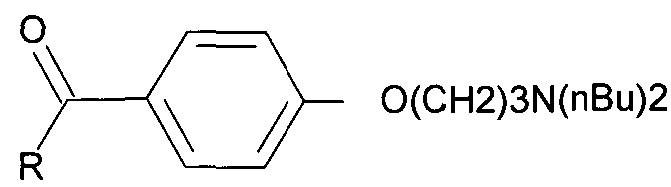
[VI]
1 2
wherein R is a group of formula -NR R ,
wherein R1 and R2 are independently selected from H, alkyl, alkyloxy and aryl.
Process for preparation of compound of formula (VI)

[VI]
or a salt thereof, wherein R is as defined in claim 5,
characterized in that a compound of formula (V) or a salt thereof
 is reacted with an amine of formula H-R or a salt thereof, wherein R is the same as in the above formula (VI), in a solvent or in a mixture of solvents
and the obtained product is isolated and, if desired, converted into a pharmaceutically acceptable salt thereof.
4. The compound of formula (IV)

[IV]
wherein X is CI or Br.
5. Process for preparation of compound of formula (IV),

[IV]
wherein X is CI or Br, characterized in that a compound of formula (III),
 wherein X is Cl or Br, is reacted with Mg in an anhydrous solvent. 6. The compound of formula (III)

[III]
wherein X is CI or Br.
7. Process for reparation of compound of formula (III)

[III]
wherein X is Cl or Br,
characterized in that a compound of formula (II)

[II]
is halogenated.
8. Process for the preparation of dronedarone (I)

[II
and pharmaceutically acceptable salts thereof according to claims 1 , 3, 5 and 7 characterized in that
(a) a compound of formula (II) is halogenated to obtain a compound of formula (III) wherein X is CI or Br;
(b) the compound (III) obtained in step (a) above is converted into a compound of formula (IV) wherein X is CI or Br;
(c) a compound of formula (V) is reacted with an amine of formula H-R to obtain a compound of formula (VI), wherein R is a group of formula -NR'R2, wherein R1 and R2 are independently selected from H, alkyl, alkyloxy and aryl;
(d) the compound of formula (IV) is reacted with a compound of formula (VI) in a
Grignard reaction to obtain dronedarone (I),
and the obtained product is isolated and, if desired, converted into a pharmaceutically acceptable salt thereof.
Priority Applications (1)
| Application Number | Priority Date | Filing Date | Title |
|---|---|---|---|
| US14/403,528 US9238636B2 (en) | 2012-05-31 | 2013-05-23 | Process for preparation of dronedarone by Grignard reaction |
Applications Claiming Priority (2)
| Application Number | Priority Date | Filing Date | Title |
|---|---|---|---|
| EP12462010.5 | 2012-05-31 | ||
| EP12462010 | 2012-05-31 |
Publications (1)
| Publication Number | Publication Date |
|---|---|
| WO2013178337A1 true WO2013178337A1 (en) | 2013-12-05 |
Family
ID=48570055
Family Applications (1)
| Application Number | Title | Priority Date | Filing Date |
|---|---|---|---|
| PCT/EP2013/001520 Ceased WO2013178337A1 (en) | 2012-05-31 | 2013-05-23 | Process for preparation of dronedarone by grignard reaction |
Country Status (2)
| Country | Link |
|---|---|
| US (1) | US9238636B2 (en) |
| WO (1) | WO2013178337A1 (en) |
Cited By (1)
| Publication number | Priority date | Publication date | Assignee | Title |
|---|---|---|---|---|
| CN105837539A (en) * | 2015-01-15 | 2016-08-10 | 复旦大学 | A method for substituted 3-position fluorination of benzofuran ring by 2-aryl group |
Families Citing this family (6)
| Publication number | Priority date | Publication date | Assignee | Title |
|---|---|---|---|---|
| HUP1100165A2 (en) | 2011-03-29 | 2012-12-28 | Sanofi Sa | Process for preparation of dronedarone by n-butylation |
| FR2983198B1 (en) | 2011-11-29 | 2013-11-15 | Sanofi Sa | PROCESS FOR THE PREPARATION OF 5-AMINO-BENZOYL-BENZOFURAN DERIVATIVES |
| EP2617718A1 (en) | 2012-01-20 | 2013-07-24 | Sanofi | Process for preparation of dronedarone by the use of dibutylaminopropanol reagent |
| US9221778B2 (en) | 2012-02-13 | 2015-12-29 | Sanofi | Process for preparation of dronedarone by removal of hydroxyl group |
| WO2013124745A1 (en) | 2012-02-22 | 2013-08-29 | Sanofi | Process for preparation of dronedarone by oxidation of a hydroxyl group |
| CN115521277B (en) * | 2021-02-02 | 2025-07-11 | 山东新时代药业有限公司 | A method for preparing benzofuran compounds |
Citations (2)
| Publication number | Priority date | Publication date | Assignee | Title |
|---|---|---|---|---|
| WO2002048132A1 (en) * | 2000-12-11 | 2002-06-20 | Sanofi-Synthelabo | Methanesulphonamido-benzofuran, preparation method and use thereof as synthesis intermediate |
| WO2002048078A1 (en) * | 2000-12-11 | 2002-06-20 | Sanofi-Synthelabo | 2-butyl-3-(4-[3(dibutylamino)propoxy]benzoyl)-5-nitro-benzofuran hydrochloride and preparation thereof |
Family Cites Families (60)
| Publication number | Priority date | Publication date | Assignee | Title |
|---|---|---|---|---|
| US3577441A (en) | 1967-03-07 | 1971-05-04 | Warner Lambert Pharmaceutical | Nitro substituted benzofurans |
| US3657350A (en) | 1967-05-09 | 1972-04-18 | Sterling Drug Inc | Process and compositions |
| DE2337396A1 (en) | 1973-07-23 | 1975-02-13 | Hoechst Ag | PROCESS FOR PRODUCING AROMATIC 1,3-DIKETONE |
| IE45765B1 (en) | 1976-08-19 | 1982-11-17 | Ici Ltd | Triazoles and imidazoles useful as plant fungicides and growth regulating agents |
| US4666931A (en) | 1984-12-29 | 1987-05-19 | Kaken Pharmaceutical Co., Ltd. | Benzofuran derivatives useful in treating diabetic complications |
| US5066803A (en) | 1989-12-07 | 1991-11-19 | Sterling Drug Inc. | 2- and 3-aminomethyl-6-arylcarbonyl-2,3-dihydropyrrolo[1,2,3-de]-1,4-benzoxazines |
| FR2665444B1 (en) | 1990-08-06 | 1992-11-27 | Sanofi Sa | AMINO-BENZOFURAN, BENZOTHIOPHENE OR INDOLE DERIVATIVES, THEIR PREPARATION PROCESS AND THE COMPOSITIONS CONTAINING THEM. |
| GB9416219D0 (en) | 1994-08-11 | 1994-10-05 | Karobio Ab | Receptor ligands |
| IT1275997B1 (en) | 1995-03-31 | 1997-10-24 | Great Lakes Chemical Italia | ENAMINES AS VULCANIZATION ACCELERANTS FOR NATURAL OR SYNTHETIC RUBBERS |
| FR2800067B1 (en) | 1999-10-21 | 2004-12-17 | Rhodia Chimie Sa | INTERMEDIATES FOR THE MANUFACTURE OF A BENZOFURANE OR NITROGEN BENZOTHIOPHENE DERIVATIVE IN POSITION 5 AND THEIR USES |
| CA2387724C (en) | 1999-10-21 | 2011-09-20 | Rhodia Chimie | Method for preparing a benzofuran or benzothiophene compound |
| FR2813306B1 (en) | 2000-08-23 | 2005-10-21 | Sanofi Synthelabo | AMINOALKYBENZOYL-BENZOFURANS OR BENZOTHIOPHENES, PROCESS FOR THEIR PREPARATION AND COMPOSITIONS CONTAINING SAME |
| FR2813308B1 (en) | 2000-08-23 | 2005-07-01 | Sanofi Synthelabo | AMINOALKOXYBENZOYL-BENZOFURANS OR BENZOTHIOPHENES, PROCESS FOR THEIR PREPARATION AND COMPOSITIONS CONTAINING SAME |
| IL146389A0 (en) | 2001-11-08 | 2002-07-25 | Isp Finetech Ltd | Process for the preparation of dronedarone |
| FR2833262A1 (en) | 2001-12-06 | 2003-06-13 | Rhodia Chimie Sa | PROCESS FOR MONOSULFONYLATION OF AN AMINOBENZOFURANNE OR AMINOBENZOTHIOPHENE COMPOUND |
| FR2833259B1 (en) | 2001-12-10 | 2004-08-27 | Oreal | PROCESS FOR THE PREPARATION OF 2-ARYLBENZOFURANES, INTERMEDIATE COMPOUNDS, 2-ARYLBENZOFURANES AND COMPOSITIONS COMPRISING THE SAME |
| DE10237819A1 (en) | 2002-08-19 | 2004-03-04 | Bayer Ag | 5-Nitrobenzofurane |
| EP1644371B1 (en) | 2003-07-03 | 2008-02-13 | Aventis Pharmaceuticals Inc. | Pyrazoloisoquinoline derivatives as kinase inhibitors |
| KR20070053783A (en) | 2004-08-24 | 2007-05-25 | 바스프 악티엔게젤샤프트 | Process for the preparation of high-purity quaternary ammonium compounds |
| WO2006093801A1 (en) | 2005-02-25 | 2006-09-08 | Abbott Laboratories | Thiadiazine derivatives useful as anti-infective agents |
| US20070203209A1 (en) | 2005-08-18 | 2007-08-30 | Wilmin Bartolini | Useful indole compounds |
| EP1996588A4 (en) | 2006-03-03 | 2011-10-05 | Torrent Pharmaceuticals Ltd | Novel dual action receptors antagonists (dara) at the ati and eta receptors |
| JP2009536657A (en) | 2006-05-10 | 2009-10-15 | レノビス, インコーポレイテッド | Amide derivatives as ion channel ligands and pharmaceutical compositions and methods using the same |
| GB0611210D0 (en) | 2006-06-07 | 2006-07-19 | Cambrex Karlskoga Ab | Process |
| GB0719180D0 (en) | 2007-10-02 | 2007-11-14 | Cambrex Karlskoga Ab | New process |
| BRPI0919578A2 (en) | 2008-10-02 | 2018-10-09 | Cambrex Karlskoga Ab | product, compound, and processes for isolating a compound and for preparing dronedarone or a salt thereof, a pharmaceutical formulation comprising dronedarone or a signal thereof and a dronedarone intermediate or salt thereof |
| US8143269B2 (en) | 2008-10-03 | 2012-03-27 | Calcimedica, Inc. | Inhibitors of store operated calcium release |
| WO2010040261A1 (en) | 2008-10-10 | 2010-04-15 | Lonza Ltd | Process for preparing 2-alkyl-3-aroyl-5-nitro-benzofurans |
| WO2010116140A1 (en) | 2009-04-08 | 2010-10-14 | Cambrex Karlskoga Ab | New process for preparing hydroxylamines and medicaments |
| UY32582A (en) | 2009-04-28 | 2010-11-30 | Amgen Inc | 3 KINASE PHOSPHINOSITI INHIBITORS AND / OR MAMMAL OBJECTIVE |
| TW201107303A (en) | 2009-05-27 | 2011-03-01 | Sanofi Aventis | Process for the production of benzofurans |
| UY32657A (en) | 2009-05-27 | 2010-12-31 | Sanofi Aventis | PROCEDURE FOR THE MANUFACTURE OF DRONEDARONA INTERMEDIATE PRODUCTS |
| CN101993427B (en) | 2009-08-26 | 2012-10-10 | 成都伊诺达博医药科技有限公司 | New method for preparing Dronedarone |
| HUP0900759A2 (en) | 2009-12-08 | 2011-11-28 | Sanofi Aventis | Novel process for producing dronedarone |
| HUP1000010A2 (en) | 2010-01-08 | 2011-11-28 | Sanofi Sa | Process for producing dronedarone |
| WO2011099010A1 (en) | 2010-02-10 | 2011-08-18 | Mapi Pharma Holdings (Cyprus) Limited | Preparation of benzofurans and use thereof as synthetic intermediates |
| IT1398317B1 (en) | 2010-02-23 | 2013-02-22 | Chimico Internaz Spa Lab | NEW PROCEDURE FOR DRONEDARONE PREPARATION. |
| FR2957079B1 (en) | 2010-03-02 | 2012-07-27 | Sanofi Aventis | PROCESS FOR THE SYNTHESIS OF CETOBENZOFURAN DERIVATIVES |
| FR2958289B1 (en) | 2010-03-30 | 2012-06-15 | Sanofi Aventis | PROCESS FOR THE PREPARATION OF 3-KETO-BENZOFURAN DERIVATIVES |
| FR2958290B1 (en) | 2010-03-30 | 2012-10-19 | Sanofi Aventis | PROCESS FOR THE PREPARATION OF SULFONAMIDO-BENZOFURAN DERIVATIVES |
| FR2958291B1 (en) | 2010-04-01 | 2013-07-05 | Sanofi Aventis | PROCESS FOR PREPARING AMINO-BENZOFURAN DERIVATIVES |
| CN101838252B (en) | 2010-05-27 | 2016-05-04 | 北京德众万全医药科技有限公司 | 2-normal-butyl-5-substituted amino benzofuran and preparation method thereof |
| HUP1000330A2 (en) | 2010-06-18 | 2011-12-28 | Sanofi Sa | Process for the preparation of dronedarone and the novel intermediates |
| WO2012004658A2 (en) | 2010-07-09 | 2012-01-12 | Frichem Private Limited | Process for preparation of n-[2-butyl-3-[4-[3-(dibutylamino)propoxy]benzoyl]-5-benzofuranyl]methanesulfonamide, acid addition salts and product thereof |
| FR2962731B1 (en) | 2010-07-19 | 2012-08-17 | Sanofi Aventis | PROCESS FOR THE PREPARATION OF AMINO-BENZOYL-BENZOFURAN DERIVATIVES |
| FR2963006B1 (en) | 2010-07-21 | 2013-03-15 | Sanofi Aventis | PROCESS FOR THE PREPARATION OF NITRO-BENZOFURAN DERIVATIVES |
| HUP1000386A2 (en) | 2010-07-22 | 2012-05-29 | Sanofi Sa | Novel process for producing dronedarone |
| WO2012032545A1 (en) | 2010-09-08 | 2012-03-15 | Cadila Healthcare Limited | Processes for preparing dronedarone and its intermediates |
| EP2447256A1 (en) | 2010-10-21 | 2012-05-02 | Laboratorios Lesvi, S.L. | Process for obtaining dronedarone |
| FR2973027A1 (en) | 2011-03-24 | 2012-09-28 | Sanofi Aventis | PROCESS FOR THE SYNTHESIS OF CETOBENZOFURAN DERIVATIVES |
| HUP1100167A2 (en) | 2011-03-29 | 2012-11-28 | Sanofi Sa | Process for preparation of dronedarone by mesylation |
| HUP1100165A2 (en) | 2011-03-29 | 2012-12-28 | Sanofi Sa | Process for preparation of dronedarone by n-butylation |
| HUP1100166A2 (en) | 2011-03-29 | 2012-12-28 | Sanofi Sa | Reductive amination process for preparation of dronedarone using amine intermediary compound |
| WO2013014478A1 (en) | 2011-07-26 | 2013-01-31 | Sanofi | Reductive amination process for preparation of dronedarone using carboxyl intermediary compound |
| WO2013014480A1 (en) | 2011-07-26 | 2013-01-31 | Sanofi | Process for preparation of dronedarone using amide intermediary compound |
| WO2013014479A1 (en) | 2011-07-26 | 2013-01-31 | Sanofi | Reductive animation process for preparation of dronedarone using aldehyde intermediary compound |
| FR2983198B1 (en) | 2011-11-29 | 2013-11-15 | Sanofi Sa | PROCESS FOR THE PREPARATION OF 5-AMINO-BENZOYL-BENZOFURAN DERIVATIVES |
| EP2617718A1 (en) | 2012-01-20 | 2013-07-24 | Sanofi | Process for preparation of dronedarone by the use of dibutylaminopropanol reagent |
| US9221778B2 (en) | 2012-02-13 | 2015-12-29 | Sanofi | Process for preparation of dronedarone by removal of hydroxyl group |
| WO2013121234A1 (en) | 2012-02-14 | 2013-08-22 | Sanofi | Process for the preparation of dronedarone by oxidation of a sulphenyl group |
-
2013
- 2013-05-23 WO PCT/EP2013/001520 patent/WO2013178337A1/en not_active Ceased
- 2013-05-23 US US14/403,528 patent/US9238636B2/en active Active
Patent Citations (2)
| Publication number | Priority date | Publication date | Assignee | Title |
|---|---|---|---|---|
| WO2002048132A1 (en) * | 2000-12-11 | 2002-06-20 | Sanofi-Synthelabo | Methanesulphonamido-benzofuran, preparation method and use thereof as synthesis intermediate |
| WO2002048078A1 (en) * | 2000-12-11 | 2002-06-20 | Sanofi-Synthelabo | 2-butyl-3-(4-[3(dibutylamino)propoxy]benzoyl)-5-nitro-benzofuran hydrochloride and preparation thereof |
Cited By (2)
| Publication number | Priority date | Publication date | Assignee | Title |
|---|---|---|---|---|
| CN105837539A (en) * | 2015-01-15 | 2016-08-10 | 复旦大学 | A method for substituted 3-position fluorination of benzofuran ring by 2-aryl group |
| CN105837539B (en) * | 2015-01-15 | 2018-11-13 | 复旦大学 | A method for substituted 3-position fluorination of benzofuran ring by 2-aryl group |
Also Published As
| Publication number | Publication date |
|---|---|
| US9238636B2 (en) | 2016-01-19 |
| US20150274688A1 (en) | 2015-10-01 |
Similar Documents
| Publication | Publication Date | Title |
|---|---|---|
| US9238636B2 (en) | Process for preparation of dronedarone by Grignard reaction | |
| US9611242B2 (en) | Process for preparation of dronedarone by N-butylation | |
| US9249119B2 (en) | Process for the preparation of dronedarone by oxidation of a sulphenyl group | |
| BRPI0914311A2 (en) | process for preparing abt-263 apoptosis promoter | |
| NO326516B1 (en) | Process for preparing 5-cyanophthalide | |
| US9701654B2 (en) | Process for preparation of dronedarone by removal of hydroxyl group | |
| JP2014514291A (en) | Method for producing dronedarone by mesylation | |
| AU2011222828A1 (en) | Ketobenzofuran derivatives, method for synthesising same, and intermediates | |
| WO2013014478A1 (en) | Reductive amination process for preparation of dronedarone using carboxyl intermediary compound | |
| CN102770420B (en) | Novel process for the manufacture of dronedarone | |
| CN109516998B (en) | Synthesis method of Barosavir intermediate | |
| JP2013530959A (en) | Dronedarone and method for producing the salt thereof | |
| UA73336C2 (en) | A method for the preparation of 5-cyano-phtalid | |
| JP2003519691A (en) | Method for producing 5-cyanophthalide | |
| US20160272606A1 (en) | Process for preparation of dronedarone by oxidation of a hydroxyl group | |
| WO2016135636A1 (en) | Process for the preparation of vortioxetine | |
| CN111533662B (en) | Synthesis method of citalopram intermediate | |
| CN112778220B (en) | Preparation method of benzodiazepine diketone compound D and intermediate thereof | |
| BG108554A (en) | Process for the preparation of 5-substituted isobenzofurans | |
| JP2018517696A (en) | Improved process to prepare (E)-(5,6-dihydro-1,4,2-dioxazin-3-yl) (2-hydroxyphenyl) methanone O-methyl oxime | |
| US6093825A (en) | Methods for preparation of 1,2-dihydroquinolines | |
| JP5582682B2 (en) | Method for producing substituted 4-alkoxycarbonyl-3-aminothiophenes | |
| EP1937662A1 (en) | Process for the preparation of duloxetine | |
| EP2011792A1 (en) | 2-alkenyl-3-aminothiophene derivative and method for producing the same | |
| KR100803746B1 (en) | New manufacturing method of raloxifene |
Legal Events
| Date | Code | Title | Description |
|---|---|---|---|
| 121 | Ep: the epo has been informed by wipo that ep was designated in this application |
Ref document number: 13726427 Country of ref document: EP Kind code of ref document: A1 |
|
| WWE | Wipo information: entry into national phase |
Ref document number: 14403528 Country of ref document: US |
|
| NENP | Non-entry into the national phase |
Ref country code: DE |
|
| 122 | Ep: pct application non-entry in european phase |
Ref document number: 13726427 Country of ref document: EP Kind code of ref document: A1 |