WO2013142010A1 - 3-AMINOTHIENO[3,2-c]QUINOLINE DERIVATIVES, METHODS OF PREPARATION AND USES - Google Patents
3-AMINOTHIENO[3,2-c]QUINOLINE DERIVATIVES, METHODS OF PREPARATION AND USES Download PDFInfo
- Publication number
- WO2013142010A1 WO2013142010A1 PCT/US2013/027778 US2013027778W WO2013142010A1 WO 2013142010 A1 WO2013142010 A1 WO 2013142010A1 US 2013027778 W US2013027778 W US 2013027778W WO 2013142010 A1 WO2013142010 A1 WO 2013142010A1
- Authority
- WO
- WIPO (PCT)
- Prior art keywords
- substituted
- formula
- unsubstituted
- compound
- group
- Prior art date
- Legal status (The legal status is an assumption and is not a legal conclusion. Google has not performed a legal analysis and makes no representation as to the accuracy of the status listed.)
- Ceased
Links
- 0 *c1c(*)[s]c2c1cnc1c2c(*)c(*)c(*)c1* Chemical compound *c1c(*)[s]c2c1cnc1c2c(*)c(*)c(*)c1* 0.000 description 11
- BYYWZOYBNZLGTE-UHFFFAOYSA-N COC(c([s]c(c1c2)c3cnc1cc(OC)c2OC)c3NC(c1ccccc1)=O)=O Chemical compound COC(c([s]c(c1c2)c3cnc1cc(OC)c2OC)c3NC(c1ccccc1)=O)=O BYYWZOYBNZLGTE-UHFFFAOYSA-N 0.000 description 1
- ROUZOXKXIXTKCM-UHFFFAOYSA-N N#Cc1cnc(ccc(F)c2)c2c1S Chemical compound N#Cc1cnc(ccc(F)c2)c2c1S ROUZOXKXIXTKCM-UHFFFAOYSA-N 0.000 description 1
Classifications
-
- C—CHEMISTRY; METALLURGY
- C07—ORGANIC CHEMISTRY
- C07D—HETEROCYCLIC COMPOUNDS
- C07D495/00—Heterocyclic compounds containing in the condensed system at least one hetero ring having sulfur atoms as the only ring hetero atoms
- C07D495/02—Heterocyclic compounds containing in the condensed system at least one hetero ring having sulfur atoms as the only ring hetero atoms in which the condensed system contains two hetero rings
- C07D495/04—Ortho-condensed systems
Definitions
- the invention relates to compounds, methods for their preparation, compositions including them.
- the invention further provides methods for the treatment of cellular proliferative disorders, including, but not limited to, cancer.
- Cellular proliferative disorders such as cancer are among the most common causes of death in developed countries. That said, many cellular proliferative disorders have no available cures or few, if any, treatment options to slow the progression of the disease. For cellular proliferative diseases for which treatments exist, undesirable side effects and limited efficacy often call into question the utility of a given treatment. This is particularly true when the available treatment option(s) may not appreciably prolong life, but have a definitive adverse effect on the quality of time remaining. Thus, identifying new effective drugs for cellular proliferative disorders, and in particular cancer, is a continuing focus of medical research.
- Phosphatidylinositol 3-kinase a lipid kinase
- PI3K Phosphatidylinositol 3-kinase
- the PI3K/Akt/mTOR pathway responds to multiple inputs including growth signals as well as metabolic and nutritional cues (Engelman et al, supra; Vivanco and Sawyers, Nature Rev. Cancer, 2002, 2, 489-501).
- PI3K Four distinct isoforms of PI3K are known with different expression patterns and different pathophysiological roles: ⁇ , ⁇ , ⁇ and ⁇ .
- the PI3Ks function as dimeric complexes of a catalytic subunit pi 10a, ⁇ ⁇ , ⁇ ⁇ or ⁇ ⁇ ⁇ , with regulatory protein subunit p85, plOl or p84. All four isoforms of PI3K appear to be implicated to varying degrees in the development of cancer and are often upregulated in cancer cells but differ in their cellular expression (Jia et al, Curr. Opin. Cell. Biol, 2009, 21, 199-208).
- PI3 Kinases have emerged as one of the most extensively studied classes of therapeutic targets in small molecule drug discovery particularly in oncology, based on at least the following observations:
- the phosphatase PTEN the negative regulator of PI3K, is one of the most commonly mutated proteins in human malignancy (Vogt and Hart, Curr. Opin. Genetics and Dev. 2009, 19, 1-6).
- pi 10a is critical for the growth of tumors driven by PIK3CA mutations as well as oncogenic receptor tyrosine kinases and RAS, while pi 10 ⁇ is the principal isoform involved in mediating PTEN-deficient tumorigenesis (Billottet et al. , supra).
- PI3K5 Dis upregulated in blast cells in patients with acute myeloid leukemia, where it plays a key role in cell survival highlighting its potential as a target in leukemia and other hematological malignancies. There is also some evidence that this isoform is upregulated in melanoma and breast cancer, and is overexpressed in neuroblastoma (Fruman and Rommel, supra).
- PI3K6 subtype has also been shown to play a central function in the recruitment and activation of a range of immune and inflammatory cells suggesting its importance for immune and inflammatory diseases (Fruman and Rommel, supra).
- ⁇ 3 ⁇ is expressed at highest levels in leukocytes. It is also detectable in certain other cell types. Attention has been given to ⁇ 3 ⁇ as a target in inflammatory diseases driven by leukocytes (Marone et al, Biochim Biophys Acta 2008;1784:159-8516; Ruckle et al, Nat Rev Drug Discov 2006;5:903-18). ⁇ 3 ⁇ is essential for myeloid cell adhesion to endothelium and extravasation into tumor sites in mice (Schmid et al, Cancer Cell 2011;19:715-27.). Pharmacological or genetic blockade of PI3 ⁇ suppressed
- the biologically active compounds of the invention are 3-aminothieno[3,2-c]quinoline derivatives and related derivatives thereof.
- R6 is selected from the group consisting of H; a saturated or unsaturated, straight or branched, cyclic or acyclic, chiral or achiral hydrocarbyl group having from 1 to 10 carbon atoms, wherein the hydrocarbyl group is substituted with (Ci-C 6 )carboxy, (Q-
- R 8 is independently selected from the group consisting of:
- R9 is independently selected from the group consisting of (Ci-C 6 )alkyl; substituted or unsubstituted (C6-Cio)aryl; substituted or unsubstituted (C 7 -Ci 5 )aralkyl; substituted or unsubstituted (C 2 -C9)heterocyclyl; substituted or unsubstituted (C 2 -C9)heterocyclylalkyl; and -NH 2 ;
- R 10 is independently selected from the group consisting of -ORi S ; - NRnRi 2; and a saturated or unsaturated, straight or branched, cyclic or acyclic, chiral or achiral hydrocarbyl group having from 1 to 10 carbon atoms, wherein the hydrocarbyl group is optionally substituted with one or more of halogens, hydroxy, alkoxy, cyano, carboxy, carbalkoxy, carboxamido, -NRnRi 2 , or nitro;
- R11 and Ri 2 are each independently selected from the group consisting of H; (C 2 -C 4 )acyl; saturated or unsaturated, straight or branched, cyclic or acyclic, chiral or achiral hydrocarbyl group having from 1 to 10 carbon atoms; and substituted or unsubstituted (C 2 - Cc,)rieterocyclyl;
- Rn and Ri 2 may combine with O, S, or the nitrogen atom in NRi 6 to form a substituted or unsubstituted heterocyclyl ring;
- Ri 3 is selected from the group consisting of -OR15; and a saturated or unsaturated, straight or branched, cyclic or acyclic, chiral or achiral hydrocarbyl group having from 1 to 10 carbon atoms, wherein the hydrocarbyl group is substituted with one or more of halogens, hydroxy, alkoxy, cyano, carboxy, carbalkoxy, carboxamido, or nitro;
- Ri4 is selected from the group consisting of:
- Ri5 is independently selected from the group consisting of (Ci-C 6 )alkyl; substituted or unsubstituted (C9-Ci 5 )aralkyl; substituted or unsubstituted (C 2 -C9)heterocyclyl; and substituted or unsubstituted (C 2 -C9)heterocyclylalkyl;
- Ri6 is selected from the group consisting of H; substituted or unsubstituted (Ci-Ce)alkyl; substituted or unsubstituted (C6-Ci 0 )aryl; and substituted or unsubstituted (C 7 -Ci 5 )aralkyl; Rn and Ris are each independently (Ci-C6)alkyl; n is independently selected from the group consisting of 0, 1, 2, 3, 4, and 5;
- X is absent or selected from (Ci-C6)alkyl and (C]-C6)alkoxyoxo(Ci-C6)alkyl; and Y is absent or a counterion, preferably a halide, i) provided that when Re is H, R 7 is H, and Ro is -OR15, then at least one of R 2 and R3 is -0-R 8 , wherein R 8 is selected from the group consisting of: H; a saturated or unsaturated, straight or branched, cyclic or acyclic, chiral or achiral hydrocarbyl group having from 1 to 10 carbon atoms, wherein the hydrocarbyl group is substituted with one or more of halogen, hydroxy, (Ci-C 4 )alkylcarbonyloxy, or -NRnRi ; substituted or unsubstitued (C 6 - Cio)aryl; substituted or unsubstitued (C 2 -C9)heterocyclyl; and
- the present disclosure further provides a pharmaceutical composition
- a pharmaceutical composition comprising a pharmaceutically acceptable carrier and a compound of Formula I or Formula II, or a pharmaceutically acceptable salt thereof.
- the present disclosure further provides a method of treating an individual suffering from a cellular proliferative disorder, comprising administering to the individual an effective amount of at least one compound of Formula I or Formula II, or a pharmaceutically acceptable salt thereof.
- the cellular proliferative disorder is selected from the group consisting of: cancer, malignant and benign tumors, blood vessel proliferative disorders, autoimmune disorders, and fibrotic disorders.
- the cellular proliferative disorder is selected from the group consisting of hemangiomatosis in newborn, secondary progressive multiple sclerosis, atherosclerosis, chronic progressive myelodegenerative disease, neurofibromatosis, ganglioneuromatosis, keloid formation, Paget' s disease of the bone, fibrocystic disease of the breast, uterine fibroids, Peyronie's disease, Dupuytren's disease, restenosis, benign proliferative breast disease, benign prostatic hyperplasia, X linked lymphocellular proliferative disorder, post transplantation lymphocellular proliferative disorder, macular degeneration, retinopathies, proliferative vitreoretinopathy, non cancerous lymphocellular proliferative disorders, and cancer.
- the cellular proliferative disorder is cancer.
- the cancer is selected from the group consisting of ovarian cancer; cervical cancer; breast cancer; prostate cancer; testicular cancer, lung cancer, renal cancer;
- colorectal cancer skin cancer; brain cancer; leukemia, including acute myeloid leukemia, chronic myeloid leukemia, acute lymphoid leukemia, and chronic lymphoid leukemia.
- leukemia including acute myeloid leukemia, chronic myeloid leukemia, acute lymphoid leukemia, and chronic lymphoid leukemia.
- the present disclosure further provides a method of inducing apoptosis of cancer cells in an individual afflicted with cancer, comprising administering to the individual an effective amount of at least one compound of Formula I or Formula II, or a pharmaceutically acceptable salt thereof.
- the cancer cells are tumor cells.
- the tumor cells are selected from the group consisting of ovarian, cervical, breast, prostate, testicular, lung, renal, colorectal, skin and brain tumor cells.
- the invention is a compound of Formula I or Formula II, or salt thereof, for use in medicine.
- the invention is a compound of Formula I or Formula II or a salt thereof, for treatment of a cellular proliferative disorder.
- the invention provides a use of a compound according to Formula I or Formula II, or a salt thereof, for preparation of a medicament for treatment of a cellular proliferative disorder.
- the present invention further provides a medicament for treatment of a cellular proliferative disorder, containing a compound of Formula I or Formula II.
- the present disclosure further provides a method of treating an individual suffering from a cellular proliferative disorder, comprising administering to the individual an effective amount of at least one compound of Formula II, or a pharmaceutically acceptable salt thereof wherein:
- Ri9 is selected from the group consisting of: (Ci-C 6 )alkyl; substituted or unsubstituted (C 7 - Ci5)aralkyl; and substituted or unsubstituted (C 6 -Ci 0 )aryl; and
- R.20 and R 2] are each independently selected from the group consisting of H, halogen, and -O-CH3.
- the embodiments of the invention comprise the components and/or steps disclosed herein.
- the embodiments of the invention consist essentially of the components and/or steps disclosed herein.
- the embodiments of the invention consist of the components and/or steps disclosed herein.
- the compounds and compositions of the invention are believed to selectively inhibit proliferation of cancer cells, and kill various tumor cell types without killing (or with reduced killing of) normal cells. Cancer cells are killed at concentrations where normal cells may be temporarily growth-arrested but not killed.
- the compounds of the invention are believed to inhibit the proliferation of tumor cells, and for some compounds, induce cell death.
- Cell death results from the induction of apoptosis.
- the compounds are believed effective against a broad range of tumor types, including but not limited to the following: ovarian cancer, breast cancer, prostate cancer, lung cancer, renal cancer, colorectal cancer, brain cancer and leukemia.
- the compounds are also believed useful in the treatment of non-cancer cellular proliferative disorders, including but not limited to the following: hemangiomatosis in newborn, secondary progressive multiple sclerosis, chronic progressive myelodegenerative disease, neurofibromatosis, ganglioneuromatosis, keloid formation, Paget' s disease of the bone, fibrocystic disease of the breast, uterine fibroids, Peyronie's disease, Dupuytren's disease, restenosis and cirrhosis.
- non-cancer cellular proliferative disorders including but not limited to the following: hemangiomatosis in newborn, secondary progressive multiple sclerosis, chronic progressive myelodegenerative disease, neurofibromatosis, ganglioneuromatosis, keloid formation, Paget' s disease of the bone, fibrocystic disease of the breast, uterine fibroids, Peyronie's disease, Dupuytren's disease, restenosis and cirrhosis.
- At least one compound of the invention selectively inhibits the activity of ⁇ 3 ⁇ , and thus is believed useful as an anti-inflammatory agent, particularly inflammatory diseases driven by leukocytes.
- the ⁇ 3 ⁇ inhibitory activity of the compound provides further anticancer utility by blocking ⁇ 3 ⁇ - induced myeloid cell adhesion to endothelium and extravasation, and thus inhibition of angiogenesis. See, Schmid et al, Cancer Cell 2011;19:715— 27, demonstrating that pharmacological or genetic blockade of ⁇ 3 ⁇ suppresses inflammation, growth, and metastasis of implanted and spontaneous tumors.
- the terms “treat” and “treatment” are used interchangeably and are meant to indicate a postponement of development of a disorder and/or a reduction in the severity of symptoms that will or are expected to develop.
- the terms further include ameliorating existing symptoms, preventing additional symptoms, and ameliorating or preventing the underlying metabolic causes of symptoms.
- “individual” means both mammals and non-mammals. Mammals include, for example, humans; non-human primates, e.g. apes and monkeys; cattle; horses; sheep; and goats. Non-mammals include, for example, fish and birds.
- the expression "effective amount”, when used to describe therapy to an individual suffering from a cancer or other cellular proliferative disorder, refers to the amount of a compound according to Formula I or Formula II that inhibits the abnormal growth or proliferation, or alternatively induces apoptosis of cancer cells, preferably tumor cells, resulting in a therapeutically useful and selective cytotoxic effect on proliferative cells.
- cellular proliferative disorder means a disorder wherein unwanted cell proliferation of one or more subsets of cells in a multicellular organism occurs. In some such disorders, cells are made by the organism at an atypically accelerated rate.
- alkyl by itself or as part of another substituent means, unless otherwise stated, a straight, or branched chain hydrocarbon having the number of carbon atoms designated (i.e. C]-C 6 means one to six carbons) and includes straight, branched chain or cyclic groups. Examples include: methyl, ethyl, propyl, isopropyl, butyl, isobutyl, tert-butyl, pentyl, neopentyl, and hexyl. Most preferred is (Ci-C 3 )alkyl, particularly ethyl, methyl and isopropyl. Unless otherwise noted, an “alkyl” can refer to a (Ci-C 5 )alkyl.
- alkoxy employed alone or in combination with other terms means, unless otherwise stated, an alkyl group, as defined above, connected to the rest of the molecule via an oxygen atom, such as, for example, methoxy, ethoxy, 1-propoxy, 2-propoxy (isopropoxy) and the higher homologs and isomers.
- the alkyl portion of the alkoxy group can have a designated number of carbon atoms as defined for alkyl groups above. Preferred are (Ci-C3)alkoxy, particularly ethoxy and methoxy.
- halo or halogen by themselves or as part of another substituent mean, unless otherwise stated, a fluorine, chlorine, bromine, or iodine atom.
- a halogen includes fluorine, chlorine, or bromine, more preferably, fluorine or chlorine.
- (C x -C y )perfluoroalkyl wherein x ⁇ y, means an alkyl group with a minimum of x carbon atoms and a maximum of y carbon atoms, wherein all hydrogen atoms are replaced by fluorine atoms.
- x ⁇ y means an alkyl group with a minimum of x carbon atoms and a maximum of y carbon atoms, wherein all hydrogen atoms are replaced by fluorine atoms.
- Preferred is -(Ci-C6)perfluoroalkyl, more preferred is -(Ci-C3)perfluoroalkyl, most preferred is -CF 3 .
- aromatic refers to a carbocycle or heterocycle having one or more polyunsaturated rings having aromatic character (i.e. having (4n + 2) delocalized ⁇ (pi) electrons where n is an integer).
- aryl employed alone or in combination with other terms, means, unless otherwise stated, a carbocyclic aromatic system containing one or more rings (typically one, two or three rings) wherein such rings may be attached together in a pendent manner, such as a biphenyl, or may be fused, such as naphthalene. Examples include phenyl; anthracyl; and naphthyl. Preferred are phenyl and naphthyl, most preferred is phenyl.
- Substituted aryl means an aryl, as defined above, substituted by one, two, three, four, or five substituents.
- (C x -C y ) aralkyl wherein x ⁇ y, means a functional group wherein an aryl group is attached to the rest of the molecule through an alkylene chain, e.g., -CH 2 CH 2 -phenyl, the minimum number of the total carbon atoms in the alkyl group and aryl group is x, and the maximum number of the total carbon atoms in the alkyl and aryl groups is y.
- substituted (C x -C y ) aralkyl means an (C x -C y ) aralkyl group in which the aryl group is substituted.
- heteroaryl or “heteroaromatic” refers to a heterocycle having aromatic character.
- a polycyclic heteroaryl may include one or more rings which are partially saturated.
- heteroaryl groups include: pyridyl, pyrazinyl, pyrimidinyl, particularly 2- and 4-pyrimidinyl, pyridazinyl, thienyl, furyl, and pyrrolyl, preferably pyridyl.
- heterocycle or “heterocyclyl” or “heterocyclic” by itself or as part of another substituent means, unless otherwise stated, an unsubstituted or substituted, stable, mono- or multi-cyclic heterocyclic ring system which consists of carbon atoms and at least one heteroatom selected from the group consisting of N, O, and S, and wherein the nitrogen and sulfur heteroatoms may be optionally oxidized, and the nitrogen atom may be optionally quaternized.
- the heterocyclic system may be attached, unless otherwise stated, at any heteroatom or carbon atom which affords a stable structure.
- heterocycles include monocyclic groups such as: aziridine, oxirane, thiirane, azetidine, oxetane, thietane, pyrrolidine, pyrroline, imidazoline, pyrazolidine, dioxolane, sulfolane, 2,3-dihydrofuran, 2,5-dihydrofuran, tetrahydrofuran, thiophane, piperidine, 1,2,3,6-tetrahydropyridine, 1,4-dihydropyridine, piperazine, morpholine, thiomorpholine, pyran, 2,3-dihydropyran, tetrahydropyran, 1,4-dioxane, 1,3-dioxane, homopiperazine, homopiperidine, 1,3-dioxepane, 4,7-dihydro-l,3-dioxepin and hex
- polycyclic heterocycles include: indolyl, particularly 3-, 4-, 5-, 6- and 7-indolyl, indolinyl, quinolyl, tetrahydroquinolyl, isoquinolyl, particularly 1- and 5-isoquinolyl, 1,2,3,4-tetrahydroisoquinolyl, cinnolinyl, quinoxalinyl, particularly 2- and 5-quinoxalinyl, quinazolinyl, phthalazinyl, 1,8-naphthyridinyl, 1,4-benzodioxanyl, coumarin, dihydrocoumarin, benzofuryl, particularly 3-, 4-, 1,5-naphthyridinyl, 5-, 6- and 7-benzofuryl, 2,3-dihydrobenzofuryl, 1,2-benzisoxazolyl, benzothienyl, particularly 3-, 4-, 5-, 6-, and 7-benzothienyl, benzoxazolyl, benzazo
- (C x -C y ) heterocyclyl wherein x ⁇ y, means a functional group that is a heterocycle, wherein the minimum number of carbon atoms in the heterocycle is x, and the maximum number of carbon atoms in the heterocycle is y.
- substituted (C x -C y ) heterocyclyl means a (C x -C y ) heterocyclyl functional group in which the heterocyclyl group is substituted, preferably -piperazine-CH 3 .
- (C x -C y ) heterocyclylalkyl wherein x ⁇ y, means a functional group wherein an alkyl group is attached to a heterocycle group, e.g., -CH 2 -CH 2 -piperazine, the minimum number of the total carbon atoms in the alkyl and heterocycle is x, and the maximum number of the total carbon atoms in the alkyl and heterocycle is y.
- substituted (C x -C y ) heterocyclylalkyl means a (C x -C y ) heterocyclylalkyl functional group in which the heterocyclyl group is substituted, preferably -CH 2 -piperizino-N-4- pyridine.
- hydrocarbyl refers to any moiety comprising only hydrogen and carbon atoms, unless otherwise explicitly stated.
- a hydrocarbyl optionally substituted with one or more halogen includes a perfluoroalkyl group, such as (Ci- C6)perfluoroalkyl.
- a hydrocarbyl can also form a non-aromatic, such as cyclohexane, or an aromatic ring, such as a substituted or unsubstituted (Ce-Cio)aryl group.
- Preferred hydrocarbyl groups are (C]-Ci 2 )hydrocarbyl, more preferred are (C]-C 7 )hydrocarbyl, and most preferred are benzyl and (Ci-C 6 ) alkyl.
- a hydrocarbyl group that is substituted by an oxygen include alkyoxy groups and alkyloxyalkyl groups, such as -O- CH 2 -CH 3 or -CH 2 -0-CH 3 , respectively.
- substituted means that an atom or group of atoms has replaced hydrogen as the substituent attached to another group.
- substituted refers to any level of substitution, namely mono-, di-, tri-, tetra-, or penta-substitution, where such substitution is permitted.
- the substituents are independently selected, and substitution may be at any chemically accessible position.
- substituent is an alkyl or alkoxy group
- the carbon chain may be branched, straight or cyclic, with straight being preferred.
- the invention is a compound of Formula I, or a salt thereof wherein:
- R 6 is selected from the group consisting of H; a saturated or unsaturated, straight or branched, cyclic or acyclic, chiral or achiral hydrocarbyl group having from 1 to 10 carbon atoms, wherein the hydrocarbyl group is substituted with (Ci-C 6 )carboxy, (Q- C 6 )carboxyalkyl, hydroxy, or (CrC 6 ) alkoxy; and substituted or unsubstituted (Cn- C ]5 )aralkyl;
- R 7 is selected from the group consisting of H; saturated or unsaturated, straight or branched, cyclic or acyclic, chiral or achiral hydrocarbyl group having from 1 to 10 carbon atoms, wherein the hydrocarbyl group is substituted with (Ci-C 6 )carboxy, (Ci- C6)alkoxycarbonyl, hydroxy, or (Ci-C 6 ) alkoxy; substituted or unsubstituted
- R 8 is independently selected from the group consisting of:
- R9 is independently selected from the group consisting of (Ci-Ce)alkyl; substituted or unsubstituted (C 6 -Cio)aryl; substituted or unsubstituted (C 7 -Ci5)aralkyl; substituted or unsubstituted (C 2 -C9)heterocyclyl; substituted or unsubstituted (C 2 -C9)heterocyclylalkyl; and -NH 2 ;
- Rio is independently selected from the group consisting of -OR15; - NRnRi 2; and a saturated or unsaturated, straight or branched, cyclic or acyclic, chiral or achiral hydrocarbyl group having from 1 to 10 carbon atoms, wherein the hydrocarbyl group is optionally substituted with one or more of halogens, hydroxy, alkoxy, cyano, carboxy, carbalkoxy, carboxamido, -N nRi 2 , or nitro; Rii and R12 are each independently selected from the group consisting of H; (C 2 -C4)acyl; saturated or unsaturated, straight or branched, cyclic or acyclic, chiral or achiral hydrocarbyl group having from 1 to 10 carbon atoms; and substituted or unsubstituted (C 2 - C9)heterocyclyl;
- Ri 1 and R12 may combine with O, S, or the nitrogen atom in NR] 6 to form a substituted or unsubstituted heterocyclyl ring;
- Ri3 is selected from the group consisting of -OR15; and a saturated or unsaturated, straight or branched, cyclic or acyclic, chiral or achiral hydrocarbyl group having from 1 to 10 carbon atoms, wherein the hydrocarbyl group is substituted with one or more of halogens, hydroxy, alkoxy, cyano, carboxy, carbalkoxy, carboxamido, or nitro;
- Ri4 is selected from the group consisting of:
- Ri5 is independently selected from the group consisting of (Ci-C6)alkyl; substituted or unsubstituted (C 7 -Ci 5 )aralkyl; substituted or unsubstituted (C 2 -C9)heterocyclyl; and substituted or unsubstituted (C 2 -C 9 )heterocyclylalkyl;
- Ri6 is selected from the group consisting of H; substituted or unsubstituted (Ci-Ce)alkyl; substituted or unsubstituted (C 6 -Cio)aryl; and substituted or unsubstituted (C 7 -C] 5 )aralkyl; Ri 7 and Rig are each independently (Ci-C 6 )alkyl; n is independently selected from the group consisting of 0, 1, 2, 3, 4, and 5; X is absent or selected from (Ci-C 6 )alkyl and (Ci-C 6 )alkoxyoxo(Ci-C 6 )alkyl; and
- Y is absent or a counterion, preferably a halide, i) provided that when R ⁇ is H, R 7 is H, and Ri 3 is -OR15, then at least one of R 2 and R 3 is -O-Rg, wherein R 8 is selected from the group consisting of: H; a saturated or unsaturated, straight or branched, cyclic or acyclic, chiral or achiral hydrocarbyl group having from 1 to 10 carbon atoms, wherein the hydrocarbyl group is substituted with one or more of halogen, hydroxy, (Ci-C 4 )alkylcarbonyloxy, or -NRnRi 2 ; substituted or unsubstitued (C 6 - Cio)aryl; substituted or unsubstitued (C 2 -C9)heterocyclyl; and -NH 2 ;
- the salt of a compound of Formula I is a pharmaceutically acceptable salt.
- Another particular embodiment of the invention comprises a compound of Formula I, or a salt thereof, wherein Ri is H, and R4 is H.
- Another particular embodiment of the invention comprises a compound of Formula
- Ri is H, and R4 is H; R 2 is-O-Rg; and Rg is independently selected from the group consisting of H and a saturated or unsaturated, straight or branched, cyclic or acyclic, chiral or achiral hydrocarbyl group having from 1 to 10 carbon atoms.
- Another particular embodiment of the invention comprises a compound of Formula I, or a salt thereof, wherein 3 ⁇ 4 is H, and R4 is H; R3 is-0-R 8; and R 8 is independently selected from the group consisting of H and a saturated or unsaturated, straight or branched, cyclic or acyclic, chiral or achiral hydrocarbyl group having from 1 to 10 carbon atoms.
- Another particular embodiment of the invention comprises a compound of Formula I, or a salt thereof, wherein Rj is H, and R4 is H; R 2 is -0-R 8; and R 8 is independently selected from the group consisting of H and substituted or unsubstitued (C 6 -Cio)aryl.
- Another particular embodiment of the invention comprises a compound of Formula I, or a salt thereof, wherein Rj is H, and R4 is H; R 2 is -0-R 8; and R 8 is independently selected from the group consisting of H and substituted or unsubstitued (C 6 -Cio)aryl.
- Another particular embodiment of the invention comprises a compound of Formula I, or a salt thereof, wherein Rj is H, and R4 is H; R 2 is -0-R 8; and R 8 is independently selected from the group consisting of H and substituted or unsubstitued (C 6 -Cio)aryl.
- Another particular embodiment of the invention comprises a compound of Formula I,
- Ri is H, and R4 is H; R3 is-OR 8; and R 8 is independently selected from the group consisting of H and substituted or unsubstitued (C6-Cio)aryl.
- Another particular embodiment of the invention comprises a compound of Formula I, or a salt thereof, wherein R 6 is H, R 7 is H, Rj 3 is -OR15, and at least one of R 2 and R3 is -O-H.
- Another particular embodiment of the invention comprises a compound of Formula I, or a salt thereof, wherein R 6 is H, R 7 is H, R13 is -OR ]5 , and at least one of R 2 and R3 is -0-R 8 , wherein R 8 is a saturated or unsaturated, straight or branched, cyclic or acyclic, chiral or achiral hydrocarbyl group having from 1 to 10 carbon atoms, wherein the hydrocarbyl group is substituted with -NRnRi 2 .
- Another particular embodiment of the invention comprises a compound of Formula I, or a salt thereof, wherein Re is H, R 7 is H, Ri 3 is -OR15, and at least one of R 2 and R3 is -0-R 8 , wherein R 8 is a saturated or unsaturated, straight or branched, cyclic or acyclic, chiral or achiral hydrocarbyl group having from 1 to 10 carbon atoms, wherein the hydrocarbyl group is substituted with one or more hydroxy group.
- Another particular embodiment of the invention comprises a compound of Formula I, or a salt thereof, wherein Re is H, R 7 is H, Ri 3 is -OR15, and at least one of R 2 and R3 is -0-R 8 , wherein R 8 is a saturated or unsaturated, straight or branched, cyclic or acyclic, chiral or achiral hydrocarbyl group having from 1 to 10 carbon atoms, wherein the hydrocarbyl group is substituted with one or more hydroxy group.
- R ⁇ is H
- R 7 is H
- Rn is -OR15
- at least one of R 2 and R 3 is -0-R 8
- R 8 is a saturated or unsaturated, straight or branched, cyclic or acyclic, chiral or achiral hydrocarbyl group having from 1 to 10 carbon atoms, wherein the hydrocarbyl group is substituted with one or more of halogen.
- Another particular embodiment of the invention comprises a compound of Formula I, or a salt thereof, wherein R6 is H, R 7 is H, R13 is -OR15, and at least one of R 2 and R 3 is -0-R 8 , wherein R 8 is a saturated or unsaturated, straight or branched, cyclic or acyclic, chiral or achiral hydrocarbyl group having from 1 to 10 carbon atoms, wherein the hydrocarbyl group is substituted with one or more (Ci-C 4 )alkylcarbonyloxy groups.
- Another particular embodiment of the invention comprises a compound of Formula I, or a salt thereof, wherein R 6 is H, R 7 is H, R13 is -OR] 5, and at least one of R 2 and R 3 is -O-Rg, wherein R 8 is substituted or unsubstitued (C 6 -Cio)aryl.
- Another particular embodiment of the invention comprises a compound of Formula I, or a salt thereof, wherein R6 is H, R 7 is H, Rn is -OR15, and at least one of R 2 and R 3 is -0-R 8 , wherein R 8 is substituted or unsubstitued (C 2 -C9)heterocyclyl.
- Another particular embodiment of the invention comprises a compound of Formula I, or a salt thereof, wherein R6 is H, R 7 is H, Rn is -OR15, and at least one of R 2 and R 3 is -0-R 8 , wherein R 8 is substituted or unsubstitued (C 2 -C9)heterocyclyl.
- Another particular embodiment of the invention comprises a compound of Formula I, or a salt thereof, wherein R6 is H, R 7 is H, Rn is -OR15, and at least one of R 2 and R 3 is -0-R 8 , wherein R 8 is substituted or unsubstitued (C 2
- R6 is H
- R 7 is H
- R 13 is -OR15
- at least one of R 2 and R 3 is -O-NH 2 .
- Another particular embodiment of the invention comprises a compound of Formula I, or a salt thereof, wherein R5 is substituted or unsubstituted (C2-C9)heterocyclyl.
- Another particular embodiment of the invention comprises a compound of Formula I, or a salt thereof, wherein R 5 is CN.
- Another particular embodiment of the invention comprises a compound of Formula I, or a salt thereof, wherein R 6 is H.
- Another particular embodiment of the invention comprises a compound of Formula
- Another particular embodiment of the invention comprises a compound of Formula I, or a salt thereof, wherein R6 is substituted or unsubstituted (Cn-Ci 5 )aralkyl.
- Another particular embodiment of the invention comprises a compound of Formula I, or a salt thereof, wherein R 7 is H.
- Another particular embodiment of the invention comprises a compound of Formula I, or a salt thereof, wherein R 6 is H; and R 7 is H.
- Another particular embodiment of the invention comprises a compound of Formula I, or a salt thereof, wherein R 6 is H; and R 7 is H.
- Another particular embodiment of the invention comprises a compound of Formula I, or a salt thereof, wherein R 6 is H; and R 7 is H.
- Another particular embodiment of the invention comprises a compound of Formula I, or a salt thereof
- Another particular embodiment of the invention comprises a compound of Formula I, or a
- the invention is a compound of Formula I, or a salt thereof wherein:
- R 8 is independently selected from the group consisting of:
- R9 is independently selected from the group consisting of (Ci-C 6 )alkyl; substituted or unsubstituted (C 6 -Cio)aryl; substituted or unsubstituted (C 7 -Ci 5 )aralkyl; substituted or unsubstituted (C 2 -C9)heterocyclyl; substituted or unsubstituted (C 2 -C9)heterocyclylalkyl; and -NH 2 ; Rio is independently selected from the group consisting of -OR15; - NRi iRi 2; and a saturated or unsaturated, straight or branched, cyclic or acyclic, chiral or achiral hydrocarbyl group having from 1 to 10 carbon atoms, wherein the hydrocarbyl group may be optionally substituted with one or more of halogens, hydroxy, alkoxy, cyano, carboxy, carbalkoxy, carboxamido, -NRn
- Rn and Ri 2 may combine with O, S, or the nitrogen atom in NRi 6 to form a substituted or unsubstituted heterocyclyl ring;
- Rn is selected from the group consisting of -ORi 5 ; and (Ci-C 6 )perfluoroalkyl;
- Rn is selected from the group consisting of:
- Ri 5 is (Ci-C 6 )alkyl
- Ri6 is selected from the group consisting of H; substituted or unsubstituted (Ci-C 6 )alkyl; substituted or unsubstituted (C 6 -Ci 0 )aryl; and substituted or unsubstituted (C 7 -Ci 5 )aralkyl;
- R 17 and Ris are each independently (Ci-C 6 )alkyl; n is independently selected from the group consisting of 0, 1, 2, 3, 4, and 5;
- X is absent or selected from (Ci-Ce)alkyl and (C)-C 6 )alkoxyoxo(C]-C6)alkyl;
- Y is absent or a counterion, preferably halide, i) provided that when R 7 is H, and R 13 is -ORi 5 , then at least one of R 2 and R 3 is -O-Rg, wherein R 8 is selected from the group consisting of: H, -(CH 2 ) 2 - heterocyclyl, and -(CH 2 ) 3 -heterocyclyl; ii) provided that when X is absent, then the N + of Formula I is N and Y is absent, and
- the invention is a compound of Formula I, or a salt thereof wherein:
- R 8 is independently selected from the group consisting of:
- Ru and Ri 2 may combine with O, S, or the nitrogen atom in NRi 6 to form a substituted or unsubstituted heterocyclyl ring;
- Ri 3 is selected from the group consisting of -OR 15 ; -NRnRi 2 ; and a saturated or unsaturated, straight or branched, cyclic or acyclic, chiral or achiral hydrocarbyl group having from 1 to 10 carbon atoms, wherein the hydrocarbyl group may be optionally substituted with one or more of halogens, hydroxy, alkoxy, cyano, carboxy, carbalkoxy, carboxamido, -NRnR) 2 and nitro;
- Ri 4 is selected from the group consisting of:
- Ri5 is independently selected from the group consisting of H; (C!-C6)alkyl; substituted or unsubstituted (C 6 -Cio)aryl; substituted or unsubstituted (C9-Ci 5 )aralkyl; substituted or unsubstituted (C 2 -C 9 )heterocyclyl; and substituted or unsubstituted (C 2 - C9)heterocyclylalkyl ;
- Ri6 is selected from the group consisting of H; substituted or unsubstituted (Ci-C6)alkyl; substituted or unsubstituted (C6-Ci 0 )aryl; and substituted or unsubstituted (C 7 -Ci5)aralkyl;
- Ri 7 and Ri 8 are each independently (Ci-Ce)alkyl; n is independently selected from the group consisting of 0, 1, 2, 3, 4, and 5;
- X is absent or selected from (Ci-C 6 )alkyl and (Ci-C 6 )alkoxyoxo(Ci-C 6 )alkyl;
- Y is absent or a counterion, preferably halide
- the invention is a compound of Formula I, or a salt thereof wherein:
- R is H
- Re is H
- R 8 is independently selected from the group consisiting of a saturated or unsaturated, straight or branched, cyclic or acyclic, chiral or achiral hydrocarbyl group having from 1 to 10 carbon atoms, wherein the hydrocarbyl group is optionally substituted with one or more of halogen, hydroxy, (Ci-C4)alkylcarbonyloxy, or -NRnRi 2 , and wherein one or more of the carbon atoms in the hydrocarbyl group is optionally replaced by an oxygen atom (-0-);
- R9 is substituted or unsubstituted (C 2 -C9)heterocyclyl
- Rio is independently selected from the group consisting of -OR15; - NRnRi 2 ; and a saturated or unsaturated, straight or branched, cyclic or acyclic, chiral or achiral hydrocarbyl group having from 1 to 10 carbon atoms, wherein the hydrocarbyl group may be optionally substituted with one or more of halogens, hydroxy, alkoxy, cyano, carboxy, carbalkoxy, carboxamido, -NRnRi 2 , or nitro;
- R11 and Rj 2 are H, or R l t and Ri 2 may combine with O, S, or the nitrogen atom in NR] 6 to form a substituted or unsubstituted heterocyclyl ring;
- Ri3 is selected from the group consisting of -ORis; and a saturated or unsaturated, straight or branched, cyclic or acyclic, chiral or achiral hydrocarbyl group having from 1 to 10 carbon atoms, wherein the hydrocarbyl group is substituted with one or more halogens;
- Ri4 is selected from the group consisting of:
- Ris is (C, -C 6 )alkyl
- Ri6 is selected from the group consisting of H; and substituted or unsubstituted (Q- C 6 )alkyl;
- R 17 and Ri 8 are each independently (Ci-C 6 )alkyl; n is 0;
- X is absent or selected from (Ci-C 6 )alkyl and (Ci-C6)alkoxyoxo(Ci-C6)alkyl;
- Y is absent or a counterion, preferably halide, i) provided that when R ⁇ is H, R 7 is H, and R) 3 is -OR15, then at least one of R 2 and R 3 is -O-Rg, wherein R 8 is selected from the group consisting of: H; and a saturated or unsaturated, straight or branched, cyclic or acyclic, chiral or achiral hydrocarbyl group having from 1 to 10 carbon atoms, wherein the hydrocarbyl group is substituted with one or more -NR11R12; ii) provided that when X is absent, then the N + of Formula l is N and Y is absent, and
- the invention is a compound of Formula I, or a salt thereof wherein:
- Rj, R 2 , R 3 , and R4 is selected from the group consisting of: H; a saturated or unsaturated, straight or branched, cyclic or acyclic, chiral or achiral hydrocarbyl group having from 1 to 10 carbon atoms, wherein the hydrocarbyl group is optionally substituted with one or more of halogen; and -0-R 8
- the invention is a compound of Formula I, or a salt thereof wherein:
- Rj is H.
- the invention is a compound of Formula I, or a salt thereof wherein: at least one of Ri, R 2 , R 3 , and R4 IS -0-R 8 .
- the invention is a compound of Formula I, or a salt thereof wherein:
- the invention is a compound of Formula I, or a salt thereof wherein: R6 is H.
- the invention is a compound of Formula I, or a salt thereof wherein:
- the invention is a compound of Formula I, or a salt thereof wherein:
- the invention is a compound of Formula I, or a salt thereof wherein: n is 0.
- a compound of Formula I, or a salt thereof is selected from the group consisting of:
- a process for preparing a compound of Formula I comprises: reacting a compound of Formula AA with a compound of Formula BB to prodi pound of Formula la
- the aforesaid reaction takes place in the presence of an acid or a base.
- a process for preparing a compound of Formula I comprises:
- a process for preparing a compound of Formula I according to claim 1 comprises a reaction step selected from the group consisting of reaction steps (a), (b), and (c): (a) reacting a compound of Formula HH with a compound of Formula Ila in the presence of a base to form a compound Formula Ie
- a process for preparing a compound of Formula I comprises:
- Ri, R 2 , R 3 , R4, and R5 are as defined above.
- Ri is H; R 2 is F; R 3 is H; R4 is H; R5 is CN.
- Ri is H; R 2 is F; R 3 is F; R4 is H; R 5 is CN.
- the reaction in Scheme la can be achieved in the presence of acid or base catalysts or reagents.
- the base is at least one of K 2 C0 3 or NaOH.
- the reaction in Scheme la is preferably carried out in an appropriate solvent, preferably acetone.
- the reactions in Scheme la are typically carried out at a temperature between 0 °C and the reflux temperature of the solvent, which is typically about 50-100°C.
- the temperature during the reaction in Scheme la is preferably room temperature for 10 minutes.
- the reaction preferably takes place under an inert atmosphere, such as nitrogen gas.
- a process is provided in Scheme lb for the synthesis of compounds according to Formula I, comprising reacting a compound of Formula CC with a compound of Formula DD to form a compound Formula lb, wherein Formula lb is an embodiment of Formula I.
- Formula CC Formula DD Formula lb Ri, R 2 , R 3 , R4, and R 5 are as defined above.
- L is a leaving group, preferably a halogen, including CI or Br;
- R ⁇ is H; at least one of R 2 and R 3 is -O-Rg; R4 is H;
- Rg is is independently selected from the group consisting of:
- Ri 3 is selected from the group consisting of -OR15; and a saturated or unsaturated, straight or branched, cyclic or acyclic, chiral or achiral hydrocarbyl group having from 1 to 10 carbon atoms, wherein the hydrocarbyl group is substituted with one or more of halogens, hydroxy, alkoxy, cyano, carboxy, carbalkoxy, carboxamido, and nitro; and Ru and R12 are each H or NRi 6 to form a substituted or unsubstituted heterocyclyl ring;
- R 8 is selected from the group consisting of: H; a saturated or unsaturated, straight or branched, cyclic or acyclic, chiral or achiral hydrocarbyl group having from 1 to 10 carbon atoms, wherein the hydrocarbyl group is substituted with one or more of halogen, hydroxy, (Ci-C4)alkylcarbonyloxy, or -NRnRi 2 ; substituted or unsubstitued (C 6 -Cio)aryl; substituted or unsubstitued (C 2 -Cc>)heterocyclyl; and -NH 2 ;
- Ri is H; R 2 is -0-CH 3 ; R 3 is -O-CH3; R4 is H; and R 5 is
- Ri is H; R 2 is -0-CH 3 ; R 3 is -0-CH 3 ; R4 is H; and R 5 is CN.
- Ri is H; R 2 is F; R 3 is H; R4 is H; R5 is CN.
- Ri is H; R 2 is F; R 3 is F; R4 is H; R5 is CN.
- the reaction in Scheme lb can proceed in the presence of a base, such a sodium hydroxide or anhydrous potassium carbonate.
- a base such as sodium hydroxide or anhydrous potassium carbonate.
- the reaction in Scheme lb is preferably carried out in an appropriate solvent, including methanol, acetone, or a mixture thereof.
- the reactions in Scheme lb are typically carried out at a temperature between 0 °C and the reflux temperature of the solvent, which is typically about 100 °C.
- the reaction in Scheme lb is preferably carried out at room temperature for 10 minutes under an inert atmosphere.
- a process is provided in Schemes Ic and Id for the synthesis of compounds according to Formula I comprising hydrolysis of a compound of Formula EE (or compound (EE') to form a compound of Formula FF (or compound FF'), wherein the compound Formula FF (or compound FF') is further modified to form Formula Ic (or Id), wherein Formula Ic and Id are embodiments of Formula I.
- Ri, R 2 , R 3 , R4, R 5 , R 6 , and R 7 are as defined above.
- the hydrolysis of Formula EE or EE' comopunds in Schemes Ic and Id, respectively, can proceed in the presence of a fluoronated acid, such as trifluoroacetic acid.
- a fluoronated acid such as trifluoroacetic acid.
- the reaction in Schemes Ic and Id is preferably carried out in an appropriate solvent.
- the reactions in Schemes Ic and Id are typically carried out at a temperature between 0 °C and the reflux temperature of the solvent, which is typically about 100 °C.
- the reaction in Schemes Ic and Id is preferably carried out at room temperature under inert atmosphere, and optionally cooled by pouring the reaction solution into ice water.
- Ri is H;
- R 2 is -0-CH 3 ;
- R 3 is -0-R 8 ;
- R 4 is H;
- 3 ⁇ 4 is H;
- R 7 is H;
- Ri is H;
- R 2 is -0-CH 3 ;
- R 4 is H;
- R6 is H; and
- R 7 is H; and
- R9 is substituted or unsubstitued (C 2 -C9)heterocyclyl.
- the reaction of scheme Ic can proceed by placing a compound of Formula FF (or Formula FF') in the presence of R 2 -L (or R 3 -L), wherein R 2 , R 3 , and L are as described above.
- the reaction of scheme Ic or Id can proceed in the presence of a base, such as K 2 C0 3 /Et 3 N, in the presence of an appropriate solvent, such as dimethylformamide (DMF).
- the reactions are typically carried out at a temperature between 0 °C and the reflux temperature of the solvent, which is typically about 100 °C.
- the reaction is preferably carried out at 60°C under inert atmosphere for 4 hours, and optionally cooled by pouring the reaction solution into ice water.
- a process is provided in Scheme Ie for the synthesis of compounds according to Formula I, comprising reacting a compound of Formula HH with a compound of Formula III to form a compound Formula Ie, wherein Formula Ie is an embodiment of Formula I.
- Ri, R 2 , R 3 , R4, R 5 , R6, and R 7 are as defined above and L is a leaving group.
- R14 is selected from the group consisting of:
- R is H;
- R 2 is -0-CH 3 ;
- R 3 is -0-CH 3 ;
- * is H;
- R is H;
- R 2 is -0-CH 3 ;
- R 3 is -0-CH 3 ;
- R4 is H;
- R is H;
- R 2 is -0-CH 3 ;
- R 3 is -0-CH 3 ;
- R 4 is H;
- the reaction in Scheme Ie can take place in presence of an acid chloride and a base, such as Et 3 N.
- the reactions in Scheme Ie are typically carried out in an appropriate solvent, such as dichloromethane (DCM), dimethylformamide (DMF), or a mixture thereof.
- the reactions in Scheme Ie are typically carried out at a temperature between 0 °C and the reflux temperature of the solvent, which is typically about 100 °C.
- the reaction in Scheme Ie preferably takes place at room temperature for 2-15 hours.
- Formula I comprising reacting a compound of Formula JJ with a compound of Formula KK to form a compound Formula If, wherein Formula If is an embodiment of Formula I.
- R15 is selected from the group consisting of H and (Ci-C6)alkyl.
- the reaction in Scheme If can take place in the presence of a compound of Formula KK, wherein Ac is a leaving group, including an ester group.
- the compound KK can be an acid anhydride.
- the reaction in Scheme If is preferably carried out in an appropriate solvent.
- the reactions in Scheme If are typically carried out at a temperature between 0 °C and the reflux temperature of the solvent, which is typically about 100 °C.
- the reaction in Scheme If preferably takes place at 60°C for 2-14 hours.
- a process is provided in Scheme Ig for the synthesis of compounds according to Formula I, comprising reacting a compound of Formula LL to form a compound of Formula MM, which can further reacted to form a compound of Formula Ig, wherein Formula Ig is an embodiment of Formula I.
- Ri, R 2 , R 3 , R4, R 5 , Re, and R14 are as defined above and L is a leaving group, preferably a halogen.
- the reaction in Scheme Ig of a compound of Formula LL can take place in the presence of an oxalyl having a leaving group L to produce compound MM, wherein L can be a halogen, including chloride.
- L can be a halogen, including chloride.
- LL can react in the presence of oxalyl chloride to produce a compound of Formula MM.
- the conversion of LL to MM is preferably carried out in an appropriate solvent.
- the reaction in Scheme Ig is typically carried out at a temperature between 0°C and the reflux temperature of the solvent, which is typically about 100°C.
- the reaction in Scheme Ig is preferably carried out at from 0°C to room temperature under an inert atmosphere for 12-15 hours.
- the reaction in Scheme Ig is preferably carried out in an appropriate solvent, such as dichloromethane.
- the reactions in Scheme Ig are typically carried out at a temperature between 0 °C and the reflux temperature of the solvent, which is typically about 100 °C.
- the reaction in Scheme Ig is preferably carried out at room temperature under inert atmosphere for 10-15 hours.
- Ri, R 2 , R 3 , , R 5 , Re, and Ri 4 are as defined above and Li is a leaving group, preferably a halogen.
- Compound 00 can be further reacted with a nucleophile, such as an amine group, in the optional presence of a base to provide the compound to produce the compound Ih.
- the reaction in Scheme Ih is preferably carried out in an appropriate solvent.
- the reactions in Scheme Ih are typically carried out at a temperature between 0 °C and the reflux temperature of the solvent, which is typically about 100 °C.
- the reactions in Scheme Ih are typically carried out at a temperature between 0 °C and the reflux temperature of the solvent, which is typically about 100 °C, under inert atmosphere for 5-12 hours.
- R 2 , R.3, R4, R5, Re, R 7 , X and Y are as defined above.
- hydrocarbyl group having from 1 to 10 carbon atoms, wherein the hydrocarbyl group is optionally substituted with one or more of halogen, hydroxy, (Ci-C 4 )alkylcarbonyIoxy, or -NRuRi 2 , and wherein one or more of the carbon atoms in the hydrocarbyl group is optionally replaced by an oxygen atom (-0-); substituted or unsubstitued (C 6 -Cio)aryl; substituted or unsubstitued (C 2 -C9)heterocyclyl; and -NH 2 ; Ri 3 is -OR15; Ris is (Ci-C 6 )alkyl; X is selected from the group consisting of (Cp C 6 )alkyl and (Ci-C 6 )alkoxyoxo(Ci-C 6 )alkyl; and Y is a counterion, preferably halide, including iodide or bromide.
- the reaction in Scheme Ii of compound PP can proceed in the presence of XY, where Y is capable of acting as a leaving group for XY.
- the reaction in Scheme Ii is preferably carried out in an appropriate solvent, ethanol, dichloromethane, dimethyl formamide, and/or sodium acetate.
- the reactions in Scheme Ii are typically carried out at a temperature between 0 °C and the reflux temperature of the solvent, which is typically about 100 °C, under nitrogen for 5-24 hours.
- Scheme Ij A process is provided in Scheme Ij for the synthesis of compounds according to Formula Ij comprising condensing a compound of Formula QQ to form a compound Ij, wherein Formula Ij is an embodiment of Formula I.
- Ri, R 2 , R 3 , R4, R5, Re, and R 7 are as defined above.
- R 8 is independently selected from the group consisting of: H; a saturated or unsaturated, straight or branched, cyclic or acyclic, chiral or achiral hydrocarbyl group having from 1 to 10 carbon atoms, wherein the hydrocarbyl group is optionally substituted with one or more of halogen, hydroxy, (Ci-C 4 )alkylcarbonyloxy, or -NRnRi 2 , and wherein one or more of the carbon atoms in the hydrocarbyl group is optionally replaced by an oxygen atom (-0-); substituted or unsubstitued (C6-Cio)aryl; substituted or unsubstitued (C 2 -C9)heterocyclyl; and
- the reaction of compound QQ can proceed in the presence of N,N- dimethylformamide dimethyl acetal.
- the reaction in Scheme Ij is preferably carried out in an appropriate solvent, such as DMF.
- the reactions in Scheme Ij are typically carried out at a temperature between 0 °C and the reflux temperature of the solvent, which is typically about 100 °C.
- the reactions in Scheme Ij are preferably carried out at 40°C for 2 hours under inert atmosphere.
- a process is provided in Scheme Ik for the synthesis of compounds according to Formula Ik comprising reacting a compound of Formula RR to form a compound Ik, wherein Formula Ik is an embodiment of Formula I.
- Ri, R 2 , R 3 , R4, R6, and R 7 are as defined above.
- Ri is H; at least one of R 2 and R 3 is -0-R 8 ; R 4 is H; R 6 is H; R 7 is H; and R 8 is
- H independently selected from the group consisting of: H; a saturated or unsaturated, straight or branched, cyclic or acyclic, chiral or achiral hydrocarbyl group having from 1 to 10 carbon atoms, wherein the hydrocarbyl group is optionally substituted with one or more of halogen, hydroxy, (Ci-C 4 )alkylcarbonyloxy, or -NRuRi 2 , and wherein one or more of the carbon atoms in the hydrocarbyl group is optionally replaced by an oxygen atom (-0-); substituted or unsubstitued (C 6 -Cio)aryl; substituted or unsubstitued (C 2 -C9)heterocyclyl; and -NH 2 ; and wherein R] 1 and R12 are H.
- Ri is H; R 2 is -OCH3; R 3 is -OCH 3 , R 4 is H; R0 is H; and R 7 is
- the reaction in Scheme Ik of compound RR can proceed in the presence of an azide, such as sodium azide, and ammonium halide, such as ammonium chloride.
- the reaction in Scheme Ik is preferably carried out in an appropriate solvent, such as DMF.
- the reactions in Scheme Ik are typically carried out at a temperature between 0 °C and the reflux temperature of the solvent, which is typically about 100 °C.
- the reaction in Scheme Ik is carried out at 100°C for 5 hours under inert atmosphere.
- a method of treating an individual suffering from a cellular proliferative disorder, particularly cancer comprising administering to said individual an effective amount of at least one compound according to Formula I or Formula II, or a pharmaceutically acceptable salt thereof, either alone, or in combination with a pharmaceutically acceptable carrier.
- a method of inducing apoptosis of cancer cells, preferably tumor cells, in an individual afflicted with cancer comprising administering to said individual an effective amount of at least one compound according to Formula I or Formula II, or a pharmaceutically acceptable salt thereof, either alone, or in combination with a pharmaceutically acceptable carrier.
- the compounds according to the invention may be administered to individuals (mammals, including animals and humans) afflicted with a cellular proliferative disorder such as cancer, malignant and benign tumors, blood vessel proliferative disorders, autoimmune disorders, and fibrotic disorders.
- a cellular proliferative disorder such as cancer, malignant and benign tumors, blood vessel proliferative disorders, autoimmune disorders, and fibrotic disorders.
- the individual treated is a human.
- the compounds are believed effective against a broad range of tumor types, including but not limited to the following: ovarian cancer; cervical cancer; breast cancer; prostate cancer; testicular cancer, lung cancer, renal cancer; colorectal cancer; skin cancer; brain cancer; leukemia, including acute myeloid leukemia, chronic myeloid leukemia, acute lymphoid leukemia, and chronic lymphoid leukemia.
- cancers that may be treated by the compounds, compositions and methods of the invention include, but are not limited to, the following: cardiac cancers, including, for example sarcoma, e.g., angiosarcoma, fibrosarcoma, rhabdomyosarcoma, and liposarcoma; myxoma; rhabdomyoma; fibroma; lipoma and teratoma;
- cardiac cancers including, for example sarcoma, e.g., angiosarcoma, fibrosarcoma, rhabdomyosarcoma, and liposarcoma; myxoma; rhabdomyoma; fibroma; lipoma and teratoma;
- lung cancers including, for example, bronchogenic carcinoma, e.g., squamous cell, undifferentiated small cell, undifferentiated large cell, and adenocarcinoma; alveolar and bronchiolar carcinoma; bronchial adenoma; sarcoma; lymphoma; chondromatous hamartoma; and mesothelioma;
- bronchogenic carcinoma e.g., squamous cell, undifferentiated small cell, undifferentiated large cell, and adenocarcinoma
- alveolar and bronchiolar carcinoma bronchial adenoma
- sarcoma sarcoma
- lymphoma chondromatous hamartoma
- mesothelioma mesothelioma
- cancers of the esophagus e.g., squamous cell carcinoma, adenocarcinoma, leiomyosarcoma, and lymphoma
- cancers of the stomach e.g., carcinoma, lymphoma, and leiomyosarcoma
- cancers of the pancreas e.g., ductal adenocarcinoma, insulinoma, glucagonoma, gastrinoma, carcinoid tumors, and vipoma
- cancers of the small bowel e.g., adenocarcinoma, lymphoma, carcinoid tumors, Kaposi's sarcoma, leiomyoma, hemangioma, lipoma, neurofibroma, and fibroma
- cancers of the large bowel e.g., adenocarcinoma, tubular adenoma, villous ade
- liver cancers including, for example, hepatoma, e.g., hepatocellular carcinoma; cholangiocarcinoma; hepatoblastoma; angiosarcoma; hepatocellular adenoma; and hemangioma;
- hepatoma e.g., hepatocellular carcinoma
- cholangiocarcinoma e.g., hepatocellular carcinoma
- hepatoblastoma hepatoblastoma
- angiosarcoma hepatocellular adenoma
- hemangioma hemangioma
- bone cancers including, for example, osteogenic sarcoma (osteosarcoma), fibrosarcoma, malignant fibrous histiocytoma, chondrosarcoma, Ewing's sarcoma, malignant lymphoma (reticulum cell sarcoma), multiple myeloma, malignant giant cell tumor chordoma, osteochrondroma (osteocartilaginous exostoses), benign chondroma, chondroblastoma, chondromyxofibroma, osteoid osteoma and giant cell tumors;
- osteogenic sarcoma osteosarcoma
- fibrosarcoma malignant fibrous histiocytoma
- chondrosarcoma chondrosarcoma
- Ewing's sarcoma malignant lymphoma (reticulum cell sarcoma)
- multiple myeloma malignant giant cell tumor chordoma
- nervous system cancers including, for example, cancers of the skull, e.g., osteoma, hemangioma, granuloma, xanthoma, and osteitis deformans; cancers of the meninges, e.g., meningioma, meningiosarcoma, and gliomatosis; cancers of the brain, e.g., astrocytoma, meduUoblastoma, glioma, ependymoma, germinoma (pinealoma), glioblastoma multiform, oligodendroglioma, schwannoma, retinoblastoma, and congenital tumors; and cancers of the spinal cord, e.g., neurofibroma, meningioma, glioma, and sarcoma;
- gynecological cancers including, for example, cancers of the uterus, e.g., endometrial carcinoma; cancers of the cervix, e.g., cervical carcinoma, and pre-tumor cervical dysplasia; cancers of the ovaries, e.g., ovarian carcinoma, including serous cystadenocarcinoma, mucinous cystadenocarcinoma, unclassified carcinoma, granulosa-thecal cell tumors, Sertoli-Leydig cell tumors, dysgerminoma, and malignant teratoma; cancers of the vulva, e.g., squamous cell carcinoma, intraepithelial carcinoma, adenocarcinoma, fibrosarcoma, and melanoma; cancers of the vagina, e.g., clear cell carcinoma, squamous cell carcinoma, botryoid sarcoma, and embryonal rhabdomyosarcoma
- hematologic cancers including, for example, cancers of the blood, e.g., acute myeloid leukemia, chronic myeloid leukemia, acute lymphoblastic leukemia, chronic lymphocytic leukemia, myeloproliferative diseases, multiple myeloma, and myelodysplasia syndrome, Hodgkin's lymphoma, non-Hodgkin's lymphoma (malignant lymphoma) and Waldenstrom's macroglobulinemia;
- skin cancers including, for example, malignant melanoma, basal cell carcinoma, squamous cell carcinoma, Kaposi's sarcoma, moles dysplastic nevi, lipoma, angioma, dermatofibroma, keloids, psoriasis; and
- tumor cell includes a cell afflicted by any one of the above identified disorders.
- the compounds are also believed useful in the treatment of non-cancer cellular proliferative disorders, that is, cellular proliferative disorders which are characterized by benign indications. Such disorders may also be known as "cytoproliferative” or “hyperproliferative” in that cells are made by the body at an atypically elevated rate.
- Non-cancer cellular proliferative disorders believed treatable by compounds according to the invention include, for example: hemangiomatosis in newborn, secondary progressive multiple sclerosis, atherosclerosis, chronic progressive myelodegenerative disease, neurofibromatosis, ganglioneuromatosis, keloid formation, Paget's disease of the bone, fibrocystic disease of the breast, uterine fibroids, Peyronie's disease, Dupuytren's disease, restenosis, benign proliferative breast disease, benign prostatic hyperplasia, X-linked lymphocellular proliferative disorder (Duncan disease), post-transplantation lymphocellular proliferative disorder (PTLD), macular degeneration, and retinopathies, such as diabetic retinopathies and proliferative vitreoretinopathy (PVR)
- hemangiomatosis in newborn secondary progressive multiple sclerosis, atherosclerosis, chronic progressive myelodegenerative disease, neurofibromatosis, ganglion
- non-cancer cellular proliferative disorders believed treatable by compounds according to the invention include the presence of pre-cancerous lymphoproliferative cells associated with an elevated risk of progression to a cancerous disorder.
- Many non-cancerous lymphocellular proliferative disorders are associated with latent viral infections such as Epstein-Barr virus (EBV) and Hepatitis C. These disorders often begin as a benign pathology and progress into lymphoid neoplasia as a function of time.
- EBV Epstein-Barr virus
- Hepatitis C Hepatitis C
- a pharmaceutical composition comprising a pharmaceutically acceptable carrier and a compound, or a pharmaceutically acceptable salt thereof, according to claim 1.
- a method of treating an individual suffering from a cellular proliferative disorder comprising administering to the individual an effective amount of at least one compound, or a pharmaceutically acceptable salt thereof, according to Formula I or Formula II.
- the compound of Formula I is methyl 3-(4- fluorobenzamido)-7,8-dimethoxythieno[3,2-c]quinoline-2-carboxylate, or a
- the cellular proliferative disorder is selected from the group consisting of: cancer, malignant and benign tumors, blood vessel proliferative disorders, autoimmune disorders, and fibrotic disorders.
- the cellular proliferative disorder is a cancer selected from the group consisting of: ovarian cancer; cervical cancer; breast cancer; prostate cancer; testicular cancer, lung cancer, renal cancer; colorectal cancer; skin cancer; brain cancer; and leukemia.
- the leukemia is selected from the group consisting of: acute myeloid leukemia, chronic myeloid leukemia, acute lymphoid leukemia, and chronic lymphoid leukemia.
- a method of inducing apoptosis of cancer cells in an individual afflicted with cancer comprising administering to the individual an effective amount of at least one compound, or a pharmaceutically acceptable salt thereof, according to Formula I or Formula II.
- a method of treating an individual suffering from a cellular proliferative disorder, particularly cancer comprising administering to said individual an effective amount of at least one compound according to Formula II, or a pharmaceutically acceptable salt thereof, either alone, or in combination with a pharmaceutically acceptable carrier:
- R19 is selected from the group consisting of: (Cj-C6)alkyl; substituted or unsubstituted (C 7 -Cis)aralkyl; and substituted or unsubstituted (C6-Cio)aryl; and
- R20 and R 2 i are each independently selected from the group consisting of H, halogen, and in another aspect, the invention is a method of administering a compound of
- R19 is (Ci-C 6 )alkyl.
- the invention is a method of administering a compound of Formula II, or a salt thereof wherein: R19 is substituted or unsubstituted (C 7 -Ci 5 )aralkyl.
- the invention is a method of administering a compound of Formula II, or a salt thereof wherein: R19 is substituted or unsubstituted (C6-Ci 0 )aryl.
- the invention is a method of administering a compound of Formula II, or a salt thereof wherein: at least one of R 2 o and R21 is -O-CH3.
- the invention is a method of administering a compound of Formula II, or a salt thereof wherein: at least one of R 20 and R 2 i is H.
- the invention is a method of administering a compound of
- a method of treating an individual suffering from a cellular proliferative disorder comprising administering to the individual an effective amount of at least one compound, or a pharmaceutically acceptable salt thereof, according to Formula II.
- the cellular proliferative disorder is selected from the group consisting of: cancer, malignant and benign tumors, blood vessel proliferative disorders, autoimmune disorders, and fibrotic disorders.
- the cellular proliferative disorder is a cancer selected from the group consisting of: ovarian cancer; cervical cancer; breast cancer; prostate cancer; testicular cancer, lung cancer, renal cancer; colorectal cancer; skin cancer; brain cancer; and leukemia.
- the leukemia is selected from the group consisting of: acute myeloid leukemia, chronic myeloid leukemia, acute lymphoid leukemia, and chronic lymphoid leukemia.
- a method of inducing apoptosis of cancer cells in an individual afflicted with cancer comprising administering to the individual an effective amount of at least one compound, or a pharmaceutically acceptable salt thereof, according to Formula II.
- the compounds of the present invention may take the form of salts when appropriately substituted with groups or atoms capable of forming salts. Such groups and atoms are well known to those of ordinary skill in the art of organic chemistry.
- the term “salts” embraces addition salts of free acids or free bases which are compounds of the invention.
- pharmaceutically-acceptable salt refers to salts which possess toxicity profiles within a range that affords utility in pharmaceutical applications. Pharmaceutically unacceptable salts may nonetheless possess properties such as high crystal linity, which have utility in the practice of the present invention, such as for example utility in process of synthesis, purification or formulation of compounds of the invention.
- Suitable pharmaceutically-acceptable acid addition salts may be prepared from an inorganic acid or from an organic acid.
- inorganic acids include hydrochloric, hydrobromic, hydriodic, nitric, carbonic, sulfuric, and phosphoric acids.
- organic acids may be selected from aliphatic, cycloaliphatic, aromatic, araliphatic, heterocyclic, carboxylic and sulfonic classes of organic acids, examples of which include formic, acetic, propionic, succinic, glycolic, gluconic, lactic, malic, tartaric, citric, ascorbic, glucuronic, maleic, fumaric, pyruvic, aspartic, glutamic, benzoic, anthranilic, 4-hydroxybenzoic, phenylacetic, mandelic, embonic (pamoic), methanesulfonic, ethanesulfonic, benzenesulfonic, pantothenic, trifluoromethanesulfonic, 2-hydroxyethanesulfonic, p-toluenesulfonic, sulfanilic, cyclohexylaminosulfonic, stearic, alginic, ⁇ -hydroxybutyric, sal
- Suitable pharmaceutically acceptable base addition salts of compounds of the invention include, for example, metallic salts including alkali metal, alkaline earth metal and transition metal salts such as, for example, calcium, magnesium, potassium, sodium and zinc salts.
- Pharmaceutically acceptable base addition salts also include organic salts made from basic amines such as, for example, N,N-dibenzylethylenediamine, chloroprocaine, choline, diethanolamine, ethylenediamine, meglumine (N-methylglucamine) and procaine.
- Examples of pharmaceutically unacceptable base addition salts include lithium salts and cyanate salts.
- All of these salts may be prepared by conventional means from the corresponding compound according to Formula I or Formula II by reacting, for example, the appropriate acid or base with the compound according to Formula I or Formula II.
- the salts are in crystalline form, and preferably prepared by crystallization of the salt from a suitable solvent.
- suitable salt forms for example, as described in Handbook of Pharmaceutical Salts: Properties, Selection, and Use By P. H. Stahl and C. G. Wermuth (Wiley- VCH 2002).
- the compounds of the invention may be administered in the form of a pharmaceutical composition, in combination with a pharmaceutically acceptable carrier.
- the active ingredient or agent in such formulations i.e. a compound of Formula I or Formula II
- “Pharmaceutically acceptable carrier” means any carrier, diluent or excipient which is compatible with the other ingredients of the formulation and not deleterious to the recipient.
- the active agent is preferably administered with a pharmaceutically acceptable carrier selected on the basis of the selected route of administration and standard pharmaceutical practice.
- the active agent may be formulated into dosage forms according to standard practices in the field of pharmaceutical preparations. See Alphonso Gennaro, ed., Remington 's Pharmaceutical Sciences, 18th Edition (1990), Mack Publishing Co., Easton, PA. Suitable dosage forms may comprise, for example, tablets, capsules, solutions, parenteral solutions, troches, suppositories, or suspensions.
- the active agent may be mixed with a suitable carrier or diluent such as water, an oil (particularly a vegetable oil), ethanol, saline solution, aqueous dextrose (glucose) and related sugar solutions, glycerol, or a glycol such as propylene glycol or polyethylene glycol.
- Solutions for parenteral administration preferably contain a water soluble salt of the active agent.
- Stabilizing agents, antioxidant agents and preservatives may also be added. Suitable antioxidant agents include sulfite, ascorbic acid, citric acid and its salts, and sodium EDTA. Suitable preservatives include benzalkonium chloride, methyl- or propyl-paraben, and chlorbutanol.
- the composition for parenteral administration may take the form of an aqueous or non-aqueous solution, dispersion, suspension or emulsion.
- the active agent may be combined with one or more solid inactive ingredients for the preparation of tablets, capsules, pills, powders, granules or other suitable oral dosage forms.
- the active agent may be combined with at least one excipient such as fillers, binders, humectants, disintegrating agents, solution retarders, absorption accelerators, wetting agents absorbents or lubricating agents.
- the active agent may be combined with carboxymethylcellulose calcium, magnesium stearate, mannitol and starch, and then formed into tablets by conventional tableting methods.
- the specific dose of a compound according to the invention to obtain therapeutic benefit for treatment of a cellular proliferative disorder will, of course, be determined by the particular circumstances of the individual patient including the size, weight, age and sex of the patient, the nature and stage of the cellular proliferative disorder, the aggressiveness of the cellular proliferative disorder, and the route of administration of the compound.
- a daily dosage from about 0.05 to about 50 mg/kg/day may be utilized, more preferably from about 0.1 to about 10 mg/kg/day. Higher or lower doses are also contemplated as it may be necessary to use dosages outside these ranges in some cases.
- the daily dosage may be divided, such as being divided equally into two to four times per day daily dosing.
- the compositions are preferably formulated in a unit dosage form, each dosage containing from about 1 to about 500mg, more typically, about 10 to about lOOmg of active agent per unit dosage.
- unit dosage form refers to physically discrete units suitable as a unitary dosage for human subjects and other mammals, each unit containing a predetermined quantity of active material calculated to produce the desired therapeutic effect, in association with a suitable pharmaceutical excipient.
- compositions of the present invention may also be formulated so as to provide slow or controlled release of the active ingredient therein using, for example, hydropropylmethyl cellulose in varying proportions to provide the desired release profile, other polymer matrices, gels, permeable membranes, osmotic systems, multilayer coatings, microparticles, liposomes and/or microspheres.
- a controlled-release preparation is a pharmaceutical composition capable of releasing the active ingredient at the required rate to maintain constant pharmacological activity for a desirable period of time.
- dosage forms provide a supply of a drug to the body during a predetermined period of time and thus maintain drug levels in the therapeutic range for longer periods of time than conventional non-controlled formulations.
- U.S. Patent No. 5,674,533 discloses controlled-release pharmaceutical compositions in liquid dosage forms for the administration of moguisteine, a potent peripheral antitussive.
- U.S. Patent No. 5,059,595 describes the controlled-release of active agents by the use of a gastro-resistant tablet for the therapy of organic mental disturbances.
- U.S. Patent No. 5,591,767 describes a liquid reservoir transdermal patch for the controlled administration of ketorolac, a non-steroidal anti-inflammatory agent with potent analgesic properties.
- U.S. Patent No. 5,120,548 discloses a controlled-release drug delivery device comprised of swellable polymers.
- U.S. Patent No. 5,639,476 discloses a stable solid controlled-release formulation having a coating derived from an aqueous dispersion of a hydrophobic acrylic polymer. Biodegradable microparticles are known for use in controlled-release formulations.
- U.S. Patent No. 5,733,566 describes the use of polymeric microparticles that release antiparasitic compositions.
- the controlled-release of the active ingredient may be stimulated by various inducers, for example pH, temperature, enzymes, water, or other physiological conditions or compounds.
- Various mechanisms of drug release exist.
- the controlled-release component may swell and form porous openings large enough to release the active ingredient after administration to a patient.
- the term "controlled-release component" in the context of the present invention is defined herein as a compound or compounds, such as polymers, polymer matrices, gels, permeable membranes, liposomes and/or microspheres, that facilitate the controlled-release of the active ingredient in the pharmaceutical composition.
- the controlled-release component is biodegradable, induced by exposure to the aqueous environment, pH, temperature, or enzymes in the body.
- sol-gels may be used, wherein the active ingredient is incorporated into a sol-gel matrix that is a solid at room temperature. This matrix is implanted into a patient, preferably a mammal, having a body temperature high enough to induce gel formation of the sol-gel matrix, thereby releasing the active ingredient into the patient.
- the components used to formulate the pharmaceutical compositions are of high purity and are substantially free of potentially harmful contaminants (e.g., at least National Food grade, generally at least analytical grade, and more typically at least pharmaceutical grade).
- the composition is preferably manufactured or formulated under Good Manufacturing Practice standards as defined in the applicable regulations of the U.S. Food and Drug Administration.
- suitable formulations may be sterile and/or substantially isotonic and/or in full compliance with all Good Manufacturing Practice regulations of the U.S. Food and Drug Administration.
- the compounds of Formula I or Formula II may be administered by any route, including oral, rectal, sublingual, and parenteral administration.
- Parenteral administration includes, for example, intravenous, intramuscular, intraarterial, intraperitoneal, intranasal, intravaginal, intravesical (e.g., to the bladder), intradermal, transdermal, topical or subcutaneous administration.
- Also contemplated within the scope of the invention is the instillation of a drug in the body of the patient in a controlled formulation, with systemic or local release of the drug to occur at a later time.
- the drug may be localized in a depot for controlled release to the circulation, or for release to a local site of tumor growth.
- One or more compounds useful in the practice of the present inventions may be administered simultaneously, by the same or different routes, or at different times during treatment.
- the compounds may be administered before, along with, or after other medications, including other antiproliferative compounds.
- the treatment may be carried out for as long a period as necessary, either in a single, uninterrupted session, or in discrete sessions.
- the treating physician will know how to increase, decrease, or interrupt treatment based on patient response.
- treatment is carried out for from about four to about sixteen weeks.
- the treatment schedule may be repeated as required.
- the isomers resulting from the presence of a chiral center comprise a pair of non-superimposable isomers that are called "enantiomers.”
- Single enantiomers of a pure compound are optically active, i.e., they are capable of rotating the plane of plane polarized light.
- Single enantiomers are designated according to the Cahn-Ingold-Prelog system.
- isolated optical isomer means a compound which has been substantially purified from the corresponding optical isomer(s) of the same formula.
- the isolated isomer is at least about 80%, more preferably at least 90% pure, even more preferably at least 98% pure, most preferably at least about 99% pure, by weight.
- Isolated optical isomers may be purified from racemic mixtures by well-known chiral separation techniques. According to one such method, a racemic mixture of a compound having the structure of Formula I or Formula II, or a chiral intermediate thereof, is separated into 99% wt.% pure optical isomers by HPLC using a suitable chiral column, such as a member of the series of DAICEL ® CHIRALPAK ® family of columns (Daicel Chemical Industries, Ltd., Tokyo, Japan). The column is operated according to the manufacturer's instructions.
- reaction monitoring such as by using thin layer chromatography, or HPLC may be used to determine the optimum reaction time.
- Products may be purified by conventional techniques that will vary, for example, according to the amount of side products produced and the physical properties of the compounds.
- recrystallisation from a suitable solvent, column chromatography, normal or reverse phase HPLC, or distillation are all techniques which may be useful.
- reaction reactions conditions for each step can include: a) N,N- Dimethylformamide dimethyl acetal, DMF, reflux, 2-4hrs; b) i) n-BuLi, MeCN, THF (dry), -78°C, 2h, ii) HOAc, -78°C-rt, 30 min; c) POCl 3 , reflux, 2 h; d) R 3 CH 2 SH, K 2 C0 3 (anhydrous), acetone (dry), reflux, overnight; e) i)NH 2 CSNH 2 , EtOH, 30 min, ii) NaOH, AcOH; f) R 3 CH 2 X, NaOH, MeOH, 3-15h.
- An embodiment of the process shown in scheme 2 can include, a) CF 3 C0 2 H, reflux, 5h; b) R4-C1, anhydrous K 2 C0 3 , DMF, 60°C, 4h (or) a') CF 3 C0 2 H, reflux, 5h; b') R4-CI, Et 3 N, DMF, 60°C, 4h.
- Example 9
- Oxalyl chloride (4 mL) is added to 3-amino-2,7,8-tri-substituted-thieno[3,2-c]quinolone (compound F, Scheme 4) (200 mg, 0.63 mmol) at 0°C under N 2 and continue stirring at 0°C to room temperature for another 12-15h. After completion of the reaction oxalyl chloride is removed under reduced pressure and the crude compound is dried in vacuum and the same was used further without purification.
- Methyl 3-amino-7,8-dimethoxythieno[3,2-c]quinolone-2-carboxylate 200 mg, 0.63 mmol was dissolved in dry DMF (3 mL) and N,N-dimethylformamide dimethyl acetal (920 /L, 7 mmol) was added. The resulting solution was stirred at 40°C for 2h under N 2 .
- Tumor cells K562 chronic myelogenous leukemia; leukemia cell line +ve for Bcr-Abl
- DU145 prostate cancer
- the plated cells were treated 24 hours later with a compound of the invention dissolved in DMSO at multiple concentrations ranging from 0.01 ⁇ to 100 ⁇ .
- the plates were examined 96 hours later under an inverted microscope, Olympus CK-2 using a lOx objective, and compound activity was noted by physical observation.
- the total number of viable cells was determined by trypsinizing the wells and counting the number of viable cells, as determined by trypan blue exclusion, using a hemacytometer. The results of these assays are provided below in Table 1.
- Example 18 methyl 3-(4-fluorobenzamido)-7,8-dimethoxythieno[3,2- c]quinoline-2-carboxylate, was tested for ability to inhibit the four PI3K isoforms PI3Ka, ⁇ 3 ⁇ , PI3K5 and ⁇ 3 ⁇ in a homogeneous time-resolved fluorescence (HTRF) enzyme assay.
- HTRF time-resolved fluorescence
- the assay relies on the action of the aforesaid kinases on the substrate phosphatidylinositol (4,5)-bisphosphate (PIP2), providing the product phosphatidylinositol (3,4,5)- trisphosphate (PIP3).
- PIP3 product is detected by displacement of biotin-PIP3 from -U lan energy transfer complex consisting of Europium labeled anti-GST monoclonal antibody, a GST-tagged pleckstrin homology (PH) domain, biotinylated PIP3 and
- Streptavidin-Allophycocyanin APC
- Excitation of Europium in the complex results in an energy transfer to the APC and a fluorescent emission at 665 nm.
- the PIP3 product formed by PI 3-kinase(h) activity displaces biotin-PIP3 from the complex resulting in a loss of energy transfer and thus a decrease in signal.
- the enzymes ( ⁇ , ⁇ 3 ⁇ , PI3K8 or ⁇ 3 ⁇ ) were delivered into the following kinase reaction buffer containing 10 ⁇ PIP2 substrate: HEPES 50 mM (pH7.0), NaN 3 0.02%, BSA 0.01%, Orthovanadate 0.1 mM, 1% DMSO.
- Compounds in 100% DMSO were delivered into the kinase reaction mixture by Acoustic technology (Echo550; nanoliter range), and incubated for 10 min. at room temperature.
- ATP (10 ⁇ ATP under standard conditions) was delivered into the reaction mixture to initiate the kinase reaction.
- the mixture was incubated for 30 min. at 30°C, then quenched with a stop solution.
- a detection buffer HPES 10 mM (pH7.0), BSA 0.02%, KF 0.16 M, EDTA 4 mM ) was added and the mixture was incubated overnight. Homogeneous time-resolved
- HTRF fluorescence
- LY294002 2-(4-morpholinyl)-8-phenyl-chromone
- LY294002 is a known inhibitor of all four PI3K isoforms. Compounds were tested in a ten-dose IC50 model with three-fold serial dilutions starting at 20 ⁇ . The emission ratio is converted into ⁇ PIP3 production based on PIP3 standard curves. The nonlinear regressions used to obtain the standard curves and IC 50 values were generated with GraphPad Prism software. The results are provided in Table 2:
- the compound of Example 18 inhibits PI3Ly isoform with an IC 50 of 1 ⁇ and does not inhibit other isoforms of PI3K.
- the same compound was found to inhibit the growth of K562 and DU145 cancer cell lines with a IC 50 of 0.15 ⁇ and 2.5 ⁇ , respectively.
Landscapes
- Chemical & Material Sciences (AREA)
- Organic Chemistry (AREA)
- Pharmaceuticals Containing Other Organic And Inorganic Compounds (AREA)
- Heterocyclic Carbon Compounds Containing A Hetero Ring Having Oxygen Or Sulfur (AREA)
Description
3-AMINOTHIENO[3,2-c]QUINOLINE DERIVATIVES, METHODS OF
PREPARATION AND USES
Cross Reference to Related Applications
This application claims the benefit of U.S. Provisional Application No. 61/613,042, filed March 20, 2012, the entire disclosure of which is incorporated herein by reference.
Field of the Invention
The invention relates to compounds, methods for their preparation, compositions including them. The invention further provides methods for the treatment of cellular proliferative disorders, including, but not limited to, cancer.
Background of the Invention
Cellular proliferative disorders such as cancer are among the most common causes of death in developed countries. That said, many cellular proliferative disorders have no available cures or few, if any, treatment options to slow the progression of the disease. For cellular proliferative diseases for which treatments exist, undesirable side effects and limited efficacy often call into question the utility of a given treatment. This is particularly true when the available treatment option(s) may not appreciably prolong life, but have a definitive adverse effect on the quality of time remaining. Thus, identifying new effective drugs for cellular proliferative disorders, and in particular cancer, is a continuing focus of medical research.
Phosphatidylinositol 3-kinase (PI3K), a lipid kinase, is a key component of the PI3K/Akt/mTOR signaling pathway that controls cell growth, proliferation and survival, anabolic and autophagic activities, and cytoskeletal organization (Engelman et al, Nat Rev Genet 2006; 7: 606-19). The PI3K/Akt/mTOR pathway responds to multiple inputs including growth signals as well as metabolic and nutritional cues (Engelman et al, supra; Vivanco and Sawyers, Nature Rev. Cancer, 2002, 2, 489-501). Four distinct isoforms of PI3K are known with different expression patterns and different pathophysiological roles: α, β, δ and γ. The PI3Ks function as dimeric complexes of a catalytic subunit pi 10a, ρΐ ΐθβ, ρΐ ΐθδ or ρΐ ΐ θγ, with regulatory protein subunit p85, plOl or p84. All four
isoforms of PI3K appear to be implicated to varying degrees in the development of cancer and are often upregulated in cancer cells but differ in their cellular expression (Jia et al, Curr. Opin. Cell. Biol, 2009, 21, 199-208).
PI3 Kinases have emerged as one of the most extensively studied classes of therapeutic targets in small molecule drug discovery particularly in oncology, based on at least the following observations:
(1) The phosphatase PTEN, the negative regulator of PI3K, is one of the most commonly mutated proteins in human malignancy (Vogt and Hart, Curr. Opin. Genetics and Dev. 2009, 19, 1-6).
(2) The gene encoding for the pi 10a subunit, PIK3CA, is amplified, overexpressed and frequently mutated in many cancers (Billottet et al, Oncogene, 2006, 25, 6648-6659); critically, these mutations have been shown to reduce cellular dependence on growth factors, to attenuate apoptosis, and to facilitate tumor invasiveness.
(3) ΡΙ3Κβ has been shown to be significant in certain cancers and also in cardiac regulation and thrombosis, and is also activated via coupling to GPCRs in contrast to the other three PI3K isoforms (Fruman and Rommel, Cancer Disc. 201 1; 10: 562-572).
(4) Studies have shown that pi 10a is critical for the growth of tumors driven by PIK3CA mutations as well as oncogenic receptor tyrosine kinases and RAS, while pi 10β is the principal isoform involved in mediating PTEN-deficient tumorigenesis (Billottet et al. , supra).
(5) PI3K5 Dis upregulated in blast cells in patients with acute myeloid leukemia, where it plays a key role in cell survival highlighting its potential as a target in leukemia and other hematological malignancies. There is also some evidence that this isoform is upregulated in melanoma and breast cancer, and is overexpressed in neuroblastoma (Fruman and Rommel, supra).
(6) PI3K6 subtype has also been shown to play a central function in the recruitment and activation of a range of immune and inflammatory cells suggesting its importance for immune and inflammatory diseases (Fruman and Rommel, supra).
ΡΙ3Κγ is expressed at highest levels in leukocytes. It is also detectable in certain other cell types. Attention has been given to ΡΙ3Κγ as a target in inflammatory diseases driven by leukocytes (Marone et al, Biochim Biophys Acta 2008;1784:159-8516; Ruckle
et al, Nat Rev Drug Discov 2006;5:903-18). ΡΙ3Κγ is essential for myeloid cell adhesion to endothelium and extravasation into tumor sites in mice (Schmid et al, Cancer Cell 2011;19:715-27.). Pharmacological or genetic blockade of PI3 Κγ suppressed
inflammation, growth, and metastasis of implanted and spontaneous tumors, indicating that ΡΙ3Κγ is a therapeutic target in oncology (Schmid et al, supra).
Summary of the Invention
It has been found that certain compounds and compositions are useful for the treatment of cancer and other cellular proliferative disorders. The biologically active compounds of the invention are 3-aminothieno[3,2-c]quinoline derivatives and related derivatives thereof.
Provided is a compound of Formula I or a salt thereof wherein:

wherein,
Ri is selected from the group consisting of: H; halogen; nitro; cyano; -0-R8; -0-C(=0)- (CH2)nR9; -C(=0)-Rio; -NRi ]R12 ; and a saturated or unsaturated, straight or branched, cyclic or acyclic, chiral or achiral hydrocarbyl group having from 1 to 10 carbon atoms, wherein the hydrocarbyl group is optionally substituted with one or more of hydroxy, (Q- C4)alkoxy, amino, (Ci-C4)alkylamino, (Ci-C4)dialkylamino, halogen, cyano, nitro, carboxy, (Ci-C4)alkoxycarbonyl or sulfonamido;
R2 is selected from the group consisting of: H; halogen; nitro; cyano; -0-R8; -0-C(=0)- (CH2)nR9; -C(=0)-Rio; -NRnRi2 ; and a saturated or unsaturated, straight or branched, cyclic or acyclic, chiral or achiral hydrocarbyl group having from 1 to 10 carbon atoms, wherein the hydrocarbyl group is optionally substituted with one or more of hydroxy, (Cp
C4)alkoxy, amino, (Ci-C4)alkylamino, (Ci-C4)dialkylamino, halogen, cyano, nitro, carboxy, (Ci-C4)alkoxycarbonyl or sulfonamido;
R-3 is selected from the group consisting of: H; halogen; nitro; cyano; -0-R8; -0-C(=0)- (CH2)nRc>; -C(=0)-Rio; -NRi 1R12 ; and a saturated or unsaturated, straight or branched, cyclic or acyclic, chiral or achiral hydrocarbyl group having from 1 to 10 carbon atoms, wherein the hydrocarbyl group is optionally substituted with one or more of hydroxy, (Ci- C4)alkoxy, amino, (Ci-C4)alkylamino, (Ci-C4)dialkylamino, halogen, cyano, nitro, carboxy, (Ci-C4)alkoxycarbonyl or sulfonamido;
R4 is selected from the group consisting of: H; halogen; nitro; cyano; -0-R8; -0-C(=0)- (CH2)nR9; -C(=0)-Rio; -NRnRi2 ; and a saturated or unsaturated, straight or branched, cyclic or acyclic, chiral or achiral hydrocarbyl group having from 1 to 10 carbon atoms, wherein the hydrocarbyl group is optionally substituted with one or more of hydroxy, (Ci- C4)alkoxy, amino, (Ci-C4)alkylamino, (Ci-C4)dialkylamino, halogen, cyano, nitro, carboxy, (CrC4)alkoxycarbonyl or sulfonamido;
R5 is selected from the group consisting of CN; N02; (Ci-C6)perfluoroalkyl; substituted or unsubstituted (C6-Cio)aryl; substituted or unsubstituted (C2-C9)heterocyclyl; substituted or unsubstituted (C7-Ci5)aralkyl; substituted or unsubstituted (C2-C9)heterocyclylalkyl; and -C(=0)-R13;
R6 is selected from the group consisting of H; a saturated or unsaturated, straight or branched, cyclic or acyclic, chiral or achiral hydrocarbyl group having from 1 to 10 carbon atoms, wherein the hydrocarbyl group is substituted with (Ci-C6)carboxy, (Q-
C6)carboxyalkyl, hydroxy, or (Ci-C6) alkoxy; and substituted or unsubstituted (Cn- Ci5)aralkyl;
R7 is selected from the group consisting of H; saturated or unsaturated, straight or branched, cyclic or acyclic, chiral or achiral hydrocarbyl group having from 1 to 10 carbon atoms, wherein the hydrocarbyl group is substituted with (Ci-C6)carboxy, (Ci-
C6)alkoxycarbonyl, hydroxy, or (Ci-C6) alkoxy; substituted or unsubstituted (C7- C,5)aralkyl; and -C(=0)-R]4; or
R6 and R7 combine to form =CH-NRi7Rig;
R8 is independently selected from the group consisting of:
H;
a saturated or unsaturated, straight or branched, cyclic or acyclic, chiral or achiral hydrocarbyl group having from 1 to 10 carbon atoms, wherein the hydrocarbyl group is optionally substituted with one or more of halogen, hydroxy, (C]-C4)alkylcarbonyloxy, or -NRiiRi2, and wherein one or more of the carbon atoms in the hydrocarbyl group is optionally replaced by an oxygen atom (-0-);
substituted or unsubstitued (C6-Cio)aryl;
substituted or unsubstitued (C2-C9)heterocyclyl; and
-NH2;
R9 is independently selected from the group consisting of (Ci-C6)alkyl; substituted or unsubstituted (C6-Cio)aryl; substituted or unsubstituted (C7-Ci5)aralkyl; substituted or unsubstituted (C2-C9)heterocyclyl; substituted or unsubstituted (C2-C9)heterocyclylalkyl; and -NH2;
R10 is independently selected from the group consisting of -ORiS; - NRnRi2; and a saturated or unsaturated, straight or branched, cyclic or acyclic, chiral or achiral hydrocarbyl group having from 1 to 10 carbon atoms, wherein the hydrocarbyl group is optionally substituted with one or more of halogens, hydroxy, alkoxy, cyano, carboxy, carbalkoxy, carboxamido, -NRnRi2, or nitro;
R11 and Ri2 are each independently selected from the group consisting of H; (C2-C4)acyl; saturated or unsaturated, straight or branched, cyclic or acyclic, chiral or achiral
hydrocarbyl group having from 1 to 10 carbon atoms; and substituted or unsubstituted (C2- Cc,)rieterocyclyl;
wherein Rn and Ri2 may combine with O, S, or the nitrogen atom in NRi6 to form a substituted or unsubstituted heterocyclyl ring;
Ri3 is selected from the group consisting of -OR15; and a saturated or unsaturated, straight or branched, cyclic or acyclic, chiral or achiral hydrocarbyl group having from 1 to 10 carbon atoms, wherein the hydrocarbyl group is substituted with one or more of halogens, hydroxy, alkoxy, cyano, carboxy, carbalkoxy, carboxamido, or nitro;
Ri4 is selected from the group consisting of:
substituted or unsubstituted (C2-C9)heterocyclyl;
-C(=0)-substituted or unsubstituted (C6-Ci0)aryl;
-C(=0)-substituted or unsubstituted (C2-Cci)heterocyclyl;
-C(=0)-NH-substituted or unsubstituted (C6-Ci0)aryl;
-C(=0)-NH-substituted or unsubstituted (C6-Cio)arylkyl;
-C(=0)-NH-substituted or unsubstituted (C2-C9)heterocyclyl;
-C(=0)-substituted or unsubstituted (C2-C9)heterocyclyl-substituted or unsubstituted (C6-Cio)heteroaryl; and
-C(=0)-NH-substituted or unsubstituted (C6-Cio)aryl-substituted or unsubstituted
(C2-C9)heterocycly 1.
Ri5 is independently selected from the group consisting of (Ci-C6)alkyl; substituted or unsubstituted (C9-Ci5)aralkyl; substituted or unsubstituted (C2-C9)heterocyclyl; and substituted or unsubstituted (C2-C9)heterocyclylalkyl;
Ri6 is selected from the group consisting of H; substituted or unsubstituted (Ci-Ce)alkyl; substituted or unsubstituted (C6-Ci0)aryl; and substituted or unsubstituted (C7-Ci5)aralkyl; Rn and Ris are each independently (Ci-C6)alkyl;
n is independently selected from the group consisting of 0, 1, 2, 3, 4, and 5;
X is absent or selected from (Ci-C6)alkyl and (C]-C6)alkoxyoxo(Ci-C6)alkyl; and Y is absent or a counterion, preferably a halide, i) provided that when Re is H, R7 is H, and Ro is -OR15, then at least one of R2 and R3 is -0-R8, wherein R8 is selected from the group consisting of: H; a saturated or unsaturated, straight or branched, cyclic or acyclic, chiral or achiral hydrocarbyl group having from 1 to 10 carbon atoms, wherein the hydrocarbyl group is substituted with one or more of halogen, hydroxy, (Ci-C4)alkylcarbonyloxy, or -NRnRi ; substituted or unsubstitued (C6- Cio)aryl; substituted or unsubstitued (C2-C9)heterocyclyl; and -NH2;
ii) provided that when X is absent, then the N+ of Formula I is N and Y is absent, and
iii) when X is (Ci-C6)alkyl or (Ci-C6)alkoxyoxo(Ci-C6)alkyl, then Y is a
counterion.
The present disclosure further provides a pharmaceutical composition comprising a pharmaceutically acceptable carrier and a compound of Formula I or Formula II, or a pharmaceutically acceptable salt thereof.
The present disclosure further provides a method of treating an individual suffering from a cellular proliferative disorder, comprising administering to the individual an effective amount of at least one compound of Formula I or Formula II, or a pharmaceutically acceptable salt thereof.
In particular embodiments, the cellular proliferative disorder is selected from the group consisting of: cancer, malignant and benign tumors, blood vessel proliferative disorders, autoimmune disorders, and fibrotic disorders.
In particular embodiments, the cellular proliferative disorder is selected from the group consisting of hemangiomatosis in newborn, secondary progressive multiple sclerosis, atherosclerosis, chronic progressive myelodegenerative disease, neurofibromatosis, ganglioneuromatosis, keloid formation, Paget' s disease of the bone, fibrocystic disease of the breast, uterine fibroids, Peyronie's disease, Dupuytren's disease, restenosis, benign proliferative breast disease, benign prostatic hyperplasia, X linked lymphocellular proliferative disorder, post transplantation lymphocellular proliferative disorder, macular degeneration, retinopathies, proliferative vitreoretinopathy, non cancerous lymphocellular proliferative disorders, and cancer.
In particular embodiments, the cellular proliferative disorder is cancer. In certain embodiments, the cancer is selected from the group consisting of ovarian cancer; cervical cancer; breast cancer; prostate cancer; testicular cancer, lung cancer, renal cancer;
colorectal cancer; skin cancer; brain cancer; leukemia, including acute myeloid leukemia, chronic myeloid leukemia, acute lymphoid leukemia, and chronic lymphoid leukemia. The present disclosure further provides a method of inducing apoptosis of cancer cells in an individual afflicted with cancer, comprising administering to the individual an effective amount of at least one compound of Formula I or Formula II, or a pharmaceutically acceptable salt thereof.
In certain embodiments, the cancer cells are tumor cells. In particular embodiments, the tumor cells are selected from the group consisting of ovarian, cervical, breast, prostate, testicular, lung, renal, colorectal, skin and brain tumor cells.
In certain embodiments, the invention is a compound of Formula I or Formula II, or salt thereof, for use in medicine. In other embodiments, the invention is a compound of Formula I or Formula II or a salt thereof, for treatment of a cellular proliferative disorder. In other embodiments, the invention provides a use of a compound according to Formula I or Formula II, or a salt thereof, for preparation of a medicament for treatment of a cellular proliferative disorder. The present invention further provides a medicament for treatment of a cellular proliferative disorder, containing a compound of Formula I or Formula II.
The present disclosure further provides a method of treating an individual suffering from a cellular proliferative disorder, comprising administering to the individual an
effective amount of at least one compound of Formula II, or a pharmaceutically acceptable salt thereof wherein:

Ri9 is selected from the group consisting of: (Ci-C6)alkyl; substituted or unsubstituted (C7- Ci5)aralkyl; and substituted or unsubstituted (C6-Ci0)aryl; and
R.20 and R2] are each independently selected from the group consisting of H, halogen, and -O-CH3.
As envisioned in the present invention with respect to the disclosed compositions of matter and methods, in one aspect the embodiments of the invention comprise the components and/or steps disclosed herein. In another aspect, the embodiments of the invention consist essentially of the components and/or steps disclosed herein. In yet another aspect, the embodiments of the invention consist of the components and/or steps disclosed herein.
Detailed Description of the Invention
The compounds and compositions of the invention are believed to selectively inhibit proliferation of cancer cells, and kill various tumor cell types without killing (or with reduced killing of) normal cells. Cancer cells are killed at concentrations where normal cells may be temporarily growth-arrested but not killed.
The compounds of the invention are believed to inhibit the proliferation of tumor cells, and for some compounds, induce cell death. Cell death results from the induction of apoptosis. The compounds are believed effective against a broad range of tumor types, including but not limited to the following: ovarian cancer, breast cancer, prostate cancer, lung cancer, renal cancer, colorectal cancer, brain cancer and leukemia.
The compounds are also believed useful in the treatment of non-cancer cellular proliferative disorders, including but not limited to the following: hemangiomatosis in newborn, secondary progressive multiple sclerosis, chronic progressive myelodegenerative disease, neurofibromatosis, ganglioneuromatosis, keloid formation, Paget' s disease of the bone, fibrocystic disease of the breast, uterine fibroids, Peyronie's disease, Dupuytren's disease, restenosis and cirrhosis.
At least one compound of the invention, methyl 3-(4-fluorobenzamido)-7,8- dimethoxythieno[3,2-c]quinoline-2-carboxylate, selectively inhibits the activity of ΡΙ3Κγ, and thus is believed useful as an anti-inflammatory agent, particularly inflammatory diseases driven by leukocytes. Apart from inhibiting tumor cell proliferation, the ΡΙ3Κγ inhibitory activity of the compound provides further anticancer utility by blocking ΡΙ3Κγ- induced myeloid cell adhesion to endothelium and extravasation, and thus inhibition of angiogenesis. See, Schmid et al, Cancer Cell 2011;19:715— 27, demonstrating that pharmacological or genetic blockade of ΡΙ3Κγ suppresses inflammation, growth, and metastasis of implanted and spontaneous tumors.
I. Definitions
1. General
As used in the specification and the appended claims, the singular forms "a," "an" and "the" include plural referents unless the context clearly dictates otherwise.
As used herein, the terms "treat" and "treatment" are used interchangeably and are meant to indicate a postponement of development of a disorder and/or a reduction in the severity of symptoms that will or are expected to develop. The terms further include ameliorating existing symptoms, preventing additional symptoms, and ameliorating or preventing the underlying metabolic causes of symptoms.
As used herein, "individual" (as in the subject of the treatment) means both mammals and non-mammals. Mammals include, for example, humans; non-human primates, e.g. apes and monkeys; cattle; horses; sheep; and goats. Non-mammals include, for example, fish and birds.
The expression "effective amount", when used to describe therapy to an individual suffering from a cancer or other cellular proliferative disorder, refers to the amount of a compound according to Formula I or Formula II that inhibits the abnormal growth or proliferation, or alternatively induces apoptosis of cancer cells, preferably tumor cells, resulting in a therapeutically useful and selective cytotoxic effect on proliferative cells.
The term "cellular proliferative disorder" means a disorder wherein unwanted cell proliferation of one or more subsets of cells in a multicellular organism occurs. In some such disorders, cells are made by the organism at an atypically accelerated rate.
2. Chemical
In the following paragraphs some of the definitions include examples. The examples are intended to be illustrative, and not limiting.
The term "alkyl", by itself or as part of another substituent means, unless otherwise stated, a straight, or branched chain hydrocarbon having the number of carbon atoms designated (i.e. C]-C6 means one to six carbons) and includes straight, branched chain or cyclic groups. Examples include: methyl, ethyl, propyl, isopropyl, butyl, isobutyl, tert-butyl, pentyl, neopentyl, and hexyl. Most preferred is (Ci-C3)alkyl, particularly ethyl, methyl and isopropyl. Unless otherwise noted, an "alkyl" can refer to a (Ci-C5)alkyl.
The term "alkoxy" employed alone or in combination with other terms means, unless otherwise stated, an alkyl group, as defined above, connected to the rest of the molecule via an oxygen atom, such as, for example, methoxy, ethoxy, 1-propoxy, 2-propoxy (isopropoxy) and the higher homologs and isomers. The alkyl portion of the alkoxy group can have a designated number of carbon atoms as defined for alkyl groups above. Preferred are (Ci-C3)alkoxy, particularly ethoxy and methoxy.
The term "carboxy" means -C(=0)-0-J, wherein J can be H or a counter ion, including an alkaline metal.
The term "carboxyalkyl" means -C(=0)-0-(d-C6)alkyl.
The term "carboxamido" means -C(=0)-NH2.
The term "carbalkoxy" means -0-(Ci-C6)alkyl-C(=0)-OJ, wherein J can be H or a counter ion, including an alkaline metal.
The terms "halo" or "halogen" by themselves or as part of another substituent mean, unless otherwise stated, a fluorine, chlorine, bromine, or iodine atom. Preferably, a halogen includes fluorine, chlorine, or bromine, more preferably, fluorine or chlorine.
The term "(Cx-Cy)perfluoroalkyl," wherein x < y, means an alkyl group with a minimum of x carbon atoms and a maximum of y carbon atoms, wherein all hydrogen atoms are replaced by fluorine atoms. Preferred is -(Ci-C6)perfluoroalkyl, more preferred is -(Ci-C3)perfluoroalkyl, most preferred is -CF3.
The term "aromatic" refers to a carbocycle or heterocycle having one or more polyunsaturated rings having aromatic character (i.e. having (4n + 2) delocalized π (pi) electrons where n is an integer).
The term "aryl", employed alone or in combination with other terms, means, unless otherwise stated, a carbocyclic aromatic system containing one or more rings (typically one, two or three rings) wherein such rings may be attached together in a pendent manner, such as a biphenyl, or may be fused, such as naphthalene. Examples include phenyl; anthracyl; and naphthyl. Preferred are phenyl and naphthyl, most preferred is phenyl.
"Substituted aryl" means an aryl, as defined above, substituted by one, two, three, four, or five substituents. In some embodiments, the substituents are selected from among the group consisting of halogen, -OH, -NH2, -N(CH3)2, -C(=0)OH, -C(=0)0(Ci-C4)alkyl, trifluoromethyl, -0-(Ci-C6)alkyl, -C(=0)NH2, -S02NH2, -C(=NH)NH2, -C≡N and -N02. Preferably, a substituted aryl contains one or two substituents selected from halogen, -OH, NH2, -0-(Ci-C6)alkyl, trifluoromethyl, and -C(=0)OH, more preferably selected from halogen.
The term "(Cx-Cy) aralkyl", wherein x < y, means a functional group wherein an aryl group is attached to the rest of the molecule through an alkylene chain, e.g., -CH2CH2-phenyl, the minimum number of the total carbon atoms in the alkyl group and aryl group is x, and the maximum number of the total carbon atoms in the alkyl and aryl groups is y. The term "substituted (Cx-Cy) aralkyl" means an (Cx-Cy) aralkyl group in which the aryl group is substituted. Preferred is substituted -CH2CH2-phenyl.
The term "heteroaryl" or "heteroaromatic" refers to a heterocycle having aromatic character. A polycyclic heteroaryl may include one or more rings which are partially saturated. Examples of heteroaryl groups include: pyridyl, pyrazinyl, pyrimidinyl, particularly 2- and 4-pyrimidinyl, pyridazinyl, thienyl, furyl, and pyrrolyl, preferably pyridyl.
The term "heterocycle" or "heterocyclyl" or "heterocyclic" by itself or as part of another substituent means, unless otherwise stated, an unsubstituted or substituted, stable, mono- or multi-cyclic heterocyclic ring system which consists of carbon atoms and at least one heteroatom selected from the group consisting of N, O, and S, and wherein the nitrogen and sulfur heteroatoms may be optionally oxidized, and the nitrogen atom may be optionally quaternized. The heterocyclic system may be attached, unless otherwise stated, at any heteroatom or carbon atom which affords a stable structure.
Examples of heterocycles (non-aromatic) include monocyclic groups such as: aziridine, oxirane, thiirane, azetidine, oxetane, thietane, pyrrolidine, pyrroline, imidazoline, pyrazolidine, dioxolane, sulfolane, 2,3-dihydrofuran, 2,5-dihydrofuran, tetrahydrofuran, thiophane, piperidine, 1,2,3,6-tetrahydropyridine, 1,4-dihydropyridine, piperazine, morpholine, thiomorpholine, pyran, 2,3-dihydropyran, tetrahydropyran, 1,4-dioxane, 1,3-dioxane, homopiperazine, homopiperidine, 1,3-dioxepane, 4,7-dihydro-l,3-dioxepin and hexamethyleneoxide, preferably piperidine, piperazine, and morpholine.
Examples of polycyclic heterocycles include: indolyl, particularly 3-, 4-, 5-, 6- and 7-indolyl, indolinyl, quinolyl, tetrahydroquinolyl, isoquinolyl, particularly 1- and 5-isoquinolyl, 1,2,3,4-tetrahydroisoquinolyl, cinnolinyl, quinoxalinyl, particularly 2- and 5-quinoxalinyl, quinazolinyl, phthalazinyl, 1,8-naphthyridinyl, 1,4-benzodioxanyl, coumarin, dihydrocoumarin, benzofuryl, particularly 3-, 4-, 1,5-naphthyridinyl, 5-, 6- and 7-benzofuryl, 2,3-dihydrobenzofuryl, 1,2-benzisoxazolyl, benzothienyl, particularly 3-, 4-, 5-, 6-, and 7-benzothienyl, benzoxazolyl, benzthiazolyl, particularly 2-benzothiazolyl and 5-benzothiazolyl, purinyl, benzimidazolyl, particularly 2-benzimidazolyl, benztriazolyl, thioxanthinyl, carbazolyl, carbolinyl, acridinyl, pyrrolizidinyl, and quinolizidinyl.
The aforementioned listing of heterocyclyl and heteroaryl moieties is intended to be representative and not limiting.
The term "(Cx-Cy) heterocyclyl", wherein x < y, means a functional group that is a heterocycle, wherein the minimum number of carbon atoms in the heterocycle is x, and the maximum number of carbon atoms in the heterocycle is y. The term "substituted (Cx-Cy) heterocyclyl" means a (Cx-Cy) heterocyclyl functional group in which the heterocyclyl group is substituted, preferably -piperazine-CH3.
The term "(Cx-Cy) heterocyclylalkyl", wherein x < y, means a functional group wherein an alkyl group is attached to a heterocycle group, e.g., -CH2-CH2-piperazine, the minimum number of the total carbon atoms in the alkyl and heterocycle is x, and the maximum number of the total carbon atoms in the alkyl and heterocycle is y. The term "substituted (Cx-Cy) heterocyclylalkyl" means a (Cx-Cy) heterocyclylalkyl functional group in which the heterocyclyl group is substituted, preferably -CH2-piperizino-N-4- pyridine.
The term "hydrocarbyl" refers to any moiety comprising only hydrogen and carbon atoms, unless otherwise explicitly stated. For example, a hydrocarbyl optionally substituted with one or more halogen includes a perfluoroalkyl group, such as (Ci- C6)perfluoroalkyl. A hydrocarbyl can also form a non-aromatic, such as cyclohexane, or an aromatic ring, such as a substituted or unsubstituted (Ce-Cio)aryl group. Preferred hydrocarbyl groups are (C]-Ci2)hydrocarbyl, more preferred are (C]-C7)hydrocarbyl, and most preferred are benzyl and (Ci-C6) alkyl. For example, a hydrocarbyl group that is substituted by an oxygen include alkyoxy groups and alkyloxyalkyl groups, such as -O- CH2-CH3 or -CH2-0-CH3, respectively.
The phrase "-C(=0)-substituted or unsubstituted (C2-C9)heterocyclyl-substituted or unsubstituted (C6-Cio)heteroaryl" means a carbonyl group attached to a substituted or unsustituted (C2-C9)heterocyclyl, as defined above, which is further attached to a substituted or unsubstituted (C6-Cio)heteroaryl, as defined above. An example of "- C(=0)-unsubstituted (C2-C9)heterocyclyl-unsubstituted (C6-Cio)heteroaryl" is -C(=0)- piperizino-N-4-pyridine.
The phrase "-C(=0)-NH-substituted or unsubstituted (C6-Cio) aryl-substituted or unsubstituted (C2-C9)heterocyclyl" means an amide group attached to a substituted or unsubstituted (C6-Cio)aryl, as defined above, which is further attached to a substituted or unsubstituted (C2-C9)heterocyclyl, as defined above. For example, a "-C(=0)-NH- substituted or unsubstituted (C6-Cio)aryl-substituted or unsubstituted (C2-C9)heterocyclyl" is -C(=0)-NH-[(N-CH3-piperizino)benzyl] .
The term "substituted" means that an atom or group of atoms has replaced hydrogen as the substituent attached to another group. For aryl and heteroaryl groups, the term "substituted" refers to any level of substitution, namely mono-, di-, tri-, tetra-, or penta-substitution, where such substitution is permitted. The substituents are independently selected, and substitution may be at any chemically accessible position.
Where a substituent is an alkyl or alkoxy group, the carbon chain may be branched, straight or cyclic, with straight being preferred.
II. Compounds of the Invention
In one aspect, the invention is a compound of Formula I, or a salt thereof wherein:

Ri is selected from the group consisting of: H; halogen; nitro; cyano; -0-R8; -0-C(=0)- (CH2)nR9; -C(=0)-Rio; -NRnRi2 ; and a saturated or unsaturated, straight or branched, cyclic or acyclic, chiral or achiral hydrocarbyl group having from 1 to 10 carbon atoms, wherein the hydrocarbyl group is optionally substituted with one or more of hydroxy, (Ci- C4)alkoxy, amino, (Ci-C4)alkylamino, (Ci-C4)dialkylamino, halogen, cyano, nitro, carboxy, (Ci-C4)alkoxycarbonyl or sulfonamido;
R2 is selected from the group consisting of: H; halogen; nitro; cyano; -0-R8; -0-C(=0)- (CH2)nR9; -C(=0)-Rio; -NRnRi2 ; and a saturated or unsaturated, straight or branched, cyclic or acyclic, chiral or achiral hydrocarbyl group having from 1 to 10 carbon atoms, wherein the hydrocarbyl group is optionally substituted with one or more of hydroxy, (Cp C^alkoxy, amino, (Ci-C4)alkylamino, (Ci-C4)dialkylamino, halogen, cyano, nitro, carboxy, (Ci-C4)alkoxycarbonyl or sulfonamide;
R3 is selected from the group consisting of: H; halogen; nitro; cyano; -0-R8; -0-C(=0)- (CH2)nRc>; -C(=O)-Ri0; -NRuRi2 ; and a saturated or unsaturated, straight or branched, cyclic or acyclic, chiral or achiral hydrocarbyl group having from 1 to 10 carbon atoms, wherein the hydrocarbyl group is optionally substituted with one or more of hydroxy, (Cr C4)alkoxy, amino, (C]-C4)alkylamino, (Ci-C4)dialkylamino, halogen, cyano, nitro, carboxy, (Ci-C4)alkoxycarbonyl or sulfonamide; R( is selected from the group consisting of: H; halogen; nitro; cyano; -0-R8; -0-C(=0)- (CH2)nR >; -C(=0)-Rio; -NRnRi2 ; and a saturated or unsaturated, straight or branched, cyclic or acyclic, chiral or achiral hydrocarbyl group having from 1 to 10 carbon atoms, wherein the hydrocarbyl group is optionally substituted with one or more of hydroxy, (Ci- C4)alkoxy, amino, (Ci-C4)alkylamino, (Ci-C4)dialkylamino, halogen, cyano, nitro, carboxy, (Ci-C4)alkoxycarbonyl or sulfonamido;
R5 is selected from the group consisting of CN; N02; (Ci-C6)perfluoroalkyl; substituted or unsubstituted (C6-Cio)aryl; substituted or unsubstituted (C2-C9)heterocyclyl; substituted or unsubstituted
 substituted or unsubstituted (C2-C9)heterocyclylalkyl; and -C(=0)-R13;
R6 is selected from the group consisting of H; a saturated or unsaturated, straight or branched, cyclic or acyclic, chiral or achiral hydrocarbyl group having from 1 to 10 carbon atoms, wherein the hydrocarbyl group is substituted with (Ci-C6)carboxy, (Q- C6)carboxyalkyl, hydroxy, or (CrC6) alkoxy; and substituted or unsubstituted (Cn- C]5)aralkyl;
R7 is selected from the group consisting of H; saturated or unsaturated, straight or branched, cyclic or acyclic, chiral or achiral hydrocarbyl group having from 1 to 10 carbon atoms, wherein the hydrocarbyl group is substituted with (Ci-C6)carboxy, (Ci- C6)alkoxycarbonyl, hydroxy, or (Ci-C6) alkoxy; substituted or unsubstituted (C7- Ci5)aralkyl; and -C(=0)-Ri4; or
R6 and R7 combine to form =CH-NRi7Ri8;
R8 is independently selected from the group consisting of:
H;
a saturated or unsaturated, straight or branched, cyclic or acyclic, chiral or achiral hydrocarbyl group having from 1 to 10 carbon atoms, wherein the hydrocarbyl group is optionally substituted with one or more of halogen, hydroxy, (Ci-C4)alkylcarbonyloxy, or -NRnRi2, and wherein one or more of the carbon atoms in the hydrocarbyl group is optionally replaced by an oxygen atom (-0-);
substituted or unsubstitued (C6-Cio)aryl;
substituted or unsubstitued (C2-C9)heterocyclyl; and
-NH2;
R9 is independently selected from the group consisting of (Ci-Ce)alkyl; substituted or unsubstituted (C6-Cio)aryl; substituted or unsubstituted (C7-Ci5)aralkyl; substituted or unsubstituted (C2-C9)heterocyclyl; substituted or unsubstituted (C2-C9)heterocyclylalkyl; and -NH2;
Rio is independently selected from the group consisting of -OR15; - NRnRi2; and a saturated or unsaturated, straight or branched, cyclic or acyclic, chiral or achiral hydrocarbyl group having from 1 to 10 carbon atoms, wherein the hydrocarbyl group is optionally substituted with one or more of halogens, hydroxy, alkoxy, cyano, carboxy, carbalkoxy, carboxamido, -N nRi2, or nitro;
Rii and R12 are each independently selected from the group consisting of H; (C2-C4)acyl; saturated or unsaturated, straight or branched, cyclic or acyclic, chiral or achiral hydrocarbyl group having from 1 to 10 carbon atoms; and substituted or unsubstituted (C2- C9)heterocyclyl;
wherein Ri 1 and R12 may combine with O, S, or the nitrogen atom in NR]6 to form a substituted or unsubstituted heterocyclyl ring;
Ri3 is selected from the group consisting of -OR15; and a saturated or unsaturated, straight or branched, cyclic or acyclic, chiral or achiral hydrocarbyl group having from 1 to 10 carbon atoms, wherein the hydrocarbyl group is substituted with one or more of halogens, hydroxy, alkoxy, cyano, carboxy, carbalkoxy, carboxamido, or nitro;
Ri4 is selected from the group consisting of:
substituted or unsubstituted (C2-C9)heterocyclyl;
-C(=0)-substituted or unsubstituted (C6-Cio)aryl;
-C(=0)-substituted or unsubstituted (C2-C9)heterocyclyl;
-C(=0)-NH-substituted or unsubstituted (C6-Cio)aryl;
-C(=0)-NH-substituted or unsubstituted (C6-Cio)arylkyl;
-C(=0)-NH-substituted or unsubstituted (C2-C9)heterocyclyl;
-C(=0)-substituted or unsubstituted (C2-C9)heterocyclyl-substituted or unsubstituted (C6-Cio)heteroaryl; and
-C(=0)-NH-substituted or unsubstituted (C6-Cio)aryl-substituted or unsubstituted (C2-C9)heterocycly 1. Ri5 is independently selected from the group consisting of (Ci-C6)alkyl; substituted or unsubstituted (C7-Ci5)aralkyl; substituted or unsubstituted (C2-C9)heterocyclyl; and substituted or unsubstituted (C2-C9)heterocyclylalkyl;
Ri6 is selected from the group consisting of H; substituted or unsubstituted (Ci-Ce)alkyl; substituted or unsubstituted (C6-Cio)aryl; and substituted or unsubstituted (C7-C]5)aralkyl;
Ri7 and Rig are each independently (Ci-C6)alkyl; n is independently selected from the group consisting of 0, 1, 2, 3, 4, and 5; X is absent or selected from (Ci-C6)alkyl and (Ci-C6)alkoxyoxo(Ci-C6)alkyl; and
Y is absent or a counterion, preferably a halide, i) provided that when R^ is H, R7 is H, and Ri3 is -OR15, then at least one of R2 and R3 is -O-Rg, wherein R8 is selected from the group consisting of: H; a saturated or unsaturated, straight or branched, cyclic or acyclic, chiral or achiral hydrocarbyl group having from 1 to 10 carbon atoms, wherein the hydrocarbyl group is substituted with one or more of halogen, hydroxy, (Ci-C4)alkylcarbonyloxy, or -NRnRi2; substituted or unsubstitued (C6- Cio)aryl; substituted or unsubstitued (C2-C9)heterocyclyl; and -NH2;
ii) provided that when X is absent, then the N+ of Formula I is N and Y is absent, and
iii) when X is (Ci-C6)alkyl or (Ci-C6)alkoxyoxo(Ci-C6)alkyl, then Y is a
counterion.
In certain embodiments, the salt of a compound of Formula I is a pharmaceutically acceptable salt.
Another particular embodiment of the invention comprises a compound of Formula I, or a salt thereof, wherein Ri is H, and R4 is H. Another particular embodiment of the invention comprises a compound of Formula
I, or a salt thereof, wherein Ri is H, and R4 is H; R2 is-O-Rg; and Rg is independently
selected from the group consisting of H and a saturated or unsaturated, straight or branched, cyclic or acyclic, chiral or achiral hydrocarbyl group having from 1 to 10 carbon atoms.
Another particular embodiment of the invention comprises a compound of Formula I, or a salt thereof, wherein ¾ is H, and R4 is H; R3 is-0-R8; and R8 is independently selected from the group consisting of H and a saturated or unsaturated, straight or branched, cyclic or acyclic, chiral or achiral hydrocarbyl group having from 1 to 10 carbon atoms.
Another particular embodiment of the invention comprises a compound of Formula I, or a salt thereof, wherein Rj is H, and R4 is H; R2 is -0-R8; and R8 is independently selected from the group consisting of H and substituted or unsubstitued (C6-Cio)aryl. Another particular embodiment of the invention comprises a compound of Formula
I, or a salt thereof, wherein Ri is H, and R4 is H; R3 is-OR8; and R8 is independently selected from the group consisting of H and substituted or unsubstitued (C6-Cio)aryl.
Another particular embodiment of the invention comprises a compound of Formula I, or a salt thereof, wherein R6 is H, R7 is H, Rj3 is -OR15, and at least one of R2 and R3 is -O-H.
Another particular embodiment of the invention comprises a compound of Formula I, or a salt thereof, wherein R6 is H, R7 is H, R13 is -OR]5, and at least one of R2 and R3 is -0-R8, wherein R8 is a saturated or unsaturated, straight or branched, cyclic or acyclic, chiral or achiral hydrocarbyl group having from 1 to 10 carbon atoms, wherein the hydrocarbyl group is substituted with -NRnRi2.
Another particular embodiment of the invention comprises a compound of Formula I, or a salt thereof, wherein Re is H, R7 is H, Ri3 is -OR15, and at least one of R2 and R3 is
-0-R8, wherein R8 is a saturated or unsaturated, straight or branched, cyclic or acyclic, chiral or achiral hydrocarbyl group having from 1 to 10 carbon atoms, wherein the hydrocarbyl group is substituted with one or more hydroxy group. Another particular embodiment of the invention comprises a compound of Formula
I, or a salt thereof, wherein R^ is H, R7 is H, Rn is -OR15, and at least one of R2 and R3 is -0-R8, wherein R8 is a saturated or unsaturated, straight or branched, cyclic or acyclic, chiral or achiral hydrocarbyl group having from 1 to 10 carbon atoms, wherein the hydrocarbyl group is substituted with one or more of halogen.
Another particular embodiment of the invention comprises a compound of Formula I, or a salt thereof, wherein R6 is H, R7 is H, R13 is -OR15, and at least one of R2 and R3 is -0-R8, wherein R8 is a saturated or unsaturated, straight or branched, cyclic or acyclic, chiral or achiral hydrocarbyl group having from 1 to 10 carbon atoms, wherein the hydrocarbyl group is substituted with one or more (Ci-C4)alkylcarbonyloxy groups.
Another particular embodiment of the invention comprises a compound of Formula I, or a salt thereof, wherein R6 is H, R7 is H, R13 is -OR] 5, and at least one of R2 and R3 is -O-Rg, wherein R8 is substituted or unsubstitued (C6-Cio)aryl.
Another particular embodiment of the invention comprises a compound of Formula I, or a salt thereof, wherein R6 is H, R7 is H, Rn is -OR15, and at least one of R2 and R3 is -0-R8, wherein R8 is substituted or unsubstitued (C2-C9)heterocyclyl. Another particular embodiment of the invention comprises a compound of Formula
I, or a salt thereof, wherein R6 is H, R7 is H, R13 is -OR15, and at least one of R2 and R3 is -O-NH2.
Another particular embodiment of the invention comprises a compound of Formula I, or a salt thereof, wherein Ri is H, and R4 is H; R3 is -0-C(=0)-R9; and R9 is substituted or unsubstituted (C2-C9)heterocyclyl.
Another particular embodiment of the invention comprises a compound of Formula I, or a salt thereof, wherein R5 is substituted or unsubstituted (C2-C9)heterocyclyl.
Another particular embodiment of the invention comprises a compound of Formula I, or a salt thereof, wherein R5 is CN.
Another particular embodiment of the invention comprises a compound of Formula I, or a salt thereof, wherein R5 is -C(=0)-Rn; and R13 is a saturated or unsaturated, straight or branched, cyclic or acyclic, chiral or achiral hydrocarbyl group having from 1 to 10 carbon atoms, wherein the hydrocarbyl group is substituted with one or more of halogen.
Another particular embodiment of the invention comprises a compound of Formula I, or a salt thereof, wherein R6 is H. Another particular embodiment of the invention comprises a compound of Formula
I, or a salt thereof, wherein ¾ is a saturated or unsaturated, straight or branched, cyclic or acyclic, chiral or achiral hydrocarbyl group having from 1 to 10 carbon atoms, wherein the hydrocarbyl group is substituted with (Ci-C6)carboxy, (Ci-C6)carboxyalkyl, hydroxy, or (Ci-C6) alkoxy.
Another particular embodiment of the invention comprises a compound of Formula I, or a salt thereof, wherein R6 is substituted or unsubstituted (Cn-Ci5)aralkyl.
Another particular embodiment of the invention comprises a compound of Formula I, or a salt thereof, wherein R7 is H.
Another particular embodiment of the invention comprises a compound of Formula I, or a salt thereof, wherein R6 is H; and R7 is H.
Another particular embodiment of the invention comprises a compound of Formula I, or a salt thereof, wherein R7 is -C(=0)-R14; and Ri is substituted or unsubstituted (C2- C9)heterocyclyl. Another particular embodiment of the invention comprises a compound of Formula
I, or a salt thereof, wherein R7 is -C(=0)-Ri4; and Ri4 is -C(=0)-substituted or
unsubstituted (C6-C]0)aryl.
Another particular embodiment of the invention comprises a compound of Formula I, or a salt thereof, wherein R7 is -C(=0)-Ri4; and Ri4 is -C(=0)-substituted or
unsubstituted (C2-C9)heterocyclyl.
Another particular embodiment of the invention comprises a compound of Formula I, or a salt thereof, wherein R7 is -C(=0)-Ri4; and Ri4 is -C(=0)-NH-substituted or unsubstituted (C6-Cio)aryl.
Another particular embodiment of the invention comprises a compound of Formula I, or a salt thereof, wherein R7 is -C(=0)-Ri4; and Ri4 is -C(=0)-NH-substituted or unsubstituted (C6-Ci0)arylkyl.
Another particular embodiment of the invention comprises a compound of Formula I, or a salt thereof, wherein R7 is -C(=0)-Ri4; and Ri4 is -C(=0)-NH-substituted or unsubstituted (C2-C9)heterocycly 1. Another particular embodiment of the invention comprises a compound of Formula
I, or a salt thereof, wherein R7 is -C(=0)-Ri4; and Ri4 is -C(=0)-substituted or
unsubstituted (C2-C9)heterocyclyl-substituted or unsubstituted (C6-Cio)heteroaryl.
Another particular embodiment of the invention comprises a compound of Formula I, or a salt thereof, wherein R7 is -C(=0)-Ri4; and R14 is -C(=0)-NH-substituted or unsubstituted (C6-C]0)aryl-substituted or unsubstituted (C2-C9)heterocyclyl.
In another aspect, the invention is a compound of Formula I, or a salt thereof wherein:
R) is selected from the group consisting of: H; halogen; nitro; cyano; -0-R8; -0-C(=0)- (CH2)nR9; -C(=0)-Rio; -NRi iRi2 ; and a saturated or unsaturated, straight or branched, cyclic or acyclic, chiral or achiral hydrocarbyl group having from 1 to 10 carbon atoms, wherein the hydrocarbyl group is optionally substituted with one or more of hydroxy, (Ci- C4)alkoxy, amino, (Ci-C4)alkylamino, (Ci-C4)dialkylamino, halogen, cyano, nitro, carboxy, (Ci-C4)alkoxycarbonyl or sulfonamido; R2 is selected from the group consisting of: H; halogen; nitro; cyano; -0-R8; -0-C(=0)- (CH2)nR9; -C(=0)-R1o; -NRnR12 ; and a saturated or unsaturated, straight or branched, cyclic or acyclic, chiral or achiral hydrocarbyl group having from 1 to 10 carbon atoms, wherein the hydrocarbyl group is optionally substituted with one or more of hydroxy, (Ci- C4)alkoxy, amino, (Ci-C4)alkylamino, (Cj-C4)dialkylamino, halogen, cyano, nitro, carboxy, (Ci-C4)alkoxycarbonyl or sulfonamido;
R3 is selected from the group consisting of: H; halogen; nitro; cyano; -0-R8; -0-C(=0)- (CH2)nR9; -C(=0)-Rio; -NRnRi2 ; and a saturated or unsaturated, straight or branched, cyclic or acyclic, chiral or achiral hydrocarbyl group having from 1 to 10 carbon atoms, wherein the hydrocarbyl group is optionally substituted with one or more of hydroxy, (Ci- C4)alkoxy, amino, (Ci-C4)alkylamino, (Ci-C4)dialkylamino, halogen, cyano, nitro, carboxy, (Cj-C4)alkoxycarbonyl or sulfonamido;
R4 is selected from the group consisting of: H; halogen; nitro; cyano; -0-R8; -0-C(=0)- (CH2)nR9; -C(=0)-Rio; -NRi iR]2 ; and a saturated or unsaturated, straight or branched, cyclic or acyclic, chiral or achiral hydrocarbyl group having from 1 to 10 carbon atoms, wherein the hydrocarbyl group is optionally substituted with one or more of hydroxy, (Cp C4)alkoxy, amino, (Ci-C4)alkylamino, (Ci-C4)dialkylamino, halogen, cyano, nitro, carboxy, (Cj-C4)alkoxycarbonyl or sulfonamido;
R5 is selected from the group consisting of CN; N02; (Ci-C6)perfluoroalkyl; substituted or unsubstituted (C6-Cio)aryl; substituted or unsubstituted (C2-Cc))heterocyclyl; substituted or unsubstituted (C7-Ci5)aralkyl; substituted or unsubstituted (C2-C9)heterocyclylalkyl; and -C(=0)-Ri3;
Re is H;
R7 is selected from the group consisting of H; and -C(=0)-Ri4; or
R6 and R7 combine to form =CH-NRi7Ri8;
R8 is independently selected from the group consisting of:
H;
a saturated or unsaturated, straight or branched, cyclic or acyclic, chiral or achiral hydrocarbyl group having from 1 to 10 carbon atoms, wherein the hydrocarbyl group is optionally substituted with one or more of halogen, hydroxy, (Ci -Chalky lcarbonyloxy, or -NRiiRi2, and wherein one or more of the carbon atoms in the hydrocarbyl group is optionally replaced by an oxygen atom (-0-);
substituted or unsubstitued (C6-Cio)aryl;
substituted or unsubstitued (C2-C9)heterocyclyl; and
-NH2; R9 is independently selected from the group consisting of (Ci-C6)alkyl; substituted or unsubstituted (C6-Cio)aryl; substituted or unsubstituted (C7-Ci5)aralkyl; substituted or unsubstituted (C2-C9)heterocyclyl; substituted or unsubstituted (C2-C9)heterocyclylalkyl; and -NH2; Rio is independently selected from the group consisting of -OR15; - NRi iRi2; and a saturated or unsaturated, straight or branched, cyclic or acyclic, chiral or achiral
hydrocarbyl group having from 1 to 10 carbon atoms, wherein the hydrocarbyl group may be optionally substituted with one or more of halogens, hydroxy, alkoxy, cyano, carboxy, carbalkoxy, carboxamido, -NRnRi2, or nitro; Rii and Ri2 are each independently selected from the group consisting of H; (C2-C4)acyl; saturated or unsaturated, straight or branched, cyclic or acyclic, chiral or achiral hydrocarbyl group having from 1 to 10 carbon atoms; and substituted or unsubstituted (C2- C9)heterocyclyl;
wherein Rn and Ri2 may combine with O, S, or the nitrogen atom in NRi6 to form a substituted or unsubstituted heterocyclyl ring;
Rn is selected from the group consisting of -ORi5; and (Ci-C6)perfluoroalkyl;
Rn is selected from the group consisting of:
substituted or unsubstituted (C2-Cci)heterocyclyl;
-C(=0)-substituted or unsubstituted (C6-Cio)aryl;
-C(=0)-substituted or unsubstituted (C2-C9)heterocyclyl;
-C(=0)-NH-substituted or unsubstituted (C6-Cio)aryl;
-C(=0)-NH-substituted or unsubstituted (C6-Cio)arylkyl;
-C(=0)-NH-substituted or unsubstituted (C2-C9)heterocyclyl;
-C(=0)-substituted or unsubstituted (C2-Cc()heterocyclyl-substituted or
unsubstituted (C6-Cio)heteroaryl; and
-C(=0)-NH-substituted or unsubstituted (C6-Cio)aryl-substituted or unsubstituted (C2-C9)heterocyclyl;
Ri5 is (Ci-C6)alkyl;
Ri6 is selected from the group consisting of H; substituted or unsubstituted (Ci-C6)alkyl; substituted or unsubstituted (C6-Ci0)aryl; and substituted or unsubstituted (C7-Ci5)aralkyl;
R17 and Ris are each independently (Ci-C6)alkyl;
n is independently selected from the group consisting of 0, 1, 2, 3, 4, and 5;
X is absent or selected from (Ci-Ce)alkyl and (C)-C6)alkoxyoxo(C]-C6)alkyl; and
Y is absent or a counterion, preferably halide, i) provided that when R7 is H, and R13 is -ORi5, then at least one of R2 and R3 is -O-Rg, wherein R8 is selected from the group consisting of: H, -(CH2)2- heterocyclyl, and -(CH2)3-heterocyclyl; ii) provided that when X is absent, then the N+ of Formula I is N and Y is absent, and
iii) when X is an (Ci-C6)alkyl or (Ci-C6)alkoxyoxo(Ci-C6)alkyl, then Y is a counterion.
Another particular embodiment of the invention comprises a compound of Formula I, or a salt thereof, wherein R6 is H, R7 is selected from the group consisting of H; and -C(=0)- R14, Ri3 is -ORi5, and at least one of R2 and R3 is -O-H.
Another particular embodiment of the invention comprises a compound of Formula I, or a salt thereof, wherein R6 is H, R7 is selected from the group consisting of H; and -C(=0)- Ri4, Rn is -ORi5, and at least one of R2 and R3 is -0-(CH2)2-heterocyclyl. Another particular embodiment of the invention comprises a compound of Formula I, or a salt thereof, wherein R<5 is H, R7 is selected from the group consisting of H; and -C(=0)- R14j Ri3 is -ORi5, and at least one of R2 and R3 is -0-(CH2)3-heterocyclyl.
Another particular embodiment of the invention comprises a compound of Formula I, or a salt thereof, wherein R6 is H, and R7 is -C(=0)-Ri4.
In another aspect, the invention is a compound of Formula I, or a salt thereof wherein:
Ri is selected from the group consisting of: H; halogen; nitro; cyano; -0-R8; -0-C(=0)- (CH2)nR9; -C(=0)-Rio; -NRnRi2 ; and a saturated or unsaturated, straight or branched, cyclic or acyclic, chiral or achiral hydrocarbyl group having from 1 to 10 carbon atoms, wherein the hydrocarbyl group is optionally substituted with one or more of hydroxy, (Ci- C4)alkoxy, amino, (Ci-C4)alkylamino, (Ci-C4)dialkylamino, halogen, cyano, nitro, carboxy, (Ci-C4)alkoxycarbonyl or sulfonamido; R2 is selected from the group consisting of: H; halogen; nitro; cyano; -OR8; -0-C(=0)- (CH2)nR9; -C(=O)-R!0; -NRnRi2 ; and a saturated or unsaturated, straight or branched, cyclic or acyclic, chiral or achiral hydrocarbyl group having from 1 to 10 carbon atoms, wherein the hydrocarbyl group is optionally substituted with one or more of hydroxy, (Q- C4)alkoxy, amino, (Ci-C4)alkylamino, (Ci-C4)dialkylamino, halogen, cyano, nitro, carboxy, (Ci-C4)alkoxycarbonyl or sulfonamido;
R3 is selected from the group consisting of: H; halogen; nitro; cyano; -0-R8; -0-C(=0)- (CH2)nR9; -C(=0)-Rio; -NRnRi2 ; and a saturated or unsaturated, straight or branched, cyclic or acyclic, chiral or achiral hydrocarbyl group having from 1 to 10 carbon atoms, wherein the hydrocarbyl group is optionally substituted with one or more of hydroxy, (Ci- C4)alkoxy, amino, (C]-C4)alkylamino, (Ci-C4)dialkylamino, halogen, cyano, nitro, carboxy, (Ci-C4)alkoxycarbonyl or sulfonamido;
R4 is selected from the group consisting of: H; halogen; nitro; cyano; -0-R ; -0-C(=0)- (CH2)nRc>; -C(=0)-Rio; -NRnRi2 ; and a saturated or unsaturated, straight or branched, cyclic or acyclic, chiral or achiral hydrocarbyl group having from 1 to 10 carbon atoms, wherein the hydrocarbyl group is optionally substituted with one or more of hydroxy, (Cj- C4)alkoxy, amino, (Ci-C4)alkylamino, (Ci-C4)dialkylamino, halogen, cyano, nitro, carboxy, (C]-C4)alkoxycarbonyl or sulfonamido;
R-5 is selected from the group consisting of CN; N02; (Ci-C6)perfluoroalkyl; substituted or unsubstituted (C6-Cio)aryl; substituted or unsubstituted (C2-C9)heterocyclyl; substituted or unsubstituted (C7-Ci5)aralkyl; substituted or unsubstituted (C2-C9)heterocyclylalkyl; and -C(=0)-R13;
Re is H;
R7 is -C(=0)-RH; or
R6 and R7 combine to form =CH-NRi7Ri8;
R8 is independently selected from the group consisting of:
H;
a saturated or unsaturated, straight or branched, cyclic or acyclic, chiral or achiral hydrocarbyl group having from 1 to 10 carbon atoms, wherein the hydrocarbyl group is optionally substituted with one or more of halogen, hydroxy, (Ci-C4)alkylcarbonyloxy, or -NR11R12, and wherein one or more of the carbon atoms in the hydrocarbyl group is optionally replaced by an oxygen atom (-0-);
substituted or unsubstitued (C6-Cio)aryl;
substituted or unsubstitued (C2-C9)heterocyclyl; and
-NH2; R9 is independently selected from the group consisting of (Ci-C6)alkyl; substituted or unsubstituted (C6-Cio)aryl; substituted or unsubstituted (C7-Ci5)aralkyl; substituted or unsubstituted (C2-C9)heterocyclyl; substituted or unsubstituted (C2-C9)heterocyclylalkyl; and -NH2; io is independently selected from the group consisting of -ORi5; - NRnRi2; and a saturated or unsaturated, straight or branched, cyclic or acyclic, chiral or achiral
hydrocarbyl group having from 1 to 10 carbon atoms, wherein the hydrocarbyl group may be optionally substituted with one or more of halogens, hydroxy, alkoxy, cyano, carboxy, carbalkoxy, carboxamido, -NRnRi2, or nitro; Ri i and Ri2 are each independently selected from the group consisting of H; (C2-C4)acyl; saturated or unsaturated, straight or branched, cyclic or acyclic, chiral or achiral hydrocarbyl group having from 1 to 10 carbon atoms; and substituted or unsubstituted (C2- C9)heterocyclyl;
wherein Ru and Ri2 may combine with O, S, or the nitrogen atom in NRi6 to form a substituted or unsubstituted heterocyclyl ring;
Ri3 is selected from the group consisting of -OR15; -NRnRi2; and a saturated or unsaturated, straight or branched, cyclic or acyclic, chiral or achiral hydrocarbyl group having from 1 to 10 carbon atoms, wherein the hydrocarbyl group may be optionally substituted with one or more of halogens, hydroxy, alkoxy, cyano, carboxy, carbalkoxy, carboxamido, -NRnR)2 and nitro;
Ri4 is selected from the group consisting of:
substituted or unsubstituted (C2-C9)heterocyclyl;
-C(=0)-substituted or unsubstituted (C6-Cio)aryl;
-C(=0)-substituted or unsubstituted (C2-C9)heterocyclyl;
-C(=0)-NH-substituted or unsubstituted (C6-Cio)aryl;
-C(=0)-NH-substituted or unsubstituted (C6-Cio)arylkyl;
-C(=0)-NH-substituted or unsubstituted (C2-C9)heterocyclyl;
-C(=0)-substituted or unsubstituted (C2-C9)heterocyclyl-substituted or
unsubstituted (C6-Ci0)heteroaryl; and
-C(=0)-NH-substituted or unsubstituted (C6-Cio)aryl-substituted or unsubstituted (C2-C9)heterocyclyl. Ri5 is independently selected from the group consisting of H; (C!-C6)alkyl; substituted or unsubstituted (C6-Cio)aryl; substituted or unsubstituted (C9-Ci5)aralkyl; substituted or
unsubstituted (C2-C9)heterocyclyl; and substituted or unsubstituted (C2- C9)heterocyclylalkyl ;
Ri6 is selected from the group consisting of H; substituted or unsubstituted (Ci-C6)alkyl; substituted or unsubstituted (C6-Ci0)aryl; and substituted or unsubstituted (C7-Ci5)aralkyl;
Ri7 and Ri8 are each independently (Ci-Ce)alkyl; n is independently selected from the group consisting of 0, 1, 2, 3, 4, and 5;
X is absent or selected from (Ci-C6)alkyl and (Ci-C6)alkoxyoxo(Ci-C6)alkyl; and
Y is absent or a counterion, preferably halide,
i) provided that when X is absent, then the N+ of Formula I is N and Y is absent, and
ii) when X is an (Ci-C6)alkyl or (Ci-C6)alkoxyoxo(Ci-C6)alkyl, then Y is a counterion.
In another aspect, the invention is a compound of Formula I, or a salt thereof wherein:
Ri is H;

R3 is selected from the group consisiting of -0-R8; and -0-C(=0)-(CH2)nR9;
R» is H;
R5 is selected from the group consisiting of CN; substituted or unsubstituted (C2- C9)heterocyclyl; and -C(=0)-Ri3;
Re is H;
R7 is selected from the group consisting of H; -C(=0)-Ri4; or R6 and R7 form -N=CH- N nRis;
R8 is independently selected from the group consisiting of a saturated or unsaturated, straight or branched, cyclic or acyclic, chiral or achiral hydrocarbyl group having from 1 to 10 carbon atoms, wherein the hydrocarbyl group is optionally substituted with one or more of halogen, hydroxy, (Ci-C4)alkylcarbonyloxy, or -NRnRi2, and wherein one or more of the carbon atoms in the hydrocarbyl group is optionally replaced by an oxygen atom (-0-);
R9 is substituted or unsubstituted (C2-C9)heterocyclyl;
Rio is independently selected from the group consisting of -OR15; - NRnRi2; and a saturated or unsaturated, straight or branched, cyclic or acyclic, chiral or achiral hydrocarbyl group having from 1 to 10 carbon atoms, wherein the hydrocarbyl group may be optionally substituted with one or more of halogens, hydroxy, alkoxy, cyano, carboxy, carbalkoxy, carboxamido, -NRnRi2, or nitro;
R11 and Rj2 are H, or Rl t and Ri2 may combine with O, S, or the nitrogen atom in NR]6 to form a substituted or unsubstituted heterocyclyl ring;
Ri3 is selected from the group consisting of -ORis; and a saturated or unsaturated, straight or branched, cyclic or acyclic, chiral or achiral hydrocarbyl group having from 1 to 10 carbon atoms, wherein the hydrocarbyl group is substituted with one or more halogens;
Ri4 is selected from the group consisting of:
substituted or unsubstituted (C2-C9)heterocyclyl;
-C(=0)-substituted or unsubstituted (C6-Cio)aryl;
-C(=0)-substituted or unsubstituted (C2-C9)heterocyclyl;
-C(=0)-NH-substituted or unsubstituted (C6-Cio)aryl;
-C(=0)-NH-substituted or unsubstituted (C6-Ci0)arylkyl;
-C(=0)-NH-substituted or unsubstituted (C2-C9)heterocyclyl;
-C(=0)-substituted or unsubstituted (C2-C9)heterocyclyl-substituted or
unsubstituted (C6-Cio)heteroaryl; and
-C(=0)-NH-substituted or unsubstituted (C6-Cio)aryl-substituted or unsubstituted (C2-C9)heterocyclyl;
Ris is (C, -C6)alkyl;
Ri6 is selected from the group consisting of H; and substituted or unsubstituted (Q- C6)alkyl;
R17 and Ri8 are each independently (Ci-C6)alkyl; n is 0;
X is absent or selected from (Ci-C6)alkyl and (Ci-C6)alkoxyoxo(Ci-C6)alkyl; and
Y is absent or a counterion, preferably halide, i) provided that when R^ is H, R7 is H, and R)3 is -OR15, then at least one of R2 and R3 is -O-Rg, wherein R8 is selected from the group consisting of: H; and a saturated or unsaturated, straight or branched, cyclic or acyclic, chiral or achiral hydrocarbyl group having from 1 to 10 carbon atoms, wherein the hydrocarbyl group is substituted with one or more -NR11R12; ii) provided that when X is absent, then the N+ of Formula l is N and Y is absent, and
iii) when X is an (Ci-C6)alkyl or (Ci-C6)alkoxyoxo(Ci-C6)alkyl, then Y is a counterion.
In another aspect, the invention is a compound of Formula I, or a salt thereof wherein:
at least one of Rj, R2, R3, and R4 is selected from the group consisting of: H; a saturated or unsaturated, straight or branched, cyclic or acyclic, chiral or achiral hydrocarbyl group having from 1 to 10 carbon atoms, wherein the hydrocarbyl group is optionally substituted with one or more of halogen; and -0-R8
In another aspect, the invention is a compound of Formula I, or a salt thereof wherein:
at least one of Rj , R2, R3, and R4 is H.
In another aspect, the invention is a compound of Formula I, or a salt thereof wherein: at least one of Ri, R2, R3, and R4 IS -0-R8. In another aspect, the invention is a compound of Formula I, or a salt thereof wherein:
R5 is selected from the group consisiting of H; CN; -C(=0)-Ri3; substituted or unsubstituted (C6-Cio)aryl; substituted or unsubstituted (C7-Ci5)aralkyl; substituted or unsubstituted (C2-C9)heterocyclylalkyl; and substituted or unsubstituted heterocyclyl.
In another aspect, the invention is a compound of Formula I, or a salt thereof wherein: R6 is H.
In another aspect, the invention is a compound of Formula I, or a salt thereof wherein:
R7 is selected from the group consisting of H; and -C(=0)-Ri4; or R6 and R7 combine to form ^H-NRnRts.
In another aspect, the invention is a compound of Formula I, or a salt thereof wherein:
R7 is -C(=0)-Ri4, and
Ri4 is selected from the group consisting of:
-C(=0)-substituted or unsubstituted (C2-Cc>)heterocyclyl;
-C(=0)-substituted or unsubstituted (C2-C9)heterocyclyl-substituted or
unsubstituted (C6-Cio)heteroaryl; and
-C(=0)-NH-substituted or unsubstituted (C6-Cio)aryl-substituted or unsubstituted
(C2-C9)heterocyclyl.
In another aspect, the invention is a compound of Formula I, or a salt thereof wherein: n is 0.
In certain embodiments, a compound of Formula I, or a salt thereof, is selected from the group consisting of:
(1) (3-Amino-7,8-dimethoxythieno[3,2-c]quinolin-2-yl)(4- fluorophenyl)methanone;
(2) Methyl 3-amino-7-benzyloxy-8-methoxythieno[3,2-c]quinolone-2- carboxylate;
(3) 1 -(3-Amino-7,8-dimethoxythieno[3,2-c]quinolin-2-yl)-2,2,2- trifluoroethanone;
(4) Methyl 3 -amino-8-benzyloxy-7-methoxythieno[3 ,2-c]quinoline-2- carboxylate;
(5) 3-Amino-7,8-dimethoxythieno[3,2-c]quinoline-2-carbonitrile;
(6) Methyl 3-amino-7-hydroxy-8-methoxythieno[3,2-c]quinoline-2- carboxylate;
(7) Methyl 3-amino-8-hydroxy-7-methoxythieno[3,2-c]quinoline-2- carboxylate;
(8) Methyl 3-amino-8-methoxy-7-(3-morpholinopropoxy)thieno[3,2- c]quinoline-2-carboxylate;
(9) Methyl 3-amino-8-methoxy-7-[3-(piperidin-l -yl)propoxy]thieno[3,2- c]quinoline-2-carboxylate;
(10) Methyl 3-amino-8-methoxy-7-[(4-methylpiperazine-l- carbonyl)oxy]thieno[3,2-c] quinoline-2-carboxylate;
(11) Methyl 3-amino-8-methoxy-7-(2-morpholinoethoxy)thieno[3,2- c]quinoline-2-carboxylate;
(12) Methyl 3-amino-7-methoxy-8-(3-morpholinopropoxy)thieno[3,2- c]quinoline-2-carboxylate;
(13) Methyl 7,8-dimethoxy-3-(4-methoxybenzamido)thieno[3,2-c]quinoline-2- carboxylate;
(14) Methyl 3-(2-fluorobenzamido)-7,8-dimethoxythieno[3,2-c]quinoline-2- carboxylate;
(15) Methyl 3-(4-fluorobenzamido)-7,8-dimethoxythieno[3,2-c]quinoline-2- carboxylate;
(16) Methyl 3 -benzamido-7, 8-dimethoxythieno[3 ,2-c]quinoline-2-carboxylate;
(17) Methyl 7,8-dimethoxy-3-(2-nitrobenzamido)thieno[3,2-c]quinoline-2- carboxylate;
(18) Methyl 7,8-dimethoxy-3-(2-aminobenzamido)thieno[3,2-c]quinoline-2- carboxylate;
(19) Methyl 3-(4-chloro-3-nitrobenzamido)-7,8-dimethoxythieno[3,2- c]quinoline-2-carboxylate;
(20) 7,8-dimethoxy-3-(2,2,2-trifluoroacetamido)thieno[3,2-c]quinoline-2- carboxylate;
(21) Methyl 3-(2-chloro-2-oxoacetamido)-7,8-dimethoxythieno[3,2-c]quinoline-
2-carboxylate;
(22) Methyl 7,8-dimethoxy-3-[2-(4-methylpiperazin-l-yl)-2- oxoacetamido]thieno[3,2-c]quinoline-2-carboxylate;
(23) Methyl 7,8-dimethoxy-3-(2-morpholino-2-oxoacetamido)thieno[3,2- c]quinoline-2-carboxylate;
(24) Methyl 7,8-dimethoxy-3-{2-oxo-2-[4-(pyridin-4-yl)piperazin-l- yl]acetamido}thieno [3,2-c]quinoline-2-carboxylate;
(25) Methyl 7,8-dimethoxy-3-(2- { [4-(4-methylpiperazin- 1 -yl)phenyl]amino } -2- oxoacetamido)thieno[3,2-c]quinoline-2-carboxylate;
(26) Methyl 3-(2-chloroacetamido)-7,8-dimethoxythieno[3,2-c]quinoline-2- carboxylate;
(27) 3-amino-7,8-dimethoxy-2-(methoxycarbonyl)-5-methylthieno[3,2-c] quinolin-5-ium iodide;
(28) 3-amino-7,8-dimethoxy-5-(2-methoxy-2-oxoethyl)-2- (methoxycarbonyl)thieno[3,2-c]quinolin-5-ium bromide;
(29) (E)-Methyl 3-{[(dimethylamino)methylene]amino}-7,8- dimethoxythieno[3,2-c] quinoline-2-carboxylate;
(30) 7,8-Dimethoxy-2-(lH-tetrazol-5-yl)thieno[3,2-c]quinolin-3-amine; and
(31) 3-Amino-8-fluorothieno[3,2-c]quinoline-2-carbonitrile;
(32) (3-Amino-8-fluorothieno[3,2-c]quinolin-2-yl)(4-fluorophenyl)methanone; (33) 3-Amino-7,8-difluorothieno[3,2-c]quinoline-2-carbonitrile;
(34) (3-Amino-7,8-difluorothieno[3,2-c]quinolin-2-yl)(4- fluorophenyl)methanone;
(35) (3-Amino-7,8-difluorothieno[3,2-c]quinolin-2-yl)(4- methoxyphenyl)methanone; and
(36) (3-Amino-8-fluorothieno[3,2-c]quinolin-2-yl)(4- methoxyphenyl)methanone.
HI. Methods for Preparing Compounds of the Invention and Intermediates Useful in the Synthesis of Compounds of the Invention
There are provided processes for preparing compounds according to Formula I or
Formula II, intermediates that are useful in the preparation of such compounds, and processes for preparing such intermediates.
Processes for producing embodiments of Formula I are disclosed, wherein the embodiments of Formula I are identified as Formula la, Formula lb, Formula Ic, Formula Id, Formula Ie, Formula If, Formula Ig, Formula Ih, Formula Ii, Formula Ij, and Formula Ik. In the formulas and schemes that follow, unless otherwise indicated, Ri, R2, R3, R4, R5, 6, R7, Rs, R9, Rio, R11 , R12, R13, R14, R15, Ri6, R17, Ris, n, X, and Y are as defined above for Formula I.
A process for preparing a compound of Formula I is provided. The process comprises:
reacting a compound of Formula AA with a compound of Formula BB to prodi pound of Formula la

In an embodiment, the aforesaid reaction takes place in the presence of an acid or a base.
A process for preparing a compound of Formula I is provided. The process comprises:
reacting a compound of Formula CC with a compound of Formula DD to form compound Formula lb

Formula CC Formula DD Formula lb, in a reaction mixture, wherein Ri, R2, R3, R4, and R5 are as defined above; and optionally, isolating from the reaction mixture the compound of Formula lb or a salt thereof.
In an embodiment, the aforesaid reaction takes place in the presence of a base.
A process for preparing a compound of Formula I according to claim 1 is provided. The process comprises a reaction step selected from the group consisting of reaction steps (a), (b), and (c): (a) reacting a compound of Formula HH with a compound of Formula Ila in the presence of a base to form a compound Formula Ie

Formula HH Formula Ila Formula Ie, wherein Ri, R2, R3, R4, R5, Rs, and R7 are as defined above and L is a halogen;
(b) reacting a compound of Formula JJ with a compound of Formula KK to form a compound Formula If

Formula JJ Formula KK Formula If,
wherein Ri, R2, R3, R4, R5, Re, and Rj4are as defined above, and Ac is an acyl group; and
(c) reacting a compound of Formula LL with a compound of Formula MM to form a compound Formula Ig

In an another embodiment, a process for preparing a compound of Formula I is provided. The process comprises:
condensing a compound of Formula PP with a compound XY to form a compound for Formula Ii

Formula PP Formula Ii,
wherein Rl5 R2, R3, R4, R5, R6, R7, X and Yare as defined above.
In the following paragraphs, a more detailed discussion of the processes for producing embodiments of Formula I is provided, along with preferred embodiments and reaction details. The embodiments of Formula I are identified as Formula la, Formula lb, Formula Ic, Formula Id, Formula Ie, Formula If, Formula Ig, Formula Ih, Formula Ii, Formula Ij, and Formula Ik.
A process is provided in Scheme la for the synthesis of compounds according to Formula I comprising reacting a compound of Formula AA with a compound of Formula BB to produce a compound of Formula la, wherein Formula la is an embodiment of Formula I.
Scheme la

Formula AA Formula BB Formula la
Ri, R2, R3, R4, and R5 are as defined above.
Particular embodiments of the process in Scheme la include those wherein:
Ri is H; at least one of R2 and R3 is halogen or -0-R8; R4 is H; R5 is selected from the group consisting of CN, substituted or unsubstituted (C6-Cio)aryl, and -C(=0)-Ri3; if R13 is -OR] 5, then at least one of R2 and R3 is -0-R8, wherein R8 is selected from the group consisting of: H; a saturated or unsaturated, straight or branched, cyclic or acyclic, chiral or achiral hydrocarbyl group having from 1 to 10 carbon atoms, wherein the hydrocarbyl group is substituted with one or more of halogen, hydroxy, (C]-C4)alkylcarbonyloxy, or -NRi iRi2; substituted or unsubstitued (C6-Cio)aryl; substituted or unsubstitued (C2- Cs heterocyclyl; and -NH2;
In one embodiment, Ri is H; R2 is -O-CH3; R3 is -0-CH2-Ph; R4 is H; R5 is - C(=0)-0-CH3.
In one embodiment, Ri is H; R2 is -0-CH2-Ph; R3 is -O-CH3; R4 is H; R5 is - C(=0)-0-CH3.
In one embodiment, Ri is H; R2 is -O-CH3; R3 is -0-CH2-Ph; R4 is H; R5 C(=0)-0-CH3.
In one embodiment, Ri is H; R2 is F; R3 is H; R4 is H; R5 is CN.
In one embodiment, Ri is H; R2 is F; R3 is H; R4 is H; R5 is -C(=0)-Ph-F.
In one embodiment, Ri is H; R2 is F; R3 is F; R4 is H; R5 is CN.
In one embodiment, Ri is H; R2 is F; R3 is F; R4 is H; R5 is -C(=0)-Ph-F.
In one embodiment, Rt is H; R2 is F; R3 is F; R4 is H; R5 is -C(=0)- Ph-0-CH3
In one embodiment, R] is H; R2 is F; R3 is H; R4 is H; R5 is -C(=0)- Ph-0-CH3
The reaction in Scheme la can be achieved in the presence of acid or base catalysts or reagents. Preferably, the base is at least one of K2C03 or NaOH. The reaction in Scheme la is preferably carried out in an appropriate solvent, preferably acetone. The reactions in Scheme la are typically carried out at a temperature between 0 °C and the reflux temperature of the solvent, which is typically about 50-100°C. The temperature during the reaction in Scheme la is preferably room temperature for 10 minutes. The reaction preferably takes place under an inert atmosphere, such as nitrogen gas.
A process is provided in Scheme lb for the synthesis of compounds according to Formula I, comprising reacting a compound of Formula CC with a compound of Formula DD to form a compound Formula lb, wherein Formula lb is an embodiment of Formula I.
Scheme lb

Formula CC Formula DD Formula lb
Ri, R2, R3, R4, and R5 are as defined above.
Particular embodiments of the process in Scheme lb include those wherein:
L is a leaving group, preferably a halogen, including CI or Br; R\ is H; at least one of R2 and R3 is -O-Rg; R4 is H; R5 is CN, substituted or unsubstituted (C2-C9)heterocyclyl, or - C(=0)-Ri3; and Rg is is independently selected from the group consisting of:
H;
a saturated or unsaturated, straight or branched, cyclic or acyclic, chiral or achiral hydrocarbyl group having from 1 to 10 carbon atoms, wherein the hydrocarbyl group is optionally substituted with one or more of halogen, hydroxy, (Ci-C4)alkylcarbonyloxy, or -NR11R12, and wherein one or more of the carbon atoms in the hydrocarbyl group is optionally replaced by an oxygen atom (-0-);
substituted or unsubstitued (C6-Cio)aryl;
substituted or unsubstitued (C2-C9)heterocyclyl; and
-NH2;
Ri3 is selected from the group consisting of -OR15; and a saturated or unsaturated, straight or branched, cyclic or acyclic, chiral or achiral hydrocarbyl group having from 1 to 10 carbon atoms, wherein the hydrocarbyl group is substituted with one or more of halogens, hydroxy, alkoxy, cyano, carboxy, carbalkoxy, carboxamido, and nitro; and Ru and R12 are each H or NRi6 to form a substituted or unsubstituted heterocyclyl ring;
provided that when R^ is H, R7 is H, and R13 is -OR15, then at least one of R2 and R3 is -0-R8, wherein R8 is selected from the group consisting of: H; a saturated or unsaturated, straight or branched, cyclic or acyclic, chiral or achiral hydrocarbyl group having from 1 to 10 carbon atoms, wherein the hydrocarbyl group is substituted with one or more of halogen, hydroxy, (Ci-C4)alkylcarbonyloxy, or -NRnRi2; substituted or unsubstitued (C6-Cio)aryl; substituted or unsubstitued (C2-Cc>)heterocyclyl; and -NH2;
In one embodiment, Ri is H; R2 is -0-CH3; R3 is -O-CH3; R4 is H; and R5 is
-C(=0)-Ph-F.
In one embodiment, Ri is H; R2 is -O-CH3; R3 is -O-CH3; R4 is H; and R5 is - C(=0)-CF3.
In one embodiment, Ri is H; R2 is -0-CH3; R3 is -0-CH3; R4 is H; and R5 is CN.
In one embodiment, Ri is H; R2 is F; R3 is H; R4 is H; R5 is CN.
In one embodiment, Ri is H; R2 is F; R3 is H; R4 is H; 5 is -C(=0)-Ph-F.
In one embodiment, Ri is H; R2 is F; R3 is F; R4 is H; R5 is CN.
In one embodiment, Ri is H; R2 is F; R3 is F; R4 is H; R5 is -C(=0)-Ph-F.
In one embodiment, Ri is H; R2 is F; R3 is F; R4 is H; R5 is -C(=0)- Ph-0-CH3.
In one embodiment, Ri is H; R2 is F; R3 is H; R4 is H; R5 is -C(=0)- Ph-0-CH3.
The reaction in Scheme lb can proceed in the presence of a base, such a sodium hydroxide or anhydrous potassium carbonate. The reaction in Scheme lb is preferably carried out in an appropriate solvent, including methanol, acetone, or a mixture thereof. The reactions in Scheme lb are typically carried out at a temperature between 0 °C and the reflux temperature of the solvent, which is typically about 100 °C. The reaction in Scheme lb is preferably carried out at room temperature for 10 minutes under an inert atmosphere.
A process is provided in Schemes Ic and Id for the synthesis of compounds according to Formula I comprising hydrolysis of a compound of Formula EE (or compound (EE') to form a compound of Formula FF (or compound FF'), wherein the compound Formula FF (or compound FF') is further modified to form Formula Ic (or Id), wherein Formula Ic and Id are embodiments of Formula I.
Schemes Ic and Id

Ri, R2, R3, R4, R5, R6, and R7 are as defined above.
The hydrolysis of Formula EE or EE' comopunds in Schemes Ic and Id, respectively, can proceed in the presence of a fluoronated acid, such as trifluoroacetic acid. The reaction in Schemes Ic and Id is preferably carried out in an appropriate solvent. The reactions in Schemes Ic and Id are typically carried out at a temperature between 0 °C and the reflux temperature of the solvent, which is typically about 100 °C. The reaction in Schemes Ic and Id is preferably carried out at room temperature under inert atmosphere, and optionally cooled by pouring the reaction solution into ice water.
In one embodiment, for converting a compound of Formula EE to a compound of Formula FF, R, is H; R2 is -0-CH3; R4 is H; R5 is -C(=0)-0-CH3; R6 is H; and R7 is H.
In one embodiment, for converting a compound of Formula EE' to a compound of Formula FF', Ri is H; R3 is -O-CH3; R4 is H; R5 is -C(=0)-0-CH3; R6 is H; and R7 is H.
In one embodiment, for converting a compound of Formula FF to a compound of Formula Ic, Ri is H; R2 is -0-CH3; R3 is -0-R8; R4 is H; R5 is -C(=0)-0-CH3; ¾ is H; and R7 is H; and R8 is selected from the group consisting of: H; a saturated or unsaturated, straight or branched, cyclic or acyclic, chiral or achiral hydrocarbyl group having from 1 to 10 carbon atoms, wherein the hydrocarbyl group is substituted with one or more of halogen, hydroxy, (Ci-C4)alkylcarbonyloxy, or -NRnRi2; substituted or unsubstitued (C6-
Cio)aryl; substituted or unsubstitued (C2-C9)heterocyclyl; and -NH2; and Rn and R12 may combine with O to form a substituted or unsubstituted heterocyclyl ring;
In one embodiment, for converting a compound of Formula FF to a compound of Formula Ic, Ri is H; R2 is -0-CH3; R3 is -0-C(=0)-R9; R4 is H; R5 is -C(=0)-0-CH3; R6 is H; and R7 is H; and R9 is substituted or unsubstitued (C2-C9)heterocyclyl.
In one embodiment, for converting a compound of Formula FF' to a compound of Formula Id, Ri is H; R2 is -0-R8; R3 is -0-CH3; R4 is H; R5 is -C(=0)-0-CH3; R6 is H; and R7 is H; and R8 is selected from the group consisting of: H; a saturated or unsaturated, straight or branched, cyclic or acyclic, chiral or achiral hydrocarbyl group having from 1 to 10 carbon atoms, wherein the hydrocarbyl group is substituted with one or more of halogen, hydroxy, (Ci-C4)alkylcarbonyloxy, or -NRuRi2; substituted or unsubstitued (C6- Cjo)aryl; substituted or unsubstitued (C2-C9)heterocyclyl; and -NH2; and wherein Rn and Ri2 may combine with O to form a substituted or unsubstituted heterocyclyl ring;
The reaction of scheme Ic (or Id) can proceed by placing a compound of Formula FF (or Formula FF') in the presence of R2-L (or R3-L), wherein R2, R3, and L are as described above. The reaction of scheme Ic or Id can proceed in the presence of a base, such as K2C03/Et3N, in the presence of an appropriate solvent, such as dimethylformamide (DMF). The reactions are typically carried out at a temperature between 0 °C and the reflux temperature of the solvent, which is typically about 100 °C. The reaction is preferably carried out at 60°C under inert atmosphere for 4 hours, and optionally cooled by pouring the reaction solution into ice water.
A process is provided in Scheme Ie for the synthesis of compounds according to Formula I, comprising reacting a compound of Formula HH with a compound of Formula III to form a compound Formula Ie, wherein Formula Ie is an embodiment of Formula I.
Scheme Ie

Formula HH Formula III Formula Ie
Ri, R2, R3, R4, R5, R6, and R7 are as defined above and L is a leaving group.
Particular embodiments of the process in Scheme Ie include those wherein:
L is a leaving group, preferably a halogen, including CI or Br; Ri is H; at least one of R2 and R3 is -0-R8; R4 is H; R5 is -C(=0)-Ri3; Re is H; R7 is -C(=0)-Ri4; Rg is independently selected from the group consisting of: H; a saturated or unsaturated, straight or branched, cyclic or acyclic, chiral or achiral hydrocarbyl group having from 1 to 10 carbon atoms, wherein the hydrocarbyl group is optionally substituted with one or more of halogen, hydroxy, (Ci-C4)alkylcarbonyloxy, or -NRnRi2, and wherein one or more of the carbon atoms in the hydrocarbyl group is optionally replaced by an oxygen atom (-0-);
substituted or unsubstitued (C6-Cio)aryl; substituted or unsubstitued (C2-C9)heterocyclyl; and -NH2; Ri3 is -OR]5; and R14 is selected from the group consisting of:
substituted or unsubstituted (C2-C9)heterocyclyl;
-C(=0)-substituted or unsubstituted (C6-Cio)aryl;
-C(=0)-substituted or unsubstituted (C2-C9)heterocyclyl;
-C(=0)-NH-substituted or unsubstituted (C6-Ci0)aryl;
-C(=0)-NH-substituted or unsubstituted (C6-Cio)arylkyl;
-C(=0)-NH-substituted or unsubstituted (C2-C9)heterocyclyl; -C(=0)-substituted or unsubstituted (C2-C9)heterocyclyl-substituted or unsubstituted (C6-Cio)heteroaryl; and
-C(=0)-NH-substituted or unsubstituted (C6-Ci0)aryl-substituted or unsubstituted (C2-C9)heterocyclyl; and R15 is (C1-C6)alkyl.
In one embodiment, R, is H; R2 is -0-CH3; R3 is -0-CH3; * is H; R5 is -C(=0)-

In one embodiment, Ri is H; R2 is -0-CH3; R3 is -0-CH3; R4 is H; R5 is -C(=0)- 0-CH3 R6 is H; and R7 is -C(=0)-Ph-F.
In one embodiment, R, is H; R2 is -0-CH3; R3 is -0-CH3; R4 is H; R5 is -C(=0)-
0-CH3 R6 is H; and R7 is -C(=0)-Ph.
In one embodiment, R] is H; R2 is -0-CH3; R3 is -0-CH3; R4 is H; R5 is -C(=0)- O-CH3 Re is H; and R7 is -C(=0)-Ph-N02.
In one embodiment, R, is H; R2 is -0-CH3; R3 is -0-CH3; R4 is H; R5 is -C(=0)- 0-CH3 R6 is H; and R7 is -C(=0)-Ph-NH2.
In one embodiment, Ri is H; R2 is -0-CH3; R3 is -0-CH3; R4 is H; R5 is -C(=0)- 0-CH3 R6 is H; and R7 is -C(=0)-(C6H3N02C1).
The reaction in Scheme Ie can take place in presence of an acid chloride and a base, such as Et3N. The reactions in Scheme Ie are typically carried out in an appropriate solvent, such as dichloromethane (DCM), dimethylformamide (DMF), or a mixture thereof. The reactions in Scheme Ie are typically carried out at a temperature between 0 °C and the reflux temperature of the solvent, which is typically about 100 °C. The reaction in Scheme Ie preferably takes place at room temperature for 2-15 hours.
A process is provided in Scheme If for the synthesis of compounds according to
Formula I, comprising reacting a compound of Formula JJ with a compound of Formula KK to form a compound Formula If, wherein Formula If is an embodiment of Formula I.
Scheme If

Formula JJ Formula KK Formula If
R], R2, R3, Rt, R5, 6, and R]4 are as defined above, and Ac is an acyl group, such as alkyl-C(=0)-0- group.
Particular embodiments of the process in Scheme If include those wherein:
Ri is H; at least one of R2 and R3 is -0-R8; R4 is H; R5 is -C(=0)-0-CH3; Re is H; and R8 is is independently selected from the group consisting of: H; a saturated or unsaturated, straight or branched, cyclic or acyclic, chiral or achiral hydrocarbyl group having from 1 to 10 carbon atoms, wherein the hydrocarbyl group is optionally substituted with one or more of halogen, hydroxy, (Ci-C4)alkylcarbonyloxy, or -NRnRn, and wherein one or more of the carbon atoms in the hydrocarbyl group is optionally replaced by an oxygen atom (-0-); substituted or unsubstitued (C6-Ci0)aryl; substituted or unsubstitued (C2- Cc>)rieterocyclyl; and -NH2; R14 is selected from the group consisting of: substituted or unsubstituted (C2-Cc>)heterocyclyl; -C(=0)-substituted or unsubstituted (C6-Cio)aryl;
-C(=0)-substituted or unsubstituted (C2-C9)heterocyclyl; -C(=0)-NH-substituted or unsubstituted (C6-Cio)aryl; -C(=0)-NH-substituted or unsubstituted (C6-Cio)arylkyl;
-C(=0)-NH-substituted or unsubstituted (C2-C9)heterocyclyl; -C(=0)-substituted or unsubstituted (C2-C9)heterocyclyl-substituted or unsubstituted (C6-Cio)heteroaryl; and -C(=0)-NH-substituted or unsubstituted (C6-Cio)aryl-substituted or unsubstituted (C2- C9)heterocyclyl; and R15 is selected from the group consisting of H and (Ci-C6)alkyl.
The reaction in Scheme If can take place in the presence of a compound of Formula KK, wherein Ac is a leaving group, including an ester group. For example the
compound KK can be an acid anhydride. The reaction in Scheme If is preferably carried out in an appropriate solvent. The reactions in Scheme If are typically carried out at a temperature between 0 °C and the reflux temperature of the solvent, which is typically about 100 °C. The reaction in Scheme If preferably takes place at 60°C for 2-14 hours.
A process is provided in Scheme Ig for the synthesis of compounds according to Formula I, comprising reacting a compound of Formula LL to form a compound of Formula MM, which can further reacted to form a compound of Formula Ig, wherein Formula Ig is an embodiment of Formula I.
Scheme Ig

Formula LL Formula MM Formula Ig
Ri, R2, R3, R4, R5, Re, and R14 are as defined above and L is a leaving group, preferably a halogen.
Particular embodiments of the process in Scheme Ig include those wherein:
Ri is H; at least one of R2 and R3 is -0-R8; R4 is H; R5 is -C(=0)-Ri3; R6 is H; and R8 is independently selected from the group consisting of: H; a saturated or unsaturated, straight or branched, cyclic or acyclic, chiral or achiral hydrocarbyl group having from 1 to 10 carbon atoms, wherein the hydrocarbyl group is optionally substituted with one or more of halogen, hydroxy, (Ci -Chalky lcarbonyloxy, or -NRnRi2, and wherein one or more of the carbon atoms in the hydrocarbyl group is optionally replaced by an oxygen atom (-0-); substituted or unsubstitued (C6-Ci0)aryl; substituted or unsubstitued (C2-C9)heterocyclyl; and -NH2; Ri3 is -OR] 5; R14 is selected from the group consisting of: substituted or unsubstituted (C2-C9)heterocyclyl; -C(=0)-substituted or unsubstituted (C6-Cio)aryl;
-C(=0)-substituted or unsubstituted (C2-C9)heterocyclyl; -C(=0)-NH-substituted or unsubstituted (C6-Cio)aryl; -C(=0)-NH-substituted or unsubstituted (C6-Ci0)arylkyl;
-C(=0)-NH-substituted or unsubstituted (C2-C9)heterocyclyl; -C(=0)-substituted or unsubstituted (C2-C9)heterocyclyl-substituted or unsubstituted (C6-Cio)heteroaryl; and -C(=0)-NH-substituted or unsubstituted (C6-Cio)aryl-substituted or unsubstituted (C2- C9)heterocyclyl; and R15 is (Ci-C6)alkyl.
In one embodiment, Ri is H; R2 is -O-CH3; R3 is -O-CH3; 4 is H; R5 is -C(=0)-
O-CH3 R6 is H; and RJ is -C(=0)-[4-methyl piperazinyl].
In one embodiment, R] is H; R2 is -O-CH3; R3 is -0-CH3; R4 is H; R5 is -C(=0)- O-CH3 Re is H; and RH is -C(=0)-[2-morpholino].
In one embodiment, Ri is H; R2 is -0-CH3; R3 is -O-CH3; R4 is H; R5 is -C(=0)- O-CH3 Re is H; and R]4 is -C(=0)-[4-(pyridin-4-yl)piperazin-l-yl].
In one embodiment, Ri is H; R2 is -O-CH3; R3 is -O-CH3; Rt is H; R5 is -C(=0)- O-CH3 R6 is H; and RJ4 is -C(=0)-[4-(4-methylpiperazin-l-yl)phenyl].
The reaction in Scheme Ig of a compound of Formula LL can take place in the presence of an oxalyl having a leaving group L to produce compound MM, wherein L can be a halogen, including chloride. For example, LL can react in the presence of oxalyl chloride to produce a compound of Formula MM. The conversion of LL to MM is preferably carried out in an appropriate solvent. The reaction in Scheme Ig is typically carried out at a temperature between 0°C and the reflux temperature of the solvent, which is typically about 100°C. The reaction in Scheme Ig is preferably carried out at from 0°C to room temperature under an inert atmosphere for 12-15 hours.
The reaction in Scheme Ig of a compound of Formula MM to a Formula Ig in the presence of a base, such as Et3N, and a nucleophilic amine capable of displacing the leaving group L, such as a primary or secondary amine. The reaction in Scheme Ig is preferably carried out in an appropriate solvent, such as dichloromethane. The reactions in Scheme Ig are typically carried out at a temperature between 0 °C and the reflux temperature of the solvent, which is typically about 100 °C. The reaction in Scheme Ig is preferably carried out at room temperature under inert atmosphere for 10-15 hours.
A process is provided in Scheme Ih for the synthesis of compounds according to Formula Ih comprising condensing a compound of Formula NN to form a compound OO, which can be further reacted to provide a compound for Formula Ih, wherein Formula Ih is an embodiment of Formula I.
Scheme Ih
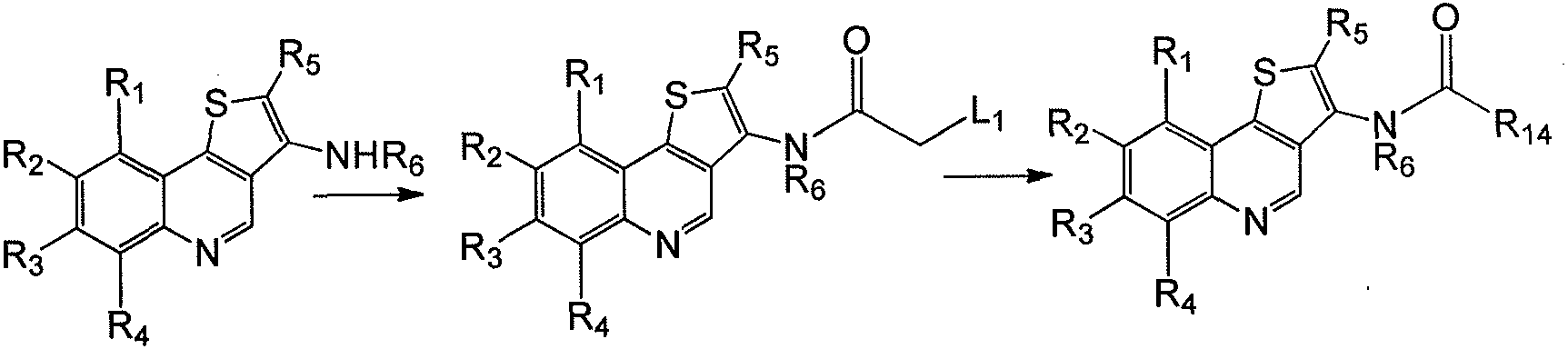
Formula NN Formula OO Formula Ih
Ri, R2, R3, , R5, Re, and Ri4 are as defined above and Li is a leaving group, preferably a halogen.
Particular embodiments of the process Scheme Ih include those wherein:
Li is a leaving group, preferably a halogen, including CI or Br; Rj is H; at least on of R2 and R3 is -0-R8; R4 is H; R5 is -C(=0)-Ri3; R0 is H; and R8 is independently selected from the group consisting of: H; a saturated or unsaturated, straight or branched, cyclic or acyclic, chiral or achiral hydrocarbyl group having from 1 to 10 carbon atoms, wherein the hydrocarbyl group is optionally substituted with one or more of halogen, hydroxy, (Cj - C4)alkylcarbonyloxy, or -NRnRi2, and wherein one or more of the carbon atoms in the hydrocarbyl group is optionally replaced by an oxygen atom (-0-); substituted or unsubstitued (C6-Cio)aryI; substituted or unsubstitued (C2-Cc))heterocyclyl; and -NH2; Ri3 is -OR15; Ri4 is selected from the group consisting of: substituted or unsubstituted (C2- C9)heterocyclyl; -C(=0)-substituted or unsubstituted (C6-Cio)aryl;
-C(=0)-substituted or unsubstituted (C2-C9)heterocyclyl; -C(=0)-NH-substituted or unsubstituted (C6-Cio)aryl; -C(=0)-NH-substituted or unsubstituted (C6-Cio)arylkyl;
-C(=0)-NH-substituted or unsubstituted (C2-C9)heterocyclyl; -C(=0)-substituted or unsubstituted (C2-C9)heterocyclyl-substituted or unsubstituted (C6-Ci0)heteroaryl; and
-C(=0)-NH-substituted or unsubstituted (C6-Cio)aryl-substituted or unsubstituted (C2- C9)heterocyclyl; and R15 is (Ci-Ce)alkyl.
The reaction in Scheme Ih of compound N can proceed in the presence of L]- CH2-C(=0)-L2, wherein Li and L2 each independently represents a leaving group, such as a halide, including chloride, and in the presence of a base, such as Et3N, to form a compound OO. Compound 00 can be further reacted with a nucleophile, such as an amine group, in the optional presence of a base to provide the compound to produce the compound Ih. The reaction in Scheme Ih is preferably carried out in an appropriate solvent. The reactions in Scheme Ih are typically carried out at a temperature between 0 °C and the reflux temperature of the solvent, which is typically about 100 °C. The reactions in Scheme Ih are typically carried out at a temperature between 0 °C and the reflux temperature of the solvent, which is typically about 100 °C, under inert atmosphere for 5-12 hours.
A process is provided in Scheme Ii for the synthesis of compounds according to Formula Ii comprising condensing a compound of Formula PP to form a compound Ii, wherein Formula Ii is an embodiment of Formula I.
Scheme Ii

Formula PP Formula Ii
Pvi, R2, R.3, R4, R5, Re, R7, X and Y are as defined above.
Particular embodiments of the process in Scheme Ii include those wherein:
Ri is H; R2 is -0-R8; R3 is -0-R8, R4 is H; Rs is -C(=0)-Ri3; Re is H; R7 is H; R8 is independently selected from the group consisting of: H; a saturated or unsaturated, straight or branched, cyclic or acyclic, chiral or achira! hydrocarbyl group having from 1 to 10 carbon atoms, wherein the hydrocarbyl group is optionally substituted with one or more of halogen, hydroxy, (Ci-C4)alkylcarbonyIoxy, or -NRuRi2, and wherein one or more of the carbon atoms in the hydrocarbyl group is optionally replaced by an oxygen atom (-0-); substituted or unsubstitued (C6-Cio)aryl; substituted or unsubstitued (C2-C9)heterocyclyl; and -NH2; Ri3 is -OR15; Ris is (Ci-C6)alkyl; X is selected from the group consisting of (Cp C6)alkyl and (Ci-C6)alkoxyoxo(Ci-C6)alkyl; and Y is a counterion, preferably halide, including iodide or bromide.
In one embodiment, Ri is H; R2 is -0-CH3; R3 is -0-CH3; R4 is H; R5 is -C(=0)- Ri3; R6 is H; R7 is H; Ri3 is -OR15; R15 is (Ci-C6)alkyl X is -CH3; and Y is a counterion, preferably halide, including iodide.
In one embodiment, Rj is H; R2 is -0-CH3; R3 is -O-CH3; R4 is H; R5 is -C(=0)- R13; R5 is H; R7 is H; R!3 is -ORJ5; R)5 is (C,-C6)alkyl; X is -CH2-C(=0)-OCH3; and Y is a counterion, preferably halide, including bromide.
The reaction in Scheme Ii of compound PP can proceed in the presence of XY, where Y is capable of acting as a leaving group for XY. The reaction in Scheme Ii is preferably carried out in an appropriate solvent, ethanol, dichloromethane, dimethyl formamide, and/or sodium acetate. The reactions in Scheme Ii are typically carried out at a temperature between 0 °C and the reflux temperature of the solvent, which is typically about 100 °C, under nitrogen for 5-24 hours.
A process is provided in Scheme Ij for the synthesis of compounds according to Formula Ij comprising condensing a compound of Formula QQ to form a compound Ij, wherein Formula Ij is an embodiment of Formula I.
Scheme Ij

Formula QQ Formula Ij
Ri, R2, R3, R4, R5, Re, and R7 are as defined above.
Particular embodiments of the process in Scheme Ij include those wherein:
Ri is H; R2 is -O-Rs; R3 is -0-R8; R4 is H; R5 is -C(=0)-Ri3; R6 and R7 combine to form =CH-NRi7Ri8; R8 is independently selected from the group consisting of: H; a saturated or unsaturated, straight or branched, cyclic or acyclic, chiral or achiral hydrocarbyl group having from 1 to 10 carbon atoms, wherein the hydrocarbyl group is optionally substituted with one or more of halogen, hydroxy, (Ci-C4)alkylcarbonyloxy, or -NRnRi2, and wherein one or more of the carbon atoms in the hydrocarbyl group is optionally replaced by an oxygen atom (-0-); substituted or unsubstitued (C6-Cio)aryl; substituted or unsubstitued (C2-C9)heterocyclyl; and -NH2; Rj3 is -OR15; R15 is (Ci-C6)alkyl; and Rn and Ri8 are each independently selected from the group consisting of (Ci-C6)alkyl.
In one embodiment, Ri is H; R2 is -0-CH3; R3 is -0-CH3; R4 is H; R5 is -C(=0)-
Ri3; Re and R7 combine to form =CH-N(CH3)2; R13 is -OR\5; and R!5 is (Ci-C6)alkyl.
The reaction of compound QQ can proceed in the presence of N,N- dimethylformamide dimethyl acetal. The reaction in Scheme Ij is preferably carried out in an appropriate solvent, such as DMF. The reactions in Scheme Ij are typically carried out at a temperature between 0 °C and the reflux temperature of the solvent, which is typically about 100 °C. The reactions in Scheme Ij are preferably carried out at 40°C for 2 hours under inert atmosphere.
A process is provided in Scheme Ik for the synthesis of compounds according to Formula Ik comprising reacting a compound of Formula RR to form a compound Ik, wherein Formula Ik is an embodiment of Formula I.
Scheme Ik
RR Ik
Ri, R2, R3, R4, R6, and R7 are as defined above.
Particular embodiments of the process in Scheme Ik include those wherein:
Ri is H; at least one of R2 and R3 is -0-R8; R4 is H; R6 is H; R7 is H; and R8 is
independently selected from the group consisting of: H; a saturated or unsaturated, straight or branched, cyclic or acyclic, chiral or achiral hydrocarbyl group having from 1 to 10 carbon atoms, wherein the hydrocarbyl group is optionally substituted with one or more of halogen, hydroxy, (Ci-C4)alkylcarbonyloxy, or -NRuRi2, and wherein one or more of the carbon atoms in the hydrocarbyl group is optionally replaced by an oxygen atom (-0-); substituted or unsubstitued (C6-Cio)aryl; substituted or unsubstitued (C2-C9)heterocyclyl; and -NH2; and wherein R] 1 and R12 are H.
In one embodiment, Ri is H; R2 is -OCH3; R3 is -OCH3, R4 is H; R0 is H; and R7 is
H.
The reaction in Scheme Ik of compound RR can proceed in the presence of an azide, such as sodium azide, and ammonium halide, such as ammonium chloride. The reaction in Scheme Ik is preferably carried out in an appropriate solvent, such as DMF.
The reactions in Scheme Ik are typically carried out at a temperature between 0 °C and the reflux temperature of the solvent, which is typically about 100 °C. Preferably the reaction in Scheme Ik is carried out at 100°C for 5 hours under inert atmosphere.
IV. Treatment of Cellular Proliferative Disorders Using Compounds of the Invention
According to another embodiment of the invention, a method of treating an individual suffering from a cellular proliferative disorder, particularly cancer, is provided, comprising administering to said individual an effective amount of at least one compound according to Formula I or Formula II, or a pharmaceutically acceptable salt thereof, either alone, or in combination with a pharmaceutically acceptable carrier.
According to another embodiment of the invention, a method of inducing apoptosis of cancer cells, preferably tumor cells, in an individual afflicted with cancer is provided, comprising administering to said individual an effective amount of at least one compound according to Formula I or Formula II, or a pharmaceutically acceptable salt thereof, either alone, or in combination with a pharmaceutically acceptable carrier.
The compounds according to the invention may be administered to individuals (mammals, including animals and humans) afflicted with a cellular proliferative disorder such as cancer, malignant and benign tumors, blood vessel proliferative disorders, autoimmune disorders, and fibrotic disorders. In a particular embodiment of the invention, the individual treated is a human.
The compounds are believed effective against a broad range of tumor types, including but not limited to the following: ovarian cancer; cervical cancer; breast cancer; prostate cancer; testicular cancer, lung cancer, renal cancer; colorectal cancer; skin cancer; brain cancer; leukemia, including acute myeloid leukemia, chronic myeloid leukemia, acute lymphoid leukemia, and chronic lymphoid leukemia.
More particularly, cancers that may be treated by the compounds, compositions and methods of the invention include, but are not limited to, the following:
cardiac cancers, including, for example sarcoma, e.g., angiosarcoma, fibrosarcoma, rhabdomyosarcoma, and liposarcoma; myxoma; rhabdomyoma; fibroma; lipoma and teratoma;
lung cancers, including, for example, bronchogenic carcinoma, e.g., squamous cell, undifferentiated small cell, undifferentiated large cell, and adenocarcinoma; alveolar and bronchiolar carcinoma; bronchial adenoma; sarcoma; lymphoma; chondromatous hamartoma; and mesothelioma;
gastrointestinal cancer, including, for example, cancers of the esophagus, e.g., squamous cell carcinoma, adenocarcinoma, leiomyosarcoma, and lymphoma; cancers of the stomach, e.g., carcinoma, lymphoma, and leiomyosarcoma; cancers of the pancreas, e.g., ductal adenocarcinoma, insulinoma, glucagonoma, gastrinoma, carcinoid tumors, and vipoma; cancers of the small bowel, e.g., adenocarcinoma, lymphoma, carcinoid tumors, Kaposi's sarcoma, leiomyoma, hemangioma, lipoma, neurofibroma, and fibroma; cancers of the large bowel, e.g., adenocarcinoma, tubular adenoma, villous adenoma, hamartoma, and leiomyoma; genitourinary tract cancers, including, for example, cancers of the kidney, e.g., adenocarcinoma, Wilm's tumor (nephroblastoma), lymphoma, and leukemia; cancers of the bladder and urethra, e.g., squamous cell carcinoma, transitional cell carcinoma, and adenocarcinoma; cancers of the prostate, e.g., adenocarcinoma, and sarcoma; cancer of the testis, e.g., seminoma, teratoma, embryonal carcinoma, teratocarcinoma, choriocarcinoma, sarcoma, interstitial cell carcinoma, fibroma, fibroadenoma, adenomatoid tumors, and lipoma;
liver cancers, including, for example, hepatoma, e.g., hepatocellular carcinoma; cholangiocarcinoma; hepatoblastoma; angiosarcoma; hepatocellular adenoma; and hemangioma;
bone cancers, including, for example, osteogenic sarcoma (osteosarcoma), fibrosarcoma, malignant fibrous histiocytoma, chondrosarcoma, Ewing's sarcoma, malignant lymphoma (reticulum cell sarcoma), multiple myeloma, malignant giant cell tumor chordoma, osteochrondroma (osteocartilaginous exostoses), benign
chondroma, chondroblastoma, chondromyxofibroma, osteoid osteoma and giant cell tumors;
nervous system cancers, including, for example, cancers of the skull, e.g., osteoma, hemangioma, granuloma, xanthoma, and osteitis deformans; cancers of the meninges, e.g., meningioma, meningiosarcoma, and gliomatosis; cancers of the brain, e.g., astrocytoma, meduUoblastoma, glioma, ependymoma, germinoma (pinealoma), glioblastoma multiform, oligodendroglioma, schwannoma, retinoblastoma, and congenital tumors; and cancers of the spinal cord, e.g., neurofibroma, meningioma, glioma, and sarcoma;
gynecological cancers, including, for example, cancers of the uterus, e.g., endometrial carcinoma; cancers of the cervix, e.g., cervical carcinoma, and pre-tumor cervical dysplasia; cancers of the ovaries, e.g., ovarian carcinoma, including serous cystadenocarcinoma, mucinous cystadenocarcinoma, unclassified carcinoma, granulosa-thecal cell tumors, Sertoli-Leydig cell tumors, dysgerminoma, and malignant teratoma; cancers of the vulva, e.g., squamous cell carcinoma, intraepithelial carcinoma, adenocarcinoma, fibrosarcoma, and melanoma; cancers of the vagina, e.g., clear cell carcinoma, squamous cell carcinoma, botryoid sarcoma, and embryonal rhabdomyosarcoma; and cancers of the fallopian tubes, e.g., carcinoma;
hematologic cancers, including, for example, cancers of the blood, e.g., acute myeloid leukemia, chronic myeloid leukemia, acute lymphoblastic leukemia, chronic lymphocytic leukemia, myeloproliferative diseases, multiple myeloma, and myelodysplasia syndrome, Hodgkin's lymphoma, non-Hodgkin's lymphoma (malignant lymphoma) and Waldenstrom's macroglobulinemia;
skin cancers, including, for example, malignant melanoma, basal cell carcinoma, squamous cell carcinoma, Kaposi's sarcoma, moles dysplastic nevi, lipoma, angioma, dermatofibroma, keloids, psoriasis; and
adrenal gland cancers, including, for example, neuroblastoma.
Cancers may be solid tumors that may or may not be metastatic. Cancers may also occur, as in leukemia, as a diffuse tissue. Thus, the term "tumor cell", as provided herein, includes a cell afflicted by any one of the above identified disorders.
The compounds are also believed useful in the treatment of non-cancer cellular proliferative disorders, that is, cellular proliferative disorders which are characterized by benign indications. Such disorders may also be known as "cytoproliferative" or "hyperproliferative" in that cells are made by the body at an atypically elevated rate. Non-cancer cellular proliferative disorders believed treatable by compounds according to the invention include, for example: hemangiomatosis in newborn, secondary progressive multiple sclerosis, atherosclerosis, chronic progressive myelodegenerative disease, neurofibromatosis, ganglioneuromatosis, keloid formation, Paget's disease of the bone, fibrocystic disease of the breast, uterine fibroids, Peyronie's disease, Dupuytren's disease, restenosis, benign proliferative breast disease, benign prostatic hyperplasia, X-linked lymphocellular proliferative disorder (Duncan disease), post-transplantation lymphocellular proliferative disorder (PTLD), macular degeneration, and retinopathies, such as diabetic retinopathies and proliferative vitreoretinopathy (PVR)
Other non-cancer cellular proliferative disorders believed treatable by compounds according to the invention include the presence of pre-cancerous lymphoproliferative cells associated with an elevated risk of progression to a cancerous disorder. Many non-cancerous lymphocellular proliferative disorders are associated with latent viral infections such as Epstein-Barr virus (EBV) and Hepatitis C. These disorders often begin as a benign pathology and progress into lymphoid neoplasia as a function of time.
A pharmaceutical composition comprising a pharmaceutically acceptable carrier and a compound, or a pharmaceutically acceptable salt thereof, according to claim 1.
In an aspect of the method, a method of treating an individual suffering from a cellular proliferative disorder, comprising administering to the individual an effective amount of at least one compound, or a pharmaceutically acceptable salt thereof, according to Formula I or Formula II.
In a further aspect of the method, the compound of Formula I is methyl 3-(4- fluorobenzamido)-7,8-dimethoxythieno[3,2-c]quinoline-2-carboxylate, or a
pharmaceutically acceptable salt thereof
In a further aspect of the method, the cellular proliferative disorder is selected from the group consisting of: cancer, malignant and benign tumors, blood vessel proliferative disorders, autoimmune disorders, and fibrotic disorders.
In a further aspect of the method, the cellular proliferative disorder is a cancer selected from the group consisting of: ovarian cancer; cervical cancer; breast cancer; prostate cancer; testicular cancer, lung cancer, renal cancer; colorectal cancer; skin cancer; brain cancer; and leukemia.
In a further aspect of the method, the leukemia is selected from the group consisting of: acute myeloid leukemia, chronic myeloid leukemia, acute lymphoid leukemia, and chronic lymphoid leukemia.
A method of inducing apoptosis of cancer cells in an individual afflicted with cancer, comprising administering to the individual an effective amount of at least one compound, or a pharmaceutically acceptable salt thereof, according to Formula I or Formula II.
According to another embodiment of the invention, a method of treating an individual suffering from a cellular proliferative disorder, particularly cancer, is provided, comprising administering to said individual an effective amount of at least one compound according to Formula II, or a pharmaceutically acceptable salt thereof, either alone, or in combination with a pharmaceutically acceptable carrier:

R20 and R2i are each independently selected from the group consisting of H, halogen, and In another aspect, the invention is a method of administering a compound of
Formula II, or a salt thereof wherein: R19 is (Ci-C6)alkyl.
In another aspect, the invention is a method of administering a compound of Formula II, or a salt thereof wherein: R19 is substituted or unsubstituted (C7-Ci5)aralkyl.
In another aspect, the invention is a method of administering a compound of Formula II, or a salt thereof wherein: R19 is substituted or unsubstituted (C6-Ci0)aryl.
In another aspect, the invention is a method of administering a compound of Formula II, or a salt thereof wherein: at least one of R2o and R21 is -O-CH3.
In another aspect, the invention is a method of administering a compound of Formula II, or a salt thereof wherein: at least one of R20 and R2i is H.
In another aspect, the invention is a method of administering a compound of
Formula II, or a salt thereof wherein: at least one of R20and R2i is F.
In an aspect of the method, a method of treating an individual suffering from a cellular proliferative disorder, comprising administering to the individual an effective amount of at least one compound, or a pharmaceutically acceptable salt thereof, according to Formula II.
In a further aspect of the method, the cellular proliferative disorder is selected from the group consisting of: cancer, malignant and benign tumors, blood vessel proliferative disorders, autoimmune disorders, and fibrotic disorders.
In a further aspect of the method, the cellular proliferative disorder is a cancer selected from the group consisting of: ovarian cancer; cervical cancer; breast cancer; prostate cancer; testicular cancer, lung cancer, renal cancer; colorectal cancer; skin cancer; brain cancer; and leukemia.
In a further aspect of the method, the leukemia is selected from the group consisting of: acute myeloid leukemia, chronic myeloid leukemia, acute lymphoid leukemia, and chronic lymphoid leukemia.
A method of inducing apoptosis of cancer cells in an individual afflicted with cancer, comprising administering to the individual an effective amount of at least one compound, or a pharmaceutically acceptable salt thereof, according to Formula II. V. Salts of Compounds According to the Invention
The compounds of the present invention may take the form of salts when appropriately substituted with groups or atoms capable of forming salts. Such groups and atoms are well known to those of ordinary skill in the art of organic chemistry. The term "salts" embraces addition salts of free acids or free bases which are compounds of the invention. The term "pharmaceutically-acceptable salt" refers to salts which possess toxicity profiles within a range that affords utility in pharmaceutical applications. Pharmaceutically unacceptable salts may nonetheless possess properties such as high crystal linity, which have utility in the practice of the present invention, such as for example utility in process of synthesis, purification or formulation of compounds of the invention.
Suitable pharmaceutically-acceptable acid addition salts may be prepared from an inorganic acid or from an organic acid. Examples of inorganic acids include hydrochloric, hydrobromic, hydriodic, nitric, carbonic, sulfuric, and phosphoric acids. Appropriate organic acids may be selected from aliphatic, cycloaliphatic, aromatic, araliphatic, heterocyclic, carboxylic and sulfonic classes of organic acids, examples of which include formic, acetic, propionic, succinic, glycolic, gluconic, lactic, malic, tartaric, citric, ascorbic, glucuronic, maleic, fumaric, pyruvic, aspartic, glutamic, benzoic, anthranilic, 4-hydroxybenzoic, phenylacetic, mandelic, embonic (pamoic), methanesulfonic, ethanesulfonic, benzenesulfonic, pantothenic, trifluoromethanesulfonic, 2-hydroxyethanesulfonic, p-toluenesulfonic, sulfanilic, cyclohexylaminosulfonic, stearic, alginic, β-hydroxybutyric, salicylic, galactaric and galacturonic acid. Examples of pharmaceutically unacceptable acid addition salts include, for example, perchlorates and tetrafluoroborates.
Suitable pharmaceutically acceptable base addition salts of compounds of the invention include, for example, metallic salts including alkali metal, alkaline earth metal and transition metal salts such as, for example, calcium, magnesium, potassium, sodium
and zinc salts. Pharmaceutically acceptable base addition salts also include organic salts made from basic amines such as, for example, N,N-dibenzylethylenediamine, chloroprocaine, choline, diethanolamine, ethylenediamine, meglumine (N-methylglucamine) and procaine. Examples of pharmaceutically unacceptable base addition salts include lithium salts and cyanate salts.
All of these salts may be prepared by conventional means from the corresponding compound according to Formula I or Formula II by reacting, for example, the appropriate acid or base with the compound according to Formula I or Formula II. Preferably the salts are in crystalline form, and preferably prepared by crystallization of the salt from a suitable solvent. The person skilled in the art will know how to prepare and select suitable salt forms for example, as described in Handbook of Pharmaceutical Salts: Properties, Selection, and Use By P. H. Stahl and C. G. Wermuth (Wiley- VCH 2002).
VI. Pharmaceutical Compositions
The compounds of the invention may be administered in the form of a pharmaceutical composition, in combination with a pharmaceutically acceptable carrier. The active ingredient or agent in such formulations (i.e. a compound of Formula I or Formula II) may comprise from 0.1 to 99.99 weight percent of the formulation. "Pharmaceutically acceptable carrier" means any carrier, diluent or excipient which is compatible with the other ingredients of the formulation and not deleterious to the recipient.
The active agent is preferably administered with a pharmaceutically acceptable carrier selected on the basis of the selected route of administration and standard pharmaceutical practice. The active agent may be formulated into dosage forms according to standard practices in the field of pharmaceutical preparations. See Alphonso Gennaro, ed., Remington 's Pharmaceutical Sciences, 18th Edition (1990), Mack Publishing Co., Easton, PA. Suitable dosage forms may comprise, for example, tablets, capsules, solutions, parenteral solutions, troches, suppositories, or suspensions.
For parenteral administration, the active agent may be mixed with a suitable carrier or diluent such as water, an oil (particularly a vegetable oil), ethanol, saline solution, aqueous dextrose (glucose) and related sugar solutions, glycerol, or a glycol such as propylene glycol or polyethylene glycol. Solutions for parenteral administration preferably contain a water soluble salt of the active agent. Stabilizing agents, antioxidant agents and preservatives may also be added. Suitable antioxidant agents include sulfite, ascorbic acid, citric acid and its salts, and sodium EDTA. Suitable preservatives include benzalkonium chloride, methyl- or propyl-paraben, and chlorbutanol. The composition for parenteral administration may take the form of an aqueous or non-aqueous solution, dispersion, suspension or emulsion.
For oral administration, the active agent may be combined with one or more solid inactive ingredients for the preparation of tablets, capsules, pills, powders, granules or other suitable oral dosage forms. For example, the active agent may be combined with at least one excipient such as fillers, binders, humectants, disintegrating agents, solution retarders, absorption accelerators, wetting agents absorbents or lubricating agents. According to one tablet embodiment, the active agent may be combined with carboxymethylcellulose calcium, magnesium stearate, mannitol and starch, and then formed into tablets by conventional tableting methods.
The specific dose of a compound according to the invention to obtain therapeutic benefit for treatment of a cellular proliferative disorder will, of course, be determined by the particular circumstances of the individual patient including the size, weight, age and sex of the patient, the nature and stage of the cellular proliferative disorder, the aggressiveness of the cellular proliferative disorder, and the route of administration of the compound.
For example, a daily dosage from about 0.05 to about 50 mg/kg/day may be utilized, more preferably from about 0.1 to about 10 mg/kg/day. Higher or lower doses are also contemplated as it may be necessary to use dosages outside these ranges in some cases. The daily dosage may be divided, such as being divided equally into two to four times per day daily dosing. The compositions are preferably formulated in a unit dosage form, each dosage containing from about 1 to about 500mg, more typically, about 10 to about lOOmg of active agent per unit dosage. The term "unit dosage form" refers to
physically discrete units suitable as a unitary dosage for human subjects and other mammals, each unit containing a predetermined quantity of active material calculated to produce the desired therapeutic effect, in association with a suitable pharmaceutical excipient.
The pharmaceutical compositions of the present invention may also be formulated so as to provide slow or controlled release of the active ingredient therein using, for example, hydropropylmethyl cellulose in varying proportions to provide the desired release profile, other polymer matrices, gels, permeable membranes, osmotic systems, multilayer coatings, microparticles, liposomes and/or microspheres.
In general, a controlled-release preparation is a pharmaceutical composition capable of releasing the active ingredient at the required rate to maintain constant pharmacological activity for a desirable period of time. Such dosage forms provide a supply of a drug to the body during a predetermined period of time and thus maintain drug levels in the therapeutic range for longer periods of time than conventional non-controlled formulations.
U.S. Patent No. 5,674,533 discloses controlled-release pharmaceutical compositions in liquid dosage forms for the administration of moguisteine, a potent peripheral antitussive. U.S. Patent No. 5,059,595 describes the controlled-release of active agents by the use of a gastro-resistant tablet for the therapy of organic mental disturbances. U.S. Patent No. 5,591,767 describes a liquid reservoir transdermal patch for the controlled administration of ketorolac, a non-steroidal anti-inflammatory agent with potent analgesic properties. U.S. Patent No. 5,120,548 discloses a controlled-release drug delivery device comprised of swellable polymers. U.S. Patent No. 5,073,543 describes controlled-release formulations containing a trophic factor entrapped by a ganglioside-liposome vehicle. U.S. Patent No. 5,639,476 discloses a stable solid controlled-release formulation having a coating derived from an aqueous dispersion of a hydrophobic acrylic polymer. Biodegradable microparticles are known for use in controlled-release formulations. U.S. Patent No. 5,733,566 describes the use of polymeric microparticles that release antiparasitic compositions.
The controlled-release of the active ingredient may be stimulated by various inducers, for example pH, temperature, enzymes, water, or other physiological conditions or compounds. Various mechanisms of drug release exist. For example, in one embodiment, the controlled-release component may swell and form porous openings large enough to release the active ingredient after administration to a patient. The term "controlled-release component" in the context of the present invention is defined herein as a compound or compounds, such as polymers, polymer matrices, gels, permeable membranes, liposomes and/or microspheres, that facilitate the controlled-release of the active ingredient in the pharmaceutical composition. In another embodiment, the controlled-release component is biodegradable, induced by exposure to the aqueous environment, pH, temperature, or enzymes in the body. In another embodiment, sol-gels may be used, wherein the active ingredient is incorporated into a sol-gel matrix that is a solid at room temperature. This matrix is implanted into a patient, preferably a mammal, having a body temperature high enough to induce gel formation of the sol-gel matrix, thereby releasing the active ingredient into the patient.
The components used to formulate the pharmaceutical compositions are of high purity and are substantially free of potentially harmful contaminants (e.g., at least National Food grade, generally at least analytical grade, and more typically at least pharmaceutical grade). Particularly for human consumption, the composition is preferably manufactured or formulated under Good Manufacturing Practice standards as defined in the applicable regulations of the U.S. Food and Drug Administration. For example, suitable formulations may be sterile and/or substantially isotonic and/or in full compliance with all Good Manufacturing Practice regulations of the U.S. Food and Drug Administration.
VII. Routes of Administration of Compounds and Compositions of the Invention
The compounds of Formula I or Formula II may be administered by any route, including oral, rectal, sublingual, and parenteral administration. Parenteral administration includes, for example, intravenous, intramuscular, intraarterial, intraperitoneal, intranasal, intravaginal, intravesical (e.g., to the bladder), intradermal, transdermal, topical or subcutaneous administration. Also contemplated within the scope of the invention is the instillation of a drug in the body of the patient in a controlled formulation, with systemic
or local release of the drug to occur at a later time. For example, the drug may be localized in a depot for controlled release to the circulation, or for release to a local site of tumor growth.
One or more compounds useful in the practice of the present inventions may be administered simultaneously, by the same or different routes, or at different times during treatment. The compounds may be administered before, along with, or after other medications, including other antiproliferative compounds.
The treatment may be carried out for as long a period as necessary, either in a single, uninterrupted session, or in discrete sessions. The treating physician will know how to increase, decrease, or interrupt treatment based on patient response. According to one emobiment, treatment is carried out for from about four to about sixteen weeks. The treatment schedule may be repeated as required.
VTII. Isomerism in Compounds of the Invention
A. Optical Isomerism
It will be understood that when or if compounds of the present invention contain one or more chiral centers, the compounds may exist in, and may be isolated as pure enantiomeric or diastereomeric forms or as racemic mixtures. The present invention therefore includes any possible enantiomers, diastereomers, racemates or mixtures thereof of the compounds of the invention.
The isomers resulting from the presence of a chiral center comprise a pair of non-superimposable isomers that are called "enantiomers." Single enantiomers of a pure compound are optically active, i.e., they are capable of rotating the plane of plane polarized light. Single enantiomers are designated according to the Cahn-Ingold-Prelog system. Once the priority ranking of the four groups is determined, the molecule is oriented so that the lowest ranking group is pointed away from the viewer. Then, if the descending rank order of the other groups proceeds clockwise, the molecule is designated (R) and if the descending rank of the other groups proceeds counterclockwise, the molecule is designated (S). In the example below, the Cahn-Ingold-Prelog ranking is A > B > C > D. The lowest ranking atom, D is oriented away from the viewer.

(R) configuration (S) configuration The present invention is meant to encompass diastereomers as well as their racemic and resolved, diastereomerically and enantiomerically pure forms and salts thereof. Diastereomeric pairs may be resolved by known separation techniques including normal and reverse phase chromatography, and crystallization.
"Isolated optical isomer" means a compound which has been substantially purified from the corresponding optical isomer(s) of the same formula. Preferably, the isolated isomer is at least about 80%, more preferably at least 90% pure, even more preferably at least 98% pure, most preferably at least about 99% pure, by weight.
Isolated optical isomers may be purified from racemic mixtures by well-known chiral separation techniques. According to one such method, a racemic mixture of a compound having the structure of Formula I or Formula II, or a chiral intermediate thereof, is separated into 99% wt.% pure optical isomers by HPLC using a suitable chiral column, such as a member of the series of DAICEL® CHIRALPAK® family of columns (Daicel Chemical Industries, Ltd., Tokyo, Japan). The column is operated according to the manufacturer's instructions.
B. Rotational Isomerism
It is understood that due to chemical properties (i.e., resonance lending some double bond character to the C-N bond) of restricted rotation about the amide bond linkage (as illustrated below) it is possible to observe separate rotamer species and even, under some circumstances, to isolate such species. It is further understood that certain structural elements, including steric bulk or substituents on the amide nitrogen, may enhance the stability of a rotamer to the extent that a compound may be isolated as, and exist indefinitely, as a single stable rotamer. The present invention therefore includes any possible stable rotamers of Formula I or Formula II.

Examples
The following non-limiting examples are provided to illustrate the invention. The synthetic procedures described as "general methods" describe what it is believed will be typically effective to perform the synthesis indicated. However, the person skilled in the art will appreciate that it may be necessary to vary the procedures for any given embodiment of the invention. For example, reaction monitoring, such as by using thin layer chromatography, or HPLC may be used to determine the optimum reaction time. Products may be purified by conventional techniques that will vary, for example, according to the amount of side products produced and the physical properties of the compounds. On a laboratory scale, recrystallisation from a suitable solvent, column chromatography, normal or reverse phase HPLC, or distillation are all techniques which may be useful. The person skilled in the art will appreciate how to vary the reaction conditions to synthesize any given compound within the scope of the invention without undue experimentation. See, e.g., Vogel's Textbook of Practical Organic Chemistry, by A. I. Vogel, et al, Experimental Organic Chemistry: Standard and Microscale, by L. M. Harwood et al. (2nd Ed., Blackwell Scientific Publications, 1998), and Advanced Practical Organic Chemistry, by J. Leonard, et al. (2nd Edition, CRC Press 1994).
Preparative Examples
Scheme 1 was utilized in preparing the following compounds.

An embodiment of reaction reactions conditions for each step can include: a) N,N- Dimethylformamide dimethyl acetal, DMF, reflux, 2-4hrs; b) i) n-BuLi, MeCN, THF (dry), -78°C, 2h, ii) HOAc, -78°C-rt, 30 min; c) POCl3, reflux, 2 h; d) R3CH2SH, K2C03 (anhydrous), acetone (dry), reflux, overnight; e) i)NH2CSNH2, EtOH, 30 min, ii) NaOH, AcOH; f) R3CH2X, NaOH, MeOH, 3-15h.
General Procedure I:
Preparation of Compound B of Scheme 1: Methyl 2- {[(dimethylamino)methylene]amino}-4,5-di-substituted-benzoate:
A solution of A (23.7 mmol) and Ν,Ν-dimethylformamide dimethylacetal (6.3 mL, 47.4 mmol) in DMF (25 mL) was heated at reflux under N2 for 2-4h. Volatile material was removed and the residue was azeotroped twice with toluene and dried in vacuum (25°C). The formamidine product B was purple syrup that crystallized on standing. The crude compound was used in the next step without further purification.
General Procedure II:
Preparation of Compound C of Scheme 1: 4-Hydroxy-6,7-di-substituted-quinoline-3- carbonitrile:
A solution of acetonitrile (2.32 mL, 51 mmol) in THF (40 mL) was added over 15 min to a solution of 2.5M «-BuLi in hexane (20 mL, 50 mmol) and THF (30 mL) at -78°C under N2. After 20 min, a solution of the crude B in THF (40 mL) was added over 0.5 h. The reaction was stirred at -78°C for 1 h and then quenched with glacial acetic acid (6.5 mL, 113.5 mmol). The mixture was warmed to 25°C and stirring was continued for 30 min. The volatile material was removed and the residue was slurried with H20 (100 mL), collected the separated solid and dried. This material was washed twice with CHC13 (50 mL) and dried to give product C.
General Procedure II and General Procedure III were conducted in sequence to prepare the compound C of Preparative Examples 1-3, as follows:
Preparative Example 1: 4-Hvdroxy-6J-dimethoxyQuinoIine-3-carbonitrile
(compound C: R1=R2=methoxy):

Yield: 2.4 g; m.p.: >300°C.
Ή NMR (DMSO- 6; 400 MHz): 12.54 (brs, 1H, OH), 8.34 (s, 1H, Ar-H), 7.23 (s, 1H, Ar- H), 6.81 (s, 1H, Ar-H), 3.63 (s, 6H, 2 x OCH3).
LC-MS: (M+H): 231.10.
Preparative Example 2: 7-BenzyIoxy-4-hvdroxy-6-methoxyquinoline-3-carbonitrile (compound C; R^methoxy; R2=benzyloxy):

Yield: 2.15 g; m.p.: 292-295°C.
Ή NMR (DMSO-J6; 400 MHz): 12.40 (brs, 1H, OH), 8.55 (s, 1H, Ar-H), 7.50-7.36 (m, 6H, Ar-H), 7.21 (s, 1H, Ar-H), 5.20 (s, 2H, Ph-CH2), 3.85 (s, 3H, OCH3).
LC-MS: (M+H): 307.00.
Preparative Example 3: 6-Benzyloxy-4-hvdroxy-7-methoxyquinoline-3-carbonitrile (compound C: R1= benzyloxy; R2=methoxy);

Yield: 2.05 g; m.p.: 294-298°C.
1H NMR (DMSO-i4; 300 MHz): 12.84 (brs, 1H, OH), 8.57 (s, 1H, Ar-H), 7.53 (s, 1H, Ar- H), 7.46-7.32 (m, 5H, Ar-H), 7.13 (s, 1H, Ar-H), 5.17 (s, 2H, Ph-CH2), 3.87 (s, 3H, OCH3).
LC-MS: (M+H): 307.00.
General Procedure III:
Preparation of Compound D of Scheme 1: 4-Chloro-6,7-di-substituted-quinoline-3- carbonitrile:
A stirred mixture of C (8.7 mmol) and POCI3 (95 mmol) was heated at reflux for 2 h under N2 and the volatile materials were removed under vacuum at about 70°C. The residue was
stirred at 0°C with DCM (100 mL) and H20 (100 mL) as solid K2C03 was carefully added until the pH 8-9. After stirring for 30 min at 25°C the organic layer was separated, washed with H20, dried, filtered through Celite and concentrated to give analytically pure product D.
Preparative Example 4: 4-Chloro-6,7-dimethoxyquinoline-3-carbonitrile
(compound D: R1=R2:=methoxy):

Yield: 1.95 g; m.p.: 218-220°C.
Ή NMR (CDC13; 400 MHz): 8.71 (s, IH, Ar-H), 7.36 (s, IH, Ar-H), 7.34 (s, IH, Ar-H), 4.01 (s, 6H, 2 x OCH3).
LC-MS: (M+H): 249.10.
Preparative Example 5: 7-Benzyloxy-4-chloro-6-methoxyquinoline-3-carbonitrile (compound D: R1=methoxy; R2=benzyloxy):
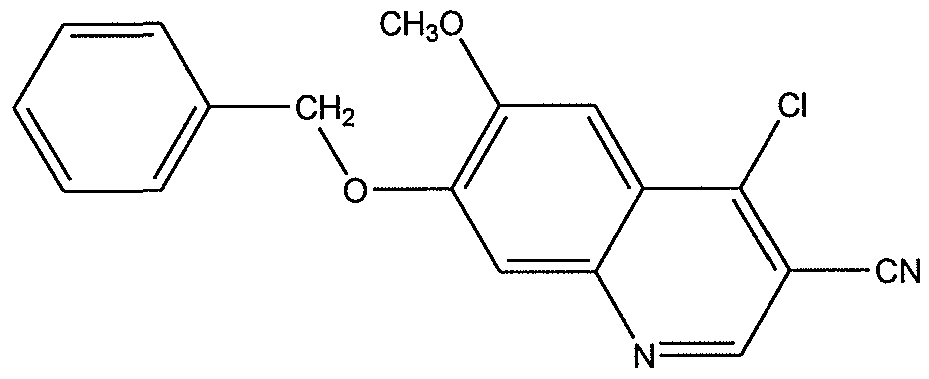
General Procedure III was followed to provide the title compound.
Yield: 1.80 g; m.p.: 182-184°C.
!H NMR (CDC13; 300 MHz): 8.75 (s, IH, Ar-H), 7.51-7.26 (m, 7H, Ar-H), 5.33 (s, 2H, Ph-CH2), 4.08 (s, 3H, OCH3).
LC-MS: (M+H) : 325.00.
Preparative Example 6: 6-Benzyloxy-4-chloro-7-methoxyquinoIine-3-carbonitriie (compound D; R1:=benzyloxy; R2=methoxy):

Yield: 1.88 g; m.p.: 176-178°C.
Ή NMR (CDC13; 300 MHz): 8.68 (s, 1H, Ar-H), 7.46-7.30 (m, 7H, Ar-H), 5.24 (s, 2H, Ph-CH2), 4.00 (s, 3H, OCH3).
LC-MS: (M+H) : 325.00.
General Procedure IV:
Preparation of Compound E of Scheme 1: 4-Mercapto-6,7-di-substituted-quinoline- 3-carbonitriIe:
A solution of D (4.0 mmol) in 30 mL of EtOH was heated to 50°C and thiourea (4.0 mmol) was added at once. This mixture was stirred vigorously for 30 min and then left to cool slowly to room temperature. The precipitated solid was filtered off, dissolved in 0.2M NaOH solution and stirred for 15 min and filtered. The filtrate was acidified with acetic acid to pH 2, the separated solid filtered and washed with ether (20 mL) to give pure E. Preparative Example 7: 4-Mercapto-6,7-dimethoxyquinoline-3-carbonitrile:
(compound E: R^methoxy; R2=methoxy):

General Procedure IV was followed to provide the title compound.
Yield: 900 mg; m.p.: 238-241°C.
Ή NMR (DMSO-<&; 600 MHz): 8.53 (s, 1H, Ar-H), 8.09 (s, 1H, Ar-H), 7.12 (s, 1H, Aril), 3.94 (s, 3H, OCH3), 3.91 (s, 3H, OCH3).
LC-MS: (M+H): 246.90.
General Procedure V - Methods A and B
Preparation of Compound F of Scheme 1: 3-Amino-2,7,8-tri-substituted-thieno[3,2- cjquinolone:
Method A:
A mixture of alkyl thioglycolate (2.0 mmol) and anhydrous potassium carbonate (8.0 mmol) in dry acetone (20 mL) was stirred at room temperature for 10 min. under N2. Compound D (2.0 mmol) was added at once to the above contents and the reaction was refluxed over night under N2. The solvent was removed under reduced pressure and the crude reaction mixture was added to ice cold water (50 mL) with stirring. The separated solid was filtered, washed with water and dried to get pure compound F.
Method B:
4-Mercapto-6,7-dimethoxyquinoline-3-carbonitrile (1.2 mmol) was added at once to the stirred solution of sodium hydroxide/anhydrous potassium carbonate (3.6 mmol) in MeOH/Acetone (dry) (10 mL) and stirring was continued for further 10 min at room temperature. R5CH2Cl/RsCH2Br (1.2 mmol) was added to the above reaction mixture and the reaction was continued for 3-15h under N2. The reaction mixture was poured into ice water (50mL), the separated solid was filtered, washed with water (lOmL), ether (10 mL) and dried to get pure product F. In some cases the separated solid was filtered, washed with water (lOmL), ether (10 mL) and dried to get pure F.
Example 1: Methyl 3-aniino-7,8-dimethoxythienof3<2-clquinolone-2-carboxylate:

A condensation carried out with 4-chloro-6,7-dimethoxyquinoline-3-carbonitrile (500 mg, 2.0 mmol) and methyl thioglycolate (220 /L, 2.4 mmol) in the presence of anhydrous K2C03 (1.10 g, 8.0 mmol) in acetone (20 mL) according to method A afforded 520 mg of pure title compound,
m.p.: 260-262°C.
Ή NMR (DMSO-i¾; 600 MHz): 9.34 (s, 1H, Ar-H), 7.54 (s, 1H, Ar-H), 7.41 (brs, 2H, NH2), 7.35 (s, 1H, Ar-H), 3.99 (s, 3H, OCH3), 3.98 (s, 3H, OCH3), 3.84 (s, 3H, C02CH3). LC-MS: (M+H): 319.74.
Example 2: Ethyl 3-amino-7,8-dimethoxythieno[3,2-clquinolone-2-carboxylate:

The reaction of 4-chloro-6,7-dimethoxyquinoline-3-carbonitrile (500 mg, 2.0 mmol) with ethyl thioglycolate (260 //L, 2.4 mmol) in the presence of anhydrous K2C03 (1.10 g, 8.0 mmol) in acetone (20 mL) according to General Procedure V, Method A, afforded 500 mg of pure title compound.
m.p.: 215-218°C.
1H NMR (DMSO-i/6; 400 MHz): 9.32 (s, 1H, Ar-H), 7.51 (s, 1H, Ar-H), 7.41 (brs, 2H, NH2), 7.32 (s, 1H, Ar-H), 4.33-4.31 (q, 2H, CH2CH3), 3.99 (s, 6H, 2 X OCH3), 1.35 (t,
3H, CH2CH3).
LC-MS: (Μ+Η): 333.10.
Example 3
(3-Aniino-7,8-dimethoxythienof3,2-clquinolin-2-vn(4-fluorophenvnmethanone:

The reaction of 4-mercapto-6,7-dimethoxyquinoline-3-carbonitrile (300 mg, 1.2 mmol) with 4-fluorophenacyl bromide (264 mg, 1.2 mmol) in the presence of NaOH (146 mg, 3.6 mmol) in MeOH (10 mL) afforded 520 mg of pure title compound according to General Procedure V, Method B.
m.p.: 286-288°C
1H NMR (DMSO-i¼; 300 MHz): 9.39 (s, 1H, Ar-H), 8.50 (brs, 2H, NH2), 7.90-7.86 (m, 2H, Ar-H), 7.49 (s, 1H, Ar-H), 7.41-7.35 (m, 2H, Ar-H), 7.25 (s, 1H, Ar-H), 3.94 (s, 3H, OCH3), 3.92 (s, 3H, OCH3).
LC-MS: (M+H): 383.10
Example 4
Methyl 3-amino-7-benzyloxy-8-methoxythienof3,2-clquinolone-2-carboxylate;

The reaction between 7-benzyloxy-4-chloro-6-methoxyquinoline-3-carbonitrile (300 mg, 0.92 mmol), methyl thioglycolate (100 μί, 1.1 mmol) and an. K2C03 (510 mg, 3.6mmol) in dry acetone (15 mL) gave 340 mg of pure title compound according to General Procedure V, Method A.
m.p.: 221-223°C.
1H NMR (DMSO-i/6; 300 MHz): 9.20 (s, 1H, Ar-H), 7.52-7.47 (m, 3H, Ar-H), 7.39-7.32 (m, 3H, Ar-H), 7.31 (brs, 2H, NH2), 7.22 (s, 1H, Ar-H), 5.24 (s, 2H, Ph-CH2), 3.91 (s, 3H, OCH3), 3.77 (s, 3H, CO2CH3).
LC-MS: (M+H): 395.10. Example 5
l-(3-Amino-7,8-dimethoxythienof3,2-clquinolin-2-yl)-2,2,2-trifluoroethanone:

The cyclo condensation of 4-mercapto-6,7-dimethoxyquinoline-3-carbonitrile (200 mg, 0.81 mmol) with 3-bromo-l,l,l-trifluoroacetone (100 //L, 0.97 mmol) in the presence of K2C03 (447 mg, 3.2 mmol) in dry acetone (15 mL) afforded 220 mg of pure title
compound by following General Procedure V, Method B.
m.p.: 230-234°C.
Ή NMR (CDC13; 300 MHz): 9.60 (s, 1H, Ar-H), 7.56 (s, 1H, Ar-H), 7.44 (s, 1H, Ar-H), 7.19 (brs, 2H, NH2), 4.04 (s, 3H, OCH3), 4.01 (s, 3H, OCH3).
LC-MS: (M+Na): 379.00.
Example 6
l-(3-Amino-7,8-dimethoxythieno[3,2-c1quinolin-2-vnethanone:

The reaction of 4-mercapto-6,7-dimethoxyquinoline-3-carbonitrile (200 mg, 0.81 mmol), chloro acetone (80 μί, 0.97 mmol) in the presence of NaOH (97 mg, 2.4 mmol) in MeOH (10 mL) gave 210 mg of pure title compound according to General Procedure V, Method B.
m.p.: 260-263°C
Ή NMR (DMSO- /6; 300 MHz): 9.30 (s, 1H, Ar-H), 8.05 (brs, 2H, NH2), 7.47 (s, 1H, Ar- H), 7.25 (s, 1H, Ar-H), 3.94 (s, 6H, 2 x OCH3), 2.38 (s, 3H, COCH3).
LC-MS: (M+Na): 303.10
Example 7
Methyl 3-amino-8-benzvIoxy-7-methoxythieno[3,2-c1quinoline-2-carboxyIate:

The cyclo condensation of 6-Benzyloxy-4-chloro-7-methoxyquinoline-3-carbonitrile (1.0 g, 3.1 mmol) with methyl thioglycolate (330 /L, 3.7 mmol) in the presence of anhydrous K2C03 (1.71 g, 12.4 mmol) in dry acetone (30 mL) by following General Procedure V, Method A afforded 800 mg of pure title compound,
m.p.: 272-274°C.
Ή NMR (DMSO-i¾; 300 MHz): 9.28 (s, 1H, Ar-H), 7.52-7.50 (m, 3H, Ar-H), 7.42-7.38 (m, 6H, Ar-H & NH2), 5.29 (s, 2H, Ph-CH2), 3.94 (s, 3H, OCH3), 3.80 (s, 3H, C02CH3). LC-MS: (M+H): 395.10.
Example 8
3-Amino-7,8-dimethoxythieno[3,2-clquinoline-2-carbonitrile:

The reaction of 4-mercapto-6,7-dimethoxyquinoline-3-carbonitrile (200 mg, 0.81 mmol) with chloroacetonitrile (256 /iL, 4 mmol) in the presence of NaOH (97 mg, 2.4 mmol) in MeOH (10 mL) gave 190 mg of pure title compound according to General Procedure V, Method B.
m.p.: 314-316°C.
!H NMR (DMSO-<¾; 300 MHz): 9.26 (s, 1H, Ar-H), 7.51 (s, 1H, Ar-H), 7.40 (brs, 2H,
NH2), 7.28 (s, 1H, Ar-H), 3.96 (s, 3H, OCH3), 3.94 (s, 3H, OCH3).
LC-MS: (M+H): 286.10.
General Procedure VI;
Preparation of 3-amino-2-substituted-7-hydroxy-8-methoxythieno[3,2-c]quinoline or 3-amino-2-substituted-7-methoxy-8- hydroxythieno[3,2-c]quinoline:
A solution of compound 3-amino-2-substituted-7-benzyloxy-8-methoxythieno[3,2- c]quinoline (compound G of Scheme 2) or 3-amino-2-substituted-7-methoxy-8-benzyloxy thieno[3,2-c]quinoline (compound G' of Scheme 2) (0.5 mmol) in trifluoroacetic acid (10 mL) is refluxed for 5h under N2. The reaction is allowed to attain the room temperature, poured in ice-cold water (20 mL) with stirring. The separated solid is filtered, washed with water (10 mL), ether (10 mL) and dried to obtain pure title product.
Scheme 2

An embodiment of the process shown in scheme 2 can include, a) CF3C02H, reflux, 5h; b) R4-C1, anhydrous K2C03, DMF, 60°C, 4h (or) a') CF3C02H, reflux, 5h; b') R4-CI, Et3N, DMF, 60°C, 4h.
Example 9
Methyl 3-amino-7-hvdroxy-8-methoxythienoi3,2-c1quinoline-2-carboxylate:

According to General Procedure VI, a solution of methyl 3-amino-7-benzyloxy-8- methoxythieno[3,2-c]quinolone-2-carboxylate (0.5 mmol) in trifluoroacetic acid (10 mL) was refluxed for 5h under N2. The reaction was allowed to attain room temperature, and was poured in ice-cold water (20 mL) with stirring. The separated solid was filtered, washed with water (10 mL), ether (10 mL) and dried to give pure title compound.
Yield: 150 mg; m.p.: 244-246°C.
!H NMR (DMSO- 6; 300 MHz): 1 1.33 (brs, IH, OH), 9.43 (s, IH, Ar-H), 7.48 (s, IH, Ar- H), 7.44 (brs, 2H, NH2), 7.40 (s, IH, Ar-H), 3.98 (s, 3H, OCH3), 3.80 (s, 3H, C02CH3). LC-MS: (M+H): 305.10. Example 10
Methyl 3-amino-8-hvdroxy-7-methoxythieno[3,2-clquinoline-2-carboxyIate:

According to General Procedure VI, a solution of methyl 3-amino-8-benzyloxy-7- methoxythieno[3,2-c]quinoline-2-carboxylate (0.5 mmol) in trifluoroacetic acid (10 mL) was refluxed for 5h under N2. The reaction was allowed to attain room temperature, and was poured in ice-cold water (20 mL) with stirring. The separated solid was filtered, washed with water (10 mL), ether (10 mL) and dried to give pure title compound.
Yield: 128mg; m.p.: 277-280°C.
Ή NMR (DMSO-t/e; 300 MHz): 10.23 (brs, 1H, OH), 9.23 (s, 1H, Ar-H), 7.47 (s, 1H, Ar- H), 7.38 (brs, 2H, NH2), 7.22 (s, 1H, Ar-H), 3.94 (s, 3H, OCH3), 3.79 (s, 3H, C02CH3). LC-MS: (M+H): 305.00. General Procedure VII:
Preparation of 3-amino-2-substituted-7-substituted-8-niethoxythieno[3,2-c]quinoline or 3-aniino-2-substituted-7-methoxy-8-substituted-thieno [3,2-c] quinoline:
A mixture of 3-amino-2-substituted-7-hydroxy-8-methoxythieno[3,2-c]quinoline (1 mmol) (Scheme 2) and the following are heated at 60°C for 4h under N2: The R3-C1 (1.5 mmol), anhydrous K2C03/Et3N (4 mmol) and DMF (8 mL). The reaction mixture is poured into ice-cold water (50 mL) with stirring, filtered and the separated solid is washed with water (10 mL), ether (10 mL) and dried to obtain analytically pure product 3-amino-2- substituted-7-substituted -8-methoxythieno[3,2-c]quinoline.
Similarly, a mixture of 3-amino-2-substituted-7-methoxy-8-hydroxythieno[3,2-c]quinoline and the following are heated at 60°C for 4h under N2: R2-C1 (1.5 mmol), anhydrous K2C03/Et3N (4 mmol) and DMF (8 mL). The reaction mixture is poured into ice-cold water (50 mL) with stirring, filtered and the separated solid is washed with water (10 mL), ether (10 mL) and dried to obtain analytically pure product 3-amino-2-substituted-7- methoxy-8-substituted-thieno[3,2-c]quinoline.
Example 11
Methyl 3-amino-8-methoxy-7-(3-morpholinopropoxy)thieno[3,2-clquinoIine-2- carboxylate:

According to General Procedure VII, the reaction of 3-amino-7-hydroxy-8- methoxythieno[3,2-c]quinoline-2-carboxylate (200 mg, 0.66 mmol), 4-(3-
chloropropyl)morpholine (161 mg, 0.99 mmol) in the presence of anhydrous K2C03 (363 mg, 2.62 mmol) in DMF (5 mL) gave 210 mg of pure title compound,
m.p.: 117-120°C.
Ή NMR (CDC13; 300 MHz): 8.86 (s, 1H, Ar-H), 7.44 (s, 1H, Ar-H), 7.09 (s, 1H, Ar-H), 6.12 (brs, 2H, NH2), 4.21 (t, 2H), 3.96 (s, 3H, OCH3), 3.84 (s, 3H, C02CH3), 3.65 (t, 4H), 2.50 (t, 2H), 2.41 (t, 4H), 2.07-2.03 (m, 2H).
LC-MS: (M+H): 432.20.
Example 12
Methyl 3-amino-8-methoxy-7-[3-(piperidin-l-yl)propoxy]thieno[3,2-c]quinoIine-2- carboxylate:

Following General Procedure VII, the reaction of a mixture of 3-amino-7-hydroxy-8- methoxythieno[3,2-c]quinoline-2-carboxylate (200 mg, 0.66 mmol) and l-(3- chloropropyl)piperidine monohydrochloride (157 mg, 0.79 mmol) in the presence of an. K2C03 (363 mg, 2.62 mmol) in DMF (5 mL) afforded 240 mg of pure title compound, m.p.: 127-130°C.
1H NMR (DMSO-d6; 300 MHz): 9.25 (s, 1H, Ar-H), 7.41 (s, 1H, Ar-H), 7.35 (brs, 2H, NH2), 7.20 (s, 1H, Ar-H), 3.92 (t, 2H), 3.92 (s, 3H, OCH3), 3.78 (s, 3H, C02CH3), 2.39- 2.36 (m, 2H), 2.34-2.29 (m, 4H), 1.94-1.88 (m, 2H), 1.48-1.44 (m, 4H), 1.35-1.33 (m, 2H). LC-MS: (M+H): 430.20.
Example 13
Methyl 3-amino-8-methoxy-7-[(4-methylpiperazine-l-carbonyI)oxy]thieno[3,2-c] quinoline-2-carboxylate:

124 mg of pure title compound was obtained from 3-amino-7-hydroxy-8- methoxythieno[3,2-c]quinoline-2-carboxylate (100 mg, 0.32 mmol) and 4-methyl-l- piperazinecarbonyl chloride (66 ^wL, 0.49 mmol) in the presence of an. K2C03 (181 mg, 1.3 mmol) in DMF (5 mL) by following General Procedure VII.
m.p.: 147-150°C.
*H NMR (DMSO-i/6; 300 MHz): 9.43 (s, 1H, Ar-H), 7.67 (s, 1H, Ar-H), 7.52 (brs, 2H, NH2), 7.39 (s, 1H, Ar-H), 4.25-4.23 (m, 2H), 3.95 (s, 3H, OCH3), 3.80 (s, 3H, C02CH3), 3.51-3.42 (m, 4H), 3.25-3.23 (m, 2H), 2.48 (s, 3H, N-CH3).
LC-MS: (M+H): 431.20.
Example 14
Methyl 3-amino-8-methoxy-7-(2-morpholinoethoxy)thieno[3,2-c]quinoIine-2- carboxylate:

The reaction of 3-amino-7-hydroxy-8-methoxythieno[3,2-c]quinoline-2-carboxylate (200 mg, 0.66 mmol) with 4-(2-chloroethyl)morpholine hydrochloride (183 mg, 0.99 mmol) in the presence of an. K2C03 (365 mg, 2.6 mmol) in DMF (10 mL) according to General Procedure VII gave 160 mg of pure title compound,
m.p.: 158-160°C.
Ή NMR (DMSO-i 6; 300 MHz): 9.16 (s, 1H, Ar-H), 7.58 (s, 1H, Ar-H), 7.37 (brs, 2H, NH2), 7.29 (s, 1H, Ar-H), 4.26 (t, 2H), 3.95 (s, 3H, OCH3), 3.86 (s, 3H, C02CH3), 3.57 (t, 4H), 3.32 (t, 2H), 2.77 (t, 2H), 2.36 (t, 2H).
LC-MS: (M+H): 418.20.
Example 15
Methyl 3-amino-7-methoxy-8-(3-morphoIinopropoxy)thieno[3,2-c]quinoline-2- carboxylate:

Yield: 110mg; m.p.: 188-190°C.
1H NMR (DMSO-< ; 300 MHz): 9.29 (s, 1H, Ar-H), 7.49 (s, 1H, Ar-H), 7.38 (brs, 2H, NH2), 7.29 (s, 1H, Ar-H), 4.18 (t, 2H), 3.94 (s, 3H, OCH3), 3.80 (s, 3H, C02CH3), 3.57 (t, 4H), 2.48 (t, 4H), 2.37 (t, 2H), 1.97-1.93 (m, 2H).
LC-MS: (M+H): 432.20.
General Procedure VIII:
Preparation of 3-(substituted-benzamido)-2, 7,8-trisubstituted-thieno[3,2-c]quinoline (compound J, Scheme 3)

(R)4-(C=0))20, 60°C, 2-14h.
To a solution of 3-amino-2,7,8-tri-substituted-thieno[3,2-c]quinolone (compound F, Scheme 3) (0.63 mmol) in DCM/DMF (15 mL) is added appropriate acid chloride (0.88 mmol) and Et3N (3.14 mmol) and the reaction mixture is stirred at room temperature for 2- 15h. The separated solid is filtered, washed with water (5 mL), methanol (5 mL) and dried to get pure product 3-(substituted-benzamido)-2, 7,8-trisubstituted-thieno[3,2-c]quinoline.
Example 16
Methyl 7,8-dimethoxy-3-(4-methoxybenzamido)thieno[3,2-c]quinoline-2-carboxylate:

According to General Procedure VIII, the reaction of methyl 3-amino-7,8- dimethoxythieno[3,2-c]quinolone-2-carboxylate (200 mg, 0.63 mmol), 4-methoxybenzoyl chloride (150 mg, 0.88 mmol) in the presence of Et3N (440 μΐ,, 3.14 mml) in DCM (15 mL) afforded 272 mg of pure title compound,
m.p.: 255-258°C.
1H NMR (DMSO-C&; 400 MHz): Poor solubility.
LC-MS: (M+H): 453.10.
Example 17
Methyl 3-(2-fluorobenzamido)-7,8-dimethoxythieno[3,2-c]quinoline-2-carboxylate:

According to General Procedure VIII, the reaction of methyl 3-amino-7,8- dimethoxythieno[3,2-c]quinolone-2-carboxylate (200 mg, 0.63 mmol), 2-fluorobenzoyl chloride (139 mg, 0.88 mmol) in the presence of Et3N (440 L, 3.14 mml) in DCM (15 mL) gave pure title compound.
Yield: 260 mg; m.p.: 237-240°C.
Ή NMR (DMSO-i/6; 400 MHz): Solubility problem.
LC-MS: (M+H): 441.10. Example 18
Methyl 3-(4-fluorobenzamido)-7,8-dimethoxythieno[3,2-c]quinoline-2-carboxylate:

The reaction of a solution of methyl 3-amino-7,8-dimethoxythieno[3,2-c]quinolone-2- carboxylate (200 mg, 0.63 mmol), 4-fluorobenzoyl chloride (102 //L, 0.88 mmol), Et3N (440 //L, 3.14 mmol) and DCM (15 mL) following General Procedure VIII gave pure title compound.
Yield: 245 mg; m.p.: 196-198°C.
Ή NMR (DMSO-i/6; 300 MHz): 13.06 (brs, IH, NH), 9.30 (s, IH, Ar-H), 8.02-7.99 (m, 2H, Ar-H), 7.50-7.47 (m, 2H, Ar-H), 7.45 (s, IH, Ar-H), 7.42 (s, IH, Ar-H), 3.98 (s, 3H, OCH3), 3.95 (s, 3H, OCH3), 3.84 (s, 3H, C02CH3).
LC-MS: (M+H): 441.10.
Example 19
Methyl 3-benzamido-7,8-dimethoxythieno[3,2-c]quinoIine-2-carboxylate:

A mixture of methyl 3-amino-7,8-dimethoxythieno[3,2-c]quinolone-2-carboxylate (200 mg, 0.63 mmol), benzoyl chloride (139 mg, 0.88 mmol), Et3N (440//L, 3.14 mml) and DCM (15 mL) following General Procedure VIII afforded pure title compound.
Yield: 220 mg; m.p.: 205-208°C
Ή NMR (DMSO-c ; 300 MHz): 12.94 (brs, 1H, NH), 9.30 (s, 1H, Ar-H), 7.94-7.91 (m, 2H, Ar-H), 7.51-7.46 (m, 2H, Ar-H), 7.45 (s, 1H, Ar-H), 7.31 (s, 2H, Ar-H), 7.23 (s, 1H, Ar-H), 3.95 (s, 3H, OCH3), 3.94 (s, 3H, OCH3), 3.80 (s, 3H, C02CH3).
LC-MS: (M+H): 423.10.
Example 20
Methyl 7,8-dimethoxy-3-(2-nitrobenzamido)thieno[3,2-c]quinoline-2-carboxylate:

The reaction of methyl 3-amino-7,8-dimethoxythieno[3,2-c]quinolone-2-carboxylate (200 mg, 0.63 mmol), 2-nitrobenzoyl chloride (163 mg, 0.88 mmol) in the presence of Et3N (440//L, 3.14 mml) in DMF (15 mL) according to General Procedure VIII gave pure title
compound.
Yield: 260; m.p.: 178-181°C.
'H NMR (DMSO-i/6; 400 MHz): Solubility problem.
LC-MS: (M+H): 468.10.
Example 21
Methyl 7,8-dimethox -3-(2-aminobenzamido)thieno[3,2-c]quinoline-2-carboxylate:

The reaction of methyl 3-amino-7,8-dimethoxythieno[3,2-c]quinolone-2-carboxylate (200 mg, 0.63 mmol) with 2-nitrobenzoyl chloride (163 mg, 0.88 mmol) in the presence of Et3N (440 /L, 3.14 mml) in DMF (15 mL) gave pure lie.
Yield: 260; m.p.: 178-181°C.
1H NMR (DMSO-c/6; 400 MHz): Solubility problem.
LC-MS: (M+H): 468.10.
Example 22
Methyl 3-(4-chloro-3-nitrobenzamido)-7,8-dimethoxythieno[3,2-c]quinoline-2- carboxylate:

Yield: l Ag; m.p.: 260-262°C.
1H NMR (DMSO-J6; 400 MHz): Solubility problem.
LC-MS: (M+H): 502.10.
General Procedure IX:
Preparation of 3-acetamido-2,7,8-trisubstituted-thieno[3,2-c]quinoline (compound K, Scheme 3)
A mixture of 3-amino-2,7,8-tri-substituted-thieno[3,2-c]quinolone (compound F, Scheme 3) (0.63 mmol) and appropriate substituted or unsubstituted acid anhydride (10 mL) are heated at 60°C for 2-14h. The reaction mixture is allowed to attain room temperature, filtered the solid, washed with ether (10 mL) and dried to obtain pure product.
Example 23
Methyl 7,8-dimethoxy-3-(2,2,2-trifluoroacetamido)thieno[3,2-c]quinoline-2- carboxylate:

The reaction of methyl 3-amino-7,8-dimethoxythieno[3,2-c]quinolone-2-carboxylate (200 mg, 0.63 mmol) with trifluroacetic anhydride (10 mL) according to General Procedure IX resulted in the formation of pure title compound.
Yield: 245mg; m.p.: 224-230°C.
Ή NMR (DMSO-i/6; 400 MHz): 1 1.91 (brs, 1H, NH), 9.15 (s, 1H, Ar-H), 7.59 (s, 1H, Ar- H), 7.58 (s, 1H, Ar-H), 4.01 (s, 3H, OCH3), 3.98 (s, 3H, OCH3), 3.89 (s, 3H, C02CH3). LC-MS: (M+H): 415.10.
General Procedure X:
Preparation of 3-(2-chloro-2-oxacetamido)-2,7,8-trisubstituted-thieno [3,2-c] quinoline (compound L, Scheme 4)
Scheme 4

L M
Oxalyl chloride (4 mL) is added to 3-amino-2,7,8-tri-substituted-thieno[3,2-c]quinolone (compound F, Scheme 4) (200 mg, 0.63 mmol) at 0°C under N2 and continue stirring at 0°C to room temperature for another 12-15h. After completion of the reaction oxalyl chloride is removed under reduced pressure and the crude compound is dried in vacuum and the same was used further without purification.
Example 24
Methyl 3-(2-chloro-2-oxoacetamido)-7,8-dimethoxythieno[3,2-c]quinoline-2- carboxylate:

Oxalyl chloride (4 mL) was added to methyl 3-amino-7,8-dimethoxythieno[3,2- c]quinolone-2-carboxylate (200 mg, 0.63 mmol) at 0°C under N2 and continue stirring at 0°C to room temperature for another 12-15h. After completion of the reaction oxalyl chloride was removed under reduced pressure and the crude compound was dried in vacuum and the same was used further without purification.
General Procedure XI:
Preparation of 3-(2-substituted-2-oxoacetamido)-2,7,8-trisubstituted-thieno [3,2- cjquinoline (compound M, Scheme 4)
Crude 3-(2-chloro-2-oxacetamido)-2,7,8-trisubstituted-thieno[3,2-c]quinoline (0.63 mmol) was dissolved in dry DCM (5 mL) and a solution of appropriate amine (0.75 mmol) and Et3N (0.75 mmol) dissolved in DCM (5 mL) was added at room temperature under N2 and the stirring was continued for 10-15h. The solvent was removed under reduced pressure and the residue was treated with ice-cold water (30 mL). The separated solid was filtered, washed with ether (10 mL) and dried to get analytically pure product.
Example 25
Methyl 7,8-dimethoxy-3-[2-(4-methylpiperazin-l-yl)-2-oxoacetamido]thieno[3,2- c]quinoline-2-ca

The reaction of methyl 3-(2-chloro-2-oxoacetamido)-7,8-dimethoxythieno[3,2- c]quinoline-2-carboxylate (256 mg, 0.63 mmol) with 1-methylpiperazine (84 μί, 0.75 mmol) in the presence of Et3N (100 ^L, 0.75 mmol) in DCM (10 mL) according to General Procedure XI gave 170 mg of pure title compound,
m.p.: 238-241°C.
Ή NMR (DMSO-C&; 300 MHz): 11.53 (brs, 1H, NH), 9.07 (s, 1H, Ar-H), 7.52 (s, 2H, Ar- H), 4.46-4.44 (m, 2H), 3.96 (s, 6H, 2 x OCH3), 3.87 (s, 3H, C02CH3), 3.52-3.50 (m, 6H), 2.79 (s, 3H, N-CH3).
LC-MS: (M+H): 460.20.
Example 26
Methyl 7,8-dimethoxy-3-(2-morpholino-2-oxoacetamido)thieno[3,2-c]quinoline-2- car boxy late:

The compound methyl 3-(2-chloro-2-oxoacetamido)-7,8-dimethoxythieno[3,2- c]quinoline-2-carboxylate (256 mg, 0.63 mmol) on treatment with morpholine (66 μΐ^, 0.75 mmol) in the presence of Et3N (100 //L 0.75 mmol) according to General Procdure XI gave 185 mg of pure title compound,
m.p.: 232-234°C.
Ή NMR (DMSO-i4; 300 MHz): 11.38 (brs, IH, NH), 9.05 (s, IH, Ar-H), 7.55 (s, 2H, Ar- H), 3.97 (s, 6H, 2 x OCH3), 3.88 (s, 3H, C02CH3), 3.70 (t, 4H), 2.07 (t, 4H).
LC-MS: (M+H): 460.20.
Example 27
Methyl 7,8-dimethoxy-3-{2-oxo-2-[4-(pyridin-4-yl)piperazin-l-yl]acetamido}thieno
[3,2-c]quinoline-2-carboxylate:

m.p.: 245-248°C.
!H NMR (DMSO-c4; 300 MHz): 1 1.62 (brs, 1H, NH), 9.25 (s, 1H, Ar-H), 8.24 (s, 2H, Ar- H), 7.64 (d, 2H, Ar-H, J = 6.8 Hz), 7.17 (d, 2H, Ar-H, J = 6.8 Hz), 3.96 (s, 3H, OCH3), 3.92 (s, 3H, OCH3), 3.84 (s, 3H, C02CH3), 3.83-3.73 (m, 8H).
LC-MS: (M+H): 536.20.
Example 28
Methyl 7,8-dimethoxy-3-(2-{[4-(4-methyIpiperazin-l-yl)phenyl]amino}-2- oxoacetamido)thieno[3,2-c]quinoline-2-carboxylate:

A mixture of methyl 3-(2-chloro-2-oxoacetamido)-7,8-dimethoxythieno[3,2-c]quinoline- 2-carboxylate (256 mg, 0.63 mmol), 4-(4-methylpiperazino) aniline (120 mg, 0.63 mmol) and Et3N (100 μί, 0.75 mmol) in DCM (10 mL) according to General Procedure XI gave 190 mg of pure title compound,
m.p.: 240-246°C.
!H NMR (DMSO-i¾; 300 MHz): Insoluble.
LC-MS: (M+H): 564.20.
General Procedure ΧΠ;
Preparation of 3-(2-chloroacetamido)-2,7,8-trisubstituted-thieno[3,2-c]quinoIine (compound N, Scheme 4)
To a solution of 3-amino-2,7,8-tri-substituted-thieno[3,2-c]quinolone (compound F,
Scheme 5) (0.63 mmol) in 1,4-dioxan (5 mL) and Et3N (100 / L), is added chloroacetyl chloride (1 mL) drop-wise with stirring under N2. The reaction mixture is refluxed for 5h, the solvent is evaporated in vacuo and the residual solid is stirred by adding ice-cold water (20 mL). The precipitated solid is filtered, washed with water (5 mL), ether (5 mL), and dried.
Example 29
Methyl 3-(2-chloroacetamido)-7,8-dimethoxythieno[3,2-c]quinoline-2-carboxylate

According to General Procedure XII, to a solution of methyl 3-amino-7,8- dimethoxythieno[3,2-c]quinolone-2-carboxylate (0.63 mmol) in 1,4-dioxan (5 mL) and Et3N (100 /L), was added chloroacetyl chloride (1 mL) drop-wise with stirring under N2. The reaction mixture was refluxed for 5h, evaporated the solvent in vacuo and the residual solid was stirred by adding ice-cold water (20 mL). The precipitated solid was filtered, washed with water (5 mL), ether (5 mL), dried and used as is for the next example.
General Procedure ΧΠΙ;
Preparation of 3-(2-(substituted)acetamido)-2,7,8-trisubstituted-thieno [3,2- c]quinoIine (compound P, Scheme 5)
Scheme 5

To a stirred mixture of 3-(2-chloroacetamido)-2,7,8-trisubstituted-thieno[3,2-c]quinoline
(0.38 mmol) in 1,4-dioxane (10 mL) is added an appropriate amine (0.57 mmol), Et3N (2 mL) and refluxed for 5h under N2. The mixture is allowed to attain room temperature, filtered the solid, washed with water (10 mL), ether (10 mL) and dried to obtain analytically pure 3-(2-(substituted)acetamido)-2,7,8-trisubstituted-thieno[3,2-c]quinoline.
General Procedure XIV;
Preparation of Compound Q of Scheme 6: 3-Amino-2,5,7,8-tetra-substituted- thieno[3,2-c]quinolin-5-ium salt:
Scheme 6

F Q
A 3-amino-2,7,8-tri-substituted-thieno[3,2-c]quinolone (compound F, Scheme 6) is reacted with the an appropriate compound XY where Y is a halogen to form a 3-amino- 2,5,7,8-tetra-substituted-thieno[3,2-c]quinolin-5-ium salt (Compound Q of Scheme 6).
Example 30:
Preparation of 3-amino-7,8-dimethoxy-2-(methoxycarbonyl)-5-methylthieno quinolin-S-ium iodide:

In accordance with General Procedure XIV, methyl 3-amino-7,8-dimethoxythieno[3,2- c]quinolone-2-carboxylate (100 mg, 0.31 mmol) was dissolved in a solution of DCM (2
niL) and DMF (0.2 mL), and Mel (0.5 mL) was added. The reaction flask was sealed, and the mixture was stirred overnight at 40°C. The contents of the flask were brought to attain room temperature, filtered the solid, washed with DCM (5 mL) and dried to give 110 mg of pure title compound.
m.p.: 249-251°C.
Ή NMR (DMSO-</6; 600 MHz): 9.83 (s, 1H, Ar-H), 7.69 (s, 2H, Ar-H), 7.64 (brs, 2H, NH2), 4.52 (s, 3H, N-CH3), 4.15 (s, 3H, OCH3), 4.07 (s, 3H, OCH3), 3.86 (s, 3H, C02CH3).
LC-MS: (M+ion): 333.38.
Example 31:
Preparation of 3-amino-7,8-dimethoxy-5-(2-methoxy-2-oxoethyl)-2- (methoxycarbonyI)thieno[3,2-c]quinolin-5-ium bromide:

In accordance with General Procedure XIV, a mixture of methyl 3-amino-7,8- dimethoxythieno[3,2-c]quinolone-2-carboxylate (200 mg, 0.63 mmol), methyl bromoacetate (240 / L, 2.5 mmol), NaOAc (206 mg, 2.5 mmol) and EtOH (10 mL) were refluxed for 24h under N2. The contents were allowed to attain room temperature and cold water (10 mL) was added. The solid separated was filtered, washed with water (5 mL), ether (5 mL), MeOH (5 mL) and dried to get analytically pure product.
Yield: 160 mg; m.p.: 218-220°C.
1H NMR (DMSO-d6; 600 MHz): 9.93 (s, 1H, Ar-H), 7.74 (s, 1H, Ar-H), 7.65 (brs, 3H, Ar-
H & NH2), 6.06 (s, 2H, N-CH2CO), 4.27 (s, 3H, OCH3), 4.08 (s, 6H, 2 x OCH3), 3.87 (s, 3H, C02CH3).
Example 32
(E)-methyl 3-(((dimethylamino)methylene)amino)-7,8-dimethoxythieno [3,2- c]quinoline-2-carboxylate:

Methyl 3-amino-7,8-dimethoxythieno[3,2-c]quinolone-2-carboxylate (200 mg, 0.63 mmol) was dissolved in dry DMF (3 mL) and N,N-dimethylformamide dimethyl acetal (920 /L, 7 mmol) was added. The resulting solution was stirred at 40°C for 2h under N2.
The solution was then evaporated to dryness under vacuum, poured into ice-cold water (20 mL). The separated solid was filtered, washed with ether (5 mL) and dried to get the title compound as pure product.
Yield: 220 mg: m.p.: 173-175°C.
1H NMR (DMSO- g; 600 MHz): 8.94 (s, 1H, Ar-H), 7.99 (s, 1H, =CH), 7.52 (s, 1H, Ar-
H), 7.40 (s, 1H, Ar-H), 3.98 (s, 3H, OCH3), 3.95 (s, 3H, OCH3), 3.78 (s, 3H, C02CH3),
3.10 (s, 6H, 2 x N-CH3).
LC-MS: (M+H): 374.10. Example 33:
7,8-dimethoxy-2-(lH-tetrazol-5-yl)thieno[3,2-c]quinolin-3-amine:
CH3O
To a solution of 3-amino-7,8-dimethoxythieno[3,2-c]quinoline-2-carbonitrile (100 mg, 0.35 mmol) in DMF (4 mL), sodium azide (27 mg, 0.42 mmol) and ammonium chloride (22 mg, 0.42 mmol) were added and the mixture was heated to 100°C for 5h under N2. After being allowed to cool to room temperature the mixture was poured into ice-water and acidified with 3N HCl to pH 4-5. The precipitate was filtered, washed thoroughly with H20 (10 mL), MeOH (10 mL) and dried to afford the title compound.
Yield: 104 mg; m.p.: 252-255°C.
LC-MS: (M+H): 329.20.
General Procedure XV:
Preparation of Compound R of Scheme 7: 3-Amino-2,5,7,8-tetra-substituted- thieno[3,2-c]quinolin-5-ium salt:

Scheme 7
a) R5CH2SH, K2C03 (an), acetone (dry), reflux, overnight;
b) i) NH2CSNH2, EtOH, 30 min; ii) 10% Aq. NaOH, 3N HCl
c) R5CH2X, NaOH
Preparative Example 8:
6-Fluoro-4-mercaptoquinoli -3-carbonitrile (3a):

A solution of 4-chloro-6-fluoroquinoline-3-carbonitrile (la) (lg, 4.8 mmol) in 20 mL of EtOH was heated to 50°C and thiourea (368 mg, 4.8 mmol) was added at once. This mixture was stirred vigorously for 30 min and then left to cool slowly to room temperature. The precipitated solid was filtered off, dissolved in 10% aq. NaOH solution (20 mL) and stirred for 15 min and filtered. The filtrate was acidified with 3N HC1 up to pH 4, filtered the separated solid and washed with water (20 mL) and ether (20 mL) to give pure 3 a.
Yield: 940 mg; m.p.: 288-290°C.
Ή NM (DMSO-i¾; 600 MHz): 8.76 (s, 1H, Ar-H), 8.33-8.31 (m, 1H, Ar-H), 7.85-7.79 (m, 2H, Ar-H).
LC-MS: (M+H): 205.04.
Preperative Example 9:
6,7-Difluoro-4-mercaptoquin

A solution of 4-chloro-6,7-difluoroquinoline-3-carbonitrile (lb) (lg, 4.5 mmol) in 20 mL of EtOH was heated to 50°C and thiourea (338 mg, 4.5 mmol) was added at once. This mixture was stirred vigorously for 30 min and then left to cool slowly to room temperature. The precipitated solid was filtered off, dissolved in 10% aq. NaOH solution (20 mL) and stirred for 15 min and filtered. The filtrate was acidified with 3N HC1 up to pH 4, filtered the separated solid and washed with water (20 mL) and ether (20 mL) to give pure 3 b.
Yield: 900 mg; m.p.: 254-256°C.
Ή NMR (DMSO-i e; 600 MHz): 8.77 (s, 1H, Ar-H), 8.52-8.48 (m, 1H, Ar-H), 7.77-7.74 (m, 1H, Ar-H).
LC-MS: (M+H): 223.02.
General method for the preparation of 2 from Scheme 7:
Method A:
A mixture of methyl thioglycolate (2.0 mmol) and anhydrous potassium carbonate (8.0 mmol) in dry acetone (20 rriL) was stirred at room temperature for 10 min. under N2. Compound 1 (2.0 mmol) was added at once to the above contents and refluxed the reaction over night under N2. The solvent was removed under reduced pressure and the crude reaction mixture was added to ice cold water (50 mL) with stirring. Filtered the separated solid, washed with water and dried to get pure compound 2.
Method B:
Compound 3 (1.2 mmol) was added at once to the stirred solution of sodium hydroxide (3.6 mmol) in MeOH (10 mL) and stirring was continued for further 10 min at room temperature. R5CH2C1 (6.0 mmol)/RsCH2Br (1.2 mmol) was added to the above reaction mixture and continue the reaction for 3-5h under N2. The reaction mixture was poured into ice water (50mL), filtered the separated solid, washed with water (lOmL), ether (10 mL) and dried to get pure product 2.
Example 34
Methyl 3-amino-8-fluorothieno[3,2-c]quinoline-2-carboxylate (2a):
The reaction of la (200mg, 0.97 mmol) with methyl thioglycolate (104 / L, 1.16 mmol) in the presence of an. K2C03 (535 mg, 3.87 mmol) in dry acetone (10 mL) according to method A resulted in the formation of 2a.
Yield: 260 mg; m.p.: 270-272°C.
!H NMR (DMSO-i ; 600 MHz): 9.49 (s, 1H, Ar-H), 8.21-8.19 (m, 1H, Ar-H), 7.98-7.96 (m, 1H, Ar-H), 7.75-7.72 (m, 1H, Ar-H), 7.48 (brs, 2H, NH2), 3.86 (s, 3H, C02CH3). LC-MS: (M+H): 277.35.
Example 35
Methyl 3-amino-7,8-difluorothieno[3,2-c]quinoline-2-carboxyIate (2b):
The cyclo condensation of lb (200 mg, 0.89 mmol) with methyl thioglycolate (95 //L, 1.07 mmol) in the presence of an. K2C03 (492 mg, 3.56 mmol) in dry acetone (20 mL) followed by purification with column chromatography (Silica gel; Hexane/Ethyl acetate) by following method A resulted in the formation of 2b.
Yield: 160 mg; m.p.: 298-300°C.
Ή NMR (DMSO-<4; 600 MHz): 9.52 (s, IH, Ar-H), 8.33-8.30 (m, IH, Ar-H), 8.19-8.16 (m, IH, Ar-H), 7.49 (brs, 2H, NH2), 3.86 (s, 3H, C02CH3).
LC-MS: (M+H): 295.11.
Example 36
3-Amino-8-fluorothieno[3,2-c]quinoIine-2-carbonitrile (2c):

The reaction of 3a (200 mg, 0.98 mmol) with chloroacetonitrile (309 //L, 4.9 mmol) in the presence of NaOH (117 mg, 2.9 mmol) in MeOH (10 mL) gave pure 2c according to the method B.
Yield: 260 mg; m.p.: >300°C.
1H NMR (DMSO-i/6; 600 MHz): 9.48 (s, IH, Ar-H), 8.24-8.21 (m, IH, Ar-H), 8.02-8.01 (m, IH, Ar-H), 7.78-7.76 (m, IH, Ar-H), 7.57 (brs, 2H, NH2).
LC-MS: (M+H): 244.29.
Example 37
(3-Amino-8-fluorothieno[3, -c]quinolin-2-yl)(4-fluorophenyl)methanone (2d):

The reaction of 3a (100 mg, 0.49 mmol) with 4-fluorophenacyl bromide (106 mg, 0.49 mmol) in the presence of NaOH (59 mg, 1.47 mmol) in MeOH (5 mL) gave pure 2d according to method B.
Yield: 150 mg; m.p.: 276-278°C
Ή NMR (DMSO-i/6; 600 MHz): 9.61 (s, IH, Ar-H), 8.55 (brs, 2H, NH2), 8.24-8.22 (m, IH, Ar-H), 8.02-8.00 (m, IH, Ar-H), 7.95-7.93 (m, 2H, Ar-H), 7.79-7.75 (m, IH, Ar-H), 7.45-7.43 (m, 2H, Ar-H).
LC-MS: (M+H): 341.30
Example 38
-Amino-7,8-difluorothieno[3,2-c]quinoline-2-carbonitrile (2e):

The reaction of 3b (200 mg, 0.9 mmol) with chloroacetonitrile (284 / L, 4.5 mmol) in the presence of NaOH (108 mg, 2.7 mmol) in MeOH (10 mL) by following method B resulted in the formation of pure 2e.
Yield: 225 mg; m.p.: 300-301°C.
!H NMR (DMSO-d6; 600 MHz): 9.45 (s, IH, Ar-H), 8.33-8.30 (m, IH, Ar-H), 8.18-8.15 (m, IH, Ar-H), 7.54 (brs, 2H, NH2).
LC-MS: (M+H): 262.13. Example 39
(3-Amino-7,8-difluorothien -c]quinolin-2-yl)(4-fluorophenyl)methanone (2f):

The title compound 2f prepared by the reaction of 3b (100 mg, 0.45 mmol) with 4- fluorophenacyl bromide (98 mg, 0.45 mmol) in the presence of NaOH (54 mg, 1.35 mmol) in MeOH (5 mL) according to method B.
Yield: 140 mg; m.p.: >320°C
Ή NMR (DMSO-J6; 600 MHz): 9.59 (s, IH, Ar-H), 8.53 (brs, 2H, NH2), 8.29-8.26 (m, IH, Ar-H), 8.16-8.13 (m, IH, Ar-H), 7.93-7.90 (m, 2H, Ar-H), 7.44-7.42 (m, 2H, Ar-H). LC-MS: (M+H): 359.22.
Example 40
(3-Amino-7,8-difluorothieno[3,2-c]quinolin-2-yl)(4-methoxyphenyl)methanone (2g):

The cyclo condensation of 3b (50 mg, 0.23 mmol) with 4-methoxyphenacyl bromide (51 mg, 0.23 mmol) in the presence of NaOH (27 mg, 0.68 mmol) in MeOH (5 mL) according to method B afforded 2g.
Yield: 64 mg; m.p.: 258-260°C
Ή NMR (DMSO-i 6; 600 MHz): 9.60 (s, 1H, Ar-H), 8.45 (brs, 2H, NH2), 8.32-8.29 (m, 1H, Ar-H), 8.18-8.15 (m, 1H, Ar-H), 7.87 (d, 2H, Ar-H, J= 12 Hz), 7.13 (d, 2H, Ar-H, J= 12 Hz), 3.89 (s, 3H, OCH3).
LC-MS: (M+H): 371.26.
Example 41
(3-Amino-8-fluorothieno[3,2-c]quinolin-2-yl)(4-methoxyphenyl)methanone (2h):

Yield: 72 mg; m.p.: 256-258°C
Ή NMR (DMSO- 6; 600 MHz): 9.60 (s, 1H, Ar-H), 8.46 (brs, 2H, NH2), 8.25-8.22 (m, 1H, Ar-H), 8.02-8.00 (m, 1H, Ar-H), 7.89 (d, 2H, Ar-H, J= 12 Hz), 7.79-7.75 (m, 1H, Ar- H), 7.14 (d, 2H, Ar-H, J= 12 Hz), 3.90 (s, 3H, OCH3).
LC-MS: (M+H): 353.28. Example 42: Cancer Cell Assays
The effect of the compounds of the invention on tumor cells was determined by the assay described by Latham et ah, Oncogene 12:827-837 (1996). Tumor cells K562 (chronic myelogenous leukemia; leukemia cell line +ve for Bcr-Abl) or DU145 (prostate cancer) were plated in 12-well dishes at a cell density of 2.5 x 10⁴ cells well. The plated cells were treated 24 hours later with a compound of the invention dissolved in DMSO at multiple concentrations ranging from 0.01 μΜ to 100 μΜ. The plates were examined 96 hours later under an inverted microscope, Olympus CK-2 using a lOx objective, and compound activity was noted by physical observation. When necessary, the total number of viable cells was determined by trypsinizing the wells and counting the number of viable cells, as determined by trypan blue exclusion, using a hemacytometer. The results of these assays are provided below in Table 1.
Table 1

Example 43: PI3K Isoform Assay
The compound of Example 18, methyl 3-(4-fluorobenzamido)-7,8-dimethoxythieno[3,2- c]quinoline-2-carboxylate, was tested for ability to inhibit the four PI3K isoforms PI3Ka, ΡΙ3Κβ, PI3K5 and ΡΙ3Κγ in a homogeneous time-resolved fluorescence (HTRF) enzyme assay.
A. Assay Description:
The assay relies on the action of the aforesaid kinases on the substrate phosphatidylinositol (4,5)-bisphosphate (PIP2), providing the product phosphatidylinositol (3,4,5)- trisphosphate (PIP3). The PIP3 product is detected by displacement of biotin-PIP3 from
-U lan energy transfer complex consisting of Europium labeled anti-GST monoclonal antibody, a GST-tagged pleckstrin homology (PH) domain, biotinylated PIP3 and
Streptavidin-Allophycocyanin (APC). Excitation of Europium in the complex results in an energy transfer to the APC and a fluorescent emission at 665 nm. The PIP3 product formed by PI 3-kinase(h) activity displaces biotin-PIP3 from the complex resulting in a loss of energy transfer and thus a decrease in signal.
B. Enzymes:
The following enzymes were utilized in the assay:
Human PI3Ka (pi 10α/ρ85α): Complex of N-terminal GST-tagged recombinant full-length human pi 10a (GenBank Accession No.U79143), and recombinant full length, human p85a (no tag) (GenBank Accession No. XM_043865), coexpressed in a Baculovirus infected Sf9 cell expression system, pi 10a MW=155 kDa, p85a MW=83.5 kDa.
Human ΡΙ3Κβ (pi 10β/ρ85α): Complex of N-terminal 6His-tagged recombinant full-length human pi 10β (GenBank Accession No.NM_006219), and recombinant full length, human p85a (no tag) (GenBank Accession No. XM_043865), coexpressed in a Baculovirus infected Sf21 cell expression system, pi 10β MW=124 kDa, p85 MW=83.7 kDa.
Human PI3K5 (pi 10δ/ρ85α): Complex of N-terminal GST tagged recombinant full-length human pi 105 (GenBank Accession No. NM_005026), and recombinant full length, human p85a (GenBank Accession No. XM 043865) coexpressed in a Baculovirus infected Sf9 cell expression system, pi 108 MW=146 kDa, p85a
MW=83.5 kDa.
Human ΡΙ3Κγ (ρ120γ): (GenBank Accession No.AF327656), full length with N-terminal His tag, expressed in a Baculovirus infected Sf9 cell expression system. MW=131 kDa. C. Assay Procedure:
The enzymes (ΡΒΚα, ΡΙ3Κβ, PI3K8 or ΡΙ3Κγ) were delivered into the following kinase reaction buffer containing 10 μΜ PIP2 substrate: HEPES 50 mM (pH7.0), NaN3 0.02%,
BSA 0.01%, Orthovanadate 0.1 mM, 1% DMSO. Compounds in 100% DMSO were delivered into the kinase reaction mixture by Acoustic technology (Echo550; nanoliter range), and incubated for 10 min. at room temperature. Next, ATP (10 μΜ ATP under standard conditions) was delivered into the reaction mixture to initiate the kinase reaction. The mixture was incubated for 30 min. at 30°C, then quenched with a stop solution. A detection buffer (HEPES 10 mM (pH7.0), BSA 0.02%, KF 0.16 M, EDTA 4 mM ) was added and the mixture was incubated overnight. Homogeneous time-resolved
fluorescence (HTRF) was measured (Ex =320 nm, ratio of Em=615 nm and Em=665 nm). The PI3K inhibitor 2-(4-morpholinyl)-8-phenyl-chromone (LY294002) was included as a positive control. LY294002 is a known inhibitor of all four PI3K isoforms. Compounds were tested in a ten-dose IC50 model with three-fold serial dilutions starting at 20μΜ. The emission ratio is converted into μΜ PIP3 production based on PIP3 standard curves. The nonlinear regressions used to obtain the standard curves and IC50 values were generated with GraphPad Prism software. The results are provided in Table 2:
Table 2: PI3K Isoform Assay Data

The compound of Example 18 inhibits PI3Ly isoform with an IC50 of 1 μΜ and does not inhibit other isoforms of PI3K. The same compound was found to inhibit the growth of K562 and DU145 cancer cell lines with a IC50 of 0.15μΜ and 2.5μΜ, respectively.
All references cited herein are incorporated by reference. The present invention may be embodied in other specific forms without departing from the spirit or essential attributes thereof and, accordingly, reference should be made to the appended claims, rather than to the foregoing specification, as indicating the scope of the invention.
Claims
is claimed is:
A compound of Formula I or a salt thereof wherein:

Ri is selected from the group consisting of: H; halogen; nitro; cyano; -OR8; -0-C(=0)- (CH2)nR9; -C(=0)-Rio; -NRi iRi2 ; and a saturated or unsaturated, straight or branched, cyclic or acyclic, chiral or achiral hydrocarbyl group having from 1 to 10 carbon atoms, wherein the hydrocarbyl group is optionally substituted with one or more of hydroxy, (Cj- C4)alkoxy, amino, (Ci-C )alkylamino, (Ci-C4)dialkylamino, halogen, cyano, nitro, carboxy, (C]-C4)alkoxycarbonyl or sulfonamido;
R2 is selected from the group consisting of: H; halogen; nitro; cyano; -0-R8; -0-C(=0)- (CH2)nRs>; -C(=0)-Rio; -NRnRi2 ; and a saturated or unsaturated, straight or branched, cyclic or acyclic, chiral or achiral hydrocarbyl group having from 1 to 10 carbon atoms, wherein the hydrocarbyl group is optionally substituted with one or more of hydroxy, (Ci- C4)alkoxy, amino, (Ci-C4)alkylamino, (Ci-C4)dialkylamino, halogen, cyano, nitro, carboxy, (Ci-C4)alkoxycarbonyl or sulfonamido; R3 is selected from the group consisting of: H; halogen; nitro; cyano; -0-R8; -0-C(=0)- (CH2)nR9; -C(=0)-Rio; -NRnRi2 ; and a saturated or unsaturated, straight or branched, cyclic or acyclic, chiral or achiral hydrocarbyl group having from 1 to 10 carbon atoms, wherein the hydrocarbyl group is optionally substituted with one or more of hydroxy, (Cj- C4)alkoxy, amino, (Ci-C4)alkylamino, (Ci-C4)dialkylamino, halogen, cyano, nitro, carboxy, (Ci-C4)alkoxycarbonyl or sulfonamido; R4 is selected from the group consisting of: H; halogen; nitro; cyano; -0-R8; -0-C(=0)- (CH2)nR.9; -C(=0)-Rio; -NRnRi2 ; and a saturated or unsaturated, straight or branched, cyclic or acyclic, chiral or achiral hydrocarbyl group having from 1 to 10 carbon atoms, wherein the hydrocarbyl group is optionally substituted with one or more of hydroxy, (Ci- C4)alkoxy, amino, (Ci-C4)alkylamino, (Ci-C4)dialkylamino, halogen, cyano, nitro, carboxy, (Ci-C4)alkoxycarbonyl or sulfonamido;
R5 is selected from the group consisting of CN; N02; (Ci-C6)perfluoroalkyl; substituted or unsubstituted (C6-Ci0)aryl; substituted or unsubstituted (C2-C9)heterocyclyl; substituted or unsubstituted (C7-Ci5)aralkyl; substituted or unsubstituted (C2-C9)heterocyclylalkyl; and -C(=0)-R13;
Re is selected from the group consisting of H; a saturated or unsaturated, straight or branched, cyclic or acyclic, chiral or achiral hydrocarbyl group having from 1 to 10 carbon atoms, wherein the hydrocarbyl group is substituted with (Ci-C6)carboxy, (Ci-
C6)carboxyalkyl, hydroxy, or (Ci-C6) alkoxy; and substituted or unsubstituted (Cn- Ci5)aralkyl;
R7 is selected from the group consisting of H; saturated or unsaturated, straight or branched, cyclic or acyclic, chiral or achiral hydrocarbyl group having from 1 to 10 carbon atoms, wherein the hydrocarbyl group is substituted with (CrC6)carboxy, (Ci- C6)alkoxycarbonyl, hydroxy, or (C]-Ce) alkoxy; substituted or unsubstituted (C7- Ci5)aralkyl; and -C(=0)-Ri4; or
R6 and R7 combine to form 
R8 is independently selected from the group consisting of:
H; a saturated or unsaturated, straight or branched, cyclic or acyclic, chiral or achiral hydrocarbyl group having from 1 to 10 carbon atoms, wherein the hydrocarbyl group is optionally substituted with one or more of halogen, hydroxy, (Ci-C4)alkylcarbonyloxy, or -NRnR.12, and wherein one or more of the carbon atoms in the hydrocarbyl group is optionally replaced by an oxygen atom (-0-);
substituted or unsubstitued (C6-Cio)aryl;
substituted or unsubstitued (C2-C9)heterocyclyl; and
-NH2;
R is independently selected from the group consisting of (Ci-C6)alkyl; substituted or unsubstituted (C6-Cio)aryl; substituted or unsubstituted (C7-Ci5)aralkyl; substituted or unsubstituted (C2-C9)heterocyclyl; substituted or unsubstituted (C2-C9)heterocyclylalkyl; and -NH2; Rio is independently selected from the group consisting of -OR15; - NRnRi2; and a saturated or unsaturated, straight or branched, cyclic or acyclic, chiral or achiral hydrocarbyl group having from 1 to 10 carbon atoms, wherein the hydrocarbyl group is optionally substituted with one or more of halogens, hydroxy, alkoxy, cyano, carboxy, carbalkoxy, carboxamido, -NRnRi2, or nitro;
Rn and Rj2 are each independently selected from the group consisting of H; (C2-C4)acyl; saturated or unsaturated, straight or branched, cyclic or acyclic, chiral or achiral hydrocarbyl group having from 1 to 10 carbon atoms; and substituted or unsubstituted (C2- C9)heterocyclyl;
wherein Rn and R]2 may combine with O, S, or the nitrogen atom in NRi6 to form a substituted or unsubstituted heterocyclyl ring;
Rn is selected from the group consisting of -OR15; and a saturated or unsaturated, straight or branched, cyclic or acyclic, chiral or achiral hydrocarbyl group having from 1 to 10 carbon atoms, wherein the hydrocarbyl group is substituted with one or more of halogens, hydroxy, alkoxy, cyano, carboxy, carbalkoxy, carboxamido, or nitro; Ri4 is selected from the group consisting of:
substituted or unsubstituted (C2-C9)heterocyclyl;
-C(=0)-substituted or unsubstituted (C6-Ci0)aryl;
-C(=0)-substituted or unsubstituted (C2-C9)heterocyclyl;
-C(=0)-NH-substituted or unsubstituted (C6-Cio)aryl;
-C(=0)-NH-substituted or unsubstituted (C6-Cio)arylkyl;
-C(=0)-NH-substituted or unsubstituted (C2-C9)heterocyclyl;
-C(=0)-substituted or unsubstituted (C2-C9)heterocyclyl-substituted or unsubstituted (C6-Cio)heteroaryl; and
-C(=0)-NH-substituted or unsubstituted (C6-Ci0)aryl-substituted or unsubstituted
(C2-C9)heterocyclyl.
Ri5 is independently selected from the group consisting of (Ci-C6)alkyl; substituted or unsubstituted  substituted or unsubstituted (C2-C9)heterocyclyl; and substituted or unsubstituted (C2-C9)heterocyclylalkyl;
Ri6 is selected from the group consisting of H; substituted or unsubstituted (Ci-C6)alkyl; substituted or unsubstituted (C6-Cio)aryl; and substituted or unsubstituted (C7-Ci5)aralkyl; R17 and Rig are each independently (Ci-C6)alkyl; n is independently selected from the group consisting of 0, 1, 2, 3, 4, and 5;
X is absent or selected from (Ci-Ce)alkyl and (Ci-C6)alkoxyoxo(Ci-C6)alkyl; and Y is absent or a counterion, i) provided that when R6 is H, R7 is H, and Rn is -OR15, then at least one of R2 and R3 is -0-R8, wherein R8 is selected from the group consisting of: H; a saturated or unsaturated, straight or branched, cyclic or acyclic, chiral or achiral hydrocarbyl group having from 1 to 10 carbon atoms, wherein the hydrocarbyl group is substituted with one or more of halogen, hydroxy, (Ci-C4)alkylcarbonyloxy, or -NRnRi2; substituted or unsubstitued (C6- Cio)aryl; substituted or unsubstitued (C2-C9)heterocyclyl; and -NH2; ii) provided that when X is absent, then the N+ of Formula I is N and Y is absent, and iii) when X is (Ci-C6)alkyl or (Ci-C6)alkoxyoxo(Ci-C6)alkyl, then Y is a
counterion.
2. A compound according to claim 1, or a salt thereof, wherein at least one of Rl s R2, R3, and R4 is selected from the group consisting of: H; halogen; a saturated or unsaturated, straight or branched, cyclic or acyclic, chiral or achiral hydrocarbyl group having from 1 to 10 carbon atoms, wherein the hydrocarbyl group is optionally substituted with one or more of halogen; and -0-R8
3. A compound according to claim 2 or a salt thereof, wherein
at least one of Ri, R2, R3, and R4 is H.
4. A compound according to claim 2, wherein at least one of Rl s R2, R3, and R is -0-R8.
5. A compound according to claim 1 or a salt thereof, wherein R5 is selected from the group consisiting of H; CN; -C(=0)-Ri3; substituted or unsubstituted (C6-Cio)aryl;
substituted or unsubstituted (C7-Ci5)aralkyl; substituted or unsubstituted (C2- C9)heterocyclylalkyl; and substituted or unsubstituted heterocyclyl.
6. A compound according to claim 1 or a salt thereof, wherein R6 is H.
7. A compound according to claim 1 or a salt thereof, wherein R7 is selected from the group consisting of H; and -C(=0)-Ri4; or R6 and R7 combine to form =CH-NR]7Ri8.
8. A compound according to claim 7 or a salt thereof, wherein R7 is -C(=0)-Ri4, and
Ri4 is selected from the group consisting of:
-C(=0)-substituted or unsubstituted (C2-C9)heterocyclyl;
-C(=0)-substituted or unsubstituted (C2-C9)heterocyclyl-substituted or unsubstituted (C6-Cio)heteroaryl; and
-C(=0)-NH-substituted or unsubstituted (C6-Cio)aryl-substituted or unsubstituted (C2-C9)heterocyclyl .
9. A compound according to claim 1 or a salt thereof, wherein n is 0.
10. A compound according to claim 1, or a salt thereof, selected from the group consisting of:
(1) (3-Amino-7,8-dimethoxythieno[3,2-c]quinolin-2-yl)(4- fluorophenyl)methanone;
(2) Methyl 3-amino-7-benzyloxy-8-methoxythieno[3,2-c]quinolone-2- carboxylate;
(3) l-(3-Amino-7,8-dimethoxythieno[3,2-c]quinolin-2-yl)-2,2,2- trifluoroethanone;
(4) Methyl 3-amino-8-benzyloxy-7-methoxythieno[3,2-c]quinoline-2- carboxylate;
(5) 3-Amino-7,8-dimethoxythieno[3,2-c]quinoline-2-carbonitrile;
(6) Methyl 3-amino-7-hydroxy-8-methoxythieno[3,2-c]quinoline-2- carboxylate;
(7) Methyl 3-amino-8-hydroxy-7-methoxythieno[3,2-c]quinoline-2- carboxylate;
(8) Methyl 3-amino-8-methoxy-7-(3-morpholinopropoxy)thieno[3,2- c]quinoline-2-carboxylate;
(9) Methyl 3 -amino-8-methoxy-7-[3 -(piperidin- 1 -yl)propoxy]thieno[3 ,2- c]quinoline-2-carboxylate; (10) Methyl 3-amino-8-methoxy-7-[(4-methylpiperazine-l- carbonyl)oxy]thieno[3,2-c] quinoline-2-carboxylate;
(11) Methyl 3-amino-8-methoxy-7-(2-morpholinoethoxy)thieno[3,2- c]quinoline-2-carboxylate;
(12) Methyl 3-amino-7-methoxy-8-(3-morpholinopropoxy)thieno[3,2- c]quinoline-2-carboxylate;
(13) Methyl 7,8-dimethoxy-3-(4-methoxybenzamido)thieno[3,2-c]quinoline-2- carboxylate;
(14) Methyl 3-(2-fluorobenzamido)-7,8-dimethoxythieno[3,2-c]quinoline-2- carboxylate;
(15) Methyl 3-(4-fluorobenzamido)-7,8-dimethoxythieno[3,2-c]quinoline-2- carboxylate;
(16) Methyl 3-benzamido-7,8-dimethoxythieno[3,2-c]quinoline-2-carboxylate;
(17) Methyl 7,8-dimethoxy-3-(2-nitrobenzamido)thieno[3,2-c]quinoline-2- carboxylate;
(18) Methyl 7,8-dimethoxy-3-(2-aminobenzamido)thieno[3,2-c]quinoline-2- carboxylate;
(19) Methyl 3-(4-chloro-3-nitrobenzamido)-7,8-dimethoxythieno[3,2- c]quinoline-2-carboxylate;
(20) 7,8-dimethoxy-3-(2,2,2-trifluoroacetamido)thieno[3,2-c]quinoline-2- carboxylate;
(21) Methyl 3-(2-chloro-2-oxoacetamido)-7,8-dimethoxythieno[3,2-c]quinoline- 2-carboxylate;
(22) Methyl 7,8-dimethoxy-3-[2-(4-methylpiperazin-l-yl)-2- oxoacetamido]thieno[3,2-c]quinoline-2-carboxylate;
(23) Methyl 7,8-dimethoxy-3-(2-morpholino-2-oxoacetamido)thieno[3,2- c]quinoline-2-carboxylate;
(24) Methyl 7,8-dimethoxy-3-{2-oxo-2-[4-(pyridin-4-yl)piperazin-l- yl]acetamido}thieno [3,2-c]quinoline-2-carboxylate;
(25) Methyl 7,8-dimethoxy-3-(2-{[4-(4-methylpiperazin-l-yl)phenyl]amino}-2- oxoacetamido)thieno[3,2-c]quinoline-2-carboxylate; (26) Methyl 3-(2-chloroacetamido)-7,8-dimethoxythieno[3,2-c]quinoline-2- carboxylate;
(27) 3-amino-7,8-dimethoxy-2-(methoxycarbonyl)-5-methylthieno[3,2-c] quinolin-5-ium iodide;
(28) 3-amino-7,8-dimethoxy-5-(2-methoxy-2-oxoethyl)-2- (niethoxycarbonyl)thieno[3,2-c]quinolin-5-ium bromide;
(29) (E)-Methyl 3-{[(dimethylamino)methylene]amino}-7,8- dimethoxythieno[3,2-c] quinoline-2-carboxylate;
(30) 7,8-Dimethoxy-2-(lH-tetrazol-5-yl)thieno[3,2-c]quinolin-3-amine; and
(31) 3-Amino-8-fluorothieno[3,2-c]quinoline-2-carbonitrile;
(32) (3-Amino-8-fluorothieno[3,2-c]quinolin-2-yl)(4-fluorophenyl)methanone;
(33) 3-Amino-7,8-difluorothieno[3,2-c]quinoline-2-carbonitrile;
(34) (3-Amino-7,8-difluorothieno[3,2-c]quinolin-2-yl)(4- fluorophenyl)methanone;
(35) (3-Amino-7,8-difluorothieno[3,2-c]quinolin-2-yl)(4- methoxyphenyl)methanone; and
(36) (3-Amino-8-fluorothieno[3,2-c]quinolin-2-yl)(4- methoxypheny l)methanone .
11. A compound according to claim 1, or a salt thereof, wherein the compound is methyl 3-(4-fluorobenzamido)-7,8-dimethoxythieno[3,2-c]quinoline-2-carboxylate.
12. A process for preparing a compound of Formula I according to claim 1, said process comprising:
reacting a compound of Formula AA with a compound of Formula BB to produce a compound of Formula la,

Formula AA Formula BB Formula la, in a reaction mixture, wherein R1} R2, R3, R4, and R5 are as defined in claim 1; and optionally, isolating from the reaction mixture the compound of Formula la or a salt thereof.
13. A process for preparing a compound of Formula I according to claim 1, said process comprising:
reacting a compound of Formula CC with a compound of Formula DD to form compound Formula lb,

Formula CC Formula DD Formula lb, in a reaction mixture, wherein Rj, R2, R3, R4, and R5 are as defined in claim 1; and optionally, isolating from the reaction mixture the compound of Formula lb or a salt thereof.
14. The process of claim 13, wherein the aforesaid reaction takes place in the presence of a base.
15. A process for preparing a compound of Formula I according to claim 1, said process comprising a reaction step selected from the group consisting of:
(a) reacting a compound of Formula HH with a compound of Formula II in the presence of a base to form a compound Formula Ie,

Formula HH Formula II Formula Ie, wherein Ri, R2, R3, R4, R5, R6, and R7 are as defined in claim 1 and L is a halogen;
(b) reacting a compound of Formula JJ with a compound of Formula KK to form a compound Formula If,

Formula JJ Formula KK Formula If, wherein Ri , R2, R3, R4, R5, R6, and Ri4 are as defined in claim 1, and Ac is an acyl group; and
(c) reacting a compound of Formula JJ with a compound of Formula KK to form a compound Formula If,

Formula LL Formula MM Formula Ig, wherein Rj, R2, R3, R4, R5, R6, and R14 are as defined in claim 1 and L is a halogen.
16. A process for preparing a compound of Formula I according to claim 1, said process comprising:
condensing a compound of Formula PP with a compound XY to form a compound for Formula Ii

Formula PP Formula Ii,
wherein R1 } R2, R3, R4, R5, 6, R7, X and Y are as defined in claim 1.
17. A pharmaceutical composition comprising a pharmaceutically acceptable carrier and a compound, or a pharmaceutically acceptable salt thereof, according to any of claims 1-1 1.
18. A method of treating an individual suffering from a cellular proliferative disorder, comprising administering to the individual an effective amount of at least one compound, or a pharmaceutically acceptable salt thereof, according to any of claims 1-11.
19. A method according to claim 18, wherein the compound is methyl 3-(4- fluorobenzamido)-7,8-dimethoxythieno[3,2-c]quinoline-2-carboxylate, or a
pharmaceutically acceptable salt thereof.
20. A method according to claim 18, wherein the cellular proliferative disorder is selected from the group consisting of: cancer, malignant and benign tumors, blood vessel proliferative disorders, autoimmune disorders, and fibrotic disorders.
21. The method of claim 18, wherein the cellular proliferative disorder is a cancer selected from the group consisting of: ovarian cancer; cervical cancer; breast cancer; prostate cancer; testicular cancer, lung cancer, renal cancer; colorectal cancer; skin cancer; brain cancer; and leukemia.
22. The method of claim 21, wherein the leukemia is selected from the group consisting of: acute myeloid leukemia, chronic myeloid leukemia, acute lymphoid leukemia, and chronic lymphoid leukemia
23. A method of inducing apoptosis of cancer cells in an individual afflicted with cancer, comprising administering to the individual an effective amount of at least one compound, or a pharmaceutically acceptable salt thereof, according to any of claims 1-11.
24. A method of treating an individual suffering from a cellular proliferative disorder, comprising administering to the individual an effective amount of at least one compound of Formula II, or a pharmaceutically acceptable salt thereof wherein:

Ri9 is selected from the group consisting of: (Ci-C6)alkyl; substituted or unsubstituted (C7- Ci5)aralkyl; and substituted or unsubstituted (C6-Cio)aryl; and
R2o and R2i are each independently selected from the group consisting of H, halogen, and
25. A method according to claim 24, selected form the group consisting of:
(1-a) methyl 3-amino-7,8-dimethoxythieno[3,2-c]quinolone-2-carboxylate; (2-a) ethyl 3-amino-7,8-dimethoxythieno[3,2-c]quinolone-2-carboxylate;
(3-a) l-(3-Amino-7,8-dimethoxythieno[3,2-c]quinolin-2-yl)ethanone;
(4-a) methyl 3-amino-8-fluorothieno[3,2-c]quinoline-2-carboxylate; and (5-a) methyl 3-amino-7,8-difluorothieno[3,2-c]quinoline-2-carboxylate
26. A method according to claim 24, wherein the cellular proliferative disorder is selected from the group consisting of: cancer, malignant and benign tumors, blood vessel proliferative disorders, autoimmune disorders, and fibrotic disorders.
27. The method of claim 24, wherein the cellular proliferative disorder is a cancer selected from the group consisting of: ovarian cancer; cervical cancer; breast cancer; prostate cancer; testicular cancer; lung cancer; renal cancer; colorectal cancer; skin cancer; brain cancer; and leukemia.
28. The method of claim 27, wherein the leukemia is selected from the group consisting of: acute myeloid leukemia, chronic myeloid leukemia, acute lymphoid leukemia, and chronic lymphoid leukemia.
29. A method of inducing apoptosis of cancer cells in an individual afflicted with cancer, comprising administering to the individual an effective amount of at least one compound of Formula II, or a pharmaceutically acceptable salt thereof, wherein:

Rig is selected from the group consisting of: (Ci-C6)alkyl; substituted or unsubstituted (C7- Ci5)aralkyl; and substituted or unsubstituted (C6-Ci0)aryl; and
R2o and R2] are each independently selected from the group consisting of H, halogen, and -0-CH3.
Priority Applications (1)
| Application Number | Priority Date | Filing Date | Title |
|---|---|---|---|
| US14/384,254 US20150065499A1 (en) | 2012-03-20 | 2013-02-26 | 3-AMINOTHIENO[3,2-c]QUINOLINE DERIVATIVES, METHODS OF PREPARATION AND USES |
Applications Claiming Priority (2)
| Application Number | Priority Date | Filing Date | Title |
|---|---|---|---|
| US201261613042P | 2012-03-20 | 2012-03-20 | |
| US61/613,042 | 2012-03-20 |
Publications (1)
| Publication Number | Publication Date |
|---|---|
| WO2013142010A1 true WO2013142010A1 (en) | 2013-09-26 |
Family
ID=49223160
Family Applications (1)
| Application Number | Title | Priority Date | Filing Date |
|---|---|---|---|
| PCT/US2013/027778 Ceased WO2013142010A1 (en) | 2012-03-20 | 2013-02-26 | 3-AMINOTHIENO[3,2-c]QUINOLINE DERIVATIVES, METHODS OF PREPARATION AND USES |
Country Status (2)
| Country | Link |
|---|---|
| US (1) | US20150065499A1 (en) |
| WO (1) | WO2013142010A1 (en) |
Families Citing this family (1)
| Publication number | Priority date | Publication date | Assignee | Title |
|---|---|---|---|---|
| CN110724094B (en) * | 2019-10-29 | 2022-06-14 | 陕西科技大学 | Quinoline compound and synthesis method thereof |
Citations (3)
| Publication number | Priority date | Publication date | Assignee | Title |
|---|---|---|---|---|
| US3639411A (en) * | 1968-05-09 | 1972-02-01 | Sterling Drug Inc | 1-substituted-2-(phenyl or benzyl)-3- or 3 3 - piperidine(mono or dicarboxylic) acids and esters thereo fand octahydrobenzo(g) - quinolines and hexahydro-5h-inden (12-b)pyridines produced therefrom |
| US6586467B2 (en) * | 2000-07-06 | 2003-07-01 | Array Biopharma Inc. | Preparation of phosphatase inhibitors |
| US20060135488A1 (en) * | 2004-11-24 | 2006-06-22 | Jinbo Lee | PTP1b inhibitors |
-
2013
- 2013-02-26 US US14/384,254 patent/US20150065499A1/en not_active Abandoned
- 2013-02-26 WO PCT/US2013/027778 patent/WO2013142010A1/en not_active Ceased
Patent Citations (3)
| Publication number | Priority date | Publication date | Assignee | Title |
|---|---|---|---|---|
| US3639411A (en) * | 1968-05-09 | 1972-02-01 | Sterling Drug Inc | 1-substituted-2-(phenyl or benzyl)-3- or 3 3 - piperidine(mono or dicarboxylic) acids and esters thereo fand octahydrobenzo(g) - quinolines and hexahydro-5h-inden (12-b)pyridines produced therefrom |
| US6586467B2 (en) * | 2000-07-06 | 2003-07-01 | Array Biopharma Inc. | Preparation of phosphatase inhibitors |
| US20060135488A1 (en) * | 2004-11-24 | 2006-06-22 | Jinbo Lee | PTP1b inhibitors |
Non-Patent Citations (3)
| Title |
|---|
| MEKHEIMER ET AL.: "Fused quinoline heterocycles VII: synthesis of new isoxazolo[3',4':4,5]pyrrolo(or thieno)[2,3-c]quinolines", ARKIVOC, 2008, pages 144 - 153, ISSN: 1551-7012, Retrieved from the Internet <URL:http://www.arkat-usa.org*> [retrieved on 20130413] * |
| MORETTO ET AL.: "Bicyclic and tricyclic thiophenes as protein tyrosine phosphatase 1B inhibitors", BIOORGANIC & MEDICINAL CHEMISTRY, vol. 14, 2006, pages 2162 - 2177, XP005297991, Retrieved from the Internet <URL:www.researchgate.net> [retrieved on 20130413], doi:10.1016/j.bmc.2005.11.005 * |
| YIP ET AL.: "PTP1 B: a double agent in metabolism and oncogenesis", TRENDS BIOCHEM SCI., vol. 35, no. 8, August 2010 (2010-08-01), pages 442 - 449 * |
Also Published As
| Publication number | Publication date |
|---|---|
| US20150065499A1 (en) | 2015-03-05 |
Similar Documents
| Publication | Publication Date | Title |
|---|---|---|
| ES2927182T3 (en) | Apoptosis-inducing agents | |
| CA2807498C (en) | 2-substituted-8-alkyl-7-oxo-7,8-dihydropyrido[2,3-d]pyrimidine-6-carbonitriles and uses thereof | |
| JP5883195B2 (en) | Dihydronaphthyridine and related compounds useful as kinase inhibitors in the treatment of proliferative diseases | |
| TWI438205B (en) | Inhibitors of protein tyrosine kinase activity | |
| CA2409743C (en) | Substituted pyrrolopyridinone derivatives useful as phosphodiesterase inhibitors | |
| ES2339174T3 (en) | N- (ARIL- OR HETEROARIL) -PIRAZO (1,5-A) 3-SUBSTITUTED PYRIMIDINS AS KINASE INHIBITORS. | |
| WO2010056758A1 (en) | Quinazoline derivatives as kinase inhibitors | |
| HK1246294A1 (en) | Fused-ring or tricyclic aryl pyrimidine compound used as kinase inhibitor | |
| WO2015127872A1 (en) | 2,4-disubstituted phenylene-1,5-diamine derivatives and applications thereof, and pharmaceutical compositions and pharmaceutically acceptable compositions prepared therefrom | |
| CA2909310A1 (en) | Quinazolines and azaquinazolines as dual inhibitors of ras/raf/mek/erk and pi3k/akt/pten/mtor pathways | |
| WO2018183586A1 (en) | Inhibitors of kinase networks and uses thereof | |
| CN109438447B (en) | Preparation method and application of 5, 7-dihydro-6H-pyrrolo [2,3-d ] pyrimidine-6-ketone derivative | |
| US8889696B2 (en) | Substituted pyrido[2,3-d]pyrimidin-7(8H)-ones and therapeutic uses thereof | |
| CA3093323A1 (en) | Oxazino-quinazoline and oxazino-quinoline type compound, preparation method and uses thereof | |
| CN103153975A (en) | Novel naphthoquinones for disease treatment | |
| WO2013142010A1 (en) | 3-AMINOTHIENO[3,2-c]QUINOLINE DERIVATIVES, METHODS OF PREPARATION AND USES | |
| CN108456214B (en) | Quinazoline compound containing oxazole or imidazole structure and application thereof | |
| AU2013207082B2 (en) | Therapeutic use of imidazopyridine derivatives | |
| CN107793397B (en) | Optical isomers of substituted pyrimidine PI3K inhibitors and their applications | |
| US20090275650A1 (en) | 3-Acyl coumarins, thiochromones and quinolones and therapeutic uses thereof | |
| AU2010330863B2 (en) | Substituted pyrido[2,3-d]pyrimidin-7(8H)-ones and therapeutic uses thereof | |
| CA3066217A1 (en) | Compounds useful in inhibiting human trefoil factor 3 | |
| WO2024240155A1 (en) | Diketone compounds, preparation method therefor and use thereof | |
| CN117285527A (en) | A kind of cinnoline PAR4 antagonist and its medical application | |
| JP2003104987A (en) | Condensed tricyclic heterocyclic compound |
Legal Events
| Date | Code | Title | Description |
|---|---|---|---|
| 121 | Ep: the epo has been informed by wipo that ep was designated in this application |
Ref document number: 13763965 Country of ref document: EP Kind code of ref document: A1 |
|
| NENP | Non-entry into the national phase |
Ref country code: DE |
|
| 122 | Ep: pct application non-entry in european phase |
Ref document number: 13763965 Country of ref document: EP Kind code of ref document: A1 |